
Kean University Masters of Social Work Program Manual Revised 2012
|
|
|
- Crystal Powell
- 10 years ago
- Views:
Transcription
1 Kean University Masters of Social Work Program Manual Revised 2012 Page 1
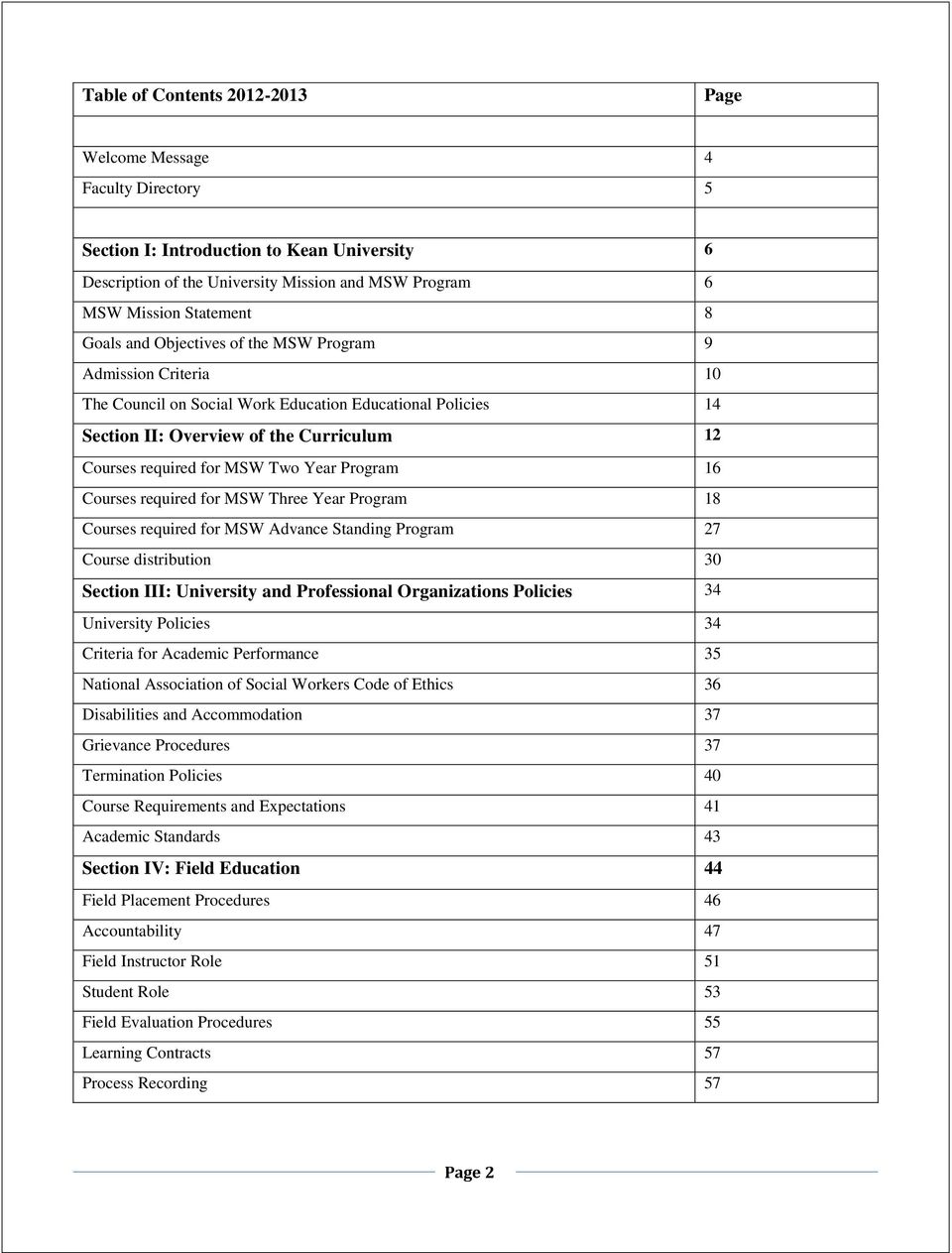
2 Table of Contents Page Welcome Message 4 Faculty Directory 5 Section I: Introduction to Kean University 6 Description of the University Mission and MSW Program 6 MSW Mission Statement 8 Goals and Objectives of the MSW Program 9 Admission Criteria 10 The Council on Social Work Education Educational Policies 14 Section II: Overview of the Curriculum 12 Courses required for MSW Two Year Program 16 Courses required for MSW Three Year Program 18 Courses required for MSW Advance Standing Program 27 Course distribution 30 Section III: University and Professional Organizations Policies 34 University Policies 34 Criteria for Academic Performance 35 National Association of Social Workers Code of Ethics 36 Disabilities and Accommodation 37 Grievance Procedures 37 Termination Policies 40 Course Requirements and Expectations 41 Academic Standards 43 Section IV: Field Education 44 Field Placement Procedures 46 Accountability 47 Field Instructor Role 51 Student Role 53 Field Evaluation Procedures 55 Learning Contracts 57 Process Recording 57 Page 2
3 Field Liaison 61 Field Concerns and Violations 62 Evaluation of Field Performance 64 Grading for Field 66 Field Placement Forms 67 Sample of Assignments-Foundation Year 69 Sample of Learning Contract-Foundation Year 76 Sample of Assignments-Concentration Year 90 Sample of Learning Contract-Concentration Year 95 Final Evaluation 103 Policy on Work Study Requirements and Evaluation 138 Section V: Forms 139 Page 3

4 WELCOME TO THE MSW PROGRAM AT KEAN UNIVERSITY! The MSW Program at Kean University has served its neighboring communities for the past fifteen years, educating a diverse student body of men and women who have gone on to serve the social work profession locally, nationally and internationally as direct social work practitioners, supervisors, administrators and educators. The MSW program prides itself in its quality of instruction which prepares students for evidence-based practice. It promotes a university-wide climate of respect and celebration of diversity, strongly supported by the Human Rights Institute. The Faculty is dedicated and committed to ensure that the MSW program graduates critical thinkers adept to professional values of human dignity, social and economic justice for practice as advanced generalist social workers. The MSW program will continue to engage its stakeholders using outcome assessment data to self-reflect on curriculum content and for identifying avenues to further students' growth. Acting Chair, Faculty & Staff Page 4

5 FACULTY DIRECTORY Dr. Josephine Norward, Acting Chair/MSW Coordinator Clinical Instructors for Field Education: Mr. Jason Richardson LSW Dr. Maureen Himchak, Field Consultant Dr. Alan Lightfoot, Assessment Coordinator Dr. Patricia Sherman, Curriculum Coordinator Dr. Denise Ellis Page 5
6 Introduction to Kean University Brief Description of the University and the MSW Program The University Kean University is a public cosmopolitan university serving undergraduate and graduate students in the liberal arts, the sciences, and the professions. The University dedicates itself to the intellectual, cultural, and personal growth of all its members students, faculty, and professional staff. The University prepares students to think critically, creatively and globally; to adapt to changing social, economic, and technological environments; and to serve as active and contributing members of their communities. Kean offers a wide range of demanding programs dedicated to excellence in instruction and academic support services necessary to assure its socially, linguistically, and culturally diverse students the means to reach their full potential, including students from academically disadvantaged backgrounds, students with special needs, and adults returning to or entering higher education. Kean is steadfast in its dedication to maintaining a student-centered educational environment in which diversity can flourish, and an atmosphere in which mutual respect characterizes relations among the members of a pluralistic community. The University seeks to combine excellence with equity in providing opportunities for all students. Kean is a teaching university, and Kean faculty dedicate themselves to student learning as well as academic rigor. The focus on teaching excellence is supported by a commitment to research, scholarship, creative work, and innovative uses of technology. The focus includes the advancement of knowledge in the traditional disciplines and the enhancement of skills in professional areas. Kean is committed to providing global educational opportunities for students and faculty. Kean is an interactive University, and the University serves as a major resource for regional advancement. Kean collaborates with business, labor, government and the arts, as well as educational and community organizations and provides the region with cultural events and opportunities for continuous learning. Kean is also committed to providing students and faculty educational opportunities in national and international arenas. Kean University s MSW program is built on a firm commitment to social justice attainable through access, excellence and equity. The MSW program has continued to serve the interests and mission of the University, Page 6
7 its neighboring communities as well as the interests of the profession it represents. It prepares students to be lifelong learners, to be informed citizens, and to engage in advanced professional practice to competently serve communities locally, nationally and internationally. Additionally, it exemplifies the University's programmatic responses to the evolving needs of students and of the people and communities directly influenced by changing technology and other innovations in the workplace. The pursuit of excellence in teaching and learning at the graduate level will ensure that students are adequately equipped with skills, knowledge, ethics, and values for advanced generalist practice with varied systems and problems, emphasizing both the diversity and the linkages among these various systems. The promotion of equity and increasing accessibility to education for students with demonstrable potential for advanced practice will serve as partial indicator for the attainment of social justice. Page 7

8 The MSW Program The Masters in Social Work (MSW) at Kean University serves a diverse student body and is committed to promoting a learning environment respectful of diversity, empowerment, and social justice, by preparing professional social workers to be leaders in advanced generalist practice with diverse, oppressed, marginalized populations through practice, education, research and service. The mission of the Masters in Social Work (MSW) Program at Kean University is to provide a diverse student body with a learning environment sensitive to diversity and conducive to the mastery of knowledge, values, skills, and ethics for advanced social work practice, and for leadership in the profession addressing varied problems facing diverse communities of New Jersey and its surrounding areas, with an emphasis on social and economic justice. Its revised curriculum focus is to prepare students to respond to contextual changes that impact on diverse client populations locally, nationally, or internationally. The Program s mission reflects the purpose of both social work education and the profession. It reflects a commitment to prepare our students to be competent and effective professionals committed to empowerment and social justice in response to the changing demographics of our society as well as by globalization, and our profession's emphasis on cultural competence and sensitivity. The MSW Program has revised its traditional generalist and advanced generalist practice to prepare students to work with increasingly diverse client populations. The graduate social work program draws from the profession's historical perspective and the liberal arts foundation to educate future professional social workers to be aware of, sensitive and responsive to present day societal conditions and systemic barriers that limit the full participation of some members of society locally, nationally and globally. Scientific inquiry, eclectic knowledge, ethics and values strengthen understanding about environmental, psychological, social and emotional aspects that impact on the well-being of individuals, families, groups, communities, and organizations. The mission of Kean University provides a context that is consistent with that of the MSW Program with its commitment to increase access and grant opportunities as part of providing a diverse student body with Page 8
9 opportunities to achieve academic excellence, technological support for these efforts, global outreach and responsiveness to the needs of communities served by this institution. This context has provided a foundation for the MSW Program to gain access to unique opportunities for internships, training, research, and grant opportunities as part of the program's commitment to the future development of social work. Based in the values of social work education (service, social justice, dignity and worth of the individual, importance of human relationships, integrity, competence, human rights and scientific inquiry) and the profession s commitment to service to oppressed and marginalized populations, our mission provides the framework for the MSW Program s goals. MSW Program Goal 1: To prepare professional social work practitioners to provide competent and effective advanced generalist practice with individuals, families, groups, organizations, and communities Our program s first goal reflects both a commitment to the purposes of social work education and the University s commitment to a quality education designed to prepare our students to serve the needs of diverse individuals and families in an increasing global society. By providing students with advanced practice knowledge, values, skills and ethics, the students will be better prepared to serve client systems at various levels of practice in ways that promote the dignity and worth of people and promote social and economic justice. MSW Program Goal 2: To develop professional social work practitioners who apply theory, knowledge, values, ethics, and skills, to empower all levels of client systems and advocate for social justice. Program Goal 2 reflects the need to provide students with the knowledge, values, ethics, and skills of the profession and to train them to integrate and apply them in their practice. Preparing students in this manner will enable them to empower their client systems to advocate for social justice at micro, mezzo, and macro levels. Students will develop skills and strategies to engage in scientific inquiry regarding social conditions that disenfranchise and marginalize communities and become advocates for social and economic justice. MSW Program Goal 3: To prepare professional social work practitioners for leadership roles in improving policies and functioning of service delivery systems at all levels of practice. By preparing competent professional social workers, our students will be able to influence service delivery systems at all practice levels. Our graduates rapidly advance into supervisory and management positions that require them to use their advanced generalist educational training. This goal also reflects our commitment to Page 9
10 preparing students to influence policies, services, and programs that support human development and social and economic justice. MSW Program Goal 4: To prepare social workers in advanced generalist practice who are committed to their personal and professional growth as well as to service in the larger community. Our final program goal reflects Kean University s commitment to creating life-long learners that are committed to community service. It also speaks to social work educational principles of prepared, competent professionals who realize the importance of continuing education and professional growth to maintain their ability to be effective in their work with all types of client systems and at all levels of social work practice. This goal promotes and maintains a learning environment that inspires intellectual curiosity, embraces creativity, develops professional use of self, respects diversity, and encourages self-awareness and an understanding of human rights locally, nationally and internationally. It also emphasizes the obligation of our graduates to provide service to their communities. The MSW Program s four goals, derived from the department s mission statement, rooted in purposes of social work education and the profession, and within the context of Kean University mission, are the basis for the Explicit Curriculum that further delineates the specifics of how our program successfully fulfills the goals. MSW Admissions Criteria All of the criteria for admissions to the MSW program meet or exceed the Graduate School s admission criteria minimum. There are no tests required for admission to the Master of Social Work Program. The program admits in the fall only and the application deadline is March 15 th for the Advanced Standing and two-year program. The Extended option has an application deadline of May 1. A key criterion for entry into the MSW program is possession of a liberal arts background. Exposure to knowledge and information learned in the social sciences, humanities, and the arts is essential. This broad background provides students with foundation knowledge about the role of systems of all sizes, diversity, social justice, human rights, politics and policies. The program prepares and trains future social workers as advanced generalists, ready to enhance the problem solving capacities of individuals, families, groups, communities, organizations, and social institutions. The requirements for admission to the MSW program at Kean University are as follows: Page 10
11 1. A U.S. bachelor s degree from a nationally accredited college or university or an equivalent degree from another country as determined by the Office of Graduate Admissions. Applicants must have a Bachelor's degree with a minimum 3.0 GPA, which includes at least 16 credits of prerequisite liberal arts courses (or its equivalent for foreign students), including content in the behavioral sciences and biological or physical sciences. Statistics and Human Biology must be successfully completed in order to meet this requirement. The courses must be from an accredited institution of higher education to be considered for admission. Admissions Office policy stipulates that any students who have completed any part of or all of their post-high school education outside the United States must have their foreign educational credentials evaluated by a credential evaluation service that is a current member of the National Association of Credential Evaluation Services (NACES). The Office provides a current list of NACES members which may be found at: It is each applicant s responsibility to provide transcripts, regardless of whether their undergraduate education was completed at a domestic or foreign college or equivalent. 2. Applicants for the regular two-year MSW program must have a minimum 3.0 G.P.A. from which the Bachelor's degree was awarded and as determined by the Office of Graduate Admissions. Applicants for Advanced Standing, in addition to the BSW, must have at least 425 hours of field education. The degree must have been received within 5 years of application. Candidates must have an overall GPA of 3.25 and a GPA of 3.6 in BSW courses, including research. A completed application consists of: The University application form - which is submitted to the Office of Graduate Admissions Official transcripts of previous undergraduate and graduate work which are submitted to the Office of Graduate Admissions; A non-refundable application fee The MSW Supplemental Application (which is included in the online application) Three letters of recommendation that include one (1) professional, one (1) academic and one (1) personal. These references provide application reviewers with insight into the applicant s character, suitability for the rigors of graduate work, maturity, and responsiveness and attitude toward completing work assignments, supervision and ability to work well with others. A personal statement written according to the MSW program guidelines. This autobiographical statement provides applicants with the opportunity to: Identify their strengths, Conceptualize, analyze and synthesize concepts related to social justice and human rights, Engage in critical thinking, Page 11

12 Exhibit writing skills; and reflect upon their life experience as it relates to reasons why they may be interested in pursuing social work graduate education at this time. Credit is not granted for work experience. Field experience cannot be waived for years of work experience. Prerequisites Students who do not possess the prerequisites courses may complete them prior to graduation, the exception being Statistics, which must be completed before starting Research II. All courses must be at grade B to meet the MSW program requirements. Courses of Study While all the graduate programs at Kean represent diverse populations, the MSW program has a high percentage of students who are first generation, non-traditionally-aged students. Applicants to the program require flexibility to successfully meet the requirements. There are three ways in which students can earn an MSW at Kean University. These options were developed based on faculty awareness that many of our students are employed and/or have multiple responsibilities that they need to incorporate into program study. 1. The Two Year Program The Two Year Program is designed for students who plan to complete their graduate studies full time, over the course of two years. This program option requires students to complete sixty credits of course work over a two-year academic period during the Fall and Spring semesters respectively. This program includes four semesters of Field Education. Students will complete two semesters at one agency during the first academic year (2 days per week) and two semesters at a different agency setting in the second academic year (3 days per week). Work Study arrangements are possible in the second year, but only with approval of the Clinical Coordinator of Field and the MSW Program Director. Successful completion of all four field education courses is required for graduation from the program. 2. The Three Year Extended Full Time Program Page 12

13 The Three Year Extended Full Time Program is an option for students who anticipate taking three years to complete course work. Students admitted to the three year Extended Study MSW program should complete sixty credits of course work over a three-year academic period during the Fall and Spring semesters respectively. This program includes four semesters of Field Education. Students will complete two semesters at one agency during the second academic year (2 days per week) and two semesters at a different agency setting in the third academic year (3 days per week). Work study arrangements are possible in the third year with the approval of the Clinical Coordinator of Field and the MSW Program Director. Successful completion of all four field education courses is required for graduation from the program. 3. The Advanced Standing Program The Advanced Standing Option is intended for students who have successfully completed an Accredited BSW program within the past five years. This program includes two summer "bridge courses" followed by one year of full time study. In the full time year of study, students take fifteen (15) credits per semester, including six (6) credits of field education per semester three (3) days per week of field education). Successful completion of two (2) semesters of field education is required for graduation from the program. Work study arrangements are possible with the approval of the Clinical Coordinator of Field and the MSW Program Director. Successful completion of both field education courses is required for graduation from the program. Students in Advanced Standing are waived from taking the first year of the MSW Program based upon work they have completed in their BSW Programs. Transfer of Credit Graduate courses completed at a grade of "B" or better in a CSWE accredited MSW program may be accepted for credit toward the MSW degree provided that those courses are equivalent to courses in the Kean University MSW Program. As per Kean University policy, a maximum of 6 credits may be accepted for transfer from another CSWE accredited MSW Program. Transfer credit will not be given for practice or field experience courses; these courses must be taken at Kean University concurrent with required classroom course work. Graduate courses for which transfer credit is granted must fall within the six year time limit requirement for completion of graduate programs. Page 13

14 Students requesting transfer of credit must complete the Transfer of Credit form and have it approved by the Director of the MSW program before the credits will be accepted for transfer. Official transcripts are required as proof of completion of such courses at a grade of "B" or better. Graduate students do not receive credit toward their graduate degree for undergraduate level courses, for other graduate courses or graduate degrees earned. Matriculation Only pre-matriculated or matriculated Kean University students are eligible to participate in the MSW Program. Students who are accepted for admission to the two year program are considered to be prematriculated and are expected to register for classes in the fall semester following their acceptance. Students who are accepted for advanced standing are expected to complete two summer bridge courses and then, upon successful completion of these courses with a grade of B or better, to register for classes in the fall semester following their acceptance. EDUCATIONAL POLICIES GOVERNING PROGRAM'S ACCREDITATION The program's curriculum follows CSWE s Educational Standards and Policies as defined below: M 2.0 The curriculum is developed and organized as a coherent and integrated whole consistent with program goals and objectives. Social work education is grounded in the liberal arts and contains a coherent, integrated professional foundation in social work practice from which an advanced practice curriculum is built at the graduate level. M The program describes its coverage of the foundation and advanced curriculum content, identified in Educational Policy, Sections 4 and 5. The program defines its conception of advanced practice and explains how the advanced curriculum is built from the professional foundation. The master s program has a concentration curriculum that includes (a) concentration objectives, (b) a conceptual framework built on relevant theories, (c) curriculum design and content, (d) field education that supports the advanced curriculum. Page 14
15 The program demonstrates how the depth, breadth, and specificity of the advanced curriculum are addressed in relation to the professional foundation. M 2.1 The social work program administers field education (Educational Policy, Section 4.7 and Section 5) consistent with program goals and objectives that: Provides for a minimum of 900 hours for master s programs Admits only those students who have met the program s specified criteria for field education Specifies policies, criteria, and procedures for selecting agencies and field instructors; placing and monitoring students; maintaining field liaison contacts with agencies; and evaluating student learning and agency effectiveness in providing field instruction Specifies that field instructors for master s students hold a CSWE-accredited master s social work degree. In programs where a field instructor does not hold a CSWE-accredited master s social work degree, the program assumes responsibility for reinforcing a social work perspective Provides orientation, field instruction training, and continuing dialog with agencies and field instructors Develops policies regarding field placements in an agency in which the student is also employed. Student assignments and field education supervision differ from those associated with the student s employment. [Council on Social Work Education Inc Educational Policy and Accreditation Standards. Alexandria, VA.] Page 15

16 The Program s concentration is advanced generalist practice. Advanced practitioners refine and advance the quality of social work practice and that of the larger social work profession. They synthesize and apply a broad range of interdisciplinary and multidisciplinary knowledge and skills. In areas of specialization, advanced practitioners assess, intervene, and evaluate to promote human and social well-being. To do so they suit each action to the circumstances at hand, using the discrimination learned through experience and selfimprovement. Advanced practice incorporates all of the core competencies augmented by knowledge and practice behaviors specific to a concentration. The Social Work Curriculum and Professional Practice The social work curriculum constitutes the program s formal educational structure and includes the courses and the curriculum with field education. Social work education is grounded in the liberal arts, which provide the intellectual basis for the professional curriculum and inform its design. The explicit curriculum achieves the program s competencies through an intentional design that includes the foundation offered at the baccalaureate and master s levels and the advanced curriculum offered at the master s level. The MSW curriculum prepares its graduates for advanced practice through mastery of the core competencies augmented by knowledge and practice behaviors specific to a concentration. Concentration The Program s concentration is advanced generalist practice. Advanced practitioners refine and advance the quality of social work practice and that of the larger social work profession. They synthesize and apply a broad range of interdisciplinary and multidisciplinary knowledge and skills. In areas of specialization, advanced practitioners assess, intervene, and evaluate to promote human and social well-being. To do so they suit each action to the circumstances at hand, using the discrimination learned through experience and selfimprovement. Advanced practice incorporates all of the core competencies augmented by knowledge and practice behaviors specific to a concentration. Page 16

17 Advanced Generalist Practice, the MSW Program's concentration, is built on the core competencies of a generalist foundation and their underpinning professional practice behaviors. It is grounded in evidence-based knowledge and a systems/ecological approach to the assessment and diagnosis of complex, chronic and acute problems and situations faced by individuals, families, groups, organizations and social institutions. The advanced generalist practitioner develops the competencies and professional practice behaviors necessary for understanding the contextual nature of social problems and to intervene in systems of all types and sizes. To this end the concentration at Kean University has adapted this advanced practice to respond to the needs of consumers in the multi-cultural and urban communities served by this program. The key considerations for this have been as follows: a. Evidence-based interventions that have the capacity to address the needs of reluctant consumers with both acute and chronic problems, such as substance abuse, child abuse and neglect, severe and persistent mental illness b. Indirect interventions to enhance the capacity of organizations and institutions to meet human needs, particularly in the area of program development c. Utilization and application of research to understand the nature of social problems and identify effective strategies for amelioration d. Multi-cultural and cross cultural proficiency to respond and provide services to the diversity of communities served by this program e. Recruitment and collaboration with internship agencies who could model this approach to practice. Page 17
18 Our curriculum and students' outcomes are based on the following ten Core Competencies: Competency 1: Identify as a professional social worker and conduct oneself accordingly Competency 2 Apply social work ethical principles to guide professional practice Competency 3 Apply critical thinking to inform and communicate professional judgments Competency 4 Engage diversity and difference in practice Competency 5 Advance human rights and social and economic justice Competency 6 Engage in research-informed practice and practice-informed research Competency 7 Apply knowledge of human behavior and the social environment Competency 8 Engage in policy practice to advance social and economic well-being and to deliver effective social work services Competency 9 Respond to contexts that shape practice Competency 10a Engage individuals, families, groups, organizations, and communities Competency 10b Assess individuals, families, groups, organizations, and communities Competency 10c Intervene with individuals, families, groups, organizations, and communities Competency 10d Evaluate individuals, families, groups, organizations, and communities Forty one practice behaviors facilitate the operationalization of these core competences. The following are tables at both the foundation and concentration levels which provide a sample of courses with each competence and its operationalization Page 18

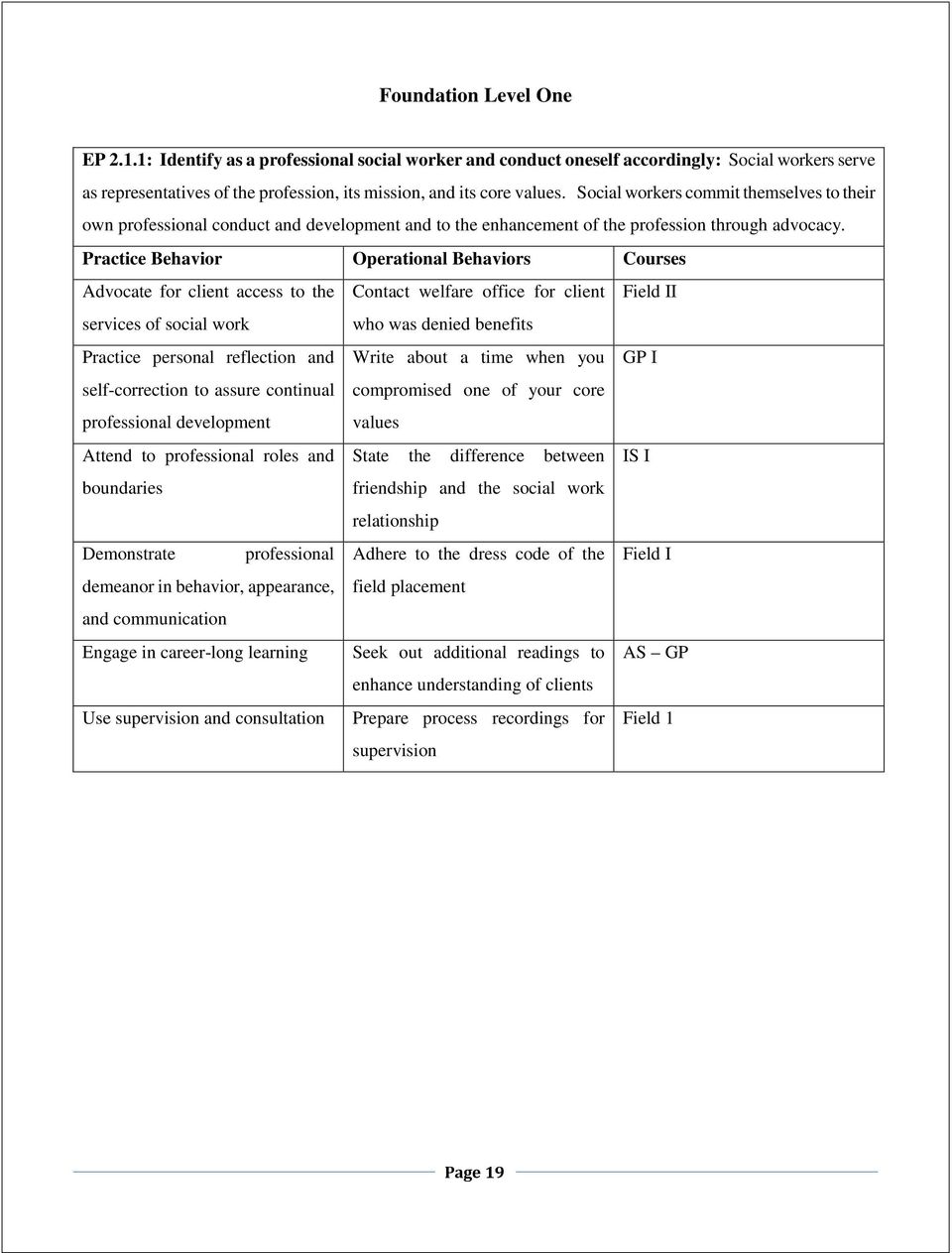
19 Foundation Level One EP 2.1.1: Identify as a professional social worker and conduct oneself accordingly: Social workers serve as representatives of the profession, its mission, and its core values. Social workers commit themselves to their own professional conduct and development and to the enhancement of the profession through advocacy. Practice Behavior Operational Behaviors Courses Advocate for client access to the Contact welfare office for client Field II services of social work who was denied benefits Practice personal reflection and Write about a time when you GP I self-correction to assure continual professional development compromised one of your core values Attend to professional roles and State the difference between IS I boundaries friendship and the social work relationship Demonstrate professional Adhere to the dress code of the Field I demeanor in behavior, appearance, field placement and communication Engage in career-long learning Seek out additional readings to AS GP enhance understanding of clients Use supervision and consultation Prepare process recordings for supervision Field 1 Page 19
20 EP 2.1.2: Apply social work ethical principles to guide professional practice: Social workers are knowledgeable about social work ethical standards and their application to decision making. Social workers are expected to engage in ethical behavior and are aware of how their personal values impact practice. Practice Behavior Operational Behaviors Courses Recognize and manage personal Identify personal values that may GP I values in a way that allows conflict with those of the social professional values to guide work profession practice Make ethical decisions by applying Identify the ethical principles IS I standards of National Association of Social Workers Code of Ethics relevant to a specific ethical dilemma and, as applicable, of the International Federation of Social Workers/ International Association of Schools of Social Work Ethics and Social Work, Statement of Principles Tolerate ambiguity in resolving Identify additional information AS GP ethical conflicts needed to resolve an ethical dilemma Apply strategies of ethical Discuss the process of resolving an GP I reasoning to arrive at principled ethical dilemma decisions Page 20

21 EP 2.1.3: Apply critical thinking to inform and communicate professional judgments: Social workers are knowledgeable about the principles of logic, scientific inquiry, and reasoning and begin to apply these in critical thinking about their social work practice. Practice Behavior Operational Behaviors Courses Distinguish, appraise, and Identify the relevant information SWPS I integrate multiple sources of for understanding a social policy knowledge, including researchbased knowledge, and practice wisdom Analyze models of assessment, Select an appropriate method of AS - GP prevention, intervention, and intervention for work with a client evaluation Demonstrate effective oral and Prepare and present a case in a staff Field I written communication in working meeting with individuals, families, groups, organizations, communities, and colleagues EP : Engage diversity and difference in practice: Social workers are sensitive to issues of diversity and how it underpins all social work practice. Students are aware of how their personal values and biases might impact practice. Students are expected to be culturally proficient and capable of appreciating the impact of similarities and differences in practice locally, nationally and globally. Practice Behavior Operational Behaviors Courses Recognize the extent to which a Identify a policy impacting clients SWPS I culture s structures and values may oppress, marginalize, alienate, or create or enhance privilege and power that perpetuates marginalization Gain sufficient self-awareness to eliminate the influence of personal biases and values in working with diverse groups Identify personal values that may conflict with an agency s policy GP I Page 21
22 Recognize and communicate their understanding of the importance of difference in shaping life experiences View themselves as learners and engage those with whom they work as informants Interview a person of a different gender and ethnicity and analyze any differences between you and the interviewee Conduct an assessment on a client HBSE I Field II EP 2.1.5: Advance human rights and social and economic justice: Social workers are knowledgeable about theories and strategies to promote human, social, political, economic and civil rights as they apply to individuals, families, groups, communities, and organizations on a local, national and global level. Practice Behavior Operational Behaviors Courses Understand the forms and Discuss the concept of white HBSE II mechanisms of oppression and privilege discrimination Advocate for human rights and Write a letter to a congressperson SWPS I social and economic justice Engage in practices that advance social and economic justice Sign an on-line petition SWPS I EP 2.1.6: Engage in research-informed practice and practice-informed research: Social workers use qualitative and quantitative research to inform their evidenced-based interventions, evaluation of their practice, and to improve policies and systems of social service delivery. Practice Behavior Operational Behaviors Courses Use practice experience to inform scientific inquiry Use research evidence to inform Prepare a literature review on an R 1 practice issue relevant to your field experience Page 22
23 EP 2.1.7: Apply knowledge of human behavior and the social environment: Social workers know about human development across the life span; the ecosystems perspective; the effects of marginalization, discrimination, and oppression and their role in practice. Practice Behavior Operational Behaviors Courses Utilize conceptual frameworks to Identify the developmental theory Field II guide the processes of assessment, intervention, and evaluation that best explains a client s behavior Critique and apply knowledge to Discuss how the environment can AS HBSE understand person and impact a child s development environment EP 2.1.8: Engage in policy practice to advance social and economic well-being and to deliver effective social work services: Social workers know the history of current social policies and services and understand their influence on ideology and policy development and their role in practice. Practice Behavior Operational Behaviors Courses Analyze, formulate, and advocate Develop an alternative to an Field II for policies that advance social existing agency policy well-being Collaborate with colleagues and clients for effective policy action EP 2.1.9: Respond to contexts that shape practice: Social workers respond dynamically and proactively to the changing organizational, community, societal, and global context of practice. They are familiar with electronic and technological tools that impact contemporary practice. Practice Behavior Operational Behaviors Courses Continuously discover, appraise, and attend to changing locales, populations, scientific and technological developments, and emerging societal trends to provide relevant services Page 23
24 Provide leadership in promoting sustainable changes in service delivery and practice to improve the quality of social services EP a: Engage individuals, families, groups, organizations, and communities: Social workers possess the knowledge, values, and skills to begin to prepare for and engage client systems. Practice Behavior Operational Behaviors Courses Substantively and affectively prepare for action with individuals, families, groups, organizations, and communities Use empathy and other interpersonal skills Develop a mutually-agreed upon focus of work and desired outcomes Reflect in a process recording the Field II steps you took in considering working with a new client Role play an interview with a client GP I who has abused a child List the goals and objectives for Field II your work with a client EP b: Assess individuals, families, groups, organizations, and communities: Social workers possess the knowledge, values, and skills, to begin to prepare for and assess client systems. Practice Behavior Operational Behaviors Courses Collect, organize, and interpret Conduct an intake interview Field I client data Assess client strengths and Identify a functional strength and GP I limitations underlying need of a client Develop mutually agreed-on Develop a treatment plan with a Field II intervention goals and objectives client Select appropriate intervention strategies List the pros and cons of at least two intervention strategies that might be appropriate for your client IS II Page 24
25 EP c: Intervene with individuals, families, groups, organizations, and communities: Social workers possess the knowledge, values, and skills, to begin to prepare for and intervene with client systems. Practice Behavior Operational Behaviors Courses Initiate action to achieve Develop a contract with a client Field I organizational goals Implement prevention interventions Help client build on strengths Field II that enhance client capacities Help clients resolve problems Write a paper detailing the GP II intervention strategies utilized Negotiate, mediate, and advocate Serve as your client s advocate in a Field II for clients child study team meeting Facilitate transitions and endings Transfer client to another worker at the end of your placement Field II EP d: Evaluate with individuals, families, groups, organizations, and communities: Social workers possess the knowledge, values, and skills, to begin to evaluate interventions with client systems. Practice Behavior Operational Behaviors Courses Critically analyze, monitor, and Select two appropriate evaluation Field II evaluate interventions methods in working with your client Page 25
26 Concentration Level EP 2.1.1: Identify as a professional social worker and conduct oneself accordingly: Social workers are representatives of the profession, its mission, core values and demonstrate this through their professional conduct, development, and advocacy in enhancing the profession. Practice Behavior Operational Behaviors Courses Conduct supervision and Write a supervisory evaluation on a AGP II consultation as an advanced group member generalist practitioner Apply professional use of self as an advanced generalist practitioner Present an in-service training at Field IV your agency EP 2.1.4: Engage diversity and difference in practice: Social workers are culturally proficient and respond appropriately to complex situations that might involve populations that are marginalized, oppressed, alienated, or subject to discrimination and racism. Practice Behavior Operational Behaviors Courses Analyze multiple diversity factors at all levels of practice contributing to assessment and intervention as an advanced generalist practitioner Discuss the cultural representation of mental illness Assessment EP 2.1.6: Engage in research-informed practice and practice-informed research: Social workers use qualitative and quantitative research at an advanced level to develop their evidence based practice with multilevel systems. In addition, experience in practice informs the research that underpins the development of services to improve practice, policy, and social service delivery. Practice Behavior Operational Behaviors Courses Use practice experience to inform scientific inquiry Select a policy that negatively SWPS II impacts a client and propose an alternative Page 26
27 Use research evidence to inform practice Locate, integrate, and apply best available practice as an advanced generalist practitioner Conduct a single-subject design and modify your intervention based on the results List the pros and cons of implementing at least two different intervention methods in working with a client Field II AGP I EP 2.1.8: Engage in policy practice to advance social and economic well-being and to deliver effective social work services: Social workers apply their knowledge of social policies and services to analyze, develop, advocate, educate, and promote policies and procedures to advance social, economic, and political justice. Practice Behavior Operational Behaviors Courses Collaborate with colleagues and Develop a grant proposal AGP II clients for effective policy action EP 2.1.9: Respond to contexts that shape practice: Social workers respond creatively, dynamically, and proactively to the changing organizational, community, societal, and global contexts of practice. In addition, they are able to use the electronic and technological tools applicable to their field of practice. Practice Behavior Operational Behaviors Courses Continuously discover, appraise, and attend to changing locales, populations, scientific and technological developments, and emerging societal trends to provide relevant services Provide leadership in promoting sustainable changes in service delivery and practice to improve the quality of social services Page 27
28 EP a: Engage individuals, families, groups, organizations, and communities: Social workers have the knowledge, values, and skills to prepare and engage complex client situations in a multi-cultural context. Practice Behavior Operational Behaviors Courses Apply the advanced knowledge, Utilize motivational interviewing Field III values, ethics, and skills necessary with a client to engage individuals, families, and groups who are hard to reach or reluctant to receive services Effectively engage with groups, Participate in a consortium of Field IV organizations, and communities to agencies as a representative of your maximize the benefits and agency empower clients EP b: Assess individuals, families, groups, organizations, and communities: Social workers have the knowledge, values, and skills to assess complex client situations in a multi-cultural context. Practice Behavior Operational Behaviors Courses Effectively utilize evidenced-based Write an assessment of a client Assessment tools of diagnosis and assessment utilizing the DSM-IV and PIE with individuals, families, and groups Effectively utilize multiple Conduct a force-field analysis and Field IV methods of assessment with SWOT on an issue in field groups, organizations, and communities Page 28
29 EP c: Intervene with individuals, families, groups, organizations, and communities: Social workers have the knowledge, values, and skills to intervene in complex client situations in a multi-cultural context. Practice Behavior Operational Behaviors Courses Demonstrate an understanding of the advanced generalist roles as an administrator, manager, and supervisor Demonstrate leadership as an advanced generalist practice practitioner in the development and implementation of existing social work programs Understand and apply research findings/data to propose preventative interventions that enhance client capacities Use empirically-based methods of intervention to ensure the delivery of effective services to individuals, families, and groups As an advanced generalist practitioner enact the role of change agent with individuals, groups, organizations and communities Assess your agency through both AGP II TQM and MBO Write a grant proposal AGP II Role play the application of the Trauma techniques of systematic desensitization in working with a trauma survivor Utilize CBT with a client Field IV Develop a proposal to enhance Aging community services available to the aging population Page 29
30 Distribution and Sequencing of Courses Required for MSW Concentration in Advanced Generalist Practice: Two Year Program FIRST SEMESTER SW Generalist Social Work Practice in a Multicultural Environment I SW Field Experience I SW Social Welfare Policy and Services I SW HBSE I SW Integrative Seminar I SEMESTER TOTAL CREDITS 3 Credits 4 Credits 3 Credits 3 Credits 2 Credits 15 Credits SECOND SEMESTER SW Generalist Social Work Practice in a Multicultural Environment II SW Field Experience II SW HBSE II SW Integrative Seminar II SW Social Work Research I 3 Credits 4 Credits 3 Credits 2 Credits 3 Credits SEMESTER TOTAL CREDITS 15 Credits THIRD SEMESTER SW Advanced Generalist Practice in a Multicultural Environment I 1 SW Field Experience III 1 SW Social Work Research II - Evaluation Research SW Psychopathology in Social Work Practice 3 Credits 6 Credits 3 Credits 3 Credits SEMESTER TOTAL CREDITS 15 Credits FOURTH SEMESTER SW Advanced Generalist Practice in a Multicultural Environment II 2 SW Field Experience IV 2 SW Social Welfare Policy and Services II Free Elective 3 Credits 6 Credits 3 Credits 3 Credits SEMESTER TOTAL CREDITS 15 Credits Page 30
31 GRAND TOTAL CREDITS 60 Credits 1 Since there is no Integrative Seminar in the Third Semester, these two courses will be linked to provide continuity. 2 Since there is no Integrative Seminar in the Fourth Semester, these two courses will be linked to provide continuity. FREE ELECTIVES SW Issues Confronting Contemporary Families 3 Credits SW Issues of Aging 3 Credits SW 6706 Comfort Care 3 Credits SW 6802 Healing from Trauma in Social Work Practice 3 Credits Distribution and Sequencing of Courses Required for MSW Concentration in Advanced Generalist Practice: Three Year Program FIRST SEMESTER SW Social Welfare Policy and Services I SW HBSE I SW Social Work Research I SEMESTER TOTAL CREDITS 3 Credits 3 Credits 3 Credits 9 Credits SECOND SEMESTER SW HBSE II SW Social Welfare Policy and Services II SW Social Work Research II - Evaluation Research SEMESTER TOTAL CREDITS 3 Credits 3 Credits 3 Credits 9 Credits THIRD SEMESTER SW Generalist Social Work Practice in a Multicultural Environment I SW Field Education I SW Integrative Seminar I SEMESTER TOTAL CREDITS 3 Credits 4 Credits 2 Credits 9 Credits FOURTH SEMESTER SW Generalist Social Work Practice in a Multicultural Environment II 3 Credits Page 31
32 SW Field Education II SW Integrative Seminar II SEMESTER TOTAL CREDITS 4 Credits 2 Credits 9 Credits FIFTH SEMESTER SW Advanced Generalist Practice in a Multicultural Environment 1 1 SW Field Education III 1 SW Psychopathology in Social Work Practice SEMESTER TOTAL CREDITS 3 Credits 6 Credits 3 Credits 12 Credits SIXTH SEMESTER SW Advanced Generalist Practice in a Multicultural Environment II 2 SW Field Education IV 2 Practice Elective (SW 6802, SW 6703, or SW 6704) SEMESTER TOTAL CREDITS 3 Credits 6 Credits 3 Credits 12 Credits GRAND TOTAL CREDITS 60 Credits 1 Since there is no Integrative Seminar in the Fifth Semester these two courses will be linked to provide continuity. 2 Since there is no Integrative Seminar in the Sixth Semester these two courses will be linked to provide continuity. PRACTICE ELECTIVES SW Issues Confronting Contemporary Families SW Issues of Aging SW 6706 Comfort Care SW 6802 Healing from Trauma in Social Work Practice 3 Credits 3 Credits 3 Credits 3 Credits Distribution and Sequencing of Courses Required for MSW Concentration in Advanced Generalist Practice: Advanced Standing Program There are no tests required for admission to the MSW program Program Requirements 36 credits two semesters of Field Education PROGRAM SEQUENCE Transitional Summer Semester 6 Credits Page 32
33 SW Generalist Social Work Practice in a Multicultural Environment for Advanced Standing Students SW HBSE for Advanced Standing Students FIRST SEMESTER SW Advanced Generalist Practice I 1 SW Field Education III 1 SW Social Work Research II - Evaluation Research SW Psychopathology in Social Work Practice SEMESTER TOTAL CREDITS 3 Credits 3 Credits 3 Credits 6 Credits 3 Credits 3 Credits 15 Credits SECOND SEMESTER SW Advanced Generalist Practice II 2 3 Credits SW Field Education IV 2 6 Credits SW Social Welfare Policy II 3 Credits Practice Elective (See Below) 3 Credits SEMESTER TOTAL CREDITS 15 Credits GRAND TOTAL CREDITS 36 Credits 1 Since there is no Integrative Seminar in the First Semester; these two courses will be linked to provide continuity. 2 Since there is no Integrative Seminar in the Second Semester; these two courses will be linked to provide continuity. PRACTICE ELECTIVES MSW Program Electives: SW Issues Confronting Contemporary Families SW Issues of Aging SW 6706 Comfort Care SW 6801 Healing from Trauma in Social Work Practice 3 Credits 3 Credits 3 Credits 3 Credits UNIVERSITY POLICIES Page 33
34 The MSW program adheres to the following university policies: Academic Integrity Policy The University policy on Academic integrity is located at: Affirmative Action Policy The University Equal Opportunity and Affirmative Action Statement is located at: This policy also addresses sexual harassment. American with Disabilities Act (ADA) The University Office of disability Services implements the provisions of the Americans with Disabilities Act at Kean University: Student Code of Conduct The University Student code of Conduct is located at: Nondiscrimination Policy The New Jersey State Policy Prohibiting Discrimination in the Workplace is located at: Kean University Policy on Free speech and Dissent The University policy on Free Speech and Dissent is located at: EVALUATION OF STUDENTS' ACADEMIC PERFORMANCE Page 34
35 In order to meet its responsibilities to provide quality professional education and to ensure that its graduates are able to function in a broad variety of professional situations, the MSW Program evaluates the academic performance of its students in four general areas: Basic Abilities to Acquire Professional Skills; Mental and Emotional Abilities; Professional Performance skills; and Scholastic Performance. Meeting the criteria for scholastic achievement is required, but is not sufficient to ensure continued enrollment in the program. Both professional behavior and scholastic performance comprise academic standards. Basic Abilities Required to Acquire Professional Skills Communication Skills- Demonstrates sufficient written and oral skills to comprehend information and communicate ideas and feelings. Written: Writes clearly, uses correct grammar and spelling, and applies appropriate writing style, including American Psychological Association (APA) referencing, appropriate source citation, and documentation. Demonstrates sufficient skills in English and written assignments, as specified by faculty. Oral: Communicates effectively and sensitively with other students, faculty, staff clients, and professionals. Express ideas and feelings clearly and demonstrates a willingness and an ability to listen to others. Demonstrates sufficient skills in spoken English to understand content presented in the program, to complete adequately all oral assignments, and to meet the objectives of field placement experiences, as specified by faculty. Interpersonal Skills - Demonstrates the interpersonal skills required to relate effectively to other students, faculty, star clients, and professionals and to fulfill the ethical obligations of the profession. These include compassion, empathy, altruism, integrity, and demonstration of respect for and consideration of others. Takes appropriate responsibility for own actions, and considers the outcome of these actions on others. Cognitive Skills- Exhibits sufficient knowledge of social work and clarity of thinking to process information and apply it to appropriate situations in classroom and field. Demonstrates grounding in relevant social, behavioral and biological science knowledge and. research - including knowledge and skills in relationship building, data gathering, assessment, intervention, and evaluation of practice. Exhibits ability to conceptualize and integrate knowledge and apply that knowledge to professional practice. Page 35
36 Physical Skills - Exhibits sufficient motor and sensory abilities to attend and participate in class and practicum placement, with or without accommodations. (See section on Accommodations for Disabilities for or clarification.) Emotional and Mental Abilities Required for Performance in the Program. Stress Management-Demonstrates ability to deal with current life stressors through the use of appropriate coping mechanisms. Handles stress effectively by using appropriate self-care and developing supportive relationships with colleagues, peers, and others. Emotional and Mental Capacities-Uses sound judgment. Seeks and effectively uses help for medical or emotional problems that interfere with scholastic and professional performance. Engages in counseling or seeks out support and helps with personal problems, psychological distress, substance abuse, or mental health difficulties do any of the following: compromise scholastic and other performance ; interfere with professional judgment and behavior, or jeopardize the best interest of those to whom the social work student has a professional responsibility (as outlined in the current Codes of Ethics, National Association of Social Workers and the New Jersey State Board of Social Work Examiners for Social Work Licensure). Professional Performance Skills Required for Work with Clients. Professional Commitment-Exhibits a strong commitment to the goals of social work and to the ethical standards of the profession, as specified in the NASW Code of Ethics and the Code of Ethics for Social Work Licensure in New Jersey. Demonstrates commitment to the essential values of social work that includes the respect for the dignity and worth of every individual and his/her right to a just share of society's resources (social justice). Professional Behavior -Exhibits behaviors that are in compliance with program policies, institutional policies, professional ethical standards, and societal laws in classroom, field, and community. Appearance, dress and general demeanor reflect a professional manner. Shows potential for responsible and accountable behavior by knowing and practicing within the scope of social work, respecting others, being punctual and dependable, prioritizing responsibilities, attending class regularly, observing deadlines, completing assignments on time, keeping appointments or making appropriate arrangements, Page 36
37 and accepting supervision and criticism in a positive manner. Works effectively with others, regardless of level of authority. Advocates for him/herself in an appropriate and responsible manner and uses proper channels for conflict resolution. Shows a willingness to receive and accept feedback and supervision in a positive manner, as well as use such feedback to enhance professional development. Self Awareness - Exhibits knowledge of how one's values, attitudes, beliefs, emotions and past experiences influence thinking, behavior and relationships. Accurately assesses one's own strengths, limitations, and suitability for professional practice. Shows awareness of self and how one is perceived by others. Reflects on one's own limitations as they relate to professional capacities. Is willing to examine and change behavior when it interferes in working with clients and other professionals. Ethical Obligations - Current behavior and classroom performance demonstrate adherence to the ethical expectations and obligations of professional practice, noted in the NASW Code of Ethics for Social Work Licensure in New Jersey.. Scholastic Performance MSW students are considered to be in academic difficulty if their GPA drops below 3.0. Students will be advised to withdraw from the program if their grade point average falls below 2.5. Failure to maintain a passing grade in field placement will result in dismissal. A review will be called if a student earns a grade of NC (No Credit) or INC (incomplete) in any semester of field. A review may be called if a student earns a grade of C or below or INC in any required social work course. An overall GPA of 3.0 is required for graduation. Accommodation for Disabilities The MSW Program adheres to the university policy in the implementation of ADA posted on the university's website and on the Graduate Student -Handbook. Grievance Procedures Grievance procedures for academic performance are outlined in the Kean University Student Handbook, located at Students are provided with this information on each course syllabus. Students academic progress is reviewed during and at the end of each semester by faculty and field staff to ensure that acceptable levels of knowledge, skills and ethical standards have been achieved. Performance or behavior that jeopardizes academic standing requires review by the Acting Chair, who can elect to make decisions independently, or in consultation with relevant faculty and staff. Page 37
38 Any student that does not receive a minimum of a B (3.0) in any course is automatically placed on probation, per the Nathan Weiss Graduate College policy. A university wide computer program identifies students who are in danger of receiving less than a B average; these students receive a letter from the Dean s Office with a copy also being sent to all department chairs. Any student who receives less than a C in any course is not permitted to register for part II of any two semester sequence course. Similarly, students in field placements must receive CG (Credit Given) in order to advance to either the second semester or the second year of field. MSW students must have a minimum of a B in all courses in order to successfully complete the program. The university has instituted a new college wide policy on academic performance and dismissals. A detailed statement describing the process and procedures, can be located at The MSW program has three steps in its grievance process. The first step in the process is a consultation between the student and a faculty advisor, instructor, or field liaison. This initial meeting provides an opportunity for the relevant parties to identify areas of concern originating from either faculty, professional staff or student. Examples of academic or professional performance warranting concern include, but are not limited to, inability to understand or apply concepts, a pattern of not submitting assignments or submitting them late, excessive absence or lateness, unprofessional behavior, and or ethical violations, including plagiarism. In field, examples include excessive lateness or absences, inability to apply theoretical concepts or meet professional goals. Step two: If any of the parties are not satisfied with the outcome of the meeting, an Academic Review Committee meeting is then scheduled. All relevant parties, including faculty, Field Directors and agency representatives are invited to attend. Students also have the option of inviting a student representative who can function as an advocate for them. Possible outcomes of the meeting include, development of a contract the student must agree to abide by that identifies recommendations for improvement in academic and or professional performance, including a timeline for improvement, referral to the Counseling Center, temporary withdrawal from the program, or dismissal from the program A summary of the proceedings is recorded and mailed to the student. Strict confidentiality is required of all participants. Additionally, every attempt is made to schedule meetings at a time convenient for the majority of participants. Step Three: If no improvement occurs during the previously agreed time frame, the student may be referred again to the Academic Review Committee. If the outcome of the meeting is not acceptable, a meeting with the Page 38
39 Dean can be requested. Students are encouraged to follow the chain of command, and meet with departmental faculty, the Field Director, and or the Acting Chair, prior to contacting the Dean s office. Type 2: Field Experience Concerns or Academic Concerns Field Experience Concerns Students from time to time have had concerns relative to their academic learning in their field setting. At other times, such concerns originate with a faculty member, faculty advisor, or faculty field liaison, particularly where there are concerns regarding fulfillment of professional requirements, or surrounding the student's professional demeanor and appropriateness. This process is designed to assist students in dealing with identified concerns that have an influence on their performance. The following procedure will be used for handling such concerns. 1. A process may be initiated by the student, a faculty advisor, or faculty liaison. The process begins with a meeting between the student, his or her faculty advisor, and the faculty field liaison to the agency. At this point, all of the above persons should explore all possibilities for an informal resolution to the concern, and notify the Director of Field Education. 2. If a resolution is not achieved, the concern is then forwarded in writing to the Chair of the Academic Standing and Student Review Committee by any of the involved parties. To assure the student's right to confidentiality, the student members of the Committee will be included/excluded from the process at the student's request. A meeting of the Committee is called. In all instances in which a student has received an incomplete in Field Experience in the previous semester, the Academic Standing and Student Review Committee will meet by the fourth week of the semester to determine whether the student can successfully remove the incomplete grade. 3. The student and the faculty liaison both present written statements to The Committee, the faculty advisor, and faculty advocate no later than five working days prior to the Committee's scheduled, meeting. The faculty liaison's statement should include a plan for the student's future work in the program. A hearing is then scheduled by the Committee and attended by the student, faculty liaison, and faculty advisor. The student has the option of bringing an advocate to the hearing. The advocate may be a faculty member, field instructor, another student, or someone else who has knowledge of the student's work; the advocate may not be a member of the student's family or an attorney. The advisor, liaison, and student present their cases. Questions are asked. The Committee then deliberates and informs the Director of the MSW Program of its decision in writing. As part of this decision, the student may be asked, in writing, to modify his or her behavior and/or seek Page 39
40 appropriate help. This process is designed to assist students in dealing with identified concerns that have an influence on their performance. The Director of the MSW Program notifies the student of the Committee's decision in writing. 4. The student may appeal the committee's decision to the Director of the MSW Program. This appeal must be made within ten business days of written notification to the student of the Committee's decision. 5. At the conclusion of the process, all written materials are destroyed, except for one copy which is retained by the Director of the MSW Program in the event that it is required for any future action. Policies for Terminating a student from the program. The social work program is in compliance with the policy on Academic Probation and Dismissal which applies to all graduate programs within the Nathan Weiss Graduate College. The statement states: After a graduate student attempts six total graduate credits as a matriculated student, a 3.0 cumulative GPA must be achieved. Failure to meet this minimum will result in the student being placed on Academic Probation. Additionally, conditions to the probation may be set at the discretion of the Dean of the Graduate College. Upon completion of 12 attempted graduate credits, if a student on academic probation fails to achieve a cumulative GPA of 3.0, the student will be academically dismissed from Kean University. If the student achieves a cumulative GPA of 3.0 or higher, they will be removed from academic probation. However, if at any time during subsequent semesters the student falls below a cumulative 3.0 GPA, they will be academically dismissed from Kean University. All notices of academic probation and/or dismissal will occur at the completion of the fall and spring academic semesters. If a student is academically dismissed from Kean University, the student is entitled to appeal the dismissal to the Academic Standards Committee of the Graduate College. This committee is comprised of the Dean of the Graduate College as well as administrators and faculty members appointed by the Dean. The appeal is submitted in writing to the Director of Graduate Student Services within fourteen calendar days of the letter of dismissal. Failure to adhere to the time frame can lead to the denial of a hearing. Page 40
41 Schedule changes-for all schedule changes, students must see the director of the program. Withdrawals- Students who wish to withdraw from a course must follow the university's policy and advise the faculty course instructor in writing. If the course is designated as a co-requisite of any other course(s), that course or courses must also be dropped. If the course is Field Experience, the Faculty Liaison and Field Instructor must be notified in writing. Students who withdraw from a course during the first third of the semester receive a grade of "W". Students who withdraw from a course no later than one week past mid-semester will receive a grade of "WD". Neither withdrawal grade is counted in the cumulative grade-point average. Any student who does not officially withdraw on or before the published withdrawal date will be given a letter grade that reflects his or her achievement in the course." (Kean University Graduate Catalog, ). COURSE REQUIREMENTS (CLASS SYLLABUS) Instructors are expected to communicate to students in writing at the start of the semester essential information about the conduct of the course. The class syllabus should include information about course prerequisites (if any), textbooks, course objectives and content. All course requirements should be specified in the syllabus along with the basis for determination of the final grade. The course syllabus is a contract between the faculty member and the student. Changes in course requirements made after the start of the semester should also be communicated in writing to students. Students, in turn, are responsible for meeting the requirements of the course as delineated in the syllabus and for requesting clarification from the instructor on items. in the syllabus which they do not understand. Students who experience difficulty in meeting course requirements should discuss their situation with the instructor and seek help. Students are mandated to share copies of their course syllabus with their field instructor especially practice courses linked to field experience, Generalist Practice I & II, Advanced Generalist Practice I & II, Assessment. Page 41
42 STANDARDS FOR WRITTEN WORK "All graduate research papers must meet acceptable standards for written work. [Social Work students will utilize the American Psychological Association (APA) form of documentation.] Copies of the thesis manual are available in the University Book Store." (Kean University Graduate Catalog) GRADING CRITERIA, EVALUATION CRITERIA AND ASSIGNMENTS Grade Grade Point Value A (4.0) A (3.7) B (3.3) B (3.0) B (2.7) C (2.3) C (2.0) D (1.7) F Below 66 (0) I denotes incomplete and is given only in those rare and approved instances in which a student can meet the assignments of the course within the given term due to a valid and acceptable reason. Credit Granted-Credit granted is generally considered to be equivalent to a grade "B" or better. It is applied to Field Education courses in the MSW Program. Incomplete- A grade of Incomplete (INC) may be reported for a student who has completed course requirements throughout the semester and then, because of illness or other unusual and substantiated cause, has been unable to take the final examination or to complete a limited amount of assigned work due near the end of the semester. Unsubstantiated absences from class cannot justify an "incomplete" grade. Students granted an incomplete due to medical reasons have the responsibility to submit medical documentation in order to be allowed to complete the work particularly if they took medical leave of absence from the program. Class attendance in the subsequent semester may not be required by the instructor as a condition for removal of the INC. If a substantial amount of work has been missed for medical or other valid reasons, the student should petition the School Dean to be withdrawn from all courses. Page 42
43 It is the responsibility of the student to initiate a request for a grade of incomplete. The student must first talk with the instructor. The course instructor must receive this request prior to the submission of grades at the end of the semester. The educational plan for the MSW program is based on cumulative learning, each semester of field experience as well as the courses taken concurrently must be successfully passed in order to continue in each sequence. Recommended Sanctions: Expulsion from the University. Faculty who believe that violations have occurred should immediately contact the Director of the MSW Program. Students who suspect that other students are involved in actions of academic dishonesty should speak to the instructor of the course. The Academic Standards Committee monitors the above policy. Questions concerning this policy can be addressed to faculty members or to the MSW Program Director. (Adapted from a Policy of Rutgers Graduate School of Social Work) ACADEMIC STANDARDS To qualify for graduation, a student must maintain a cumulative grade-point-average of 3.0 (B). If a student's academic average is below B for a given term, the student may be referred to the Academic Standing and Student Review Committee. Students must have a passing grade in a sequential prerequisite course before starting the next sequential course. NON-ACADEMIC DISMISSAL When the actions of a student are judged by the Academic Standing and Student Review Committee, using established procedure from the Kean University Policies on Social Issues and Student Behavior and/or the NASW Code of Ethics, to be detrimental to the interests of the university community and/or the social work profession, that person may be required to withdraw. Page 43
44 Field Internship FIELD PRACTICE IS THE SIGNATURE PEDAGOGY OF SOCIAL WORK PROGRAM. POLICIES OF THE FIELD EDUCATION ARE ESTABLISHED BY THE COUNCIL OF SOCIAL WORK EDUCATION EPAS AND BY THE FACULTY OF THE SOCIAL WORK PROGRAM, AND ADMINISTERED BY THE CLINICAL INSTRUCTOR COORDINATOR FOR FIELD. THE FIELD EDUCATION CURRICULUM AREA IS INTEGRATED WITH THE COUNCIL OF SOCIAL WORK EPAS AND THE GRADUATE SOCIAL WORK CURRICULUM FOR ADVANCED GENERALIST PRACTICE. LIKE ALL PARTS OF THE CURRICULUM IT IS SUBJECT TO FORMAL SELF-STUDY AND EVALUATION ON A REGULAR BASIS. SUCH ASSESSMENT OF THE EFFECTIVENESS OF THE FIELD EDUCATION RESULTS FROM INPUTS OF STUDENTS, FACULTY AND FIELD INSTRUCTOR. IN ADDITION TO FORMAL EVALUATION MECHANISMS, ALL PARTIES ARE ENCOURAGED TO RAISE ISSUES AS THEY OCCUR, AND TO SEEK RESOLUTION THROUGH POLICY OR PROCEDURAL CHANGES WHERE WARRANTED. Page 44
45 CRITERIA FOR SELECTION OF FIELD AGENCIES: Agencies that participate in the internships program are chosen for their commitment to providing quality social work service and their willingness in meeting the Kean University MSW program Requirements. The two Clinical Instructor Coordinators for Field are responsible for selecting agencies and field instructors and guaranteeing that they meet the criteria. The criteria for selection of field agencies are outlined in the Kean University Social Work Student Affiliation Agreement which is signed by the School and the participating agency. (A copy of the Kean University Social Work Student Affiliation Agreement is included as an appendix) The Affiliation agreement states that the agency must: 1. Assign a qualified field Instructor to the student. This involves assigning a field instructor who meets the criteria outlined by the Social Work program and providing the field instructor with sufficient release time and resources to carry out the responsibilities of this position 2. Provide for adequate field instruction 3. Assure participation of the field instructor in the coordination of the student's learning experience 4. Provide for adequate working space and other resources as needed by the student for the performance of the field assignments 5. Notify the faculty liaison or the Clinical Instructor Coordinator for Field of any changes in agency personnel or resources that would affect the student's learning opportunities 6. Treat students in a nondiscriminatory way with regard to race, ethnicity, religion, gender, age, sexual orientation, or handicapping condition 7. Conduct the programs and services of the agency in a manner consistent with the guidelines for professional conduct articulated in the NASW Code of Ethics The agency must support the values and mission of social work practice and meet accepted practice standards for the type of setting, including nondiscrimination in regard to client race, ethnicity, religion, gender, age, sexual orientation, or handicapping condition. Each field placement must be able to provide a range of activities appropriate to EPAS and the Generalist and Advanced Generalist Social Work Practice. Page 45
46 Placement Procedure for Students: Placement Procedure for First Year MSW Students 1. Field Instruction Student Data sheets are sent to the students after they have accepted admittance into the program. After the Field Instruction Student Data Sheet is completed, the Clinical Instructor Coordinator for Field, begins the placement process. 2. Clinical Instructor Coordinator for Field review the student's Field Instruction Student Data Sheet and determine the student's needs and interests with respect to a field placement. 3. The Clinical Instructor Coordinator for Field for Field contacts an appropriate agency and discusses the availability of placements within that agency. S/he provides brief background information on the student. On the basis of this discussion, the agency decides whether it wishes to interview the student. 4. The student is informed that a placement is available at the agency. 5. It is the responsibility of the student to arrange for an interview appointment with the prospective agency as directed by the Clinical Instructor Coordinator for Field for Field. 6. The student contacts the Clinical Instructor Coordinator for Field for Field after the agency interview to report that the interview was completed. 7. On the basis of the interview, the field instructor decides whether s/he wishes to accept the student for placement. 8. Following the interview, the field instructor contacts the Clinical Instructor Coordinator for Field for Field and confirms the availability of the placement and the match between the agency and the student. 9. If the field instructor does not accept the student for field education, the student is informed and the procedure for placement is repeated. Students are given only one interview unless the Clinical Instructor Coordinator for Field for Field determines that a second is necessary. If the student is not accepted after a third interview, the student is dismissed from the social work program. The student may not reject the agency without consultation with the Clinical Instructor Coordinator for Field. 10. Final assignment confirmation is made by the Clinical Instructor Coordinator for Field, and a letter of confirmation is sent to the student and the field Instructor after the field instructor agrees to accept the student for placement. Page 46
47 There are no evening and / or weekend placements available. Placements for two year full-time students are expected to be during the work week, (Monday through Friday) approximately 9:00am- 5:00pm. It is expected that all other obligations or responsibilities in the student s life will be scheduled to meet the time/needs of his/her classes and field placement. Placement Procedure for Second Year MSW Students: 1. An information/orientation meeting may be held at the end of the fall semester or the beginning of the spring semester prior to taking Field Experience III. Field Instruction Student Data Sheets are distributed at this time and the students fill them out and return them to the field office with a week. 2. Appointments are made for personal interviews with the Clinical Instructor Coordinator for Field. It is the responsibility of the student to arrange for the interview appointment. During this appointment, the student's learning needs and areas of professional interest are identified 3. The Clinical Instructor Coordinator for Field contacts an appropriate agency and discuss the availability of placements within that agency. S/he provides brief background information with respect to the student. On the basis of this discussion, the agency decides whether they wish to interview the student. 4. The student is informed that a placement is available at the agency. 5. It is the responsibility of the student to arrange for an interview appointment with the prospective agency as directed by the Clinical Instructor Coordinator for Field. 6. The student contacts the Clinical Instructor Coordinator for Field after the agency interview to report that the interview was completed. 7. On the basis of the interview, the field instructor will decide whether they wish to accept the student for placement. 8. Following the interview, the field instructor contacts the Clinical Instructor Coordinator for Field and confirms the availability of the placement and the match between the agency and the student. 9. If the field instructor does not accept the student for field education, the student is informed and the procedure for placement is repeated. Students are given only one interview unless the Clinical Instructor Coordinator for Field determines that a second is necessary. If the student is not accepted after a third interview, the student is dismissed from the social work program. The student may not reject an agency without first discussing it with the Clinical Instructor Coordinator for Field. Page 47
48 10. Final assignment confirmation is made by the Clinical Instructor Coordinator for Field, and a letter of confirmation is sent to students and field instructors after the field instructor agrees to accept the student for placement. The Accountability System: School-Agency and Student This section describes the system of reciprocal accountability in the field practicum. It specifies the areas for which the school, agency and student are each responsible, and thus what each can expect from the other. The School: MSW Field Education Office The school's basic responsibility is the organization, implementation and oversight of the field education program. The responsibility is delegated to a staff member who serves as the Clinical Instructor Coordinator for Field for Field. The Clinical Instructor Coordinator for Field and clerical staff constitute the MSW Field Education Office. The MSW Field Education Office can be expected to carry out the following responsibilities: 1. Establish criteria for the selection of qualified field agencies 2. Establish criteria for the selection of qualified field Instructors 3. Match students with available field agencies 4. Provide background information on the student prior to placement 5. Provide a faculty member to serve as liaison between the school and each field agency 6. Provide orientation and a training program for new field Instructors 7. Provide a continuing program of field education for field Instructors 8. Provide a written guide to field education for practicum participants 9. Provide opportunities for assessment of the field education program 10. Provide advance notice of meetings where field Instructor presence is warranted 11. Establish and maintain a continuing interchange of information with practicum participants on programs and issues affecting field education 12. Provide practicum participants with opportunities to participate in relevant school committees and task forces 13. Issue continuing education credits for attendance at school-sponsored field education programs and for the practice of field instruction Page 48
49 The Faculty Liaison The faculty liaison is the school's representative to the agency. The liaison's basic responsibility is to monitor the program and assist the field instructor and student in meeting field education objectives. The liaison can be expected to carry out the following responsibilities: 1. Initiate early contact with agency field instructor and student in order to clearly communicate availability and role as an educational resource 2. Consult with the field instructor and the student in developing and implementing the learning contract 3. Visit the field agency at least once per semester in the practicum years and submit a written report to the social work field office within two weeks of the time of the visit 4. Respond to requests from field Instructors for information and assistance 5. Consult with students on their field education and progress toward achieving field education objectives 6. Assist students and/or field Instructors in the resolution of field-related problems. 7. Alert the field Instructor if students are experiencing academic difficulties after consultation with the students' academic advisors 8. Participate in school-sponsored field education programs with field Instructor and students 9. Assign end-of-semester grades to students in collaboration with the field instructor and based on an informed judgment of the student's performance 10. Inform the Clinical Instructor Coordinator for Field of situations jeopardizing the student's progress in practicum, e.g. below par performance, agency-student mismatch 11. Make annual recommendations to the Clinical Instructor Coordinator for Field for continued participation in the practicum of agencies and field Instructor Page 49
50 The Agency The agency's basic responsibility is to provide conditions in the agency that support the achievement of field education objectives. The conditions constitute the criteria used by the school in the selection of qualified agencies. Thus the agency can be expected to carry out the following responsibilities: 1. Demonstrate a commitment to social work practice and social work education 2. Accept students without regard to age, sex, race, ethnicity, or religion 3. Provide a qualified MSW field instructor 4. Provide the field instructor with sufficient time and resources to carry out field instruction responsibilities with the student and the school 5. Provide materials (e.g. paper, pens, access to case records/reports etc.) 6. Provide space (e.g. use of a desk, office space, storage of materials and private area for interviewing clients) 7. Provide equipment (e.g. telephone, photocopier, calculators, tape recorders) 8. Provide the resources and the range and depth of learning experiences required for the achievement of field education competencies and practice behaviors 9. Adopt an educational stance toward the student as a learner by developing a professional rather than as an apprentice and by not assigning inappropriate job tasks 10. Provide the student with resources required to carry out learning assignments such as clerical support, access to relevant agency records and documents, and travel reimbursements on authorized activity. 11. Provide vital and timely information to the school such as a written description of the agency's services and learning opportunities for students, confirmation of field placements, and updates on staff policy and program changes affecting field education 12. Accept two or more students per practicum when sufficient MSW field Instructor, learning opportunities, and physical facilities are available 13. Delegate a staff member to serve as the field education coordinator within the agency and as contact person to the school whenever several students are in placement Page 50
51 The Field Instructor Just as the faculty liaison is the school's representative to the agency, the field instructor is the agency's representative to the school. The agency delegates to the field instructor the responsibility of serving as the student's primary field learning resource. THE FIELD INSTRUCTORS MUST MEET THE FOLLOWING CRITERIA: Minimum of two years post-msw post-master s experience in social work. Practice competence in one or more professional areas in which the individual is supervising the student. Licensure is preferred: First year field instructors should have and an LSW. Field instructors in the concentration year are required to have an LSW with an LCSW preferred Commitment to the values of the social work profession, competence in practice, and dedication to student education Ability, time and willingness to serve as a field instructor for the academic year and/ or the duration of the internship period. Commitment to attend university-sponsored orientations, trainings, and other educational activities Knowledge of the Kean University, its policies and procedures, and its relationship to the community. Field instructors should be employed in their agency for at least two years and have knowledge of its policies and procedures and its relationship to the community. Field Instructors submit a resume and/or a Social Work profile sheet to the field education office Final decisions are made by the Clinical Instructor Coordinator for Field. The field instructor can be expected to carry out the following responsibilities: 1. Orient the student to the agency, staff and field instruction staff 2. Actively collaborate with the student in the development, implementation and ongoing use of a field education learning contract 3. Take overall responsibility for the student's educational experience in the agency and coordinate any experiences delegated to other staff members 4. Schedule weekly conferences/supervisory sessions (about 1 ½ hours) with the student. A minimum of one hour of supervision weekly is required for each student Page 51
52 5. Provide the student with ongoing feedback on the student's performance 6. Support the student's initiative, when required, in gaining access to other learning experiences and resources in the agency and professional community 7. Maintain an ongoing record of the student's progress and complete written evaluations of the student's achievements at the end of each semester, including a recommended grade based on the student's progress 8. Confer with the faculty liaison for mutual planning, review, and assessment of the field education 9. Inform the faculty liaison promptly of any problems in the field placement and, when required, develop a plan of remedial action with the liaison and the student 10. Provide feedback to the liaison and the Clinical Instructor Coordinator for Field regarding the student's performance of his/her responsibilities 11. Provide information to the school to assist in the future use of the placement, including the field instructor's interest in continuing service as a field instructor 12. Participate in school-sponsored field education meetings 13. When new to field instruction, attend the required orientation and training programs for new field Instructor. Attend training sessions as provided by the MSW Field Education Office Student and Field Practicum The field practicum is an integral component of the Council of Social Work EPAS and the curriculum in social work education. It engages the student in supervised social work practice and provides opportunities to apply classroom learning in the field setting. Field education at the master's level requires a minimum of 900 hours in field practicum. The basic responsibility of the student is for his or her own learning in the field agency and the profession. In general, the student can be expected to: 1. repeatedly practice the activities inherent in Council of Social Work EPAS, Field Education Objectives as describe in the Field Education course outline; 2. learn the entire curriculum, essentially apply and test classroom content in the field setting; and 3. develop practice and analytic skills sufficient upon graduation for responsible professional practice. Students are expected to be active participants in their field education process by working closely with the Clinical Instructor Coordinator for Field. When all parties agree on a field education agency, it is the responsibility of the student to stay in touch with the agency field instructor to keep pace with any changes in the agency affecting the placement and to notify the agency field instructor of any change in the student s situation likely to affect the placement. Page 52
53 In agreeing to the field placement, the student accepts the following responsibilities: 1. To adhere to standards of professional ethics, including the principles of confidentiality and accountability reflected in the Code of Ethics of the National Association of Social Workers 2. To account for field hours weekly and provide a total of the number of hours at the end of each semester. A minimum of two days per week over two semesters is required for foundation year students, and three days per week for advanced year students. Usually, this is accomplished by functioning in the field setting 16 hours each week school is in session, for foundation year students, and 24 hours a week for advanced year students. Field hours should be prearranged and regularized after consultation with the field instructor. It is the policy of Kean University's MSW Program that the number of hours in field education exceed the minimum required by CSWE 3. To notify both the agency and the Social Work Department assigned Field Instructor at once of any anticipated lateness or absence due to illness or emergency. Lost time must be made up within a reasonable time, with the exception of one allowed sick day per semester which does not have to be made up 4. To notify the field instructor and the faculty liaison if the student does not plan to continue at the agency during school vacation periods (not required). Arrangements should be made with the field instructor regarding the coverage of the student's caseload. The exception to this rule is that during the semester break, students return to their field education the first working day after January 1, so that continuity can be maintained in assignments. Field Education during the second semester and fourth semester will end prior to the end of the academic semester to make up for this 5. To assume professional responsibility for the confidential nature of the agency records by disguising any case material used in class. Such material must be initialed by the supervisor before leaving the agency to assure confidentiality. Confidentiality extends as well to any contact with fellow workers, clientele or the community 6. To follow the professional practice of obtaining general informed consent of clients in regards to either oral or written interviews 7. To actively participate in weekly supervisory sessions with field Instructor and provide agendas to the field instructor prior to the sessions 8. To arrange and be responsible for his or her own transportation to the agency whether it is by public transportation, own car, or by sharing the expenses in a car pool. When using his/her own Page 53
54 car at work the student must show evidence of having a personal and public liability insurance policy and, where possible, should have taken a defensive driver's course 9. To attend and participate in weekly seminar meetings with other students and faculty during the foundation year practicum 10. To bring to the attention of the field instructor and faculty liaison any problems or conditions that may interfere with gaining maximum benefit from the field practicum experience 11. To engage actively in the evaluation process by a continual self-assessment and by asking for feedback from the field instructor 12. To follow through with all required procedures to obtain a field placement. (Return form by due date, keep all appointments for interviews, etc.) 13. To gain knowledge and understanding of the philosophy and methods of agency practice and operation and comply with agency work requirements 14. To complete topic paper assignments and process recordings in the foundation year practicum. Unless otherwise specified, topic papers are to be shared with the field instructor, as well as the faculty liaison 15. To secure clearance from the field instructor for material to be presented in class assignments 16. To demonstrate a commitment to offering services within the agency structure 17. To record in case records consistently with the agency's policies and procedures 18. To comply with the agency rules with respect to field work 19. To demonstrate professional conduct as a representative of the agency 20. To complete paper assignments and "supervisory agendas" in the advanced year practicum 21. To inquire about potential dangers at the field placement 22. To observe, test, integrate and apply in social work practice the theoretical and conceptual knowledge presented in the social work curriculum 23. To prepare for regularly scheduled supervision sessions with the field instructor and be available for other important agency meetings 24. To prepare two process recordings (Field I and II) or one process recording (Field III and IV) and an agenda and submit a copy to the field instructor at least one day prior to the regularly scheduled week with the field instructor and seek out information about any policy, procedure, expectations or requirements that is unclear or which raise questions. The student should also make the field instructor aware of any concern or problem which affects the placement at any time so that it can be resolved Page 54
55 25. To sign the end of the semester field evaluation form that is sent back to the university and keep a copy for their use Evaluation The Field Education Program Policies of the field education are established by the Council of Social Work Education EPAS and by the faculty of the Social Work Program, and administered by the Clinical Instructor Coordinator for Field. The field education curriculum area is integrated with the Council of Social Work EPAS and the graduate social work curriculum for Advanced Generalist Practice. Like all parts of the curriculum it is subject to formal self-study and evaluation on a regular basis. Such assessment of the effectiveness of the field education results from input of students, faculty and field Instructor. In addition to formal evaluation mechanisms, all parties are encouraged to raise issues as they occur, and to seek resolution through policy or procedural changes where warranted. Formal evaluation occurs through the following mechanisms: Annual evaluation of field sites and supervisors: At the end of each academic year, students complete evaluations of their field education. These written assessments are reviewed by the Clinical Instructor Coordinator for Field, and shared with the field instructor, when relevant. Field Instructor may not review such evaluations until after final grades have been submitted for the particular student. End of year evaluation of field sites and supervisors: As a component of the process of placement matching and selection for the following year, each spring the Clinical Instructor Coordinator for Field, will devise means for obtaining written feedback from students and faculty regarding the current sites and field Instructor. Based on that data, Clinical Instructor Coordinator for Field will then discuss the potential of future field education with the agencies and will negotiate changes in supervisors, learning tasks, or other aspects of the arrangements where warranted. At this point the Clinical Instructor Coordinator for Field, may decide not to utilize a particular practicum site or field instructor again. Page 55
56 Work Study: Students in the MSW Program may complete one year of field education at their place of employment if certain conditions are met. The student s field instructor must be a different individual than their work supervisor. The field instructor must possess an MSW degree and have two years of post-msw experience. The assignments given to the student during internship hours must be different from their usual job requirements, and these assignments must meet the criteria set by the Social Work Program for that level of field education. Students who have been working in an agency for at least 6 months to one year may qualify to apply for work study. Students who have been employed but have not fulfilled the 6months of work experience criterion in an agency do not qualify for work study. Insurance Students, faculty, and staff are covered under a liability insurance policy provided by Kean University for practice in participating agencies as part of their field education. Page 56
57 Field Practice Learning Contract A written contract for field practice is extremely helpful. In supervising a student, field instructors are required to use a learning contract for their students. 1. Purpose The contract is a tool to be used to facilitate the student's learning process. It helps to set boundaries for the student and can serve as a basis for meetings with the faculty liaison and the end of semester written evaluation. Learning contracts are developed at the beginning of the academic year and for the entire academic year in the Foundation and Concentration Year. In the second semester of the first and second year, it is possible that this process may simply involve updating the learning contract from the previous semester. The agreement is one way of ensuring that learning objectives are identified, competencies are agreed on and field assignments to support learning are in place. 2. Structure It is recommended that discussions begin with respect to the learning contract during the second week of the Foundation Year Field I and Concentration Year Field III internship with a view to completion by the sixth week. This period of time will enable both the supervisor and the student to begin identifying learning needs. 3. Format Council of Social Work Education has given us the competencies and the practice behaviors that are to be implemented in the classroom and the field internship. The social work program has designed specific competencies and specific practice behaviors and the assignments for the Foundation Year: Field I and II and the Concentration Year Field III and IV: Refer to Chart Pages Appendix and the learning Contracts for the foundation Year and the Concentration Year is listed in the Appendix. When the learning contract is completed it should be signed by both the student and the supervisor and it will be reviewed by the faculty liaison at the school. Student Process Recording (To be used with micro, mezzo or macro levels of practice) A process recording is a written, narrative account of the contact between a worker and the client or client system, in which the service of the agency is offered. It includes the facts significant to the contact and describes the psychosocial dynamics of the service as it is offered and either used or not used by the client. Although most agencies find the writing of process records too time consuming to make use of this method of Page 57
58 recording for all service contacts, it is a valuable tool to enable the student to improve the quality and effectiveness of his/her practice. Ideally, each student should process record most, if not all, service contacts making adaptations peculiar to their particular agency. Process recordings are used in the supervisory conference as a tool for helping the student develop and enhance the beginning knowledge, skill and values required to offer the agency s service. Process records are also used by the student to trace his/her own development in preparation for writing integrative papers. The process recordings, which the student makes of his contacts with clients, are the property of the agency and must be treated with the highest confidentiality to preserve the rights of the agency s clients. Most agencies require that all records and reports remain in the agency at all times. From time to time, students submit a process record, which is duplicated and used as the basis for this class discussions or presentation. It is understood by field agencies that students are required to occasionally present process records in class. The student on the request of an instructor selects records for presentation. Before bringing a record to school for duplication and distribution, the student should secure the permission of his/her supervisor to submit the record. This permission is not intended to restrict the student s decision as to which record he/she believes will be most helpful to his/her own learning. Rather, it is intended to allow the supervisor to correct any information data (names, addresses, etc.) in order to preserve the right of the client confidentiality. Records for class should be typed on 8 ½ X 11 paper, single-spaced (with an extra space between paragraphs), and with at least a one-inch margin all around. Process Recording Detail 1. An agency face sheet which includes, in standardized for, data which will assist the student and the instructor in understanding the social and agency context in which the service took place. If your agency has a face sheet, use it, if not develop your own by including pertinent information necessary to understand the client and client system. 2. A description of the agency with a particular focus of the department/program offering the service. 3. A description of the client and the circumstances and the events leading to the particular service contact of the process record. How did the client come to be served by the agency? By the student? What has already taken place in the delivery of services? What was the initial purpose of the particular service contact recorded? 4. Date, number, and length (hours and/or minutes) of service contact. Page 58
59 5. The process record itself, including, in chronological order: a. The student s general impression of the physical and emotional climate at the outset of the interview and its impact on the client. b. A description of how the interview began. c. A detailed description of the entire session including a verbatim account of either the beginning, middle or ending of your session. The verbatim section should focus either on the portion that you thought was particularly effective or challenging. This section should include the following detail i. Client s feelings, thoughts and behaviors ii. Student s feelings, thoughts and behaviors d. Student s assessment of session. How did it go? What were the strengths/weaknesses of the session? 6. The student s impressions (based on facts) concerning: a. What were the central issues and major themes of the session? b. What happened in the service contact, c. What did the client system accomplish? d. What did the student accomplish? What was the most significant intervention with the client system? How does that fit with your treatment plan/goals? 7. Student s feelings/professional use of self: Describe the major feelings that you were aware of while working with this client. How might you use those feelings to help the client reach the goals that they have set for themselves. (Include body language, use of space, voice, social worker s own feelings, and an account of how you are dealing with your own feelings, etc.) 8. Describe future plans: Based on your review of the session, what are your plans for further contact/interaction? Describe a brief treatment plan or action plan for the next session with the client system? 9. Field Supervisor s Comments/Feelings/Thoughts on this client interaction 10. Maintenance of Client Confidentiality Affidavit (see attached template) 1. Format for Process Recordings Experienced supervisors have often developed their own format for process recordings and this has served them well in the education of social work students. The following is one possible design for process recordings: Page 59
60 Verbatim Impressions/Feelings Assessment/Analysis: Supervisor Comments Dialogue/Content Student s Gut Student s Use of Feelings of Self S: Hi I am a student intern I feel nervous, as this That is a normal in the XYZ agency and I is my first client reaction to a first will be working with you contact interview for the next few months C. It is good to meet you. Summary Assessment/Analysis of the Session: 1. Identify the stage of work with client/client system (i.e., pre-engagement, engagement, assessment, intervention, evaluation). 2. What did you learn from the session that adds to your understanding of the client? 3. What were the major themes? 4. What were the challenges presented? 5. What was accomplished? 6. What concepts or theories did you apply? And what were the results--what worked and what didn t given the socio-cultural context of the client's presenting problem(s) and underlying issues? Questions for Field Instructor: Evaluation of Intervention/Next Steps/Plans for the Next Session: 2. Frequency At a minimum of two process recordings a week are required for the Foundation Year: Field I and II and the Concentration Year: Field III and IV over the course of their internship. 3. Type of Activities Suitable for Process Recording. Page 60
61 In an advanced generalist program students are being educated to work with systems of all types and sizes. Students should therefore be encouraged to use process recording to evaluate their work in the different arenas in which they will practice. Examples might include: An interview with an individual or family. A group A case conference A community meeting An administrative meeting Contact with other service providers. 4. Informed Consent Social work students should follow the professional practice of obtaining a general informed consent of clients in regard to conducting oral or written interviews. G. Meeting with Field Liaison There are two models to facilitate the interaction among the field instructor, student, and faculty liaison. 1. Model One Whenever possible this meeting should be conducted at the agency and include the student, the field instructor and the faculty liaison. 2. Model Two The meeting with the field instructor and faculty liaison will occur at the agency. The meeting with the student and faculty liaison can take place at school. It is anticipated that this meeting will take place during both semesters in the first and second year. The objectives for the meeting are as follows: a. To review the student's learning contract and identify areas of strength and difficulty. b. For the field liaison to familiarize themselves with the agency. c. For the field instructor, student and fieldwork liaison to identify learning needs and assignments with respect to the Advanced Generalist Practice approach to practice taught within the school. d. To review the progress of the student within the agency and identify any areas of concern e. For the student to present examples of their work within the agency. Page 61
62 Field Education Concerns Students from time to time have concerns related to their academic learning in the field setting. At other times, such concerns may originate with a field supervisor, faculty liaison, faculty member or faculty advisor. The following procedure will be used for handling such concerns: The student should first speak with the field instructor regarding concerns. If the concerns are not resolved, then the student should contact the faculty liaison. A meeting should be arranged for the student with the faculty liaison and if possible the field instructor at the agency. At this point all the parties should explore the possibility of an informal resolution to the problem. If a resolution is not achieved in step 2, the information should be presented by the faculty liaison to the Director of Field Work. In the event that there is still a concern, the matter can be referred to the Academic Standards and Student Review Committee. (See the Student Manual for more information on this process.) Professional Ethics & Ethical Violation Students are responsible for making themselves familiar with the Code of Ethics written by our professional organization, the National Association of Social Worker (NASW). Students will receive copies of this Code in their student manual. All behavior in the field setting involving clients and staff must follow the standards detailed in the Code. The Department of Social Work adheres to the National Association of Social Workers Code of Ethics. In the event of an ethical violation by the student, this matter should be immediately reported by the field work supervisor to the student's faculty liaison for appropriate action. Evaluation of Student Performance Evaluation is an integral part of the teaching-learning experience, from beginning to end. It is both ongoing and periodic in nature, verbal and written, informal and formal. Ongoing evaluations occur in regular instructional conferences as the field instructor offers feedback on the student's performance and keeps the student posted on his or her progress. It begins in the process of contracting. It is sustained by ongoing feedback and periodically summarized at strategic points in time. Periodic evaluations are more systematic, formal, and comprehensive. They involve setting time aside for assessing progress to date and developing plans for the future. They are scheduled at midyear and at the end of the practicum year. The formal evaluation of the student's performance in the field is designed to serve a number of important functions: Page 62
63 To decide whether the student's performance within their internship has achieved a satisfactory standard given their level of experience within the program. To identify areas of strength and weakness with regard to their future learning needs. To document their experience of social work practice. To identify the strengths and limitations of the internship experience with respect to the objectives of an advanced generalist program. To provide the students with a basis for the evaluation of their performance. The evaluation is due two weeks prior to the end of each semester of the internship. End of the fall evaluations are due in December and end of the spring evaluations are due in April. All supervisors will receive an evaluation form prior to that date, and there are copies of these evaluation forms in this manual. In order that supervisors and students may prepare for the evaluation the following is a summary of the areas covered in the written evaluation: Identification of learning objectives based on the CSWE Competencies established for the student in the internship. Types of learning experiences in which the student was involved. Percentage of time spent on the following types of assignment: individuals, families, groups, communities, organizations, and social institutions. Explanation of how the student's skills progressed and identification of special problems. Ways in which the student was able to use the supervisory experience. Methods by which the field instructor was able to evaluate the student's progress. Development of professionalism. Respect for the values and ethics of the profession Types of populations served by the student. Performance of the student in the following roles: Field I and II - Enabler, Broker, Advocate and Coordinator. Field III - Counselor/Clinician Second Year Field IV - Supervisor, Manager and Administrator. Field I and II - Recommendations for further work during next semester/second year. Final Rating - Satisfactory/Unsatisfactory (IMPORTANT NOTE: If it is anticipated that this report is going to contain an unsatisfactory recommendation with respect to the student's performance, discussions with the faculty liaison and the student should have taken place prior to the completion of the report and where possible earlier in the semester. Page 63
64 1. Final Evaluation of Fall Semester The midyear evaluation occurs early in December toward the close of the fall semester. It is the first formal written evaluation, updating and firming up earlier verbal assessments. It is based on the field education contract and the ongoing use of the contract to monitor progress toward objectives. The report should represent what was handled in the evaluation conference and not include any new material. It is a summation and should contain no surprises. The field instructor documents the results of the conference in the evaluation report and submits a recommended grade. Both field instructor and student sign the report. The student's signature signifies that it has been read by the student; it does not necessarily indicate approval. In case of irresolvable differences, the student may write an addendum, sharing that with the field instructor. The signed report is forwarded with the updated contract for review by the faculty liaison by early December. The review completes the information required by the liaison to assign the grade. No grade is assigned until the evaluation is received. The liaison signs the report and returns it to the Practicum Office for placement in the student's folder. 2. Final Evaluation The final evaluation conference is scheduled two to three weeks prior to the close of the field education year. The conference follows the same format and procedures as the midyear evaluation. Based on the evolving yearlong contract the final evaluation allows for a more comprehensive and definitive assessment. For the first level MSW student it points the way to learning experiences at the advanced level. The evaluation assists in the integration of total learning, allowing students to identify areas for continuing professional growth as social work practitioners. As in the midyear evaluation, the report is signed by field instructor and student. It includes the field instructor's recommended grade, credit granted - CG for satisfactory performance and NC for no credit/unsatisfactory. It is forwarded for review by the faculty liaison at the end of April, along with the updated contract. The liaison assigns the grade, CG or NC, signs the report and returns it to the Director of Field Education for placement in the student's folder. Page 64
65 For first level MSW students, the final evaluation assists in the decision about the field placement assignment for the advanced level. First level students are also expected to make their copy of the evaluation available to the advanced level field instructor in the placement interview. 3. Preparation for the Evaluation The field education contract is the basic working document in preparing for the evaluation. When the contract has been clear and specific about objectives, activities and methods of evaluation and has been kept up to date, it can be extremely useful in preparing for and participating in the evaluation conference. For example, when the contract has specified more than one source for evaluation, the use of several kinds of information from multiple sources and situations can likely increase the usefulness and reliability of an evaluative judgment. In addition to using the contract, students best prepare for the evaluation conference by reviewing materials which can assist them to track their movement and progress, e.g. written process recordings and taped recordings of the practice, summary record and reports. Field instructors conduct a similar review of the contract, sample student materials and consult their notes from instructional conferences. They can usefully approach a complex and difficult task by being mindful their double responsibility - assisting students to evaluate their own practice while simultaneously exercising their professional judgment to rate student performance. 4. Unsatisfactory Performance Unsatisfactory performance rarely refers to a singular event. Rather it occurs over enough time to allow the field instructor to observe at least a beginning pattern of sub-par performance. The field instructor is to bring this to the student's attention as soon as it is identified. If there is insufficient growth within a reasonable time period, the field instructor is to notify the liaison. The field instructor, liaison and student should meet to specify unsatisfactory aspects of performance and develop a plan for improvement. If the student does not improve, an unsatisfactory grade is assigned. The following assumptions are made in the assignment of the no credit grade. 1. The student has been alerted by the field instructor to the unsatisfactory performance. 2. The areas of deficiency have been clearly defined. Page 65
66 3. The Student has had adequate opportunities to demonstrate satisfactory achievement. 4. The student has been given help to improve his or her performance. Grading of Field Education Grading Process and Criteria: During the fall semester a mid-term evaluation will be completed by the field instructor and returned to the MSW Program. At the end of the fall semester a fall evaluation will be completed by the field instructor and returned to the MSW Program. The major portion of the student's field grade is dependent upon the end-of-semester evaluations completed by the student, field instructor, and the faculty liaison. The final decision regarding an assigned grade rests with the faculty liaison who will consider the student's ability to learn, observe, integrate knowledge, and behave professionally and responsibly in addition to the student's particular level of skill performance. The assignment of grades is guided by the benchmark of the expected outcomes articulated in the field practicum objectives for each year. The grades for field placement performance, credit granted (CG), or fail/no credit (NC), are given at the end of each of the four semesters by the field liaison assigned to each student. The agency field instructor is asked to recommend a grade with submission of the evaluation form. All evaluations must be received before the grades are recorded or the student will receive a grade of Incomplete. If a student is behind more than 8 hours in completing the require time in field, an incomplete grade should be given. That grade will be changed upon receipt of the evaluation form. In the event of a student's failure in field, the student will be presented to the Academic Standards Committee for a decision about continuance. If a student is allowed to repeat the semester, the Field Office will work out the plans for continuation of field, in the same agency or a new one, depending on the individual circumstances. Student Records: Policy on Confidentially All social work student records regarding field education are stored in locked files. Only authorized personnel have access to these records. Page 66
67 KEAN UNIVERSITY Graduate School of Social Work Field Placement Office This form is to be completed by all MSW students seeking field placement and for those who have secured a field placement. Student Name: Kean Phone Number: Field Request: 1 st Year ( ) 2 nd Year ( ) Student Address: Advanced Standing ( ) YES ( ) NO OPTION 1: Please complete below if you have secured a field placement for September: Agency: Supervisor: Contact Number: Agency Address: Phone Numbers: s: Web-site: OPTION # 2: Please indicate field placements of your choice if you have not been able to secure field placements for September. To do this, you must review our updated list of placements: Option 1 Name of Agency: Option 2 Name of Agency: Option 3 Name of Agency: Page 67
68 OPTION # 3: Please indicate the following if you have found a placement on your own. The Field Placement Office will make the necessary arrangement to ensure that appropriate supervision will be available and that the placement meets other program requirements: Agency Name: Agency Address: Type of Agency: Name of Person Contacted: Phone Number: Supervisor s Hours Available: Credentials: MSW ( ) LSW ( ) LCSW ( ) Page 68
69 Samples of field assignments linked to educational policies and their associated practice behaviors Foundation Year Field I and II Foundation- Generalist Practice EP= Education Policy PB=Practice Behavior Identify as a professional social worker and conduct oneself accordingly Advocate for services Practice personal reflection and selfcorrection to assure continual professional development Attend to professional roles and boundaries Demonstrate professional demeanor in behavior, appearance, and communication Engage in career-long learning Use supervision and consultation EP Field 1 Assignment Field 2 Assignment PB Opportunities for students to 1 advocate on behalf of clients. PB Provide opportunities for to Provide opportunities to practice 2 practice personal reflection and personal reflection and selfcorrection self-correction through process through process recording and supervision recording and supervision PB Help students to identify Help students exercise 3 professional roles and boundaries professional roles and boundaries with clients and staff in process with clients and staff in process recording, progress notes, recording, progress notes and supervision. supervision PB Provide an orientation to field 4 including, methods of communication, dress, time and punctuality. PB Provide opportunities for 5 education and training. PB Students prepare agenda, with Student continues to assume 6 mutual expectations and attend responsibility for supervision and weekly supervision sessions. are supported in the selfevaluation Page 69
70 Apply professional use of self in providing services Apply social work ethical principles to guide professional practice Begin to recognize and manage personal values in a way that allows professional values to guide practice Begin to make ethical decisions by applying standards of NASW Code of Ethics and, as applicable, of the International Federation of Social Workers/ International Association of Schools of Social Work Ethics and Social Work, Statement of Principles Begin to tolerate ambiguity in resolving ethical conflicts Begin to apply strategies of ethical reasoning to arrive at principled decisions Apply critical thinking to inform and communicate professional judgments Distinguish, appraise, and beginning integration of multiple sources of knowledge, including research based knowledge, and practice wisdom Begin to critically analyze models of assessment, prevention, intervention, and evaluation Identify and begin to critically analyze at all levels risk and safety factors PB 7 Help student to identify strengths and limitations, help student to Engage the student in identifying their learning needs for the communicate function and second year. purpose of agency EP Field 1 Assignment Field 2 Assignment PB Help student to identify their Help student to manage their 1 personal values that impact their work with clients. personal values that impact their work with clients. PB Support student in identifying Students are supported in 2 ethical conflicts throughout beginning to resolve their ethical agency practice dilemmas. PB Field 1 Assignment Field 2 Assignment 3 PB Discussion of ethical 4 consequences in specific cases and attend case reviews on ethics when appropriate EP Field 1 Assignment Field 2 Assignment PB Help students to begin Help students to further Integrate 1 Integrating information from information from clients with clients with knowledge, skills and knowledge, skills and value of value of courses from the courses from the university university PB Provide opportunities to analyze 2 models of assessment, prevention, intervention and evaluation using their work with clients. PB Help student begin to recognize 3 issues of risk and safety in work with clients. Page 70
71 Identify and begin to critically analyze PB multiple sources of data at all levels of 4 practice Help students to further Integrate information from clients with knowledge, skills and value of courses from the university Demonstrate effective oral and written PB Provides activities designed to Provides activities designed to communication 5 gather and communicate gather and communicate effectively with clients, staff, effectively with clients, staff, colleagues, and agencies colleagues, and agencies (collateral contacts). Case (collateral contacts). Case presentations in agency. presentations in agency. Engage diversity and difference in practice. EP Field 1 Assignment Field 2 Assignment Begin to recognize and incorporate cultural PB Provide opportunities to work Provide opportunities for student proficiency at all levels of practice to the 1 with clients who are different to demonstrate effectiveness extent to which a culture s structure and values may oppress, marginalize, alienate, from themselves. working with clients different from themselves. create, or enhance privilege and power Gain sufficient self-awareness to recognize PB Provide experiences that Discuss student s ability to the influence of personal biases and values and begin to control their influence in their practice 2 challenge their comfort level and review them in process recording and supervision. effectively control their values and biases. View themselves as learners and engage those with whom they work as informants Advance human rights and social and economic justice PB Provide experiences that Discuss student s ability to 3 challenge their comfort level and review them in process recording and supervision effectively control their values and biases EP Field 1 Assignment Field 2 Assignment Begin to recognize the forms and mechanisms PB Exposure to eligibility criteria, Done of oppression and discrimination 1 encourage to know more about the profile of the people of the community and clients systems with whom they work. Explore the representativeness of community within the agency. Page 71
72 Begin to advocate for human rights and social and economic justice Begin to engage in practices that advance social and economic justice Engage in research-informed practice and practice -informed research Begin to use practice to inform scientific inquiry PB 2 Encourage students to employ the roles of advocate and broker in their work with clients PB Encourage students to employ the 3 roles of advocate and broker in their work with clients EP Field 1 Assignment Field 2 Assignment PB 1 Begin to use research evidence to inform practice Apply knowledge of human behavior and the social environment Begin to utilize conceptual frameworks to guide the processes of assessment, intervention, and evaluation Begin to critique and apply knowledge to understand person and environment Engage in policy practice to advance social and economic well-being and to deliver effective social work services Analyze, formulate, and advocate for policies that advance social well-being PB Provide supervision that Provide supervision that 2 encourages the application of encourages the application of knowledge to inform case knowledge to inform case practice practice EP Field 1 Assignment Field 2 Assignment PB Provide opportunity to meet with Encourage student to apply 1 clients to gather data using knowledge of life span, person in knowledge of life span and the environment, diversity, person in the environment and ecological perspective diversity, ecological perspective PB Provide opportunity to meet with Encourage student to apply 2 clients to gather data using knowledge of life span, person in knowledge of life span and the environment, diversity, person in the environment and ecological perspective diversity, ecological perspective, supervision and process recording EP Field 1 Assignment Field 2 Assignment PB Encourage students to employ the 1 roles of advocate and broker in their work with clients Page 72
73 Begin to critically evaluate historical context PB Provide opportunities Evaluate the agency mission, of current needs and policy environment. 2 understanding the agency goals, policies, procedures and mission, goals, policies, legislation governing field of procedures and legislation practice as it relates to work with governing field of practice as it clients. relates to work with clients. Begin to integrate historical understanding in PB development of strategies for policy 3 implementation and advocacy that can improve resources and services Respond to contexts that shape practice EP Field 1 Assignment Field 2 Assignment Begin to utilize electronic and technological PB Provide an orientation to Provide opportunities for students research tools to respond to ever-changing 1 technological resources and to utilize technological resources professional context appropriate and ethical use of appropriately and ethically technology. Begin to recognize and appraise emerging societal trends to provide relevant services PB 2 Encourage student to identify emerging social trends from work with clients. Engage individuals, families, groups, EP Field 1 Assignment Field 2 Assignment organizations, and communities 10 a Begin to prepare to engage individuals, PB Provide opportunities to work Provide opportunities to work families, groups, organizations, and 1 with all levels of client systems. with all levels of client systems. communities Supervisory preparation and Supervisory preparation and receipt of feedback on the engagement process with client systems. receipt of feedback on the engagement process with client systems. Page 73
74 Use empathy and other interpersonal skills PB Process recording and Process recording and 2 supervisory practice in supervisory practice in understanding interviewing skills understanding interviewing skills such as active listening, use of such as active listening, use of reflections, clarifying, reflections, clarifying, partializing, giving empathy, partializing, giving empathy, unconditional positive regard for unconditional positive regard for the client system and other the client system and other interpersonal skills. interpersonal skills. Develop a mutually-agreed upon focus of PB Preparation of intervention plans, Preparation of intervention plans, work and desired outcomes 3 and confirmation of the agency and confirmation of the agency and client relationship, and client relationship, contractual agreements between contractual agreements between agency and client system. agency and client system. Begin to apply knowledge, values, ethics, and PB Demonstrate through process Demonstrate through process skills necessary to engage individuals, 4 recordings, supervisory recordings, supervisory families, groups, organizations and conferences, progress notes, conferences, progress notes, communities supervisory observations, supervisory observations, feedback from staff. Student is feedback from staff. Student is incorporating the knowledge, incorporating the knowledge, values and skills taught in class. values and skills taught in class Begin to engage with groups, organizations, PB Evidence that students effectively Evidence that students effectively and communities to maximize the benefits and 5 contact agencies and use contact agencies and use empower clients information and resources that to information and resources that to benefit and empower clients benefit and empower clients Assess individuals, families, groups, EP Field 1 Assignment Field 2 Assignment organizations, and communities 10 b Collect, organize, and interpret client data PB Opportunities to collect data from Opportunities to collect data from 1 a client and discuss in supervision a client and discuss in supervision Assess client strengths and limitations PB Ensuring that students gathers Ensuring that students gathers 2 data that reflects client strengths data that reflects client strengths and limitations and limitations Page 74
75 Develop mutually agreed-on intervention PB Student will write a service Student will write a service goals and objectives 3 program contract for their program contract for their particular client system particular client system Select appropriate intervention strategies PB Provide opportunities to identify 4 and select appropriate intervention strategies with their clients. Intervene with individuals, families, EP Field 1 Assignment Field 2 Assignment groups, organizations, and communities 10c Identify purpose and function of the agency as PB Helps student to understand it relates to intervention 1 purpose and function of agency as it relates to work with clients Implement prevention interventions that PB Provide opportunities for students enhance client capacities 2 to intervene in ways that will prevent further problems. Help clients resolve problems PB Encourage students to engage Provide opportunities for students 3 clients in the change process and to demonstrate their ability to support with supervision engage clients in the change process. Negotiate, mediate, and advocate for clients PB Encourage students to employ the 4 roles of advocate and broker in their work with clients Facilitate transitions and endings PB Student and supervisor will Student and supervisor will 5 discuss transfer and termination discuss transfer and termination as they occur in practice as they occur in practice Evaluate with individuals, families, groups, EP Field 1 Assignment Field 2 Assignment organizations, and communities 10 d Social workers begin to critically analyze, PB Supervisor encourages students to monitor, and evaluate interventions 1 begin evaluating their practice. Page 75
76 Kean University M.S.W Program Field Practice Learning Student Contract Fall and Spring Semesters Field Education I and II Student Name: Field Instructor: Agency: Address: Phone: Days and Hours in Placement: Supervision Time (Day and hour): The Learning Contract is to be written once but includes the entire academic year (Field I and II but may be revised as needed). The Learning Contract is to be written collaboratively by the field instructor and the student in discussing the Goals and Assignments for the academic year. The Goals and assignments are based on the CSWE EPAS and Practice Behaviors with the Assignments for Field I and II.. Page 76
77 Education Policy identifies with social work profession and conducts oneself accordingly. Professional Practice Behaviors PB1 Advocate for client access to the services of social work PB2 Practice personal reflection and self-correction to assure continual professional development PB3 Attend to professional roles and boundaries PB4 Demonstrate professional demeanor in behavior, appearance, and communication PB5 Engage in career-long learning PB6 Use supervision and consultation Field I Recommended Assignments Field I Actual Assignments Provide opportunities for to practice personal reflection and self-correction through process recording and supervision PB 2 Help students to identify professional roles and boundaries with clients and staff in process recording, progress notes, supervision. PB3 Provide an orientation to field including, methods of communication, dress, time and punctuality..pb 4 Students prepare agenda, with mutual expectations and attend weekly supervision sessions. PB 6 Help student to identify strengths and limitations, help student to communicate function and purpose of agencypb7 Page 77
78 Education Policy Apply social work ethical principles to guide professional practice Professional Practice Behaviors PB1.Recognize and manage personal values in a way that allows professional values to guide practice PB2 Make ethical decisions by applying standards of National Association of Social Workers Code of Ethics and, as applicable, of the International Federation of Social Workers/ International Association of Schools of Social Work Ethics and Social Work, Statement of Principles PB3 Tolerate ambiguity in resolving ethical conflicts PB4 Apply strategies of ethical reasoning to arrive at principled decisions Field 1 Recommended Assignments Field 1 Actual Assignments Help student to identify their personal values that impact their work with clients. PB 1 Support student in identifying ethical conflicts throughout agency practice PB2 Discussion of ethical consequences in specific cases and attend case reviews on ethics when appropriate PB4 Field 2 Recommended Assignments Help student to manage their personal values that impact their work with clients.pb1 Field 2 Actual Assignments Students are supported in beginning to resolve their ethical dilemmas.pb2 Page 78
79 Education Policy Apply critical thinking to inform and communicate professional judgments Professional practice behaviors PB1 Distinguish, appraise, and integrate multiple sources of knowledge, including research-based knowledge, and practice wisdom PB2 Analyze models of assessment, prevention, intervention, and evaluation PB3 Demonstrate effective oral and written communication in working with individuals, families, groups, organizations, communities, and colleagues PB4Identify and begin to critically analyze multiple sources of data at all levels of practice PB5 Demonstrate effective oral and written communication Field 1 Recommended Assignment Field I Actual Assignments Help students to integrate information from clients with knowledge, skills and value of courses from the university PB 1 Provides activities designed to gather and communicate effectively with clients, staff, colleagues, and agencies (collateral contacts). Case presentations in agency. PB5 Field II Recommended Assignments Help students to further integrate information from clients with knowledge, skills and value of courses from the university PB1 Field II Actual Assignments Provide opportunities to analyze models of assessment, prevention, intervention and evaluation using their work with clients. PB 2 Help student begin to recognize issues of risk and safety in work with clients. PB3 Help students to further Integrate information from clients with knowledge, skills and value of courses from the university PB4 Provides activities designed to gather and communicate effectively with clients, staff, colleagues, and agencies (collateral contacts). Case presentations in agency.pb5 Page 79
80 Education Policy Engage diversity and difference in practice Professional practice behaviors PB 1 Begin to recognize and incorporate cultural proficiency at all levels of practice to the extent to which a culture s structure and values may oppress, marginalize, alienate, create, or enhance privilege and power PB 2 Gain sufficient self-awareness to recognize the influence of personal biases and values and begin to control their influence in their practice PB3 View themselves as learners and engage those with whom they work as informants Field 1 Recommended Assignments Field 1 Actual Assignments Provide opportunities to work with clients who are different from themselves. PB 1 Provide experiences that challenge their comfort level and review them in process recording and supervision.pb2 Provide experiences that challenge their comfort level and review them in process recording and supervision PB3 Field 2 Recommended Assignments Provide opportunities for student to demonstrate effectiveness working with clients different from themselves. PB1 Field 2 Actual Assignments Discuss student s ability to effectively control their values and biases.pb2 Discuss student s ability to effectively control their values and biases PB3 Page 80
81 Education Policy Advance human rights and social and economic justice Professional practice behaviors PB 1 Recognize the forms and mechanisms of oppression and discrimination PB2 Advocate for human rights and social and economic justice BP3 Engage in practices that advance social and economic justice Field 1 Recommended Assignment Field 1 Actual Assignments Exposure to eligibility criteria, encourage to know more about the profile of the people of the community and clients systems with whom they work. Explore the representativeness of community within the agency PB1 Field 2 Recommended Assignment Encourage students to employ practices in the roles of advocate and broker in their work with clients B3 Field 2 Actual Assignments Page 81
82 Education Policy Engage in research-informed practice and practice -informed research Professional practice behaviors PB 2 Begin to use research evidence to inform practice Field 1 and 2 Recommended Assignment Provide supervision that encourages the application of knowledge to inform case practice PB. 2 Field 1 and 2 Actual Assignments Education Policy Apply knowledge of human behavior and the social environment Professional practice behaviors PB 1 Utilize conceptual frameworks to guide the processes of assessment, intervention, and evaluation PB 2 Critique and apply knowledge to understand person and environment Field 1 Recommended Assignment Field 1 Actual Assignments Provide opportunity to meet with clients to gather data using knowledge of life span and person in the environment and diversity, ecological perspective PB 1 Field 2 Recommended Assignment Encourage student to apply knowledge of life span, person in the environment, diversity, ecological perspective, supervision and process recording PB 2 Field 2 Actual Assignments Page 82
83 Education Policy Respond to contexts that shape practice Professional practice behaviors PB1 Begin to utilize electronic and technological research tools to respond to ever-changing professional context BP2 Begin to recognize and appraise emerging societal trends to provide relevant services Field 1 Recommended Assignment Field 1 Actual Assignments Provide an orientation to technological resources and appropriate and ethical use of technology.pb1 Field 2 Recommended Assignment Provide opportunities for students to utilize technological resources appropriately and ethicallypb1 Field 2 Actual Assignments Encourage student to identify emerging social trends from work with clients.pb2 Education Policy Engage in policy practice to advance social and economic well-being and to deliver effective social work services Professional practice behaviors PB1Analyze, formulate, and advocate for policies that advance social well-being BP2 Critically evaluate historical context of current needs and policy environment. Field 1 Recommended Assignment Field 1 Actual Assignments Provide opportunities understanding the agency mission, goals, policies, procedures and legislation governing field of practice as it relates to work with clients.pb2 Page 83
84 Field 2 Recommended Assignment Encourage students to employ the roles of advocate and broker in their work with clientspb1 Field 2 Actual Assignments Evaluate the agency mission, goals, policies, procedures and legislation governing field of practice as it relates to work with clients.pb2 Education Policy Respond to contexts that shape practice Professional practice behaviors PB1 Begin to utilize electronic and technological research tools to respond to ever-changing professional context BP2 Begin to recognize and appraise emerging societal trends to provide relevant services Field 1 Recommended Assignment Field 1 Actual Assignments Provide an orientation to technological resources and appropriate and ethical use of technology.pb1 Field 2 Recommended Assignment Provide opportunities for students to utilize technological resources appropriately and ethicallypb1 Field 2 Actual Assignments Encourage student to identify emerging social trends from work with clients.pb2 Page 84
85 Education Policy a Engage individuals, families, groups, organizations, and communities Professional practice behaviors BP1Begin to prepare to engage individuals, families, groups, organizations, and communities PB2Use empathy and other interpersonal skills PB3Develop a mutually-agreed upon focus of work and desired outcomes PB4Begin to apply knowledge, values, ethics, and skills necessary to engage individuals, families, groups, organizations and communities PB5 Begin to engage with groups, organizations, and communities to maximize the benefits and empower clients Field 1 and 2 Recommended Assignment Field 1 and 2 Actual Assignments Provide opportunities to work with all levels of client systems. Supervisory preparation and receipt of feedback on the engagement process with client systems. PB1 Process recording and supervisory practice in understanding interviewing skills such as active listening, use of reflections, clarifying, partializing, giving empathy, unconditional positive regard for the client system and other interpersonal skills.pb2 Preparation of intervention plans, and confirmation of the agency and client relationship, contractual agreements between agency and client system. PB3 Demonstrate through process recordings, supervisory conferences, progress notes, supervisory observations, feedback from staff. Student is incorporating the knowledge, values and skills taught in class.pb4 Evidence that students effectively contact agencies and use information and resources that to benefit and empower clients PB5 Page 85
86 Education Policy b Assess individuals, families, groups, organizations, and communities Professional practice behaviors PB1 Collect, organize, and interpret client data PB2 Assess client strengths and limitations PB 3 Develop mutually agreed-on intervention goals and objectives PB4 Select appropriate intervention strategies Field 1 and 2 Recommended Assignment Field 1 and 2 Actual Assignments Opportunities to collect data from a client and discuss in supervisionpb1 Ensuring that students gathers data that reflects client strengths and limitationspb2 Student will write a service program contract for their particular client system PB3 Field 2 Recommended Assignment Provide opportunities to identify and select appropriate intervention strategies with their clients.pb4 Field 2 Actual Assignments Page 86
87 Education Policy c Intervene with individuals, families, groups, organizations, and communities Professional practice behaviors PB1 Identify purpose and function of the agency as it relates to intervention PB 2 Implement prevention interventions that enhance client capacities PB 3 Help clients resolve problems PB 4 Negotiate, mediate, and advocate for clients PB 5 Facilitate transitions and endings Field 1 Recommended Assignment Field 1 Actual Assignments Helps student to understand purpose and function of agency as it relates to work with clients PB1 Encourage students to engage clients in the change process and support with supervision PB3 Field 2 Recommended Assignment Provide opportunities for students to demonstrate their ability to engage clients in the change process.pb3 Field 2 Actual Assignments Encourage students to employ the roles of enabler, coordinator, advocate and broker in their work with clients PB4 Student and supervisor will discuss transfer and termination as they occur in practice PB 5 PB 5 Facilitate transitions and endings Page 87
88 Field 1 and 2 Recommended Assignment Field 1 and 2 Actual Assignments Student and supervisor will discuss transfer and termination as they occur in practice PB 5 Education Policy d Intervene with individuals, families, groups, organizations, and communities Professional practice behaviors Field 2 Recommended Assignment Supervisor encourages students to begin evaluating their practice. BP1 Field 2 Recommended Assignment Page 88
89 Field-Instructor/Student-Identified Learning Issues: These are goals which you and the student may wish to achieve which were not mentioned in Goals listed above in the contract: Student's Name (Print) Signature Date Field Instructor's Name (Print) Signature Date PLEASE RETURN TO: Director of Field Education Master of Social Work Program J309 L Kean University 1000 Morris Avenue Union, NJ Phone (908) Fax (908) Page 89
90 Concentration Year Field III and IV Concentration-Advanced Generalist Practice Kean University Education Policies and Field 3 Field 4 Practice Behaviors Identify as a professional social worker EP1 and conduct oneself accordingly Advocate for services as an advanced PB1 Students should identify Students should identify need generalist practitioner need within an within an agency/ agency/community and community advocate for change and advocate for change (cause)pb1 (cause)pb1 Practice personal reflection and selfcorrection PB2 Provide opportunities for Provide opportunities for student to assure continual professional student to explore to explore transference and development as an advanced generalist transference and Countertransference through practitioner countertransference through case presentations, process case presentations, process recordings recordings and selfsupervision and self-supervision PB3 Engage in career-long learning PB5 Opportunities to participate Opportunities to participate in in training and educational training and educational programspb3 programs Conduct supervision and consultation as an advanced generalist practitioner Apply professional use of self as an advanced generalist practitioner Apply social work ethical principles to guide professional practice. PB6 PB7 Provide sufficiently complex situations for student s to develop ability to manage emotional responsebp7 EP2 Support students in providing limited supervision and consultation Provide sufficiently complex situations for student s to develop ability to manage emotional response Page 90
91 Recognize and manage personal values in a way that allows professional values to guide practice Tolerate ambiguity in resolving ethical conflicts Apply critical thinking to inform and communicate professional judgments Distinguish, appraise, and integrate multiple sources of knowledge, including research based knowledge, and practice wisdom, as an advanced generalist practitioner Critically analyze models of assessment, prevention, intervention, and evaluation as an advanced generalist practitioner Identify and critically analyze at all levels risk and safety factors as an advanced generalist practitioner Identify and critically analyze multiple sources of data at all levels of practice as an advanced generalist practitioner Engage diversity and difference in practice. Analyze multiple diversity factors at all levels of practice contributing to assessment and intervention as an advanced generalist practitioner PB1 Provide sufficiently complex practice situations to develop student s ability to manage ambiguity in managing ethical conflicts. PB3 Provide sufficiently complex practice situations to develop student s ability to manage ambiguity in managing ethical conflicts. EP3 PB1 Use supervision to synthesize multiple sources of knowledge in complex practice situations PB4 Use supervision to synthesize multiple sources of knowledge in complex practice situations PB2 Provide practice opportunities for students to diagnose and assess issues of risk and safety. PB3 Use supervision to synthesize multiple sources of knowledge in complex practice situations EP4 PB1 Provide opportunities for students to work with diverse populations in complex situations. Provide sufficiently complex practice situations to develop student s ability to manage ambiguity in managing ethical conflicts. Provide sufficiently complex practice situations to develop student s ability to manage ambiguity in managing ethical conflicts. Use supervision to synthesize multiple sources of knowledge in complex practice situations Use supervision to synthesize multiple sources of knowledge in complex practice situations Provide practice opportunities for students to diagnose and assess issues of risk and safety. Use supervision to synthesize multiple sources of knowledge in complex practice situations Provide opportunities for students to work with diverse populations in complex situations. Page 91
92 Engage in research-informed practice and EP6 practice -informed research Consistently apply cognitive, written, and research skills as an advanced generalist practitioner PB2 Ensure that students use evidence to inform all forms of practice Locate, integrate and apply best available PB3 Ensure that students use empirical evidence as an advanced generalist evidence to inform all forms practitioner of practice Engage in policy practice to advance social EP8 and economic well-being and to deliver effective social work services Analyze, formulate, and advocate for policies PB1 that advance social well-being as an advanced generalist practitioner Demonstrate collaborative efforts with PB2 colleagues and clients for effective policy action Respond to contexts that shape practice EP 9 Critically analyze the use of electronic and PB1 Provide opportunities for technological research tools to respond to students to use appropriate ever-changing professional context electronic tools on behalf of clients in their field of practice. Recognize and appraise emerging societal PB2 Encourage students to trends to provide relevant services identify and respond to trends that impact their field of practice Ensure that students use evidence to inform all forms of practice Ensure that students use evidence to inform all forms of practice Provide opportunities for student to engage in collaborative efforts to develop services that advance client well-being in the field of practice Provide opportunities for student to engage in collaborative efforts to develop services that advance client well-being in the field of practice Provide opportunities for students to use appropriate electronic tools on behalf of clients in their field of practice. Encourage students to identify and respond to trends that impact their field of practice Page 92
93 Assume the responsibilities of a professional social worker by engaging with and developing services for emerging societal trends as an advanced generalist practitioner Engage individuals, families, groups, organizations, and communities Substantively and effectively prepare for action with individuals, families, groups, organizations, and communities Apply the advanced knowledge, values, ethics, and skills necessary to engage individuals, families, and groups who are hard to reach or reluctant to receive services Effectively engage with groups, organizations, and communities to maximize the benefits and empower clients Assess individuals, families, groups, organizations, and communities Effectively utilize evidenced-based tools of diagnosis and assessment with individuals, families, and groups Effectively utilize multiple methods of assessment with groups, organizations, and communities Intervene with individuals, families, groups, organizations, and communities Demonstrate an understanding of the advanced generalist roles as an administrator, manager, and supervisor PB3 Encourage students to identify and respond to trends that impact their field of practice EP10a PB1 Use supervision for students to prepare and process engagement with clients in complex situations PB2 Use supervision for students to prepare and process engagement with clients in complex situations PB3 Use supervision for students to prepare and process engagement with clients in complex situations EP10b PB1 Provide students with opportunities to assess complex client problems in the field of practice PB2 Provide students with opportunities to assess complex client problems in field practice EP10c PB1 Provide supervision to support the students utilization of CBT, MI, SF & DBT Encourage students to identify and respond to trends that impact their field of practice Use supervision for students to prepare and process engagement with clients in complex situations Use supervision for students to prepare and process engagement with clients in complex situations Use supervision for students to prepare and process engagement with clients in complex situations Provide students with opportunities to assess complex client problems in the field of practice Provide students with opportunities to assess complex client problems in field practice Provide supervision to facilitate the students understanding and application of MBO, TQM & Six Sigma to organizations Page 93
94 Demonstrate leadership as an advanced generalist practice practitioner in the development and implementation of existing social work programs Understand and apply research findings/data to propose preventative interventions that enhance client capacities Use empirically-based methods of intervention to ensure the delivery of effective services to individuals, families, and groups As an advanced generalist practitioner enact the role of change agent with individuals, groups, organizations and communities PB2 Discuss leadership strategies that will enhance a program in your agency PB3 Apply research findings for preventative interventions PB4 Discuss intervention strategies to improve delivery of services PB5 Prepare plan for change in a program in the agency Discuss and implement leadership strategies that will enhance a program in your agency Apply research findings for preventative interventions Implement intervention strategies to improve delivery of services Prepare and implement a plan for change in a program in the agency Evaluate with individuals, families, groups, EP10d organizations, and communities Apply evaluative research techniques to PB1 In supervision encourage the In supervision encourage the critically analyze, monitor, and evaluate student s use multiple student s use multiple methods interventions in one s practice as methods for evaluation of for counselor/clinician, supervisor, manager, and practice evaluation of practice administrator Page 94
95 Kean University M.S.W Program Field Practice Learning Student Contract Fall and Spring Semesters Field Education III and IV Student Name: Field Instructor: Agency: Address: Phone: Days and Hours in Placement: Supervision Time (Day and hour): The Learning Contract is to be written once but includes the entire academic year (Field III and IV but may be revised as needed). The Learning Contract is to written collaboratively by the field instructor and the student in discussing the Goals and Assignments for the academic year. The Goals and assignments are based on the CSWE EPAS and Practice Behaviors with the Assignments for Field III and IV. Please refer to the chart pg. Page 95
96 Education Policy Identifies with social work profession and conducts oneself accordingly. PB1 Advocate for client access to the services of social work PB2 Practice personal reflection and self-correction to assure continual professional development PB3 Attend to professional roles and boundaries PB4 Demonstrate professional demeanor in behavior, appearance, and communication PB5 Engage in career-long learning PB6 Use supervision and consultation BP 7 Apply professional use of self as an advanced generalist practitioner Field 3 and 4 Recommended Assignments Field 3 and 4 Actual Assignments Students should identify need within an agency/community and advocate for change (cause)pb1 Provide opportunities for student to explore transference and countertransference through case presentations, process recordings and self-supervision PB3 Opportunities to participate in training and educational programspb3 Provide sufficiently complex situations for student s to develop ability to manage emotional respobp7 Field 4 Recommended Assignments Field 4 Actual Assignments Support students in providing limited supervision and consultation BP6 Page 96
97 Education Policy Apply social work ethical principles to guide professional practice Professional Practice Behaviors PB 1 Recognize and manage personal values in a way that allows professional values to guide practice PB 3 Tolerate ambiguity in resolving ethical conflicts Field 3 and 4 Recommended Assignments Field 3 and 4 Actual Assignments Provide sufficiently complex practice situations to develop student s ability to manage ambiguity in managing ethical conflicts. PB 1 and 3 Education Policy Apply critical thinking to inform and communicate professional judgments Professional Practice Behaviors Field 3 and 4 Recommended Assignments Use supervision to synthesize multiple sources of knowledge in complex practice situations PB 1,3 4 Field 3 and 4 Actual Assignments Provide practice opportunities for students to diagnose and assess issues of risk and safety. PB 2 Page 97
98 Education Policy Engage diversity and difference in practice. Professional Practice Behaviors PB 1Analyze multiple diversity factors at all levels of practice contributing to assessment and intervention as an advanced generalist practitioner Field 3 and 4 Recommended Assignments Field 3 and 4 Actual Assignments Provide opportunities for students to work with diverse populations in complex situations. Education Policy Engage in research-informed practice and practice -informed research Professional Practice Behaviors PB 2Consistently apply cognitive, written, and research skills as an advanced generalist practitioner PB 3 Locate, integrate and apply best available empirical evidence as an advanced generalist practitioner Field 3 and 4 Recommended Assignments Field 3 and 4 Actual Assignments Ensure that students use evidence to inform all forms of practice PB 2and 3 Education Policy Engage in policy practice to advance social and economic well-being and to deliver effective social work services Professional Practice Behaviors PB1 Analyze, formulate, and advocate for policies that advance social well-being as an advanced generalist practitioner PB2 Demonstrate collaborative efforts with colleagues and clients for effective policy action Field 3 and 4 Recommended Assignments Field 3 and 4 Actual Assignments Provide opportunities for student to engage in collaborative efforts to develop services that advance client well-being in the field of practice PB 1 and 2 Page 98
99 Education Policy Respond to contexts that shape practice Professional Practice Behaviors PB1 Critically analyze the use of electronic and technological research tools to respond to ever-changing professional context PB 2 Recognize and appraise emerging societal trends to provide relevant services PB 3 Assume the responsibilities of a professional social worker by engaging with and developing services for emerging societal trends as an advanced generalist practitioner Field 3 and 4 Recommended Assignments Field 3 and 4 Actual Assignments Provide opportunities for students to use appropriate electronic tools on behalf of clients in their field of practice. PB 1 Encourage students to identify and respond to trends that impact their field of practice PB 2 and 3 Page 99
100 Education Policy a Engage individuals, families, groups, organizations, and communities Professional Practice Behaviors PB 1 Substantively and effectively prepare for action with individuals, families, groups, organizations, and communities PB 2 Apply the advanced knowledge, values, ethics, and skills necessary to engage individuals, families, and groups who are hard to reach or reluctant to receive services PB 3Effectively engage with groups, organizations, and communities to maximize the benefits and empower clients Field 3 and 4 Recommended Assignments Field 3 and 4 Actual Assignments Use supervision for students to prepare and process engagement with clients in complex situations PB 1,2,3 Education Policy b Assess individuals, families, groups, organizations, and communities Professional Practice Behaviors PB 1 Effectively utilize evidenced-based tools of diagnosis and assessment with individuals, families, and groups PB 2 Effectively utilize multiple methods of assessment with groups, organizations, and communities Field 3 and 4 Recommended Assignments Field 3 and 4 Actual Assignments Provide students with opportunities to assess complex client problems in the field of practice PB 1 and 2 PB3 Page 100
101 Education Policy c Intervene with individuals, families, groups, organizations, and communities Professional Practice Behaviors PB 1 Demonstrate an understanding of the advanced generalist roles as an administrator, manager, and supervisor PB2 Demonstrate leadership as an advanced generalist practice practitioner in the development and implementation of existing social work programs PB 3 Understand and apply research findings/data to propose preventative interventions that enhance client capacities PB 4 Use empirically-based methods of intervention to ensure the delivery of effective services to individuals, families, and groups PB 5 As an advanced generalist practitioner enact the role of change agent with individuals, groups, organizations and communities Field 3 Recommended Assignments Field 3 Actual Assignments Provide supervision to support the students utilization of CBT, MI, SF & DBT PB 1 Discuss leadership strategies that will enhance a program in your agency PB 2 Discuss intervention strategies to improve delivery of services PB 4 Prepare plan for change in a program in the agency PB 5 Field 4 Recommended Assignments Provide supervision to facilitate the students understanding and application of MBO, TQM & Six Sigma to organizations PB 1 Field 4 Actual Assignments Discuss and implement leadership strategies that will enhance a program in your agency PB2 Implement intervention strategies to improve delivery of services PB 4 Prepare and implement a plan for change in a program in the agency PB 5 Page 101
102 Instructor/Student-Identified Learning Goals: These are goals which you and the student may wish to achieve which were not mentioned in Goals listed above in the contract: Students Name (Print) Signature Date Field Instructors Name (Print) Date Signature PLEASE RETURN TO: Director of Field Education Master of Social Work Program J309 L Kean University 1000 Morris Avenue Union, NJ Phone (908) Fax (908) Page 102
103 Foundation Year Generalist Practice Field I and II Final Evaluation GENERALIST PRACTICE FINAL FIELD EVALUATION This is the fieldwork evaluation for the MSW program and it should be completed by the field work supervisors and discussed with the student before it is submitted. The evaluation is based on a series of professional competencies that were part of the original learning contract. It is anticipated that not all these competencies will either addressed or achieved during the first semester. Therefore the first semester evaluation should only be based on those competencies that have been addressed with the remainder being added during the second semester. Once this evaluation has been accessed you will be able to able to stop at any time and make whatever changes/additions are appropriate. 1. What is first and second name of the student? (Please type your answer in the box provided)? 2. What is your first and second name? (Please type your answer in the box provided)? 3. What is your address (Please type your answer in the box provided)? Page 103
104 4. What is your telephone number (Please type your answer in the box provided)? 5. What is the first and second name of your student s field liaison (Please type your answer in the box provided) 6. What is the name and address of your agency (Please type your answer in the box provided 7. What approximate percentage of the student s time was spent on the following assignments? The total should be 100% Tasks Work with individuals Work with families Work with groups Work with communities Work with organizations Work with social institutions 8. Please rate the importance of the following methods used for your evaluation of the student's performance. (Please place a check mark in the appropriate box) Very Important Unimportant Very unimportant important Supervisory conferences Process recordings Observation of student s interaction with staff Participation in meetings Page 104
105 Reports and progress notes 9. The following are a series of statements about the student as learner. Please indicate your level of agreement with each of these statements by putting a check mark in the appropriate box.. Strongly Agree Neither agree Strongly Agree nor Disagree Disagree disagree Student is able to engage in collaborative learning through field instruction Student is able to accept support, instruction and constructive criticism from field instructor Student is able to apply learning from field instruction to practice Student is able to organize and manage workload Student is able to provide appropriate and timely documentation Student is able to effectively use learning resources of agency Page 105
106 The following questions cover the key competencies for Generalist Practice in the MSW program. Following the title of each competency there is a series of professional practice behaviors associated with that competency that contribute to its attainment by the student. It should be noted that these competencies are being taught and evaluated in classes at the university. Please use the score description to evaluate the student s level of achievement in each competency. 10. Competency: Student's competence to identify with social work profession and conducts oneself appropriately Sample professional practice behaviors Identify with the social work profession and behave professionally in the use of social work roles of enabler, broker, advocate, and coordinator when engaged with client systems Demonstrate effective use of supervision Demonstrate self-awareness by identifying strengths and areas for continued growth in the second year Scoring 1=Student does not demonstrate ability to identify with social work profession and conduct her or himself appropriately. 2=Student rarely demonstrates ability to identify with social work profession and conduct her of himself appropriately 3=Student sometimes demonstrates ability to identify with social work profession and conduct her of himself appropriately 4=Student often demonstrates ability to identify with social work profession and conduct her of himself appropriately 5=Student consistently demonstrates ability to identify with social work profession and conduct her of himself appropriately Based on the scoring system please rate the student s performance on this competency Competency Student identifies with social work profession and conducts her/himself appropriately Page 106
107 11. Student's competence to apply ethical principle to guide professional practice Sample professional practice behavior: Differentiate between personal and professional issues in the development of self awareness Scoring 1=Student does not demonstrate ability to apply ethical principle to guide professional practice 2=Student rarely demonstrates ability to apply ethical principle to guide professional practice 3=Student sometimes demonstrates ability to apply ethical principle to guide professional practice 4=Student often demonstrates ability to apply ethical principle to guide professional practice 5=Student consistently demonstrates ability to apply ethical principle to guide professional practice Based on the scoring system please rate the student s performance on this competency Competency Student applies ethical principles to guide social work practice Page 107
108 12. Student competence to apply critical thinking to inform and communicate professional judgments Sample professional practice behavior: Apply critical thinking to inform and communicate professional judgments by utilizing the problem solving process with client systems Scoring 1=Student does not demonstrate ability to apply critical thinking to inform and communicate professional judgments 2=Student rarely demonstrates ability to apply critical thinking to inform and communicate professional judgments 3=Student sometimes demonstrates ability to apply critical thinking to inform and communicate professional judgments 4=Student often demonstrates ability to apply critical thinking to inform and communicate professional judgments 5=Student consistently demonstrates ability to apply critical thinking to inform and communicate professional judgments Based on the scoring system please rate the student s performance on this competency Competency Students applies critical thinking to inform and communicate professional judgments Page 108
109 13. Student competency to engage diversity and difference in practice professional judgments (cultural competence, recognizes structures and values of discrimination and oppression) Sample professional practice behavior: View themselves as learners and engage those they work with as informants Differentiate between personal and professional issues in the development of awareness of diversity Scoring 1=Student does not demonstrate ability to engage diversity and difference in practice professional judgments 2=Student rarely demonstrates ability to engage diversity and difference in practice professional judgments 3=Student sometimes demonstrates ability to engage diversity and difference in practice professional judgments 4=Student often demonstrates ability to engage diversity and difference in practice professional judgments 5=Student consistently demonstrates ability to engage diversity and difference in practice professional judgments Based on the scoring system please rate the student s performance on this competency Competency Student s competency to engage diversity and difference in practice Page 109
110 14. Student's competency to promote human rights and social justice (Knowledgeable, Engages and Advocates in practice that advances social justice and human rights) Sample professional practice behavior: Promote human rights and social and economic justice in working with client systems Scoring 1=Student does not demonstrate ability to promote human rights and social justice 2=Student rarely demonstrates ability to promote human rights and social justice 3=Student sometimes demonstrates ability to promote human rights and social justice 4=Student often demonstrates ability to promote human rights and social justice 5=Student consistently demonstrates ability to promote human rights and social justice Based on the scoring system please rate the student s performance on this competency Competency Student s competency to promote human rights and social justice Page 110
111 15. Student's competence to engage in research-informed practice and practice-informed research Sample professional practice behavior: Student uses research to inform their practice Scoring 1=Student does not demonstrate ability to engage in research-informed practice and practice-informed research 2=Student rarely demonstrates ability to engage in research-informed practice and practice-informed research 3=Student sometimes demonstrates ability to engage in research-informed practice and practice-informed research 4=Student often demonstrates ability to engage in research-informed practice and practice-informed research 5=Student consistently demonstrates ability to engage in research-informed practice and practice-informed research Based on the scoring system please rate the student s performance on this competency Competency Student s competency to engage in research informed practice and practice informed research Page 111
112 16. Student's competence to apply knowledge of human behavior and social environment Sample professional practice behavior: Utilize conceptual frameworks for understanding human growth with emphasis on social systems theory and ecology Scoring 1=Student does not demonstrate ability to engage in knowledge of human behavior and social environment 2=Student rarely demonstrates ability to engage in knowledge of human behavior and social environment 3=Student sometimes demonstrates ability to engage in knowledge of human behavior and social environment 4=Student often demonstrates ability to engage in knowledge of human behavior and social environment 5=Student consistently demonstrates ability to engage in knowledge of human behavior and social environment Based on the scoring system please rate the student s performance on this competency Competency Student s competency to apply knowledge of human behavior in the social environment Page 112
113 17. Student's competence to engage in policy practice to advance social and economic well-being and to deliver effective social work services Sample professional practice behavior: Engage in policy practice by recognizing, analyzing, and advocating for social policies that influence client systems Scoring 1=Student does not demonstrate ability to engage in policy practice to advance social and economic well-being and to deliver effective social work services 2=Student rarely demonstrates ability to engage in policy practice to advance social and economic well-being and to deliver effective social work services 3=Student sometimes demonstrates ability to engage in policy practice to advance social and economic wellbeing and to deliver effective social work services 4=Student often demonstrates ability to engage in policy practice to advance social and economic well-being and to deliver effective social work services 5=Student consistently demonstrates ability to engage in policy practice to advance social and economic wellbeing and to deliver effective social work services Based on the scoring system please rate the student s performance on this competency Competency Student's competence to engage in policy practice to advance social and economic well-being and to deliver effective social work services Page 113
114 18. Student's competence to respond to and shapes an ever-changing professional context Scoring 1=Student does not demonstrate ability to respond to and shape an ever-changing professional context 2=Student rarely demonstrates ability to respond to and shape an ever-changing professional context 3=Student sometimes demonstrates ability to respond to and shape an ever-changing professional context 4=Student often demonstrates ability to respond to and shape an ever-changing professional context 5=Student consistently demonstrates ability to respond to and shape an ever-changing professional context Based on the scoring system please rate the student s performance on this competency Competency Student's competence to respond to and shapes an everchanging professional context Page 114
115 19. Student's competence to engage with individuals, families, groups, organizations, and communities Sample professional practice behaviors: Collecting, organizing, and interpreting client data Assess clients' strengths and limitations Scoring 1=Student does not demonstrate ability to engage, with individuals, families, groups, organizations, and communities 2=Student rarely demonstrates ability to engage, with individuals, families, groups, organizations, and communities 3=Student sometimes demonstrates ability to engage with individuals, families, groups, organizations, and communities 4=Student often demonstrates ability to engage, with individuals, families, groups, organizations, and communities 5=Student consistently demonstrates ability to engage with individuals, families, groups, organizations, and communities Based on the scoring system please rate the student s performance on this competency Competency Student s competence to engage with individuals, families, groups, organizations and communities Page 115
116 20. Student's competence to assess individuals, families, groups, organizations, and communities Sample professional practice behaviors Collecting, organizing, and interpreting client data. Assess clients' strengths and limitations 1=Student does not demonstrate ability to assess individuals, families, groups, organizations, and communities 2=Student rarely demonstrates ability to assess individuals, families, groups, organizations, and communities 3=Student sometimes demonstrates ability to assess individuals, families, groups, organizations, and communities 4=Student often demonstrates ability to assess individuals, families, groups, organizations, and communities 5=Student consistently demonstrates ability to assess individuals, families, groups, organizations, and communities Based on the scoring system please rate the student s performance on this competency Competency Student s competence to assess individuals, families, groups, organizations and communities Page 116
117 21. Student's competence to intervene with individuals, families, groups, organizations, and communities Sample professional practice behaviors Develop mutually agreed-on intervention goals and objectives Selectively and differentially apply theoretical perspectives for intervention with individuals, groups, families, organizations and communities Scoring 1=Student does not demonstrate ability to intervene with individuals, families, groups, organizations, and communities 2=Student rarely demonstrates ability to intervene with individuals, families, groups, organizations, and communities 3=Student sometimes demonstrates ability to intervene with individuals, families, groups, organizations, and communities 4=Student often demonstrates ability to intervene with individuals, families, groups, organizations, and communities 5=Student consistently demonstrates ability to intervenes with individuals, families, groups, organizations, and communities Based on the scoring system please rate the student s performance on this competency Competency Student s competence to intervene with individuals, families, groups, organizations and communities Page 117
118 22. Student's competence to evaluate individuals, families, groups, organizations, and communities Sample professional practice behaviors Critically analyze, monitor and evaluate interventions Scoring 1=Student does not demonstrate ability to evaluate individuals, families, groups, organizations, and communities 2=Student rarely demonstrates ability to evaluate individuals, families, groups, organizations, and communities 3=Student sometimes demonstrates ability to evaluate individuals, families, groups, organizations, and communities 4=Student often demonstrates ability to evaluate individuals, families, groups, organizations, and communities 5=Student consistently demonstrates ability to evaluate individuals, families, groups, organizations, and communities Based on the scoring system please rate the student s performance on this competency Competency Student s competence to intervene with individuals, families, groups, organizations and communities 23. Please identify your student s areas of strength 24. Please identify your student s areas for development 25. What are your recommendations for continued professional development? Page 118
119 26. What is your final recommended rating for this student? (Please circle your selection) Satisfactory Marginal Unsatisfactory IMPORTANT NOTE: Discussions with the faculty liaison and the student about any concerns should have taken place prior to the completion of the report and, when possible, earlier in the semester. 27. The student agrees with the content of the evaluation Please circle your selection YES NO Signed Date Field Supervisor Signed Student Date THANK YOU Page 119
120 Concentration Year Advanced Generalist Practice Field III and IV Final Evaluation ADVANCED GENERAL PRACTICE FINAL FIELD EVALUATION This is the fieldwork evaluation for the MSW program and it should be completed by the field work supervisors and discussed with the student before it is submitted. The evaluation is based on a series of professional competencies that were part of the original learning contract. It is anticipated that not all these competencies will either addressed or achieved during the first semester. Therefore the first semester evaluation should only be based on those competencies that have been addressed with the remainder being added during the second semester. Once this evaluation has been accessed you will be able to able to stop at any time and make whatever changes/additions are appropriate. 1. What is first and second name of the student? (Please type your answer in the box provided)? 2. What is your first and second name? (Please type your answer in the box provided)? 3. What is your address (Please type your answer in the box provided)? 4. What is your telephone number (Please type your answer in the box provided)? Page 120
121 5. What is the first and second name of your student s field liaison (Please type your answer in the box provided) 6. What is the name and address of your agency (Please type your answer in the box provided 7. What approximate percentage of the student s time was spent on the following assignments? The total should be 100% Tasks Work with individuals Work with families Work with groups Work with communities Work with organizations Work with social institutions 8. Please rate the importance of the following methods used for your evaluation of the student's performance. (Please place a check mark in the appropriate box) Very Important Unimportant Very unimportant important Supervisory conferences Process recordings Observation of student s interaction with staff Participation in meetings Reports and progress notes Page 121
122 9. The following are a series of statements about the student as learner. Please indicate your level of agreement with each of these statements by putting a check mark in the appropriate box.. Strongly Agree Neither agree Strongly Agree nor Disagree Disagree disagree Student is able to engage in collaborative learning through field instruction Student is able to accept support, instruction and constructive criticism from field instructor Student is able to apply learning from field instruction to practice Student is able to organize and manage workload Student is able to provide appropriate and timely documentation Student is able to effectively use learning resources of agency Page 122
123 The following questions cover the key competencies for Advanced Generalist Practice in the MSW program. Following the title of each competency is a series of professional practice behaviors associated with that competency that contribute to its attainment by the student. It should be noted that these competencies are being taught and evaluated in classes at the university. Please use the score description to evaluate the student s level of achievement in each competency. 10. Competency: Student's competence to identify with social work profession and conducts oneself appropriately Sample professional practice behaviors Demonstrate proficiency in the use of various roles when engaged with client systems, particularly the roles of counselor/clinician, supervisor, manager, and administrator Demonstrate commitment to becoming a life-long learner in the profession Scoring 1=Student does not demonstrate ability to identify with social work profession and conduct her or himself appropriately. 2=Student rarely demonstrates ability to identify with social work profession and conduct her of himself appropriately 3=Student sometimes demonstrates ability to identify with social work profession and conduct her of himself appropriately 4=Student often demonstrates ability to identify with social work profession and conduct her of himself appropriately 5=Student consistently demonstrates ability to identify with social work profession and conduct her of himself appropriately Based on the scoring system please rate the student s performance on this competency Competency Student identifies with social work profession and conducts her/himself appropriately Page 123
124 11. Student's competence to apply ethical principle to guide professional practice Sample professional practice behavior: Demonstrate proficiency in projecting, and exhibiting professionalism consistent with the NASW Code of Ethics Scoring 1=Student does not demonstrate ability to apply ethical principle to guide professional practice 2=Student rarely demonstrates ability to apply ethical principle to guide professional practice 3=Student sometimes demonstrates ability to apply ethical principle to guide professional practice 4=Student often demonstrates ability to apply ethical principle to guide professional practice 5=Student consistently demonstrates ability to apply ethical principle to guide professional practice Based on the scoring system please rate the student s performance on this competency Competency Student applies ethical principles to guide social work practice Page 124
125 12. Student competence to apply critical thinking to inform and communicate professional judgments Sample professional practice behavior: Demonstrate a proficiency in utilizing the problem-solving process with client systems Demonstrate a proficiency in verbal communication and written documentation which reflect an ability to articulate and advocate for disenfranchised client systems Scoring 1=Student does not demonstrate ability to apply critical thinking to inform and communicate professional judgments 2=Student rarely demonstrates ability to apply critical thinking to inform and communicate professional judgments 3=Student sometimes demonstrates ability to apply critical thinking to inform and communicate professional judgments 4=Student often demonstrates ability to apply critical thinking to inform and communicate professional judgments 5=Student consistently demonstrates ability to apply critical thinking to inform and communicate professional judgments Based on the scoring system please rate the student s performance on this competency Competency Students applies critical thinking to inform and communicate professional judgments Page 125
126 13. Student competency to engage diversity and difference in practice professional judgments (cultural competence, recognizes structures and values of discrimination and oppression) Sample professional practice behavior: Engage proficiently with diverse clients Scoring 1=Student does not demonstrate ability to engage diversity and difference in practice professional judgments 2=Student rarely demonstrates ability to engage diversity and difference in practice professional judgments 3=Student sometimes demonstrates ability to engage diversity and difference in practice professional judgments 4=Student often demonstrates ability to engage diversity and difference in practice professional judgments 5=Student consistently demonstrates ability to engage diversity and difference in practice professional judgments Based on the scoring system please rate the student s performance on this competency Competency Student s competency to engage diversity and difference in practice Page 126
127 14. Student's competency to promote human rights and social justice (Knowledgeable, Engages and Advocates in practice that advances social justice and human rights) Sample professional practice behavior: Engage in practice that advances social justice Scoring 1=Student does not demonstrate ability to promote human rights and social justice 2=Student rarely demonstrates ability to promote human rights and social justice 3=Student sometimes demonstrates ability to promote human rights and social justice 4=Student often demonstrates ability to promote human rights and social justice 5=Student consistently demonstrates ability to promote human rights and social justice Based on the scoring system please rate the student s performance on this competency Competency Student s competency to promote human rights and social justice Page 127
128 15. Student's competence to engage in research-informed practice and practice-informed research Sample professional practice behavior: Utilize research evidence to inform practice Evaluate agency policy using ethical guidelines Scoring 1=Student does not demonstrate ability to engage in research-informed practice and practice-informed research 2=Student rarely demonstrates ability to engage in research-informed practice and practice-informed research 3=Student sometimes demonstrates ability to engage in research-informed practice and practice-informed research 4=Student often demonstrates ability to engage in research-informed practice and practice-informed research 5=Student consistently demonstrates ability to engage in research-informed practice and practice-informed research Based on the scoring system please rate the student s performance on this competency Competency Student s competency to engage in research informed practice and practice informed research Page 128
129 16. Student's competence to apply knowledge of human behavior and social environment Sample professional practice behavior: Apply empirically-based knowledge of human behavior in the social environment to understanding and intervening in complex problems in agency field of practice Critique and apply knowledge to understand person-in the- environment Scoring 1=Student does not demonstrate ability to engage in knowledge of human behavior and social environment 2=Student rarely demonstrates ability to engage in knowledge of human behavior and social environment 3=Student sometimes demonstrates ability to engage in knowledge of human behavior and social environment 4=Student often demonstrates ability to engage in knowledge of human behavior and social environment 5=Student consistently demonstrates ability to engage in knowledge of human behavior and social environment Based on the scoring system please rate the student s performance on this competency Competency Student s competency to apply knowledge of human behavior in the social environment Page 129
130 17. Student's competence to engage in policy practice to advance social and economic well-being and to deliver effective social work services Sample professional practice behavior: Analyze, formulate and advocate for policies that advance social well- being Apply knowledge, skills and values of policy practice to advance social and economic well-being of clients in agency s field of practice Scoring 1=Student does not demonstrate ability to engage in policy practice to advance social and economic well-being and to deliver effective social work services 2=Student rarely demonstrates ability to engage in policy practice to advance social and economic well-being and to deliver effective social work services 3=Student sometimes demonstrates ability to engage in policy practice to advance social and economic wellbeing and to deliver effective social work services 4=Student often demonstrates ability to engage in policy practice to advance social and economic well-being and to deliver effective social work services 5=Student consistently demonstrates ability to engage in policy practice to advance social and economic wellbeing and to deliver effective social work services Based on the scoring system please rate the student s performance on this competency Competency Student's competence to engage in policy practice to advance social and economic well-being and to deliver effective social work services Page 130
131 18. Student's competence to respond to and shapes an ever-changing professional context Sample professional practice behavior: Assume the responsibilities of a professional social worker by engaging with and developing services for emerging societal trends Critically analyze the use of electronic and technological research tools to respond to ever-changing professional context Scoring 1=Student does not demonstrate ability to respond to and shape an ever-changing professional context 2=Student rarely demonstrates ability to respond to and shape an ever-changing professional context 3=Student sometimes demonstrates ability to respond to and shape an ever-changing professional context 4=Student often demonstrates ability to respond to and shape an ever-changing professional context 5=Student consistently demonstrates ability to respond to and shape an ever-changing professional context Based on the scoring system please rate the student s performance on this competency Competency Student's competence to respond to and shapes an everchanging professional context Page 131
132 19. Student's competence to engage with individuals, families, groups, organizations, and communities Sample professional practice behaviors: Apply the advanced knowledge, skills, values and ethics necessary to engage individuals, families and groups who might be hard to reach or reluctant to receive services Engage with groups, organizations and communities to maximize the benefits that might be gained by the clients served by your agency Scoring 1=Student does not demonstrate ability to engage, with individuals, families, groups, organizations, and communities 2=Student rarely demonstrates ability to engage, with individuals, families, groups, organizations, and communities 3=Student sometimes demonstrates ability to engage with individuals, families, groups, organizations, and communities 4=Student often demonstrates ability to engage, with individuals, families, groups, organizations, and communities 5=Student consistently demonstrates ability to engage with individuals, families, groups, organizations, and communities Based on the scoring system please rate the student s performance on this competency Competency Student s competence to engage with individuals, families, groups, organizations and communities Page 132
133 20. Student's competence to assess individuals, families, groups, organizations, and communities Sample professional practice behaviors Utilize assessment tools to help clients resolve problems with recognition to elements of diversity Where appropriate make effective use of multiple methods of assessment to increase the reliability and validity of the information obtained from individuals, families and groups Engage in an ongoing assessment of the agency s purpose and relevance to communities served Scoring 1=Student does not demonstrate ability to assess individuals, families, groups, organizations, and communities 2=Student rarely demonstrates ability to assess individuals, families, groups, organizations, and communities 3=Student sometimes demonstrates ability to assess individuals, families, groups, organizations, and communities 4=Student often demonstrates ability to assess individuals, families, groups, organizations, and communities 5=Student consistently demonstrates ability to assess individuals, families, groups, organizations, and communities Based on the scoring system please rate the student s performance on this competency Competency Student s competence to assess individuals, families, groups, organizations and communities Page 133
134 21. Student's competence to intervene with individuals, families, groups, organizations, and communities Sample professional practice behaviors Understand the use of research findings/data to propose preventive interventions that enhance client capacities. Provide leadership in promoting sustainable changes in practice to improve the quality of social services Use empirically-based methods of intervention with individuals, families and groups to ensure the delivery of effective services and the maintenance of professional accountability Use state of the art knowledge and skills to inform your interventions with organizations and communities Scoring 1=Student does not demonstrate ability to intervene with individuals, families, groups, organizations, and communities 2=Student rarely demonstrates ability to intervene with individuals, families, groups, organizations, and communities 3=Student sometimes demonstrates ability to intervene with individuals, families, groups, organizations, and communities 4=Student often demonstrates ability to intervene with individuals, families, groups, organizations, and communities 5=Student consistently demonstrates ability to intervenes with individuals, families, groups, organizations, and communities Based on the scoring system please rate the student s performance on this competency Competency Student s competence to intervene with individuals, families, groups, organizations and communities Page 134
135 22. Student's competence to evaluate individuals, families, groups, organizations, and communities Sample professional practice behaviors Apply evaluative research techniques to critically analyze, monitor and evaluate interventions in one's practice as counselor/clinician, supervisor, manager and administrator. Critically analyze, monitor and evaluate interventions Scoring 1=Student does not demonstrate ability to evaluate individuals, families, groups, organizations, and communities 2=Student rarely demonstrates ability to evaluate individuals, families, groups, organizations, and communities 3=Student sometimes demonstrates ability to evaluate individuals, families, groups, organizations, and communities 4=Student often demonstrates ability to evaluate individuals, families, groups, organizations, and communities 5=Student consistently demonstrates ability to evaluate individuals, families, groups, organizations, and communities Based on the scoring system please rate the student s performance on this competency Competency Student s competence to intervene with individuals, families, groups, organizations and communities Page 135
136 23. Termination Skills Practice behavior Knowledgeable of the different ways for terminating and facilitates appropriate transitions and endings in terminating relationships with client and agency systems Scoring 1=Student does not demonstrate ability to facilitate appropriate transitions and termination. 2=Student rarely demonstrates ability to facilitate appropriate transitions and termination. 3=Student sometimes demonstrates ability to facilitate appropriate transitions and termination. 4=Student often demonstrates ability to facilitate appropriate transitions and termination. 5=Student consistently demonstrates ability to facilitate appropriate transitions and termination. Based on the scoring system please rate the student s performance on this skill Skill Termination 24. Please identify your student s areas of strength 25. Please identify your student s areas for development 26. What are your recommendations for continued professional development? 27. What is your final recommended rating for this student? (Please circle your selection) Satisfactory Marginal Unsatisfactory Page 136
137 IMPORTANT NOTE: Discussions with the faculty liaison and the student about any concerns should have taken place prior to the completion of the report and, when possible, earlier in the semester. 28. The student agrees with the content of the evaluation Please circle your selection YES NO Signed Date Field Supervisor Signed Student Date THANK YOU Page 137
138 Field Practicum Work-Study* Work- study is an arrangement between the School and the Agency, which affords the student the opportunity to do field practice at their respective place of employment. There are, however, certain criteria and standards as mandated by C.S.W.E., as well as standards set by Kean University's MSW Program, which must be implemented to make the field practicum/work study compliant with those standards. As per the C.S.W.E. accreditation standards, "If the student is also employed in the agency where the field practicum takes place the availability of release time for course and field instruction should be ensured. Student assignment and field practicum supervision should differ from those associated with the student's employment. It should also be demonstrated that there is no diminution of the program's established requirements in class and field practicum and that field instruction is educationally focused rather than solely centered on agency services." Students must also have a different physical field practice site from their work site, i.e., students cannot sit in the same department as their work site. The field instructor cannot be the student s job supervisor and must have an MSW plus two years post-msw experience. The student s field assignment must be different from the job assignment previously held by the student. The student s field assignment must meet the MSW Program s requirements for field. Students who have been working in an agency for at least 6 months to one year may qualify to apply for work study. Students who have been employed but have not fulfilled the 6months of work experience criterion in an agency do not qualify for work study. Finally, students who do receive a work-study assignment may have that assignment for one academic year, only. *By special approval of Director of Admissions and Recruitment and Director of Field Education. Page 138
139 KEAN UNIVERSITY MASTER OF SOCIAL WORK PROGRAM REQUEST FOR WORK STUDY Name Date Field Liaison 1 st 2 nd Placement Address Street Apt. No. County City State Zip Code ( ) ( ) Telephone Residence Business ( ) Cell Current Supervisor: MSW, LCSW, LSW, Other Tasks and population worked with at current place of employment (be specific as to what tasks you are responsible for at your job. Do not attach a job description.) Include populations, ages, issues, modalities, group, individual, families).etc *Current Supervisor s Signature * (Required) *Date Page 139
140 Work Study Site Agency location where you hope to do your field: Street Town State Zip Code Phone State Field Supervisor: LCSW, LSW, MSW, Other Tasks and population you will be working with at new location. This means you have not worked in the department under this supervisor previously. (be specific re: tasks: describe specifics of internship) *MSW field Instructor Signature LCSW, LSW * (Required) Date Page 140
141 Many Students struggle with time and financial constraints. Many need to adjust or leave their jobs in order to complete the program. Please explain why you feel you should be allowed to do a work-study for your field experience. Explain why your case might be any different. Be specific PLEASE RETURN TO: Director of Field Education Master of Social Work Program J309 L Kean University 1000 Morris Avenue Union, NJ Phone (908) Fax (908) Page 141
142 Social Work Forms and Calendar Kean University of New Jersey Master of Social Work Program Notice of Change This notice of change is to inform the MSW program administration of Kean University that on,, I, changed (Date) (Year) (Name) From: Street Address Apt. # FL City State Zip Code To: Street Address Apt. # FL City State Zip Code My telephone number: From: Area Code ( ) To: Area Code ( ) My address: From: To: I understand that this information is intended for MSW Office use only. Page 142
143 (It is your responsibility to inform your field agency and field work instructor of any changes necessary) Signature of Student Date PLEASE RETURN TO: Director of Field Education Master of Social Work Program J309 L Kean University 1000 Morris Avenue Union, NJ Phone (908) Fax (908) Page 143
144 Kean University Updated Notice of Change Dear Student, Please fill in the information requested below, even if none of the information has changed by the 2 nd week of field. At times certain situations will change, i.e., telephone numbers. If so, it is your responsibility to inform me, by leaving a note for me in my mailbox. Also, if I need to reach you, I will leave a note in your mailbox. Therefore, I expect you to check your mailbox whenever you are on campus. Name of Field Director Student's Name Name of Agency Placement Full Address of Agency Placement Name of Field Work Instructor Telephone number of Field Work Instructor Page 144
145 PLEASE RETURN TO: Director of Field Education Master of Social Work Program J309 L Kean University 1000 Morris Avenue Union, NJ Phone (908) Fax (908) Page 145
146 MSW FIELD PLACEMENT TIME SHEET FALL 2012 Student Name: Field I II III IV Field Instructor s Name: Phone Number: Agency: Total Semester Hours: (Concentration Year: Field III and IV, minimum 360 per semester) (Foundation: Field I and II, minimum 240 per semester) Month of Hours Hours Hours Month of Hours Hours Hours September date to week to year to October date to week to year to date date date date date date Field Instructor Initials (End of Month) Field Instructor Initials (End of Month) Month of November Hours day Hours week Hours year to date Field Instructor Initials (End of Month) Month of December Hours date to date Hours week to date Hours year to date Field Instructor Initials (End of Month) Page 146
147 Agency field instructor should approve and initial weekly total hours. A copy of his form should be given to your field liaison, field office, and field instructor every four weeks. *Fall semester field education starts 2ND WEEK IN September ends December 2ND WEEK IN DECEMBER Page 147
148 MSW FIELD PLACEMENT TIME SHEET SPRING 2013 Student Name: Field I II III IV Field Instructor s Name: Phone Number: Agency: Total Semester Hours: (Field III and IV, minimum 360 per semester) (Field I and II, minimum 240 per semester) Month of Hours Hours Hours Month of Hours Hours Hours January date to week to year to February date to week to year to date date date date date date Field Instructor Initials (End of Month) Field Instructor Initials (End of Month) Page 148
149 Month of Hours Hours Hours Month of Hours Hours Hours March date to week to year to April date to week to year to date date date date date date Field Instructor Initials (End of Month) Field Instructor Initials (End of Month) Agency field instructor should approve and initial weekly total hours. A copy of his form should be given to your field liaison, field office, and field instructor every four weeks. Page 149
150 Notice of any changes will be posted outside Social Work Office and by student mailboxes. Please check weekly Notice of Change in Manual Policies, forms and/or any material which constitute the MSW Field Education Manual may change during the course of the year. If changes occur, students will be notified in writing via their university mailboxes which need to be checked weekly. These new changes will, then, supersede that section, paragraph, or statement in the present manual. Page 150
Commission on Teacher Credentialing (CTC) and Council on Social Work Education Educational Policy Standards and Accreditation Standards (CSWE-EPAS)
 (CTC) and Educational Policy Standards and Accreditation Standards (CSWE-) Standards Crosswalk June 2013 An institution that is offering a nationally accredited Pupil Personnel Services: School Social
School of Social Work
 MSW Core Curriculum for Generalist Practice St. Catherine University/University of St. Thomas Core and Advanced Competencies of the MSW Program The SCU/UST MSW curriculum prepares its graduates for advanced
Program Assessment Summary Table 16: Masters in Social Work (MSW)
 Program Assessment Summary Table 16: Masters in Social Work (MSW) Term 2005-2007 Learning Outcomes Assessment Outcome/Goal Assessed Annual review of all outcomes both foundational year and concentration
Bloomsburg University Midterm and Final Competency Field Evaluation. Task Supervisor (if appropriate) :
 Bloomsburg University and Competency Field Evaluation BSW EVALUATION OF THE COMPETENCIES AND PRACTICE BEHAVIORS Student : Field Instructor : Task Supervisor (if appropriate) : _ Agency : University Faculty
Student Learning Outcomes
 Student Learning Outcomes The Student Learning Outcomes below are for the following programs: Bachelor of Social Work (BSW)/ Certificate in Case Management/Certificate in Family Life Education Bachelor
Field Education in the 2008 EPAS: Implications for the Field Director s Role Dean Pierce
 Field Education in the 2008 EPAS: Implications for the Field Director s Role Dean Pierce 2008 EPAS Curriculum Features The 2008 EPAS consists of four curriculum features: 1) program mission and goals;
Department of Social Work Florida Gulf Coast University. Generalist Practice Field Placement Learning Plan. Task Supervisor (if applicable):
 Department of Social Work Florida Gulf Coast University Generalist Practice Field Placement Learning Plan Student: Student Email: Agency: Agency Phone: Field Instructor: Faculty Liaison: Task Supervisor
Elizabethtown College Social Work Department 470 Student Evaluation Fall Semester
 Elizabethtown College Social Work Department 470 Student Evaluation Fall Semester Name of Student: Agency: Field Instructor: Year Semester This form is divided into categories which reflect the competencies,
Metropolitan State University of Denver Master of Social Work Program Field Evaluation
 Metropolitan State University of Denver Master of Social Work Program Evaluation Date: Agency/Program Task Supervisor Faculty Liaison Total Hours Completed To Date for this semester: s will not receive
Social Work Field Education Core Competencies and Practice Behaviors
 Social Work Field Education Core Competencies and Practice Behaviors The School of Social Work Field Education Program addresses each of the Council on Social Work Education (CSWE) Core Competencies and
Council on Social Work Education Educational Policies and Standards (EPAS) Competencies, Practice Behaviors and Advanced Practice Behaviors
 Council on Social Work Education Educational Policies and Standards (EPAS) Competencies, Practice Behaviors and Advanced Practice Behaviors 2.1.1 Core Competency: Identify with social work profession a.
New York University Silver School of Social Work Field Learning and Community Partnerships
 New York University Silver School of Social Work Field Learning and ommunity Partnerships Field Learning Evaluation: Professional Foundation (First Year) MID-YEAR EVALUATION FINAL EVALUATION Student Name:
Educational Policy and Accreditation Standards. Purpose: Social Work Practice, Education, and Educational Policy and Accreditation Standards
 Educational Policy and Accreditation Standards Purpose: Social Work Practice, Education, and Educational Policy and Accreditation Standards The purpose of the social work profession is to promote human
Educational Policy and Accreditation Standards. Purpose: Social Work Practice, Education, and Educational Policy and Accreditation Standards
 Educational Policy and Accreditation Standards Purpose: Social Work Practice, Education, and Educational Policy and Accreditation Standards The purpose of the social work profession is to promote human
Advanced Placement Test (APT) and Generalist Practice Test (GPT)
 SOCIAL WORK PROGRAM BSW ASSESSMENT 2013-14 Social Work Program Assessment Plan The Social Work Program is accredited by the Council on Social Work Education (CSWE) and adheres to its accreditation standards
FIELD EDUCATION MANUAL
 Graduate Social Work FIELD EDUCATION MANUAL The University of Toledo College of Health and Human Services Department of Criminal Justice and Social Work Health and Human Services Bldg. MS # 119 Toledo,
ASSESSMENT OF STUDENT LEARNING OUTCOMES EASTERN WASHINGTON UNIVERSITY MASTERS OF SOCIAL WORK PROGRAM ACADEMIC YEAR 2013-2014
 ASSESSMENT OF STUDENT LEARNING OUTCOMES EASTERN WASHINGTON UNIVERSITY MASTERS OF SOCIAL WORK PROGRAM ACADEMIC YEAR 2013-2014 This form is used to assist the Commission On Accreditation (COA) in the evaluation
Students will achieve a rating of 3 or above on Field Evaluations by Field Instructors
 2012/2013 UNIT / DEPARTMENT / MAJOR: Social Work STATEMENT OF MISSION: The social work program mission is to prepare competent entry-level professional generalist social workers committed to promoting
2013 Program Assessment Report
 SOCIAL WORK PROGRAM (Accredited by the Council on Social Work Education (CSWE)) 2013 Program Assessment Report Charles L. Vanderwell, MSW, LMSW, ACSW Professor Program Director 231 Valade Hall (517) 264-3962
SAMPLE BSW Learning Agreement
 Boise State University Social Work Program SAMPLE BSW Learning Agreement Student: Semester: Faculty Field Liaison: Agency: Agency Field Instructor: Agency Task Supervisor: (if applicable) Year: NOTE: This
Metropolitan State University of Denver Master of Social Work Program Field Evaluation
 Metropolitan State University of Denver Master of Social Work Program Evaluation Date: Agency/Program Task Supervisor Faculty Liaison Total Hours Completed To Date for this semester: s will not receive
Unit Plan for Assessing and Improving Student Learning in Degree Programs. Unit: Social Work Date: May 15, 2008 Unit Head Approval:
 Unit Plan for Assessing and Improving Student Learning in Degree Programs Unit: Social Work Date: May 15, 2008 Unit Head Approval: Section 1: Past Assessment Results MSW Program The School of Social Work
FERRIS STATE UNIVERSITY SOCIAL WORK PROGRAM SOCIAL WORK MISSION, GOALS AND PRACTICE COMPETENCIES. Bachelor of Social Work.
 FERRIS STATE UNIVERSITY SOCIAL WORK PROGRAM SOCIAL WORK MISSION, GOALS AND PRACTICE COMPETENCIES Bachelor of Social Work Program Mission The mission of the Ferris State University Social Work Program is
Part I Program SLO Assessment Report for Academic Year 2013-2014
 Degree/Certificate: Master of Social Work (MSW) Submitted by: Blake Beecher Date: 1-2-2015 Part I Program SLO Assessment Report for Academic Year 2013-2014 The EWU Masters of Social Work program is accredited
University of Cincinnati School of Social Work Master of Social Work Program
 University of Cincinnati School of Social Work Master of Social Work Program Assessment of Student Learning Outcomes Academic Year 2014-15 July 31, 2015 1 Results for Assessment of Student Learning Outcomes
Western Kentucky University Master of Social Work Program Information
 Western Kentucky University Master of Social Work Program Information Dear Prospective Student, I am so pleased that you are considering pursuing the Master of Social Work degree at Western Kentucky University!
I. Prerequisites: AHS 300 or concurrent registration; SOWK 330; SOWK 341; SOWK 342; SOWK 410 or concurrent registration.
 School of Social Work Fort Collins, Colorado 80523-1586 (970) 491-6612 FAX: (970) 491-7280 Competencies: 2.1.1 Identify as a professional social worker and conduct oneself accordingly. 2.1.2 Apply social
Social Work Program BSW Assessment 2013-15
 Social Work Program BSW Assessment 2013-15 Social Work Program Assessment Plan The Social Work Program is accredited by the Council on Social Work Education (CSWE) and adheres to its accreditation standards
UNION UNIVERSITY MASTER SOCIAL WORK PROGRAM ASSESSMENT OF STUDENT LEARNING OUTCOMES LAST COMPLETED ON SPRING 2014 Form AS4 (M)
 UNION UNIVERSITY MASTER SOCIAL WORK PROGRAM ASSESSMENT OF STUDENT LEARNING OUTCOMES LAST COMPLETED ON SPRING 2014 Form AS4 (M) Accreditation Standard 4.0.2 The program provides summary data and outcomes
Council on Social Work Education. Curriculum Policy Statement for Baccalaureate Degree Programs in Social Work Education
 Council on Social Work Education Curriculum Policy Statement for Baccalaureate Degree Programs in Social Work Education B1.0 SCOPE AND INTENT OF THE CURRICULUM POLICY STATEMENT B1.1 This document sets
WESTERN MICHIGAN UNIVERISTY SCHOOL OF SOCIAL WORK Field Education Learning Contract and Evaluation. MSW Concentration-Interpersonal Practice (IP)
 WESTERN MICHIGAN UNIVERISTY SCHOOL OF SOCIAL WORK Field Education Learning Contract and Evaluation Revised 10/04/2014 Pg. 1 MSW Concentration-Interpersonal Practice (IP) Student s Name: Jane Smith Phone
Annual Goals for Social Work
 Annual Goals for Social Work 2010-2011 Description: Re-affirmation of Accreditation by the Council on Social Work Education i. Faculty will complete the self-study process in preparation for Reaffirmation
FOUNDATION YEAR Student Evaluation
 FOUNDATION YEAR Student Evaluation I. Cover Sheet Student Name Home Phone Work Phone Cell Phone Email (Please Check) Full-time Part-time Field Instructor Work Phone Email Agency Cell Phone Site Address
Social Work Program Outcomes
 1 Social Work Program Outcomes 2009 2010 2 The 2008 Educational Policy and Accreditation Standards (EPAS) identified by the Council on Social Work Education (CSWE) include a provision for assessment of
Angelo State University Department of Psychology, Sociology, and Social Work SWK 4317: Social Work and Case Management
 Page 1 of 9 Angelo State University Department of Psychology, Sociology, and Social Work SWK 4317: Social Work and Case Management Course Dates, Time, and Location Fall Semester, 2011: August 22, 2011
Educational Policy and Accreditation Standards
 Educational Policy and Accreditation Standards Copyright 2001, Council on Social Work Education, Inc. All rights reserved. Sections renumbered December 2001, released April 2002, corrected May 2002, July
Phone: 572-5536 Program Coordinator: Dr. Robert Kersting, ACSW, Ph.D., DCSW, MSW
 MSW Program Description As of September 2010, Westfield State University is working with the Council on Social Work Education (SCWE) for accreditation of the MSW program. Further details on CSWE accreditation
Appendix A. Educational Policy and Accreditation Standards
 Appendix A Educational Policy and Accreditation Standards A new Educational Policy and Accreditation Standards has been approved by the CSWE Board of Directors in April 2008. Preamble Social work practice
2. Educational Policy and Accreditation Standards
 2. Educational Policy and Accreditation Standards Preamble Social work practice promotes human well-being by strengthening opportunities, resources, and capacities of people in their environments and by
SAMPLE 1 ST YEAR LEARNING ACTIVITIES California State University, Los Angeles (CSULA)
 SAMPLE 1 ST YEAR LEARNING ACTIVITIES California State University, Los Angeles (CSULA) This document contains sample learning activities, designed to provide ideas for students as they complete their own
Student Learning Contract [SAMPLE] 1. University of Wisconsin Oshkosh: Social Work Department
![Student Learning Contract [SAMPLE] 1. University of Wisconsin Oshkosh: Social Work Department](/thumbs/39/19865194.jpg "Student Learning Contract [SAMPLE] 1. University of Wisconsin Oshkosh: Social Work Department") Student Learning Contract [SAMPLE] 1 University of Wisconsin Oshkosh: Social Work Department STUDENT LEARNING CONTRACT Applied Generalist Practice I and II Semester Academic Year Student Name: SAMPLE Address:
Student Learning Contract [SAMPLE] 1 University of Wisconsin Oshkosh: Social Work Department STUDENT LEARNING CONTRACT Applied Generalist Practice I and II Semester Academic Year Student Name: SAMPLE Address:
School of Social Work Assessment Plan. BSW and MSW Programs
 School of Social Work Assessment Plan BSW and MSW Programs The Illinois State University School of Social Work began re-developing the assessment plan for the BSW and MSW programs in 2009 as a team approach.
Competencies & Practice Behaviors 1 University of Michigan School of Social Work
 The Council on Social Work Education (CSWE) has established core competencies for social work education that span the classroom and field in the 2008 Educational Policy and Accreditation Standards (EPAS).
Angelo State University Department of Psychology, Sociology, and Social Work SWK 4373: Social Work Practice III
 Page 1 of 10 Angelo State University Department of Psychology, Sociology, and Social Work SWK 4373: Social Work Practice III Course Dates, Time, and Location Spring Semester, 2016: January 19, 2016 to
MASTER SYLLABUS FIELD WORK FOR SOCIAL WORKERS I FOUNDATION YEAR SOCIAL WORK 7998 SW 7998 (.5 credit hours)
 Professor First Last Name Office Hours Office #, Building Email address Phone number MASTER SYLLABUS FIELD WORK FOR SOCIAL WORKERS I FOUNDATION YEAR SOCIAL WORK 7998 SW 7998 (.5 credit hours) COURSE DESCRIPTION
Bloomsburg University Social Work Program BSW Field Education Learning Agreement (All information needs to be completed)
 Bloomsburg University Social Work Program BSW Field Education Learning Agreement (All information needs to be completed) Student Name Address Agency Name Agency Address Agency Field Supervisor (FI) or
THIS POLICY APPLIES TO THE STUDENTS ENROLLED IN UNDERGRADUATE AND GRADUATE SOCIAL WORK PROGRAMS AT SALISBURY UNIVERSITY
 POLICY AND PROCEDURES CONCERNING TECHNICAL STANDARDS FOR ADMISSION, ACADEMIC MATRICULATION, AND GRADUATION IN THE SALISBURY UNIVERSITY SOCIAL WORK PROGRAM THIS POLICY APPLIES TO THE STUDENTS ENROLLED IN
Department of Social Work. MSW MCMP Student Learning Agenda and Assessment
 Department of Social Work MSW MCMP Student Learning Agenda and Assessment Agency Field Instructor Name Licensure Task Supervisor (if applicable) Student Field Faculty Field Placement Duration Typical Weekly
How To Be A Social Worker
 SCHOOL OF SOCIAL WORK University of Wisconsin- Madison Advanced Generalist Concentration Handbook 2015-2016 Requirements School of Social Work Building 1350 University Avenue Madison, Wisconsin 53706 Table
Master of Social Work Program Field Placement Manual
 Master of Social Work Program Field Placement Manual Department of Social Work College of Health and Human Services University of North Carolina at Charlotte 2014-2015 1 Department of Social Work Contacts
Master of Social Work Program
 Revised January 2014 School of Social Work Master of Social Work Program FIELD PRACTICUM HANDBOOK UMSL School of Social Work, Master of Social Work Program 121 Bellerive Hall One University Boulevard St
FIELD EDUCATION MANUAL
 FIELD EDUCATION MANUAL For SOW4510: Social Work Field Instruction SOW5532: Foundation Field I SOW6535: Advanced Field I SOW6536: Advanced Field II 1100 University Parkway Building 85, Room 137 Pensacola,
Practice Behaviors Educational Outcomes Method of Assessment Competencies 2.1.3 Analytical Reasoning
 Writing for : 205 Core Behaviors Educational Outcomes Method of Assessment Competencies 2.1.3 Analytical Reasoning Demonstrate ability to assess analytically and for clarity in communication work products
DEPARTMENT OF SOCIAL WORK
 DEPARTMENT OF SOCIAL WORK Dear Social Work Field Student and Agency Supervisor: We are pleased to make available to you a copy of the UNA Field Instruction Manual for the Bachelor of Social Work degree.
Syracuse University. Office of Field Instruction. School of Social Work. Program Competencies, Resulting Practice Behaviors & Examples of Field Tasks
 Syracuse University School of Social Work Office of Field Instruction Program Competencies, Resulting Practice Behaviors & Examples of Field Tasks Program Competency Resulting Practice Behavior Example
Connecticut State Colleges and Universities. CCSU Department of Social Work
 Connecticut State Colleges and Universities CCSU Department of Social Work Baccalaureate Social Work Program CSWE Self-Study for Reaffirmation Submitted July 2014 Volume 1: EPAS Narrative & Supporting
Southern Illinois University At Carbondale
 Southern Illinois University At Carbondale School of Social Work Graduate Program Handbook of Field Instruction Dr. Mizan Miah, Director Judith McFadden Graduate Field Practicum Coordinator School of Social
The BYU- Idaho social Work program is Accredited by the Council on Social Work Education (CSWE).
 The BYU- Idaho social Work program is Accredited by the Council on Social Work Education (CSWE). The data presented below and the format are largely due to CSWE s requirements for accreditation. Program
MACRO CONCENTRATION Student Integrative Learning Contract
 MACRO CONCENTRATION Student Integrative Learning Contract Student Name Home Phone Work Phone Cell Phone Email (Please Check) Full-time Part-time Field Instructor Work Phone Cell Phone Email Agency Site
BSW LEARNING PLAN Western Illinois University
 Instructions: BSW LEARNING PLAN Western Illinois University The student and the field instructor discuss and enter agency activities (under the activity heading) the student will complete during the semester
SOW 6531 and SOW 6536 Full-Time MSW Clinical Field Education and Seminar I and II
 University of Central Florida School of Social Work SOW 6531 and SOW 6536 Full-Time MSW Clinical Field Education and Seminar I and II Instructor: Shelley Hall Term: Spring 2014 Office: HPA 1, room 229
Angelo State University Department of Psychology, Sociology, and Social Work SWK 4371-020: Social Work Field Education I
 Page 1 of 22 Angelo State University Department of Psychology, Sociology, and Social Work SWK 4371-020: Social Work Field Education I Course Dates, Time, and Location Fall Semester, 2015: August 24, 2015
Master of Social Work Program Field Placement Manual
 Master of Social Work Program Field Placement Manual School of Social Work College of Health and Human Services University of North Carolina at Charlotte 2015-2016 1 School of Social Work Contacts School
SOCIAL WORK, MASTER OF (M.S.W.) WITH A CONCENTRATION IN CLINICAL PRACTICE
 VCU 1 SOCIAL WORK, MASTER OF (M.S.W.) WITH A CONCENTRATION IN CLINICAL PRACTICE Program accreditation Council on Social Work Education Program goal The VCU School of Social Work offers a graduate professional
Commission on Accreditation Commission on Educational Policy for Baccalaureate and Master s Social Work Programs
 XX Commission on Accreditation Commission on Educational Policy 2015 Educational Policy and Accreditation Standards for Baccalaureate and Master s Social Work Programs 1 2015 Educational Policy and Accreditation
Master of Social Work Program Field Placement Manual
 Master of Social Work Program Field Placement Manual Department of Social Work College of Health and Human Services University of North Carolina at Charlotte 2013-2014 For Full Time Students & Extended
Social Work Field Education - Page 2 of 21
 Page 1 of 21 Angelo State University Department of Psychology, Sociology, and Social Work SWK 4372-020: Social Work Field Education II (Social Work Internship II) Course Dates, Time, and Location Spring
Pennsylvania Statewide Program-to-Program Articulation Agreement in Social Work
 Pennsylvania Statewide Program-to-Program Articulation Agreement in Social Work I. Introduction In accordance with Article XX-C of the Public School Code of 1949, this Agreement ensures that a student
1. Professional Identity (EP 2.1.1) Identify as a professional social worker and conduct oneself accordingly.
 Boise State School of Social Work SAMPLE Advanced MSW Learning Agreement Student Semester Year Faculty Field Liaison Agency Agency Field Instructor Agency Task Supervisor (if applicable) NOTE: This is
MASTER IN SOCIAL WORK PROGRAM (M.S.W.) FIELD MANUAL
 THE RICHARD STOCKTON COLLEGE OF NEW JERSEY MASTER IN SOCIAL WORK PROGRAM (M.S.W.) FIELD MANUAL FALL 2014 SPRING 2015 Revised 06-09-14 Page 1 Contents INTRODUCTION... 4 NOMENCLATURE... 5 THE RICHARD STOCKTON
Asbury University Bachelor of Social Work Program End of Semester Field Evaluation Form
 Asbury University Bachelor of Social Work Program End of Semester Field Evaluation Form GENERAL INFORMATION Student Agency Faculty Field Professor Agency Field Supervisor Field Experience Beginning Date
Learning Contract and Evaluation Supplement
 Learning Contract and Evaluation Supplement The Council on Social Work Education created the ten Core Competencies for all social work students in accredited programs. As described in the 2008 Educational
Internship Handbook. Revised June, 2011 Number 1011-02
 Angelo State University College of Liberal and Fine Arts Department of Psychology, Sociology, and Social Work Social Work Program ASU Station #10907 San Angelo, Texas 76909-0709 (325) 942-2068 Internship
SOCIAL WORK, MASTER OF (M.S.W.) WITH A CONCENTRATION IN ADMINISTRATION, PLANNING AND POLICY PRACTICE
 VCU 1 SOCIAL WORK, MASTER OF (M.S.W.) WITH A CONCENTRATION IN ADMINISTRATION, PLANNING AND POLICY PRACTICE Program accreditation Council on Social Work Education Program goal The VCU School of Social Work
Master of Social Work Program STUDENT HANDBOOK
 Master of Social Work Program STUDENT HANDBOOK 2013-2014 Academic Year TABLE OF CONTENTS SECTION I: MU-SU MSW PROGRAM... 1 COLLABORATION... 1 ADVANCED GENERALIST... 1 SOCIAL WORK EDUCATION... 2 PROGRAM
How To Become A Social Worker
 THE MID-TENNESSEE COLLABORATIVE MASTER OF SOCIAL WORK (MTC-MSW) PROGRAM The Mid-Tennessee Collaborative Master of Social Work (MTC-MSW) Program brings together three institutions of higher education in
SWSS 173/174: UNDERGRADUATE FIELD EXPERIENCE
 University of Vermont College of Education and Social Services Department of Social Work SWSS 173/174: UNDERGRADUATE FIELD EXPERIENCE 6 credits per semester for a total of 12 credits across the academic
NORTH CAROLINA AGRICULTURAL AND TECHNICAL STATE UNIVERSITY
 NORTH CAROLINA AGRICULTURAL AND TECHNICAL STATE UNIVERSITY Institutional Effectiveness Assessment and Improvement Report Department of Sociology and Social Work Bachelor of Social Work Degree (BSW) The
WAYNE STATE UNIVERSITY SCHOOL OF SOCIAL WORK. Master of Social Work (MSW) Field Education Syllabus CORE YEAR
 1 WAYNE STATE UNIVERSITY SCHOOL OF SOCIAL WORK Master of Social Work (MSW) Field Education Syllabus CORE YEAR SW 7998 Field Work for Social Workers I 1-10 cr. A minimum of 4 (four) credits are required
Adapted with permission from the University of Texas at Austin School of Social Work Standards for Social Work Education. Revised 10/12/2013.
 STANDARDS FOR SOCIAL WORK EDUCATION Adapted with permission from the University of Texas at Austin School of Social Work Standards for Social Work Education. Revised 10/12/2013. Criteria for Evaluating
MSW Field Practicum Manual Academic Year 2014-2015 UNCP MSW CONCEPTUAL FRAMEWORK. Advanced Generalist Practice Autonomous Multi-Perspective Practice
 Department of Social Work MSW Field Practicum Manual Academic Year 2014-2015 UNCP MSW CONCEPTUAL FRAMEWORK Advanced Generalist Practice Autonomous Multi-Perspective Practice Lifelong Learning Continuous
NATIONAL CATHOLIC SCHOOL OF SOCIAL SERVICE Baccalaureate Study in Social Work Goals and Assessment of Student Learning Outcomes
 NATIONAL CATHOLIC SCHOOL OF SOCIAL SERVICE Baccalaureate Study in Social Work Goals and Assessment of Student Learning Outcomes In keeping with the social teachings and values of the Roman Catholic Church,
MSW Program Handbook 2014-15. Master of Social Work Program Handbook 2014-15
 Master of Social Work Program Handbook 2014-15 1 School of Social Work Full-Time Graduate Faculty Graduate Program Director Robert Herman-Smith, Associate Professor Field Education Director Sue Marchetti,
MASTER OF SOCIAL WORK
 MASTER OF SCHOOL OF Program Delivery The MSW Program accepts students as full-time or part-time students to begin in fall or spring semesters. Students entering with a degree other than the BSW must complete
On-Campus MSW Student Policy Manual
 CENTER FOR SOCIAL WORK EDUCATION On-Campus MSW Policy Manual CENTER FOR SOCIAL WORK EDUCATION 2015-2016 7.31.15 Administration Beth Barol, MSS, PhD, LSW Associate Dean, Director, and MSW Program Director
MASTER OF SOCIAL WORK Director: Sherry Edwards
 486 MASTER OF SOCIAL WORK Director: Sherry Edwards Program Description The mission of the Social Work Program at The University of North Carolina at Pembroke seeks to prepare students to become leaders
Social Work (MSSW) www.utpa.edu/grad. A d m iss i o n Requirements Apply to the UTRGV Graduate College:
 The Master of Science in Social Work (MSSW) prepares graduates for advanced practice with Latino individuals and families, and groups or advanced practice with organizations and communities. Distance Education
Part-Time Master of Social Work Field Program. Field Education Handbook 2015-2016
 SCHOOL OF SOCIAL WORK University of Wisconsin-Madison Part-Time Master of Social Work Field Program Field Education Handbook 2015-2016 Part-Time MSW Program Field Education Office School of Social Work
Angelo State University Department of Psychology, Sociology, and Social Work SWK 2307: Introduction to Social Work
 Page 1 of 8 Angelo State University Department of Psychology, Sociology, and Social Work SWK 2307: Introduction to Social Work Course Dates, Time, and Location Summer Session I, 2016: June 6, 2016 to July
MASTER OF SOCIAL WORK PROGRAM DEPARTMENT OF SOCIAL WORK ST. CLOUD STATE UNIVERSITY
 MASTER OF SOCIAL WORK PROGRAM DEPARTMENT OF SOCIAL WORK ST. CLOUD STATE UNIVERSITY FIELD EDUCATION MANUAL 2013/2014 1 Table of Contents Introduction.. 3 MSW Program Faculty 3 Mission of the SCSU Department
MASTER OF SOCIAL WORK Director: Sherry Edwards
 Social Work MASTER OF SOCIAL WORK Director: Sherry Edwards Program Description The mission of the Social Work Program at The University of North Carolina at Pembroke seeks to prepare students to become
Master of Social Work Program School of Social Work College of Health and Public Affairs University of Central Florida Student Handbook 2015-2016
 1 Master of Social Work Program School of Social Work College of Health and Public Affairs University of Central Florida Student Handbook 2015-2016 CONTENTS INTRODUCTION... 3 SCHOOL OF SOCIAL WORK MISSION
MSW Program Social Work Competencies
 MSW Program Social Work Competencies Reaffirmation Process in Accord with the New CSWE EPAS The Council on Social Work Education (CSWE) requires that MSW students meet various competencies and their related
School Psychologist Graduate Program: Frequently Asked Questions by Applicants
 Brooklyn College of the City University of New York Department of School Psychology, Counseling and Leadership School Psychologist Graduate Program Room 1107 James Hall 2900 Bedford Avenue Brooklyn, New
Social Work Field Education: Overview
 Social Work Field Education: Overview As with all practice-based careers, social work requires its students to apply theory to direct and community practice with clients. Assimilation of theory occurs