
MASTER OF SOCIAL WORK PROGRAM DEPARTMENT OF SOCIAL WORK ST. CLOUD STATE UNIVERSITY
|
|
|
- Marilynn Armstrong
- 10 years ago
- Views:
Transcription
1 MASTER OF SOCIAL WORK PROGRAM DEPARTMENT OF SOCIAL WORK ST. CLOUD STATE UNIVERSITY FIELD EDUCATION MANUAL 2013/2014 1

2 Table of Contents Introduction.. 3 MSW Program Faculty 3 Mission of the SCSU Department of Social Work. 3 Administrative Structure and General Information. 4 Goals and Objectives of the MSW Program... 4 Conceptual Model of Advanced Generalist Social Work 9 Field Education Within Advanced Generalist Social Justice MSW Plan Of Study. Policies for all Department of Social Work Courses. 15 Field Placement Policies Process for Selection of Field Agencies Criteria for Selection of MSW Field Instructors and Task Supervisors. 22 Code of Ethics 23 Roles and Responsibilities of Practicum Participants Field Student Field Placement Agency Field Instructors and Task Supervisors.. 27 Faculty Liaison Field Education Director MSW Advisory Committee. 30 Additional Field Placement Policies 31 Field Placement Selection Procedures Guidelines to set up Field placement Orientation Field Instructors Field Forms MSW Program Field Agency Contract. 44 Agreement to Place Contract Learning Contract Directions. 47 Field Evaluation and Learning Contract-Foundation Year.. 50 Field Evaluation and Learning Contract-Concentration/Advanced Standing Year.. 57 Number of Field Hours Completed Form.. 64 Student Evaluation of Field Placement. 65 Field Agency Evaluation of Field Placement.. 69 Application for Developing a Field Placement New to the Department of Social Work.. 74 Field Agency Application/Update Internship at Place of Employment Application 80 Student Choice of Placement Form. 82 Agency Choice for MSW Student Placements Form. 83 Request to Change Field Placement Form

3 Introduction Welcome to the edition of the St. Cloud State University Department of Social Work MSW Field Manual. This manual has been designed to assist all persons involved in field instruction including students, field instructors, task supervisors, and other field agency staff. It is your primary guide for field-related information including policies and procedures, roles and responsibilities, and forms used in field. MSW course information can be found in the Student Handbook. It is the responsibility of all persons involved in field instruction to be familiar with the manual, keep it handy as a reference and direct any questions to the MSW Field Education Director. The Field Program is a partnership between the faculty and staff in the St. Cloud State Department of Social Work, the MSW student, the field placement agency and staff, and the larger social service community. By working together in this dynamic The Field Education Manual and forms may be accessed electronically at the Social Work website: MSW Social Work Faculty: Deola Brumbaugh-Johnson, Ph.D., MSW, LGSW Sylvester Lamin, Ph.D., MSW, MSoc.Sc. Consoler Teboh, Ph.D., MSW, LGSW Anna Yeo, Ph.D., MSW, LGSW Gary Whitford Holey, Ph.D., MSW, LGSW Sara DeVos, Ph.D., MSW, LGSW Mission of the SCSU Department of Social Work The mission of the Department of Social Work at St. Cloud State University is to use an anti-oppression lens, with a focus on race, class and gender, to inform both its educational environment and educational programs. Faculty, staff and students commit to an experiential and transformative educational process that will challenge them to think critically and analyze systemic inequalities in the United States and the world. This process will prepare professional social workers to work as change agents in a diverse world. 3
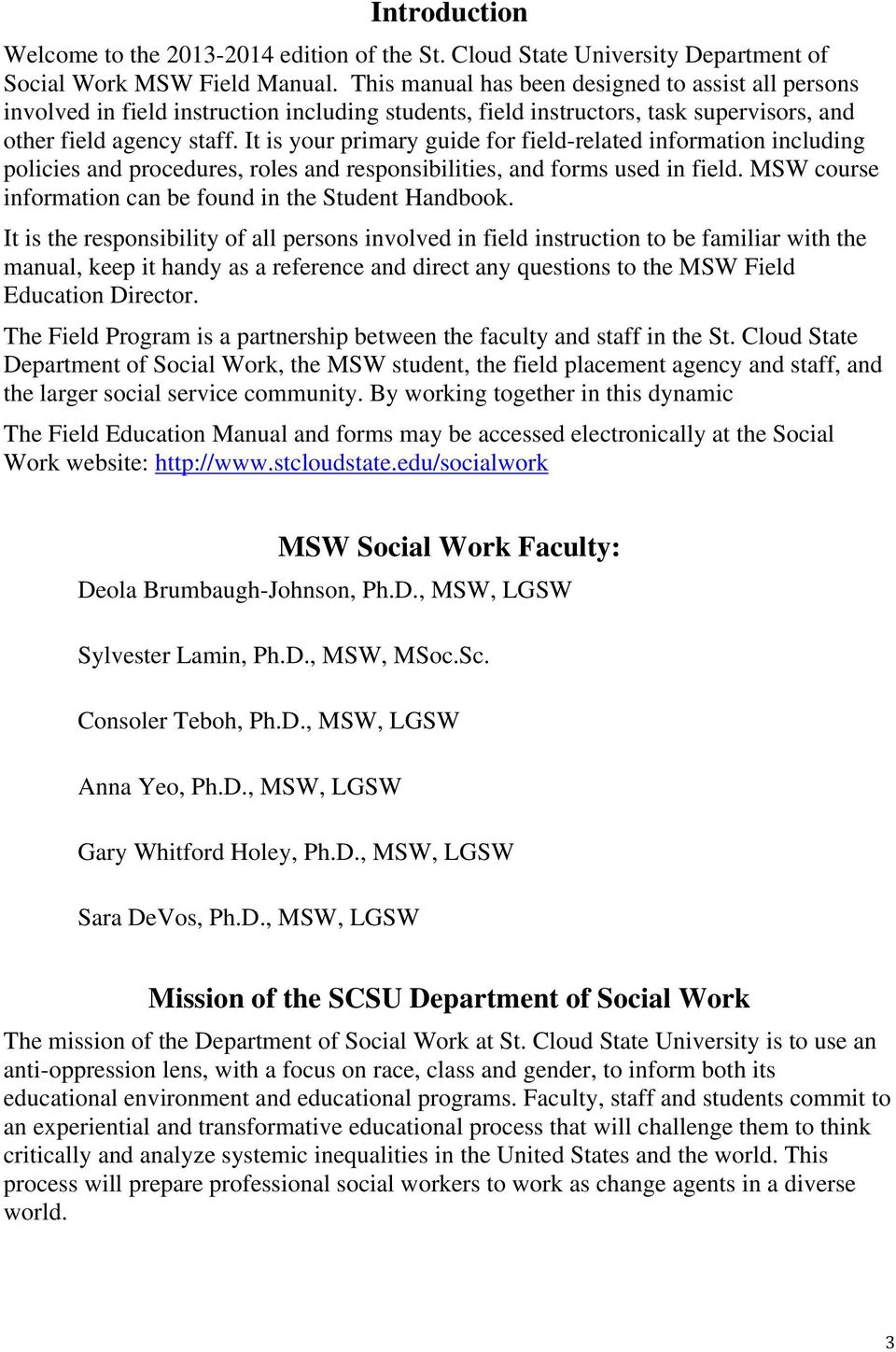
4 Mission of the MSW Program Our Mission is to prepare social work professionals at the advanced generalist level who can practice across a variety of social service settings. Students will be prepared to work effectively and collaboratively as professional social workers to enhance human wellbeing and promote economic, political, and social justice in a diverse and global society. Using anti-oppressive, justice centered, and community based practice approaches, the MSW Program will engage students in an educational Program that prepares them to think critically and evaluate practice and programs and contribute to the body of social work knowledge through active research. Administrative Structure and General Information The Department of Social Work is administratively located in the School of Health and Human Services, which is under the direction of Dean Monica Devers, PhD. The Administrative Office for the college is located in Stewart Hall 365. The Department of Social Work Administrative Office is located in 226 Stewart Hall. All faculty and staff use and voic for communication and contact information can be located on the Department s website ( Goals Goals and Practice Behaviors of the MSW Program 1. To educate advanced generalist social workers who are grounded in the liberal arts and in the values and ethics, theories and practice interventions of the social work profession. 2. To prepare highly skilled and culturally competent advanced generalist social workers who actively seek to create change, promote social justice and human wellbeing at all system levels. 3. To educate advanced generalist social workers to think critically, conduct research, and to analyze social welfare policies, practice, and research, in order to advocate for social justice at all levels. 4. Prepare advanced generalist social workers to assume leadership positions in public and private sectors to effect social change and influence public policy. 4
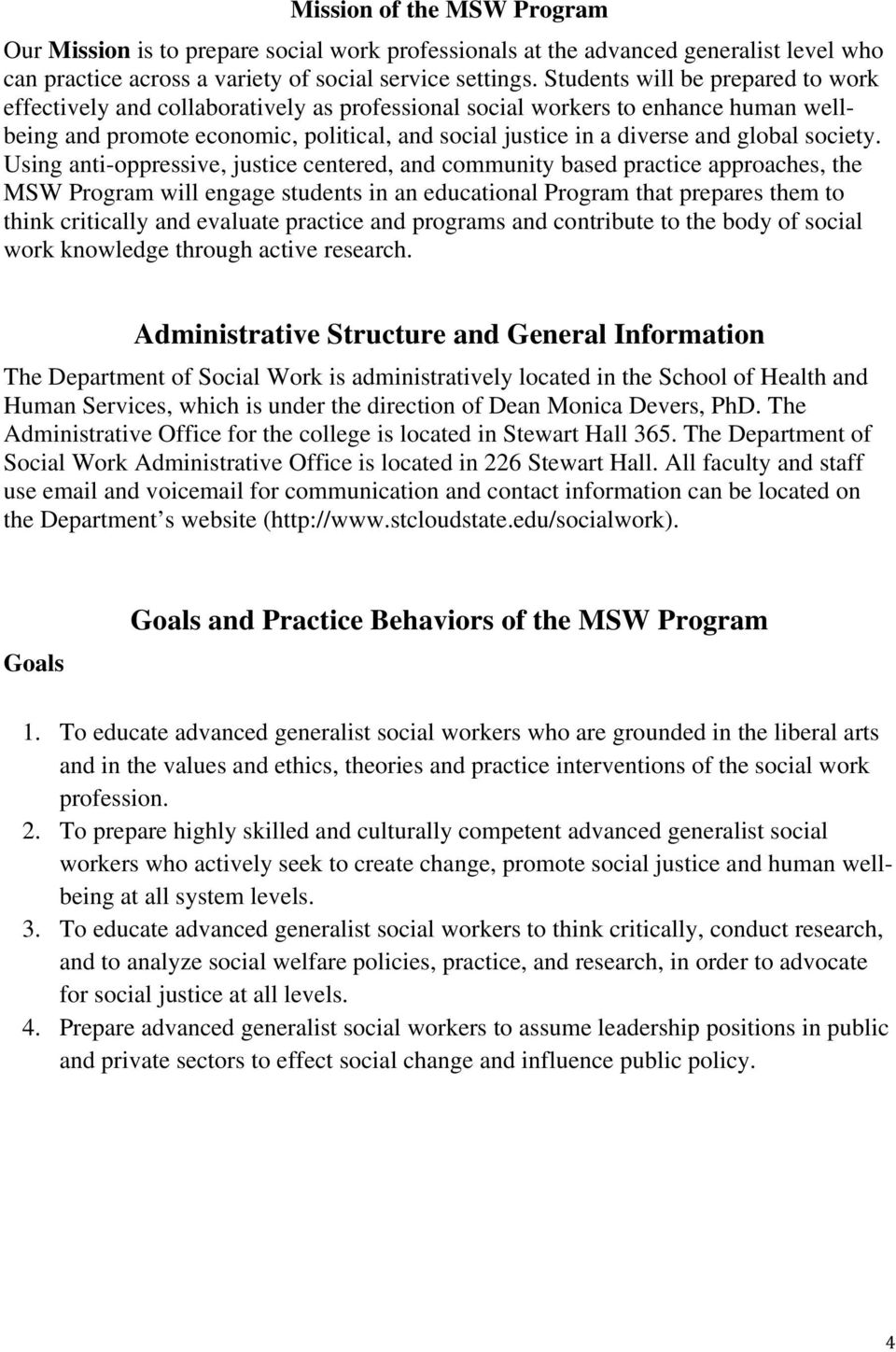
5 Master in Social Work Competencies & Practice Behaviors Educational Policy Identify as a professional social worker and conduct oneself accordingly. Foundational social work education prepares students to: 1. Advocate for client access to the services of social work; 2. Practice personal reflection and self-correction to assure continual professional development; 3. Attend to professional roles and boundaries; 4. Demonstrate professional demeanor in behavior, appearance, and communication; 5. Engage in career-long learning; 6. Use supervision and consultation. Concentration social work education prepares students to: 1. Identify and teach professional skills through a strengths perspective, areas for growth and self-assessment, while focusing on anti-oppressive relationships. 2. Demonstrate knowledge of skills for supervising workers and improving professional knowledge. Educational Policy Apply social work ethical principles to guide professional practice. Foundational social work education prepares students to: 1. Recognize and manage personal values in a way that allows professional values to guide practice; 2. Make ethical decisions by applying standards of the National Association of Social Workers Code of Ethics2 and, as applicable, of the International Federation of Social Workers/International Association of Schools of Social Work Ethics in Social Work, Statement of Principles; 3. Tolerate ambiguity in resolving ethical conflicts; 4. Analyze and apply multiple strategies of ethical reasoning to arrive at principled decisions. Concentration social work education prepares students to: 1. Employ strategies of ethical reasoning to manage ethical dilemmas involving practice issues, ethical conflicts, and personal values. 2. Apply multiple decision-making strategies (such as the NASW Code of Ethics and other ethical decision making models) in practice situations. 3. Recognize the importance of consultation in ethical decision-making. Educational Policy Apply critical thinking to inform and communicate professional judgments. Foundational social work education prepares students to: 1. Distinguish, appraise, and integrate multiple sources of knowledge, including research-based knowledge, and practice wisdom; 2. Analyze models of assessment, prevention, intervention, and evaluation; 5
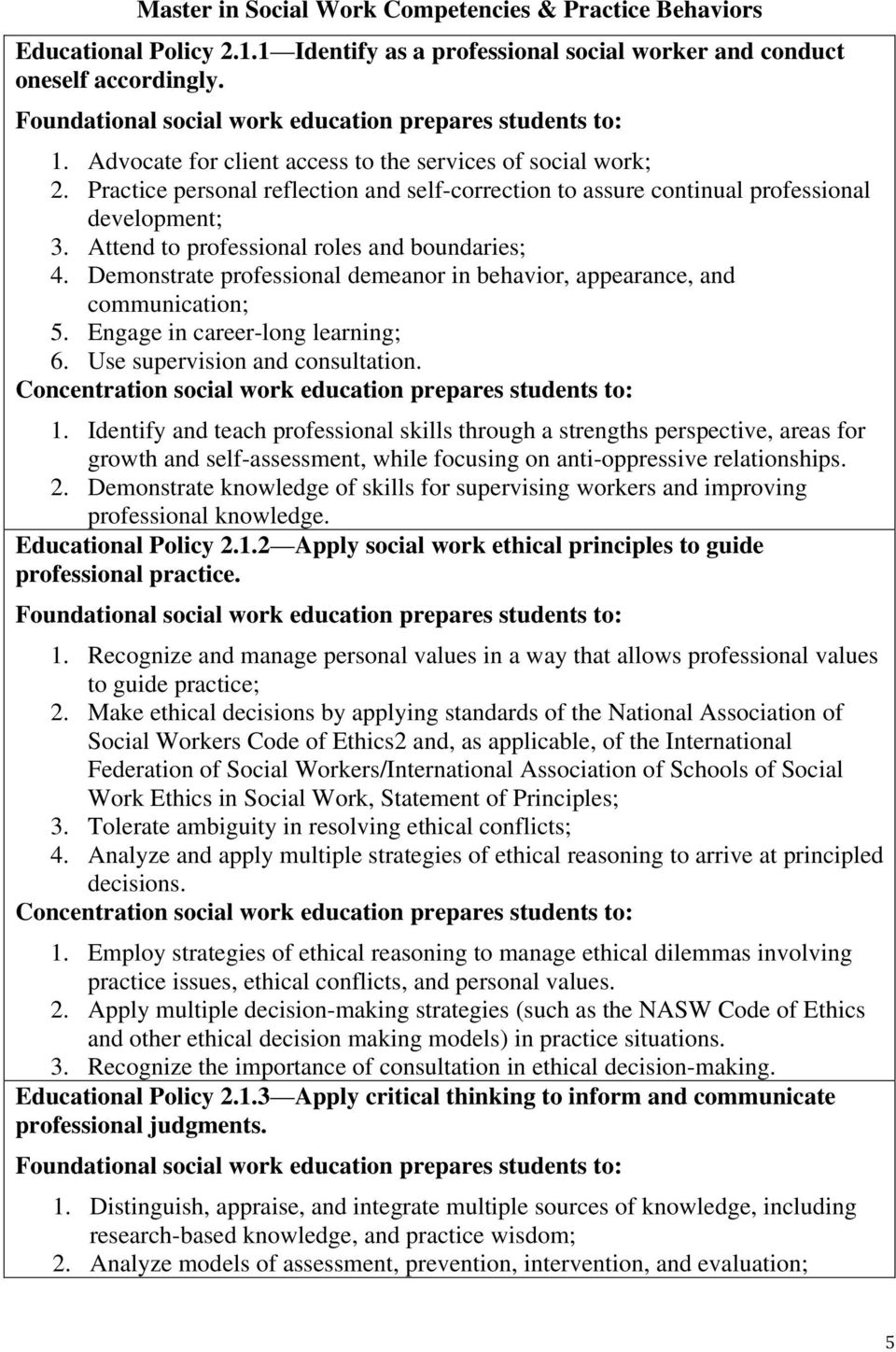
6 3. Demonstrate effective oral and written communication in working with individuals, families, groups, organizations, communities, and colleagues. Concentration social work education prepares students to: 1. Critically evaluate theory and evidence-based knowledge when applying it to various (micro, mezzo, macro) client systems situations. 2. Demonstrate flexibility by applying perspectives and interventions to suit the needs of clients. 3. Communicate professional judgments to individuals, families, groups, organizations, communities, and colleagues, in both verbal and written form. Educational Policy Engage diversity and difference in practice. Foundational social work education prepares students to: 1. Recognize the extent to which a culture s structures and values may oppress, marginalize, alienate, or create or enhance privilege and power; 2. Gain sufficient self-awareness to eliminate the influence of personal biases and values in working with diverse groups; 3. Recognize and communicate their understanding of the importance of difference in shaping life experiences; 4. View themselves as learners and engage those with whom they work as informants. Concentration social work education prepares students to: 1. Demonstrate an understanding of the interaction of a culture s structures and values, personal biases and values, and life difference in practicing through an anti-oppressive lens. 2. Demonstrate an understanding of culturally competent practices with diverse populations through an anti-oppressive lens. 3. Develop and maintain a network of cultural consultants and utilize them appropriately. 4. Advocate at multiple levels to reduce disparities for oppressed groups. Educational Policy Advance human rights and social and economic justice. Foundational social work education prepares students to: 1. Understand the forms and mechanisms of oppression and discrimination; 2. Advocate for human rights and social and economic justice; 3. Engage in practices that advance social and economic justice. Concentration social work education prepares students to: 1. Use anti-oppressive practice skills set to eliminate oppression within micro, mezzo, and macro social work settings. 2. Design practice delivery policies that promote social and economic justice and equity for individuals, families, groups, organizations, communities, and colleagues. 6
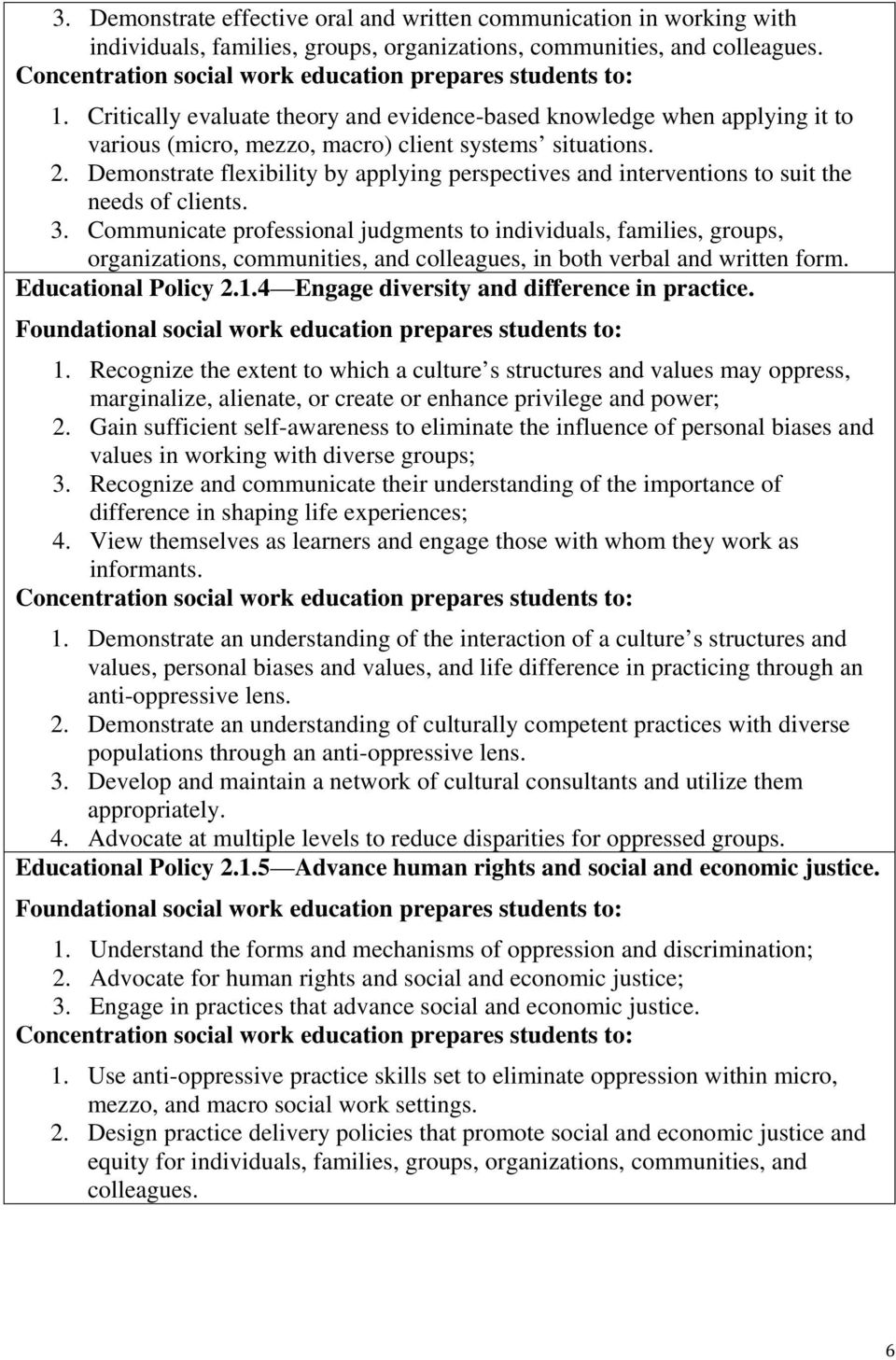
7 Educational Policy Engage in research-informed practice and practiceinformed research. Foundational social work education prepares students to: 1. Use practice experience to inform scientific inquiry; 2. Use research evidence to inform practice. Concentration social work education prepares students to: 1. Critically appraise and apply empirical evidence and practice experience to create strategies for systemic change. 2. Design, implement, and interpret evidence-based research that meets practice needs and contributes to practice dialogue. 3. Understand the importance of literature pertinent to research especially, and use qualitative and quantitative research designs to inform practice. Educational Policy Apply knowledge of human behavior and the social environment. Foundational social work education prepares students to: 1. Utilize conceptual frameworks to guide the processes of assessment, intervention, and evaluation; 2. Critique and apply knowledge to understand person and environment. Concentration social work education prepares students to: 1. Synthesize and select HBSE theories in all aspects of practice, such as assessment, intervention, and evaluation. 2. Explain how HBSE theories inform social work practice. Educational Policy Engage in policy practice to advance social and economic well-being and to deliver effective social work services. Foundational social work education prepares students to: 1. Analyze, formulate, and advocate for policies that advance social well-being; 2. Collaborate with colleagues and clients for effective policy action. Concentration social work education prepares students to: 1. Evaluate the impact of policies and regulations for their effectiveness in advancing social well-being in a local and/or global context. 2. Provide leadership that promotes social policies and program practices that advance social welfare and enhance service delivery. Educational Policy Respond to contexts that shape practice. Foundational social work education prepares students to: 1. Continuously discover, appraise, and attend to changing locales, populations, scientific and technological developments, and emerging societal trends to provide relevant services; 2. Provide leadership in promoting sustainable changes in service delivery and practice to improve the quality of social services. Concentration social work education prepares students to: 7

8 1. Assess and develop services that reflect a cognizance of overall societal and community change and context. 2. Lead collaborative community efforts to effect innovative change in social services. Educational Policy (a) (d) Engage, assess, intervene, and evaluate with individuals, families, groups, organizations, and communities. Educational Policy (a) Engagement Foundational social work education prepares students to: 1. Substantively and affectively prepare for action with individuals, families, groups, organizations, and communities; 2. Use empathy and other interpersonal skills; 3. Develop a mutually agreed-on focus of work and desired outcomes. Concentration social work education prepares students to: 1. Develop culturally responsive relationships for practice with individuals, families, groups, organizations, communities, and colleagues. 2. Integrate theory-based relational skills in all areas of client engagement. 3. Develop contracts with individuals, groups, community members and other stakeholders to be equal partners in change efforts. Educational Policy (b) Assessment Foundational social work education prepares students to: 1. Collect, organize, and interpret client data; 2. Assess client strengths and limitations; 3. Develop mutually agreed-on intervention goals and objectives; 4. Select appropriate intervention strategies. Concentration social work education prepares students to: 1. Assess and utilize multi-level, strengths-based assessment data to inform a systematic and conceptually driven intervention process. 2. Assess complex data to inform the selection of intervention strategies. Educational Policy (c) Intervention Foundational social work education prepares students to: 1. Initiate actions to achieve organizational goals; 2. Implement prevention interventions that enhance client capacities; 3. Help clients resolve problems; 4. Negotiate, mediate, and advocate for clients; 5. Facilitate transitions and endings. Concentration social work education prepares students to: 1. Critically evaluate, select, and apply partnership interventions for all system levels utilizing an anti-oppressive perspective. 2. Collaborate with multi-level systems. 8

9 3. Develop, coordinate and implement culturally appropriate mechanisms and strategies for prevention and resolution of issues. Educational Policy (d) Evaluation Foundational social work education prepares students to: 1. Critically analyze, monitor, and evaluate interventions. Concentration social work education prepares students to: 1. Analyze, monitor, evaluate, and document intervention outcomes and effectiveness to ensure sustained changes. 2. Formulate assessment and evaluation tools. 3. Utilize such tools to measure the effectiveness of intervention outcomes. A Conceptual Model of Advanced Generalist Social Work The Advanced Generalist worker possesses a broad and multi-faceted theoretical understanding of client systems with a focus on person-situation-environment. Social workers with an Advanced Generalist degree integrate the social contexts of practice including the psychological, socio-cultural and political environments that impact approaches, methods and means to enhance human well-being and to achieve social justice. Interventions may occur at the micro, mezzo or macro level. To that end, Advanced Generalist social workers develop a wide range of knowledge and skills that enable comprehensive social work practice that is especially pertinent in rural settings and to serve in leadership positions. Social workers with a Generalist background are capable of serving clients in various roles such as social broker, advocate, mediator, educator, active listener, reflector, conflict resolution expert, initiator and community organizer. Advanced Generalist social workers integrate these roles performing many simultaneously and possess the knowledge, skills, and abilities to address higher degrees of complexity experienced in client systems. Advanced Generalist social workers draw on and integrate their knowledge of multiple theories for assessment and intervention on behalf of client systems. They possess the ability to apply their knowledge and skill to effect change within organizations and communities. Critical analysis skills guide identification of the most appropriate interventions an ascertaining where the intervention ensues with client, client group, agency, community, or policy. Advanced Generalist social workers integrate the values and ethics of the social work profession. They identify a responsibility to explore social justice issues and effect change for the client systems they serve as well as greater society. Direct practice, policy practice, and research practice are synthesized to assure short and long term transformations of the environment. In their date-to-day practice, Advanced Generalist social workers apply the scientific research method to inform and evaluate the effectiveness of social work practice. 9

10 Field Education within an Advanced Generalist Field education is a vital and critical component in the training of Advanced Generalist social workers. Many students say it is the most meaningful learning experience. For example, students share that this is where they can integrate direct practice skills with clients while understanding the relationship of these individual situations with knowledge of the policy and funding issues that might influence the client s situation. Field Instructors are the vital link in helping students apply and integrate classroom learning to social work practice with client systems. Because of the Advanced Generalist focus of our program, Field Agencies will provide a variety of learning activities at micro, mezzo and macro levels including working with individuals, families, groups, organizations, and communities. Our program takes an empowerment based approach to social justice. During their Field Placement, our students are expected to develop their ability to apply theory to practice, analyze their environment, and synthesize their theoretical knowledge with information acquired in the field. Further, students are expected to develop as leaders in assessment, planning, intervention, and evaluation of effective practice grounded in social work values and ethics. They must demonstrate the ability to affect change at all levels within their communities, especially as these communities change and become more diverse. We ask the Field Instructors collaborate with us to provide learning activities to address the knowledge, values and skills incorporated in the learning objectives of our Advanced Generalist program including those that involve issues of social justice. MSW Plan of Study Foundation Year Courses designated for students entering without a Bachelor s degree in Social Work. Fall Semester Foundation Year Credits 611 Generalist Social Work Practice I Social Work with Marginalized Populations Human Behavior and the Social Environment Field Placement I (150 hours) Integrated Practice Seminar I 2 Total Semester Credits 12 Spring Foundation Year Semester 612 Generalist Social Work Practice II Social Welfare Policy Research I Field Placement II (150 Hours) 1 10
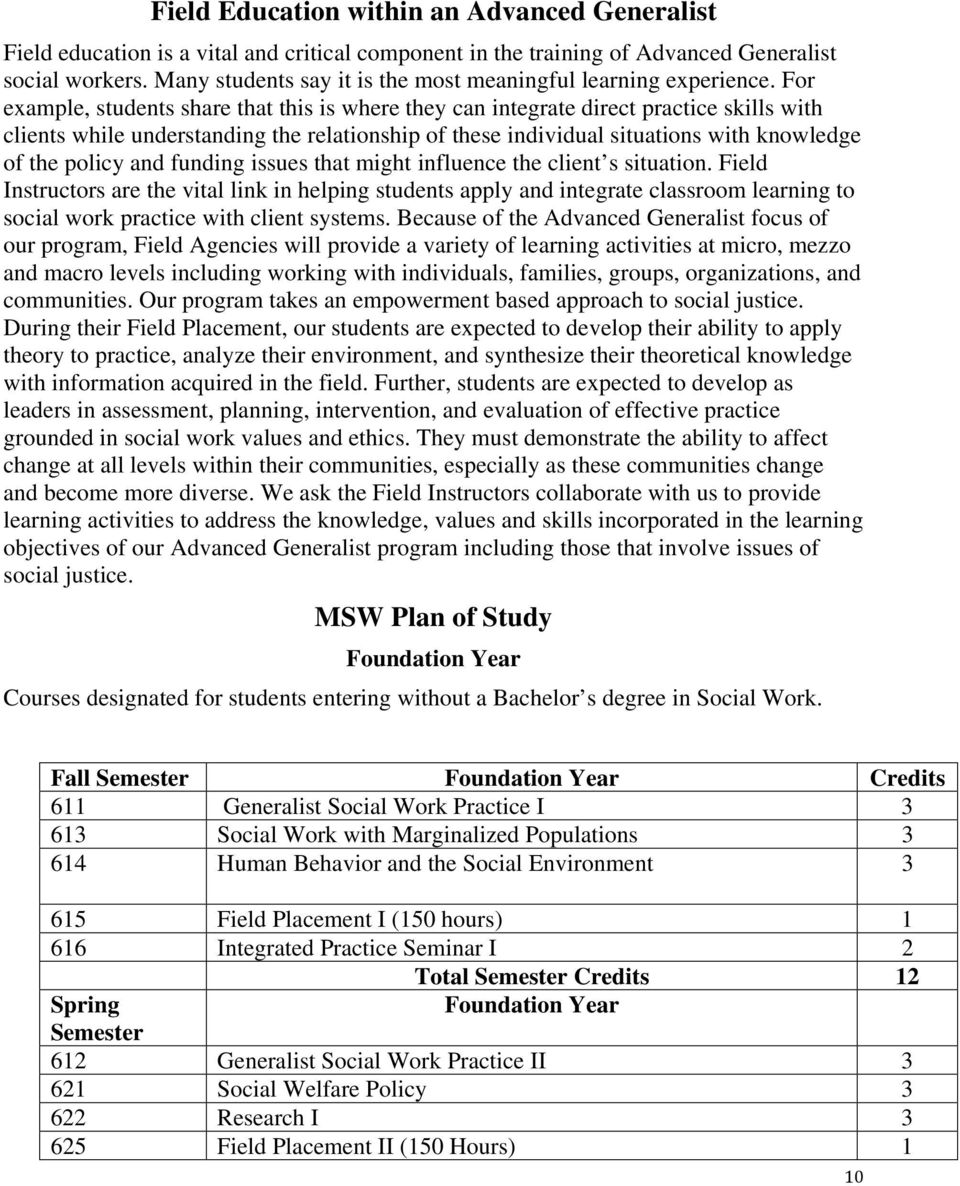
11 626 Integrated Social Work Practice Seminar 2 Total Semester Credits 12 Total Credits for Foundation Year 24 11
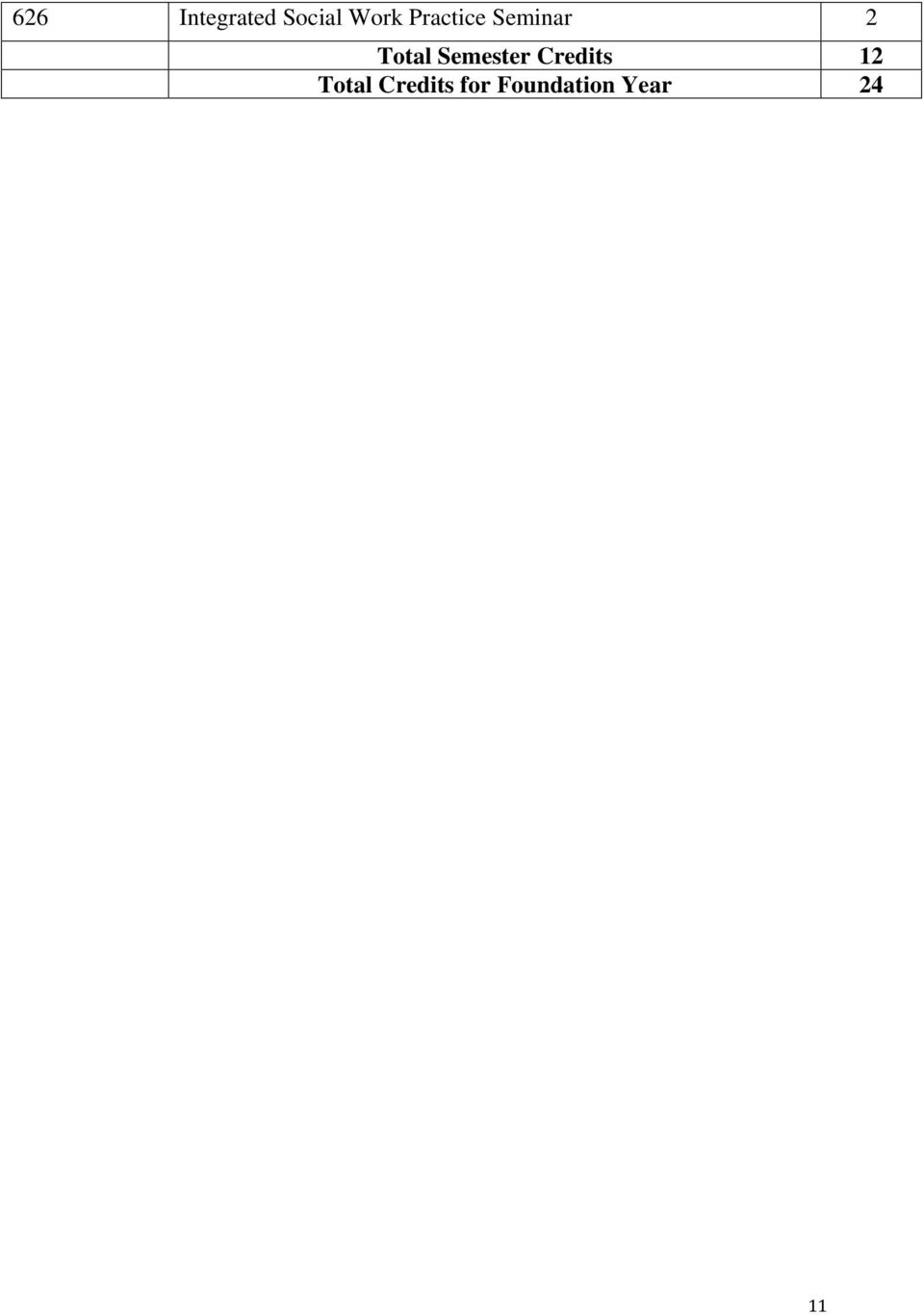
12 MSW Plan of Study Concentration/Advanced Standing Program Plan A Advanced Standing students have BSW within last seven years & are exempt from Foundation courses. Summer Session Concentration/Advanced Standing Credit s 632 Research II 3 Total Summer Session Credits 3 Fall Concentration Year Semester 630 Advanced Generalist Practice in Changing Communities Advanced Generalist Practice with Individuals and Families Field Placement III (300 hours) Integrated Practice Seminar III Advanced Policy Practice Thesis (fall) 3 Total Semester Credits 15 Spring Semester 641 Advanced Generalist Practice with Organizations Field Placement IV (300 hours) Integrative Practice Seminar IV Social Work in Mental Health Thesis (spring) 3 Total Semester Credits 12 Foundatio n and Concentra tion Advanced Standing Total Program Credits 54 Total Program Credits 30 12
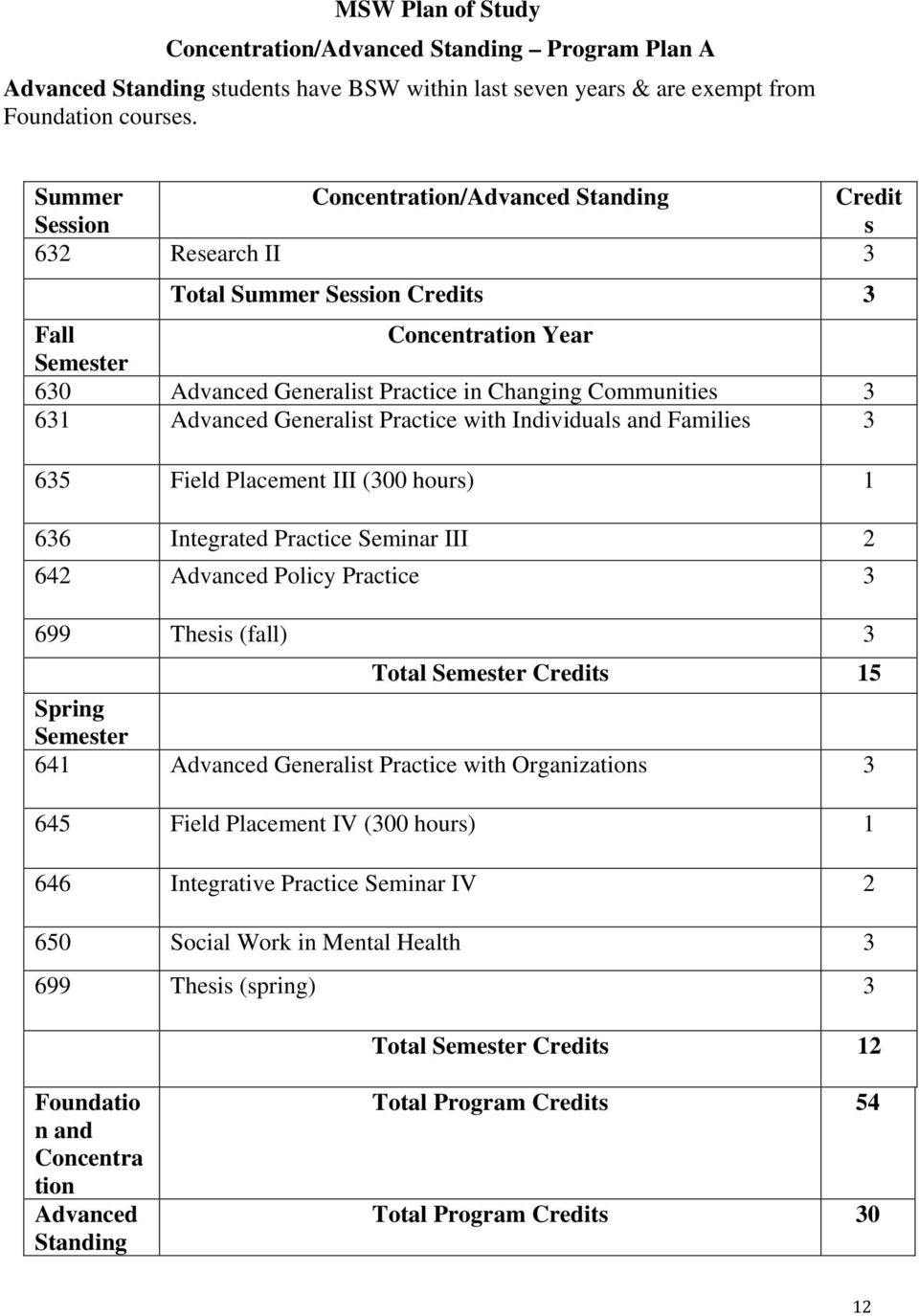
13 MSW Plan of Study Concentration/Advanced Standing Program Plan B Advanced Standing students have BSW within last seven years & are exempt from Foundation courses. Summer Session Concentration/Advanced Standing Credit s 632 Research II 3 Total Summer Session Credits 3 Fall Concentration Year Semester 630 Advanced Generalist Practice in Changing Communities Advanced Generalist Practice with Individuals and Families Field Placement III (300 hours) Integrated Practice Seminar III Advanced Policy Practice 3 Elective 3 Total Semester Credits 15 Spring Semester 641 Advanced Generalist Practice with Organizations Field Placement IV (300 hours) Integrative Practice Seminar IV Social Work in Mental Health Culminating Project 3 Elective 3 Total Semester Credits 15 Foundation and Concentrati on Advanced Standing Total Program Credits 57 Total Program Credits 33 13
14 MSW Program Part-time Option School of Health and Human Services St. Cloud State University Foundation Students (individuals who do not hold BSW within last 7 years) Year One Semester Courses Day Offered Fall SW 613 Social Work with Marginalized Wednesday Populations SW 614 HBSE Spring SW 621 Social Welfare Policy SW 622 Research Wednesday Year Two Semester Courses Day Offered Fall SW 611* Generalist Practice I Thursday SW 615* Field Placement I SW 616* Integrated Field Seminar I Spring SW 612* Generalist Practice II SW 625* Field Placement II SW 626* Integrated Field Seminar II Thursday Year Three Semester Day Offered Summer SW 632** Research II TBD Fall SW 630 Adv. Gen Practice - Changing Wednesday Communities SW 631 Adv. Gen Practice Individuals & Families Spring SW 641 Adv. Gen Practice with Organizations SW 650 Mental Health & Social Work Wednesday Year Four Option A Semester Courses Day Offered Fall Spring SW 642 Adv. Policy Practice SW 635* Field Placement III SW 636* Integrated Field Seminar III SW 699* Thesis SW 645* Field Placement IV SW 646* Integrated Field Seminar IV SW 699* Thesis Thursday TBD with Thesis Chair Thursday TBD with Thesis Chair 14

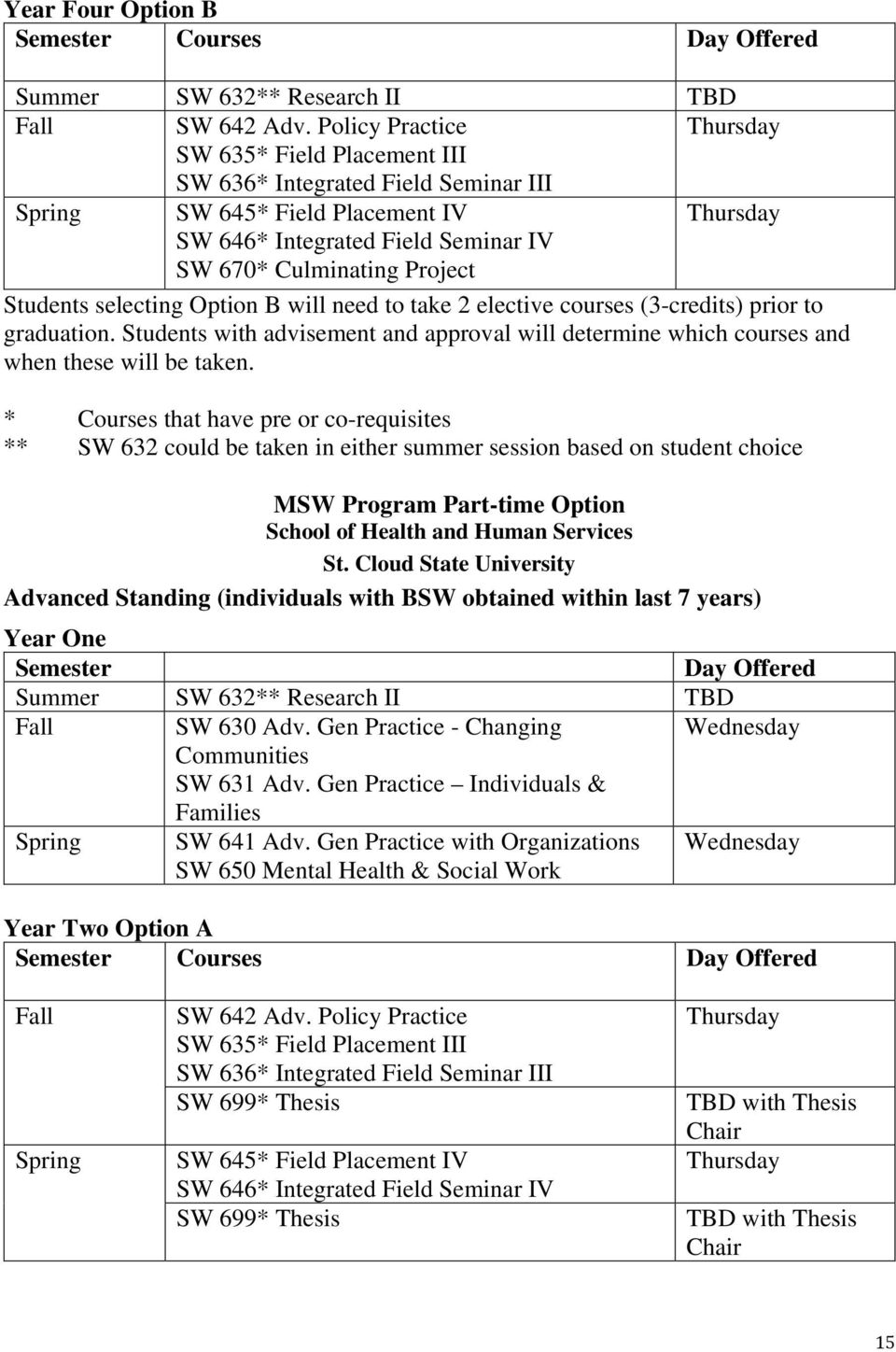
15 Year Four Option B Semester Courses Day Offered Summer SW 632** Research II TBD Fall SW 642 Adv. Policy Practice Thursday SW 635* Field Placement III SW 636* Integrated Field Seminar III Spring SW 645* Field Placement IV Thursday SW 646* Integrated Field Seminar IV SW 670* Culminating Project Students selecting Option B will need to take 2 elective courses (3-credits) prior to graduation. Students with advisement and approval will determine which courses and when these will be taken. * Courses that have pre or co-requisites ** SW 632 could be taken in either summer session based on student choice MSW Program Part-time Option School of Health and Human Services St. Cloud State University Advanced Standing (individuals with BSW obtained within last 7 years) Year One Semester Day Offered Summer SW 632** Research II TBD Fall SW 630 Adv. Gen Practice - Changing Wednesday Communities SW 631 Adv. Gen Practice Individuals & Families Spring SW 641 Adv. Gen Practice with Organizations SW 650 Mental Health & Social Work Wednesday Year Two Option A Semester Courses Day Offered Fall Spring SW 642 Adv. Policy Practice SW 635* Field Placement III SW 636* Integrated Field Seminar III SW 699* Thesis SW 645* Field Placement IV SW 646* Integrated Field Seminar IV SW 699* Thesis Thursday TBD with Thesis Chair Thursday TBD with Thesis Chair 15
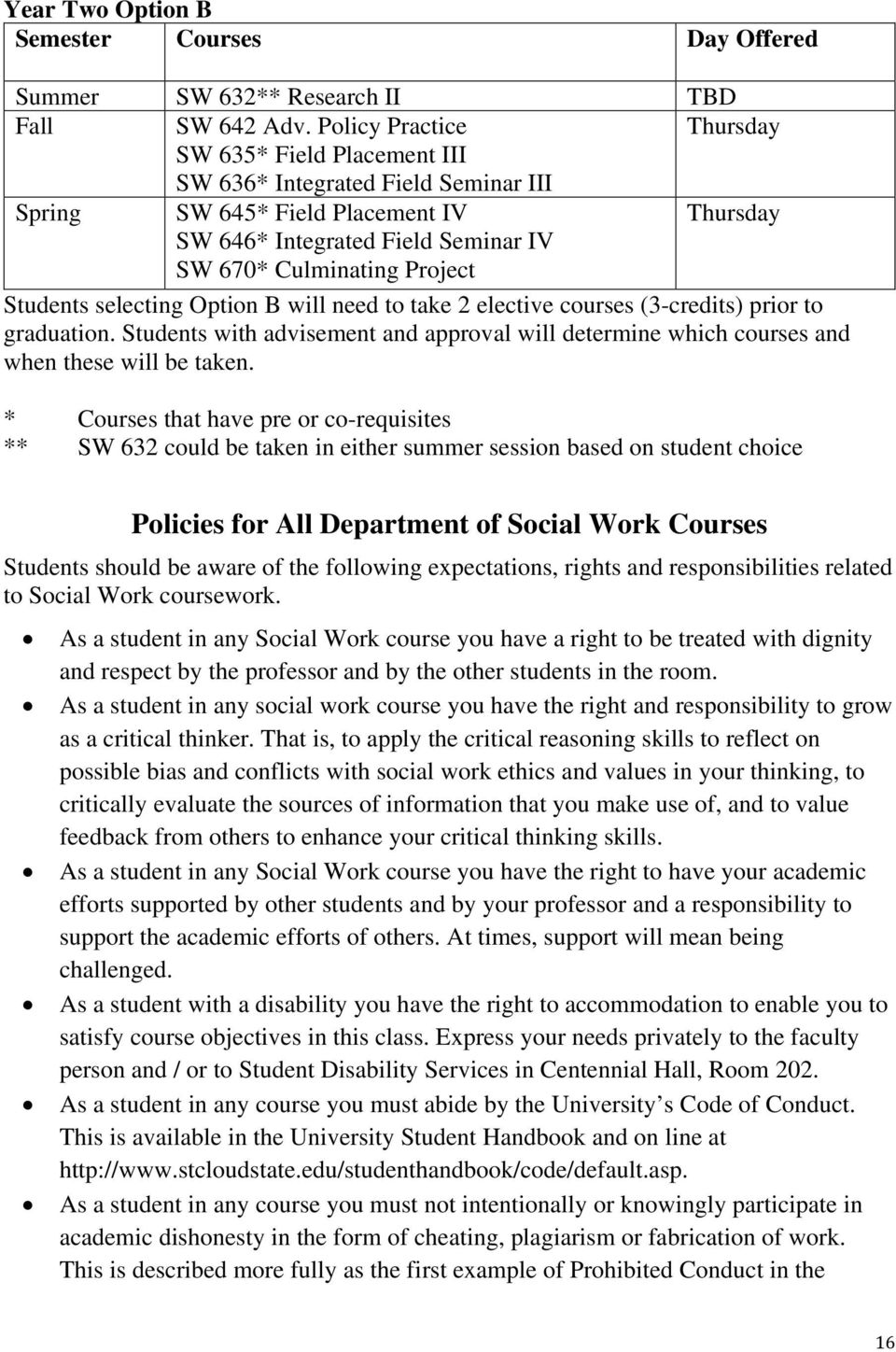
16 Year Two Option B Semester Courses Day Offered Summer SW 632** Research II TBD Fall SW 642 Adv. Policy Practice Thursday SW 635* Field Placement III SW 636* Integrated Field Seminar III Spring SW 645* Field Placement IV Thursday SW 646* Integrated Field Seminar IV SW 670* Culminating Project Students selecting Option B will need to take 2 elective courses (3-credits) prior to graduation. Students with advisement and approval will determine which courses and when these will be taken. * Courses that have pre or co-requisites ** SW 632 could be taken in either summer session based on student choice Policies for All Department of Social Work Courses Students should be aware of the following expectations, rights and responsibilities related to Social Work coursework. As a student in any Social Work course you have a right to be treated with dignity and respect by the professor and by the other students in the room. As a student in any social work course you have the right and responsibility to grow as a critical thinker. That is, to apply the critical reasoning skills to reflect on possible bias and conflicts with social work ethics and values in your thinking, to critically evaluate the sources of information that you make use of, and to value feedback from others to enhance your critical thinking skills. As a student in any Social Work course you have the right to have your academic efforts supported by other students and by your professor and a responsibility to support the academic efforts of others. At times, support will mean being challenged. As a student with a disability you have the right to accommodation to enable you to satisfy course objectives in this class. Express your needs privately to the faculty person and / or to Student Disability Services in Centennial Hall, Room 202. As a student in any course you must abide by the University s Code of Conduct. This is available in the University Student Handbook and on line at As a student in any course you must not intentionally or knowingly participate in academic dishonesty in the form of cheating, plagiarism or fabrication of work. This is described more fully as the first example of Prohibited Conduct in the 16
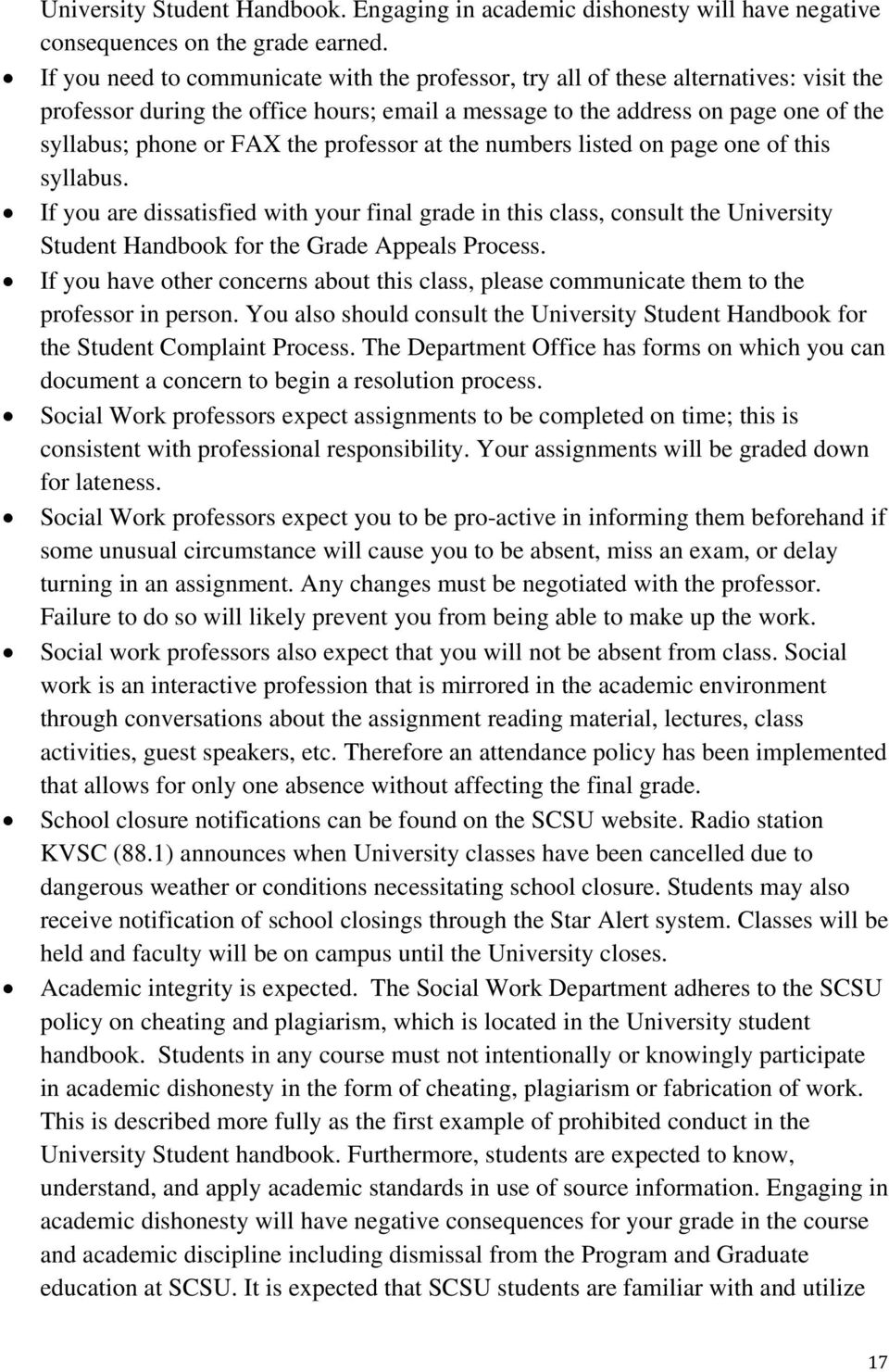
17 University Student Handbook. Engaging in academic dishonesty will have negative consequences on the grade earned. If you need to communicate with the professor, try all of these alternatives: visit the professor during the office hours; a message to the address on page one of the syllabus; phone or FAX the professor at the numbers listed on page one of this syllabus. If you are dissatisfied with your final grade in this class, consult the University Student Handbook for the Grade Appeals Process. If you have other concerns about this class, please communicate them to the professor in person. You also should consult the University Student Handbook for the Student Complaint Process. The Department Office has forms on which you can document a concern to begin a resolution process. Social Work professors expect assignments to be completed on time; this is consistent with professional responsibility. Your assignments will be graded down for lateness. Social Work professors expect you to be pro-active in informing them beforehand if some unusual circumstance will cause you to be absent, miss an exam, or delay turning in an assignment. Any changes must be negotiated with the professor. Failure to do so will likely prevent you from being able to make up the work. Social work professors also expect that you will not be absent from class. Social work is an interactive profession that is mirrored in the academic environment through conversations about the assignment reading material, lectures, class activities, guest speakers, etc. Therefore an attendance policy has been implemented that allows for only one absence without affecting the final grade. School closure notifications can be found on the SCSU website. Radio station KVSC (88.1) announces when University classes have been cancelled due to dangerous weather or conditions necessitating school closure. Students may also receive notification of school closings through the Star Alert system. Classes will be held and faculty will be on campus until the University closes. Academic integrity is expected. The Social Work Department adheres to the SCSU policy on cheating and plagiarism, which is located in the University student handbook. Students in any course must not intentionally or knowingly participate in academic dishonesty in the form of cheating, plagiarism or fabrication of work. This is described more fully as the first example of prohibited conduct in the University Student handbook. Furthermore, students are expected to know, understand, and apply academic standards in use of source information. Engaging in academic dishonesty will have negative consequences for your grade in the course and academic discipline including dismissal from the Program and Graduate education at SCSU. It is expected that SCSU students are familiar with and utilize 17
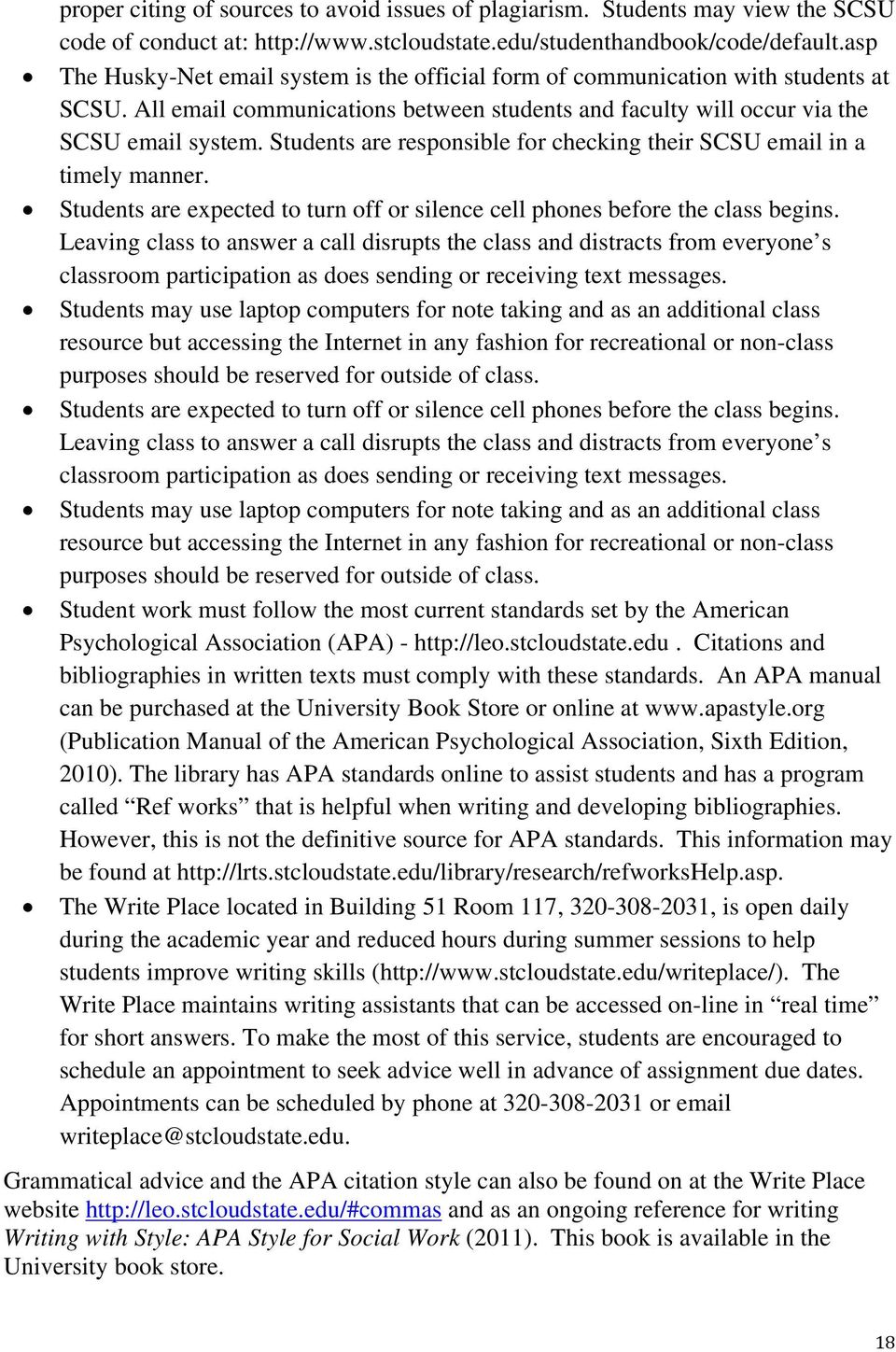
18 proper citing of sources to avoid issues of plagiarism. Students may view the SCSU code of conduct at: The Husky-Net system is the official form of communication with students at SCSU. All communications between students and faculty will occur via the SCSU system. Students are responsible for checking their SCSU in a timely manner. Students are expected to turn off or silence cell phones before the class begins. Leaving class to answer a call disrupts the class and distracts from everyone s classroom participation as does sending or receiving text messages. Students may use laptop computers for note taking and as an additional class resource but accessing the Internet in any fashion for recreational or non-class purposes should be reserved for outside of class. Students are expected to turn off or silence cell phones before the class begins. Leaving class to answer a call disrupts the class and distracts from everyone s classroom participation as does sending or receiving text messages. Students may use laptop computers for note taking and as an additional class resource but accessing the Internet in any fashion for recreational or non-class purposes should be reserved for outside of class. Student work must follow the most current standards set by the American Psychological Association (APA) - Citations and bibliographies in written texts must comply with these standards. An APA manual can be purchased at the University Book Store or online at (Publication Manual of the American Psychological Association, Sixth Edition, 2010). The library has APA standards online to assist students and has a program called Ref works that is helpful when writing and developing bibliographies. However, this is not the definitive source for APA standards. This information may be found at The Write Place located in Building 51 Room 117, , is open daily during the academic year and reduced hours during summer sessions to help students improve writing skills ( The Write Place maintains writing assistants that can be accessed on-line in real time for short answers. To make the most of this service, students are encouraged to schedule an appointment to seek advice well in advance of assignment due dates. Appointments can be scheduled by phone at or [email protected]. Grammatical advice and the APA citation style can also be found on at the Write Place website and as an ongoing reference for writing Writing with Style: APA Style for Social Work (2011). This book is available in the University book store. 18
19 Students are strongly encouraged to purchase the most current version of the APA Writing Manual. Students will utilize the APA style for citations in papers and for the thesis. Students should review all of the writing standards in the APA manual including how to submit papers, font size, page numbers, and use of gender inclusive language. 19

20 Field Placement Information Purpose of Field Experience for MSW Students Field I - SW 615 and Field II SW 625 The purpose of the foundation field placement is to provide students with practical experience in supervised direct practice activities across all client systems, including micro practice with individuals and families, group practice, and work with organizations and communities at the macro practice level. This initial field experience gives Foundation students the opportunity to apply generalist knowledge and skills learned in the classroom while developing a critical, self-reflective professional identity and applying social work values and ethics. A student in the Foundation Practicum will learn how to critically assess, implement and evaluate agency policies and practices. The Foundation Practicum requires 150 hours in both the fall and spring semesters which is approximately 10 hours per week in one field site, per CSWE standards. Academic credit is never given for life experience or prior work experience. The Practicum runs concurrently with MSW classes. Field III - SW 635 and Field IV - SW 645 The purpose of the field placement in the concentration year is to continue the practical application of practice values, ethics, knowledge and skills, and competency relevant to social justice-centered advanced generalist practice. In the concentration year field placement, students have the opportunity to select a field site that supports the students preferred area of interest and to apply the principles of integrated practice. Students will learn how to work with client systems to improve their level of functioning in the social environment. They will also learn how to evaluate and improve practice and policies that will enhance the well-being of client systems, that will create social change, and that will lead to improved social and economic justice. The Concentration Practicum requires 300 hours each semester for a total of 600 hours within one field site, which is approximately 20 hours per week, per CSWE standards. Academic credit is never given for life experience or prior work experience. The Practicum runs concurrently with MSW classes. Field Placements Sites The Department of Social Work has developed a number of field placement sites to meet the learning needs and interests of individual MSW students. These agencies and organizations have agreed to interview students for possible field placement. Field placement sites are available in St. Cloud and greater Minnesota as well as in the Twin Cities metropolitan area. The next sections outline the policies, procedures and protocols in selecting and making the most from a field placement experience, including criteria for a new field placement site. 20

21 Field Placement Policies The following section outlines the policies that inform and guide field placements. If you have a question about a policy that is not contained in this section, please contact the MSW Field Education Director. Selection of Field Placement Sites Field sites are an integral part of the MSW student s graduate education. The criteria listed below are consistent with guidelines from the Council on Social Work Education and with the mission of the St. Cloud State University Department of Social Work. The MSW Program seeks formal affiliations with public and private non-profit agencies whose policies and programs are consistent with the mission of the MSW Social Work Department. In addition, community agencies and organizations are selected based on their ability to provide learning opportunities in which students can gain practice experience through guided instruction and supervision in activities and settings that reflect the learning needs of either Foundation or Advanced Standing students. The following criteria are used to assess an organization s capacity to provide appropriate field placements: 1. Commitment to actively participate as a community partner with St. Cloud State University Department of Social Work in providing an advanced generalist learning experience in which students have opportunities to gain practice experience with individuals, families, groups, communities, other organizations, and policy making bodies. 2. The agency s mission, purpose and practices are compatible with the NASW Code of Ethics. 3. The agency adheres to a non-discrimination policy with respect to race, age, color, religion, national origin, gender, disability, sexual orientation, veteran status or disability. 4. Willingness to assign activities to students that meet the educational objectives and goals of the St. Cloud State University MSW Program and the Field Practicum course. 5. The agency, or the department within the agency in which a student is assigned, has a social work focus. 6. Provides an on-site MSW Field Instructor with a minimum of two years of post MSW experience in a social work position and has expertise in the areas of practice in which the student requires in order to develop competence. There may be exceptional situations in which an on-site MSW Field Instructor is not available, but unique learning opportunities are available within an agency. In those situations, the SCSU MSW Field Director will work with an agency to locate an off-site supervisor, preferably affiliated with the agency in some way, who can provide the necessary MSW supervision. These decisions will be made on a case-by-case basis. In situations where the MSW supervisor does not meet the two year requirement, the field liaison will supplement the supervision of the student as needed through more 21
22 frequent meetings with the student and the supervisor if an off site supervisor is not available. The department will continue to develop and expand the supervision resources available for field placements in consultation with the MSW Advisory Committee. 7. The agency allows time for the Field Instructor to provide a minimum of one hour per week individual supervision, to read and evaluate student progress, and to participate in SCSU sponsored orientation and trainings. Participation in any orientation and training activities sponsored by the MSW field program is required. 8. The field agency completes and renews the necessary paperwork and documentation required of all field agencies. 9. Willingness and time to devote to students. 10. Ability to serve in a teaching, mentoring and modeling role with students and organize learning tasks. 11. As available, provides opportunities for students to learn about and practice with persons from marginalized populations including persons of color, people with disabilities, LGBT persons, and persons living in poverty. 12. Provides the necessary structure and supports to enhance student learning such as administrative support help, a desk, phone, private space to see clients, etc. 13. Be free of any NASW sanctions and any licensing sanctions if applicable. Process for Selection of Field Agencies The potential field agency s capability to provide the necessary learning experiences and supervision is assessed and approved by the Department of Social Work field faculty and Field Advisory Committee in the following process: 1. Potential field placement agencies can be identified by community members, social work faculty, students, and members of the MSW Advisory Committee. 2. Identified agencies are sent information about the MSW Program along with criteria for selection of field placement sites. 3. Potential field placement sites complete the Field Agency Application and return this to the MSW Field Education Director. 4. The application is reviewed and a copy of the Field Instructor s resume documenting graduation from a CSWE accredited MSW Program is requested. 5. The MSW Field Education Director contacts the potential placement agency, preferably in person, or by phone to review the application material and the required CSWE standards for field sites. An important determination is the agency s ability to provide the necessary learning experiences, time, and resources to meet the educational needs of students. A determination is made concerning the appropriateness of the learning experiences. 22
23 6. If this determination is mutually acceptable to the agency and the Field faculty and Advisory, then a Field Agency Contract is completed by the agency and returned to the Field Education Director. Included in this contract is the commitment to notify the Field Education Director of any changes that could potentially impact their ability to be a field site (E.g. No longer having an on-site MSW supervisor, NASW sanctions are placed upon the agency, etc.). 7. Students can then interview and be placed in this field placement agency. An Agreement to Place Contract is completed and signed by the student, the specific MSW field instructor and the Field Education Director. 8. Field faculty assess and evaluate the match between the placement agency and the MSW Program formally once a year and have regular informal contact more frequently in a variety of ways. Criteria for Selection of MSW Field Instructors and Task Supervisors Field Instructors The MSW field instructor is the social worker who has contracted to teach and monitor learning processes and practice in the field agency and in the community. It is essential that they have sanction of the placement agency and the Department of Social Work to serve in this capacity. Additional criteria for selection of field instructors include: An interest, willingness and availability to work with students. Ability to organize learning tasks and serve in a teaching role in advanced generalist social work practice. Hold a MSW degree from a Council on Social Work Education accredited program. Have a minimum of two years post MSW social work practice experience. Have experience and expertise in the type of social work practice(s) in which they are providing supervision. If possible, have at least one year of supervision, field instruction, or task supervision experience. Support the educational objectives of the Department of Social Work s MSW Program. Have the capacity to stimulate and support students in the learning process. Be free of any NASW sanctions and social work licensing standards if applicable. Task Supervisors In some situations, a task supervisor may be assigned to work alongside a MSW field instructor to provide support and task supervision for the MSW student. This may occur when the task supervisor has expertise in a certain area related to the student s learning goals, but they may not have the degree or qualifications to provide sole field instruction. In other instances, a task supervisor may work in coordination with an off-site MSW field instructor (see policy for selection of an off-site MSW field instructor). If there is an off- 23
24 site MSW Field Instructor, the task supervisor serves as the day-to-day supervisor, mentor and teacher. The MSW Field Instructor and the Task Supervisor should meet regularly (at least once a month). The student is primarily responsible to the MSW Field Instructor for completion of their Learning Contract and it is important for the Task Supervisor and the Field Instructor to work together closely to ensure that learning objectives are being monitored and met. Criteria for selection of task supervisors include: An interest and willingness to work with the student and field instructor in developing learning activities and monitoring student progress toward these goals. Experience and expertise in areas of practice designated within the learning contract. Skill in teaching. Ability to conceptualize and apply advanced generalist social work practice skills. Completion of the required University paperwork is mandatory to provide documentation of field instructor s credentials. This paperwork is renewed annually. Code of Ethics All practicum participants are expected to adhere to the National Association of Social Workers Code of Ethics. The Code outlines the values and ethical principles that are required of all social workers and social work students. All practicum participants are expected to be familiar with the Code of Ethics and use it as a guide for ethical social work practice. Violations of the Code could result in disciplinary action, lower performance grade, and possibly removal from the Practicum and the MSW Program. Certain violations of the Code of Ethics could place the student or other practicum participants at risk for civil or criminal action. The following values and ethical principles are contained in the NASW Code of Ethics, and were approved by the 1996 NASW Delegate Assembly and revised by the 1999 Delegate Assembly. These principles set forth ideals to which all social workers should aspire. The complete NASW Code of Ethics can be found online at Value: Service Ethical Principle: Social workers' primary goal is to help people in need and to address social problems. Social workers elevate service to others above self-interest. Social workers draw on their knowledge, values, and skills to help people in need and to address social problems. Social workers are encouraged to volunteer some portion of their professional skills with no expectation of significant financial return (pro bono service). Value: Social Justice Ethical Principle: Social workers challenge social injustice. Social workers pursue social change, particularly with and on behalf of vulnerable and oppressed individuals and groups of people. Social workers' social change efforts are focused primarily on issues of poverty, unemployment, discrimination, and other forms of social injustice. These activities seek to promote sensitivity to and knowledge about 24
25 oppression and cultural and ethnic diversity. Social workers strive to ensure access to needed information, services, and resources; equality of opportunity; and meaningful participation in decision making for all people. Value: Dignity and Worth of the Person Ethical Principle: Social workers respect the inherent dignity and worth of the person. Social workers treat each person in a caring and respectful fashion, mindful of individual differences and cultural and ethnic diversity. Social workers promote clients' socially responsible self-determination. Social workers seek to enhance clients' capacity and opportunity to change and to address their own needs. Social workers are cognizant of their dual responsibility to clients and to the broader society. They seek to resolve conflicts between clients' interests and the broader society's interests in a socially responsible manner consistent with the values, ethical principles, and ethical standards of the profession. Value: Importance of Human Relationships Ethical Principle: Social workers recognize the central importance of human relationships. Social workers understand that relationships between and among people are an important vehicle for change. Social workers engage people as partners in the helping process. Social workers seek to strengthen relationships among people in a purposeful effort to promote, restore, maintain, and enhance the well-being of individuals, families, social groups, organizations, and communities. Value: Integrity Ethical Principle: Social workers behave in a trustworthy manner. Social workers are continually aware of the profession's mission, values, ethical principles, and ethical standards and practice in a manner consistent with them. Social workers act honestly and responsibly and promote ethical practices on the part of the organizations with which they are affiliated. Value: Competence Ethical Principle: Social workers practice within their areas of competence and develop and enhance their professional expertise. Social workers continually strive to increase their professional knowledge and skills and to apply them in practice. Social workers should aspire to contribute to the knowledge base of the profession. 25
26 Roles and Responsibilities of Practicum Participants The MSW Program has developed roles and responsibilities for all participants involved in field practice in order to enhance the student field experience and to provide clarity and direction to practicum participants. Field Student The student, as an adult learner, is the central person in the field placement experience and is expected to play an active role in planning and implementing her/his learning experiences in the field practicum. They are expected to actively seek out the types of learning experiences that will help them integrate their classroom learning and enable them to develop and expand their professional skills. The student is expected to mutually engage in this process with their Field Instructor. The following specific student responsibilities are important for creating optimal learning conditions in the field placement: 1. Familiarity with the MSW Field Manual. 2. Following the Department of Social Work s timelines in completion of all requirements of the field instruction process including, but not limited to, the following forms: a. Field Placement Application in the semester prior to beginning the field placement. b. Agreement to Place Contract signed by the student, the field placement agency, and the MSW Field Coordinator. c. Learning Contract is generally completed after 2 weeks for the Foundation Year and 3 weeks for the Concentration Year. d. Midterm Evaluation after 150 hours for the Foundation Year and after 300 hours for the Concentration Year. e. Evaluation after 300 hours for the Foundation Year and 600 hours for the Concentration Year. f. Hours Completed at the end of each semester. g. Student Evaluation of Placement at the completion of the field placement. 3. Actively participates in the field placement process by identifying her/his learning needs and preferences. 4. Scheduling interviews with potential placement sites and obtaining any additional information that will facilitate the selection process of a field agency. 5. Takes responsibility for arranging two in-person meetings and one conference call between the student, the agency field instructor and the faculty field liaison per placement. 6. Conducts oneself in a manner that demonstrates respect for and accountability to the field placement agency, client systems, the community, and professional and student colleagues. 7. Abides by field agency policies and procedures. 26
27 8. Adherence to the NASW Code of Ethics including following strict confidentiality and privacy laws and guidelines related to client data and information. 9. Adherence to the attendance policies for seminars and placements as established by the program. Students are required to attend and actively participate in all seminars. 10. Develops a Learning Contract, in collaboration with the agency Field Instructor, which is generally submitted to the Faculty Liaison two weeks after placement begins in the foundation year and three weeks after placement in the concentration year. Specific student tasks regarding development of the learning contract are described in the Learning Contract section. 11. Prepares for and actively participates in weekly field instruction supervision in which self-assessment and evaluation are expected. 12. Initiates and follows through with all learning activities developed in collaboration with agency Field Instructor. 13. Completes adequate recording to document the quality and effectiveness of the student s work as well as progress toward learning objectives, and shares this documentation with the Field Instructor. 14. Meets all obligations to the field placement agency, its clients, and community members and tracks and records practice hours within the field placement agency. 15. Seeks assistance from the agency Field Instructor, the Faculty Liaison and/or the MSW Field Director if any problems arise. The student is responsible for taking such action as soon as any concerns arise. 16. Completes an evaluation of the MSW Field Education Program, including the host field agency, the field instructor and/or task supervisor, the faculty liaison, and the MSW Field Director, at the end of the semester. Feedback is also welcome throughout the course of the field practicum. 17. Takes responsibility to receive and respond to at the SCSU address. Responsibilities of the Field Placement Agency, Field Instructor and Task Supervisor A successful field placement experience is directly correlated with a strong and effective working relationship between the Department of Social Work and the field agency and staff. The collaborative nature of the partnership and the key role of field instructors and task supervisors cannot be emphasized enough. The success of the partnership is dependent on the commitment of the field agency to provide a quality field experience, the skills of the field instructor and task supervisor, and the support from the Department of Social Work. This section outlines the key responsibilities of the field agency, the field instructor, and task supervisor: 27
28 Field Placement Agency By agreeing to host a MSW field student, agencies agree to the following specific responsibilities: 1. Completes the required Department of Social Work paperwork annually to document suitability of the field placement, the field instructor s credentials, and the agency s policy of non-discrimination. 2. Completes and signs the St. Cloud State University Memorandum of Agreement for Student Training Experience/Internship form. 3. Provides a qualified MSW field instructor in accordance with guidelines set forth by CSWE and the Department of Social Work. 4. Provides the necessary time for the field instructor and task supervisor, if any, to complete their responsibilities related to field instruction. 5. Provides the student with the necessary supports to complete their field placement including work space, administrative support, and reimbursement for work-related expenses such as mileage. 6. Relates to the student in their student learner role and not as a paid employee. In some settings students may receive pay for their role as interns. 7. Offers the student opportunities to meet their learning objectives while learning to work within an organizational structure. 8. Familiarizes the student with the agency s personal safety policies and protocols. It is assumed that all human service agencies have policies and procedures to ensure the personal safety of staff and clients. Field Instructors and Task Supervisors Field instructors must have a MSW degree and a minimum of two years post MSW experience. One year of supervisory experience is recommended. It is the preference of the Department of Social Work that field instructors be licensed by the Minnesota Board of Social Work, or other appropriate jurisdiction if a student is placed out of state, although licensure for field instructors is not a requirement. Task supervisors may be assigned to work alongside a MSW field instructor to provide support and task supervision for the MSW student. This may occur when the task supervisor has expertise in a certain area related to the student s learning goals, but they may not have the MSW degree or qualifications to provide sole field instruction. A task supervisor may also be assigned when an off- site MSW field instructor has been approved. The field instructor, as the primary supervisor for the student at the field agency, is responsible for the following: 1. Completes Department of Social Work paperwork documenting required credentials. 2. Participates in the interviewing and acceptance process of potential field students and complete Department of Social Work paperwork. 3. Participates in field education orientation meetings and trainings offered by the Department of Social Work. These meetings and trainings may be offered at the field 28
29 agency, at St. Cloud State University, at a community site and/or through electronic communication. 4. Orients students to agency structure and function, policies and procedures, student responsibilities and community resources. 5. Participates with the student in the development of the Learning Contract that specifies expectations for performance as well as methods for monitoring progress. 6. Provides the student with learning opportunities at either the generalist (Foundation Year) or advanced generalist (Concentration Year) level to enable the student to achieve the learning objectives developed in their Learning Contract. Learning opportunities are provided that enable a student to learn a broad range of social work interventions common to generalist-advanced generalist social work practice. 7. Provides a minimum of one hour per week of direct, educationally focused supervision that helps to integrate classroom learning with field, and addresses professional identity and social work values and ethics, and provides regular feedback to the student. 8. Monitors all assignments and provides direction, consultation and supervision to support student learning. 9. Coordinates supervision when a task supervisor is involved to maximize student learning and have clear reporting expectations. When other agency staff is involved with a student, the field instructor will coordinate the student s experience with all others involved. 10. Familiarizes her/himself with the MSW Field Manual and field placement policies, procedures, forms and due dates. 11. Meets with the student and faculty liaison in two face-to-face meetings at the beginning and at end of the field placement. One mid-placement conference call may take place in lieu of one of the face-to-face meetings. 12. Completes a formal written evaluation of the student at midterm and end of the field placement and recommends a grade (satisfactory or unsatisfactory). The final grade is given by the faculty liaison. If a task supervisor is also assigned, the field instructor has primary responsibility for evaluation of the student s performance with input from the task supervisor. 13. Promptly communicates any performance problems or concerns directly with the student and promptly communicates any serious concerns to the faculty liaison and/or Field Director. 14. Provides feedback to the faculty liaison and the Field Director regarding the structure, processes, organization, and procedures of the field program, including any recommendations for improvement. 29
30 Faculty Liaison Role and Responsibilities Every student field placement is assigned a faculty who serves as a liaison between the Department of Social Work, the student, the field instructor and other agency staff. Responsibilities of the faculty liaison include, but are not limited to, the following: 1. Teaches one or more sections of the Integrated Field Seminar Course. 2. May work with students in finding and securing field placements, including completion of required paperwork. 3. Reviews all field documents related to a specific student field placement and approves and signs off on the student learning contracts. 4. Provides orientation about the field program policies, procedures, expectations and timelines to the student, their field instructor, and task supervisor, if assigned. 5. Meets with the student, field instructor and task supervisor, if applicable, in two face-to-face meetings at the beginning and at end of the field placement. One midplacement conference call may take place in lieu of a face-to-face meetings. Participates in other meetings and conference calls as needed. 6. Assists students and their field instructor in the development of the Learning Contract. 7. Makes her/himself available to the student and their field instructor for consultation, problem-solving during office hours and through phone and contact. Assumes roles of mediator, advocate, consultant or administrator as needed. 8. Assists students in applying and integrating theory into practice. 9. Is involved in the ongoing assessment of the field placement agency, the field instructor, and the student s learning activities to ensure that the student s learning objectives and the Department of Social Work s expectations are being met. 10. Ensures completion of placement forms and agency evaluations. 11. Plans and teaches the field seminars with the overarching goals of helping to integrate graduate coursework with field and supporting development of a selfreflective professional identity for each student. 12. Assigns student grades. 13. Evaluates students, agency and field instructor, Field Director, and makes recommendations for continued use of agency and field instructor. MSW Field Education Director Roles and Responsibilities The MSW Field Education Director has primary responsibility for implementing and administering the policies and procedures governing the MSW Field Education Program. In addition, she/he is responsible for the following: 1. Provides direction in the design and development of the field education program including the development of new field placement agencies. 2. Works with students in finding and securing field placements, including completion of required paperwork. 30
31 3. Meets with and/or convenes the MSW and/or Field Advisory Committee for regular meetings and consults as needed on specific placement issues. 4. Monitors and ensures that the policies of the MSW Field Program are being met. 5. Provides ongoing communication and support to field instructors and task supervisors including organizing and implementing the field instructor orientation and training program. 6. Intervenes when requested or needed to resolve any conflicts related to the field program that may arise between and among students, field instructors, community members, and faculty field liaisons. 7. Assumes responsibility for removing a student from placement if necessary. 8. Assumes responsibility for terminating a field placement agency if necessary. 9. Collaborates with faculty and the MSW Program Director in the assessment and implementation of the field education program. MSW Advisory Committee Role and Responsibilities In order to improve the quality of the Field Education Program for students, faculty and field placement agencies, the MSW Program seeks ideas, feedback and guidance from the MSW Field Advisory Committee which, at this time, is part of the MSW Program Advisory Committee. The Committee is comprised of community agency staff, current and former field instructors, and faculty who meet two to three times throughout the school year. The responsibilities of the MSW Advisory Committee related to the field program include the following: 1. Reviews and provides input on policies and procedures related to field instruction. 2. Recommends potential field placement sites and MSW field instructors. 3. Serves as a liaison between community agencies and the Department of Social Work. 4. Serves as a consulting group related to emerging issues in the field. 5. Provides input on how to prepare students for social justice focused advanced generalist practice in diverse settings. 6. Provides input on the evaluation of the field education program. 31
32 Additional Field Placement Policies Attending Conferences as Field Time While placed in their internship, students may have opportunities to attend conferences, seminars, trainings or other types of professional development. If these activities relate to the learning objectives and support professional growth and development, the student may include the hours spent in these activities toward internship hours. The student should consult with their individual field instructor and obtain permission at the earliest possible date to attend activities held during internship hours. Automobile Insurance If an automobile is needed to perform field placement responsibilities, the student s personal automobile insurance carrier is the primary coverage in the event the student has an accident. Any additional coverage would be the responsibility of the field placement agency. Changing Field Placements Students are placed in a field agency for two semesters in the foundation year and in a separate field agency for two semesters in the concentration year, and they are expected to remain in these placements. Occasionally, a field placement does not meet the needs of the student or, the Department of Social Work, or the field placement agency. Reasons might include changes in agency personnel, instability in an agency due to loss of funding, unavailability of quality learning experiences, lack of required supervision or possible ethics violations on the part of the student or the field agency. Students are encouraged to attempt to resolve problems in their field placements when first identified with the assistance of their field instructor and the MSW Field Education Director. Many times problems can be resolved in this way. In the event that a problem in the field placement is not able to be resolved, it is possible for a student to change field agencies. *The Field Education Director is the only one who determines whether a change in a field placement may occur. Therefore, students who withdraw from their internship without prior approval from the MSW Field Education Director will fail their mandatory field internship experience which is required for graduation from the MSW Program. Criminal Background Checks Most field agencies require criminal background checks. If this is the case, it is the responsibility of the student to work with their field agency in completion of the background check. The MSW Program has no control over what kind of background check is required by the agency in which you are planning to be placed. The MSW Program does not wish to obtain a copy of this information. If a criminal background check is required, it should be kept by the agency in which you are placed. We simply want to know that you have fulfilled this requirement. It should be noted that if you do not pass the background check you may have difficulty obtaining licensure as a social worker since a background check is required before taking the social work licensure exam. Unsuccessful completion of the criminal background check could also prevent 32
33 completion of the MSW Program. Students with extenuating circumstances should discuss this with the MSW Program Director and Field Education Director. Disability Accommodations Students with documented disabilities who need reasonable accommodations in their field placement must make these requests known in advance to the MSW Field Education Director as well as Student Disability Services. The Student Disability Services office in Centennial Hall, Room 202 will make recommendations for appropriate accommodations and the field faculty will work with a student to locate a field agency that can provide these accommodations. ADA compliance is the shared responsibility of the field agency and St. Cloud State University. The SCSU link to this information is: Field Agency s Policy of Non-Discrimination In accordance with the Council of Social Work Education standards, each field agency is required to have a policy of non-discrimination that corresponds to the NASW Code of Ethics. In addition, the Department of Social Work seeks affiliations with public and nonprofit field agencies whose programs are consistent with the mission of the Department of Social Work. All field agencies are required to submit their policy of nondiscrimination along with their MSW Field Application Form. Included in the Appendix are the Department of Social Work s non-discrimination policy and the Department s LGBT position statement. Field Evaluation Evaluation of field should be a continual process that occurs throughout the field internship and includes evaluation of the student, the field placement experience and the MSW Field Program. This evaluation occurs in a variety of ways and culminates in the final evaluation at the end of the internship semester. Evaluation is an integral part of social work education and practice and the field internship evaluation lays the foundation for self-assessment and reflection that continues throughout one s professional social work career. These evaluation procedures are outlined in the sections below. Evaluation and Monitoring Student Progress Student evaluation and monitoring occurs throughout the field internship and helps to ensure that the student is progressing toward their educational goals. It also helps to ensure that all parties involved in the education of the student (student, field instructor and faculty liaison) are working collaboratively and maintaining good communication in support of the student s educational goals. Specific evaluation protocols include: The Learning Contract The learning contract is developed collaboratively between the student, their field instructor and the faculty liaison at the beginning of the field internship. The objectives for the learning contract correspond to the Foundation and Concentration Year program objectives. 33
34 Purpose of the Learning Contract The purpose of the learning contract is to provide a road map of the student s educational experiences with specific learning activities designed to meet the Foundation or Concentration Year objectives. The learning contract provides a way for the student, in collaboration with their field instructor and faculty liaison, to individualize their learning needs within a framework of required competencies designated by the Department of Social Work in accordance with the Council on Social Work Education standards. A Sample Learning Contract is available on the Department of Social Work website. Foundation Year Learning Contracts Foundation year learning contracts are individual learning plans designed in accordance with the following Foundation Year learning objectives: 1. Apply critical thinking skills within the context of professional social work practice. 2. Understand the value base of the profession and its ethical standards and principles, and practice accordingly. 3. Practice without discrimination and with respect, knowledge, and skills related to clients age, class, color, culture, disability, ethnicity, family structure, gender, marital status, national origin, race, religion, sex, and sexual orientation. 4. Understand the forms and mechanisms of oppression and discrimination and apply strategies of advocacy and social change that advance social and economic justice. 5. Understand and interpret the history of the social work profession and its contemporary structures and issues. 6. Apply the knowledge and skills of a generalist social work perspective to practice with systems of all sizes. 7. Use theoretical frameworks supported by empirical evidence to understand individual development and behavior across the life span and the interactions among individuals and between individuals and families, groups, organizations, and communities. 8. Analyze, formulate, and influence social policies. 9. Evaluate research studies, apply research findings to practice, and evaluate their own practice interventions. 10. Use communication skills differentially across client populations, colleagues, and communities. 11. Use supervision and consultation appropriate to social work practice. 12. Function within the structure of organizations and service delivery systems and seek necessary organizational change. Concentration Year Learning Contracts Concentration year learning contracts are individual learning plans designed in accordance with the following Concentration Year learning objectives: 34
35 1. Use multiple theories for advanced generalist practice with populations and systems of all sizes, especially with vulnerable individuals and families in changing communities. 2. Integrate knowledge of social work values and ethics into advanced generalist practice with vulnerable individuals and families. 3. Conceptualize and implement collaborative partnerships with relevant community, state and federal organizations. 4. Conduct multi-dimensional assessments of complex issues that involve individuals and families, with an understanding of issues of diversity, discrimination, social and economic injustice, culture, spirituality, economics, and social relationships of all types. 5. Use a range of theoretical paradigms to evaluate the effectiveness of practice interventions with vulnerable individuals and families. 6. Apply analytical frameworks to policy development to improve services and expand programs for individuals and families in communities with scarce resources. 7. Demonstrate effective leadership skills in human service organizations including application of leadership theories and ethics, cultural sensitivity, and interpersonal problem solving skills. Weekly Supervision The student meets weekly with their field instructor in a face to face meeting to evaluate student progress related to their Learning Contract as well as their adjustment to the field setting. The student is given feedback by their field instructor, as well as by other field placement staff that may be working with the student. The student is also responsible for giving feedback about supervision and their field setting. If a Task Supervisor is also working with a student, there are regular supervision meetings scheduled between the student and the Task Supervisor. When an offsite field instructor is located in a different geographic area, supervision may occur through teleconferencing with face to face meetings held for two hours every other week. Completion of Student Evaluation Form The Field Evaluation Form, which is included in the learning contract, is completed by the student and their field instructor during the midterm of the field placement (at the end of fall semester for Foundation students and at the end of fall semester for Concentration students). Completion of this form at the midterm of the internship provides an opportunity to evaluate student progress and to make adjustments in the Learning Contract activities if needed. This form serves as the springboard for discussion about student progress during the midterm meeting in which the student, their field instructor and the faculty liaison participate. Any revisions to the Learning Contract are noted and the midterm the student s Evaluation Form and learning contract is placed in the student s field file. At the end of the field internship, the student and their field instructor complete the final Field Evaluation Form and Learning Contract. This final evaluation reflects student progress on their entire internship experience with a focus on completion of the Learning 35
36 Contract activities. This final evaluation is reviewed during the last field visit at the end of the internship in spring semester. If the student is graduating, this form is placed in the student s permanent file and kept for one year. If the student is not graduating, it is placed in the student s field file and given to the field instructor for the next placement. Field Visits and Phone Conferences An on-site field internship visit involving the student, their field instructor and the faculty liaison occurs at the beginning and the end of the field placement for foundation students and also at the end of the first semester and before ending the program for concentration/advanced standing students. A conference call is done mid-way through the field placement for foundation students and at the beginning of the placement for concentration/advanced standing students. During the initial contact, the student reviews the Learning Contract that they have developed in collaboration with their field instructor. There is a discussion of the learning activities the student is doing that support fulfillment of either the foundation or concentration objectives and a discussion of strengths and areas for improvement in the evaluation portion. For concentration/advanced standing students beginning of the year conference call is scheduled by the student in which the student, their field instructor and the faculty liaison discuss student progress on the learning activities. A final on-site visit is held in which the student and their field instructor evaluate the student s final progress on their Learning Contract and a final grade is recommend. In addition to these scheduled visits, any of the parties involved in the field internship may request an on-site visit or phone conference call if needed. Grading Procedures for Field The field internship course is graded on a satisfactory/unsatisfactory basis. The field instructor confers with and recommends a grade to the faculty liaison. The responsibility for the assignment of student grades rests exclusively with the faculty liaison. Students are assessed and graded on their performance in their field placement which is measured significantly in relation to progress made on learning activities to achieve MSW Program objectives. Students are assigned a grade for field each semester in which they are registered for a field course. Student Evaluation of Field Placement Experience Student evaluation of their field placement experience is an integral part of the evaluation process of the field program. A student s perception of their field placement and their learning experiences is an important component in maintaining a high quality internship program. Students should provide feedback to their field instructor and the faculty liaison throughout the internship in field supervision meetings, in the integrated field seminar and during the scheduled on-site visits and conference calls. In addition to this, students complete the Student Evaluation of Field Placement form at the end of their internship. In this questionnaire, students have the opportunity to provide feedback about their field placement experience according to a number of criteria. This evaluation is completed by the student via Survey Monkey or similar method before the students receives a final grade. The feedback given by the student in this evaluation will not be shared with the field placement agency. However, as stated previously, students are encouraged to provide ongoing feedback to their field instructor throughout their field placement. Any 36
37 problems or concerns about their field placement should be shared with their field instructor, preferably, and also shared in the field seminar class or with their faculty liaison. Field Instructor Evaluation of Internship Experience The field instructor evaluation of their field placement experience is also an integral part of the evaluation process of the field program. This evaluation tool, Field Agency Evaluation of Field Placement, is designed to gather feedback concerning the MSW field placement experience from the perspective of the field instructor, with input from the task supervisor if applicable. The feedback will be used to assess and improve upon the MSW field program. Field instructors are also encouraged to share their feedback with their student. Field Placement Selection Procedures for Students Foundation (1 st ) Year All 1 st year Foundation students must complete 150 hour field placements in both fall and spring semesters. Students are encouraged to begin planning for their placement upon admission into the MSW Program. Selection of a field placement includes completion of the following procedures in accordance with MSW Program due dates: Students complete a Field Placement Application with an attached resume. Students then meet with a field faculty/their adviser to begin development of a placement plan based on student interests, locale preference, experience, and faculty knowledge of field placement sites. Students are given a list of agencies that have agreed to interview students for possible placement. Students are also encouraged to meet with prospective field agencies in field fairs held on the St. Cloud State University campus. Students who may wish to propose a new field site must follow the Guidelines for Setting up a New Field Placement. Students are expected to select possible field sites which are different from their past work and internship experiences unless the student can present compelling reasons to do otherwise. Students are encouraged to pursue field placements in which they are not employed. If a student wishes to consider completing a field placement in their current place of employment, they must first read the Guidelines for Field Placement in Place of Employment. A placement plan is developed by the student in collaboration with field faculty/advisor. The plan includes a recommended list of placements for each student. The student contacts 2-3 potential field placement agencies and completes an interview with the Agency Supervisor and provides this person with a copy of their resume. 37
38 If the student has more than one choice she/he is willing to consider, following these interviews, the student may complete a Choice of Placement Form listing their choices in order of preference and submit it to the MSW Field Education Director. If an agency has more than one choice the agency is willing to consider, the agency also may complete an Agency Choices for MSW Student Placement form and submit this to the MSW Field Education Director. selections and approval of placements are made by the agency supervisors and the MSW Field Education Director. Students and are notified of final placement decisions by the agency supervisor. An Agreement to Place Contract is completed by the student and the field instructor. The student is responsible for making sure that this contract is signed and returned to the Field Education Director by MSW Program due dates. Concentration Year All social work students must complete an approved field placement in the concentration year of the MSW Program. Students follow the same procedures as the foundation year placements with the exception that a different timeline is followed. Each 1 st year student begins the placement selection process for the fall semester placement in March prior to fall semester. Advanced standing students begin the field placement selection process once they are admitted into the MSW Program. Field Placement within Place of Employment* Field instruction is an integral and core component of the MSW Program educational curriculum and the Department of Social Work strives to maintain the academic integrity of all components of the MSW Program. In order to maintain this academic integrity, and in order to provide an optimal environment for student field learning, students are discouraged from pursuing a field placement within their current place of employment. The field program recognizes the difference in roles between employee and student a student is placed in a field agency to learn while an employee is in an agency to work. However, when it can be documented that the student s place of employment can provide a set of learning experiences that are different from their employment activities, that these learning activities support foundation or concentration year learning objectives for advanced generalist social work practice, and the field site meets all of the other criteria for selection of a field agency, an employment-based internship can be considered. A student completes the Application for Internship at Place of Employment form. In this application the student outlines their usual salaried duties (formal job description), the new duties proposed for their field placement activities, the name of their employment supervisor, and the name of the proposed internship field instructor. (This policy applies to salaried employment and not to stipends provided through grants or contracts obtained by the Department of Social Work or provided directly by organizations accepting students for field placements.) 38
39 In order to review the proposed plan to ensure that all criteria in this section will be met by the proposed plan. Not all employment situations will be approved for field placement and decisions will be made on a case-by-case basis by the MSW Field Education Director according to the following criteria: The employer is in agreement and provides for a different set of tasks and learning opportunities separate from the student s regular assigned duties within the agency. Preferably, a student would complete their internship in an entirely different department or unit, and possibly location, from the one in which they are employed. The proposed agency must meet all other criteria for selection as a field agency as other placement agencies. The proposed field instructor cannot be the current or previous supervisor of the student. If approved, students are allowed to complete one internship at their place of employment. The second internship must be completed in a placement agency where the student is not employed. Field education must be educationally focused to meet the learning needs of the student and not agency focused. Guidelines for Setting up a New Field Placement There may be some situations in which a student may wish to have the program approve a site not on the agency placement list serve. Students must discuss this possibility with the MSW Field Education Director before any actions are taken to develop a new field placement. The following is a list of requirements for the development of a new field placement: 1. The prospective field agency must become familiar with the policies, procedures and timelines for field placements in the MSW Field Manual. 2. The Field Education Director will speak with a representative from the prospective field agency and discuss the policies, procedures and requirements for field placement agencies. 3. Once the prospective field agency has been approved by the Field Education Director to be a new field placement for students, the new field instructor must complete and submit the Application for Developing a Field Placement New to the Department of Social Work HIPAA The Health Insurance Protection and Portability Act of 1996 requires specific kinds of training for individuals who, as employees or students, have contact with protected health information. If a field agency collects and uses data that falls under HIPAA regulation, 39
40 than it is the responsibility of the field agency to provide students with agencyappropriate HIPAA training. Liability/Malpractice Insurance All social work students, while enrolled in field internships, are covered by the St. Cloud State University professional liability insurance policy. The student may also have coverage by their field agency, depending on the site. The student should discuss liability coverage with their field instructor. Students are also encouraged to consider obtaining professional liability coverage through NASW. Off-Site MSW Field Instructor In order to help ensure guided field instruction and supervision that is aligned with social work values, ethics, skills, and knowledge, it is required that field instructors hold a MSW degree from a CSWE accredited program. In those cases when a potential field placement agency does not have a MSW on staff available to provide field instruction, but the potential placement agency is able to provide learning activities that meet all other MSW Program requirements, it may be possible for a student to receive field instruction from an off-site MSW social worker. These decisions will be made on a case-by-case basis according to the following criteria: Preferably, the off-site MSW field instructor is affiliated with the agency in some way such as serving on a board, committee or advisory group, or has a good working knowledge of the proposed placement agency. The off-site field instructor meets all of the other criteria for selection of field placement field instructors. Is available to provide a minimum of one hour of individual supervision per week or two hours every other week. The agency is in agreement and actively supports use of an off-site MSW field instructor. The potential field agency designates an on-site task supervisor who will coordinate assigned learning activities, monitor the student s progress, and work closely with the off-site MSW field instructor. A detailed plan is developed between the on-site task supervisor and the off-site MSW field instructor specifying how they will work and communicate together regarding student learning needs. Both the task supervisor and off-site field instructor participate in all scheduled field visits and conference calls with the faculty liaison. The off-site MSW field instructor assists the student in integrating field experiences to social work theory and practice. 40
41 Orientation and Training for New Field Instructors Orientation to the MSW Field Program is required for all new field instructors and identified task supervisors are also encouraged to attend. An on-campus or communitybased group field orientation and training is held at the beginning of the academic year and again mid-year. In addition, orientation may occur in face-to-face meetings with the faculty liaison, the field instructor and the student at the beginning of the field placement, as well as through an electronic field orientation with an online power point. Geographic considerations will be taken into account when planning orientations for new field instructors as well as previous field orientations with other MSW Programs in Minnesota. Topics for field trainings will include: identifying student and field instructor learning styles, field supervision, giving effective feedback and evaluation, and social work values and ethics. In the field orientation and training at the beginning of the semester, as well as in internship evaluations, field instructors will have the opportunity to provide suggestions for future training topics that would increase their effectiveness as field instructors. Personal Safety In every social service agency, there is a level of risk associated with working with clients. This could include physical danger posed by clients or by people with whom clients associate. This risk could include physical danger in the field placement setting, on home visits, or in other community settings. While a relatively rare occurrence, violence against social workers does happen, and this risk may increase when working with clients with serious mental health problems or with involuntary clients. Students are strongly encouraged to discuss their personal safety with their field instructor and to review the personal safety policies of their field placement agency. In the event that personal safety policies do not exist, students are strongly encouraged to discuss safety guidelines and protocols with their field instructor. If an agency would like assistance in developing safety protocols, the Department of Social Work can suggest resources for this purpose. Steps for Resolving Problems in Placement A student who is experiencing a problem with your field placement agency that is interfering with their ability to achieve their learning objectives should take the following steps: 1. Discuss the problem with their Field Instructor and attempt to resolve the problem. 2. If the student feels unable to discuss the problem with their Field Instructor, or there are serious and extenuating circumstances that prevent the student from discussing the problem with their Field Instructor (e.g. the student believes that they are experiencing harassment or there is a serious ethics violation on the part of the Field Instructor), the student should discuss the problem with the MSW Field Education Director. 41
42 3. If the problem has the potential to be resolved, the MSW Field Education Director will arrange a meeting with the student, the Field Instructor and the MSW Field Education Director in an effort to reach resolution. 4. If these steps fail to resolve the problem, and the student is unable to complete their learning objectives in their assigned field placement, the student will complete the form, Request to Change Field Placement. 5. Should this process result in a student changing their field placement, the student is encouraged to work with their Field Instructor to make this change with the least disruption of service possible to clients with whom the student may be working. If possible, the student should complete a termination process with their clients. Strike Situations* There may be unusual circumstances that arise in which employees within a field agency go on strike. The student is not an agency employee and would not represent her/himself as being either in support of, or against, this labor action. However, as an individual citizen, a student has the right to determine what actions they may wish to take. Should such an event occur, this situation should be discussed with the field instructor, the faculty liaison and the MSW Field Education Director. Whatever decisions are made, it will be necessary for the student to complete all field requirements and credits. * Adapted from the Field Education Manuals of the Graduate Social Work Program at the University of Wisconsin, Milwaukee and the University of Minnesota-Twin Cities. Student Grievance Procedures If a student has a complaint or grievance with their field practicum agency that cannot be resolved through discussion with the parties involved, the student is encouraged to consult with the Field Education Director. If the problem cannot be satisfactorily resolved, the student may choose to follow the official student complaint procedure by going to to resolve their complaint. Terminating a Field Placement Early A student s field practicum may be terminated for any of the following reasons: Poor academic performance. Lack of students ability to follow work-related policies. Lack of the necessary knowledge base for entry level practice. Failure of the student to meet the expectations for ethical practice. Prior to terminating a field placement, all attempts will be made to resolve the problem and provide the student with the necessary supports to continue their internship. If these attempts fail, it may be necessary for a field placement to be terminated early. A plan to resolve these problems would need to be completed before the student could begin another field placement. It is possible that this could delay a student completing the MSW Program with their cohort. 42
43 *Students who withdraw from their internship without prior approval from the MSW Field Education Director will fail their mandatory field internship which is required for graduation from the MSW Program. Time Requirements and Vacations Foundation Year students are required to complete 150 hours each for Field I and II and 300 hours each for Field III and IV. Concentration Year students are required to complete 300 hours each for Field III and IV. These are standards set by the Council on Social Work Education. These hours are to be completed within the academic semester and students are not able to begin their internships early. It is possible for students to begin their internship one week prior to the beginning of the academic semester in order to participate in orientation and training-related activities planned by their field site. If there are additional orientation and/or training activities scheduled outside of this time frame, it is necessary for the student to discuss any potential changes to this schedule and obtain permission from the MSW Field Director in order to make these changes. The student is responsible for creating a schedule, in consultation with their field instructor that will enable them to complete either the 150 or 300 field hour requirement each semester. As an example, since the semester is 15 weeks in length, the student will schedule approximately 20 hours per week each semester to fulfill this requirement for 300 hour semester internships. The field practicum is designed as a 15 week semester placement and the student is required to continue in their field placement even if they have completed 300 hours prior to the end of the 15 week semester. Thus, if a student meets the 300 hour requirement prior to the end of the semester, she/he is still required to continue their field internship until the end of the semester. The student is also responsible for observing agency working hours. Students are excused from field during university-scheduled breaks and during exams. The Department of Social Work recognizes that student absences can potentially create challenges for field agencies and client. It is the responsibility of the student to work with their field instructor and arrange for coverage of their client and agency responsibilities while on break. If the student s field responsibilities occasionally require them to work during nonregular work hours, then it is expected that the agency would allow the student to take compensatory time off within a short period of time. The student would not be allowed to accumulate this time in order to shorten the length of their field internship. The student and their field instructor should keep records documenting the completion of field placement hours each semester. At the conclusion of the field placement, the Hours Completed form is signed by the student, the field instructor and task supervisor, if applicable. 43
44 Field Forms The following forms may also be accessed at Required Forms: MSW Program Field Agency Contract Agreement to Place Contract Learning Contract Directions Field Evaluation and Learning Contract-Foundation Year Field Evaluation and Learning Contract-Concentration/Advanced Standing Year Number of Field Hours Completed Form Student Evaluation of Field Placement Field Agency Evaluation of Field Placement Additional Forms that May be Needed: Application for Developing a Field Placement New to the Department of Social Work Field Agency Application Internship at Place of Employment Application Student Choice of Placement Form Agency Choice for MSW Student Placements Form Request to Change Field Placement Form 44
45 MSW PROGRAM FIELD AGENCY CONTRACT ST. CLOUD STATE UNIVERSITY This contract serves as an agreement between the St. Cloud State University Department of Social Work and the community agency serving as a field placement site for MSW students. The contract will be in effect from the date of signature unless either party seeks dissolution of the agreement. This contract is also added as an addendum to the university s Memorandum of Agreement for Student Training Experience/Internship. The Social Work Program agrees to the following provisions: To ensure that students seeking internships have a minimum of two years post Bachelor's Degree social work or social service experience. To provide the agency with an understanding of the Department of Social Work's expectations of the student intern, agency field instructor and faculty liaison. To assist students and field instructors in developing a learning contract that will specify measurable student learning activities that correspond to the Foundation or Concentration objectives for the MSW Program. To designate a faculty liaison who will meet with the student and agency field instructor twice during the internship to review the student s learning contract and to assist in the student s evaluation. The faculty liaison will be available during the internship to discuss any questions or concerns that the student, agency, or field instructor may have regarding the internship. To provide the agency field instructor information about the MSW Program to facilitate their work in helping the student integrate theory and practice. To grade the student s internship (Satisfactory or Unsatisfactory) carefully considering the recommendations of the agency field instructor. To provide information about the MSW curriculum and the most current research about field instruction and learning to field instructors and task supervisors in a combination of seminars, electronic communication (e.g. , online discussion groups, etc.), and in-person meetings. The agency agrees to the following provisions: Complete the required Department of Social Work paperwork annually to document suitability of the field placement, the field instructor s credentials, and the agency s policy of non-discrimination. Provide a qualified MSW field instructor in accordance with guidelines set forth by CSWE and the Department of Social Work. If an on-site MSW field instructor is not available, the agency will work closely in identifying an off- 45
46 site MSW field instructor that meets the criteria outlined in the MSW Field Manual. Provide the necessary time for the field instructor and task supervisor, if any, to complete their responsibilities related to field instruction. Provide the student with the necessary supports to complete their field placement including work space, administrative support, and reimbursement for work-related expenses such as mileage. Relate to the student in their student learner role and not as a paid employee. Offer the student opportunities to meet their learning objectives while learning to work within an organizational structure. Familiarize the student with the agency s personal safety policies and protocols. It is assumed that all human service agencies have policies and procedures to ensure the personal safety of the staff and other clients. Inform the MSW Field Director if any sanctions are placed on the agency by NASW and to remove itself from consideration for placements until such sanctions are removed. Provision for Termination of Internships: A student s field practicum may be terminated for such reasons as poor academic performance, lack of a students ability to follow work-related policies, failure on the part of the student, field instructor or field agency to meet the expectations for ethical practice, or other problems that make it advisable for the student to discontinue his/her internship. Prior to terminating a field placement, all attempts will be made to resolve the problem and provide the student with the necessary supports to continue their internship. If these attempts fail, it may be necessary for a field placement to be terminated early. In the case of an internship termination, all three parties (agency, school, and student) will meet to discuss the termination. Agency Name Address Agency Representative: Name Title Date Signature SCSU MSW Field Education Director: Name Date Signature 46
47 Agreement to Place Contract St. Cloud State University Department of Social Work MSW Program This contract establishes a relationship between the agency, and the student named below, and the University, for the purposes outlined in the MSW Field Manual. By signing this contract, each party has read, and agrees to the roles and responsibilities of the student, the field agency, the field instructor and the faculty liaison, outlined in the MSW Field Manual. Name of Student: (please print) Phone: Student Address: (please print) (please print) Name of Agency: (please print) Agency Address: (please print) MSW Field Instructor: (please print) Phone: (please print) Task Supervisor (if applicable): (please print) Phone: (please print) Student Placement Level (check one): Foundation Concentration Beginning Date: Ending Date: MSW Field Instructor Date Student Date (Signature) (Signature) Task Supervisor (if applicable) Date MSW Field Education Director Date (Signature) (Signature) 47
48 Learning Contract Directions St. Cloud State University Purpose: The purpose of the learning contract is to provide a road map of the student s educational experiences with specific learning activities designed to meet the Foundation or Concentration Year objectives. The learning contract provides a way for the student, in collaboration with their field instructor and faculty liaison, to individualize their learning needs within a framework of required competencies designated by the Department of Social Work in accordance with the Council on Social Work Education standards. The forms that follow are tools designed to individualize learning plans within the framework of social work competencies designated by the Department of Social Work in accordance with the Council on Social Work Education. Completing the Learning Contract: 1. Learning Contract forms are available in the Field Manual and are also available online at our website 2. Word processing or typing of the Learning Contract is preferred. Learning Contracts completed in ink will also be accepted. 3. The Learning Contract is to be completed by the student in collaboration with their Field Instructor and Task Supervisor (if applicable). 4. Identify major learning assignments with as much specificity as possible. Each assignment should correspond to the identified learning objective and should be measurable in some way. 5. The faculty liaison can assist in the development of learning activities if needed. 6. The Learning Contract must be signed by the Field Instructor and Task Supervisor (if applicable) and the student. It is then submitted to the Faculty Liaison for signature and then given to the MSW Field Director. 7. The Learning Contract should be completed within the first two weeks (foundation students) to three weeks (concentration/advanced standing students) of the field practicum. Using the Learning Contract 1. The Learning Contract will be reviewed by the Faculty Liaison, the Field Instructor and the student during the first field visit. 2. It should be used as a guide for ensuring that learning objectives are being met and it should be referred to periodically during supervision meetings between the student and their field instructor. 3. It is used as a reference when completing the midterm and final student evaluations. 4. Additions and changes can be made to the Learning Contract throughout the semester in collaboration between the student and their field instructor. 48
49 Foundation year learning contracts Foundation year learning contracts are individual learning plans designed in accordance with the following Foundation Year learning objectives: 1. Apply critical thinking skills within the context of professional social work practice. 2. Understand the value base of the profession and its ethical standards and principles, and practice accordingly. 3. Practice without discrimination and with respect, knowledge, and skills related to clients age, class, color, culture, disability, ethnicity, family structure, gender, marital status, national origin, race, religion, sex, and sexual orientation. 4. Understand the forms and mechanisms of oppression and discrimination and apply strategies of advocacy and social change that advance social and economic justice. 5. Understand and interpret the history of the social work profession and its contemporary structures and issues. 6. Apply the knowledge and skills of a social work perspective to practice with systems of all sizes. 7. Use theoretical frameworks supported by empirical evidence to understand individual development and behavior across the life span and the interactions among individuals and between individuals and families, groups, organizations, and communities. 8. Analyze, formulate, and influence social policies. 9. Evaluate research studies, apply research findings to practice, and evaluate their own practice interventions. 10. Use communication skills differentially across client populations, colleagues, and communities. 11. Use supervision and consultation appropriate to social work practice. 12. Function within the structure of organizations and service delivery systems and seek necessary organizational change. Concentration year learning contracts Concentration year learning contracts are individual learning plans designed in accordance with the following Concentration Year learning objectives: 1. Use multiple theories for advanced generalist practice with populations and systems of all sizes, especially with vulnerable individuals and families in changing communities. 2. Integrate knowledge of social work values and ethics into advanced generalist practice with vulnerable individuals and families. 49
50 3. Conceptualize and implement collaborative partnerships with relevant community, state and federal organizations. 4. Conduct multi-dimensional assessments of complex issues that involve individuals and families, with an understanding of issues of diversity, discrimination, social and economic injustice, culture, spirituality, economics, and social relationships of all types. 5. Use a range of theoretical paradigms to evaluate the effectiveness of practice interventions with vulnerable individuals and families. 6. Apply analytical frameworks to policy development to improve services and expand programs for individuals and families in communities with scarce resources. 7. Demonstrate effective leadership skills in human service organizations including application of leadership theories and ethics, cultural sensitivity, and interpersonal problem solving skills. 50
51 Field Evaluation and Learning Contract-Foundation Year Department of Social Work St. Cloud State University Student Semester/Year Field Agency Address/City/State/Zip: Field Instructor Phone: Fax Task Supervisor (if applicable) Phone: Fax: Faculty Liaison Phone Fax Instructions: Student evaluation and feedback is an ongoing aspect of the field placement experience and happens formally through the regular supervision meetings and in many informal ways. By the end of the semester, the student is expected to demonstrate beginning mastery in the application of advanced generalist social work knowledge learned in the classroom. The student is expected to be able to apply this knowledge to practice situations, to continue forming a professional social work identity, and to demonstrate beginning mastery in a variety of social work practice and roles. This evaluation should reflect the student s performance measured against the Foundation year Competencies and learning goals. The Foundation Competencies are listed at the top of each grid section. Please evaluate student performance for each of the Competencies and related activities and assignments specified in the student s Learning Contract in the Field Instructor evaluation and comments section at the Mid-Term and review. (Note: The grid allows for expansion as you comments in the computer version of this contract.) An expandable summary section is also provided at the end of the Learning Contract for mid-term and final comments. Student performance is evaluated according to the following rating criteria. Outstanding: Student consistently demonstrates a high level of competency Very good: Student performance is above average in some areas Good/average: Student performance consistently meets expectations Unsatisfactory: Student is below the average level of expected performance on a consistent basis. No basis for judgment/opportunity (NBJ): The student has not had the opportunity to perform or field instructor has no opportunity to evaluate. 51
52 Foundation Competency 1: Identify as a professional social worker and conduct oneself accordingly. Student learning objectives/activities Observable/measureable outcomes and target dates Field instructor evaluation/comments Mid-Term Ratings M-T Outstanding Very Good Good/Average Unsatisfactory NBJ Student evaluation/comments Mid-Term Foundation Competency 2: Apply social work ethical principles to guide professional practice. Student learning objectives/activities Observable/measureable outcomes and target dates Field instructor evaluation/comments Mid-Term M-T Ratings Outstanding Very Good Good/Average Unsatisfactory NBJ Student Evaluation/comme nts Mid-Term 52
53 Foundation Competency 3: Apply critical thinking to inform and communicate professional judgments. Student learning objectives/activities Observable/measureable outcomes and target dates Field instructor evaluation/comments Mid-Term Ratings M-T Outstanding Very Good Good/Average Unsatisfactory NBJ Student evaluation/comments Mid-Term Foundation Learning Objective 4: Engage diversity and difference in practice. Student learning objectives/activities Observable/measureable outcomes and target dates Field instructor evaluation/commen ts Mid-Term Ratings M-T Outstanding Very Good Good/Average Unsatisfactory NBJ Student evaluation/com ments Mid-Term 53
54 Foundation Competency 5: Advance human rights and social and economic justice. Student learning objectives/activities Observable/measureable outcomes and target dates Field instructor evaluation/comments Mid-Term Ratings M-T Outstanding Very Good Good/Average Unsatisfactory NBJ Student evaluation/comments Mid-Term Foundation Learning Objective 6: Engage in research informed practice and practice informed research. Student learning objectives/activities Observable/measureable outcomes and target dates Field instructor evaluation/comments Mid-Term Ratings M-T Outstanding Very Good Good/Average Unsatisfactory NBJ Student evaluation/comments Mid-Term 54
55 Foundation Competency 7: Apply knowledge of human behavior and the social environment. Student learning objectives/activities Observable/measureable outcomes and target dates Field instructor evaluation/comments Mid-Term Ratings M-T Outstanding Very Good Good/Average Unsatisfactory NBJ Student evaluation/comments Mid-Term Foundation Competency 8: Engage in policy practice to advance social and economic well being and to deliver effective social work services. Student learning objectives/activities Observable/measureable outcomes and target dates Field instructor evaluation/comments Mid-Term Ratings M-T Outstanding Very Good Good/Average Unsatisfactory NBJ Student evaluation/com ments Mid-Term 55
56 Foundation Competency 9: Respond to contexts that shape practice. Student learning objectives/activities Observable/measureable outcomes and target dates Field instructor evaluation/comment s Mid-Term Ratings Outstanding Very Good Good/Average Unsatisfactory NBJ Student evaluation/com ments Mid-Term Foundation Competency 10: Engage, assess, intervene, and evaluate with individuals, families, groups, organizations, and communities. Student learning objectives/activities Observable/measureable outcomes and target dates Field instructor evaluation/comments Mid-Term Ratings M-T Outstanding Very Good Good/Average Unsatisfactory NBJ Student evaluation/comments Mid-Term 56
57 Mid-Term Field Supervisor(s) summary of student strengths and areas for growth. MSW Field Instructor Date Student Intern Date Task Supervisor (if applicable) Date Faculty Liaison Date Field Supervisor(s) summary of student strengths and areas for growth. Recommended grade: Satisfactory Unsatisfactory MSW Field Instructor Date Student Intern Date Task Supervisor (if applicable) Date Faculty Liaison Date MSW Field Education Director Date 57
58 Field Evaluation and Learning Contract Concentration/Advance Standing Year Department of Social Work Student Semester/Year Field Agency Address/City/State/Zip: Field Instructor Phone: Fax Task Supervisor (if applicable) Phone: Fax: Faculty Liaison Phone Fax Instructions: Student evaluation and feedback is an ongoing aspect of the field placement experience and happens formally through the regular supervision meetings and in many informal ways. The midyear evaluation is an opportunity for formal written evaluation to take place. This evaluation is completed at the end of the first semester of the placement. By the end of the semester, the student is expected to demonstrate beginning mastery in the application of concentration year advanced generalist social work knowledge learned in the classroom. The student is expected to be able to apply this knowledge to practice situations, to continue forming a professional social work identity, and to demonstrate beginning mastery of a variety of social work practice knowledge, skills and roles. This evaluation should reflect the student s performance measured against the Concentration year Competencies and learning goals. The Concentration Competencies are listed at the top of each grid section. Please evaluate student performance for each of the Competencies and related activities and assignments specified in the student s Learning Contract in the Field Instructor evaluation and comments section at the Mid-Term and review. (Note: The grid allows for expansion as you comments in the computer version of this contract.) An expandable summary section is also provided at the end of the Learning Contract for mid-year and final comments. Student performance is evaluated according to the following rating criteria. Outstanding: Student consistently demonstrates a high level of competency Very good: Student performance is above average in some areas Good/average: Student performance consistently meets expectations Unsatisfactory: Student is below the average level of expected performance on a consistent basis. No basis for judgment/opportunity (NBJ): The student has not had the opportunity to perform or field instructor has no opportunity to evaluate. 58
59 Concentration Competency 1: Identify as a professional social worker and conduct oneself accordingly. Student learning objectives/activities Observable/measureable outcomes and target dates Field instructor evaluation/comments Mid-Term Ratings M-T Outstanding Very Good Good/Average Unsatisfactory NBJ Student evaluation/comments Mid-Term Concentration Competency 2: Apply social work ethical principles to guide professional practice. Student learning objectives/activities Observable/measureable outcomes and target dates Field instructor evaluation/comments Mid-Term Ratings M-T Outstanding Very Good Good/Average Unsatisfactory NBJ Student evaluation/comments Mid-Term 59
60 Concentration Competency 3: Apply critical thinking to inform and communicate professional judgments. Student learning objectives/activities Observable/measureable outcomes and target dates Field instructor evaluation/comments Mid-Term Ratings M-T Outstanding Very Good Good/Average Unsatisfactor NBJ Student evaluation/comments Mid-Term Concentration Competency 4: Engage diversity and difference in practice. Student learning objectives/activities Observable/measureable outcomes and target dates Field instructor evaluation/commen ts Mid-Term Ratings M-T Outstanding Very Good Good/Average Unsatisfactory NBJ Student evaluation/com ments Mid-Term 60
61 Concentration Competency 5: Advance human rights and social and economic justice. Student learning objectives/activities Observable/measureable outcomes and target dates Field instructor evaluation/comments Mid-Term M-T Ratings Outstanding Very Good Good/Average Unsatisfactory NBJ Student evaluation/comments Mid-Term Concentration Competency 6: Engage in research informed practice and practice informed research. Student learning objectives/activities Observable/measureable outcomes and target dates Field instructor evaluation/comments Mid-Term Ratings M-T Outstanding Very Good Good/Average Unsatisfactory NBJ Student evaluation/comments Mid-Term 61
62 Concentration Competency 7: Apply knowledge of human behavior and the social environment. Student learning objectives/activities Observable/measureable outcomes and target dates Field instructor evaluation/comments Mid-Term Ratings M-T Outstanding Very Good Good/Average Unsatisfactory NBJ Student evaluation/comments Mid-Term Concentration Competency 8: Engage in policy practice to advance social and economic well being and to deliver effective social work services. Student learning objectives/activities Observable/measureable outcomes and target dates Field instructor evaluation/comments Mid-Term Ratings M-T Outstanding Very Good Good/Average Unsatisfactory NBJ Student evaluation/comments Mid-Term 62
63 Concentration Competency 9: Respond to contexts that shape practice. Student learning objectives/activities Observable/measureable outcomes and target dates Field instructor evaluation/comments Mid-Term Ratings M-T Outstanding Very Good Good/Average Unsatisfactory NBJ Student evaluation/comments Mid-Term Concentration Competency 10: Engage, assess, intervene, and evaluate with individuals, families, groups, organizations, and communities. Student learning objectives/activities Observable/measureable outcomes and target dates Field instructor evaluation/comments Mid-Term Ratings M-T Outstanding Very Good Good/Average Unsatisfactory NBJ Student evaluation/comments Mid-Term 63
64 Mid-Term Field Supervisor(s) summary of student strengths and areas for growth. MSW Field Instructor Date Student Intern Date Task Supervisor (if applicable) Date Faculty Liaison Date Field Supervisor(s) summary of student strengths and areas for growth. Recommended grade: Satisfactory Unsatisfactory MSW Field Instructor Date Student Intern Date Task Supervisor (if applicable) Date Faculty Liaison Date MSW Field Education Director Date 64
65 Number of Field Hours Completed Form MSW Program St. Cloud State University At the end of your field placement, please list the number of hours you have completed, have your field instructor sign this form and then return it to your faculty liaison by the end of the last semester of the field internship. This form must be completed before grades can be given. Thank you. Name: Internship site: Field Instructor: Task Supervisor (if applicable): Faculty Liaison: Number of hours completed: August September October November December January February March April May Total: Student Signature: Field Instructor Signature: Task Supervisor Signature (if applicable): Date: 65
66 Student Evaluation of Field Placement St. Cloud State University MSW Program Student's Name: Date: Foundation Year: Concentration Year: Advanced Standing: Field Agency: Field Instructor: Task Supervisor (if applicable): SCSU Faculty Liaison: Agency has previously had MSW students in placement? Yes No Don t know Field Instructor has previously supervised MSW students? Yes No Don t know Task Supervisor has previously supervised MSW students? Yes No Don t know Did your agency provide you with opportunities to work with: (check all that apply?) Individuals families groups organizations community systems Diverse populations (Specify all that apply) Other disciplines (Specify all that apply) 66
67 Other organizations (Specify all that apply) Instructions: This feedback form is designed to gather feedback concerning your field placement that will be used to assess and improve upon the MSW field program. Please complete and submit to your faculty liaison. Students are also strongly encouraged to submit this feedback form to your field instructor and task supervisor, but this is not required. Use additional sheets of paper for comments if needed. Read each of the following statements, and give a rating that best fits with your experience. 5 is high and 0 is low. Please evaluate your field agency (or field unit if in a large agency) in terms of the following: Agency Learning Environment: 1. Quality of your orientation to your field placement? 2. Quality of your interaction with and acceptance from other staff throughout your internship? 3. Adequate resources available to you for practice (e.g. office space, phone, supplies, etc.) 4. Access to agency technology. 5. Access to agency records. 6. Opportunities for additional training at or through your agency 7. Safe learning environment Other comments regarding agency learning environment: Field Instruction: Please rate field instruction on the following items. If a task supervisor was also assigned, please respond to items in the following section regarding task supervision. 8. Supervision meetings with field instructor were held on a regular basis 67
68 How often did you meet with your field instructor? hours/week structured hours/week unstructured 9. Field instructor was easily accessible 10. Field instructor was clear and consistent about expectations for this internship 11. Field instructor encouraged questions, independence and critical thinking 12. Field instructor facilitated learning of specific practice skills and techniques 13. Field instructor used learning contract as a learning tool 14. Field instructor provided adequate feedback about performance and progress toward learning goals 15. Field instructor encouraged identification with and practice of professional values 16. Field instructor discussed and helped to integrate theoretical models into practice during my internship. What specific techniques did your field instructor use to assess your learning and performance (e.g. process recordings, written case notes or other documentation, taped interviews, etc.)? Briefly describe: If a task supervisor was assigned, please complete the following items. If you did not have a task supervisor, please skip the items in this section and move to item # Meetings with task supervisor were held on a regular basis How often did you meet with your task instructor? hours/week structured hours/week unstructured 18. My task supervisor was easily accessible. 68
69 19. My task supervisor provided clear work direction and expectations. 20. There was adequate communication between my field instructor, task supervisor and myself Other comments re: task supervision: Learning Opportunities and Responsibilities 21. Field agency encouraged an advanced generalist social work practice model 22. Field agency provided opportunities for advanced generalist practice 23. Clients, groups and/or projects relevant to my learning goals were available to me 24. Learning activities were appropriate to my learning level 25. Opportunities were provided to work with diverse populations 26. I was able to apply and integrate theoretical material with my field assignments Other comments re: learning opportunities and responsibilities 27. Overall, how satisfied were you with your field placement experience: 28. I would recommend this placement to other students: Any other comments: 69
70 Thank you! 70
71 Field Agency Evaluation of Field Placement St. Cloud State University MSW Program Student's Name: Semester/Year: Foundation Year: Concentration Year: Advanced Standing: Field Agency: Field Instructor: Task Supervisor (if applicable): SCSU Faculty Liaison: Agency has previously had MSW students in placement? Yes No Field Instructor has previously supervised MSW students? Yes No Task Supervisor has previously supervised MSW students? Yes No Students were provided opportunities to work with: (check all that apply) individuals families groups organizations community systems diverse populations (Specify all that apply) other disciplines (Specify all that apply) other organizations (Specify all that apply) Instructions: 71
72 This evaluation tool is designed to gather feedback concerning the MSW field placement experience in your agency. Your feedback will be used to assess and improve upon the MSW field program. Your feedback will be reviewed by field faculty within the Department of Social Work and will be confidential. You are encouraged to share your feedback with your student and they are also encouraged to share their feedback with you. Please complete and submit this form to the MSW Field Education Director. Read each of the following statements, and circle rating that best fits with your experience. 5 is high and 0 is low. Please evaluate your field agency (or field unit if in a large agency) in terms of the following: Agency Learning Environment: 1. Quality of the student s orientation to their field placement? 2. Quality of the student s interaction with and acceptance from staff other than the field instructor throughout their internship? 3. Adequate agency resources available to student for practice (e.g. office space, phone, supplies, etc.) 4. Student s access to agency technology. 5. Student s access to agency records. 6. Opportunities for additional training for student at or through your agency 7. Safe learning environment provided for student Other comments regarding agency learning environment: Field Instruction: Please rate field instruction on the following items. If a task supervisor was also assigned, please respond to items in the following section regarding task supervision. 8. Supervision meetings with student were held on a regular basis How often did you meet with your student for supervision? hours/week structured hours/week unstructured 72
73 9. I (field instructor) was easily accessible to the student 10. Clear and consistent expectations for this internship were communicated to student 11. Student was encouraged to ask questions, work independently and think critically 12. Field agency facilitated learning of specific practice skills and techniques for student 13. The learning contract was used as a learning tool 14. Student was given adequate feedback about their performance and progress toward learning goals 15. Student was encouraged to identify with and practice professional values 16. Theoretical models were discussed and student was helped to integrate these models into practice. What specific techniques were used to assess the student s learning and performance (e.g. process recordings, written case notes or other documentation, taped interviews, etc.)? Briefly describe: If a task supervisor was assigned, please complete the following items. If there was not a task supervisor, please skip the items in this section and move to item # Meetings with task supervisor were held on a regular basis: How often did task supervisor meet with field student? hours/week structured hours/week unstructured 18. Task supervisor was easily accessible. 19. Task supervisor provided clear work direction and expectations. 73
74 20. There was adequate communication between the field instructor, task supervisor and the field student 21. There was a clear understanding of roles between field instructor and task supervisor Other comments re: task supervision: Learning Opportunities and Responsibilities 22. Field agency supported an advanced generalist social work practice model 23. Field agency provided opportunities for advanced generalist practice 24. Clients, groups and/or projects relevant to the student s learning goals were available to them 25. Learning activities appropriate to the student s learning level were made available 26. Opportunities were provided to work with diverse populations Other comments re: learning opportunities and responsibilities SCSU field faculty liaison: Please provide responses and ratings regarding the field faculty liaison for the following areas: How many times did the SCSU field liaison meet with you and your student: Phone In person Was this number of visits adequate Yes No (if no, please explain) 27. Faculty liaison provided adequate orientation to the MSW Field Program What specific ways did the field faculty provide this orientation: In person meetings In person orientation with student present Handouts and other written materials about field (e.g. agency orientation checklist, sample learning contracts, social work theoretical models and frameworks, etc.) Phone consultation Electronic transmission of training materials such as through Through the Department of Social Work website Others (please describe) 74
75 28. Faculty liaison adequately interpreted the Advanced Generalist curriculum 29. Faculty liaison demonstrated sufficient familiarity with agency policies and procedures to assist with field instruction planning 30. Faculty liaison assisted in the completion of the learning contract. 31. Faculty liaison assisted in problem identification within the internship (if applicable) 32. Faculty liaison assisted in problem solving and resolution (if applicable) 33. Faculty liaison maintained focus on the educational objectives for field learning 34. Faculty liaison demonstrated ethical social work values in all interactions 35. Faculty liaison encouraged and fostered collegial relationships 36. Faculty liaison provided ongoing constructive feedback and resources to strengthen your skills as a field instructor or task supervisor 37. Faculty liaison was open to receiving constructive feedback from you about the field program Other comments re: faculty liaison: 38. Overall, how satisfied were you with this field placement experience: 39. I would recommend placement of other MSW field students in this agency: 40. I am interested in serving as a field instructor in the future: 75
76 Please feel free to offer suggestions on ways that the MSW field program could be improved upon: Thank you for taking the time to complete this survey! ADDITIONAL FORMS THAT MAY BE NEEDED Application for Developing a Field Placement New to the Department of Social Work St. Cloud State University Date: Student applicant information Name: Address: Home Phone: Work Phone: Cell: SCSU Potential Field Agency Information Name of agency/organization: Address: 76
77 Name of potential field instructor: Phone: Does the field instructor hold a MSW degree with at least 2 years post MSW experience? 0 Yes 0 No Can the field instructor provide at least 1 hour of supervision per week? 0 Yes 0 No Describe the potential internship experience/activities: Please read and sign: The Field Education Director will contact the agency and ask them to complete the Field Agency Application and submit the necessary documentation. The Field Education Director needs to ensure that the field agency meets CSWE and the SCSU Department of Social Work requirements to serve as a field agency. The Department of Social Work must approve the field agency before you can make plans to begin the placement. This process can take up to two months to complete. Once an agency has been approved, you may schedule an interview with the agency and follow the same procedures as outlined for all students in the MSW Field Manual. Signature of student applicant: Date: 77
78 For office use only Date agency contacted: Agency approved: 0 Yes 0 No Date of approval: 78
79 Date: Field Agency Application/Update MSW Program St. Cloud State University Name of agency/organization: Address: Fax: Website: Primary contact person: Phone: Name(s) of staff providing MSW field instruction: Phone: Name(s) of staff providing task supervision (if there is an offsite MSW field instructor): Phone: Has the MSW field instructor: Supervised MSW students before: Yes No If yes, how many? Supervised MSW students from SCSU: Yes No If yes, how many? Attended field instructor trainings at SCSU Yes No Please attach a current resume and photocopy of MSW degree If your agency is not able to provide a minimum of one hour per week of individual face to face supervision by a MSW field instructor, is there an offsite MSW affiliated with your organization who is available to provide field instruction? Yes No This person could be in an agency-affiliated program, a board member, an agency consultant, etc. Please attach a current resume and photocopy of MSW degree. 79
80 Is your agency/organization able to consider placement of: Foundation (1 st year) students for a 2 semester 300 hour internship Yes No Concentration (2 nd year) or Advanced Standing students for a 2 semester 600 hr internship Yes No How many students is your agency able to place each academic year (Sept May) Part 1: Agency/organization description: Agency/Organization mission statement and purpose: Type of agency/organization (e.g. private non-profit, school, county agency, etc.): Typical hours of operation (please note if supervised learning activities are available during evenings and weekends): What social work practice methods are used in your agency (e.g. mental health assessment and treatment, advocacy, casework, community organizing, policy analysis, case management, etc.): Client population(s) served (e.g. adults with disabilities, children with mental health problems, etc.): 80
81 Please include a copy of your agency/organization non-discrimination policy. Student and Field Placement Description: Please describe the advanced generalist learning experiences, tasks and responsibilities available to MSW field students: Which agency clients will the student be involved with? What resources will be available to the student (E.g. administrative/support staff, office, desk, phone, , etc.)? List any special conditions or qualifications a student must meet to be accepted for a field placement (E.g. language fluency, background check, automobile): 81
82 If a student must use their own automobile: Is mileage reimbursed? Yes No Is the student covered by the agency s insurance policy? Yes No Will there be opportunities for students to work with persons from diverse and marginalized groups (E.g. people of color, GLBT, persons living in poverty, with disabilities, etc.)? Submitted by: (Signature and title) Date Please return a copy of this form electronically or a paper version to: MSW Field Education Director St. Cloud State University Department of Social Work 226 Stewart Hall 720 Fourth Avenue South St. Cloud, MN Thank You! 82
83 Internship at Place of Employment Application St. Cloud State University Department of Social Work MSW Program Please review the Field Placement within Place of Employment section of the MSW Field Manual before completing this form. The criteria outlined in that section must be met before a placement within employment will be considered. This form should be completed by the student in consultation with, and with the agreement of, their current supervisor for employment as well as the proposed internship field instructor. Please describe your current employment including the following information: Student Name: Agency: Agency address: Phone: Job Title: Job hours: Your current job title: Will there be a reduction of your job hours during your internship? Yes No Please provide as much detail as possible regarding change or lack of change in job schedule, including coverage of your current responsibilities and current clients: Name of current supervisor: Supervisor s Phone number: Supervisor s Description and details of your current job responsibilities: Name of location of current work site: Name and location of proposed internship field site: Name of proposed internship field instructor: Phone: Will your internship be paid? Yes No Will your salary continue? Yes No 83
84 Please describe the duties you expect to perform during your internship and explain how these will be different from your current job responsibilities: Please explain why completing an internship at your current place of employment is important or necessary to you: Please explain how interning at your current place of employment will support (or not) your MSW Program goals and objectives: What new and significant learning do you expect to gain as a result of this field placement? Please be as specific as possible: Signatures (By signing this form, I attest that I have been involved in the development of an internship plan within this student s current place of employment, and that I have read and am in agreement with the Field Placement Within Place of Employment section of the MSW Field Manual): Student Date Current Supervisor Date Proposed Field Instructor Date Agency/Dept. Director Date This application has been approved not approved by the Department of Social Work, St. Cloud State University. Faculty Advisor Date Faculty Field Liaison Date MSW Field Education Director Date 84
85 Student Choice of Placement MSW Program St. Cloud State University Name of Student: Phone: Student Address: Student Placement Level (check one): Foundation Concentration My previous placement was with (if applicable): Have you ever worked or completed another type of internship at any of these agencies? No If yes, please give agency name and dates of employment/internship. Yes Please list below your agency choices in order of preference. Only list those agencies in which you have interviewed. Do not list an agency in which you are not willing to be placed. First Choice Agency Name of Agency: Agency Address: MSW Field Instructor: Phone: Second Choice Agency Name of Agency: Agency Address: MSW Field Instructor: Phone: Third Choice Agency Name of Agency: Agency Address: MSW Field Instructor: Phone: Additional notes, if needed: Please complete and return to the MSW Field Director 85
86 Agency Choices for MSW Student Placements MSW Program St. Cloud State University Name of Agency: Agency Address: MSW Field Instructor(s): Phone: Number of MSW students you are able to accept for Spring 200_ (1 st year Foundation students) Fall & Spring Semester 200 Foundation Students Concentration Students MSW Students acceptable for placement in this agency (Please list students in order of preference) Students who would not work out in this agency. (Please indicate reason) Please return a copy of this form to: MSW Field Education Director, Department of Social Work 720 Fourth Avenue South, SH 226 St. Cloud, MN Fax:
87 Request to Change Field Placement MSW Program St. Cloud State University Name of Student: Phone: Student Address: Name of Agency: Agency Address: MSW Field Instructor: Phone: Task Supervisor (if applicable): Phone: Student Placement Level (check one): Foundation Reasons for requesting a change in field placement: Concentration MSW Field Instructor Date Student Date (Signature) (Signature) Task Supervisor Date MSW Field Education Director Date (if applicable) (Signature) (Signature) 87
Western Kentucky University Master of Social Work Program Information
 Western Kentucky University Master of Social Work Program Information Dear Prospective Student, I am so pleased that you are considering pursuing the Master of Social Work degree at Western Kentucky University!
Elizabethtown College Social Work Department 470 Student Evaluation Fall Semester
 Elizabethtown College Social Work Department 470 Student Evaluation Fall Semester Name of Student: Agency: Field Instructor: Year Semester This form is divided into categories which reflect the competencies,
Program Assessment Summary Table 16: Masters in Social Work (MSW)
 Program Assessment Summary Table 16: Masters in Social Work (MSW) Term 2005-2007 Learning Outcomes Assessment Outcome/Goal Assessed Annual review of all outcomes both foundational year and concentration
Bloomsburg University Midterm and Final Competency Field Evaluation. Task Supervisor (if appropriate) :
 Bloomsburg University and Competency Field Evaluation BSW EVALUATION OF THE COMPETENCIES AND PRACTICE BEHAVIORS Student : Field Instructor : Task Supervisor (if appropriate) : _ Agency : University Faculty
Student Learning Outcomes
 Student Learning Outcomes The Student Learning Outcomes below are for the following programs: Bachelor of Social Work (BSW)/ Certificate in Case Management/Certificate in Family Life Education Bachelor
Department of Social Work Florida Gulf Coast University. Generalist Practice Field Placement Learning Plan. Task Supervisor (if applicable):
 Department of Social Work Florida Gulf Coast University Generalist Practice Field Placement Learning Plan Student: Student Email: Agency: Agency Phone: Field Instructor: Faculty Liaison: Task Supervisor
Students will achieve a rating of 3 or above on Field Evaluations by Field Instructors
 2012/2013 UNIT / DEPARTMENT / MAJOR: Social Work STATEMENT OF MISSION: The social work program mission is to prepare competent entry-level professional generalist social workers committed to promoting
Advanced Placement Test (APT) and Generalist Practice Test (GPT)
 SOCIAL WORK PROGRAM BSW ASSESSMENT 2013-14 Social Work Program Assessment Plan The Social Work Program is accredited by the Council on Social Work Education (CSWE) and adheres to its accreditation standards
University of Cincinnati School of Social Work Master of Social Work Program
 University of Cincinnati School of Social Work Master of Social Work Program Assessment of Student Learning Outcomes Academic Year 2014-15 July 31, 2015 1 Results for Assessment of Student Learning Outcomes
Social Work Field Education Core Competencies and Practice Behaviors
 Social Work Field Education Core Competencies and Practice Behaviors The School of Social Work Field Education Program addresses each of the Council on Social Work Education (CSWE) Core Competencies and
Social Work Program BSW Assessment 2013-15
 Social Work Program BSW Assessment 2013-15 Social Work Program Assessment Plan The Social Work Program is accredited by the Council on Social Work Education (CSWE) and adheres to its accreditation standards
FIELD EDUCATION MANUAL
 Graduate Social Work FIELD EDUCATION MANUAL The University of Toledo College of Health and Human Services Department of Criminal Justice and Social Work Health and Human Services Bldg. MS # 119 Toledo,
School of Social Work
 MSW Core Curriculum for Generalist Practice St. Catherine University/University of St. Thomas Core and Advanced Competencies of the MSW Program The SCU/UST MSW curriculum prepares its graduates for advanced
ASSESSMENT OF STUDENT LEARNING OUTCOMES EASTERN WASHINGTON UNIVERSITY MASTERS OF SOCIAL WORK PROGRAM ACADEMIC YEAR 2013-2014
 ASSESSMENT OF STUDENT LEARNING OUTCOMES EASTERN WASHINGTON UNIVERSITY MASTERS OF SOCIAL WORK PROGRAM ACADEMIC YEAR 2013-2014 This form is used to assist the Commission On Accreditation (COA) in the evaluation
MASTER SYLLABUS FIELD WORK FOR SOCIAL WORKERS I FOUNDATION YEAR SOCIAL WORK 7998 SW 7998 (.5 credit hours)
 Professor First Last Name Office Hours Office #, Building Email address Phone number MASTER SYLLABUS FIELD WORK FOR SOCIAL WORKERS I FOUNDATION YEAR SOCIAL WORK 7998 SW 7998 (.5 credit hours) COURSE DESCRIPTION
Council on Social Work Education Educational Policies and Standards (EPAS) Competencies, Practice Behaviors and Advanced Practice Behaviors
 Council on Social Work Education Educational Policies and Standards (EPAS) Competencies, Practice Behaviors and Advanced Practice Behaviors 2.1.1 Core Competency: Identify with social work profession a.
FOUNDATION YEAR Student Evaluation
 FOUNDATION YEAR Student Evaluation I. Cover Sheet Student Name Home Phone Work Phone Cell Phone Email (Please Check) Full-time Part-time Field Instructor Work Phone Email Agency Cell Phone Site Address
Metropolitan State University of Denver Master of Social Work Program Field Evaluation
 Metropolitan State University of Denver Master of Social Work Program Evaluation Date: Agency/Program Task Supervisor Faculty Liaison Total Hours Completed To Date for this semester: s will not receive
SAMPLE BSW Learning Agreement
 Boise State University Social Work Program SAMPLE BSW Learning Agreement Student: Semester: Faculty Field Liaison: Agency: Agency Field Instructor: Agency Task Supervisor: (if applicable) Year: NOTE: This
Commission on Teacher Credentialing (CTC) and Council on Social Work Education Educational Policy Standards and Accreditation Standards (CSWE-EPAS)
 (CTC) and Educational Policy Standards and Accreditation Standards (CSWE-) Standards Crosswalk June 2013 An institution that is offering a nationally accredited Pupil Personnel Services: School Social
Field Education in the 2008 EPAS: Implications for the Field Director s Role Dean Pierce
 Field Education in the 2008 EPAS: Implications for the Field Director s Role Dean Pierce 2008 EPAS Curriculum Features The 2008 EPAS consists of four curriculum features: 1) program mission and goals;
Part I Program SLO Assessment Report for Academic Year 2013-2014
 Degree/Certificate: Master of Social Work (MSW) Submitted by: Blake Beecher Date: 1-2-2015 Part I Program SLO Assessment Report for Academic Year 2013-2014 The EWU Masters of Social Work program is accredited
I. Prerequisites: AHS 300 or concurrent registration; SOWK 330; SOWK 341; SOWK 342; SOWK 410 or concurrent registration.
 School of Social Work Fort Collins, Colorado 80523-1586 (970) 491-6612 FAX: (970) 491-7280 Competencies: 2.1.1 Identify as a professional social worker and conduct oneself accordingly. 2.1.2 Apply social
Student Learning Contract [SAMPLE] 1. University of Wisconsin Oshkosh: Social Work Department
![Student Learning Contract [SAMPLE] 1. University of Wisconsin Oshkosh: Social Work Department](/thumbs/39/19865194.jpg "Student Learning Contract [SAMPLE] 1. University of Wisconsin Oshkosh: Social Work Department") Student Learning Contract [SAMPLE] 1 University of Wisconsin Oshkosh: Social Work Department STUDENT LEARNING CONTRACT Applied Generalist Practice I and II Semester Academic Year Student Name: SAMPLE Address:
Student Learning Contract [SAMPLE] 1 University of Wisconsin Oshkosh: Social Work Department STUDENT LEARNING CONTRACT Applied Generalist Practice I and II Semester Academic Year Student Name: SAMPLE Address:
New York University Silver School of Social Work Field Learning and Community Partnerships
 New York University Silver School of Social Work Field Learning and ommunity Partnerships Field Learning Evaluation: Professional Foundation (First Year) MID-YEAR EVALUATION FINAL EVALUATION Student Name:
Unit Plan for Assessing and Improving Student Learning in Degree Programs. Unit: Social Work Date: May 15, 2008 Unit Head Approval:
 Unit Plan for Assessing and Improving Student Learning in Degree Programs Unit: Social Work Date: May 15, 2008 Unit Head Approval: Section 1: Past Assessment Results MSW Program The School of Social Work
Practice Behaviors Educational Outcomes Method of Assessment Competencies 2.1.3 Analytical Reasoning
 Writing for : 205 Core Behaviors Educational Outcomes Method of Assessment Competencies 2.1.3 Analytical Reasoning Demonstrate ability to assess analytically and for clarity in communication work products
Metropolitan State University of Denver Master of Social Work Program Field Evaluation
 Metropolitan State University of Denver Master of Social Work Program Evaluation Date: Agency/Program Task Supervisor Faculty Liaison Total Hours Completed To Date for this semester: s will not receive
2013 Program Assessment Report
 SOCIAL WORK PROGRAM (Accredited by the Council on Social Work Education (CSWE)) 2013 Program Assessment Report Charles L. Vanderwell, MSW, LMSW, ACSW Professor Program Director 231 Valade Hall (517) 264-3962
Angelo State University Department of Psychology, Sociology, and Social Work SWK 4373: Social Work Practice III
 Page 1 of 10 Angelo State University Department of Psychology, Sociology, and Social Work SWK 4373: Social Work Practice III Course Dates, Time, and Location Spring Semester, 2016: January 19, 2016 to
SAMPLE 1 ST YEAR LEARNING ACTIVITIES California State University, Los Angeles (CSULA)
 SAMPLE 1 ST YEAR LEARNING ACTIVITIES California State University, Los Angeles (CSULA) This document contains sample learning activities, designed to provide ideas for students as they complete their own
FERRIS STATE UNIVERSITY SOCIAL WORK PROGRAM SOCIAL WORK MISSION, GOALS AND PRACTICE COMPETENCIES. Bachelor of Social Work.
 FERRIS STATE UNIVERSITY SOCIAL WORK PROGRAM SOCIAL WORK MISSION, GOALS AND PRACTICE COMPETENCIES Bachelor of Social Work Program Mission The mission of the Ferris State University Social Work Program is
Annual Goals for Social Work
 Annual Goals for Social Work 2010-2011 Description: Re-affirmation of Accreditation by the Council on Social Work Education i. Faculty will complete the self-study process in preparation for Reaffirmation
Competencies & Practice Behaviors 1 University of Michigan School of Social Work
 The Council on Social Work Education (CSWE) has established core competencies for social work education that span the classroom and field in the 2008 Educational Policy and Accreditation Standards (EPAS).
UNION UNIVERSITY MASTER SOCIAL WORK PROGRAM ASSESSMENT OF STUDENT LEARNING OUTCOMES LAST COMPLETED ON SPRING 2014 Form AS4 (M)
 UNION UNIVERSITY MASTER SOCIAL WORK PROGRAM ASSESSMENT OF STUDENT LEARNING OUTCOMES LAST COMPLETED ON SPRING 2014 Form AS4 (M) Accreditation Standard 4.0.2 The program provides summary data and outcomes
Angelo State University Department of Psychology, Sociology, and Social Work SWK 4371-020: Social Work Field Education I
 Page 1 of 22 Angelo State University Department of Psychology, Sociology, and Social Work SWK 4371-020: Social Work Field Education I Course Dates, Time, and Location Fall Semester, 2015: August 24, 2015
Social Work Program Outcomes
 1 Social Work Program Outcomes 2009 2010 2 The 2008 Educational Policy and Accreditation Standards (EPAS) identified by the Council on Social Work Education (CSWE) include a provision for assessment of
Angelo State University Department of Psychology, Sociology, and Social Work SWK 4317: Social Work and Case Management
 Page 1 of 9 Angelo State University Department of Psychology, Sociology, and Social Work SWK 4317: Social Work and Case Management Course Dates, Time, and Location Fall Semester, 2011: August 22, 2011
Asbury University Bachelor of Social Work Program End of Semester Field Evaluation Form
 Asbury University Bachelor of Social Work Program End of Semester Field Evaluation Form GENERAL INFORMATION Student Agency Faculty Field Professor Agency Field Supervisor Field Experience Beginning Date
Social Work Field Education - Page 2 of 21
 Page 1 of 21 Angelo State University Department of Psychology, Sociology, and Social Work SWK 4372-020: Social Work Field Education II (Social Work Internship II) Course Dates, Time, and Location Spring
Bloomsburg University Social Work Program BSW Field Education Learning Agreement (All information needs to be completed)
 Bloomsburg University Social Work Program BSW Field Education Learning Agreement (All information needs to be completed) Student Name Address Agency Name Agency Address Agency Field Supervisor (FI) or
School of Social Work Assessment Plan. BSW and MSW Programs
 School of Social Work Assessment Plan BSW and MSW Programs The Illinois State University School of Social Work began re-developing the assessment plan for the BSW and MSW programs in 2009 as a team approach.
SWSS 173/174: UNDERGRADUATE FIELD EXPERIENCE
 University of Vermont College of Education and Social Services Department of Social Work SWSS 173/174: UNDERGRADUATE FIELD EXPERIENCE 6 credits per semester for a total of 12 credits across the academic
SOW 6531 and SOW 6536 Full-Time MSW Clinical Field Education and Seminar I and II
 University of Central Florida School of Social Work SOW 6531 and SOW 6536 Full-Time MSW Clinical Field Education and Seminar I and II Instructor: Shelley Hall Term: Spring 2014 Office: HPA 1, room 229
WESTERN MICHIGAN UNIVERISTY SCHOOL OF SOCIAL WORK Field Education Learning Contract and Evaluation. MSW Concentration-Interpersonal Practice (IP)
 WESTERN MICHIGAN UNIVERISTY SCHOOL OF SOCIAL WORK Field Education Learning Contract and Evaluation Revised 10/04/2014 Pg. 1 MSW Concentration-Interpersonal Practice (IP) Student s Name: Jane Smith Phone
FIELD EDUCATION MANUAL
 FIELD EDUCATION MANUAL For SOW4510: Social Work Field Instruction SOW5532: Foundation Field I SOW6535: Advanced Field I SOW6536: Advanced Field II 1100 University Parkway Building 85, Room 137 Pensacola,
Social Work Field Education: Overview
 Social Work Field Education: Overview As with all practice-based careers, social work requires its students to apply theory to direct and community practice with clients. Assimilation of theory occurs
Educational Policy and Accreditation Standards. Purpose: Social Work Practice, Education, and Educational Policy and Accreditation Standards
 Educational Policy and Accreditation Standards Purpose: Social Work Practice, Education, and Educational Policy and Accreditation Standards The purpose of the social work profession is to promote human
Educational Policy and Accreditation Standards. Purpose: Social Work Practice, Education, and Educational Policy and Accreditation Standards
 Educational Policy and Accreditation Standards Purpose: Social Work Practice, Education, and Educational Policy and Accreditation Standards The purpose of the social work profession is to promote human
Angelo State University Department of Psychology, Sociology, and Social Work SWK 2307: Introduction to Social Work
 Page 1 of 8 Angelo State University Department of Psychology, Sociology, and Social Work SWK 2307: Introduction to Social Work Course Dates, Time, and Location Summer Session I, 2016: June 6, 2016 to July
DEPARTMENT OF SOCIAL WORK
 DEPARTMENT OF SOCIAL WORK Dear Social Work Field Student and Agency Supervisor: We are pleased to make available to you a copy of the UNA Field Instruction Manual for the Bachelor of Social Work degree.
Learning Contract and Evaluation Supplement
 Learning Contract and Evaluation Supplement The Council on Social Work Education created the ten Core Competencies for all social work students in accredited programs. As described in the 2008 Educational
BSW LEARNING PLAN Western Illinois University
 Instructions: BSW LEARNING PLAN Western Illinois University The student and the field instructor discuss and enter agency activities (under the activity heading) the student will complete during the semester
Master of Social Work Program
 Revised January 2014 School of Social Work Master of Social Work Program FIELD PRACTICUM HANDBOOK UMSL School of Social Work, Master of Social Work Program 121 Bellerive Hall One University Boulevard St
Council on Social Work Education. Curriculum Policy Statement for Baccalaureate Degree Programs in Social Work Education
 Council on Social Work Education Curriculum Policy Statement for Baccalaureate Degree Programs in Social Work Education B1.0 SCOPE AND INTENT OF THE CURRICULUM POLICY STATEMENT B1.1 This document sets
Master of Social Work Program STUDENT HANDBOOK
 Master of Social Work Program STUDENT HANDBOOK 2013-2014 Academic Year TABLE OF CONTENTS SECTION I: MU-SU MSW PROGRAM... 1 COLLABORATION... 1 ADVANCED GENERALIST... 1 SOCIAL WORK EDUCATION... 2 PROGRAM
Angelo State University Department of Psychology, Sociology, and Social Work SWK 6451: Applied Social Work Practice I, Advanced Field: Mental Health
 Page 1 of 15 Angelo State University Department of Psychology, Sociology, and Social Work SWK 6451: Applied Social Work Practice I, Advanced Field: Mental Health Course Dates, Time, and Location Spring
Defiance College FIELD PLACEMENT APPLICATION. Name Student ID # Last First Middle. Local address
 Defiance College FIELD PLACEMENT APPLICATION Name Student ID # Last First Middle Local address Home address Street City State Zip Cell Phone number: Home phone: E-Mail Address Defiance College Email Address:
Angelo State University Department of Psychology, Sociology, and Social Work SWK 3313: Social Work Practice II (Macro Social Work)
 Page 1 of 14 Angelo State University Department of Psychology, Sociology, and Social Work SWK 3313: Social Work Practice II (Macro Social Work) Course Dates, Time, and Location Spring Semester, 2016: January
MACRO CONCENTRATION Student Integrative Learning Contract
 MACRO CONCENTRATION Student Integrative Learning Contract Student Name Home Phone Work Phone Cell Phone Email (Please Check) Full-time Part-time Field Instructor Work Phone Cell Phone Email Agency Site
Educational Policy and Accreditation Standards
 Educational Policy and Accreditation Standards Copyright 2001, Council on Social Work Education, Inc. All rights reserved. Sections renumbered December 2001, released April 2002, corrected May 2002, July
How To Be A Social Worker
 Department of Social Work Standards of Professional and Ethical Behavior The Department of Social Work at the Metropolitan State University of Denver is mandated by the Council on Social Work Education
2. Educational Policy and Accreditation Standards
 2. Educational Policy and Accreditation Standards Preamble Social work practice promotes human well-being by strengthening opportunities, resources, and capacities of people in their environments and by
MASTER OF SOCIAL WORK Director: Sherry Edwards
 486 MASTER OF SOCIAL WORK Director: Sherry Edwards Program Description The mission of the Social Work Program at The University of North Carolina at Pembroke seeks to prepare students to become leaders
Adapted with permission from the University of Texas at Austin School of Social Work Standards for Social Work Education. Revised 10/12/2013.
 STANDARDS FOR SOCIAL WORK EDUCATION Adapted with permission from the University of Texas at Austin School of Social Work Standards for Social Work Education. Revised 10/12/2013. Criteria for Evaluating
Appendix A. Educational Policy and Accreditation Standards
 Appendix A Educational Policy and Accreditation Standards A new Educational Policy and Accreditation Standards has been approved by the CSWE Board of Directors in April 2008. Preamble Social work practice
Department of Social Work. MSW MCMP Student Learning Agenda and Assessment
 Department of Social Work MSW MCMP Student Learning Agenda and Assessment Agency Field Instructor Name Licensure Task Supervisor (if applicable) Student Field Faculty Field Placement Duration Typical Weekly
MSW Program Social Work Competencies
 MSW Program Social Work Competencies Reaffirmation Process in Accord with the New CSWE EPAS The Council on Social Work Education (CSWE) requires that MSW students meet various competencies and their related
Angelo State University Department of Psychology, Sociology, and Social Work SWK 3315: Social Welfare Policy and Practice II
 Page 1 of 14 Angelo State University Department of Psychology, Sociology, and Social Work SWK 3315: Social Welfare Policy and Practice II Course Dates, Time, and Location Spring Semester, 2016: January
MASTER OF SOCIAL WORK Director: Sherry Edwards
 Social Work MASTER OF SOCIAL WORK Director: Sherry Edwards Program Description The mission of the Social Work Program at The University of North Carolina at Pembroke seeks to prepare students to become
Master of Social Work Program Field Placement Manual
 Master of Social Work Program Field Placement Manual Department of Social Work College of Health and Human Services University of North Carolina at Charlotte 2014-2015 1 Department of Social Work Contacts
Social Work Field Education
 Social Work Field Education Purpose The purpose of the field practicum is to provide students the opportunity to work in a professional setting to develop and demonstrate skills in social work, to integrate
How To Be A Social Worker
 SCHOOL OF SOCIAL WORK University of Wisconsin- Madison Advanced Generalist Concentration Handbook 2015-2016 Requirements School of Social Work Building 1350 University Avenue Madison, Wisconsin 53706 Table
MSW Field Practicum Manual Academic Year 2014-2015 UNCP MSW CONCEPTUAL FRAMEWORK. Advanced Generalist Practice Autonomous Multi-Perspective Practice
 Department of Social Work MSW Field Practicum Manual Academic Year 2014-2015 UNCP MSW CONCEPTUAL FRAMEWORK Advanced Generalist Practice Autonomous Multi-Perspective Practice Lifelong Learning Continuous
Internship Handbook. Revised June, 2011 Number 1011-02
 Angelo State University College of Liberal and Fine Arts Department of Psychology, Sociology, and Social Work Social Work Program ASU Station #10907 San Angelo, Texas 76909-0709 (325) 942-2068 Internship
SPRINGFIELD COLLEGE. School of Social Work. Field Practicum Manual Master of Social Work Program. Academic Year 2013 2014.
 SPRINGFIELD COLLEGE School of Social Work Field Practicum Manual Master of Social Work Program Academic Year 2013 2014 21 th Edition TABLE OF CONTENTS INTRODUCTION... 1 I. SPRINGFIELD COLLEGE SCHOOL OF
Southern Illinois University At Carbondale
 Southern Illinois University At Carbondale School of Social Work Graduate Program Handbook of Field Instruction Dr. Mizan Miah, Director Judith McFadden Graduate Field Practicum Coordinator School of Social
MASTER IN SOCIAL WORK PROGRAM (M.S.W.) FIELD MANUAL
 THE RICHARD STOCKTON COLLEGE OF NEW JERSEY MASTER IN SOCIAL WORK PROGRAM (M.S.W.) FIELD MANUAL FALL 2014 SPRING 2015 Revised 06-09-14 Page 1 Contents INTRODUCTION... 4 NOMENCLATURE... 5 THE RICHARD STOCKTON
THIS POLICY APPLIES TO THE STUDENTS ENROLLED IN UNDERGRADUATE AND GRADUATE SOCIAL WORK PROGRAMS AT SALISBURY UNIVERSITY
 POLICY AND PROCEDURES CONCERNING TECHNICAL STANDARDS FOR ADMISSION, ACADEMIC MATRICULATION, AND GRADUATION IN THE SALISBURY UNIVERSITY SOCIAL WORK PROGRAM THIS POLICY APPLIES TO THE STUDENTS ENROLLED IN
NORTH CAROLINA AGRICULTURAL AND TECHNICAL STATE UNIVERSITY
 NORTH CAROLINA AGRICULTURAL AND TECHNICAL STATE UNIVERSITY Institutional Effectiveness Assessment and Improvement Report Department of Sociology and Social Work Bachelor of Social Work Degree (BSW) The
BACCALAUREATE SOCIAL WORK PROGRAM STUDENT HANDBOOK XAVIER UNIVERSITY
 BACCALAUREATE SOCIAL WORK PROGRAM STUDENT HANDBOOK XAVIER UNIVERSITY This handbook contains current guidelines and policies of the University and the Department. The University and the Department reserve
MSW Program Handbook 2014-15. Master of Social Work Program Handbook 2014-15
 Master of Social Work Program Handbook 2014-15 1 School of Social Work Full-Time Graduate Faculty Graduate Program Director Robert Herman-Smith, Associate Professor Field Education Director Sue Marchetti,
On-Campus MSW Student Policy Manual
 CENTER FOR SOCIAL WORK EDUCATION On-Campus MSW Policy Manual CENTER FOR SOCIAL WORK EDUCATION 2015-2016 7.31.15 Administration Beth Barol, MSS, PhD, LSW Associate Dean, Director, and MSW Program Director
WAYNE STATE UNIVERSITY SCHOOL OF SOCIAL WORK. Master of Social Work (MSW) Field Education Syllabus CORE YEAR
 1 WAYNE STATE UNIVERSITY SCHOOL OF SOCIAL WORK Master of Social Work (MSW) Field Education Syllabus CORE YEAR SW 7998 Field Work for Social Workers I 1-10 cr. A minimum of 4 (four) credits are required
1. Professional Identity (EP 2.1.1) Identify as a professional social worker and conduct oneself accordingly.
 Boise State School of Social Work SAMPLE Advanced MSW Learning Agreement Student Semester Year Faculty Field Liaison Agency Agency Field Instructor Agency Task Supervisor (if applicable) NOTE: This is
Master of Social Work Program Field Placement Manual
 Master of Social Work Program Field Placement Manual School of Social Work College of Health and Human Services University of North Carolina at Charlotte 2015-2016 1 School of Social Work Contacts School
BACHELOR OF SOCIAL WORK
 1 IUSSW Field Manual 2011-2012 BACHELOR OF SOCIAL WORK FIELD MANUAL 2012-2014 for all students of the Indiana University School of Social Work (IUB, IUE, IUN, IUPUI, and IUSB Campuses) Giving Hope and
Angelo State University Department of Psychology, Sociology, and Social Work SWK 2317-010: Social Welfare Policy and Practice I
 Page 1 of 14 Angelo State University Department of Psychology, Sociology, and Social Work SWK 2317-010: Social Welfare Policy and Practice I Course Dates, Time, and Location Fall Semester, 2015: August
UNDERGRADUATE SOCIAL WORK PROGRAM. Student Handbook & Field Education Manual
 UNDERGRADUATE SOCIAL WORK PROGRAM Student Handbook & Field Education Manual LEHMAN COLLEGE THE CITY UNIVERSITY OF NEW YORK DEPARTMENT OF SOCIAL WORK CARMAN HALL, ROOM B18 250 BEDFORD PARK BOULEVARD WEST
Commission on Accreditation Commission on Educational Policy for Baccalaureate and Master s Social Work Programs
 XX Commission on Accreditation Commission on Educational Policy 2015 Educational Policy and Accreditation Standards for Baccalaureate and Master s Social Work Programs 1 2015 Educational Policy and Accreditation
Master of Social Work Program Field Placement Manual
 Master of Social Work Program Field Placement Manual Department of Social Work College of Health and Human Services University of North Carolina at Charlotte 2013-2014 For Full Time Students & Extended
Syracuse University. Office of Field Instruction. School of Social Work. Program Competencies, Resulting Practice Behaviors & Examples of Field Tasks
 Syracuse University School of Social Work Office of Field Instruction Program Competencies, Resulting Practice Behaviors & Examples of Field Tasks Program Competency Resulting Practice Behavior Example