
2013 Government GHG Conversion Factors for Company Reporting:
|
|
|
- Everett Anderson
- 10 years ago
- Views:
Transcription
1 Government GHG Conversion Factors for Company Reporting: July 2013

2 Crown copyright 2013 You may re-use this information (not including logos) free of charge in any format or medium, under the terms of the Open Government Licence. To view this licence, visit or write to the Information Policy Team, The National Archives, Kew, London TW9 4DU, or This document/publication is also available on our website at: Any enquiries regarding this document/publication should be sent to us at: Defra, Area 5C, Ergon House, London This document has been produced by Nikolas Hill, Helen Venfield and Craig Dun (Ricardo- AEA) and Keith James (WRAP) for the Department of Energy and Climate Change (DECC) and the Department for Environment, Food and Rural Affairs (Defra) PB ii

3 Contents I. General Introduction... 1 Overview of changes since the previous update... 2 Structure of this methodology paper... 3 II. Fuel Emission Factors... 5 Summary of changes since the previous update... 5 Direct Emissions... 5 Indirect/WTT Emissions from Fuels... 6 III. UK Electricity, Heat and Steam Emission Factors Summary of changes since the previous update Direct Emissions from UK Grid Electricity Indirect/WTT Emissions from UK Grid Electricity Emission Factors for the Supply of Purchased Heat or Steam IV. Refrigerant and Process Emission Factors Summary of changes since the previous update Global Warming Potentials of Greenhouse Gases V. Passenger Land Transport Emission Factors Summary of changes since the previous update Direct Emissions from Passenger Cars Direct Emissions from Taxis Direct Emissions from Vans Direct Emissions from Buses Direct Emissions from Motorcycles Direct Emissions from Passenger Rail Indirect/WTT Emissions from Passenger Land Transport iii

4 VI. Freight Land Transport Emission Factors Summary of changes since the previous update Direct Emissions from Heavy Goods Vehicles (HGVs) Direct Emissions from Light Goods Vehicles (LGVs) Direct Emissions from Rail Freight Indirect/WTT Emissions from Freight Land Transport VII. Sea Transport Emission Factors Direct Emissions from RoPax Ferry Passenger Transport Direct Emissions from RoPax Ferry Freight Transport Direct Emissions from Other Marine Freight Transport Indirect/WTT Emissions from Sea Transport VIII. Air Transport Emission Factors Summary of changes since the previous update Passenger Air Transport Direct CO 2 Emission Factors Freight Air Transport Direct CO 2 Emission Factors Air Transport Direct Emission Factors for CH 4 and N 2 O Indirect/WTT Emission Factors from Air Transport Other Factors for the Calculation of GHG Emissions IX. Bioenergy and Water Summary of changes since the previous update General Methodology Water Biofuels Other biomass and biogas X. Overseas Electricity Emission Factors iv

5 Summary of changes since the previous update Direct Emissions from Overseas Electricity Generation Indirect/WTT Emissions from Overseas Electricity Generation XI. Material Consumption/Use and Waste Disposal Material Consumption/Use Waste Disposal XII. Fuel Properties APPENDIX 1: Additional Methodological Information on the Material Consumption/Use and Waste Disposal Factors Data Quality Data Sources Greenhouse Gas Conversion Factors APPENDIX 2: Summary and Explanation of Major Changes to Emission Factors Compared to the 2012 GHG Conversion Factors Tables Table 1: Summary Structure of this Methodology Paper... 4 Table 2: Imports of LNG into the UK as a share of imports and net total natural gas supply... 7 Table 3: Basis of the indirect/wtt / fuel lifecycle emissions factors for different fuels... 8 Table 4: Liquid biofuels for transport consumption: 4 th quarter rd quarter Table 5: Base electricity generation emissions data Table 6: Base electricity generation emission factors (excluding imported electricity) Table 7: Base electricity generation emissions factors (including imported electricity) Table 8: Fuel Consumed in electricity generation (GWh), by year Table 9: Fuel consumed in electricity generation as a % of the Total, by year Table 10: Indirect/WTT emissions share for fuels used for electricity generation and the calculated average indirect/wtt emission factor, by year Table 11: Fuel types and associated emissions factors used in determination of FuelMixCO 2 factor23 Table 12: Comparison of calculated Electricity and Heat/Steam CO 2 emission factors for the 3 different allocation methods Table 13: Average CO 2 emission factors and total registrations by engine size for 1997 to 2012 (based on data sourced from SMMT) v

6 Table 14: Average car CO 2 emission factors and total registrations by market segment for 1998 to 2012 (based on data sourced from SMMT) Table 15 New emission factors for vans for the 2013 GHG Conversion Factors Table 16: Emission factors for buses for the 2013 GHG Conversion Factors Table 17: Summary dataset on CO 2 emissions from motorcycles based on detailed data provided by Clear (2008) Table 18: GHG emission factors, electricity consumption and passenger for different tram and light rail services Table 19: Change in CO 2 emissions caused by +/- 50% change in load from average loading factor of 50% Table 20: Typical van freight capacities and estimated average payload Table 21: Utilisation of vehicle capacity by company-owned LGVs: annual average (proportion of total vehicle kilometres travelled) Table 22: Assumptions used in the calculation of ferry emission factors Table 23: Assumptions used in the calculation of ferry emission factors Table 24: Assumptions used in the calculation of revised average CO 2 emission factors for passenger flights for Table 25: CO 2 emission factors for alternative freight allocation options for passenger flights based on 2013 GHG Conversion Factors Table 26: Average CO 2 emission factors for passenger flights for 2013 GHG Conversion Factors 53 Table 27: Seating class based CO 2 emission factors for passenger flights for 2013 GHG Conversion Factors Table 28: Revised average CO 2 emission factors for dedicated cargo flights for 2013 GHG Conversion Factors Table 29: Assumptions used in the calculation of average CO 2 emission factors for dedicated cargo flights for the 2013 GHG Conversion Factors Table 30: Air freight CO 2 emission factors for alternative freight allocation options for passenger flights for 2013 GHG Conversion Factors Table 31: Final average CO 2 emission factors for all air freight for 2013 GHG Conversion Factors58 Table 32: Total emissions of CO 2, CH 4 and N 2 O for domestic and international aircraft from the UK GHG inventory for Table 33: Final average CO 2, CH 4 and N 2 O emission factors for all air passenger transport for 2013 GHG Conversion Factors Table 34: Final average CO 2, CH 4 and N 2 O emission factors for air freight transport for 2013 GHG Conversion Factors Table 35: Impacts of radiative forcing according to R. Sausen et al. (2005) Table 36: Fuel lifecycle GHG Conversion Factors for biofuels Table 37: 2008 Energy Balances for Electricity for the United Kingdom Table 38: Electricity for United Kingdom in Table 39: Distances and transportation types used in EF calculations Table 40: Distances used in calculation of EFs vi
7 Figures Figure 1: Summary of the impact of the 2013 methodology changes to actual in-year electricity emission factors compared to the previous 5-yr rolling average electricity emission factors Figure 2: Boundary of material consumption data sets (Arrows represent transportation stages. Greyed items are excluded) Figure 3: Boundary of waste disposal data sets (Arrows represent transportation stages. Greyed items are excluded) vii

8 I. General Introduction 1. Greenhouse gases can be measured by recording emissions at source by continuous emissions monitoring or by estimating the amount emitted using activity data (such as the amount of fuel used) and applying relevant conversion factors (e.g. calorific values, emission factors, etc). 2. These conversion factors allow organisations and individuals to calculate greenhouse gas (GHG) emissions from a range of activities, including energy use, water consumption, waste disposal, recycling and transport activities. For instance, a conversion factor can be used to calculate the amount of greenhouse gases emitted as a result of burning a particular quantity of oil in a heating boiler. 3. The 2013 Government Greenhouse Gas (GHG) Conversion Factors for Company Reporting 1 (hereafter the 2013 GHG Conversion Factors) represent the current official set of government emissions factors. These factors are also used in a number of different policies. This paper outlines the methodology used to update and expand the emission factors for the 2013 GHG Conversion Factors. The new factors are presented at the end of each of the relevant following sections. 4. Values for the non-carbon dioxide (CO 2 ) greenhouse gases, methane (CH 4 ) and nitrous oxide (N 2 O), are presented as CO 2 equivalents (CO 2 e) using Global Warming Potential (GWP) factors from the Intergovernmental Panel on Climate Change (IPCC) s second assessment report (GWP for CH 4 = 21, GWP for N 2 O = 310), consistent with reporting under the Kyoto Protocol. 5. The factors for 2013 GHG Conversion Factors will be set for the next year, and will continue to be reviewed and updated on an annual basis. 6. In order to further improve the usefulness of the GHG Conversion Factors and the guidance and other information provided alongside them, Defra commissioned a piece of work to consult on the format and content of the GHG Conversion Factors in September This work has culminated in a revised set of reporting tables and guidance, which will be provided via a new online tool 2. In this new format a number of the previous Annexes for the GHG Conversion Factors have been moved instead to Defra s new guidance on company reporting 3, including former Annex 2, Annex 4, Annex 8 and Annex 13. In addition, in the new structure the remaining information previously provided is distributed across a number of similar tables grouped for better consistency with the GHG Protocol Reporting categories. 7. The purpose of this report is to provide the methodological approach, the key data sources and the assumptions used to define the emission factors 1 Previously known as the Guidelines to Defra/DECC s GHG Conversion Factors for Company Reporting 2 Available at: 3 Available at: 1

9 provided in the 2013 GHG Conversion Factors. The report aims to expand and compliment the information already provided in the data tables themselves. However, it is not intended to be an exhaustively detailed explanation of every calculation performed (this is not practical/possible). Nor is it intended to provide guidance on the practicalities of reporting for organisations. Rather, the intention is to provide an overview with key information so that the basis of the emissions factors provided can be better understood and assessed. 8. Further information about the 2013 GHG Conversion Factors together with previous methodology papers is available from Defra s website at: Overview of changes since the previous update 9. Major changes and updates in terms of methodological approach from the 2012 version are summarised below. All other updates are essentially revisions of the previous year's data based on new/improved data using existing calculation methodologies (i.e. using a similar methodological approach as for the 2012 update):: a. Fuels: Emission factors for recycled fuel oil provided in 2012 (formerly in Annex 1) have been split into 3 to better reflect differences in waste oil and processed oils. New emission factors are presented for Processed Fuel Oil - Residual & Distillate Oil covering other recycled oils not covered by the Processed Fuel Oil Quality Protocol 4. b. Fuels: the methodology for calculating the indirect GHG emission factors for natural gas and CNG have been amended to factor in LNG imports to the UK (~20% total use), since imported LNG has a significantly higher indirect emission factor. c. UK Electricity: the 5-year grid rolling average emission factors previously provided have been removed; reporting from 2013 onwards will now use 1-year grid average emission factors only. In addition, from 2013 emission factors per unit of electricity consumed will no longer be provided, since this was being previously misused. Equivalent emission factors can still be calculated separately by adding the corresponding figures for electricity generated and those for transmission and distribution losses together. d. Heat and Steam: The time-series emission factors for the supply of purchased of heat/steam provided have been split into two separate parts the first due to direct Scope 2 emissions for supplied heat and steam, and the second covering Scope 3 emissions due to distribution losses for district heating. 4 See for more information. 2
10 e. Passenger Cars: new emission factors have now been provided for small hybrid cars now that these models are on the market and being sold in significant numbers. In addition this category has been renamed from 'hybrid petrol cars' to simply 'hybrid cars', reflecting the significant numbers of diesel hybrids now being sold. At this stage diesel hybrid sales are much smaller than petrol hybrids, and their average emission factors are not sufficiently different to warrant a separate category. This will be reviewed and potentially amended in future updates. f. Overseas Electricity: there has been a change in methodology of the source dataset (from the International Energy Agency, IEA) - the background data for overseas electricity CO 2 emissions are now only for electricity generation (previously electricity & heat generation). As a result there have been significant changes to the entire timeseries. g. The information previously provided in Annexes 2, 4, 8 and 13 of the old GHG Conversion Factors format have now been removed and the information they provide will now be provided within Defra's overall guidance on company reporting from this point onwards. Further details on many of these changes are provided in the introduction to the 2013 GHG Conversion Factors tables themselves, and in the relevant sections of this report. 10. Additional information is also provided in Appendix 2 of this report on major changes to the values of specific emission factors (i.e. +-10% since the 2012 GHG Conversion Factors). Some of these changes are due to the methodological adjustments outlined above and in the later sections of this methodology paper, whist others are due to changes in the underlying source datasets. 11. Detailed guidance on how the emission factors provided should be used is contained in the introduction to the new format for the 2013 GHG Conversion Factors themselves. This guidance must be referred to before using the emission factors and provides important context for the description of the methodologies presented in this report and in the table footnotes. Structure of this methodology paper 12. The following Sections I to XII provide methodological summary for the data tables contained in the Government GHG Conversion Factors for Company Reporting (GCF). For easier identification/navigation of this document, the major Section headings contain references grouped in a consistent way to the new GHG Conversion Factors format. 3

11 Table 1: Summary Structure of this Methodology Paper Area covered Fuel Emission Factors UK Electricity, Heat and Steam Factors Refrigerant and Process Factors Passenger Land Transport Factors Freight Land Transport Factors Sea Transport Factors Air Transport Factors Bioenergy and Water Factors Overseas Electricity Factors Material Use and Waste Disposal Fuel Properties Location in this document see Section II see Section III see Section IV see Sections V see Sections VI see Section VII see Section VIII see Section IX see Section XX see Section XI see Section XII Unit Conversions N/A * * This report does not provide any methodological description for unit conversions, since these are for standard units, provided as simple supplementary information or guidance. 4

12 II. Fuel Emission Factors Summary of changes since the previous update 13. The main methodological change since the previous update is the methodology for calculating the indirect GHG emission factors for natural gas and CNG have been amended to factor in LNG imports to the UK (~20% total use), since imported LNG has a significantly higher indirect emission factor. In addition the previously provided recycled fuel oil emission factors have been modified and expanded based on industry advice. Direct Emissions 14. All the fuel conversion factors for direct emissions presented in the 2013 GHG Conversion Factors are based on the default emission factors used in the UK GHG Inventory (GHGI) for 2011 (managed by Ricardo-AEA) The CO 2 emissions factors are based on the same ones used in the UK GHGI and are essentially independent of application (assuming full combustion). However, emissions of CH 4 and N 2 O can vary to some degree for the same fuel depending on the particular use (e.g. emission factors for gas oil used in rail, shipping, non-road mobile machinery or different scales/types of stationary combustion plants can all be different). The figures for Fuels the 2013 GHG Conversion Factors for fuels are based on an activity-weighted average of all the different CH 4 and N 2 O emission factors from the GHGI. 16. The standard emission factors from the GHGI have been converted into different energy and volume units using information on Gross and Net Calorific Values (CV) from DECC s Digest of UK Energy Statistics (DUKES) Emission factors previously provided for recycled fuel oil have been revised/updated in the 2013 GHG Conversion Factors, derived from the 2011 GHGI data. There are now three conversion factors which replace the previous recycled fuel oil factor these are called processed fuel oilresidual oil (similar to fuel oil), processed fuel oil- distillate (similar to gas oil) and waste oils. Processed fuel oil are waste oils meeting the criteria for a distillate or a residual oil are defined in the Processed Fuel Oil Quality Protocol 7 and have emission direct factors consistent with fuel oil or gas oil as appropriate. Waste oils are defined as other recycled oils not 5 UK Greenhouse Gas Inventory for 2011 (Ricardo-AEA), available at: 6 Available at: 7 See: 5

13 covered by the Processed Fuel Oil Quality Protocol, and use emission factors for recycled fuels from the UK GHGI. 18. Four tables are presented in the 2013 GHG Conversion Factors, the first of which provides emission factors by unit mass, and the second by unit volume. The final two tables provide emission factors for energy on a Gross and Net CV basis respectively. Emission factors on a Net CV basis are higher (see definition of Gross CV and Net CV in the footnote below 8 ). 19. It is important to use the correct emission factor; otherwise emissions calculations will over- or under-estimate the results. When making calculations based on energy use, it is important to check (e.g. with your fuel supplier) whether these values were calculated on a Gross CV or Net CV basis and use the appropriate factor. Natural Gas consumption figures quoted in kwh by suppliers in the UK are generally calculated (from the volume of gas used) on a Gross CV basis 9. Therefore the emission factor for energy consumption on a Gross CV basis should be used by default for calculation of emissions from Natural Gas in kwh, unless your supplier specifically states they have used Net CV basis in their calculations instead. Indirect/WTT Emissions from Fuels 20. These fuel lifecycle emissions (also sometimes referred to as Well-To- Tank or simply WTT emissions usually in the context of transport fuels) are the emissions upstream from the point of use of the fuel resulting from the transport, refining, purification or conversion of primary fuels to fuels for direct use by end-users and the distribution of these fuels. They are classed as Scope 3 according to the GHG Protocol. 21. In the absence of specific UK-based set of fuel lifecycle emissions factors information from JEC Well-To-Wheels (2011) were used as a basis for the factors in the 2013 GHG Conversion Factors 10. This is the preeminent European study carried out in this area that covers a wide variety of fuels. This report is an update of the version used in the derivation of the 2012 GHG Conversion Factors, and the values for a number of fuels changed in the new report version (e.g. petrol and diesel fuels), which was used first in the 2012 update and has been used again as the basis for the 2013 GHG Conversion Factors. The coverage of the JEC WTW (2011) work includes: a. Refined conventional road transport fuels: petrol and diesel; b. Alternative road transport fuels: LPG, CNG and LNG; c. Other fuels/energy carriers: coal, natural gas, naphtha, heating oil and (EU) electricity 8 Gross CV or higher heating value (HHV) is the CV under laboratory conditions. Net CV or 'lower heating value (LHV) is the useful calorific value in typical real world conditions (e.g. boiler plant). The difference is essentially the latent heat of the water vapour produced (which can be recovered in laboratory conditions). 9 See information available on Transco website: 10 "Well-to-Wheels Analysis of Future Automotive Fuels and Powertrains in the European Context Version 3c, October Report EUR EN
14 22. For fuels covered by the 2013 GHG Conversion Factors where no fuel lifecycle emission factor was available in JEC WTW (2011), these were estimated based on similar fuels, according to the assumptions in Table The final combined emission factors (in kgco 2 e/gj, Net CV basis) are presented in Table 3. These include indirect/wtt emissions of CO 2, N 2 O and CH 4 and were converted into other units of energy (e.g. kwh, Therms) and to units of volume and mass using the default Fuel Properties and Unit Conversion factors also provided in the 2013 GHG Conversion Factors alongside the emission factor data tables. 24. The methodology for calculating the indirect/wtt emission factors for natural gas and CNG has been updated for the 2013 update to account for the increasing share of UK gas supplied via imports of LNG (which have a higher WTT emission factor than conventionally sourced natural gas) in recent years. Table 2 provides a summary of the information on UK imports of LNG and their significance compared to other sources of natural gas used in the UK grid. These figures have been used to calculate the revised figures for Natural Gas and CNG WTT emission factors provided in Table 3 below. 25. Emission factors are also calculated for diesel supplied at public and commercial refuelling stations, factoring in the biodiesel supplied in the UK as a proportion of the total supply of diesel and biodiesel (3.5% by unit volume, 3.2% by unit energy see Table 4). These estimates have been made based on DECC s Quarterly Energy Statistics for Renewables Emission factors are also calculated for petrol supplied at public and commercial refuelling stations, factoring in the bioethanol supplied in the UK as a proportion of the total supply of petrol and bioethanol (= 3.1% by unit volume, 2.0% by unit energy see Table 4). These estimates have also been made based on DECC s Quarterly Energy Statistics for Renewables. Table 2: Imports of LNG into the UK as a share of imports and net total natural gas supply LNG % of total natural gas imports (2) Net Imports as % total UK supply of natural gas (1) % 20.8% 1.0% % 25.8% 0.6% % 31.1% 7.7% % 39.2% 13.7% % 41.8% 19.6% LNG Imports as % total UK supply of natural gas Source: DUKES 2012, (1) Table Commodity balances and (2) Table Natural gas imports and exports. 11 DECC s Renewable Energy Statistics, 2012 Energy Trends, Quarterly tables data used here released December 2012; 7
15 Table 3: Basis of the indirect/wtt emissions factors for different fuels Fuel Indirect/WTT EF (kgco 2 e/gj, Net CV basis) Source of Indirect/WTT Emission Factor Assumptions Aviation Spirit Estimate Similar to petrol Aviation Turbine Estimate = Kerosene fuel, estimate based on Fuel 1 average of petrol and diesel factors Burning Oil Estimate = Kerosene, as above CNG (excl. LNG 8.85 JEC WTW (2011) CNG from natural gas EU mix imports) 2 CNG JEC WTW (2011) Factors in UK % share LNG imports 8 Coal (domestic) JEC WTW (2011) Emission factor for coal Coal (electricity JEC WTW (2011) Emission factor for coal generation) 4 Coal (industrial) JEC WTW (2011) Emission factor for coal Coking Coal Estimate Assume same as factor for coal Diesel JEC WTW (2011) Fuel Oil Estimate Assume same as factor for kerosene Gas Oil Estimate Assume same as factor for diesel LPG 8.00 JEC WTW (2011) LNG JEC WTW (2011) Lubricants 9.49 Estimate Based on LPG figure, scaled relative to direct emissions ratio Naphtha 9.80 JEC WTW (2011) Natural Gas (excl. LNG imports) 5.90 JEC WTW (2011) Natural gas EU mix Natural Gas 8.66 JEC WTW (2011) Factors in UK % share LNG imports 8 Other Petroleum Gas 6.96 Estimate Based on LPG figure, scaled relative to direct emissions ratio Petrol JEC WTW (2011) Petroleum Coke Estimate Based on LPG figure, scaled relative to direct emissions ratio Recycled fuel oil 9.49 Estimate Based on LPG figure, scaled relative to direct emissions ratio Refinery Miscellaneous Notes: 8.74 Estimate Based on LPG figure, scaled relative to direct emissions ratio (1) Burning oil is also known as kerosene or paraffin used for heating systems. Aviation Turbine fuel is a similar kerosene fuel specifically refined to a higher quality for aviation. (2) CNG = Compressed Natural Gas is usually stored at 200 bar in the UK for use as an alternative transport fuel. (3) This emission factor should only be used for coal supplied for domestic purposes. Coal supplied to power stations or for industrial purposes have different emission factors. (4) This emission factor should only be used for coal supplied for electricity generation (power stations. Coal supplied for domestic or industrial purposes have different emission factors. 8

16 (5) Average emission factor for coal used in sources other than power stations and domestic, i.e. industry sources including collieries, Iron & Steel, Autogeneration, Cement production, Lime production, Other industry, Miscellaneous, Public Sector, Stationary combustion - railways and Agriculture. Users who wish to use coal factors for types of coal used in specific industry applications should use the factors given in the UK ETS. (6) Fuel oil is used for stationary power generation. Also use this emission factor for similar marine fuel oils. (7) Gas oil is used for stationary power generation and 'diesel' rail in the UK. Also use this emission factor for similar marine diesel oil and marine gas oil fuels. (8) LNG = Liquefied Natural Gas, usually shipped into the UK by tankers. LNG is usually used within the UK gas grid, however it can also be used as an alternative transport fuel. Table 4: Liquid biofuels for transport consumption: 4 th quarter rd quarter 2012 Total Sales, millions of litres Biofuel Conventional Fuel per unit mass Biofuel % Total Sales per unit volume per unit energy Diesel/Biodiesel , % 2.63% 2.43% Petrol/Bioethanol , % 4.17% 2.74% Source: DECC s Renewable Energy Statistics, 2012 Energy Trends, Quarterly tables data used here released in December 2012; energy-trends-december-2012.pdf 9

17 III. UK Electricity, Heat and Steam Emission Factors Summary of changes since the previous update 27. The main methodological changes and additions since the previous update include: a. The 5-year grid rolling average emission factors have been removed; reporting from 2013 onwards will now use 1-year grid average emission factors only. b. Emission factors now incorporate electricity and emissions from Autogeneration, to bring the methodology closer in-line with those used in the derivation of electricity emission factors in DUKES 12 and for the UK Fuel Mix Disclosure 13. c. From 2013 emission factors per unit of electricity consumed will no longer be provided, since these were being previously misused. Equivalent emission factors can still be calculated separately by adding the corresponding figures for electricity generated and for transmission and distribution losses together. 28. A detailed summary of the methodology used to calculate individual electricity emission factors is provided in the following subsections. Direct Emissions from UK Grid Electricity 29. The electricity conversion factors given represent the average CO 2 emission from the UK national grid per kwh of electricity generated (Scope 2 of the GHG Protocol and separately for electricity transmission and distribution losses (Scope 3 of the GHG Protocol). The calculations also factor in net imports of electricity via the interconnectors with Ireland and France. These factors include only direct CO 2, CH 4 and N 2 O emissions at UK power stations and from autogenerators (for the first time in the 2013 GHG Conversion Factors), plus those from the proportion of imported electricity. They do not include emissions resulting from production and delivery of fuel to these power stations (i.e. from gas rigs, refineries and collieries, etc.). 30. This factor changes from year to year as the fuel mix consumed in UK power stations (and autogenerators) changes, and as the proportion of net imported electricity also changes. These annual changes can be large as 12 DUKES (2011). Table 5A: Estimated carbon dioxide emissions from electricity generation 2009 to Available at: electricity.pdf pdf 10
18 the factor depends very heavily on the relative prices of coal and natural gas as well as fluctuations in peak demand and renewables. Therefore to assist companies with year to year comparability, in previous years the factor presented was the 'Grid Rolling Average' of the grid conversion factor over the previous 5 years. However from 2013 it will be the actual in-year (i.e. non-rolling average) emission factors will only be provided and should be used in all reporting from this point onwards. This will require a baseline/reference year adjustment for those companies reporting in previous years. Further information on this is provided within the 2013 GHG Conversion Factors. 31. The UK electricity conversion factors provided in the 2013 GHG Conversion Factors are based on emissions from sector 1A1a (power stations) and 1A2f (autogenerators) in the UK Greenhouse Gas Inventory (GHGI) for 2011 (Ricardo-AEA) according to the amount of CO 2, CH 4 and N 2 O emitted per unit of electricity consumed (from DUKES 2012) The UK is a net importer of electricity from the interconnector with France, and a net exporter of electricity to Ireland according to DUKES (2012). For the 2013 GHG Conversion Factors net electricity imports were calculated from DUKES (2012) Table (Electricity supply, availability and consumption 1970 to 2011). 33. The electricity emission factor for France (from the Overseas Electricity emissions factors tables) including losses is used to account for the net import of electricity, as it will also have gone through the French distribution system. Note that this method effectively reduces the UK s electricity emission factors as the electricity emission factor for France is lower than that for the UK. This is largely due to the fact that France s electricity generation is much less carbon-intensive than that of the UK. 34. The source data and calculated emissions factors are summarised in Table 5, Table 6 and Table 7. The impact of the change in the basis of emission factors to be in-year versus the previous 5-year grid rolling average from 2013 is also summarised in Figure 1 for the electricity CO 2 emission factor time-series. The time-series of the percentage of net imports of electricity from France is also provided in the same chart for comparison. 14 DUKES (2012): 11
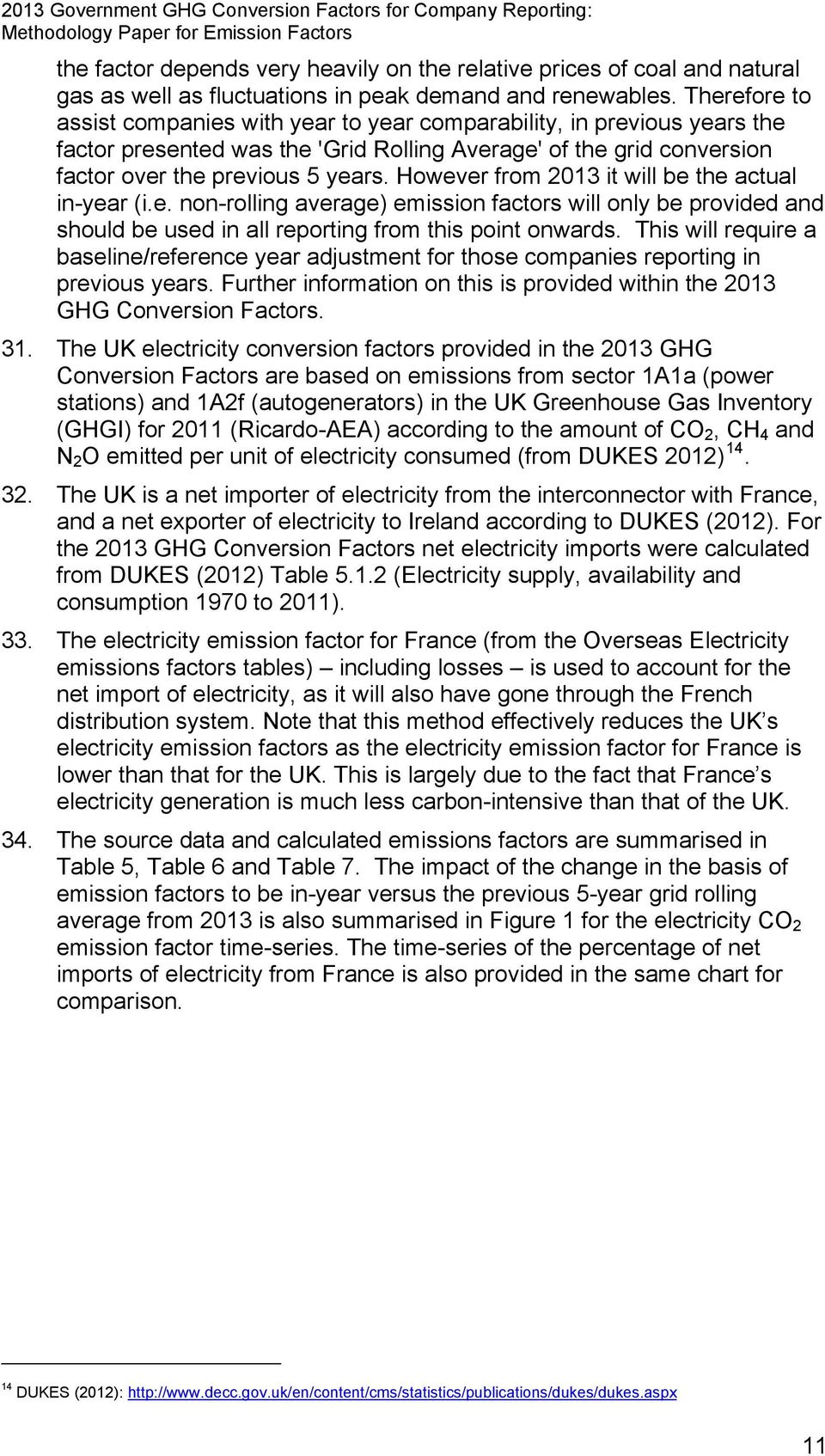
19 Figure 1: Summary of the impact of the 2013 methodology changes to actual inyear electricity emission factors compared to the previous 5-yr rolling average electricity emission factors % % 6.0% 5.0% 4.0% 3.0% 2.0% 1.0% % Electricity Generated, kgco2/kwh % Net Imports of Electricity (from France) 2013 Update (incl. imports and autogenerators) 2012 Update (incl. imports) 2012 Update (incl. imports, 5yr-av) % Net Imports of Electricity Table 5: Base electricity generation emissions data Year Electricity Generation (1) Total Grid Losses (2) UK electricity generation emissions (3), ktonne GWh % CO 2 CH 4 N 2 O , % 204, , % 201, , % 189, , % 172, , % 168, , % 165, , % 164, , % 152, , % 157, , % 149, , % 160, , % 171, , % 166, , % 177,

20 Year Electricity Generation (1) Total Grid Losses (2) UK electricity generation emissions (3), ktonne GWh % CO 2 CH 4 N 2 O , % 175, , % 175, , % 184, , % 181, , % 176, , % 155, , % 160, , % 148, Notes: (1) Based upon calculated total for centralised electricity generation (GWh supplied) from DUKES (2012) Table 5.6 Electricity fuel use, generation and supply. The total consistent with UNFCCC emissions reporting categories 1A1a+1A2f includes (according to Table 5.6 categories) GWh supplied (gross) from all thermal sources from Major power producers plus Hydro-natural flow; plus GWh supplied from thermal renewables + coal and gas thermal sources, hydro-natural flow and other non-thermal sources from Other generators. (2) Based upon calculated net grid losses from data in DUKES (2012) Table (long term trends, only available online). (3) Emissions from UK centralised power generation (including Crown Dependencies only) listed under UNFCC reporting category 1A1a and autogeneration - exported to grid (UK Only) listed under UNFCC reporting category 1A2f from the UK Greenhouse Gas Inventory for 2011 (Ricardo-AEA, 2013) 13

21 Table 6: Base electricity generation emission factors (excluding imported electricity) Year Emission Factor, kgco 2 e / kwh For electricity GENERATED (supplied to the grid) Due to grid transmission /distribution LOSSES For electricity CONSUMED (includes grid losses) % Net Electricity Imports Imported Electricity EF CO 2 CH 4 N 2 O Total CO 2 CH 4 N 2 O Total CO 2 CH 4 N 2 O Total TOTAL kgco 2 e / kwh % % % % % % % % % % % % % % % % % % % %
22 Year Emission Factor, kgco 2 e / kwh For electricity GENERATED Due to grid transmission For electricity CONSUMED % Net Electricity Imported (supplied to the grid) /distribution LOSSES (includes grid losses) Imports Electricity EF CO 2 CH 4 N 2 O Total CO 2 CH 4 N 2 O Total CO 2 CH 4 N 2 O Total TOTAL kgco 2 e / kwh % % Notes: Emission Factor (Electricity CONSUMED) = Emission Factor (Electricity GENERATED) / (1 - %Electricity Total Grid LOSSES) Emission Factor (Electricity LOSSES) = Emission Factor (Electricity CONSUMED) - Emission Factor (Electricity GENERATED) Emission Factor (Electricity CONSUMED) = Emission Factor (Electricity GENERATED) + Emission Factor (Electricity LOSSES), Table 7: Base electricity generation emissions factors (including imported electricity) Year Emission Factor, kgco 2 e / kwh For electricity GENERATED (supplied to the grid, plus imports) Due to grid transmission /distribution LOSSES For electricity CONSUMED (includes grid losses) % Net Electricity Imports Imported Electricity EF CO 2 CH 4 N 2 O Total CO 2 CH 4 N 2 O Total CO 2 CH 4 N 2 O Total TOTAL kgco 2 e / kwh % % % % % % % % %
23 Year Emission Factor, kgco 2 e / kwh For electricity GENERATED (supplied to the grid, plus imports) Due to grid transmission /distribution LOSSES For electricity CONSUMED (includes grid losses) % Net Electricity Imports Imported Electricity EF CO 2 CH 4 N 2 O Total CO 2 CH 4 N 2 O Total CO 2 CH 4 N 2 O Total TOTAL kgco 2 e / kwh % % % % % % % % % % % % % Notes: Emission Factor (Electricity CONSUMED) = Emission Factor (Electricity GENERATED) / (1 - %Electricity Total Grid LOSSES) Emission Factor (Electricity LOSSES) = Emission Factor (Electricity CONSUMED) - Emission Factor (Electricity GENERATED) Emission Factor (Electricity CONSUMED) = Emission Factor (Electricity GENERATED) + Emission Factor (Electricity LOSSES) 16
24 Indirect/WTT Emissions from UK Grid Electricity 35. In addition to the GHG emissions resulting directly from the generation of electricity, there are also indirect/wtt emissions resulting from the production, transport and distribution of the fuels used in electricity generation (i.e. indirect/wtt / fuel lifecycle emissions as included in the Fuels WTT tables). The average fuel lifecycle emissions per unit of electricity generated will be a result of the mix of different sources of fuel / primary energy used in electricity generation. 36. Average indirect/wtt emission factors for electricity have been calculated using the corresponding fuels indirect/wtt emission factors and data on the total fuel consumption by type of generation from Table 5.6, DUKES, The data used in these calculations are presented in Table 8, Table 9 and Table 10, together with the final indirect/wtt emission factors for electricity. Table 8: Fuel Consumed in electricity generation (GWh), by year Coal Fuel Consumed in Electricity Generation, GWh Fuel Oil Natural Gas Other thermal (excl. renewables) Other generation Total 1990 to 1995 N/A N/A N/A N/A N/A N/A ,938 45, ,929 16, , , ,614 25, ,787 16, , , ,696 17, ,731 16, , , ,706 17, ,548 16, , , ,429 18, ,560 15, , , ,569 16, ,518 12, , , ,552 14, ,442 12, , , ,463 13, ,926 17, , , ,158 12, ,228 16, , , ,846 15, ,658 21, , , ,018 16, ,408 18, , , ,857 13, ,878 14, , , ,450 18, ,810 13, , , ,820 17, ,303 11, , , ,290 13, ,586 9, , , ,729 10, ,265 8, , ,567 Source: Table 5.6, Digest of UK Energy Statistics 2012 (DECC, 2012), available at: 17
25 Table 9: Fuel consumed in electricity generation as a % of the Total, by year Coal Fuel Consumed in Electricity Generation, % Total Fuel Oil Natural Gas Other thermal (excl. renewables) Other generation Total % 5.1% 22.5% 1.8% 27.1% 100.0% % 2.8% 28.4% 1.8% 29.0% 100.0% % 1.9% 29.2% 1.7% 29.2% 100.0% % 2.0% 35.0% 1.8% 28.4% 100.0% % 2.0% 35.3% 1.7% 24.8% 100.0% % 1.7% 32.6% 1.3% 26.0% 100.0% % 1.6% 34.8% 1.3% 25.9% 100.0% % 1.4% 33.2% 1.8% 24.8% 100.0% % 1.3% 35.4% 1.7% 23.7% 100.0% % 1.5% 33.8% 2.2% 23.8% 100.0% % 1.7% 31.5% 1.8% 22.7% 100.0% % 1.4% 37.2% 1.5% 19.8% 100.0% % 2.0% 40.8% 1.4% 18.1% 100.0% % 2.0% 40.4% 1.3% 24.0% 100.0% % 1.5% 41.7% 1.0% 22.6% 100.0% % 1.2% 35.7% 1.0% 26.9% 100.0% % 5.1% 22.5% 1.8% 27.1% 100.0% % 2.8% 28.4% 1.8% 29.0% 100.0% % 1.9% 29.2% 1.7% 29.2% 100.0% % 2.0% 35.0% 1.8% 28.4% 100.0% % 2.0% 35.3% 1.7% 24.8% 100.0% % 1.7% 32.6% 1.3% 26.0% 100.0% Notes: Calculated from figures in Table 8 18
26 Table 10: Indirect/WTT emissions share for fuels used for electricity generation and the calculated average indirect/wtt emission factor, by year Coal Indirect/WTT Emissions as % Direct CO 2 Emissions, by fuel Fuel Oil Natural Gas Other thermal (excl. renewables) Other generation Weighted Average Direct CO 2 Calc Indirect /WTT CO 2 e % 18.9% 10.4% 12.5% 14.7% 14.7% % 18.9% 10.4% 12.5% 14.7% 14.7% % 18.9% 10.4% 12.5% 14.7% 14.7% % 18.9% 10.4% 12.5% 14.7% 14.7% % 18.9% 10.4% 12.5% 14.7% 14.7% % 18.9% 10.4% 12.5% 14.7% 14.7% % 18.9% 10.4% 12.5% 14.7% 14.7% % 18.9% 10.4% 12.5% 14.1% 14.1% % 18.9% 10.4% 12.5% 14.0% 14.0% % 18.9% 10.4% 12.5% 13.5% 13.5% % 18.9% 10.4% 12.5% 13.6% 13.6% % 18.9% 10.4% 12.5% 13.8% 13.8% % 18.9% 10.4% 12.5% 13.6% 13.6% % 18.9% 10.4% 12.5% 13.8% 13.8% % 18.9% 10.4% 12.5% 13.6% 13.6% % 18.9% 10.4% 12.5% 13.7% 13.7% % 18.9% 10.4% 12.5% 14.0% 14.0% % 18.9% 10.4% 12.5% 13.6% 13.6% % 18.9% 10.4% 12.5% 13.5% 13.5% % 18.9% 12.4% 12.5% 14.3% 14.3% % 18.9% 13.9% 12.5% 15.1% 15.1% % 18.9% 15.3% 12.5% 15.9% 15.9% Notes: Indirect/WTT emissions as % direct CO 2 emissions is based on information for specific fuels. Weighted average is calculated from the figures for fuels from both Table 9 and Table
27 Emission Factors for the Supply of Purchased Heat or Steam 37. Updated time-series emission factors for the supply of purchased heat or steam have been provided for the 2013 GHG Conversion Factors. These conversion factors represent the average emission from the heat and steam supplied by the UK CHPQA (Combined Heat and Power Quality Assurance) scheme 15 operators for a given year. This factor changes from year to year, as the fuel mix consumed changes and is therefore to be updated annually. No statistics are available that would allow the calculation of UK national average emission factors for the supply of heat and steam from non-chp operations. 38. CHP (Combined Heat and Power) simultaneously produces both heat and electricity, and there are a number of conventions used to allocate emissions between these products. At the extremes, emissions could be allocated wholly to heat or wholly to electricity, or in various proportions inbetween. The following sections outline the methodology (including the basis, key sources and assumptions) utilised to develop the heat and steam emission factors for the 2013 GHG Conversion Factors. Fuel allocation to electricity from CHP 39. To determine the amount of fuel attributed to CHP heat (qualifying heat output, or QHO ), it is necessary to apportion the total fuel to the CHP scheme to the separate heat and electricity outputs. This then enables the fuel, and therefore emissions, associated with the qualifying heat output to be determined. There are three possible methodologies for apportioning fuel to heat and power, which include: i. Method 1: 1/3 : 2/3 Method (DUKES) ii. Method 2: Boiler Displacement Method iii. Method 3: Power Station Displacement Method The basis of each method is described in the following sub-sections. Method 1: 1/3 : 2/3 Method (DUKES) 40. Under the UK s Climate Change Agreements 16 (CCAs), this method which is used to apportion fuel use to heat and power assumes that twice as many units of fuel are required to generate each unit of electricity than are required to generate each unit of heat. This follows from the observation that the efficiency of the generation of electricity (at electricity only generating plant) varies from as little as 25% to 50%, while the efficiency of the generation of heat in fired boilers ranges from 50% to about 90%. 15 See 16 Climate Change Agreements (CCAs) are agreements between UK energy intensive industries and UK Government, whereby industry undertakes to make challenging, but achievable, improvements in energy efficiency in exchange for a reduction in the Climate Change Levy (CCL). 20
28 41. Mathematically, Method 1 can be represented as follows: Total Fuel Input Heat Energy = ( Electricity Output ) Heat Output 2 + Heat Output 2 Total Fuel Input Electricit y Energy = Electricity Output ( Electricity Output) Heat Output 2 + Where: Total Fuel Input is the total fuel to the prime mover. Heat Output is the useful heat generated by the prime mover. Electricity Output is the electricity (or the electrical equivalent of mechanical power) generated by the prime mover. Heat Energy is the fuel to the prime mover apportioned to the heat generated. Electricity Energy is the fuel to the prime mover apportioned to the electricity generated. 42. This method is used only in the UK for accounting for primary energy inputs to CHP where the CHP generated heat and electricity is used within a facility with a CCA. Method 2: Boiler Displacement Method 43. Under this convention it is assumed that the heat generated by the CHP displaces heat raised by a boiler with an efficiency of 81% on a GCV basis (90% NCV basis), but that the boiler uses the same fuel mix as the actual fuel mix to the CHP to determine the CO 2 emissions. 44. Mathematically, Method 2 can be represented as follows: Heat Energy = HeatOutput 0.81 Where: the Heat Energy and Heat Output are as defined for Method 1, above. 45. This method has wider understanding within the European Union and has the advantage that it would be compatible with other allocation methodologies for heat. 46. Carbon emission factors for Heat and Electricity are calculated according to this method as follows: CO 2 emission from Fuel for Boiler = QHO * FuelmixCO2Factor 0.81 CHP Heat EF = CO 2 emission from Fuel for Boiler / QHO = FuelMixCO 2Factor
29 CO 2 emission from Fuel for Electricity QHO = { TFI }* FuelMixCO2 factor CHP Electricity EF QHO = {{ TFI }* FuelMixCO2 factor} / TPO 0.81 Where: the QHO is the (Qualifying) Heat Output; EF = emission factor. Method 3: Power Station Displacement Method 47. Under this convention it is assumed that the electricity generated by the CHP displaces electricity generated by conventional power only plant with an agreed efficiency (using the UK s fossil fuel fired power stations annual efficiencies, taken into consideration the transmission and distribution losses). This establishes the fuel for electricity and the balance of the fuel to the prime mover is then assumed to be for the generation of heat. 48. Mathematically, Method 3 can be represented by: Electricity Output Heat Energy = Total Fuel Input Power. Stations. Efficiency Where: Heat Energy, Total Fuel Input and Electricity Output are defined for Method 1, above. 49. This method raises the question of which power generation efficiency to use. For comparison in this analysis we have used the power generation efficiency of gas fired power stations, which has been taken to be 47.6% on a GCV basis. 50. Carbon emission factors for Heat and Electricity are calculated according to this method as follows:: CO 2 emission from Fuel for Boiler ElectricityOutput = { TFI }* FuelMixCO2 factor CHP Heat emission factor= CO 2 emission from Fuel for Boiler / QHO CO 2 emission from Fuel for Electricity TPO = * FuelMixCO2 factor CHP Electricity Emission factor FuelMixCO2Factor =
30 Calculation of CO 2 Emissions Factor for CHP Fuel Input, FuelMixCO 2 factor 51. The value FuelMixCO 2 factor referred to above is the carbon emissions factor per unit fuel input to a CHP scheme. This factor is determined using fuel input data provided by CHP scheme operators to the CHP Quality Assurance (CHPQA) programme, which is held in confidence. The value for FuelMixCO 2 factor is determined using the following expression: Where: FuelMixCO 2 factor is the composite emissions factor (in tco 2 /MWh thermal fuel input) for a scheme Fuel Input is the fuel input (in MWh thermal) for a single fuel supplied to the prime mover Fuel CO 2 Emissions factor is the CO 2 emissions factor (in tco 2 /MWh th ) for the fuel considered. TFI is total fuel input (in MWh thermal) for all fuels supplied to the prime mover 52. Fuel inputs and emissions factors are evaluated on a Gross Calorific Value (Higher Heating Value) basis. The following Table 11 provides the individual fuel types considered and their associated emissions factors, consistent with other reporting under the CHP QA scheme. Table 11: Fuel types and associated emissions factors used in determination of FuelMixCO 2 factor Fuel CO 2 Emissions Factor (kgco 2 /kwh th ) Biomass (e.g. woodchips, chicken litter) - Blast furnace gas Coal and lignite Coke oven gas Domestic refuse (raw) Ethane Fuel oil Gas oil Hydrogen Methane Mixed refinery gases Natural gas
31 Fuel CO 2 Emissions Factor (kgco 2 /kwh th ) Other Biogas (e.g. gasified woodchips) - Other gaseous waste Other liquid waste Other solid waste Refuse-derived Fuels (RDF) Sewage gas Unknown process gas Waste exhaust heat from high temperature processes - Waste heat from exothermic chemical reactions - Wood Fuels (woodchips, logs, wood pellets etc.) - Sources: Defra/DECC GHG Conversion Factors for Company Reporting (2011 update) and National Atmospheric Emissions Inventory (NAEI). 53. The 1/3 : 2/3 method was utilised in deriving the new heat/steam emission factors provided in the Heat and Steam tables of the 2013 GHG Conversion Factors, for consistency with DUKES. However, results are provided for comparison according to all three methods in the following Table Table 12: Comparison of calculated Electricity and Heat/Steam CO 2 emission factors for the 3 different allocation methods Year KgCO 2 /kwh supplied heat/steam KgCO 2 /kwh supplied power Method 1 (DUKES: 2/3rd - 1/3rd) Method 2 (Boiler displaced) Method 3 (Power displaced) Method 1 (DUKES: 2/3rd - 1/3rd) Method 2 (Boiler displaced) Method 3 (Power displaced)
32 Calculation of Non-CO 2 and Indirect/WTT Emissions Factor for Heat and Steam 54. CH 4 and N 2 O emissions have been estimated relative to the CO 2 emissions, based upon activity weighted average values for each CHP fuel used (using relevant average fuel emission factors from the NAEI). 55. Indirect/WTT GHG emission factors have been estimated relative to the CO 2 emissions, based upon activity weighted average indirect/wtt GHG emission factor values for each CHP fuel used. Where fuels are not included in the set of indirect/wtt GHG emission factors provided in the 2013 GHG Conversion Factors, the value for the closest/most similar alternative fuel was utilised instead. 56. The complete final emission factors for supplied heat or steam utilised are presented in the Heat and Steam tables of the 2013 GHG Conversion Factors, and are counted as Scope 2 emissions under the GHG Protocol. 57. For district heating systems, where the location of use of the heat is some distance from the point of production, there are distribution energy losses. These losses are typically around 5%, which need to be factored into the calculation of overall GHG emissions where relevant and are counted as Scope 3 emissions under the GHG Protocol (similar to the treatment of transmission and distribution losses for electricity). 25
33 IV. Refrigerant and Process Emission Factors Summary of changes since the previous update 58. No changes have been made to these data tables for the 2013 GHG Conversion Factors. Global Warming Potentials of Greenhouse Gases Greenhouse Gases Listed in the Kyoto Protocol 59. The conversion factors in the Refrigerant tables incorporate (GWP) values relevant to reporting under UNFCCC, as published by the IPCC in its Second Assessment Report, Climate Change The Science of Climate Change. Contribution of Working Group I to the Second Assessment Report of the Intergovernmental Panel on Climate Change. (Eds. J. T Houghton et al, 1996) that is required to be used in inventory reporting. 60. Mixed/Blended gases: GWP values for refrigerant blends are be calculated on the basis of the percentage blend composition (e.g. the GWP for R404a that comprises is 44% HFC125, 52% HFC143a and 4% HFC134a is [2800 x 0.44] + [3800 x 0.52] + [1300 x 0.04] = 3260). A limited selection of common blends is presented in the Refrigerant tables. Other Greenhouse Gases 61. Revised GWP values have since been published by the IPCC in the Fourth Assessment Report (2007) but current UNFCCC Guidelines on Reporting and Review, adopted before the publication of the Fourth Assessment Report, require emission estimates to be based on the GWPs in the IPCC Second Assessment Report. Some tables the Refrigerant section includes other greenhouse gases not listed in the Kyoto protocol or covered by reporting under UNFCCC. These GWP conversion factors have been taken from the IPCC's Fourth Assessment Report (2007). 62. CFCs and HCFCs: Not all refrigerants in use are classified as greenhouse gases for the purposes of the UNFCCC and Kyoto Protocol (e.g. CFCs, HCFCs). These gases are controlled under the Montreal Protocol and as such GWP values are also listed in the provided tables. 26
34 V. Passenger Land Transport Emission Factors Summary of changes since the previous update 63. The main methodological changes and additions since the previous update include: a. The methodology used to define the emission factors for road vehicles (except motorcycles and buses) has been updated to utilise the factors used in the 2011 GHGI to account for the age/activity of the vehicle fleet in the UK, derived from DVLA licensing data and the UK Department for Transport s (DfT) ANPR (Automatic Number Plate Recognition) data. b. Passenger Cars: new emission factors have now been provided for small hybrid cars now that these models are on the market and being sold in significant numbers. In addition this category has been renamed from 'hybrid petrol cars' to simply 'hybrid cars', reflecting the significant numbers of diesel hybrids now being sold. At this stage diesel hybrid sales are much smaller than petrol hybrids, and their average emission factors are not sufficiently different to warrant a separate category. This will be reviewed and potentially amended in future updates. 64. All other factors have also been updated with more recent data for the latest 2013 GHG Conversion Factors. Direct Emissions from Passenger Cars Emission Factors for Petrol and Diesel Passenger Cars by Engine Size 65. SMMT (Society for Motor Manufacturers and Traders) 17 provides numbers of registrations and averages of the NEDC 18 gco 2 / figures for new vehicles registered from 1997 to The dataset represents a good indication of the relative NEDC gco 2 / by size category. Table 13 presents the average CO 2 emission factors and number of vehicle registrations. 66. For the 2013 GHG Conversion Factors update, the SMMT data have been used in conjunction with DfT's ANPR (Automatic Number Plate Recognition) data to weight the emission factors to account for the age and activity distribution of the UK vehicle fleet in SMMT is the Society of Motor Manufacturers and Traders that represents the UK auto industry NEDC = New European Driving Cycle, which is used in the type approval of new passenger cars. 19 The SMMT gco2 / dataset for 1997 represented around 70% of total registrations, which rose to about 99% by 2000 and essentially all vehicles thereafter. 27
35 67. The ANPR data have been collected annually (since 2007) over 256 sites in the UK on different road types (urban and rural major/minor roads, and motorways) and regions. Measurements are made at each site on one weekday (8am-2pm and 3pm-9pm) and one half weekend day (either 8am-2pm or 3pm-9pm) each year in June and are currently available for 2007, 2008, 2009, 2010 and There are approximately million observations recorded from all the sites each year, and they cover various vehicle and road characteristics such as fuel type, age of vehicle, engine sizes, vehicle weight and road types. 68. Data for the UK car fleet were extracted from the 2011 ANPR dataset and categorised according to their engine size, fuel type and year of registration. The 2013 GHG Conversion Factors emission factors for petrol and diesel passenger cars were subsequently calculated based upon the equation below: Table 13: Average CO 2 emission factors and total registrations by engine size for 1997 to 2012 (based on data sourced from SMMT) Vehicle Type Engine size Size label gco 2 per Total no. of registrations % Total Petrol car < 1.4 l Small ,639, % l Medium ,205, % > 2.0 l Large ,967, % Average petrol car ,813, % Diesel car <1.7 l Small ,803, % l Medium ,107, % > 2.0 l Large ,460, % Average diesel car ,372, % 69. A limitation of the NEDC (New European Driving Cycle used in vehicle type approval) is that it takes no account of further real-world effects that can have a significant impact on fuel consumption. These include use of accessories (air con, lights, heaters etc), vehicle payload (only driver +25kg is considered in tests, no passengers or further luggage), poor maintenance (tyre under inflation, maladjusted tracking, etc), gradients (tests effectively assume a level road), weather, more aggressive/harsher driving style, etc. It is therefore desirable to uplift NEDC based data to bring it closer to anticipated real-world vehicle performance. 70. An uplift factor of +15% over NEDC based gco 2 / factors was agreed with DfT in 2007 to take into account the combined real-world effects on fuel consumption not already taken into account in the previous factors. 28
36 [Note: This represents a decrease in MPG (miles per gallon) over NEDC figures of about 13% for petrol cars and 9% for diesel cars]. No new evidence has been identified to suggest this figure should change for the 2013 GHG Conversion Factors for the UK car fleet as a whole. However, some recent studies have suggested that the differential may be widening for new cars (particularly for the most efficient models). The current assumptions for the UK fleet will be reconsidered in future updates, e.g. by potentially taking into account new evidence collated by ICCT (2013) The uplift of +15% was applied to the ANPR weighted SMMT gco 2 / to give the New Real-World 2013 GHG Conversion Factors, to take into account the real-world impacts on fuel consumption not captured by drive cycles such as the NEDC in type-approval. 72. Figures for the aggregated average emission factors by engine type and fuel type (as well as the overall average) were calculated based on weighting by the relative mileage of the different categories. This calculation utilised data from the UK GHG Inventory on the relative % total mileage by petrol and diesel cars. Overall for petrol and diesel, this split in total annual mileage was 59.6% petrol and 40.4% diesel, and can be compared to the respective total registrations of the different vehicle types for , which were 68.6% petrol and 31.4% diesel. 73. Emission factors for CH 4 and N 2 O have been updated for all vehicle classes and are based on the emission factors from the UK GHG Inventory. ANPR data and Regional Vehicle Licensing Statistics (DVLA) were used to define the petrol and diesel car mix by road type and by Devolved Administrations The final 2013 emission factors for petrol and diesel passenger cars by engine size are presented in the passenger vehicles and business travelland tables of the 2013 GHG Conversions Factors. Hybrid, LPG and CNG Passenger Cars 75. The methodology used in the 2013 update for medium and large hybrid petrol/diesel electric cars is similar to that in the 2011 and 2012 update, having received numbers of registrations and averages of the NEDC 22 gco 2 / figures from SMMT for new hybrid vehicles registered in However, there are now significant numbers of diesel hybrids and small hybrid cars being sold in the UK. Therefore this category has been renamed simply hybrid cars (since diesel hybrid models still represent a very small proportion of the market) and a new small hybrid category has been included. DfT s ANPR data have also been included as described in the section above, following the approach used in calculating the emission factors for petrol/diesel cars by engine size. 20 FROM LABORATORY TO ROAD - A comparison of official and real-world fuel consumption and CO 2 values for cars in Europe and the United States a report by the ICCT, May Available at: 21 For improvements in the 2010 inventory, see the report and annexes UK Greenhouse Gas Inventory, 1990 to 2010: Annual Report for submission under the Framework Convention on Climate Change, available from 22 NEDC = New European Driving Cycle, which is used in the type approval of new passenger cars. 29
37 76. Due to the significant size and weight of the LPG and CNG fuel tanks it is assumed only medium and large sized vehicles will be available. In the 2013 GHG Conversion Factors, CO 2 emission factors for CNG and LPG medium and large cars are derived by multiplying the equivalent petrol EF by the ratio of CNG (and LPG) to petrol EFs on a unit energy basis. For example, for a Medium car run on CNG: 77. For the 2013 GHG Conversion Factors, the emission factors for CH 4 and N 2 O were updated, but the methodology remains unchanged. These are based on the emission factors from the UK GHG Inventory (produced by Ricardo-AEA) and are presented together with an overall total emission factors in the passenger vehicles and business travel- land tables of the 2013 GHG Conversion Factors. Emission Factors by Passenger Car Market Segments 78. For the 2013 GHG Conversion Factors, the market classification split (according to SMMT classifications) was derived using detailed SMMT data on new car registrations between 1997 and 2012 split by fuel 23, presented in Table 14, and again combining this with information extracted from the 2011 ANPR dataset. These data were then uplifted by 15% to take into account real-world impacts, consistent with the methodology used to derive the car engine size emission factors. The supplementary market segment based emission factors for passenger cars are presented in the passenger vehicles and business travel- land tables of the 2013 GHG Conversion Factors. 79. Emission factors for CH 4 and N 2 O were also updated for all car classes. These figures are based on the emission factors from the UK GHG Inventory. The factors are presented together with the overall total emission factors in the tables of the 2013 GHG Conversion Factors. 23 This data was provided by EST and is based on detailed data sourced from SMMT on new car registrations. 30
38 Table 14: Average car CO 2 emission factors and total registrations by market segment for 1998 to 2012 (based on data sourced from SMMT) Fuel Type Market Segment Example Model Diesel Petrol Unknown Fuel (Diesel + Petrol) gco2/ # registrations % Total A. Mini Smart Fortwo % B. Super Mini VW Polo % C. Lower Medium Ford Focus % D. Upper Medium Toyota Avensis % E. Executive BMW 5-Series % F. Luxury Saloon Bentley Continental GT % G. Specialist Sports Mercedes SLK % H. Dual Purpose Land Rover Discovery % I. Multi Purpose Renault Espace % All Total E % A. Mini Smart Fortwo % B. Super Mini VW Polo % C. Lower Medium Ford Focus % D. Upper Medium Toyota Avensis % E. Executive BMW 5-Series % F. Luxury Saloon Bentley Continental GT % G. Specialist Sports Mercedes SLK % H. Dual Purpose Land Rover Discovery % I. Multi Purpose Renault Espace % All Total E % A. Mini Smart Fortwo % B. Super Mini VW Polo E+07 33% C. Lower Medium Ford Focus % D. Upper Medium Toyota Avensis % E. Executive BMW 5-Series % F. Luxury Saloon Bentley Continental GT % G. Specialist Sports Mercedes SLK % H. Dual Purpose Land Rover Discovery % I. Multi Purpose Renault Espace % All Total E % 31
39 Direct Emissions from Taxis 80. New emission factors for taxis per passenger were estimated in 2008 on the basis of an average of the 2008 GHG Conversion Factors of medium and large cars and occupancy of 1.4 (CfIT, ). The emission factors for black cabs are based on the large car emission factor (which is consistent with the Vehicle Certification Agency (VCA) 25 dataset based on the NEDC for London Taxis International vehicles) and an average passenger occupancy of 1.5 (average 2.5 people per cab, including the driver, from LTI, 2007). 81. The 2013 update for emission factors per passenger for taxis are presented in the business travel- land tables of the 2013 GHG Conversion Factors. These have been updated to be consistent with the most recent data for cars. The base emission factors per vehicle are also presented in the business travel- land tables 6k of the 2013 GHG Conversion Factors. It should be noted that many black cabs will probably have a significantly different operational cycle to the NEDC, which would be likely to increase the emission factor. At the moment there is insufficient information available to take this into account in the current factors. No other new data has been identified/made available to inform the 2013 update. 82. Emission factors for CH 4 and N 2 O have been updated for all taxis for the 2013 update. These figures are, as before, based on the emission factors for diesel cars from the UK GHG Inventory and are presented together with overall total emission factors in the tables of the 2013 GHG Conversion Factors. Direct Emissions from Vans 83. Average emission factors by fuel for light good vehicles (N1 vehicles, vans up to 3.5 tonnes gross vehicle weight) by size class (I, II or III), presented in Table 15 (and in the delivery vehicles section of the 2013 GHG Conversion Factors), have been updated for the this year s update. The data set used to allocate different vehicles to each class is based on reference weight (approximately equivalent to kerb weight plus 60kg) in the MVRIS data set. The assumed split of petrol van stock between size classes uses the split of registrations from this dataset 84. These test cycle based emission factors are uplifted by 15% to represent real-world emissions, consistent with the approach used for cars, and agreed with DfT. Emission factors for petrol and diesel LGVs are based upon emission factors and vehicle from the NAEI for In the 2013 GHG Conversion Factors, CO 2 emission factors for CNG and LPG vans 24 Obtaining the best value for public Subsidy of the bus industry, a report by L.E.K. Consulting LLP for the UK Commission for Integrated Transport, 14 March Appendix : Methodology for settlements with <25k population. Available at: 25 Vehicle Certification Agency (VCA) car fuel database is available at: 32
40 are calculated using the same methodology as for passenger cars. The average van emission factor is calculated on the basis of the relative NAEI vehicle for petrol and diesel LGVs for 2011, as presented in Table Emission factors for CH 4 and N 2 O were also updated for all van classes, based on the emission factors from the UK GHG Inventory. N 2 O emissions are assumed to scale relative to vehicle class/co 2 emissions for diesel vans. Table 15: New emission factors for vans for the 2013 GHG Conversion Factors Van fuel Van size Direct gco 2 e per v Capacity CO 2 CH 4 N 2 O Total % split tonnes Petrol (Class I) Up to tonne % 0.64 Petrol (Class II) to tonne % 0.72 Petrol (Class III) Over tonne % 1.29 Petrol (average) Up to 3.5 tonne % 0.76 Diesel (Class I) Up to tonne % 0.64 Diesel (Class II) to tonne % 0.98 Diesel (Class III) Over tonne % 1.29 Diesel (average) Up to 3.5 tonne % 1.17 LPG Up to 3.5 tonne CNG Up to 3.5 tonne Average Direct Emissions from Buses 86. The 2013 update uses data from DfT from the Bus Service Operators Grant (BSOG) in combination with DfT bus activity statistics (vehicle, passenger ) to estimate emission factors for local buses. DfT holds very accurate data on the total amount of money provided to bus service operators under the scheme, which provides a fixed amount of financial support per unit of fuel consumed. Therefore the total amount of fuel consumed (and hence CO 2 emissions) can be calculated from this, which when combined with DfT statistics on total vehicle and passenger allows the calculation of emission factors. 87. Emission factors for coach services were based on figures from National Express, who provide the majority of scheduled coach services in the UK. 88. Emission factors for CH 4 and N 2 O are based on the emission factors from the UK GHG Inventory. These factors are also presented together with an overall total factor in Table Table 16 gives a summary of the 2013 updated emission factors and average passenger occupancy. It should also be noted that fuel consumption and emission factors for individual operators and services will vary significantly depending on the local conditions, the specific vehicles used and on the typical occupancy achieved. 33
41 Table 16: Emission factors for buses for the 2013 GHG Conversion Factors Bus type Average passenger occupancy gco 2 e per passenger CO 2 CH 4 N 2 O Total Local bus Local London bus Average local bus Coach 16.2* Notes: Average load factors/passenger occupancy provided by DfT Statistics Division. * Combined figure from DfT for non-local buses and coaches combined. Actual occupancy for coaches alone is likely to be significantly higher. Direct Emissions from Motorcycles 90. Data from type approval is not currently readily available for motorbikes and CO 2 emission measurements were only mandatory in motorcycle type approval from For the practical purposes of the GHG Conversion Factors, emission factors for motorcycles are split into 3 categories: a. Small motorbikes (mopeds/scooters up to 125cc), b. Medium motorbikes ( cc), and c. Large motorbikes (over 500cc) 92. For the 2009 update the emission factors were calculated based on a large dataset kindly provided by Clear (2008) 26. This dataset was more comprehensive compared to the one previously used, containing almost 1200 data points (over 300 different bikes from cc and from 25 manufacturers) from a mix of magazine road test reports and user reported data compared to only 42 data points in the previous dataset. A summary is presented in Table 17, with the corresponding complete emission factors developed for motorcycles are presented in the passenger vehicles tables of the 2013 GHG Conversion Factors. The total average has been calculated weighted by the relative number of registrations of each category in 2008 according to DfT statistics from CMS (2008) 27. In the absence of new information the methodology and dataset are unchanged for the 2013 GHG Conversion Factors. 93. These emission factors are based predominantly upon data derived from real-world riding conditions (rather than the test-cycle based data) and therefore likely to be more representative of typical in-use performance. The average difference between the factors based on real-world observed fuel consumption and figures based upon test-cycle data from ACEM Dataset of motorcycle fuel consumption compiled by Clear ( for the development of its motorcycle CO 2 model used in its carbon offsetting products. 27 Compendium of Motorcycling Statistics: 2008, available at: rcyclingstats2008.html 28 The European Motorcycle Manufacturers Association 34
42 (+9%) is smaller than the corresponding differential used to uplift cars test cycle data to real-world equivalents (+15%). 94. Emission factors for CH 4 and N 2 O were updated for the 2013 GHG Conversion Factors based on the emission factors from the 2011 UK GHG Inventory (Ricardo-AEA, 2013). These factors are also presented together with overall total emission factors in the tables of the 2013 GHG Conversion Factors. Table 17: Summary dataset on CO 2 emissions from motorcycles based on detailed data provided by Clear (2008) CC Range Model Count Number Av. gco 2 / Av. MPG Up to 125cc cc to 200cc cc to 300cc cc to 400cc cc to 500cc cc to 600cc cc to 700cc cc to 800cc cc to 900cc cc to 1000cc cc to 1100cc cc to 1200cc cc to 1300cc cc to 1400cc cc to 1500cc cc to 1600cc cc to 1700cc cc to 1800cc cc to 1900cc cc to 2000cc cc to 2100cc <125cc cc >500cc Total Note: Summary data based data provided by Clear ( from a mix of magazine road test reports and user reported data. Direct Emissions from Passenger Rail 95. Emission factors for passenger rail services have been updated and provided in the Business travel land section of the 2013 GHG Conversion Factors. These include updates to the national rail, 35
43 international rail (Eurostar), light rail schemes and the London Underground. Emission factors for CH 4 and N 2 O emissions were also updated in the 2013 GHG Conversion Factors. These factors are based on the assumptions outlined in the following paragraphs. International Rail (Eurostar) 96. The international rail factor is based on a passenger- weighted average of the emission factors for all of the Eurostar routes. These are London- Brussels, London-Paris, London-Marne Le Vallee (Disney), London- Avignon and the ski train from London-Bourg St Maurice. The emission factors were provided by Eurostar for the 2013 update, together with information on the basis of the electricity figures used in their calculation. 97. The methodology applied in calculating the Eurostar emission factors currently uses 3 key pieces of information: a. Total electricity use by Eurostar trains on the UK and France/Belgium track sections; b. Total passenger numbers (and therefore calculated passenger ) on all Eurostar services; c. Emission factors for electricity (in kgco 2 per kwh) for the UK and France/Belgium journey sections. These are based on the UK grid average electricity from the GHG Conversion Factors and the France/Belgium grid averages. 98. The new figure from Eurostar is gco 2 /p, and is consistent with Ricardo-AEA s previous methodology for calculating emissions for the GHG Conversion Factors. Eurostar's previously published figure (from 2010) is 7.71 gco 2 /p differs from the figure quoted in the 2010, 2011 and 2012 GHG Conversion Factors as it was calculated using the individual conversion factors as specified by each electricity supplier across each network section upon which they operate, rather than the grid average. For further information please visit: CH 4 and N 2 O emission factors have been estimated from the corresponding emission factors for electricity generation, proportional to the CO 2 emission factors. 36
44 National Rail 100. The national rail factor refers to an average emission per passenger kilometre for diesel and electric trains in The factor is sourced from information from the Office of the Rail Regulator s National rail trends for (ORR, 2012) 29. This has been calculated based on total electricity and diesel consumed by the railways for the year (sourced from ATOC), and the total number of passenger kilometres (from National Rail Trends) CH 4 and N 2 O emission factors have been estimated from the corresponding emissions factors for electricity generation and diesel rail (from the UK GHG Inventory), proportional to the CO 2 emission factors. The emission factors were calculated based on the relative passenger proportions of diesel and electric rail provided by DfT for (since no newer datasets have been made available by DfT). Light Rail 102. The light rail factors were based on an average of factors for a range of UK tram and light rail systems, as detailed in Table Figures for the DLR, London Overground and Croydon Tramlink for 2011/12 based on figures from Transport for London s 2012 Health, Safety and Environment report 30 adjusted to the new 2011 grid electricity CO 2 emission factor The factors for Midland Metro, Tyne and Wear Metro, the Manchester Metrolink and Supertram were based on annual passenger data from DfT s Light rail and tram statistics 31 and the new 2011 grid electricity CO 2 emission factor The factor for the Glasgow Underground was provided by the network based on annual electricity consumption and passenger data provided by the network operators for 2005/6 and the new 2011 grid electricity CO 2 emission factor, for consistency The average emission factor was estimated based on the relative passenger of the four different rail systems (see Table 18) CH 4 and N 2 O emission factors have been estimated from the corresponding emissions factors for electricity generation, proportional to the CO 2 emission factors. 29 Available from the ORR s website at: 30 TfL (2012); 2011 Health, Safety and Environment Report 31 DfT Light rail and tram statistics, 37
45 Table 18: GHG emission factors, electricity consumption and passenger for different tram and light rail services Type Electricity use gco 2 e per passenger Million kwh/p CO 2 CH 4 N 2 O Total p DLR (Docklands Light Rail) Light Rail Glasgow Underground Light Rail Midland Metro Light Rail Tyne & Wear Metro Light Rail London Overground Light Rail Croydon Tramlink Tram Manchester Metrolink Tram Nottingham Express Transit Tram No data Supertram Tram Average* Notes: * Weighted by relative passenger London Underground 108. The London Underground rail factor is from Transport for London s 2012 Health, Safety and Environment report (TfL, 2013), corrected to the 2011 grid electricity CO 2 emission factor CH 4 and N 2 O emission factors have been estimated from the corresponding emissions factors for electricity generation, proportional to the CO 2 emission factors. Indirect/WTT Emissions from Passenger Land Transport Cars, Vans, Motorcycles, Taxis, Buses and Ferries 110. Indirect/WTT emissions factors (EFs) for cars, vans, motorcycles, taxis, buses and ferries include only emissions resulting from the fuel lifecycle (i.e. production and distribution of the relevant transport fuel). These indirect/wtt emission factors were derived using simple ratios of the direct CO 2 EFs and the indirect/wtt EFs for the relevant fuels from the Fuels section and the corresponding direct CO 2 EFs for vehicle types using these fuels in the Passenger vehicles, Business travel land and Business travel air sections of the new tables format used in the 2013 GHG Conversion Factors. 38
46 Rail 111. Indirect/WTT EFs for international rail (Eurostar), light rail and the London Underground were derived using a simple ratio of the direct CO 2 EFs and the indirect/wtt EFs for grid electricity from the UK Electricity section and the corresponding direct CO 2 EFs for vehicle types using these fuels in the passenger vehicles, Business travel land and Business travel air sections of the new tables format used in the 2013 GHG Conversion Factors The EFs for national rail services are based on a mixture of emissions from diesel and electric rail. Indirect/WTT EFs were therefore calculated from corresponding estimates for diesel and electric rail combined using relative passenger proportions of diesel and electric rail provided by DfT for (no newer similar dataset is available). 39
47 VI. Freight Land Transport Emission Factors Summary of changes since the previous update 113. No changes have been made to the methodology to derive emission factors for road freight in the 2013 update of the GHG Conversion Factors. However, the new factors for the 2013 GHG Conversion Factors now include : a. Expanded tonne (t) emission factors for HGVs for different laden weights (%). b. In addition there are also extra factors included for refrigerated/temperature controlled HGVs which on average consume 20% more fuel than non-refrigerated equivalents (to power the refrigeration equipment) All other factors have been updated with more recent data in the latest 2013 GHG Conversion Factors. Direct Emissions from Heavy Goods Vehicles (HGVs) 115. A revised set of CO 2 conversion factors for road freight has been derived for different sizes of rigid and articulated HGVs with different load factors, using the same methodology as used in the GHG Conversion Factors. The new factors for the 2013 GHG Conversion Factors are presented in sections Delivery Vehicles and Freighting Goods The factors are based on road freight statistics from the Department for Transport (DfT, 2011) 32 for Great Britain (GB), from a survey on different sizes of rigid and articulated HGVs in the fleet in The statistics on fuel consumption figures (in miles per gallon) have been estimated by DfT from the survey data. For the GHG Conversion Factors these are combined with test data from the European ARTEMIS project showing how fuel efficiency, and hence CO 2 emissions, varies with vehicle load The miles per gallon (MPG) figures in Table RFS0141 of DfT (2011) are converted to gco 2 per factors using the standard fuel conversion factor for diesel in the 2011 GHG Conversion Factors tables. Table RFS0117 of DfT (2011) shows the percent loading factors are on average between 40-60% in the UK HGV fleet. Figures from the ARTEMIS project show that the effect of load becomes proportionately greater for heavier classes of HGVs. In other words, the relative difference in fuel 32 Transport Statistics Bulletin: Road Freight Statistics 2011, (DfT, 2011). Available at: 40
48 consumption between running an HGV completely empty or fully laden is greater for a large >33t HGV than it is for a small <7.5t HGV. From analysis of the ARTEMIS data, it was possible to derive the figures in Table 19 showing the change in CO 2 emissions for a vehicle completely empty (0% load) or fully laden (100% load) on a weight basis compared with the emissions at half-load (50% load). The data show the effect of load is symmetrical and largely independent of the HGVs Euro emission classification and type of drive cycle. So, for example, a >17t rigid HGV emits 18% more CO 2 per kilometre when fully laden and 18% less CO 2 per kilometre when empty relative to emissions at half-load Factors have also now been included for refrigerated/temperaturecontrolled HGVs which include a 20% increase in fuel consumption to the standard all diesel factors. This accounts for the typical additional energy needed to power refrigeration equipment in such vehicles over similar non-refrigerated alternatives 33. Table 19: Change in CO 2 emissions caused by +/- 50% change in load from average loading factor of 50% Gross Vehicle Weight (GVW) % change in CO 2 emissions Rigid <7.5t ± 8% t ± 12.5% >17 t ± 18% Articulated <33t ± 20% Source: EU-ARTEMIS project >33t ± 25% 119. Using these loading factors, the CO 2 factors derived from the DfT survey s MPG data, each corresponding to different average states of HGV loading, were corrected to derive the 50% laden CO 2 factor shown for each class of HGV for the final factors presented in sections Delivery vehicles and Freighting goods of the 2013 GHG Conversion Factors The loading factors in Table 19 were then used to derive corresponding CO 2 factors for 0% and 100% loadings in the above sections. Because the effect of vehicle loading on CO 2 emissions is linear with load (according to the ARTEMIS data), then these factors can be linearly interpolated if a more precise figure on vehicle load is known. For example, an HGV running at 75% load would have a CO 2 factor halfway between the values for 50% and 100% laden factors It might be surprising to see that the CO 2 factor for a >17t rigid HGV is greater than for a >33t articulated HGV. However, these factors merely 33 Reduction and Testing of Greenhouse Gas (GHG) Emissions from Heavy Duty Vehicles Lot 1: Strategy, a report for EC DG CLIMA by AEA Technology plc and Ricardo, February Available at: 41
49 reflect the estimated MPG figures from DfT statistics that consistently show worse mpg fuel efficiency, on average, for large rigid HGVs than large articulated HGVs once the relative degree of loading is taken into account. This is likely to be a result of the usage pattern for different types of HGVs where large rigid HGVs may spend more time travelling at lower, more congested urban speeds, operating at lower fuel efficiency than articulated HGVs which spend more time travelling under higher speed, free-flowing traffic conditions on motorways where fuel efficiency is closer to optimum. Under the drive cycle conditions more typically experienced by large articulated HGVs, the CO 2 factors for large rigid HGVs may be lower than indicated in Delivery vehicles and Freighting goods of the 2013 GHG Conversion Factors. Thus the factors in Delivery vehicles and Freighting goods, linked to the DfT (2009) statistics on MPG (estimated by DfT from the survey data) reflect each HGV class s typical usage pattern on the GB road network As well as CO 2 factors for 0%, 50% and 100% loading, CO 2 factors are shown for the average loading of each weight class of HGV in the GB fleet in These should be used as default values if the user does not know the loading factor to use and are based on the actual laden factors and mpg figures from the tables in DfT (2011) UK average factors for all rigid and articulated HGVs are also provided in sections Delivery vehicles and Freighting goods of the 2013 GHG Conversion Factors if the user requires aggregate factors for these main classes of HGVs, perhaps because the weight class of the HGV is not known. Again, these factors represent averages for the GB HGV fleet in These are derived directly from the mpg values for rigid and articulated HGVs in Table RFS0141of DfT (2011) At a more aggregated level still are factors for all HGVs representing the average mpg for all rigid and articulated HGV classes in Table RFS0141 of DfT (2011). This factor should be used if the user has no knowledge of or requirement for different classes of HGV and may be suitable for analysis of HGV CO 2 emissions in, for example, inter-modal freight transport comparisons The conversion factors provided in Delivery vehicles of the 2013 GHG Conversion Factors are in distance units, that is to say, they enable CO 2 emissions to be calculated just from the distance travelled by the HGV in multiplied by the appropriate conversion factor for the type of HGV and, if known, the extent of loading For comparison with other freight transport modes (e.g. road vs. rail), the user may require CO 2 factors in tonne (t) units. The Freighting goods section of the 2013 GHG Conversion Factors also provides such factors for each weight class of rigid and articulated HGV, for all rigids and all artics and aggregated for all HGVs. These are derived from the 2009 fleet average gco 2 per vehicle factors in Delivery vehicles. Previous year s updates only included factors for the UK average laden weight for each HGV class in tonne (t).the average tonne freight lifted figures are derived from the t and vehicle (v) figures given for each class of HGV in Tables RFS0119 and RFS0109, respectively (DfT, 2011). 42
50 Dividing the t by the v figures gives the average tonnes freight lifted by each HGV class For example a rigid HGV, > t has an average load of 46%. In the 2013 GHG Conversion Factors, this has been expanded to include factors in tonne (t) for all loads, (0%, 50%, 100% and average) A tonne (t) is the distance travelled multiplied by the weight of freight carried by the HGV. So, for example, an HGV carrying 5 tonnes freight over 100 has a t value of 500 t. The CO 2 emissions are calculated from these factors by multiplying the number of t the user has for the distance and weight of the goods being moved by the CO 2 conversion factor in Freighting goods of the 2013 GHG Conversion Factors for the relevant HGV class Emission factors for CH 4 and N 2 O have been updated for all HGV classes. These are based on the emission factors from the 2011 UK GHG Inventory. CH 4 and N 2 O emissions are assumed to scale relative to vehicle class/co 2 emissions for HGVs. These factors are presented with an overall total factor in sections Delivery vehicles and Freighting goods of the 2013 GHG Conversion Factors. Direct Emissions from Light Goods Vehicles (LGVs) 129. Emission factors for light good vehicles (vans up to 3.5 tonnes), were calculated based on the emission factors per vehicle- in the earlier section on passenger transport The typical / average capacities and average payloads agreed with DfT that are used in the calculation of van emission factors per tonne are presented in Table 20. These are based on quantitative assessment of the van database used by Ricardo-AEA in a variety of policy assessments for DfT. Table 20: Typical van freight capacities and estimated average payload Van fuel Van size V % split Av. Capacity tonnes Av. Payload tonnes Petrol (Class I) Up to tonne 38.4% Petrol (Class II) to tonne 48.6% Petrol (Class III) Over tonne 13.0% Petrol (average) Up to 3.5 tonne 100.0% Diesel (Class I) Up to tonne 6.2% Diesel (Class II) to tonne 25.7% Diesel (Class III) Over tonne 68.1% Diesel (average) Up to 3.5 tonne 100.0% LPG (average) Up to 3.5 tonne CNG (average) Up to 3.5 tonne Average
51 131. The average load factors assumed for different vehicle types used to calculate the average payloads in Table 20 are summarised in Table 21, on the basis of DfT statistics from a survey of company owned vans. Table 21: Utilisation of vehicle capacity by company-owned LGVs: annual average (proportion of total vehicle kilometres travelled) Utilisation of vehicle volume capacity Average van loading 0-25% 26-50% 51-75% % Total Mid point for van loading ranges 12.5% 37.5% 62.5% 87.5% Proportion of vehicles in the loading range Up to 1.8 tonnes 45% 25% 18% 12% 100% tonnes 36% 28% 21% 15% 100% All LGVs 38% 27% 21% 14% 100% Estimated weighted average % loading Up to 1.8 tonnes 36.8% tonnes 41.3% All LGVs 40.3% Notes: Based on information from Table 24, TSG/UW, Emission factors for CH 4 and N 2 O have been updated for all van classes in the 2013 GHG Conversion Factors. These are based on the emission factors from the UK GHG Inventory. N 2 O emissions are assumed to scale relative to vehicle class/co 2 emissions for diesel vans Emission factors per tonne are calculated from the average load factors for the different weight classes in combination with the average freight capacities of the different vans in Table 20 and the earlier emission factors per vehicle- in the Delivery vehicles and Freighting goods sections of the 2013 GHG Conversion Factors. Direct Emissions from Rail Freight 134. Data from Table 9.1 of the Office of the Rail Regulator s National Rail Trends Yearbook for (ORR, 2012) 35 has been used to update the rail freight emission factors for the 2013 GHG Conversion Factors. This factor is presented in Freighting goods in the 2013 GHG Conversion Factors. There have been no further updates to the methodology in the 2013 update The factor can be expected to vary with rail traffic route, speed and train weight. Freight trains are hauled by electric and diesel locomotives, but 34 TSG/UW, Using official data sources to analyse the light goods vehicle fleet and operations in Britain a report by Transport Studies Group, University of Westminster, London, November Available at: 35 Available from the ORR s website at: 44
52 the vast majority of freight is carried by diesel rail and correspondingly CO 2 emissions from diesel rail freight are 93% of the total for (ORR, 2012) Traffic-, route- and freight-specific factors are not currently available, but would present a more appropriate means of comparing modes (e.g. for bulk aggregates, intermodal, other types of freight) The rail freight CO 2 factor will be reviewed and updated if data become available relevant to rail freight movement in the UK CH 4 and N 2 O emission factors have been estimated from the corresponding emissions for diesel rail from the UK GHG Inventory, proportional to the CO 2 emissions. The emission factors were calculated based on the relative passenger proportions of diesel and electric rail provided by DfT for in the absence of more suitable tonne data for freight. Indirect/WTT Emissions from Freight Land Transport Vans and HGVs 139. Indirect/WTT emission factors (EFs) for vans and HGVs include only emissions resulting from the fuel lifecycle (i.e. production and distribution of the relevant transport fuel). These indirect/wtt emission factors were derived using simple ratios of the direct CO 2 EFs and the indirect/wtt EFs for the relevant fuels and the corresponding direct CO 2 EFs for vehicle types using these fuels. Rail 140. The EFs for freight rail services are based on a mixture of emissions from diesel and electric rail. Indirect/WTT EFs were therefore calculated in a similar way to the other freight transport modes, except from combining indirect/wtt EFs for diesel and electricity into a weighted average for freight rail using relative CO 2 emissions from traction energy for diesel and electric freight rail provided in Table 9.1 of ORR (2012) Available from the ORR s website at: 45
53 VII. Sea Transport Emission Factors Direct Emissions from RoPax Ferry Passenger Transport 141. Based on information from the Best Foot Forward (BFF) work for the Passenger Shipping Association (PSA) (BFF, 2007) 37. No new methodology or updated dataset has been identified for the 2013 GHG Conversion Factors The BFF study analysed data for mixed passenger and vehicle ferries (RoPax ferries) on UK routes supplied by PSA members. Data provided by the PSA operators included information by operating route on: the route/total distance, total passenger numbers, total car numbers, total freight units, total fuel consumptions From the information provided by the operators, figures for passenger, tonne and CO 2 emissions were calculated. CO 2 emissions from ferry fuels were allocated between passengers and freight on the basis of tonnages transported, taking into account freight, vehicles and passengers. Some of the assumptions included in the analysis are presented in the following table. Table 22: Assumptions used in the calculation of ferry emission factors Assumption Weight, tonnes Source Average passenger car weight MCA, Average weight of passenger + luggage, total MCA, Average Freight Unit*, total BFF, Average Freight Load (per freight unit)*, tonnes RFS 2005, Notes: Freight unit includes weight of the vehicle/container as well as the weight of the actual freight load 144. CO 2 emissions are allocated to passengers based on the weight of passengers + luggage + cars relative to the total weight of freight including freight vehicles/containers. For the data supplied by the 11 (out of 17) PSA operators this equated to just under 12% of the total emissions of the ferry operations. The emission factor for passengers was calculated from this figure and the total number of passenger, and is presented in the 37 BFF, Carbon emissions of mixed passenger and vehicle ferries on UK and domestic routes, Prepared by Best Foot Forward for the Passenger Shipping Association (PSA), November Maritime and Coastguard Agency, Marine Guidance Note MGN 347 (M), available at: 39 This is based on a survey of actual freight weights at 6 ferry ports. Where operator-specific freight weights were available these were used instead of the average figure. 40 Average of tonnes per load to/from UK derived from Table 2.6 of Road Freight Statistics 2005, Department for Transport,
54 Business travel sea section of the 2013 GHG Conversion Factors. A further split has been provided between foot-only passengers and passengers with cars in the 2013 GHG Conversion Factors, again on a weight allocation basis It is important to note that this emission factor is relevant only for ferries carrying passengers and freight and that emission factors for passenger only ferries are likely to be significantly higher. No suitable dataset has yet been identified to enable the production of a ferry emission factor for passenger-only services (which were excluded from the BFF, 2007 work) CH 4 and N 2 O emission factors have been estimated from the corresponding emissions for shipping from the 2011 UK GHG Inventory, proportional to the CO 2 emissions. Direct Emissions from RoPax Ferry Freight Transport 147. Based on information from the Best Foot Forward (BFF) work for the Passenger Shipping Association (PSA). No new methodology or updated dataset has been identified for the 2013 GHG Conversion Factors The BFF study analysed data for mixed passenger and vehicle ferries (RoPax ferries) on UK routes supplied by PSA members. Data provided by the PSA operators included information by operating route on: the route/total distance, total passenger numbers, total car numbers, total freight units, total fuel consumptions From the information provided by the operators, figures for passenger, tonne and CO 2 emissions were calculated. CO 2 emissions from ferry fuels were allocated between passengers and freight on the basis of tonnages transported, taking into account freight, vehicles and passengers. Some of the assumptions included in the analysis are presented in the following Table 23. Table 23: Assumptions used in the calculation of ferry emission factors Assumption Weight, tonnes Source Average passenger car weight MCA, Average weight of passenger + luggage, total MCA, Average Freight Unit*, total BFF, Average Freight Load (per freight unit)*, tonnes RFS 2005, Notes: Freight unit includes weight of the vehicle/container as well as the weight of the actual freight load 41 Maritime and Coastguard Agency, Marine Guidance Note MGN 347 (M), available at: 42 This is based on a survey of actual freight weights at 6 ferry ports. Where operator-specific freight weights were available these were used instead of the average figure. 43 Average of tonnes per load to/from UK derived from Table 2.6 of Road Freight Statistics 2005, Department for Transport,
55 150. CO 2 emissions are allocated to freight based on the weight of freight (including freight vehicles/containers) relative to the total weight passengers + luggage + cars. For the data supplied by the 11 (out of 17) PSA operators this equated to just over 88% of the total emissions of the ferry operations. The emission factor for freight was calculated from this figure and the total number of tonne (excluding the weight of the freight vehicle/container), and is presented in Freighting goods in the 2013 GHG Conversion Factors tables CH 4 and N 2 O emission factors have been estimated from the corresponding emissions for shipping from the UK GHG Inventory for 2011, proportional to the CO 2 emissions. Direct Emissions from Other Marine Freight Transport 152. The methodology/source of the emissions factors for other marine freight transport was entirely updated for the 2010 GHG Conversion Factors, with the exception of RoPax ferries, with this methodology unchanged for the 2013 update CO 2 emission factors for the other representative ships (apart from RoPax ferries discussed above) are now based on information from Table 9-1 of the IMO (2009) 44 report on GHG emissions from ships. The figures in Freighting goods of the 2013 GHG Conversion Factors represent international average data (i.e. including vessel characteristics and typical loading factors), as UK-specific datasets are not available CH 4 and N 2 O emission factors have been estimated from the corresponding emissions for shipping from the UK GHG Inventory for 2011, proportional to the CO 2 emissions. Indirect/WTT Emissions from Sea Transport 155. Indirect/WTT emissions factors (EFs) for ferries and ships include only emissions resulting from the fuel lifecycle (i.e. production and distribution of the relevant transport fuel). These indirect/wtt emission factors were derived using simple ratios of the direct CO 2 EFs and the indirect/wtt EFs for the relevant fuels and the corresponding direct CO 2 EFs for ferries and ships using these fuels. 44 Prevention of Air Pollution from Ships, Second IMO GHG Study Update of the 2000 IMO GHG Study, Final report covering Phase 1 and Phase 2, Table 9-1 Estimates of CO 2 efficiency for cargo ships, International Maritime Organisation, Available at: 48
56 VIII. Air Transport Emission Factors Summary of changes since the previous update 156. There have been no methodological updates to the aviation emission factors methodology. Changes for the direct emission factors in the 2013 GHG Conversion Factors are therefore limited to updates to the core datasets. However there have been some structural changes in the way the factors are presented: a. The emission factors in Freighting goods and business travel air in the new reporting format for 2013 are now provided with the distance uplift already applied to the base emission factors. The distance uplift has also now been reduced (from 9%) to 8% on advice by DfT (consistent with their modelling of aviation emissions). b. Also, there are now separate data tables that have the radiative forcing (RF) factors also included. Passenger Air Transport Direct CO 2 Emission Factors 157. There have been no changes in the methodology used to derive the passenger air transport emission factors for the 2013 GHG Conversion Factors The 2013 update of the average factors (presented at the end of this section) have been calculated in the same basic methodology as previously, using the aircraft specific fuel consumption/emission factors from AEIG (2006) 45. A full summary of the expanded representative aircraft selection and the main assumptions influencing the emission factor calculation is presented in Table 24. Key features of the calculation methodology, data and assumptions include: a. A wide variety of representative aircraft have been used to calculate emission factors for domestic, short- and long-haul flights; b. Average seating capacities, load factors and proportions of passenger by the different aircraft types have all been calculated from the UK Civil Aviation Authority (CAA, 2011) 46 statistics for UK registered airlines for the year 2011 (the most recent complete dataset available at the time of calculation); 45 EMEP/CORINAIR Atmospheric Emissions Inventory Guidebook (2006), available at the EEA website at: 46 CAA, 2011; 2010 Annual Airline Statistics, available at: 49
57 c. Average load factor for short-haul flights is the average for all European international flights calculated from CAA statistics for the selected aircraft; d. Average load factor for long-haul flights is the average for all non- European international flights calculated from CAA statistics for the selected aircraft; e. Freight transported on passenger services has also been taken into account (with the approach taken summarised in the following section). Accounting for freight makes a significant difference to long-haul factors; f. An uplift of 10% to correct underestimation of emissions by the CORINAIR methodology compared to real-world fuel consumption. Table 24: Assumptions used in the calculation of revised average CO 2 emission factors for passenger flights for 2013 Domestic Flights Average No. Seats Average Load Factor Proportion of passenger Boeing % 11% Boeing % 1% Airbus A319/A % 64% BAE Jetstream % 5% BAE % 0% Dash 8 Q % 20% Short-haul Flights Total % 100% Boeing % 8% Boeing % 5% Airbus A319/A % 69% Boeing % 18% Long-haul Flights Total % 100% Boeing % 43% Boeing % 11% Boeing % 25% Airbus A % 7% Airbus A % 13% Total % 100% Notes: Figures have been calculated from 2011 CAA statistics for UK registered airlines for the different aircraft types. 50
58 Taking Account of Freight 159. Freight, including mail, are transported by two types of aircraft dedicated cargo aircraft which carry freight only, and passenger aircraft which carry both passengers and their luggage, as well as freight. The CAA data show that almost all freight carried by passenger aircraft is done on scheduled long-haul flights. In fact, the quantity of freight carried on scheduled long-haul passenger flights is nearly 5 times higher than the quantity of freight carried on scheduled long-haul cargo services. The apparent importance of freight movements by passenger services creates a complicating factor in calculating emission factors. Given the significance of air freight transport on passenger services there were good arguments for developing a method to divide the CO 2 between passengers and freight, which was developed for the 2008 update, and has also been applied in subsequent updates The CAA data provides a split of tonne for freight and passengers (plus luggage) by airline for both passenger and cargo services. This data may be used as a basis for an allocation methodology. There are essentially three options, with the resulting emission factors presented in Table 25: a. No Freight Weighting: Assume all the CO 2 is allocated to passengers on these services. ; b. Freight Weighting Option 1: Use the CAA tonne (t) data directly to apportion the CO 2 between passengers and freight. However, in this case the derived emission factors for freight are significantly higher than those derived for dedicated cargo services using similar aircraft. c. Freight Weighting Option 2: Use the CAA tonne data modified to treat freight on a more equivalent /consistent basis to dedicated cargo services. This takes into account the additional weight of equipment specific to passenger services (e.g. seats, galleys, etc) in the calculations. Table 25: CO 2 emission factors for alternative freight allocation options for passenger flights based on 2013 GHG Conversion Factors Freight Weighting: None Option 1: Direct Option 2: Equivalent Mode Passenger t % of total gco 2 /p Passenger t % of total gco 2 /p Passenger t % of total gco 2 /p Domestic flights 100.0% % % Short-haul flights 100.0% % % 93.3 Long-haul flights 100.0% % % The basis of the freight weighting Option 2 is to take account of the supplementary equipment (such as seating, galley) and other weight for passenger aircraft compared to dedicated cargo aircraft in the allocation. The Boeing 747 cargo configurations account for the vast majority of longhaul freight services (and over 90% of all t for dedicated freight 51
59 services). In comparing the freight capacities from BA World Cargo s website 47 of the cargo configuration (125 tonnes) compared to passenger configurations (20 tonnes) we may assume that the difference represents the tonne capacity for passenger transport. This 105 tonnes will include the weight of passengers and their luggage (around 100 kg per passenger according to IATA), plus the additional weight of seating, the galley, and other airframe adjustments necessary for passenger service operations. For an average seating capacity of around 350 passengers, this means that the average weight per passenger seat is just over 300 kg. This is around 3 times the weight per passenger and their luggage alone. In the Option 2 methodology this factor of 3 is used to upscale the CAA passenger tonne data, increasing this as a percentage of the total tonne as shown in Table It does not appear that there is a distinction made (other than in purely practical size/bulk terms) in the provision of air freight transport services in terms of whether something is transported by dedicated cargo service or on a passenger service. The related calculation of freight emission factors (discussed in a later section) leads to very similar emission factors for both passenger service freight and dedicated cargo services for domestic and short-haul flights. This is also the case for long-haul flights under freight weighting Option 2, whereas under Option 1 the passenger service factors are substantially higher than those calculated for dedicated cargo services. It therefore seems preferable to treat freight on an equivalent basis by utilising freight weighting Option Option 2 was selected as the preferred methodology to allocate emissions between passengers and freight for the 2008 and subsequent GHG Conversion Factors. Real-World Uplift 164. As discussed, the developed emissions factors are based on typical aircraft fuel burn over illustrative trip distances listed in the EMEP/CORINAIR Emissions Inventory Guidebook (EIG 2007) 48. This information is combined with data from the Civil Aviation Authority (CAA, 2011) on average aircraft seating capacity, loading factors, and annual passenger- and aircraft- for 2011 (the most recent complete dataset available at the time of calculation). However, the provisional evidence to date suggests an uplift in the region of 10-12% to climb/cruise/descent factors derived by the CORINAIR approach is appropriate in order to ensure consistency with estimated UK aviation emissions as reported in line with the UN Framework on Climate Change (UNFCCC), covering UK domestic flights and departing international flights The emissions reported under UNFCCC are based on bunker fuel consumption and are closely related to fuel on departing flights. The 10% 47 British Airways World Cargo provides information on both passenger and dedicated freight services at: 48 Available at the EEA website at:
60 uplift is therefore based on comparisons of national aviation fuel consumption from this reported inventory, with detailed bottom up calculations in DfT modelling along with the similar NAEI approach, which both use detailed UK activity data (by aircraft and route) from CAA, and the CORINAIR fuel consumption approach. Therefore an uplift of 10% is included in the emission factors in all of the presented tables, based on provisional evidence as no further evidence has since emerged The CORINAIR uplift is separate to the assumption that Great Circle Distances (GCD) used in the calculation of emissions should be increased by 8% to allow for sub-optimal routeing and stacking at airports during periods of heavy congestion. This GCD uplift factor is NOT included in the presented emission factors, and must be applied to the Great Circle Distances when calculating emissions It should be noted that work will continue to determine a more robust reconciliation and this will be accounted for in future versions of these factors The revised average emission factors for aviation are presented in Table 26. The figures in Table 26 include the uplift of 10% to correct underestimation of emissions by the CORINAIR methodology (discussed above) and DO NOT include the 8% uplift for Great Circle distance, which needs to be applied separately (and is discussed separately later). Table 26: Average CO 2 emission factors for passenger flights for 2013 GHG Conversion Factors Factors for 2013 Mode Load Factor% gco 2 /p Domestic flights 69.3% Short-haul flights 83.8% 93.3 Long-haul flights 80.5% Seating Class Factors 169. The efficiency of aviation per passenger is influenced not only by the technical performance of the aircraft fleet, but also by the occupancy/load factor of the flight. Different airlines provide different seating configurations that change the total number of seats available on similar aircraft. Premium priced seating, such as in First and Business class, takes up considerably more room in the aircraft than economy seating and therefore reduces the total number of passengers that can be carried. This in turn raises the average CO 2 emissions per passenger At the moment there is no agreed data/methodology for establishing suitable scaling factors representative of average flights. However, for the 2008 update a review was carried out of the seating configurations from a selection of 16 major airlines 49 and average seating configuration 49 The list of airline seating configurations was selected on the basis of total number of passenger from CAA statistics, supplemented by additional non-uk national carriers from some of the most frequently visited countries 53
61 information from Boeing and Airbus websites. 24 different aircraft variants were considered including those from the Boeing 737, 747, 757, 767 and 777 families, and the Airbus A319/320, A330 and A340 families. These represent a mix of the major representative short-, medium- and long- haul aircraft types. The different seating classes were assessed on the basis of the space occupied relative to an economy class seat for each of the airline and aircraft configurations. This evaluation was used to form a basis for the seating class based emission factors provided in Table 27. Information on the seating configurations including seating numbers, pitch, width and seating plans were obtained either directly from the airline websites or from specialist websites that had already collated such information for most of the major airlines (e.g. SeatGuru 50, UK-AIR.NET 51, FlightComparison 52 and SeatMaestro 53 ) For long-haul flights, the relative space taken up by premium seats can vary by a significant degree between airlines and aircraft types. The variation is at its most extreme for First class seats, which can account for from 3 to over 6 times 54 the space taken up by the basic economy seating. Table 27 shows the seating class based emission factors, together with the assumptions made in their calculation. An indication is also provided of the typical proportion of the total seats that the different classes represent in short- and long-haul flights. The effect of the scaling is to lower the economy seating emission factor in relation to the average, and increase the business and first class factors. Table 27: Seating class based CO 2 emission factors 2013 GHG Conversion Factors for passenger flights for Flight type Size Load gco 2 Number of % of average % Factor% /p economy seats gco 2 /p Total seats Domestic Average 69.3% % 100% Short-haul Average 83.8% % 100% Economy class 83.8% % 90% First/Business class 83.8% % 10% Long-haul Average 80.5% % 100% Economy class 80.5% % 80% Economy+ class 80.5% % 5% Business class 80.5% % 10% First class 80.5% % 5% according to the UK s International Passenger Survey. The list of airlines used in the analysis included: BA, Virgin Atlantic, Continental Airlines, Air France, Cathay Pacific, Gulf Air, Singapore Airlines, Emirates, Lufthansa, Iberia, Thai Airways, Air New Zealand, Air India, American Airlines, Air Canada, and United Airlines. 50 See: 51 See: 52 See: 53 See: 54 For the first class sleeper seats/beds frequently used in long-haul flights. 54
62 Freight Air Transport Direct CO 2 Emission Factors 172. Freight, including mail, are transported by two types of aircraft dedicated cargo aircraft which carry freight only, and passenger aircraft which carry both passengers and their luggage, as well as freight Data on freight movements by type of service are available from the Civil Aviation Authority (CAA, 2011). These data show that almost all freight carried by passenger aircraft is done on scheduled long-haul flights and accounts approximately for 71% of all long-haul air freight transport. How this freight carried on long-haul passenger services is treated has a significant effect on the average emission factor for all freight services The next section describes the calculation of emission factors for freight carried by cargo aircraft only and then the following sections examine the impact of freight carried by passenger services and the overall average for all air freight services. Emission Factors for Dedicated Air Cargo Services 175. Following the further development of emission factors for passenger flights and discussions with DfT and the aviation industry, revised average emission factors for dedicated air cargo were developed for the 2008 update and have been used for subsequent GHG Conversion Factors, including the 2013 update presented in Table 28. Consistent with the passenger aircraft methodology (discussed earlier), a 10% correction factor uplift is also applied to the CORINAIR based factors. Table 28: Revised average CO 2 emission factors for dedicated cargo flights for 2013 GHG Conversion Factors Mode Revised factors for 2013 Load Factor% kgco 2 /t Domestic flights 49.0% 2.00 Short-haul flights 62.1% 1.27 Long-haul flights 68.8% The updated factors have been calculated in the same basic methodology as for the passenger flights, using the aircraft specific fuel consumption /emission factors from EIG (2007) 55. A full summary of the representative aircraft selection and the main assumptions influencing the emission factor calculation are presented in Table 29. The key features of the calculation methodology, data and assumptions for the 2008 and subsequent GHG Conversion Factors include: 55 Available at the EEA website at:
63 a. A wide variety of representative aircraft have been used to calculate emission factors for domestic, short- and long-haul flights; b. Average freight capacities, load factors and proportions of tonne by the different airlines/aircraft types have been calculated from CAA (Civil Aviation Authority) statistics for UK registered airlines for the year 2009 (the latest available complete dataset). c. An uplift of 10% to correct underestimation of emissions by the CORINAIR methodology compared to real-world fuel consumption. Table 29: Assumptions used in the calculation of average CO 2 emission factors for dedicated cargo flights for the 2013 GHG Conversion Factors Domestic Flights Average Cargo Capacity, tonnes Average Load Factor Proportion of tonne Boeing % 64.2% Boeing % 6.4% BAE ATP % 12.9% Lockheed L % 1.9% BAE % 1.0% BAE /QT % 13.7% Short-haul Flights Total % 100.0% Boeing % 0.0% Boeing % 90.4% BAE ATP % 1.9% Lockheed L % 0.5% Boeing F % 7.2% Long-haul Flights Total % 100.0% Boeing F % 67.6% 0.0 0% No longer used Boeing % 30.4% Total % 97.9% Notes: Figures have been calculated from 2011 CAA statistics for UK registered airlines for different aircraft. Emission Factors for Freight on Passenger Services 177. The CAA data provides a similar breakdown for freight on passenger services as it does for cargo services. As already discussed earlier, the statistics give tonne- data for passengers and for freight. This information has been used in combination with the assumptions for the earlier calculation of passenger emission factors to calculate the 56
64 respective total emission factor for freight carried on passenger services. These emission factors are presented in the following Table 30 with the two different allocation options for long-haul services. Table 30: Air freight CO 2 emission factors for alternative freight allocation options for passenger flights for 2013 GHG Conversion Factors Freight Weighting: % Total Freight t Option 1: Direct Option 2: Equivalent Mode Passenger Services (PS) Cargo Services PS Freight t, % total Overall kgco 2 /t PS Freight t, % total Overall kgco 2 /t Domestic flights 4.2% 95.8% 0.2% % 2.00 Short-haul flights 25.0% 75.0% 0.8% % 1.25 Long-haul flights 72.6% 27.4% 28.9% % It is useful to compare the emission factors calculated for freight carried on passenger services (in Table 30) with the equivalent factors for freight carried on dedicated cargo services 56 (in Table 28). The comparison shows that in the case of domestic and European services, the CO 2 emitted per tonne- of either cargo or combined cargo and passengers are very similar. In other words, freight transported on a passenger aircraft could be said to result in similar CO 2 emissions as if the same freight was carried on a cargo aircraft. In the case of other international flights, the factor in Table 30 is more than twice the comparable figure given in Table 28 for Option 1, but is the same as the figure for Option 2. This would mean that under Option 1, freight transported on a passenger aircraft could be said to result in over two times as much CO 2 being emitted than if the same freight was carried on a cargo aircraft. This is counter-intuitive since freight carriage on long-haul services is used to help maximise the overall efficiency of the service. Furthermore, CAA statistics do include excess passenger baggage in the freight category, which would under Option 1 also result in a degree of under-allocation to passengers. Option 2 therefore appears to provide the more reasonable means of allocation Option 2 was selected as the preferred methodology for freight allocation for the 2008 update. The same methodology has been applied in subsequent GHG Conversion Factors and is included in all of the presented emission factors. Average Emission Factors for All Air Freight Services 180. The following Table 31 presents the final average air freight emission factors for all air freight for the 2013 GHG Conversion Factors. The emission factors have been calculated from the individual factors for freight carried on passenger and dedicated freight services, weighted according to their respective proportion of the total air freight tonne. 56 Although freight only flights generally adjust course less frequently in order to avoid turbulence. 57
65 Consistent with the passenger aircraft methodology (discussed earlier), a10% correction factor uplift is also applied to the CORINAIR based factors. The figures DO NOT include the 8% uplift for Great Circle distances, which needs to be applied separately (and is discussed separately later). Table 31: Final average CO 2 emission factors for all air freight for 2013 GHG Conversion Factors % Total Air Freight t All Air Freight Mode Passenger Services Cargo Services kgco 2 /t Domestic flights 4.2% 95.8% 2.00 Short-haul flights 25.0% 75.0% 1.25 Long-haul flights 72.6% 27.4% 0.63 Air Transport Direct Emission Factors for CH 4 and N 2 O Emissions of CH Emission factors for CH 4 were calculated from the CO 2 emission factors on the basis of the relative proportions of total CO 2 and CH 4 emissions from the UK GHG inventory for 2011 (see Table 32). The resulting air transport emission factors for the 2013 GHG Conversion Factors are presented in Table 33 for passengers and Table 34 for freight. Table 32: Total emissions of CO 2, CH 4 and N 2 O for domestic and international aircraft from the UK GHG inventory for CO 2 CH 4 N 2 O Mt CO 2 e % Total CO 2 e Mt CO 2 e % Total CO 2 e Mt CO 2 e % Total CO 2 e Aircraft - domestic % % % Aircraft - international % % % Emissions of N 2 O 182. Similar to CH 4, emission factors for N 2 O were calculated from the CO 2 emission factors on the basis of the relative proportions of total CO 2 and N 2 O emissions from the UK GHG inventory for 2011 (see Table 32). The resulting air transport emission factors for the 2013 GHG Conversion Factors are presented in Table 33 for passengers and Table 34 for freight. 58
66 Table 33: Final average CO 2, CH 4 and N 2 O emission factors for all air passenger transport for 2013 GHG Conversion Factors Air Passenger CO 2 CH 4 N 2 O Total GHG Mode Seating Class gco 2 /p gco 2 e/p gco 2 e/p gco 2 e/p Domestic flights Average Short-haul flights Average Economy First/Business Long-haul flights Average Economy Economy Business First Notes: Totals may vary from the sums of the components due to rounding in the more detailed dataset. Table 34: Final average CO 2, CH 4 and N 2 O emission factors for air freight transport for 2013 GHG Conversion Factors Air Freight CO 2 CH 4 N 2 O Total GHG Mode kgco 2 /t kgco 2 e/t kgco 2 e/t kgco 2 e/t Passenger Freight Domestic flights Short-haul flights Long-haul flights Dedicated Cargo Domestic flights Short-haul flights Long-haul flights All Air Freight Domestic flights Short-haul flights Long-haul flights Notes: Totals may vary from the sums of the components due to rounding in the more detailed dataset. 59
67 Indirect/WTT Emission Factors from Air Transport 183. Indirect/WTT emissions factors (EFs) for air passenger and air freight services include only emissions resulting from the fuel lifecycle (i.e. production and distribution of the relevant transport fuel). These indirect/wtt emission factors were derived using simple ratios of the direct CO 2 EFs and the indirect/wtt EFs for aviation turbine fuel (kerosene) and the corresponding direct CO 2 EFs for air passenger and air freight transport in sections Business travel air and Freighting goods. Other Factors for the Calculation of GHG Emissions Great Circle Flight Distances 184. We wish to see standardisation in the way that emissions from flights are calculated in terms of the distance travelled and any uplift factors applied to account for circling and delay. However, we acknowledge that a number of methods are currently used A 9% uplift factor has previously been used in the UK Greenhouse Gas Inventory to scale up Great Circle distances (GCD) for flights between airports to take into account indirect flight paths and delays, etc. This factor (also provided previously with previous GHG Conversion Factors) comes from the IPCC Aviation and the global Atmosphere , which states that 9-10% should be added to take into account non-direct routes (i.e. not along the straight line great circle distances between destinations) and delays/circling. Recent analysis for DfT has suggested that a lower uplift of 8% is more appropriate for flights arriving and departing from the UK and this is the factor being used in the 2013 GHG Conversion Factors It is not practical to provide a database of origin and destination airports to calculate flight distances in the GHG Conversion Factors. However, the principal of adding a factor of 8% to distances calculated on a Great Circle is recommended (for consistency with the existing Defra/DfT approach) to take into account of indirect flight paths and delays/congestion/circling. This is the methodology recommended to be used with the Defra/DECC GHG Conversion Factors and is applied already to the emission factors presented in the 2013 GHG Conversion Factors tables. Radiative Forcing 187. The emission factors provided in the 2013 GHG Conversion Factors sections Business travel air and Freighting goods refer to aviation's direct CO 2, CH 4 and N 2 O emissions only. There is currently uncertainty over the other non-co 2 climate change effects of aviation (including water vapour, contrails, NO X etc) which have been indicatively accounted for by applying a multiplier in some cases. 60
68 188. Currently there is no suitable climate metric to express the relationship between emissions and climate warming effects from aviation but this is an active area of research. Nonetheless, it is clear that aviation imposes other effects on the climate which are greater than that implied from simply considering its CO 2 emissions alone The application of a multiplier to take account of non-co 2 effects is a possible way of illustratively taking account of the full climate impact of aviation. A multiplier is not a straight forward instrument. In particular it implies that other emissions and effects are directly linked to production of CO 2, which is not the case. Nor does it reflect accurately the different relative contribution of emissions to climate change over time, or reflect the potential trade-offs between the warming and cooling effects of different emissions On the other hand, consideration of the non-co 2 climate change effects of aviation can be important in some cases, and there is currently no better way of taking these effects into account. A multiplier of 1.9 is recommended as a central estimate, based on the best available scientific evidence, as summarised in Table 35 below 57. This factor should only be applied to the CO 2 component of direct emissions (i.e. not also to the CH 4 and N 2 O emissions components). The 2013 GHG Conversion Factors now provide separate emission factors including this radiative forcing uplift in separate tables in sections Business travel air and Freighting goods. Table 35: Impacts of radiative forcing according to R. Sausen et al. (2005) Notes: Estimates for scaling CO 2 emissions to account for Radiative Forcing impacts are not quoted directly in the table, but are derived as follows: IPCC (1999) = 48.5/18.0 = ; TRADEOFF = 47.8/25.3 = R. Sausen et al. (2005). Aviation radiative forcing in 2000: An update on IPCC (1999) Meteorologische Zeitschrift 14: , available at: 61
69 IX. Bioenergy and Water Summary of changes since the previous update 191. There have been no significant methodological updates for bioenergy and water GHG Conversion Factors however there have been minor modifications to the methodology of how the Scope 3 figures for biofuels have been calculated All other factors have been updated with more recent data in the latest 2013 GHG Conversion Factors. General Methodology 193. The 2013 GHG Conversion Factors provides a number of additional tables with other UK emission factors, including those for water supply and treatment, biofuels, and for biomass and biogas The emission factors presented in the tables incorporate emissions from the full life-cycle and include net CO 2, CH 4 and N 2 O emissions. The addition of indirect/wtt emissions factors to other tables means the emission factors are now directly comparable with the total lifecycle (direct + indirect/wtt) emission factors in other tables The basis of the different emission factors is discussed in the following sub-sections. Water 196. The emission factors for water supply and treatment in sections Water supply and Water treatment of the 2013 GHG Conversion Factors have been sourced from Water UK (2008, 2009, 2010, 2011) and are based on submissions by UK water suppliers. Water UK represents all UK water and wastewater service suppliers at national and European level Water UK (2011) gives total GHG emissions from water supply, waste water treatment, offices and transport. In the 2012 update of the GHG Conversion Factors, these emissions were split between Water supply and Water treatment using the same proportional split from previous years. However, since this publication, Water UK has discontinued its Sustainability Indicators report and so no longer produces further updates to these emission factors. Therefore the 2013 update is unchanged from the 2012 GHG Conversion Factors values. 62
70 Biofuels 198. The emission factors for biofuels were based on UK average factors from the Quarterly Report (2011/12) 58 on the Renewable Transport Fuel Obligation (RTFO). These average factors are presented in Table The indirect/wtt/fuel lifecycle emission factors from the RTFO reporting do not include the direct emissions of CH 4 and N 2 O that are produced by the use of biofuels in vehicles. Unlike the direct emissions of CO 2, these are not offset by adsorption of CO 2 in the growth of the feedstock used to produce the biofuel. In the absence of other information these emissions factors have been assumed to be equivalent to those produced by combusting the corresponding fossil fuels (i.e. diesel, petrol or CNG) from the Fuels section Since the previous update there have been minor modifications made to the methodology of how the Scope 3 figures for biofuels have been calculated. Since biofuels volume and sales figures are taken over two financial years, the carbon intensity figures (used to calculate Scope 3 emissions) should also ideally be consistent with this. The carbon intensity was therefore taken as a weighted average of the total volume of the fuels which is a more accurate method, given the large fluctuations in carbon intensity between the two years datasets. Table 36: Fuel lifecycle GHG Conversion Factors for biofuels Biofuel RTFO Lifecycle (1) Direct CH 4 (2) Emissions Factor, gco 2 e/mj Direct N 2 O (2) Total Lifecycle Direct CO 2 Emissions (Out of Scope (3) ) Biodiesel Bioethanol Biomethane Notes: (1) Based on UK averages from the RTFO Quarterly Report (2011/12) from DfT (2) Based on corresponding emission factors for diesel, petrol or CNG. (3) The Total GHG emissions outside of the GHG Protocol Scope 1, 2 and 3 is the actual amount of CO 2 emitted by the biofuel when combusted. This will be counter-balanced by /equivalent to the CO 2 absorbed in the growth of the biomass feedstock used to produce the biofuel. These factors are based on data from BEC (2013) 201. The net GHG emissions for biofuels vary significantly depending on the feedstock source and production pathway. Therefore, for accuracy, it is recommended that more detailed/specific figures are used where available. For example, detailed indirect/wtt emission factors by source/supplier are provided and updated regularly in the Quarterly Reports on the RTFO. available from DfT s website at: 58 These cover the period from April April 2011 and April April 2012, and were the most recent figures available at the time of production of the 2013 GHG Conversion Factors. The report is available from the DfT website at: 63
71 In addition to the direct and indirect/wtt emission factors provided in Table 36, emission factors for the out of scope CO 2 emissions have also been provided in the 2013 GHG Conversion Factors (see table and the table footnote), based on data sourced from the Biomass Energy Centre (BEC, 2013) 59. Other biomass and biogas 203. A number of different bioenergy types can be used in dedicated biomass heating systems, including wood logs, chips and pellets, as well as grasses/straw or biogas. Emission factors produced for these bioenergy sources are presented in the Bioenergy section of the 2013 GHG Conversion Factors The emission factors for wood pellets are based on the factor provided in SAP SAP is the Government's Standard Assessment Procedure for Energy Rating of Dwellings. Emission factors for wood logs and wood chips have also been based on this dataset Additional emission factors for grasses/straw and for biogas (= 60% CH 4, 40% CO 2, e.g. essentially unpurified landfill gas or gas from sewage treatment) have also been sourced from the Biomass Energy Centre (BEC, 2013) In addition to the direct and indirect/wtt emission factors provided in, emission factors for the out of scope CO 2 emissions are also provided in the 2013 GHG Conversion Factors (see Outside of scopes and the relevant notes on the page), also based on data from sourced from BEC (2013). 59 BEC (2013). BEC is owned and managed by the UK Forestry Commission, via Forest Research, its research agency. Fuel property data on a range of other wood and other heating fuels is available at: and 60 Details on the consultation and draft documentation/tables are available at: and with specific data obtained from SAP 2009 STP 09/CO /03/2009, available at: _Revised_emission_factors.pdf 64
72 X. Overseas Electricity Emission Factors Summary of changes since the previous update 207. Overseas electricity emission factors have been updated using 2009 data (the most recent data available at the time of calculation) from the IEA (2011) There has been a change in methodology in the source dataset (from the International Energy Agency, IEA) - the background data for overseas electricity CO 2 emissions are now only for electricity generation (previously electricity & heat generation). As a result there have been significant changes to the entire time series. Direct Emissions from Overseas Electricity Generation 209. UK companies reporting on their emissions may need to include emissions resulting from overseas activities. Whilst many of the standard fuel emissions factors are likely to be similar for fuels used in other countries, grid electricity emission factors vary very considerably. It was therefore deemed useful to provide a set of overseas electricity emission factors to aid in reporting where such information is hard to source locally The dataset on electricity and heat emission factors from the IEA provided mainly from the IEA website 61 was identified as the best available consistent dataset for electricity emissions factors. However, these factors are a time series of combined electricity CO 2 emission factors per kwh GENERATED. Therefore they exclude losses from the transmission and distribution grid and are not directly comparable with the point-of-use grid electricity emission factors provided in the UK electricity section The 2013 Conversion Factors have been updated using country energy balances available at the IEA website 62. Data on the proportion of electricity 63 (for ) is used to estimate the weighted net losses in the distribution of electricity and heat for different countries. 61 Emission factor data is from the International Energy Agency (IEA) Data Services, 2012 for "CO 2 Emissions per kwh from electricity generation", from the IEA publication CO 2 Emissions from Fuel Combustion Highlights, found here 62 Energy balances information is available at: 63 Information is available at: 65
73 212. An example of the format for the Energy Balances data source from the IEA is provided in Table 37 for the UK (columns for other forms of energy have been removed). These data are for The percentage distribution losses for electricity are calculated from the Distribution Losses and total Fuel Consumption (TFC) figures from the Energy Balance tables. Table 37: 2008 Energy Balances for Electricity for the United Kingdom SUPPLY and CONSUMPTION Electricity, ktoe Production 0 Imports 1057 Exports -109 International Marine Bunkers** 0 Stock Changes 0 TPES 948 Transfers 0 Statistical Differences 0 Electricity Plants CHP Plants 2274 Heat Plants 0 Gas Works 0 Petroleum Refineries 0 Coal Transformation 0 Liquefaction Plants 0 Other Transformation 0 Own Use Distribution Losses TFC Industry sector 9766 Transport sector 725 Other sectors Residential Commercial and Public Services 8399 Agriculture / Forestry 350 Fishing 0 Non-Specified 0 Non-Energy Use 0 - of which Petrochemical Feedstocks 0 Source: Subset of data from the IEA Data Services 64 Notes: Figures are in thousand tonnes of oil equivalent (ktoe) on a net calorific value basis. * Totals may not add up due to rounding. ** International marine bunkers are not subtracted out of the total primary energy supply for world totals. 64 Energy balances information is available at: 66
74 213. An example of the format for the Electricity data source from the IEA is provided in Table 38 for the UK (an additional column with Heat presented in units of GWh has been added). The percentage electricity comprises of the total for electricity is calculated both for the Total Production (corresponding to electricity GENERATED) and the Total Final Consumption (corresponding to electricity CONSUMED). Table 38: Electricity for United Kingdom in 2008 Electricity Unit: GWh Production from: - coal oil gas biomass waste nuclear hydro geothermal 0 - solar PV 17 - solar thermal 0 - wind tide 0 - other sources 0 Total Production Imports Exports Domestic Supply Statistical Differences 1 Total Transformation* 0 Electricity Plants 0 Heat Plants 0 Energy Sector** Distribution Losses Total Final Consumption Industry Transport 8434 Residential Commercial and Public Services Agriculture / Forestry 4067 Fishing 0 Other Non-Specified 0 Source: Subset of data from the IEA Data Services Information from the IEA website is available at: 67
75 Notes: Figures are in thousand tonnes of oil equivalent (ktoe) on a net calorific value basis. * Transformation sector includes electricity used by heat pumps and electricity used by electric boilers. ** Energy Sector also includes own use by plant and electricity used for pumped storage. % Electricity (of total electricity + heat) = 96.3% Total Production 96.0% Total Final Consumption 214. The emission factors for overseas electricity in Overseas electricity of the 2013 GHG Conversion Factors are presented as electricity CO 2 emission factors per kwh GENERATED (i.e. before losses in transmission/distribution). CO 2 emission factors per kwh due to LOSSES in transmission/distribution can be found in the Transmission and distribution part of the GHG conversion factors tables. This data is calculated using the following formulae: (1) Emission Factor (Electricity CONSUMED) = Emission Factor (Electricity GENERATED) / (1 - %Electricity Total Grid LOSSES) (2) Emission Factor (Electricity LOSSES) = Emission Factor (Electricity CONSUMED) - Emission Factor (Electricity GENERATED) 215. Emission factors have been provided for all EU Member States and major UK trading partners. Additional emission factors for other countries not included in this list can be found at the GHG Protocol website 66, though it should be noted that the figures supplied there do not include losses from transmission and distribution of heat and electricity. Indirect/WTT Emissions from Overseas Electricity Generation 216. In addition to the GHG emissions resulting directly from the generation of electricity, there are also indirect/wtt emissions resulting from the production, transport and distribution of the fuels used in electricity generation (i.e. indirect/wtt / fuel lifecycle emissions as included in the Fuel section). The average fuel lifecycle emissions per unit of electricity generated will be a result of the mix of different sources of fuel/primary energy used in electricity generation Average indirect/wtt emission factors for UK electricity were calculated and included in UK electricity by using the Fuels sections indirect/wtt emission factors and data on the total fuel consumption by type of generation for the UK. This information was not available for the overseas emission factors included in Overseas electricity. As an approximation therefore, the indirect/wtt (Scope 3) emission factors for different countries are estimated as being roughly a similar ratio of the direct CO 2 emission factors as for the UK (which is 13.6%). 66 GHG Protocol website: 68
76 XI. Material Consumption/Use and Waste Disposal 218. There are no changes to the methodology or emission factors provided in the 2013 GHG Conversion Factors compared to the previous year Following publication of the 2011 update, separate guidance on accounting for indirect greenhouse gas emissions at a corporate level has been published. The GHG Protocol Corporate Value Chain (Scope 3) Accounting and Reporting Standard ( the Scope 3 Standard ) 67 sets down rules on accounting for emissions associated with material consumption and waste management. The figures provided in the 2012 update therefore changed significantly since the 2011 publication One key change was whereas in previous iterations avoided emissions from energy recovery and sending materials for recycling had been shown, these avoided emissions are considered outside of the account of the company producing these wastes.they are instead exclusively within the scope of the company using these materials Whereas in previous editions negative carbon numbers were presented to show savings from recycling and energy recovery, all figures presented in the 2012 update onwards are positive, showing only emissions from processing materials with no avoided impacts accounted for. This is line with the Scope 3 Standard The company sending waste for recycling may see a reduction in waste management emissions, but does not receive any benefit to its carbon account from recycling as the figures for waste disposal no longer include the potential benefits where primary resource extraction is replaced by recycled material. Under this accounting methodology, the organisation using recycled materials will see a reduction in their account where this use is in place of higher impact primary materials Whilst the factors are appropriate for accounting, they are therefore not appropriate for informing decision making on alternative waste management options (i.e. from a waste management perspective they do not indicate the lowest or highest impact option). DEFRA has previously indicated that separate figures appropriate for informing decision making on waste disposal would be provided in the future. However, these are still pending In addition to these changes, emission factors for construction materials and wastes are also presented All figures expressed are kilograms of carbon dioxide equivalent (CO 2 e) per tonne of material. This includes the Kyoto protocol basket of
77 greenhouse gases. Please note that biogenic 68 CO 2 has also been excluded from these figures The information for material consumption presented in the GHG Conversion Factor tables has been separated out from the emissions associated with waste disposal in order to allow separate reporting of these emission sources, in compliance with the Scope 3 Standard It is important that businesses quantify emissions associated with both material use and waste management in their Scope 3 accounting, to fully capture changes due to activities such as waste reduction The following subsections provide a summary of the methodology, key data sources and assumptions used to define the emission factors. Material Consumption/Use 229. Figure 2 shows the boundary of greenhouse gas emissions summarised in the material consumption table. Figure 2: Boundary of material consumption data sets (Arrows represent transportation stages. Greyed items are excluded) Retail Product Use / Discard Energy Recovery Landfill Manufacturing Reuse / Recycling Extraction Primary Processing 230. The factors presented for material consumption cover all greenhouse gas emissions from the point of raw material extraction through to the point at which a finished good is manufactured and provided for sale. Commercial enterprises may therefore use these figures to estimate the impact of goods they procure. Organisations involved in manufacture of goods using these materials should note that if they separately report emissions associated with their energy use in forming products with these materials, there is potential for double counting. As many of the data sources used in preparing the tables are confidential we are unable to publish a more 68 Biogenic CO 2 is the CO 2 absorbed and released by living organisms during and at the end of their life. By convention, this is assumed to be in balance in sustainably managed systems. 70
78 detailed breakdown. However, the standard assumptions made are described below Emission factors are provided for both recycled and primary materials. To identify the appropriate carbon factor, an organisation should seek to identify the level of recycled content in materials and goods purchased. Under this accounting methodology, the organisation using recycled materials in place of primary materials receives the benefit of recycling in terms of reduced Scope 3 emissions These figures are estimates to be used in the absence of data specific to your goods and services. If you have more accurate information for your products, then please refer to the more accurate data for reporting your emissions 233. Information on the extraction of raw materials and manufacturing impacts are commonly sourced from the same reports, typically life cycle inventories published by trade associations. The sources utilised in this study are listed in Appendix 1 to this report. The stages covered include mining activities for non-renewable resources, agriculture and forestry for renewable materials, production of materials used to make the primary material (e.g. soda ash used in glass production) and primary production activities such as casting metals and producing board. Intermediate transport stages are also included. Full details are available in the referenced reports Emission factors provided include emissions associated with product forming Table 40 identifies the transportation distances and vehicle types which have been assumed as part of the emission factors provided. The impact of transporting the raw material (e.g. forestry products, granules, glass raw materials) is already included in the manufacturing profile for all products: Table 39: Distances and transportation types used in EF calculations Destination / Intermediate Destination Transport of raw materials to factory Distribution to Retail Distribution Centre & to retailer One Way Distance 112 Mode of transport Average, all HGVs Source Department for Transport (2009) 69 Based on average haulage distance for all commodities, not specific to the materials in the first column. 95 McKinnon (2007) 70 IGD (2008) Department for Transport (2009) Transport Statistics Bulletin: Road Freight Statistics 2008 National Statistics Table 1.14d. Available at: 70 McKinnon, A.C. (2007) Synchronised Auditing of Truck Utilisation and Energy Efficiency: A Review of the British Government s Transport KPI Programme. Available at: 71 IGD (2008) UK Food & Grocery Retail Logistics Overview Date Published: 15/01/2008. Available at: 71
79 236. Transport of goods by consumers is excluded from the factors presented, as is use of the product. The transportation tables and Greenhouse Gas Protocol 72 guidelines on vehicle emissions have been used for most vehicle emission factors The final material consumption GHG emission factors for the 2013 update is provided in the tables in the 2013 GHG Conversion Factors. Waste Disposal 238. Figure 3 shows the boundary of greenhouse gas emissions summarised in the waste disposal table. Figure 3: Boundary of waste disposal data sets (Arrows represent transportation stages. Greyed items are excluded) Retail Product Use / Discard Energy Recovery Landfill Manufacturing Reuse / Recycling Primary Processing Extraction 239. Whereas the 2011 factors covered the whole life cycle of products and materials, the factors presented in the 2012 guidelines onwards have taken account of the changes in published accounting guidelines. A key change is that, as defined under the Scope 3 standard, emissions associated with recycling and energy recovery are attributed to the organisation which uses the recycled material or which uses the waste to generate energy. The emissions attributed to the company which generates the waste cover only the collection of waste from their site. This does not mean that these emissions are zero, or are not important; it simply means that, in accounting terms, these emissions are for another organisation to report The final waste disposal GHG emission factors for the 2013 update are provided in the tables of the 2013 GHG Conversion Factors. 72 The Greenhouse Gas Protocol (2010). Available at: 2 -mobile.pdf 72
80 241. The final emissions factor data summarised in the tables has been revised to be in line with company reporting requirements in the Scope 3 Standard. Under this standard, in order to avoid double-counting, the emissions associated with recycling are attributed to the user of the recycled materials, and the same attribution approach has also been applied to the emissions from energy generation from waste. Only transportation and minimal preparation emissions are attributed to the entity disposing of the waste. DEFRA will separately provide information on the full GHG impact of different waste disposal options Landfill emissions remain within the accounting scope of the organisation producing waste materials. Factors for landfill are shown. As noted above, these factors now exclude avoided emissions achieved through use of landfill gas to generate energy Figures for Refuse Collection Vehicles have been taken from the Environment Agency s Waste and Resource Assessment Tool for the Environment (WRATE) Transport distances for waste were estimated using a range of sources, principally data supplied by the Environment Agency for use in the WRATE tool (2005). The distances adopted are shown in Table 40. Table 40: Distances used in calculation of EFs Destination / Intermediate Destination Household, commercial and industrial landfill One Way Distance 25 by Road Mode of transport 26 Tonne Refuse Collection Vehicle, maximum capacity 12 tonnes Source WRATE (2005) Inert landfill 10 by Road WRATE (2005) Transfer station / CA site MRF MSW incinerator Cement kiln 10 by Road 25 by Road 50 by Road 50 by Road Recyclate 50 by Road Average, all HGVs WRATE (2005) Inert recycling 10 by Road WRATE (2005) 245. Road vehicles are volume limited rather than weight limited. For all HGVs, an average loading factor (including return journeys) of 56% is used based on DEFRA (2009) 74. Waste vehicles leave a depot empty and return fully 73 Environment Agency (2010), Waste and Resource Assessment Tool for the Environment. Available at: 74 DEFRA (2009). Greenhouse Gas Conversion Factors. Available at: 73
81 laden. A 50% loading assumption reflects the change in load over a collection round which could be expected In landfill, it is assumed that as biogenic materials degrade, they will release greenhouse gases, including methane. A proportion of this is captured for flaring or electricity generation. In this methodology, we assume that 75% of methane is captured % of uncaptured methane is assumed to be oxidised at the cap. Key data sources for waste disposal emissions are identified in Appendix Emissions from the landfill of different materials are calculated using WRATE and the LandGem model 76. Methane generation rate constants have been taken from IPCC Jackson J, Choudrie S, Thistlethwaite G, Passant N, Murrells T, Watterson J, Mobbs D, Cardenas L, Thomson A, Leech A (2009) UK Greenhouse Gas Inventory, 1990 to 2007: Annual Report for submission under the Framework Convention on Climate Change Annex 3. Available at: 76 US EPA (2005) Landfill Gas Emissions Model (LandGEM) V3.02. Available at: 77 IPCC (2006) Guidelines for National Greenhouse Gas Inventories, Prepared by the National Greenhouse Gas Inventories Programme, Eggleston H.S., Buendia L., Miwa K., Ngara T. and Tanabe K. (eds). Published: IGES, Japan Available at: 74
82 XII. Fuel Properties 248. Information on standard fuel properties of key fuels is also provided in the GHG Conversion Factors for: a. Gross Calorific Value (GCV) in units of GJ/tonne and kwh/kg b. Net Calorific Value (NCV) in units of GJ/tonne and kwh/kg c. Density in units of litres/tonne and kg/m The standard emission factors from the UK GHGI in units of mass have been converted into different energy and volume units for the various data tables using information on these fuel properties (i.e. Gross and Net Calorific Values (CV), and fuel densities in litres/tonne) from DECC s Digest of UK Energy Statistics (DUKES) Fuel properties (GCV, NCV and density) for CNG and biofuels are predominantly based on data from JEC - Joint Research Centre-EUCAR- CONCAWE collaboration, Well-to-Wheels Analysis of Future Automotive Fuels and Powertrains in the European Context Version 3c, 2011 (Report EUR EN ) Fuel properties for various forms of wood bioenergy are based on average information on wood pellets, wood chips, grasses/straw (bales) sourced from the BIOMASS Energy Centre (BEC), which is owned and managed by the UK Forestry Commission, via Forest Research, its research agency Available at: 79 Available at: 80 Fuel property data on a range of other wood and other heating fuels is available at: and 75
83 APPENDIX 1: Additional Methodological Information on the Material Consumption/Use and Waste Disposal Factors 1.0 Data Quality This section explains the methodology for the choice of data used in the calculation of carbon emissions used in the waste management GHG Conversion Factors. Section 3.1 details the indicators used to assess whether data met the data quality standards required for this project. Section 3.2 states the sources used to collect data. Finally, Section 3.3 explains and justifies the use of data which did not meet the data quality requirements. 1.1 Data Quality Requirements Data used in this methodology should meet the data quality indicators described in Table 1.1 below. Table 1.1: Data Quality Indications for the waste management GHG factors Data Quality Indicator Time-related coverage Geographical coverage Technology coverage Precision / variance Requirement Data less than 5 years old Data should be representative of the products placed on the market in the UK Average technology No requirement Comments Ideally data should represent the year of study. However, the secondary data in material eco-profiles is only periodically updated. Many datasets reflect European average production. A range of information is available, covering best in class, average and pending technology. Average is considered the most appropriate but may not reflect individual supply chain organisations. Many datasets used provide average data with no information on the range. It is therefore not possible to identify the variance. 76
84 Data Quality Requirement Comments Indicator Completeness Representativeness Consistency Reproducibility Sources of data Uncertainty of the information All datasets must be reviewed to ensure they cover inputs and outputs pertaining to the life cycle stage The data should represent UK conditions The methodology has been applied consistently. An independent practitioner should be able to follow the method and arrive at the same results. Data will be derived from credible sources and databases This is determined by reference to the above data quality indicators Where possible data in public domain will be used. All data sources referenced Many data sources come from single sources. Uncertainty will arise from assumptions made and the setting of the system boundaries. 1.2 Data Sources The methodology is based on published greenhouse gas emission data rather than data collected from onsite measurements directly. Data has been taken from a combination of trade associations, who provide average information at a UK or European level, data from the Ecoinvent database and reports / data from third parties (e.g. academic journals, Intergovernmental Panel on Climate Change). Data on wood and many products are taken from published life cycle assessments as no trade association eco-profile is available. Data sources for transport are referenced in Section XI. Data on waste management options has been modelled using SimaPro 81 and WRATE. Some data sources used do not meet the quality criteria. The implications of this are discussed in the following section. 81 SimaPro (2010). Life Cycle Assessment Software. Available at: 77
85 1.3 Use of data below the set quality standard Every effort has been made to obtain relevant and complete data for this project. For the majority of materials and products data which fits the quality standards defined in Section 1.1 above are met. However, it has not always been possible to find data which meets these standards in a field which is still striving to meet the increasing data demands set by science and government. This section details data which do not meet the expected quality standard set out in the methodology of this project but were never-the-less included because they represent the best current figures available. The justification for inclusion of each dataset is explained. The most common data quality issues encountered concerned data age and availability. Wood and Paper data Published data on wood products is sparse, an issue highlighted by the Waste and Resources Action Programme (WRAP) in 2006 and Data used in this report for material consumption is based on studies from the USA, where production processes may not be representative of activity in the UK (e.g. different fuel mix to generate electricity). This data should therefore be viewed with caution. Data on different types of wood has been used in combination with information on the composition of wood waste in the UK 83 to provide a figure which represents a best estimate of the impact of a typical tonne of wood waste. Many trade associations publish data on the impact of manufacturing 100% primary and 100% recycled materials. However, for various reasons, the bodies representing paper and steel only produce industry average profile data, based on a particular recycling rate. Furthermore, paper recycling in particular is dependent on Asian export markets, for which information on environmental impacts of recycling or primary production is rare. This means that the relative impact of producing paper from virgin and recycled materials is difficult to identify. The figure for material consumption for paper represents average production, rather than 100% primary material, so already accounts for the impact of recycling. Caution should therefore be taken in using these numbers. Steel data The figures on steel production are an estimate only and should be treated as such. 82 WRAP (2006) Environmental Benefits of Recycling and WRAP (2010) Environmental Benefits of Recycling 2010 update. WRAP; Banbury. Available at: _2010_update.d1af pdf 83 WRAP (2009) Wood Waste Market in the UK WRAP; Banbury. Available at: 78
86 Plastics data Whilst not an issue from a data quality perspective, Plastics Europe are in the process of updating the Life Cycle Inventories for plastic polymers. Again, as the publications are updated the factors for material consumption for plastics can be updated. Data on polystyrene recycling does not meet the age criteria, as it originates from one 2002 study. This will be updated as new sources are identified. Textiles and footwear The BIO IS study is the most relevant data source to calculate the carbon factors for textiles even though the report is not yet published. This is because the factor proposed is based upon the market share of all textile products in Europe, categorised by product types and fibre types. The factor is considered to be representative of household textiles in general rather than specific fibres. It is understood that this will be published by the EU. Information for footwear comes from one study from the USA. As with wood, this may not reflect UK impacts, and so the results should be viewed with caution. Oil Data Vegetable oil factors are based on studies of rapeseed oil. There is discussion in scientific journals on which is the appropriate oil to use when assessing environmental impacts, since growth is strongest in palm oil manufacture and use. However, palm oil has particular properties (e.g. high ignition point) which mean its use as a standalone product, rather than as an ingredient in other products, is limited. Mineral oil will be included in the waste management GHG factors. Although there is no available data on waste arising for mineral oil, this waste stream is banned from landfill. Therefore, it is assumed that all collected mineral oil is recycled or combusted and the data on recycled mineral oil is used both for the arising and the recycled figure. Excluded Materials and Products For some materials and products, such as automotive batteries and fluorescent tubes, no suitable figures have been identified to date. WRAP are in the process of identifying factors for industrial waste streams, furniture and paint. 79
87 2.0 Data Sources Material Aluminium cans and foil Steel Cans Mixed Cans Glass Wood Aggregates (Rubble) Paper Books Reference Material Consumption Waste Disposal European Aluminium Association WRATE (2005) (2008) Environmental Profile Report for the European Aluminium Industry, European Aluminium Association Estimate based on data from World WRATE (2005) Steel Life Cycle Inventory (2009), BOF route, 1kg, weighted average, EU, World Steel Association, Brussels Estimate based on aluminium and WRATE (2005) steel data. PE International (2009) Life Cycle Assessment of Container Glass in Europe FEVE; Brussels Corrim (2005 & 2010) Life Cycle Environmental Performance of Renewable Building Materials in the Context of Residential Construction; Corrim, Seattle WRAP (2009) Life Cycle Assessment of Closed Loop MDF Recycling; WRAP, Banbury WRAP (2009) Life Cycle Assessment of Closed Loop MDF Recycling; WRAP, Banbury Gasol C., Farreny, R., Gabarrell, X., and Rieradevall, J., (2008) Life cycle assessment comparison among different reuse intensities for industrial wooden containers The International Journal of LCA Volume 13, Number 5, Merrild, H., and Christensen, T.H. (2009) Recycling of wood for particle board production: accounting of greenhouse gases and global warming contributions Waste Management and Research (27) WRATE (2005) WRAP CO 2 Emissions Estimator Tool Environment Agency (2007) Construction Carbon Calculator Ecoinvent v2.0 (2007) Swiss Centre for Life Cycle Inventories Estimate based on paper Ecoinvent v2.0 (2007) Swiss Centre for Life Cycle Inventories 80
88 Material Board Mixed paper and board Scrap Metal Incinerator Residues (Non Metal) Automotive Batteries WEEE - Fluorescent Tubes WEEE - Fridges and Freezers Food and Drink Waste Material Consumption FEFCO (2009) European Database for Corrugated Board Life Cycle Studies, FEFCO Procarton (2009) Carbon Footprint for Cartons, Zurich, Switzerland Estimate based on above British Metals Recycling Association (website 84 ) Ecoinvent v2.0 (2007) Swiss Centre for Life Cycle Inventories To be identified To be identified To be identified ISIS (2008) Preparatory Studies for Eco-design Requirements of EuPs (Tender TREN/D1/ ) LOT 13: Domestic Refrigerators & Freezers Several data sources used to estimate food production impacts. WRAP (2011) The Water and Carbon Footprint of UK Household Food Waste Reference Waste Disposal Ecoinvent v2.0 (2007) Swiss Centre for Life Cycle Inventories Ecoinvent v2.0 (2007) Swiss Centre for Life Cycle Inventories WRATE (2005) To be identified To be identified To be identified ISIS (2008) Preparatory Studies for Eco-design Requirements of EuPs (Tender TREN/D1/ ) LOT 13: Domestic Refrigerators & Freezers WRATE (2005) AFOR (2009) Market survey of the UK organics recycling industry /08; WRAP, Banbury (Substitution rates for compost)
89 Material Reference Material Consumption Waste Disposal Garden Waste - Williams AG, Audsley E and Sandars DL (2006) Determining the Environmental Burdens and Resource Uses in the Production of Agricultural and Horticultural Commodities. Main Report. IS0205, DEFRA (avoided fertiliser impacts) Kranert, M. & Gottschall (2007) Grünabfälle besser kompostieren oder energetisch verwerten? Eddie (information on peat) DEFRA (unpublished) (information on composting impacts) Plastics: LDPE and LLDPE (excel forming) HDPE (excel forming) PP (excel forming) PVC (excel forming) PS (excel forming) PET (excel forming) Average plastic film (inch bags) Average plastic rigid (inch bottles) Boustead (2005) Eco-profiles of the European Plastics Industry Low Density Polyethylene (LDPE). Plastics Europe, Brussels Boustead (2005) Eco-profiles of the European Plastics Industry High Density Polyethylene (HDPE). Plastics Europe, Brussels Boustead (2005) Eco-profiles of the European Plastics Industry Polypropylene (PP). Plastics Europe, Brussels Boustead (2005) Eco-profiles of the European Plastics Industry Polyvinyl Chloride (PVC) (Suspension). Plastics Europe, Brussels Boustead (2005) Eco-profiles of the European Plastics Industry Polystyrene (High Impact) (HIPS). Plastics Europe, Brussels Boustead (2005) Eco-profiles of the European Plastics Industry Polyethylene Terephthalate (PET). Plastics Europe, Brussels Based on split in AMA Research (2009) Plastics Recycling Market UK , UK; Cheltenham WRAP (2008) LCA of Mixed Waste Plastic Management Options; WRAP, Banbury WRAP (2010) LCA of Example Milk Packaging Systems; WRAP, Banbury WRAP (2008) LCA of Mixed Waste Plastic Management Options; WRAP, Banbury WRAP (2008) LCA of Mixed Waste Plastic Management Options; WRAP, Banbury PWC (2002) Life Cycle Assessment of Expanded Polystyrene Packaging, Umps WRAP (2010) LCA of Example Milk Packaging Systems; WRAP, Banbury WRAP (2008) LCA of Mixed Waste Plastic Management Options; WRAP, Banbury Clothing BIO IS (unpublished data) Farrant (2008) Environmental Benefit from Reusing Clothes, WRATE (2005) 82
90 Material Footwear Furniture WEEE Large WEEE Mixed WEEE Small Batteries (Post Consumer Non- Automotive) Paint Vegetable Oil Mineral Oil Plasterboard Aggregates Concrete Bricks Asphalt Asbestos Insulation Material Consumption Reference Waste Disposal Albers, K., Canapé, P., Miller, J. (2008) Analysing the Environmental Impacts of Simple Shoes, University of Santa Barbara, California To be updated following pending WRAP research Huisman, J., et al (2008) 2008 Review of Directive 2002/96 on Waste Electrical and Electronic Equipment Study No /2006/442493/ETU/G4, United Nations University, Bonn Germany - DEFRA (2006) Battery Waste Management Life Cycle Assessment, prepared by ERM; WRAP, Banbury Althaus et al (2007) Life Cycle - Inventories of Chemicals, Final report Ecoinvent data v2.2; ESU Services, Switzerland CBI (2009) Market Survey The paints and other coatings market in the United Kingdom; CBI, The Netherlands Schmidt, J (2010) Comparative life cycle assessment of rapeseed oil and palm oil International Journal of LCA, 15, Schmidt, Jannick and Weidema, B., (2008) Shift in the marginal supply of vegetable oil International Journal of LCA, 13, IFEU (2005) Ecological and energetic assessment of re-refining used oils to base oils: Substitution of primarily produced base oils including semi-synthetic and synthetic compounds; GEIR WRAP (2008) Life Cycle Assessment of Plasterboard, prepared by ERM; WRAP; Banbury WRAP (2008) Life Cycle Assessment of Aggregates Hammond, G.P. and Jones (2008) Embodied Energy and Carbon in Construction Materials Prc Instn Civil Eng, WRAP (2008) Life Cycle Assessment of Aggregates Environment Agency (2011) Carbon Calculator USEPA (2003) Background Document for Life-Cycle Greenhouse Gas Emission Factors for Clay Brick Reuse and Concrete Recycling Christopher Koroneos, Aris Dompros, Environmental assessment of brick production in Greece, Building and Environment, Volume 42, Issue 5, May 2007, Pages Aggregain (2010) CO 2 calculator Swiss Centre for Life Cycle Inventories (2007) Ecoinvent Hammond, G.P. and Jones (2008) Embodied Energy and Carbon in Construction Materials Prc Instn Civil Eng WRAP (2008) Recycling of Mineral Wool Composite Panels Into New Raw Materials 83
91 3.0 Greenhouse Gas Conversion Factors Industrial Designation or Common Name Chemical Formula Lifetime (years) Radiative Efficiency (Wm -2 ppb -1 ) Global Warming Potential with 100 year time horizon (previous estimates for 1 st IPCC assessment report) Possible source of emissions Carbon dioxide CO 2 Variable 1.4 x Combustion of fossil fuels Methane CH x (23) Decomposition of biodegradable material, enteric emissions. Nitrous Oxide N 2 O x (296) N 2 O arises from Stationary Sources, mobile sources, manure, soil management and agricultural residue burning, sewage, combustion and bunker fuels Sulphur hexafluoride HFC 134a (R134a refrigerant) Dichlorodifluoromethane CFC 12 (R12 refrigerant) Difluoromonochloromethane HCFC 22 (R22 refrigerant) SF ,800 (22,200) Leakage from electricity substations, magnesium smelters, some consumer goods CH 2 FCF 3 CCl 2 F ,430 (1,300) Substitution of ozone depleting substances, refrigerant manufacture / leaks, aerosols, transmission and distribution of electricity. CHClF
92 No single lifetime can be determined for carbon dioxide because of the difference in timescales associated with long and short cycle biogenic carbon. For a calculation of lifetimes and a full list of greenhouse gases and their global warming potentials please see: Solomon, S., D. Qin, M. Manning, Z. Chen, M. Marquis, K.B. Avery, M. Tignor and H.L. Miller (eds.) (2007) Contribution of Working Group I to the Fourth Assessment Report of the Intergovernmental Panel on Climate Change Cambridge University Press, Cambridge, United Kingdom Table Lifetimes, radiative efficiencies and direct (except for CH 4 ) global warming potentials (GWP) relative to CO 2. Available at: 85
93 APPENDIX 2: Summary and Explanation of Major Changes to Emission Factors Compared to the 2012 GHG Conversion Factors The following table provides a summary of major changes (i.e. greater than 10% change) in emission factors for the 2013 GHG Conversion Factors, compared to the equivalent factors provided in the 2012 GHG Conversion Factors, and a short explanation for the reason for the change. Ref Former format 'Annex' table number Emission Factor GHG unit Magnitude of change vs 2012 update Reason for Change For more info see: Major changes Ref Fuels (former Annex 1 tables) 1 1a Aviation spirit CH4 mass 13% Increase in average CH4 emission factor in NAEI for latest inventory year NIR 2013 (i) 2 1a CNG All indirect / WTT mass 47% Indirect calculation now includes LNG imports - 20% of total gas use in the UK is due to LNG imports. LNG has a higher indirect EF (iii) 3 1a Coal (industrial) CO2 mass 7% Removed SSF production from coal EF calculation NIR 2013 (vii) 4 1a Diesel (retail & 100% mineral) CH4 mass -18% Decrease in average DERV CH4 emission factor in NAEI for latest inventory year (also decrease in activity) NIR 2013 (i) 5 1a Fuel oil CH4 mass 14% Decrease in overall Fuel oil activity data in NAEI for latest inventory year average results in increase in emission factor per activity unit NIR 2013 (i) 6 1a Gas oil CH4 mass -14% Overall decrease in average Gas oil CH4 emission factor in NAEI for latest inventory year (also decrease in activity) NIR 2013 (i) 7 1a Gas oil N2O mass -22% Overall decrease in average Gas oil N2O emission factor in NAEI for latest inventory year (also decrease in activity) NIR 2013 (i) 86
94 Former format Magnitude of Major For more Ref 'Annex' table Emission Factor GHG unit change vs Reason for Change changes info see: number 2012 update Ref 8 1a OPG CH4 mass 66% Overall increase in average OPG CH4 emission factor in NAEI for latest inventory year (increase in activity for sector with higher EF other industrial combustion ) NIR 2013 (i) 9 1a Waste/Recycled oils CH4 mass 42% Change in methodology CH4 (& N2O) EF for power stations applied in 2013 update which were previously not available NIR 2013 (iv) 10 1a Processed fuel oil - Residual & distillate oil all mass n/a New in 2013 update Section II (xii) 11 1b Aviation spirit CH4 volume 13% Increase in average CH4 emission factor in NAEI for latest inventory year NIR 2013 (i) 12 1b Diesel (retail & 100% mineral) CH4 volume -11% Decrease in average DERV CH4 emission factor in NAEI for latest inventory year (also decrease in activity) NIR 2013 (i) 13 1b Gas oil CH4 volume -13% Overall decrease in average Gas oil CH4 emission factor in NAEI for latest inventory year (also decrease in activity) NIR 2013 (i) 14 1b Gas oil N2O volume -23% Overall decrease in average Gas oil N2O emission factor in NAEI for latest inventory year (also decrease in activity) NIR 2013 (i) 15 1b LPG N2O volume -11% Overall decrease in average LPG N2O emission factor in NAEI for latest inventory year (also decrease in activity) NIR 2013 (i) 16 1c Aviation spirit CH4 Gross CV 13% Increase in average CH4 emission factor in NAEI for latest inventory year NIR 2013 (i) 17 1c Coal (industrial) CO2 Gross CV 8% Removed SSF production from coal EF calculation NIR 2013 (vii) 18 1c Diesel (100% mineral) CH4 Gross CV -22% Decrease in average DERV CH4 emission factor in NAEI for latest inventory year (also decrease in activity) NIR 2013 (i) 19 1c Fuel oil CH4 Gross CV 13% Decrease in overall Fuel oil activity data in NAEI for latest inventory year average results in increase in emission factor per activity unit NIR 2013 (i) 87
95 Former format Magnitude of Major For more Ref 'Annex' table Emission Factor GHG unit change vs Reason for Change changes info see: number 2012 update Ref 20 1c Gas oil CH4 Gross CV -14% Overall decrease in average Gas oil CH4 emission factor in NAEI for latest inventory year (also decrease in activity) NIR 2013 (i) 21 1c Gas oil N2O Gross CV -22% Overall decrease in average Gas oil N2O emission factor in NAEI for latest inventory year (also decrease in activity) NIR 2013 (i) 22 1c OPG CH4 Gross CV 67% Overall increase in average OPG CH4 emission factor in NAEI for latest inventory year (increase in activity for sector with higher EF other industrial combustion ) NIR 2013 (i) 23 1c Waste/Recycled oils CH4 Gross CV -99% Amendment and change in methodology NAEI CH4 EF for power stations applied in 2013 update which were previously not available Section II (iv), (vii) 24 1c Waste/Recycled oils N2O Gross CV -86% Amendment and change in methodology NAEI N2O EF for power stations applied in 2013 update which were previously not available Section II (iv), (vii) 25 1c Processed fuel oil - Residual & distillate oil all mass n/a New in 2013 update Section II (xii) 26 1d Aviation spirit CH4 Net CV 13% Increase in average CH4 emission factor in NAEI for latest inventory year NIR 2013 (i) 27 1d Coal (industrial) CO2 Net CV 7% Removed SSF production from coal EF calculation NIR 2013 (vii) 28 1d Diesel (100% mineral) CH4 Net CV -20% Decrease in average DERV CH4 emission factor in NAEI for latest inventory year (also decrease in activity) NIR 2013 (i) 29 1d Fuel oil CH4 Net CV 12% Decrease in overall Fuel oil activity data in NAEI for latest inventory year average results in increase in emission factor per activity unit NIR 2013 (i) 30 1d Gas oil CH4 Net CV -17% Overall decrease in average Gas oil CH4 emission factor in NAEI for latest inventory year (also decrease in activity) NIR 2013 (i) 31 1d Gas oil N2O Net CV -22% Overall decrease in average Gas oil N2O emission factor in NAEI for latest inventory year (also decrease in activity) NIR 2013 (i) 88
96 Former format Magnitude of Major For more Ref 'Annex' table Emission Factor GHG unit change vs Reason for Change changes info see: number 2012 update Ref 32 1d OPG CH4 Net CV 70% Overall increase in average OPG CH4 emission factor in NAEI for latest inventory year (increase in activity for sector with higher EF other industrial combustion ) NIR 2013 (i) 33 1d Petrol biofuel blend CH4 Net CV -12.5% Corrected rounding error from previous 2012 update 34 1d Waste/Recycled oils CH4 Net CV 41% Change in methodology CH4 (& N2O) EF for power stations applied in 2013 update which were previously not available NIR 2013 (iv) 35 1d Processed fuel oil - Residual & distillate oil all mass n/a New in 2013 update Section II (xii) WTT- fuels (former Annex 1 tables) 36 1b CNG All indirect / WTT volume 47% Indirect calculation now includes LNG imports - 20% of total gas use in the UK is due to LNG imports. LNG has a higher indirect EF Section II (iii) 37 1b Natural gas All indirect / WTT volume 46% Indirect calculation now includes LNG imports - 20% of total gas use in the UK is due to LNG imports. LNG has a higher indirect EF Section II (iii) 38 1c CNG All indirect / WTT Gross CV 47% Indirect calculation now includes LNG imports - 20% of total gas use in the UK is due to LNG imports. LNG has a higher indirect EF Section II (iii) 39 1c Natural gas All indirect / WTT Gross CV 47% Indirect calculation now includes LNG imports - 20% of total gas use in the UK is due to LNG imports. LNG has a higher indirect EF Section II (iii) 40 1d CNG All indirect / WTT Net CV 47% Indirect calculation now includes LNG imports - 20% of total gas use in the UK is due to LNG imports. LNG has a higher indirect EF Section II (iii) 41 1d Natural gas All indirect / WTT Net CV 47% Indirect calculation now includes LNG imports - 20% of total gas use in the UK is due to LNG imports. LNG has a higher indirect EF Section II (iii) UK Electricity (former Annex 3 tables) 42 3a, 3b, 3c Electricity EFs all ±8% Change in methodology now includes autogenerators. NB this comparison is for in-year EFs as 5-year averages are no longer presented. Section III (v) 89
97 Former format Magnitude of Major For more Ref 'Annex' table Emission Factor GHG unit change vs Reason for Change changes info see: number 2012 update Ref Heat and steam (former Annex 3 tables) 43 3d Heat/Steam CH % to -16% Reduction in CH4 EFs compared with 2012 update - in particular for biomass and domestic refuse (>30%) Section III (i) Passenger vehicles and Business travel- land (former Annex 6 tables) 44 6a Diesel (retail & 100% mineral) CH4 volume -11% Decrease in average DERV CH4 emission factor in NAEI for latest inventory year (also decrease in activity) NIR 2013 (i) 45 6a LPG N2O volume -11% Overall decrease in average LPG N2O emission factor in NAEI for latest inventory year (also decrease in activity) NIR 2013 (i) 46 6b Small petrol car, up to 1.4 litre engine N2O Miles / -14% Average N2O EF for petrol cars - weighted by Euro standard, v and engine size - decreased (by 15%) due to changes in the road transport vehicle fleet compared to 2010 NAEI, reflecting a newer, cleaner vehicle fleet 47 6b Medium petrol car, from litres N2O Miles / -14% Average N2O EF for petrol cars - weighted by Euro standard, v and engine size - decreased (by 15%) due to changes in the road transport vehicle fleet compared to 2010 NAEI, reflecting a newer, cleaner vehicle fleet 48 6b Large petrol cars, above 2.0 litres N2O Miles / -14% Average N2O EF for petrol cars - weighted by Euro standard, v and engine size - decreased (by 15%) due to changes in the road transport vehicle fleet compared to 2010 NAEI, reflecting a newer, cleaner vehicle fleet 49 6b Average petrol car N2O Miles / -14% Average N2O EF for petrol cars - weighted by Euro standard, v and engine size - decreased (by 15%) due to changes in the road transport vehicle fleet compared to 2010 NAEI, reflecting a newer, cleaner vehicle fleet 50 6d Small petrol hybrid car all miles / n/a Change of methodology to include Small hybrid cars (SuperMini was included as Medium last update). (vi) 90
98 Former format Magnitude of Major For more Ref 'Annex' table Emission Factor GHG unit change vs Reason for Change changes info see: number 2012 update Ref 51 6d Medium petrol hybrid car N2O miles / -14% N2O calculation uses EF for petrol cars - Average N2O EF for petrol cars - weighted by Euro standard, v and engine size - decreased (by 15%) due to changes in the road transport vehicle fleet compared to 2010 NAEI, reflecting a newer, cleaner vehicle fleet 52 6d Large petrol hybrid car CH4 miles / -12% CH4 calculation uses EF for petrol cars - Average CH4 EF for petrol cars - weighted by Euro standard, v and engine size - decreased (by 11%) due to changes in the road transport vehicle fleet compared to 2010 NAEI, reflecting a newer, cleaner vehicle fleet 53 6d Large petrol hybrid car N2O miles / -14% N2O calculation uses EF for petrol cars - Average N2O EF for petrol cars - weighted by Euro standard, v and engine size - decreased (by 15%) due to changes in the road transport vehicle fleet compared to 2010 NAEI, reflecting a newer, cleaner vehicle fleet 54 6d Average petrol hybrid car N2O miles / -14% N2O calculation uses EF for petrol cars - Average N2O EF for petrol cars - weighted by Euro standard, v and engine size - decreased (by 15%) due to changes in the road transport vehicle fleet compared to 2010 NAEI, reflecting a newer, cleaner vehicle fleet 55 6e Average small car (unknown fuel) CH4 miles / -15% CH4 EF for cars - weighted by Euro standard, v and engine size - decreased reflecting a newer, cleaner vehicle fleet 56 6e Average medium car (unknown fuel) CH4 miles / -11% CH4 EF for cars - weighted by Euro standard, v and engine size - decreased reflecting a newer, cleaner vehicle fleet 57 6e Average large car (unknown fuel) CH4 miles / -11% CH4 EF for cars - weighted by Euro standard, v and engine size - decreased reflecting a newer, cleaner vehicle fleet 58 6e Average car (unknown fuel) CH4 miles / -11% CH4 EF for cars - weighted by Euro standard, v and engine size - decreased reflecting a newer, cleaner vehicle fleet 59 6f A. Mini, petrol N2O miles / -14% N2O calculation uses EF for petrol cars - Average N2O EF for petrol cars - weighted by Euro standard, v and engine size - decreased (by 15%) due to changes in the road transport vehicle fleet compared to 2010 NAEI, reflecting a newer, cleaner vehicle fleet 91
99 Former format Magnitude of Major For more Ref 'Annex' table Emission Factor GHG unit change vs Reason for Change changes info see: number 2012 update Ref 60 6f B. Supermini, petrol N2O miles / -14% N2O calculation uses EF for petrol cars - Average N2O EF for petrol cars - weighted by Euro standard, v and engine size - decreased (by 15%) due to changes in the road transport vehicle fleet compared to 2010 NAEI, reflecting a newer, cleaner vehicle fleet 61 6f C. Lower Medium, petrol N2O miles / -14% N2O calculation uses EF for petrol cars - Average N2O EF for petrol cars - weighted by Euro standard, v and engine size - decreased (by 15%) due to changes in the road transport vehicle fleet compared to 2010 NAEI, reflecting a newer, cleaner vehicle fleet 62 6f D. Upper Medium, petrol N2O miles / -14% N2O calculation uses EF for petrol cars - Average N2O EF for petrol cars - weighted by Euro standard, v and engine size - decreased (by 15%) due to changes in the road transport vehicle fleet compared to 2010 NAEI, reflecting a newer, cleaner vehicle fleet 63 6f E. Executive, petrol N2O miles / -14% N2O calculation uses EF for petrol cars - Average N2O EF for petrol cars - weighted by Euro standard, v and engine size - decreased (by 15%) due to changes in the road transport vehicle fleet compared to 2010 NAEI, reflecting a newer, cleaner vehicle fleet 64 6f F. Luxury, petrol N2O miles / -14% N2O calculation uses EF for petrol cars - Average N2O EF for petrol cars - weighted by Euro standard, v and engine size - decreased (by 15%) due to changes in the road transport vehicle fleet compared to 2010 NAEI, reflecting a newer, cleaner vehicle fleet 65 6f G. Sports, petrol N2O miles / -14% N2O calculation uses EF for petrol cars - Average N2O EF for petrol cars - weighted by Euro standard, v and engine size - decreased (by 15%) due to changes in the road transport vehicle fleet compared to 2010 NAEI, reflecting a newer, cleaner vehicle fleet 66 6f H. Dual Purpose 4x4, petrol N2O miles / -14% N2O calculation uses EF for petrol cars - Average N2O EF for petrol cars - weighted by Euro standard, v and engine size - decreased (by 15%) due to changes in the road transport vehicle fleet compared to 2010 NAEI, reflecting a newer, cleaner vehicle fleet 92
100 Former format Magnitude of Major For more Ref 'Annex' table Emission Factor GHG unit change vs Reason for Change changes info see: number 2012 update Ref 67 6f I. MPV, petrol N2O miles / -14% N2O calculation uses EF for petrol cars - Average N2O EF for petrol cars - weighted by Euro standard, v and engine size - decreased (by 15%) due to changes in the road transport vehicle fleet compared to 2010 NAEI, reflecting a newer, cleaner vehicle fleet 68 6h A. Mini, unknown fuel N2O miles / -10% Decrease in N2O EF for petrol cars reflecting a newer, cleaner vehicle fleet 69 6h B. Supermini, unknown fuel CH4 miles / -15% CH4 EF for cars - weighted by Euro standard, v and engine size - decreased reflecting a newer, cleaner vehicle fleet 70 6h D. Upper Medium, unknown fuel CH4 miles / -11% CH4 EF for cars - weighted by Euro standard, v and engine size - decreased reflecting a newer, cleaner vehicle fleet 71 6h E. Executive, unknown fuel CH4 miles / -11% CH4 EF for cars - weighted by Euro standard, v and engine size - decreased reflecting a newer, cleaner vehicle fleet 72 6h F. Luxury, unknown fuel CH4 miles / -11% CH4 EF for cars - weighted by Euro standard, v and engine size - decreased reflecting a newer, cleaner vehicle fleet 73 6h G. Sports, unknown fuel CH4 miles / -11% CH4 EF for cars - weighted by Euro standard, v and engine size - decreased reflecting a newer, cleaner vehicle fleet 74 6h H. Dual Purpose 4x4, unknown fuel CH4 miles / -11% CH4 EF for cars - weighted by Euro standard, v and engine size - decreased reflecting a newer, cleaner vehicle fleet 75 6h I. MPV, unknown fuel CH4 miles / -13% CH4 EF for cars - weighted by Euro standard, v and engine size - decreased reflecting a newer, cleaner vehicle fleet WTT- passenger vehicles and Business travel- land (former Annex 6 tables) 76 6a CNG All indirect / WTT mass 47% Indirect calculation now includes LNG imports - 20% of total gas use in the UK is due to LNG imports. LNG has a higher indirect EF (iii) 77 6d Medium CNG car All indirect / WTT miles / 43% Indirect calculation now includes LNG imports - 20% of total gas use in the UK is due to LNG imports. LNG has a higher indirect EF (iii) 93
101 Former format Magnitude of Major For more Ref 'Annex' table Emission Factor GHG unit change vs Reason for Change changes info see: number 2012 update Ref 78 6d Large CNG car All indirect / WTT miles / 44% Indirect calculation now includes LNG imports - 20% of total gas use in the UK is due to LNG imports. LNG has a higher indirect EF (iii) 79 6d Average CNG car All indirect / WTT miles / 43% Indirect calculation now includes LNG imports - 20% of total gas use in the UK is due to LNG imports. LNG has a higher indirect EF (iii) Delivery vehicles and Freighting goods (former Annex 6 tables) 80 6i Petrol van (Class I), up to tonne CH4 miles / -26% Average CH4 EF for petrol vans - weighted by Euro standard, v and engine size - decreased (by 25%) due to changes in the road transport vehicle fleet compared to 2010 NAEI, reflecting a newer, cleaner vehicle fleet 81 6i Petrol van (Class II), to 1.74 tonne CH4 miles / -26% Average CH4 EF for petrol vans - weighted by Euro standard, v and engine size - decreased (by 25%) due to changes in the road transport vehicle fleet compared to 2010 NAEI, reflecting a newer, cleaner vehicle fleet 82 6i Petrol van (Class III), 1.74 to 3.5 tonne CH4 miles / -26% Average CH4 EF for petrol vans - weighted by Euro standard, v and engine size - decreased (by 25%) due to changes in the road transport vehicle fleet compared to 2010 NAEI, reflecting a newer, cleaner vehicle fleet 83 6i Petrol van up to 3.5 tonne CH4 miles / -26% Average CH4 EF for petrol vans - weighted by Euro standard, v and engine size - decreased (by 25%) due to changes in the road transport vehicle fleet compared to 2010 NAEI, reflecting a newer, cleaner vehicle fleet 84 6i Petrol van (Class I), up to tonne N2O miles / -31% Average N2O EF for petrol vans - weighted by Euro standard, v and engine size - decreased (by 30%) due to changes in the road transport vehicle fleet compared to 2010 NAEI, reflecting a newer, cleaner vehicle fleet 94
102 Former format Magnitude of Major For more Ref 'Annex' table Emission Factor GHG unit change vs Reason for Change changes info see: number 2012 update Ref 85 6i Petrol van (Class II), to 1.74 tonne N2O miles / -31% Average N2O EF for petrol vans - weighted by Euro standard, v and engine size - decreased (by 30%) due to changes in the road transport vehicle fleet compared to 2010 NAEI, reflecting a newer, cleaner vehicle fleet 86 6i Petrol van (Class III), 1.74 to 3.5 tonne N2O miles / -31% Average N2O EF for petrol vans - weighted by Euro standard, v and engine size - decreased (by 30%) due to changes in the road transport vehicle fleet compared to 2010 NAEI, reflecting a newer, cleaner vehicle fleet 87 6i Petrol van up to 3.5 tonne N2O miles / -31% Average N2O EF for petrol vans - weighted by Euro standard, v and engine size - decreased (by 30%) due to changes in the road transport vehicle fleet compared to 2010 NAEI, reflecting a newer, cleaner vehicle fleet 88 6i LPG van up to 3.5 tonne CH4 miles / 18% CH4 calculation uses EF for petrol vans and NAEI LPG EF and fleet data. Average CH4 EF for petrol vans - weighted by Euro standard, v and engine size - decreased (by 25%) due to changes in the road transport vehicle fleet compared to 2010 NAEI, reflecting a newer, cleaner vehicle fleet. The petrol van EF is scaled relative to the LPG/Petrol EF for large cars and hence varies with this ratio. 89 6i CNG van up to 3.5 tonne CH4 miles / -25% The petrol van EF is scaled relative to the CNG/Petrol EF for large cars - which is 4 x large petrol car EF - and hence varies with this ratio. 90 6i Average van up to 3.5 tonne CH4 miles / -10% CH4 calculation uses EF for petrol vans - Average CH4 EF for petrol vans - weighted by Euro standard, v and engine size - decreased (by 25%) due to changes in the road transport vehicle fleet compared to 2010 NAEI, reflecting a newer, cleaner vehicle fleet 91 6i LPG van up to 3.5 tonne N2O miles / 20% N2O calculation uses EF for petrol vans - Average N2O EF for petrol vans - weighted by Euro standard, v and engine size - decreased (by 30%) due to changes in the road transport vehicle fleet compared to 2010 NAEI, reflecting a newer, cleaner vehicle fleet 95
103 Former format Magnitude of Major For more Ref 'Annex' table Emission Factor GHG unit change vs Reason for Change changes info see: number 2012 update Ref 92 6i CNG van up to 3.5 tonne N2O miles / 20% N2O calculation uses EF for petrol vans - Average N2O EF for petrol vans - weighted by Euro standard, v and engine size - decreased (by 30%) due to changes in the road transport vehicle fleet compared to 2010 NAEI, reflecting a newer, cleaner vehicle fleet WTT- delivery vehicles and Freighting goods (former Annex 6 tables) 93 6i CNG van up to 3.5 tonne All indirect / WTT miles / 49% Indirect calculation now includes LNG imports - 20% of total gas use in the UK is due to LNG imports. LNG has a higher indirect EF Section II (iii) Business travel- land (former Annex 6 tables) 94 6k Local bus (not London) CH4 p -23% Average CH4 EF for buses - weighted by Euro standard, v and engine size - decreased (by 19%) due to changes in the vehicle fleet compared to 2010 NAEI, reflecting a newer, cleaner vehicle fleet 95 6k Local London bus CH4 p -14% 96 6k Average local bus CH4 p -25% 97 6k Coach CH4 p -29% 98 6k National rail CO2 p -11% 99 6k National rail CH4 p -20% Average CH4 EF for buses - weighted by Euro standard, v and engine size - decreased (by 19%) due to changes in the vehicle fleet compared to 2010 NAEI, reflecting a newer, cleaner vehicle fleet Average CH4 EF for buses - weighted by Euro standard, v and engine size - decreased (by 19%) due to changes in the vehicle fleet compared to 2010 NAEI, reflecting a newer, cleaner vehicle fleet Average CH4 EF for buses - weighted by Euro standard, v and engine size - decreased (by 19%) due to changes in the vehicle fleet compared to 2010 NAEI, reflecting a newer, cleaner vehicle fleet NAEI rail model updated for NAEI11 affecting total emissions; Also a decrease in ORR Normalised data, CO2 emissions from traction energy / p NAEI rail model updated for NAEI11 affecting total emissions; Also a decrease in ORR Normalised data, CO2 emissions from traction energy / p (viii), (ix) (viii), (ix) 96
104 Former format Magnitude of Major For more Ref 'Annex' table Emission Factor GHG unit change vs Reason for Change changes info see: number 2012 update Ref 100 6k National rail N2O p -94% NAEI rail model updated for NAEI11 affecting total emissions (2011 NAEI11 N2O emissions from rail decreased by 98% relative to 2010 emissions in NAEI10); Also a decrease in ORR Normalised data, CO2 emissions from traction energy / p (viii), (ix) 101 6k International rail (Eurostar) N2O p 11% Eurostar CO2 EF unchanged. CH4, N2O &indirect EFs are dependent upon ratio of electricity EFs (CH4 or N2O or indirect / CO2). Relative changes for CH4 and N2O are also influenced by comparison of rounded figures. (v), (vii) 102 6k Light rail and tram CO2 p -11% Increase in p in 2011 results in a relative decrease inco2/p. (ix) 103 6k Light rail and tram CH4 p 33% Increase in p in 2011 results in a relative decrease inco2/p. CH4 and N2O EFs are dependent upon ratio of electricity EFs (CH4 or N2O / CO2) which have increased by 29% and 4% respectively. Relative change for N2O (-7%) is offset by decrease in p. Relative change for CH4 (33%) is in part due to comparison of rounded figures. (v), (ix) 104 6k London Underground CO2 p -12% Increase in p in 2011 results in a relative decrease inco2/p. CH4 and N2O EFs dependent upon ratio of electricity EFs (CH4 or N2O / CO2) which have increased by 29% and 4% respectively. Relative change for N2O (-9%) is offset by decrease in p. Relative change for CH4 (0%) is in part due to comparison of rounded figures. (v), (ix) WTT- business travel- land (former Annex 6 tables) 105 6k Regular taxi All indirect / WTT v 61% Amended methodology (vii) 106 6k International rail (Eurostar) All indirect / WTT p 17% Eurostar CO2 EF unchanged. CH4, N2O &indirect EFs are dependent upon ratio of electricity EFs (CH4 or N2O or indirect / CO2). Relative changes for CH4 and N2O are also influenced by comparison of rounded figures. (v), (vii) Delivery vehicles and Freighting goods (former Annex 7 tables) 97
105 Former format Magnitude of Major For more Ref 'Annex' table Emission Factor GHG unit change vs Reason for Change changes info see: number 2012 update Ref 107 7a Diesel (retail & 100% mineral) CH4 volume -11% Decrease in average DERV CH4 emission factor in NAEI for latest inventory year (also decrease in activity) NIR 2013 (i) 108 7a LPG N2O volume -11% Overall decrease in average LPG N2O emission factor in NAEI for latest inventory year (also decrease in activity) NIR 2013 (i) 109 7b Petrol van (Class I) up to 1.305t CH4 vehicle -24% Average CH4 EF for petrol vans - weighted by Euro standard, v and engine size - decreased (by 25%) due to changes in the road transport vehicle fleet compared to 2010 NAEI, reflecting a newer, cleaner vehicle fleet 110 7b Petrol van (Class II) 1.305t to 1.74t CH4 vehicle -24% Average CH4 EF for petrol vans - weighted by Euro standard, v and engine size - decreased (by 25%) due to changes in the road transport vehicle fleet compared to 2010 NAEI, reflecting a newer, cleaner vehicle fleet 111 7b Petrol van (Class III) 1.74t to 3.5t CH4 vehicle -26% Average CH4 EF for petrol vans - weighted by Euro standard, v and engine size - decreased (by 25%) due to changes in the road transport vehicle fleet compared to 2010 NAEI, reflecting a newer, cleaner vehicle fleet 112 7b Petrol van (average) up to 3.5t CH4 vehicle -25% Average CH4 EF for petrol vans - weighted by Euro standard, v and engine size - decreased (by 25%) due to changes in the road transport vehicle fleet compared to 2010 NAEI, reflecting a newer, cleaner vehicle fleet 113 7b Petrol van (Class I) up to 1.305t N2O vehicle -31% Average N2O EF for petrol vans - weighted by Euro standard, v and engine size - decreased (by 30%) due to changes in the road transport vehicle fleet compared to 2010 NAEI, reflecting a newer, cleaner vehicle fleet 114 7b Petrol van (Class II) 1.305t to 1.74t N2O vehicle -31% Average N2O EF for petrol vans - weighted by Euro standard, v and engine size - decreased (by 30%) due to changes in the road transport vehicle fleet compared to 2010 NAEI, reflecting a newer, cleaner vehicle fleet 98
106 Former format Magnitude of Major For more Ref 'Annex' table Emission Factor GHG unit change vs Reason for Change changes info see: number 2012 update Ref 115 7b Petrol van (Class III) 1.74t to 3.5t N2O vehicle -30% Average N2O EF for petrol vans - weighted by Euro standard, v and engine size - decreased (by 30%) due to changes in the road transport vehicle fleet compared to 2010 NAEI, reflecting a newer, cleaner vehicle fleet 116 7b Petrol van (average) up to 3.5t N2O vehicle -31% Average N2O EF for petrol vans - weighted by Euro standard, v and engine size - decreased (by 30%) due to changes in the road transport vehicle fleet compared to 2010 NAEI, reflecting a newer, cleaner vehicle fleet 117 7b LPG van up to 3.5t CH4 vehicle 18% CH4 calculation uses EF for petrol vans and NAEI LPG EF and fleet data. Average CH4 EF for petrol vans - weighted by Euro standard, v and engine size - decreased (by 25%) due to changes in the road transport vehicle fleet compared to 2010 NAEI, reflecting a newer, cleaner vehicle fleet. The petrol van EF is scaled relative to the LPG/Petrol EF for large cars and hence varies with this ratio b CNG van up to 3.5t CH4 vehicle -25% The petrol van EF is scaled relative to the CNG/Petrol EF for large cars - which is 4 x large petrol car EF - and hence varies with this ratio b LPG van up to 3.5t N2O vehicle 20% N2O calculation uses EF for petrol vans - Average N2O EF for petrol vans - weighted by Euro standard, v and engine size - decreased (by 30%) due to changes in the road transport vehicle fleet compared to 2010 NAEI, reflecting a newer, cleaner vehicle fleet 120 7b CNG van up to 3.5t N2O vehicle 20% N2O calculation uses EF for petrol vans - Average N2O EF for petrol vans - weighted by Euro standard, v and engine size - decreased (by 30%) due to changes in the road transport vehicle fleet compared to 2010 NAEI, reflecting a newer, cleaner vehicle fleet 121 7c Petrol van (Class I) up to 1.305t CH4 tonne -24% Average CH4 EF for petrol vans - weighted by Euro standard, v and engine size - decreased (by 25%) due to changes in the road transport vehicle fleet compared to 2010 NAEI, reflecting a newer, cleaner vehicle fleet 99
107 Former format Magnitude of Major For more Ref 'Annex' table Emission Factor GHG unit change vs Reason for Change changes info see: number 2012 update Ref 122 7c Petrol van (Class II) 1.305t to 1.74t CH4 tonne -24% Average CH4 EF for petrol vans - weighted by Euro standard, v and engine size - decreased (by 25%) due to changes in the road transport vehicle fleet compared to 2010 NAEI, reflecting a newer, cleaner vehicle fleet 123 7c Petrol van (Class III) 1.74t to 3.5t CH4 tonne -26% Average CH4 EF for petrol vans - weighted by Euro standard, v and engine size - decreased (by 25%) due to changes in the road transport vehicle fleet compared to 2010 NAEI, reflecting a newer, cleaner vehicle fleet 124 7c Petrol van (average) up to 3.5t CH4 tonne -25% Average CH4 EF for petrol vans - weighted by Euro standard, v and engine size - decreased (by 25%) due to changes in the road transport vehicle fleet compared to 2010 NAEI, reflecting a newer, cleaner vehicle fleet 125 7c Petrol van (Class I) up to 1.305t N2O tonne -31% Average N2O EF for petrol vans - weighted by Euro standard, v and engine size - decreased (by 30%) due to changes in the road transport vehicle fleet compared to 2010 NAEI, reflecting a newer, cleaner vehicle fleet 126 7c Petrol van (Class II) 1.305t to 1.74t N2O tonne -31% Average N2O EF for petrol vans - weighted by Euro standard, v and engine size - decreased (by 30%) due to changes in the road transport vehicle fleet compared to 2010 NAEI, reflecting a newer, cleaner vehicle fleet 127 7c Petrol van (Class III) 1.74t to 3.5t N2O tonne -30% Average N2O EF for petrol vans - weighted by Euro standard, v and engine size - decreased (by 30%) due to changes in the road transport vehicle fleet compared to 2010 NAEI, reflecting a newer, cleaner vehicle fleet 128 7c Petrol van (average) up to 3.5t N2O tonne -31% Average N2O EF for petrol vans - weighted by Euro standard, v and engine size - decreased (by 30%) due to changes in the road transport vehicle fleet compared to 2010 NAEI, reflecting a newer, cleaner vehicle fleet 100
108 Former format Magnitude of Major For more Ref 'Annex' table Emission Factor GHG unit change vs Reason for Change changes info see: number 2012 update Ref 129 7c LPG van up to 3.5t CH4 tonne 18% CH4 calculation uses EF for petrol vans and NAEI LPG EF and fleet data. Average CH4 EF for petrol vans - weighted by Euro standard, v and engine size - decreased (by 25%) due to changes in the road transport vehicle fleet compared to 2010 NAEI, reflecting a newer, cleaner vehicle fleet. The petrol van EF is scaled relative to the LPG/Petrol EF for large cars and hence varies with this ratio c CNG van up to 3.5t CH4 tonne -25% The petrol van EF is scaled relative to the CNG/Petrol EF for large cars - which is 4 x large petrol car EF - and hence varies with this ratio c LPG van up to 3.5t N2O tonne 20% N2O calculation uses EF for petrol vans - Average N2O EF for petrol vans - weighted by Euro standard, v and engine size - decreased (by 30%) due to changes in the road transport vehicle fleet compared to 2010 NAEI, reflecting a newer, cleaner vehicle fleet 132 7c CNG van up to 3.5t N2O tonne 20% N2O calculation uses EF for petrol vans - Average N2O EF for petrol vans - weighted by Euro standard, v and engine size - decreased (by 30%) due to changes in the road transport vehicle fleet compared to 2010 NAEI, reflecting a newer, cleaner vehicle fleet 133 7d Articulated HGV >3.5-33t, all laden weights CH4 vehicle 15% 14% increase in average CH4 EF due to change in NAEI11 vehicle fleet composition relative to NAEI10 - higher proportion of Euro II & III artic HGVs. Note that N2O EFs do not vary for different Euro standards using the underlying NAEI data (2009 DfT/TRL EFs). NIR d Articulated HGV >33t, all laden weights CH4 vehicle 15% 14% increase in average CH4 EF due to change in NAEI11 vehicle fleet composition relative to NAEI10 - higher proportion of Euro II & III artic HGVs. Note that N2O EFs do not vary for different Euro standards using the underlying NAEI data (2009 DfT/TRL EFs). NIR d Articulated HGV UK average, all laden weights CH4 vehicle 15% 14% increase in average CH4 EF due to change in NAEI11 vehicle fleet composition relative to NAEI10 - higher proportion of Euro II & III artic HGVs. Note that N2O EFs do not vary for different Euro standards using the underlying NAEI data (2009 DfT/TRL EFs). NIR
109 Former format Magnitude of Major For more Ref 'Annex' table Emission Factor GHG unit change vs Reason for Change changes info see: number 2012 update Ref 136 7d Articulated HGV >3.5-33t, average laden weight CH4 tonne 11% 14% increase in average CH4 EF due to change in NAEI11 vehicle fleet composition relative to NAEI10 - higher proportion of Euro II & III artic HGVs. Note that N2O EFs do not vary for different Euro standards using the underlying NAEI data (2009 DfT/TRL EF NIR e All artics, average laden weight CH4 tonne 20% 14% increase in average CH4 EF due to change in NAEI11 vehicle fleet composition relative to NAEI10 - higher proportion of Euro II & III artic HGVs. Note that N2O EFs do not vary for different Euro standards using the underlying NAEI data (2009 DfT/TRL EF NIR f Rail diesel/electric N2O -98% NAEI rail model updated for NAEI11 affecting total emissions (2011 NAEI11 N2O emissions from rail decreased by 98% relative to 2010 emissions in NAEI10); Also a decrease in ORR Normalised data, CO2 emissions from traction energy / p (viii), (ix) WTT- delivery vehicles and Freighting goods (former Annex 7 tables) 139 7a CNG All indirect / WTT mass 47% Indirect calculation now includes LNG imports - 20% of total gas use in the UK is due to LNG imports. LNG has a higher indirect EF Section II (iii) 140 7b CNG van up to 3.5t All indirect / WTT vehicle 49% Indirect calculation now includes LNG imports - 20% of total gas use in the UK is due to LNG imports. LNG has a higher indirect EF Section II (iii) 141 7c CNG van up to 3.5t All indirect / WTT tonne 49% Indirect calculation now includes LNG imports - 20% of total gas use in the UK is due to LNG imports. LNG has a higher indirect EF Section II (iii) WTT- bioenergy (former Annex 9 tables) 142 9b Biodiesel All indirect / WTT conversion factors litres / GJ -16% Change in methodology of carbon intensity. Weighted average calculation now to take into accountvolume of biofuels over two calendar years. 44% decrease in biodiesel carbon intensity from 2010/2011 to 2011/2012 Section IX (x) 102
110 Former format Magnitude of Major For more Ref 'Annex' table Emission Factor GHG unit change vs Reason for Change changes info see: number 2012 update Ref 143 9b Bioethanol All indirect / WTT conversion factors litres / GJ 12% Change in methodology of carbon intensity. Weighted average calculation now takes into account thevolume of biofuels over two calendar years. 19% increase in bioethanol carbon intensity from 2010/2011 to 2011/2012. Section IX (x) 144 9b CNG All indirect / WTT conversion factors litres / GJ 47% Indirect calculation now includes LNG imports - 20% of total gas use in the UK is due to LNG imports. LNG has a higher indirect EF Section II (iii) Overseas electricity (former Annex 10 tables) a Overseas electricity, generated CO2 kwh -89% to +185% Change in methodology; CO 2 emissions are taken from the IEA s CO 2 - highlights publication which now gives CO2 emissions per kwh of electricity generated (these figures were previously for heat and electricity generation) Section X (xi) b Overseas electricity, losses in transmission and distribution CO2 kwh -90% to +463% Change in methodology; CO 2 emissions are taken from the IEA s CO 2 - highlights publication which now gives CO2 emissions per kwh of electricity generated (these figures were previously for heat and electricity generation) Section X (xi) c Overseas electricity, consumed CO2 kwh -89% to +174% Change in methodology; CO 2 emissions are taken from the IEA s CO 2 - highlights publication which now gives CO2 emissions per kwh of electricity generated (these figures were previously for heat and electricity generation) Section X (xi) Major changes Reference: (i) Changes in NAEI emissions / activity data compared to 2010 NAEI. Change in road transport vehicle fleet compared to 2010 NAEI - reflects newer, cleaner vehicle fleet. 103
111 Major changes Reference: (iii) (iv) (v) (vi) (vii) (viii) (ix) (x) (xi) (xii) Indirect calculations for CNG, natural gas now include LNG imports. Change in emission factor used to calculate CH4 & N2O waste oil EFs. Electricity emission factor calculations now include autogenerators and hydro-pumped storage. Reverted to single year EFs (previously 5-year average. Note that this comparison compares like with like). Change in methodology to include small hybrid cars. Amended methodology. NAEI Rail model updated. Change in raw data values. Change in carbon intensity of biofuels from DfT RTFO reporting. Change in methodology of source dataset (IEA) - background data for overseas electricity now only for electricity generation (previously electricity & heat generation). New emission factors presented for Processed Fuel Oil - Residual & Distillate Oil covering other recycled oils not covered by the Processed Fuel Oil Quality Protocol, 104
2014 Government GHG Conversion Factors for Company Reporting: Methodology Paper for Emission Factors FINAL
 2014 Government GHG Conversion Factors for Company Reporting: FINAL July 2014 Crown copyright 2014 You may re-use this information (not including logos) free of charge in any format or medium, under the
How To Calculate Greenhouse Gas Emissions
 www.defra.gov.uk 2011 Guidelines to Defra / DECC s GHG Conversion Factors for Company Reporting: August 2011 Department for Environment, Food and Rural Affairs Nobel House 17 Smith Square London SW1P 3JR
2012 Guidelines to Defra / DECC's GHG Conversion Factors for Company Reporting
 2012 Guidelines to Defra / DECC's Conversion Factors for Company Reporting Produced by AEA for the Department of Energy and Climate Change (DECC) and the Department for Environment, Food and Rural Affairs
Fact sheet. Conversion factors. Energy and carbon conversions 2011 update
 Fact sheet Conversion factors Energy and carbon conversions 2011 update 1 Introduction This leaflet provides a number of useful conversion factors to help you calculate energy consumption in common units
Technical Note: Conversion of fuel data to MWh
 Technical Note: Conversion of fuel data to MWh Questions 12.2 and 12.3 of the information request ask for energy and fuel inputs to be reported according to standardized units commonly used for measuring
Electricity North West Carbon Footprint Report 2013-2014
 Electricity North West Carbon Footprint Report 2013-2014 1. Introduction This report details the carbon consumption arising from the undertakings of Electricity North West Limited for the financial year
ClimatE leaders GrEENHOUsE Gas inventory PrOtOCOl COrE module GUidaNCE
 United States Environmental Protection Agency may 2008 EPa430-r-08-006 www.epa.gov/climateleaders Office of air and radiation ClimatE leaders GrEENHOUsE Gas inventory PrOtOCOl COrE module GUidaNCE Optional
The CarbonNeutral Company calculation methodology for the carbon calculator
 The CarbonNeutral Company calculation methodology for the carbon calculator The CarbonNeutral Company carbon calculator allows an individual to calculate carbon emissions for flights driving, household
www.defra.gov.uk Guidance on how to measure and report your greenhouse gas emissions
 www.defra.gov.uk Guidance on how to measure and report your greenhouse gas emissions September 2009 Department for Environment, Food and Rural Affairs Nobel House 17 Smith Square London SW1P 3JR Telephone:
Calculating CO2 Emissions from Mobile Sources
 Calculating CO2 Emissions from Mobile Sources Guidance to calculation worksheets I. Overview I.A. Purpose and domain of this section This guidance is intended to facilitate corporate-level measurement
US Natural Gas Statistics
 Downstream Gas Statistics data sources and methodologies 1. Introduction The UK s gas markets can be separated into two sections: upstream (gas supply) and downstream (gas demand). The Department of Energy
Carbon Footprint Calculator for Royal Society of Arts
 Carbon Footprint Calculator for Royal Society of Arts This Carbon Calculator has been produced for Royal Society of Arts to enable the company to better understand its environmental performance in terms
Environmental Defense Fund NAFA Fleet Management Association
 August 2009 Introduction About Our Organizations Highway Emissions Carbon Dioxide Methane and Nitrous Oxide Refrigerants (HFCs) Non-highway Emissions Sample Calculations Private light-duty fleet Private
International Standard for Determining Greenhouse Gas Emissions for Cities
 International Standard for Determining Greenhouse Gas Emissions for Cities The Intergovernmental Panel on Climate Change (IPCC) advices that, to avoid the worst impacts from climate change, global CO 2
SSE s criteria used for GHG emissions reporting
 SSE s criteria used for reporting 1 Introduction This document details the annual greenhouse gas emissions reporting approach used by SSE Plc to report the tonnes of carbon dioxide equivalent (CO2e) during
Guidance for Mobile Air Conditioning (MAC) Sectors. Guidance: F Gas and Ozone Regulations Information Sheet MAC 3: Key Obligations
 Department for Environment, Food and Rural Affairs Guidance for Mobile Air Conditioning (MAC) Sectors Guidance: F Gas and Ozone Regulations Information Sheet MAC 3: Key Obligations April 2012 Contents
Baseline energy statement energy consumption and carbon dioxide emissions on the railway. March 2007
 energy consumption and carbon dioxide emissions on the railway March 2007 Summary This paper addresses the current carbon dioxide (CO 2 ) emissions of rail, car and domestic air travel, together with trends
Supplier Guidance Document. Energy and Fuel Use Data from Hertfordshire County Council Outsourced Services
 Supplier Guidance Document Energy and Fuel Use Data from Hertfordshire County Council Outsourced Services Hertfordshire County Council Version 5.1 January 2014 Contents Page 1. Background 3 2. Who we need
The European Renewable Energy Directive and international Trade. Laurent Javaudin Delegation of the European Commission to the U.S.
 The European Renewable Energy Directive and international Trade Laurent Javaudin Delegation of the European Commission to the U.S. The European Union 27 Member States 490 million people 2 Outline The Present:
Biomethane in Vehicles. October 2008
 Biomethane in Vehicles October 2008 1 Gas vehicles A gas vehicles is a vehicle fuelled buy a gaseous fuel not liquid fuel. Seems simple, but not all gasses are the same, and storage methods vary 2 Definitions
Greenhouse gas emissions in Winchester District: Part IV Estimates and trends (2005-2012)
 Greenhouse gas emissions in Winchester District: Part IV Estimates and trends (2005-2012) A summary Bob Whitmarsh Winchester Action on Climate Change (WinACC) (September 2014) Introduction This is the
SAP 2012 IN A NUTSHELL
 SAP 2012 IN A NUTSHELL The consultation version of the SAP 2012 methodology was published by the Department of Energy and Climate Change (DECC) on January 4th 2012. This article from Dyfrig Hughes of National
Carbon Footprint Report 2011 2012
 Carbon Footprint Report 2011 2012 Electricity North West Carbon Footprint Report 2011-2012 1. Introduction This report details the carbon consumption arising from the undertakings of Electricity North
Published by the Environmental Protection Department and the Electrical and Mechanical Services Department
 Guiidelliines tto Accountt ffor and Reportt on Greenhouse Gas Emiissiions and Removalls ffor Buiilldiings ((Commerciiall,, Resiidenttiiall or Insttiittuttiionall Purposes)) iin Hong Kong 2008 Edition 1
ECCM 2008 Calculations Steffie Broer - Trip to Austria - Greenhouse Gas Emissions Assessment
 Greenhouse Gas Emissions Assessment - Steffie Broer - THE APPROACH Climate change, caused by the emission of greenhouse gases (GHGs), threatens to have severe impacts on the environment and society over
Scope 1 describes direct greenhouse gas emissions from sources that are owned by or under the direct control of the reporting entity;
 9 Greenhouse Gas Assessment 9.1 Introduction This chapter presents an assessment of the potential greenhouse gas emissions associated with the Simandou Railway and evaluates the significance of these in
The Greenhouse Gas Protocol
 The Greenhouse Gas Protocol Introduction to the Greenhouse Gas Protocol Corporate Accounting and Reporting Standard The Greenhouse Gas (GHG) Protocol Corporate Accounting and Reporting Standard provides
Prudential plc. Basis of Reporting: GHG emissions data and other environmental metrics.
 Prudential plc. Basis of Reporting: GHG emissions data and other environmental metrics. This Basis of Reporting document supports the preparation and reporting of GHG emissions data and other environmental
Greenhouse Gas Protocol Report for IT Mästaren. Assessment Period: 2013. Produced on June 10, 2014 by Our Impacts on behalf of U&W
 Greenhouse Gas Protocol Report for IT Mästaren Assessment Period: 2013 Produced on June 10, 2014 by Our Impacts on behalf of U&W Assessment Details Consolidation Approach Operational Control Organisational
Delivering the UK s renewable heat objectives through wood fuel
 Delivering the UK s renewable heat objectives through wood fuel Sustainability Position Paper March 2014 Executive Summary Renewable energy from wood fuel has major potential as a sustainable and efficient
NATIONAL GREENHOUSE ACCOUNTS FACTORS. Australian National Greenhouse Accounts
 NATIONAL GREENHOUSE ACCOUNTS FACTORS Australian National Greenhouse Accounts July 2014 20 January 2008 Published by the Department of the Environment. www.environment.gov.au Commonwealth of Australia 2014
Our financing of the energy sector in 2013
 Our financing of the energy sector in 213 rbs.com/sustainable About this document This report is the fourth Our financing of the energy sector briefing that we have produced since 21. The aim remains the
The facts on biodiesel and bioethanol
 Renewable biofuels for transport The facts on biodiesel and bioethanol BABFO BRITISH ASSOCIATION FOR BIO FUELS AND OILS RECYCLING CARBON Sustainable development is a key priority for Defra, by which we
Technical Paper E1 (a) Energy Consumption in Cornwall. Cornwall Council January 2012. N.B. This is a live document that will be updated.
 Technical Paper E1 (a) Energy Consumption in Cornwall Cornwall Council January 2012 N.B. This is a live document that will be updated. 1 2 Technical Paper E1 (a) Energy Consumption in Cornwall Contents
Low Carbon and Renewable Energy Economy 2014, First Estimates
 Low Carbon and Renewable Energy Economy 2014, First Estimates Coverage: UK Date: 09 December 2015 Geographical Area: UK Theme: Agriculture and Environment Main points This bulletin presents first estimates
Energy in Ireland. Key Statistics 2014
 Energy in Ireland Key Statistics 2014 Energy in Ireland Key Statistics 2014 Report prepared by Martin Howley, Mary Holland and Dr Denis Dineen December 2014 Sustainable Energy Authority of Ireland Reproduction
Musgrave Energy & Natural Resources Management Policy. Working together to deliver sustainability
 Musgrave Energy & Natural Resources Management Policy Working together to deliver sustainability Musgrave Energy & Natural Resources Management Policy Working together to deliver sustainability BACKGROUND
CLIMATE LEADERS. Direct Emissions from Mobile Combustion Sources GREENHOUSE GAS INVENTORY PROTOCOL CORE MODULE GUIDANCE
 United States Environmental Protection Agency May 2008 EPA430-K-08-004 www.epa.gov/climateleaders Office of Air and Radiation CLIMATE LEADERS GREENHOUSE GAS INVENTORY PROTOCOL CORE MODULE GUIDANCE Direct
The California GHG Emissions Reporting Tool
 12/01/2010 11:48:54 Facility Information: Chevron Products Company - Richmond Refinery, 94802 Facility Name Chevron Products Company - Richmond Refinery, 94802 ARB ID 101384 Primary Sector Secondary Sectors
Carbon Disclosure Project CDP 2009 Small & Medium-sized Enterprises Information Request
 Carbon Disclosure Project 2009 Information Request April 2009 Carbon Disclosure Project CDP 2009 Small & Medium-sized Enterprises Information Request Please try to answer as many questions as possible.
Overview of the Heavy-Duty National Program. Need to Reduce Fuel Consumption and Greenhouse Gases from Vehicles
 Submitted by United States of America Informal document WP.29-155-11 (155 th WP.29, 15-18 November 2011, agenda item 14) United States of America Environmental Protection Agency and National Highway Traffic
Energy recovery for residual waste
 www.gov.uk/defra Energy recovery for residual waste A carbon based modelling approach February 2014 Crown copyright 2014 You may re-use this information (not including logos) free of charge in any format
SHV Energy Carbon Count
 SHV Energy Carbon Count 2013 02 Table of contents 01 Introduction 02 Numbers & Figures 03 Aproach to the SHV Energy s Footprint A steady performance in 2013 04 Key Numbers & Figures 06 1.1 Carbon footprint
Technical Note: Glossary of terms
 Technical Note: Glossary of terms This glossary defines terms that may be unfamiliar to those responding to the Carbon Disclosure Project for the first time. Definitions have been sourced from the GHG
Chapter 4 Natural gas
 NATURAL GAS Chapter 4 Natural gas Key points UK natural gas production in 2014 was up 0.2 per cent on 2013 to 425 TWh. Although small the increase contrasts with the long term decline in UK natural gas
Heating technology mix in a future German energy system dominated by renewables
 Heating technology mix in a future German energy system dominated by renewables Prof. Dr. Hans-Martin Henning Fraunhofer Institute for Solar Energy Systems ISE 4 th Congress of Polish Organization of Heat
Natural Gas Information Contents
 Natural Gas Information Contents What is natural gas Natural Gas Components Physical Properties of Natural Gas Different Forms of Natural Gas The Use of Natural Gas Co-generation System Natural Gas and
Future Fuels for Commercial Vehicles. Rolf Willkrans Director Environmental Affairs Volvo Group Headquarters Göteborg, Sweden
 Rolf Willkrans Director Environmental Affairs Volvo Group Headquarters Göteborg, Sweden Business Areas Mack Trucks Renault Trucks Volvo Trucks Buses Construction Equipment Volvo Penta Volvo Aero Financial
Carbon Management Plan
 E-2015-02-02 Addendum Carbon Management Plan Date: 14 May 2014 Owners: Approval: K.W.Bullimore & M.Sackett A.Burrell Executive Summary This document sets out the Carbon Management Plan (CMP) for The Open
Greenhouse Gas Inventory 2006-2008 Valencia Community College May 7 th 2010
 Greenhouse Gas Inventory 2006-2008 Valencia Community College May 7 th 2010 Prepared by: 1 Principal Authors: EcoAsset Solutions, LLC David A. Palange Angela C. Gilbert Contributing Authors: EcoAsset Solutions,
Greenhouse Gas Emissions Data Request Form. Resolved Example (Suppliers Case).
 Greenhouse Gas Emissions Data Request Form Resolved Example (Suppliers Case). Solicitud de Datos de Emisiones de Gases de Efecto Invernadero a Proveedores Por favor, antes de empezar a completar el formulario
Energy consumption. Environmental indicators
 Environmental indicators The Inditex system of indicators shows the environmental impact of the Group in terms of consuming natural resources, using energy, generating waste and generating atmospheric
Annual European Union greenhouse gas inventory 1990 2013 and inventory report 2015
 EEA Technical report No 19/2015 Annual European Union greenhouse gas inventory 1990 2013 and inventory report 2015 Submission to the UNFCCC Secretariat ISSN 1725-2237 EEA Technical report No 19/2015 Annual
Environmental sustainability BBC Environment Targets: Performance 2014/15
 Environmental sustainability BBC Environment s: Performance 2014/15 BBC Environmental targets The data over the following pages reflects the BBC s continued commitment to reducing environmental impacts
Continuous flow direct water heating for potable hot water
 Continuous flow direct water heating for potable hot water An independently produced White Paper for Rinnai UK 2013 www.rinnaiuk.com In the 35 years since direct hot water systems entered the UK commercial
Shipping, World Trade and the Reduction of CO 2 Emissions
 Shipping, World Trade and the Reduction of CO 2 Emissions United Nations Framework Convention on Climate Change (UNFCCC) INTERNATIONAL CHAMBER OF SHIPPING (ICS) Representing the Global Shipping Industry
Life-Cycle Assessment of McCarty Landfill Gas to CNG in California San Diego Metropolitan Transit System
 Life-Cycle Assessment of McCarty Landfill Gas to CNG in California San Diego Metropolitan Transit System October 21 st, 2014; Updated August 25 th, 2015 Submitted to: BP Natural Gas and Power Prepared
Annual Electricity and Heat Questionnaire
 Annual Electricity and Heat Questionnaire IEA Statistics Course Pierre Boileau International Energy Agency OVERVIEW Global trends in electricity production 1973-2009 IEA Annual Electricity and Heat Questionnaire
Well-to-Wheels analysis of future fuels and associated automotive powertrains in the European context. Preliminary Results for Hydrogen
 Well-to-Wheels analysis of future fuels and associated automotive powertrains in the European context A joint initiative of /JRC/CONCAWE ry Results for Hydrogen Summary of Material Presented to the EC
SHELL HAUSWÄRME-STUDIE. Nachhaltige Wärmeerzeugung für Wohngebäude Fakten, Trends und Perspektiven
 1 Summary Shell Home Heating Study Shell has for decades now been using scenario techniques for research into the future. As a global energy company, Shell regularly publishes global longterm energy scenarios
EU Emissions Trading Scheme
 www.defra.gov.uk EU Emissions Trading Scheme UK National Allocation Plan 2005-2007 Introduction Summary 1. Determination of the Total Quantity of Allowances 2. Determination of the Quantity of Allowances
Embodied CO 2 e of UK cement, additions and cementitious material
 Fact Sheet 18 Embodied CO 2 e of UK cement, additions and cementitious material 1 Introduction The information in this fact sheet is aimed at providing lifecycle 1 to inform carbon footprinting in the
Methodological tool Upstream leakage emissions associated with fossil fuel use
 CLEAN DEVELOPMENT MECHANISM TOOL15 Methodological tool Upstream leakage s associated with fossil fuel use Methodological tool: Upstream leakage s associated with fossil fuel use TABLE OF CONTENTS Page
Green Energy in Europe - Potentials and Prospects
 Green Energy in Europe - Potentials and Prospects Gerfried Jungmeier, JOANNEUM RESEARCH, Austria Tel: +43 (0) 316 876 1313 Fax: +43 (0) 316 876 1320 e-mail: [email protected] www.joanneum.at
Assignment 8: Comparison of gasification, pyrolysis and combustion
 AALTO UNIVERSITY SCHOOL OF CHEMICAL TECHNOLOGY KE-40.4120 Introduction to biorefineries and biofuels Assignment 8: Comparison of gasification, pyrolysis and combustion Aino Siirala 309141 Assignment submitted
Appendix F Alternatives for Estimating Energy Consumption
 Appendix F Alternatives Estimating Energy Consumption This appendix is reprinted from the Annual Energy Review 200. EIA continues to review alternative options accounting energy consumption and related
University of South Florida Greenhouse Gas Emissions Inventory FY 2010-2011
 University of South Florida Greenhouse Gas Emissions Inventory FY 2010-2011 Table of Contents I. Executive Summary II. Background III. Institutional Data 1. Budget 2. Physical size 3. Population IV. Emissions
Environmental Performance Data Calculation Standards
 Environal Performance Data Calculation Standards Subject Period: April 1, 2012 March 31, 2013 Scope : Fujitsu and Fujitsu Group (For details, refer to the List of Companies Covered by the Report on Environal
New Zealand Energy Statistics December 2005 quarter
 Image description. Hot Off The Press. End of image description. Embargoed until 10:45am 8 March 2006 New Zealand Energy Statistics December 2005 quarter Highlights In the December 2005 quarter: Hydro and
Clean Up Your Fleet. Introducing a practical approach to cleaner, more efficient fleet operation
 Clean Up Your Fleet Introducing a practical approach to cleaner, more efficient fleet operation The value of clean fleet management Reduce air pollution from your fleet Reduce greenhouse gas emissions
Half the cost Half the carbon
 Half the cost Half the carbon the world s most efficient micro-chp What is BlueGEN? The most efficient small-scale electricity generator BlueGEN uses natural gas from the grid to generate electricity within
CARBON ASSESSMENT TICKETING DELIVERY SYSTEMS
 CARBON ASSESSMENT TICKETING DELIVERY SYSTEMS Table of Contents Executive Summary...3 1. Introduction...4 2. Method...4 3. Goal Definition and Scope...6 3.1. Purpose of Study...6 3.2. System Boundaries...7
A review of the efficiency and cost assumptions for road transport vehicles to 2050 FINAL
 A review of the and cost assumptions for road transport vehicles to 2050 FINAL Report for the Committee on Climate Change AEA/R/ED57444 Issue Number 1 Date 25/04/2012 A review of the and cost assumptions
Calculating Greenhouse Gas Emissions
 GIIRS Emerging Market Assessment Resource Guide: What s in this Guide? I. Definition: What Are Greenhouse Gas (GHG) Emissions? II. Why Calculate GHGs? III. How to Calculate Company-wide GHGs IV. Outsourcing
Electric Power Annual 2013
 Electric Power Annual 2013 March 2015 Independent Statistics & Analysis www.eia.gov U.S. Department of Energy Washington, DC 20585 This report was prepared by the U.S. Energy Information Administration
Overview of UK Carbon Pricing Policies
 Partnership for Market Readiness PA11 Overview of UK Carbon Pricing Policies Paul van Heyningen, Department of Energy & Climate Change 10 March 2015 UK approach to emissions reduction Set legally binding
Module 7 Forms of energy generation
 INTRODUCTION In rich countries like Australia, our standard of living is dependent on easily available energy. Every time you catch a bus, turn on a light or watch television energy is being used up. Over
Chapter 2: Stationary Combustion CHAPTER 2 STATIONARY COMBUSTION. 2006 IPCC Guidelines for National Greenhouse Gas Inventories 2.1
 CHAPTER 2 STATIONARY COMBUSTION 2006 IPCC Guidelines for National Greenhouse Gas Inventories 2.1 Volume 2: Energy Authors Darío R. Gómez (Argentina) and John D. Watterson (UK) Branca B. Americano (Brazil),
Electric Power Annual 2014
 Electric Power Annual 2014 February 2016 Independent Statistics & Analysis www.eia.gov U.S. Department of Energy Washington, DC 20585 This report was prepared by the U.S. Energy Information Administration
MCQ - ENERGY and CLIMATE
 1 MCQ - ENERGY and CLIMATE 1. The volume of a given mass of water at a temperature of T 1 is V 1. The volume increases to V 2 at temperature T 2. The coefficient of volume expansion of water may be calculated
A clean energy solution from cradle to grave
 Environmental Product Declaration A clean energy solution from cradle to grave Offshore wind power plant employing SWT-6.0-154 siemens.com / wind 2 Assessing the performance of a wind power plant The environmental
Summary: Apollo Group Greenhouse Gas Inventory (Worldwide)
 Summary: Apollo Group Greenhouse Gas Inventory (Worldwide) Table of Contents Overview... 1 Boundaries... 1 Scopes... 1 Estimated Components... 1 Calculation Methodologies and Assumptions... 2 Tables...
Bio-natural-gas for cleaner urban transport
 Bio-natural-gas for cleaner urban transport Green Cars y Oportunidades de Liderazgo Valencia. 15 de abril de 2010 Manuel Lage, Dr. Ing. General Manager Valencia. Abril 2010 1 Advantages of bio natural
Shipping, World Trade and the Reduction of
 Shipping, World Trade and the Reduction of United Nations Framework Convention on Climate Change International Maritime Organization Marine Environment Protection Committee International Chamber of Shipping