
Compendium of WHS and Workers Compensation Statistics. December 2012 PUTTING YOU FIRST
|
|
|
- Janis Francis
- 10 years ago
- Views:
Transcription
1 Compendium of WHS and Workers Compensation Statistics December 2012 PUTTING YOU FIRST

2 Disclaimer This information is for guidance only and is not to be taken as an expression of the law. It should be read in conjunction with the relevant legislation. For more information contact your local workplace health and safety authority. Publication details Published by Comcare Commonwealth of Australia 2012 All material presented in this publication is provided under a Creative Commons Attribution 3.0 Australia ( licence. For the avoidance of doubt, this means this licence only applies to material as set out in this document. The details of the relevant licence conditions are available on the Creative Commons website (accessible using the links provided) as is the full legal code for the CC BY 3.0 AU licence ( Use of the Coat of Arms The terms under which the Coat of Arms can be used are detailed on the It s an Honour website ( Contact us Inquiries regarding the licence and any use of this document are welcome at: Production Services Comcare GPO Box 9905 Canberra ACT 2601 Ph: [email protected] 2 Compendium of OHS and Workers Compensation Statistics PUTTING YOU FIRST SRCC

3 Contents 1 Introduction 5 2 Highlights 6 3 Coverage SRC scheme WHS scheme 9 4 Scheme profile Industry Australian and ACT government premium payers by industry Licensed self-insurers by industry classification Employer size Location 14 5 Work health and safety Workers compensation claims Incidence of accepted claims Claims with one day time lost Claims with one week time lost Claims by injury and disease Claims by mechanism of incident Major claim drivers Body stressing Mental stress Claim characteristics Claims by mechanism of incident and gender Claims by age group (Australian Government premium payers) Claims by mechanism of incident and age group (Australian Government premium payers) Average estimated total cost of claims by age (Australian Government premium payers) Prevention targets Claims with one week time lost Deaths Notifications of WHS incidents Notification incidence rate Notifications by mechanism of incident 32 6 Claims management Process Claims summary Claims determined Claims acceptance rate Determinations Reconsiderations AAT reviews 40 7 Rehabilitation and Return-to-Work Claim duration Median lost time injury and disease Durable return-to-work rate 47 8 Scheme revenue and expenditure Revenue Premiums Payments Claim payments by type Performance Outstanding claims liabilities Funding ratio 51 9 Glossary/definitions 52 PUTTING YOU FIRST Compendium of OHS and Workers Compensation Statistics 3

4 Tables and figures Figure 3.1 Comcare scheme Figure 3.2 SRC Act coverage 8 Figure 3.3 OHS Act coverage 9 Figure 4.1 SRC Act coverage by industry as at 30 June Table 4.1 Australian and ACT Government premium payers by industry as at 30 June Table 4.2 Licensed self-insurers by industry as at 30 June Table 4.3 SRC Act employers by size as at 30 June Table 4.4 Scheme FTE employees by location as at 30 June Figure 5.1 Incidence of accepted claims 15 Figure 5.2 Frequency of claims with one day time lost 16 Figure 5.3 Incidence of claims with one week time lost 17 Figure 5.4 Claims by injury/disease (premium payers) 18 Figure 5.5 Claims by injury/disease (licensed self-insurers) 18 Figure 5.6 Claims by mechanism of incident Table 5.1 Claims by mechanism of incident (premium payers) 20 Figure 5.7 Incidence of body stressing claims 21 Figure 5.8 Average total cost* of body stressing claims (premium payers) 21 Figure 5.9 Body stressing claims by mechanism of incident Initially accepted in Figure 5.10 Body stressing claims by occupation Initially accepted in Figure 5.11 Incidence of mental stress claims 23 Figure 5.12 Average total cost* of mental stress claims (premium payers) 23 Figure 5.13 Mental stress claims by mechanism of incident Initially accepted in Figure 5.14 Mental stress claims by occupation Initially accepted in Figure 5.15 Claims by mechanism of incident initially accepted in (Males) 25 Figure 5.16 Claims by mechanism of incident initially accepted in (Females) 25 Figure 5.17 Estimated incidence of claims by age group (Australian Government premium payers) 26 Figure 5.18 Estimated incidence of claims with one week time lost by mechanism of incident and age group (Australian Government premium payers) Figure 5.19 Average estimated total cost* of claims by age (Australian Government premium payers) Figure 5.20 Claims with one week time lost (Australian Government premium payers and licensed self-insurers) 29 Table 5.2 Compensated deaths (Australian Government premium payers and licensed self-insurers) 30 Figure 5.21 Notifications incidence rate (scheme) 31 Table 5.3 Notifications by mechanism of incident (scheme) Figure 6.1 Comcare claim lodgement and determination process 34 Figure 6.2 Claim reconsideration and review process 35 Figure 6.3 Incidence of claims received and determined 36 Figure 6.4 Claims acceptance rate 37 Table 6.1 Average time (calendar days) to determine claims 38 Table 6.2 Requests for reconsiderations decided 39 Table 6.3 Outcome of applications to the AAT (premium payers)* 40 Table 6.4 Outcome of applications to the AAT (licensed self-insurers)* 41 Figure 7.1 Steps in the return-to-work process 42 Figure 7.2 Lost time-to-date survival to Figure 7.3 Incidence of claims with one week or more lost time (premium payers) 44 Figure 7.4 Incidence of claims with one week or more lost time (licensed self-insurers) 44 Table 7.1 Lost time-to-date 45 Figure 7.5 Median lost time (premium payers) 46 Figure 7.6 Median lost time (licensed self-insurers) 46 Figure 7.7 Durable return-to-work (RTW) rate 47 Table 8.1 Scheme revenue 48 Figure 8.1 Australian Government and ACT Government premium rates (including GST) 49 Figure 8.2 Workers compensation expenditure 50 Figure 8.3 Workers compensation payments 50 Table 8.2 Outstanding claims liabilities (premium funded scheme) 51 Table 8.3 Comcare funding ratio 51 4 Compendium of OHS and Workers Compensation Statistics PUTTING YOU FIRST SRCC

5 1 Introduction Comcare s focus Comcare partners with workers, their employers and unions to keep workers healthy and safe, and reduce the incidence and cost of workplace injury and disease. There are three outcomes that guide Comcare: Outcome 1: The protection of the health, safety and welfare at work of workers covered by the Comcare scheme through education, assurance and enforcement. Outcome 2: An early and safe return to work and access to compensation for injured workers covered by the Comcare scheme through working in partnership with employers to create best practice in rehabilitation and quick and accurate management of workers compensation claims. Outcome 3: Access to compensation for people with asbestos-related diseases where the Commonwealth has a liability through the management of claims. We place workers at the centre of what we do to ensure they return safely to their families, friends and communities every day. When workers are harmed, we help with recovery and support. We deliver a sustainable, fair, reliable and high-performing Comcare. Comcare was established as a statutory authority under the Safety, Rehabilitation and Compensation Act 1988 (SRC Act) and reports to the responsible Minister. Comcare is required to support the Safety, Rehabilitation and Compensation Commission (SRCC) in exercising its functions. The SRCC is responsible for the scheme s regulatory framework including rehabilitation and workers compensation. Comcare administers both the Commonwealth s statutory framework for rehabilitation and workers compensation under the SRC Act, and its WHS framework under the Occupational Health and Safety Act 1991 (OHS Act). The OHS Act was superseded on January by the Work Health Safety Act 2011 (WHS Act). The WHS Act prescribes employers and employees workplace health and safety responsibilities. Employers covered by the WHS Act pay an annual contribution for the regulatory, policy and advisory functions administered by Comcare. The SRC Act makes Commonwealth authorities and entities accountable for workers compensation injuries and diseases through the payment of annual premiums. Premium paying employers include Australian Government agencies and statutory authorities (excluding the Australian Defence Force) and the ACT Government. Under the SRC Act, certain Commonwealth authorities and eligible private corporations may apply for a licence to selfinsure. Licensed self-insurers meet the cost of their workers compensation liabilities and either manage their own workers compensation claims or have them managed by a third party claims manager. Licensed self-insurers are also covered by the WHS Act. Together, the two legislative Acts, the SRC Act and the WHS Act, are known as the Comcare scheme, which provides all scheme employers with an integrated safety, rehabilitation and compensation system, no matter what Australian state or territory an employer operates in or where its employees are located. Scheme performance information presented in this Compendium has been compiled from a variety of sources including workers compensation claims, WHS incident notifications, survey data and financial reports. Claims based data can be subject to development and performance information may therefore be updated when reported in future editions of this Compendium. PUTTING YOU FIRST Compendium of OHS and Workers Compensation Statistics 5

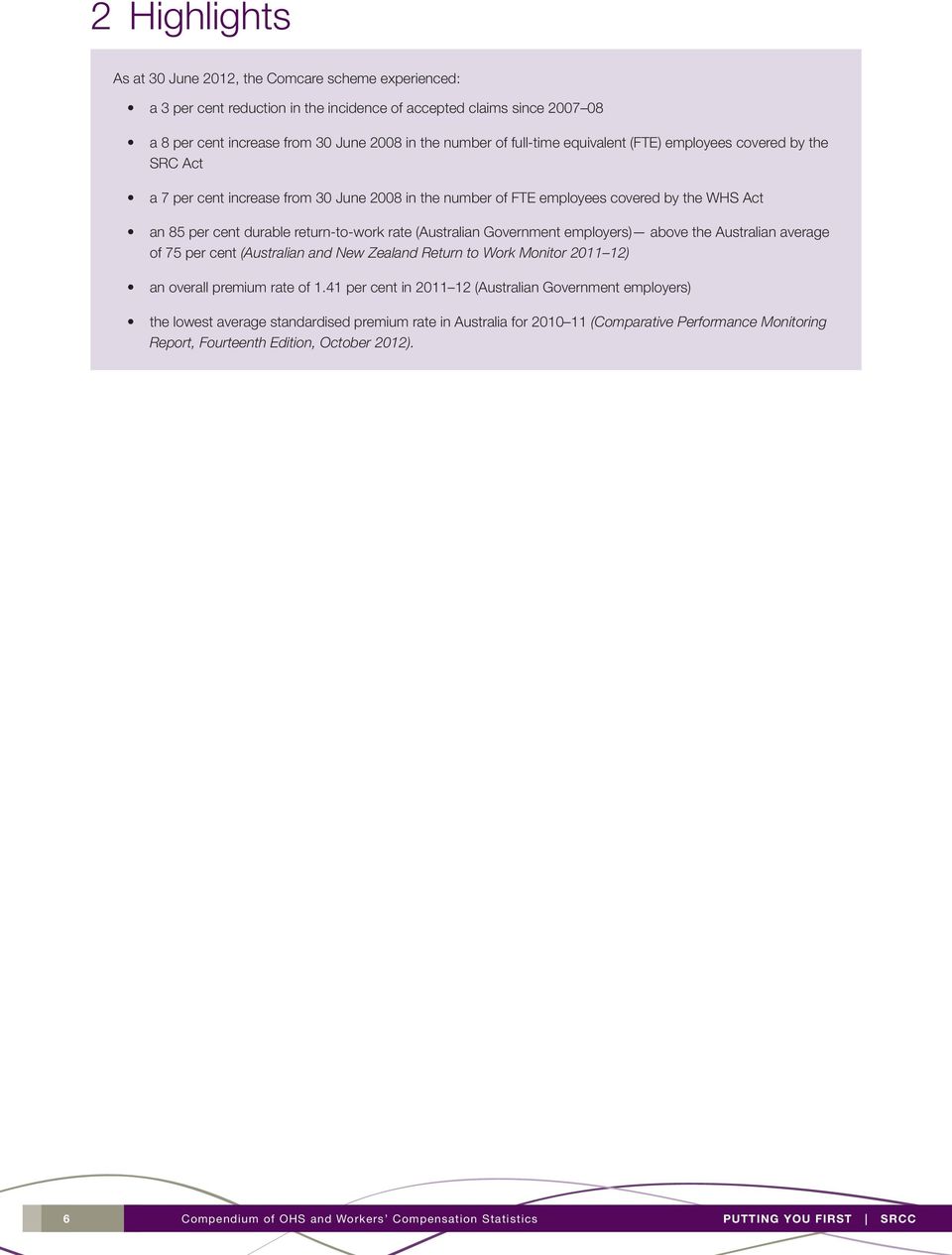
6 2 Highlights As at 30 June 2012, the Comcare scheme experienced: a 3 per cent reduction in the incidence of accepted claims since a 8 per cent increase from 30 June 2008 in the number of full-time equivalent (FTE) employees covered by the SRC Act a 7 per cent increase from 30 June 2008 in the number of FTE employees covered by the WHS Act an 85 per cent durable return-to-work rate (Australian Government employers) above the Australian average of 75 per cent (Australian and New Zealand Return to Work Monitor ) an overall premium rate of 1.41 per cent in (Australian Government employers) the lowest average standardised premium rate in Australia for (Comparative Performance Monitoring Report, Fourteenth Edition, October 2012). 6 Compendium of OHS and Workers Compensation Statistics PUTTING YOU FIRST SRCC
7 3 Coverage Figure 3.1 provides an overview of the Comcare scheme and shows the differences in coverage between the SRC Act and the WHS Act. The WHS Act covers premium payers, licensed self-insurers and the Australian Defence Force (ADF). Since 2004, ADF members, while covered by the WHS Act, are covered for workers compensation by the Military Rehabilitation and Compensation Act 2004 (MRC Act). The SRC Act covers Australian Government and ACT Government premium payers and licensed self-insurers. ACT Government employees are covered by separate ACT Government WHS legislation. Figure 3.1 Comcare scheme 2012 Commonwealth safety, rehabilitation and compensation scheme SEACARE AUTHORITY OHS(MI) Act Seafarers Act WHS Act Comcare regulator Duties of care ARC Act Australian Defence Force Licensed self-insurers Australian Government premium payers ACT Government premium MRC Act DVA manages claims* DVA meets liabilities Defence manages rehabilitation * Pre 2004 injuries determined under the SRC Act Employer protects health and safety of its employees at work Employer manages claims Employer meets liabilities Employer manages rehabilitation Employer protects health and safety of its employees at work Comcare delivers recovery and support services Comcare meets liabilities Employer manages rehabilitation Discharging of liabilities SRC Act SRCC/Comcare Co-regulators PUTTING YOU FIRST Compendium of OHS and Workers Compensation Statistics 7

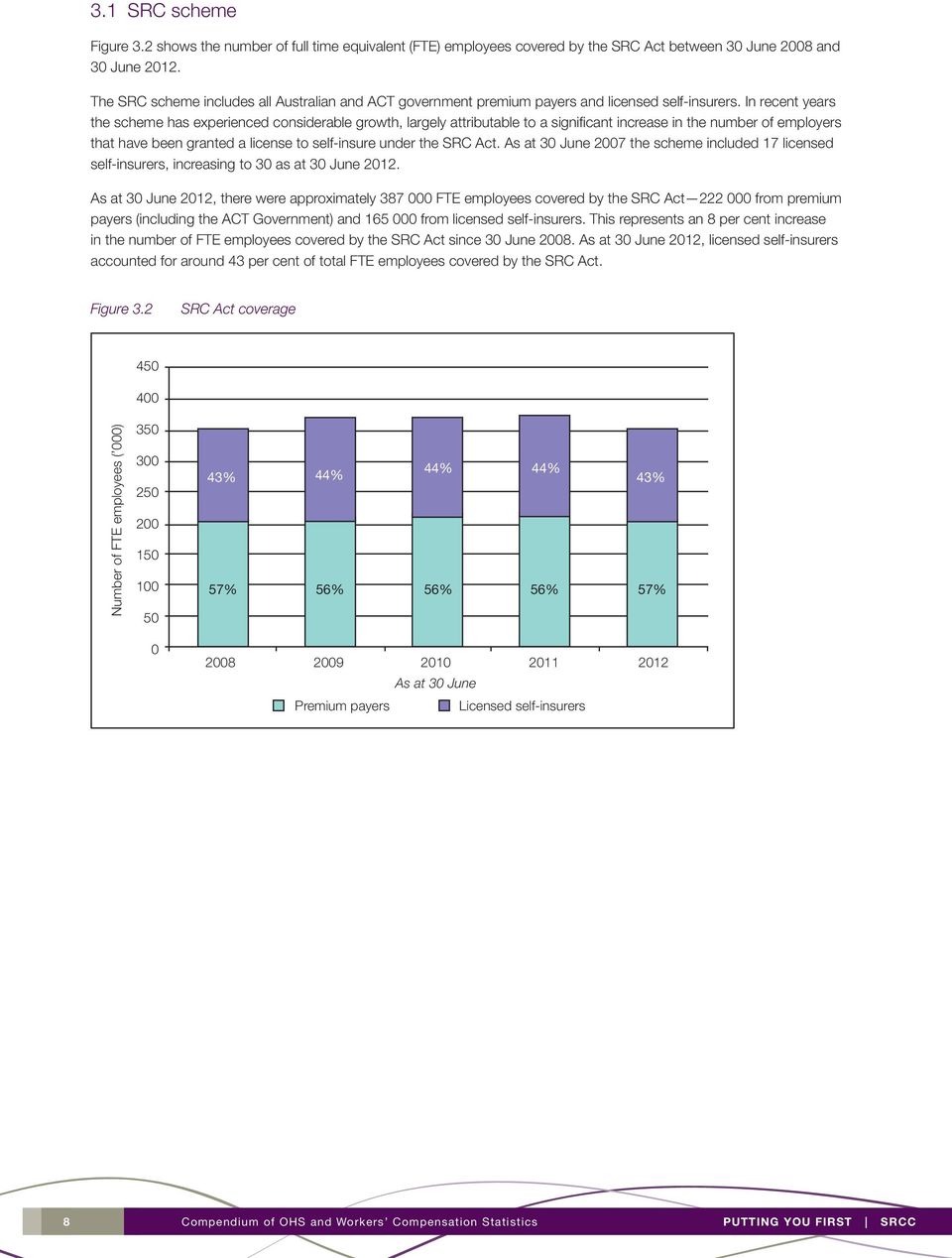
8 3.1 SRC scheme Figure 3.2 shows the number of full time equivalent (FTE) employees covered by the SRC Act between 30 June 2008 and 30 June The SRC scheme includes all Australian and ACT government premium payers and licensed self-insurers. In recent years the scheme has experienced considerable growth, largely attributable to a significant increase in the number of employers that have been granted a license to self-insure under the SRC Act. As at 30 June 2007 the scheme included 17 licensed self insurers, increasing to 30 as at 30 June As at 30 June 2012, there were approximately FTE employees covered by the SRC Act from premium payers (including the ACT Government) and from licensed self-insurers. This represents an 8 per cent increase in the number of FTE employees covered by the SRC Act since 30 June As at 30 June 2012, licensed self-insurers accounted for around 43 per cent of total FTE employees covered by the SRC Act. Figure 3.2 SRC Act coverage Number of FTE employees ( 000) % 44% 44% 44% 57% 56% 56% 56% 43% 57% As at 30 June Premium payers Licensed self-insurers 8 Compendium of OHS and Workers Compensation Statistics PUTTING YOU FIRST SRCC
9 3.2 WHS scheme Figure 3.3 shows the total number of FTE employees covered by the OHS & WHS Acts between 30 June 2008 and 30 June Employers covered by the OHS & WHS Acts include the Australian Government premium payers, licensed self-insurers and the ADF. Employers covered by the OHS & WHS Acts pay an annual contribution for the regulatory, policy and advisory functions administered by Comcare. As at 30 June 2012, approximately FTE employees were covered under the OHS & WHS Acts. This coverage consisted of FTE employees from premium payers, from licensed self-insurers and from the ADF, representing a 7 per cent increase in the number of FTE employees covered since 30 June Figure 3.3 OHS Act coverage 450 Number of FTE employees ( 000) % 39% 48% 14% 38% 48% 14% 40% 46% 14% 40% 46% 14% 39% 47% Premium payers As at 30 June Licensed self-insurers ADF PUTTING YOU FIRST Compendium of OHS and Workers Compensation Statistics 9

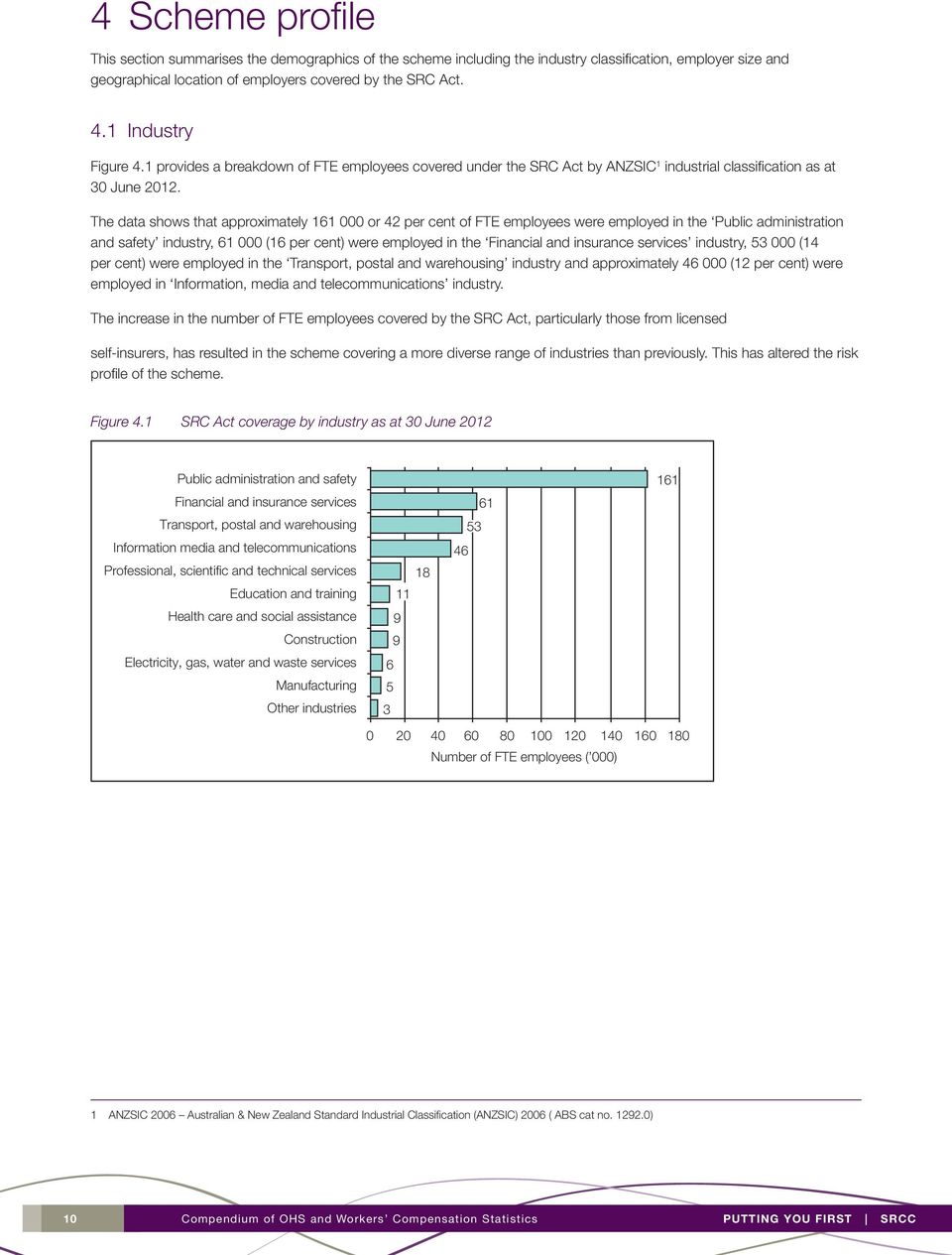
10 4 Scheme profile This section summarises the demographics of the scheme including the industry classification, employer size and geographical location of employers covered by the SRC Act. 4.1 Industry Figure 4.1 provides a breakdown of FTE employees covered under the SRC Act by ANZSIC 1 industrial classification as at 30 June The data shows that approximately or 42 per cent of FTE employees were employed in the Public administration and safety industry, (16 per cent) were employed in the Financial and insurance services industry, (14 per cent) were employed in the Transport, postal and warehousing industry and approximately (12 per cent) were employed in Information, media and telecommunications industry. The increase in the number of FTE employees covered by the SRC Act, particularly those from licensed self-insurers, has resulted in the scheme covering a more diverse range of industries than previously. This has altered the risk profile of the scheme. Figure 4.1 SRC Act coverage by industry as at 30 June 2012 Public administration and safety Financial and insurance services Transport, postal and warehousing Information media and telecommunications Professional, scientific and technical services Education and training Health care and social assistance Construction Electricity, gas, water and waste services Manufacturing Other industries Number of FTE employees ( 000) 1 ANZSIC 2006 Australian & New Zealand Standard Industrial Classification (ANZSIC) 2006 ( ABS cat no ) 10 Compendium of OHS and Workers Compensation Statistics PUTTING YOU FIRST SRCC
11 4.1.1 Australian and ACT government premium payers by industry Table 4.1 provides a breakdown of Australian and ACT Government premium payers by industry as at 30 June Of the 205 premium paying employers, 128 operated within the public administration and safety industry accounting for approximately FTE employees (74 per cent of premium payers). Public administration and safety covers the following sub-divisions: public administration (central government, state government, local government, justice and government representation) defence public order, safety and regulatory services. The remaining employees worked in a range of industries including: professional, scientific and technical services industry (eight per cent) education and training (five per cent). Table 4.1 Australian and ACT Government premium payers by industry as at 30 June 2012 Industry Number of employers Total FTE employees % of total FTE employees Public administration and safety ,000 74% Public administration ,000 61% Defence* 2 22,000 10% Public order, safety and regulatory services 3 7,000 3% Professional, scientific and technical services % Education and training % Health care and social assistance % Financial and insurance services % Information media and telecommunications % Transport, postal and warehousing % All other industries % All industries % * This comprises Defence civilians and excludes ADF personnel, who are not covered by the SRC Act. PUTTING YOU FIRST Compendium of OHS and Workers Compensation Statistics 11

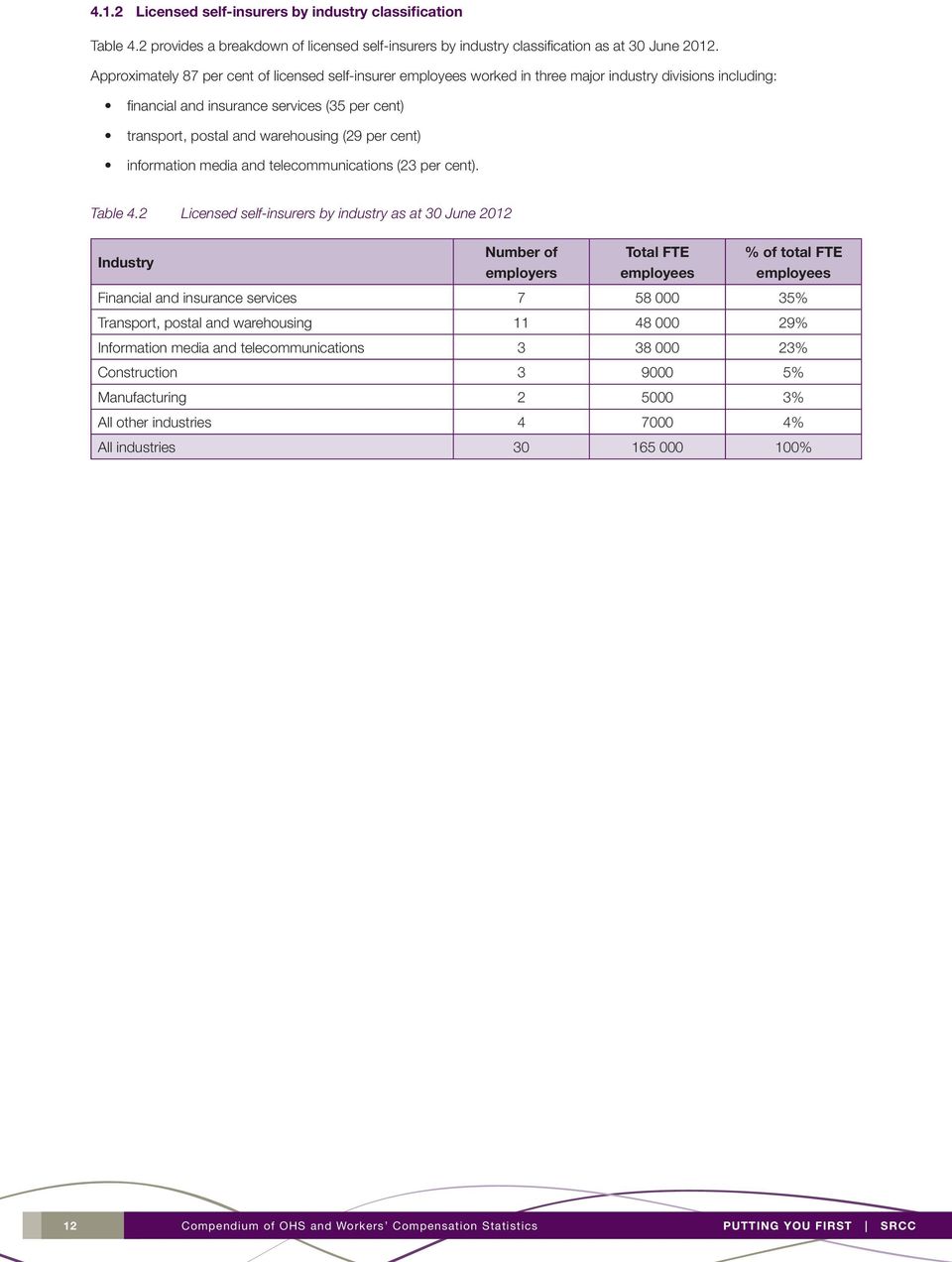
12 4.1.2 Licensed self-insurers by industry classification Table 4.2 provides a breakdown of licensed self-insurers by industry classification as at 30 June Approximately 87 per cent of licensed self-insurer employees worked in three major industry divisions including: financial and insurance services (35 per cent) transport, postal and warehousing (29 per cent) information media and telecommunications (23 per cent). Table 4.2 Licensed self-insurers by industry as at 30 June 2012 Industry Number of employers Total FTE employees % of total FTE employees Financial and insurance services % Transport, postal and warehousing % Information media and telecommunications % Construction % Manufacturing % All other industries % All industries % 12 Compendium of OHS and Workers Compensation Statistics PUTTING YOU FIRST SRCC
13 4.2 Employer size Table 4.3 provides a breakdown of employers covered by the SRC Act according to employer size (small, medium and large) as at 30 June Approximately 95 per cent of employees covered by the SRC Act worked for large employers consisting of 500 or more employees. Large employers represented approximately 40 per cent of the total number of employers in the scheme. While 36 per cent of premium payers were small employers (less than 100 employees) and 32 per cent were medium sized employers (100 to 499 employees), combined, these employed only eight per cent of all employees within premium payers. The remaining 92 per cent of employees work for large employers. Approximately 99 per cent of employees from licensed self-insurers worked for large employers. Table 4.3 SRC Act employers by size as at 30 June 2012 Employer size Small (less than 100 FTE employees) Medium (100 to 499 FTE employees) Large (500 or more FTE employees) All employers Premium payers Licensed self-insurers Scheme Number % of total Number % of total Number % of total Employers FTE employees Employers FTE employees Employers FTE employees Employers FTE employees PUTTING YOU FIRST Compendium of OHS and Workers Compensation Statistics 13

14 4.3 Location Table 4.4 shows the geographic distribution of employees covered by the SRC Act across all Australian states and territories as at 30 June Comcare has offices in each capital city (except Hobart) and in Newcastle to service the needs of the scheme. Comcare officers travel to worksites across Australia and internationally as required. As at 30 June 2012, 29 per cent of employees covered by the SRC Act were employed in NSW, with approximately 23 per cent employed in Victoria. Approximately 22 per cent of employees were employed in the ACT; however this represents 38 per cent of all employees within premium payers. These figures reflect the presence of a large number of Australian Government entities based in Canberra. Table 4.4 Scheme FTE employees by location as at 30 June 2012 State Premium payers ( 000) Licensed self-insurers ( 000) Total ( 000) % of Total NSW % Victoria % ACT % Queensland % SA % WA % Tasmania % NT % Total % 14 Compendium of OHS and Workers Compensation Statistics PUTTING YOU FIRST SRCC

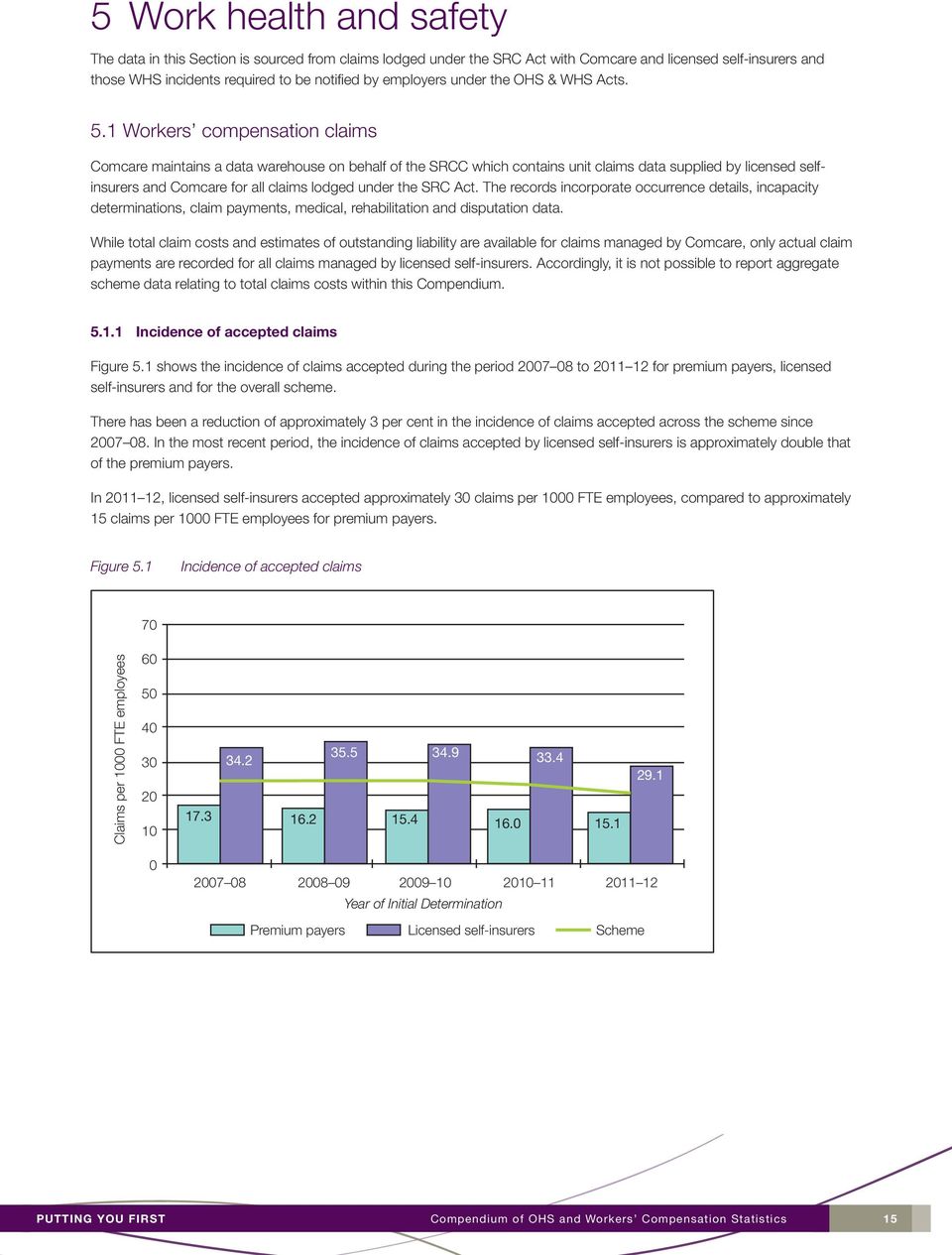
15 5 Work health and safety The data in this Section is sourced from claims lodged under the SRC Act with Comcare and licensed self-insurers and those WHS incidents required to be notified by employers under the OHS & WHS Acts. 5.1 Workers compensation claims Comcare maintains a data warehouse on behalf of the SRCC which contains unit claims data supplied by licensed selfinsurers and Comcare for all claims lodged under the SRC Act. The records incorporate occurrence details, incapacity determinations, claim payments, medical, rehabilitation and disputation data. While total claim costs and estimates of outstanding liability are available for claims managed by Comcare, only actual claim payments are recorded for all claims managed by licensed self-insurers. Accordingly, it is not possible to report aggregate scheme data relating to total claims costs within this Compendium Incidence of accepted claims Figure 5.1 shows the incidence of claims accepted during the period to for premium payers, licensed self-insurers and for the overall scheme. There has been a reduction of approximately 3 per cent in the incidence of claims accepted across the scheme since In the most recent period, the incidence of claims accepted by licensed self-insurers is approximately double that of the premium payers. In , licensed self-insurers accepted approximately 30 claims per 1000 FTE employees, compared to approximately 15 claims per 1000 FTE employees for premium payers. Figure 5.1 Incidence of accepted claims 70 Claims per 1000 FTE employees Year of Initial Determination Premium payers Licensed self-insurers Scheme PUTTING YOU FIRST Compendium of OHS and Workers Compensation Statistics 15
16 5.1.2 Claims with one day time lost Figure 5.2 shows the frequency of claims (excluding commuting claims) that first reached one day time lost during the period to In , the scheme recorded 6.2 claims with one day time lost per million hours worked a slight reduction since The higher frequency rate recorded by licensed self-insurers reflects, in part, differences in risk profile between premium payers and licensed self-insurers. Figure 5.2 Frequency of claims with one day time lost 14 Claims per million hours worked Year claim reached 1 day incapacity Premium payers Licensed self-insurers Scheme 16 Compendium of OHS and Workers Compensation Statistics PUTTING YOU FIRST SRCC

17 5.1.3 Claims with one week time lost Figure 5.3 shows the incidence rate of claims (excluding commuting claims) that first reached one week time lost during the period to Since , the incidence rate of claims that reached one week time lost increased by 9 per cent for premium payers and by 26 per cent for licensed self-insurers. Figure 5.3 Incidence of claims with one week time lost 14 Claims per 1000 FTE employees Year claim reached 1 week incapacity Premium payers Licensed self-insurers Scheme PUTTING YOU FIRST Compendium of OHS and Workers Compensation Statistics 17

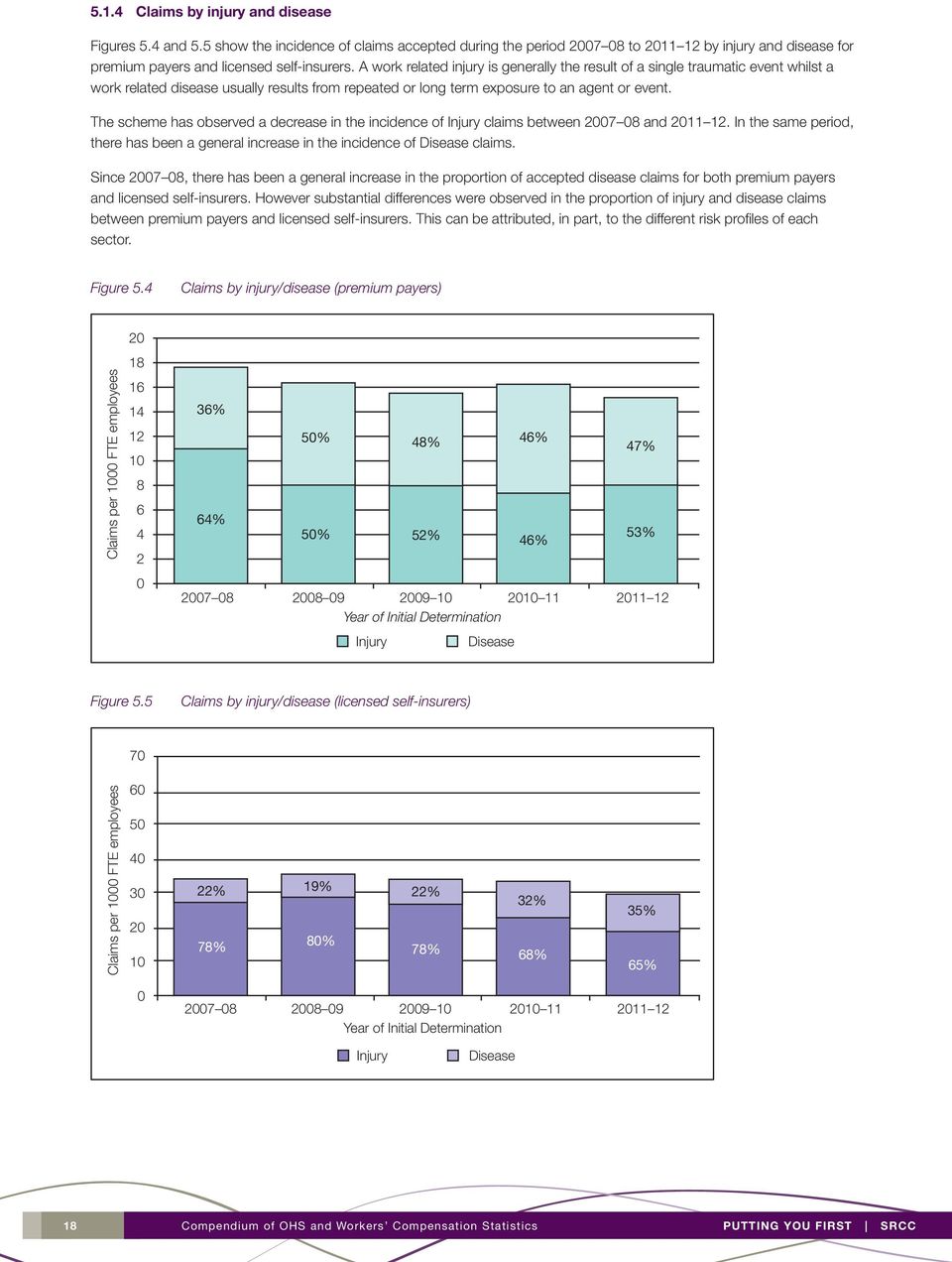
18 5.1.4 Claims by injury and disease Figures 5.4 and 5.5 show the incidence of claims accepted during the period to by injury and disease for premium payers and licensed self-insurers. A work related injury is generally the result of a single traumatic event whilst a work related disease usually results from repeated or long term exposure to an agent or event. The scheme has observed a decrease in the incidence of Injury claims between and In the same period, there has been a general increase in the incidence of Disease claims. Since , there has been a general increase in the proportion of accepted disease claims for both premium payers and licensed self-insurers. However substantial differences were observed in the proportion of injury and disease claims between premium payers and licensed self-insurers. This can be attributed, in part, to the different risk profiles of each sector. Figure 5.4 Claims by injury/disease (premium payers) Claims per 1000 FTE employees % 64% 50% 50% 48% 52% 46% 46% 47% 53% Year of Initial Determination Injury Disease Figure 5.5 Claims by injury/disease (licensed self-insurers) 70 Claims per 1000 FTE employees % 78% 19% 80% 22% 78% 32% 68% 35% 65% Year of Initial Determination Injury Disease 18 Compendium of OHS and Workers Compensation Statistics PUTTING YOU FIRST SRCC
19 5.1.5 Claims by mechanism of incident Figure 5.6 shows the percentage of claims by mechanism of incident for claims accepted during for both premium payers and licensed self-insurers. The mechanism of incident identifies the overall action, exposure or event that best describes the circumstances that resulted in the most serious injury or disease. Body stressing was the most prevalent mechanism of incident over the reporting period. During around half of all accepted claims for both premium payers and licensed self-insurers were due to body stressing. Falls, trips and slips also represented a significant proportion of claims, accounting for 20 per cent of premium payers claims and 16 per cent of licensed self-insurers claims. Being hit by moving objects accounted for eight per cent of premium payers and 12 per cent of licensed self-insurers claims. Mental stress was a significant cause of claims for premium payers, accounting for 11 per cent of claims, compared to 2 per cent of claims for licensed self-insurers. Figure 5.6 Claims by mechanism of incident Percentage of accepted claims 50% 45% 40% 35% 30% 25% 20% 15% 10% 5% 0% 47% 46% Body Stressing 20% 16% Falls, trips and slips 11% 2% Mental stress 12% 8% Hit by moving objects Hitting objects with body Premium payers Licensed self-insurers 5% 7% 4% 13% Vehicle incidents and other 6% 5% All other Mechanism of Incident PUTTING YOU FIRST Compendium of OHS and Workers Compensation Statistics 19

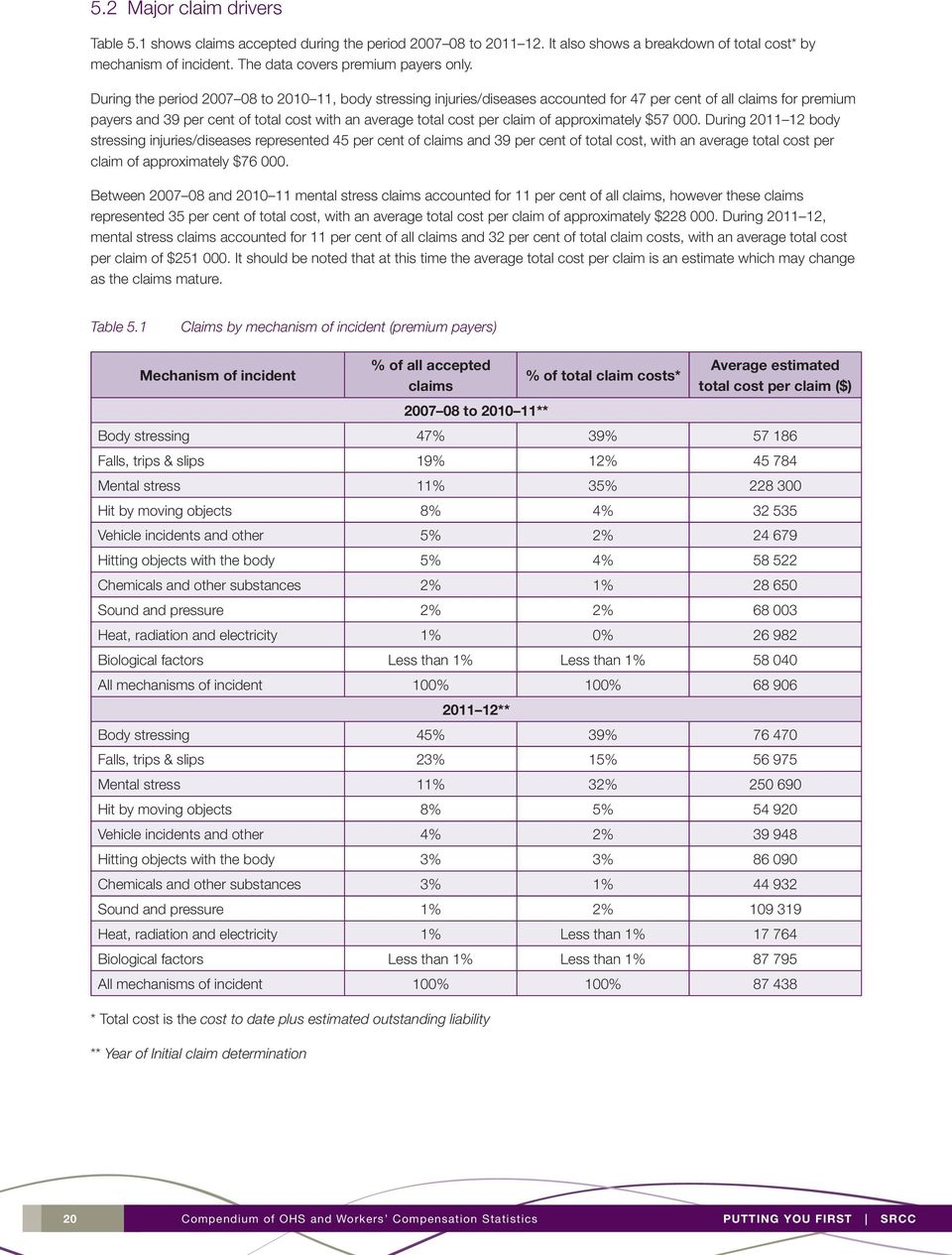
20 5.2 Major claim drivers Table 5.1 shows claims accepted during the period to It also shows a breakdown of total cost* by mechanism of incident. The data covers premium payers only. During the period to , body stressing injuries/diseases accounted for 47 per cent of all claims for premium payers and 39 per cent of total cost with an average total cost per claim of approximately $ During body stressing injuries/diseases represented 45 per cent of claims and 39 per cent of total cost, with an average total cost per claim of approximately $ Between and mental stress claims accounted for 11 per cent of all claims, however these claims represented 35 per cent of total cost, with an average total cost per claim of approximately $ During , mental stress claims accounted for 11 per cent of all claims and 32 per cent of total claim costs, with an average total cost per claim of $ It should be noted that at this time the average total cost per claim is an estimate which may change as the claims mature. Table 5.1 Claims by mechanism of incident (premium payers) Mechanism of incident % of all accepted claims to ** % of total claim costs* Average estimated total cost per claim ($) Body stressing 47% 39% Falls, trips & slips 19% 12% Mental stress 11% 35% Hit by moving objects 8% 4% Vehicle incidents and other 5% 2% Hitting objects with the body 5% 4% Chemicals and other substances 2% 1% Sound and pressure 2% 2% Heat, radiation and electricity 1% 0% Biological factors Less than 1% Less than 1% All mechanisms of incident 100% 100% ** Body stressing 45% 39% Falls, trips & slips 23% 15% Mental stress 11% 32% Hit by moving objects 8% 5% Vehicle incidents and other 4% 2% Hitting objects with the body 3% 3% Chemicals and other substances 3% 1% Sound and pressure 1% 2% Heat, radiation and electricity 1% Less than 1% Biological factors Less than 1% Less than 1% All mechanisms of incident 100% 100% * Total cost is the cost to date plus estimated outstanding liability ** Year of Initial claim determination 20 Compendium of OHS and Workers Compensation Statistics PUTTING YOU FIRST SRCC
21 5.2.1 Body stressing Figure 5.7 shows the incidence of body stressing claims accepted during the period to This data shows that these claims across the scheme has remained somewhat steady, with the claims incidence being considerably lower for Premium payers than for licensed self-insurers. the most recent data suggests trends are improving. Figure 5.7 Incidence of body stressing claims 18 Claims per 1000 FTE employees Year of Initial Determination Premium payers Licensed self-insurers Scheme Figure 5.8 shows that since , despite an increase in the average total cost* of accepted body stressing claims, the average total cost of these claims remained well below that of mental stress claims but higher than for all other claims. The increase in the average total cost of body stressing claims, shown in Table 5.1, may be due to the increased complexity of body stressing claims. Latest estimates indicate that the average total cost of body stressing claims is approximately $ per claim. The data below covers premium payers only as total claim costs are not available for licensed self-insurers and includes mental stress claims as a comparison. Figure 5.8 Average total cost* of body stressing claims (premium payers) Average estimated total claim cost* $( 000) Year of Initial Determination Accepted body stressing claims Accepted mental stress claims Accepted other claims (excl. body stressing and mental stress) * Total cost is the cost to date plus estimated outstanding liability PUTTING YOU FIRST Compendium of OHS and Workers Compensation Statistics 21
22 Figure 5.9 shows a breakdown, by mechanism of incident, of body stressing claims accepted during for both premium payers (1480 claims) and licensed self-insurers (2335 claims). Significant differences in the mechanism of incident sub-groups for body stressing claims between premium payers and licensed self-insurers are apparent. Approximately 50 per cent of body stressing claims for premium payers were due to repetitive movement with low muscle loading, with a further 24 per cent due to muscular stress with while lifting, carrying or putting down objects. Repetitive movement with low muscle loading was less significant for licensed self-insurers, with only 13 per cent of body stressing claims attributed to this cause. The predominant cause of body stressing claims for licensed self-insurers was muscular stress while lifting, carrying or putting down objects and muscular stress while handling objects (other than lifting, carrying or putting down), which accounted for 40 per cent and 34 per cent respectively of all body stressing claims for licensed self-insurers. Figure 5.9 Body stressing claims by mechanism of incident Initially accepted in Muscular stress while lifting, carrying or putting down objects 1281 Repetitive movement, low muscle loading 1010 Muscular stress while handling objects excluding lift, carry, putting down 943 Muscular stress with no objects being handled Number of Claims Premium payers Licensed self-insurers Figure 5.10 shows a breakdown of body stressing claims accepted during by occupation group. Clerical and administration workers accounted for the largest number of body stressing claims (approximately 43 per cent of all body stressing claims across the scheme). Licensed self-insurers also recorded a significant number of body stressing claims in the machinery operators and drivers, technicians and trades workers and labourers occupational groups. Figure 5.10 Body stressing claims by occupation Initially accepted in Clerical and administrative 1637 Machinery operators/drivers 748 Technicians/trade workers 429 Professionals Labourers Community/personal service Managers Sales workers Number of Claims Premium payers Licensed self-insurers 22 Compendium of OHS and Workers Compensation Statistics PUTTING YOU FIRST SRCC
23 5.2.2 Mental stress Figure 5.11 shows the incidence of mental stress claims accepted during the period to During the period to the incidence of mental stress claims across the scheme remained stable. In the incidence of mental stress claims across the scheme increased, but in the most recent period the incidence decreased by 14 per cent. The incidence of mental stress claims has been consistently lower for licensed self-insurers than for premium payers in the scheme. Figure 5.11 Incidence of mental stress claims 3.0 Claims per 1000 FTE employees Year of Initial Determination Premium payers Licensed self-insurers Scheme Figure 5.12 shows that the average total cost* of accepted mental stress claims remained high compared to all other claims. Latest estimates indicate that the average total cost of mental stress claims was approximately $ The data below covers premium payers only as total claim costs are not available for licensed self-insurers. Figure 5.12 Average total cost* of mental stress claims (premium payers) Average total claim cost* $( 000) Year of Initial Determination Mental stress All claims (excl. mental stress) * Average total cost is the cost to date plus estimated outstanding liability PUTTING YOU FIRST Compendium of OHS and Workers Compensation Statistics 23
24 Figure 5.13 shows a breakdown, by mechanism of incident, of the number of mental stress claims accepted during for both premium payers (367 claims in total) and licensed self-insurers (79 claims in total). This figure shows the similarities in the mechanism of incident sub-groups for mental stress claims between premium payers and licensed self-insurers. For both premium payers and licensed self-insurers, the most significant sub-group for mental stress claims was work related harassment and/or bullying (44 and 30 per cent of claims respectively). This was followed by work pressure (34 and 27 per cent of claims respectively). However, licensed self-insurers when compared to premium payers had higher proportions of claims in the sub-groups of exposure to workplace and/or occupational violence (20 per cent of claims compared to 10 per cent respectively) and exposure to traumatic event (16 per cent of claims compared to 7 per cent of claims respectively). Figure 5.13 Mental stress claims by mechanism of incident Initially accepted in Work related harassment and/or bullying 186 Work pressure 147 Exposure to workplace or occupational violence 51 Exposure to traumatic event 38 Other mental stress factors Number of Claims Premium payers Licensed self-insurers Figure 5.14 shows the number of mental stress claims accepted during by occupation group. The largest number of claims for premium payers was for employees classified as clerical and administration workers followed by professionals, community and personal service workers and managers. The largest number of mental stress claims for licensed self-insurers was also for clerical and administration workers with the second highest groups being machinery operators and drivers and managers. Figure 5.14 Mental stress claims by occupation Initially accepted in Clerical and administration Managers Professionals 50 Community/personal service Technical/trade workers Machinery operators/drivers Labourers Sales workers Premium payers Number of Claims Licensed self-insurers 24 Compendium of OHS and Workers Compensation Statistics PUTTING YOU FIRST SRCC
25 5.3 Claim characteristics Claims by mechanism of incident and gender Figure 5.15 and 5.16 show the percentage distribution of claims accepted during by mechanism of incident and gender. For premium payers, males accounted for approximately 40 per cent of all claims related to falls, trips and slips and body stressing, while for licensed self-insurers, males accounted for approximately 80% of claims related to falls, trips and slips and body stressing. The data presented in Figure 5.15 and 5.16 are actual claim numbers and do not take into account the relative proportion of male and female workers employed by the premium payers and licensed self-insurers. In general, there are a greater population of males employed with licensed self-insurers that with in premium payers. Note: The category all other mechanisms of incidents includes biological factors, sound and pressure, heat, electricity and other environmental factors and chemicals and other substances. Figure 5.15 Claims by mechanism of incident initially accepted in (Males) Number of claims Premium payers male Licensees male Body Stressing Falls, trips and slips Mental stress Hit by moving objects All other Hitting mechanisms objects with of incident body Vehicle incidents and other Mechanism of Injury Figure 5.16 Claims by mechanism of incident initially accepted in (Females) Number of claims Premium payers female Licensees female Body Stressing Falls, trips and slips Mental stress Hit by moving objects All other Hitting mechanisms objects with of incident body Vehicle incidents and other Mechanism of Injury PUTTING YOU FIRST Compendium of OHS and Workers Compensation Statistics 25
26 5.3.2 Claims by age group (Australian Government premium payers) Figure 5.17 shows the estimated incidence of claims accepted during the period to by age group. The data covers claims for Australian Government premium payers only as age distribution data is not available for licensed self-insurers or the ACT Government. The incidence rates shown below were estimated using age distribution data for the Australian Public Service 2 which accounts for approximately 80 per cent of workers employed within premium payers. The data shows an overall reduction in the incidence of claims for all age groups during the period to , with the exception of the over 55 age group which has experienced increasing claims incidence since Figure 5.17 Estimated incidence of claims by age group (Australian Government premium payers) Claims per 1000 FTE employees Year of Initial Determination Under and over 2 Australian Public Service Commission, State of the Service Report Compendium of OHS and Workers Compensation Statistics PUTTING YOU FIRST SRCC
27 5.3.3 Claims by mechanism of incident and age group (Australian Government premium payers) Figure 5.18 shows the estimated incidence of claims accepted during by mechanism of incident and age group. The data covers claims for Australian Government premium payers only as age distribution data is not available for licensed self-insurers and the ACT Government. The incidence rates shown below were estimated using age distribution data for the Australian Public Service 3 which accounts for approximately 80 per cent of workers employed within premium payers. The data shows that the incidence of claims for body stressing peaks for those working aged 45 and over. The incidence of claims for falls, trips and slips and mental stress generally increases with age, with the over 55 age group having the highest incidence of claims in these two categories. Figure 5.18 Estimated incidence of claims with one week time lost by mechanism of incident and age group (Australian Government premium payers) Claims per 1000 FTE employees Body stressing Falls, trips and slips Under Hit by moving objects Vehicle incidents and other Mechanism of Injury Hitting object with body Mental stress All other 55 and over Average 3 Australian Public Service Commission, State of the Service Report PUTTING YOU FIRST Compendium of OHS and Workers Compensation Statistics 27
28 5.3.4 Average estimated total cost of claims by age (Australian Government premium payers) Figure 5.19 shows the average total cost* of claims accepted during by age group. The data covers claims for Australian Government premium payers only as age distribution data is not available for licensed self-insurers or the ACT Government. The incidence rates shown below were estimated using age distribution data for the Australian Public Service 4 which accounts for approximately 80 per cent of workers employed within premium payers. The data indicates that the age groups years and have the highest average total cost of claims. Figure 5.19 Average estimated total cost* of claims by age (Australian Government premium payers) Average total claim cost* $( 000) Under and over Average of all claims * Total cost is the cost to date plus estimated outstanding liability 4 Australian Public Service Commission, State of the Service Report Compendium of OHS and Workers Compensation Statistics PUTTING YOU FIRST SRCC
29 5.4 Prevention targets The Comcare scheme has a safety focus and regulatory philosophy that seeks to work with employers and their employees to prevent injuries in the workplace. The National OHS Strategy , endorsed by the Workplace Relations Ministers Council, incorporates two national targets designed to create safer workplaces in Australia. The first target seeks a reduction in the incidence of work-related deaths, with a reduction of at least 20 per cent by 30 June The second national target seeks to reduce the incidence of workplace injury by at least 40 per cent by 30 June The SRCC adopted the national targets but went further by extending the injury target to include work-related disease and established an aspirational zero target for work-related injury deaths. The scheme performance reported in this section is for Australian Government premium payers and licensed self-insurers Claims with one week time lost Performance against the SRCC s ten-year injury/disease target is based on the incidence of claims (excluding commuting claims) that first reached one week time lost during the period to (Australian Government premium payers and licensed self-insurers). Figure 5.20 shows performance against the ten-year scheme target. While the scheme s performance was 8.3 claims per 1000 FTE employees a 27 percent improvement since , it was above the target of 6.8 claims per 1000 FTE employees. To have achieved this target, a 40 per cent reduction was required by 30 June Figure 5.20 Claims with one week time lost (Australian Government premium payers and licensed self-insurers) Claims per 1000 FTE employees Result Target Year claim reached 1 week time lost PUTTING YOU FIRST Compendium of OHS and Workers Compensation Statistics 29
30 5.4.2 Deaths The number of deaths reported in Table 5.2 is based on accepted claims lodged under the SRC Act (i.e. compensated deaths) for Australian Government premium payers and licensed self-insurers. The number of compensated deaths reported may not correlate with the number of notified deaths in each year. This is due to the different statutory definitions which apply to compensated deaths (claims under the SRC Act) compared to notifiable deaths (notified under the OHS & WHS Acts). For example, incidents resulting in bystander deaths are included as notifiable deaths under the OHS & WHS Acts, whereas compensated deaths only relate to employees under the SRC Act. Three injury death claims were accepted by the scheme during The Commission s aspirational target of zero injury deaths was therefore not achieved. Two injury death claims were reported by Australian Government premium payers and one death was reported by licensed self-insurers. The scheme has not succeeded in meeting the zero injury death target in any year since its introduction in While not contributing to performance against the scheme target, 13 disease death claims were also reported by the scheme in Eight of these deaths were reported by premium payers and five were reported by licensed self-insurers. Table 5.2 Compensated deaths (Australian Government premium payers and licensed self-insurers) Australian Government premium payers Injury Disease Commuting Licensed self-insurers Injury Disease Commuting Total Injury Disease Commuting Compendium of OHS and Workers Compensation Statistics PUTTING YOU FIRST SRCC
31 5.5 Notifications of WHS incidents The OHS & WHS Acts cover Australian Government premium payers, licensed self-insurers and members of the ADF. Under the superseded OHS Act, employers are required to notify Comcare of incidents that result in a death, serious personal injury, specified incapacity or a dangerous occurrence. Under the new WHS Act, employers are required to notify Comcare of incident that result in death, serious injury or illness or dangerous incident. An incident is notifiable if it arose out of the conduct of the employer s undertaking, or out of work performed by an employee in connection with the undertaking. Death, serious injury or illness and dangerous incident notifications relate to both employees and non-employees Notification incidence rate Figure 5.21 shows the incidence of WHS notifications during the period to , reported as a rate per 1000 FTE employees, with the exception of death notifications, which are reported per FTE employees. Compared to the outcome, there was a 56 per cent overall decrease in the incidence of notifications for the scheme during This decrease was driven by a 69 per cent reduction in the incidence of dangerous occurrence notifications. Some of that can be explained by moving to the WHS Act and employers coming to terms with the new thresholds in which to notify. Compared to , the incidence of notifications relating to deaths was higher during The majority of notifications over the five reporting periods related to dangerous occurrences, which comprised approximately 22 per cent of all notifications during (excluding deaths). Figure 5.21 Notifications incidence rate (scheme) Notifications (excluding deaths) per 1000 FTE employees Notified deaths per FTE employees Employee incapacity Serious personal injury Dangerous occurence Total notifications Deaths PUTTING YOU FIRST Compendium of OHS and Workers Compensation Statistics 31
32 5.5.2 Notifications by mechanism of incident Table 5.3 shows a breakdown of WHS incident notifications received by Comcare during from premium payers and licensed self-insurers by mechanism of incident. Overall, being hit by moving objects accounted for 21 per cent of all notifications, followed by vehicle incidents and other (18 per cent), mental stress (16 per cent) and falls, strips and slips of a person (15 per cent). The largest number of notifications received by Comcare related to dangerous occurrences and dangerous incident, with 2,257 notifications in total. Dangerous occurrences are defined as incidents at a workplace that resulted from operations that could have caused (but did not cause) a death or serious personal injury to any person or total incapacity of an employee for 30 or more consecutive shifts or days, (now referred as Dangerous Incident under the WHS Act). Of these, 23 per cent related to being hit by moving objects, 18 per cent related to vehicle incidents and other and 15 per cent related to mental stress. A serious personal injury is defined as an injury or disease caused in the course of work for which the injured person required emergency treatment by a registered medical practitioner (including psychologist), or treatment in a hospital, with or without being admitted to the hospital. The definition of a serious personal injury was tightened in the WHS Act and is now referred to as Serious Injury or Illness. Approximately 22 per cent of serious personal injury notifications related to falls, trips and slips of a person, 18 per cent related to being hit by moving objects and 16 per cent to vehicle incidents and other. An incident that is likely to result in work-related incapacity, leaving an employee unable to work for 30 or more successive shifts or 30 or more successive working days (depending on working arrangements), is notifiable under the OHS Act. Approximately 40 per cent of incapacity notifications related to body stressing, 33 per cent to mental stress and 7 per cent related to both falls, trips and slips of a person. The number of notified deaths reported in this section is based on the number of notifications received under the OHS Act/WHS Act. The number of notified deaths reported may not correlate with the number of compensated deaths in each year. This is due to the different statutory definitions which apply to notifiable deaths (notified under the OHS Act/WHS Act) compared to compensated deaths (claims under the SRC Act). For example, incidents resulting in bystander deaths are included as notifiable deaths under the OHS Act/WHS Act. By comparison, compensated deaths only relate to employees under the SRC Act. Table 5.3 Notifications by mechanism of incident (scheme) Mechanism of incident Death Employee incapacity Dangerous incident/ Dangerous occurrence Incident type Serious injury or illness/ Serious personal injury Total % of all notifications Being hit by moving objects % Vehicle incidents and other % Mental stress % Falls, trips and slips of a person % Heat, electricity and other environmental factors % Chemicals and other substances % Hitting objects with a part of the body % Body stressing % Biological factors % Sound and pressure % All mechanisms of incident % 32 Compendium of OHS and Workers Compensation Statistics PUTTING YOU FIRST SRCC
33 6 Claims management The Comcare workers compensation scheme is a no fault scheme, with limited access to common law. This means that an injured employee does not have to prove negligence on behalf of the employer to be eligible to receive compensation for a work-related injury/disease. The scheme provides employees who have an accepted claim for work-related injury or illness access to: compensation for time off work for 45 weeks at one hundred per cent of their pre injury salary level (normal weekly earnings) and a reduced rate thereafter until age 65 (or 104 weeks if injured after 63 years of age), if their injury precludes them from working reasonable rehabilitation support /return-to-work assistance at no cost to the individual payment by way of lump sum for any permanent impairment death and funeral benefits for dependants and weekly benefits for dependent children. 6.1 Process For compensation to be payable under the SRC Act, Comcare must find that liability exists for an employee s injury or illness. Comcare considers the following factors in determining liability for compensation: Compliance with certain conditions specified in the SRC Act, including submission of a written claim on the approved form and provision of a medical certificate identifying an injury or disease. In circumstances where the claim is not compliant, further information may be sought by Comcare Employment relationship Whether the injury arose out of or in the course of employment or, if a disease, a significant contribution by employment Medical evidence Exclusionary provisions specified in the SRC Act including that compensation is not payable where the injury disease or aggravation: was suffered as a result of reasonable administrative action taken in a reasonable manner in relation to the employee s employment was self-inflicted was a result of serious or wilful misconduct occurred during a break or when commuting to and from work Compensation is payable in those circumstances where the injury results in permanent impairment or death. PUTTING YOU FIRST Compendium of OHS and Workers Compensation Statistics 33
34 Figure 6.1 provides an overview of the Comcare claims lodgement and determination process. Note that this is an abridged version for general guidance purposes only. Figure 6.1 Comcare claim lodgement and determination process Worker injured or ill Claim lodged with Comcare Is claim compliant? NO Further information sought YES Claim rejected NO Have the required factors been met? YES Claim accepted Payments 34 Compendium of OHS and Workers Compensation Statistics PUTTING YOU FIRST SRCC
35 The SRC Act provides employees and employers with access to a two-tiered review process. Employees or employers may choose to request a review if they are dissatisfied with a decision on claim liability made by a determining authority (Comcare or a licensed self insurer). An employee may also request a review of a decision made by their rehabilitation authority (employer) in relation to the rehabilitation. The first tier involves a request for reconsideration by the determining authority. This requires the decision to be reconsidered by a person within that authority who was not involved in making the original decision. Comcare may also reconsider a matter of its own motion where it considers the original determination was incorrect or if it receives information that changes its view of the original determination. Once a reconsideration has been completed, that decision then becomes a reviewable decision and either the employee or the employer may choose to apply to the Administrative Appeals Tribunal (AAT) for an external review. Once the AAT has undertaken a review, the reviewable decision is either affirmed, revoked or varied. If a party to an AAT review disagrees with the AAT s decision, that party can appeal to the Federal Court in respect of an error of law (for example misapplication of the law). If the Federal Court finds that such an error has been made, the Court may order that the matter be remitted back to the AAT to be reheard with directions. Decisions of the Federal Court may be further appealed on points of law to the Full Court of the Federal Court (consisting usually of 3 judges), and to the High Court by way of an application for special leave to appeal. Figure 6.2 provides an overview of the review and reconsideration process. Figure 6.2 Claim reconsideration and review process Claim determined Injured worker/employer satisfied? NO Determining authority reconsideration Reviewable decision External Review AAT Appeal affirmed/revoked/varied Federal Court Appeal allowed/disallowed High Court Appeal allowed/disallowed PUTTING YOU FIRST Compendium of OHS and Workers Compensation Statistics 35
36 6.2 Claims summary Claims determined Figure 6.3 shows the incidence of claims determined (i.e. claims accepted and rejected) during the period to The data shows there has been an increase of approximately 6 per cent in the incidence of claims determined across the scheme; within the last year there has been a 16% reduction in the most recent period. Comcare premium payers experienced a 17 per cent decrease in the incidence of claims determined, from approximately 22 claims per 1000 FTE employees during to approximately 18 claims per 1000 FTE employees determined during The data shows that licensed self-insurers had a 3 per cent increase in the incidence of claims determined from approximately 34 claims per 1000 FTE employees during to 36 claims per 1000 FTE employees during Since , the incidence of claims determined by licensed self-insurers has remained almost double that for premium paying employers. Figure 6.3 Incidence of claims received and determined Claims determined per 1000 FTE employees Year of Initial determination Premium payers Licensed self-insurers Scheme 36 Compendium of OHS and Workers Compensation Statistics PUTTING YOU FIRST SRCC
37 6.2.2 Claims acceptance rate Figure 6.4 shows the percentage of claims determined during the period to that were accepted for premium payers, licensed self-insurers and the scheme. This includes claims that were accepted following reconsideration or review. This data is subject to development as claims may still be in the review process. In , 85 per cent of claims determined were accepted by the scheme. Since , licensed self-insurers have accepted a higher proportion of claims than Comcare (i.e. for premium paying employers). Figure 6.4 Claims acceptance rate 100 Percentage of determined claims % 85% 84% 87% 83% 88% 85% 88% 84% 86% Year of Initial Determination Premium payers Licensed self-insurers Scheme PUTTING YOU FIRST Compendium of OHS and Workers Compensation Statistics 37
38 6.3 Determinations Table 6.1 shows the average time taken to determine new claims, from date of receipt, for all claims determined in the period to The data shows significant differences in the claim determination time between Comcare and licensed self-insurers. However in the most recent period, the performance of Comcare has improved, particularly in relation to injury claims. The structural differences between Comcare and licensed self-insurers make it difficult for Comcare to compare against self-insurers. Comcare is not the employer in the majority of claims and must rely on information provided by premium paying employers. It should also be noted that disease and psychological claims take longer to determine than injury claims, due to their greater complexity. Table 6.1 Average time (calendar days) to determine claims Comcare (premium payers) Licensed self-insurers Scheme Nature of claim Injury Disease (excl Psych) Psychological Injury Disease (excl Psych) Psychological Injury Disease (excl Psych) Psychological Compendium of OHS and Workers Compensation Statistics PUTTING YOU FIRST SRCC
39 6.4 Reconsiderations Table 6.2 provides data relating to requests for reconsideration decided during the period to The table also shows the percentage of determining authorities original decisions which were upheld following a request for reconsideration (affirmation rate). The data shows that the number of reconsideration requests has fallen by 22% since The average time taken to decide requests for reconsideration has increased each financial year since The affirmation rate for both Comcare and licensed self-insurers remained relatively stable over the period to Table 6.2 Requests for reconsiderations decided Number of requests decided Comcare (premium payers) Licensed self-insurers Scheme Comcare (premium payers) * Licensed self-insurers Scheme Average time (calendar days) to decide requests for reconsideration Injury Disease (excl Psych) Psychological Injury Disease (excl Psych) Psychological Injury Disease (excl Psych) Psychological Affirmation rate at reconsideration Comcare (premium payers) 72% 72% 69% 70% 68% Licensed self-insurers 77% 80% 80% 80% 78% Scheme 74% 76% 74% 75% 73% * Based on the number of calendar days from the date of commencement of the reconsideration to the decision date for a reviewable decision. A delay between receipt and commencement of a review may occur when the injured worker has indicated they will follow-up their request for reconsideration at a later date with further evidence (e.g. additional medical report) to support their claim. PUTTING YOU FIRST Compendium of OHS and Workers Compensation Statistics 39
40 6.5 AAT reviews Tables 6.3 and 6.4 show the number of Administrative Appeals Tribunal (AAT) applications finalised during and for premium payers and licensed self-insurers. The data in Table 6.3 shows that the number of applications to the AAT that were finalised decreased by 25 per cent for premium payers from 504 during to 376 during Fifty four per cent of Comcare s original decisions were affirmed without variation during Table 6.3 Outcome of applications to the AAT (premium payers)* Outcome of applications Applications heard and determined by the Tribunal No. of applications finalised No. of original decisions affirmed No. of original decisions set aside or varied Affirmation rate % Applications finalised by consent % Applications dismissed by consent 1 1 n/a n/a Applications withdrawn by applicant n/a n/a Other applications dismissed, etc 8 8 n/a n/a Outcome of all applications % Applications heard and determined by the Tribunal % Applications finalised by consent % Applications dismissed by consent 0 0 n/a n/a Applications withdrawn by applicant n/a n/a Other applications dismissed, etc 8 8 n/a n/a Outcome of all applications % * Based on data supplied by the Administrative Appeals Tribunal 40 Compendium of OHS and Workers Compensation Statistics PUTTING YOU FIRST SRCC
41 Table 6.4 shows the outcome of applications to the AAT for licensed self-insurers. The number of applications finalised decreased by fifteen per cent from 770 during to 657 during The percentage of licensed self-insurers original decisions affirmed without variation was 66 per cent during Table 6.4 Outcome of applications to the AAT (licensed self-insurers)* Outcome of applications Applications heard and determined by the Tribunal No. of applications finalised No. of original decisions affirmed No. of original decisions set aside or varied Affirmation rate % Applications finalised by consent % Applications dismissed by consent 3 3 n/a n/a Applications withdrawn by applicant n/a n/a Other applications dismissed, etc 8 8 n/a n/a Outcome of all applications % Applications heard and determined by the Tribunal % Applications finalised by consent % Applications dismissed by consent 6 6 n/a n/a Applications withdrawn by applicant n/a n/a Other applications dismissed, etc n/a n/a Outcome of all applications % * Based on data supplied by the Administrative Appeals Tribunal PUTTING YOU FIRST Compendium of OHS and Workers Compensation Statistics 41
42 7 Rehabilitation and Return-to-Work A key objective of the Comcare scheme is the early and safe return to work of injured employees covered by the scheme. While employers are responsible for managing the rehabilitation and return to work of their injured or ill employees, Comcare provides support and advice to employers on how to manage their responsibilities. Rehabilitation and return to work programs are based on the principles that intervention should occur as soon as practical after injury or disease and that the employer can enable a coordinated return to work. An employer providing early intervention and rehabilitation sends a strong message that the workplace values the employee s contribution and sets an expectation of early return to work. Figure 7.1 sets out the steps in the return-to-work (RTW) process. Figure 7.1 Steps in the return-to-work process Supervisor becomes aware of injury and meets with the employee to discuss prevention of further injury Supervisor notifies case manager Case manager decides if further assessment needs to be taken (s.36) YES assessment required Case manager refers to an approved rehab provider (ARP), legally qualified medical practitioner or panel for assessment NO assessment not required Case manager initiates RTW planning based on medical advice and in consultation with the employee and supervisor (s.37) RTW program developed to assist injured employee to RTW quickly and safely Case manager, ARP and doctor monitor and review implementation of RTW plan When employee returns to work, case manager closes plan 42 Compendium of OHS and Workers Compensation Statistics PUTTING YOU FIRST SRCC
43 7.1 Claim duration In the Comcare scheme, not all accepted claims have lost time. This varies according to the Nature of Injury with only approximately 50% of Injury and Physical Disease claims having some lost time. For Psychological claims the number is much higher with approximately 80% having some lost time. For claims with some lost time, the continuance on incapacity is also different depending on Nature of Injury, with psychological injury claims continuing on incapacity for longer periods than claims for Injury or Physical Disease. Figure 7.2 illustrates this. Figure 7.2 Lost time-to-date survival to % of accepted claims with lost time weeks 12 weeks 26 weeks Time lost-to-date (weeks) Injury Disease (excl Psych) Psychological PUTTING YOU FIRST Compendium of OHS and Workers Compensation Statistics 43
44 Figures 7.3 and 7.4 show the incidence of claims that first reached one, 12, 26 and 52 weeks lost time during the period to for premium payers and licensed self-insurers. Please note that, unlike Figures 5.2, 5.3 and 5.19, this section includes commuting claims. Premium payers experienced a slight increase in the incidence of claims across the lost time categories of one week and 12 weeks from to The incidence of claims that reached 26 and 52 weeks lost time was similar during as it was during driven by an increase in the proportion of psychological disease claims. Licensed self-insurers recorded an increase in lost time during the period to in all periods of lost time experienced. Figure 7.3 Incidence of claims with one week or more lost time (premium payers) Claims per 1000 FTE employees Year incapacity threshold reached 1 week 12 weeks 26 weeks 52 weeks Figure 7.4 Incidence of claims with one week or more lost time (licensed self-insurers) Claims per 1000 FTE employees Year incapacity threshold reached 1 week 12 weeks 26 weeks 52 weeks 44 Compendium of OHS and Workers Compensation Statistics PUTTING YOU FIRST SRCC
45 Table 7.1 shows the percentage of claims accepted during the period to that reached selected incapacity thresholds. The data shows that premium payers have a higher proportion of accepted injury and disease claims that incur one week or more lost time compared to licensed self-insurers. It should be noted that these figures may change as claims mature, in particular for the most recent reporting periods. Table 7.1 Lost time-to-date Claims accepted in the period Lost time-to-date Premium payers injury Accepted claims Less than one week 63% 58% 57% 55% 58% One week or more 37% 42% 43% 45% 42% Six or more weeks 15% 20% 19% 22% 19% 12 or more weeks 10% 12% 12% 14% 11% 26 or more weeks 5% 7% 7% 7% 4% Premium payers disease Accepted claims Less than one week 42% 44% 43% 43% 47% One week or more 58% 56% 57% 57% 53% Six or more weeks 35% 33% 35% 38% 34% 12 or more weeks 26% 25% 26% 27% 25% 26 or more weeks 16% 17% 18% 16% 14% Licensed self-insurers injury Accepted claims Less than one week 75% 75% 76% 74% 72% One week or more 25% 25% 24% 26% 28% Six or more weeks 9% 10% 9% 10% 11% 12 or more weeks 5% 3% 5% 6% 6% 26 or more weeks 3% 3% 2% 3% 2% Licensed self-insurers disease Accepted claims Less than one week 65% 64% 66% 68% 69% One week or more 35% 36% 34% 32% 31% Six or more weeks 15% 17% 15% 14% 15% 12 or more weeks 10% 9% 9% 7% 9% 26 or more weeks 6% 6% 5% 4% 3% PUTTING YOU FIRST Compendium of OHS and Workers Compensation Statistics 45
46 7.2 Median lost time injury and disease Figures 7.5 and 7.6 show the median duration of lost time-to-date for claims accepted during the period to This is based on lost time claims only (i.e. claims which have resulted in one day or more lost time from work). For premium payers, the median duration of lost time-to-date for injury claims has increased from 2.0 weeks during to 3.0 weeks during For disease claims, the median duration of time lost has fluctuated between 5.9 and 8.4 weeks. Figure 7.5 Median lost time (premium payers) Time lost from work (weeks) Year of Initial Determination Injury Disease Figure 7.6 shows that during the period to , the median duration of incapacity for accepted injury claims for licensed self-insurers was lower than the result for premium payers. The median duration of incapacity for accepted disease claims was also lower for licensed self-insurers compared to premium payers. It should be noted that data for more recent periods is relatively immature and the median duration of accepted disease claims in particular is expected to increase. Figure 7.6 Median lost time (licensed self-insurers) 5 Time lost from work (weeks) Year of Initial Determination Injury Disease 46 Compendium of OHS and Workers Compensation Statistics PUTTING YOU FIRST SRCC
47 7.2.1 Durable return-to-work rate Figure 7.7 shows the proportion of injured employees who had returned to work and were still working seven to nine months after lodging their claim (durable return to work (RTW) rate). The RTW performance reported below is from the National RTW Monitor 5. The RTW performance of both premium payers and licensed self-insurers has remained at a consistently high level over the five periods reported. Noting that the RTW performance is based on a survey of injured workers, and may be influenced to some extent by the survey sample, these results show only minor differences in the performance of licensed self insurers compared to the premium payers. In , 85 per cent of all injured workers who reported that they had returned to work at some time since they had submitted their claim were working at the time of interview (durable RTW rate). The durable RTW rate of injured workers from premium payers (80 per cent) decreased slightly compared to , while the durable RTW rate of injured workers from licensees increased slightly (90 per cent). The National RTW Monitor, which excludes self-insurers, reported that Comcare s durable RTW rate was above the national average (75 per cent). Figure 7.7 Durable return-to-work (RTW) rate % 94% 88% 91% 81% 86% 81% 88% 80% 90% 70 Percentage (%) Year of Survey Premium payers Licensed self-insurers Scheme /12 Australia & New Zealand Return to Work Monitor Report (RTW Monitor), PUTTING YOU FIRST Compendium of OHS and Workers Compensation Statistics 47
48 8 Scheme revenue and expenditure 8.1 Revenue The Comcare scheme revenue sources include a combination of premiums, licence fees and regulatory contributions under the SRC and the WHS Acts. Premium payers pay a workers compensation premium and a regulatory contribution, while licensed self-insurers pay a licence fee. Under the SRC Act, Comcare managed workers compensation liabilities of $2.61 billion and held assets of $2.04 billion (as at 30 June 2012) on behalf of Commonwealth premium payers. Comcare does not manage such liabilities or hold assets for the self-insured component of the scheme, which has estimated workers compensation liabilities of $466 million (June 2012). Each licensed self-insurer is required to make provisions in its audited accounts for these liabilities. In addition, these liabilities are backed by bank guarantees of some $738 million as well as other prudential safeguards. In , almost half of Comcare s revenue was derived from Australian Government employers, the ACT Government and private sector organisations through workers compensation premiums, regulatory contributions and licence fees. The remaining revenue was provided through Australian Government appropriations and interest. The revenue from premiums in was $271.3 million, compared to $221.4 million in Table 8.1 Scheme revenue Premium Revenue $M Licence fee revenue $M Government appropriations $M Interest $M Sales of goods and rendering of services $M (Inc. regulatory contribution) Compendium of OHS and Workers Compensation Statistics PUTTING YOU FIRST SRCC
49 8.2 Premiums Figure 8.1 shows the average premium rates for Australian Government employers and the ACT Government. Employers are financially accountable for the cost of work-related injury and disease through the payment of an annual premium. The premium rate that Comcare sets for each employer reflects that employer s claim frequency and average claim cost as a percentage of their payroll. In the most recent period ( to ) there was an increase in the average premium rate for premium payers in the Comcare scheme. Australian Government premium payers have seen an increase of 15 per cent. Over the same period, the ACT Government experienced an increase of 12 per cent. In addition, the CPM Report 6 states that in the standardised Australian average premium rate was 1.49 per cent of payroll, with the Australian Government scheme recording the lowest standardised premium rate of all jurisdictions at 0.92 per cent of payroll (excluding the ACT Government). Figure 8.1 Australian Government and ACT Government premium rates (including GST) Premium rate (% of payroll) Australian Government ACT Government 6 Comparative Performance Monitoring Report (CPM Report), Fourteenth Edition, 2012, Note that these data are different from Comcare published rates due to the adjustments made to the data to enable more accurate jurisdictional comparisons. PUTTING YOU FIRST Compendium of OHS and Workers Compensation Statistics 49
50 8.3 Payments Figure 8.2 shows total payments made by Comcare for workers compensation claims for the financial years to These figures include payments to injured workers and payments for medical, rehabilitation, legal and administrative costs. The total payments for workers compensation claims in was $322.5 million, which represents an increase of approximately 27 per cent from Figure 8.2 Workers compensation expenditure 350 Total expenditure $(M) Financial year Claim payments by type Figure 8.3 provides a breakdown of claim payments by payment type for the financial years to Figure 8.3 Workers compensation payments 100% 80% 23% 26% 24% 24% 24% Per cent of all payments 60% 40% 20% 23% 54% 22% 53% 21% 22% 55% 54% 23% 53% 0% Paid in the financial year Paid to claimant Medical and rehabilitation Legal and administrative 50 Compendium of OHS and Workers Compensation Statistics PUTTING YOU FIRST SRCC
51 8.4 Performance Outstanding claims liabilities Table 8.2 shows the central estimate of outstanding claims liabilities for the premium-funded scheme for the period 30 June 2008 to 30 June The liability estimates are provided by independent consulting actuaries. The increases reflect that people harmed at work in federal workplaces are not recovering as quickly as they should, evidenced by increases in the average duration of lost time for recent claims and poor return to work for long-term incapacity claims. Reductions in market interest rates in have also contributed to the increase. Table 8.2 Outstanding claims liabilities (premium funded scheme) 30 June June June June June 2012 Premium payers $M Funding ratio Table 8.3 sets out the funding ratio of assets to net outstanding claim liabilities (at 75% probability of sufficiency). The measure indicates Comcare s ability to meet future claim payments from assets currently available. Comcare s funding ratio was consistently above 100 per cent over the period to 30 June 2010, which indicates the scheme had sufficient assets to meet its predicted future liabilities. The ratio decreased in the last two years because of a significant increase in the value of claim liabilities. Table 8.3 Comcare funding ratio 30 June June June June June 2012 Funding ratio 113% 110% 104% 91% 65% PUTTING YOU FIRST Compendium of OHS and Workers Compensation Statistics 51
52 9 Glossary/definitions AAT Accepted claim ACT ADF Administrative Appeals Tribunal Affirmation rate (appeals) Affirmation rate (reconsiderations) ANZSIC 2006 ARP ASCC Average claim cost-to-date Average time lost-to-date Case manager Central estimate Claim Claim received Claims acceptance rate Claims management Comcare scheme Commission Administrative Appeals Tribunal, which can on request, review administrative decisions by most Australian and ACT Government departments and authorities. This includes reviewing reconsideration decisions made by Comcare. Either an employee or an employer may request a review of a decision. A claim for compensation where liability has been accepted under the SRC Act. Australian Capital Territory Australian Defence Force See AAT The percentage of the AAT s affirmation of a determining authority s original decision following an appeal. The percentage of the determining authority s affirmation of its original decision following a reconsideration. The industry in which an occupational injury or disease occurred is classified in accordance with the Australian and New Zealand Standard Industrial Classification 2006(ANZSIC) (cat no ). Approved Rehabilitation Provider under the SRC Act. Employers may only engage rehabilitation providers that have been approved by Comcare. Rehabilitation providers assist the employer s case manager to identify medically suitable duties as part of the return-to-work plan (RTWP). Australian Safety and Compensation Council now Safe Work Australia Average cost per claim (for a defined period of time) as at a specified date Average amount of time lost accumulated per claim as at a specified date for a defined period of time Responsible for workplace-based management of an injured employee s return-to-work plan, including initiating, coordinating and monitoring the rehabilitation process. The employer is responsible for providing case managers, who are usually employees of the organisation. An estimate of the liability for outstanding claims which is intended to be the expected value of the liabilities, with no margin for the uncertainty of the estimation. Any compliant claim for compensation, for example, the initial liability claim, claim for payment of medical expenses, claim for impairment payments, claim for cost of services rendered or claim for incapacity benefits. A claim for compensation where liability has not yet been determined under the SRC Act. Accepted claims expressed as a percentage of determined claims The management of an injured person s claim, including registration of a claim, decision making, benefit payment and return-to-work planning. For a claim lodged with Comcare, a Comcare employee manages the claim. The Commonwealth occupational health and safety, rehabilitation and workers compensation scheme. See Safety, Rehabilitation and Compensation Commission 52 Compendium of OHS and Workers Compensation Statistics PUTTING YOU FIRST SRCC
53 CPM Report Commuting Dangerous incident Dangerous occurrence Date of determination Date of injury or date of disease Date of receipt Determination Disease Frequency rate Full-time equivalent (FTE) employees HWCA Impairment Incapacity Incapacity benefit Incapacity Comparative Performance Monitoring report, which is produced annually and provides a comparison of occupational health and safety and workers compensation schemes in Australia and New Zealand. Travel to or from work as defined in section 6 of the SRC Act. This does not include travel associated with employment. That is where travel is part of an employee s duties or where the cost of travel is met by the employer. Under the Work Health and Safety Act 2011 dangerous incident means an incident in relation to a workplace that exposes a worker or any other person to a serious risk to a person s health and safety. (For full definition see Work Health and Safety Act 2011) Under the Occupational Health and Safety (Safety Arrangements) Regulations 1991, r. 3 dangerous occurrence is a work-related occurrence that resulted from operations that arose from an undertaking conducted by an employer and could have caused (but did not cause) the: death of a person serious personal injury to any person total incapacity or any employee for 30 or more consecutive shifts or days. The date upon which a decision was made regarding liability to pay a claim or to provide rehabilitation. For a new claim the date of determination means the date upon which the first decision was taken to either accept or deny liability. Date when medical treatment was first sought, or first resulted in incapacity or impairment (disease) as defined by s. 7(4) of the SRC Act. Refers to the date on which the claim or request for reconsideration, being compliant with legislative requirements, was received in the area responsible for determining claims. A decision regarding liability for compensation or rehabilitation under the SRC Act. For a new claim, determination means the initial decision regarding liability. From 13 April 2007 any ailment suffered by an employee, or the aggravation of such an ailment, that is contributed to, to a significant degree (previously contributed to in a material degree ), by the employee s employment. Disease is defined by the Nature of Injury classification in TOOCS. The number of cases expressed as a rate per million hours worked by employees. The total hours worked by all employees in the reporting period divided by the average/ standard hours worked in full-time jobs. Heads of Workers Compensation Authorities The loss, the loss of use, or the damage or malfunction, of any bodily system or function or part of such system or function. A permanent impairment is one that is likely to continue indefinitely. A diminished ability to earn. A payment made by a determining authority, directly or indirectly, by way of income maintenance. Under the Occupational Health and Safety (Safety Arrangements) Regulations 1991, r. 36A incapacity is a work-related incapacity that leaves an employee unable to work: in the case of an employee who performs work in shifts 30 or more successive shifts workable by the employee in any other case 30 or more successive working days. PUTTING YOU FIRST Compendium of OHS and Workers Compensation Statistics 53
54 Incidence rate Injury Injured worker Liability Licensed self-insurers Mechanism of incident Median MOI The number of cases expressed as a rate per 1000 FTE employees. Incidence rates for deaths are expressed as a rate per FTE employees. Refers to either an injury or disease (unless otherwise specified). An injury can be a physical or mental injury and includes aggravation of a pre-existing ailment. An employee, or a dependant of a decreased employee, who makes a claim for compensation benefits in accordance with the SRC Act. The effect of a determination. Where liability is accepted a legal obligation is created to pay compensation under the SRC Act. A Commonwealth authority or a corporation that is a holder of a licence under Part VIII of the SRC Act. TOOCS classification that identifies the overall action, exposure or event that best describes the circumstances that resulted in the most serious injury or disease. The median is a measure of central tendency of a sample and is the value for which one half (50 per cent) of the observations when ranked will lie above that value and one half will lie below that value. See mechanism of incident MRC Act Military Rehabilitation and Compensation Act 2004 Non-commuting injury Occupational Health and Safety Act 1991 (OHS Act) Occupational rehabilitation OHS An injury sustained other than when travelling to or from work, as defined in s.6 of the SRC Act. This includes travel associated with employment. That is where the travel is part of an employee s duties or where the cost of travel is met by the employer (see commuting). Provides for the health, safety and welfare at work of employees of Australian Government departments and authorities, and licensed self-insurers. This was repealed on 1 January 2012 with the introduction of the Work Health and Safety Act A managed process involving early intervention with appropriate, adequate and timely services based on assessed needs, and which is aimed at maintaining injured or ill employees in, or returning them to, suitable employment. Occupational health and safety OHS Act Occupational Health and Safety Act 1991 OHS Code 2008 Occupational Health and Safety Code of Practice 2008 Person Conducting Business or Undertaking (PCBU) Premises Premium Premium claim A Person who conducts the business or undertaking. This could be an individual undertaking or a business working with others. The definition of a PCBU focuses on the work arrangements and the relationships to carry out the work. Under s.5 of the OHS Act, premises refers to any place (whether enclosed or built or not), including a place situated under ground or under water. This includes: a building, aircraft, vehicle or vessel any structure, whether fixed or moveable structure, and whether on land, on a water bed or floating on water a part of a premises. A contribution made to Comcare in respect of the estimated costs of an employer s workers compensation costs for a given financial year. It is based on fully funded principles and is designed to be responsive to the employer s claims experience. Claim with a date of injury after the introduction of Comcare s premium system on 1 July Also referred to as an insured claim. 54 Compendium of OHS and Workers Compensation Statistics PUTTING YOU FIRST SRCC
55 Premium rate Pre-premium claim Provider Reconsideration Rehabilitation Return-to-work plan (RTWP) RTW Reviewable decision Safe Work Australia Safety, Rehabilitation and Compensation Act 1988 (SRC Act) Safety, Rehabilitation and Compensation Commission (SRCC or the Commission) Scheme Serious Injury or Illness (SII) Rate expressed as a percentage of wage/salary dollar, which when multiplied by the estimate of wage/salary, will provide the premium payable by that employer. Claim with a date of injury prior to the introduction of Comcare s premium system on 1 July These claims and the resultant expenditure may also be called uninsured. Person or organisation providing medical, rehabilitation or health services in relation to a workrelated injury or disease. An employee or employer, who is dissatisfied with a decision made by Comcare, may ask for that decision to be reviewed by an officer not involved in the making of the decision in question. The result of such a review is a reviewable decision. See occupational rehabilitation A document detailing a injured worker s rehabilitation program including return-to-work objectives, timeframes, a breakdown of proposed services and costs. Return to work The term used to describe a decision reconsidered by Comcare under s. 38 or s. 62 of the SRC Act. Only when there is a Reviewable Decision can there be an application to the Administrative Appeals Tribunal (see reconsideration and AAT). Safe Work Australia was established by the Safe Work Australia Act 2008 with primary responsibility to lead the development of policy to improve work health and safety and workers compensation across Australia. The legislation which established Comcare and defines how the workers compensation function is to be administered for the Australian Government or ACT Government and any corporation that is a holder of a license under Part VIII of the SRC Act. Is responsible for issuing licences for self-insurance and claims management. It reports to the Minister for Employment and Workplace Relations. See Comcare scheme Under the Work Health and Safety Act 2011, a serious injury or illness of a person means an injury or illness requiring the person to have: (a) immediate treatment as an in-patient in a hospital; or (b) immediate treatment for: the amputation of any part of his or her body; or a serious head injury; or a serious eye injury; or a serious burn; or the separation of his or her skin from an underlying tissue (such as degloving or scalping); or a spinal injury; or the loss of bodily function; or serious lacerations; or (c) medical treatment within 48 hours of exposure to a substance, And includes any other injury or illness prescribed by the regulations but does not include an illness or injury of a prescribed kind. PUTTING YOU FIRST Compendium of OHS and Workers Compensation Statistics 55
56 Serious personal injury (SPI) SRC Under the Occupational Health and Safety (Safety Arrangements) Regulations 1991, r. 2(1) a serious personal injury is an injury to, or disease in a person, caused in the course of work for which the person needed: emergency treatment by a registered medical practitioner (including psychologist) treatment in a hospital as a casualty, without being admitted to the hospital admission to a hospital. Safety, Rehabilitation and Compensation SRC Act See Safety, Rehabilitation and Compensation Act 1988 SRCC SRCOLA Act 2007 SRCOLA Act 2011 Time lost claims TOOCS Type of Occurrence Classification System (TOOCS) See Safety, Rehabilitation and Compensation Commission The Safety Rehabilitation Compensation and Other Legislation Amendment Act (2007) was implemented from 13 April 2007 and removed workers compensation coverage for nonwork related journeys and, where there is a lack of employer control over worker activity, from recess breaks. The SRCOLA Act also strengthened the connection between work and eligibility for workers compensation, particularly in regard to disease claims. The Safety Rehabilitation Compensation and Other Legislation Amendment Act (2011) was implemented from 7 December 2011 and reinstated workers compensation coverage for injuries sustained during an employee s off-site recess breaks. The SRCOLA Act also extended the operation of the Act to provide continuous workers compensation coverage for employees who sustain an injury while overseas at the direction or request of the Commonwealth or a licensee. All accepted claims which have resulted in one day or more time lost from work. See Type of Occurrence Classification System Provides a system for coding the circumstances surrounding an injury/disease occurrence. Current classification system in use is the third edition TOOCS 3.1. WHS Act Work Health and Safety Act 2011 WHS Code 2011 Work Health Safety approved Codes of Practice 2011 Work Health and Safety Act 2011 (WHS Act) Work-related Workers compensation expenditure Workplace Provides a balanced and consistent framework to secure the health and safety of workers and workplaces for Australian Government departments and authorities, and licensed self-insurers. The incident arose out of the conduct of the employer's undertaking, or work performed by an employee in connection with the employer's undertaking. Expenditure under the SRC Act. Includes expenditure on incapacity, medical and associated travel, rehabilitation costs, certain legal costs and other claim related expenses. A workplace under the WHS Act, s.8 is: (1) A workplace is a place where work is carried out for a business or undertaking and includes any place where a worker goes, or is likely to be, while at work. (2) In this section, place includes: a vehicle, vessel, aircraft or other mobile structure; and any waters and any installation on land, on the bed of any waters or floating on any waters. 56 Compendium of OHS and Workers Compensation Statistics PUTTING YOU FIRST SRCC
57 PUTTING YOU FIRST Compendium of OHS and Workers Compensation Statistics 57
58 58 Compendium of OHS and Workers Compensation Statistics PUTTING YOU FIRST SRCC
59
60
Compendium of OHS and Workers Compensation Statistics. December 2010 PUTTING YOU FIRST
 Compendium of OHS and Workers Compensation Statistics December 2010 PUTTING YOU FIRST Disclaimer This Compendium has been developed by Comcare and all attempts have been made to incorporate accurate information
Compendium of OHS and Workers Compensation Statistics. December 2009 AUSTRALIA S SAFEST WORKPLACES
 Compendium of OHS and Workers Compensation Statistics December 2009 AUSTRALIA S SAFEST WORKPLACES Disclaimer This Compendium has been developed by Comcare and all attempts have been made to incorporate
COMPENDIUM OF WHS AND WORKERS COMPENSATION STATISTICS. October 2015 7th Edition
 COMPENDIUM OF WHS AND WORKERS COMPENSATION STATISTICS October 215 7th Edition DISCLAIMER This information is for guidance only and is not to be taken as an expression of the law. It should be read in conjunction
Workers Compensation: How Comcare determines claims made under the Safety, Rehabilitation and Compensation Act 1988
 A U S T R A L I A S S A F E S T W O R K P L A C E S Workers Compensation: How Comcare determines claims made under the Safety, Rehabilitation and Compensation Act 1988 EDITION 2 FOR CLAIMS WITH A DATE
Key Workers Compensation Information, Australia
 Key Workers Compensation Information, Australia 2010 Key Workers Compensation Information, Australia 2010 Visit www.safeworkaustralia.gov.au for more information Commonwealth of Australia 2010 ISBN 978
Comcare, the Safety, Rehabilitation and Compensation Commission, and the Seafarers Safety, Rehabilitation and Compensation Authority
 Comcare, the Safety, Rehabilitation and Compensation Commission, and the Seafarers Safety, Rehabilitation and Compensation Authority Agency Resources and Planned Performance COMCARE, THE SAFETY, REHABILITATION
LESLEY MORRISON General Manager Recovery and Support, Comcare
 LESLEY MORRISON General Manager Recovery and Support, Comcare 1 Comcare Update SRC Act, Comcare and Seacare Reviews underway New Deputy CEO, Ms Cathy Skippington commenced New Service Delivery Directors
Key Workers Compensation Information, Australia
 Key Workers Compensation Information, Australia 2011 Disclaimer The information provided in this document can only assist you in the most general way. This document does not replace any statutory requirements
REHABILITATION MANAGEMENT SYSTEM AUDIT TOOL
 REHABILITATION MANAGEMENT SYSTEM AUDIT TOOL Reviewing rehabilitation management systems and compliance under the Safety, Rehabilitation and Compensation Act 1988 and Guidelines for Rehabilitation Authorities
Key Work Health and Safety Statistics, Australia
 Key Work Health and Safety Statistics, Australia 2013 Disclaimer The information provided in this document can only assist you in the most general way. This document does not replace any statutory requirements
Key Work Health and Safety Statistics, Australia
 Key Work Health and Safety Statistics, Australia 2014 Disclaimer The information provided in this document can only assist you in the most general way. This document does not replace any statutory requirements
Statistical Bulletin 2008/09. New South Wales Workers Compensation
 Statistical Bulletin 2008/09 New South Wales Workers Compensation This publication is available for download from the WorkCover website: http://www.workcover.nsw.gov.au The WorkCover Assistance Service
Australian Workers Compensation Statistics, 2012 13
 Australian Workers Compensation Statistics, 2012 13 In this report: Summary of statistics for non-fatal workers compensation claims by key employment and demographic characteristics Trends in serious claims
Australia & New Zealand. Return to Work Monitor 2011/12. Heads of Workers Compensation Authorities
 Australia & New Zealand Return to Work Monitor 2011/12 Prepared for Heads of Workers Compensation Authorities July 2012 SUITE 3, 101-103 QUEENS PDE PO BOX 441, CLIFTON HILL, VICTORIA 3068 PHONE +613 9482
WorkCover claims. Report 18: 2014 15
 Report 18: 2014 15 Queensland Audit Office Location Level 14, 53 Albert Street, Brisbane Qld 4000 PO Box 15396, City East Qld 4002 Telephone (07) 3149 6000 Email Online [email protected] www.qao.qld.gov.au
Australian Postal Corporation
 Injury Management System Supplementary Audit Report Australian Postal Corporation 2-4 December 2009 Commercial-in-Confidence Disclaimer This report is supplied on the terms and understanding that Comcare
MULTI-STATE WORKERS COMPENSATION GUIDANCE MATERIAL
 Topic : Item : State : Compensation 1. Notifying of injury and claim lodgement AUSTRALIAN CAPITAL TERRITORY When does an Employer need to report a workplace injury? If an accident has caused the death
CONSTRUCTION INDUSTRY
 ANALYSIS OF CLAIMS IN THE CONSTRUCTION INDUSTRY ANALYSIS 1998 WorkCover. Watching out for you. Disclaimer This publication contains information regarding occupational health, safety, injury management
Key Workers Compensation Information, Australia
 Key Workers Compensation Information, 2013 Disclaimer The information provided in this document can only assist you in the most general way. This document does not replace any statutory requirements under
Workers' Compensation in Western Australia Annual Statistical Report 2009/10 to 2012/13
 Workers' Compensation in Western Australia Annual Statistical Report 2009/10 to 2012/13 July 2014 Citation WorkCover WA Perth, Western Australia: Western Australian Government Any queries or comments on
Workers guide to workers compensation Guide
 Workers guide to workers compensation Guide www.worksafe.nt.gov.au Disclaimer This publication contains information regarding workers rehabilitation and compensation. It includes some of your obligations
CEPU Representatives Guidelines Australia Post Workers Compensation
 CEPU Representatives Guidelines Australia Post Workers Compensation Introduction This Union Representatives Guide provides information on the following rights and entitlements of workers' compensation
National Data Set for Compensation-based Statistics. Third Edition
 National Data Set for Compensation-based Statistics Third Edition Canberra July 2004 National Data Set for Compensation-based Statistics Third Edition Canberra July 2004 Commonwealth of Australia 2004
Queensland Workplace Health & Safety Board - Key Statistical Indicators
 Workplace Health & Safety Queensland Queensland Workplace Health & Safety Board - Key Statistical Indicators Quarterly Update 1/2013-14 WHS Board Key Statistical Indicators November 2013 Page 1 of 19 CONTENTS
understanding your workers compensation accident insurance policy A guide to your policy cover and conditions
 understanding your workers compensation accident insurance policy A guide to your policy cover and conditions AIPG May 2015 contents About WorkCover Queensland 3 About your accident insurance policy 3
WORK-RELATED INJURIES
 009 10 WORK-RELATED INJURIES 634.0 AUSTRALIA EMBARGO: 11.30AM (CANBERRA TIME) WED NOV 011 CONTENTS Notes... Conceptual framework... Summary of findings... page 3 4 TABLES List of tables... Persons aged
CLAIM FOR WORKERS COMPENSATION
 CLAIM FOR WORKERS COMPENSATION Seafarers Rehabilitation and Compensation Act 1992 Information about claiming workers compensation In this document, all references to the employer mean the employer against
ASBESTOS COMPENSATION IN TASMANIA A GUIDE
 ASBESTOS COMPENSATION IN TASMANIA A GUIDE Asbestos Compensation Commissioner Disclaimer This information is for guidance only and not to be taken as an expression of the law. It should be read in conjunction
NT WORKERS COMPENSATION CLAIM FORM
 Information for Workers Guidance to PART 1 of the Claim Form Notify your employer of your injury, verbally or in writing, as soon as practicable. Fully complete PART 1 (questions 1 to 8) of the following
Form Workers compensation claim form
 Form Workers compensation claim form Part 1 of the claim form is to be filled in by the worker. The following information is provided as guidance to workers filling in Part 1 Notify your employer of your
Comcare Asbestos Related Compensation Claims & Workers Compensation Claim Management
 Records Authority 2010/00322036 Comcare Asbestos Related Compensation Claims & Workers Compensation Claim Management 2011 CONTENTS INTRODUCTION APPLICATION OF THIS AUTHORITY CONTACT INFORMATION AUTHORISATION
CLAIM FOR COMPENSATION FOR A WORK-RELATED DEATH
 CLAIM FOR COMPENSATION FOR A WORK-RELATED DEATH Seafarers Rehabilitation and Compensation Act 1992 Information about claiming compensation In this document, all references to the employer mean the employer
NATIONAL WORKERS COMPENSATION AND OCCUPATIONAL HEALTH AND SAFETY FRAMEWORKS
 NATIONAL WORKERS COMPENSATION AND OCCUPATIONAL HEALTH AND SAFETY FRAMEWORKS SUBMISSION TO THE PRODUCTIVITY COMMISSION FROM THE BUSINESS COUNCIL OF AUSTRALIA 1 INTRODUCTION SUBMISSION The BCA makes the
Introduction... 4. Workers compensation authorities and organisations in Australia... 4
 2 of 96 Introduction... 4 Workers compensation authorities and organisations in Australia... 4 Operations and assistance available within the Queensland workers compensation scheme... 8 Claims process
Claim for Compensation for a Work-related death Employer Information
 SRC245(Jan2008) Claim for Compensation for a Work-related death Employer Information Comcare has received a Claim for compensation under the Safety, Rehabilitation and Compensation Act 1988 (SRC Act) for
Proposed changes to the Comcare scheme
 Proposed changes to the Comcare scheme Safety, Rehabilitation and Compensation Legislation Amendment Bill 2014 (Cth) Submission to Senate Standing Committee on Education and Employment Inquiry into the
One of the Australian Government s core economic policy objectives is improving Australia s productive capacity.
 Outcome 4: Safer, fairer and more productive workplaces for employers and employees by promoting and supporting the adoption of fair and flexible workplace arrangements and safer working arrangements Outcome
Workers Compensation claim form
 Form Workers Compensation claim form STOP - this form is available to be filled in electronically on the NT WorkSafe web site www.worksafe.nt.gov.au. Fill the form in electronically then save a copy to
Office of Industrial Relations Workers Compensation Regulator. Workers Compensation Regulator 2014 15. Statistics Report
 Office of Industrial Relations 2014 15 Statistics Report Copyright Please note that copyright protects this publication. Except purposes permitted under the Copyright Act 1968 (Cwlth), no part of this
understanding your household workers insurance policy A guide to your policy cover and conditions
 understanding your household workers insurance policy A guide to your policy cover and conditions HHWPG August 2014 contents About WorkCover Queensland 3 About your household workers insurance policy 3
understanding your workplace personal injury insurance policy A guide to your policy cover and conditions
 understanding your workplace personal injury insurance policy A guide to your policy cover and conditions WPIIPG September 2013 contents About WorkCover Queensland 3 About your workplace personal injury
Work-related injuries experienced by young workers in Australia, 2009 10
 Work-related injuries experienced by young workers in Australia, 2009 10 March 2013 SAFE WORK AUSTRALIA Work-related injuries experienced by young workers in Australia, 2009 10 March 2013 Creative Commons
Part 1 To be filled in by the worker. The following information is provided as guidance to workers filling in Part 1.
 Form Workers compensation claim form Part 1 To be filled in by the worker. The following information is provided as guidance to workers filling in Part 1. Notify your employer of your injury or disease
28/08/2014. The Structure Workplace Injury Rehabilitation and Compensation Act 2013 Act of Parliament
 Janis Veldwyk At the end of the workshop participants should: Be more familiar with the Workplace Injury Rehabilitation and Compensation Act 2013 Know Employer and employee obligations with relation to
Part 1 Meat industry statistics
 Part 1 Meat industry statistics 1.1 Meat industry national statistical analysis Introduction Injury and illness data provides guidance to the meat industry by assisting it to identify hazards and plan
LICENSING POLICY OF THE WORKCOVER AUTHORITY FOR SELF-INSURERS AND GROUP SELF INSURERS LICENSED UNDER SECTION 211 OF THE WORKERS COMPENSATION ACT, 1987
 LICENSING POLICY OF THE WORKCOVER AUTHORITY FOR SELF-INSURERS AND GROUP SELF INSURERS LICENSED UNDER SECTION 211 OF THE WORKERS COMPENSATION ACT, 1987 Self-insurance relieves an employer or corporate group
The Comcare Self-Insurance Option Bruce Watson, Rod McInnes and Mark Hurst
 The Comcare Self-Insurance Option Bruce Watson, Rod McInnes and Mark Hurst This presentation to be read in conjunction with the authors paper. Agenda 1. Productivity Commission report and the Comcare option
CGU Workers Compensation Tasmania
 CGU Workers Compensation Tasmania information pack for employers Discover the CGU Advantage... Disclaimer This publication contains important information about the local workers compensation environment,
ASBESTOS-RELATED DISEASE ENTITLEMENTS GUIDED CHOICE
 ASBESTOS-RELATED DISEASE ENTITLEMENTS GUIDED CHOICE This fact sheet informs current and former employees of the Commonwealth and Commonwealth authorities diagnosed with an asbestos-related disease (employees),
CGU WORKERS COMPENSATION NORTHERN TERRITORY
 CGU WORKERS COMPENSATION NORTHERN TERRITORY Information Pack for Employers Disclaimer This publication contains important information about the local workers compensation environment, your legislative
All about workers compensation a guide for employees injured at work on or after 13 April 2007
 All about workers compensation a guide for employees injured at work on or after 13 April 2007 Disclaimer This publication is a guide only and is intended to provide a summary and general overview of
Accident Compensation Amendment Act March 2010
 C Circulate to: A Assistance BIZassistInfoline: 1300 78 38 44 Or email: [email protected] Accident Compensation Amendment Act March 2010 Background On 10 December 2007, the Victorian Government
This information is for members of the NSW Teachers Federation who are employed in schools, colleges, AMES centres and related workplaces.
 Workers Compensation This information is for members of the NSW Teachers Federation who are employed in schools, colleges, AMES centres and related workplaces. The information provided is based on the
LAWYERS New South Wales & Victoria. A transport accident is an incident directly caused by a motor car or motor vehicle, a railway train, or a tram.
 LAWYERS New South Wales & Victoria Transport Accident Commission (TAC) Claims FREQUENTLY ASKED QUESTIONS What is a transport accident? A transport accident is an incident directly caused by a motor car
REHABILITATION PROGRAM ALTERATION
 REHABILITATION PROGRAM ALTERATION Under section 37 of the Safety, Rehabilitation and Compensation Act 1988 INFORMATION FOR EMPLOYEES Changes to your rehabilitation program If your original rehabilitation
Rehabilitation Guidelines for Employers. Issued under section 41 of the Safety, Rehabilitation and Compensation Act 1988
 Rehabilitation Guidelines for Employers Issued under section 41 of the Safety, Rehabilitation and Compensation Act 1988 Publication details These guidelines are issued under section 41 of the Safety, Rehabilitation
MULTI-STATE WORKERS COMPENSATION GUIDANCE MATERIAL
 Topic : State : Premium 1. How To Apply For A New Worker s Compensation Policy AUSTRALIAN CAPITAL TERRITORY When is a new Workers Compensation policy required? Under s.147 of the Workers Compensation Act
SUBMISSION to PRODUCTIVITY COMMISSION NATIONAL WORKERS COMPENSATION AND OCCUPATIONAL HEALTH & SAFETY FRAMEWORKS. 24 June 2003
 SUBMISSION to PRODUCTIVITY COMMISSION NATIONAL WORKERS COMPENSATION AND OCCUPATIONAL HEALTH & SAFETY FRAMEWORKS by NATIONAL MEAT ASSOCIATION OF AUSTRALIA NSW DIVISION 24 June 2003 SOME OF THE ISSUES TO
THE COST OF WORK-RELATED INJURY AND ILLNESS FOR AUSTRALIAN EMPLOYERS, WORKERS AND THE COMMUNITY: 2008-09
 THE COST OF WORK-RELATED INJURY AND ILLNESS FOR AUSTRALIAN EMPLOYERS, WORKERS AND THE COMMUNITY: 2008-09 MARCH 2012 Creative Commons ISBN 978-0-642-33380-3 (pdf) 978-0-642-33381-0 (doc) With the exception
$!"#$% Gazette Notice. Workers Compensation and Rehabilitation Act 2003 (Q)
 $!"#$% Gazette Notice Workers Compensation and Rehabilitation Act 2003 (Q) WorkCover Queensland Notice (No. 1) of 2015 !"#$% $1 Table of Contents WorkCover Queensland Notice (No. 1) of 2015... 4 Part 1
Factsheet MRC25 How to Make a Claim under the Military Rehabilitation and Compensation Act 2004
 Purpose Factsheet MRC25 How to Make a Claim under the Military Rehabilitation and Compensation Act 2004 This Factsheet provides information about the compensation coverage and benefits available for Australian
Accident Compensation Act
 Accident Compensation Act Changes to the Accident Compensation Act 1985 explained Edition No. 1 March 2010 Contents Introduction 1 Overview of changes 2 Key changes Workers entitlement to compensation
Workers compensation benefits guide
 Workers compensation benefits guide December 2015 Disclaimer This publication may contain information about the regulation of workers compensation in NSW. It may include some of your obligations under
COMPARISON OF WORKERS COMPENSATION ARRANGEMENTS
 HEADS OF WORKERS COMPENSATION AUTHORITIES COMPARISON OF WORKERS COMPENSATION ARRANGEMENTS & NEW ZEALAND OCTOBER 2003 CONTENTS Statistical Information 2 Scheme Details 4 Scheme name 4 Legislation 4 Responsibility
Best Practice Guide. Claims Management
 Best Practice Guide Claims Management Seacare Authority October 2010 DISCLAIMER: This publication is intended to provide only a summary and general guide on management of Seacare claims. It is not intended
DEFENDING THE DEFENDERS 3
 ABN 35 490 214 100 Partners Michael A Carbonaro B.A., LL.B. B.A., LL.B. Principle Office Level 3 405 Little Bourke Street Melbourne, Vic 3001 DX: 166 Melbourne GPO Box 4630 Melbourne 3000 Ph: 03 9614 5866
Contents. Union Representatives Workers Compensation Handbook
 Contents Introduction......................................................... 4 Union Representative s role........................................ 4 Workers Compensation a new approach................................
DEECD Corporate WorkSafe policy guide January 2013
 DEECD Corporate WorkSafe policy guide January 2013 Published by the Communications Division for Human Resources Division Department of Education and Early Childhood Development Melbourne January 2013 State
Claim for Workers Compensation
 Claim for Workers Compensation This form is to be completed if you wish to claim workers compensation under the Safety, Rehabilitation and Compensation Act 1988 (SRC Act). Key features of the scheme are
1. TERMS OF REFERENCE 1 2. INTRODUCTION 2 3. ACTION ITEMS 7 4. SUPPORTING COMMENTS ON THE ACTION ITEMS 11 5. LAWYERS AND LEGAL ADVICE 19
 Table of contents Page 1. TERMS OF REFERENCE 1 2. INTRODUCTION 2 3. ACTION ITEMS 7 4. SUPPORTING COMMENTS ON THE ACTION ITEMS 11 5. LAWYERS AND LEGAL ADVICE 19 6. MODIFICATION TO THE COMCARE WEBSITE 24
Reducing work-related fatalities and serious injury by 2020: Progress toward the target
 Reducing work-related fatalities and serious injury by 2020: Progress toward the target I ISBN 978-0-478-41778-4 (online) March 2015 Disclaimer This work is based on/includes Statistics New Zealand s data
A Guide to the Workplace Injury Rehabilitation and Compensation Act 2013. Edition No. 1 2014
 A Guide to the Workplace Injury Rehabilitation and Compensation Act 2013 Edition No. 1 2014 Contents FOREWORD 1 INTRODUCTION 2 HOW TO USE THIS GUIDE 2 Finding key provisions within the Workplace Injury
MAURICE BLACKBURN LAWYERS WORKERS COMPENSATION ACT
 MAURICE BLACKBURN LAWYERS WORKERS COMPENSATION ACT 02 MAURICE BLACKBURN YOU RE WORTH FIGHTING FOR. If you are hurt, injured, or are facing an unfair situation, you and your family shouldn t have to suffer.
QUEENSLAND TRUCKING ASSOCIATION LTD
 QUEENSLAND TRUCKING ASSOCIATION LTD ABN 64 009 963 053 3 rd September 2012 Finance and Administration Committee Parliament House George Street BRISBANE QLD 4000 Dear Committee, Re: Inquiry into the Operation
Premium Rates and Scheme Insights
 d finitive [ workers compensation ] Keeping you informed. June 2013 Premium Rates and Scheme Insights In this edition of Finity s Workers Compensation d finitive we look at movements in premium rates across
Workers compensation benefits guide
 Workers compensation benefits guide October 2015 Disclaimer This publication may contain information about the regulation of workers compensation in NSW. It may include some of your obligations under some
About us. Your injured worker s recovery and return to work is a team effort. It involves you, your WorkSafe Agent, your worker and their doctor.
 1. About us Your injured worker s recovery and return to work is a team effort. It involves you, your WorkSafe Agent, your worker and their doctor. About WorkSafe Victoria WorkSafe Victoria (WorkSafe)
Minnesota Workers' Compensation. System Report, 2012. minnesota department of. labor & industry. research and statistics
 Minnesota Workers' Compensation System Report, 2012 minnesota department of labor & industry research and statistics Minnesota Workers Compensation System Report, 2012 by David Berry (principal) Brian
HEADS OF WORKERS COMPENSATION AUTHORITIES COMPARISON OF WORKERS COMPENSATION ARRANGEMENTS AUSTRALIA & NEW ZEALAND OCTOBER 2005
 HEADS OF WORKERS COMPENSATION AUTHORITIES COMPARISON OF WORKERS COMPENSATION ARRANGEMENTS AUSTRALIA & NEW ZEALAND OCTOBER 2005 CONTENTS Statistical Information 2 Scheme Details 4 Scheme name 4 Legislation
WORKPLACE REHABILITATION & RETURN TO WORK QUEENSLAND
 WORKPLACE REHABILITATION & RETURN TO WORK QUEENSLAND POLICY STATEMENT Kelly Services is committed to the prevention of work-related injuries and illnesses by providing a safe working environment through
A death in the workplace
 Office of Fair and Safe Work Queensland A death in the workplace A guide for family and friends A death in the workplace a guide for families and friends Page 1 of 13 The State of Queensland Department