
Office of Industrial Relations Workers Compensation Regulator. Workers Compensation Regulator Statistics Report
|
|
|
- Kerrie George
- 9 years ago
- Views:
Transcription
1 Office of Industrial Relations Statistics Report
2 Copyright Please note that copyright protects this publication. Except purposes permitted under the Copyright Act 1968 (Cwlth), no part of this publication may be reproduced without the prior written permission of the Workers Compensation Regulator. As a government agency, the complies with the Inmation Privacy Act 2009 and the Right to Inmation Act 2009 in relation to how we manage the collection, use and disclosure of inmation in our possession. For more inmation about the conditions governing the use of Queensland Government material, please the Crown Copyright Administrator at [email protected]. Disclaimer The prepared this publication using available data at the time of preparation. This publication is intended only to provide a summary of the matter covered. Although the inmation, including commentary, has been derived from sources believed to be reliable, the Workers Compensation Regulator gives no warranty in relation to the data (including accuracy, reliability, completeness or suitability) and accepts no liability (including without limitation, liability in negligence) any loss, damage or costs (including consequential damage) relating to any use of the data. Obtaining inmation Inquiries about technical aspects of this publication should be warded to the Workers Compensation Regulator at [email protected]. Providing feedback We welcome your feedback on this statistics publication. You can provide feedback to [email protected].

3 Contents Introduction 2 Claim profile 4 Scheme highlights 5 Workers compensation statutory claims 7 Claims damages at common law 37 Review of insurer decisions 45 Appeals of review decisions 48 Medical assessment tribunals (MAT) 50 Appendix 1: Statistics by sub-industry 52 Appendix 2: Industry classification codes 66 Appendix 3: Critical events history 68 Appendix 4: Definitions 70 Index of figures 72 1

4 Introduction This is the sixteenth annual statistical report published by the to circulate Queensland workers compensation scheme-wide data. This report covers aspects of the Queensland workers compensation scheme, including: claims inmation reported by WorkCover Queensland and self-insured employers statutory claims and common law claims scheme-wide inmation about the major regulatory services provided by the regulator insurer and medical issues: administrative review of insurers decisions appeals to the Queensland Industrial Relations Commission (QIRC) and the Industrial Court Medical Assessment Tribunals (MAT). All figures reported as at 30 June 2015, are true and correct as supplied by insurers. About the The Workers Compensation and Rehabilitation and Other Legislation Amendment Act 2013 (the Amendment Act) received assent on 29 October Under the provisions of the Amendment Act, Q-COMP (the y Authority) was abolished on 29 October The Amendment Act also established the Office of the, a new role within the Office of Industrial Relations. The Office of the (the Regulator) retains the following functions of Q-COMP: monitoring insurer permance and compliance with the Workers Compensation and Rehabilitation Act 2003 (the Act) deciding self-insurance applications reviewing insurer decisions managing appeals of review decisions monitoring employer rehabilitation compliance and providing advice supporting the MAT maintaining and analysing statistics and reporting on the scheme providing workers compensation inmation and education administering grants. As at 30 June 2015, there were 29 insurers in the scheme WorkCover Queensland and 28 self-insured employers Statistics Report

5 In Queensland, workers have access to a no fault statutory workers compensation scheme and where negligence exists, injured workers may be able to access damages at common law. The following figure illustrates the workers compensation claims process. Each of the key phases of the claim is examined in more detail through this publication. 01 Workers compensation claims process Worker sustains injury at work Worker lodges Application Compensation and medical certificate with workers compensation insurer Insurer determines liability accept or reject Medical assessment tribunal Insurer manages statutory claim including medical treatment and rehabilitation Dispute resolution process Statutory claim finalised Claim damages at common law against employer (negligence must be proven). Lodge Notice of Claim with the workers compensation insurer bee commencing court proceedings 3

6 Claim profile The profile below illustrates the progression of a workers compensation claim through the statutory claims process to common law and dispute resolution. As represented in the below figure, there is a gap between the number of claims lodged in the scheme, compared to the number of decisions. This is due to 15% of lodgements failing to progress as they are either withdrawn by the worker, entered in error, or do not require a statutory decision and are report only. 02 Queensland workers compensation claim profile Approximately 90,000 claims per year are lodged in the Queensland workers' compensation scheme Approximately 80% of lodgements are accepted 0.1% of claims are in relation to fatal injuries Aproximately 43% of claims result in time off work. 95% of time lost claimants return to work Aproximately 37% of claims do not result in time off work Approximately 5% of lodgements are rejected Over 15% of lodgements do not progress Almost 9% of claims do not seek compensation and are report only Approximately 7% of claims are withdrawn by the worker Less than 1% of claims are entered in error and are cancelled Less than 4% of claims progress to common law 4% of decisions are disputed and reviewed Over 60% of decisions confirm the insurer s decision 0.3% of all lodgements are appealed Statistics Report

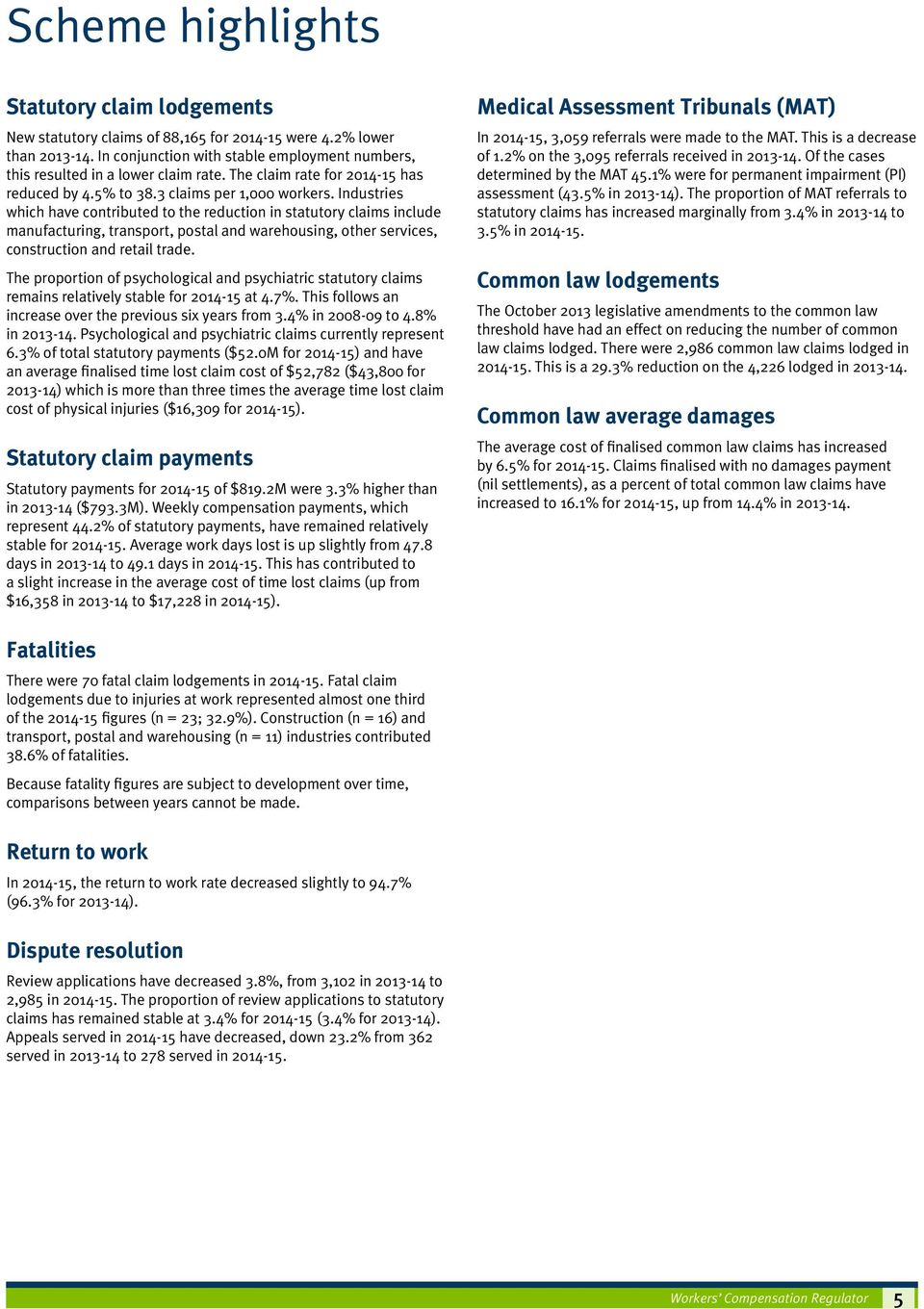
7 Scheme highlights Statutory claim lodgements New statutory claims of 88, were 4.2% lower than In conjunction with stable employment numbers, this resulted in a lower claim rate. The claim rate has reduced by 4.5% to 38.3 claims per 1,000 workers. Industries which have contributed to the reduction in statutory claims include manufacturing, transport, postal and warehousing, other services, construction and retail trade. The proportion of psychological and psychiatric statutory claims remains relatively stable at 4.7%. This follows an increase over the previous six years from 3.4% in to 4.8% in Psychological and psychiatric claims currently represent 6.3% of total statutory payments ($52.0M ) and have an average finalised time lost claim cost of $52,782 ($43, ) which is more than three times the average time lost claim cost of physical injuries ($16, ). Statutory claim payments Statutory payments of $819.2M were 3.3% higher than in ($793.3M). Weekly compensation payments, which represent 44.2% of statutory payments, have remained relatively stable Average work days lost is up slightly from 47.8 days in to 49.1 days in This has contributed to a slight increase in the average cost of time lost claims (up from $16,358 in to $17,228 in ). Medical Assessment Tribunals (MAT) In , 3,059 referrals were made to the MAT. This is a decrease of 1.2% on the 3,095 referrals received in Of the cases determined by the MAT 45.1% were permanent impairment (PI) assessment (43.5% in ). The proportion of MAT referrals to statutory claims has increased marginally from 3.4% in to 3.5% in Common law lodgements The October 2013 legislative amendments to the common law threshold have had an effect on reducing the number of common law claims lodged. There were 2,986 common law claims lodged in This is a 29.3% reduction on the 4,226 lodged in Common law average damages The average cost of finalised common law claims has increased by 6.5% Claims finalised with no damages payment (nil settlements), as a percent of total common law claims have increased to 16.1% , up from 14.4% in Fatalities There were 70 fatal claim lodgements in Fatal claim lodgements due to injuries at work represented almost one third of the figures (n = 23; 32.9%). Construction (n = 16) and transport, postal and warehousing (n = 11) industries contributed 38.6% of fatalities. Because fatality figures are subject to development over time, comparisons between years cannot be made. Return to work In , the return to work rate decreased slightly to 94.7% (96.3% ). Dispute resolution Review applications have decreased 3.8%, from 3,102 in to 2,985 in The proportion of review applications to statutory claims has remained stable at 3.4% (3.4% ). Appeals served in have decreased, down 23.2% from 362 served in to 278 served in
8 03 Scheme at a glance Statutory claims Statutory decisions Overview % change from Page number previous year New claims 88,165 92, % 10 Claims per 1,000 workers % 8 New psychological claims (%) 4.7% 4.8% -0.1% 12 Fatalities Payments ($M) $819.2 $ % 23 Average time to decide (days) % 18 Rejection rate physical (%) 5.0% 4.4% 0.6% 19 Rejection rate psych (%) 65.4% 64.8% 0.6% 19 Outcomes Average work days lost (days) % 33 (time lost claims) Return to work rate (%) 94.7% 96.3% -1.6% 28 Common law New claims 2,986 4, % 37 Payments ($M) $554.3 $ % 42 Average damages cost $138,257 $129, % 43 (excluding nil settlements) Regulator Review applications 2,985 3, % 45 functions Appeals served % 48 MAT referrals 3,059 3, % Statistics Report

9 Workers compensation statutory claims The majority of employers (almost 90%) covered by the scheme in did not have a claim workers compensation. Scheme-wide claim rate decreased 4.5%. The manufacturing industry has the highest claim rate. As at 30 June 2015, approximately 153,000 employers were covered by the Queensland workers compensation scheme. During the year the scheme covered a total of approximately 160,000 employers, taking into account fluctuations in cancelled and new policies. 04 Number of claims lodged by insurance type and Insurance type % Variance Employed people 91,672 87, % Volunteers, industrial placement / work experience, % contracts of insurance (Act: section 26) Workplace personal injury insurance % (self-employed, working directors) Household workers % Total lodgements 92,007 88, % The majority of claims (99.6%) are Workers (as defined in the Act). 05 Number of claims per employer by declared wages Number of claims $1M or less $1.01M to $2.5M $2.51M to $5M Declared wages $5.01M to $10M $10.01M to $50M Over $50M Total employers No claims 137,648 3, ,422 1 claim 8,156 1, ,356 2 to 5 claims 2,540 1, ,657 6 to 10 claims , to 20 claims Over 20 claims Total with claims 10,849 3,324 1,661 1,116 1, ,214 Total 148,497 7,018 2,416 1,347 1, ,636 % without claims 92.7% 52.6% 31.3% 17.1% 7.9% 3.0% 88.7% The above table is based on claims lodged by insurance type Employed people and excluding claims which have been lodged by uninsured policies. The majority of employers (88.7%) did not have a claim workers compensation in Smaller employers (less than $1 million in declared wages) were the most likely to have no claims (92.7%). 7

10 Claim rate In , 88,165 claims were lodged scheme-wide (excluding cancelled claims). The estimated rates per 1,000 workers are detailed below. 06 Claim rates (per 1,000 workers covered by the scheme) to Annual comparison Queensland labour ce Average number of employed people ( 000) a 2, , , , ,347.5 Change from previous year (%) 3.8% 1.0% 0.3% 0.7% -0.3% Average number of workers covered ( 000) b 2, , , , ,301.6 Change from previous year (%) 3.6% 1.7% 0.5% 0.4% 0.2% Queensland workers compensation scheme Number of lodged claims 104, ,404 99,298 92,007 88,165 Change from previous year (%) 4.3% 0.6% -5.8% -7.3% -4.2% Claim rate Number per 1,000 workers covered Change from previous year (%) 0.7% -1.1% -6.3% -7.6% -4.5% a Australian Bureau of Statistics, Labour Force, Queensland Average of May Quarter to February Quarter each of the above years, Cat No Australian Bureau of Statistics has adjusted past figures due to change in methodology. b workers covered is a subset of all employed persons (see definitions). The following figure shows claim rates and claim lodgements in the scheme the past five years. Lodgements of 88,165 have decreased by 4.2% from lodgements of 92, Claim rates (per 1,000 workers covered by the scheme) and lodgements to , , , , , Lodgements (excluding cancelled claims) Claim rate Statistics Report

11 Manufacturing had the highest claim rate in the scheme, with 83.3 claim lodgements per 1,000 workers covered in the industry. Other industries where the claim rate was larger than the scheme rate of 38.3 include, wholesale trade (62.3), transport, postal and warehousing (46.5), construction (45.8), agriculture, estry and fishing (44.7), public administration and safety (43.7), and health care and social assistance (39.6). 08 Claim rates (per 1,000 workers covered by the scheme) by industry and Accommodation and Food Administrative and Support Agriculture, Forestry and Fishing Arts and Recreation Construction Education and Training Electricity, Gas, Water and Waste Financial and Insurance Health Care and Social Assistance Inmation Media and Telecommunications Manufacturing Mining Other Professional, Scientific and Technical Public Administration and Safety Rental, Hiring and Real Estate Retail Trade Transport, Postal and Warehousing Wholesale Trade Scheme

12 Statutory claim lodgements Lodgements decreased by 4.2% in Note: cancelled claims have been excluded from the lodgements reported. There were 70 fatal claims lodged in Many factors influence the number of claims lodged in the Queensland workers compensation scheme. Some of the factors which may have contributed to changes in numbers of lodgements over the years include: changing industry economics variations in the overall numbers in the workce work process changes within industry example, automation, improved workplace health and safety practices changes in insurer practices example, the doctor fax fee initiative by WorkCover Queensland. The figure below shows a history of statutory claim lodgements and key events in the Queensland workers compensation scheme. For a comprehensive list of key events in the Queensland workers compensation scheme please refer to Appendix 3. In , there were 88,165 claims lodged (excluding cancelled), representing a 4.2% decrease from (92,007). 09 Statutory claim lodgement history to , ,000 WC&R Act 2003 Dr fax fee 20 days decision Phone applications 80,000 60,000 40,000 20, Lodgements Statistics Report

13 Industry The manufacturing industry accounted the largest proportion of claim lodgements with 15.4% of all scheme lodgements. Almost all industries experienced a decrease in the number of claims lodged. The largest percentage decreases in claim lodgements were other services (down 17.0%), transport, postal and warehousing (down 11.7%) and mining (down 11.5%). Other major industries also saw decreases, with manufacturing down 5.5%, construction down 4.1% and retail trade down 5%. 10 Statutory claim lodgements by industry and Accommodation and Food Administrative and Support Agriculture, Forestry and Fishing Arts and Recreation Construction Education and Training Electricity, Gas, Water and Waste Financial and Insurance Health Care and Social Assistance Inmation Media and Telecommunications Manufacturing Mining Other Professional, Scientific and Technical Public Administration and Safety Rental, Hiring and Real Estate Retail Trade Transport, Postal and Warehousing Wholesale Trade Other 5,890 5,936 2,412 2,660 2,179 2,400 1,392 1,340 6,504 6,169 1,180 1, ,350 2,656 2,723 3,280 1,608 1,663 6,675 6,868 1,113 1,027 7,575 7,971 5,577 6,316 4,149 4, ,785 10,200 11,545 11,499 13,596 14, For industry Other, this includes injuries pre July 1997 (pre ANZSIC classifications), household workers, workplace personal injury insurance (self employed, working directors) and volunteers. 11

14 Injury type Strain and sprain injury claims accounted almost a third (29.9%) of all injuries lodged in Of these, the back was the major bodily location (accounting 8.3% of all lodgements). Mesothelioma and asbestosis claims experienced a large decrease of 40.6%, down from 345 in to 205 in This is due to a large decrease in report only claims, which represent 58.5% of the mesothelioma and asbestosis claims in , compared with 75.1% in Statutory claim lodgements by injury type and Fracture Open wound - other Open wound - hand Contusions Foreign body Burns Strain and sprain - other Strain and sprain - back Strain and sprain - shoulder Other injury Deafness Diseases of the musculoskeletal system - other Diseases of the musculoskeletal system - back Mesothelioma and asbestosis Psychological and psychiatric injuries Other disease 5,165 5,201 4,446 4,442 6,631 6,466 5,830 6,582 2,203 2,703 1,631 1,766 7,279 7,819 3,750 3,817 7,652 7,176 1,257 1,253 7,829 8, ,136 4,439 3,359 3,544 11,433 12,341 15,359 15, Statistics Report

15 Gender In , males represented 64.7% (n = 57,073) of the 88,165 claims lodged in the Queensland workers compensation scheme. Injuries where males represented a much higher proportion of claims than females were deafness (96.7%), mesothelioma and asbestosis (91.7%), and eign body (91.3%). Psychological and psychiatric injury was the only injury type where females were represented more than males, with females accounting 57.9% of claims. 12 Proportion of statutory claim lodgements by injury type and gender Fracture Open wound - other Open wound - hand Contusions Foreign body Burns Strain and sprain - other Strain and sprain - back Strain and sprain - shoulder Other injury Deafness Diseases of the musculoskeletal system - other Diseases of the musculoskeletal system - back Mesothelioma and asbestosis Psychological and psychiatric injuries Other disease Scheme % Male % Female 13

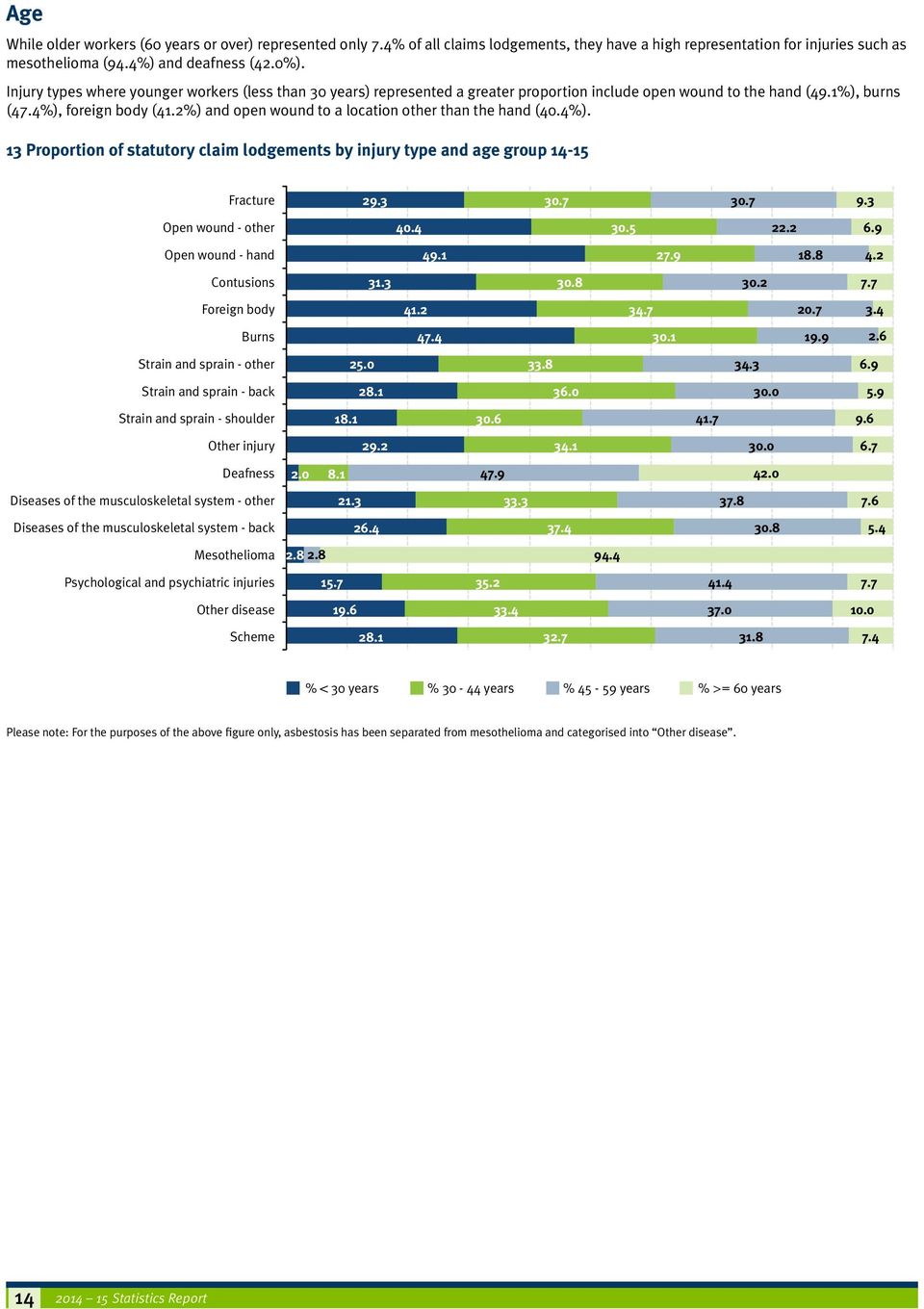
16 Age While older workers (60 years or over) represented only 7.4% of all claims lodgements, they have a high representation injuries such as mesothelioma (94.4%) and deafness (42.0%). Injury types where younger workers (less than 30 years) represented a greater proportion include open wound to the hand (49.1%), burns (47.4%), eign body (41.2%) and open wound to a location other than the hand (40.4%). 13 Proportion of statutory claim lodgements by injury type and age group Fracture Open wound - other Open wound - hand Contusions Foreign body Burns Strain and sprain - other Strain and sprain - back Strain and sprain - shoulder Other injury Deafness Diseases of the musculoskeletal system - other Diseases of the musculoskeletal system - back Mesothelioma Psychological and psychiatric injuries Other disease Scheme % < 30 years % years % years % >= 60 years Please note: For the purposes of the above figure only, asbestosis has been separated from mesothelioma and categorised into Other disease Statistics Report
17 Fatalities Compensated fatalities are included in the year a workers compensation claim is lodged, not the year the worker died. Considerable time can, theree, elapse between claim lodgement and the death of the injured worker. Because these figures are subject to development over time, comparisons between years have not been made. The reports the claim as a fatality if the claim is indicated by the insurer as a fatality under the Act, on the individual application, taking into account the definitions of a worker, event and injury under the Act (s11, s31 and s32). The figure below shows the fatal claim lodgement numbers. There were 70 fatalities lodged in Fatal claim lodgements (excluding cancelled claims) to Fatal claim lodgements Disease fatalities Mesothelioma and asbestosis Injuries at work Work related journeys Journeys to / from work 15 Fatal claim lodgements (excluding cancelled claims) by industry Accommodation and Food 1 Administrative and Support 1 Agriculture, Forestry and Fishing 6 Arts and Recreation 4 Construction 16 Education and Training 1 Electricity, Gas, Water and Waste 1 Health Care and Social Assistance 2 Manufacturing 7 Mining 5 Professional, Scientific and Technical 1 Public Administration and Safety 1 Retail Trade 5 Transport, Postal and Warehousing 11 Wholesale Trade 3 Other Fatal claim lodgements 15

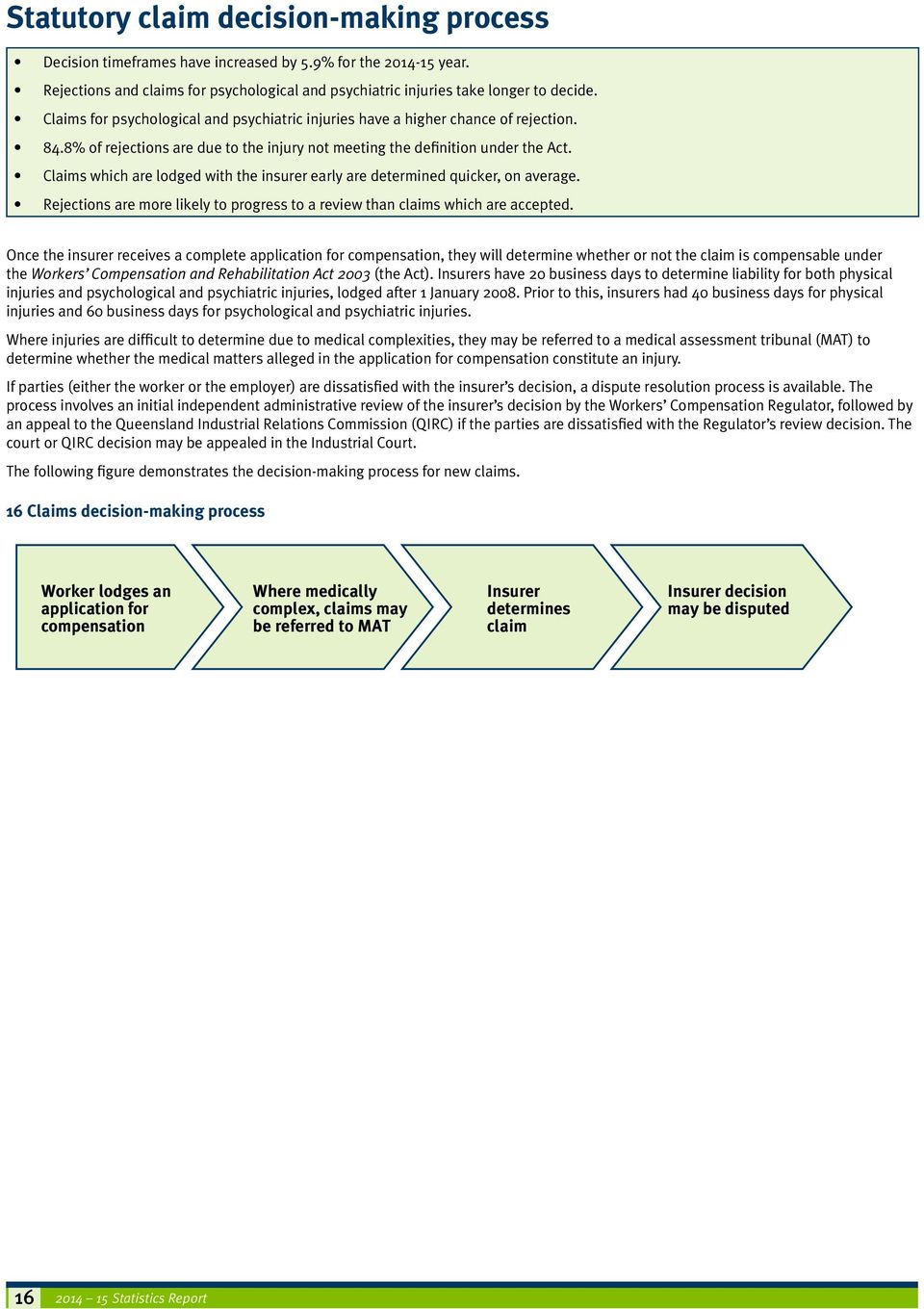
18 Statutory claim decision-making process Decision timeframes have increased by 5.9% the year. Rejections and claims psychological and psychiatric injuries take longer to decide. Claims psychological and psychiatric injuries have a higher chance of rejection. 84.8% of rejections are due to the injury not meeting the definition under the Act. Claims which are lodged with the insurer early are determined quicker, on average. Rejections are more likely to progress to a review than claims which are accepted. Once the insurer receives a complete application compensation, they will determine whether or not the claim is compensable under the Workers Compensation and Rehabilitation Act 2003 (the Act). Insurers have 20 business days to determine liability both physical injuries and psychological and psychiatric injuries, lodged after 1 January Prior to this, insurers had 40 business days physical injuries and 60 business days psychological and psychiatric injuries. Where injuries are difficult to determine due to medical complexities, they may be referred to a medical assessment tribunal (MAT) to determine whether the medical matters alleged in the application compensation constitute an injury. If parties (either the worker or the employer) are dissatisfied with the insurer s decision, a dispute resolution process is available. The process involves an initial independent administrative review of the insurer s decision by the, followed by an appeal to the Queensland Industrial Relations Commission (QIRC) if the parties are dissatisfied with the Regulator s review decision. The court or QIRC decision may be appealed in the Industrial Court. The following figure demonstrates the decision-making process new claims. 16 Claims decision-making process Worker lodges an application compensation Where medically complex, claims may be referred to MAT Insurer determines claim Insurer decision may be disputed Statistics Report
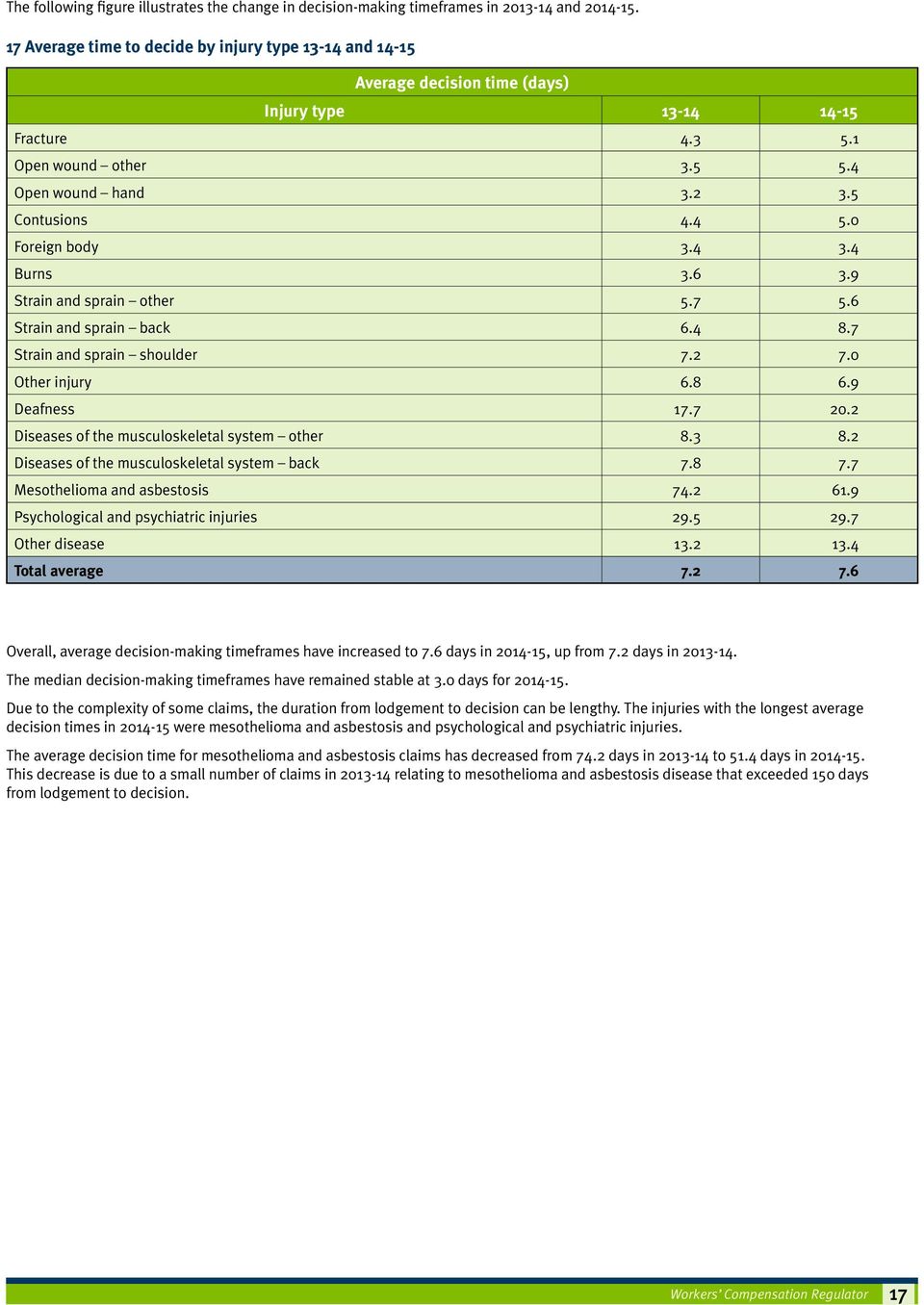
19 The following figure illustrates the change in decision-making timeframes in and Average time to decide by injury type and Average decision time (days) Injury type Fracture Open wound other Open wound hand Contusions Foreign body Burns Strain and sprain other Strain and sprain back Strain and sprain shoulder Other injury Deafness Diseases of the musculoskeletal system other Diseases of the musculoskeletal system back Mesothelioma and asbestosis Psychological and psychiatric injuries Other disease Total average Overall, average decision-making timeframes have increased to 7.6 days in , up from 7.2 days in The median decision-making timeframes have remained stable at 3.0 days Due to the complexity of some claims, the duration from lodgement to decision can be lengthy. The injuries with the longest average decision times in were mesothelioma and asbestosis and psychological and psychiatric injuries. The average decision time mesothelioma and asbestosis claims has decreased from 74.2 days in to 51.4 days in This decrease is due to a small number of claims in relating to mesothelioma and asbestosis disease that exceeded 150 days from lodgement to decision. 17
20 The following figure illustrates decision-making timeframes and outcomes claims determined in These timeframes are based on statutory claim decisions. 18 Decisions made and average time to decide by decision type and injury type Injury type Number of decisions Proportion of decisions Admitted % Rejected % Admitted days Average decision time Rejected days Fracture 4, % 3.5% Open wound - other 3, % 1.6% Open wound - hand 5, % 1.4% Contusions 5, % 2.3% Foreign body 1, % 1.8% Burns 1, % 1.9% Strain and sprain - other 13, % 4.1% Strain and sprain - back 6, % 4.6% Strain and sprain - shoulder 3, % 5.4% Other injury 6, % 7.1% Deafness % 15.3% Diseases of the musculoskeletal system - other Diseases of the musculoskeletal system - back Total days 10, % 6.3% , % 7.0% Mesothelioma and asbestosis % 15.8% Psychological and psychiatric injuries 2, % 65.4% Other disease 2, % 14.6% Total 75, % 7.1% Most claims (92.9%) were accepted by insurers with an average determination time of 6.1 days. On average, decision timeframes tended to be longer : rejected claims determined in 27.4 days on average compared to 6.1 days on average accepted claims diseases, particularly psychological and psychiatric injury claims (average 29.7 days to determine), mesothelioma and asbestosis claims (average 61.9 days to determine) and deafness (average 20.2 days to determine). Diseases tended to have higher rejection rates than injuries. In , 15.3% of deafness claims were rejected and 65.4% of psychological and psychiatric claims were rejected. Another reason the rejection rate of psychological and psychiatric claims is so high is that workers cannot receive compensation certain psychological and psychiatric injuries that arise out of or in the course of reasonable management action, as they are excluded from the definition of an injury in the Act. In , 96.8% of the rejected psychological and psychiatric claims were rejected on this basis Statistics Report

21 Reasons claim rejection Insurers reject claims where, some reason, the event or the person is not covered under the Act. For 84.8% of rejected claims, the reason rejection was that the injury did not meet the definition under the Act. The following figure details the main reasons claims were rejected. 19 Rejected claims by reason rejection and Reason rejection Number of rejections % of rejections Number of rejections % of rejections Not an injury - s.32 4, % 4, % Not a worker - s % % Out of time - excluded under s % % Journey - subsequent delay, interruption or deviation - s.36(2)(b) % % Invalid application - s % 2 0.0% Industrial deafness - excluded under s initial application % % Not a journey - s % % Other % % Total 5, % 5, % Determination of medically complex claims Where an insurer is unable to determine a claim due to complex medical issues, the matter may be referred to a medical assessment tribunal to determine whether the medical matters alleged in the application compensation constitute an injury. For , only 112 claims were referred to a medical assessment tribunal determination of the worker s injury an application compensation. Of these cases, 81 (72.3%) were accepted and the remaining 31 (27.7%) cases were rejected. Disputation of insurer claim determination decisions Both the injured worker and employer are able to dispute an insurer s claim determination decision. While only a small percentage of accepted claims are disputed by employers (0.6%), one third (33.2%) of rejected claims are disputed by either the employer or the injured worker. 19
22 Impact of lodgement time on determination time Delays in the time from injury to the lodgement of a claim may lead to delays in the decision-making process and, ultimately, additional costs the claim. 93.0% of claims lodged within the first week of the injury are determined by the insurer within two weeks. The proportion decided within two weeks decreases as the time to lodge the claim increases. For claims lodged more than six months after an injury, the proportion determined in less than two weeks drops to 44.9%. The following figure illustrates the link between lodgement and decision-making timeframes. 20 Decision-making timeframes claims decided in by the time taken to lodge the claim 1 week weeks Lodgement time 3 weeks 1 month 2 months months months Over 6 months Within 2 weeks 2 weeks to 1 month 1 to 3 months Over 3 months Statistics Report
23 Claim payments Total scheme payments have increased by 1.0%. There was a 2.1% decrease in common law payments made in Statutory payments increased by 3.3% between and with no notable shifts within the payment categories. Workers compensation payments The total scheme payments increased by 1.0%, with common law payments decreasing by 2.1% and statutory payments increasing by 3.3%. Total payments workers compensation claims in were $1,373.5 million. Common law payments made up 40.4% ($554.3 million) and statutory claim payments made up 59.6% ($819.2 million). 21 Scheme payments to $1,255.6M $1,348.8M $1,324.2M $1,359.2M $1,373.5M Payments ($ Million)
24 Statutory claim payments During the management of a claim, payments are made to the worker weekly compensation to replace wages, lump sums permanent impairment (PI) and a broad range of services such as medical treatment and rehabilitation. The figure below shows a history of statutory claim payments and key events in the Queensland workers compensation scheme. For a comprehensive list of key events in the Queensland workers compensation scheme please refer to Appendix Statutory claim payment history to Payments ($ Million) % NWE 52 wks to 5yrs. Additional lump sum threshold reduced from 50% to 30% Increased step down in benefits from 39 to 52 wks. New lump sum terminal conditions New funeral and latent onset payments Excess = 100% QOTE or 1 wk comp Statistics Report
25 23 Statutory claim payments by payment type and $793.3M $47.4M $819.2M $47.4M $171.7M $181.3M Payments ($ Million) $217.1M $228.2M $357.0M $362.3M Other statutory payments Lump sum payments Medical and rehabilitation Weekly benefits The total amount spent on claims the year has increased by 3.3% from $793.3 million in to $819.2 million in Weekly benefit payments increased by 1.5%, medical and rehabilitation payments and lump sum payments both increased by just over 5.5%, and there was no change in other statutory payments. 24 Medical and rehabilitation payments and Medical $117.9M $114.8M Allied Health $58.5M $53.5M Hospitalisation $38.2M $36.0M Other Medical $13.6M $12.9M Medical and rehabilitation payments represent 27.9% of statutory payments. Of those, payments medical treatment accounted more than half (51.7%) of all payments medical and rehabilitation fees paid in the scheme in
26 Payments by industry Claims from the construction industry accounted the largest proportion (16.4%) of statutory claim payments in Manufacturing accounted 10.5% of statutory payments, while health care and social assistance accounted 10.4%. 25 Statutory claim payments by industry and Accommodation and Food Administrative and Support Agriculture, Forestry and Fishing Arts and Recreation Construction Education and Training Electricity, Gas, Water and Waste Financial and Insurance Health Care and Social Assistance Inmation Media and Telecommunications Manufacturing Mining Other Professional, Scientific and Technical Public Administration and Safety Rental, Hiring and Real Estate Retail Trade Transport, Postal and Warehousing Wholesale Trade Other $34.8M $33.7M $22.1M $23.0M $20.4M $23.7M $12.3M $12.1M $43.7M $35.5M $11.2M $10.0M $5.9M $5.0M $85.6M $82.9M $3.3M $3.4M $85.8M $89.8M $44.1M $46.9M $21.1M $21.5M $15.0M $13.6M $64.0M $63.2M $7.8M $7.1M $51.5M $50.8M $74.6M $69.8M $32.0M $29.6M $49.9M $48.2M $134.2M $123.7M Statistics Report
27 Payments by injury Claims from strain and sprain injuries accounted the largest proportion (25.7%) of statutory claim payments in (5.9% to the back, 6.4% to the shoulder and 13.5% to a location other than the back or shoulder). Disease of the musculoskeletal system claims accounted 22.1% of statutory claim payments made in (9.1% to the back and 13.0% to a location other than the back). Injury types that experienced the largest percentage increase in statutory claim payments from to were burns (up 34.1%) and mesothelioma and asbestosis (up 13.0%). 26 Statutory claim payments by injury type and Fracture Open wound - other Open wound - hand Contusions Foreign body Burns Strain and sprain - other Strain and sprain - back Strain and sprain - shoulder Other injury Deafness Diseases of the musculoskeletal system - other Diseases of the musculoskeletal system - back Mesothelioma and asbestosis Psychological and psychiatric injuries Other disease $13.0M $14.0M $18.3M $16.9M $33.8M $31.4M $2.5M $2.8M $5.9M $4.4M $48.3M $45.1M $52.1M $49.4M $12.2M $12.7M $46.1M $40.6M $52.0M $54.4M $44.2M $37.3M $74.8M $73.5M $98.3M $102.8M $110.3M $107.5M $101.0M $96.8M $106.4M $103.7M
28 Finalised claims and outcomes 90.9% of workers with claims finalised in returned to their same job with the same employer. Average costs of finalised medical expense only claims increased slightly by 1.5%. Average costs of finalised time lost claims increased by 5.3% and their durations increased 2.7%. Work related impairment (WRI)/Degree of permanent impairment (DPI) Where a worker has a permanent impairment assessed, the degree of work related impairment (WRI) is calculated. WRI applies to injuries bee 15 October Under the 2013 legislative amendments if a worker is injured on or after 15 October 2013 the worker is assessed a degree of permanent impairment (DPI). For injuries bee 15 October 2013 a person may have multiple permanent impairments assessed separately, from these only one physical and one psychological or psychiatric WRI is calculated. For injuries under the 2013 legislative amendments impairments are assessed together and only one physical and one psychological or psychiatric DPI is given. Injured workers received an offer of lump sum compensation based on their WRI or DPI. The figure below shows the number of claims finalised and those that had a WRI/DPI in and Finalised claims with a WRI/DPI and Variance % Finalised claims 87,332 76, % WRI/DPI 9,309 7, % Proportion of finalised with WRI/DPI 10.7% 10.1% Work related impairment/degree of permanent impairment range 0% 2,219 1, % 0.1% - 4.9% 2,922 2, % 5% - 9.9% 2,407 1, % 10% % % 15% % % >=20% % For , 10.1% of claims were finalised with a permanent impairment. Of these, the majority of claims (94.2%) had a WRI/DPI of less than 20% and 24.9% were calculated as having a 0% impairment Statistics Report
29 Return to work (RTW) outcomes Returning an injured worker to the same job with the same employer is the best outcome which can be achieved on a claim. The following figure analyses the RTW outcome of claims reported at the time the claim closed. As the following figure illustrates, this is the outcome achieved in most cases, with 90.9% of injured workers who had time off work returning to the same job and the same employer. 28 Return to work status of finalised time lost claims and Number % of time lost claims Number % of time lost claims Fit work: same job/tasks with same employer 45, % 39, % Fit work: same job/tasks with different employer % % Fit work: different job/tasks with same employer % % Fit work: different job/tasks with different employer % % Fit work: no job % % Fit work: worker does not return % % Not fit work % % Alternative outcome not claim related % % Total 49, % 43, % Note: For the purpose of the above figure only, all deceased injured workers have been excluded. In , 94.7% of injured workers returned to some type of employment (96.3% in ). In a small number of cases, the worker is deemed fit to return to work but there is no job the worker to return to (1.4% of time lost claims) or the worker chooses not to return (2.0% of claims). 27
30 One of the factors which influence the RTW outcome on a claim is the severity of the injury. The following figure compares claims which have had a permanent impairment assessed as an indicator of the impact of severity of injury on RTW outcomes. 29 Return to work status of finalised time lost claims with/without a permanent impairment assessed and PI Assessed PI Assessed % No % Yes Number % No % Yes Number Fit work: same job/tasks with same employer 87.5% 12.5% 45, % 10.5% 39,442 Fit work: same job/tasks with different employer 79.0% 21.0% % 18.8% 372 Fit work: different job/tasks with same employer 43.4% 56.6% % 45.6% 340 Fit work: different job/tasks with different employer 63.0% 37.0% % 37.1% 927 Fit work: no job 41.9% 58.1% % 52.5% 610 Fit work: worker does not return 42.9% 57.1% % 46.7% 870 Not fit work 21.6% 78.4% % 70.1% 736 Alternative outcome not claim related 63.0% 37.0% % 63.2% 87 Total 84.8% 15.2% 49, % 13.8% 43,384 Note: For the purpose of the above figure only, all deceased injured workers have been excluded. Workers with claims assessed permanent impairment are less likely to return to the same job with the same employer. In , 10.5% of workers returning to the same job with the same employer had a permanent impairment assessed Statistics Report
31 Another factor which influences the RTW outcome on claims is the existence of a psychological or psychiatric injury. The following figure illustrates the impact of the injury type on RTW outcomes. 30 Return to work status of finalised time lost claims by injury nature and Physical only % Psych only % Psych & Physical % Physical only % Psych only % Psych & Physical % Fit work: same job/tasks with same employer 94.2% 72.7% 59.2% 92.5% 64.0% 51.1% Fit work: same job/tasks with different employer 0.6% 1.6% 0.6% 0.8% 2.3% 1.4% Fit work: different job/tasks with same employer 0.5% 1.7% 2.0% 0.7% 2.5% 3.3% Fit work: different job/tasks with different employer 1.8% 8.5% 7.2% 1.9% 6.7% 7.4% Fit work: no job 0.9% 2.4% 6.3% 1.2% 4.3% 6.8% Fit work: worker does not return 1.1% 4.5% 7.3% 1.7% 7.8% 10.7% Not fit work 0.8% 8.1% 16.1% 1.1% 11.8% 16.5% Alternative outcome not claim related 0.2% 0.5% 1.3% 0.1% 0.6% 2.8% Total 100.0% 100.0% 100.0% 100.0% 100.0% 100.0% Number 47,014 1, ,367 1,009 1,008 Note: For the purpose of the above figure only, all deceased injured workers have been excluded. Workers having claims with both a physical and psychological or psychiatric component are the least likely to return to employment and 16.5% in were not fit work at the end of their claim. 29
32 Average claim costs The average finalised claim cost is calculated using statutory claim payments made on a claim that was ceased or finalised within the financial year the payments made on these claims may have occurred over several years. The figure below illustrates the payments made on claims finalised in Over 60% of the payments these claims occurred in previous years. Only 37.9% of the statutory payments made on claims finalised in were also paid in that financial year. A further 39.2% of payments were made in the financial year. The remaining 22.9% of the payments were made in or earlier. 31 Payments by payment year claims finalised in $354.4M $342.1M Payments ($ Million) $45.5M $40.8M $120.3M Pre 1 July Payment year The claims that cost more to the scheme tend to be those that have longer durations. These usually occur over several years and theree would not impact on the average finalised claim cost until the year the claim is ceased or finalised. The average cost (time lost claims and medical expenses only claims) has increased the financial year (up 5.1% from $10,253 in to $10,780 in ) Statistics Report
33 The figure below shows the number of claims finalised in the past two years, and the average claim costs by claim type time lost claims and medical expense only claims. These two claims types represent 96.6% of all finalised claims during Finalised claims and average claim costs by claim type and Number of claims Average claim cost Claim type Variance Variance Time lost claim 49,136 43, % $16,358 $17, % Medical expenses only claim 35,072 30, % $1,700 $1, % Total 84,208 74, % $10,253 $10, % The median claim costs time lost and medical expense only claims has increased from $1,309 in to $1,388 in The average finalised claim cost may vary depending on factors such as: the duration of claims the longer an injured worker is away from work, the more weekly compensation payments and medical expenses the claim will incur, impacting on the time lost claims costs and the level of medical and other expenses required the injury changes in industry claim rates and the average wages paid in industry the mix of injuries lodged scheme-wide (the severity of injury can impact on the average finalised time lost claim duration and cost) changes in practices by insurers can have an impact on claim finalisation and average costs changes to legislation to provide increased or additional benefits to claimants claim re-openings. The following figure compares the variance in finalised claim costs to other indicators. 33 Changes in average finalised claim costs and economic indices Indicator % change from previous year Average finalised time lost claim cost 5.3% Average finalised medical expense only claim cost 1.5% Consumer price index Average of all groups, Brisbane (excluding GST) a 1.4% Health, Brisbane (excluding GST) b 4.5% Full time adult ordinary earnings c 2.5% a Australian Bureau of Statistics, Consumer Price Index, Australia Cat No Consumer Price Index, Australia, March 2014, Tables 1 and 2 CPI - all groups, index numbers and percentages changes, Index Numbers; All groups; Brisbane. [Percentage change from March 2014 to March 2015]. b Australian Bureau of Statistics, Australia Cat No Consumer Price Index, Australia, March 2015, Table 5 CPI - groups, index numbers by capital city, Index Numbers; Health; Brisbane. [Percentage change from March 2014 to March 2015]. c Australian Bureau of Statistics, average weekly earnings, Australia Cat No Average weekly earnings Australia, Nov Table 13C Average weekly earnings Queensland (dollars) - Original Earnings ; Queensland ; Persons ; Full Time ; Adult ; Ordinary time earnings. [Percentage change from November 2013 to November 2014]. 31
34 Average finalised medical expense only claim costs This section looks at a further breakdown of the average costs of finalised medical expense only claims. The average cost of finalised medical expense only claims has increased by just 1.5% from $1,700 in to $1,725 in The breakdown of the average cost shows 39.8% of the cost is made up of lump sum payments followed by medical and rehabilitation payments of 35.6%. Allied health accounted 12.0% and other statutory payments account 8.4%. The remaining 4.3% of the average cost is made up of other medical payments (including hospitalisation). 34 Average finalised medical expense only claim costs by payment type and Avergae cost ($) $1,700 $1,725 $148 $144 $63 $74 $201 $206 $575 $614 $712 $ Other statutory Other medical Allied health Medical Lump sum Statistics Report
35 Average finalised time lost claim durations Average finalised time lost claim durations are calculated using finalised time lost claims over a financial year. The number of finalised time lost claims decreased by 11.7% from 49,136 in to 43,397 in Durations finalised time lost claims including the excess paid period by the employer (where applicable) have increased by 2.7%, from 47.8 days in to 49.1 days in Over 70% of time lost claims have 40 or less workdays lost (71.7%), while the median workdays lost all time lost claims is 12 days. This illustrates how the small number of long term claims impact the average duration. Only 10.1% of time lost claims had more than 130 workdays lost. It is at the 26 week point that the level of compensation benefits payable first begins to decrease (section 150, the Act). 35 Number of time lost claims by workdays lost time band and Workdays lost Number of claims % of claims Number of claims % of claims 1-5 days 17, % 15, % 6-10 days 6, % 5, % days 6, % 5, % days 6, % 5, % days 4, % 3, % days 4, % 4, % days 3, % 2, % > 260 days 1, % 1, % Total time lost claims 49, % 43, % 33
36 Average finalised time lost claim costs The average cost of finalised time lost claims has increased by 5.3% from $16,358 in to $17,228 in The breakdown of the average cost in shows over half (52.5%) of the cost is made up of weekly compensation payments. In , medical and rehabilitation payments accounted over a quarter (28.7%) of the average cost and lump sum payments accounted 13.7%. The remaining 5.0% of the average cost was made up of other statutory payments. 36 Average finalised time lost claim costs by payment type and Average cost ($) $16,358 $849 $4,605 $2,376 $17,228 $865 $4,950 $2,364 $8,527 $9, Other statutory payments Medical and rehabilitation Lump sum Compensation Statistics Report
37 Average cost by industry Of all industry claims those from the mining industry had the highest average finalised time lost claim cost ($46,695) partially due to the higher wages paid in the industry. The Australian average weekly earnings (full time adult ordinary time earnings) workers in the mining industry of $2,495 are the highest of all industries (Source: ABS, Average Weekly Earnings, Cat No , November 2014, table 10G. Average Weekly Earnings, Industry, Australia (Dollars) - Original - Persons, Full Time Adult Ordinary Time Earnings). Similarly, industries that tended to have lower average finalised time lost claim cost example, accommodation and food services and retail trade also had the lowest Australian average weekly earnings of all industries ($1,037 and $1,064 respectively). 37 Average finalised time lost claim costs by industry and Accommodation and Food Administrative and Support Agriculture, Forestry and Fishing Arts and Recreation Construction Education and Training Electricity, Gas, Water and Waste Financial and Insurance Health Care and Social Assistance Inmation Media and Telecommunications Manufacturing Mining Other Professional, Scientific and Technical Public Administration and Safety Rental, Hiring and Real Estate Retail Trade Transport, Postal and Warehousing Wholesale Trade Scheme Average 11,926 10,468 16,400 15,355 18,946 16,236 15,193 15,978 28,288 25,378 12,340 11,402 21,372 17,352 16,552 12,765 13,062 12,793 23,546 22,548 13,621 15,147 17,197 16,004 22,800 22,634 17,363 16,581 14,368 18,514 12,704 11,417 22,096 19,811 16,118 14,508 17,228 16,358 46,695 43,
38 Average cost by injury type Although psychological and psychiatric injury claims account only 2.5% of all time lost claims finalised, they are the most expensive with an average finalised time lost claim cost of $52,782 in In , the average duration of a psychological or psychiatric injury claim was days (149.9 days in ) compared with the overall scheme average of 49.1 days. It is the long duration of psychological and psychiatric injury claims that impacts on the average finalised time lost claim cost these claims. The second most expensive injury type was fractures with an average cost of $28,726 ($28,923 in ). 38 Average finalised time lost claim cost by injury type and Fracture Open wound - other Open wound - hand Contusions Foreign body Burns Strain and sprain - other Strain and sprain - back Strain and sprain - shoulder Diseases of the musculoskeletal system - other Diseases of the musculoskeletal system - back Psychological and psychiatric injuries Other injuries and diseases (incl deafness and mesothelioma) Scheme average 28,726 28,923 9,227 10,311 6,996 6,989 9,798 10,175 5,783 2,694 4,139 6,119 12,948 12,389 11,259 10,986 24,326 23,845 17,576 16,487 17,193 14,503 24,263 23,357 17,228 16,358 43,800 52, Statistics Report
39 Claims damages at common law Common law lodgements have decreased over the last year. The majority of lodgements are injuries that occurred two to three years prior. Just under two thirds (62.3%) of common law lodgements have a work related impairment of less than 5%. Psychological and psychiatric injury claims represent 10.0% of common law lodgements. They represent only 4.7% of statutory claim lodgements. In , the average settlement cost of a finalised common law claim was $138,257. This section reports inmation about claims damages at common law (common law claims). The legislative amendments in 2013 introduced a threshold to restrict access to common law damages. This threshold requires workers with injuries on or after 15 October 2013 to have a degree of permanent impairment (DPI) greater than 5% to access common law damages. Lodgements The figure below shows a history of common law lodgements and key events in the Queensland workers compensation scheme. For a comprehensive list of key events in the Queensland workers compensation scheme please refer to Appendix Common law lodgements history to ,000 5,000 Bourk v Power Serve Scheme rem Cameron v Foster >5% threshold Lodgements 4,000 3,000 2,000 Restrictions on advertising Contrib neg, repealed interest, CL only 1, Karanfilov v Inghams Sheridan v Warrina 37
40 In , common law claim lodgements decreased by 29.3% driven by the legislative amendments in 2013 (from 4,226 in to 2,986 in ). The figure below shows the common law claim lodgements over the past eight years, by the date of injury. 40 Common law claim lodgements to by injury year Lodgement year Injury year Pre 1 July , ,168 1, ,527 1,575 1, ,839 1, ,673 1, ,624 1, ,641 1, ,529 1, Total 3,621 4,197 4,988 4,509 4,314 4,301 4,226 2,986 The majority of common law claims lodged in any given year are injuries that occurred two to three years prior Statistics Report
41 The figure below shows the breakdown of common law claim lodgements in by the injured worker s WRI/DPI. 41 Common law claim lodgements by WRI/DPI WRI/DPI Common law lodgements % of common law lodgements No impairment assessed % 0% % 0.1% - 4.9% % 5% - 9.9% % 10% % % 15% % % >=20% % Total 2, % If the injured worker s work related impairment is less than 20%, the worker has to make an irrevocable decision to either accept a payment of the statutory lump sum compensation the injury or seek damages at common law. If the work related impairment is 20% or more, the injured worker can accept a lump sum payment and seek damages. Only a small proportion of common law claims (4.2%) are able to access lump sum payment and pursue common law. 39
42 Industry The manufacturing and construction industries represented the highest proportion of common law claims lodged in the Queensland scheme, with each industry accounting 15.0% of all common law claim lodgements in Common law claim lodgements by industry and Accommodation and Food Administrative and Support Agriculture, Forestry and Fishing Arts and Recreation Construction Education and Training Electricity, Gas, Water and Waste Financial and Insurance Health Care and Social Assistance Inmation Media and Telecommunications Manufacturing Mining Other Professional, Scientific and Technical Public Administration and Safety Rental, Hiring and Real Estate Retail Trade Transport, Postal and Warehousing Wholesale Trade Other For industry Other, this includes injuries pre July 1997 (pre ANZSIC classifications), household workers, workplace personal injury insurance (self employed, working directors) and volunteers Statistics Report
43 Injury type Strain and sprain injury claims accounted just over 30% of all common law claim lodgements in Although psychological and psychiatric injury claims represented only 4.7% of statutory claim lodgements, they represented 10.0% of all common law claim lodgements in Common law claim lodgements by injury type and Fracture Open wound - other Open wound - hand Contusions Foreign body Burns Strain and sprain - other Strain and sprain - back Strain and sprain - shoulder Other injury Deafness Diseases of the musculoskeletal system - other Diseases of the musculoskeletal system - back Mesothelioma and asbestosis Psychological and psychiatric injuries Other disease
44 Total common law payments In , common law claims cost a total of $554.3 million. This represented a 2.1% decrease from the cost of $566.0 million. Average costs The figure below shows a history of average damages settlement finalised common law claims and key events in the Queensland workers compensation scheme. For a comprehensive list of key events in the Queensland workers compensation scheme please refer to Appendix Common law average damages settlement history to $160,000 $140,000 $120,000 $100,000 Restrictions on advertising Contrib neg, repealed interest, CL only Karanfilov v Inghams Sheridan v Warrina Bourk v Power Serve Scheme rem Cameron v Foster >5% threshold $80,000 $60,000 $40,000 $20,000 $ Average Cost ($) Statistics Report
45 Over the past year, the average settlement cost of a finalised common law claim (excluding nil settlements) has increased 6.5% from $129,768 in to $138,257 in The average defendant and plaintiff cost has increased by 30.3% ($16,555 in to $21,573 in ). It should be noted that restrictions on awarding of plaintiff costs were introduced injuries occurring on or after 1 January In , there were 638 common law claims finalised with a nil settlement. 45 Average costs finalised common law claims by payment type to $12,484 $14,407 $15, % 15.7% 15.8% $16, % $21, % $147,954 $137,767 $124,466 $129,768 $138, Avarage defendant and plaintiff cost Average settlement cost (excluding nil) Nil settlements as a % of total finalised 43
46 Heads of damage Heads of damage consist of two distinct parts: general damages and special damages. The legislative amendments in 2010 introduced caps on the amount of general damages that can be awarded pain and suffering, loss of amenity, loss of expectation of life and general disfigurement. The caps align the workers compensation scheme with the Civil Liability Act 2003, and limit the amount of compensation that can be awarded to an injury based on the severity of the injury, or its injury scale value. Special damages consists of future economic loss, past economic loss, care, and treatment and rehabilitation. This incorporates loss of past and future earnings, future medical needs and care due to the ongoing disability. The amount of future earnings loss must not exceed the amount equal to the present value of 3 times QOTE per week each week of the period of loss of earnings as specified within the Act. The figure below shows the average cost of each head of damage a finalised claim (excluding nil settlements). 46 Heads of damage average cost and $ % $ % General damages 20, % 18, % Past economic loss 40, % 46, % Future economic loss 97, % 106, % Rehabilitation 21, % 23, % Gratuitous care % 2, % Other 1, % 2, % Gross settlement 181, % 200, % Average timeframes For claims lodged in the financial year, the average time from date of injury to lodgement of a common law claim increased by 10.1% (2.18 years in ; 2.40 years in ). For claims finalised in the financial year, the average time from the lodgement of a common law claim to finalisation has remained stable at 1.10 years in (1.10 years in ) Statistics Report
47 Review of insurer decisions Applications received A party aggrieved by an insurer decision may apply to the Regulator review. Review applications received have decreased slightly (3.8%) in , down from 3,102 in to 2,985 in The figure below shows the number of applications review received over the last five years. 47 Review applications received to ,333 3,237 3,269 3,102 2, Types of applications There was little change to the distribution of the type of review applications received in compared to the previous financial year. Of the applications lodged, 84.8% were lodged by workers, 14.4% by employers, and the remaining 0.7% of applications were lodged by employers having a policy decision reviewed. 48 Review applications received by type and Employer re policy Employer re claim Worker re claim 2,532 2,
48 Over half (59.4%) of all review applications received in related to the insurer decision to reject the claim, 14.8% were lodged after the claim had been accepted and a further 18.2% were following the cessation of the claim. 49 Review applications received by insurer decision and Rejected 1,774 1,824 Ceased Accepted Other (incl. policy) Outcomes In , 92.8% of reviews finalised were decided (as compared to 91.7% in ), 4.3% were cancelled (4.8% in ), and the remaining 2.9% were withdrawn (3.6% in ). 50 Review outcomes and Decided 2,771 2,932 Withdrawn Cancelled Statistics Report
49 In , the original decision of the insurer was confirmed by the Review Unit in 61.6% of review decisions made, compared to 58.9% in Decided review outcomes and Confirmed 1,708 1,728 Set aside / varied 1,063 1,
50 Appeals of review decisions Appeal lodgements A party aggrieved by a decision of the Regulator may apply appeal. In December 2010, the QIRC replaced the Industrial Magistrates Court as the appeal body appeals. In , 278 appeals were lodged with the Queensland Industrial Relations Commission (QIRC). Of these, 16 further appealed in the Industrial Court. Appeal lodgements have experienced a decrease of 23.2% in compared with Appeals lodged to Statistics Report
51 Appeal outcomes In , 67.8% of appeals were finalised bee reaching the Industrial Relations Commission. Of these, 82.1% of cases were withdrawn by the appellant and 17.9% were settled or conceded. 53 Appeals finalised by outcome and Decided at court Appeal withdrawn/lapsed Concede Settlement Non-judicial resolution In , 223 appeals were finalised bee reaching the court or commission. This is a decrease of 25.7% when compared to 300 in Judicial resolution The total number of cases determined by a court or commission increased by 19.1%, from 89 in to 106 in Of these, 66 cases (62.3%) were dismissed or struck-out by the magistrate and 40 cases (37.7%) were upheld in favour of the appellant. 54 Appeals finalised judicially by outcome and Dismissed Struck out 2 3 Upheld
52 Medical assessment tribunals (MAT) Referrals Medical tribunals are coordinated by the Regulator to determine ongoing incapacity of an injured worker or the assessment of permanent impairment. In , 3,059 cases were referred to a MAT. This is consistent with the 3,095 cases referred in The figure below illustrates the number of MAT referrals received over the past five years. 55 MAT referrals received to ,522 2,772 3,098 3,095 3, Cases determined In , 2,364 cases were determined by a MAT. This represented a 16.0% decrease from (2,815 determinations). Of the cases heard in , 47.1% (1,113) were heard at a General Medical Assessment Tribunal Psychiatric compared to 44.4% (1,251) in A further 38.6% (913) of cases in were determined at an Orthopaedic Tribunal as compared to 41.7% (1,174) in , representing a decrease of 22.2%. 56 Cases determined by tribunal type and GMAT (Psychiatric) 1,113 1,251 Neurology/Neurosurgical Orthopaedic 913 1,174 GMAT (other) Speciality (other) Statistics Report
53 The figure below shows the average number of cases heard per tribunal in and Average number of cases heard per tribunal by tribunal type and Tribunal Average number of cases heard per tribunal GMAT (Psychiatric) Neurology/Neurosurgical Orthopaedic GMAT (other) Speciality (other) Total Referral reason In , 45.1% of the cases determined by the MAT were permanent impairment (PI) assessment, compared to 43.5% in Cases determined by referral reason and Access to damages Application compensation Ongoing capacity work 1,071 1,317 PI assessment PI assessment - disputed PI Prescribed disfigurement Other There has been a decrease in the proportion of referrals assessment of ongoing capacity work (down from 46.8% in to 45.3% in ). 51
54 Appendix 1: Statistics by sub-industry 59 Statutory claim lodgements, statutory claim payments, average finalised time lost claim costs and durations by industry and sub-industry and Claims lodgements Claims payments Average finalised time lost claims cost Variance Variance Variance Average finalised time lost claims durations Variance no. no. % $M $M % $ $ % days days % Accommodation and Food 5,936 5, % % 10,468 11, % % Accommodation 1,726 1, % % 10,361 12, % % Food and Beverage 3,989 4, % % 10,479 11, % % Labour Hire % % 11,217 7, % % Administrative and Support Administrative Building Cleaning, Pest Control and Other Support 2,660 2, % % 15,355 16, % % % % 18,848 18, % % 1,835 1, % % 14,602 15, % % Labour Hire % % 9,420 22, % % Agriculture, Forestry and Fishing 2,400 2, % % 16,236 18, % % Agriculture 1,713 1, % % 16,041 19, % % Agriculture, Forestry and Fishing Support % % 21,065 21, % % Aquaculture % % 25,297 16, % % Fishing, Hunting and Trapping Forestry and Logging % % 16,591 17, % % % % 23,721* 62,784* 164.7% 74.0* 208.2* 181.4% Labour Hire % % 7,633 8, % % Arts and Recreation Creative and Perming Arts Activities Gambling Activities 1,340 1, % % 15,978 15, % % % % 11,647 17, % % % % 11,962 8, % % Statistics Report
55 Claims lodgements Claims payments Average finalised time lost claims cost Variance Variance Variance Average finalised time lost claims durations Variance no. no. % $M $M % $ $ % days days % Heritage Activities Sports and Recreation Activities % % 10,106 7, % % % % 17,512 17, % % Labour Hire % % 91,811* 29,587* -67.8% 176.5* 157.0* -11.0% Construction 10,200 9, % % 25,378 28, % % Building Construction Construction Heavy and Civil Engineering Construction 1,398 1, % % 30,627 26, % % 5,849 5, % % 24,589 25, % % 2,180 1, % % 26,220 39, % % Labour Hire % % 19,005 31, % % Education and Training Adult, Community and Other Education Preschool and School Education Tertiary Education 6,169 6, % % 11,402 12, % % % % 25,307 16, % % 4,267 4, % % 12,026 12, % % 1,694 1, % % 8,561 12, % % Labour Hire % % 2,656* 12,937* 387.1% 10.7* 35.5* 231.8% Electricity, Gas, Water and Waste Electricity Supply 1,279 1, % % 17,352 21, % % % % 16,989 22, % % Gas Supply % % 12,114* 7,580* -37.4% 20.3* 22.5* 10.8% Waste Collection, Treatment and Disposal Water Supply, Sewerage and Drainage % % 19,230 22, % % % % 17,917 21, % % Labour Hire % % 8,336 16, % % Financial and Insurance % % 12,765 16, % % 53
56 Claims lodgements Claims payments Average finalised time lost claims cost Variance Variance Variance Average finalised time lost claims durations Variance no. no. % $M $M % $ $ % days days % Auxiliary Finance and Insurance % % 13,196 21, % % Finance % % 14,310 18, % % Insurance and Superannuation Funds % % 9,107 13, % % Labour Hire % % 54,365* 7,693* -85.8% 153.8* 28.0* -81.8% Health Care and Social Assistance 11,499 11, % % 12,793 13, % % Hospitals 4,299 4, % % 14,924 15, % % Medical and Other Health Care Residential Care Social Assistance 1,410 1, % % 13,579 13, % % 3,216 2, % % 10,446 9, % % 2,490 2, % % 11,148 11, % % Labour Hire % % 18,778 28, % % Broadcasting (except Internet) Internet Publishing and Broadcasting Internet Service Providers, Web Search Portals and Data Processing Library and Other Inmation Motion Picture and Sound Recording Activities Publishing (except Internet and Music Publishing) Inmation Media and Telecommunications Telecommunications % % 22,548 23, % % % % 12,784 14, % % ,853* * % % 30,106 41,014* 36.2% * 17.4% % % 15,346* 9,639* -37.2% 57.0* 30.1* -47.2% % % 16,273 24, % % % % 21,433 18, % % % % 37,959 38, % % Statistics Report
57 Claims lodgements Claims payments Average finalised time lost claims cost Variance Variance Variance Average finalised time lost claims durations Variance no. no. % $M $M % $ $ % days days % Labour Hire % % 45,718* 6,207* -86.4% 75.6* 18.5* -75.5% Manufacturing 14,391 13, % % 15,147 13, % % Basic Chemical and Chemical Product Manufacturing Beverage and Tobacco Product Manufacturing Fabricated Metal Product Manufacturing Food Product Manufacturing Furniture and Other Manufacturing Machinery and Equipment Manufacturing Non-Metallic Mineral Product Manufacturing Petroleum and Coal Product Manufacturing Polymer Product and Rubber Product Manufacturing Primary Metal and Metal Product Manufacturing Printing (including the Reproduction of Recorded Media) Pulp, Paper and Converted Paper Product Manufacturing Textile, Leather, Clothing and Footwear Manufacturing Transport Equipment Manufacturing % % 21,083 15, % % % % 14,634 16, % % 3,090 2, % % 16,339 12, % % 3,552 3, % % 11,896 12, % % % % 20,064 18, % % 1,276 1, % % 15,043 18, % % % % 24,216 21, % % % % 35,053 31, % % % % 10,971 12, % % % % 22,716 15, % % % % 14,206 8, % % % % 13,904 15, % % % % 17,057 19, % % 1,384 1, % % 14,275 11, % % 55
58 Claims lodgements Claims payments Average finalised time lost claims cost Variance Variance Variance Average finalised time lost claims durations Variance no. no. % $M $M % $ $ % days days % Wood Product Manufacturing % % 17,014 11, % % Labour Hire % % 13,801 11, % % Mining 2,656 2, % % 43,277 46, % % Coal Mining 1, % % 47,746 54, % % Exploration and Other Mining Support Metal Ore Mining Non-Metallic Mineral Mining and Quarrying Oil and Gas Extraction % % 41,304 43, % % % % 40,307 44, % % % % 33,742 42, % % % % 33,221 36, % % Labour Hire % % 48,073 31, % % Other 3,280 2, % % 16,004 17, % % Personal and Other Repair and Maintenance 1,064 1, % % 14,485 15, % % 1,637 1, % % 18,022 19, % % Labour Hire % % 11,130 12, % % Professional, Scientific and Technical Computer System Design and Related Professional, Scientific and Technical (Except Computer System Design and Related ) 1,663 1, % % 22,634 22, % % % % 13,137 17, % % 1,525 1, % % 23,561 23, % % Labour Hire % % 27,191* 31,544* 16.0% 60.1* 55.4* -7.8% Public Administration and Safety 6,868 6, % % 16,581 17, % % Defence % % 11,936 8,445* -29.2% * -10.8% Public Administration 3,426 3, % % 13,861 14, % % Statistics Report
59 Claims lodgements Claims payments Average finalised time lost claims cost Variance Variance Variance Average finalised time lost claims durations Variance no. no. % $M $M % $ $ % days days % Public Order, Safety and Regulatory 3,265 3, % % 19,977 21, % % Labour Hire % % 14,732 13, % % Rental, Hiring and Real Estate Property Operators and Real Estate Rental and Hiring (except Real Estate) 1,027 1, % % 18,514 14, % % % % 15,173 14, % % % % 20,925 14, % % Labour Hire % % 14,641* 6,377* -56.4% 47.3* 24.8* -47.6% Retail Trade 7,971 7, % % 11,417 12, % % Food Retailing 3,147 2, % % 11,734 11, % % Fuel Retailing % % 18,206 18, % % Motor Vehicle and Motor Vehicle Parts Retailing Non-Store Retailing and Retail Commission- Based Buying and/or Selling Other Store- Based Retailing 1,248 1, % % 12,822 14, % % % % 15,441 16, % % 3,113 3, % % 10,394 12, % % Labour Hire % % 7,584 15, % % Transport, Postal and Warehousing Air and Space Transport 6,316 5, % % 19,811 22, % % % % 12,686 10, % % Other Transport % % 12,830 18, % % Postal and Courier Pick-up and Delivery % % 27,575 16, % % Rail Transport % % 26,046 28, % % Road Transport 3,207 2, % % 21,691 25, % % Transport Support % % 17,637 22, % % 57
60 Claims lodgements Claims payments Average finalised time lost claims cost Variance Variance Variance Average finalised time lost claims durations no. no. % $M $M % $ $ % days days % Warehousing and Storage % % 16,454 20, % % Water Transport % % 17,959 18, % % Labour Hire % % 15,301 16, % % Wholesale Trade 4,406 4, % % 14,508 16, % % Basic Material Wholesaling Variance Commission- Based Wholesaling Grocery, Liquor and Tobacco Product Wholesaling Machinery and Equipment Wholesaling Motor Vehicle and Motor Vehicle Parts Wholesaling Other Goods Wholesaling 1,253 1, % % 14,537 15, % % % % 11,766 12, % % % % 13,803 13, % % 1,304 1, % % 14,209 21, % % % % 15,525 10, % % % % 14,648 16, % % Labour Hire % % 17,403 10, % % Other % % 38,576 36, % % Total 92,007 88, % % 16,358 17, % % *Average is based on less than 30 finalised time lost claims. For industry Other, this includes injuries pre July 1997 (pre ANZSIC classifications), household workers, workplace personal injury insurance (self employed, working directors) and volunteers. Labour hire pre July 2009 was classified under industry Property and business services - Employment services. Post June 2009, WorkCover created a labour hire classification each industry Statistics Report
61 60 Statutory claim decisions and statutory claim finalisations by industry and sub-industry % Admit Claim decisions % Rejected Total claims decided Total time lost claims finalised work : same job / tasks with same employer work : same job / tasks with diff employer Time lost claim finalisation work : diff job / tasks with same employer work : diff job / tasks with diff employer work : no job work : worker does not return % Not fit work % Alternative outcome not claim related Accommodation 94.9% 5.1% 4,806 2, % 1.4% 0.5% 2.8% 1.0% 2.4% 1.3% 0.2% and Food Accommodation 96.1% 3.9% 1, % 1.3% 0.8% 3.3% 0.6% 2.1% 1.8% 0.3% Food and Beverage 94.7% 5.3% 3,395 2, % 1.5% 0.3% 2.4% 1.2% 2.6% 1.2% 0.2% Labour Hire 91.9% 8.1% % 1.6% 0.0% 6.3% 0.0% 1.6% 0.0% 0.0% Administrative 90.8% 9.2% 2,076 1, % 1.0% 0.4% 3.1% 1.8% 1.7% 2.1% 0.0% and Support Administrative 85.4% 14.6% % 1.6% 0.8% 3.9% 3.1% 2.7% 2.3% 0.0% Building 92.7% 7.3% 1,553 1, % 0.9% 0.3% 3.0% 1.4% 1.5% 2.0% 0.0% Cleaning, Pest Control and Other Support Labour Hire 80.0% 20.0% % 0.0% 4.8% 0.0% 9.5% 0.0% 0.0% 0.0% Agriculture, 95.1% 4.9% 1,795 1, % 1.2% 0.5% 4.3% 1.8% 4.5% 1.6% 0.0% Forestry and Fishing Agriculture 96.3% 3.7% 1,438 1, % 1.0% 0.7% 4.5% 1.2% 4.4% 1.4% 0.0% Agriculture, 91.3% 8.7% % 2.5% 0.0% 5.0% 3.3% 7.4% 2.5% 0.0% Forestry and Fishing Support Aquaculture 80.0% 20.0% % 0.0% 0.0% 5.0% 0.0% 0.0% 0.0% 0.0% Fishing, 73.3% 26.7% % 0.0% 0.0% 6.3% 12.5% 0.0% 0.0% 0.0% Hunting and Trapping Forestry and 100.0% 0.0% % 0.0% 0.0% 0.0% 20.0% 0.0% 20.0% 0.0% Logging Labour Hire 95.6% 4.4% % 1.4% 0.0% 1.3% 2.7% 4.1% 1.3% 0.0% Arts and Recreation 94.7% 5.3% 1, % 1.2% 1.0% 3.7% 1.5% 2.0% 1.4% 0.0% Creative and 98.4% 1.6% % 3.4% 1.7% 5.1% 3.4% 3.4% 1.7% 0.0% Perming Arts Activities Gambling Activities 87.6% 12.4% % 1.2% 1.2% 3.6% 1.2% 1.2% 0.0% 0.0% Heritage Activities 96.0% 4.0% % 0.0% 0.0% 3.9% 1.3% 0.0% 1.3% 0.0% 59
62 % Admit Claim decisions % Rejected Total claims decided Total time lost claims finalised work : same job / tasks with same employer work : same job / tasks with diff employer Time lost claim finalisation work : diff job / tasks with same employer work : diff job / tasks with diff employer work : no job work : worker does not return % Not fit work % Alternative outcome not claim related Sports and 95.6% 4.4% % 1.1% 1.1% 3.4% 1.3% 2.2% 1.7% 0.0% Recreation Activities Labour Hire 100.0% 0.0% % 0.0% 0.0% 0.0% 0.0% 100.0% 0.0% 0.0% Construction 92.5% 7.5% 8,381 4, % 2.0% 0.7% 4.6% 2.9% 3.2% 2.4% 0.1% Building Construction 93.8% 6.2% 1, % 2.4% 0.6% 5.1% 2.9% 1.5% 2.1% 0.0% Construction 93.9% 6.1% 5,154 2, % 1.8% 0.7% 4.0% 2.5% 3.5% 2.2% 0.1% Heavy and Civil 88.4% 11.6% 1, % 2.6% 0.5% 6.0% 4.5% 2.9% 3.0% 0.0% Engineering Construction Labour Hire 88.6% 11.4% % 1.2% 2.0% 6.0% 2.8% 4.8% 2.8% 0.0% Education and 92.1% 7.9% 5,925 3, % 0.5% 0.4% 0.7% 0.2% 1.1% 0.6% 0.0% Training Adult, Community 91.3% 8.7% % 0.0% 0.0% 3.9% 0.0% 1.9% 0.0% 0.0% and Other Education Preschool and 93.2% 6.8% 4,184 2, % 0.4% 0.5% 0.4% 0.3% 1.1% 0.5% 0.0% School Education Tertiary Education 89.5% 10.5% 1, % 1.0% 0.0% 1.2% 0.1% 0.9% 0.7% 0.0% Labour Hire 90.0% 10.0% % 0.0% 50.0% 0.0% 0.0% 0.0% 0.0% 0.0% Electricity, 93.3% 6.7% 1, % 0.4% 1.3% 1.3% 1.7% 1.0% 2.1% 0.8% Gas, Water and Waste Electricity 94.1% 5.9% % 0.0% 0.5% 0.5% 0.0% 1.7% 2.8% 0.0% Supply Gas Supply 100.0% 0.0% % 0.0% 0.0% 0.0% 0.0% 0.0% 0.0% 0.0% Waste Collection, 92.0% 8.0% % 1.0% 2.6% 1.0% 3.6% 1.0% 2.1% 1.6% Treatment and Disposal Water Supply, 92.6% 7.4% % 0.0% 0.0% 3.2% 0.0% 0.0% 1.6% 1.6% Sewerage and Drainage Labour Hire 96.1% 3.9% % 0.0% 0.0% 3.2% 3.2% 0.0% 0.0% 0.0% Financial and 88.1% 11.9% % 0.6% 1.6% 0.6% 0.3% 1.6% 2.2% 0.3% Insurance Auxiliary Finance and Insurance 92.3% 7.7% % 1.9% 0.0% 0.0% 1.9% 1.8% 3.7% 1.8% Statistics Report
63 % Admit Claim decisions % Rejected Total claims decided Total time lost claims finalised work : same job / tasks with same employer work : same job / tasks with diff employer Time lost claim finalisation work : diff job / tasks with same employer work : diff job / tasks with diff employer work : no job work : worker does not return % Not fit work % Alternative outcome not claim related Finance 85.9% 14.1% % 0.8% 2.5% 0.0% 0.0% 3.3% 0.9% 0.0% Insurance and 88.6% 11.4% % 0.0% 1.4% 1.4% 0.0% 0.0% 2.1% 0.0% Superannuation Funds Labour Hire 100.0% 0.0% % 0.0% 0.0% 0.0% 0.0% 0.0% 33.3% 0.0% Health Care 92.9% 7.1% 9,675 6, % 0.4% 0.7% 0.7% 0.6% 1.9% 1.8% 0.2% and Social Assistance Hospitals 93.1% 6.9% 3,723 2, % 0.3% 1.1% 0.4% 0.3% 1.3% 1.8% 0.3% Medical and 92.0% 8.0% 1, % 0.5% 0.8% 1.3% 1.0% 2.3% 0.9% 0.3% Other Health Care Residential 93.7% 6.3% 2,513 1, % 0.2% 0.6% 0.8% 0.4% 2.3% 1.8% 0.1% Care Social Assistance 91.9% 8.1% 2,253 1, % 0.6% 0.3% 1.1% 1.0% 2.3% 2.1% 0.1% Labour Hire 90.3% 9.7% % 0.0% 0.0% 0.0% 2.1% 4.1% 4.2% 0.0% Inmation 97.1% 2.9% % 1.8% 0.6% 3.0% 4.2% 2.4% 1.8% 0.6% Media and Telecommunications Broadcasting 94.9% 5.1% % 0.0% 0.0% 6.9% 3.5% 0.0% 3.4% 0.0% (except Internet) Internet 0.0% 0.0% % 0.0% 0.0% 0.0% 0.0% 0.0% 0.0% 0.0% Publishing and Broadcasting Internet Service 100.0% 0.0% % 0.0% 0.0% 0.0% 10.0% 0.0% 0.0% 0.0% Providers, Web Search Portals and Data Processing Library and Other 100.0% 0.0% % 0.0% 0.0% 0.0% 0.0% 0.0% 0.0% 0.0% Inmation Motion Picture 99.5% 0.5% % 4.5% 0.0% 2.2% 2.2% 2.2% 2.2% 2.2% and Sound Recording Activities Publishing 95.1% 4.9% % 0.0% 2.5% 2.5% 5.0% 7.5% 0.0% 0.0% (except Internet and Music Publishing) Telecommunications 94.2% 5.8% % 3.4% 0.0% 3.3% 3.3% 0.0% 3.3% 0.0% 61
64 % Admit Claim decisions % Rejected Total claims decided Total time lost claims finalised work : same job / tasks with same employer work : same job / tasks with diff employer Time lost claim finalisation work : diff job / tasks with same employer work : diff job / tasks with diff employer work : no job work : worker does not return % Not fit work % Alternative outcome not claim related Labour Hire 83.3% 16.7% % 0.0% 0.0% 0.0% 25.0% 0.0% 0.0% 0.0% Manufacturing 95.4% 4.6% 11,859 5, % 0.5% 1.0% 1.4% 1.7% 1.8% 0.9% 0.2% Basic Chemical 96.0% 4.0% % 0.0% 0.0% 0.9% 2.7% 0.9% 1.8% 0.9% and Chemical Product Manufacturing Beverage and 94.4% 5.6% % 1.7% 7.0% 3.5% 3.5% 1.8% 0.0% 1.8% Tobacco Product Manufacturing Fabricated 96.8% 3.2% 2,467 1, % 0.6% 0.6% 1.3% 2.0% 1.7% 1.1% 0.2% Metal Product Manufacturing Food Product 93.8% 6.2% 3,039 1, % 0.4% 1.2% 0.8% 1.2% 2.5% 0.8% 0.2% Manufacturing Furniture and 97.9% 2.1% % 0.0% 2.5% 4.0% 0.0% 0.5% 0.5% 0.0% Other Manufacturing Machinery and 96.7% 3.3% 1, % 0.6% 0.9% 1.7% 2.7% 1.5% 1.7% 0.2% Equipment Manufacturing Non-Metallic 94.9% 5.1% % 0.0% 0.7% 1.5% 0.8% 1.5% 2.3% 0.0% Mineral Product Manufacturing Petroleum and 95.7% 4.3% % 0.0% 0.0% 5.0% 0.0% 0.0% 5.0% 0.0% Coal Product Manufacturing Polymer Product 94.9% 5.1% % 0.6% 0.6% 1.1% 1.1% 1.7% 0.6% 0.0% and Rubber Product Manufacturing Primary Metal 93.5% 6.5% % 1.1% 0.5% 1.1% 3.8% 2.2% 1.1% 0.0% and Metal Product Manufacturing Printing 95.8% 4.2% % 1.2% 0.0% 0.0% 1.3% 1.3% 0.0% 1.3% (including the Reproduction of Recorded Media) Pulp, Paper 95.4% 4.6% % 0.0% 1.9% 0.0% 0.0% 1.9% 0.0% 0.0% and Converted Paper Product Manufacturing Textile, Leather, Clothing and Footwear Manufacturing 90.8% 9.2% % 0.0% 2.3% 0.0% 3.4% 4.6% 1.2% 0.0% Statistics Report
65 % Admit Claim decisions % Rejected Total claims decided Total time lost claims finalised work : same job / tasks with same employer work : same job / tasks with diff employer Time lost claim finalisation work : diff job / tasks with same employer work : diff job / tasks with diff employer work : no job work : worker does not return % Not fit work % Alternative outcome not claim related Transport 97.1% 2.9% % 0.6% 0.0% 1.4% 2.5% 0.8% 0.2% 0.2% Equipment Manufacturing Wood Product 97.2% 2.8% % 0.3% 0.8% 2.3% 1.3% 0.5% 0.5% 0.0% Manufacturing Labour Hire 93.5% 6.5% % 0.8% 1.7% 1.7% 1.5% 2.2% 0.7% 0.0% Mining 87.1% 12.9% 2, % 1.5% 1.0% 2.4% 3.8% 2.1% 4.1% 0.6% Coal Mining 86.5% 13.5% % 1.4% 0.8% 1.6% 4.6% 1.6% 4.0% 1.1% Exploration and 90.8% 9.2% % 1.3% 0.9% 2.7% 5.0% 3.2% 5.0% 0.9% Other Mining Support Metal Ore 84.8% 15.2% % 3.2% 0.6% 1.3% 2.6% 0.7% 3.3% 0.0% Mining Non-Metallic 90.2% 9.8% % 0.9% 1.9% 2.8% 1.0% 2.8% 6.5% 0.0% Mineral Mining and Quarrying Oil and Gas 73.9% 26.1% % 0.0% 0.0% 7.7% 0.0% 0.0% 7.7% 0.0% Extraction Labour Hire 90.7% 9.3% % 0.0% 1.2% 5.8% 3.5% 3.5% 0.0% 0.0% Other 89.1% 10.9% 2,261 1, % 0.6% 0.3% 3.4% 2.0% 2.4% 1.6% 0.4% Personal and 87.3% 12.7% % 0.7% 0.2% 2.7% 1.3% 2.7% 2.5% 0.5% Other Repair and 91.4% 8.6% 1, % 0.7% 0.2% 3.8% 2.6% 2.2% 0.7% 0.3% Maintenance Labour Hire 80.0% 20.0% % 0.0% 1.5% 4.4% 1.5% 2.9% 2.9% 0.0% Professional, 90.0% 10.0% 1, % 1.5% 0.7% 2.7% 2.0% 2.2% 2.0% 0.7% Scientific and Technical Computer 93.7% 6.3% % 4.0% 0.0% 0.0% 0.0% 4.0% 2.0% 0.0% System Design and Related Professional, 89.8% 10.2% 1, % 1.4% 0.8% 2.7% 2.1% 2.1% 2.0% 0.8% Scientific and Technical (Except Computer System Design and Related ) Labour Hire 90.0% 10.0% % 0.0% 0.0% 10.0% 0.0% 0.0% 0.0% 0.0% Public Administration and Safety 91.1% 8.9% 5,531 3, % 0.4% 0.9% 0.7% 0.6% 1.1% 2.1% 0.2% 63
66 % Admit Claim decisions % Rejected Total claims decided Total time lost claims finalised work : same job / tasks with same employer work : same job / tasks with diff employer Time lost claim finalisation work : diff job / tasks with same employer work : diff job / tasks with diff employer work : no job work : worker does not return % Not fit work % Alternative outcome not claim related Defence 85.7% 14.3% % 0.0% 0.0% 4.2% 0.0% 4.2% 0.0% 0.0% Public Administration 91.9% 8.1% 3,055 1, % 0.4% 1.1% 0.6% 0.4% 0.9% 1.4% 0.3% Public Order, 89.8% 10.2% 2,343 1, % 0.3% 0.6% 0.8% 0.6% 1.4% 3.0% 0.1% Safety and Regulatory Labour Hire 96.4% 3.6% % 2.9% 0.0% 0.0% 4.4% 1.5% 0.0% 0.0% Rental, Hiring 93.9% 6.1% % 0.4% 0.6% 2.9% 1.6% 2.7% 1.6% 0.0% and Real Estate Property Operators 89.7% 10.3% % 0.9% 1.0% 4.3% 2.4% 2.8% 1.4% 0.0% and Real Estate Rental and 97.1% 2.9% % 0.0% 0.4% 1.9% 1.1% 2.2% 1.9% 0.0% Hiring (except Real Estate) Labour Hire 100.0% 0.0% % 0.0% 0.0% 0.0% 0.0% 10.0% 0.0% 0.0% Retail Trade 93.3% 6.7% 6,828 3, % 0.9% 1.4% 2.0% 1.2% 1.7% 2.1% 0.2% Food Retailing 94.4% 5.6% 2,817 1, % 0.9% 1.9% 1.7% 0.6% 1.7% 2.8% 0.1% Fuel Retailing 92.3% 7.7% % 0.8% 0.8% 0.8% 3.2% 1.6% 4.0% 0.8% Motor Vehicle 94.2% 5.8% 1, % 0.5% 1.7% 2.1% 2.3% 1.0% 1.8% 0.2% and Motor Vehicle Parts Retailing Non-Store 89.6% 10.4% % 4.0% 0.0% 4.0% 0.0% 0.0% 4.0% 0.0% Retailing and Retail Commission-Based Buying and/or Selling Other Store- 91.8% 8.2% 2,634 1, % 1.0% 1.0% 2.3% 1.3% 2.0% 1.4% 0.2% Based Retailing Labour Hire 94.8% 5.2% % 0.0% 1.9% 1.0% 0.0% 1.9% 2.8% 0.0% Transport, 92.9% 7.1% 4,798 3, % 1.0% 0.8% 2.7% 1.1% 1.8% 1.7% 0.3% Postal and Warehousing Air and Space 92.3% 7.7% % 0.0% 0.6% 1.2% 0.6% 0.6% 0.0% 0.3% Transport Other Transport 90.8% 9.2% % 1.0% 0.0% 2.9% 0.0% 2.0% 2.0% 0.0% Postal and 89.2% 10.8% % 2.1% 0.0% 6.4% 2.1% 3.2% 1.1% 0.0% Courier Pick-up and Delivery Rail Transport 95.5% 4.5% % 0.0% 4.4% 3.2% 0.7% 0.0% 0.6% 0.6% Statistics Report
67 % Admit Claim decisions % Rejected Total claims decided Total time lost claims finalised work : same job / tasks with same employer work : same job / tasks with diff employer Time lost claim finalisation work : diff job / tasks with same employer work : diff job / tasks with diff employer work : no job work : worker does not return % Not fit work % Alternative outcome not claim related Road Transport 92.7% 7.3% 2,422 1, % 1.3% 0.7% 2.6% 1.5% 2.1% 2.1% 0.3% Transport Support 92.6% 7.4% % 0.7% 0.6% 1.6% 0.7% 1.3% 1.6% 0.3% Warehousing 93.7% 6.3% % 1.7% 0.0% 6.0% 0.9% 4.3% 2.6% 0.0% and Storage Water Transport 94.9% 5.1% % 2.3% 0.0% 4.7% 2.3% 0.0% 7.0% 0.0% Labour Hire 93.4% 6.6% % 0.9% 0.5% 3.1% 0.0% 1.3% 0.5% 0.4% Wholesale 93.0% 7.0% 3,638 2, % 0.6% 0.7% 2.9% 2.5% 1.9% 1.4% 0.3% Trade Basic Material 93.5% 6.5% 1, % 0.3% 0.7% 2.4% 2.6% 3.3% 1.2% 0.2% Wholesaling Commission-Based 92.7% 7.3% % 0.0% 0.0% 2.7% 2.7% 0.0% 2.7% 0.0% Wholesaling Grocery, Liquor 92.8% 7.2% % 0.2% 0.5% 2.2% 2.5% 1.5% 1.0% 0.7% and Tobacco Product Wholesaling Machinery and 92.5% 7.5% % 1.0% 1.2% 3.9% 2.4% 1.2% 2.3% 0.0% Equipment Wholesaling Motor Vehicle 96.0% 4.0% % 1.0% 1.6% 0.5% 1.6% 2.1% 1.6% 1.0% and Motor Vehicle Parts Wholesaling Other Goods 92.2% 7.8% % 0.3% 0.0% 4.4% 2.2% 1.6% 1.3% 0.0% Wholesaling Labour Hire 90.0% 10.0% % 1.7% 0.0% 5.1% 5.1% 0.0% 0.0% 0.0% Other 87.2% 12.8% % 2.1% 1.0% 7.4% 0.0% 3.2% 1.0% 1.1% Total 92.9% 7.1% 75,485 43, % 0.9% 0.8% 2.1% 1.4% 2.0% 1.7% 0.2% For industry Other, this includes injuries pre July 1997 (pre ANZSIC classifications), household workers, workplace personal injury insurance (self employed, working directors) and volunteers. Labour hire pre July 2009 was classified under industry Property and business services - Employment services. Post June 2009, WorkCover created a labour hire classification each industry. For the purposes of the above time lost claims finalised figures, all deceased injured workers have been excluded. 65
68 Appendix 2: Industry classification codes All industry codes are based on the workers compensation insurers coding of industry to the divisions from the Australian and New Zealand Standard Industry Classification (ANZSIC 2006), ABS. Below are the ANZSIC divisions and subdivisions with corresponding ANZSIC codes. H Accommodation and Food Q Health Care and Social Assistance 44 Accommodation 84 Hospitals 45 Food and Beverage 85 Medical and Other Health Care N Administrative and Support 86 Residential Care 72 Administrative 87 Social Assistance A 73 Building Cleaning, Pest Control and Other Support Agriculture, Forestry and Fishing 01 Agriculture 05 Agriculture, Forestry and Fishing Support J Inmation Media and Telecommunications 56 Broadcasting (except Internet) 57 Internet Publishing and Broadcasting 59 Internet Service Providers, Web Search Portals and Data Processing 02 Aquaculture 60 Library and Other Inmation 04 Fishing, Hunting and Trapping 55 Motion Picture and Sound Recording Activities 03 Forestry and Logging 54 Publishing (except Internet and Music Publishing) R Arts and Recreation 58 Telecommunications 90 Creative and Perming Arts Activities C Manufacturing 92 Gambling Activities 18 Basic Chemical and Chemical Product Manufacturing 89 Heritage Activities 12 Beverage and Tobacco Product Manufacturing 91 Sports and Recreation Activities 22 Fabricated Metal Product Manufacturing E Construction 11 Food Product Manufacturing 30 Building Construction 25 Furniture and Other Manufacturing 32 Construction 24 Machinery and Equipment Manufacturing 31 Heavy and Civil Engineering Construction 20 Non-Metallic Mineral Product Manufacturing P Education and Training 17 Petroleum and Coal Product Manufacturing 82 Adult, Community and Other Education 19 Polymer Product and Rubber Product Manufacturing 80 Preschool and School Education 21 Primary Metal and Metal Product Manufacturing 81 Tertiary Education 16 Printing (including the Reproduction of Recorded Media) D Electricity, Gas, Water and Waste 15 Pulp, Paper and Converted Paper Product Manufacturing 26 Electricity Supply 13 Textile, Leather, Clothing and Footwear Manufacturing 27 Gas Supply 23 Transport Equipment Manufacturing 29 Waste Collection, Treatment and Disposal 14 Wood Product Manufacturing 28 Water Supply, Sewerage and Drainage B Mining K Financial and Insurance 06 Coal Mining 64 Auxiliary Finance and Insurance 10 Exploration and Other Mining Support 62 Finance 08 Metal Ore Mining 63 Insurance and Superannuation Funds 09 Non-Metallic Mineral Mining and Quarrying 07 Oil and Gas Extraction Statistics Report
69 S Other 95 Personal and Other 96 Private Households Employing Staff and Undifferentiated Goods- and Service- Producing Activities of Households Own Use 94 Repair and Maintenance M Professional, Scientific and Technical O L G I 70 Computer System Design and Related 69 Professional, Scientific and Technical (Except Computer System Design and Related ) Public Administration and Safety 76 Defence 75 Public Administration 77 Public Order, Safety and Regulatory Rental, Hiring and Real Estate 67 Property Operators and Real Estate 66 Rental and Hiring (except Real Estate) Retail Trade 41 Food Retailing 40 Fuel Retailing 39 Motor Vehicle and Motor Vehicle Parts Retailing 43 Non-Store Retailing and Retail Commission-Based Buying and/or Selling 42 Other Store-Based Retailing Transport, Postal and Warehousing 49 Air and Space Transport 50 Other Transport 51 Postal and Courier Pick-up and Delivery 47 Rail Transport 46 Road Transport 52 Transport Support 53 Warehousing and Storage 48 Water Transport F Wholesale Trade 33 Basic Material Wholesaling 38 Commission-Based Wholesaling 36 Grocery, Liquor and Tobacco Product Wholesaling 34 Machinery and Equipment Wholesaling 35 Motor Vehicle and Motor Vehicle Parts Wholesaling 37 Other Goods Wholesaling 67
70 Appendix 3: Critical events history Pre Irrevocable election to access common law was introduced by Workers Compensation Amendment Act (no 2) provisions commenced 1 Jan Interest on general damages (i.e. pain and suffering and loss of impairment of the enjoyments of the amenities of life) was abolished. 3. Gratuitous care awards (Griffiths V Kerkmeyer) were abolished as a head of damage at common law and provision was made that a statutory lump sum payment of a maximum of $150,000 be awarded (in lieu of gratuitous care awards in common law). 4. It was introduced that the Courts must give consideration to the steps that have been taken by the injured worker to mitigate their damages. 5. Introduction of interest to be paid on heads of damages due to unreasonable delay. 1 Jul WorkCover Queensland Act Changed the definition of worker went from anybody working under a contract of service to a PAYE taxpayer. 7. Changed the definition of injury went from employment must be a significant contributing factor to employment must be the major contributing factor. 8. Provision large employers to self-insure. 1 Jul WorkCover Queensland Amendment Act Changed the definition of worker went from PAYE taxpayer to anybody working under a contract of service. 10. Changed definition of an injury went from employment being the major significant factor to a significant contributing factor. 11. Further diminution of industrial deafness claims reduced from 5% to 1% hearing loss. 12. The reasonable person and ordinary susceptibility tests stress claims were removed. 13. Claims must be decided in three months not six months. 14. Establishment of a Review unit. 1 Jul WorkCover Queensland Amendment Act Increased statutory benefits. Specifically, lump sum increased to $250,000; maximum statutory benefits increased to $150,000; increased the amount available dependents of those fatally injured; reduced criteria required to access statutory gratuitous care. 16. Amended contributory negligence and mitigating loss provisions. 17. Amended interest on general damages and other heads of damages. 18. Introduction of the common law only process. 16 Jun 2002 Restrictions of advertising from plaintiff lawyers 19. Personal Injuries Proceedings Act 2002 (Qld) places a restriction on lawyers advertising in Queensland. Specifically, it prohibits a lawyer from: advertising personal injury services except by means of a statement that includes only the lawyers name and contact details, together with inmation as to any areas of practice or speciality of the lawyer that is published by an allowable publication method. An example of advertising that is restricted is advertising personal injury services on a no win, no fee or other speculative basis. 6 Jun Karanfilov v Inghams Enterprises P/L QCA The decision in the case of Karanfilov v Inghams Enterprises P/L allowed the gratuitous care damages payment. 1 Jul Workers Compensation & Rehabilitation Act Established Q-COMP as the workers compensation regulatory authority. 22. Changed the definition of worker introduced a results test determining whether an injured person met the criteria worker. 23. Legislation amendments which affected liability and quantum. 27 Aug Sheridan v Warrina Community Co-Operative Ltd & Anor QCA The decision in the Sheridan provision eliminated all financial risk unsuccessful plaintiffs in common law, thereby removing a notable barrier to claims that may previously have been speculative. 1 Nov Workers Compensation & Rehabilitation & Other Acts Amendment Act Increased injured worker benefits by extending the step down in benefits from 39 to 52 weeks. 26. Introduced a new lump sum amount payable to workers with terminal latent onset conditions. 27. Introduced a greater obligation on employers to take all reasonable steps to assist or provide rehabilitation and suitable duties to injured workers. 1 Jul 2006 Dr Fax Fee 28. WorkCover Queensland introduced Dr Fax Fee, a small financial incentive to encourage doctors to submit claim inmation quicker. 1 Jan Workers Compensation & Rehabilitation & Other Acts Amendment Bill Reduced the statutory claim decision timeframe to 20 days. 30. Removed the one and two year step down of benefits entitlements (increasing the benefit to 75% of normal weekly earnings and 70% of Queensland ordinary time earnings 26 weeks to five years. 31. Increased maximum lump sum compensation payable to $218,000 and improved access to additional lump sum compensation by reducing the work related impairment threshold from 50% to 30%. 32. Unassessed injuries claimed in relation to a common law claim cannot be assessed PI. 25 Nov Workplace Health & Safety & Other Legislation Amendment Act New payment introduced reasonable funeral expenses (2% of maximum death benefit) Statistics Report
71 34. New entitlement of 15% maximum death benefit dependents of an injured worker with a terminal latent onset condition. 1 Aug Bourk v Power Serve Pty Ltd & Anor QCA The Court of Appeal upheld the decision that the Workplace Health & Safety Act 1995 can provide an alternative route common law when negligence cannot be proven. This decision was further upheld in 2009 in the decision of Parry v Woolworths Ltd. 1 Dec Transport and Other Legislation Amendment Act Enabled injured workers to lodge applications by phone. 1 Jul Workers Compensation & Rehabilitation & Other Legislation Amendment Act 37. Insurers are obliged to notify Q-COMP of injured workers who fail to return to work (Return to Work Assist). 38. Provisions introduced closely modelled on the Civil Liabilities Act 2003, including the regulation of damages paid to a worker, including loss of earnings, general damages determined by assigning an injury scale value, structured settlements, and indexation. These provisions apply to injuries arising after 1 July 2010 or if the date of diagnosis of a latent onset injury is on or after 1 July Allowed a court to award costs against plaintiffs whose claims are dismissed. 40. Increased the amount of employer excess to 100% of Queensland Ordinary Time Earnings or one week s compensation, whichever is the lesser. 41. Amendments to increase the pre-trial obligations on third party contributors to exchange relevant documents and certify readiness conference. 42. Amendments to expand the instances where a court must make orders as to costs to include situations where a court dismisses a worker s claim, makes no award of damages, or makes an award of damages that is equal to or less than the insurer s final written offer. 43. New provision that where a contribution claim is not settled at compulsory conference, each party must ensure that it makes a written final offer that would dispose of the contribution claim if accepted. 44. Amendments to the Workplace Health and Safety Act reversed the Bourk v Power Serve Pty Ltd & Anor decision. 29 Sep Cameron v Foster & Anor QSC The Cameron decision was significant due to the ruling that courts may make future economic loss allowances past the age of retirement, and also can make allowances future paid services provided gratuitously by family members. 6 Jun 2011 Work Health and Safety Act Introduced a key structural review recommendation to review the workers compensation scheme every five years. 47. Allowed a worker to accrue leave while off work on workers compensation. 29 Oct 2013 Workers Compensation & Rehabilitation & Other Legislation Amendment Act 48. Abolished the statutory body Q-COMP as the workers compensation regulator. These functions are now the responsibility of the within the Office of Industrial Relations. 49. Introduced a threshold of greater than 5% degree of permanent impairment (DPI) to access common law damages (applicable to injuries from 15 October 2013). 50. Injuries from 15 October 2013 will be assessed using the Guide to the Evaluation of Permanent Impairment (GEPI) (which references AMA5). Injured workers will receive an offer of lump sum compensation based on their degree of permanent impairment (DPI). 51. Definition of injury change - employment is to be the major significant contributing factor psychological or psychiatric claims when determining entitlement to compensation. 52. From 29 October 2013, employers can request a prospective worker to provide them with inmation about pre-existing injuries or medical conditions. 53. The Office of the is to manage all fraud cases, and the penalties these offences were increased. 54. Insurers are required to provide a mandatory accredited return to work program common law claimants, thereby removing the need the Q-COMP service Return to work Assist. 55. Rehabilitation and Return to Work Coordinators are no longer required to be accredited or certified through the Workers Compensation Regulator. 56. Clarified the entitlement to gratuitous care damages caused by Cameron v Foster & Anor. 69
72 Appendix 4: Definitions Statutory definitions Admitted claims The insurer allows the application compensation and liability continues to be accepted by the insurer (this is considered to be an initial decision on the claim). Average finalised claim cost The average statutory cost of finalised claims. Average finalised time lost claim cost The average statutory cost of finalised time lost claims, including any excess amount paid by the employer. Claims with compensation and lump sum payments are included as time lost claims. Average finalised time lost claim durations Workdays lost due to an injury on finalised time lost claims, including any workdays lost paid by the employer. Including claims with compensation payments and excluding fatality payments. Cancelled claims Claims are cancelled when they should never have been lodged (e.g. the application has already been lodged at least once on the system). Degree of permanent impairment (DPI) Injuries on or after 15 October 2013 are assessed under the Guide to the Evaluation of Permanent Impairment (GEPI) (which references AMA5). From this assessment injured workers receive a degree of permanent impairment (DPI). Workers covered Workers covered Queensland is obtained from the Australian Bureau of Statistics labour ce survey. This definition includes employees and own account workers (Cat no Labour Force, Queensland, Average of May quarter to February quarter). Fatal claims All claims where an injury or disease caused the death of an injured worker, excluding cancelled or rejected claims. A claim is a fatality if the claim is indicated by the insurer as a fatality under the Act, on the individual application, taking into account the definitions of a worker, event and injury under the Act (s11, s31 and s32). Finalised claims The statutory finalisation of a claim during a financial year; identified by the date of the closure status. Industry All industry codes are based on the insurers coding of industry to the divisions from the Australian and New Zealand Standard Industry Classification (ANZSIC), Australian Bureau of Statistics, Injury nature Injury nature groupings are based on the insurers coding of primary injury nature and location. The injury nature and location coding by the insurer is provided using the Type of Occurrence Classification System as published by Safe Work Australia. Lodgements All claims lodged with insurers, regardless of the outcome (i.e. excludes cancelled claims, includes withdrawn and report only claims). Medical expense only claim All accepted claims which have had medical treatment and rehabilitation payments, excluding those that also had weekly compensation or fatality payments. Mesothelioma or asbestosis The injury nature codes 783 and 861 from the Type of Occurrence Classification System, Third Edition, Revision 1 Safe Work Australia have been renamed mesothelioma or asbestosis injury in this publication. Permanent impairment (PI) A permanent impairment from an injury is an impairment that is stable and stationary and not likely to improve with further medical or surgical treatment (s38). Psychological or psychiatric injury The injury nature codes 702, 703, 704, 705, 706, 707, 718 and 719 from the Type of Occurrence Classification System, Third Edition, Revision 1 Safe Work Australia have been renamed psychological or psychiatric injury in this publication. QOTE The Workers Compensation and Rehabilitation Act 2003 describes QOTE a financial year as being the seasonally adjusted amount of Queensland full time adult persons ordinary time earnings as declared by the Australian Statistician in the statistician s report about average weekly earnings published immediately bee the start of the financial year. ( Average Weekly Earnings, Australia, Australian Bureau of Statistics). Rejected claims The application compensation is rejected as the initial decision on the claim (s134). Statutory claim decisions The first decision about the application compensation to either allow or reject the application. Statutory decisions exclude decisions cancelled, withdrawn, report only and common law only (s134). Statutory claim payments All statutory payments made in the relevant year, including any payments time lost made by the employer as part of the compensation period (excess) as reported by WorkCover Queensland. Time lost claims All accepted claims which have resulted in time lost from work excluding fatalities. Withdrawn claims Lodged claims are withdrawn when a notice is initiated and provided by the injured worker to the insurer to mally withdraw the application compensation. Work related impairment (WRI) The degree of work related impairment is calculated after one or more permanent impairments (PI) are assessed. WRI applies to injuries bee 15 October Common law definitions Average defendant s cost The average defendant s cost, regardless of when payments were made, of finalised common law claims. Average plaintiff s cost The average plaintiff s cost, regardless of when payments were made, of finalised common law claims. Average settlement cost The average settlement cost, regardless of when payments were made, of finalised common law claims (excludes claims with a nil settlement). Average time from injury to lodgement The average time, in years, from injury date to common law lodgement. These are based on the lodgement year of the common law claim. Average time from lodgement to finalisation The average time, in years, from the common law claim lodgement to common law finalisation. These are based on the finalisation year of the common law claim Statistics Report
73 Common law claim lodgements All common law claims lodged with insurers, regardless of the outcome. If a common law claim is associated with more than one statutory claim, it will be counted each statutory claim it is associated with (if one common law claim is associated with three statutory claims, the common law lodgement has been counted three times). Common law claim payments All common law payments made within the financial year. Defendant s costs Costs incurred by the defendant. Heads of damage Heads of damage consist of two distinct parts: general damages and special damages. The legislative amendments in 2010 introduced caps on the amount of general damages that can be awarded pain and suffering, loss of amenity, loss of expectation of life and general disfigurement. The caps align the workers compensation scheme with the Civil Liability Act 2003, and limit the amount of compensation that can be awarded to an injury based on the severity of the injury, or its injury scale value. Special damages consists of future economic loss, past economic loss, care and treatment and rehabilitation. This incorporates loss of past and future earnings, future medical needs and care due to the ongoing disability. The amount of future earnings loss must not exceed the amount equal to the present value of 3 times QOTE per week each week of the period of loss of earnings as specified within the Act. Nil settlement A nil settlement is where a common law claim has finalised with no damages paid. Plaintiff s costs Costs incurred by the plaintiff. Settlement payments Settlement payments are calculated as the gross settlement amount less contributory negligence less contribution from third party less statutory claim payments. Medical assessment tribunal definitions Access to damages This is instances where an application statutory compensation has not been lodged and the insurer has not admitted that the worker sustained an injury. The worker is seeking common law damages. Application compensation This reference is used when a worker has made an application compensation. (Liability has not been accepted the injury which the worker is claiming). The insurer is unable to determine liability the claim due to matters of a medical nature. Cases determined All cases heard and determined by the Medical Assessment Tribunals. GMAT (Other) General Medical Assessment Tribunals including the Medical, Vascular, Surgical, Urology, Gynaecology, Thoracic and Rheumatology specialties. (Excludes General Medical Assessment Tribunal Psychiatric). GMAT (Psychiatric) General Medical Assessment Tribunal Psychiatric. Ongoing capacity work The insurer is asking whether the worker s ongoing incapacity work is related to the accepted work injury. Other reasons referral Includes level of dependency, further material deterioration, etc. Permanent impairment (PI) assessment The insurer is asking the tribunal to determine whether the worker has sustained a permanent impairment. Under the legislation psychological or psychiatric injury claims the MAT must determine the degree of permanent impairment. Permanent impairment (PI) assessment disputed PI The insurer is asking the tribunal to determine whether the worker has sustained a permanent impairment. This reference would be used if the worker does not agree with the permanent impairment which has been independently assessed by the insurer. Prescribed disfigurement The insurer requests the tribunal to assess, by physical examination, whether the bodily scarring or facial disfigurement is severe enough to be considered prescribed disfigurement. Referral reasons The specific questions which can be asked of the Medical Assessment Tribunals are defined in the Act. Specialty (Other) Medical Assessment Tribunals including the Cardiac, Dermatology, Ear, Nose and Throat, Ophthalmology and Disfigurement specialties. Review definitions Confirmed Insurers decision is confirmed by the Review Unit. Set aside Insurers decision is set aside by the Review Unit and a new decision substituted. Varied Insurers decision is varied by the Review Unit. Appeal definitions Conceded The regulator indicates to the parties to the appeal and the court or commission that it will not be defending the review decision. Decided at court Appeals that have been dismissed, upheld or struck out at the Queensland Industrial Relations Commission or Industrial Magistrates Court. Dismissed After hearing evidence, the Commissioner or Magistrate has dismissed the appeal and confirmed the review decision. Settled The parties to the appeal have negotiated a settlement out of court. Struck out Appeals struck out by the Commissioner or Magistrate because of failure of the appellant to comply with legislative, court or Commission requirements. Upheld After hearing evidence, the Commissioner or Magistrate has upheld the appeal and set aside or varied the review decision. Withdrawn Appeals withdrawn by the appellant prior to hearing. Lapsed The QIRC determined that the appeal has not been progressed by the appellant within an appropriate timeframe and the appeal is closed. 71
74 Index of figures 01 Workers compensation claims process 3 02 Queensland workers compensation claim profile 4 03 Scheme at a glance 6 04 Number of claims lodged by insurance type and Number of claims per employer by declared wages Claim rates (per 1,000 workers covered by the scheme) to Claim rates (per 1,000 workers covered by the scheme) and lodgements to Claim rates (per 1,000 workers covered by the scheme) by industry and Statutory claim lodgement history to Statutory claim lodgements by industry and Statutory claim lodgements by injury type and Proportion of statutory claim lodgements by injury type and gender Proportion of statutory claim lodgements by injury type and age group Fatal claim lodgements (excluding cancelled claims) to Fatal claim lodgements by industry (excluding cancelled claims) to Claims decision-making process Average time to decide by injury type and Decisions made and average time to decide by decision type and injury type Rejected claims by reason rejection and Decision-making timeframes claims decided in by the time taken to lodge the claim Scheme payments to Statutory claim payment history to Statutory claim payments by payment type and Medical and rehabilitation payments and Statutory claim payments by industry and Statutory claim payments by injury type and Finalised claims with a WRI/DPI and Return to work status of finalised time lost claims and Return to work status of finalised time lost claims with/without a permanent impairment assessed and Return to work status of finalised time lost claims by injury nature and Payments by payment year claims finalised in Finalised claims and average claim costs by claim type and Changes in average finalised claim costs and economic indices Average finalised medical expense only claim costs by payment type and Number of time lost claims by workdays lost time band and Average finalised time lost claim costs by payment type and Average finalised time lost claim costs by industry and Average finalised time lost claim cost by injury type and Common law lodgements history to Common law claim lodgements to by injury year Common law claim lodgements by WRI/DPI Statistics Report
75 42 Common law claim lodgements by industry and Common law claim lodgements by injury type and Common law average damages settlement history to Average costs finalised common law claims by payment type to Heads of damage average cost and Review applications received to Review applications received by type and Review applications received by insurer decision and Review outcomes and Decided review outcomes and Appeals lodged to Appeals finalised by outcome and Appeals finalised judicially by outcome and MAT referrals received to Cases determined by tribunal type and Average number of cases heard per tribunal by tribunal type and Cases determined by referral reason and Statutory claim lodgements, statutory claim payments, average finalised time lost claim costs and durations by industry and sub-industry and Statutory claim decisions and statutory claim finalisations by industry and sub-industry
76 AEU 15/5489
COMPENDIUM OF WHS AND WORKERS COMPENSATION STATISTICS. October 2015 7th Edition
 COMPENDIUM OF WHS AND WORKERS COMPENSATION STATISTICS October 215 7th Edition DISCLAIMER This information is for guidance only and is not to be taken as an expression of the law. It should be read in conjunction
WorkCover claims. Report 18: 2014 15
 Report 18: 2014 15 Queensland Audit Office Location Level 14, 53 Albert Street, Brisbane Qld 4000 PO Box 15396, City East Qld 4002 Telephone (07) 3149 6000 Email Online [email protected] www.qao.qld.gov.au
Statistical Bulletin 2008/09. New South Wales Workers Compensation
 Statistical Bulletin 2008/09 New South Wales Workers Compensation This publication is available for download from the WorkCover website: http://www.workcover.nsw.gov.au The WorkCover Assistance Service
WORKERS COMPENSATION AND REHABILITATION REGULATION 2003
 Queensland Subordinate Legislation 2003 No. 119 Workers Compensation and Rehabilitation Act 2003 WORKERS COMPENSATION AND REHABILITATION REGULATION 2003 TABLE OF PROVISIONS Section Page PART 1 PRELIMINARY
understanding your workers compensation accident insurance policy A guide to your policy cover and conditions
 understanding your workers compensation accident insurance policy A guide to your policy cover and conditions AIPG May 2015 contents About WorkCover Queensland 3 About your accident insurance policy 3
Workers' Compensation in Western Australia Annual Statistical Report 2009/10 to 2012/13
 Workers' Compensation in Western Australia Annual Statistical Report 2009/10 to 2012/13 July 2014 Citation WorkCover WA Perth, Western Australia: Western Australian Government Any queries or comments on
understanding your household workers insurance policy A guide to your policy cover and conditions
 understanding your household workers insurance policy A guide to your policy cover and conditions HHWPG August 2014 contents About WorkCover Queensland 3 About your household workers insurance policy 3
understanding your workplace personal injury insurance policy A guide to your policy cover and conditions
 understanding your workplace personal injury insurance policy A guide to your policy cover and conditions WPIIPG September 2013 contents About WorkCover Queensland 3 About your workplace personal injury
$!"#$% Gazette Notice. Workers Compensation and Rehabilitation Act 2003 (Q)
 $!"#$% Gazette Notice Workers Compensation and Rehabilitation Act 2003 (Q) WorkCover Queensland Notice (No. 1) of 2015 !"#$% $1 Table of Contents WorkCover Queensland Notice (No. 1) of 2015... 4 Part 1
Queensland Workplace Health & Safety Board - Key Statistical Indicators
 Workplace Health & Safety Queensland Queensland Workplace Health & Safety Board - Key Statistical Indicators Quarterly Update 1/2013-14 WHS Board Key Statistical Indicators November 2013 Page 1 of 19 CONTENTS
Workers compensation benefits guide
 Workers compensation benefits guide December 2015 Disclaimer This publication may contain information about the regulation of workers compensation in NSW. It may include some of your obligations under
Workers compensation benefits guide
 Workers compensation benefits guide October 2015 Disclaimer This publication may contain information about the regulation of workers compensation in NSW. It may include some of your obligations under some
WORKERS COMPENSATION DIVISION INDUSTRY REFERENCE GROUP REPORT
 WORKERS COMPENSATION DIVISION INDUSTRY REFERENCE GROUP REPORT February/March 2009 Amendments to Workers Compensation Legislation The Workers Compensation Legislation Amendment (Benefits) Act 2008 introduced
Work-related injuries experienced by young workers in Australia, 2009 10
 Work-related injuries experienced by young workers in Australia, 2009 10 March 2013 SAFE WORK AUSTRALIA Work-related injuries experienced by young workers in Australia, 2009 10 March 2013 Creative Commons
Australian Workers Compensation Statistics, 2012 13
 Australian Workers Compensation Statistics, 2012 13 In this report: Summary of statistics for non-fatal workers compensation claims by key employment and demographic characteristics Trends in serious claims
Workers guide to workers compensation Guide
 Workers guide to workers compensation Guide www.worksafe.nt.gov.au Disclaimer This publication contains information regarding workers rehabilitation and compensation. It includes some of your obligations
ASBESTOS COMPENSATION IN TASMANIA A GUIDE
 ASBESTOS COMPENSATION IN TASMANIA A GUIDE Asbestos Compensation Commissioner Disclaimer This information is for guidance only and not to be taken as an expression of the law. It should be read in conjunction
Key Workers Compensation Information, Australia
 Key Workers Compensation Information, Australia 2010 Key Workers Compensation Information, Australia 2010 Visit www.safeworkaustralia.gov.au for more information Commonwealth of Australia 2010 ISBN 978
Claim Estimates and WorkSafe Premiums
 Claim Estimates and WorkSafe Premiums Introduction For employers with annual rateable remuneration of over $200,000 premiums for WorkSafe insurance are calculated taking into account their claims performance
Workers Compensation Claim Form
 Workers Compensation Claim Form Workers tear off and keep this section for your information Who can make a claim? You are entitled to make a claim if you sustain an injury in the course of your employment
Workers Compensation and Rehabilitation and Other Legislation Amendment Bill 2015
 Workers Compensation and Rehabilitation and Other Legislation Amendment Bill 2015 Explanatory Notes Short title The short title of the Bill is the Workers Compensation and Rehabilitation and Other Legislation
Key Workers Compensation Information, Australia
 Key Workers Compensation Information, Australia 2011 Disclaimer The information provided in this document can only assist you in the most general way. This document does not replace any statutory requirements
WORK-RELATED INJURIES
 009 10 WORK-RELATED INJURIES 634.0 AUSTRALIA EMBARGO: 11.30AM (CANBERRA TIME) WED NOV 011 CONTENTS Notes... Conceptual framework... Summary of findings... page 3 4 TABLES List of tables... Persons aged
CONSTRUCTION INDUSTRY
 ANALYSIS OF CLAIMS IN THE CONSTRUCTION INDUSTRY ANALYSIS 1998 WorkCover. Watching out for you. Disclaimer This publication contains information regarding occupational health, safety, injury management
1.1 Australian Capital Territory 1.2 New South Wales 1.3 Northern Territory 1.4 Queensland
 Attachment C 1. Workers Compensation Schemes 1.1 Australian Capital Territory 1.2 New South Wales 1.3 Northern Territory 1.4 Queensland 1.5 South Australia 1.6 Tasmania 1.7 Victoria 1.8 Western Australia
Compendium of OHS and Workers Compensation Statistics. December 2010 PUTTING YOU FIRST
 Compendium of OHS and Workers Compensation Statistics December 2010 PUTTING YOU FIRST Disclaimer This Compendium has been developed by Comcare and all attempts have been made to incorporate accurate information
Key Workers Compensation Information, Australia
 Key Workers Compensation Information, 2013 Disclaimer The information provided in this document can only assist you in the most general way. This document does not replace any statutory requirements under
Form 275 Notice of claim for damages
 Department of Justice and Attorney-General Workers Compensation Regulator Form 275 Notice of claim for damages Version 3 Workers Compensation and Rehabilitation Act 2003 Section 275 This is an approved
Compendium of WHS and Workers Compensation Statistics. December 2012 PUTTING YOU FIRST
 Compendium of WHS and Workers Compensation Statistics December 2012 PUTTING YOU FIRST Disclaimer This information is for guidance only and is not to be taken as an expression of the law. It should be read
BUSINESS STATISTICS SNAPSHOT UPDATE April 2015
 BUSINESS STATISTICS SNAPSHOT UPDATE April 2015 Australian Overview 1 Australian Businesses 1 The number of actively trading businesses in Australia was 2 100 162 at June 2014, increased by 1 per cent (20
Part 1 To be filled in by the worker. The following information is provided as guidance to workers filling in Part 1.
 Form Workers compensation claim form Part 1 To be filled in by the worker. The following information is provided as guidance to workers filling in Part 1. Notify your employer of your injury or disease
DEECD Corporate WorkSafe policy guide January 2013
 DEECD Corporate WorkSafe policy guide January 2013 Published by the Communications Division for Human Resources Division Department of Education and Early Childhood Development Melbourne January 2013 State
Form Workers compensation claim form
 Form Workers compensation claim form Part 1 of the claim form is to be filled in by the worker. The following information is provided as guidance to workers filling in Part 1 Notify your employer of your
National Data Set for Compensation-based Statistics. Third Edition
 National Data Set for Compensation-based Statistics Third Edition Canberra July 2004 National Data Set for Compensation-based Statistics Third Edition Canberra July 2004 Commonwealth of Australia 2004
QUEENSLAND TRUCKING ASSOCIATION LTD
 QUEENSLAND TRUCKING ASSOCIATION LTD ABN 64 009 963 053 3 rd September 2012 Finance and Administration Committee Parliament House George Street BRISBANE QLD 4000 Dear Committee, Re: Inquiry into the Operation
Insurer audit manual
 Insurer audit manual Disclaimer This publication may contain work health and safety and workers compensation information. It may include some of your obligations under the various legislations that WorkCover
A death in the workplace
 Office of Fair and Safe Work Queensland A death in the workplace A guide for family and friends A death in the workplace a guide for families and friends Page 1 of 13 The State of Queensland Department
Workers Compensation claim form
 Form Workers Compensation claim form STOP - this form is available to be filled in electronically on the NT WorkSafe web site www.worksafe.nt.gov.au. Fill the form in electronically then save a copy to
Workers Compensation Amendment (Transitional) Regulation 2012
 New South Wales Workers Compensation Amendment (Transitional) Regulation 2012 under the Workers Compensation Act 1987 Her Excellency the Governor, with the advice of the Executive Council, has made the
I ve been injured at work. What do I do? Information for workers
 The Application for Compensation form is an approved form under the Workers Compensation and Rehabilitation Act 2003. The general information contained on this and the following two pages are not part
Recent changes to Queensland s Workers Compensation Scheme
 Recent changes to Queensland s Workers Compensation Scheme EVERYTHING OLD IS NEW AGAIN almost Presentation on 1 October 2015 Robert Tidbury, Partner The previous position for workers entitlement to seek
Accident Compensation Act
 Accident Compensation Act Changes to the Accident Compensation Act 1985 explained Edition No. 1 March 2010 Contents Introduction 1 Overview of changes 2 Key changes Workers entitlement to compensation
MAURICE BLACKBURN LAWYERS WORKERS COMPENSATION NSW
 MAURICE BLACKBURN LAWYERS WORKERS COMPENSATION NSW 02 MAURICE BLACKBURN YOU RE WORTH FIGHTING FOR. If you are hurt, injured, or are facing an unfair situation, you and your family shouldn t have to suffer.
Workers compensation insurance. A guide for NSW employers
 Workers compensation insurance A guide for NSW employers Conditions of Use Information in this booklet is copyright 2012 WorkCover NSW. Disclaimer This publication may contain work health and safety and
Return to Work Rates & Other Selected Characteristics of Workers Compensation Claimants
 Return to Work Rates & Other Selected Characteristics of Workers Compensation Claimants Data Supplement to Report of the Commissioner on Return to Work Pursuant to Section 35 of the Workers Compensation
A new Return to Work scheme for South Australians
 A new Return to Work scheme for South Australians A policy statement to support the Return to Work Bill 2014 www.yoursay.sa.gov.au/yoursay/changes-to-workcover-august-2014-update Contents A message from
CEPU Representatives Guidelines Australia Post Workers Compensation
 CEPU Representatives Guidelines Australia Post Workers Compensation Introduction This Union Representatives Guide provides information on the following rights and entitlements of workers' compensation
Workers Rehabilitation and Compensation (Scheme Review) Amendment Act 2008
 No 17 of 2008 assented to 19.6.2008 South Australia Workers Rehabilitation and Compensation (Scheme Review) Amendment Act 2008 An Act to amend the Workers Rehabilitation and Compensation Act 1986. Contents
DISCUSSION PAPER. The Queensland Workers Compensation Scheme: Ensuring Sustainability and Fairness
 www.worksafe.qld.gov.au Department of Justice and Attorney-General DISCUSSION PAPER The Queensland Workers Compensation Scheme: Ensuring Sustainability and Fairness February 2010 Prepared for discussion
WorkCover Guidelines for Claiming Compensation Benefits
 4340 SPECIAL SUPPLEMENT 8 October 2013 WorkCover Guidelines for Claiming Compensation Benefits Workers Compensation Act 1987 Workplace Injury Management and Workers Compensation Act 1998 I, Julie Newman,
SUPPORT DOCUMENT. Employers use and views of the VET system, 2015: terms and definitions NCVER
 SUPPORT DOCUMENT Employers use and views of the VET system, 2015: terms and definitions NCVER This document was produced as an added resource for the report Employers' use and views of the VET system 2015
in line with the worker s capacity for work meaningful provided for the purpose of increasing a worker s capacity for work.
 1 Questions and answers for employers 17 October 2012 Return to work 1. What are employers return to work obligations? Employers have an obligation to provide suitable employment (where reasonably practicable)
Key Work Health and Safety Statistics, Australia
 Key Work Health and Safety Statistics, Australia 2014 Disclaimer The information provided in this document can only assist you in the most general way. This document does not replace any statutory requirements
WORKERS COMPENSATION AND INJURY MANAGEMENT FACT SHEET 10 INFORMATION ON TRUSTS
 WORKERS COMPENSATION AND INJURY MANAGEMENT FACT SHEET 10 INFORMATION ON TRUSTS The purpose of this fact sheet is to provide a guide to employers, accountants, insurers/agents, auditors and other interested
A TRIAD OF PERSPECTIVES ON PSYCHOLOGICAL INJURIES! IN THE WORKPLACE! !!!
 !!! A TRIAD OF PERSPECTIVES ON PSYCHOLOGICAL INJURIES! IN THE WORKPLACE!! Rebecca T Michalak, Principal Consultant, PsychSafe Pty Ltd! Stephen Hughes, Special Counsel, Carter Newell Lawyers! Beverley Kirk,
Workers' Compensation in Oklahoma Employee s Rights & Responsibilities
 Workers' Compensation in Oklahoma Employee s Rights & Responsibilities Workers Compensation Court Counselor Program 1915 N. Stiles Avenue, Oklahoma City, OK 73105 210 Kerr State Office Bldg., 440 S. Houston,
Workers' Compensation in Oklahoma Employee s Rights & Responsibilities
 Workers' Compensation in Oklahoma Employee s Rights & Responsibilities The information provided in this pamphlet is general in nature and for informational purposes only. It is not intended to be a legal
Introduction... 4. Workers compensation authorities and organisations in Australia... 4
 2 of 96 Introduction... 4 Workers compensation authorities and organisations in Australia... 4 Operations and assistance available within the Queensland workers compensation scheme... 8 Claims process
Compendium of OHS and Workers Compensation Statistics. December 2009 AUSTRALIA S SAFEST WORKPLACES
 Compendium of OHS and Workers Compensation Statistics December 2009 AUSTRALIA S SAFEST WORKPLACES Disclaimer This Compendium has been developed by Comcare and all attempts have been made to incorporate
SCHEDULE 3 Generalist Claims 2015
 SCHEDULE 3 Generalist Claims 2015 Nominal Insurer And Schedule 3 (Claims) Page: 1 of 23 Contents Overview... 3 1. Scope of Services... 4 1.1 Claims Services... 4 1.2 Claims Process... 5 1.3 Assessment
Guidelines for the NSW Sporting Injuries Schemes
 Guidelines for the NSW Sporting Injuries Schemes Disclaimer This publication may contain work health and safety and workers compensation information. It may include some of your obligations under the various
WORKPLACE REHABILITATION & RETURN TO WORK QUEENSLAND
 WORKPLACE REHABILITATION & RETURN TO WORK QUEENSLAND POLICY STATEMENT Kelly Services is committed to the prevention of work-related injuries and illnesses by providing a safe working environment through
28/08/2014. The Structure Workplace Injury Rehabilitation and Compensation Act 2013 Act of Parliament
 Janis Veldwyk At the end of the workshop participants should: Be more familiar with the Workplace Injury Rehabilitation and Compensation Act 2013 Know Employer and employee obligations with relation to
Workers Compensation Claim Form
 Workers Compensation Claim Form Workers tear off and keep this section for your information Who can make a claim? You are entitled to make a claim if you sustain an injury in the course of your employment
ESSSuper Claiming a Disability Benefit. Proudly serving our members. Issued 1 October 2015
 ESSSuper Claiming a Disability Benefit Proudly serving our members Issued 1 October 2015 Issued by: Emergency Services Superannuation Board ABN 28 161 296 741 as Trustee of the Emergency Services Superannuation
SUBMISSION to PRODUCTIVITY COMMISSION NATIONAL WORKERS COMPENSATION AND OCCUPATIONAL HEALTH & SAFETY FRAMEWORKS. 24 June 2003
 SUBMISSION to PRODUCTIVITY COMMISSION NATIONAL WORKERS COMPENSATION AND OCCUPATIONAL HEALTH & SAFETY FRAMEWORKS by NATIONAL MEAT ASSOCIATION OF AUSTRALIA NSW DIVISION 24 June 2003 SOME OF THE ISSUES TO
Summary Report. Department of Innovation, Industry, Science and Research. Industry and Small Business Policy Division
 Summary Report Department of Innovation, Industry, Science and Research Industry and Small Business Policy Division Small Business Dispute Resolution June 2010 DIISR Small Business Dispute Resolution Research
Workers Compensation Claim Form
 Workers Compensation Claim Form Insert insurer logo Workers tear off and keep this section for your information Who can make a claim? You are entitled to make a claim if you sustain an injury in the course
Employer commencement as a self-insurer
 External Guideline #21 Employer commencement as a self-insurer Version 4 1 April 2015 Contents 1 Overview... 4 2 Employer election... 4 3 Election to assume tail claims... 5 3.1 Transfer date... 5 3.2
WORK-RELATED INJURIES IN AUSTRALIA, 2005 06. Factors affecting applications for workers compensation
 WORK-RELATED INJURIES IN AUSTRALIA, 2005 06 Factors affecting applications for workers compensation AUGUST 2009 Disclaimer The information provided in this document can only assist you in the most general
Signed:... (worker or representative) Guidelines for Claiming Compensation Benefits September 2013 Page 46 of 46
 8 October 2013 SPECIAL SUPPLEMENT 4385 Additional Reports or Documents Please list and provide copies of all further information, reports and documents in support of this application for review................
CLAIM FOR WORKERS COMPENSATION
 CLAIM FOR WORKERS COMPENSATION Seafarers Rehabilitation and Compensation Act 1992 Information about claiming workers compensation In this document, all references to the employer mean the employer against
FORM 2 PERSONAL INJURIES PROCEEDINGS ACT 2002. NOTICE OF CLAIM (Health Care Claims)
 FORM 2 PERSONAL INJURIES PROCEEDINGS ACT 2002 NOTICE OF CLAIM (Health Care Claims) INSTRUCTIONS FOR COMPLETING THIS FORM ARE ATTACHED AS THE LAST THREE PAGES OF THE FORM PLEASE READ INSTRUCTIONS CAREFULLY
Workers compensation insurance. A guide for NSW employers
 Workers compensation insurance A guide for NSW employers Disclaimer This publication may contain work health and safety and workers compensation information. It may include some of your obligations under
Your Guide to NSW Workers Compensation. Information for employers
 Your Guide to NSW Workers Compensation Information for employers Disclaimer This publication contains guidelines for managing workers compensation claims. It is designed to provide general information
NATIONAL INSURANCE BROKERS ASSOCIATION OF AUSTRALIA (NIBA) Submission to WorkCover Western Australia. Legislative Review 2013
 NATIONAL INSURANCE BROKERS ASSOCIATION OF AUSTRALIA (NIBA) ABOUT NIBA Submission to WorkCover Western Australia Legislative Review 2013 February 2014 NIBA is the peak body of the insurance broking profession
NT WORKERS COMPENSATION CLAIM FORM
 Information for Workers Guidance to PART 1 of the Claim Form Notify your employer of your injury, verbally or in writing, as soon as practicable. Fully complete PART 1 (questions 1 to 8) of the following
1. New Common Law Lodgements and Benefit Delivery Scheme Overview
 Legal Liaison Group Information Paper 10 April 2015 Key Issues Update Context and purpose To provide an update to LLG on litigation and related issues. Discussion/Issues 1. New Common Law Lodgements and
ATTORNEY GENERAL'S DEPARTMENT OF NSW & THE DEPARTMENT OF PREMIER AND CABINET
 NSW GOVERNMENT REVIEW OF THE DUST DISEASES CLAIMS RESOLUTION PROCESS ISSUES PAPER DECEMBER 2008 ATTORNEY GENERAL'S DEPARTMENT OF NSW & THE DEPARTMENT OF PREMIER AND CABINET Issues Paper: Review of the
Motor Accidents Compensation Amendment (Claims and Dispute Resolution) Act 2007 No 95
 New South Wales Motor Accidents Compensation Amendment (Claims and Dispute Contents Page 1 Name of Act 2 2 Commencement 2 3 Amendment of Motor Accidents Compensation Act 1999 No 41 2 4 Amendment of other