
National Grid EMR Analytical Report
|
|
|
- Chrystal Strickland
- 10 years ago
- Views:
Transcription


1 Grid National Grid EMR Analytical Report July 2013 Final report with results from work undertaken for DECC In order to support the development of strike prices under Feed in Tariffs with Contracts for Difference (CfD) for renewable technologies. Page 1 of 60 National Grid EMR Analysis July 2013

2 Disclaimer This report has been prepared solely for the purpose of the first EMR delivery plan for consultation and is not designed or intended to be used for any other purpose. Whilst NGET has taken all reasonable care in its preparation, no representation or warranty either express or implied is made as to the accuracy or completeness of the information that it contains and parties using that information should make their own enquiries as to its accuracy and suitability for the purpose for which they use it. Save in respect of liability for death or personal injury caused by its negligence or fraud or for any other liability which cannot be excluded or limited under applicable law, neither NGET nor any other companies in the National Grid plc group, nor any Directors or employees of any such company shall be liable for any losses, liabilities, costs, damages or claims arising (whether directly or indirectly) as a result of the content of, use of or reliance on any of the information contained in the report. Confidentiality National Grid has conducted this work within the framework of agreements currently in place between the Government and National Grid. These include a Memorandum of Understanding and a legally binding agreement on the management of information (Confidentiality Agreement) which places an obligation on National Grid to keep information related to the EMR programme confidential and to treat any breach of confidentiality by any of its employees engaged in the EMR delivery role as a serious disciplinary matter in accordance with National Grid s disciplinary and dismissal procedure. It also sets out the safeguards that National Grid will need to establish as part of its EMR delivery role. Copies of the Memorandum of Understanding and the Confidentiality Agreement can be accessed on the DECC website Page 2 of 60 National Grid EMR Analysis July 2013
3 National Grid EMR Analytical Report 1. Executive Summary Electricity Market Reform Requirement for analysis National Grid s Role Modelling Process National Grid analysis delivery timeline Summary of results and key conclusions Introduction-Electricity Market Reform Structure of Report EMR Objectives summary National Grid (System Operator) Involvement Contracts for Difference overview Stakeholder engagement Call for Evidence (CfE) Industry meetings on technology costs Devolved Administrations Generation Levelised costs The Modelling Approach National Grid analysis delivery High level Process Electricity Demand Projections Electricity Supply Modelling Investment Decisions Network modules (extra to the DDM model) Transmission Network Use of System model Balancing Services Use of System model Operation of Transmission Congestion Model Inertia Model Incorporation of network costs in EMR analysis SONI Methodology High Level Process Market Model Key Assumptions Scenarios modelled Quality Assurance Models Peer Review Results and Process Input Assumptions Modelling assumptions Technology costs Electricity demand Daily load curves Page 3 of 60 National Grid EMR Analysis July 2013

4 4.1.4 Fossil fuel prices Carbon prices Maximum build limits Variation in technology costs: Technology costs over time Maximum annual net load factors Investor hurdle rates and hurdle rate reductions due to CfDs Plant closures and extensions Capacity Mechanism Interconnections Renewables Obligation, small scale Feed-in Tariffs and levy exemption certificates Power Purchasing Agreements (PPAs) Levy Control Framework profile Network costs and system operability Scenario Analysis Core Scenario Descriptions Core scenario 32% (renewable generation) Core scenario 35% (renewable generation) Core scenario 30% (renewable generation) Alternative Scenario descriptions High Offshore Deployment scenario Low Technology Costs scenario High Technology Costs scenario Low Fossil Fuel Prices scenario High Demand scenario Higher biomass conversion scenario High LOLE scenario Low LOLE scenario Results and Conclusions Overview of results and metrics Strike Prices Levy Control Framework Spend in 2020/ GB Capacity and New Build Capacity GB generation in Wholesale Price Network Costs (TNUoS, BSUoS and Inertia costs) Summary of results and conclusions for each scenario Core scenario 32% Core Scenario 30% Core scenario 35% High Offshore Deployment scenario Low Technology Costs scenario High Technology Costs scenario Low Fossil Fuel Price scenario High Demand scenario Higher Biomass Conversions scenario High LOLE scenario Low LOLE scenario Page 4 of 60 National Grid EMR Analysis July 2013

5 6.3 SONI results for Northern Ireland Northern Ireland Generation Capacity in Northern Ireland Generation in Northern Ireland renewable electricity percentage Northern Ireland contributions to UK LCF Summary of UK Results Key Conclusions Annex Electricity generation costs UK Electricity demand Fossil fuel prices Carbon prices LCF profile Pre-tax real hurdle rates by technology type Power Purchasing Agreements Renewable maximum build limits Maximum annual net load factors...59 Copyright 2013 National Grid...60 Page 5 of 60 National Grid EMR Analysis July 2013

6 1. Executive Summary Covered in this section: - Electricity Market Reform Overview - Requirement for Analysis - National Grid s role - Modelling Process - National Grid analysis delivery timeline Summary of results and key conclusions 1.1 Electricity Market Reform Due to plant closures and the need to replace and upgrade the UK s electricity infrastructure, over the next decade the UK electricity sector will require significant capital investment. The UK electricity market needs reform in order to attract the investment needed to replace the ageing energy infrastructure and meet electricity demand. Electricity Market Reform (EMR) is a Government initiative to make sure the UK remains a leading destination for investment in low-carbon electricity. The phased changeover arrangements from the Renewable Obligation (RO) to the Feed in Tariff with Contract for Difference (CfD) support mechanism aim to prevent a hiatus in renewable investment while the new arrangements are being put in place. The RO will remain open to new generation until 31 March 2017, allowing new renewable generation that comes online before 2017 to choose between the CfD and the RO. After this point, the RO will be closed to new generation and vintaged (length of support for existing participants will be maintained). 1.2 Requirement for analysis A key component of the Government s EMR package is the setting of the prices that will be paid to low carbon generation under the CfD. These Strike Prices are intended to incentivise sufficient investment to meet relevant ambitions whilst remaining affordable to consumers. To inform this process the Government requires analysis of a number of core scenarios which have been stress tested against a number of further scenarios to ensure that policy objectives can be achieved. In addition to helping inform the setting of Strike Prices, analysis is also required to assess the likely requirement of capacity to maintain security of supply in each of the scenarios. 1.3 National Grid s Role To inform the Government s decisions on Strike Prices and the Capacity Market, National Grid, in its capacity as EMR Delivery Body, will provide evidence and analysis to the Government. National Grid s electricity market knowledge and Page 6 of 60 National Grid EMR Analysis July 2013
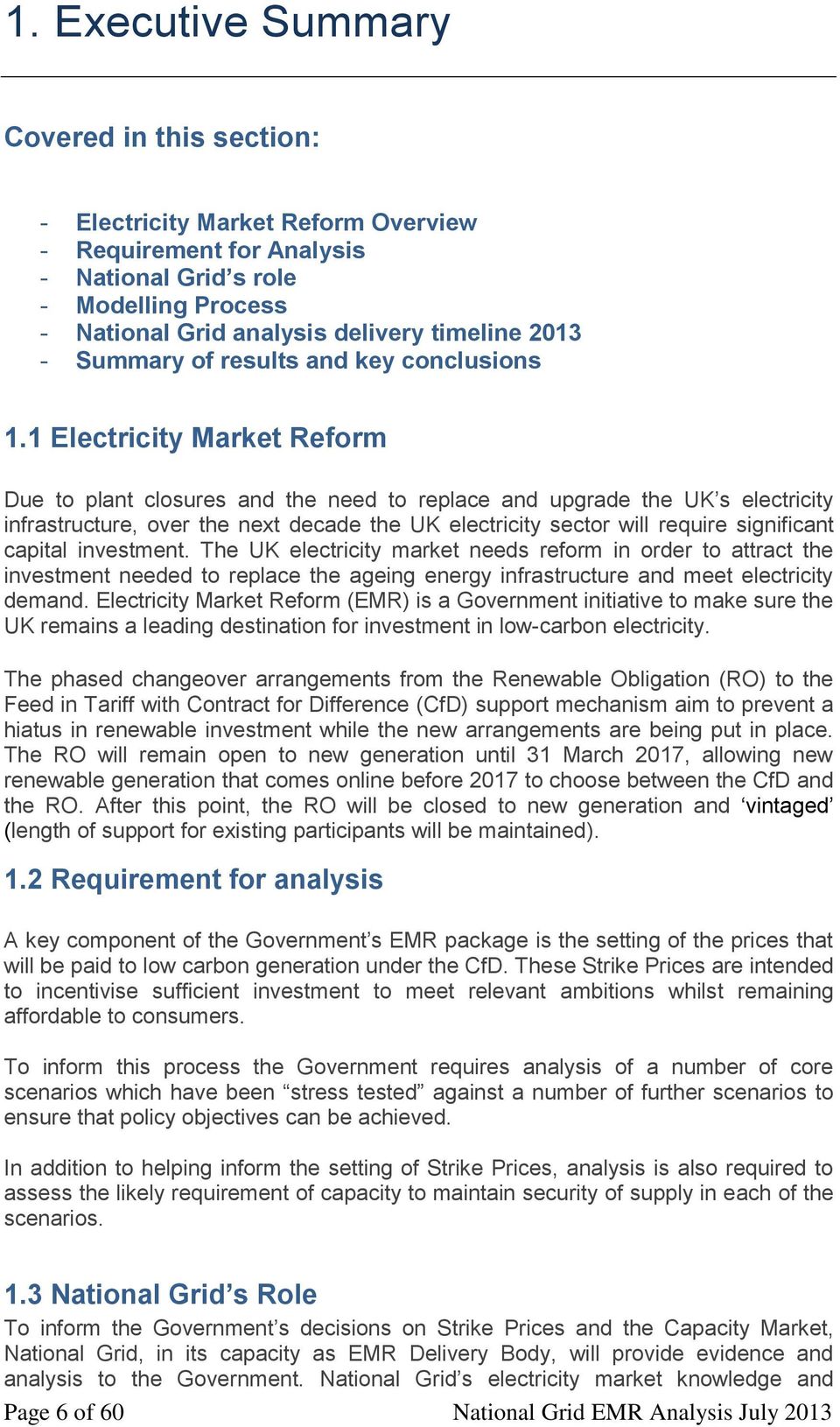
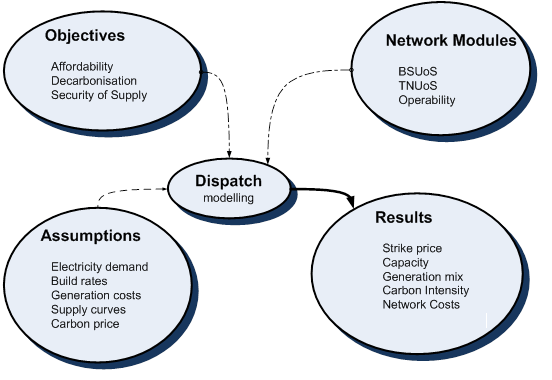
7 expertise will help to ensure that the analysis and evidence that inform Government s decisions are robust. National Grid already has the technical expertise, modelling, commercial and financial capabilities; and has expanded its capacity in these areas to take on this task. The CfD will also apply to Northern Ireland as well as Great Britain and in order to carry out the analysis for the Single Electricity Market in Northern Ireland effectively, National Grid has worked with the System Operator Northern Ireland (SONI). 1.4 Modelling Process A key aim of the analysis to date has been to help the Government understand how different scenarios would impact on its objectives and ambitions, so that it can take informed decisions. As such, the modelling brief set out the Government s objectives for EMR, as well as describing the analysis to be carried out, including the data, assumptions, models and scenarios to be used or developed. The Government also provided guidance to National Grid during the course of the analytical process on the range of decarbonisation scenarios to model. The following diagram illustrates the relevant inputs and outputs from the modelling. The objectives and assumptions have been provided by DECC with the analysis being undertaken by National Grid, including the development of supplementary models such as the network models. During the modelling phase the scenarios investigated offered a range of likely generation build outcomes which are intended to meet the required decarbonisation, security of supply and affordability levels as set out by Government policy. The principal modelling tool National Grid has used is a fully integrated power market model, the Dynamic Dispatch Model. The model enables analysis of electricity dispatch from power generators and investment decisions in generating capacity to Page 7 of 60 National Grid EMR Analysis July 2013
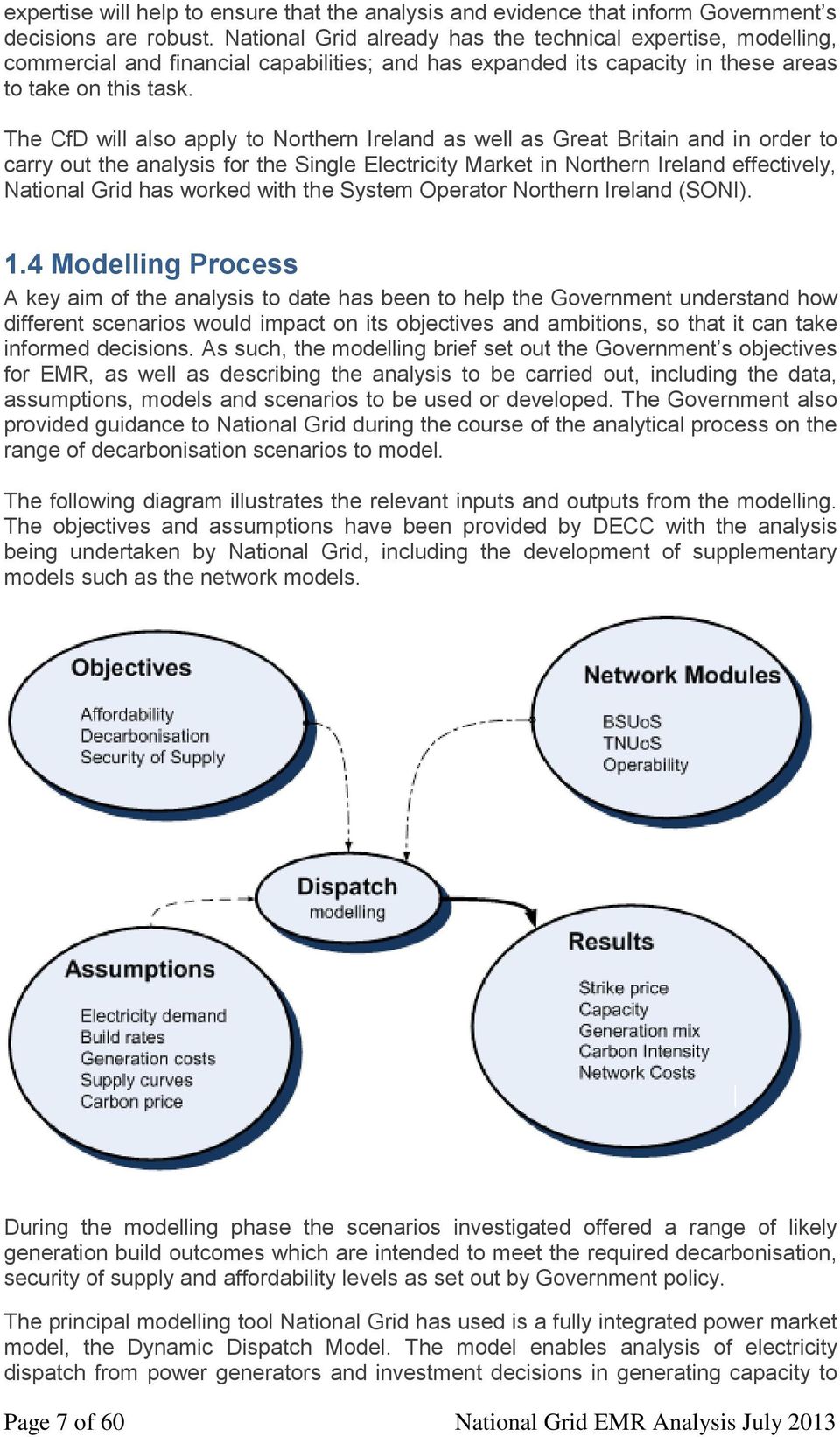
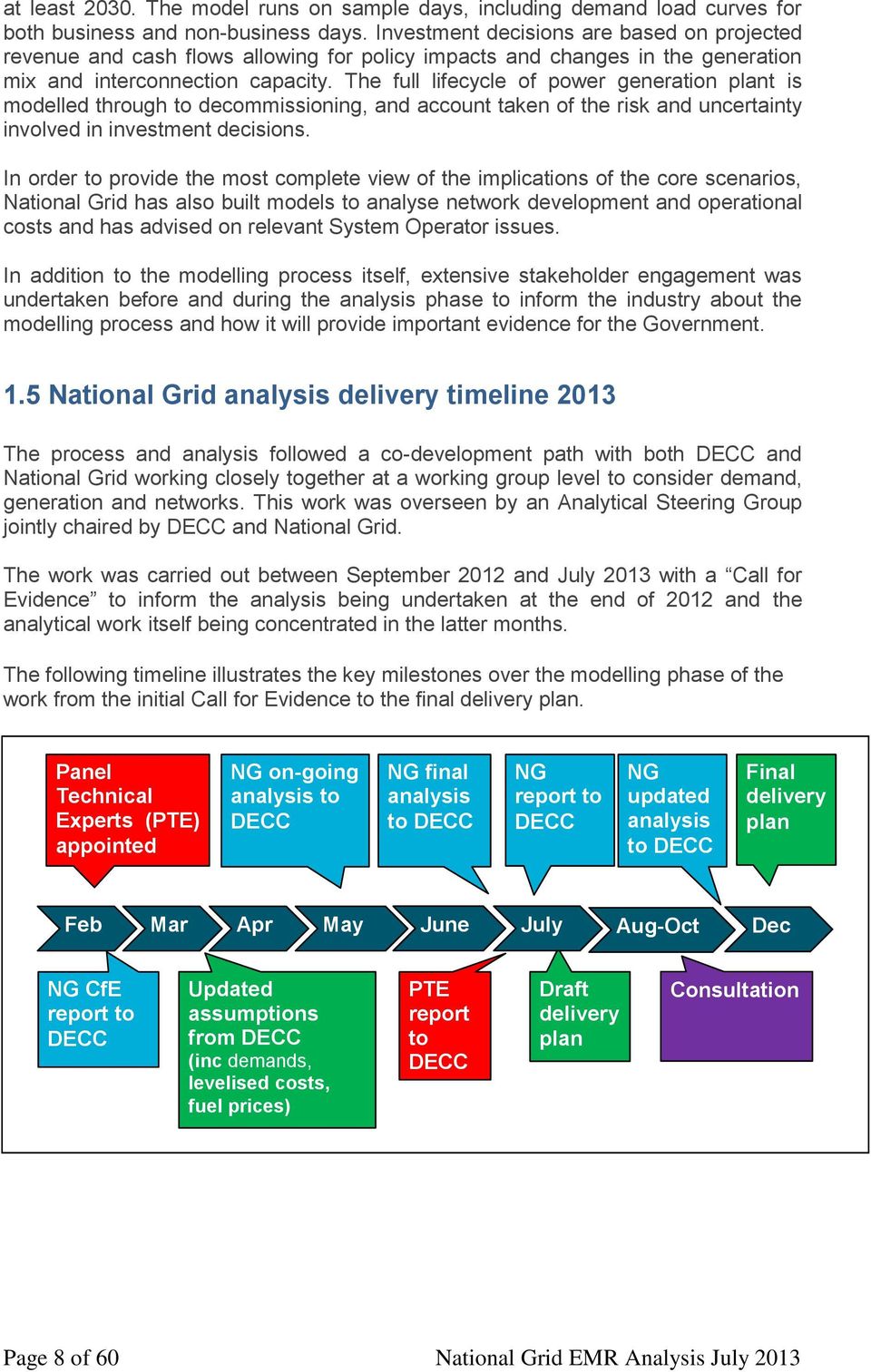
8 at least The model runs on sample days, including demand load curves for both business and non-business days. Investment decisions are based on projected revenue and cash flows allowing for policy impacts and changes in the generation mix and interconnection capacity. The full lifecycle of power generation plant is modelled through to decommissioning, and account taken of the risk and uncertainty involved in investment decisions. In order to provide the most complete view of the implications of the core scenarios, National Grid has also built models to analyse network development and operational costs and has advised on relevant System Operator issues. In addition to the modelling process itself, extensive stakeholder engagement was undertaken before and during the analysis phase to inform the industry about the modelling process and how it will provide important evidence for the Government. 1.5 National Grid analysis delivery timeline 2013 The process and analysis followed a co-development path with both DECC and National Grid working closely together at a working group level to consider demand, generation and networks. This work was overseen by an Analytical Steering Group jointly chaired by DECC and National Grid. The work was carried out between September 2012 and July 2013 with a Call for Evidence to inform the analysis being undertaken at the end of 2012 and the analytical work itself being concentrated in the latter months. The following timeline illustrates the key milestones over the modelling phase of the work from the initial Call for Evidence to the final delivery plan. Panel Technical Experts (PTE) appointed NG on-going analysis to DECC NG final analysis to DECC NG report to DECC NG updated analysis to DECC Final delivery plan Feb Mar Apr May June July Aug-Oct Dec NG CfE report to DECC Updated assumptions from DECC (inc demands, levelised costs, fuel prices) PTE report to DECC Draft delivery plan Consultation Page 8 of 60 National Grid EMR Analysis July 2013
9 1.6 Summary of results and key conclusions Below we summarise the key results to 2020 from our analysis: The percentage of renewable electricity in 2020 ranges between 30% and 35% across the scenarios. The Levy Control Framework (LCF) spend in 2020/21 ranges between 6.7 billion and 7.6 billion (2011/12 prices) across the scenarios. Three main technologies will contribute the most to renewable electricity in 2020: o Onshore Wind - GB capacity between 10 and 12 GW. o Offshore Wind - GB capacity between 8 and 16 GW. o Biomass Conversions GB capacity between 1.2 and 4 GW. GB network costs are broadly similar across the scenarios at around 4 billion in 2020, with the exception of the high offshore deployment scenario, which has higher costs in Page 9 of 60 National Grid EMR Analysis July 2013

10 2. Introduction-Electricity Market Reform 2.1 Structure of Report Chapter 2 gives an introduction to Electricity Market Reform (EMR) and National Grid s involvement. Chapter 3 of the report aims to describe the modelling and the tools used. Chapter 4 gives details of the input assumptions to the modelling and the ambitions to achieve. Chapter 5 of the report explains the core and alternative scenarios. Chapter 6 contains the results from the scenarios modelled along with conclusions. 2.2 EMR Objectives summary In November 2012 the Government published its objectives for energy policy 2 To keep the lights on, to keep energy bills affordable, and to decarbonise energy generation. Due to plant closures and the need to replace and upgrade the UK s electricity infrastructure, over the next decade the UK electricity sector will require significant capital investment. The UK electricity market needs reform in order to attract the investment to replace the ageing energy infrastructure and meet electricity demand. EMR is a Government initiative to make sure the UK remains a leading destination for investment in low-carbon electricity. EMR will provide the tools to help meet these objectives by: Ensuring a secure electricity supply by providing a diverse range of energy sources, including renewables, nuclear, CCS equipped plant, unabated gas and demand side approaches; and ensuring we have sufficient reliable capacity to minimise the risk of supply shortages. Encouraging sufficient investment in low-carbon technologies to put us on a path consistent with our EU 2020 renewables targets and our legally binding target to reduce carbon emissions by at least 80% of 1990 levels by Maximising benefits and minimising costs to the economy as a whole and to taxpayers and consumers - maintaining affordable electricity bills while delivering the investment needed. EMR minimises costs compared to the current policies because it seeks to use the power of the markets and competition and reduce Ministerial intervention and support over time. The elements of EMR covered in National Grid s EMR work: A mechanism to support investment in low-carbon generation: the Feed-in Tariffs with Contracts for Difference (CfD). A mechanism to support security of supply in the form of a Capacity Market. The institutional arrangements to support these reforms. 2 Page 10 of 60 National Grid EMR Analysis July 2013
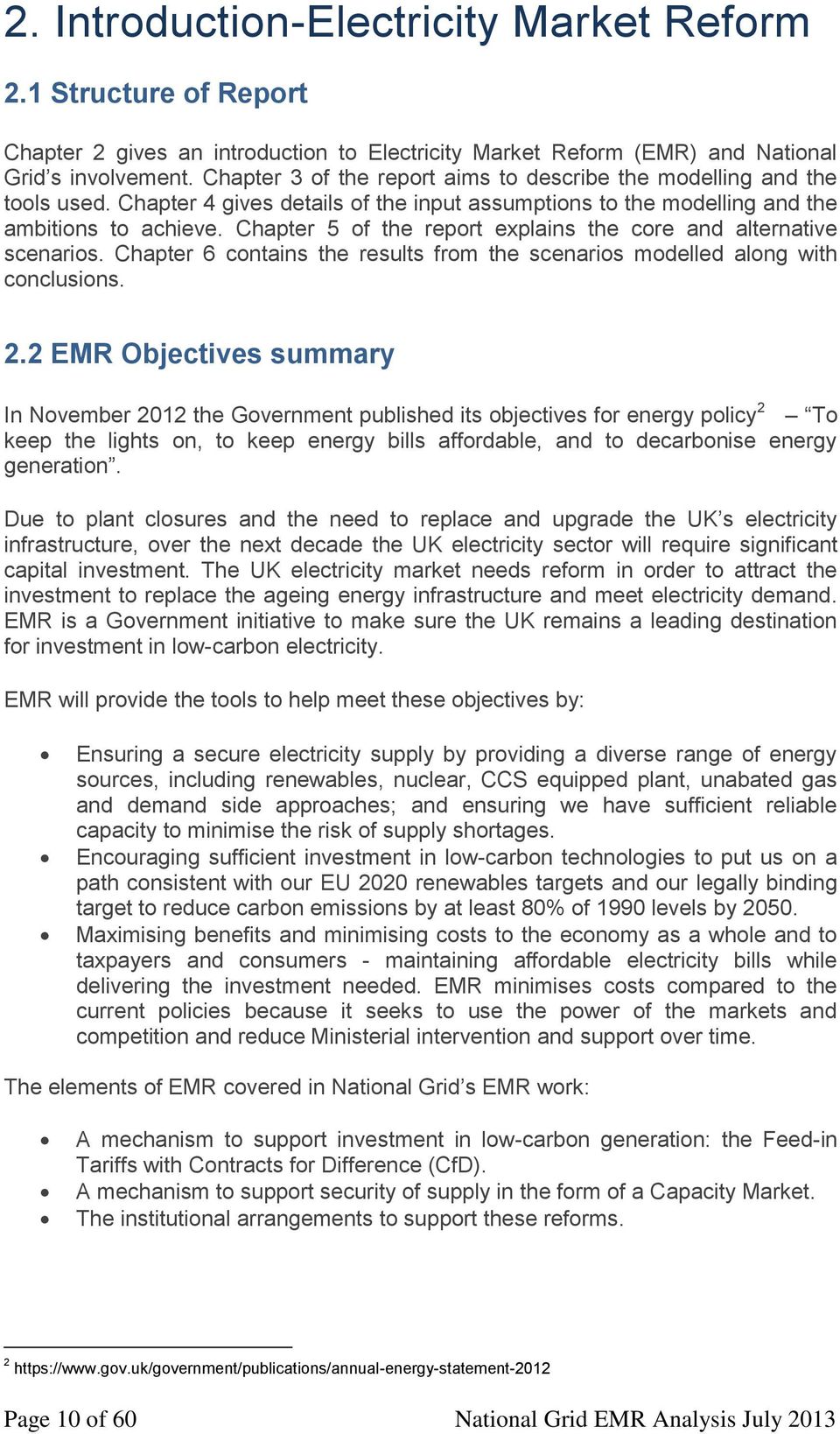
11 2.3 National Grid (System Operator) Involvement To inform the Government s decisions on CfDs and the Capacity Market, National Grid, as the System Operator, will provide evidence and analysis to the Government. National Grid s electricity market knowledge and expertise will help to ensure that the analysis and evidence that inform Government s decisions are robust. National Grid already has the technical expertise, modelling, commercial and financial capabilities and skills; and has expanded its capacity in these areas to take on this task. In order to carry out the analysis for the Single Electricity Market in Northern Ireland effectively, National Grid has worked with the System Operator Northern Ireland (SONI). 2.4 Contracts for Difference overview Contracts for Difference are long-term contracts between the CfD counter-party and eligible generators. These are funded by contributions from licensed electricity suppliers to provide stable and predictable revenues for companies to invest in lowcarbon electricity generation. Generator pays the difference between the reference price and CfD strike price CfD Strike price Reference price Generator receives the difference between the reference price and CfD strike price Time The CfD works by stabilising revenues for generators at a fixed price level known as the strike price. Generators will receive revenue from selling their electricity into the market as usual. However, when the market reference price is below the strike price they will also receive a top-up payment, via the counter-party, from suppliers for the additional amount. Conversely if the reference price is above the strike price, the generator must pay back the difference. Page 11 of 60 National Grid EMR Analysis July 2013
12 2.5 Stakeholder engagement National Grid has engaged with stakeholders to explain its role in relation to EMR and participated in groups such as the CfD Expert Group. We have explained our modelling approach in a number of industry forums and by presentation at a number of conferences and seminars. Additional areas of National Grid s stakeholder engagement relating to the EMR modelling work are highlighted in the sub-sections below Call for Evidence (CfE) In order to support the development of strike prices under the CfD for renewable technologies, National Grid launched a call for evidence under EMR. The call for evidence was specifically to ensure that National Grid takes into consideration the most recent and relevant technology costs, and economic assumptions for the setting of strike prices for CfDs. National Grid therefore invited responses from all stakeholders to ensure the first phase of strike price setting under CfD 3 4 from 2014, is supported by robust economic assumptions and new data evidence Industry meetings on technology costs National Grid attended a number of wider industry meetings, in order to achieve greater understanding on technology costs. 2.6 Devolved Administrations National Grid has met with the Devolved Administrations to keep them abreast of progress with the modelling work and gain their feedback. National Grid has also worked with the System Operator for Northern Ireland (SONI) as appropriate to ensure that the analysis properly covers the differences between the GB and Northern Ireland electricity markets. This will help inform Northern Ireland Ministers in their decision on giving consent to CfD strike prices in Northern Ireland. 2.7 Generation Levelised costs The results of the National Grid Call for Evidence were combined with similar generation cost data collected by DECC to produce the aggregated cost information utilised in the modelling (see Section 4.1 for more details) BB2E3D248/56915/NGEMRCallforEvidenceFinal91012.pdf 4 Page 12 of 60 National Grid EMR Analysis July 2013
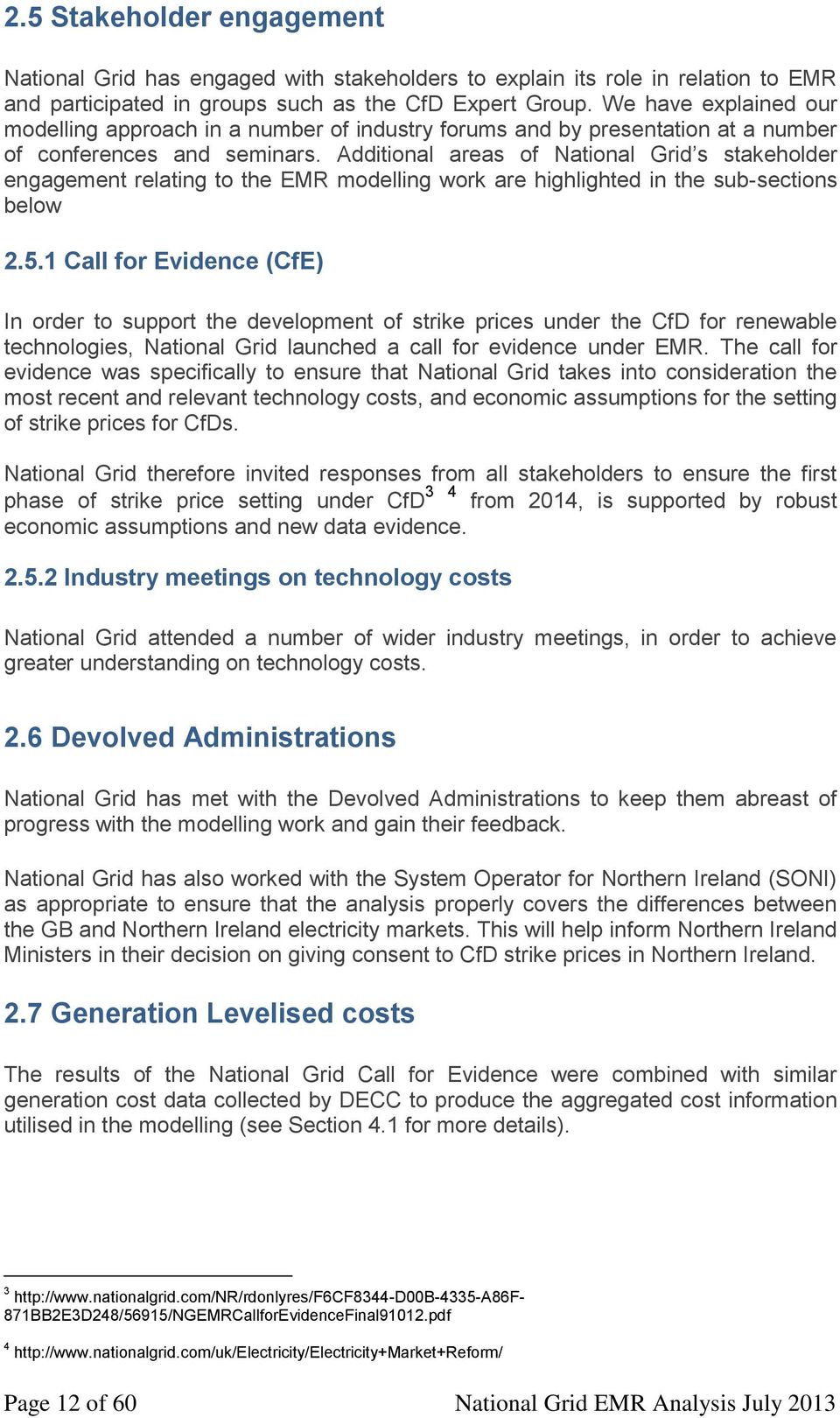
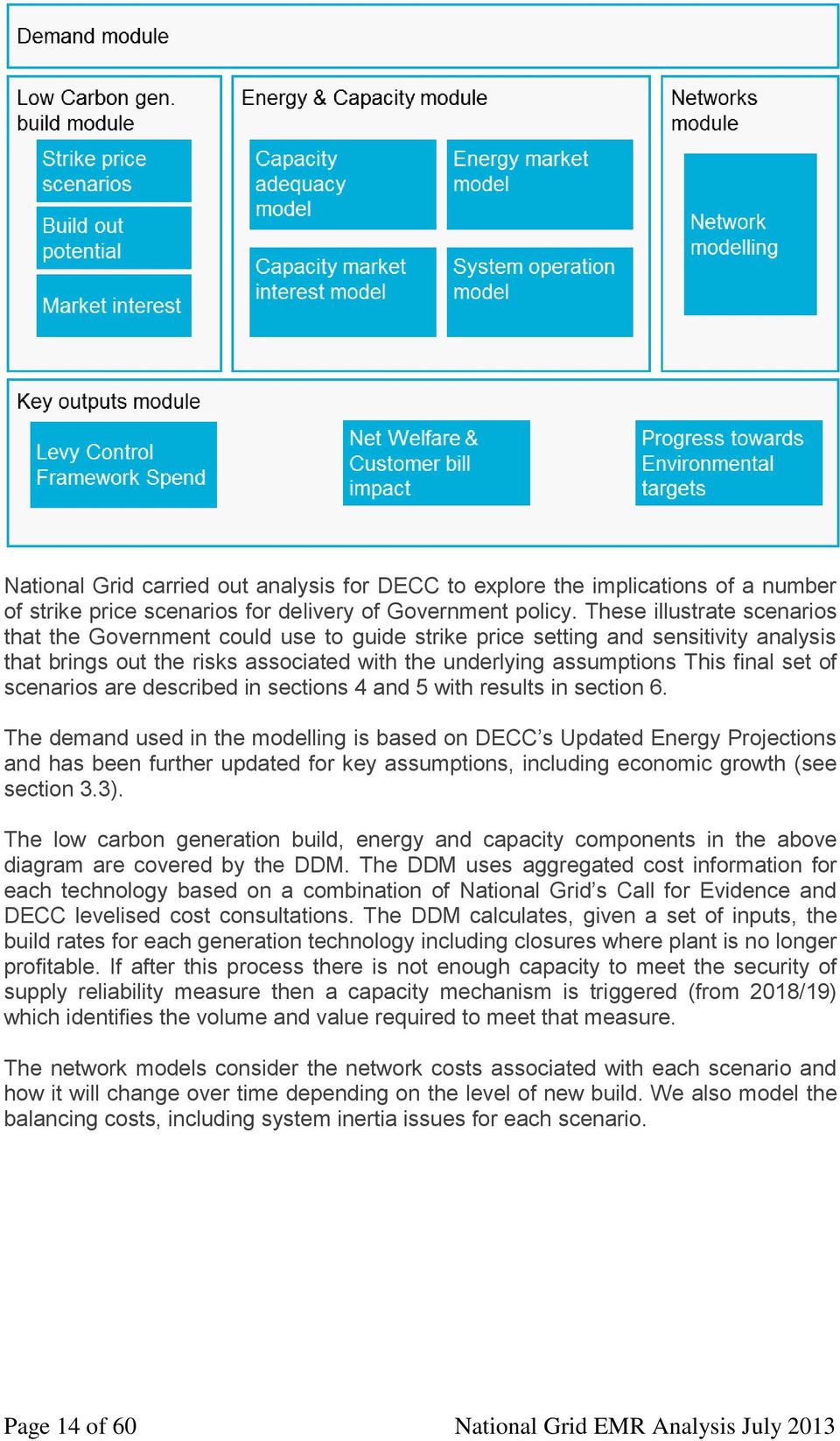
13 3. The Modelling Approach 3.1 National Grid analysis delivery 2013 The EMR work carried out by National Grid was undertaken between September 2012 and July 2013, with the analytical work concentrated in the latter months. Panel Technical Experts (PTE) appointed NG on-going analysis to DECC NG final analysis to DECC NG report to DECC NG updated analysis to DECC Final delivery plan Feb Mar Apr May June July Aug-Oct Dec NG CfE report to DECC Updated assumptions from DECC (inc demands, levelised costs, fuel prices) PTE report to DECC Draft delivery plan Consultation National Grid also gave advice and challenges on System Operator issues, this being an underlying benefit of National Grid s involvement. There has been a good relationship built between National Grid and DECC assisted by regular planned and ad-hoc meetings from stakeholder level to the analytical working groups. The areas involved in the analysis and research have drawn on expertise in many areas across National Grid. 3.2 High level Process The modelling approach is guided by the policy backdrop and in particular the objectives set by Government regarding the trilemma of decarbonisation, security of supply and affordability. Modelling aims to address a series of questions relating to: the cost, level of support required and build potential of new low carbon generation the level of capacity that will be required to meet security of supply and system operability network cost implications To answer these questions a suite of models has been developed including the Dynamic Dispatch Model (DDM) 5 provided by DECC, and in-house National Grid built models. The following concept diagram illustrates some of the areas considered when developing the models. 5 Page 13 of 60 National Grid EMR Analysis July 2013

14 National Grid carried out analysis for DECC to explore the implications of a number of strike price scenarios for delivery of Government policy. These illustrate scenarios that the Government could use to guide strike price setting and sensitivity analysis that brings out the risks associated with the underlying assumptions This final set of scenarios are described in sections 4 and 5 with results in section 6. The demand used in the modelling is based on DECC s Updated Energy Projections and has been further updated for key assumptions, including economic growth (see section 3.3). The low carbon generation build, energy and capacity components in the above diagram are covered by the DDM. The DDM uses aggregated cost information for each technology based on a combination of National Grid s Call for Evidence and DECC levelised cost consultations. The DDM calculates, given a set of inputs, the build rates for each generation technology including closures where plant is no longer profitable. If after this process there is not enough capacity to meet the security of supply reliability measure then a capacity mechanism is triggered (from 2018/19) which identifies the volume and value required to meet that measure. The network models consider the network costs associated with each scenario and how it will change over time depending on the level of new build. We also model the balancing costs, including system inertia issues for each scenario. Page 14 of 60 National Grid EMR Analysis July 2013
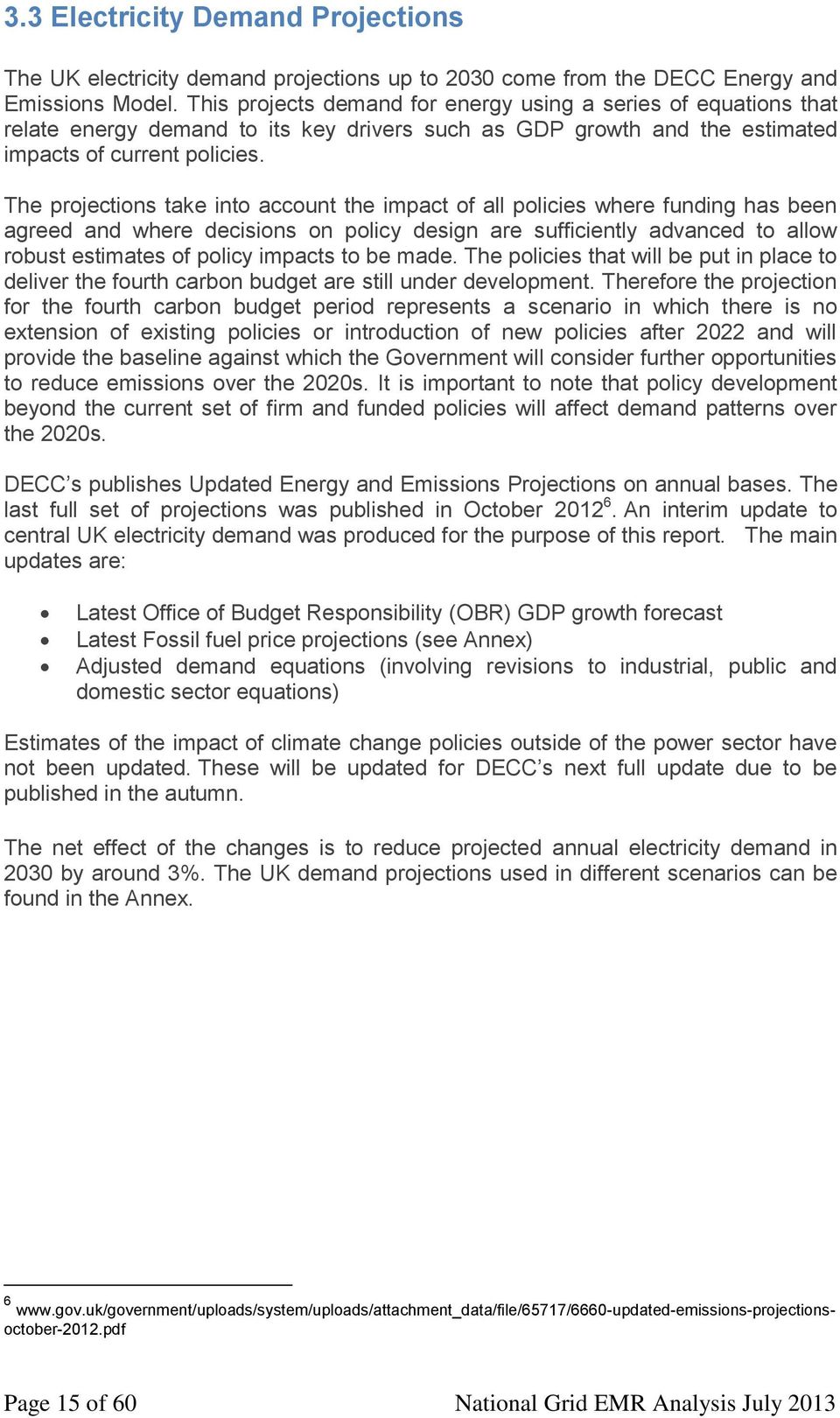
15 3.3 Electricity Demand Projections The UK electricity demand projections up to 2030 come from the DECC Energy and Emissions Model. This projects demand for energy using a series of equations that relate energy demand to its key drivers such as GDP growth and the estimated impacts of current policies. The projections take into account the impact of all policies where funding has been agreed and where decisions on policy design are sufficiently advanced to allow robust estimates of policy impacts to be made. The policies that will be put in place to deliver the fourth carbon budget are still under development. Therefore the projection for the fourth carbon budget period represents a scenario in which there is no extension of existing policies or introduction of new policies after 2022 and will provide the baseline against which the Government will consider further opportunities to reduce emissions over the 2020s. It is important to note that policy development beyond the current set of firm and funded policies will affect demand patterns over the 2020s. DECC s publishes Updated Energy and Emissions Projections on annual bases. The last full set of projections was published in October An interim update to central UK electricity demand was produced for the purpose of this report. The main updates are: Latest Office of Budget Responsibility (OBR) GDP growth forecast Latest Fossil fuel price projections (see Annex) Adjusted demand equations (involving revisions to industrial, public and domestic sector equations) Estimates of the impact of climate change policies outside of the power sector have not been updated. These will be updated for DECC s next full update due to be published in the autumn. The net effect of the changes is to reduce projected annual electricity demand in 2030 by around 3%. The UK demand projections used in different scenarios can be found in the Annex. 6 Page 15 of 60 National Grid EMR Analysis July 2013

16 3.4 Electricity Supply Modelling Overview The DDM is an electricity supply model, which allows the impact of policies on the investment and dispatch decisions to be analysed. The diagram below illustrates the high level structure of the model. The purpose of the model is to allow comparisons of the impact of different policy decisions on capacity, costs, prices, security of supply and carbon emissions in the GB power generation market. Dispatch Decisions Economic, energy and climate policy, generation and demand assumptions are external inputs to the model. The model runs on sample days, including demand load curves for both business and non-business days. For more details see the Annex. The generation data includes outage rates, efficiencies, emissions, planned outages and probabilities of unplanned outages. The Short Run Marginal Cost (SRMC) for each plant is calculated and determines a generation merit order. Demand for each sample day is then calculated taking interconnector flows, pumped storage, autogeneration and wind generation into account. Once the level of demand and system reserve has been determined, the system SRMC is calculated by matching the demand and reserve against the generation merit order and taking the SRMC of the marginal plant which meets this. The wholesale price is equal to this marginal price plus a mark up. The mark up is derived from historic data and reflects the increase of system price above marginal Page 16 of 60 National Grid EMR Analysis July 2013
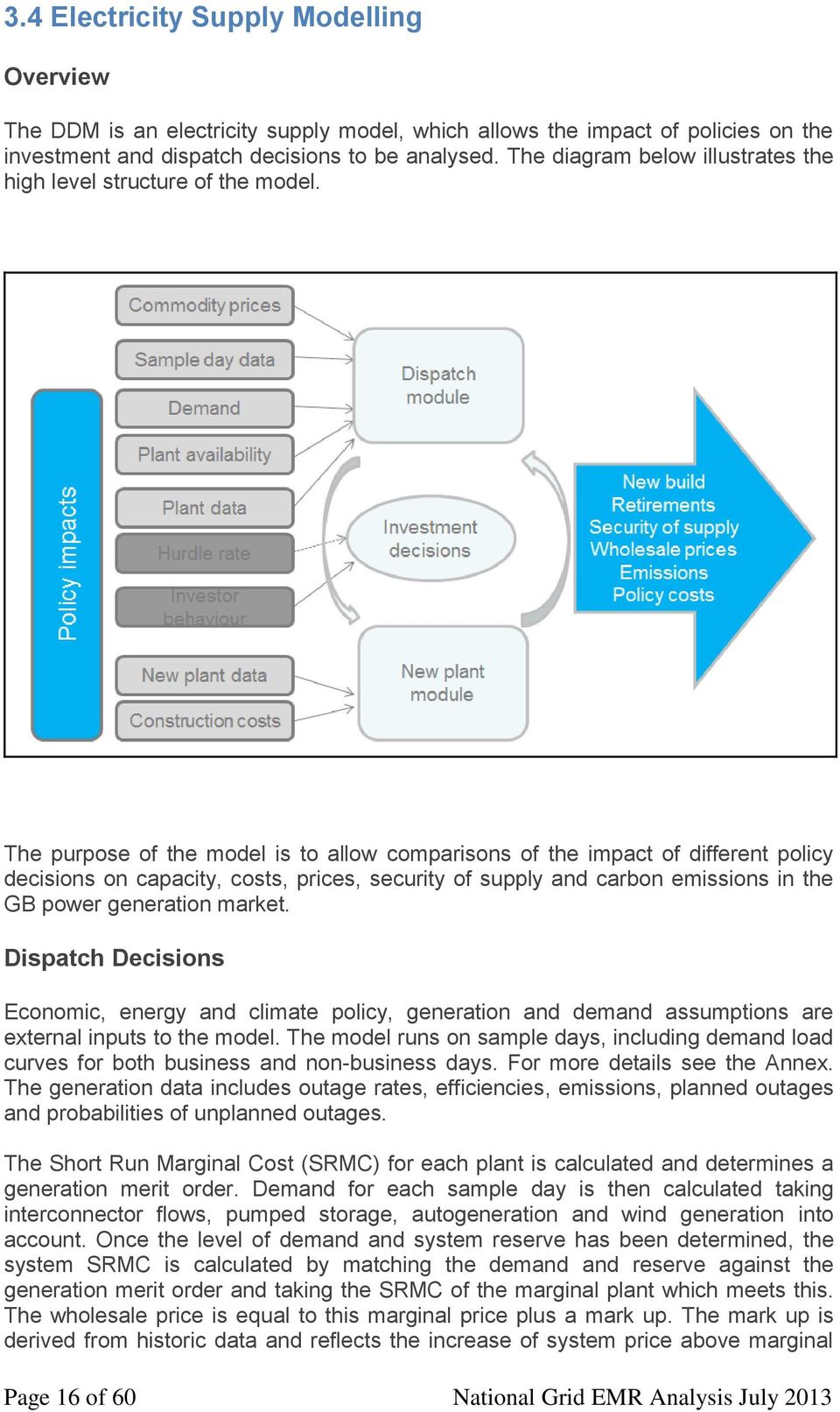
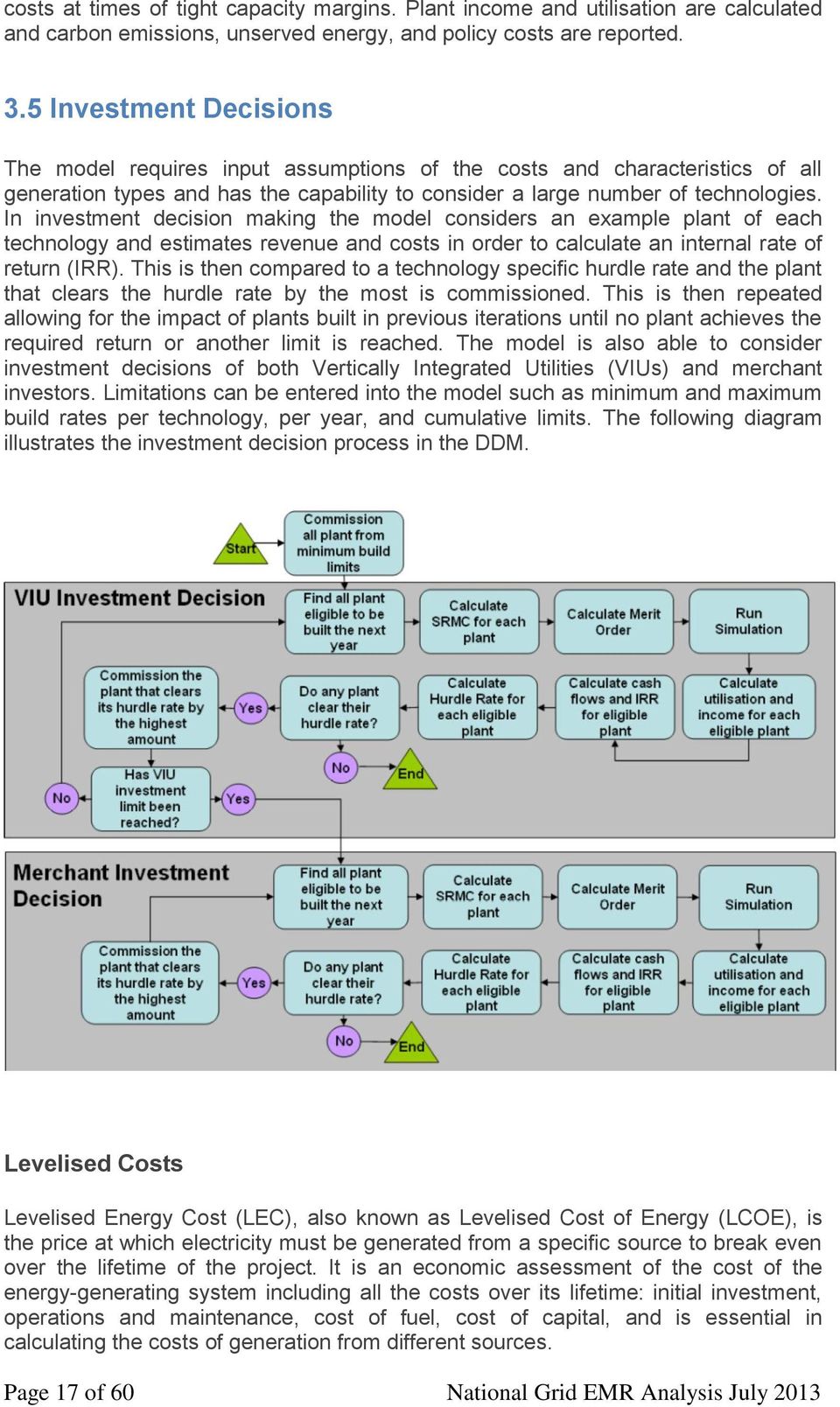
17 costs at times of tight capacity margins. Plant income and utilisation are calculated and carbon emissions, unserved energy, and policy costs are reported. 3.5 Investment Decisions The model requires input assumptions of the costs and characteristics of all generation types and has the capability to consider a large number of technologies. In investment decision making the model considers an example plant of each technology and estimates revenue and costs in order to calculate an internal rate of return (IRR). This is then compared to a technology specific hurdle rate and the plant that clears the hurdle rate by the most is commissioned. This is then repeated allowing for the impact of plants built in previous iterations until no plant achieves the required return or another limit is reached. The model is also able to consider investment decisions of both Vertically Integrated Utilities (VIUs) and merchant investors. Limitations can be entered into the model such as minimum and maximum build rates per technology, per year, and cumulative limits. The following diagram illustrates the investment decision process in the DDM. Levelised Costs Levelised Energy Cost (LEC), also known as Levelised Cost of Energy (LCOE), is the price at which electricity must be generated from a specific source to break even over the lifetime of the project. It is an economic assessment of the cost of the energy-generating system including all the costs over its lifetime: initial investment, operations and maintenance, cost of fuel, cost of capital, and is essential in calculating the costs of generation from different sources. Page 17 of 60 National Grid EMR Analysis July 2013
18 Generation costs will vary across projects which the model takes into account (see section 4.1). Generation costs are also uncertain, especially further into the future and to take account of this we have run different technology cost scenarios (see chapter 5). The underlying LCOE data from DECC s Electricity Generation Costs report is used as input into the DDM. Policy Tools The model is able to consider many different policy instruments, including potential new policies as well as existing ones. Policies are implemented by making adjustments to plant cash flows which either encourage or discourage technology types from being built in future and impact on their dispatch decisions. The policy modelling has been designed flexibly and policies can be applied to all technologies or specific ones, new plants only or include existing plants and can be varied over time and duration. Outputs The model outputs many metrics on the electricity market and individual plant that enables the policy impacts to be interpreted. The DDM therefore enables analysis to be carried out on policy impacts in different future scenarios, allowing comparisons of the impacts of different potential policies on the electricity market. 3.6 Network modules (extra to the DDM model) As detailed previously, the DDM model does not contain all the System Operator elements. In order to cover these additional areas National Grid has used external software and in-house designed and built models. The models use DDM outputs on the capacity/generation mix as inputs and present results for each separate area of interest. These areas include Transmission Network Use of System (TNUoS) charges, System inertia costs and Balancing Services Use of System (BSUoS) charges (see sections below for explanations of these). National Grid has provided DECC with copies of all non-licensed models being used for this purpose. 7 Page 18 of 60 National Grid EMR Analysis July 2013

19 3.6.1 Transmission Network Use of System model Transmission Network Use of System (TNUoS) charges recover the costs of transmission network investment and maintenance costs incurred by all GB Transmission Owners (NGET, SHET, SPETL, OFTOs). The current charging methodology splits the recoverable amount between generation and suppliers in the ratio 27% to 73% The purpose of TNUoS tariffs is twofold: firstly to reflect the impact that transmission users at different geographical locations have on transmission costs; and secondly to recover the total allowed revenue of the transmission licences. The specific charges for generators and suppliers vary locationally based upon the incremental cost of investment to facilitate additional generation or demand 8. Some generator charging zones have a negative wider locational element of the TNUoS charge, this provides a signal of the impact of generation in this area of the network. Generator TNUoS tariffs are made up of four components set out below. The sum of these forms the total TNUoS tariff for a generator: Wider Locational A locational zonal tariff that reflects the cost of providing incremental capacity on the onshore transmission network. Local Circuit A locational nodal tariff that reflects the cost of the transmission circuits from the point of connection to the main interconnected transmission system. Local Substation A locational nodal tariff that reflects the cost of the transmission substation where the generator is connected. Wider Residual A non-locational tariff that ensures the correct revenue is recovered from generation users. The DDM model is non-spatial and therefore does not take into account the variability of TNUoS charges by generator location. In order to address the spatial element, the TNUoS model was built in-house by National Grid as an addition to the DDM. The TNUoS model contains the TO Allowed Revenues agreed with Ofgem in the final RIIO proposals. 9 However, differences in generation build rate assumptions will require revised Allowed Revenues in the model. For example, a reduced generation build scenario, that requires less transmission investment, will result in a decrease in the amount of transmission revenues to be recovered through TNUoS. The TNUoS model uses the DDM output generation capacity mix, which it compares to the reference generation capacity mix, and calculates a revised allowed revenue for the Transmission Owners. These revenue changes are reflected in the TNUoS charges and the model provides these for Scotland, England & Wales, and Offshore for the years The output of the TNUoS model feeds into the total network costs. 8 ndembdded.aspx 9 T1/ConRes/Documents1/1_RIIOT1_FP_overview_dec12.pdf Page 19 of 60 National Grid EMR Analysis July 2013

20 In summary, the total transmission costs that TNUoS charges will need to recover in the future will be sensitive to changes in both generation and supply. For the EMR analysis, the TNUoS model demonstrates how this total cost varies with increasing generation on the network and different mixes of generation type Balancing Services Use of System model Balancing Services Use of System (BSUoS) charges are paid by suppliers and generators based on their energy taken from or supplied to the National Grid in each half-hour Settlement Period. These charges are paid to cover the costs of keeping the system in electrical balance and maintaining the quality and security of supply. Currently the cost ratio is 50:50 generator to supplier, although there is a proposal to remove BSUoS cost from generators 10. The BSUoS cost forecast model is contained within an add-on to the DDM. BSUoS cost forecast estimates are split into the component parts that the System Operator currently procures Operation of Transmission Congestion Model A transmission constraint is a restriction on power flow across a part of the transmission system. A transmission constraint occurs when there is too much electrical power attempting to flow along a circuit than that circuit is rated to carry. A transmission constraint can also occur if the system operator determines that if a credible fault were to occur on a particular circuit, then other circuits would be overloaded by the resultant change in the power flow. The System Operator must manage the power flows on the grid to avoid constraints occurring. The system operator can manage this in various ways; a usual option is to restrict generation behind constrained boundaries, and replace that restricted generation by instructing generators to run on unconstrained parts of the network. The cost associated with this type of action can be executed through contracts/trades with generators, or at real-time in the balancing mechanism 12 The cost components related to transmission constraints are calculated using the results from a software package Plexos 13 which simulates market dispatch and constraint resolution in the balancing mechanism. Three scenarios have been simulated using this software covering different generation mixes; for example, connected wind. The final constraint cost in any particular DDM scenario is then a derivation of the costs taken from the simulations, matching the results from the DDM scenario to the simulated scenarios Frequency Response, Reactive Power, Fast Start, Black Start, BM Startup, Fast Reserve, Operating Reserve, STOR (short term operating reserve), Energy Imbalance, SO to SO trades, Operational inter-trips, Commercial intertrips, Contracts, Balancing Mechanism (BM) constraints, Max. Gen service, Forward trades, downward regulation, and Inertia management for details on the balancing mechanism 13 Page 20 of 60 National Grid EMR Analysis July 2013

21 3.6.4 Inertia Model A certain level of inertia is required on a power system in order to limit the rate at which the frequency falls following a fault caused by a large loss of generation. Thus it avoids activating Rate of Change of Frequency protection that small generators commonly use to detect when the generator has been disconnected from the system. Sufficient inertia has historically been provided by stored mechanical energy in rotors of spinning synchronous generators and rotors of spinning motors on the demand side without the grid operator needing to intervene. Both of these provisions are reducing due to more non-synchronous generation becoming prevalent (for example, wind turbines which do not provide inertia), and less demand-side inertia (for example, due to traditional synchronous motors being replaced by electronically driven motors, and a fall in demand from manufacturing industry). The System Operator can take actions to mitigate against low inertia, such as bidding down generation to reduce the level of the largest credible generation loss, or bidding off generation which contributes low inertia, and replacing it with generation which contributes high inertia. National Grid has developed a model that calculates, given a mix of generation, the level of curtailment required due to insufficient inertia on the system at any point in time, both in volume and cost Incorporation of network costs in EMR analysis The network costs (TNUoS, BSUoS and Inertia) are included in the cost benefit analysis for the EMR impact assessment. They are included alongside the DDM s generation costs (i.e. generator capital, operating, fuel and financing costs). These network costs capture some costs and growth in costs that the DDM s generation costs (also included in the cost-benefit analysis) are unlikely to capture. These costs are: Network costs borne by suppliers (the DDM s generation costs are costs paid by generators only) BSUoS paid for by non-renewable generators Inertia costs 14 National Grid s network costs are therefore an important enhancement to DECC s EMR cost benefit analysis. However, it is recognised that a small proportion of these network costs will overlap with the generation costs. 3.7 SONI Methodology The System Operator for Northern Ireland (SONI) was tasked with modelling the likely build and dispatch of low carbon technologies in Northern Ireland in response to CfDs. Generators in Northern Ireland (NI) over 10MW participate in the All Island Single Electricity Market (SEM), and dispatch differently from similar plant situated in GB. Through detailed market modelling of the SEM, SONI has projected dispatch of NI generators under a number of scenarios as agreed with National Grid and DECC. In this section we summarise the methodology. 14 Inertia costs are included in the BSUoS costs (mentioned separately due to the modelling required) Page 21 of 60 National Grid EMR Analysis July 2013
22 3.7.1 High Level Process SONI has used strike prices consistent with those assumed by National Grid. A detailed market model representing the SEM has been developed to project generation volumes and wholesale price, used to calculate the reference price. Capacity assumptions have been developed using the most credible public sources available, and kept consistent with the scenarios modelled by National Grid. Strike prices have been used exogenously to calculate difference payments to low carbon generators Market Model SONI has used Plexos for Power Systems 15 software to model generator dispatch at an hourly level in the SEM. The SEM model contains an explicit representation of all generators, sources of demand, aggregated small scale generation, interconnection and current market rules for priority dispatch of renewable generation Key Assumptions SONI has used publicly available sources where possible, and has been consistent with National Grid where applicable. The following table describes the key input assumptions to the market model, sources, and any differences from the National Grid modelling Page 22 of 60 National Grid EMR Analysis July 2013
23 Model Input Data Source Description Differences to National Grid Modelling Horizon na , modelled at hourly granularity GB modelled half hourly for sample days and then scaled. Capacity Renewable Load Factors Demand EirGrid/SONI Generation Capacity Statement (GCS) EirGrid Vision 3 (internal) EirGrid/SONI GCS EirGrid/SONI GCS EirGrid Vision 3 (internal) System Operators view of capacity evolution, taking into account retirement announcements and plant in planning / connection queue. For the period renewable generation is increased to meet EirGrid s long term projections. Thermal plant is retired and commissioned based on market economics and to ensure a consistent capacity margin Consistent with GCS, such that ROI and NI meet 40% RES-E target in Onshore Wind 30% (13 geographical regions), Offshore wind, 35% (2 geographical regions), Tidal 20% Hourly demand modelled using historic hourly demand profile scaled to the median peak and annual energy projections given in GCS. Demand in the period (peak and annual energy) is scaled to meet EirGrid s long term projections. National Grid has used the DDM investment decision process to build UK capacity based on strike prices and assumptions on levelised costs by technology. Similar approach with annual wind output being based on three different load factors for onshore and offshore sites. NG uses DECC s UK wide demand projections with an allowance for NI to give GB demands. This allowance is fixed at the current percentage of UK demand attributable to NI (2.7%). Fuel Prices DECC As supplied by DECC Consistent Carbon Prices DECC As supplied by DECC. Generators in the SEM are not liable to pay Carbon Price Support on fuel, and so the DECC supplied Appraisal value has been used this follows EUA projections to 9 /t by 2020, rising to 75 /t by 2030 following an assumed global agreement on carbon pricing Consistent, though CPS omitted in NI modelling. Interconnection GB representation Strike prices Reference prices Capacity Payments Curtailment EirGrid/SONI internal National Grid DDM model National Grid DDM modelling EirGrid/SONI internal following discussion with National Grid EirGrid/SONI internal EirGrid/SONI internal Two interconnectors (Moyle and East-West) from SEM to GB, 750 MW total capacity. Losses and wheeling charges used to calibrate flows. Hourly price file at GB end of interconnectors. SEM assumed price taker to GB market. Price file developed from National Grid DDM core scenarios model, on monthly characteristic day basis Assume UK wide strike prices as used in National Grid DDM modelling Reference prices are assumed to be set using forecasted SEM market price. Intermittent generation assumed to receive day ahead price, baseload generation assumed to receive year ahead price. EirGrid/SONI internal projections from , kept constant thereafter. Capacity payments are an additional revenue stream to generators in the SEM based on availability and are added to the forecasted SMP to calculate the difference payments for NI generators Modelling of wind results in curtailment of 5% by 2020, consistent with the GCS and ensuring System Non-Synchronous NG modelling assumes full imports to NI from GB in all periods. Prices consistent for core scenarios. Consistent NG assume reference price set at time weighted annual price for baseload plant in GB and at halfhourly price for intermittent plant. With DDM CM payments (if triggered) are calculated based on the auction clearing price. Wind is curtailed in the dispatch model if supply is greater than demand. Page 23 of 60 National Grid EMR Analysis July 2013
24 Market rules EirGrid/SONI internal Penetration rules of 75% in 2020 are met in all periods. We have assumed current market rules will remain. There is currently little visibility of changes that may occur as part of the adoption of the EU target model by end Additional curtailment due to constraints or inertia is modelled separately to calculate levels and associated costs. Current market rules apply prior to the introduction of a capacity mechanism. As the results presented in this report contain some differences in the input assumptions it is not valid to directly add the results of the SONI NI and the National Grid GB estimates. The UK figures for overall estimates presented in this report are adjusted to ensure accurate projections of the total UK LCF spend and generation Scenarios modelled SONI has modelled a subset of the scenarios outlined in Chapter 5, as some did not apply to Northern Ireland. The final list of scenarios modelled by SONI is as follows: Core Scenario 32% Low tech costs High tech costs Core Scenario 35% Core Scenario 30% Low fossil fuel prices High demand 3.8 Quality Assurance Models A Quality Assurance (QA) process was followed across the full suite of models used. The DDM model has been through previous QA within DECC. In parallel with this the models built specifically for the analysis of system costs have been internally reviewed and shared with DECC for QA purposes. Existing models have followed a due diligence process. The DDM model has been peer reviewed; used for previous published analysis (including the DECC s Gas Generation Strategy and its Updated Energy and Emissions projections). It has also been reviewed by National Grid to test its suitability for the draft Delivery Plan analysis. Plexos is an agreed tool between National Grid and Ofgem currently in use for the Balancing Services Incentive Scheme (BSIS) Page 24 of 60 National Grid EMR Analysis July 2013
25 3.8.2 Peer Review An earlier version of the DDM model was peer reviewed by external independent academics to ensure the model is fit for the purpose of policy development. Professors David Newbery and Daniel Ralph of the University of Cambridge undertook a peer review to ensure the model met DECC s specification and delivered robust results. It was deemed an impressive model with attractive features and good transparency. For the Peer Review report see Assessment of LCP s Dynamic Dispatch Model for DECC Results and Process The Government has appointed a Panel of Technical Experts 18 to scrutinise the System Operator s analysis. The Panel is made up of experts who have knowledge across various sectors of the electricity market and have analytical and technical modelling skills. The members are independent of particular viewpoints and thus provide impartial advice. The Panel s report has been published alongside this report, see Annex F to the draft delivery plan Page 25 of 60 National Grid EMR Analysis July 2013
26 4. Input Assumptions 4.1 Modelling assumptions This section sets out the main modelling assumptions provided by DECC and where these have been updated since the Government Response to the RO Banding Review and the EMR Impact Assessment (2013). A generic description follows with more specific scenario detail in chapter Technology costs The modelling uses generation costs from DECC s Electricity Generation Costs 2013 report 19. For that report, several datasets have been considered as part of a review on costs for use in the draft EMR Delivery Plan. The levelised costs are provided by DECC within the data sources summarised below. Further detail on the assumptions used and their sources are set out in DECC s Electricity Generation Costs 2013 report 20. Non Renewable Technologies: Underlying data on non-renewable technologies has been provided by Parsons Brinckerhoff 21. Renewable Technologies: The following data sources for various renewable technologies have been used and/or considered by DECC. These are: 1. Government Response to the Banding Review (GRBR) - data and evidence underpinning the Government response to the consultation on proposals for the levels of banded support under the Renewables Obligation for the period and the Renewables Obligation Order 2012 for renewable technologies Large scale solar PV data - data and evidence on the costs and performance of large-scale solar PV underpinning Government response to further consultations on solar PV support, biomass affordability and retaining the minimum calorific value requirement in the RO FiTs data: Data and evidence from Parsons Brinckerhoff (PB) (2012) published as part of the government response to Phase 2A and 2B comprehensive review of feed in tariffs (This is referred to as the Government Response to the RO throughout this report. Please note that the data has been inflated from 2010 to 2012 prices and heat revenues have been updated to reflect DECC s 2013 fuel and carbon prices when compared to those published as part of the Government Response to Renewables Obligation) Page 26 of 60 National Grid EMR Analysis July 2013
27 4. Onshore Wind Call for Evidence - Data received in response to DECC s Onshore Wind Call for Evidence and published in June National Grid Call for Evidence - Data received as part of National Grid s Call for Evidence 27 (2013) 6. PB a DECC commissioned report from Parsons Brinckerhoff (2013) on renewable technologies TNEI offshore wind costs assessment Crown Estate s Offshore Wind Cost Reduction Pathways Study Offshore Wind Cost Reduction Task Force 31 To sign off the updated technology costs and other key assumptions for the Draft Delivery Plan, DECC set up a Levelised Cost Board (LCB) chaired by DECC s Chief Economist. The LCB: 1. Oversaw the creation of levelised cost information across DECC and ensured consistency with its partners including National Grid 2. Agreed changes in generation cost assumptions; 3. Agreed the process for combining the evidence from the Government Response to the Banding Review, the National Grid Call for Evidence and the PB 2013 update into renewable cost assumptions for Draft Delivery Plan modelling; 4. And signed off the final set of generation costs used in the Draft Delivery Plan modelling Electricity demand UK electricity demand projections up to 2030 come from the DECC Energy and Emissions Model (as set out in section 3.3). These are described in more detail in the Annex Daily load curves The model scales annual demand to half hour demand for sample days using daily load curves. These are half hour demand profiles for a range of days for each quarter from a high demand day to a low demand day. Each day is split into domestic and non-domestic load bands. The values are demand in the half hour as a percentage of average half hour demand for the whole year. The profiles are based on demand from 2008/09 to 2011/12 (see Annex for further details) Fossil fuel prices The modelling uses updated fossil fuel price projections, which DECC updates annually and are published alongside this report 32. The publication covers low, 26 ce_response.pdf Page 27 of 60 National Grid EMR Analysis July 2013
28 medium and high long-term price scenarios for oil, gas and coal prices out to The core scenarios assume central DECC fossil fuel price assumptions. These are set out in the Annex Carbon prices The modelling takes into account the Carbon Price Floor (CPF) 33 which came into effect in April The CPF trajectory reaches 30/tCO 2 (2009 prices) in 2020, further rising to 70/tCO2 (2009 prices) in Post 2030 the modelling assumes that carbon prices follow the social appraisal values. 34 These assumptions are set out in more detail in the Annex Maximum build limits In general the assumptions on maximum build limits are informed by maximum historic build rates or Government s and industries assessment of future potential. However, the supply chains of some technologies either do not yet exist or are at a very early stage and therefore assumptions on maximum build limits are uncertain. Maximum build limits for unabated gas plants are set roughly equal to average maximum build rates in the Dash for Gas years, with upward adjustments for years with significant retirements. Over this decade the modelling is consistent with National Grid s latest Transmission Entry Capacity (TEC) Register. The modelling assumes two Carbon Capture and Storage (CCS) early stage projects becoming operational in mid Commercial CCS plants can first become operational from 2025, which is based on a 5-year construction period and investors needing to see demonstration projects operating for a few years before they take a final investment decision. There is significant uncertainty around maximum build limits for CCS as the technology has yet to be demonstrated commercially. Maximum build limits are set to two CCS plants per year. The Delivery Plan 2030 forward look chapter considers a scenario with higher deployment of CCS. The modelling assumes that the first new nuclear reactor becomes operational in mid The Nuclear Supply Chain Action Plan 35 estimates that by 2030 up to 16.5GW of new nuclear could be operational, which equates to around one 1.65GW reactor per year over the 2020s. The core scenarios assume a more constrained feasibility of nuclear over the 2020s in order to take account of uncertainty in the future costs of alternative technologies. Post 2030, nuclear maximum build limits are on average two plants every 3 years. The Delivery Plan 2030 forward look chapter considers a scenario with higher deployment of nuclear. Maximum build limits for renewable technologies are broadly consistent with those used in the Renewables Obligation Banding Review Government Response (2012), which are based on Arup (2011) and information obtained during the Renewables Obligation Banding Review Consultation These maximum build limits are set out on_govt_response.pdf Page 28 of 60 National Grid EMR Analysis July 2013
29 in the Annex. The Delivery Plan 2030 forward look chapter considers a scenario with higher deployment of renewables Variation in technology costs: The generation cost information includes low, medium and high capital cost estimates. To allow for the increase in costs when constructing multiple plants in a single year caused by factors such as less attractive sites, less advanced planning or greater costs for renewable technologies, the DDM takes account of difference in cost of potential new build in any year. The first plant available to build in any given year is assigned the cheapest new build cost, while the last plant available is assigned the most expensive new build cost. The construction costs of all other plant are defined by the linear interpolation of the low, medium and high cost points. The Renewables Obligation Banding Review Government Response analysis used five cost tranches (low, low/medium/, medium, medium/high, high), each with 20% of the available potential Technology costs over time The costs of emerging technologies will evolve over time due to learning from international or UK deployment. In general, estimates of the cost of different electricity generating technologies in the future are driven by expectations and assumptions of technology specific learning rates and global and UK deployment. In general IEA 39 projections are the main source for global deployment for all technologies. Three notable exceptions are advanced conversion technologies (ACT), marine and estimates for renewables technologies under 5MW. These are driven by scenarios of technical potential for UK deployment, the Renewables Obligation Banding Review and the other two evidence sources above Maximum annual net load factors The maximum annual net load factors for CfD supported renewable plant are based on the Government Response to the Banding Review, with the exception of: Onshore wind: The maximum annual load factor has been updated to reflect a UK average load factor of 28% from 1998 to Large solar photo-voltaic: The maximum annual load factor reflects assumptions underpinning analysis for the Renewables Obligation Banding Review for the period 1 April 2013 to 31 March Government Response 37 Build constraints for large solar photo-voltaic reflect assumptions underpinning analysis for the Renewables Obligation Banding Review for the period 1 April 2013 to 31 March 2017: Government Response to further consultations on solar PV support, biomass affordability and retaining the minimum calorific value requirement in the RO ( and build constraints for tidal stream and wave technologies reflect DECC s current understanding Estimates for renewable technologies are based on IEA Bluemap (see ARUP 2011 for details), and non-renewable technologies are IEA Energy Technology Perspectives (2012). Future deployment scenarios are not based on yearon-year data and therefore there is uncertainty about how costs will evolve overtime. This approach is intended to capture trends in cost reduction rather than precise year-on-year changes. 40 A recent study by Staffell and Green (2013) finds that the load factor of wind turbines declines over time. The load factor used in draft Delivery Plan analysis is derived from 14 years of Dukes data. This historic data should capture the decline in load factors of current wind farms over time. Page 29 of 60 National Grid EMR Analysis July 2013
30 to further consultations on solar PV support, biomass affordability and retaining the minimum calorific value requirement in the RO 41. Landfill and sewage gas: The maximum annual load factors have been updated based on March 2013 Energy Trends. Marine technologies: The maximum annual load factors have been updated following the National Grid Call for Evidence - Data received as part of National Grid s Call for Evidence 42 (2013). The maximum annual net load factors vary by scenario for dispatchable technologies and for intermittent technologies due to potential curtailment. The maximum annual net load factors are set out in the Annex Investor hurdle rates and hurdle rate reductions due to CfDs The starting point for the pre-tax real hurdle rates used in the Draft EMR Delivery Plan analysis are the post-tax nominal hurdle rates underlying the Renewables Obligation Banding Review Government Response (2012). The post-tax nominal rates are based on evidence from Arup (2011) 43, Oxera (2011) 44 and Redpoint (2010) 45. As a result of lower exposure to fossil fuel price risk and the greater revenue certainty which this gives, the cost of capital for investors in low-carbon generation is expected to be lower under a CfD than under a Premium FiT. The estimated hurdle rate reductions due to the introduction of CfDs draw on analysis by Redpoint (2010). To convert post-tax nominal to pre-tax real hurdle rates, updated effective tax rate assumptions from work undertaken by KPMG (2013) 46 and a 2% inflation assumption consistent with the Government s inflation target have been applied. This is set out in DECC s Electricity Generation Costs report. The resulting pre-tax real hurdle rates for technologies for which strike prices are proposed are shown in the Annex Plant closures and extensions Information on plant closures for the period covering financial years 2013/14 and 2014/15 has been updated with National Grid s latest notified Transmission Entry Capacity (TEC) reductions. The updated retirement decisions have been verified by National Grid and have been signed off by the DECC Levelised Cost Board. In order to project retirement decisions by plants due to the Large Combustion Plant Directive (LCPD), DECC uses the Environment Agency s public data on the running hours of LCPD opt out plant to estimate future retirement dates. Industrial Emission Directive (IED) decisions are based on Redpoint analysis and stakeholder rates% pdf Page 30 of 60 National Grid EMR Analysis July 2013
31 engagement. The modelling assumes life extensions for existing nuclear plants based on plant announcements. This is seven years for all of EDF s AGR fleet except for Hartlepool and Heysham 1, which have previously been granted life extensions of five years. For these two plants two further years extension are assumed. Retirements due to plant economics are modelled in the DDM. When plants have made losses for two consecutive years, the model assesses the profitability of these plants over the next five years. If plants are projected to lose money over the next five years they decide to close Capacity Mechanism The reliability standard for most scenarios is a Loss of load expectation (LOLE) of approximately 3 hours per year before any mitigating actions are taken (for example emergency interconnector assistance or voltage reduction). In all scenarios the capacity mechanism is triggered in 2014 for 2018/19 in order to achieve the required reliability standard. For most scenarios a target derated margin of 10% is used to achieve this. This target margin allows for uncertainty of demand projections four years ahead of time. The choice of the reliability standard is set out in the Draft Delivery Plan Consultation document Interconnections The modelling accounts for various interconnections between GB, Northern Ireland and other European countries. Existing interconnections modelled are the England- France, Scotland-Northern Ireland, England-Netherlands and Wales-Ireland interconnectors. The modelling also assumes that an additional interconnector becomes operational in Other new interconnectors could also become operational along similar timescales but these are not modelled here Renewables Obligation, small scale Feed-in Tariffs and levy exemption certificates All the scenarios model the Renewables Obligation for new build that commissions up to and including 2015 and CfDs from 2016 commissioning onwards. While in reality there is an overlap of RO support and CfDs, the modelling requires making a simplifying assumption. Small scale FiTs is not modelled within the DDM, but is an input assumption. Actual deployment under FITs will depend on future costs and policy decisions. The modelling also includes the provision of levy exemption certificates (LECs) to renewable generators Power Purchasing Agreements (PPAs) It is not possible to assess with a high degree of certainty what level of discounts will be available in PPAs for CfD-holding generators since, by definition, such PPAs are not currently available. We have therefore estimated potential discounts for renewable generators by reference to discounts available in the market for RO generators today, adjusted to reflect likely changes in the market following the move to CfDs. Page 31 of 60 National Grid EMR Analysis July 2013
32 The estimate for discounts for current RO plant is based on the evidence underpinning the RO banding review 48 together with evidence provided by market participants through a call for evidence over the summer of These were then adjusted to reflect the likely changes in the market as a result of the move from the RO to CfDs reflecting the changing risk landscape, in particular: Removal of price risk through guaranteed top-up payment against reference price. Removal of exposure to ROC price volatility. Removal of risk of carrying ROCs. Application of discounts to wholesale price only, rather than the entire revenue stream. These discounts assume efficient pricing of imbalance risk and route to market costs. DECC is actively considering interventions to promote competition in the PPA market. A table of the PPA rates assumed under the RO and CfDs can be found in the Annex Levy Control Framework profile The table below shows the upper limits to electricity policy levies agreed under the Levy Control Framework (LCF). These caps are upper limits on the levies raised to fund electricity policies like the Renewables Obligation, Feed-in Tariffs and Contracts for Difference (CfDs). Further information is available in the Levy Control Framework Annex to the draft Delivery Plan. m, 2011/ / / / / / / /21 prices LCF spend 3,300 4,300 4,900 5,600 6,450 7,000 7, Network costs and system operability National Grid s analysis incorporates the impacts of network costs, network constraints and system operability constraints. This includes for example, the impact of constraining solar or wind generation for system operability reasons with greater dispatch of other technologies Page 32 of 60 National Grid EMR Analysis July 2013
33 5. Scenario Analysis 5.1 Core Scenario Descriptions a) 32% b) 35% c) 30% renewable electricity Extensive work has been carried out by the National Grid analysis team in conjunction with DECC that has refined the study range. This recognised long-term uncertainty in key inputs (for instance retirement decisions and installed generation capacity) and led to the development of three core scenarios and informed a set of alternative scenarios around them. The three scenarios differ in terms of the amount of renewable electricity achieved by 2020 (32%, 35%, 30%) which counts towards meeting the UK s overall renewable energy target. The three core scenarios consider the lead EMR package which include a lowcarbon instrument (the CfD) and a Capacity Market, combined with an Emissions Performance Standard (EPS). The 30% and 32% scenarios spend 6.7bn and 6.9bn in 2020/21 (in 2011/12 prices), while the 35% scenario spends 7.6bn (see chapter 6 for a discussion of the results from these). The core scenarios aim to stay within the LCF profile up to 2020/21 (further detail on the profile used can be found in the Annex). Strike prices for renewable technologies are set at RO equivalent levels (taking into account that CfDs reduce investor revenue volatility) with varying degression towards 2020 and uncertainty around biomass conversions to achieve different renewable percentages. Strike prices for all renewables are capped at the offshore wind strike price level except for wave and tidal stream. It is assumed that EMR measures are generally deployed to achieve a least-cost decarbonisation pathway. However, in order to take account of uncertainty in the future costs of alternative technologies, it has been assumed that EMR supports a broader diversity of technologies to 2030 than would be the case based purely on current central projections for generation costs, demand and fossil fuel prices. There is uncertainty about how the electricity sector will develop over the longer term. Supporting a diverse generation mix in the medium term will help manage some of the technology risks associated with achieving the sector s share of the 2050 economy-wide 80% decarbonisation target. However, over time, it is expected that the benefits of competition can be brought in by moving to competitive price-setting for low-carbon technologies. The role of this modelling and analysis is providing an evidence base to help advise Ministers on strike prices levels per technology, that best meet the Government s policy objectives. Page 33 of 60 National Grid EMR Analysis July 2013
34 In taking account of the evidence base that will be required by Ministers to make the required decisions the following conditions will need to be met by the analysis: Total costs lie within the levy control framework profile (see Annex) Supporting technologies to ensure the UK is on track to meeting the 2020 Renewable energy target Support levels appropriately take account of generator costs and revenues, and will deliver a cost-effective mix of technologies Security of supply is maintained The core scenarios are summarised below Core scenario 32% (renewable generation) This scenario sets strike prices at around RO equivalent levels (accounting for lower cost of capital) and some degression after 2016/17 and achieves around 32% renewable electricity in 2020 (and deployment of key technologies within the ranges of the Renewables Roadmap 50 ). On current projected requirements it meets electricity s expected share of the renewable energy target in 2020 and requires around 6.9bn LCF spend in 2020/21. It exhibits moderate deployment with some strike price degression. It assumes a medium biomass conversion scenario (2.6 GW by 2020) Core scenario 35% (renewable generation) This is similar to the scenario with 32% renewable generation, but uses higher strike prices to deliver more renewable generation by 2020, with higher LCF spend of 7.6bn in 2020/ Core scenario 30% (renewable generation) This scenario assumes lower strike prices to 2016 and hence renewable deployment exclusively under the RO up to and including 2016/17 and has lower renewable generation in 2020 than the 32% renewable generation scenario. It assumes a low biomass conversion scenario (~1.2 GW by 2020) and has a LCF spend of 6.7bn in 2020/ _UK_Renewable_Energy_Roadmap_Update_FINAL_DRAFT.pdf Page 34 of 60 National Grid EMR Analysis July 2013
35 5.2 Alternative Scenario descriptions Descriptions of the alternative scenarios are listed below High Offshore Deployment scenario This scenario tests how much more offshore wind can be deployed should there be fewer biomass conversions and delays to CCS early stage projects and the first new nuclear reactor. It also assumes average offshore wind levelised costs coming down to the Offshore Wind Cost Reduction Task Force 51 estimate in 2020 of 100/MWh 52. In this scenario offshore strike prices degress less from 2018 in order to incentivise around 16 GW of offshore wind by Low Technology Costs scenario This scenario tests the impact on the generation mix and support costs of lower technology costs as compared to those assumed in the core scenarios. The scenario assumes that low, central and high capital costs are 10% lower. This is to reflect a downward risk/uncertainty in capital costs. Strike prices are set lower from 2019 to reflect the lower technology costs High Technology Costs scenario This scenario tests the impact on the generation mix and support costs should technology costs turn out to be higher than those assumed in the core scenarios. The scenario assumes that low, central and high capital costs are 10% higher. This is to reflect an upward risk/uncertainty in capital costs. Strike prices are set higher than the core scenarios from 2018 to reflect the higher technology costs. This scenario assumes low biomass conversions (~1.2 GW by 2020) Low Fossil Fuel Prices scenario This scenario tests the impact on the generation mix and support costs of fossil prices being lower than anticipated. It uses DECC s fossil fuel price projections and demand consistent with lower fossil fuel prices (set out in the Annex) High Demand scenario This scenario tests the impact on the generation mix and support costs of demand being higher than anticipated. It uses DECC s high demand projections (set out in the Annex) Page 35 of 60 National Grid EMR Analysis July 2013
36 5.2.6 Higher biomass conversion scenario This scenario tests the impact of higher deployment of biomass conversions (~4 GW by 2020) coming forward this decade High LOLE scenario This scenario tests the impact of a higher Loss of Load Expectation (LOLE) implying a lower de-rated capacity margin. The scenario assumes a LOLE target of approximately 6 hours interpreted as an 8% target de-rated margin in the capacity mechanism. This compares to an approximate 3 hours LOLE target in the core scenarios. The sensitivity is based on analysis from DECC which is set out in the EMR delivery plan. It is based on the assumption that customers have a low value of lost load and that the cost of new entrant capacity is high Low LOLE scenario This scenario tests the impact of a lower LOLE implying a higher de-rated capacity margin. The scenario assumes a LOLE target of approximately 1 hour, interpreted as a 13% target de-rated margin in the capacity mechanism. This compares to an approximate 3 hours LOLE target in the core scenarios. The sensitivity is based on analysis from DECC which is set out in the EMR delivery plan. It is based on the assumption that customers have a high value of lost load and that the cost of new entrant capacity is low. Page 36 of 60 National Grid EMR Analysis July 2013
37 6. Results and Conclusions 6.1 Overview of results and metrics In this section we consider the results from the modelling of the scenarios outlined in sections 4 and 5. First we consider key metrics from the modelling to 2020 across all the scenarios. Then we consider each scenario in turn and highlight the key results and conclusions which can be drawn. Also included is an overview of SONI s results and more detailed conclusions and findings for the overall set of scenarios Strike Prices For the purposes of the report strike prices have been considered for the following renewable technologies: Advanced Conversion Technologies (with or without CHP) Anaerobic Digestion (with or without CHP) Dedicated biomass (with CHP) Energy from Waste (with CHP) Geothermal (with or without CHP) Hydro Landfill gas Sewage Gas Onshore Wind Offshore wind Biomass Conversion Marine (tidal / wave) Large Solar Photo-Voltaic Each of these technologies has a specific strike price, although some may be the same as for other technologies. For each of the three core scenarios strike prices have been determined for the delivery period 2014/15 to 2018/19 (as shown in the the following tables). The other scenarios have the same strike prices as core scenario 32% for the delivery plan period 53. Note that the scenarios model the Renewables Obligation for new build that commissions up to and including 2015 and CfDs from 2016 commissioning onwards. While in reality there is an overlap of RO support and CfDs, the modelling requires making a simplifying assumption. The exception to this is the core scenario 30% that assumes lower strike prices to 2016 and hence renewable deployment exclusively under the RO up to and including 2016/ For the High Technology Costs scenario, the strike prices for some technologies are different in 2018/19 Page 37 of 60 National Grid EMR Analysis July 2013
38 Strike Prices 54, 2014/15 to 2018/19, for core scenario 30%: Renewable Technology Strike Prices /MWh (2012 prices) 2014/ / / / /19 Advanced Conversion Technologies (with or without CHP) Anaerobic Digestion (with or without CHP) Dedicated biomass (with CHP) Energy from Waste (with CHP) Geothermal (with or without CHP) Hydro Landfill gas Sewage Gas Onshore Wind Offshore wind Biomass Conversion Marine (tidal / wave) Large Solar Photo-Voltaic Strike Prices, 2014/15 to 2018/19 for core scenario 32%: Renewable Technology Strike Prices /MWh (2012 prices) 2014/ / / / /19 Advanced Conversion Technologies (with or without CHP) Anaerobic Digestion (with or without CHP) Dedicated biomass (with CHP) Energy from Waste (with CHP) Geothermal (with or without CHP) Hydro Landfill gas Sewage Gas Onshore Wind Offshore wind Biomass Conversion Marine (tidal / wave) Large Solar Photo-Voltaic Strike Prices, 2014/15 to 2018/19, for core scenario 35%: Renewable Technology Strike Prices /MWh (2012 prices) 2014/ / / / /19 Advanced Conversion Technologies (with or without CHP) Anaerobic Digestion (with or without CHP) Dedicated biomass (with CHP) Energy from Waste (with CHP) Geothermal (with or without CHP) Hydro Landfill gas Sewage Gas Onshore Wind Offshore wind Biomass Conversion Marine (tidal / wave) Large Solar Photo-Voltaic The DDM modelling has been carried out on the basis that developers take the RO up to 2016 and the CfD from 2016 onwards (apart from in the core scenario 30% where it it assumed they take the RO in 2016 too) Page 38 of 60 National Grid EMR Analysis July 2013
39 million (2011/12 prices) Levy Control Framework Spend in 2020/21 The LCF spend in 2020/21 consists of three elements (CfD, RO and FiT) and ranges between 6.7 billion and 7.6 billion, within the 2020/21 cap. The FiT spend in 2020/21 is broadly similar across the scenarios 55. The majority of the variation comes from the CfD and to a lesser extent the RO, which is mainly affected by biomass conversion levels. The figures are shown in 2011/12 prices and are for the whole UK. 9,000 8,000 7,000 6,000 5,000 4,000 3,000 2,000 1,000 - CFD RO FiT GB Capacity and New Build Capacity The amount of generation capacity installed in GB is a result of the various policy and modelling assumptions described in sections 3, 4 and 5. In 2020, the three largest renewable technologies (in terms of electricity generated) are onshore wind, offshore wind and biomass conversions. Note that apart from the high demand and low fossil fuel price scenarios, all other scenarios have the same underlying demand. We show total capacity in 2020 and new build capacity to 2020 in the following tables Small scale FiTs is not modelled within the DDM, but is an input assumption. Actual deployment under FITs will depend on future costs and policy decisions. 56 Note in the tables other renewables includes small scale FITs, Energy from Waste, small and large dedicated biomass, bioliquids and bioliquids CHP. 57 Technology groupings reflect a presentational choice, and may be revised in future updates to analysis Page 39 of 60 National Grid EMR Analysis July 2013
40 Capacity - GW Core Scenario 30% Core Scenario 32% Core Scenario High Offshore Low Tech High Tech Low Fossil 35% Deployment Costs Costs Fuel Prices High Demand Higher Biomass Conversions High LOLE Advanced Conversion Technologies (CHP) Anaerobic Digestion (CHP) Dedicated biomass (CHP) EfW with CHP Geothermal (CHP) Hydro Landfill gas Sewage gas Onshore wind Offshore wind Biomass Conversion Marine Large Solar Photo Voltaic Other renewables (incl small scale FITs) 2020 Total GB Capacity, GW Unabated gas Unabated coal CCS Nuclear Other Low LOLE Capacity - GW Core Scenario 30% Core Scenario 32% Core Scenario High Offshore Low Tech High Tech Low Fossil 35% Deployment Costs Costs Fuel Prices High Demand Higher Biomass Conversions High LOLE Advanced Conversion Technologies (CHP) Anaerobic Digestion (CHP) Dedicated biomass (CHP) EfW with CHP Geothermal (CHP) Hydro Landfill gas Sewage gas Onshore wind Offshore wind Biomass Conversion Marine Large Solar Photo Voltaic Other renewables (incl small scale FITs) New Build GB Capacity ( ), GW Unabated gas Unabated coal CCS Nuclear Other Low LOLE Page 40 of 60 National Grid EMR Analysis July 2013
41 6.1.4 GB generation in 2020 Electricity generation in GB is a result of the installed capacity, the assumed load factors of intermittent technologies and modelled dispatch decisions. As mentioned above, apart from the high demand and low fossil fuel price scenarios, all other scenarios have the same underlying demand. We show total GB generation in 2020 in the table 58 below. Generation - TWh Core Scenario 30% Core Scenario 32% Core Scenario High Offshore Low Tech High Tech Low Fossil 35% Deployment Costs Costs Fuel Prices High Demand Higher Biomass Conversions High LOLE Advanced Conversion Technologies (CHP) Anaerobic Digestion (CHP) Dedicated biomass (CHP) EfW with CHP Geothermal (CHP) Hydro Landfill gas Sewage gas Onshore wind Offshore wind Biomass Conversion Marine Large Solar Photo Voltaic Other renewables (incl small scale FITs) 2020 Total GB Generation TWh Low LOLE Unabated gas Unabated coal CCS Nuclear Other Note Other includes the non-renewable portion of the Energy from Waste plants Page 41 of 60 National Grid EMR Analysis July 2013
42 Baseload price /MWh 2012 prices Wholesale Price The wholesale power price (baseload) is broadly similar for all the scenarios, apart from the low fossil fuel price scenario. The price increases to around 61 /MWh in 2020, most of the increase is in the earlier years as the gas price increases and capacity margins tighten. For the low fossil fuel price scenario, prices are around 42 /MWh in 2020, as the cost of gas generation is lower. The following chart shows wholesale price for each scenario to Core Scenario 30% Core Scenario 32% Core Scenario 35% High Offshore Deployment Low Tech Costs High Tech Costs Low Fossil Fuel Prices High Demand Higher Biomass Conversions High LOLE Low LOLE 40 Year Network Costs (TNUoS, BSUoS and Inertia costs) 60 All of the scenarios have broadly similar network costs, which increase slowly over the period. The inertia costs increase more significantly later in the period as the generation mix changes. This is more pronounced with higher wind scenarios. In 2020, total costs are around 4 billion a year, with the exception of the High Offshore Deployment scenario which has costs around 4.8 billion. The following chart shows total network costs in 2020 for each scenario. 59 In contrast to other results in this section, wholesale prices are presented to 2030 to enable comparison of revenues under the RO and under CfDs (see Annex B of the draft Delivery Plan ). 60 There will be a small degree of overlap between these network costs, derived from National Grid s network models, and the allowance for use of system charges already included as generator costs in the DDM. There will be further work to resolve this overlap. Page 42 of 60 National Grid EMR Analysis July 2013
43 million (2012 Prices) 5,000 4,800 4,600 4,400 4,200 4,000 3,800 3,600 3,400 3,200 3, Summary of results and conclusions for each scenario In this section we outline the key results for each of the scenarios and the conclusions can be drawn from these: Core scenario 32% Below we list the key results: The UK LCF spend is 6.9bn in 2020/21, within the LCF cap. In 2020 the UK achieves 32% of generation from renewable sources. Conclusions: This core scenario has a broadly balanced range of technologies and meets all ambitions Core Scenario 30% Below we list the key results: The UK LCF spend is 6.7bn in 2020/21, within the LCF cap. In 2020 the UK achieves 30% of generation from renewable sources, lower than the core scenario 32%. This difference is due to decrease in biomass conversions of 1.4GW, not offset by increases in onshore (0.2 GW) and offshore wind (1.0 GW) and large solar PV (0.8 GW). Conclusions: The scenario is designed to hit a lower renewable generation percentage in 2020 than the core scenario 32%. The scenario also has lower biomass conversions and so requires higher strike prices for onshore and offshore wind later in the delivery period to compensate for this. LCF spend is lower in 2020/21. Page 43 of 60 National Grid EMR Analysis July 2013
44 6.2.3 Core scenario 35% Below we list the key results: The UK LCF spend is 7.6bn in 2020/21, within the LCF cap, but breaches the profile in 2018/19 and 2019/20. In 2020 the UK achieves 35% of generation from renewable sources. This is mainly due to additional offshore wind (1.4GW) and onshore wind (1.2GW) compared to the core scenario 32%. Conclusions: The scenario is designed to hit a higher renewable generation percentage in 2020 and achieves this by having higher strike prices for onshore and offshore wind in the delivery period. This represents a potential scenario if a higher renewable generation percentage is required in 2020 that stays within the 2020/21 LCF cap, although the LCF profile is breached in two of the intervening years to High Offshore Deployment scenario Below we list the key results: The UK LCF spend is 7.3bn in 2020/21, within the LCF cap. In 2020 the UK achieves 35% of generation from renewable sources. This is due mainly to additional offshore build. Total offshore capacity is ~16GW in 2020, offsetting delays to the first nuclear plant and CCS demo plants. Conclusions: This scenario is dependent on offshore levelised cost reductions by 2020 that could be very challenging to achieve. This level of offshore deployment may be required if deployment of other low carbon technologies is lower than anticipated. There is a larger requirement for network spend than other scenarios. Since spend is closer to the LCF cap there is a greater risk of spend going above the cap in the case of, for example, low fossil fuel prices or higher wind speeds Low Technology Costs scenario Below we list the key results: The UK LCF spend is 7.6bn in 2020/21, within the LCF cap, but breaches the profile in 2017/18 to 2019/20. In 2020 the UK achieves 35% of generation from renewable sources. This is due to additional renewable build, most notably offshore wind. Conclusions: This scenario represents unexpected reductions in capital costs for generation technologies and leads to greater LCF costs this decade, due to higher deployment. Since costs are lower the strike prices are potentially over-rewarding developers. In order to restrict the LCF spend in 2020/21 step change reductions in strike prices in 2019/20 are required for some technologies. Page 44 of 60 National Grid EMR Analysis July 2013
45 6.2.6 High Technology Costs scenario Below we list the key results: The UK LCF spend is 7.1bn in 2020/21, within the LCF cap. In 2020 the UK achieves 30% of generation from renewable sources. This is, similar to the 30% renewable generation scenario, with higher offshore build (~10GW) partially offsetting lower biomass conversions and lower onshore wind. Conclusions: This scenario represents unexpected increases in capital costs for generation technologies and leads to lower LCF costs this decade, due to lower build rates. In order to achieve the renewable generation percentage in 2020 step change increases in strike prices in 2019/20 are required for some technologies Low Fossil Fuel Price scenario Below we list the key results: The UK LCF spend is 7.6bn in 2020/21, within the LCF cap. In 2020 the UK achieves 31% of generation from renewable sources, lower than the core scenario 32%. This is mainly due to less (~0.6 GW) onshore wind build and lower large solar build. Conclusions: This scenario represents a potential outcome under low fossil fuel prices; in particular gas generation is favoured over coal generation. This leads to a lower wholesale price, as gas is the marginal plant with lower running costs. This is in turn increases the top up payments required under the CfD. Thus, given the high LCF spend the renewable generation percentage in 2020 is lower. This potentially presents risks for the electricity portion of the 2020 renewable energy target High Demand scenario Below we list the key results: The UK LCF spend is 7.2bn in 2020/21, within the LCF cap. In 2020 the UK achieves 32% of generation from renewable sources, a similar percentage to the core scenario 32% despite higher demand. This is achieved mainly due to more onshore wind (~0.4GW), more offshore wind (~1 GW) and more large solar capacity (~0.5 GW). Page 45 of 60 National Grid EMR Analysis July 2013
46 Conclusions: This scenario represents a potential outcome with higher end user demand. This requires more renewable generation to achieve the same renewable percentage. This scenario shows how potential demand uncertainty has been considered Higher Biomass Conversions scenario Below we list the key results: The UK LCF spend is 7.3bn in 2020/21, within the LCF cap, but breaches the profile in 2016/17. In 2020 the UK achieves 35% of generation from renewable sources. This is due to additional biomass conversions (~4 GW in total by 2020). Conclusions: This scenario represents more coal plants converting to biomass than the core scenario 32%. Due to higher generation from biomass the renewable generation is higher, as other renewable generation remains. The additional costs are associated with the RO, not the CfD as most biomass conversions happen before the CfD support begins High LOLE scenario Below we list the key results: The UK LCF spend is 6.9bn in 2020/21, within the LCF cap. In 2020 the UK achieves 32% of generation from renewable sources. Conclusions: The main change to this scenario is the reliability standard set to an LOLE of 6 hours/year Low LOLE scenario Below we list the key results: The UK LCF spend is 6.9bn in 2020/21, within the LCF cap. In 2020 the UK achieves 32% of generation from renewable sources. Conclusions: The main change to this scenario is the reliability standard set to an LOLE of 1 hour/year. Page 46 of 60 National Grid EMR Analysis July 2013
47 6.3 SONI results for Northern Ireland SONI has supplied results for the scenarios listed in section In this section we outline the key metrics to 2020 for the scenarios modelled Northern Ireland Generation Capacity in 2020 The following table shows the 2020 capacity (GW) (excluding interconnection) in Northern Ireland by technology for the modelled scenarios. Core Scenario 30% Core Scenario 32% Core Scenario 35% 2020 Total Capacity, GW Capacity - GW Low Tech High Tech Low Fossil High Costs Costs Fuel Prices Demand Onshore wind Offshore wind Marine Other renewables Unabated gas Unabated coal Other (excluding interconnection) The following table shows the 2020 new build capacity (GW) (excluding interconnection) in Northern Ireland by technology for the modelled scenarios. Core Scenario 30% Core Scenario 32% New Build Capacity ( ), GW Core Scenario 35% Capacity - GW Low Tech High Tech Low Fossil High Costs Costs Fuel Prices Demand Onshore wind Offshore wind Marine Other renewables Unabated gas Unabated coal Other (excluding interconnection) Over the period to 2020, there is growth in renewable generation capacity in all scenarios, mainly onshore wind but also marine, offshore wind and other renewables. Page 47 of 60 National Grid EMR Analysis July 2013
48 6.3.2 Northern Ireland Generation in 2020 The following table shows the modelled generation (TWh) (excluding interconnection) in 2020 in Northern Ireland by technology for the scenarios. Core Scenario 30% Core Scenario 32% 2020 Total Generation TWh (modelled) Core Scenario 35% Generation - TWh Low Tech High Tech Low Fossil High Costs Costs Fuel Prices Demand Onshore wind Offshore wind Marine Other renewables Unabated gas Unabated coal Other (excluding interconnection) Northern Ireland renewable electricity percentage For all scenarios apart from the core scenario 30%, calculating the NI renewable generation as a fraction of NI electricity demand shows that the NI Executive s nonstatutory target of 40% renewable electricity is met in Northern Ireland contributions to UK LCF Support will be received by NI generators under both the Renewable Obligation and Contracts for Difference frameworks. NI support payments have been included in the UK LCF spend figures shown in the next section (estimated as explained in section 3.7.3). Page 48 of 60 National Grid EMR Analysis July 2013
49 6.4 Summary of UK Results The following table estimates LCF spend and UK renewable generation percentage to give a UK picture for the key metrics in 2020 estimated as explained in section Scenario 2020/21 LCF spend million (2011/12 prices) UK Renewable % electricity Core Scenario 30% 6,700 30% Core Scenario 32% 6,900 32% Core scenario 35% 7,600 35% High offshore deployment 7,300 35% Low Tech Costs 7,600 35% High Tech Costs 7,100 30% Low Fossil Fuel Prices 7,600 31% High Demand 7,200 32% Higher Biomass Conversions 7,300 35% High LOLE 6,900 32% Low LOLE 6,900 32% Note that in the above table we adjusted generation for new capacity in 2020 to reflect plants on average coming on half way through the year. This allows us to more accurately calculate the renewable percentage in 2020 and LCF spend in 2020/21. Page 49 of 60 National Grid EMR Analysis July 2013
50 6.5 Key Conclusions There is a wide range of conclusions that can be made from this analysis but for clarity we have limited this report to key conclusions: The percentage of renewable electricity in 2020 ranges between 30% and 35% across the scenarios which contributes to the overall 2020 renewable energy target. The LCF spend in 2020/21 ranges between 6.7 billion and 7.6 billion across the scenarios. The FiT and RO spend in 2020 is broadly similar across the scenarios and the majority of the variation comes from CfD spend, with the exception of different levels of biomass conversions which are mainly under the RO. Three main technologies contribute significantly to renewable electricity in 2020 in the scenarios. These are onshore wind, offshore wind and biomass conversions. Below we put the deployment of these technologies into context regarding build potential 61 and historic build rates: Between 8 and 16 GW of GB offshore wind capacity is installed by There are sufficient projects within the planning process that have connection agreements by 2020 either with consent or awaiting consent, to achieve 8 GW, whereas 16 GW requires additionally around a third of projects currently at the scoping stage to be commissioned by Build rates for 8 GW are comparable with rates which have been seen historically in 2011 and 2012, but 16 GW requires, on average, 50% higher build rate than seen historically. Between 10 and 12 GW of GB onshore wind capacity is installed by There are sufficient projects within the planning process that have connection agreements by 2020 to achieve 10 GW, whereas 12 GW may require additional capacity currently at the scoping stage to be commissioned by 2020, depending on the deployment rates for smaller scale projects. Build rates across the range are comparable with rates that have been seen historically. Between 1.2 and 4 GW of biomass conversion capacity is built by 2020 across the scenarios. There are sufficient projects within the planning process to achieve the range. Reliable sight of technology costs and any changes to them is critical when setting strike prices to avoid step changes. Such changes would make investment decisions more difficult and potentially disrupt supply chains. Low fossil fuel prices, in particular low gas prices, risks higher LCF spend, as wholesale prices are lower than in the core scenarios. This will require an increase in top up payments Page 50 of 60 National Grid EMR Analysis July 2013
51 Most scenarios require significant deployment of unabated gas capacity under the CM post 2020/21. This deployment is higher than seen recently, but is not inconceivable when compared to historic build rates e.g. the dash for gas in the 1990s. GB Network costs are broadly similar to 2020/21 across the scenarios reaching around 4 billion in 2020/21, with the exception of the High Offshore Deployment scenario, which has costs of 4.8 billion in 2020/21 due to the extra costs of connecting offshore and increased balancing costs. Wholesale power prices are broadly similar across the scenarios at around 61/MWh in 2020, as the price is set by similar marginal plants. The low fossil fuel price scenario has significantly lower prices at around 42 /MWh. Page 51 of 60 National Grid EMR Analysis July 2013
52 7. Annex 1. Electricity generation costs Cost and technical data for new plant is taken from DECC s Electricity Generation Costs report for all renewable and non-renewable technologies UK Electricity demand The low, central and high UK electricity demand projections up to 2030 come from the DECC Energy and Emissions Model and are set out below. Low and high demand projections represent For the low demand projections the lower quartile of the distribution around the Updated Energy Projection (UEP) annual demand. For the high demand projections the higher of the upper quartile of the distribution around UEP annual demand and National Grid s 2013 Gone Green scenario annual demand 64 adjusted to the same definition as UEP. National Grid used DECC s UK wide demand projections with a 2.7% allowance for NI to give GB demands. SONI have done analysis for Northern Ireland that uses different demand assumptions. Electricity demand post 2030 is based on assumptions consistent with the Carbon Plan Page 52 of 60 National Grid EMR Analysis July 2013
53 TWh Low Central Adjusted for low fossil fuel prices High Daily load curves The model scales annual demand to half hour demand for sample days using daily load curves. These are half hour demand profiles for a range of days for each quarter from a high demand day to a low demand day. Each day is split into domestic and non-domestic load bands. Domestic half hour demand is derived from the domestic profile classes from Elexon s sample of electricity customers scaled to annual demand. Non-domestic is calculated by subtracting the domestic demand from Initial National Demand Outturn (INDO) 66 demand and adding estimates of embedded wind, hydro, CHP and biomass. Embedded wind was given the profile of metered wind and embedded hydro the profile of metered hydro. CHP and biomass were both assumed to have the same values for every half hour of the year. Half hour demands were calculated for the 4 years from April 2008 to March From this data half hour demand as a percentage of average half hour demand was calculated for a range of demand levels for each quarter. The highest demand day in the winter quarter was labelled hyperpeak. The evening peak values were scaled so that the resulting demands equalled the ACS peak in winter 2012/ Page 53 of 60 National Grid EMR Analysis July 2013
54 The chart below shows the hyperpeak profiles. The chart below shows some example domestic profiles for winter (Q1) and summer (Q3). Page 54 of 60 National Grid EMR Analysis July 2013
55 3. Fossil fuel prices DECC s fossil fuel price assumptions are used in the DDM as set out below to Oil Prices $/bbl Gas Prices p/therm Coal Prices $/tonne Low Central High Low Central High Low Central High Page 55 of 60 National Grid EMR Analysis July 2013
56 4. Carbon prices The DDM uses DECC s published appraisal values of carbon. 68 In addition, the Carbon Price Floor is included in the model following the trajectory set out in the government s response to the Consultation on the Carbon Price Floor. 69 The trajectory between 2020 and 2030 is indicative. Carbon Price Floor, 2012 /tonne of CO 2 e: Year Central LCF profile Spend in all scenarios has to be within the agreed LCF envelope as set out below. m, 2011/ / / / / / / /21 prices LCF spend 3,300 4,300 4,900 5,600 6,450 7,000 7, Page 56 of 60 National Grid EMR Analysis July 2013
57 6. Pre-tax real hurdle rates by technology type Technology name RO hurdle rates used for draft Delivery Plan* Hurdle rate under CfDs ACT advanced 11.2% 10.6% ACT CHP 9.4% 9.0% ACT standard 8.4% 8.0% AD >5MW 12.0% 11.3% AD CHP 13.0% 12.3% Dedicated Biomass CHP 13.5% 12.7% Biomass Conversion 11.6% 10.9% EfW CHP 11.9% 11.2% Geothermal 22.5% 21.1% Geothermal CHP 23.5% 22.0% Hydro 7.0% 6.7% Landfill gas 8.4% 8.0% Offshore Wind** 10.2% 9.6% Offshore Wind R3** 12.0% 11.3% Onshore Wind 8.3% 7.9% Sewage Gas 9.4% 9.0% Large Solar Photo-Voltaic 6.2% 5.8% Tidal stream (pre-commercial) 8.0% 7.3% Wave (pre-commercial) 8.0% 7.4% *These have been adjusted for the Effective Tax Rate work which is explained in DECC s Electricity Generation Costs report. **Note that there is unlikely to be a clear distinction between all R2 and all R3 projects, as pre-tax real hurdle rates will vary on a project by project basis. 7. Power Purchasing Agreements PPA discounts under the Renewables Obligation Wholesale price ROC LEC Offshore wind 5% 5% 5% Onshore wind 13% 10% 10% Other intermittent renewables 13% 10% 10% Non-intermittent renewables 7% 10% 10% PPA discounts under CfDs Wholesale price LEC Offshore wind 5% 5% Onshore wind 10% 10% Other intermittent renewables 13% 10% Non-intermittent renewables 7% 10% 70 Page 57 of 60 National Grid EMR Analysis July 2013
58 8. Renewable maximum build limits Maximum build limits are broadly consistent with those used in the Renewables Obligation Banding Review Government Response (2012), which are based on Arup (2011) and information obtained during the Renewables Obligation Banding Review Consultation Max build limits of renewable plants supported by CfDs, by commissioning year Rounded ACT advanced ACT CHP ACT standard AD AD CHP Dedicated Biomass CHP EfW CHP Geothermal Geothermal CHP Hydro Landfill gas Large Solar Photo-Voltaic Offshore Wind Onshore Wind Sewage Gas Tidal range Tidal stream Wave Notes: 1. Biomass conversions assumptions are exogenously imposed in the modelling, and as such no assumed maximum build constraints have been set. 2. There is limited information on maximum build limits for tidal range, but when details of potential projects emerge, impacts may be considered on a projectby-project basis. 3. Maximum build limits include pipeline plant in early years. 4. Maximum build limits >100MW are rounded to the nearest 100MW; maximum build limits <100MW are rounded to the nearest 5MW. 5. A build limit of 0MW means no build is assumed in that year Build constraints for large solar photo-voltaic reflect assumptions underpinning analysis for the Renewables Obligation Banding Review for the period 1 April 2013 to 31 March 2017: Government Response to further consultations on solar PV support, biomass affordability and retaining the minimum calorific value requirement in the RO ( and build constraints for tidal stream and wave technologies reflect DECC s current understanding. Page 58 of 60 National Grid EMR Analysis July 2013
59 9. Maximum annual net load factors The table below sets out the maximum annual net load factors for CfD supported renewable plant. Technology name Maximum annual net load factors of CfD supported plant ACT advanced 87% ACT CHP 77% ACT standard 89% AD >5MW 84% AD CHP 84% Dedicated Biomass CHP 83% EfW CHP 85% Geothermal 91% Geothermal CHP 91% Hydro 35% Landfill gas 57% Offshore Wind 38% Onshore Wind 28% Sewage Gas 44% Large Solar Photo-Voltaic 11% Tidal stream (pre-commercial) 31% Wave (pre-commercial) 31% Notes: 1. Biomass conversion plants are modelled on a plant by plant basis. 2. The load factor for tidal stream refers to tidal stream shallow. Tidal stream deep is assumed to have a maximum annual net load factor of 39%. 3. Maximum load factors for offshore wind refer to R2 sites. R3 sites are assumed to have an average maximum load factor of 39.5%. In practice there is unlikely to be a clear distinction between all R2 and all R3 projects, as load factors will vary on a project by project basis. Page 59 of 60 National Grid EMR Analysis July 2013
60 Copyright 2013 National Grid All rights reserved National Grid plc National Grid House Warwick Technology Park Gallows Hill Warwick CV34 6DA Page 60 of 60 National Grid EMR Analysis July 2013
Annex B: Strike price methodology July 2013
 July 2013 URN 13D/189 Contents Introduction... 3 Overview of methodology for deriving a CfD strike price... 3 Strike Prices during the cross-over period with the RO (2014/15 2016/17)... 4 Comparison of
Electricity market reform: policy overview
 Electricity market reform: policy overview May 2012 Contents Introduction... 3 Electricity Market Reform... 6 The Move to EMR... 21 Costs and Benefits of EMR... 24 EMR in the Devolved Administrations...
Investing in renewable technologies CfD contract terms and strike prices
 Investing in renewable technologies CfD contract terms and strike prices December 2013 Crown copyright 2013 You may re-use this information (not including logos) free of charge in any format or medium,
Electricity Market Reform: policy overview
 Electricity Market Reform: policy overview November 2012 2 ELECTRICITY MARKET REFORM: POLICY OVERVIEW Presented to Parliament by the Secretary of State for Energy and Climate Change by Command of Her Majesty
ANNEX B FEED-IN TARIFF WITH CONTRACTS FOR DIFFERENCE: DRAFT OPERATIONAL FRAMEWORK
 ANNEX B FEED-IN TARIFF WITH CONTRACTS FOR DIFFERENCE: DRAFT OPERATIONAL FRAMEWORK 1 CONTENTS Introduction...3 Section A Price Setting...8 Section B CfD Allocation... 18 Section C CfD Terms Pre Commissioning...
IMPACT OF GB S ELECTRICITY MARKET REFORM ON INTERCONNECTIONS, CONSEQUENCES ON NORDIC MARKET Michel Martin, 3 April 2014
 IMPACT OF GB S ELECTRICITY MARKET REFORM ON INTERCONNECTIONS, CONSEQUENCES ON NORDIC MARKET Michel Martin, 3 April 2014 PÖYRY MANAGEMENT CONSULTING ENERGY Pöyry offices (c) grafikdienst.com Pöyry Management
National Grid EMR Electricity Capacity Report
 National Grid National Grid EMR Electricity Capacity Report 1 June 2015 Report with results from work undertaken by National Grid for DECC in order to support the development of Capacity Market volume
The UK Electricity Market Reform and the Capacity Market
 The UK Electricity Market Reform and the Capacity Market Neil Bush, Head Energy Economist University Paris-Dauphine Tuesday 16 th April, 2013 Overview 1 Rationale for Electricity Market Reform 2 Why have
Disclaimer: All costs contained within this report are indicative and based on latest market information. 16 th March 2015
 Disclaimer: All costs contained within this report are indicative and based on latest market information 16 th March 2015 FD SUMMARY The make up of the electricity bill is changing, with non-commodity
This seeks to define Contracts for Difference (CfDs) and their relevance to energy related development in Copeland.
 Contracts for Difference and Electricity Market Reform LEAD OFFICER: REPORT AUTHOR: John Groves Denice Gallen Summary and Recommendation: This seeks to define Contracts for Difference (CfDs) and their
Annex A Feed-in Tariff with Contracts for Difference: Operational Framework
 Annex A Feed-in Tariff with Contracts for Difference: Operational Framework November 2012 Contents Executive Summary... 5 Document Overview... 9 1. Introduction... 10 The Energy Bill: The Legal Framework
UK renewable energy an update
 UK renewable energy an update 30 October 2014 Robert Hull, Managing Director Renewable energy key challenges 1 2 3 Costs to Climate change: Risks to security consumers: decarbonising of supply: short affordability
EMR: Consultation on industry code and licence modifications
 EMR: Consultation on industry code and licence modifications January 2014 Department of Energy and Climate Change 3 Whitehall Place London SW1A 2AW Telephone: 0300 068 4000 Website: https://www.gov.uk/government/organisations/department-of-energy-climate-change
The levy control framework (LCF) & contracts for difference (CfD) allocation what it means for the low-carbon generation mix
 The levy control framework (LCF) & contracts for difference (CfD) allocation what it means for the low-carbon generation mix Gareth Redmond 24 th September, 2014 Paid for through energy bills costs passed
Impact Assessment (IA)
 Title: Electricity Market Reform ensuring electricity security of supply and promoting investment in low-carbon generation IA No: DECC0104 Lead department or agency: DECC Impact Assessment (IA) Date: 26/11/2012
Electricity Generation Costs
 October 2012 Introduction Electricity generation costs are a fundamental part of energy market analysis, and a good understanding of these costs is important when analysing and designing policy. DECC regularly
DRAFT DELIVERY PLAN KEY FACTS
 DRAFT DELIVERY PLAN KEY FACTS The draft EMR Delivery Plan sets out the detail of how the Government will drive investment in renewables while securing electricity supplies at lower cost to consumers. The
Contract for Difference for non-uk Renewable Electricity Projects
 Contract for Difference for non-uk Renewable Electricity Projects August 2014 Crown copyright 2014 URN 14D/291 You may re-use this information (not including logos) free of charge in any format or medium,
Regulatory Briefing. Capital Markets Day. 17 October 2013
 Regulatory Briefing Capital Markets Day 17 October 2013 Agenda Andrew Koss Director of Strategy Damien Speight Head Trader Renewables Obligation Contracts for Difference Levy Control Framework Capacity
How To Write The Energy Bill
 Implementing Electricity Market Reform (EMR) Finalised policy positions for implementation of EMR June 2014 Crown copyright 2014 URN 14D/221 You may re-use this information (not including logos) free of
Foratom event 29 April 2015
 Foratom event 29 April 2015 New nuclear in the UK and Electricity Market Reform Colin Parker Head of European Liaison - EDF Energy 1 April 2015 EDF Energy plc. All rights reserved. EDF Energy A UK energy
Opening the CfD support scheme to non-uk renewables projects
 Opening the CfD support scheme to non-uk renewables projects European Commission workshop, Brussels, 5 November 2014 Agenda 1. What is the CfD support scheme? 2. What may be the benefits of opening the
EMR: Consultation on Balancing and Settlement Code subsidiary documents
 EMR: Consultation on Balancing and Settlement Code subsidiary documents URN: 14D/108 April 2014 Department of Energy and Climate Change 3 Whitehall Place London SW1A 2AW Telephone: 0300 068 4000 Website:
Electricity Market Reform (EMR) Panel of Technical Experts for the Enduring Regime:
 Electricity Market Reform (EMR) Panel of Technical Experts for the Enduring Regime: Terms of Reference 1. Background In 2013, the Electricity Market Reform (EMR) Delivery Plan set out Government s decisions
Progress on market reform: EMR, the I-SEM and the TEM
 Progress on market reform: EMR, the I-SEM and the TEM David Newbery Electricity Market Reform Belfast 28 th March 2014 http://www.eprg.group.cam.ac.uk 1 Disclaimer Although I am an independent member of
EXPLANATORY MEMORANDUM TO THE CONTRACTS FOR DIFFERENCE (ELECTRICITY SUPPLIER OBLIGATIONS) REGULATIONS 2014. 2014 No. [XXXX]
![EXPLANATORY MEMORANDUM TO THE CONTRACTS FOR DIFFERENCE (ELECTRICITY SUPPLIER OBLIGATIONS) REGULATIONS 2014. 2014 No. [XXXX]](/thumbs/39/19228373.jpg "EXPLANATORY MEMORANDUM TO THE CONTRACTS FOR DIFFERENCE (ELECTRICITY SUPPLIER OBLIGATIONS) REGULATIONS 2014. 2014 No. [XXXX]") EXPLANATORY MEMORANDUM TO THE CONTRACTS FOR DIFFERENCE (ELECTRICITY SUPPLIER OBLIGATIONS) REGULATIONS 2014 2014 No. [XXXX] 1. This explanatory memorandum has been prepared by the Department for Energy
EXPLANATORY MEMORANDUM TO THE CONTRACTS FOR DIFFERENCE (ELECTRICITY SUPPLIER OBLIGATIONS) REGULATIONS 2014 2014 No. [XXXX] 1. This explanatory memorandum has been prepared by the Department for Energy
ELECTRICITY MARKET REFORM (EMR) & THE ENERGY BILL INENCO OVERVIEW
 ELECTRICITY MARKET REFORM (EMR) & THE ENERGY BILL INENCO OVERVIEW February 2014 ELECTRICITY MARKET REFORM (EMR) & THE ENERGY BILL The Energy Bill is the government s flagship energy policy. There have
Wind and solar reducing consumer bills An investigation into the Merit Order Effect
 Switch for Good Wind and solar reducing consumer bills An investigation into the Merit Order Effect Executive summary Concerns over the cost of renewable subsidy schemes have led to significant policy
The UK Offshore Wind Experience
 The UK Offshore Wind Experience Tom Simchak Policy Advisor, Energy British Embassy, Washington EESI Briefing, 28 September 2015 UNCLASSIFIED The United Kingdom is The global market leader in offshore wind:
THE COSTS OF DECARBONISING ELECTRICITY GENERATION
 THE COSTS OF DECARBONISING ELECTRICITY GENERATION This technical annex to Building a low-carbon economy presents further details on the analysis underlying the estimates of the costs of decarbonising the
Electricity Market Reform: Consultation on Proposals for Implementation
 Electricity Market Reform: Consultation on Proposals for Implementation October 2013 2 Electricity Market Reform: Consultation on Proposals for Implementation Presented to Parliament by the Secretary of
Contracts for Difference Round Guidance
 30th June 2014 Contracts for Difference Round Guidance Contracts for Difference Allocation Round 1 2014 CFD Round Guidance 3 rd October 2014 National Grid Delivery Body Page 1 CFD Allocation Round Guidance
Contracts for Difference - the new support regime for low carbon generation
 Contracts for Difference - the new support regime for low carbon generation James Taylor Raj Bavishi 11 November 2014 UK Incentive Regimes Small scale Feed in Tariffs and the Renewables Obligations have
npower EMR Explained Session The Energy Event 10 th & 11 th September 2013
 npower EMR Explained Session The Energy Event 10 th & 11 th September 2013 Welcome Chris Billing, Head of Indirect Sales, npower Agenda > 13.30 Welcome & introduction Chris Billing EMR Pulse Survey Results
A new electricity market for Northern Ireland and Ireland from 2016 - Integrated Single Electricity Market (I-SEM)
 A new electricity market for Northern Ireland and Ireland from 2016 - Integrated Single Electricity Market (I-SEM) Non-technical summary High level design Draft Decision Paper SEM -14-047 June 2014 1 INTRODUCTION
Energy Act 2013 CHAPTER 32. Explanatory Notes have been produced to assist in the understanding of this Act and are available separately
 Energy Act 2013 CHAPTER 32 Explanatory Notes have been produced to assist in the understanding of this Act and are available separately Energy Act 2013 CHAPTER 32 CONTENTS PART 1 DECARBONISATION 1 Decarbonisation
Dear Colleague, Summary
 System Operators, Transmission and Transportation System Owners, Generators, Shippers, Suppliers, Customers, Investors and other interested parties Date: 20 December 2013 Dear Colleague, Consultation on
What next for UK auctions of renewable Contracts for Difference?
 What next for UK auctions of renewable Contracts for Difference? In February we saw the results of the first competitive auction for Contracts for Difference (CfDs), the primary support mechanism for incentivising
Making CfDs work for renewable generators
 Making CfDs work for renewable generators This is in two parts. 1 st a brief introduction to the Green Power Auction Market. 2 nd gives more detail on the structure and follows on. We consider this a critical
POLICY FEEDING RENEWABLE. How the Energy Bill might affect green electricity suppliers and also renewable generators
 FEEDING RENEWABLE POLICY How the Energy Bill might affect green electricity suppliers and also renewable generators Holly Tomlinson Regulation and Compliance Analyst for Ecotricity 18 th January 2013 Contents
Duncan Burt Head of Commercial Operation National Grid. The Office of Gas and Electricity Markets 9 Millbank London SW1P 3GE
 National Grid House Warwick Technology Park Gallows Hill, Warwick CV34 6DA The Office of Gas and Electricity Markets 9 Millbank London SW1P 3GE 16 June 2015 Duncan Burt Head of Commercial Operation National
UK Renewable Energy Roadmap Update 2012
 UK Renewable Energy Roadmap Update 2012 27 December 2012 2 Contents Ministerial Foreword... 4 Executive Summary... 6 Introduction... 9 Background: Renewables Roadmap... 9 Purpose of Roadmap Update... 9
Fixed + Protect Electricity supply contracts explained for large business customers
 Fixed + Protect Electricity supply contracts explained for large business customers 2/7 Fixed + Protect explained We fix your unit price, with a generous tolerance on how much your electricity use can
Power Generation. Lilian Macleod Power Supply Manager National Grid
 Power Generation Place your chosen image here. The four corners must just cover the arrow tips. For covers, the three pictures should be the same size and in a straight line. This text box and image can
Demand Response Market Overview. Glossary of Demand Response Services
 Demand Response Market Overview Glossary of Demand Response Services Open Energi has partnered with Tarmac to provide Demand Response What s inside... Market Overview Balancing Electricity Supply and Demand
LEVELISED COSTS OF POWER FROM TIDAL LAGOONS. LEVELISED COSTS OF POWER FROM TIDAL LAGOONS A report to Tidal Lagoon Power plc.
 LEVELISED COSTS OF POWER FROM TIDAL LAGOONS A report to Tidal Lagoon Power plc Contact details Name Email Telephone Patrick Mohr [email protected] +44 (0)1865 812256 Ali Lloyd [email protected]
Government response: EMR consultation on industry code and licence modifications
 Government response: EMR consultation on industry code and licence modifications June 2014 Crown copyright 2014 Copyright in the typographical arrangement and design rests with the Crown. This publication
Electricity Market Reform: Proposals for Implementation
 EMR Programme Team Department of Energy & Climate Change 4 th Floor Area D 3 Whitehall Place London SW1A 2AW 23 rd December 2013 Dear Sirs, Electricity Market Reform: Proposals for Implementation I am
The Future of London s Power Supply
 The Future of London s Power Supply SPECIAL INTEREST PAPER CITY OF LONDON CORPORATION REPORT PREPARED BY STEPHEN JONES ASSOCIATES AND SOUTH EAST ECONOMICS The Future of London s Power Supply is published
GLOBAL RENEWABLE ENERGY MARKET OUTLOOK 2013
 GLOBAL RENEWABLE ENERGY MARKET OUTLOOK 213 FACT PACK GUY TURNER HEAD OF ECONOMICS AND COMMODITIES APRIL 26, 213 GLOBAL RENEWABLE ENERGY MARKET OUTLOOK, 26 APRIL 213 1 INTRODUCTION This year s Global Renewable
Electricity Market Reform:
 Electricity Market Reform: Consultation on Low Carbon Contracts Company s and Electricity Settlements Company s operational costs 2015/16 Government Response January 2015 Crown copyright 2015 URN 15D/001
gasnetworks.ie Methodology for forecasting gas demand
 gasnetworks.ie Methodology for forecasting gas demand 1 Contents 1 Introduction 2 1.1 Scope of the report 3 1.2 Use and publication of the forecasts 4 1.3 Structure of the document 5 2 Conceptual background
The Levy Control Framework
 Report by the Comptroller and Auditor General Department of Energy & Climate Change The Levy Control Framework HC 815 SESSION 2013-14 27 NOVEMBER 2013 4 Key facts The Levy Control Framework Key facts 2bn
Summary of the Impact assessment for a 2030 climate and energy policy framework
 Summary of the Impact assessment for a 2030 climate and energy policy framework Contents Overview a. Drivers of electricity prices b. Jobs and growth c. Trade d. Energy dependence A. Impact assessment
Heat Networks Delivery Unit
 Heat Networks Delivery Unit HNDU Round 6: Overview April 2016 Crown copyright 2016 URN 16D/056 You may re-use this information (not including logos) free of charge in any format or medium, under the terms
Electricity Market Reform: Update on Terms for the Contract for Difference
 Electricity Market Reform: Update on Terms for the Contract for Difference December 2013 2 Department of Energy and Climate Change 3 Whitehall Place London SW1A 2AW Telephone: 0300 068 4000 Website: www.decc.gov.uk
Fixed + Protect Electricity supply contracts explained for large business customers
 Fixed + Protect Electricity supply contracts explained for large business customers 2/7 Fixed + Protect explained We fix your unit price, with a generous tolerance on how much your electricity use can
The participation of non-generation activities in the GB Capacity Market. Department for Energy & Climate Change
 The participation of non-generation activities in the GB Capacity Market Department for Energy & Climate Change 22 January 2015 Presentation today 1 Environmental & Energy Aid Guidelines and nongeneration
Electricity Balancing Services
 Briefing for the House of Commons Energy and Climate Change Select Committee Electricity Balancing Services MAY 2014 Our vision is to help the nation spend wisely. Our public audit perspective helps Parliament
Fixed + Peace of Mind Electricity supply contracts explained for large business customers
 Fixed + Peace of Mind Electricity supply contracts explained for large business customers 2/7 Fixed + Peace of Mind explained This contract guarantees your unit price will stay fixed in all but exceptional
Energy prices and bills - impacts of meeting carbon budgets. Committee on Climate Change December 2014
 Energy prices and bills - impacts of meeting carbon budgets Committee on Climate Change December 2014 Energy prices and bills impacts of meeting carbon budgets Committee on Climate Change December 2014
CAPACITY MECHANISMS IN EU POWER MARKETS
 CAPACITY MECHANISMS IN EU POWER MARKETS Can we progress to bilateral energy options? Simon Bradbury Ultimately, European renewable targets mean that prices and dispatch patterns will be dictated by wind