
SECURITY, DRUGS, AND VIOLENCE IN MEXICO: A SURVEY
|
|
|
- Ami Ross
- 10 years ago
- Views:
Transcription
1 SECURITY, DRUGS, AND VIOLENCE IN MEXICO: A SURVEY 7 th NORTH AMERICAN FORUM WASHINGTON DC, 2011 Eduardo Guerrero-Gutiérrez
2 This survey has been carried out for the seventh North American Forum meeting. The report expresses the opinion of Eduardo Guerrero-Gutiérrez, who performed the study. These views have not been adopted or in any way approved by the North American Forum and should not be relied upon as a statement of the North American Forum s views. Lantia Consultores, S.C. Paseo de la Reforma 389, Piso 12, México, DF, CP Tel/Fax +52(55) [email protected] Copyright 2011 Designed by: Enrico Gianfranchi
3 PREFACE For the second consecutive year, this survey was written under the auspices of Pedro Aspe, former Mexican Minister of Finance, and North American Forum Co-Chair, to serve as a reference document at the Seventh North American Forum (NAF). Also, as in the previous year, Pedro Aspe requested Eduardo Guerrero the elaboration of the survey. NAF is an annual meeting of American, Canadian and Mexican government and business representatives to discuss a broad regional policy agenda that includes security, energy, and economic issues. The Seventh NAF will be held at Washington, D.C. (October 6-8, 2011). The survey is composed by five sections. The first one is a diagnosis with two components. The first one is a brief description of Mexico s security institutions. The survey includes a brief update of the most significant changes on these institutions during the last year, especially a report on the current situation of the police forces. The second component has to do with the present dynamics of Mexican organized crime. Here, the survey provides an account of Mexico s drug trafficking organizations, including the different criminal activities these organizations perform, their geographic distribution, and the relationships among them. Also, the fragmentation of some of these organizations is described, and a new typology of cartels is included. The second section is about organized crime violence. Considering that violence trends are changing quickly this survey includes a general update of the phenomenon. In addition to the factors that explain increases of violence, the survey also points out the main factors that explain the geographic dispersion of violence as well as its regional specifics. The third section reviews the government s strategy and actions against organized crime. This section includes an analysis of the outcomes of the Federal Government s deployment of the force against organized crime through joint operations (operativos conjuntos), and an assessment of the government s security policy impact on violence levels. The fourth section describes the general traits of the Mexican and North American drug markets. Finally, the fifth section addresses Mexican public opinion; it brings together the results of recent polls regarding security and government actions against organized crime, and provides an account of the government s communication strategy on security issues. This Survey s Data Sources The survey exhibits extensive public data from Mexican government agencies, and from American and international agencies such as the U.S. Department of Justice and United Nations. Some tables and figures derive from two databases constructed by the author, through the systematic recollection of information in newspapers, weekly magazines, and press releases from official agencies. 3
4 The first database shows the number of organized crime executions. For its construction more than 30,000 news articles related to organized crime homicides were collected. These articles were taken from the following 19 national and regional newspapers: Crónica, El Economista, El Financiero, El Gráfico, El Norte, El Sol de México, El Universal, Excélsior, Imagen, Impacto, La Jornada, La Prensa, La Razón, La Segunda de Ovaciones, Metro, Milenio, Ovaciones, Reforma, and UnoMásUno. This database is complementary to the official one, which has not been updated since December The second database contains information on 1,029 messages placed by criminal organizations next to corpses of executed individuals. About the Author Eduardo Guerrero-Gutierrez is a University of Chicago trained political scientist who, as a policy and political analyst, has received the following awards: Joseph Cropsey Prize (University of Chicago), Carlos Pereyra Award (Nexos Foundation, México), National Essay Award (Federal Electoral Institute, Mexico), and the Accountability Award (Chamber of Federal Deputies, Mexico). Eduardo Guerrero has held executive posts at the Ministry of Social Development, the Federal Institute of Access to Information, and the Federal Electoral Institute. Eduardo Guerrero has also held advisory posts at the Office of the President, the Center for Investigation and National Security, and the Chamber of Deputies. At present, Eduardo Guerrero is partner of Lantia Consultores ( a consultant firm in public affairs. The author would like to thank the valuable support he received from Eunises Rosillo, Roberto Arnaud and Roberto Valladares in preparing this survey.
5 ACRONYMS AFI ATF CIDAC CISEN CONADIC CSN FASP ICESI INEGI INM INSYDE NAFTA NDIC PF PFP PGR PJE SAT SEDENA SEGOB SEMAR SHCP SIEDO SNSP SRE SS SSP USAID Agencia Federal de Investigación [Federal Investigation Agency] U. S. Bureau of Alcohol, Tobacco, Firearms, and Explosives Centro de Investigación para el Desarrollo [Research for Development Center] Centro de Investigación y Seguridad Nacional [Investigation and National Security Center] Consejo Nacional de Adicciones [National Addictions Council] Consejo de Seguridad Nacional [National Security Council] Fondo de Aportaciones a la Seguridad Pública [Public Security Contributions Fund] Instituto Ciudadano de Estudios Sobre la Inseguridad [Citizens Institute for Security Studies] Instituto Nacional de Estadística y Geografía [National Institute of Statistics and Geography] Instituto Nacional de Migración [National Migration Institute] Instituto para la Seguridad y la Democracia [Institute for Security and Democracy] North America Free Trade Agreement U. S. National Drug Intelligence Center Policía Federal [Federal Police] Policía Federal Preventiva [Federal Preventive Police] Procuraduría General de la República [General Attorney Office] Procuraduría de Justicia del Estado [State Attorney Office] Servicio de Administración Tributaria [Tax Service Administration] Secretaría de la Defensa Nacional [Secretary of National Defense] Secretaría de Gobernación [Secretary of the Interior] Secretaría de Marina [Secretary of the Navy] Secretaría de Hacienda y Crédito Público [Secretary of Finance] Subprocuraduría de Investigación Especializada en Delincuencia Organizada [Specialized Deputy Attorney on Organized Crime Investigation] Sistema Nacional de Seguridad Pública [Public Security National System] Secretaría de Relaciones Exteriores [Secretary of Foreign Affairs] Secretaría de Salud [Secretary of Health] Secretaría de Seguridad Pública [Secretary of Public Security] United States Agency for International Development 5
![Bureau of Alcohol, Tobacco, Firearms, and Explosives Centro de Investigación para el Desarrollo [Research for Development Center] Centro de Investigación y Seguridad Nacional [Investigation and](/docs-images/40/2789554/images/page_5.jpg "National Security Center] Consejo Nacional de Adicciones [National Addictions Council] Consejo de Seguridad Nacional [National Security Council] Fondo de Aportaciones a la Seguridad Pública [Public")
6 CONTENTS PREFACE ACRONYMS EXECUTIVE SUMMARY DIAGNOSIS 1. THE SECURITY SECTOR A. MAIN AREAS FEDERAL LEVEL STATE AND LOCAL LEVEL B. BUDGET FEDERAL LEVEL STATE LEVEL C. MILITARY AND POLICE FORCES MILITARY FORCES POLICE FORCES 2. THE DYNAMICS OF MEXICAN ORGANIZED CRIME A. NATIONAL CARTELS SINALOA CARTEL LOS ZETAS GOLFO CARTEL B. TOLL COLLECTOR CARTELS TIJUANA CARTEL JUÁREZ CARTEL C. REGIONAL CARTELS LOS CABALLEROS TEMPLARIOS PACÍFICO SUR CARTEL D. LOCAL ORGANIZATIONS E. ILLEGAL BUSINESS ACTIVITIES OF MEXICAN DRUG TRAFFICKING ORGANIZATIONS F. COOPERATION BETWEEN CARTELS AND GANGS ORGANIZED CRIME VIOLENCE 1. VIOLENCE TRENDS A. NATIONAL LEVEL B. STATE AND LOCAL LEVELS 2. TYPES OF VIOLENCE 3. EFFECTS OF VIOLENCE ON CRIMINAL PREVALENCE A. EXTORTION B. VEHICLE THEFT C. ARSON

7 GOVERNMENT S STRATEGY AND ACTIONS AGAINST ORGANIZED CRIME 1. STRATEGY 2. DRUG SEIZURES AND CROP ERADICATION 3. ARRESTS A. EFFECTS OF THE GOVERNMENT S STRATEGY ON VIOLENCE B. EFFECTS ON NATIONAL SECURITY THREAT REDUCTION 4. JOINT OPERATIONS 5. STRATEGY SHIFT DRUG MARKET 1. PRODUCTION AND COMMERCIALIZATION 2. PRICES 3. MARKET VALUE AND ESTIMATED INCOME 4. CONSUMPTION PUBLIC OPINION AND THE WAR AGAINST DRUGS AND CRIME APPENDIX I APPENDIX II APPENDIX III APPENDIX IV APPENDIX V
8 8

9 EXECUTIVE SUMMARY 1. Instability and lack of coordination remain endemic in federal, state and municipal public security institutions. Top level members from security ministries, police departments and the National and State Attorney bureaus change constantly due to dismissals, resignations, arrests and homicides. For example, in August 1 st, 2011, 21 state delegates of the Attorney General s office resigned simultaneously. On the other hand, regarding the lack of coordination, one important factor is that Federal Government authorities did not build broad coalitions with governors and mayors to support his security strategy. 2. While the security budget has substantially increased during the last four years, this expenditure remains largely unaccountable. PGR, SEGOB and SSP received the largest increases in the 2011 Federal Budget, so it follows that the year s priorities were to improve law enforcement and the Federal Police. Expenditure in security institutions remains largely unaccountable and there are no reports or indicators that assess the effectiveness of these expenditures. Opacity is also prevalent at the state and municipal level, and the states with the highest violence levels and criminal incidence are not the ones that spend the most in the security sector. 3. The ineffective Mexican criminal justice system is undergoing an ambitious reform, but the Federal Government and the states are not devoting enough resources to implement it in a timely and sound fashion. In 2008 Mexico introduced a set of legislative changes aimed at improving its criminal justice system, including the introduction of oral adversarial trials. Although some progress has been achieved there are still major challenges for a fullfledged implementation of these reforms. Delays in the reform of the regulatory framework and in personnel training as well as lack of resources are the main challenges for a timely implementation of the criminal justice system reform. The goal is to fully implement these reforms by By January 2011, six out of 32 states were in the final stage to implement the criminal justice system reform (they had started personnel training and were already building the facilities needed for oral trials). 9
10 The new criminal justice system was already working in another state (Chihuahua). 4. State and local police departments are not making progress towards professionalization. A large proportion of municipalities including several with the highest criminal incidence and violence levels have police to population ratios below recommended thresholds (defined using a methodology that takes into account police and military casualties). Additionally, only 8.6 percent of state police officers and 34.3 percent of municipal police officers were evaluated between 2008 and The Single Police Command Bill, as proposed by President Calderon, is stopped in Congress. However, some states are moving towards a unified state police structure. The bill proposed by the President aimed to integrate each of the 32 state police corps under a single command, supported by the Federal Police (PF). This bill was rejected by mayors because they considered that it undermined municipal autonomy. This bill implies amending several constitutional articles related to municipal functions and responsibilities. Hence, its approval requires lengthy processes of negotiation among political actors. These two factors have stopped the bill in Congress. However, at the state level governors are supporting the idea of a single police command and respectively have promoted it. Currently, states like Coahuila, Veracruz, Chihuahua and Nuevo León have passed laws to create a single state police force, and in some of them this force is already operating. 6. Cartels are expanding to a new set of criminal activities and specialized local criminal organizations are emerging in some regions of the country. Some Mexican cartels have expanded their business activities from drug trafficking to human smuggling and oil and fuel theft. Depending on the role they play in the drug trafficking business these criminal organizations may be identified as: - National cartels (Sinaloa, Los Zetas and Golfo). - Toll collector cartels (Tijuana and Juárez cartels). - Regional cartels (Los Caballeros Templarios and Cártel del Pacífico Sur). - Local organizations (64 across the country). The first three types of cartels exercise violence mainly through executions of rivals, clashes with other organizations or authorities, and attacks to military and police facilities. This first type of violence is called drugtrafficking ridden violence because its main purpose is to maintain or gain control over drug trafficking routes, points of entry and exit, and distribution markets. A second type of violence is mafia ridden violence, and it is usually performed by local organizations and gangs through kidnapping, extortion and executions. 7. The number of deaths is stabilizing at record high levels and more disruptive types of violence are emerging. During the months previous to August 2011 organized crimerelated violence upward trend flattened. If annual organized crime-related deaths remain stable, the death toll for the current six-year administration will total 64 thousand. The nature of organized crime-related violence is changing. This violence is becoming more geographically dispersed, more intrusive into 10
11 broad sectors of the economy and is provoking a higher incidence of some criminal activities that harm citizens the most (e.g., kidnapping, extortion and vehicle theft). 8. Violence is spreading swiftly throughout the country and becoming endemic in several cities. The progressive fragmentation of cartels in previous years has been followed by a process of dispersion of violence. In 2007, only 53 municipalities had at least one death per month on average. For 2011, 227 municipalities are expected to meet this condition. Moreover, organized crime-related deaths are following epidemic trends. This means that once the level of violence passes a statistical threshold (an event identified as outbreak ) it may well continue growing, stabilize, or even decrease marginally, but it remains well above the pre-outbreak level. Monterrey Metropolitan Area and Acapulco are two examples of large urban areas where violence epidemics started during 2010 (monthly average of organized crimerelated deaths jumped from 7 to 66 in Monterrey Metropolitan Area and from 10 to 78 in Acapulco). 9. Extortion accounts for an increasing share of organized crime-related violence. Another distinctive feature is that violence, which earlier on was tightly linked to fights among drug-trafficking cartels, is increasingly the outcome of illegal protection markets. Organizations that engage in highly visible violence, develop intensive communication strategies, and try to intimidate business owners through arsons and drive-by shootings, are becoming more frequent as remnants of fragmented cartels turn into local mafias. 10. A strategy based on the non-selective arrest of criminal leaders contributed to cartel fragmentation and the emergence of bloody conflicts among organizations. The current administration has focused on striking criminal organizations through an intensive and non-selective arrest policy. The arrest (or killing) of kingpins, bosses and leaders was particular high in the period, while other actions, such as drug seizures or crop eradication either remained stagnant or declined. Cartel fragmentation has been the most straightforward effect of the arrest policy. The number of DTO s that operate in Mexico grew from six in 2006 to 16 by The arrest policy has also had the effect of increasing violence, as divided organizations fight against each other for drug trafficking and other illegal activities rents. Data analysis also shows that the deployment of the military and the revamped federal forces through joint operations in areas where criminal organizations have a stronger presence have also caused an increase in violence. 11. Without official recognition, in the last few months the Federal Government has moved towards a selective strategy to deter violence. During the first four years of the current administration, actions against organized crime attempted to encompass all major criminal organizations. This strategy did not provide incentives for DTO s to restrain from intensive violence or to avoid high impact criminal activities (such as extortion or kidnapping for ransom). Some subtle changes in the official communication as well as a large scale operation that narrowly targets Zetas (the most violent large Mexican DTO) suggest that the Federal Government may finally be shifting the strategy in order to 11
12 focus on the most violent organizations and increase deterrence. The absence of official recognition of the strategy shift would allow the government to claim that improvements in security were the result of efforts performed during the entire administration. 12. There has been a dramatic increase in illegal drugs production. According to the United Nations Office on Drugs and Crime World Drug Report 2011 the opium poppy cultivation in Mexico increased from 6,900 hectares in 2007 to 19,500 hectares in The same source shows that marijuana production in Mexico increased from 15,800 metric tons in 2007 to 21,500 metric tons in The World Drug Report 2011 also points out that Mexico remains a key transit country for South American cocaine shipments bound to the United States. 13. While in-state drug production increases consumption, drug prices do not to have a similar effect. The overall geographic distribution of drug production matches the states with the higher consumption rates. On the other hand, even though drug-dealers may use artificially low prices to hook new consumers, there is not a statistical relationship (either positive or negative) between drug prices and consumption levels at the state level. 14. Violence and crime seem to be having an impact on public opinion. The most relevant findings in relation to public opinion and the war against organized crime include the following: - President Calderon approval has fallen to 54 percent from its 64 percent peak in May The most trusted public institution in Mexico is the army (32.3 percent), meanwhile police forces are among the least trusted institutions (6.5 percent), just above senators (5.8 percent) and deputies (5.3 percent). - The 56 percent of the population thinks that the country is less safe because of the government strategies implemented against drugs and crime. - States with the highest insecurity perception: Chihuahua (88 percent), D.F. (85 percent), Sinaloa (83 percent), Nuevo León (82 percent) and Durango (80 percent). - Until January 2011 economic issues were the top concern. Since February 2011 security issues are considered the most worrisome. This trend has sharpened, in August 2011 Security Issues were 8 points above economic issues. - Winners and losers: 29 percent of the population thinks that the army is winning, while 42 percent think that the drug traffickers are winning. 15. The Federal Government has implemented a strategy to revert these public opinion trends in the context of an upcoming federal election in which the ruling party is lagging behind the front runner. This strategy has included, among other elements, the following: broadcasting interrogations of high-profile cartel members, TV series about the federal police, and a media campaign intended to undermine criticisms to the government strategy. 12
13 DIAGNOSIS 13

14 14

15 1. SECURITY SECTOR A. MAIN AREAS FEDERAL LEVEL In Mexico, security agencies have had to cope with the sustained strengthening of organized crime. National security and public safety responsibilities are carried out by the President and seven cabinet ministries. 1 However, some problems persist among security institutions like instability, duplicated responsibilities, and uncoordinated efforts across federal, state, and local authorities. Five security agencies have experienced a high top level public official turnover. In the previous 57-month period, the following five agencies have switched their top officials: the Ministry of Interior (three times), PGR (three times), the National Public Security System (four times), the National Security Council (four times), and the PF (five times). 2 Duplicated responsibilities across agencies are caused by jurisdictional roles that are not clearly defined in the legislation, which in turn leads to overlapping jurisdictions. Each of the houses of Congress has a Commission on Public Security, and there is also a Bicameral Commission on National Security. Formally, the policies and actions related to national security are subject to monitoring and evaluation from the Congress through the Bicameral Commission for National Security. But when the powers of the Bicameral Commission are reviewed, it is immediately perceived that legislative monitoring and the evaluation of decisions and actions on national security matters are a mere aspiration. Indeed, the powers of the Bicameral Commission are only directed at knowing the content of reports or projects or, at best, to request information. Therefore, the Commission lacks the necessary de facto powers to fully comply with its obligations to monitor and evaluate policies and actions related to national security. So far, the only genuine, but limited, instrument of legislative oversight of national security agencies is the Chamber of Deputies Audit Agency, which reviews public accounts through financial audits related to performance Secretary of the Interior (SEGOB), the Secretary of Public Security (SSP), the General Attorney s Office (PGR), the Secretary of Finance (SHCP), the Secretary of Foreign Affairs (SRE), the Secretary of National Defense (SEDENA), and the Secretary of the Navy (SEMAR). Two important security agencies are subordinated to a couple of these ministries: the main agency of civil intelligence (CISEN) is a branch of the SEGOB, and the Federal Police (PF) is a decentralized body of the SSP. 2. See Appendix I, Table 1. 15
16 STATE AND LOCAL LEVEL The public security sector at the state level is typically composed by the public security secretary, the state attorney, the police corps (preventive and investigative) and the penitentiary system. From July 2006 to February 2011 there have been 79 changes at top level state security agencies (through resignations, removals, casualties, deaths or even arrests). 4 The states with more than three top level staff changes during the reviewed period are Veracruz, San Luis Potosi, Quintana Roo, Tabasco, Oaxaca, Nayarit, Morelos, Aguascalientes, Durango, Guanajuato, Nuevo León, Chiapas, Baja California and Michoacán (the latter with 12 changes). At the municipal level there have been at least 158 changes of staff in high-level public security positions (mainly through resignations, removals, deaths and detentions). States with more than five changes in top level municipal staff are Durango (7), Guanajuato (7), Sinaloa (8), Tamaulipas (8), Quintana Roo (8), Chihuahua (9), Jalisco (10), Michoacán (15), Nuevo León (17), and Coahuila (19). Municipal police departments are frequently the least professional and worst paid (the average wage for a municipal policeman is about half the wage a federal policeman earns). In municipalities with a strong presence of criminal organizations, the municipal police is frequently infiltrated. The situation of the penitentiary centers is an acute security problem in all the states. Overcrowding and linkages between inmate groups and organized crime in these centers have compromised the control of the facilities to the extent that sometimes inmates carry out crimes outside the prison with the help of the authorities. For example, in July 2010 a group of inmates was allowed to leave the prison house to execute 17 people in Durango. The prison authorities did not only let the inmates leave the prison; they also lent them weapons and vehicles to commit the crimes. Also, in August 2011 there were 17 inmates dead in a fight in the Ciudad Juárez prison, all allegedly belonging to La Línea (the armed wing of the Juárez Cartel). This event revealed irregularities and corruption that allowed the entrance of at least two weapons to the prison every two weeks. The levels of penitentiary overcrowding in Mexico can be illustrated with data. Average national prison overcrowding was approximately 30 percent in 2009, in 2010 it was 27.3 percent and it is 21.7 percent in The top ten states with the most severe problem of prison overcrowding in 2010 are Distrito Federal, Nayarit, Sonora, Estado de México, Jalisco, Morelos, Puebla, Chiapas, Guerrero and Tabasco. In these states, prison overcrowding ranges between 40 and 110 percent. The states with the largest penitentiary sub-population are Zacatecas, Tlaxcala and Michoacán, where the population is 35 percent below its total accommodation capacity. 3. Mexico, Cámara de Senadores. Retrieved from the Internet on September 6, 2010, plan_trabajo.pdf, Pp Heads of the secretary of public security, the state and municipal police, and the state attorney office. 16

17 Table 1. Expenditure by Security Agency (in Millions of Pesos) AGENCY 2007 % 2008 % 2009 % 2010 % 2011* % SEGOB 7, , , , , SEDENA 40, , , , , SEMAR 14, , , , , PGR 11, , , , , SSP 21, , , , , SEGOB (CISEN) 1, , , , , TOTAL 94, , , , , TOTAL 4.1% 4.0% 4.7% 4.8% 5.0% (as percentage of total federal government expenditures) *Allocated budget. Source: Presupuesto de Egresos de la Federación 2011 and Cuenta de la Hacienda Pública Federal, 2007, 2008, 2009, A discount factor, based on the National Index of Consumer Prices of January s each year, was used to calculate the budget amount at constant prices (2011 base year). Note: In 2007 the total exercised budget was 2,283,774.3 million pesos, in 2008 it was 2,568,400.2 million pesos, in 2009 it was 2,666,412.7 million pesos, and in 2010 it was 2,740,494.6 million pesos. The total Federal Budget Expenditure in 2011 was 2,622,527.9 million pesos. B. BUDGET FEDERAL LEVEL Table 1 shows that SEDENA receives the largest share of the security budget (around 41 percent), while SSP has experienced the largest budget increase in the last five years (from 22.2 percent of total security budget to 29.3 percent). It is also striking to see the low amount of resources allocated to the national intelligence agency (CISEN) in comparison to the other security agencies over the period (only 2 percent of the security budget). This is consistent with the federal strategic goal of developing a more professional and skilled federal police force. Finally, it is important to consider that total security expenditures ranged between 4.1 and 5 percent of federal budget from 2007 to Almost all security agencies have seen a budget increase between 2008 and 2009 (in the cases of SSP and SEGOB the increase was 49.4 and 14.5 percent, respectively). The two agencies with the largest increases in 2010 were SEGOB and SEDENA, which suggests that these two agencies were top priorities for the current administration. However, during 2011 SEMAR, CISEN and SEDENA had a budget decrease between 4.4 and 8.3 percent, and, PGR, SEGOB and SSP had an increase ranging between 8.5 and 13.4 percent. Clearly the priorities during the year have been the improvement of police and security institutions. Tables 3, 4, 5 and 6 in Appendix I show the differences between allocated resources and spent resources per agency in 2007, 2008, 2009 and In sum, in 2007 there was a 11.5 percent over-expenditure. Furthermore, SSP spent 29 percent more than its allocated budget for In 2008, SEMAR is the 17
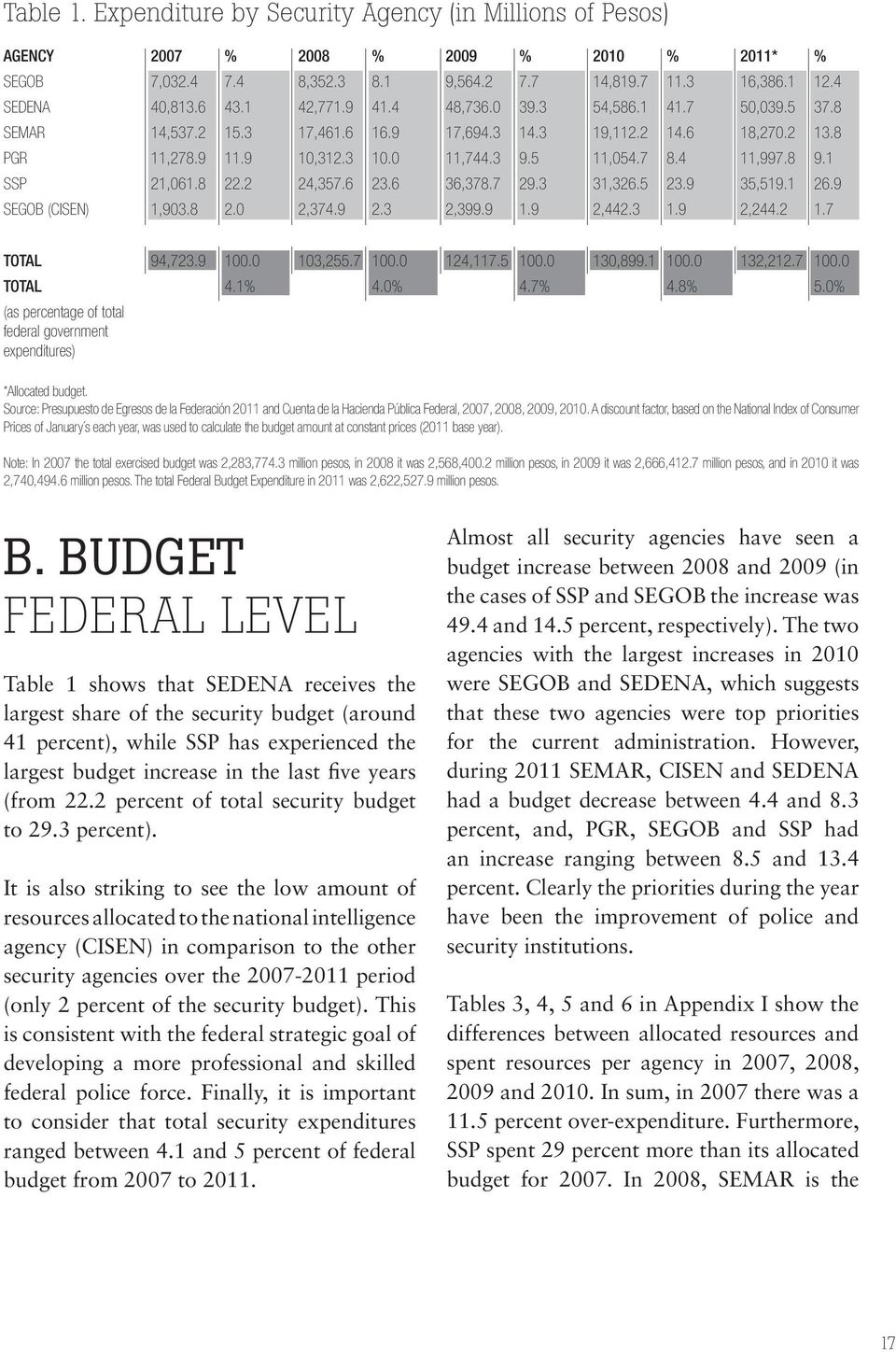
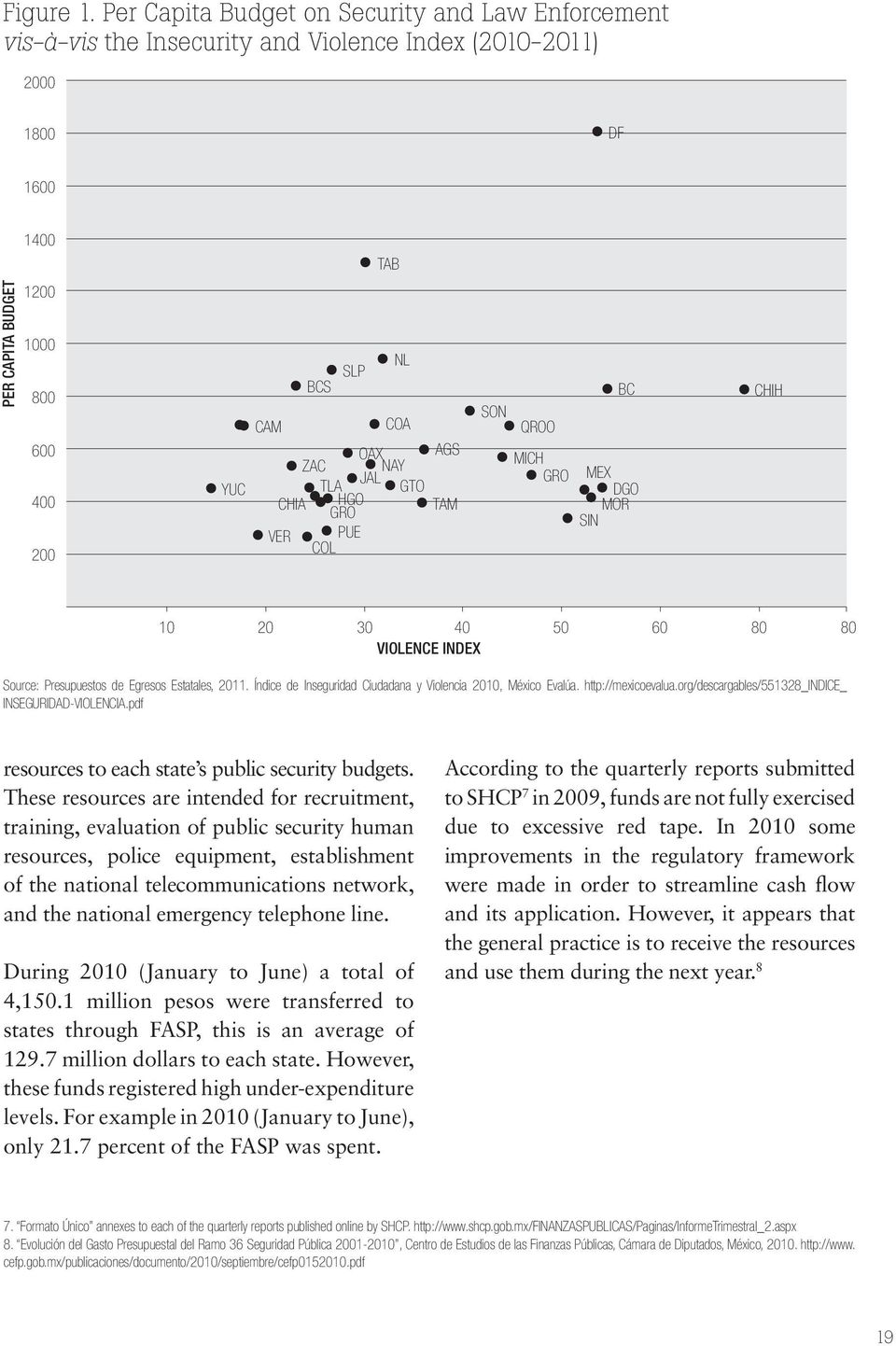
18 Table 2. Annual Budget Variation by Security Agency AGENCY * SEGOB SEDENA SEMAR PGR SSP SEGOB (CISEN) TOTAL *Allocated budget. agency that spent more (13.2 percent more in relation to the allocated budget), while PGR spent 3.8 less of its allocated resources. For 2009, SEGOB and PGR spent less, with an 8 and 12 percent respectively. In 2010 there was an over-expenditure of 12.4 percent, SEGOB was the agency that spent more (70.6 percent in relation to the allocated budget), while PGR spent 9.6 percent less of its allocated budget. STATE LEVEL As shown on Table 7 of Appendix I, in 2011 the state with the largest expenditure on security and law enforcement in the country is the Distrito Federal. Its expenditure on security and law enforcement takes up the largest share of its total budget (11.7 percent). 5 The second largest amount spent by a state on security (as a percentage of its total budget) is Tabasco s 9.2 percent. A remarkable fact is that the D.F. spends 22.4 percent of the total security budget allocated to all states. In terms of per capita figures, in general, states spend more on public safety that in law enforcement, with the exception of Durango, Guanajuato, Queretaro, San Luis Potosi, and Sinaloa. The D.F. is the state that allocates the highest per capita budget to public safety, while Tabasco is the state that allocates the highest per capita budget to law enforcement. On one hand, 18 states are below the state average per capita budget. On the other hand, 15 states are below the state average per capita budget on law enforcement (see Appendix I, Table 8) As shown on Figure 1, state level security spending is not statistically significant nor exist a strong correlation associated with state levels of insecurity and violence. 6 Note that there is no correlation between a high incidence of crime and violence (as displayed in Chihuahua, Baja California, Durango, Morelos, and Estado de México), and the proportion of the budget that each state allocates to security expenditure. D.F. is by far the jurisdiction with the largest per capita security and law enforcement budget and it is not the state with the highest incidence of insecurity and violence. This may be a result of its population density or that it is the country capital, and, as such, it needs to invest more in security and law enforcement. The Fondo de Aportaciones para la Seguridad Pública (FASP) is a federal fund to transfer 5. As stated in Article 44 of the Mexican Constitution, the Distrito Federal is the seat of the Powers of the Union and capital of Mexico. 6. The state levels of insecurity and violence is measured by the Insecurity and Violence Index. This index consists in five indicators: incidence crime and victimization, violent crimes, organized crime, unintentional violence, and public perception (México Evalúa, 2010). 18

19 Figure 1. Per Capita Budget on Security and Law Enforcement vis-à-vis the Insecurity and Violence Index ( ) DF tab PER CAPITA BUDGET YUC CAM BCS SLP NL COA OAX ZAC NAY JAL TLA GTO CHIA HGO GRO VER COL PUE AGS TAM SON QROO MICH GRO BC MEX DGO MOR SIN CHIH VIOLENCE INDEX 80 Source: Presupuestos de Egresos Estatales, Índice de Inseguridad Ciudadana y Violencia 2010, México Evalúa. INSEGURIDAD-VIOLENCIA.pdf resources to each state s public security budgets. These resources are intended for recruitment, training, evaluation of public security human resources, police equipment, establishment of the national telecommunications network, and the national emergency telephone line. During 2010 (January to June) a total of 4,150.1 million pesos were transferred to states through FASP, this is an average of million dollars to each state. However, these funds registered high under-expenditure levels. For example in 2010 (January to June), only 21.7 percent of the FASP was spent. According to the quarterly reports submitted to SHCP 7 in 2009, funds are not fully exercised due to excessive red tape. In 2010 some improvements in the regulatory framework were made in order to streamline cash flow and its application. However, it appears that the general practice is to receive the resources and use them during the next year Formato Único annexes to each of the quarterly reports published online by SHCP Evolución del Gasto Presupuestal del Ramo 36 Seguridad Pública , Centro de Estudios de las Finanzas Públicas, Cámara de Diputados, México, cefp.gob.mx/publicaciones/documento/2010/septiembre/cefp pdf 19
20 C. MILITARY AND POLICE FORCES MILITARY FORCES As shown in Figure 2, SEDENA personnel registered a gradual increase since 1990, from circa 151,000 soldiers to 206,000 soldiers in The increase in the number of soldiers means that, over a period of 22 years, the number of SEDENA available soldiers grew by 36.3 percent. In contrast with the ascending trend in SEDENA personnel, over the last 22 years the number of SEMAR personnel remained relatively stable. The percentage of SEDENA staff that defects decreased from 12.2 percent in 2000 to 2.1 percent in Besides, in SEMAR this percent decreased from 4.8 percent in 2000 to 1.7 percent in These decreases have been the consequence of the improvement of wages and benefits. From 2006 to 2011, lower income staff saw their salaries increase by 124 percent. From September 2010 to June 2011 were granted 3,165 housing loans. From September 2010 to August ,347 scholarships for primary school and 5,901 scholarships for high school and college were awarded to children of military personnel. POLICE FORCES In total, there are 2,139 independent police agencies in Mexico, with jurisdiction at the federal, state, and municipal levels (see Table 3). Most policing services are provided at the state and local levels. In 2010, Mexico had approximately 531,078 federal, state and municipal police officers; 90 percent (479,647) of them were under the control of state and local authorities. 9 The remaining 51,431 officers are under federal control. During the last year, the number of state and municipal police officers increased from 479,647 in 2010 to 490,020 in Of the universe of 2,453 municipalities in the country, 2,038 had a municipal police force (83 percent). A bill to integrate all municipal police agencies under 32 state commands has not been approved by the Senate (that received the bill, previously approved by the Chamber of Deputies, on Octorber 6 th, 2010). Federal Police There was an increase in the number of federal police personnel over the period (more than 10 percent). The number of migration police officers has shown a notable increase too (25.1 percent). In contrast, the number of ministerial police officers decreased by 1.4 percent. This reduction may be because the 2009 Ley de la Policía Federal gave investigative powers to the Federal Police. Finally, in period, federal police decreased by 2.3 percent, while the number of guards in federal prisons increased by 17 percent; ministerial police decreased by 0.9 percent. State and Local Police From 2010 to 2011 the number of state and municipal police officers has increased 9. This figure results from adding up the elements of federal police (51,431), state police (308,759) and municipal police (170,888). 20
21 Table 3. Number of Police Agencies by Government Level ( ) GOVERNMENT LEVEL NUMBER OF POLICE AGENCIES FEDERAL Preventive, PGR (Judiciary), Migration 3 STATE Preventive 32 Judiciary 32 Transit 11 Bank, Commercial, Auxiliary 13 Touristic, Rural, Others 10 MUNICIPAL 2,038 TOTAL 2,139 Source: Secretaría de Seguridad Pública, Information Request No Milenio, 27 June, Figure 2. Number of Military Personnel SEDENA SEMAR * Preliminary figures for June Source: Data from Felipe Calderón, Quinto Informe de Gobierno (Fifth Government Report) * Figure 3. Number of Military Personnel Defected SEDENA SEMAR Source: Own elaboration with data from Felipe Calderón, Cuarto Informe de Gobierno (Fourth Government Report) and SEDENA. only by 2.2 percent. Also, during this period the number of police officers decreased in states like Nuevo León (-6.9 percent), Tabasco (-4 percent) and Tamaulipas (-1 percent). Figure 4 shows that there seems to be no strong correlation between the number of municipal and state police officers and criminal and violence incidence. 21
22 Table 4. Federal Police Personnel Variation (2007, 2009, 2010 and 2011) SSP FEDERAL POLICE AGENCIES % Variation 2010 % Variation 2011 % Variation Federal Police 21,761 32, , , Federal Prison Guards 5,483 5, , , TOTAL 27,244 37, , , PGR Ministerial Police 7,992 4, , , TOTAL 7,992 4, , , INM Preventive Police 2,832 4, , ND ND TOTAL 2,832 4, , ND ND Source: Own elaboration with data from Felipe Calderón, Quinto Informe de Gobierno (Fifth Government Report) and information from SNSP-CON, 2007, 2009 and ND: No data available. Figure 4. State and Municipal Police Officers per 10,000 Inhabitants and Criminal Incidence and Violence ( ) 140 STATE AND MUNICIPAL POLICE OFFICERS PER 10,000 INHABITANTS (2011) BCS COL tab YUC TLASLP JAL CAM HGO NAY GTO VER OAX NL TAM CHIA ZAC PUE COA AGS GRO QROO GRO SON MICH DF MEX MOR SIN BC DGO CHIH INSECURITY AND VIOLENCE INDEX (2010) 80 Source: Own elaboration with information from Secretariado Ejecutivo del Sistema Nacional de Seguridad Pública, 2011, and Índice de Inseguridad Ciudadana y Violencia 2010, México Evalúa. The lack of state and local police collaboration and involvement in the strategy against organized crime is clear when we observe the evolution of the number of state and municipal police officers evaluated in the last year. For example, as shown in Figure 5, Chihuahua (the most violent state in the country) evaluated, 2008 to 2010, only 11 percent of its police officers. Something similar happened in Tamaulipas, Michoacán, Nuevo León, Baja California Sur, Durango, Guerrero and Jalisco from 2008 to In 22
23 Figure 5. State Police Officers Evaluated ( ) Aguascalientes Baja California Sinaloa Morelos Coahuila Tabasco Colima Chihuahua Distrito Federal Tamaulipas Chiapas Campeche Guanajuato Querétaro Zacatecas Michoacán Puebla Nuevo León Oaxaca Veracruz Baja California Sur Durango Guerrero Jalisco Quintana Roo Sonora Hidalgo México Nayarit San Luis Potosi Tlaxcala Yucatán Percentage of Evaluated State Police Officers (2010) Average Source: Own elaboration with data from Secretariado Ejecutivo del Sistema Nacional de Seguridad Pública, Figure 6. Municipal Police Officers Evaluated ( ) Tamaulipas Aguascalientes San Luis Potosi Chihuahua Querétaro Coahuila Baja California Sinaloa Colima Baja California Sur Michoacán Nuevo León Veracruz Yucatán Morelos Sonora Tlaxcala Durango México Nayarit Puebla Campeche Jalisco Tabasco Zacatecas Guanajuato Chiapas Hidalgo Quintana Roo Guerrero Oaxaca Percentage of Evaluated Municipal Police Officers (2010) Average Source: Own elaboration with data from Secretariado Ejecutivo del Sistema Nacional de Seguridad Pública, all of these states there is a high presence of organized crime, and the efforts to strengthen police forces seem to be below requirements (just between 2 and 10 percent of its number of police officers are evaluated). In sum, only 8.6 percent of the total state police officers were evaluated from 2008 to At the municipal level only 34.3 percent of municipal police officers were evaluated from 2008 to In Guerrero, Jalisco, Estado de México and Durango, where there is a high presence of organized crime, there have been evaluated among 11 and 26 percent of the municipal police officers. On the other 23
24 Table 5. Additional Forces Required in Each State According to Two Criteria STATE AND MUNICIPAL DEFICIT OR SURPLUS OF SECURITY FORCE REQUIRED SECURITY FORCES DEFICIT OR POLICE OFFICERS (2011) POLICE IN BASE ON THE (BASED ON MILITARY PRESENT IN THE STATE SURPLUS OF UN STANDARD AND POLICE CASUALTIES (MILITARY AND POLICE) MILITARY AND POLICE (2.8 PER 1,000 INHABITANTS) IN 2010) CASUALTIES IN THE STATE (TAKING INTO ACCOUNT POLICE AND MILITARY CASUALTIES) TOTAL PER 1,000 TOTAL PER 1,000 INHABITANTS INHABITANTS STATE Aguascalientes 3, ,639 3,919-11,720 Baja California 13, , ,534 17,476-3,058 Baja California Sur 4, , ,622 4,169 2,547 Campeche 3, ,255 3, Coahuila 6, ,854 7,270-41,584 Colima 3, , ,704 3, Chiapas 16, , ,583 16,229-15,354 Chihuahua 13, , ,029 22,360-42,669 Distrito Federal 101, , , ,525 61,529 Durango 5, ,548 15,968-5,580 Guanajuato 18, , ,071 18,119-16,952 Guerrero 15, , ,377 22,638-21,739 Hidalgo 9, , ,814 11, Jalisco 25, , ,757 25,410-51,347 México 72, , ,455 72, Michoacán 14, , ,031 19,130-44,901 Morelos 8, , ,690 12,988-3,702 Nayarit 3, ,592 3,825-28,767 Nuevo León 14, , ,711 16,874-32,837 Oaxaca 13, , ,936 13, Puebla 18, , ,463 18,215-25,248 Querétaro 4, ,215 4,370-14,845 Quintana Roo 6, , ,813 6, San Luis Potosí 10, , ,659 10,333-24,326 Sinaloa 11, , ,847 16,887-18,960 Sonora 11, , ,275 11,114-10,161 Tabasco 10, , ,770 10,882 5,112 Tamaulipas 10, , ,075 11,411-68,664 Tlaxcala 4, , ,219 4, Veracruz 23, , ,754 23,537-21,217 Yucatán 8, , ,448 8,946 3,498 Zacatecas 4, ,330 4,688-12,642 Source: Own elaboration with information from Secretariado Ejecutivo del Sistema Nacional de Seguridad Pública,
25 hand, Chihuahua has evaluated 61 percent of its municipal police. Chihuahua (the most violent state in the country from 2008 to 2010) did not increase its number of police officers between 2007 and 2009, probably because of a higher federal police presence. However, during 2010 the number of police officers in this state increased by 397 percent. Something similar happened in Baja California Sur, Durango, Baja California, Nayarit and Quintana Roo between 2009 and In all of these states their number of state police officers increased at least eight times. (See Appendix I, Table 11) According to Goode s formula, the more intense the insurgency (understood as an uprising against established authority), the greater the force that will be required to turn back the increase in violence. Among the 10 states that, according to this criterion, need to drastically boost the number of military and police forces are Tamaulipas, Jalisco, Chihuahua, Michoacán, Estado de México, and Nuevo León. According to the criterion of police and military casualties, these states need more security forces than Coahuila, Veracruz, Guerrero, and Puebla. In contrast with the increase of 65 percent in the state police corps from 2009 to 2010, municipal police forces increased only 7.2 percent during the same period. The only state that notably increased its number of municipal police officers was Chihuahua (the most violent state in the country) by 61.9 percent (see Appendix I, Table 12). The states that have a figure of state and municipal police officers (per 1,000 inhabitants) below the UN recommended average are Coahuila and Querétaro. This means that 30 out of 32 states are above the UN recommended average. Table 5 shows Goode s formula, a calculation of the size of the security force required based on a metric that takes into account the casualties among police and military forces, the current security force in the states (adding up members of the federal police and military forces) and, finally, the shortfall in the security forces, based on the metric mentioned Steven M. Goode, A Historical Basis for Force Requirements in Counterinsurgency, in Parameters, Winter , pp Goode s formula is as follows: [1.2 (Numbers of deaths of members of the security forces per million population / Proportion of security forces located in the region) 0.45 ]
26 26
27 2. THE DYNAMICS OF MEXICAN ORGANIZED CRIME Criminal organizations are companies that provide illicit goods and services for which there is a high demand. Two essential features allow these companies to operate successfully: the exercise of violence and the exercise of bribery. The first one allows them to maintain internal discipline, resolve disputes, prevent the entry of competitors, monitor their territory, and respond to military or police harassment. The ability to corrupt, in turn, decreases or neutralizes the government s action against the organization, which reduces the incentives of its members to defect and strengthens internal cohesion. 11 Modus Operandi of Cartels Within the Mexican illegal drug market four types of drug trafficking organizations (DTO s) coexist. The following typology was made according to the role that each organization performs in the drug market. These are described in Table 6. Thus we have that national cartels, toll collector cartels and regional cartels exercise violence mainly through executions of rivals, and aggressions and clashes with other DTO s or authorities. This violence is mainly directed towards rival cartels and authorities and it is marginally exercised toward the civil society. This first type of violence is called Drug-Trafficking Ridden Violence because its main purpose is to maintain or gain control over drug trafficking routes, points of entry and exit, and distribution markets. A second type of violence is mafia ridden violence. Local organizations and gangs usually perform this kind of violence through kidnapping, extortion and executions usually indistinctively directed towards rivals, authorities or citizens. When it is directed toward citizens, the main purpose is to gain profits given that these DTO s have a marginal role in the drug trafficking business. When directed towards rival gangs and authorities, the purpose of this type of violence is to keep or gain control over a limited territory (a few blocks or a neighborhood) in which the organization could run its illegal activities. 11. Gianluca Fiorentini and Sam Peltzman, Introduction, in The Economics of Organized Crime, New York: Cambridge University Press. 27
28 Table 6. Drug Trafficking Organizations Typology CATEGORY DESCRIPTION ORGANIZATIONS National Cartels Cartels control or maintain presence along routes of several drugs. They also Sinaloa, Los Zetas and Golfo cartels, operate important international routes to and from Mexico. These DTO s keep (though Golfo has a significantly less control of drug points of entry and exit in the country. However, they are important role than the other two) interested in expanding their control toward new points of exit along the northern border, and this is why they currently sustain disputes with other cartels to control these border localities. These DTO s have presence in broad areas of the country and have sought to increase their profits they receive from drug trafficking through diversifying their illegal activities towards human smuggling and oil and fuel theft. Toll Collector Cartels These are the cartels whose main income comes from toll fees received from the Tijuana and Juárez cartels cartels and regional cartels that cross drug shipments through their controlled municipalities along the northern border. As such, they receive a smaller proportion of profits from drug trading compared with the cartels. Given that these cartels are largely confined into some border municipalities, they cannot diversify their illegal activities as actively as the national cartels. If these cartels eventually lose control of their respective border areas they will either intensify their diversification efforts to other business (such as extortion or kidnapping) or they will disappear. Regional Cartels These DTO s keep limited control over segments of drug trafficking routes that Los CaballerosTemplarios and pass along their territory. Like the toll collector cartels, the regional cartels play a Pacífico Sur cartels secondary role in the drug trading business and receive small profits from it and have limited capabilities to diversify to other criminal business like human smuggling or oil and fuel theft. Local Organizations These cartels are disbanded cells from fragmented national or regional cartels. La Resistencia, Cártel de Jalisco- These are locally based in a few contiguous localities that can extend to several Nueva Generación, Cártel del Charro, states. Their business activities are mainly focused in drug distribution and dealing La Mano con Ojos, Los Incorregibles, within their controlled municipalities, and have extended their illegal business La Empresa, La Nueva towards extortion, kidnapping and vehicle theft. Administración, La Nueva Federación para Vivir Mejor, and Cártel Independiente de Acapulco, among others. Regardless of the role that the organization performs in the drug trafficking business, or the kind of violence they exercise, cartels have a hierarchical structure of five levels. The first is the bosses level. On the second level are the specialized operators such as lawyers and accountants. On the next level are the lieutenants and gunmen leaders, known as logistics operators ; gunmen are located in the fourth level. The lowest level is the operative base, composed by drug dealers, drivers and drug smugglers. Kinship and cronyism are important foundations for authority and legitimacy within the organization. Based on these criteria, the cartels are able to maintain high, though vulnerable, levels of cohesion and internal solidarity. Geographical Location Los Zetas and the Sinaloa Cartel are the DTO s with the most extended presence in the country, in 21 and 17 states, respectively. In seven states there is only one established drug cartel, these states are: Aguascalientes (Zetas), Baja California Sur, (Sinaloa), 28
29 Table 7. Cartel Presence per State (as of August 2011) 12 STATE ZET SIN GOL CT PS CJ LR DC LI LE MO NA JUA TIJ NF CIA TOTAL Aguascalientes X 1 Baja California X X 2 Baja California Sur X 1 Campeche X 1 Chiapas X X 2 Chihuahua X X 2 Coahuila X X 2 Colima X X X 3 Distrito Federal X X X X X X X 7 Durango X X 2 Guanajuato X X 2 Guerrero X X X X X 5 Hidalgo X X 2 Jalisco X X X X 4 México X X X X X X X X X X 10 Michoacán X X X 3 Morelos X X 2 Nayarit X X X X 4 Nuevo León X X X 3 Oaxaca X X 2 Puebla X X 2 Querétaro X X 2 Quintana Roo X 1 San Luis Potosí X X 2 Sinaloa X X 2 Sonora X 1 Tabasco X 1 Tamaulipas X X 2 Tlaxcala 0 Veracruz X 1 Yucatán X X 2 Zacatecas X X 2 TOTAL Source: Own elaboration with information collected from national and local newspapers. Campeche (Zetas), Quintana Roo (Zetas), Sonora (Sinaloa), Tabasco (Zetas) and Veracruz (Zetas). Tlaxcala is the only state without record of stable drug cartel presence. The states with the largest presence of cartels are Estado de México (10), Distrito Federal (7), and Guerrero (5). The presence of just one cartel is relevant because territorial struggles between two or more cartels lead to higher levels of violence. Evolution of Mexican Cartels Over the last six years there has been an increase in the number of Mexican cartels. In 2006 there were six large cartels: Sinaloa, Juárez, Tijuana, Golfo, La Familia Michoacana and Milenio. By mid-2011 there are 16 cartels, of which seven play a significant role in the drug trafficking business, and nine are considered local organizations for its 12. Table Key: ZET: Zetas, SIN: Sinaloa, GOL: Golfo, CT: Los Caballeros Templarios, PS: Pacífico Sur, CJ: Cártel de Jalisco-Nueva Generación, LR: La Resistencia, LF: La Familia Michoacana, DC: Cártel del Charro, JUA: Juárez, MO: La Mano con Ojos, LI: Los Incorregibles, LE: La Empresa, TIJ: Tijuana, NA: La Nueva Administración, NF: LA Nueva Federación para Vivir Mejor, and CIA: Cártel Independiente de Acapulco. 29
30 marginal influence in the drug market (see table 8). The proliferation of cartels in 2011 was due to the fragmentation of large criminal organizations into smaller ones, usually due to the capture or decease of its leaders. Fragmentation of the Beltrán Leyva Cartel After the death of Arturo Beltrán Leyva in December 2009, the organization split into two factions: the Pacífico Sur Cartel, led by his brother Héctor and his lieutenant, Sergio Villarreal Barragán, aka El Grande ; La Barbie Cartel, headed by Édgar Valdez Villarreal, aka La Barbie and Gerardo Álvarez Vázquez, aka El Indio. These two factions began to fight for control over some municipalities in Estado de México, Morelos and Guerrero. However, by mid-2010 all the leaders of these cartels with the exception of Héctor Beltrán Leyva were detained. The detention of the cartels leadership divided, once more, the structures of the organizations. From the Pacífico Sur Cartel, La Mano con Ojos and La Nueva Administración emerged, with presence in Estado de México and Distrito Federal. La Barbie Cartel disappeared and from it emerged the Cártel Independiente de Acapulco and Cártel del Charro the latter leaded by the father-in-law of Édgar Valdez Villarreal, Carlos Montemayor, aka El Charro, who was also detained in November Fragmentation of La Familia Michoacana After de death of Nazario Moreno González, aka El Más Loco, La Familia Michoacana began a restructuration period. In January 2011 narcobanners appeared claiming that the organization had disbanded. However, it was reported that the cartel fragmented in two groups, one under control of José de Jesús Méndez, aka El Chango, and the other led by Servando Martínez, aka La Tuta, and Enrique Plancarte Solís, aka La Chiva. This latter faction announced in March 2011 that it would operate under the name of Los Caballeros Templarios. This new organization combines most of the former La Familia Michoacana members and operates the majority of the business of the extinct organization. After the death of Nazario Moreno also emerged two cells from La Familia Michoacana that operate in Estado de México and Michoacán, these groups are Los Incorregibles and La Empresa. Fragmentation of Cártel del Milenio In May 2010 Juan Nava Valencia, aka El Tigre, leader of the Milenio Cartel, was detained. This detention provoked the division of his organization into two groups. One group allied itself with members of La Familia Michoacana and Golfo operating in Jalisco and Colima, and formed La Resistencia. The other group included the Milenio Cartel members allied to the 30
31 deceased Ignacio Coronel Villarreal, aka Nacho Coronel, and it was called Cártel de Jalisco-Nueva Generación. These two factions are fighting over control of Jalisco, Colima and Nayarit. La Nueva Federación para Vivir Mejor This small organization only has presence in the city of Monterrey. It appeared in January Members of the Sinaloa, La Familia Michoacana and Golfo cartels created it to fight against Los Zetas. Intercartel conflicts and alliances Between 2010 and 2011, the number of intercartel conflicts has grown from seven to 11 (see Appendix I. Figure 7). Yet, as the number of conflicts between cartels has increased so has the number of alliances among them. Each cartel is continually looking for ways to geographically expand its presence and control new points of entry/ exit and transport routes. This leads to local alliances among cartels as a way to ensure safe passage through certain areas or to counterbalance rival cartels. In 2007 there were two large cartel alliances (Sinaloa and Juárez; Golfo and Tijuana); in 2011 there are still two large national alliances (one headed by the Sinaloa Cartel and the other by Los Zetas), and several local alliances (for example, in Nuevo León, Golfo is allied to Sinaloa in the fight against Los Zetas; in Tijuana, the Tijuana Cartel is allied to Los Zetas to fight against Sinaloa). The Sinaloa and Zetas cartels are the most active alliance-seeking organizations because they have national presence and, therefore, they have interests over extended areas of the national territory. Also, they have the largest capabilities in terms of equipment, personnel, and vehicles. A. NATIONAL CARTELS SINALOA CARTEL In the breakup of La Federación in 2008, the Sinaloa organization managed to maintain its cocaine smuggling routes from South America to the United States and emerged as Mexico s single most powerful trafficking organization. The Sinaloa Cartel, headed by Joaquín Guzmán Loera, aka El Chapo, Ismael Zambada, aka El Mayo, and Juan José Esparragoza Moreno, aka El Azul, operates in about 17 Mexican states. Additionally, the organization has expanded operations throughout Latin America and is believed to be the largest purchaser of Peruvian cocaine. Since 2008 the Sinaloa Cartel has been locked in a deadly battle against the Juárez and Tijuana organizations. While the conflict is largely about access to the U.S. market via the Juárez- El Paso and Tijuana-San Diego corridors, there are also elements of reputation building and personal rivalries among the organizations that help explain the sustained and brutal nature of the killings in these two areas. The 31
32 Map 1. Sinaloa Cartel Drug Trafficking Routes TIJUANA NOGALES CIUDAD JUÁREZ Cocaine routes Marijuana routes Heroin routes Meth routes SPAIN, NETHERLANDS, FRANCE, GREAT BRITAIN, ITALY AND GERMANY HONG KONG COLOMBIA, PERU AND ECUADOR BRAZIL, COLOMBIA AND PANAMA GUATEMALA Sinaloa Cartel appears to have the upper hand in both conflicts because it has been able to extend its presence in both Chihuahua and Baja California, as well as to small towns along the Rio Grande formerly under rival control. Nevertheless, the Sinaloa Cartel has not yet gained control over Juárez or Tijuana. The Sinaloa Cartel is the only Mexican DTO that traffics all drugs by all means: land, air or sea. It controls all marijuana shipping routes by sea. Sinaloa Cartel trafficking routes are depicted in Map 1. Due the need to increase its income to fund its army, the organization expanded into other illicit activities such as human smuggling through the Sonora- Arizona border. However unlike other organizations the Sinaloa Cartel does not relies on migrant kidnapping as a gunmen recruitment source. The Sinaloa Cartel also plays a major role in the highly lucrative oil and fuel theft business. Since the demise of the Beltrán Leyva organization in 2010, the Sinaloa Cartel has claimed almost total control over illegal activities in the state of Sinaloa. From January to May 2011, Sinaloa was the state where more illegal pipelines were found. 13 LOS ZETAS As Los Zetas grew more powerful and autonomous, their relationship with the Golfo Cartel deteriorated. In early 2010 Los Zetas split from the Golfo Cartel and they now seem illegal pipeline connections were found in Sinaloa, followed by Veracruz (79), Tamaulipas (40), Coahuila (33), and Nuevo León (29). Despite reductions in the amounts of oil and fuel illegally subtracted from Pemex pipelines since 2008, this activity has grown considerably during 2011: from January to April 969,120 barrels, have been illegally subtracted, which represent a 49 percent increase compared with the amount of barrels subtracted during the same period in Pemex, June 2011, Combate al Mercado Ilícito de Combustible, retrieved from Internet in September 5, 2011: 32
33 Map 2. Los Zetas Drug Trafficking Routes TIJUANA Cocaine routes Marijuana routes NUEVO LAREDO COLOMBIA, CUBA AND PANAMA COLOMBIA AND PANAMA to have the upper hand in some areas, wresting control from the Golfo Cartel in Tamaulipas and Nuevo León. Additionally, Los Zetas have effectively expanded their control over illegal activities throughout Veracruz. Los Zetas are the second most important national cartel in terms of drug trafficking: this organization smuggles cocaine and marijuana, within Mexico and abroad, and controls several drug entry and exit points (see Map 2). Additionally, they have also stretched their criminal enterprises to include human trafficking and fuel theft. In order to broaden access to the US (so far Nuevo Laredo is the only town along the border where the cartel has predominance), Los Zetas are fighting against the Golfo Cartel over Matamoros, Reynosa and Frontera Chica in Tamaulipas. 14 Los Zetas are currently smuggling cocaine through Tijuana a location far from their sphere of influence in order to diversify its trafficking routes. Los Zetas also control an extensive human smuggling network along the Gulf of Mexico. Los Zetas extort polleros (migrant smugglers) and force migrants to carry small amounts of drugs to the United States (nevertheless this sort of drug trafficking is not efficient since a single person can only carry a small amount of drugs and runs a high risk of interdiction). Los Zetas also recruit migrants forcefully to work for them. Recently, narcofosas (mass graves) have been discovered in some of the municipalities where Los Zetas operate. Los 14. Frontera Chica Includes the municipaltities of Mier, Nueva Ciudad Guerrero, Miguel Alemán, Camargo and Díaz Ordaz. 33
34 Map 3. Golfo Cartel Drug Trafficking Routes Cocaine routes Marijuana routes REYNOSA AND MATAMOROS GUATEMALA Zetas have also resorted intensively to oil and fuel theft especially in Veracruz as an additional income source. GOLFO CARTEL One of the major events in the Mexican organized crime landscape during 2010 was the breakdown between the Golfo and Los Zetas cartels. This breakdown has resulted in a spike of violence in the Northeastern corridor of Mexico, and has led to a new alliance between the Golfo and (its former rival) Sinaloa Cartel. The Golfo Cartel has been severely weakened due to its conflict against Los Zetas and now it relies heavily on its new ally. Its control over illegal activities is currently circumscribed to the Tamaulipas- Texas border, specifically in the area known as Frontera Chica, and Reynosa and Matamoros. The survival of the Golfo Cartel largely depends on its ability to retain this stronghold, especially the cities of Matamoros and Reynosa, which are important exit points for drugs bound to the US. The Golfo and Sinaloa cartels alliance is currently trying to beat Los Zetas in Monterrey. If they succeed, Golfo will attempt to beat Los Zetas in Nueva Laredo and regain preponderance throughout Tamaulipas and Nuevo León. The Golfo Cartel primarily trafficks cocaine and marijuana and it also works as a toll collector organization that charges fees 34
35 to Sinaloa Cartel s marijuana shipments. It also takes part in human smuggling in a fashion similar to Los Zetas (income from pollero extortion and forceful recruitment of migrants). However, due to its limited geographic scope, Golfo Cartel focuses on seizing buses with migrants on board in Nuevo León and Tamaulipas roads. The Golfo Cartel also controls a small share of the oil and fuel theft business in some areas of Nuevo León and Tamaulipas. B. TOLL COLLECTOR CARTELS 15 TIJUANA CARTEL Since the detention of Eduardo Arellano Félix in October 26, 2008, leader of the Tijuana Cartel, the organization began a declining trend. The detention of Arellano Félix led to a split between two factions, one led by Luis Fernando Arellano Félix, and the other by Teodoro García Simental, aka El Teo. The Sinaloa Cartel took advantage of this rupture and formed an alliance with El Teo against the remnants of the Tijuana Cartel. Tijuana, a city bordering San Diego, is a hotly contested spot between DTO s because it is one of the most important points of entry to the United States. At the moment, Luis Fernando Sánchez Arellano and his aunt, Enedina, command the Tijuana Cartel. The conflict between this organization and the Sinaloa Cartel continues because the former is still the predominant criminal organization in the Tijuana Metropolitan Area. Nonetheless, the Sinaloa Cartel has a dominant position in the rest of the Baja California Peninsula. If Sinaloa Cartel defeats the Tijuana Cartel, the latter will most certainly fragment into local criminal cells engaged in drug dealing, kidnapping and extortion. The Tijuana Cartel plays a minor role in the drug trafficking business as a toll collector cartel. It receives toll fees for crossing to the US cocaine, marijuana, heroin, and methamphetamine shipments from the Sinaloa, Los Zetas, Los Caballeros Templarios, and Pacífico Sur cartels. It also smuggles migrants though tunnels that link Tijuana and San Diego. Finally, the Tijuana Cartel may steal oil and fuel from illegal connections from two pipelines in Northern Baja California. JUÁREZ CARTEL The Juárez Cartel had a longstanding alliance with the Beltran Leyva Organization and, since 2010, allied itself with Los Zetas and the Tijuana Cartel in an effort to hold off the aggressive challenges from the Sinaloa Cartel. Ciudad Juárez is another key point of entry for drug to the United States, and it is violently contested between the Juárez and Sinaloa cartels. The Juárez Cartel has been worn down by the conflict and is increasingly relying in domestic drug sales assisted by local gangs as a revenue source. As a toll collector cartel, the Juárez DTO only operates a small trafficking network in the municipalities of Chihuahua, Cuauhtémoc and Juárez. In Juárez this DTO smuggles all kinds of drugs from the Sinaloa, Los Caballeros Templarios, and Pacífico Sur cartels to El Paso, Texas. 15. For toll collector cartels, regional cartels, and local organizations, the Maps in Appendix I show each DTO s drug trafficking routes, human smuggling networks and oil theft points. 35
36 There are about 30 gangs considered highly dangerous in Ciudad Juárez. The extended presence of gangs in Ciudad Juárez has provoked that these were recruited by the DTO s operating in the area as drug dealers, distributors and hitmen. The Juárez Cartel has relied on Los Aztecas gang in the drug dealing business in Ciudad Juárez. This has had the effect of increasing violence in the city, as well as drug consumption. C. REGIONAL CARTELS LOS CABALLEROS TEMPLARIOS Since the death of one of its leaders, Nazario Moreno González, aka El Más Loco, in December 9, 2010, the organization formerly known as La Familia Michoacana, began a period of fractures and reorganization. In January 2011 narcobanners appeared in Michoacán announcing the dissolution of La Familia Michoacana, and in March appeared messages proclaiming the presence of a new organization called Los Caballeros Templarios. Apparently after the death of Moreno, José de Jesús Méndez, aka El Chango, tried to reorganize the remnants of La Familia Michoacana through an alliance with Los Zetas. Méndez was detained in June 2011 and it is likely that the cells under his influence disbanded. Some official reports indicate that Servando Gómez Martínez, aka La Tuta, leader of the now extinguished La Familia Michoacana, is the current leader of Los Caballeros Templarios. This organization is trying to reorganize La Familia Michoacana fragmented cells and is controlling some of its former drug routes. Los Caballeros Templarios do not participate in the cocaine market, however, they traffic marijuana, heroin and methamphetamines. La Familia Michoacana also developed the capacity to produce crystal meth, marijuana and opium poppy plants. This DTO has specialized in methamphetamine production and smuggling (reportedly for sale in the US only) and is also a vigorous trafficker of marijuana and heroin. This organization does not exert control over any drug entry or exit point and, though it is present in Acapulco, it does not operate here independently because the city is contested among several organizations. Los Caballeros Templarios only control segments along drug routes and they have to pay toll fees to cross drugs to the United States. They also run oil and fuel smuggling operations in Estado de México, Guanajuato, Michoacán, Puebla, and Querétaro. PACÍFICO SUR CARTEL Since the death of Arturo Beltran Leyva in December 2009, the Beltran Leyva Cartel began to crumble. In its place a new group emerged: the Pacífico Sur Cartel. In all likelihood, this organization is headed by Héctor Beltran Leyva (Arturo s brother). After Héctor took over the family business he began to fight for control of the organization with Edgar Valdez Villarreal, aka La Barbie former head of the Beltrán Leyva Organization in Cuernavaca and Acapulco, and the leader of the organization s gunmen structure. 36
37 Héctor Beltrán Leyva rebranded his organization as Cartel Pacífico Sur, established an alliance with Los Zetas and adopted a new strategy in order to fight larger and better-established organizations. In 2010 the Beltrán Leyva Organization split in five DTO s: Pacífico Sur Cartel, Cártel Independiente de Acapulco, La Mano con Ojos, Cártel del Charro, and La Nueva Administración. At the moment the Pacífico Sur organization is the most consolidated of them and is fighting against the other factions to control criminal activities in Cuernavaca, Acapulco, and some municipalities of Estado de México surrounding Distrito Federal. Like its former ally, the Sinaloa Cartel, the Pacífico Sur Cartel trafficks four types of drugs: cocaine, marijuana, heroin and methamphetamines. D. LOCAL ORGANIZATIONS Local organizations frequently consist of disbanded cells from large cartels. The business activities of these DTO s are focused mainly in drug distribution and dealing within their controlled municipalities, and have extended their illegal business towards extortion, kidnapping, and vehicle theft. Currently 64 organizations have been identified within this category. However, this report analyzes just nine of them the ones that used to be part of one of the large six cartels that controlled drug trafficking in Mexico in 2006 and, as such, their origins can be traced. These are the following: La Resistencia, Cártel de Jalisco-Nueva Generación, Cártel del Charro, La Mano con Ojos, Los Incorregibles, La Empresa, La Nueva Administración, La Nueva Federación para Vivir Mejor, and Cártel Independiente de Acapulco. (See Map 12 and Table 16 in Appendix I). These organizations are involved in intense fights mostly at the municipal level against other bands, criminal gangs and DTO s. In Central Mexico (Distrito Federal, Estado de México and Morelos) the organizations fighting against each other are La Nueva Administración, La Mano con Ojos, Cártel del Charro, Los Incorregibles, La Empresa, Los Caballeros Templarios, and Cártel del Pacífico Sur. The violence produced by these conflicts has appeared in Cuernavaca, and the municipalities of Estado de México bordering Distrito Federal. In Acapulco, the Cártel Independiente de Acapulco is fighting against Los Zetas, Sinaloa and Los Caballeros Templarios. La Resistencia, the Cártel de Jalisco-Nueva Generación, Los Zetas and Sinaloa are fighting to control the western region of Jalisco, Colima and Nayarit. E. ILLEGAL BUSINESS ACTIVITIES OF MEXICAN DRUG TRAFFICKING ORGANIZATIONS Some Mexican DTO s have expanded their business activities from drug trafficking to human smuggling and oil and fuel theft. The analysis about which cartel exercises 37
38 control over which drug trafficking route offers information about the incentives that each cartel has in diversifying its activities, and the kind of illicit activities each organization can develop. For example, DTO s that have control over major drug trafficking routes will diversify their illegal activities towards human smuggling or fuel theft, taking advantage of the routes they control. On the other hand, smaller DTO s do not have the capacity to play a significant role into other illegal activities (such as oil and fuel theft and human smuggling) besides drug trafficking. Criminal organizations may also seek to diversify their revenues in order to sustain costly and prolonged conflicts against their rivals. Such conflicts imply large expenditures on equipment and personnel. 16 F. COOPERATION BETWEEN CARTELS AND GANGS Mexican cartels are dynamic organizations with a high adaptation capacity. The logic of the war waged by the government against drug cartels and other criminal organizations, together with the business logic of expanding markets and maximizing profits, have pushed the cartels to take decisive steps towards their professionalization. One of these steps is the practice of outsourcing specialized services provided by the local gangs, with which the cartels have established a relationship of mutual convenience. Gangs offer various services to the cartels in the areas of drug-deals enforcement, freight transport, distribution and sale. Together with the cartels, gangs are also actively forayed into kidnapping, extortion, human trafficking, money laundering, vehicle theft, and weapons traffic, which are typical organized crime activities. There are at least five factors for which cartels hire gangs and the services they can provide: 1. Risk reduction through outsourcing. When they operate with semi-autonomous cells, the leaders of the cartels reduce the probability of infiltration by government agents or other criminal groups. Also, when gang members are arrested by the authorities or recruited by rival cartels, they cannot provide information about the modus operandi of the cartel because they do not know it: they have worked for the cartel but outside of it. 2. Logistical, informational and operational advantages. The gangs are located in various parts of the country and each one knows thoroughly its own area. Collaboration with gangs allows cartels to carry out activities swiftly, and it increases the information flow between the leaders and its various cells across the country. In addition, outsourcing increases versatility and specialization within the cartel. 3. Effective exercise of violence. The gangs ability to display violence throughout the country (especially in border areas in the north and south), is increasingly being employed by the cartels. The ability to inflict high degrees of violence, together with the capacity to bribe and corrupt, are essential assets for any criminal organization. 4. Efficiency. With gangs, cartels save resources. Outsourcing tasks to gangs is cheaper than maintaining a bloated bureaucracy of gunmen. 5. Drug market. Gang members are often 16. See Maps 1-11 in Appendix I show each cartel s drug trafficking routes, human smuggling networks, and oil theft points. 38
39 Table 8. Fragmentation of Mexican Cartels ( ) (1st Semester) 2010 (2nd Semester) 2011 Cártel de Sinaloa Cártel de Sinaloa Cártel de los Beltrán Leyva Cártel de Sinaloa Cártel del Pacífico Sur Cártel de Sinaloa Cártel del Pacífico Sur Cártel de Sinaloa Cártel del Pacífico Sur La Mano con Ojos La Nueva Administración Cártel de la Barbie Cártel Independiente de Acapulco Cártel Independiente de Acapulco Cártel del Charro Cártel del Charro Cártel de Juárez Cártel de Juárez Cártel de Juárez Cártel de Juárez Cártel de Juárez Cártel de Tijuana Cártel del Golfo Cártel de Tijuana Cártel de Tijuana Cártel de Tijuana Cártel de Tijuana Facción de El Teo Facción de El Teo Cártel del Golfo-Zetas Cártel del Golfo Cártel del Golfo Cártel del Golfo Los Zetas Los Zetas Los Zetas La Familia Michoacana La Familia Michoacana La Familia Michoacana La Familia Michoacana Cártel del Milenio Cártel del Milenio Cártel del Milenio La Resistencia Cártel de Jalisco-Nueva Generación Los Caballeros Templarios Los Incorregibles La Empresa La Resistencia Cártel de Jalisco- Nueva Generación La Nueva Federación para Vivir Mejor drug consumers, resulting in considerable sales and profits for the cartels. Cooperation between gangs and cartels is maintained and assured in terms of mutual convenience. There are at least five reasons why the gangs would collaborate with the cartels. 1. Financial gain. The cartels have resources to pay for the gangs services, to reward efficiency and loyalty, and to encourage future cooperation. In addition, they often give concessions to the gang to collect rents from retail drug dealers. 2. Drug supply. By allying themselves with cartels, gangs ensure regular supplies of drugs (with discounts). 3. Protection from authorities. The link between gangs and cartels protects the gangs from police interference, and also makes them immune to arrests or convictions. 4. Cohesiveness. Gang affiliation to a cartel creates a sense of solidarity and ensures their continuity. 5. Reputation. Through the alliance with cartels gangs receive recognition, which in turn strengthens its group identity. In Ciudad Juárez there are between 300 and 500 gangs, of which 30 have between 500 and 1,500 members. The largest gangs, like Barrio Azteca and Mexicles, exceed 2,000 active members. These two gangs cooperate, respectively, with the Juárez and Sinaloa cartels. However, these are not the only two cartels that have developed networks with gangs in Juárez. Other large and aggressive gangs have links with the cartels of Tijuana, Golfo and Zetas. According to reports from the U.S. Department of Justice, Barrio Azteca is a transnational gang that operates in both Mexican and American territory with a degree of sophistication rarely seen in groups of that nature. 17 Barrio Azteca s capacities are largely due to the financial and logistical support it received from the Juárez cartel. The degree of organization of Barrio Azteca 17. U.S. Department of Justice, March 9, 2011, Attorney General Eric Holder Speaks at the Barrio Azteca Press Conference, retrieved from Internet in September 5, 2011: goo.gl/ax6we 39
40 is such that to avoid interception of their messages they have developed secret codes based on Náhuatl numerology and phrases. Another place where there has been an abrupt increase in the number of gangs is Nuevo León. There are around 1,500 gangs in this state, 700 in the Monterrey metropolitan area. Information from the local police indicates that 20 of these gangs are linked with the Zetas cartel. These gangs are smaller than the Juárez gangs and drug consumption among their members is lower. Given hostile police actions towards them, gang leaders induce their members to collaborate with drug cartels as a way to protect themselves from police harassment. Local police officers frequently extort gang members, and cartels punish the police officers who assault gang members. In sum, youth gangs are becoming an important asset for Mexican cartels. With them, drug dealers criminal activities have multiplied and become more efficient. Furthermore, gangs that operate with cartels have become more effective in avoiding and confronting law enforcement agencies. The overwhelming presence of gangs in several parts of the country provides almost unlimited human resources for the cartels. Hence, in order to disarticulate the gangdrug cartel link, the Mexican government will have to deploy, alongside the military and police offensive, a comprehensive policy that combines social and security actions. 40
41 ORGANIZED CRIME VIOLENCE 41
42 42
43 1. VIOLENCE TRENDS A. NATIONAL LEVEL average annual increase rate for 18 months) did not continue in the following year. During the months previous to August 2011 organized crime-related violence upward trend flattened. As shown in Figure 1, a second cycle of violence growth triggered by the death of Arturo Beltrán Leyva, El Barbas, and the split of Los Zetas from the Golfo Cartel brought an expansion of violence to broad areas of the Mexican territory through the first semester of Thereafter, no event has triggered a new violence growth cycle discernible at the national level. Even though April 2011 has been the most violent month so far (an estimate of 1,600 deaths) a longer term analysis suggests that violence may have reached a stable level after peaking in mid After the third quarter of 2010, the most violent so far, deaths dropped for two consecutive quarters, an unprecedented record since December 2006 (see Figure 2). More important, the steep increase in violence observed during 2009 and the first half of 2010 (a striking 140 percent The change in the organized crime-related deaths growth rate during the previous months provides grounds to make a downward reassessment of the projection of the cumulative number of deaths occurred during President Calderón s administration ( ). The new projection assumes that the annual level of deaths will remain stable at around 15 thousand for the remainder of the administration, totaling 64,000 deaths for the six-year term. The data on violence trends also allows making educated guesses on the upper and lower bounds of the cumulative number of deaths for the current administration, as shown in Figure 3. An annual growth rate of 140 percent (similar to the observed in the period from January 2009 to June 2010) was used to calculate the upper bound. This growth rate would produce a figure of 91,000 deaths by December An annual negative growth rate of 40 percent (based on the violence decline rate observed in Ciudad Juárez in 2011 first semester, the 43
44 Figure 1. Monthly Organized Crime-Related Deaths at the National Level (Dec Aug. 2011) Dec 06 Mar 07 Jun 07 Sep 07 Dec 07 Mar 08 Jun 08 Sep 08 Dec 08 Mar 09 Jun 09 Sep 09 Dec 09 Mar 10 Jun 10 Sep 10 Dec 10 Mar 11 Jun 11 Aug 11 Detention of Alfredo Beltrán Leyva El FIRST VIOLENCE Mochomo January 20, 2008 GROWTH CYCLE Death of Arturo Beltrán SECOND VIOLENCE Leyva El Barbas GROWTH CYCLE December 16, 2009 Zetas split from Golfo January, 2010 Source: Own elaboration based on figures from the Base de Datos de Fallecimientos Ocurridos por Presunta Rivalidad Delincuencial. Presidency of the Republic. gob.mx/ for December 2006-December Data for 2011 is based on data collected from national and local newspapers. Figure 2. Quarterly Organized Crime-Related Deaths at the National Level (Jan Jun. 2011) Q1 / 2009 Q2 / 2009 Q3 / 2009 Q4 / 2009 Q1 / 2010 Q2 / 2010 Q3 / 2010 Q4 / 2010 Q1 / 2011 Q2 / 2011 Source: Own elaboration based on figures from the base de datos de fallecimientos ocurridos por presunta rivalidad delincuencial. Presidency of the Republic. presidencia.gob.mx/ for December 2006-December Data for 2011 is based on data collected from national and local newspapers. most important violence decline sustained for several months in a large city) was used to calculate the lower bound, and would produce a figure of 55,000 organized crimerelated deaths by December Organized crime-related violence will remain a central challenge for Mexico during the forthcoming years for at least three reasons: 1. The current stabilization of violence does not mean that events that may trigger 44
45 Figure 3. Cumulative Organized Crime-Related Deaths Projection ( ) 100,000 90,000 80,000 70,000 60,000 50,000 40,000 30,000 20,000 10, , ,000 64,000 55,000 Recorded Lower bound Expected Upper bound Source: Author s own estimate. new violence growth cycles are unlikely in the future. Furthermore, both the criminal organizations fragmentation and the Federal Government s intensive punitive policy increase the likelihood of such events, as well as the uncertainty about future violence trends. 2. Unlike violence hikes which may be large and sudden violence decreases are typically gradual. Hence, even though a decrease in violence is a potential outcome during the following months, the rate of such decrease will not be anywhere close to the rate of the increase observed during the first four years of President Calderon s administration (this explains why the lower bound in Figure 3 is much closer to the projection than the upper bound). 3. The nature of organized crime-related violence is changing for the worst. This violence is becoming more geographically dispersed, more intrusive into broad sectors of the economy, and is provoking a higher incidence of some criminal activities that harm citizens the most (e.g., kidnapping, extortion and vehicle theft). Therefore, even a steady level or a minor decrease of organized crime-related deaths will bring larger social and economic costs. From December 2006 to September 2011, 174 political candidates and senior public officers have been killed by criminal organizations, a record figure. Police department chiefs account for the highest share of these assassinations (48 percent), followed by mayors (18 percent). On the other hand, five candidates for public office including the candidate for Tamaulipas governorship, Rodolfo Torre Cantú have been killed. These murders stress some authorities vulnerability vis-à-vis criminals, and that in several jurisdictions criminal organizations are likely to be obtaining leeway from law enforcement institutions. This vulnerability is particularly acute at the municipal level, where senior officers that effectively tackle criminal organizations (or even those who are involved in conflicts among rival DTO s) cannot even warrant effective protection for themselves. 45
46 Table 1. The 20 Municipalities with the Largest Number of Organized Crime-Related Deaths in 2011 MUNICIPALITY STATE * VARIATION Juárez Chihuahua % Culiacán Sinaloa % Chihuahua Chihuahua % Tijuana Baja California % Gómez Palacio Durango % Acapulco Guerrero % Torreón Coahuila % Durango Durango % Mazatlán Sinaloa % Morelia Michoacán % Ecatepec México % Ahome Sinaloa % Zapopan Jalisco % Monterrey Nuevo León % Nuevo Laredo Tamaulipas % Tepic Nayarit % Guadalupe Nuevo León % San Fernando Tamaulipas % Apodaca Nuevo León % Valle Hermoso Tamaulipas *The figures for 2011 are estimated based on January-July data. Source: Own ellaboration based on figures from the base de datos de fallecimientos ocurridos por presunta rivalidad delincuencial. Presidency of the Republic. gob.mx/ for December 2006-December Data for 2011 is based on data collected from national and local newspapers. B. STATE AND LOCAL LEVELS Regarding the geographical distribution of violence, the foremost change during the previous months has been a strong geographic dispersion trend. The Federal Government has noted repeatedly that domestic organized crime-related violence is a concentrated problem; that is, a problem circumscribed to a few of municipalities along the northern border and in the Pacific coast region. Nonetheless, the progressive fragmentation of cartels in previous years which in the short term led to conflicts located in a handful of drug trafficking strategic cities has been followed by a process of dispersion of the violence. Table 1 shows the evolution of organized crime-related deaths in the 20 most violent municipalities during the January-July 2011 period. As shown in the table, these municipalities may be divided in two groups: first, the five most violent municipalities in 2009 (Ciudad Juárez, Culiacán, Chihuahua, Tijuana, and Gómez Palacio) where deaths have decreased or grown moderately; second, the other 15 municipalities, which have experienced staggering hikes in violence. 46
47 Figure 4. Municipalities with 12 or More Organized Crime-Related Deaths per Year ( ) 2007 (53 MUNICIPALITIES) 2008 (84 MUNICIPALITIES) 2009 (131 MUNICIPALITIES) 2010 (200 MUNICIPALITIES) 2011 (227 MUNICIPALITIES*) Source: Own ellaboration based on figures from the base de datos de fallecimientos ocurridos por presunta rivalidad delincuencial. Presidency of the Republic. gob.mx/.* Based on January to August data. Figure 4 shows the municipalities recording at least one organized crime-related death per month on average, for each year of the current administration. In 2007, only 53 municipalities had at least one death per month on average. In 2008 the figure increased to 84, to 131 in 2009, the year 2010 ended with 200 municipalities meeting this condition. Finally, in 2011, 227 municipalities are expected to have at least one average 47
48 Figure 5. Violence Dispersion Metrics , ,837 9, ,266 17, * Laakso-Taagepera Herfindahl-Hirschman Organized Crime Related Deaths * Estimation based on data for the first semester. Source: Own ellaboration based on figures from the base de datos de fallecimientos ocurridos por presunta rivalidad delincuencial. Presidency of the Republic. presidencia.gob.mx/ for December 2006-December Data for 2011 was estimated based on data collected from national and local newspapers. Figure 6. Annual Organized Crime-Related Deaths Distribution by State Chihuahua Sinaloa Guerrero Durango Michoacán Baja California Nuevo León Tamaulipas Other States 0% 5% 10% 15% 20% 25% 30% 35% 40% * * Estimation based on data for the first semester. Source: Own elaboration based on figures from the base de datos de fallecimientos ocurridos por presunta rivalidad delincuencial. Presidency of the Republic. presidencia.gob.mx/ for December 2006-December Data for 2011 was estimated based on data collected from national and local newspapers. monthly death, which means a 328 percent increase from 2007 to Figure 5 depicts two metrics that confirm the higher dispersion of violence in 2010 and 2011 in relation to 2008 and By using the Herfindahl-Hirschman Index (established to determine to what extent a small group of firms do or do not exercise control over large shares of a market), where 1 corresponds to total concentration in a single firm, we find that from 2008 to 2010 the concentration of violence in the municipalities dropped from 0.06 to By using a tool from 48
49 Figure 7. Monthly Organized Crime-Related Deaths and Epidemic Violence Outbreaks (Acapulco and Monterrey Metropolitan Area) Outbreak ACAPULCO Post-outbreak Average 78 Pre-outbreak Average 10 * Estimation based on data for the first semester. Source: Own ellaboration based on figures from the base de datos de fallecimientos ocurridos por presunta rivalidad delincuencial. Presidency of the Republic. presidencia.gob.mx/ for December 2006-December Data for 2011 was estimated based on data collected from national and local newspapers MONTERREY METROPOLITAN AREA Pre-outbreak Average 7 Dec 06 Apr 07 Aug 07 Dec 07 Apr 08 Aug 08 Dec 08 Apr 09 Aug 09 Dec 09 Apr 10 Aug 10 Dec 10 Apr 11 Jul 11 Dec 06 Apr 07 Aug 07 Dec 07 Apr 08 Aug 08 Dec 08 Apr 09 Aug 09 Dec 09 Apr 10 Aug 10 Dec 10 Apr 11 Jul 11 Outbreak Post-outbreak Average 66 Source: Own elaboration based on figures from the Base de datos de fallecimientos ocurridos por presunta rivalidad delincuencial. Presidency of the Republic. presidencia.gob.mx/ for December 2006-December Data for 2011 is based on data collected from national and local newspapers. Political Science, the Laakso-Taagepera Index (established to determine the number of parties that effectively compete, in contrast to the nominal number of parties), we find that the violence shifted from being concentrated in 17 municipalities in 2008 to 24 municipalities in 2010, and it gives an estimate of 39 for As shown in Figure 6, a distinctive trend during the previous year was a sharp violence increase in the Northeastern states of Nuevo León and Tamaulipas. The increase of violence in Nuevo León and Tamaulipas was triggered by the split of Zetas from the Golfo Cartel. 18 The subsequent clash between these two organizations led to widespread violence along the municipalities in the Tamaulipas-Texas border (known as Frontera Chica ) as well as in Monterrey Metropolitan Area. It is the first time that endemic violence reaches one of the three largest metropolitan areas in the country. 18. Los Zetas were originally recruited by the Gulf leadership as a gunmen group. Los Zetas engage in a large number of criminal activities, including drug trafficking. However, they seem more inclined to engage in illegal protection provision than other large drug-trafficking cartels (i.e., the Pacífico and Golfo cartels). Los Zetas leadership has military training, and they have been depicted as a paramilitary group. These features allow Los Zetas to maintain an extensive but cohesive structure, which has certainly played a role in the geographical dispersion of violence. 49
50 Table 2. Violence Outbreaks MONTHLY AVERAGE MONTHS AFTER OUTBREAK MUNICIPALITY / OUTBREAK BEFORE AFTER INCREASE TOTAL BELOW BEFORE METROPOLITAN AREA OUTBREAK OUTBREAK OUTBREAK AVG. Chihuahua Dec % 38 0 Juárez Jan % 37 0 Culiacán May % 33 1 Mazatlán Jul % 30 2 Tijuana Sep % 29 2 Gómez Palacio Feb % 29 0 MMA 19 Mar % 12 0 Torreón May % 10 0 GMA 20 May % 10 0 Acapulco Oct % 3 0 Source: Own elaboration based on figures from the Base de datos de fallecimientos ocurridos por presunta rivalidad delincuencial. Presidency of the Republic. Violence also increased in Guerrero. The fragmentation process of the former Beltrán Leyva Organization, and the subsequent struggle for extortion and local drug markets in Acapulco, explain this increase. Other key trends in the regional distribution of violence include the rise in the category other states (which is related to the geographical dispersion of the phenomenon), and a sizeable reduction in Chihuahua. An analysis at the municipal level shows that organized crime-related deaths follow epidemic trends. This means that once the level of violence passes a statistical threshold (an event identified as outbreak ) it may well continue growing, stabilize or even decrease marginally, but it remains well above the preoutbreak level. Figure 7 shows this trend in Acapulco and in Monterrey Metropolitan Area (MMA) 21. After the outbreak, these two locations have also become notorious for the widespread violence against innocent victims and frequent arson. Table 2 displays data on pre-outbreak and post-outbreak violence levels for 10 municipalities and metropolitan areas where violence passed the statistical threshold during the 2007 to 2010 period. In none of them violence has returned so far to pre-outbreak levels. Violence epidemics are explained by the fact that, once conflicts between criminal organizations burst in a community, it is very hard to reestablish the trust and strong leadership necessary for a ceasefire. The data on Table 2 supports the claim that, even if organized crime-related violence decreases, it will decrease at a rate nowhere close to the rate of the increase observed during the first four years of President Calderón s administration. 19. Monterrey Metropolitan Area encompasses the following municipalities: Apodaca, General Escobedo, Guadalupe, Juárez, Monterrey, San Nicolás de los Garza, San Pedro Garza García and Santa Catarina. 20. Guadalajara Metropolitan Area encompasses the following municipalities: El Salto, Guadalajara, Tlajomulco, Tlaquepaque, Tonalá and Zapopan. 21. Monterrey Metropolitan Area 50
51 2. TYPES OF VIOLENCE Organized crime-related violence in Mexico may be classified in two broad categories according to the criminal activities that foster it (i.e., the type of revenues for which criminal organizations fight). Drug-trafficking ridden. Violence has been high in areas contested among cartels along the Mexico-U.S. border as well as in key harbors and distribution centers. Mafia ridden. Mafia style organizations have recently been taking over local illegal protection markets in several regions. There is an observable feature of illegal protection which allows us to distinguish between drug-trafficking ridden violence and mafia ridden violence: mafia violence is propaganda intensive. Mafias need to build a reputation. 22 Hence, in order to effectively establish a monopoly of coercion mafias also require to intensively advertise their violence and to make sure that broad sectors of society (at least all potential rivals and all those who may be asked to pay for protection) identify their violence potential. A common practice among Mexican criminal organizations in recent times has been to place messages next to the corpses of their lethal victims. These messages work as a means of propaganda and reputation building. They are usually reported by local media, they include the signature of the organization that performed the murder, and they even explain its motivation (being a member of a rival group, a thief, a rapist or a kidnapper, and not paying extortion or transit fees, are among the most frequent alleged reasons). Using a dataset containing 1,029 messages collected through systematic searches in national and regional newspapers from December 2006 to March 2011, all 59 municipalities with more than 100 organized crime-related deaths during this period were classified in three groups: - Those with the lower message to murder ratio (below 1 percent) were identified as drugtrafficking ridden violence municipalities. - Those with the highest message to murder ratio were identified as mafia ridden violence (above 3 percent). - The municipalities in between the two previous groups are those where it is not 22. Diego Gambetta The Sicilian Mafia. The Business of Private Protection. Cambridge: Harvard University Press, 335 pp. 51
52 Figures 8 and 9. Drug-Trafficking Ridden Violence Municipalities and Mafia Ridden Violence Municipalities DRUG-TRAFFICKING RIDDEN VIOLENCE MUNICIPALITIES MAFIA RIDDEN VIOLENCE MUNICIPALITIES Source: Own elaboration based on figures from the Base de datos de fallecimientos ocurridos por presunta rivalidad delincuencial. Presidency of the Republic gob.mx/ and message searches on national and regional newspapers. possible to determine a distinctive source of violence (see Appendix II, Table 1). According to Figures 8 and 9, the municipal data on organized crime-related deaths and messages from criminal organizations shows two general trends. First, there is a geographical distribution of mafia ridden violence. While drug-trafficking ridden violence typically develops along or near the U.S. border, mafia ridden violence is more common in central Mexico. This geographical distribution may reflect the location of key drug-trafficking routes and operation centers, which include several border towns. On the other hand, while mafia ridden violence is also observed along the US border (Nuevo Laredo) and in drug entry points (such as Lázaro Cárdenas, Michoacán) it also seems to be widespread in areas with no strategic value for transnational drug-trafficking. The second trend that stems from the data is that mafia ridden violence is a more recent phenomenon than drug trafficking violence. While violence typically escalated during 2008 and 2009 in the drug-trafficking municipalities, in most mafia ridden municipalities organized crime-related deaths did not become endemic until Drug-trafficking ridden violence and mafia ridden violence have distinctive features and are the outcome of different phenomena. However, there may be a link between them. The increase in both types of violence has been very sharp and happened in a relatively short period. The following three mechanisms are complementary accounts of the process that leads from wars between drug cartels to the establishment of mafias (this causal direction is logical and fits the evidence that drugtrafficking ridden violence precedes mafia ridden violence). Reconversion. As a result of the government policy of non-selective cartel leader arrests since 2007, several cartels have fragmented. Some factions have been crushed and displaced from drug trafficking. However, they have a 52
53 set of assets (including weapons, gunmen and personal relations with some local authorities) that allows them to successfully engage in illegal protection provision. Forced relocation. Even though criminal organizations may not actively seek expansion, they may develop networks in new territories when circumstances lead to the relocation of some of their members. 23 As a result of conflicts between drug-trafficking organizations, this has been the case of several factions, which have been pushed out of regions currently under their rival s control. Impunity. Widespread violence raises impunity, since police departments in conflict areas may be overwhelmed or may be captured by one of the organizations in conflict. Since the probability of punishment decreases under this scenario, illegal protection becomes a more attractive activity. On the other hand, widespread violence also raises the demand for illegal protection. Finally, it is important to notice that the absence of violence does not imply the absence of widespread illegal protection. Wherever there is a settled and hegemonic criminal organization (that does not need to build a reputation vis-à-vis competitors or to persuade victims of its capacity for violence) pervasive extortion may not be visible. For instance, anecdotal evidence suggests that illegal protection is widespread in Veracruz. However, Zetas may control this activity throughout the state and do not need to engage in intensive violence. 23. Varese, Federico How Mafias Migrate: The Case of the Ndrangheta in Northern Italy, in Law & Society Review, vol. 40, no
54 54
55 3. EFFECTS OF VIOLENCE ON CRIMINAL PREVALENCE A. EXTORTION B. VEHICLE THEFT Figure 10 shows that extortion almost tripled from 2004 to As the previous section suggests, the development of illegal protection markets, based on organizations ready to engage in intensive violence and to fight each other for control over such markets, accounts for this dramatic increase. An analysis of the five main categories of violent crimes (homicide, kidnapping for ransom, extortion, violent theft and violent car-theft) shows that during the last three administrations extortion has been the only category with a sustained upward trend. According to this analysis, while in the other four categories criminal incidence declined during Vicente Fox term and currently remains around or below the levels in Ernesto Zedillo s term extortion in Felipe Calderón s term was 136 percent above the value in Ernesto Zedillo s term. An analysis of the effects of violence on criminal incidence based exclusively on official crime figures poses several shortcomings. These figures are usually published in comprehensive databases only after a long delay. Moreover, the figures account exclusively for crimes reported to authorities. Given Mexico s law enforcement institutions reputation for low performance and pervasive corruption, many citizens choose not to report crimes. Moreover, fear of retaliation from criminal organizations may increasingly prevent victims from filing reports. Due to uneven law enforcement institutions performance as well as uneven criminal organization presence throughout the country, these factors may also bias cross-sectional analyses based exclusively on official crime figures. Insurance companies data provide a valid alternative to official crime figures. For instance, companies price car insurance policies based on local vehicle-theft prevalence (which they can assess based on their own customers 55
56 Figure 10. Extortion Reports in Mexico per 100,000 inhabitants ( ) Source: National criminal incidence. Secretariado Ejecutivo del Sistema Nacional de Seguridad Pública. Table 3. Visible and Invisible Victims Index* ADMINISTRATION HOMICIDE KIDNAPPING EXTORTION VIOLENT THEFT VIOLENT CAR THEFT Ernesto Zedillo ( ) Vicente Fox ( ) Felipe Calderón ( ) Source: México Evalúa, Índice de víctimas visibles e invisibles de delitos graves ( * Using data from January 1997 to May This index measures criminal incidence (the number of both visible and invisible victims) variation across time. A value of 1 is equal to average incidence during the last four years of Ernesto Zedillo s administration. Figure 11. Organized Crime-Related Deaths per 100,000 People for 2010 (Logarithmic Scale) and Car-Insurance Quotes by State $5000 $4500 $4000 $3500 $3000 $ Source: Own elaboration based on figures from the Base de datos de fallecimientos ocurridos por presunta rivalidad delincuencial. Presidency of the Republic. presidencia.gob.mx/ and online car insurance quotes (quotes were based on an average price vehicle and a standard driver). 56
57 Table 4. Organized Crime-Related Arson Events Reported in National Newspapers January - June 2011) MUNICIPALITY EVENTS Acapulco, Guerrero 6 Juárez, Chihuahua 3 Apodaca, Nuevo León 2 Monterrey, Nuevo León 2 Miguel Alemán, Tamaulipas 1 Guadalupe, Nuevo León 1 Ciudad Madero, Tamaulipas 1 Mezquital, Durango 1 Morelia, Michoacán 1 Guadalajara, Jalisco 1 Pueblo Nuevo, Durango 1 Mazatlán, Sinaloa 1 Durango, Durango 1 claims), among other risk factors. An analysis of insurance quotes by state shows that there is a positive and significant relationship between organized crime violence and carinsurance prices (see Figure 11). According to this analysis, an additional 100 organized crime related deaths per 100,000 people (the gap between the least and most violent states) is associated to a 25 percent increase in carinsurance prices. C. ARSON According to a systematic search on national newspapers, during the first semester of 2011 criminal organizations were linked to 24 arson events, i.e., roughly one event per week. Since most arson events may not be reported by national newspapers, this figure is likely to severely underestimate the prevalence of organized crime-related arson (for instance, the Fire Department at Ciudad Juárez reckons that 119 arsons in that municipality were the result of extortion attempts only in the first two months of 2011). Nevertheless, the events compiled through the search on national newspapers provide insights on the nature of this phenomenon. Table 4 shows the location of arson events reported in national newspapers. In some cases criminals strategically set on fire vehicles or businesses during skirmishes against public security agents. This was the case in both reported events in Tamaulipas. However, arson is usually related to illegal protection markets. It is a kind of violence akin to highly visible homicides that criminal organizations deploy in order to build a reputation among potential victims. Unsurprisingly, Acapulco a city with one of the highest levels of mafia-ridden violence concentrates the largest number of arson events reported in national newspapers. In August 2011, a criminal group burned down a casino center in Monterrey, this attack resulted in at least 53 civilian casualties. 57
58 58 GOVERNMENT STRATEGY AND ACTIONS AGAINST ORGANIZED CRIME
59 1. STRATEGY The Government of Mexico claims that its security policy has four central goals: To strengthen law enforcement institutions. To reduce, stop or avoid illicit-drug consumption. To weaken criminal organizations. To free public spaces from criminal control. Regarding the first goal it is noteworthy that while the strengthening of law enforcement institutions may be a necessary task, it is hardly a security policy goal on its own (since citizens do not benefit directly from a better police, but from the better security levels that such police may be able to enforce). This section starts with a description of the Federal Government public security tasks that may be linked to the second goal (i.e., illicit drug seizures and illicit crop eradication). The evidence suggests that actions on this regard were not intensive during the period. The remainder of this section will focus in an analysis of the last two goals of the Federal Government: to dismantle criminal organizations and to release public spaces from criminal control. It will be shown that, while intensive actions regarding the dismantling of criminal organizations have been taken, the relationship between the current security policy and enhanced security in public spaces remains unclear. Moreover, evidence suggests that, at least in the short run, these two goals may not be compatible. An additional analysis posits that a not avowed goal of the current security policy is to reduce the threat that large criminal organizations pose to national security. The findings described in this section suggest that while large organizations have certainly been divided a return to a status quo with two large dominant cartels (akin to the situation at the beginning of the current administration) is a potential outcome of the cartel dismantling policy. 59
60 Figure 1. Marijuana and Cocaine Seizures by Year (Tons) * Marijuana Marijuana Average Cocaine Cocaine Average Source: Own elaboration with data from Fifth Report of the government of Felipe Calderón, Figure 2. Average Annual Marijuana and Cocaine Seizures by Administration (Tons) ZEDILLO FOX CALDERÓN Marijuana Cocaine 0 Source: Own elaboration with data from Fifth Report of the government of Felipe Calderón, Figure 3. Average Annual Crop Eradication by Administration (1000 Hectares) ZEDILLO* FOX CALDERÓN Marijuana Poppy Source: Own elaboration with data from Fifth Report of the government of Felipe Calderón,
61 2. DRUG SEIZURES AND CROP ERADICATION Regarding drug consumption, a sizeable reduction in the demand for illicit drugs may have a positive impact on public security (as well as public health), since domestic drug markets bring violence and may foster other criminal activities at the local level. Nevertheless any effects of this policy are to be seen in the long run (since evidence suggests that drug consumption does not drop sharply in the short run). Moreover, intensive drug interdiction efforts allegedly a mechanism to reduce drug supply and drug consumption have not been a trademark of the current administration. As shown in figures 1 and 2, while there was a boost in marijuana and cocaine seizures in the period, seizures have remained relatively stable thereafter. During President Calderón s administration, average annual seizures have been only marginally larger than during President Fox s administration (in both cases there has been a decrease during 2011 compared to 2010). Regarding crop eradication, the figures for the current administration do not suggest an intensive effort to reduce drug availability. As shown in Figure 3 there has been a decrease in average annual crop eradication during the period, compared to the previous administration, a 40 percent decrease for marijuana and a 25 percent decrease for poppy. However, during 2010 marijuana crop eradication stop dropping and there was a recovery for poppy crop eradication (see Figure 4). 61
62 Figure 4. Crop Eradication by Year (1000 Hectares) 40,000 35,000 30,000 25,000 20,000 15,000 10,000 5, * Marijuana Marijuana Average Poppy Poppy Average Source: Own elaboration with data from Fifth Report of the government of Felipe Calderón,
63 3. ARRESTS A third goal of the Federal Government is to dismantle criminal organizations. While many actions may serve this goal including financial measures to freeze criminal organization assets the most visible and publicized action has been an intensive kingpin, boss or leader arrest policy. As shown in Figure 5 the increase in the number of arrested drug-trafficking kingpins has been a distinctive feature of the anti-organized crime policy of the current administration (unlike drug seizures and illicit crop eradication). Table 1 provides a list of arrests and killings of criminal organization leaders. Kingpin arrests contribute to criminal organization dismantling for a number of reasons. An effect of an intensive arrest policy is to create tensions within criminal organizations, which are related to conflicts and to organization fragmentation. One mechanism for this process is the war of succession prompted by the clash between two or more factions trying to attain a hegemonic position after the previous leader is captured or killed. This has been the case of the Beltrán Leyva Organization, which swiftly atomized after most of their leaders were captured or killed during Furthermore, an intensive arrest policy may lead to fragmentation of criminal organizations even in the absence of the arrest or killing of one of their leaders. Criminal organizations are inherently unstable given the absence of contracts and the institutional settings that provide certainty to all parties in a legal society. Before the current administration, Mexican kingpins had been able to maintain relatively cohesive organizations based on their personal networks because their partners expected them to be around in the near future to enforce agreements. By increasing the probability of a kingpin being captured in the near future, the arrest policy has reduced the ability of kingpins to maintain cohesion within the organization. Criminal organizations fragmented at a fast pace during the period. National cartels coexist with a growing number of regional cartels and local organizations. If we count the number of organizations that year after year sign messages in blogs, 63
64 Figure 5. Arrests and Killings of Cartel Kingpins by Administration ERNESTO ZEDILLO 4 kingpins arrested VICENTE FOX 7 kingpins arrested FELIPE CALDERÓN 16 kingpins arrested +3 kingpins dead Source: Own elaboration with data from Fourth Report of the government of Felipe Calderón, 2010 and PGR Bulletins. Table 1. Arrests and Killings of Kingpins or Top Tier Criminal Organization Members ( ) NAME CARTEL DATE Sandra Ávila Beltrán Pacífico 09/28/2007 Alfredo Beltrán Leyva El Mochomo Beltrán Leyva 01/20/2008 Jesús Zambada García Pacífico 10/22/2008 Eduardo Arellano Félix Tijuana 10/26/2008 Jaime González Durán El Hummer Zetas 11/07/2008 Alberto Espinoza Barrón El Fresa La Familia Michoacana 12/30/2008 Vicente Zambada Niebla El Vicentillo Pacífico 03/18/2009 Vicente Carrillo Leyva Juárez 04/02/2009 Rafael Cedeño Hernández La Familia Michoacana 04/20/2009 Arnoldo Rueda Medina La Minsa La Familia Michoacana 07/11/2009 Arturo Beltrán Leyva El Jefe de Jefes * Beltrán Leyva 12/16/2009 Carlos Beltrán Leyva Beltrán Leyva 12/30/2009 Teodoro García Simental El Teo Tijuana 01/12/2010 Manuel García Simental El Chiquilín Tijuana 02/07/2010 Gerardo Álvarez Vázquez El Indio Beltrán Leyva 04/21/2010 Juan Nava Valencia Milenio 05/20/2010 Ignacio Coronel Villarreal Nacho Pacífico 07/29/2010 Édgar Valdez Villareal La Barbie Beltrán Leyva 08/30/2010 Enrique Villareal Barragán El Grande Beltrán Leyva 09/12/2010 Margarito Soto Reyes El Tigre Pacífico 09/26/2010 Ignacio López Medina La Familia Michoacana 10/13/2010 Óscar Manuel Bernal Spider Zetas 10/22/2010 Antonio Ezequiel Cárdenas Guillén Tony Tormenta * Golfo 11/05/2010 Nazario Moreno El más Loco * La Familia Michoacana 12/10/ 2010 Flavio Méndez Santiago El Amarillo Zetas 01/17/2011 José Lozano Martínez Acapulco Independent Cartel 01/ 24/2011 Comandante Lino Zetas 01/24/2011 Miguel Gómez Vázquez Acapulco Independent Cartel 02/01/2011 Source: Own elaboration with data from Fifth Report of the government of Felipe Calderón, 2011 and PGR Bulletins. 64
65 banners, and videos (available online) to send messages to their rivals or to the authorities, we realize how quickly they have grown. For example, in Guerrero the state with the largest number of local organizations in 2007 there were messages from Zetas and La Barredora organization. In 2010 four cartels and 10 local organizations signed messages in Guerrero. A. EFFECTS OF THE GOVERNMENT S STRATEGY ON VIOLENCE As will be discussed in Section V, citizen s security perceptions data support the claim that there has been an overall decline in security standards throughout Mexico in the period. A contested issue on this topic has been if there is a causal relationship between the governments surge against organized crime (i.e., the intensive and non-selective kingpin arrest policy) and the violence and insecurity epidemics in many regions throughout the country. In order to assess whether there is a relationship, we performed a set of analyses, using kingpins arrest or killing by the government as an explanatory variable. To perform this analysis we focused on organized crimerelated deaths in each kingpin influence area. Even though organized crime-related deaths are mostly a byproduct of conflicts between criminal organizations, they do have a very large effect on public security perception (due to their very public nature as well as the increasing probability that innocent bystanders are injured or killed). In many areas, this violence is also related to the development and struggle for illegal protection markets, which also have a straightforward link to extortion and other crime levels. The following analysis encompasses three methods to measure the effect of kingpin arrests or killings (hereafter events ) on violence levels. In all the cases the impact is measured for three months after the event. The first method for analysis is simply to compare the figures for executions before and after the arrest or killing. The advantage of this method is that it neatly captures the wave of violence generated after an event, if it has taken place. One disadvantage of this method is that it may attribute a spurious effect to an event in case there was an upward trend prior to the event, and it continued to be stable after the event. The second method assesses whether an event accelerates or decelerates the violent dynamic. The third method explores the escalation effect following an event and indicates whether the minimum and constant level of executions increased in the period after the event. The three methods were deployed to asses each of the 28 events listed in Table 1. The results for each case and each method are displayed in Appendix III Table 2. According to the first methods in 22 of the 28 cases analyzed there was an increase in violence, that is, in 78.5 percent of the cases the violence increased after the event. When comparing the rates of increase before and after the event (second method), we find that in 19 of the 28 cases 65
66 Table 2. Effects of Law Enforcement Actions on Violence (Results from Hurdle Data Count Test) LAW ENFORCEMENT ACTION EFFECT ON THE PROBABILITY EFFECT ON THE NUMBER THAT AT LEAST ONE DEATH IS RECORDED OF DEATHS RECORDED EFFECT SIGNIFICANCE LEVEL* EFFECT SIGNIFICANCE LEVEL* Seizures Marijuana (packed) None None Marijuana (branches) Positive Weak None Metanphetamines None None Cocaine None None Heroine None None Short weapons None None Long weapons Positive Weak Positive Weak Cash None Positive Strong Vehicles Positive Strong Positive Strong Crop Eradication Poppy None None Marijuana Positive Strong None Dismantled laboratories None None Arrests 25 Total Positive Strong Positive Strong Rank 1 (kingpins) Positive Strong Positive Strong Rank 2 (managers) Positive Strong None Rank 3 (lieutenant or gunmen leader) Positive Strong Positive Weak * Effects significant at the 5 percent level were identified as strong and effects significant only at the 10 percent level were identified as weak. the rate of increase climbed, that is, in 67.9 percent of the cases. Finally, in relation to the escalation effect, that is, the change in the minimum and constant level of violence in the area after the event, it is seen in 15 of the 28 cases, i.e percent. One interesting result of the analysis is that in all those cases in which there was not an increase in the rate of growth of the violence, there was an escalation in the minimum and constant level of violence in the area. Even though this analysis is descriptive (and does not imply on its own cause-and-effect relationships) the results suggest that arrests and killings of the leaders of the criminal organizations mostly have the effect of escalating the violence. A Hurdle data count model was used to determine whether there is a causal relationship between a set of 16 government law enforcement actions (including seizures of different drugs, crop eradication and arrests of different tiers of criminal organization members) and violence at the municipal level. 24 The Hurdle model allows to test two different causal relationships: first, whether an explanatory variable has an effect on the probability that an event takes place (i.e., whether each of the government actions analyzed affects the probability that at least one organized crime-related death is recorded in a municipality); second, whether the explanatory variable has an effect on the magnitude of an event given that event took place (i.e., whether each of the government 24. This model is appropriate to test causal relationships in data sets with a large proportion of void observation, such as the database of organized crime-related deaths by municipality (no deaths are recorded in 1,308 municipalities, 53.3 percent of the total). 25. For ranks 1 to 3 an arrest is taken into account whenever the municipality was within the area of influence of the criminal and regardless of the place where the capture took place. 66
67 actions has an effect on the number of deaths in the municipalities where at least one death was recorded). As shown in Table 2, according to the Hurdle model test, eight government law enforcement actions increase the probability that at least one organized crime-related death is recorded in a municipality. The table also shows that six government law enforcement actions increase the number of deaths in the municipalities where at least one death was recorded. The detailed results of the Hurdle model test are displayed in Appendix III Table 1. It is remarkable that all types of arrests have a positive and strongly significant effect on the probability that at least one death is recorded in a municipality. Moreover, kingpin arrests also have a positive and strong effect on the number of deaths recorded in a municipality. These findings confirm the hypothesis that the Federal government intensive (and non-selective) arrest policy is one of the factors which has contributed to the increase in violence. Seizures and crop eradication may have an effect on violence because they bring grievances within and around criminal organizations, which are frequently settled through violence. For instance, it is common that these law enforcement actions are the result of leaks or reports to the authorities. Hence, criminal organizations respond punishing whistleblowers (or even scapegoats) in order to maintain their reputation and avoid further leaks. Finally, it is noteworthy that none of the 16 law enforcement actions were found to have a negative effect on violence. B. EFFECTS ON NATIONAL SECURITY THREAT REDUCTION The intensive kingpin arrest policy has yielded mixed results regarding the reduction of the threat that organized crime poses to national security, i.e., turning large cartels into small fragmented organizations that do not pose a national security threat. On the one hand, the absolute number of criminal organizations has tripled during the previous four years. In some cases, pre-existing regional organizations have split into several groups which cannot be easily tracked and which operate in a small group of municipalities (or in some cases in a single municipality). Such groups may no longer have the capacity to engage in transnational drug-trafficking. On the other hand, it is not clear that the transnational drug-trafficking market was significantly less concentrated by mid-2011 than it was at the beginning of the current administration. While the landscape of Mexican DTO s has swiftly changed, the final outcome may resemble the original status quo. A single large group has hegemonic control over each of the two main drug-trafficking routes. The Pacífico Cartel seems to maintain a strong position over drug trafficking in North West Mexico, after a bloody struggle against their former allies, the Beltran Leyva Organization, which is now almost dismantled after several set-backs during On the Gulf Coast as well as in several areas 67
68 scattered across the Mexican territory Zetas maintain control over drug-trafficking (as well as other criminal activities ranging from extortion to fuel smuggling) after striking their former bosses, the Golfo Cartel, that have withdrawn to its stronghold along the Tamaulipas-Texas Border. If large dominant criminal organizations pose a real national security challenge, striking the Pacífico Cartel and Los Zetas seems like a security policy priority. Nevertheless, the fragmentation of these two organizations may bring additional violence and crime to large areas of the Mexican territory: Baja California, Chihuahua, Durango, Sinaloa and Sonora, where violence stabilized during the year previous to August 2011 in the case of the Sinaloa Cartel; and Veracruz, Tabasco, and Quintana Roo, where violence have remained low, in the case of Los Zetas. 68
69 4. JOINT OPERATIONS During the current administration the Federal Government has conducted joint operations which deploy members of federal security agencies (SEDENA, SEMAR and the PF) in 16 states. In eight states this joint operations have been large scale (typically involving a thousand or more agents). The first of these operations was launched in Michoacán in December 2006, just a few days after Felipe Calderón took oath as President of Mexico (see Table 3). Requested by the Governor of Michoacán (a state where violence had reached unseen levels in the previous months), the operation in Michoacán initially involved over 6,700 agents. In the following months violence decreased in the state (from a monthly average of 45 deaths in 2006 to a monthly average of 27 in the following year). The operation was also well received by public opinion. During the Federal Government launched another seven large-scale joint operations. The results of these operations were not positive. Despite the intensive deployment of federal forces in areas with strong presence of criminal organization, violence and criminal activity reached record levels by mid Moreover, joint operations have become permanent. With some changes and enhancements, operations have continued in the same states since Having an intensive deployment of federal forces that in some cases take over public security duties it is easier for local authorities to avoid responsibility from organized crime activities in their jurisdictions. Even though the state governments have not been able to deliver on commitments on security policy (such as police professionalization), citizens identify security policy primarily as President Calderón s issue, and rarely consider state governments accountable for endemic violence or organized crime activities. For example, despite the dismal security situation, the incumbent party has been able to retain office in five of the six states with large scale joint operations where governor elections were held between 2008 and 2010 (Chihuahua, Nuevo León, Tamaulipas, Michoacán and Guerrero; the exception is Sinaloa). 26. Two separate studies have shown that violence increased in the states where joint operations launched. Fernando Escalante pointed out that in 2008 there was a reversion of the downward trend in the national homicide rate observed during the previous decades. While homicides increase was moderate in states where no large scale joint operations took place in 2007, the increase was dramatic in where joint operations took place ( Another study uses a propensity scores method to estimate the effect of joint operations on homicides. The study by José Merino concludes that joint operations cause homicide rates to increase in the states where they take place. According to this analysis, joint operations brought an additional 7,000 homicides between 2008 and 2009 ( 69
70 Table 3. States where Large Scale Joint Operations have Taken Place* STATE STARTING DATE Michoacán December 2006 Baja California January 2007 Guerrero January 2007 Nuevo León January 2008 Tamaulipas January 2008 Chihuahua April 2008 Durango May 2008 Sinaloa May 2008 Source: Own elaboration based on Quinto Informe de Gobierno. Presidency of the Republic. ( * The Government does not provide basic information on joint operations, such as the number of agents deployed in each of them. The states with large-scale operations are those identified by Fernando Escalante ( Nevertheless, lack of cooperation from local authorities may be an important factor that explains the overall bad results of joint operations. State and municipal police departments account for the bulk of security agencies staff in Mexico (see Section 1). Baja California is the only state within the largescale joint operation group where violence did not increase in 2009 and This state and its joint operation are frequently showcased as a success story by government officers. It is noteworthy that it is also the only state with a large scale joint operation where the Governor belongs to President Calderon s party. 70
71 5. STRATEGY SHIFT During the first four years of President Calderón s administration, actions against organized crime attempted to encompass all major criminal organizations. According to the official narrative, action was taken against criminals with no distinction. For example, during the first two years of the administration joint operations were launched in 16 states, i.e., all the six large cartels that existed back were hit by at least one joint operation. The federal forces also arrested or killed leaders from all the large organizations. Since engagement in violence or in high impact criminal activities such as kidnapping for ransom and extortion were not taken into account, this allencompassing strategy did not have a dissuasive effect (cartels could not reduce the probability of government punitive action by avoiding widespread violence or high impact criminality and hence had not incentive to do so). However, some recent events point to a change towards a strategy that focuses on those criminal organizations which engage in intensive violence and pose the higher public security challenge. First of all, no detention or killing of a kingpin from a major criminal organization has taken place since December 2010, when Nazario Moreno, aka El más Loco, was killed. Starting 2011, government media campaigns claim that government action is geared towards the most violent criminals. Los Zetas, the single criminal organization that accounts for a larger increase in violence during 2010 and 2011, has been progressively identified as the top target. In July 2011, a series of clashes between federal forces and Los Zetas led to the death or capture of several top cartel members. This operation was labeled North Lynx, and it included a massive deployment of troops (4,000 soldiers) that allegedly led to 200 detentions, as well as the seizure of 722 vehicles and 23 aircrafts. 27 On July 31 st the federal Attorney General, Marisela Morales, avowed that Los Zetas were among the priorities. The US government has also targeted Los Zetas as the foremost security threat among Mexican criminal organizations. In July, the 27. Raymundo Riva Palacio, Aniquilar se escribe con Z, Eje Central, August 19, 2011, ( 71
72 Obama administration announced sanctions against four international criminal groups; Los Zetas were the only Latin American organization among them. The fact that Zetas are suspected to be responsible for the death of ICE agent Jaime Zapata in February 2011 may have contributed to this position. However, it would be politically costly for the Mexican Federal Government to acknowledge the need of an outright change in strategy. The cost of undertaking an offensive against all major cartels during four years (particularly the death toll) has been very high. To acknowledge that the strategy was initially flawed would provide opposition parties with a strong argument to condemn the incumbent Partido Acción Nacional during the 2012 presidential race. Thus, even if the Federal Government actions effectively shift to focus on a few priority targets (following the North Lynx example), only subtle changes are to be expected in the security policy communication strategy. Furthermore, if the strategy shift sheds positive results (but remains unacknowledged) the Federal Government will have a stronger case to defend the performance of its security policy throughout the administration. 72
73 THE DRUG MARKET 73
74 74
75 1. PRODUCTION AND COMMERCIALIZATION According to the World Drug Report 2011 issued by the United Nations Office on Drugs and Crime, opium poppy cultivation in Mexico increased from 6,900 hectares in 2007 to 19,500 hectares in The same source shows that marijuana production in Mexico also increased from 15,800 metric tons in 2007 to 21,500 metric tons in The WDR also indicates that methamphetamine production has increased sharply in Mexico because of the traffickers ability to circumvent restrictions on chemical precursors and employ alternative production methods, despite strong restrictions on ephedrine and pseudoephedrine imports on the side of the Mexican Government. Finally, the WDR points out that large quantities of cocaine continue to be trafficked from South America to the United States, with Mexico being the key transit country, and that the trafficking of cocaine into the United States is nowadays largely controlled by various Mexican drug cartels. 28 Map 1 shows that marijuana production in Mexico takes place mainly in the west of the country. The marijuana crops are located mainly in the states of Guerrero, Michoacán, Sinaloa, Nayarit and Baja California, in northern and southern Jalisco, southern and eastern Oaxaca, Western side of Durango and Chihuahua, and several areas distributed throughout the south, east and north of Sonora. 29 Map 2 shows that poppy production occurs in the states of Guerrero, Nayarit, several areas distributed throughout Sinaloa, in eastern Durango, southern and eastern parts of Chihuahua and in Oaxaca. As for the production of amphetamine, Map 3 shows that production is concentrated in central Michoacán, southern and northern Jalisco, central Sinaloa and other areas distributed in the states of Baja California, Durango, Nayarit, Guanajuato, Aguascalientes, Chiapas, Guerrero and Morelos. The states with the highest illegal drug production incidence are Sinaloa, Sonora, Chihuahua, Durango, Guerrero, Jalisco, Michoacán, Nayarit, Baja California, Oaxaca and Zacatecas. (See Appendix IV Table 1). 28. UNODC, 2011: It is possible to identify the stage production of illicit substances through the information and methodology used (crop eradication or dismantling of laboratories). 75
76 Map 1. Illegal Marihuana Production in Mexican Municipalities (2010) Source: Own elaboration with data from seizures of SEDENA. Note: Municipalities with at least 1 Has. of crops eradicated during the year. Map 2. Illegal Poppy Production in Mexican Municipalities (2010) Source: Own elaboration with data from seizures of SEDENA. Note: Municipalities s with at least 1 Has. of crops eradicated during the year. Map 3. Illegal Amphetamine Production in Mexican Municipalities (2010) Source: Own elaboration with data from seizures of SEDENA. Note: Municipalities with at least 1 lab dismantled during the year. 76
77 Map 4. Illegal Marijuana Commercialization in Mexican Municipalities Source: Own elaboration with data from seizures of SEDENA. Note: Municipalities with at least 1,200 kg of seizures during the year. Map 5. Illegal Cocaine Commercialization in Mexican Municipalities Source: Own elaboration with data from seizures of SEDENA. Note: Municipalities with at least 12 kg of seizures during the year. Map 6. Illegal Amphetamines Commercialization in Mexican Municipalities Source: Own elaboration with data from seizures of SEDENA. Note: Municipalities with at least 12 kg of seizures during the year. 77
78 Map 7. Illegal Heroin Commercialization in Mexican Municipalities Source: Own elaboration with data from seizures of SEDENA. Note: Municipalities with at least 12 kg of seizures during the year. On one hand, in Map 4 it is possible to note that the main areas of marijuana production and distribution 30 are located mainly in the states of Tamaulipas, Baja California, Chihuahua, Durango, Nayarit and Sinaloa (these states are also among the top national cocaine consumers 31 ). Sonora is also one of the states with greater availability of marijuana. of Chihuahua, Baja California, Sinaloa, Tamaulipas, and Jalisco (these states are also among the first places in heroin consumption 32 ). Other states where there is also high availability of this substance are Sonora, Michoacán and Guanajuato. On the other hand, the production and distribution of cocaine is located in several areas comprising the states of Tamaulipas, Chihuahua, Sinaloa, Sonora, Durango and Baja California (see Map 5). These states are also among the top cocaine consumers in the country (CONADIC-SS, 2008). In relation to the amphetamine production and distribution, these are concentrated in the states of Baja California, Chihuahua, Sonora, Sinaloa, Jalisco, Guanajuato and Michoacán (see Map 6). These states are also among the top amphetamine consumers in the country (CONADIC-SS, 2008). Finally, the production and distribution of heroin is concentrated in the states 30. The commercialization of illicit substances refers to the set of activities to make them available to the population, from production to distribution. 31. National Addictions Survey, México, D.F., Consejo Nacional contra las Adicciones - Secretaría de Salud, 2008, pp Ibid. 78
79 2. PRICES Figure 1 shows the wholesale prices of different drugs in the U.S., Canada and Mexico. In all cases, the lowest wholesale prices are found in Mexico. Drug prices increase according to how far they are from their place of origin. Thus, a drug produced in Mexico tends to be more expensive in Canada than in the U.S. This is because usually the producer or distributor has to pay to local personnel in order to move his illegal drug shipment. Prices at the state level The Mexican National Addictions Survey has been conducted twice: in 2002 and The price per dose for twelve different drugs is publicly available in the 2008 survey. The available data and information regarding prices in the survey has several limitations, one of them is that the price of a drug is based on a dose measurement, and thus it is not clearly specified. Also, the price of an illicit substance greatly depends on its level of purity, and this factor is not considered in the answers of the survey. Finally, figures are shown for just one year and not all illicit substances have enough observations to estimate a state-level representative price for the illicit drug. This is, however, the only public and systematic available information on the matter in Mexico. Tables 2 and 3 in Appendix IV show that drug prices differ across the country. There are states, such as Chiapas and Estado de México, where the maximum drug price for one heroin dose is 3,000 and 2,000 pesos respectively, while in states like Durango and Aguascalientes (closer to poppy cultivation areas) the highest price for the same drug dose is 100 and 50 pesos, respectively. Regarding marijuana, the minimum dose price is 50 pesos (Yucatán) and the maximum is 1,500 pesos (Tlaxcala). In the case of cocaine, the highest price is 1,000 pesos (Baja California and Tabasco) and the lowest is 200 pesos (Coahuila, Colima, Hidalgo, Morelos, Puebla, Sinaloa and San Luis Potosí). Finally, the price for an amphetamines dose varies 33. A geometric mean allows considering all the prices, nevertheless it gives less weight to extreme values, eliminating bias brought on by outliers. 79
80 Figure 1. Wholesale Price in USD per Kilogram ( ) 150, ,000 50,000 CANADA 149,809 USA 73,107 MEXICO 45,000 CANADA 138,761 USA 26,500 MEXICO 12,507 CANADA 5,935 USA 6,690 MEXICO 80 CANADA 16,687 USA 36,660 MEXICO 7,846 0 HEROIN COCAINE MARIJUANA METAMPHETAMINE Source: Own elaboration with data from 2011 World Drug Report (for heroin and cocaine) and 2010 World Drug Report (for cannabis herb and methamphetamine). Data for methamphetamines in Mexico taken from Encuesta Nacional de Adicciones 2008, Secretaría de Salud. from 15 pesos (Oaxaca) to 1,200 pesos (Estado de México). Using a geometric mean, the states where the cheapest illicit drug doses are found are Chihuahua, Hidalgo and Michoacán. The states with the most expensive drugs are Campeche, Estado de México, Quintana Roo and Tabasco Based on price ranges, the cheapest drugs are opium and inhalable drugs, and the most expensive drugs are heroin, sedatives/ barbiturates, cocaine and ecstasy. It is important to note that a one peso dose is sometimes used as a means to hook new consumers. 80
81 3. MARKET VALUE AND ESTIMATED INCOME Recently, the Federal Secretary of Public Security produced an estimate of the potential consumption and wholesale market in Mexico. According to these figures, it is a market of around $560 million USD (See Table 1). The size of the Mexican wholesale market contrasts with its American equivalent, which according to SSP data has a value of $16,203.9 million USD (See Table 2). The drug that generates the largest share of income to the Mexican drug traffickers is cocaine (60-62 percent), followed by marijuana (21-25 percent). Given the lack of reliable data about the drug market, the estimated income ranges are wide. Other studies have estimated the income of the illegal drug trade to be between $2,660 and $7,980 million USD (See Table 3). In relation to drug-trafficking income, various American agencies offer different estimates: the National Drug Intelligence Center estimates a range between $13,600 and $48,400 million USD (for Mexico and Colombia); U.S. Immigration and Customs Enforcement estimates are between $19,000 and $29,000 million USD (Mexico only); and the Drug Enforcement Agency estimates are between $8,300 and $24,900 million USD (only Mexico). The U.N World Drug Report states that the total income for cocaine, heroin and marijuana would be $5,300 million USD. Clearly there is no agreement regarding this information. 81
82 Table 1. Mexican Drug Wholesale Market DRUG POTENTIAL CONSUMPTION WHOLESALE MARKET WHOLESALE VALUE PER TON (TONS) (USD MILLIONS) (USD MILLIONS) Marijuana Cocaine Heroin Amphetamine TOTAL AVERAGE Source: Informe del Estado de la Seguridad Pública en México Centro Nacional de Atención Ciudadana de la Policía Federal (Secretaría de Seguridad Pública) insyde.org.mx/images/informe_estado_seguridad_publica.pptx. Table 2. U.S. Drug Market Value DRUG POTENTIAL CONSUMPTION WHOLESALE MARKET WHOLESALE VALUE PER TON (TONS) (USD MILLIONS) (USD MILLIONS) Marijuana 4, , Cocaine , Heroin , Amphetamine , TOTAL 4, ,203.9 Source: Informe del Estado de la Seguridad Pública en México Centro Nacional de Atención Ciudadana de la Policía Federal (Secretaría de Seguridad Pública) insyde.org.mx/images/informe_estado_seguridad_publica.pptx. Table 3. Estimated Income for the Illegal Drugs Trade in Mexico DRUG VOLUME (TONS) VALUE PER TONS ESTIMATED INCOME (USD MILLIONS) (USD MILLIONS) Lower Limit Upper Limit Lower Limit Upper Limit Lower Limit Upper Limit Cocaine ,650 4,800 Marijuana 1,000 2, ,000 Heroin Methamphetamine TOTAL 1,187 2,362 2,660 7,980 Source: U.N World Drug Report and Informe del Estado de la Seguridad Pública en México Centro Nacional de Atención Ciudadana de la Policía Federal (Secretaría de Seguridad Pública) Table 4. U.S.* and Mexico** Illicit Drug Consumption Comparison PERIOD US MEXICO US MEXICO At least once in lifetime (Millions) Last year (Millions) Last month (Millions) At least once in lifetime (% of population) Last year (% of population) Last month (% of population) * Source: Own elaboration with data from National Survey on Drug Use and Health, U.S. Department of Health and Human Services, 2008 and U.S. Census Bureau. ** Source: Own elaboration with data from National Addictions Survey 2008, CONADIC, Secretaría de Salud, Mexico. 82
83 4. CONSUMPTION Levels of consumption have grown in the United States and Mexico in all cases. However, in contrast with the United States drug consumption is not yet a widespread public health problem in Mexico. In the United States almost half of the population has tried a drug at least once in a lifetime, while in Mexico this figure is 5.2 percent (See Table 4). The most commonly used drug, in both the United States and Mexico, is marijuana by far, followed by cocaine, methamphetamines and heroin. From 2002 to 2008 the United States registered a slight decrease in the consumption of methamphetamines. This phenomenon had no equivalence in Mexico, where the levels of consumption for this drug increased during the same period (See Table 5). The age distribution among drug users has a similar pattern in both countries. Both countries have their largest share of consumers between the ages of 35 to 65. In Mexico, cocaine use doubled from 1.2 percent to 2.4 percent between 2002 and The following maps show the geographical distribution of drug consumption at the state level (the darker the color, the greater the incidence of drug consumption). It is important to point out that, in general, higher consumption rates match production and distribution spots. 83
84 Table 5. U.S.* and Mexico** Illicit Drugs Consumption Comparison: At least one dose in lifetime PERIOD US MEXICO US MEXICO Marijuana (Millions) Cocaine (Millions) Heroin (Millions) Methamphetamines (Millions) Marijuana (% of population) Cocaine (% of population) Heroin (% of population) Methamphetamines (% of population) *Source: Own elaboration with data from National Survey on Drug Use and Health, U.S. Department of Health and Human Services, 2008 and U.S. Census Bureau ** Source: Own elaboration with data from National Addictions Survey 2002 and 2008, CONADIC, Secretaría de Salud, Mexico Map 8. Cumulative Incidence Use for: Marijuana Cocaine Source: Own elaboration with data from National Addictions Survey 2008, CONADIC, Secretaría de Salud. Amphetamine Heroin Source: Own elaboration with data from National Addictions Survey 2008, CONADIC, Secretaría de Salud. 84
85 PUBLIC OPINION AND THE WAR AGAINST DRUGS AND CRIME 85
86 86
87 Several surveys conducted in the previous months suggest that the steep increase of violence throughout 2010 as well as its geographical dispersion and the expansion on crime level that hurt most common citizens had an impact on public opinion. The approval rate of President Calderón has been declining, as well as the public assessment of the anti-drug trafficking strategy. Moreover, for the first time during the current administration, in February 2011 Mexicans identified security and justice as the main problem of the country (on top of economic issues, which had previously been the top concern for Mexicans). Public Support over Governmental Actions An August 2011 survey conducted by Buendía & Laredo shows that 56 percent of the population thinks that the country is less safe because of the government strategies, 16 percent thinks the country is now safer and 3 percent thinks that the current strategy has had no repercussion on security. 34 Another Buendía & Laredo survey from May 2011 ranks President Calderón s approval at 54 percent, 35 and 50 percent gives him a grade of Very good/good in his fight against organized crime (see Appendix V Figures 2 and 3). 36 In August 2011 Consulta Mitofsky reported a 50.3 percent of approval to Felipe Calderon s government, though it has a decreasing trend (see Appendix V Figure 4). 37 Public Confidence over Security Forces While trust in Mexican public institutions has historically been low, confidence in the police is particularly worrying. A national survey conducted by the Citizen s Institute for Security Studies (ICESI) in 2010, showed that 89 percent of the respondents have little or no trust on local police, and 75 percent of the population has little or 34. Buendía & Laredo, August 2011, Encuesta Nacional. Seguridad y Narcotráfico, p Buendía & Laredo, May 2011, Encuesta Nacional. Aprobación Presidencial, p Ibid., p Consulta Mitofsky, August 2011, México. Evaluación de Gobierno, p
88 no trust on the federal police either. 38 The same survey asked the respondents to grade the effectiveness of several public security agencies: 57 percent considered that the Federal Police were very or somewhat effective, 44 percent answered that the state police were little or no effective, and 63 percent considered that the municipal police were little or no effective (see Appendix V Figure 5). 39 Consulta Mitofsky conducted in June 2011 an extensive survey over trust on public institutions. The survey showed that the most trusted public institution is the army (32.3 percent of the public trust in this institution), and police forces are among the least trusted institutions (6.5 percent), just above senators (5.8 percent) and deputies (5.3 percent). 40 The same survey reveals that since April 2011 public trust on the Army has decreased by 2.8 percent (see Appendix V Figure 9). 41 According to a survey by the Executive Secretariat of the National Public Security the top explanation of public security institutions poor performance are lack of resources (20 percent of the people mention this explanation) and complicity with the criminals (18 percent) (see Appendix V Figure 8). Public Perception over Insecurity Personal security concerns include increased crime and lawlessness, police corruption and street gangs. These concerns are apparent in available survey data. For instance, in a survey conducted by ICESI in 2010, 65 percent of respondents reported not feeling safe in the state they inhabit. 42 These ICESI surveys also reveal public perceptions about insecurity in Mexico at a municipal and state level. The states with the highest percentages of perception of insecurity are Chihuahua (88 percent), D.F. (85 percent), Sinaloa (83 percent), Nuevo León (82 percent) and Durango (80 percent). 43 In the case of D.F. where there is no strong presence of cartels, the high perception of insecurity is a result of predatory criminal activities, such as robbery. However, in states such as, Chihuahua, Sinaloa, Nuevo León or Durango the public perception of insecurity is closely related with the presence of organized crime. At the municipal level the results do not differ greatly (see Appendix V Tables 1 and 2). 44 A survey made by Consulta Mitofsky in August 2011 shows that economic and security issues are the most worrisome topics for the Mexican people. Consistently, over the last four years economic issues have been above security issues. However, since the end of 2009 the gap between the two has been closing: in November 2009 the difference was 52 points; in November 2010 the difference was just 16. In February 2011 for the first time security issues surpassed economic issues and since then this has remained; this trend sharpened and by August 2011 security issues were 8 percent above economic issues. 45 A survey by the Executive Secretariat of the National Public Security System shows similar results. 46 This survey showed that the principal concern of the country is crime (32 percent), followed by unemployment (16 percent) and ICESI, 2010, Análisis de la Séptima Encuesta Nacional sobre Inseguridad, p Ibid., p Consulta Mitofsky, June 2011, Economía, Política y Gobierno, pp Ibid., p Ibid., p Ibid., p Ibid., p.104.
89 the economic crisis (14 percent). This same question was asked in relation to their state and municipality. At the national level, the percentage of people that thinks that the main concern within their respective state is crime is also 32 percent, followed by unemployment (23 percent) and the economic crisis (13 percent). However it is important to note that there are significant variations across states. For example 70 percent of respondents from Nuevo León consider that crime is the main concern of their state, while only 21 percent of the people from Yucatán think that crime is the main concern (see Appendix V Figures 12 and 13). This same survey also shows figures about public security perception at the three levels of government. When people were asked to compare its current perception of public security with last years in their municipality, state and the country as a whole the results show that the higher the level of government, the worst is the perception of security (see Appendix V Figures 15, 16, and 17). GEA-ISA reported on a May 2011 survey that thinks that the government is winning (16 percent), meanwhile 35 percent think that the criminals are winning and 49 percent or the population does not know who is winning or losing (see Appendix V Figure 18). 47 This trend is consistent with the results of Buendía & Laredo of August 2011, which show that 29 percent of the population thinks that the army is winning, while 42 percent think that the drug traffickers are winning (See Appendix V Figure 19). 48 Government Reaction to Public Attitudes As a way to revert the general perception that the war against organized crime and drugs is failing, the Federal Government has implemented a communication strategy. It includes broadcasting edited interrogations of high-profile cartel members, a TV series, and continuous public announcements of the Public Security Spokesperson, Alejandro Poiré. Examples of the first are the interrogations of Édgar Valdez Villarreal, aka La Barbie (broadcasted in September 2, 2010), Jesús Méndez, aka El Chango (broadcasted in June 24, 2010) and Jesús Rejón, aka El Mamito (broadcasted in July 5, 2010). The three interrogations were broadcasted in national television a few days after their detention. During the interrogations the three criminals seem to be collaborative with the authorities by answering their questions and, in some cases, they praise the governmental effort. The videos are edited to skip relevant intelligence information and only reveal information that was already in the public domain. 50 The second governmental propagandistic product is El Equipo (The Team) TV series. They were broadcasted from May 9 to May 27, The plot of the series was centered in a group of federal police officers belonging to an anti-organized crime team and the difficulties of a criminal organization in the face of increasing governmental pressure. The series were broadcasted nationwide in top rating hours. They were highly criticized 45. Consulta Mitofsky, August 2011, México. Evaluación de Gobierno, p Secretariado Ejecutivo del Sistema Nacional de Seguridad Pública, Op. Cit. 47. GEA-ISA, Segunda Encuesta Nacional GEA-ISA 2011, p Buendía & Laredo, August 2011, Encuesta Nacional. Seguridad y Narcotráfico, p Another highly publicized interrogation was that of José Jorge Balderas, aka El JJ. Though he was not an important cartel leader, he acquired a high-profile after shooting Salvador Cabañas, a professional soccer player, in a nightclub. 50. Stratfor, July 27, Mexican Government Using Interrogation as Propaganda. 89
90 Table 1. Insights Related to Public Opinion and the War Against Drugs and Crime Presidential approval Trust in public institutions Approval of the strategy Felipe Calderon s government has a percentage of approval of 50.3 percent, though it has a decreasing trend. The most trusted public institution in Mexico is the army (32.3 percent); meanwhile police forces are among the least trusted institutions (6.5), just above senators (5.8) and deputies (5.3). 56 percent of the population thinks that the country is less safe because of the government strategies against drugs and crime. States with the highest insecurity perception Chihuahua (88 percent), D.F. (85), Sinaloa (83), Nuevo León (82) and Durango (80). Worrisome issues among the public Winners and losers Since February 2011 security issues are considered the most worrisome; in August 2011 these were 8 points above economic issues. 29 percent of the population thinks that the army is winning. 42 percent think that the drug traffickers are winning. because there were some doubts about the origin of their funding, which apparently came primarily from the Secretaría de Seguridad Pública (Ministry of Public Security). 51 The third product is the public announcement of the 10 Mitos de la Lucha por la Seguridad (10 Myths about the Fight for Security). This effort consists in denying some ideas placed in the public domain about the federal strategy against organized crime and drugs. These myths are explained through easily understandable videos (including comics) posted in the Presidency blog. The claims discussed in these myths have included that the government has no strategy; that Mexico is one of the most violent countries in the world; the alleged governmental strategic bias in favor of the Sinaloa Cartel; that there is no support to the strategy; and that legalizing drugs would stop violence. 51. Stratfor, July 27, Mexican Government Using Interrogation as Propaganda. 90
91 APPENDIX I Table 1. Instability in Directive Positions in the Security Sector (December 2006-August 2010) AGENCY NAME OF THE PUBLIC OFFICIAL DATE OF APPOINTMENT DATE OF RESIGNATION Secretaría de Gobernación Juan Camilo Mouriño December 2006 November 2008 Fernando Gómez Mont November 2008 July 2010 José Francisco Blake Mora July 2010 Present Procuraduría General Eduardo Medina Mora December 2006 September 2009 de la República Juan Miguel Alcantara Soria September 7, 2009 September 24, 2009 Arturo Chávez Chávez September 2009 Present Sistema Nacional Roberto Campa December 2006 September 2008 de Seguridad Pública Monte Alejandro Rubido September 2008 March 2009 (Executive Secretary) Jorge Tello Peón March 2009 December 2009 Juan Miguel Alcántara Soria January 2010 Present Consejo de Seguridad Nacional Sigrid Arzt December 2006 April 2009 (Technical Secretary) Monte Alejandro Rubido April 2009 September 2009 Jorge Tello Peón January 2010 August 2010 Alejandro Poiré August 2010 Present Policía Federal (Commisioner) Ardelio Vargas Fosado December 2006 March 2007 Edgar Millán Gómez March 2007 May 2008 Gerardo Garay May 2008 November 2008 Rodrigo Esparza Cristerna November 2008 June 2009 Facundo Rosas June 2009 Present 91
92 Table 2. Allocated Budget to Security Sector Agencies (Amounts in Millions of Mexican Pesos) AGENCY SEGOB 6, , , , ,279.6 SEGOB (CISEN) 1, , , , ,353.3 SEDENA 38, , , , ,596.9 SEMAR 13, , , , ,415.7 PGR 11, , , , ,651.8 SSP 16, , , , ,184.9 TOTAL 84, , , , ,128.9 Source: Presupuesto de Egresos de la Federación 2007, 2008, 2009, 2010 and A discount factor, based on the National Index of Consumer Prices of January s each year, was used to calculate the budget amount at constant prices (2011 base year). Table 3. Expenditure Compared with the Budget of the Security Sector Agencies, 2007 (Amounts in Millions of Mexican Pesos) AGENCY BUDGET EXPENDITURE % VARIATION SEGOB 6, , SEDENA 38, , SEMAR 13, , PGR 11, , SSP 16, , TOTAL 84, , Source: Presupuesto de Egresos de la Federación and Cuenta de la Hacienda Pública Federal, A discount factor, based on the National Index of Consumer Prices of January s each year, was used to calculate the budget amount at constant prices (2011 base year). Table 4. Expenditure Compared with the Budget of the Security Sector Agencies, 2008 (Amounts in Millions of Mexican Pesos) AGENCY BUDGET EXPENDITURE % VARIATION SEGOB 7, , SEDENA 40, , SEMAR 15, , PGR 10, , SSP 22, , TOTAL 96, , Source: Presupuesto de Egresos de la Federación and Cuenta de la Hacienda Pública Federal, A discount factor, based on the National Index of Consumer Prices of January s each year, was used to calculate the budget amount at constant prices (2011 base year). 92
93 Table 5. Expenditure Compared with the Budget of the Security Sector Agencies, 2009 (Amounts in Millions of Mexican Pesos) AGENCY BUDGET EXPENDITURE % VARIATION SEGOB 10, , SEDENA 47, , SEMAR 17, , PGR 13, , SSP 35, , TOTAL 124, , Source: Presupuesto de Egresos de la Federación and Cuenta de la Hacienda Pública Federal, A discount factor, based on the National Index of Consumer Prices of January s each year, was used to calculate the budget amount at constant prices (2011 base year). Table 6. Expenditure Compared with the Budget of the Security Sector Agencies, 2010 (Amounts in Millions of Mexican Pesos) AGENCY BUDGET EXPENDITURE % VARIATION SEGOB 8, , SEDENA 45, , SEMAR 16, , PGR 12, , SSP 33, , TOTAL 116, , Source: Presupuesto de Egresos de la Federación and Cuenta de la Hacienda Pública Federal, A discount factor, based on the National Index of Consumer Prices of January s each year, was used to calculate the budget amount at constant prices (2011 base year). 93
94 Table 7. Security Sector State Budgets STATE BUDGET SSP AND PGJ % IN RELATION TO % OF TOTAL SECURITY FASP FEDERAL % OF SPENT FASP (3) (MILLIONS OF PESOS) STATE BUDGET SECTOR BUDGET TRANSFER ASSIGNED BY (MILLIONS OF PESOS) (3) MEXICAN STATE Aguascalientes Baja California 2, Baja California Sur Campeche Chiapas 2, Chihuahua (1) 2, Coahuila (2) 1, Colima Distrito Federal 16, Durango (1) Guanajuato 2, Guerrero 1, Hidalgo 1, Jalisco 3, México (2) 6, Michoacán 2, Morelos Nayarit Nuevo León 4, Oaxaca (1) 2, Puebla 1, Querétaro Quintana Roo San Luis Potosí (1) 2, Sinaloa Sonora 1, Tabasco 2, Tamaulipas 1, Tlaxcala Veracruz 2, Yucatán Zacatecas (1) TOTAL 71, ,150.1 AVERAGE 2, Figures corresponding to functional classification of budget 2. Figures corresponding to programmatic classification of budget 3. FASP figures corresponding to January-June 2010, Evolución del Gasto Presupuestal del Ramo 36 Seguridad Pública , Centro de Estudios de las Finanzas Públicas, Cámara de Diputados, México,
95 Table 8. State Budget per capita in the Fields of Public Safety (SSP) and Law Enforcement (PGJ) in 2011 STATE BUDGET SSP BUDGET PGJ BUDGET SSP AND PGJ (PER CAPITA) (PER CAPITA) (PER CAPITA) Aguascalientes Baja California Baja California Sur Campeche Chiapas Chihuahua (1) Coahuila (2) Colima Distrito Federal 1, Durango (1) Guanajuato Guerrero Hidalgo Jalisco México (2) Michoacán Morelos Nayarit Nuevo León Oaxaca (1) Puebla Querétaro Quintana Roo San Luis Potosí (1) Sinaloa Sonora Tabasco Tamaulipas Tlaxcala Veracruz Yucatán Zacatecas (1) AVERAGE Source: Figures are the administrative classification of state budget expenditures. Note (1): Figures are the functional classification of state budget expenditures. Note (2): Figures are the programmatic classification of state budget expenditures. 95
96 Table 9. SUBSEMUN Contributions to Each State (millions pesos) STATE Federal Municipal Federal Municipal Federal Municipal Contribution Contribution Contribution Contribution Contribution Contribution Aguascalientes Baja California Baja California Sur Campeche Chiapas Chihuahua Coahuila Colima Distrito Federal Durango Guanajuato Guerrero Hidalgo Jalisco México Michoacán Morelos Nayarit Nuevo León Oaxaca Puebla Querétaro Quintana Roo San Luis Potosí Sinaloa Sonora Tabasco Tamaulipas Tlaxcala Veracruz Yucatán Zacatecas TOTAL 3, , , , , ,241.4 AVERAGE Source: Cámara de Diputados, 2008, 2009 and download/223013/576691/file/presentacion_subsemun.pdf 96
97 Table 10. State and Municipal Police Officers Variation STATE % VARIATION 2011 % VARIATION Aguascalientes 2,632 3, , Baja California 6,975 12, , Baja California Sur 2,020 3, , Campeche 1,859 2, , Coahuila 4,705 6, , Colima 1,757 3, , Chiapas 11,688 16, , Chihuahua 5,699 13, , Distrito Federal 80, , , Durango 2,850 5, , Guanajuato 10,035 17, , Guerrero 9,280 15, , Hidalgo 6,206 8, , Jalisco 18,866 24, , México 58,017 67, , Michoacán 8,294 14, , Morelos 5,201 8, , Nayarit 1,876 3, , Nuevo León 10,127 15, , Oaxaca 10,697 13, , Puebla 13,170 18, , Querétaro 3,077 4, , Quintana Roo 3,827 6, , San Luis Potosí 7,122 10, , Sinaloa 7,447 8, , Sonora 5,496 10, , Tabasco 9,180 11, , Tamaulipas 7,241 10, , Tlaxcala 3,411 4, , Veracruz 17,739 23, , Yucatán 6,540 8, , Zacatecas 2,637 4, , TOTAL 346, , , AVERAGE 10,827 14, , Source: Own elaboration with information from SNSP-CON 2009, Secretariado Ejecutivo del Sistema Nacional de Seguridad Pública,
98 Table 11. State Police Officers Variation STATE % VARIATION 2010 % VARIATION Aguascalientes , Baja California ,599 1,152.6 Baja California Sur ,583 10,453.3 Campeche , Coahuila , Colima , Chiapas 4,501 4, , Chihuahua 1,217 1, , Distrito Federal 77,132 80, , Durango ,590 1,405.8 Guanajuato 870 1, , Guerrero 2,395 2, , Hidalgo 2,586 2, , Jalisco 4,213 5, , México 30,694 35, , Michoacán 3,091 3, , Morelos 1,597 1, , Nayarit , Nuevo León 2,062 2, , Oaxaca 5,750 6, , Puebla 6,892 6, , Querétaro , Quintana Roo , San Luis Potosí 3,759 3, , Sinaloa 396 1, , Sonora , Tabasco , , Tamaulipas 1,192 1, , Tlaxcala 2,067 1, , Veracruz 10,437 11, , Yucatán 2,525 3, , Zacatecas , TOTAL 171, , , AVERAGE 5,366 5, , Source: Own elaboration with information from SNSP-CON, 2007, 2009 and from Secretariado Ejecutivo del Sistema Nacional de Seguridad Pública,
99 Table 12. Municipal Police Officers Variation STATE % VARIATION 2010 % VARIATION Aguascalientes 2,111 2, , Baja California 6,697 6, , Baja California Sur 1,837 2, , Campeche Coahuila 3,528 3, , Colima 1,186 1, , Chiapas 5,956 7, , Chihuahua 4,603 4, , Distrito Federal * * * * * Durango 2,336 2, , Guanajuato 8,061 8, , Guerrero 6,885 6, , Hidalgo 3,448 3, , Jalisco 12,278 13, , México 18,875 22, , Michoacán 5,203 5, , Morelos 3,546 3, , Nayarit 1,691 1, , Nuevo León 6,395 8, , Oaxaca 4,299 4, , Puebla 6,208 6, , Querétaro 1,922 2, , Quintana Roo 3,146 3, , San Luis Potosí 3,037 3, , Sinaloa 6,008 6, , Sonora 4,637 4, , Tabasco 3,819 4, , Tamaulipas 5,384 5, , Tlaxcala 1,540 1, , Veracruz 7,748 5, , Yucatán 1,329 3, , Zacatecas 2,115 2, , TOTAL 146, , , AVERAGE 4,735 5, , Source: Own elaboration with information from SNSP-CON, 2007, 2009 and from Secretariado Ejecutivo del Sistema Nacional de Seguridad Pública,,
100 Figure 1. Percentage of Security and Enforcement Budget and Violence Index per State ( ) Chihuahua Durango Morelos Sinaloa México Baja California Guerrero Distrito Federal Quintana Roo Michoacán Sonora Tamaulipas Percentage in Relation to State Budget (2011) Aguascalientes Guanajuato Nayarit Coahuila Insecurity and Violence Index (2010) Source: Presupuestos de Egresos Estatales, Índice de Inseguridad Ciudadana y Violencia 2010, México Evalúa. INSEGURIDAD-VIOLENCIA.pdf Nuevo León Jalisco Oaxaca Puebla Colima Querétaro Hidalgo Tabasco Chiapas Tlaxcala Zacatecas San Luis Potosi Baja California Sur Veracruz Campeche Yucatán Figure 2. State and Municipal Police Officers per 1,000 Inhabitants and Percentage of Security and Enforcement Budget (2011) Distrito Federal Tabasco San Luis Potosi Baja California Nuevo León Chihuahua Baja California Sur Coahuila Quintana Roo Guanajuato Sonora Aguascalientes Percentage in Relation to State Budget (2011) Michoacán Jalisco Oaxaca Hidalgo Guerrero México Morelos Tlaxcala Campeche Zacatecas Tamaulipas Nayarit Police Officers per 1,000 Inhabitants (2011) Source: Own elaboration with State Budget Expenditures, 2011 and information from Secretariado Ejecutivo del Sistema Nacional de Seguridad Pública, 2011, Socilitud de Información Durango Querétaro Chiapas Yucatán Puebla Sinaloa Veracruz Colima 100
101 Figure 3. Number of State and Municipal Police Officers in each State in Relation to the Minimum Number of Police Officers Recommended by the United Nations (2.8 Police Officers Per 1,000 Inhabitants) (2011) Distrito Federal Baja California Sur Colima Morelos Quintana Roo Tabasco México Yucatán Guerrero Sonora Baja California Sinaloa San Luis Potosi Tlaxcala Chihuahua Campeche Hidalgo Nayarit Oaxaca Jalisco Chiapas Durango Aguascalientes Guanajuato Michoacán Tamaulipas Zacatecas Puebla Veracruz Nuevo León Coahuila Querétaro Number of State and Municipal Police Officers Source: Own elaboration with data from Information request , Population: Census 2010, INEGI. UN Table 13. Military Personnel SEDENA SEMAR YEAR ELEMENTS SPECIALIZED TRAINING ELEMENTS SPECIALIZED TRAINING , , , ,044 34, , ,589 41, , , ,145 43, , , ,225 46, , , ,619 48, , , ,056 48, , , ,642 53, , , ,271 53, , , ,506 54, , ,991 53, , , ,031 54, , , ,079 55, , ,143 4,173 10,790 49, , ,143 1,106 6,874 50,026 1,138 1, , ,705 47,304 1,043 1, , ,329 47, , , ,618 47, , , ,640 47, , , ,489 50, , , ,781 51, , ,028 52, , , ,620 53, , ,013* 34** 4,570** 53,617* 602** 2,420** AVERAGE 177, ,818 49, ,634 Source: Data from Felipe Calderón, Quinto Informe de Gobierno (Fifth Government Report). (*) Preliminary figures for June (**) Estimate based on the monthly average from January to June
102 Figure 4. SEDENA and SEMAR Personnel ( ) * SEDENA and SEMAR Average * Preliminary figures for June Source: Data from Felipe Calderón, Quinto Informe de Gobierno (Fifth Government Report). Federal laws and recent Constitutional reforms linked to security and criminal issues: 1. Ley General del Sistema Nacional de Seguridad Pública 2009 (General Law of the National Public Security System). This law regulates the integration, organization and operation of the National Public Security System. It establishes the distribution of competences and coordination among the federal, state and municipal governments in this sphere. 2. Ley Federal de Extinción de Dominio 2009 (Federal Law on Domain Extinction). This law regulates forfeiture of property by the State. It establishes the procedures and actions corresponding to the authorities involved, the effects that the issued decision has, and the means of intervention by third parties affected by the action. 3. Ley de la Policía Federal Preventiva (Federal Preventive Police Law) Repealed on June 1, 2009 by the Ley de la Policía Federal 2009 (Federal Police Law). This law regulates the organization and operation of the Federal Police in its respective area of competence. The Federal Police is a decentralized administrative agency of the Secretary of Public Security. 4. Ley Orgánica de la Procuraduría General de la República Repealed on May 29, 2009 by the new Ley Orgánica de la Procuraduría General de la República (General Attorney Organic Law). This law aims to organize the General Attorney s Office. It was based on principles of certainty, legality, objectivity, impartiality and professionalism in the exercise of its functions and actions of law enforcement. 5. Ley General que Establece las Bases de Coordinacióndel Sistema Nacional de Seguridad Pública Repealed on January 2, 2009 (General Law that Establishes the Basis of Coordination of the National Public Security System): This law establish the basis of coordination among the federation, the states, the Federal District and the municipalities for the integration and operation of the National System of Public Security. 102
103 6. Ley Federal de Seguridad Privada 2006 (Federal Law on Public Security). This law aims to regulate the provision of private security services when these are provided in two or more states. 7. Ley de Seguridad Nacional 2005 (National Security Law). It aims to establish the basis for institutional coordination by the authorities responsible for preserving national security in their respective areas of responsibility. It also establishes the means and terms in which the state and municipal authorities work with the federal authority in this task. 8. Ley Federal contra la Delincuencia Organizada 1996 (Federal Law against Organized Crime). This law establishes rules for investigation, prosecution, punishment, and enforcement of penalties for crimes committed by organized crime members. 9. Ley Orgánica del Ejército y Fuerza Aérea Mexicanos 1986 (Mexican Army and Air Force Organic Law). This law establishes that the Mexican Army and Air Force are permanent armed forces and have the following general missions: a. Defend the integrity, independence and sovereignty of the nation; b. Ensure internal security; c. Assist the civilian population in cases of public necessity; d. Perform civic actions and social work that strives for the progress of the country; In the event of a disaster, assist in law enforcement duties, rescue of persons and property, and reconstruction of the affected areas. 10. Ley de Extradición Internacional 1975 (International Extradition Law). This law establishes the cases and conditions to deliver to the requesting States indicted or convicted individuals for ordinary crimes, when there is no international treaty. Reform to the Article 21 of the Mexican Constitution (2008) Before the reform, this article gave the sole responsibility over criminal investigations to the public prosecutor, it did not state any principles over which police actions shall be carried out, or provided a description of public security and the principles that govern the actions of the respective agencies. The reform of the Article 21 covered three dimensions: judiciary procedures, police professionalization and public security. Judiciary procedures. The reform changes the situation of all participants in a criminal proceeding: the public prosecutor now shares the duties of the investigative police (Art. 21, paragraph 1), and loses exclusive control over penal action because the victims in this area receive greater guarantees, and in certain case, specified by law, these guarantees can be exercised before a judicial authority by criminal proceedings (Art. 21, paragraph 2). 103
104 Police professionalization. Regarding police forces it recognizes their participation during the investigation of a crime (Art. 21, paragraph 1). It continues by stating that police operations shall be civil, disciplined, professional and coordinated and that these principles must guide the three levels of government in the national public security structure (Art. 21, paragraph 10). Public security. It introduces a description of public security... it is a task of the Federation, the Federal District, states and municipalities, including the prevention of crimes, the investigation and prosecution to make it effective, and the penalties of administrative offenses, under the terms of the law (Art. 21, paragraph 9). It adds to the principles that govern the actions of public security institutions (principles of legality, efficiency, professionalism and honesty) the principles of objectivity and respect for Human Rights (Art. 21, paragraph 9). Reform to the Article 21 of the Mexican Constitution (2008) Article 29 states the procedure to suspend civil guarantees in the whole country or in a determined place. This article was reformed in Before the reform, the article said that in case of invasion or a grave disruption of public peace that puts the society in danger or conflict (Art. 29, paragraph 1), the President, in accordance with the state ministers, administrative departments, PGR and with the approval of Congress, can suspend guarantees in the whole country or in certain parts. The 2007 reform removed the administrative departments of the list of governmental agencies needed to be in accordance with the President to suspend guarantees. This reform to the article facilitates the process of suspension of civil guarantees. 104
105 Table 14. Public Security Legal Framework at the State Level (June, 2011) STATE PUBLIC SECURITY LAW PUBLIC SECURITY PROGRAM POLICE PROFESSIONALIZATION REGULATION (Date of Last Amendment) (Years Comprised in the Program) (Date Passed in Local Congress) Aguascalientes 02/11/ No Regulation Baja California 21/08/2009 As Part of Sexennial Plan No Regulation Baja California Sur 08/07/ No Regulation Campeche 06/03/2008 As Part of Sexennial Plan No Regulation Chiapas 26/08/ No Regulation Chihuahua 01/04/2009 As Part of Sexennial Plan 01/04/2009 Coahuila 19/06/2009 As Part of Sexennial Plan 14/09/1999 Colima 23/01/2010 As Part of Sexennial Plan 14/09/1999 Distrito Federal 20/05/ No Regulation Durango 29/03/ No Regulation Estado de México 31/12/2007 As Part of Sexennial Plan No Regulation Guanajuato 16/06/2009 As Part of Sexennial Plan 17/09/2007 Guerrero 25/09/ No Regulation Hidalgo 01/12/ No Regulation Jalisco 24/02/2007 As Part of Sexennial Plan No Regulation Michoacán 21/07/ No Regulation Morelos 11/05/2005 As Part of Sexennial Plan No Regulation Nayarit 23/05/2009 As Part of Sexennial Plan No Regulation Nuevo León 23/09/ No Regulation Oaxaca 12/09/2008 As Part of Sexennial Plan No Regulation Puebla 15/07/ No Regulation Querétaro 29/02/2008 As Part of Sexennial Plan No Regulation Quintana Roo 25/03/2011 As Part of Sexennial Plan No Regulation San Luis Potosí 30/08/2003 As Part of Sexennial Plan No Regulation Sinaloa 14/10/ No Regulation Sonora 18/12/2003 As Part of Sexennial Plan No Regulation Tabasco 13/09/ No Regulation Tamaulipas 27/12/2007 As Part of Sexennial Plan 04/07/2000 Tlaxcala 25/09/ No Regulation Veracruz 24/06/2009 As Part of Sexennial Plan 14/03/2008 Yucatán 31/05/2004 As Part of Sexennial Plan 26/06/1994 Zacatecas 10/07/ No Regulation Table15. Inter Cartel Conflicts and Alliances Sinaloa vs. Tijuana La Familia Michoacana vs. Zetas Sinaloa vs. Juárez Golfo vs. Zetas Cártel de Jalisco-Nueva Generación vs. La Resistencia Sinaloa vs. Beltrán Leyva Cártel del Pacífico Sur vs. La Barbie Sinaloa vs. Tijuana Los Caballeros Templarios vs. Sinaloa Sinaloa vs. Juárez-Los Zetas Golfo-Sinaloa vs. Los Zetas Cártel de Jalisco-Nueva Generación vs. La Resistencia vs. Los Zetas Sinaloa vs. Cártel del Pacífico Sur-Los Zetas Cártel del Pacífico Sur vs. Cártel Independiente de Acapulco Los Caballeros Templarios vs. La Empresa vs. Los Incorregibles La Nueva Federación para Vivir Mejor vs. Los Zetas Cártel del Pacífico Sur vs. La Nueva Administración vs. La Mano con Ojos Cártel del Charro vs. Los Zetas vs. Sinaloa TOTAL = 7 TOTAL =
106 Figure 5. Intra and Inter Cartel Confrontations Conflict 2007 Alliance 2008 TIJUANA JUÁREZ TIJUANA BELTRÁN LEYVA SINALOA SINALOA JUÁREZ ZETAS GOLFO ZETAS GOLFO LA FAMILIA LA FAMILIA TIJUANA BELTRÁN LEYVA LA BARBIE PACÍFICO SUR SINALOA JUÁREZ TIJUANA ZETAS GOLFO SINALOA JUÁREZ LA FAMILIA ZETAS GOLFO LA FAMILIA 106
107 Figure 6. Inter Cartel Alliances Conflict 2007 Alliance 2008 JUÁREZ GOLFO SINALOA MILENIO ZETAS BELTRÁN LEYVA ZETAS GOLFO JUÁREZ SINALOA MILENIO MILENIO MILENIO SINALOA LA FAMILIA LA FAMILIA SINALOA TIJUANA TIJUANA FACTION TIJUANA FACTION GOLFO GOLFO JUÁREZ ZETAS BELTRÁN LEYVA ZETAS BELTRÁN LEYVA JUÁREZ 107
108 Figure 7. Intercartel Confrontations and Alliances (2011) Conflict Alliance 2011 TIJUANA CARTEL DEL CHARRO JUÁREZ SINALOA JALISCO NUEVA GENERACIÓN ZETAS GOLFO LA RESISTENCIA PACÍFICO SUR NUEVA FEDERACION CARTEL INDEPENDIENTE DE ACAPULCO NUEVA ADMINISTRACION CABALLEROS TEMPLARIOS LA MANO CON OJOS LOS INCORREGIBLES LA EMPRESA 108
109 Map 1. Sinaloa Cartel-Controlled Municipalities with Reports of Migrant Extortion Extortion in migrant entry points Extortion in migrant entry points 109
110 Map 2. Sinaloa Cartel-Controlled Municipalities with Reports of Illegal Pipeline Connections Ensenada-Mexicali pipeline Topolobampo-Culiacán pipeline Tula-Salamanca pipeline Salamanca-Guadalajara pipeline Map 3. Los Zeta Migrant Extortion and Kidnapping Network 110
111 Map 4. Los Zetas-Controlled Municipalities with Reports of Illegal Pipeline Connections Nuevo Teapa-Poza Rica-Madero-Cadereyta pipeline Nuevo Teapa-Tula-Salamanca pipeline Map 5. Golfo Cartel Migrant Extortion and Kidnapping Network 111
112 Map 6. Golfo Cartel-Controlled Municipalities with Reports of Illegal Pipeline Connections Cadereyta-Reynosa-Brownsville pipeline Madero-Cadereyta pipeline Map 7. Tijuana Cartel-Controlled Municipalities with Reports of Illegal Pipeline Connections Ensenada-Mexicali pipeline 112
113 Map 8. Juárez Cartel Drug Distribution Network in Chihuahua CIUDAD JUÁREZ Map 9. Los Caballeros Templarios Drug Trafficking Routes TIJUANA Marijuana routes NOGALES CIUDAD JUÁREZ Heroin routes Meth routes NUEVO LAREDO 113
114 Map 10. Los Caballeros Templarios-Controlled Municipalities with Reports of Illegal Pipeline Connections Poza Rica-Ahuzotepec pipeline Salamanca-Guadalajara pipeline Tula-Salamanca pipeline Map 11. Pacífico Sur Cartel Drug Trafficking Routes TIJUANA NOGALES CIUDAD JUÁREZ Cocaine routes Marijuana routes Heroin routes Meth routes COLOMBIA 114
115 Table 16. Presence of Local Organizations ORGANIZATION La Nueva Federación para Vivir Mejor Cártel de Jalisco-Nueva Generación La Resistencia La Mano con Ojos La Nueva Administración Cártel Independiente de Acapulco Cártel del Charro Los Incorregibles La Empresa MUNICIPALITIES Monterrey, N.L. Guadalajara and Puerto Vallarta, Jal. Tepic, Nay. Colima and Manzanillo, Col. Guadalajara and Puerto Vallarta, Jal. Tepic, Nay. Colima and Mazanillo, Col. Atizapán, Huixquilucan, Naucalpan, and Cuatitlán Izcalli Edomex. Iztapalapa and Gustavo A. Madero, D.F. Atizapán, Huixquilucan, Naucalpan, and Cuatitlán Izcalli Edomex. Iztapalapa and Gustavo A. Madero, D.F. Acapulco, Gro. Cuernavaca, Mor. Magdalena Contreras, D.F. Huixquilucan, Edomex. Los Reyes Acaquilpan, Edomex. Iztacalco, D.F. Ecatepec and Tecamac, Edomex. Gustavo A. Madero, D.F. Map 12. Presence of Local Organizations La Nueva Federación para Vivir Mejor La Nueva Administración, La Mano con Ojos, Cártel del Charro, Los Incorregibles, La Empresa Cártel de Jalisco-Nueva Generación, La Resistencia Cártel Independiente de Acapulco 115
116 Table 17. Kidnapping Preliminary Investigations per State ( ) STATE Aguascalientes Baja California Baja California Sur Campeche Chiapas Chihuahua Coahuila Colima Distrito Federal Durango Guanajuato Guerrero Hidalgo Jalisco México Michoacán Morelos Nayarit Nuevo León Oaxaca Puebla Querétaro Quintana Roo San Luis Potosí Sinaloa Sonora Tabasco Tamaulipas Tlaxcala Veracruz Yucatán Zacatecas TOTAL Source: Secretariado Ejecutivo del Sistema Nacional de Seguridad Pública,
117 Table 18. Extortion Preliminary Investigations per State ( ) STATE Aguascalientes Baja California Baja California Sur Campeche Chiapas Chihuahua Coahuila Colima Distrito Federal Durango Guanajuato Guerrero Hidalgo Jalisco México Michoacán Morelos Nayarit Nuevo León Oaxaca Puebla Querétaro Quintana Roo San Luis Potosí Sinaloa Sonora Tabasco Tamaulipas Tlaxcala Veracruz Yucatán Zacatecas TOTAL Source: Secretariado Ejecutivo del Sistema Nacional de Seguridad Pública,
118 118
119 APPENDIX II ORGANIZED CRIME VIOLENCE 119
120 Table 1. Municipalities with More than 100 Organized Crime-Related Deaths by Type of Violence MUNICIPALITY STATE MURDERS MESSAGES RATIO CATEGORY Cuernavaca Morelos % Chilpancingo Guerrero % Acapulco Guerrero % Ecatepec México % Lázaro Cárdenas Michoacán % Benito Juárez Quintana Roo % Morelia Michoacán % Petatlán Guerrero % Iztapalapa Distrito Federal % Mafia ridden violence Nezahualcóyotl México % Nuevo Laredo Tamaulipas % Apatzingán Michoacán % Aguascalientes Aguascalientes % Pungarabato Guerrero % Guadalajara Jalisco % Uruapan Michoacán % Culiacán Sinaloa % Gustavo A. Madero Distrito Federal % Mocorito Sinaloa % Técpan de Galeana Guerrero % Ahome Sinaloa % Coyuca de Catalán Guerrero % Zapopan Jalisco % Monterrey Nuevo León % Tijuana Baja California % Mazatlán Sinaloa % Matamoros Tamaulipas % Reynosa Tamaulipas % Undefined Navolato Sinaloa % Cuauhtémoc Chihuahua % Guasave Sinaloa % Hermosillo Sonora % Lerdo Durango % Nogales Sonora % Chihuahua Chihuahua % Tepic Nayarit % San Fernando Tamaulipas % Taxco de Alarcón Guerrero % 120
121 Municipalities with More than 100 Organized Crime-Related Deaths by Type of Violence (Contd.) MUNICIPALITY STATE MURDERS MESSAGES RATIO CATEGORY Miguel Alemán Tamaulipas % Delicias Chihuahua % Mexicali Baja California % Nuevo Casas Grandes Chihuahua % Santiago Papasquiaro Durango % Juárez Chihuahua % Salvador Alvarado Sinaloa % Durango Durango % Torreón Coahuila % Ascensión Chihuahua % Badiraguato Sinaloa % Drug- trafficking ridden violence Cajeme Sonora % Camargo Chihuahua % Gómez Palacio Durango % Guadalupe Chihuahua % Guadalupe y Calvo Chihuahua % Hidalgo del Parral Chihuahua % Juárez Nuevo León % Playas de Rosarito Baja California % Pueblo Nuevo Durango % Sinaloa Sinaloa % 121
122 Table 2. Car-Insurance Prices by State STATE PRICE DEATHS PER 100,000 PEOPLE ANNUAL RAINFALL (MM) Aguascalientes $ 2, Baja California $ 3, Baja California Sur $ 2, Campeche $ 3, Chiapas $ 4, Chihuahua $ 4, Coahuila $ 3, Colima $ 3, Distrito Federal $ 4, Durango $ 3, Guanajuato $ 3, Guerrero $ 4, Hidalgo $ 3, Jalisco $ 4, México $ 4, Michoacán $ 3, Morelos $ 4, Nayarit $ 3, Nuevo León $ 3, Oaxaca $ 3, Puebla $ 2, Querétaro $ 2, Quintana Roo $, San Luis Potosí $ 3, Sinaloa N.A Sonora $ 3, Tabasco $ 4, Tamaulipas $ 3, Tlaxcala $ 4, Veracruz $ 4, Yucatán $ 3, Zacatecas N.A
123 Table 3. Organized Crime-Related Deaths and Car-Insurance Price Regression Analysis Independent variable precios Annual car-insurance price by state, for an average priced car and a standard driver. Explanatory variable tasah Organized crime-related deaths by people. Control variable lluvia Annual average rainfall measured in millimeters (as a proxy of flood risk, a large component of car-insurance cost in some states). Source SS df MS Number of obs = 30 F(2, 27) = 3.79 Model Prob> F = Residual R-squared = Adj R-squared = TOTAL Root MSE = precios Coef. Std. Err. t P>t [95% Conf. Interval] lluvia tasah _cons
124 APPENDIX III GOVERNMENT STRATEGY AND ACTIONS AGAINST ORGANIZED CRIME 124
125 Table 1. Hurdle Data Count Model (Negative Binomial-Logit) VARIABLES EFFECT ON THE PROBABILITY EFFECT ON THE NUMBER THAT AT LEAST ONE DEATH OF DEATHS RECORDED IS RECORDED Packed Marijuana (Kgs.) (0.64) (0.05) Unpacked Marijuana (Kgs.) (2.15)* (0.37) Metanphetamines (Kgs.) (1.15) (0.72) Cocaine (Kgs.) (0.70) (0.29) Heroine (Kgs.) (0.09) (0.08) Poppy crop eradication (Has.) (0.05) (0.93) Marijuana crop eradication (Has.) (3.21)** (0.26) Dismantled laboratories (1.39) (0.54) Short weapons seized (0.49) (1.49) Long weapons seized (2.57)* (2.30)* Land vehicles seized (5.33)** (3.60)** Cash seized (0.27) (4.63)** Total arrests (18.07)** (9.49)** Rank 1 (kingpin) arrests (17.76)** (4.67)** Rank 2 (manager) arrests (4.22)** (0.87) Rank 3 (lieutenant or gunmen leader) arrests (8.58)** (2.13)* Constant (53.28)** (1.86) Observations Standard errors in brackets * significant at 10%; ** significant at 5%; *** significant at 1% For ranks 1 to 3 an arrest is taken into account whenever the municipality was within the criminal area of influence and regardless of the place where the capture took place. 125
126 Table 2. Impact of Arrests and Killings of Kingpins on the Levels of Violence in their Areas of Influence CARTEL NAME POSITION DATE AREA OF INFLUENCE METHODS OF COMPARISON(3) ABSOLUTE VARIATION ESCALATION FIGURES IN THE EFFECT RATE OF INCREASE(4) INCREASE/ RATE (%) DECREASE Pacífico Sandra Ávila Beltrán Financial operator Sept 28, 07 Chihuahua, Durango, Sinaloa, Sonora <50 No Beltrán Leyva Alfredo Beltrán Leyva Kingpin Jan 20, 08 Sonora, Sinaloa, Durango, Nayarit <50 No El Mochomo Pacífico Jesús Zambada García Kingpin Oct 22, 08 Chihuahua, Durango, Sinaloa, Sonora <50 Yes Tijuana Eduardo Arellano Félix Kingpin Oct 26, 08 Baja California and Baja California Sur >300 Yes Zetas Jaime González Durán Kingpin Nov 7, 08 Tamaulipas <20 No El Hummer La Familia Michoacana Alberto Espinoza Barrón Kingpin Dec 30, 08 Michoacán <50 No El Fresa Pacífico Vicente Zambada Niebla Son of Mayo Zambada Mar 18, 09 DF, state of México and Morelos <50 Yes El Vicentillo Juárez Vicente Carrillo Leyva Financial operator Apr 2, 09 Chihuahua <50 No La Familia Michoacana Rafael Cedeño Hernández Area leader Apr 20, 09 Michoacán and Guerrero <100 Yes La Familia Michoacana Arnoldo Rueda Medina Kingpin Jul 11, 09 Michoacán, México, Guanajuato <50 No La Minsa Beltrán Leyva Arturo Beltrán Leyva Kingpin Dec 6, 09 Sonora, Sinaloa, Durango, Nayarit <100 Yes El Jefe de Jefes * DF, Guerrero, México and Morelos <50 No Beltrán Leyva Carlos Beltrán Leyva Kingpin Dec 30, 09 Sonora, Sinaloa, Durango, Nayarit <100 Yes DF, Guerrero, México and Morelos <50 No Tijuana Teodoro García Simental Chief of hitmen Jan 12, 10 Baja California and Baja California Sur <20 Yes El Teo Tijuana Manuel García Simental Succ. to El Teo Feb 7, 10 Baja California and Baja California Sur <50 Yes El Chiquilín 126
127 Impact of Arrests and Killings of Kingpins on the Levels of Violence in their Areas of Influence (Contd.) Beltrán Leyva Gerardo Álvarez Vázquez Kingpin Apr 21, 10 Guerrero, state of México <50 Yes El Indio Milenio Juan Nava Valencia Kingpin May 10, 10 Colima, Jalisco and Nayarit >100 Yes Pacífico Ignacio Coronel Villarreal Kingpin July 29, 10 Colima, Jalisco and Nayarit <50 Yes Nacho Beltrán Leyva Édgar Valdez Villareal Kingpin Aug 30, 10 DF, Guerrero, México and Morelos <50 No La Barbie Acapulco >300 No Beltrán Leyva Enrique Villareal Barragán Kingpin Sept 12, 10 DF, Guerrero, México and Morelos <50 No El Grande Acapulco >200 No Pacífico Margarito Soto Reyes Succ. to Nacho Coronel Sept 26, 10 Colima and Jalisco <10 Yes El Tigre La Familia Michoacana Ignacio López Medina Principal financial operator Oct 13, 10 Michoacán <50 Yes Zetas Óscar Manuel Bernal Chief of hitmen and Oct 22, 10 Nuevo León <50 No Spider area leader Golfo Antonio Ezequiel Cárdenas Kingpin Nov 5, 10 Tamaulipas <50 No Guillén Tony Tormenta * La Familia Michoacana Nazario Moreno Kingpin Dec 10, 10 Michoacán, México, Guerrero <50 No El más Loco * Zetas Flavio Méndez Santiago Founder of Los Zetas Jan 17, 11 Oaxaca, Chiapas, Veracruz <50 Yes El Amarillo and area leader Acapulco Ind. Cartel José Lozano Martínez Kingpin Jan 24, 11 Acapulco <50 No Zetas Comandante Lino Chief of hitmen and Jan 24, 11 Nuevo León >100 Yes area leader Acapulco Ind. Cartel Miguel Gómez Vázquez Kingpin Feb 1, 11 Acapulco <50 No Source: Compiled by the author, with figures from the Base de Datos de FallecimientosOcurridosporPresuntaRivalidadDelincuencial. (December 2006 to December 2010). Presidency of the Republic. Figures from January 2011 to March 2011 were collected from 19 national and state daily newspapers. Note 1: *Killings. Note 2: The calculation of the rate of increase or decrease was done based on the sum of the number of homicides related to organized crime on record in the three months prior to the month in which the arrest or killing occurred and the sum of the three months subsequent to that event. Note 3: The trends are calculated for the number of homicides in each of the three months prior to the month in which the arrest or killing occurred and for the number of homicides of each of the three months subsequent to that event. The trends are linear and use the least squares method. Note 4: The rate of increase is the slope of the linear trend, that is, the extent to which there is an increase in homicides as the number of months of increases. Note 5: The escalation effect refers to an increase observed in the minimum level of homicides from one period to the next. 127
128 APPENDIX IV DRUG MARKET 128
129 Table 1. Illegal Drug Production and Commercialization in the Mexican States (January April 2011) STATE MARIJUANA POPPY HEROIN AMPHETAMINES COCAINE Aguascalientes Baja California X X X X Baja California Sur Campeche Chiapas X Chihuahua X X X X Coahuila Colima X Distrito Federal Durango X X X X Estado de México X X Guanajuato X X X Guerrero X X X Hidalgo Jalisco X X X X Michoacán X X X Morelos X Nayarit X X X Nuevo León Oaxaca X X X Puebla Querétaro Quintana Roo X San Luis Potosí Sinaloa X X X X X Sonora X X X X X Tabasco Tamaulipas X X Tlaxcala Veracruz X Yucatán Zacatecas X X Source: Own elaboration with data of seizures and eradication from SEDENA. 129
130 DRUG MARKET / 1. PRICES Table 2. Drug Price Variation per State (Maximum and Minimum Price) Source: Own elaboration with data retrieved from the National Addictions Survey 2008 database 130
131 Table 3. Drug Price Variation per State (Geometric Mean) Source: Own elaboration with data retrieved from the National Addictions Survey 2008 database 131
132 Map 1. Illegal Production of Marijuana and Consumption ILLEGAL PRODUCTION (2010) CONSUMPTION (2008)* Source: Own elaboration with data from seizures of SEDENA. Note: Municipalities with at least 1 Has. of crops eradicated during the year. Consumption data from National Addictions Survey 2008, CONADIC-Secretaría de Salud. (*) The darker the color the higher the consumption of drugs. Map 2. Illegal Production of Poppy and Heroin Consumption ILLEGAL PRODUCTION (2010) CONSUMPTION (2008)* Source: Own elaboration with data from seizures of SEDENA. Note: Municipalities with at least 1 Has. of crops eradicated during the year. Consumption data from National Addictions Survey 2008, CONADIC-Secretaría de Salud. (*) The darker the color the higher the consumption of drugs. Map 3. Illegal Labs and Amphetamine Consumption ILLEGAL LABS (2010) CONSUMPTION (2008)* Source: Own elaboration with data from seizures of SEDENA. Note: Municipalities with at least 1 lab dismantled during the year. Consumption data from National Addictions Survey 2008, CONADIC-Secretaría de Salud. (*) The darker the color the higher the consumption of drugs. 132
133 Map 4. Illegal Commercialization and Distribution of Marijuana and Consumption ILLEGAL COMMERCIALIZATION AND DISTRIBUTION (2010) CONSUMPTION (2008)* Source: Own elaboration with data from seizures of SEDENA. Note: Municipalities with at least 1,200 kg of seizures during the year. Consumption data from National Addictions Survey 2008, CONADIC-Secretaría de Salud. (*) The darker the color the higher the consumption of drugs. Map 5. Illegal Commercialization and Distribution of Cocaine and Consumption ILLEGAL COMMERCIALIZATION AND DISTRIBUTION (2010) CONSUMPTION (2008)* Source: Own elaboration with data from seizures of SEDENA. Note: Municipalities with at least 12 kg of seizures during the year. Consumption data from National Addictions Survey 2008, CONADIC-Secretaría de Salud. (*) The darker the color the higher the consumption of drugs. Map 6. Illegal Commercialization and Distribution of Amphetamine and Consumption ILLEGAL COMMERCIALIZATION AND DISTRIBUTION (2010) CONSUMPTION (2008)* Source: Own elaboration with data from seizures of SEDENA. Note: Municipalities with at least 12 kg of seizures during the year. Consumption data from National Addictions Survey 2008, CONADIC-Secretaría de Salud. (*) The darker the color the higher the consumption of drugs. 133
134 Map 7. Illegal Commercialization and Distribution of Heroin and Consumption ILLEGAL COMMERCIALIZATION AND DISTRIBUTION (2010) CONSUMPTION (2008)* Source: Own elaboration with data from seizures of SEDENA. Note: Municipalities with at least 12 kg of seizures during the year. Consumption data from National Addictions Survey 2008, CONADIC-Secretaría de Salud. (*) The darker the color the higher the consumption of drugs. Map 8. Detentions and Drug Consumption DETENTIONS (2010) CONSUMPTION (2008)* Source: Own elaboration with data from seizures of SEDENA. Note: Municipalities with at least 24 detentions during the year. Consumption data from National Addictions Survey 2008, CONADIC-Secretaría de Salud. (*) The darker the color the higher the consumption of drugs. Table 4. U.S.* and México** Illicit Drugs Consumption Comparison by Ages 2008) AT LEAST ONE DOSE IN LIFETIME LAST MONTH LAST YEAR AGE U.S. MEXICO U.S. MEXICO U.S. MEXICO MILLIONS TOTAL PERCENTAGE OF POPULATION TOTAL * Source: National Survey on Drug Use and Health, U.S. Department of Health and Human Services, 2008 and U.S. Census Bureau ** Source: National Addictions Survey 2002 and 2008, CONADIC, Secretaría de Salud, Mexico 134
135 Table 5. Cumulative Drug Use Incidence by State STATE % MARIJUANA % COCAINE % AMPHETAMINE-TYPE % HEROIN % ILLEGAL DRUGS STIMULANTS Aguascalientes Baja California Baja California Sur Campeche Coahuila Colima Chiapas Chihuahua Distrito Federal Durango Guanajuato Guerrero Hidalgo Jalisco México Michoacán Morelos Nayarit Nuevo León Oaxaca Puebla Querétaro Quintana Roo San Luis Potosí Sinaloa Sonora Tabasco Tamaulipas Tlaxcala Veracruz Yucatán Zacatecas AVERAGE Source: National Addictions Survey
136 APPENDIX V PUBLIC OPINION AND THE WAR AGAINST DRUGS AND CRIME 136
137 Figure 1. In Your opinion, President Calderon s Anti-Drug Trafficking Strategy Has Made Mexico Safer, Less Safe or it Hasn t Affected the Security Level of the Country? Sep 08 Nov 08 Jan 09 Sep 09 Feb 10 May 10 Aug 10 Nov 10 Feb 11 May 11 Aug 11 Safer Has not affected security level Less safe Source: Own elaboration with data from Buendía & Laredo, August 2011, Encuesta Nacional. Seguridad y Narcotráfico, p. 3. Figure 2. In General, Do you Approve or Disapprove the Work of Felipe Calderón as President? Aug 08 Nov 08 Feb 09 May 09 Aug 09 Feb 10 May 10 Aug 10 Nov 10 Feb 11 May 11 Very much / Somewhat approves Neither approves nor disapproves Very much / Somewhat disapproves Source: Own elaboration with data from Buendía & Laredo, May 2011, Encuesta Nacional. Aprobación Presidencial, p
138 Figure 3. In the Last Year, How Do you Qualify Felipe Calderón s Government in Relation to? Health Public Fight Against Fight Against Fight Against Employment Fight Against Services Education Drug Crime Poverty Corruption Trafficking Feb May Note: Doesn t show the percentage of Doesn t know/doesn t answer. Source: Own elaboration with data from Buendía & Laredo, May 2011, Encuesta Nacional. Aprobación Presidencial, p Figure 4. Approval of Felipe Calderón s Government Nov 06 Jan 07 Mar 07 May 07 Jul 07 Sep 07 Nov 07 Jan 08 Mar 08 May 08 Jul 08 Sep 08 Nov 08 Jan 09 Mar 09 May 09 Jul 09 Sep 09 Nov 09 Jan 10 Mar 10 May 10 Jul 10 Sep 10 Nov 10 Jan 11 Mar 11 May 11 Jul 11 Approves Disapproves Source: Own elaboration with data from Consulta Mitofsky, August 2011, México. Evaluación de Gobierno, p. 11. Figure 5. How Much Do you Trust in? Local Police State Police Federal Police Much Little None Source: Own elaboration with data from ICESI, 2010, Análisis de la Séptima Encuesta Nacional sobre Inseguridad, p
139 Figure 6. Percentage of Trust in Public Institutions Army Federal Supreme President Police Senators Deputies Electoral Court Institute Source: Own elaboration with data from Consulta Mitofsky, June 2011, Economía, Política y Gobierno, pp Figure 7. Percentage of Trust in the Army and the Police Jan 11 Feb 11 Mar 11 Apr 11 May 11 Jun 11 Army Police Source: Own elaboration with data from Consulta Mitofsky, June 2011, Economía, Política y Gobierno, pp Figure 8. What Do you Think are the Reasons Behind the Poor Performance of the Police in the Fight against Organized Crime? 20% Lack of support 18% Complicity with criminals 18% Lack of supervision 16% Poor organization 7% Low wages 6% Impunity 5% Lack of equipment 4% Corruption 3% Lack of preparation 2% Ignorance 1% Does not know / Does not answer Source: Secretariado Ejecutivo del Sistema Nacional de Seguridad Pública, Encuestas estatales de opinión pública sobre temas de seguridad pública,
140 Figure 9. How Do you Grade the Performance of against Crime? Local Police State Police Federal Police Very / Somewhat effective Little effective / Ineffective Source: Own elaboration with data from ICESI, 2010, Análisis de la Séptima Encuesta Nacional sobre Inseguridad, p Figure 10. What are the Main Problems of Mexico? Nov 06 Jan 07 Mar 07 May 07 Jul 07 Sep 07 Nov 07 Jan 08 Mar 08 May 08 Jul 08 Sep 08 Nov 08 Jan 09 Mar 09 May 09 Jul 09 Sep 09 Nov 09 Jan 10 Mar 10 May 10 Jul 10 Sep 10 Nov 10 Jan 11 Mar 11 May 11 Jul 11 Economic problems Security problems Source: Own elaboration with data from Consulta Mitofsky, August 2011, México. Evaluación de Gobierno, p. 10. Figure 11. What is the Main Problem that the Government Must Attend? Aug 09 Feb 10 May 10 Aug 10 Nov 10 Feb 11 May 11 Economical Public security Political Source: Buendía & Laredo, May 2011, Encuesta Nacional. Aprobación Presidencial, p
141 Table 1. Percentage of Population that Considers its State Unsafe (2010) STATE % Chihuahua 88 Distrito Federal 85 Sinaloa 83 Nuevo León 82 Durango 80 Guerrero 78 Morelos 78 Estado de México 78 Tabasco 71 Tamaulipas 69 Zacatecas 69 Nayarit 68 San Luis Potosí 65 Colima 63 Michoacán 63 Coahuila 62 Aguascalientes 61 Sonora 60 Jalisco 60 Baja California 60 Oaxaca 59 Puebla 59 Quintana Roo 56 Guanajuato 50 Hidalgo 46 Veracruz 43 Tlaxcala 42 Chiapas 40 Querétaro 37 Campeche 35 Yucatán 30 Baja California Sur 29 AVERAGE 65 Source: Own elaboration with data from ICESI, 2010, Análisis de la Séptima Encuesta Nacional sobre Inseguridad, p Table 2. Percentage of Population that Considers its Municipality Unsafe (2010) STATE % Chihuahua 81 Distrito Federal 73 Sinaloa 72 Nuevo León 72 Durango 68 Guerrero 67 Morelos 65 Estado de México 64 Tabasco 62 Tamaulipas 59 Zacatecas 58 Nayarit 56 San Luis Potosí 56 Colima 52 Michoacán 52 Coahuila 52 Aguascalientes 50 Sonora 49 Jalisco 48 Baja California 48 Oaxaca 47 Puebla 46 Quintana Roo 46 Guanajuato 42 Hidalgo 38 Veracruz 35 Tlaxcala 34 Chiapas 33 Querétaro 30 Campeche 30 Yucatán 29 Baja California Sur 23 AVERAGE 54 Source: Own elaboration with data from ICESI, 2010, Análisis de la Séptima Encuesta Nacional sobre Inseguridad, p
142 Figure 12. Which Do you Think is the Main Concern of the Country at this Moment? 32% Crime 16% Unemployment 14% Economic crisis 13% Corruption 8% Drug trafficking 7% Education 6% Drug Addiction 3% Poverty 1% Other Source: Secretariado Ejecutivo del Sistema Nacional de Seguridad Pública, Encuestas estatales de opinión pública sobre temas de seguridad pública, Figure 13. Which Do you Think is the Main Concern of your State at this Moment? 32% Crime 23% Unemployment 13% Economic crisis 9% Corruption 8% Drug trafficking 6% Education 4% Drug Addiction 4% Poverty 1% Other Source: Secretariado Ejecutivo del Sistema Nacional de Seguridad Pública, Encuestas estatales de opinión pública sobre temas de seguridad pública,
143 Figure 14. Which Do you Think is the Main Concern of your Municipality at this Moment? 33% Crime 21% Unemployment 13% Economic crisis 9% Corruption 7% Drug trafficking 6% Education 5% Drug Addiction 4% Poverty 2% Other Source: Secretariado Ejecutivo del Sistema Nacional de Seguridad Pública, Encuestas estatales de opinión pública sobre temas de seguridad pública, Figure 15. In Relation to the Previous Year, How is Public Security in your Municipality? 37% As bad 35% Worse 17% As good 11% Better Source: Secretariado Ejecutivo del Sistema Nacional de Seguridad Pública, Encuestas estatales de opinión pública sobre temas de seguridad pública,
144 Figure 16. In Relation to the Previous Year, How is Public Security in your 41% Worse 36% As bad 14% As good 9% Better Source: Secretariado Ejecutivo del Sistema Nacional de Seguridad Pública, Encuestas estatales de opinión pública sobre temas de seguridad pública, Figure 17. In Relation to the Previous Year, How is Public Security in the Coun- 50% Worse 32% As bad 10% As good 8% Better Source: Secretariado Ejecutivo del Sistema Nacional de Seguridad Pública, Encuestas estatales de opinión pública sobre temas de seguridad pública,
145 Figure 18. In your Opinion, Who is Winning in the Fight against Crime: Government or Criminals? 49% Undefined 35% Criminals 16% Government Source: GEA-ISA, Segunda Encuesta Nacional GEA-ISA 2011, p. 34. Figure 19. In your Opinion, Who is Winning in the Fight against Organized Crime, the Army or Drug Traffickers? Drug Traffcikers The Army None Both Source: Buendía & Laredo, August 2011, Encuesta Nacional. Seguridad y Narcotráfico, p
146
MIGRATION FACTS. Variable Impacts: State-level Analysis of the Slowdown in the Growth of Remittances to Mexico
 The Migration Policy Institute is an independent, non-partisan, and non-profit think tank dedicated to the study of the movement of people worldwide. The institute provides analysis, development, and evaluation
Criminal Justice System Reform
 2014 NGO Submission to the UN Human Rights Committee on the List of Issues Prior to Reporting for the Periodic Report of Mexico. Citizen Observatory of the Criminal Justice Reform in Mexico aims to monitor,
University of Colima, México.
 MEXICO COLIMA University of Colima, México. Government Offices, Old Situation Government of Colima State,, México A New Era Of Management for the Government of Colima A New Era of Management for the Government
Three Continuing Years of Proven Success!
 Three Continuing Years of Proven Success! Thanks to your valuable participation, Mexico WindPower 2014 was a great success, consolidating its reputation as the most important wind power event in Mexico
Catastrophe Risk Insurance Pools: Opportunities and Challenges for the Mexican States
 Seminario sobre Modelos de Gestión Financiera del Riesgo de Desastres para las Entidades Federativas en México Mexico, D.F. 1 de diciembre de 2011 Catastrophe Risk Insurance Pools: Opportunities and Challenges
2010 Mid-Year Report on Drug Violence in Mexico
 2010 Mid-Year Report on Drug Violence in Mexico By Angelica Duran-Martinez, Gayle Hazard, and Viridiana Rios MID-YEAR REPORT Trans-Border Institute Joan B. Kroc School of Peace Studies University of San
The Mexican Model: Health Policy Frame
 Contents The Mexican Model Alto TB Mexico Alto TB at state level Implemented strategies Financial protection Assuring detection and cure TB/HIV-AIDS DOTS Network Advocacy, communication and social mobilisation
Business Intelligence Unit 2015
 Business Intelligence Unit 2015 Wind Solar Biomass Marine Total # of projects Under About to start construction operations Total % Share MW Sonora 25 237 518 755 19% Chihuahua 20 181 495 676 17%
How To Improve Public Sector Performance
 STRENGTHENING PUBLIC REVENUE AND EXPENDITURE MANAGEMENT TO ENHANCE SERVICE DELIVERY EXECUTIVE SUMMARY Message 1. Public service delivery is hindered by low tax collection and inefficient expenditure at
Results of Tourism Activity
 Reporting Date: May 15, 2015 Results of Tourism Activity Mexico, March 2015 Costa, Oaxaca. San Blas, Nayarit. Centro de Convenciones Acapulco, Guerrero Loreto, Baja California Sur. Undersecretariat of
The Economic Consequences of Drug Trafficking Violence in Mexico
 The Economic Consequences of Drug Trafficking Violence in Mexico Gustavo Robles Gabriela Calderón Beatriz Magaloni 1 Stanford University Abstract: The levels of violence in Mexico have dramatically increased
UNCLASSIFIED-PUBLIC UNCLASSIFIED-PUBLIC POSTING POSTING
 UNCLASSIFIED-PUBLIC UNCLASSIFIED-PUBLIC POSTING POSTING T Human Smuggling and Trafficking Center (U) Scrutiny of Migrant Trafficking Follows Mass Grave Discovery Scope Note: This in the xth in a series
ALTEGRITY RISK INTERNATIONAL
 CORPORATE RISK INTERNATIONAL A DIVISION OF ALTEGRITY RISK INTERNATIONAL WORLDWIDE ADVISORY AND INFORMATION SERVICE MEXICO SECURITY REPORT OCTOBER 11 OCTOBER 24, 2010 Significant Marijuana Seizure in Tijuana
The 3x1 Program for Migrants
 The 3x1 Program for Migrants 2011 Background / Reasons Their hometown care History / Causes / Reasons Economic factor Lack of opportunities Insecurity By tradition By own desicion Destination in the U.S
Organization of American States OAS Inter-American Drug Abuse Control Commission CICAD
 1 9 9 9 2 0 0 0 M u l t i l a t e ra l E v a l u a t i o n M e c h a n i s m M E M G u a t e m a l a Organization of American States OAS Inter-American Drug Abuse Control Commission CICAD M EM 1 9 9 9
AT A CROSSROADS: Drug Trafficking, Violence and the Mexican State THE BECKLEY FOUNDATION DRUG POLICY PROGRAMME BRIEFING PAPER THIRTEEN NOVEMBER 2007
 BRIEFING PAPER THIRTEEN NOVEMBER 2007 THE BECKLEY FOUNDATION DRUG POLICY PROGRAMME AT A CROSSROADS: Drug Trafficking, Violence and the Mexican State Maureen Meyer, with contributions from Coletta Youngers
OECD REPORT BEST PRACTICES IN PUBLIC REGISTRIES AND CADASTRES IN MEXICO
 OECD REPORT BEST PRACTICES IN PUBLIC REGISTRIES AND CADASTRES IN MEXICO Executive Summary Property rights are essential to economic growth and social development Protecting property rights in an economy
Economics and Social Council (ECOSOC) Issue: Director: Chair: Moderators: Committee Background II. Introduction
 Economics and Social Council (ECOSOC) Issue: Drug Trafficking in Conflict Zones Director: Ben Wagor Chair: Rebecca Moderators: Regine Ip, Shiurou Quek I. Committee Background ECOSOC (a.k.a. The United
How To Improve The Mining Industry In Usa
 MEXICO S MINING POLICY May 2014 MEXICAN MINING SECTOR DEVELOPMENT 2001-2012 Metal prices Competitiveness GDP Investment Employment Productivity Exports Increase of 209.2% 5th best mining investment destination
KEY OIL AND GAS PROJECTS OF PRESIDENT PEÑA NIETO ADMINISTRATION (2014-2018)
 KEY OIL AND GAS PROJECTS OF PRESIDENT PEÑA NIETO ADMINISTRATION (2014-2018) Main investment programs regarding E&P of hydrocarbons: 1. Cantarell. It is located in shallow waters of the state of Campeche,
United Nations Office on Drugs and Crime (UNODC)
 United Nations Office on Drugs and Crime (UNODC) Moderator: Juan Pablo Yga Director: Patricio Williams Secretary: Andrea Cisneros Topic B: Decreasing drug abuse among minors Description of Committee: The
Digital and Mobile Security for Mexican Journalists and Bloggers
 Digital and Mobile Security for Mexican Journalists and Bloggers A project of Freedom House and the International Center for Journalists Results of a survey of Mexican journalists and bloggers Prepared
VORTEX WORKING PAPER No. 12 Structure of a Transnational Criminal Network: Los Zetas and the Smuggling of Hydrocarbons
 VORTEX WORKING PAPER No. 12 Structure of a Transnational Criminal Network: Los Zetas and the Smuggling of Hydrocarbons Eduardo Salcedo-Albarán Luis Jorge Garay Salamanca Vortex Working Paper No. 12. Structure
Report of Poverty in Mexico
 National Council for the Evaluation of Social Development Policy Report of Poverty in Mexico The Country, Its Federal Entities and Its Municipalities 2010 Report of Poverty in Mexico The Country, Its
Characteristics of Public Budgets in 5 Latin American Countries
 Characteristics of Public Budgets in 5 Latin American Countries The Latin American Network for Legislative Transparency is a network of civil society organizations in Latin America that promote transparency,
Recommendations for a Mexican Child Protection System
 Recommendations for a Mexican Child Protection System Introduction: Save the Children in Mexico Save the Children has operated in Mexico since 1973 and currently promotes and defends Children s Rights
Issue Brief: The Movement of Illegal Guns Across the U.S.-Mexico Border
 Issue Brief: The Movement of Illegal Across the U.S.-Mexico Border A Report by Mayors Against Illegal September 010 www.mayorsagainstillegal.org Summary In recent years, the escalating drug cartel violence
Mexico 2000: Survey Information
 Mexico 2000: Survey Information Summary table Generic information Name of survey Household Income and Expenditure Survey (Encuesta Nacional de Ingresos y Gastos de los Hogares - ENIGH) Institution responsible
Obstacles for Security Cooperation in North America. Roberto Domínguez 2012-2013 Jean Monnet/GGP Fellow
 Obstacles for Security Cooperation in North America Roberto Domínguez 2012-2013 Jean Monnet/GGP Fellow What is North America? IR literature: United States and Canada After NAFTA: US, Canada, Mexico Over-theorization
Crossing the Border: Financial Access, Remittances, and Directo a México SM
 Crossing the Border: Financial Access, Remittances, and Directo a México SM June 4-6, 2006 Mexico City, Mexico 36ª Educational Session of the Instituto de los Mexicanos en el Exterior (IME), Banco de México,
Andres Manuel Lopez Obrador President For a Stronger and Better Mexico
 Andres Manuel Lopez Obrador President For a Stronger and Better Mexico A VISION FOR THE FUTURE OF A GREAT NATION Lopez Obrador is a strong leader who stands for values, social responsibility, economic
"ISSUES AND TRENDS IN INTERNATIONAL EDUCATION IN THE NAFTA REGION" INTERNATIONALIZATION OF HIGHER EDUCATION IN MEXICO
 "ISSUES AND TRENDS IN INTERNATIONAL EDUCATION IN THE NAFTA REGION" INTERNATIONALIZATION OF HIGHER EDUCATION IN MEXICO 1 General Scheme of Mexican Educatiol System TYPE OF EDUCATION LEVEL IN HOUSE EXHOUSE
STATEMENT JAMES A. DINKINS EXECUTIVE ASSOCIATE DIRECTOR HOMELAND SECURITY INVESTIGATIONS
 STATEMENT OF JAMES A. DINKINS EXECUTIVE ASSOCIATE DIRECTOR HOMELAND SECURITY INVESTIGATIONS U.S. IMMIGRATION AND CUSTOMS ENFORCEMENT DEPARTMENT OF HOMELAND SECURITY REGARDING A HEARING ON ENHANCING DHS
Security Challenges Against E-crime In México
 Security Challenges Against E-crime In México Juan Carlos Guel López March 2011 1 1 AGENDA Introduction E-Crime Unit at Secretariat of Public Security E-crime in Mexico Technological Challenges Conclusion
INTRODUCTION BACKGROUND
 STATEMENT FOR THE RECORD OF RODNEY G. BENSON ASSISTANT ADMINISTRATOR CHIEF OF INTELLIGENCE DRUG ENFORCEMENT ADMINISTRATION BEFORE THE WESTERN HEMISPHERE SUBCOMMITTEE COMMITTEE ON FOREIGN AFFAIRS AND THE
APS DISTRICT HIGH SCHOOL CURRICULUM FRAMEWORK
 APS DISTRICT HIGH SCHOOL CURRICULUM FRAMEWORK Course Title: Mexican Folkdance, Culture, and Music III Course Number: 61042 Department: Modern, Classical, and Native Languages ADS Number: 12998900 Prerequisites:
The National and International Threat of Drug Trafficking Organizations
 Global Security Studies, Summer 2014, Volume 5, Issue 3 The National and International Threat of Drug Trafficking Organizations Jacob Knox Campbell University Buies Creek, NC 27506 [email protected]
Juan Carlos Varela. Focus Areas. Overview
 Office Managing Shareholder Co-Chair, Latin America Practice Group Avenida Blandin Centro San Ignacio, Torre Kepler, Piso 9, Ofic 9-2 main: 58 212.610.5450 direct: (305) 400-7503 fax: 58 212.610.5479 [email protected]
Revista de Administración Pública
 José Juan Sánchez González Corruption perception in México 145 Revista de Administración Pública Corruption perception in Mexico. Measuring instruments and results José Juan Sánchez González * Introduction
4 This can be viewed at: http://www.genevadeclaration.org/fileadmin/docs/gbav2/gbav2011-ex-summary-spa.pdf
 Introduction INTER - AMERICAN COMMISSION ON HUMAN RIGHTS COMISION INTERAMERICANA DE DERECHOS HUMANOS COMISSÃO INTERAMERICANA DE DIREITOS HUMANOS COMMISSION INTERAMÉRICAINE DES DROITS DE L'HOMME Since its
Subnational Borrowing and Debt Management
 6 Subnational Borrowing and Debt Management Marcelo Giugale, Fausto Hernandez Trillo, and João C. Oliveira As a result of political opening and administrative decentralization, subnational governments
APPROVED VERSION. Centro de Estudios Estratégicos de la Defensa Consejo de Defensa Suramericano Unión de Naciones Suramericanas.
 CEED S PRELIMINARY REPORT TO THE SOUTH AMERICAN DEFENSE COUNCIL ON THE TERMS OF REFERENCE FOR THE CONCEPTS OF SECURITY AND DEFENSE IN THE SOUTH AMERICAN REGION The Centre for Strategic Defense Studies
JUSTICE and HOME AFFAIRS COUNCIL Thursday 29 and Friday 30 January in Riga
 BACKGROUND Riga, 27 January, 2015 Informal JUSTICE and HOME AFFAIRS COUNCIL Thursday 29 and Friday 30 January in Riga The Informal Meeting of Ministers for JUSTICE and HOME AFFAIRS (JHA) will be chaired
U.S. AND MEXICAN RESPONSES TO MEXICAN DRUG TRAFFICKING ORGANIZATIONS A REPORT UNITED STATES SENATE CAUCUS ON INTERNATIONAL NARCOTICS CONTROL
 U.S. AND MEXICAN RESPONSES TO MEXICAN DRUG TRAFFICKING ORGANIZATIONS A REPORT BY THE UNITED STATES SENATE CAUCUS ON INTERNATIONAL NARCOTICS CONTROL ONE HUNDRED TWELFTH CONGRESS FIRST SESSION May 2011 U.S.
Sharp Around the Edges
 VORTEX WORKING PAPER No. 13 Sharp Around the Edges A Comparative Analysis of Transnational Criminal Networks on the Southern Borders of NAFTA and the EU Iñigo Guevara Moyano Vortex Working Paper No. 13
FINANCIAL INCLUSION REPORT December 2009
 3 4 FINANCIAL INCLUSION REPORT December 2009 National Banking and Securities Commission President Guillermo Babatz Torres Vice-president of Regulatory Policies General Direction on Access to Financial
Crime Statistics in. Crime Statistics in British Columbia, 2014. Table of Contents. Ministry of Justice Police Services Division
 Ministry of Justice Police Services Division Crime Statistics in British Columbia, 2014 Table of Contents Highlights... 1 Table 1: Police-Reported Criminal Code and Drug Offences in BC... 2 Table 2: Crime
British Columbia, 2013. Crime Statistics in. Crime Statistics in British Columbia, 2013. Table of Contents
 Ministry of Justice Police Services Division Crime Statistics in British Columbia, 2013 Table of Contents Highlights... 1 Table 1: Police-Reported Criminal Code and Drug Offences in BC... 2 Table 2: Crime
ANALYSIS OF DRUG SITUATION IN UZBEKISTAN FOR 2014. The main directions of drug prevention policy of Uzbekistan and its implementation
 THE EMBASSY OF THE REPUBLIC OF UZBEKISTAN TO THE KINGDOM OF BELGIUM MISSIONS TO THE EUROPEAN UNION AND NATO Address: Av. Franklin Roosevelt, 99, 1050 Brussels, Belgium t. 322-6728844, f.322-6723946, e-mail:
Results of Palestinian Public Opinion Poll No 25 22-24 January 2006
 An-Najah National University Center for Opinion Polls and Survey Studies Tel: (972) (9) 2345113 Fax: (972)(9) 2345982 Nablus Palestinian: P.O.Box 7, 707 Email: [email protected] [email protected] Results
Doing Business in Mexico
 http://www.pwc.com/mx/doing-business-maquiladora PwC-IMMEX Maquiladora Guide Doing Business in Mexico A guide for smart investments. PwC Mexico March 2013 Introduction For your convenience, PwC put together
Hearing before the Senate Committee on the Judiciary Subcommittee on Oversight, Agency Action, Federal Rights and Federal Courts On
 Hearing before the Senate Committee on the Judiciary Subcommittee on Oversight, Agency Action, Federal Rights and Federal Courts On The War on Police: How the Federal Government Undermines State and Local
NEWSLETTER Mexican National Human Rights Commission (CNDH)
 NEWSLETTER Mexican National Human Rights Commission (CNDH) Number 211. New Epoch SEPTEMBER 2010 CONTENTS CNDH SUPPORTS PHOTOGRAPHIC CONTEST CATEGORIZE CRIMES AGAINST JOURNALISTS AS A FEDERAL OFFENSE CNDH
OFFICE OF THE UNITED STATES ATTORNEY SOUTHERN DISTRICT OF CALIFORNIA San Diego, California. United States Attorney LAURA E. DUFFY
 NEWS RELEASE OFFICE OF THE UNITED STATES ATTORNEY SOUTHERN DISTRICT OF CALIFORNIA San Diego, California United States Attorney LAURA E. DUFFY For Further Information, Contact: Assistant U.S. Attorney Sherri
Chapter 4 STRATEGIC GOALS AND OBJECTIVES
 Chapter 4 STRATEGIC GOALS AND OBJECTIVES PRINCIPLES OF A COMPREHENSIVE, BALANCED STRATEGY This urban-based Substance Abuse Strategy (the Strategy) is built on the premise that no single approach can end
MEXICO S CRIMINAL JUSTICE SYSTEM A GUIDE FOR U.S. CITIZENS ARRESTED IN MEXICO
 MEXICO S CRIMINAL JUSTICE SYSTEM A GUIDE FOR U.S. CITIZENS ARRESTED IN MEXICO (Please Note-The information provided herein is meant as general guidance only and may not apply fully to your particular situation.
GAO COMBATING TERRORISM. Observations on Options to Improve the Federal Response. Testimony
 GAO For Release on Delivery Expected at 3:00 p.m. Tuesday, April 24, 2001 United States General Accounting Office Testimony Before the Subcommittee on Economic Development, Public Buildings, and Emergency
CRIMINAL INVESTIGATION IN THE SLOVAK REPUBLIC
 124 CRIMINAL INVESTIGATION IN THE SLOVAK REPUBLIC Vladimíra Trnkócyová 56 General background Historical overview and future vision of investigation in the Slovak Republic The 2001 Accession Partnership
Ministry of Social Protection Republic of Colombia
 Ministry of Social Protection Republic of Colombia General Human Resources Analysis and Policy Unit Luis Carlos Ortiz M., Hernando Cubides Z. March, 2009 HUMAN RESOURCES FOR HEALTH REGIONAL GOALS COLOMBIA
Andrea Gimenez-Salinas Framis
 3 rd Research Conference on Organised Crime - OC-Research in Southern and South-Western European States - in Frankfurt/Main on 12 13 October 2010 Drug trafficking and Money laundering in Spain: Evidence
Human Development Research Paper 2010/23 Advances in sub national measurement of the Human Development Index: The case of Mexico
 Human Development Research Paper 2010/23 Advances in sub national measurement of the Human Development Index: The case of Mexico Rodolfo de la Torre and Hector Moreno United Nations Development Programme
THE FOREIGN POLICY OF MEXICO. Andres Manuel Lopez Obrador President For a Stronger and Better Mexico
 THE FOREIGN POLICY OF MEXICO Andres Manuel Lopez Obrador President For a Stronger and Better Mexico Lopez Obrador believes in the principles of self-determination, cooperation and international peace for
This report provides the executive summary for Indicators of School Crime and Safety: 2014.
 1 Liability Report Number: LB-10-66 Release Date: August 6, 2015 Section Title: General Information Abstract School violence not only has a direct impact on students, but also on educators, parents, and
Women s violent casualties in Tijuana, Baja California, 1999-2005
 Women s violent casualties in Tijuana, Baja California, 1999-2005 David F. Fuentes Romero and Irma A. González Hernández Universidad Autónoma de Baja California Resumen En este artículo se analiza el perfil
Corporate Manslaughter and Corporate Homicide Bill
 Corporate Manslaughter and Corporate Homicide Bill Suggested amendments for House of Commons Report Stage November 2006 For further information contact Sally Ireland, Senior Legal Officer (Criminal Justice)
Mexico. Wirtschaftliche Entwicklung und Energiemarkt in Mexiko. Erwin Feldhaus Director CEE
 Mexico Wirtschaftliche Entwicklung und Energiemarkt in Mexiko Erwin Feldhaus Director CEE Land and people Young and dynamic Mexico is a big country Mexico covers 2 million km 2, making it the 14 th largest
STATUS OF EDUCATION FOR OUT OF SCHOOL ADULTS IN MEXICO
 DIFID-WB Collaboration on Knowledge and Skills in the New Economy STATUS OF EDUCATION FOR OUT OF SCHOOL ADULTS IN MEXICO By Roger Díaz de Cossío and Alfonso Ramón Bagur SEPTEMBER 8, 2003 i PREFACE This
Ricardo Chapa Beatriz Cruz Nicolle Wallentin Silvia Becerra Special Thanks...
 Program Sponsors Ricardo Chapa - HRM for Energy Management Supply Chain Mx & Consultant for Employee & UR GG&O Mx Beatriz Cruz - HR Manager EDESA Saltillo Nicolle Wallentin - Talent Recruitment & Market
Historical Data. Historical Data 33
 Historical Data Historical Data 33 Introduction to Historical Data The arrival of the new millennium provides an opportunity to reflect on the past and consider the challenges of the future. The 2 th century
Testimony of the NATIONAL LAWYERS GUILD-DRUG POLICY COMMITTEE. before the Pennsylvania House of Representatives- Health and Human Committee
 Testimony of the NATIONAL LAWYERS GUILD-DRUG POLICY COMMITTEE before the Pennsylvania House of Representatives- Health and Human Committee Chairman State Representative Frank Oliver: The drug policy committee
ANNEX Sociodemographic characteristics of SMNG affiliates*
 An e x o Sociodemographic characteristics of SMNG affiliates ANNEX Sociodemographic characteristics of SMNG affiliates* Methodology The survey of the Medical Insurance for a New Generation 2009 (Encuesta
What brings you to the work of the Blue Ribbon Commission, and marijuana?
 Policy Perspective: An Interview with Paul Gallegos Paul Gallegos is a private attorney practicing state and federal civil litigation and criminal defense. He served as District Attorney of Humboldt County
Commonwealth Organised Crime Strategic Framework: Overview
 Commonwealth Organised Crime Strategic Framework: Overview Commonwealth Organised Crime Strategic Framework: Overview ISBN: 978-1-921241-94-9 Commonwealth of Australia 2009 This work is copyright. Apart