
Inpatient Rehab/LTLD Referral Guidelines
|
|
|
- Eileen Ryan
- 10 years ago
- Views:
Transcription
1 Inpatient Rehab/LTLD Referral Guidelines
2 Table of Contents Introduction.. 3 Inpatient Rehab Referral Guidelines - Quick Reference Guide. 4 Inpatient Rehab Referral Guidelines: Determining if a patient is a candidate for inpatient rehabilitation 5 Determining Medical Stability... 5 Determining Rehab Readiness... 5 Determining Timing of Submission of Application for Rehab... 6 Determining Number of Referrals to be Submitted. 6 Determining Timing of Responses to Referrals.. 7 Appendix: Provincial Alternate Level of Care (ALC) Designation.. 8 Inpatient Rehab/LTLD Referral Guidelines - revised May 2009 Page 2 of 8
3 Introduction The Inpatient Rehab Referral Guidelines are intended for general application across multiple rehab populations in need of high tolerance short duration or low tolerance long duration (i.e. slow stream) inpatient rehabilitation. To optimize the rehab referral process, these guidelines are organized around patient-specific criteria related to the determination of patients suitable for rehab, their medical stability and readiness for rehab. The benefits of these guidelines are: to ensure that rehab referrals are submitted in a timely and appropriate manner to minimize the number of days that patients are waiting in Alternate Level of Care (ALC). Application of each and every component of these guidelines should result in the timely submission of rehab referrals, preferably at or before ALC designation. (Further information regarding ALC designation can be found in the Appendix.) Recognizing that each rehab program has its own set of admission criteria, these guidelines are to be considered in their entirety and used in conjunction with the specified admission criteria of individual inpatient rehabilitation programs. Detailed information about the admission criteria of individual rehab programs can be found using the admission information tool, Rehab Finder, available on the GTA Rehab Network website (see: Inpatient Rehab/LTLD Referral Guidelines - revised May 2009 Page 3 of 8
4 QUICK REFERENCE GUIDE FOR INPATIENT REHAB/LTLD REFERRALS Step 1: Determine if patient is a candidate for inpatient rehabilitation NO Does the patient meet all 4 criteria? YES Reassess candidacy for rehabilitation at a later date Step 2: Determine if patient is medically stable YES Does the patient meet all 5 criteria? NO Step 3: Determine if patient is rehab ready Reassess medical stability at a later date NO Does the patient meet all 9 criteria? YES Reassess rehab readiness at a later date Step 4: Submit appropriate rehab application to a minimum of 3 rehab programs* Submit rehab application once all three criteria are met Designation of ALC YES Are all 3 criteria met with the timing of the referral? NO Step 5: Response to rehab application (Refer to guidelines for timing of responses to referrals) Cancel outstanding rehab applications Referral is accepted Referral is accepted & waitlisted Referral will be redirected to another program within the organization Referral will be sent back/decision pending Referral is denied *A minimum of 3 applications may not be required in hospitals with internal rehab beds (as per organization-specific policies) or for some specialized rehab programs. Inpatient Rehab/LTLD Referral Guidelines - revised May 2009 Page 4 of 8

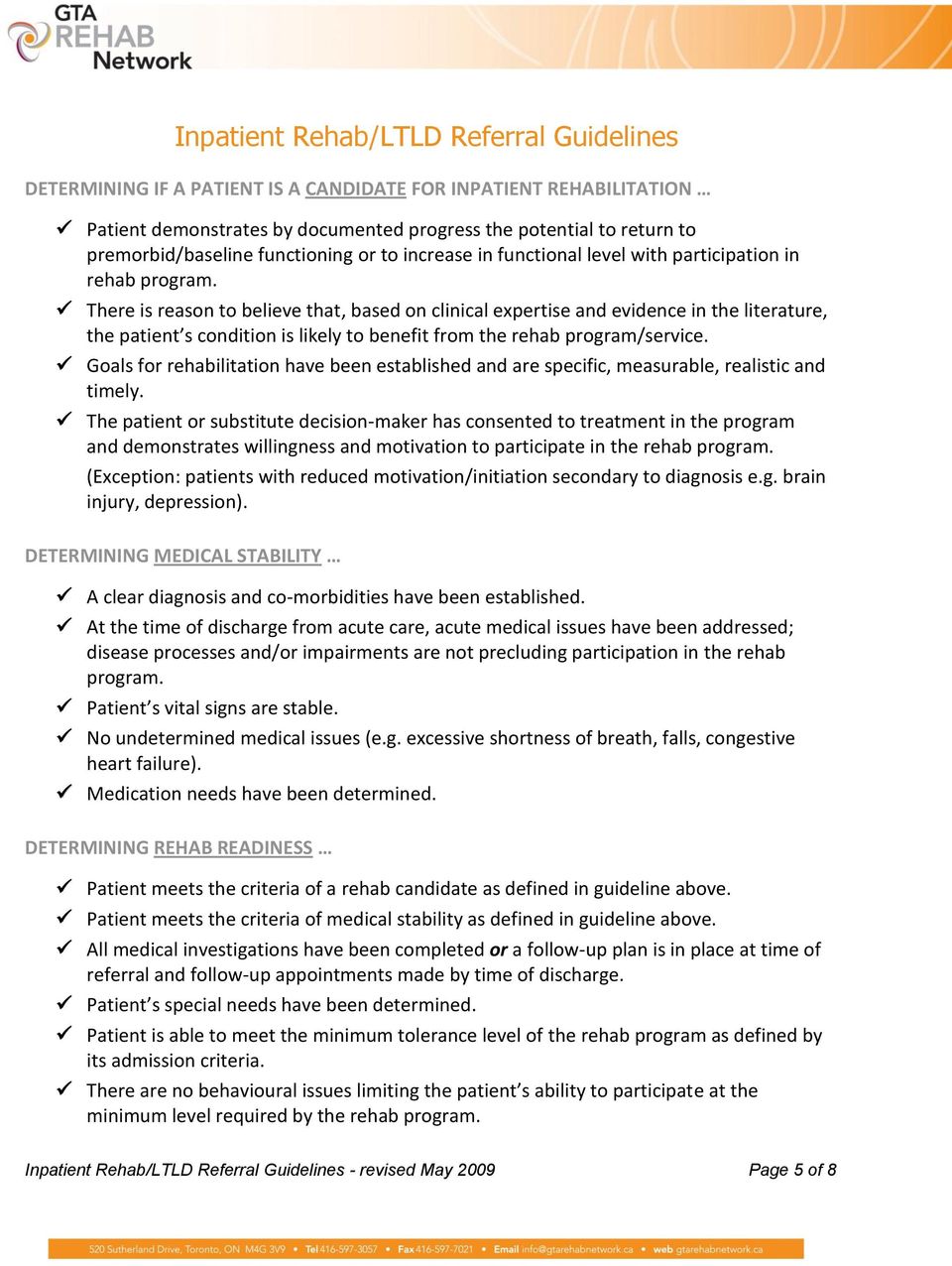
5 Inpatient Rehab/LTLD Referral Guidelines DETERMINING IF A PATIENT IS A CANDIDATE FOR INPATIENT REHABILITATION Patient demonstrates by documented progress the potential to return to premorbid/baseline functioning or to increase in functional level with participation in rehab program. There is reason to believe that, based on clinical expertise and evidence in the literature, the patient s condition is likely to benefit from the rehab program/service. Goals for rehabilitation have been established and are specific, measurable, realistic and timely. The patient or substitute decision-maker has consented to treatment in the program and demonstrates willingness and motivation to participate in the rehab program. (Exception: patients with reduced motivation/initiation secondary to diagnosis e.g. brain injury, depression). DETERMINING MEDICAL STABILITY A clear diagnosis and co-morbidities have been established. At the time of discharge from acute care, acute medical issues have been addressed; disease processes and/or impairments are not precluding participation in the rehab program. Patient s vital signs are stable. No undetermined medical issues (e.g. excessive shortness of breath, falls, congestive heart failure). Medication needs have been determined. DETERMINING REHAB READINESS Patient meets the criteria of a rehab candidate as defined in guideline above. Patient meets the criteria of medical stability as defined in guideline above. All medical investigations have been completed or a follow-up plan is in place at time of referral and follow-up appointments made by time of discharge. Patient s special needs have been determined. Patient is able to meet the minimum tolerance level of the rehab program as defined by its admission criteria. There are no behavioural issues limiting the patient s ability to participate at the minimum level required by the rehab program. Inpatient Rehab/LTLD Referral Guidelines - revised May 2009 Page 5 of 8
6 There are no psychiatric issues limiting the patient s ability to participate at the minimum level required by the rehab program. Treatment for other co-morbid illnesses/conditions does not interfere with the patient s ability to participate in rehab (e.g. dialysis or active cancer treatment). Patient s discharge options following rehab have been discussed. DETERMINING TIMING OF SUBMISSION OF APPLICATION FOR REHAB Patient meets the criteria of a rehab candidate as defined in the guideline above. Patient meets the criteria of medical stability as defined in the guideline above or patient s date of medical stability can be identified within the next 1-2 days of submission of application. Patient meets the criteria for rehab readiness as defined in the guideline above or the date for rehab readiness can be identified. Note I: Once it is determined that a patient is rehab candidate, medically stable and the date of rehab readiness is known, the referral to rehab should be submitted. Planning for discharge should begin prior to ALC designation. Note II: Referrers should notify rehab facilities of the cancellation of the referral in the event that the referral is no longer required. DETERMINING NUMBER OF REFERRALS TO BE SUBMITTED Organizations should send referrals to a minimum of 3 rehab programs as appropriate. 1 Detailed information about the admission criteria of individual rehab programs can be found using the admission information tool, Rehab Finder, available on the GTA Rehab Network website (see: This web-based resource provides a comprehensive listing of all publicly-funded and feefor-service rehab programs/services provided by hospitals and community access centres that are members of the GTA Rehab Network. 1 Please note that a minimum of 3 applications may not be required in hospitals with internal rehab beds (as per organizationspecific policies) or for some specialized rehab programs. Inpatient Rehab/LTLD Referral Guidelines - revised May 2009 Page 6 of 8

7 Rehab Finder allows you to search for rehab programs by: Patient Population (including age) Service Setting Organization Special Needs Local Health Integration Network Information on Rehab Finder includes: Description of the program Admission and Exclusion criteria Application process and forms Information about wait list management Contact details DETERMINING TIMING OF RESPONSES TO REFERRALS Responses to referrals should be given within 2 business days of receipt of application. Responses to referrals should be specific to one of the following response categories: Referral is accepted (Provide date of admission) Referral is accepted and waitlisted. (Provide estimated date of admission). Reason(s) for waitlisting due to: Current bed availability Current resource availability to accommodate complex patient needs Infection control issues Referral will be redirected to another program within the organization. (Provide name of program.) Referral will be sent back and decision is pending because: referral form is incomplete information is insufficient/inconsistent to make a decision regarding rehab readiness patient s current status does not indicate rehab readiness. Update required. Referral is denied because: referral is cancelled patient does not meet program criteria/requirements patient needs a secured unit program cannot accommodate medical needs program cannot accommodate behavioural issues program cannot accommodate psychiatric issues Inpatient Rehab/LTLD Referral Guidelines - revised May 2009 Page 7 of 8
8 APPENDIX Provincial Alternate Level of Care (ALC) Definition For implementation in all acute and post-acute hospitals* (Adapted from the Wait Time Information Strategy) Provincial ALC Definition The healthcare system aspires to deliver care in a setting that is congruent with the clinical needs of a patient as defined by the patient s health status, treatment plan and goals. The definition applies to all patient populations waiting in all patient care beds in an acute or post acute care hospital in Ontario. Definition: When a patient is occupying a bed in a hospital and does not require the intensity of resources/services provided in this care setting (Acute, Complex Continuing Care, Mental Health or Rehabilitation), the patient must be designated Alternate Level of Care (ALC) 1 at that time by the physician or her/his delegate. The ALC wait period starts at the time of designation and ends at the time of discharge/transfer to a discharge destination 2 (or when the patient s needs or condition changes and the designation of ALC no longer applies). *as of July 1, 2009 Note 1 The patient s care goals have been met or progress has reached a plateau or the patient has reached her/his potential in that program/level of care or an admission occurs for supportive care because the services are not accessible in the community (e.g. social admission ). This will be determined by a physician/delegate, in collaboration with an interprofessional team, when available. Note 2 Discharge/transfer destinations may include, but are not limited to: home (with/without services/programs), rehabilitation (facility/bed, internal or external), complex continuing care (facility/bed, internal or external), transitional care bed (internal or external), long term care home, group home, convalescent care beds, palliative care beds, retirement home, shelter, supportive housing. This will be determined by a physician/delegate, in collaboration with an interprofessional team, when available. Final Note The definition does not apply to patients: waiting at home, waiting in an acute care bed /service for another acute care bed/service (e.g., surgical bed to a medical bed), waiting in a tertiary acute care hospital bed for transfer to a non tertiary acute care hospital bed (e.g., repatriation to community hospital). Inpatient Rehab/LTLD Referral Guidelines - revised May 2009 Page 8 of 8

Inpatient Rehab Referral Guidelines
 Inpatient Rehab Referral Guidelines Table of Contents Introduction.. 3 Inpatient Rehab Referral Guidelines - Quick Reference Guide. 4 Inpatient Rehab Referral Guidelines: Determining if a patient is a
Discharge Planning. Home Assess / Treat. inpatient CCC (active/ltld) rehab = ALC Designation LTC. Admit
 DISCHARGE PLANNING GUIDELINES FOR INPATIENT REHABILITATION The Discharge Planning Guidelines for Inpatient Rehabilitation have been developed by the GTA Rehab Network s Patient Access and Flow Committee
How To Plan A Rehabilitation Program
 Project Plan to Rehabilitation Service Connecting and Collaborating in the Continuity of Care in Rehabilitation Presented By: Arlene Whitehead, May 31, 2011 Rehabilitation Collaborative Overview OUTLINE
Complex Continuing Care Restorative Care (Combined Functional Enhancement and Restorative Care Programs)
 Complex Continuing Care Restorative Care (Combined Functional Enhancement and Restorative Care Programs) Description: The Restorative Care program provides a moderate to low intensity goal-oriented rehabilitation
BEYOND ACUTE CARE: NEXT STEPS IN UNDERSTANDING ALC DAYS
 BEYOND ACUTE CARE: NEXT STEPS IN UNDERSTANDING ALC DAYS MARCH 19, 2008 1.0 EXECUTIVE SUMMARY In its continued efforts to improve the delivery of and access to rehabilitation services, the GTA Rehab Network
Rehabilitation Services Integration Initiative North York General Hospital and St. John s Rehab Hospital
 Rehabilitation Services Integration Initiative North York General Hospital and St. John s Rehab Hospital Introduction Hospitals across Ontario have been experiencing a growing challenge in that many are
Patient Services Manual
 Senior Director, and Chief Nursing Executive Policy General Rehabilitation Page 1 of 7 The Waterloo Wellington Local Health Integration Network (LHIN) recommends access to general rehabilitation beds in
Rehabilitation Integrated Transition Tracking System (RITTS)
 Rehab Criteria The patient must have a physical impairment requiring rehabilitation OR have a known cognitive impairment requiring ongoing rehabilitation support or services. The patient is medically stable:
Dedicated Stroke Interprofessional Rehab Team. Mixed Rehab Unit. Dedicated Rehab Unit
 Outpatient & Community I n p a t I e n t Stroke Rehab Definition Framework Institutional Setting Inpatient Rehab in Acute Care or Rehab Hospitals* Acute Care Integrated Specialized Units Transitional Care
Access to Care. Questions and Answers June 28, 2013
 Access to Care Questions and Answers June 28, 2013 Access to Care 1. What is Access to Care and why is it important? Access to Care is an approach to care focused on supporting people, specifically seniors
A STAR is born. Collaborative Strategy that works!
 A STAR is born Collaborative Strategy that works! Objective Demonstrate the importance of developing and nurturing partnerships in achieving quality outcomes, providing the right care at the right place
Patient Flow Toolkit. Module 2: Alternate Level of Care. Reference guide for operational leaders, managers and point-of-care staff
 Patient Flow Toolkit Module 2: Alternate Level of Care Reference guide for operational leaders, managers and point-of-care staff November 2015 Table of Contents Module Objectives.... 1 What Is ALC?....
Stroke Rehab Across the Continuum of Care in Quinte Region
 Stroke Rehab Across the Continuum of Care in Quinte Region Adrienne Bell Smith Manager of Rehab Therapies QHC Karen Brown Manger Client Services, Hospital Access South East CCAC Disclosure of Potential
Systems Analysis of Health and Community Services for Acquired Brain Injury in Ontario
 Systems Analysis of Health and Community Services for Acquired Brain Injury in Ontario July 2010 Report provided to the Ontario Neurotrauma Foundation by the Research Team: Dr. Susan Jaglal Principal Investigator
Outpatient/Ambulatory Rehab. Dedicated Trans-disciplinary Team (defined within Annotated References)
 CARDIAC The delivery of Cardiac Rehab is unlike most other rehab populations. The vast majority of patients receive their rehab in outpatient or community settings and only a small subset requires an inpatient
Institutional Setting. Home / Residential
 Outpatient & Community I n p a t I e n t Spinal Cord Injury Rehab Definition Framework Institutional Setting Inpatient Rehab in Acute Care or Rehab Hospitals* Acute Care Integrated Specialized Units Transitional
Policy & Procedure Manual Administration - Role and Expectations of the Most Responsible Physician (MRP)
 The Scarborough Hospital Policy & Procedure Manual Administration - Role and Expectations of the Most Responsible Purpose To clarify and standardize the role of the Most Responsible at The Scarborough
What do these stories illustrate about ER/ALC issue?
 What do these stories illustrate about ER/ALC issue? Maximizing the Impact of Rehab on Provincial Priority Issues Mark Bayley, MD, FRCPC Medical Director, Neuro Rehabilitation Program, Toronto Rehab and
a message from the chair and executive director
 a message from the chair and executive director a brain injury this year. For many, the injury will be life changing. And access to high quality services and support will be critical as they rebuild their
Inpatient Rehabilitation Referral Form
 This referral form is to be used for all external referrals to designated inpatient rehabilitation beds in northeastern Ontario. There are five northeastern Ontario hospitals that offer these services
HEALTH INFORMATION FORM FOR STUDY ABROAD PARTICIPANTS
 HEALTH INFORMATION FORM FOR STUDY ABROAD PARTICIPANTS Student: Last name: First Name: Middle Initial: Period of intended study abroad: Year(s): Fall Spring Academic Year Country Foreign Institution or
GENERAL ADMISSION CRITERIA INPATIENT REHABILITATION PROGRAMS
 Originator: Case Management Original Date: 9/94 Review/Revision: 6/96, 2/98, 1/01, 4/02, 8/04, 3/06, 03/10, 3/11, 3/13 Stakeholders: Case Management, Medical Staff, Nursing, Inpatient Therapy GENERAL ADMISSION
DEPARTMENT OF HEALTH AND HUMAN SERVICES Centers for Medicare & Medicaid Services. Discharge Planning
 DEPARTMENT OF HEALTH AND HUMAN SERVICES Centers for Medicare & Medicaid Services ICN 908184 October 2014 This booklet was current at the time it was published or uploaded onto the web. Medicare policy
TORONTO STROKE FLOW INITIATIVE - Outpatient Rehabilitation Best Practice Recommendations Guide (updated July 26, 2013)
 Objective: To enhance system-wide performance and outcomes for persons with stroke in Toronto. Goals: Timely access to geographically located acute stroke unit care with a dedicated interprofessional team
Appropriate level of care: a patient flow, system integration and capacity solution
 Appropriate level of care: a patient flow, system integration and capacity solution Report by the expert panel on alternate level of care December 2006 TABLE OF CONTENTS 1.0 EXECUTIVE SUMMARY...3 2.0 OVERVIEW
How To Run An Acquired Brain Injury Program
 ` Acquired Brain Injury Program Regional Rehabilitation Centre at the Hamilton General Hospital Table of Contents Page Introduction... 3-4 Acquired Brain Injury Program Philosophy... 3 Vision... 3 Service
Integrated Delivery of Rehabilitation Services:
 Integrated Delivery of Rehabilitation Services: Guidelines SPECIAL for NEEDS Children s STRATEGY Community Agencies, Health Guidelines Service for Providers Local Implementation and District School of
How To Value A Rehabilitation Medicine Clinical Registry
 INITIAL ANALYSIS OF NEWLY ADDED DATA ITEMS. DO THEY PROVIDE INSIGHTS OF VALUE? Presentation to the AFRM Annual Scientific Meeting 20 September 2013 Frances Simmonds, Director AROC Tara Stevermuer, AROC
Patient Flow Pressures
 Patient Flow Pressures Presentation to Board of Directors Hamilton Niagara Haldimand Brant Local Health Integration Network December 11, 2013 Patient Flow (in this context) Refers to the movement of individuals
Hamilton Health Sciences Integrated Stroke Model of Care. Rhonda Whiteman, Stroke Best Practices Coordinator, Hamilton Health Sciences
 Hamilton Health Sciences Integrated Stroke Model of Care Rhonda Whiteman, Stroke Best Practices Coordinator, Hamilton Health Sciences Integrated Stroke Model of Care Goals To provide a more comprehensive
3/11/15. COPD Disease Management Tackling the Transition. Objectives. Describe the multidisciplinary approach to inpatient care for COPD patients
 Faculty Disclosures COPD Disease Management Tackling the Transition Dr. Cappelluti has no actual or potential conflicts of interest associated with this presentation. Jane Reardon has no actual or potential
The LTCA sets out the case management function of the CCAC for community services:
 6.1 Introduction to Case Management The Long-Term Care Act, 1994 (LTCA) assigns specific duties to agencies approved to provide community services. In regulation 33/02 under the Community Care Access Corporations
How To Care For A Patient With A Heart Condition
 Acute Care to Rehab & Complex Identify Referral Destination: Referral to Rehab Referral to Complex Continuing Care (CCC) If Faxed Include Number of Pages (Including Cover): Pages Estimated Date of Rehab/CCC
Hamilton Health Sciences Acquired Brain Injury Program
 Overview of Program The Acquired Brain Injury (ABI) Program at the Regional Rehabilitation Centre, Hamilton General Hospital serve the rehabilitation needs of adults with acquired brain injuries and their
Hamilton Niagara Haldimand Brant LHIN Rehabilitation/Complex Continuing Care PAG. Service Delivery Model Review
 Hamilton Niagara Haldimand Brant LHIN Rehabilitation/Complex Continuing PAG Service Delivery Model Review April, 2009 Service Delivery Model Review Introduction This document presents a summary of peer
IRG/APS Healthcare Utilization Management Guidelines for West Virginia Health Homes - Bipolar and Hepatitis
 IRG/APS Healthcare Utilization Management Guidelines for West Virginia Health Homes - Bipolar and Hepatitis CHANGE LOG Medicaid Chapter Policy # Effective Date Chapter 535 Health Homes 535.1 Bipolar and
Department of Veterans Affairs VHA DIRECTIVE 2011-040 Veterans Health Administration Washington, DC 20420 December 7, 2011
 Department of Veterans Affairs VHA DIRECTIVE 2011-040 Veterans Health Administration Washington, DC 20420 REFERRAL TO INPATIENT BLIND REHABILITATION CENTERS AND CALCULATION OF THE WAITING TIME PRIOR TO
ISSUED BY: TITLE: ISSUED BY: TITLE: President
 CLINICAL PRACTICE GUIDELINE PROFESSIONAL PRACTICE TITLE: Stroke Care Rehabilitation Unit DATE OF ISSUE: 2005, 05 PAGE 1 OF 7 NUMBER: CPG 20-3 SUPERCEDES: New ISSUED BY: TITLE: Chief of Medical Staff ISSUED
Re: Catastrophic Impairment Project Expert Panel Report Public Consultation
 May 11, 2011 Mr. Willie Handler Senior Policy Analyst Auto Insurance Policy Unit Financial Services Commissioner of Ontario 5160 Yonge Street P.O. Box 85 Toronto, Ontario M2N 6L9 Re: Catastrophic Impairment
MEDICAL ASSOCIATES HEALTH PLANS HEALTH CARE SERVICES POLICY AND PROCEDURE MANUAL POLICY NUMBER: PP 27
 POLICY TITLE: RESIDENTIAL TREATMENT CRITERIA POLICY STATEMENT: Provide consistent criteria when determining coverage for Residential Mental Health and Substance Abuse Treatment. NOTE: This policy applies
CHELAN-DOUGLAS RSN/PHP POLICY AND PROCEDURE MANUAL Title: INPATIENT PSYCHIATRIC SERVICES
 CHELAN-DOUGLAS RSN/PHP POLICY AND PROCEDURE MANUAL Title: INPATIENT PSYCHIATRIC SERVICES Subject: MANAGEMENT OF CHILDREN S LONG-TERM INPATIENT PROGRAM (CLIP) Chapter: 5.10 Page: 1 of 5 Date Effective:
Child & Adolescent Rehabilitation Services (CARS)
 Child & Adolescent Rehabilitation Services (CARS) Operational Guidelines To be read in conjunction with the CARS contract June 2013 This is a living document and will be updated as required Contents Child
Rehabilitation/Geriatrics. Coordinated Entry System
 Rehabilitation/Geriatrics Coordinated Entry System Table of Contents Rehabilitation and Geriatric Service Sites 3 Overview of Coordinated Entry System 4 Geriatric Rehabilitation Service DLC, RHC, SOGH,
DEPARTMENT OF FAIR EMPLOYMENT AND HOUSING
 STATE OF CALIFORNIA DEPARTMENT OF FAIR EMPLOYMENT AND HOUSING FAIR EMPLOYMENT & HOUSING COUNCIL CERTIFICATION OF HEALTH CARE PROVIDER (California Family Rights Act (CFRA)) IMPORTANT NOTE: The California
Chapter 7: Inpatient & Outpatient Hospital Care
 7 Inpatient & Outpatient Hospital Care ACUTE INPATIENT ADMISSIONS All elective and emergent admissions require prior authorization and/or notification for all Health Choice Generations Members admissions.
YOUR RIGHTS RESPONSIBILITIES TO OUR PATIENTS. Patients and families come first. We are here to serve with respect, compassion, and honesty.
 TO OUR PATIENTS YOUR RIGHTS & RESPONSIBILITIES Patients and families come first. We are here to serve with respect, compassion, and honesty. We will try to do our best today, and do better tomorrow. We
Rehabilitation. Care
 Rehabilitation Care Bruyère Continuing Care is the champion of well-being for aging Canadians and those requiring Continuing Care, helping them to become and remain as healthy and independent as possible
REMINDER: Please ensure all stroke and TIA patients admitted to hospital are designated as "Stroke Service" in Cerner.
 ACUTE STROKE CLINICAL PATHWAY QEH/HH PCH KCMH Souris Western Stewart Memorial O'Leary PATIENT ID INCLUSION CRITERIA* All patients admitted to hosptial with a suspected diagnosis of acute ischemic stroke
Rehabilitation Services at Hospitals 3.08. Chapter 3 Section. Background DESCRIPTION OF REHABILITATION ELIGIBILITY FOR REHABILITATION
 Chapter 3 Section 3.08 Ministry of Health and Long-Term Care Rehabilitation Services at Hospitals Background DESCRIPTION OF REHABILITATION Rehabilitation services in Ontario generally provide support to
Medicine, Complex Continuing Care, and Rehab. Community Forum Presentation
 H Medicine, Complex Continuing Care, and Rehab Community Forum Presentation Complex Continuing Care Who are our Complex Continuing Care Patients Currently? Patients waiting for Long Term Care beds Patients
ALBERTA PROVINCIAL STROKE STRATEGY (APSS)
 ALBERTA PROVINCIAL STROKE STRATEGY (APSS) Stroke Systems of Care Key Components APSS Pillar Recommendations March 28, 2007 1 The following is a summary of the key components and APSS Pillar recommendations
Using Objective Measures to Facilitate Rehabilitation Referral
 Using Objective Measures to Facilitate Rehabilitation Referral Mark Bayley MD, FRCPC Medical Director, Neuro Rehabilitation Program, Toronto Rehabilitation Institute Associate Professor, Division of Physiatry,
Standard. Operating. Procedures. Manual
 Occupational Health Service for Teachers and Special Needs Assistants Standard Operating Procedures Manual A Manual for Boards of Management/Managers & ETB s June 2015 1 Contents Contents... 2 Definitions...
GTA Rehab Network Quick Reference Referral Guide
 Introduction to the Quick Reference Guide to Inpatient Rehab/CCC/Palliative Care Programs in the GTA Inpatient Rehab/LTLD/CCC Quick Reference The attached document is a Quick Reference of adult Inpatient
REHABILITATION MEDICINE by PROFESSOR ANTHONY WARD
 REHABILITATION MEDICINE by PROFESSOR ANTHONY WARD What is Rehabilitation Medicine? Rehabilitation Medicine (RM) is the medical specialty with rehabilitation as its primary strategy. It provides services
Optimal patient flow is vital in hospitals to achieve
 Quality Improvement : Reducing ALC and Achieving Better Outcomes for Seniors through Inter-organizational Collaboration Leslie Starr-Hemburrow, Janet M. Parks and Susan Bisaillon Abstract Like many hospitals,
Get With The Guidelines - Stroke PMT Special Initiatives Tab for Ohio Coverdell Stroke Program CODING INSTRUCTIONS Effective 10-24-15
 Get With The Guidelines - Stroke PMT Special Initiatives Tab for Ohio Coverdell Stroke Program CODING INSTRUCTIONS Effective 10-24-15 Date and time first seen by ED MD: The time entered should be the earliest
How To Manage Health Care Needs
 HEALTH MANAGEMENT CUP recognizes the importance of promoting effective health management and preventive care for conditions that are relevant to our populations, thereby improving health care outcomes.
Ontario s Critical Care Surge Capacity Management Plan
 Ontario s Critical Care Surge Capacity Management Plan Moderate Surge Response Guide Version 2.0 Critical Care Services Ontario September 2013 1 P a g e Ontario s Surge Capacity Management Plan: Moderate
Medical Necessity & Charting Guidelines
 Medical Necessity & Charting Guidelines 1 In most cases we are told the rules up front - or will be told if we ask Like most games, the one who knows the rules the best WINS 4 2 Nationally Recognized Industry
Rehabilitation Following Major Trauma in the North West
 Rehabilitation Following Major Trauma in the North West Acute / early rehabilitation Community based rehabilitation, including vocational aspects Acute / Early Rehabilitation Following Major Trauma Dr
THE REHAB PAG SUMMARY TEMPLATES AND MODEL
 THE REHAB PAG SUMMARY TEMPLATES AND MODEL July 6, 2009 Lynn Corbey Bettyann DeRonde Dr. David Harvey Jennifer Kodis Kathryn Leatherland Dr Rick McMillan Chuck McRae Wendy Robb Jane Rufrano Kanwal Shankardass
DISABILITY CLAIM APPLICATION FORMS For Standard / Partial Payment and Dismemberment Plans
 DISABILITY CLAIM APPLICATION FORMS For Standard / Partial Payment and Dismemberment Plans INSTRUCTIONS ALL OF THE FOLLOWING PROPERLY COMPLETED FORMS ARE ESSENTIAL TO THE PROMPT PROCESSING OF YOUR DISABILITY
Acute Rehabilitation Center
 Acute Rehabilitation Center Acute Rehabilitation Courtyard Our Center Community Westview Hospital's Acute Rehabilitation Center and programs are specially designed to meet the needs of our patients and
Transitioning to a System of Rehabilitative Care in Waterloo Wellington
 Transitioning to a System of Rehabilitative Care in Waterloo Wellington Presented to the WWLHIN Board of Directors January 31, 2013 Item 20.0 Agenda Stroke and Rehabilitative Care System Initiatives..
A collaborative model for service delivery in the Emergency Department
 A collaborative model for service delivery in the Emergency Department Regional Geriatric Program of Toronto, December 2009 Background Seniors over the age of 75 years now have the highest Emergency Department
ADDENDUM to. Commonwealth of Massachusetts Executive Office of Health and Human Services Office of Medicaid
 ADDENDUM to Commonwealth of Massachusetts Executive Office of Health and Human Services Office of Medicaid Proposal to the Center for Medicare and Medicaid Innovation State Demonstration to Integrate Care
Ontario Stroke System. Prepared by: Stroke Rehabilitation Evaluation Working Group Stroke Evaluation Advisory Committee May, 2007
 Ontario Stroke System Stroke Rehabilitation Performance Measurement Manual Prepared by: Stroke Rehabilitation Evaluation Working Group Stroke Evaluation Advisory Committee May, 2007 Stroke Rehabilitation
Follow-up information from the November 12 provider training call
 Follow-up information from the November 12 provider training call Criteria I. Multiple Therapy Disciplines 1. Clarification regarding the use of group therapies in IRFs. Answer: CMS has not yet established
PURPOSE OF THE SELF-ASSESSMENT TOOLS:
 Geriatric Rehab Definitions Framework Self-Assessment Tool Outpatient/Ambulatory Geriatric Rehab INTRODUCTION: In response to a changing rehab landscape in which rehabilitation is offered in many different
Chapter 4 Health Care Management Unit 1: Care Management
 Chapter 4 Health Care Unit 1: Care In This Unit Topic See Page Unit 1: Care Care 2 6 Emergency 7 4.1 Care Healthcare Healthcare (HMS), Highmark Blue Shield s medical management division, is responsible
High Desert Medical Group Connections for Life Program Description
 High Desert Medical Group Connections for Life Program Description POLICY: High Desert Medical Group ("HDMG") promotes patient health and wellbeing by actively coordinating services for members with multiple
General Practitioner
 Palliative Care/End of Life Related Fees Service Type Fee code When to use General Practitioner Palliative Care Planning 14063 Once a patient living in the community (own or family home or assisted living;
Memo. Health Care Management. From: Deborah Jenkins, Admissions/Transfer Manager Date: 10/21/2010 Re: HCM October/November/December 2010 Call Schedule
 Health Care Management Memo From: Deborah, Admissions/Transfer Manager Date: // Re: HCM October/November/December Call Schedule The attached list is the October/November/December call schedule for the
POLICY #1571.00 SUBJECT: INPATIENT CERTIFICATION AND AUTHORIZATION
 Effective Date: 9/13/2007; 7/13/2005 Revised Date: 11/7/07 Review Date: North Sound Mental Health Administration Section 1500 Clinical: Inpatient Certification and Authorization Authorizing Source: WAC
APPENDIX B HONG KONG S CURRENT HEALTHCARE SYSTEM. Introduction
 APPENDIX B HONG KONG S CURRENT HEALTHCARE SYSTEM Introduction B.1 Over the years, Hong Kong has developed a highly efficient healthcare system and achieved impressive health outcomes for its population.
Service delivery interventions
 Service delivery interventions S A S H A S H E P P E R D D E P A R T M E N T O F P U B L I C H E A L T H, U N I V E R S I T Y O F O X F O R D CO- C O O R D I N A T I N G E D I T O R C O C H R A N E E P
Complex Outpatient. Injury. Rehab. Integrated, evidence-based rehab that supports a timely return to home, life, work or school
 Complex Outpatient Injury Rehab Integrated, evidence-based rehab that supports a timely return to home, life, work or school Toronto Rehabilitation Institute At Toronto Rehab, our goal is to advance rehabilitation
AlphaFIM Instrument Too ol1 Mild Stroke Project (Part II) Report
 1 AlphaFIM Instrument Tool 1 Mild Stroke Project (Part II) Report Prepared by: Carmel Forrestal Regional Stroke Rehab Coordinator 1 The FIM instrument and AlphaFIM instrument referenced herein are the
To provide standardized Supervised Exercise Programs across the province.
 TITLE ALBERTA HEALTHY LIVING PROGRAM SUPERVISED EXERCISE PROGRAM DOCUMENT # HCS-67-01 APPROVAL LEVEL Executive Director Primary Health Care SPONSOR Senior Consultant Central Zone, Primary Health Care CATEGORY
Acute Care to Rehab and Complex Continuing Care (CCC) Referral
 (Identify Referral Destination) Rehabilitation Program Requested: CCC Program Requested: Restorative Medically Complex Medically Complex Ventilator Behavioural Health End of Life Medically Complex - Bariatric
2016 MEDICAL REHABILITATION PROGRAM DESCRIPTIONS
 2016 MEDICAL REHABILITATION PROGRAM DESCRIPTIONS Contents Comprehensive Integrated Inpatient Rehabilitation Program... 2 Outpatient Medical Rehabilitation Program... 2 Home and Community Services... 3
Optum s Role in Mycare Ohio
 Optum s Role in Mycare Ohio What is MyCare Ohio? New opportunities generated by the Affordable Care Act have allowed Ohio to implement the MyCare Ohio program. MyCare Ohio is a demonstration project that
Pathways of Care for People With Stroke in Ontario
 July 2012 Pathways of Care for People With Stroke in Ontario Health System Performance Overview Stroke represents a significant burden for patients, their families and the health care system. It is a leading
Patient Access. UCLH policy
 Patient Access UCLH policy Version 3.2 Version Date June 2014 Version Approved By EB Policy Approval Sub-Group Publication Date July 2013 Author Kevin Nicholson Review By Date June 2016 Responsible Director
STATE OF OHIO. DEPARTMENT OF REHABILITATION RELATED ACA STANDARDS: EFFECTIVE DATE: AND CORRECTION February 19, 2011 I. AUTHORITY
 STATE OF OHIO SUBJECT: PAGE 1 OF 7. Specialized Assessments and Screenings NUMBER: 67-MNH-16 RULE/CODE REFERENCE: SUPERSEDES: AR 5120-11-03, 07, 21 67-MNH-16 dated 01/13/10 ORC 5120.031; 5120.032; 5120.033