
July Guidelines for Program Approval
|
|
|
- Katrina Stevenson
- 10 years ago
- Views:
Transcription
1 Guidelines for Program Approval July 2013 Massachusetts Department of Elementary and Secondary Education 75 Pleasant Street, Malden, MA Phone TTY: N.E.T. Relay Guidelines for Program Approval

2 This document was prepared by the Massachusetts Department of Elementary and Secondary Education Mitchell D. Chester, Ed.D. Commissioner The Massachusetts Department of Elementary and Secondary Education, an affirmative action employer, is committed to ensuring that all of its programs and facilities are accessible to all members of the public. We do not discriminate on the basis of age, color, disability, national origin, race, religion, sex or sexual orientation. Inquiries regarding the Department s compliance with Title IX and other civil rights laws may be directed to the Human Resources Director, 75 Pleasant St., Malden, MA Phone: Massachusetts Department of Elementary and Secondary Education Permission is hereby granted to copy any or all parts of this document for non-commercial educational purposes. Please credit the Massachusetts Department of Elementary and Secondary Education. This document printed on recycled paper Massachusetts Department of Elementary and Secondary Education 75 Pleasant Street, Malden, MA Phone TTY: N.E.T. Relay Guidelines for Program Approval

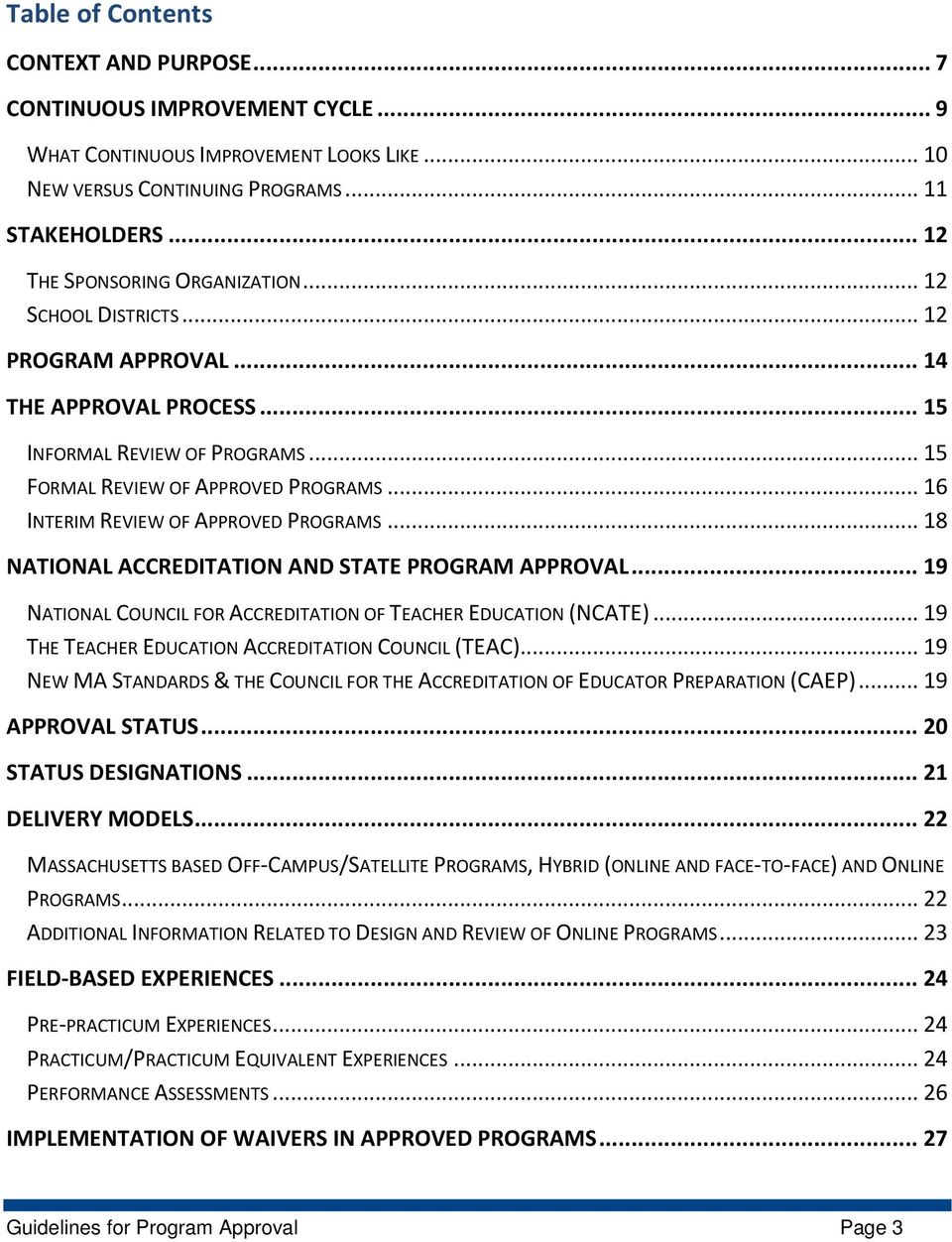
3 Table of Contents CONTEXT AND PURPOSE... 7 CONTINUOUS IMPROVEMENT CYCLE... 9 WHAT CONTINUOUS IMPROVEMENT LOOKS LIKE NEW VERSUS CONTINUING PROGRAMS STAKEHOLDERS THE SPONSORING ORGANIZATION SCHOOL DISTRICTS PROGRAM APPROVAL THE APPROVAL PROCESS INFORMAL REVIEW OF PROGRAMS FORMAL REVIEW OF APPROVED PROGRAMS INTERIM REVIEW OF APPROVED PROGRAMS NATIONAL ACCREDITATION AND STATE PROGRAM APPROVAL NATIONAL COUNCIL FOR ACCREDITATION OF TEACHER EDUCATION (NCATE) THE TEACHER EDUCATION ACCREDITATION COUNCIL (TEAC) NEW MA STANDARDS & THE COUNCIL FOR THE ACCREDITATION OF EDUCATOR PREPARATION (CAEP) APPROVAL STATUS STATUS DESIGNATIONS DELIVERY MODELS MASSACHUSETTS BASED OFF-CAMPUS/SATELLITE PROGRAMS, HYBRID (ONLINE AND FACE-TO-FACE) AND ONLINE PROGRAMS ADDITIONAL INFORMATION RELATED TO DESIGN AND REVIEW OF ONLINE PROGRAMS FIELD-BASED EXPERIENCES PRE-PRACTICUM EXPERIENCES PRACTICUM/PRACTICUM EQUIVALENT EXPERIENCES PERFORMANCE ASSESSMENTS IMPLEMENTATION OF WAIVERS IN APPROVED PROGRAMS Guidelines for Program Approval Page 3
4 ANNUAL REPORTING PUBLIC REPORTING GLOSSARY OF TERMS OVERVIEW OF APPENDICES:... I APPENDIX A: STANDARDS AND EFFECTIVENESS INDICATORS... II APPENDIX B: SOURCES OF EVIDENCE GUIDE... V APPENDIX C: REGULATIONS GOVERNING PROGRAM APPROVAL... XV RESOURCES... XXI GENERAL CONTACT INFORMATION... XXI Guidelines for Program Approval Page 4

5 Massachusetts Department of Elementary and Secondary Education 75 Pleasant Street, Malden, Massachusetts Telephone: (781) TTY: N.E.T. Relay Mitchell D. Chester, Ed.D. Commissioner MEMORANDUM To: Higher Education Presidents, Chancellors, Provosts, Deans, Alternative Provider Executives, other Senior Organizational Leaders, Education Faculty, Arts & Sciences Faculty, School District Superintendents, Principals and other Administrators, Charter School Leaders, Candidates for Licenses as Administrative Leaders, Aspiring Leaders, Candidates for Licensure and Other Interested Stakeholders From: Mitchell D. Chester, Ed.D., Commissioner Date: July 2013 Subject: Guidelines for the Approval of Educator Preparation Programs I am pleased to provide you with the Guidelines for Program Approval. The amendments to the Regulations for Educator Licensure and Preparation Program Approval, 603 CMR 7.00, passed by the Board of Elementary and Secondary Education in June 2012 initiated the development of these Guidelines. With these revised regulations, ESE aims to improve instruction in the Commonwealth by supporting educators through every stage of their career. These guidelines support the rigorous, high quality standards set for teacher preparation by outlining the procedures for the approval of all educator preparation programs in Massachusetts. Through the Board s leadership and Race to the Top funding, ESE has increased attention to educator preparedness. In addition to the new Educator Evaluation Regulations approved by the Board in June 2011, the licensure and program approval regulations and these guidelines are another step towards building a comprehensive system that supports educator development across the career continuum. Together, the revised regulations and these Guidelines communicate a shift in the program approval process. ESE will incorporate program outcome measures to indicate: Whether (or not) programs are preparing graduates who are ready to effectively teach and lead in the Commonwealth s schools. Whether (or not) programs are preparing educators to assume positions in high-needs placements across the Commonwealth. As an expectation for continuous improvement, ESE will collect and report data such as Guidelines for Program Approval Page 5
6 educator evaluation ratings, program graduates impact in producing growth in student learning, employment and survey data. With the collection and analysis of these data, ESE will be able to better identify strong programs worthy of recognition and replication and weed out those programs failing to produce the types of educators required for the needs of Massachusetts schools. The detailed indicators for each program approval standard are outlined in these Guidelines and are not in regulations. This approach streamlines the regulations and enables ESE to update the indicators periodically based on research and best practices, in consultation with the field, and with state and national experts, including the Council of Chief State School Officers State Consortium on Educator Effectiveness (SCEE) in which we participate. I urge all stakeholders engaged in the preparation of future educators to embrace this opportunity to create experiences for educator candidates to ensure the success of all P-12 students in the Commonwealth. These Guidelines are designed to enable the development of deep partnerships between educator preparation program providers and school districts and charter schools. This shared responsibility for candidate success increases the likelihood that effective, qualified, and dynamic individuals will seek educator licensure and employment as educators in Massachusetts. In the coming months, ESE will release additional documents, referred to as Toolkits, to support the field in preparing for the various components of program reviews. These toolkits will be available on the Ed Prep website at Please share what you learn and discover with ESE, as you use these Guidelines as a roadmap for the redesign of currently approved programs or the design, development, and submission of a new educator preparation program. ESE hopes that you will continue to provide feedback on these Guidelines. Feedback can be provided to: [email protected]. Guidelines for Program Approval Page 6

7 Context and Purpose The Board of Elementary and Secondary Education (BESE) and Department of Elementary and Secondary Education (ESE) have made educator effectiveness a priority in order to educate all students for college and career readiness and close achievement gaps. Our goal is to ensure that every classroom in the Commonwealth is staffed by an effective educator and schools and districts are organized to support student achievement and success. To achieve this goal, ESE is relying on preparation programs to prepare all teachers and leaders to be effective educators. In recent years there has also been a growing national spotlight on the need to improve efforts to prepare effective educators for our schools and districts. In December 2012, The Council of Chief State School Officers (CCSSO) released a set of recommendations aimed at transforming educator preparation and standards for entry into the profession. Likewise, the two national accreditation agencies (NCATE and TEAC) have unified efforts in the newly formed Council for the Accreditation of Educator Preparation (CAEP) with plans to issue new, rigorous standards for the accreditation process that demands excellence and produces teachers who raise student achievement. In support of this increased emphasis on the preparation of effective educators at both the state and national level, the BESE adopted new Regulations for Educator Licensure and Preparation Program Approval in June 2012 and new Administrative Leadership Regulations in December 2011 as components of a comprehensive system to support educator development across the career continuum. The June 2012 revisions are the result of four years of collaborative work with a wide array of stakeholders. ESE has worked collaboratively with educator preparation programs to create, pilot and implement a continuous improvement, evidence based program approval process. This included a pilot cohort of 12 Sponsoring Organizations and a second cohort of 15 organizations. In addition, ESE solicited and received feedback from national organizations: the Center for American Progress, the Data Quality Campaign (DQC), Education Sector, the Education Trust and the National Council on Teacher Quality (NCTQ); researched practices in other states, surveyed and met with school and district administrators, and held several forums and surveyed educator preparation program providers. This feedback informed these new regulations for educator licensure and preparation program approval. We are grateful for this feedback. With the adoption of these new regulations, ESE has changed the types of data collected from educator preparation programs and have shifted the program approval process to include outcomes measures in addition to the review of program inputs. By analyzing data about programs, including data such as school employment and evaluation ratings, and evaluating outcomes based on this data, ESE will be able to identify high performing programs and be able to share evidence from which others can learn; Guidelines for Program Approval Page 7

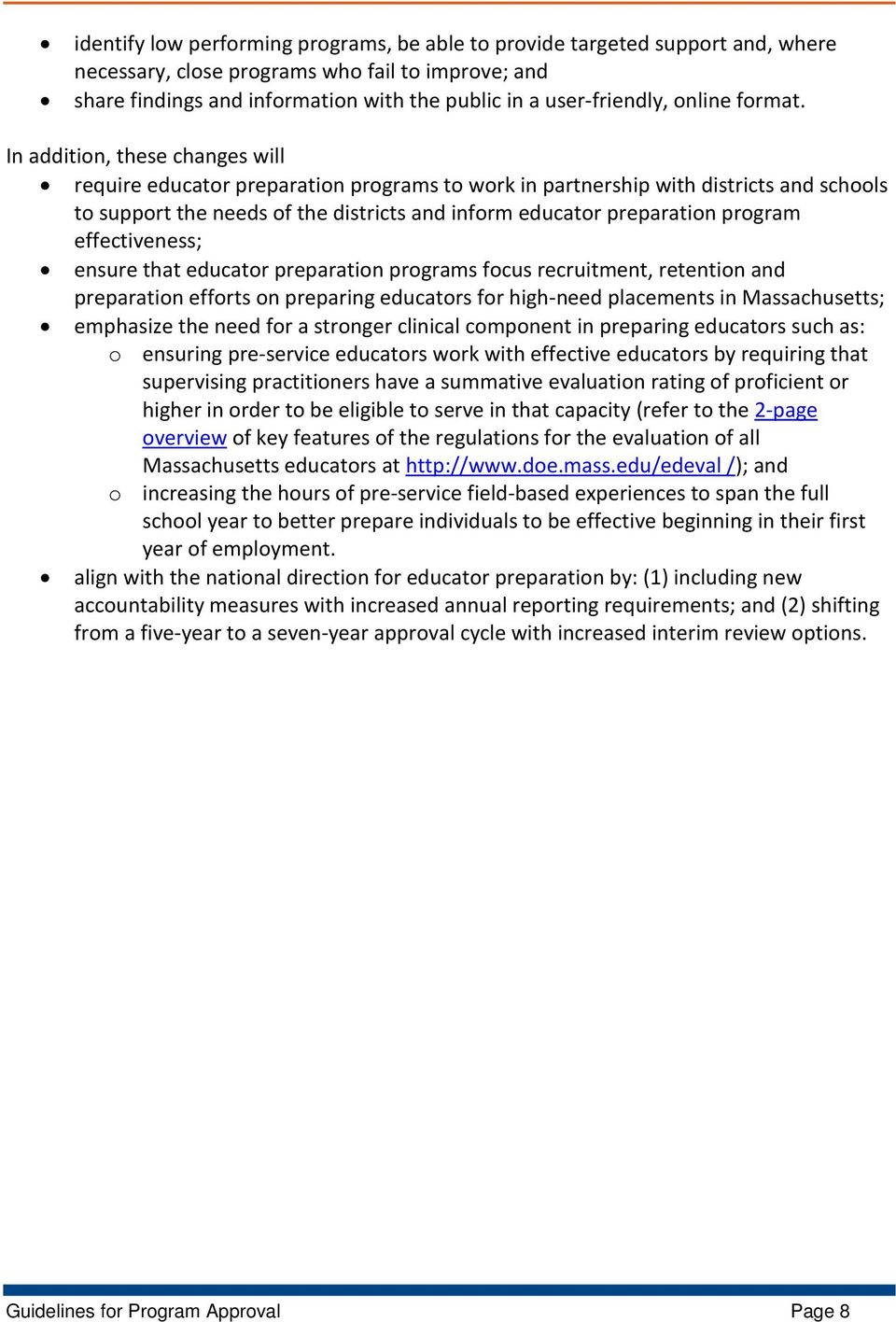
8 identify low performing programs, be able to provide targeted support and, where necessary, close programs who fail to improve; and share findings and information with the public in a user-friendly, online format. In addition, these changes will require educator preparation programs to work in partnership with districts and schools to support the needs of the districts and inform educator preparation program effectiveness; ensure that educator preparation programs focus recruitment, retention and preparation efforts on preparing educators for high-need placements in Massachusetts; emphasize the need for a stronger clinical component in preparing educators such as: o ensuring pre-service educators work with effective educators by requiring that supervising practitioners have a summative evaluation rating of proficient or higher in order to be eligible to serve in that capacity (refer to the 2-page overview of key features of the regulations for the evaluation of all Massachusetts educators at /); and o increasing the hours of pre-service field-based experiences to span the full school year to better prepare individuals to be effective beginning in their first year of employment. align with the national direction for educator preparation by: (1) including new accountability measures with increased annual reporting requirements; and (2) shifting from a five-year to a seven-year approval cycle with increased interim review options. Guidelines for Program Approval Page 8
9 Continuous Improvement Cycle Federal and state policies continue to focus on improving how educators are prepared to effectively teach in 21 st century classrooms. This increased scrutiny of educators and educator preparation has led to greater accountability and expanded opportunities for educator preparation organizations as well as a need to re-assess how these programs are reviewed. Both the 2012 Regulations for Educator Licensure and Preparation Program Approval and the new program approval process focus on the need for Sponsoring Organizations to establish a continuous improvement system that examines program effectiveness through the compilation and analysis of data, both quantitative and qualitative. The system enables each Sponsoring Organization to reflect upon and assess the design, development, and delivery of its educator preparation programs and ensure that they reflect the mission, vision and goals of the Sponsoring Organization and all are aligned with state requirements. On-going collection and analyses of program data drives the continuous improvement process. This continuous improvement cycle results in more effective programs. Guidelines for Program Approval Page 9

10 What Continuous Improvement Looks Like Step in Cycle Description Potential Actions Establish Improvement Infrastructure Conduct Annual Evaluation Collect, align, allocate, acquire or create the resources necessary to support the continuous improvement cycle. It is advisable that organizations consider internal capacity for sustaining improvement initiatives and design structures that support these efforts. The annual evaluation should assess program compliance, effectiveness, and impact using an evidence-based system (CMR 7.03(2)(a)). New state-supported data that should serve as sources of evidence include: state administered surveys; district employment data; candidate persistence and completion rates; and aggregate program completer evaluation ratings. Create an improvement committee Schedule in advance standing meetings to support each step in the cycle Enlist external partners and stakeholders in supporting the infrastructure Evaluate trends in data, such as evaluation ratings specific to program design Compare impact data to organization vision and mission Determine progress towards prior year goals Identify Areas of Improvement Data collected and reported as required by the State Annual Report (SAR) will likely also contribute to this evaluation. Based on the analysis above, target areas for focused attention and work to identify those with potential for addressing the greatest need. Revise an existing program using the continuous improvement cycle Cease program operation: Often occurs in program areas with low enrollment or completion rates. With new data, program effectiveness may become a more significant factor. Restructure or implement new systems at the organizational level Create a new program either due to need demonstrated in an employing district, state/national trend, or candidate interest. Guidelines for Program Approval Page 10

11 Set Annual Goals Develop Action Plan Execute Action Plan These annual goals will be reported in the SAR and on program profiles. Existing evaluation and improvement cycles in use in MA commonly adopt the SMART 1 goal approach; organizations may consider this alignment valuable. Outline in detail the steps/strategies the organization will employ to achieve goals. Assign responsibilities and set clear timelines. Depending on the structure of annual goals set, it may be necessary to create more than one action plan. Implement the plan created above. Draft SMART goals Vet goals with faculty, staff, and internal and external stakeholders. Make visible and public goals Connect to larger vision/mission Revisit often Look for potential bestpractices nationally or in the state Enlist stakeholder support Build check points into action plan in order to assess progress towards goals Identify data sources to evaluate action plan outcomes Collect Data Collect the data elements identified in the action plan. This data should contribute to the annual evaluation. New versus Continuing Programs The emphasis in program approval for continuing programs is on implementation of the continuous improvement cycle. Continuing programs should provide updated evaluation plans, a description of implementation, and should report how the results are being used on an annual basis. Prior to the creation of a new program, organizations will be asked to engage in a needs assessment process related to the conceptualization, development, operation and delivery of educator preparation programs. New programs will be asked to identify strategic areas for data use, comply with reporting requirements, and present plans for addressing program improvement needs (i.e. establishing improvement infrastructure and plans for evaluation). 1 SMART Goals are: Smart & Specific; Measureable; Action-oriented; Rigorous, Realistic, Results-Focused; Timed & Tracked. See Educator Evaluation resources for more information at Guidelines for Program Approval Page 11

12 Stakeholders These Guidelines have been developed with two audiences in mind; Sponsoring Organizations and School Districts. ESE expects these key stakeholder groups to engage in deliberative and collaborative discussions when assessing the effectiveness of current programs or when developing and assessing new educator preparation programs. The Sponsoring Organization Educator preparation programs are approved by ESE for the primary purpose of supplying the Commonwealth of Massachusetts with educators who can meet the requirements of MA licensure to teach and lead effectively in any public school, including those with diverse student populations. Responsibility for the delivery and effectiveness of educator preparation programs should not rest solely on one department or individual in an organization. The effectiveness and preparation of educators should be recognized as a responsibility shouldered by all who are involved in the delivery of educator preparation programs. For Institutions of Higher Education, faculty from arts and sciences departments, together with faculty from the education department are expected to communicate on a regular basis, sharing best practices while creating and maintaining systems to collect and review programmatic data in support of continuous growth. For alternative preparation programs, ongoing communication amongst those that design and deliver educator preparation programs and those providing content/coursework, is essential to ensuring that programs reflect current regulatory requirements. School Districts With the adoption of the new Regulations for Educator Licensure and Preparation Program Approval comes an increased commitment to and requirement that educator preparation programs work in partnership with districts and schools to support the needs of the districts. These partnerships can no longer be defined solely as placements where candidates complete their practicum, and instead must be thought of as opportunities to develop deep, symbiotic relationships that inform the effectiveness of educator preparation programs while supporting the needs of school districts. While partnerships require mutual commitment, the onus of establishing and sustaining deep, interactive partnerships rests largely with the Sponsoring Organization. Examples of Partnerships between Preparation Programs & Districts Advance approaches that feature joint responsibility for induction by hiring districts and preparation providers Collaboratively design program descriptions based on identified needs of the prek-12 community Collaboratively identify and select candidates for programs who meet local needs Guidelines for Program Approval Page 12

13 Implement a cohort model to prepare educators for the unique needs of that district Facilitate in-depth/year long field based experiences Provide opportunities for exemplary educators to teach in preparation programs Support opportunities for preparation program faculty to work in schools/districts District/School leaders serve on advisory boards/committees in the design and program evaluation process that preparation programs must engage in continuously. Guidelines for Program Approval Page 13
14 Program Approval Programs must be approved in order to endorse candidates for licensure. Candidates may qualify for licensure through successful completion of an approved preparation program leading to the license sought, providing they meet all other licensure requirements. Individuals who complete approved preparation programs may be eligible for licensure reciprocity with other states that are parties to the NASDTEC Interstate Agreement. A Sponsoring Organization seeking approval of its preparation program(s) shall invite ESE to review them. The Sponsoring Organization shall provide written evidence in accordance with these Guidelines, demonstrating that it satisfies the requirements set forth in 603 CMR 7.03 (1) through (4) for each program for which approval is sought. ESE shall review the written information for each proposed program and verify it through an onsite review of the Sponsoring Organization. A Sponsoring Organization must receive approval from ESE before enrolling candidates into any educator preparation program. There are three types of program approval reviews: Informal, Formal and Interim. The specifics of each review process are outlined in detail below. Type of Review Informal Review Formal Review Interim Review Term of Approval 1 year 7 years As needed Form of Review Off-site document review Off-site document review and onsite visit As needed Licensing Authority Initiated by Department Support Massachusetts Reciprocity through NASDTEC not guaranteed Sponsoring Organization Coordinated Review and Technical Assistance Massachusetts Reciprocity through NASDTEC ESE Coordinated Review and Technical Assistance ESE determined ESE Coordinated Review, Technical Assistance, Oversight of Action Plan Guidelines for Program Approval Page 14

15 The Approval Process Informal Review of Programs The informal review process allows Sponsoring Organizations to develop and put forth for approval new programs that address high-need subject areas and to receive this review outside of the seven-year, formal approval cycle. ESE will accept requests for informal reviews beginning February 1 st through May 31 st. ESE will not accept requests for informal review of programs within a two-year window leading up to or after the formal approval cycle. The submission and approval of a new program is a multi-step process. 1. Intent. A Sponsoring Organization wishing to offer one or more new educator preparation programs must inform ESE of their intention to be reviewed. Requests to offer one or more new educator preparation programs can be sent to: [email protected]. The purpose of providing advance notification of intent is so that ESE can offer guidance and plan for a timely review. 2. Needs Assessment. The needs assessment ensures that ESE and Sponsoring Organizations only engage in a review, outside of the formal review process, in areas of demonstrated need. If the completed assessment supports the need for the proposed educator preparation program as determined by ESE, the Sponsoring Organization may put forth the program for informal review. 3. Application. The Sponsoring Organization submits an application through the Educator Licensure and Recruitment (ELAR) online portal requesting ESE to review the proposed program(s). ESE offers technical assistance in program development as appropriate. The Sponsoring Organization prepares documents demonstrating how the program meets the program approval Standards and Effectiveness Indicators (Appendix A) and submits these to ESE. 4. Initial Review: An initial review of the submitted documentation is conducted by ESE. If the documentation is insufficient, the Sponsoring Organization will be asked to address the insufficiencies within a timeframe outlined by ESE. If the documentation is complete, the proposed program will move forward to the next stage of the process, the informal review. 5. Informal Review. ESE assigns program(s) to qualified content reviewers. The content reviewers determine whether the submitted documentation meets the Standards and Effectiveness Indicators through a Individuals who complete informally approved programs will be eligible to receive licensure in Massachusetts, but may not enjoy full reciprocity benefits for licensure in other states that have signed the NASDTEC Interstate Agreement with Massachusetts. Full reciprocity benefits are available after formal program approval has been granted. Guidelines for Program Approval Page 15
16 document review process. After consultation with the reviewer(s), ESE determines whether the proposed program(s) are designed in accordance with the Regulations. 6. Notification of Approval Status. As a result of the review, ESE will notify the Sponsoring Organization of its approval status (informal approval, informal approval with conditions, or approval not granted). For new Sponsoring Organizations (those putting forth programs for the first time), formal approval will be granted only after the successful completion of a formal review. For Sponsoring Organizations with currently approved programs, formal approval is granted after the successful completion of one year of operation. After the first year of operation and each subsequent year, the Sponsoring Organization must submit an annual report to ESE in accordance with 603 CMR 7.03 (4). Formal Review of Approved Programs Periodic program review ensures continued growth, improvement, and educator preparation program effectiveness beyond the initial approval. Sponsoring Organizations with currently approved educator preparation programs who are nearing the end of the 7-year approval window and would like to continue operating programs are required to have those programs reviewed for re-approval. The formal review of currently approved programs is a multi-step process. The timeline for this process is centered on the formal, onsite review. Time Relative to Onsite Visit months Prior Stage/Step Review Initiated Description of Activities Sponsoring Organizations whose programs are nearing the end of their approval period will be contacted by ESE and notified of the need for an onsite formal approval visit. This notification will occur at the beginning of the 6 th year of approval. Together the Sponsoring Organization and ESE will identify the appropriate length of time for the visit as well as the date(s) for the onsite visit. 8 months Prior Application The Sponsoring Organization will be required to apply in ELAR for all programs they will be putting forward and submit a needs assessment for any new programs or programs set to expire eight months prior to the formal onsite visit date. Guidelines for Program Approval Page 16
17 6 months Prior 5 months Prior 4 months Prior 2 months Prior Review Folio Initial Review Final Folio Pre-Visit The Sponsoring Organization prepares documents demonstrating how the program meets the program approval Standards and Indicators (See Appendix A: Standards and Effectiveness Indicators and B: Suggested Sources of Evidence). Required documents must be submitted to ESE. An initial review of the submitted documentation is conducted by ESE. If the documentation is insufficient, the Sponsoring Organization will be asked to address the insufficiencies. If the documentation is complete, the Sponsoring Organization will be asked to finalize and re-submit final documentation to ESE. The purpose of this initial review is to ensure that Sponsoring Organizations have submitted required documentation prior to the onsite review. It is in an SO s best interest to deliver a well-organized, complete folio for review. The Sponsoring Organization prepares documents incorporating changes based on feedback from the Initial Review. All required documents are submitted to ESE. A pre-visit will occur approximately two months prior to the formal onsite. ESE will use this pre-visit to coordinate with the Sponsoring Organization the logistics for the formal onsite visit. Onsite Visit The formal onsite visit may last from one to three days depending upon the number of programs to be reviewed. The State Team consists of a minimum of one ESE staff and a team of content reviewers. It is the responsibility of the Sponsoring Organization to pay the cost of travel, lodging and meal expenses of the content reviewers. At the end of the formal onsite visit, an exit meeting is held and next steps are discussed. 60 days postonsite Final Report ESE will issue a report summarizing commendations and findings within 60 days of the onsite visit. Guidelines for Program Approval Page 17

18 10 Business Days from receipt of Report Factual Accuracy Notification of Approval Status Upon receiving the final report, Sponsoring Organizations will review the document for factual accuracy. During factual accuracy, SOs should communicate with ESE regarding errors or omissions in the report. Opportunities to respond to findings occur after the factual accuracy window. The Sponsoring Organization will return the report within 10 business days. As a result of the review, ESE will notify the Sponsoring Organization of its approval status (formal approval, formal approval with conditions, or approval not granted). The Sponsoring Organization works with ESE to determine timelines and next steps in response to findings requiring action. The Commissioner of Elementary and Secondary Education will notify Sponsoring Organizations of approval status in writing. Interim Review of Approved Programs Program approval will be for a period of seven years, unless the program ceases to meet the requirements set forth in 603 CMR 7.03 (2) through (4) and in accordance with these Guidelines. In the event that a program ceases to meet the requirements or ESE finds insufficient evidence of meeting standards, ESE may conduct an interim review of an approved preparation program on an as-needed basis to corroborate and augment the information provided by this program pursuant to 603 CMR 7.03 (4), or at any interval during the seven-year cycle review. Guidelines for Program Approval Page 18
19 National Accreditation and State Program Approval For Sponsoring Organizations that seek national accreditation, ESE conducts a Joint Accreditation Visit process in accordance with partnership agreements established with each national accreditation. National Council for Accreditation of Teacher Education (NCATE) The current partnership agreement with NCATE enables ESE to have a full state review team participate in the accreditation visit and contribute to the final report. The state team also reviews programs for certain criteria specific to Massachusetts Standards and Indicators. ESE provides technical assistance to the Sponsoring Organization as it prepares review documentation. The Teacher Education Accreditation Council (TEAC) TEAC conducts an audit-based review process conducted by TEAC staff and its assigned auditors. ESE participates in the visit with one team member, who serves as the review chair, and ESE staff. New MA Standards & the Council for the Accreditation of Educator Preparation (CAEP) An analysis of the new MA Standards and Effectiveness Indicators for Program Approval with existing NCATE Standards and TEAC Quality Principles is underway. ESE is committed to working with Sponsoring Organizations engaged in the national accreditation process under NCATE, TEAC and/or CAEP during fall As a result of the transition to national accreditation under CAEP, ESE will review existing partnership agreements and update guidance as appropriate. Guidelines for Program Approval Page 19

20 Approval Status Formal Approval A program that has been granted formal approval is recognized by the state to have met all standards for preparing effective educators in Massachusetts. Approved programs are authorized by the state to endorse candidates for licensure with full reciprocity benefits. Informal Approval Informal approval results from a favorable informal review. A program with informal approval may endorse candidates for licensure, although reciprocity may not be granted. Approval with Conditions Approval with conditions may be granted after a formal or informal review. Sponsoring Organizations who have demonstrated overall program readiness and commitment to improvement, despite findings in a report, will be granted approval with conditions. During conditional approval, the Sponsoring Organization and its candidates receive the full benefits of state approval; however, like informal approval, candidates may not enjoy full reciprocity benefits outside of Massachusetts. To conclude the conditional period, ESE must determine that all conditions have been met. If these conditions are not met, approval may be revoked. Approval Not Granted Program approval will not be granted if findings outlined in either a formal or informal review are determined to be significant and therefore neither full approval nor approval with conditions is granted. Programs with approval not granted status are not allowed to recruit, prepare or endorse candidates for licensure. Programs denied formal or informal approvals have the option, within a timeframe determined by ESE, to resubmit the program for a new review. Expiration of Approval Program approval will expire under the following conditions: The Sponsoring Organization does not seek re-approval during the formal review process. The Sponsoring Organization notifies ESE that it has ceased operation of a program. A program has not actively operated (zero program completers) for a minimum of three consecutive years and the Sponsoring Organization can no longer demonstrate need for continuing approval. Programs in expired status cannot recruit or endorse candidates for licensure. ESE will work with individual Sponsoring Organizations to develop a plan for candidates currently enrolled in a program due to expire. Guidelines for Program Approval Page 20

21 Revoking Approval (a) The Department may conduct an interim review of an approved preparation program on an as-needed basis to corroborate and augment the information provided by an approved preparation program pursuant to 603 CMR 7.03 (4), or during the seven-year cycle review. (b) Following the interim review, if the approved preparation program fails to meet the requirements and benchmarks set forth in 7.03 (2) and (3) and the Guidelines for Program Approval, it shall receive a designation of low performing. (c) Sponsoring Organization shall submit an improvement plan to the Department for any of its programs that receive the designation of low performing. The Department will monitor progress in meeting the goals of the improvement plan. If, after one year under review, a program has not made satisfactory progress, its approval may be revoked. The Commissioner may extend the review for a second year if additional data must be collected, e.g., for small programs with enrollment of less than ten. (d) The Commissioner will make the final determination regarding revocation of state approval. Restoring Approval (a) A Sponsoring Organization must wait two years after approval of an educator preparation program has been revoked before it can apply to the Department to restore approval. The Sponsoring Organization shall submit written documentation of how it will address the requirements set forth in 603 CMR 7.03 (2) through (4). Note: this also applies to Sponsoring Organizations who withdraw their programs and do not proceed with the formal review and approval. (b) The Department will review the written documentation to determine whether the organization and its program(s) satisfy all of the requirements set forth in 603 CMR 7.03 (2) through (4). Programs that demonstrate that they satisfy the requirements set forth in 603 CMR 7.03 (2) and (3) will be allowed to recruit students. Status Designations Low and High Performing As Title II of HEA requires, each state determines the criteria for assessing educator preparation programs and identifying low performing educator preparation programs. Massachusetts has identified a specific set of criteria it will use to assess the performance of each approved educator preparation program. The criteria will be used to determine not only if an educator preparation program is low performing, but also whether it may be deemed high performing. Criteria may include one of more of the following data points program s approval status (number of Standards and Effectiveness Indicators met or significance of findings resulting from formal review); program completion rate; Guidelines for Program Approval Page 21
22 persistence rate; state administered survey results; adherence to state reporting requirements; school and district partnership data; aggregate employment data; and/or aggregate evaluation rating data. Delivery Models ESE recognizes that a variety of delivery models exist for educator preparation programs in Massachusetts and expects each program to abide by the regulations governing educator preparation and licensure. Massachusetts based Off-Campus/Satellite Programs, Hybrid (online and face-to-face) and Online Programs Significant modifications to existing approved programs should be reported to ESE, including approved programs offered at off-campus/satellite locations or online within the Commonwealth of Massachusetts. Sponsoring Organizations who wish to offer approved educator preparation programs at in-state off-campus/satellite locations or online must notify ESE and submit a letter of intent prior to committing any significant resources to the new site or online program. The letter of intent should provide a succinct description and rationale for the proposed offcampus/satellite location or online program. This should include the following how the additional instructional location or online program aligns with the mission and priorities of the Sponsoring Organization; oversight of instructors/faculty, library, academic technological support, and student services including academic advising and counseling; plan and structure for organization and governance; details of the programs to be offered (Include how the delivery of the program(s) differs from that/those offered at the main campus/facility); and demonstrated educational need to local districts and communities. Review Process for Off-Campus/Satellite Programs, Hybrid and Online Programs Programs offered at an off-campus/satellite location, hybrid approach or online are reviewed at the same time that educator preparation programs offered at a Sponsoring Organization s main campus/facility are reviewed. Candidate files and work samples shall be included in the evidence room at the time of the onsite visit to the main facility. Candidates, faculty, alumni and other stakeholders representing the programs offered at the off-campus/satellite location shall make up a portion those interviewed during the onsite formal visit at the main campus. Guidelines for Program Approval Page 22
23 Additional Information Related to Design and Review of Online Programs ESE has many resources to support the development and delivery of effective online courses, please see the following link on ESE website for additional information and links to these resources: Guidelines for Program Approval Page 23
24 Field-Based Experiences Well-designed and thoughtfully integrated field-based experiences help prepare candidates to become effective educators. They provide candidates with opportunities to integrate and demonstrate their understanding of professional and subject matter knowledge, research, and best practices. Field-based experiences shall cover a range of time periods within the school year. Experiences should include working with diverse student learners, including English language learners, in a variety of settings. Pre-practicum Experiences Pre-practicum experiences must begin early in the preparation; include opportunities to work with diverse learners and be integrated into the courses or seminars that address Professional Standards for Teachers or Professional Standards and Indicators for Administrative Leadership. ESE strongly encourages programs to design pre-practicum experiences that require candidates to bridge theory and practice in a rigorous way. Components of pre-practicum experiences may include increasing responsibility to ensure readiness for full practicum; assignments that require candidates to reflect on experiences; experiences that require candidates to apply aspects of theory to school/classroom practices; opportunities in different school settings, classroom delivery models, etc.; and/or experiences at different grade levels within the range of the license being sought. Practicum/Practicum Equivalent Experiences Practicum/practicum equivalent experiences must be completed within a Massachusetts public school, approved private special education school, Massachusetts Department of Early Education Care approved preschool, educational collaborative, or a school that requires Massachusetts educator licensure; and supervised jointly by the supervisor from the preparation program in which the candidate is enrolled and the qualified supervising practitioner. All individuals in educator preparation programs shall assume full responsibility of the classroom for a minimum of 100 hours. For classroom-based practitioners, full responsibility requires that candidates assume full control of all classroom duties regularly fulfilled by supervising practitioner; and oversee responsibilities related to the education of all students on the classroom roster. For educators not based in a classroom (i.e. administrative roles or professional support personnel), full responsibility requires that candidates assume full control of all duties regularly fulfilled by supervising practitioner. The 100 hours of full responsibility does not have to be consecutive. The intent of this requirement is to mirror the experience of being a full-time educator. Sponsoring Organizations Guidelines for Program Approval Page 24
25 should keep this intent in mind when developing additional guidance around expectations for candidates practicum experience. Practicum/Practicum Equivalent requirements are as follows [603 CMR 7.04 (4)]: Early Childhood: Teacher of Students With and Without Disabilities (100 hours in PreK-K, 200 hours in 1-2; at least one setting must include children with disabilities) Teacher, Grades 1-6 Teacher, Grades 5-8 Teacher, Grades 8-12 Teacher, Grades PreK-6 or PreK-8 Teacher, Grades 5-12 Teacher, All (150 hours at each of any two of the following levels: PreK-6, 5-8, 8-12) Teacher of Students with Moderate Disabilities (for PreK-8, 300 hours in an inclusive general education setting or 75 hours in an inclusive general education setting and 225 hours in a separate or substantially separate setting for students with moderate disabilities; for 5-12, 300 hours in an inclusive general education classroom or 150 hours in an inclusive general education classroom and 150 hours in a separate or substantially separate setting for students with moderate disabilities)* Teacher of Students with Severe Disabilities \(at least 75 hours in an inclusive general education classroom at any level, and at least 150 hours in a setting with students with severe disabilities; the remaining 75 hours may be in either setting) Specialist (unless otherwise indicated) Superintendent/Assistant Superintendent Principal/Assistant Principal Supervisor/Director Special Education Administrator School Business Administrator 300 hours 300 hours 300 hours 300 hours 300 hours 300 hours 300 hours *300 hours 300 hours 150 hours 500 hours 500 hours 300 hours 500 hours 300 hours The practicum/practicum equivalent is supervised jointly by the supervisor from the preparation program in which the candidate is enrolled and the supervising practitioner. The supervising practitioner and the program supervisor will together evaluate the candidate on the basis of the appropriate standards. Disagreement between the supervising practitioner and the program supervisor will be resolved by the decision of a third person chosen jointly by them. Guidelines for Program Approval Page 25
26 A Supervising Practitioner is an educator who has at least three full years of experience under an appropriate Initial or Professional license; and received a rating of proficient or higher on his/her most recent summative evaluation. Sponsoring Organizations need to identify effective placements for their candidates. This can be accomplished through the development of close partnerships with local school districts. Maintaining direct communication with district administrators as a part of a mutually beneficial partnership will enable Sponsoring Organizations to more easily identify appropriate placements for their candidates. Sponsoring Organizations will need to ask school district administrators to supply the Sponsoring Organizations with a list (the list may contain only one name) of the names of teachers and administrators who the school district recommends and who are both interested and qualified (worked under the appropriate Initial or Professional license for at least three years and rated proficient or higher on most recent summative evaluation) to act in the role of a supervising practitioner. Performance Assessments Teacher candidates are required to successfully complete a pre-service performance assessment prior to endorsement. See the Pre-service Performance Assessment (PPA) Guidelines for Teachers for additional information. Candidates for administrative leadership licenses through any of the three routes are also required to complete a performance assessment to ensure that they have addressed the Professional Standards and Indicators for Administrative Leadership (as well as any license specific subject knowledge). The Administrative Leadership Performance Assessments reflect ESE s vision for what beginning administrative leaders should know and be able to do. The assessments are intended to reflect the authentic work of an administrative leader and are aligned to the standards and indicators. The first administrative leadership Performance Assessment will be available for Principal/Assistant Principal license candidates by the fall of This assessment, the MA Performance Assessment for Leaders (PAL) is currently in development. For additional information, please refer to the Guidelines for Preparation of Administrative Leaders and the Guidelines for Administrator Routes to Initial Licensure (to be published fall 2014). Guidelines for Program Approval Page 26
27 Implementation of Waivers in Approved Programs Based on the 603 CMR 7.03 (1) (b), any time a candidate s participation in a state-approved educator preparation program deviates from the design and/or requirements of the program submitted to and approved by ESE, documentation of the waiver is required. Sponsoring Organizations with approved preparation programs have the authority to review prior course work and work experience of their candidates and waive otherwise required course work, including the first half of the practicum or practicum equivalent, when designing individualized plans for candidates preparation. Granting such waivers is the official responsibility of the Sponsoring Organization. Records of candidates for whom coursework or other program requirements have been waived must be available during onsite review. All state-approved educator preparation programs have the authority to extend the following types of waivers, when appropriate for a specific candidate, based on program needs and a specific candidate s experiences: Course Waivers Pre-Practicum Waivers Up to ½ Practicum/Practicum Equivalent Waivers Practicum settings other than in Massachusetts public schools All Sponsoring Organizations must have a clearly articulated written waiver policy. A Sponsoring Organization may choose to institute a no-waiver policy as its policy. All waiver policies must be available in all methods used by the Sponsoring Organization to promote the availability of these programs (website, catalogue, student handbook, etc). Waiver policies must also be provided in documentation submitted to ESE for initial and continuing approval and during any onsite visit scheduled by ESE. Guidelines for Program Approval Page 27
28 Annual Reporting All Sponsoring Organizations with approved educator preparation programs are required to complete an annual submission of the State Annual Report (SAR), 603 CMR The period for each annual report is identical with the federal reporting year under Title II of the Higher Education Act: September 1 through August 31 of the year preceding the report (Example: SAR/Title II reporting year 2013 = program year ). In addition, Sponsoring Organizations who offer educator programs that lead to a candidate s first Initial teaching license are required to submit data for Title II HEA federal reporting requirements. Title II Reporting Requirements, technical assistance information and previously submitted State Reports can be found on the Title II Higher Education Act website: Sponsoring Organizations (SOs) are required to submit a State Annual Report that includes the following information: Data Category Substantial Changes to Program Candidate Data Faculty Data Annual Goals and Attainment Program with Zero Completers Types of District Partnerships and Collaborations Specific Data Collected Substantial Changes to: courses or seminars, field based experiences requirements, personnel, or any other significant changes in the substance of the program. a) Number and list of candidates enrolled b) Number and list of candidates completing all coursework, except the practicum/practicum equivalent c) Number and list of program completers d) Demographics: a. Race b. Ethnicity c. Gender a) Number of full-time equivalent b) Number of part-time equivalent c) Demographics: a. Race b. Ethnicity c. Gender Prior year goals, progress on prior year goals and current year goals a) Reasons for zero program completers b) Plans for increasing enrollment and number of program completers List of partner districts and description of the partnership Guidelines for Program Approval Page 28
29 Public Reporting The new changes to program approval and reporting support our goal to strengthen educator preparation programs in Massachusetts and to make data more transparent. With the adoption of new regulations, ESE has changed the types of data we collect from educator preparation programs and will now publicly report the data in Preparation Program Profiles on ESE s website. The changes in reporting reflect national trends and requirements. Accordingly, new reporting requirements now focus on the impact of preparation programs. This is achieved through reporting in three categories of outcome-based measures: Growth of students taught by program completers Job placement and retention rates Surveys of program completers and their principals as to whether the program provided necessary skills for success in the classroom This data, along with aggregate evaluation data (N s = 6 or higher), will be used to analyze the effectiveness of the preparation program by measuring candidate and program completer effectiveness. These changes appropriately focus on the results of educator preparation programs, rather than looking solely at inputs such as course syllabi. ESE shall publish on its website an annual report including, but not limited to, the following information for each Sponsoring Organization and approved educator preparation program: Regulations Online Profiles Elements Source of Data Sponsoring organization general information Student data (program level) Mission/vision statement Contact information Organization Type Total enrollment Number of non-practicum completers Number of program completers Enrollment by gender Enrollment by race/ethnicity Provided by SO in DA Provided by SO in ELAR Faculty and staff data (org level) District partnerships and collaborations (org level) Full-time and part-time faculty Faculty gender Faculty by race/ethnicity List of partner districts Types of partnerships Description of partnership Provided by SO in ELAR Provided by SO in DA Guidelines for Program Approval Page 29
30 Annual goals and attainment (org level) List of approved programs and program of study Admission requirements for approved programs Manner of exit from the approved program and persistence rates MTEL: Single assessment and aggregate pass rates MTEL: Summary pass rates at the point of: enrollment, non-practicum completion, program completion State administered survey data Aggregate employment data Prior year goals Progress on goals Current year goals Programs offers Approval status Coursework requirements Practicum requirements Admissions requirements Percent transferring within X years of enrollment Percent leaving without a degree in X years of enrollment Percent completing within X years of enrollment All candidates pass rate Pass rate by assessment Pass rate at enrollment all assessments Pass rate at non-practicum completion all assessments Pass rate at program completion all assessments Response rate and responses by question for: Enrollees Non-Practicum Completers Program Completers District personnel New educators Percent employed in a MA public school within 1, 2, 3-years Percent employed who stay for at least 2, 3, 4-years Provided by SO in ELAR Provided by SO in ELAR Provided by SO in DA Calculations by ESE based on data provided by SO in ELAR Calculations by Evaluation Systems of Pearson based on data provided by SO Calculations by Evaluation Systems of Pearson based on data provided by SO ESE Calculations by ESE based on data provided by SO in ELAR and districts in EPIMS Guidelines for Program Approval Page 30
31 Aggregate evaluation ratings Percent by summative rating Percent by rating for Standard 1 Percent by rating for Standard 2 Percent by rating for Standard 3 Percent by rating for Standard 4 Percent by impact rating Percent earning PTS Calculations by ESE based on data provided by SO in ELAR and districts in EPIMS Guidelines for Program Approval Page 31
32 Glossary of Terms Content Reviewer: Person identified by ESE as someone with the content knowledge required to assess program quality against a rubric. Content reviewers are chosen based on their qualifications and are screened for bias or potential conflicts of interest. District Partnerships: See School District section on page 8 Diverse Student Learners: Students from diverse ethnic, racial, gender, socioeconomic, and exceptional groups (i.e. students with special education and/or English Language Learner designations). Enrolled: The point at which an individual has met all the Sponsoring Organization s requirements in order to be formally admitted into the educator preparation program. Each Sponsoring Organization defines enrollment differently. Field-based Experiences: Experiences such as observation of a variety of classrooms, prepracticum, practicum/practicum equivalent, internship, or apprenticeship that are integral components of any program for the preparation of educators. Focused Visits: Occur when triggering data are identified in a Sponsoring Organization s State Annual Report (SAR) or when significant issues are identified during a formal onsite review, that require monitoring of actions plans. Input Measures: Sources of evidence used to demonstrate actions and systems Sponsoring Organizations have in place to meet effectiveness indicators. These measures recognize that overall outcomes are influenced by programmatic inputs. See Appendix B. Massachusetts Curriculum Frameworks The Massachusetts Curriculum Frameworks is comprised of a set of curriculum frameworks in the following subject areas: Arts, English Language Arts; Foreign Language, Comprehensive Health, Mathematics, History and Social Science, Science Technology and Engineering, English Language Proficiency Benchmarks and Outcomes, and Vocational Technical Education. Massachusetts classrooms transitioned to the new ELA/Literacy and Mathematics standards (based on the Common Core State Standards adopted by 45 states) during the school year. These new standards are designed to prepare students for college and careers after high school. The 2011 Massachusetts Curriculum Frameworks for English Language Arts/Literacy and Mathematics documents incorporate the Common Core State Standards and include the additional Massachusetts standards for pre-kindergarten and selected topics in other grades. NASDTEC Interstate Agreement: The agreement sponsored by the National Association of State Directors of Teacher Education and Certification (NASDTEC) concerning reciprocal licensing of educational personnel among participating jurisdictions. Guidelines for Program Approval Page 32
33 Output Measures: Sources of evidence that link effectiveness indicators with quantifiable data on program results. Inclusion of this measure in the Appendix C toolkit reflects a shift in the program approval process from examining program inputs (i.e. syllabi) to outputs. See Appendix B. Persistence Rate: The percentage of candidates who are enrolled in a program in relation to the number of program completers. This data will be collected through ELAR and included in the public profiles. Triggering Data: Any data that indicate an interim review of a Sponsoring Organization may be warranted. Data submitted annually to ESE by Sponsoring Organizations or collected by ESE from other stakeholders may trigger an interim review. Other triggering data may include: a high rate of staff or faculty turnover; annual checks on candidate files that reveal issues; zero program completers for multiple years; offering of large numbers of programs potentially compromising quality for quantity; and watered down general curriculum attempting to appease all potential candidates (large numbers of waivers). Waiver Policy: 603 CMR 7.03 (1) (b): Sponsoring Organizations with approved preparation programs have the authority to review prior course work and work experience of their candidates and waive otherwise required course work, including the first half of the practicum or practicum equivalent, when designing programs of study for them. Granting such waivers is the official responsibility of the Sponsoring Organization. Records of candidates for whom coursework or other program requirements have been waived must be available during onsite review. See Waiver Policies section on page 22 for additional information relative to implementation. Guidelines for Program Approval Page 33
34 Overview of Appendices: Appendix A: Program Approval Standards and Effectiveness Indicators Appendix B: Sources of Evidence Guide Appendix C: Program Approval Regulations To support the Program Approval Process, the following resources are currently being developed. Once complete, the resources listed below will be made available on our website at Program Review Rubric Document Review Toolkit (including a Folio Checklist) Needs assessment forms (for continuing and new Sponsoring Organizations) Onsite Review Toolkit Guidelines for Program Approval Page i
35 Appendix A: Standards and Effectiveness Indicators Program Approval Standards and Effectiveness Indicators Each Sponsoring Organization seeking approval of its preparation program(s) shall provide evidence addressing the following Program Approval Standards and Effectiveness Indicators. ESE is working to develop new Program Approval Rubrics, which will serve to more clearly articulate what it means to meet each Standard and Effectiveness Indicator. The rubrics will not only enhance ESE s ability to ensure a rigorous, fair review but the formative feedback embedded in the rubric will also support each SO s continuous improvement cycle. Standard (a) Continuous Improvement: Conduct an annual evaluation to assess program compliance, effectiveness, and impact using a data driven system to ensure continuous improvement. Effectiveness Indicators: 1. Educator preparation licensure programs conduct an annual evaluation to support continuous improvement 2. Consistent collection and ongoing use of data to inform strategic decisions impacting the Sponsoring Organization, education unit and programs, candidate and employing organizations Standard (b) Collaboration and Program Impact: Collaborate with school districts to ensure positive impact in meeting the needs of the districts. Effectiveness Indicators: 1. Deep interactive partnerships with districts to inform program effectiveness 2. Strategic plan utilizing feedback and data collected from partner districts that are: a. Aligned with Sponsoring Organization s strategic plan b. Focused on meeting district needs 3. Focused recruitment, enrollment, retention and employment that address the needs of districts Standard (c) Capacity: Create, deliver and sustain effective preparation programs. Effectiveness Indicators: 1. Outreach and recruitment efforts to enroll and retain a diverse candidate pool 2. Robust and rigorous admission standards and process 3. Program of Study design and delivery a. Baccalaureate preparation program requirements b. Post-baccalaureate preparation program requirements c. Educator licensure requirements, including the involvement of Arts and Sciences Faculty and district involvement in the design and delivery 4. Advising process effectively supports candidates 5. Pre-practicum experiences in settings with diverse learners (e.g., students from diverse ethnic, racial, gender, socioeconomic, and exceptional groups) 6. Practicum/practicum equivalent tied to seminar; the program must deem practicum/practicum Guidelines for Program Approval Page ii
36 equivalent placement to be an effective placement 7. Waiver policy and documentation of waivers granted 8. Transcripts for current candidates, transcripts with endorsement statements for all program completers 9. Career development and placement services that support candidate effectiveness and employment 10. Faculty are qualified to teach assigned courses and model current best professional practices (e.g., scholarship, service and teaching) 11. Clearly defined organizational structure and support for program sustainability by the Sponsoring Organization 12. Clearly articulated agreement(s) and/or memorandum of understanding between organizations describing relationship(s) related to satellite programs, fully online/hybrid courses, etc. Standard (d) Subject Matter Knowledge: 1. Initial License Subject Matter Knowledge (SMK): Ensure that program completers have content mastery based on the subject matter knowledge requirements; 603 CMR 7.06, 7.07, 7.09, and 7.11, at the level of an initially licensed educator. Effectiveness Indicators: 1. Arts and Sciences and Education Faculty and Instructors collaboratively analyze subject matter knowledge (SMK) standards and assess programmatic design, delivery and sequencing of content through completion of ESE s SMK matrix, including key outcome assessments 2. Candidates demonstrate knowledge of current MA Curriculum Frameworks 3. Candidates provide evidence that demonstrates license specific content knowledge in practice (License Specific Questions are found in the Guidelines for Preservice Performance Assessment) 4. For post-baccalaureate candidates, assessment of content mastery through a transcript review process and other assessment of SMK 2. Professional License Advanced Subject Matter Knowledge: Ensure that program completers have advanced content mastery based on the subject matter knowledge requirements; 603 CMR 7.06 and 7.07 at the level of a professionally licensed educator. Effectiveness Indicators: 1. Arts and Sciences and Education Faculty collaboratively analyze Subject Matter Knowledge (SMK) standards and assess programmatic design, delivery and sequencing of advanced content through completion of ESE s SMK matrix, including key outcome assessments Standard (e) Professional Standards for Teachers: 1. Initial License Professional Standards for Teachers: Ensure that program completers have been assessed and mastered the Professional Standards for Teachers, 603 CMR 7.08 at the level of an initially licensed teacher. Effectiveness Indicators: 1. Education Faculty collaboratively analyze the Professional Standards for Teachers (PSTs) and assess programmatic design, delivery and sequencing of pedagogical, professional knowledge, Guidelines for Program Approval Page iii
37 skills and behaviors required of all candidates through completion of ESE s PST matrix, including key outcome assessments 2. Candidates demonstrate application of current MA Curriculum Frameworks 3. Candidates provide evidence that demonstrates knowledge of pedagogy/content pedagogy in practice through the completion of ESE s Performance Assessment for Initial License 2. Professional License Advanced Professional Standards for Teachers: Ensure that program completers have been assessed and mastered the Professional Standards for Teachers at the level of a professionally licensed teacher. Effectiveness Indicators: 1. Education Faculty collaboratively analyze the Professional Standards for Teachers (PSTs) and assess programmatic design, delivery and sequencing of advanced pedagogical, professional knowledge, skills and behaviors required of all candidates through completion of ESE s PST matrix, including key outcome assessments Standard (f) Professional Standards for Administrative Leadership: Ensure that program completers have been assessed and mastered the Professional Standards for Administrative Leadership at the level of an initially licensed administrator. Effectiveness Indicators: 1. Education Faculty collaboratively analyze the Standards and Indicators for Administrative Leadership and assess programmatic design, delivery and sequencing of pedagogical, content, professional knowledge, skills and behaviors required of all candidates through completion of ESE s Administrative Leadership Indicators matrix, including key outcome assessments Standard (g) Educator Effectiveness: Analyze and use: aggregate evaluation rating data of program completers, employment data on program completers employed in the Commonwealth of Massachusetts, results of survey data, and other available data to improve program effectiveness. Effectiveness Indicators: 1. Effective use of state administered surveys of licensure candidates at the point of: enrollment, completion of all coursework but practicum/practicum equivalent, and program completion 2. Solicits and analyzes feedback from internal and external stakeholders, including candidates, graduates, district and school personnel, and employers 3. Effective use of state reported employment and evaluation data for licensure preparation program completers 4. Collect and analyze candidate results from Performance Assessments Guidelines for Program Approval Page iv
38 Appendix B: Sources of Evidence Guide Sponsoring Organizations seeking approval for their licensure programs must demonstrate to ESE that each program addresses the Standards in 603 CMR 7.00 Regulations for Educator Licensure and Preparation Program Approval as well as the Effectiveness Indicators as outlined in the Guidelines for Educator Preparation Program Approval. This guide outlines suggested sources of evidence Sponsoring Organizations could provide ESE as part of their folio submission. More importantly, the guide supports the shifts addressed in the Overview Section of these Guidelines; chiefly, the review and evaluation of outputs in addition to programmatic inputs. The output measures listed below provide examples of the types of data a Sponsoring Organization may point to in their review. While all of the examples of output measures listed are state-provided, most are still in development. In the future, ESE hopes to be able to point to specific data points within the broad sources currently listed (i.e. question #4 on the program completer survey versus just the vague mention of the survey). The data sources provided are not comprehensive. In fact, many Sponsoring Organizations will be able to point to additional output measures not collected or provided by the state. Program Approval Standard Standard (a) Continuous Improvement: Conduct an annual evaluation to assess program compliance, effectiveness, and impact using a data driven system to ensure continuous improvement. Note: Submitted documentation should be differentiated by program type as appropriate. (Initial, Professional, Administrator, New, Reapproval, Baccalaureate, and Post-Baccalaureate) Effectiveness Indicators Output Measures Suggested list of source documents and data Input Measures 1. Educator preparation licensure programs conduct an annual evaluation to support continuous improvement 2. Consistent collection and ongoing use of data to inform strategic decisions impacting the Sponsoring Organization, education unit and programs, candidate and employing Attainment data related to annual goals Program Self-Assessment, Advisory Committees, Councils Focus Groups, NEASC or Other Accrediting Agency Reports, Faculty Personnel Reviews SAR, Title II Report, databases, surveys, student files, programs & organizational resources, EPIMS, Use of Edwin Analytics Guidelines for Program Approval Page v
39 organization Reports (coming soon) Program Approval Standard Standard (b) Collaboration and Program Impact: Collaborate with school districts to ensure positive impact in meeting the needs of the districts. Note: Submitted documentation should be differentiated by program type as appropriate. (Initial, Professional, Administrator, New, Reapproval, Baccalaureate, and Post-Baccalaureate) Effectiveness Indicators 1. Deep interactive partnerships with districts to inform program effectiveness 2. Strategic plan utilizing feedback and data collected from partner districts that are: a) Aligned with Sponsoring Organization s strategic plan b) Focused on meeting district needs 3. Focused recruitment, enrollment, retention and employment that address the needs of districts Output Measures State Administered Survey Data from District personnel Aggregate employment data of program completers employed in the Commonwealth of Massachusetts Aggregate employment data of program completers employed in the Commonwealth of Massachusetts Suggested list of source documents and data Input Measures Example (from CAEP draft recommendations, p.21): memoranda of understanding or datasharing requirements with diverse P-12 and/or community partners, evidence of tracking and sharing data such as hiring patterns of the school district/school or placement rates contextualized by partners needs, job evidence of actions that indicate combined resource allocation and joint decision making, etc. Strategic plan Student diversity plan (DP), evidence of implementation of DP, budgeted resources for DP, student body demographics Guidelines for Program Approval Page vi
40 Program Approval Standard Standard (c) Capacity: Create, deliver and sustain effective preparation programs. Note: Submitted documentation should be differentiated by program type as appropriate. (Initial, Professional, Administrator, New, Reapproval, Baccalaureate, and Post-Baccalaureate) Effectiveness Indicators Output Measures Suggested list of source documents and data Input Measures 1. Outreach and recruitment efforts to enroll and retain a diverse candidate pool 2. Robust and rigorous admissions standards and process Enrollment by gender Enrollment by race/ethnicity Admission data, i.e. application v. admission rates or MTEL pass rates (if taken as pre-req for admission) Outreach and Recruitment Efforts, Materials, Presentations, Mailings, Surveys Organization and program admissions requirements & materials 3. Program of Study design and delivery a) Undergraduate requirements b) Post-baccalaureate requirements c) Educator licensure requirements, including the involvement of Arts and Sciences d) Faculty and district involvement in the design and delivery. 4. Advising process effectively supports candidates Aggregate Evaluation Ratings of Program Completers (Percent by summative rating, standard 1, standard 2, standard 3, standard 4 and percent by impact rating) MTEL pass rates (including at points of enrollment, non-practicum completion, program completion) Aggregate Performance Assessment data State Administered Survey data (enrollees, non-practicum completers, program completers) State Administered Survey Data from program completers, candidates enrolled, and candidates who have completed all Program of study, web site, interviews with students Advisement sheets, program flow sheets/charts, program of study, catalog, web site, interviews with students Guidelines for Program Approval Page vii
41 5. Pre-practicum experiences in settings with diverse learners (for example, students from diverse ethnic, racial, gender, socioeconomic, and exceptional groups) 6. Practicum/practicum equivalent tied to seminar; the program must deem practicum/practicum equivalent placement to be an effective placement 7. Waiver policy and documentation of waivers granted coursework State Administered Survey Data from New Educators Transfer and Persistence rates State Administered Survey data (enrollees, non-practicum completers, program completers) Aggregate Evaluation Ratings of Program Completers (specifically in standard 2 and standard 3 of MA model rubric) Aggregate Evaluation Ratings of Program Completers (Percent by summative rating, standard 1, standard 2, standard 3, standard 4 and percent by impact rating) Aggregate Pre-Service Performance Assessment data State Administered Survey data (program completers, new educators and supervising practitioners) Percent of candidates on waivers State Administered Survey data (enrollees, non-practicum completers, program Pre-practicum logs of field-based experiences are contained in candidates advisement folders and record dates, times, and class (or site) visited, forms used for documenting and evaluating candidates completing their prepracticum, documentation of how prepracticum field experiences are integrated in courses and seminars in which the candidates are enrolled, pre-practicum guidelines for candidates and supervisors, assessment instrument and its accompanying documents. Practicum logs of field-based experiences are contained in candidates advisement folders and record dates, times, and class (or site) visited, forms used for documenting and evaluating candidates completing their practicum, documentation of how practicum field experiences are integrated in courses and seminars in which the candidates are enrolled, practicum guidelines for candidates and supervisors, assessment instrument and its accompanying documents Waiver policy, documentation of granted waivers Guidelines for Program Approval Page viii
42 8. Transcripts for current candidates, transcripts with endorsement statements for all program completers 9. Career development and placement services that support candidates effectiveness and employment 10. Faculty are qualified to teach assigned courses and model current best professional practices (e.g., scholarship, service and teaching) 11. Clearly defined organizational structure and support for program sustainability by the Sponsoring Organization 12. Clearly articulated agreement(s) and/or memorandum of understanding between organizations describing relationship(s) related to satellite programs, fully online/hybrid courses, etc. completers) State Administered Survey data (enrollees, non-practicum completers, program completers, new educators) Aggregate employment data of program completers employed in the Commonwealth of Massachusetts (including those placed in Massachusetts and retention percentages) State Administered Survey data (enrollees, non-practicum completers, program completers) Attainment related to annual goals Transcripts for current candidates Website, materials, catalog, staff resources, interviews with students, surveys, feedback from school personnel Faculty resumes and C.V.s, samples of published articles, documentation of professional development opportunities attended Organizational structure chart Written agreement(s), memorandum of understanding Guidelines for Program Approval Page ix
43 Program Approval Standard Standard (d) Subject Matter Knowledge: Initial License Subject Matter Knowledge: Ensure that program completers have content mastery based on the subject matter knowledge requirements; 603 CMR 7.06, 7.07, 7.09, and 7.11, at the level of an initially licensed educator. Effectiveness Indicators Output Measures Suggested list of source documents and data Input Measures 1. Arts and Science and Education Faculty collaboratively analyze subject matter knowledge (SMK) standards and assess programmatic design, delivery and sequencing of content through completion of ESE s SMK matrix, including key outcome assessments. 2. Candidates provide evidence that demonstrates license specific content knowledge in practice (License Specific Questions are found in the Guidelines for Preservice Performance Assessment [PPA]). 3. Candidates demonstrate knowledge of current MA Curriculum Frameworks. 4. For post-baccalaureate candidates, assessment of content mastery through a transcript review process as well as other assessment of SMK MTEL Pass rates at time of enrollment, nonpracticum completion, and program completion Aggregate Evaluation ratings for Standard 1 Aggregate data on PPA ratings MTEL Pass rates at time of enrollment, nonpracticum completion, and program completion MTEL Pass rates at time of enrollment, nonpracticum completion, and program completion Aggregate Evaluation ratings for Standard 1 Aggregate Evaluation ratings for Standard 1 MTEL Pass rates on content exams at time of enrollment, non-practicum completion, and program completion Syllabi, Program(s) of Study, Page(s) in Catalog/Link(s) on Website, Interviews with Faculty, Focus Groups, Subject Matter Knowledge Matrix/Matrices including key outcome assessments Course syllabi with evaluated work samples, excerpts from candidate portfolios, curricular map Curricular map, course syllabi with evaluated work samples, practicum supervisor s evaluation, Title II report, additional evidence of content knowledge from liberal arts/science major or equivalent Selection of candidate transcripts Guidelines for Program Approval Page x
44 Program Approval Standard Standard (d) Subject Matter Knowledge: Professional License Advanced Subject Matter Knowledge: Ensure that program completers have advanced content mastery based on the subject matter knowledge requirements; 603 CMR 7.06 and 7.07, at the level of a professionally licensed educator. Effectiveness Indicators Output Measures Suggested list of source documents and data Input Measures 1. Arts and Sciences and Education Faculty collaboratively analyze SMK standards and assess programmatic design, delivery, and sequencing of advanced content through the completion of ESE s SMK matrix, including key outcome assessments Aggregate Evaluation ratings for Standard 1 and Standard 2 Completed Subject Matter Knowledge matrix/matrices, including key outcome assessments Program Approval Standard Standard (e) Professional Standards for Teachers: Initial License Professional Standards for Teachers: Ensure that program completers have been assessed and mastered the Professional Standards for Teachers at the level of an initially licensed teacher. Effectiveness Indicators Output Measures Suggested list of source documents and data Input Measures 1. Education faculty collaboratively analyze the Professional Standards for Teachers (PSTs) and assess programmatic design, delivery, and sequencing of pedagogical, professional knowledge, skills and behaviors required of all candidates through completion of ESE s PST matrix, including key outcome assessments. Aggregate Evaluation ratings Catalogue or other program documents describing course/seminar requirements, syllabi for all required courses/seminars and course options, a narrative and accompanying matrix showing how required subject matter knowledge topics, individual Professional Standards, and the most recent relevant curriculum frameworks are Guidelines for Program Approval Page xi
45 addressed by the program s curriculum or admission standards, candidates final transcripts for transcript review (site visit only), discussion of collaboration between education faculty and arts and sciences faculty. 2. Candidates demonstrate application of current MA Curriculum Frameworks 3. Candidates provide evidence that demonstrates knowledge of pedagogy/content pedagogy in practice through the completion of ESE s Performance Assessment for Initial License. State administered surveys of supervising practitioners Aggregate Evaluation ratings for Standard 1 and Standard 2 Aggregate data on PPA ratings Samples of evaluated portfolios of candidates recommended for licensure from all endorsements Subject matter knowledge test scores, if passing the test is required prior to admission to the program, majors or advanced degrees in the subject matter for the license, e.g., for post-baccalaureate programs or alternative programs. (site visit only) Program Approval Standard Standard (e) Professional Standards for Teachers: Professional License Advanced Professional Standards for Teachers: Ensure that program completers have been assessed and mastered the Professional Standards for Teachers at the level of a professionally licensed teacher. Effectiveness Indicators 1. Education faculty collaboratively analyze the Professional Standards for Teachers (PST) and assess programmatic design, delivery and sequencing of advanced pedagogical, professional knowledge, skills and behaviors required of all candidates though completion of ESE s PST matrix, including key outcome assessments. Output Measures Suggested list of source documents and data Input Measures Catalogue or other program documentation of course/seminar requirements. Syllabi for all required courses and course options, a narrative discussing the required courses in pedagogy and the academic discipline(s) related to the license, a description of collaboration between education faculty and arts and sciences faculty, e.g. meeting agendas and minutes, interdepartmental agreements, sample of candidates final Guidelines for Program Approval Page xii
46 transcripts or official Sponsoring Organization records Program Approval Standard Standard (f) Professional Standards for Administrative Leadership: Ensure that program completers have been assessed and mastered the Professional Standards for Administrative Leadership at the level of an initially licensed administrator. Note: Submitted documentation should be differentiated by program type as appropriate. (Administrator, New, Re-approval, Baccalaureate, and Post-Baccalaureate) Effectiveness Indicators 1. Education faculty collaboratively analyze the Standards and Indicators for Administrative Leadership and assess programmatic design, delivery, and sequencing of pedagogical, content, professional knowledge, skills and behaviors required of all candidates through completion of ESE s PST matrix, including key outcome assessments. Output Measures Suggested list of source documents and data Input Measures Documented analysis of assessment of programmatic design, delivery, etc. Completion of PST matrix. Program Approval Standard Standard (g) Educator Effectiveness: Analyze and use: aggregate evaluation rating data of program completers, employment data on program completers employed in the Commonwealth of Massachusetts, results of survey data, and other available data to improve program effectiveness. Note: Submitted documentation should be differentiated by program type as appropriate. (Initial, Professional, Administrator, New, Reapproval, Baccalaureate, and Post-Baccalaureate) Effectiveness Indicators Suggested list of source documents and data Output Measures Input Measures 1. Effective use of state administered surveys of licensure candidates at the point of: enrollment; completion of State administered surveys of licensure candidates at enrollment, Strategic plan, committee/focus group minutes Guidelines for Program Approval Page xiii
47 all coursework but the practicum/practicum equivalent; and program completion 2. Solicits and analyzes feedback from internal and external stakeholders, including candidates, graduates, district and school personnel, and employers 3. Effective use of state reported employment and evaluation data for licensure preparation program completers 4. Collect and analyze candidate results from Performance Assessment non-practicum completers and program completers Response rates to State Administered Survey Data from District Personnel, Program Completers State reported employment and evaluation data for licensure program completers, survey results Strategic plan, committee/focus group minutes, student interviews Candidate results analysis document Guidelines for Program Approval Page xiv
48 Appendix C: Regulations Governing Program Approval CMR 7.00 Regulations for Educator Licensure and Preparation Program Approval Most Recently Amended by the Board of Elementary and Secondary Education: June 26, : Educator Preparation Program Approval (1) Program Approval. The Department shall issue Guidelines for Program Approval to be used in reviewing programs seeking state approval. The Guidelines for Program Approval will include detailed effectiveness indicators for each program approval standard set forth in 603 CMR 7.03 (2). (a) Candidates may qualify for licensure through successful completion of an approved preparation program leading to the license sought, providing they meet all other requirements. Individuals who complete approved preparation programs may be eligible for licensure reciprocity with other states that are parties to the NASDTEC Interstate Agreement. (b) Sponsoring organizations with approved preparation programs have the authority to review prior course work and work experience of their candidates and waive otherwise required course work, including the first half of the practicum or practicum equivalent, when designing programs of study for them. Granting such waivers is the official responsibility of the sponsoring organization. Records of candidates for whom coursework or other program requirements have been waived must be available during onsite review. (c) A sponsoring organization that has received approval of one or more of its preparation programs shall endorse candidates who complete the approved preparation program. (d) A sponsoring organization seeking approval of its preparation program(s) shall invite the Department to review them. The sponsoring organization shall provide written evidence in accordance with the Guidelines for Program Approval, demonstrating that it satisfies the requirements set forth in 603 CMR 7.03 (1) through (4) for each program for which approval is sought. The Department shall review the written information for each proposed program and verify it through an onsite review at the sponsoring organization. The Department shall use the same standards in reviewing all programs and sponsoring organizations for approval. (e) Program approval will be for a period of seven years, unless the program ceases to meet the requirements set forth in 603 CMR 7.03 (2) through (4) and in accordance with the Guidelines for Program Approval. (f) During the seven-year approval period a sponsoring organization that seeks approval of a new Guidelines for Program Approval Page xv
49 program may ask the Department for an informal review of that program. Sponsoring organizations seeking approval for the first time may also request an informal review. If the review is favorable, individual candidates who complete the program will be deemed to have met the requirements for licensure in Massachusetts, providing they meet all other requirements. Approval of the program will be considered at the time of the next seven-year program review. (2) Program Approval Standards. Each sponsoring organization seeking approval of its preparation program(s) shall provide evidence addressing the following Program Approval Standards, in accordance with the Guidelines for Program Approval. (a) Continuous Improvement: Conduct an annual evaluation to assess program compliance, effectiveness, and impact using an evidence-based system to ensure continuous improvement. (b) Collaboration and Program Impact: Collaborate with school districts to ensure positive impact in meeting the needs of the districts. (c) Capacity: Create, deliver and sustain effective preparation programs. (d) Subject Matter Knowledge: 1. Initial License - Subject Matter Knowledge: Ensure that program completers have content mastery based on the subject matter knowledge requirements; 603 CMR 7.06, 7.07, 7.09, and 7.11, at the level of an initially licensed educator. 2. Professional License - Advanced Subject Matter Knowledge: Ensure that program completers have advanced content mastery based on the subject matter knowledge requirements; 603 CMR 7.06 and 7.07, at the level of a professionally licensed educator. (e) Professional Standards for Teachers: 1. Initial License - Professional Standards for Teachers: Ensure that program completers have been assessed and mastered the Professional Standards for Teachers at the level of an initially licensed teacher. 2. Professional License - Advanced Professional Standards for Teachers: Ensure that program completers have been assessed and mastered the Professional Standards for Teachers at the level of a professionally licensed teacher. (f) Professional Standards for Administrative Leadership: Ensure that program completers have been assessed and mastered the Professional Standards for Administrative Leadership at the level of an initially licensed administrator. (g) Educator Effectiveness: Analyze and use: aggregate evaluation ratings data of program completers, employment data on program completers employed in the Commonwealth of Massachusetts, results of survey data, and other available data to improve program effectiveness. Guidelines for Program Approval Page xvi
50 (3) Preparation. (a) Initial License. All sponsoring organizations with approved programs leading to the Initial license shall provide preparation that addresses subject matter knowledge requirements for the license. See 603 CMR 7.06, 7.07, 7.09, and The following additional requirements apply to baccalaureate teacher preparation programs: 1. For elementary, teacher of students with moderate disabilities, teacher of students with severe disabilities, teacher of the deaf and hard of hearing, and teacher of the visually impaired licenses: not less than 36 semester hours in upper and lower level arts and sciences coursework addressing the relevant subject knowledge topics for those licenses set forth in 603 CMR Some of this coursework might also count toward the required arts or sciences major or general education requirements. 2. For middle school licenses: 36 semester hours in a mathematics/science or English/history program of studies. This does not exclude the possibility of obtaining a single subject license in any of these subjects for grades For the general science license: at least 36 semester hours addressing the topics for the general science license. (b) Professional License. Sponsoring organizations with approved preparation programs leading to the Professional license shall provide preparation that satisfies the requirements in 603 CMR 7.04 (2) (c) 5. a., b. i., or c. i. Coursework and experiences used by candidates to satisfy the requirements for an Initial license may not be used to satisfy the requirements for the Professional license in the same field. The academic disciplines appropriate to the instructional field of the Professional license sought are specified in appropriate provisions of 603 CMR 7.06 for teachers and in 603 CMR 7.07 for specialist teachers. 1. Approved teacher or specialist teacher license programs sponsored by an alternative preparation organization of at least 50 contact hours of content-based seminars beyond the induction year. 2. Approved programs sponsored by accredited higher education institutions. a. For early childhood, elementary, physical education, teacher of students with moderate disabilities, teacher of students with severe disabilities, teacher of the deaf and hard of hearing, teacher of the visually impaired, and other teacher licenses at levels PreK-8: at least half the credits are in any combination of: upperlevel undergraduate or graduate courses in arts or sciences or in professional schools, in the subject matter knowledge of the license sought; and pedagogical courses advanced beyond those for the Initial license based on subject matter knowledge of the Professional license sought. b. For specialist teacher licenses and teacher licenses at levels 5-12 and All: at least half the credits are in upper level undergraduate or graduate level courses in arts or sciences or in professional schools and are in subject matter knowledge or Guidelines for Program Approval Page xvii
51 pedagogical courses advanced beyond those for the Initial license based on the subject matter knowledge of the Professional license sought. c. For teacher licenses at levels 8-12: at least half the credits are in graduate level courses in arts or sciences or in professional schools, in subject matter knowledge or pedagogical courses advanced beyond those for the Initial license based on the subject matter knowledge of the Professional license sought. (4) Annual Reporting. All sponsoring organizations shall submit to the Department an annual report that includes the following information for each approved preparation program, in a form prescribed by the Department: (a) Substantial changes to a program (b) Candidate data: 1. Number and list of candidates enrolled. 2. Number and list of candidates completing all coursework, except the practicum/practicum equivalent. 3. Number and list of program completers. 4. Demographics: i. Race ii. Ethnicity iii. Gender (c) Faculty and Staff data: 1. Number of full-time equivalent 2. Number of part-time equivalent 3. Demographics: i. Race ii. Ethnicity iii. Gender (d) Annual Goals and Attainment (e) Program with Zero Program Completers: 1. Reasons for zero program completers 2. Plans for increasing enrollment and number of program completers. (f) Types of District Partnerships and Collaborations. (5) Public Reporting. The Department shall publish an annual report including, but not limited to the following information for each sponsoring organization and approved preparation programs: (a) Sponsoring Organization General Information Guidelines for Program Approval Page xviii
52 (b) Candidate Data (c) Faculty and Staff Data (d) District Partnerships and Collaborations (e) Annual Goals and Attainment (f) List of Approved Programs and Program of Study (g) Admission Requirements for Approved Programs (h) Manner of Exit from the Approved Program and Persistence Rates (i) MTEL Pass Rates: 1. Single assessment and aggregate pass rates on licensing tests or assessments as required by 603 CMR Summary pass rates on licensing tests or assessments as required by 603 CMR 7.00 at the point of: enrollment, completion of all coursework but the practicum/practicum equivalent, and program completion. (j) State Administered Survey Data from: 1. Candidates enrolled in an approved program. 2. Candidates who have completed all coursework, but the practicum/practicum equivalent. 3. Program completers 4. District personnel (k) Aggregate Employment Data of Program Completers employed in the Commonwealth of Massachusetts (l) Aggregate Evaluation Ratings of Program Completers (6) Revoking Approval. (a) The Department may conduct an interim review of an approved preparation program on an asneeded basis to corroborate and augment the information provided by an approved preparation program pursuant to 603 CMR 7.03 (4), or during the seven-year cycle review. (b) Following the interim review, if the approved preparation program fails to meet the requirements and benchmarks set forth in 7.03 (2) and (3) and the Guidelines for Program Guidelines for Program Approval Page xix
53 Approval, it shall receive a designation of low performing. (c) The sponsoring organization shall submit an improvement plan to the Department for any of its programs that receive the designation of low performing. The Department will monitor progress in meeting the goals of the improvement plan. If, after one year under review, a program has not made satisfactory progress, its approval may be revoked. The Commissioner may extend the review for a second year if additional data must be collected, e.g., for small programs with enrollment of less than ten. (d) The Commissioner will make the final determination regarding revocation of state approval. (7) Restoring Approval. (a) A sponsoring organization must wait two years after approval of an educator preparation program has been revoked before it can apply to the Department to restore approval. The sponsoring organization shall submit written documentation of how it will address the requirements set forth in 603 CMR 7.03 (2) through (4). (b) The Department will review the written documentation to determine whether the organization and its program(s) satisfy all of the requirements set forth in 603 CMR 7.03 (2) through (4). Programs that demonstrate that they satisfy the requirements set forth in 603 CMR 7.03 (2) and (3) will be allowed to recruit students. (8) Implementation (a) Approved programs leading to the following licenses must address the requirements set forth in 7.06(25)(d)(4) and 7.06(26)(b)12 by December 31, 2011: Teachers of Students with Moderate and Teachers of Students with Severe Disabilities. (b) Approved programs leading to licenses set forth in 603 CMR 7.09, must submit documentation to the Department by April 1, 2013 that they have addressed the requirements set forth in 7.09 and (c) Approved programs leading to the English as a Second Language license must address the requirements set forth in 603 CMR 7.06 (9) by December 31, (d) Sponsoring organizations and approved programs must meet the reporting requirements set forth in 603 CMR 7.03 (5) by April 1, (e) Sponsoring organizations and educator preparation programs seeking approval after August 31, 2013 must address the requirements set forth in 603 CMR 7.03 and Guidelines for Program Approval Page xx
54 (f) Approved programs must submit documentation to the Department by June 1, 2013 that they have addressed the requirements set forth in 603 CMR 7.08 (2) (a) 9, 603 CMR 7.08 (2) (b) 2. g. and h., 603 CMR 7.08 (2) (c) 1., 603 CMR 7.08 (2) (d) 5, 603 CMR 7.14 (1)(b) and 603 CMR 7.14 (2)(b) for the SEI endorsement, in accordance with the Guidelines for Program Approval issued by the Commissioner, in consultation with the Commissioner of Higher Education. Regulatory Authority: M.G.L. c. 69, 1B; c. 69, 1J and 1K, as amended by St. 2010, c. 12, 3; c. 71, 38G. Resources District Analysis, Review & Assistance Tool (DART) Educator Services / ELAR login Board of Elementary and Secondary Education Digital Learning Educator Preparation Educator Evaluation Licensure School/District Profiles MA Curriculum Frameworks amazing Educators Rethinking Equity and Teaching for English Language Learners (RETELL) Statistical Reports USDE Title II General Contact Information Educator Preparation - [email protected] Administrative Leadership - [email protected] Guidelines for Program Approval Page xxi
This document was prepared by the Massachusetts Department of Elementary and Secondary Education Mitchell D. Chester, Ed.D.
 Overview of Administrator Routes to Initial Licensure 603 CMR 7.00 & Guidelines for the Administrative Apprenticeship/Internship and Panel Review Routes January 2016 Massachusetts Department of Elementary
ARTICLE R7-2-604. PROFESSIONAL EDUCATOR PREPARATION PROGRAMS. In R7-2-604 through R7-2-604.02 R7-2-604.04, unless the context otherwise requires:
 ARTICLE R7-2-604. PROFESSIONAL EDUCATOR PREPARATION PROGRAMS R7-2-604. Definitions In R7-2-604 through R7-2-604.02 R7-2-604.04, unless the context otherwise requires: 1. Accreditation means a professional
603 CMR: DEPARTMENT OF ELEMENTARY AND SECONDARY EDUCATION 603 CMR 7.00: EDUCATOR LICENSURE AND PREPARATION PROGRAM APPROVAL
 603 CMR 7.00: EDUCATOR LICENSURE AND PREPARATION PROGRAM APPROVAL Section 7.01: Purpose and Authority 7.02: Definitions 7.03: Educator Preparation Program Approval 7.04: Types of Educator Licenses, Requirements
Application for a Massachusetts Public Charter School: Proposed Commonwealth or Horace Mann Charter School By a New Operator 2015-2016
 Application for a Massachusetts Public Charter School: Proposed Commonwealth or Horace Mann Charter School By a New Operator 2015-2016 Massachusetts Department of Elementary and Secondary Education 75
Student Teaching Handbook
 Framingham State University Framingham, Massachusetts Student Teaching Handbook to be used in conjunction with MA DESE Candidate Assessment of Performance (CAP) for the following Initial licensure programs:
CAEP STATE PARTNERSHIP AGREEMENT
 CAEP STATE PARTNERSHIP AGREEMENT Massachusetts Department of Elementary and Secondary Education and The Council for the Accreditation of Educator Preparation Partnership Agreement 2015-2018 (November 2015-
Wisconsin Institutions of Higher Education. Wisconsin Educator Preparation Program Approval Handbook for. Wisconsin Department of Public Instruction
 Wisconsin Educator Preparation Program Approval Handbook for Wisconsin Institutions of Higher Education Wisconsin Department of Public Instruction Tony Evers, PhD, State Superintendent Wisconsin Educator
Missouri Standards for the Preparation of Educators (MoSPE)
 Missouri Standards for the Preparation of Educators (MoSPE) www.dese.mo.gov 2013 Missouri Department of Elementary and Secondary Education The Department of Elementary and Secondary Education does not
MPH Program Policies and Procedures Manual
 MPH Program Policies and Procedures Manual Curriculum and Advising Academic Advising Academic advisors are appointed by the chairs, in consultation with the MPH Director Curriculum Decisions All changes
Assessment Coordinator: Bill Freese 214 Reid Hall 994 3072
 MSU Departmental Assessment Plan 2009 2010 Department: Education Department Head: Dr. Joanne Erickson Assessment Coordinator: Bill Freese 214 Reid Hall 994 3072 Degrees/Majors/Options Offered by Department
505-3-.01 REQUIREMENTS AND STANDARDS FOR APPROVING EDUCATOR PREPARATION PROVIDERS AND EDUCATOR PREPARATION PROGRAMS
 Effective October 15, 2014 505-3-.01 REQUIREMENTS AND STANDARDS FOR APPROVING EDUCATOR PREPARATION PROVIDERS AND EDUCATOR PREPARATION PROGRAMS (1) Purpose. This rule states requirements and standards for
Pre-service Performance Assessment (PPA) Guidelines for Teachers
 Pre-service Performance Assessment (PPA) Guidelines for Teachers July 2013 Massachusetts Department of Elementary and Secondary Education 75 Pleasant Street, Malden, MA 02148-4906 Phone 781-338-3000 TTY:
Chapter 74 Guide for Initial and Professional Vocational Technical Administrator and Cooperative Education Coordinator Licensure
 Chapter 74 Guide for Initial and Professional Vocational Technical Administrator and Cooperative Education Coordinator Licensure Effective July 13, 2007 Massachusetts Department of Education Office of
Professional Education Unit
 NORTHERN ARIZONA UNIVERSITY Professional Education Unit ASSESSMENT SYSTEM HANDBOOK 2011/2012 PROFESSIONAL EDUCATION UNIT ASSESSMENT SYSTEM HANDBOOK Table of Contents The Unit Assessment System Overview...
Guide for Performance Review of Educator Preparation in Rhode Island (PREP-RI)
 i Guide for Performance Review of Educator Preparation in Rhode Island (PREP-RI) This Guide has been prepared to introduce Educator Preparation Providers to the Process by which their programs will be
Graduate Catalog School Counseling
 Page 1 of 6 Graduate Catalog School Counseling Introduction Professional school counselors support teachers, other professional personnel, and parents in addressing the needs of students related to academic
CHAPTER 77 STANDARDS FOR TEACHER INTERN PREPARATION PROGRAMS
 Ch 77, p.1 CHAPTER 77 STANDARDS FOR TEACHER INTERN PREPARATION PROGRAMS 281 77.1(256) General statement. Programs of teacher intern preparation leading to licensure in Iowa are subject to approval by the
Guidelines for Massachusetts Early Educator Preparation Programs Participating in the Early Childhood Educator Scholarships Program.
 Guidelines for Massachusetts Early Educator Preparation Programs Participating in the Early Childhood Educator Scholarships Program Background The Departments of Higher Education and Early Education and
Madison Park Technical Vocational High School ADMISSION POLICY Lottery Process
 Madison Park Technical Vocational High School ADMISSION POLICY Lottery Process 1. INTRODUCTION An admission process is necessary in technical vocational schools where space is a limiting factor. Vocational
Education Administration
 INITIAL LICENSE PUBLISHED AUGUST 07 TABLE OF CONTENTS I. Introduction... 1 People to Know... 1 Mission Statement... 2 Course of Study Master s Degree... 3 Course of Study Certificate of Advanced Graduate
College of Education Vision and Mission
 1 College of Education Vision and Mission The Mission of the College of Education at New Mexico State University is to serve the people of New Mexico through education, research, extension education, and
Director of Human Resources and Employee Performance
 JOB DESCRIPTION Niles Township High School District 219 Director of Human Resources and Employee Performance REPORTS TO : POSITION OBJECTIVE : Assistant Superintendent of Human Resources To support the
Approved by the Virginia Board of Education on September 27, 2012. Virginia Department of Education P. O. Box 2120 Richmond, Virginia 23218-2120
 Advancing Virginia's Leadership Agenda Guidance Document: Standards and Indicators for School Leaders and Documentation for the Principal of Distinction (Level II) Administration and Supervision Endorsement
The Organization: Leadership, Resources, Faculty and Staff Worksheet
 Sponsoring Organization University of Massachusetts Amherst Required Documents Exhibit ORG 1: Exhibit ORG 2: Exhibit ORG 3: Exhibit ORG 4: Exhibit ORG 5: Organizational charts for: Sponsoring Organization
Appendix A. Educational Policy and Accreditation Standards
 Appendix A Educational Policy and Accreditation Standards A new Educational Policy and Accreditation Standards has been approved by the CSWE Board of Directors in April 2008. Preamble Social work practice
2. Educational Policy and Accreditation Standards
 2. Educational Policy and Accreditation Standards Preamble Social work practice promotes human well-being by strengthening opportunities, resources, and capacities of people in their environments and by
I. Introduction and Purpose
 Kentucky Council on Postsecondary Education and Kentucky Department of Education Dual Credit Policy for Kentucky Public and Participating Postsecondary Institutions and Secondary Schools I. Introduction
2011 Outcomes Assessment Accreditation Handbook
 2011 Outcomes Assessment Accreditation Handbook Associate Degree Programs Baccalaureate Degree Programs Master Degree Programs Accreditation Policies can be found in a separate document on the ATMAE website
Professional Education Unit Assessment System School of Education and Child Development Drury University
 Plan 7-30-12 1 Professional Education Unit Assessment System School of Education and Child Development Drury University Overview and Goals The PEU assessment system is designed to facilitate collection
Educational Policy and Accreditation Standards
 Educational Policy and Accreditation Standards Copyright 2001, Council on Social Work Education, Inc. All rights reserved. Sections renumbered December 2001, released April 2002, corrected May 2002, July
Reading Specialist. Practicum Handbook Addendum to be used in conjunction with the Education Unit Practicum Handbook 2014-2015
 Reading Specialist Practicum Handbook Addendum to be used in conjunction with the Education Unit Practicum Handbook 2014-2015 Nancy L. Murray, Ed.D January 2014 Adapted from Rosemarie Giovanni, Ph.D. 1
Cosimo Tangorra, Jr. Update on School Counseling Regulations SUMMARY
 THE STATE EDUCATION DEPARTMENT / THE UNIVERSITY OF THE STATE OF NEW YORK / ALBANY, NY 12234 TO: FROM: Higher Education Committee P-12 Education Committee John L. D Agati Cosimo Tangorra, Jr. SUBJECT: Update
DEPARTMENT OF EDUCATION SCHOOL PSYCHOLOGY PROGRAM
 DEPARTMENT OF EDUCATION SCHOOL PSYCHOLOGY PROGRAM PRACTICUM 2015-2016 The Practicum To the Student: This handbook is intended to address some initial questions you may have regarding field placements.
Commission on Teacher Credentialing February 2015 Update Douglas M. Gephart ACSA Liaison to CTC
 HOT TOPIC: Update to Strengthen and Streamline the Commission s Accreditation System The Commission has established a series of Task Groups to assist the Commission on work to strengthen and streamline
Educational Practices REFERENCE GUIDE. Aligned to the AdvancED Standards for Quality Schools
 Educational Practices REFERENCE GUIDE Aligned to the AdvancED Standards for Quality Schools Table of Contents Introduction... 3 Purpose and Direction... 4 Governance and Leadership... 5 Duties of the Governing
Curry College Principal and Supervisor Licensure Post-Master s Certificate Preparation and licensure for tomorrow s educational leaders
 Curry College Principal and Supervisor Licensure Post-Master s Certificate Preparation and licensure for tomorrow s educational leaders (Initial, Principal/Assistant Principal, Pre-K-6, 5-8, 9-12) (Initial,
June 2008 Report No. 08-037. An Audit Report on The Texas Education Agency s Oversight of Alternative Teacher Certification Programs
 John Keel, CPA State Auditor An Audit Report on The Texas Education Agency s Oversight of Alternative Teacher Certification Programs Report No. 08-037 An Audit Report on The Texas Education Agency s Oversight
IAC 7/2/08 Nursing Board[655] Ch 2, p.1. CHAPTER 2 NURSING EDUCATION PROGRAMS [Prior to 8/26/87, Nursing Board[590] Ch 2]
![IAC 7/2/08 Nursing Board[655] Ch 2, p.1. CHAPTER 2 NURSING EDUCATION PROGRAMS [Prior to 8/26/87, Nursing Board[590] Ch 2]](/thumbs/26/9126685.jpg "IAC 7/2/08 Nursing Board[655] Ch 2, p.1. CHAPTER 2 NURSING EDUCATION PROGRAMS [Prior to 8/26/87, Nursing Board[590] Ch 2]") IAC 7/2/08 Nursing Board[655] Ch 2, p.1 CHAPTER 2 NURSING EDUCATION PROGRAMS [Prior to 8/26/87, Nursing Board[590] Ch 2] 655 2.1(152) Definitions. Approval means recognition status given to nursing education
IAC 7/2/08 Nursing Board[655] Ch 2, p.1 CHAPTER 2 NURSING EDUCATION PROGRAMS [Prior to 8/26/87, Nursing Board[590] Ch 2] 655 2.1(152) Definitions. Approval means recognition status given to nursing education
Memorandum of Agreement Template Statewide Associate to Baccalaureate Articulation Agreement
 Memorandum of Agreement Template Statewide Associate to Baccalaureate Articulation Agreement Introduction to the Template This template provides sample language and appendix items that can be used to develop
INSTITUTIONAL REPORT FOR CONTINUING ACCREDITATION: CONTINUOUS IMPROVEMENT PATHWAY. Name of Institution Dates/Year of the Onsite Visit
 INSTITUTIONAL REPORT FOR CONTINUING ACCREDITATION: CONTINUOUS IMPROVEMENT PATHWAY Name of Institution Dates/Year of the Onsite Visit Insert Name(s) of Unit Head/Author(s) NCATE IR Template for Continuing
CSU Chico Educational Leadership and Administration Program Summary
 CSU Chico Educational Leadership and Administration Program Summary Program Design The Educational Leadership and Administration Program is located in the School of Education under the leadership of the
AUTHORITY: 20 U.S.C. 1022d, unless otherwise noted. (a) This subpart establishes regulations related to the
 xx. A new part 612 is added to read as follows: PART 612 TITLE II REPORTING SYSTEM Subpart A--Scope, Purpose and Definitions Sec. 612.1 Scope and purpose. 612.2 Definitions. Subpart B--Reporting Requirements
UNH Graduate Education Department. Quarterly Assessment Report
 First Quarter Assessment Report UNH Graduate Education Department Quarterly Assessment Report First Quarter i First Quarter Assessment Report Table of Contents Introduction... Section - Purpose of the
PROPOSED AMENDMENTS TO 603 CMR 7.00 EDUCATOR LICENSURE AND PREPARATION PROGRAM APPROVAL REGULATIONS. DESE Proposed Amendments
 PROPOSED AMENDMENTS TO 603 CMR 7.00 EDUCATOR LICENSURE AND PREPARATION PROGRAM APPROVAL REGULATIONS 603 CMR 7.00 Regulations for Educator Licensure and Preparation Program Approval 7.14: General Provisions
National Standards. Council for Standards in Human Service Education. http://www.cshse.org 2013 (2010, 1980, 2005, 2009)
 Council for Standards in Human Service Education National Standards ASSOCIATE DEGREE IN HUMAN SERVICES http://www.cshse.org 2013 (2010, 1980, 2005, 2009) I. GENERAL PROGRAM CHARACTERISTICS A. Institutional
Framework and Guidelines for Principal Preparation Programs
 THE FRAMEWORK FOR PRINCIPAL PREPARATION PROGRAM GUIDELINES PENNSYLVANIA DEPARTMENT OF EDUCATION 1 Purpose Of all the educational research conducted over the last 30 years in the search to improve student
CONTINUING EDUCATION APPROVAL PROGRAM GUIDELINES
 NATIONAL ASSOCIATION OF SOCIAL WORKERS CONTINUING EDUCATION APPROVAL PROGRAM GUIDELINES 2011 National Association of Social Workers. All Rights Reserved. 750 First Street, NE, Suite 700 Washington, DC
NATIONAL CATHOLIC SCHOOL OF SOCIAL SERVICE Baccalaureate Study in Social Work Goals and Assessment of Student Learning Outcomes
 NATIONAL CATHOLIC SCHOOL OF SOCIAL SERVICE Baccalaureate Study in Social Work Goals and Assessment of Student Learning Outcomes In keeping with the social teachings and values of the Roman Catholic Church,
Southwest Baptist University
 Doctoral Program in Educational Leadership Application Packet Southwest Baptist University College of Education and Social Sciences Department of Graduate Studies in Education Page 1 Overview of Program
Agenda Items I.1.a.(1) and I.1.a.(2)
 June, 2015 Agenda Items I.1.a.(1) and I.1.a.(2) REQUEST FOR AUTHORIZATION TO IMPLEMENT A DOCTORATE OF EDUCATION DEGREE IN STUDENT AFFAIRS ADMINISTRATION AND LEADERSHIP AT UW-LA CROSSE PREAPARED BY UW-LA
EDUCATOR LICENSURE CHAPTER 0520-02-03 RULES OF THE STATE BOARD OF EDUCATION CHAPTER 0520-02-03 EDUCATOR LICENSURE TABLE OF CONTENTS
 RULES OF THE STATE BOARD OF EDUCATION CHAPTER 0520-02-03 EDUCATOR LICENSURE TABLE OF CONTENTS 0520-02-03-.01 General Information and Regulations 0520-02-03-.07 Other Special Cases 0520-02-03-.02 Teacher
Illinois Center for School Improvement Framework: Core Functions, Indicators, and Key Questions
 Framework: Core Functions, Indicators, and Key Questions The Core Functions and Indicators, which form the structure for the delivery and execution of (Illinois CSI) services, describe the big ideas or
244 CMR: BOARD OF REGISTRATION IN NURSING 244 CMR 6.00: APPROVAL OF NURSING EDUCATION PROGRAMS AND THE GENERAL CONDUCT THEREOF
 244 CMR 6.00: APPROVAL OF NURSING EDUCATION PROGRAMS AND THE GENERAL CONDUCT THEREOF Section 6.01: Definitions 6.02: Public Notice of Nursing Education Program Approval Status 6.03: Nursing Education Programs
MEMORANDUM. Accreditation Report for Baccalaureate Program in Social Work, University of Northern Iowa
 MEMORANDUM To: From: Subject: Board of Regents Board Office Accreditation Report for Baccalaureate Program in Social Work, University of Northern Iowa Date: March 6, 2000 Recommended Action: Receive the
GEORGIA STANDARDS FOR THE APPROVAL OF PROFESSIONAL EDUCATION UNITS AND EDUCATOR PREPARATION PROGRAMS
 GEORGIA STANDARDS FOR THE APPROVAL OF PROFESSIONAL EDUCATION UNITS AND EDUCATOR PREPARATION PROGRAMS (Effective 9/01/08) Kelly Henson Executive Secretary Table of Contents Standard 1: Candidate Knowledge,
National Standards. Council for Standards in Human Service Education. http://www.cshse.org 2013 (2010, 1980, 2005, 2009)
 Council for Standards in Human Service Education National Standards BACCALAUREATE DEGREE IN HUMAN SERVICES http://www.cshse.org 2013 (2010, 1980, 2005, 2009) I. GENERAL PROGRAM CHARACTERISTICS A. Institutional
School Counselors (PreK-2) Program Implementation Standards Grid - ETSU
 School Counselors (PreK-2) Program Implementation Standards Grid - ETSU Program Implementation Standards Pre-Summer 2013 Beginning Summer 2013 1. Candidates for licensure as a professional school counselor
Leadership and Learning: The Journey to National Accreditation and Recognition
 VOLUME 31, NUMBER 4, 2013 Leadership and Learning: The Journey to National Accreditation and Recognition Lisa Bertrand, EdD Professor and Program Coordinator Department of Educational Leadership and Counseling
12-11-2013 1. Program Coordinator: Dr. Janet R. DeSimone [email protected]
 12-11-2013 1 Graduate Programs in Educational Leadership Overview and Frequently Asked Questions (FAQs) Department of Counseling, Leadership, Literacy and Special Education Lehman College of the City University
Delivered in an Online Format. Revised November 1, 2014. I. Perspectives
 1 Prospectus of the Ed.D. in Curriculum and Instruction Delivered in an Online Format Revised November 1, 2014 I. Perspectives The online Doctor of Education (Ed.D.) in Curriculum is a graduate degree
How To Become An Educational Specialist
 1 COLLEGE OF EDUCATION IDAHO STATE UNIVERSITY Education Specialist in Education Administration Policies & Procedures Handbook Revised & Approved: February 2015 2 Table of Contents PAGE Introduction 3 About
TABLE OF CONTENTS Licensure and Accreditation of Institutions and Programs of Higher Learning ARTICLE ONE Policies and Procedures
 Board of Governors for Higher Education Sec. 10a-34 page 1 (12-96) TABLE OF CONTENTS Licensure and Accreditation of Institutions and Programs of Higher Learning ARTICLE ONE Policies and Procedures Introduction....
UNIVERSITY OF MASSACHUSETTS PROCEDURES FOR UNIVERSITY APPROVAL OF NEW ACADEMIC DEGREE PROGRAMS, PROGRAM CHANGES, AND PROGRAM TERMINATION
 Doc. T92-012, as amended Passed by the BoT 4/8/92 Revised 8/6/97 UNIVERSITY OF MASSACHUSETTS PROCEDURES FOR UNIVERSITY APPROVAL OF NEW ACADEMIC DEGREE PROGRAMS, PROGRAM CHANGES, AND PROGRAM TERMINATION
Transitioning English Language Learners in Massachusetts: An Exploratory Data Review. March 2012
 Transitioning English Language Learners in Massachusetts: An Exploratory Data Review March 2012 i This document was prepared by the Massachusetts Department of Elementary and Secondary Education Mitchell
Draft Policy on Graduate Education
 Draft Policy on Graduate Education Preface/Introduction Over the past two decades, the number and types of graduate programs have increased dramatically. In particular, the development of clinical master
Student Achievement and School Accountability Programs (SASA) Monitoring Plan for School Improvement Grants October 1, 2010 to September 30, 2011
 Student Achievement and School Accountability Programs (SASA) Monitoring Plan for School Improvement Grants October 1, 2010 to September 30, 2011 January 12, 2011 Table of Contents I. INTRODUCTION...
Renewal Inspection Report Template
 Renewal Inspection Report Template Revised September 2015 Massachusetts Department of Elementary & Secondary Education 75 Pleasant Street Malden, MA 02148 Phone: (781) 338-3227 Fax: (781) 338-3220 Introduction:
Partners in. Preparation. A Survey
 Partners in : A Survey of Educators & Education Programs Teacher training and school systems must join together to fully prepare aspiring for their first day on the job. Louisiana students are just as
Introduction and Overview of the Program
 California State University, Fresno (07-08) Section A-1 Contextual Information Masters Degree in Education or Advanced Specialist Certification Early Childhood Education Emphasis California State University,
Oklahoma City Public Schools. Lau Plan
 Oklahoma City Public Schools Lau Plan Named after the landmark Lau vs Nichols U.S. Supreme Court Decision of 1974, this document describes how OKCPS ensures an equitable education for English Language
Library Media Endorsement Program Handbook
 Graduate School of Education Library Media Endorsement Program Handbook Graduate School of Education PO Box 751 Portland, OR 97207-0751 www.pdx.edu/ceed/library Graduate School of Education Mission Preparing
Steps for Getting Started Online
 Why Choose The University of West Alabama Online? Division of Online Programs Convenience No residency requirement. You work at your chosen time of the day. Five terms per year in eight-week blocks. Graduates
TEAC Quality Principles for Educational Leadership
 TEAC Quality Principles for Educational Leadership Faculty members seeking TEAC accreditation for their programs in educational leadership must affirm that their goal is to prepare competent, caring, and
Graduate Programs in Education and Human Development
 Graduate Programs in Education and Human Development Department of Curriculum and Instruction Two master s degree options and a doctorate degree are offered in Curriculum and Instruction. The Master of
ALTERNATIVE EDUCATOR LICENSURE PROGRAM FOR TEACHERS BY NOT-FOR-PROFIT ORGANIZATIONS
 Item #III-11 February 4, 2014 ALTERNATIVE EDUCATOR LICENSURE PROGRAM FOR TEACHERS BY NOT-FOR-PROFIT ORGANIZATIONS Submitted for: Action. Summary: This item requests approval of an alternative two-year
Program Report for the Preparation of Reading Education Professionals International Reading Association (IRA)
 Program Report for the Preparation of Reading Education Professionals International Reading Association (IRA) NATIONAL COUNCIL FOR ACCREDITATION OF TEACHER EDUCATION 1: COVER SHEET 1. Institution Name
Regulations for Licensure and Accreditation of Institutions and Programs of Higher Learning
 Note: These regulations are in effect while being revised to comply with Public Act 13-118. All references to the Board of Governors for Higher Education, Department of Higher Education and Commissioner
Standards for the Credentialing of School Psychologists
 Standards for the Credentialing of School Psychologists 2010 INTRODUCTION The mission of the National Association of School Psychologists (NASP) is to represent school psychology and support school psychologists
The College of Saint Elizabeth Report Narrative
 Program Overview and Mission The College of Saint Elizabeth Report Narrative The College of Saint Elizabeth has been recognized as a leader in teacher education since its founding over 100 years ago. In
This section incorporates requirements found in Section 21-13 of the School Code. Preparation and Licensure Board
 5/21B-5 Licensure Powers of the State Board of Education This section incorporates the provisions of Sections 21-0.01 (certification powers and duties of ISBE) and 21-1c (exclusive certification authority)
CHAPTER 6 STANDARDS FOR NURSING EDUCATION PROGRAMS
 CHAPTER 6 STANDARDS FOR NURSING EDUCATION PROGRAMS Section 1: Statement of Purpose. (a) To foster the safe and effective practice of nursing by graduates of nursing education programs by setting standards
2014 EPP Annual Report
 2014 EPP Annual Report CAEP ID: 24736 AACTE SID: Institution: Tulane University EPP: Teacher Preparation and Certification Program Section 1. AIMS Profile After reviewing and/or updating the Educator Preparation
All students are admitted during the summer and begin their coursework in the fall. Students must commit to completing these courses in sequence.
 Department of Special Education Initial Licensure and Added Endorsement the Special Education Generalist Overview and Assessment Plan Purpose for Program Change In the Fall of 2013 the Department of Special
Monroe Public Schools English Language Learner Program Description and Guidelines Revised, Fall 2012
 Monroe Public Schools Language Learner Program Description and Guidelines Revised, Fall 2012 It is the policy of Monroe Public Schools not to discriminate on the basis of race, color, national origin,
SCHOOL PSYCHOLOGY PROGRAM
 SCHOOL PSYCHOLOGY PROGRAM THE UNIVERSITY OF ALABAMA Handbook of General Program Policies and Procedures ON-CAMPUS PROGRAM ONLY * For new students entering the on-campus program in 2015 School Psychology
Massachusetts Department of Elementary and Secondary Education. Professional Development Self- Assessment Guidebook
 Massachusetts Department of Elementary and Secondary Education Professional Development Self- Assessment Guidebook For Teacher Professional Development Offerings Modified for use by the District and School