
School of Education. Robert Michael, Ph.D., Dean
|
|
|
- Evan Gilbert
- 10 years ago
- Views:
Transcription
1 School of Education Robert Michael, Ph.D., Dean Phone: (845) Location: School of Education, Old Main Building Web Address: CONCEPTUAL FRAMEWORK CARING, CRITICAL, AND REFLECTIVE PROFESSIONALS RESPONSIVE TO THE NEEDS OF A DIVERSE SOCIETY The School of Education is committed to the preparation of caring, critical, and reflective professionals who are academically strong, pedagogically skilled, and responsive to the needs of our diverse society. We strive to prepare teachers and school administrators who create classroom and school communities where all students learn in meaningful ways. Our work is grounded in these critical values and commitments, which we strive to nurture in ourselves as in our students: Inquiry Intellectual growth Professionalism Appreciation of human diversity Advocacy for students Democratic citizenship The SUNY New Paltz pass rates for the New York State Teacher Certification Examinations, program year , are as follows: Liberal Arts and Sciences Test (LAST) 99% Assessment of Teaching Skills Written (ATS-W) 99%

2 EDUCATIONAL ADMINISTRATION (845) Associate Professors: Jan Hammond, Ed.D., Columbia University Michael Muffs, Ed.D., University of Massachusetts Rose Rudnitski, Ed.D., Columbia University Assistant Professors: Robert Dillon, Ph.D., St. John s University Josephine Moffett, Ed.D., Columbia University Edward Sullivan (chair), Ed.D., New York University The Department of Educational Administration offers courses only at the graduate level for master s and post-master s programs. MASTER OF SCIENCE IN EDUCATION in School Leadership (080A) The Master of Science in Education degree is a 30-hour program in school leadership. It may also be part of the 60-hour Certificate of Advanced Study (CAS) program leading to New York State certification in School Building Leadership (SBL), School District Leadership (SDL) and School District Business Leadership (SDBL). The master s degree, by itself, will not lead to this certification. Rather, certification requires additional course work and an internship to complete the CAS program. The master s degree is designed for students who are unable to pursue a graduate degree at New Paltz in their area of certification and who are not permanently or professionally certified in their fields. These areas include industrial arts, business, physical education, music, vocational education, and community college personnel. Students are advised to check with the New York State Education Department at to find out if this degree may be used for permanent or professional certification in elementary, secondary, or special education. Admission Requirements One official copy of all undergraduate and graduate course work; the baccalaureate transcript should be from a regionally accredited institution with a minimum 3.00 cumulative grade point average. Satisfactory scores on the verbal part of the Graduate Record Examination or on the Miller Analogies Test. A current resume Three letters of recommendation from school administrators. Forms are available in the Application for Admission to Graduate School packet available from the Graduate School Office, HAB 804 or online at Program Requirements File a plan of study with your assigned advisor within 90 days after matriculation. Matriculation must be completed prior to completing 6 credits. Complete prescribed course work and other requirements within five years after matriculation. Fifteen of the required 30 credits must be 700 level credits. Maintain a cumulative grade point average of 3.0 or better, with no more than two grades below B-. Curriculum Requirements /30 credits Educational Administration EDA763 Educational Supervision and Accountability EDA771 Educational Leadership, Governance, and Policy Development
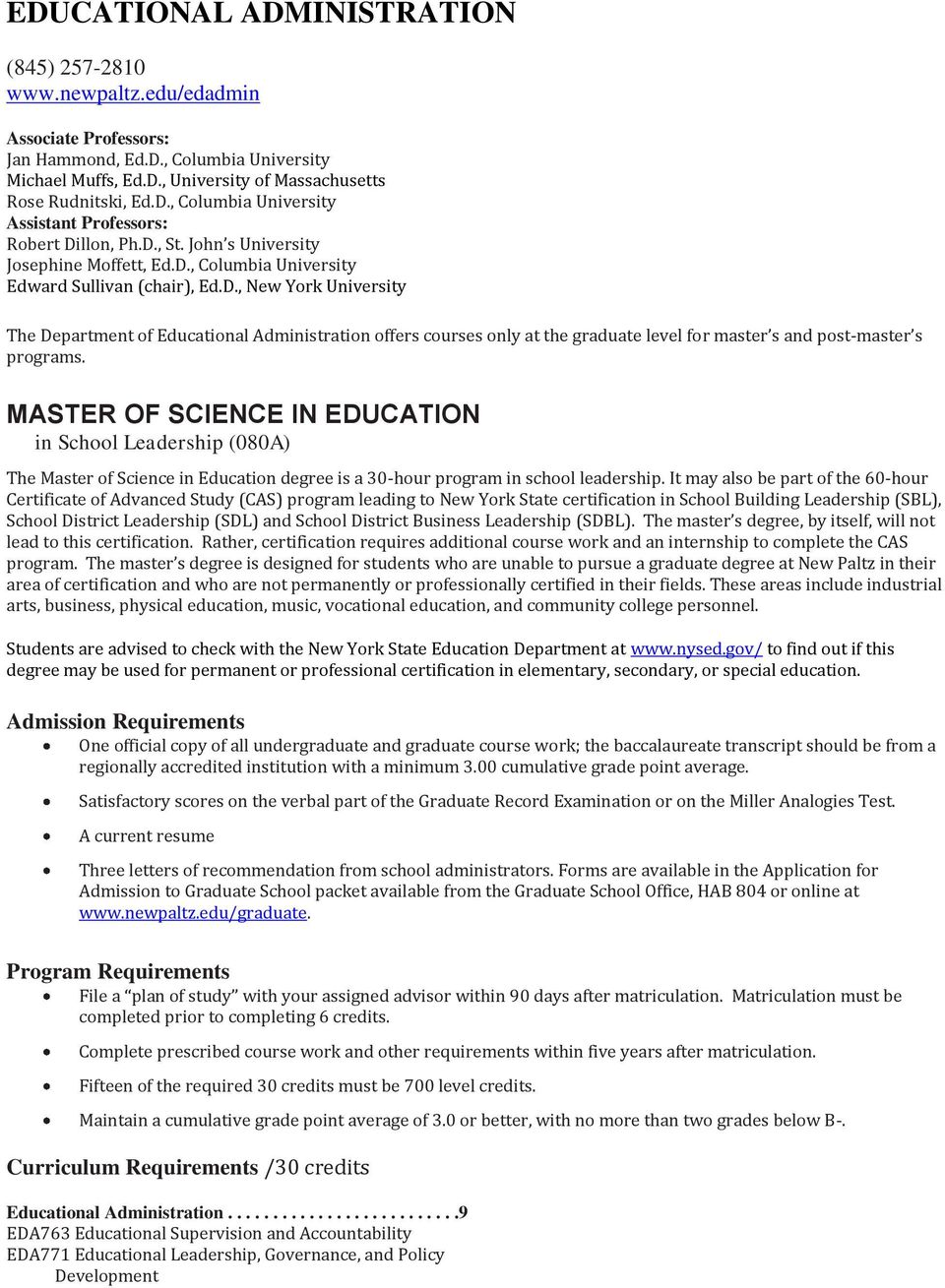
3 EDA772 Administrative Theory and Practice Liberal Arts Electives Education Electives (May include one elective in Educational Administration) Principles of Research (EDI 798) Graduate-level physical education courses are not accepted toward the MS or CAS programs. CERTIFICATE OF ADVANCED STUDY The 60-hour Certificate of Advanced Study (CAS) program incorporates a 30-hour master s degree and allows students to receive certification as a School Building Leader/School District Leader or School District Business Leader (SDBL). School Leadership joint program (30 credits beyond master s degree) Alternative Certificate: School District Leader (Transition D) (a minimum of 30 credits beyond master s degree) School Business Leadership (30 credits beyond master s degree). For students who do not have their master s degree, the department offers a 30-credit master s degree in education, with a concentration in educational administration. School Leadership is a program that gives students who have a NYS permanent/professional teaching certificate dual certification as School Building Leader (SBL) and School District Leader (SDL). An internship is part of this program and is required for New York State certification, as well as passing of the relevant State Education Department school leadership exams. All candidates for the SBL/SDL internship must have a master s degree and have completed three of the four required courses and an administrative elective before commencing the internship. Alternative Certificate: School District Leader (Transition D) is an alternate route to school leadership designed specifically for a person who has demonstrated exceptional leadership qualities and who does not hold a teaching credential. A committee is formed prior to the beginning of the program to guide and mentor the candidate in a leadership position while completing the school district leadership certification. A master s degree is required as well as a central office school leadership position prior to acceptance into this program. Candidates are also required to pass the State Education Department school district leadership exam prior to being recommended for certification. The School Business Leadership consists of 24 credit hours of school business courses and a six-credit supervised internship in school business. Students complete three of four core courses (EDA763, EDA771, EDA772, EDA775) as well as specific business courses customized for the school district business leader candidate. Candidates will also have to pass the State Education Department school district business leadership exam prior to being recommended for certification. CAS PROGRAM School Leadership (401A) Joint School Building Leader/School District Leader Admission Requirements One official copy of all undergraduate and graduate course work; both the baccalaureate and master s transcripts should be from regionally accredited institutions with a minimum 3.0 cumulative grade point average at the graduate level. A valid permanent/professional New York State teaching certificate. Three letters of recommendation from practicing school administrators. Forms are available online at

4 Proof from the school district of at least three years teaching experience prior to graduation. An essay that addresses the Interstate School Leaders Licensure Consortium (ISLLC) Standards (see at end of CAS section). A completed graduate application. Program Requirements File a plan of study with your assigned advisor within 90 days after matriculation. Matriculation must be completed prior to completing 6 credits. Complete prescribed course work and other requirements within five years of matriculation. Maintain a cumulative grade point average of 3.0 or better, with no more than two grades below B-. Complete an approved Child Abuse Seminar. Complete an approved S.A.V.E. Seminar (Those who take EDA775 will have satisfied the state s requirements.) Passing of appropriate State Education Department leadership exam(s). Upon completion of the CAS program and passing of SED exam(s), the College will recommend the candidate to the State Education Department for certification. The State Education Department grants certificates in September and February for those who apply through New Paltz. Curriculum Requirements / 60 credits (401A) (Master s degree + 30 credits) Required Courses EDA763 Educational Supervision and Accountability EDA771 Educational Leadership, Governance, and Policy Development EDA772 Administrative Theory and Practice EDA775 New York State Education Law and Policy Implementation EDA782 Internship in Educational Administration Elective courses (to be selected under advisement) Master s degree An appropriate number of the following courses must be selected under advisement at the time of matriculation in a specific program. EDA760 Current Issues in Educational Administration EDA764 Organization and Administration of Elementary and Middle School EDA765 Seminar in Practices and Problems of the Supervisor EDA766 Improvement of Elementary and Middle School Curriculum and Instruction Through Supervision EDA767 Seminar in Practices and Problems of Elementary and Middle School Administration EDA769 The Principalship EDA773 School Business for School Administrators EDA774 Human Resource Management for Administrators EDA776 Finance and Revenue Management EDA777 Seminar in Practices and Problems in School Business Administration EDA778 School Plant Administration EDA779 Organization and Administration of Secondary School

5 EDA780 Seminar in Practices and Problems of Secondary School Administration EDA781 Improvement of Secondary School Curriculum and Instruction Through Supervision EDA784 Curriculum Development for Administrators EDA785 Public Relations for Administrators EDA786 Facilities Planning, Operation and Maintenance EDA787 Politics of Educational Administration EDA788 Leadership in the New Millennium EDA793 Selected Topics Internship SBL/SDL Intern: Student must complete the three core courses and one additional administrative elective course (under advisement) before applying for the Internship. All students applying for an Internship must submit the Internship Proposal Application to the department by the posted deadline (May 1 st for Fall Semester Internship; December 1 st for Spring Semester Internship). Prospective intern candidates will be notified by the Intern Coordinator regarding deficiencies or acceptance. CAS Program: School District Business Leadership (402A) This is a concentration within the 60-hour Certificate of Advanced Study (CAS) Program leading to New York State Certification as a School District Business Leader (SDBL). Admission Requirements One official copy of both the baccalaureate and master s transcripts from a regionally accredited institution with a 3.0 cumulative grade point average at the graduate level. Three letters of recommendation, one each from the Chief Executive Officer of a School District, a school board member, and an immediate supervisor. Forms are available online at An essay that addresses the Interstate School Leaders Licensure Consortium (ISLLC) Standards (see at end of CAS section). A completed graduate application Program Requirements File a plan of study with your assigned advisor needs to be filed within 90 days after matriculation. Matriculation must be completed prior to completing 6 credits. Complete prescribed course work and other requirements within five years of matriculation. Maintain a cumulative grade point average of 3.0 or better, with no more than two grades below B-. Complete an approved Child Abuse Seminar. Complete an approved S.A.V.E. Seminar (Those who take EDA775 will have satisfied the state s requirements.) Passing of appropriate State Education Department leadership exam(s) Curriculum Requirements / 60 credits (402A) (Master s degree + 30 credits) Required Courses EDA763 Educational Supervision and Accountability EDA771 Educational Leadership, Governance, and Policy Development EDA772 Administrative Theory and Practice EDA775 New York State Education Law and Policy Implementation
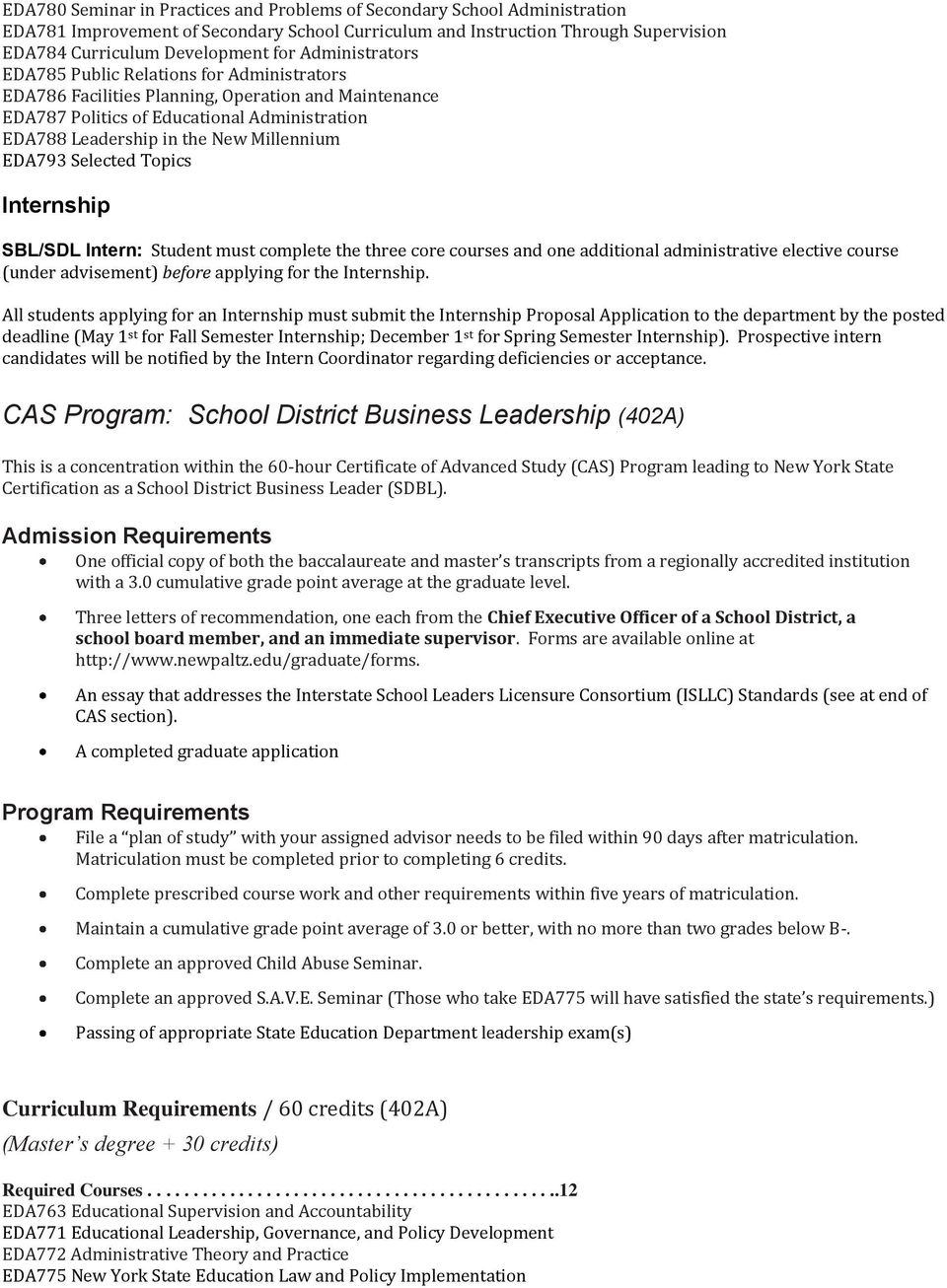
6 EDA782 Internship in Educational Administration Elective courses (to be selected under advisement) Master s degree The instructor s permission is required for non-matriculated students to gain admission to courses. Internship SDBL: SBA students must complete three of four core courses (under advisement) before applying for the Internship. All students applying for an Internship must submit the Internship Proposal Application to the department by the posted deadline (May 1 st for Fall Semester Internship; December 1 st for Spring Semester Internship). Prospective intern candidates will be notified by the Intern Coordinator regarding deficiencies or acceptance. CAS Program: School District Leader Alternative Route Transition D Program (401B) Admission Requirements One official copy of all undergraduate and graduate course work; both the baccalaureate and master s transcripts should be from regionally accredited institutions with a minimum 3.0 cumulative grade point average at the graduate level. Three letters of recommendation from practicing school administrators. Forms are available online at Be offered a leadership position at the Central Office level of a school district or BOCES. An essay that addresses the Interstate School Leaders Licensure Consortium (ISLLC) Standards (see at end of CAS section). A completed graduate application. Be approved by the Department of Educational Administration s College Transition D Committee which will convene once a completed graduate application is received. Program Requirements The Transition D candidate s plan of study will be determined by the recommendations from the College Transition D Committee. File a plan of study with your assigned advisor within 90 days of matriculation. Work closely with your on-site supervisor. Complete prescribed course work and other requirements within five years of matriculation. Maintain a cumulative grade point average of 3.0 or better, with no more than two grades below B-. Complete an approved Child Abuse Seminar. Complete an approved S.A.V.E. Seminar (Those who take EDA775 will have satisfied the state s requirements.) Be approved by the Transition D College Committee for recommendation to graduate from the CAS program. Passing of appropriate State Education Department leadership exam(s). Upon completion of the CAS program and passing of SED assessment, the College will recommend the candidate to the State Education Department for certification. The State Education Department grants certificates in September and February for those who apply through New Paltz.

7 Curriculum Requirements / 60 credits (401B) (Master s degree + 30 credits) Required Courses EDA763 Educational Supervision and Accountability EDA771 Educational Leadership, Governance, and Policy Development EDA772 Administrative Theory and Practice EDA775 New York State Education Law and Policy Implementation EDA782 Internship in Educational Administration Elective courses (to be selected under advisement).12 Master s degree An appropriate number of the following courses must be selected under advisement at the time of matriculation in a specific program. EDA760 Current Issues in Educational Administration EDA764 Organization and Administration of Elementary and Middle School EDA765 Seminar in Practices and Problems of the Supervisor EDA766 Improvement of Elementary and Middle School Curriculum and Instruction Through Supervision EDA767 Seminar in Practices and Problems of Elementary and Middle School Administration EDA769 The Principalship EDA773 School Business for School Administrators EDA774 Human Resource Management for Administrators EDA776 Finance and Revenue Management EDA777 Seminar in Practices and Problems in School Business Administration EDA778 School Plant Administration EDA779 Organization and Administration of Secondary School EDA780 Seminar in Practices and Problems of Secondary School Administration EDA781 Improvement of Secondary School Curriculum and Instruction Through Supervision EDA784 Curriculum Development for Administrators EDA785 Public Relations for Administrators EDA786 Facilities Planning, Operation and Maintenance EDA787 Politics of Educational Administration EDA788 Leadership in the New Millennium EDA793 Selected Topics Other courses from other programs in the School of Education as recommended by College Transition D Committee such as courses that address the special needs of students and the diverse school community to ensure a successful transition for the candidate in school leadership. Internship SDL Transition D Intern: Student must complete the three core courses and one additional administrative elective course (under advisement) before applying for the Internship and be recommended by the College Transition D Committee. All students applying for an Internship must submit the Internship Proposal Application to the department by the posted deadline (May 1 st for Fall Semester Internship; December 1 st for Spring Semester Internship). Prospective intern candidates will be notified by the Intern Coordinator regarding deficiencies or acceptance.

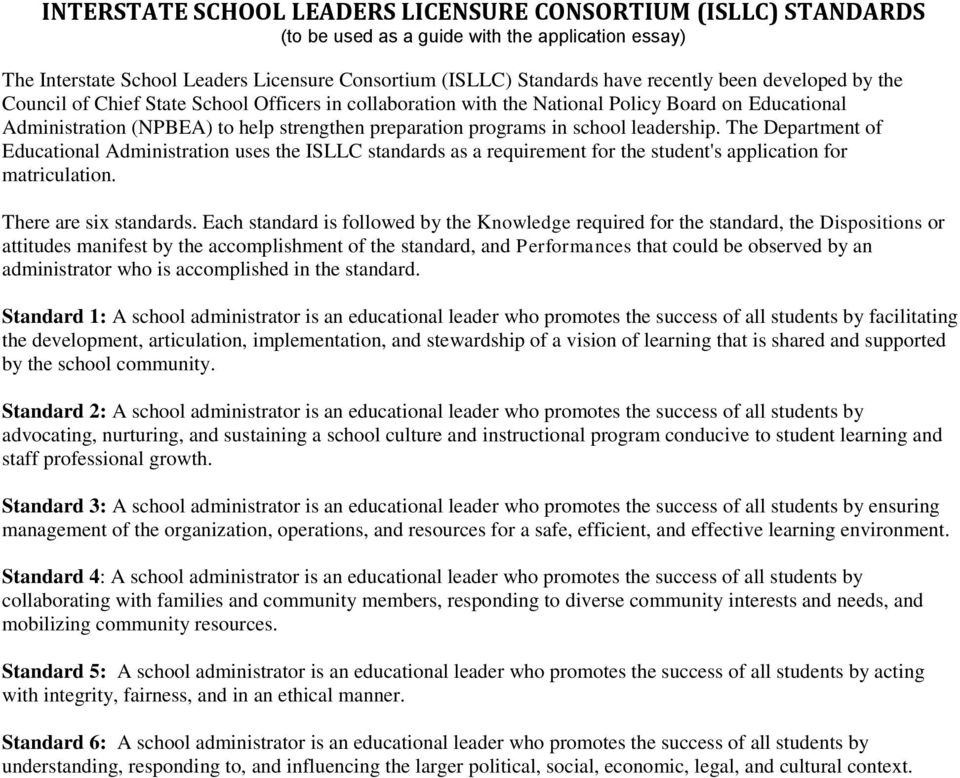
8 INTERSTATE SCHOOL LEADERS LICENSURE CONSORTIUM (ISLLC) STANDARDS (to be used as a guide with the application essay) The Interstate School Leaders Licensure Consortium (ISLLC) Standards have recently been developed by the Council of Chief State School Officers in collaboration with the National Policy Board on Educational Administration (NPBEA) to help strengthen preparation programs in school leadership. The Department of Educational Administration uses the ISLLC standards as a requirement for the student's application for matriculation. There are six standards. Each standard is followed by the Knowledge required for the standard, the Dispositions or attitudes manifest by the accomplishment of the standard, and Performances that could be observed by an administrator who is accomplished in the standard. Standard 1: A school administrator is an educational leader who promotes the success of all students by facilitating the development, articulation, implementation, and stewardship of a vision of learning that is shared and supported by the school community. Standard 2: A school administrator is an educational leader who promotes the success of all students by advocating, nurturing, and sustaining a school culture and instructional program conducive to student learning and staff professional growth. Standard 3: A school administrator is an educational leader who promotes the success of all students by ensuring management of the organization, operations, and resources for a safe, efficient, and effective learning environment. Standard 4: A school administrator is an educational leader who promotes the success of all students by collaborating with families and community members, responding to diverse community interests and needs, and mobilizing community resources. Standard 5: A school administrator is an educational leader who promotes the success of all students by acting with integrity, fairness, and in an ethical manner. Standard 6: A school administrator is an educational leader who promotes the success of all students by understanding, responding to, and influencing the larger political, social, economic, legal, and cultural context.
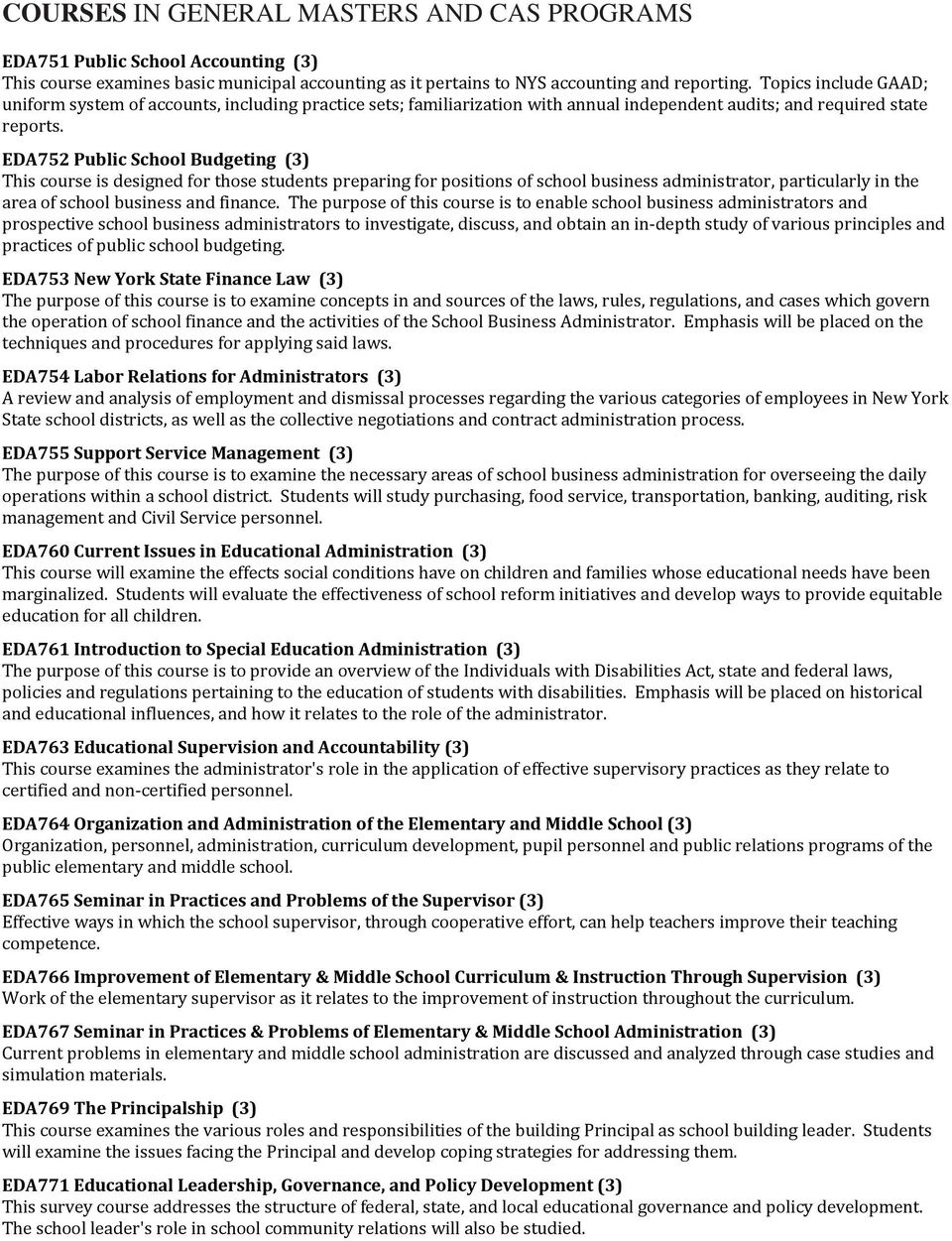
9 COURSES IN GENERAL MASTERS AND CAS PROGRAMS EDA751 Public School Accounting (3) This course examines basic municipal accounting as it pertains to NYS accounting and reporting. Topics include GAAD; uniform system of accounts, including practice sets; familiarization with annual independent audits; and required state reports. EDA752 Public School Budgeting (3) This course is designed for those students preparing for positions of school business administrator, particularly in the area of school business and finance. The purpose of this course is to enable school business administrators and prospective school business administrators to investigate, discuss, and obtain an in-depth study of various principles and practices of public school budgeting. EDA753 New York State Finance Law (3) The purpose of this course is to examine concepts in and sources of the laws, rules, regulations, and cases which govern the operation of school finance and the activities of the School Business Administrator. Emphasis will be placed on the techniques and procedures for applying said laws. EDA754 Labor Relations for Administrators (3) A review and analysis of employment and dismissal processes regarding the various categories of employees in New York State school districts, as well as the collective negotiations and contract administration process. EDA755 Support Service Management (3) The purpose of this course is to examine the necessary areas of school business administration for overseeing the daily operations within a school district. Students will study purchasing, food service, transportation, banking, auditing, risk management and Civil Service personnel. EDA760 Current Issues in Educational Administration (3) This course will examine the effects social conditions have on children and families whose educational needs have been marginalized. Students will evaluate the effectiveness of school reform initiatives and develop ways to provide equitable education for all children. EDA761 Introduction to Special Education Administration (3) The purpose of this course is to provide an overview of the Individuals with Disabilities Act, state and federal laws, policies and regulations pertaining to the education of students with disabilities. Emphasis will be placed on historical and educational influences, and how it relates to the role of the administrator. EDA763 Educational Supervision and Accountability (3) This course examines the administrator's role in the application of effective supervisory practices as they relate to certified and non-certified personnel. EDA764 Organization and Administration of the Elementary and Middle School (3) Organization, personnel, administration, curriculum development, pupil personnel and public relations programs of the public elementary and middle school. EDA765 Seminar in Practices and Problems of the Supervisor (3) Effective ways in which the school supervisor, through cooperative effort, can help teachers improve their teaching competence. EDA766 Improvement of Elementary & Middle School Curriculum & Instruction Through Supervision (3) Work of the elementary supervisor as it relates to the improvement of instruction throughout the curriculum. EDA767 Seminar in Practices & Problems of Elementary & Middle School Administration (3) Current problems in elementary and middle school administration are discussed and analyzed through case studies and simulation materials. EDA769 The Principalship (3) This course examines the various roles and responsibilities of the building Principal as school building leader. Students will examine the issues facing the Principal and develop coping strategies for addressing them. EDA771 Educational Leadership, Governance, and Policy Development (3) This survey course addresses the structure of federal, state, and local educational governance and policy development. The school leader's role in school community relations will also be studied.
10 EDA772 Administrative Theory and Practice (3) This course provides an overview of administrative theory and its impact on educational administration. A variety of theories, concepts, ideas, and practices are reviewed in the areas of organization, leadership, decision-making, communication, change, conflict, and ethics. EDA773 School Business for School Administrators (3) Functions, principles, and procedures of school business management for principles and school administrators as they relate to public school administration, including budget construction and control, state aid financing, planning and utilization for buildings, role of board of education, transportation, cafeterias, purchasing, payroll and debt service. EDA774 Human Resource Management for Administrators (3) Personnel and staffing, including staff development, recruitment and selection, induction and retention, job descriptions, evaluation, promotion, remuneration, tenure, negotiation, school financing, both in educational and business functions. EDA775 New York State Education Law and Policy Implementation (3) This course addresses the laws and policies that affect schools in New York State. New York State laws and regulations, as influenced by federal constitutional and statutory laws, will be examined as they relate to governing, managing, and implementing school programs. EDA776 Finance and Revenue Management (3) Theory and practices of educational finance in public education. Relations with state and federal sources, changing conceptions of governmental functions. Foundation support for education, grants for research and innovation. Weaknesses and strengths of current educational finance and suggested improvements. Interrelations of education and the economy; financing local school systems. EDA777 Seminar in Practices and Problems in School Business Administration (3) The course deals with current and emerging practices with an emphasis on the problems and issues in the field of school business administration. EDA778 School Plant Administration (3) Development procedure used to plan, design, maintain, and operate school buildings; administrative responsibilities for the various phases. EDA779 Organization and Administration of the Secondary School (3) Duties and responsibilities of the secondary school administrator. Special emphasis on program development, recruitment and evaluation of staff; curriculum evaluation, working with teachers, parents and community groups; the secondary school department chairman; dealing with professional and non-professional staff. EDA780 Seminar in Practices and Problems of Secondary School Administration (3) Problems in secondary education discussed and analyzed. Emphasis on problems faced by secondary school administrators. EDA781 Improvement of Secondary School Curriculum & Instruction Through Supervision (3) Intensive study of the secondary curriculum field and instructional procedures. Major issues and new developments at the secondary level. EDA782 Internship in Educational Administration (3-6) A planned and individual program to provide training and experience in an administrative or supervisory position in the area where certification is sought. May be full-time for one semester or part-time for two semesters. Visitation from College personnel to assist and guide the intern. Eight seminars are required. EDA784 Curriculum Development for Administrators (3) This course examines the foundations, principles, and issues in curriculum. Emphasis will be placed on evaluation of the structure and content of curriculum, effectiveness of the delivery systems, and on development and alignment of the curriculum. EDA785 Public Relations for Administrators (3) Analysis of principles, practices, materials and communication strategies that facilitate the adjustment and interpretation of schools to their internal and external publics, along with an examination of the function of media and the roles of school and community groups in an effective school public relations program. EDA786 Facilities Planning and Control (3) Deals with the operation and maintenance of the school facilities. Topics include custodial cleaning standards, preventive maintenance programs, health and safety standards and regulations, construction procedures, energy conservation, and staff evaluations.

11 EDA787 The Politics of Educational Administration (3) A review of the radical change in the role and function of administrators in education in the past ten years because of movement politics of the public, staff, and students. Administrators responsible for the educational system must understand and work with political realities in order to retain the authority that is necessary to their function. EDA788 Leadership for the Millennium (3) This is a conference format course for candidates intending to major in institutional administration. It is an elective leading to a graduate degree or certification in school administration. The course examines five (5) aspects of school administration. Additional emphasis is given to the tasks and problems faced by the novice, practicing, and future administrator. At the end of this course candidates should have a good understanding of administration as a career. EDA789 The Superintendency (3) This course examines the roles and responsibilities of a superintendent of schools. There will be additional emphasis on the tasks and problems faced by superintendents in an ever-changing pluralistic society. Attention will also be given to the superintendency in New York State. The American Association of School Administrator's Professional Standards for the Superintendency will serve as a basis for this course. EDA792 Internship in Educational Administration (3-6) Provides a practical experience in a school business office for a full year (part time) and one summer (full time). Visitation from College personnel to assist and guide the intern. Eight seminars are required.
12 EDUCATIONAL STUDIES (845) Professors: Spencer Salend, (co-coordinator of Special Education), Ed.D., University of Kentucky Nancy Schniedewind,(coordinator of Humanistic/Multicultural Education), Ed.D., University of Massachusetts Catharine Whittaker, (co-coordinator of Special Education), Ph.D., The Ohio State University Associate Professors: Ann V. Dean, Ph.D., Dalhousie University Judith Dorney, Ed.D., Harvard University Laurel M. Garrick Duhaney, Ph.D., Southern Illinois University, Carbondale Gowri Parameswaran (chair), Ed.D., Rutgers University Robin Smith, Ph.D., Syracuse University Assistant Professors: Gregory Bynum, Ph.D., Columbia University Barbara Chorzempa, Ph.D., University of Maryland Kate McCoy, Ph.D., (Coordinator of Educational Foundations), The Ohio State University Terry Murray (co-cordinator of Humanistic/Multicultural Education), Ph.D., SUNY Albany Jane Sileo, Ph.D., University of Nevada, Los Vegas Michael Smith, Ph.D., University of South Florida Jessica Eve Tuck, Ph.D., University of New York Lecturers: Lenore Douglas, M.A., Columbia University The Department of Educational Studies offers the psychological, sociological and philosophical foundations courses required in the Master of Science in Education degrees offered by the Departments of Elementary and Secondary Education. Additionally, the Department of Educational Studies offers the Master of Professional Studies in Humanistic/Multicultural Education and the Master of Science in Education in Special Education. Educational Foundations Foundations of educational inquiry concerns issues of social difference in education historical, contemporary, and cross-cultural (such as gender, race, class, etc.); values as they arise in education; political issues dealing with policy, ideology and decision-making in education; historical, social and cultural perspectives relating to educational issues; and the psychological dimensions of teaching and learning. The courses we offer are based on the image of educators as critical and reflective practitioners, as well as the relationship between theory and practice. By participating in foundational inquiry our students learn to pose reflective and critical questions about schooling and the broader meaning of education. The faculty is committed to the values of social justice and compassion. Foundations of Education Courses: EDS511 Child Development (3) Examines recent research findings in the social, emotional, intellectual, and physical development of children and implications for teachers' relationship with individual children. EDS520 History of Education (3) Traces the history of American education from the Colonial Period. It includes a discussion of the development of public schools, and the relationship between cultural pluralism and schooling. Prerequisite: Open to all graduate and upper-division undergraduate students. EDS537 Issues in Multicultural Education (3) This course examines the way that racial and cultural differences shape the purposes and practices of education. It examines the social foundations of multicultural education, with particular attention to inequities among racial and cultural groups. EDS538 Psychological Foundations of Education (3)

13 This course examines the links between education, particularly schooling, and psychological development. Themes addressed include development, the interplay of psyche and culture, paradigmatic and narrative modes of thinking, etc. Central to the course is the consideration of how theory influences individual learners and their communities. EDS539 Social Foundations of Education (3) Examines the relationship of schooling to its context through philosophy and/or social science. It addresses cultural diversity, economic stratification, gender, and the social condition of children as they affect contemporary educational challenges and possibilities. EDS549 Issues in Literacy for Diverse Learners (3) Explores issues in the socio-cultural, moral, political, historical, and developmental dimensions of literacy. Students consider how classroom practices for secondary students relate to theories of learning, to first- and second-language acquisition, and to literacy development. This course presents a broad view of literacy as a form of communication. EDS580 Current Issues in Education (3) Current issues in public education in the United States, the context from which they emerge, and their possible resolution. Prerequisite: Student teaching or teaching certificate. EDS702 Human Motivation and Learning (3) Principles of motivation and learning taken from psychological theory and their application to classroom learning. Works of some outstanding psychologists examined for similarities and differences in points of view toward how learning takes place and how people are motivated. EDS730 Adolescent Development (3) Study of adolescent behavior and factors that determine it; special reference to the educational implications of such behavior for secondary school teachers. Not open to students who have taken an adolescent psychology course. EDS752 Philosophy of Education (3) Examines the purposes, ideals and central concepts of education. It draws on texts from the history of philosophy as well as contemporary educational thought. MASTER OF PROFESSIONAL STUDIES IN HUMANISTIC/MULTICULTURAL EDUCATION Humanistic/Multicultural Education Nancy Schniedewind, , [email protected] The Educational Studies Department of the State University of New York at New Paltz offers a Masters degree in Professional Studies in Humanistic/Multicultural Education. The 30-credit General Program is designed for human service, not-for-profit, and higher education professionals and K-12 professionally-certified educators seeking additional understandings and skills for teaching diverse learners. The 36-credit Teacher Certification Sequence of the program is currently available to special subject teachers (family/consumer science, health, music, physical education or technology) who are provisionally or initially certified and are seeking permanent or professional certification. Those seeking an elementary teaching certificate may take the Humanistic/Multicultural Education Concentration in the MSEd in Elementary Education 1-6. Humanistic/Multicultural Education integrates intellectual/cognitive and emotional/affective learning through an experiential and participatory process. Students increase self-knowledge and develop effective human relations and critical thinking skills. The program offers a self-reflective, process-oriented approach to diversity and issues of social justice. Students learn to work cooperatively with others to foster personal, institutional, and social change and promote more humane, democratic and inclusive classrooms, organizations, and communities. The 36-Credit Teacher Certification Track (070C) The program of study focuses on providing content and skills necessary for teaching the diverse student population of New York State. This program provides teachers with effective instructional practices for actively engaging all students in developmentally appropriate and meaningful learning related to the State Learning Standards. Teachers graduate with knowledge and strategies to engage and challenge all students to reach their fullest potential intellectually, emotionally, and socially.
14 In particular, the courses in the program address these areas: multicultural/gender fair education, cooperative learning, conflict resolution, group process, active learning, curriculum development, action research and teacher leadership for innovation and change. The 30-Credit General Program (070G) Prospective benefactors of this program of study include those working in community colleges and other educational settings, group homes, child care centers, cooperative extension services, community-based recreation and education programs, youth agencies, women s centers, hospitals, and other human service agencies that offer educational as well as clinical services. The program also serves teachers who seek a second masters to strengthen their background in a student-centered, multicultural approach to education. Other prospective students include other school staff such as school nurse teachers, curriculum specialists as well as private school teachers. The flexible 30-credit general program allows for the development of an individualized plan of study unique to varying professional goals by providing a wide variety of electives. The program can be tailored for persons working with special client groups in the human services. In addition, there are three program emphases that professionals working in women s studies and services, not-forprofits or higher education may select. Women s Studies and Services Emphasis This emphasis is geared for professionals working with women and women s programs. Graduates with this emphasis serve in organizations that particularly serve women, such as battered women s shelters, women s centers, teen pregnancy programs, and feminist health centers. Not-for-Profit Emphasis This emphasis is geared for professionals working in a wide range of not-for-profit organizations and designed to meet the specific needs of these professionals. Graduates with this emphasis work as community educators, directors of training and development, consultants to health and human service organizations, program planners, and directors, among many other professional roles. Higher Education Emphasis This emphasis serves a wide range of professionals working in higher education. They include community college faculty as well as administrators and student service personnel working in both two-year and four-year colleges. To effectively meet the needs of this broad range of professionals, this emphasis includes three sub-emphases designed for higher education administrators, faculty, and student service personnel. NOTE: Some weekend classes are required to complete this program. If this is a problem, please notify the coordinator when you apply to the program in order to attempt to plan for a mutually acceptable accommodation. Terry Murray ( ) and Nancy Schniedewind ( ) are program advisors. Persons seeking admission to this program should contact one of these professors at their offices or through the Educational Studies Department ( ). Applications will be reviewed two times per year. Deadlines are: October 15 for spring semester matriculation April 15 for fall semester matriculation Admission Requirements One official copy of all undergraduate and graduate course work; the baccalaureate transcript should be from a regionally accredited institution with a minimum 3.0 cumulative grade point average. The degree should contain appropriate courses in the special subject area of certification. Initial or provisional New York State teacher certification in health, physical education, technology, music, and family/consumer science. Three letters of recommendation from individuals who have a professional relationship with the prospective student
15 and can address the student s potential for graduate work. A two-page letter describing how you expect the MPS Humanistic/Multicultural Program will help you meet your personal and professional goals. This can be integrated into the statement on the application form. An interview with a member of the faculty. Program Requirements File a plan of study during the first semester after matriculation. Completion of prescribed course work and other requirements within five years after matriculation. Maintain a cumulative grade point average of 3.0 or better in both total program and core courses, with no more than two grades below B-. Students in the 36-credit program must pass a competency exam. TEACHER CERTIFICATION TRACK: SPECIAL SUBJECT AREAS FAMILYCONSUMER SCIENCE, HEALTH, MUSIC, PHYSICAL EDUCATION, TECHNOLOGY Curriculum Requirements / 36 credits Core Courses in Humanistic/Multicultural Education.. 9 EDS541 Humanistic/Multicultural Approaches to Education and Human Services EDS748 Qualitative Research Methods (taken after completion of at least 27 credits) EDS749 Seminar in Humanistic Education (taken after completion of at least 27 credits) Electives in Humanistic/Multicultural Education 9 EDS545 Cooperatively Structured Learning EDS546 Conflict Resolution in Education EDS582 Girls, Women and Education EDS732 Group Dynamics EDS741 Affective Education Courses to Educate Teachers to Work with Diverse Learners.. 6 EDS581 Issues of Racism and Sexism in Education SPE565 Teaching in Inclusive Classrooms Content Area Courses 6 Electives in Humanistic/Multicultural Education, Special Education or Foundations 6 GENERAL PROGRAM Curriculum Requirements / 30 credits Humanistic/Multicultural Approaches to Education and Human Services. 3 Humanistic/Multicultural Education Electives... 9 EDS542 Women s Issues in Human Services EDS545 Cooperatively Structured Learning EDS546 Conflict Resolution in Education EDS547 Education of Self for Professionals EDS548 Helping Skills in Social Context EDS581 Issues of Racism and Sexism in Education EDS582 Girls, Women and Education EDS732 Group Dynamics EDS735 Experiential Workshop Design EDS741 Affective Education

16 EDS742 Dynamics of Planned Change EDS753 Leadership in Education and Human Service Settings Electives in Education, Liberal Arts, Fine and Performing Arts.12 EDS748 Qualitative Research Methods. 3 (Taken after completion of at least 24 credits.) EDS749 Seminar in Humanistic/Multicultural Education and Human Services. 3 (Taken after completion of at least 24 credits.) COURSES IN HUMANISTIC/MULTICULTURAL EDUCATION EDS541 Humanistic/Multicultural Approaches to Education and Human Services (3) This introductory course examines the philosophical, psychological and social foundations of humanistic/multicultural education. Students explore the challenge of implementing humanistic principles that support achievement, diversity and equity in their school, human service institutions and society. Prerequisite: Matriculated (070) status. EDS542 Women's Issues in Human Services (3) This course focuses on contemporary issues concerning the status and welfare of women from diverse social groups who are served by human service organizations. EDS545 Cooperatively Structured Learning (3) This course focuses on methods to make teaching and learning cooperative in heterogeneous groups and educational settings. Examination of the implications of cooperation and competition for schools, organizations and society. EDS546 Conflict Resolution in Education (3) A focus on understanding and constructively dealing with conflict as it manifests itself in educational settings, with particular emphasis on mediation, peer mediation programs, and dealing with diversity. EDS547 Education of Self for Professionals (3) This experiential course focuses on the role of self-knowledge in teaching and learning. The impact of gender, age, race, class, culture and family history on personal development are explored. Students examine limiting patterns and design alternatives. EDS548 Helping Skills in Social Context (3) This course focuses on interpersonal and organizational applications of the helping process. The political and social context of helping in a multicultural society are explored. Through reflection, practice and feedback, students develop communication, counseling and crisis intervention skills. EDS550 Expressive Arts, Leadership, and Change (3) The expressive arts can be utilized in envisioning and leading change initiatives that address social justice issues in schools and community organizations. This reflective and experiential course will explore practical, arts-based teaching and learning strategies. EDS581 Issues of Racism and Sexism in Education (3) An examination of personal and institutional racism and sexism and strategies for creating multicultural and gender-fair curricula, classrooms and schools. EDS582 Girls, Women and Education (3) This course examines female experiences in educational institutions from early childhood through graduate school. Students analyze curriculum materials, classroom interaction patterns, organizational/social factors, and methods for creating gender-fair multicultural classrooms. EDS732 Group Dynamics (3) A laboratory for experiencing and analyzing group processes such as leadership, diversity, decision-making, communication, conflict resolution, problem-solving and team building. Students analyze and enhance their own behavior in groups and practice process-observation skills. EDS735 Experiential Workshop Design (3) An exploration of the knowledge, skills and attitudes necessary to plan, design and evaluate experiential learning activities. Course competencies can be applied in a wide variety of settings and with a diverse range of learners.

17 EDS741 Affective Education (3) An opportunity for educators and human service professionals to focus on the social and emotional learning of their students and/or clients. Participants explore existing affective curriculum and develop materials for use with a diverse range of learners in a wide variety of settings. EDS742 Dynamics of Planned Change (3) Explores theoretical and practical approaches to promoting positive, humane change in educational, human service and community settings. Assessment, diagnosis and intervention strategies are studied and applied. Students develop change agent skills that promote social transformation. EDS748 Qualitative Research Methods (3) This required course introduces students to qualitative research methods. Students design, implement and present a major research project. This course should be taken near the end of the program. Prerequisite: EDS541 or and matriculated (070) status. EDS749 Seminar in Humanistic/Multicultural Education and Human Services (3) A focus on the contributions of critical theory to a broader definition and vision of humanistic approaches to education and the human services. This course should be taken near the end of the program. Prerequisite: EDS541 or and matriculated (070) status. EDS753 Leadership in Education and Human Service Settings (3) This course examines a variety of theoretical models of leadership and personal leadership styles. Students develop skills in areas of planning, staff evaluation and development, personal goal setting, conflict resolution and supporting diversity. ADVANCED GRADUATE CERTIFICATE PROGRAM Multicultural Education (071) Nancy Schniedewind, , [email protected] Our schools are becoming more diverse and not all students are achieving to their fullest potential. Many educators feel the need for additional professional development in diversity education. Responding to this need, the Department of Educational Studies of the State University of New York at New Paltz offers a postmaster s Certificate Program in Multicultural Education. This 15-credit program is designed for elementary, secondary and special subject teachers, as well as school guidance counselors and administrators who are interested in enhancing their cultural competencies in multicultural education. Designed for professionals who already have their master s degree, this certificate program enables educators to understand the ways in which race, gender, class, language, sexual orientation, religion, and physical/learning ability influence them as professionals, their students, and the educational process. In addition, it provides educators with the knowledge and skills needed for culturally-responsive teaching and leadership, and approaches for creating socially-just educational settings. Certificate Sponsors The Department of Educational Studies The Department of Educational Studies, which is comprised of the Humanistic/ Multicultural Education Program, the Special Education Program, and the Educational Foundations Unit, is uniquely qualified to offer this Certificate in Multicultural Education. All three units have a long history of offering a range of relevant multicultural courses, both theoretical and practical, from which students can choose in developing their plan of study for this 15-credit program. In addition, this certificate program draws on the resources of the Second Language Education Program in the Secondary Education Department. Admission Requirements Applicants must submit: Evidence of interest in multicultural/social justice education. An official copy of all graduate transcripts indicating evidence of a master s degree in education from an accredited institution with at least a 3.0 cumulative grade point average. Two letters of recommendation from school district officials, administrators, or colleagues. A 2-3 page personal essay describing your current educational initiatives in multicultural/diversity education and/or your goals for future endeavors for fostering greater appreciation of diversity in your classroom and school.
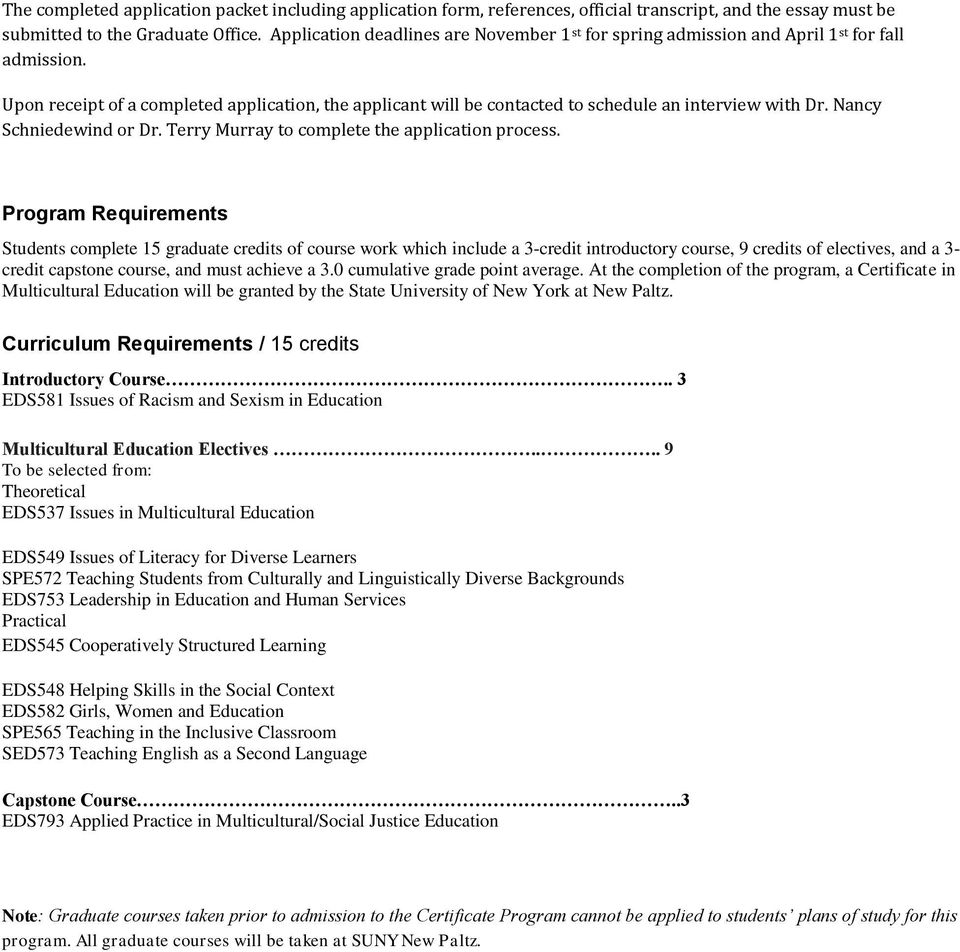
18 The completed application packet including application form, references, official transcript, and the essay must be submitted to the Graduate Office. Application deadlines are November 1 st for spring admission and April 1 st for fall admission. Upon receipt of a completed application, the applicant will be contacted to schedule an interview with Dr. Nancy Schniedewind or Dr. Terry Murray to complete the application process. Program Requirements Students complete 15 graduate credits of course work which include a 3-credit introductory course, 9 credits of electives, and a 3- credit capstone course, and must achieve a 3.0 cumulative grade point average. At the completion of the program, a Certificate in Multicultural Education will be granted by the State University of New York at New Paltz. Curriculum Requirements / 15 credits Introductory Course.. 3 EDS581 Issues of Racism and Sexism in Education Multicultural Education Electives To be selected from: Theoretical EDS537 Issues in Multicultural Education EDS549 Issues of Literacy for Diverse Learners SPE572 Teaching Students from Culturally and Linguistically Diverse Backgrounds EDS753 Leadership in Education and Human Services Practical EDS545 Cooperatively Structured Learning EDS548 Helping Skills in the Social Context EDS582 Girls, Women and Education SPE565 Teaching in the Inclusive Classroom SED573 Teaching English as a Second Language Capstone Course..3 EDS793 Applied Practice in Multicultural/Social Justice Education Note: Graduate courses taken prior to admission to the Certificate Program cannot be applied to students plans of study for this program. All graduate courses will be taken at SUNY New Paltz.
19 SPECIAL EDUCATION Professors Spencer Salend, Ed.D., University of Kentucky Catharine Whittaker, Ph.D., Ohio State University Associate Professors Barbara Chorzempa, Ph.D., University of Maryland Laurel M. Garrick Duhaney, Ph.D., Southern Illinois University, Carbondale Robin Smith, Ph.D., Syracuse University Assistant Professors Jane Sileo, Ed.D. University of Nevada, Las Vegas Michael Smith, Ph.D., University of South Florida MASTER OF SCIENCE IN EDUCATION Special Education Jane Sileo, Co-Coordinator, , Catharine Whittaker, Co-Coordinator, , The Department of Educational Studies of SUNY New Paltz offers a master s degree in Special Education. Teacher candidates pursue a program of study in Early Childhood Special Education (Birth Grade 2), Childhood Special Education (Grades 1-6), Adolescence Special Education (Grades 7-12), Childhood Special Education (Grades 1-6) and Literacy Education (Birth Grade 6), and Adolescence Special Education (Grades 7-12) and Literacy Education (Grades 5-12). Early Childhood Special Education (Birth Grade 2) (060E) Jane Sileo, Co-Coordinator, , [email protected] Catharine Whittaker, Co-Coordinator, , [email protected] Applicants with initial certification in Early Childhood Education B-2 will complete 36 credit hours of course work. Upon successful completion of the program, teacher candidates are eligible for NYS Education Department initial certification in Early Childhood Special Education B-2. The following initial certification is accepted for admission to the Early Childhood Special Education program: Early Childhood Education B-2 Admission Requirements You must submit: A completed graduate school application. Evidence of initial (provisional) certification (if applicable). One official transcript of all undergraduate and graduate work providing evidence of a baccalaureate degree from an accredited institution with at least a 3.0 cumulative grade point average on a 4.0 scale. Applicants who believe that their scores on the Miller Analogies Test or the Graduate Record Examination will enhance their application may include this information with their application or provide the Special Education Unit with this information. In these cases, special education faculty will consider this information as another indicator of your suitability for graduate work in special education. A typed statement that describes your educational aspirations, experiences in working with students in educational settings, and how the Master s Program in Early Childhood Special Education will help you achieve your personal and professional goals. The response should be words in length. The special education faculty will examine the writing sample with respect to content, clarity and organization of ideas, grammar, and style. Three letters of professional recommendation written on professional letterhead. All letters must: 1. Be dated and current; 2. Address how long the writer has known you and in what capacity;

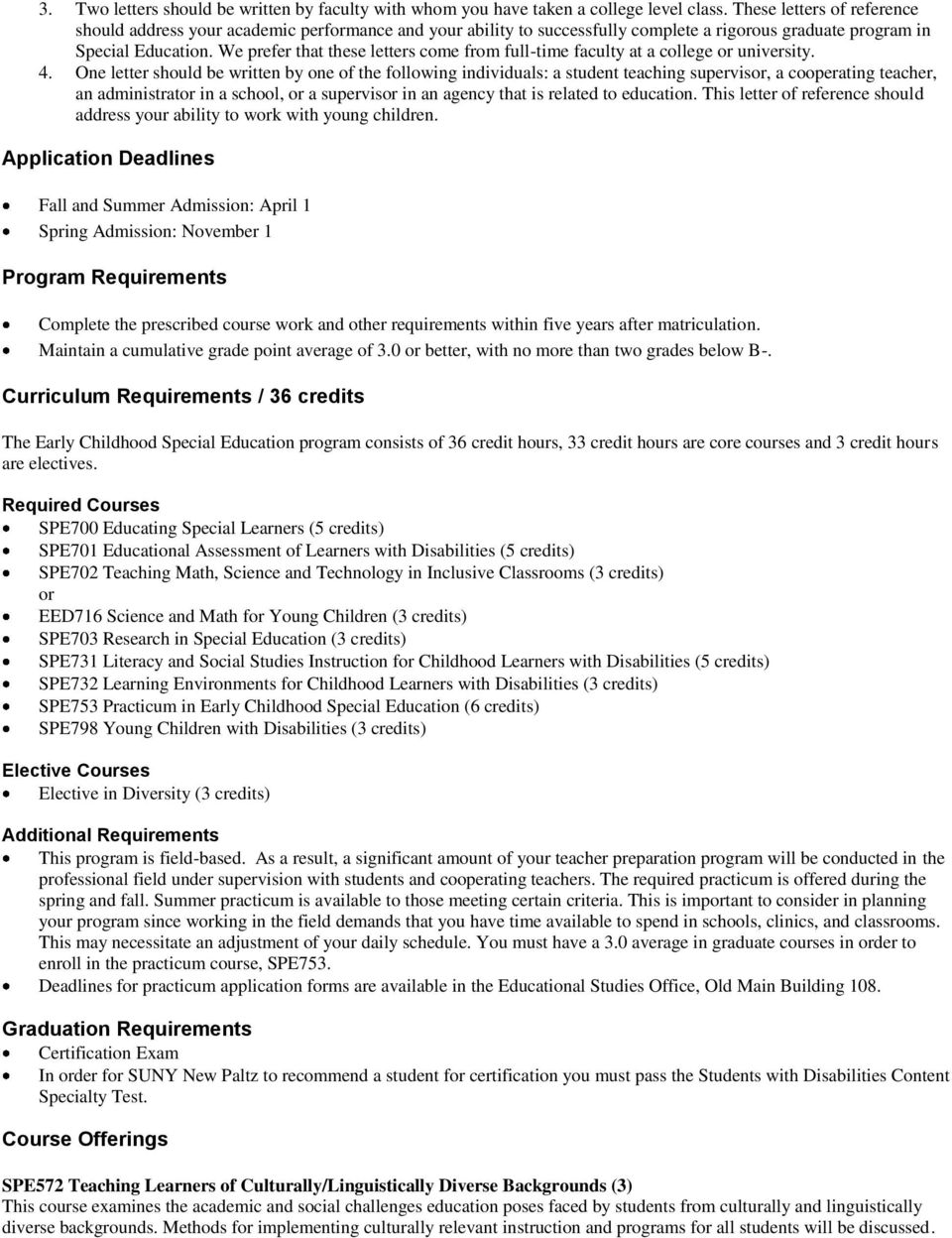
20 3. Two letters should be written by faculty with whom you have taken a college level class. These letters of reference should address your academic performance and your ability to successfully complete a rigorous graduate program in Special Education. We prefer that these letters come from full-time faculty at a college or university. 4. One letter should be written by one of the following individuals: a student teaching supervisor, a cooperating teacher, an administrator in a school, or a supervisor in an agency that is related to education. This letter of reference should address your ability to work with young children. Application Deadlines Fall and Summer Admission: April 1 Spring Admission: November 1 Program Requirements Complete the prescribed course work and other requirements within five years after matriculation. Maintain a cumulative grade point average of 3.0 or better, with no more than two grades below B-. Curriculum Requirements / 36 credits The Early Childhood Special Education program consists of 36 credit hours, 33 credit hours are core courses and 3 credit hours are electives. Required Courses SPE700 Educating Special Learners (5 credits) SPE701 Educational Assessment of Learners with Disabilities (5 credits) SPE702 Teaching Math, Science and Technology in Inclusive Classrooms (3 credits) or EED716 Science and Math for Young Children (3 credits) SPE703 Research in Special Education (3 credits) SPE731 Literacy and Social Studies Instruction for Childhood Learners with Disabilities (5 credits) SPE732 Learning Environments for Childhood Learners with Disabilities (3 credits) SPE753 Practicum in Early Childhood Special Education (6 credits) SPE798 Young Children with Disabilities (3 credits) Elective Courses Elective in Diversity (3 credits) Additional Requirements This program is field-based. As a result, a significant amount of your teacher preparation program will be conducted in the professional field under supervision with students and cooperating teachers. The required practicum is offered during the spring and fall. Summer practicum is available to those meeting certain criteria. This is important to consider in planning your program since working in the field demands that you have time available to spend in schools, clinics, and classrooms. This may necessitate an adjustment of your daily schedule. You must have a 3.0 average in graduate courses in order to enroll in the practicum course, SPE753. Deadlines for practicum application forms are available in the Educational Studies Office, Old Main Building 108. Graduation Requirements Certification Exam In order for SUNY New Paltz to recommend a student for certification you must pass the Students with Disabilities Content Specialty Test. Course Offerings SPE572 Teaching Learners of Culturally/Linguistically Diverse Backgrounds (3) This course examines the academic and social challenges education poses faced by students from culturally and linguistically diverse backgrounds. Methods for implementing culturally relevant instruction and programs for all students will be discussed.
21 SPE700 Educating Special Learners (5) This course will examine issues related to the education of learners with special needs, including the philosophical, historical, social, and legal foundations of special education; characteristics of learners with disabilities; employment and independence for learners with disabilities; and professionalism and ethical practices. The course will also offer students field-based experiences working with learners with disabilities in educational programs that address a wide range of academic, social, and transitional needs. Prerequisite: Matriculated (060E) status. SPE701 Educational Assessment of Learners with Disabilities (5) This course explores critical issues in the educational assessment process and focuses on the use of informal and formal assessment strategies to identify and assess learners with disabilities. This course offers students field-based experience in assessing the educational performance of learners with disabilities. Prerequisite: SPE700 and matriculated (060E) status. SPE702 Teaching Math, Science and Technology in Inclusive Classrooms (3) This course examines methods for planning, implementing, and evaluating instructional strategies for students with disabilities, particularly in the areas of math, science, and technology. It emphasizes differentiating instruction based upon learner characteristics, learning environment, curriculum and standards. Prerequisite: SPE700 or SPE701 and matriculated (060E) status. EED716 Science and Math for Young Children Develop in children scientific and mathematical curiosity, awareness and skill in fundamental processes, concepts and operations. A variety of approaches, focusing on sensory experiences to develop concepts in science and math. A study of developmental stages of children as they relate to concept and skill acquisition. SPE703 Research in Special Education (3) Reviews current issues in special education research. Students design and execute a research project addressing their interest. Prerequisite: SPE700 and matriculated (060E) status. SPE731 Literacy and Social Studies Instruction for Childhood Learners with Disabilities (5) This course will examine methods for planning, implementing, and evaluating instructional strategies for students with disabilities on the childhood level, particularly in the areas of literacy and social studies. Emphasis will be placed on methods for differentiating instruction based upon learner characteristics, learning environment, curriculum and technology considerations, and state, and national standards. Prerequisite: SPE700 or SPE701 and matriculated (060E) status. SPE732 Learning Environments for Childhood Learners with Disabilities (3) This course will focus on planning and implementing safe, positive and supportive learning environments. Teaching pro-social skills, and employing best practices for including childhood learners with disabilities in general education settings will be included. Prerequisite: SPE700 and matriculated (060E) status. SPE753 Practicum in Adolescent Special Education (6) This course provides students with the opportunity to teach early childhood learners with disabilities in a school setting under the direction of a cooperating teacher and a university supervisor. Prerequisite: SPE700, SPE701, SPE702 or EED716, SPE731, and SPE732 and matriculated (060E) status. SPE798 Young Children with Disabilities This course examines current issues, research, and best practices to support successful programming for young children with disabilities (birth to eight years) and their families.
22 Childhood Special Education (Grades 1-6) (060C) Jane Sileo, Co-Coordinator, , Catharine Whittaker, Co-Coordinator, , Applicants with initial certification in Childhood Education 1-6 will complete 36 credit hours of course work. Upon successful completion of the program, teacher candidates are eligible for NYS Education Department initial certification in Childhood Special Education 1-6. The following initial certification is accepted for admission to the Childhood Special Education program: Childhood Education 1-6 Admission Requirements You must submit: A completed graduate school application. Evidence of initial (provisional) certification (if applicable). One official transcript of all undergraduate and graduate work providing evidence of a baccalaureate degree from an accredited institution with at least a 3.0 cumulative grade point average on a 4.0 scale. Applicants who believe that their scores on the Miller Analogies Test or the Graduate Record Examination will enhance their application may include this information with their application or provide the Special Education Unit with this information. In these cases, special education faculty will consider this information as another indicator of your suitability for graduate work in special education. A typed statement that describes your educational aspirations, experiences in working with students in educational settings, and how the Master s Program in Childhood Special Education will help you achieve your personal and professional goals. The response should be words in length. The special education faculty will examine the writing sample with respect to content, clarity and organization of ideas, grammar, and style. Three letters of professional recommendation written on professional letterhead. All letters must: 1. Be dated and current; 2. Address how long the writer has known you and in what capacity; 3. Two letters should be written by faculty with whom you have taken a college level class. These letters of reference should address your academic performance and your ability to successfully complete a rigorous graduate program in Special Education. We prefer that these letters come from full-time faculty at a college or university. 4. One letter should be written by one of the following individuals: a student teaching supervisor, a cooperating teacher, an administrator in a school, or a supervisor in an agency that is related to education. This letter of reference should address your ability to work with children. Application Deadlines Fall and Summer Admission: April 1 Spring Admission: November 1 Program Requirements Complete the prescribed course work and other requirements within five years after matriculation. Maintain a cumulative grade point average of 3.0 or better, with no more than two grades below B-. Curriculum Requirements / 36 credits The Childhood Special Education program consists of 36 credit hours, 30 credit hours are core courses and 6 credit hours are electives. Required Courses SPE700 Educating Special Learners (5 credits) SPE701 Educational Assessment of Learners with Disabilities (5 credits)
23 SPE702 Teaching Math, Science and Technology in Inclusive Classrooms (3 credits) SPE703 Research in Special Education (3 credits) SPE731 Literacy and Social Studies Instruction for Childhood Learners with Disabilities (5 credits) SPE732 Learning Environments for Childhood Learners with Disabilities (3 credits) SPE733 Practicum in Childhood Special Education (6 credits) Elective Courses Elective in Diversity (3 credits) Elective in Collaboration (3 credits) Additional Requirements This program is field-based. As a result, a significant amount of your teacher preparation program will be conducted in the professional field under supervision with students and cooperating teachers. The required practicum is offered during the spring and fall. Summer practicum is available to those meeting certain criteria. This is important to consider in planning your program since working in the field demands that you have time available to spend in schools, clinics, and classrooms. This may necessitate an adjustment of your daily schedule. You must have a 3.0 average in graduate courses in order to enroll in the practicum course, SPE733. Deadlines for practicum application forms are available in the Educational Studies Office, Old Main Building 108. Graduation Requirements Certification Exam In order for SUNY New Paltz to recommend a student for certification you must pass the Students with Disabilities Content Specialty Test. Course Offerings SPE563 Multiple Intelligences in Inclusive Classrooms (3) Participants will develop understanding and skills in the use of multiple intelligences for planning and collaborating in instructional design, supporting students' full participation, and working with colleagues and community. SPE572 Teaching Learners of Culturally/Linguistically Diverse Backgrounds (3) This course examines the academic and social challenges education poses faced by students from culturally and linguistically diverse backgrounds. Methods for implementing culturally relevant instruction and programs for all students will be discussed. SPE700 Educating Special Learners (5) This course will examine issues related to the education of learners with special needs, including the philosophical, historical, social, and legal foundations of special education; characteristics of learners with disabilities; employment and independence for learners with disabilities; and professionalism and ethical practices. The course will also offer students field-based experiences working with learners with disabilities in educational programs that address a wide range of academic, social, and transitional needs. Prerequisite: Matriculated (060C) status. SPE701 Educational Assessment of Learners with Disabilities (5) This course explores critical issues in the educational assessment process and focuses on the use of informal and formal assessment strategies to identify and assess learners with disabilities. This course offers students field-based experience in assessing the educational performance of learners with disabilities. Prerequisite: SPE700 and matriculated (060C) status. SPE702 Teaching Math, Science and Technology in Inclusive Classrooms (3) This course examines methods for planning, implementing, and evaluating instructional strategies for students with disabilities, particularly in the areas of math, science, and technology. It emphasizes differentiating instruction based upon learner characteristics, learning environment, curriculum and standards. Prerequisite: SPE700 or SPE701 and matriculated (060C) status. SPE703 Research in Special Education (3) Reviews current issues in special education research. Students design and execute a research project addressing their interest. Prerequisite: SPE700 and matriculated (060C) status. SPE731 Literacy and Social Studies Instruction for Childhood Learners with Disabilities (5) This course will examine methods for planning, implementing, and evaluating instructional strategies for students with disabilities on the childhood level, particularly in the areas of literacy and social studies. Emphasis will be placed on methods for differentiating instruction based upon learner characteristics, learning environment, curriculum and technology considerations, and state, and national standards. Prerequisite: SPE700 or SPE701 and matriculated (060C) status.
24 SPE732 Learning Environments for Childhood Learners with Disabilities (3) This course will focus on planning and implementing safe, positive and supportive learning environments. Teaching pro-social skills, and employing best practices for including childhood learners with disabilities in general education settings will be included. Prerequisite: SPE700 and matriculated (060C) status. SPE733 Practicum in Childhood Special Education (6) This course provides students with the opportunity to teach childhood learners with disabilities in a school setting under the direction of a cooperating teacher and a university supervisor. Prerequisite: SPE700, SPE701, SPE702, SPE731, and SPE732 and matriculated (060C) status. SPE750 Collaboration Strategies for Educators (3) This course offers information, theories, resources, and guidelines to help educators enhance their ability to collaborate effectively with families, other professionals, and community members to support the teaching and learning processes. SPE761 Working with Families of Students with Disabilities (3) An investigation of various problems confronting parents, siblings, and other members of the family of persons with disabilities. Such issues as schooling, personal-social adjustment, vocational adjustment, and independent living arrangements are addressed.
25 Adolescence Special Education (Grades 7-12) (060G) Jane Sileo, Co-Coordinator, , Catharine Whittaker, Co-Coordinator, , The Adolescent Special Education Program consists of at least 36 credit hours and leads to the Students with Disabilities 7-12 Generalist certificate. This NYS certificate requires that candidates have 6 credit hours in each of the following content areas: English, social studies, science, and math. Students who are deficient in any of these credits must fulfill them before graduation from the Adolescence Special Education master s program. Professional certification for each of these programs requires three years of successful teaching experience at the appropriate grade level(s). Initial certification is not required for admission to this program. However, students who enter the Adolescence Special Education Program with initial certification in a content area will be eligible for an extension on their Students with Disabilities 7-12 Generalist certification in that content area. Extensions for the following areas are available: SWD- Earth Science (grades 7-12) SWD- Biology (grades 7-12) SWD- Chemistry (grades 7-12) SWD- Physics (grades 7-12) SWD- Social Studies (grades 7-12) SWD- Mathematics (grades 7-12) SWD- English Language Arts (grades 7-12) SWD- Languages other than English (grades 7-12) American Sign Language Cantonese Chinese French German Greek Hebrew Italian Japanese Latin Mandarin Russian Spanish Admission Requirements You must submit: A completed graduate school application. Evidence of initial certification is required if the applicant would like to be recommended for an extension in one of the areas listed above. One official transcript of all undergraduate and graduate work providing evidence of a baccalaureate degree from an accredited institution with at least a 3.0 cumulative grade point average on a 4.0 scale. Applicants who believe that their scores on the Miller Analogies Test or the Graduate Record Examination will enhance their application may include this information with their application or provide the Special Education Unit with this information. In these cases, special education faculty will consider this information as another indicator of your suitability for graduate work in special education. A typed statement that describes your educational aspirations, experiences in working with students in educational settings, and how the Master s Program in Adolescence Special Education will help you achieve your personal and professional goals. The response should be words in length. The special education faculty will examine the writing sample with respect to content, clarity and organization of ideas, grammar, and style. Three letters of professional recommendation written on professional letterhead. All letters must: 1. Be dated and current;
26 2. Address how long the writer has known you and in what capacity; 3. Two letters should be written by faculty with whom you have taken a college level class. These letters of reference should address your academic performance and your ability to successfully complete a rigorous graduate program in Special Education. We prefer that these letters come from full-time faculty at a college or university. 4. One letter should be written by one of the following individuals: a student teaching supervisor, a cooperating teacher, an administrator in a school, or a supervisor in an agency that is related to education. This letter of reference should address your ability to work with adolescents. Application Deadlines Fall and Summer Admission: April 1 Spring Admission: November 1 Program Requirements Complete the prescribed course work and other requirements within five years after matriculation. Maintain a cumulative grade point average of 3.0 or better, with no more than two grades below B-. Curriculum Requirements / 36 credits The Adolescence Special Education program consists of 36 credit hours, 30 credit hours are core courses and 6 credit hours are electives. Required Courses SPE700 Educating Special Learners (5 credits) SPE701 Educational Assessment of Learners with Disabilities (5 credits) SPE702 Teaching Math, Science and Technology in Inclusive Classrooms (3 credits) SPE703 Research in Special Education (3 credits) SPE741 Literacy and Social Studies Instruction for Childhood Learners with Disabilities (5 credits) SPE742 Learning Environments for Childhood Learners with Disabilities (3 credits) SPE743 Practicum in Childhood Special Education (6 credits) Elective Courses Elective in Diversity (3 credits) Elective in Collaboration (3 credits) Additional Requirements NYS certification requires that candidates have 6 credit hours in each of the following content areas: English, math, science, and social studies. Students who are deficient in any of these credits must fulfill them before graduation from the Adolescence Special Education master s program. This program is field-based. As a result, a significant amount of your teacher preparation program will be conducted in the professional field under supervision with students and cooperating teachers. The required practicum is offered during the spring and fall. Summer practicum is available to those meeting certain criteria. This is important to consider in planning your program since working in the field demands that you have time available to spend in schools, clinics, and classrooms. This may necessitate an adjustment of your daily schedule. You must have a 3.0 average in graduate courses in order to enroll in the practicum course, SPE743. Deadlines for practicum application forms are available in the Educational Studies Office, Old Main Building 108. Graduation Requirements Certification Exam In order for SUNY New Paltz to recommend a student for certification you must pass the Students with Disabilities Content Specialty Test. Course Offerings SPE563 Multiple Intelligences in Inclusive Classrooms (3) Participants will develop understanding and skills in the use of multiple intelligences for planning and collaborating in instructional design, supporting students' full participation, and working with colleagues and community.
27 SPE572 Teaching Learners of Culturally/Linguistically Diverse Backgrounds (3) This course examines the academic and social challenges education poses faced by students from culturally and linguistically diverse backgrounds. Methods for implementing culturally relevant instruction and programs for all students will be discussed. SPE700 Educating Special Learners (5) This course will examine issues related to the education of learners with special needs, including the philosophical, historical, social, and legal foundations of special education; characteristics of learners with disabilities; employment and independence for learners with disabilities; and professionalism and ethical practices. The course will also offer students field-based experiences working with learners with disabilities in educational programs that address a wide range of academic, social, and transitional needs. Prerequisite: Matriculated (060G) status. SPE701 Educational Assessment of Learners with Disabilities (5) This course explores critical issues in the educational assessment process and focuses on the use of informal and formal assessment strategies to identify and assess learners with disabilities. This course offers students field-based experience in assessing the educational performance of learners with disabilities. Prerequisite: SPE700 and matriculated (060G) status. SPE702 Teaching Math, Science and Technology in Inclusive Classrooms (3) This course examines methods for planning, implementing, and evaluating instructional strategies for students with disabilities, particularly in the areas of math, science, and technology. It emphasizes differentiating instruction based upon learner characteristics, learning environment, curriculum and standards. Prerequisite: SPE700 or SPE701 and matriculated (060G) status. SPE703 Research in Special Education (3) Reviews current issues in special education research. Students design and execute a research project addressing their interest. Prerequisite: SPE700 and matriculated (060G) status. SPE741 Literacy and Social Studies Instruction for Adolescent Learners with Disabilities (5) Examines methods for planning, implementing, and evaluating instructional strategies for students with disabilities on the adolescent level, particularly in the areas of literacy and social studies. It emphasizes differentiating instruction based upon learners, environment, curriculum, and standards. Prerequisite: SPE700, SPE701 and matriculated (060G) status. SPE742 Learning Environments for Adolescent Learners with Disabilities (3) This course will focus on planning and implementing safe, positive and supportive learning environments. Teaching pro-social skills, and employing best practices for adolescent learners with disabilities in general education settings will be included. Prerequisite: SPE700 and matriculated (060G) status. SPE743 Practicum in Adolescent Special Education (6) Provides students with the opportunity to teach adolescent learners with disabilities in a school setting under the direction of a cooperating teacher and a university supervisor. Prerequisite: SPE700, SPE701, SPE702, SPE741, SPE742 and matriculated (060G) status. SPE750 Collaboration Strategies for Educators (3) This course offers information, theories, resources, and guidelines to help educators enhance their ability to collaborate effectively with families, other professionals, and community members to support the teaching and learning processes. SPE761 Working with Families of Students with Disabilities (3) An investigation of various problems confronting parents, siblings, and other members of the family of persons with disabilities. Such issues as schooling, personal-social adjustment, vocational adjustment, and independent living arrangements are addressed.
28 MASTER OF SCIENCE IN EDUCATION DUAL CERTIFICATION PROGRAMS Childhood Special Education (Grades 1-6) with Certification in Literacy Education (B-6) (059C) Jane Sileo, Co-Coordinator, , Catharine Whittaker, Co-Coordinator, , Applicants with initial certification in Childhood Education will complete 48 credit hours of course work. Upon successful completion of the program, teacher candidates are eligible for NYSED initial certification in Childhood Special Education (1-6) with certification in Literacy Education (B-6). Professional certification requires three years of successful teaching experience at the appropriate grade level(s). The following initial certification is accepted for admission to the Childhood Special Education (Grades 1-6) with Certification in Literacy Education (B-6) Program: Childhood Education (1-6) Admission Requirements You must submit: A completed graduate school application. Evidence of initial (provisional) certification. One official transcript of all undergraduate and graduate work providing evidence of a baccalaureate degree from an accredited institution with at least a 3.2 cumulative grade point average on a 4.0 scale. Applicants who think that their scores on the Miller Analogies Test or the Graduate Record Examination will enhance their application may include this information with their application or provide Special Education Unit with this information. In these cases, the special education faculty will consider this information as another indicator of your suitability for graduate work in special education. A typed statement that describes your educational aspirations, experiences in working with students in educational settings, and how the training in the master s program in Childhood Special Education 1-6 and Literacy Education B-6 will help you achieve your personal and professional goals. The response should be words in length. The special education faculty will examine the writing sample with respect to content, clarity and organization of ideas, grammar, and style. Three letters of professional recommendation written on professional letterhead. All letters must: 1. Be dated and current; 2. Address how long the writer has known you and in what capacity; 3. Two letters should be written by faculty with whom you have taken a college level class. These letters of reference should address your academic performance and your ability to successfully complete a rigorous graduate program in Special Education. We prefer that these letters come from full-time faculty at a college or university. 4. One letter should be written by one of the following individuals: a student teaching supervisor, a cooperating teacher, an administrator in a school, or a supervisor in an agency that is related to education. This letter of reference should address your ability to work with children. Program Requirements Develop a plan of study with an advisor upon matriculation; Complete prescribed course work and other requirements within five years of matriculation; Maintain a cumulative average of 3.0 or better, with no more than two grades below B-. During the Literacy Content Core courses, students will compile a professional portfolio that will be presented at the end of the program.
29 Curriculum Requirements / 48 credits The Childhood Special Education (1-6) and Literacy Education (B-6) program consists of 48 credit hours. You should take these courses in the sequence suggested by your academic advisor. Required Courses SPE700 Educating Special Learners (5 credits) SPE701 Educational Assessment of Learners with Disabilities (5 credits) SPE731 Literacy and Social Studies Instruction for Childhood Learners with Disabilities (5 credits) SPE732 Learning Environments for Childhood Learners with Disabilities (3 credits) SPE733 Practicum in Childhood Special Education (6 credits) EDI774 Theoretical Foundations of Reading (3 credits) EED745 Workshop in the Diagnosis of Reading Difficulties (3 credits) EED746 Workshop for the Remediation of Reading Difficulties (3 credits) EED565 Content Area Literacy (3 credits) EED747 Clinical Practices in Reading (3 credits) EDI775 Graduate Seminar in Reading (3 credits) Elective Courses Elective in Research (3 credits) Elective in Cultural and Linguistic Diversity (3 credits) Additional Requirements This program is also field-based. As a result, a significant amount of your teacher preparation program will be conducted in the professional field under supervision with students and cooperating teachers. The required practicum is offered during the spring and fall. Summer practicum is available to those meeting certain criteria. This is important to consider in planning your program since working in the field demands that you have time available to spend in schools, clinics, and classrooms. This may necessitate an adjustment of your daily schedule. You must have a 3.0 average in graduate courses in order to enroll in the practicum course, SPE733. Deadlines for practicum and practicum application forms are available in the Educational Studies Office, Old Main Building 108. Graduation Requirements A completed plan of study Certification Exams In order for SUNY New Paltz to recommend a student for certification you must pass the LAST, ATS-W, Multi-Subject Test, and Students with Disabilities Content Specialty Test. Course Offerings SPE572 Teaching Learners of Culturally/Linguistically Diverse Backgrounds (3) This course examines the academic and social challenges education poses faced by students from culturally and linguistically diverse backgrounds. Methods for implementing culturally relevant instruction and programs for all students will be discussed. SPE700 Educating Special Learners (5) This course will examine issues related to the education of learners with special needs, including the philosophical, historical, social, and legal foundations of special education; characteristics of learners with disabilities; employment and independence for learners with disabilities; and professionalism and ethical practices. The course will also offer students field-based experiences working with learners with disabilities in educational programs that address a wide range of academic, social, and transitional needs. Prerequisite: Matriculated (059C) status. SPE701 Educational Assessment of Learners with Disabilities (5) This course explores critical issues in the educational assessment process and focuses on the use of informal and formal assessment strategies to identify and assess learners with disabilities. This course offers students field-based experience in assessing the educational performance of learners with disabilities. Prerequisite: SPE700 and matriculated (059C) status. SPE703 Research in Special Education (3) Reviews current issues in special education research. Students design and execute a research project addressing their interest. Prerequisite: SPE700 and matriculated (059C) status.
30 SPE731 Literacy and Social Studies Instruction for Childhood Learners with Disabilities (5) This course will examine methods for planning, implementing, and evaluating instructional strategies for students with disabilities on the childhood level, particularly in the areas of literacy and social studies. Emphasis will be placed on methods for differentiating instruction based upon learner characteristics, learning environment, curriculum and technology considerations, and state, and national standards. Prerequisite: SPE700 or SPE701 and matriculated (059C) status. SPE732 Learning Environments for Childhood Learners with Disabilities (3) This course will focus on planning and implementing safe, positive and supportive learning environments. Teaching pro-social skills, and employing best practices for including childhood learners with disabilities in general education settings will be included. Prerequisite: SPE700 and matriculated (059C) status. SPE733 Practicum in Childhood Special Education (6) This course provides students with the opportunity to teach childhood learners with disabilities in a school setting under the direction of a cooperating teacher and a university supervisor. Prerequisite: SPE700, SPE701, SPE702, SPE731, and SPE732 and matriculated (059C) status. EED565 Content Area Literacy B-6 Explores the theories, methods, and materials necessary for successful integration of reading/writing with content area subject matter for the B-6 learner. EED744 Workshop in Understanding Reading Problems (3) The purpose of this course, designed for teachers of all levels, is to provide students who are certified teachers with tools to understand, assess and address reading problems that they may encounter with students in their classes. This course takes a development approach to the reading process, describing each stage and the examples of performance that exemplifies normal development in each one. It also provides examples of performance that differs from the norm, discusses their causes briefly, but focuses on methods of assessment and instruction within the content areas, including English language arts classes that teachers can use to address those differences that manifest as problems that interfere with the learning process. Prerequisite: EDI774 or and matriculated (029A, 029B, 030A or 030B) status. EED745 Workshop in the Diagnosis of Reading Difficulties (3) Familiarizes students with formal and informal instruments used in ongoing diagnosis of reading difficulties. Students prepare case histories based on tests, observations and interviews, and make recommendations for remedial treatment. Prerequisite: EED744 or and matriculated (029A, 029B, 030A or 030B) status. EED746 Workshop for the Remediation of Reading Difficulties (3) Working in a supervised laboratory setting, the student diagnoses, translates diagnostic results into a plan for remediation and carries out the plan within the time limitations of the course. The student develops competency in working with client and parent, in using specific remedial materials and techniques, and in reporting results. Prerequisite: EED745 or and matriculated (029A, 029B, 030A or 030B) status. EED747 Clinical Practices in Reading (3) Under close supervision, student works intensively with one or more children with serious reading problems, diagnosing, establishing a remedial program, tutoring, and reporting results. Student works with the client to discover and monitor the strategies that will bring greater comprehension. Family support is an ongoing consideration. Seminar explores functions and organization of a reading clinic, professional organizations, and professional ethics. Prerequisite: EED746 or and matriculated (029A, 029B, 030A, or 030B) status. EDI774 Theoretical Foundations of Reading (3) This course explores the original theories underlying the reading process and the research on which they are based. Students discuss current theories and write a series of short papers and a research paper as they develop their own theory of reading instruction. They engage in conversations about research in the field, relating it to their work as teachers. EDI775 Graduate Reading Seminar (3) Reviews and synthesizes major aspects of reading presented through the master's program, based on required current readings. Additionally requires students to complete an action research project. This is the final course in the master's program in education for students with a K-12 reading concentration. Prerequisite: Matriculated (029A, 029B, 030A, or 030B) status.
31 Adolescence Special Education (Grades 7-12) with Certification in Literacy Education (5-12) (059G) Jane Sileo, Co-Coordinator, , Catharine Whittaker, Co-Coordinator, , Applicants with initial certification in Adolescence Education in specific content areas will complete 48 credit hours of course work. Upon successful completion of the program, teacher candidates are eligible for NYSED initial certification in Students with Disabilities 7-12 Generalist with certification in Literacy Education (5-12). Professional certification requires three years of successful teaching experience at the appropriate grade level(s). The following initial certifications are accepted for admission to the Adolescence Special Education (Grades 7-12) with Certification in Literacy Education (Grades 5-12) Program: Secondary Education (Grades 7-12 or Adolescent/Middle Grades Education, all subjects), Speech & Hearing Handicapped, Physical Education, Music Education, or Art Education Admission Requirements You must submit: A completed graduate school application. Evidence of initial certification. One official transcript of all undergraduate and graduate work providing evidence of a baccalaureate degree from an accredited institution with at least a 3.2 cumulative grade point average on a 4.0 scale. Applicants who think that their scores on the Miller Analogies Test or the Graduate Record Examination will enhance their application may include this information with their application or provide Special Education Unit with this information. In these cases, the special education faculty will consider this information as another indicator of your suitability for graduate work in special education. A typed statement that describes your educational aspirations, experiences in working with students in educational settings, and how the training in the master s program in Childhood Special Education 1-6 and Literacy Education B-6 will help you achieve your personal and professional goals. The response should be words in length. The special education faculty will examine the writing sample with respect to content, clarity and organization of ideas, grammar, and style. Three letters of professional recommendation written on professional letterhead. All letters must: 5. Be dated and current; 6. Address how long the writer has known you and in what capacity; 7. Two letters should be written by faculty with whom you have taken a college level class. These letters of reference should address your academic performance and your ability to successfully complete a rigorous graduate program in Special Education. We prefer that these letters come from full-time faculty at a college or university. 8. One letter should be written by one of the following individuals: a student teaching supervisor, a cooperating teacher, an administrator in a school, or a supervisor in an agency that is related to education. This letter of reference should address your ability to work with children. Program Requirements Develop a plan of study with an advisor upon matriculation; Complete prescribed course work and other requirements within five years of matriculation; Maintain a cumulative average of 3.0 or better, with no more than two grades below B-. During the Literacy Content Core courses, students will compile a professional portfolio that will be presented at the end of the program. Curriculum Requirements / 48 credits The Adolescence Special Education (7-12) with certification in Literacy Education (5-12) program consists of 48 credit hours. You should take these courses in the sequence suggested by your academic advisor.
32 Required Courses SPE700 Educating Special Learners (5 credits) SPE701 Educational Assessment of Learners with Disabilities (5 credits) SPE741 Literacy and Social Studies Instruction for Adolescent Learners with Disabilities (5 credits) SPE742 Learning Environments for Adolescent Learners with Disabilities (3 credits) SPE743 Practicum in Adolescent Special Education (6 credits) EDI774 Theoretical Foundations of Reading (3 credits) EED745 Workshop in the Diagnosis of Reading Difficulties (3 credits) EED746 Workshop for the Remediation of Reading Difficulties (3 credits) EED565 Content Area Literacy (3 credits) or EED549 Thinking Across the Disciplines (3) EED747 Clinical Practices in Reading (3 credits) EDI775 Graduate Seminar in Reading (3 credits) Elective Courses Elective in Research (3 credits) Elective in Cultural and Linguistic Diversity (3 credits) Additional Requirements This program is also field-based. As a result, a significant amount of your teacher preparation program will be conducted in the professional field under supervision with students and cooperating teachers. The required practicum is offered during the spring and fall. Summer practicum is available to those meeting certain criteria. This is important to consider in planning your program since working in the field demands that you have time available to spend in schools, clinics, and classrooms. This may necessitate an adjustment of your daily schedule. You must have a 3.0 average in graduate courses in order to enroll in the practicum course, SPE733. Deadlines for practicum and practicum application forms are available in the Educational Studies Office, Old Main Building 108. Graduation Requirements A completed plan of study Certification Exams In order for SUNY New Paltz to recommend a student for certification you must pass the LAST, ATS-W, Multi-Subject Test, and Students with Disabilities Content Specialty Test. Course Offerings SPE572 Teaching Learners of Culturally/Linguistically Diverse Backgrounds (3) This course examines the academic and social challenges education poses faced by students from culturally and linguistically diverse backgrounds. Methods for implementing culturally relevant instruction and programs for all students will be discussed. SPE700 Educating Special Learners (5) This course will examine issues related to the education of learners with special needs, including the philosophical, historical, social, and legal foundations of special education; characteristics of learners with disabilities; employment and independence for learners with disabilities; and professionalism and ethical practices. The course will also offer students field-based experiences working with learners with disabilities in educational programs that address a wide range of academic, social, and transitional needs. Prerequisite: Matriculated (059G) status. SPE701 Educational Assessment of Learners with Disabilities (5) This course explores critical issues in the educational assessment process and focuses on the use of informal and formal assessment strategies to identify and assess learners with disabilities. This course offers students field-based experience in assessing the educational performance of learners with disabilities. Prerequisite: SPE700 and matriculated (059G) status. SPE703 Research in Special Education (3) Reviews current issues in special education research. Students design and execute a research project addressing their interest. Prerequisite: SPE700 and matriculated (059G) status. SPE741 Literacy and Social Studies Instruction for Adolescent Learners with Disabilities (5)
33 Examines methods for planning, implementing, and evaluating instructional strategies for students with disabilities on the adolescent level, particularly in the areas of literacy and social studies. It emphasizes differentiating instruction based upon learners, environment, curriculum, and standards. Prerequisite: SPE700, SPE701 and matriculated (059G) status. SPE742 Learning Environments for Adolescent Learners with Disabilities (3) This course will focus on planning and implementing safe, positive and supportive learning environments. Teaching pro-social skills, and employing best practices for adolescent learners with disabilities in general education settings will be included. Prerequisite: SPE700 and matriculated (059G) status. SPE743 Practicum in Adolescent Special Education (6) Provides students with the opportunity to teach adolescent learners with disabilities in a school setting under the direction of a cooperating teacher and a university supervisor. Prerequisite: SPE700, SPE701, SPE702, SPE741, SPE742 and matriculated (059G) status. EED565 Content Area Literacy B-6 Explores the theories, methods, and materials necessary for successful integration of reading/writing with content area subject matter for the B-6 learner. EED744 Workshop in Understanding Reading Problems (3) The purpose of this course, designed for teachers of all levels, is to provide students who are certified teachers with tools to understand, assess and address reading problems that they may encounter with students in their classes. This course takes a development approach to the reading process, describing each stage and the examples of performance that exemplifies normal development in each one. It also provides examples of performance that differs from the norm, discusses their causes briefly, but focuses on methods of assessment and instruction within the content areas, including English language arts classes that teachers can use to address those differences that manifest as problems that interfere with the learning process. Prerequisite: EDI774 or and matriculated (029A, 029B, 030A or 030B) status. EED745 Workshop in the Diagnosis of Reading Difficulties (3) Familiarizes students with formal and informal instruments used in ongoing diagnosis of reading difficulties. Students prepare case histories based on tests, observations and interviews, and make recommendations for remedial treatment. Prerequisite: EED744 or and matriculated (029A, 029B, 030A or 030B) status. EED746 Workshop for the Remediation of Reading Difficulties (3) Working in a supervised laboratory setting, the student diagnoses, translates diagnostic results into a plan for remediation and carries out the plan within the time limitations of the course. The student develops competency in working with client and parent, in using specific remedial materials and techniques, and in reporting results. Prerequisite: EED745 or and matriculated (029A, 029B, 030A or 030B) status. EED747 Clinical Practices in Reading (3) Under close supervision, student works intensively with one or more children with serious reading problems, diagnosing, establishing a remedial program, tutoring, and reporting results. Student works with the client to discover and monitor the strategies that will bring greater comprehension. Family support is an ongoing consideration. Seminar explores functions and organization of a reading clinic, professional organizations, and professional ethics. Prerequisite: EED746 or and matriculated (029A, 029B, 030A, or 030B) status. EDI774 Theoretical Foundations of Reading (3) This course explores the original theories underlying the reading process and the research on which they are based. Students discuss current theories and write a series of short papers and a research paper as they develop their own theory of reading instruction. They engage in conversations about research in the field, relating it to their work as teachers. EDI775 Graduate Reading Seminar (3) Reviews and synthesizes major aspects of reading presented through the master's program, based on required current readings. Additionally requires students to complete an action research project. This is the final course in the master's program in education for students with a K-12 reading concentration. Prerequisite: Matriculated (029A, 029B, 030A, or 030B) status
34 ELEMENTARY EDUCATION (845) Associate Professors: Karen Bell (Associate Dean, School of Education), Ph.D., Boston College Aaron Isabelle (Chair), Ph.D., Clark University Andrea M. Noel, Ph.D., University at Albany Assistant Professors: Mary Ellen Bafumo, Ph.D., University at Albany Alexis Chestnut-Andrews, Ph.D., City University of New York Caroline Hopenwasser, Ph.D., Alabama A&M University Kathleen Lord, Ph.D., Teachers College, Columbia University Lindsey Russo, Ph.D., Teachers College, Columbia University Lecturers: Thaïs B.P. da Cunha, M.A., University of Arizona Susan Stern, M.P.S., State University of New York at New Paltz Irene Watts-Politza, M.S., State University of New York at New Paltz MASTER OF SCIENCE IN EDUCATION Childhood Education 1-6 (013A) The School of Education at the State University of New York at New Paltz offers students holding an elementary or childhood certification an opportunity to earn a master s degree in childhood education (grades 1-6). The typical candidate for the Master of Science in Education (M.S. Ed.) will hold a current teaching certificate in elementary or childhood education from New York State. The program includes course work in liberal arts, education content, pedagogy, and research. A feature of the M.S. Ed. Childhood program is a selection of specialization tracks in reading, environmental education, math-science-technology, early childhood education, special education and humanistic education. These are linked to undergraduate content or related majors. The program can be completed in four semesters. Upon graduation, students will receive the Master of Science in Education degree and will have completed all academic requirements for professional teacher certification from New York State. Admission Requirements Candidates for admission to the program need to: Hold a current provisional elementary or initial childhood teaching certificate from New York State. Evidence of this certification must be submitted as part of the application process; Have earned an undergraduate cumulative grade point average of 3.0 or higher; Complete an admission application available from and provide one official transcript of all college/university course work; Submit three letters of recommendation on professional letterhead from professionals addressing the competency of the candidate. At least one letter should come from a professor with whom the candidate has taken undergraduate course work. Requirements for Completion of the Degree Candidates are required to: Develop a plan of study with an advisor upon matriculation; Complete prescribed course work and other requirements within five years of matriculation; Maintain a cumulative average of 3.0 or better, with no more than two grades below B-. A typical four-semester program for a full-time student is possible. There is some flexibility in planning the sequence of courses, depending on course availability.
35 Curriculum Requirements / 36 credits Liberal Arts and Science Core credits This is a continuation of undergraduate content and aligned with specialization tracks. Courses will be selected with advisement from respective departments from one of the following content areas: Science, Mathematics, Technology Social Studies Languages other than English English/Language Arts Students may also choose, under advisement, to substitute graduate electives in Liberal Arts or Science and/or Fine and Performing Arts (up to 6 credits) to continue in their undergraduate academic major. Elementary Content Core credits EED550 Advanced Child Development (3 cr.) EDS581 Issues of Racism and Sexism in Education (3 cr.) OR EDS537 Issues in Multicultural Education (3 cr.) SED701 Inquiry into Teaching, Learning and School: Part I (3 cr.) SED702 Inquiry into Teaching, Learning and School: Part II (3 cr.) SPE565 Teaching in Inclusive Classrooms* (3 cr.) Course required for students who have not had a previous course to prepare them to work with students with special needs. Pedagogical Core credits The pedagogical core is developed from the student s choice of a specialization track and additional graduate education elective(s). MS.Ed. Childhood Specialization Tracks Early Childhood Education Environmental Education Humanistic/Multicultural Education Mathematics, Science & Technology Reading/Literacy Education Special Education 013B 013E 013H 013M 013R 013S Master of Science in Education EARLY CHILDHOOD SPECIALIZATION (013B) Susan Stern, Advisor, [email protected] Students enrolled in the Elementary Education graduate program leading to a Master of Science in Elementary Education may choose to specialize in Early Childhood Education. This specialization will enhance the student s understanding of how young children, infancy to second grade, experience and process learning. The student will plan and evaluate appropriate content and learning experiences with young children in a variety of early childhood settings. This program will NOT lead to certification as an Early Childhood Education teacher. Pedagogical Core credits Possible courses to be selected with advisement: EED512 Children s Literature EED520 Literacy and Reading Development: Birth - Kindergarten EED523 Reading in the Primary Grades EED700 Foundations of Early Childhood Education EED509 Curriculum I: Infant and Toddler EED771 Creativity in the Classroom EED716 Science and Math for Young Children
36 Master of Science in Education ENVIRONMENTAL EDUCATION SPECIALIZATION (013E) Thaïs B.P. da Cunha, Coordinator Students enrolled in the Elementary Education graduate program leading to a Master of Science in Elementary Education may choose to specialize in Environmental Education. This program will NOT lead to certification as an Environmental Education teacher. Pedagogical Core credits Possible courses to be selected through advisement: EED540 Field Studies in Environmental/Outdoor Education EED578 Hudson River Studies EED707 Workshop in the Teaching of Mathematics EED709 Workshop in the Teaching of Science EED716 Science and Math for Young Children EED735 Workshop in Environmental/Outdoor Education EED750 Developing Environmental/Outdoor Education Programs Master of Science in Education HUMANISTIC/MULTICULTURAL EDUCATION SPECIALIZATION (013H) Thaïs B.P. da Cunha, Coordinator [email protected] Students enrolled in the Elementary Education graduate program leading to a Master of Science in Elementary Education may choose to specialize in Humanistic / Multicultural Education. This program will NOT lead to certification as a Humanistic/Multicultural Education teacher. Pedagogical Core credits Possible courses to be selected through advisement: EDS545 Cooperatively Structured Learning EDS546 Conflict Resolution EDS547 Education of Self for Professionals EDS582 Girls, Women, and Education EDS732 Group Dynamics Master of Science in Education MATHEMATICS, SCIENCE, AND TECHNOLOGY SPECIALIZATION (013M) Thaïs B.P. da Cunha, Coordinator [email protected] Students enrolled in the Elementary Education graduate program leading to a Master of Science in Elementary Education may choose to specialize in Mathematics, Science, and Technology. This program will NOT lead to certification as a Math, Science, and Technology Education teacher. Pedagogical Core credits Possible courses to be selected through advisement: EED707 Workshop in the Teaching of Mathematics EED709 Workshop in the Teaching of Science EED716 Science and Math for Young Children
37 EED735 Workshop in Environmental/Outdoor Education EED578 Hudson River Studies Various courses in instructional technology Master of Science in Education READING/LITERACY EDUCATION SPECIALIZATION (013R) Thaïs B.P. da Cunha, Coordinator This program offers students an opportunity to earn a master s degree and professional certification as an elementary education teacher, Grades 1-6, with a specialization in reading/literacy education. This program will NOT lead to certification as a Literacy teacher. Students requiring certification as a Literacy teacher should enroll in either 030A: M.S.Ed. in Literacy Education, B-6, or 030B: M.S.Ed. in Literacy Education, Grades Pedagogical Core credits Possible courses to be selected through advisement: EED512 Children s Literature EED516 Teaching Reading/Language Arts in the Elementary School EED523 Reading in the Primary Grades EED524 Reading in the Middle School EED520 Literacy and Reading Development: Birth - Kindergarten Master of Science in Education SPECIAL EDUCATION SPECIALIZATION (013S) Thaïs B.P. da Cunha, Coordinator [email protected] Students enrolled in the Elementary Education graduate program leading to a Master of Science in Elementary Education may choose to specialize in Special Education. This program will NOT lead to certification as a Special Education teacher. Students requiring certification as a Special Education teacher should enroll in either 060C: M.S.Ed. in Childhood Special Education, 1-6, or 060A: M.S.Ed. in Adolescence Special Education, Grades Pedagogical Core credits Possible courses to be selected through advisement: SPE571 Teaching Communication Skills to Learners with Disabilities SPE572 Teaching Learners from Culturally and Linguistically Diverse Backgrounds SPE563 Multiple Intelligences in Inclusive Classrooms SPE575 Technology in Special Education SPE706 Working with Learners with Emotional/Behavioral Problems SPE761 Working with Families of Disabled Students SPE798 Young Children with Disabilities
38 MASTER OF SCIENCE FOR TEACHERS Childhood Education 1-6 (020A) Thaïs B.P. da Cunha, Coordinator The School of Education offers students holding a baccalaureate degree an opportunity to earn a childhood teaching certificate and a master s degree in teaching. The typical candidate for the Master of Science for Teachers (MST) will hold a baccalaureate degree in one of the liberal arts or sciences* from an accredited college and will have a background in history, a foreign language, mathematics, English and science. The program includes instruction in educational studies, developmentally appropriate practices, content pedagogy and research. The program can be completed in four semesters, including one semester of full-time student teaching. Upon graduation, students will receive the Master of Science for Teachers degree and will have completed all academic requirements for initial teaching certification in New York State. Professional certification requires three years of successful teaching experience at the 1-6 grade level. Admission Requirements Candidates for admission to program need to: Hold a baccalaureate degree in an approved liberal arts or science area from a regionally accredited institution;* Have earned an undergraduate grade point average of 3.0 or higher; Have completed: - six college credits of history including American History - six college credits or the equivalent in a foreign language - six credits of mathematics at the College Algebra level with a grade of B or better - six credits of English with a grade of B or better - a laboratory science course Complete an admission application available from and provide one official transcriptof all college/university course work; Submit three appropriate letters of recommendation on professional letterhead dated within one year from individuals who can attest to the ability of the candidate to do graduate work and/or to work with children; Earn a satisfactory score on the Miller Analogies Test or the Graduate Record Examination. * Currently at SUNY New Paltz, teachable liberal arts or science majors registered with New York State are: art history, biology, black studies, English, French, geography, geology (earth science), history, mathematics, political science, and Spanish. Requirements for Completion of the Degree Candidates are required to: Develop a plan of study with an advisor upon matriculation; Complete prescribed course work and other requirements within five years of matriculation; Maintain a cumulative average of 3.0 or better, with no more than two grades below B-. Curriculum Requirements / 39 graduate credits + 12 undergraduate credits (full-time student teaching) Educational Studies (6 credits) EDS537 Issues in Multicultural Education OR EDS581 Issues of Racism and Sexism in Education SPE565 Teaching in Inclusive Classrooms Elementary Education (24 credits) EED523 Reading in the Primary Grades EED535 Child, Family, School I: Developmentally Appropriate Practices, Grades 1-3 EED536 Child, Family, School II: Developmentally Appropriate Practices, Grades 4-6 EED580 Integrating Reading/Language Arts and Social Studies in the Elementary Classroom EED579 Connecting Mathematics, Science and Technology in the Elementary Classroom
39 EED721 Assessment and Curriculum Planning in the Elementary Grades Liberal Arts and Sciences (6 credits) Research (3 credits) Student Teaching (12 undergraduate credits) Certification Requirements Passing scores on the New York State Teacher Certification Examinations: Liberal Arts and Sciences Test (LAST), Assessment of Teaching Skills-Written (ATS-W), Content Specialty Test (CST) Multi-Subjects; Completion of Child Abuse (mandated reporting) Seminar; Completion of SAVE workshop; Fingerprinting.
40 Master of Science in Education LITERACY EDUCATION: (BIRTH-GRADE 6 and GRADES 5-12) Kathleen Lord, Ph.D., Coordinator [email protected] The School of Education at the State University of New York at New Paltz offers students holding a baccalaureate degree the opportunity to earn a master s degree in Literacy Education Birth through Grade 6 OR Literacy Education Grades Teachers may apply if they are certified in Early Childhood (B-2) OR Childhood Education (1-6_ or Adolescent Education (Grades 7-12 or Adolescence/Middle Grades Education, all subjects), or in Special Education, Speech and Hearing Handicapped, Music Education, or Art Education. Three years of teaching experience as a certified literacy teacher are required for professional certification. Admission Requirements Candidates for admission are required to submit the following documents/information to the Office of the Graduate School, HAB 804: Complete an admission application available from the Office of the Graduate School; Provide one official copy of all transcripts of all previous college/university course-work from regionally accredited institutions with an undergraduate grade point average (GPA) of 3.0 or higher; Provide a evidence of initial/provisional or professional/permanent teaching certification in elementary education (B-2, Pre-K-6, Grades 1-6), or Secondary Education (Grades 7-12 or Adolescence/Middle Grades Education, all subjects), or in Special Education, Speech and Hearing Handicapped, Music Education, or Art Education; Submit three recent (within two years), appropriate letters of recommendation on professional letterhead supporting the applicant s potential to undertake graduate study; Submit a well-written essay describing your educational aspirations, experience working with students in educational settings, and how training in a master s program in literacy education will help you achieve your personal and professional goals. Requirements for Completion of the Degree Candidates are required to: Develop a plan of study with an advisor upon matriculation; Complete no more than 6 credits of course-work toward the degree prior to matriculation; Complete prescribed course-work and other requirements within five years of matriculation; Maintain a cumulative average of 3.0 or better, with no more than two grades below B-. Master of Science in Education LITERACY EDUCATION: B-6 (030A) Curriculum Requirements / 36 credits All courses must be taken under advisement Foundations credits EDI774 Theoretical Foundations of Reading Diversity credits One course chosen with advisement Content Core (Taken in sequence) credits EED744 Workshop in Understanding Reading Problems EED745 Workshop in the Diagnosis of Reading Difficulties EED746 Workshop for the Remediation of Reading Difficulties EED747 Clinical Practices in Reading EDI775 Graduate Reading Seminar Content Electives (Literacy) credits Two courses chosen with advisement Special Education (if required) credits One course chosen with advisement
41 Literacy/Liberal Arts Electives credits One or two courses chosen with advisement Research credits EDI 798 Principles of Research Master of Science in Education LITERACY EDUCATION: 5-12 (030B) Curriculum Requirements / 36 credits All courses must be taken under advisement. Foundations credits EDI774 Theoretical Foundations of Reading Diversity credits One course chosen with advisement Content Core (Taken in sequence) credits EED744 Workshop in Understanding Reading Problems EED745 Workshop in the Diagnosis of Reading Difficulties EED746 Workshop for the Remediation of Reading Difficulties EED747 Clinical Practices in Reading EDI775 Graduate Reading Seminar Content Electives (Literacy) credits Two courses in middle or secondary education chosen with advisement Special Education (if required) credits One course chosen with advisement Literacy/Liberal Arts Electives credits One or two courses chosen with advisement Research credits EDI798 Principles of Research NOTE: The following statements apply to both 030A and 030B programs. Students who have previously taken a course in Special Education must take 6 credits in the Content Related Electives. The 5 Content Core courses must be taken in sequence. Clinical Practices in Reading (EED474) and Graduate Reading Seminar (EDI775) are taken last. During EED747 and EDI775, candidates will complete a Literacy Intervention Project, which will be presented at the end of the program. Students must pass this assessment in order to receive the master s degree and recommendation for certification in Literacy Education. Students who are interested in applying for either Literacy Education 030A or Literacy Education 030B should contact the Literacy Coordinator or the Chair of the Elementary Education Department before starting the program.
42 MASTER OF SCIENCE IN EDUCATION DUAL CERTIFICATION PROGRAMS M.S.Ed., IN LITERACY EDUCATION B-6 and CERTIFICATION IN CHILDHOOD SPECIAL EDUCATION (029A) M.S.Ed., IN LITERACY EDUCATION 5-12 and CERTIFICATION IN ADOLESCENCE SPECIAL EDUCATION (029B) Andrea M. Noel, Coordinator The School of Education at the State University of New York at New Paltz offers students holding a baccalaureate degree the opportunity to earn a Master s Degree in Literacy Education B-6 and certification in Childhood Special Education (1-6) or a Master s Degree in Literacy Education 5-12 and certification in Childhood Special Education (7-12). In order to be eligible for the dual program in Literacy and Special Education applicants must hold a certificate in Childhood Education: 1-6. Those with Birth - Grade 2 certification are not eligible for the dual programs. The Literacy only programs are open to both Childhood 1-6 and B-2 certificate holders. Since the 029A and 029B programs have different entrance requirements, the Department of Elementary Education will not accept transfers from other graduate programs/concentrations. Students matriculated in other graduate programs/concentrations must submit a new application for 029A or 029B by the April 1 deadline to be considered for Fall admission. Applicants with initial certification in Childhood Education, or Adolescence Education in specific content areas will complete 49 credit hours of course-work. Upon successful completion of the program, teacher candidates are eligible for NYS Education Department professional certification in Literacy Education (B-6) and Childhood Special Education (1-6) or Literacy Education (5-12) and Adolescence Special Education (7-12). Three years of teaching experience as a certified literacy teacher are required for professional certification. The following initial certification is accepted for admission to the Literacy Education (B-6) and Certification in Childhood Special Education (Grades 1-6) Program: Childhood Education (1-6) The following initial certifications are accepted for admission to the Literacy Education (Grades 5-12) and Certification in Adolescence Special Education (Grades 7-12) Program: Biology 7-12 Cantonese 7-12 Chemistry 7-12 Chinese 7-12 Earth Science 7-12 English Language Arts 7-12 French 7-12 German 7-12 Greek 7-12 Hebrew 7-12 Italian 7-12 Japanese 7-12 Latin 7-12 Mandarin 7-12 Mathematics 7-12 Physics 7-12 Russian 7-12
43 Social Studies 7-12 Spanish 7-12 ADMISSION REQUIREMENTS Candidates for admission are required to submit the following documents/information to the Office of Graduate Studies, HAB 804B Complete an admission application available from the Office of Graduate Studies. Provide one official transcript of all previous college/university coursework from regionally accredited institution(s). Have earned an undergraduate cumulative grade point average (GPA) of 3.2 or higher. Provide a evidence of provisional/initial or permanent/professional teaching certification in elementary education (Grades 1-6) or Secondary Education Grades (7-12) (refer to subject areas listed above). Submit a well written essay of words describing your educational aspirations, experience working with students in educational settings, and how training in a master s program in literacy education and special education will help you achieve your personal and professional goals. With approval of your advisor and the Dean of the Graduate School you can transfer up to six graduate credits. Credits cannot be transferred after the plan of study is approved. Requirements for Completion of the Degree Candidates are required to: Develop a plan of study with an advisor upon matriculation; Complete no more than 6 credits of course work toward the degree prior to matriculation; Complete prescribed course-work and other requirements within five years of matriculation; Maintain a cumulative average of 3.0 or better, with no more than two grades below B-. During EED747 and EDI775, candidates will complete a Literacy Intervention Project, which will be presented at the end of the program. Students must pass this assessment in order to receive the master s degree and recommendation for certification in Literacy Education. Literacy Education B-6 and Childhood Special Education 1-6 Program Curriculum Requirements / 49 credits All courses must be taken under advisement. Foundations credits EDI774 Theoretical Foundations of Reading (Prerequisite course) Content Core Literacy Education Content Core (Taken in sequence) credits EED744 Workshop in Understanding Reading Problems EED745 Workshop in the Diagnosis of Reading Difficulties EED746 Workshop for the Remediation of Reading Difficulties EED565 Content Area Literacy EED747 Clinical Practices in Reading EDI775 Graduate Reading Seminar Content Core Childhood Special Education...19 credits SPE700 Educating Special Learners (5) SPE701 Educational Assessment of Learners with Disabilities (5) SPE732 Learning Environments for Childhood Learners with Disabilities (3) SPE733 Practicum in Childhood Special Education (6)
44 Electives. 9 credits Select one from each of the following categories: Reading EED512 Children s Literature EED516 Teaching Reading/Language Arts in the Elementary School EED520 Literacy and Reading Development: Birth - Kindergarten EED524 Reading in the Middle School Diversity SPE572 Teaching Learners from Culturally and Linguistically Diverse Backgrounds EDS537 Issues in Multicultural Education EDS581 Issues of Racism and Sexism in Education Research EDI798 Principles of Research SED712 Recent Research in Education SPE703 Research in Special Education Literacy Education 5-12 and Adolescence Special Education 7-12 Program Foundations credits EDI774 Theoretical Foundations of Reading (Prerequisite course) Content Core Literacy Education Content Core (Taken in sequence) credits EED744 Workshop in Understanding Reading Problems EED745 Workshop in the Diagnosis of Reading Difficulties EED746 Workshop for the Remediation of Reading Difficulties EED565 Content Area Literacy OR SED549 Teaching Literacy Across the Disciplines EED747 Clinical Practices in Reading EDI775 Graduate Reading Seminar Content Core -- Adolescence Special Education.19 credits SPE700 Educating Special Learners (5) SPE701 Educational Assessment of Learners with Disabilities (5) SPE742 Learning Environments for Adolescent Learners with Disabilities (3) SPE743 Practicum in Adolescence Special Education (6) Electives. 9 credits Select one from each of the following categories: Reading SED748 Teaching Literature in the High School SED745 Teaching Literature in the Middle School EDS549 Literacy for Diverse Learners Diversity SPE572 Teaching Learners from Culturally and Linguistically Diverse Background EDS537 Issues in Multicultural Education EDS581 Issues in Racism and Sexism in Education Research EDI798 Principles of Research SED712 Recent Research in Education SPE703 Research in Special Education
45 COURSES EED507 Creative Experience for Young Children (3) Use of ideas, concepts, and materials to develop teachers' awareness of alternative creative approaches to curriculum experiences dealing with the self, the senses, and the environment for nursery school, kindergarten, and primary children. EED508 Language and Literature for Young Children (3) Children's literature for the nursery school, kindergarten, and primary level. Total language arts program, including storytelling. EED509 Curriculum I: Infant and Toddler (3) Study of children prenatal through age two. Investigation of child development principles to promote physical, intellectual, social, and emotional development and competence in the child. EED512 Children's Literature (3) Available reading materials in the light of children's interest and capabilities; contribution of literature to child growth. Concentration may be made on particular grade levels. It is suggested that students in the reading specialization cover grade levels K-Middle School. EED513 Curriculum III: First and Second Grade (3) Focus on whole child and the integrated nature of learning and development in young children with specific attention to children in first and second grade and their families. Course integrated with arts, math, science and technology, health/physical development and social studies. EED514 Developmentally Appropriate Practices: Birth - Second Grade (3) Candidates will consider cognitive and social development of children, birth through second grade and the implications for child development, curriculum planning, classroom management, environment and organization. EED515 Curriculum II: Preschool and Kindergarten (3) Focuses on the whole child and the integrated nature of learning and development in young children. Provides preparation for working with preschool/kindergarten children and their families. EED516 Teaching Reading/Language Arts in the Elementary School (3) The nature of a good reading language arts program in the elementary school; activities, methods, and materials for improving listening, oral language, and written communication. Prerequisite: Matriculated (020A) status. EED517 Teaching Science in the Elementary School (3) The nature of a good science program in the elementary school; selection and organization of science experiences of particular importance to children. Effective procedures for promoting in children a lasting interest in science. Prerequisite: Matriculated (020A) status. EED518 Teaching Mathematics in the Elementary School (3) Recent developments in the reorganization of mathematics programs in modern elementary schools. Research findings in effective classroom methods and materials for improving mathematics skills. Prerequisite: Matriculated (020A) status. EED519 Teaching Social Studies in the Elementary School (3) Research findings in teaching social studies in the elementary school. Implications for improving organization of all school programs in social studies and selection of effective methods and materials of instruction. Prerequisite: Matriculated (020A) status. EED520 Literacy and Reading Development - Birth - Kindergarten (3) This course focuses on early literacy development and how it can be fostered while honoring children's individual differences, home environments, and backgrounds. Major themes include the exploration of interaction among symbolic development, language and literacy acquisition in children birth through five years of age. Major theories of literacy development are analyzed in light of early childhood classroom instructional techniques and the development of strategies to encourage language and literacy in young children. Working with parents to develop language and literacy skills and dispositions is also a major theme in this course. Twenty hours of fieldwork required. EED521 Field Experience Three: Implementing Instruction in the Classroom (3) This course will support the student in becoming a proficient teacher. The student will become familiar with lesson plans; teaching principles and practices to skillfully teach all students; individualization; and leadership. EED523 Reading in the Primary Grades (3)
46 Discusses the importance of language development and experiential background in the reading process. Emphasis is placed on early reading, language experience approaches and beginning developmental reading. An in-depth analysis of various methodologies for beginning reading instruction grades K-3 is provided. Twenty hours of field experience is required. EED524 Reading in the Middle School (3) Concentrates on the teaching of reading in grades 4-8. Provides an in-depth study of general comprehension strategies, study skills, recreational reading, and reading strategies appropriate for content areas. Instructional techniques, including diagnostic procedures, are an important part of the course. EED525 Fundamentals of Reading (3) Presents an overview of the reading process. Discusses current models of reading. Emphasizes comprehension strategies and word recognition skills, along with an overview of diagnostic procedures, from early reading stages through the middle school years. This course is designed for graduate students who have no previous formal college-level course work in the teaching of reading. Open only to students who have never taken a reading course or have not taken a reading course in five years. EED526 Creative Writing for Elementary School Teachers (3) Opportunities for teachers to do some writing of their own for children, in addition to studying approaches in helping children to write. Contemporary children's literature will be studied in regard to the various genres and styles of writing each type. EED530 Health and Drug Education: Problem-Solving (3) Study of basic health and drug education information essential for teachers to cope constructively with related problems in home, school, community, and society. Particular emphasis on experience with effective techniques in adult-student interaction and communication in an open, sensitive, and realistic manner. EED535 Child, Family, and School I (3) This is a required course in the MST program. Consideration of the cognitive and social development of children preschool through third grade. Implications for curriculum planning, classroom management, and organization. Exploration of the relationship between the family and the school. Open to non-matriculated and matriculated MST students. Field experience of 20 hours is required. EED536 Child, Family, and School II (3) Investigation of developmental stages and theories for children in grades 3-6 (ages 8-12); implications for curriculum planning, classroom organization, and management. Study of school, family and community impact of the child. Field experience of 20 hours is required. Prerequisite: EED535 or EED540 Field Studies in Environmental/Outdoor Education I: The Natural World (3) Recognize examples of the natural systems and cycles that make up the Earth environment. Evaluate school grounds and community for outdoor education opportunities. Develop cross-curriculum resources for environmental literacy regarding the natural world and school. EED550 Advanced Child Development (3) Focus on recent research findings, social issues and theoretical underpinnings in the development of children. Implications for teachers' relationship with individual children and families will be discussed using a multicultural, sociological, psychological and historical perspective in understanding child and family development. EED571 The Microcomputer as an Educational Tool (3) The use of the computer to improve learning and teaching with tool programs such as word processors, spreadsheets, record keeping programs, tests and instructional material generators, telecommunications, and database programs. Includes discussion, and use of these programs on microcomputers in a laboratory. EED578 Hudson River Studies (3) Intended for teachers (K-12), this course leads participants on a Hudson River odyssey, exploring the river's ecology, human and natural history, and environmental issues through field trips and classroom presentations. The course will cover methods and materials used in classroom teaching about the river. A fee is required for field trip and materials costs. Prerequisite: Teaching certificate. EED579 Integrating Reading, Language Arts & Social Studies in Grades 1-6 (6) Focuses on assessment techniques, curriculum development and instruction based on New York State learning standards in English/Language Arts and Social Studies in the elementary school. Special emphasis on reading and writing in content areas at intermediate grade levels, with specific attention to social studies. Prerequisite: EED523 or or EED535 or and matriculated (020A) status.
47 EED580 Connecting Mathematics, Science, and Technology in Elementary School (6) Focuses on assessment techniques, curriculum development and instruction based on New York State Learning Standards in mathematics, science, and technology in the elementary school, grades 1-6. Special emphasis is given to inquiry-based methodologies and the connectedness of the disciplines. Prerequisite: Required as part of the Master of Science for Teachers (MST) program. Prerequisite: Matriculated (020A or 020B) status. EED581 Foundations of Bilingual/Bicultural Education (3) Provides an overview of issues related to the education of limited English proficient students. The historical and legal foundations for bilingual education, models of bilingual education, and research findings regarding the effectiveness of bilingual education will be examined. Matriculated (065) Second Language Education students may enroll. EED583 Methods and Materials in Bilingual Education (3) A review of the methods, techniques and materials for teaching in a bilingual setting. Includes methods and techniques for the teaching of mathematics, science and social studies in Spanish. Students will prepare and adapt materials for use in a bilingual classroom. Prerequisite: EED581 or and SED573 or EED585 Teaching Reading and Language Arts in a Bilingual Setting (3) An analysis of the methods and materials for teaching reading and language arts in Spanish to bilingual students. Discussion will focus on the role of language and experience in reading instruction and on the effectiveness of native language reading instruction. EED589 Practicum in Bilingual Education (3) A college-supervised experience in teaching in a bilingual setting required of all students in the Bilingual Education concentration during their final semester in the program. A research project based on the practicum experience will be required. Prerequisite: EED585 or EED700 Foundations of Early Childhood Education (3) Major historical and philosophical concepts in teaching young children from the seventeenth century to the present and their contribution to current curriculum practices. EED703 Program Planning for Young Children (3) Curriculum theory and assessment of influences upon curriculum for young children. Recent research and curriculum innovations in infancy, nursery, kindergarten, and primary education. Development and evaluation of curriculum in cognitive, affective, and psychomotor learning. EED707 Workshop in the Teaching of Mathematics (3) Current issues in elementary school mathematics instruction will be addressed, with an emphasis on problem solving and the use of manipulatives. Topics covered will include remediation, the role of technology, assessment, and the integration of mathematics with other subject areas. EED709 Workshop in the Teaching of Science in the Elementary School (3) Foci of course: (1) New York State Science Syllabus; (2) hands on materials, equipment, activities, and curricula resources; (3) utilization of community, environment, and other integrated approaches; (4) includes development of learning centers, curriculum guides and/or other alternate instructional strategies. EED710 Seminar in Elementary Education (3) Analysis of recent research, innovations, and experimentation in the elementary curriculum and instruction. Students demonstrate reasonable mastery of an area of elementary education relevant to their selected area of concentration through research projects. EED716 Science and Math for Young Children (3) Develop in children scientific and mathematical curiosity, awareness and skill in fundamental processes, concepts and operations. A variety of approaches, focusing on sensory experiences to develop concepts in science and math. A study of developmental stages of children as they relate to concept and skill acquisition. Not open to students who have taken EED718 Models of Teaching: A Repertoire of Teaching (3) Effective models of teaching for teachers to use in their classroom settings. Opportunities to apply model syntax and teaching strategies in multiple classroom instructional arrangements. EED721 Assessment and Curriculum Planning Preschool and Elementary Grades (3) Consideration of current trends in assessment and classroom assessment practices that can be used in planning appropriate activities for students in the regular classroom. Prerequisite: Matriculated (020A) status.
48 EED735 Workshop in Environmental/Outdoor Education (3) Teachers and administrators evaluate environmental education programs in their schools and plan for children in the areas of social studies, science, mathematics, communications, and physical health as they interrelate within an environmental education program. Opportunity to work cooperatively on environmental education problems related to developmental curriculum, use of community resources and media, and procedures for evaluating cognitive and behavioral learnings. EED744 Workshop in Understanding Reading Problems (3) The purpose of this course, designed for teachers of all levels, is to provide students who are certified teachers with tools to understand, assess and address reading problems that they may encounter with students in their classes. This course takes a development approach to the reading process, describing each stage and the examples of performance that exemplifies normal development in each one. It also provides examples of performance that differs from the norm, discusses their causes briefly, but focuses on methods of assessment and instruction within the content areas, including English language arts classes that teachers can use to address those differences that manifest as problems that interfere with the learning process. Prerequisite: EDI774 or and matriculated (029A, 029B, 030A or 030B) status. EED745 Workshop in the Diagnosis of Reading Difficulties (3) Familiarizes students with formal and informal instruments used in ongoing diagnosis of reading difficulties. Students prepare case histories based on tests, observations and interviews, and make recommendations for remedial treatment. Prerequisite: EED744 or and matriculated (029A, 029B, 030A or 030B) status. EED746 Workshop for the Remediation of Reading Difficulties (3) Working in a supervised laboratory setting, the student diagnoses, translates diagnostic results into a plan for remediation and carries out the plan within the time limitations of the course. The student develops competency in working with client and parent, in using specific remedial materials and techniques, and in reporting results. Prerequisite: EED745 or and matriculated (029A, 029B, 030A or 030B) status. EED747 Clinical Practices in Reading (3) Under close supervision, student works intensively with one or more children with serious reading problems, diagnosing, establishing a remedial program, tutoring, and reporting results. Student works with the client to discover and monitor the strategies that will bring greater comprehension. Family support is an ongoing consideration. Seminar explores functions and organization of a reading clinic, professional organizations, and professional ethics. Prerequisite: EED746 or and matriculated (029A, 029B, 030A, or 030B) status. EED748 Current Practices in Reading (3) Provides an in-depth study of current research trends in reading and their application in the classroom. Emphasis is placed on library research, the reading of research and professional journal articles, and teacher effectiveness in reading. Prerequisite: Matriculated (013, 030A or 030B) status. EED750 Developing Environmental/Outdoor Education Programs (3) Study of environmental and outdoor education programs, including planning, curriculum development, funding, administration and evaluation. Develop programs that teach the Learning Standards using the environment as context. Participation in field studies at the Mohonk Preserve and independent field trips to regional centers. (Footnote: Instruction takes place at the Mohonk Preserve Visitor Center. Ten days: 8 days in class from 9 am - 3:15 pm; 2 days independent field observations.) EED751 Internship in Environmental/Outdoor Education (6) Individualized contract in design, set-up, implementation and operation of an environmental education program for elementary children under direct guidance of a faculty advisor at an approved location. EED771 Creativity in the Classroom (3) Analysis of research in identification, development and measurement of creativity. Instructional designs and teacher behavior in creative teaching. Creative problem-solving and creativity training.
49 SECONDARY EDUCATION (845) Professor: Sue Books, Ed.D., University of North Carolina, Greensboro Associate Professors: Devon Duhaney (chair), Ph.D., Southern Illinois University, Carbondale Laura Dull, Ph.D., New York University Thomas Meyer, Ph.D., Stanford University Mary H. Sawyer, Ph.D., SUNY Albany Assistant Professors: Marinella Garatti, Ph.D., Ohio State University Julie Gorlewski, Ph.D., SUNY Buffalo Rachel Mattson, Ph.D., New York University Rosemary Millham, Ph.D., Oklahoma State University Lecturers: Vern Todd, M.A., New York University MASTER OF SCIENCE IN EDUCATION ADOLESCENCE EDUCATION (7-12) Biology (031B), Chemistry (032B), Earth Science (Geology) (033B), English (034B), French (035B), Mathematics (037B), Spanish (039B), Social Studies (040B) The MSEd is a 30 credit graduate program designed with flexibility in mind. It allows initially certified teachers the opportunity to tailor the program to their interests. At its core, the MSEd aims to deepen teachers' knowledge of subject content, of the theory and practice of teaching and learning, and of the diverse contexts of education. In a two-semester course, students develop skills in research-based inquiry focused on the classroom. This graduate program enables students to complete the curriculum requirement for professional certification in New York State. Admission Requirements Applicants to the Master of Science in Education must meet the following criteria: 1. A 3.0 or better GPA in all undergraduate course work 2. A 3.0 or better GPA in an appropriate undergraduate major 3. Evidence of a valid NYS teaching certification 4. Applicants specializing in English must have completed 36 semester hours of English, exclusive of freshman composition. Additionally, students must submit a page academic writing sample with their application. 5. Applicants specializing in Mathematics must have completed a minimum of 21 semester hours beyond Calculus II for a total of at least 36 semester hours in Mathematics. Each applicant must also provide three satisfactory letters of recommendation, write a satisfactory admissions essay, and submit one official transcript of all college course work. Prospective students are urged to consult with the Secondary Education advisor before applying. Please call (845) to arrange such consultation. Application Deadlines For the fall: Review of applications for the fall semester will begin March 1. Late applications will be considered; however, enrollment for the fall semester is not guaranteed. For the spring: Review of applications for the spring semester will begin October 1. Late applications will be considered; however, enrollment for the spring semester is not guaranteed.
50 Program Requirements File a plan of study during the first semester after matriculation. Complete prescribed course work and other requirements within five years after matriculation. Remedy any deficiencies in the candidate s undergraduate preparation in the subject area by early advisement with the Secondary Education advisor. Maintain a cumulative grade point average of 3.0 or better, with no more than two grades below B-. Some programs also require successful performance on a comprehensive examination and/or other culminating project. Curriculum Requirements / 30 credits Professional Education Diversity Education Research Requirement SED701 Inquiry into Teaching, Learning and School Part I (3) SED702 Inquiry into Teaching, Learning and School Part II (3) Graduate Courses in Discipline MASTER OF ARTS IN TEACHING Biology (101B), Chemistry (104B), Earth Science (102B), English (103B), French (105B), Mathematics (107B), Social Studies (109B), and Spanish (110B) The MAT is a credit program designed specifically for college graduates holding an appropriate liberal arts degree in biology, chemistry, English, French, geology or earth science, history, mathematics, social studies or Spanish who have not had formal background in education and who wish to prepare for a teaching career in adolescence education grades Upon successful completion of the program, candidates will be recommended to the New York State Education Department for Initial/Professional Certification. Admission Requirements Applicants to the Master of Arts in Teaching programs must meet the following criteria: 1. A 3.0 or better GPA in all undergraduate course work 2. A 3.0 or better GPA in an appropriate undergraduate major 3. An undergraduate major comparable in breadth, depth and rigor to the New Paltz undergraduate major in the same field 4. Undergraduate course work that includes a broad and rigorous general education component 5. Undergraduate course work that includes 6 credits of a foreign language at a beginning level or 3 credits of a foreign language at an intermediate or advanced level. American Sign Language (ASL) is considered a language other than English. 6. Undergraduate course work that includes two English composition courses or their equivalent, each with a grade of at least B. 7. Applicants specializing in English must submit a page academic writing sample. Each applicant must also provide three satisfactory letters of recommendation and write a satisfactory statement indicating the reasons he/she wants to become a teacher.
51 Application Deadlines For the fall: Review of applications for the fall semester will begin March 1. Applications received after this date will be considered; however, enrollment for the fall semester is not guaranteed. For the spring: Review of applications for the spring semester will begin October 1. Applications received after this date will be considered; however, enrollment for the spring semester is not guaranteed. Program Requirements File a plan of study during the first semester after matriculation. Complete prescribed course work and other requirements within five years after matriculation. Deficiencies in the candidate s undergraduate preparation in the subject area or major shall be remedied by early advisement with the Secondary Education advisor. Maintain a cumulative grade point average of 3.0 or better, with no more than two grades below B-. Student teaching with seminar (13 undergraduate credits). Curriculum Requirements / Credits First Semester: credits SED540 Graduate Foundations Seminar (1) EDS539 Social Foundations (3) EDS730 Adolescent Development (3) XXXXXX Course in Discipline (3) XXXXXX Course in Discipline - English & Social Studies only (3) 3 SED703 Curriculum: Designs for Literacy, Learning & Assessment (3) SED551 Field Work Level 1 (1) Second Semester: 17 credits³ SPE565 Teaching in Inclusive Classrooms (3) XXXXXX Course in Discipline (3) SED525 Digital Literacies & Learning in Secondary Education (1) SEDXXX Discipline-Specific Methods Course (3) SED552 Field Work Level 2 (1) SEDXXX Discipline-Specific Education Course (3)¹ XXXXXX Course in Discipline OR alternative approved by advisor (3) ² Third Semester: Student Teaching 14 credits SED553 Field Experience 3 (1) SED404 Student Teaching 7-9 (6) SED405 Student Teaching (6) SED406 Student Teaching Seminar (1) Notes:
52 ¹ Discipline-specific education coursework combines content and content-specific pedagogical methods. ² ³ English and social studies students will meet this requirement through a content-area course (e.g. ENG5XX or HIS5XX). Mathematics, science, and foreign language students typically will meet the requirement with an education or liberalarts elective course. The MAT in Foreign Language Education, Mathematics Education, and Science Education totals 45 credits. The MAT in English Education and Social Studies Education totals 48 credits. Additional Requirements: Culminating assessments are required (e.g., comprehensive examination, teaching portfolio, thesis) Students must attend two state-mandated workshops. These workshops can be taken at SUNY New Paltz campus and are: 1. Recognizing and reporting symptoms of child abuse 2. Prevention of school violence (SAVE) Students must obtain fingerprint clearance which is coordinated by the Education Advisement Office at SUNY New Paltz in OM 105 ( ). Students must have good moral character. (Applicants for certification are asked to provide information about past convictions, misconduct, etc. on the application for a certificate, and the New York State Education Department is authorized to investigate complaints regarding an applicant s past convictions or any acts which raise a reasonable question as to the individual s moral character.) Students must receive satisfactory scores on three New York State Examinations: Liberal Arts and Sciences Tests (LAST); Assessment of Teaching Skills (ATS-W); and Content Specialty Test (CST). More information on these tests may be obtained from Candidates in the French or Spanish programs must earn a B or better on all components of the departmental Assessment Exam French/Spanish (repeatable no more than three times) Candidates in the French or Spanish programs must earn a score of Advanced-Low level or higher on the ACTFL Oral Proficiency Interview French/Spanish. Students are responsible for their own transportation to field and student teaching placements and must be prepared to commute up to 45 miles, one way, to these placements. Upon graduation, students will receive the Master of Arts in Teaching degree. Students will have completed all academic requirements for both initial and professional certification and will be recommended for both certifications. Students will receive their professional certificate after they have completed three years satisfactory secondary teaching experience in their discipline and notification of such to the State Education Department. For information on obtaining a teaching credential in New York State, please visit the New York State Education Department web site at
53 SECOND LANGUAGE EDUCATION MASTER OF SCIENCE IN EDUCATION Second Language Education (065) Vern Todd, Graduate Coordinator, , In response to the regional need for professionals prepared to educate students of limited English proficiency, SUNY at New Paltz offers a Master of Science in Education in Second Language Education. This two-track, thirty-six credit program leads to certification (initial and professional) English to Speakers of Other Languages (Pre K-12) or to an extension in Bilingual Education (Elementary and Secondary). The program includes core courses required of students in both tracks (twelve credits), specialized courses in each of the concentrations (fifteen credits), and additional courses in professional education (nine credits). Admission Requirements One official transcript of all undergraduate and graduate course work; the baccalaureate transcript should be from a regionally accredited institution with a minimum 3.0 cumulative grade point average in the major, and a 3.0 cumulative GPA overall. Candidates must have completed a baccalaureate degree with a concentration in one of the liberal arts or sciences. Three letters of recommendation. For international students, the minimum scores required on the TOEFL are: 575 paper-based test 90 internet-based test Demonstration of experience and/or interest in working with culturally and linguistically diverse students. Admission Requirements - TESOL Concentration Satisfactory completion of twelve semester hours of study in a language and culture other than English. All courses must be conducted in the target language. Admission Requirements - Bilingual Education Concentration Pre-K-6, N-6, Childhood (1-6), Early Childhood (Birth 2 nd Grade), academic subject (secondary level 7-12) area or special education provisional, initial, permanent or professional certification. Program Requirements File a plan of study during the first semester after matriculation. Any deficiencies in the candidate s previous training shall be removed by early advisement with the Second Language Education program advisor. Completion of prescribed course work and other requirements within five years after matriculation. Maintain a cumulative grade point average of 3.0 or better with no more than two grades below B-. Successful completion of practicum during final semester of study. Curriculum Requirements / 36 credits Core Courses EED581 Foundations of Bilingual/Bicultural Education* SED573 Teaching English as a Second Language* SED583 Second Language Learning INT798 Principles of Research Concentration
54 A. TESOL SED575 Teaching Reading and Writing in ESL* SED576 Teaching ESL II* SED577 Applied Linguistics for ESL Teachers SED579 Practicum in Teaching English as a Second Language OR B. Bilingual Education EED583 Methods and Materials in Bilingual Education* EED585 Teaching Reading and Language Arts in a Bilingual Setting* EED589 Practicum in Bilingual Education SPA567 Approaches to Spanish American Culture Additional Courses (To be determined by Program Director.) * Courses followed by an asterisk each require 25 hours of fieldwork in schools. Additional State Certification Requirements In addition to degree requirements, candidates must meet several New York State certification requirements. For initial certification, these include: 1. Attending a two-hour workshop on preventing violence in the schools (S.A.V.E). 2. Attending a two-hour workshop on recognizing and reporting symptoms of child abuse and neglect. 3. Satisfying the New York State Certification Testing requirements. Tests include: Liberal Arts and Sciences Test (LAST) Assessment of Teaching Skills Written (ATS-W: Elementary or Secondary Version) Content Specialty Test (for initial certification) Language Proficiency Assessment For E.S.O.L. English Language Proficiency Assessment Classroom Personnel (for provisional certification) For Bilingual Extension Bilingual Education Assessment 4. Completing six semester hours on the undergraduate level in each of the following four content areas: English, mathematics, history, and science. Additionally, for professional E.S.O.L. certification, the candidate must complete two academic years of E.S.O.L. teaching in a public or non-public school. If you are eligible for permanent certification in E.S.O.L., you must also successfully complete the Content Specialty Test (CST) and the Assessment of Teaching Skills Performance (ATS-P). COURSES SED540 Graduate Foundations of Secondary Education Seminar (1) In a series of classroom activities, students will inquire into key curriculum issues in secondary education within the broader philosophical, psychological, social, and socio-cognitive contexts of schools and schooling. Prerequisite: Matriculated (101B, 102B, 103B, 104B, 105B, 107B, 109B or 110B) status. SED541 Constructing Scientific Conceptual Knowledge (3) A study of the nature of science and the ways students learn about science. Topics include students' conceptions (and misconceptions) about natural phenomena and instructional strategies to promote meaningful learning, especially conceptual change. Prerequisite: Matriculated (031B, 032B, 033B, 101B, 102B or 104B) status. SED542 Meaningful Problem Solving in Science (3) A study of how students solve science problems and how teachers can enhance the likelihood that their students will solve such problems meaningfully, i.e., by understanding the relevant concepts rather than by mechanically following a prescribed set of rules. Prerequisite: Matriculated (031A, 032A, 033A, 101A, 102A, or 104A,) status. SED543 Science in the Secondary School (3) Science as a process of inquiry with examples from current research. Cultural implications of scientific and technological development and their effect upon the secondary school science curriculum. Course will also include a series of structured instructional experiences intended to further students' first-hand knowledge of secondary schools and schooling. Prerequisite: EDS539 or and EDS730 or and matriculated (101A, 102A, or 104A) status. SED545 Mathematics in the Secondary School (3)
55 This course will provide methods and techniques for effective teaching of mathematics in secondary schools. It will help the pre-service teacher develop the knowledge, skills and attitudes necessary for successful mathematics teaching. Course will also include a series of structured instructional experiences intended to further students' first-hand knowledge of secondary schooling. Prerequisite: EDS539 or and EDS730 or and EDS549 or and matriculated (107A) status. SED546 Social Studies in the Secondary School (3) Students will analyze various methods of secondary school social studies instruction and will prepare several types of instructional strategies, both short and long term. Course will also include a series of structured instructional experiences intended to further students' first-hand knowledge of secondary schools and schooling. Prerequisite: EDS539 or and EDS730 or and EDS549 or and matriculated (109A) status. SED547 Foreign Language in the Secondary School (3) Acquaints foreign language teachers with elements of organization, classroom management, lesson planning and teaching strategies appropriate to the needs and abilities of students in secondary foreign language classrooms. Students will be exposed to the best sources of information available to foreign language teachers as well as to traditional and new approaches in teaching. Prerequisite: Matriculated (105A, 110A) status. SED548 Literacy Instruction in the Secondary School (3) Initiation, organization, and development of secondary literacy programs. Interpretation and use of reading and writing assessments (e.g., standardized tests, portfolios, informal assessment) with the goal of recognizing and addressing literacy difficulties. Selection of appropriate reading materials. Development of classroom libraries and literacy projects. Prerequisite: EDS372 or and matriculated (031A, 032A, 033A, 034A, 035A, 037A, 039A, 101A, 102A, 103A, 104A, 105A, 107A, 109A or 110A) status. SED549 Teaching Literacy Across the Disciplines (3) Examines strategies for developing literacy and thinking across the disciplines, focusing on text comprehension and its variety of guises. Topics include reading and writing processes related to the understanding of literacy and expository texts, instructional and assessment strategies designed to improve text comprehension, developing integrated curricula, selection and evaluation of classroom materials. Prerequisite: Matriculated (031A, 032A, 033A, 034A, 035A, 037A, 039A, 101A, 102A, 103A, 104A, 105A, 107A, 109A or 110A) status. SED550 Teaching Mathematics for All (3) Special instructional strategies and tactics for effective teaching of mathematics for all students. Prerequisite: Matriculated (037A or 107A) status SED551 Field Experience I (1) Co-requisite course with SED703, Theories of Curriculum and Assessment. Students will immerse themselves in secondary school settings, cultures, and teaching-related activities. This includes interviewing, observing, and interacting with students, teachers, administrators and staff. Prerequisite: SED540 or and SED Fieldwork Form. Co-requisite: SED703 or and matriculated (101A, 102A, 103A, 104A, 105A, 107A, 109A or 110A) status. SED552 Field Experience II (1) Students will immerse themselves in secondary school settings, cultures and direct discipline-related activities. This includes interviewing, observing, and interacting with students, discipline-specific teachers, administrators and staff. Corequisite with a discipline-specific methods course (SED543, SED545, SED546, SED547, SED741. Prerequisite: SED551 or and matriculated (101A, 102A, 103A, 104A, 105A, 107A, 109A or 110A) status. SED553 Field Experience III (1) Students will immerse themselves in particular secondary school settings with the purpose of understanding the school culture in which they will be student teaching. This will involve interviewing, observing, and interacting with students, teachers, administrators and staff in a broad range of normal school-related activities. Co-requisite with a disciplinespecific student teaching course SED404, SED405, SED406. Prerequisite: SED552 or matriculated (101A, 102A, 103A, 104A, 105A, 107A, 109A or 110A) status.. SED556 Storytelling, Folklore and the English Language Arts Curriculum (3) Explores the central role of oral narrative as a learning tool for diverse cultures throughout the centuries. Students will experience and research stories from a wide range of genre and examine the potential of story to foster community and develop critical literacy skills in K-12 classrooms. Prerequisite: Matriculated (034A or 103A) status. SED557 Computers in Secondary School Mathematics Education (3) Study the various ways of analyzing mathematics software, teaching programming and developing applications of the computer as it relates to the NYS Mathematics curriculum. Prerequisite: Matriculated (031A, 032A, 033A, 034A, 035A, 037A, 039A, 101A, 102A, 103A, 104A, 105A, 107A, 109A or 110A) status.
56 SED558 Dealing with Diversity in the Foreign Language Classroom (3) Deals with diversity and its scope and impact in the foreign language classroom. Participants will be helped to define diversity and multiculturalism and its place within the foreign language classroom. Understanding diversity, teaching diversity, confronting issues of diversity, and lesson planning to promote diversity and student involvement will be the focus of the course. Prerequisite: Matriculated (035A, 039A, 105A or 110A) status. SED559 Problem Solving for Mathematics Teachers (3) Problem solving is a major focus of the current upper elementary and secondary mathematics curricula. A study and investigation of methods for solving problems in mathematics, and teaching these problem solving skills to our students. Prerequisite: Matriculated (037A or 107A) status. SED560 Technology in the Classroom (3) Designed to introduce students to the microcomputer and related technologies and how they may be used to support teaching and learning. Students will learn how to integrate the microcomputer and related technologies to achieve curriculum goals. Prerequisite: Matriculated (101A, 102A, 103A, 104A, 105A, 107A, 109A or 110A) status. SED561 Curriculum History of Social Studies Education (3) An historical investigation of curriculum issues in social studies education with special attention given to social studies' evolving rationale from the Progressive Era to the present. Prerequisite: Matriculated (040 or 109A) status. SED562 Education Across Borders: International Ideas and Experiences (3) Through interdisciplinary study of the policies, practices, histories, and guiding ideals of educational systems internationally, students gain some understanding of other systems as well as a broader perspective on our own. SED563 Curriculum Content Issues in History Education (3) Students will investigate two sets of related issues: the nature of history as a means of understanding and some ways historical content may be organized for purposes of instruction. Prerequisite: Matriculated (040 or 109A) status. SED564 Reconstructing Social Studies Using Diverse Perspectives (3) While learning diverse perspectives on the history and teaching of social studies, students will reflect on their practices by asking: Toward what end should I teach social studies so that all students learn better? Prerequisite: Matriculated (040 or 109A) status. SED573 Teaching English as a Second Language (3) Procedures and material for teaching English to native speakers of other languages. Open to MSED Second Language Education candidates. SED575 Teaching Reading and Writing in English as a Second Language (3) An examination of the problems of and techniques for teaching reading in English as a second language and for teaching reading to students who speak a standard of English different from that taught in the classroom. Teaching listening comprehension and production of English sounds, and English sound/symbol relationship. Relevant research will be examined. Open to MSED Second Language Education candidates. Prerequisite: SED573 or and SED577 or SED576 Teaching English as a Second Language II (3) A review of the methodology, materials and evaluation procedures for teaching English to speakers of other languages, including methods and techniques for the teaching of mathematics, science and social studies in English to speakers of languages other than English. Students will assess and develop instructional materials for ESL students. Open to MSED Second Language Education candidates. Prerequisite: SED573 or SED577 Applied Linguistics for ESL Teachers (3) Designed to provide teachers with a systematic understanding of English syntax. The role of grammar in language teaching and its implications for writing, reading and oral communication will be examined. Included will be a review of techniques and materials for teaching English grammar to non-native English speakers. Open to MSED Second Language Education candidates. SED578 Second Language Learning (3) Discussion of the psychological, sociological and anthropological aspects of language. Provides an overview of bilingualism and second language acquisition theory and research as related to the teaching and learning of other languages. Open to MSED Second Language Education candidates. Co-requisite: SED575, SED576. SED579 Practicum in Teaching English as a Second Language (6) A college-supervised experience in the Teaching of English to Speakers of Other Languages required of all students in the TESOL concentration during their final semester. A research project based on the practicum experience will be required. Open to MSED Second Language Education candidates. EDS580 Current Issues in Education (3)
57 Explores current issues in public education in the U.S., the context from which they emerge, and their possible resolution. SED580 Applied Linguistics for ESL Teachers, II (3) An examination of the phonological, morphological and syntactical components of English. Techniques for teaching the above to English language learners will be discussed and evaluated. Open to MSED Second Language Education candidates. Prerequisite: SED577 or SED585 Materials Development for the Foreign Language Classroom (3) Focuses on the development of effective foreign language instructional materials in light of SLA theoretical views, state and national standards, findings in the areas of cognition, individual learner styles, multiple intelligences, differentiation, and teacher/learner beliefs. SED591 Inquiry Learning in Science Education (3) Student develop critical abilities to explore, plan and implement inquiry-based educational practices, and demonstrate how inquiry questioning and problem-based/project-based lessons develop critical thinking and process skills during the creation of student-oriented scientific investigative design. SED594 Fieldwork in Second Language Education (3) Designed to give the graduate student the opportunity to observe the methods and materials used by second language educators in a variety of settings (intensive English programs for adults, ESL and bilingual programs in elementary and secondary schools, programs for learners with special needs) prior to the Practicum in TESOL. Seminars will afford students the opportunity to discuss and reflect upon their experiences and to gain additional information. Open to MSED Second Language Education candidates. SED701 Inquiry into Teaching, Learning, and School: Part I (3) The first in a two-semester sequence of capstone courses for students enrolled in the Master of Science program for Early Childhood, Elementary, and Secondary Education. Students will read, discuss, debate, and write about educational research and its intersection with teaching and learning. Students will also learn, first hand, about research design and methods. All students will design an action research investigation to be carried out during the following semester. This course is designed for elementary and secondary educators who are currently teaching. This course is for master's level students who are one semester away from graduating. Students must be able to take the second in the two-course sequence in the following semester, Inquiry into Teaching, Learning, and School: Part II. Prerequisite: Matriculated in Master of Science in Education program. SED702 Inquiry into Teaching, Learning, and School: Part II (3) The second course in a two-semester sequence of courses in the Master of Science program for Early Childhood (B-2), Elementary (1-6), and Secondary Education (7-12) students. Students read, discuss, debate, and write about educational research and its intersection with teaching, learning and school. Students, with the guidance of the professor, carry out an "action research" investigation during the semester that they designed in Inquiry into Teaching, Learning, and School: Part I (SED701). Prerequisite: SED701 or and matriculated in Master of Science in Education program. SED703 Curriculum & Assessment: Theories & Practice (3) Students will read, discuss, debate and write about philosophies and practices related to curriculum and assessment. Students will experience first-hand "authentic" learning assessments and observe and interview teachers in the Hudson Valley. Prerequisite: SED540 or and Co-requisite: SED551 or and matriculated (101A, 102A, 103A, 104A, 105A, 107A, 109A or 110A) status. SED712 Recent Research in Education (3) Current research methods and findings and their significance for education in the United States. Each student explores an intensive research program. Prerequisite: Matriculated in one of the following degrees: Master of Arts in Teaching, Master of Science in Education or Master of Science for Teachers. SED741 Teaching English in the Secondary School (3) Examines effective methods of secondary school English instruction in heterogeneous classrooms and helps the preservice teacher develop the knowledge, skills and dispositions necessary for successful English teaching. Course will also include a series of structured instructional experiences intended to further students' first-hand knowledge of secondary schools and schooling. Prerequisite: SED703 or and matriculated (103A) status. SED742 Teaching Dramatic Literature in the Secondary School (3)
58 An examination of performance as a method of comprehension and engagement. Participants will learn to make dramatic literature accessible to all students as well as to make literature dramatic. (e.g., readers theatre, storytelling). Prerequisite: Matriculated (034A or 103A) status. SED743 Teaching Writing and Thinking in the Secondary School (3) Examines writing as a constructive process and mode of learning. Topics include the development of writing abilities; creating classroom ecologies that support critical thinking and creativity; differentiating instruction in heterogeneous, multicultural classrooms; opening texts through writing and writing through texts; preparing students for high-stakes writing examinations; responding to and evaluating writing. Prerequisite: Matriculated (031A, 032A, 033A, 034A, 035A, 037A, 039A, 101A, 102A, 103A, 104A, 105A, 107A, 109A or 110A) status. SED745 Teaching Literature in the Middle School (3) Examines quality literature that appeals to young adults and focuses on teaching methods that support literary understanding. Topics include aesthetic and efferent reading processes; developing curriculum for heterogeneous, multicultural classrooms; using writing and the arts as tools for developing literary comprehension; assessment and evaluation of literature learning. Prerequisite: Matriculated (034A or 103A) status. SED746 Creating Inclusive English Language Arts Classrooms (3) Examines research in cultural and linguistic diversity; special education, and exceptionality. Students explore instructional strategies and develop curriculum and assessment for meeting students' diverse needs. Prerequisite: Matriculated (034A or 103A) status. SED747 Teaching Geometry and Algebra in the Secondary School (3) From the study of geometry, criteria for identifying objectives for various subsets of the student body. Methods and materials to accomplish these goals. Prerequisite: Matriculated (037A or 107A) status. SED748 Teaching Literature in the High School (3) Students will examine and research quality literature appropriate for in-depth study at the high school level. Topics include pedagogies that support literary thinking; curriculum development for heterogeneous, multicultural classrooms; using writing, the arts, and various media to teach literature; assessing and grading literature learning; developing schoolwide literature programs. Prerequisite: Matriculated (034A or 103A) status. SED761 Instruction and Curriculum in Secondary Mathematics (3) Current trends in secondary mathematics instruction and curriculum. Emphasis on evaluating and implementing modern mathematics programs. Prerequisite: Matriculated (037A or 107A) status. Education Interdisciplinary EDI769 Design and Administration of Educational Media Systems (3) Procedures for designing, developing and implementing an educational media program for schools, colleges, and other educational agencies; examining various kinds of instructional media support systems; tailoring the media program to specific situations; dealing with media problems; improving facilities; helping teachers to use media; staffing; budget. EDI774 Theoretical Foundations of Reading (3) This course explores the original theories underlying the reading process and the research on which they are based. Students discuss current theories and write a series of short papers and a research paper as they develop their own theory of reading instruction. They engage in conversations about research in the field, relating it to their work as teachers. EDI775 Graduate Reading Seminar (3) Reviews and synthesizes major aspects of reading presented through the master's program, based on required current readings. Additionally requires students to complete an action research project. This is the final course in the master's program in education for students with a K-12 reading concentration. Prerequisite: Matriculated (029A, 029B, 030A, or 030B) status. EDI798 Principles of Research (3) Students will read, discuss, debate and write about education research and its intersection with teaching. Participants will design their own research project with the approval and support of the professor. Prerequisite: Matriculated in one of the following degrees: Master of Arts in Teaching, Master of Science in Education of Master of Science for Teachers.
59 ADVANCED GRADUATE CERTIFICATE PROGRAM Teaching English Language Learners (067) Sue Books, Graduate Coordinator, , The advanced certificate program in Teaching English Language Learners (TELL) provides an appropriate balance of content knowledge, current research, personal reflection, and hands-on practice to help practitioners work more effectively with English language learners. Practicing teachers with initial or professional certification will learn to work more constructively with English language learners in their classrooms, while graduates with a bachelor s degree in the liberal arts and sciences will receive valuable preparation for teaching English abroad. The program can be completed in two semesters or can be done on a part-time basis. Although the program itself does not lead to certification, NYS certified teachers who have applied for certification in English to Speakers of Other Languages (ESOL) through the Individual Evaluation for Additional Classroom Teaching Certificate Pathway may select classes in the TELL program to help fulfill the state s requirements. TELL Certificate students may apply up to nine credits to selected SUNY New Paltz graduate programs that lead to initial and professional teaching certification in TESOL. Admission Requirements Applicants will provide: One set of Official transcripts indicating a Bachelor s degree from an accredited institution with a 3.0 cumulative GPA 6 credits of a foreign language at a beginning level, or 3 credits at intermediate/advanced level. American Sign Language (ASL) is considered a language other than English. Admissions essay describing your interest in the program Evidence of NYS teaching certification (if applying for Track 1) Application fee Application Deadlines Fall Admission: May 1 Spring Admission: December 1 Curriculum Requirements / credits Required Courses (9 credits) These courses provide a theoretical and practical base for understanding second-language learning. EED 581 Foundations of Bilingual/Bicultural Education (3 credits) SED 577 Applied Linguistics For ESL Teachers (3 credits) SED 573 Teaching English as a Second Language (3 credits; includes fieldwork requirement) Additional Courses (6-10 credits) Track 1: For practicing teachers (6 credits) SED 701 Inquiry into Teaching, Learning, and School: Part 1 (3 credits) SED 702 Inquiry into Teaching, Learning, and School: Part 2 (3 credits) These linked courses must be taken as a fall/spring sequence in which students conduct a classroom- or school-based study focused on English language learners. If a certificate candidate has already completed this course sequence, he/she will choose two 3-credit courses from the Track 2 requirements and electives.
60 Track 2: For non-certified candidates who wish to teach abroad (10 credits) SED 566 Education Across Borders: International Ideas and Experiences (3 credits) SED 575 Teaching Reading and Writing in English as a Second Language (3 credits) SED 551 Field Experience 1 (1 credit) : Ulster Literacy Association Practicum 1 Select one of these 3-credit electives: EDS 537 Issues in Multicultural Education SED 576 Teaching English as a Second Language II: Teaching English through the Content Areas SED 578 Second Language Learning SPE 572 Teaching Students from Culturally and Linguistically Diverse Backgrounds 1 One section of SED 551 Field Experience 1 will be designated as the Ulster Literacy Association (ULA) practicum, which all Track 2 students will complete. These students will participate in an 18-hour training program conducted by ULA in Kingston, as preparation for 18 hours of work either tutoring in English language learner or participating in evening sessions with small groups of English language learners in the ULA Literacy Center.
61
School of Education. Michael Rosenberg, Ph.D., Dean
 School of Education Michael Rosenberg, Ph.D., Dean Phone: (845) 257-2800 Location: School of Education, Old Main Building Web Address: www.newpaltz.edu/schoolofed CONCEPTUAL FRAMEWORK CARING, CRITICAL,
CERTIFICATE OF ADVANCED STUDY: SCHOOL DISTRICT LEADER ALTERNATE ROUTE: TRANSITION D PROGRAM (401B)
 The Graduate School CERTIFICATE OF ADVANCED STUDY: SCHOOL DISTRICT LEADER ALTERNATE ROUTE: TRANSITION D PROGRAM (401B) Program Coordinator: Dr. David Gorlewski Office: Old Main Building, room 320 Phone:
Administration and Supervision
 Educational Administration and Supervision Dickenson Hall, Room 419 (501) 569-3267 The Educational Administration and Supervision program at UALR includes three graduate degree programs (e.g., Master s,
Master of Arts in Higher Education (both concentrations)
 Higher Education Dickinson Hall, Room 419 (501) 569-3267 Master of Arts and Doctor of Education The Master of Arts in Higher Education is designed for those individuals who are interested in entering or
MASTER OF EDUCATION 1. MASTER OF EDUCATION DEGREE (M.ED.) (845) 575-3028 [email protected]
 MASTER OF EDUCATION 1 MASTER OF EDUCATION DEGREE (M.ED.) (845) 575-3028 [email protected] MISSION AND OBJECTIVES The Teacher Education programs offered by Marist College are integrally linked
LEHMAN COLLEGE Department of Counseling, Leadership, Literacy, and Special Education CURRICULUM CHANGE
 1 LEHMAN COLLEGE Department of Counseling, Leadership, Literacy, and Special Education CURRICULUM CHANGE Type of Change: Revision of Bilingual School Counseling Extension From: M.S.ED. Program in Counselor
Masters Degree (MED) Individualized Plan of Study, Concentration in Early Childhood Studies
 Masters Degree (MED) Individualized Plan of Study, Concentration in Early Childhood Studies Overview of Plan of Study: MCLA is currently conducting a needs assessment to determine the level of interest
Master of Science in Education Educational Administration
 Master of Science in Education Educational Administration Department Chair Mary Lou DiPillo, Chair 4403 Beeghly College of Education (330) 941-1437 [email protected] Program Coordinator Charles Vergon
The College of Saint Elizabeth Report Narrative
 Program Overview and Mission The College of Saint Elizabeth Report Narrative The College of Saint Elizabeth has been recognized as a leader in teacher education since its founding over 100 years ago. In
STUDENT HANDBOOK Graduate Programs in Special Education
 STUDENT HANDBOOK Graduate Programs in Special Education Masters Degree Programs Leading to Initial/Professional Certification & Post-Masters Advanced Certification Programs Graduate Programs in Special
Education and Counseling (M.A.Ed.)
 III: Influencing Literacy Instruction and Leadership RDG 5320 Diversity and Multicultural Education RDG 5330 Leadership in Reading RDG 5610 Diagnosis, Assessment, Instruction, and Practicum in Reading
EDUCATIONAL ADMINISTRATION AND FOUNDATIONS (EAF)
 Educational Administration and Foundations 155 EDUCATIONAL ADMINISTRATION AND FOUNDATIONS (EAF) 331 DeGarmo Hall, (309) 438-5422 Education.IllinoisState.edu/EAF Chairperson: Wendy Troxel. Office: 331 DeGarmo
MASTER OF SCIENCE IN EDUCATION CHILDHOOD EDUCATION (Grades 1-6)
 The Graduate School MASTER OF SCIENCE IN EDUCATION CHILDHOOD EDUCATION (Grades 1-6) Program Coordinator: Dr. Aaron Isabelle Office: Old Main Building, room 114E Phone: 845-257-2837 Email: [email protected]
GRADUATE PROGRAM CURRICULUM
 GRADUATE PROGRAM CURRICULUM COLLEGE OF EDUCATION & HUMAN SERVICES Dr. Hank Weddington, Dean Dr. Neal Grey, Chair SCHOOL OF COUNSELING & HUMAN SERVICES MASTER OF ARTS IN COUNSELING OFFERED IN HICKORY, ASHEVILLE
Childhood and Special Education/Inclusive Education
 Master of Science in Education: Childhood and Special Education/Inclusive Education Dual Initial Certification Program Childhood 1-6 and Students with Disabilities 1-6 Program Overview The Master of Science
School Psychologist Graduate Program: Frequently Asked Questions by Applicants
 Brooklyn College of the City University of New York Department of School Psychology, Counseling and Leadership School Psychologist Graduate Program Room 1107 James Hall 2900 Bedford Avenue Brooklyn, New
Masters Degree (MEd) Individualized Plan of Study, Concentration in Early Childhood Studies
 Masters Degree (MEd) Individualized Plan of Study, Concentration in Early Childhood Studies Overview of Plan of Study: MCLA is currently conducting a needs assessment to determine the level of interest
GRADUATE SCHOOL OF EDUCATION AND HUMAN DEVELOPMENT
 GRADUATE SCHOOL OF EDUCATION AND HUMAN DEVELOPMENT Dean M.J. Feuer Senior Associate Dean C.A. Kochhar-Bryant Associate Dean for Research and External Relations M.B. Freund Administrative Dean and Chief
M.A. in School Counseling / 2015 2016
 M.A. in School Counseling / 2015 2016 Course of Study for the Master of Arts in School Counseling Initial License (Pre K 8 or 5 12) Candidates for the degree of Master of Arts in School Counseling are
Counselor Education COLLEGE OF EDUCATION AND HUMAN SERVICES. Master of Science in Education. 136 / Graduate Catalog 2015-2016 Chapter 2
 136 / Graduate Catalog 2015-2016 Chapter 2 Counselor Education http://epse.ehs.siu.edu/ COLLEGE OF EDUCATION AND HUMAN SERVICES Graduate Faculty: Asner-Self, Kimberly K., Associate Professor, Ed.D., George
Master of Arts in Educational Administration, Principal Endorsement Program Course Sequence and Descriptions
 Master of Arts in Educational Administration, Principal Endorsement Program Course Sequence and Descriptions EDU 615 Principal as School Leader (3 credit hours) In this course, candidates will develop
How To Get A Teaching License In Wisconsin
 Wisconsin Requirements for School Social Workers In order to work in Wisconsin public schools as a school social worker, it is necessary for the individual to be certified as a school social worker by
SECTION 4: MASTER OF EDUCATION DEGREE
 SECTION 4: MASTER OF EDUCATION DEGREE Beginning with the summer session in 1954, a fifthyear program of teacher education leading to the degree Master of Teaching was instituted at Northwestern Oklahoma
STUDENT HANDBOOK Graduate Programs in Special Education
 STUDENT HANDBOOK Graduate Programs in Special Education Masters Degree Programs Leading to Initial/Professional Certification & Post-Masters Advanced Certification Programs Graduate Programs in Special
Master of Science in Counseling Psychology
 Emphasis Options Addictions Counseling Psychology Child and Family Counseling Psychology Providing training in professional psychology at the graduate level, the program is designed for those pursuing
Educational Administration
 Graduate School of Education Educational Administration Education Specialist Degree The Education Specialist Degree (Ed.S.) in Educational Administration program is designed for students who already have
Educational Leadership Program
 Educational Leadership Program Experienced educators with a current Florida Professional Educators certificate who are interested in leadership positions in a K-12 school, district or private school system.
Educational Leadership
 Master of Science in Education: Educational Leadership School Building Leader (SBL) Program or School Building Leader (SBL) /School District Leader (SDL) Program Program Overview The Educational Leadership
Graduate Programs in Education and Human Development
 Graduate Programs in Education and Human Development Department of Curriculum and Instruction Two master s degree options and a doctorate degree are offered in Curriculum and Instruction. The Master of
Educational Leadership APPLICATION INFORMATION
 Educational Leadership APPLICATION INFORMATION Applicants to the either the Educational Leadership or Educational Leadership SBL/SDL Combined Program must hold a master s degree and a valid permanent or
Discuss DIVERSITY AND PROFESSIONAL DISPOSITIONS 1 SECTION I CONTEXT
 Discuss DIVERSITY AND PROFESSIONAL DISPOSITIONS 1 SECTION I CONTEXT Provide the following contextual information: 1. Description of any state or institutional policies that may influence the application
CHAPTER 77 STANDARDS FOR TEACHER INTERN PREPARATION PROGRAMS
 Ch 77, p.1 CHAPTER 77 STANDARDS FOR TEACHER INTERN PREPARATION PROGRAMS 281 77.1(256) General statement. Programs of teacher intern preparation leading to licensure in Iowa are subject to approval by the
GRADUATE PROGRAM CURRICULUM
 GRADUATE PROGRAM CURRICULUM COLLEGE OF EDUCATION & HUMAN SERVICES Dr. Hank Weddington, Dean Dr. Kim Matthews, Chair SCHOOL OF EDUCATION MASTER OF ARTS IN COMMUNITY COLLEGE ADMINISTRATION OFFERED IN ASHEVILLE
Southwest Baptist University
 Doctoral Program in Educational Leadership Application Packet Southwest Baptist University College of Education and Social Sciences Department of Graduate Studies in Education Page 1 Overview of Program
Master of Science in Counseling Psychology
 Certificates Addictions Counseling Psychology Child and Family Counseling Psychology Providing training in professional psychology at the graduate level, the program is designed for those pursuing further
CALIFORNIA PRELIMINARY ADMINISTRATIVE CREDENTIAL EXAMINATION (CPACE)
 Education Code section 44270.5 allows an examination alternative to the Administrative Services preparation program as long as the examination is aligned with the current Administrative Services Program
MASTER OF SCIENCE IN EDUCATION AND CERTIFICATION OPTIONS
 Overview MASTER OF SCIENCE IN EDUCATION (INSTRUCTIONAL LEADERSHIP) AND CERTIFICATION OPTIONS Neumann University s graduate program leading to the Master of Science in Education: Instructional Leadership
Counselor Education CAREER COUNSELING, CLINICAL MENTAL HEALTH COUNSELING, AND SCHOOL COUNSELING
 Counselor Education CAREER COUNSELING, CLINICAL MENTAL HEALTH COUNSELING, AND SCHOOL COUNSELING Dr. Peggy Whiting, Coordinator Counselor Education Program Program Telephone: (919) 530-6182 Fax: (919) 530-5328
Checklist for the Professional Service License Application (out-of-state)
 Checklist for the Professional Service License Application (out-of-state) Before you mail this application, be certain that you have completed the following: I have enclosed official transcripts showing
12-11-2013 1. Program Coordinator: Dr. Janet R. DeSimone [email protected]
 12-11-2013 1 Graduate Programs in Educational Leadership Overview and Frequently Asked Questions (FAQs) Department of Counseling, Leadership, Literacy and Special Education Lehman College of the City University
EA 597 School Planning and Facilities Management (3)
 EA 581 Basic Concepts of Educational Administration (3) An introduction to the basic concepts underlying school building administration. The theory and practice of educational administration is analyzed
SECTION 5: MASTER OF EDUCATION DEGREE
 SECTION 5: MASTER OF EDUCATION DEGREE Beginning with the summer session in 1954, a fifth-year program of teacher education leading to the degree Master of Teaching was instituted at Northwestern Oklahoma
STUDENT HANDBOOK. Master of Education in Early Childhood Education, PreK-4 and Early Childhood Education Certification Programs
 Master of Education in Early Childhood Education, PreK-4 and Early Childhood Education Certification Programs STUDENT HANDBOOK Lincoln University Graduate Education Program 3020 Market Street Philadelphia,
LSU SCHOOL OF EDUCATION
 LSU SCHOOL OF EDUCATION GRADUATE PROGRAMS IN GIFTED EDUCATION Thank you for your interest in LSU s graduate programs in Gifted Education. We are proud to offer mentorship and coursework that is based upon
General Standards Elementary & Secondary School Counseling Graduate Programs. IV. Design
 General Standards Elementary & Secondary School Counseling Graduate Programs IV. Design Villanova University's graduate counseling program emphasizes counselor skill development and personal growth which
Community, Family and Child Studies Diploma Program
 School of Health and Human Services Community, Family and Child Studies Diploma Program 2011 Page 1 of 21 Program Philosophy We believe we have a collective responsibility to create a just society. We
Master of Arts, Counseling Psychology Course Descriptions
 Master of Arts, Counseling Psychology Course Descriptions Advanced Theories of Counseling & Intervention (3 credits) This course addresses the theoretical approaches used in counseling, therapy and intervention.
Doctor of Education, Ed.D. Program
 Annsley Frazier Thornton School of Education Doctor of Education, Ed.D. Program The Bellarmine University Annsley Frazier Thornton School of Education offers the Doctor of Education (Ed.D.) degree with
PRIORITY REVIEW GIVEN TO THOSE WHO SUBMIT APPLICATIONS BY JANUARY 5, 2009. (EI AND LD ONLY.)
 SPECIAL EDUCATION Emotionally Impaired/Learning Disabled/Deaf Education Master of Arts Application Deadlines: EMOTIONALLY IMPAIRED FEBRUARY 15. LEARNING DISABLED FEBRUARY 15. DEAF EDUCATION FEBRUARY 15.
SECTION 4: MASTER OF EDUCATION DEGREE
 SECTION 4: MASTER OF EDUCATION DEGREE Beginning with the summer session in 1954, a fi fth-year program of teacher education leading to the degree Master of Teaching was instituted at Northwestern Oklahoma
SPECIAL EDUCATION. http://www.epse.siuc.edu/ [email protected]
 Graduate Catalog 2010 2011 Special Education / 462 SPECIAL EDUCATION COLLEGE OF EDUCATION AND HUMAN SERVICES Graduate Faculty: Bates, Paul, Professor, Ph.D., Emeritus, University of Wisconsin, 1978; 1978.
Master of Library and Information Science (MLIS)
 St. Catherine University 1 Master of Library and Information Science (MLIS) Mission The Master of Library and Information Science (MLIS) program at St. Catherine educates students in the principles, practices
Elementary MEd I. The Relationship of the Program with the Unit s Conceptual Framework
 Elementary MEd I. The Relationship of the Program with the Unit s Conceptual Framework Shaping Tomorrow: Ideas to Action The Early Elementary Education program for prospective elementary education candidates
SECTION 5: MASTER OF EDUCATION DEGREE
 SECTION 5: MASTER OF EDUCATION DEGREE Beginning with the summer session in 1954, a fifth-year program of teacher education leading to the degree Master of Teaching was instituted at Northwestern Oklahoma
Counseling Psychology, M.Ed.
 Counseling Psychology, M.Ed. 1 Counseling Psychology, M.Ed. COLLEGE OF EDUCATION (http://www.temple.edu/education) About the Program The Counseling Psychology program offers a 60-credit master's degree
Judith Herb College of Education
 Judith Herb College of Education 2014-2015 Catalog Graduate Programs The Judith Herb College of Education (JHCOE) offers flexible programs leading to a range of master s, educational specialist, and doctoral
Master of Science in Education Counseling
 Program Director Matthew Paylo 3312 Beeghly Hall (330) 941-3264 [email protected] Program Description Master of Science in Education Counseling The counseling program prepares individuals as professional
MASTER OF SCIENCE IN EDUCATION AND CERTIFICATION OPTIONS
 Overview MASTER OF SCIENCE IN EDUCATION (INSTRUCTIONAL LEADERSHIP) AND CERTIFICATION OPTIONS Neumann University s graduate program leading to the Master of Science in Education: Instructional Leadership
SCHOOL PSYCHOLOGY PROGRAM
 SCHOOL PSYCHOLOGY PROGRAM THE UNIVERSITY OF ALABAMA Handbook of General Program Policies and Procedures ON-CAMPUS PROGRAM ONLY * For new students entering the on-campus program in 2015 School Psychology
EXHIBIT 4.1 Curriculum Components & Experiences that Address Diversity Proficiencies
 EXHIBIT 4.1 Curriculum Components & Experiences that Address Diversity Proficiencies Course # & Title MUSIC ED 191A Introduction to Music Education MUSIC ED 323 Elementary Classroom Music Course Description
DEPARTMENT OF HUMAN RESOURCE DEVELOPMENT 435A Pawley Hall (248) 370-4109 Fax: (248) 370-4095 Internet: www2.oakland.edu/sehs/hrd
 SCHOOL OF EDUCATION AND HUMAN SERVICES 409 DEPARTMENT OF HUMAN RESOURCE DEVELOPMENT 435A Pawley Hall (248) 370-4109 Fax: (248) 370-4095 Internet: www2.oakland.edu/sehs/hrd Chairperson: Michael P. Long
Special Education/Inclusive Education
 Master of Science in Education: Special Education/Inclusive Education Programs for Certified Teachers Program Overview The mission of the Special Education Program is to provide a quality educational experience
APPALACHIAN STATE UNIVERSITY 2007-2008 GRADUATE BULLETIN
 334 Master of Arts in Special Education Master of Arts in Special Education: Teaching Parent Specialty Department of Language, Reading, and Exceptionalities Reich College of Education Richard A. Culatta,
Judith Herb College of Education
 Judith Herb College of Education Graduate Programs The Judith Herb College of Education (JHCOE) offers flexible programs leading to a range of master s, educational specialist, and doctoral degrees in
LICENSURE PROGRAMS BUILDING LEVEL LICENSURE CENTRAL OFFICE LICENSURE ARKANSAS CURRICULUM/PROGRAM LICENSURE
 College of Education and Health Professions Educational Administration and Curriculum & Instruction Programs LICENSURE PROGRAMS BUILDING LEVEL LICENSURE CENTRAL OFFICE LICENSURE ARKANSAS CURRICULUM/PROGRAM
August 2014. Doctor of Education Educational Leadership
 August 2014 Doctor of Education Educational Leadership Doctor of Education in Educational Leadership Kansas State University College of Education Department of Educational Leadership Preparing Knowledgeable,
Vision, Mission, and Process
 The Counselor Education and School Psychology Department regularly and systematically evaluates its programs for the purposes of ensuring student success, alignment with licensure and certification standards,
HAMPTON UNIVERSITY ONLINE College of Education and Continuing Studies PhD in Educational Management
 Program Overview The accelerated program provides candidates with an opportunity to develop the critical leadership skills and knowledge that are required in today s increasingly complex, diverse, and
Ph.D. Counselor Education and Supervision 2014 2015 Program Guidebook
 Ph.D. Counselor Education and Supervision 2014 2015 Program Guidebook NOTE: 1) This guidebook is subject to change. If it does, students will be notified via email and will be provided with the revised
Section 2: Program Summary Economics (CA): Secondary Major and Minor
 Section 2: Program Summary Economics (CA): Secondary Major and Minor The University Detroit Mercy (UDM), a Catholic institution whose mission flows from the educational traditions of the Sisters of Mercy
SPECIAL EDUCATION. http://www.epse.siuc.edu/ [email protected]
 Graduate Catalog 2012 2013 Special Education / 475 SPECIAL EDUCATION COLLEGE OF EDUCATION AND HUMAN SERVICES Graduate Faculty: Anastasiou, Dimitris, Assistant Professor, Ph.D., National and Kapodistrian
Literacy Education. Master of Science in Education: Program Overview. Program Highlights
 Master of Science in Education: Literacy Education Program Overview The Ralph C. Wilson, Jr., School of Education offers a Master of Science in Literacy Education. The Literacy Education programs lead
IAC Ch 27, p.1. conducting classroom sessions with middle and secondary school students. The practicum consisting
 IAC Ch 27, p.1 282 27.3 (272) Specific requirements for professional service license endorsements. 27.3(1) Elementary professional school counselor. a. Authorization. The holder of this endorsement has
REGULATIONS GOVERNING THE DEGREE OF MASTER OF EDUCATION
 REGULATIONS GOVERNING THE DEGREE OF MASTER OF EDUCATION May 27, 2013 NOTES: 1) Students who are admitted to the Master of Education Degree programs as of Spring Semester 1994 will be governed by the following
The UCSC Master of Arts in Education and Teacher Credential Program Philosophy of the Master of Arts in Education/ Teacher Credential Program
 " The UCSC Master of Arts in Education and Teacher Credential Program prepares teachers for California's underserved students. Through a combination of coursework, classroom placements and research projects,
Internship Manual Educational Specialist (EdS) Florida Gulf Coast University
 Internship Manual Educational Specialist (EdS) Florida Gulf Coast University 2 Table of Contents The College of Education Vision... 3 The College of Education Mission... 3 Purpose of the Internship...
Graduate Catalog School Counseling
 Page 1 of 6 Graduate Catalog School Counseling Introduction Professional school counselors support teachers, other professional personnel, and parents in addressing the needs of students related to academic
Special Education. General Requirements
 Special Education Department: Graduate Studies Chairperson: Cathryn Busch Faculty: Carl Lawson Flora Luseno Degree(s)/Certification(s): M.S. Ed. in Special Education Content Designations: S ED The Special
Master of Science in Education Teacher Education
 Master of Science in Education Teacher Education Program Director Marcia Matamin 2321 Beeghly Hall (330) 941-3652 [email protected] Program Description The master teacher education program provides advanced
SOCIAL WORK, MASTER OF (M.S.W.) WITH A CONCENTRATION IN CLINICAL PRACTICE
 VCU 1 SOCIAL WORK, MASTER OF (M.S.W.) WITH A CONCENTRATION IN CLINICAL PRACTICE Program accreditation Council on Social Work Education Program goal The VCU School of Social Work offers a graduate professional
MASTER OF SCIENCE IN EDUCATION Educational Leadership Technology Online www.hsu.edu
 MASTER OF SCIENCE IN EDUCATION Educational Leadership Technology Online www.hsu.edu The HSU Master of Science in Education (M.S.E.) in educational leadership and technology as well as building level leader
College of Education. Rehabilitation Counseling
 * 515 MEDICAL AND PSYCHOSOCIAL ASPECTS OF DISABILITIES I. (3) This course is designed to prepare rehabilitation and mental health counselors, social works and students in related fields with a working
Appendix A Components for the Review of Institutions of Higher Education
 Appendix A Components for the Review of Institutions of Higher Education Appendix A: Components for the Review of Institutions of Higher Education The PI 34 requirements for program approval are organized
Special Education COLLEGE OF EDUCATION AND HUMAN SERVICES. Master of Science in Education degree. 414 / Graduate Catalog 2015-2016 Chapter 2
 414 / Graduate Catalog 2015-2016 Chapter 2 Special Education http://www.epse.siu.edu/ [email protected] COLLEGE OF EDUCATION AND HUMAN SERVICES Graduate Faculty: Anastasiou, Dimitris, Assistant Professor,
Master of Science in Education Teacher Education
 Master of Science in Education Teacher Education Program Director Marcia Matanin 2407 Beeghly Hall (330) 941-3251 [email protected] Program Description The master teacher education program provides advanced
Handbook of the Educational Leadership Program
 Handbook of the Educational Leadership Program Department of Education and Human Services College of Education Lehigh University 111 Research Drive Bethlehem, PA 18105 ([email protected] or 610/758-3250)
Curriculum, Instruction, and Special Education
 Mississippi State University 1 Curriculum, Instruction, and Special Education Department Head: Dr. Janice Nicholson, Interim Graduate Coordinator: Dr. Dana Franz 310 Allen Hall Box 9705 Mississippi State,
Educational Leadership Program
 Educational Leadership Program Department of Education St. Lawrence University 2013-2014 Handbook for Educational Leadership St. Lawrence University, Department of Education Introduction Program Goals
Doctorate of Education (Ed.D.) in Counselor Education and Supervision. Admission to the Program
 Minnesota State University, Mankato Department of Counseling and Student Personnel Doctorate of Education (Ed.D.) in Counselor Education and Supervision ADMISSIONS INFORMATION AND FORMS The Doctorate of
MASTERS OF ARTS IN EDUCATION: EDUCATION ADMINISTRATION LEADING TO INSTRUCTIONAL LEADERSHIP: SCHOOL PRINCIPAL (L1/L2; RANK I) AND/OR CAREER
 MASTERS OF ARTS IN EDUCATION: EDUCATION ADMINISTRATION LEADING TO INSTRUCTIONAL LEADERSHIP: SCHOOL PRINCIPAL (L1/L2; RANK I) AND/OR CAREER AND TECHNICAL EDUCATION SCHOOL PRINCIPAL (RANK I OR II) SPECIALIST
EDUCATION SPECIALIST IN EDUCATIONAL LEADERSHIP
 EDUCATION SPECIALIST IN EDUCATIONAL LEADERSHIP SCHOOL OF EDUCATION 56 Available on the Jackson, Germantown and Hendersonville Campuses; in School Reform available online The purpose of the Education Specialist
UIC University of Illinois at Chicago Department of Special Education
 UIC University of Illinois at Chicago Department of Special Education ADMISSIONS PACKET For students seeking the LBS II Certification Option in Special Education, Project SET: Seamless Effective Transition
DEPARTMENT OF EDUCATION SCHOOL PSYCHOLOGY PROGRAM
 DEPARTMENT OF EDUCATION SCHOOL PSYCHOLOGY PROGRAM PRACTICUM 2015-2016 The Practicum To the Student: This handbook is intended to address some initial questions you may have regarding field placements.
PROPOSAL TO OFFER A NEW ACADEMIC PROGRAM/ MAJOR IN FALL 2004 (LONG FORM)
 PROPOSAL TO OFFER A NEW ACADEMIC PROGRAM/ MAJOR IN FALL 2004 (LONG FORM) Proposed Name of Degree: Options/ Emphases in the Degree: Specialization: Principals Leadership Faculty Proposing New Program: Joan