
My College Compass. Navigating the College System in Tennessee for first generation Students & Parents
|
|
|
- Homer Palmer
- 10 years ago
- Views:
Transcription
1 My College Compass Navigating the College System in Tennessee for first generation Students & Parents

2 >> We hold these truths to be self-evident, that all men are created equal, that they are endowed by their Creator with certain unalienable Rights, that among these are Life, Liberty and the pursuit of Happiness. exerpt from The Declaration of Independence Thomas Jefferson Second Continental Congress July 4th, 1776


3 We would like to thank and to extend our warm feelings of gratitude to all of the wonderful individuals who have contributed to this college guide. It is through the collective efforts of many that this guide was created as a tool for the benefit and successful advancement of all students of the State of Tennessee. Sponsored By:

4 Contents Contents 3 Mission and Vision 35 College Money Matters Finding Scholarships Am I Eligible for FAFSA? 5 Opening Statement Students: Why College? Completing a CSS Profile Application Fee Waivers Bank Accounts Talking to Your Parents About Going to College 11 College Order of Business 51 Parental Advice Common College Acronyms Parents: Why College? Types of Universities and Colleges Talking to Your Child About Going to College Regents Online Degree Program More Options for Undocumented Students: Go to School in Kentucky Is Your Child Eligible for FAFSA? 61 Counselors and Teachers Make It Count! 27 College Prep 101 College Recruiting: Market Yourself! ACT Preparation SAT Preparation Advice from Counselors to Counselors Advice from a Teacher to Teachers Notes on Deferred Action for Childhood Arrivals (DACA) AP College Credit 70 Sources

5 At STUDY (Scholars in Tennessee Uplifting the Dreams of Youth) Foundation, we believe that immigrant students, who are often the first in their families to be navigating the complex college admissions system in the U.S., face unique challenges, such as: cultural and linguistic barriers and barriers due to immigration status. This guide seeks to help first-generation families understand this complex process. This guide also seeks to draw on the collective knowledge of undocumented students and members of the Tennessee Immigrant and Refugee Rights Coalition s statewide network, compiling ideas and resources from diverse groups throughout the state and, therefore, is more comprehensive and inclusive than what any one group could produce on its own. The guide is designed as a tool for students and parents, as well as for educators and counselors to help their students succeed in access to higher education. Lastly, this guide is possible thanks to the Tennessee College Access and Success Network and partnering organizations that helped us to write, edit, and polish this guide. 1 2

6 Mission Vision The mission of this college guide is to provide undocumented and immigrant students in Tennessee with the information necessary to successfully apply to colleges and universities in the state and across the county. The vision of this college guide is that it will serve as a repository of information for immigrant and undocumented students in Tennessee as they successfully navigate the college process. We hope that the guide will serve as a resource for parents, counselors, and teachers who want to see their kids and students get to college and succeed. 3 4

7 Opening Statement An estimated 1.2 million undocumented minors and 1.3 million young adults live in the United States (Hoefer, Rytina, and Baker, 2010); many of which attend to public schools. Contemporary political debates surrounding immigration typically do not give voice to the silent struggles of these students, most of who grew up and became educated in American schools. Around 65,000 undocumented students graduate each year from American high schools (Passel, 2003). These students have the potential and the drive to positively contribute to this country and their community. However, without a path to legal citizenship, most undocumented students are not able to attend college and cannot be legally employed. As a result of the many obstacles that these students face, only a small percentage of undocumented high school graduates go on to college and even less graduate from college. Since undocumented college applicants are not legally considered to be residents of any state, they are required to pay out-of-state tuition at public universities and community colleges. On average, non-resident fees are 140 percent higher than resident fees. This means that students are required to pay more in college tuition solely on the basis of not having a nine digit number. The mission of this college guide is to provide undocumented and immigrant students in Tennessee with the information necessary to successfully apply to colleges and universities in the state and across the country. Unlike national guides, this Tennessee college guide includes information that is unique to undocumented students in the state and also attempts to distinguish between strategies for documented and undocumented students, although the information may be helpful to everyone. Finally, we hope that this guide will soon be unnecessary. The Tennessee Legislature has the power to authorize granting of in-state tuition to undocumented students. Granting residency status to this group of students, an act that seventeen other states (and growing!) have made, would help many students get to school and succeed. Passing the DREAM Act on a federal level would have a greater positive effect. It is our faith that both of these legislative actions will be made in the name of increasing college access and education for all. Not only do undocumented students pay more to go to college, they receive less help to do it. Undocumented students cannot apply for the Free Application for Federal Student Aid (FAFSA) and are thus ineligible to receive federal student aid grants. In Tennessee, undocumented students are not eligible to receive the Tennessee Education Lottery Scholarship (HOPE). Institutional aid is available at some colleges and universities, but not at all. In addition, undocumented students can apply for exclusive private scholarships. 5 6

8 >>>> Section Students: Why College? 01 8

9 Students: Why College? Why do so many people want to go to college? Between difficult applications, annoying standardized tests, writing college essays, scholarship applications, fundraising, and college interviews, finding time to sleep seems like a challenge for students. For your parents it is difficult and frightening to let their child go to a new place that they have not already seen and decided was safe. Both of you may have even heard about other undocumented students who experienced setbacks in their college application process and you may have gone through this yourself. No one is going tell you that the college application process is easy because it is not. However, we are here to say that the benefits of attending college and earning a college degree are definitely worth the hard work that you are putting in now. And applying to college is safe, even if you do not have a social security number. College degrees are beneficial socially, financially, and legally for everyone. A college education helps you to meet new friends, introduce you to new information and experiences, and help to prepare you for your future. College campuses attract a diverse group of students from all ethnicities, religions, races, and sexual orientations. You can expect to learn as much from the people you go to school with, as you will from school itself. We all want to make more money. However, many people do not know that how much we make is often tied to what level of education we attain. Many high-paying jobs require that applicants have a college degree or more. People who do not earn a college degree can often not become employed in high-income fields. Check out this graph: That is correct: people with bachelor s degrees earn almost twice as much as people who have high school degrees. One thing to keep in mind is that these numbers are for all people, documented and undocumented, so they might look different for people with different citizenship statuses. But it is still a safe bet that those who earn college degrees will also earn more income as a result. Furthermore, by going to college, you may actually increase your chances to receive a temporary worker visa. Prospective employers can file petitions for these visas and if you are a better candidate, they will be more likely to request a visa on your behalf. As you can see, going to college is the right move for many students. Remember: not everyone s college process will look the same. Some students enter college when they are old; some students commute to campus from home; some students even attend college via the Internet. However you choose to go to school, please know that college degrees have wide-ranging benefits that make the hard work you are putting in now worth it. 9 10

10 >>>> Section College Order of Business 02

11 /// Common College Acronyms /// Types of Universities and Colleges ACT /// A standardized test that students typically take at the end of their junior year and/or the beginning of their senior year in high school. A higher score on this test leads to admission at more selective universities and a better chance to earn scholarships. FAFSA /// Free Application for Federal Student Aid. Some immigrant students are eligible to receive federal money based on need. Please see the section on FAFSA to determine your eligibility. FERPA /// Family Educational Rights and Privacy Act. This act requires that educational records be kept confidential, meaning that schools and teachers are not allowed to inquire into a student s citizenship status or disclose a student s citizenship status if they are informed. GPA /// Grade Point Average. This is a mathematical calculation that represents a student s level of achievement in high school or college. A higher GPA can lead to admission at more selective universities and a better chance to earn scholarships. ITIN /// An Individual Taxpayer Identification Number (ITIN) is a tax processing number issued by the Internal Revenue Service. It is a nine-digit number that always begins with the number 9 and has a range of in the fourth and fifth digit. [ ] IRS issues ITINs to individuals who are required to have a U.S. taxpayer identification number but who do not have, and are not eligible to obtain a Social Security Number (SSN) from the Social Security Administration (SSA). For more information, visit the IRS website: Pepsi, Coca-Cola, Dr. Pepper, and Sprite what do they all have in common? If you are anything like me, you might have shouted: They are all soda pop! And you would be right. Each of those brands is one type of soda. In fact, you could probably name ten more types of soda pop. Just like there are many different types of sodas, there are also different types of colleges. And just as Pepsi and Sprite do not taste the same, each type of school is unique in its own way. It is important to understand what types of colleges are out there as you begin your own college search so that you know what to look for. The next section describes four different types of colleges: community colleges, public four-year colleges, private liberal arts colleges, and private four-year colleges. Each type of school is described and the strengths and weaknesses of each are considered. Please remember that even though two schools may fall under the same category, there is no guarantee that the two schools are completely alike. In fact, they are not. The difference between a college and a university is that colleges offer degrees in one specific area while universities are a compilation of numerous colleges. For example, Peabody College is where future teachers study education. However, Peabody College is only one part of the larger Vanderbilt University. There are two different types of private colleges and universities for-profit and non-profit schools. RODP /// Regents Online Degree Program. This is a program hosted by a number of colleges across the state of Tennessee that allows students to take classes online in a cheaper, safer environment. SAT /// A standardized test that students typically take at the end of their junior year and/or the beginning of their senior year in high school. A higher score on this test leads to admission at more selective universities and a better chance to earn scholarships. TIP /// Tuition Incentive Program. Western Kentucky University offers in-state tuition to students at a 13 certain level of achievement. Please see the TIP program section for more details 14

12 Community Colleges and Two-Year Colleges Community colleges are two-year institutions that provide higher education for a wide range of purposes. Across the country, more immigrant students attend community colleges than any other type of post-secondary institution. (Teranishi, Suárez-Orozco, Suárez-Orozco, 2011, 15) The reason that community colleges are so popular is that they are typically located close to home, are less expensive than four-year universities, and allow you to complete your degree in a shorter amount of time. For many immigrant and undocumented students in Tennessee, community colleges are the most realistic post-high school option. Unfortunately, undocumented students will need to pay out-of-state tuition at these schools. Furthermore, community colleges are typically not able to offer as much financial aid because they have smaller endowments and their tuition is already lower. However, community colleges remain cheaper than most four-year and private institutions. Students typically choose community college for two purposes: (a) to later transfer to a four-year university and (b) to obtain an associate s degrees. The Pros & Cons of Choosing a Community College >>> PROs Close to Home Typically Cheaper Typically Less Selective CONs Less Financial Aid No Four-Year Degrees Typically Less Prestigious Some students attend community college with the intention of transferring to a four-year university later on. Since community college is typically cheaper than a larger university, students have found that they are able to complete their college degree for less money by earning credits at a community college and then transferring those credits to a four- year institution. This means that students attend a community college for two years and then spend an additional two years at a four-year university. Please, refer to the Transfer section of this guide if this applies to you. Other students attend community college with the intention of immediately entering the workforce. Graduates of community colleges earn Associate s Degree and are sometimes able to take jobs such as nurses, dental hygienists, mechanics, veterinary technicians and paralegals. The benefit of going to a community college to complete your degree and enter the workforce is that it takes less time and money. >>> Community Colleges in TN <<< Chattanooga State Technical Community College Cleveland State Community College Columbia State Community College Dyersburg State Community College Jackson State Community College Motlow State Community College Nashville State Community College Northeast State Technical Community College Pellissippi State Community College Roane State Community College Southwest Tennessee Community College Volunteer State Community College Walters State Community College 15 16

13 Public Four-Year Colleges and Universities A public university is one that is largely funded through the government. These schools offer bachelor s degrees as well as more advanced degrees for those who earn an initial credential. Public four-year colleges are the most traditional way that students earn degrees. The reason that public four-year colleges are so popular is their relative prestige and large size. Students may transfer to a four-year university after completing community college. Public four-year colleges also offer broader degrees. These degrees can be used in multiple jobs and will increase your marketability for many jobs. This can be especially useful if you are not totally sure what you want to do when you graduate. For many students in Tennessee, public four-year colleges prove to be too expensive. Undocumented students are required to pay out-of-state fees at these schools and none offer significant institutional financial aid for undocumented students. However, there are undocumented students that have successfully moved through each of these schools and earned a degree as a result. The Pros & Cons of Choosing a Public Four-Year Colleges & Universities >>> PROs Opportunity to Earn a Higher Degree CONs Not Alot of Financial Aid If you are considering attending a public four-year college or university, we highly recommend checking out your transfer options in order to cut your total college costs. For example, if you first attend a community college, you can complete credit hours at a lower cost and then transfer to the more prestigious four-year college to complete your degree. It is also important to note that the University of Tennessee system does not admit undocumented students at this time. Thus, if you do not have documentation, do not apply to any UT school. We strongly encourage UT to reconsider their policy regarding the admission of undocumented students. It is possible that this policy will change in the coming years. Offers Broader Degrees Farther from Home More Prestigious More Expensive >>> Public Four-Year Colleges and Universities in TN <<< Austin Peay State University East TN State University Middle TN State University TN State University TN Technological University University of Memphis University of TN, Chattanooga* University of TN Health Science Center* University of TN, Knoxville* University of TN, Martin* * The University of Tennessee System does not admit undocumented 17 students. 18

14 Non-profit colleges and universities: Although private universities may be partially funded by public funds, they are not run by the government and are not beholden to the same rules and regulations as public universities. These schools offer bachelor s degrees as well as more advanced degrees for those who earn an initial credential. In Tennessee, private four-year colleges are probably the most popular way for undocumented students to earn their bachelor s degree. The reason that private four-year colleges are popular amongst undocumented students is that private universities are able to offer more financial aid to immigrant students. As a result, the actual cost of the university may be lower than the listed price of tuition. However, you must keep in consideration that as non-profit schools are not beholden to the same rules and regulations as public universities they may or may not admit undocumented students. The Pros & Cons of Choosing For Non-Profit Colleges and Universities >>> PROs Less Expensive CONs Further from Home \Private four-year colleges are often considered to be prestigious and have lower admissions rates than public four-year colleges. Furthermore, private colleges offer a number of Merit Based Aid Takes Longer merit scholarships. This means that if you get good grades, score well on your ACT, and are involved outside of school you have a better chance of qualifying for financial help. Broad Degrees Flexibility For many students in Tennessee, private four-year colleges appear to be too expensive. However, a number of universities do offer major scholarships to students based on academic merit and extracurricular activities. These scholarships can make the difference between a student earning a degree or dropping outthese type of institutions focus on providing quality education to students and offer a learning environment designed first and foremost to serve students interests, helping them finish their college degrees and achieve career success. Non-profit schools are more affordable and typically competitive with public university tuition costs. They also offer a broader areas of study. Many of them are accredited by one of six regional crediting agencies. American Baptist College Aquinas College Baptist Memorial College of Health Science Belhaven University Belmont University Bryan College Christian Brothers University Cumberland University Non-profit Colleges And Universities Fisk University Free Will Baptist College Freed Hardment University Johnson University King College Knoxville College Lee University LeMoyne-Owen College Lincoln Memorial University Lipscomb University Meharry Medical College Memphis College of Art O Moore College of Design Oxford Graduate School Southern Advenist University Southern College of Optometry Tennessee Bible College Tennessee Temple University Tennessee Wesleyan College Trevecca University Tusculum College Union University Vanderbuilt Univeristy Watkins College of Art and Design 19 20

15 For-Profit colleges and universities For-profit schools (sometimes called proprietary schools ) typically operate like other businesses they have investors who expect the college to make a profit by offering a service; in this case education. Most institutions must provide adequate financial returns for their shareholders and stakeholders so, making a profit is a priority. For-profit colleges tend to be more expensive than a non-profit college. For-profit schools are often accredited by national groups although some are accredited by regional crediting agencies. These schools tend to focus student into high demand career paths and offer quick paced classes. For-profits schools have given access to higher education to more students than ever before. However, when students attempt to transfer, they are often told that the credits that they earned cannot be put towards a degree at a non-profit institution. How could this be? Well, the main factor is accreditation. Schools that are regionally accredited include all public schools and most private non-profit schools. Nationally accredited schools are primarily for-profits schools that offer vocational, career or technical programs. //Flexibility// Does the for-profit or not-for-profit college offer a flexible schedule? Is this factor important to you or not? You may find that if you work full-time, you ll prefer a school schedule which is more easily adapted around your schedule. //Major/Degree// Which degree or career would you like to invest your time and money in to? Does this school offer your desired major? If so, do you like the program that this school offers? Each school offers a different variety of required courses and electives make sure that the program that the school offers aligns with your career goals and with any future educational plans. The Pros & Cons of Choosing For Profit Colleges and Universities >>> Every college has the right to set standards and refuse to accept transfer credits. If a student has gone to a nationally accredited school it may be particularly difficult to transfer credits (or even credit for a degree earned) if they then apply to a regionally accredited college. Some regionally accredited colleges have general policies against accepting any credits from nationally accredited schools, others are reluctant to because they feel that these schools academic standards are lower than their own. The student who is planning to transfer credits from a nationally accredited school to a regionally accredited school should ensure that the regionally accredited school will accept the credits before they enroll in the nationally accredited school. Regardless of whether you are leaning towards a for-profit or not-for-profit school, you should consider these factors when selecting a college or university: PROs Schedule Flexibility Quick-Passed Classes CONs More Expensive Credits May Not Transfer //Accreditation and reputation// Does the school you are interested in have a solid reputation with regards to accreditation? Accreditation requires every part of a school or program to be examined and judged by experts. If the school makes the grade, then it passes. If a college is accredited, it is important to know the reputation of the accrediting agency. You can check the Council of Higher Education Accreditation (CHEA) site for more information regarding which colleges and universities are accredited. Real World Focus For-profit Colleges And Universities The Art Institure of Tennessee Crown College Nossi College of Art South College Strayer University University of Phoenix Victory University Profits are Priority 21 22

16 Private Liberal Arts Colleges and Universities A liberal arts education is designed to teach a wide range of knowledge and develop a holistic intellectual student. As opposed to a technical college that is more geared towards teaching you a trade, liberal arts colleges require you to take coursework in a wide range of subjects. Liberal arts schools tend to be fairly selective in terms of grades and ACT scores. Liberal arts schools are also more expensive than some schools because they are private. The Pros & Cons of Choosing Private Liberal Arts Colleges & Universities >>> Even though liberal arts schools appear to be more expensive, they do have the ability to offer institutional aid to undocumented students. For example, The University of the South Sewanee makes undocumented students eligible for all scholarships if they apply by a December 1 st deadline. More detailed information is included at the end of this guide. We have not heard of too many undocumented students attending liberal arts schools in Tennessee. However, these schools are offering great financial aid to those students who apply and are admitted. In fact, the admissions offices of these schools tell us that undocumented students from other states have applied, been admitted, and successfully graduated. This means that you can too! PROs Prestige Merit Based Aid CONs More Expensive Takes Longer to get a Degree We highly recommend applying to a private liberal arts college in Tennessee. Most of their applications are free and it is worth applying in order to see what sort of financial aid package you can receive. Offers Broader Degrees More Expensive >>> Private Liberal Arts Colleges and Universities in TN <<< Carson-Newman College Lane College Maryville College Martin Methodist College Milligan College Rhodes College The University of the South Sewanee 23 20

17 Private Four-Year Colleges and Universities Although private universities may be partially funded by public funds, they are not run by the government and are not beholden to the same rules and regulations as public universities. These schools offer bachelor s degrees as well as more advanced degrees for those who earn an initial credential. In Tennessee, private four-year colleges are probably the most popular way for undocumented students to earn their bachelor s degree. The reason that private four-year colleges are popular amongst undocumented students is that private universities are able to offer more financial aid to immigrant students. As a result, the actual cost of the university may be lower than the listed price of tuition. Private four-year colleges are often considered to be prestigious and have lower admissions rates than public four-year colleges. Furthermore, private colleges offer a number of merit scholarships. This means that if you get good grades, score well on your ACT, and are involved outside of school. You stand a chance to get a lot of financial help. The Pros & Cons of Choosing Private Colleges & Universities >>> PROs Prestige Merit Based Aid CONs More Expensive Takes Longer to get a Degree For many students in Tennessee, private four-year colleges appear to be too expensive. However, a number of universities do offer major scholarships to students based on academic merit and extracurricular activities. These scholarships can make the difference between a student earning a degree or dropping out. Broad Degrees More Expensive We highly recommend that you at least apply to a four-year private university in order to determine whether or not you are eligible to receive financial aid. Although more detailed information is available at the end of this packet, we do want to direct students towards Lipscomb University and Christian Brothers University as two model campuses that are often able to meet the financial needs of their students. >>> Private Colleges and Universities in TN <<< American Baptist College Freed-Hardmen University Aquinas College Johnson University The Art Institute of Tennessee King College Baptist Memorial College of Health Sciences Knoxville College Belhaven University Lee University Belmont University, LeMoyne-Owen College Bethel University Lincoln Memorial University Bryan College Lipscomb University Christian Brothers University Meharry Medical College Crown College Memphis College of Art Cumberland University Nossi College of Art Fisk University O More College of Design Free Will Baptist Bible College Oxford Graduate School Southern Adventist University Strayer University Southern College of Optomery Tennessee Bible College Tennessee Temple University Tennessee Wesleyan College Trevecca Nazarene University Tusculum College Union University University of Phoenix Vanderbilt University Victory University Watkins College of Art and Design South College 25 22

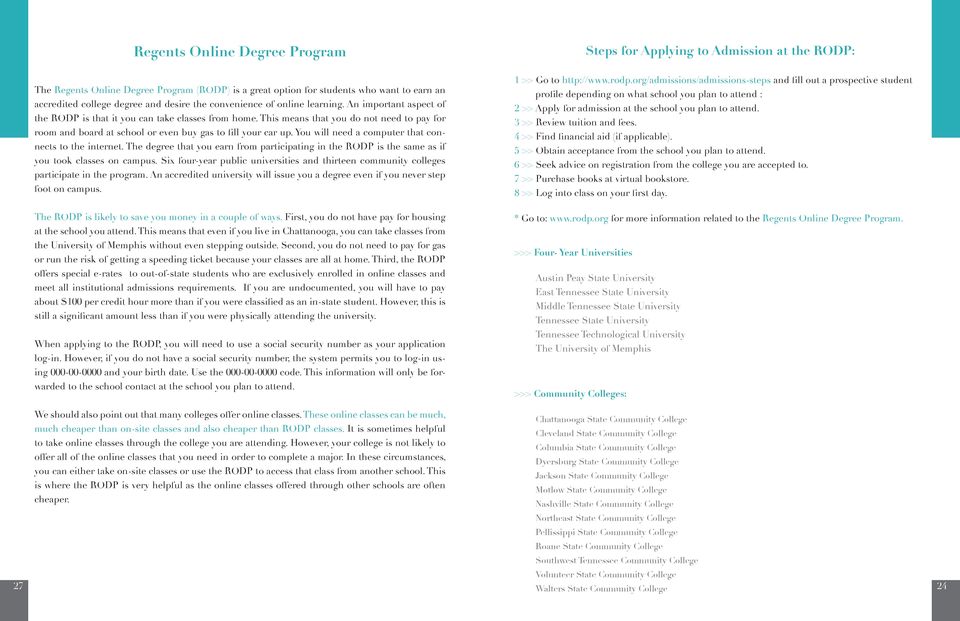
18 Regents Online Degree Program The Regents Online Degree Program (RODP) is a great option for students who want to earn an accredited college degree and desire the convenience of online learning. An important aspect of the RODP is that it you can take classes from home. This means that you do not need to pay for room and board at school or even buy gas to fill your car up. You will need a computer that connects to the internet. The degree that you earn from participating in the RODP is the same as if you took classes on campus. Six four-year public universities and thirteen community colleges participate in the program. An accredited university will issue you a degree even if you never step foot on campus. The RODP is likely to save you money in a couple of ways. First, you do not have pay for housing at the school you attend. This means that even if you live in Chattanooga, you can take classes from the University of Memphis without even stepping outside. Second, you do not need to pay for gas or run the risk of getting a speeding ticket because your classes are all at home. Third, the RODP offers special e-rates to out-of-state students who are exclusively enrolled in online classes and meet all institutional admissions requirements. If you are undocumented, you will have to pay about $100 per credit hour more than if you were classified as an in-state student. However, this is still a significant amount less than if you were physically attending the university. When applying to the RODP, you will need to use a social security number as your application log-in. However, if you do not have a social security number, the system permits you to log-in using and your birth date. Use the code. This information will only be forwarded to the school contact at the school you plan to attend. Steps for Applying to Admission at the RODP: 1 >> Go to and fill out a prospective student profile depending on what school you plan to attend : 2 >> Apply for admission at the school you plan to attend. 3 >> Review tuition and fees. 4 >> Find financial aid (if applicable). 5 >> Obtain acceptance from the school you plan to attend. 6 >> Seek advice on registration from the college you are accepted to. 7 >> Purchase books at virtual bookstore. 8 >> Log into class on your first day. * Go to: for more information related to the Regents Online Degree Program. >>> Four- Year Universities Austin Peay State University East Tennessee State University Middle Tennessee State University Tennessee State University Tennessee Technological University The University of Memphis >>> Community Colleges: We should also point out that many colleges offer online classes. These online classes can be much, much cheaper than on-site classes and also cheaper than RODP classes. It is sometimes helpful to take online classes through the college you are attending. However, your college is not likely to offer all of the online classes that you need in order to complete a major. In these circumstances, you can either take on-site classes or use the RODP to access that class from another school. This is where the RODP is very helpful as the online classes offered through other schools are often cheaper. Chattanooga State Community College Cleveland State Community College Columbia State Community College Dyersburg State Community College Jackson State Community College Motlow State Community College Nashville State Community College Northeast State Community College Pellissippi State Community College Roane State Community College Southwest Tennessee Community College Volunteer State Community College 27 Walters State Community College 24
19 More Options for Undocumented Students: Go to School in Kentucky! Western Kentucky University TIP Program In 2007, Kentucky and Tennessee passed on a reciprocity agreement to increase postsecondary opportunities for students near the borders of both states. A reciprocity agreement means that some universities in one state offer in-state tuition to students from another state. For example, a school in Kentucky might offer in-state tuition to a student in Tennessee if she/he lives within 30 miles of that school. This reciprocity agreement is a significant opportunity for all students to investigate their out-of-state options. However, the reciprocity agreement has particular significance to undocumented students in Tennessee. Since colleges in Kentucky offer in-state tuition to undocumented students, these reciprocity agreements open the door for undocumented students in Tennessee to access these lower rates in Kentucky. At some schools, in-state tuition is three times lower than out-of-state tuition. This agreement might help undocumented students attend college at a more affordable rate. Several schools in Kentucky have reciprocity agreements that allow undocumented students to access in-state tuition in Kentucky. However, you must live in certain border counties in order to access the reciprocity agreement. What follows is a list of the schools that have agreed to reciprocity agreements and also the counties that are eligible for in-state tuition. If you live in these counties, you will be treated as an in-state student at the following universities when you apply. Western Kentucky University (WKU) is an attractive option for many undocumented and immigrant students because they offer a unique scholarship that allows qualified students in Tennessee to access in-state tuition in Kentucky. First, if you live in Macon, Robertson, or Sumner County, you are eligible to receive in-state tuition at WKU. (See Reciprocity Agreements for more information) If you do not live in these three counties, but do live in Cheatham, Clay, Davidson, Dickson, Houston, Humphreys, Jackson, Maury, Montgomery, Pickett, Rutherford, Shelby, Smith, Stewart, Trousdale, Williamson, or Wilson County you eligible to pay Tier 1 tuition. Tier 1tuition is 128 percent more expensive than in-state tuition, but is cheaper than out-of-state tuition. Students who are eligible for Tier 1 tuition are also eligible for the Tuition Incentive Program Scholarships. This scholarship is automatically awarded to freshmen who have an average GPA of 3.5 and a 25 composite ACT score or a 1130 SAT total. Transfer students must have 24 credit hours and at least a 3.0 GPA. The National/International Academic Scholarship (NIAS) is a merit-based award designed for non-resident and international students. The NIAS pays the difference between the non-resident tuition rate and the TIP (Tier 1) rate. If you are a beginning freshmen with a 3.4 unweighted GPA and a 24 ACT/1090 SAT score, you are eligible to receive the NIAS. Non-resident transfer students with 24 earned hours and a 3.4 GPA are also eligible to receive the NIAS. Murray State University Henry County Obion County Stewart County Weakley County Southeast Community and Technical College Campbell County Claiborne County All of these scholarships should help make WKU a more realistic possibility for Tennessee students. If you need more information, contact their Office of Admissions at (270) or visit: Hopkinsville Community College Montgomery County Robertson County Stewart County Bowling Green Technical College Macon County Robertson County Sumner County Western Kentucky University Macon County Robertson County Sumner County Somerset Community College Scott County Picket County Clay County 29 26

20 >>>> Section College Prep ///////

21 College Recruiting: Market Yourself! What do Kim Kardashian, Mike The Situation Sorrentino, Paris Hilton, and Snooki all have in common? If you screamed, talent you were the only one. There are probably millions of people who have more talent than The Situation, but few have marketed themselves as well as he has. For this reason, Snooki is a household name and other more talented performers are less well known. Marketing is not just for celebrities. In fact, how well you market yourself on your college applications will go a long way towards determining whether or not you are admitted to the college that you want to attend or win the scholarship that you need in order to get to school. By marketing, I am referring to your ability to make yourself look like an attractive college applicant. In general, colleges want to accept students who are involved in their community and have good grades and high ACT scores. phone and call their Admissions Office. Ask for help applying to the school. Ask for an update on the status of your application. Request an interview. Visit the school. When the college knows that you are likely to accept their invitation to attend, they are more likely to accept you. Write Great Essays Essays are an essential part of college and scholarship applications. Do not leave your essays until the last minute because they are the best chance for a college or scholarship committee to really get to know you. Have a friend or teacher look over your essays for any grammatical mistakes take their suggestions and edit your work. Take action in your present work and future career! Your future depends on the choices you make today. Get involved in your community and seek for mentorship from fellow college students and professionals. Set your goals and aim high. You can do it! >>>> There are a few simple codes to live by as you prepare to apply to college: Get Good Grades This one is really simple. The higher your GPA, the higher your chances are to get into top colleges and get big scholarships. It is extremely important to take your grades seriously as soon as you get into college. If you did not do so well one year, do not let it get you down. Colleges notice students who improve from year to year and reward them. However, do not wait to get good grades. Start studying now! Take Honors Classes If you have the option to take upper-level courses, do it! Colleges take note of students who always look to challenge themselves. Colleges sometimes even adjust your GPA depending on how many honors and advanced placement courses you register in. Prepare for the ACT/SAT/AP GPA and ACT and/or SAT scores are probably the two largest determining factors in college admission. Just like it is a mistake to take a test without studying for it, it is the wrong decision to take the ACT/SAT/AP without first preparing. See the ACT and SAT Prep sections and the AP Testing section of this guide for more information. Get Involved Get involved with community organizations, sports teams, and charities. Colleges are looking for students who want to positively impact the communities that they live in. So get involved and stay involved on the issues that affect you. Show Interest Do not be afraid to let colleges know that you are interested in them. Pick up the 31 30
22 ACT Prep SAT Prep The ACT is a standardized college entrance exam that college-going students take as part of the admissions process. Colleges will look at your grades, your extracurricular activities, and also your score on the ACT before determining whether or not to accept your application. Each college typically lists a range of scores that they accept. The more prestigious the university that you are applying to, the higher this number will be. We highly recommend that students research the typical scores that students who are admitted to the university you are interested in have earned so that you can know what score to shoot for and whether or not you will need to take the ACT again. Your score on the ACT can also be the difference between winning a scholarship award and not getting financial aid. For this reason, it is essential for all students to prepare for the ACT in a way that will raise their score. The dirty little secret of the ACT is that you can improve your score by practicing. You can train for the ACT in a number of ways. First, we highly recommend that you purchase an ACT Prep Book or check one out from your school s library. Spending time with a good ACT book can make a huge difference in the quality of your application. If you set aside time each week for ACT preparation, you will see positive results. There are also many community organizations that will offer free ACT preparation boot camps, like the YMCA Latino Achievers organization. Always be on the lookout for opportunities to receive free ACT tutoring. We also recommend taking one the ACT practice tests that are offered by preparation companies. Several of these are listed below. Finally, be confident! You can and will do great on the ACT if you study hard. Preparing to take college-entry tests may be overwhelming if you are not prepared for the right one. To clear confusions, we must add that there are different testing options for college-entry exams. First, you need to ask the colleges/universities that you are interested in applying to which test they will take into consideration; whether it is the ACT score or the SAT score. The SAT college admission test is globally recognized and has a significantly different structure from the ACT. Whereas, the ACT and SAT are both standardized exams, SAT tests your problemsolving approach, knowledge, and skills in the subjects that you are learning in high school: critical reading, writing, and math. It is well-noted that the SAT is a written test; unlike the ACT, which has a multiple choice approach. According to the College Board, the organization that administers the SAT and other programs: The best way to get ready for the SAT is to take challenging courses, study hard, and read and write in and outside of the classroom. For more information regarding the SAT, dates, and costs, visit: practice/sat-study-plan Fee waivers are available to any student in the 11 th or 12 th grade that is eligible for free or reduced lunch. If you meet the indicator of economic need, please stop by your high school s college admissions office and speak with your counselor about getting a fee waiver. Sign up at: org When you take the ACT, you will need to show some form of identification. This can be a valid school or government issued ID with your name and photo on it, a letter of identification issued by your school, a high school transcript with photo issued by the school, or a notarized statement with photo. For more information on what identification you will need to show before taking the ACT, please visit: * Important Dates for the ACT: * ACT Costs:
23 SAT Subject Tests Advanced Placement (AP) Classes Budgeting for college can be a difficult task. However, the importance in striving for better class grades and test scores depends on your interest in attaining college education for your future career. Taking the SAT Subject Test(s) in your area of interests is a choice you can make to boost your college recruiting success and save on tuition for college level classes. There are 20 SAT Subject Tests in five general subject areas: English, history, languages, mathematics and science. >>>> Here is what the College Board says about Subject Tests: Subject Tests are hour-long, content-based tests that allow you to showcase achievement in specific subject areas where you excel. These are the only national admission tests where you choose the tests that best showcase your achievements and interests. What are AP classes? Advance Placement classes are college level curriculum classes that are created and or approved by the College Board. Your school can choose from up to 34 AP courses in various subjects to offer every school year, keep in mind than not all schools offer all 34 courses. AP classes not only give you the knowledge and skills to help you at your college or university, but scoring well on the AP Exam can get you college credit and placement as well. During AP s immersive courses, you don t just read about things, you get to learn how things really work. Classes are just like in college, you not only learn by doing, but by sharing and speaking out. With AP, you ll explore new ideas sideby-side with your classmates and teachers. You will set bigger goals for yourself, and find yourself doing things you had never considered before. SAT Subject Tests allow you to differentiate yourself in the college admission process or send a strong message regarding your readiness to study specific majors or programs in college. In conjunction with your other admission credentials (your high school record, SAT scores, teacher recommendations, etc.), they provide a more complete picture of your academic background and interests. Some colleges also use Subject Tests to place students into the appropriate courses. Based on your performance on the test(s), you could potentially fulfill basic requirements or receive credit for introductory-level courses. That is correct! You can attain credit for some of your college-level courses and you will not have to take them while in college. Please, make sure to ask the colleges/universities of your interest about their policy regarding SAT Subject Tests scores and how they provide college credit towards college-level classes. For more information regarding the SAT, dates, and costs, visit: sat-study-plan What are the benefits of taking AP? It s important for you to understand the benefits of these advance placement classes. By making the decision to take an AP course, you let colleges and universities know that you have what it takes to succeed in an undergraduate environment. AP courses signal to admissions officers that you ve undertaken the most rigorous classes your high school has to offer. They see that you ve challenged yourself with college-level course work and expectations. By completing an AP course and getting a high school on the related AP Exam, you can save on college expenses. Currently more than 90 percent of colleges and universities across the country offer college credit, advanced placement, or both, for qualifying AP Exam scores. This means that you can possibly place out of general required courses, and move directly into upper-level classes where you can focus on work that interests you most. You can even get enough advance placements to start your first year of college as a second semester freshman and graduate early. Not having to pay for a semester in college can save you thousands of dollars! What AP courses are offered? AP Capstone Arts English History and Social Science Math and Computer Science Science World Languages and Culture The full list is available at
24 How to get started in AP? AP Exams The first step is to decide that you want to take advantage of this opportunity. Deciding to enroll in one or more AP courses will advance your academic skills and might even save you some college tuition money! The second step is to talk to your counselor/teacher and ask them what AP courses are offered at your school. Teachers can give you a good sense of which courses you might consider and how you might prepare. Counselors can help you get into the AP courses that are the best fit, as well as any courses or additional support you might need in order to enroll in AP in future years. If you The third step is to find out when course enrollment happens at your school. Talk to your counselor to find out the deadline for AP class enrollment. This will help you plan ahead so you know about any required courses you need before AP. AP exams are taken each May by students all over the world, the AP Exam is the final step you take after a year of hard work in an AP class. These standardized exams are designed to measure how well you ve mastered the content and skills of the course a successful score can earn you credit and advanced placement in college. AP exams 101: Each of the 34 exams has its own unique requirements; however, almost all of the exams have several things in common. 1. Most exams are two to three hours long 2. The first part of the exam usually consists of multiple-choice questions 3. The second part of the exam usually consists of free-response questions that require you to generate your own responses. The third step is to find out when course enrollment happens at your school. Talk to your counselor to find out the deadline for AP class enrollment. This will help you plan ahead so you know about any required courses you need before AP. The fourth step is to ask your counselor or teacher what support is available at your school. You may also ask about financial support. Although there is no charge to take AP courses additional The fourth step is to ask your counselor or teacher what support is available at your school. You may also ask about financial support. Although there is no charge to take AP courses additional costs can include buying additional supplies for the class and paying the AP exam fee at the end of the year. Fees and fee reductions: There are fees associated with the AP Exam, but reductions and subsidies are available for students with financial need. The fee for each AP Exam is $89. If you have financial need or currently qualify for reduced lunch at your school you may be eligible for a College Board fee reduction per AP Exam. Most states provide federal and/or state funds to supplement the College Board fee reduction, which would reduce your cost even further. AP scores: Your AP score shows how well you did on the AP Exam. It s also a measure of your achievement in your college-level AP course. This score will be used by colleges and universities to determine if they will grant you credit for what you ve already learned, or allow you to skip the equivalent course once you get to college (this is known as advanced placement). Your score is a weighted combination of your scores on the multiple-choice section and on the free-response section. The final score is reported on a 5-point scale as followed: 5 = extremely well qualified 4 = well qualified 3 = qualified 2 = possibly qualified 1 = no recommendation Work cited: AP Students. - AP Courses and Exams for Students. N.p., n.d. Web. 06 Feb
25 >>>> Section College Money Matters 04
26 Finding Scholarships Let s be honest: college is expensive. All across the country, the cost of higher education is rising and there is no indication that tuition will get cheaper anytime soon. For all students, the price of education is a burden. For undocumented students who are forced to pay out-of-state tuition in their own state, the costs of education are even more monumental. Adding to the burden of out-of-state tuition is the exclusion of undocumented students from FAFSA. Without the ability to apply to FAFSA, undocumented students are excluded from all Federal student aid and most State and Institutional aid. This means that undocumented students have to pay more to go to college and receive less help to do it. Help is out there and your ability to secure scholarship funds can make all the difference in your pursuit of your college diploma. Unable to get federal and state aid, undocumented students in Tennessee must turn to institutional aid and private scholarships. What institutional aid is available varies from university to university. Attached to this guide is a survey that asks participating schools to list any institutional aid that they offer and is available to undocumented students. In general, you can assume that community colleges do not offer institutional aid to undocumented students, but many private four-year universities and liberal arts colleges do. In these instances, your eligibility for aid will be determined by need and by merit. Yes, this means you need to get good grades and earn as high an ACT/SAT as possible. These scholarships can be large and can go a long way towards covering the cost of admission at expensive private schools. Private scholarships are the best way for undocumented students in Tennessee to get help paying for their tuition. Unfortunately, a lot of scholarships require you to include a social security number. Fortunately, some great people have compiled huge lists of private scholarships that undocumented students are eligible to apply for. Since these scholarships are fairly hard to get, we suggest that you work very hard on your scholarship essays. Maldef Scholarship List Educator s For Fair Consideration List Selected Funding Opportunities Open to Non-US Citizens The Tomas Rivera Policy Institute Latinos in College Scholarship Page STUDY Foundation (via TIRRC) Fastweb Cappex College Board Your Words Today! Scholarship Databases for Undocumented Students: General Scholarship Databases 37 38
27 Am I Eligible for FAFSA? Eligibility of Documented Citizens of the U.S., with Undocumented Parents The Free Application for Federal Student Aid (FAFSA) is used to determine whether current and prospective students are eligible to receive student financial aid. To be clear, FAFSA does not provide aid. Financial Aid is not, as many people think, simply free money. It can come from different sources like: private donors, foundations, organizations and via both state and federal programs. The form calculates whether a student is eligible to receive federal aid, state aid, and most of the institutional aid currently available. Many people think the terms scholarships and financial aid are synonymous. Actually, scholarships are also called grants and are also a form of financial aid. If you are eligible to fill out the FAFSA, you should fill out the form. The United States Department of Education accepts completed FAFSA forms on January 1 st of each year. It is recommended that eligible students submit their forms around this date because the form is time-sensitive. Students who are eligible to receive the most aid from FAFSA are from families who are not able to contribute a significant amount of money towards their child s education. If you are a U.S. Citizen, a U.S. National, or an Eligible Non-Citizen of the United States with undocumented parents, you are eligible to apply for FAFSA as long as your parents are paying taxes. (If your parents do not pay taxes, you should not apply for FAFSA). A few general guidelines are: You should use when describing your parents social security number. Your parents are not eligible to sign the FAFSA with a PIN. For this reason, you could print off the signature sheet for your parents to sign and mail the form in. This step delays the FAFSA decision, but is a necessary step. Use your parents tax forms to fill out the FAFSA. Again, contact the Admissions Office of the colleges/universities that you are applying to for assistance on tax information. Unfortunately, undocumented students are NOT eligible to apply to the FAFSA. If you are undocumented, do NOT apply to the FAFSA. Filling out the FAFSA as an undocumented student is not the correct decision. Furthermore, you should not apply to FAFSA if you are in the country on an expired visa as this could have negative results. You need to be honest when filling out the FAFSA form because it could hurt your chances at getting aid and it could also be considered perjury if you lie on a federal form. Students in various citizenship statuses are eligible to apply for the FAFSA. Please note that students who select Neither citizen nor eligible non citizen are not eligible for federal aid, but may earn access to state and institutional aid. Again, undocumented students are NOT eligible to apply to the FAFSA. Please, look at the Completing a CSS Profile section in this guide for other opportunities finding financial aid for college
28 Important Information for Filling Out FAFSA You can apply to FAFSA if you are a U.S. Citizen, a U.S. National, or an Eligible Non-Citizen. Notes on Question 14 (in accordance with This question cannot be left blank. Select U.S. Citizen if: You are a U.S. national by birth or naturalization. Select Eligible Non Citizen if: A U.S. permanent resident, with a Permanent Resident Card (I-551), or a conditional permanent resident with a Conditional Green Card (I-551C). Other eligible noncitizen with an Arrival-Departure Record (I-94) from the Department of Homeland Security showing any one of the following designations: o Refugee, Asylum Granted, Parolee (I-94 confirms that you were paroled for a minimum of one year and status has not expired), T-Visa holder (T-1, T-2, T-3, etc.), or Cuban-Haitian Entrant. o The holder of a valid certification or eligibility letter from the Department of Health and Human Services showing a designation of Victim of human trafficking. o A resident of the Republic of Palau (PW), the Republic of the Marshall Islands (MH), or the Federated States of Micronesia (FM). o A Canadian-born Native American under terms of the Jay Treaty. You may not apply if you owe refunds on any federal student grants, have defaulted on any student loans or have been found guilty of the sale or possession of illegal drugs while aid was being received. Each year you and your parents will have to go online and renew their FAFSA using the most current financial information. For more information on FAFSA related questions, visit: Select Neither Citizen nor Eligible Non Citizen if they are in the U.S. on: A F1 or F2 student visa A J1 or J2 exchange visitor visa, or A G series visa (pertaining to international organizations), or Other categories not included under U.S. citizen and eligible noncitizen
29 Completing a CSS Profile CSS College Guide in English: The College Scholarship Service Profile (CSS) is a form offered by the College Board that helps students apply for financial aid. The CSS Profile calculates students financial needs and helps colleges to determine to whom they should allot aid. If you are applying early to a private college, you may be required to fill out this form. In addition, some colleges allow immigrant and undocumented students to fill out the CSS Profile instead of the FAFSA. You are required to fill out the CSS Profile in English. If you are applying for early decision at a private college, you should register for the CSS Profile by November 1 st and complete it by December 1 st. If you are applying to colleges for regular decision, register by January 1 st and complete the form by February 15 th. srv?relativepath=/profile/pdfs/1213_profile_regist_guide.pdf CSS College Guide in Spanish srv?relativepath=/profile/pdfs/1213_profile_regist_guide_sp.pdf You can complete a CSS Profile in three steps. 1. First, you must register for a CSS Profile. The registration for the CSS Profile will ask you for your permanent address and your citizenship status. Make sure you answer these questions honestly because your documentation status does not disqualify you. A social security number is not required in order to complete a CSS Profile Application. If you do not have a social security number, you may leave this section blank and the application will allow you to submit without a social security number. 2. After you register for a CSS Profile, the website will generate a form based on the answers you provide. This is the CSS Application. Complete the CSS Profile. If your parents file taxes, you should ask for their tax returns. (e.g. 1040, 1040EZ, foreign return) You should also be aware of your parents housing status (rent, own, etc.). If you have specific questions about filling out the CSS Profile, please call their office. They are extremely helpful and very quick to respond. Their phone number is: (305) Submit the form. You will need to know the code of the college you are applying to. Codes can be found in the CSS College Guide linked below and on the CSS website: collegeboard.com/prf/index.jsp 43 44
30 Application Fee Waivers The College Board Fee Waiver Form Application fee waivers get rid of the application fees that many universities charge to process your application. This means that you can apply to schools for free if the school accepts fee waivers and you are eligible to receive them! However, not everyone can get fee waivers. Some colleges do not accept fee waivers. For example, community colleges in Tennessee are not allowed to accept fee waivers. However, other schools do. For more specific information, please see the survey section of this guide. The College Board offers fee waivers to students who also qualify for fee waivers on the ACT/SAT. (For more information about that, see the ACT section of this handbook!) When you receive the ACT fee-waiver materials from the College Board, you should also receive a Request for Waiver of College Application Fee. Fill that out. If you need help, call the Counselor Helpline at 1(888) You are not eligible to use the fee waivers if you are already enrolled in one college and are planning to transfer to another. So if you are at community college and are planning to apply to a four-year university, you will not be eligible for a fee waiver. Also, international students are not eligible to use the form because the financial eligibility requirements are based upon U.S. Federal numbers. However, undocumented students are eligible to apply for fee waivers. >>>> You are typically eligible to receive an application fee waiver if: You are eligible to receive an SAT or ACT fee waiver. You are enrolled in or are eligible to receive Federal Free or Reduced Lunch. Your family receives public assistance. You live in federally subsidized public housing, a foster home, or are homeless. Individual Colleges Some schools offer their own fee waivers. Do you research and determine if the college you are applying to will accept the NACAC or College Board forms. You can find this information out by calling the admissions office at the school that you are applying to. NACAC Fee Waiver Form: The National Association for College Admission Counseling (NACAC) offers a form that students can fill out with a college counselor. This form declares and certifies your eligibility to receive fee waivers at participating colleges. The form can be found at the website listed above
31 Bank Accounts College is expensive. Unless you are blessed to come from a very affluent family or earn a major scholarship, it is likely that you will need to save money in order to pay your fees. But where can you keep all of your money and make sure that it is safe? Some people try to keep all of their earnings in cash. This means that they have their money stored in a shoebox or a box or just under their pillow. While this method has worked before, it is not really safe. If a fire or a robbery occurs and your money is in your house, you could end up losing your college savings. Many immigrant students find that opening a bank account allows them to store their money in a safe place for free or very cheap. We highly recommend that you look into opening a bank account. Decide what bank you want to open an account with. Many banks offer student checking accounts that are free to use. Do the research and find a bank that is close to you and is cheap to use. You may also want to see if that bank has ATMs near the college that you will attend. Then, go to the bank with a few essential forms of identification. You will need two forms of identification in order to open a bank account. Forms of identification include: State issued ID card (such as a Driver s License). If you do not have a state issued ID card, you should go to a bank that accepts foreign identification. Be sure to call ahead to confirm that the bank accepts foreign identification. When you talk with someone at the bank, inform them that you are a foreign national who lives in the United States and that you want to open an account. They will probably ask for a matricula or passport from the country that you were born in, as well as a student ID card. Some banks may require yours and your parents ITIN (Individual Taxpayer Identification Number), but this is not true at all banks. Once you open a bank account, you will be able to hold your money in a safe location as well as cash your checks for free. Opening a bank account is well worth it and a strategy that many immigrant college students have suggested including in this guide Talking to Your Parents About Going to College If you are reading this handbook, you probably have decided that you want to go to college, great! As we talked about earlier, earning a college degree is well worth the effort. You know this. But what if others around you, like your parents and older siblings, are having doubts? There are a lot of reasons that the people around you might not initially expect you to go to college. If your parents or guardians never went to college, they might not fully understand the college process. Or they might think college it too expensive or too far or for other people and not for you. You need to have the talk. We cannot tell you exactly what to say because we do not know your parents. However, from our own experience, here are some things to think about: Know Your Reasons Someone is going to ask you: Why do you want to go to college? Have an answer! Although what you say is going to depend on who you are, remember that a college degree is associated with higher income and also may help you to get the job that you want in the future. Know Your Rights Like most people, your parents might not know that undocumented or immigrant students can and do go to college and graduate. You need to tell them! Familiarize yourself with the Federal Education and Privacy Act (FERPA) and other laws that protect undocumented students from revealing their immigration status when applying to colleges. Know Your Schools A lot of parents want their children to stay close to home for college. Staying home has a lot of advantages and you will not have to pay for your room and board or for meal plan at college. Research schools that are close to home, but do not limit yourself if you want to go to a college that is farther away. Know Your Resources Your parents are going to want more information. Help them access these resources! If there is a local co mmunity organization such as the Tennessee Immigrants and Refugee Rights Coalition, bring them to a meeting so that they can meet others in the community. Or, print off a copy of the Educations for Fair Consideration free handbook titled: How To Support College-Bound Undocumented Students: Advice for Parents. (This can be found at: E4FC_ParentGuide.pdf) Be Confident Your parents want to do what is best for you. If you are sure that you want to go to college, they are likely to support your choice! 47 48
32 A Few Words of Advice: Things to Consider Schools are not allowed to disclose the citizenship status of their students. This means that parents should not fear telling trusted teachers about their citizenship status. Neither teachers nor counselors are legally permitted to say anything about your citizenship status. Public high schools are never allowed to inquire into the immigration status of students or parents. That means teachers/principals/counselors are never allowed to ask a student whether or not they have legal citizenship. Schools are almost never allowed to ask students for their social security number. The instances when high schools are allowed to ask for social security numbers are extremely limited. If you are asked for your social security number at school, contact the Tennessee Immigrants and Refugee Rights Coalition immediately, at: in Nashville
33 Parental >>>> Section Advice 04
34 Parents: Why College? As a parent, it is difficult and frightening to let your child go to a new place that you have not already seen and decided was safe. Both you and your child may even have heard about other undocumented students who experienced setbacks in their college application process. No one is going tell you that the college application process is easy because it is not. However, we are here to say that the benefits of attending college and earning a college degree are definitely worth the hard work that you are putting in now. Applying to college is safe, even if you do not have a social security number. A college degree has social and financial benefits for everyone. College education helps your child to meet new friends, introduces them to new information and experiences, and helps them to prepare for their future. College campuses attract a diverse group of students from all ethnicities, religions, races, and sexual orientations. You can expect them to learn as much from the people they go to school with, as you will from school itself. Everyone wants to make more money. However, many people do not know that how much we make is often tied to what level of education we attain. Many high-paying jobs require that applicants have a college degree or more. People who do not earn a college degree can often not become employed in high-income field. That is correct: people with bachelor s degrees earn almost twice as much as people who have a high school diploma. In addition, The Bureau of Labor Statistics compared weekly unemployment rates for people with less than a high school diploma to those with a doctoral degree. High school graduates faced 9.7 percent unemployment, where people with a two-year associate s degree faced 6.8 percent unemployment and those with a bachelor s faced only 5.2 percent unemployment. The importance of the degree they choose will be depending on the carrier path they envision. A bachelor s degree is a minimum credential for teachers, engineers, commissioned officers in the military, and many salaried jobs in large corporations. A bachelor s degree is required for admission to law school or medical school, which in turn is a prerequisite to becoming an attorney or physician. Keep in mind that these statistics are for documented and undocumented individuals, so it is a safe bet that those who earn college degrees will also earn more income as a result. Furthermore, by going to college, your child may actually increase their chances to receive a temporary worker s visa. Prospective employers can file petitions for these visas and if they are a better candidate, they will be more likely to request a visa on their behalf. Fast Food Industry $16,000 Registered Nurse $63,750 As you can see, going to college is the right move for many students. Remember: not everyone s college process will look the same. Some students enter college when they are old; some students commute to campus from home; some students even attend college via the Internet. However, they choose to go to school, please know that college degrees have wide-ranging benefits that make the hard work they are putting in now worth it. Management Analyst $72,250 Computer Software Engineer $87,
35 Talking to Your Child About Going to College If you are a parent and are reading this guide, you probably are interested in learning about what your child needs to do in order to go to college. It is important to know that your child can go to college even if you are undocumented. There are social, legal, and economic advantages to going to college, even for undocumented and immigrant students. Many immigrant and undocumented students have gone to and graduated from colleges in Tennessee. Here are some things to think about if you are a parent and want to see your child go to college. Know the Reasons Applying to college is a difficult process that many kids are not quite motivated or mature enough to follow on through. However, you can try to motivate your child by reminding them of the economic, social, and legal incentives for college graduation. Grades Your child s grade point average (GPA) plays a large role in whether or not they will be accepted to colleges and earns scholarships. It is important to remind your child that grades do matter and to stay involved in their education as much as possible Start Early Do not wait to talk to your kids about college. The earlier that your kids decide that they want to go to school, the longer they will have to get better grades, write essays, look for scholarships, and prepare for standardized tests. If your kids are in middle school, talk to them. If they are in 9 th grade, talk to them. It is much easier for your kids to improve their grades when they are young. If your kids are older, it is still possible for them to go to college. However, we strongly encourage you to talk to your kids about college as early as possible. Accompany Your Child to Campus Tours A great number of colleges and universities encourage parent involvement in their children s college planning and admission process. Accompany your child on regular tours of campus, residence halls and/or summer orientation. They might feel more comfortable having a person they know going through the process with them. Talk About Status Your child needs to know if he or she is undocumented way before the college process begins. The reason your child needs to know is that the college process is different and more time consuming for people with and without social security numbers. It may be difficult to let your child know their status, but it is the best thing to do for them if they want to go to college. Standardized Tests and Activities These are very important factors that will have an impact on their college admission. Be supportive during the standardized testing period and involve yourself with their activities. Be Informed Even if you did not go to college, having a parent who understands the college process is a huge benefit for students who are applying to schools. A good place to start informing yourself about the college process is this guide! But, there are other sources like college-bound networks that will provide you with more information about colleges and majors. We also recommend the E4FC s free handbook, How to Support College-Bound Undocumented Students: Advice for Parents: Pay Taxes Having an Individual Taxpayer Identification Number (ITIN) is extremely helpful to your child. If you pay your taxes, you will be assigned this number
36 Is Your Child Eligible for FAFSA? Eligibility of Documented Citizens of the U.S., With Undocumented Parents The Free Application for Federal Student Aid (FAFSA) is used to determine whether current and prospective students are eligible to receive student financial aid. To be clear, FAFSA does not provide aid. Financial Aid is not, as many people think, simply free money. It can come from different sources like: private donors, foundations, organizations and via both state and federal programs. The form calculates whether a student is eligible to receive federal aid, state aid, and most of the institutional aid currently available. Many people think the terms scholarships and financial aid are synonymous. Actually, scholarships are also called grants and are also a form of financial aid. If your child is eligible to fill out the FAFSA, they should fill out the form. The United States Department of Education accepts completed FAFSA forms on January 1 st of each year. It is recommended that eligible students submit their forms around this date because the form is time-sensitive. Students who are eligible to receive the most aid from FAFSA are from families who are not able to contribute a significant amount of money towards their child s education. Unfortunately, undocumented students are NOT eligible to apply to the FAFSA. If your child is undocumented, do NOT apply to the FAFSA. Filling out the FAFSA as an undocumented student is not the correct decision. Furthermore, your child should not apply to FAFSA if they are in the country on an expired visa as this could have negative results. (They need to be honest when filling out the FAFSA form because it could hurt their chances at getting aid and it could also be consider perjury if they lie on a federal form). However, there are other options for paying for college; please, refer to our Finding Scholarships section in this guide. If your child is a documented citizen of the United States with undocumented parents, your child is eligible to apply for FAFSA as long as you are paying taxes. (If you do not pay taxes, your child should not apply for FAFSA). A few general guidelines are: Your child should use when describing your social security number. You are not eligible to sign the FAFSA with a PIN. For this reason, your child could print off the signature sheet for you and mail the form in. This step delays the FAFSA decision, but is a necessary step. Your child should use your tax forms to fill out the FAFSA. Again, contact the Admissions office of the schools they are applying to for assistance on taxes. Students in various citizenship statuses are eligible to apply for the FAFSA. Please note that students who select Neither citizen nor eligible non citizen are not eligible for federal aid, but may earn access to state and institutional aid. Again, undocumented students are NOT eligible to apply to the FAFSA
37 Important Information for Filling Out FAFSA You can apply to FAFSA if you are a U.S. Citizen, a U.S. National, or an Eligible Non-Citizen. Notes on Question 14 (in accordance with This question cannot be left blank. Select U.S. Citizen if: You are a U.S. national by birth or naturalization. Your child may not apply if they owe refunds on any federal student grants, have defaulted on any student loans or have been found guilty of the sale or possession of illegal drugs while aid was being received. Each year you and your child will have to go online and renew their FAFSA using the most current financial information. For more information on FAFSA related questions, visit: Select Eligible Non Citizen if: A U.S. permanent resident, with a Permanent Resident Card (I- 551), or a conditional permanent resident with a Conditional Green Card (I-551C). Other eligible noncitizen with an Arrival-Departure Record (I- 94) from the Department of Homeland Security showing any one of the following designations: o Refugee, Asylum Granted, Parolee (I-94 confirms that you were paroled for a minimum of one year and status has not expired), T-Visa holder (T-1, T-2, T-3, etc.), or Cuban-Haitian Entrant. o The holder of a valid certification or eligibility letter from the Department of Health and Human Services showing a designation of Victim of human trafficking. o A resident of the Republic of Palau (PW), the Republic of the Marshall Islands (MH), or the Federated States of Micronesia (FM). o A Canadian-born Native American under terms of the Jay Treaty. Select Neither Citizen nor Eligible Non Citizen if they are in the U.S. on: A F1 or F2 student visa A J1 or J2 exchange visitor visa, or A G series visa (pertaining to international organizations), or Other categories not included under U.S. citizen and eligible noncitizen
38 Counselors & Teachers: >>>> Section Make it Count! 05
39 Advice from Counselors to Counselors (Written by Counselors in the Oasis College Connection) Do not underestimate your role in helping un/under-documented students reach their educational goals. What is a complicated and challenging process for any high school student can quickly become a nightmare for un/under-documented students. By being open, knowledgeable, and going the extra mile, you can open the door to higher education for undocumented students. Start working with students EARLY the earlier, the better. By helping un/under-documented students understand that they can go to college, but will face obstacles, they can make decisions regarding their academic path that will enable them to secure needed resources. It is important to realize that many students may not know about their status until they begin applying to college. This can be very difficult to process and some students may resist accepting the reality of the situation. Be supportive and encouraging and remind them that the obstacles are not impossible to overcome. A good first step is getting clear on exactly what the documentation situation is with a particular student, especially encouraging the student themselves to understand their immigration status and what it means. Does the student have any type of documentation? If so, what kind? What class of visa do they hold? When are they eligible to apply for a green card or citizenship? Can they pursue a path to citizenship independently of their parents or other family members? 1. Understanding the student s individual situation is a huge asset in dealing with colleges, especially if the student is able to communicate to the college that their visa situation will change at some point in the future, making them eligible for financial aid. 2. Do not ask students to self-identify about their immigration status; in fact, it is illegal to do so. Keeping confidentiality is a key to positioning yourself as an ally and retaining that trust. Make information and resources available to all students. Remember that when a student reveals their status to you, they are putting a great amount of trust in you. It is also important to let them know that they will need to be honest about their status throughout the process to admissions counselors. Remind them that federal law (specifically FERPA) will protect their privacy and prevent colleges from releasing any information on them unless under court order. 3. Educate yourself about the laws and policies affecting undocumented students. Research before you answer questions, but never give legal advice. Undocumented students cannot legally receive any federally funded student financial aid, including loans, grants, scholarships, and work-study programs. In most states, including Tennessee, they are not eligible for state financial aid. Less than a handful of states grant eligibility for state financial aid to undocumented students who qualify for in-state tuition. Additionally, most private scholarship funds and foundations require applicants to be U.S. citizens or legal residents. Though they are effectively blocked from most forms on financial aid, many students are surprised to discover that colleges cannot use immigration status as a factor in considering students for admission
40 1. Encourage students to keep their grades up and study for the ACT/SAT. The things students Be prepared to help students fill out college applications with appropriate information regarding can control, like their grades, ACT score, and community involvement will go a long way. residency and navigate the FAFSA process. When filling out college applications, providing a However, the degree to which the student is willing to commit to the admissions process social security number is optional and never required. Work with students and their contact at and be fearless in seeking educational opportunity also matters a great deal. Students the university to find out whether they should leave this question blank, fill in zeros, or fill in must be willing to go the extra mile in writing admissions essays and personal statements the space with an identification number provided by the university. If a college financial aid/ securing excellent references, and building relationships with admissions representatives admissions advisor suggests a student fill out the FAFSA and the student does not have a social in the schools they are in. By becoming effective self-advocates students become the type security number, they can fill it out but DO NOT submit it. Undocumented students do not qualify of people that colleges want as part of their student body. The ability to convey how their for FAFSA and submitting FAFSA forms with false information is against the law. If a parent is own background and experiences set them apart gives students an incalculable advantage undocumented, they will need to fill out the FAFSA with zeros and cannot apply for a pin. They in seeking institutional aid. It may also be beneficial for students to take as many Advanced will have to print out and sign the FAFSA and mail it in. It is often very helpful to establish a Placement (AP) exams as they can in order to save money and fulfill general education contact at the colleges the student is interested in applying to who can answer questions and be a requirements for colleges simultaneously. If available, counselors can encourage students support to the student along the way. to participate in dual enrollment courses at the community college to accrue college credit without the associated tuition costs. Identify scholarships that do not require legal residency, legal citizenship, a social security number, or proof of having filled out the FAFSA. 2. Undocumented students may have a lot more luck pursuing private universities, who have To name some, the Mexican American Legal Defense and Educational Fund (MALDEF), the more freedom with how they award scholarships and spend their money. College counselors University of Southern California Center for Higher Education Policy Analysis, the Tomas Rivera can be helpful in helping un/under-documented students figure out which colleges may be Policy Institute, and the National Council of La Raza have compiled extensive lists of scholarships a good fit and can initially reach out to admissions offices on behalf of students to gauge for which undocumented students are eligible. Making undocumented students and their families what, if any, institutional aid may be available to students who are ineligible for federal aware of these scholarship resources is paramount. financial aid. Counselors can also help work with students on how to best communicate their citizenship status with admissions counselors and can assist in coaching students on Be informed. Educate yourself and seek help from professional organizations regarding Deferred phone and etiquette. It will be most effective for the student to take ownership of Action for Childhood Arrivals (DACA) and how it can help your student to accomplish going to their own immigration status and be the one who is in communication with schools directly, college. On June 15, 2012, the Secretary of Homeland Security announced that certain people who instead of relying on the college counselor to be their voice. came to the United States as children and meet several key guidelines may request consideration of deferred action for a period of two years, subject to renewal, and would then be eligible for work If a young person has their heart set on a school that is a public university, there are a few options authorization. Deferred action does not provide an individual with lawful status. (Source: that the student can take in order to be able to pay for college. One option is to apply for admission Again, research before you answer questions, but never give and then ask the admissions office to defer their admission until they obtain citizenship, especially legal advice. if they are already partway through that process and will be able to obtain citizenship or status as en eligible non-citizen within the next year. The degree to which students will be successful Finally, be an advocate for your undocumented students and encourage them to be advocates for in receiving deferred admission will largely depend on the institution itself but can be aided by themselves. Connect students with support networks, websites, and other undocumented youth a relationship that the student develops with the admissions staff. If the school really wants that and encourage them to be a voice for legislative change. Young un/under-documented students, student, they will be more willing to grant a deferral. Students can also work to establish residency especially if they have excelled academically, are in an extraordinary position to help bring change in a state that grants in-state tuition to public university students regardless of immigration status. to the problem of undocumented students and the lack post-secondary accessibility. Start a Another option for these students can be attending a community college, and students can research club within the school to support them. Work with school administration to create an in-house if there are community colleges in their state or geographic area that offer more affordable out-ofstate tuition costs than others. scholarship. Encourage local scholarship foundations to remove citizenship/fafsa requirements. Be the change
41 Advice from a Teacher to Teachers Do not underestimate your role in helping un/under-documented students reach their educational goals. What is a complicated and challenging process for any high school student can quickly become a nightmare for un/under-documented students. By being open, knowledgeable, and going the extra mile, you can open the door to higher education for undocumented students. 1. Encourage students; make sure that undocumented students know that they can continue with higher education after high school (i.e. talk about it, name it, at school conversations/ presentations do not let any undocumented student think: oh, they are not talking to me I am undocumented. ) 2. At any financial aid info session, have scholarship resources at the ready for those who cannot fill out FAFSA. 3. Make sure students are informed about and on track to take the ACT. This is especially important for ELL students who might not be classified as 11 th graders in the computer due to the scheduling of English classes, even though they will be graduating the next year. Know your students. Do not be afraid to ask a student about their plans after high school documented or not. If you find out a student is undocumented, let them know you are there to help with extra support and resources 7. Speak to parents. Inform them of how they can play a role in helping your student to attain higher education. 8. Research information regarding college opportunities available for undocumented students but do not give legal advice. Be informed. Educate yourself and seek help from professional organizations regarding Deferred Action for Childhood Arrivals (DACA) and how it can help your student to accomplish going to college. On June 15, 2012, the Secretary of Homeland Security announced that certain people who came to the United States as children and meet several key guidelines may request consideration of deferred action for a period of two years, subject to renewal, and would then be eligible for work authorization. Deferred action does not provide an individual with lawful status. (Source: Again, research before you answer questions, but never give legal advice. 4. Identify ELL students who are graduating, but might not be classified as 12 th graders until the second semester of their last year, and make sure they get all the scholarship/application info they need in the fall. 5. Support scholarship searching by providing time, space, and mentors throughout the year
42 Notes on Deferred Action for Childhood Arrivals (DACA) It is our interest to help informing students, teachers, counselors, and parents of the benefits and public information available [through official statements in: regarding DACA. This information is NOT legal counsel. For legal counsel, seek help from professional organizations regarding Deferred Action for Childhood Arrivals (DACA). In recent months, the Department of Homeland Security issued a statement regarding the availability for undocumented students to apply for Deferred Action for Childhood Arrivals (DACA). You may request consideration of deferred action for childhood arrivals if you: 1. Were under the age of 31 as of June 15, 2012; 2. Came to the United States before reaching your 16 th birthday; 3. Have continuously resided in the United States since June 15, 2007, up to the present time; 4. Were physically present in the United States on June 15, 2012, and at the time of making your request for consideration of deferred action with USCIS; 5. Entered without inspection before June 15, 2012, or your lawful immigration status expired as of June 15, 2012; 6. Are currently in school, have graduated or obtained a certificate of completion from high school, have obtained a general education development (GED) certificate, or are an honorably discharged veteran of the Coast Guard or Armed Forces of the United States; and 7. Have not been convicted of a felony, significant misdemeanor, three or more other misdemeanors, and do not otherwise pose a threat to national security or public safety. (For more information, please visit: Avoid scams! Stay informed: When filling out a college application, make sure to talk to the college s Admission counselor if you have questions about determining your institution s tuition policy. Books >>> Sources Kim, Eunyoung and Jeannette Díaz. Immigrant Students and Higher Education. ASHE Higher Education Report (2013): 152. Electronic Print. Important Hyperlinks (In Order of Mention) >>> IRS General Information: Regents Online Degree Program: Western Kentucky University TIP Program: ACT Registration (Dates and Costs): SAT Registration (Dates and Costs): Scholarship Databases for Undocumented Students >>> Maldef Scholarship List: Educator s For Fair Consideration List: Selected Funding Opportunities Open to Non-US Citizens: nd.edu/~fellowsnonuscitopps.html The Tomas Rivera Policy Institute: org/pdfs/scholarship_directory.pdf Latinos in College Scholarship Page: aspx STUDY Foundation (via TIRRC): General Scholarship Databases >>> Fastweb: Cappex: College Board: Your Words Today: FAFSA Information:
43
Types of 2-Year Colleges. College Planning Night 3/15/2016. Agenda. Types of Colleges. What Is College? Tennessee Colleges of Applied Technology
 Agenda College Planning Night HOUSTON COUNTY HIGH SCHOOL Sharon M ccloud & F r i e n ds mc c l o u ds1 @ h o u s t o n k1 2 t n. n e t What Is College? Types of colleges in Tennessee Planning for college
The Economic Benefit of International Students $26.8 billion Contributed; 340,000 U.S. Jobs Supported
 The Economic Benefit of International $26.8 billion Contributed; 340,000 U.S. Jobs Economic Analysis for Academic Year 2013-2014 International students and their families created or supported 340,000 jobs
LaVergne High School. Class of 2014 Senior Year Handbook
 LaVergne High School Class of 2014 Senior Year Handbook High School Graduation Requirements English 4 Credits English I English II English III English IV Math 4 Credits Algebra I Geometry Algebra II Upper
How To Get A College Degree In North Carolina
 HIGH SCHOOL OPTIONS FAQ s High School Options - Quick Glance: pg 1 International Baccalaureate Program: pg 2 Health Sciences Academy: pg 3 Phoenix STEM Academy: pg 4 Rockingham Early College High: pg 5
Getting a Head Start With Vocational Rehabilitation
 Getting a Head Start With Vocational Rehabilitation What is Vocational Rehabilitation (VR)? Vocational Rehabilitation is an employment program provided by the Tennessee Department of Human Services, Division
Coastal Carolina University Catalog 2004/2005 ADMISSIONS
 ADMISSIONS 25 ADMISSION INFORMATION The Office of Admissions is committed to marketing the University and attracting students who seek to attend a comprehensive liberal arts institution. As a team, we
College Planning Timeline
 College Planning Timeline 9 th Grade - 12 th Grade Planning for Students and Parents Report by Stan Ezekiel, Founder and President: Join us on Facebook Visit our Website 1 Contents (click on the links
Continue to stay involved in your extra-curricular activities, remembering to document your involvement.
 College Planning: A Four Year Overview Freshman Year Begin your high school career by taking academically challenging courses. Focus on your studies. This year is important as it is the beginning of your
Glossary of College Terms
 Glossary of College Terms Academic Advisor: Member of student services who helps and advises students on what classes to take, what major to pursue, etc. He or she also assists students during the registration
College-going Tips for High School & Transfer Students: an undocumented student s guide for completing college (transfer) applications
 You have the DREAM. We have the resources. Tú tienes el DREAM y nosotros los recursos. Keeping the DREAM Alive: Beyond the Community College College-going Tips for High School & Transfer Students: an undocumented
Transferring from Community College of Allegheny County to a Four-year Institution. A General Guide to a Successful Transfer
 Transferring from Community College of Allegheny County to a Four-year Institution A General Guide to a Successful Transfer Revised March 2013 TABLE OF CONTENTS CONGRATULATIONS!... 2 WHY BEGIN AT A COMMUNITY
Build relationships with teachers and friends who support your college aspirations
 Full Checklist 9th Grade Make sure your classes are considered college prep Build relationships with teachers and friends who support your college aspirations Get involved in activities inside and outside
Volunteer Handbook Delaware College Application Month 2015
 Volunteer Handbook Delaware College Application Month 2015 The power of the volunteer comes from students seeing that members of the broader community view education as an important goal. Dear College
SENIOR YEAR INFO / PLANNING
 SENIOR YEAR INFO / PLANNING Planning for College All senior announcements/ scholarships will be posted on Raceland s website, announced during morning and afternoon announcements, emailed to seniors and
COLLEGE & CAREER PREPARATION GUIDE
 HARVESTCHRISTIANACADEMY COLLEGE & CAREER PREPARATION GUIDE A year by year guided plan to assist in preparing for college and career Harvest Christian Academy, a ministry of Harvest Bible Chapel, exists
Glossary for ASPIRE Advisors, Students and Families
 Glossary for ASPIRE Advisors, Students and Families Academic Records Academic information kept on file by the school. This record includes a transcript of grades, test scores, and related academic materials.
SCHOOL OF SCIENCE AND TECHNOLOGY COLLEGE COUNSELING
 The college admission process is an integral part of the total experience of a SST education. The Department of College and Career Counseling (DCCC) recognizes the vast diversity in students and families,
UNDERGRADUATE APPLICATION AND REQUIREMENTS
 www.nku.edu E-Mail: [email protected] Office of Admissions, Lucas Administrative Center 400 Nunn Drive, Highland Heights, KY 41099 UNDERGRADUATE APPLICATION AND REQUIREMENTS Northern Kentucky University
Final Report November 1, 2014- November 30, 2014
 Final Report November 1, 2014- November 30, 2014 About the Campaign 1 The American Council on Education (ACE) launched the American College Application Campaign (ACAC), in an effort to increase the number
Planning Guide for Minnesota Students Entering Postsecondary Education Programs
 Planning Guide for Minnesota Students Entering Postsecondary Education Programs This pamphlet contains information for you and your family on postsecondary education. Postsecondary education includes many
Florida s Guide to Public High School Graduation
 Florida s Guide to Public High School Graduation It s a Major Opportunity! For Students Entering Ninth Grade in 2007-2008 Florida Department of Education 2007 High School Graduation Programs Overview If
How To Get To College
 Guidelines for High School Students How To Get To College A Guide to Preparing for the California State University Sponsored by: The California State University and the Boeing Company What Classes Should
Florida s Guide to Public High School Graduation
 Florida s Guide to Public High School Graduation It s a Major Opportunity! For Students Entering Ninth Grade in 2008-2009 Florida Department of Education 2008 1 High School Graduation Programs Overview
BSU / BCM COLLECTION BAPT MSS #17 FINDING AID
 BSU / BCM COLLECTION BAPT MSS #17 FINDING AID INTRODUCTION: The collection was given by Charles L. Nored, Director of Baptist Collegiate at Motlow State Community College in Lynchburg, TN. It is Accession
Laralee Davenport. Students who do not meet one or more of the above requirements may be admitted as non-degree seeking.
 Dixie State University 1 Admissions Assistant Director: Office: Laralee Davenport Phone: (435) 652-7777 FAX: (435) 879-4060 Email: Website: Hours: Level 1, Holland Centennial Commons [email protected]
2016/17. Apply Online To UC. Freshman application tips and tools for California students. Berkeley Davis Irvine Los Angeles Merced
 2016/17 Apply Online To UC Freshman application tips and tools for California students Berkeley Davis Irvine Los Angeles Merced Riverside San Diego Santa Barbara Santa Cruz 1 Before You Begin Gather your
Apply Online To UC. Riverside San Diego San Francisco Santa Barbara Santa Cruz. Berkeley Davis Irvine Merced Los Angeles
 2011 2012 Apply Online To UC Berkeley Davis Irvine Merced Los Angeles Riverside San Diego San Francisco Santa Barbara Santa Cruz Get a head start on your UC freshman application. UC 1 Before You Begin
SCHEDULE A CAMPUS VISIT Call (216)368-4450 or check out our campus visit Web page at:
 TRANSFERRING TO CWRU FIVE EASY STEPS 1. Know what we look for in the admission process There is no mystery to how we make admission decisions at CWRU. Sure, we cannot admit all students who apply, but
Using Navigation101 for College Admissions and Financial Planning
 Using Navigation101 for College Admissions and Financial Planning October 22, 2009 1 Table of Contents FOREWORD 3 PART 1: INTRODUCTION TO NAVIGATION101 4 Helping You Answer The Question Why Navigation?
ONLINE LEARNERS: Matching the Right Option to the Right Student
 ONLINE LEARNERS: Matching the Right Option to the Right Student "Every child has a different learning style and pace. Each child is unique, not only capable of learning but also capable of succeeding."
INDIANA S NEW HIGH SCHOOL COURSE AND CREDIT REQUIREMENTS
 Updated 6/15/06 Indiana State Board of Education FREQUENTLY ASKED QUESTIONS REGARDING INDIANA S NEW HIGH SCHOOL COURSE AND CREDIT REQUIREMENTS June 2006 TABLE OF CONTENTS General Information and Brief
Denver School of Nursing Denver, CO
 C O L L E G E P R O F I L E - O V E R V I E W Denver School of Nursing Denver, CO Web Site www.denverschoolofnursing.edu/ Institution Type Private for-profit Coeducational Yes Undergraduate Students Women
Issue Brief. Planning for Life After High School
 Issue Brief June 2013 iyi.org 603 East Washington Street, Suite 800 Indianapolis, IN 46204 Planning for Life After High School Planning for life after high school can seem daunting. According to the landmark
Technical/trade school, two-year, or four-year college? Public (state) or private college? Liberal arts or technical college?
 Grade 11 Keep Rising What Does My Ideal College Look Like? By now, you may be certain that you want to attend college. But how do you learn more about different colleges? There are many factors to consider
Southern Baptist Theological Seminary Louisville, KY
 Southern Baptist Theological Seminary Louisville, KY C O L L E G E P R O F I L E - O V E R V I E W Southern Baptist Theological Seminary, founded in 1859, is the flagship seminary for the Southern Baptist
Success: An Educational Toolkit for Philadelphia Foster Youth
 For the LOVE of Success: An Educational Toolkit for Philadelphia Foster Youth Table of Contents About this Toolkit Page 2 Section 1: Getting to Know You Basic Information Page 3 Interests and Activities
DIABLO VALLEY COLLEGE
 DVC DIABLO VALLEY COLLEGE Purpose At Diablo Valley College, we recognize the dignity and value of the individual and continuously strive to provide opportunities for all those who seek an education. As
College Planning & Financial Aid Guide
 College Planning & Financial Aid Guide Table of Contents Why College?... 01 Learn More, Earn More Make a Plan for Higher Education...02 Your High School Curriculum Recommended High School Program...03
Dual Enrollment & College Planning Night. October 27, 2015
 Dual Enrollment & College Planning Night October 27, 2015 RPBHS Guidance Counselors : Natalie Pluta Last names A-Dh Cindy Rosado Last names Di-Je Nikki Lanier Last names Ji-Mc Gary Harmon Last names Me-R
Undergraduate Admission
 Undergraduate Admission ADMISSION PHILOSOPHY The Office of Undergraduate Admission and University Registrar supports the mission of the University of Kentucky. Consistent with the University s mission
Invest in Education By Scott Niederjohn
 By Scott Niederjohn Education as Human Capital Investment takes many forms. One form is the development of human capital the knowledge, skills, health, and values that individuals possess. People develop
Argosy University, Nashville Nashville, TN
 C O L L E G E P R O F I L E - O V E R V I E W Argosy University, Nashville Nashville, TN Argosy University is a private university offering bachelor's, master's, and doctoral degrees in psychology and
Central Christian College of the Bible Moberly, MO
 Central Christian College of the Bible Moberly, MO C O L L E G E P R O F I L E - O V E R V I E W Central Christian College of the Bible, founded in 1957, is a private, church-affiliated college. Its campus
The Road to College Admission
 The Road to College Admission What to Expect How to choose a campus 4 Systems of higher education at a glance Eligibility & UC requirements What do college admissions officers look for? UC comprehensive
Emory College and Oxford College
 CO M M O N A P P L I C AT I O N G U I D E L I N E S Emory College and Oxford College At Emory University you ll find two distinct choices for your first two years of undergraduate education. You can choose
FAQs (Frequently Asked Questions) for Students
 The Joint Admissions Agreement (JAA) among R.I. s State Colleges and University: FAQs (Frequently Asked Questions) for Students 1. What is the Joint Admissions Agreement (JAA)? The Joint Admissions Agreement
EDUCATION AFTER HIGH SCHOOL. What steps do I need to take to apply to college?
 The Road to College 2 EDUCATION AFTER HIGH SCHOOL The BIG Idea What steps do I need to take to apply to college? AGENDA Approx. 45 minutes I. Warm Up (5 minutes) II. What Colleges Need to Know About You
GRADUATE SCHOOL IN RELIGIOUS STUDIES (OR RELATED HUMANITIES/SOCIAL SCIENCE FIELD) FREQUENTLY ASKED QUESTIONS
 GRADUATE SCHOOL IN RELIGIOUS STUDIES (OR RELATED HUMANITIES/SOCIAL SCIENCE FIELD) FREQUENTLY ASKED QUESTIONS Prepared by the Department of Religious Studies, University of Tennessee, Knoxville Deciding
Nursing Scholarship Program High School Seniors & College Nursing Program Applicants
 ALSO AVAILABLE ONLINE HTTP://WWW.HNEF.ORG Nursing Scholarship Program High School Seniors & College Nursing Program Applicants Thank you for your interest in the Healthcare and Nursing Nursing Scholarship
Apex School of Theology Durham, NC
 C O L L E G E P R O F I L E - O V E R V I E W Apex School of Theology Durham, NC Apex School of Theology is a religiously affiliated college offering associate, bachelor's, and master's degrees in theology,
PREPARING FOR LIFE AFTER HIGH SCHOOL
 PREPARING FOR LIFE AFTER HIGH SCHOOL A College/Career Preparation Checklist Produced by the Winter Haven Academic Booster Club To complete online visit www.whhsabc.com WELCOME TO WINTER HAVEN! The Winter
Requirements for Admission
 Requirements for Admission 25 Requirements for Admission Admissions Office Cope Administration Building 208 Application Filing Deadlines The deadline for Fall Semester applications is July 1. The deadline
ADVICE FOR THE COLLEGE BOUND WATER POLO PLAYER by Dante Dettamanti Water Polo Coach Stanford University, 1977-2001
 ADVICE FOR THE COLLEGE BOUND WATER POLO PLAYER by Dante Dettamanti Water Polo Coach Stanford University, 1977-2001 CHOOSING A COLLEGE IS ONE OF THE IMPORTANT DECISIONS THAT A STUDEN-ATHLETE WILL EVER MAKE.
Admissions. Campus Visits and Admission Application
 Admissions Campus Visits and Admission Application Several opportunities are available for prospective students to gain a personal view of life on the Hannibal-LaGrange University campus. Tours, entertainment,
Chamberlain College of Nursing Houston, TX
 C O L L E G E P R O F I L E - O V E R V I E W Chamberlain College of Nursing Houston, TX Web Site www.chamberlain.edu/ Institution Type Private for-profit Coeducational Yes Undergraduate Students 258 Women
Chamberlain College of Nursing Chicago, IL
 C O L L E G E P R O F I L E - O V E R V I E W Chamberlain College of Nursing Chicago, IL Web Site www.chamberlain.edu/ Institution Type Private for-profit Coeducational Yes Undergraduate Students 892 Women
Differentiated Instruction
 Master of Education in Differentiated Instruction About Concordia University Texas Welcome Message from Online Center Dean Program Details Admissions / How to Apply Tuition Information Financial Aid Military
HOW TO SUPPORT COLLEGE-BOUND UNDOCUMENTED STUDENTS ADVICE FOR COUNSELORS & EDUCATORS
 HOW TO SUPPORT COLLEGE-BOUND UNDOCUMENTED STUDENTS ADVICE FOR COUNSELORS & EDUCATORS FACTS ABOUT UNDOCUMENTED STUDENTS Undocumented students are foreign nationals who came to the US without legal documentation
The School Counselor s Role in College and Career Readiness
 College and Career Readiness Counseling for All Students 1 The School Counselor s Role in College and Career Readiness Judy Petersen, M. Ed. Director, College and Career Readiness Granite School District
BACK SCHOOL. Roane State Community College. www.roanestate.edu. A guide for adults returning to the classroom
 BACK to SCHOOL A guide for adults returning to the classroom Roane State Community College www.roanestate.edu Welcome This guide is written specifically for adults who have been away from school for a
State Financial Aid ***
 State Financial Aid Alabama The Alabama Student Grant Program provides up to $1,200 annually for students attending nonpublic institutions. The Alabama Student Assistance Program (ASAP) provides need-based
What can you do to help your child prepare for his/her college education?
 What can you do to help your child prepare for his/her college education? Your child needs help with: Setting expectations Knowing what classes to take in high school Preparing for standardized tests (ACT)
Chapter 3 Admissions. Application Deadlines. Admission Standards. Standards for Freshmen. Table 3.1 Idaho College Admission Core
 The Admissions Office responds to prospective and newly admitted students. The primary functions are: To provide information about Boise State To host campus tours and other on-campus events To conduct
How To Get A Job At A Community College
 28 Preview Now More Than Ever: Community Colleges Daniel Wister When Miranda left for school at a faraway university, she thought that all her dreams were on their way to coming true. Then, once disappointment
florida.access.bridges.com
 Planning for College In this session we will look at Goals of the Senior Success Initiative Staying on track with ENGRADE The various tests required for college admission Understanding the importance of
Dual Enrollment. Frequently Asked Questions. General
 Dual Enrollment Dual enrollment is an acceleration mechanism that allows students to pursue an advanced curriculum relevant to their individual postsecondary interests. Each year, over 50,000 students
POLICY FOR APPLICANTS FOR UNDERGRADUATE ADMISSION: Degree and Non-Degree 11/16/2015. Policy Statement
 OFFICIAL POLICY 12.1.6 POLICY FOR APPLICANTS FOR UNDERGRADUATE ADMISSION: Degree and Non-Degree 11/16/2015 Policy Statement Undergraduate Admissions Policy Statement: In support of the statement of institutional
South University - Savannah Savannah, GA
 C O L L E G E P R O F I L E - O V E R V I E W South University - Savannah Savannah, GA South University, founded in 1899, is a private college specializing in career education. Its Savannah campus is one
Frequently Asked Questions about CGS
 Page 1 of 9 Frequently Asked Questions about CGS What are the advantages to CGS? What is so special about our CGS professors? What is the core curriculum? What is the team system? How do I apply to CGS?
Guide for IB students applying to US institutions
 Guide for IB students applying to US institutions This guide provides a brief introduction to the US higher education system and its application process, as well as information specifically relevant to
Northpoint Bible College Haverhill, MA
 C O L L E G E P R O F I L E - O V E R V I E W Northpoint Bible College Haverhill, MA Northpoint Bible College (formerly Zion Bible College) is a private institution focused on training students for the
High School Dual Enrollment Admission Application Form
 High School Dual Enrollment Admission Application Form Dual Enrollment: A Head Start on College. Mount Wachusett Community College offers multiple concurrent enrollment programs. Whether in high school
Elon Academy Questions about College Compiled by Mr. John Pickett, Fall 2013
 Elon Academy Questions about College Compiled by Mr. John Pickett, Fall 2013 College Questions: 1. How do we decide what college is right for us? a. The best way is to 1) think carefully about what qualities
Doctor of Architecture and Master of Architecture
 Michael Speaks, Ph.D., is Dean of the. David Biagi, M.Arch., is Director of the School of Architecture. Ann Whiteside-Dickson, M.S., is Director of the. The strives to be a leading force in the world of
Dual Credit Program. Presented by. Nicole Barnes Special Admissions Coordinator/Advisor Central Park Campus, McKinney nbarnes@collin.
 Dual Credit Program Presented by Nicole Barnes Special Admissions Coordinator/Advisor Central Park Campus, McKinney [email protected] What is dual credit? & Simultaneously earn high school and college
High School & College Resources
 High School & College Resources Year-by-Year CHECKLIST! 9 th Grade Talk with your counselor and inform them that you want to attend a 4-yr college or university and that you need to schedule college prep
ent, I m learning new career skills, leader I knew I had the potential to become.
 At Re ent, I m learning new career skills, making new friends and developing into the leader I knew I had the potential to become. I m ready to change the world. -Scott Berry 09 Discover the Regent Difference