
ARCHIVE. Table of Contents Rules Governing Uniformity
|
|
|
- Joanna Ball
- 10 years ago
- Views:
Transcription
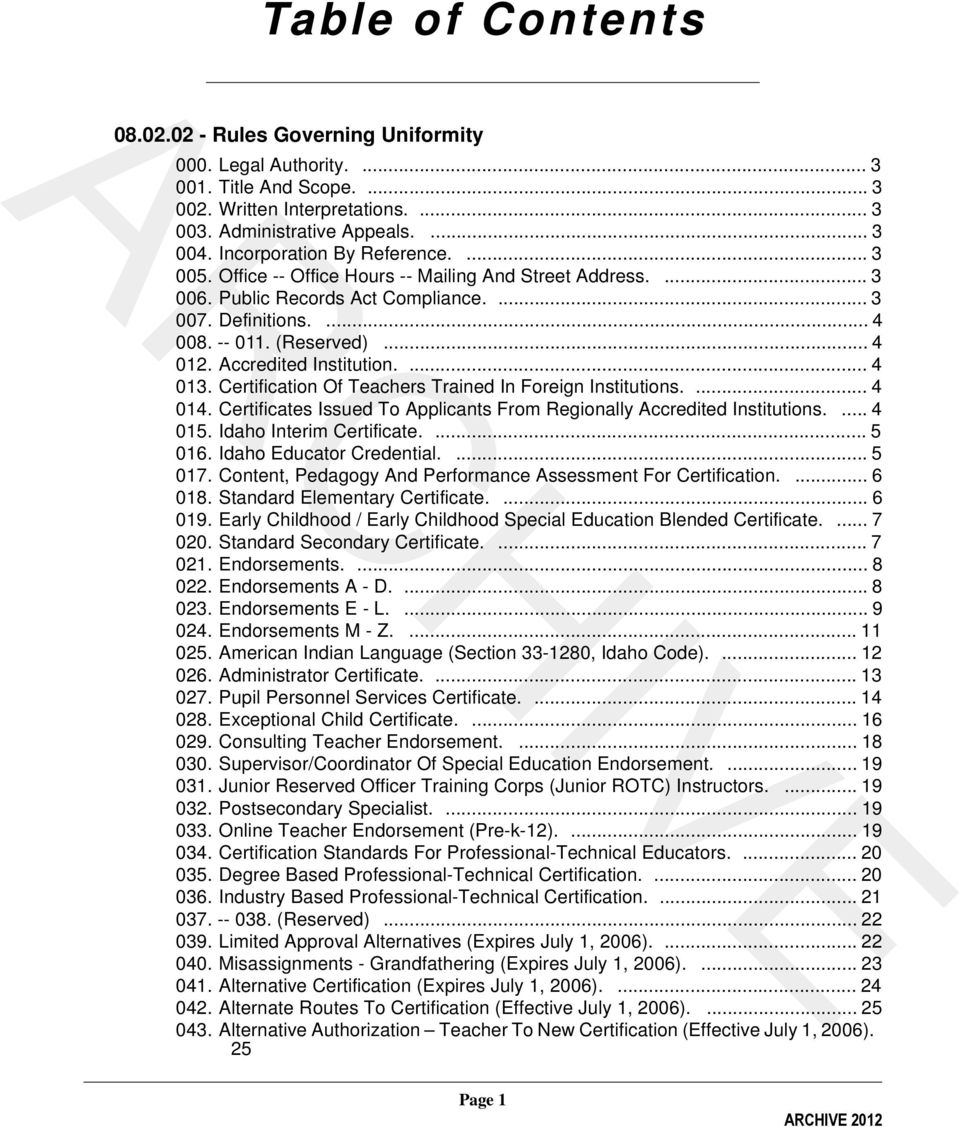
1 Table of Contents Legal Authority Title And Scope Written Interpretations Administrative Appeals Incorporation By Reference Office -- Office Hours -- Mailing And Street Address Public Records Act Compliance Definitions (Reserved) Accredited Institution Certification Of Teachers Trained In Foreign Institutions Certificates Issued To Applicants From Regionally Accredited Institutions Idaho Interim Certificate Idaho Educator Credential Content, Pedagogy And Performance Assessment For Certification Standard Elementary Certificate Early Childhood / Early Childhood Special Education Blended Certificate Standard Secondary Certificate Endorsements Endorsements A - D Endorsements E - L Endorsements M - Z American Indian Language (Section , Idaho Code) Administrator Certificate Pupil Personnel Services Certificate Exceptional Child Certificate Consulting Teacher Endorsement Supervisor/Coordinator Of Special Education Endorsement Junior Reserved Officer Training Corps (Junior ROTC) Instructors Postsecondary Specialist Online Teacher Endorsement (Pre-k-12) Certification Standards For Professional-Technical Educators Degree Based Professional-Technical Certification Industry Based Professional-Technical Certification (Reserved) Limited Approval Alternatives (Expires July 1, 2006) Misassignments - Grandfathering (Expires July 1, 2006) Alternative Certification (Expires July 1, 2006) Alternate Routes To Certification (Effective July 1, 2006) Alternative Authorization Teacher To New Certification (Effective July 1, 2006). 25 Page 1
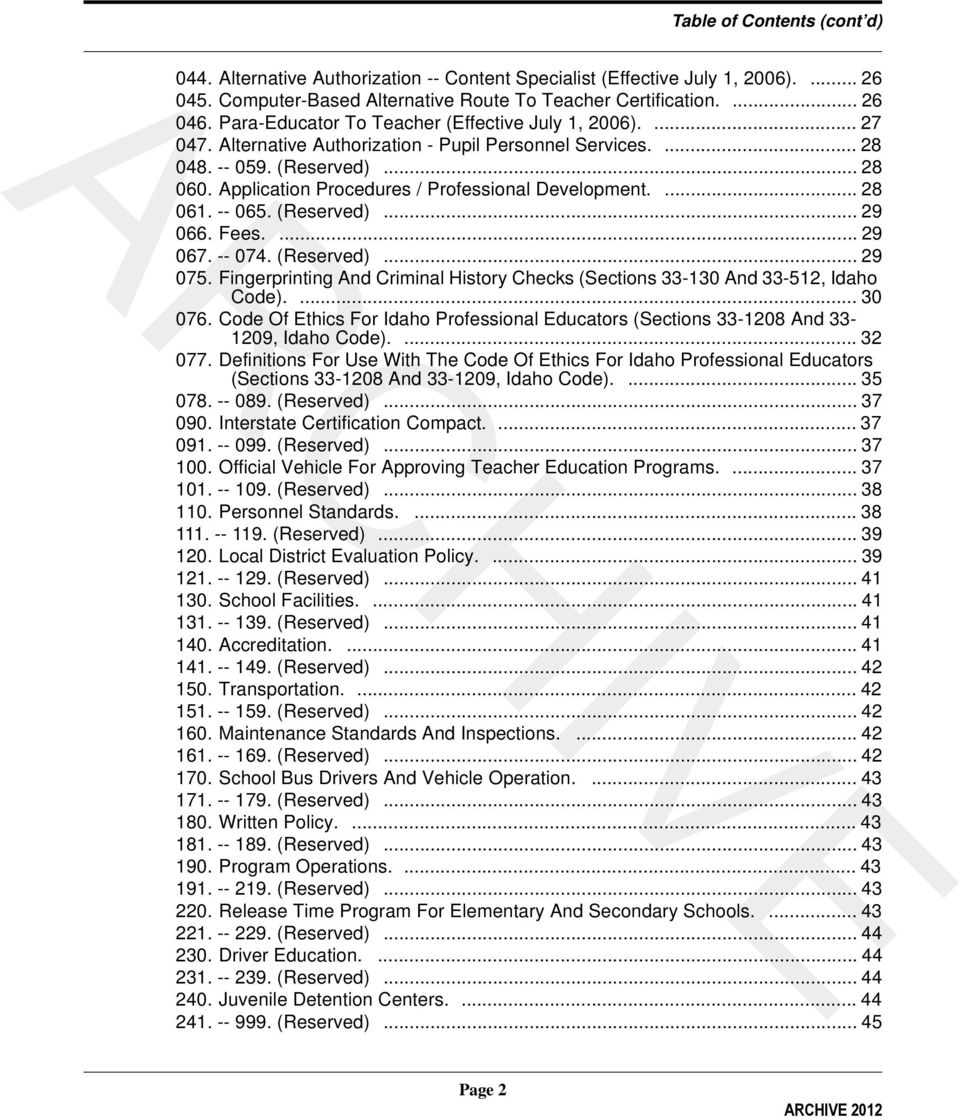
2 Table of Contents (cont d) 044. Alternative Authorization -- Content Specialist (Effective July 1, 2006) Computer-Based Alternative Route To Teacher Certification Para-Educator To Teacher (Effective July 1, 2006) Alternative Authorization - Pupil Personnel Services (Reserved) Application Procedures / Professional Development (Reserved) Fees (Reserved) Fingerprinting And Criminal History Checks (Sections And , Idaho Code) Code Of Ethics For Idaho Professional Educators (Sections And , Idaho Code) Definitions For Use With The Code Of Ethics For Idaho Professional Educators (Sections And , Idaho Code) (Reserved) Interstate Certification Compact (Reserved) Official Vehicle For Approving Teacher Education Programs (Reserved) Personnel Standards (Reserved) Local District Evaluation Policy (Reserved) School Facilities (Reserved) Accreditation (Reserved) Transportation (Reserved) Maintenance Standards And Inspections (Reserved) School Bus Drivers And Vehicle Operation (Reserved) Written Policy (Reserved) Program Operations (Reserved) Release Time Program For Elementary And Secondary Schools (Reserved) Driver Education (Reserved) Juvenile Detention Centers (Reserved) Page 2
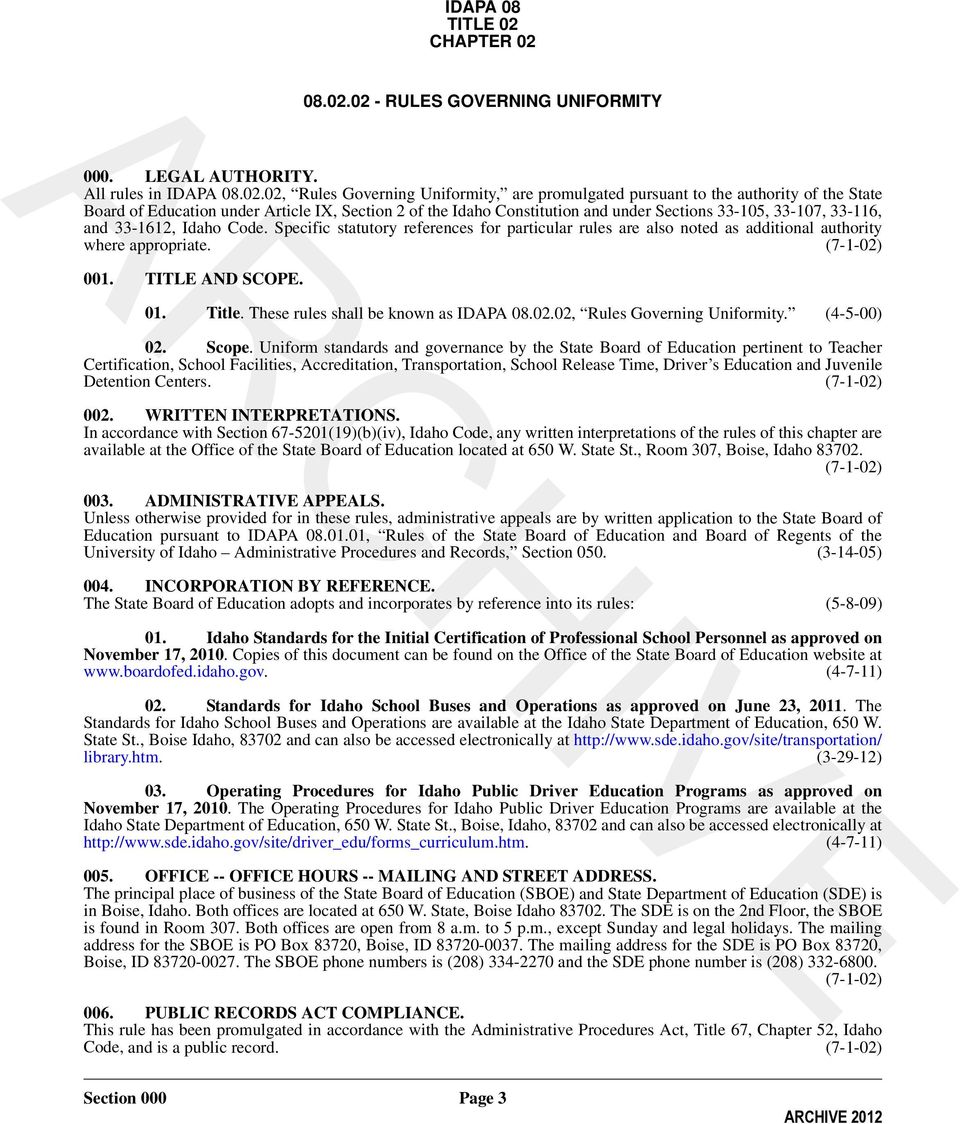
3 IDAPA 08 TITLE 02 CHAPTER RULES GOVERNING UNIFORMITY 000. LEGAL AUTHORITY. All rules in IDAPA ,, are promulgated pursuant to the authority of the State Board of Education under Article IX, Section 2 of the Idaho Constitution and under Sections , , , and , Idaho Code. Specific statutory references for particular rules are also noted as additional authority where appropriate. (7-1-02) 001. TITLE AND SCOPE. 01. Title. These rules shall be known as IDAPA ,. (4-5-00) 02. Scope. Uniform standards and governance by the pertinent to Teacher Certification, School Facilities, Accreditation, Transportation, School Release Time, Driver s Education and Juvenile Detention Centers. (7-1-02) 002. WRITTEN INTERPRETATIONS. In accordance with Section (19)(b)(iv), Idaho Code, any written interpretations of the rules of this chapter are available at the Office of the located at 650 W. State St., Room 307, Boise, Idaho (7-1-02) 003. ADMINISTRATIVE APPEALS. Unless otherwise provided for in these rules, administrative appeals are by written application to the State Board of Education pursuant to IDAPA , Rules of the and Board of Regents of the University of Idaho Administrative Procedures and Records, Section 050. ( ) 004. INCORPORATION BY REFERENCE. The adopts and incorporates by reference into its rules: (5-8-09) 01. Idaho Standards for the Initial Certification of Professional School Personnel as approved on November 17, Copies of this document can be found on the Office of the website at (4-7-11) 02. Standards for Idaho School Buses and Operations as approved on June 23, The Standards for Idaho School Buses and Operations are available at the Idaho State Department of Education, 650 W. State St., Boise Idaho, and can also be accessed electronically at library.htm. ( ) 03. Operating Procedures for Idaho Public Driver Education Programs as approved on November 17, The Operating Procedures for Idaho Public Driver Education Programs are available at the Idaho State Department of Education, 650 W. State St., Boise, Idaho, and can also be accessed electronically at (4-7-11) 005. OFFICE -- OFFICE HOURS -- MAILING AND STREET ADDRESS. The principal place of business of the (SBOE) and State Department of Education (SDE) is in Boise, Idaho. Both offices are located at 650 W. State, Boise Idaho The SDE is on the 2nd Floor, the SBOE is found in Room 307. Both offices are open from 8 a.m. to 5 p.m., except Sunday and legal holidays. The mailing address for the SBOE is PO Box 83720, Boise, ID The mailing address for the SDE is PO Box 83720, Boise, ID The SBOE phone numbers is (208) and the SDE phone number is (208) (7-1-02) 006. PUBLIC RECORDS ACT COMPLIANCE. This rule has been promulgated in accordance with the Administrative Procedures Act, Title 67, Chapter 52, Idaho Code, and is a public record. (7-1-02) Section 000 Page 3
4 007. DEFINITIONS. 01. Active Teacher. K-12 teacher with a valid Idaho certificate who is currently teaching in an Idaho K-12 classroom/school. ( ) 02. Alternative Routes. Routes to teacher certification designed for candidates who want to enter the teaching profession from non-education professions or the para-educator profession, or for teachers lacking certification in a specific area defined as an emergency district need. ( ) 03. Credential. The general term used to denote the document on which all of a person s educational certificates and endorsements are listed. The holder is entitled to provide educational services in any and/or all areas listed on the credential. ( ) 04. Endorsement. Term used to refer to the content area or specific area of expertise in which a holder is granted permission to provide services. ( ) 05. Idaho Student Achievement Standards. Standards of achievement for Idaho s K-12 students. See IDAPA , Rules Governing Thoroughness. ( ) 06. Institutional Recommendation. Signed form or written verification from an accredited institution with an approved teacher preparation program stating that an individual has completed the program and is now being recommended for state certification. ( ) 07. Orientation. School district/school process used to acquaint teachers new to district/school on its policies, procedures and processes. ( ) 08. Para-Educator. Aides and assistants employed by school districts to supplement instruction and provide additional assistance to students. ( ) 09. Pedagogy. Teaching knowledge and skills. ( ) (RESERVED) 012. ACCREDITED INSTITUTION. For purposes of teacher certification, an accredited school, college, university, or other teacher training institution is considered by the Idaho to be one that is accredited by a regional accrediting association recognized by the or an alternative model approved by the. (Sections ; ; , Idaho Code) (4-1-97) 013. CERTIFICATION OF TEACHERS TRAINED IN FOREIGN INSTITUTIONS. Considering credentials for teacher certification submitted by persons trained in the institutions of foreign countries will be initiated by a translation and evaluation of the applicant s credentials. (4-1-97) 01. Determination of Eligibility. Determination of eligibility for certification will be made by the State Department of Education as the agent of the. Appeals may be made to the Professional Standards Commission, (PSC). (Section , Idaho Code) ( ) 02. Other Procedures. All other procedures in effect at the time must be followed at the time of application. (4-1-97) 014. CERTIFICATES ISSUED TO APPLICANTS FROM REGIONALLY ACCREDITED INSTITUTIONS. 01. The Department of Education. The department of education is authorized to issue Idaho Certificates to applicants from regionally accredited institutions meeting requirements for certification or equivalent (i.e., those based on a bachelor s degree) in other states when they substantially meet the requirements for the Idaho Section 007 Page 4
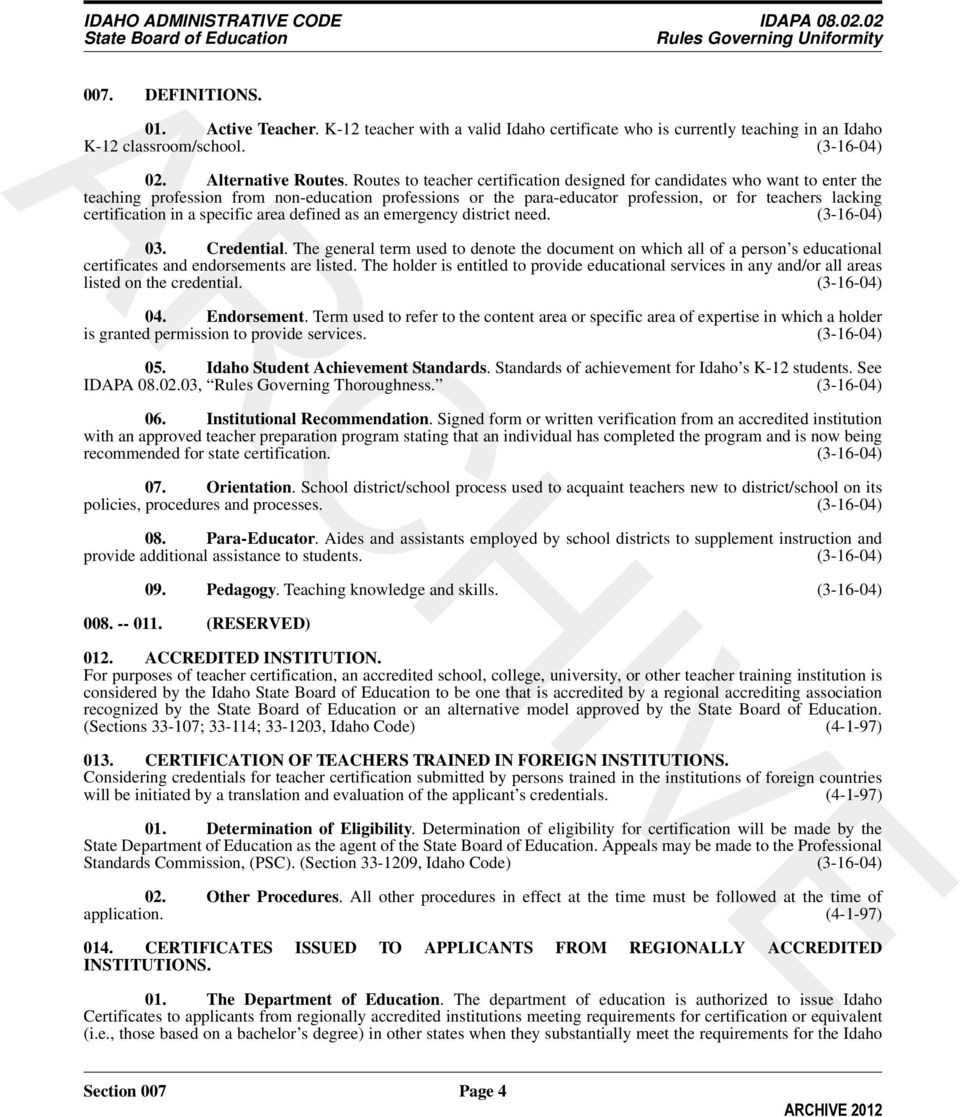
5 Certificate. (Sections ; Idaho Code) ( ) 02. The State Division of Professional-Technical Education. The state division of professionaltechnical education is authorized to determine whether applicants meet the requirements for instructing or administering professional-technical programs at the secondary and postsecondary levels. (Section , Idaho Code) ( ) 015. IDAHO INTERIM CERTIFICATE. 01. Issuance of Interim Certificate. The State Department of Education is authorized to issue a threeyear (3) interim certificate to those applicants who hold a valid certificate/license from another state or other entity that participates in the National Association of State Directors of Teacher Education and Certification (NASDTEC) Interstate Agreement. An interim certificate is nonrenewable except under extenuating circumstances. (4-2-08) a. Idaho Comprehensive Literacy Course. For all Idaho teachers working on interim certificates, alternate routes or coming from out of the state, completion of a state approved reading instruction course shall be a one-time requirement for full certification. (4-7-11) b. Technology. Out-of-state applicants will be reviewed by the hiring district for technology deficiencies and may be required to take technology courses to improve their technology skills. (4-7-11) 02. Reinstatement of Expired Certificate. An individual holding an expired Idaho certificate may be issued a nonrenewable three-year interim certificate. During the validity period of the interim certificate, the applicant must meet all current requirements listed for the specific certificate and endorsement(s) including the appropriate content, pedagogy, and performance assessments. ( ) 03. Foreign Institutions. An educator having graduated from a foreign institution that is listed in the Accredited Degree-Granting Institutions section of the Accredited Institutions of Postsecondary Education and having a valid/current teaching certificate/license from the country or province in which the foreign institution is located, may be issued a non-renewable, three-year interim certificate. The applicant must also complete the requirements listed in Section 013 of these rules. (4-2-08) 016. IDAHO EDUCATOR CREDENTIAL. The authorizes the State Department of Education to issue certificates and endorsements to those individuals meeting the specific requirements for each area provided herein. (Section , Idaho Code) ( ) 01. Renewal Requirement - Mathematics In-Service Program. In order to recertify, the state approved mathematics instruction course titled Mathematical Thinking for Instruction shall be required. The Mathematical Thinking for Instruction course consists of three (3) credits (or forty-five (45) contact hours of inservice training). Teachers and administrators shall take one (1) of the three (3) courses developed that each teacher deems to be most closely aligned with their current assignment prior to September 1, Any teacher or administrator successfully completing said course shall be deemed to have met the requirement of Subsection c. of this rule, regardless of whether such course is part of any official transcript. Successful completion of state approved mathematics instruction course shall be a one-time requirement for renewal of certification for those currently employed in an Idaho school district and shall be included within current requirements for continuing education for renewal. The following individuals listed in Subsection a. through e. shall successfully complete the Mathematical Thinking for Instruction course in order to recertify: (4-7-11) a. Each teacher holding an Early Childhood/Early Childhood Special Education Blended Certificate (Birth - Grade 3) who is employed in an elementary classroom (multi-subject classroom, K-8); ( ) b. Each teacher holding a Standard Elementary Certificate (K-8); ( ) c. Each teacher holding a Standard Secondary Certificate (6-12) teaching in a math content classroom (grade six (6) through grade twelve (12)) including Title I classrooms; ( ) Section 015 Page 5

6 d. Each teacher holding a Standard Exceptional Child Certificate (K-12); and ( ) e. Each school administrator holding an Administrator Certificate (Pre K-12). ( ) 02. Out-of-State Applicants. Out-of-state applicants shall take the state approved mathematics instruction course titled Mathematical Thinking for Instruction as a certification requirement. The Mathematical Thinking for Instruction course consists of three (3) credits (or forty-five (45) contact hours of in-service training). ( ) 017. CONTENT, PEDAGOGY AND PERFORMANCE ASSESSMENT FOR CERTIFICATION. 01. Assessments. approved content, pedagogy and performance area assessments shall be used in the state of Idaho to ensure qualified teachers are employed in Idaho s classrooms. The Professional Standards Commission shall recommend assessments and qualifying scores to the State Board of Education for approval. (4-2-08) 02. Out-of-State Waivers. An out-of-state applicant for Idaho certification holding a current certificate may request a waiver from the above requirement. The applicant shall provide evidence of passing a state approved content, pedagogy and performance area assessment(s) or hold current National Board for Professional Standards Teaching Certificate. (4-2-08) 03. Idaho Comprehensive Literacy Assessment. All applicants for initial Idaho certification (Kindergarten through grade twelve (12)) from an Idaho approved teacher education program must demonstrate competency in comprehensive literacy. Areas to be included as parts of the assessment are: phonological awareness, phonics, fluency, vocabulary, comprehension, writing, and assessments and intervention strategies. Each Idaho public higher education institution shall be responsible for the assessment of teacher candidates in its teacher preparation program. The assessment must measure teaching skills and knowledge congruent with current research on best literacy practices for elementary students or secondary students (adolescent literacy) dependent upon level of certification and English Language Learners. In addition the assessment must measure understanding and the ability to apply strategies and beliefs about language, literacy instruction, and assessments based on current research and best practices congruent with International Reading Association/National Council of Teachers of English standards, National English Language Learner s Association professional teaching standards, National Council for Accreditation of Teacher Education standards, and state accreditation standards. (4-7-11) 04. Technology Assessment. All applicants for initial Idaho certification (Kindergarten through grade twelve (12)) from an Idaho approved teacher education program must demonstrate proficiency in relevant technology skills and practices to enhance classroom management and instruction. Each Idaho public higher education institution shall be responsible for the assessment of teacher candidates in its teacher preparation program. The assessment must measure understanding and the ability to apply strategies and beliefs about the integration of technology based on current research and best practices congruent with the International Society for Technology in Education professional teaching standards, the National Council for Accreditation of Teacher Education standards, and state accreditation standards. (4-7-11) 018. STANDARD ELEMENTARY CERTIFICATE. A Standard Elementary Certificate makes an individual eligible to teach grades Kindergarten (K) through eight (8), and may be issued to any person who has a bachelor s degree from an accredited college or university and who meets the following requirements: ( ) 01. General Education Requirements. Completion of the general education requirements at an accredited college or university is required. ( ) 02. Professional Education Requirements. ( ) a. A minimum of twenty-four (24) semester credit hours, or thirty-six (36) quarter credit hours, in the philosophical, psychological, and methodological foundations and in the professional subject matter of elementary education, which shall include at least six (6) semester credit hours, or nine (9) quarter credit hours, in developmental reading and its application to the content area. ( ) Section 017 Page 6

7 b. At least six (6) semester credit hours, or nine (9) quarter credit hours, of elementary student teaching or two (2) years of satisfactory experience as a teacher in grades K-8. ( ) 03. Additional Requirements. An institutional recommendation from an accredited college or university or verification of two (2) years of teaching experience in grades Kindergarten (K) through eight (8). ( ) 04. Area of Endorsement. All individuals seeking a Standard Elementary Certificate shall complete the requirements for a subject area endorsement as outlined under requirements for a Standard Secondary Certificate. An endorsement allowing teaching of that subject through grade nine (9) or a K-12 endorsement shall be added to the Standard Elementary Certificate. (4-7-11) 05. Proficiency. Proficiency in areas noted above is measured by completion of the credit hour requirements provided herein. Additionally, each candidate shall meet or exceed the state qualifying score on approved elementary content area and pedagogy assessments. ( ) 019. EARLY CHILDHOOD / EARLY CHILDHOOD SPECIAL EDUCATION BLENDED CERTIFICATE. An Early Childhood / Early Childhood Special Education Blended Certificate is non-categorical and makes an individual eligible to teach in any educational setting for youth from birth to grade three (3), including those who are at-risk or have developmental delays. The Early Childhood / Early Childhood Special Education Blended Certificate may be issued to any person with a bachelor s degree from an accredited college or university and who meets the following minimum requirements: ( ) 01. General Education Requirements. Completion of the general education requirements at an accredited college or university is required. ( ) 02. Professional Education Requirements. ( ) a. A minimum of thirty (30) semester credit hours, or forty-five (45) quarter credit hours, in the philosophical, psychological, and methodological foundations, in instructional technology, and in the professional subject matter of early childhood and early childhood-special education. The professional subject matter of early childhood and early childhood-special education shall include course work specific to the young child from birth through grade three (3)in the areas of child development and learning; curriculum development and implementation; family and community relationships; assessment and evaluation; professionalism; and, application of technologies. ( ) b. The required thirty (30) semester credit hours, or forty-five (45) quarter credit hours, shall include not less than six (6) semester credit hours, or nine (9) quarter credit hours, of early childhood student teaching and three (3) semester credit hours, or four (4) quarter credit hours, of developmental reading. ( ) 03. Additional Requirements. An institutional recommendation from an accredited college or university, and passage of the Idaho Comprehensive Literacy Exam. ( ) 04. Proficiency. Proficiency in areas noted above is measured by completion of the credit hour requirements provided herein. Additionally, each candidate shall meet or exceed the state qualifying score on approved early-childhood assessments. ( ) 020. STANDARD SECONDARY CERTIFICATE. A Standard Secondary Certificate makes an individual eligible to teach in grades six (6) through twelve (12). A Secondary Certificate may be issued to any person with a bachelor s degree from an accredited college or university and who meets the following minimum requirements: ( ) 01. General Education Requirements. Completion of the general education requirements at an accredited college or university is required. ( ) Section 019 Page 7
8 02. Professional Education Requirements. ( ) a. A minimum of twenty (20) semester credit hours, or thirty (30) quarter credit hours, in the philosophical, psychological, and methodological foundations, instructional technology, and in the professional subject matter of secondary education, which must include at least three (3) semester credit hours, or four (4) quarter credit hours, of reading in the content area. ( ) b. The required twenty (20) semester credit hours, or thirty (30) quarter credit hours, must also include at least six (6) semester credit hours, or nine (9) quarter credit hours, of secondary student teaching or two (2) years of satisfactory experience as a teacher in grades six (6) through twelve (12). ( ) 03. Teaching Field Requirements. Preparation in at least two (2) fields of secondary teaching: a first teaching field of at least thirty (30) semester credit hours, or forty-five (45) quarter credit hours, and a second teaching field of at least twenty (20) semester credit hours, or thirty (30) quarter credit hours. Preparation of not less than forty-five (45) semester credit hours, or sixty-seven (67) quarter credit hours, in a single subject area may be used in lieu of the first teaching field or second teaching field requirements. ( ) 04. Additional Requirements. An institutional recommendation from an accredited college or university or verification of two (2) years of teaching experience in grades six (6) through twelve (12). ( ) 05. Proficiency. Proficiency in areas noted above is measured by completion of the credit hour requirements provided herein. Additionally, each candidate must have a qualifying score on an approved content area assessment in any area(s) for which the certificate or endorsement(s) will be applied. ( ) 021. ENDORSEMENTS. Holders of a Secondary Certificate or a Standard Elementary Certificate, Exceptional Child Certificate, Standard Occupational Specialist Certificate, and Advanced Occupational Specialist Certificate may be granted endorsements in subject areas as provided herein. An official statement of competency in a teaching area or field is acceptable in lieu of courses for a teaching major or minor if such statements originate in the department or division of the accredited college or university in which the competency is established and are approved by the director of teacher education of the recommending college or university. To add an endorsement to an existing credential, an individual shall complete the credit hour requirements as provided herein and shall also meet or exceed the state qualifying score on appropriate, state approved content, pedagogy and performance assessments. When converting semester credit hours to quarter credit hours, two (2) semester credit hours is equal to three (3) quarter credit hours. ( ) 022. ENDORSEMENTS A - D. 01. Agriculture Science and Technology (6-12). ( ) a. Forty-five (45) semester credit hours including course work in each of the following areas: agriculture education; agriculture mechanics; agriculture business management; soil science; animal science; and plant science. ( ) b. Occupational teacher preparation coursework as provided in Sections 034 through 038. ( ) 02. American Government /Political Science (6-12). Twenty (20) semester credit hours to include: a minimum of six (6) semester credit hours in American Government, six (6) semester credit hours in U.S. History Survey, and a minimum of three (3) semester credit hours in Comparative Government. Remaining course work must be selected from Political Science. Course work may include three (3) semester credit hours in World History Survey. ( ) 03. Art (K-12 or 6-12). Twenty (20) semester credit hours leading toward competency as defined by Idaho Standards for Visual Arts Teachers in the area of Art to include a minimum of nine (9) semester credit hours in: Foundation Art and Design. Additional course work must include at least two (2) Studio Areas and Secondary Arts Methods. To obtain an Art (K-12) endorsement, applicants holding a Secondary Certificate must complete an elementary methods course. (4-7-11) Section 021 Page 8
9 04. Bilingual Education (K-12). Twenty (20) semester credit hours to include six (6) upper division credits in Modern Languages, including writing and literature; three (3) semester credit hours in cross-cultural or multi-cultural course work; three (3) semester credit hours in ENL/Bilingual Methods; three (3) semester credit hours in Linguistics; three (3) semester credit hours in Foundations, Federal and State Law, Theory, Testing/identification of Limited English Proficient Students; one (1) semester credit hour in Bilingual Practicum; and one (1) semester credit hour in Bilingual Field Experience. ( ) 05. Biological Science (6-12). Twenty (20) semester credit hours to include at least six (6) semester credit hours of course work in each of the following areas: Botany and Zoology. ( ) 06. Business Technology Education (6-12). ( ) a. Twenty (20) semester credit hours to include course work in each of the following areas: Intermediate or Advanced Keyboarding; Accounting; and Business/Office Procedures. ( ) b. Occupational teacher preparation as provided in Sections 034 through 038. ( ) 07. Chemistry (6-12). Twenty (20) semester credit hours in the area of Chemistry. ( ) 08. Communication (6-12). Follow one (1) of the following options: ( ) a. Option I: Twenty (20) semester credit hours to include Methods of Teaching Speech/ Communications plus course work in at least four (4) of the following areas: Interpersonal Communication/Human Relations; Argumentation/Personal Persuasion; Group Communications; Nonverbal Communication; Public Speaking; and Drama/Theater Arts. ( ) b. Option II: Possess an English endorsement plus at least twelve (12) semester credit hours distributed among the following: Interpersonal Communication/Human Relations, Public Speaking, and Methods of Teaching Speech/Communication. ( ) 10. Drama (6-12). Twenty (20) semester credit hours leading toward competency as defined by Idaho Standards for Drama Teachers, including a minimum of sixteen (16) semester credit hours in Drama or Theater Arts, including course work in each of the following: Acting, Directing, and Technical Stage Production, and four (4) semester credit hours in Communications. To obtain a Drama (6-12) endorsement, applicants must complete a comprehensive methods course including the pedagogy of acting, directing and technical theatre. (4-7-11) 11. Driver Education (6-12). Two (2) semester credit hours in Basic Driver Education for Teachers and two (2) semester credit hours in any of the following: Advanced Driver Education; Driver Simulation Education; Traffic Engineering; General Safety Education; or Highway Transportation. Additionally, an individual must have three (3) years of satisfactory driving experience immediately prior to endorsement as verified by the Motor Vehicle Division of the State Department of Transportation. ( ) 023. ENDORSEMENTS E - L. 01. Earth Science (6-12). Twenty (20) semester credit hours including course work in each of the following: Earth Science, Astronomy, and Geology. ( ) 02. Economics (6-12). Twenty (20) semester credit hours to include a minimum of three (3) semester credit hours of micro-economics, a minimum of three (3) semester credit hours of macro-economics, and a minimum of six (6) semester credit hours of Personal Finance/Consumer Economics/Economics Methods. Remaining course work may be selected from economics and finance course work in one (1) or more of the following areas: Agriculture Science and Technology, Business Education, Economics, Family and Consumer Science, or Marketing Education. ( ) 03. English (6-12). Twenty (20) semester credit hours, including three (3) semester credit hours in Linguistics/Grammar, three (3) semester credit hours in American Literature, three (3) semester credit hours in English Literature, six (6) semester credit hours in Advanced Composition, excluding the introductory sequence Section 023 Page 9

10 designed to meet general education requirements. Remaining credits must be completed in the English Department, and must include some course work in Writing Methods for Teachers of Secondary Students. ( ) 04. English as a New Language (ENL) (K-12). Twenty (20) semester credit hours to include four (4) semester credit hours in a modern language other than English; three (3) semester credit hours in Cultural Diversity; three (3) semester credit hours in ENL Methods; three (3) semester credits in Linguistics; three (3) semester credit hours in Foundations, Federal and State Law, Theory, Testing/Identification of Limited English Proficient Students; one (1) semester credit in ENL Practicum or Field Experience; and three (3) semester credit hours in an ENL related elective. ( ) 05. Family and Consumer Science (6-12). ( ) a. Thirty (30) semester credit hours to include coursework in each of the following: Child/Human Development; Human/Family Relations; Directed Laboratory Experience in Childcare; Clothing and Textiles, Cultural Dress, Fashion Merchandising, or Design Nutrition; Food Preparation, Food Production, or Culinary Arts; Housing, Interior Design, Home Management, or Equipment; Consumer Economics or Family Resource Management; Introduction to Family Consumer Sciences; and, Integration of Family Consumer Sciences or Family Consumer Science Methods. ( ) b. Occupational Teacher Preparation as provided in Sections 034 through 038. ( ) 06. Foreign Language (6-12 or K-12). Twenty (20) semester credit hours in a specific foreign language including course work in two (2) or more of the following areas: Grammar, Conversation, Composition, Culture, and Literature; and course work in Foreign Language Methods. To obtain an endorsement in a specific foreign language (K-12), applicants holding a Secondary Certificate must complete an elementary methods course. ( ) 07. Geography (6-12). Twenty (20) semester credit hours including course work in Cultural Geography and Physical Geography, and a maximum of six (6) semester credit hours in World History Survey. Remaining semester credit hours must be selected from Geography. ( ) 08. Geology (6-12). Twenty (20) semester credit hours in the area of Geology. ( ) 09. Gifted and Talented (K-12). Twenty (20) semester credit hours, to include a minimum of three (3) semester credits hours in each of the following: Foundations of Gifted and Talented Education; Creative/Critical Thinking Skills for Gifted and Talented Students; Social and Emotional Needs of Gifted and Talented Students; Curriculum and Instruction for Gifted and Talented Students; and Practicum and Program Design for Gifted and Talented Education. Remaining course work must be in the area of gifted education. (5-8-09) 10. Health (6-12 or K-12). Twenty (20) semester credit hours to include course work in Organization/ Administration/Planning of a School Health Program; Health and Wellness; Secondary Methods of Teaching Health; Elementary methods of Teaching Health; Mental/Emotional Health; Nutrition; Human Sexuality; Substance Use and Abuse. Remaining semester credits must be in health-related course work. (4-7-11) 11. History (6-12). Twenty (20) semester credit hours to include a minimum of six (6) semester credit hours of U.S. History Survey and a minimum of six (6) semester credit hours of World History Survey. Remaining course work must be in History. Course work may include three (3) semester credit hours in American Government. ( ) 12. Humanities (6-12). An endorsement in English, History, Music, Visual Art, Drama, or Foreign Language and twenty (20) semester credit hours in one of the following areas or ten (10) semester credit hours in each of two (2) of the following areas: Literature, Music, Foreign Language, Humanities Survey, History, Visual Art, Philosophy, Drama, Comparative World Religion, Architecture, and Dance. ( ) 13. Journalism (6-12). Follow one (1) of the following options: ( ) a. Option I: Twenty (20) semester credit hours to include a minimum of sixteen (16) semester credit Section 023 Page 10

11 hours in Journalism and four (4) semester credit hours in English. ( ) b. Option II: Possess an English endorsement with a minimum of six (6) semester credit hours in Journalism. ( ) 14. Library Media Specialist (K-12). Twenty (20) semester credit hours in the field of Education Media or Library Science, including a minimum of: (5-8-09) a. Collection Development/Materials Selection; (5-8-09) b. Literature for Youth or Children; (5-8-09) c. Organization of Information (Cataloging and Classification); (5-8-09) d. School Library Administration/Management; and (5-8-09) e. Library Information Technologies and Information Literacy. (5-8-09) 15. Literacy (K-12). Twenty (20) semester credit hours in the area of Literacy including a minimum of three (3) semester credit hours in each of the following areas: Foundations of Reading or Developmental Reading; Reading in the Content Area; Literature for Youth; Psycholinguistics or Language Development; Corrective/ Diagnostic/Remedial Reading; and Teaching Writing. To obtain a Literacy endorsement, applicants must complete the Idaho Comprehensive Literacy Course or the Idaho Comprehensive Literacy Assessment. Remaining credits must be taken in the area of teaching literacy. (5-8-09) 024. ENDORSEMENTS M - Z. 01. Marketing Technology Education (6-12). ( ) a. Twenty (20) semester credit hours to include course work in each of the following areas: Marketing; Management; Economics; Coordination of Cooperative Programs; Merchandising/Retailing; and Curriculum and Materials Marketing, with remaining credit hours in the field of business. ( ) b. Occupational teacher preparation as provided in Sections 034 through 038. ( ) 02. Mathematics - Basic (6-12). Twenty (20) semester credit hours in Mathematics including course work in Algebra, Geometry, and Trigonometry. Six (6) semester credit hours of computer programming may be substituted for six (6) semester credits in Mathematics. ( ) 03. Mathematics (6-12). Twenty (20) semester credit hours including course work in each of the following areas: Geometry, Linear Algebra, Discrete Mathematics, Probability and Statistics, and a minimum of three (3) semester credit hours of Calculus. Statistics course work may be taken from a department other than the mathematics department. ( ) 04. Music (6-12 or K-12). Twenty (20) semester credit hours leading toward competency as defined by Idaho Standards for Music Teachers to include course work in the following: Theory and Harmony; Aural Skills, Music History; Conducting; Applied Music; and Piano Proficiency (Class Piano or Applied Piano), and Secondary Music Methods/Materials. To obtain a Music K-12 endorsement, applicants must complete an elementary music methods course. (4-7-11) 05. Natural Science (6-12). Follow one (1) of the following options: (4-7-11) a. Option I: Must hold an existing endorsement in one of the following areas: Biological Science, Chemistry, Earth Science, Geology, or Physics; and complete a total of twenty-four (24) semester credit hours as follows: (4-7-11) i. Existing Biological Science Endorsement. Minimum of eight (8) semester credit hours in each of Section 024 Page 11

12 the following areas: Physics, Chemistry, and Earth Science or Geology. (4-7-11) ii. Existing Physics Endorsement. Minimum of eight (8) semester credit hours in each of the following areas: Biology, Chemistry, and Earth Science or Geology. (4-7-11) iii. Existing Chemistry Endorsement. Minimum of eight (8) semester credit hours in each of the following areas: Biology, Physics, and Earth Science or Geology. (4-7-11) iv. Existing Earth Science or Geology Endorsement. Minimum of eight (8) semester credit hours in each of the following areas: Biology, Physics, and Chemistry. (4-7-11) b. Option II: Must hold an existing endorsement in Agriculture Science and Technology; and complete twenty (20) semester credit hours with at least four (4) semester credit hours in each of the following areas: Biology, Chemistry, Earth Science or Geology, and Physics. (4-7-11) 06. Physics (6-12). Twenty (20) semester credit hours in the area of Physics. ( ) 07. Physical Education (PE) (6-12 or K-12). Twenty (20) semester credit hours to include course work in each of the following areas: Sport, Movement, and Outdoor Skills; Elementary PE Methods; Secondary PE Methods; Student Evaluation in PE; Administration of a PE Program; Safety and Prevention of Injuries; Fitness and Wellness; PE for Special Populations; Exercise Physiology; Kinesiology/Biomechanics; Sports Psychology or Sociology; Motor Behavior; and Current CPR and First Aid Certification. ( ) 08. Physical Education/Health. Must have an endorsement in both physical education and health. ( ) 09. Physical Science (6-12). Twenty (20) semester credit hours in the area of physical science to include a minimum of eight (8) semester credit hours in each of the following: Chemistry and Physics. ( ) 10. Psychology. Twenty (20) semester credit hours in the area of Psychology. ( ) 11. Social Studies (6-12). Must have an endorsement in History, American Government/Political Science, Economics, or Geography plus a minimum of twelve (12) semester credit hours in each of the remaining core endorsements areas: History, Geography, Economics, and American Government/Political Science. ( ) 12. Sociology (6-12). Twenty (20) semester credit hours in the area of Sociology. ( ) 13. Sociology/Anthropology (6-12). Twenty (20) semester credit hours including a minimum of six (6) semester credit hours in each of the following: Anthropology and Sociology. ( ) 14. Technology Education (6-12). ( ) a. Twenty (20) semester credit hours to include course work in each of the following areas: Communication Technology; Computer Applications; Construction Technology; Electronics Technology; Manufacturing Technology; Power, Energy and Transportation; and Principles of Technology. ( ) b. Occupational teacher preparation as provided in Sections 034 through 038. ( ) 025. AMERICAN INDIAN LANGUAGE (SECTION , IDAHO CODE). Each Indian tribe shall provide to the State Department of Education the names of those highly and uniquely qualified individuals who have been designated to teach the tribe's native language in accordance with Section , Idaho Code. Individuals identified by the tribe(s) may apply for an Idaho American Indian Certificate as American Indian languages teachers. (4-9-09) 01. Process the Application. The Office of Indian Education at the State Department of Education will process an application that has met the requirements of the Tribe(s) for an American Indian languages teacher. (4-9-09) Section 025 Page 12
13 02. Approval Has Been Received. Once an application with Tribal approval has been received, it will be reviewed and, if approved, it will be forwarded to the Office of Certification for a criminal history background check as required in Section , Idaho Code. The application must include a ten finger fingerprint card or scan and a forty dollar ($40) fee for undergoing a criminal history check pursuant to Section , Idaho Code. (4-9-09) 03. Office of Certification. The Office of Certification will review the application and verify the applicant is eligible for an Idaho American Indian Certificate. The State Department of Education shall authorize an eligible applicant as an American Indian languages teacher. An Idaho American Indian Certificate is valid for not more than five (5) years. Individuals may apply for a renewal certificate. (4-9-09) 026. ADMINISTRATOR CERTIFICATE. Every person who serves as a superintendent, a secondary school principal, or principal of an elementary school with eight (8) or more teachers (including the principal), or is assigned administrative duties over and above those commonly assigned to teachers, is required to hold an Administrator Certificate. The certificate may be endorsed for service as a school principal, a superintendent, or a director of special education and related services. Assistant superintendents are required to hold the Superintendent endorsement. Assistant principals or vice-principals are required to hold the Principal endorsement. Applicants for the Director of Special Education and Related Services endorsement will hold that endorsement on an Administrator Certificate. Possession of an Administrator Certificate does not entitle the holder to serve as a teacher at a grade level for which the educator is not qualified or certificated. All administrator certificates require candidates to meet the following competencies of the Idaho Foundation Standards for School Administrators: Visionary and Strategic Planning, Instructional Leadership, Management and Organizational Leadership, Family and Community Partnerships, Professional and Ethical Leadership, and Governance and Legal Leadership. ( ) 01. School Principal Endorsement (Pre-K-12). To be eligible for an Administrator Certificate endorsed for School Principal Pre-K-12, a candidate must have satisfied the following requirements: ( ) a. Hold a master s degree from an accredited college or university. ( ) b. Have four (4) years of full-time certificated experience working with students, Pre-K-12, while under contract in an accredited school setting. ( ) c. Have completed an administrative internship in a state-approved program, or have one (1) year of experience as an administrator in grades Pre-K-12. ( ) d. Provide verification of completion of a state-approved program of at least thirty (30) semester credit hours, forty-five (45) quarter credit hours, of graduate study in school administration for the preparation of school principals at an accredited college or university. This program shall include the competencies of the Idaho Foundation Standards for School Administrators: Visionary and Strategic Planning, Instructional Leadership, Management and Organizational Leadership, Family and Community Partnerships, Professional and Ethical Leadership, and Governance and Legal Leadership. ( ) e. An institutional recommendation is required for a School Principal Pre-K-12 Endorsement. ( ) 02. Superintendent Endorsement. To be eligible for an Administrator Certificate with a Superintendent endorsement, a candidate must have satisfied the following requirements: ( ) a. Hold an education specialist or doctorate degree or complete a comparable post-master s sixth year program at an accredited college or university. ( ) b. Have four (4) years of full-time certificated/licensed experience working with Pre-K-12 students while under contract in an accredited school setting. ( ) c. Have completed an administrative internship in a state-approved program for the superintendent endorsement or have one (1) year of out-of-state experience as an assistant superintendent or superintendent in grades Section 026 Page 13
14 Pre-K-12. ( ) d. Provide verification of completion of an approved program of at least thirty (30) semester credit hours, or forty-five (45) quarter credit hours, of post-master s degree graduate study for the preparation of school superintendents at an accredited college or university. This program in school administration and interdisciplinary supporting areas shall include the competencies in Superintendent Leadership, in additional to the competencies in the Idaho Foundation Standards for School Administrators: Visionary and Strategic Planning, Instructional Leadership, Management and Organizational Leadership, Family and Community Partnerships, Professional and Ethical Leadership, and Governance and Legal Leadership. ( ) e. An institutional recommendation is required for a School Superintendent Endorsement. ( ) 03. Director of Special Education and Related Services Endorsement (Pre-K-12). To be eligible for an Administrator Certificate endorsed for Director of Special Education and Related Services Pre-K-12, a candidate must have satisfied all of the following requirements: ( ) a. Hold a master s degree from an accredited college or university. ( ) b. Have four (4) years of full-time certificated/licensed experience working with students Pre-K-12, while under contract in a school setting. ( ) c. Obtain college or university verification of demonstrated the competencies of the Idaho Foundation Standards for School Administrators: Visionary and Strategic Planning, Instructional Leadership, Management and Organizational Leadership, Family and Community Partnerships, Professional and Ethical Leadership, and Governance and Legal Leadership. ( ) d. Obtain college or university verification of demonstrated competencies in the following areas, in addition to the competencies in the Idaho Foundation Standards for School Administrators: Concepts of Least Restrictive Environment; Post-School Outcomes and Services for Students with Disabilities Ages Three (3) to Twenty-one (21); Collaboration Skills for General Education Intervention; Instructional and Behavioral Strategies; Individual Education Programs (IEPs); Assistive and Adaptive Technology; Community-Based Instruction and Experiences; Data Analysis for Instructional Needs and Professional Training; Strategies to Increase Program Accessibility; Federal and State Laws and Regulations and School District Policies; Resource Advocacy; and Technology Skills for Referral Processes, and Record Keeping. ( ) e. Have completed an administrative internship/practicum in the area of administration of special education and related services. ( ) f. An institutional recommendation is required for Director of Special Education and Related Services Pre-K-12 Endorsement. ( ) 027. PUPIL PERSONNEL SERVICES CERTIFICATE. Persons who serve as school counselors, school psychologists, speech-language pathologists, school social workers, school nurses and school audiologists are required to hold the Pupil Personnel Services Certificate, with the respective endorsement(s) for which they qualify. ( ) 01. Counselor Endorsement (K-12). To be eligible for a Pupil Personnel Services Certificate endorsed Counselor K-12, a candidate must have satisfied the following requirements. The Pupil Personnel Services Certificate with a Counselor endorsement is valid for five (5) years. Six (6) semester credit hours are required every five (5) years in order to renew the endorsement. (5-8-09) a. Hold a master's degree and provide verification of completion of an approved program of graduate study in school guidance and counseling from a college or university approved by the Idaho or the state educational agency of the state in which the program was completed. The program must include successful completion of seven hundred (700) clock hours of supervised field experience, seventy-five percent (75%) of which must be in a K-12 school setting. Substantial amounts of this K-12 experience must be in each of the following levels: elementary, middle/junior high, and high school. Previous school counseling experience may be Section 027 Page 14

15 considered to help offset the field experience clock hour requirement. (5-8-09) b. An institutional recommendation is required for a Counselor K-12 Endorsement. (5-8-09) 02. School Psychologist Endorsement. This endorsement is valid for five (5) years. In order to renew the endorsement, six (6) professional development credits are required every five (5) years. The renewal credit requirement may be waived if the applicant holds a current valid National Certification for School Psychologists (NCSP) offered through the National Association of School Psychologists (NASP). To be eligible for initial endorsement, a candidate must complete a minimum of sixty (60) graduate semester credit hours which must be accomplished through one (1) of the following options: ( ) a. Completion of an approved thirty (30) semester credit hour, or forty-five (45) quarter credit hours, master's degree in education or psychology and completion of an approved thirty (30) semester credit hour, or fortyfive (45) quarter credit hour, School Psychology Specialist Degree program, and completion of a minimum of twelve hundred (1,200) clock-hour internship within a school district under the supervision of the training institution and direct supervision of a certificated school psychologist. (4-7-11) b. Completion of an approved sixty (60) semester credit hour, or ninety (90) quarter credit hour, master's degree program in School Psychology, and completion of a minimum of twelve hundred (1,200) clock-hour internship within a school district under the supervision of the training institution and direct supervision of a certificated school psychologist. (4-7-11) c. Completion of an approved sixty (60) semester credit hour, or ninety (90) quarter credit hour, School Psychology Specialist degree program which did not require a master's degree as a prerequisite, with laboratory experience in a classroom, which may include professional teaching experience, student teaching or special education practicum, and completion of a minimum twelve hundred (1,200) clock-hour internship within a school district under the supervision of the training institution and direct supervision of a certificated school psychologist. (5-8-09) d. Earn a current and valid National Certification for School Psychologists (NCSP) issued by the National Association of School Psychologists (NASP). ( ) 03. School Nurse Endorsement. This endorsement is valid for five (5) years. Six (6) credits are required every five (5) years in order to renew the endorsement. Initial endorsement may be accomplished through completion of either requirements in Subsections a. or b. in addition to the requirement of Subsection c. ( ) a. The candidate must possess a valid nursing (RN) license issued by the Idaho State Board of Nursing, and a bachelor s degree in nursing, education, or a health-related field from an accredited institution. (5-8-09) b. The candidate must possess a valid professional nursing (RN) license issued by the Idaho State Board of Nursing and have completed nine (9) semester credit hours from a university or college in at least three (3) of the following areas: (5-8-09) i. Health program management; (5-8-09) ii. Child and adolescent health issues; (5-8-09) iii. Counseling, psychology, or social work; or (5-8-09) iv. Methods of instruction. (5-8-09) c. Additionally, each candidate must have two (2) years full-time (or part-time equivalent) school nursing, community health nursing, or any area of pediatric, adolescent, or family nursing experience. (5-8-09) 04. Interim Endorsement - School Nurse. This certificate will be granted for those who do not meet Section 027 Page 15

16 the educational and/or experience requirements but who hold a valid professional nursing (RN) license in Idaho. An Interim Certificate - will be issued for three (3) years while the applicant is meeting the educational requirements, and it is not renewable. ( ) 05. Speech-Language Pathologist Endorsement. This endorsement is valid for five (5) years. Six (6) credits are required every five (5) years in order to renew the endorsement. Initial endorsement will be issued to candidates who possess a master s degree from an accredited college or university in a speech/language pathology program approved by the, and who receive an institutional recommendation from an accredited college or university. ( ) 06. Audiology Endorsement. This endorsement is valid for five (5) years. Six (6) credits are required every five (5) years in order to renew the endorsement. Initial endorsement will be issued to candidates who possess a master s degree from an accredited college or university in an audiology program approved by the State Board of Education, and who receive an institutional recommendation from an accredited college or university. ( ) 07. School Social Worker Endorsement. This endorsement is valid for five (5) years. Six (6) credit hours are required every five (5) years in order to renew the endorsement. Initial endorsement may be accomplished through possession of a social work certificate issued by the Idaho Bureau of Occupational Licenses, an institutional recommendation, and completion of one (1) of the following options: ( ) a. A master's degree in social work from an Idaho college or university approved by the State Board of Education, or a master's degree in social work from an out-of-state college or university. The program must be currently approved by the state educational agency of the state in which the program was completed. ( ) b. A master's degree in guidance and counseling, sociology, or psychology plus thirty (30) semester credit hours of graduate work in social work education, including course work in all the following areas: understanding the individual; casework method; field placement; social welfare programs and community resources; and research methods. ( ) 08. Interim Endorsement-Speech Language Pathologist. This certificate will be granted for those who do not meet the educational requirements but who hold a bachelor s degree in Speech language pathology and are pursuing a master s degree in order to obtain the pupil personnel services certificate endorsed in speech language pathology. An Interim Certificate will be issued for three (3) years while the applicant is meeting the educational requirements, and it is not renewable. ( ) 028. EXCEPTIONAL CHILD CERTIFICATE. Holders of this certificate work with children who have been identified as having an educational impairment. ( ) 01. General Education Requirements. Completion of the general education requirements at an accredited college or university is required. ( ) 02. Generalist Endorsement (K-12). The Generalist K-12 endorsement is non-categorical and allows one (1) to teach in any K-12 special education setting. This endorsement is valid for five (5) years. Six (6) credit hours are required every five (5) years for renewal. Regardless of prior special education experience, all initial applicants must provide an institutional recommendation that an approved special education program has been completed. To be eligible for an Exceptional Child Certificate with a Generalist K-12 endorsement, a candidate must have satisfied the following requirements: ( ) a. Completion of a baccalaureate degree from an accredited college or university. ( ) b. Completion, in an Idaho college or university, of a program in elementary, secondary, or special education currently approved by the Idaho, or completion, in an out-of-state college or university, of a program in elementary, secondary, or special education currently approved by the state educational agency of the state in which the program was completed. ( ) c. Completion of thirty (30) semester credit hours in special education, or closely related areas, as part Section 028 Page 16

17 of an approved special education program. ( ) d. Each candidate must have a qualifying score on an approved core content assessment and a second assessment related to the specific endorsement requested. ( ) 03. Early Childhood Special Education Endorsement (Pre-K-3). The Early Childhood Special Education (Pre-K-3) endorsement is non-categorical and allows one to teach in any Pre-K-3 special education setting. This endorsement may only be added to the Standard Exceptional Child Certificate in conjunction with the Generalist K-12 endorsement and is valid for five (5) years. Six (6) credit hours are required every five (5) years for renewal. To be eligible for an Exceptional Child Certificate with an Early Childhood Special Education (Pre-K-3) endorsement, a candidate must have satisfied the following requirements: (4-7-11) a. Completion of a program of a minimum of twenty (20) semester credit hours in the area of Early Childhood Education to include course work in each of the following areas: Child development and behavior with emphasis in cognitive-language, physical, social and emotional areas, birth through age eight (8); Curriculum and program development for young children ages three to eight (3-8); Methodology: planning, implementing and evaluating environments and materials for young children ages three to eight (3-8); Guiding young children's behavior: observing, assessing and individualizing ages three to eight (3-8); Identifying and working with atypical young children ages three to eight (3-8) Parent-teacher relations; and, Field work to include an internship and student teaching at the Pre-K - 3 grades. (4-7-11) 04. Hearing Impairment Endorsement (K-12). Completion of a minimum of thirty (30) semester credit hours in the area of hearing impairment. An institutional recommendation specific to this endorsement is required. To be eligible for an Exceptional Child Certificate with a Hearing Impaired endorsement, a candidate must have satisfied the following requirements: ( ) a. Completion of a baccalaureate degree from an accredited college or university; ( ) b. Completion of a program from an Idaho college or university in elementary, secondary, or special education currently approved by the Idaho ; or ( ) c. Completion of a program from an out-of-state college or university in elementary, secondary, or special education currently approved by the state educational agency of the state in which the program was completed; ( ) d. Completion of a program of a minimum of thirty (30) semester credit hours in the area of Hearing Impairment. Must receive an institutional recommendation specific to this endorsement from an accredited college or university. ( ) 05. Visual Impairment Endorsement (K-12). Completion of a program of a minimum of thirty (30) semester credit hours in the area of visual impairment. An institutional recommendation specific to this endorsement is required. To be eligible for an Exceptional Child Certificate with a Visually Impaired endorsement, a candidate must have satisfied the following requirements: ( ) a. Completion of a baccalaureate degree from an accredited college or university; ( ) b. Completion of a program from an Idaho college or university in elementary, secondary, or special education currently approved by the Idaho ; or ( ) c. Completion of a program from an out-of-state college or university in elementary, secondary, or special education currently approved by the state educational agency of the state in which the program was completed; ( ) d. Completion of a program of a minimum of thirty (30) semester credit hours in the area of Visual Impairment. Must receive an institutional recommendation specific to this endorsement from an accredited college or university. ( ) Section 028 Page 17

18 029. CONSULTING TEACHER ENDORSEMENT. Consulting teachers provide technical assistance to teachers and other staff in the school district with regard to the selection and implementation of appropriate teaching materials, instructional strategies, and procedures to improve the educational outcomes for students. They may also provide direct intervention for students with significant needs. ( ) 01. Special Education Consulting Teacher - Eligibility for Endorsement. To be eligible for a Special Education Consulting Teacher endorsement on the Standard Exceptional Child Certificate, the Early Childhood /Early Childhood Special Education Blended Certificate (Birth-Grade 3), the Standard Elementary Certificate or the Standard Secondary Teaching Certificate, a candidate must have satisfied the following requirements: ( ) a. Education Requirements. Qualify for or hold a Standard Exceptional Child Certificate and qualify for or hold a Standard Elementary Certificate, Standard Secondary Certificate, or Early Childhood/Early Childhood Special Education Blended Certificate (Birth-Grade 3). Plus completion, in an accredited college or university, of a master's degree or an approved fifth year program as defined by the Idaho, and have demonstrated competencies in the following areas: Assessment of learning behaviors; Individualization of instructional programs based on educational diagnosis; Behavioral and/or classroom management techniques; Program implementation and supervision; Knowledge in use of current methods, materials and resources available and management and operation of media centers; Ability in identifying and utilizing community or agency resources and support services; and Counseling skills and guidance of professional staff. ( ) b. Experience. Completion of a minimum of three (3) years teaching experience, at least two (2) years of which must be in a special education classroom setting. ( ) c. Letter of Recommendation. Provide a letter of recommendation from the superintendent of a school district that provides verification of demonstrated competencies in the following areas: assessment of learning behaviors; individualization of instructional programs based on educational diagnosis; behavioral and/or classroom management techniques; program implementation and supervision; knowledge in use of current methods, materials and resources available and management and operation of media centers; ability in identifying and utilizing community or agency resources and support services; and counseling skills and guidance of professional personnel and three (3) years of successful experience as a special education teacher working with classroom teachers in elementary or secondary schools; and ( ) d. Three (3) years of successful experience as a special education teacher working with classroom teachers in elementary or secondary schools. ( ) 02. Mathematics Consulting Teacher - Eligibility for Endorsement. To be eligible for a Mathematics Consulting Teacher endorsement on the Standard Elementary Certificate, Standard Secondary Certificate, Standard Exceptional Child Certificate, or Early Childhood/Early Childhood Special Education Blended Certificate (Birth-Grade 3), a candidate must have satisfied the following requirements: ( ) a. Education Requirements. Qualify for or hold a Standard Elementary Certificate, Standard Secondary Certificate, Standard Exceptional Child Certificate, or Early Childhood/Early Childhood Special Education Blended Certificate (Birth-Grade 3) and have demonstrated competencies in the following areas through a minimum of twenty (20) semester credit hours of coursework. ( ) b. The competencies are centered on four emphases: Big Ideas in Mathematics, Proof and Argumentation, Mathematics Knowledge for Teaching, and Rich Tasks. Coursework required includes the full series of Mathematics Thinking for Instruction (MTI), Geometry & Measurement, Algebraic Reasoning, and Data Analysis & Probability. ( ) c. Experience. Completion of a minimum of three (3) years teaching experience. ( ) d. Assessment of Performance. Prior to being granted the Mathematics Consulting Teacher endorsement, candidates must have proof of successful performance through teacher portfolios. These portfolios will include both quantitative and qualitative measurements such as pre- and post-interviews, teacher knowledge Section 029 Page 18
19 inventories, classroom video, lesson plans, and student work samples. ( ) 030. SUPERVISOR/COORDINATOR OF SPECIAL EDUCATION ENDORSEMENT. 01. Special Education Support. Supervisors/coordinators of special education support the district administrative team in ensuring that district practice is in compliance with the requirements of the Individuals with Education Disabilities Act. The assigned duties may include the evaluation of related services staff; supervision of the operations of special education programs within a school district; technical assistance and training to district staff and parents; assistance with student placement decisions; and representation for the school district regarding special education matters with other agencies and with the State Department of Education. ( ) 02. Endorsement. To be eligible for this endorsement on the Standard Exceptional Child Certificate or the Pupil Personnel Certificate endorsed for School Psychologist, Speech-Language Pathologist or Social Worker, a candidate must complete a master s degree program; have verification of a minimum of three (3) years of experience in a special education setting; and obtain college or university verification of demonstrated competencies in special education administration, supervision of instruction and counseling parents of exceptional children. ( ) 031. JUNIOR RESERVED OFFICER TRAINING CORPS (JUNIOR ROTC) INSTRUCTORS. 01. List of Names. Each school district with a Junior ROTC program shall provide the State Department of Education with a list of the names of those individuals who have completed an official armed forces training program to qualify as Junior ROTC instructors in high schools. ( ) 02. Notarized Copy. Each school district with a Junior ROTC program shall provide the State Department of Education with a notarized copy of their certificate(s) of completion. ( ) 03. Authorization Letter. Upon receiving the items identified in Subsections and , the State Department of Education shall issue a letter authorizing these individuals as Junior ROTC instructors.( ) 032. POSTSECONDARY SPECIALIST. A Postsecondary Specialist certificate will be granted to a current faculty member whose primary employment is with any accredited Idaho postsecondary institution. To be eligible to teach in the public schools under this postsecondary specialist certificate, the candidate must supply a recommendation from the employing institution (faculty s college dean). The primary use of this state-issued certificate will be for distance education, virtual classroom programs, and for public and postsecondary partnerships. ( ) 01. Renewal. This certificate is good for five (5) years and is renewable. To renew the certificate, the renewal application must be accompanied with a new written recommendation from the postsecondary institution (faculty s college dean level or higher). ( ) 02. Fees. The fee is the same as currently in effect for an initial or renewal certificate as established in Section 066 of these rules. ( ) 03. Qualifications. The candidate must: ( ) a. Hold a masters degree or higher in the content area being taught; ( ) b. Be currently employed by the post secondary institution in the content area to be taught; and ( ) c. Complete and pass a criminal history check as required according to Section , Idaho Code. ( ) 033. ONLINE TEACHER ENDORSEMENT (PRE-K-12). 01. Online-Teacher Endorsement. To be eligible for an Online-Teacher Endorsement (Pre-K-12), a candidate must have satisfied the following requirements: (4-7-11) Section 030 Page 19
20 a. Meets states professional teaching and/or licensure standards and is qualified to teach in his/her field of study. (4-7-11) b. Provides evidence of online experience or course time both as a student and as a learner, and demonstrates online learning and teaching proficiency. (4-7-11) c. Has completed (completes) an eight (8) week online teaching internship in a Pre-K-12 program, or have one (1) year of verifiable and successful experience as a teacher delivering curriculum online in grades Pre-K-12 within the past three (3) years. (4-7-11) d. Provides verification of completion of a state-approved program of at least twenty (20) semester credit hours of study in online teaching and learning at an accredited college or university or a state-approved equivalent. (4-7-11) 02. Proficiency in Idaho Standards for Online Teachers. Demonstrates proficiency in the Idaho Standards for Online Teachers including the following competencies: (4-7-11) a. Knowledge of Online Education and Human Development; (4-7-11) b. Facilitate and Inspire Student Learning and Creativity; (4-7-11) c. Design and Develop Digital-Age Learning Experiences and Assessments Standards; (4-7-11) d. Model Digital-Age Work and Learning; Promote and Model Digital Citizenship and Responsibility Standards; and (4-7-11) e. Engage in Professional Growth and Leadership. (4-7-11) 034. CERTIFICATION STANDARDS FOR PROFESSIONAL-TECHNICAL EDUCATORS. Teachers of professional-technical classes or programs in secondary or postsecondary schools must hold an endorsement in an appropriate occupational discipline. This endorsement may be held on a Secondary Teaching Certificate or on an Occupational Specialist Certificate. For postsecondary instructors and administrators, certification fees are set by the State Board for Professional-Technical Education, and application processes are managed by the Division of Professional-Technical Education. ( ) 035. DEGREE BASED PROFESSIONAL-TECHNICAL CERTIFICATION. 01. Teacher Preparation Through Degreed Program. Individuals graduating from an approved occupational teacher preparation degree program qualify to teach in the following five (5) disciplines: Agricultural Science & Technology; Business Technology Education; Family & Consumer Science; Marketing Technology Education; and Technology Education. Occupational teacher preparation course work must meet the Idaho Standards for the Initial Certification of Professional School Personnel. The occupational teacher education program must provide appropriate content to constitute a major in the identified field. Student teaching shall be in an approved program and include experiences in the major field. Applicants shall have accumulated four-thousand (4,000) clock hours of related work experience or shall have completed an approved practicum in their respective field of specialization. ( ) 02. Professional-Technical Administrator Certificate. The Professional-Technical Administrator certificate is required for an individual serving as an administrator, director, manager or coordinator of professionaltechnical education at the state, secondary or postsecondary level. Individuals must meet the following prerequisites to qualify for the Professional-Technical Administrator Certificate. Equivalence in each area will be determined on an individual basis by the State Division of Professional-Technical Education. ( ) a. Qualify for or hold an Occupational Specialist certificate or hold an occupational endorsement on the secondary teaching credential; ( ) Section 034 Page 20

21 b. Provide evidence of a minimum of three (3) years teaching in an occupational discipline; ( ) c. Hold a masters degree; and, ( ) d. Completed at least fifteen (15) semester credits of administrative course work. Applicants must have completed: financial aspects of professional-technical education; administration of personnel; and legal aspects of professional-technical education. Additional course work can be selected from any of the following areas: administration and supervision of occupational programs; instructional supervision; administration internship; curriculum development; curriculum evaluation; research in curriculum; school community relations; communication; teaching the adult learner; coordination of work-based learning programs; and/or measurement and evaluation. ( ) e. To renew the Professional-Technical Administrator Certificate, individuals are required to complete six (6) semester hours of related course work or meet renewal requirements for professional-technical teachers. ( ) 03. Work-Based Learning Coordinator Endorsement. Educators assigned to coordinate approved work-based experiences must hold the Work-Based Learning Coordinator endorsement. To be eligible, applicants must hold an occupational endorsement on the Standard Secondary Certificate or qualify for an Occupational Specialist Certificate, plus complete course work in coordination of work-based learning programs. ( ) 04. Career Counselor Endorsement. The endorsement for a Career Counselor may be issued to applicants who hold a current Pupil Personnel Services Certificate endorsed Counselor K-12 and who have satisfied the following professional technical requirement: Career Pathways and Professional Technical Guidance; Principles/ Foundations of Professional-Technical Education; and Theories of Occupational Choice. ( ) 036. INDUSTRY BASED PROFESSIONAL-TECHNICAL CERTIFICATION. Persons who need to hold the Occupational Specialist Certificate include: secondary educators assigned to Health Occupations Education and to Trades & Industry Education; specialized occupational areas where specific degreegranting professional technical teacher education programs do not exist; and postsecondary professional-technical educators who teach courses to 9-12 students. ( ) 01. General Requirements. Applicants must: be eighteen (18) years of age; document full-time, successful, recent, gainful employment in the area for which certification is requested; possess either a high school diploma or General Educational Development (GED) certificate; meet provisions of Idaho Code; and, verify technical skills through work experience, certification or testing as listed below. When applicable, requirements of occupationally related state agencies must also be met. Since educational levels and work experiences vary, applicants may be determined highly qualified under any one (1) of the following three (3) options: ( ) a. Have sixteen-thousand (16,000) hours of full-time, successful, recent, gainful employment in the occupation for which certification is requested. Up to forty-eight (48) months credit can be counted toward the eight (8) years on a month-to-month basis for journeyman training and/or postsecondary training successfully completed as a full-time student in an approved/approvable, postsecondary, professional-technical education program. ( ) b. Have a bachelor's degree in the specific occupation or related area, plus six-thousand (6,000) hours of full-time, successful, recent, gainful employment in the occupation. ( ) c. Meet one (1) of the following: ( ) i. Have at least journeyman level plus two (2) years of recent, full-time, gainful, related work experience. A person who has completed a formal apprenticeship program in the occupation or related area for which certification is requested. The apprenticeship must be under the direction of an employer and the Bureau of Apprenticeship and Training or an approved State Apprenticeship Agency; ( ) ii. Pass approved state or national certification/certification examination plus three (3) years of recent, full-time, gainful, related work experience (length and type of work experience in emergency services and health Section 036 Page 21
22 professions will be determined on an individual basis); or ( ) iii. Pass approved industry related certification for skill level requirements (vendor and industry specific) plus three (3) years of recent, full-time, gainful, related work experience (length and type of work experience in emergency services and health professions will be determined on an individual basis). If no competency test exists, a written recommendation from a representative occupational advisory council/committee and recorded in its minutes is required to verify occupational competence. ( ) 02. Limited Occupational Specialist Certificate. This certificate is issued to individuals who are new to teaching trades and health occupations in public schools. The certificate is valid for three (3) years. ( ) a. Within the first eighteen (18) months, the holder must complete the pre-service workshop sponsored by the State Division of Professional-Technical Education and an approved course in professional technical methods and student assessment. ( ) b. Complete a new-teacher induction workshop at the state or district level. ( ) c. File a Professional Development Plan with the State Division of Professional-Technical Education. ( ) d. Within the three (3) year period of the Limited Occupational Specialist Certificate, the instructor must satisfactorily complete course work which includes competencies in four (4) of the following: Principles/ Foundations of Occupational Education; Career Pathways and Guidance; Analysis, Integration, and Curriculum Development; Measurement and Evaluation; and Methods of Teaching Occupational Education. ( ) 03. Standard Occupational Specialist Certificate. This certificate is issued to individuals who have completed course work equivalent to that required of the Limited Occupational Specialist Certificate. The certificate must be renewed every five (5) years, which shall include completion of six (6) semester credit hours of approved course work or verification of two hundred-forty (240) hours of approved related work experience or ninety (90) hours of attendance at approved technical conferences, institutes, or workshops or any equivalent combination thereof, and file of a Professional Development Plan for the next certification period. ( ) 04. Advanced Occupational Specialist Certificate. This certificate is issued to individuals who meet all the requirements outlined below: ( ) a. Meet the requirements for the Standard Occupational Specialist Certificate; ( ) b. Provide evidence of completion of a teacher training degree program or eighteen (18) semester credits of approved course work in addition to the twelve (12) semester credits required for the Standard Occupational Specialist Certificate (a total of thirty (30) semester credits); and ( ) c. File a new Professional Development Plan for the next certification period. ( ) d. This certificate must be renewed every five (5) years, which shall include completion of six (6) semester credit hours of approved course work or submit verification of two hundred-forty (240) hours of approved related work experience or ninety (90) hours of attendance at approved technical conferences, institutes and workshops or any equivalent combination thereof, and file a new Professional Development Plan for the next certification period. ( ) (RESERVED) 039. LIMITED APPROVAL ALTERNATIVES (EXPIRES JULY 1, 2006). 01. Consultant Specialist Certificate. At the request of a school district, the State Department of Education may issue a Consultant Specialist certificate to highly and uniquely qualified persons. The use of the certificate is limited to the applicant s district and is valid for one (1) year. It is intended that use of the Consultant Specialist provision be exceptional and occasional and not used as a regular hiring practice. ( ) Section 039 Page 22
23 02. Letters of Authorization (LOA). Letters of Authorization allow Idaho school districts to request emergency certification when a professional position cannot be filled with someone who has the correct certificate. Individuals considered for an LOA must have at least a baccalaureate degree and must enroll in a program to achieve full certification in the area of authorization. A request for a Letter of Authorization shall be sent to the State Department of Education. The request and supporting information will be reviewed by the Professional Standards Commission, with the final recommendation of the Commission submitted by the State Superintendent of Public Instruction for approval. An LOA is valid for one (1) year and may renewed annually upon completion of nine (9) semester credit hours applicable to the standards for full certification in the area of authorization. ( ) 03. Limited Transitional Letter of Approval. This non-renewable letter of approval is valid for one (1) year only. The purpose of the letter of approval is to allow a teacher with secondary certification (grades 6-12) to teach at the elementary levels (K-8) without additional student teaching, or vice versa. Other than student teaching, all other requirements for the desired certificate must be met. Upon successful completion of one (1) year of teaching while holding the Limited Transitional Letter of Approval, the educator will be eligible to hold the appropriate elementary or secondary certificate. To be eligible for a Limited Transitional Letter of Approval, the following requirements must be met: ( ) a. Must hold a valid Idaho Elementary or Secondary Teaching Certificate. ( ) b. Must provide verification of four (4) years of successful classroom teaching while holding the proper state certificate. ( ) c. Must have completed all of the requirements for the Standard Elementary Certificate, except student teaching, if the applicant currently holds a Standard Secondary Certificate. If the applicant currently holds a Standard Elementary Certificate, all of the requirements for a Standard Secondary Certificate must have been completed, except student teaching. ( ) d. Must provide the State Department of Education with written verification that a mentor teacher holding the same certificate as the one (1) the applicant is seeking will be provided for the applicant by the employing district; or be enrolled in a one (1) year supervised internship experience under the supervision of personnel from a college or university with an approved teacher preparation program. ( ) 04. Postsecondary Specialist. A Postsecondary Specialist Letter of Approval may be granted to teaching faculty of Idaho public postsecondary institutions, who are not otherwise certificated, upon recommendation by the postsecondary institution (dean level or above) to be eligible to teach in the public schools. It is intended that the letter of approval will be used primarily for distance education and virtual university programs. The Postsecondary Specialist Letter of Approval is valid for five (5) years and is renewable. ( ) 040. MISASSIGNMENTS - GRANDFATHERING (EXPIRES JULY 1, 2006). 01. Certificate. A person employed by a school district in a position requiring a certificate must hold a valid certificate for the service being rendered. In any situation in which a person not holding a specific endorsement is to provide educational services in a specific area, the employing district must apply to the State Department of Education for misassigned status to place the individual in that assignment for the school year. The district must demonstrate in a written report that it has made a good faith effort to employ properly certificated educators for those duties and that a conscientious effort is being made to remedy each specific problem. Criteria for acceptance of the report includes the following: ( ) a. The duties may comprise no more than one-half (1/2) of the teacher s full time assignment; (4-1-97) b. Teachers who are misassigned must have a minimum of six (6) semester hours of college credit in each subject area in which service is rendered; and (4-1-97) c. Teachers who are misassigned must comprise no more than five percent (5%) of the total number of Section 040 Page 23
24 the district s certificated, full-time teachers, or five (5) teachers, whichever is greater. Districts which have secondary schools located more than fifteen (15) miles from another secondary school may misassign up to an additional five (5) teachers upon approval of the State Department of Education. However, in no circumstance will more than five (5) teachers be misassigned in any one building. ( ) 02. Effect of Accreditation. All misassignments will be noted on the accreditation report. Any misassignments not meeting the above criteria may effect accreditation. Funds will be withheld for that portion of the misassigned person s time which exceeds the criteria included in this rule if a waiver has not been approved by the. (4-1-97) 041. ALTERNATIVE CERTIFICATION (EXPIRES JULY 1, 2006). The purpose of this program is to provide an alternative for individuals to become certificated secondary teachers in Idaho without following a standard teacher education program. The purpose of this certification is to provide an alternative for individuals with strong subject matter background but limited experience with educational methodology. Qualified applicants will begin contracted teaching earlier and will be admitted to the program using criteria that are different from existing programs but more appropriate for the circumstances. This certification is valid for three (3) years and is non-renewable. To be eligible for alternative certification, the following requirements must be satisfied: ( ) 01. Initial Qualifications. Prior to application: The prospective candidate must possess a baccalaureate (or higher) degree from an accredited college or university with a minimum grade point average of 2.0 on a four point zero (4.0) scale completed at least five (5) years earlier. Additionally, an applicant must hold academic credits equivalent to current major and minor requirements for secondary endorsements; be assured of full-time employment in an Idaho school district; and meet all non-academic requirements of the state of Idaho. ( ) 02. Teacher Trainee Program. Alternative certification is valid for two (2) years of teaching. The teacher trainee program must be completed within three (3) calendar years from the date of admission to the program. It authorizes the teacher trainee to teach only the subject(s) listed on the letter of approval and only at the secondary level. ( ) a. A teacher trainee will work toward completion of the teacher trainee program through participating colleges and universities, the State Department of Education, and the employing school district. A teacher must attend, participate in, and successfully complete an individualized two-year teacher trainee program as one of the conditions to receive recommendation for the Standard Secondary Teaching Certificate. A formal teacher trainee plan will be developed by a consortium composed of the mentor teacher, a representative from the school district, a representative of the State Department of Education, and a representative of the participating higher education institution with an approved secondary education program. Any deviation from the formal trainee plan must be approved by the consortium. The consortium will be responsible for the program design, supervision, and evaluation of the training. The teacher trainee program shall include: ( ) i. Prior to entering the classroom, completion of nine (9) semester credit hours of pre-service training from an institution of higher education in educational course work pertinent to the education profession. ( ) ii. Prior to completion of the Alternate Route Program, at least one (1) course in each of the following areas must be completed: Philosophical Foundations of Education; Psychological Foundations of Education; Methodology; Reading in the Content Area. ( ) iii. Completion of a thirty (30) hour, pre-service orientation presented by the school district prior to a classroom assignment. This orientation shall include district policies, procedures, curriculum, instructional model, community characteristics, and resources. ( ) iv. Completion of a four semester college/university internship. The trainee shall be enrolled in three (3) semester credit hours of internship each semester. ( ) v. Completion of a six to nine (6-9) semester credit hour program during the second summer from an institution of higher learning. The pre-service and second summer program of fifteen to eighteen (15-18) semester credit hours in total shall include: philosophical, psychological, and methodological foundations of the profession, Section 041 Page 24
25 and reading in the content area. The consortium will determine the content required for the trainee, which may include both pedagogical and subject area course work. When designing the content necessary for the individual teacher trainee to complete the program, the consortium shall consider previous college credit as documented in official transcripts. Efforts will be directed to provide observation and clinical experiences during the time prior to being assigned to the classroom. ( ) b. Assistance by Mentor Teachers: Each teacher trainee must be assisted by and guided throughout the two-year training period by a certificated employee of the district who has been designated as a mentor teacher. Principals must ensure that teacher trainees are provided with direct assistance, which should include close clinical supervision, especially at the beginning of the internship. ( ) c. Performance Evaluations: In order to receive a consortium recommendation for the Standard Secondary Teaching Certificate, the teacher trainee must complete at least two (2) years of successful performance as a teacher under the teacher trainee program. Principals are to provide assistance to teacher trainees regarding the purpose, expectations, and procedures involved in the evaluation process and with whatever guidance may be needed. The principal shall formally evaluate the teacher trainee at least once each semester of the school year. For purposes of suspension or dismissal, teacher trainees are to be treated as non-continuing contract employees. The district may suspend or dismiss teacher trainees in accordance with the procedures as provided in Idaho Code. The Teacher Trainee Letter of Approval may be suspended or revoked if there is failure to satisfactorily and successfully complete the stages of the individualized plan within the specified time frames as established by the consortium; or failure to obtain at least a two point five (2.5) grade point average on a four point zero (4.0) scale in the college credit portion of the program. Also, no individual grade can be lower than a C ; or any other causes for suspension or revocation as found in Section , Idaho Code. ( ) d. The teacher trainee, upon successful completion of the teacher trainee program as verified by the consortium, will be eligible to apply for a Standard Secondary Teaching Certificate. The two (2) years of experience as a teacher trainee shall be counted toward continuing contract status as authorized in Section , Idaho Code. ( ) 042. ALTERNATE ROUTES TO CERTIFICATION (EFFECTIVE JULY 1, 2006). The purpose of this program is to provide an alternative for individuals to become certificated teachers in Idaho without following a standard teacher education program. Individuals who are currently employed as Para-Educators, individuals who are currently certificated to teach but who are in need of emergency certification in another area, and individuals with strong subject matter background but limited experience with educational methodology shall follow the alternate certification requirements provided herein. ( ) 043. ALTERNATIVE AUTHORIZATION TEACHER TO NEW CERTIFICATION (EFFECTIVE JULY 1, 2006). The purpose of this alternative authorization is to allow Idaho school districts to request endorsement/certification when a professional position cannot be filled with someone who has the correct endorsement/certification. Alternative authorization in this area is valid for up to three (3) years and is nonrenewable. (5-8-09) 01. Initial Qualifications. Prior to application, a candidate must hold a Bachelor s degree, and a valid Idaho teacher certificate without full endorsement in content area of need. The school district must provide supportive information attesting to the ability of the candidate to fill the position. (5-8-09) 02. Alternative Route Preparation Program. ( ) a. Option I - Teacher to New Certification/Endorsement. (5-8-09) i. Candidate will work toward completion of the alternative route preparation program through a participating college/university, and the employing school district. Candidate must complete a minimum of nine (9) semester credits annually to be eligible for extension of up to a total of three (3) years. ( ) ii. The participating college/university shall provide procedures to assess and credit equivalent knowledge, dispositions, and relevant life/work experiences. ( ) Section 042 Page 25
26 iii. Candidate shall meet all requirements for the endorsement/certificate as provided herein. ( ) b. Option II - National Board (endorsement only). By earning National Board certification in content specific areas teachers may gain endorsement in a corresponding subject area. (5-8-09) c. Option III - Master s degree or higher (endorsement only). By earning a graduate degree in a content specific area, candidates may add an endorsement in that same content area to a valid certificate. (5-8-09) d. Option IV - Testing and/or Assessment (endorsement only). Two (2) pathways are available to some teachers, depending upon endorsement(s) already held. (5-8-09) i. Pathway 1 - Endorsements may be added through state-approved testing and a mentoring component. The appropriate test must be successfully completed within the first year of authorization in an area closely compatible with an endorsement for which the candidate already qualifies and is experienced. Additionally requires the successful completion of a one (1)-year state-approved mentoring component. (5-8-09) ii. Pathway 2 - Endorsements may be added through state-approved testing in an area less closely compatible with an endorsement for which the candidate already qualifies and is experienced. The appropriate test must be successfully completed within the first year of the authorization. Additionally requires the successful completion of a one (1)-year state-approved mentoring component and passing a final pedagogy assessment.(5-8-09) 044. ALTERNATIVE AUTHORIZATION -- CONTENT SPECIALIST (EFFECTIVE JULY 1, 2006). The purpose of this alternative authorization is to offer an expedited route to certification for individuals who are highly and uniquely qualified in a subject area to teach in a district with an identified need for teachers in that area. Alternative authorization in this area is valid for three (3) years and is not renewable. ( ) 01. Initial Qualifications. ( ) a. Prior to application, a candidate must hold a Bachelor s degree. ( ) b. The candidate shall meet enrollment qualifications of the alternative route preparation program. ( ) 02. Alternative Route Preparation Program -- College/University Preparation. ( ) a. A consortium comprised of a designee from the college/university to be attended, and a representative from the school district, and the candidate shall determine preparation needed to meet the Idaho Standards for Initial Certification of Professional School Personnel. This preparation must include mentoring and a minimum of one (1) classroom observation per month until certified. ( ) b. Prior to entering the classroom, the candidate completes eight (8) to sixteen (16) weeks of accelerated study in education pedagogy. ( ) c. Candidate will work toward completion of the alternative route preparation program through a participating college/university, and the employing school district. A teacher must attend, participate in, and successfully complete an individualized alternative route preparation program as one (1) of the conditions to receive a recommendation for full certification. ( ) d. The participating college/university shall provide procedures to assess and credit equivalent knowledge, dispositions and relevant life/work experiences. ( ) e. Prior to entering the classroom, the candidate shall meet or exceed the state qualifying score on appropriate state-approved content, pedagogy, or performance assessment. ( ) 045. COMPUTER-BASED ALTERNATIVE ROUTE TO TEACHER CERTIFICATION. An individual may acquire interim certification as found in Section 015 of these rules through a computer based alternative route certification program. (4-6-05) Section 044 Page 26
27 01. Approval of the Program. The must approve any computer-based alternative route to teacher certification. The program must include, at a minimum, the following components: (4-6-05) a. Preassessment of teaching and content knowledge; (4-6-05) b. An academic advisor with knowledge of the prescribed instruction area; and (4-6-05) c. Exams of pedagogy and content knowledge. (4-6-05) 02. Eligibility. Individuals who possess a bachelor s degree or higher from an institution of higher education may utilize this alternative route to an interim Idaho Teacher Certification. (4-6-05) 03. Requirements for Completion. To complete this alternative route, the individual must: (4-6-05) a. Complete a Board approved program; (4-6-05) b. Pass the Board approved pedagogy and content knowledge exams; and (4-6-05) c. Complete the Idaho Department of Education Criminal History Check. (4-6-05) 04. Interim Certificate. Upon completion of the computer based certification process described herein, the individual will be awarded an interim certificate from the State Department of Education s Bureau of Certification and Professional Standards. The term of the interim certification shall be three (3) years. During the term of the interim certificate, teaching by the individual must be done in conjunction with a two (2) year a teacher mentoring program approved by the Board. The individual must start the mentoring program during the term of the interim certificate and it may be completed after standard certification is granted. All laws and rules governing the fully certificated teachers with respect to conduct, discipline and professional standards shall apply to individuals teaching under an interim certificate. (4-6-05) 05. Interim Certificate Not Renewable. Interim certification hereunder is only available on a one (1) time basis per individual. It will be the responsibility of the individual to obtain full Idaho Teacher Certification during the three (3) year interim certification term. (4-6-05) 06. Types of Certificates and Endorsements. The computer based alternative route may be used for initial certification, subsequent certificates, and additional endorsements. ( ) 046. PARA-EDUCATOR TO TEACHER (EFFECTIVE JULY 1, 2006). The purpose of this alternative route to certification is to encourage qualified para-educators employed in Idaho classrooms to become certificated teachers. The alternative route preparation program must be completed within five (5) calendar years from the date of admission to the program. ( ) 01. Initial Qualifications. Prior to application: the candidate must hold an AA or AS degree or equivalent, meet state para-educator standards, and be employed as a para-educator. Districts shall identify potential candidate with appropriate dispositions for teaching, and continue to employ candidate as para-educators. District/ school provides orientation for candidate as deemed appropriate. (4-2-08) 02. Alternative Route Preparation Program-College University Preparation. ( ) a. Candidate will work toward completion of the alternative route preparation program through a participating college/university, and the employing school district. A candidate must attend, participate in, and successfully complete an individualized alternative route preparation program as one (1) of the conditions to receive a recommendation for full certification. ( ) b. The participating college/university shall provide procedures to assess and credit equivalent knowledge, dispositions, and relevant life/work experiences. ( ) Section 046 Page 27
28 c. Candidate shall complete all requirements for certification as provided herein. ( ) 047. ALTERNATIVE AUTHORIZATION - PUPIL PERSONNEL SERVICES. The purpose of this alternative authorization is to allow Idaho school districts to request emergency endorsement/ certification when a position requiring the Pupil Personnel Services certificate cannot be filled with someone who has the correct endorsement/certification. The exception to this rule is the School Nurse endorsement. The requirements for this endorsement are already defined in Subsection , of these rules. (4-2-08) 01. Term of Validity. Alternative authorization in this area is valid for three (3) years and will be reviewed annually and is nonrenewable. (4-2-08) 02. Initial Qualifications. The applicant must complete the following: (4-2-08) a. Prior to application, a candidate must hold a Masters degree and hold a current Idaho license from the Bureau of Occupational Licenses in the area of desired certification; and (4-2-08) b. The employing school district must provide supportive information attesting to the ability of the candidate to fill the position. (4-2-08) 03. Alternative Route Preparation Program. (4-2-08) a. The candidate must work toward completion of the alternative route preparation program through a participating college/university and the employing school district. (4-2-08) b. The candidate must complete a minimum of nine (9) semester credits annually to be eligible for extension of up to a total of three (3) years. (4-2-08) c. The participating college/university or the State Department of Education will provide procedures to assess and credit equivalent knowledge, dispositions, and relevant life/work experiences. (4-2-08) d. The candidate must meet all requirements for the endorsement/certificate as provided herein. (4-2-08) (RESERVED) 060. APPLICATION PROCEDURES / PROFESSIONAL DEVELOPMENT. 01. Application for Idaho Certificate. To obtain, renew, or reinstate an Idaho certificate, the applicant will submit an application on a form supplied by the State Department of Education or the State Division of Professional-Technical Education. ( ) 02. Requirements for Professional Growth. (4-1-97) a. Credits taken for recertification must be educationally related to the professional development of the applicant. (4-1-97) i. Credits must be specifically tied to content areas and/or an area of any other endorsement; or (5-8-09) ii. Credits must be specific to pedagogical best practices or for administrative/teacher leadership; or (4-2-08) iii. Credits must be tied to a specific area of need designated by district administration. (4-2-08) b. Graduate or undergraduate credit will be accepted for recertification. Credit must be college transferable and completed through an accredited college or university. (4-1-97) Section 047 Page 28
29 c. All requests for equivalent inservice training to apply toward recertification must be made through the State Department of Education upon recommendation of the board of trustees consistent with the State Department of Education guidelines. Individuals holding Professional-Technical Specialist Certificates must receive State Division of Professional-Technical Education approval of inservice training and course work prior to applying for renewal. ( ) d. At least fifteen (15) hours of formal instruction must be given for each hour of inservice credit granted. (4-1-97) e. Recertification credits may not be carried over from one (1) recertification period to the next. (4-1-97) f. Certificated personnel teaching in subjects outside their major area of preparation will be encouraged to complete the courses required for major certification endorsement. (4-1-97) g. All credits gained through coursework taken during the validity period of the certificate and commencing prior to September 1, 2008 shall be accepted toward recertification. (5-8-09) h. An appeals process, developed by the State Department of Education in conjunction with the Professional Standards Commission, shall be available to applicants whose credits submitted for recertification, in part or as a whole, are rejected for any reason if such denial prevents an applicant from renewing an Idaho certificate. An applicant whose credits submitted for recertification are rejected, in part or as a whole, within six (6) months of the expiration of the applicant s current certification shall be granted an automatic appeal and a temporary certification extension during the appeal or for one (1) year, whichever is greater. (5-8-09) 03. Professional Development Requirements. (4-1-97) a. Districts will have professional development plans. (4-1-97) b. All certificated personnel will be required to complete at least six (6) semester hours or the equivalent within the five (5) year period of validity of the certificate being renewed. (4-1-97) c. At least three (3) semester credits will be taken for university or college credit. Verification will be by official transcript. (4-1-97) (RESERVED) 066. FEES. The state department of education shall maintain a record of all certificates issued, showing names, dates of issue and renewal, and if revoked, the date thereof and the reason therefor. A nonrefundable fee shall accompany each application for a prekindergarten through grade twelve (12) certificate, alternate certificate, change in certificate or replacement as follows: ( ) 01. Initial Certificate. All types, issued for five (5) years -- seventy-five dollars ($75). ( ) 02. Renewal Certificate. All types, issued for five (5) years -- seventy-five dollars ($75). ( ) 03. Alternate Route Authorization. All types, issued for one (1) year -- one hundred dollars ($100). ( ) 04. Additions or Changes During the Life of an Existing Certificate. Twenty-five dollars ($25). ( ) 05. To Replace an Existing Certificate. Ten dollars ($10). ( ) (RESERVED) Section 066 Page 29
30 075. FINGERPRINTING AND CRIMINAL HISTORY CHECKS (SECTIONS AND , IDAHO CODE). All certificated and noncertificated employees and other individuals who are required by the provisions of Section , Idaho Code, must undergo a criminal history check. (4-9-09) 01. Definitions. (4-9-09) a. Applicant. An individual applying for Idaho Certification or a certificated or non-certificated individual applying for employment. (4-9-09) b. Break-in-Service. A voluntary or involuntary termination in employment, including retirement. (4-9-09) c. Candidate. An individual attending a postsecondary program. (4-9-09) d. Certificated Employee. An individual who holds an Idaho education certificate and is employed in a certificated position in a LEA. (4-9-09) e. Contractor. An agency, company/business, or individual that has signed a contract or agreement to provide services to an LEA and private or parochial school. (4-9-09) f. Conviction. The final judgment on a verdict or finding of guilty, a plea of guilty, a plea of nolo contendere, or the sentence has been suspended, deferred, or withheld on a felony or misdemeanor as defined by Section and Section , Idaho Code. (4-9-09) g. Criminal History Check (CHC). A ten (10) finger fingerprint process to determine if an applicant has criminal arrests and convictions in Idaho, any other state, or applicable jurisdictions. (4-9-09) h. Criminal History Check Result. Information resulting from processing fingerprints through the databases maintained by the Bureau of Criminal Identification (BCI), Federal Bureau of Investigation (FBI) and the Idaho Statewide Sex Offender Registry. (4-9-09) i. Irregular Contact. Contact that is not on a daily or weekly basis, or has a regular scheduled interaction with students. (4-9-09) j. Multiple Assignments.When an individual works in two or more LEAs or an LEA and private school simultaneously. (4-9-09) k. Non-Certificated Employee. An individual employed in a non-certificated position. (4-9-09) l. Open Date. The date a fingerprint card or scan is entered into the database as an electronic file. (4-9-09) m. Rejected Fingerprint Cards. A fingerprint card that has been returned by the BCI, FBI or SDE for poor quality prints, lack of signature, card being older than sic (6) months, or other incomplete information. (4-9-09) n. Scan. The process of capturing an individual s fingerprints by an electronic process. (4-9-09) o. Unsupervised Contact. Direct contact or interaction with students not under the direct supervision of a school district employee on a continuing basis in a K-12 setting. This includes contact or interaction with students in scheduled school activities that occur outside of the school or outside of normal school hours. This excludes extra-curricular trips of one-day length starting during the school day. (4-9-09) 02. Fee. The SDE shall charge a forty dollars ($40) fee for undergoing a criminal history check. (4-9-09) Section 075 Page 30
31 03. Rejected Fingerprint Cards or Scans. (4-9-09) a. When a fingerprint card has been rejected a new completed fingerprint card is required. (4-9-09) b. The rejected fingerprint card will be sent back to the originating LEA, private or parochial school, contractors, postsecondary program, or individual. (4-9-09) c. A new fingerprint card must be completed by a law enforcement agency to ensure legible fingerprints. Both the rejected fingerprint card and the new fingerprint card must be returned to the SDE within twenty (20) calendar days. (4-9-09) d. If the new fingerprint card and rejected fingerprint card are returned after the twenty (20) calendar day time period a forty dollar ($40) fee is required to be paid. (4-9-09) 04. Secured CHC Website. The SDE will maintain a CHC website listing the CHC results. The LEA, private or parochial school, contractor or postsecondary program may view the results or status of an applicant, employee or candidate. (4-9-09) a. Upon a signed agreement the SDE will issue a password to access the CHC website. (4-9-09) b. Each LEA, private or parochial school, contractor and postsecondary program will have access to the CHC secure site listing their employees, statewide substitute teacher list, newly certified list and student teacher list. (4-9-09) 05. Fingerprinting & Criminal History Checks. (4-9-09) a. The SDE will maintain a list of newly certificated educators. Educators stay on this list for one (1) year from their individual open date. Educators on this list may be employed by a LEA without a new CHC. (4-9-09) b. The SDE will make the final determination if an applicant is eligible for Idaho certification. (4-9-09) c. If the SDE makes a determination that the applicant is not eligible for Idaho certification, the SDE may deny the applicant Idaho certification. Upon receiving the written denial the applicant may request a hearing pursuant to Section , Idaho Code. (4-9-09) 06. Non-Certificated Employees. Non-certificated employees are required to complete a CHC pursuant to Section , Idaho Code. The CHC results will be posted on the CHC website for their employer to review. (4-9-09) 07. Substitute Teachers. Substitute teachers as defined in Section (15), Idaho Code, must undergo a criminal history check. The SDE shall maintain a statewide substitute teacher list. To remain on the list on the list a substitute teacher shall undergo a criminal history check every five (5) years in accordance with Section , Idaho Code. Substitute teachers on the list do not need to complete a multiple assignment form nor are subject to break in service provisions. (4-9-09) 08. Break In Service. (4-9-09) a. When an employee returns to any LEA after a break in service a new criminal history check must be completed. (4-9-09) b. When an employee changes employment between LEAs a new CHC must be completed regardless of the most recent CHC. (4-9-09) 09. Postsecondary. (4-9-09) a. The postsecondary program will submit a completed fingerprint card or scan for all candidates who Section 075 Page 31
32 are applying for student teaching, internships or practicum. (4-9-09) b. The SDE will make a preliminary determination based on the CHC result if the candidate is eligible for certification in Idaho. This decision will be forwarded to the postsecondary program concerning the eligibility of their candidate. (4-9-09) c. The SDE will move a candidate from the student teacher list to the newly certified list when an application for certification is approved. (4-9-09) 076. CODE OF ETHICS FOR IDAHO PROFESSIONAL EDUCATORS (SECTIONS AND , IDAHO CODE). Believing in the worth and dignity of each human being, the professional educator recognizes the supreme importance of pursuing truth, striving toward excellence, nurturing democratic citizenship and safeguarding the freedom to learn and to teach while guaranteeing equal educational opportunity for all. The professional educator accepts the responsibility to practice the profession according to the highest ethical principles. The Code of Ethics for Idaho Professional Educators symbolizes the commitment of all Idaho educators and provides principles by which to judge conduct. ( ) 01. Aspirations and Commitments. ( ) a. The professional educator aspires to stimulate the spirit of inquiry in students and to provide opportunities in the school setting that will help them acquire viable knowledge, skills, and understanding that will meet their needs now and in the future. ( ) b. The professional educator provides an environment that is safe to the cognitive, physical and psychological well-being of students and provides opportunities for each student to move toward the realization of his/her goals and potential as an effective citizen. ( ) c. The professional educator, recognizing that students need role models, will act, speak and teach in such a manner as to exemplify nondiscriminatory behavior and encourage respect for other s cultures and beliefs. ( ) d. The professional educator is committed to the public good and will help preserve and promote the principles of democracy. He will provide input to the local school board to assist in the board s mission of developing and implementing sound educational policy, while promoting a climate in which the exercise of professional judgment is encouraged. ( ) e. The professional educator believes the quality of services rendered by the education profession directly influences the nation and its citizens. He strives, therefore, to establish and maintain the highest set of professional principles of behavior, to improve educational practice, and to achieve conditions that attract highly qualified persons to the profession. ( ) f. The professional educator regards the employment agreement as a pledge to be executed in a manner consistent with the highest ideals of professional service. He believes that sound professional personal relationships with colleagues, governing boards, and community members are built upon integrity, dignity, and mutual respect. The professional educator encourages the practice of the profession only by qualified persons. ( ) 02. Principle I. A professional educator abides by all federal, state, and local laws and statutes. Unethical conduct may include the conviction of any felony or misdemeanor offense as defined by Section and Section , Idaho Code. All infractions (traffic) as defined by Section A, Idaho Code, are excluded. ( ) 03. Principle II. A professional educator maintains a professional relationship with all students, both inside and outside the classroom. Unethical conduct includes, but is not limited to: ( ) a. Committing any act of child abuse, including physical or emotional abuse; ( ) Section 076 Page 32
33 b. Committing any act of cruelty to children or any act of child endangerment; ( ) c. Committing or soliciting any sexual act from any minor or any student regardless of age; ( ) d. Committing any act of harassment as defined by district policy; ( ) e. Soliciting, encouraging, or consummating a romantic or inappropriate relationship (whether written, verbal, or physical) with a student, regardless of age; ( ) f. Using inappropriate language including, but not limited to, swearing and improper sexual comments (e.g. sexual innuendoes or sexual idiomatic phrases); ( ) g. Taking inappropriate pictures (digital, photographic, or video) of students; ( ) h. Inappropriate contact with any minor or any student regardless of age using electronic media; ( ) i. Furnishing alcohol or illegal or unauthorized drugs to any student or allowing or encouraging a student to consume alcohol or unauthorized drugs except in a medical emergency; and ( ) j. Conduct that is detrimental to the health or welfare of students. ( ) 04. Principle III. A professional educator refrains from the abuse of alcohol or drugs during the course of professional practice. Unethical conduct includes, but is not limited to: ( ) a. Being on school premises or at any school-sponsored activity, home or away, involving students while possessing, using, or consuming illegal or unauthorized drugs; ( ) b. Being on school premises or at any school-sponsored activity, home or away, involving students while possessing, using, or consuming alcohol; ( ) c. Inappropriate or illegal use of prescription medications on school premises or at any schoolsponsored events, home or away; ( ) d. Inappropriate or illegal use of drugs or alcohol that impairs the individual s ability to function; and ( ) e. Possession of an illegal drug as defined in Chapter 27, Idaho Code, Uniform Controlled Substances. ( ) 05. Principle IV. A professional educator exemplifies honesty and integrity in the course of professional practice. Unethical conduct includes, but is not limited to: ( ) a. Fraudulently altering or preparing materials for licensure or employment; ( ) b. Falsifying or deliberately misrepresenting professional qualifications, degrees, academic awards, and related employment history when applying for employment or licensure; ( ) c. Failure to notify the state at the time of application for licensure of past revocations or suspensions of a certificate or license from another state; ( ) d. Failure to notify the state of past criminal convictions at the time of application for licensure; ( ) e. Falsifying, deliberately misrepresenting, or deliberately omitting information regarding the evaluation of students or personnel, including improper administration of any standardized tests (changing test Section 076 Page 33
34 answers; copying or teaching identified test items; unauthorized reading of the test to students, etc.); ( ) f. Falsifying, deliberately misrepresenting, or deliberately omitting reasons for absences or leaves; ( ) g. Falsifying, deliberately misrepresenting, or deliberately omitting information submitted in the course of an official inquiry or investigation; and, ( ) h. Falsifying, deliberately misrepresenting, or deliberately omitting material information on an official evaluation of colleagues. ( ) 06. Principle V. A professional educator entrusted with public funds and property honors that trust with a high level of honesty, accuracy, and responsibility. Unethical conduct includes, but is not limited to: ( ) a. Misuse, or unauthorized use, of public or school-related funds or property; ( ) b. Failure to account for funds collected from students or parents; ( ) c. Submission of fraudulent requests for reimbursement of expenses or for pay; ( ) d. Co-mingling of public or school-related funds in personal bank account(s); ( ) e. Use of school computers for a private business; ( ) f. Use of school computers to deliberately view or print pornography; and, ( ) g. Deliberate use of poor budgeting or accounting practices. ( ) 07. Principle VI. A professional educator maintains integrity with students, colleagues, parents, patrons, or business personnel when accepting gifts, gratuities, favors, and additional compensation. Unethical conduct includes, but is not limited to: ( ) a. Unauthorized solicitation of students or parents of students to purchase equipment or supplies from the educator who will directly benefit; ( ) b. Acceptance of gifts from vendors or potential vendors for personal use or gain where there may be the appearance of a conflict of interest; ( ) c. Tutoring students assigned to the educator for remuneration unless approved by the local board of education; and, ( ) d. Soliciting, accepting, or receiving a pecuniary benefit greater than fifty dollars ($50) as defined in Section (b), Idaho Code. ( ) 08. Principle VII. A professional educator complies with state and federal laws and local school board policies relating to the confidentiality of student and employee records, unless disclosure is required or permitted by law. Unethical conduct includes, but is not limited to: ( ) a. Sharing of confidential information concerning student academic and disciplinary records, personal confidences, health and medical information, family status or income, and assessment or testing results with inappropriate individuals or entities; and ( ) b. Sharing of confidential information about colleagues obtained through employment practices with inappropriate individuals or entities. ( ) 09. Principle VIII. A professional educator fulfills all terms and obligations detailed in the contract with the local board of education or education agency for the duration of the contract. Unethical conduct includes, but Section 076 Page 34
35 is not limited to: ( ) a. Abandoning any contract for professional services without the prior written release from the contract by the employing school district or agency; ( ) b. Willfully refusing to perform the services required by a contract; and, ( ) c. Abandonment of classroom or failure to provide appropriate supervision of students at school or school-sponsored activities to ensure the safety and well-being of students. ( ) 10. Principle IX. A professional educator reports breaches of the Code of Ethics for Idaho Professional Educators and submits reports as required by Idaho Code. Unethical conduct includes, but is not limited to:( ) a. Failure to comply with Section A, Idaho Code, (reporting requirements and immunity); ( ) b. Failure to comply with Section , Idaho Code, (reporting of child abuse, abandonment or neglect); ( ) c. Failure to comply with Section B, Idaho Code, (Suicidal tendencies and duty to warn); and ( ) d. Having knowledge of a violation of the Code of Ethics for Idaho Professional Educators and failing to report the violation to an appropriate education official. ( ) 11. Principle X. A professional educator ensures just and equitable treatment for all members of the profession in the exercise of academic freedom, professional rights and responsibilities while following generally recognized professional principles. Unethical conduct includes, but is not limited to: ( ) a. Any conduct that seriously impairs the Certificate holder s ability to teach or perform his professional duties; ( ) b. Committing any act of harassment toward a colleague; ( ) c. Conduct that is offensive to the ordinary dignity, decency, and morality of others; ( ) d. Failure to cooperate with the Professional Standards Commission in inquiries, investigations, or hearings; ( ) e. Using institutional privileges for the promotion of political candidates or for political activities, except for local, state or national education association elections; ( ) f. Deliberately falsifying information presented to students; ( ) g. Willfully interfering with the free participation of colleagues in professional associations; and ( ) h. Taking inappropriate pictures (digital, photographic or video) of colleagues. ( ) 077. DEFINITIONS FOR USE WITH THE CODE OF ETHICS FOR IDAHO PROFESSIONAL EDUCATORS (SECTIONS AND , IDAHO CODE). 01. Administrative Complaint. A document issued by the State Department of Education outlining the specific, purported violations of Section , Idaho Code, or the Code of Ethics for Idaho Professional Educators. ( ) 02. Allegation. A purported violation of the Code of Ethics for Idaho Professional Educators or Idaho Section 077 Page 35
36 Code. ( ) 03. Certificate. A document issued by the Department of Education under the authority of the State Board of Education allowing a person to serve in any elementary or secondary school in the capacity of teacher, supervisor, administrator, education specialist, school nurse or school librarian (Section , Idaho Code). ( ) 04. Certificate Denial. The refusal of the state to grant a certificate for an initial or reinstatement application. ( ) 05. Certificate Suspension. A time-certain invalidation of any Idaho certificate as determined by a stipulated agreement or a due process hearing panel as set forth in Section , Idaho Code. ( ) 06. Complaint. A signed document defining the allegation that states the specific ground or grounds for revocation, suspension, denial, place reasonable conditions on a certificate or issuance of a letter of reprimand (Section (1), Idaho Code). The State Department of Education may initiate a complaint. ( ) 07. Conditional Certificate. Allows an educator to retain licensure under certain stated Certificate conditions as determined by the Professional Standards Commission (Section (10), Idaho Code). ( ) 08. Contract. Any signed agreement between the school district and a certificated educator pursuant to Section (1), Idaho Code. ( ) 09. Conviction. Refers to all instances regarding a finding of guilt by a judge or jury; a plea of guilt by Nolo Contendere or Alford plea; or all proceedings in which a sentence has been suspended, deferred or withheld. ( ) 10. Educator. A person who holds or applies for an Idaho Certificate (Section (16) and Section , Idaho Code). ( ) 11. Education Official. An individual identified by local school board policy, including, but not limited to, a superintendent, principal, assistant principal, or school resource officer (SRO). ( ) 12. Ethics Committee. A decision-making body comprised of members of the Professional Standards Commission, including the chair and/or vice-chair of the Commission. A prime duty of the Committee is to review purported violations of the Code of Ethics for Idaho Professional Educators to determine probable cause and direction for possible action to be taken against a Certificate holder. ( ) 13. Hearing. A formal review proceeding that ensures the respondent due process. The request for a hearing is initiated by the respondent and is conducted by a panel of peers. ( ) 14. Hearing Panel. A minimum of three (3) educators appointed by the chair of the Professional Standards Commission and charged with the responsibility to make a final determination regarding the charges specifically defined in the Administrative Complaint. ( ) 15. Investigation. The process of gathering factual information concerning a valid, written complaint in preparation for review by the Professional Standards Commission Ethics Committee, or following review by the Ethics Committee at the request of the deputy attorney general assigned to the Department of Education. ( ) 16. Minor. Any individual who is under eighteen (18) years of age. ( ) 17. Not-Sufficient Grounds. A determination by the Ethics Committee that there is not-sufficient evidence to take action against an educator s certificate. ( ) 18. Principles. Guiding behaviors that reflect what is expected of professional educators in the state of Idaho while performing duties as educators in both the private and public sectors. ( ) Section 077 Page 36
37 19. Reprimand. A written letter admonishing the Certificate holder for his conduct. The reprimand cautions that further unethical conduct may lead to consideration of a more severe action against the holder s Certificate. ( ) 20. Respondent. The legal term for the professional educator who is under investigation for a purported violation of the Code of Ethics for Idaho Professional Educators. ( ) 21. Revocation. The invalidation of any Certificate held by the educator. ( ) 22. Stipulated Agreement. A written agreement between the respondent and the Professional Standards Commission to resolve matters arising from an allegation of unethical conduct following a complaint or an investigation. The stipulated agreement is binding to both parties and is enforceable under its own terms, or by subsequent action by the Professional Standards Commission. ( ) 23. Student. Any individual enrolled in any Idaho public or private school from preschool through grade 12. ( ) 24. Sufficient Grounds. A determination by the Executive Committee that sufficient evidence exists to issue an Administrative Complaint. ( ) (RESERVED) 090. INTERSTATE CERTIFICATION COMPACT. Idaho participates in the Interstate Agreement of Qualification of Education Personnel. This agreement applies equally to teachers entering Idaho from another compact-member state and to teachers entering another compactmember state from Idaho. The compact applies to classroom teachers only. Trades and industries teachers are not covered by the agreement. (Section , Idaho Code) (4-1-97) (RESERVED) 100. OFFICIAL VEHICLE FOR APPROVING TEACHER EDUCATION PROGRAMS. (Section , Idaho Code) (4-1-97) 01. The Official Vehicle for the Approval of Teacher Education Programs. The official vehicle for the approval of teacher education programs will be the National Council for Accreditation of Teacher Education (NCATE) approved Idaho Standards for the Initial Certification of Professional School Personnel. The Idaho Standards are based upon the accepted national standards for educator preparation and include state-specific, core teaching requirements. The State Department of Education will transmit to the head of each Idaho college or department of education a copy of all revisions to the Idaho Standards for the Initial Certification of Professional School Personnel. Such revisions will take effect and must be implemented within a period not to exceed two (2) years after notification of such revision. ( ) 02. Reference Availability. The Idaho Standards for the Initial Certification of Professional School Personnel, incorporated by reference in Subsection , are available for inspection on the Office of the State Board of Education s website at ( ) 03. Continuing Approval. ( ) a. The state of Idaho will follow the National Council for Accreditation of Teacher Education (NCATE) model by which institutions shall pursue continuing approval through a full program review every seven (7) years. The full program review shall be based upon the Idaho Standards for Initial Certification of Professional School Personnel. ( ) b. The state of Idaho will additionally conduct focused reviews of state-specific, core teaching requirements in the interim, not to exceed every third year following the full program review. ( ) 04. Payment Responsibilities for Teacher Preparation Program Reviews. The Professional Section 090 Page 37
38 IDAHO ADMINISTRATIVE CODE IDAPA Standards Commission is responsible for Idaho teacher preparation program reviews, including assigning responsibility for paying for program reviews. To implement the reviews, it is necessary that: (4-6-05) a. The Professional Standards Commission pay for all in-state expenses for on-site teacher preparation reviews from its budget. (4-6-05) b. Requesting institutions pay for all out-of-state expenses related to on-site teacher preparation program reviews. (4-6-05) (RESERVED) 110. PERSONNEL STANDARDS. The supports the efforts made by the Idaho Legislature to lower class size. Significant progress has been made in grades one through three (1-3). The believes that class sizes in grades four through six (4-6) are too high. Districts are encouraged to lower all class sizes as funds become available. Each district will develop personnel policies and procedures to implement the educational program of the district. The policies and procedures will address representation in each of the following personnel areas, as appropriate to student enrollment and the needs of each attendance area. Districts should strive to achieve ratios consistent with state class size ratio goals. INSTRUCTIONAL PERSONNEL TEACHERS STATE GOALS Kindergarten 20 Grades 1, 2, 3 20 Grades 4, 5, 6 26 Middle School/Jr. High 160 teacher load High School 160 teacher load Alternative School (7-12) 18 average daily class load Schools are encouraged to explore technological options that provide for credible alternative delivery systems. Present and emerging information transmission technology may provide for greater teacher/pupil class size ratios. PUPIL PERSONNEL (Certificated School Counselors, Social Workers, Psychologists) Secondary Media Generalist and Assistants Elementary Media Generalist or Assistants Building Administrative Personnel 400:1 * student/district average 500:1 * student/district average 500:1 * student/district average Not to exceed 500:1 * district average * The stated pupil to personnel ratio is the goal; each school district will assign personnel as appropriate to student enrollment and the needs of each attendance area. Classroom Assistants - State Goal: will be provided where the student/teacher ratio is deemed excessive by the district or where other student special needs exist (e.g., limited English proficiency or special education). Classified Personnel - State Goal: will be employed in each building to support the needs of the staff, students, and community. (4-1-97) Section 110 Page 38
39 (RESERVED) 120. LOCAL DISTRICT EVALUATION POLICY. Each school district board of trustees will develop and adopt policies for teacher performance evaluation in which criteria and procedures for the evaluation of certificated personnel are research based and aligned to Charlotte Danielson s Framework for Teaching Second Edition domains and components of instruction. The process of developing criteria and procedures for certificated personnel evaluation will allow opportunities for input from those affected by the evaluation; i.e., trustees, administrators and teachers. The evaluation policy will be a matter of public record and communicated to the certificated personnel for whom it is written. ( ) 01. Standards. Each district evaluation model shall be aligned to state minimum standards that are based on Charlotte Danielson s Framework for Teaching Second Edition domains and components of instruction. Those domains and components include: ( ) a. Domain 1 - Planning and Preparation: ( ) i. Demonstrating Knowledge of Content and Pedagogy; ( ) ii. Demonstrating Knowledge of Students; ( ) iii. Setting Instructional Goals Outcomes; ( ) iv. Demonstrating Knowledge of Resources; ( ) v. Designing Coherent Instruction; and ( ) vi. Designing Student Assessments. ( ) b. Domain 2 - The Classroom Environment: ( ) i. Creating an Environment of Respect and Rapport; ( ) ii. Establishing a Culture for Learning; ( ) iii. Managing Classroom Procedures; ( ) iv. Managing Student Behavior; and ( ) v. Organizing Physical Space. ( ) c. Domain 3 - Instruction and Use of Assessment: ( ) i. Communicating with Students; ( ) ii. Using Questioning and Discussion Techniques; ( ) iii. Engaging Students in Learning; ( ) iv. Using Assessment in Instruction; and ( ) v. Demonstrating Flexibility and Responsiveness. ( ) d. Domain 4 - Professional Responsibilities: ( ) i. Reflecting on Teaching; ( ) ii. Maintaining Accurate Records; ( ) Section 120 Page 39
40 iii. Communicating with Families; ( ) iv. Participating in a Professional Community; ( ) v. Growing and Developing Professionally; and ( ) vi. Showing Professionalism. ( ) 02. Parent Input. Input from the parents and guardians of students shall be considered as a factor in the evaluation of any school-based certificated employees. For such certificated employees on a Category A, B or grandfathered renewable contract, this input shall be part of the first portion of the evaluation (as stipulated in (4), Idaho Code,) that must be completed before February 1 of each year (Section and , Idaho Code). ( ) 03. Student Achievement. For evaluations conducted on or after July 1, 2012, all certificated employees must receive an evaluation in which at least fifty percent (50%) of the evaluation results are based on objective measures of growth in student achievement as determined by the board of trustees. This student achievement portion of the evaluation shall be completed by the end of the school year in which the evaluation takes place (Section and , Idaho Code). ( ) 04. Participants. Each district evaluation policy will include provisions for evaluating all certificated employees identified in Section , Idaho Code, Subsection 16, and each school nurse and librarian. Policies for evaluating certificated employees should identify the differences, if any, in the conduct of evaluations for nonrenewable contract personnel and renewable contract personnel. ( ) 05. Evaluation Policy - Content. Local school district policies will include, at a minimum, the following information: (4-1-97) a. Purpose -- statements that identify the purpose or purposes for which the evaluation is being conducted; e.g., individual instructional improvement, personnel decisions. (4-1-97) b. Evaluation criteria -- statements of the general criteria upon which certificated personnel will be evaluated. (4-1-97) c. Evaluator -- identification of the individuals responsible for appraising or evaluating certificated personnel performance. The individuals assigned this responsibility should have received training in evaluation. (4-1-97) d. Sources of data -- description of the sources of data used in conducting certificated personnel evaluations. For classroom teaching personnel, classroom observation should be included as one (1) source of data. (4-1-97) e. Procedure -- description of the procedure used in the conduct of certificated personnel evaluations. (4-1-97) f. Communication of results -- the method by which certificated personnel are informed of the results of evaluation. (4-1-97) g. Personnel actions -- the action, if any, available to the school district as a result of the evaluation and the procedures for implementing these actions; e.g., job status change. Note: in the event the action taken as a result of evaluation is to not renew an individual s contract or to renew an individual s contract at a reduced rate, school districts should take proper steps to follow the procedures outlined in Sections through , Idaho Code in order to assure the due process rights of all personnel. (4-1-97) h. Appeal -- the procedure available to the individual for appeal or rebuttal when disagreement exists regarding the results of certificated personnel evaluations. (4-1-97) Section 120 Page 40
41 i. Remediation -- the procedure available to provide remediation in those instances where remediation is determined to be an appropriate course of action. (4-1-97) j. Monitoring and evaluation. -- A description of the method used to monitor and evaluate the district s personnel evaluation system. (4-1-97) k. Professional development and training -- a plan for ongoing training for evaluators/administrators and teachers on the districts evaluation standards, tool and process. ( ) l. Funding -- a plan for funding ongoing training and professional development for administrators in evaluation. ( ) m. Collecting and using data -- a plan for collecting and using data gathered from the evaluation tool that will be used to inform professional development. ( ) n. A plan for how evaluations will be used to identify proficiency and define a process that identifies and assists teachers in need of improvement. ( ) o. A plan for including all stakeholders including, but not limited to, teachers, board members, and administrators in the development and ongoing review of their teacher evaluation plan. ( ) 06. Evaluation Policy - Frequency of Evaluation. The evaluation policy shall include a provision for evaluating all certificated personnel on a fair and consistent basis. All contract personnel shall be evaluated at least once annually. ( ) 07. Evaluation Policy - Personnel Records. Permanent records of each certificated personnel evaluation will be maintained in the employee s personnel file. All evaluation records will be kept confidential within the parameters identified in federal and state regulations regarding the right to privacy (Section , Idaho Code). (4-1-97) (RESERVED) 130. SCHOOL FACILITIES. Each school facility consists of the site, buildings, equipment, services, and is a critical factor in carrying out educational programs. The focus of concern in each school facility is the provision of a variety of instructional activities and programs, with the health and safety of all persons essential. (4-1-97) 01. Buildings. All school buildings, including portable or temporary buildings, will be designed and built in conformance with the current edition of the codes specified in the Idaho Building Code Act, Section , Idaho Code, including, the National Electrical Code, Uniform Plumbing Code, and Idaho General Safety and Health Standards. All school buildings, including portable or temporary buildings, will meet other more stringent requirements established in applicable local building codes. ( ) 02. Inspection of Buildings. All school buildings, including portable or temporary buildings, will be inspected as provided in Section , Idaho Code, for compliance with applicable codes. Following this inspection, the school district will, within twenty (20) days, (1) correct any deficiencies specified in the inspection report or (2), if the corrective action involves structural modification, file a written plan with the inspecting agency for correction by the beginning of the following school year. (4-1-97) (RESERVED) 140. ACCREDITATION. All public secondary schools, serving any grade(s) 9-12, will be accredited. Accreditation is voluntary for elementary schools, grades K-8, and private and parochial schools. (Section , Idaho Code) (4-2-08) 01. Continuous School Improvement Plan. Schools will develop continuous school improvement Section 130 Page 41
42 plans focused on the improvement of student performance. (4-2-08) 02. Standards. Schools will meet the accreditation standards of the Northwest Accreditation Commission. ( ) 03. Reporting. An annual accreditation report will be submitted to the. (4-2-08) (RESERVED) 150. TRANSPORTATION. Minimum School Bus Construction Standards. All new school bus chassis and bodies must meet or exceed Standards for Idaho School Buses and Operations as incorporated in Section 004 of these rules and as authorized in Section , Idaho Code. (5-8-09) (RESERVED) 160. MAINTENANCE STANDARDS AND INSPECTIONS. 01. Safety. School buses will be maintained in a safe operating condition at all times. Certain equipment or parts of a school bus that are critical to its safe operation must be maintained at prescribed standards. When routine maintenance checks reveal any unsafe condition identified in the Standards for Idaho School Buses and Operations as incorporated in Section 004 of these rules the school district will eliminate the deficiency before returning the vehicle to service. (5-8-09) 02. Annual Inspection. After completion of the annual school bus inspection, and if the school bus is approved for operation, an annual inspection sticker, indicating the year and month of inspection, will be placed in the lower, right-hand corner of the right side front windshield. The date indicated on the inspection sticker shall correlate to State Department of Education's annual school bus inspection certification report signed by pupil transportation maintenance personnel and countersigned by the district superintendent. (Section , Idaho Code) (7-1-02) 03. Sixty-Day Inspections. At intervals of not more than sixty (60) calendar days, excluding documented out-of-use periods in excess of thirty (30) days, the board of trustees shall cause inspection to be made of each school bus operating under the authority of the board. Except that, no bus with a documented out-of-use period in excess of sixty (60) days shall be returned to service without first completing a documented sixty (60) day inspection. Annual inspections are considered dual purpose and also meet the sixty (60) day inspection requirement. (Section , Idaho Code) (7-1-04) 04. Documentation of Inspection. All inspections will be documented in writing. Annual inspections must be documented in writing on the form provided by the State Department of Education. (4-1-97) 05. Unsafe Vehicle. When a bus has been removed from service during a State Department of Education inspection due to an unsafe condition, the district will notify the State Department of Education on the appropriate form before the bus can be returned to service. When a bus has been found to have deficiencies that are not life-threatening, it will be repaired within thirty (30) days and the State Department of Education notified on the appropriate form. If the deficiencies cannot be repaired within thirty (30) days, the bus must be removed from service until the deficiencies have been corrected or an extension granted. (7-1-02) 06. Withdraw from Service Authority. Subsequent to any federal, national, or state advisory with good cause given therefor, the district shall, under the direction of the State Department of Education, withdraw from service any bus determined to be deficient in any prescribed school bus construction standard intended to safeguard life or minimize injury. No bus withdrawn from service under the provisions of this section shall be returned to service or used to transport students unless the district submits to the State Department of Education a certification of compliance specific to the school bus construction standard in question. (Section , Idaho Code) (7-1-04) (RESERVED) Section 150 Page 42
43 170. SCHOOL BUS DRIVERS AND VEHICLE OPERATION. All school districts and school bus drivers must meet or exceed the training, performance and operation requirements delineated in the Standards for Idaho School Buses and Operations as incorporated in Section 004 of these rules. (Section ; , Idaho Code) (5-8-09) (RESERVED) 180. WRITTEN POLICY. The board of trustees will establish and adopt a set of written policies governing the pupil transportation system. Each school district that provides activity bus transportation for pupils shall have comprehensive policies and guidelines regarding activity transportation. (7-1-02) (RESERVED) 190. PROGRAM OPERATIONS. School district fiscal reporting requirements as well as reimbursable and non-reimbursable costs within the Pupil Transportation Support Program, including but not limited to administration, field and activity trips, safety busing, contracting for transportation services, leasing of district-owned buses, insurance, ineligible and non-public school students, ineligible vehicles, capital investments including the purchasing of school buses and equipment, program support and district waiver procedures shall be delineated in Standards for Idaho School Buses and Operations incorporated in Section 004 of these rules. (Section , Idaho Code) (5-8-09) (RESERVED) 220. RELEASE TIME PROGRAM FOR ELEMENTARY AND SECONDARY SCHOOLS. In the view of the, public elementary and secondary school programs that permit the practice of releasing students from school for the purpose of attending classes in religious education or for other purposes should observe certain practices that are in keeping with the present state of the law. These practices are designed to ensure that the public school operation is not adversely affected and that public funds and property are not used for sectarian religious instruction in a way which violates the United States Constitution, the Idaho State Constitution, or state law. These practices should include the following: (Section , Idaho Code) (4-1-97) 01. Scheduling. The local school board will have reasonable discretion over the scheduling and timing of the release program. Release time programs may not interfere with the scheduling of classes, activities and programs of the public schools. (4-1-97) 02. Voluntary Decision. The decision of a school district to permit release time programs for kindergarten through grade eight (K-8), as well as the decision of individual students to participate, must be purely voluntary. (4-1-97) 03. Time Limit. Release time will be scheduled upon the application of a parent or guardian of a student in grades nine through twelve (9-12), not to exceed five (5) periods per week or one hundred sixty-five (165) hours during any one (1) academic school year. (4-1-97) 04. Location. Release time programs will be conducted away from public school buildings and public school property. (4-1-97) 05. Request by Parent. No student will be permitted to leave the school grounds during the school day to attend release time programs except upon written request from a parent or guardian filed with the school principal. Such written request by the parent will become a part of the student s permanent record. (4-1-97) 06. Record Maintenance. The public school will not be responsible for maintaining attendance records for a student who, upon written request of a parent or guardian, is given permission to leave the school grounds to attend a release time program. The school district will maintain a record of each student s daily schedule that indicates when a student is released for classes in religious education or for other purposes. (4-1-97) 07. Liability. The school district is responsible for ensuring that no public school property, public Section 170 Page 43
44 funds or other public resources are used in any way to operate these programs. The school district is not liable for any injury, act or event occurring while the student participates in such programs. (4-1-97) 08. Course Credit. No credit will be awarded by the school or district for satisfactory completion by a student of a course or courses in release time for religious instruction. Credit may be granted for other purposes, at the discretion of the local school board. (4-1-97) 09. Separation From Public Schools. Public schools will not include schedules of classes for release time programs in school catalogs, registration forms or any other regularly printed public school material. Registration for release time programs must occur off school premises, and must be done on forms and supplies furnished by the group or institution offering the program. Teachers of release time programs are not to be considered members of any public school faculty and should not be asked to participate as faculty members in any school functions or to assume responsibilities for operation of any part of the public school program. (4-1-97) 10. Transportation Liability. Public schools and school districts will not be liable or responsible for the health, safety and welfare of students while they are being transported to and from or participating in release time programs. (4-1-97) (RESERVED) 230. DRIVER EDUCATION. Public Schools. Pursuant to Section 004 of these rules, all public driver education courses offered in Idaho public schools must be conducted in compliance with all the requirements in the Operating Procedures for Idaho Public Driver Education Programs, as incorporated. (4-7-11) (RESERVED) 240. JUVENILE DETENTION CENTERS. 01. Definition of Terms. (4-1-97) a. Juvenile Detention Centers: Facilities that provide for the temporary care of children, as defined in the Juvenile Justice Reform Corrections Act, who require secure custody, for their own or the community s protection, in physically restricting facilities pending court disposition or subsequent to court disposition. (Section , Idaho Code) (4-1-97) b. Juvenile Offender: A person, as defined in the Juvenile Justice Reform Act, who has been petitioned or adjudicated for a delinquent act that would constitute a felony or misdemeanor if committed by an adult. (4-1-97) 02. Instructional Program. Every public school district in the state within which is located a public or private detention facility housing juvenile offenders pursuant to court order will provide an instructional program. The instructional program will: (4-1-97) a. Provide course work that meets the minimum requirements of Idaho Rules. (4-1-97) b. Provide instruction in the core of instruction. (4-1-97) c. Include the following components, where appropriate: self-concept improvement, social adjustment, physical fitness/personal health, vocational/occupational, adult living skills, and counseling. (4-1-97) d. Provide instruction and guidance that may lead to a high school diploma. School districts will accept such instruction for purposes of issuing credit when the detention center certifies to the school that the appropriate work is completed. (4-1-97) e. Be directed by an instructor who holds an appropriate, valid certificate. (4-1-97) Section 230 Page 44
45 IDAHO ADMINISTRATIVE CODE IDAPA f. Be provided to each student not later than two (2) school days after admission and continue until the student is released from the detention center. (4-1-97) g. Be provided to students who have attained school age as defined in Idaho Code (4-1-97) h. Be provided for a minimum of four (4) hours during each school day. (4-1-97) i. Be based on the needs and abilities of each student. The resident school district will provide pertinent status information as requested by the Juvenile Detention Center. (4-1-97) j. Be coordinated with the instructional program at the school the student attends, where appropriate. (4-1-97) k. Be provided in a facility that is adequate for instruction and study. (4-1-97) 03. State Funding of Instructional Programs at Juvenile Detention Centers. (4-1-97) a. Every student housed in a juvenile detention center pursuant to court order and participating in an instructional program provided by a public school district will be counted as an exceptional child by the district for purposes of state reimbursement. (4-1-97) b. Public school districts that educate pupils placed by Idaho court order in juvenile detention centers will be eligible for an allowance equivalent to the previous year s certified local annual tuition rate per pupil. The district allowance will be in addition to support unit funding and included in the district apportionment payment. (4-1-97) c. To qualify for state funding of instructional programs at Juvenile Detention Centers, school districts must apply for such funding on forms provided by the State Department of Education. Applications are subject to the review and approval of the State Superintendent of Public Instruction. School districts will submit attendance and enrollment reports as required by the State Superintendent of Public Instruction. Juvenile Detention Centers will submit reports to the local school district as required. (4-1-97) (RESERVED) Section 240 Page 45
46 Subject Index A Accreditation 41 Continuous School Improvement Plan 41 Reporting 42 Standards 42 Accredited Institution 4 Administrator Certificate Director of Special Education & Related Services Endorsement (Pre-K-12) 14 School Principal Endorsement (Pre-K-12) 13 Superintendent Endorsement 13 Alternate Routes To Certification (Effective July 1, 2006) 25 Alternative Authorization -- Content Specialist Alternative Route Preparation Program 25 Alternative Route Preparation Program -- College/University Preparation 26 Initial Qualifications 25, 26 Alternative Authorization - Pupil Personnel Services Alternative Route Preparation Program 28 Initial Qualifications 28 Term of Validity 28 Alternative Certification (Expires July 1, 2006) Initial Qualifications 24 Teacher Trainee Program 24 American Indian Language (Section , Idaho Code) Approval Has Been Received 13 Office of Certification 13 Process the Application 12 Application Procedures / Professional Development Application for Idaho Certificate 28 Professional Development Requirement 29 Requirements for Professional Growth 28 C Certificates Issued To Applicants From Regionally Accredited Institutions The Department of Education 4 The State Division of Professional- Technical Education 5 Certification Of Teachers Trained In Foreign Institutions Determination of Eligibility 4 Other Procedures 4 Certification Standards For Professional-Technical Educators 20 Code Of Ethics For Idaho Professional Educators Aspirations & Commitments 32 Principle I 32 Principle II 32 Principle III 33 Principle IV 33 Principle IX 35 Principle V 34 Principle VI 34 Principle VII 34 Principle VIII 34 Principle X 35 Computer-Based Alternative Route To Teacher Certification Approval of the Program 27 Eligibility 27 Interim Certificate 27 Interim Certificate Not Renewable 27 Requirements for Completion 27 Types of Certificates & Endorsements 27 Consulting Teacher Endorsement Mathematics Consulting Teacher - Eligibility for Endorsement 18 Special Education Consulting Teacher - Eligibility for Endorsement 18 Content, Pedagogy & Performance Assessment For Certification Assessments 6 Idaho Comprehensive Literacy Assessment 6 Out-of-State Waivers 6 D Definitions For Use With The Code Of Ethics For Idaho Professional Educators Administrative Complaint 35 Allegation 35 Certificate 36 Certificate Denial 36 Certificate Suspension 36 Complaint 36 Conditional Certificate 36 Contract 36 Conviction 36 Education Official 36 Educator 36 Ethics Committee 36 Hearing 36 Hearing Panel 36 Investigation 36 Minor 36 Not-Sufficient Grounds 36 Principles 36 Reprimand 37 Respondent 37 Revocation 37 Stipulated Agreement 37 Student 37 Sufficient Grounds 37 Definitions, IDAPA Active Teacher 4 Alternative Routes 4 Credential 4 Endorsement 4 Idaho Student Achievement Standards 4 Institutional Recommendation 4 Orientation 4 Para-Educator 4 Pedagogy 4 Degree Based Professional-Technical Certification Career Counselor Endorsement 21 Professional-Technical Administrator Certificate 20 Teacher Preparation Through Degreed Program 20 Work-Based Learning Coordinator Endorsement 21 Driver Education 44 E Early Childhood Special Education Blended Certificate Additional Requirements 7 General Education Requirements 7 Professional Education Requirements 7 Proficiency 7 Endorsements 8 Endorsements A - D Agriculture Science & Technology (6-12) 8 American Government /Political Science (6-12) 8 Art (K-12 or 6-12) 8 Bilingual Education (K-12) 9 Biological Science (6-12) 9 Business Technology Education (6-12) 9 Chemistry (6-12) 9 Communication (6-12) 9 Drama (6-12) 9 Page 46
47 Subject Index (Cont d) Driver Education (6-12) 9 Endorsements E - L 9 Earth Science (6-12) 9 Economics (6-12) 9 English (6-12) 9 English as a New Language (ENL) (K-12) 10 Family & Consumer Science (6-12) 10 Foreign Language (6-12 or K- 12) 10 Geography (6-12) 10 Geology (6-12) 10 Gifted and Talented (K-12) 10 Health (6-12 or K-12) 10 History (6-12) 10 Humanities (6-12) 10 Journalism (6-12) 10 Library Media Specialist (K- 12) 11 Literacy (K-12) 11 Endorsements M - Z Marketing Technology Education (6-12) 11 Mathematics - Basic (6-12) 11 Mathematics (6-12) 11 Music (6-12 or K-12) 11 Natural Science (6-12) 11 Physical Education (PE) (6-12 or K-12) 12 Physical Education/Health 12 Physical Science (6-12) 12 Physics (6-12) 12 Psychology 12 Social Studies (6-12) 12 Sociology (6-12) 12 Sociology/Anthropology (6-12) 12 Technology Education (6-12) 12 Exceptional Child Certificate Early Childhood Special Education Endorsement (Pre-K-3) 17 General Education Requirements 16 Generalist Endorsement (K- 12) 16 Hearing Impairment Endorsement (K-12) 17 Visual Impairment Endorsement (K-12) 17 F Fees Additions or Changes During the Life of an Existing Certificate 29 Alternate Route Authorization 29 Initial Certificate 29 Renewal Certificate 29 To Replace an Existing Certificate 29 Fingerprinting & Criminal History Checks Break In Service 31 Definitions 30 Fee 30 Non-Certificated Employees 31 Postsecondary 31 Rejected Fingerprint Cards or Scans 31 Secured CHC Website 31 Substitute Teachers 31 I Idaho Educator Credential Out-of-State Applicants 6 Renewal Requirement - Mathematics In-Service Program 5 Idaho Interim Certificate 5 Foreign Institutions 5 Issuance of Interim Certificate 5 Reinstatement of Expired Certificate 5 Industry Based Professional-Technical Certification Advanced Occupational Specialist Certificate 22 General Requirements 21 Limited Occupational Specialist Certificate 22 Standard Occupational Specialist Certificate 22 Interstate Certification Compact 37 J Junior Reserved Officer Training Corps (Junior ROTC) Instructors Authorization Letter 19 List of Names 19 Notarized Copy 19 Juvenile Detention Centers Definition of Terms 44 Instructional Program 44 State Funding of Instructional Programs at Juvenile Detention Centers 45 L Limited Approval Alternatives (Expires July 1, 2006) Consultant Specialist Certificate 22 Letters of Authorization (LOA) 23 Limited Transitional Letter of Approval 23 Postsecondary Specialist 23 Local District Evaluation Policy 39 Evaluation Policy - Content 40 Evaluation Policy - Frequency of Evaluation 41 Evaluation Policy - Personnel Records 41 Parent Input 40 Participants 40 Standards 39 Student Achievement 40 M Maintenance Standards & Inspection Annual Inspection 42 Documentation of Inspection 42 Safety 42 Sixty-Day Inspections 42 Unsafe Vehicle 42 Withdraw from Service Authority 42 Misassignments - Grandfathering (Expires July 1, 2006) Certificate 23 Effect of Accreditation 24 O Official Vehicle For Approving Teacher Education Programs 37 Continuing Approval 37 Payment Responsibilities for Teacher Preparation Program Reviews 37 Reference Availability 37 The Official Vehicle for the Approval of Teacher Education Programs 37 Online Teacher Endorsement (Pre-k-12) Online-Teacher Endorsement 19 Proficiency in Idaho Standards for Online Teachers 20 P Para-Educator To Teacher Alternative Route Preparation Program-College University Preparation 27 Initial Qualifications 27 Personnel Standards 38 Postsecondary Specialist Fees 19 Qualifications 19 Renewal 19 Program Operations 43 Pupil Personnel Services Certificate 14 Page 47
48 Subject Index (Cont d) Audiology Endorsement 16 Counselor Endorsement (K- 12) 14 Interim Endorsement - School Nurse 15 Interim Endorsement-Speech Language Pathologist 16 School Nurse Endorsement 15 School Psychologist Endorsement 15 School Social Worker Endorsement 16 Speech-Language Pathologist Endorsement 16 R Release Time Program For Elementary & Secondary Schools Course Credit 44 Liability 43 Location 43 Record Maintenance 43 Request by Parent 43 Scheduling 43 Separation from Public Schools 44 Time Limit 43 Transportation Liability 44 Voluntary Decision 43 S School Bus Drivers & Vehicle Operation 43 School Facilities Buildings 41 Inspection of Buildings 41 Standard Elementary Certificate Additional Requirements 7 Area of Endorsement 7 General Education Requirements 6 Professional Education Requirements 6 Proficiency 7 Standard Secondary Certificate Additional Requirements 8 General Education Requirements 7 Professional Education Requirements 8 Proficiency 8 Teaching Field Requirements 8 Supervisor/Coordinator Of Special Education Endorsement Endorsement 19 Special Education Support 19 T Technology Assessment - Certification 6 Transportation 42 Written Policy 43 W Page 48
TENNESSEE STATE BOARD OF EDUCATION EDUCATOR LICENSURE 5.502
 Educator Licensure Policy The purpose of educator licensure is to ensure that individuals who serve in Tennessee classrooms and schools meet minimum standards. In order to earn, advance or renew a license
RHODE ISLAND REQUIREMENTS FOR THE SECONDARY TEACHING CERTIFICATE
 RHODE ISLAND REQUIREMENTS FOR THE SECONDARY TEACHING CERTIFICATE The Secondary Teaching Certificate is valid for teaching a special content area in grades seven through twelve in a junior/senior high school.
Checklist for the Professional Service License Application (out-of-state)
 Checklist for the Professional Service License Application (out-of-state) Before you mail this application, be certain that you have completed the following: I have enclosed official transcripts showing
Licensure Regulations for School Personnel Effective September 21, 2007
 Licensure Regulations for School Personnel Effective September 21, 2007 State Board of Education 8VAC20-22-10 et. seq. Virginia Department of Education Division of Teacher Education and Licensure P.O.
IAC Ch 27, p.1. conducting classroom sessions with middle and secondary school students. The practicum consisting
 IAC Ch 27, p.1 282 27.3 (272) Specific requirements for professional service license endorsements. 27.3(1) Elementary professional school counselor. a. Authorization. The holder of this endorsement has
Illinois Licensure Requirements and Content Endorsement Requirements July 1, 2013
 Illinois Licensure Requirements and Content Endorsement Requirements July 1, 2013 (Revised September 23, 2013) Licensure Requirements: Pages 2-4 Content Endorsement Requirements: Pages 5-13 Illinois Educator
IAC Ch 13, p.1. b. Oral communication.
 IAC Ch 13, p.1 282 13.28 (272) Minimum content requirements for teaching endorsements. 13.28(1) Agriculture. 5-12. Completion of 24 semester credit hours in agriculture and agriculture education to include:
RULE 24 EFFECTIVE DATE MAY 7, 2012 (REVISED) NEBRASKA DEPARTMENT OF EDUCATION REGULATIONS FOR CERTIFICATE ENDORSEMENTS
 NEBRASKA DEPARTMENT OF EDUCATION RULE 24 REGULATIONS FOR CERTIFICATE ENDORSEMENTS TITLE 92, NEBRASKA ADMINISTRATIVE CODE, EFFECTIVE DATE MAY 7, 2012 (REVISED) State of Nebraska Department of Education
ARTICLE 15. SCHOOL SETTINGS AND LICENSE CONTENT AREAS
 ARTICLE 15. SCHOOL SETTINGS AND LICENSE CONTENT AREAS Rule 1. Elementary 511 IAC 15-1-1 Elementary school setting -4; IC 20-28-5-3 Sec. 1. (a) An applicant is eligible for the elementary school setting
Sec. 1. The following definitions in this section apply throughout this title:
 TITLE 511 INDIANA STATE BOARD OF EDUCATION ARTICLE 10.1 TEACHER TRAINING AND LICENSING Rule 1. Definitions 511 IAC 10.1-1-1 Definitions Sec. 1. The following definitions in this section apply throughout
7-2-613. Endorsements A. An endorsement shall be automatically renewed with the certificate on which it is posted. B. Except as noted, all
 7-2-613. Endorsements A. An endorsement shall be automatically renewed with the certificate on which it is posted. B. Except as noted, all endorsements are subject to the general certification provisions
REGULATIONS AND STANDARDS FOR KANSAS EDUCATORS
 REGULATIONS AND STANDARDS FOR KANSAS EDUCATORS Teacher Licensure and Accreditation Kansas State Department of Education 2014-2015 900 SW Jackson Street Suite 106 Topeka, KS 66612-1212 785-296-2288 www.ksde.org
TEACHER ASSIGNMENT CHART
 TEACHER ASSIGNMENT CHART TABLE OF CONTENTS PART I REQUIREMENTS FOR ASSIGNMENT OF TEACHERS PREKINDERGARTEN-GRADE 6 GRADES 6-8 ELECTIVES, DISCIPLINARY COURSES, LOCAL CREDIT COURSES, AND INNOVATIVE COURSES,
Early Childhood; Elementary/Middle Grades; Special K-12; and Teacher Leader Endorsements
 Early Childhood; Elementary/Middle Grades; Special K-12; and Teacher Leader Endorsements 1 FALL 2013 ILLINOIS STATE BOARD OF EDUCATION LICENSURE OFFICER TRAINING WEBINAR 3 Early Childhood Endorsement Completion
SOUTH CAROLINA EDUCATOR CERTIFICATION MANUAL
 SOUTH CAROLINA EDUCATOR CERTIFICATION MANUAL DIVISION OF SCHOOL EFFECTIVENESS OFFICE OF EDUCATOR CERTIFICATION, RECRUITMENT AND PREPARATION SOUTH CAROLINA DEPARTMENT OF EDUCATION Mick Zais State Superintendent
05-071 MAINE STATE BOARD OF EDUCATION Chapter 115: CERTIFICATION, AUTHORIZATION, AND APPROVAL OF EDUCATION PERSONNEL
 05-071 MAINE STATE BOARD OF EDUCATION Chapter 115: CERTIFICATION, AUTHORIZATION, AND APPROVAL OF EDUCATION PERSONNEL SUMMARY: This rule contains the requirements for certification, authorization, and approval
Title of Regulation Regulation No.: 43-62. REQUIREMENTS FOR ADDITIONAL Effective Date: 06/26/15 AREAS OF CERTIFICATION
 Title of Regulation Regulation No.: 43-62 REQUIREMENTS FOR ADDITIONAL Effective Date: 06/26/15 AREAS OF CERTIFICATION Constitutional and Statutory Provisions: Section(s): 59-5-60(1). General powers of
California Commission on Teacher Credentialing Implementation of Senate Bill 1209 Summary of Coded Correspondence 06-0026, 06-0027, 06-0028
 California Commission on Teacher Credentialing Implementation of Senate Bill 1209 Summary of Coded Correspondence 06-0026, 06-0027, 06-0028 ***Effective January 1, 2007*** Professional Growth Requirements
Frequently Asked Questions about Licensure
 Frequently Asked Questions about Licensure Submitting an Application Packet for Licensure Administrators Teachers Instructional Support Providers Support Providers (coaches, educational assistants, substitutes,
Guidelines and Requirements for Content Area Add-on Certifications and Endorsements
 Guidelines and Requirements for Content Area Add-on Certifications and Endorsements I. GENERAL INFORMATION This document establishes the guidelines and requirements for educators seeking to add content
TITLE 23: EDUCATION AND CULTURAL RESOURCES SUBTITLE A: EDUCATION CHAPTER I: STATE BOARD OF EDUCATION SUBCHAPTER b: PERSONNEL
 ISBE 23 ILLINOIS ADMINISTRATIVE CODE 25 TITLE 23: EDUCATION AND CULTURAL RESOURCES : EDUCATION CHAPTER I: STATE BOARD OF EDUCATION : PERSONNEL Section 25.10 Accredited Institution PART 25 EDUCATOR LICENSURE
05-071 MAINE STATE BOARD OF EDUCATION Chapter 115: CERTIFICATION, AUTHORIZATION, AND APPROVAL OF EDUCATION PERSONNEL
 05-071 MAINE STATE BOARD OF EDUCATION Chapter 115: CERTIFICATION, AUTHORIZATION, AND APPROVAL OF EDUCATION PERSONNEL SUMMARY: This rule contains the requirements for certification, authorization, and approval
SECTION 5: MASTER OF EDUCATION CERTIFICATION OPTIONS ELEMENTARY SCHOOL PRINCIPAL
 SECTION 5: MASTER OF EDUCATION CERTIFICATION OPTIONS NOTICE: NWOSU is proposing a Master's Degree in Educational Leadership, which will fulfill public school certification requirements. When approved,
ARKANSAS DEPARTMENT OF EDUCATION RULES GOVERNING EDUCATOR LICENSURE TABLE OF CONTENTS
 Agency # 005.16 ARKANSAS DEPARTMENT OF EDUCATION RULES GOVERNING EDUCATOR LICENSURE TABLE OF CONTENTS 1.0 Regulatory Authority and Purpose....................... 2 2.0 Definitions.........................................
of Arizona s Certification Process
 The s&a s of Arizona s Certification Process Published by the Arizona Education Association s uality Teaching & Learning Center Revised August 2006 Arizona s Professional Teaching Standards 1. The teacher
The Alabama Model for Identifying Highly Qualified Teachers Revised 2006. REVISED 2010 for Teachers of Reading (Effective August 1, 2010)
 Revised The Alabama Model for Identifying Highly Qualified Teachers Revised 2006 REVISED 2010 for Teachers of Reading (Effective August 1, 2010) REVISED and Effective January 30, 2015 Teachers of Students
ARKANSAS DEPARTMENT OF EDUCATION RULES GOVERNING EDUCATOR LICENSURE TABLE OF CONTENTS. 1.0 Regulatory Authority and Purpose... 2. 2.0 Definitions...
 Agency # 005.16 ARKANSAS DEPARTMENT OF EDUCATION RULES GOVERNING EDUCATOR LICENSURE TABLE OF CONTENTS 1.0 Regulatory Authority and Purpose....................... 2 2.0 Definitions.........................................
ARKANSAS DEPARTMENT OF EDUCATION EMERGENCY RULES GOVERNING EDUCATOR LICENSURE FEBRUARY 12, 2015
 ARKANSAS DEPARTMENT OF EDUCATION EMERGENCY RULES GOVERNING EDUCATOR LICENSURE FEBRUARY 12, 2015 TABLE OF CONTENTS Chapter 1 Regulatory Authority Purpose - Definitions 1-1.0 Regulatory Authority and Purpose...
Department of Teaching & Learning
 Department of Teaching & Learning 757-68-28, 757 68-284 KaaVonia Hinton-Johnson, Chair The Department of Teaching and Learning offers programs leading to the Master of Science in Education Degree with
THE STATE OFFICE TYPES OF CERTIFICATES AVAILABLE
 THE STATE OFFICE Michigan law requires that a person employed in an elementary or secondary school with instructional responsibilities shall hold a certificate, permit or vocational/authorization valid
The following table details the requirements applicable to practice a discipline in California for the positions listed.
 Professional Requirements DDS and CDE share the responsibility for ensuring that all personnel under California's Early Start Program meet the current qualifications in statute, regulations, and policy.
Illinois Educator Licensure Frequently Asked Questions
 Illinois Educator Licensure Frequently Asked Questions Click a topic below (ctrl + click) to be taken to a list of questions relating to that topic. You may then select your question from the list to see
Associate of Arts and Sciences Degree in Business Administration
 Associate of Arts and Sciences Degree in Business Administration AREA: Business Administration DEGREE: Associate of Arts and Sciences Degree LENGTH: Four semesters (two- year) program PURPOSE: There is
COLLEGE OF EDUCATION
 COLLEGE OF EDUCATION 81 COLLEGE OF EDUCATION The mission of the College of Education is to prepare educators, counselors, administrators, and other professionals to be lifelong, informed, reflective, innovative
ARTICLE 8. INITIAL PRACTITIONER AND OTHER LICENSES
 ARTICLE 8. INITIAL PRACTITIONER AND OTHER LICENSES NOTE: The statutory authority to adopt rules under IC 20-28-2-6 was transferred from the Advisory Board of the Division of Professional Standards to the
(e) Creditable Year of Experience a year of experience that meets the requirements of this rule.
 Code: GBA(5) 160-5-2-.05 EXPERIENCE FOR SALARY PURPOSES. (1) DEFINITIONS. (a) Career, Technical, and Agricultural Education (CTAE) program of study featuring concentrations developed to provide students
Elementary and Secondary Teacher Preparation. ELEMENTARY and SECONDARY TEACHER PREPARATION
 Elementary and Secondary Teacher Preparation ELEMENTARY and SECONDARY TEACHER PREPARATION 87 88 Elementary and Secondary Teacher Preparation CHAPTER VI ELEMENTARY AND SECONDARY TEACHER PREPARATION Teacher
SAN DIEGO COMMUNITY COLLEGE DISTRICT CONTINUING EDUCATION CENTERS ADDITIONAL FACULTY SERVICE AREA (FSA) APPLICATION FORM
 SAN DIEGO COMMUNITY COLLEGE DISTRICT CONTINUING EDUCATION CENTERS ADDITIONAL FACULTY SERVICE AREA (FSA) APPLICATION FORM INSTRUCTIONS: Please refer to the list of minimum qualification requirements below
SUBCHAPTER 9. ADDITIONAL STANDARDS FOR SECONDARY SCHOOLS PART 7 - STANDARD IV: CURRICULUM, INSTRUCTION, ASSESSMENT AND CLIMATE
 TITLE 210. STATE DEPARTMENT OF EDUCATION CHAPTER 35. STANDARDS FOR ACCREDITATION OF ELEMENTARY, MIDDLE LEVEL, SECONDARY, AND CAREER AND TECHNOLOGY SCHOOLS SUBCHAPTER 9. ADDITIONAL STANDARDS FOR SECONDARY
Approved Electives. Approved Humanities Transfer Electives. Educational Information. Minimum Requirements for Associate Degrees in the VCCS
 Educational Information General Education Minimum Requirements for Associate Degrees in the VCCS AA AS AA&S AAA/AAS Communication (a) 6 6 6 3 Humanities / Fine Arts 6 6 6 3 Foreign Language 6 0 0 0 (Intermediate
TENNESSEE PLAN FOR IMPLEMENTING THE TEACHER AND PARAPROFESSIONAL QUALITY PROVISIONS OF THE NO CHILD LEFT BEHIND ACT OF 2001
 TENNESSEE PLAN FOR IMPLEMENTING THE TEACHER AND PARAPROFESSIONAL QUALITY PROVISIONS OF THE NO CHILD LEFT BEHIND ACT OF 2001 TENNESSEE STATE DEPARTMENT OF EDUCATION LANA C. SEIVERS COMMISSIONER AUGUST 18,
APPENDIX A ADVANCED DEGREE STIPENDS PROCEDURES FOR IN-FIELD INCENTIVES
 APPENDIX A ADVANCED DEGREE STIPENDS PROCEDURES FOR IN-FIELD INCENTIVES It is agreed that the purpose of the in-field provisions of the contract is to enhance the quality of education for students in Broward
Regulations Governing the Review and Approval of Education Programs in Virginia
 Regulations Governing the Review and Approval of Education Programs in Virginia Effective September 21, 2007 Amended January 19, 2011 State Board of Education 8VAC20-542-10 et. seq. Virginia Department
No Child Left Behind Statute. Requirements for Meeting the Definition of a Highly Qualified Teacher
 No Child Left Behind Requirements for Meeting the Definition of a Highly Qualified Teacher Title II, Part A Teacher and Principal Training and Recruiting fund Statute II-A www.ed.gov/legislation/esea02/pg20.html
MAT FAQs What is the MAT Program? What is the MAT accelerated program? What instructional endorsement areas are available? What is an endorsement?
 MAT FAQs What is the MAT Program? The MAT is a Master of Arts in Teaching designed for individuals who meet the admission requirements and wish to teach in the public school system. What is the MAT accelerated
CHAPTER 8 GUAM COMMISSION FOR EDUCATOR CERTIFICATION
 CHAPTER 8 GUAM COMMISSION FOR EDUCATOR CERTIFICATION SOURCE: Entire chapter added by P.L. 31-050 (May 23, 2011). 8101. Introduction. 8102. Definitions. 8103. Organization and Function of the Commission.
Program of Study: Bachelor of Science in Elementary/Special Education (Dual Major)
 Program of Study: Bachelor of Science in Elementary/Special Education (Dual Major) (Eligible for Institutional Recommendation) Program Description The Bachelor of Science in Elementary/Special Education
Educator Licensure Policy Tennessee Department of Education Operating Procedures (5.502a): Endorsement Flexibility and Additional Endorsements
 Educator Licensure Policy Tennessee Department of Education Operating Procedures (5.502a): Endorsement Flexibility for Districts and Schools Endorsement Flexibility and Additional Endorsements Districts
SOUTH CAROLINA EDUCATOR LICENSURE MANUAL
 SOUTH CAROLINA EDUCATOR LICENSURE MANUAL DIVISION OF SCHOOL EFFECTIVENESS OFFICE OF EDUCATOR SERVICES SOUTH CAROLINA DEPARTMENT OF EDUCATION Molly M. Spearman State Superintendent of Education Updated
Completion of not less than sixty (60) semester hours, or its equivalent, of acceptable credits prior to the date of registration.
 Cardiopulmonary Science Bachelor of Science Degree Admission Requirements: Admission to the Bachelor of Science Degree Program in Cardiopulmonary Science is on a competitive basis. Satisfactory completion
Application for Habilitative Intervention Certificate of Completion-Birth to Three 8_2015
 Name: Current Employer: Date of Application: Address: City: State: Zip code: Personal Phone#: Personal E-mail: How would you prefer correspondence be sent to you? Email Phone Mail Please refer to the Competency
Alabama State Department of Education Educator Certification Section. Existing Approaches with NO Changes Proposed
 In addition to the requirements listed for each certification approach all applicants must also complete the background clearance process, verify their citizenship or national status, and submit an application
BOARD OF REGENTS EDUCATION AND STUDENT AFFAIRS COMMITTEE 7 STATE OF IOWA OCTOBER 24-25, 2012
 BOARD OF REGENTS EDUCATION AND STUDENT AFFAIRS COMMITTEE 7 STATE OF IOWA OCTOBER 24-25, 2012 Contact: Diana Gonzalez COLLEGE OF EDUCATION LICENSURE AND PROFESSIONAL ENDORSEMENT PROGRAMS ACCREDITATION REPORT
Figure: 19 TAC 231.1(e) ASSIGNMENT OF PUBLIC SCHOOL PERSONNEL PART I REQUIREMENTS FOR ASSIGNMENT OF TEACHERS
 Figure: 19 TAC 231.1(e) ASSIGNMENT OF PUBLIC SCHOOL PERSONNEL PART I REQUIREMENTS FOR ASSIGNMENT OF TEACHERS 1 PREKINDERGARTEN-GRADE 6 CERTIFICATES Prekindergarten (PK) General Education Elementary General
Child Development and Educational Studies
 Degree and GAVILAN Certificate COLLEGE CATALOG Programs 2015-2017 Contact (408) 848-4719 [email protected] Degrees and Certificates Oered: Early Childhood Education: Associate in Science for Transfer (A.S.-T.)
NCLB and the Highly Qualified Teacher
 October 2008 NCLB the Highly Qualified Teacher GENERAL 1. Who must meet the highly qualified teacher requirements? All teachers who teach core academic subjects (provide direct instruction, i.e. are the
ARKANSAS DEPARTMENT OF EDUCATION RULES GOVERNING EDUCATOR LICENSURE November 2015
 ARKANSAS DEPARTMENT OF EDUCATION RULES GOVERNING EDUCATOR LICENSURE November 2015 TABLE OF CONTENTS Chapter 1 Regulatory Authority Purpose - Definitions 1-1.0 Regulatory Authority and Purpose...2 1-2.0
Title 20-A: EDUCATION
 Title 20-A: EDUCATION Chapter 502: CERTIFICATION OF EDUCATIONAL PERSONNEL Table of Contents Part 6. TEACHERS... Section 13011. GENERAL AUTHORIZATION OF STATE BOARD... 3 Section 13012. PROVISIONAL TEACHER
Section 4 GRADUATION AND DEGREE REqUIREMENTS
 Section 4 GRADUATION and DEGREE Requirements 42 Catalog Rights marin.edu Catalog Rights The catalog sets forth graduation requirements for achieving an associate degree, and these requirements may change
National Board for Professional Teaching Standards Certification Incentive Program
 Certificated Personnel BP 4112.2(a) CERTIFICATION The Superintendent or designee shall ensure that persons employed in positions requiring certification qualifications have the appropriate credential or
IMPORTANT PLEASE READ CAREFULLY!
 Name Social Security # School Position (subject and grade level) IMPORTANT PLEASE READ CAREFULLY! I have received Osceola District Schools Certification Handbook to use as a resource for questions I may
How To Get A Teaching License In Indiana
 Rules for Educator Preparation and Accountability (REPA) Office of Educator Licensing and Development Indiana Department of Education February 11, 2010 1 Summary On January 7, 2010 the Advisory Board for
Birth to kindergarten content knowledge and instruction identified by the State as being required for an Early
 Title 28 EDUCATION Part CXXXI. Bulletin 746 Louisiana Standards for State Certification of School Personnel Chapter 2. Louisiana Educator Preparation Programs Subchapter A. Traditional Teacher Preparation
LICENSURE ONLY PROGRAM REQUIREMENTS FORM Elementary Education UNDERGRADUATE ROUTE
 Radford University College of Education and Human Development LICENSURE ONLY PROGRAM REQUIREMENTS FORM Elementary Education UNDERGRADUATE ROUTE Name: Mailing Address: Phone: Bachelor or Master s degree:
ARTICLE 2. REQUIREMENTS FOR EDUCATION BEGUN AFTER ACADEMIC YEAR 1977-78
 ARTICLE 2. REQUIREMENTS FOR EDUCATION BEGUN AFTER ACADEMIC YEAR 1977-78 Rule 1. Teacher Education and Certification Programs 530 IAC 2-1-1 Early childhood education license; renewal; professionalization
Associate of Applied Science Degrees. Associate of Arts & Sciences Degrees. Administration of Justice. Business Administration
 Associate of Arts & Sciences Degrees Business Administration General Studies Specialization: African-American Studies Specialization: Appalachian Studies Specialization: Criminal Justice Specialization:
REQUEST FOR AN ENDORSEMENT TO A WASHINGTON TEACHING CERTIFICATE
 REQUEST F AN ENDSEMENT A WASHINGN TEACHING CERTIFICATE Only COMPLETE applications will be accepted for processing by the Office of Superintendent of Public Instruction. It is your responsibility to collect
COLLEGE OF EDUCATION
 COLLEGE OF EDUCATION 81 COLLEGE OF EDUCATION The mission of the College of Education is to prepare educators, counselors, ASL interpreters and other professionals to be informed, reflective, and innovative
Table of Contents. 24.15.01 - Rules of the Idaho Licensing Board Of Professional Counselors and Marriage and Family Therapists
 Table of Contents 24.15.01 - Rules of the Idaho Licensing Board Of Professional 000. Legal Authority (Rule 0)....2 001. Title And Scope (Rule 1)....2 002. Written Interpretations (Rule 2)....2 003. Administrative
High School Graduation Requirements
 High School Graduation Requirements Procedure No. 2410A A student graduating from a Longview high school shall receive a diploma indicating essential skills competency and exit outcomes proficiency. In
Chapter 9 EARLY CHILDHOOD SPECIAL EDUCATION AND SCHOOL NURSE
 Chapter 9 EARLY CHILDHOOD SPECIAL EDUCATION AND SCHOOL NURSE Section 1. Basic Programs For Those Who Do Not Hold a Teaching Endorsement. These programs are designed for persons providing professional consultation
VICTORIAN INSTITUTE OF TEACHING SPECIALIST AREA GUIDELINES for NATIONALLY ACCREDITED PROGRAMS only 2015
 VICTORIAN INSTITUTE OF TEACHING SPECIALIST AREA GUIDELINES for NATIONALLY ACCREDITED PROGRAMS only 2015 All initial teacher education programs offered by Victorian higher education institutions are currently
COLLEGE OF EDUCATION
 COLLEGE OF EDUCATION 77 COLLEGE OF EDUCATION The mission of the College of Education is to prepare educators, counselors, administrators, and other professionals to be lifelong, innovative, informed, reflective
College Transfer Two-Year Degree Programs
 College Transfer Two-Year Degree Programs Fairfax Community College http://www.lfcc.edu 55 Associate of Arts and Sciences Degree in Business Administration AREA: Business Administration PURPOSE: There
College of Education Patricia Sims, Ed. D. Dean
 College of Education Patricia Sims, Ed. D. Dean The College of Education at Athens State University is accredited by the National Council for Accreditation of Teacher Education (NCATE) 2010 Massachusetts
M.A. in School Counseling / 2015 2016
 M.A. in School Counseling / 2015 2016 Course of Study for the Master of Arts in School Counseling Initial License (Pre K 8 or 5 12) Candidates for the degree of Master of Arts in School Counseling are
Frequently Asked Questions about Educator Licensure in Ohio
 Frequently Asked Questions about Educator Licensure in Ohio Initial Licensure for Ohio Educators How do I earn an initial educator's license, or add a teaching area to my current certificate or license?
SECTION 5: MASTER OF EDUCATION CERTIFICATION OPTIONS ELEMENTARY SCHOOL PRINCIPAL
 SECTION 5: MASTER OF EDUCATION CERTIFICATION OPTIONS ELEMENTARY SCHOOL PRINCIPAL Students should consult with a NWOSU certification officer or the Oklahoma Commission for Teacher Preparation (OCTP) regarding
The table below summarizes the degree options, majors, and minors offered by the College of Education.
 College of Education Patricia Sims, Ed. D. Dean General Information The College of Education at Athens State University is accredited by the National Council for Accreditation of Teacher Education (NCATE)
Educational Practices REFERENCE GUIDE. Aligned to the AdvancED Standards for Quality Schools
 Educational Practices REFERENCE GUIDE Aligned to the AdvancED Standards for Quality Schools Table of Contents Introduction... 3 Purpose and Direction... 4 Governance and Leadership... 5 Duties of the Governing
Frequently Asked Questions
 Frequently Asked Questions Click a topic below to be taken to a list of questions relating to that topic. You may then select your question from the list to see the corresponding answer. TOPICS o The Exchange
OPERATING STANDARDS FOR IDENTIFYING AND SERVING GIFTED STUDENTS
 OPERATING STANDARDS FOR IDENTIFYING AND SERVING GIFTED STUDENTS Ohio Administrative Code 3301-51-15 March 2008 3301-51-15 Operating standards for identifying and serving gifted students. (A) Definitions
THE APPLICANT IS RESPONSIBLE FOR KNOWING WHETHER THEY ARE ELIGIBLE FOR LICENSURE BASED ON NEW MEXICO RULES.
 ONLY COMPLETE APPLICATION PACKETS ARE ACCEPTED. PLEASE BE SURE TO READ THE NEXT PAGE OF THIS APPLICATION. THE APPLICANT IS RESPONSIBLE FOR KNOWING WHETHER THEY ARE ELIGIBLE FOR LICENSURE BASED ON NEW MEXICO
APPLICATION FOR A PROVISIONAL (SPECIAL EDUCATION) VIRGINIA LICENSE
 APPLICATION FOR A PROVISIONAL (SPECIAL EDUCATION) VIRGINIA LICENSE PLEASE NOTE: THIS APPLICATION MUST BE SUBMITTED BY A VIRGINIA PUBLIC SCHOOL OR ACCREDITED NONPUBLIC SCHOOL. Thank you for your interest
The New Jersey Highly Qualified Teacher Approved Forms
 The New Jersey Highly Qualified Teacher Approved Forms REVISED JULY 2008 Table of Contents The New Jersey Highly Qualified Teacher Approved Forms The New Jersey Highly Qualified Teacher Identification
State Board for Educator Certification Discussion of 19 TAC 230.37 and 230.77
 Item 22: Discussion of 19 TAC Chapter 230, Professional Educator Preparation and Certification, Subchapter D, Types and Classes of Certificates Issued, 230.37, Probationary Certificates, and Subchapter
Table Of Contents. 24.15.01 - Rules Of The Idaho Counselor Licensing Board
 Table Of Contents 24.15.01 - Rules Of The Idaho Counselor Licensing Board 000. Legal Authority (Rule 0).... 2 001. Title And Scope (Rule 1).... 2 002. (Reserved).... 2 003. Written Interpretations (Rule
Highly Qualified Teacher Requirements
 Overview Highly Qualified Teacher Requirements Elementary and Secondary Education Act of 2001 and Individuals with Disabilities Education Improvement Act of 2004 The Elementary and Secondary Education
Special Education. General Requirements
 Special Education Department: Graduate Studies Chairperson: Cathryn Busch Faculty: Carl Lawson Flora Luseno Degree(s)/Certification(s): M.S. Ed. in Special Education Content Designations: S ED The Special