
ST. JOHNS RIVER COMMUNITY COLLEGE Florida School of the Arts
|
|
|
- Teresa Montgomery
- 10 years ago
- Views:
Transcription
1 sjrcc catalog ST. JOHNS RIVER COMMUNITY COLLEGE Florida School of the Arts A public community college supported by the State of Florida and affiliated with Clay, Putnam, and St. Johns counties ST. JOHNS RIVER COMMUNITY COLLEGE DISTRICT BOARD OF TRUSTEES William W. Roberts, Chairman Larry R. Lancaster, Vice Chairman Clay County Rob Bradley Larry R. Lancaster Putnam County John Nelson, Jr. William W. Roberts Preston B. Sloan Board Attorney - Joe C. Miller II Executive Secretary - Joe H. Pickens, J.D. St. Johns County Carl C. Beck Diane P. Leone Orange Park Campus 283 College Drive Orange Park, FL (904) Palatka Campus 5001 St. Johns Avenue Palatka, FL (386) St. Augustine Campus 2990 College Drive St. Augustine, FL (904) St. Johns River Community College is accredited by the Commission on Colleges of the Southern Association of Colleges and Schools to award associate and baccalaureate degrees. Contact the Commission on Colleges at 1866 Southern Lane, Decatur, Georgia or call for questions about the accreditation of St. Johns River Community College. This publication can be made available in a variety of formats to persons with disabilities. 1

2 Table of Contents ST. JOHNS RIVER COMMUNITY COLLEGE General InformatioN...6 Academic Calendar...5 Philosophy...6 Mission Statement...6 Notice of Non-Discrimination...7 Identification and Notification of Coordinators...7 General College Policy...7 Accreditation...7 Notification of Social Security Number Collection and Usage...7. Campuses...8 Foundation...9 Web site...9 Library & Learning Resource Centers...9 Computer Labs...9 ADMISSIONS...10 College CREDIt...10 Associate in Arts Degree...10 Associate in Science Degree...10 Associate in Applied Science Degree...10 College Credit Certificate...10 Limited Access Programs...11 NON COLLEGE CREDIT...12 Vocational Certificates...12 Apprenticeship Programs...13 Adult Education...13 Child Care Training...13 Continuing and Community Education...13 Registration...13 Placement Testing...13 College Testing...14 Changing Admission Status...14 Courses by Audit...14 Credit by Examination...14 Credit Awarded/Armed Services...14 CLAS...14 CLAS Waivers...15 Withdrawal...15 Transfer of Credits...16 Orientation...16 Registration Non-Credit...16 Admissions Checklist...17 Course Planning Worksheet...18 College Preparatory Program...19 Placement Test Scores...20 Course Placement Chart...21 Mathematics Courses Chart...22 REGULATIONS...23 Standard of Conduct...23 Academic Integrity...23 SJRCC Student Lab and Internet Use...23 Student I.D...23 Student Housing Dress Code...23 Parking and Traffic...24 Student Services Publications...24 Full Time Classification...24 Maximum/Minimum Load...24 Class Attendance...24 Distance Learning Courses...24 Religious Observances...24 Make-up Exams...24 Academic Petitions Process...24 Student Ombudsman...25 Continuing Education Unit...25 Grades...25 Grade Point Average...25 Grade Forgiveness Policy Withdrawal/Repeat of Courses...25 Honors List...26 Academic Probation...26 Academic Suspension/Dismissal...26 Transcripts...26 Privacy of Records...26 Catalog Governing Degree/Certificate...26 Degree/Certificate Conferral...26 Graduation...27 Graduation Honors...27 STUDENTS WITH DISABILITIES...28 FINANCIAL InformatION...29 Fee Adjustments...29 Refund Policy...29 Automatic Payment Plan...29 Student s Responsibility...29 Delinquent Accounts...30 Returned Check Policy...30 Residency Requirements...30 Tuition/Fees...33 Financial Aid...36 Satisfactory Academic Progress...36 Repayment of Federal Funds...37 Special Assistance...37 Veterans Education Assistance...38 STUDENT SERVICES...39 Counseling...39 Student Handbook...39 Student Government Association...39 Student Identification...39 Athletics...39 Clubs and Organizations...39 Cultural Events...39 PROGRAMS OF STUDY...40 Program Directory...50 Business...52

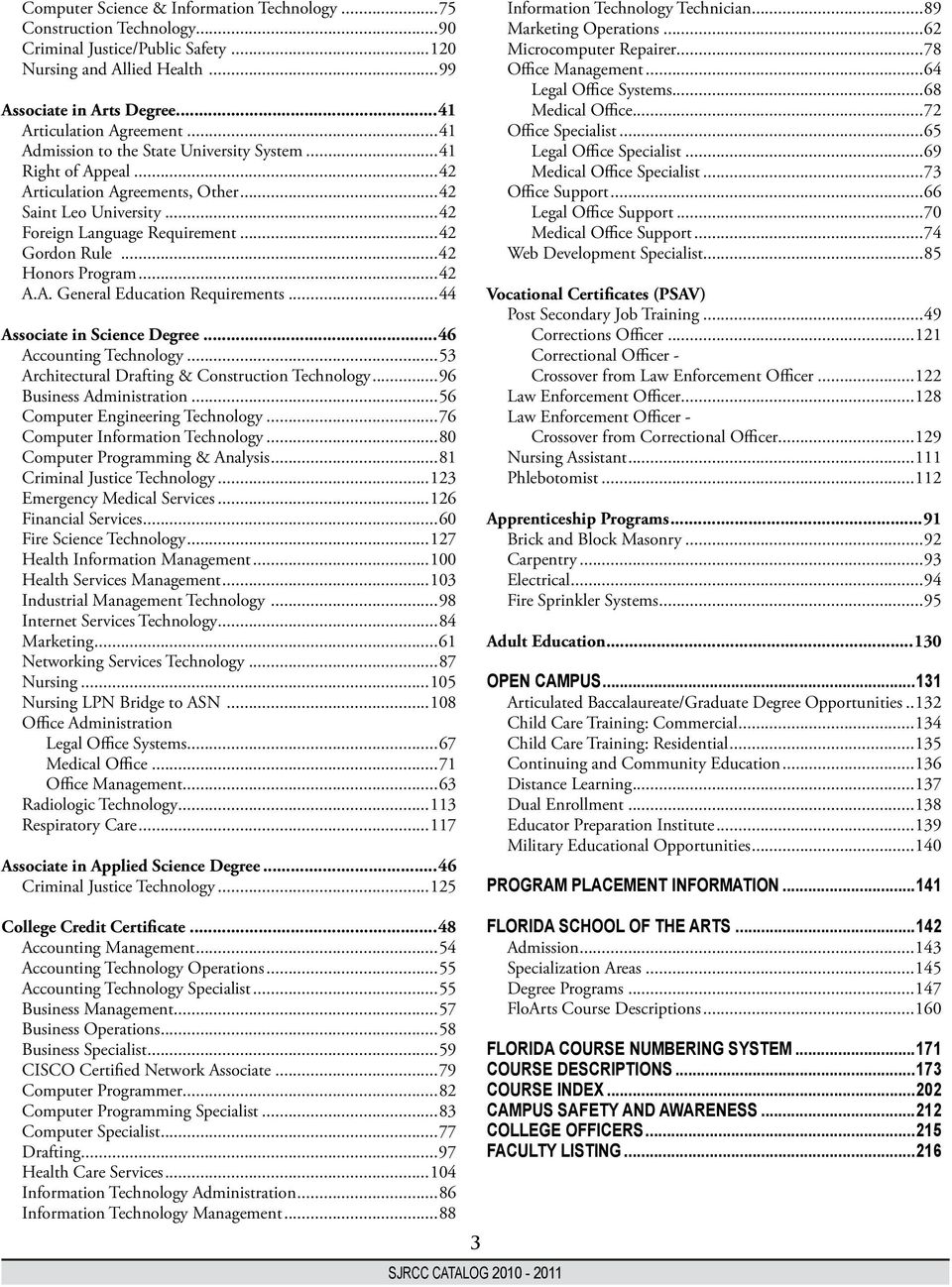
3 Computer Science & Information Technology...75 Construction Technology...90 Criminal Justice/Public Safety...120N Nursing and Allied Health...99 Associate in Arts Degree...41 Articulation Agreement...41 Admission to the State University System...41 Right of Appeal...42 Articulation Agreements, Other...42 Saint Leo University...42 Foreign Language Requirement...42 Gordon Rule Honors Program...42 A.A. General Education Requirements...44 Associate in Science Degree...46 Accounting Technology...53 Architectural Drafting & Construction Technology...96 Business Administration...56 Computer Engineering Technology...76 Computer Information Technology...80 Computer Programming & Analysis...81 Criminal Justice Technology...123E Emergency Medical Services Financial Services...60 Fire Science Technology Health Information Management Health Services Management Industrial Management Technology...98 Internet Services Technology...84 Marketing...61 Networking Services Technology...87 Nursing Nursing LPN Bridge to ASN Office Administration Legal Office Systems...67 Medical Office...71 Office Management...63 Radiologic Technology Respiratory Care Associate in Applied Science Degree...46 Criminal Justice Technology Information Technology Technician...89 Marketing Operations...62 Microcomputer Repairer...78 Office Management...64 Legal Office Systems...68 Medical Office...72 Office Specialist...65 Legal Office Specialist...69 Medical Office Specialist...73 Office Support...66 Legal Office Support...70 Medical Office Support...74 Web Development Specialist...85 Vocational Certificates (PSAV) Post Secondary Job Training...49 Corrections Officer Correctional Officer - Crossover from Law Enforcement Officer...122L Law Enforcement Officer Law Enforcement Officer - Crossover from Correctional Officer...129N Nursing Assistant Phlebotomist Apprenticeship Programs...91 Brick and Block Masonry Carpentry...93 Electrical...94 Fire Sprinkler Systems...95 Adult Education OPEN CAMPUS Articulated Baccalaureate/Graduate Degree Opportunities Child Care Training: Commercial Child Care Training: Residential Continuing and Community Education Distance Learning Dual Enrollment Educator Preparation Institute Military Educational Opportunities PROGRAM PLACEMENT INFORMATION College Credit Certificate...48 Accounting Management...54 Accounting Technology Operations...55 Accounting Technology Specialist...55 Business Management...57 Business Operations...58 Business Specialist...59 CISCO Certified Network Associate...79 Computer Programmer...82 Computer Programming Specialist...83 Computer Specialist...77 Drafting...97 Health Care Services Information Technology Administration...86 Information Technology Management FLORIDA SCHOOL OF THE ARTS Admission Specialization Areas Degree Programs FloArts Course Descriptions FLORIDA COURSE NUMBERING SYSTEM COURSE DESCRIPTIONS COURSE INDEX CAMPUS SAFETY AND AWARENESS COLLEGE OFFICERS FACUltY LISTING...216
4 President s Welcome ST. JOHNS RIVER COMMUNITY COLLEGE ORANGE PARK CAMPUS Welcome to St. Johns River Community College, and congratulations on taking the first step toward building a better future for yourself, your family and your community. Investing in your education is one of the most important decisions you will ever make. You have made an excellent choice by entrusting SJRCC with your education. The College s 52 years of unparalleled growth and success are evident throughout the communities we serve and demonstrate our mission of creating and improving learning opportunities and resources. Our remarkable faculty and staff take pride in providing the personal attention synonymous with the community college atmosphere. PALATKA CAMPUS As a native of Northeast Florida and a former state legislator, I understand not only your needs as a student, but the needs of our communities and the demand for quality professionals a strong economy depends upon. Whether you are returning to college to pursue a new career or you are exploring your academic options for the first time, our priority is to prepare you for success. I believe in this community; I believe in this College; and I believe in you. Warmest regards, Joe H. Pickens, J.D., President ST. AUGUSTINE CAMPUS 4

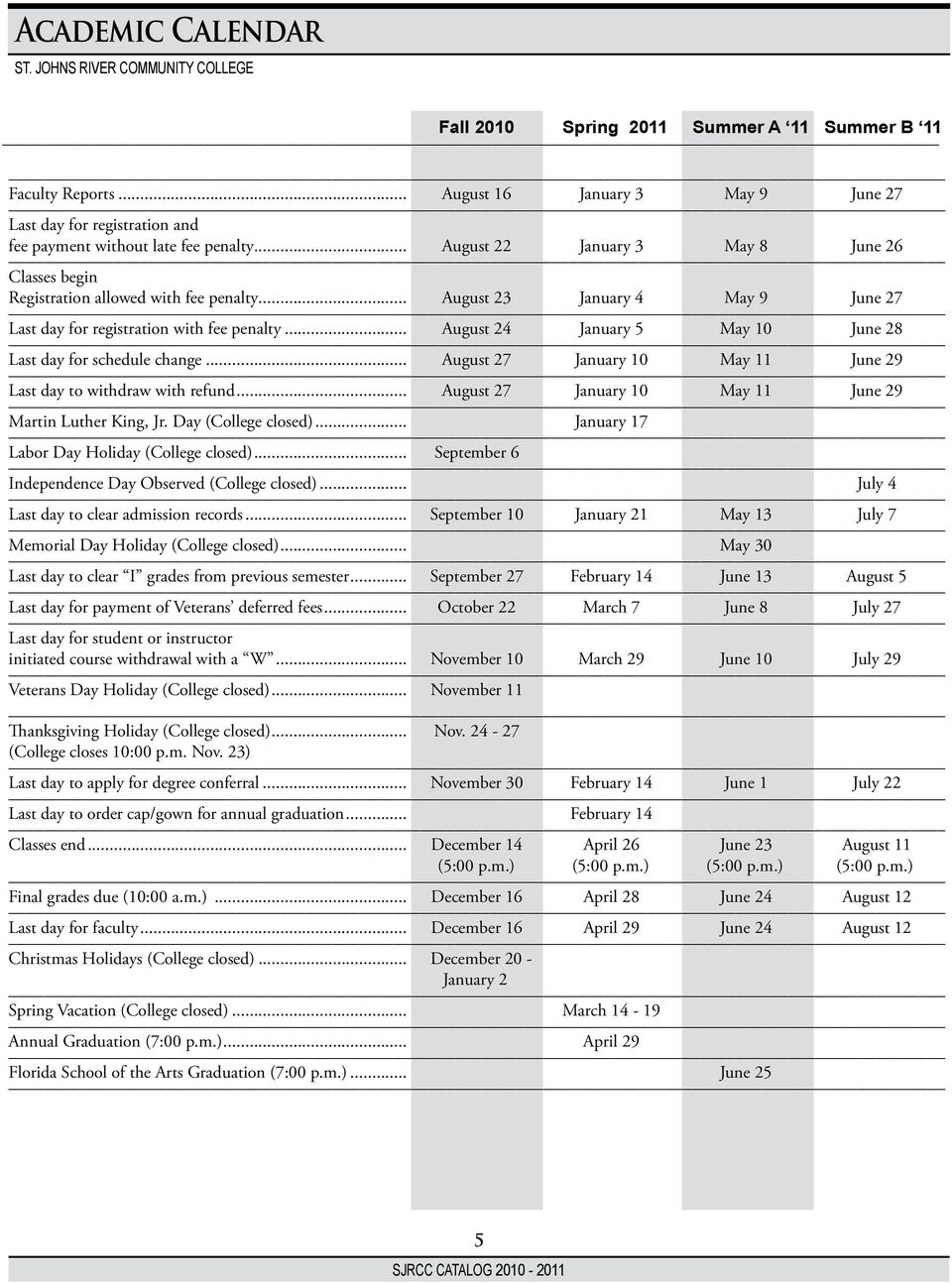
5 Academic Calendar ST. JOHNS RIVER COMMUNITY COLLEGE Fall 2010 Spring 2011 Summer A 11 Summer B 11 Faculty Reports... August 16 January 3 May 9 June 27 Last day for registration and fee payment without late fee penalty... August 22 January 3 May 8 June 26 Classes begin Registration allowed with fee penalty... August 23 January 4 May 9 June 27 Last day for registration with fee penalty... August 24 January 5 May 10 June 28 Last day for schedule change... August 27 January 10 May 11 June 29 Last day to withdraw with refund... August 27 January 10 May 11 June 29 Martin Luther King, Jr. Day (College closed)... January 17 Labor Day Holiday (College closed)... September 6 Independence Day Observed (College closed)... July 4 Last day to clear admission records... September 10 January 21 May 13 July 7 Memorial Day Holiday (College closed)... May 30 Last day to clear I grades from previous semester... September 27 February 14 June 13 August 5 Last day for payment of Veterans deferred fees... October 22 March 7 June 8 July 27 Last day for student or instructor initiated course withdrawal with a W... November 10 March 29 June 10 July 29 Veterans Day Holiday (College closed)... November 11 Thanksgiving Holiday (College closed)... Nov (College closes 10:00 p.m. Nov. 23) Last day to apply for degree conferral... November 30 February 14 June 1 July 22 Last day to order cap/gown for annual graduation... February 14 Classes end... December 14 April 26 June 23 August 11 (5:00 p.m.) (5:00 p.m.) (5:00 p.m.) (5:00 p.m.) Final grades due (10:00 a.m.)... December 16 April 28 June 24 August 12 Last day for faculty... December 16 April 29 June 24 August 12 Christmas Holidays (College closed)... December 20 - January 2 Spring Vacation (College closed)... March Annual Graduation (7:00 p.m.)... April 29 Florida School of the Arts Graduation (7:00 p.m.)... June 25 5
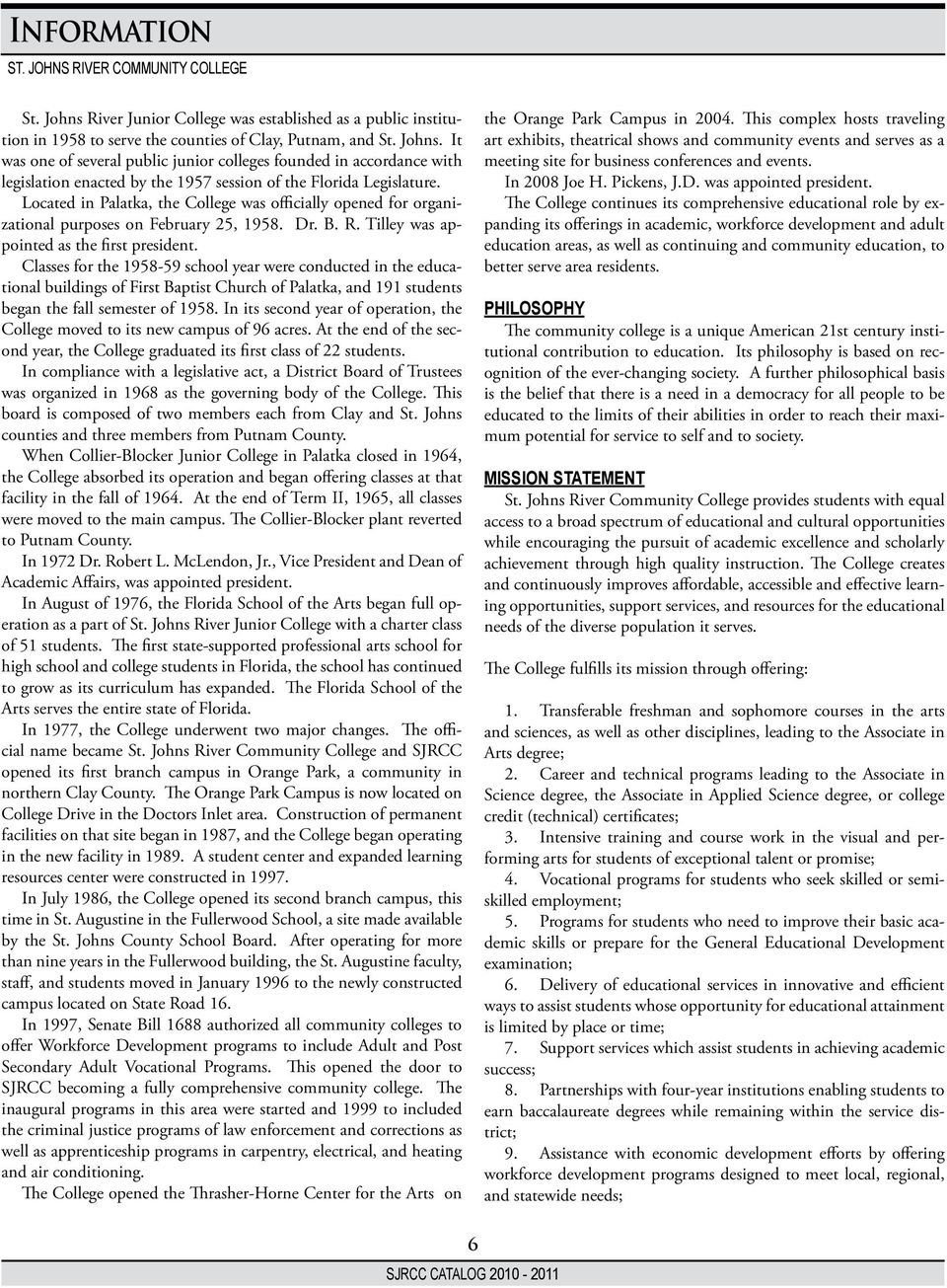
6 Information ST. JOHNS RIVER COMMUNITY COLLEGE St. Johns River Junior College was established as a public institution in 1958 to serve the counties of Clay, Putnam, and St. Johns. It was one of several public junior colleges founded in accordance with legislation enacted by the 1957 session of the Florida Legislature. Located in Palatka, the College was officially opened for organizational purposes on February 25, Dr. B. R. Tilley was appointed as the first president. Classes for the school year were conducted in the educational buildings of First Baptist Church of Palatka, and 191 students began the fall semester of In its second year of operation, the College moved to its new campus of 96 acres. At the end of the second year, the College graduated its first class of 22 students. In compliance with a legislative act, a District Board of Trustees was organized in 1968 as the governing body of the College. This board is composed of two members each from Clay and St. Johns counties and three members from Putnam County. When Collier-Blocker Junior College in Palatka closed in 1964, the College absorbed its operation and began offering classes at that facility in the fall of At the end of Term II, 1965, all classes were moved to the main campus. The Collier-Blocker plant reverted to Putnam County. In 1972 Dr. Robert L. McLendon, Jr., Vice President and Dean of Academic Affairs, was appointed president. In August of 1976, the Florida School of the Arts began full operation as a part of St. Johns River Junior College with a charter class of 51 students. The first state-supported professional arts school for high school and college students in Florida, the school has continued to grow as its curriculum has expanded. The Florida School of the Arts serves the entire state of Florida. In 1977, the College underwent two major changes. The official name became St. Johns River Community College and SJRCC opened its first branch campus in Orange Park, a community in northern Clay County. The Orange Park Campus is now located on College Drive in the Doctors Inlet area. Construction of permanent facilities on that site began in 1987, and the College began operating in the new facility in A student center and expanded learning resources center were constructed in In July 1986, the College opened its second branch campus, this time in St. Augustine in the Fullerwood School, a site made available by the St. Johns County School Board. After operating for more than nine years in the Fullerwood building, the St. Augustine faculty, staff, and students moved in January 1996 to the newly constructed campus located on State Road 16. In 1997, Senate Bill 1688 authorized all community colleges to offer Workforce Development programs to include Adult and Post Secondary Adult Vocational Programs. This opened the door to SJRCC becoming a fully comprehensive community college. The inaugural programs in this area were started and 1999 to included the criminal justice programs of law enforcement and corrections as well as apprenticeship programs in carpentry, electrical, and heating and air conditioning. The College opened the Thrasher-Horne Center for the Arts on the Orange Park Campus in This complex hosts traveling art exhibits, theatrical shows and community events and serves as a meeting site for business conferences and events. In 2008 Joe H. Pickens, J.D. was appointed president. The College continues its comprehensive educational role by expanding its offerings in academic, workforce development and adult education areas, as well as continuing and community education, to better serve area residents. PHILOSOPHY The community college is a unique American 21st century institutional contribution to education. Its philosophy is based on recognition of the ever-changing society. A further philosophical basis is the belief that there is a need in a democracy for all people to be educated to the limits of their abilities in order to reach their maximum potential for service to self and to society. MISSION STATEMENT St. Johns River Community College provides students with equal access to a broad spectrum of educational and cultural opportunities while encouraging the pursuit of academic excellence and scholarly achievement through high quality instruction. The College creates and continuously improves affordable, accessible and effective learning opportunities, support services, and resources for the educational needs of the diverse population it serves. The College fulfills its mission through offering: 1. transferable freshman and sophomore courses in the arts and sciences, as well as other disciplines, leading to the Associate in Arts degree; 2. Career and technical programs leading to the Associate in Science degree, the Associate in Applied Science degree, or college credit (technical) certificates; 3. Intensive training and course work in the visual and performing arts for students of exceptional talent or promise; 4. Vocational programs for students who seek skilled or semiskilled employment; 5. Programs for students who need to improve their basic academic skills or prepare for the General Educational Development examination; 6. Delivery of educational services in innovative and efficient ways to assist students whose opportunity for educational attainment is limited by place or time; 7. Support services which assist students in achieving academic success; 8. Partnerships with four-year institutions enabling students to earn baccalaureate degrees while remaining within the service district; 9. Assistance with economic development efforts by offering workforce development programs designed to meet local, regional, and statewide needs; 6
7 10. Continuing workforce education and training for business and industry; 11. Community enrichment and lifelong learning opportunities for the residents of the service district. Notice of NON-DISCRIMINATION St. Johns River Community College does not discriminate on the basis of race, ethnicity, color, national origin, marital status, religion, age, gender, or disability in its programs or activities. The following person has been designated to handle inquiries regarding the nondiscrimination policies: Annette W. Barrineau, Equity Officer/VP for Administrative Affairs, 5001 St. Johns Avenue, Palatka, Florida, 32177, , IDENTIFICATION AND NOTIFICatION OF COORDInatorS It is the policy of St. Johns River Community College not to discriminate on the basis of race, ethnicity, color, national origin, marital status, religion, age, gender, or disability in its educational programs, activities, admissions policies and practices, or employment policies. Inquiries regarding compliance with laws relating to non-discrimination having to do with students may be directed to: Gilbert L. Evans, Jr., Ph.D., J.D. Vice President for Student Affairs/Assistant General Counsel St. Johns River Community College Student Services Building, Room V St. Johns Ave., Palatka, FL (386) and all other inquiries may be directed to: Annette W. Barrineau, M.B.A. Vice President for Administrative Affairs St. Johns River Community College Administration Building, Room A St. Johns Ave. Palatka, FL (386) or to the Atlanta Regional Office for Civil Rights (for U.S. EDOE): The Vice President for Administrative Affairs is designated as the Equal Opportunity Employment Officer at St. Johns River Community College. GENERAL COLLEGE POLICY The College reserves the right to change any of its policies, courses, regulations, and calendar of events without notice when it is considered in the best interest of the College. Accreditation St. Johns River Community College is accredited by the Commission on Colleges of the Southern Association of Colleges and Schools to award the associate degree. Contact the Commission on Colleges at 1866 Southern Lane, Decatur, Georgia or call for questions about the accreditation of St. Johns River Community College. Notification of Social Security Number Collection and Usage In compliance with Florida Statute (5), this section serves to notify you of the purpose for the collection and usage of your Social Security Number (SSN). St. Johns River Community College collects and uses your SSN to facilitate the performance of the College s duties and responsibilities. To protect your identity, SJRCC will secure your SSN from unauthorized access, strictly prohibits the release of your SSN to unauthorized parties contrary to state and federal law, and assigns you a unique student/employee identification number. This unique ID number is used for all associated employment and educational purposes at SJRCC. Employees Human Resources Your SSN is used for legitimate business purposes for completing and processing the following: Federal I-9 (Department of Homeland Security) Federal W4, W2, 1099 (Internal Revenue Service) Federal Social Security Taxes (FICA) Distributing Federal W2 (Internal Revenue Service) Unemployment Reports (FL Department of Revenue) Florida Retirement Contribution Reports (FL Division of Retirement) Worker s Comp Claims (FCCRMC and Department of Labor) Direct Deposit Files New Hire Information Report (FL Department of Revenue) 403b Contribution Reports Group health, life and dental coverage enrollment Supplemental insurance and deduction reports Work study work assignments Background checks FICA Alternative Plan Participation for Part-time Employees (Bencor) Special Pay Plan Participation for Qualified, Full-time Retiring Employees (Bencor) Providing your Social Security Number is a condition of employment at SJRCC. Students Admissions Federal legislation relating to the Hope Tax Credit requires that all postsecondary institutions report student SSNs to the Internal Revenue Service (IRS). This IRS requirement makes it necessary for community colleges to collect the SSN of every student. A student may refuse to disclose his/her SSN to the College for this purpose, but the IRS is then authorized to fine the student. In addition to the federal reporting requirements, the public school system in Florida uses SSNs as a student identifier (Section , F.S.). In a seamless K-20 system, it is beneficial for post secondary institutions to have access to the same information for purposes of tracking and assisting students in the smooth transition from one education level to the next. 7

8 Financial Aid A student s SSN is required for the following financial aid purposes: The United States Department of Education s (USDOE) Free Application for Federal Student Aid (FASFA) requires all applicants to report their SSN to be used for all federal financial aid programs as a student identifier for processing and reporting. In addition to its use by USDOE as a student identifier, the SSN is required in order for the Department of Homeland Security to investigate citizenship status, for the Federal Work Study Program, and is required on all loan applications for use by the lender/servicer/guarantor. SJRCC collects a student s SSN on certain institutional scholarship applications for student files and federal and state audit/reporting purposes. If you are a recipient of a State of Florida grant or scholarship such as the Florida Student Assistance Grant, Florida Work Experience or Bright Futures, the State of Florida Department of Education will require the use of the SSN on their grant/scholarship disbursement Web site for reporting purposes. Student, faculty and staff SSNs will be used in the libraries patron database (LINCC) for online login authentication, patron verification, and the elimination of duplicate records. Library Student, faculty and staff Social Security Numbers will be used in the libraries patron database (LINCC) for online login authentication, patron verification, and the elimination of duplicate records. Workforce Programs These programs, funded through the Agency for Workforce Innovation (AWI), use your SSN as an identifier for program enrollment and completion. Also, it is used for entering placement information into either the OSMIS or the Employ Florida Marketplace statewide data collection and reporting system. Because these are performance based programs, AWI requires that all participants and their program related activities be recorded in the Florida state system. Contractors SJRCC collects contractor SSN information in order to file the required information returns with the Internal Revenue Service, as required and authorized by Federal law. Campuses Palatka CAMPUS 5001 St. Johns Avenue, Palatka, FL (386) The 93-acre Palatka Campus is located in the west section of Palatka, near the junction of State Highways 19 and 20. Campus buildings include the main administration building, a student services building that houses the student center and bookstore, a sciencetechnical complex, and learning resources center. Laboratories and specially equipped classrooms are provided for science, mathematics, physical education, social science, data processing, and business education. Facilities also include a gymnasium, tennis courts, handball courts, a baseball diamond, and a softball field. Florida School the Arts, Florida s first state-supported arts school, was established in 1974 on the Palatka Campus and specializes in preparing students for successful careers in the fine and performing arts. The fine arts complex includes a 640-seat auditorium and two art galleries. ORANGE PARK CAMPUS 283 College Drive, Orange Park, FL (904) The Orange Park Campus, located on College Drive in Orange Park, consists of 96 acres containing general purpose classrooms, a teaching auditorium, business education laboratories, library, science laboratories, computer laboratories, and a student center. The student center includes a food service outlet, student activity area, counselor offices, bookstore, testing facility, and a community room. The Orange Park Campus is the location of the Thrasher-Horne Center for the Arts. This $21 million performing and visual arts, and conference center opened in 2004 and hosts traveling art exhibits, theatrical shows and community events. The center includes a 1,750 seat main performance hall, a 202 seat studio theater and two art galleries. The conference center serves as a meeting site for business conferences and events. In 2008, the College opened the Health-Sciences Building on the Orange Park Campus. This two-story 52,000 square foot facility provides nursing students with a state-of-the-art environment designed to simulate a hospital. The facility also accommodates the health information management and related allied health programs as well as science labs for physics, chemistry, microbiology, biology, and anatomy and physiology. ST. AUGUSTINE CAMPUS 2990 College Drive, St. Augustine, FL (904) The St. Augustine Campus, located on State Road 16, is the newest of the three campuses. First occupied in January 1996, the campus includes covered walkways that link all buildings, man-made lakes, classrooms, a science building, a library that includes computer laboratories, a student services building, and an administration building. The St. Augustine Campus is the location of the Workforce Training facility. The Higgins-Solomon Criminal Justice Center opened in The new facility houses the criminal justice and radiologic technology programs. The center includes defensive tactics and medical first responder laboratories. In addition, classrooms and a multi-purpose room are wired for and utilize the latest state-of-theart instructional systems. OPEN CAMPUS Administration Building, A166 Palatka Campus 5001 St. Johns Avenue, Palatka, FL (386) The Open Campus, located in the administration building of the Palatka Campus, is not a physical campus; however, its programs extend the College into the community through a variety of credit and non-credit training programs reaching beyond the traditional 8

9 offerings of the College: Baccalaureate and Graduate Degree opportunities, Childcare, Continuing Education, Distance Learning, Dual Enrollment, Evening/Weekend/Off-campus courses, Educator Preparation Institute, and Military Educational Opportunities. ST. JOHNS RIVER COMMUNITY COLLEGE FOUNDatION The purpose of the St. Johns River Community College Foundation, Inc. is to encourage, solicit, receive, and administer gifts and bequests of real and personal property of all kinds and funds for scientific, educational and charitable purposes, all for the advancement of SJRCC and its objectives. The Foundation is a 501(c)3, not-forprofit corporation. Various scholarships are offered by the Foundation. Scholarship applications are taken and awards are made in the spring and fall of each year. For more information about scholarships, contact the SJRCC Foundation office at (386) or visit our Web site at: COLLEGE Web SITE SJRCC s Web site has invaluable information about the College. Future students and their parents can learn about college programs and the steps for applying for admission. They may also apply for admission online. Current students and the general public can keep informed about ongoing and future events. There is also contact information for faculty and staff as well as a current listing of all open positions for employment. Other resources for students include links to our online library and the College catalog. Additionally, students can find out about the requirements for workforce programs and test dates for admission to those programs. Students may register online and access their information through the College s Web portal, MySJRCC. The portal provides access to class schedules, unofficial transcripts, financial information, , grades, and more from one secure, customized location. research assistance, information literacy instruction, inter-library loans, circulation and reserves. We provide access to materials and services to distance learners and remote users via mail, fax, telephone, and . Remote access to library resources and services is available via the library Web page at The collection is accessible by using the Library Information Network for Community Colleges (LINCC). This online catalog provides access to not only the College s collection, but those of Florida s other community college and state university libraries as well. LINCC also features numerous online databases, providing full-text coverage of thousands of journals from all disciplines. Access to LINCC s catalog is available in the library or remotely via the Internet. The libraries are compliant with the standards established in the Americans with Disabilities Act. Every effort has been made to make the three libraries barrier free to persons with disabilities. Through the use of assistive technologies, all print and online materials are accessible to visually-impaired persons. Each library provides facilities and equipment for audio-visual viewing and listening. COMPUTER LABORATORIES The libraries open computer labs are designated for scholarly activities related to student instruction and research. Access is limited to currently enrolled students and college personnel. Appropriate identification must be provided upon entering the open lab, and users must obey posted usage guidelines. Library and Learning Resource Centers The three College libraries offer a wide variety of services and resources. Each campus library provides a comfortable atmosphere designed to serve the reading, reference and research needs of its students and faculty. The libraries support all areas of the curriculum with diverse print and non-print materials and online databases. A staff of friendly, professional librarians and support staff is always available to assist students, faculty and community patrons. The print resources of the libraries include a combined book collection in excess of 63,000 print volumes and 23,000 e-books. Other print resources include approximately 400 subscriptions to current magazines, journals and newspapers and a retrospective journal collection of 3,000 bound volumes. The non-print collection features videos, digital video discs, compact discs, and audio books. All of the collections are readily accessible through the open stack system. The libraries use the Library of Congress Classification System. Among the services offered by the libraries are reference and 9

10 Admissions ST. JOHNS RIVER COMMUNITY COLLEGE ADMISSIONS Admission Policy St. Johns River Community College is an open door institution. Applicants for admission are considered on the basis of their qualifications without regard to age, color, disability, marital status, national origin, race, religion, or sex. State law establishes certain minimum requirements for admission to college credit academic courses. These requirements ensure, as far as possible, that students will be successful in their academic work. After testing and counseling, the College may require a student to be enrolled in college preparatory courses. ADMISSION CLASSIFICATION College CREDIT A.A. Degree A.S./A.A.S. Degree College Credit Certificate Limited Access Programs Dual Enrollment Educator Preparation Institute (Institutional Credit) Florida School of the Arts Health Information Management Nursing Radiologic Technology Respiratory Care College Credit Associate in Arts Degree Associate in Science Degree Associate in Applied Science Degree College Credit Certificate NON Credit Vocational Certificates Limited Access Programs Crossover Programs Apprenticeship Programs Adult Education Child Care Training Continuing Education to be admitted as a degree/college credit certificate-seeking student, an applicant must meet the following requirements: n submit a completed application and fee; n provide copies of official ACT, SAT or CPT scores. (if results are more than two years old a retest is required); and n provide proof of previous education: q a standard high school diploma with an official transcript; or q a high school diploma through any State Department of Education based on performance on the General Education Development (GED) test, provided the test was administered in English with an official transcript; or q a home education program meeting the requirements of F.S Transfer Students - *In addition to the above requirements, transfer students must also: q be in good academic standing from the previously attended college or university. Students on academic probation can enroll, but students who are suspended or dismissed are required to submit a petition requesting permission to enroll; and q provide official transcripts and catalog course descriptions from all colleges attended to the Admissions and Records Office. *Students who have earned an associate and/or bachelor s degree or higher from a regionally accredited institution may be exempt from providing official proof of high school completion. International Students - F1 (student) visa applicants In addition to the above requirements that apply, international students must also comply with the following: q all transcripts must be in English and evaluated by one of the National Association of Credential Evaluation Services, Inc. Agencies; and q proof that the high school certificate or diploma is equivalent to a standard Florida high school diploma or GED; and q proof of proficiency in oral and written English as demonstrated by a score of 500 or above on the paper pencil version of the TOEFL, or 173 or above on the computerized version, or 61 or above on the Internet based version; and q a financial statement (applicants are required by law to have sufficient funds for living expenses, tuition, and fees for a minimum of one year. These funds must be available when the student registers for courses each term. Financial aid is not available through the college); and q a physician s statement of health; and q proof of F-l (student) status; and q proof of Health Insurance for the academic year at the time of each registration. SJRCC requires that international students purchase health insurance and should begin the admission process at least four months prior to the term of initial enrollment. 10

11 Limited Access Programs To be admitted to a limited access A.A., A.S. or A.A.S. degree program an applicant must meet aforementioned requirements and the requirements listed in the specific programs: 1. Dual Enrollment An admission status that allows a superior high school student who has demonstrated exceptional academic achievement, emotional stability, and social maturity to attend SJRCC prior to high school graduation. A student may enroll in college credit courses creditable toward an associate degree, a baccalaureate degree, or a certificate, and a high school diploma. Credits earned at SJRCC must be applicable to both a college degree or certificate and high school graduation requirements. A student must have advanced approval from the high school to apply college credits toward high school graduation. Any public school student so enrolled is exempt from the payment of registration, matriculation, books, laboratory fees, and testing fees. Eligible home education students will be provided the opportunity to participate in dual enrollment programs offered by the College as defined in Florida Statutes and A home education student must provide proof of enrollment in a home education program pursuant to s Florida Statutes, and be responsible for books, materials, and transportation unless provided for otherwise. Dually enrolled students must: a. be seeking a college credit certificate, an approved career certificate (vocational or non-credit), a college credit Associate in Science degree, an Associate in Applied Science degree, or a college credit Associate in Arts degree; b. have and maintain a minimum unweighted 3.0 cumulative GPA for enrollment or an unweighted 2.0 cumulative GPA for enrollment in a career certificate (vocational or non-credit) programs; and c. be classified as a senior (have accumulated a minimum of 18 credits in grades 9, 10, and 11), be classified as a junior (have accumulated a minimum of 12 credits in grades 9 and 10) or be otherwise designated for participation in Dual Enrollment, and have demonstrated academic, social, and emotional maturity to ensure success in college level study; and d. complete a dual enrollment application for admission (students will be required to submit an updated SJRCC application for admission once they have graduated from high school); and e. not make below a C (including a W grade) in any dual enrollment course. Students not maintaining this standard are subject to dismissal from the dual enrollment program; and f. provide results of American College Test (ACT) or the Scholastic Aptitude Test (SAT) or the Florida College Entry Level Placement Test (CPT) to the office of Open Campus. Students who intend to enroll in English or mathematics must receive qualifying test scores (see high school counselors). g. Exceptions to these requirements must be approved jointly by the school principal and the Provost of Open Campus. Early Admissions (college credit) An admission status, which is a form of dual enrollment, that allows a secondary student to enroll full-time in courses that are creditable toward the high school diploma and the associate degree. The early admission program is limited to students who have completed a minimum of six semesters of full-time secondary enrollment, including studies undertaken in the ninth grade, and who meet all other admission criteria required of dual enrollment students. Public school early admission students are exempt from payment of registration, matriculation, books, and laboratory fees. College Credit Certificates and Vocational or Non Credit Certificates Any course creditable toward college credit certificates, select career (vocational or non-credit) certificates, an Associate in Science degree, or an Associate in Applied Science degree as outlined in the college catalog is an eligible course. All admission requirements are the same as are stated in Dual Enrollment except that dual enrollment students pursuing a college credit certificate, an Associate in Applied Science or an Associate in Science degree as outlined in the College catalog must have their high school counselor certify on the dual enrollment application form by using the four digit program code that the student is actually pursuing a college credit certificate, an Associate in Applied Science or an Associate in Science degree as outlined in the College catalog. 2. Florida School of the Arts Admission to Florida School of the Arts A.A. and A.S. degree programs is based on audition/portfolio review and an interview. Under special circumstances, Florida School of the Arts may allow submission of slides or video in lieu of an on-site audition/portfolio review. However, final acceptance is contingent upon an interview with the area faculty and the Dean. The following MUST be submitted: n application to FloArts (no fee); n application to SJRCC (fee applied upon acceptance); n resume; n current transcript; n (2) letters of recommendation from: 1.) someone familiar with the candidate s artistic abilities 2.) candidate s most recent teacher in his/her discipline; n audition/portfolio. Students must also be admitted to St. Johns River Community College and are responsible for compliance with all College policies and procedures. Upon graduation from high school, the student must also send an official transcript in order to complete the admissions file. All applications, recommendations, transcripts and test scores should be sent directly to the Florida School of the Arts. ADMISSIONS 11

12 3. Health Information Management The Health Information Management program is a limited access program. To apply for admission, a student must have completed all of the following: 7. Educator Preparation Institute The Educator Preparation Institute is a limited access program. To apply for admission, a student must have completed all of the following: ADMISSIONS n application process to SJRCC; n application to Health Information Management program; n satisfactory scores on all college placement tests or completion of all college preparatory courses; and n completion of the ten prerequisite courses with a C or better prior to the program application deadline. n application process to SJRCC; n application to Educator Preparation Institute; n oral interview with EPI Director; and n earned bachelors degree (students with international transcripts must provide an Eligible Statement of Eligibility from the Florida Department of Education) 4. Nursing The ASN program is a limited access program. To apply for admission to the nursing program, a student must have completed all of the following: n application process to SJRCC; n application to nursing program; n satisfactory scores on college placement tests or completion of all college preparatory courses; n completion of the nine prerequisite courses with a C or better prior to the program application deadline n Passage of Nurse Entrance Test (ERI or HESI assessment exam) Student selection is objective and based on a point system. Please see the nursing section of this catalog on page Radiologic Technology The Radiologic Technology program is a limited access program. To apply for admission, a student must have completed all of the following prior to the program application deadline: n application process to SJRCC; n application to radiologic technology program; n satisfactory scores on college placement tests or completion of all college preparatory courses; and n completion of the ten prerequisite courses prior to the program application deadline Student selection is objective and based on a point system. Please see the Radiologic Technology section of this catalog on page 113 for more information. 6. Respiratory Care The Respiratory Care program is a limited access program. To apply for admission, a student must have completed all of the following: n application process to SJRCC; n application to respiratory care program; n satisfactory scores on college placement tests or completion of all college preparatory courses; and n completion of eight prerequisite courses by the end of the application period. In addition to the College s admission requirements, there are state requirements that must be satisfied for admission. Please see the EPI section of this catalog on page 139 for more information. NON COLLEGE CREDIT Vocational Certificates Post secondary Job Training (PSAV) A vocational certificate prepares students for entry into a given career or vocation. To be admitted to SJRCC as a Vocational Certificate seeking student, an applicant must meet the following requirements: n be at least 16 years of age; furnish proof if asked; n application process to SJRCC; n submit application for appropriate PSAV program; n complete admissions testing. A high school diploma and additional requirements are needed for admission into the limited access PSAV programs: 1. Limited Access Programs (PSAV) The following PSAV programs are limited access: a. Law Enforcement b. Corrections Basic Recruit Qualifications for admission into these programs include age and physical examination requirements as well as providing a fingerprint and birth certificate. Please see the Criminal Justice section of this catalog beginning on page 120 for more information. 2. Crossover Programs a. Corrections Officer Crossover from CMS Law Enforcement Officer b. Law Enforcement Officer Crossover from Correctional Officer Please see the Criminal Justice section of this catalog beginning on page 120 for more information. 12

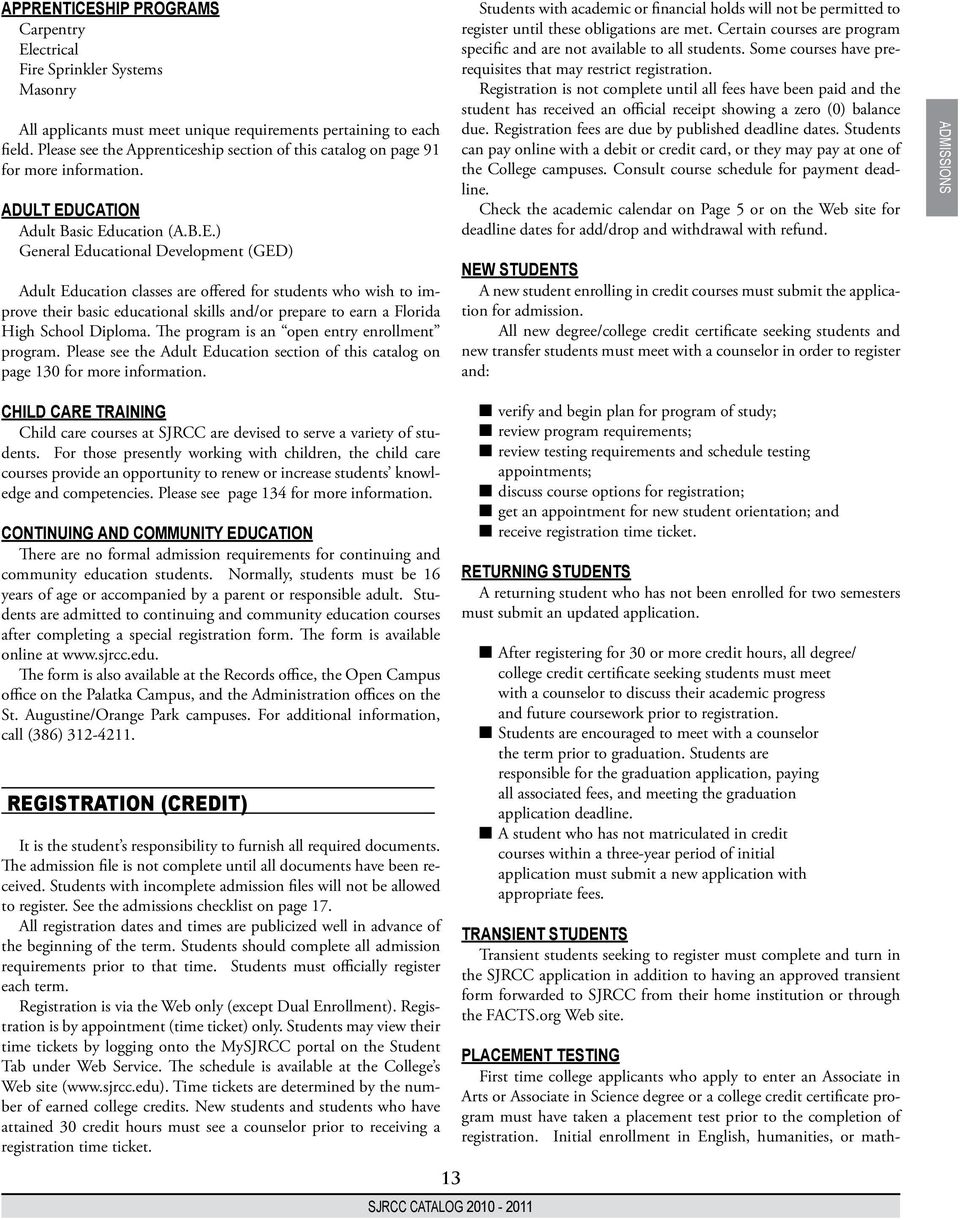
13 Apprenticeship Programs Carpentry Electrical Fire Sprinkler Systems Masonry All applicants must meet unique requirements pertaining to each field. Please see the Apprenticeship section of this catalog on page 91 for more information. Adult Education Adult Basic Education (A.B.E.) General Educational Development (GED) Adult Education classes are offered for students who wish to improve their basic educational skills and/or prepare to earn a Florida High School Diploma. The program is an open entry enrollment program. Please see the Adult Education section of this catalog on page 130 for more information. Students with academic or financial holds will not be permitted to register until these obligations are met. Certain courses are program specific and are not available to all students. Some courses have prerequisites that may restrict registration. Registration is not complete until all fees have been paid and the student has received an official receipt showing a zero (0) balance due. Registration fees are due by published deadline dates. Students can pay online with a debit or credit card, or they may pay at one of the College campuses. Consult course schedule for payment deadline. Check the academic calendar on Page 5 or on the Web site for deadline dates for add/drop and withdrawal with refund. New Students A new student enrolling in credit courses must submit the application for admission. All new degree/college credit certificate seeking students and new transfer students must meet with a counselor in order to register and: ADMISSIONS Child Care Training Child care courses at SJRCC are devised to serve a variety of students. For those presently working with children, the child care courses provide an opportunity to renew or increase students knowledge and competencies. Please see page 134 for more information. Continuing AND COMMUNITY Education There are no formal admission requirements for continuing and community education students. Normally, students must be 16 years of age or accompanied by a parent or responsible adult. Students are admitted to continuing and community education courses after completing a special registration form. The form is available online at The form is also available at the Records office, the Open Campus office on the Palatka Campus, and the Administration offices on the St. Augustine/Orange Park campuses. For additional information, call (386) registration (credit) It is the student s responsibility to furnish all required documents. The admission file is not complete until all documents have been received. Students with incomplete admission files will not be allowed to register. See the admissions checklist on page 17. All registration dates and times are publicized well in advance of the beginning of the term. Students should complete all admission requirements prior to that time. Students must officially register each term. Registration is via the Web only (except Dual Enrollment). Registration is by appointment (time ticket) only. Students may view their time tickets by logging onto the MySJRCC portal on the Student Tab under Web Service. The schedule is available at the College s Web site ( Time tickets are determined by the number of earned college credits. New students and students who have attained 30 credit hours must see a counselor prior to receiving a registration time ticket. 13 n verify and begin plan for program of study; n review program requirements; n review testing requirements and schedule testing appointments; n discuss course options for registration; n get an appointment for new student orientation; and n receive registration time ticket. Returning Students A returning student who has not been enrolled for two semesters must submit an updated application. n After registering for 30 or more credit hours, all degree/ college credit certificate seeking students must meet with a counselor to discuss their academic progress and future coursework prior to registration. n Students are encouraged to meet with a counselor the term prior to graduation. Students are responsible for the graduation application, paying all associated fees, and meeting the graduation application deadline. n A student who has not matriculated in credit courses within a three-year period of initial application must submit a new application with appropriate fees. Transient Students Transient students seeking to register must complete and turn in the SJRCC application in addition to having an approved transient form forwarded to SJRCC from their home institution or through the FACTS.org Web site. Placement Testing First time college applicants who apply to enter an Associate in Arts or Associate in Science degree or a college credit certificate program must have taken a placement test prior to the completion of registration. Initial enrollment in English, humanities, or math-
14 ADMISSIONS ematics courses for any student requires placement scores no more than two years old. Non-degree seeking students desiring to enroll in English, humanities, or mathematics courses also must have been tested. The College accepts scores on the ACT, SAT, or Florida College Entry Level Placement Test (CPT) Form A, or any other state approved placement tests that are no more than two years old. These test results are used for placement, counseling, and transfer requirements for some upper division institutions, scholarship eligibility, and research. Placement testing is available at the College for applicants who have not been previously tested or whose scores are no longer valid. Students may obtain information and an application form from the Counseling center. A placement test score chart is located on page 20. College students may retest once prior to college prep enrollment for a fee as approved by the Board of Trustees. Dual Enrollment students are exempt from this fee. Retesting is not permitted after college prep enrollment has started. A written appeal to the Vice President for Student Affairs/Assistant General Counsel is required for any third retest attempt request. The appeal must include evidence of instructional intervention that indicates score improvement is possible and probable. Orange Park Campus Palatka Campus St. Augustine Campus COLLEGE Testing Testing for admissions to special programs is administered through the testing office. Students must schedule an appointment, and seating is limited. Check the College s Web site for specific dates. Additionally, appointments for proctoring of distance learning exams from other institutions and for institutional exams are scheduled through the testing office. Each exam requires an administrative fee. Changing Admission Status Students may change their program of study at any time by meeting the requirements of the admission status and by completing the change of program of study form. See catalog governing degree on page 26 for further information. Courses by audit Audit students earn no credit and are not required to do outside work or take exams. Audit students must meet all other admission requirements. College prep courses cannot be audited. Education Support Examinations (DANTES/DSST) and Excelsior based on the ACC course equivalent recommendations only. Credit will be awarded only if the credit satisfies specific course requirements in the student s selected degree program and is subject to approval by the appropriate Vice President. (DANTES/DSST was formerly USAFI and Excelsior was formerly Regents or PEP.) Students are responsible for making test arrangements, bearing the cost of testing, and having test scores sent to SJRCC. A six-month interval is required for retaking an exam. Credit-by-exam will not be awarded if: 1. the credit would duplicate or overlap credit previously awarded through another exam; 2. the credit would duplicate or overlap credit previously awarded or earned; and/or 3. the student has received credit in a more advanced course in which the accumulation of knowledge or skills in the exam area is essential. No grades or quality points will be assigned. In addition to that mandated by Florida Statute , credit may be granted for military education that has been evaluated and recommended as appropriate for postsecondary credit by the American Council on Education s Guide to the Evaluation of Educational Experiences in the Armed Services. After enrollment in the College, a student may request such credit by providing appropriate documentation as determined by the College. Credit will be granted only if the credit satisfies specific course requirements in the student s selected degree program and is subject to approval by the appropriate vice president. Policies in effect when exams were taken govern the awarding of credit. College Level Academic Skills (CLAS) Requirement and Exemption Effective July 1, 2009, the College-Level Academic Skills Test (CLAST) is no longer administered. Florida legislation, Senate Bill 1676, repealed the use of CLAST as a degree requirement for undergraduates seeking an Associate in Arts (AA) or Baccalaureate degree from Florida s public colleges and universities. All scores earned on the CLAST prior to July 1, 2009 are still valid. Effective December 15, 2009, students may meet the CLAS requirement using the following combination of test scores, courses or credit by exam. Credit By Exam/ CREDIT AWARDED FOR ARMED SERVICES EDUCatIONAL EXPERIENCES St. Johns River Community College (SJRCC) awards credit for Advanced Placement (AP), International Baccalaureate (IB), College-Level Examination Program (CLEP), and Cambridge Advanced International Certificate of Education (AICE) exams as designated by the Articulation Coordinating Committee (ACC) Credit-By-Exam Guidelines For Postsecondary Institutions. Up to 45 total creditby-exam credits may be awarded. Up to 30 credits may be awarded for the IB diploma. SJRCC will award credit for Defense Activity of Non-Traditional (1) Achieve a score that meets or exceeds a minimum score on a nationally standardized examination as listed below: Reading 500 or above on the SAT critical reading portion taken after February 2005; 500 or above on the verbal section of the re-centered SAT I taken prior to March 2005; 421 or above (non-recentered score) on the verbal section of the SAT I taken prior to March 2005; 22 or above on the ACT program in reading; 14

15 20 or above on the composite of the ACT taken prior to October 1989; or 93 or above on the ACCUPLACER Reading Comprehension Examination. English Language and Essay 500 or above on the SAT writing portion taken after February 2005; 500 or above on the verbal section of the re-centered SAT I taken prior to March 2005; 421 or above (non-recentered score) on the verbal section of the SAT I taken prior to March 2005; 21 or above on the ACT program in English; 21 or above on the ACT program in English/Writing (English with essay component); 20 or above on the composite of the ACT taken prior to October 1989; or 105 or above on the ACCUPLACER Sentence Skills Examination. Computation 500 or above on the SAT math portion taken after February 2005; 500 or above on the Math section of the re-centered SAT I taken prior to March 2005; 473 or above (non-recentered score) on the math section of the SAT I taken prior to March 2005; 21 or above on the ACT program in math; 21 or above on the ACT taken prior to October 1989; or 91 or above on the ACCUPLACER Elementary Algebra examination. or (2) Archive a grade point average of 2.5 or above on a 4.0 grade scale in selected postsecondary level courses at Florida public institutions and non-public institutions on the Statewide Course Numbering System, pursuant to Section (7), F.S., as specified below. Each postsecondary institution shall establish its own policies for the evaluation of students coursework when that student earned credits that are not part of the Statewide Course Numbering System Any MAC course with the last three (3) digits of 102 or higher; MGFX106 Liberal Arts Mathematics I; MGFX107 Liberal Arts Mathematics II; MGFX113 Topics in College Mathematics I; MGFX114 Topics in College Mathematics II; MGFX118 Mathematics for CLAST Review; Any MGF course with last three (3) digits of 202 or higher; Any Gordon Rule statistics course; Any mathematics course that has College Algebra (MACX105 as a prerequisite). (c) Credits granted in accordance with the Articulation Coordinating Committee Credit-By-Examination Equivalencies shall be substituted for the courses specified above. The document, Articulation Coordinating Committee Credit-By-Examination Equivalencies, is hereby incorporated by reference as a part of this rule to become effective with the effective date of this rule. This document may be viewed at If a student earns credit by examination for two (2) courses listed in both paragraphs (2)(a) and (2)(b), of this rule, the requirement will be considered to be met. If a student earns credit by examination for one (1) course within either paragraph (2)(a) or (2)(b), of this rule, no grade will be assigned for that course. The 2.5 grade point calculation will be based solely on a grade of B earned in courses completed at SJRCC. CLAS Waivers Under certain circumstances, a student may request a waiver of the CLAS requirement. The request should be addressed to the CLAS Waiver Committee, and submitted to the Counseling Center, documenting the extent to which an effort was made to meet the CLAS requirement. The Committee will determine if the student has demonstrated sufficient effort. A student with a documented disability may submit a request for a waiver depending on the disability. The request should be addressed to the CLAS Waiver Committee, and submitted to the Counseling Center, along with verification of the disability. Students requesting a CLAS waiver should contact the Counseling Office for additional information. ADMISSIONS (a) to meet the College Level Academic Skills requirements in communication, a student must earn a 2.5 grade point average in a combination of at least one (1) course with the ENC prefix and any other course, exclusive of those with the SPC prefix, that is designated as a Gordon Rule writing course pursuant to the requirements of paragraph 6A (2)(a), F.A.C. Course prefixes are assigned in accordance with Section , F.S. and include the following specific courses at SJRCC: AML 2010, CRW 2001, ENC 1101, 1102; ENL 2012, 2022; LIT 2000, 2110, 2120 and (b) to meet the College Level Academic Skills requirements in computation, a student must earn a 2.5 grade point average in any combination of two (2) courses from the list below: Withdrawal Students may withdraw from a course without academic penalty (a grade of W ) at any time prior to the point in the semester as published in the academic calendar. A student who wishes to withdraw from either a single course or from all courses must follow withdrawal procedures. After the published last date to withdraw, the student will receive the letter grade earned. There are special requirements for withdrawal from science with laboratory corequisites; see the introduction to the science section of the College Credit Course Descriptions on page 173 of this catalog for further information. A student seeking to withdraw is done via the Web only (except dual enrollment students.) All student obligations to the College, such as repayment of financial aid loans, return of library books, and payment of traffic fines, must be satisfied. Notification is sent to any 15

16 ADMISSIONS appropriate agency when a student withdraws from the College. The College reserves the right to withdraw a student from one or more classes when circumstances warrant such an action. TRANSFER OF CREDITS Students whose admission files are not complete by the end of their first semester with St. Johns River Community College may have future online/web registrations blocked until all necessary documentation is received and admissions file is complete. Any exceptions must be approved by a vice president or dean. Students wanting to receive federal financial aid must complete their admission files prior to receiving the aid. There will be no exceptions for the receipt of financial aid. The College accepts only those credit courses that were awarded through a regionally accredited institution and/or under the following circumstances: 1. Ordinarily, students receive no transfer credit for courses specifically designed for technical and vocational career programs. The vice president of the specific area should be consulted regarding questions about the transfer of credits. 2. Any type of military credit will be evaluated on an individual, case-by-case basis according to the American Council on Education s Guide to the Evaluation of Educational Experiences in the Armed Services course equivalent recommendations. Credit will be considered for transfer only if the credit satisfies specific course requirements in the student s selected degree program and is subject to approval by the appropriate vice president. If a student wishes to change his/her program, he/she is responsible for requesting in writing that the transfer credits be re-evaluated. 3. Transfer students who have a bachelor s degree or higher may receive transfer credit for those courses that will meet the general education requirements in an Associate in Science or Associate in Applied Science degree program. 4. Students records will not be evaluated until their admissions files are complete and after they have been or are currently enrolled. 5. International Students must have their transcripts translated and evaluated by one of the credential evaluation agencies sanctioned by National Association of Credential Evaluation Services, Inc. (NACES). Each course will be individually assessed for transfer consideration. Credits will be awarded on a course-by-course basis. Florida Members: Josef Silny & Associates, Inc. International Education Consultants 7101 S.W. 102 Avenue Miami, FL U.S.A Academic Evaluation Services, Inc N. 58th Street G & H Tampa, FL U.S.A St. Johns River Community College will award college credit for qualified College Board Advanced Program examination scores (AP), International Baccalaureate Diploma program examinations, The College Level Examination Program (CLEP), Advanced International Certificate of Education (AICE) and The Defense Activity for Nontraditional Education Support (DANTES) per American Council of Education guidelines and the current articulation Coordinating Committee Credit by Exam Equivalents. Students must provide a copy of any type of college level examination test score so that credit may be considered. 7. St. Johns River Community College will accept credit from private institutions participating in the statewide course numbering system based on credential effective dates. 8. All transfer work that is accepted by SJRCC will be posted on the SJRCC transcript and calculated into the overall or cumulative grade point average (GPA). orientation First-time-in-college (FTIC) students are encouraged to attend new student orientation prior to enrolling in their first term at SJRCC. Student orientation programs for freshman and transfer students entering in the fall are scheduled throughout the summer prior to fall registration. For students planning to enter in the spring or summer semesters, orientations are offered prior to the spring and summer registration dates. Online orientation is also available. Special arrangements may be made for students unable to attend orientation (e.g., out-of-state/country students) by contacting the local campus counseling office. registration (non-credit) It is the student s responsibility to furnish all required documents. All registration dates and times are publicized well in advance of the beginning of the term. Students must officially register each term. Registration is not complete until all fees have been paid and the student has received a validated invoice. Non-credit continuing education, adult basic education and GED-Preparation students are not required to make formal application for admission to SJRCC. The registration process for non-credit continuing education students requires completion of the Continuing Workforce Education/ Vocational Credit (PSAV) form each semester. Once classes begin, fees for continuing education are nonrefundable. Non-credit students must be 16 years of age or accompanied by a parent or responsible adult who must also enroll in the class. Students registering for child care courses must be cleared by the Office of Open Campus before finalizing their registration.
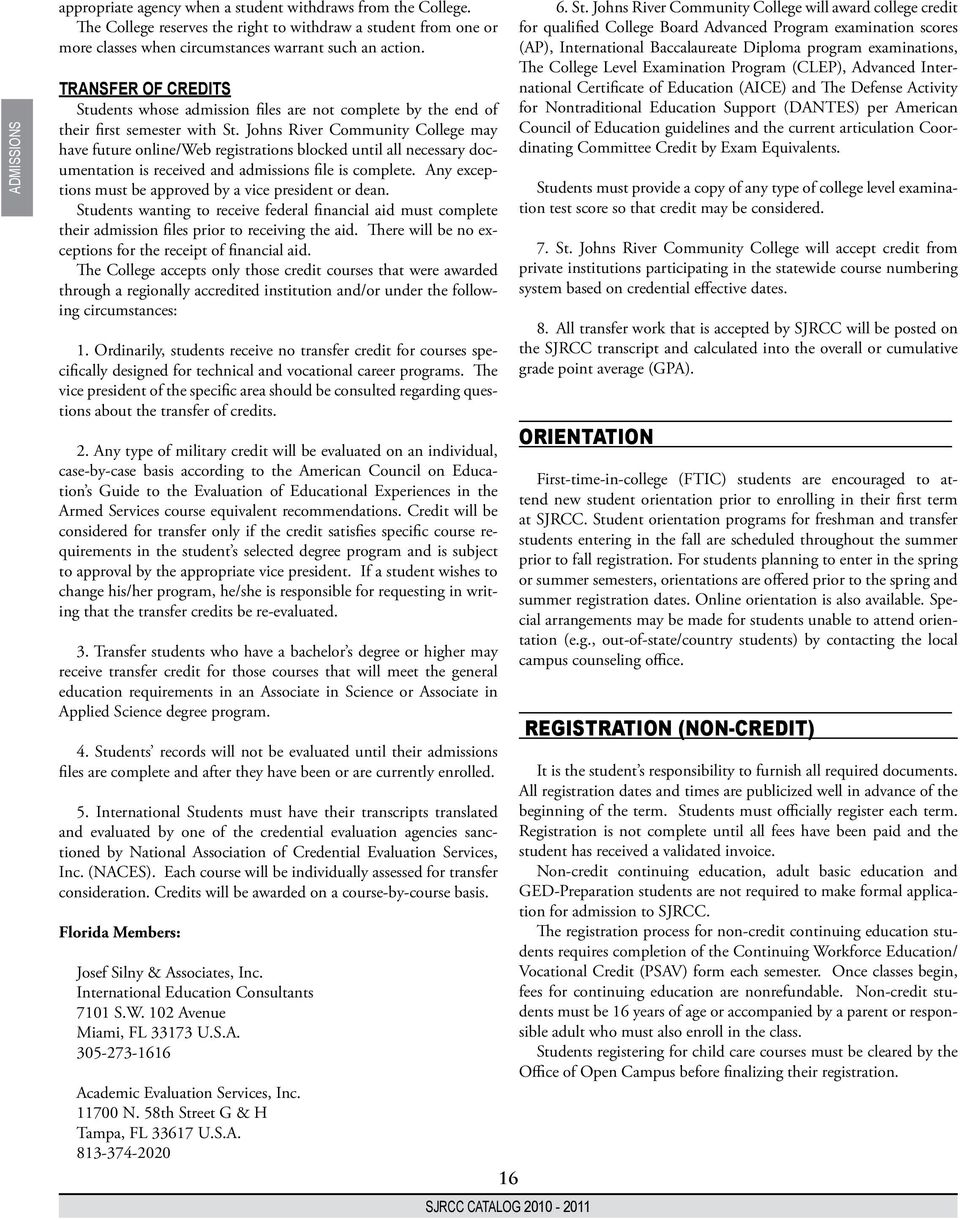
17 Admissions Checklist ST. JOHNS RIVER COMMUNITY COLLEGE The following items are needed for admission files to be cleared. Admission files MUST be cleared for receipt of financial aid and/or receipt of degree or college credit certificate. Application Form DEGREE OR COLLEGE CREDIT CERTIFICATE STUDENT NON-DEGREE STUDENT TRANSIENT STUDENT AUDIT STUDENT DUAL ENROLLMENT STUDENT INTERNATIONAL STUDENT ON A STUDENT VISA X X X X X ADMISSIONS Application Fee Affidavit of Residence Official High School Transcript or Official GED Transcript College Transcript(s) Dual Enrollment Application Form Course Approval Form or Transient Student Authorization T.O.E.F.L. Scores Financial Statement Specified Test Scores (less than 2 years old) International Student Health Insurance Compliance Form X X X X X X X X X X X 2 X X 1 X 1 X X X X X X X X X 3 1. Required from those students who have attended other colleges. 2. Must be furnished after student has completed high school or GED requirements. 3. See College Web site for additional information. 17
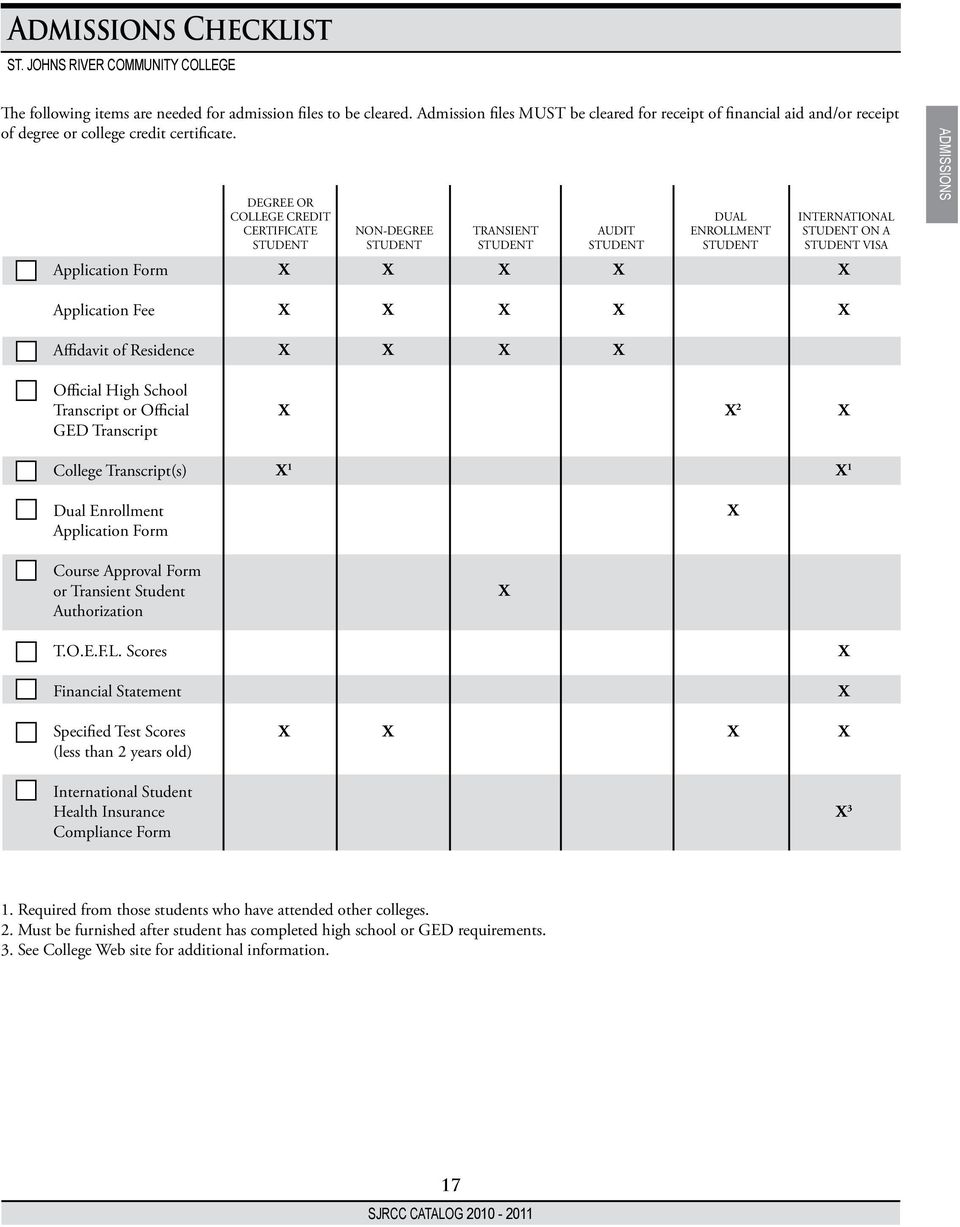
18 Course Planning Worksheet ST. JOHNS RIVER COMMUNITY COLLEGE ADMISSIONS 18
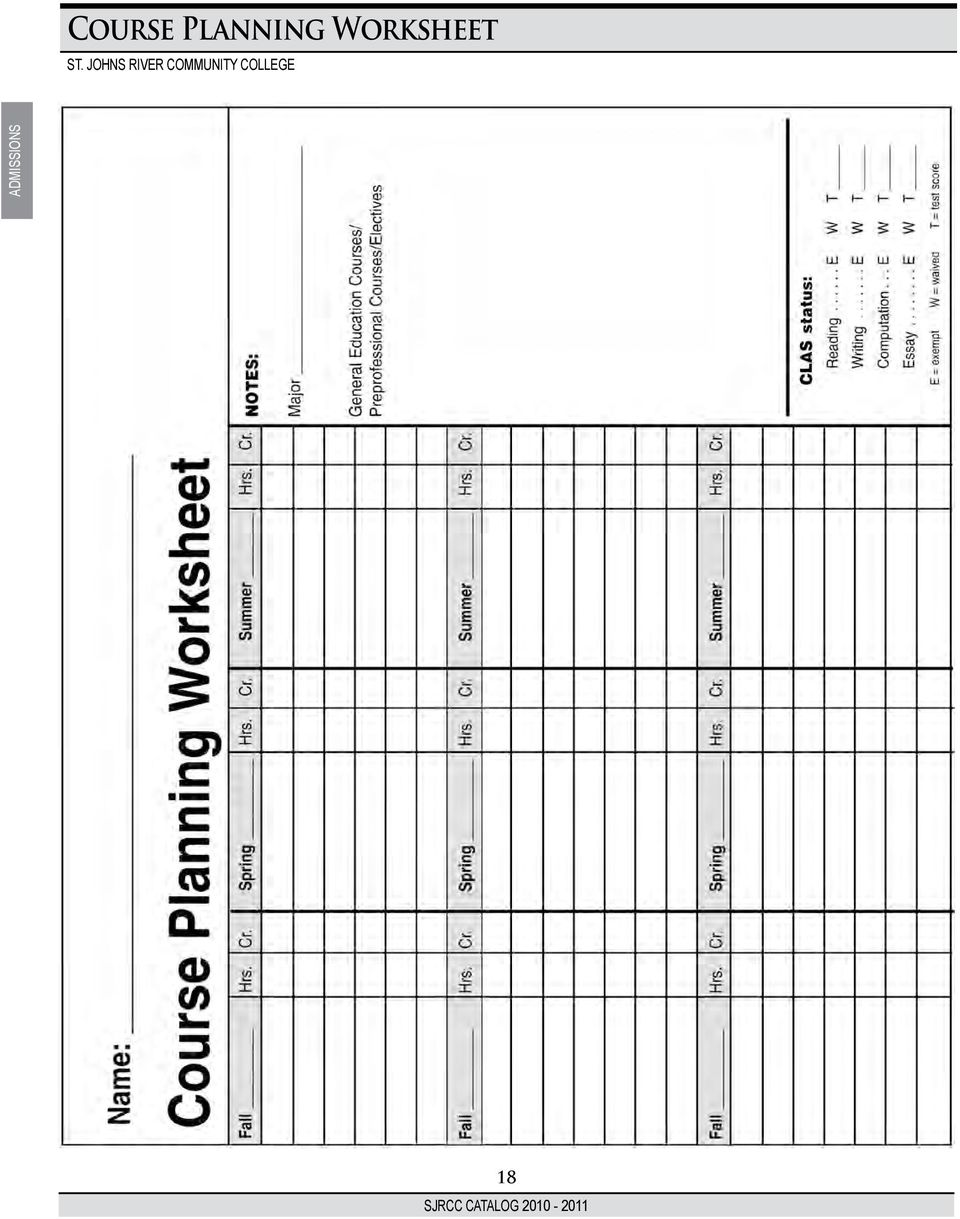
19 College Preparatory Program ST. JOHNS RIVER COMMUNITY COLLEGE COLLEGE PREParatorY PROGRAM MISSION Statement COLLEGE PREParatorY PROGRAM The College Preparatory Program at St. Johns River Community College offers courses and support services for students who need to improve their basic academic skills in reading, English composition, and mathematics to prepare for and successfully complete college level courses in these areas, as well as improve their chances for success in other disciplines. Objectives to determine which students are in need of college preparatory courses. to offer courses and support services appropriate to the remediation needs of students of varying levels and provide a measured transition through remediation to college level courses. to place students in need of remediation in courses best suited to their needs. to track students as they progress through the program to ensure their academic success. to adjust course offerings, support services, and curricula to maximize the success rate of college preparatory students in college level courses. Florida Statute requires standardized testing to assess the basic reading, writing, and computational skills of entering students. During their first semester, full-time students who are registered for at least twelve credits and do not meet minimum reading, writing, or computational scores must begin their remediation. Part-time students must enroll prior to completing twelve credits. Students who test into college preparatory instruction and enroll in college preparatory courses must successfully complete college preparatory instruction by the time they have accumulated twelve hours of college credit or maintain continuous enrollment in college preparatory coursework. Satisfactory completion is defined as a grade of C or higher. Credit earned in college preparatory courses is college preparatory credit, and may not be used to meet degree requirements or to fulfill the total number of hours required in any degree program. As required by s , upon the third attempt at completion of a college preparatory course, the student will be charged the full cost of instruction. Exceptions to this rule may be granted by the Vice President for Student Affairs/Assistant General Counsel for extenuating circumstances or financial hardship. ENC 0010 Preparatory Composition I A skills course in basic writing. Students will learn to write clear and logically structured sentences in which grammar, usage, punctuation, and spelling conform to the conventions of standard written English. ENC 0020 Preparatory Composition II Prerequisite: ENC 0010 with a grade of C or higher or satisfactory placement test score. Strengthens and applies basic writing skills introduced in ENC 0010; develops organizational skills. Students will learn to write purposeful, well-organized paragraphs in which sentence structure, grammar, usage, punctuation, and spelling conform to the conventions of standard written English. MAT 0002 College Preparatory Arithmetic Topics include addition, subtraction, multiplication, and division of whole numbers, fractions, decimals, and percent. MAT 0012 Pre-Algebra Prerequisite: A satisfactory score on placement tests or completion of MAT 0002 with a grade of C or higher. Topics include operations with integers, fractions, decimals, percent, geometric figures and their measures, properties of rational numbers, operations of rational numbers, simplification of polynomials, and equation solving techniques. MAT 0024 Beginning Algebra Prerequisite: MAT 0012 with a grade of C or higher or a satisfactory score on placement tests. Topics include real numbers, linear equations, linear inequalities, exponents, polynomials, factoring, rational expressions, lines, and square roots. REA 0001 College Preparatory Reading * A course designed to develop basic reading and vocabulary skills with an emphasis on literal comprehension skills. REA 0002 Reading and Study Skills * Prerequisite: REA 0001 with a grade of C or higher or a satisfactory placement test score. A course designed to improve reading skills and promote academic success; literal and critical comprehension, vocabulary development, and study skills are stressed. *Additional Fee Required. ADMISSIONS 19
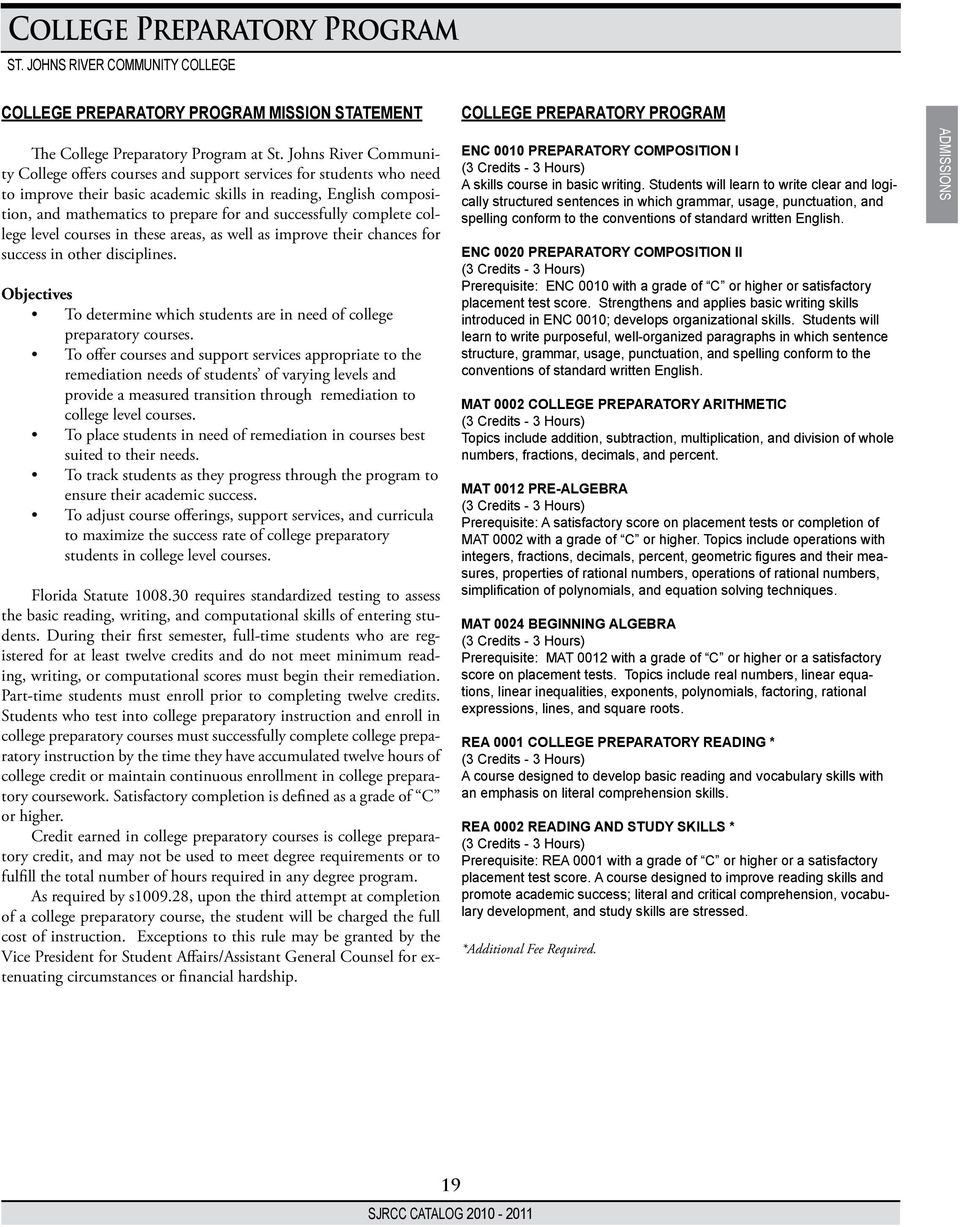
20 Placement Test Scores ST. JOHNS RIVER COMMUNITY COLLEGE NOTE: Scores that are more than two years old cannot be used for initial placement purposes (Florida Statute ) ADMISSIONS Test & Course Placement CPT Range ACT Range SAT Range Your CPT Your ACT Your SAT COMPOSITION CPT ENC * * ENC * * ENC 1101+, OST up 17-up 440-up READING CPT REA * * REA * * REA 1105 or REA REA up 21-up 460-up ARITHMETIC CPT MAT MAT ** * * MAT 0024, MTB up*** * * ALGEBRA CPT MAT ** MAT *** * * MAT MAC 1105, MGF 1106, MGF 1107, STA up up COLLEGE LEVEL MATH CPT MAC 1147, MAC up 550-up MAC up 30-up 600-up + Placement in ENC 1101, Composition I, requires college-level composition scores AND college-level reading placement scores. *Students with ACT or SAT scores that are below college-level placement must retest with the CPT. It is the student s responsibility to schedule a testing appointment with the Counseling center on his/her campus. **Placement in MAT 0012, Pre-Algebra, is based on a CPT arithmetic score between 45 and 62 and an elementary algebra score of less than 72. ***Placement in MAT 0024, Beginning Algebra, is based on a CPT arithmetic score of at least 63 AND an elementary algebra score between 45 and

21 Course Placement ST. JOHNS RIVER COMMUNITY COLLEGE COMPOSITION READING MATHEMATICS ENC 0010 PREPARATORY COMPOSITION I REA 0001 COLLEGE PREPARATORY READING MAT 0002 COLLEGE PREP ARITHMETIC ADMISSIONS ENC 0020 PREPARATORY COMPOSITION II REA 0002 READING & STUDY SKILLS MAT 0012 PRE-ALGEBRA MAT 0024 BEGINNING ALGEBRA * COLLEGE LEVEL COURSES * * ENC 1101 COMPOSITION I * REA 1105 COLLEGE READING & STUDY SKILLS * MAT 1033 INTERMEDIATE ALGEBRA * REA 1505 COLLEGE VOCABULARY STUDY * GENERAL EDUCATION MATHEMATICS COURSE * REA 2205 CRITICAL READING AND THINKING 21
22 Mathematics Courses at SJRCC ST. JOHNS RIVER COMMUNITY COLLEGE ADMISSIONS Prerequisite Sequence - Score on placement test will determine entry point MAT 0002 College Preparatory Arithmetic MAT 0012 Pre-Algebra MAT 0024 Beginning Algebra MAT1033 Intermediate Algebra MTB 1304 Using Graphing Calculator MGF 1106 Math for Liberal Arts I MAC 1105 College Algebra STA 2023 Elementary Statistics MGF 1107 Math for Liberal Arts II MAC 1147 Precalculus MAC 2233 Survey of Calculus MAC 2311 Analytical Geometry and Calculus I MAC 2312 Analytical Geometry and Calculus II MAC 2313 Analytical Geometry and Calculus III MAP 2302 Elementary Differential Equations Course Credit Level College Preparatory Credit General Education Elective Credit General Education Mathematics Credit 22
23 Regulations ST. JOHNS RIVER COMMUNITY COLLEGE Standard of Conduct An SJRCC student is obligated to comply with all college regulations as stated in the College catalog and student handbook. Should a student fail this obligation, the student is subject to disciplinary action by the College. In the event of disciplinary action, college officials will act in accordance with due process procedures stated in the student handbook. The student handbook also lists actions for which students are subject to disciplinary action, penalties, appeals procedures, and a statement of student rights and responsibilities. Students receiving disciplinary probation may not officially represent the College. POLICY ON ACADEMIC INTEGRITY The pursuit of scholarly activity, free from dishonesty, fraud, or deception, is essential to the mission of the College and to the full exercise of academic freedom. Cheating, plagiarism, fabrication of information or citations, and other forms of unethical conduct compromise the quality of education and will not be tolerated. Infractions may result in penalties or sanctions beyond those imposed by an individual faculty member. sjrcc student guidelines for acceptable computer lab and internet use Use of computer, network, and Internet equipment and software at St. Johns River Community College computing facilities is restricted to scholarly activities related to student instruction and research. The College reserves the rights to limit, restrict, or extend computing privileges and access to its information technology resources. Access to these systems is granted to SJRCC students and authorized users subject to adherence to all College information technology security policies, guidelines and procedures that govern computer and network use at SJRCC as well as the following statements regarding acceptable use of computer lab and Internet resources: integrity of the network. 7. User may not write, use, send, download or display obscene, threatening, or harassing materials or messages. 8. User may not use the equipment or network for any illegal activities, including violation of copyright laws and/or software piracy. 9. User may not use anyone else s student ID. 10. User may not trespass into or in any way alter anyone else s folders, documents or files. 11. User may not play games or occupy the lab for non-scholarly purposes. 12. User must maintain a scholarly atmosphere in the lab; no loud or aggressive behavior will be tolerated. 13. User may not eat, drink, or smoke in the lab. 14. User should not under any circumstances expect that messages or files that are created, modified, transmitted, received or stored on organizational equipment are private. 15. User may not load unauthorized software onto College equipment. Users who violate any of the above conditions will be subject to the suspension or termination of their Internet and computing privileges, as well as other disciplinary or legal action as determined by the College. ADMISSIONS 1. User must present a valid SJRCC student ID upon entering the computer lab. Student ID s are issued only if the student s account with SJRCC is in good standing. 2. User may not use equipment or facilities in a way that is inconsistent with the general rules of conduct that govern student behavior at SJRCC. 3. User may not damage or mistreat equipment or facilities under any circumstances. 4. User may not intentionally waste computer resources. 5. User may not employ the network for personal financial gain or commercial purposes. 6. User may not engage in practices that threaten the Student Identification While on college property, students should possess an SJRCC student identification card. Students can secure this card from the Student Activities Coordinator on each campus during designated times each fall, spring and summer term. Cards that are lost, stolen or damaged may be replaced for a $5.00 fee. Student Housing The College assumes no responsibility for providing student housing. Students must register their local address during each registration period. Any change of address must be reported to the Office of Admissions and Records. Dress Code Education is a formal process. College men and women are expected to be appropriately dressed. As the student engages in the process of gaining an education, his/her appearance should demon- 23
24 ADMISSIONS strate their recognition of that fact. If, in the opinion of an instructor, a student s dress is improper and hinders the educational process, the instructor may refuse to admit the student to class. The student may be refused admittance to the libraries, student centers, administrative offices, and college functions if, in the opinion of a college official, he/she is not properly dressed. Footwear must be worn on campus. Parking and Traffic Regulations St. Johns River Community College parking and traffic regulations, supplemented by the Motor Vehicle Code of the State of Florida, are enforced on college property and apply to all faculty, staff, visitors, and students of the College. Numbered decals are issued for identification and regulatory purposes. All vehicles must be registered and identified by the appropriate decal during the first five days of the term if the vehicle is to be parked on the campus during the normal school day. It is the responsibility of the operator to ensure that the vehicle is not in violation of any of the regulations. For detailed parking regulations, vehicle operators should refer to the student handbook. Any vehicle operated or parked on the campus is at the owner s risk. Student Services Electronic Publications In addition to the electronic college catalog, Student Services publishes the electronic student handbook* which provides information concerning student life, clubs and organizations, financial aid, college regulations and procedures. * FULL-TIME Classification A full-time student is registered for 12 or more semester hours of college credit, college preparatory credit, or any combination of college and college preparatory credit during the fall or spring terms, or six semester hours of credit during a summer term. Maximum and Minimum Load The recommended maximum load for an entering freshman is 16 semester hours. The maximum load for all other students is 18 semester hours during fall or spring terms, or 10 semester hours during a summer term. Any student desiring to register for more than the maximum load must have the approval of either the Dean of Arts and Sciences or the Dean of Business, Computer and Apprenticeship Programs as appropriate. Class Attendance Regular and prompt attendance is expected and required. Excessive absences may subject the student to administrative withdrawal, a loss of quality points, loss of credit, or dismissal from the College. If a student accumulates recorded absences totaling three or more instructional hours (one instructional hour equals 50 minutes) during the withdrawal period (see academic calendar), the instructor may initiate an official warning to the student that he/she has reached the limit of allowed recorded absences. Further, the loss of instructional time through absences may result in the student being withdrawn from the course, unless the instructor, because of extenuating circumstances, permits the student to remain in the course. No student may be withdrawn from a course for loss in instructional hours without first being warned in regard to the limit of recorded absences. DISTANCE LEARNING COURSES ORIentatION AND ATTENDANCE After registering for a distance learning course with the College, distance learning students must access their distance learning course at mysjrcc.sjrcc.edu on the first day of the term to obtain orientation information. Distance learning students must begin their class by completing the orientation activity prior to the conclusion of the first week of the semester. If a student does not begin a distance learning course by the end of the first week of the semester by making contact with the instructor and completing the specified activity, he/she will be dropped as a no show. Although in distance learning classes students do not attend class in the traditional sense, these courses do have an attendance policy, and students may be dropped for non-attendance. During a traditional-length semester, three instructional hours of attendance equals one week s missed work. If a student misses a week s worth of work in a distance learning course, he/she may receive a warning for non-attendance, and if the student misses more than one week s work in a distance learning course, he/she may be dropped from the course due to non-attendance. RELIGIOUS OBSERVANCES Any student who wishes to observe a religious holiday not in the official academic calendar may do so without penalty. However, the student must follow proper procedure. This procedure requires the student to inform the instructor one week in advance of the holiday and make-up any required work, including tests, within one week of absence. Students may be required to present specific documentation upon request. Students who feel they have been unreasonably denied an educational benefit due to religious beliefs should contact the Vice President for Student Affairs/Assistant General Counsel for information on grievance procedures. Make-Up Tests/Examinations All make-up tests or examinations are at the discretion of the instructor. Academic Petitions Process A student may petition for exemption to a college policy or to have an academic issue addressed. The petition, in the form of a letter addressed to the Vice President for Student Affairs/Assistant General Counsel, should explain in detail why an exemption to a policy should be made, or should describe an academic issue that needs to be addressed. Petitions usually concern denial of admission to the College, academic suspension, or issues involving course grades. Depending on the substance of the issue, a petition might be addressed and resolved administratively or if appropriate, it might be referred to one of the College s standing committees. Committee recommendations are forwarded to the President of the College, whose decision is final. The Vice President for Student Affairs/Assistant General Counsel informs the student of the decision. 24
25 Student Ombudsman The College maintains a student ombudsman on each campus. Students who believe they have been denied access to courses or who have concerns about credit awarded toward a degree may appeal through the Office of the Student Ombudsman. The ombudsmen are the Provosts of the St. Augustine and Orange Park campuses, and the Vice President for Student Affairs/Assistant General Counsel. Continuing Education Unit Continuing Education Units are awarded for successful participation in certain non-credit courses and programs. One Continuing Education Unit (CEU) is awarded for each 10 contact hours of participation. The CEU serves as recognition for participation in noncredit activities. CEUs do not convert to semester hours of credit. The College can issue to each individual who qualifies for CEUs a record of their CEU activities. Grades Letters are used to indicate the quality of work achieved by the student at St. Johns River Community College. The following system of grading and assignment of quality points is used: A - Excellent work; four quality points per semester hour are assigned. B - Good work; three quality points per semester hour are assigned. C - Average work; two quality points per semester hour are assigned. D - Below average work; one quality point per semester hour is assigned. F - Failure; no quality points are assigned and no credit is granted. The credit hours attempted are included in computation of cumulative grade point average. I - Incomplete work; not computed on grade point average. A student receiving an I grade must complete the course within a 30 calendar day period which begins on the first day of classes of the next term. Students are not eligible for graduation or honors lists until all I grades have been removed from their academic records. I grades may also affect eligibility for financial aid. IF - Incomplete work will convert to an IF if the course work remains incomplete. Zero quality points are assigned. W - Withdrawal N - No Credit NR - Grade not reported X - Audited course; no credit hours, P - S - U - quality points, or hours attempted. Passed institutional examination; no hours attempted or quality points assigned, only hours earned. (See also Credit by Examination section.) Satisfactory performance ranging from average to superior; no hours attempted or quality points assigned. Hours may or may not have been earned. Unsatisfactory performance ranging from below average to no performance. No hours attempted or quality points assigned; no hours earned. Final grades will be available on the College Web site shortly after each term. A grade cannot be changed by petition if more than two calendar years have elapsed since the end of the term in which the course was taken. Grade POINT AVERAGE A student s academic standing (good, probation, or suspension/ dismissal) is based only on grade point average or GPA of college level courses. College preparatory courses do not count in the calculation of the grade point average or GPA. A = 4 points B = 3 points C = 2 points D = 1 point F = 0 points W = no points To compute the grade point average (GPA), multiply the credit value of each course by the point value of the grade received. Divide the result by the total number of credit hours attempted. An example is provided below. Course Grade Semester Hours ENC 1101 MAC 1105 CGS 1100 AMH 2010 X (Multiply) Grade Value = (Equals) Grade Point B 3 X 3 = 9 D 3 X 1 = 3 A 3 X 4 = 12 F 3 X 0 = 0 Totals Your grade point average: 24 grade points divided by 12 semester hours = 2.0 GPA Grade Forgiveness Policy Withdrawal/Repeat of Courses The last grade recorded for a course will be the grade used to calculate the student s cumulative GPA. All courses attempted will appear on the transcript. A student may attempt to complete a college credit course three times. Any course in which a student has earned a grade of D or F, or received no grade due to withdrawal, may be repeated only twice. Upon third attempt additional fees will be charged. In accordance with state requirements, a student attempting a college credit course for a third time will pay the full instructional costs. First attempts will be counted beginning with the Fall 1997 semester. Students may appeal paying the full instructional costs based on financial hardship or other extenuating circumstances. This appeal must be made in writing to the Vice President for Student Affairs/Assistant General Counsel. Students are cautioned that upon transfer to other public and private institutions, the manner in which forgiven grades are used in calculating a grade point average may differ. The repeated course ADMISSIONS 25
26 grade may not be accepted at all, or all course attempts may be used in calculating the GPA. In addition, the repeat of courses may or may not be covered by some forms of financial aid. overall 2.0 GPA in college credit courses is achieved. Students seeking to enroll after suspension must contact the Vice President of Student Affairs/Assistant General Counsel. ADMISSIONS Honors List (Full-Time Students) 1. President s List--full-time students only (minimum of 12 college credit hours in a fall or spring term - 6 college credit hours during both Summer A and Summer B terms) making a GPA of 3.8 to 4.0 will be placed on the President s List for that term. 2. Dean s List--full-time students only (minimum of 12 college credit hours in a fall or spring term - 6 college credit hours during both Summer A and Summer B terms) making a GPA of 3.5 to 3.79 will be placed on the Dean s List for that term. ACADEMIC PROBATION REGULATIONS A student will be placed on academic probation under the following circumstances: 1. The student is on academic probation or suspension at another institution upon transfer to SJRCC; 2. The student is re-admitted following a period of academic suspension from St. Johns River Community College; 3. The student has a cumulative GPA less than 2.0 in college credit courses once seven college credit hours have been attempted. Upon attempting seven college credit hours and thereafter a student must maintain a 2.0 cumulative GPA in college credit courses or the student will be placed on probation. After being placed on academic probation, the student must earn a minimum GPA of 2.0 in college credit courses for all hours attempted each semester. To be removed from academic probation, a student must achieve an overall 2.0 GPA in college credit courses. A student on probation should not register for more than 14 credit hours, and may not officially represent the College. Students with GPAs less than 2.3 in college credit courses. will be contacted by the Office of Testing and Adult Education. Academic Suspension/Dismissal A student on academic probation who fails to earn a satisfactory cumulative grade point average in college credit courses, as specified above, or who fails to earn a minimum semester GPA of 2.0 in college credit courses will be placed on academic suspension and may not enroll the following semester. Following a semester of academic suspension, a student may enroll again on academic probation. Should another suspension occur, the student will be academically dismissed for a period of three years. A student may petition for readmission during the dismissal by following the academic petitions process. If a student is readmitted by petition or after the three year period, the student will continue on academic probation until an Transcripts of Records Transcripts are sent upon written request if all obligations have been met. Unofficial transcripts may be viewed on the student Web page at: and FACTS.org. Privacy of Records Under provision of PL , Family Educational Rights and Privacy Act, records of students may be released only to the student, those to whom the student has authorized release, and certain specified third parties. The student has the right to access, explanation, challenge, and hearing. Complete details may be obtained by contacting the Vice President for Student Affairs/Assistant General Counsel. Catalog Governing Degree/Certificate The student may choose to satisfy the degree/certificate program requirements of either the catalog in effect when initial registration occurred or the current catalog. Students who change their program of study or who re-enter after an absence of two or more consecutive major terms (the two summer terms are considered a major term) shall be required to select the catalog in effect at the time of a program change, re-entry, or graduation. In addition, students who have been enrolled for five or more years may be required to select the catalog in effect at the time of graduation. Note: Since courses and programs may change, it may be impossible to complete courses or programs that have been deleted from the curriculum. Therefore, students who are seeking an Associate in Science degree or a certificate for a catalog year other than when initial registration occurred, or at the time of graduation, they must submit a catalog year petition change form through the counselor and approved by the Vice President for Workforce Development. Degree/Certificate Conferral The College awards the Associate in Arts degree that meets the requirements of general education necessary for articulation within the Florida State University System. In addition, the College awards the Associate in Science degree and certificates in various occupational fields. 1. All candidates for a degree must complete the minimum number of hours specified for the degree with a 2.0 minimum overall GPA. A minimum of 25% of all credit hours required for graduation must be completed through St. Johns River Community College. 2. Associate in Arts degree candidates must complete all general education requirements, choose elective hours accepted within the Florida state university system and successfully demonstrate college-level proficiency in communication and computation. A grade of C or higher is required for those courses meeting the area requirements in English, humanities, and mathematics. 3. All candidates must pay all fees and discharge all other obligations to the College. 4. All candidates must file an application for degree and 26
27 meet all degree requirements by the date indicated in the academic calendar. Graduation Ceremony The annual College graduation ceremony is conducted at the end of each spring term. Degree/certificate candidates are encouraged to participate in the annual exercise. Degree/certificate candidates for spring, future terms summer A, summer B, or previous fall may participate in the graduation exercises by notifying the Records office and ordering a cap and gown by the date specified in the academic calendar and provided a graduation application has been submitted by the date specified in the academic calendar. Graduates from Florida School of the Arts have their own graduation ceremony, which truly reflects the artistic nature of the school. Participation in the annual June ceremony is required of graduating students. Candidates must also satisfy all financial obligations to the College. ADMISSIONS Graduation Honors Students graduating with associate degrees are eligible for graduation honors based on scholastic achievement as follows: GPA HONOR cum laude (with honor) magna cum laude (with high honor) summa cum laude (with highest honor) 27
28 Students with Disabilities ST. JOHNS RIVER COMMUNITY COLLEGE ADMISSIONS Students with disabilities are welcome at SJRCC and are encouraged to contact the Counseling Center on their campus. The purpose of the Office for Students with Disabilities is to ensure access to accommodations for those students determined eligible. Students must report to campus coordinators at the beginning of each semester. Special assistance is available with orientation, registration, academic planning, special supplies, and equipment. In addition, specialized services are available to students whose disability prevents them from participating fully in classroom activities. The College provides services relating to student academic success; transportation and personal services are the responsibility of the student. Relay service for the hearing and vision impaired: (TDD) or (VOICE) Determining Eligibility A student must submit to the Office for Students with Disabilities counselor evidence of a documented disability written by a qualified professional. The documentation must verify that the disability(ies) exist(s) as defined by s and the degree to which the disability affects his/her ability to meet program admission or graduation requirements. Substitute Admission and Program Requirements In accordance with Florida Statutes and , any hearing or visually impaired student, or any student who has a specific learning disability, shall be eligible for a reasonable substitution of any requirement for admission to the College, admission to a program of study, or for graduation, provided that (1) the impairment or disability is documented by a qualified professional who verifies that the disability exists and defines the extent to which the disability affects the student s ability to function, and (2) provided the student s inability to meet the original requirement(s) does not fundamentally change the nature of the academic program. The Office for Students with Disabilities is responsible for developing procedures to insure dissemination of this policy and for initiating its application. The substitution packet should minimally include all of the following: 1) Identification of the specific course requirements for which the substitution is requested; 2) Documentation of the disability; 3) Documentation that failure to meet the requirement(s) for which the substitution is requested is related to the disability; 4) A reason for the course substitution from the coordinator; 5) Copy of the transcript(s) or course listing, including test scores and transfer information and/or compliance. B. The completed package should be submitted to the coordinator who will then review and approve the request prior to forwarding the request to the appropriate vice president. C. The appropriate academic vice president will review the recommendation and communicate his/her decision, in writing, to the student and disability coordinator. The letter shall include the rationale for the decision, and in cases where a substitution is recommended, specification of the substitution to the student and appropriate college personnel within five (5) business days of the decision. D. The College will accept substitutions granted by other Florida public colleges and universities. Substitutions granted by other postsecondary institutions will be evaluated on an individual basis. Documentation should be requested by the transferring student and sent from the granting institution. Due Process A student denied substitution of one or more course requirements may appeal the decision within ten (10) days, in writing, to the Vice President for Student Affairs/Assistant General Counsel who will submit the appeal to the Petitions Committee utilizing the current petitions process. Substitution Requests A. An eligible student requesting approval for substitution of one or more course requirements must petition, in writing, and provide documentation for such substitution. The student must meet with his or her campus counselor who then will forward the substitution request to the Office for Students with Disabilities Coordinator. The coordinator will then review the documentation for compliance with federal and state requirements. 28
29 Financial Information ST. JOHNS RIVER COMMUNITY COLLEGE Students who pay fees by student loans, scholarships, or through state or federal agency authorization must follow all procedures in the same manner as though they are paying by cash. In addition, these students must complete arrangements and receive approval of loans, scholarships, or agency payments by the Financial Aid office or Business office, prior to the deadline for fee payment listed in the academic calendar. Students who fail to make prior arrangements or who do not complete fee payments as scheduled shall forfeit all course selections. State laws and regulations prohibit the extension of credit. Fee Adjustments Due to Schedule Change Student fees are recalculated at the end of the period for schedule changes, as noted in the academic calendar, to determine if additional fees are due. If additional payment is required, the student will be notified. Payment must be received in the Business Office no later than one week after the date of notification. Refund Policy - Withdrawal from College and Reduction of Class Load A refund of registration fees will be made to any student enrolled in college credit courses who officially drops on or before the last day of the late registration period of any academic term. This policy applies also to the reduction of class load. Exceptions A full refund (100%) will be given to any student whose courses are canceled by the College or to any student who, because of serious circumstances beyond the student s control occurring prior to the mid-point of the term, is prevented from completing the term. These circumstances are limited to the following: death of the student or the death of an immediate family member upon whom the student is dependent for continuation of enrollment; prolonged physical disability of the student; involuntary recall or induction into the armed services; or other circumstances that may be approved by the President or designee with or without full 100% refund. In such cases, timely notification, along with appropriate documentation, should be made to the Vice President for Student Affairs/Assistant General Counsel. Tuition for continuing workforce and community instructional service courses is not refundable. Refunds/REPAYMENTS A statutory refund is made to federal financial aid sources, excluding federal work study, if the student received financial aid funds and the student officially withdrew or was officially withdrawn from all classes prior to completing at least 60% of the term. This also applies to students who stopped attendance prior to completing at least 60% of the term and received grades of F, I, and/or W only, referred to as an unofficial withdrawal. For official withdrawals, SJRCC s policy is to recalculate the amount of aid earned based on the date the student withdrew from all classes. For students who were officially withdrawn (by instructors), the calculation is based on the last date of attendance or final class participation date documented by the instructor(s). For unofficial withdrawals, SJRCC s policy is to recalculate the amount of aid earned based on the last documented date the student participated in class or the mid-point of the semester, whichever is later. The College will bill the student any amount refunded to federal sources. A hold will be placed on the student s records until repayment is made. Repayment can be made by cash, check, or credit card to the cashier; or payment can be sent to the Business office. Refunds will be distributed to aid sources from which the student received aid in the following order as prescribed by federal regulations: 1. unsubsidized Federal Stafford or Direct Loans 2. subsidized Federal Stafford or Direct Loans 3. federal PLUS Loans 4. federal Pell Grants for which a return of funds is required 5. federal Academic Competitiveness Grants 6. federal Supplemental Educational Opportunity Grants for which a return of funds is required 7. other applicable aid AUTOMATIC PAYMENT PLAN St. Johns River Community College offers a Tuition Installment Plan (TIP) for all students requiring assistance with managing their educational expenses. The TIP program will allow students to pay for tuition and fee expenses over a period of time rather than one lump sum payment before the start of the semester. The College has contracted with Nelnet Business Solutions to administer this program. This company will be responsible for the enrollment, as well as receiving the monthly payments. Enrollment to the payment plan can be completed via the SJRCC Web site ( by logging on to the MySJRCC account. After the student registers under the Student and Registration menu, click on Optional Payment Plan, choose the term, and click on e-cashier logo and follow the steps. Students needing additional information should contact the St. Johns River Community College Business Office at Student s Responsibility It is the responsibility of the student to complete all requirements for dropping courses for a refund within the drop/add period. A refund will not be made unless all requirements are met. (See also academic calendar and the withdrawal section.) FINANCIAL 29
30 FINANCIAL Delinquent Accounts A student may be suspended if all fees and other financial obligations to the College have not been paid by the due date. The College will not issue an official transcript unless all financial obligations to the College, including library fines, traffic fines, student loan repayments, veteran deferments, additional fees, inter-library loan obligations, etc., have been met. If it becomes necessary for the College to turn over a student s account balance to a collection agency for collection, the collection cost (agency s fees) will be added to the student s account and must be paid by the student. CHECKS RETURNED BY THE BANK If a student or anyone on the student s behalf issues a check to meet an obligation to the College during the add/drop period and the check is not honored by the bank, the student will be voided from all classes within a 24-hour period. If a check not honored by the bank is received after the add/drop period the student will be notified via SJRCC and given 10 business days to pay the obligation. If the obligation is not met, the student will be withdrawn from all classes and will still be responsible for the total amount due the College. In all cases, a returned check fee of $25.00 will be assessed to the student s account as authorized by Florida Statute If a student habitually issues bad checks, even if the debt is cleared, disciplinary action may be taken. If due to bank error the check is dishonored, the student must bring or fax a signed letter from the bank to the Business Office that states bank error. This should be done immediately after the student is notified by the College that the check has been returned. There will be no returned check fee assessed to the student s account. *Residency Requirements All applicants are required by law to execute the residency affidavit form. College fees and tuition assessments are based on the applicant s residence or the legal residence of their parent or legal guardian if the applicant is less than 18 years of age. Classification as a Florida resident shall be granted by Florida Statute Chapter listed below: or legal guardian of a dependent child. (e) A resident for tuition purposes is a person who qualifies as provided in subsection (2) for the in-state tuition rate; a nonresident for tuition purposes is a person who does not qualify for the in-state tuition rate. (2) (a) To qualify as a resident for tuition purposes: 1. A person or, if that person is a dependent child, his or her parent or parents must have established legal residence in this state and must have maintained legal residence in this state for at least 12 months immediately prior to his or her qualification. 2. Every applicant for admission to an institution of higher education shall be required to make a statement as to his or her length of residence in the state and, further, shall establish that his or her presence or, if the applicant is a dependent child, the presence of his or her parent or parents in the state currently is, and during the requisite 12-month qualifying period was, for the purpose of maintaining a bona fide domicile, rather than for the purpose of maintaining a mere temporary residence or abode incident to enrollment in an institution of higher education. (b) However, with respect to a dependent child living with an adult relative other than the child s parent, such child may qualify as a resident for tuition purposes if the adult relative is a legal resident who has maintained legal residence in this state for at least 12 months immediately prior to the child s qualification, provided the child has resided continuously with such relative for the 5 years immediately prior to the child s qualification, during which time the adult relative has exercised day-to-day care, supervision, and control of the child. (c) The legal residence of a dependent child whose parents are divorced, separated, or otherwise living apart will be deemed to be this state if either parent is a legal resident of this state, regardless of which parent is entitled to claim, and does in fact claim, the minor as a dependent pursuant to federal individual income tax provisions. (3) An individual shall not be classified as a resident for tuition purposes and, thus, shall not be eligible to receive the in-state tuition rate until he or she has provided such evidence related to legal residence and its duration as may be required by officials of the institution of higher education from which he or she seeks the in-state tuition rate Determination of resident status for tuition purposes. Students shall be classified as residents or nonresidents for the purpose of assessing tuition in community colleges and state universities. (1) As used in this section: (a) The term dependent child means any person, whether or not living with his or her parent, who is eligible to be claimed by his or her parent as a dependent under the federal income tax code. (b) The term institution of higher education means any public community college or state university. (c) A legal resident or resident is a person who has maintained his or her residence in this state for the preceding year, has purchased a home which is occupied by him or her as his or her residence, or has established a domicile in this state pursuant to s (d) The term parent means the natural or adoptive parent (4) With respect to a dependent child, the legal residence of such individual s parent or parents is prima facie evidence of the individual s legal residence, which evidence may be reinforced or rebutted, relative to the age and general circumstances of the individual, by the other evidence of legal residence required of or presented by the individual. However, the legal residence of an individual whose parent or parents are domiciled outside this state is not prima facie evidence of the individual s legal residence if that individual has lived in this state for 5 consecutive years prior to enrolling or reregistering at the institution of higher education at which resident status for tuition purposes is sought. (5) In making a domiciliary determination related to the classification of a person as a resident or nonresident for tuition purposes, the domicile of a married person, irrespective of sex, shall be determined, as in the case of an unmarried person, by reference to all relevant 30
31 evidence of domiciliary intent. For the purposes of this section: (a) A person shall not be precluded from establishing or maintaining legal residence in this state and subsequently qualifying or continuing to qualify as a resident for tuition purposes solely by reason of marriage to a person domiciled outside this state, even when that person s spouse continues to be domiciled outside of this state, provided such person maintains his or her legal residence in this state. (b) A person shall not be deemed to have established or maintained a legal residence in this state and subsequently to have qualified or continued to qualify as a resident for tuition purposes solely by reason of marriage to a person domiciled in this state. (c) In determining the domicile of a married person, irrespective of sex, the fact of the marriage and the place of domicile of such person s spouse shall be deemed relevant evidence to be considered in ascertaining domiciliary intent. (6) Any nonresident person, irrespective of sex, who marries a legal resident of this state or marries a person who later becomes a legal resident may, upon becoming a legal resident of this state, accede to the benefit of the spouse s immediately precedent duration as a legal resident for purposes of satisfying the 12-month durational requirement of this section. (7) A person shall not lose his or her resident status for tuition purposes solely by reason of serving, or, if such person is a dependent child, by reason of his or her parent s or parents serving, in the Armed Forces outside this state. (8) A person who has been properly classified as a resident for tuition purposes but who, while enrolled in an institution of higher education in this state, loses his or her resident tuition status because the person or, if he or she is a dependent child, the person s parent or parents establish domicile or legal residence elsewhere shall continue to enjoy the in-state tuition rate for a statutory grace period, which period shall be measured from the date on which the circumstances arose that culminated in the loss of resident tuition status and shall continue for 12 months. However, if the 12-month grace period ends during a semester or academic term for which such former resident is enrolled, such grace period shall be extended to the end of that semester or academic term. (9) Any person who ceases to be enrolled at or who graduates from an institution of higher education while classified as a resident for tuition purposes and who subsequently abandons his or her domicile in this state shall be permitted to reenroll at an institution of higher education in this state as a resident for tuition purposes without the necessity of meeting the 12-month durational requirement of this section if that person has reestablished his or her domicile in this state within 12 months of such abandonment and continuously maintains the reestablished domicile during the period of enrollment. The benefit of this subsection shall not be accorded more than once to any one person. (10) The following persons shall be classified as residents for tuition purposes: (a) Active duty members of the Armed Services of the United States residing or stationed in this state, their spouses, and dependent children, and active members of the Florida National Guard who qualify under s (7) and (8) for the tuition assistance program. (b) Active duty members of the Armed Services of the United States and their spouses and dependents attending a public community college or state university within 50 miles of the military establishment where they are stationed, if such military establishment is within a county contiguous to Florida. (c) United States citizens living on the Isthmus of Panama, who have completed 12 consecutive months of college work at the Florida State University Panama Canal Branch, and their spouses and dependent children. (d) Full-time instructional and administrative personnel employed by state public schools, community colleges, and institutions of higher education, as defined in s , and their spouses and dependent children. (e) Students from Latin America and the Caribbean who receive scholarships from the federal or state government. Any student classified pursuant to this paragraph shall attend, on a full-time basis, a Florida institution of higher education. (f) Southern Regional Education Board s Academic Common Market graduate students attending Florida s state universities. (g) Full-time employees of state agencies or political subdivisions of the state when the student fees are paid by the state agency or political subdivision for the purpose of job-related law enforcement or corrections training. (h) McKnight Doctoral Fellows and Finalists who are United States citizens. (i) United States citizens living outside the United States who are teaching at a Department of Defense Dependent School or in an American International School and who enroll in a graduate level education program which leads to a Florida teaching certificate. (j) Active duty members of the Canadian military residing or stationed in this state under the North American Air Defense (NORAD) agreement, and their spouses and dependent children, attending a community college or state university within 50 miles of the military establishment where they are stationed. (k) Active duty members of a foreign nation s military who are serving as liaison officers and are residing or stationed in this state, and their spouses and dependent children, attending a community college or state university within 50 miles of the military establishment where the foreign liaison officer is stationed. (11) The State Board of Education shall by rule designate classifications of students as residents or nonresidents for tuition purposes at community colleges and state universities. * Residency requirements are subject to change for For current residency rules, check the College Web site at: and Facts.org. PROCEDURES FOR RECLASSIFICATION Reclassification Application The student who is classified as out-of-state and wants to request reclassification to in-state status must complete a Residency Statement at the higher education institution and submit to the appropriate office for consideration. FINANCIAL 31
32 FINANCIAL Documentary Evidence The evidentiary requirement for reclassification goes beyond that for an initial classification, because these individuals have previously been determined to be out-of-state residents. An individual who is initially classified as a non-resident for tuition purposes may become eligible for reclassification as a resident for tuition purposes only if that individual, or his or her parent if that individual is a dependent child, supports permanent residency in this state for 12 consecutive months. The individual, or his or her parent if that individual is a dependent child, must present documentation that substantiates residency in this state for the purpose of maintaining a bona fide domicile, rather than for the purpose of maintaining a mere temporary residence or abode incident to enrollment in an institution of higher education. Therefore, the burden of proof is on the student to show: (1) residency in Florida for the requisite 12-month period; and (2) residency in the state was not merely temporary or incident to enrolling in a college or university located in Florida. Documentation for meeting the first requirement of reclassification is the same as for initial classification. Additional evidence or documentation may be required for meeting the second requirement of reclassification. Examples of evidence that may substantiate residency in this state for the purpose of maintaining a bona fide domicile may include: Student (or parent/legal guardian if dependent) is not enrolled full-time in a Florida higher education institution during the previous 12 months. Student (or parent/legal guardian if dependent) has maintained a full-time permanent job in Florida during the previous 12 months. Full-time employment is considered one or more permanent jobs for a minimum of 30 hours a week. Student (or parent/legal guardian if dependent) was transferred to a full-time permanent job in Florida prior to initial enrollment as confirmed on corporate or organizational letterhead. Student (or parent/legal guardian if dependent) has an immediate relative (i.e., parent or child) who is currently living in Florida and who has resided in this state for the previous 12 months. Student (or parent/legal guardian if dependent) has purchased a home in Florida as primary residence (evidenced by a homestead exemption) prior to initial enrollment. Student (or parent/legal guardian if dependent) has received a military discharge and established residency in Florida prior to initial enrollment. Student (or parent/legal guardian if dependent)received social service benefits (e.g., disability) from the State of Florida during the previous 12 months. Student (or parent/legal guardian if dependent) lost their house or other domicile in another state due to severe natural disaster or crisis resulting in a state of emergency (e.g., hurricane or earthquake) that occurred prior to initial enrollment. Documents should be submitted 20 working days prior to registration. To make false or fraudulent statements on the Residency Affidavit or the Application for Reclassification of Residency may result in disciplinary action, denial of admission, and invalidation of credits or degrees earned. 32
33 Tuition/Fees ST. JOHNS RIVER COMMUNITY COLLEGE TUITION/FEES (Advanced & Professional, Post Secondary Vocational College Preparatory, Educator Prep) Resident Credit Non-Resident Credit Resident Tuition $73.00 $73.00 Non-Resident Tuition $ Financial Aid Fee $3.50 $14.32 Student Activities Fee $7.30 $7.30 Technology Fee $2.15 $7.00 Capital Improvement Fee $7.30 $29.22 TOTAL $93.25 $ FINANCIAL POST SECONDARY ADULT VOCATIONAL Resident Non-Resident Resident Tuition $64.89 $64.89 Non-Resident Tuition $ Financial Aid Fee $3.47 $14.46 Technology Fee $2.15 $7.00 Capital Improvement Fee $3.24 $12.98 TOTAL $73.75 $ ADULT BASIC & SECONDARY Resident Non-Resident Resident Tuition $31.82 $31.82 Non-Resident Tuition $95.45 Financial Aid Fee $1.55 $12.51 Technology Fee $1.04 $6.36 Capital Improvement Fee $1.55 $6.36 TOTAL $36.00 $ CONTINUING WORKFORCE EDUCATION Assessed fees must cover at least 50% of the total costs for course. (Board approved - varies by course) TESTING AND EXAMINATION FEES Criminal Justice/Law Enforcement (Basic Abilities Test) (BAT)...$35.00 Career Assessment (SELF Directed Search)(SDS)...$9.95 Career Assessment (Myers-Briggs)...$11.25 Career Assessment (Strong Interest Inventory)...$14.00 Florida College Entry Level Placement Test (CPT)...$10.00 CPT Retest Fee...$20.00 College Level Examination Program (CLEP)...$15.00 Nursing Admissions Assessments (HESII)... $75.00 (on-campus) Institutional Exams (Per credit hour)...$25.00 Proctored Exams Up to 2 hours... $15.00* Up to 3 hours... $25.00* Over 3 hours... $35.00* Test of Adult Basic Education (TABE test) Non-students...$20.00 *This fee is in addition to the cost of specialized exams, including but not limited to the BAT, AutoCAD, HESI etc. 33
34 OTHER FEES Financial Aid/Veterans Deferment Late Fee...$20.00 Late Registration Fee...$20.00 Duplicate Copy of Student Schedule/Receipt...$2.00 Replacement ID...$5.00 Duplicate Diploma...$40.00 College Credit Application for Admission (non-refundable)...$30.00 Returned Check Fee...$25.00 FDLE - Fingerprint Card Fee...$47.00 Transcript Fee...$5.00 FINANCIAL LABORATORY AND SPECIAL FEES Online Course Fee...$27.00 Insurance Fee...$15.00 Applied Music Lessons (1 credit hour)...$60.00 Applied Music Lessons (2 credit hours)...$ FINES Parking and Traffic Fines *Unauthorized Handicapped Parking...$25.00 *Fire Lane Violation...$25.00 *Restricted Area...$25.00 *Overnight Parking...$25.00 *No Decal...$30.00 Employee Lost Parking Pass...$35.00 Library Lost Book Processing Fee...$
35 ARC 1171C... $45.00 ARC 2172C... $45.00 ART 1201C... $28.00 ART 1300C... $28.00 ART 1301C... $28.00 ART 1400C... $28.00 ART 1430C... $28.00 ART 2164C... $28.00 ART 2203C... $28.00 ART 2302C... $28.00 ART $28.00 ART 2401C... $28.00 ART 2402C... $28.00 ART 2441C... $28.00 ART 2450C... $28.00 ART 2500C... $28.00 ART 2501C... $28.00 ART 2502C... $28.00 ART 2503C... $28.00 ART $28.00 AST 1002L... $30.00 BCN 1250C... $20.00 BCN 1251C... $45.00 BCN 2253C... $45.00 BOT 2010L... $15.00 BSC 1005L... $17.00 BSC 1020L... $28.00 BSC 2010L... $28.00 BSC 2011L... $28.00 BSC 2085L... $25.00 BSC 2086L... $30.00 CET $27.00 CET 1178C... $27.00 CET 1600C... $27.00 CET 2179C... $27.00 CET 2556C... $27.00 CET 2610C... $27.00 CET 2615C... $27.00 CET 2620C... $27.00 CET 2660C... $27.00 CET 2880C... $27.00 CET 2883C... $27.00 CGS $27.00 CGS $27.00 CGS 1470C... $45.00 CGS $27.00 CGS 1560C... $27.00 CGS $27.00 CGS $27.00 CGS $27.00 CGS 2811C... $27.00 CGS $47.00 CGS $47.00 CGS $27.00 CHM 1020L... $30.00 CHM 1032L... $35.00 CHM 1045L... $35.00 CHM 1046L... $35.00 CHM 2120C... $50.00 CHM 2132C... $50.00 CHM 2210L... $40.00 CHM 2211L... $40.00 CJD $22.96 CJK $20.00 CJK $40.00 CJK $ CJK $25.52 CJK $ CJK $70.28 CJK $4.20 CJK $10.12 CJK $39.43 CJK $26.29 CJK $60.66 COP $27.00 COP $27.00 COP $27.00 COP $27.00 COP $27.00 COP $27.00 COP $47.00 COP $47.00 COP $27.00 COP $27.00 CTS 2111C... $27.00 DIG $28.00 DIG 1115C... $28.00 DIG $28.00 DIG 2201C... $28.00 DIG 2282C... $28.00 DIG $28.00 EET 1033C... $27.00 EET 2084C... $27.00 EME $24.00 ETD 2395C... $45.00 ETD 2541C... $50.00 EVR 1001L... $40.00 GRA 1222C... $28.00 GRA $28.00 GRA 2160C... $28.00 GRA 2190C... $28.00 GRA $28.00 GRA $28.00 GRA 2952C... $28.00 HCP $30.00 HCP 0120C... $72.80 HCP 0750C... $42.80 HIM 1211C... $50.00 HIM 1260C... $35.00 HIM 1282C... $35.00 HIM 2234C... $35.00 HIM 2255C... $35.00 HIM $ HIM $15.00 HIM $17.50 HIM $17.50 HSC $29.00 MCB 2010L... $40.00 MVK $60.00 MVK $ MVK $60.00 MVK $ MVV $60.00 MVV $ MVV $60.00 MVV $ NUR $ NUR $60.00 NUR 1020C... $ NUR 1221C... $ NUR 1461C... $10.00 NUR 1520C... $ NUR 2222C... $ NUR 2464C... $10.00 NUR 2753C... $ OST $27.00 OST $27.00 OST $27.00 OST $27.00 OST $27.00 PGY $28.00 PGY 1404C... $28.00 PGY 1446C... $28.00 PGY 2220C... $28.00 PGY 2405C... $28.00 PGY 2905C... $28.00 PGY 2802C... $28.00 PHY 1053L... $30.00 PHY 1054L... $30.00 PHY 2048L... $30.00 PHY 2049L... $30.00 PSC 1341L... $30.00 REA $22.00 REA $22.00 REA $22.00 RET 1024C... $58.00 RET 1027C... $48.00 RET 1264C... $60.00 RET 1350C... $35.00 RET $15.00 RET 2280C... $30.00 RET 2714C... $95.00 RET $22.80 RET 2930C... $ RTE 1000C... $83.00 RTE 1418C... $43.00 RTE 1503C... $43.00 RTE 1513C... $43.00 RTE $82.50 RTE $35.00 RTE $35.00 RTE $55.00 RTE $57.80 RTE $35.00 SLS $29.00 ZOO 2010L... $28.00 FINANCIAL NOTE: Fees are subject to change, and other fees may be added at the discretion of the District Board of Trustees. Fees are also located on the College Web site at: 35
36 Financial Aid ST. JOHNS RIVER COMMUNITY COLLEGE FINANCIAL Students who qualify for financial assistance may be able to obtain help through scholarships, loans, grants, and part-time work. Financial aid programs at SJRCC include Federal Pell Grant, Federal Supplemental Educational Opportunity Grant, Federal Work/ Study, Federal Stafford or Direct Loan, Federal PLUS Loan, Federal Unsubsidized Stafford or Direct Loan, Florida Student Assistance Grant, Florida Academic Scholars, Florida Medallion Scholars, Florida Gold Seal Scholars, Chappie James Most Promising Teachers Scholarship, and other state financial aid programs. These programs are funded by state and federal funds. Awards are made on an academic year basis, and the amount of the assistance is determined by individual need, student eligibility, program regulations, and availability of funds. The SJRCC Board of Trustees and SJRCC Foundation, Inc., provide a number of scholarships to outstanding students. Programs include academic scholarships to tri-county (Clay, Putnam, and St. Johns counties) area high school graduating classes, academic scholarships to currently enrolled SJRCC students, athletic scholarships, African-American leadership scholarships, Hispanic leadership scholarships, student ambassador scholarships, need-based scholarships, and performing and visual arts scholarships. Students are encouraged to apply for financial aid by April 1 for the following academic year. Detailed information concerning financial aid applications and sources of aid are available in financial aid brochures and on the Web site. You may obtain this information by contacting: Palatka Campus (386) Orange Park Campus (904) St. Augustine Campus (904) or by writing the: SJRCC Office of Financial Aid 5001 St. Johns Avenue Palatka, FL Admission files must be cleared for receipt of financial aid and/or receipt of degree. Please see the check list on page 17. Standards of Academic Progress for Financial Aid Standards of Academic Progress for Financial Aid: The federal regulations governing the funds from which financial aid is provided state that students must maintain satisfactory academic progress toward the educational goal they are pursuing, according to the standards established by the institution. SJRCC has established the following procedures to measure satisfactory progress for students receiving federal financial aid. The financial aid standards of progress apply to all semesters or enrollment periods regardless of whether a student received financial aid during a given semester or enrollment period (see definition of semester below). Certain state and locally administered financial aid programs have a more stringent progress standard. In these cases, the more stringent progress standards will be applied in addition to the College standard where applicable. Satisfactory Academic Progress (SAP) This is not measured until after students have attempted a minimum of six credit hours. At the completion of each semester or enrollment period after the first six credit hours, and including a measure of progress made in the first six hours, students progress toward an educational goal is measured in two ways: 1. Successful Completion Ratio: Students must maintain an overall successful completion ratio of at least 67 percent. This ratio is cumulative of all courses attempted, including transfer courses, and is calculated by dividing the total number of attempted credit hours into the number of credit hours successfully completed with a grade of D or higher. This successful completion ratio establishes measurement of the time frame requirement for students at a maximum of 11 2 times the normal length of time required for a student to complete a given program, regardless of enrollment status (full time, part time, or any combination of both). 2. Grade Point Average (GPA): Students must maintain a minimum cumulative grade point average of 2.0. In the event a student enrolls in a semester in courses where a grade point average is not applicable (e.g., all preparatory courses), the cumulative grade point average achieved by the end of the previous semester will be used. In the event there are only courses where a grade point average is not applicable, the successful completion ratio will be the only measurement applied until a GPA is applicable. All students who otherwise qualify for financial aid and who enroll at or above the postsecondary level in an eligible program of study for the first time at SJRCC will be eligible to receive financial aid. First-time students with course history that does not meet the satisfactory progress standard will be placed in a financial aid probation status based on the applicable transfer history grades. Dual enrollment courses taken at SJRCC will be included in all satisfactory academic progress measurements. A semester is defined as either of the major semesters/terms: fall and spring. The summer A and B terms are treated as one semester for financial aid purposes. An enrollment period is defined as the term or portion of a term for which a student enrolls. The words semester and term as used in this procedure also mean enrollment period where applicable. Satisfactory academic progress is measured at the end of each fall and spring semester. Courses taken during the summer terms will be included when the measurement is again taken after the following fall semester. Students placed in a financial aid suspension status at the end of the spring semester can request the Financial Aid Office review and revise their status at the end of the Summer term (after final grades are posted). If those students are found to be making satisfactory academic progress by including the summer grades, the students will be placed in an eligible status 36
37 (either satisfactory academic progress or continued probation as applicable). Successful completion is defined as any course completed with a final grade of A, B, C, D, P, or S. Courses for which students receive grades of W, WF, I, IF, F, N, NR, U, or X, as well as the previous attempt(s) of repeated courses regardless of previous grade, are counted as courses attempted but not successfully completed. Failure to meet the minimum standards of progress will result in one of the following actions: 1. Financial Aid Probation: This occurs at the end of the semester for which satisfactory progress is measured and the students failed to meet either one or both of the measurements outlined above. Students in this status continue to receive financial aid without penalty. 2. Financial Aid Continued Probation: This occurs only when students who are in a financial aid probation status enroll in a subsequent semester, successfully complete 100% of all courses attempted in that semester, achieve or maintain the minimum cumulative grade point average of 2.0, but do not reach the 67% cumulative successful completion ratio. Students in this status continue to receive financial aid without penalty in a financial aid probation status, as long as they have not yet reached the maximum hours limit. 3. Maximum Hours: This occurs at the end of the semester when students enrolled at the college credit level reach a total of 90 attempted credit hours, or when students enrolled at the postsecondary adult vocational level (PSAV) reach a total of 45 attempted credit hours (1350 clock hours). All federal financial aid is terminated. 4. Financial Aid Suspension: This occurs at the end of the semester for which satisfactory progress is measured and students failed to maintain either one or both of the measurements outlined above, with the exception of the financial aid continued probation status. All federal financial aid is terminated until the students again meet the minimum standards for receipt of aid. Students can regain eligibility by enrolling for a minimum of six credit hours (half time) in a single semester and achieving at least the equivalent of the financial aid continued probation status. APPEALS Students placed on financial aid suspension or reaching the maximum hours may file an appeal for reinstatement based on mitigating circumstances. These might include death in the immediate family, accidents, personal tragedy, medical emergencies, or other circumstances such as changes in degree goal(s). Students must submit a written letter of appeal along with supporting documentation to the Director of Financial Aid (the Director). The appeal will then be forwarded to the Financial Aid Appeals Committee (the Committee) for their consideration. The Committee reviews the appeal, determines whether there are sufficient reasons to allow additional financial aid, and notifies the Director. The Director informs the student of the Committee s decision. Students allowed to receive aid for an additional semester will be considered to be in a financial aid probation status for the additional semester and must again meet the satisfactory progress requirements by the end of the additional semester or be placed back on suspension. The decision of the Financial Aid Committee is final. If an appeal is denied, students may submit another appeal, but only after enrolling in and receiving a passing grade in each attempted course in an additional semester. EXCEPTIONS TO THE APPEAL PROCESS The Financial Aid Director can waive the appeal process for students reaching the 90 or 45 credit hour limits, but having less than one academic year to complete their current (final) program of study. Students must be meeting all other standards of progress measurements and must contact the Director and request the waiver. The Director may decide to refer these students to the Financial Aid Appeals Committee for their review and decision. REPAYMENT OF FEDERAL FUNDS Federal regulations require repayment of a portion of federal funds received by students, unless certain conditions are met. A student who withdraws from or stops attending all courses prior to completion of at least 60 percent of an enrollment period (i.e., a semester/term), WILL BE REQUIRED TO REPAY the unearned portion of the funds received. This applies to all federal grant and loan funds received as a disbursement by a student. For example, a student receiving a Pell Grant disbursement check in the amount of $800 could be required to repay the federal financial aid programs as much as $400, unless the student attends school for more than 60 percent of the enrollment period. PLUS a portion of the award that could have been used to pay for tuition, fees, books, and/or supplies may also be required as repayment to the school. The latter requirement is because schools will also be required to refund the federal financial aid programs the unearned portion of the tuition, etc. The rule applies only to those students who withdraw from all classes. The rule does not apply to students who successfully complete at least one course in an enrollment period; therefore, if a student finds he/she is unable to complete all courses, every effort to successfully complete at least one course should be made. In so doing, the student will preserve the funds received. After that, the student should work closely with an academic advisor to work out a course load that can be successfully completed each term. A student must also meet satisfactory academic progress guidelines in order to continue to receive financial aid. Special Assistance Vocational Rehabilitation Assistance The Vocational Rehabilitation Section of the Florida State Department of Labor and Employment Services provides limited assistance to students with disabilities. An applicant must be at least 16 years of age, have a permanent major physical disability, possess a good scholastic record, and take courses that will prepare him/her for a vocation. Application should be made to the Director of Vocational Rehabilitation of the area in which the applicant resides. FINANCIAL 37
38 Scholarships for Children of Deceased or Disabled Florida Veterans Eligibility is limited to children of deceased or 100% disabled veterans, and to children of POWs and MIAs attending a post secondary institution in Florida. The parent must have entered service from Florida. The surviving parent or veteran must have resided in Florida for five years before application. The amount will be for tuition and fees for the academic year. Applications may be obtained by writing the Office of Student Financial Assistance, Department of Education, Florida Education Center, Tallahassee, Florida g. A student should visit the college s VA counselor each term when registering. The student must submit a completed SJRCC Request for Certification form to the VA counselor. The student must ensure that the courses for which he or she registers will meet degree requirements. An audit conducted at the end of the schedule change period determines whether courses are acceptable for certification. The DVA will be notified of unacceptable courses and a reduction of benefits may result. FINANCIAL Veterans Education Assistance Students entitled to benefits should complete the necessary forms and applications well in advance of the term they plan to attend. Requirements and Policies: 1. The student must be seeking an Associate in Arts degree, an Associate in Science degree, or a certificate. 2. The student will be certified and receive benefits only for those courses needed for their degree. The number of elective hours needed for each degree program is limited. Students should take required courses first. 3. No benefits will be paid to a student for repeating a course in which they have already earned a satisfactory grade. A satisfactory grade is defined as D or better, unless a higher grade is required to meet a specific program or degree requirement. 4. The status of a student as full time, three-quarter, or half-time determines the percentage of educational benefits to be received. Status is determined as follows: a. Full-time. The student is taking 12 or more credit hours (5 or more in Summer A or Summer B terms). b. Three-quarter time. The student is taking 9, 10, or 11 credit hours (4 hours in Summer A or B terms). c. Half-time. The student is taking 6, 7, or 8 credit hours (3 hours in Summer A or Summer B terms). d. Less than half-time. The student is paid no monthly benefit but receives the amount of course fees. e. For purposes of registration and satisfactory progress status, college preparatory courses are considered as three semester hours. (See standards of progress for veterans). These courses, however, are not used for certification purposes unless required by placement test scores. 5. All students receiving DVA education benefits including certificate and other non-college degree programs are required to comply with the attendance policy as written in the student handbook. This policy states that students will receive an attendance warning after missing three or more instructional hours. Any additional absence after a warning will result in the student being withdrawn from the class. Standards of Progress for Veterans A student receiving veterans educational benefits is required to make satisfactory academic progress. Students receiving DVA education benefits will be required to meet or exceed the same minimum standards of progress required of other students by SJRCC academic regulations. Students will be considered to have failed to meet minimum standards if they are: 1. placed on academic or disciplinary suspension; or 2. withdrawn from the college for disciplinary reasons; or 3. placed on academic probation for more than two consecutive terms. (Summer A and Summer B Terms constitute the equivalent of one term.) If these standards are not met, the College will request the veterans administration to suspend educational benefits. Reinstatement for benefits will be made only if evidence indicates that improvement in academic performance may be expected. Courses for which a grade of W is given are not included in determination of satisfactory progress, but such grades may result in an overpayment of benefits. The DVA will recalculate benefits from the beginning of the term when the W creates a change in benefit status. In such cases, the DVA requests a refund or adjustment unless the student can show mitigating circumstances which the DVA finds satisfactory. Veterans Deferred Payment Students eligible for veterans educational benefits may defer payment of fees for sixty days (or 10 days before the end of the Summer A or Summer B Terms) once during the academic year, if they are not then receiving benefit checks. Failure to pay fees by the deadline will result in administrative withdrawal from classes. f. The DVA will not pay educational benefits for enrollment in MAN 1943, Work Experience I or MAN 2944, Work Experience II. 38
39 Student Services ST. JOHNS RIVER COMMUNITY COLLEGE COUNSELING SERVICES Counseling services are available on each campus for students and prospective students. Counselors are available to work individually and/or in groups with students requesting academic advising, career counseling, vocational and personality assessments, disability services, and referrals to community resources. The SJRCC counselors are dedicated to providing students with quality academic support services. These services include timely and effective delivery of academic advising, new student orientation, career counseling, college-wide testing, services for students with disabilities, and appropriate referral services. In addition, resources on educational/career planning, job searching strategies, and employment information are available at the Career Resource Centers on each campus and the Career Resources Web page at: Vocational and personality assessments are also available upon request and through enrollment in SLS 1401 Comprehensive Career Exploration. Student HANDBOOK The student policies and regulations, rights and responsibilities, including regulations and policies pertaining to student conduct are listed in the student handbook, which is available on the college Web site, Student Government Association The Student Government Association, through its elected student officers and representatives, promotes social, cultural, and recreational activities for all students and serves as a liaison group between the student body and the College administration. The Student Government Association recommends the chartering of all campus organizations, appoints students to College committees, conducts the College student activities program, and recommends student activity budgets. Athletics St. Johns River Community College is a charter member of the Florida Community College Activities Association, the governing body for intercollegiate competition within the state. The College provides intercollegiate basketball and baseball for men, and intercollegiate softball and volleyball for women. The College is a member of the National Junior College Athletic Association and participates in Region VIII of this organization. Clubs and Organizations Students are encouraged to participate in extracurricular activities which include academic, service, religious, and special interest clubs and organizations. These organizations are largely student-initiated and controlled. A complete listing of clubs and organizations is found online in the student handbook. Cultural Events Florida School of the Arts Located on the Palatka Campus, Florida School of the Arts presents a wide variety of cultural activities in the arts including dramas, dance and musical presentations, and art exhibits. Thrasher-Horne Center for the Arts Located on the Orange Park Campus, the Thrasher-Horne Center for the Arts hosts traveling art exhibits, theatrical shows and community events and serves as a meeting site for business conferences and events. Student Identification While on college property, students should possess an SJRCC student identification card. Students can secure this card from the Student Activities Coordinator on each campus during designated times each spring and fall term. Cards that are lost, stolen or damaged may be replaced for a $5.00 fee. 39
40 Programs of Study ST. JOHNS RIVER COMMUNITY COLLEGE PROGRAMS OF STUDY Whether you are preparing for your career or you want to enhance your present skills, St. Johns River Community College has an array of academic programs to fit your needs as well as special instructional programs of study. General education requirements and many of the elective, professional, and other required courses are available on all three locations; however, not all of the Associate in Science degree programs and college credit certificate programs are available at each college location. ASSOCIATE IN ARTS DEGREE The Associate in Arts degree is the legally recognized transfer degree for the Florida community college system and is specifically designed for the student who wishes to transfer into the state university system as a university junior. The A.A. degree requires a minimum of 60 college-level credit hours, which includes 36 credit hours in general education and 24 hours of university transfer program prerequisites/electives. See page 41. ASSOCIATE IN SCIENCE DEGREE ASSOCIate IN APPLIED SCIENCE DEGREE These degrees are for students planning to enter a career at the semi-professional level upon completion of the program of study. The A.S. and A.A.S. degree programs provide instruction in two areas: general education and program specific education related to specific careers. General education courses are designed to help develop a well-rounded individual and enhance employment potential. See page 46. college credit certificates The college credit certificate programs are designed to prepare students for immediate entry into a career in the workforce. These programs may be completed in as little as one year and are an intermediate step toward the related Associate in Science degree in that area of study. College credit certificates consist primarily of specialized courses in a specific career area. See page 48. VOCATIONAL CERTIFICateS (PSAV) Post Secondary Job Training programs prepare students for entry into a given career or vocation. Each of these programs prepares students for a specific occupation or one of a cluster of related occupations. See page 49. Articulated BACCALAUREATE/GRADUATE DEGREE OPPORTUNITIES The College actively seeks to form agreements with colleges and universities for the purpose of increasing access to baccalaureate and graduate degrees for residents of Putnam, Clay and St. Johns counties. For a list of participating colleges, see page 132. APPRENTICESHIP PROGRAMS The College offers several apprenticeship programs in the construction and building trades. Apprenticeship programs require full-time paid work in a specific trade, combined with classroom related instruction one to two evenings per week. See page 91 for more information. OPEN CAMPUS The Open Campus is committed to extending the College beyond its traditional course offerings and campuses into the community through a variety of credit and non-credit programs including baccalaureate and graduate degree opportunities, child care training, continuing education courses, contract customized training for business and industry, distance learning courses, dual enrollment courses, the Educator Preparation Institute, non-credit job enhancement courses, and non-credit recreation and leisure courses. See page
41 Associate in Arts ST. JOHNS RIVER COMMUNITY COLLEGE The Associate in Arts degree is the legally recognized transfer degree for the Florida community college system, and is specifically designed for the student who wishes to transfer into the state university system as a university junior. To receive the A.A. degree a student must complete a minimum of 60 college-level credit hours. The 60 hours must include the 36 credit hours general education requirement and 24 hours of university transfer program prerequisites/electives. In addition to the credit hour requirement as listed above, the student must: 1. earn a cumulative grade point average (GPA) of at least 2.0 in all courses attempted that apply toward the A.A. degree; 2. complete a minimum of 15 credit hours required for the degree at St. Johns River Community College; 3. demonstrate the attainment of the required College Level Academic Skills by meeting one of the requirements set forth in this catalog; 4. satisfy the writing requirements of SBE Rule 6A (Gordon Rule) by successfully completing at least 12 hours of courses requiring multiple college-level writing assignments; 5. satisfy the mathematics requirements of SBE Rule 6A by successfully completing at least 6 hours of courses at the level of college algebra or higher; 6. complete and submit an application for graduation by the deadline listed in the college calendar; university and admission to specific programs within the university. The articulation agreement designates the Associate in Arts degree as the transfer degree. In doing so, the agreement specifically guarantees that: 1. The degree holder will be granted admission to one of the state universities. 2. The graduate will be awarded at least 60 credit hours toward the baccalaureate degree. 3. Once a student has completed the general education requirement and it is noted on his transcript (regardless of whether an Associate in Arts degree is awarded), no state university or community college to which the student may transfer can require additional courses to the general education core. 4. When transferring among institutions participating in the statewide course numbering system, an institution must accept all courses taken at the transfer institution, if the same course with the same course number is offered at the receiving institution. 5. Credits earned through acceleration mechanisms (CLEP, dual enrollment, etc.) within the associate in arts degree will be transferable to the state university system. Students seeking admission to a state university without the Associate in Arts degree are not protected by the articulation agreement and may be denied admission or lose credit hours when transferring. In most cases these students must meet freshman admission requirements. Additional transfer agreements exist between SJRCC and universities for several Associate in Science degree programs. Students seeking admission to those programs are protected under the articulation agreements. PROGRAMS OF STUDY 7. fulfill all financial obligations to the College. While the College does not offer the Associate in Arts degree in any major, with proper planning of course work students can complete the degree and many prerequisite courses necessary for admission to a variety of degree programs within the state university system. Each possible transfer major has a distinct listing of common prerequisite courses. To ensure accuracy in selecting courses, students should refer to the Common Prerequisites Manual available online at (select Counselors and Educators, then select Common Prerequisites Manual. ) ARTICULATION AGREEMENT AND ADMISSION TO THE State UNIVERSITY SYSTEM Associate in Arts degree graduates are guaranteed certain rights under Florida Statute that establishes the community college-university articulation agreement. This agreement governs the transfer of students from Florida public community colleges into the state university system and specifically addresses admission to the Admission to a Program Within a State University The university determines the courses and prerequisites that must be taken in order to earn a baccalaureate degree for a specific program. Although all credit earned toward an Associate in Arts degree will transfer to a university, not all credit may satisfy the program prerequisites or the course requirements for a specific baccalaureate degree. Therefore, it is important to know the program requirements and to meet program prerequisites while completing the Associate in Arts degree. To ensure accuracy in selecting courses, students should refer to the Common Prerequisites Manual available online at www. facts.org (select Counselors and Educators, then select Common Prerequisites Manual ) Limited Access Programs Limited access programs within the state university system are programs that have additional admission requirements that are more restrictive than the university s general admission requirements. The requirements may include minimum grade point averages, test 41
42 PROGRAMS OF STUDY scores, prerequisite courses, auditions, or portfolios. Associate in Arts degree graduates are not guaranteed admission into limited access programs, but under the articulation agreement they are guaranteed the same opportunity as a native university student to enroll in a limited access program. Limited access program requirements are published in catalogs, counseling manuals, and other publications. Any changes in program requirements must include sufficient time for students to adjust to meet the program criteria. Right of Appeal Should a student be denied any of these guarantees, he has the right to file an appeal. Each state university and community college has established appeal procedures. Students may contact the state university or community college articulation officer for a copy of these procedures. OTHER ARTICUlatION AGREEMENTS WITH COLLEGES AND UNIVERSITIES St. Johns River Community College actively seeks to form agreements with colleges and universities for the purpose of increasing access to bachelor and graduate degrees for residents of Putnam, Clay, and St. Johns counties. The college may provide space and other support for the partner institution to offer baccalaureate-level courses. Saint Leo University The College has an articulation agreement with Saint Leo University, a private liberal arts university, to offer courses leading to bachelor s degrees in business administration, education, health care administration, psychology, and computer information systems. Under this agreement, Saint Leo University utilizes the facilities of St. Johns River Community College for its courses and programs and has offices on the Palatka, Orange Park, and St. Augustine campuses. Foreign Language Requirement Florida Statute requires any student admitted to the state university system to have completed two credits of sequential foreign language at the secondary level or its equivalent (8-10 credit hours) at the postsecondary level. An Associate in Arts student who does not meet the foreign language requirement may be admitted to the upper division but must fulfill the foreign language requirement before graduation. To avoid transfer and admission problems, students who have not yet completed the foreign language requirement should plan on doing so prior to their graduation and transfer to the state university system. Students who do not wish to transfer to a state university are NOT required to fulfill the foreign language requirement to receive an A.A. degree at SJRCC. Physical Education Courses Associate in Arts degree students should not use physical education activity courses as elective credit to fulfill the 60 credit hour requirement unless they wish to enter a program within the state university system that specifically requires such courses. Students may enroll in only one PEM prefix course each semester. GORDON RULE REQUIREMENTS This rule applies to all students prior to receipt of an associate in arts degree from a public community college or university or prior to entry into upper division of a public university. For the purpose of this rule, a grade of C or better shall be considered successful completion for all courses that meet Gordon Rule Requirements. In accordance with Florida State Board of Education Rule Number 6A , all students must successfully complete at least 12 hours of courses requiring multiple college-level writing assignments. Students at SJRCC may meet this requirement through the completion of ENC 1101, ENC 1102, LIT 2000 and any one of the designated Gordon Rule humanities or literature courses. The Gordon Rule also requires all students enrolling in any college for the first time on or after January 1, 1983, to complete satisfactorily a minimum of six semester hours of mathematics. These mathematics courses must be at the college algebra level or higher. HONORS PROGRAM The Honors Program at St. Johns River Community College offers outstanding and motivated students the opportunity to enhance their educational experiences. Students will encounter challenging courses outside the format and expectations of traditional classes. Honors courses offer a different approach to teaching and learning. Through special sections of selected general education courses, the program provides participants an intellectually stimulating academic experience, stressing the development of critical thinking skills, to help prepare students for advanced study in university coursework. The program also offers faculty the opportunity to develop new courses for honors students. Honors classes are small, generally 25 or fewer students per class, to foster individuality and participation. Honors students may have opportunities to participate in activities not usually available in regular sections of these courses. Honors students will be challenged to accept their ethical responsibilities which include leadership and service to others. Students who meet the requirements for completion will receive recognition on their transcripts and diplomas and will be recognized at graduation. Admission Requirements First Time in College, High School Graduates Unweighted cumulative high school GPA of 3.5, or an ACT composite score of 26 or higher or combined math and critical reading SAT of 1170 or higher AND be college ready in the areas of English, reading, and mathematics; that is, the students do not have to take any college preparatory courses. Current St. Johns River Community College and Transfer Students A minimum 3.5 cumulative college GPA with a minimum of 9 college-level credit hours AND be college ready in the areas of English, reading, and mathematics 42
43 Dual Enrollment Students Dual enrollment students must be college ready in the areas of English, reading, and mathematics; be recommended for participation by their high school principal or designee; have permission of the dual enrollment director; and meet one of the following requirements: Either: a. First Time in College Dual Enrollment Students: Unweighted cumulative high school GPA of 3.5, or An ACT composite score of 26 or higher or combined SAT of 1170 or higher OR b. Current SJRCC Dual Enrollment or Dual Enrollment Transfer Students: A minimum cumulative 3.5 college GPA with a minimum of 9 college-level credit hours Honors Program Completion To complete the honors program and receive graduation and transcript recognition, the student must complete 12 hours of honors courses and perform 40 hours of community service, which should involve general community service and service to the College community. For more information contact an advisor or counselor. PROGRAMS OF STUDY 43
44 PROGRAMS OF STUDY ASSOCIATE IN ARTS GENERAL EDUCatION REQUIREMENTS The purpose of general education at St. Johns River Community College is to foster knowledge and skills essential to all academic disciplines and to encourage the pursuit of lifelong learning. Students who complete the general education requirements at SJRCC shall obtain, interpret, and apply academic principles from diverse sources to evaluate and solve problems. Specifically students will: Demonstrate effective communication strategies in reading, writing, and speaking; Apply appropriate methods of mathematics to solve problems; Use critical thinking to assess, analyze, and synthesize information; Retrieve, organize, and effectively use information from various sources; Apply the methods, principles, and concepts of the natural sciences; Examine human behavior and institutions from political, economic, historical, psychological, or sociological perspectives; Demonstrate an understanding of humanities defining cultural trends throughout history by the study of art, literature, music, philosophy, and religion. To earn an Associate in Arts degree, students must successfully complete 36 hours of general education courses. * Students may fulfill the general education requirements using the courses below or their honors equivalent. For example, a student can use either ENC 1101 Composition I or ENC 1101 Honors Composition I to fulfill their 36 hours of general education requirements. English (9 Credit Hours): ENC 1101 Composition I ENC 1102 Composition II LIT 2000 Introduction to Literature A minimum grade of C in each English course is required for general education credit. Humanities (6 Credit Hours): Choose two courses from either A. or B. below: A. HUM 2210 The Humanities I AND one of the following: HUM 2230 The Humanities II HUM 2310 Mythology in Art, Literature, and Music ARH 2051 Art History II MUL 2010 Music Appreciation MUH 2112 Music History PHI2010 Introduction to Philosophy PHI 2630 Contemporary Ethics B. HUM 2230 The Humanities II AND one of the following: HUM 2210 The Humanities I HUM 2310 Mythology in Art, Literature, and Music ARH 2050 Art History I MUL 2010 Music Appreciation MUH 2112 Music History PHI2010 Introduction to Philosophy PHI 2630 Contemporary Ethics A minimum grade of C in each humanities course is required for general education credit. Mathematics (6 Credit Hours): Choose any two of the following math courses: MGF 1106 Mathematics for Liberal Arts I MGF 1107 Mathematics for Liberal Arts II MAC 1105 College Algebra MAC 1147 Precalculus MAC 2233 Survey of Calculus MAC 2311 Analytic Geometry and Calculus I MAC 2312 Analytic Geometry and Calculus II MAC 2313 Analytic Geometry and Calculus III MAP 2302 Elementary Differential Equations STA 2023 Elementary Statistics A minimum grade of C in each mathematics course is required for general education credit. Social Science (6 Credit Hours): Choose two courses, each from a different social science area: Government/Economics ECO 2013 Macroeconomics ECO 2023 Microeconomics POS 1041 U.S. Federal Government POS 1112 State and Local Government History AMH 2010 U.S. History to 1877 AMH 2020 U.S. History since 1877 WOH 1012 World Civilization to 1600 WOH 1022 World Civilization since 1600 Behavioral Sciences DEP 2004 Human Growth and Development PSY 2012 General Psychology SYG 1000 Introduction to Sociology Science (8 Credit Hours): Choose any two of the following science w/laboratory courses: AST 1002 Introduction to Astronomy AST 1002L Lab/Introduction to Astronomy BOT 2010 BOT 2010L BSC 1005* BSC 1005L Or BSC 2010* BSC 2010L BSC 2011 BSC 2011L BSC 1020** BSC 1020L Botany Lab/Botany General Biology Lab/General Biology Principles of Biology I Lab/Principles of Biology I Principles of Biology II Lab/Principles of Biology II Human Biology Lab/Human Biology 44
45 Or BSC 2085** Human Anatomy and Physiology I BSC 2085L Lab/Human Anatomy and Physiology I BSC 2086 Human Anatomy and Physiology II BSC 2086L Lab/Human Anatomy and Physiology II CHM 1020 Introduction to Chemistry CHM 1020L Lab/Introduction to Chemistry CHM 1045 General Chemistry I CHM 1045L Lab/General Chemistry I CHM 1046 General Chemistry II CHM 1046L Lab/General Chemistry II UNIVERSITY TRANSFER PROGRAM PREREQUISITES/ Electives (24 Credit Hours) Not all college credit courses may be used to fulfill the 24 credit hours of university transfer program prerequisites/electives. Only those courses marked with u in the course description section of this catalog may be used to fulfill the Associate in Arts elective requirement. Students should choose their elective courses carefully, using the elective hours to satisfy the program prerequisites or course requirements for a specific baccalaureate degree. To ensure accuracy in selecting courses, students should refer to the Common Prerequisites Manual available online at (select Counselors and Educators, then select Common Prerequisite Manual ). Total Credit Hours...60 EVR 1001 EVR 1001L Introduction to Environmental Science Lab/Introduction to Environmental Science MCB 2010 Microbiology MCB 2010L Lab/Microbiology OCB 1000 Marine Biology OCB 1000L Lab/Marine Biology PHY 1053 General Physics I PHY 1053L Lab/General Physics I PROGRAMS OF STUDY PHY 1054 PHY 1054L PHY 2048 PHY 2048L PHY 2049 PHY 2049L PSC 1341 PSC 1341L General Physics II Lab/General Physics II Physics I with Calculus Lab/Physics I with Calculus Physics II with Calculus Lab/Physics II with Calculus Physical Science Lab/Physical Science ZOO 2010 Zoology ZOO 2010L Lab/Zoology * Choice of either BSC 1005/1005L or BSC 2010/2010L. **Choice of either BSC 1020/1020L or BSC 2085/2085L. General Education Electives - CHOOSE ONE (1 Credit Hour) LIS 2004 MTB 1304 REA 1505 Introduction to Internet Research Using the Graphing Calculator College Vocabulary Study Or any college credit course selected from communications, social science, science, humanities, or mathematics 45
46 PROGRAMS OF STUDY Associate in Science ST. JOHNS RIVER COMMUNITY COLLEGE SJRCC offers a comprehensive series of programs designed to fulfill the educational needs of the community. Communication with employers in business, industry, and government agencies ensures the creation of programs and courses to prepare today s adults for the world of work. Associate in Science DegreeS Associate in APPLIED Science DegreeS The following programs are two-year programs for students who are planning to enter a chosen career at the semi-professional level upon completion of the course of study listed in this section of the catalog: Accounting Technology Architectural Drafting and Construction Technology Business Administration Computer Engineering Technology Computer Information Technology Computer Programming and Analysis Criminal Justice Technology Emergency Medical Services Financial Services Fire Science Technology Health Information Management Health Services Management Industrial Management Technology Internet Services Technology Marketing Networking Services Technology Nursing Office Administration Legal Office Systems Medical Office Office Management Radiologic Technology Respiratory Care The A.S. degree and A.A.S. degree programs encompass courses in two basic areas. One area is specialized courses, which provide specific training in a program of study. The second major area of courses is general education. General education courses are designed to help develop a well-rounded individual and enhance employment potential. Although an Associate in Science degree program is intended primarily to prepare an individual to enter a chosen career or profession, it may also transfer to a senior institution which offers a bachelor s degree in a related field. The following programs have established transfer agreements to designated baccalaureate degree programs: business administration, criminal justice technology, nursing, and radiologic technology. See the program description for further details. In addition, an articulation agreement has been developed with Flagler College for the criminal justice technology, emergency medical service and fire science technology programs and the University of Central Florida for Health Information Management. Associate in SCIENCE GENERAL EDUCatION REQUIREMENTS The purpose of general education at St. Johns River Community College is to foster knowledge and skills essential to all academic disciplines and to encourage the pursuit of lifelong learning. Students who complete the general education requirements at SJRCC shall obtain, interpret, and apply academic principles from diverse sources to evaluate and solve problems. Specifically Associate in Science students will: Demonstrate effective communication strategies in reading, writing, and speaking; Use critical thinking to assess, analyze, and synthesize information; Retrieve, organize, and use technological information; Apply appropriate methods of mathematics to solve problems or apply the methods, principles, and concepts of the natural sciences; Examine human behavior and/or institutions from either political, economic, historical, psychological, or social perspectives; Demonstrate an understanding of humanities defining cultural trends throughout history by the study of art, literature, music, philosophy, and religion. General education requirements for the Associate in Science degree, as specified in the individual program information, must total a minimum of fifteen (15) credit hours that include the following: ENC 1101, three (3) credits in humanities, three (3) credits in social science, and three (3) credits of mathematics or science. A minimum grade of C in all English, humanities and mathematics courses is required for general education credit. Corequisites, prerequisites, and advisor recommended courses such as SLS 1101 and REA 1105 may be considered a part of the program of study even though the courses may not be listed in the program description in the catalog. Corequisites and prerequisites may be required to advance to the next academic level, and SLS 1101 and/or REA 1105 may be needed to better assure academic success. Graduation Requirements In order to be awarded the A.S. or A.A.S. degree, students must meet the following requirements: 1. *earn a minimum overall grade point average of 2.0; 2. *complete the required courses as set forth in the college catalog or as approved by the program director; 3. *complete a minimum of 25% of all credit hours required for graduation through SJRCC; 4. pay all fees and discharge all other obligations to the 46
47 College; 5. file an application for degree by the date specified in the academic calendar. * College Initiated Degree Conferral Policy: When a student has met these three requirements, conferral of the degree will be indicated on the student record. Students will be notified of this status in advance, and will be provided the opportunity to be excluded or to apply for a diploma. The student may choose to satisfy the degree/certificate program requirements of either the catalog in effect when initial registration occurred or the current catalog. Students who change their program of study or who re-enter after an absence of two or more consecutive major terms (the two summer terms are considered a major term) shall be required to select the catalog in effect at the time of a program change, re-entry, or graduation. In addition, students who have been enrolled for five or more years may be required to select the catalog in effect at the time of graduation. Note: Since courses and programs may change, it may be impossible to complete courses or programs that have been deleted from the curriculum. Therefore, students who are seeking an Associate in Science degree or a certificate for a catalog year other than when initial registration occurred, or at the time of graduation, they must submit a catalog year petition change form through the counselor and approved by the Vice President for Workforce Development. Students may be eligible for Career Pathways articulated credit if they have met specified secondary and post-secondary requirements. If you believe you qualify for this articulated credit, please contact the Dean or Director of the program area in which you are enrolled. PROGRAMS OF STUDY 47
48 College Credit Certificate ST. JOHNS RIVER COMMUNITY COLLEGE college credit certificate The college credit certificate programs are designed to prepare students for immediate entry into a career in the workforce. These programs are approximately one year in length and are an intermediate step toward an Associate in Science degree in a particular area of study. A college credit certificate consists primarily of specialized courses in the areas below. Corequisites, prerequisites, and advisor recommended courses such as SLS 1101 and REA 1105 may be considered a part of the program of study even though the courses may not be listed in the program description in the catalog. Corequisites and prerequisites may be required to advance to the next academic level, and SLS 1101 and/or REA 1105 may be needed to better assure academic success. PROGRAMS OF STUDY Accounting Management Accounting Technology Operations Accounting Technology Specialist Business Management Business Operations Business Specialist CISCO Certified Network Associate Computer Programmer Computer Programming Specialist Computer Specialist Drafting Health Care Services Information Technology Administration Information Technology Management Information Technology Technician Marketing Operations Microcomputer Repairer Web Development Specialist Office Management Legal Office Systems Medical Office Office Management Office Specialist Legal Office Specialist Medical Office Specialist Office Specialist Office Support Legal Office Support Medical Office Support Office Support Graduation Requirements In order to be awarded a college credit certificate, students must meet the following requirements: 1. *earn a minimum overall grade point average of 2.0; 2. *complete the required courses as set forth in the college catalog or as approved by the program director; 3. *complete a minimum of 25% of all credit hours required for graduation through SJRCC; 4. pay all fees and discharge all other obligations to the College; 5. file an application for degree by the date specified in the academic calendar. * College Initiated College Credit Certificate Conferral Policy: When a student has met these three requirements, conferral of the certificate will be indicated on the student record. Students will be notified of this status in advance, and will be provided the opportunity to be excluded or to apply for a diploma. The student may choose to satisfy the degree/certificate program requirements of either the catalog in effect when initial registration occurred or the current catalog. Students who change their program of study or who re-enter after an absence of two or more consecutive major terms (the two summer terms are considered a major term) shall be required to select the catalog in effect at the time of a program change, re-entry, or graduation. In addition, students who have been enrolled for five or more years may be required to select the catalog in effect at the time of graduation. Note: Since courses and programs may change, it may be impossible to complete courses or programs that have been deleted from the curriculum. Therefore, students who are seeking an Associate in Science degree or a certificate for a catalog year other than when initial registration occurred, or at the time of graduation, they must submit a catalog year petition change form through the counselor and approved by the Vice President for Workforce Development. 48
49 Vocational Certificate ST. JOHNS RIVER COMMUNITY COLLEGE Post Secondary Job Training St. Johns River Community College offers several postsecondary training programs that prepare students for entry into a given career or vocation. Each of the following programs prepares students for a specific occupation or one of a cluster of related occupations: Enrollment Verification Students requesting enrollment certification for educational benefits must be admitted to and be enrolled in a vocational program. The minimum attendance requirement may vary by program and agency. Corrections Officer Correctional Officer - Crossover from Law Enforcement Officer Law Enforcement Officer Law Enforcement Officer - Crossover from Correctional Officer Nursing Assistant Phlebotomist To complete a program, students must demonstrate that they have mastered specific job-related performance requirements. These are not college credit programs. Students who complete these programs will earn vocational credit. Corequisites, prerequisites, and advisor recommended courses such as SLS 1101 and REA 1105 may be considered a part of the program of study even though the courses may not be listed in the program description in the catalog. Corequisites and prerequisites may be required to advance to the next academic level, and SLS 1101 and/or REA 1105 may be needed to better assure academic success. Admission A vocational certificate prepares students for entry into a given career or vocation. To be admitted to SJRCC as a vocational certificate seeking student, an applicant must meet the following requirements: 1. be at least 16 years of age. Furnish proof if asked; 2. submit a completed SJRCC application and, unless waived or exempt, the application fee; 3. submit application for appropriate PSAV program; 4. complete admissions testing, if required; 5. and if required, one of the following: - copy of a standard high school diploma; or - a high school diploma through any State Department of Education based on performance on the General Education Development (GED) test, provided the test was administered in English; or - a home education program meeting the requirements of F.S PROGRAMS OF STUDY 49
50 Program Directory ST. JOHNS RIVER COMMUNITY COLLEGE BUSINESS... Page 52 COMPUTER SCIENCE AND INFORMATION TECHNOLOGY... Page 75 CONSTRUCTION TECHNOLOGY... Page 90 CRIMINAL JUSTICE AND PUBLIC SAFETY... Page 120 NURSING AND ALLIED HEALTH... Page 99 Accounting Technology (0092)...A.S. Degree... Page 53 Accounting Management (0401)...College Credit Certificate... Page 54 Accounting Technology Operations (0402)...College Credit Certificate... Page 55 Accounting Technology Specialist (0403)...College Credit Certificate... Page 55 PROGRAMS OF STUDY Apprenticeships (Construction and Building)...Vocational Certificates Brick and Block Masonry Apprenticeship... Page 92 Carpentry Apprenticeship... Page 93 Electrical Apprenticeship... Page 94 Fire Sprinkler Systems Apprenticeship... Page 95 Architectural Drafting and Construction Technology (2175)...A.S. Degree... Page 96 Drafting (2173)...College Credit Certificate... Page 97 Business Administration (0201)...A.S. Degree... Page 56 Business Management (0426)...College Credit Certificate... Page 57 Business Operations (0427)...College Credit Certificate... Page 58 Business Specialist (0428)...College Credit Certificate... Page 59 Computer Engineering Technology (0181)...A.S. Degree... Page 76 Computer Specialist (4121)...College Credit Certificate... Page 77 Microcomputer Repairer (4130)...College Credit Certificate... Page 78 CISCO Certified Network Associate...College Credit Certificate... Page 79 Computer Information Technology (0113)...A.S. Degree... Page 80 Computer Programming and Analysis (2010)...A.S. Degree... Page 81 Computer Programmer (0408)...College Credit Certificate... Page 82 Computer Programming Specialist (4120)...College Credit Certificate... Page 83 Corrections Officer (0540)...Vocational Certificate... Page 121 Crossover Programs...Vocational Certificates Correctional Officer - Crossover from Law Enforcement Officer (0545)... Page 122 Law Enforcement Officer - Crossover from Correctional Officer (0544)... Page 129 Criminal Justice Technology (0090)...A.S. Degree... Page 123 Criminal Justice Technology (0091)...A.S. Degree... Page 124 Criminal Justice Technology (0088)...A.A.S. Degree... Page 125 Emergency Medical Services (0085)...A.S. Degree... Page 126 Financial Services (2160)...A.S. Degree... Page 60 Fire Science Technology (0074)...A.S. Degree... Page 127 Health Information Management (0130)...A.S. Degree... Page
51 Health Services Management (0132)...A.S. Degree... Page 103 Health Care Services (0134)...College Credit Certificate... Page 104 Industrial Management Technology (2170)...A.S. Degree... Page 98 Internet Services Technology (0135)...A.S. Degree... Page 84 Information Technology Administration (4115)...College Credit Certificate... Page 86 Web Development Specialist (4112)...College Credit Certificate... Page 85 Law Enforcement Officer (5005)...Vocational Certificate... Page 128 Marketing (2020)...A.S. Degree... Page 61 Marketing Operations (0420)...College Credit Certificate... Page 62 Networking Services Technology (0197)...A.S. Degree... Page 87 Information Technology Management (0196)...College Credit Certificate... Page 88 Information Technology Technician (0195)...College Credit Certificate... Page 89 Nursing (0208)...A.S. Degree... Page 105 Nursing-LPN Bridge to ASN (0208)...A.S. Degree... Page 108 Nursing Assistant (0206)...Vocational Certificate... Page 111 Office Administration...A.S. Degrees Legal Office Systems (2146)... Page 67 Medical Office (2148)... Page 71 Office Management (2144)... Page 63 PROGRAMS OF STUDY Office Management (0435)...College Credit Certificate... Page 64 Legal Office Systems (0430)...College Credit Certificate... Page 68 Medical Office (0433)...College Credit Certificate... Page 72 Office Specialist (0455)...College Credit Certificate... Page 65 Legal Office Specialist (0450)...College Credit Certificate... Page 69 Medical Office Specialist (0453)...College Credit Certificate... Page 73 Office Support (0465)...College Credit Certificate... Page 66 Legal Office Support (0460)...College Credit Certificate... Page 70 Medical Office Support (0463)...College Credit Certificate... Page 74 Phlebotomist (0210)...Vocational Certificate... Page 112 Radiologic Technology (2155)...A.S. Degree... Page 113 Radiologic Technology (2157)...A.S. Degree... Page 116 Respiratory Care (2125)...A.S. Degree... Page
52 Business ST. JOHNS RIVER COMMUNITY COLLEGE Accounting Management Accounting Technology Accounting Technology Specialist Accounting Technology Operations Business Administration Business Management Business Operations Business Specialist Financial Services Marketing Marketing Operations Office Administration Legal Office Systems Medical Office Office Management PROGRAM MISSION STATEMENT The mission of St. Johns River Community College business programs is to produce graduates with the knowledge and skills essential for success in the workplace, and to encourage the pursuit of academic and lifelong learning and personal growth through high quality, innovative, and effective instruction. PROGRAM OUTCOMES a. Apply effective business communication skills in reading, writing, listening, and speaking b. Apply quantitative reasoning, and mathematical skills to determine solutions to business related problems c. Apply effective use of technology skills to access, analyze, evaluate and synthesize relevant data for decision-making, preparing reports, maintaining records and performing business related tasks d. Demonstrate an understanding of global business principles and ethics in areas such as leadership, accounting, management, marketing, and organizational theory and skills. e. Demonstrate an understanding of career exploration, employability skills, and professional development needs.
53 Accounting Technology (0092) ASSOCIATE IN SCIENCE DEGREE This program provides a general background for students seeking employment as bookkeepers, accounting technicians, or in any financial field. The program will also enhance the knowledge and competencies of those presently or previously employed in this field. If you need additional information after seeing a counselor, please send an to [email protected]. General EDUCATION Courses: ENC 1101 Composition I ENC 1102 Composition II * Humanities... 3 MAC 1105 College Algebra... 3 * Social Science... 3 Degree Specific Courses: + ACG 2021C Principles of Financial Accounting ACG 2071 Principles of Managerial Accounting APA 2502 Payroll Tax Accounting... 3 BUL 1241 Legal Environment of Business I... 3 CGS 1100 Microcomputer Applications Software CGS 1515 Advanced Spreadsheet Concepts CGS 2104 Computer Accounting Applications... 3 ECO 2013 Macroeconomics... 3 FIN 1100 Personal Finance... 3 GEB 1011 Introduction to Business... 3 GEB 2930 Special Topics Capstone MAN 2021 Principles of Management OST 2335 Business Communications... 3 TAX 2002 Small Business and Individual Taxes... 3 BUSINESS/COMPUTER APPLICATION ELECTIVES (CHOOSE 6 CREDIT HOURS): CGS 1060 Introduction to Computer Concepts... 3 CGS 2525 Presentation Technology CGS 2545 Advanced Database Concepts... 3 FIN 1122 Principles of Financial Planning... 3 MAC 2233 Survey of Calculus... 3 MAN 1949 Cooperative Education Internship I MAN 2300 Human Resource Management... 3 RMI 2110 Personal Insurance Planning... 3 RMI 2212 Personal and Business Property Insurance... 3 PROGRAMS OF STUDY BUSINESS REQUIRED TOTAL CREDIT HOURS...64 *Refer to A.A. degree general education requirements. +Prerequisite course required. See course descriptions in catalog. 53
54 Accounting Management (0401) COLLEGE CREDIT CERTIFICATE This program prepares students for employment as bookkeepers, accounting clerks, junior accountants, and assistant accountants. The program prepares individuals in the principles, procedures, and theories of organizing and maintaining business and financial records and the preparation of accompanying financial reports. In addition, this certificate provides supplemental training for persons previously or currently employed in the accounting field. This program is an intermediate step toward an Associate in Science degree in Accounting Technology. If you need additional information after seeing a counselor, please send an to [email protected]. PROGRAMS OF STUDY CERTIFICATE SPECIFIC COURSES: + ACG 2021C Principles of Financial Accounting ACG 2071 Principles of Managerial Accounting APA 2502 Payroll Tax Accounting... 3 CGS 1100 Microcomputer Applications Software CGS 1515 Spreadsheet Concepts for Business CGS 2104 Computer Accounting Applications... 3 FIN 1100 Personal Finance... 3 GEB 1011 Introduction to Business... 3 OST 2335 Business Communications... 3 REQUIRED TOTAL CREDIT HOURS Prerequisite course required. See course descriptions in catalog. BUSINESS 54
55 Accounting Technology Operations (0402) COLLEGE CREDIT CERTIFICATE This program is designed to prepare students for entry level employment in positions such as bookkeeping, accounting, auditing clerks and accounting paraprofessionals. It also provides supplemental training for persons previously or currently employed in these areas who need to upgrade their skills. This program is an intermediate step toward an Associate in Science degree in Accounting Technology. If you need additional information after seeing a counselor, please send an to [email protected]. CERTIFICATE SPECIFIC COURSES: + ACG 2021C Principles of Financial Accounting... 3 CGS 1100 Microcomputer Applications Software CGS 1515 Spreadsheet Concepts for Business... 3 FIN 1100 Personal Finance... 3 GEB 1011 Introduction to Business... 3 OST 2335 Business Communications... 3 REQUIRED TOTAL CREDIT HOURS Prerequisite course required. See course descriptions in catalog. Accounting Technology Specialist (0403) COLLEGE CREDIT CERTIFICATE This program is designed to prepare students for entry level employment in positions such as billing clerks and accounting paraprofessionals. It also provides supplemental training for persons previously or currently employed in these areas who need to upgrade their skills. In addition, this certificate provides supplemental training for persons previously or currently employed in the accounting field. PROGRAMS OF STUDY BUSINESS This program is an intermediate step toward an Associate in Science degree in Accounting Technology. If you need additional information after seeing a counselor, please send an to [email protected]. CERTIFICATE SPECIFIC COURSES: + ACG 2021C Principles of Financial Accounting... 3 CGS 1100 Microcomputer Applications Software... 3 GEB 1011 Introduction to Business... 3 OST 2335 Business Communications... 3 REQUIRED TOTAL CREDIT HOURS Prerequisite course required. See course descriptions in catalog. 55
56 Business Administration (0201) ASSOCIATE IN SCIENCE DEGREE Articulates to a BACCALAUREATE in BUSINESS GENERAL or BUSINESS ADMINISTRATION AND MANAGEMENT This program provides a broad background for students seeking employment in business areas, including sales and retail outlets, financial institutions, small business enterprises, insurance, and mid-management positions. The program also will enhance the knowledge and competencies of those presently employed. If you need additional information after seeing a counselor, please send an to [email protected]. General EDUCATION Courses: ENC 1101 Composition I ENC 1102 Composition II... 3 MAC 1105 College Algebra * Humanities... 3 ECO 2013 Macroeconomics... 3 PROGRAMS OF STUDY BUSINESS Degree Specific Courses: + ACG 2021C Principles of Financial Accounting ACG 2071 Principles of Managerial Accounting... 3 BUL 1241 Legal Environment of Business I... 3 CGS 1100 Microcomputer Applications Software CGS 1515 Advanced Spreadsheet Concepts CGS 2104 Computer Accounting Applications... 3 ECO 2023 Microeconomics... 3 FIN 1100 Personal Finance... 3 GEB 1011 Introduction to Business MAC 2233 Survey of Calculus....3 MAR 2011 Principles of Marketing... 3 SPC 1608 Fundamentals of Speech... 3 STA 2023 Elementary Statistics... 3 OPTION A (Business Administration): CGS 2525 Presentation Technology GEB 2930 Special Topics-Capstone MAN 2021 Principles of Management... 3 OPTION B (Business Administration - Insurance Specialization): + GEB 2930 Special Topics-Capstone RMI 2212 Personal and Business Property Insurance RMI 2110 Personal Insurance Planning RMI 2662 Introduction to Risk Management and Insurance... 3 OPTION C (Business Administration - International Business): + GEB 2350 Introduction to International Business GEB 2353 Cultural Diversity GEB 2930 Special Topics-Capstone MAR 2141 International Marketing... 3 REQUIRED TOTAL CREDIT HOURS...64 *Refer to A.A. degree general education requirements. +Prerequisite course required. See course descriptions in catalog. 56
57 Business Management (0426) COLLEGE CREDIT CERTIFICATE This program prepares students for the operation of a small business and to become small business owners/entrepreneurs. This program prepares individuals to become proficient in the planning, organizing, directing, and controlling of a business, including organizational and human aspects, with emphasis on various theories of management, the knowledge and understanding necessary for managing economic resources, and decision making. Emphasis is given to the ownership of small business enterprises. This program will also enhance the knowledge and competencies of those presently employed. This program is an intermediate step toward an Associate in Science degree in Business Administration. If you need additional information after seeing a counselor, please send an to [email protected]. CERTIFICATE SPECIFIC COURSES: + ACG 2021C Principles of Financial Accounting... 3 BUL 1241 Business Law I... 3 CGS 1100 Microcomputer Applications Software CGS 1515 Spreadsheet Concepts for Business... 3 FIN 1100 Personal Finance... 3 GEB 1011 Introduction to Business... 3 MAN 2021 Principles of Management... 3 MAR 2011 Principles of Marketing... 3 REQUIRED TOTAL CREDIT HOURS Prerequisite course required. See course descriptions in catalog. PROGRAMS OF STUDY BUSINESS 57
58 Business Operations (0427) COLLEGE CREDIT CERTIFICATE This program provides students with the skills and knowledge needed for employment in entry level supervisory positions, customer relations representative, events coordinator, and business office specialists. This program is also designed to provide supplemental training for persons previously or currently employed in these areas who need to upgrade their skills. This program will also enhance the knowledge and competencies of those presently employed. This program is an intermediate step toward the Associate in Science degree in Business Administration. If you need additional information after seeing a counselor, please send an to [email protected]. PROGRAMS OF STUDY CERTIFICATE SPECIFIC COURSES: + ACG 2021C Principles of Financial Accounting... 3 BUL 1241 Business Law I... 3 CGS 1100 Microcomputer Applications Software... 3 FIN 1100 Personal Finance... 3 GEB 1011 Introduction to Business... 3 MAN 2021 Principles of Management... 3 REQUIRED TOTAL CREDIT HOURS Prerequisite course required. See course descriptions in catalog. BUSINESS 58
59 Business Specialist (0428) COLLEGE CREDIT CERTIFICATE This program provides students with the skills and knowledge needed for employment in entry level positions such as office specialists, support services specialist and general business office support. This program is also designed to provide supplemental training for persons previously or currently employed in these areas who need to upgrade their skills. This program will also enhance the knowledge and competencies of those presently employed. This program is an intermediate step toward the Associate in Science degree in Business Administration. If you need additional information after seeing a counselor, please send an to [email protected]. CERTIFICATE SPECIFIC COURSES: BUL 1241 Business Law I... 3 CGS 1100 Microcomputer Applications Software... 3 FIN 1100 Personal Finance... 3 GEB 1011 Introduction to Business... 3 REQUIRED TOTAL CREDIT HOURS...12 PROGRAMS OF STUDY BUSINESS 59
60 Financial Services (2160) ASSOCIATE IN SCIENCE DEGREE This program is designed to prepare students for employment as financial planning associates working throughout the financial services industry. The main concepts or duties include assisting in developing financial plans, analyzing client information, and providing client services in all areas of financial planning. This program articulates to the University of North Florida, Bachelor of Business Administration: Financial Services degree. If you need additional information after seeing a counselor, please send an to [email protected]. General EDUCATION Courses: ENC 1101 Composition I ENC 1102 Composition II... 3 MAC 1105 College Algebra... 3 ECO 2013 Macroeconomics * Humanities....3 PROGRAMS OF STUDY BUSINESS Degree Specific Courses: + ACG 2021C Principles of Financial Accounting ACG 2071 Principles of Managerial Accounting... 3 CGS 1100 Microcomputer Applications Software CGS 1515 Spreadsheet Concepts for Business... 3 CGS 2525 Presentation Technology... 3 ECO 2023 Principles of Microeconomics... 3 FIN 1100 Personal Finance... 3 FIN 1122 Principles of Financial Planning... 3 GEB 1011 Introduction to Business... 3 MAN 1949 Cooperative Education Internship I MAN 2021 Principles of Management... 3 MAR 2011 Principles of Marketing....3 MKA 2021 Principles of Salesmanship... 3 OST 2335 Business Communications... 3 STA 2023 Elementary Statistics... 3 REQUIRED TOTAL CREDIT HOURS...60 *Refer to A.A. degree general education requirements. +Prerequisite course required. See course descriptions in catalog. NOTE: Two additional courses will be required and can be taken at SJRCC. All other university requirements must be met for admission to UNF. 60
61 Marketing (2020) ASSOCIATE IN SCIENCE DEGREE The purpose of this program is to prepare students for employment in organizations and businesses for or not for profit as marketing, advertising and public relations managers, or to provide supplemental training for persons previously or currently employed in these activities. If you need additional information after seeing a counselor, please send an to [email protected]. General EDUCATION Courses: ENC 1101 Composition I ENC 1102 Composition II... 3 MAC 1105 College Algebra... 3 ECO 2013 Macroeconomics * Humanities... 3 Degree Specific Courses: + ACG 2021C Principles of Financial Accounting ACG 2071 Principles of Managerial Accounting... 3 BUL 1241 Business Law I... 3 CGS 1100 Microcomputer Applications Software CGS 1515 Spreadsheet Concepts for Business... 3 CGS 2525 Presentation Technology... 3 ECO 2023 Principles of Microeconomics....3 FIN 1100 Personal Finance... 3 GEB 1011 Introduction to Business... 3 GEB 2930 Special Topics-Capstone MAN 2021 Principles of Management... 3 MAR 2011 Principles of Marketing... 3 MKA 2021 Principles of Salesmanship... 3 MKA 2102 Retail Merchandising... 3 MKA 2511 Advertising... 3 OST 2335 Business Communications... 3 ^ STA 2023 Elementary Statistics... 3 Or MGF 1107 Math for Liberal Arts II... 3 REQUIRED TOTAL CREDIT HOURS...64 *Refer to A.A. degree general education requirements. +Prerequisite course required. See course description in catalog. ^Required for students planning to transfer to UNF, Bachelor of Business Administration, Marketing degree. PROGRAMS OF STUDY BUSINESS 61
62 Marketing Operations (0420) COLLEGE CREDIT CERTIFICATE The purpose of this program is to prepare students for entry level employment in organizations and businesses for or not-forprofit in the areas of marketing, advertising, and public relations or to provide supplemental training for persons previously or currently employed in these activities. This program is an intermediate step toward the Associate in Science degree in Marketing. If you need additional information after seeing a counselor, please send an to [email protected]. PROGRAMS OF STUDY certificate Specific Courses: + ACG 2021C Principles of Financial Accounting... 3 BUL 1241 Business Law I... 3 CGS 1100 Microcomputer Applications Software... 3 FIN 1100 Personal Finance... 3 GEB 1011 Introduction to Business... 3 MAN 2021 Principles of Management... 3 MAR 2011 Principles of Marketing... 3 MKA 2021 Principles of Salesmanship... 3 MKA 2511 Advertising... 3 OST 2335 Business Communications... 3 REQUIRED TOTAL CREDIT HOURS Prerequisite course required. See course description in catalog. BUSINESS 62
63 Office Administration (2144) office management ASSOCIATE IN SCIENCE DEGREE This program is designed to meet the needs of students desiring college-level training in office administration. This specialization provides students a strong background in word processing, file management, and microcomputer operating systems and their applications to common problems in the business environment. This program is also designed to provide supplemental training for persons previously or currently employed in this program area. If you need additional information after seeing a counselor, please send an to [email protected]. General EDUCATION Courses: ENC 1101 Composition I ENC 1102 Composition II... 3 MAC 1105 College Algebra... 3 or MGF 1106 Math for Liberal Arts I... 3 or MGF 1107 Math for Liberal Arts II... 3 * Social Science * Humanities... 3 Degree Specific Courses: + ACG 2021C Principles of Financial Accounting... 3 CGS 1100 Microcomputer Applications Software CGS 1515 Spreadsheet Concepts for Business... 3 CGS 1560C Microcomputer Operating Systems... 3 CGS 2525 Presentation Technology CGS 2545 Database Concepts for Business COP 2822 Web Page Authoring... 3 GEB 1011 Introduction to Business... 3 MAN 2021 Principles of Management... 3 MTB 1103 Business Mathematics... 3 OST 1355 Electronic Records Management... 3 OST 1764 Microsoft Word for Windows... 3 OST 2335 Business Communications OST 2773 Advanced Word for Windows OST 2850 Microsoft Office Professional... 3 PROGRAMS OF STUDY BUSINESS Electives (CHOOSE 3 CREDIT HOURS): MAN 2300 Human Resource Management... 3 OST 1581 Professional Development in the Workplace... 3 REQUIRED TOTAL CREDIT HOURS...63 *Refer to A.A. degree general education requirements. +Prerequisite course required. See course descriptions in catalog. 63
64 Office Management (0435) COLLEGE CREDIT CERTIFICATE This program prepares students to be receptionists, information clerks, information processing agents, software application specialists, and office system specialists. This program prepares individuals to assist management by expediting and facilitating the maintenance and production of correspondence, records and planning. In addition, the program provides supplemental training for persons previously or currently employed in these occupations. This program is an intermediate step toward an Associate in Science degree in Office Administration - Office Management. If you need additional information after seeing a counselor, please send an to [email protected]. PROGRAMS OF STUDY Certificate Specific Courses: CGS 1100 Microcomputer Applications Software CGS 1515 Spreadsheet Concepts for Business... 3 CGS 1560C Microcomputer Operating Systems... 3 GEB 1011 Introduction to Business... 3 OST 1355 Electronic Records Management... 3 OST 1764 Microsoft Word for Windows... 3 OST 2335 Business Communications OST 2773 Advanced Word OST 2850 Microsoft Office Professional... 3 REQUIRED TOTAL CREDIT HOURS Prerequisite course required. See course description in catalog. BUSINESS 64
65 Office Specialist (0455) COLLEGE CREDIT CERTIFICATE This program prepares students for employment in general business positions such as administrative assistant, form processor, general office assistant, office clerk, proofreader, data entry operator, and receptionist. This program is also designed to provide supplemental training for persons previously or currently employed in these occupations. This program is an intermediate step toward an Associate in Science degree in Office Management. If you need additional information after seeing a counselor, please send an to [email protected]. CERTIFICATE Specific Courses: CGS 1100 Microcomputer Applications Software CGS 1515 Spreadsheet Concepts for Business... 3 GEB 1011 Introduction to Business... 3 OST 1764 Microsoft Word for Windows... 3 OST 2335 Business Communications OST 2773 Advanced Word... 3 REQUIRED TOTAL CREDIT HOURS Prerequisite course required. See course descriptions in catalog. PROGRAMS OF STUDY BUSINESS 65
66 Office Support (0465) COLLEGE CREDIT CERTIFICATE This program prepares students for employment in general business entry level positions such as assistant office manager, office assistant, information clerk, receptionist, staff assistant, and support clerk. This program is also designed to provide supplemental training for persons previously or currently employed in these occupations. This program is an intermediate step toward an Associate in Science degree in Office Management. If you need additional information after seeing a counselor, please send an to [email protected]. Certificate Specific Courses: CGS 1100 Microcomputer Applications Software... 3 GEB 1011 Introduction to Business... 3 OST 1764 Microsoft Word for Windows... 3 OST 2335 Business Communications... 3 REQUIRED TOTAL CREDIT HOURS...12 PROGRAMS OF STUDY +Prerequisite course required. See course description in catalog. BUSINESS 66
67 Office Administration (2146) LEGAL OFFICE SYSTEMS ASSOCIATE IN SCIENCE DEGREE This program is designed to meet the needs of students desiring college-level training in office administration. This specialization is designed for students desiring office systems skills dealing primarily with law. This program is also designed to provide supplemental training for persons previously or currently employed in this program area. If you need additional information after seeing a counselor, please send an to [email protected]. General EDUCATION Courses: ENC 1101 Composition I ENC 1102 Composition II... 3 MAC 1105 College Algebra... 3 or MGF 1106 Math for Liberal Arts I... 3 or MGF 1107 Math for Liberal Arts II... 3 * Social Science * Humanities... 3 Degree Specific Courses: BUL 1241 Business Law I BUL 2242 Business Law II... 3 CGS 1100 Microcomputer Applications Software CGS 1515 Spreadsheet Concepts for Business... 3 CGS 2525 Presentation Technology COP 2822 Web Page Authoring... 3 GEB 1011 Introduction to Business... 3 MTB 1103 Business Mathematics... 3 OST 1355 Electronic Records Management... 3 OST 1435 Legal Terminology... 3 OST 1764 Microsoft Word for Windows... 3 OST 2335 Business Communications OST 2431 Legal Office Procedures with Transcription OST 2773 Advanced Word Processing OST 2850 Microsoft Office Professional... 3 PROGRAMS OF STUDY BUSINESS Electives (CHOOSE 3 CREDIT HOURS): MAN 2300 Human Resource Management... 3 OST 1581 Professional Development in the Workplace... 3 REQUIRED TOTAL CREDIT HOURS...63 *Refer to A.A. degree general education requirements. +Prerequisite course required. See course description in catalog. 67
68 Office Management (0430) LEGAL OFFICE SYSTEMS COLLEGE CREDIT CERTIFICATE This program prepares students to assist management by expediting and facilitating the maintenance and production of correspondence, records and planning. In addition, each program provides supplemental training for persons previously or currently employed in these occupations. This program is an intermediate step toward an Associate in Science degree in Office Administration - Legal Office Systems. If you need additional information after seeing a counselor, please send an to [email protected]. PROGRAMS OF STUDY Certificate Specific Courses: BUL 1241 Business Law I BUL 2242 Business Law II... 3 CGS 1100 Microcomputer Applications Software... 3 GEB 1011 Introduction to Business... 3 OST 1435 Legal Terminology... 3 OST 2335 Business Communications OST 2431 Legal Office Procedures with Transcription... 3 OST 1764 Microsoft Word for Windows OST 2850 Microsoft Office Professional... 3 REQUIRED TOTAL CREDIT HOURS Prerequisite course required. See course description in catalog. BUSINESS 68
69 Office Specialist (0450) LEGAL OFFICE SPECIALIST COLLEGE CREDIT CERTIFICATE This program prepares students for employment in the legal industry in positions such as administrative assistant, form processor, general/legal office assistant, legal proofreader, legal support specialist, and legal receptionist. This program is also designed to provide supplemental training for persons previously or currently employed in these occupations. This program is an intermediate step toward an Associate in Science Degree in Office Administration - Legal Office Systems. If you need additional information after seeing a counselor, please send an to [email protected]. Certificate Specific Courses: BUL 1241 Business Law I... 3 CGS 1100 Microcomputer Applications Software... 3 GEB 1011 Introduction to Business... 3 OST 1435 Legal Terminology... 3 OST 2335 Business Communications... 3 OST 1764 Microsoft Word for Windows... 3 REQUIRED TOTAL CREDIT HOURS Prerequisite course required. See course description in catalog. PROGRAMS OF STUDY BUSINESS 69
70 Office Support (0460) LEGAL OFFICE SUPPORT COLLEGE CREDIT CERTIFICATE This program prepares students for employment in the legal industry in positions such as assistant office manager, office assistant, information clerk, receptionist, staff assistant, and support clerk. This program is also designed to provide supplemental training for persons previously or currently employed in these occupations. This program is an intermediate step toward an Associate in Science degree in Office Management - Legal Office Systems. If you need additional information after seeing a counselor, please send an to [email protected]. Certificate Specific Courses: CGS 1100 Microcomputer Applications Software... 3 GEB 1011 Introduction to Business... 3 OST 1435 Legal Terminology... 3 OST 1764 Microsoft Word for Windows... 3 PROGRAMS OF STUDY REQUIRED TOTAL CREDIT HOURS Prerequisite course required. See course description in catalog. BUSINESS 70
71 Office Administration (2148) MEDICAL OFFICE ASSOCIATE IN SCIENCE DEGREE This program is designed to meet the needs of students desiring college-level training in office administration and meets the needs of students desiring employment as medical secretaries and medical transcriptionists in offices and hospitals. If you need additional information after seeing a counselor, please send an to [email protected]. General EDUCATION Courses: ENC 1101 Composition I... 3 BSC 2085 Human Anatomy and Physiology I... 3 BSC 2085L Human Anatomy and Physiology I Lab... 1 PSY 2012 General Psychology... 3 STA 2023 Elementary Statistics * Humanities... 3 Degree Specific Courses: BUL 1241 Business Law I... 3 CGS 1100 Microcomputer Application Software CGS 1515 Spreadsheet Concepts for Business HIM 2432 Concepts of Disease HSA 2552 Health Care Coding... 3 HSC 1000 Introduction to Health Care Delivery Systems HSC 1531 Medical Terminology... 3 MAN 2021 Principles of Management... 3 MAN 2300 Human Resource Management... 3 OST 1355 Electronic Records Management... 3 OST 1461 Medical Office Procedures... 3 OST 1581 Professional Development in the Work Environment... 3 OST 1764 Microsoft Word for Windows... 3 OST 2335 Business Communications... 3 OST 2850 MS Office Professional... 3 ELECTIVES (Choose 3 credit hours): + ACG 2021C Principles of Financial Accounting BSC 2086 Human Anatomy and Physiology II... 3 BSC 2086L Human Anatomy and Physiology II Lab... 1 GEB 1011 Introduction to Business... 3 MAN 1949 Cooperative Education Internship I PROGRAMS OF STUDY BUSINESS REQUIRED TOTAL CREDIT HOURS...63 *Refer to A.A. degree general education requirements. +Prerequisite course required. See course descriptions in catalog. 71
72 Office Management (0433) MEDICAL OFFICE COLLEGE CREDIT CERTIFICATE This program prepares students to be medical secretaries or transcriptionists. This program provides supplemental training for persons desiring employment in this occupation. This program is an intermediate step toward an Associate in Science degree in Office Administration - Medical Office. If you need additional information after seeing a counselor, please send an to [email protected]. BUSINESS PROGRAMS OF STUDY Certificate Specific Courses: CGS 1100 Microcomputer Applications Software CGS 1515 Spreadsheet Concepts for Business... 3 HSC 1000 Introduction to Health Care Delivery... 3 HSC 1531 Medical Terminology... 3 OST 1461 Medical Office Procedures... 3 OST 1581 Professional Development in the Work Environment... 3 OST 1764 Microsoft Word for Windows... 3 OST 2335 Business Communications OST 2850 Microsoft Office Professional... 3 ELECTIVES (Choose 11 credit hours): BSC 2085 Human Anatomy & Physiology I... 3 BSC 2085L Human Anatomy & Physiology I Lab... 1 GEB 1011 Introduction to Business HIM 2432 Concepts of Disease... 3 MAN 1949 Cooperative Education Internship I REQUIRED TOTAL CREDIT HOURS Prerequisite course required. See course description in catalog. 72
73 Office Specialist (0453) MEDICAL OFFICE SPECIALIST COLLEGE CREDIT CERTIFICATE This program prepares students for employment in the medical industry in positions such as administrative assistant, form processor, general/medical office assistant, medical posting clerk, and medical receptionist. This program is also designed to provide supplemental training for persons previously or currently employed in these occupations. This program is an intermediate step toward an Associate in Science degree in Office Administration - Medical Office. If you need additional information after seeing a counselor, please send an to [email protected]. Certificate Specific Courses: CGS 1100 Microcomputer Applications Software CGS 1515 Spreadsheet Concepts for Business... 3 HSC 1531 Medical Terminology... 3 OST 1461 Medical Office Procedures... 3 OST 1764 Microsoft Word for Windows... 3 OST 2335 Business Communications... 3 REQUIRED TOTAL CREDIT HOURS Prerequisite course required. See course description in catalog. PROGRAMS OF STUDY BUSINESS 73
74 Office Support (0463) MEDICAL OFFICE SUPPORT COLLEGE CREDIT CERTIFICATE This program prepares students for employment in the medical industry in entry level positions such as assistant office manager, office assistant, information clerk, receptionist, staff assistant and support clerk. This program is also designed to provide supplemental training for persons previously or currently employed in these occupations. This program is an intermediate step toward and Associate in Science degree Office Specialist-Medical Office Specialist. If you need additional information after seeing a counselor, please send an to [email protected]. Certificate Specific Courses: CGS 1100 Microcomputer Applications Software CGS 1515 Spreadsheet Concepts for Business... 3 HSC 1531 Medical Terminology... 3 OST 1764 Microsoft Word for Windows... 3 REQUIRED TOTAL CREDIT HOURS...12 PROGRAMS OF STUDY +Prerequisite course required. See course description in catalog. BUSINESS 74
75 Computer Science & Information Technology ST. JOHNS RIVER COMMUNITY COLLEGE Computer Engineering Technology Computer Information Technology Computer Programming and Analysis CISCO Certified Network Associate Computer Programmer Computer Programming Specialist Computer Specialist Internet Services Technology Information Technology Administration Information Technology Management Information Technology Technician Microcomputer Repairer Networking Services Technology Web Development Specialist PROGRAM MISSION STATEMENT The mission of St. Johns River Community College computer programs is to produce graduates with the knowledge and skills essential for success in the workplace, and to encourage the pursuit of academic and lifelong learning and personal growth through high quality, innovative, and effective instruction. PROGRAM OUTCOMES a. Apply effective use of technology skills to access, analyze, evaluate and synthesize relevant data for decision-making, preparing reports, maintaining records and performing business related tasks b. Demonstrate an understanding and application of basic programming activities. c. Demonstrate an understanding of the skills and knowledge necessary to install and configure basic information technology hardware, software and operating systems. d. Demonstrate an understanding of career exploration, employability skills, and professional development needs.
76 Computer Engineering Technology (0181) ASSOCIATE IN SCIENCE DEGREE SOME DEGREE SPECIFIC COURSES AVAILABLE ON THE ORANGE PARK CAMPUS ONLY This program is designed to prepare students for employment as computer network engineering technicians and in related occupations in electronics/information technology or to provide supplemental training for persons currently or previously employed in these occupations. This specialization content includes, but is not limited to, computer systems architecture, software, communications, programming and analysis and design of computer systems. This program focuses on broad, transferable skills and stresses understanding and demonstration of the following elements of the Computer Network Engineering industry: planning, management, finance, technical and product skills, underlying principles of technology, labor issues, community issues and health, safety, and environmental issues. NOTE: The CET lab is located on the Orange Park Campus. Most of the courses requiring a lab component will be offered as hybrid classes. In hybrid courses, theory and concepts are taught online and students are required to attend campus to complete lab requirements. NOTE: Courses are listed alphabetically. This is not the order in which the courses should be taken. Please see the Program Plan/Course Rotation to see the order in which courses should be taken. This will ensure that you complete prerequisite courses and are prepared for additional courses when they are offered. PROGRAMS OF STUDY COMPUTER SCIENCES If you need additional information after seeing a counselor, please send an to [email protected]. GENERAL EDUCATION COURSES: ENC 1101 Composition I... 3 * Mathematics... 3 PSC 1341 Physical Science... 3 PSC 1341L Physical Science Lab... 1 * Social Science... 3 *+ Humanities... 3 DEGREE SPECIFIC COURSES: + CET 1178C Computer Hardware Support Essentials CET 1600C Network Fundamentals CET 2179C Computer Hardware Support Essentials CET 2615C LAN Switch and Wireless CET 2565C Introduction to Server Operating Systems CET 2610C Routing Protocols and Concepts CET 2620C Accessing the WAN CET 2660C Network Security Essentials CET 2883C Attack Prevention and Detection... 3 CGS 1060 Introduction to Computer Concepts... 3 CGS 1100 Microcomputer Application Software CGS 1560C Microcomputer Operating Systems COP 1000 Introduction to Computer Programming EET 1033C Fundamentals of DC/AC Circuits EET 2084C Survey of Electronics... 3 TECHNICAL ELECTIVES: (CHOOSE 7 CREDIT HOURS) INFORMATION TECHNOLOGY CGS/CET (Any Computer Science Courses)... COP (Any COP Course)... MAN 2021 Principles of Management... 3 MAN 1949 Cooperative Education Internship I OST 1581 Professional Development in the Work Environment... 3 REQUIRED TOTAL CREDIT HOURS *Refer to A.A. degree general education requirements. +Prerequisite course required. See course descriptions in catalog. Additional credit may be awarded for current industry certifications based on the Florida Department of Education Gold Standard Industry Certification Articulation agreements. 76
77 Computer Specialist (4121) COLLEGE CREDIT CERTIFICATE SOME DEGREE SPECIFIC COURSES AVAILABLE ON THE ORANGE PARK CAMPUS ONLY This college credit certificate is designed to prepare students for employment as computer engineering technicians and in related occupations in electronics/information technology or to provide supplemental training for persons currently or previously employed in these occupations. This specialization content includes, but is not limited to, computer systems architecture and analysis and design of computer systems. This college credit certificate focuses on broad, transferable skills and stresses understanding and demonstration of the following elements of the computer engineering industry: technical and product skills, underlying principles of technology, and safety. This program is an intermediate step toward the Associate in Science degree in Computer Engineering Technology. NOTE: The CET lab is located on the Orange Park Campus. Most of the courses requiring a lab component will be offered as hybrid classes. In hybrid courses, theory and concepts are taught online and students are required to attend campus to complete lab requirements. NOTE: Courses are listed alphabetically. This is not the order in which the courses should be taken. Please see the Program Plan/Course Rotation to see the order in which courses should be taken. This will ensure that you complete prerequisite courses and are prepared for additional courses when they are offered. If you need additional information after seeing a counselor, please send an to [email protected]. CERTIFICATE SPECIFIC COURSES: + CET 1178C Computer Hardware Support Essentials CET 1600C Network Fundamentals CET 2179C Computer Hardware Support Essentials CET 2565C Introduction to Server Operating Systems CET 2660C Network Security Essentials CET 2883C Attack Prevention and Detection... 3 CGS 1060 Introduction to Computer Concepts... 3 CGS 1100 Microcomputer Application Software CGS 1560C Microcomputer Operating Systems....3 REQUIRED TOTAL CREDIT HOURS *Refer to A.A. degree general education requirements. +Prerequisite course required. See course descriptions in catalog. PROGRAMS OF STUDY COMPUTER SCIENCES Additional credit may be awarded for current industry certifications based on the Florida Department of Education Gold Standard Industry Certification Articulation agreements. 77
78 Microcomputer Repairer (4130) COLLEGE CREDIT CERTIFICATE SOME DEGREE SPECIFIC COURSES AVAILABLE ON THE ORANGE PARK CAMPUS ONLY This college credit certificate is designed to prepare students for employment as computer engineering technicians and in related occupations in electronic/information technology. This specialization content includes but is not limited to computer systems architecture. This program is an intermediate step toward an Associate in Science degree in Computer Engineering Technology. NOTE: The CET lab is located on the Orange Park Campus. Most of the courses requiring a lab component will be offered as hybrid classes. In hybrid courses, theory and concepts are taught online and students are required to attend campus to complete lab requirements. NOTE: Courses are listed alphabetically. This is not the order in which the courses should be taken. Please see the Program Plan/Course Rotation to see the order in which courses should be taken. This will ensure that you complete prerequisite courses and are prepared for additional courses when they are offered. PROGRAMS OF STUDY If you need additional information after seeing a counselor, please send an to [email protected]. CERTIFICATE SPECIFIC COURSES: + CET 1178C Computer Hardware Support Essentials CET 2179C Computer Software Support Essentials... 3 CGS 1060 Introduction to Computer Concepts... 3 CGS 1100 Microcomputer Applications Software... 3 CGS 1560C Microcomputer Operating Systems... 3 REQUIRED TOTAL CREDIT HOURS COMPUTER SCIENCES *Refer to A.A. degree general education requirements. +Prerequisite course required. See course descriptions in catalog. Additional credit may be awarded for current industry certifications based on the Florida Department of Education Gold Standard Industry Certification Articulation agreements. 78
79 CISCO Certified Network Associate (TBD) COLLEGE CREDIT CERTIFICATE The content includes but is not limited to the selection of telecommunications equipment, including the installation and configuration of networks, routers and switches. NOTE: Courses are listed alphabetically. This is not the order in which the courses should be taken. Please see the Program Plan/Course Rotation to see the order in which courses should be taken. This will ensure that you complete prerequisite courses and are prepared for additional courses when they are offered. If you need additional information after seeing a counselor, please send an to [email protected]. DEGREE SPECIFIC COURSES: + CET 1600C Network Fundamentals CET 2610C Routing Protocols and Concepts CET 2615C LAN Switching and Wireless CET 2620C Accessing the WAN... 3 PROGRAMS OF STUDY REQUIRED TOTAL CREDIT HOURS...12 Students with current recognized industry certifications may transfer equivalent credits toward this degree PROGRAMS OF STUDY COMPUTER SCIENCES 79
80 Computer Information Technology (0113) ASSOCIATE IN SCIENCE DEGREE SOME DEGREE SPECIFIC COURSES AVAILABLE ON THE ORANGE PARK CAMPUS ONLY This program prepares students for employment in occupations in which they will devise efficient methods to manage a microcomputer-based work environment, develop new systems to meet projected needs, select and install information technology equipment, troubleshoot information technology equipment, manage and support information technology users. This program is also designed to provide supplemental training for persons previously or currently employed in these occupations. NOTE: The CET lab is located on the Orange Park Campus. Most of the courses requiring a lab component will be offered as hybrid classes. In hybrid courses, theory and concepts are taught online and students are required to attend campus to complete lab requirements. NOTE: Courses are listed alphabetically. This is not the order in which the course should be taken. Please see the Program Plan/Course Rotation to see the order in which courses should be taken. This will ensure that you complete prerequisite course and are prepared for additional course when they are offered. If you need additional information after seeing a counselor, please send an to [email protected]. PROGRAMS OF STUDY COMPUTER SCIENCES General EDUCATION Courses: ENC 1101 Composition I ENC 1102 Composition II... 3 MAC 1105 College Algebra... 3 * Social Science * Humanities... 3 Degree Specific Courses: + CET 1178C Computer Hardware Support Essentials CET 1600C Network Fundamentals CET 2179C Computer Software Support Essentials CET 2615C LAN Switching and Wireless... 3 CET 2660C Network Security Essentials... 3 CGS 1060 Introduction to Computer Concepts... 3 CGS 1100 Microcomputer Application Software... 3 CGS 1560C Microcomputer Operating Systems CGS 2820 Web Page Design and Publishing COP 1000 Introduction to Computer Programming COP 2822 Web Page Authoring... 3 GEB 1011 Introduction to Business... 3 MAN 2021 Principles of Management... 3 ELECTIVES (CHOOSE 9 CREDIT HOURS): + CGS 1515 Spreadsheet Concepts for Business... 3 CGS 2525 Presentation Technology CGS 2545 Database Concepts for Business... 3 CGS 2554 Introduction to E Commerce under Electives COP 2220 Programming in C COP 2800 Programming in Java COP 2837 Introduction to Programming with Visual Basic.NET... 3 MAN 1949 Cooperative Education Internship I OST 1581 Professional Development in the Work Environment... 3 REQUIRED TOTAL CREDIT HOURS *Refer to A.A. degree general education requirements. +Prerequisite course required. See course descriptions in catalog. Additional credit may be awarded for current industry certifications based on the Florida Department of Education Gold Standard Industry Certification Articulation agreements. 80
81 Computer Programming & Analysis (2010) ASSOCIATE IN SCIENCE DEGREE SOME DEGREE SPECIFIC COURSES AVAILABLE ON THE ORANGE PARK CAMPUS ONLY This program prepares graduates for entry-level work as business applications programmers or analysts. Graduates possess knowledge of general computer concepts and data processing fundamentals and skills in programming, accounting, and systems analysis and design. The practical applications skills in business programming enable graduates to pursue careers in business programming, systems analysis, or management. Students who plan to pursue the B.S. degree will need additional general education courses to meet university requirements NOTE: Courses are listed alphabetically. This is not the order in which the courses should be taken. Please see the Program Plan/Course Rotation to see the order in which courses should be taken. This will ensure that you complete prerequisite courses and are prepared for additional courses when they are offered. If you need additional information after seeing a counselor, please send an to [email protected]. GENERAL EDUCATION COURSES: ENC 1101 Composition I ENC 1102 Composition II... 3 MAC 1105 College Algebra... 3 * Social Science * Humanities... 3 DEGREE SPECIFIC COURSES: CET 1600C Network Fundamentals... 3 CGS 1060 Introduction to Computer Concepts... 3 CGS 1100 Microcomputer Applications Software... 3 CGS 1560C Microcomputer Operating Systems... 3 CGS 2545 Database Concepts for Business COP 1000 Introduction to Computer Programming COP 2220 Programming in C COP 2701 Advanced Database Concepts in Programming COP 2800 Programming in Java COP 2802 Programming in JavaScript COP 2805 Advanced Java Programming COP 2822 Web Page Authoring COP 2830 Web Programming Languages COP 2837 Introduction to Programming with Visual Basic.NET COP 2838 Advanced Programming with Visual Basic.NET... 3 PROGRAMS OF STUDY COMPUTER SCIENCES COMPUTER PROGRAMMING ELECTIVES (CHOOSE 3 CREDIT HOURS): + CGS 1515 Spreadsheet Concepts for Business... 3 CGS 2820 Web Page Design and Publishing... 3 CGS 2871 Multimedia... 3 GEB 1011 Introduction to Business MAC 2333 Survey of Calculus... 3 SPC 1608 Fundamentals of Speech... 3 STA 2023 Elementary Statistics... 3 REQUIRED TOTAL CREDIT HOURS *Refer to A.A. degree general education requirements. +Prerequisite course required. See course descriptions in catalog. Additional Credit may be awarded for current industry certifications based on the Florida Department of Education Gold Standard Industry Certification Articulation agreements. 81
82 Computer Programmer (0408) COLLEGE CREDIT CERTIFICATE SOME DEGREE SPECIFIC COURSES AVAILABLE ON THE ORANGE PARK CAMPUS ONLY This program prepares students for employment as computer programmer trainees, systems analyst trainees, microcomputer specialists and software application technicians. This program prepares individuals to use methods and procedures to automate business applications, to utilize business software applications, and to incorporate review of system and programming specifications to yield solutions to business applications problems. It also provides supplemental training for persons previously or currently employed in this occupational area. This program is an intermediate step toward an Associate in Science degree in Computer Programming and Analysis. NOTE: Courses are listed alphabetically. This is not the order in which the courses should be taken. Please see the Program Plan/Course Rotation to see the order in which courses should be taken. This will ensure that you complete prerequisite courses and are prepared for additional courses when they are offered. If you need additional information after seeing a counselor, please send an to [email protected]. PROGRAMS OF STUDY COMPUTER SCIENCES CERTIFICATE SPECIFIC COURSES: CET 1600C Network Fundamentals... 3 CGS 1060 Introduction to Computer Concepts... 3 CGS 1100 Microcomputer Application Software... 3 CGS 1560C Microcomputer Operating Systems... 3 CGS 2545 Database Concepts for Business COP 1000 Introduction to Computer Programming COP 2220 Programming in C COP 2800 Programming in Java... 3 COP 2805 Advanced Java Programming COP 2822 Web Page Authoring COP 2837 Introduction to Programming with Visual Basic.NET... 3 REQUIRED TOTAL CREDIT HOURS Prerequisite course required. See course descriptions in catalog. Additional credit may be awarded for current industry certifications based on the Florida Department of Education Gold Standard Industry Certification Articulation agreements. 82
83 Computer Programming Specialist (4120) COLLEGE CREDIT CERTIFICATE This program prepares students for employment as entry level programmers or programmer specialists or to provide supplemental training for persons previously or currently employed in these occupations. The content prepares individuals to store, locate, and retrieve specific documents, data, and information; code into computer language; test, monitor, debug, document and maintain computer programs. This program is an intermediate step toward an Associate in Science degree in Computer Programming and Analysis. NOTE: Courses are listed alphabetically. This is not the order in which the courses should be taken. Please see the Program Plan/Course Rotation to see the order in which courses should be taken. This will ensure that you complete prerequisite courses and are prepared for additional courses when they are offered. If you need additional information after seeing a counselor, please send an to [email protected]. CERTIFICATE SPECIFIC COURSES: CGS 1060 Introduction to Computer Concepts... 3 CGS 1100 Microcomputer Applications Software COP 1000 Introduction to Computer Programming COP 2220 Programming in C COP 2800 Programming in JAVA... 3 COP 2805 Advanced Java Programming... 3 REQUIRED TOTAL CREDIT HOURS Prerequisite course required. See course descriptions in catalog. Additional credit may be awarded for current industry certifications based on the Florida Department of Education Gold Standard Industry Certification Articulation agreements. PROGRAMS OF STUDY COMPUTER SCIENCES 83
84 Internet Services Technology (0135) ASSOCIATE IN SCIENCE DEGREE This program prepares students seeking employment in areas including Web administration, Web master, Web coordinator, Internet developer, intranet/extranet developer, Internet manager, and Web designer. The program will also enhance knowledge of persons currently employed in the field. NOTE: The CET lab is located on the Orange Park Campus. Most of the courses requiring a lab component will be offered as hybrid classes. In hybrid courses, theory and concepts are taught online and students are required to attend campus to complete lab requirements. NOTE: Courses are listed alphabetically. This is not the order in which the courses should be taken. Please see the Program Plan/Course Rotation to see the order in which courses should be taken. This will ensure that you complete prerequisite courses and are prepared for additional courses when they are offered. If you need additional information after seeing a counselor, please send an to [email protected]. PROGRAMS OF STUDY COMPUTER SCIENCES GENERAL EDUCATION COURSES: ENC 1101 Composition I ENC 1102 Composition II... 3 MAC 1105 College Algebra... 3 * Social Science * Humanities... 3 DEGREE SPECIFIC COURSES: + CET 1178C Computer Hardware Support Essentials CET 1600C Network Fundamentals CET 2660C Network Security Essentials... 3 CGS 1100 Microcomputer Application Software CGS 1560C Microcomputer Operating Systems CGS 2545 Database Concepts for Business... 3 CGS 2554 Introduction to E-Commerce CGS 2820 Web Page Design and Publishing... 3 CGS 2871 Multimedia COP 1000 Introduction to Computer Programming COP 2800 Programming in Java COP 2802 Programming in JavaScript COP 2822 Web Page Authoring COP 2830 Web Programming Languages COP 2837 Introduction to Programming with Visual Basic.NET COP 2838 Advanced Programming with Visual Basic.NET... 3 REQUIRED TOTAL CREDIT HOURS *Refer to A.A. degree general education requirements. +Prerequisite courses required. See course descriptions in catalog. Additional credit may be awarded for current industry certifications based on the Florida Department of Education Gold Standard Industry Certification Articulation agreements. 84
85 Web Development Specialist (4112) COLLEGE CREDIT CERTIFICATE This program prepares students for entry-level employment as Internet/intranet Technicians, Web Internet/intranet developers, Web site developers, Internet/intranet masters, and Web masters. This program will also enhance the knowledge of those previously or currently employed in the field. This program is an intermediate step toward an Associate in Science degree in Internet Services Technology. NOTE: Courses are listed alphabetically. This is not the order in which the courses should be taken. Please see the Program Plan/Course Rotation to see the order in which courses should be taken. This will ensure that you complete prerequisite courses and are prepared for additional courses when they are offered. If you need additional information after seeing a counselor, please send an to [email protected]. Certificate Specific Courses: CET 1600C Network Fundamentals... 3 CGS 1100 Microcomputer Applications Software... 3 CGS 1560C Microcomputer Operating Systems... 3 CGS 2545 Database Concepts for Business... 3 CGS 2554 Introduction to E-Commerce CGS 2820 Web Page Design and Publishing... 3 CGS 2871 Multimedia COP 1000 Introduction to Computer Programming COP 2802 Programming in JavaScript COP 2822 Web Page Authoring COP 2830 Web Programming Languages COP 2837 Introduction to Programming with Visual Basic.NET... 3 REQUIRED TOTAL CREDIT HOURS Prerequisite course required. See course descriptions in catalog. Additional credit may be awarded for current industry certifications based on the Florida Department of Education Gold Standard Industry Certification Articulation agreements. PROGRAMS OF STUDY COMPUTER SCIENCES 85
86 Information Technology Administration (4115) COLLEGE CREDIT CERTIFICATE This program prepares students for entry-level employment as Internet/intranet Technicians, Web Internet/intranet developers, Web site developers, Internet/intranet masters, and Web masters. This program will also enhance the knowledge of those previously or currently employed in the field. This program is an intermediate step toward an Associate in Science degree in Internet Services Technology. NOTE: Courses are listed alphabetically. This is not the order in which the courses should be taken. Please see the Program Plan/Course Rotation to see the order in which courses should be taken. This will ensure that you complete prerequisite courses and are prepared for additional courses when they are offered. If you need additional information after seeing a counselor, please send an to [email protected]. PROGRAMS OF STUDY CERTIFICATE SPECIFIC COURSES: CET 1600C Network Fundamentals... 3 CGS 1100 Microcomputer Applications Software... 3 CGS 2554 Introduction to E-Commerce CGS 2820 Web Page Design and Publishing... 3 CGS 2871 Multimedia COP 2822 Web Page Authoring... 3 REQUIRED TOTAL CREDIT HOURS Prerequisite course required. See course descriptions in catalog. Additional credit may be awarded for current industry certifications based on the Florida Department of Education Gold Standard Industry Certification Articulation agreements. COMPUTER SCIENCES 86
87 Networking Services Technology (0197) ASSOCIATE IN SCIENCE DEGREE SOME DEGREE SPECIFIC COURSES AVAILABLE ON THE ORANGE PARK CAMPUS ONLY This program prepares students for employment as cabling specialists, PC support technicians, network control operators, data communications analysts, help desk specialists, network technicians, computer security specialists, network specialists, network managers, network systems analysts, network systems technicians, network troubleshooters, WAN/ LAN managers, or systems administrators. This program also provides supplemental training for persons previously or currently employed in these occupations. NOTE: The CET lab is located on the Orange Park Campus. Most of the courses requiring a lab component will be offered as hybrid classes. In hybrid courses, theory and concepts are taught online and students are required to attend campus to complete lab requirements. NOTE: Courses are listed alphabetically. This is not the order in which the courses should be taken. Please see the Program Plan/Course Rotation to see the order in which courses should be taken. This will ensure that you complete prerequisite courses and are prepared for additional courses when they are offered. If you need additional information after seeing a counselor, please send an to [email protected]. General EDUCATION Courses: ENC 1101 Composition I... 3 * Mathematics... 3 PSC 1341 Physical Science... 3 PSC 1341L Physical Science Lab... 1 *+ Humanities... 3 * Social Science... 3 DEGREE SPECIFIC Courses: + CET 1178C Computer Hardware Support Essentials CET 1600C Network Fundamentals CET 2179C Computer Hardware Support Essentials CET 2556C Structured Cabling Systems CET 2565C Introduction to Server Operating Systems CET 2610C Routing Protocols and Concepts CET 2615C LAN Switching and Wireless CET 2620C Accessing the WAN CET 2660C Network Security Essentials CET 2883C Attack Prevention and Detection... 3 CGS 1060 Introduction to Computer Concepts... 3 CGS 1100 Microcomputer Application Software CGS 1560C Microcomputer Operating Systems CTS 2111C Linux Server Administration... 3 PROGRAMS OF STUDY COMPUTER SCIENCES TECHNICAL ELECTIVES: (CHOOSE 5 CREDIT HOURS) INFORMATION TECHNOLOGY CGS/CET (Any Computer Science Courses)... COP (Any COP Course)... MAN 2021 Principles of Management... 3 MAN 1949 Cooperative Education Internship I OST 1581 Professional Development in the Work Environment... 3 REQUIRED TOTAL CREDIT HOURS *Refer to A.A. degree general education requirements. +Prerequisite course required. See course descriptions in catalog. Additional credit may be awarded for current industry certifications based on the Florida Department of Education Gold Standard Industry Certification Articulation agreements. 87
88 Information Technology Management (0196) COLLEGE CREDIT CERTIFICATE SOME DEGREE SPECIFIC COURSES AVAILABLE ON THE ORANGE PARK CAMPUS ONLY This program prepares students for employment as cabling specialists, information technology specialists, network control operators, data communications analysts, help desk specialists, network technicians, computer security specialists, network specialists, network managers, network systems technicians, network support specialists, microcomputer technicians, or network troubleshooters. This program also provides supplemental training for persons previously or currently employed in these occupations. This program is an intermediate step toward an Associate in Science degree in Networking Services Technology. NOTE: The CET lab is located on the Orange Park Campus. Most of the courses requiring a lab component will be offered as hybrid classes. In hybrid courses, theory and concepts are taught online and students are required to attend campus to complete lab requirements. PROGRAMS OF STUDY COMPUTER SCIENCES NOTE: Courses are listed alphabetically. This is not the order in which the courses should be taken. Please see the Program Plan/Course Rotation to see the order in which courses should be taken. This will ensure that you complete prerequisite courses and are prepared for additional courses when they are offered. If you need additional information after seeing a counselor, please send an to [email protected]. CERTIFICATE Specific Courses: + CET 1178C Computer Hardware Support Essentials CET 1600C Network Fundamentals CET 2179C Computer Software Support Essentials CET 2565C Introduction to Server Operating Systems CET 2610C Routing Protocols and Concepts CET 2615C LAN Switching and Wireless CET 2660C Network Security Essentials... 3 CGS 1060 Intro to Computer Concepts... 3 CGS 1100 Microcomputer Application Software CGS 1560C Microcomputer Operating Systems....3 REQUIRED TOTAL CREDIT HOURS Prerequisite course required. See course descriptions in catalog. Additional credit may be awarded for current industry certifications based on the Florida Department of Education Gold Standard Industry Certification Articulation agreements. 88
89 Information Technology Technician (0195) COLLEGE CREDIT CERTIFICATE SOME DEGREE SPECIFIC COURSES AVAILABLE ON THE ORANGE PARK CAMPUS ONLY This program prepares students for employment as information technology specialists, help desk specialists, network technicians, network systems technicians, network support specialists, or microcomputer technicians. This program also provides supplemental training for persons previously or currently employed in these occupations. This program is an intermediate step toward an Associate in Science degree in Networking Services Technology. NOTE: The CET lab is located on the Orange Park Campus. Most of the courses requiring a lab component will be offered as hybrid classes. In hybrid courses, theory and concepts are taught online and students are required to attend campus to complete lab requirements. NOTE: Courses are listed alphabetically. This is not the order in which the courses should be taken. Please see the Program Plan/Course Rotation to see the order in which courses should be taken. This will ensure that you complete prerequisite courses and are prepared for additional courses when they are offered. If you need additional information after seeing a counselor, please send an to [email protected]. CERTIFICATE Specific Courses: + CET 1178C Computer Hardware Support Essentials CET 1600C Network Fundamentals CET 2179C Computer Software Support Essentials CET 2610C Routing Protocols and Concepts... 3 CGS 1060 Introduction to Computer Concepts... 3 CGS 1100 Microcomputer Application Software CGS 1560C Microcomputer Operating Systems....3 REQUIRED TOTAL CREDIT HOURS Prerequisite course required. See course descriptions in catalog. Additional credit may be awarded for current industry certifications based on the Florida Department of Education Gold Standard Industry Certification Articulation agreements. PROGRAMS OF STUDY COMPUTER SCIENCES 89
90 ST. JOHNS RIVER COMMUNITY COLLEGE Construction Technology Apprenticeships Architectural Drafting and Construction Technology Drafting Industrial Management PROGRAM MISSION STATEMENT The mission of St. Johns River Community College construction technology programs is to produce graduates with the knowledge and skills essential for success in the workplace, and to encourage the pursuit of academic and lifelong learning and personal growth through high quality, innovative, and effective instruction. PROGRAM OUTCOMES a. Apply knowledge of math, science and construction technology to identify, formulate and solve construction technology related problems. b. Apply effective technical communication skills in reading, writing, listening and speaking as it relates to the construction industry. c. Select and evaluate materials and methods for construction projects. d. Efficiently utilize AutoCAD in order to create, manipulate and maintain precise working drawings for residential and light construction projects. e. Gather, analyze, synthesize and effectively apply research to become an ethical and productive member of the construction industry.
91 Apprenticeships ST. JOHNS RIVER COMMUNITY COLLEGE St. Johns River Community College offers several apprenticeship programs in the construction and building trades. Apprenticeship education combines paid full-time work experience with classroom related instruction. Admission Admission requirements vary in each program. Individuals desiring to enroll in an apprenticeship program should contact the program director at (386) Apprentices work full time with industry employers under the guidance of more experienced craft workers to learn the skills of the trade. Apprentices also attend class in the evening through SJRCC. Program length varies from three to four years. Upon successful completion of a registered apprenticeship program, the Department of Education awards the apprentice a vocational certificate that is a nationally recognized credential. The partnership between SJRCC and industry sponsor is a key component of the apprenticeship program. Below is a listing of the programs and industry partners for each apprenticeship trade. All students entering programs will be tested for basic reading, mathematics and language skills, and will be required to demonstrate attainment of the prescribed skill level for their respective programs of study. Apprentices who attain a vocational certificate in a registered apprenticeship program are also eligible to receive college credit toward an Associate in Science degree in Industrial Management Technology and Architectural Drafting and Construction Technology at St. Johns River Community College. Program Industry Sponsor Application and Enrollment Period Brick & Block Northeast Chapter Masonry Association of Florida Applications accepted Summer and Fall Masonry Carpentry Northeast Florida Builders Association Applications accepted March and June Electrical Northeast Florida Builders Association Applications accepted March and June Fire Sprinkler Florida Automatic Sprinkler Training Applications accepted Summer and Fall PROGRAMS OF STUDY CONSTRUCTION TECHnoloGY 91
92 Brick and Block Masonry Apprenticeship VOCATIONAL CERTIFICATE This program of study is designed to prepare students for mastery in Brick and Block Masonry through theory and onthe-job training. Brick and Block Masonry is a three-year apprenticeship program. It is a competency-based program, which students may enter at anytime. If you need additional information after seeing a counselor, please send an to [email protected]. Year 1: Classroom Hours Co-Op Hours BCA 0101 Masonry Apprenticeship I BCA 0111 Masonry Co-Op I BCA 0112 Masonry Co-Op II BCA 0113 Masonry Co-Op III YEAR 1 total ContaCT HOURS: PROGRAMS OF STUDY CONSTRUCTION TECHnoloGY Year 2: Classroom Hours Co-Op Hours BCA 0102 Masonry Apprenticeship I BCA 0111 Masonry Co-Op I BCA 0112 Masonry Co-Op II BCA 0113 Masonry Co-Op III YEAR 2 total ContaCT HOURS: Year 3: Classroom Hours Co-Op Hours BCA 0102 Masonry Apprenticeship I BCA 0111 Masonry Co-Op I BCA 0112 Masonry Co-Op II BCA 0113 Masonry Co-Op III YEAR 3 total ContaCT HOURS: TOTAL HOURS: 480 Up to 6000 Sponsoring Agency: Northeast Chapter Masonry Association of Florida (MAF) 92
93 Carpentry Apprenticeship VOCATIONAL CERTIFICATE This program of study is designed to prepare students for mastery in general carpentry through theory and on-the-job training. Carpentry is a four-year apprenticeship program. At the end of the program, students will be eligible for a Journeyman s license. In addition, students are paid for on-the-job training and receive periodic pay raises. If you need additional information after seeing a counselor, please send an to [email protected]. Year 1: Classroom Hours Co-Op Hours BCA 0550 Carpentry Apprenticeship I BCA 0560 Carpentry Co-Op I BCA 0561 Carpentry Co-Op II BCA 0562 Carpentry Co-Op III YEAR 1 total ContaCT HOURS: Year 2: Classroom Hours Co-Op Hours BCA 0551 Carpentry Apprenticeship I BCA 0560 Carpentry Co-Op I BCA 0561 Carpentry Co-Op II BCA 0562 Carpentry Co-Op III YEAR 2 total ContaCT HOURS: Year 3: Classroom Hours Co-Op Hours BCA 0552 Carpentry Apprenticeship I BCA 0560 Carpentry Co-Op I BCA 0561 Carpentry Co-Op II BCA 0562 Carpentry Co-Op III YEAR 3 total ContaCT HOURS: Year 4: Classroom Hours Co-Op Hours BCA 0553 Carpentry Apprenticeship I BCA 0560 Carpentry Co-Op I BCA 0561 Carpentry Co-Op II BCA 0562 Carpentry Co-Op III YEAR 4 total ContaCT HOURS: PROGRAMS OF STUDY CONSTRUCTION TECHnoloGY TOTAL HOURS: 672 Up to 8000 Sponsoring Agency: Northeast Florida Builders Association (NEFBA) 93
94 Electrical Apprenticeship VOCATIONAL CERTIFICATE This program of study is designed to prepare students for mastery in electrical wiring through theory and on-the-job training. Electrical is a four-year apprenticeship program. At the end of the program, students will be eligible for a Journeyman s license. In addition, students are paid for on-the-job training and receive periodic pay raises. If you need additional information after seeing a counselor, please send an to [email protected]. Year 1: Classroom Hours Co-Op Hours BCA 0350 Electricity Apprenticeship I BCA 0358 Electricity Co-Op I BCA 0359 Electricity Co-Op II BCA 0361 Electricity Co-Op III YEAR 1 total ContaCT HOURS: PROGRAMS OF STUDY CONSTRUCTION TECHnoloGY Year 2: Classroom Hours Co-Op Hours BCA 0351 Electricity Apprenticeship II BCA 0358 Electricity Co-Op I BCA 0359 Electricity Co-Op II BCA 0361 Electricity Co-Op III YEAR 2 total ContaCT HOURS: Year 3: Classroom Hours Co-Op Hours BCA 0352 Electricity Apprenticeship III BCA 0358 Electricity Co-Op I BCA 0359 Electricity Co-Op II BCA 0361 Electricity Co-Op III YEAR 3 total ContaCT HOURS: Year 4: Classroom Hours Co-Op Hours BCA 0353 Electricity Apprenticeship IV BCA 0358 Electricity Co-Op I BCA 0359 Electricity Co-Op II BCA 0361 Electricity Co-Op III YEAR 4 total ContaCT HOURS: TOTAL HOURS: 672 Up to 8000 Sponsoring Agency: Northeast Florida Builders Association (NEFBA) 94
95 Fire Sprinkler Systems Apprenticeship VOCATIONAL CERTIFICATE This program of study is designed to prepare students for mastery in general Fire Sprinkler Systems through theory and on-the-job training. Fire Sprinkler Systems is a four-year apprenticeship program. At the end of the program, students will be eligible for a Journeyman s license. Students are paid for on-the-job training, and they receive periodic pay raises. If you need additional information after seeing a counselor, please send an to [email protected]. Year 1: Classroom Hours Co-Op Hours BCA 0470 Fire Sprinkler Apprenticeship I BCA 0480 Fire Sprinkler Co-Op I BCA 0481 Fire Sprinkler Co-Op II BCA 0482 Fire Sprinkler Co-Op III YEAR 1 total ContaCT HOURS: Year 2: Classroom Hours Co-Op Hours BCA 0471 Fire Sprinkler Apprenticeship I BCA 0480 Fire Sprinkler Co-Op I BCA 0481 Fire Sprinkler Co-Op II BCA 0482 Fire Sprinkler Co-Op III YEAR 2 total ContaCT HOURS: Year 3: Classroom Hours Co-Op Hours BCA 0472 Fire Sprinkler Apprenticeship I BCA 0480 Fire Sprinkler Co-Op I BCA 0481 Fire Sprinkler Co-Op II BCA 0482 Fire Sprinkler Co-Op III YEAR 3 total ContaCT HOURS: Year 4: Classroom Hours Co-Op Hours BCA 0473 Fire Sprinkler Apprenticeship I BCA 0480 Fire Sprinkler Co-Op I BCA 0481 Fire Sprinkler Co-Op II BCA 0482 Fire Sprinkler Co-Op III YEAR 4 total ContaCT HOURS: PROGRAMS OF STUDY CONSTRUCTION TECHnoloGY TOTAL HOURS: 616 Up to 8000 Sponsoring Agency: Florida Automatic Sprinkler Training (FAST) 95
96 Architectural Drafting and Construction Technology (2175) ASSOCIATE IN SCIENCE DEGREE SOME DEGREE SPECIFIC COURSES AVAILABLE AT ORANGE PARK AND ST. AUGUSTINE ONLY This program prepares students for employment as construction planners and provides supplemental training for persons previously or currently employed in these occupations. The curriculum includes coursework in communication, leadership, human relations, and other skills and knowledge necessary for assisting architects and architectural engineers in planning and designing structures using construction materials and dealing with contracts and specifications. If you need additional information after seeing a counselor, please send an to [email protected]. PROGRAMS OF STUDY CONSTRUCTION TECHnoloGY General EDUCATION Courses: ENC 1101 Composition I... 3 PSC 1341 Physical Science... 3 PSC 1341L Physical Science Lab... 1 * Mathematics... 3 * Social Science * Humanities....3 Degree Specific Courses: ARC 1171C CADD for Architecture I ARC 2172C CADD for Architecture II... 3 * BCN 1210 Construction Materials and Methods... 3 BCN 1250C Principles of Architectural Drafting BCN 1251C AutoCAD Residential Drawing BCN 2253C AutoCAD Commercial Drawings... 3 * BCN 1272 Blueprint Reading... 3 * BCN 1001 Introduction to Building Construction... 3 BCT 1760 Building and Zoning Codes... 3 CGS 1100 Microcomputer Software Applications... 3 CGS 1470C Introduction to AutoCAD ETC 2207C Construction Estimating ETD 2395C Introduction to Architectural Desktop ETD 2541C Site Planning and Design... 3 MAN 1949 Cooperative Education Internship I ELECTIVES (CHOOSE 6 CREDIT HOURS: BUL 1241 Business Law I... 3 MAN 2021 Principles of Management... 3 ^ GEB 1011 Introduction to Business... 3 ^ OST 1581 Professional Development in the Workplace MAN 2949 Cooperative Education Internship II Required Total Credit Hours * Refer to A.A. degree general education requirements. + Prerequisite course required. See course descriptions in catalog. ^ These courses can be substituted for MAN1949 and MAN2949 if necessary. Recommend MAC 1105 College Algebra or MGF 1106 Math for Liberal Arts I * Students who have completed an approved registered apprenticeship program will receive credit for denoted courses toward the Associate in Science degree in Architectural Drafting and Construction Technology. 96
97 Drafting (2173) COLLEGE CREDIT CERTIFICATE SOME CERTIFICATE SPECIFIC COURSES AVAILABLE AT ORANGE PARK AND ST. AUGUSTINE ONLY This program provides education necessary for assisting architects and construction engineers in planning, designing and detailing using CAD skills. Computer design techniques are emphasized. This program is an intermediate step toward an Associate in Science degree in Architectural Drafting and Construction Technology. If you need additional information after seeing a counselor, please send an to [email protected]. CERTIFICATE Specific Courses: ARC 1171C CADD for Architecture I ARC 2172C CADD for Architecture II... 3 BCN 1250C Principles of Architectural Drafting BCN 1251C AutoCAD Residential Drawing... 3 BCN 1272 Blueprint Reading... 3 CGS 1100 Microcomputer Software Applications... 3 CGS 1470C Introduction to AutoCAD... 3 MAC 1105 College Algebra... 3 or MGF 1106 Mathematics for Liberal Arts I... 3 Required Total Credit Hours Prerequisite course required. See course descriptions in catalog. PROGRAMS OF STUDY CONSTRUCTION TECHnoloGY 97
98 Industrial Management Technology (2170) ASSOCIATE IN SCIENCE DEGREE This program is designed to provide opportunities for students who have successfully completed a postsecondary certificate program in a trade related area. This degree provides persons currently working in industry an opportunity to pursue college level education that is appropriate for management roles and upward mobility in their respective fields. PROGRAMS OF STUDY CONSTRUCTION TECHnoloGY If you need additional information after seeing a counselor, please send an to [email protected]. General EDUCATION Courses: ENC 1101 Composition I * Humanities... 3 ECO 2013 Macroeconomics * Mathematics... 3 * Science... 4 Degree Specific Courses: CGS 1100 Microcomputer Applications Software... 3 FIN 1100 Personal Finance... 3 GEB 1011 Introduction to Business... 3 MAN 2021 Principles of Management... 3 MAN 2300 Human Resource Management... 3 OST 2335 Business Communications... 3 Choose ONE of the following: + ACG 2021C Principles of Financial Accounting... 3 BUL 1241 Business Law I CGS 1515 Spreadsheet Concepts for Business... 3 CGS 2525 Presentation Technology ENC 1102 Composition II... 3 MAN 1949 Cooperative Internship I SPC 1608 Fundamentals of Speech... 3 PRofessional Electives (choose 24 credit hours): Completion of General Education, degree Specific Courses and CGS 1470C Introduction to AutoCAD CGS 1515 Spreadsheet Concepts for Business... 3 CGS 2525 Presentation Technology... 3 BCN 1210 Construction Materials and Methods... 3 BCN 1272 Blueprint Reading... 3 BCN 1001 Introduction to Building Construction... 3 BCT 1760 Building and Zoning Codes ETC 2207C Construction Estimating ETD 2541C Site Planning and Design... 3 Or Completion of an Approved Registered Apprenticeship Program of 4+ Years Or Completion of an Industrial Certificate Program of 1800 Clock Hours Or Military Service Credits Required Total Credit Hours * Refer to A.A. degree general education requirements. + Prerequisite course required. See course descriptions in catalog. For Approved Registered Apprenticeship Programs of 3 years, 18 credits will be awarded; 2 years, 12 credits will be awarded. For completion of industrial programs less than 1800 clock hours, college credit will be awarded on the basis of a 75:1 ration (i.e. 75 clock hours equals one college credits.) Credits awarded by evaluation of appropriate military paperwork (AARTS transcript, DD Form 295, DD 214, Smart Transcript, and/or Community College of the Air Force transcript.) using ACE Guide Recommendations. Military credits from industrial related areas may be used to meet the required professional electives. Other military credits may be used to meet the general education, degree specific, and/or elective courses in this degree only if the professional electives credits are met. Additional credit may be awarded for current industry certifications based on the Florida Department of education Gold Standard Industry Certification Articulation agreements. 98
99 ST. JOHNS RIVER COMMUNITY COLLEGE Nursing and Allied Health Health Information Management Health Services Management Health Care Services Nursing Nursing Assistant Phlebotomist Radiologic Technology Respiratory Care
100 Health Information Management (0130) ASSOCIATE IN SCIENCE DEGREE SOME DEGREE SPECIFIC COURSES AVAILABLE AT THE ORANGE PARK CAMPUS ONLY This program trains technicians to provide health information services throughout the health care delivery system. These technicians serve as medical coders, clinical data specialists, data quality managers, compliance officers, and information security officers. They hold supervisor, manager, and director positions in health care settings across the continuum of the health care industry. Services include design and implementation of systems for the collection of complete and accurate medical records on each patient and the processing, storage, retrieval, security and release of health information and statistics in a timely manner for appropriate uses. Students are instructed in regulatory compliance, quality assurance, utilization review, risk management, and departmental management. The program consists of 67 semester hours of general education and health information management core courses. After receiving the A.S. Degree in Health Information Management the student is eligible to sit for the national credentialing exam to become a Registered Health Information Technician (RHIT). PROGRAMS OF STUDY NURSING / allied HealtH PROGRAM MISSION STATEMENT The mission of St. Johns River Community College Health Information management program is to prepare confident, innovative, and contributing professionals who can identify and use a variety of informational resources and technologies to accomplish the objectives of diverse healthcare facilities. It provides graduates with the knowledge and skills necessary to become self-directed learners who possess critical-thinking, problem-solving, communication, and interpersonal skills. The program instills a commitment to ethical values and life-long learning. PROGRAM OUTCOMES a. Demonstrate knowledge of health data management including health data structure, content, and standards. b. Apply policies and procedures to ensure the accuracy, appropriateness, completeness, and timeliness of health data. c. Monitor and apply organization-wide health record documentation guidelines. d. Apply diagnosis/procedure codes using coding classification systems to support accurate reimbursement methodologies. e. Collect, organize, and present data by computing and interpreting healthcare statistics. f. Analyze clinical data to identify trends that demonstrate quality, safety, and effectiveness of health data by using quality improvement tools and techniques to monitor, report, and improve processes. g. Apply current laws, accreditation, licensure, and certification standards related to health information initiatives from the national, state, local, and facility levels. h. Apply and promote privacy, confidentiality, legal, security, and ethical standards to protect paper and electronic health record information. i. Use technology, including hardware and software, to ensure data collection, analysis, reporting, storage, and r etrieval of information. j. Show individual responsibility, self-esteem and self-management, sociability, and integrity through their ability to work in teams, teach others, serve customers, lead, negotiate, and work well with people from culturally diverse backgrounds. Program articulates to a Bachelor of Science in Health Information Management with the University of Central Florida. For additional information, call: (904) The Health Information Management (HIM) core courses will be offered on the Orange Park and St. Augustine Campus, online, or as a hybrid class (both online and on-campus components). A student must earn a grade of C or above in all courses required in the program. 100
101 Health Information Management (0130) continued ASSOCIATE IN SCIENCE DEGREE ADMISSION REQUIREMENTS The HIM program is a limited access program. To apply for admission to the HIM program a student must have completed all of the following: 1. Application to SJRCC; 2. Application to the HIM program; 3. Achieved satisfactory scores on college placement tests or have completed all college preparatory courses; 4. Complete the ten prerequisite courses prior to the application period: ENC Composition I BSC 2085 & 2085L... Human Anatomy and Physiology I and Lab BSC 2086 & 2086L... Human Anatomy and Physiology II and Lab CGS Microcomputer Applications HSC Introduction to Healthcare Delivery Systems HSC Medical Terminology... Humanities... Mathematics HIM Introduction to Health Information Management HIM Concepts of Disease STUDENT SELECTION Student selection is objective and based on the following point system: (MAXIMUM POSSIBLE POINTS = 200) POSSIBLE POINTS Completion of general education and HIM-related courses. Total of 31 credit hours are available for point consideration. The method of point calculation for this category is based on the following formula: Letter grade value X Class credit hours = Points assigned. A = 4 points B = 3 points C = 2 points Ex. Student achieves a letter grade of C in HSC 1000 (2 cr. hrs.). A C grade = 2 points X 2 cr. hr. class = 4 points POINTS AWARDED Residence in Clay, Putnam, or St. Johns counties, Florida. (Not required) POINTS AWARDED Current licensure/credential in a medical profession POSSIBLE POINTS AWARDED 5 points will be awarded if applicant has a college-level certificate; 10 points will be awarded if applicant has an AA/AS Degree; 15 points will be awarded if applicant has a BA/BS Degree; and 20 points will be awarded if applicant has a MA/MS Degree POSSIBLE POINTS AWARDED 2 points will be awarded for each prerequisite course taken at St. Johns River Community College POSSIBLE POINTS AWARDED Completion of HSC 1004 Professions of Caring course. 6 points awarded for an A in the course, 4 points awarded for a B in the course, and 2 points will be awarded for a C in the course. PROGRAMS OF STUDY NURSING / allied HealtH POST ADMISSION REQUIREMENTS Following acceptance into the HIM program, students must complete/attend the following: 1. All students are required to sign a consent and waiver to perform a Criminal and Professional Background Check and Drug Screen. Failure to provide consent will render the applicant ineligible for admission to the program. Admission to the program is conditional upon the results of the Criminal and Professional Background Check and Drug Screen. Additional random and scheduled drug screening may be required at any time during the program. 2. Have a physical examination verifying that the student is free of communicable diseases; exam must include TB screening; however, Hepatitis B vaccination is optional. 3. All students are required to sign a confidentiality statement which is kept on file in the HIM department. 4. Attend a Health Information Management student Orientation on the specified date. 5. Schedule and attend an interview with program faculty and/or director. Note: Failure to comply with these requirements may result in administrative withdrawal from the HIM program. 101
102 Health Information Management (0130) continued ASSOCIATE IN SCIENCE DEGREE GENERAL EDUCATION COURSES ENC 1101 Composition I...3 BSC 2085 Human Anatomy and Physiology I...3 BSC 2085L Human Anatomy and Physiology I Lab...1 PSY 2012 General Psychology * Mathematics * Humanities...3 PROGRAMS OF STUDY NURSING / allied HealtH HIM CORE COURSES + BSC 2086 Human Anatomy and Physiology II...3 BSC 2086L Human Anatomy and Physiology II Lab...1 CGS 1100 Microcomputer Applications Software...3 HSC 1000 Introduction to Health Care Delivery Systems...2 HSC 1531 Medical Terminology HIM 1000 Introduction to Health Information Management HIM 1110 Standard Healthcare Practices HIM 1211C Health Information Systems HIM 1260C Health Care Billing and Reimbursement HIM 1282C Basic ICD-9-CM Coding HIM 1442 Pharmacology for Health Professionals HIM 2012 Health Care Law HIM 2214 Healthcare Statistics & Research HIM 2234C Advanced ICD-9-CM Coding HIM 2255C CPT Coding HIM 2432 Concepts of Disease HIM 2512 Supervision, Organization, and Management HIM 2800 Professional Practice Experience Introduction HIM 2810 Professional Practice Experience Coder HIM 2820 Professional Practice Experience Management...2 REQUIRED TOTAL CREDIT HOURS NOTE: Professional Practice Experience classes require travel and day/evening sessions. +Prerequisite courses required. See course descriptions in catalog. * Refer to A.A. degree general education requirements. Accreditation: The Health Information Management Associate degree program is accredited by the Commission on Accreditation for Health Informatics and Information Management Education (CAHIIM). 102
103 Health Services Management (0132) ASSOCIATE IN SCIENCE DEGREE This program is designed to prepare students with a background or credentials in the health field to become health services managers in their specified discipline. Communication, leadership, human relations, management, accounting, legal aspects and computer literacy are integral components of this program. For additional information, call (904) GENERAL EDUCATION COURSES: ENC 1101 Composition I * Humanities... 3 * Mathematics... 3 PSY 2012 General Psychology... 3 SYG 1000 Introduction to Sociology... 3 DEGREE SPECIFIC COURSES: + ACG 2021C Principles of Financial Accounting... 3 BUL 1241 Business Law I... 3 CGS 1100 Microcomputer Applications CGS 1515 Advanced Spreadsheet Concepts... 3 DEP 2004 Human Growth and Development... 3 GEB 1011 Introduction to Business... 3 HSC 1000 Introduction to Health Care Delivery Systems... 2 HSC 1004 Professions of Caring... 3 HSC 1531 Medical Terminology... 3 HSC 2930 Special Topics - Capstone HIM 1000 Introduction to Health Information Management HIM 2432 Concepts of Disease... 3 MAN 2021 Principles of Management... 3 MAN 2300 Human Resource Management... 3 OST 2335 Business Communications... 3 ELECTIVES (CHOOSE 3-4 CREDIT HOURS): BSC 2085 Human Anatomy and Physiology I... 3 BSC 2085L Human Anatomy and Physiology I Lab BSC 2086 Human Anatomy and Physiology II... 3 BSC 2086L Human Anatomy and Physiology II Lab... 1 MCB 2010 Microbiology... 4 MCB 2010L Microbiology Lab SPC 1608 Fundamentals of Speech... 3 PROGRAMS OF STUDY NURSING / ALLIED HEALTH REQUIRED TOTAL CREDIT HOURS *Refer to A.A. degree general education requirements. +Prerequisite courses required. See course descriptions in catalog. 103
104 Health Care Services (0134) COLLEGE CREDIT CERTIFICATE This program prepares students for employment as Health Care Services supervisors in mid-management positions in the health field. Leadership, legal aspects, budgeting, safety and management are integral components of this program. This program is an intermediate step toward the Associate of Science degree in Health Services Management. For additional information, call (904) PROGRAMS OF STUDY CERTIFICATE Specific Courses: CGS 1100 Microcomputer Applications... 3 DEP 2004 Human Growth and Development... 3 GEB 1011 Introduction to Business HIM 1000 Introduction to Health Information Management HIM 2012 Health Care Law HIM 2432 Concepts of Disease... 3 HSC 1000 Introduction to Health Care Delivery Systems... 2 HSC 1531 Medical Terminology... 3 MAN 2021 Principles of Management... 3 OST 1581 Professional Development in the Work Environment... 3 OST 2335 Business Communications... 3 REQUIRED TOTAL CREDIT HOURS NURSING / allied HealtH 104
105 Nursing (0208) ASSOCIATE IN SCIENCE DEGREE Articulates to a BACCALAUREATE DEGREE in NURSING The A.S. degree in Nursing prepares students for careers as registered nurses. Graduates are eligible to apply to take the National Council Licensure Examination for Registered Nurses (NCLEX-RN). The program is approved by the Florida Board of Nursing. PROGRAM MISSION STATEMENT The Department of Nursing s mission is congruent with the mission of St. Johns River Community College. The Department of Nursing prepares students to enter the workforce with the ability to think critically about actual or potential patient care problems, the ability to manage and coordinate patient care to intervene in problems, as well as to demonstrate caring behaviors toward patients while practicing within the legal and ethical scope of professional nursing practice. The Department of Nursing prepares graduates who are capable of functioning competently at the beginning level of entry into practice. Recognizing the rapid changes in healthcare delivery, the Department also inculcates in students the necessity of continued professional growth and development. PROGRAM OUTCOMES a. Provide competent nursing care at the advanced beginner level to diverse populations. b. Establish and maintain ethical relationships in order to act within the context of the Nurse Practice Act. c. Provide nursing care that promotes, protects, and improves health for individuals, families and communities. d. Deliver culturally competent care that reflects sensitivity to racial, ethnic and cultural diversity. e. Utilize nursing and allied health related research in the delivery of nursing care. f. Participate in coordinated care by practicing shared decision-making, delegating aspects of care, and working in teams. g. Deliver nursing care that is cost-effective and assures financial accountability. h. Utilize multiple sources of information, which include computer-based data, to critique and improve clinical decisions. i. Engage in critical self-assessment in order to maintain life-long learning. j. Practice and evaluate caring behaviors in clinical nursing. For additional information, visit our Web site at or call the Palatka nursing office at (386) or the Orange Park nursing office at The purpose of the program is to provide students with the knowledge, attitude, and skills required in professional nursing practice and to contribute to the promotion of health in the community. Care and concern for humanity is interrelated with scientific knowledge to promote health and the quality of life. Also, the achievement of personal and professional goals, individual intellectual, social, and economic advancement is presented in the content of community service responsibilities. The program consists of 76 credit hours of general education, nursing-related and nursing core courses. APPLICANts MAY APPLY: Orange Park - January enrollment (spring) September 1-30 Orange Park - May enrollment (summer) February 1-28 Palatka - August enrollment (fall) May 1 - May 31 PROGRAMS OF STUDY NURSING / allied HealtH The Nursing Core Courses will be offered on the Palatka and Orange Park campuses for the respective programs with selected clinical experiences in health care facilities within and around the tri-county service area of SJRCC. A student must earn a grade of C or above in all courses required in the program. Admission Requirements The ASN program is a limited access program. To apply for admission to the nursing program a student must have completed all of the following: 1. application process to SJRCC; 2. application to nursing program; 3. achieved satisfactory scores on college placement tests or have completed all college preparatory courses; 4. complete the ten prerequisite courses prior to the application period: BSC 2085 & 2085L...Human Anatomy and Physiology I and Lab BSC 2086 & 2086L...Human Anatomy and Physiology II and Lab CHM 1032 & 1032L...Principles of General Chemistry and Lab Or CHM 1045 & 1045L...General Chemistry and Lab 105
106 Nursing (0208) continued ASSOCIATE IN SCIENCE DEGREE DEP Human Growth and Development ENC Composition I HUM Humanities I Or HUM Humanities II HUN Human Nutrition MCB 2010 & 2010L...Microbiology* and Microbiology Lab* PSY General Psychology SYG Introduction to Sociology 5. HESI Assessment Exam Student Selection Student selection is objective and based on the following point system: (MAXIMUM POSSIBLE POINTS 203) PROGRAMS OF STUDY NURSING / allied HealtH POSSIBLE POINTS for prerequisites- Completion of general education and nursing-related courses. Total of 34 semester hours of credit are available for point consideration. ^ (See explanation of point calculation listed below.) POINTS for residency in Putnam, St. Johns, or Clay Counties POINTS for LPN with proof of current state licensure 4. 5 POINTS for other related health occupations with proof of current state licensure / certification 5. MAX 10 POINTS for classes with SJRCC 1 point will be awarded for each prerequisite course taken at St. Johns River Community College 6. MAX 15 POINTS for degree 5 points will be awarded if the applicant has an AA/AS Degree; 10 points will be awarded if an applicant has a BA / BS Degree; 15 points will be awarded if an applicant has a MA / MS Degree 7. 5 POINTS for grade of B or better in SJRCC Pre-Allied Health course: Professions of Caring POSSIBLE POINTS for completion of College Algebra (MAC 1105). Total of 3 semester hours of credit are available for point consideration. ^(See explanation of point calculation listed below.) ^The method of point calculation for the completion of the general education and nursing-related courses is based on the following formula: (Letter Grade value X credits = Points assigned) Calculation example: Student achieves a letter grade (B) in CHM 1032 (3 credits) = 9 points and a letter grade (A) in CHM 1032L (1 credit) = 4 points for a total of 13 points A = 4 points; B = 3 points; C=2 points To be considered for admission, the student is to be cleared by Admissions / Records that all external college transcripts are received and that the student has a cleared admission file. Admission by level: Students in category 1 will be chosen first, Category 2, and then Category 3 follows. * Category 1 (a) Successful completion of ALL the required nursing prerequisite courses with a prerequisite cumulative GPA of 3.50 or better, (b) an A2 HESI Admissions Test composite score of 85 or better with a score of 85 or better in reading comprehension, a score of 85 or better in essential mathematics, and a score of 80 or better in anatomy and physiology. * Category 2 (a) Successful completion of ALL the required nursing prerequisite courses with a prerequisite cumulative GPA of 3.00 to 3.49, (b) an A2 HESI Admissions Test composite score of 80 or better with a score of 80 or better in reading comprehension, a score of 80 or better in essential mathematics, and a score of 80 or better in anatomy and physiology. * Category 3 (a) Successful completion of ALL the required nursing prerequisite courses with a prerequisite cumulative GPA of 2.50 to 2.99, (b) an A2 HESI Admissions Test composite score of 75 or better with a score of 75 or better in reading comprehension, a score of 75 or better in essential mathematics, and a score of 75 or better in anatomy and physiology. 106
107 Nursing (0208) continued ASSOCIATE IN SCIENCE DEGREE POST ADMISSION REQUIREMENT: Following acceptance into the program, ASN students must complete/attend the following requirements. Failure to comply with these requirements may result in administrative withdrawal from the nursing program. 1. All students are asked to sign a consent and waiver to perform a criminal and professional background check and drug screen. Failure to provide consent will render the applicant ineligible for admission to the program. Admission to the program is conditional upon the results of the criminal and professional background check and drug screen. Additional random and scheduled drug screening may be required at any time during the program. 2. Attend nursing student orientation on the specified date. 3. Prior to the first day of class, students must complete the American Heart Association Basic Life Support for Health Care Providers (CPR & AED) program - Good for 2 years. 4. Have an annual physical examination verifying acceptable health status and completing all the requirements for the nursing program. Requirements for the physical are included on the form provided to each student after admission to the nursing program. 5. Have liability/malpractice insurance $1,000,000 per incident and $3,000,000 per aggregate. (Payment included with lab fees during registration) GENERAL EDUCATION COURSES: DEP 2004 Human Growth & Development... 3 ENC 1101 Composition I * Humanities MCB 2010 Microbiology... 4 MCB 2010L Microbiology Lab PSY 2012 General Psychology... 3 SYG 1000 Introduction to Sociology... 3 Nursing Related Courses: BSC 2085 Human Anatomy and Physiology I... 3 BSC 2085L Human Anatomy and Physiology I Lab BSC 2086 Human Anatomy and Physiology II... 3 BSC 2086L Human Anatomy and Physiology II Lab... 1 (CHM 1032 Principles of General Chemistry... 3 And CHM 1032L Principles of General Chemistry Lab...1) Or (CHM 1045 General Chemistry I... 3 And CHM 1045L General Chemistry I Lab...1) HUN 1201 Human Nutrition... 3 PROGRAMS OF STUDY NURSING / allied HealtH Nursing Core Courses: + NUR 1020C Foundations of Nursing Practice NUR 1142 Clinical Pharmacology NUR 1221C Nursing Care of Adults I NUR 1461C Parent-Child Nursing I NUR 1520C Mental Health Nursing NUR 2222C Nursing Care of Adults II NUR 2464C Parent-Child Nursing II NUR 2753C Rehabilitation Nursing NUR 2943C transitional Nursing... 4 REQUIRED TOTAL CREDIT HOURS *Refer to A.A. degree general education requirements. +Prerequisite course required. See course description in catalog. NOTE: Any person having been arrested or convicted of any offense other than a minor traffic violation should refer to Florida Statutes, Chapter 464, regarding nursing licensure. For further information, contact the Department of Health, Division of Medical Quality Assurance, Florida Board of Nursing, 4052 Bald Cypress Way, BIN C02, Tallahassee, FL (850) FAX (850) The nursing program is approved by the Florida Board of Nursing. 107
108 Nursing-LPN Bridge to ASN (0208) ASSOCIATE IN SCIENCE DEGREE Articulates to a BACCALAUREATE DEGREE in NURSING The A.S. degree in Nursing prepares students for careers as registered nurses. Graduates are eligible to apply to take the National Council Licensure Examination for Registered Nurses (NCLEX-RN). The program is approved by the Florida Board of Nursing. PROGRAM MISSION STATEMENT The Department of Nursing s mission is congruent with the mission of St. Johns River Community College. The Department of Nursing prepares students to enter the workforce with the ability to think critically about actual or potential patient care problems, the ability to manage and coordinate patient care to intervene in problems, as well as to demonstrate caring behaviors toward patients while practicing within the legal and ethical scope of professional nursing practice. The Department of Nursing prepares graduates who are capable of functioning competently at the beginning level of entry into practice. Recognizing the rapid changes in healthcare delivery, the Department also inculcates in students the necessity of continued professional growth and development. PROGRAMS OF STUDY NURSING / allied HealtH PROGRAM OUTCOMES a. Provide competent nursing care at the advanced beginner level to diverse populations. b. Establish and maintain ethical relationships in order to act within the context of the Nurse Practice Act. c. Provide nursing care that promotes, protects, and improves health for individuals, families and communities. d. Deliver culturally competent care that reflects sensitivity to racial, ethnic and cultural diversity. e. Utilize nursing and allied health related research in the delivery of nursing care. f. Participate in coordinated care by practicing shared decision-making, delegating aspects of care, and working in teams. g. Deliver nursing care that is cost-effective and assures financial accountability. h. Utilize multiple sources of information, which include computer-based data, to critique and improve clinical decisions. i. Engage in critical self-assessment in order to maintain life-long learning. j. Practice and evaluate caring behaviors in clinical nursing. For additional information, visit our Web site at or call the Palatka nursing office at (386) or the Orange Park nursing office at The purpose of the program is to provide students with the knowledge, attitude, and skills required in professional nursing practice and to contribute to the promotion of health in the community. Care and concern for humanity is interrelated with scientific knowledge to promote health and the quality of life. Also, the achievement of personal and professional goals, individual intellectual, social, and economic advancement is presented in the content of community service responsibilities. The program consists of 76 credit hours of general education, nursing-related and nursing core courses. The Nursing Core Courses will be offered on the Palatka and Orange Park campuses for the respective programs with selected clinical experiences in health care facilities within and around the tri-county service area of SJRCC. A student must earn a grade of C or above in all courses required in the program. Admission Requirements The ASN program is a limited access program. To apply for admission to the nursing program a student must have completed all of the following: 1. application process to SJRCC; 2. application to nursing program; 3. achieved satisfactory scores on college placement tests or have completed all college preparatory courses; 4. complete the ten prerequisite courses prior to the application period: BSC 2085 & 2085L... Human Anatomy and Physiology I and Lab BSC 2086 & 2086L... Human Anatomy and Physiology II and Lab CHM 1032 & 1032L... Principles of General Chemistry and Lab 108
109 Nursing-LPN Bridge to ASN (0208) continued ASSOCIATE IN SCIENCE DEGREE Or CHM 1045 & 1045L... General Chemistry and Lab DEP Human Growth and Development ENC Composition I HUM Humanities I Or HUM Humanities II HUN Human Nutrition MCB 2010 & 2010L... Microbiology* and Microbiology Lab* PSY General Psychology SYG Introduction to Sociology 5. HESI Assessment Exam Student Selection Student selection is objective and based on the following point system: (MAXIMUM POSSIBLE POINTS 198) POSSIBLE POINTS - Completion of general education and nursing-related courses. Total of 30 credit hours. (Explanation: Total of four (4) points possible per credit hour. Ex: A in PSY 2012=12 points, B in PSY 2012=9 points, C in PSY 2012=6 points POINTS AWARDED - Residence in Putnam, St. Johns, or Clay Counties POINTS AWARDED Current certification or licensure as a CNA, EMT, or Paramedic. (Not Required) POSSIBLE POINTS AWARDED - 5 points will be awarded if the applicant has an AA/AS Degree; or 10 points will be awarded if an applicant has a BA/BS Degree; or 15 points will be awarded if an applicant has a MA/MS Degree POSSIBLE POINTS AWARDED 1 point will be awarded for each prerequisite course taken at St. Johns River Community College POINTS for grade of B or better in SJRCC Pre-Allied Health course: Professions of Caring possible points for completion of College Algebra (MAC 1105). Total of 3 semester hours of credit are available for point consideration. ^(See explanation of point calculation listed below.) ^The method of point calculation for the completion of the general education and nursing-related courses is based on the following formula: (Letter Grade value X credits = Points assigned) Calculation example: Student achieves a letter grade (B) in CHM 1032 (3 credits) = 9 points and a letter grade (A) in CHM 1032L (1 credit) = 4 points for a total of 13 points A = 4 points; B = 3 points; C=2 points To be considered for admission, the student is to be cleared by Admissions / Records that all external college transcripts are received and that the student has a cleared admission file. Admission by level: Students in category 1 will be chosen first, Category 2, and then Category 3 follows. * Category 1 (a) Successful completion of ALL the required nursing prerequisite courses with a prerequisite cumulative GPA of 3.50 or better, (b) an A2 HESI Admissions Test composite score of 85 or better with a score of 85 or better in reading comprehension, a score of 85 or better in essential mathematics, and a score of 80 or better in anatomy and physiology. * Category 2 (a) Successful completion of ALL the required nursing prerequisite courses with a prerequisite cumulative GPA of 3.00 to 3.49, (b) an A2 HESI Admissions Test composite score of 80 or better with a score of 80 or better in reading comprehension, a score of 80 or better in essential mathematics, and a score of 80 or better in anatomy and physiology. * Category 3 (a) Successful completion of ALL the required nursing prerequisite courses with a prerequisite cumulative GPA of 2.50 to 2.99, (b) an A2 HESI Admissions Test composite score of 75 or better with a score of 75 or better in reading comprehension, a score of 75 or better in essential mathematics, and a score of 75 or better in anatomy and physiology. 109 PROGRAMS OF STUDY NURSING / allied HealtH
110 Nursing-LPN Bridge to ASN (0208) continued ASSOCIATE IN SCIENCE DEGREE POST ADMISSION REQUIREMENT: Following acceptance into the program, ASN students must complete/attend the following requirements. Failure to comply with these requirements may result in administrative withdrawal from the nursing program. PROGRAMS OF STUDY NURSING / allied HealtH 1. All students are asked to sign a consent and waiver to perform a criminal and professional background check and drug screen. Failure to provide consent will render the applicant ineligible for admission to the program. Admission to the program is conditional upon the results of the criminal and professional background check and drug screen. Additional random and scheduled drug screening may be required at any time during the program. 2. Attend nursing student orientation on the specified date. 3. Prior to the first day of class, students must complete the American Heart Association Basic Life Support for Health Care Providers (CPR & AED) program - Good for 2 years. 4. Have an annual physical examination verifying acceptable health status and completing all the requirements for the nursing program. Requirements for the physical are included on the form provided to each student after admission to the nursing program. 5. Have liability/malpractice insurance $1,000,000 per incident and $3,000,000 per aggregate. (Payment included with lab fees during registration) GENERAL EDUCATION COURSES: ENC 1101 Composition I... 3 PSY 2012 General Psychology MCB 2010 Microbiology... 4 MCB 2010L Microbiology Lab SYG 1000 Introduction to Sociology... 3 DEP 2004 Human Growth & Development * Humanities... 3 Nursing Related Courses: BSC 2085 Human Anatomy and Physiology I... 3 BSC 2085L Human Anatomy and Physiology I Lab BSC 2086 Human Anatomy and Physiology II... 3 BSC 2086L Human Anatomy and Physiology II Lab... 1 (CHM 1032 Principles of General Chemistry... 3 And CHM 1032L Principles of General Chemistry Lab...1) Or (CHM 1045 General Chemistry I... 3 And CHM 1045L General Chemistry I Lab...1) HUN 1201 Human Nutrition... 3 Nursing Core Courses: + NUR 1004 Bridge I: LPN Transition NUR 1005 Bridge II: LPN Transition NUR 1520C Mental Health Nursing NUR 2222C Nursing Care of Adults II NUR 2464C Parent-Child Nursing II NUR 2753C Rehabilitation Nursing NUR 2943C transitional Nursing... 4 CREDITS AWARDED FOR LPN CERTIFICATION REQUIRED TOTAL CREDIT HOURS *Refer to A.A. degree general education requirements. +Prerequisite course required. See course description in catalog. NOTE: Any person having been arrested or convicted of any offense other than a minor traffic violation should refer to Florida Statutes, Chapter 464, regarding nursing licensure. For further information, contact the Department of Health, Division of Medical Quality Assurance, Florida Board of Nursing, 4052 Bald Cypress Way, BIN C02, Tallahassee, FL (850) FAX (850) The nursing program is approved by the Florida Board of Nursing. 110
111 Nursing Assistant (Long-term care) (0206) VOCATIONAL CERTIFICATE This program is designed to prepare students for employment as nursing assistants, nursing aides, and orderlies in nursing homes. Upon successful completion of this program, students are eligible to take the national nursing assistant examination being utilized in Florida in accordance with Chapter , F.S. and Part II Chapter 464, F.S. Nursing Assistants do not need to be certified except to work in nursing homes, unless it is a condition for employment in other institutions. Program content includes, but is not limited to, interpersonal skills, medical terminology, legal and ethical responsibilities, safe and efficient work, gerontology, nutrition, pet-facilitated therapy, health and safety including Cardio-pulmonary Resuscitation (CPR)-heart saver level, and employability skills. For additional information, call the Palatka nursing office at (386) or the Orange Park nursing office at (904) NURSE AIDE & ORDERLY: HCP 0120C Nursing Assistant TOTAL CONTACT HOURS POST ADMISSION REQUIREMENT: All students are asked to sign a consent and waiver for SJRCC to perform a Criminal Background Check and Drug Screen. Failure to provide this consent will render the applicant ineligible for admission to the program. Admission to the program is conditional upon the results of the Criminal Background Check and Drug Screen. PROGRAMS OF STUDY NURSING / allied HealtH 111
112 Phlebotomist (0210) VOCATIONAL CERTIFICATE This program is designed to prepare students for employment as phlebotomists or healthcare support workers in hospitals, nursing homes and home health care agencies. There is no state licensure required for phlebotomists however, graduates with required amounts of work experience may obtain certification from national credentialing agencies such as the National Certification Agency for Laboratory Personnel, American Society of Clinical Pathologists and the American Society of Phlebotomy Technicians. Program content includes, but is not limited to, interpersonal skills, employability skills, safe and efficient work practices in obtaining adequate and correct blood specimens, maintaining the integrity of the specimen, preparing blood smears, labeling specimens, collecting timed specimens, promoting the comfort and well-being of the patient, observing safety policies and procedures, medical terminology, emergency procedures including CPR (Heartsaver), delivering clinical specimens, sorting and recording specimens, centrifuging specimens and preparing aliquots of samples, distributing samples and preparing collection trays. PROGRAMS OF STUDY For additional information, call the Palatka nursing office at (386) or the Orange Park nursing office at (904) PHLEBOTOMIST COURSES: HCP 0001 Health Careers Core HCP 0750C Phlebotomist TOTAL CONTACT HOURS POST ADMISSION REQUIREMENTS: All students are asked to sign a consent and waiver for SJRCC to perform a Criminal Background Check and Drug Screen. Failure to provide this consent will render the applicant ineligible for admission to the program. Admission to the program is conditional upon the results of the Criminal Background Check and Drug Screen. NURSING / allied HealtH 112
113 Radiologic Technology (2155) ASSOCIATE IN SCIENCE DEGREE Articulates to BACCALAUREATE DEGREE in RADIOLOGIC TECHNOLOGY The Associate in Science degree prepares students for careers as radiologic technologists. Graduates will be eligible to apply for and take the National Certification Examination in (radiography) administered by the American Registry of Radiologic Technologists. ARRT certification is recognized throughout the country. Some states also require state licensure. Successful completion of the ARRT examination allows students to become licensed by the State of Florida to practice radiography in the state. State licensure does not require additional testing of education. The radiography curriculum is intended to provide qualified students with the educational experiences and practical skills required to function competently in the field of radiologic technology as an entry-level radiologic technologist. The program core courses are delivered over a 20-month period covering 6 consecutive college terms. The overall curriculum includes: general education courses, program related courses, radiologic technology core courses, and practical experience gained at regional hospitals and clinics. All clinical education courses will be scheduled at the various clinical sites located in the tri-county service area or adjacent counties. Students must earn a minimum C 2.0 grade in each of the required courses to continue the program. PROGRAM MISSION STATEMENT The Radiography curriculum is intended to provide qualified students with the educational experiences and practical skills required to function competently in the field of Radiologic Technology as an entry-level Radiographer. In addition, the program will be conducted in a manner which will motivate students to become patient advocates in their field, and to perform their duties with consideration, empathy, and respect toward all patients in all circumstances. PROGRAM OUTCOMES A. Demonstrate effective reading, writing, speaking, and listening skills by appropriately communicating with patients, family and health care professionals in the clinical setting. B. Apply appropriate methods of mathematics to solve problems in determining radiation exposure and adjusting radiographic technical factors C. Use critical thinking skills to assess, analyze, and synthesize the processes required to produce diagnostic radiographs and demonstrate the ability to adapt and adjust routine radiography to obtain diagnostic images on patients unable to perform the routine positions. D. Retrieve, organize and use technological information from various disciplines, particularly Medical Imaging Technology, to produce diagnostic images for medical evaluation. E. Apply the methods, principles, and concepts of the natural sciences, specifically using information from their study of anatomy and physiology, as well as pathology. F. Examine human behavior and institutions, specifically in regard to historical origins of health care, handling cultural and socioeconomic differences in the health care setting, and understanding and dealing with the psychological effects of illness and trauma. PROGRAMS OF STUDY NURSING / allied HealtH For additional information check our Web site at: under Workforce Education or call ADMISSION REQUIREMENTS The Radiologic Technology program is a limited access program. To apply for admission to the Radiologic Technology program a student must have completed all of the following prior to the program application deadline in May of each year: 1. application process to SJRCC; 2. achieve satisfactory scores on college placement tests or have completed required college preparatory courses; 3. application to SJRCC Radiologic Technology program; 4. Successful completion (C minimum) of the following prerequisite courses prior to the program application deadline in May of each year: BSC 2085 Human Anatomy and Physiology I... 3 BSC 2085L Human Anatomy and Physiology I Lab
114 Radiologic Technology (2155) continued ASSOCIATE IN SCIENCE DEGREE + BSC 2086 Human Anatomy and Physiology II... 3 BSC 2086L Human Anatomy and Physiology II Lab... 1 CGS 1100 Microcomputer Applications... 3 ENC 1101 Composition I... 3 HSC 1531 Medical Terminology * Humanities MAC 1105 College Algebra... 3 PSY 2012 General Psychology... 3 STUDENT SELECTION The student selection process is based on the following point system: (MAXIMUM POSSIBLE POINTS 194) PROGRAMS OF STUDY NURSING / allied HealtH POSSIBLE POINTS Points tabulated from the prerequisite courses identified in the admission requirements will contribute to the total points assigned to this category. A total of 31 semester hours of credit are available for point consideration. The method of point calculation for this category is based on the following formula: (Letter Grade value X credit hours = Points assigned) Calculation example: Student achieves a letter grade (B) in BSC 2805 (3 credits) = 9 points and a letter grade (A) in BSC 2085L (1 credit) = 4 points for a total of 13 points. A=4 points; B=3 points; C=2 points POINTS AWARDED Points awarded for proof of residence in Clay, Putnam, or St. Johns counties, Florida. Residency is not a requirement POINTS AWARDED Current licensure as a State of Florida Basic X-ray Machine Operator POSSIBLE POINTS AWARDED 5 points will be awarded if applicant has an AA/AS Degree; 10 points will be awarded if applicant has a BA/BS Degree; 15 points will be awarded if applicant has a MA/MS Degree POSSIBLE POINTS AWARDED 2 Points will be awarded for each prerequisite course taken at St. Johns River Community College POSSIBLE POINTS AWARDED 6 Points will be awarded for an A, 4 points for a B, 2 points for a C in HSC 1004 Professions of Caring (not required but recommended) POSSIBLE POINTS AWARDED Program transition points Valid through May 2011 Three prerequisite courses have been eliminated. Students who have already taken these courses at SJRCC will be credited up to 6 points for each: HSC 1000 Introduction to Health Care Delivery Systems, HIM 2012 Health Care Law, and HIM 2432 Concepts of Disease. In Case of a tie, admission will be awarded based on the first application received FOLLOWING ACCEPTANCE INTO THE PROGRAM APPLICANTS MUST: 1. Must successfully complete a Basic Life Support Health Care Provider (BLS) course accredited by the American Heart Association. A course will be given at the St. Augustine campus during Summer term. 2. Have a physical examination verifying acceptable health status for the program. Requirements for the physical are included on the form provided to each student admitted into the radiologic technology program. 3. Attend the radiologic technology program and clinical site orientations and clinical shadowing requirements on the specified dates. These are scheduled during the summer term. 4. All students are asked to sign a consent and waiver for SJRCC to perform a criminal background check and receive drug screen results. Failure to provide this consent will render the applicant ineligible for admission to the program. Admission to the program is conditional upon the results of the criminal background check and drug screen results. Additional random and scheduled drug screening may be required at any time during the program. NOTE: An individual who has been involved in a criminal proceeding or who has been charged with or convicted of a crime should file a pre-application with the American Registry of Radiologic Technologists (ARRT) in order to obtain a ruling on the impact of the situation on their eligibility for certification and registration. The pre-application fee is 114
115 Radiologic Technology (2155) continued ASSOCIATE IN SCIENCE DEGREE $75.00 and is non-refundable. Go to for more information. GENERAL EDUCATION COURSES: BSC 2085 Human Anatomy and Physiology I... 3 BSC 2085L Human Anatomy and Physiology I Lab BSC 2086 Human Anatomy and Physiology II... 3 BSC 2086L Human Anatomy and Physiology II Lab... 1 ENC 1101 Composition I * Humanities... 3 MAC 1105 College Algebra... 3 PSY 2012 General Psychology... 3 RADIOLOGIC TECHNOLOGY RELATED COURSES: CGS 1100 Microcomputer Applications Software... 3 HSC 1531 Medical Terminology... 3 RADIOLOGIC TECHNOLOGY CORE COURSES: RTE 1000C Introduction to Patient Care in Radiologic Sciences... 2 RTE 1418C Radiologic Science... 4 RTE 1385 Radiobiology and Protection... 2 RTE 1503C Radiographic Positioning I RTE 1513C Radiographic Positioning II... 5 RTE 1804 Clinical Education I RTE 1814 Clinical Education II RTE 1824 Clinical Education III RTE 2061 Radiologic Science Seminar RTE 2573C Special Imaging Modalities RTE 2613 Radiologic Physics... 3 RTE 2782C Radiographic Pathology RTE 2844 Clinical Education IV RTE 2854 Clinical Education V... 5 TOTAL REQUIRED CREDITS Prerequisite course required. See course description in catalog. * Refer to A.A. degree general education requirements. Radiologic Technology core courses are selective access and can only be taken after admission to the program. PROGRAMS OF STUDY NURSING / allied HealtH 115
116 Radiologic Technology (2157) ASSOCIATE IN SCIENCE DEGREE for hospital-based GRADUATES Must presently be a registered radiologic technologist. The Associate in Science degree for hospital based radiography graduates is a program that provides a means for graduates of Joint Review Committee Education in Radiologic Technology (JRCERT) accredited two year programs to pursue an associate degree. All applicants must be currently registered with the American Registry of Radiologic Technologists and certified in radiography. Completion of the degree requires a total of 77 semester hours of credit, which includes 46 semester hours of credit awarded for the ARRT credential. For additional information call or visit our Web site at: NURSING / allied HealtH PROGRAMS OF STUDY ADMISSION REQUIREMENTS To apply for admission to the Radiologic Technology program a student must have completed all of the following: 1. application process to SJRCC; 2. achieved satisfactory scores on college placement tests or have completed all college prep courses; 3. provide evidence of registration with the American Registry of Radiologic Technologists; GENERAL EDUCATION COURSES: ENC 1101 Composition I... 3 MAC 1105 College Algebra... 3 PSY 2012 General Psychology * Humanities... 3 RADIOLOGIC TECHNOLOGY RELATED COURSES: BSC 2085 Human Anatomy and Physiology I... 3 BSC 2085L Human Anatomy and Physiology I Lab BSC 2086 Human Anatomy and Physiology II... 3 BSC 2086L Human Anatomy and Physiology II Lab`... 1 CGS 1100 Microcomputer Applications Software... 3 HSC 1000 Introduction to Health Care Delivery Systems HIM 2012 Health Care Law HIM 2432 Concepts of Disease... 3 CREDITS AWARDED FOR ARRT CREDENTIAL TOTAL CREDITS * Refer to A.A. degree general education requirements. + Prerequisite course required. See course description in catalog. 116
117 Respiratory Care (2125) ASSOCIATE IN SCIENCE DEGREE The two-year Associate in Science degree in respiratory care prepares students for a career as a respiratory care professional. Upon successful completion of the 20 month curriculum the student will be eligible to apply to take the national certification exams for Certified Respiratory Therapist (CRT) and Registered Respiratory Therapist (RRT), both administered by the National Board of Respiratory Care. PROGRAM MISSION STATEMENT The mission of the respiratory care program at St. Johns River Community College is to provide an educational experience which will allow individuals the opportunity to obtain the knowledge, skills, and attitudes necessary to function at the entry and advanced levels of respiratory care. PROGRAM OUTCOMES a. Demonstrate effective reading, writing, speaking, and listening skills by adequately communicating with patients, family and health care professionals in the appropriate clinical situations required for the profession. b. Demonstrate the ability to apply basic computational, science and computer skills. c. Demonstrate an appropriate professional behavior. d. Demonstrate the ability to collect/analyze information and make decisions on patients. e. Demonstrate technical proficiency. For additional information, call (904) or visit our Web site at: The purpose of the program is to provide students with the knowledge, attitude, and skills required to help meet the growing demands for respiratory therapists in the health care industry. Students will be trained in the skills needed to work in areas such as pediatric care, nursing homes and in hospitals. Asthma, bronchitis, emphysema, lung cancer and pneumonia are some of the conditions that require the care of a respiratory therapist. The program consists of 77 semester hours of general education, and respiratory care core courses. APPLICANTS MAY APPLY TO THE RESPIRATORY CARE PROGRAM: St. Augustine - May 1 to August 1, 2011 The Respiratory Care Core Courses will be offered on the St. Augustine Campus with selected clinical experiences in health care facilities within and around the tri-county service area of SJRCC. A student must earn a grade of C or above in all courses required in the program. ADMISSION REQUIREMENTS The Respiratory Care program is a limited access program. To apply for admission to the respiratory care program a student must have completed all of the following: 1. application process to SJRCC; 2. application to respiratory care program; by the advertised deadline 3. achieved satisfactory scores on college placement tests or have completed all college preparatory courses; 4. Schedule and attend an interview with the respiratory care faculty. 5. Complete the following prerequisite courses prior to the program application deadline: ENC Composition I BSC 2085 & 2085L... Human Anatomy and Physiology I and Lab BSC 2086 & 2086L... Human Anatomy and Physiology II and Lab CGS Microcomputer Applications MAC College Algebra MCB 2010 & 2010L... Microbiology and Lab PSY General Psychology... Humanities PROGRAMS OF STUDY NURSING / allied HealtH 117
118 Respiratory Care (2125) continued ASSOCIATE IN SCIENCE DEGREE STUDENT SELECTION Student selection is objective and based on the following point system: (MAXIMUM POSSIBLE POINTS 160) PROGRAMS OF STUDY NURSING / allied HealtH POSSIBLE POINTS AWARDED - Points tabulated from the prerequisite and other general education courses identified in the degree requirements will contribute to the total points assigned to this category. A total of 27 semester hours of credit are available for pointing consideration. The method of point calculation for this category is based on the following formula: (Letter Grade value X credits = Points assigned) Calculation example: Student achieves a letter grade (B) in ENC 1101 X (3 credits) = 9 points; A=4 points; B=3 points; C=2 points POINTS AWARDED - Residence in Clay, Putnam, or St. Johns counties, Florida. (Not required) POSSIBLE POINTS AWARDED - 5 points will be awarded if applicant has an AA/AS Degree; 10 points will be awarded if applicant has a BA/BS Degree; 15 points will be awarded if applicant has a MA/MS Degree POSSIBLE POINTS AWARDED - 2 points will be awarded for each prerequisite course (Maximum 10 points) and other required general education courses (Maximum 6 points) taken at St. Johns River Community College POSSIBLE POINTS AWARDED - Completion of HSC 1004 with a grade of C or better. Points will be awarded according to the following scale: A=6, B=4, C=2 POST ADMISSIONS REQUIREMENTS: Following acceptance into the respiratory care program students must complete/attend the following: Failure to comply with these requirements may result in administrative withdrawal from the respiratory care program. 1. All students are asked to sign a consent and waiver form for SJRCC to perform a criminal background check and drug screen. Failure to provide this consent will render the applicant ineligible for admission to the program. Admission to the program is conditional upon the results of the criminal background check and drug screen. Additional random and scheduled drug screening may be required at any time during the program. 2. Have a physical examination verifying acceptable health status and completing all of the requirements for the. respiratory care program. The medical requirements for the physical exam are documented on the form provided to each student after admission to the respiratory care program. 3. Attend Respiratory Care orientation on the specified date. GENERAL EDUCATION COURSES: + BSC 2085 Anatomy and Physiology I BSC 2085L Anatomy and Physiology I Lab ENC 1101 Composition I MCB 2010 Microbiology MCB 2010L Microbiology Lab PSY 2012 General Psychology * Humanities... 3 RESPIRATORY CARE RELATED COURSES: + BSC 2086 Anatomy and Physiology II BSC 2086L Anatomy and Physiology II Lab... 1 CGS 1100 Microcomputer Applications MAC 1105 College Algebra... 3 RESPIRATORY CARE CORE COURSES: RET 1024C Fundamentals of Respiratory Care RET 1027C Respiratory Therapeutics and Diagnostics RET 1264C Introduction to Respiratory Critical Care... 3 RET 1284C Cardiac Diagnostics... 3 RET 1350C Cardiopulmonary Pharmacology... 4 RET 1485C Cardiopulmonary Anatomy and Physiology... 3 RET 1874L Clinical Education I RET 1875L Clinical Education II
119 Respiratory Care (2125) continued ASSOCIATE IN SCIENCE DEGREE + RET 2280C Advanced Respiratory Critical Care RET 2418C Advanced Diagnostics and Therapeutics RET 2601C Cardiopulmonary Pathophysiology RET 2714C Pediatric and Neonatal Respiratory Care RET 2876 Clinical Education III RET 2877 Clinical Education IV RET 2878L Clinical Education V RET 2930C Respiratory Care Seminar... 3 REQUIRED TOTAL CREDIT HOURS Respiratory Care Agencies and Societies: Accreditation facilitated by CoARC Commission on Accreditation for Respiratory Care Harwood Rd Bedford, TX AARC Professional Association, Sets Current Clinical Practice Guidelines (CPGs) American Association for Respiratory Care N MacArthur Blvd Suite 100 Irving, TX Florida Society for Respiratory Care NOTE: Any person having been arrested or convicted of any offense other than a minor traffic violation should contact: The Department of Health, Board of Respiratory Care, 4052 Bald Cypress Way; Bin C05, Tallahassee, FL to determine eligibility of state licensure. The St. Johns River Community College Respiratory Care program is accredited by the Commission on Accreditation for Respiratory Care ( Commission on Accreditation for Respiratory Care 1248 Harwood Road Bedford, Texas (817) Therapists credentialed by NBRC National Board for Respiratory Care W 105th St Olathe, KS CAAHEP Accreditation Body Committee on Accreditation of Allied Health Education Programs Park St Clearwater, FL PROGRAMS OF STUDY NURSING / allied HealtH *Refer to A.A. degree general education requirements. +Prerequisite course required. See course description in catalog. 119
120 ST. JOHNS RIVER COMMUNITY COLLEGE Criminal Justice and Public Safety Corrections Officer Criminal Justice Technology Emergency Medical Services Fire Science Technology Law Enforcement Officer PROGRAM MISSION STATEMENT The Department of Criminal Justice Training at St. Johns River Community College is committed, through the delivery of quality effective training in an academically sound environment, to providing law enforcement agencies and the community with professional and disciplined law enforcement and correctional officers who will processes the essential knowledge and skills to effectively serve as public safety professionals. As a component of a comprehensive public two-year college committed to open access, student learning and achievement, the criminal justice program of St. Johns River Community College will provide personalized attention to students, will embrace diversity and will use innovation to enhance teaching and learning. PROGRAM OUTCOMES a. Actively recruit and retain students who meet the qualifications for criminal justice officers in the state of Florida. b. Provide each student with talented, experienced, dedicated and well-educated professional instructors that can inspire and motivate them to their fullest potential. c. Provide each student with the facilities and equipment to effectively and efficiently train them to safely serve and protect the public. d. Provide each student with the knowledge, skills and abilities to develop their teamwork, leadership, advanced and specialized skills that are essential for the law enforcement and corrections professions. e. Provide each student with meaningful instruction that is comprehensive and responsive to the diverse needs of the community. f. Provide each recruit with the opportunity to interface with agencies to provide access for equal opportunities to fulfill his or her career goals. g. Prepare students already in the criminal justice field for management positions through degree programs in criminal justice technology.
121 Corrections Officer (0540) VOCATIONAL CERTIFICATE RECRUIT COURSES AVAILABLE AT THE ST. AUGUSTINE CAMPUS ONLY This program provides job-related training to prepare candidates for entry-level employment as corrections officers. The curriculum is prescribed by the Florida Department of Law Enforcement Criminal Justice Standards and Training Commission in accordance with Florida Statutes. Upon completion of the program, candidates will be eligible to take the state exam for corrections officer. There are special admission requirements in addition to the College s admission procedures and policies. In addition to the special admission standards, there are special program requirements including attendance, physical exercises, and demonstrations of proficiency. The program is challenging and physically and mentally demanding. Information on the program and its special requirements are available from the program director. Three months prior to a corrections basic recruit program start date, candidates must make application for admission to the basic recruit program. All candidates must meet all entry requirements. Copies of the application packet outlining the entrance requirements are available by contacting the Criminal Justice Training Program at (904) The Basic Abilities Test (BAT) is a program entry requirement for students. Applicants to the program must take and pass the BAT (with a minimum score of 72%) in order to enter the program. Note: Students are encouraged to take this vocational certificate program as a part of the Associate in Science or Associate in Applied Science degrees in Criminal Justice Technology. More information about those programs and the college credit given for the basic recruit can be found on pages 123 and 125. CORRECTIONS BASIC RECRUIT TRAINING CJD 0770 Criminal Justice Legal I CJD 0771 Criminal Justice Legal II CJD 0772 Criminal Justice Communications CJD 0773 Interpersonal Skills I CJD 0750 Interpersonal Skills II CJD 0741 Emergency Preparedness CJD 0752 Correctional Operations CJK 0051 CMS Criminal Justice Defensive Tactics CJK 0040 CMS Criminal Justice Firearms CJK 0031 CMS First Aid for Criminal Justice Officers CJK 0280 Criminal Justice Officer Physical Fitness Training PROGRAMS OF STUDY CRIMINAL JUSTICE / PUBLIC SafetY Total Program CONTACT Hours
122 Correctional Officer - Crossover from Law Enforcement Officer (0545) VOCATIONAL CERTIFICATE RECRUIT COURSES AVAILABLE AT ST. AUGUSTINE CAMPUS ONLY This program is designed for those certified law enforcement officers who are planning a lateral movement between the criminal justice disciplines of law enforcement and corrections. The curriculum is prescribed by the Florida Department of Law Enforcement, Criminal Justice Standards and Training Commission in accordance with Florida Statutes. Upon completion of the program, candidates will be eligible to take the state exam for corrections officer. Intended to facilitate the lateral movement and to reduce duplication of instructional content, this program requires only those courses encompassing the discipline not previously taken in the basic recruit. The Basic Abilities Test (BAT) is a program entry requirement for students. Applicants to the program must take and pass the BAT (with a minimum score of 72%) in order to enter the program. PROGRAMS OF STUDY CRIMINAL JUSTICE / PUBLIC SafetY There are special admission requirements in addition to the College s admission procedures and policies. More information about the program and copies of the special admission requirements are available by contacting the program director at (904) TRADITIONAL CORRECTIONAL - CROSSOVER FROM CMS LAW ENFORCEMENT CJK 0204 Law Enforcement Cross-Over to Correctional Introduction CJD 0741 Emergency Preparedness CJD 0750 Interpersonal Skills II CJD 0752 Correctional Operations Total Program CONTACT Hours
123 Criminal Justice Technology (0090) ASSOCIATE IN SCIENCE DEGREE Articulates to a BACCALAUREATE DEGREE RECRUIT COURSES AVAILABLE AT THE ST. AUGUSTINE CAMPUS ONLY This program is designed to prepare persons already in the field for management positions in criminal justice. College semester credit hours will be awarded for completion of the Florida Criminal Justice Standards and Training Commission (CJSTC) basic recruit program begun and completed after July 1, 1993, and for passing the state exam, as listed below: Corrections Basic Recruit Training Program - 12 Credit Hours Law Enforcement Basic Recruit Training Program - 15 Credit Hours Persons who met CJSTC certification requirements before July 1, 1993, may still be granted college credit on an individual basis. Students who are not already certified corrections or law enforcement officers should be advised that the basic recruit segment of the Associate in Science degree in criminal justice technology has selective admission criteria over and above what is required for academic program admission by the College. Program is eligible for articulation into a B.S. degree in Public Administration at Flagler College. Program is also eligible for articulation into a baccalaureate degree in Criminal Justice at any of the universities in the state system with the designated program. This program is also available in a condensed cohort format. Recruit courses can be found on pages 121 and 122. FOR MORE INFORMATION, CALL (904) General EDUCATION Courses: ENC 1101 Composition I ENC 1102 Composition II HUM 2210 The Humanities I... 3 MGF 1106 Mathematics for Liberal Arts I... 3 POS 1112 State and Local Government... 3 PSY 2012 General Psychology... 3 Degree Specific Courses: Corrections Basic Recruit OR Law Enforcement Basic Recruit CGS 1100 Microcomputer Applications Software... 3 CJL 1062 Constitutional Law HUM 2230 The Humanities II... 3 MAN 2021 Principles of Management... 3 PAD 1002 Introduction to Public Administration... 3 STA 2023 Elementary Statistics... 3 Electives ELECTIVES - CHOOSE FROM THE FOLLOWING: CCJ 1020 Introduction to Criminal Justice... 3 CCJ 2500 Juvenile Delinquency... 3 CCJ 2647 Organized Crime... 3 CJC 1000 Introduction to Corrections... 3 CJE 2112 Police Administration... 3 CJE 2202 Crime and Delinquency... 3 CJE 2400 Police Community Relations... 3 CJE 2600 Fundamentals of Criminal Investigation... 3 CJE 2640 Introduction to Criminalistics... 3 CJE 2901 Criminal Justice Directed Study... 1 CJL 1102 Criminal Evidence and Court Procedure... 3 DSC 1005 Understanding Terrorism... 3 DSC 1006 Introduction to Homeland Security... 3 MAN 2300 Human Resource Management... 3 F Social Science Humanities, Social Science, Math or Natural Science PROGRAMS OF STUDY CRIMINAL JUSTICE / PUBLIC SafetY REQUIRED TOTAL CREDIT HOURS Refer to A. A. degree general education requirements. +Prerequisite course may be required. See course descriptions in catalog. FCourse meets Flagler College articulation. 123
124 Criminal Justice Technology (0091) ASSOCIATE IN SCIENCE DEGREE Articulates to a Baccalaureate Degree This program is designed to prepare students for employment into the criminal justice field as well as those interested in broadening their knowledge of criminal justice and field professionals seeking incentive benefits, career enhancement, or to increase their on-the-job competence. This associate degree does not qualify students for state certification as law enforcement or corrections officers. Program is eligible for articulation into a baccalaureate degree in Criminal Justice at any of the universities in the state system with the designated program. FOR MORE INFORMATION, CALL (904) PROGRAMS OF STUDY CRIMINAL JUSTICE / PUBLIC SafetY GENERAL EDUCATION COURSES: ENC 1101 Composition I ENC 1102 Composition II HUM 2210 The Humanities I... 3 MGF 1106 Mathematics for Liberal Arts I... 3 POS 1112 State and Local Government... 3 PSY 2012 General Psychology... 3 DEGREE SPECIFIC COURSES: CCJ 1020 Introduction to Criminal Justice... 3 CGS 1100 Microcomputer Applications Software... 3 CJL 1062 Constitutional Law... 3 CJL 1100 Criminal Law... 3 HUM 2230 The Humanities II... 3 MAN 2021 Principles of Management... 3 PAD 1002 Introduction to Public Administration STA 2023 Elementary Statistics... 3 Electives ELECTIVES: (CHOOSE 22 CREDIT HOURS) CCJ 2500 Juvenile Delinquency... 3 CCJ 2647 Organized Crime... 3 CJC 1000 Introduction to Corrections... 3 CJE 2112 Police Administration... 3 CJE 2202 Crime and Delinquency... 3 CJE 2400 Police Community Relations... 3 CJE 2600 Fundamentals of Criminal Investigation... 3 CJE 2640 Introduction to Criminalistics... 3 CJL 1102 Criminal Evidence and Court Procedure... 3 DSC 1005 Understanding Terrorism... 3 DSC 1006 Introduction to Homeland Security... 3 MAN 2300 Human Resource Management... 3 POS 1041 United States Federal Government... 3 * Science... 4 REQUIRED TOTAL CREDIT HOURS *Refer to A. A. degree general education requirements. +Prerequisite course may be required. See course descriptions in catalog. 124
125 Criminal Justice Technology (0088) ASSOCIATE IN APPLIED SCIENCE DEGREE RECRUIT COURSES AVAILABLE AT THE ST. AUGUSTINE CAMPUS ONLY This program is designed to prepare persons already in the field for management positions in criminal justice. College semester credit hours will be awarded for completion of the Florida Criminal Justice Standards and Training Commission (CJSTC) basic recruit program begun and completed after July 1, 1993 and for passing the state exam as listed below: Corrections Basic Recruit Training Program - 22 Credit Hours Law Enforcement Basic Recruit Training Program - 30 Credit Hours Persons who met CJSTC certification requirements before July 1, 1993, may still be granted college credit on an individual basis. Students who are not already certified corrections or law enforcement officers should be advised that the basic recruit segment of the Associate in Applied Science degree in criminal justice technology has selective admission criteria over and above what is required for academic program admission by the College. Program is eligible for articulation into a B.S. degree in Public Administration at Flagler College. This program is also available in a condensed cohort format. Recruit courses can be found on pages 121 and 122. FOR MORE INFORMATION, CALL (904) General EDUCATION Courses: ENC 1101 Composition I ENC 1102 Composition II * Humanities I or II... 3 MAT 1033 Intermediate Algebra... 3 POS 1112 State and Local Government... 3 PSY 2012 General Psychology... 3 Degree Specific Courses: Corrections Basic Recruit OR Law Enforcement Basic Recruit CGS 1100 Microcomputer Applications Software... 3 CJL 1062 Constitutional Law... 3 MAN 2021 Principles of Management... 3 MAN 2300 Human Resource Management... 3 Electives ELECTIVES - CHOOSE FROM THE FOLLOWING: CCJ 1020 Introduction to Criminal Justice... 3 CCJ 2500 Juvenile Delinquency... 3 CCJ 2647 Organized Crime... 3 CJC 1000 Introduction to Corrections... 3 CJE 2112 Police Administration... 3 CJE 2202 Crime and Delinquency... 3 CJE 2400 Police Community Relations... 3 CJE 2600 Fundamentals of Criminal Investigation... 3 CJE 2640 Introduction to Criminalistics... 3 CJE 2901 Criminal Justice Directed Study... 1 CJL 1102 Criminal Evidence and Court Procedure... 3 DSC 1005 Understanding Terrorism... 3 DSC 1006 Introduction to Homeland Security u* Humanities I or II... 3 MGF 1106 Mathematics for Liberal Arts I... 3 STA 2023 Elementary Statistics... 3 REQUIRED TOTAL CREDIT HOURS *Refer to A. A. degree general education requirements. +Prerequisite course required. See course descriptions in catalog. ucourse meets Flagler College articulation. 125 PROGRAMS OF STUDY CRIMINAL JUSTICE/PUBLIC SafetY
126 Emergency Medical Services (0085) ASSOCIATE IN SCIENCE DEGREE This program is designed to prepare paramedics to work in a management position in emergency medical services. Florida-certified paramedics who have completed a Florida-approved program and have passed the state licensure exam will be awarded 42 semester hours of college credit toward the Associate in Science degree upon completion of the requirements outlined below. Program is eligible for articulation into a B.S. degree in Public Administration at Flagler College. For additional information, call (904) PROGRAMS OF STUDY CRIMINAL JUSTICE / PUBLIC SafetY General EDUCATION Courses: ENC 1101 Composition I * Humanities I or II... 3 MGF 1106 Mathematics for Liberal Arts I... 3 POS 1112 State and Local Government... 3 PSY 2012 General Psychology... 3 Degree Specific Courses: Paramedic Certificate CGS 1100 Microcomputer Applications Software... 3 MAN 2021 Principles of Management... 3 MAN 2300 Human Resource Management... 3 Electives... 7 ELECTIVES - CHOOSE FROM THE FOLLOWING: u BSC 2085 Human Anatomy and Physiology... 4 u BSC 2085L Human Anatomy and Physiology Lab DSC 1005 Understanding Terrorism... 3 DSC 1006 Introduction to Homeland Security... 3 EMS 1119 Emergency Medical Technician... 5 EMS 1119L Emergency Medical Technician Lab... 3 EMS 1431 EMT Hospital/Field Experience u ENC 1102 Composition II... 3 FIN 1100 Personal Finance... 3 GEB 1011 Introduction to Business... 3 u SPC 1608 Fundamentals of Speech u STA 2023 Elementary Statistics u Humanities I or II u* Social Science... 3 REQUIRED TOTAL CREDIT HOURS *Refer to A.A. degree general education requirements. +Prerequisite course may be required. See course descriptions in catalog. u Course meets Flagler College articulation. 126
127 Fire Science Technology (0074) ASSOCIATE IN SCIENCE DEGREE This program is designed to prepare persons already working in fire service for management positions. Florida-certified firefighters who completed a Florida-approved certification program, and have passed the state exam will be awarded college credit toward the Associate in Science degree upon completion of the requirements outlined below. Program is eligible for articulation into a B.S. degree in Public Administration at Flagler College. For additional information, call (904) GENERAL EDUCATION COURSES: ENC 1101 Composition I... 3 POS 1112 State and Local Government... 3 MGF 1106 Mathematics for Liberal Arts I * Humanities I or II... 3 PSY 2012 General Psychology... 3 Degree Specific Courses: FIRE SCIENCE EMT Certificate Fire Fighter II Certificate... 3 Fire Fighting Certifications** College credit courses with a FFP prefix MAN 2021 Principles of Management... 3 MAN 2300 Human Resource Management... 3 CGS 1100 Microcomputer Applications Software... 3 Electives... 6 ELECTIVES - CHOOSE FROM THE FOLLOWING: DSC 1005 Understanding Terrorism... 3 DSC 1006 Introduction to Homeland Security u ENC 1102 Composition II... 3 FIN 1100 Personal Finance... 3 GEB 1011 Introduction to Business... 3 u SPC 1608 Fundamentals of Speech... 3 u STA 2023 Elementary Statistics u Humanities I or II... 3 u* Social Science u Humanities, Social Science, Math or Natural Science PROGRAMS OF STUDY CRIMINAL JUSTICE / PUBLIC SafetY REQUIRED TOTAL CREDIT HOURS Prerequisite course required. See course descriptions in catalog. *Refer to A.A. degree general education requirements. **Credits may be awarded for any of the following certifications: Fire Officer I, Arson Investigator, Haz-Materials Inspector, Fire Safety Inspector ucourse meets Flagler College articulation. 127
128 Law Enforcement Officer (5005) VOCATIONAL CERTIFICATE RECRUIT COURSES AVAILABLE AT THE ST. AUGUSTINE CAMPUS ONLY This program provides job-related training to prepare candidates for entry-level employment as law enforcement officers. The curriculum is prescribed by the Florida Department of Law Enforcement Criminal Justice Standards and Training Commission in accordance with Florida Statutes. Upon completion of the program, candidates will be eligible to take the state exam for law enforcement officer. There are special admission requirements in addition to the College s admission procedures and policies. In addition to the special admission standards, there are special program requirements including attendance, physical exercises, and demonstrations of proficiency. The program is challenging and physically and mentally demanding. Information on the program and its special requirements are available from the program director. PROGRAMS OF STUDY Three months prior to a law enforcement basic recruit program start date, candidates must make application for admission to the basic recruit program. All candidates must meet all entry requirements. Copies of the application packet outlining the entrance requirements are available by contacting the criminal justice training program at (904) The Basic Abilities Test (BAT) is a program entry requirement for students. Applicants to the program must take and pass the BAT (with a minimum score of 79%) in order to enter the program. Note: Students are encouraged to take this vocational certificate program as a part of the Associate in Science or Associate in Applied Science degrees in Criminal Justice Technology. See pages 123 and 125. CRIMINAL JUSTICE / PUBLIC SafetY Law Enforcement Basic Recruit Training CJK 0007 Introduction to Law Enforcement CJK 0011 Human Issues CJK 0017 Communications CJK 0008 Legal CJK 0051 CMS Criminal Justice Defensive Tactics CJK 0040 CMS Criminal Justice Firearms CJK 0422 Dart Firing Stun Gun... 8 CJK 0031 CMS First Aid for Criminal Justice Officers CJK 0061 Patrol I CJK 0062 Patrol II CJK 0081 traffic Stops CJK 0020 CMS Criminal Justice Vehicle Operations CJK 0071 Criminal Investigations CJK 0086 traffic Crash Investigations CJK 0096 Criminal Justice Officer Physical Fitness Training CJK 0076 Crime Scene Investigations Total Program CONTACT Hours
129 Law Enforcement Officer - Crossover from Correctional Officer (0544) VOCATIONAL CERTIFICATE RECRUIT COURSES AVAILABLE AT THE ST. AUGUSTINE CAMPUS ONLY This program is designed for certified corrections officers who are planning a lateral movement between the criminal justice disciplines of corrections and law enforcement. The curriculum is prescribed by the Florida Department of Law Enforcement Criminal Justice Standards and Training Commission in accordance with Florida Statutes. Upon completion of the program, candidates will be eligible to take the state exam for law enforcement officers. Intended to facilitate the lateral movement and to reduce duplication of instructional content, this program requires only those courses encompassing the law enforcement discipline and those high liability proficiency skills demonstrations not previously taken in the corrections basic recruit. The Basic Abilities Test (BAT) is a program entry requirement for students. Applicants to the program must take and pass the BAT (with a minimum score of 79%) in order to enter the program. There are special admission requirements in addition to the College s admissions procedures and policies. More information about the program and copies of the special admission requirements are available by contacting the program director at (904) Law Enforcement Officer - Crossover from correctional officer CJK 0020 CMS Law Enforcement Vehicle Operations CJK 0061 Patrol CJK 0062 Patrol CJK 0071 Criminal Investigations CJK 0076 Crime Scene Investigations CJK 0081 traffic Stops CJK 0086 traffic Crash Investigations CJK 0212 Cross-Over Correctional to Law Enforcement CMS High-Liability CJK 0221 Cross-Over Correctional to Law Enforcement Introduction and Legal CJK 0222 Cross-Over Correctional to Law Enforcement Communications CJK 0223 Cross-Over Correctional to Law Enforcement Human Issues CJK 0422 Dart-Firing Stun Gun... 8 Total Program CONTACT Hours PROGRAMS OF STUDY CRIMINAL JUSTICE / PUBLIC SafetY 129
130 Adult Education ST. JOHNS RIVER COMMUNITY COLLEGE ADULT EDUCATION St. Johns River Community College offers adult education classes on the Palatka Campus for students who wish to improve their basic educational skills and/or prepare to earn a Florida High School Diploma through the General Educational Development (GED) program. The program consists of: open entry enrollment self-paced and computer-assisted instruction free use of textbooks and handouts dedicated, caring, and qualified instructors Registration fees vary and are based on entry level scores and courses desired. Some classes, including GED preparation, are fee exempt. The Adult Education program also provides a supportive environment for students who wish to improve their educational skills in order to enter a college or vocational program. Information concerning courses, examination dates, registration and fees may be obtained from the Adult Education Office (386)
131 Open Campus ST. JOHNS RIVER COMMUNITY COLLEGE PURPOSE Open Campus is committed to extending the College beyond its traditional course offerings and campuses into the community through a variety of credit and non-credit programs. PROGRAMS The Open Campus is home to several programs including: Articulated Baccalaureate and Graduate Degree opportunities Child Care Training Continuing and Community Education courses Contract Customized Training for Business and Industry Distance Learning courses Dual Enrollment courses Educator Preparation Institute Military Educational Opportunities Non-credit Job Enhancement courses Non-credit Recreation and Leisure courses Evening and Weekend courses: SJRCC s Open Campus offers a wide variety of college classes in the evening and frequently on Saturdays at all campus locations. These classes normally meet one or two evenings per week or on Saturdays for the duration of the regular college semester. The availability of these classes enables many working adults to earn a major portion of degree or certification requirements without interrupting other obligations in their schedules. OPEN CAMPUS Administration Building, A166 Palatka Campus 5001 St. Johns Avenue Palatka, FL (386) ALTERNATIVES TO THE TRADITIONAL CLASSROOM So as to serve the community and its need, the Open Campus offers a wide variety of credit and non-credit courses in locations, times, and mediums beyond the confines of the College s three campuses and traditional academic calendar. Students options include taking: Distance Learning courses: SJRCC offers courses required for the A.A. and A.S. degree via distance learning. SJRCC s distance learning program consists of online courses that do not require the student to be on campus on a regularly scheduled basis. Off Campus courses: The Open Campus regularly offers many of the courses required for the A.A. and A.S. degree at various high schools and other sites throughout Clay, Putnam, and St. Johns counties. OPEN CAMPUS 131
132 Articulated Baccalaureate/Graduate Degree Opportunities OPEN CAMPUS OPEN CAMPUS St. Johns River Community College believes in assisting the nontraditional student by recognizing that for some students, access to advanced degree programs can sometimes be limited due to geographic placement or family and employment responsibilities. Additionally, while Florida has a statewide articulation agreement which guarantees that a community college Associate in Arts (AA) degree graduate must be admitted into a state university upon graduation provided that the student has met all requirements for the AA degree and maintained a 2.0 cumulative grade point average, this does not mean that every AA graduate will be admitted at the state university of his/her choice or into the upper division program of his/her choice. For these reasons, the College has collaborated with several regionally accredited public and private universities and colleges to make higher education more accessible for residents of Putnam, Clay, and St. Johns counties. SJRCC has entered into collaborative agreements with the colleges and universities listed on this page to ensure smooth transitions for transferring students and in some cases even bring courses and programs directly to students living within SJRCC s district through distance learning and off-campus programming. St. Johns River Community College is a member of the Florida Distance Learning Consortium. In addition to the colleges and universities listed on this page with which SJRCC has collaborated after completing their Associates degree, SJRCC students can transfer to one of the many accredited colleges and universities throughout the state of Florida offering Bachelor s and Graduate degrees via distance learning. To search the distance learning baccalaureate and graduate degrees offered by members of the Florida Distance Learning Consortium, go to: Each participating college or university offers various programs of study and course delivery methods. For more information about these programs, call (386) or opencampus@sjrcc. edu. EMBRY-RIDDLE AERONAUTICAL UNIVERSITY Bachelor of Science in Aeronautical Science Bachelor of Science in Air Traffic Management Bachelor of Science in Applied Meteorology Bachelor of Science in Aviation Maintenance Science Bachelor of Science in Business Administration Bachelor of Science in Civil Engineering Bachelor of Science in Communications Bachelor of Science in Homeland Security Bachelor of Science in Space Physics FLAGLER COLLEGE Bachelor of Science in Public Administration Florida STATE University Bachelor of Science in Computer Science Bachelor of Science in Information Science Bachelor of Science in Interdisciplinary Social Science Bachelor of Science in Nursing (RN to BSN) Master of Science in Criminology & Criminal Justice Master of Science in Educational Leadership Master of Science in Information Studies Master of Science in Instructional Systems Master of Science in Math Education Master of Science in Mechanical Engineering Master of Science in Risk Management/Insurance Master of Science in Social Work Jacksonville University Bachelor of Science in Nursing (RN to BSN) Kaplan University Bachelor of Science in Accounting Bachelor of Science in Business Administration Bachelor of Science in Communications Bachelor of Science in Criminal Justice Bachelor of Science in Criminal Justice Administration and Management Bachelor of Science in Environmental Policy and Management Bachelor of Science in Fire and Emergency Management Bachelor of Science in Fire Science Bachelor of Science in Health and Wellness Bachelor of Science in Health Care Administration Bachelor of Science in Health Science Bachelor of Science in Human Services Bachelor of Science in Information Technology Bachelor of Science International and Comparative Criminal Justice Bachelor of Science in Legal Studies Bachelor of Science in Nutrition Science Bachelor of Science in Paralegal Studies Bachelor of Science in Political Science Bachelor of Science in Professional Studies Bachelor of Science in Psychology Bachelor of Science in Public Administration and Policy Bachelor of Science in Public Health NOVA SOUTHEASTERN UNIVERSITY Bachelor of Science in Health Sciences Bachelor of Science in Nursing Saint Leo University Bachelor of Arts in Business Administration Bachelor of Arts in Elementary Education Bachelor of Arts in Health Care Administration 132
133 Bachelor of Arts in Psychology Bachelor of Science in Computer Information Systems Master of Business Administration University of Central Florida Bachelor of Science in Nursing (RN to BSN) Bachelor of Science in Health Information Management (AS to BS) University of Florida Bachelor of Science in Business Administration University of NORTH Florida Bachelor of Science in Nursing (RN to BSN) University of phoenix Bachelor of Science in Business Administration Bachelor of Science in Management FINANCIAL University of South Florida Bachelor of Applied Science (AS to BS) OPEN CAMPUS 133
134 Child Care Training: Commercial OPEN CAMPUS OPEN CAMPUS Child care training is an essential component of commercial child care licensing. The goal of the training program is to provide child care personnel with the tools necessary to ensure quality care in our state s child care programs. To accomplish this task, the Department of Children and Families mandates minimum introductory training requirements along with annual continuing education for professional development. FACILITY CHILD CARE WORKER These courses present the state rules and regulations governing commercial childcare: health, safety, and nutrition; identifying and reporting child abuse; and principles of child growth and development. This program is designed to present the skills required to implement a developmentally appropriate, anti-bias program for children. All child care facility personnel must begin the commercial child care worker training within 90 days of employment in the child care industry. The program must be completed within 1 year of the date training began. Minimum age: 16 years. No prerequisites (high school/ged not required). In addition to coursework, completion of training requires a minimum score of 70 or higher on each competency exam prior to licensure. (Schedule exams through DCF childcare Web site at CWF 0004 CWF 0012 CWF 0013 CWF 0014 CWF 0015 CWF 0016 Developmental Appropriate Practices, Mainstreaming Children with Special Needs hours Child Growth and Development... 6 hours Behavioral Observation and Screening... 6 hours Health, Safety, and Nutrition... 8 hours Identifying and Reporting Child Abuse and Neglect... 4 hours Childcare Facilities State and Local Rules and Regulations... 6 hours Literacy Requirement (met through completion of mandatory online literacy course offered by DCF)... 5 hours Total Contact Hours hours FLORIDA CHILD CARE DIRECtor CREDENTIAL Administering a child care program is a complex job-one that requires extensive skills and knowledge in both child development and program administration. The renewable director credential consists of educational and experiential requirements. Core entrance requirements consist of high school diploma or GED, completion of facility child care worker training, and an active staff credential met through any one of the following: National Early Childhood Credential, Florida Child Care Professional Credential (formerly known as CDAE); a bachelor s degree in early childhood, elementary, or special education; or an associate s degree or higher with at least six college credit hours in early childhood education and/or child development and 480 hours experience in a child care setting. EEC 2523 Child Care Center Management...3 credits FLORIDA CHILD CARE PROFESSIONAL CREDENTIAL: Birth through Five (formerly CDAE) The St. Johns River Community College Florida Child Care Professional Credential (formerly known as the CDAE) is designed to meet the requirements for the training and verification that have been instituted by the Council of Early Childhood Professional Recognition. The FCCPC is awarded after completion of the nine credit hours (120 clock hours) of coursework and submission of the FCCPC portfolio including documented 480 hours of experience in a child care setting. The nine credit hours of course work count as elective credits towards the Associate of Arts degree at SJRCC. SJRCC is approved by the State of Florida to award the FCCPC. Students who earn the FCCPC or CDA(E) from another institution or agency may apply for up to six (6) hours of college credit toward the associate degree. CHD 1220 EEC 1001 EEC 2401 Child Development for Teachers of Young Children...3 credits Introduction to Early Childhood Education...3 credits Home and Community... 3 credits Total Contact Hours... 9 hours For more information about child care programs at SJRCC, please call (386) or [email protected] 134
135 Child Care Training: Residential OPEN CAMPUS This program prepares students for employment as family home child care providers. It meets or exceeds the Department of Children and Families mandated minimum introductory training requirements. FAMILY CHILD CARE HOME OPerator These courses present the state rules and regulations governing home child care. This program is designed for those who wish to run a home child care center. Minimum age: 16 years. No high school or GED prerequisite. In addition to coursework, completion of training requires completion of first aid training, infant and child Cardiopulmonary Resuscitation (CPR) Training, and a minimum score of 70 or higher on each competency exam prior to licensure. (Schedule exams through DCF childcare Web site at www. myflorida.com/childcare). CWF 0012 CWF 0013 CWF 0014 CWF 0015 CWF 0017 Child Growth and Development... 6 hours Behavioral Observation and Screening... 6 hours Health, Safety, and Nutrition....8 hours Identifying and Reporting Child Abuse and Neglect... 4 hours Family Child Care Home State and Local Rules and Regulations....6 hours Literacy Requirement (met through completion of mandatory online literacy course offered by DCF)... 5 hours Total Contact Hours hours For more information about child care programs at SJRCC, please call (386) or [email protected] OPEN CAMPUS 135
136 Continuing and Community Education OPEN CAMPUS Continuing and community education is an integral part of the total program at SJRCC. Continuing and community education extends the College into the community through a variety of training programs reaching beyond the traditional offerings of the College. Continuing education classes are provided by the College to students of Clay, Putnam, and St. Johns counties. SJRCC s continuing and community education program is comprised of four divisions: 1. Contract customized training for business, industry, municipalities and military. The continuing education program s division of contract customized training is focused on meeting the employee training and development needs of business, industry, municipalities, and the military in Clay, Putnam and St. Johns counties. The contract customized training curriculum consist of credit and non-credit courses specifically tailored to meet the needs of the organization and its staff and may include a series of topics or may focus on one set of special skills. Contract customized training courses may be held on one of SJRCC s campuses or conducted at a facility of the client s choice. 2. Non-credit on campus community education recreation and leisure courses. Numerous non-credit recreation and leisure courses are offered regularly for the residents of Clay, Putnam, and St. Johns counties. Some of the regularly offered community education courses include Introduction to Computers, Spanish for Travelers, Yoga, Navigating the Internet, Word for Windows, Conversational Spanish, Dog Training and more. To view the courses being offered during a particular semester, please see the SJRCC course Schedule. enhancement division of the continuing education program provides training opportunities for individuals wanting to upgrade job skills or explore new career fields. To view the relevant courses being offered during a particular semester, please see the SJRCC course schedule. 4. Non-credit online job enhancement, recreation, and leisure courses. Instructor-facilitated online continuing education courses are informative, fun, convenient, and highly interactive. Online continuing education classes are designed to provide training opportunities for individuals who want to upgrade their job skills, explore new career fields, or experience personal enrichment. Courses are project-oriented and include lessons, quizzes, hands-on assignments, discussion areas, supplementary links, and more. All courses run for six weeks with a two-week grace period at the end. SJRCC s online continuing education courses are offered through a partnership with Ed2Go. For a list of courses, detailed course descriptions, and information about registering for online continuing education courses, go to Non-credit continuing and community education classes cannot be used to satisfy requirements of a degree program. There are no requirements or prerequisites for non-credit continuing and community education courses. Fees are not refundable after classes begin. For more information about continuing and community education at SJRCC, please call (386) or [email protected]. 3. Non-credit on campus job enhancement courses. The job OPEN CAMPUS 136
137 Distance Learning OPEN CAMPUS Many students have difficulty meeting educational goals because other responsibilities prevent them from taking courses in the traditional manner. Distance learning is often the tool that enables these students to make their dream of a college education a reality. At SRJCC, distance learning students may take online courses that do not require them to be on campus on a regularly scheduled basis. Distance learning is simply learning that takes place when the instructor and the students are in physically separate locations for some or all of a course. Distance learning allows students to take college courses from home and accommodates students who have work or home schedules that would prevent them from being able to attend a traditional on-campus class. The distance learning courses provide a complete educational experience comparable to the course objectives, assignments, and examinations required in traditional classroom instruction. The content and college credit hours earned in distance learning courses are equivalent to on-campus courses. Distance learning courses use technology for teaching and communication. At SJRCC, distance learning courses utilize a learning management system that contains tools for managing the course, such as an online syllabus; course content and notes; , discussion board, and chat system for collaboration and communication; interactive quizzes and exams; and much more. Distance learning instructors use a variety of learning methods and assignments in online courses just as they do in an on-campus class. All of SJRCC s distance learning courses are instructor-led and use the same schedule as on-campus courses. Contrary to many people s assumption, distance learning courses are not a learn at your own pace type of course. The courses require students to work from written directions without face-to-face instructions, adhering to timelines and due dates. Distance learning courses require students to dedicate AT LEAST as much time as on-campus courses. In a typical distance learning course, students may have regular reading and writing assignments, quizzes, tests, midterm and final exams, papers, and discussion assignments to complete, all with deadlines explained on the course schedule. Although distance learning courses do have firm deadlines and due dates, they also provide the students the flexibility to attend class and submit assignments any time of the day or night according to their schedule. Some distance learning classes require on-campus tests, labs, or other meetings. See course schedule for details. All distance learning students are required to have access to and be comfortable using the following technology: Computer with access to the Internet (e.g., computer with a modem, DSL, or cable modem connection) SJRCC student account and Portal Web-browser software, at least Internet Explorer 4.5 or Netscape 4.7 Virus checking software MS Word Some courses may require additional software. For details about specific course requirements, refer to the information found online at For more information about distance learning at SJRCC, please call (386) or visit our Web site at OPEN CAMPUS 137
138 Dual Enrollment OPEN CAMPUS Dual enrollment at SJRCC provides eligible accelerated high school students the opportunity to simultaneously earn college credit while earning credit toward a high school diploma. Public and private high school students as well as home-schooled students are served by this program that was created by Florida Statute and is governed by state law. Reasons to Consider Dual Enrollment: 1. Dual enrollment saves money. Tuition and lab fees are free for all dual enrollment students. Textbooks are free for all public school students. 2. Dual enrollment saves time. Students can shorten the time necessary to obtain a college degree since classes count both for high school credit as well as college credit. As a result, students can reduce their course load per term when they attend college full time. 3. Dual Enrollment eases the transition from high school to college. Students can test the waters of college learning, helping improve the transition from high school to college. To be qualified for SJRCC s dual enrollment program, students must have a 3.0 unweighted high school grade point average; acceptable test scores (ACT, SAT, or CPT); must be classified as a senior, be classified as a junior, or be otherwise designated for participation in Dual Enrollment; and have demonstrated academic, social, and emotional maturity to ensure success in college-level study. High school juniors and seniors with a 2.0 unweighted grade point average, acceptable test scores, and a recommendation from their high school principal and guidance counselor are eligible to participate in SJRCC s dual enrollment vocational certificate programs. Classes are offered on SJRCC s Orange Park campus, Palatka campus and St. Augustine campus. Additionally, some classes are available online, and others are even held at local high schools. Students can take dual enrollment courses that will lead toward the A.A. or A.S. degree or college credit certificate. Dual Enrollment credits are transferable, especially to Florida state colleges and universities, due to Florida s Common Course Numbering System and the statewide articulation agreement. For out of state and private schools, students should check with the individual schools. Grades earned in dual enrollment courses will be on and remain on students college transcripts. Credits earned toward a vocational certificate program are not transferable for college credit. Students interested in dual enrollment should see their high school guidance counselor for a dual enrollment application (blue form), complete the application and take the necessary test (ACT, SAT, or CPT), turn the application and test scores in to their counselor, and then set up an appointment with their high school guidance counselor for advice about what classes to take. For more information about dual enrollment at SJRCC, please call (386) or visit our Web site at dual.html OPEN CAMPUS 138
139 Educator Preparation Institute OPEN CAMPUS Through the Educator Preparation Institute (EPI), the College provides quality training for both current and future educators. The St. Johns River Community College Educator Preparation Institute program was established to provide four types of educator preparation: Professional development instruction to assist in-service teachers in improving classroom instruction and in meeting certification and recertification requirements; Instruction to assist potential and existing substitute teachers in performing their duties; Instruction to assist paraprofessionals in meeting education and training requirements; Instruction for baccalaureate degree holders to become certified teachers through competency-based alternative certification programs. Alternative Teacher Certification: The EPI s alternative teacher certification prepares non-education bachelor degree holders for teacher certification. The EPI alternative teacher certification program consists of seven courses and two field experiences for a total of 21 credits: EPI 0001 EPI 0002 EPI 0003 EPI 0004 EPI 0010 EPI 0020 EPI 0940 EPI 0030 EPI 0945 Classroom Management (3 credits) Instructional Strategies (3 credits) technology (3 credits) The Teaching and Learning Process (3 credits) Foundations of Research-Based Practices in Reading (3 credits) Professional Foundations (2 credits) Field Experience for Professional Foundations (1 credit) Diversity (2 credits) Field Experience for Diversity (1 credit) These 21 credits can be completed in as little as a year s time or even less. All 21 credits are offered each semester (fall, spring, and summer) either online or on the Palatka, Orange Park, and St. Augustine campuses. Upon completion of the 21 credits and receipt of successful scores on the Florida Teacher Certification Exams, participants will be eligible for the professional teaching certificate. ALTERNATIVE TEACHER CERTIFICATION ADMISSIONS: To be admitted into the Educator Preparation Institute alternative teacher certification program, an applicant must meet the following requirements: Possess a baccalaureate degree from a regionally accredited college or university; Submit to finger printing for background check; Possess the dispositions suitable for becoming a teacher; Be of good moral character; Be competent and capable of performing the duties, functions, and responsibilities of an educator; Interview with EPI director prior to acceptance into the program. Enrollment in the Educator Preparation Institute alternative teacher certification program is limited. In addition to the College s admission requirements, the Florida Department of Education requires applicants to apply for and receive a statement of eligibility for teacher certification prior to program admission. When the number of applicants exceeds the number of spaces available in the program, student selection will be objectively based on a point system as established by a committee. It is the participant s responsibility to furnish all required documents. All registration dates and times are publicized well in advance of the beginning of the term. Participants should complete all admission requirements prior to that time. Participants must officially register each term. Registration is not complete until all fees have been paid and the student has received a validated invoice. All admission requirements must be sent to the Office of Open Campus, EPI alternative teacher certification program. Upon admission to the EPI alternative teacher certification program, participants will be given instructions for online registration. For more information about the Educator Preparation Institute at SJRCC, please call (386) or [email protected]. OPEN CAMPUS 139
140 Military Educational Opportunities OPEN CAMPUS St. Johns River Community College is dedicated to meeting the needs of its military students. Whether you are currently serving in the active military, National Guard, or Reserves, or if you are a former member of any of the Armed Services, the Open Campus Office of Military Educational Opportunities is here. To meet the College-wide goal of providing education and training opportunities for military service personnel, their family members, and government employees, SJRCC provides: College credit courses with an emphasis on the general education requirements. College credit courses are offered throughout Clay, Putnam, and St. Johns counties. Additionally, some courses are offered via distance learning and do not require students to come on campus. Courses may be offered for military students during traditional semester terms, in condensed-length terms, or in extended-length terms. Advising, registration, and orientation services, including placement testing, for military students. Evaluation of military training and experience by submitting the appropriate American Council on Education (ACE) Registry Transcript (SMART for U.S. Navy and Marine Corps and AARTS for U.S. Army and Army National Guard) and/or an institutional transcript from a military institution (CCAF - Community College of the Air Force, USCGI. - United States Coast Guard Institute). Military and government personnel can apply these recommended college credits toward a degree related to their career field or other field of their choice. Non-college credit courses and certificates for students desiring to upgrade career and occupational skills or seeking personal enrichment. For more information about military educational opportunities at SJRCC, please call or [email protected] OPEN CAMPUS 140
141 Program Placement Information Program Placement Information Programs not listed have not been in existence long enough to produce graduates. Program Award 2006 % 2007 % 2008 % Allied Health Education Health Information Management A.S Radiologic Technology A.S Business, Computer and Construction Technology Education Accounting Technology A.S Accounting Management C.C.C Apprenticeship Carpentry V.C Apprenticeship Electrical V.C Apprenticeship Fire Sprinkler Systems V.C Business Administration A.S Business Management C.C.C Business Operations C.C.C. * Business Specialist C.C.C. * Computer Engineering Technology A.S. NA 100 NA Microcomputer Repairer C.C.C. NA Computer Information Technology A.S. 100 NA NA Computer Programming and Analysis A.S Computer Programmer C.C.C Computer Programming Specialist C.C.C. NA 100 NA Financial Services A.S. NA Internet Services Technology A.S NA Information Technology Administration C.C.C Marketing (2020) A.S. NA Marketing Operations C.C.C. 100 NA NA Office Administration A.S Office Management C.C.C Office Specialist C.C.C. * NA 100 Office Support C.C.C. * NA 100 Criminal Justice and Public Safety Education Corrections Officer V.C Correctional Officer Crossover from Law Enforcement V.C. NA Criminal Justice Technology A.S Criminal Justice Technology A.A.S. * NA 100 Emergency Medical Services A.S Fire Science Technology A.S Law Enforcement Officer V.C Law Enforcement Officer Crossover from Corrections V.C. 100 NA NA Florida School of the Arts Graphic Design Technology A.S Theater and Entertainment Technology A.S Nursing Education Nursing A.S Nursing Assistant V.C Phlebotomist V.C. * Placement information is provided by Florida Education and Training Placement Information Program. *Program did not exist yet. NA = Not applicable due to no graduates. 141
142 ST. JOHNS RIVER COMMUNITY COLLEGE Florida School of the Arts VISUAL ART Studio Art Graphic Design/New Media New Media/Design New Media/Photography ACTING DANCE Dance Dance Entertainment MUSICAL THEATER production/design Costume Design Scenic/Lighting Design Stage Management
143 Florida School of the Arts ST. JOHNS RIVER COMMUNITY COLLEGE Purpose Florida School of the Arts is dedicated to the premise that both intense, individualized instruction and practical hands-on experience are essential to the full development of a student s creative abilities. As part of public education in the state, Florida School of the Arts provides comprehensive artistic training appropriate to each student s talent, enabling each student to acquire knowledge, skills, and appreciation of the chosen arts discipline required for employment in the arts profession. Through a rigorous course of training, students receive professional art instruction and training from the beginning of enrollment. As a professional arts school, Florida School of the Arts provides a learning environment in which students are expected to adhere to standards of professionalism and academic excellence. The School Florida School of the Arts, established in 1974 by the Florida State Board of Education, specializes in preparing students for successful careers in visual and performing arts. Florida School of the Arts is located on the Palatka Campus and is part of the academic and administrative structure of St. Johns River Community College. It is administered by a dean under the general supervision of the St. Johns River Community College District Board of Trustees and the College president. The school, however, is statewide in scope, and has its own arts facility, faculty, administrative staff, mission statement, and curricula specific to each degree program. This information can also be obtained on the school Web site at floarts.org. The academic year at Florida School of the Arts consists of a Fall term, Spring term, and Summer term A. Enrollment is required during each of the three terms. Associate in Arts Degree In addition to the required 36 hours of general education electives, Florida School of the Arts students may concentrate their elective courses in the following areas: VISUAL ART - Studio Art - Graphic Design/New Media New Media/Design New Media/Photography ACTING DANCE STUDIES PRODUCtION/DESIGN - Costume Design - Scenic/Lighting Design Associate in Science Degree VISUAL ART - Studio Art - Graphic Design/New Media New Media/Design New Media/Photography ACTING DANCE STUDIES - Dance - Dance Entertainment MUSICAL theater PRODUCtION/DESIGN - Costume Design - Scenic/Lighting Design - Stage Management Certificate ProductION/DESIGN - Stage Technology ADMISSION Florida School of the Arts students must also be admitted to St. Johns River Community College and are responsible for compliance with all College policies and procedures. All applications, recommendations, transcripts and test scores are to be sent directly to the Florida School of the Arts. Admission to the Florida School of the Arts requires a resume, current transcript, statement of purpose and two letters of recommendation. Of the two letters of recommendation, one must be from someone familiar with the artist s artistic abilities, and the second from the candidate s most recent teacher in his or her discipline. Upon graduation from high school, the candidate must also send an official transcript in order to complete the admissions file. Additionally all candidates must participate in an audition or furnish a portfolio for review. For the performing arts programs (Acting, Musical Theater, Dance and Dance Entertainment), applicants are required to schedule an audition on one of the designated dates. In the visual arts programs (Studio Art, Graphic Design/New Media, New Media Photography, Theater and Entertainment Technology), applications are accepted by mail. A digital visual portfolio in the form of a DVD or CD must be furnished with all application materials listed above. Optional personal interviews are available to those who visit the campus on the scheduled audition dates. Students will find, available for download, the application, descriptions of all required letters and transcripts, audition dates and requirements, and portfolio requisites at the Florida School of the Arts Web site: For additional information or questions please call (386) FLOARTS 143
144 FINANCIAL AID College students admitted into Florida School of the Arts programs are eligible for all college financial aid programs. Among these are college student worker programs, loan programs, government grants, and special scholarships from the state and private funds. Consult the financial aid section of this catalog for detailed information. HOUSING Florida state law prohibits the College from maintaining student housing and dorms. Florida School of the Arts maintains a housing file that students may refer to in locating suitable accommodations in the area. SEMESTER EVALUatIONS At the end of every semester, each student is evaluated by faculty on the basis of performance or portfolio and overall progress toward fulfilling program requirements. These evaluations are shared with the student in order to reinforce strengths and identify areas for improvement. Based on these evaluations, the faculty and the Dean of Florida School of the Arts determine probationary status or recommend suspension of students from Florida School of the Arts. required college coursework All students must complete a minimum of 25% of all credit hours required for graduation through the Florida School of the Arts and/or St. Johns River Community College. FLORIDA SCHOOL OF THE ARTS PROBatION AND SUSPENSION POLICIES Florida School of the Arts students are subject to the academic regulations of St. Johns River Community College and Florida School of the Arts in regard to probation and suspension. Students on full status are eligible to participate in all Florida School of the Arts classes and extracurricular activities. To remain on full status a student must maintain a cumulative grade point average of 2.0 as well as an arts grade point average of 2.5. Full status students must also be in good standing with the Disciplinary Committee. For the specific policies and procedures related to Florida School of the Arts probation, continuing probation, and suspension, please refer to the Florida School of the Arts Student Handbook. FLOARTS 144
145 Specialization Areas FLORIDA SCHOOL OF THE ARTS visual art programs Studio ART Social and technological changes have transformed the way artists work. The studio art program emphasizes fundamental principles through practical exercises while exploring the contemporary discourse that surrounds art and art communities. Studio art students are expected to explore relevant concepts while experimenting with cross-disciplinary practices which include painting, drawing, photography, printmaking, and installation art. Students in the program learn professional gallery display techniques and have the opportunity to show their works in scheduled exhibitions throughout the year. GRAPHIC DESIGN/NEW MEDIA New Media Design The new media design specialization encompasses the use of new technologies in the making of art for both functional and creative arenas. New media involves practices ranging from conceptual and virtual art to commercial and visual communications. The specialization is a cross-disciplinary field involving computer graphics, photography, digital video, vector imaging and flash animation. New Media Photography From pinhole to pixel, silverprint to pigment ink, the photography specialization brings historical perspective to digital technologies. This is confirmed by the belief that teaching essential technical skills along with contemporary practices and ideas allows for the broadest opportunities and for the boldest solutions to an evolving medium. Theater and entertainment technology programs PRODUCTION/DESIGN The costume design, scenic/lighting design and stage management curricula offer students well-rounded, thorough, and practical training in scenic, lighting, sound and costume technology, production and design. Students, with faculty guidance and assistance, design and construct sets and costumes for all theater-related productions at the school. The school s heavy production schedule and accelerated program afford incoming students immediate hands-on experience. Costume Technology & Design The costume design curriculum at Florida School of the Arts begins with an examination of the fundamental techniques of costume design through a series of historical and problem-oriented projects. Emphasis is placed on imagination and problem solving in costume rendering and presentation of work. Students in the costume program also have the unique opportunity to design and construct costumes for the many school productions throughout the year. Upon completion of the costume program, a student is prepared for employment as a costume/wardrobe professional or as a costume technician in a professional shop. Students may also choose to continue their education in costume design at the university level. Scenic/Lighting Technology and Design The scenic/lighting design curriculum at Florida School of the Arts is unique in that it provides students instantaneous, practical stage experience balanced with classroom instruction. The program requires students to develop and present major projects in scenic/ light and audio design. These projects ultimately contribute to the student s portfolio. Former technical theater students have found successful employment in professional theater houses as well as touring companies, and many students have gone on to continue their education at four-year universities. Stage Technology Certificate The purpose of this program is to prepare students for employment as theater and entertainment technicians, lighting equipment operators, stage hands and design assistants or to provide supplemental training for persons previously or currently in these occupations. Stage Management The stage management curriculum at Florida School of the Arts begins with fundamentals of management and organizational patterns and continues through the design, production meetings, rehearsals and ultimately, productions. Practical hands-on experience is gained through participation in dance and theater productions as stage manager or assistant stage manager for the school s heavy production schedule. Upon completion of the stage management program, students are prepared for entry-level positions in theater and/ or continued education. PERFORMANCE The performance curricula offer students well-rounded, creative, and practical training in dance, dance entertainment, musical theatre and acting. The department s accelerated programs along with their production schedules allow in-coming students immediate handson experience. Upon program completion, performance students have received an excellent foundation to either begin their professional careers or to continue on to a university or conservatory for advanced level training. Acting A Florida School of the Arts acting major has the unique opportunity to audition and perform in a number of productions each year, including four main stage and other productions. Students re- FLOARTS 145
146 ceive practical, creative and insightful hands-on instruction in the classroom and on the stage. This intensive training, consisting of the development of the voice, body, gesture, and creative imagination, enables the actor to work in a myriad of forms of theatre-from the classics to contemporary, comedy drama, and musicals. Students also gain valuable instruction in all phases of theatre production including stage design/construction, lighting, sound, costume design/construction, make-up and stage movement. Upon completion of the program, acting students are prepared for entry-level positions in the acting profession, or to proceed to four-year university or conservatory programs to further their training and study. Musical Theater Musical theater majors at Florida School of the Arts receive professional training in three core areas: music/singing, dancing, and acting. The music component of the degree requires that students study and pass music theory, sight singing, voice, and piano. For the dance component, students are cross-trained in ballet, jazz, and tap techniques. For the acting component, the coursework consists of practical, hands-on training to develop the actor s voice, gesture, body, and creative imagination. As part of the acting component, students also gain valuable instruction in all phases of theater production, including stage design/construction, lighting, sound, costume design/construction, makeup, and stage movement. Upon completion of this intense curriculum, graduates may go directly into a career in musical theater or the entertainment industry. DANCE STUDIES Dance study at Florida School of the Arts consists of a well-balanced curriculum that includes leveled technique classes in ballet, contemporary, jazz and tap. In addition, classes in music and voice enhance your study. Dance candidates are required to take audition technique classes demonstrating their proficiency in the different dance disciplines. Candidates are judged on artistic interpretation, movement retention, accuracy of movement, footwork and technical training. A dance studies degree from Florida School of the Arts provides an excellent foundation program toward professional career choices or continued education. Dance Specialization This progressive dance program consists of a well-balanced curriculum in ballet, contemporary, and cultural dance disciplines. Upon graduation, the student is prepared for current career choices in professional dance companies as well as the entertainment field. FLOARTS Entertainment Specialization The dance entertainment specialization is a well-balanced curriculum of dance, music, voice and performance. The curriculum is designed for the dancer who is interested in performing for cruise ships, theme parks or videos. Upon graduation, the student is prepared for the competition and rigorous schedule of the entertainment industry. 146
147 Degree Programs FLORIDA SCHOOL OF THE ARTS ASSOCIATE IN ARTS DEGREE Florida School of the Arts students may concentrate their elective course in the following fields: VISUAL ART - Studio Art - Graphic Design/New Media New Media/Design New Media/Photography Acting DANCE PRODUCtION/DESIGN - Costume Design - Scenic/Lighting Design Each student must complete a planned program including course work in the area of specialization and related courses, as well as the general education requirements for English composition, humanities, social science, and mathematics. Florida Statute requires standardized testing to assess the basic computation and communication skills of entering students. Students who do not meet minimum communication, reading, and/or computation scores established by the State Board rule must complete remediation through enrollment and satisfactory completion of college preparatory courses prior to admission to the college credit communications and/or mathematics courses. (See the college preparatory section). Students may take courses concurrently in other curriculum areas for which they are qualified while undergoing remediation. Special ASSOCIate IN ARTS Degree Requirements Art specialization students and dance specialization students must demonstrate proficiency in the area of their specialization. Failure to do so may result in the student enrolling in additional courses in order to correct deficiencies. The graduate exhibition show serves as the proficiency exam for visual arts majors, while the dance concerts serve as the proficiency exam for dance majors. ASSOCIATE IN SCIENCE DEGREE The Associate in Science degree is awarded in: VISUAL ART - Studio Art - Graphic Design/New Media New Media/Design New Media/Photography acting DANCE - Dance - Dance Entertainment MUSICAL theater production/design - Costume Design - Scenic/Lighting Design - Stage Management Special Associate in Science Degree Requirements The following majors require students to demonstrate proficiency in the area of their specialization. Visual Arts - A graduation exhibition show is required for all fine art, graphic design, illustration, and photography majors in the last year of residence. Acting - The mainstage productions shall serve as the proficiency exam for students in the acting program. Students who do not perform on mainstage in their final year may be required to perform a special proficiency exam consisting of three monologues: one comic, one serious and one classical. Dance Studies - Exit requirements for all dance majors include an adjudicated audition and a dance presentation in the student concert. Musical Theater - All musical theater majors must perform and pass a final vocal jury examination which shows an intermediate level of performance. The student will also present a completed vocal audition notebook. Scenic/Lighting Design and Costume Design students are required to perform two annual interviews, resumes, and portfolio presentations. Stage Management - Exit exam: Each student is required to stage manage or assistant stage manage a mainstage production during their final year. Students are also required to become First Aid and CPR certified before graduation. Proof of certification must be submitted to the school. State University System - Foreign Language Requirement Florida Statute requires any student admitted to the state university system to have completed two credits of sequential foreign language at the secondary level or its equivalent (8-10 credit hours) at the postsecondary level. An A.A. degree student who does not meet the exemption may be admitted to the upper division of some universities but must fulfill the requirement before graduation. To avoid transfer and admission problems, students who have not yet completed the foreign language requirement should plan on doing so prior to their graduation and transfer to the state university system. FLOARTS 147
148 Visual Arts ASSOCIATE IN ARTS STUDIO Art Specialization Degree Specific Courses: ARH 2050 Art History I... 3 ARH 2051 Art History II... 3 ART 1300C Drawing I ART 1301C Drawing II... 3 ART 1201C two Dimensional Design ART 2203C Three Dimensional Design... 3 Any combination of introductory media courses in painting, printmaking at the 2000 level or photography at the 1000 level... 6 Associate in Arts General EDUCATION Required Courses TOTAL REQUIRED CREDIT HOURS GRAPHIC DESIGN/NEW MEDIA Specialization Degree Specific Courses: ARH 2050 Art History I... 3 ART 1300C Drawing I ART 1301C Drawing II... 3 ART 1201C two Dimensional Design... 3 DIG 1000 Introduction to Digital Media GRA 2190C traditional and Digital Illustration... 3 Any combination of introductory media courses in painting, printmaking at the 2000 level or photography at the 1000 level... 6 Associate in Arts General EDUCATION Required Courses TOTAL REQUIRED CREDIT HOURS ADDITIONAL REQUIREMENTS: Proficiency Exam: Graduation Exhibition Show Students are required to maintain a minimum arts GPA of 2.5 to remain on full status. +Prerequisite course required. See course description in catalog. FLOARTS 148
149 Performing Arts ASSOCIATE IN ARTS Acting Specialization TPP 2110 Acting I tpp 2111 Acting II... 3 TPP 1810 Stage Speech I... 3 TPA 1248 Stage Make-Up... 3 TPA 1200 Introduction to Production Design tpa 2290L Theater Production Lab... 2 Costume Lab technical Lab THE 1020 Introduction to Theater History... 3 THE 2300 Dramatic Literature... 3 THE 1925 Play Production... 1 Associate in Arts General EDUCATION Required Courses TOTAL REQUIRED CREDIT HOURS Dance Specialization DAA 1104 Contemporary Dance I DAA 1105 Contemporary Dance II DAA 2106 Contemporary Dance III DAA 2107 Contemporary Dance IV... 2 DAA 1204 Ballet I DAA 1205 Ballet II DAA 2206 Ballet III DAA 2207 Ballet IV... 2 DAA 1680 Dance Ensemble I DAA 1681 Dance Ensemble II DAA 2682 Dance Ensemble III DAA 2683 Dance Ensemble IV... 1 DAN 2600 Music For Dance... 2 DAA 2610 Dance Composition and Improvisation I... 2 Associate in Arts General EDUCATION Required Courses TOTAL REQUIRED CREDIT HOURS Production/Design Specialization THE 1020 Introduction to Theater History... 3 tpa 1290L Production/Design Lab (Repeat for Credit)... 3 tpa 1200 Introduction Production/Design... 3 tpp 2100 Introduction to Acting... 3 the 2300 Dramatic Literature... 3 CostUME DESIGN: TPA 1248 Stage Make-Up... 3 tpa 1230 Costume Construction I... 3 tpa 1040 Costume Design... 3 SCENIC/LIGHtING DESIGN: TPA 1208 Drafting for the Stage tpa 2220 Lighting Design tpa 2060 Principles of Scenic Design... 3 Associate in Arts General EDUCATION Required Courses TOTAL REQUIRED CREDIT HOURS FLOARTS Students are required to maintain a minimum arts GPA of 2.5 to remain on full status. +Prerequisite course required. See course description in catalog. 149
150 Studio Art (2506) ASSOCIATE IN SCIENCE VISUAL ART All visual art students will be provided a solid art foundation in the principles of drawing, composition, design, and art history. This program prepares student artists for careers with professional art galleries. The student will complete a professional portfolio for art agents and consultants. General EDUCATION Courses: ENC 1101 Composition I ENC 1102 Composition II... 3 * Mathematics... 3 * Social Science * Humanities... 3 FOUNDATION: ARH 2050 Art History I... 3 ARH 2051 Art History II... 3 ART 1201C two Dimensional Design... 3 ART 1300C Drawing I ART 1301C Drawing II ART 2203C Three Dimensional Design... 3 DIG 1000 Introduction to Digital Media... 3 PGY 1401 Photographic Techniques... 3 SPECIALIZATION: ARH 1006 Visual Ideas: Portfolio Seminar... 1 ART 2500C Painting I ART 2501C Painting II ART 2955 Portfolio Presentation: Capstone Seminar... 1 GRA 1413 Professional Development: Portfolio Seminar... 1 DIG 2580 Digital Portfolio: Portfolio Seminar... 1 FLOARTS Choose (5) level studio courses: ART 1400C Printmaking I ART 2164C Mixed Media ART 2210 Ideas and Concepts ART 2302C Experimental Drawing ART 2371C Figure Drawing ART 2375 Sketch Journal: Uses and Development ART 2502C Figure Painting DIG 1115C Digital Imaging DIG 2201C Imagery in Motion DIG 2282C time Based Media PGY 1446C Experimental Photography PGY 1404C Media Lighting Techniques PGY 2405C Large Format Photography... 3 REQUIRED TOTAL CREDIT HOURS ADDITIONAL REQUIREMENTS: Proficiency Exam: Graduation Exhibition Show Students are required to maintain a minimum arts GPA of 2.5 to remain on full status. *Refer to A.A. degree general education requirements. +Prerequisite course required. See course description in catalog. 150
151 Graphic Design/New Media (0151) Associate in SCIENCE VISUAL ART An interdisciplinary approach to the use of digital and emerging technologies based on creative convergence of art, science and technology for human expression, social communication and interaction. GENERAL EDUCATION COURSES: ENC 1101 Composition I ENC 1102 Composition II... 3 * Mathematics... 3 * Social Science * Humanities... 3 FOUNDATION: ART 1201C two Dimensional Design... 3 ART 1300C Drawing I ART 1301C Drawing II ART 2203C Three Dimensional Design... 3 DIG 1000 Introduction to Digital Media... 3 PGY 1401 Photographic Techniques... 3 ARH 2050 Art History I... 3 ARH 2051 Art History II... 3 SPECIALIZATION (SELECT ONE): New Media Design: ARH 1006 Visual Ideas: Portfolio Seminar ART 2955 Portfolio Presentation: Capstone Seminar DIG 1115C Digital Imaging DIG 2282C time Based Media DIG 2580 Digital Portfolio: Portfolio Seminar... 1 GRA 1413 Professional Development: Portfolio Seminar... 1 Choose (5) level studio courses: + ART 2164C Mixed Media ART 2210 Ideas and Concepts ART 2375 Sketch Journal: Uses and Development DIG 2100 Web Design DIG 2201C Imagery in Motion GRA 1222C typography: Expressive & Experimental GRA 2190C traditional and Digital Illustration GRA 2191 Subject Form and Content GRA 2195 Advertising Design PGY 1446C Experimental Photography... 3 PGY 1404C Media Lighting Techniques PGY 2405C Large Format Photography... 3 FLOARTS 151
152 Graphic Design/New Media (0151) continued ASSOCIATE IN SCIENCE DEGREE New Media PHOTOGRAPHY: ARH 1006 Visual Ideas: Portfolio Seminar ART 2955 Portfolio Presentation: Capstone Seminar DIG 2580 Digital Portfolio: Portfolio Seminar... 1 GRA 1413 Professional Development: Portfolio Seminar... 1 PGY 1404C Media Lighting Techniques... 3 PGY 2220C Commercial Photography... 3 Choose (5) level studio courses: + ART 2164C Mixed Media ART 2210 Ideas and Concepts ART 2375 Sketch Journal: Uses and Development DIG 1115C Digital Imaging DIG 2100 Web Design DIG 2201C Imagery in Motion DIG 2282C time Based Media GRA 2191 Subject Form and Content GRA 2195 Advertising Design PGY 1446C Experimental Photography PGY 2405C Large Format Photography... 3 REQUIRED TOTAL CREDIT HOURS ADDITIONAL REQUIREMENTS: Proficiency Exam: Graduation Exhibition Show Students are required to maintain a minimum arts GPA of 2.5 to remain on full status. *Refer to A.A. degree general education requirements. +Prerequisites course required. See course description in catalog. FLOARTS 152
153 Acting (0155) Associate in SCIENCE Theater and Entertainment Technology This intensive training, consisting of the development of the voice, body, gesture, and creative imagination, enables the actor to work in many forms of theater - from the classics to contemporary comedy, drama, and musicals. Upon graduation the student will be prepared for careers in the theater and entertainment industries. GENERAL EDUCATION COURSES: ENC 1101 Composition I ENC 1102 Composition II... 3 * Mathematics... 3 * Social Science * Humanities... 3 FOUNDATION: TPP 2110 Acting I tpp 2111 Acting II... 3 tpp 1810 Stage Speech I... 3 tpp 1510 Stage Movement for the Actor... 3 the 1020 Introduction to Theater History... 3 the 1925 Play Production tpa 2290L Theater Production Lab (Costume)... 1 tpa 1200 Introduction to Production/Design... 3 tpa 1248 Stage Make-Up... 3 MVV 1111 Class Voice I... 2 OR MVV 1871 Beginning Voice... 2 OR MVV 2872 Intermediate Voice... 2 SPECIALIZATION: TPP 2118 Acting III tpp 2119 Acting IV... 3 OR tpp 2300 Play Directing... 3 OR + tpp 2141 Acting in Shakespeare tpp 1811 Stage Speech II tpp 2812 Stage Speech III tpp 2803 Stage Speech IV tpa 2290L Theater Production Lab (Technical)... 1 OTHER ELECTIVES: TPP 2220 Audition Techniques... 3 ELECTIVES: (FloArts courses recommended)... 5 REQUIRED TOTAL CREDIT HOURS Students are required to maintain a minimum arts GPA of 2.5 to remain on full status. * Refer to A.A. degree general education requirements. +Prerequisite course required. See course description in catalog. FLOARTS 153
154 Dance Studies/Dance Performance (2513) Associate in SCIENCE Theater and Entertainment Technology This progressive dance program consists of a well-balanced curriculum in ballet and contemporary dance disciplines. Upon graduation the student is prepared for current career choices in professional dance companies as well as the entertainment field. GENERAL EDUCATION COURSES: ENC 1101 Composition I ENC 1102 Composition II... 3 * Mathematics... 3 * Social Science * Humanities... 3 FOUNDATION: DAA 1204 Ballet I DAA 1205 Ballet II DAA 2206 Ballet III DAA 2207 Ballet IV... 2 DAA 1104 Contemporary Dance I DAA 1105 Contemporary Dance II DAA 2106 Contemporary Dance III DAA 2107 Contemporary Dance IV DAA 2108 Contemporary Dance V... 2 DAA 1680 Dance Ensemble I DAA 1681 Dance Ensemble II DAA 2682 Dance Ensemble III DAA 2683 Dance Ensemble IV DAN 2700 Dance Kinesiology... 3 DAN 2100 Survey of Dance... 3 DAN 2600 Music for Dance... 2 SPECIALIZATION:...11 DAA 2250 Partnering... 2 DAA 2610 Dance Composition & Improvisation I DAA 2611 Dance Composition & Improvisation II... 2 DAA 2220 Point or Men s Technique... 2 TPA 1200 Introduction to Production Design... 3 FLOARTS DANCE ELECTIVES: (Choose 8 hours)... 8 DAA 2504 Jazz Dance I DAA 2505 Jazz Dance II DAA 2506 Jazz Dance III DAA 2507 Jazz Dance IV... 2 DAA 2521 tap Dance I DAA 2522 tap Dance II DAA 2523 tap Dance III... 2 DAA 2544 Musical Theater Dance Styles DAA 2570 Musical Theater Jazz DAA 2562 Musical Theater Tap... 1 DAA 2650 Dance Auditions... 1 DAA 2670 Ballet Repertory... 2 REQUIRED TOTAL CREDIT HOURS: ADDITIONAL REQUIREMENTS: Exit Exam: An adjudicated audition and a dance presentation in the student concert. Students are required to maintain a minimum arts GPA of 2.5 to remain on full status. *Refer to A.A. degree general education requirements. + Prerequisite course required. See course description in catalog. 154
155 Dance Studies/Entertainment (2512) Associate in SCIENCE Theater and Entertainment Technology The dance entertainment program consists of a well-balanced curriculum of dance, music and performance. The program is designed for the dancer who is interested in performing for cruise ships, theme parks, or videos. Upon graduation the student is prepared for the competition and rigorous schedule of the entertainment industry. GENERAL EDUCATION COURSES: ENC 1101 Composition I ENC 1102 Composition II... 3 * Mathematics... 3 * Social Science * Humanities... 3 DANCE: DAA 1204 Ballet I DAA 1205 Ballet II DAA 2206 Ballet III DAA 2207 Ballet IV... 2 DAA 2250 Partnering... 2 DAA 2504 Jazz Dance I DAA 2505 Jazz Dance II DAA 2506 Jazz Dance III DAA 2507 Jazz Dance IV DAA 2933 Special Topics in Dance... 1 DAA 2521 tap Dance I DAA 2522 tap Dance II DAA 2523 tap Dance III... 2 DAA 2544 Musical Theater Dance Styles... 1 DAA 1680 Dance Ensemble I DAA 1681 Dance Ensemble II DAA 2682 Dance Ensemble III... 1 DAA 2650 Dance Auditions... 1 DAA 2610 Dance Composition & Improvisation I DAA 2611 Dance Composition & Improvisation II... 2 MUSIC: MVV 1111 Class Voice I... 2 MUO 1002L Musical Theater Lab I MUN 1001C Summer Ensemble Workshop MVV 2121 Class Voice II MVV 1871 Beginning Voice... 2 THEATER:... 6 TPA 1200 Introduction to Production Design... 3 TPP 2100 Introduction to Acting... 3 REQUIRED TOTAL CREDIT HOURS Students are required to maintain a minimum arts GPA of 2.5 to remain on full status. *Refer to A.A. degree general education requirements. +Prerequisite course required. See course description in catalog. ADDITIONAL REQUIREMENTS: 1. Students must earn at least two performance credits from the following: Musical Theater Ensemble, Summer Ensemble, Musical Theater Repertory, a musical or a play. 2. Exit Exam: An adjudicated audition and a dance presentation in the student concert. FLOARTS 155
156 Musical Theater (0159) Associate in SCIENCE Theater and Entertainment Technology Musical theater students receive professional training in three core areas: music/singing, dancing and acting. Upon completion of this intense curriculum, the student can pursue a career in musical theater or the entertainment industry. GENERAL EDUCATION COURSES: ENC 1101 Composition I ENC 1102 Composition II... 3 * Mathematics... 3 * Social Science * Humanities... 3 MUSIC: MVK 1111 Class Piano I MVK 1112 Class Piano II... 2 MUT 1111 Music Theory I MUT 1112 Music Theory II... 3 MUT 1221 Sight Singing I MUT 1222 Sight Singing II... 1 MUN 1641 Musical Theater Vocal Company (repeat for credit)... 4 VOICE:... 8 MVV 1111 Class Voice I... 2 OR + MVV 2121 Class Voice II MVV 1871 Beginning Voice... 1 OR + MVV 1871 Beginning Voice MVV 2872 Intermediate Voice MVV 2872 Intermediate Voice... 2 THEATER: TPP 2110 Acting I tpp 2111 Acting II tpp 2220 Audition Techniques... 3 tpa 1200 Introduction to Production/Design... 3 tpa 1248 Stage Make-Up tpa 2290L Theater Production Lab... 1 DANCE:**... 9 DAA 1201 Ballet II (non-majors)... 2 DAA 1501 Jazz II (non-majors)... 2 DAA 1521 tap II (non-majors)... 2 DAA 2544 Musical Theater Dance Styles... 1 DAA 2562 Musical Theater Tap I... 1 DAA 2570 Musical Theater Jazz I... 1 FLOARTS REQUIRED TOTAL CREDIT HOURS Students are required to maintain a minimum arts GPA of 2.5 to remain on full status. *Refer to A.A. degree general education requirements. +Prerequisite course required. See course description in catalog. ** Students with insufficient dance background may be required to take remedial courses in dance, as determined at audition, prior to enrolling in the required courses. 156
157 Theater Technology (0161) Associate in SCIENCE Theater and Entertainment Technology Upon completion of the production design program the costume student will be prepared for employment as a costume/wardrobe professional or as a costume technician in a professional shop. The technical theater student will be prepared for successful employment in professional theater houses as well as touring companies. GENERAL EDUCATION COURSES: ENC 1101 Composition I ENC 1102 Composition II... 3 * Mathematics... 3 * Social Science * Humanities... 3 FOUNDATION: ART 1303 Beginning Drawing Technique... 3 THE 1020 Introduction to Theater History... 3 THE 2300 Dramatic Literature... 3 TPA 1202 Production Crafts... 3 TPA 1248 Stage Make-Up... 3 TPA 1290L Production/Design Lab (repeat for credit) tpa 1050 Life Drawing for Designers tpa 2220 Lighting Design... 3 TPP 2100 Introduction to Acting... 3 TPA 2083 Special Problems in Production/Design... 1 SPECIALIZATION (SELECT ONE): SCENIC/LIGHTING TECHNOLOGY: tpa 1208 Drafting for the Stage tpa 1273 Stage Properties tpa 1260 Sound for the Stage... 3 TPA 1090 Approach to Design for the Stage (repeat for credit) tpa 2091 Advanced Design (repeat for credit) tpa 2077 Scene Painting... 3 COSTUME TECHNOLOGY: TPA 1230 Costume Construction I tpa 1239 Costume Pattern Drafting and Draping tpa 1040 Costume Design... 3 TPA 1090 Approach to Design for the Stage (repeat for credit) tpa 2091 Advanced Design (repeat for credit) tpa 2332 Costume Construction II... 3 REQUIRED TOTAL CREDIT HOURS Students are required to maintain a minimum arts GPA of 2.5 to remain on full status. *Refer to A.A. degree general education requirements. + Prerequisite course required. See course description in catalog. FLOARTS 157
158 Stage Technology (0160) College CREDIT CERTIFICATE THEATER TECHNOLOGY Upon the completion of the theater technology certificate program the student will have the education necessary for assisting scenic, lighting, or sound designers and will be prepared for work as a stage hand or technical assistant in professional theater houses as well as touring companies. This program is to be used as an intermediate step for those who are currently full-time students seeking an Associate in Science degree in Theater Technology (0161) Scenic/Lighting Design Technology. Certificate Specific Courses: TPA 1202 Production Crafts... 3 tpa 1290L Production/Design Lab (repeat for credit) tpa 2220 Lighting Design tpa 1208 Drafting for the Stage tpa 2077 Scene Painting... 3 tpa 2083 Special Problems in Production/ Design... 1 REQUIRED TOTAL CREDIT HOURS Prerequisite course required. See course description in catalog. FLOARTS 158
159 Stage Management (2510) Associate in SCIENCE Theater and Entertainment Technology Upon completion of the stage management program the stage management student will be prepared for employment as a production assistant or assistant stage manager in a professional company. GENERAL EDUCATION COURSES: ENC 1101 Composition I ENC 1102 Composition II... 3 * Mathematics... 3 * Social Science * Humanities... 3 FOUNDATION: ART 1303 Beginning Drawing Technique... 3 THE 1020 Introduction to Theater History... 3 TPA 1202 Production Crafts... 3 TPA 1600 Stage Management tpa 1208 Drafting for the Stage tpa 1040 Costume Design tpa 1260 Sound for the Stage tpa 1273 Stage Properties... 3 TPA 1290L Production/Design Lab. (repeat for credit--1 technical, 1 costume)... 4 TPP 2100 Introduction to Acting OR TPP 2110 Acting I (by audition only) tpa 2220 Lighting Design... 3 SPECIALIZATION: CGS 1100 Microcomputer Applications... 3 DIG 1000 Introduction to Digital Media MUT 1011 Music Fundamentals... 2 MVK 1111 Class Piano I... 2 TPA 1603 Stage Management Preparation and Practice (repeat for credit)... 1 tpp 2300 Play Directing... 3 ELECTIVE:... 1 REQUIRED TOTAL CREDIT HOURS Students are required to maintain a minimum arts GPA of 2.5 to remain on full status. Students are required to become First Aid and CPR certified by graduation. * Refer to A.A. degree general education requirements. + Prerequisite course required. See course description in catalog. FLOARTS 159
160 Course Descriptions - Florida School of the Arts ST. JOHNS RIVER COMMUNITY COLLEGE FLOARTS Unless indicated otherwise, registration in the courses listed below is limited to those students who have been admitted to the Florida School of the Arts. * Laboratory fee required. + Open to any SJRCC student u Meets A.A. degree requirements visual art FOUNDATION ARH 1006 VISUAL IDEAS: PORTFOLIO SEMINAR u (1 Credit 1 Hour) A comprehensive study of aesthetics, the historical development of art, and the analytical approaches to recognizing the formal qualities of works of art. Development of a visual vocabulary, principles of craftsmanship, preparation, and presentation in the visual arts. An exit grade of C or higher is required. ART 1201C TWO-DIMENSIONAL DESIGN * u (3 Credits - 6 Hours) A studio investigation of basic visual phenomena in a two-dimensional design. Emphasis on the elements of design (line, shape, value, color, and texture) and the principles of design in the organization of flat surfaces. An exit grade of C or higher is required. ART 1300C DRAWING I * + u (3 Credits - 6 Hours) Structured to develop basic drawing techniques by concentration on the elements of descriptive drawing line, proportion, composition and full value using a wide range of media. An exit grade of C or higher is required. ART 1301C DRAWING II * u (3 Credits - 6 Hours) Prerequisites: ART 1201C and ART 1300C or permission of the instructor. Develop and refine your eye for drawing and composition by exploring art elements: shape, form, space, line, texture, unity, harmony, repetition, proportion, balance and movement. Several drawing techniques will be used while you develop your own drawing style with the classroom as a sounding board. The class is also designed to make you think and talk about art in ways that can strengthen your technical and conceptual skills. An exit grade of C or higher is required. ART 2203C THREE-DIMENSIONAL DESIGN * u (3 Credits - 6 Hours) Prerequisites: ART 1201C and ART 1300C or permission of the instructor. Theory and application of fundamental principles of three dimensional structure. An exit grade of C or higher is required. ART 2375 SKETCH BOOK JOURNAL: USES AND DEVELOPMENT u Prerequisite: ART 1300C. This course is taught exclusively through the activity of sketchbook/journal drawing and writing. The emphasis is on developing visual ideas, observation, organization, and conceptualization. An exit grade of C or higher is required. ART 2955 PORTFOLIO PRESentatION: CAPStone SEMINAR * u (1 Credit - 1 Hour) Prerequisites: ARH 1006, DIG 2580, GRA This course completes the presentation of a cohesive and professional print and digital portfolio that meets requirements for graduation. Industry professionals participate in evaluations as students finalize and present their portfolio to the instructors and faculty committee for review and critique. An exit grade of C or higher is required. DIG 1000 INTRODUCTION to DIGItal MEDIA * u Digital foundation course that explores the principles of creative design process. Basic concepts of visual communication are examined as well as the practical application of design principles. Introduction of Apple OSX platform, digital lab equipment as well as the study of Adobe Creative Suite software will be addressed. An exit grade of C or higher is required. DIG 2580 DIGItal PORTFOLIO: PORTFOLIO SEMINAR * u (1 Credit - 1 Hour) Through lecture research and demonstration this course will address strategies for exploring and creating dynamic digital portfolios. Students will study contemporary practices used to effectively present both digital and analog works. Students will research and produce a showcase portfolio of current works as well as preparing a developmental portfolio presentation. An exit grade of C or higher is required. GRA 1413 PROFESSIONAL DEVELOPMENT: PORTFOLIO SEMINAR * u (1 Credit - 1 Hour) This course presents career exploration skills as well as preparing a resume and writing a cover letter, job interviewing preparation and developing and presenting a portfolio. An exit grade of C or higher is required. PGY 1401 PHotoGRAPHIC TECHNIQUES * + u An introduction to observational seeing through an exploration of two dimensional design issues via the digital photographic image. Students will understand the value of distinguishing the processes of image capture (pre-visualizing and composition) and editing (expressing the capture in the form of a full tone black and white or color correct print). Fundamental functions of the camera, creative exposure techniques, effective composition and exploring qualities of light will be emphasized. Digital camera with manual control required. An exit grade of C or higher is required. 160
161 STUDIO ART ART 1303 BEGINNING DRAWING TECHNIQUE u (3 Credits - 6 Hours) Introduction to the elements of design and composition as applied to drawing. An exit grade of C or higher is required. ART 1400C PRINTMAKING I * u (3 Credits - 6 Hours) This course is an introduction to the medium of printmaking. It concentrates on the technical production of various print media including: Intaglio, Relief, Monoprint and Serigraphy (Screen Printing). Emphasis on drawing, design, and understanding the technical procedures and the investigation of the positive/negative concepts, as well as color printing. An exit grade of C or higher is required. ART 1430C PRINTMAKING SCREEN PRINTING I * u (3 Credits - 6 Hours) Basic study of methods and materials of the screen printing process. Introduction to various stencil-making techniques. Focus on drawing, design principles and personal expression through the use of screen printing. An exit grade of C or higher is required. ART 2164C MIXED MEDIA * u (3 Credits - 6 Hours) Prerequisite: ART 2203C. The focus of this course will concentrate on the selection and exploration of found, ready-made or created objects, relating the application and integration into a collage, assemblage, or installation format. These works will further be manipulated through the use of paint, crayons, ink, etc. An exit grade of C or higher is required. ART 1540C WATERCOLOR I + u (3 Credits - 6 Hours) Techniques in the use of the watercolor medium in wet and dry methods, composition, and matting of paintings. An exit grade of C or higher is required. ART 1541C WATERCOLOR II u (3 Credits - 6 Hours) Prerequisite: ART 1540C or permission of the instructor. Advanced techniques of the watercolor medium such as wet in wet, flat and graded washes, plus glazing techniques and advanced composition theories. An exit grade of C or higher is required. ART 2210 IDEAS AND CONCEPTS u Prerequisite: ART 1301C. A personal and group exploration of the creative process and how to expand our creative potential. The Ideas and Concepts course is designed to enable students to have a strong conceptual and theoretical component to their visual art process. An exit grade of C or higher is required. ART 2302C EXPERImental DRAWING u (3 Credits - 6 Hours) Prerequisite: ART 1301C. The conscious production or arrangement of sounds, colors, forms, movements, or other elements in a manner that affects the senses, the study of these activities, and the product of these activities. An exit grade of C or higher is required. ART 2371C FIGURE DRAWING * u (3 Credits - 6 Hours) Prerequisite: ART 1301C. This course is an introduction to drawing the forms of the human figure. Working in a variety of media, students will learn and develop their understanding of gesture, mass, proportion, light & shade, movement, composition and pictorial space. This is a studio and lecture course. An exit grade of C or higher is required. ART 2401C PRINTMAKING LITHOGRAPHY I * u (3 Credits 6 Hours) Introduction to the technical processes of stone lithography. Experimentation in methods of imaging and printing. An exit grade of C or higher is required. ART 2402C PRINTMAKING II * u (3 Credits - 6 Hours) Prerequisite: One of the following - ART 1400C, ART 1430C, ART 2401C or ART 2441C. Techniques in a selected printing area or mixed media. Personal expression through printing methods. Emphasis on edition printing. An exit grade of C or higher required. ART 2441C PRINTMAKING IntaGLIO I * u (3 Credits - 6 Hours) Fundamentals of the Intaglio printing process with emphasis on drawing, design, and personal expression. Introduction to dry-point, acid etching, soft ground, aqua tint, engraving, embossing, and color printing. An exit grade of C or higher required. ART 2450C SPECIAL PROBLEMS IN PRINTMAKING * u (1-3 Credits) Continued investigation of personal expression through printmaking techniques. Application to do work in special problems must be made to the instructor who is to direct the study. A design of the study must be presented to the instructor and approved by the Dean of Florida School of the Arts prior to the new semester. May be repeated 3 times for credit. An exit grade of C or higher is required. ART 2500C PAINTING I * u (3 Credits - 6 Hours) Fundamentals of basic painting methods emphasizing values, composition, paint handling, and understanding of materials. Students will work from nature to develop eye-hand coordination with the paint medium. An exit grade of C or higher is required. ART 2501C PAINTING II * u (3 Credits - 6 Hours) Prerequisite: ART 2500C or permission of the instructor. Further development of the fundamentals of composition developing toward color usage and orchestration. An exit grade of C or higher is required. ART 2502C FIGURE PAINTING * u (3 Credits - 6 Hours) Prerequisite: ART 2371C. Approaches to the rendering the human figure are explored and developed through the studies, sketches and studio paintings from life models. Oil and/or acrylic mediums, grounds and techniques are developed as well as solvent-free oil processes. Students build on basic painting, focusing on techniques that relate to the painting of the figure such as ala prima, glazing, scumbling and other brushwork. An exit grade of C or higher is required. FLOARTS 161
162 FLOARTS ART 2503C PAINTING IV * u (3 Credits - 6 Hours) Prerequisite: ART 2502C or permission of the instructor. Advanced techniques in painting. Personal and expressive use of painting skills. An exit grade of C or higher is required. ART 2905C SPECIAL PROBLEMS IN APPLIED DRAWING u (1-3 Credits) Continued investigation of personal expression through drawing techniques. Application to do work in Special Problems must be made to the instructor who is to direct the study. A design of the study must be presented to the instructor and approved by the Dean of Florida School of the Arts prior to the new semester. May be repeated 3 times for credit. An exit grade of C or higher is required. ART 2930C SPECIAL PROBLEMS IN PAINTING u (1-3 Credits) Continued investigation of personal expression through painting techniques. Application to do work in Special Problems must be made to the instructor who is to direct the study. A design of the study must be presented to the instructor and approved by the Dean of Florida School of the Arts prior to the new semester. May be repeated 3 times for credit. An exit grade of C or higher is required. GRAPHIC DESIGN/NEW MEDIA ART 2906C SPECIAL PROBLEMS IN GRAPHIC DESIGN u (1-3 Credits) An independent study course designed to enable a student to pursue a studio or research project not covered in his area of specialization. The direction of the study will be formulated with the instructor. Application to do work in special problems must be made to the instructor who is to direct the study. A design of the study must be presented to the instructor and approved by the Dean of Florida School of the Arts prior to the new semester. May be repeated 3 times for credit. An exit grade of C or higher is required. DIG 1115C DIGItal IMAGING * u (3 Credits - 6 Hours) Prerequisite: DIG An overview of bitmapped image processing methods and materials as well as exploring the process of visual communication, through the application of design principles and formal research. Students will prepare images taking advantage of various output options including print, web, and multimedia and presentation venues. An exit grade of C or higher is required. DIG 2100 WEB DESIGN * u (3 Credits - 6 Hours) Prerequisites: DIG 1000 and DIG 1115C. Introduces the fundamentals of interactive design for electronic publishing. Students become familiar with essential concepts used to employ critical organizational methods as well as basic design and coding skills to create standard compliant web projects. An exit grade of C or higher is required. DIG 2201C IMAGERY IN MOTION * u (3 Credits - 6 Hours) Prerequisite: DIG 2282C. Concentration on experimental video and digital imaging methods. Using non-linear editing techniques and contemporary presentation concepts, students expand on previous studies of process development as they work toward incorporating various digital media into the production of technically accomplished and conceptually rich moving image projects. An exit grade of C or higher is required. DIG 2282C TIME BASED MEDIA * u (3 Credits - 6 Hours) Prerequisite: DIG An introduction to the four-dimensional fundamentals of time based media. Aspects and elements of time will be emphasized along with basic production techniques and project planning. Aesthetic, historical, and conceptual issues will also be addressed as students explore time based media as an expressive and communicative art form. An exit grade of C or higher is required. GRA 1222C TYPOGRAPHY: EXPRESSIVE AND EXPERImental * u (3 Credits - 6 Hours) Prerequisite: DIG Basic concepts and vocabulary of typography with an emphasis on the expressive potential of the letter form. Students will explore various typographic constructs and principles in a study of how the organization, stress and shape of letter forms can affect the ideas they are meant to communicate. An exit grade of C or higher is required. GRA 2160C MOTION GRAPHICS * u (3 Credits - 6 Hours) Prerequisite: PGY 2802C. Students explore the creative and commercial uses of non linear video editing systems and animation software. Tools and techniques, DV cameras, storyboards, sequencing, sound and output options are all addressed. Also included are advanced computer technology and management of applications for creating moving digital images. An exit grade of C or higher is required. GRA 2190C TRADITIONAL & DIGItal ILLUStratION * u (3 Credits - 6 Hours) This studio/critique based course surveys the broad field of illustration through projects that explore areas such as advertising/promotional design, editorial art and narrative illustration. Students will examine current aesthetics, using both traditional and digital means in order to communicate ideas through visual imagery. An exit grade of C or higher is required. GRA 2191 SUBJECT FORM AND CONTENT * u Prerequisite: DIG Lecture and critique course emphasizing development of concepts, metaphors and non linear narratives. Students will explore the process of conceptual development and communication through visual form. Investigations of contemporary issues and techniques in the development of individual expression ; students conceive, propose and produce an extended project that expands on techniques and concepts mastered in previous courses. An exit grade of C or higher is required. GRA 2195 ADVERTISING DESIGN * u Prerequisite: DIG An overview of design for advertising including historical perspectives, business of ad design, and the design processes used to create such things as magazine ads, package design, editorial pages, and various other commercial media. Students form design firms and delegate professional roles while investigating marketing design and branding strategies, through process oriented experiments and client interaction. An exit grade of C or higher is required. 162
163 GRA 2811C DRAWING TECHNIQUES FOR ILLUStratION u (3 Credits - 6 Hours) Illustration art techniques relevant to developing and mastering pictorial form for a variety of advertising media. Emphasis will be placed on becoming proficient with a wide variety of media, techniques and imagery. An exit grade of a C or higher is required. GRA 2812C ILLUStratION CONCEPTS AND TECHNIQUES u (3 Credits - 6 Hours) This course is an introduction to the philosophy behind illustration and its use in the industry. Concepts and methods of illustration which permit visual and verbal relationships and practical aspects of an illustration career will be addressed. An exit grade of a C or higher is required. GRA 2871C ILLUStratION PORTFOLIO u (1 Credit - 3 Hours) This course is an advanced level course that forms an integral part of the illustration project to produce a body of work that can be utilized by the student as a selling piece to further his/her career. It is designed to develop student s strategies for creating a portfolio ready for presentation to clients, and employers. Practice in formulation of art direction strategies and practices in illustration will be included. Also covered will be the business of art, marketing, legal aspects and necessary bookkeeping practices. An exit grade of a C or higher is required. GRA 2952C GRAPHIC DESIGN/NEW MEDIA PORTFOLIO * u Prerequisite: Sophomore. Emphasis on preparing the Graphic Design New Media student in professional practices and presentation. The business of design, new media, marketing, and contracts will be covered along with the sequencing and final construction of each student s portfolio of work. An exit grade of C or higher is required. PGY 2802C Digital Imaging II * u (3 Credits - 6 Hours) An advanced study in the theories and practices of creating digital images both commercial and aesthetic. Nonlinear design strategies, themes, context, and presentation are emphasized through a series of complex experiments in visual communication. Students address both job oriented and contemporary creative uses of Adobe Photoshop and Macromedia Flash. An exit grade of C or higher is required. photography PGY 1404C MEDIA LIGHTING TECHNIQUES * u (3 Credits - 6 Hours) Prerequisite: PGY 1401C. The course will cover lighting, both natural and artificial, with and emphasis on personal expression, i.e. making visual statements with photographic means. The quality and originality of the projects will be emphasized. An exit grade of C or higher is required. PGY 1446C Experimental Photography * u (3 Credits - 6 Hours) Prerequisite: PGY This course explores non-traditional methods in photographic image making. Digital and chemical photography techniques are explored with an emphasis on creative approaches. Students will use the processes addressed in this course as the formal elements of conceptual visual communication. While experience in photography is not required it is preferred. An exit grade of C or higher is required. PGY 2220C COMMERCIAL PHotoGRAPHY * u (3 Credits - 6 Hours) Prerequisite: PGY 1404C. Expand and develop studio and location photography skills while emphasizing a professional, commercial approach. Students will develop the concepts and skills to apply photography for use in advertising, illustration and editorial businesses. An exit grade of C or higher is required. PGY 2405C LARGE format PHotoGRAPHY * u (3 Credits - 6 Hours) Prerequisite: PGY 1401C. Provides students the opportunity to work with large format materials in the continued development of their photographic vision and sense of technical craft. Discussion and coursework will focus on the aesthetic possibilities and technical strategies of large format photography in relationship to various contemporary genres, as well as the role of scale presentation and installation of the photographic print. An exit grade of C or higher is required. PGY 2905C SPECIAL PROBLEMS IN PHotoGRAPHY * u (1-3 Credits) An independent study course designed to enable a student to pursue a studio or research project not covered in the area of specialization. The direction of the study will be formulated with the instructor. Application to do work in the special problems must be made to the instructor who is to direct the study. A design of the study must be presented to the instructor and approved by the Dean of Florida School of the Arts prior to the new semester. May be repeated 3 times for credit. An exit grade of C or higher is required. dance STUDIO TECHNIQUE: BALLET DAA 1200 FUNDamentalS OF BALLET + u (1 Credit - 2 Hours) The study of classical ballet technique with emphasis on positions, barre exercises, center work and vocabulary. An exit grade of C or higher is required for musical theater majors. DAA 1201 BALLET II (non-majors) u (2 Credits - 3 Hours) Prerequisite: DAA 1200 or permission of instructor. The continuation of the study of classical ballet technique with emphasis on strength and technical development. DAA 1204 BALLET I u (2 Credits - 4 Hours) Prerequisite: Intermediate level dance and a Florida School of the Arts student. Leveled technique classes in the study of classical ballet with emphasis on strength, style, technical development and performance. FLOARTS 163
164 FLOARTS DAA 1205 BALLET II u (2 Credits - 4 Hours) Prerequisite: DAA 1204 or permission of the instructor. Leveled technique classes in the study of classical ballet with emphasis on strength, style, technical development and performance. DAA 2206 BALLET III u (2 Credits - 4 Hours) Prerequisite: DAA 1205 or permission of the instructor. Leveled technique classes in the study of classical ballet with emphasis on strength, style, technical development and performance. DAA 2207 BALLET IV u (2 Credits - 4 Hours) Prerequisite: DAA 2206 or permission of the instructor. Leveled technique classes in the study of classical ballet with emphasis on strength, style, technical development and performance. DAA 2250 PARTNERING u (2 Credits - 3 Hours) Introduction and development of partner supported dance technique with emphasis on balance, strength, style, and performance. DAA 2220 POINT OR MEN S TECHNIQUE u (2 Credits - 3 Hours) The study of intermediate/advanced ballet technique with special emphasis on pointe or men s technique. DAA 2670 BALLET REPertorY u (2 Credits - 3 Hours) The study and preparation of classical ballet variations with emphasis on style, musical interpretation, and dramatic intensity. STUDIO TECHNIQUE: CONTEMPORARY DAA 1104 CONTEMPORARY DANCE I u (2 Credits - 3 Hours) This course includes development of the fundamental study and exploration of modern dance technique, creative aspects, and theoretical concepts emphasizing components based on dance pioneer Martha Graham. The course includes, but is not limited to, proper body alignment, mechanics of breathing and phrasing, and verbal and movement vocabulary. DAA 1105 CONTEMPORARY DANCE II u (2 Credits - 3 Hours) Prerequisite: DAA 1104 or permission of the instructor. This course includes development of the basic study and exploration of modern dance technique, creative aspects, and theoretical concepts emphasizing components based on dance pioneer Martha Graham. The course includes, but is not limited to, proper body alignment, mechanics of breathing and phrasing, and verbal and movement vocabulary. DAA 2106 CONTEMPORARY DANCE III u (2 Credits - 3 Hours) Prerequisite: DAA 1105 or permission of the instructor. This course includes a beginner/intermediate study and exploration of modern dance technique and its theoretical concepts within the traditions of dance pioneer Martha Graham. It emphasizes the mastery of modern dance technique at a beginner-intermediate level. The course combines movement artistry, quality, and phrasing with intermediate technical skills. DAA 2107 CONTEMPORARY DANCE IV u (2 Credits - 3 Hours) Prerequisite: DAA 2106 or permission of the instructor. This course includes an intermediate study and exploration of modern dance technique and its theoretical concepts within the traditions of dance pioneer Martha Graham. It emphasizes the mastery of modern dance technique at an advanced level. The course combines movement artistry, quality, and phrasing with advanced technical skills. DAA 2108 CONTEMPORARY DANCE V u (2 Credits - 3 Hours) Prerequisite: DAA 2107 or permission of the instructor. This course includes an intermediate/advanced study and exploration of modern dance technique and its theoretical concepts within the tradition of dance pioneer Martha Graham. It emphasizes the mastery of modern dance technique at an intermediate level. The course combines movement artistry, quality, and phrasing with intermediate technical skills. DAA 2661 CONTEMPORARY REPertorY u (2 Credits - 3 Hours) The study and preparation of modern dance repertory with concentration on phrasing, musical interpretation, and style. Video reconstruction skills will be emphasized to prepare students for professional company life. STUDIO TECHNIQUE: JAZZ DAA 1500 FUNDamentalS OF JAZZ DANCE + u (1 Credit - 2 Hours) The study of basic/intermediate jazz dance technique and principles. An exit grade of C or higher is required for musical theater majors. DAA 1501 JAZZ II (Non-Major) u (2 Credits - 3 Hours) Prerequisite: DAA 1500 or permission of instructor. The continuation of jazz technique with emphasis on vocabulary, steps, and technical development. DAA 2504 JAZZ DANCE I u (2 Credits - 3 Hours) Prerequisite: Permission of instructor. This course is designed to introduce the student to the fundamental vocabulary and technique of basic jazz dance, positions, weight distribution, arm movements, and syncopation. DAA 2505 JAZZ DANCE II u (2 Credits - 3 Hours) Prerequisite: DAA 2504 or permission of the instructor. This course is designed to introduce the student to the fundamentals of vocabulary and technique of jazz dance, incorporating a fusion of styles from popular dance, Afro-Caribbean, and traditional contemporary modern jazz choreographers. 164
165 DAA 2506 JAZZ DANCE III u (2 Credits - 3 Hours) Prerequisite: DAA 2505 or permission of the instructor. This course is designed to introduce the student to the beginner-intermediate vocabulary and technique of jazz dance, incorporating a fusion of styles from popular dance, Afro-Caribbean, and traditional contemporary modern jazz choreographers. DAA 2507 Jazz DANCE IV u (2 Credits - 3 Hours) Prerequisite: DAA 2506 or permission of the instructor. This course is designed to strengthen the student s placement and line as well as vocabulary and technique of jazz dance, incorporating a fusion of styles from popular dance, Afro-Caribbean, and traditional and contemporary modern jazz choreographers. STUDIO TECHNIQUE: TAP DAA 1520 FUNDamentalS OF tap DANCE + u (1 Credit - 2 Hours) The study of elementary/intermediate tap dance technique with emphasis on vocabulary, steps, rhythm, and dynamics. An exit grade of C or higher is required for musical theater majors. DAA 1521 TAP DANCE II (Non-Major) u (2 Credits - 3 Hours) Prerequisite: DAA 1520 or permission of instructor. The continuation of study of tap dance technique with emphasis on vocabulary, steps, rhythm, and dynamics. DAA 2521 TAP DANCE I u (2 Credits - 3 Hours) Prerequisite: Intermediate level dancer and a Florida School of the Arts student. Leveled tap technique classes with emphasis on steps, rhythm, dynamics, style, phrasing, and performance. DAA 2522 TAP DANCE II u (2 Credits - 3 Hours) Prerequisite: DAA 2521 or permission of the instructor. Leveled tap technique classes with emphasis on steps, rhythm, dynamics, style, phrasing, and performance. DAA 2523 TAP DANCE III u (2 Credits - 3 Hours) Prerequisite: DAA 2522 or permission of instructor. Leveled tap technique classes with emphasis on steps, rhythm, dynamics, style, phrasing and performance. STUDIO TECHNIQUE: MUSICAL THEATER DAA 2544 MUSICAL THeater DANCE STYLES u (1 Credit - 2 Hours) This course, designed for the musical theater major, presents basic styles of dance which are commonly occur in musical theater: folk, ballroom, and period movement. DAA 2562 MUSICAL THeater tap u (1 Credit - 2 Hours) Prerequisite: DAA 1520 or DAA This course, designed for the musical theater major, presents a study of tap technique directed to the needs of theatrical performance with emphasis on style, musical interpretation, rhythm, and dynamics. DAA 2570 MUSICAL THeater JAZZ u (1 Credit - 2 Hours) Prerequisite: DAA 1500 or DAA A continued study of jazz technique directed to the needs of theatrical performance designed to meet the needs of those majoring in musical theater. CREATIVE STUDIES: DAA 1680, 1681, 2682, 2683 DANCE ENSEMBLE I, II, III, IV u (1 Credits - 3 Hours) The study, preparation, and performance of new dance works in the repertory with emphasis on technique, style, and stage presence as required for each work. DAA 2610 Dance Composition & Improvisation I u (2 Credits - 3 Hours) This course includes individual experience in developing movement phrases and combinations based on solving problems within a form and a movement framework, as well as the movement imagery designed to develop the dancer s creative imagination. DAA 2611 Dance Composition & Improvisation II u (2 Credits - 3 Hours) Prerequisite: DAA This course includes individual experience in developing movement phrases and combinations based on solving problems within a form and a movement framework, as well as the movement imagery designed to develop the dancer s creative imagination. Individuals will experience composition using the basic elements of movement theory with an emphasis on improvisation. Individuals will also experience the basic elements of choreography through composing phrases, sketches, transition and themes and variation in the form of studies for the solo dancer. DAA 2620 IMPROVISatION u (2 Credits - 3 Hours) Exploration of spontaneity and modern dance and using improvisational skills as composing materials. Areas of emphasis in contact improvisation, source material, rhythmic, and musical interpretations. DAA 2650 DANCE AUDITION u (1 Credit - 2 Hours) Required audition class for A.S. majors in dance and dance entertainment. DAA 2689 DANCE PERFORMANCE u (1 Credit - 2 Hours) Required dance performance class for all dance entertainment majors. FLOARTS 165
166 FLOARTS DAA 2933 SPECIAL topics IN DANCE u (1-3 Credits) Directed study in an area of dance and the dance profession. Application to do special studies must be made to the instructor who is to direct the study. A design of the study must be presented to the instructor and approved by the Dean of Florida School of the Arts prior to the new semester. May be repeated 3 times for credit. DANCE SCIENCE: DAN 1750 DANCE CONDITIONING AND FITNESS u (2 Credits - 3 Hours) A theory and activity class focusing on conditioning and somatic techniques to increase performance /movement longevity. Dancer s health issues such as nutrition, weight management, and dance injuries are included. DAN 2700 DANCE KINESIOLOGY u An introduction to the major bones, ligaments and muscles of the body. Students will develop the skills needed to identify imbalances, analyze dance movements and recognize proper alignment in order to optimize their training. DANCE THEORY: DAN 2100 SURVEY OF DANCE u This course is designed as an introduction into the multicultural world of dance. It will include information on history, cultures and performance aspects of dance as an art form. DAN 2600 MUSIC FOR DANCE u (2 Credits - 2 Hours) Introductory course in music to introduce the dancer to the vocabulary and theoretical foundations of music. The acquisition of specific technical skills with regard to performance will be accomplished through intensive drill as well as practical application. DAE 2180 DANCE STUDIO MANAGEMENT u (2 Credits - 3 Hours) An introduction to the world of dance studio management: this course includes student and class management, pedagogy, and organizational skills of the daily operation of a dance studio. DAN 2905 SPECIAL PROBLEMS IN DANCE u (1-3 Credits) Directed study in the area of dance and the dance profession. Application to do work in special problems must be made to the instructor who is to direct the study. A design of the study must be presented to the instructor and approved by the Dean of Florida School of the Arts prior to the new semester. May be repeated 3 times for credit. MUSICAL theater MUN 1001C Summer Ensemble Workshop I u (1 Credit - 3 Hours) Prerequisite: MUO 1002L. An ensemble workshop for dance entertainment majors. A variety of musical theater excerpts suitable for the entertainment industry will be staged and performed. MUN 1641 MUSICAL THeater VOCAL COMPANY u (1 Credit - 2 Hours) An ensemble designed for musical theater majors, dance entertainment majors or with the permission of instructor to improve vocal and physical presentation skills. A variety of musical styles including musical theater excerpts will be studied and performed. May be repeated 4 times for credit. MUO 1002L Musical Theater Lab I u (2 Credits - 2 Hours) An ensemble workshop for dance entertainment majors to improve vocal and physical presentation skills. A variety of musical theater excerpts will be studied and performed in class. MUS 1010 Student Recital (0 Credits -1 Hour) Performance element for Beginning Voice, Intermediate Voice, and Class Voice I. Performance of literature studied in class for an audience. May include special lectures by faculty and guest artists. May be repeated. MUS 2905 SPECIAL PROBLEMS IN MUSICAL THeater u (1-3 Credits) Directed studies in the area of music. Application to do work in special problems must be made to the instructor who is to direct the study. A design of the study must be presented to the instructor and approved by the Dean of Florida School of the Arts prior to the new semester. May be repeated 3 times for credit. MUT 1001 FUNDamentalS OF MUSIC THEORY (2 Credits - 2 Hours) This course is designed for musical theater majors whose background and theory placement test scores indicate further preparation is needed before taking MUT MUT 1011 Music Fundamentals u (2 Credits - 2 Hours) Prerequisite: MVV 1111 with a grade of C or higher or permission of the instructor. Music fundamentals, including notation, terminology, key signatures, intervals, basic keyboard harmony and ear training. MUT 1111 Music Theory I u Prerequisite: MVK 1112 with a grade of C or higher or permission of instructor. Corequisite for Musical Theater Majors: MUT Notation, terminology, and fundamentals of music written during the common practice period. 166
167 MUT 1112 Music Theory II u Prerequisite: MUT 1111 with a grade of C or higher or permission of instructor. Corequisite for musical theater majors: MUT A continuation of MUT 1111 emphasizing form and analysis. MUT 1221 Sight Singing I u (1 Credit - 2 Hours) Prerequisite: MVK 1111 with a grade of C or higher or permission of instructor. Corequisite for musical theater majors: MUT A study of sight singing and ear training with emphasis upon diatonic materials. MUT 1222 Sight Singing II u (1 Credit - 2 Hours) Prerequisite: MUT 1221 with a grade of C or higher. Corequisite for musical theater majors: MUT A continuation of Sight Singing I. MVK 1111 Class Piano I + u (2 Credits - 2 Hours) Beginning piano instruction for the student with little or no piano study. Emphasis is on general musicianship and basic piano techniques developing the student s ability to play and enjoy music on the elementary level. May be repeated once for credit. An exit grade of C or higher is required for musical theater majors. MVK 1112 Class Piano II + u (2 Credits - 2 Hours) This course is a continuation of MVK Prerequisite MVK IIII or permission of the instructor. May be repeated once for credit. An exit grade of C or higher is required for musical theater majors. MVV 1111 Class Voice I + u (2 Credits - 2 Hours) Voice production fundamentals: correct posture, use and control of breath, placement and development of tone, diction (vowels and consonants), and vocal expression. May be repeated once for credit. An exit grade of C or higher is required for musical theater majors. MVV 2121 Class Voice II + u (2 Credits - 2 Hours) Prerequisite: MVV 1111 with a grade of C or higher for musical theater majors or permission of the instructor. Continued study of voice production fundamentals and advanced beginner to beginning-intermediate level use and control of breath, vowel placement, development of tone, and vocal expression. May be repeated once for credit. An exit grade of C or higher is required for musical theater majors. APPLIED MUSIC - private INstruCTION MVK 1871 Beginning Piano * u (1 Credit - 1/2 Hour) (2 Credits - 1 Hour) Prerequisite: MVK 1111 with a grade of C or higher or permission of the instructor. Private instruction on the Elementary I-II level. May be repeated 3 times for credit. MVK 2872 Intermediate Piano * u (1 Credit - 1/2 Hour) (2 Credits - 1 Hour) Prerequisite: At least two terms of MVK 1111 with a grade of C or higher or permission of the instructor. Private instruction on the Intermediate I-II level. May be repeated 3 times for credit. MVV 1871 Beginning Voice * u (1 Credit - 1/2 Hour) (2 Credits - 1 Hour) Permission of the instructor. Private instruction on the elementaryintermediate level. Emphasis on developing a strong foundation of breath control and correct vowel placement. Use of musical theater and classical literature. An exit grade of C or higher is required. May be repeated 3 times for credit. MVV 1874L Beginning Voice Lab (0 Credits -1 Hour) Group technique lab component for students taking Beginning Voice. Emphasis given to warming up body and voice for singing. Technical exercises will be used to strengthen voice and prepare the student for a day of vocal use. May be repeated. MVV 1875L Intermediate Voice Lab (0 Credits -1 Hour) Group Technique lab for students taking Intermediate Voice. Emphasis in expansion of techniques given to warming up the body and voice for singing given in Beginning Voice Lab. May be repeated. MVV 2872 Intermediate Voice * u (1 Credit - 1/2 Hour) (2 Credits - 1 Hour) Permission of the instructor. Private instruction on an intermediate level. A continuation of skills studied in MVV A course designed to further develop the student s musical voice potential via foundations established in MVV 1871 of breath control and vowel placement. Use of musical theater and classical literature. An exit grade of C or higher is required. May be repeated 3 times for credit. production DESIGN TPA 1040 Costume Design u An examination of the fundamental techniques of costume design through a series of historical and problems oriented projects. Emphasis will be placed on imagination, problem solving, and growth in both costume rendering and presentation of work. TPA 1050 LIFE DRAWING FOR DESIGNERS u Content of this course includes the use of live, nude, draped and clothed models to explore the problem of figure drawing as they relate to the theatrical designer and the use of different media to master the advanced techniques of visual communication in the theatrical world. TPA 1090 APPROACH to DESIGN FOR THE StaGE u (1 Credit - 3 Hours) Course includes the fundamental approaches to designing for stage. May be repeated 2 times for credit. FLOARTS 167
168 FLOARTS TPA 1200 Introduction to Production/Design u Theory and practice in the planning, construction, and operation of stage production elements and related equipment. Twenty hours of production work required. For non-production/design majors. TPA 1202 Production Crafts u Development of the craft skills necessary to work in the Production/Design shops. Introduction to equipment, tools, and materials basic to the stage and shops. Interpretation of drawings and their execution. For Production/Design majors only or permission of the instructor. TPA 1208 DRAFTING FOR THE StaGE u Prerequisite: TPA 1200 or TPA 1202 or permission of instructor. Introduction to tools, techniques and theatrical standards, including preparation of plates showing construction details and perspective. TPA 1230 Costume Construction I + u An introductory study of costume construction techniques including work with costume shop equipment, fabrics, pattern drafting, fabric dyeing, and decoration. TPA 1239 Costume Pattern Drafting and Draping u Prerequisite: TPA 1230 or permission of instructor. The creation of basic costume patterns through the use of flat patterning techniques and introductory techniques of draping. TPA 1248 Stage Make-Up u Practical work in all types of theatrical make-up. TPA 1260 Sound for the Stage u Prerequisite: TPA 1200, or TPA 1202, or permission of the instructor. Audio equipment and systems, recording techniques, sound reinforcement, and effects composition for the indoor and outdoor stage. TPA 1273 StaGE PROPERTIES u An introduction to style and decoration of practical scenic and hand properties, including specialty tools, materials, crafting techniques and processes required for the creation and or reproduction of stage properties. TPA 1290L Production/Design Laboratory u (2 Credits - 6 Hours) Practical work in the various areas of technical theater production/design for students specializing in technical theater. Emphasis is on being a crew head. This course may be repeated 4 times for credit. TPA 1600 StaGE MANAGEMENT u (3 Credits - 6 Hours) Prerequisite: permission of instructor. TPA 1603 StaGE MANAGEMENT PREPARATION & PRACTICE u (1 Credit - 2 Hours) Continued application of stage management techniques and methods. Particular emphasis is given to problem solving, practical exercises in written and verbal communication, use and organization of the production book, and time-management skills. May be repeated 2 times for credit. TPA 2332 Costume Construction II u Prerequisite: TPA 1230 or permission of instructor. Continuing study of costume construction techniques with emphasis on patterning and constructing garments for specific staged productions. TPA 2060 PRINCIPLES OF SCENIC DESIGN u Prerequisite: TPA 1208 or permission of instructor. Beginning design techniques including design process, design development, sketching, ground plan, perspective, rendering and model building. TPA 2077 Scene Painting u Study and application of stage scenery painting techniques. Involves equipment, preparation, mixing, and lay-out. May be repeated 2 times for credit. TPA 2083 Special Problems in Production/Design u (1-3 Credits) Directed study in the area of Production/Design provides for independent work related to the profession. Application to do work in special problems must be made to the instructor who is to direct the study. A design of the study must be presented to the instructor and approved by the Dean of Florida School of the Arts prior to the new semester. May be repeated 3 times for credit. TPA 2091 ADVANCED DESIGN u (1 Credits - 3 Hours) Prerequisite: TPA Course demonstrates, through theory and practice for the student, a clear process in developing a design idea all the way through to executing the final presentation. May be repeated 2 times for credit. TPA 2220 Lighting Design u Prerequisite: TPA 1200, or TPA 1202, or permission of the instructor. The use of light on stage, including the properties of light and color, the various stage lighting instruments, and the McCandless method with variations. TPA 2290L Theater Production Laboratory u (1 Credit - 6 Hours) Prerequisite: TPA Practical work in the various areas of technical theater production including pre-production and running crew assignments. May be repeated 2 times for credit. 168
169 theater THE 1020 Introduction to Theater History + u A survey of the structures and production practices and of the ideas behind them from the Golden Age of Greece to the present with reference to significant periods, plays, and playwrights. THE 1925 Play Production u (1 Credit - 2 Hours) Practical work in many of the aspects of play production, including technical and costuming work, performance assignments, running crews, stage management, and directing. May be repeated 2 times for credit. THE 2300 Dramatic Literature u A study of selected masterpieces of dramatic literature with particular emphasis given to modern works. Important playwrights, literary trends, and terminology will also be covered. TPP 2100 INTRODUCTION to ACTING + u A survey course for non-acting majors in methods and acting techniques used to develop and perform a role from the text. TPP 2110 Acting I u (3 Credits - 6 Hours) Introduction and development of the actor as the physical, vocal, and creative tool of his/her work. Introduction of improvisation techniques, text analysis, and psychophysical techniques in scene study. TPP 2111 Acting II u (3 Credits - 6 Hours) Prerequisite: TPP 2110 with a grade of C or higher. Continued work on the creative process of character development through lecture and applied studio techniques. TPP 1120 Improvisation for the Theater u Prerequisite: TPP 2100 or TPP 2110 or permission of instructor. This class explores the use of creativity and imagination engaging the actor in a wide variety of performance styles and character situations in a laboratory setting. TPP 2118 Acting III u (3 Credits - 6 Hours) Prerequisite: TPP 2111 with a grade of C or higher. A.A. students must have permission of the instructor. Scene study. Utilizing selections from contemporary plays, the focus of the course is placed upon character-to-character relationships within the context of a scene. TPP 2119 Acting IV u (3 Credits - 6 Hours) Prerequisite: TPP 2118 with a grade of C or higher. Discovery of style in historical texts. Practical application of stylistic techniques in the preparation and presentation of scenes from period plays. TPP 1510 Stage Movement for the Actor u An exploration of movement as it relates to performance. Focus is on development of the actor s sense of balance, relaxation, physical coordination, and control. Basic stage combat techniques are also introduced. TPP 1710 Stage Voice I + u Analysis, interpretation, and presentation of selections from various types of literature, including narrative prose, poetry, and drama. TPP 1810 Stage Speech I u The development of an effective stage voice through the achievement of proper relaxation, breathing, vocal resonance, and voice placement. Also, basic theories and exercises for stage speech, drills for improvement of voice and articulation. Special emphasis is given to articulation of consonant sounds. TPP 1811 Stage Speech II u Prerequisite: TPP 1810 with a grade of C or higher. Continuation of voice and articulation exercises; advanced study of resonance and projection. Introduction and practice of cold reading skills. TPP 2141 Acting in Shakespeare u Prerequisite: TPP 2110 with a grade of C or higher. An examination of the skills necessary for analyzing and performing the works of Shakespeare. Practical application of skills in scenes and monologues. TPP 2220 Audition Techniques u Prerequisite: TPP 2111 with a grade of C or higher or permission of the instructor. Development of the skills necessary for a variety of professional acting auditions, including prepared monologues, cold readings, and improvisations. Special emphasis on preparation, presentation skills, and audition strategies. TPP 2260 Acting FOR THE CAMERA u An approach designed for the actor to meet the demands of working in television or film. TPP 2300 Play Directing u Prerequisite: Permission of instructor. The fundamentals of play direction. Exploring elements of interpretation and the techniques used to transfer the directorial idea into the practical terms of composition, picturalization, movement, rhythm, and stage business. TPP 2812 Stage Speech III u Prerequisite: TPP 1811 with a grade of C or higher. Special and advanced work in the interpretation and presentation of various forms of literature, particularly classical selections. FLOARTS 169
170 TPP 2803 Stage Speech IV u Prerequisite: TPP 2812 with a grade of C or higher. Study of regional and foreign dialects for character impersonation. TPP 2280 Special problems in acting u (1-3 Credits) Continued investigation of personal expression by seeking solutions to advanced individual acting problems. Application to do work in special problems must be made to the instructor who is to direct the study. A design of the study must be presented to the instructor and approved by the Dean of Florida School of the Arts prior to the new semester. May be repeated 3 times for credit. FLOARTS 170
171 Florida s Statewide Course Numbering System ST. JOHNS RIVER COMMUNITY COLLEGE Courses in this catalog are identified by prefixes and numbers that were assigned by Florida s Statewide Course Numbering System (SCNS). This numbering system is used by all public postsecondary institutions in Florida and 26 participating non-public institutions. The major purpose of this system is to facilitate the transfer of courses between participating institutions. Students and administrators can use the online Statewide Course Numbering System to obtain course descriptions and specific information about course transfer between participating Florida institutions. This information is at the SCNS Web site at Each participating institution controls the title, credit, and content of its own courses and recommends the first digit of the course number to indicate the level at which students normally take the course. Course prefixes and the last three digits of the course numbers are assigned by members of faculty discipline committees appointed for that purpose by the Florida Department of Education in Tallahassee. Individuals nominated to serve on these committees are selected to maintain a representative balance as to type of institution and discipline field or specialization. The course prefix and each digit in the course number have meaning in the Statewide Course Numbering System (SCNS). The list of course prefixes and numbers, along with their generic titles, is referred to as the SCNS taxonomy. Descriptions of the content of courses are referred to as statewide course profiles. GENERAL RULE FOR COURSE EQUIVALENCiES Equivalent courses at different institutions are identified by the same prefixes and same last three digits of the course number and are guaranteed to be transferable between the participating institutions that offer the course, with a few exceptions. (Exceptions are listed below.) For example, a freshman composition skills course is offered by 58 different postsecondary institutions. Each institution uses ENC_101 to identify its freshman composition skills course. The level code is the first digit and represents the year in which students normally take the course at a specific institution. In the SCNS taxonomy, ENC means English Composition, the century digit 1 represents Freshman Composition, the decade digit 0 represents Freshman Composition Skills, and the unit digit 1 represents Freshman Composition Skills I. In the sciences and certain other areas, a C or L after the course number is known as a lab indicator. The C represents a combined lecture and laboratory course that meets in the same place EXAMPLE OF COURSE IDENTIFIER at the same time. The L represents a laboratory course or the laboratory part of a course, having the same prefix and course number without a lab indicator, which meets at a different time or place. Transfer of any successfully completed course from one institution to another is guaranteed in cases where the course to be transferred is equivalent to one offered by the receiving institution. Equivalencies are established by the same prefix and last three digits and comparable faculty credentials at both institutions. For example, ENC 1101 is offered at a community college. The same course is offered at a state university as ENC A student who has successfully completed ENC 1101 at the community college is guaranteed to receive transfer credit for ENC 2101 at the state university if the student transfers. The student cannot be required to take ENC 2101 again since ENC 1101 is equivalent to ENC Transfer credit must be awarded for successfully completed equivalent courses and used by the receiving institution to determine satisfaction of requirements by transfer students on the same basis as credit awarded to the native students. It is the prerogative of the receiving institution, however, to offer transfer credits for courses successfully completed that have not been designated as equivalent. NOTE: Credit generated at institutions on the quarter-term system may not transfer the equivalent number of credits to institutions on semester-term systems. For example, 4.0 quarter hours often transfers as 2.67 semester hours. THE COURSE PREFIX The course prefix is a three-letter designator for a major division of an academic discipline, subject matter area, or subcategory of knowledge. The prefix is not intended to identify the department in which a course is offered. Rather, the content of a course determines the assigned prefix used to identify the course. AUTHORITY FOR ACCEPtanCE OF EQUIVALENT COURSES Section (7), Florida Statutes, states: Any student who transfers among postsecondary institutions that are fully accredited by a regional or national accrediting agency recognized by the United States Department of Education and that participate in the statewide course numbering system shall be awarded credit by the receiving institution for courses satisfactorily completed by the student at the previous institutions. Credit shall be awarded if the courses are judged by the appropriate statewide course numbering system faculty committees representing school districts, public postsecondary educational institutions, and participating nonpublic postsecondary educational institutions to be academically Prefix Level Code (first digit) Century Digit (second digit) Decade Digit (third digit) Unit Digit (fourth digit) ENC English Composition Lower (Freshman) Level at this institution Freshman Composition Freshman Composition Skills Freshman Composition Skills I Lab Code No laboratory component in this course 171
172 equivalent to courses offered at the receiving institution, including equivalency of faculty credentials, regardless of the public or nonpublic control of the previous institution. The Department of Education shall ensure that credits to be accepted by a receiving institution are generated in courses for which the faculty possess credentials that are comparable to those required by the accrediting association of the receiving institution. The award of credit may be limited to courses that are entered in the statewide course numbering system. Credits awarded pursuant to this subsection shall satisfy institutional requirements on the same basis as credits awarded to native students. exceptions to the general rule for EQUIVALENCY Since the initial implementation of the SCNS, specific disciplines or types of courses have been excepted from the guarantee of transfer for equivalent courses. These include varying topics courses that must be evaluated individually, or applied courses in which the student must be evaluated for mastery of skill and technique. The following courses are exceptions to the general rule for course equivalencies and may not transfer. Transferability is at the discretion of the receiving institution. listing of all nonpublic institution courses in the SCNS inventory, as well as each course s transfer level and transfer effective date. This report is updated monthly. Questions about the Statewide Course Numbering System and appeals regarding course credit transfer decisions should be directed to the Vice President for Research and Institutional Effectiveness or the Florida Department of Education, Office of Articulation, 1401 Turlington Building, Tallahassee, Florida Special reports and technical information may be requested by calling the Statewide Course Numbering System office at (850) or via the Internet at A. Courses not offered by the receiving institution. B. For courses at non-regionally accredited institutions, courses offered prior to the established transfer date of the course in question. C. Courses in the _ series are not automatically transferable, and must be evaluated individually. These include such courses as Special Topics, Internships, Practica, Study Abroad, Thesis and Dissertations. D. College preparatory and vocational preparatory courses. E. Graduate courses. F. Internships, practica, clinical experiences and study abroad courses with numbers other than those ranging from G. Applied courses in the performing arts (Art, Dance, Interior Design, Music, and Theatre) and skills courses in Criminal Justice are not guaranteed as transferable. courses at nonregionally accredited institutions The Statewide Course Numbering System makes available on its home page ( a report entitled Courses at Nonregionally Accredited Institutions that contains a comprehensive 172
173 Course Descriptions ST. JOHNS RIVER COMMUNITY COLLEGE Courses in this catalog are listed in alphanumeric order. The term credit as used in references to courses is equal to one semester hour. It means credit toward a degree from the College, and does not necessarily mean credit transferable to another institution. Courses offered exclusively by the Florida School of the Arts are described in the portion of this catalog devoted to the Florida School of the Arts on page 160. BUSINESS * Laboratory fee required. : Lab fee is not required if course is taken online. + Examination fee requirements. u Meets A.A. degree requirements. ACG 2021C Principles of Financial Accounting u (3 Credits - 4 Hours) Prerequisite: MTB 1103 or MAC 1105 with a grade of C or better, or satisfactory scores on the math placement exam at the college algebra level. The course is designed to familiarize the student with the theory, logic, and concepts used in financial accounting. Course content includes: journalizing, posting, preparing a trial balance, adjustments, corrections, and closing; preparation of the income statement, balance sheet, changes in owner s equity and cash flow statement; current assets, inventory, long-term assets and liabilities; corporate capital structure, retained earnings and financial statement analysis. Emphasis is placed on comprehension of accounting principles and concepts in addition to mastery of accounting skills. ACG 2071 Principles of Managerial Accounting u Prerequisite: ACG 2021C with a grade of C or higher. This course is designed to familiarize the student with the theory, logic and concepts used in managerial accounting. Course content includes: job - order costing, process costing, cost-volume-profit relationships, departmental accounting, profit planning, standard costs, flexible budgets, decentralized operations, pricing, and capital budgeting decisions. Emphasis is placed on comprehension of managerial accounting principles and concepts in addition to mastery of accounting skills. APA 2502 Payroll Tax Accounting Prerequisite: ACG 2021C with a grade of C or higher. This course is designed to familiarize the student with the various Federal and State reporting requirements, and the concepts, laws and theories behind such reporting. Course content includes calculating overtime, gross pay, Federal and State income tax withholding, FICA and Medicare withholding and other deductions from pay. The student will also learn to complete Federal forms I - 9, W - 4, W - 2, MICS, 940EZ, 940 and 941 as well as State unemployment compensation reports. BUL 1241 Business Law I u This is a study of the environment in which businesses operate. Consideration is given to legal and social constraints on business. The student is introduced to the judicial system; administrative, tort, and contract law; agency; business organizations; and governmental regulations. BUL 2242 Business Law II u Prerequisite: BUL This is a study of legal concepts in the business and commercial setting. Substantive areas to be covered include personal property, sales, commercial paper, secured transactions, real property, and estates. CGS 2104 Computer Accounting Applications * Prerequisite: ACG 2021C with a grade of C or higher. This course is designed to give students experience using a computerized accounting system to enhance knowledge gained in earlier accounting courses and prepare them for the job market. Students will gain practical knowledge in generating invoices, cash disbursements, cash receipts, inventory control, accounts payable journals, customer ledgers, vendor ledgers, job order costing, fixed asset depreciation, company set-ups, and Internet accounting services. FIN 1100 Personal Finance u Prerequisite: Satisfactory scores on the math placement exam at the business math level, or MAT 0012 with a grade of C or higher. This course includes a study of budgeting, borrowing, financial institutions, family finance, home ownership, insurance, estate planning, and the buying and selling of stocks, bonds, and mutual funds. In addition, the correlation between education and income will be discussed. FIN 1122 Principles of Financial Planning Prerequisites: FIN 1100 with a grade of C or better. This course provides knowledge in the fundamental issues of personal financial planning. Course content includes objectives specified by the Certified Financial Planning Board of Standards, with an emphasis on the process of financial planning. GEB 1011 Introduction to Business u This course is a study of business organization, management and ownership, wholesaling, retailing, advertising, international trade, employee training, compensation and labor relations, financing, risk and security markets, accounting and controls, business regulations, and taxes are included in this course. GEB 2350 Introduction to International Business u Course Prerequisite: Admission to International Business program. This course provides an overview of the cultural environment of international business and the institutions which affect business today. International economic, political and trade issues are analyzed in the context of socioeconomic goals and policies of the nations involved. Additionally, this course will focus on the fundamentals of systems of payments, balance of trade, and management operations of multinational companies. The effects of contrasting political systems on international business relationships will also be examined. COURSE DESCRIPTIONS 173
174 COURSE DESCRIPTIONS GEB 2353 Cultural Diversity in International Business u Course Prerequisite: Admission to International Business program. This course is a special study of international business with an emphasis on cultural diversity. Cultural similarities and differences among developing and developed countries will be analyzed and evaluated. Additionally, the culture of a particular country, as it relates to international business, will be examined in depth annually. GEB 2930 Special Topics-Capstone Prerequisite: Permission of the dean. This course is designed for students preparing to graduate and transition to employment and/or continuing education. Students will complete development of an online portfolio to include a cover letter, resume, work samples, and completion of an approved culminating project. Additionally, students will complete a job search related to their areas of interest and will apply for jobs prior to graduation. MAN 1949 Cooperative Education Internship I (1-3 Credits Hours) This course provides a cooperative work experience opportunity for the student developed in conjunction with the student, employer, and coordinator. This course recognizes the informal educational process that occurs while employed. The student is responsible for obtaining his/ her own employment. A minimum of 15 hours employment per week is required during fall and spring terms, and 30 hours per week for summer A and summer B terms. Evaluation is based on completion of the work experience, employer and coordinator evaluations, and assigned projects. The student is required to attend class only one time which is during the first week of classes for orientation. MAN 2021 Principles of Management u Prerequisites: None. This is an introduction to the world of management with emphasis on the mid-manager. Topics include the fundamental knowledge base, including motivation, behavioral processes, group dynamics, organizational structure, systems, and change. The management processes reviewed include planning, leading, organizing and controlling and control. Emphasis is also placed on communication skills. MAN 2300 Human Resource Management u Prerequisites: None. This is an introduction to the role of human resources management. Topics include the personnel management system, maximizing employee potential, organizational behavior, labor management relations, remuneration, security, and assessment research. The course may include student projects and case studies. MAN 2949 Cooperative Education Internship II (1-3 Credits Hours) Prerequisite: MAN A continuation of MAN MAR 2011 Principles of Marketing u Prerequisite: None. This is a study of basic marketing principles, theory, and functions of marketing. The course is designed to provide fundamental knowledge in the field, with the foundation necessary for further study in business or marketing. MAR 2141 u International Marketing Course Prerequisite: Admission to International Business program. This course focuses on marketing principles specific to international business settings. An emphasis is placed on the role of the marketing manager in the development of international marketing strategies for a variety of markets in diverse cultural and economic situations. The decisionmaking process in the areas of foreign market analysis, identifying target markets, product planning, product promotion, and channels of distribution is explored and analyzed. MKA 2021 Principles of Salesmanship Prerequisite: None. This course is an introduction to the professional side of salesmanship. There is an emphasis on the role of salespeople in the free enterprise system, application of sales principles, components of the sales presentation, and an introduction to sales management, buying motives, customer approach, and sales techniques. Students are required to make a sales presentation. MKA 2102 Retail Merchandising This course provides an introduction to management functions unique to retail store operations, store organization, and store location and layout. Additionally, low margin retailers, shopping centers, and merchandising of products is covered. An emphasis is placed on store operations. MKA 2511 Advertising This course is a study of advertising as a marketing tool. It provides the knowledge of the modern advertising principles and practical application of media used in advertising from marketing, communications, consumer and legal viewpoints. Course activities will enhance skills in both advertising and personal selling. An emphasis will be placed on the creation of the message with creative design and development, media selection, sales promotion, and planning, coordinating, controlling and evaluating the market campaign. MTB 1103 Business Mathematics Prerequisite: Satisfactory scores on the placement examination. This course is designed to give students an understanding and application of mathematical concepts to business activities and to increase competence in the fundamental business mathematical skills. Mastery of mathematical concepts and the solving of problems involved in business: payrolls, depreciation, bank statements, interest, discounts, notes, insurance, taxes, commissions, financial statements, business stocks and bonds, annuities, and statistical data. OST 1355 Electronic Records Management * This course provides insight into the storage of records in business, both manual and electronic, with emphasis on ARMA rules of organization. MS Access software is used to update and manage files and create reports. OST 1435 Legal Terminology This course is designed to give meaning to terms used in the legal profession and in business documents. Students learn the terminology naturally through reading about the law, use of the terms in preparing documents and completing course assignments. 174
175 OST 1461 Medical Office Procedures Prerequisite: CGS 1100 Microcomputer Application Software with a grade of C or higher. This course prepares students to integrate general office competencies in a medical environment. OST 1581 Professional Development in the Work Environment This course is designed to provide techniques for the development of people skills essential for job success. Topics include developing a professional image, ethics, time management, human relations and communications skills, organizational dynamics, employability skills, conflict management skills, and money management. OST 1764 MS Word for Windows * Prerequisite: None. NOTE: Microsoft Word 2007 is used in this course. Students should have some experience using a computer/keyboard. This course is designed to teach principles, concepts and procedures in developing effective and appropriate documents. Emphasis is placed on effectively using MS Word commands to create, transcribe, store, and print documents. OST 2335 Business Communications Prerequisite: Test scores at the Composition I level or completion of ENC 0020 or ENC 1101 with a grade of C or higher. This course is a study of the underlying principles of written and oral business and application communications for today s business world including letters, memos, and reports. Students will also practice oral communication with attention to posture, gestures and facial expression during the presentations. OST 2431 Legal Office Procedures with Transcription Prerequisite: OST 1435 with a grade of C or higher. This course is a study in legal office procedures with a focus on the preparation of legal documents and transcription. The course includes a review of the appropriate use of communication technology, law office structure and organization, and professional relationships. OST 2611 Medical Transcription I * Prerequisite: HSC 1531 with a grade of C or higher. This is a study in medical office procedures with a focus on the preparation of medical documents and transcription. Students produce a variety of medical reports typical of an entry-level medical transcriptionist. Basic knowledge, understanding, and skills are developed through transcription of a variety of medical reports. Significant independent work is done by the student. OST 2612 Medical Transcription II Prerequisites: OST 2611 with a grade of C or higher. This is an advanced study of the medical transcription processes of hospitals and ambulatory health care settings through a hands-on approach. Emphasis is placed on developing the transcriptionist s ear with a resultant increase in speed and accuracy. Style guidelines of the AAMT are emphasized. Medical vocabulary is expanded with a special emphasis on disease processes, surgical procedures, and diagnostic and pharmacological treatments. OST 2773 Advanced Word Processing * Prerequisite: OST 1764 with a grade of C or higher. This course is designed to teach students how to produce complex documents using advanced word processing functions. Some activities include creating styles, outlines, templates, electronic forms, macros, indexes, and tables of contents. Microsoft Word 2007 is used in this course. OST 2850 Microsoft Office Professional * : Prerequisite: CGS 1100 with a grade of C or higher. This is a projectbased course with a focus on advanced projects that integrate Microsoft Word, Excel, Access, PowerPoint and Outlook RMI 2110 Personal Insurance Planning u Course Prerequisite: RMI The course includes methods of analysis in handling personal risk exposures, including insurance coverage alternatives. Integration of life, health and accident, property and liability, profit-sharing, and private and governmental insurance and pension programs are also included. RMI 2212 Personal and Business Property Insurance u This course provides an overview of personal and business property risks and coverages which may be used in dealing with these risks, including the underwriting, marketing and social problems associated with these coverages. Additional topics include commercial and residential fire insurance, inland marine and transportation coverages, and multiperil contracts. RMI 2662 Introduction to Risk Management and Insurance u Course Prerequisite: RMI This course is an introduction to the principles, practices, and economics of insurance. Topics include fire, life and casualty contracts, and various types of business and contingency risks. TAX 2002 Small Business and Individual Taxes Prerequisite: ACG 2021C with a minimum grade of C. This course provides students with knowledge of United States income taxation as it relates to small businesses and individuals. An historical perspective is presented, as well as the Internal Revenue Code and the impact on small business and individuals. communications AML 2010 American Literature I u Prerequisite: ENC 1102 with a grade of C or higher. AML 2010 is a study of selected American writers and literary trends from colonial times to the mid-19th century. AML 2010 is a Gordon Rule writing course as defined by SBE Rule 6A AML 2020 American Literature II u Prerequisite: ENC 1102 with a grade of C or higher. AML 2020 is a study of selected American writers and literary trends from mid - 19th century to the present. AML 2020 is a Gordon Rule writing course as COURSE DESCRIPTIONS 175
176 COURSE DESCRIPTIONS defined by SBE Rule 6A AML 2601 African-American Literature I u Prerequisite: ENC 1102 with a grade of C or higher. A survey of African -American Literature that reflects the rich tradition of published writings created by African-American authors. In the course, students discover a variety of African-American literary genres and themes from the earliest documented records to contemporary African-American culture. This course emphasizes terminology and literary constructs necessary for the students to read and understand text, materials and written dialogues of African-American writers. The development of appropriate skills and techniques enabling students to review and analyze written works, such as narrative, poetry, short story, and novel are stressed. AML 2601 is a Gordon Rule writing course as defined by SBE Rule 6A ASL 1140 American Sign Language I u (4 Credits - 4 Hours) This course is an introduction to the linguistic structure and conceptual vocabulary of American Sign Language as used by deaf adults. This course will emphasize the development of American Sign Language skills including receptive and expressive conversational skills. ASL 1150 American Sign Language II u (4 Credits - 4 Hours) Prerequisite: ASL 1140 or SPA 1612 with a grade of C or higher. This course is a continuation of American Sign Language I and will emphasize intermediate level sign vocabulary, increasingly complex grammatical constructions, idioms, inflectional usage, and the development of intermediate receptive and expressive conversational American Sign Language skills. CHI 1120 Elementary Chinese I u (4 Credits - 4 Hours) This beginning course consists of the fundamentals of Chinese speech and grammar, taught by integrating the basic communication skills of hearing, understanding, speaking, reading, and writing. CHI 1121 Elementary Chinese II u (4 Credits - 4 Hours) Prerequisite: CHI This course is a continuation of Elementary Chinese I. CRW 2001 Creative Writing I u Prerequisite: ENC 1102 with a grade of C or higher. An intensive course in the writing of short fiction (with brief attention to the writing of poetry and drama) of publishable quality. CRW 2001 is a Gordon Rule writing course as defined by SBE Rule 6A ENC 1101 Composition I u Prerequisite: Satisfactory score on entry level placement tests or completion of ENC 0020 and REA 0002 with grades of C or higher. ENC 1101 is a course in paragraph and essay writing, incorporating some review of basic grammar. Students will learn to write essays that are unified, coherent, and grammatically correct. An exit grade of C or higher is required. ENC 1101 is a Gordon Rule writing course as defined by SBE Rule 6A ENC 1101 Honors Composition I u Prerequisite: Admission to the SJRCC Honors Program and satisfactory score on entry level placement tests or completion of ENC 0020 and REA 0002 with grades of C or higher. ENC 1101 is a course in paragraph and essay writing, incorporating some review of basic grammar. Students will learn to write essays that are unified, coherent, and grammatically correct. An exit grade of C or higher is required. ENC 1101 is a Gordon Rule writing course as defined by SBE Rule 6A This course involves significant reading, writing, discussion and student participation. ENC 1102 Composition II u Prerequisite: ENC 1101 with a grade of C or higher. ENC 1102 is a continuation of ENC Detailed training in the methods and applications of expository writing and the process of logical thinking. Emphasis is placed on descriptive, persuasive, and argumentative writing. Students will write a documented research paper. Students will make an oral presentation. An exit grade of C or higher is required. ENC 1102 is a Gordon Rule writing course as defined by SBE Rule 6A ENC 1102 Honors Composition II u Prerequisite: Admission to the SJRCC Honors Program and ENC 1101 with a grade of C or higher. ENC 1102 is a continuation of ENC Detailed training in the methods and applications of expository writing and the process of logical thinking. Emphasis is placed on descriptive, persuasive, and argumentative writing. Students will write a documented research paper. Students will make an oral presentation. An exit grade of C or higher is required. ENC 1102 is a Gordon Rule writing course as defined by SBE Rule 6A This course involves significant reading, writing, discussion and student participation. ENC 2210 Technical and Professional Report Writing u Prerequisite: ENC 1101 with a grade of C or higher. A study and practice of the writing and designing of documents in technical and professional discourse communities. Students will produce documents representing a number of technical genres: correspondence, reports, a proposal, a real-world project, and a final portfolio. These assignments will be taken from real-world situations and will present students with a set of rhetorical considerations constraints. This course will approach technical writing rhetorically, discussing such topics as organizational conventions, visual design, and style in the context of specific rhetorical situations. ENC 2210 is a Gordon Rule writing course as defined by SBE Rule 6A ENG 2100 Film as Narrative Art u Prerequisite: ENC 1101 with a grade of C or higher. An introduction to film as it reflects and shapes 20th and 21st century cultures. Stress is placed upon critical analysis of film s narrative structure and how that structure draws from and expands upon literary narrative. The course will also present students with an overview of film history and acquaint them with basic film techniques. ENG 2100 is a Gordon Rule writing course as defined by SBE Rule 6A ENL 2012 English Literature I u Prerequisite: ENC 1102 with a grade of C or higher. ENL 2012 is a study of English literature from Anglo-Saxon times through the 18th century. Representative selections from each period are studied. ENL
177 is a Gordon Rule writing course as defined by SBE Rule 6A LIT 2120 World Literature II u Prerequisite: ENC 1102 with a grade of C or higher. LIT 2120 is a study of masterpieces of European and American literature from neoclassic times to the present. LIT 2120 is a Gordon Rule writing course as defined by SBE Rule 6A ENL 2022 English Literature II u Prerequisite: ENC 1102 with a grade of C or higher. ENL 2022 is a study of English literature from the close of the 18th century to the present. ENL 2022 is a Gordon Rule writing course as defined by SBE Rule 6A FRE 1120 Beginning French I u (4 Credits - 4 Hours) This course stresses the development of communicative and functional language use at the beginning level. This course gives the student the opportunity to develop a basic ability to read, write, speak, and comprehend modern French. FRE 1121 Beginning French II u (4 Credits - 4 Hours) Prerequisite: FRE 1120 with a grade of C or higher. This course is a continuation of FRE 1120 and stresses the continued development of communicative and functional language use at the beginning level. This course gives the student the opportunity to further develop a basic ability to read, write, speak, and comprehend modern French. LIS 2004 Introduction to Internet Research u (1 Credit - 1 Hour) A hands-on course for beginners which focuses on information resources available through the Internet. Students will learn how to design effective search strategies, retrieve, evaluate, and cite Internet sources. LIT 2000 Introduction to Literature u Prerequisite: ENC 1102 with a grade of C or higher. A study of literary techniques, conventions, and genres undertaken as a foundation for writing about literature. Training is given in the planning, organization, and writing of critical papers. Emphasis is placed on effective style and methods of research. An exit grade of C or higher is required. LIT 2000 is a Gordon Rule writing course as defined by SBE Rule 6A LIT 2000 Honors Introduction to Literature u Prerequisite: ENC 1102 with a grade of C or higher and admission to the SJRCC Honors Program. A study of literary techniques, conventions, and genres undertaken as a foundation for writing about literature. Training is given in the planning, organization, and writing of critical papers. Emphasis is placed on effective style and methods of research. An exit grade of C or higher is required. LIT 2000 is a Gordon Rule writing course as defined by SBE Rule 6A This course involves significant reading, writing, discussion and student participation. LIT 2110 World Literature I u Prerequisite: ENC 1102 with a grade of C or higher. LIT 2110 is a study of selected masterpieces of oriental and European literature through the period of the Renaissance. LIT 2110 is a Gordon Rule writing course as defined by SBE Rule 6A LIT 2330 Children s Literature u Prerequisite: Completion of ENC 1102 with a grade of C or higher. An intensive course in the writing of children s literature with attention to creating publishable quality student works. The student will be introduced to works by various children s literature authors and illustrators. LIT 2330 is a Gordon Rule writing course as defined by SBE Rule 6A REA 1105 College Reading and Study Skills * u Prerequisite: REA 0002 with a grade of C or higher or satisfactory score on placement test. A course designed to strengthen comprehension and vocabulary at the college level and to enhance academic success. Literal and critical thinking and comprehension skills are stressed, as well as vocabulary development, study skills, and reading rate. REA 1505 College Vocabulary Study u (1 Credit - 2 Hours) Prerequisite: REA 0002 with a grade of C or higher or satisfactory score on placement test. A course designed to strengthen vocabulary, and thereby reading comprehension, at the college level and to enhance academic success. Latin and Greek word parts, context clues, advanced dictionary usage, and the study of content area terms and concepts are stressed. REA 2205 Critical Reading and Thinking u Prerequisite: REA 1105, REA 1505, or ENC 1102 with a grade of C or higher or satisfactory score on placement test. Designed for intermediate and advanced level readers, this course will offer critical reading and thinking strategies required for handling college level course work. Emphasis will be placed on analytical reasoning and interpretation of advanced reading assignments. Students will acquire techniques to assess valid and invalid support for arguments. SPC 1608 Fundamentals of Speech u A course designed to help students improve oral communication. Practice accompanied by student critiques and to self-evaluate assets and identify faults to be overcome. Attention given to effective posture, gesture, expression, and movement. Assignments are made to emphasize importance of organization, clarity, interest, and persuasion. SPC 2511 Debate and Argumentation u Prerequisite: SPC 1608 with a grade of C or higher. This course is designed to elevate the basic skills of speaking and reasoning to a level appropriate for intercollegiate debate. Exercises will focus on critical thinking, argumentation, and refutation. Students will study the classical theories of Aristotle and Cicero and apply the basic precepts of argumentation in formalized debate. SPN 1015 Conversational Spanish u An introductory level course in Spanish emphasizing those listening and speaking skills in Spanish necessary for travel, social, or business purposes. Students who need to complete the foreign language requirement prior to admission to the Florida state university system should enroll in SPN 1120 and SPN COURSE DESCRIPTIONS
178 COURSE DESCRIPTIONS SPN 1120 Foundations of Spanish I u (4 Credits - 4 Hours) A course for those who have little or no knowledge of Spanish. The course includes the development of basic skills in listening, speaking, reading, and writing. Communicative competence is stressed. SPN 1121 Foundations of Spanish II u (4 Credits - 4 Hours) Prerequisite: SPN 1120 with a grade of C or higher or permission of the Dean of Arts and Sciences. A continuation of SPN computer Science/information Technology Many computer courses require the use of content specific software. Please be sure you have access to the software to be successful in courses in which it is required. Microsoft Office 2007 is required for many business and computer courses. CET 1071 Introduction to Telecommunications * Prerequisite: CET 1600C with a grade of C or higher. This course provides an overview of voice and data communications, services, networks and equipment needed for the telecommunications industry. Telecommunications equipment from basic analog and digital through T1 services, including FDDI (fiber distributed data interface) will be covered. CET 1178C Computer Hardware Support Essentials * (3 Credits - 4 Hours) Prerequisite: CGS1060 or CGS 1100 with a grade of C or higher. This course provides students with the knowledge needed to support users of personal computers in an organization. It focuses on the hardware dimension. Students are taught the skills needed to service, troubleshoot, diagnose and repair computer hardware and peripherals. Lab work includes hands on disassembly, diagnosis and repair, and reassembly of personal computers. This course prepares students for the CompTIA A+ hardware certification. CET 1600C Network Fundamentals * (3 Credits - 4 Hours) Prerequisite: CGS 1060 and CGS 1100 with a grade of C or higher. This course provides the knowledge needed to support local and wide area networks in an organization. It introduces students to software and hardware used to implement modern data communications networks. The course includes these topics: network architecture, network protocols, IP addressing, subnetting, the Cisco router user interface, switching technologies and the IP routing process. This course prepares the student for the Cisco Certified Network Associate (CCNA) certification. CET 2179C Computer Software Support Essentials * (3 Credits - 4 Hours) Prerequisite: CGS 1560C with a grade of C or higher. This course provides student with the knowledge needed to support users of personal computers in an organization. It focuses on the software dimension, both operating systems and applications. Students are taught the skills needed to service, troubleshoot, diagnose and correct Windows operating system problems. Lab work includes hands on work with several versions of Microsoft Windows operating systems. This lab work includes updating and installation of patches and service packs as well as updating application and utility software. This course prepares students for the CompTIA A+ Software certification. CET 2556C Structured Cabling Systems * (3 Credits - 4 Hours) Prerequisite: CGS 1600C with a grade of C or higher. This course provides the knowledge needed to design, install and troubleshoot structured cabling systems. Hands-on experience working with copper and fiber optic media is provided. The course covers standards, codes and latest information on emerging trends in LAN/WAN cabling systems. CET 2565C Introduction to Server Operating Systems * (3 Credits - 4 Hours) Prerequisite: CGS 1560C with a grade of C or higher. Prerequisite or Corequisite: CET 1600C. This course covers the major concepts and mechanisms of server operating system administration. Installation, updating and maintaining, creating and administering user accounts, group accounts, group policies and print services will be covered. The latest version of Microsoft s Windows Server operating system will be used. CET 2610C Routing Protocols and Concepts * (3 Credits - 4 Hours) Prerequisite: CET 1600C with a grade of C or higher. This course provides the knowledge needed to support local and wide area networks in an organization. It introduces students to software and hardware used to implement modern data communications networks. The course includes these topics; router architecture, static and dynamic routing protocols, distance vector and link state routing protocols to include; RIP versions 1 and 2, EIGRP, and OSPF, Classless Interdomain Routing (CIDR) and Variable Length Subnet Masking (VLSM), the Cisco router command line (CLI) user interface, switching technologies and the IP routing process. This course is the second in a four course sequence designed to prepare students for the Cisco Certified Network Associate (CCNA) certification. CET 2615C LAN Switching and Wireless * (3 Credits - 4 Hours) Prerequisite: CET 2610C with a grade of C or higher. This course is designed to prepare students to understand and apply LAN switching and wireless concepts. Some of the topics covered include the switched LAN architecture, basic switch concepts and configuration, Virtual LANs (VLANs), VLAN Trunking Protocol (VTP), Spanning Tree Protocol (STP), Intern-VLAN routing, and basic wireless concepts and configuration. This course is the third in a four course sequence designed to prepare students for the Cisco Certified Network Associate (CCNA) certification. CET 2620C Accessing the WAN * (3 Credits - 4 Hours) Prerequisite: CET 2615C with a grade of C or higher. This course is designed to prepare students to understand and apply the concepts of Wide Area Networks. Topics covered include; WAN technology concepts and connection options, the Point to Point Protocol (PPP), frame relay, network security, Access Control Lists (ACLs), teleworker services, IP addressing services and network troubleshooting. This course is the last in a four course sequence designed to prepare students for the Cisco Certified Network Associate (CCNA) certification. CET 2660C Network Security Essentials * (3 Credits - 4 Hours) Prerequisite: CGS 1060 or CGS 1100 with a grade of C or higher. This course introduces all aspects of computer information and network security. Topics included are: risks and liabilities, types of attacks, access control and site security, firewalls, server and client security, cryptography, application program security, incident and disaster response and managing the security function. 178
179 CET 2880C Data Forensics * (3 Credits - 4 Hours) Prerequisite: CET 2660C with a grade of C or higher. This course provides information on identifying inappropriate uses of corporate Information Technology resources, gathering electronic evidence of wrongdoing, securing corporate systems from further misuse, and protecting electronic evidence from intentional or accidental modification. Hands-on exercises are an integral part of the course. CET 2883C Attack Prevention and Detection * (3 Credits - 4 Hours) Prerequisite: CET 2660C with a grade of C or higher. This course provides the knowledge needed to support the information security requirements for an organization. The course focuses on installing and managing firewalls and intrusion detection systems. The importance of implementing a strong security policy with the latest information technology is stressed. Students get hands-on practice installing proxy servers, firewalls and virtual private networks (VPNs). CGS 1060 Introduction to Computer Concepts *u : This is a basic computer literacy course including the history of computing, an introduction to the internet and the World Wide Web, computer and data communications terminology, a survey of computer-related careers, and an overview of data processing, information systems technologies, and applications programming. CGS 1100 Microcomputer Applications Software * u : This is an introductory, hands-on course providing students with the basic terminology and concepts to use a microcomputer (PC). Students will master the basic concepts of a Windows based operating system and microcomputer applications programs. Applications include word processing, spreadsheets, and database management programs using Microsoft Office 2007 software. CGS 1515 Spreadsheet Concepts for Business * u : Prerequisite: CGS 1100 with a grade of C or higher. This course is an in-depth study of functions common to spreadsheet applications in the business environment. Topics include interactive spreadsheet design, financial functions, graphs, macros, menus, data import/export, and databases. CGS 1560C Microcomputer Operating Systems * u (3 Credits - 4 Hours) Prerequisite: CGS 1060 or CGS 1100 with a grade of C or higher. This course is designed for the advanced microcomputer user. This course includes a study of functions common to microcomputer operating systems and their application to common problems in the business environment. Topics include data storage organization, data security, virus protection, task automation, and hardware management. CGS 2525 Presentation Technology * u : This course is designed to teach the principles, concepts, and techniques involved in developing effective presentations with desktop presentation graphics (Microsoft PowerPoint). Emphasis will be placed on selecting and developing the appropriate presentation graphic media to deliver the message effectively to the audience using graphs, charts, paper, transparencies, slide shows or computer graphics. CGS 2545 Database Concepts for Business *u : Prerequisite: CGS 1100 with a grade of C or higher. This course is an in-depth study of functions common to database applications in the business environment. Topics include database design, data maintenance, report generation, advanced reporting, mailing label generation, multiple databases, and elementary programming. CGS 2554 Introduction to Electronic Commerce * : This course is an introduction to electronic commerce technologies using the Internet. This course will address business through electronic commerce, business opportunities, and electronic commerce funds transfer. It will include social, ethical, and political issues associated with electronic commerce. Students will create a simple e-commerce Web site. CGS 2811C Disaster Recovery Fundamentals * (3 Credits - 4 Hours) Prerequisite: CET 2660C with a grade of C or higher. This course provides the essential foundation for establishing policies and procedures for the recovery from various types of disasters affecting the information technology aspects of an organization. The topics covered in this course include disaster recovery policies and procedures, assessing risk, establishing responsibility for disaster recovery within the organization, training, and updating procedures. CGS 2820 Web Page Design and Publishing * : u Prerequisites: COP 2822 with a grade of C or higher. This is a course in Web site and Web page development. Design and management principles are presented along with development tools. Students will design Web site architecture and implement Web pages using the techniques, languages, and tools presented in the class. Adobe software products will be used to meet course requirements. CGS 2871 Multimedia * : This course is a comprehensive, hands-on, introduction to multimedia. Learn the practical application of multimedia. Students will make sense of the vast dynamic field of multimedia. Using Adobe software products, students will develop multimedia content to meet course requirements. CGS 2930 Special Topics in Computer Studies Prerequisite: Permission of program director. This course provides students with the opportunity to increase their knowledge in a content area related to their program of study. This course is designed around topics related to emerging technologies or those of special interest to the student and instructor. Topics may vary from semester to semester. COP 1000 Introduction to Computer Programming * u : Corequisite or prerequisite: CGS 1100 or CGS 1060 with a grade of C or higher. Topics included in this introductory programming course are computer memory, structured programming, algorithm design, problem-solving, Pseudo-code, flow-charting techniques, operations, expressions, control flow, functions and arrays. Hands-on programming exercises in the C programming language with a focus in developing structured programming skills are emphasized. COURSE DESCRIPTIONS 179
180 COURSE DESCRIPTIONS COP 2220 Programming in C * u : Course Prerequisite: COP1000 with a grade of C or higher. An advanced structured programming course in the C programming language. Topics will include: software engineering techniques, dynamic memory allocation, pointers, link lists, recursion, strings, abstract data types and sorting techniques. Concepts will be practiced with hands-on programming exercises. COP 2701 Advanced Database Concepts in Programming * u : Prerequisite: CGS 2545 with a grade of C or higher. This course is designed to familiarize individuals with modern database technologies. A series of database application projects using enterprise-wide database software. Topics include advanced database design, entity-relationship modeling, the Structured Query Language (SQL) including database DML and DDL functions, database query optimization, triggers, and elementary stored procedures. COP 2800 Java Programming * u : Prerequisite: COP 1000 with a grade of C or higher. A hands-on course in programming with the Java language. Students will create Java applications with emphasis on object-oriented programming techniques. Topics include classes, class versus instance properties and methods, expressions, abstraction, encapsulation, arrays, the use of existing classes as provided in the current version of the Java API and the Unified Modeling Language class diagram notation. COP 2802 Programming in JavaScript * u : Prerequisites: COP 1000 and COP This course teaches students JavaScript - a language which extends HTML to produce dynamic Web pages. Students will learn JavaScript syntax and common applications such as form validation, popup menus, rollover effects and CGI interfaces. Dynamic Web page creation will also be covered. COP 2805 Advanced Java programming * : u Prerequisite: COP 2800 with a grade of C or higher. This is a handson advanced object-oriented programming course focused on objectoriented software design and Unified Modeling Language class diagram notation. Topics include inheritance, multiple inheritance, interfaces, polymorphism, graphical user interfaces, Applets, and the use of existing classes as provided in the current version of the Java API. Students will develop object-oriented software throughout the semester. COP 2822 Web Page Authoring * u : Corequisite or Prerequisite: CGS 1100 with a grade of C or higher. This course covers the use of browser software to search, navigate, and view World-Wide-Web (WWW) pages. Hypertext Markup Language (HTML) and Cascading Style Sheets (CSS) will be used in the creation of Web pages. Adobe software will be used to meet course requirements. COP 2830 Web Programming Languages * u : Prerequisite: COP1000 and COP2822. This is a survey course of the major languages used to build Web sites including XHTML, PHP, MySQL and other current scripting languages. Students will learn the basic history and syntax as well as fundamentals in programming techniques and applications. Adobe software products will be used to meet course requirements. COP 2837 Introduction to Programming with Visual Basic.NET * u : Prerequisite: COP1000 with a grade of C or higher. This course is an introduction to.net programming. Topics include problem analysis, GUI design, coding, and testing, as well as the programming process and common software tools. COP 2838 Advanced Programming with Visual Basic.NET * u : Prerequisite: COP2837 with a grade of C or higher. Students continue the study of the Visual Basic language begun in COP More advanced topics such as object-oriented programming, file handling, database access, multi--form applications, and complex GUI controls are presented. Students will develop applications of medium complexity while using best design practices and techniques. Issues of GUI programming/hci (Human Computer Interaction) will also be covered. CTS 2111C Linux Network Administration * (3 Credits - 4 Hours) Prerequisites: CET 1600C and CGS 1560C with a grade of C or higher. This course covers the skills needed to effectively administer Linux workstations and servers. Students will plan, install, maintain, troubleshoot and repair Linux operating system services. The skills developed by students completing this course will help prepare them for the CompTIA Linux+ certification exam. EET 1033C Fundamentals of DC/AC Circuits * (3 Credits - 4 Hours) Prerequisite: MAT1033 with a grade of C or higher or satisfactory test scores at the Intermediate Algebra level. This course introduces the basic concepts of electricity and magnetism as they are used in pure and applied science. Emphasis is placed on resistance, capacitance and inductance, the basic circuit components. This is the first course in electrical phenomena for students in the electronics technologies. EET 2084C Survey of Electronics * (3 Credits - 4 Hours) Prerequisite: EET 1033C with a grade of C or higher. This course introduces the basic fundamentals, terminology, and applications used in the electronics industry. The topic coverage includes circuit theory principles, electronic components, transistor usage, amplifiers, power supplies, digital logic techniques, and electronic instruments. construction technology Many of these courses require the use of a flash drive for storage of ongoing coursework. AutoCAD 2007 software will be used in courses which require CAD instruction. ARC 1171C CADD for Architecture I * u (3 Credits - 4 Hours) Prerequisite: CGS 1470C with a grade of C or higher. This course is a practical exploration and introductory to the theory and practice of architectural planning and design. Fundamental design methods and practices for the creation of architectural drawings are presented, with emphasis on the content of the drawings and the production skills. Topics include the development of floor plans, elevations and sections of a single - level building project incorporating material specifications, legal and building code requirements. 180
181 ARC 2172C CADD for Architecture II * u (3 Credits - 4 Hours) Prerequisite: ARC1171 with a grade of C or better. This course is a continuation of CADD for Architecture I through the functional planning of a progressively complex project using light construction systems. Drawings incorporating foundations, elevations, wall sections and roof framing details will be created using CAD techniques. BCN 1001 Introduction to Building Construction u This course is designed to give the student an overview to the construction industry and its various methods, materials, participants, safety, codes, equipment, documents, agencies and laws. Both residential and commercial construction will be addressed. The roles that engineers, architects and contractors play in a project s design and construction are also introduced. BCN 1210 Construction Materials and Methods u This course focuses on the sources, properties and methods for using construction materials. Instruction will help students develop an understanding of the sources, manufacturers, properties and uses of materials used in construction projects. BCN 1250C Principles of Architectural Drafting * u (3 Credits - 4 Hours) This course is an introduction to basic manual drafting principles, with an orientation in the following areas: lettering scales, drawing lines, dimensioning objects, geometric construction, orthographic and isometric projections, perspective drawings, bearing line technique, contours, site plans, floor plans, typical wall sections, elevations, details, and schedules. BCN 1251C AutoCAD Residential Drawings * u (3 Credits - 4 Hours) Prerequisite: CGS 1470C with a grade of C or higher. This course will offer fundamentals of residential construction drawing, techniques of architectural drawings, methods of representing plans, elevations, sections and details. This is an introductory course in the use of construction drafting instruments. Course content includes instruction in basic residential planning, and light construction principles of drafting, to include: wall sections, fireplaces, stairway details and small residential buildings. Drawings for the planning of heating and cooling systems, plumbing systems and home electrical systems will also be included in course instruction. BCN 1272 Blueprint Reading u This course is designed to develop the ability to quickly interpret working drawings. An emphasis is placed on civil, architectural and structural details with limited coverage on mechanical and electrical aspects. BCN 2253C AutoCAD - Commercial Drawings * u (3 Credits - 4 Hours) Prerequisite: CGS 1470C with a grade of C or higher. This course will emphasize construction details and light construction in light commercial applications. This course will also include steel construction practices and details and other light commercial practices. The student will provide details through the use of CAD. BCT 1760 Building and Zoning Codes The Southern Standard Building Code and local zoning codes are included in the course content. There is a focus on laws governing the construction of buildings. CGS 1470C Introduction to AutoCAD * u (3 Credits - 4 Hours) Topics include an introduction to computer aided drafting, techniques for creating CAD drawings, hardware and software concepts, basic commands, techniques and editing, printing and plotting. ETC 2207C Construction Estimating This course is designed to develop construction project organization and management skills in contracting and construction. This includes estimating fundamentals such as take-off quantities, unit pricing, direct and indirect cost analysis. Scheduling, using network diagram and critical path determination, bar charts and resource analysis, and project control will be taught. Students will complete an estimate and schedule for a small construction project using computer based and manual resources. ETD 2395C Introduction to Architectural Desktop * u : (3 Credits - 4 Hours) Prerequisite: CGS 1470C with a grade of C or higher. Use of Architectural Desktop to do 3-D design and detailing of a building. Students will develop a set of working drawings, including floor plans, elevations, structural sections, electrical, plumbing, floor and roof systems, and rendered pictorial. ETD 2541C Site Planning and Design * (3 Credits - 4 Hours) Prerequisite: CGS 1470C with a grade of C or higher. This course introduces the student to site plans, laying out structure on a site, bearing angles, contours and site grading. This course is also a study of the methods and practices used in topographical mapping and drawing. Additionally, the methods and practices used in surveying are studied. This course requires knowledge of CAD. criminal justice CCJ 1020 Introduction to Criminal Justice (3 Credits 3 Hours) Course provides an introduction to the historical and philosophical backgrounds and roles of the police, courts, and corrections and their relationships to each other as the components of the criminal justice system. CCJ 2500 Juvenile Delinquency (3 Credits 3 Hours) An analysis of the criminal justice system as it relates to juveniles. Major topics include: police practices (such as detention, searches and interrogation) when dealing with juveniles, court procedure in juvenile cases and different theories of juvenile rehabilitation. CCJ 2647 Organized Crime (3 Credits 3 Hours) This course explores criminality undertaken by groups of individuals strategically associated for the purpose of criminal activity. It s designed to introduce students to an understanding of what organized crime is - its history, evolution and the criminal enterprises that make up organized COURSE DESCRIPTIONS 181
182 COURSE DESCRIPTIONS crime. Attention is given to the cooperation between the government and organized crime as well as the legal response to this form of criminal activity. Theoretical explanations of organized crime are explored as well as the interplay between organized crime, terrorism, international crime and technology. CJC 1000 Introduction to Corrections (3 Credits 3 Hours) This course is intended to provide the student with a comprehensive overview of the history, philosophy and practices of corrections. Concepts to be considered will include punishment, imprisonment, probation, parole and treatment, organization and management of the institutions. CJD 0750 Interpersonal Skills II (50 Contact Hours) Course emphasizes for correctional officers how critical it is to understand how a person adjusts to incarceration. Officers also learn how to communicate with the various inmate types and how to supervise them. Dealing with special needs groups is also addressed. CJD 0752 Correctional Operations (64 Contact Hours) Course provides the recruit with the necessary information for the administrative handling of inmates from facility entry to release. Other dayto-day responsibilities are covered including organization, inspections, equipment use, and crime scene/accident scene procedures. CJE 1300 The Patrol Function (3 Credits 3 Hours) Course introduces the principles of organization as applied to the operation of patrol services. CJE 2112 Police Administration (3 Credits 3 Hours) This course presents the principles of organization and administration in law enforcement including functions and activities, planning and research, public relations, personnel and training, inspection and control, records and communications and custody. CJE 2130 Criminal Investigation (3 Credits 3 Hours) Course introduces the elements of criminal investigation, crime scene examination, collection and preservation of evidence, and other information-gathering activities related to crimes committed against persons and/or property. CJE 2202 Crime and Delinquency (3 Credits 3 Hours) This course will provide the student with the opportunity to explore crime theories, crime causation, crime in the modern world, and future trends of criminology and delinquency. It will also serve as an introduction to deviant behavior especially as it relates to juvenile delinquency, control, and prevention. CJE 2400 Community Relations (3 Credits 3 Hours) The study of the relationship of law enforcement agencies to the surrounding community and examines the effect of social change and the consequences that it produces upon law enforcement, corrections and the courts. 182 CJE 2600 Fundamentals of Criminal Investigations (3 Credits 3 Hours) A study of the fundamentals, principles, concepts, theory, and history of investigation. The course will cover investigative methods and techniques, case preparation, developing of leads, gathering of information, and collection and preservation of evidence. CJE 2640 Introduction to Criminalistics (3 Credits 3 Hours) The student is taught the scientific aspects of criminal investigations known as criminalistics from both an on-scene and in the crime laboratory standpoint. CJE 2901 Criminal Justice Directed Study (1 Credit 1 Hour) Course provides students with the opportunity to increase their knowledge in a content area related to their program of study. This course is designed around topics related to emerging issues or those of special interest to the student and instructor. Topics may vary from semester to semester. CJK 0007 Introduction to Law Enforcement (11 Contact Hours) This course describes the process of becoming a Florida law enforcement officer to include the requirements for completing the basic training program. Further, the course emphasizes the importance of ethics, values, and professionalism, both in the officer s personal and professional lives. Moreover, sexual harassment in the workplace is discussed with emphasis on how to recognize and respond to inappropriate behavior and what consequences can occur for inappropriate behavior. Still further, the course presents a familiarization of the components and functions of the criminal justice system. Included are the areas of law enforcement, correction, correctional probation, and the state and federal court system. Finally, the concept of law enforcement chain of command within an agency s rank structure is presented. CJK 0008 Legal (69 Contact Hours) This course will provide a solid legal foundation from which students may function as law enforcement officers. It will provide awareness of America s legal system and the various types of laws: constitutional, statutory, ordinance, criminal, case, and civil. And, as a part of this awareness, students will learn about the amendments that affect their law enforcement duties. Further, emphasis will be placed on determining when a crime has been committed, the elements of the crime necessary to make an arrest, and what constitutes a lawful arrest. Still further, students will learn how to draft a probable cause affidavit, understand the legal rules and concepts of evidence, and be familiar with the duties and options in civil (noncriminal incidents). Students will also be able to articulate the legal justification for the use of force. Moreover, there will be instruction on the civil and criminal liability related to an officer s performance of duties. A required portion of this course will be student participation in a roleplay practicum. CJK 0011 Human Issues (40 Contact Hours) This course addresses crisis intervention as a major aspect of a law enforcement officer s job. Different types of crisis situations officers may encounter are discussed to include responding to persons with disabilities, responding to an attempted suicide, or responding to someone who has abused drugs or alcohol. Further, officers may respond to individuals who are facing crises in their state of life such as juveniles or the elderly. Moreover, emphasis is placed on proving appropriate management, in-
183 tervention, and referral for individuals in crisis. Still further, there are roleplay practicums that are a required portion of this course. CJK 0017 Communications (76 Contact Hours) This course emphasizes the importance of developing effective communication skills to lessen miscommunication that can happen due to unclear expression, communication barriers, or dissimilar backgrounds. The following topics will be covered in this course: telecommunications, communications and interpersonal skills, human interaction issues, interviewing ideology, and report-writing principles and mechanics. Further, there will be role-play practicums required with this course. CJK 0020 CMS Law Enforcement Vehicle Operations (48 Contact Hours) This course is intended to develop the proactive skills and principles of driving needed to operate a law enforcement vehicle safely during the day or at night. Further, student learning will focus on the ability to drive in an emergency mode, communicate with dispatch, and remain aware of the actions of other drivers, all of which present complexities not experienced in normal driving. Instruction will also center on the officer s awareness of the effects of physiological and psychological stressors on his or her driving, how the public views law enforcement drivers, and how to recognize and understand both the vehicle s and officer s limits. Moreover, students will be provided instruction on the basics of interior and exterior law enforcement vehicle inspection on the officer s assigned vehicle. Students will be required to pass a vehicle operations proficiency practicum. CJK 0031 CMS First Aid for Criminal Justice Officers (40 Contact Hours) This course emphasizes the responsibilities of a criminal justice officer in providing basic first aid at the scene of a medical emergency until EMS can arrive. Further, specific training will include preparing for and responding to emergencies at which basic first aid training may be needed. Moreover, students will be made aware of trauma-related and medicalrelated issues, scene stabilization and safety and legal guidelines. Students will be required to pass a first aid proficiency practicum. CJK 0040 CMS Criminal Justice Firearms (80 Contact Hours) This course includes firearms safety procedures and basic handling procedures for the handgun (revolver and semiautomatic pistol), shotgun, and semiautomatic rifle/carbine, to include component parts and function. Also included are fundamentals of marksmanship, identification and maintenance of ammunition, loading and unloading of firearms, malfunctioning weapons, and the cleaning of weapons. Further, instruction will be given on the use of cover and survival shooting. Because students are to attain proficiency in marksmanship and in safely using, handling, and maintaining weapons, a proficiency practicum will be required for both the pistol and shotgun. CJK 0051 CMS Criminal Justice Defensive Tactics (80 Contact Hours) This course offers students effective, tactically sound, and medically and legally defensible training in defensive tactics and control techniques. Further, it teaches students to select and properly execute techniques that are reasonable and necessary given the circumstances and factors of a situation. As a required portion of the course, training will include exposure to a 183 chemical agent. Also, because students are expected to attain proficiency in the techniques and in the use of force guidelines, a comprehensive practicum will be administered. CJK 0061 Patrol 1 (58 Contact Hours) This course provides an overview of the law enforcement techniques and tactics officers use while on patrol. Emphasis is placed on community Oriented Policing, officer safety and survival skills, and basic instruction on receiving a call for police service. Further, there is discussion on the approaching and contacting of victims, witnesses, and suspects. Moreover, the course covers the arresting, transporting, and processing of a prisoner. Still further, information is provided on responding to alarm calls to include building searches. Likewise, interaction with vehicles is covered such as directing traffic and dealing with abandoned or unattended vehicles. Finally, there are role-play practicums that are a required portion of this course. CJK 0062 Patrol 2 (40 Contact Hours) This course provides a more expanded overview from CJK 0061 of the law enforcement techniques and tactics needed to prepare students for eventualities when they become law enforcement officers and are patrolling their assigned areas. Focus will be placed on bombs and weapons of mass destruction. Further, students will be made aware of Hazardous materials incidents to include methamphetamine laboratories and what actions should be taken in accordance with the Emergency Response Guidebook (ERG). Moreover, students will study criminal street gangs and extremist groups in terms of the officer s ability to protect citizens and enforce the law. Likewise, students will have training on crowd control procedures and how to safely and effectively disperse or control a large group of people. Finally, and as a part of this course, students will be expected to complete and pass the following two incident command units: ICS-100, Introduction to the Incident Management System and IS- 700, National Incident Management System (NIMS). CJK 0071 Criminal Investigations (56 Contact Hours) This course provides instruction in the appropriate response to a crime against persons or property. Further, emphasis is placed on how to conduct both the preliminary and follow-up investigations, especially with the goal of establishing the suspect s identity by pursuing leads and gathering intelligence. Moreover, students will be made aware of their responsibilities in preparing for and testifying in court. Still further, there will be a role-play practicum that is a required part of the course. CJK 0076 Crime Scene Investigations (24 Contact Hours) This course describes the procedures for how an officer responds, processes, and documents a crime scene. Included with the response portion, students will learn how to manage victims, witnesses, and suspects. Subsequently, in processing the scene, students will be given instruction on how to protect the scene and how to recognize, collect, preserve, and submit different types of evidence. Further, because documentation is so critical, emphasis will also be focused on how to document the various activities at a crime scene. Finally, there will be role-play practicums that are required as a part of this course. CJK 0082 Traffic Stops (24 Contact Hours) This course includes methods and skills for safely stopping a vehicle and taking appropriate law enforcement action in the following types of traffic stops: unknown risk, high risk, and Driving Under the Influence (DUI). Emphasis is placed on the characteristics of a safe, professional traffic stop free of discriminatory profiling. The officer s primary responsibility COURSE DESCRIPTIONS
184 COURSE DESCRIPTIONS in making traffic stops especially with common traffic violations is to help increase voluntary compliance with traffic laws and improve driver judgment. Further, there are role-play practicums that are a required portion of this course. CJK 0083 DUI Traffic Stops (24 Contact Hours) This course includes methods and skills for safely stopping a vehicle and taking appropriate law enforcement action in the following types of traffic stops: unknown risk, high risk, and Driving Under the Influence (DUI). Emphasis is placed on the characteristics of a safe, professional traffic stop free of discriminatory profiling. The officer s primary responsibility in making traffic stops, especially with common traffic violations, is to help increase voluntary compliance with traffic laws and improve driver judgment. Further, there are role-play practicums that are a required portion of this course. CJK 0086 Traffic Crash Investigations (32 Contact Hours) This course provides students with a step-by-step approach in conducting traffic crash investigations. The training will encompass the initial response to the scene, scene assessment and protection, identifying and analyzing information gathered from witnesses, evaluating physical evidence, thoroughly investigating and documenting the crash, and concluding with the appropriate enforcement action. Further there will be role-play practicums that are a required part of this course. CJK 0096 Criminal Justice Officer Physical Fitness Training (60 Contact Hours) This course introduces the concept that certain areas and levels of physical fitness are necessary for performing the essential functions of a law enforcement officer. Besides training in certain types of exercises, instruction will include elements of nutrition, weight control, and stress management. In order to assist the College and the student with the improving of overall physical fitness, there will be two required assessments, one at the beginning of the course, and one at the end. The following physical components will be assessed both times: Vertical Jump, One Minute Sit Ups, 300 Meter Run, Maximum push-ups, and the 1.5 Mile Run. CJK 0100 Interpersonal Skills I (62 Contact Hours) This course provides the framework for law enforcement officers in their interaction with adult and juvenile inmates in terms of human diversity, mental or physical handicaps, substance abuse, stress, and suicide. CJK 0101 Interpersonal Skills II (50 Contact Hours) Course emphasizes for correctional officers how critical it is to understand how a person adjusts to incarceration. Officers also learn how to communicate with the various inmate types and how to supervise them. Dealing with special needs groups is also addressed. CJK 0102 Correctional Operations (64 Contact Hours) This course provides the recruit with the necessary information for the administrative handling of inmates from facility entry to release. Further, other day-to-day responsibilities are covered including organization, inspections, equipment use, and crime scene/accident scene procedures. CJK 0204 Law Enforcement Cross-over to Correctional Introduction (59 Contact Hours) This course was established to provide lateral movement of officers between criminal justice disciplines. It introduces the law enforcement officer, who wants to become a correctional officer, to the history and philosophy of corrections. Further, it describes the role, rights, and responsibilities of the correctional officer, the rights and responsibilities of the inmate, and the interaction between them. Moreover, the course gives awareness of, and instruction in the handling of certain crimes and incidents specific to a correctional setting. CJK 0212 Cross-over Corrections to Law Enforcement High Liability (8 Contact Hours) Course is designed for the certified corrections officer(s) to cross over to law enforcement. This course focuses on high liability areas containing the following LE course material: CJK 0031C prepares prospective officers to apply basic first aid knowledge and techniques to emergencies. CJK 0040C includes firearms safety procedures; use of deadly force; and basic handling procedures for the handgun (revolver and semiautomatic pistol), shotgun, and semiautomatic rifle/carbine, including component parts and their function. It also covers the common types of ammunition used in law enforcement; ammunition components; and the use of various types of ammunition for handguns, shotguns, or rifles. The recruit will attain proficiency in marksmanship and in safely using, handling, and maintaining certain designated firearms. CJK 0221 Correctional Cross-Over to Law Enforcement Introduction and Legal (47 Contact Hours) Course is part of a cross-over training program of study designed for Corrections officers who have taken the Correctional Basic Recruit Training Program and now want to take training necessary to become a law enforcement officer. Further, this course draws information from the Law Enforcement Basic Recruit curriculum that deals with the introduction to and the legal aspects of law enforcement. Course outcomes include, but are not limited to, the understanding of law enforcement officer required values and ethics, the consequences of sexual harassment, how specific amendments to the U.S. Constitution relate to law enforcement actions, what constitutes a lawful arrest, how to articulate the legal justification for the use of force, civil and criminal liability that can be incurred, and legal considerations when dealing with juveniles. CJK 0222 Correctional Cross-Over to Law Enforcement Communications (56 Contact Hours) Course is part of a cross-over training program of study designed for corrections officers who have taken the Correctional Basic Recruit Training Program and now want to take necessary training to become a law enforcement officer. Further, this course draws information from the Law Enforcement Basic Recruit curriculum that deals with verbal and written communication and interpersonal skills. Instruction is provided in the proper use of radio equipment; preparing for and conducting of interviews; and the documenting of information through notes, statements, and police reports. Students will be expected to demonstrate their learning through the use of police radio equipment, and through role plays of scenarios in which students will conduct interviews and take statements. Further, students will demonstrate their understanding of police reports by actually writing reports based on scenarios. CJK 0223 Correctional Cross-Over to Law Enforcement Human Issues (32 Contact Hours) Course is part of a cross-over training program of study designed for Corrections officers who have taken the Correctional Basic Recruit Training Program and now want to take training necessary to become a law enforcement officer. Further, this course draws information from the 184
185 Law Enforcement Basic Recruit curriculum that deals with responding to a variety of crisis situations. Besides instruction in the assessment of the crisis situation, awareness is given to the study of persons with disabilities. Officer safety is paramount in responding to persons in crisis. Moreover, there is instruction in how to respond to juveniles and to the elderly. Still further, students are given instruction on proper techniques in handling suicidal persons. Finally, an awareness of substance abusers and substance identification is presented. At the end of the course, students should be able to respond to a crisis call, identify the crisis, recognize the legal responsibilities and options, and provide the most appropriate and safe intervention to complete the call. CJK 0270 Criminal Justice Legal I (46 Contact Hours) This course establishes the legal foundation for the entire Basic Recruit. Further, it sets the tone for ethical and professional behavior. Also, instruction is given on the history as a component of the criminal justice system. CJK 0280 Criminal Justice Officer Physical Fitness Training Course introduces the concept that certain areas and levels of physical fitness are necessary for performing the essential functions of a correctional officer. Besides training in certain types of exercises, instruction will include elements of nutrition, weight control, and stress management. In order to assist the College and the student with the improving of overall physical fitness, there will be two required assessments, one at the beginning of the course and one at the end. The following physical components will be assessed both times: Vertical Jump, One minute Sit Ups, 300 Meter Run, Maximum Push-Ups, and the 1.5 Mile Run. CJK 0285 Criminal Justice Legal II (22 Contact Hours) This course is a continuation of Legal I and provides in-depth information on Constitutional law, rules of evidence, specific criminal violations of law, and rules of arrest. CJK 0286 Criminal Justice Communications (42 Contact Hours) Communications forms the critical link and life-line between officers, the agency, and other segments of the criminal justice system. Recruits learn about note-taking, report writing, use of the radio, and other communications tools. CJK 0422 Dart - Firing Stun Gun (08 Contact Hours) This course will introduce the student to the basics of the stun gun, particularly the dart-firing stun gun. Further, the course will provide knowledge of its practical and safe use. At the end of the course, students should be able to safely operate and maintain a dart-firing stun gun and document its use. Moreover, there are role-play practicums that are a required portion of this course. CJK 0480 Emergency Preparedness (26 Contact Hours) This course prepares the correctional officer basic recruit for identification and response to unusual occurrences, riots, and other emergencies, fires, and hazardous materials incidents. CJL 1062 Constitutional Law (3 Credits 3 Hours) A study of the U.S. Constitution and Bill of Rights. Major focus on current constitutional issues and the need/goal to ensure individual liberties while promoting public order and security. Special emphasis on constitutional rights of citizens, including the criminally accused, and the constitutional limits placed on police/government power. CJL 1100 Criminal Law (3 Credits 3 Hours) This course describes the purpose of criminal law. Emphasis will be on Florida criminal law and statutory offenses to include crimes against persons and property. Concepts of constitutional law will be included, especially in terms of court decisions and their impact on criminal procedures in Florida. CJL 1102 Criminal Evidence and Court Procedure (3 Credits 3 Hours) An examination of the rules governing admissibility of evidence, specifically as they affect he law enforcement officer in the processes of arrest, use of force, search and seizure, presentation and custody of evidence, testimony and court procedure. DSC 1005 Understanding Terrorism (3 Credits 3 Hours) This course provides the students with an overview of terrorism and how it can affect business and private security. Students will learn the meaning of terrorism, its history, the types of terrorism, the weapons employed in terrorism, and what countermeasures a business, organization, or individual can employ against terrorism. DSC 1006 Introduction to Homeland Security (3 Credits 3 Hours) A study of the new paradigm of Homeland Security for first responder practitioners. The course will cover the 911 event, lessons learned and the different disciplines of law enforcement, fire rescue, emergency management, and health. PAD 1002 Introduction to Public Administration (3 Credits 3 Hours) A general introductory course in public administration, this course introduces students to the role of bureaucracies in modern society in the formulation and implementation of public policy. This course provides students with an understanding of management of large-scale government bureaucracies, including organization, career systems, and financing. education The following three (3) courses are designed for students who plan to transfer to a State University System College of Education to pursue a bachelor s degree in education. EDF 2005 students must be cleared by a school board background check before participating in the required fieldwork. Information about background check location, dates, and fee will be posted in the Counseling Office on each campus and will be sent by SJRCC student to students who register for EDF The fee is paid directly to the school district in which the student completes EDF 2005 fieldwork. EDF 2005 students must complete the background check process and be cleared by the end of the add-drop period. COURSE DESCRIPTIONS 185
186 COURSE DESCRIPTIONS EDF 2005 Introduction to the Teaching Profession u Prerequisite: Completion of ENC 1101 with a grade of C or higher; completion of 12 or more college credit semester hours with a minimum grade point average of 2.5; school board background check clearance. Information about background check location, dates, and fee will be posted in the Counseling Office on each campus and will be sent by SJRCC student to students who register for EDF NOTE: Students enrolling in EDF 2005 must be cleared by a school board background check before the end of the add-drop period. An introductory course in American education designed to provide basic information for all who work with school students. Major areas include: historical, sociological, legal, and philosophical foundations of present day education. Field exposure in school settings from K to 12th grade provides prospective education majors with the understanding of the expectations and responsibilities of public school teachers. This course requires eighteen (18) hours of field experience/observation in a classroom setting designated by the instructor. The field experience is completed outside of the scheduled class meeting time. EDF 2085 Introduction to Diversity for Educators u Prerequisite: Completion of EDF 2005 with a grade of C or better. A course designed to study multicultural education. Emphasis is on the dimensions of diversity, including culture, ethnicity, race, language, social class, exceptionality, gender, age, and sexual orientation. Twenty hours of field experience/volunteer practicum in community agencies designated by the instructor and 10 hours of observation/participation at varied cultural events and classroom experiences approved in advance by the instructor. Students must comply in a timely manner with screening procedures to secure a practicum placement. The field experience is completed outside of the scheduled class meeting time. EME Introduction to Technology for Educators u An introduction to the classroom applications of educational technologies. Topics include multimedia, interactive media, ethics and legal issues, and the Internet. Students will work in class on computers and should either have a computer available outside of the classroom or plan to use computers available in the computer laboratories to complete assignments. CHD 1220 Child Development for Teachers of Young Children u This course defines developmental patterns of the child. Students will learn to provide for and support the physical, social, and emotional growth of children, infancy through school age. The importance of positive relationships with families will be examined. This course will also provide opportunities for supervised participation in various child care and education settings. Students interested in working with infants, toddlers, preschool, and school age children as teachers, teacher aides, or parents will have an opportunity to develop and implement developmentally appropriate practices in various child care and education settings. Appropriate professional practices and effective program management strategies will be discussed. This course is one of the three required to earn the Florida Child Care Professional Credential and requires 25 hours field work. EDP 2002 Educational Psychology u An introduction to the psychological principles of learning and the application of these principles in effective teaching. Course content includes the psychology of teaching and learning, learner behavior, growth and maturation, psychological concepts of learning, and cognitive and affective factors in learning. EEC 1001 Introduction to Early Childhood Education u This course introduces basic principles and practices involved in guiding the young child. The course includes the history and objectives of early childhood programs, child care issues, center licensing standards, and classroom management. This course introduces students to techniques for observing and recording the behavior of young children. The content areas of physical skills, learning environment, and language development will be the focus for developing observing and recording strategies. Appropriate professional practices and effective program management strategies will be discussed. This course is one of the three required to earn the Florida Child Care Professional Credential and requires 25 hours field work. EEC 2401 Home and Community u This course is designed to help the student understand the roles and interrelationships of early childhood programs, families, and the community as components of teams working together to support the development of the young child. This course is one part of a core curriculum designed to provide students with an understanding of child development and education, and how to work with parents and community resources to provide developmentally appropriate programs for young children and their families. Appropriate professional practices and effective program management strategies will be discussed. This course is one of the three required to earn the Florida Child Care Professional Credential and requires 30 hours field work. EEC 2523 Child Care Center Management u The purpose of the course is to prepare students to perform as child care center directors. The course is intended to meet the educational requirement for the Foundation Level Child Care and Education Administrator credential as defined by the State of Florida. Specific information and opportunities for skill development to assist child care administrators will be explored. Students will develop the knowledge, skills and abilities for planning, implementing, and evaluating a quality child care and education courses. Four content areas will be covered in this course: organizational leadership, personnel issues, financial and legal issues, and child care and education programming. Practical application exercises will be utilized to demonstrate student s knowledge and understanding of the content area competencies. educator preparation institute EPI 0001 Classroom Management (3 Institutional Credits - 3 Hours) This course teaches how to maintain a classroom. Topics will include: record keeping, classroom management, school safety, Sunshine State Standards into curriculum, development of lesson plans, parent conferences, assessment techniques, implications of FCAT and other standardized tests, professional ethics, and school law and the teacher. EPI 0002 Instructional Strategies (3 Institutional Credits - 3 Hours) This course teaches the participant to become proficient in the application of a variety of instructional strategies based on learning styles, cooperative and collaborative learning, accommodations for exceptional students, and the infusion of technology into lesson plans. 186
187 EPI 0003 Technology (3 Institutional Credits - 3 Hours) This course teaches the participant to employ technology as an integral part of the teaching and learning process. Instruction is provided in commonly used software suites and on the Internet. EPI 0004 The Teaching and Learning Process (3 Institutional Credits - 3 Hours) This course teaches a foundation in various learning theories as applied in the instructional process. Topics will include learning theories, motivation and persistence, intelligence, exceptionalities, standardized testing, critical thinking, multiple intelligences, and second language acquisition. EPI 0010 Foundations of Research - Based Practices in Reading (3 Institutional Credits - 3 Hours) This course teaches language structure and function and cognition of phonemic awareness, phonics, fluency, vocabulary, and comprehension. This instruction is grounded in scientifically-based research. Successful completion of this course will signify completion of Competency II of the Florida Reading Endorsement. EPI 0020 Professional Foundations (2 Institutional Credits - 2 Hours) This course provides the foundation for becoming a productive member of the teaching profession. The participants will gain understanding of the organization and administration of the accredited public school, the laws governing teachers, the Code of Ethics, and the purpose of schools. This course develops a professional perspective and creates a sense of grounding in the profession of teaching. EPI 0030 Diversity (2 Institutional Credits - 2 Hours) Corequisite: EPI This course provides the participant with an understanding of the variety of backgrounds and cultures that may be found in a typical classroom. EPI 0940 Field Experience for Professional Foundations (1 Institutional Credit - 1 Hour) Participants will complete field experience in accredited public, charter, or private schools. These field experiences will provide the opportunity to gain insight into the instructional process. Using a series of a prescribed observation tasks, each participant will develop a reflective journal detailing their experience. Those participants who are teaching will be required to complete the same series of observational field experience in the schools where they are assigned. EPI 0945 Field Experience for Diversity (1 Institutional Credit - 1 Hour) Corequisite: EPI Participants will complete a series of experiences designed to give prospective teachers a perspective on the varied backgrounds of students in public, charter, or accredited private schools. Cohorts will meet together to discuss these experiences and to relate them to their observations of students as well as student behaviors and interactions in the schools. health & physical education PHYSICAL EDUCATION COURSES will apply toward the A.A. degree requirements if applicable for physical education majors. PEL 1211 Softball I (1 Credit - 2 Hours) Specialized instruction with emphasis given to fundamental skills. PEL 1216 Baseball I (1 Credit - 2 Hours) Specialized instruction with emphasis given to fundamental skills. PEL 1321 Volleyball I (1 Credit - 2 Hours) Specialized instruction with emphasis given to fundamental skills. PEL 1621 Basketball I (1 Credit - 2 Hours) Specialized instruction with emphasis given to fundamental skills. PEL 2212 Softball II (1 Credit - 2 Hours) Specialized instruction with emphasis on technique and strategy used in play. PEL 2214 Softball III (1 Credit - 2 Hours) This course requires advanced skills and athletic ability and focuses on learning to compete at the collegiate level. This course is geared towards teamwork practices, advanced game strategy, and knowledge of the NJCAA rules. PEL 2217 Baseball II (1 Credit - 2 Hours) Specialized instruction with emphasis on technique and strategy used in play. PEL 2219 Baseball III (1 Credit - 2 Hours) This course requires advanced skills and athletic ability and focuses on learning to compete at the collegiate level. This course is geared towards teamwork practices, advanced game strategy, and knowledge of the NJCAA rules. PEL 2322 Volleyball II (1 Credit - 2 Hours) Specialized instruction with emphasis on technique and strategy used in play. PEL 2324 Volleyball III (1 Credit - 2 Hours) This course requires advanced skills and athletic ability and focuses on learning to compete at the collegiate level. This course is geared towards teamwork practices, advanced game strategy, and knowledge of the NJCAA rules. PEL 2622 Basketball II (1 Credit - 2 Hours) Specialized instruction with emphasis on technique and strategy used in play. PEL 2624 Basketball III (1 Credit - 2 Hours) This course requires advanced skills and athletic ability and focuses on learning to compete at the collegiate level. This course is geared towards teamwork practices, advanced game strategy, and knowledge of the NJCAA rules. COURSE DESCRIPTIONS 187
188 COURSE DESCRIPTIONS PEM 1102 Health Analysis and Body Conditioning A course designed to analyze and evaluate certain health factors on a personalized basis to provide a personal health profile. The profile will be used to develop and carry out an aerobic and isotonic conditioning program of activities leading to maximized health benefits. PEM 1104 Concepts of Life Fitness (1 Credit - 3 Hours) A continuation of the program established in PEM 1102 with emphasis on changing lifestyle patterns consistent with fitness, health, and well-being. May be repeated three times for credit. PEM 2131 Weight Training (1 Credit - 3 Hours) A course designed to provide basic instruction in the methods of isotonic exercise as related to fitness and health. May be repeated three times for credit. humanities ARE 2010 Art Skills for Elementary Teachers u A course designed to promote and strengthen the teacher s knowledge and use of art methods and materials and their applicability to classroom use. Instruction in the use of various media will be included. ARH 2050 Art History I u A study of the main developments of the visual art forms (architecture, sculpture and painting) from Paleolithic man through the Renaissance. ARH 2051 Art History II u An integrated study of the main developments of the visual art forms (architecture, sculpture and painting) from the 17th century to the present. ARH 2500 Non-Western Art History u This course is designed to introduce students to the arts, culture and heritage of non-western societies, including Asia, Africa, Oceania and the Americas, from the ancient world to the present. Students will study the styles, chronology, iconography and techniques of art forms understanding their inspiration, purpose and function. HUM 2210 The Humanities I u Prerequisite: ENC 1101 with a grade of C or higher, and satisfactory completion of REA 0002, Reading and Study Skills, or an appropriate reading placement score. The course focuses on the Ancient through the Medieval periods of culture and history. It is designed to acquaint the student with literature, philosophy, art, and music in the Prehistoric, Classical, and Medieval periods. Major emphasis is upon understanding and appreciation of cultural heritage. HUM 2210 is a Gordon Rule writing course as defined by SBE Rule 6A HUM 2210 Honors The Humanities I u Prerequisite: Admission to the SJRCC Honors Program and ENC 1101 with a grade of C or higher and satisfactory completion of REA 0002, Reading and Study Skills, or an appropriate reading placement score. The course focuses on the Ancient through the Medieval periods of culture and history. It is designed to acquaint the student with literature, philosophy, art, and music in the Prehistoric, Classical, and Medieval periods. Major emphasis is upon understanding and appreciation of cultural heritage. HUM 2210 is a Gordon Rule writing course as designed by SBE Rule 6A This course involves significant reading, writing, discussion and participation. HUM 2230 The Humanities II u Prerequisite: ENC 1101 with a grade of C or higher, and satisfactory completion of REA 0002, Reading and Study Skills, or an appropriate reading placement score. In addition, successful completion of HUM 2210 is strongly recommended. The course focuses on the Renaissance to the Modern periods of culture and history. As a continuation of Humanities I, it is designed to acquaint the student with literature, philosophy, art, and music in the Renaissance, Baroque, Neoclassical, Romantic, Impressionistic, and Modern periods. Major emphasis is placed upon mature understanding and enlarged appreciation of cultural heritage. HUM 2230 is a Gordon Rule writing course as defined by SBE Rule 6A HUM 2230 Honors The Humanities II u Prerequisite: Admission to the SJRCC Honors Program and ENC 1101 with a grade of C or higher, and satisfactory completion of REA 002, Reading and Study Skills, or an appropriate reading placement score. In addition, successful completion of HUM 2210 is strongly recommended. The course focuses on the Renaissance to the Modern periods of culture and history. As a continuation of Humanities I, it is designed to acquaint the student with literature, philosophy, art, and music in the Renaissance, Baroque, Neoclassical, Romantic, Impressionistic, and Modern periods. Major emphasis is placed upon mature understanding and enlarged appreciation of cultural heritage. HUM 2230 is a Gordon Rule writing course as defined by SBE Rule 6A This course involves significant reading, writing, discussion and student participation. HUM 2310 Mythology in Art, Literature, and Music u Prerequisite: Satisfactory completion of ENC 1102 with a grade of C or higher. An introduction to mythology and an examination of its continued influence to the present. Major emphasis is placed on Classical mythology, though attention will be given to other mythologies of Western and non-western cultures as well. HUM 2310 is a Gordon Rule writing course as defined by SBE Rule 6A HUM 2512 Architectural Reflection of Culture u A chronological look at architecture as a reflection of major cultural concerns in the Western world from prehistoric times to the twentieth century. Each major period in history will be thematically approached and studied with visual aids and discussions. The course focuses on the psychological and sociological impact of the ethos upon man s architectural monuments as an extension of his personal needs and basic instinct for physical survival and mental well-being. MUH 2112 Music History u A study of musical expression in relation to the background of the life and art which created it. Emphasis is placed on music in Western Civilization from the 17th century to the present. 188
189 MUL 1010 Music Appreciation u A study of the historical development of music involving the analysis of form and style and the lives of some of the great composers and their works. The student will be provided with a basis for intelligent listening and a more thorough understanding of music. PHI 2010 Introduction to Philosophy u An examination of philosophical problems which probe the complexity of human knowledge. Traditional epistemological, metaphysical, aesthetic, moral, and political problems will be discussed in relation to the writings of classical and contemporary philosophers. PHI 2100 Reasoning and Critical Thinking u An introduction to the theory and application of logic in both its deductive and inductive aspects. Topics include traditional logic of the syllogism, modern deductive techniques, logical fallacies, analogy and generalization, causal hypotheses, explanatory hypotheses and probability. PHI 2630 Contemporary Ethics u An examination of ethical topics with an emphasis on the development of a personally and philosophically meaningful ethical position on a variety of contemporary problems. Topics such as utilitarianism, egoism, situation ethics, freedom, social responsibility and relativism will be discussed and applied. PHI 2630 Honors Contemporary Ethics u Prerequisite: Admission to the SJRCC Honors Program. An examination of ethical topics with an emphasis on the development of a personally and philosophically meaningful ethical position on a variety of contemporary problems. Topics such as utilitarianism, egoism, situation ethics, freedom, social responsibility and relativism will be discussed and applied. This course involves significant reading, writing, discussion and student participation. PHI 2905 Special Problems in Philosophy u Prerequisite: Permission of the dean of arts and sciences. Directed studies in the areas of philosophy and logic. Application to do work in a special problems course must be made to the instructor who is to direct the study. A design of the study will be presented to the instructor and must be approved by the dean of arts and sciences. PHI 2930 Philosophical Issues in Film u A philosophical look at film as an art form, with an emphasis on the fundamental issues raised by the director and/or perceived by the viewer. The student will analyze themes such as free will, moral responsibility, subjectivity, reality vs. illusion, and existence vs. essence. Readings in classical philosophical inquiry will combine with the work of selected cinematographers to allow the student to pursue these questions within the context of traditional and contemporary cinema. mathematics MAC 1105 College Algebra u Prerequisite: Completion of MAT 1033 with a grade of C or higher, or a satisfactory score on a placement test. Major topics are solving equations, drawing graphs, and using functions. Emphasis will be placed on linear, quadratic, exponential, and logarithmic functions and their applications. MAC 1105 Honors College Algebra u Prerequisite: Admission to the SJRCC Honors Program and completion of MAT 1033 with a grade of C or higher, or a satisfactory score on a placement test. Major topics are solving equations, drawing graphs, and using functions. Emphasis will be placed on linear, quadratic, exponential, and logarithmic functions and their applications. This course involves significant reading, writing, discussion and student participation. MAC 1147 Precalculus u (4 Credits - 4 Hours) Prerequisite: Completion of MAC 1105 with a grade of C or higher, or a satisfactory score on a placement test. This course covers trigonometry and a review of the algebra skills needed for calculus. Trigonometry topics include functions, graphs, identities, equations, and their applications. Algebra topics include linear, quadratic, exponential, logarithmic, polynomial and rational functions and their applications. MAC 2233 Survey of Calculus u Prerequisite: Completion of MAC 1105 with a grade of C or higher, or a satisfactory score on a placement test. This is a survey course of elementary differential and integral calculus designed for business and social science students. Topics include functions, limits, derivatives, and integrals involving algebraic, exponential and logarithmic functions. Applications include marginal analysis, curve sketching, and optimization. This course cannot be used to satisfy degree requirements for students entering mathematics or engineering programs. MAC 2311 Analytic Geometry and Calculus I u (4 Credits - 4 Hours) Prerequisite: Completion of MAC 1147 with a grade of C or higher, or a satisfactory score on a placement test. Topics include limits, derivatives, and integrals involving algebraic, trigonometric, exponential, and logarithmic functions. Applications include tangent lines, rectilinear motion, related rates, curve sketching, and optimization. MAC 2312 Analytic Geometry and Calculus II u (4 Credits - 4 Hours) Prerequisite: Completion of MAC 2311 with a grade of C or higher. Topics include a review of integration, derivatives and integrals involving inverse trigonometric functions, applications of the definite integral, techniques of integration, indeterminate forms, improper integrals, and infinite series. MAC 2313 Analytic Geometry and Calculus III u (4 Credits - 4 Hours) Prerequisite: Completion of MAC 2312 with a grade of C or higher. Topics include parametric and polar equations, vectors and solid analytic geometry, vector - valued functions, partial differentiation, and multiple integrals. COURSE DESCRIPTIONS 189
190 COURSE DESCRIPTIONS MAP 2302 Elementary Differential Equations u Prerequisite: Completion of MAC 2312 with a grade of C or higher. This is a first course in ordinary differential equations and includes first and second order differential equations and their applications. Major topics are separable equations, first and second order linear equations, and Laplace transform methods. Applications include mixtures, population models, acceleration - velocity models, and mechanical systems. The course may also include series solutions, systems of differential equations, and numerical methods. MAT 1033 Intermediate Algebra u Prerequisite: Satisfactory scores on placement tests, or completion of MAT 0024 with a grade of C or higher. Topics include factoring, rational expressions, radicals, complex numbers, quadratic equations, lines, and systems of linear equations. MAT 2905 Special Problems in Mathematics u (1-3 Credits) Directed studies in the area of mathematics. Application to do work in special problems must be made to the instructor who is to direct the study. A design of the study will be presented to the instructor and must be approved by the dean of arts and sciences. MGF 1106 Mathematics for Liberal Arts I u Prerequisite: Completion of MAT 1033 with a grade of C or higher, or a satisfactory score on a placement test. This is a general education mathematics course. Topics include sets, logic, geometry, counting and probability, and statistics. MGF 1107 Mathematics for Liberal Arts II u Prerequisite: Completion of MAT 1033 with a grade of C or higher, or a satisfactory score on a placement test. This is a general education mathematics course. Topics will be selected from numeration systems, number theory, algebra, linear programming, financial mathematics, graph theory, voting, and apportionment. MTB 1304 Using the Graphing Calculator u (1 Credit - 1 Hour) Graphing calculator required. Consult with instructor before purchasing. Prerequisite: MAT 1033 with a grade of C or higher or a satisfactory score on a placement test. This course provides instruction for using a Texas Instruments graphing calculator. Topics include arithmetic operations, graphs, programming, matrices, and statistics. Sta 2023 Elementary Statistics u Graphing calculator required. Consult with instructor before purchasing. Prerequisite: Completion of MAT 1033 with a grade of C or higher, or a satisfactory score on a placement test. This is a first course in statistics and includes descriptive statistics, probability, and inferential statistics. Major topics are graphs, measures of center, measures of variation, linear correlation and regression, probability, binomial distributions, normal distributions, sampling distributions, confidence intervals, and hypothesis testing. nursing and allied health All NUR prefix courses may be used to fulfill A.A. Degree requirements IF those students are in the A.A. to B.S.N. program. EMS 1119 Emergency Medical Technician (5 Credits - 5 Hours) Corequisites: EMS 1119L and EMS This course is an introduction to the knowledge and skills to be successful in meeting emergency medical technician certification and licensing requirements. Students will learn how to assess, treat and transport the sick and injured at the level of the emergency medical technician-basic. Included is information concerning basic structure and function of body systems and recent state of the art procedures required of the emergency medical technician. There is emphasis on assessment based learning and complies with national DOT EMT-Basic Curriculum. EMS 1119L EMT Lab Corequisite: EMS 1119 and EMS An integrated experience that is designed to allow the student to apply practical experience to material learned in Emergency Medical Technician. Laboratory practice includes emergency procedures for life-threatening disease, accident, or illness and is closely supervised to foster confidence in the student s abilities to apply theory in a laboratory setting. Techniques for patient assessment, evaluation and treatment are practiced in an assessment-based format in a laboratory setting. EMS 1431 EMT Hospital/Field Experience (3 Credits - 34 Hours) Corequisite: EMS 1119 and EMS 1119L. This portion of the student s education brings the theory taught in lecture and skills taught in laboratory sessions together in practical application on live patients. Includes practical application of EMT clinical knowledge and skills under professional supervision. Provides for directed experiences in local hospitals and health facilities and field observation and experience in emergency vehicles. Along with successful completion of corequisites provides eligibility for National and State of Florida EMT certification examinations. HCP 0001 Health Careers Core (90 Contact Hours) Course is the introductory course for all allied health careers. Course provides a knowledge of the health care delivery system and an understanding of wellness and disease concepts. HCP 0120C Nursing Assistant (120 Contact Hours) Course prepares students to be nursing assistants. Students will perform nursing procedures, provide personal patient care, care for geriatric patients and assist with rehabilitative activities. Clinical learning experience will consist of 40 hours of supervised clinical experience in a licensed nursing home. HCP 0750C Phlebotomist (75 Contact Hours) Prerequisite or corequisite: HCP Course focuses on preparing individuals for employment as phlebotomists. Basic phlebotomy techniques and rationale are discussed and simulated. Course content includes but is not limited to the safe and efficient work practices, maintaining specimen integrity, preparing and labeling specimens, and promoting the comfort and well being of the patient. 190
191 HIM 1000 Introduction to Health Information Management Prerequisite: HSC This course provides an introduction to the field of health information management, including: a history of the profession, professional organizations, accreditation standards, and the functions, content and structure of the health care record. HIM 1110 Standard Healthcare Practices (2 Credits - 2 Hours) Prerequisite: HIM 1000 with a grade of C or higher. This course provides an introduction to healthcare registries, study of healthcare statistics, compliance, risk management, case management, utilization review, and performance improvement. Students will identify, describe, apply, and evaluate performance improvement principles, tools, and techniques. HIM 1211C Health Information Systems * (2 Credits - 2 Hours) Prerequisite: CGS 1100 with a grade of C or higher. This course provides an introduction to the study of the automation, computerization, and implementation of information systems in the healthcare industry with a focus on the evolution and goals of the Electronic Health Record (EHR). Computer laboratory work with health industry software packages included. HIM 1260C Health Care Billing and Reimbursement * Prerequisite or Corequisites: HSC 1000 and CGS 1100 with grades of C or higher. This course provides an introduction to the study of the billing and reimbursement processes of hospitals and ambulatory health care settings including: scheduling, registration, insurance verification, fee schedules, encounter forms, charge capturing, billing process, reimbursement process, patient payment and collections. Computer laboratory work with billing software is included. HIM 1282C Basic ICD-9-CM Coding * Prerequisite or Corequisite: BSC 2085 and BSC 2085L with grades of C or higher. This course is an introduction to the International Classification of Diseases, 9th Revision, Clinical Modification (ICD-9-CM) coding system, with an emphasis on ICD-9-CM conventions, coding steps and guidelines, V and E codes, symptoms, signs, and ill-defined conditions and use of the medical record as a source for coding. The Uniform Hospital Discharge Data Set (UHDDS) and guidelines for coding neoplasms, injuries, burns, poisonings, adverse effects of drugs, and complications of surgery and medical care are also included. The student will have hands-on practice using encoder software. HIM 1442 Pharmacology for Health Professionals (2 Credits- 2 hours) Prerequisites: HSC1531, BSC 2085 and BSC 2085L with grades of C or higher. This course provides an introduction to the principles of pharmacology, including drug terminology, drug origins, forms, and actions; routes of administration; as well as the use of generic name drug, trade name drugs, and categories of drugs to treat various body systems. Indications and contraindications associated with drug therapy and related disease processes are described. HIM 2012 Health Care Law Prerequisite or Corequisite: HSC 1000 with grade of C or higher. This course provides an introduction to the study of law as applied to the health field including: legal terminology, the judicial system, misconduct, malpractice, and legal and professional standards. The importance of proper documentation and informed consent will be emphasized. This course will also cover the fundamentals of medical ethics and ethical behavior as it relates to clinical practice. HIM 2214 Healthcare Statistics and Research (3 Credits- 3 Hours) Prerequisites: College-level mathematics course, HIM 1000, and HIM 1110 with grades of C or higher. This course provides an introduction to the terms, definitions, and formulae used in computing health care statistics. In addition, the course will include vital statistics data and rates; basic statistical terminology and computations, including frequency distribution, measures of central tendency and measures of variation; techniques for presenting data via computer technology; and basic research terminology and methodologies. HIM 2234C Advanced ICD-9-CM Coding * Prerequisite: HIM 1282C with a grade of C or higher. This course serves as a continuation of Basic ICD-9-CM Coding with application of guidelines in more advanced case scenarios. The content includes simulation of inpatient and outpatient coding of diseases and procedures, using patient records. Emphasis is placed on the use of official coding guidelines, compliance and DRG calculations, the reimbursement and revenue Cycle and Present on Admission guidelines. The student will have hands-on practice using encoder software. HIM 2255C CPT Coding * Prerequisite or Corequisite: BSC 2085 and BSC 2085L with grades of C or higher. This course provides an introduction to the study of Current Procedure Terminology (CPT) coding. Simulation of outpatient coding, including ambulatory surgery, diagnostic testing and procedures, physician services using patient records. Emphasis is placed on the use of official CPT coding guidelines, compliance and Ambulatory Payment Classification (APC) calculations. The student will have hands-on practice using encoder software. HIM 2432 Concepts of Disease Prerequisite: HSC Pre or Corequisite: BSC 2086 with lab with grades of C or higher. This course provides an introduction to the study of disease processes with concurrent study of diagnostic and laboratory testing, pharmacological treatment, and surgical treatment of disease. HIM 2512 Supervision, Organization, and Management + Prerequisite: HIM 1110 with a grade of C or higher. This course provides an introduction to departmental management including principles of management, operational management, human resource management, and financial management. Emphasis will be on team building, identifying and understanding customers, self discovery, and leadership. HIM 2800 Professional Practice Experience Introduction (2 Credits - 64 Clinical Hours) Prerequisite: HIM 1000 and HIM 2012 with grades of C or higher and permission of program director. Supervised clinical practice in a health care setting and lab setting. The student will apply the minimum basic requirements for health records imposed by regulatory agencies. How health information systems contribute to the health records as a communicative document will be explored. Concepts relating to confidentiality, COURSE DESCRIPTIONS 191
192 COURSE DESCRIPTIONS ethics, and release of information will be applied. Laboratory fee. Traveling. Day/evening. HIM 2810 Professional Practice Experience Coder (2 Credits - 64 Clinical Hours) Prerequisite: HIM 1282C and HIM 2255C with grades or C or higher and Corequisite: HIM 2234C and Permission of program director. Supervised clinical practice in a health care setting and lab setting, performing outpatient and inpatient coding. Emphasis is placed on the reading and interpretation of healthcare documentation to identify the correct codes and sequence them accurately using current guidelines. The student will have hands-on practice using encoder software. Laboratory fee. Traveling. Day/Evening. HIM 2820 Professional Practice Experience Management (2 Credits - 64 Clinical Hours) Prerequisite: HIM 1110 and Permission of program director. Prerequisite or Corequisite: HIM Supervised clinical practice in a health care setting and lab setting. Emphasis will be placed on the supervisory role of the health information management professional, departmental operations, regulatory agencies and processes within the risk management, performance improvement, utilization review and medical staff departments are included. Also included within this course will be a review class to help prepare students for national certification examination. Laboratory fee. Traveling. Day/Evening. HSA 2252 Health Care Coding Prerequisites: HSC 1531 Medical Terminology with a grade of C or higher. This course is designed to prepare students to work in medical offices, hospitals, nursing homes, and other medical facilities. Specifically, this course will prepare students to determine proper coding for billing and insurance purposes. HSC 1000 Introduction to Health Care Delivery System (2 Credits - 2 Hours) Prerequisites: None. This course provides an introduction to the evolution and organization of the health care delivery system of the U.S., including communication and interpersonal skills, legal and ethical guidelines, basic concepts of medical terminology and infection control, and the personal characteristics of the successful health care professional. HSC 1004 Professions of Caring u This course explores various nursing and allied health careers and their related programs of study. It includes self-exploration as it relates to personality and career interest, reviewing expectations of degree / certificate programs, learning study skills, test taking strategies, and organization skills unique to learning in health care professions, developing information research skills, developing critical thinking skills, and orienting to the technology of nursing and allied health careers an on-line environments of nursing and allied health classes and testing. HSC 1531 Medical Terminology u Prerequisites: None. This course provides an introduction to the terminology of medicine, making it understandable through the study of the word roots, combining forms, prefixes, suffixes, and etymology. The student will learn to build, recognize, spell, and pronounce medical terms. NUR 1004 Bridge I: LPN Transition * [8 Credits Contact Hours - Didactic 105 hours (Blended online/ classroom) Lab 60 hours] Prerequisites: Admission to nursing program, Florida licensure as LPN. LPN experience within past 2 years. This course is the first of two bridge courses that builds upon the Licensed Practical Nurse s education and readiness to advance into the associate degree program. In this course, students learn to differentiate between the roles of the practical and associate degree nurse. Didactic and lab application focuses on basic nursing care and skills used by professional nurses. Learners explore interventions used to assist adult patients adapt to illness or injury. Students explore caring and non caring behaviors in others and self to articulate ways to improve communication and nursing care. Students apply the nursing process by developing and implementing a standard plan of care. NUR 1005 Bridge II: LPN Transition * [4 Credits Contact Hours - Didactic 45 hours (Blended online/ classroom) Lab 20 hours and 40 clinical. ] Prerequisite: NUR Bridge I: LPN Transition. This course is the second of two bridge courses that builds upon the Licensed Practical Nurse s education and readiness to advance into the associate degree program. Didactic content and lab activities explore the nursing process, critical thinking skills, and care of clients throughout the lifespan. Nursing assessments are performed to identify health risks and care issues. Students examine the nursing roles of caregiver, educator, and manager. Course content and lab activities practice critical thinking and evidence based nursing. Students address the responsibilities of nurses in culturally diverse health care environments. NUR 1020C Foundations of Nursing Practice * (8 Credits - 15 Hours) Prerequisites: Admission to nursing program. An introduction to the practice of professional nursing. Topics include nursing concepts, history, roles, basic interventions, and evidence-based practice. Differentiating practice responsibilities and liabilities for the professional, practical/vocational nurse, and nursing assistant is included in this course. Concepts and skills related to health assessment and physical examination for individuals of all ages are introduced in lecture and lab/clinical settings. Students learn clinical problem-identification and resolution by way of the nursing process. In addition, basic principles and skills of medication administration are integrated. Overall emphasis in this course is placed on the ways patients adapt to illness/injury and the role of the nurse in enhancing adaptation. NUR 1142 Clinical Pharmacology (2 Credits - 2 Hours) Prerequisite: Admission to Nursing. This course introduces the student to basic pharmacological concepts. Utilizing a lifespan approach, students learn pharmacodynamics, pharmacokinetics, drug classifications and prototypical drugs, drug dosages, drug interactions, legal/ethical considerations, and related nursing interventions. NUR 1221C Nursing Care of Adults I * (8 Credits - 15 Hours) Prerequisite: Admission to nursing program. NUR 1020C. This course focuses on adaptation levels of adults to commonly (typical diseases of adult years) occurring health needs. The roles of the nurse as a provider of care, communicator, teacher, manager, member of a profession, and member of an interdisciplinary team are emphasized and provide the framework for clinical application and evaluation. Emphasis is placed on adaptation to pathophysical events in the following body systems: immune, reproductive, gastrointestinal, musculoskeletal, sensation, and renal/urinary. In addition, fundamental mental health concepts are included. Applications to elder adults are integrated throughout this course. Clinical experiences occur in hospital and community settings. 192
193 NUR 1461C Parent - Child Nursing I * (4 Credits - 6 Hours) Prerequisite: Admission to nursing program. NUR 1020C; This course concentrates on normal and pathologic events associated with families of childbearing years. Emphasis is placed on adaptation to these events. Nursing roles and interventions in assisting parents, neonates, and children are integrated in both lecture and clinical learning experiences. NUR 1520C Mental Health Nursing (4 Credits - 6 Hours) Prerequisite: Admission to nursing program. NUR 1221C. This course explores normal and psychopathological mental/emotional processes. Emphasis is placed on the way patients adapt to internal and external stimuli through counseling modalities, group dynamics, and psychopharmacologic agents. The roles of the nurse in promoting mental health adaptation are analyzed. Clinical learning experiences will occur in hospital and community settings. NUR 2222C Nursing Care of Adults II * (4 Credits - 10 Hours) Prerequisite: Admission to nursing program. NUR 1221C; This course focuses on more complex diseases of adult years and the patient s adaptation level. The roles of the nurse as a provider of care, communicator, teacher, manager, member of a profession, and member of an interdisciplinary team are explored as a means of enhancing the patient s ability to adapt. In addition, the course provides opportunities for developing competence in advanced skills and the application of these skills for patient care. Knowledge and nursing skills acquired in Adult Nursing I are built upon, thus giving the student access to more complex illness crisis in the adult patient. Advanced skills will be practiced in the laboratory prior to clinical experiences. Emphasis is placed on adaptation to pathophysical events in the following body systems: hematologic, nervous systems, integumentary, cardiovascular, endocrine, and respiratory. NUR 2464C Parent - Child Nursing II * (4 Credits - 6 Hours) Prerequisite: Admission to nursing program, NUR 1461C. This course builds upon knowledge and skills gained in Parent-Child Nursing I. Learning is focused on advanced-beginner knowledge and skills in the nursing care of families who undergo normal and pathologic events. Emphasis is placed on adaptation to these events. Nursing roles and interventions in assisting parents, neonates, and children are integrated in both lecture and clinical experiences. NUR 2943C Transitional Nursing (4 Credits - 9 Hours) Prerequisite: Admission to nursing program, all nursing courses except NUR 2753C which is a corequisite. This course provides the student the opportunity to synthesize the concepts of the curriculum in reference to patient care and patient care management. It also offers the student guidance in adapting to the roles of graduate nurse. Opportunities are provided which allow the student to enhance organizational and critical thinking skills under the direction of an instructor and a clinical agency preceptor in various acute care, subacute care, skilled nursing, and community settings. RET 1024C Fundamentals of Respiratory Care I (4 Credits - 5 Hours) This course investigates the role of the respiratory care practitioner (RCP) in the basic diagnosis and treatment of cardiopulmonary diseases using evidence and expert-based therapeutic objectives, specifically improving oxygenation, delivery of medications, and lung re-expansion therapies. The course includes up-to-date treatment modalities, medical devices, and the indications for the treatments and medicines prescribed by physicians to treat respiratory ailments. Lecture and laboratory experience will enable the student to provide consultation to physicians treating technically complex cases. RET 1027C Respiratory Therapeutics and Diagnostics (4 Credits - 5 Hours) Prerequisite: RET 1024C with a C or better. This course will include arterial blood gas (ABG) sampling, noninvasive assessment of oxygenation and ventilation, bedside pulmonary function tests, basic radiographic studies, and airway care. RET 1264C Introduction to Critical Care (3 Credits - 4 Hours) This course provides entry-level skills in adult mechanical ventilation. Upon completion the student should be able to demonstrate a basic understanding of positive airway pressure therapies, modes of ventilatory support, and initiate and monitor mechanical ventilation in the laboratory setting. RET 1284C Cardiac Diagnostics (3 Credits - 64 Contact Hours) This course focuses on the anatomy and physiology of the heart; diagnostic test for structure and function of the heart including, but not limited to: 12 lead ECG, hemodynamics, echocardiography, cardiac stress testing, and advanced cardiac diagnostics. RET 1350C Cardiopulmonary Pharmacology (4 Credits - 5 Hours) This course includes a study of pharmacologic agents used in cardiopulmonary care. This would include the principles of pharmacological therapy, drug dosages, and the safe and effective administration of these agents. COURSE DESCRIPTIONS NUR 2753C Rehabilitation Nursing * (4 Credits - 6 Hours) Prerequisite: Admission to nursing program. Corequisite: NUR 2943C. This course focuses on adaptation to chronic impairments in physical, mental, or emotional function. Using a lifespan approach, the course provides the theory of rehabilitation nursing in acute, subacute, and skilled nursing facilities in addition to the home. Clinical experience will take place in skilled and long - term care settings. Emphasis is placed on the nurse s role in promoting adaptation. 193 RET 1485C Cardiopulmonary Anatomy and Physiology This course provides a concentrated study of cardiopulmonary anatomy and physiology essential to the practice of respiratory care. Emphasis is placed on cardiovascular and pulmonary physiology, and gas exchange. RET 1874L Clinical Education I (1 Credit - 5 Clinical Hours) Clinical experiences will include an introduction to area hospitals and health resources. Students will be oriented to local healthcare facilities, obtaining an understanding of the principles of medical ethics and legal issues to include confidentiality, asepsis, safety, medical records, and vital signs including patient assessment. This course is an introduction to the basic modalities in Respiratory Care. RET 1875L Clinical Education II (3 Credits - 15 Clinical Hours) Prerequisite: RET 1874L with a C or better. This course introduces the student to the basic modalities in the assessment and treatment of
194 COURSE DESCRIPTIONS cardiopulmonary conditions in the clinical setting. Students will rotate to several local hospitals during the semester. Students will obtain experience in bedside patient assessments, medical gas, aerosol, humidity, hyperinflation, and bronchial hygiene therapies; and arterial punctures with analyses of the results. RET 2280C Advanced Respiratory Critical Care (4 Credits - 5 Hours) Prerequisite: RET 1264C with a C or better. This course focuses on the critically ill patients on high levels of ventilatory support. Students will utilize rescue ventilation modes on lung simulators. The course emphasizes early detection of worsening pulmonary disease through monitoring and the utilization of data such as wareform analyses, loops, and curves. Case studies and clinical simulations will develop skills needed for these patients. RET 2878L Clinical Education V (3 Credits - 15 Clinical Hours) Prerequisite: RET 2877 with a C or better. This is a capstone clinical course where the students attend a clinical internship primarily in the adult critical care area. Students are required to successfully complete clinical objectives and summative evaluations indicating readiness for professional respiratory care practice. RET 2930C Respiratory Care Seminar + (3 Credits - 80 Contact Hours) Prerequisite: RET 2418C with a C or better. This seminar includes a comprehensive review of respiratory care modalities, and techniques that encourage safe practice and success on the national credentialing examinations. RET 2418C Advanced Diagnostics and Therapeutics (3 Credit - 4 Hours) Prerequisite: RET 2280C with a C or better. This course is a continuation of diagnostic equipment utilized in the assessment of patients with cardiopulmonary disorders. Topics include advanced monitoring and assessment of ventilator management, special procedures such as bronchoscopy, chest tubes and thoracentesis; cardiopulmonary diagnostic tools including heliox/nitric oxide administration and titration, advanced pulmonary function studies and specialized mechanical ventilation to include high frequency, liquid lung and extracorporeal membrane oxygenation. RET 2601C Cardiopulmonary Pathophysiology (3 Credit - 3 Hours) Corequisite: RET 1264C with a C or better. This course covers the etiology, pathophysiology, clinical manifestations, and management of cardiopulmonary disorders. The student will be introduced to clinical simulations to help develop clinical assessment skills and appropriate interventions. RET 2714C Pediatric and Neonatal Respiratory Care (3 Credit - 4 Hours) Corequisite: RET 2280C with a C or better. This course provides in - depth coverage of the concepts of neonatal and pediatric respiratory care. Emphasis is placed on normal neonatal and fetal development, airway management/resuscitation, normal/abnormal lab values, pathophysiology and on the special equipment and therapeutic needs of infants and children. RET 2876 Clinical Education III (3 credits - 15 clinical hours) Prerequisite: RET 1875L with a C or better. This course allows the student to apply critical care principles in a variety of clinical settings. Students will be responsible for the initiation, monitoring, evaluation, and weaning of adult mechanical ventilation. Students are exposed to various life-support systems and monitors. RET 2877 Clinical Education IV (3 Credits Contact Hours) Prerequisite: RET 2876 with a C or better. This course will place the student in advanced and specialized areas in cardiopulmonary care. The student will be exposed to clinical areas to include various intensive care units, pediatric/neonatal intensive care and advanced cardiopulmonary diagnostic studies. 194 RTE 1000C Introduction to Patient Care in Radiologic Sciences (2 Credits 3 Hours) The content of this course will introduce the student to the fundamentals of patient care and the basic concepts of pharmacology, as it relates to radiological procedures. The theory and practice of basic techniques for venipuncture and the administration of diagnostic contrast agents and common intravenous medications will be covered in this course. Other topics covered in this course include: patient transfer techniques, body mechanics, emergency medical situations, infection control, aseptic techniques, care of patient medical equipment, oxygen administration and vital signs. All students will be required to successfully complete certification in the following areas: Basic Life Support health care provider (BLS), HIV/AIDS education, basic first aid. RTE 1385 Radiobiology and Radiation Protection (2 Credits 2 Hours) This course is primarily concerned with the content specifications within the radiation protection category of the ARRT examination in radiography. The topics include: patient and personnel protection, biological effects, minimizing patient and personnel exposure, methods of protection, basic properties and units of radiation measurement, NCRP recommendations for protective devices and personnel monitoring, and dosimeters. RTE 1418C Radiologic Science (4 Credits 5 Hours) This course is primarily concerned with content specifications within the image production and evaluation category of the ARRT examination in radiography. The topics include: density, contrast, detail, distortion, latitude, beam restriction and filtration, control of scatter and secondary radiation, technique formulation, exposure calculation, film handling and storage, characteristics of Image receptors, intensifying screens, grids, film processing, digital processing, artifacts, silver recovery, Image evaluation, analysis, and evaluation of Image quality. Additional topics include: imaging standards, corrective action, equipment quality control procedures and quality improvement methodology. Laboratory activities will require students to perform experiments related to the topics described above, and various types of quality control tests, and image analysis procedures. RTE 1503C Radiographic Positioning I (5 Credits 6 Hours) This course provides the student with an introduction in radiographic principles, terminology, radiation protection, and instruction in the radiographic positioning and related anatomy for the chest, abdomen, upper extremity, shoulder, lower extremity, pelvis and the vertebral column. This course will also cover trauma radiography, mobile radiography, and pediatric radiography, as they relate to the applicable procedures covered in this course. Required laboratory activities provide the student with the opportunity to participate in simulated examinations on each
195 other for each of the procedures covered in this course. The students will also produce radiographs of phantoms. RTE 1513C Radiographic Positioning II (5 Credits - 6 Hours) Prerequisite: RTE 1503C. This course provides the student with instruction in the radiographic anatomy and positioning of the thorax, skull, facial bones, sinuses, mastoids, temporal bones, upper and lower gastrointestinal system, gallbladder, biliary ducts, urinary system and other specialized procedures. This course also provides a brief introduction to Computed Tomography including; brain and spinal cord anatomy and Basic principles. Required laboratory activities provide the student with the opportunity to participate in simulated examinations on each other for each of the procedures covered in this course. Students will also produce radiographs of phantoms. RTE 1804 Clinical Education I (2 Credits 128 Total Clinical Hours) Affiliation agreements with various hospitals enable SJRCC Radiography students to gain valuable clinical experience in departments of radiology. During this clinical rotation students will observe and perform under direct and indirect supervision the application of those skills learned in the classroom and laboratory. This course is the first of six sequential clinical education courses RTE 1814 Clinical Education II (4 Credits 256 Total Clinical Hours) Prerequisite: RTE Affiliation agreements with various hospitals enable SJRCC radiography students to gain valuable clinical experience in departments of radiology. During this clinical rotation students will observe and perform under direct and indirect supervision the application of those skills learned in the classroom and laboratory. This course is the second of six sequential clinical education courses. RTE 1824 Clinical Education III (6 Credits 336 Total Clinical Hours) Prerequisite: RTE Affiliation agreements with various hospitals enable SJRCC radiography students to gain valuable clinical experience in departments of radiology. During this clinical rotation students will observe and perform under direct and indirect supervision the application of those skills learned in the classroom and laboratory. This course is the third of five sequential clinical education courses. RTE 2061 Radiologic Science Seminar (3 Credits 3 Hours) Prerequisite: RTE This course provides the student with a comprehensive review of all subject content covered on the American Registry of Radiologic Technologist national certification examination in radiography. RTE 2573C Special Imaging Modalities (3 Credits 3 Hours) Prerequisite: RTE 1513C and RTE Study of the principles of computerized imaging, including computerized tomography (CT), Magnetic Resonance Imaging (MRI), Ultrasound, Digital Radiography, SPECT and PET. Study of applications in producing diagnostic images and safety issues in the various modalities. Will also emphasize normal and abnormal cross sectional anatomy. RTE 2613 Radiologic Physics (3 Credits 3 Hours) Prerequisite: RTE 1418C. This course is primarily concerned with the content specifications within the equipment operation and maintenance category of the ARRT examination in radiography. The topics include; X- ray generators, transformers, rectification systems, digital imaging units, electricity, magnetism, electromagnetism, X-ray tube, X-ray, production, X-ray imaging systems, fluoroscopic systems, conventional systems, and PACS systems. Evaluation of radiographic equipment and accessories will also be covered RTE 2782C Radiographic Pathology (2 Credits 2 Hours) Prerequisite: Acceptance into the Radiologic Technology Program. This course will provide students with an understanding of the manifestations of pathological conditions and their relevance to radiographic procedures. Also discussed will be examples/sites, complications, prognosis, etiology of the disease and various imaging modalities used. RTE 2844 Clinical Education IV (5 Credits 336 Total Clinical Hours) Prerequisite: RTE Affiliation agreements with various hospitals enable SJRCC radiography students to gain valuable clinical experience in departments of radiology. During this clinical rotation students will observe and perform under direct and indirect supervision the application of those skills learned in the classroom and laboratory. This course is the fourth of five sequential clinical education courses. RTE 2854 Clinical Education V (5 Credits 336 Total Clinical Hours) Prerequisite: RTE Affiliation agreements with various hospitals enable SJRCC radiography students to gain valuable clinical experience in departments of radiology. During this clinical rotation students will observe and perform under direct and indirect supervision the application of those skills learned in the classroom and laboratory. This course is the fifth of five sequential clinical education courses. science Science laboratory courses that have an assigned credit hour value will be assigned a separate grade from the lecture component. In the event that a student earns a passing grade in one component and not the other, only that component failed need be repeated. If the laboratory component of the course has no credit hour value assigned, a single grade is given to represent work done in both the course lecture and laboratory. Prerequisite and corequisite requirements must be observed. Failure to enroll in required corequisites will result in administrative withdrawal from the course. In addition, if after registration a student decides to withdraw from either the lecture or the laboratory, he must also withdraw from its corequisite. However, during the last 10 days of the withdrawal period for fall and spring terms or during the last five days of the withdrawal period during summer terms, a student may request approval from the instructor to withdraw from a corequisite. This request requires approval by both the instructor and the dean of arts and sciences. AST 1002 Introduction to Astronomy u Prerequisite: MAT Corequisite: AST 1002L. The course includes topics on the solar system, stars, galaxies, and cosmology. Basic mathematical skills in arithmetic, equation solving, exponents, trigonometry, unit conversions, and logarithms are utilized. COURSE DESCRIPTIONS 195
196 COURSE DESCRIPTIONS AST 1002L Laboratory for Introduction to Astronomy * u (1 Credit - 2 Hours) Corequisite: AST An introductory laboratory course with exercises on optics, telescope design and structure, spectra, and analysis of data from observations of the sun, moon, planets, and other celestial objects. Some required observing sessions may occur at times other than the scheduled laboratory classes. BOT 2010 Botany u (4 Credits - 3 Hours) Prerequisite: BSC 1005 and BSC 1005L or BSC 2010/2010L with grades of C or higher. Corequisite: BOT 2010L. A study of the major divisions of the plant kingdom with emphasis on morphology and physiology. BOT 2010L Laboratory for Botany * u (0 Credits - 3 Hours) Corequisite: BOT BSC 1005 General Biology u Corequisite: BSC 1005L. An introduction to and application of fundamental biological concepts for non-science majors. The emphasis will be on major biological concepts such as cell structure and function, biochemistry and metabolism, genetics and the interrelationships among organisms. Students may use either BSC 1005 or BSC 2010 to fulfill general education science requirements. BSC 1005L Laboratory for General Biology * u (1 Credit - 2 Hours) Corequisite: BSC BSC 1020 Human Biology u Corequisite: BSC 1020L. This is a course designed for students not majoring in biology. It includes study of the human body s major organ systems and processes. Human diseases, their prevention, treatment, and the bioethical issues they raise will be considered. This course is not designed to fulfill requirements for allied health students. Students may use either BSC 1020 or BSC 2085 to fulfill general education science requirements. BSC 1020L Laboratory for Human Biology * u (1 Credit - 2 Hours) Corequisite: BSC 1020 BSC 2010 Principles of Biology I * u Corequisite: BSC 2010L. Primarily for science majors, this course emphasizes biology at the cellular level. Topics will include chemistry and biochemistry; cell structure and function; cell division, including mitosis and meiosis; metabolism, including cellular respiration and photosynthesis; and genetics, including Mendelian and molecular genetics and biotechnology. Students may use either BSC 1005 or BSC 2010 to fulfill general education science requirements. BSC 2010L Laboratory Principles of Biology I * u (1 Credit - 3 Hours) Corequisite: BSC BSC 2011 Principles of Biology II * u Prerequisite: BSC 2010 and BSC 2010L with a grade of C or higher. Corequisite: BSC 2011L. Primarily for science majors, this course emphasizes topics above the cellular level. Topics will include biodiversity; structure and function of tissues, organs, and systems within plants and animals; evolution and ecology. BSC 2011L Laboratory Principles of Biology II * u (1 Credit - 3 Hours) Corequisite: BSC BSC 2085 Human Anatomy and Physiology I u Corequisite: BSC 2085L. This course provides students with an overview of cell structure and function, and a thorough understanding of the anatomy and physiology of the integumentary, skeletal, muscular, articular, nervous, and endocrine systems of the human body. Students may use either BSC 1020 or BSC 2085 to fulfill general education science requirements. This course is primarily for health science majors. Successful completion of one year of high school biology or BSC 1005 is recommended. BSC 2085L Laboratory for Human Anatomy and Physiology I * u (1 Credit - 2 Hours) Corequisite: BSC BSC 2085 Honors Human Anatomy and Physiology I u Corequisite: BSC 2085L Honors. Prerequisite: Admission to the SJRCC Honors Program. This course provides students with an overview of cell structure and function, and a thorough understanding of the anatomy and physiology of the integumentary, skeletal, muscular, nervous, and endocrine systems of the human body. Students may use either BSC 1020 or BSC 2085 to fulfill general education science requirements. This course involves significant reading, writing, discussion and student participation. This course is primarily for health science majors. Successful completion of one year of high school biology or BSC 1005 is recommended. BSC 2085L Honors Laboratory for Human Anatomy and Physiology I * u (1 Credit - 2 Hours) Corequisite: BSC 2085 Honors. Prerequisite: Admission to the SJRCC Honors Program. BSC 2086 Human Anatomy and Physiology II u Corequisite: BSC 2086L. Prerequisite: BSC 2085 and BSC 2085L with a grade of C or higher. This course is a continuation of BSC It provides students with a thorough understanding of the anatomy and physiology of the cardiovascular, respiratory, lymphatic, immune, digestive, urinary and reproductive systems of the human body. BSC 2086L Laboratory for Human Anatomy and Physiology II * u (1 Credit - 2 Hours) Corequisite: BSC BSC 2086 Honors Human Anatomy and Physiology II u Corequisite: BSC 2086L Honors. Prerequisite: Admission to the SJRCC Honors Program and BSC 2085 and BSC 2085L with a grade of C or 196
197 higher. This course is a continuation of BSC It provides students with a thorough understanding of the anatomy and physiology of the cardiovascular, respiratory, lymphatic, immune, digestive, urinary and reproductive systems of the human body. This course involves significant reading, writing, discussion and student participation. BSC 2086L Honors Laboratory for Human Anatomy and Physiology II * u (1 Credit - 2 Hours) Corequisite: BSC 2086 Honors. Prerequisite: Admission to the SJRCC Honors Program. CHM 1020 Introduction to Chemistry u Corequisite: CHM 1020L. A course designed to provide the non - science major with an introduction to the basic concepts of chemistry with an emphasis on the impact of chemistry on modern society. CHM 1020L Laboratory for Introduction to Chemistry * u (1 Credit - 2 Hours) Corequisite: CHM CHM 1032 Principles of General Chemistry u Corequisite: CHM 1032L. Prerequisite: Satisfactory score on placement tests or completion of MAT 1033 with a grade of C or higher. A course designed primarily for students who are entering the allied health fields. Includes the fundamental laws and theories of inorganic chemistry and an introduction to carbon chemistry. The applications of chemistry to health related fields will be stressed. This course does not meet general education science requirements. CHM 1032L Lab for Principles of General Chemistry * u (1 Credit - 3 Hours) Corequisite: CHM CHM 1045 General Chemistry I u Corequisite: CHM 1045L. Prerequisite: Successful completion of CHM 1020 or CHM 1032 with a grade of C or higher, or two years of high school chemistry with a grade of C or higher. Students who have completed one year of high school chemistry are strongly recommended to take CHM 1020 or CHM 1032 before enrolling in CHM Students must be concurrently enrolled in, or have completed, MAC 1105 or MAC 1147 with a grade of C or higher. Course content includes atomic theory, chemical bonding, reaction stoichiometry, oxidation-reduction, behavior of gases, thermochemistry, and colligative properties. CHM 1045L Laboratory for General Chemistry I * u (1 Credit - 3 Hours) Corequisite: CHM CHM 1045 Honors General Chemistry I u Corequisite: CHM 1045L. Prerequisite: Admission to the SJRCC Honors Program and successful completion of CHM 1020 or CHM 1032 with a grade of C or higher, or two years of high school chemistry with a grade of C or higher. Students who have completed one year of high school chemistry are strongly recommended to take CHM 1020 or CHM 1032 before enrolling in CHM Students must be concurrently enrolled in, or have completed, MAC 1105 or MAC 1147 with a grade of C or higher. Course content includes atomic theory, chemical bonding, reaction stoichiometry, oxidation-reduction, behavior of gases, thermochemistry, and colligative properties. This course involves significant reading, writing, discussion and student participation. CHM 1045L Honors Laboratory for General Chemistry I * u (1 Credit - 3 Hours) Corequisite: CHM 1045 Honors. CHM 1046 General Chemistry II u Prerequisite: CHM 1045 and CHM 1045L with a grade of C or higher. Corequisite: CHM 1046L. Topics include kinetics, acids and bases, equilibrium, thermodynamics, electrochemistry, and coordination chemistry. CHM 1046L Laboratory for General Chemistry II * u (1 Credit - 3 Hours) Corequisite: CHM Includes qualitative analysis. CHM 2210 Organic Chemistry I u Prerequisite: CHM 1046 and CHM 1046L with a grade of C or higher. Corequisite: CHM 2210L. A study of the structure, synthesis, reactions, and nomenclature of organic compounds. CHM 2210L Laboratory for Organic Chemistry I * u (1 Credit - 3 Hours) Corequisite: CHM 2210 CHM 2211 Organic Chemistry II u Prerequisite: CHM 2210 and CHM 2210L with a grade of C or higher. Corequisite: CHM 2211L. This course is a continuation of Organic Chemistry I. CHM 2211L Laboratory for Organic Chemistry II * u (1 Credit - 3 Hours) Corequisite: CHM EGM 2511 Engineering Mechanics - Statics u Prerequisite: Successful completion of PHY 2048 and MAC 2312 with a grade of C or higher. This course covers the analysis of two and three dimensional force systems by vector algebra and the application of the principle of equilibrium to particles, rigid bodies and simple structures. Friction, distributed forces, center of gravity, centroids, and moment of inertia are introduced. ESC 1000 Earth and Space Science u This course acquaints students with the study of the earth sciences at an introductory level. It includes a study of geology, oceanography, meteorology, and astronomy. This course does not meet general education science requirements. EVR 1001 Introduction to Environmental Science u Corequisite: EVR 1001L. This course introduces the major topics in the environmental field. The scientific, social, political and economic aspects of environmental issues will be explored including environmental ethics and environmental law. Through written and/or oral assignments and hand-on investigations, students will learn about the different pro- COURSE DESCRIPTIONS 197
198 COURSE DESCRIPTIONS cesses affecting ecosystems, especially those in Florida. EVR 1001L Laboratory for Introduction to Environmental Science * u (1 Credit - 2 Hours) Corequisite: EVR HUN 1201 Human Nutrition u An introduction to basic principles of nutrition. Emphasis will be on metabolic pathways, nutrient requirements, and nutrition and disease throughout the life cycle. MCB 2010 Microbiology u (4 Credits - 3 Hours) Prerequisite: BSC 1005 and BSC 1005L or BSC 2010 and BSC 2010L or BSC 2085, BSC 2085L and BSC 2086 and BSC 2086L with grades of C or higher. Corequisite: MCB 2010L. A basic study of microorganisms with emphasis on scientific principles within a laboratory framework. The student will be exposed to a variety of laboratory procedures. MCB 2010L Laboratory for Microbiology * u (0 Credits - 3 Hours) Corequisite: MCB OCB 1000 Marine Biology u Corequisite: OCB 1000L. This course is a broad introduction to the biology of the seas and its inhabitants. Emphasis will be on the structure, form and function, physiological and behavioral adaptations and a survey of the major local marine organisms and habitat zones. Special attention will be given to unique habitats like coral reefs, estuaries, sea grass beds and mangrove areas. Discussions will include the relationship of the physical, biological and chemical environments to the overall distribution of marine plants and animals. This course will also address man s impact on the ocean environment. OCB 1000L Laboratory for Marine Biology * u (1 Credits - 2 Hours) Corequisite: OCB PHY 1053 General Physics I u Prerequisite: Completion of MAC 1147 with a grade of C or higher or appropriate scores on placement tests. Corequisite: PHY 1053L. This course is primarily designed for biological and health science majors, or others not majoring in the physical sciences. Knowledge of trigonometry is recommended. The concepts discussed are mechanics, waves, and heat. PHY 1053L Laboratory for General Physics I * u (1 Credit - 3 Hours) Corequisite: PHY PHY 1054 General Physics II u Prerequisite: PHY 1053 and PHY 1053L with a grade of C or higher. Corequisite: PHY 1054L. A continuation of PHY Electricity, magnetism, waves, optics, and modern topics of physics are the areas of study. PHY 1054L Laboratory for General Physics II * u (1 Credit - 3 Hours) Corequisite: PHY PHY 2048 Physics I with Calculus u Prerequisite: MAC 2311 with a grade of C or higher. Corequisite: PHY 2048L. An introduction to physics utilizing the fundamentals of differential and integral calculus, with an emphasis on theory. The areas of study include mechanics, heat, and wave motion. PHY 2048L Laboratory for Physics I with Calculus * u (1 Credit - 3 Hours) Corequisite: PHY PHY 2049 Physics II with Calculus u Prerequisite: PHY 2048 and PHY 2048L with a grade of C or higher. Corequisite: PHY 2049L. A continuation of PHY 2048, including the areas of sound, light, charged particle motion in electric and magnetic fields, circuits, magnetism, and nuclear physics. PHY 2049L Laboratory for Physics II with Calculus * u (1 Credit - 3 Hours) Corequisite: PHY PSC 1341 Physical Science u Prerequisite: Satisfactory score on placement tests, or completion of MAT 1033 with a grade of C or higher. Corequisite: PSC 1341L. The primary aim of this course is to provide the student with an understanding of some of the basic concepts of physics and chemistry. These concepts are carried through problem solving using formulas requiring a basic understanding of algebra. PSC 1341L Laboratory for Physical Science * u (1 Credit - 2 Hours) Corequisite: PSC PSC 2905 Special Problems in Science u (1-3 Credits) Directed studies in the area of the sciences. Application to do work in special problems must be made to the instructor who is to direct the study. A design of the study will be presented to the instructor and must be approved by the dean of arts and sciences. ZOO 2010 Zoology u (4 Credits - 3 Hours) Prerequisite: BSC 1005 and BSC 1005L or BSC 2010 and BSC 2010L with grades of C or higher. Corequisite: ZOO 2010L. A study of major phyla of the animal kingdom with emphasis upon the structure, function and evolutionary relationships. ZOO 2010L Laboratory for Zoology * u (0 Credits - 3 Hours) Corequisite: ZOO social science AFA 2000 Minorities: The African-American Experience u The Black experience in the African diaspora; interdisciplinary examination of texts, theories, practices, and philosophic foundations in African - American cultural and sociological history. 198
199 AMH 1070 Florida Heritage u A survey of the culture, economy, government, geography, history, and natural resources of Florida. Emphasis is given to the rapid progress in the development of agriculture, industry, and education during the past 20 years. AMH 2010 United States History to 1877 u A study of the social, economic, political, religious, intellectual, and cultural factors that contributed to the growth of the United States from European backgrounds to AMH 2010 Honors United States History to 1877 u Prerequisite: Admission to the SJRCC Honors Program. A study of the social, economic, political, religious, intellectual, and cultural factors that contributed to the growth of the United States from European backgrounds to This course involves significant reading, writing, discussion and student participation. AMH 2020 United States History since 1877 u A study of the social, economic, political, religious, intellectual, and cultural factors that contributed to the growth of the United States since Emphasis is placed upon the factors that have changed the United States from a rural-agricultural nation to an urban-industrial world power. AMH 2010 is not a prerequisite for this course. AMH 2020 Honors United States History since 1877 u Prerequisite: Admission to the SJRCC Honors Program. A study of the social, economic, political, religious, intellectual, and cultural factors that contributed to the growth of the United States since Emphasis is placed upon the factors that have changed the United States from a rural-agricultural nation to an urban-industrial world power. This course involves significant reading, writing, discussion and student participation. AMH 2060 The Southern Frontier u The study of the early history of the American South, ranging geographically from Florida to the Louisiana Territory, to Georgia and the Carolinas, from 1513 to statehood. Particular attention is placed on the period of discovery, exploration, and settlement, with emphasis placed on the struggle among the English, French, Spanish, and Indians on the colonial frontier. ANT 2000 General Anthropology u A wide-range survey of man s biological and cultural nature. Topics include primates, early hominids, human variation, language, sex, magic, art, religion, evolution, and the origins of civilization. CLP 2140 Abnormal Psychology u Prerequisite: PSY 2012 with a grade of C or higher. An introduction to mental illness, its definition, classification, and treatment. Includes the historical background of abnormal psychology, the major conceptualizations, and the nature and descriptions of psychological disorders. Assumes knowledge of concepts typically learned in an introductory psychology course. DEP 2002 Child Psychology u A study of the development of the child from birth to the adolescent years. Emphasizes developmental and psychosocial aspects of childhood, including heredity, environment, maturational, intellectual, physical, psychological, and social determinants of a child s world. DEP 2004 Human Growth and Development u A study of the interactions of physical growth, health, cognitive maturation, family and social networks in the development of persons of all ages. All psychological aspects of development through the life cycle are considered. DEP 2004 Honors Human Growth and Development u Prerequisite: Admission to the SJRCC Honors Program. A study of the interactions of physical growth, health, cognitive maturation, family and social networks in the development of persons of all ages. All psychological aspects of development through the life cycle are considered. This course involves significant reading, writing, discussion and student participation. DEP 2302 Adolescent Psychology u Prerequisite PSY 2012 with a grade of C or higher. A topical approach to the study of adolescence describing developmental patterns associated with identity, puberty, thought, and moral judgement relating to environmental influences with suggested applications for parents, teachers, counselors, nurses, and social workers. DEP 2402 Psychology of Adulthood and Aging u Prerequisite: PSY 2012 or DEP This course examines the physical, social, cognitive, and psychological characteristics of individuals during early, middle, and late adulthood. The course will investigate key events in adult and family life such as marriage, choice of occupation, parenthood, and retirement and the aging process. ECO 2013 Macroeconomics u A course designed to introduce the student to economic theory and its social applications. Course content includes American capitalism; national income, employment, and fiscal policy; money, monetary policy, and economic stability; and economic growth. ECO 2013 Honors Macroeconomics u Prerequisite: Admission to the SJRCC Honors Program. A course designed to introduce the student to economic theory and its social applications. Course content includes American capitalism; national income, employment, and fiscal policy; money, monetary policy and economic stability; and economic growth. This course involves significant reading, writing, discussion and student participation. ECO 2023 Microeconomics u A course designed to introduce the student to economic theory and its social applications. Course content includes economics of the firm and resource allocation, current domestic economic problems, international economics, and alternative economic systems. COURSE DESCRIPTIONS 199
200 COURSE DESCRIPTIONS INR 2002 International Relations u An introduction designed to give the student a basic understanding of theories explaining international political and economic actions and outcomes, including analysis of and developments in: international state systems, power relations, diplomacy, international law, international organizations, foreign policy decision-making, and issues regarding trade, environment and technology. ISS 2160 Cultural Diversity in the United States u This course focuses on the great racial and ethnic diversity of contemporary U.S. society. It explores both the positive contributions and negative experiences of a variety of racial and ethnic groups. Topics covered include: cultural concepts, terms and theories used to understand culturally diverse populations; United States population demographics; historical, social and legal influences on racial and ethnic groups; deaf culture; religious minorities; and cultural diversity reflected in current events. ISS 2905 Special Problems in Social Science u (1-3 Credits) Directed studies in the area of the social sciences provide for independent research in the social sciences. Application to do work in special problems must be made to the instructor who is to direct the study. A design of the study will be presented to the instructor and must be approved by the dean of arts and sciences. POS 1041 United States Federal Government u Basic aspects of the Federal Government are studied. Emphasis is placed on content and interpretation of the Constitution, Federalism, the Congress, the Presidency, and the Federal Court System as related to current problems in civil rights, economics and foreign policy. The operations of input mechanisms and institutions such as voters, public opinion, interest groups and political parties are analyzed. POS 1041 Honors United States Federal Government u Prerequisite: Admission to the SJRCC Honors Program. Basic aspects of the Federal Government are studied. Emphasis is placed on content and interpretation of the Constitution, federalism, the Congress, the Presidency, and the Federal Court System as related to current problems in civil rights, economics and foreign policy. The operations of input mechanisms and institutions such as voters, public opinion, interest groups and political parties are analyzed. This course involves significant reading, writing, discussion and student participation. POS 1112 State and Local Government u Activities and functions of state, regional, county, city, and special district governments are studied. Florida s constitution and structure, parties, politics, elections, interest/ethnic groups, public opinion and governmental services are examined and compared with those of other states in the U.S. Important environmental and growth management problems are analyzed. PSY 2012 General Psychology u An introduction to psychology designed especially for transfer students. Major areas include: the nature of man, human development, motivation, abnormal behavior, personality, learning perception, social behavior, brain - behavior, relationships, physiology and animal behavior. PSY 2012 Honors General Psychology u Prerequisite: Admission to the SJRCC Honors Program. An introduction to Psychology designed especially for transfer students. Major areas include: the nature of man, human development, motivation, abnormal behavior, personality, learning, perception, social behavior, brain-behavior, relationships, physiology and animal behavior. This course involves significant reading, writing, discussion and student participation. PSY 2905 Special Problems in Psychology u Directed studies in the area of psychology. Application to do work in special problems must be made to the instructor who is to direct the study. A design of the study will be presented to the instructor and must be approved by the dean of arts and sciences. REL 2210 Survey of the Old Testament u This course introduces the student to the study of the Old Testament and its history, geography, personalities, teachings, authority, and influence upon our culture. REL 2240 Survey of the New Testament u This course introduces the student to the study of the New Testament and its history, geography, personalities, teachings, authority, and influence upon our culture. REL 2300 World Religions u A course which introduces the student to the world s great religions by means of an objective examination of their origins and a study of their historical development. Religions include: Jainism, Buddhism, Confucianism, Taoism, Shintoism, Zoroastrianism, Judaism, Christianity, and Islam. SLS 1101 College Success Skills u A course designed to teach students the behaviors consistent with success in academic settings. Opportunity is provided via lecture, individual and group activities, and tests for learning and practicing effective ways of coping with the demands of college life. Topics include note and testtaking strategies, active listening skills, reading strategies, mnemonics, proper management of time and money, goal setting, awareness of resources, and positive attitude development. This course may not be used for social science credit. SLS 1301 Life and Career Development * u A course designed to aid the college student in life and career planning. Areas of opportunity in the employment market, as well as appropriate educational programs in preparing for those employment areas, are discussed. Modern techniques and standardized testing are utilized in assisting the student in personal career and life choices. Students will be involved in activities that provide opportunities for exploration and practice in job seeking techniques, resume writing, life and career choices, and interviewing skills. 200
201 SLS 1350 Employability Skills + (1 Credit - 1 Hour) A course required for most business and technical programs that should be completed as early as possible upon enrollment. A course designed to assist students in developing job search skills and in recognizing the factors employers consider essential to the maintenance of good work habits. SLS 1401 Comprehensive Career Exploration * u A course designed to facilitate life and career decision-making through a process of developing self-awareness. Students will be involved in activities that encourage examination of personality characteristics, interests, personal and occupational values. Techniques in career research will be explored and practiced. The World of Work will be explored through job search strategies. Opportunities will be provided for exploration of ethical concerns, attitudes, beliefs and abilities as they relate to career and life choices. SYG 1000 Introduction to Sociology u An introductory course covering six basic areas: the sociological perspective, social influences, social behavior, social inequality, social institutions, and social change. Topics include sociological reasoning, culture, personality development, groups, deviance, ethnic and racial minorities, the family, and population. SYG 1000 Honors Introduction to Sociology u Prerequisite: Admission to the SJRCC Honors Program. An introductory course covering six basic areas: the sociological perspective, social influences, social behavior, social inequality, social institutions, and social change. Topics include sociological reasoning, culture, personality development, groups, deviance, ethnic and racial minorities, the family, and population. This course involves significant reading, writing, discussion and student participation. SYG 1430 Marriage and the Family u A functional course designed to help the student understand and manage the problems and adjustments encountered in marriage and family living. Emphasis is placed on preparation for marriage, spouse selection, the causes and resolution of marital conflict, sexual roles, parenthood, family finance management, and an exploration of current changes in values and structures. SYG 2010 Contemporary Social Problems u This course covers the nature, development, and dimensions of social problems in contemporary society. Problems are studied from three perspectives: symbolic interaction theory, functionalist theory, and conflict theory. WOH 1012 World Civilization to 1600 u A survey course tracing the development, growth, and interaction of civilized societies from prehistoric times to the 17th century, showing their influences on each other and their contributions to human culture. WOH 1022 World Civilization since 1600 u A survey of civilization from the 17th century to the present. Topics include industrialization, nationalism, imperialism, the emergence of the modern state system, U. S. constitutional development, revolutions and wars of the 20th century, and the present world structure. COURSE DESCRIPTIONS 201
202 COURSE INDEX Course Index ST. JOHNS RIVER COMMUNITY COLLEGE PFX # title meets A.A. REQUIREMENTS PAGE A ACG 2021C Principles of Financial Accounting... Yes ACG 2071 Principles of Managerial Accounting... Yes AFA 2000 Minorities: The African-American Experience... Yes AMH 1070 Florida HERITAGE... Yes AMH 2010 United STATES HISTORY to Yes AMH 2010 Honors United STATES HISTORY to Yes AMH 2020 United STATES HISTORY since Yes AMH 2020 HONORS United STATES HISTORY since yes AMH 2060 The Southern Frontier... Yes AML 2010 American LITERATURE I... Yes AML 2020 American LITERATURE II... Yes AML 2601 AFRICAN-AMERICAN LITERATURE I... Yes ANT 2000 General Anthropology... Yes APA 2502 Payroll Tax Accounting ARC 1171c CADD for Architecture I... YES ARC 2172c CADD for Architecture II... YES ARE 2010 ART Skills for ELEMENTARY Teachers... Yes ARH 1006 Visual Ideas: PORTFOLIO Seminar... YES ARH 2050 ART HISTORY I... Yes ARH 2051 ART HISTORY II... Yes ARH 2500 NON-WESTERN ART HISTORY... YES ART 1201C TWO DIMENSIONAL DESIGN... Yes ART 1300C DRAWING I... Yes ART 1301C DRAWING II... YES ART 1303 Beginning DRAWING technique... Yes ART 1400C PRINTMAKING I... Yes ART 1430C PRINTMAKING - SCREEN PRINTING I... Yes ART 1540C WATERCOLOR I... Yes ART 1541C WATERCOLOR II... Yes ART 2164C MixED Media... yes ART 2203C THREE DIMENSIONAL DESIGN... Yes ART 2210 Ideas and Concepts... YES ART 2302C EXPERIMENTAL DRAWING... YES ART 2371C Figure DRAWING... yes ART 2375 SKETCH BOOK JOURNAL: USES AND DEVELOPMENT... Yes ART 2401C PRINTMAKING - LITHOGRAPHY I... Yes ART 2402C PRINTMAKING II... Yes ART 2441C PRINTMAKING - INTAGLIO I... Yes ART 2450C PRINTMAKING, SPECIAL PROBLEMS IN... Yes ART 2500C PAINTING I... Yes ART 2501C PAINTING II... Yes ART 2502C FIGURE PAINTING... Yes ART 2503C PAINTING IV... Yes ART 2905C APPLIED DRAWING, SPECIAL PROBLEMS IN... Yes ART 2906C GRAPHIC DESIGN, SPECIAL PROBLEMS IN... Yes ART 2930C PAINTING, SPECIAL PROBLEMS IN... Yes ART 2955 PORTFOLIO PRESENTATION: CAPSTONE SEMINAR... Yes asl 1140 AMERICAN SIGN LANGUAGE I... Yes asl 1150 AMERICAN SIGN LANGUAGE II... Yes AST 1002 Introduction to Astronomy... Yes AST 1002L LABORATORY for Introduction to Astronomy... Yes B BCN 1001 INTRODUCTION TO BUILDING CONSTRUCTION... YES BCN 1210 Construction MATERIALS and methods... YES BCN 1250C Principles of Architectural Drafting... YES BCN 1251C AUTOCAD RESIDENTIAL DRAWINGS... YES
203 PFX # title meets A.A. REQUIREMENTS PAGE BCN 1272 Blueprint Reading... YES BCN 2253C AUTOCAD COMMERCIAL DRAWINGS... YES BCT 1760 Building and Zoning Codes BOT 2010 BOTANY... Yes BOT 2010L LABORATORY for BOTANY... Yes BSC 1005 General Biology... Yes BSC 1005L LABORATORY for General Biology... Yes BSC 1020 Human Biology... YES BSC 1020L LABORATORY for Human Biology... YES BSC 2010 Principles of Biology I... Yes BSC 2010L LABORATORY Principles of Biology I... Yes BSC 2011 Principles of Biology II... Yes BSC 2011L LABORATORY for Principles of Biology II... Yes BSC 2085 Human ANATOMY and Physiology I... Yes BSC 2085 HONORS Human ANATOMY and Physiology I... Yes BSC 2085L LABORATORY for Human ANATOMY and Physiology I... Yes BSC 2085L honors LABORATORY for Human ANATOMY and Physiology I... Yes BSC 2086 Human ANATOMY and Physiology II... Yes BSC 2086 Honors Human ANATOMY and Physiology II... Yes BSC 2086L LABORATORY for Human ANATOMY and Physiology II... Yes BSC 2086L honors LABORATORY for Human ANATOMY and Physiology II... Yes BUL 1241 Business LAW I... Yes BUL 2242 Business LAW II... YES COURSE INDEX C CCJ 1020 Introduction to Criminal Justice CCJ 2500 Juvenile Delinquency CCJ 2647 Organized Crime CET 1071 INTRODUCTION TO TELECOMMUNICATIONS CET 1178C COMPUTER HARDWARE SUPPORT ESSENTIALS CET 1600C NETWORK FUNDAMENTALS CET 2179C COMPUTER SOFTWARE SUPPORT ESSENTIALS CET 2556C STRUCTURED CABLING SYSTEMS CET 2565C INTRODUCTION TO SERVER OPERATING SYSTEMS cet 2610C ROUTING PROTOCOLS and concepts... cet 2615C LAN switching and wireless... cet 2620C ACCESSING the WAN... CET 2660c NETWORK SECURITY ESSENTIALS CET 2880C DATA FORENSICS CET 2883C ATTACK PREVENTION AND DETECTION CGS 1060 Introduction to Computer Concepts... Yes CGS 1100 Microcomputer APPLICATIONS SOFTWARE... Yes CGS 1470C INTRODUCTION TO AUTOCAD... YES CGS 1515 Spreadsheet Concepts for Business... YES CGS 1560C Microcomputer OPERATING Systems... YES CGS 2104 Computer Accounting APPLICATIONS CGS 2525 PRESENTATION technology... YES CGS 2545 DATABASE Concepts for Business... YES CGS 2554 Introduction to Electronic Commerce CGS 2811C DISASTER RECOVERY FUNDAMENTALS CGS 2820 Web Page Design and Publishing... YES CGS 2871 MULTIMEDIA CGS 2930 SPECIAL TOPICS IN COMPUTER STUDIES CHD 1220 Child Development for Teachers of Young Children... yes CHI 1120 ELEMENTARY CHINESE I... YES CHI 1121 ELEMENTARY CHINESE II... YES CHM 1020 Introduction to CHEMISTRY... Yes CHM 1020L LABORATORY for Introduction to CHEMISTRY... Yes CHM 1032 Principles of General CHEMISTRY... Yes CHM 1032L Lab for Principles of General CHEMISTRY... Yes CHM 1045 General CHEMISTRY I... Yes CHM 1045 HONORS General CHEMISTRY I... Yes CHM 1045L LABORATORY for General CHEMISTRY I... Yes CHM 1045L HONORS LABORATORY for General CHEMISTRY I... Yes
204 PFX # title meets A.A. REQUIREMENTS PAGE COURSE INDEX CHM 1046 General CHEMISTRY II... Yes CHM 1046L LABORATORY for General CHEMISTRY II... Yes CHM 2210 Organic CHEMISTRY I... Yes CHM 2210L LABORATORY for Organic CHEMISTRY I... Yes CHM 2211 Organic CHEMISTRY II... Yes CHM 2211L LABORATORY for Organic CHEMISTRY II... Yes CJC 1000 Introduction to Corrections cjd 0750 Interpersonal Skills II CJD 0752 Correctional OPERATIONS CJE 1300 THE PATROL function CJE 2112 Police ADMINISTRATION CJE 2130 CRIMINAL INVESTIGATION CJE 2202 Crime and Delinquency CJE 2400 Community RELATIONS CJE 2600 FUNDAMENTALS of Criminal INVESTIGATIONS CJE 2640 Introduction to Criminalistics CJE 2901 Criminal Justice Directed Study CJK 0007 Introduction to LAW Enforcement CJK 0008 Legal CJK 0011 Human Issues CJK 0017 COMMUNICATIONS CJK 0020 CMS LAW Enforcement Vehicle OPERATIONS CJK 0031 CMS First Aid for Criminal Justice Officers CJK 0040 CMS Criminal Justice Firearms CJK 0051 CMS Criminal Justice Defensive Tactics CJK 0061 Patrol CJK 0062 Patrol CJK 0071 Criminal INVESTIGATIONS CJK 0076 Crime Scene INVESTIGATIONS CJK 0082 Traffic STOPS CJK 0083 DUI Traffic STOPS CJK 0086 Traffic Crash INVESTIGATIONS CJK 0096 Criminal Justice Officer Physical Fitness Training CJK 0100 Interpersonal Skills I CJK 0101 Interpersonal Skills II CJK 0102 Correctional OPERATIONS CJK 0204 LAW enforcement cross-over to correctional introduction CJK 0212 Cross-over Corrections to LAW Enforcement - High Liability CJK 0221 CORRECTIONAL cross-over to LAW enforcement INTRODUCTION and legal CJK 0222 CORRECTIONAL cross-over to LAW enforcement COMMUNICATIONS CJK 0223 CORRECTIONAL cross-over to LAW enforcement human issues CJK 0270 Criminal Justice Legal I CJK 0280 Criminal Justice Officer Physical Fitness Training CJK 0285 Criminal Justice Legal II CJK 0286 Criminal Justice COMMUNICATIONS CJK 0422 DART-Firing Stun Gun CJK 0480 Emergency PREPAREDNESS CJL 1062 Constitutional LAW CJL 1100 Criminal LAW CJL 1102 Criminal Evidence and COURT Procedure CLP 2140 ABNORMAL PSYCHOLOGY... YES COP 1000 Introduction to Computer Programming... Yes COP 2220 PROGRAMMING IN C... YES COP 2701 ADVANCED DATABASE CONCEPTS IN PROGRAMMING... YES COP 2800 Programming in JAVA... YES COP 2802 Programming in JAVA SCRIPT... YES COP 2805 ADVANCED JAVA PROGRAMMING... YES COP 2822 Web Page Authoring... YES COP 2830 Web PROGRAMMING LANGUAGES... YES COP 2837 INTRODUCTION TO PROGRAMMING WITH VISUAL BASIC.NET... YES COP 2838 ADVANCED PROGRAMMING WITH VISUAL BASIC.NET... YES CRW 2001 CREATIVE Writing I... Yes CTS 2111C LINUX NETWORK ADMINISTRATION
205 PFX # title meets A.A. REQUIREMENTS PAGE D DAA 1104 CONTEMPORARY DANCE I... Yes DAA 1105 CONTEMPORARY DANCE II... Yes DAA 1200 FUNDAMENTALS OF BALLET... Yes DAA 1201 BALLET II (non majors)... YES DAA 1204 BALLET I... Yes DAA 1205 BALLET II... Yes DAA 1500 FUNDAMENTALS OF JAZZ DANCE... Yes DAA 1501 JAZZ II (non majors)... YES DAA 1520 FUNDAMENTALS OF TAP DANCE... Yes DAA 1521 TAP II (non majors)... YES DAA 1680 DANCE ENSEMBLE I... Yes DAA 1681 DANCE ENSEMBLE II... Yes DAA 2106 CONTEMPORARY DANCE III... Yes DAA 2107 CONTEMPORARY DANCE IV... Yes DAA 2108 CONTEMPORARY Dance V... YES DAA 2206 BALLET III... Yes DAA 2207 BALLET IV... Yes DAA 2220 Point or Men s Technique... YES DAA 2250 PARTNERING... Yes DAA 2504 JAZZ DANCE I... YES DAA 2505 JAZZ DANCE II... YES DAA 2506 JAZZ DANCE III... YES DAA 2507 Jazz DANCE IV... YES DAA 2521 TAP DANCE I... YES DAA 2522 TAP DANCE II... YES DAA 2523 TAP DANCE III... YES DAA 2544 MUSICAL THEATER DANCE STYLES... Yes DAA 2562 MUSICAL THEATER TAP... Yes DAA 2570 MUSICAL THEATER JAZZ... Yes DAA 2610 DANCE COMPOSITION & IMPROVISATION I... Yes DAA 2611 Dance Composition & IMPROVISATION II... YES DAA 2620 IMPROVISATION... Yes DAA 2650 DANCE AUDITION... YES DAA 2661 CONTEMPORARY REPERTORY... Yes DAA 2670 BALLET REPERTORY... Yes DAA 2682 DANCE ENSEMBLE III... Yes DAA 2683 DANCE ENSEMBLE IV... Yes DAA 2689 DANCE PERFORMANCE... YES DAA 2933 SPECIAL TOPICS IN DANCE... YES DAE 2180 DANCE STUDIO MANAGEMENT... YES DAN 1750 DANCE CONDITIONING AND FITNESS... Yes DAN 2100 SURVEY OF DANCE... YES DAN 2600 MUSIC FOR DANCE... Yes DAN 2700 DANCE KINESIOLOGY... Yes DAN 2905 DANCE, SPECIAL PROBLEMS IN... Yes DEP 2002 Child Psychology... Yes DEP 2004 Human Growth and Development... Yes DEP 2004 HONORS Human Growth and Development... Yes DEP 2302 Adolescent Psychology... Yes DEP 2402 PSYCHOLOGY OF ADULTHOOD AND AGING... YES DIG 1000 Introduction to DIGITAL Media... YES DIG 1115C DIGITAL Imaging... YES DIG 2100 Web Design... YES DIG 2201C IMAGERY in Motion... YES DIG 2282C Time Based Media... YES DIG 2580 DIGITAL PORTFOLIO: PORTFOLIO SEMINAR... YES DSC 1005 UNDERSTANDING Terrorism DSC 1006 Introduction to Homeland Security COURSE INDEX E ECO 2013 Macroeconomics... Yes ECO 2013 HONORS Macroeconomics... Yes
206 PFX # title meets A.A. REQUIREMENTS PAGE COURSE INDEX ECO 2023 Microeconomics... Yes EDF 2005 Introduction to the teaching profession... Yes EDF 2085 INTRODUCTION to diversity for EDUCATORS... Yes EDP 2002 EDUCATIONAL Psychology... Yes EEC 1001 Introduction to EARLY Childhood EDUCATION... yes EEC 2401 Home and Community... yes EEC 2523 Child Care Center Management... yes EET 1033C FUNDAMENTALS OF DC/AC CIRCUITS EET 2084C SURVEY OF ELECTRONICS EGN 2311 STATICS... YES EME 2040 Introduction to Technology for EDUCATORS... Yes ENC 0010 PREPARATORY Composition I ENC 0020 PREPARATORY Composition II ENC 1101 Composition I... Yes ENC 1101 HONORS Composition I... Yes ENC 1102 COMPOSITION II... YES ENC 1102 HONORS COMPOSITION II... YES ENC 2210 TECHNICAL AND PROFESSIONAL REPORT WRITING... YES ENG 2100 Film as NARRATIVE ART... Yes ENL 2012 English LITERATURE I... Yes ENL 2022 English LITERATURE II... Yes EPI 0001 Classroom Management EPI 0002 Instructional STRATEGIES EPI 0003 Technology EPI 0004 The Teaching and Learning Process EPI 0010 FOUNDATIONS of Research-Based Practices in Reading EPI 0020 Professional FOUNDATIONS EPI 0030 Diversity EPI 0940 Field Experience for Professional FOUNDATIONS EPI 0945 Field Experience for Diversity ESC 1000 EARTH AND SPACE SCIENCE... YES ETC 2207c Construction ESTIMATING ETD 2395C INTRODUCTION TO ARCHITECTURAL DESKTOP... YES ETD 2541C Site Planning and Design EVR 1001 Introduction to ENVIRONMENTAL science... yes EVR 1001L LABORATORY for introduction to ENVIRONMENTAL science... yes F FIN 1100 Personal Finance... Yes FIN 1122 PRINCIPLES OF FINANCIAL PLANNING FRE 1120 BEGINNING FRENCH I... YES FRE 1121 BEGINNING FRENCH II... YES G GEB 1011 Introduction to Business... Yes GEB 2350 Introduction to INTERNATIONAL Business... Yes GEB 2353 CULTURAL DIVERSITY IN INTERNATIONAL Business... Yes GEB 2930 SPECIAL TOPICS-CAPSTONE GRA 1222C Typography: Expressive and EXPERIMENTAL... YES GRA 1413 Professional Development: PORTFOLIO Seminar... YES GRA 2160C MOTION GRAPHICS... Yes GRA 2190C TRADITIONAL & DIGITAL ILLUSTRATION... Yes GRA 2191 Subject Form and Content... YES GRA 2195 ADVERTISING Design... YES GRA 2811C DRAWING TECHNIQUES FOR ILLUSTRATION... YES GRA 2812C ILLUSTRATION CONCEPTS AND TECHNIQUES... YES GRA 2871C ILLUSTRATION PORTFOLIO... YES GRA 2952C GRAPHIC DESIGN/NEW MEDIA PORTFOLIO... YES
207 PFX # title meets A.A. REQUIREMENTS PAGE H HCP 0001 HEALTH Careers Core HCP 0120C Nursing ASSISTANT HCP 0750C PHLEBOTOMIST HIM 1000 INTRODUCTION TO HEALTH INFORMATION Management HIM 1110 STANDARD HEALTHCARE PRACTICES HIM 1211C HEALTH INFORMATION Systems HIM 1260C HEALTH Care Billing and Reimbursement HIM 1282C BASIC ICD-9-CM-CODING HIM 1442 PHARMACOLOGY FOR HEALTH PROFESSIONALS HIM 2012 HEALTH Care LAW HIM 2214 HEALTH CARE STATISTICS AND RESEARCH HIM 2234C ADVANCED ICD-9-CM Coding HIM 2255C CPT Coding HIM 2432 Concepts of Diseases HIM 2512 SUPERVISION, ORGANIZATION AND MANAGEMENT HIM 2800 Professional Practice Experience Introduction HIM 2810 Professional Practice Experience coder HIM 2820 Professional Practice Experience management HSA 2252 HEALTH CARE CODING HSC 1000 Introduction to HEALTH Care DELIVERY System HSC 1004 PROFESSIONS OF CARING... YES HSC 1531 Medical Terminology... Yes HUM 2210 The Humanities I... Yes HUM 2210 HONORS The Humanities I... Yes HUM 2230 The Humanities II... Yes HUM 2230 HONORS The Humanities II... Yes HUM 2310 Mythology in ART, LITERATURE, and Music... Yes HUM 2512 Architectural Reflection of CULTURE... Yes HUN 1201 Human Nutrition... Yes COURSE INDEX I INR 2002 INTERNATIONAL RELATIONS... Yes ISS 2160 CULTURAL diversity in the united STATES... Yes ISS 2905 Special Problems in Social Science... Yes L LIS 2004 Introduction to Internet Research... Yes LIT 2000 INTRODUCTION TO LITERATURE... YES LIT 2000 HONORS INTRODUCTION TO LITERATURE... YES LIT 2110 World LITERATURE I... Yes LIT 2120 World LITERATURE II... Yes LIT 2330 CHILDREN S LITERATURE... YES M MAC 1105 College Algebra... Yes MAC 1105 HONORS College Algebra... Yes MAC 1147 Precalculus... Yes MAC 2233 SURVEY of Calculus... Yes MAC 2311 ANALYTIC GEOMETRY and Calculus I... Yes MAC 2312 ANALYTIC GEOMETRY and Calculus II... Yes MAC 2313 ANALYTIC GEOMETRY and Calculus III... Yes MAN 1949 COOPERATIVE EDUCATION INTERNSHIP I MAN 2021 Principles of Management... Yes MAN 2300 HUMAN RESOURCE Management... YES MAN 2949 COOPERATIVE EDUCATION INTERNSHIP II MAP 2302 ELEMENTARY Differential EQUATIONS... Yes
208 PFX # title meets A.A. REQUIREMENTS PAGE COURSE INDEX MAR 2011 Principles of Marketing... Yes MAR 2141 INTERNATIONAL Marketing... Yes MAT 0002 College PREPARATORY AriThmetic MAT 0012 Pre-Algebra MAT 0024 Beginning Algebra MAT 1033 INTERMEDIATE Algebra... Yes MAT 2905 Special Problems in MATHEMATICS... Yes MCB 2010 Microbiology... Yes MCB 2010L LABORATORY for Microbiology... Yes MGF 1106 MATHEMATICS for Liberal ARTS I... Yes MGF 1107 MATHEMATICS for Liberal ARTS II... Yes MKA 2021 Principles of Salesmanship MKA 2102 RETAIL MERCHANDISING MKA 2511 ADVERTISING MTB 1103 Business MATHEMATICS MTB 1304 Using the Graphing CALCULATOR... Yes MUH 2112 Music HISTORY... Yes MUL 1010 MUSIC APPRECIATION... YES MUN 1001C SUMMER ENSEMBLE WORKSHOP I... YES MUN 1641 MUSICAL THEATER VOCAL COMPANY... YES MUO 1002L MUSICAL THEATER LAB 1... YES MUS 1010 STUDENT RECITAL MUS 2905 MUSICAL THEATER, SPECIAL PROBLEMS IN... Yes MUT 1001 FUNDAMENTALS OF MUSIC THEORY MUT 1011 MUSIC FUNDAMENTALS... YES MUT 1111 MUSIC THEORY I... Yes MUT 1112 MUSIC THEORY II... Yes MUT 1221 SIGHT SINGING I... Yes MUT 1222 SIGHT SINGING II... Yes MVK 1111 CLASS PIANO I... Yes MVK 1112 CLASS PIANO II... YES MVK 1871 BEGINNING PIANO... Yes MVK 2872 INTERMEDIATE PIANO... Yes MVV 1111 CLASS VOICE I... Yes MVV 1871 BEGINNING VOICE... Yes MVV 1874L BEGINNING VOICE LAB... NO MVV 1875L INTERMEDIATE VOICE LAB... NO MVV 2121 CLASS VOICE II... Yes MVV 2872 INTERMEDIATE VOICE... Yes N NUR 1004 BRIDGE I: LPN TRANSITION NUR 1005 BRIDGE II: LPN TRANSITION NUR 1020C FOUNDATIONS of Nursing Practice NUR 1142 Clinical Pharmacology NUR 1221C Nursing Care of ADULTS I NUR 1461C Parent-Child Nursing I NUR 1520C MENTAL HEALTH Nursing NUR 2222C Nursing Care of ADULTS II NUR 2464C Parent-Child Nursing II NUR 2753C REHABILITATION Nursing NUR 2943C Transitional Nursing O OCB 1000 MARINE BIOLOGY... YES OCB 1000L LABORATORY for MARINE BIOLOGY... YES OST 1355 Electronic Records Management OST 1435 Legal Terminology OST 1461 MEDICAL OFFICE PROCEDURES OST 1581 Professional Development in the Work Environment OST 1764 MS Word for Windows
209 PFX # title meets A.A. REQUIREMENTS PAGE OST 2335 Business COMMUNICATIONS OST 2431 Legal Office Procedures with Transcription OST 2611 Medical Transcription I OST 2612 Medical Transcription II OST 2773 ADVANCED Word Processing OST 2850 Microsoft Office Professional P PAD 1002 Introduction to Public ADMINISTRATION PEL 1211 Softball I PEL 1216 Baseball I PEL 1321 Volleyball I PEL 1621 Basketball I PEL 2212 Softball II PEL 2214 SOFTBALL III PEL 2217 Baseball II PEL 2219 Baseball III PEL 2322 Volleyball II PEL 2324 VOLLEYBALL III PEL 2622 Basketball II PEL 2624 Basketball III PEM 1102 HEALTH ANALYSIS and Body Conditioning PEM 1104 Concepts of Life Fitness PEM 2131 WEIGHT Training PGY 1401 PHOTOGRAPHIC TECHNIQUES PGY 1404C MEDIA LIGHTING TECHNIQUES... Yes PGY 1446C EXPERIMENTAL PHOTOGRAPHY... YES PGY 2220C COMMERCIAL PHOTOGRAPHY... YES PGY 2405C LARGE FORMAT PHOTOGRAPHY... YES PGY 2905C SPECIAL PROBLEMS IN PHOTOGRAPHY... YES PGY 2802C DIGITAL IMAGING II... YES PHI 2010 Introduction to Philosophy... Yes PHI 2100 Reasoning and Critical Thinking... Yes PHI 2630 CONTEMPORARY Ethics... Yes PHI 2630 HONORS CONTEMPORARY ETHICS... YES PHI 2905 Special Problems in Philosophy... Yes PHI 2930 Philosophical Issues in Film... Yes PHY 1053 General Physics I... Yes PHY 1053L LABORATORY for General Physics I... Yes PHY 1054 General Physics II... Yes PHY 1054L LABORATORY for General Physics II... Yes PHY 2048 Physics I with Calculus... Yes PHY 2048L LABORATORY for Physics I with Calculus... Yes PHY 2049 Physics II with Calculus... Yes PHY 2049L LABORATORY for Physics II with Calculus... Yes POS 1041 United STATES Federal Government... Yes POS 1041 HONORS United STATES Federal Government... Yes POS 1112 STATE and Local Government... Yes PSC 1341 Physical Science... Yes PSC 1341L LABORATORY for Physical Science... Yes PSC 2905 Special Problems in Science... Yes PSY 2012 General Psychology... Yes PSY 2012 HONORS General Psychology... Yes PSY 2905 Special Problems in Psychology... Yes COURSE INDEX R REA 0001 College PREPARATORY Reading REA 0002 Reading and Study Skills REA 1105 College Reading and Study Skills... Yes REA 1505 College VOCABULARY Study... Yes REA 2205 CRITICAL READING AND THINKING... YES
210 PFX # title meets A.A. REQUIREMENTS PAGE COURSE INDEX REL 2210 SURVEY OF THE OLD TESTAMENT... YES REL 2240 SURVEY OF THE NEW TESTAMENT... YES REL 2300 WORLD Religions... Yes RET 1024C FUNDAMENTALS of RESPIRATORY Care I RET 1027C RESPIRATORY Therapeutics and Diagnostics RET 1264C Introduction to Critical Care RET 1284C Cardiac Diagnostics RET 1350C CARDIOPULMONARY Pharmacology RET 1485C CARDIOPULMONARY ANATOMY and Physiology RET 1874L Clinical EDUCATION I RET 1875L Clinical EDUCATION II RET 2280C ADVANCED RESPIRATORY Critical Care RET 2418C ADVANCED Diagnostics and Therapeutics RET 2601C CARDIOPULMONARY Pathophysiology RET 2714C PEDIATRIC and NEONATAL RESPIRATORY Care RET 2876 Clinical EDUCATION III RET 2877 Clinical EDUCATION IV RET 2878L Clinical EDUCATION V RET 2930C RESPIRATORY Care Seminar RMI 2110 Personal Insurance Planning... YES RMI 2212 Personal and Business PROPERTY Insurance... YES RMI 2662 Introduction to Risk Management and Insurance... YES RTE 1000C INTRODUCTION TO PATIENT CARE IN RADIOLOGIC SCIENCE RTE 1385 RADIOBIOLOGY AND RADIATION PROTECTION RTE 1418C RADIOLOGIC SCIENCE RTE 1503C RADIOGRAPHIC POSITIONING I RTE 1513C RADIOGRAPHIC POSITIONING II RTE 1804 CLINICAL EDUCATION I RTE 1814 CLINICAL EDUCATION II RTE 1824 CLINICAL EDUCATION III RTE 2061 RADIOLOGIC SCIENCE SEMINAR RTE 2573C SPECIAL IMAGING MODALITIES RTE 2613 RADIOLOGIC PHYSICS RTE 2782C RADIOGRAPHIC PATHOLOGY RTE 2844 CLINICAL EDUCATION IV RTE 2854 CLINICAL EDUCATION V S SLS 1101 College Success Skills... Yes SLS 1301 Life and Career Development... Yes SLS 1350 EMPLOYABILITY Skills SLS 1401 COMPREHENSIVE CAREER EXPLORATION... YES SPC 1608 FUNDAMENTALS of Speech... Yes SPC 2511 DEBATE AND ARGUMENTATION... YES SPN 1015 CONVERSATIONAL SPANISH... Yes SPN 1120 FOUNDATIONS of SPANISH I... Yes SPN 1121 FOUNDATIONS of SPANISH II... Yes STA 2023 ELEMENTARY STATISTICS... Yes SYG 1000 Introduction to Sociology... Yes SYG 1000 HONORS Introduction to Sociology... Yes SYG 1430 Marriage and the Family... Yes SYG 2010 CONTEMPORARY Social Problems... Yes T TAX 2002 SMALL business and individual Taxes THE 1020 THEATER HISTORY, INTRODUCTION TO... Yes THE 1925 PLAY PRODUCTION... Yes THE 2300 DRAMATIC LITERATURE... Yes TPA 1040 COSTUME DESIGN... Yes TPA 1050 LIFE DRAWING FOR DESIGNERS... YES TPA 1090 APPROACH TO DESIGN FOR THE STAGE... YES
211 PFX # title meets A.A. REQUIREMENTS PAGE TPA 1200 PRODUCTION/DESIGN, INTRODUCTION TO... Yes TPA 1202 PRODUCTION CRAFTS... Yes TPA 1208 DRAFTING FOR THE STAGE... Yes TPA 1230 COSTUME CONSTRUCTION I... Yes TPA 1239 COSTUME PATTERN DRAFTING AND DRAPING... Yes TPA 1248 STAGE MAKE-UP... Yes TPA 1260 SOUND FOR THE STAGE... Yes TPA 1273 STAGE PROPERTIES... Yes TPA 1290L PRODUCTION/DESIGN LABORATORY... Yes TPA 1600 STAGE MANAGEMENT... Yes TPA 1603 STAGE MANAGEMENT PREPARATION AND PRACTICE... YES TPA 2332 COSTUME CONSTRUCTION II... Yes TPA 2060 PRINCIPLES OF SCENIC DESIGN... Yes TPA 2077 SCENE PAINTING... Yes TPA 2083 PRODUCTION/DESIGN, SPECIAL PROBLEMS IN... Yes TPA 2091 ADVANCED DESIGN... YES TPA 2220 LIGHTING DESIGN... Yes TPA 2290L THEATER PRODUCTION LABORATORY... Yes TPP 1120 IMPROVISATION FOR THE THEATER... Yes TPP 1510 STAGE MOVEMENT FOR THE ACTOR... Yes TPP 1710 STAGE VOICE I... Yes TPP 1810 STAGE SPEECH I... Yes TPP 1811 STAGE SPEECH II... Yes TPP 2100 ACTING, INTRODUCTION TO... Yes TPP 2110 ACTING I... Yes TPP 2111 ACTING II... Yes TPP 2118 ACTING III... Yes TPP 2119 ACTING IV... Yes TPP 2141 ACTING IN SHAKESPEARE... Yes TPP 2220 AUDITION TECHNIQUES... Yes TPP 2260 ACTING FOR THE CAMERA... Yes TPP 2280 ACTING, SPECIAL PROBLEMS IN... Yes TPP 2300 PLAY DIRECTING... Yes TPP 2803 STAGE SPEECH IV... Yes TPP 2812 STAGE SPEECH III... Yes COURSE INDEX W WOH 1012 World CIVILIZATION to Yes WOH 1022 World CIVILIZATION since Yes Z ZOO 2010 Zoology... Yes ZOO 2010L LABORATORY for Zoology... Yes
212 Campus Safety/Awareness ST. JOHNS RIVER COMMUNITY COLLEGE JEANNE CLERY DISCLOSURE OF CAMPUS SECURITY POLICY AND CAMPUS CRIME StatISTICS ACT This Federal Act requires that SJRCC distribute the following information to all current and potential students and employees. SJRCC is dedicated to the provision of a safe learning and working environment for all students and employees. The Department of Public Safety/Security coordinates Campus Watch. Campus Watch is a college-wide crime prevention program whereby all members of the College are encouraged to report all suspicious and criminal activity to the Department of Public Safety/ Security and/or the appropriate law enforcement agency. As part of this program, crime prevention tips are published on the College Web site as a means of further educating members of the college community on ways to be safe. The St. Johns River Community College Department of Public Safety/Security can be reached 24 hours a day 7 days a week. College security phone numbers: Office - Palatka (386) Cell Phone - Palatka (386) Officer on duty (cell phone) : Palatka - (386) Orange Park - (904) St. Augustine - (904) Thrasher-Horne Center - (904) Director of Campus Safety/Security Office (386) Monday through Friday 8:00a.m. to 5:00 p.m. the college switchboard can be reached at extension SJRCC security officers are licensed by the state of Florida, and armed and contract security officers are also licensed with armed and unarmed officers. College and contract security officers do not have law enforcement authority or arrest powers, but they work closely with local law enforcement agencies on reporting and follow-up actions or investigations related to criminal activities on campus. In order to facilitate this relationship and to assist in crime prevention, all employees and students are encouraged to promptly report all criminal or suspicious activity to the security officer on duty on the campus. The College has no recognized fraternities or other off-campus student organizations and there are no records maintained on liquor, drugs or weapons violations by students associated with such organizations. The College strictly prohibits: 1. consumption of alcohol on campus or at College functions*, 2. use, manufacture or possession of illegal drugs or narcotics on campus or at College functions, and 3. carrying any type of weapon, concealed or otherwise, on campus except as part of the law enforcement training program. In addition, College policy prohibits smoking in any of its buildings. *Not including exceptions granted by the SJRCC District Board of Trustees for events occurring at the Thrasher-Horne Center for the Arts. Federal Campus Sex Crimes Prevention Act of 2000 and Florida Sexual Predator and Sexual Registration Notification Law Pursuant to the Federal Campus Sex Crimes Prevention Act of 2000 and the Florida Sexual Predator and Sexual Registration Notification Law, SJRCC establishes the following procedure to insure the availability of information to the campus community concerning the presence of registered sexual offenders or predators attending SJRCC. All information regarding registered sexual offenders or predators attending SJRCC will be coordinated and maintained by the SJRCC Department of Campus Safety and Security. SJRCC Department of Campus Safety and Security will maintain a current copy of the offender/predator s Florida Department of Law Enforcement offender flyer including his/her photograph and current SJRCC campus location. Inquiries regarding any sexual offender or predator attending any SJRCC campus should be directed to David R. Stout, Director of Campus Safety, at [email protected], telephone number (386) or Lieutenant Tommy Mullins, at tommymullins@sjrcc. edu, telephone number (386) , Monday through Friday during normal business hours. Information relating to Florida s registered sexual offenders and predators is public record and may also be viewed at fl.us or by calling HIGHER EDUCatION AMENDMENTS OF 1992; SECTION 486(c) OF PUBLIC LAW: (S. 1150) Sexual assault (rape) is a serious crime that has a major impact on the campus community as well as on the students who are victimized. SJRCC will not tolerate sexual assault in any form, including date and acquaintance sexual assault. Should probable cause be determined that campus regulations prohibiting sexual assault have been violated, disciplinary action will be pursued through the code of student conduct or other appropriate internal processes. Discipline may result in suspension or dismissal from the College. Any student or employee reporting a sexual assault will be treated with respect and sensitivity. Contacts and conversations which 212
213 transpire pursuant to this procedure will be held in confidence. Individuals who believe they have been sexually assaulted and wish information or assistance may contact the campus counseling staff member designated to assist with sexual assaults. Any person wishing to file a complaint may contact College or contract security on the campus. Security will discuss the matter with the student and make the appropriate referrals. The person reporting the incident may request that their identity remain anonymous. A report shall be completed and forwarded to the Vice President for Student Affairs/Assistant General Counsel who will assist in situations requiring immediate administrative support. Employee complaints will be referred to the Vice President for Administrative Affairs. Your compliance with the policies outlined above and in helping to prevent crime at SJRCC facilities is appreciated. Only with your help can a safe and secure working and learning environment be provided for all. florida department of law enforcement sexual predator/offender registry This Web site contains public record information on offenders classified as sexual predators and sexual offenders under Florida law because of a conviction for a sex-related crime and/or a specified crime against children: FDLE has also established a toll-free number (1-888-FL-PRED- ATOR) or ( ) that allows the public to request information about sexual predators and sex offenders living in their communities and around the state. Or via [email protected]. fl.us. Upon notification of the presence of an offender/predator, it is the responsibility of the law enforcement agency with jurisdiction over the offender/predator s address to inform the College administration that the offender/predator has stated that he/she is currently enrolled at, or employed by the College. The College administration can then make all prudent notifications to members of the campus community. Information regarding registered sexual offenders or predators attending classes at SJRCC may be obtained by contacting the Department of Public Safety/Security at Alcohol and Drug Policy The use of illicit drugs and the abuse of alcohol pose serious risks to one s health. Orientation packets contain a list of possible side effects associated with the use and abuse of alcohol and certain other drugs. (Lists are also available from college counselors.) Almost all of these effects include the symptoms of dilated pupils, elevated body temperature, increased heart rate, increased blood pressure, impairment of judgment and mental functions, and loss of control and coordination. If ingested by a pregnant woman or nursing mother, these drugs pose serious risks to the health of fetuses and nursing infants, up to and including death. Drug Abuse Education and Counseling Services are available in the tri-county area: Alcoholics Anonymous Clay County Behavioral Health Center Epic Community Services, Inc First-Coast Narcotics Anonymous AL-ANON Putnam and St. Johns Clay Putnam Behavioral Healthcare, Inc Riverpoint Behavorial Health St. Johns Mental Health Department and on-line through the American Council for Drug Education at: SJRCC DRUG EDUCATION POLICY SJRCC is committed to providing an environment that enhances and supports student success. The academic community, including faculty, administrators, staff and students, has the collective responsibility to ensure that this environment is conducive to the student s development. The illegal use of harmful and addictive chemical substances poses a threat to the educational environment. The SJRCC Board of Trustees adopted the rules that outline the accepted code of conduct for students and employees. The code, as documented in the student handbook and the college catalog, includes the following: 1. Any act or behavior on the part of the student which tends to interfere with or otherwise disturb the orderly conduct, processes, functions and/or interests of the College is prohibited. 2. Such acts or behaviors may include but are not limited to the following: consumption of alcoholic beverages on campus or at a college function, illegal use or possession of drugs or narcotics on campus or at a college function. 3. The College reserves the right to suspend, terminate or retroactively cancel the enrollment of any student for the disciplinary reasons. The College may also make a referral to legal authorities for appropriate action. As a public institution whose mission is to foster human potential, SJRCC believes it is important to understand the health risks and other detrimental consequences associated with drug and alcohol abuse. The student affairs department can assist students with referral information to appropriate community resources in a confidential, professional manner. Counselors are available to assist students in obtaining further information. All contacts relating to substance abuse will be held in strict confidence. For more information on penalties and dangers of drug use, go online at: 213
214 Safety/Security Report The following crime statistics indicate college-wide criminal activity from These statistics were compiled based on data received from local law enforcement, and the SJRCC Department of Public Safety/Security Palatka Campus Homicide Sex offenses Robbery Aggravated assault Burglary Motor vehicle theft Arson Hate crimes Liquor, drugs or weapons Illegal weapons possession Drug law violations Any other crime involving bodily injury Orange Park Campus Homicide Sex offenses Robbery Aggravated assault Burglary Motor vehicle theft Arson Hate crimes Liquor, drugs or weapons Illegal weapons possession Drug law violations Any other crime involving bodily injury St. Augustine Campus Homicide Sex offenses Robbery Aggravated assault Burglary Motor vehicle theft Arson Hate crimes Liquor, drugs or weapons Illegal weapons possession Drug law violations Any other crime involving bodily injury Additional information can be obtained from the College Web site: 214
215 College Officers ST. JOHNS RIVER COMMUNITY COLLEGE Joe H. Pickens, J.D....President Melissa C. Miller, J.D....Executive Vice President/General Counsel Gilbert L. Evans, Jr., J.D., Ph.D.... Vice President for Student Affairs/Assistant General Counsel Albert W. Whitaker, J.D.... Vice President for Academic Affairs Albert P. Little, M.S... Vice President for Business Affairs Annette W. Barrineau, M.B.A....Vice President for Administrative Affairs Caroline D. Tingle, M.P.A....Vice President for Development and External Affairs Rosalind M. Humerick, Ph.D.... Vice President for Research and Institutional Effectiveness Anna M. Lebesch, M.Ed... Vice President for Workforce Development Melanie A. Brown, Ph.D....Vice President for Open Campus and Program Innovation Paul M. Hawkins, B.S.... Chief Information Officer Glen W. Moore, Ed.D....Provost, St. Augustine Campus James C. Roy, B.S....Provost, Orange Park Campus and Director of Governmental Relations Linda W. Mackie, Ph.D... Dean of Arts and Sciences Alan R. Hentschel, M.A... Dean of Florida School of the Arts Geraldine W. Smith, Ed.D....Dean of Adult Education and Testing Edward P. Jordan, Jr., Ph.D.... Dean of Counseling, Advising and Student Services Carmen M. Cummings, M.S., A.M.S....Dean of Library Services Mary Anne Laney, Ph.D., R.N.C....Dean of Nursing Thomas D. Baxter, M.S....Dean of Allied Health... Dean of Business, Computer and Construction Technology Education Michael J. Keller, M.A....Associate Dean of Arts and Sciences and Assistant Provost Billie Blake, Ed.D., M.S.N., B.S.N...Associate Dean of Nursing Carey A. Bass, M.S....Associate Dean of Teacher Education James A. Walsh, M.A.... Executive Director, Thrasher-Horne Center for the Arts J. Wayne Bodiford, B.S.... Director of Financial Aid and Veterans Affairs L. Melissa Perry, M.B.A.... Director of Dual Enrollment Melissa E. O Connell, M.A... Director of Workforce Services Meghan E. Deputy, B.A...Director of Continuing and Community Education Susan B. Kessler, B.S...Director of Public Relations and Publications Gary A. Killam, M.A....Director of Criminal Justice Training Susanne B. Lineberger, B.S.... Director of Admissions and Records 215
216 Faculty & Administration ST. JOHNS RIVER COMMUNITY COLLEGE Alexander, Aaron J. (2003) Graphic Design Florida School of the Arts B.F.A., Savannah College of Art & Design M.F.A., University of Cincinnati Allen, Robbie (2008) Public Services Librarian B.A., University of Central Florida M.A., University of South Florida Andrews, Paul R. (1992) English B.A., Florida State University M.A., University of Florida Applewhite, Douglas A. (2005) Biological Science, Anatomy/Physiology B.A., Universidad Central de Venezuela M.D., Universidad Central de Venezuela Barrineau, Annette W. (1989) Vice President for Administrative Affairs B.B.A., University of Texas M.B.A., Texas Tech University Bass, Carey A. (2007) Associate Dean of Teacher Education B.S., University of Florida M.S., University of North Florida Bass, Royce D. (1998) Public Services Librarian B.S., University of Florida M.L.S., Florida State University Baxter, Thomas D. (2008) Dean of Allied Health B.S., University of Cincinnati M.S., Clemson University Bennett, Rebecca L. (2006) Head Softball Coach B.S., Florida State University Bergeron, Dawn M. (2005) English B.A., University of Florida M.A., University of Louisiana Beverly, Christopher A. (2010) Psychology B.B.A., University of North Florida M.A., University of North Florida Ph.D., Alliant International University Biggs, Eric W. (2003) Public Services Librarian B.A., University of North Florida M.I.S., Florida State University Blair, Jonathan J. (2009) Computer Science B.S., University of Pittsburgh M.S., Regis University Blake, Billie E. (2003) Associate Dean of Nursing B.S.N., University of South Alabama M.S.N., University of Alabama at Birmingham Ed.D., Nova Southeastern University Blanco-Davila, Julie D. (2006) Sociology B.A., Texas Tech University M.A., Texas Tech University Blondell, Kathryn L. (1999) Accounting B.S., Florida Southern College B.A., Concordia University M.B.A., Florida Southern College Certified Public Accountant Bodiford, Wayne (2002) Director of Financial Aid and Veterans Affairs B.S., Webber College Bowditch, Jane M., R.N. (2008) Nursing B.S.N., University of Massachusetts, Boston M.S.N., Nova Southeastern University Brandler, Andrew J. (2009) Program Director of Radiologic Technology B.S., Hood College M.A., Hood College Bratcher, Freddick (2007) Modern Dance Florida School of the Arts B.A., Florida International University B.F.A., University of Florida Brown, Melanie (2000) Vice President for Open Campus and Program Innovation B.A., Stetson University M.A., Stetson University Ph.D., University of Central Florida Burban, Michael (2007) Fine Art Florida School of the Arts B.A., University of Florida M.F.A., Union Institute & University Clark, Michael (1984) Music - Piano Florida School of the Arts B.M., Peabody Conservatory M.M., Catholic University of America Conkling, Scott (2008) Head Volleyball Coach Coulliette, Holly S. (2007) Director of Clinical Education Respiratory Care B.S., East Stroudsburg University Crocker, Michael R. (1991) English B.A., State College at Potsdam M.A., University of Florida Crotty, Patricia J. (1987) Theater Florida School of the Arts B.F.A., Mississippi University for Women M.F.A., University of Alabama Cummings, Carmen M. (1983) Dean of Library Services B.A., Florida Atlantic University M.S., Florida State University A.M.S., Florida State University 216
217 Dando, Lee C. (1986) Dance - Ballet Florida School of the Arts B.S.Ed., Florida State University M.M., Florida State University Daniels, Stacey L. (2008) Mathematics B.S., University of North Florida M.S., University of North Florida Delgado-Oakwood, Virginia M. (2009) Director of Health Information Management B.S., Florida International University M.S., Florida International University Deputy, Megan E. (2006) Director of Continuing and Community Education B.A., Florida Atlantic University Donovan, Joseph D. (1980) Mathematics, Philosophy B.S., Florida Atlantic University M.A., University of California at Los Angeles M.S., California State University at Long Beach Dvorak, Donna D. (1994) Counselor B.A., Cornell College M.P.A., University of North Florida Eckhardt, Deborah A. (2005) Mathematics B.A., University of North Florida M.S., University of North Florida Eller, Anne (2000) Adult Education B.A., State University College at Brochport, N.Y. M.S., Syracuse University Evans, Jr., Gilbert L. (2003) Vice President for Student Affairs/ Assistant General Counsel B.A., Florida State University M.S., Florida State University Ph.D., University of Florida J.D., University of Florida Freeman, Nell R. (1993) Chemistry B.S., Samford University M.A., University of Alabama Furr, Cristy L. (2010) Humanities M.A., California State University, Dominguez Hills B.A., Flagler College Garrett, Summer G. (2007) Business B.S., University of Florida M.A., University of Florida Gifford, John A. (2007) Criminal Justice A.A., Florida Community College Green, John H. (2004) Speech B.S., Florida State University M.C.E., Emory University Ph.D., Florida State University Hagy, Kathleen S. (2005) Nursing B.S.N., University of Phoenix M.S.N., University of Phoenix Hakala, Kimbrough M. (1997) Biology B.S., Georgia College at Milledgeville M.S., University of Tennessee Harbison, Yvette-Marie (2002) Reading B.S., City University of New York M.S., Adelphi University Hargraves, Melody M. (1990) English B.A., Georgia Southern College M.A., University of Georgia Harvey, Arthur L. (2005) Head Basketball Coach B.S., Erskine College M.Ed., University of North Florida Harvin, Oscar J. (2008) Business B.S., Bethune - Cookman College M.B.A., University of North Florida Certified Public Accountant Hawkins, Paul M. (2001) Chief Information Officer B.S., Tampa College Hentschel, Alan R. (2009) Dean of Florida School of the Arts B.F.A., California State University, Long Beach M.A., California State University, Long Beach Herman, Daniel L. (2006) Microbiology B.S., Bob Jones University M.S., Georgia Institute of Technology Hinton, Deborah H. (1999) Accounting, Business B.S., University of Florida M.A., University of Florida Certified Public Accountant Howard, Bernice (2000) Computer Technology B.S., Southern Illinois University M.A.T., Jacksonville University Howard, Jr., John (2003) English B.S., University of Cincinnati M.A., Ohio State University Ph.D., Ohio State University Humerick, Rosalind M. (1992) Vice President for Research and Institutional Effectiveness B.S., University of Manchester Ph.D., Auburn University Jones, Jr. M. Ross (2008) Director of Athletics/Head Baseball Coach B.A. University of North Florida Jordan, Jr., Edward P. (2005) Dean of Counseling, Advising and Student Services B.A., Millsaps College M.Ed., University of Mississippi Ph.D., University of Mississippi Keller, Michael J. (1989) Associate Dean of Arts and Sciences B.S., Jacksonville University M.A., University of North Florida 217
218 Kelly, Edward T. (1987) Theater Florida School of the Arts B.A., University of South Florida M.A., University of Louisville Kelly, Julie R. (1998) Instructor, Reading/College Prep English B.A., University of South Florida M.A., University of Florida Kempke, Suzanne (2008) Biological Science M.A., Northwestern University M.S., University of Illinois, Urbana-Champagne Kessler, Susan B. (2000) Director of Public Relations and Publications B.S., University of Florida Key, Denver W. (1993) Physics, Physical Science B.S., U. S. Naval Academy M.S., University of North Carolina Kiernan, William F. (2005) Business B.B.A., Hofstra University M.B.A., Indiana State University Killam, Gary A. (2009) Director of Criminal Justice Training B.S., Nova Southern University M.A., University of Phoenix Killmer, Christopher J. (2007) History B.A., Flagler College M.A., University of Tennessee Kleinpoppen, Theresa (2000) Reading, English B.A., University of North Florida M.Ed., University of North Florida Konantz, Mark L. (1988) Physics, Physical Science B.S., South Dakota School of Mines and Technology M.S., South Dakota School of Mines and Technology D.D.S., Indiana University Lafond, Donald (2007) Business B.L.S., University of Mary Washington M.B.A., Webster University Lamarsh, Michele (2007) Architectural Design & Drafting; Apprenticeship B.S.C.E., New England College M.S.E., University of Michigan Ann Arbor Landis, Sandi S. (1990) English, Humanities B.A., Radford University M.S., Radford University Ph.D., Florida State University Laney, Mary Anne (2010) Dean of Nursing B.S.N, Mercy College of Detroit M.S.N, Wayne State University Ph.D., University of South Carolina Lebesch, Anna M. (2008) Vice President for Workforce Development B.A., University of Missouri M.Ed., University of Missouri Ledbetter, Wayne D. (1983) English B.A., Jacksonville University M.A.T., Jacksonville University M.A., University of Notre Dame Lindsey, Darrell E. (2007) Computer Science B.S., University of Missouri M.A., Webster University Lineberger, Susanne B. (2003) Director of Admissions and Records B.S., Flagler College Little, Albert P. (2007) Vice President for Business Affairs B.S., Lipscomb University M.S., Middle Tennessee State University Little, Mark I. (1997) History B.A., University of Florida M.A., University of Florida M.Ed., University of Florida Lockhart, Detrick T. (1997) Instructor, Adult Education B.S., Bethune Cookman College Lyons, Jr., Phillip A. (1999) Mathematics B.S., University of Louisville M.A., University of North Florida Mackie, Linda W. (2003) Dean of Arts and Sciences B.S.E., Duke University M.S., Duke University Ph.D., Duke University MacNichol, Marianne (1977) English, Humanities B.A., Texas Christian University B.F.A., Texas Christian University M.A., Florida State University M.A., Florida State University Ph.D., Florida State University Maier, A. Carl (2007) Anatomy/Physiology B.A., Case Western Reserve University M.A., American Military University M.A., American Military University M.D., Albany Medical College J.D., Case Western Reserve University School of Law Marsh, III, Charles F. (1999) Graphic Design and Photography Florida School of the Arts B.A., Brevard Junior College B.F.A., Herron School of Art, at Purdue, Indianapolis, Indiana M.F.A., University of Regina, Canada Masters, Ann B. (1985) Education B.A., University of Florida M.Ed., University of Florida Ed.S., University of Florida Ph.D., University of Florida Masterson Stephanie C. (1994) Music - Voice Florida School of the Arts B.M., Western Michigan University M.M., Florida State University Mays, Glendora (1976) Business Education B.S., Bethune-Cookman College M.S., Utah State University 218
219 McCaughern-Carucci, James F. (2010) Biological Science B.S., Sacred Heart University M.S., Quinnipiac University McDonald, Edward L. (1987) Mathematics B.S., University of Florida M.A.T., Jacksonville University McInnis, Racheal (2010) Nursing B.M.Sc., St. Louis University M.P.A.S., University of Nebraska M.S.N., University of South Alabama Meehan, Michael J. (1989) Psychology B.S., Jacksonville University M.S., St. Louis University Metcalf, John R. (2005) Mathematics B.A., University of North Florida M.S., University of North Florida Meyer, Karen D. (2010) Anatomy/Physiology B.S., Bowling Green State University M.S., University of Guam Milanes, Jorge C. (1977) Philosophy, Psychology B.A., University of Florida M.A.T., University of Florida Miller, Melissa C. (1992) Executive Vice President/General Counsel B.S., Florida State University J.D., Florida State University Moore, Claybourne M. (2002) Biological Science B.S., Jacksonville State University M.S., Jacksonville State University Moore, Glen W. (1996) Provost, St. Augustine Campus B.A., University of South Florida M.A., University of South Florida Ed.D., University of Florida Moore, Karen (2009) Anatomy/Physiology B.S., California Polytechnic State University M.S., Texas A&M University Ph.D., Texas A&M University Morgan, Jeannine W. (1990) English B.A., Jacksonville University M.A., University of North Carolina Mundy, John (2008) Economics B.A., California State University, Long Beach B.S., University of Nevada, Las Vegas M.S., University of Nevada, Las Vegas M.S., University of Nevada, Las Vegas Ph.D., University of Nevada, Las Vegas Myers, Sally (2000) Counselor B.F.A., Jacksonville University M.A.T., Jacksonville University O Connell, Melissa E. (2004) Director of Workforce Services and Workforce Services B.A., University of Rhode Island M.A., New York University O Leary, Robert W. (2004) Scenic and Lighting Design Florida School of the Arts B.A., Graceland College M.F.A., Virginia Commonwealth University O Neal, Thomas W. (2006) English B.A., Elon College M.A., University of North Carolina Padgett, Melinda S. (2007) Criminal Justice A.S., Jones College B.S., Flagler College Parsons, Jr., George P. (2005) Criminal Justice B.S., Towson University Parsons, John W. (2005) Chemistry B.A., Clark University Ph.D., University of Massachusetts Pate, R.N., Betty M. (2007) Nursing M.S., Georgia State University Perry, L. Melissa (1999) Director of Dual Enrollment B.A., Texas Tech University M.B.A., University of North Florida Pickens, Joe H. (2008) President B.S., Wofford College J.D., University of Florida Reed, Traci M. (2004) Mathematics B.A., University of North Florida M.S., Nova Southeastern University Ed.S., Nova Southeastern University Ph.D., Nova Southeastern University Rinker, Elizabeth H. (1988) Biological Science B.A., Hood College M.A., George Washington University Ross, Susan (2001) English, Humanities B.A., Jacksonville University M.A., University of North Florida Roy, James C. (2001) Provost, Orange Park Campus and Director of Governmental Relations B.S., Mount St. Mary s College Ryan, Thomas A. (1991) Electronics, Data Processing B.S.E.E., California State University M.S.E.E., California State University M.B.A., Georgia College Savage, Joseph M. (2002) Humanities B.S., Atlantic Union College M.A., Boston University M.A., Andrews University M.Ed. Worcester State College Ph.D., Florida State University Scott, Jill E. (2002) Nursing B.S.N., University of North Florida M.S.N., University of Phoenix Shealy, Gregory P. (2010) History B.A., University of North Carolina at Greensboro Ph.D., University of Wisconsin - Madison Shepherd, Paula G. (2003) Counselor B.S., Jacksonville University M.A.T., Jacksonville University Ed.S., University of Florida 219
220 Skelton, Jerry D. (1989) Chemistry B.S., Oakland City College M.S., University of Alberta Smith, Geraldine W. (1999) Dean of Adult Education and Testing B.A., Florida A&M University M.A., University of Mississippi Ed.D., University of North Florida Smith, Joyce C. (2006) Public Services Librarian B.A., Saint Leo University M.S., Florida State University Solberg, Rebecca A. (2009) Nursing B.S.N., University of Southern Mississippi Steadman, Marvina S. (2002) Nursing B.S.N., University of North Florida M.S.N., Medical College of Georgia Stern, Leslie E. (1998) Law Enforcement, A.S. Degree Coordinator for Public Service B.S., Bowling Green State University M.A., Jacksonville University Stevenson, Donna (2001) Political Science B.A., University of Miami M.A., Columbia University M. Phil., Columbia University Sullivan, Rebecca J. (2006) English B.A., Ohio University M.F.A., University of South Carolina Sutter, Shelley R. (2005) Counselor B.A., University of Colorado M.A., University of Colorado Tingle, Caroline (1996) Vice President for Development and External Affairs B.A., North Carolina State University M.P.A., University of North Florida Ubbels, Krista M. (2010) Humanities B.A., Brock University M. Phil., University of Glasgow Ph.D., Pennsylvania State University Vaccaro, Roger N. (1990) English B.A., University of Florida M.A., University of Florida Walsh, James A. (2000) Executive Director, Thrasher-Horne Center for the Arts B.A., Hofstra University M.A., Adelphi University Whitaker, Albert W. (1984) Vice President for Academic Affairs B.A., Florida State University J.D., Florida State University Whitesell, Jo-Ann R., R.N. (2001) Nursing B.S., University of North Florida M.S.N, University of Phoenix Will, Christina (1995) Campus Librarian B.A., University of Delaware M.L.S., Florida State University Williams, Werner O. (1993) Biological Science B.A., Andrews University M.S., University of South Florida Wilson, Mark A. (1996) Mathematics B.A., Rutgers University M.A.T., University of Florida Wolfe, Kristen M. (2005) Social Science B.S., University of Arkansas M.B.A., University of North Florida Wolfe, Ryan (2000) Physics B.S., University of Arkansas M.A., University of Arkansas Wrich, Jon T. (2005) Criminal Justice B.A., University of Phoenix Wright, Catherine (2000) Biology B.S., University of Florida M.A., University of South Florida Wright, Ingrid (2008) Radiology B.S., Florida Hospital College of Health Sciences Yeager, Dixie L. (1998) Campus Librarian B.A., University of West Florida M.S., Florida State University 220
221 General Index ST. JOHNS RIVER COMMUNITY COLLEGE Academic Calendar...5 Academic Integrity...23 Academic Regulations...23 Academic Petitions Process...24 Academic Suspension and Dismissal...26 Accreditation...7 Admission to the State University System...41 Admission Requirements...10 Admission Status (changing)...14 Admission Policy...10 Adult Education Apprenticeship Programs...91 Associate in Arts Degree...41 A.A. General Education Requirements...44 Associate in Science Degree...46 Accounting Technology...53 Architectural Drafting/Construction Technology...96 Business Administration...56 Computer Engineering Technology...76 Computer Information Technology...80 Computer Programming & Analysis...81 Criminal Justice Technology Emergency Medical Services Financial Services...60 Fire Science Technology Health Information Management Health Services Management Industrial Management Technology...98 Internet Services Technology...84 Marketing...61 Networking Services Technology...87 Nursing Nursing LPN Bridge to ASN Office Administration Legal Office Systems...67 Medical Office...71 Office Management...63 Radiologic Technology Respiratory Care Athletics...39 Articulated Baccalaureate/Graduate Degree Opportunities Business Programs...52 Campuses...8 Catalog Governing Degree/Certificate...26 Changing Admission Status...14 Checks Returned Policy...30 Child Care Training Class Attendance...24 Classification of Student Admission...10 Clubs and Organizations...39 College Level Academic Skills...14 College Officers College Preparatory Program...19 College Testing...14 Computer Programs...75 Continuing and Community Education Counseling Services...39 Course Descriptions Course Index Course Numbering Courses by Audit...14 Credit Awarded For Military Education...14 Credit By Examination...14 Criminal Justice/Public Safety Programs Cultural Events...39 Degree Conferral...26 Delinquent Accounts...30 Disabled Students...28 Distance Learning Dress Code Dual Enrollment Educator Preparation Institute Faculty Listing Fee Adjustments...29 Financial Aid...36 Financial Information...29 Florida School of the Arts Admission Associate in Arts Degrees Associate in Science Degrees Acting Dance Studies/Dance Performance Dance Studies/Entertainment Studio Art Graphic Design/New Media Musical Theater Stage Management Theater Technology College Credit Certificate Stage Technology Course Descriptions Financial Aid Housing Probation and Suspension Policies Semester Evaluations Specialization Areas Foreign Language Requirement...42 Full time Classification...24 General College Policy...7 General Information
222 Gordon Rule...42 Grade Forgiveness Policy...25 Grade Point Average...25 Grades...25 Graduation Ceremony...27 Graduation Honors...27 Honors Program...42 Learning Resource Centers...9 Make-up Tests and Examinations...24 Maximum and Minimum Load...24 Mission Statement...6 Notice of Non-Discrimination...7 Nursing and Allied Health Programs...99 Online Courses Open Campus Orientation...16 Parking and Traffic Regulations...24 Philosophy...6 Placement Testing...13 Placement Test Scores...20 Post Secondary Job Training (PSAV)...49 Probation and Suspension...26 Programs of Study...40 Refund Policy...29 Registration...13 Residency Reclassification...31 Residency Requirements...30 Right of Appeal...42 Social Security Number Collection and Usage...7 Standard of Conduct...23 Standards of Progress for Veterans...38 Student Government Association...39 Student Housing...23 Student Identification...39 Student Ombudsman...25 Student Services...39 Legal Office Systems...68 Medical Office...72 Office Specialist...65 Legal Office Specialist...69 Medical Office Specialist...73 Office Support...66 Legal Office Support...70 Medical Office Support...74 Transcripts of Records...26 Tuition and Fees...33 Veterans Deferred Payment...38 Veterans Education Assistance...38 Vocational Certificates (PSAV) Post Secondary Job Training...49 Corrections Officer Correctional Officer - Crossover from Law Enforcement Officer Law Enforcement Officer Law Enforcement Officer - Crossover from Correctional Officer Nursing Assistant Phlebotomist Web site...9 Withdrawal...15 College Credit Certificates...48 Accounting Management...54 Accounting Technology Operations...55 Accounting Technology Specialist...55 Business Management...57 Business Operations...58 Business Specialist...59 Computer Programmer...82 Computer Programming Specialist...83 Computer Specialist...77 Drafting...97 Health Care Services Information Technology Administration...86 Information Technology Management...88 Information Technology Technician...89 Marketing Operations...62 Microcomputer Repairer...78 Web Development Specialist...85 Office Management
A public community college supported by the State of Florida and affiliated with Clay, Putnam, and St. Johns counties
 CATALOG 2008-2009 ST. JOHNS RIVER COMMUNITY COLLEGE FLORIDA SCHOOL OF THE ARTS A public community college supported by the State of Florida and affiliated with Clay, Putnam, and St. Johns counties ST.
Admissions. Campus Visits and Admission Application
 Admissions Campus Visits and Admission Application Several opportunities are available for prospective students to gain a personal view of life on the Hannibal-LaGrange University campus. Tours, entertainment,
Regulation of Florida A&M University
 Regulation of Florida A&M University 2.015 Admissions. (1) General Policies. (a) Florida A&M University (FAMU) uses the common application form for undergraduate admission to any one of the state universities.
Coastal Carolina University Catalog 2004/2005 ADMISSIONS
 ADMISSIONS 25 ADMISSION INFORMATION The Office of Admissions is committed to marketing the University and attracting students who seek to attend a comprehensive liberal arts institution. As a team, we
ST. JOHNS RIVER STATE COLLEGE ADMINISTRATIVE SALARY SCHEDULE 2015-2016
 ADMINISTRATIVE SALARY SCHEDULE ADMINISTRATIVE - 12 MONTH CONTRACT Twelve (12) month administrative salaries are determined by formal education, teaching or administrative experience, job responsibilities,
A public college supported by the State of Florida and affiliated with Clay, Putnam, and St. Johns counties
 sjr state catalog 214-215 St. Johns River STATE College Florida School of the Arts A public college supported by the State of Florida and affiliated with Clay, Putnam, and St. Johns counties St. Johns
Academic Information. Academic Credit. Credit Earned at Carl Sandburg College. Credit for Courses Completed at Other Colleges and Universities
 Carl Sandburg College 1 Academic Information Academic Credit Credit Earned at Carl Sandburg College The unit of credit measure is the semester hour which approximates the effort expended in 50 minutes
Dear Parents, We wish your student much success here at Bergen Community College and trust this information is helpful. Sincerely,
 Dear Parents, Making the transition from high school to college may be challenging and sometimes difficult. Students must adjust to new academic standards, make new friends, and make appropriate decisions
Admissions ADMISSION REQUIREMENTS
 Admissions Admission to Northwest University is granted to applicants meeting the University admissions requirements without regard to sex, race, color, age, national or ethnic origin, or physical disability.
Tuition and Fees 2014-2015. Academic and Registration Info
 Tuition and Fees 2014-2015 Academic and Registration Info North Idaho College 31 2014-2015 REGISTRATION Registration is the official process of enrolling in classes. NIC is on a 16-week Fall/Spring Semester,
Department of Computer Science Academic Policies
 Department of Computer Science Academic Policies Version 4 August 2008 This manual describes the academic policies for the Master of Science Degree in Computer Science, Master of Science Degree in Computer
Department of Computer Science Academic Policies
 Department of Computer Science Academic Policies January 2012 This manual describes the academic policies for the Master of Science Degree in Computer Science, Master of Science Degree in Computer Information
Dual Enrollment. Frequently Asked Questions. General
 Dual Enrollment Dual enrollment is an acceleration mechanism that allows students to pursue an advanced curriculum relevant to their individual postsecondary interests. Each year, over 50,000 students
Admissions and Placement Chapter 3
 Admissions and Placement Chapter 3 Arkansas State University Mid-South 2015-2016 Catalog Page 26 Open Admissions Policy ASU Mid-South admits students without regard to race, color, religion, gender, national
Laralee Davenport. Students who do not meet one or more of the above requirements may be admitted as non-degree seeking.
 Dixie State University 1 Admissions Assistant Director: Office: Laralee Davenport Phone: (435) 652-7777 FAX: (435) 879-4060 Email: Website: Hours: Level 1, Holland Centennial Commons [email protected]
GULF COAST UNIVERSITY AGREEMENT AND ARTICULATED ACCELERATION PLAN FOR COLLEGE-LEVEL INSTRUCTION FOR HIGH SCHOOL STUDENTS
 DISTRICT SCHOOL BOARD OF LEE COUNTY, FLORIDA and FLORIDA GULF COAST UNIVERSITY AGREEMENT AND ARTICULATED ACCELERATION PLAN FOR COLLEGE-LEVEL INSTRUCTION FOR HIGH SCHOOL STUDENTS SECTION I - INTRODUCTION
Undergraduate Admissions Policy
 Undergraduate Admissions Policy STATEMENT OF POLICY: Winston-Salem State University (WSSU) is committed to equality of educational opportunity. Admission to the university is based on merit and there is
Requirements for Admission
 Requirements for Admission 25 Requirements for Admission Admissions Office Cope Administration Building 208 Application Filing Deadlines The deadline for Fall Semester applications is July 1. The deadline
POLICY FOR APPLICANTS FOR UNDERGRADUATE ADMISSION: Degree and Non-Degree 11/16/2015. Policy Statement
 OFFICIAL POLICY 12.1.6 POLICY FOR APPLICANTS FOR UNDERGRADUATE ADMISSION: Degree and Non-Degree 11/16/2015 Policy Statement Undergraduate Admissions Policy Statement: In support of the statement of institutional
UNDERGRADUATE APPLICATION AND REQUIREMENTS
 www.nku.edu E-Mail: [email protected] Office of Admissions, Lucas Administrative Center 400 Nunn Drive, Highland Heights, KY 41099 UNDERGRADUATE APPLICATION AND REQUIREMENTS Northern Kentucky University
ADMISSION REQUIREMENTS AND PROCEDURES
 ADMISSION REQUIREMENTS AND PROCEDURES Changes to some admission requirements have occurred, edits are indicated below in red. Santa Fe University of Art and Design is an academically challenging institution
ACADEMIC POLICIES. Academic Appeals. Academic Progress. Academic Support Services. Attendance Audit CLAST GPA. Grading Policies
 Academic Policies Academic Appeals Academic Progress Academic Support Services Attendance Audit CLAST GPA Grading Policies ACADEMIC POLICIES A C A D E M I C P O L I C I E S 65 Academic Policies Academic
Glossary of College Terms
 Glossary of College Terms Academic Advisor: Member of student services who helps and advises students on what classes to take, what major to pursue, etc. He or she also assists students during the registration
Florida s Guide to Public High School Graduation
 Florida s Guide to Public High School Graduation It s a Major Opportunity! For Students Entering Ninth Grade in 2008-2009 Florida Department of Education 2008 1 High School Graduation Programs Overview
DUAL ENROLLMENT ARTICULATION AGREEMENT BETWEEN. NORTH FLORIDA COMMUNITY COLLEGE and HOME EDUCATION STUDENTS
 DUAL ENROLLMENT ARTICULATION AGREEMENT BETWEEN NORTH FLORIDA COMMUNITY COLLEGE and HOME EDUCATION STUDENTS Pursuant to s.1007.271 (13), F.S., the dual enrollment program is available for an eligible home
Admission to the College
 Admission to the College Admission of Curriculum Students College of The Albemarle follows the open door admissions policy of the State Board of Community Colleges. This policy provides for the admission
Florida s Guide to Public High School Graduation
 Florida s Guide to Public High School Graduation It s a Major Opportunity! For Students Entering Ninth Grade in 2007-2008 Florida Department of Education 2007 High School Graduation Programs Overview If
2005-2007. Admission. View from main gate
 Admission View from main gate 23 Wofford College admits, on a competitive basis, men and women of good character who demonstrate the potential for successful academic work at Wofford. The college seeks
UNIVERSITY OF NORTH DAKOTA COLLEGE OF NURSING INFORMATION AND APPLICATION TO THE COLLEGE OF NURSING DISTANCE DELIVERY RN TO BSN PROGRAM
 UNIVERSITY OF NORTH DAKOTA COLLEGE OF NURSING INFORMATION AND APPLICATION TO THE COLLEGE OF NURSING DISTANCE DELIVERY RN TO BSN PROGRAM INTRODUCTION The RN/BSN Option is an upper division completion program
Admissions. Admissions Application Procedures. Visiting Campus. English Language Competency Requirement for All Applicants
 University of Illinois at Chicago 1 Admissions Mailing Address: Office of Undergraduate Admissions (MC 018) University of Illinois at Chicago Suite 1100 Student Services Building 1200 West Harrison Street
Financial Aid. of the total clock hours required to complete the course shall receive no refund.
 of the total clock hours required to complete the course shall receive no refund. Noncredit Courses A. Students who officially withdraw from class one work day prior to the first class meeting shall receive
50 / ADMISSION: TRANSFER STUDENTS CALIFORNIA STATE UNIVERSITY, SACRAMENTO
 ADMISSION TO THE UNIVERSITY: TRANSFER STUDENTS Pre-Enrollment Assistance CAN Numbering System Admission Requirements International Students TOEFL Requirement Special Admission Catalog Rights Auditors Transfer
ADMISSION POLICIES ENROLLMENT MANAGEMENT
 ADMISSION POLICIES ENROLLMENT MANAGEMENT The Division of Enrollment Management exists to identify, enroll, and retain motivated and qualified students who are committed to leadership, the liberal arts,
ADMISSION POLICY. Documents required to start the admission process are:
 ADMISSION POLICY The UAA welcomes applications from students who choose to combine intellectual integrity with spiritual goals in their efforts to obtain a profession. The Admission Committee reviews applications
Admission of Freshmen or First-Time University Students
 Saint Peter's University 1 Admissions Saint Peter s University admits qualified students regardless of race, color, religion, sex, marital status, national origin, age, physical handicap, sexual orientation,
Hutchinson Community College Glossary of College Terms
 Hutchinson Community College Glossary of College Terms Ability to Benefit: To be admitted to Hutchinson Community College as an Ability to Benefit student, you must meet eligibility conditions. For example,
UNDERGRADUATE PROGRAM UNDERGRADUATE PROGRAM. Undergraduate Admission Traditional Programs
 UNDERGRADUATE PROGRAM Undergraduate Admission Traditional Programs 800.422.4101 Institutional Codes 574.807.7600 ACT 1178 574.807.7650 (fax) SAT 1079 [email protected] TOEFL 1079 Bethel College
Dual Enrollment. Frequently Asked Questions. General. 1. What is dual enrollment?
 Dual Enrollment Dual enrollment is an acceleration mechanism that allows students to pursue an advanced curriculum relevant to their individual postsecondary interests. Each year, more than 50,000 students
2015-2016 Articulation Manual
 2015-2016 Articulation Manual Ringling College of Art and Design For more information please visit: www.ringling.edu Mission Ringling College of Art and Design recognizes that artists and designers play
Hillsborough Community College Health Sciences Admissions APPLICATION FOR ADMISSION NURSING PROGRAM
 Hillsborough Community College Health Sciences Admissions APPLICATION FOR ADMISSION NURSING PROGRAM Rev. 06-03/08/2016 Thank you for your interest in Hillsborough Community College Health Sciences Programs.
Admissions 13 ADMISSIONS
 Admissions 13 South Piedmont Community College subscribes to the open door policy established by the North Carolina Community College System. The College will admit all applicants who: Are 18 years old
ADMISSIONS Mr. Walter Peacock Director of Admissions and Enrollment Management 1413 North Patterson Street
 ADMISSIONS Mr. Walter Peacock Director of Admissions and Enrollment Management 1413 North Patterson Street The admission policy of Valdosta State University is designed to admit those students whose academic
OUTDATED. 1. A completed University of Utah admission application and processing fee.
 Policy 9-6 Rev 12 Date October 14, 2002 Subject: FACULTY REGULATIONS - Chapter VI UNDERGRADUATE ADMISSION SECTION 1. APPLICATION FOR ADMISSION All prospective undergraduate students must apply through
Undergraduate Admission
 Undergraduate Admission ADMISSION PHILOSOPHY The Office of Undergraduate Admission and University Registrar supports the mission of the University of Kentucky. Consistent with the University s mission
Policies and Procedures
 1 Policies and Procedures Observance of Bulletin Requirements A student, except a classified graduate student, who remains in continuous attendance in regular sessions and continuing in the same curriculum
Medical Laboratory Assistant Admissions Requirements
 Medical Laboratory Assistant Admissions Requirements 2014-2015 1 2 HEALTH PROGRAMS ADMISSIONS REQUIREMENTS Below are the general admissions requirements for all health programs followed by the program
Admissions. Office of Admissions. Admission. When to Apply. How to Apply. Undergraduate Admission Directly from High School
 Iowa State University 2015-2016 1 Admissions Office of Admissions Director Katharine Johnson Suski Admission When to Apply Applicants for the fall semester are encouraged to apply during the fall of the
ACADEMIC REGULATIONS FOR MASTER'S DEGREE PROGRAMS
 Additional Requirements 1. At least six hours of electives must be completed to present a minimum total of 120 semester hours. 2. A cumulative grade point average of 2.0, including a minimum of 2.0 in
Admission packets must include the following:
 Hillsborough Community College Health Sciences Admissions APPLICATION FOR ADMISSION NURSING PROGRAM Thank you for your interest in Hillsborough Community College Health Sciences Programs. Acceptance to
Associate Degree Nursing Admissions Requirements
 Associate Degree Nursing Admissions Requirements 2014-2015 SOUTH PIEDMONT COMMUNITY COLLEGE HEALTH PROGRAMS ADMISSIONS REQUIREMENTS Below are the general admissions requirements for all health programs
Medical Assisting Admissions Requirements
 Medical Assisting Admissions Requirements 2014-2015 2 HEALTH PROGRAMS ADMISSIONS REQUIREMENTS Below are the general admissions requirements for all health programs followed by the program specific requirements.
Admission Information and Requirements
 Admission Information and Requirements Admission Contacting the Office of Admission Office of Admission Butler University 4600 Sunset Ave. Indianapolis, IN 46208-3485 Local: (317) 940-8100 Fax: (317) 940-8150
As set forth in its Southern Regional Technical College Catalog and Student Handbook, Southern Regional Technical College (SRTC) does not
 As set forth in its Southern Regional Technical College Catalog and Student Handbook, Southern Regional Technical College (SRTC) does not discriminate on the basis of race, color, creed, national or ethnic
Accelerated and Flexible Learning Opportunities. Accelerated Learning Opportunities
 Accelerated and Flexible Learning Opportunities Accelerated Learning Opportunities Dual Enrollment Early Admission Advanced Placement CLEP International Baccalaureate Tech Prep The College Academy Experiential
High School Dual Enrollment Admission Application Form
 High School Dual Enrollment Admission Application Form Dual Enrollment: A Head Start on College. Mount Wachusett Community College offers multiple concurrent enrollment programs. Whether in high school
Master of Biomedical Sciences
 COLLEGE OF MEDICAL SCIENCES Master of Biomedical Sciences HEALTH PROFESSIONS DIVISION Entering Class 2015 MASTER OF BIOMEDICAL SCIENCES The College of Medical Sciences joins the Colleges of Osteopathic
Admission to the College
 Admission to the College OFFICE OF ADMISSIONS Director: Ms. Alba N. Cancetty Assistant Director: Mr. Thomas Bracken Loew Hall, Room 224 Phone: (718) 289-5895 GENERAL ADMISSIONS INFORMATION Bronx Community
Graduate Programs Manual Shawnee State University
 Graduate Programs Manual Shawnee State University INTRODUCTION The following is a guide to graduate programs at Shawnee State University (SSU). SSU retains the right to change its course offerings, academic
Graduate Program Application for Admission
 Graduate Program Application for Admission Graduate Program Division of Education, Supervision and Instruction Tougaloo College Tougaloo, MS 39174 601-977-7744 [email protected] SOCIAL SECURITY NUMBER:
Practical Nursing Admissions Requirements
 Practical Nursing Admissions Requirements 2014-2015 HEALTH PROGRAMS ADMISSIONS REQUIREMENTS Below are the general admissions requirements for all health programs followed by the program specific requirements.
Associate Degree Nursing Admissions Requirements
 Associate Degree Nursing Admissions Requirements Entry Fall 2016 2 HEALTH PROGRAMS ADMISSIONS REQUIREMENTS Below are the general admissions requirements for all health programs followed by the program
Admission packets must include the following:
 Hillsborough Community College Health Sciences Admissions APPLICATION FOR ADMISSION HEALTH SCIENCES PROGRAMS Thank you for your interest in Hillsborough Community College Health Sciences Programs. Acceptance
How To Get Into Darton College
 ADMISSIONS Section Three A. GENERAL The Office of Admissions at Darton College is responsible for providing information to prospective students, evaluating their applications, and notifying them concerning
Nursing Application Packet
 KELLOGG COMMUNITY COLLEGE Admissions 450 North Avenue Battle Creek, MI 49017-3397 269 965 4153 Nursing Application Packet for the 2015 full-time/ 2016 part-time programs The deadline date for all Nursing
Practical Nursing Admissions Requirements
 Practical Nursing Admissions Requirements Entry Fall 2016 2 HEALTH PROGRAMS ADMISSIONS REQUIREMENTS Below are the general admissions requirements for all health programs followed by the program specific
Transfer Dictionary Academic Advisor Academic Affairs Academic Program Admissions Advanced Placement Courses (AP) Application Applied Degree
 Transfer Dictionary Academic Advisor Academic advisors assist students in defining and reaching their academic and career goals. All degree-seeking, undergraduate students are assigned to an academic advisor.
Admission packets must include the following:
 Hillsborough Community College Health Sciences Admissions APPLICATION FOR ADMISSION NURSING PROGRAM Thank you for your interest in Hillsborough Community College Health Sciences Programs. Because acceptance
The Office of Admissions Sheeler Lawson, Director
 The Office of Admissions Sheeler Lawson, Director Programs of Study The UNCSA college division is accredited by the Commission on Colleges of the Southern Association of Colleges and Schools to award the
Application. for Admission. Apply Online. W e s t c h e s t e r C o m m u n i t y C o l l e g e. at www.sunywcc.edu/apply
 Apply Online at www.sunywcc.edu/apply W e s t c h e s t e r C o m m u n i t y C o l l e g e Application for Admission to an Associate Degree or Certificate program This application is for Matriculated
Admissions ADMISSIONS PROCESS FOR FULL-TIME STUDY. International Admissions. Freshman Admissions. Transfer Admissions
 Admissions 2011-2012 Sacred Heart University Undergraduate Catalog Admissions ADMISSIONS PROCESS FOR FULL-TIME STUDY The Office of Undergraduate Admissions coordinates the admission of prospective students
Associate Degree Nursing Admissions Requirements. Entry Fall 2015 Weekend/Night Section
 Associate Degree Nursing Admissions Requirements Entry Fall 2015 Weekend/Night Section 2 SOUTH PIEDMONT COMMUNITY COLLEGE HEALTH PROGRAMS ADMISSIONS REQUIREMENTS Below are the general admissions requirements
Admission to the College of Graduate Studies
 30 Admission to the College of Graduate Studies Admission to the College of Graduate Studies The University welcomes applications from individuals qualified for graduate study. Admission to graduate studies
Benefits of a Bachelor's Degree
 1 Benefits of a Bachelor's Degree Increase your qualifications for higher pay Gain the knowledge and skills you need for career advancement Build a financially secure future Benefit from the respect of
GIRNE AMERICAN UNIVERSITY TEACHING AND EXAMINATION BY LAW FOR ASSOCIATE AND BACHELOR S DEGREES
 GIRNE AMERICAN UNIVERSITY TEACHING AND EXAMINATION BY LAW FOR ASSOCIATE AND BACHELOR S DEGREES Name 1. This by law is referred to as the Girne American University Teaching and Examination By law for Associate
CENTRAL GEORGIA TECHNICAL COLLEGE Macon Campus 3300 Macon Tech Drive, Macon, GA 31206 478-757-3403
 DENTAL ASSISTING CENTRAL GEORGIA TECHNICAL COLLEGE Macon Campus 3300 Macon Tech Drive, Macon, GA 31206 478-757-3403 www.centralgatech.edu DENTAL ASSISTING PROGRAM SELECTION Admission to the college and
Blinn College Dual Credit Student Handbook
 Blinn College Dual Credit Student Handbook 2015-2016 1 Blinn College Dual Credit Program Table of Contents Table of Contents Welcome... 3 Introduction...3 Student Records... 4 FERPA 4 Annual Notification
FLORIDA GATEWAY COLLEGE 149 SE COLLEGE PLACE LAKE CITY, FLORIDA 32025-2007 www.fgc.edu [email protected] PHONE: 386-754-4233 FAX: 386-754-4733
 FLORIDA GATEWAY COLLEGE 149 SE COLLEGE PLACE LAKE CITY, FLORIDA 32025-2007 www.fgc.edu [email protected] PHONE: 386-754-4233 FAX: 386-754-4733 INTERNATIONAL STUDENT APPLICATION FOR ADMISSION ADMISSION
College Operating Procedures (COP)
 College Operating Procedures (COP) Procedure Title: Student Records Procedures Procedure Number: (FERPA) 03-1701 Originating Department: Provost/Vice President Academic Affairs Specific Authority: Family
Dual Credit in Indiana Q & A. Version 7.8 October 30, 2012
 Dual Credit in Indiana Q & A Version 7.8 October 30, 2012 Dual Credit in Indiana Q&A GENERAL INFORMATION 1. What is dual credit? In Indiana, dual credit is the term given to courses in which high school
Graduate School. Admission to Graduate School Doctoral Program. Arriving at the Admission Score. Steps for Admission
 Dr. Angela Spaulding, interim dean Killgore Research Center, Room 102 WTAMU Box 60215 (806)651-2730 Fax (806)651-2733 www.wtamu.edu/graduateschool [email protected] Admission to Graduate School
FLORIDA BRIGHT FUTURES SCHOLARSHIPS 2010
 2010 FLORIDA BRIGHT FUTURES SCHOLARSHIPS 2010 The Florida Bright Futures Scholarship Program has helped more than 405,000 Florida students attend a postsecondary institution. The program offers three levels
Chapter 3 Admissions. Application Deadlines. Admission Standards. Standards for Freshmen. Table 3.1 Idaho College Admission Core
 The Admissions Office responds to prospective and newly admitted students. The primary functions are: To provide information about Boise State To host campus tours and other on-campus events To conduct
Iowa Valley Community College District. Dual Credit Student Manual Policies & Procedures 2015-2016
 Iowa Valley Community College District Dual Credit Student Manual Policies & Procedures 2015-2016 Introduction Welcome to Iowa Valley Community College District, which operates Marshalltown Community College,
Associate Degree Nursing Admissions Requirements
 Associate Degree Nursing Admissions Requirements Entry Fall 2016 2 HEALTH PROGRAMS ADMISSIONS REQUIREMENTS Below are the general admissions requirements for all health programs followed by the program
Admissions and Enrollment
 Admissions and Enrollment Admission Policy The University of Arkansas Community College at Batesville welcomes all individuals who meet the following criteria: 1. (a) Have a high school diploma from an
Nursing Admission Information
 Nursing Admission Information www.worwic.edu Table of Contents Introduction 3 Accreditation 3 Costs 3 CPN Program 4 Description 4 Admission Requirements 4-5 Drug Testing and Background Checks 5 GPA Admission
COLLEGE APPLICATION LINGO Need help understanding some of the vocabulary words used in the college application process? Here s a helpful list for you!
 Pride, Tradition & Courage COLLEGE APPLICATION LINGO Need help understanding some of the vocabulary words used in the college application process? Here s a helpful list for you! Academic Probation: If
Medical Sonography Admissions Requirements
 Medical Sonography Admissions Requirements 2014-2015 SOUTH PIEDMONT COMMUNITY COLLEGE HEALTH PROGRAMS ADMISSIONS REQUIREMENTS Below are the general admissions requirements for all health programs followed
An academic adviser is a member of the college who helps and advises a student solely on academic matters.
 Accredited: Accredited refers to the recognition of an education institution by an official agency or professional associate as maintaining certain quality standards. Academic Adviser: An academic adviser
GEDIZ UNIVERSITY UNDERGRADUATE EDUCATION AND EXAMINATION REGULATIONS PART ONE
 GEDIZ UNIVERSITY UNDERGRADUATE EDUCATION AND EXAMINATION REGULATIONS PART ONE Aim, Scope, Basis and Definitions Aim ARTICLE 1 (1) The aim of these regulations is to stipulate the procedure and principles
TITLE 133 PROCEDURAL RULE WEST VIRGINIA HIGHER EDUCATION POLICY COMMISSION
 TITLE 133 PROCEDURAL RULE WEST VIRGINIA HIGHER EDUCATION POLICY COMMISSION SERIES 23 STANDARDS AND PROCEDURES FOR UNDERGRADUATE ADMISSIONS AT FOUR-YEAR COLLEGES AND UNIVERSITIES 133-23-1. General. 1.1.
PENSACOLA STATE COLLEGE
 PENSACOLA STATE COLLEGE EKG Technician (EKG-VC) Admission Packet Contact Information: Wilma Duncans-Burnett, Program Director 850-484-2216 [email protected] Health Programs Admissions