
COMBINED DOCTORAL PROGRAM IN COUNSELING PSYCHOLOGY AND SCHOOL PSYCHOLOGY 1
|
|
|
- Candace Reynolds
- 10 years ago
- Views:
Transcription
1 STUDENT HANDBOOK Ph.D. Student Handbook COMBINED DOCTORAL PROGRAM IN COUNSELING PSYCHOLOGY AND SCHOOL PSYCHOLOGY 1 Accredited by the Commission on Accreditation of the American Psychological Association as a Combined Program in Counseling Psychology and School Psychology 2 and Member of the Consortium of Combined-Integrated Doctoral Programs in Psychology (CCIDIP) 1 Revised April 2 nd, Questions related to the program s accredited status should be directed to the Commission on Accreditation: Office of Program Consultation and Accreditation, American Psychological Association, st Street, NE, Washington, DC 20002, Phone: (202) / [email protected] / Web:

2 TABLE OF CONTENTS INTRODUCTION... ADMISSION... Degree Requirements... Prerequisites... Admission Considerations... Procedures... Financial Aid... General Information... Fellowships... Assistantships... Deadline For Applications... ADVISEMENT AND REQUIREMENTS OF DOCTORAL STUDENTS... General Responsibility of Students... Maintaining Student Records... First Year Doctoral Student Advisement... Major Professor and Committee Membership... Supervisory Committee Member Selection... Qualifying Examination... Procedures for the Written Portion of the Qualifying Examination... Procedures for the Oral Portion of the Qualifying Examination... Transfer of Credits... Course Waivers... Master s Degree Research Prerequisite... Preliminary Examination... Schematic Overview of Doctoral Preliminary Examination... Purposes of the Examination... Examination Content... Procedures for Preliminary Examinations... Additional Information... Practicum... Internship... Dissertation... Dissertation Prospectus... Examination in Defense of Dissertation... Registration Requirements for Dissertation Credits... Student Evaluation and Retention in the Program... Responsibilities of the Clinical Training Director, the Major Professor, and the Faculty Semi-Annual Evaluation of Doctoral Students... Grade Appeals and Grievance Procedures... Readmission to the Program... Academic Honor Policy... Academic Honor Violations... Student Rights... Procedures for Resolving Cases... Sexual Harassment Policy... Integrity in Research and Creative Activity... Policies

3 Demonstration of Adequate Counseling Skills... Self-Evaluation and Personal Growth... Student Membership in Professional Organizations and Professional Development... Outside Work by Students... Professional Liability Insurance... Student Representation of Professional Credentials... Equal Employment Opportunity and Non-Discrimination... Background Check... Revisions to the Student Handbook... DOCTORAL CURRICULUM... Introduction... Curriculum Overview for Students Admitted with a Master s Degree... Curriculum Overview for Students Admitted with a Bachelor s Degree... Psychological Foundations... Professional Issues, Ethics, and Law... Psychological and Educational Assessment... Psychological Interventions... Research, Design and Statistics... Supervised Practice... FREQUENTLY ASKED QUESTIONS... Questions About Applying to the Program... Questions About the Program and Faculty... THE FACULTY... Appendix A - Semi-Annual Evaluation of Doctoral Students... Appendix B - Outside Experience Form... Appendix C - Illustrative Programs of Study... Appendix D - Practicum Student Evaluation Form... Appendix E - Readiness for Internship Rating Form... Appendix F - List of Recent Community Practicum Sites

4 INTRODUCTION The mission of the Combined Doctoral Program in Counseling Psychology and School Psychology is to enable students to acquire knowledge and skills necessary for the practice of counseling psychology, school psychology, or both specializations in a variety of applied settings, as well as to contribute to the advancement of the profession of psychology through research and scholarly contributions. Students develop competencies that will allow them to obtain positions as faculty members in counseling psychology or school psychology training programs, or to obtain employment as licensed psychologists in schools, postsecondary education, community mental health agencies, hospitals, and other public and private agencies and organizations. Key areas of the curriculum that foster the attainment of competencies include: (1) Psychological foundations, (2) Professional issues, ethics, and law, (3) Psychological and educational assessment (4) Psychological interventions, (5) Research, design, and statistics; and (6) Supervised Practice. Students in the Combined Doctoral Program are expected to acquire basic competency in counseling psychology and school psychology, as well as advanced competency in counseling psychology or school psychology, leading to appropriate national certification and state licensure. Within this combined program, all students share a common core of experience in research and practice in counseling psychology and school psychology, while expressing a professional focus by selecting a concentration in counseling psychology or school psychology. Students have the option of dual concentration at the advanced competency level in both counseling psychology and school psychology by completing additional courses, practica, and internship hours. All majors within the Combined Doctoral Program in Counseling Psychology and School Psychology are offered under the degree title of Doctor of Philosophy (Ph.D.) in Counseling Psychology and Human Systems. The Combined Doctoral Program at the Florida State University is accredited by the American Psychological Association as a Combined Program in Counseling Psychology and School Psychology. Questions regarding APA accreditation should be directed to: Dr. Susan F. Zlotlow, Director, Office of Program Consultation and Accreditation, American Psychological Association, 750 First Street, NE, Washington, DC (202) The Combined Doctoral Program in Counseling Psychology and School Psychology embraces a scientist-practitioner model of training. The combined training program endorses a common, generalist, and integrative framework for the education and training of doctoral students. The training program framework is respectful of the major traditions and practice areas (also called specialty areas and substantive areas) of counseling psychology and school psychology. 1 Emphasis is placed upon the development of professional practice skills, attitudes, and competencies that are consistent with the specialties of counseling psychology and school psychology. The scientist-practitioner model in the Combined Doctoral Program in Counseling Psychology and School Psychology at the Florida State University entails the on-going and lifelong integration of a broad base of psychological theory, research and practice into a unified personal theory of healthy human development and change with which to guide scientific inquiry and effective practice. 1 Shealy, Cobb, Crowley, et al. (2004). Back to our future? The Consensus Conference and Combined-Integrated model of doctoral training in professional psychology. J Clinical Psychology, 60,

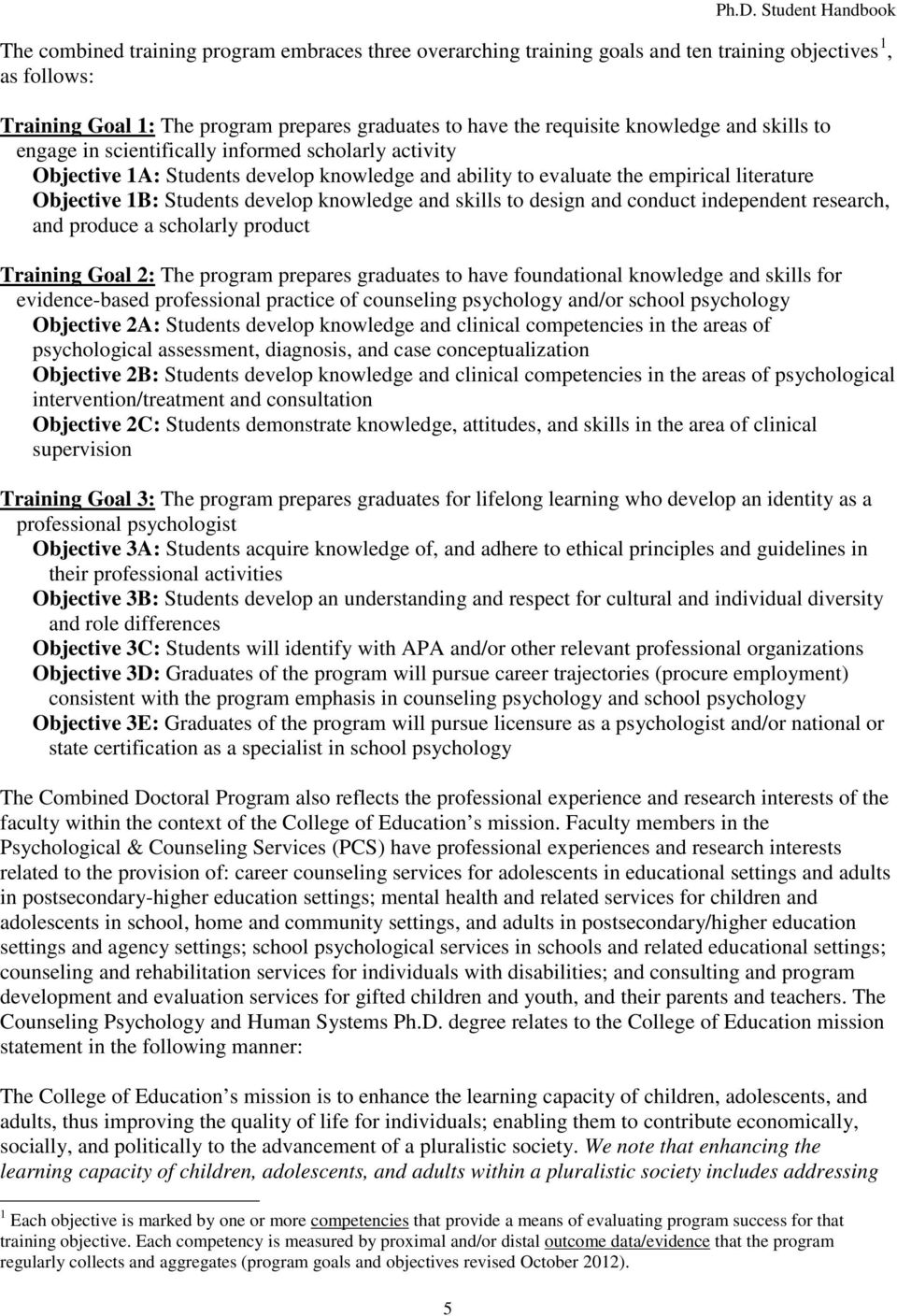
5 The combined training program embraces three overarching training goals and ten training objectives 1, as follows: Training Goal 1: The program prepares graduates to have the requisite knowledge and skills to engage in scientifically informed scholarly activity Objective 1A: Students develop knowledge and ability to evaluate the empirical literature Objective 1B: Students develop knowledge and skills to design and conduct independent research, and produce a scholarly product Training Goal 2: The program prepares graduates to have foundational knowledge and skills for evidence-based professional practice of counseling psychology and/or school psychology Objective 2A: Students develop knowledge and clinical competencies in the areas of psychological assessment, diagnosis, and case conceptualization Objective 2B: Students develop knowledge and clinical competencies in the areas of psychological intervention/treatment and consultation Objective 2C: Students demonstrate knowledge, attitudes, and skills in the area of clinical supervision Training Goal 3: The program prepares graduates for lifelong learning who develop an identity as a professional psychologist Objective 3A: Students acquire knowledge of, and adhere to ethical principles and guidelines in their professional activities Objective 3B: Students develop an understanding and respect for cultural and individual diversity and role differences Objective 3C: Students will identify with APA and/or other relevant professional organizations Objective 3D: Graduates of the program will pursue career trajectories (procure employment) consistent with the program emphasis in counseling psychology and school psychology Objective 3E: Graduates of the program will pursue licensure as a psychologist and/or national or state certification as a specialist in school psychology The Combined Doctoral Program also reflects the professional experience and research interests of the faculty within the context of the College of Education s mission. Faculty members in the Psychological & Counseling Services (PCS) have professional experiences and research interests related to the provision of: career counseling services for adolescents in educational settings and adults in postsecondary-higher education settings; mental health and related services for children and adolescents in school, home and community settings, and adults in postsecondary/higher education settings and agency settings; school psychological services in schools and related educational settings; counseling and rehabilitation services for individuals with disabilities; and consulting and program development and evaluation services for gifted children and youth, and their parents and teachers. The Counseling Psychology and Human Systems Ph.D. degree relates to the College of Education mission statement in the following manner: The College of Education s mission is to enhance the learning capacity of children, adolescents, and adults, thus improving the quality of life for individuals; enabling them to contribute economically, socially, and politically to the advancement of a pluralistic society. We note that enhancing the learning capacity of children, adolescents, and adults within a pluralistic society includes addressing 1 Each objective is marked by one or more competencies that provide a means of evaluating program success for that training objective. Each competency is measured by proximal and/or distal outcome data/evidence that the program regularly collects and aggregates (program goals and objectives revised October 2012). 5
6 present and projected counseling and human development needs. This mission is achieved through the following: 1. Preparing faculty, administrators, and human services specialists according to the highest professional standards of appropriate state, regional, and national accrediting agencies and societies. We note that human services specialists include counseling psychologists and school psychologists and that graduates of this degree program work as psychological service providers, faculty members, and administrators. We also note that this doctoral degree has been accredited by the American Psychological Association as a Combined Program in Counseling Psychology and School Psychology. 2. Developing knowledge of learning through faculty and student research; applying knowledge gained in research to address emerging problems in learning; and disseminating knowledge of learning through publications and presentations at state, regional, national, and international professional meetings. We note that students are required within the curriculum to participate with faculty in the creation and dissemination of knowledge through research, scholarship, and program evaluation. 3. Serving schools, institutions, agencies, and other organizations engaged in promoting learning through faculty and student involvement in teaching, consulting, evaluating, planning, and policy development. We note that students are required to provide direct services to schools, institutions, human service agencies, and/or other organizations as part of the curriculum. 4. The primary focus of these efforts is on the learning needs of children, adolescents, and adults of the State of Florida; but their impact is expected to extend into regional, national, and international arenas. We note that, while emphasis is placed upon serving the needs of children, adolescents, and adults within the State of Florida, the supervised practice of some students occurs outside of the state and may, in fact, have international impact. In view of the professional experience and research interests of the faculty and the mission of the College of Education, students completing the Combined Doctoral Program in Counseling Psychology and School Psychology are expected to concentrate their research and practice efforts in one or more of the following professional areas: 1. Career Counseling for adolescents and adults in high school and postsecondary/higher education settings or for adults in organizational settings where education and training is a principal component of human resource development. 2. Mental Health Counseling for children and adolescents in school settings or in agency settings where education is a principal component in delivering services and for adults in postsecondary/higher education settings or agency settings where psycho-educational and psychological processes and lifelong learning are emphasized. 3. School Psychological Services for children, adolescents and young adults, educators and parents in schools and related settings. 4. Rehabilitation Services for individuals with disabilities across the lifespan in settings such as hospitals, community health settings, schools, and higher education (e.g., FSU Student Disability Resource Center, SDRC). Students graduating from the Combined Doctoral Program in Counseling Psychology and School Psychology are expected to obtain competencies allowing them to obtain positions as faculty members in Counseling Psychology, or School Psychology, and related programs, or to obtain positions as 6

7 licensed or certified practicing counseling psychologists or school psychologists in school, postsecondary/higher education, or nontraditional education settings (organizational or agency based). Graduates are expected to be active contributors to the profession and to provide professional leadership, which can include contributing to the knowledge base of the profession by conducting research, supervising and/or disseminating research, serving in professional associations, providing service in the community, supervising psycho-educational service providers, and teaching, supervising and/or mentoring other professionals. The faculty encourages Ph.D. applications from individuals who have career goals that are congruent with the mission of the College of Education. Each applicant's statement of goals should indicate clearly how their interests relate to one or more of the four professional areas described above. Applicants should also be clear in identifying 1 or 2 faculty members whose research is congruent with their own research interests. Applicants are not encouraged to apply for admission whose primary career goal is the delivery of psychological services in private practice settings that are unrelated to the four professional areas described above. ADMISSION Degree Requirements Information on degree requirements can be found online in the FSU Graduate Bulletin and on the GradSpace blackboard student organization which is accessible to enrolled students. Topics covered include: Prerequisites for All Graduate Degrees, Editing Services and Statistical Assistance, Doctoral Degree Programs, Doctoral Degrees Offered; Requirements of the Doctor of Philosophy Degree, Diagnostic Examination, Residence, Transfer Credit, Course Requirements, Major Professor, Supervisory Committee, Program of Study, Language and Related Requirements, Preliminary Examination, Time Limit for Completion of Degree Requirements, Admission to Candidacy, Prospectus, Dissertation, Examination in Defense of Dissertation, Publication of Dissertation, Guidelines for Restrictions on the Release of Theses and Dissertations, Faculty Academic Judgment, Registration for Final Term, and Clearance for Degrees. Applicants and students are encouraged to become familiar with information provided in the most recent edition of the online Graduate Bulletin. Prerequisites 1. A bachelor s degree in psychology, human development, social work, or related discipline from an accredited college or university. Students are expected to have completed the following courses as part of their bachelor s degrees: Psychological or educational testing or measurement Psychological or educational statistics 15 credit hours in psychology, educational psychology, or human development. Admitted students with a Bachelor s degree who do not have the below prerequisites will be expected to make up these deficiencies early in their programs of study. Students admitted at this level will be expected to complete courses from the Counseling and Human Systems Ed.S./M.S. degree program in the following areas: Counseling Theory and Counseling Techniques Group Counseling/Group Dynamics Career Development/Occupational Information 7

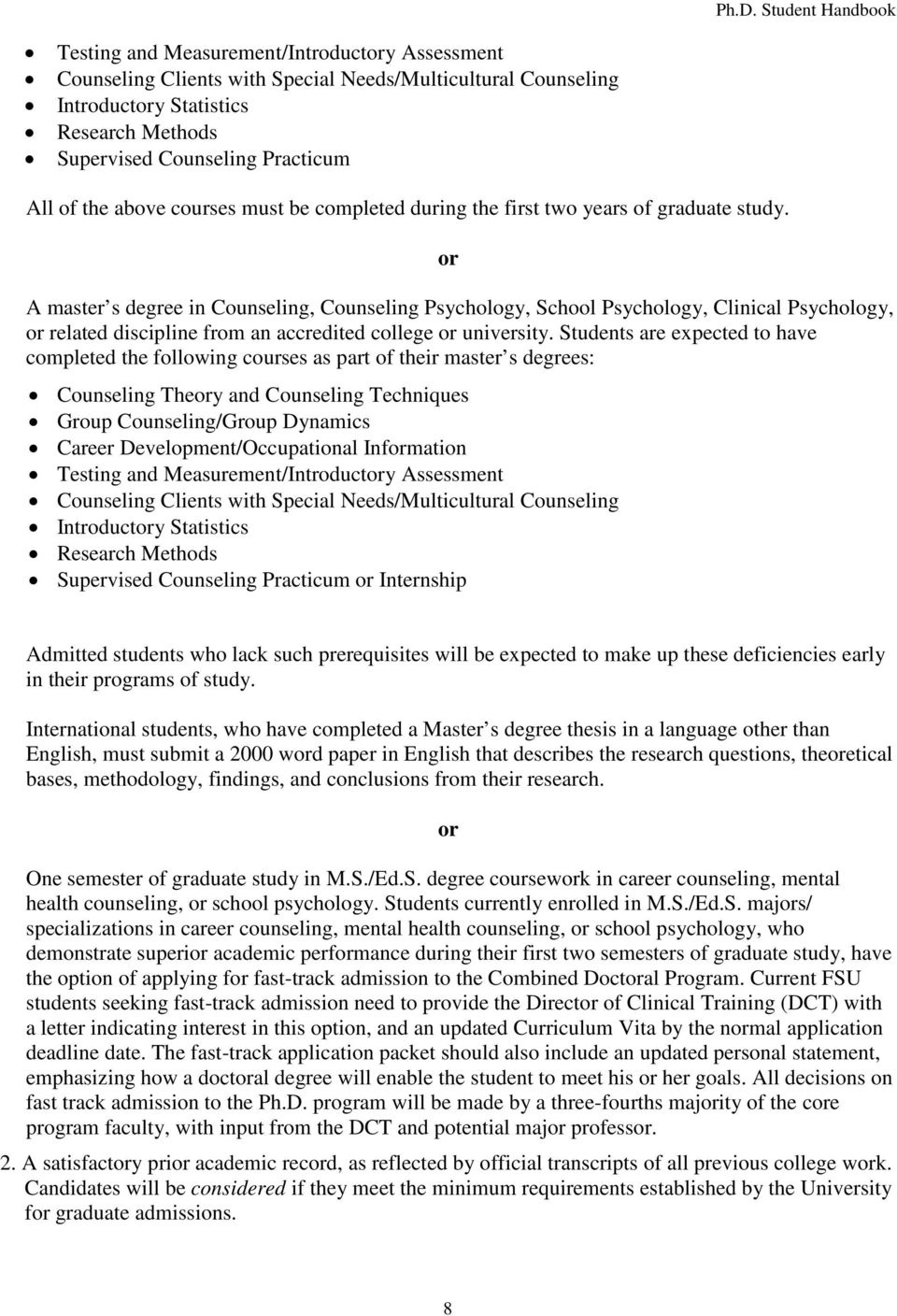
8 Testing and Measurement/Introductory Assessment Counseling Clients with Special Needs/Multicultural Counseling Introductory Statistics Research Methods Supervised Counseling Practicum All of the above courses must be completed during the first two years of graduate study. or A master s degree in Counseling, Counseling Psychology, School Psychology, Clinical Psychology, or related discipline from an accredited college or university. Students are expected to have completed the following courses as part of their master s degrees: Counseling Theory and Counseling Techniques Group Counseling/Group Dynamics Career Development/Occupational Information Testing and Measurement/Introductory Assessment Counseling Clients with Special Needs/Multicultural Counseling Introductory Statistics Research Methods Supervised Counseling Practicum or Internship Admitted students who lack such prerequisites will be expected to make up these deficiencies early in their programs of study. International students, who have completed a Master s degree thesis in a language other than English, must submit a 2000 word paper in English that describes the research questions, theoretical bases, methodology, findings, and conclusions from their research. or One semester of graduate study in M.S./Ed.S. degree coursework in career counseling, mental health counseling, or school psychology. Students currently enrolled in M.S./Ed.S. majors/ specializations in career counseling, mental health counseling, or school psychology, who demonstrate superior academic performance during their first two semesters of graduate study, have the option of applying for fast-track admission to the Combined Doctoral Program. Current FSU students seeking fast-track admission need to provide the Director of Clinical Training (DCT) with a letter indicating interest in this option, and an updated Curriculum Vita by the normal application deadline date. The fast-track application packet should also include an updated personal statement, emphasizing how a doctoral degree will enable the student to meet his or her goals. All decisions on fast track admission to the Ph.D. program will be made by a three-fourths majority of the core program faculty, with input from the DCT and potential major professor. 2. A satisfactory prior academic record, as reflected by official transcripts of all previous college work. Candidates will be considered if they meet the minimum requirements established by the University for graduate admissions. 8
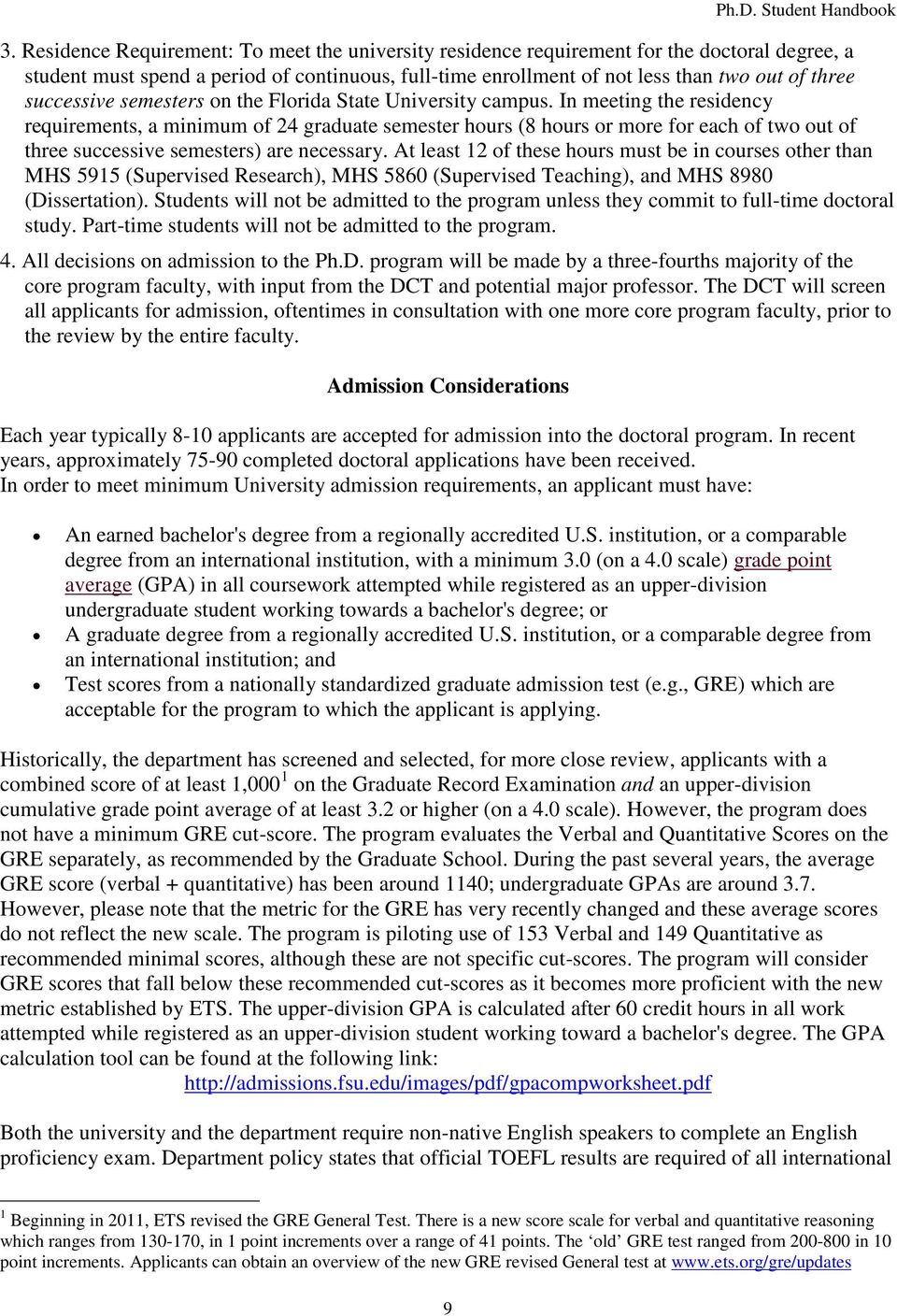
9 3. Residence Requirement: To meet the university residence requirement for the doctoral degree, a student must spend a period of continuous, full-time enrollment of not less than two out of three successive semesters on the Florida State University campus. In meeting the residency requirements, a minimum of 24 graduate semester hours (8 hours or more for each of two out of three successive semesters) are necessary. At least 12 of these hours must be in courses other than MHS 5915 (Supervised Research), MHS 5860 (Supervised Teaching), and MHS 8980 (Dissertation). Students will not be admitted to the program unless they commit to full-time doctoral study. Part-time students will not be admitted to the program. 4. All decisions on admission to the Ph.D. program will be made by a three-fourths majority of the core program faculty, with input from the DCT and potential major professor. The DCT will screen all applicants for admission, oftentimes in consultation with one more core program faculty, prior to the review by the entire faculty. Admission Considerations Each year typically 8-10 applicants are accepted for admission into the doctoral program. In recent years, approximately completed doctoral applications have been received. In order to meet minimum University admission requirements, an applicant must have: An earned bachelor's degree from a regionally accredited U.S. institution, or a comparable degree from an international institution, with a minimum 3.0 (on a 4.0 scale) grade point average (GPA) in all coursework attempted while registered as an upper-division undergraduate student working towards a bachelor's degree; or A graduate degree from a regionally accredited U.S. institution, or a comparable degree from an international institution; and Test scores from a nationally standardized graduate admission test (e.g., GRE) which are acceptable for the program to which the applicant is applying. Historically, the department has screened and selected, for more close review, applicants with a combined score of at least 1,000 1 on the Graduate Record Examination and an upper-division cumulative grade point average of at least 3.2 or higher (on a 4.0 scale). However, the program does not have a minimum GRE cut-score. The program evaluates the Verbal and Quantitative Scores on the GRE separately, as recommended by the Graduate School. During the past several years, the average GRE score (verbal + quantitative) has been around 1140; undergraduate GPAs are around 3.7. However, please note that the metric for the GRE has very recently changed and these average scores do not reflect the new scale. The program is piloting use of 153 Verbal and 149 Quantitative as recommended minimal scores, although these are not specific cut-scores. The program will consider GRE scores that fall below these recommended cut-scores as it becomes more proficient with the new metric established by ETS. The upper-division GPA is calculated after 60 credit hours in all work attempted while registered as an upper-division student working toward a bachelor's degree. The GPA calculation tool can be found at the following link: Both the university and the department require non-native English speakers to complete an English proficiency exam. Department policy states that official TOEFL results are required of all international 1 Beginning in 2011, ETS revised the GRE General Test. There is a new score scale for verbal and quantitative reasoning which ranges from , in 1 point increments over a range of 41 points. The old GRE test ranged from in 10 point increments. Applicants can obtain an overview of the new GRE revised General test at 9
10 applicants whose native language is not English and who have not studied in an English-speaking country for at least one academic year. Applicants must achieve a score of 600 or higher on the paperbased exam with a Writing score of 61 or higher; or 100 on the internet-based exam with a Writing score of 24 or higher. Students may also be considered for acceptance on the basis of exceptional professional accomplishment. Additional criteria and indicators used in the admissions process are indicated in Figure 1 which follows. Figure 1. Doctoral Admissions Criteria and Indicators Criteria Indicators 1. Successful academic record Overall and upper division GPA Beginning graduate GPA if available Carnegie Rank of institutions attended 2. Relevant experience Counseling, clinical, and/or school psychology, internship and/or practicum Psychology-related work or relevant volunteer experience Research products and/or participation 3. Motivation: To obtain PhD, engage in research, and become a professional psychologist (evidence of the applicant s passion for serious study and their stated career goal) 4. Fit/match: With combined program and faculty research 5. Capacity/ability to successfully complete doctoral program 6. Maturity and personal/interpersonal qualities Personal statement On-campus interview Letters of recommendation Evidence of researching the combined program/core program faculty Goal statement for interest in the program Articulates fit between self and program Articulates fit/match with potential major professor s research area(s): Identify 1-2 faculty with congruent research interests Quality/sophistication of questions asked GRE scores GPA Letters of recommendation Other evidence: course paper, publications, employment, leadership positions, etc. Personal statement Letters of recommendation Presentation during interview 7. Ability to be a full-time student Evidence that candidate has requisite maturity, social, emotional, and financial resources for full-time student status The Florida State University is committed to nondiscrimination with regard to age, career experience, color, communication style, culture, disability, educational level or background, employee status, family status, function, gender, gender expression, gender identity, language, management style, 10

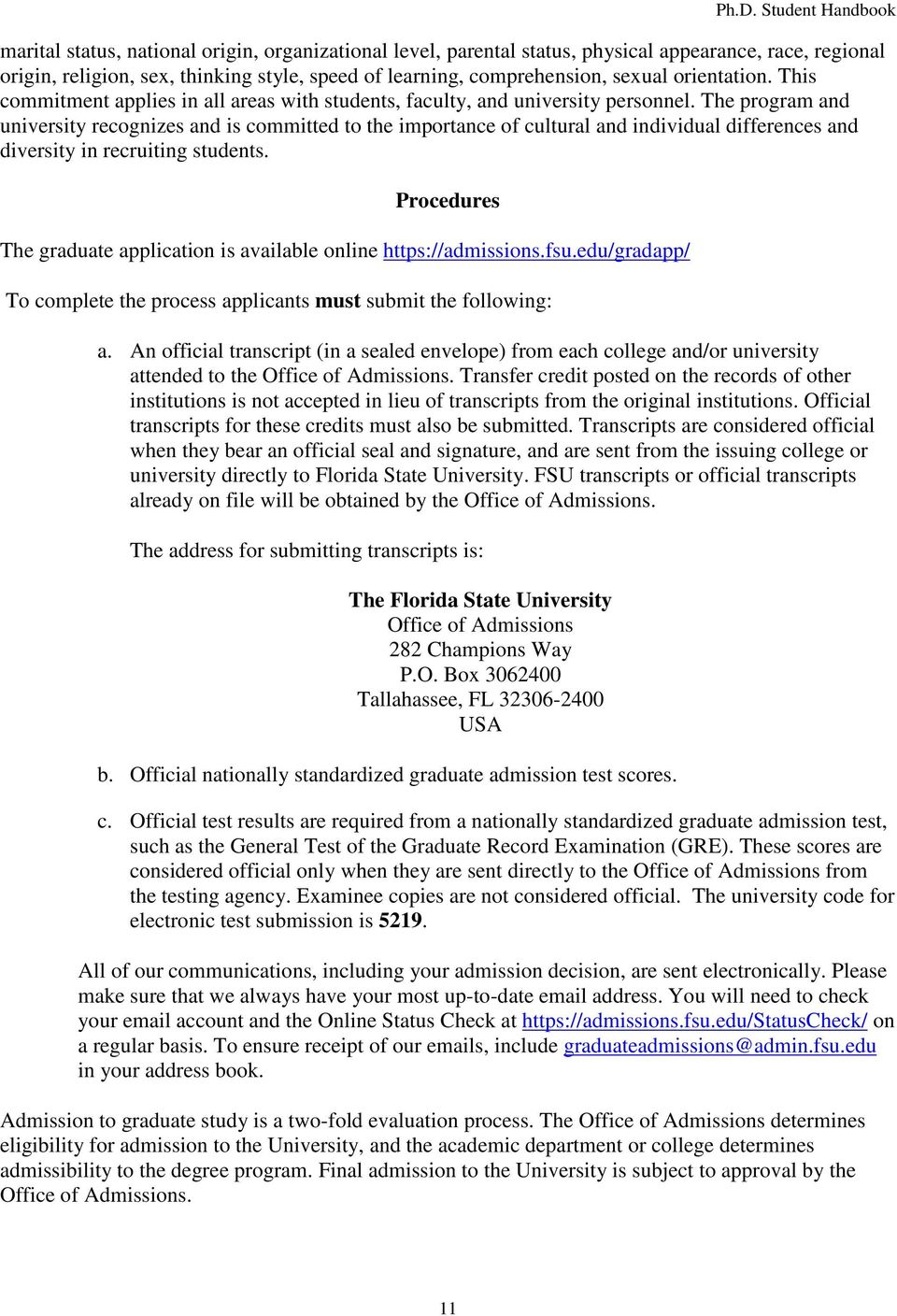
11 marital status, national origin, organizational level, parental status, physical appearance, race, regional origin, religion, sex, thinking style, speed of learning, comprehension, sexual orientation. This commitment applies in all areas with students, faculty, and university personnel. The program and university recognizes and is committed to the importance of cultural and individual differences and diversity in recruiting students. Procedures The graduate application is available online To complete the process applicants must submit the following: a. An official transcript (in a sealed envelope) from each college and/or university attended to the Office of Admissions. Transfer credit posted on the records of other institutions is not accepted in lieu of transcripts from the original institutions. Official transcripts for these credits must also be submitted. Transcripts are considered official when they bear an official seal and signature, and are sent from the issuing college or university directly to Florida State University. FSU transcripts or official transcripts already on file will be obtained by the Office of Admissions. The address for submitting transcripts is: The Florida State University Office of Admissions 282 Champions Way P.O. Box Tallahassee, FL USA b. Official nationally standardized graduate admission test scores. c. Official test results are required from a nationally standardized graduate admission test, such as the General Test of the Graduate Record Examination (GRE). These scores are considered official only when they are sent directly to the Office of Admissions from the testing agency. Examinee copies are not considered official. The university code for electronic test submission is All of our communications, including your admission decision, are sent electronically. Please make sure that we always have your most up-to-date address. You will need to check your account and the Online Status Check at on a regular basis. To ensure receipt of our s, include [email protected] in your address book. Admission to graduate study is a two-fold evaluation process. The Office of Admissions determines eligibility for admission to the University, and the academic department or college determines admissibility to the degree program. Final admission to the University is subject to approval by the Office of Admissions. 11
12 Completed applications and other required materials should be submitted to the Office of Graduate Admissions. Applications must be submitted no later than January 15. However, applicants are strongly encouraged to apply early. The program begins reviewing applications and selecting finalists to invite to campus for interviews as early as November 15. The following are required and are submitted online: a. Statement of Purpose (1 Required) Applicants must identify a particular faculty member or members with whom they are seeking to work/study. You must select one or two faculty members from the Psychological & Counseling Services Program. Information about the core program faculty and their research areas can be found on page of this document. The one or two identified faculty need to be named in the essay and listed at the top of the statement of purpose. Please use the following link for specific criteria and template: Statement of Purpose, Information and Guidelines b. Letters of Recommendation (3 Required) We will only accept academic and professional recommendations. No personal recommendations will be accepted. The name, address, and phone number of each of your recommenders must be entered in the appropriate section of the University Application. c. Resume/Curriculum Vitae (1 Required) Current Resume/Curriculum Vitae should describe your academic background, relevant work and volunteer experience. d. Unofficial Score Report (optional) Unofficial GRE test scores sheet can be uploaded to expedite the review process. e. Unofficial Transcript (optional) Unofficial transcripts can be uploaded into the application in order to expedite the review process. Please submit all documents via the online application. We ask that you not send paper application materials to the department. All required documents and test scores must be submitted by the January 15 th deadline. Late applications will not be considered. These requirements and criteria do not guarantee admission into the program. Admission depends on a variety of factors, including maximum allowable enrollment levels of the program. Each core faculty member in the program typically admits and serves as major professor for one (and in some instances two) students per year. The core program faculty will approve the admission of each student. The applicant s personal statement should indicate a rationale for working with 1-2 specific professors based on congruent research interests. Normally, an applicant should be available for a campus interview with one or more core faculty members. In extenuating circumstances, a phone/skype interview may be arranged, although the program strongly encourages on-campus interviews. This decision is made in consultation with the potential major professor and the DCT. The department will notify all applicants of their admissions decision via no later than April 15 th. 12

13 Students are admitted only for the Fall Semester. Applications should be completed as early as possible. Once you have applied, the Online Status Check (OSC) will allow you to check on the receipt of transcripts and test scores, as well as checking the current status of your application. To access the OSC, you should go to You will log in with your assigned FSUID and password. (Please be aware that our office processes thousands of applications each semester, and it takes time for files to be updated, especially around deadlines.) Financial Aid General Information Florida State University recognizes the high cost of education today and makes every effort to offer financial assistance through a variety of programs to qualified graduate students. In addition to providing funds on the basis of demonstrated financial need in the form of grants, work study awards, and loans, the University offers scholarships to recognize and reward talent, academic achievement, and meritorious performance. The Office of Financial Aid is committed to serving and guiding students through the process of applying for financial aid. Help in completing the financial aid forms is available from professional financial aid counselors located in the University Center, Building A, Room Assistance is also available by calling the Express Telephone System (ET) from 8:00 a.m. through 6:00 p.m. at (850) (The hours of operation for the Office of Financial Aid are Monday through Friday from 8:30 a.m. to 5:00 p.m.) The Information Center is open Monday through Friday from 8:30 a.m. to 5:00 p.m. Telephone counseling is available Monday through Friday 8:30 a.m. to 5:00 p.m. Once an application for admission has been submitted, students may monitor their financial aid status by visiting This site will also provide information on any outstanding documents required to complete the financial aid file. Upon admission and completion of the financial aid file, a student's financial aid award may also be found on this site. Graduate students may apply for federal loans and federal work-study by completing the Free Application for Federal Student Aid (FAFSA) at Graduate fellowships and assistantships are awarded through the Graduate School and selected university departments. Any graduate student may apply for a University Fellowship, or a College of Education Fellowship, although these awards are very competitive. Recipients of fellowships over the past few years have typically had GRE scores in the th percentile or higher and undergraduate grade-point-average of 3.75 or higher. For some awards, applicants need to be nominated prior to official acceptance. Stipend awards are available for between 9 and 12 months per year, for up to three years. Other financial aid is available in several forms, including special fellowships for minority students. The amount available varies each year. Doctoral students in need of financial aid have usually been able to obtain some form of financial aid. Many university student service programs employ doctoral counseling psychology students. However, some doctoral students do not obtain such aid until they have arrived on campus. Information regarding financial aid in the form of fellowships and grants may be found at the following link: By April 15 th of each year, all offers of financial assistance are binding on both the applicant and the institution, in accordance with the resolutions approved by the Council of Graduate Departments of 13

14 Psychology in 1965, 1981, and No assistantships or fellowships are offered until the student has officially been admitted to a graduate program. Applications for financial aid may be addressed to the University Office of Financial Aid, Room A4400 in the University Center, telephone (850) Fellowships There are a variety of fellowships offered through the University. Some require duties and some do not. Students should check with their graduate department for awards available in their discipline. 1. College Teaching Fellowships. There are a limited number of fellowships allocated to each college for the purpose of recruiting first-time graduate students at Florida State University. Duties may or may not be required. Students must apply directly to their academic department. 2. University Fellowships. Awards are made annually to a limited number of students in any discipline for $15,000 per year plus out-of-state and matriculation waivers. Application forms may be obtained from the chair of the student's proposed major department or the website of the Office of Graduate Studies at Applications are judged by a Universitywide committee. 3. McKnight Doctoral Fellowship Program. This program is for newly enrolling African-American students and includes all academic disciplines except law, medicine, and most fields in education (doctoral students in mathematics and science education are eligible to apply). Awards are $12,000 per year plus tuition and fees, renewable for a total of four years. Contact the Graduate School at or 314 Westcott Building (850/ ) for information. 4. Delores Auzenne Fellowship for Black Graduate Students. Awards are $5000 per academic year. For details, contact the Office of Graduate Studies at Westcott Building (850/ ). Students who wish to be considered for a Department, College, or University level Fellowships/Assistantships are encouraged to submit their application for admission by December 15. Additional information regarding fellowships and scholarships can be found at: Assistantships Graduate assistants are selected by academic departments for duties connected with instruction or research of mutual benefit to the University and the student. Only students with full-time graduate student status are eligible for graduate assistantships. Special and provisional students are ineligible. The stipend varies depending on the amount of service rendered, the nature of the service, and the qualifications of the student. Graduate assistants typically receive a tuition waiver (usually covering 9-12 hours per semester) from their academic department. To remain eligible for an assistantship and a tuition waiver, a student must discharge the assigned duties satisfactorily as determined by the appropriate administrator or faculty member. A graduate student with less than a 3.0 cumulative grade point average is not allowed to continue more than one term as a graduate assistant. 14

15 Deadline for Applications Doctoral students are admitted only for fall semester. The application deadline for the program is January 15. However, applicants are strongly encouraged to apply early. The program begins reviewing applications and selecting finalists to invite to campus for interviews as early as November 15, two months prior to the application submission deadline. ADVISEMENT AND REQUIREMENTS OF DOCTORAL STUDENTS General Responsibility of Students Doctoral students are expected to be familiar with current policies and regulations of the Department of Educational Psychology and Learning Systems and of the College of Education Office of Academic Services and Intern Support (OASIS), since these may affect a particular program. It is each student s responsibility to see that all regulations involving deadlines and dates of completion of specific requirements are followed. Furthermore, it is their responsibility to initiate, through the major professor, all of the procedures, actions, and forms required of the supervisory committee. More information on OASIS can be found on their website, located at Services-OASIS In order to receive official announcements from the Department of Educational Psychology and Learning Systems regarding their academic study, students must be registered for the departmental Listserv. The subscription application can be completed at Students have a further responsibility in consultation with their doctoral supervisory committees to develop programs of studies and training experiences representing the essence of a doctoral degree in professional psychology, with areas of specialized professional interest. Programs of studies are expected to be filed and approved by the Department Chair no later than the fifteenth week of the second semester of residency. (NOTE: Programs of study may be modified at a later time with the approval of doctoral supervisory committee.) Although courses are available to prepare students for the preliminary examination and future professional roles, it is understood that competencies for both the exam and such roles cannot be achieved solely through course work. Independent study and reflection also are necessary. All requirements for the doctoral degree must be completed within 5 calendar years from the time the student passes the preliminary exam and is admitted to candidacy. Any extension of this rule must be approved by the Dean of the Graduate School. Prior to review by the Dean of the Graduate School, an extension request must be made by the major professor and supervisory committee, and approved by the department chair and academic Dean. An extension request must be submitted before a student s five year candidacy period lapses. In requesting an extension, the major professor and supervisory committee must attest that the student has a legitimate reason for the delay (e.g. illness, new knowledge requiring a basic change in focus or methodology, etc.) and the student is making reasonable progress towards the completion of degree requirements. Forms can be found on the Graduate School Blackboard website GradSpace. If the student s extension is denied or the period of an approved extension is exceeded, the student must register and pass a new preliminary exam. 15
16 Maintaining Student Records In addition to the records maintained by the department, students are responsible for maintaining copies of their transcript, all semi-annual student evaluation, practicum evaluation, internship readiness form, and related forms, and internship evaluation and related documents. First Year Doctoral Student Advisement After completion of orientation, held during the week prior to the start of classes, students participate in a weekly one-hour pro-seminar advising session during the fall semester at 8:30 a.m. on Mondays, led by the Director of Clinical Training (DCT). During the second semester, students participate in monthly one-hour advising sessions at 8:30 a.m. on Mondays, led by the DCT. This two-semester proseminar advising sequence is provided without course credit. Topics covered during the first semester of advisement include: development of a professional identity as a counseling psychologist and/or school psychologist; networking; the doctoral degree process (supervisory committee member selection, program of study, qualifying examination, preliminary examination, internship readiness and application process, dissertation); APA Code of Ethics, employment options; state licensure and state and national certification. Topics covered during the second semester of advisement include: preparing for the qualifying and prelim written and case study exams and internship MATCH; FL licensure regulations; membership in professional associations and organizations (e.g., APA Divisions 16, 17, and 37), membership with the National Register of Health Service Providers of Psychology and national board certification; leadership opportunities in professional psychology; and well-being postgraduation: leading a balanced and healthy life after graduating. Following the first year pro-seminar advisement sequence, the major professor and DCT assume joint responsibility for each student s ongoing academic advisement. Students are required to meet with the DCT regularly, at least once each semester to review their progress. Major Professor (Advisor) and Committee Membership Students are recruited by one program faculty member who confirms mutual research and clinical interests with the applicant. The appointment of a major professor is based on a match and congruence between a faculty member s research and clinical interests and the student s stated research and clinical interests. Students are officially assigned a major professor (their advisor) by the Department Chair when they are admitted to the program. In consultation with their major professor, with the approval of the Department Chair, and consistent with university policy, students invite faculty members within the university community to serve on their committee. This can occur as early as the first semester in the program. Students discuss prospective committee members with their major professor before issuing invitations. Selection of committee members is discussed during the first semester pro-seminar advising sessions. Students have the prerogative of requesting to change their major professor or committee members. Committee members can be removed or added when a mutual agreement is established by the student, major professor, and DCT. A member who is added or who replaces another faculty member must agree to serve on the student s committee. It is appropriate protocol, and expected, for the student to discuss these changes and notify in writing affected committee members. Students should always discuss these proposed changes with their major professor and the DCT prior to making the change. While there may be valid reasons for changing a major professor or replacing a committee member, these are decisions that are not made often and require mutual consent of all parties. The procedure for 16
17 students to follow in changing a major professor is to 1) notify their major professor of their decision to change; 2) discuss the proposed action with the DCT and Department Chair; 3) identify a new major professor who is amenable to the change and willing to take the student on as an advisee; and 4) send a change of major professor memo to the DCT, Department Chair, new major professor, and former major professor. A faculty member reserves the right to suggest that a student seek out another faculty member to serve as major professor. Whenever there is a change in major professor, it is the student s responsibility to find a new major professor. If a student is unable to find a new major professor, the student will be assigned one by the Department Chair. The program encourages students with disagreements with their major professor and/or committee members to attempt to resolve these disagreements within the context of the advisor-advisee relationship. However, students may change their major professor or committee members and should generally feel comfortable to do so. The most typical reason for changing major professor is that another faculty member s research more closely aligns with those of the student. Although a change in major professor is always an option, by history it occurs quite rarely in the program. Replacing a major professor or committee member can be difficult, if not impossible, in the later stages of doctoral study when the student is focusing on the dissertation project. Students are discouraged from replacing a major professor or committee member in the year in which they intend to graduate. This policy regarding changing a major professor or committee member is intended to be consistent with University and College of Education policy. The student is expected to be familiar with and adhere to University and College of Education policy and Procedures. Supervisory Committee Member Selection The doctoral supervisory committee will be decided on by the student and major professor. The committee consists of a minimum of four members holding graduate faculty status (GFS), one member being outside the student s own department. The outside committee member (University representative) must be a tenured member of the University faculty holding GFS status. The names of all committee members for a student must be entered into the Graduate Student Online Tracking system. Qualifying Examination The doctoral qualifying examination is a combined diagnostic and evaluative experience designed to examine the student s ability to write in an organized manner, communicate verbally, and think critically. It is also designed to help the student identify personal and professional goals in light of the mission of the doctoral program and the opportunities available at Florida State University. The examination includes written and oral components. Both the written and oral portions are administered the second semester of the first year of doctoral study. The examination is not administered in the summer semester. The written portion of the qualifying examination assesses the student s ability to articulate and support a position on an issue, and sustain a focused and coherent discussion. It does not assess specific content knowledge. Based on the student s performance on the qualifying examination, the student s doctoral supervisory committee will assign a pass or fail grade, as required by the College of Education. In addition, 17

18 recommendations for professional development and possible changes to the program of study will be made by the committee. If a student is unsuccessful in passing on the first attempt, a student will be given a 2 nd chance to pass the qualifying examination. The second attempt must be taken no later than the fall semester following the first failed attempt. A second failure on the qualifying examination will result in the student being considered for retention by the full core faculty. Students who fail to schedule and take the qualifying examination by the end of the 2 nd semester of enrollment will be denied permission to register and take classes in subsequent semesters until this requirement has been satisfactorily completed. Procedures for the Written Portion of the Qualifying Examination 1) An article will be presented to students who take the qualifying exam. Students will address issues related to the article. The written response should include the following: 1. Critical issues around the topic(s) addressed in the article 2. Your position on this issue (do you agree or disagree and why?) 3. Any additional information needed to assist in your discussion 4. Potential use of the information provided in the article in your professional practice 2) The written examination is administered under the following standard conditions. All students complete the written portion of the qualifying examination: 1. on the same day, 2. during a two-hour period of time, 3. on campus, and 4. without access to resource/reference material, except for dictionary/ thesaurus 3) The written response will be typed and printed and no more than 5 pages (double-spaced, 12 font size, 1 margin, Times New Roman) 4) The student s doctoral supervisory committee will read and grade the response based on the following criteria and rubric. 1. Ability to synthesize and analyze 2. Paragraph development with topic sentences followed by appropriate content 3. Logical development of the position taken 4. Organization 5. Coherence 6. Clarity of expression 7. Grammar (Punctuation, spelling, sentence structure, etc.) Items are graded as: Weak = 1 or 2; Adequate = 3 or 4; Strong = 5 or 6; Very Strong = 7 or 8 Procedures for the Oral Portion of the Qualifying Examination 1) The oral qualifying exam should be scheduled after the written portion of the exam and include three (3) committee members from the core program faculty. The committee should include your major professor and two or three additional members. One of the committee members can have Masters Directive Status; the other two must have Doctoral Directive Status. 2) Materials to be placed in the oral qualifying examination binder include the following: 1. Cover page including student name, doctoral supervisory committee members, date and time for oral qualifying examination, and room number 2. Response to the written portion of the examination 3. Personal statement 4. Curriculum vitae 5. Program of study 18

19 6. If students have completed master s theses or master s degree research projects, a copy of each of these documents must be included in all students written material provided to the supervisory committee. The committee will judge whether or not the master s thesis or master s research project is an appropriate foundation for the further development of research skills. If the master s thesis or master s research project has substantial problems related to methodology, being out of the field, or being out of date, the supervisory committee may require the student to add MHS 5915, Supervised Research, to his or her program of study. 3) The qualifying examination binder MUST be submitted to the doctoral supervisory committee at least ONE week before the scheduled oral qualifying exam date. Transfer of Credits A portion of the credits required for the Ph.D. degree may be transferred from other accredited universities. All the grades for credits earned at other institutions are entered on a student's Florida State University permanent record at the time of transfer exactly as earned. Such grades are averaged separately from grades earned at Florida State University. Coursework not counted toward a previous degree from another regionally accredited graduate school is limited to six semester hours and transfer of coursework not counted toward a previous degree within Florida State University is limited to twelve semester hours, except when the departmental course requirement exceeds the thirty-two hour University-wide minimum requirement. In the latter case, additional transfer credit may be allowed to the extent of the additional required hours. In all cases, the majority of credit must be earned through Florida State University or its official consortial institutions. Students should meet with their major professor to discuss selected courses they are proposing for transfer of credit. All transfer credits must have been completed with grades of B or better. The student will be asked to provide syllabi for courses for which he or she is seeking transfer credit. Students may be asked to provide other relevant documentation, course text, sample assignments, as well. After provisional approval by the major professor, the student will be asked to submit documentation to the FSU instructor responsible for that particular course. If the instructor who teaches the course approves the transfer, he/she will write an to that effect to the major professor. The student will then complete the paperwork required for course transfer in order to have the course appear on his or her official FSU transcript. Final approval of previous graduate work for degree credits rests with the Department Chair, and the College of Education s Office of Academic Services. Forms for obtaining approval are available in the Office of Academic Services (OASIS), 2301 Stone Building. In order to receive transfer credits, students will be required to submit certified copies of transcripts from all higher educational institutions attended. Course Waivers In addition to the formal transfer of credits, students may receive a course waiver for courses required on the Program of Study that they have already completed at another accredited institution. There is no maximum number of hours of course waivers allowed toward a doctoral degree, as long as the student is still able to meet the university residency requirement (the student must be continuously enrolled on Florida State University Tallahassee campus for a minimum of twenty-four graduate semester hours of credit in any period of twelve consecutive months). Course waivers will not appear on the student s FSU transcript; rather, these are courses that are normally required by the program that the student will not have to re-take, if equivalent courses have been taken previously. Students should meet with their 19
20 major professor to discuss selected courses they are proposing for course waiver. All courses considered for waivers must have been completed with the grades of B or better. The student will be asked to provide syllabi for any courses for which he or she is seeking a course waiver. Students may be asked to provide other relevant documentation, course text, sample assignments, as well. After provisional approval by the major professor, the student will be asked to submit documentation to the FSU instructor responsible for that particular course. If the instructor who teaches the course approves the wavier, he/she will write an to that effect to the major professor. In order to document either transfer of credit or course waiver, the student will prepare two Programs of Study. The University Program of Study (an official document maintained by College of Education s Office of Academic Services) will contain only those courses actually completed at FSU. The Departmental Program of Study (an internal document kept in the student s file) will list all courses required by the Program, and will designate those courses that have been waived or transferred. Documentation, in the form of an from the instructor of the course or the FSU transcript recording the transfer credit, must be amended to the Departmental Program of Study. Master s Degree Research Prerequisite All students who have not completed a master s thesis are required to complete a research project as part of their degree requirements. The requirements should be satisfied no later than the second year of residence in the Ph.D. program, and must be fulfilled before any student takes written prelims. This requirement shall be satisfied in the following manner: Doctoral students and their major professors will agree upon a research project, either qualitative or quantitative in nature. Once each research idea is approved by a student's major professor, the student may proceed. Students are expected to work closely with their major professor. Students will sign up for a minimum of two hours, maximum of three, of MHS 5915 (Supervised Research) during each semester in which research is being conducted. Research products will be written in a scholarly format which is well conceptualized and reflects current literature with the student identified as the sole author. The APA Publication Manual (6 th edition) shall be used as the style preparing the work. Once the work is completed, student shall present it to their major professors for final approval. Upon research project approval, students will be given a grade of "S" at the end of each semester that they are enrolled in MHS A notation will be made on each program of study that the research requirement for the Ph.D. has been successfully completed. Students are strongly encouraged to work with their major professor in submitting their research for publication. 20

21 Preliminary Examination Schematic Overview of Doctoral Preliminary Examination WRITTEN PRELIMS ORAL PRELIMS Approved by major professor AREA 1 Synthesis and review of literature Oral exam conducted by doctoral supervisory committee AREA I and II Research AREA 2 Critique of Research Administered and graded by Area 2 examination committee AREA 3 Clinical Case Study Oral exam conducted by Area 3 examination committee Student admitted to doctoral candidacy Forms completed by doctoral supervisory committee In case of Low Pass, additional examination is conducted by doctoral supervisory committee Purposes of the Examination The purposes of doctoral preliminary examinations (prelims) are to: (1) determine whether an individual possesses the knowledge and skills required to synthesize a body of professional literature and to formulate a set of questions or issues that points the way toward advancing our professional knowledge; (2) assess whether an individual is able to critically review the primary research tradition of the disciplines of professional psychology (specifically counseling psychology and/or school psychology); and (3) ascertain whether an individual is able to integrate and document philosophies, theories, current evidence-based interventions, and contemporary professional issues, ethics, and law related to the actual practice of counseling psychology and/or school psychology. 21
22 Examination Content The prelim examinations will consist of three performance areas: Area I A Comprehensive Synthesis and Critical Review of Literature, Area II Critical Review of the Primary Research Tradition, and Area III Clinical Case Study, which provides an opportunity for the student to demonstrate clinical competence through a case presentation. These performance areas are evaluated via two written examinations and two oral examinations, described below. Area I (WRITTEN)(A Comprehensive Synthesis and Critical Review of Literature) requires students to present an integrative and critical "think piece" in a specific area of knowledge in counseling psychology and/or school psychology. It should demonstrate a student's ability to conceptualize a body of literature by tying concepts together through integrative themes. The think piece should begin with an Introduction covering significance and statement of a human or professional problem. This should be followed by a thorough review of the literature, a set of research questions, and a bulleted outline of a possible study (the goal being the foundation for building a dissertation research study). The paper will reflect a student's own independent thought and creation. The role of the major professor will be to assist the student in the identification of the topic, in locating relevant literature, and in reviewing and providing feedback only once to a draft of the paper. The paper must be at least 40 pages in length (exclusive of references and tables) and supported by typically referenced citations. The written paper should be coherently organized, logically presented, literately written, and conform to the standards of the most current edition of the Publication Manual of the American Psychological Association. Although the major professor is permitted one review of the Area I paper, one time only, prior to writing the Area I paper, the student will likely have multiple meetings with the major professor and will discuss potential topics, and perhaps review an outline of the eventual paper. The major professor must sign the cover sheet of the Area I paper which connotes that the paper meets the program standards to be included in the student folio, which will be reviewed and discussed by the student s doctoral supervisory committee during the student s Area I and II oral defense meeting. The student should submit the Area I paper to Turn-it-in (online plagiarism check) to check against copying material from others. Area II (WRITTEN) (Critical Review of the Primary Research Tradition) requires students to be able to critically review a research study by: (a) comprehending the purpose of the study, its rationale, research questions, hypotheses, method, instruments, design, and statistical analyses; (b) determining whether an author's conclusions are warranted on the basis of the data; and (c) reformulating the research design to address identified flaws in internal and external validity. It is vitally important that students demonstrate their ability to interpret studies using original observations or data (i.e., primary tradition) as contrasted with critiquing another author's synthesis of a body of research (i.e., secondary tradition). The Area II written critique of research is administered twice each year, once in early September and again in early January. Students should check with the Chair of the Area II Written Critique of Research Examination Committee in advance for specific dates and place of administration. Prerequisites for taking Area II written critique of research exam are: completion of MHS 6715 (Design and Critical Review of Research), all required statistics courses, and major professor s acceptance of thesis equivalent or prior master s thesis. Areas I and II (ORAL) (Research) is a 1 ½ hour oral exam by the doctoral supervisory committee that covers the written products described above (the Area I paper and the Area II critique of a research paper). 22
23 Area III (ORAL) (Clinical Case Study Exam) is a 1-hour case study examination based on the Candidate Examination for Board Certification in Counseling Psychology or School Psychology for the American Board of Professional Psychology (ABPP). The student prepares one case (work sample) for a 1-hour oral case presentation/examination. The work sample consists of a case from the student s practicum/clinical field work. The case should be selected to provide the student with an opportunity to discuss and answer questions about the following: presenting concern/reason for referral, brief case history, diagnosis, assessment, case conceptualization, treatment plan, intervention(s), measurement of success, and ethical implications. The oral examination focuses on the following three areas: 1) scientific and scholarly base for how the student approaches the case (integration of theory and research); 2) attention to best clinical practice (diagnosis, assessment, intervention, evaluation, etc.), including individual and cultural diversity, legal and ethical considerations; and 3) ability to cogently and coherently verbally present a case and respond to questions from faculty. The student may use a case that they have presented previously (e.g., in practicum). Faculty will not review the case or the presentation in advance; however, students may ask them specific questions about the case. Students may use assessment data that they did not administer, but was available to them at the time they worked on the case. Students do not have to have formal outcome data; however, students should keep in mind that all cases have outcomes (e.g., dropping out, clinical impressions at the time of termination), and students need to explain what happened. There is no specific criterion for how much data or how many sessions are required. Some cases (e.g., school psychology) will be more heavily weighted on assessment data, consultation, treatment planning, educational information, and suggested interventions. Other cases (e.g., counseling psychology) may be more heavily weighted on clinical interventions and duration of counseling sessions, and less on a priori assessment. The student is evaluated by a 3-member committee consisting of core faculty. The committee members will be announced a week prior to the meeting. The committee rates the student s performance on the oral case study examination using a rubric, which consists of the following categories: High Pass; Pass; Low Pass; Fail. The three areas that are evaluated are listed above. The exam is scheduled for one hour. At least one of the three committee members will be an expert in child/adolescent or adult, depending upon the work sample that the student selects. The work sample consists of one clinical case. The case should include enough material to provide students with an opportunity to discuss and answer questions on assessment, case conceptualization, treatment planning, how assessment relates to intervention, which theoretical model(s) guided their work, which interventions they selected and why they chose them (or might decide to use them), how they evaluated (or would evaluate) the success of their planned intervention(s), attention to individual and cultural diversity, and legal and ethical considerations. The Area III Prelims Clinical Practice case study oral examination is administered three times each year over the course of the fall and spring semesters. Students should check with the Area III oral exam chair in advance for specific dates and place of administration. At the time of the 1 hour oral examination meeting, the student provides the prelims committee with three sets of copies of pertinent material (i.e., diagnostic, assessment, treatment planning, and/or intervention documentation; a list of references associated with the scientific/scholarly base). All identifying information must be removed from the case material. Materials submitted should include interview data plus the results of at least two different assessment tools/procedures. The student can use PowerPoint during the oral exam to help highlight points (e.g., the decision-making process; 23
24 treatment options). The PowerPoint presentation, however, should not take up the majority of the 1 hour examination and the student should not read the PowerPoint to the committee. It is expected that the case presentation will take no more than ½ hour, providing ample time for committee questions. The committee examines the student s degree of competence in discussing the case and in answering questions about the case. The student must report to the faculty member who serves as Coordinator of the Area III Clinical Case Study Exam whether they will be presenting a child (child/adolescent) case or an adult case. The Coordinator of the Area III Clinical Case Study Exam needs to hear from any student who is planning to take the Clinical Case Study Exam at the semester prior to the date that the exam is scheduled. Grading on the Clinical Case Study exam is: High Pass; Pass; Low Pass; Fail. The program provides all students with examples of competencies that the committee considers when evaluating the Clinical Case Study examination (during first year pro-seminar orientation). Examples of competencies are also posted on the student Blackboard (Bb) 1 site and readily available to download. Procedures for Preliminary Examinations There are both written and oral components to Prelims: The written Area I paper and the written critique of a research article are completed independently and then orally defended in the Areas I and II Research Oral Exam The student also prepares a case study and orally defends it in the Area III Clinical Case Study Oral Exam Areas I and II Research Oral Exam 1.5 hours Committee consists of the doctoral supervisory committee. The exam is an oral defense of the following: Area I Paper (the majority of the oral defense involves this paper) Results from Written Area II Critique of Research Exam (this area may be discussed, but the student will only be re-examined on this area if the student received a grade of Low Pass) Master s Thesis or equivalency (this is included in the student s binder, and faculty will read it and perhaps refer to it, but the student does not re-defend this document) Area III Clinical Case Study Oral Exam 1 hour. Committee will be assigned each semester, and will consist of three core program faculty members The exam will be an oral presentation of a clinical case study Pre-requisites: To take the Written Area II Critique of Research Exam the student has to have completed their Masters thesis (or equivalent) and taken EDF 5401 and 5406, and Design and Critical Review. 1 In an effort to provide easy-access to documents which are important to students throughout their tenure in the program, the program has established a Blackboard organization site titled PhD Combined: Student Documents. Students matriculating in the combined program are able to access the site and register in order to access program-related informational documents, templates, and forms. Upon admission to the program, students will be notified of the Blackboard organization and given information on how to register. 24
25 To take the Areas I and II Research Oral Exam, the student must have completed the Written Area II Critique of Research Exam and their Area I paper. To take the Area III Clinical Case Study Oral Exam the student must complete all core courses. Completion of Exams The student does not have to take the Area III Clinical Case Study Oral Exam and the Area I and II Research Oral Exam in any order. They can take the Area I and II Research Oral Exam before the Area III Clinical Case Study Oral Exam or vice versa. Students are considered to have passed prelims (and entered candidacy) after they complete both oral exams the Area I and II Research Oral Exam and the Area III Clinical Case Study Oral Exam (students cannot submit or defend a prospectus until successfully passing both oral exams). When a student successfully completes the Area III Clinical Case Study Oral Exam, the student and his/her major advisor will receive an stating this. Students should save that and bring it to their Area I and II Research Oral Examination meeting. At the conclusion of that exam, committee members can sign off on the Doctoral Prelim Exam Results Form (available from OASIS or the student BlackBoard site). The student can submit the Form to OASIS and at this point will be admitted to candidacy. Alternately, if a student completes the Area I and II Research Oral Exam first, the student should have the committee sign the Doctoral Prelim Exam Results Form, but the student s Chair will keep this form until the student completes the Area III Clinical Case Study Oral Examination. When the student s chair receives the stating that the student has also passed the Area III Clinical Case Study Exam, the student can retrieve the Doctoral Prelim Exam Results Form and submit it to OASIS. Failure to Pass Areas I and II Research Exam Students who fail the Area I and II Research Oral Exam one time will receive feedback from the committee about which areas they failed. If students fail the Area I portion of the exam, students are required to submit a new, revised Area I paper to their committee. The new Area I can be a revised version of the initial Area I paper, based on feedback provided in the prelim oral defense meeting, or students may choose to complete an Area I paper on a new topic. If students fail the oral portion of Area II, they will be asked to review their answers and the committee feedback to prepare for the next oral exam. Other conditions, in addition to the two above, might be implemented by the student s committee. There must be at least 6 weeks between the first and second defense dates (committee members must have at least 2 weeks, within the 6 week period, to review the any written document(s) prior to the second oral defense. Failure to Pass Area III Clinical Case Study Oral Exam Students who fail Area III Prelims Clinical Case study will be required to present another case during the next semester when Area III orals are scheduled. Students can take Area III twice. If a student receives a grade of Low Pass on the Area III Clinical Case Study Oral Exam, they will be retested on their case presentation by their doctoral supervisory committee (after sufficient time 25
26 has passed for them to review their original performance and make suitable changes to their materials or conception of their possible oral responses) Failure to Pass Prelim Exam Oral Exams After two Attempts If a student fails either the Area II Research Oral Examination two times or the Area III Clinical Case Study Oral Examination two times, this shall constitute grounds for dismissal from the program. Additional Information Students shall request permission through their major professors to register for the preliminary oral examinations (MHS 8961r: Preliminary Doctoral Examination). Preliminary examinations will not be offered during the summer semester. The Area 2 written critique of research examination committee prepares and administers the written examination, and then submits an evaluative report and recommendation to the student's supervisory committee. The supervisory committee conducts the Areas I and II oral research examination. Two weeks before the oral research examination, members of the supervisory committee receive a folio from the student which includes copies of the Area 1 paper, the written critique of research examination question and answers, and the Area 2 written critique of research examination committee report. In order for any accommodations to be made during the written or oral portions of the preliminary examination the student must be registered at the Student Disability Resource Center (SDRC). No student may register for dissertation hours prior to the point in the semester in which all prelims exam are passed. An admission to candidacy form must be completed and filed in the Office of the University Registrar prior to registration for dissertation hours. After completion of the admission to candidacy process, the student may retroactively add dissertation hours for that semester in which all prelim exams were completed. Retroactive changes are only permitted if all exams are passed by the mid-point of the semester (i.e., end of the 7 th week of the semester). Practicum All students are required to complete a series of practicum experiences. The program follows a 3-tier practicum model, which reflects the program s commitment to sequential, cumulative and graded training. In the first year, all students are provided their first clinical training experience in the oncampus Human Services Center (HSC) under close faculty supervision. Students are also cosupervised by an advanced doctoral student. There are 5 on-campus tier-2 practica training sites where core or associated faculty closely supervise students placed in one or more of these sites (after successfully completing the tier-1 practicum). They are the Adult Learning Evaluation Center, FSU Career Center, FSU Counseling Center, FSU Multidisciplinary Center, and the FSU Student Disability Resource Center. Tier-3 practicum sites extend training beyond campus to various community agencies or campus-based sites in which faculty are not affiliated (e.g., FSU Employee Assistance Program). Students who select a school psychology concentration are required to complete a similar, but not identical, set of practica: 1-semester, on-campus mental health counseling practicum (Human Services Center); 1-semester, on-campus intro counseling psychology practicum (Career Center); 1-semester, on-campus school psychology practicum (ALEC); 2-semester, on-campus school psychology 26
27 practicum (FSU Multi-Center); and a minimum of 1semester in an off-campus agency, hospital or center that provides supervised psychological services. In addition, students with a school psychology concentration are required to complete 600-hours of supervised school-based clinical training either prior to, or as part of their 2000-hour internship. Students are required to be supervised by a licensed healthcare provider appropriately credentialed and licensed in each practicum site. The program requires that the majority of field practicum placements for each student are supervised by appropriately credentialed, doctoral-level licensed psychologists. However, the program recognizes that there may be an exceptional clinical training opportunity in which the field supervisor is not a licensed psychologist, but licensed and appropriately credentialed in a related healthcare field or discipline (e.g., psychiatry, social work, marriage and family therapy, mental health counseling, speech and language pathology). There is no rigid policy in terms of how a student goes about selecting, negotiating, and/or contracting with a field practicum site. The program has a list of approved practicum sites, which is available to students. These sites are evaluated annually by the program based on feedback from students placed in these settings and enrolled in a 2-credit hour field practicum course (MHS 6946). Students presently identify and select one or more field practicum sites based on tradition, opportunity, and/or recommendations of more advanced students, faculty and/or the DCT. The program encourages students to pursue a number of community-based field practicum experiences because it enriches their clinical training experience, increases their doctoral practicum hours, and makes them more competitive when applying for the APPIC internship MATCH program. A student can propose a new practicum site. There is a form which the student completes, available on the Student Blackboard (Bb) site, and submits to the program faculty for review and consideration. The program considers a number of criteria in evaluating the suitability and likely quality of training at any newly proposed field practicum site. Criteria to evaluate suitability include: credentials of the clinical supervisor; resources at the agency/facility/practice setting, compatibility with the program philosophy and training goals of the combined program, time for weekly supervision, type and range of clinical training opportunities, unique training opportunities, client population served, and evidence of evidence-based practice (EBP) on-site. A majority vote of the core program faculty is required to approve a new field practicum site. All students participating in field practicum are required to register for a 2-credit hour field practicum course (MHS 6946). The field practicum instructor is a doctoral level licensed psychologist and typically a core program faculty. Students are required to register for field practicum (MHS 6946) each semester that they are in a field placement as a practicum student. Field practicum meets regularly on campus to provide students with an opportunity to discuss cases, explore ethical, legal and/or professional guild issues, and reinforce the marriage of science and practice, how research informs practice. Each semester that a student registers for field practicum, they are required to submit one product ( artifact ), which demonstrates that they have attained a new practice competency (diagnostic, assessment, intervention, and/or supervisory). This product becomes part of the student s portfolio. A library of student artifacts is available on BlackBoard (the link is restricted to program faculty, students and accreditation site visitors. It can be found on Blackboard under: PhD Combined Program: Student Competencies ). The library of student products reflect program competencies in: assessment, intervention, consultation, research and evaluation, supervision, teaching and policy. Note that some students arrange, with the permission of and in consultation with the DCT, a one- or two-semester field practicum placement outside of Tallahassee. These are typically capstone practicum 27
28 experiences. Recent distal practicum sites have included the Mailman Center for Child Development, U Miami School of Medicine; Houston VA Medical Center; Queens Children s Psychiatric Center, NY; All Children s Hospital/The Children s Cancer Center. A list of recent community-based field practicum sites which illustrate the range of off-campus community settings that students are placed at can be found in Appendix F. Internship 1. All internship sites must be congruent with the mission of the College of Education as stated in the beginning of this document. 2. It is normally expected that doctoral students will take a full year internship (2,000 hours required) in the term after being admitted to candidacy. 3. All students are strongly encouraged to seek internship sites at settings either accredited by the APA or listed in the APPIC Directory. Only in unusual circumstances would a non APAaccredited or non APPIC-listed internship be deemed acceptable. All internship sites must provide quality supervised training experiences appropriate for students in counseling psychology and/or school psychology and consistent with the specialties of school psychology 1 and counseling psychology 2. In all instances, the program strongly encourages that an internship provide a stipend. 4. All Ph.D. students concentrating in school psychology will seek internship sites at settings consistent with the profession of school psychology as listed in the Directory of Internships for Doctoral Students in School Psychology. As part of the internship experience, students concentrating in school psychology, who are not already eligible for certification/licensure as a School Psychologist, must obtain at least 600 hours of school-based experience. The 600 hour school-based requirement may be obtained as part of the 2,000-hour, year-long internship, if available as a training component of the internship, or in addition to the 2,000-hour, one-year internship. All internship hours must be accrued within a 24-month period. 5. In circumstances where an APA-accredited or an APPIC-listed setting cannot be attained, internships will have the following features consistent with psychology licensure regulations: a). The internship must consist of an organized training program (in contrast to supervised experience or on-the-job training) designed to provide the intern with a coherent, planned, programmed sequence of training experiences, the primary focus and purpose of which is to assure breadth and quality of training; b). The internship agency must have a clearly designated staff psychologist who is responsible for the integrity and quality of the training program and who is actively licensed/certified by the State Board of Examiners in Psychology; c). The internship agency must have two or more psychologists on staff as supervisors, at least one of whom is actively licensed/certified by the State Board of Examiners in Psychology; d). Internship supervision must be provided by a staff member of the internship agency or by an affiliate of that agency who carries clinical responsibility for the cases being supervised; e). At least half of the internship supervision must be provided by one or more psychologists; 1 Description of the Specialty of School Psychology; 2 How does one become a Counseling Psychologist?; 28
29 f). The internship must provide training in a range of assessment and treatment activities conducted directly with clients seeking psychological services; Ph.D. Student Handbook g). At least 25% of the intern's time during the internship must be in direct client contact; h). The internship must include a minimum of two hours per week (regardless of whether the internship is completed in one year or two) of regularly scheduled, formal, face-to-face individual supervision with the specific intent of dealing with psychological services rendered directly by the intern; i). The internship must include at least two additional hours per week in learning activities such as: case conferences involving a case in which the intern was actively involved; seminars dealing with clinical issues; co-therapy with a staff person including discussion; group supervision; additional individual supervision; j). The training must be post-practicum level; k). The internship agency must have a minimum of two interns at the internship level of training during the applicant's training period; l). The trainee must have a title such as "intern," "resident," "fellow," or other designation of trainee status; m). The internship agency must have a written statement or brochure which describes the goals and content of the internship, states clear expectations for the quantity and quality of the intern's work and is made available to prospective interns; n). The internship experience must include a minimum 2,000 hours to be completed within 24 months; o). The intern should be afforded the opportunity to engage in research; and p). The internship agency must provide the DCT with reports on the intern's progress each semester. 6. The program uses a Readiness for Internship Rating Form (see Appendix E) to assist the program in determining a student s readiness for and likely success in matching to an internship. The rating form consists of items that rate competencies in the areas of: 1) professional values and attitudes, 2) individual and cultural diversity, 3) ethical and legal standards and principles, 4) reflective practice/self-assessment/self-care, 5) relationships, 6) scientific knowledge and methods, and 7) evidence-based practice. The form also includes a section where the major professor provides a brief narrative summary statement on overall assessment of the student s current level of competence and readiness for internship. The form is reviewed and signed by the student, major professor and DCT. Many faculty invite their students applying to internship to provide independent self-ratings on each of the items on the readiness for internship rating form. The competency benchmarks rated on the Readiness for Internship Rating Form are identical to the competencies found on the Semi-Annual Evaluation: PhD Students form. This provides students and the program with one metric to evaluate the developmental growth of important skills, attitudes, and competencies over time. 7. Internship site selection must be approved by the student's major professor and the DCT. Students should begin the process of planning for the internship MATCH at least twelve months prior to the internship starting date. The DCT begins a series of internship application process meetings with students in late spring of the semester prior to the fall semester when students apply for internship. These meetings cover a wide range of topics including: identifying potential references, 29
30 preliminary review of the APPIC website ( planning for additional practicum experiences, developing a 6-month self-enhancement plan, updating Vita and selecting psychological reports and treatment summaries from case files, and identifying factors important to selection of internship sites. 8. Any exception to the above policy may be appealed to the program faculty for review and reconsideration. 9. Students electing to complete a dual concentration at the advanced competency level in both counseling psychology and school psychology have two internship options. a). Students may complete one APA-accredited, APPIC-listed, or School Psychology approved internship that includes a rotation in which 600 hours are in a school setting. b). Students may complete a 600-hour internship in a school setting, followed by a one-year APAaccredited or APPIC-listed internship. Most students who select this option choose to do their 600 hours in a local school setting, such as Leon County Schools or the FSU Multidisciplinary Center, during their last year of on-campus study. 10. Students must register for three hours of internship credit for each semester, including a minimum of 3 hours during the last semester of the internship, for a total of 9 hours. Students must not register for internship credit prior to beginning the internship. 11. Students may not register for the 9 th hour of internship until the final semester of the internship. If a student does not complete their internship requirements by the end of summer session, they will receive an incomplete grade. The grade will be changed only after the program receives confirmation that the intern successfully completed all internship requirements. 12. If a student does not complete the internship in three semesters, the student s program of study must be revised to add 3 hours for each subsequent semester of internship. An internship may last for no more than two consecutive years. 13. Student readiness for internship must be approved by the major professor and the DCT before the DCT attests to the student s readiness to apply online with APPIC for internship MATCH. 14. In order to be competitive for APA-accredited internships, students typically are encouraged to arrange for two or more carefully selected off-campus supervised practicum experiences that enhance and extend the student s portfolio of supervised clinical experiences. Student placements in off-campus, community settings will be facilitated by the DCT and major professor. Dissertation Dissertation Prospectus In consultation with their major professors, students must submit a research prospectus (consists of the first three chapters of the dissertation) for the dissertation to be approved by the supervisory committee, the department head, and the Associate Dean of the College of Education. A doctoral supervisory committee meeting is held for the purpose of approving the prospectus. The prospectus (two copies) and the Prospectus Clearance Form (four copies) are available on the student BlackBaord site and are submitted to the Department Chair. All relevant documents must be provided at least two 30
31 weeks before meeting with the student s supervisory committee. The prospectus must be approved by the Associate Dean at least four months before the defense of dissertation may be scheduled. A dissertation guide is available to all students in the program, authored by one of the core program faculty, Dr. James Sampson. The guide is available on the Student Blackboard (Bb) site. Examination in Defense of Dissertation The major professor, together with the supervisory committee, will conduct an examination in which the candidate must defend the dissertation (MHS Dissertation). All relevant documents must be provided at least four weeks before meeting with the student s supervisory committee. The dissertation is then submitted to the Department Chair for final approval. All committee members and the student must attend the defense in real time, either by being physically present or participating via distance technology such as Skype. If exceptional emergency circumstances prevent the participation of a committee member then it may be necessary to arrange for an additional appropriately qualified colleague to attend the defense. A minimum of four members with Graduate Faculty Status must participate. Registration Requirements for Dissertation Credits All students must complete a minimum of 24 semester hours of dissertation credit after being admitted to candidacy, part of which must be included in the student's program during each semester in which they are doing a substantial amount of dissertation work. Students must register, whether in residency or not, for a minimum of two semester hours of dissertation credits while they are working on their dissertations with their major professors. Likewise, they must be registered for a minimum of three hours of dissertation credit during the semester in which they defend the dissertation (MHS 8980 Dissertation Defense). Information on publishing your dissertation can be found at Student Evaluation and Retention in the Program 1 Completion of academic requirements does not automatically assure candidates that the supervisory committee will recommend them for doctoral degrees. All students will be reviewed Fall and Spring semesters regarding their performances in the following areas: 1. Psychological foundation courses 2. Professional issues, ethics, and law courses 3. Psychological and educational assessment courses 4. Psychological intervention courses 5. Supervised practice 6. Research, design, and statistics courses 7. Adherence to the American Psychological Association Ethical Principles of Psychologists and Code of Conduct ( 8. Adherence to the FSU academic honor code, found at: Honor-Policy 1 The faculty has endorsed, The Comprehensive Evaluation of Student-Trainee Competence in Professional Psychology Programs that was developed by the Student Competence Task Force of the Council of Chairs of Training Councils (CCTP). The text of this document is available at: 31
32 A minimum grade point average (GPA) of 3.00 in each of the first six performance areas identified above must be achieved in order for a student to maintain "good standing" in the program. All incomplete grades (I's) become IE's to F's after one semester, and are computed into the student's GPA. Incomplete grades must be resolved the next semester that the student is enrolled. Candidates must also be acceptable in terms of professional behavior necessary for success in a position commensurate with a high level of education and training in the profession. Area seven (ethical standards of the American Psychological Association) and area eight (FSU Student Honor Code) will be evaluated as either satisfactory or unsatisfactory by the faculty based upon the student's professional behavior. An academic average below these minimums in one or more of these performance areas after the second, or subsequent semesters, will result in a student being placed on probationary status. The student must raise his or her deficiencies by the end of the next semester. Failure to maintain academic grade performance minimums for two consecutive semesters, the existence of problems related to adherence to the American Psychological Association Ethical Principles of Psychologists and Code of Conduct, or the existence of problems related to adherence to the FSU Academic Honor Code, will result in a retention vote by the faculty to determine whether or not to retain the student in the program. A threefourths majority vote is necessary for a student to be retained. Professional psychologists who provide services to the public are expected to demonstrate competence within and across a number of different but interrelated dimensions. Programs that educate and train mental health professionals are committed to protecting the public and profession. Therefore, faculty, training staff, supervisors, and administrators in such programs have a duty and responsibility to evaluate the competence of students across multiple aspects of performance, development, and functioning. It is important for students to understand that competence in professional psychology training programs is defined and evaluated comprehensively. Specifically, in addition to performance in coursework, seminars, scholarship, comprehensive examinations, and related program requirements, other aspects of professional development and functioning (e.g., cognitive, emotional, psychological, interpersonal, technical, and ethical) are also evaluated. Such comprehensive evaluation is necessary in order for faculty to appraise the entire range of academic performance, development, and functioning of their students. Students who have been accepted into any of the graduate degree programs offered by the Psychological and Counseling Services (PCS) Program should know, prior to program entry and at the outset of training, that faculty, training staff, supervisors, and administrators have a professional, ethical, and potentially legal obligation to: (a) establish criteria and methods through which aspects of competence other than, and in addition to, students knowledge or skills may be assessed (including, but not limited to, emotional stability and well-being, interpersonal skills, professional development, and personal fitness for practice); and, (b) ensure, insofar as possible, that students who complete their programs are competent to manage future relationships (e.g., client, collegial, professional, public, scholarly, supervisory, teaching) in an effective and appropriate manner. Because of this commitment, and within the parameters of its administrative authority, the Psychological and Counseling Services Program strives not to advance, recommend, or graduate students with demonstrable problems (e.g., cognitive, emotional, psychological, interpersonal, technical, and ethical) that may interfere with professional competence to other programs, the profession, employers, or the public at large. As such, within a developmental framework, and with due regard for the inherent power difference between students and faculty, students should know that their faculty, training staff, and supervisors 32
33 will evaluate student competence in areas other than, and in addition to, coursework, seminars, scholarship, comprehensive examinations, or related program requirements. These evaluative areas include, but are not limited to, demonstration of sufficient: (a) interpersonal and professional competence (e.g., the ways in which students relate to clients, peers, faculty, allied professionals, the public, and individuals from diverse backgrounds or histories); (b) self-awareness, self-reflection, and self-evaluation (e.g., knowledge of the content and potential impact of one's own beliefs and values on clients, peers, faculty, allied professionals, the public, and individuals from diverse backgrounds or histories); (c) openness to processes of supervision (e.g., the ability and willingness to explore issues that either interfere with the appropriate provision of care or impede professional development or functioning); and (d) resolution of issues or problems that interfere with professional development or functioning in a satisfactory manner (e.g., responding constructively to feedback from supervisors or program faculty; the successful completion of remediation plans; participating in personal therapy in order to resolve issues or problems). This policy is applicable to settings and contexts in which evaluation would appropriately occur (e.g., coursework, comprehensive examinations, independent study, practicum supervision, internship supervision), rather than settings and contexts that are unrelated to the formal process of education and training (e.g., non-academic, social contexts). However, irrespective of setting or context, when a student s conduct clearly and demonstrably (a) impacts the performance, development, or functioning of the student, (b) raises questions of an ethical nature, (c) represents a risk to public safety, or (d) damages the representation of psychology to the profession or public, appropriate representatives of the program may review such conduct within the context of the program s evaluation processes. The program's evaluation processes and content includes a fall and spring evaluation of each student as documented on an appropriate evaluation form (see Appendix A). The primary purpose of the evaluation is to facilitate student development by enhancing student self-awareness, self-reflection, and self-assessment. Evaluation is also designed to emphasize strengths and areas for improvement as well as developing remediation plans when necessary. Remediation will be offered provided that faculty, training staff, or supervisors conclude that satisfactory remediation is possible for a given student. Evaluations will include more than one source of information regarding the evaluative area(s) in question (e.g., across supervisors and settings). The major professor will provide the student with a copy of the completed semi-annual evaluation form and schedule a meeting with the student during both the fall and spring semester to discuss the content of each evaluation. A copy of each completed evaluation will be placed in the student s degree folder that is maintained by the Educational Psychology and Learning Systems (EPLS) Department. Students who disagree with the evaluation and retention decisions made by the program faculty may appeal a decision to the DCT, department chair, and college and university officials according to the rules of the College of Education and the University. Responsibilities of the Director of Clinical Training, the Major Professor, and Program Faculty in Evaluating the Professional Skills of Ph.D. Students 1) As part of the admission process, the prospective major professor clarifies the applicant s psychology-related experience and interest in various clinical practice and research options on the basis of an interview and from the resume and the personal statement of the prospective student. 2) During the 1 st semester, the major professor again clarifies the preliminary career goals of the student in relation to intended professional practice. The student writes a brief statement of career goals and intended practice, and provides copies of the statement to both the major professor and 33
34 the DCT. One copy is placed in the student s file that is maintained by the department. A second copy is shared with the DCT, who reviews the above statement of career goals and intended practice. 3) The major professor collaborates with the student in selecting sites for field practica. The DCT reviews and approves the student s intended practicum placement(s) and resolves any differences of opinion between the major professor and the DCT about the practicum placement(s). 4) The core faculty member assigned as the instructor for off-campus practicum obtains from supervisors, each semester, practicum evaluation forms for each student registered for off-campus practicum. A copy of the practicum evaluation form (Appendix D) is also provided to the DCT. Students submit, for each off-campus practicum placement, a product (artifact) which is intended to demonstrate a new clinical competence (assessment, intervention, consultation, etc.). The product is submitted electronically to the field practicum instructor and to the major professor. In addition, each semester supervisors for on-campus practicum provide the DCT with practicum evaluation forms for each student enrolled in an on-campus practicum (e.g., HSC, Career Counseling Center, ALEC, Student Disability Resource Center). Practicum performance data is regularly aggregated by the DCT for program evaluation purposes and for accreditation reporting purposes. If a student is identified as: 1) lacking minimal clinical skills by failing to receive a grade of B- in the practicum, 2) engaging in unethical behavior according to the Ethical Principles of Psychologists and Code of Conduct of the American Psychological Association, and/or 3) demonstrating evidence of impairment that adversely impacts student professional performance, the DCT and major professor collaboratively evaluate the situation and create a remediation plan. The faculty is informed of the problem and the proposed remediation plan during the next faculty meeting. The faculty votes on retention and, if needed, approves, modifies and approves, or rejects the remediation plan on the basis of their professional judgment regarding whether the student possesses the competence necessary for ethical behavior in the delivery of psychological services. University legal counsel, the Department Chair, and the APA accreditation office may be contacted if it is deemed appropriate to consult with and/or inform these bodies that a problem exists, and to seek advice or an opinion on the proposed actions regarding the student. Students exhibiting any impairment or students engaging in unethical or illegal behavior will be immediately terminated from the program if it is judged by the faculty that successful remediation is unlikely to be effective or inappropriate given the transgression or circumstances. The records of any deliberation to retain or dismiss a student, including the doctoral student evaluation form, all correspondence, and all notes from telephone conversations, will be placed in the student s file maintained by the DCT, the major professor, and the department. Students will receive due process in any remediation or dismissal decision, including the right to departmental, college, and university appeal. 5) The major professor and DCT collaborate with students in selecting community practicum settings that provide unique assessment, consultation, program evaluation, and/or counseling/psychotherapy experience valuable to round-out their portfolio with an eye toward the internship MATCH. The DCT approves each student s off-campus practicum placement and resolves any differences of opinion about placement options with the major professor. As mentioned above, each semester the DCT obtains a copy of the practicum evaluation form for each student, from supervisors of both oncampus and off-campus sites. These data are regularly aggregated by the DCT for program evaluation purposes and for accreditation reporting purposes. Please refer to #4 above re the procedure that is followed when a student is identified as: lacking minimal clinical skills by failing to receive a grade of B- in the practicum, engaging in unethical behavior, and/or demonstrating evidence of impairment that adversely impacts student professional performance. 34
35 6) The major professor completes a Readiness for Internship Rating Form for each student interested in applying for internship. The rating form is designed to assess a student s level of competence across important competency benchmarks in professional values and attitudes, individual and cultural diversity, ethical and legal standards and principles, participation in the supervisory process, relationships, scientific knowledge and methods, and evidence-based practice. The form is reviewed and co-signed by the student, major professor, and DCT and becomes a part of the student s file. 7) The DCT, with input from the major professor, helps the student select internship sites to apply to for the APPIC MATCH. Internship sites should be reputable and provide a quality training experience and be congruent with the student s training and career goals. All records and documents of the student s internship will be placed in folders maintained by the DCT, the major professor, and the department. 8) The DCT is the instructor of record for internship hours for all students on internship. Therefore, only the DCT can assign a grade for internship hours. A passing grade for internship hours will be determined on the basis of satisfactory progress reports from the internship on-site clinical director and/or by an official statement or report from the internship on-site clinical director that the student has successfully completed all requirements for the internship. If the student is identified by the internship on-site clinical director as: 1) lacking minimal clinical skills, 2) engaging in unethical behavior, or 3) demonstrating evidence of impairment that adversely impacts student professional performance, the DCT collaborates with the major professor in evaluating the situation and any actions proposed or taken by the internship site, and creates a remediation plan. The faculty is informed of the problem and the proposed remediation plan during the next faculty meeting. The faculty votes on retention and, if needed, approves, modifies and approves, or rejects the remediation plan on the basis of their professional judgment regarding whether the student possesses the competence necessary for ethical behavior in the delivery of psychological services. The Department Chair, University legal counsel, and the APA accreditation office may be contacted to indicate that a problem exists and consulted as to potentially appropriate actions regarding the intern. Interns exhibiting any impairment or interns engaging in unethical or illegal behavior will be immediately terminated from the program if it is judged by the faculty that a successful remediation is unlikely or inappropriate given the transgression or circumstances. The records of any deliberation to retain or dismiss a student, including the doctoral student evaluation form, all correspondence, and all notes from telephone conversations, will be placed in the student s file maintained by the DCT, the major professor, and the department. Students will receive due process in any remediation or dismissal decision, including the right to departmental, college, and university. Semi-Annual Evaluation of Doctoral Students Each doctoral student is evaluated by the faculty twice a year at a regularly scheduled faculty meeting. Based on this faculty evaluation, the major professor completes an evaluation form (See Appendix A) that includes spaces for "Official Concern," "Acceptable," and "Outstanding". In addition, space is provided for an itemization of students' strengths and weaknesses (in behavioral terms) and ratings on program competency benchmarks. This evaluation will be sent to each student and a copy deposited in his/her permanent folder. The results of the evaluation will be discussed personally with each doctoral student. Faculty have the discretion to exempt students from the minimum grade performance criteria, but this exemption must carry by a three-fourths majority. Example: A student has a GPA of 3.0 or above in all 35
36 areas except research, design, and statistics. The faculty may choose to support this student for retention in the program. However, no exemption from ethical standards or the honor code is allowed. Grade Appeals and Grievance Procedure Students who wish to appeal a course grade, or students who feel that academic regulations and procedures have been improperly applied in specific instances, may have their grievances addressed through the general academic appeals process. In this process, the student brings a complaint first to the instructor, then to the department chair, and finally to the academic dean appropriate to the course involved, stopping at the level at which the complaint is resolved. After following this procedure, if graduate students have not resolved their complaint, they must see the Dean of Graduate Studies prior to meeting with the Dean of the Faculties. If no resolution is reached, the student brings the complaint to the attention of the Dean of the Faculties for either resolution or referral to the Student Academic Relations Committee of the Faculty Senate. This committee has the authority to direct, through the Vice President for Academic Affairs, that corrective action be taken when justified. If students feel that they have been unfairly treated in other regards that do not directly have to do with a grade, a similar process is utilized. The student should first meet with the individual with whom they are having a disagreement or difficulty, and attempt to resolve the complaint. If the student feels unable to meet with the individual due to perceived negative sanctions or repercussions, the student may bypass this step and meet with their Major Professor. Their Major Professor serves as their advocate, and will consult with them in an attempt to help the student resolve the issue, or advocate directly on their behalf. If this is not successful, the student may then bring their complaint to the Director of Clinical Training, then to the Department Chair, the Dean, the Dean of the Graduate School, and finally the Dean of the Faculties (if the complaint involves a faculty member). If the complaint involves one of the members of this hierarchy, the student may choose not to consult with that person if they perceive negative sanctions or repercussions at that stage. Readmission to the Program Students who find it necessary to interrupt their progress in the program may be readmitted according to the established readmission policy. Students must seek readmission if they have not registered for at least three hours of credit for a period of two consecutive semesters. The criteria for readmission are as follows. 1. In academic coursework already taken in the doctoral program, the student applying for readmission must demonstrate at least a 3.0 course grade point average in psychological foundations, professional issues, ethics and law, psychological and educational assessment, psychological interventions, supervised practice and statistics and research. 2. Readmission will be considered in light of current enrollment numbers in the doctoral program and the availability of "openings" to accommodate returning students. 3. A student who has not completed prelims and who has been absent from the program for eight (8) consecutive semesters must meet any new admission requirements. At the discretion of the doctoral supervisory committee, he or she may be required to take additional coursework over and above that detailed in their program of study. 4. A student who has completed prelims (written and oral), but who has not received the degree after fifteen (15) consecutive semesters (including summers) will be required to re-take the written and 36
37 oral preliminary examination. At the discretion of the doctoral supervisory committee, they may be required to take additional coursework over and above that detailed in their program of study. 5. All hardship leave petitions need to be submitted to the department head and committee chair for appropriate action. The procedures for readmission are as follows: 1. The student must submit a personal statement detailing: a). Reasons for non-matriculation; and b). A rationale in support of his/her readiness to continue graduate study to the successful completion of the degree. This rationale must include steps taken or changes made to address the "reasons" raised in "a" above and a detailed plan that lays out the student's program for a timely completion after readmissions. 2. The student must be interviewed by the program admissions committee. 3. After reviewing the student s prior academic performance, personal statement, and interview results, the committee will recommend to the total faculty either to allow or deny readmission to the program. 4. The total faculty must vote on the committee recommendation. If the committee recommendation is to readmit, then the faculty vote must be approved by a three-fourths majority in favor of readmission in order for the motion to carry. A recommendation to deny readmission may be overturned and reversed by a three-fourths majority faculty vote against the committee recommendation. Academic Honor Policy The statement on Values and Moral Standards at Florida State University says: "The moral norm which guides conduct and informs policy at Florida State University is responsible freedom. Freedom is an important experience which the University, one of the freest of institutions, provides for all of its citizens faculty, students, administrators, and staff. Freedom is responsibly exercised when it is directed by ethical standards." (Values and moral standards at Florida State University retrieved from the current General Bulletin located at The statement also addresses academic integrity: "The University aspires to excellence in its core activities of teaching, research, creative expression, and public service and is committed to the integrity of the academic process. The [Academic Honor Policy] is a specific manifestation of this commitment. Truthfulness in one's claims and representations and honesty in one's activities are essential in life and vocation, and the realization of truthfulness and honesty is an intrinsic part of the educational process." (Values and moral standards at Florida State University retrieved from the current General Bulletin located at Guided by these principles, this Academic Honor Policy outlines the University's expectations for students' academic work, the procedures for resolving alleged violations of those expectations, and the rights and responsibilities of students and faculty throughout the process. Note: Information regarding the Academic Honor Policy may also be accessed online at 37
38 Academic Honor Violations Note: Instructors are responsible for reinforcing the importance of the Academic Honor Policy in their courses and for clarifying their expectations regarding collaboration and multiple submission of academic work. Examples have been provided for the purpose of illustration and are not intended to be all-inclusive. 1. Plagiarism. Intentionally presenting the work of another as one's own\ (i.e., without proper acknowledgement of the source). Typical examples include: Using another's work from print, Web, or other sources without acknowledging the source; quoting from a source without citation; using facts, figures, graphs, charts or information without acknowledgement of the source. 2. Cheating. Improper application of any information or material that is used in evaluating academic work. Typical examples include: Copying from another student's paper or receiving unauthorized assistance during a quiz, test or examination; using books, notes, or other devices (e.g., calculators, cell phones, or computers) when these are not authorized; procuring without authorization a copy of or information about an examination before the scheduled exercise; unauthorized collaboration on exams. 3. Unauthorized Group Work. Unauthorized collaborating with others. Typical examples include: Working with another person or persons on any activity that is intended to be individual work, where such collaboration has not been specifically authorized by the instructor. 4. Fabrication, Falsification, and Misrepresentation. Intentional and unauthorized altering or inventing of any information or citation that is used in assessing academic work. Typical examples include: Inventing or counterfeiting data or information; falsely citing the source of information; altering the record of or reporting false information about practicum or clinical experiences; altering grade reports or other academic records; submitting a false excuse for absence or tardiness in a scheduled academic exercise; lying to an instructor to increase a grade. 5. Multiple Submission. Submitting the same academic work (including oral presentations) for credit more than once without instructor permission. It is each instructor's responsibility to make expectations regarding incorporation of existing academic work into new assignments clear to the student in writing by the time assignments are given. Typical examples include: Submitting the same paper for credit in two courses without instructor permission; making minor revisions in a credited paper or report (including oral presentations) and submitting it again as if it were new work. 6. Abuse of Academic Materials. Intentionally damaging, destroying, stealing, or making inaccessible library or other academic resource material. Typical examples include: Stealing or destroying library or reference materials needed for common academic purposes; hiding resource materials so others may not use them; destroying computer programs or files needed in academic work; stealing, altering, or intentionally damaging another student's notes or laboratory experiments. (This refers only to abuse as related to an academic issue.) 7. Complicity in Academic Dishonesty. Intentionally helping another to commit an act of academic dishonesty. Typical examples include: Knowingly allowing another to copy from one's paper during an examination or test; distributing test questions or substantive information about the material to be tested before a scheduled exercise; deliberately furnishing false information. 8. Attempting to commit any offense as outlined above. Student Rights Students have the following important due process rights, which may have an impact on the appellate process: 38
39 1. To be informed of all alleged violation(s), receive the complaint in writing (except in a Step 1 agreement, described in the Procedures Section, where the signed agreement serves as notice), and be given access to all relevant materials pertaining to the case 2. To receive an impartial hearing in a timely manner where they will be given a full opportunity to present information pertaining to the case. Students are also accorded the following prerogatives: 1. When possible, to discuss the allegations with the instructor 2. Privacy, confidentiality, and personal security 3. To be assisted by an advisor who may accompany the student throughout the process but may not speak on the student's behalf 4. To choose not to answer any question that might be incriminating 5. To contest the sanctions of a first-level agreement and to appeal both the decision and sanctions of an Academic Honor Hearing The student has the right to continue in the course in question during the entire process. Once a student has received notice that he/she is being charged with an alleged violation of the Academic Honor Policy, the student is not permitted to withdraw or drop the course unless the final outcome of the process dictates that no academic penalty will be imposed. Should no final determination be made before the end of the term, the grade of "Incomplete" will be assigned until a decision is made. Students should contact the Dean of Students Department for further information regarding their rights. Procedures for Resolving Cases Step 1. Throughout the Step 1 process, the instructor has the responsibility to address academic honor allegations in a timely manner, and the student has the responsibility to respond to those allegations in a timely manner. For assistance with the Academic Honor Policy, students should consult the Dean of Students Department and instructors should consult the Office of the Dean of the Faculties. If a student observes a violation of the Academic Honor Policy, he or she should report the incident to the instructor of the course. When an instructor believes that a student has violated the Academic Honor Policy in one of the instructor's classes, the instructor must first contact the Office of the Dean of the Faculties to report the alleged violation to determine whether to proceed with a Step 1 agreement. The instructor must also inform the department chair or dean. (Teaching assistants must seek guidance from their supervising faculty member.) However, faculty members or others who do not have administrative authority for enforcing the Academic Integrity Policy should not be informed of the allegation, unless they have established a legitimate need to know. If pursuing a Step 1 agreement is determined to be possible, the instructor shall discuss the evidence of academic dishonesty with the student and explore the possibility of a Step 1 agreement. The following possible outcomes of this discussion may occur: 1. If the charge appears unsubstantiated, the instructor will drop the charge, and all documents of the Faculties (or designee) will review the submitted documentation to determine whether the instructor has imposed a sanction that is disproportionate to the offense. The Dean of the Faculties may affirm or modify the sanction as appropriate. The decision that results from this review is final. 39
40 2. The student may deny responsibility. In this circumstance, the instructor submits the "Academic Honor Policy Hearing Referral" form along with supporting documentation to the Dean of the Faculties Office for an Academic Honor Policy Hearing. The student is issued a letter detailing the charges within ten class days of the receipt of the referral, and the schedule for the hearing will be set as soon as possible and within 90 days from the date of the letter. These timelines may be modified in unusual circumstances. Unless all parties agree, the hearing will not be held any sooner than 7 class days from the student's receipt of the charge letter. The process then proceeds to Step 2. If the student is found to have a prior record of academic dishonesty or the serious nature of the allegations merits a formal hearing, the instructor must refer the matter to Step 2 for an Academic Honor Policy Hearing by submitting the "Academic Honor Policy Hearing Referral" form to the Office of the Dean of the Faculties. Step 2. Academic Honor Policy Hearing. A panel consisting of five members shall hear the case. The panel shall include: one faculty member appointed by the dean from the unit in which the course is taught; one faculty member appointed by the Dean of the Faculties who is not from that unit; and two students appointed through procedures established by the Dean of Students Department. The panel shall be chaired by the Dean of the Faculties (or designee), who is a non-voting member of the committee. The hearing will be conducted in a non-adversarial manner with a clear focus on finding the facts within the academic context of the course. The student is presumed innocent going into the proceeding. After hearing all available and relevant information, the panel determines whether or not to find the student responsible for the alleged violation using the "preponderance of the evidence" standard. If the student is found responsible for the violation, the panel is informed about any prior record of academic honor policy violations and determines an academic sanction (and disciplinary sanction, if appropriate). In some cases, a Step 1 sanction may have been appropriately proposed prior to the convening of an Academic Honor Hearing. If the student is found responsible in these cases, the panel typically will impose a sanction no more severe than that which was proposed by the faculty member. The panel is required to provide a clear written justification for imposing a sanction more severe than the sanction proposed in Step 1. The chair of the Academic Honor Policy hearing panel will report the decision to the student, the instructor, and the Dean of Students Department. The Dean of Students Department will report the decision to the University Registrar, if appropriate. If the student is found "responsible," this outcome will be recorded with the Dean of Students Department and becomes a confidential student record of an Academic Honor Policy violation. Records in which suspension or a less severe sanction (including all academic sanctions) is imposed will be removed five years from the date of the final decision in the case. Records involving dismissal and expulsion will be retained permanently, except in cases where a dismissed student is readmitted. Those records will be removed five years from the date of the student's readmission. Sexual Harassment 1. Policy Statement: Sexual harassment is a form of discrimination based on a person's gender. Sexual harassment is contrary to the University's values and moral standards, which recognize the dignity and worth of each person, as well as a violation of federal and state laws and University rules and policies. Sexual harassment cannot and will not be tolerated by The Florida State University, whether by faculty, students, or staff or by others while on property owned by or under the control of the 40
41 University. 2. Office of Equal Opportunity and Compliance: The Office of Equal Opportunity and Compliance (EOC) is charged with receiving and investigating sexual harassment complaints as set forth in this policy and shall maintain the records pertaining thereto. 3. Definition: Sexual harassment is defined as unwelcome sexual advances, requests for sexual favors, and other verbal or physical conduct of a sexual nature directed at an employee or student by another when: a. Submission to such conduct is made either explicitly or implicitly a term or condition of employment, academic status, receipt of University services, participation in University activities and programs, or affects the measure of a student's academic performance; or b. Submission to or rejection of such conduct is used as the basis for a decision affecting employment, academic status, receipt of services, participation in University activities and programs, or the measure of a student's academic performance; or c. Such conduct has the purpose or effect of unreasonably interfering with employment opportunities, work or academic performance or creating an intimidating, hostile, or offensive work or educational environment. 4. Examples of Sexual Harassment: Incidents of sexual harassment may involve persons of different or the same gender. They may involve persons having equal or unequal power, authority, or influence. Though romantic and sexual relationships between persons of unequal power do not necessarily constitute sexual harassment, there is an inherent conflict of interest between making sexual overtures and exercising supervisory, educational, or other institutional authority. Decisions affecting an employee's job responsibilities, promotion, pay, benefits, or other terms or conditions of employment, or a student's grades, academic progress, evaluation, student status, recommendations, references, referrals, and opportunities for further study, employment or career advancement, must be made solely on the basis of merit. Examples of sexual harassment include, but are not limited to, the following, when they occur within the circumstances described in Section (3) above: a. Use of gender-based verbal or written language, including electronic communications offensive or degrading to a person of that gender, whether or not the content is sexual; b. Inappropriate display of gender-based pictorial images offensive or degrading to a person of that gender, including but not limited to sexual posters, photographs, cartoons, drawings, or other displays of sexually suggestive objects or pictures; c. Use of inappropriate gestures or body language of a sexual nature, including leering or staring at another; d. Unwelcome requests or demands for sexual favors or unwelcome sexual advances; e. Inappropriate nonconsensual touching of another's body, including but not limited to kissing, pinching, groping, fondling, or blocking normal movement; 41
42 f. Sexual battery. (Note: some acts of sexual harassment may also constitute violations of criminal law, e.g., sexual battery, indecent exposure, sexual abuse, etc. In such instances, please refer to the University's Sexual Battery Policy.) 5. Disciplinary and Other Actions: Sexual harassment is prohibited by The Florida State University. The University will take appropriate action against any person found to be in violation of this policy. Note: A person who has sexually harassed another or retaliated against another may also be subject to civil or criminal liability under state or federal law. a. Disciplinary Actions. Any employee who has sexually harassed another employee or a student, retaliated against such person for bringing a complaint of sexual harassment, or otherwise violated this policy shall be guilty of misconduct and subject to disciplinary action up to and including dismissal, in accordance with applicable law, rules, policies, and/or collective bargaining agreements. In addition, any student who has sexually harassed another student or an employee, retaliated against such person for bringing a complaint of sexual harassment, or otherwise violated this policy may be subject to disciplinary action up to and including expulsion, pursuant to the Student Code of Conduct. The term "employee" includes all persons employed by the University including faculty and graduate teaching assistants. b. Other Actions. The University will take such corrective action against any non-students or non-employees found to have violated this policy, as may be appropriate under the circumstances. 6. Retaliation: Retaliation against one who in good faith brings a complaint of sexual harassment or who in good faith participates in the investigation of a sexual harassment complaint is prohibited and shall be a violation of this policy and shall constitute misconduct subject to disciplinary or other action as described in Section (5) above. 7. Filing of False Sexual Harassment Complaint: Knowingly filing a false sexual harassment complaint is prohibited and shall be a violation of this policy and shall constitute misconduct subject to disciplinary action as described in Section (5) above. A complaint that is investigated and deemed unsubstantiated is not necessarily a false complaint. 8. Reporting Required: Any student or employee who has witnessed what is perceived to be a violation of this policy should promptly report that conduct to the EOC, who then will proceed as appropriate. Any supervisor who has witnessed or becomes aware of the alleged occurrence of sexual harassment by, or who receives a complaint of sexual harassment involving a person within that supervisor's purview is required to take prompt corrective action as appropriate, and to report the matter, if possible, within two work days to the EOC. Failure of the supervisor to take appropriate corrective action or to report the incident shall be a violation of this policy and shall constitute misconduct subject to disciplinary action as described in Section (5) above. Note: For the purposes of this policy, the term "supervisor" shall be deemed to include vice presidents, deans, directors, department chairs, unit heads, supervisors, principal investigators, etc.; faculty when acting in a supervisory capacity or within the faculty-student role; and graduate research assistants, teaching assistants, lab technicians, residence hall coordinators, etc. 42
43 9. Complaint Procedure: a. Filing of Complaint: Any student or employee who believes that he or she is a victim of sexual harassment in violation of this policy is encouraged to promptly notify the alleged perpetrator (the "respondent") verbally or in writing that his or her conduct is unwelcome. Such action may cause the unwelcome conduct to cease as well as help to maintain an environment free from sexual harassment. Assistance and support is available from the Office of Faculty Development and Advancement (for faculty), the Dean of Students Department (for students), or the Office of Human Resources. Regardless of having given notice to the respondent, the student or employee (the "complainant") may initiate a complaint under this policy by promptly bringing the matter to the attention, preferably in writing by completing the complaint form, of any of the following: The Office of Equal Opportunity and Compliance; The Office of Faculty Development and Advancement; The Dean of Students Department; The Office of Human Resources; A student's school or college dean; An employee's immediate or next immediate supervisor. All complaints should be filed in a timely manner. Complaints filed for acts that occurred more than one year from the filing date of the complaint will generally not be investigated unless appropriate in the judgment of the EOC. Discrimination, Harassment, and/or Retaliation Complaint Form b. Preparing a Complaint: The complainant should provide the following information to facilitate a prompt and thorough investigation: The names, addresses, telephone numbers, administrative unit, and position or status of the complainant and the respondent, if known; Specific acts alleged, including dates, times, and locations; Names, addresses, and phone numbers of potential witnesses; The effect the alleged acts have had on the complainant; Actions the complainant may have taken to attempt to stop the harassment; Complainant's suggestion of proposed action to address or resolve the harassment; Other information the complainant believes is relevant. c. Transmitting a Complaint to the EOC: The complaint shall immediately be forwarded to the EOC. If the complaint is verbal, the person receiving the complaint shall make a written summary thereof on the complaint form and request the complainant to sign it. d. Reviewing a Complaint: The EOC will make an initial determination whether the alleged perpetrator is a student or employee. If the alleged perpetrator is identified as one who is not a student or employee, then the EOC will refer the matter to the Office of the General Counsel for appropriate action. If the EOC determines that the alleged perpetrator is a student or employee, the EOC will review the complaint to determine whether the acts complained of, as 43
44 stated by the complainant, constitute a violation of this policy, and if not, the complainant will be so informed. If the EOC determines the alleged acts may constitute a violation of this policy, investigation will proceed as set forth in Section (10) below, unless the matter is satisfactorily resolved as in the following paragraph (e). e. Notifying the Respondent and Supervisor; Informally Resolving a Complaint; Withdrawing a Complaint: The EOC will notify the respondent and his or her appropriate supervisor of the allegations contained in the complaint. In an effort to informally resolve the complaint, the EOC will elicit from the complainant, proposed actions the complainant believes are necessary to address or resolve the alleged harassment. The EOC will discuss these proposed actions with the respondent and with appropriate levels of management. The respective parties will also have the opportunity to propose other means of resolution. Thus, if the matter can be resolved informally, or if the complainant chooses to withdraw the complaint, the complainant will sign a statement outlining the informal resolution and releasing the University from taking any further action. If the matter is not resolved at this stage, the complaint will be investigated as set forth in Section (10) below. 10. Investigation: The following procedures will govern all investigations of complaints alleging violations of this policy: a. The EOC will thoroughly investigate complaints alleging violations of this policy with the assistance, as needed, of the following: the Office of Faculty Development and Advancement, the Office of Human Resources, and/or the respondent's supervisor(s), except in cases where the respondent is a student. If the respondent is a student, the EOC will forward a copy of the complaint and any associated materials to the Dean of Students Department, which will, if appropriate, adjudicate the matter under the Code of Student Conduct. The Dean of Students shall notify the EOC of the outcome. b. The investigation should include interviewing the complainant and witnesses suggested by the complainant who may have knowledge of the offending behavior. Employees and students shall fully cooperate in the investigation. c. The respondent will be given an opportunity to respond to the complaint verbally and in writing and may suggest additional witnesses. d. The investigation should also include interviewing such other witnesses as are deemed appropriate under the circumstances. e. The investigation should include a review of any files and records of previous sexual harassment complaints against the respondent and any other documents deemed relevant. f. All witnesses who provide relevant information should submit a written, signed statement attesting to their knowledge of the subject circumstances. g. Confidentiality of the investigation will be maintained to the extent allowed by law. 44
45 11. Report of EOC: The EOC will prepare a report setting forth its findings and a determination concerning violation of this policy. The report should be completed within 120 days following the filing of the complaint, where feasible, and will be submitted to the appropriate vice president of the respondent's unit or department. 12. Subsequent Action: The vice president will make a determination upon review of the EOC's report, consultation with the Office of Faculty Development and Advancement or the Director of Human Resources, and consideration of any other relevant information, including aggravating or mitigating circumstances, whether disciplinary action is warranted under the circumstances. If the vice president determines that disciplinary action should be initiated, then, consistent with due process requirements, the respondent will be notified in accordance with applicable Florida Board of Education and University rules and policies and collective bargaining agreements, and appropriate disciplinary procedures as provided for therein will be followed. Regardless of whether formal disciplinary action is initiated, the University may take such informal corrective action as may be appropriate under the circumstances. The vice president will notify the EOC of the outcome. The EOC will notify the complainant of the results of the investigation and subsequent disciplinary or other corrective action taken, if any, to the extent allowed by law. The EOC will notify the respondent of the results of the investigation when no policy violation is found and no further action planned. 13. Distribution of Policy: Copies of this policy are available to all current and future employees and students at The Florida State University in hard copy (policy brochures, student handbooks, etc.), electronic format ( the General and Graduate Bulletins), and will be made available in alternative format upon request. Any person involved in the process under this policy needing accommodations for a disability should notify the EOC. 14. Applicability: This policy supersedes any and all prior University policies regarding complaints of alleged acts of sexual harassment. 15. Effective Date: The effective date of this policy is July 1, 1998 as amended December 31, 2002, and January 6, Where to Go for Help: Any member of the university community may report sexual harassment to The Office of Equal Opportunity and Compliance, 6200 University Center A, (850) Staff is also available in the following offices to assist victims of sexual harassment: A student victim may report to Dean of Students Department, 4322 University Center A, (850) ; a faculty victim may report to the Office of Faculty Development and Advancement, 314 Westcott Building, (850) ; an A&P, USPS or OPS victim may report to Human Resources, 6200 University Center A, (850) Integrity in Research and Creative Activity It is the policy of Florida State University to uphold the highest standards of integrity in research and creative activity, and to protect the right of its employees to engage in research and creative activity. Detailed policies and procedures can be found in the Faculty Handbook. 45
46 POLICIES Demonstration of Adequate Assessment and Intervention Skills Doctoral students are responsible for the demonstration of an adequate level of proficiency in a range of diagnostic, assessment, intervention, and supervision skills during their graduate program. These clinical skills are assessed at the end of each semester of practicum by the faculty member and/or field supervisor who is serving as practicum supervisor. Students must achieve a grade of at least a B- for all practica. The major professor completes a Readiness for Internship Rating Form, which assesses a range of clinical competencies judged important for the student to be recommended ready to apply for internship. Students are expected to be rated Acceptable ( 3 ) or Outstanding ( 4 ) on the 13-item Likert scale. Any competency rated an Unacceptable ( 1 ) or Needs Improvement ( 2 ) triggers a review by the major professor and DCT of the student s readiness to apply for internship MATCH. Self-Evaluation and Personal Growth Students' abilities to attain satisfactory degrees of self-understanding and acceptable amounts of skill in their own interpersonal relationships are as important as academic performance. In order to accomplish these objectives, each student is encouraged to participate in personal growth experiences which are available in the University. Student Membership in Professional Organizations and Professional Development Students are strongly encouraged to be members in professional organizations, make conference presentations, and participate in available extracurricular professional development activities in the form of conventions, conferences, workshops, seminars, and colloquia sponsored by professional associations, institutions, and other organizations. Students may receive an excused absence from Psychological Services in Education Program classes provided that the following conditions are met. 1. Arrangements are made in advance with the faculty member teaching the course. 2. The faculty member agrees that course content can be adequately obtained via notes, tapes, and/or discussion. 3. The student has demonstrated an acceptable level of course performance and attendance. 4. When requested, students will provide evidence of attendance. 5. Before talking with the faculty member teaching the course, the student should discuss conference attendance with their major professors. Outside Work by Students Full-time graduate study in a professional psychology program is a rigorous enterprise and students should maintain realistic expectations regarding outside work relative to their progress in their program. Students in training must not represent themselves as psychologists by their statements, their roles, or the nature of their work. When students are engaged in work that is "psychological" or "human service" in nature, they must be directly supervised on a regular basis by an appropriately licensed or certified professional. In those cases where students are independently licensed or certified to work in areas of human services (e.g. career counselor, marriage and family therapist, mental health counselor, school counselor, school psychologist, clinical, social worker, vocational evaluator, etc.), students must carefully limit their work to the confines of that certification or licensure. In these 46
47 instances, students must carry professional liability insurance as independent practitioners, and not rely upon their student professional liability coverage. Students are expected to inform their major professor and DCT of any planned or outside employment or employment within the university. Students maintaining current enrollment must disclose in writing the nature of any psychological" or "human service" work and the nature and extent of supervision to their major professor and the DCT by completing the "Outside Experience Form" found in Appendix B. Failure to disclose any outside "psychological" or "human service" work may result in a retention review by the faculty. Professional Liability Insurance Students are required to obtain professional liability insurance prior to providing assessment, counseling or related services to any client in connection with practicum, internship, university employment, volunteer work, or any other direct service effort. Student insurance can be obtained as a student member of APA, NASP, and/or ACA. It is the student s responsibility to submit annually documentation of insurance coverage, which is filed in their departmental file during the first semester of graduate study and updated annually. Student Representation of Professional Credentials Professional psychologists (including counseling psychologists and school psychologists) have an ethical obligation to accurately represent their credentials in all professional documents, correspondence, and statements. Students and graduates are required to apply the following guidelines in representing themselves on their Vita, business cards, letter closings, closings, employment applications, other professional documents, and during conference presentations, workshops, etc. Doctoral Student and Doctoral Candidate Use the designation Doctoral Student in the Combined Doctoral Program in Counseling Psychology and School Psychology. The Vita should include inclusive dates, such as August [year] to the present or August [year] to July [year]. The date a student is admitted to candidacy should be noted or the title Doctoral Candidate and inclusive dates should be noted. Doctoral Intern Use the designation Doctoral Intern at (name of the internship program). The Vita should include inclusive dates as described previously. Post-Graduation Experience Period Use the designation required by the applicable state psychology licensing law. Some state psychology licensing laws additionally require that the name of the supervising psychologist be noted. In Florida, use the designation Counseling Psychologist or School Psychologist or Counseling Psychologist and School Psychologist followed by "Provisional Psychologist Licensee. The student s Vita must include the date of his or her graduation in order to establish the appropriate starting date for acquiring pre-licensure experience. The Vita should include inclusive dates as described previously. Licensure Period Use the designation required by the applicable state psychology licensing law. In Florida, use the designation Psychologist or Counseling Psychologist or School Psychologist or Counseling Psychologist and School Psychologist followed by "Psychologist (License number XXXX) or Psychologist (Lic. No. XXXX). 47
48 Specialty and Other Designations Ph.D. Student Handbook A psychologist may only designate the specialty area earned in his or her degree program ( Counseling Psychology or School Psychology or Counseling and School Psychology ). Board certification in counseling psychology or school psychology by the American Board of Professional Psychology and listing as a provider in the National Registry of Health Care Providers should be stated. Other legitimate certifications and professional association fellowships in various specialty areas in psychology, counseling, and education should also be listed. The Vita should include inclusive dates as described previously. Equal Employment Opportunity and Non-Discrimination Florida State University is committed to a policy of non-discrimination for any member of the University's community on the basis of race, creed, color, sex, religion, national origin, age, disability, veteran's or marital status, or any other protected group status. This policy applies to faculty, staff, students, visitors, and contractors in a manner consistent with applicable federal and state laws, regulations, ordinances, orders and rules, and University policies, procedures and processes. The University's standards of civility and collegiality recognize the dignity and value that each person contributes. In pursuing its mission of excellence as a comprehensive, graduate-research university with a liberal arts base, it is the policy of the University to create and maintain a harmonious, high performing work and educational environment. It is management's intent for the work environment to be conducive to the betterment of the University. The University realizes that there is an advantage in incorporating diversity and inclusion to achieve its mission and objectives. Further, it is the aim of the University in all lawful ways to carry forward its mission by: Ensuring accessibility of programs (including athletics), services, and activities; Implementing policies and procedures that ensure that opportunities are available equitably to all; Building a multidimensional, diverse workforce reflective of availability; Fostering leadership and direction that promote an accountable, highly participatory, effective institution of higher learning at all levels; and Communicating the same to all individuals in various formats as applicable. To facilitate or otherwise strive to ensure university-wide compliance, diversity and inclusion, the University President has appointed a Director of Human Resources in the Office of Diversity and Compliance and Chief Diversity Officer who develops, administers, and coordinates university-wide initiatives. This will be accomplished through collaboration with the Office of the Dean of the Faculties and all other divisions and departments. Further, Human Resources and the Office of the Dean of the Faculties serve the University in helping to create an educational environment that promotes fairness, respect, and trust and that is free from mistreatment, discrimination, and harassment. Questions, complaints, issues, and concerns regarding the above may be directed to your advisor, manager, supervisor, or the above mentioned director. 48
49 Background Check All students in the combined program have contact with children and adolescents during their doctoral study. As a result, all students must complete a Level II Criminal History background check/fingerprinting during their first semester of the doctoral program. It is the student s responsibility to submit a document attesting to their background clearance, which is kept in their student file. The student is responsible for the cost ($95.00, but this can change) of this background search. Background clearance forms can be obtained from the OASIS office. Students need to bring their FSU ID card to the OASIS office at 2301 Stone Building. The student will be provided with a form that they must complete and take to the Leon County Schools district office at 2757 West Pensacola Street in Portable Bldg. 1. More information on the procedures for Leon County background forms can be obtained from the OASIS office. Revisions to the Student Handbook Because of ongoing changes occurring in our state, our institution, and our profession, the faculty reserves the right to make revisions and additions to this Student Handbook in order to better meet the needs of our students and the individuals we serve. Students are responsible for keeping up to date with any periodic changes that are made to the Student Handbook. Any questions about modifications to the handbook should be directed to the Director of Clinical Training. DOCTORAL CURRICULUM Introduction The scientist-practitioner model provides the foundation for the curriculum in the Combined Doctoral Program in Counseling Psychology and School Psychology, encouraging a coherent, integrated, systematic and rational investigation of relevant topics that both improve the quality of services provided by the individual professional and enhances the knowledge base of the field. To accomplish this goal the curriculum includes the following components: psychological foundations, professional issues, ethics and law, psychological and educational assessment, psychological interventions, research, design, and statistics, and supervised practice. Figure 2 depicts the combined nature of the curriculum. The doctoral program encompasses a minimum of 109 semester hours beyond the completion of the eight courses described below under Admission Prerequisites. Of primary concern is the provision of a coherent, unified, sequential series of learning experiences under the supervision of a carefully selected supervisory committee. The program includes didactic, laboratory, and experiential components, adapted to meet the needs of the individual student. Please note that courses taken in psychological foundations, professional issues, ethics and law, psychological and educational assessment, psychological interventions, and research design and statistics may not be taken on a pass/fail basis. Figure 2. Core and specialized curriculum in the doctoral program 49
50 Curriculum Overview for Students Admitted with a MASTER S Degree Ph.D. Student Handbook Counseling Psychology Concentration Combined Core School Psychology Concentration Adult Development and Psychopathology (School psychology intervention course option Social-Emotional disorders of Psychological Foundations Required Courses Biological Bases of Learning and Behavior Theories of Learning and Cognition in instruction Social-Emotional Disorders of Children & Adolescents: Characteristics and Assessment children and adolescents: Characteristics and Assessment) Theories of Social Psychology Life-Span Human Development History and Systems of Psychology Professional Issues, Ethics, and Law Required Courses Foundations of School Psychology Psychosocial and Multicultural Aspects of Counseling Seminar in Ethics, Law, and Clinical Assessment in Counseling and Rehabilitation Individual Appraisal in Counseling (School Psychology assessment course options: Psychoeducational Assessment and Intervention OR Laboratory in the Assessment of Socio- Emotional Problems in Children and Adolescents assessment) Evidence-based Counseling/ Psychotherapy Theories of Vocational Behavior (School psychology intervention course option Counseling Children & Adolescents or- Current Issues in Psychology of the Gifted) Advanced Group or Individual Counseling Practicum (Career Center) (2) Practicum in School Psychology ( Red Brick School House practicum) Field Practicum in Counseling Psychology Supervision Psychological and Educational Assessment Required Courses Assessment of Intelligence Psychological Interventions Required Courses Introduction to Counseling Theories and Techniques Group Counseling: Theory and Practice Foundations of Career Development Behavior Management: Principles and Applications Research, Design, and Statistics Required Courses Methods of Educational Research Design & Critical Review of Research in Counseling Basic Descriptive and Inferential Statistics Applications General Linear Model Applications Multivariate Analysis Applications Supervised Research OR Master s Thesis Dissertation Supervised Practice Required Courses Practicum in Counseling and Rehabilitation (Human Services Center) Advanced Group or Individual Counseling Practicum (Career Center) Practicum in School Psychology (ALEC) Field Practicum in Counseling Psychology Counseling Internship (APA-accredited or APPIC-listed internship) Psychoeducational Assessment and Intervention Laboratory in the Assessment of Socio-Emotional Problems in Children and Adolescents Consultation in the Schools English to Speakers of Other Languages (ESOL) Instruction in the Content Areas Diagnosis of Reading Disabilities Foundations of Developmental Reading Counseling Children & Adolescents Practicum in School Psychology (Multi Center/School Setting) (2) Internship in School Psychology [600 hours of school-based practica are required before internship.] 50
51 Curriculum Overview for Students Admitted with a BACHELOR S Degree Counseling Psychology Concentration Combined Core School Psychology Concentration Adult Development and Psychopathology(School psychology Psychological Foundations Required Courses Biological Bases of Learning and Behavior Theories of Learning and Cognition in Social-Emotional Disorders of Children and Adolescents: intervention course option Social- Instruction Characteristics and Assessment Emotional Disorders of Children and Theories of Social Psychology Adolescents: Characteristics and Life-Span Human Development Assessment) History and Systems of Psychology Professional Issues, Ethics, and Law Prerequisite Courses Psychosocial and Multicultural Aspects of Counseling Required Courses Foundations of School Psychology Seminar in Ethics, Law, and Clinical Supervision 1 Individual Appraisal in Counseling Evidence-based Counseling/ Psychotherapy Theories of Vocational Behavior (School psychology intervention course option Counseling Children and Adolescents) Psychological and Educational Assessment Prerequisite Courses Assessment of Intelligence Psychological Interventions Prerequisite Courses Introductory Counseling Theory and Techniques Group Counseling: Theory and Practice Foundations of Career Development Behavior Management: Principles and Applications Psychoeducational Assessment and Intervention Laboratory in the Assessment of Socio- Emotional Problems in Children and Adolescents Counseling Children and Adolescents Consultation in the Schools Diagnosis of Reading Disorders English to Speakers of Other Languages (ESOL) Instruction in the Content Areas Advanced Group or Individual Counseling Practicum (Career Center) 1 (2) Practicum in School Psychology ( Red Brick School House practicum ) Field Practicum in Counseling Psychology (2 minimum) Practicum in School Psychology(ALEC) or- alternate site congruent with career goals Research, Design, and Statistics Prerequisite Courses Methods of Educational Research Basic Descriptive and Inferential Statistics Applications Supervised Research OR Master s Thesis Research Courses Design & Critical Review of Research in Counseling General Linear Model Applications Multivariate Analysis Applications Dissertation Supervised Practice Required Courses Practicum in Counseling and Rehabilitation (Human Services Center) Advanced Group or Individual Counseling Practicum (Career Center) 2 (1) Field Practicum in Counseling Psychology Counseling Internship (preference: APAaccredited or APPIC-listed internship; 2000 hours) Practicum in School Psychology (Multi Center/School Setting) (2) Field Practicum in Counseling Psychology Internship in School Psychology [600 hours of school-based practica are required before internship.] 51
52 Students electing to concentrate in Counseling Psychology will complete the column depicted in the above pages labeled "Counseling Psychology Concentration" and "Combined Core." Students electing to concentrate in School Psychology will complete the column above, labeled "School Psychology Concentration" and "Combined Core." To fulfill school psychology requirements, students in the counseling psychology concentration elect to complete either an assessment or counseling emphasis, in addition to a school psychology foundation course and a school psychology practicum based primarily in a school setting with additional clinic experiences. Assessment courses include Assessment of Intelligence and Psychoeducational Assessment and Intervention. Counseling courses include both Social-Emotional Disorders of Children and Adolescents: Characteristics and Assessments and Counseling Children & Adolescents. Students electing to complete a dual concentration at the advanced competency level in both counseling psychology and school psychology will complete all of the courses in the three columns above. Psychological Foundations Courses in psychological foundations are designed to provide students with an understanding of the basic dynamics of human behavior. This coursework establishes a basis for the acquisition of knowledge and skills in counseling psychology and school psychology. Courses in psychological foundations are also designed to facilitate an understanding of the role of psychology as a discipline within the context of our society. Courses include a balance of lecture and discussion related to the above issues. Combined Core Courses Required for All Students PSB 5066: Biological Bases of Learning and Behavior EDP 5216: Theories of Learning and Cognition in Instruction SYP 5105: Theories of Social Psychology PSY 5605: History and Systems of Psychology DEP 5068: Life-Span Human Development Courses Required for Students in the Counseling Psychology Concentration Individual Behavior CLP 6169: Adult Development and Psychopathology SPS 5105: Social-Emotional Disorders of Children and Adolescents: Characteristics and Assessment (School psychology intervention course option) Courses Required for Students in the School Psychology Concentration Individual Behavior SPS 5105: Social-emotional Disorders of Children and Adolescents: Characteristics and Assessments SPS 5193: Laboratory in the Assessment of Socio-Emotional Problems in Children and Adolescents Professional Issues, Ethics, and Law Courses in professional issues, ethics, and law are designed to provide students with an understanding of the historical foundations of the practice of counseling psychology and school psychology, as well as an understanding of current ethical and legal issues. A specific understanding of multicultural issues in the delivery of psychological services is also considered essential. Courses include a balance of lecture and discussion related to the above issues. The following courses are required. 52
53 Course Required for Students Admitted with a Bachelor s Degree or Prerequisite 1 for Students Admitted with a Master s Degree MHS 5060: Psychosocial and Multicultural Aspects of Counseling Combined Core Courses Required for All Students MHS 6803: Seminar in Ethics, Law, and Clinical Supervision SPS 5055: Foundations of School Psychology Psychological and Educational Assessment Courses in psychological and educational assessment are designed to provide students with an understanding of the theory, practice, and research evidence related to the use of psychological and educational assessment as a foundation for the development and monitoring of effective psychological interventions. Courses include a balance of lecture, discussion, and supervised practice in administering, scoring, and interpreting various psychological and educational assessments. The following courses are required. Course Required for Students Admitted with a Bachelor s Degree or Prerequisites for Students Admitted with a Master s Degree RCS 5250: Assessment in Counseling and Rehabilitation 2 Courses Required for Students in the Counseling Psychology Concentration MHS 6220r: Individual Appraisal in Counseling SPS 5191: Assessment of Intelligence (School Psychology assessment course option) SPS 5192: Psychoeducational Assessment and Intervention (School psychology assessment course option) Courses Required for Students in the School Psychology Concentration SPS 5192: Psychoeducational Assessment and Intervention SPS 5193: Laboratory in the Assessment of Socio-Emotional Problems in Children and Adolescents. Psychological Interventions Courses in psychological interventions are designed to provide students with an understanding of the theory, practice, and research evidence related to the use of psychological interventions to facilitate the behavior change of children, adolescents, and adults in school, postsecondary/higher education, agency, and organizational settings. Courses include a balance of lecture and discussion related to psychological interventions from a variety of theoretical perspectives. The following courses are required. Courses Required for Students Admitted with a Bachelor s Degree or Prerequisites for Students Admitted with a Master s Degree MHS 5400: Introduction to Counseling Theories and Techniques MHS 5801r: Practicum in Counseling and Rehabilitation MHS 5511: Group Counseling: Theory and Practice MHS 5340: Foundations of Career Development MHS 6410: Behavior Management: Principles and Applications 1 These courses are typically offered in a Master s degree program in counseling. Students entering the Combined Doctoral Program who have not completed these courses will need to complete the parallel FSU course during their first year of doctoral study. 2 At the discretion of the Admissions Committee Chairperson and the students' major professor, Bachelor s degree admission students may substitute a recent undergraduate tests and measurement or assessment course for this requirement. 53
54 Courses Required for Students in the Counseling Psychology Concentration MHS 6300: Theories of Vocational Behavior MHS 6401: Evidence-Based Counseling/Psychotherapy SPS 5615: Counseling Children and Adolescents (School psychology intervention course option) (Supervision of other professionals is considered an important part of doctoral study in the Combined Program in Counseling Psychology and School Psychology. Each doctoral student is required to take the Ethics, Law, and Supervision seminar. This doctoral seminar requires that each student provides clinical supervision to two beginning-level graduate students seeing clients at the on-campus HSC clinic.) Courses Required for Students in the School Psychology Concentration TSL 5325: English to Speakers of Other Languages (ESOL) Instruction in the Content RED 5147: Foundations of Developmental Reading or RED 5546 Diagnosis of Reading Disabilities SPS 5205: Consultation in the Schools Research, Design, and Statistics Courses in research, design, and statistics are designed to provide students with an understanding of the systematic and rational process used to enhance the knowledge base of counseling psychology and school psychology. This coursework provides students with the opportunity to both gain knowledge and skills in the research process, and experience in conducting original and scholarly research in counseling psychology and school psychology. The following courses are required. Courses Required for Students Admitted with a Bachelor s Degree or Prerequisites for Students Admitted with a Master s Degree EDF 5481: Methods of Educational Research EDF 5400: Basic Descriptive and Inferential Statistics Applications 1 MHS 5915r: Supervised Research (This course involves a research study conducted by the student under the supervision of a faculty member, typically the student s major professor. Two to three credit hours are required. Students who have completed a master s thesis have fulfilled this requirement.) Combined Core Courses Required for All Students MHS 6715: Design and Critical Review of Research in Counseling EDF 5401: General Linear Model Applications EDF 5406: Multivariate Analysis Applications MHS 8980r: Dissertation Supervised Practice Courses in supervised practice are designed to provide students with the opportunity to integrate theory, research, and practice into the design, provision, and evaluation of psychological services. All practica include a combination of individual and group supervision from qualified supervisors. The following courses are required. 1 At the discretion of the Admissions Committee Chairperson and the students' major professor, Bachelor s degree admission students may substitute a recent undergraduate statistics course for this requirement. 54
55 Combined Core Courses Required for All Students MHS 5801r: Practicum in Counseling and Rehabilitation (Human Services Center) MHS 6805r: Advanced Group or Individual Counseling Practicum (Career Center) 1 SPS 5945r: Practicum in School Psychology(ALEC) MHS 6946r: Field Practicum in Counseling Psychology MHS 6803: Seminar in Ethics, Law, and Clinical Supervision MHS 6820r: Counseling Internship Ph.D. Student Handbook Courses Required for Students in the Counseling Psychology Concentration MHS 6805r: Advanced Group or Individual Counseling Practicum (Career Center, two semesters) SPS 5945r: Practicum in School Psychology (school setting) SPS 5945r: Practicum in School Psychology (Adult Learning and Evaluation Center) MHS 6820r: Counseling Internship (Refer to the section on internship for specific details.) Courses Required for Students in the School Psychology Concentration SPS 5945r: Practicum in School Psychology 1 and 2 (Multi-Center/school setting) 2 SPS 6948r: Internship in School Psychology (Refer to item 4 in the internship section for specific details.) 1 MHS 5340 is a prerequisite for MHS 6805 (Career Center practicum) 2 Prerequisites are: SPS 5191-Assessment of Intelligence; SPS 5192-Psychoeducational Assessment; SPS 5105-Social- Emotional Disorders of Children and Adolescents and SPS 5615-Counseling Children and Adolescents; and 5193-Lab in the Assessment of Socio-Emotional Problems in Children and Adolescents. 55
56 F.A.Q. About Applying to the Program FREQUENTLY ASKED QUESTIONS (F.A.Q.) How do I have information about the program (brochure, application, etc.) mailed to me? In our efforts to conserve the environment, we no longer print hard copy brochures or send information to applicants by mail. Information can be found on line at: The Combined Doctoral Program in Counseling Psychology and School Psychology website How can I check the status of my application? You can check the status of your application at If chosen for an interview, applicants will be invited via . Admissions decisions are sent out via on or before April 15th. If you have any further questions please contact Terri Wehnert, Graduate Admissions Coordinator, at [email protected], or Lori Hayes, Graduate Admissions Coordinator, at [email protected]. What are the requirements/procedures for applying as an international student? Information for international applications can be found at the following website: More information can be found in the Admission Procedures section of the Student Handbook online. TOEFL scores are required for International applicants who are non-native English speakers. Finalists will be encouraged to arrange either an in-person interview or an interview via Skype. Can I visit the program prior to my application's acceptance? Official interviews are granted by invitation only. However, applicants are not discouraged from visiting the campus. Applicants should become familiar with faculty research interests (available on the website) and directly contact the faculty member(s) with whom they would like to work, with any questions or expressions of interest. The application requires that you identify 1 or 2 program faculty whose research is most compatible with your own research interests. How does the Department handle previous graduate work completed by an applicant? Please refer to the Transfer of Credits section in the Student Handbook. How many students do you admit? Each year we receive approximately applications and typically admit between 8-10 students per year. What are the average GREs and GPAs of successful applicants? During the past several years, the average GRE score (verbal + quantitative) has been around 1140; undergraduate GPAs are around 3.7. However, please note that the metric for the GRE has very recently changed and these average scores do not reflect the new scale. The program is piloting use of 153 Verbal and 149 Quantitative as recommended minimal scores, although these are not specific cut-scores. The program will consider GRE scores that fall below these recommended cutscores as it becomes more proficient with the new metric established by ETS. If I took GREs many years ago, do I need to retake them? No, if you have the scores located on a previous transcript, they will be accepted. However, if it has been more than five years and you do not have acceptable proof, you will need to take the test again. ETS purges their files every five years and you will no longer be able to retrieve the scores from them. Do I need to take the psychology GRE exam? No, we do not require applicants to take the psychology GRE exam. You are required to take the GRE verbal, quantitative and analytical sections. The program considers your best scores, if you have taken the exam on more than one occasion. If you feel that your scores do not accurately reflect your potential for doctoral work, we encourage you to re-take the GRE exam. Can I apply if I don t have an undergraduate degree in psychology? Yes, as long as you have a background in psychology, education and/or a related discipline, including statistics. Please refer to the section, Admission Prerequisites in the Student Handbook. What is the deadline for application? Application materials must be submitted no later than January 15 th. However, it is advantageous to complete and submit 56
57 your application early since the faculty begin reviewing materials and making preliminary admit decisions as early as November 15. We recommend submitting your completed application no later than December 15. Make sure that you have identified 1-2 program faculty whose research is most congruent with your own anticipated research. What do you give the most weight to in evaluating an applicant s academic background? Research experience? GRE scores? Work experience? Each application is looked at as a whole; a low undergraduate GPA, for instance, might be balanced by very high GRE scores, very strong recommendation letters, and unique work experiences. A key component of your application is the Statement of Purpose. Here, you discuss your professional aspirations, interest in the program, and identify ways in which you are a primer match for the program.. Your Statement of Purpose is an excellent way for the program faculty to get a feel for who you are, how well you would fit into the program, and how well your research interests match with the one or two program faculty who you have identified. A template for completion of your Statement of Purpose can be found online at: What are the demographic characteristics of your doctoral students? Approximately 65% of our students are female, almost 40% are of ethnically diverse heritage, and roughly 55% enter the program with prior graduate study. The focus of previous education is quite diverse, including psychology, criminal justice, business, music, and the sciences. Prior to admission, many students have had experience in both applied and scholarly endeavors in psychology and education, and volunteer experiences in the human services field. Can I enroll in the doctoral program on a part-time basis? No. The program is designed for at least three years of full-time study. Most students remain in full-time status throughout their academic and internship years. Also, applications are accepted only for a fall matriculation. What kinds of previous experiences are required for admission? We look for undergraduate students who have some service learning, volunteer or related work experience (e.g., hotline counselor, teacher, residence hall advisor, camp counselor), and master s students with counseling, teaching, and/or school psychology experience. Research experience (and a passion for research) is highly desirable. If you have not done an independent research project but have helped out on a research team, include that information in your application. How do I find out if a specific professor is taking new students next year? It is recommended that applicants become familiar with faculty research interests and directly contact the 1 or 2 faculty members with whom they would like to work, with any questions or expressions of interest. During this initial contact, it is appropriate to inquire whether the faculty member is planning to take a new student in the coming year. What about financial aid? We are aware that graduate tuition is expensive. The great majority of our students receive some form of financial assistance in the form of scholarships, and/or teaching or research assistantships within the college or university. Information can be found at the following links: Financial Aid and Scholarships. The application pool is very competitive. Recipients of these awards over the past few years have typically had GRE scores within the 90 th -95 th percentile or higher and undergraduate GPA of 3.75 or higher. We are proud to report that over the past five years, all of our doctoral students have received some form of financial aid. 57
58 F.A.Q. About the Program and Faculty How long will the program take? If you enter with a bachelor's degree, you should be prepared for a minimum of five years of academic study, including a year of internship. If you are starting with some previous graduate study, the answer to this question will depend on how closely your prior study matches our curriculum (see the Student Handbook), and on the sequences of remaining coursework. Experience with previous students entering with substantial graduate coursework in clinical, counseling or school psychology suggests that the minimum time necessary to complete the program is three years of academic study and one year of internship. Students often take 6 years to complete the program in order to take advantage of local clinical practicum opportunities, publish one or more research articles as coauthor with their major professor, and to complete the dissertation. What is the theoretical orientation of your faculty? The theoretical orientation of the program faculty is diverse, with representatives or proponents of behavioral, cognitive behavioral, dynamic, trans-theoretical, systems, humanistic, and interpersonal points of view. The program respects a scientific approach to clinical practice, and strongly endorses the application of evidence-based interventions. What exactly is a combined program? Since the 1970 s, the American Psychological Association (APA) has accredited combined programs. A combined doctoral training program in psychology prepares general practice, primary care, and health service psychologists who are competent to function in a variety of professional and academic settings and roles. Florida State University s APAaccredited combined program achieves this goal by intentionally combining/integrating education and training across the two practice areas of counseling psychology and school psychology. The combined program at Florida State is one of ten program accredited by APA nationally as a combined program. What are the strengths of your program? One unique aspect of our program is that, as a combined program, students are provided a wide breadth of training and intentional exposure to two psychological practice areas, counseling psychology and school psychology, which are woven throughout the curriculum. We feel that the combined training program model prepares our students for a wide variety of professional and academic positions, increasing their career flexibility and marketability. Program faculty are very dedicated and committed to training. The program supports the highest standards of quality assurance, engages in the ongoing assessment of program outcomes with an eye toward program improvement, and is actively self-reflective. The program faculty embrace a mentorship philosophy in which each doctoral student works closely with her/his major professor from early on in their graduate career. Career planning begins first semester of Year 1 with graduate students participating in a weekly new student orientation seminar led by the DCT. The program embraces a scientist-practitioner training model and provides multiple opportunities for clinical and research experiences. The program strives to offer a balance of training opportunities that fit well with the scientist-practitioner model, is congruent with each student s individual career goals, and prepares them for competitive internship placements and a successful career in professional psychology. With regard to research experiences, the curriculum and opportunities to participate in faculty research provide for early and rich exposure to and experience in the science of psychology. Many students present their research at regional and national meetings and publish their research in peer review journals. With regard to clinical experiences, students are exposed to a variety of primary, campus-based practicum sites devoted to clinical training, service and research. Information for some of the on-campus practicum opportunities can be found at the following websites: Career Counseling Center Adult Learning Evaluation Center (ALEC) Multidisciplinary Center Student Disability Resource Center Employee Assistance Program University Counseling Center These sites offer a rich variety of clients and clinical experiences. Students also are exposed to clinical training in a variety of off-campus, community and school based practicum settings. In these off campus practicum sites, students obtain diverse clinical experiences under the supervision of licensed psychologists and other licensed health care providers. 58
59 How does this program differ from the clinical psychology program offered by the Department of Psychology at Florida State University? Both our program and the psychology department's program are APA-accredited doctoral programs designed to train psychologists who can combine scientific inquiry with clinical practice. Our program is a combined counseling psychology and school psychology program designed to prepare students for the practice of counseling psychology, school psychology or both specializations in a variety of settings, and to contribute to the advancement of the profession through research and scholarly contributions. The program offered by the Department of Psychology is in clinical psychology. We encourage you to learn about the clinical psychology program in the Department of Psychology directly from their website and admissions materials. What is the relationship between the doctoral program and the master s programs? We have several M.S./Ed.S. degree programs, School Psychology, Mental Health Counseling, and Career Counseling. On the program web site you can access the Master s/ed.s. Student Handbook. The handbook describes in detail these programs. The doctoral and master's programs have separate admissions. In terms of admissions, applicants must fill out a separate application for each program to which they would like apply. Students enrolled in the doctoral program do not earn a "master's-along-the-way." There is some overlap in coursework, although students in the doctoral program are required to take advanced courses that are not available to students in the master's program. Students in the M.S./Ed.S. programs can apply to the doctoral program, although there is no assurance or guarantee that they will be admitted. Approximately 2-3 students each year from the M.S./Ed.S. program are admitted into the doctoral program. How successful are students at obtaining internships? Our students have been very successful at obtaining funded offers from among the most prestigious internship sites nationwide. Most students are matched with one of their top choices. Internship sites range from university counseling centers, to hospitals, to community mental health centers, to forensic centers, and in some instances, to school districts for students specializing in school psychology. The program strongly encourages students to apply and attend an APAaccredited internship. What kinds of jobs do graduates get? The majority of our graduates work in clinical or school settings, although quite a few have taken academic positions. In a recent alumni survey, we found that graduates of the combined program held employment in the following settings: Medical center VA hospital Child psychiatric facility Military University counseling center Academic teaching position School district/system Police department Campus multidisciplinary center Government agency Consulting Private practice Detention centers and prisons Will I be eligible for licensure? Graduates of our program are eligible for licensure as a psychologist in Florida. Florida has statutes which specify the specific requirements for licensure as a psychologist and school psychologist (see Chapter 490: Psychological Services; Will I be able to be licensed in other states? Although the program was designed with Florida regulations in mind, graduates of the program have had no difficulty successfully applying for licensure in other states. Many of our graduates are licensed and practicing as psychologists in other states. The program encourages applicants to check the specific licensure requirements for any state that they might wish to practice as a psychologist in. 59
60 THE FACULTY Steven I. Pfeiffer, Ph.D. Professor Director of Clinical Training. Courtesy Appointment, College of Medicine. Education: PhD, University of North Carolina at Chapel Hill, School Psychology, Professional Qualifications: Fellow, APA; Diplomate, American Board of Professional Psychology; National Register of Health Service Providers in Psychology; Licensed Psychologist, FL, NC. Membership in Professional Organizations: APA (Child, Youth & Family; Counseling Psychology; Psychotherapy; School Psychology Divisions); National Association of Gifted Children, Florida Psychological Association. Areas of Interest: Gifted; talent development; socio-emotional difficulties among high ability children; youth leadership; character strengths/virtues. Frances Prevatt, Ph.D. Professor Coordinator, Psychological and Counseling Services Program, Executive Director of the Adult Learning Evaluation Center. Education: Ph.D., University of Virginia, Clinical Psychology, Professional Qualifications: Licensed Psychologist. Memberships in Professional Organizations: Children and Adolescents with Attention Deficit Hyperactivity Disorder (CHADD), Association of ADHD and Related Disorders (2010 present). Areas of Interest: assessment and intervention for Attention Deficit Hyperactivity Disorder in college student Academic success in college students, with an emphasis on motivational theories. James P. Sampson, Jr., Ph.D. Mode L. Stone Distinguished Professor of Counseling and Career Development Associate Dean for Faculty Development and Administration, College of Education; Co-Director9, Center for the Study of Technology in Counseling and Career Development. Education: Ph.D., University of Florida, Counselor Education, Professional Qualifications: National Certified Counselor (NBCC) (No. 3999; National Certified Career Counselor (NCCC); Licensed Psychologist, State of Florida. Membership in Professional Organizations: American Psychological Association (Society of Counseling Psychology; Psychologists Interested in Religious Issues); American Counseling Association; Association for Assessment in Counseling; Association for Counselor Education and Supervision; and National Career Development Association. Areas of Interest: Computer applications in counseling and human services; career decision making; delivery of career services. 60
61 Deborah J. Ebener, Ph.D., Associate Professor Coordinator, Mental Health Counseling. Education: Ph.D., University of Wisconsin Madison, Rehabilitation Psychlogy, Professional Qualifications: Licensed Psychologist, State of Florida, Certified Rehablilitation Counselor, National Certified Counselor. Membership in Professional Organizations: American Psychological Association, American Counseling Association, American Rehabilitation Counseling Association. Areas of Interest: Rehabilitation psychology, Psychosocial aspects of disability across the life span, substance abuse, humor and coping, diversity, and aging. Angel Canto, Ph.D. Assistant Professor Education: Ph.D., Florida State University, Combined Program in Counseling Psychology and School Psychology, Membership in Professional Organizations: American Psychological Association, American Educational Research Association, National Association for School Psychologists, Florida Association for School Psychologists Areas of Interest: Content area literacy, high-stakes achievement testing, behavioral and academic interventions, crisis intervention, academic transition following trauma Cari Fellers, Ph.D. Assistant Clinical Professor Education: Ph.D., Oklahoma State University, School Psychology, 2011 Qualifications: Nationally Certified School Psychologist; Licensed Psychologist, FL Membership in Professional Organizations: American Psychological Association, National Associatino of School Pyschologists, Florida Association of School Psychologists Areas of Interest: Response to Intervention (RtI), consultation in the schools, behavioral and academic interventions, overcoming resistance to system change Georgios K. Lampropoulos, Ph.D. Assistant Professor Education: Ph.D., Ball State University, Counseling Psychology, Membership in Professional Organizations: American Psychological Association (Society of Counseling Psychology and Division of Psychotherapy); Society for Psychotherapy Research; Hellenic Psychological Society. Areas of Interest: Counseling process and outcome; eclecticism and psychotherapy integration; use of homework in psychotherapy; counselor training and development; self-change and adjuncts to therapy; scientist-practitioner model; evidence-based practice; international counseling psychology. 61
62 Janet G. Lenz, Ph.D. Assistant-In Coordinator, Career Counseling, Co-Director, Center for the Study of Technology in Counseling and Career Development. Education: Ph.D., Florida State University, Counselor Education, Professional Qualifications: National Certified Counselor, National Certified Career Counselor, Master Career Counselor, Career Development Facilitator Instructor. Membership in Professional Organizations: American Counseling Association; National Career Development Association; American College Personnel Association. Areas of Interest: Design and delivery of career services in higher education and organizations; intersection of career and mental health issues; application of cognitive information processing theory and Holland-based theory in career services. Deb Osborn, Ph.D. Assistant Professor Education: Ph.D., Florida State University, Counseling Psychology, 1998.Professional Qualifications: Master Career Counselor (MCC), National Certified Counselor (NBCC). Memberships in Professional Organizations: American Counseling Association; Florida Counseling Association; Florida Career Development Association; National Career Development Association; Association for Counselor Education & Supervision. Areas of Interest: correlates, predictors and interventions that impact the career readiness, choice, satisfaction, and career indecision of individuals; training of career development practitioners. Shengli Dong, Ph.D. Assistant Professor Education: Ph.D., University of Maryland College Park, Counselor Education, Membership in Professional Organizations: American Counseling Association, American Rehabilitation Counseling Association, Association of Counseling Education and Supervision, Chi Sigma Iota International Counseling Honor Society. Areas of Interest: Job/academic accommodations, transition to work and postsecondary education for youth with disabilities, multicultural counseling, and integration of body, mind and spirituality in counseling. Robert L. Glueckauf, Ph.D. Courtesy Faculty Education: Ph.D., Florida State University, Clinical Psychology. Professor in the Department of Medical Humanities and Social Sciences, FSU College of Medicine. Former President of the APA s Division of Rehabilitation Psychology; served as Associate Editor of Rehabilitation Psychology. Has authored almost 100 articles, books, and chapters; recipient of numerous federal and state grants. Areas of Interest: The development and evaluation of telehealth-based prevention and intervention programs for underserved individuals with chronic illnesses and their family caregivers; measurement of rehabilitation and health outcomes; spirituality and health. 62
63 F. Donald Kelly, Ph.D. Professor Emeritus Education: Ph.D., University of Florida, Professional Qualifications: Licensed Psychologist, States of Florida and Nebraska; Licensed Marriage and Family Therapist, State of Florida; Clinical Member and Approved Supervisor, American Association for Marriage and Family Therapy. Membership in Professional Organizations: American Psychological Association; North American Society of Adlerian Psychology; American Association for Marriage and Family Therapy. Gary W. Peterson, Ph.D. Professor Emeritus Senior Research Associate, Center for the Study of Technology in Counseling and Career Development. Education: Ph.D., Duke University, Counseling, Professional Qualifications: Licensed Psychologist, Florida. Membership in Professional Organizations: American Psychological Association; American Educational Research Association; National Council on Measurement in Education; Southeastern Psychological Association. Robert C. Reardon, Ph.D. Professor Emeritus Senior Research Associate, Center for the Study of Technology in Counseling and Career Development. Education: Ph.D., Florida State University, Counselor Education, Professional Qualifications: National Certified Counselor (NBCC); National Certified Career Counselor (NCCC). Membership in Professional Organizations: American Psychological Association (Div. of Counseling Psychology); American Counseling Association; National Career Development Association; American College Counseling Association. 63
64 APPENDIX A Semi-Annual Evaluation form Doctoral Students 64
65 SPRING 2013 SEMI-ANNUAL EVALUATION: PhD STUDENTS Ph.D. Student Handbook In accordance with program policy, all doctoral students will be evaluated twice-per-year. This form will be filled out by the student s major professor. After review by the core program faculty, one signed copy will be provided to the student, one copy to the DCT and one filed in the student s official file. The major professor will develop and attach a remediation plan for any item in Part B rated Official Concern. Name: Major Professor: Date: Cohort Entry Date [semester/year]: Committee Members: A. Date Completed: Qualifying Examination Program of Studies Master s thesis or equivalency Prelims Dissertation prospectus Cleared for internship Internship site B. Summary of Academic Progress: Official Acceptable Outstanding Concern 1 B.1. Clinical interventions (therapy, consultation) B.2. Assessment (testing and evaluation) B.3. Professional and ethical conduct B.4. Personal Characteristics (maturity; ethics and integrity; responsibility, receptiveness to supervision; interpersonal effectiveness) B.5. Research and writing skills B.6. Timely Progress C. Grades A B average maintained? Yes No Any C or lower coursework to be retaken: 1 Complete a remedial plan for each official concern noted above 65
66 D. Practicum/Outside Experience Practicum since the last Semi-Annual Evaluation: yes no If yes, list the name of the agency/site(s): Outside Experience (paid or volunteer work involving the provision of human services psychological in nature) since the last evaluation: yes no If yes, please list: E. PROGRAM COMPETENCY BENCHMARKS DIRECTIONS: The following ratings are designed to assist the student in tracking their development across competencies important ultimately to a student s readiness to apply for an internship. Please select from the options: 1, 2, 3, 4, or N/O [no opportunity to observe] which most accurately reflects the student s present level of competence. Unacceptable 1 Needs Improvement 2 Acceptable 3 Outstanding 4 No Opportunity to Observe N/O E.1. Professional Values and Attitudes E.1A. Integrity - Honesty, personal responsibility and adherence to professional values [N/O] E.1B. Deportment Communication and conduct is respectful, tactful and professionally appropriate [N/O] E.1C. Accountability: Accepts responsibility for own actions [N/O] E.1D. Concern for the Welfare of Others Acts in ways to understand and safeguard the welfare of others [N/O] E.2. Individual and Cultural Diversity - Awareness, sensitivity and skills in working professionally with diverse individuals and groups who represent various cultural, ethnic and/or personal backgrounds [N/O] 66
67 E.3. Ethical & Legal Standards and Principles E.3A. Knowledge of Ethical, Legal and Professional Standards and Guidelines including APA Ethical Principles and Code of Conduct and other relevant laws, statutes, rules and regulations [N/O] E.3B. Ethical Conduct demonstrates moral principles/ethical values in professional conduct/behavior [N/O] E.4. Reflective Practice/Self-Assessment/Self-Care Conducts self with personal and professional selfawareness and reflection; awareness of competencies; appropriate self-care/ balance and harmony [N/O] E.4A. Participation in Supervision Process Effectively participates in supervision; non-defensive [N/O] E.5. Relationships Relates effectively and meaningfully with clients, peers/colleagues, supervisors and other professionals [N/O] E.5.A. Interpersonal Relations Negotiates differences and handles conflict satisfactorily; provides effective feedback to others and receives feedback non-defensively [N/O] E.6. Scientific Knowledge and Methods Scientific mindedness and scientific foundation of professional practice : Understands and respects research and values the marriage between research and practice, biological and cognitive-affective bases of behavior, and development across the lifespan [N/O] E.7. Evidence-Based Practice Knowledge and application of evidence-based practice in assessment, case formulation, treatment planning, intervention, consultation, supervision, outcome assessment, and other psychological procedures [N/O] 67
68 F. Comments Major Professor Signature: Date: Student Signature: Date: Director of Training: Date: Developed (revised ; ; ) 68
69 APPENDIX B Outside Experience Form 69
70 Outside Experience Form Combined Doctoral Program in Counseling Psychology and School Psychology Florida State University Directions: Complete this form to document the nature of any paid or volunteer work involving the provision of human services that is psychological in nature and is not part of a university course, practicum, or internship. Also document the nature of any graduate assistantships or work within the university. If the faculty judge that a student s proposed work is outside the limits of his or her training and experience, or if proposed work does not meet standards for on-site supervision, the student may not begin or continue the work and remain in the doctoral program. This form needs to be submitted to the student s major professor before any outside work begins. This form also needs to be completed each semester even if work setting, responsibilities, and supervision do not change. The policy on outside professional work by students is contained in the Student Handbook. Student Name: Date: Phone number: Emergency phone number: address: Student Liability Insurance Carrier Policy Number License State License Number Certification Organization Employing Organization Address Semester Year Supervisor Address Phone number Emergency phone number Fax number address License State License Number Certification Organization 70
71 Hours of individual supervision per week Hours of group supervision per week (optional) Major Professor: Work Responsibilities: 1) 2) 3) 4) 5) 6) 7) 8) 9) 10) Student Major Professor Dir. Clinical Training Student Signature Major Prof. Signature Director Signature 71
72 APPENDIX C Illustrative Programs of Study: Students Concentrating in School Psychology and Counseling Psychology 72
73 SCHOOL PSYCHOLOGY BACHELOR S ADMIT FLORIDA STATE UNIVERSITY College of Education Program of Study Doctoral Degree Courses in italics are offered multiple semesters, and changing the sequencing of courses can be done on an individual basis, one should consult with their major professor in order to insure that all prerequisite courses are fulfilled. Name: Bachelor s Admit (School Psych) Home Phone: FSUSN: Sample Business Phone: n/a Current Mailing Address: 1205 Imaginary Lane Current [email protected] Department: EPLS Major: Counseling Psychology and School Psychology Degrees Earned Institution: Duke University Degree: B.S. Date: 5/2008 Major: Sociology Institution: Degree: Date: Major: Are you Seeking FL Certification? Yes No In what field? Are you Certified? Yes No In what field? Graduate Courses To Be Taken For Doctoral Degree Prefix and No. Descriptive Title Semester Year and Semester Taken* Hours SPS 5191 Assessment of Intelligence 4 Fall 1 SPS 5055 Foundations of School Psychology 3 Fall 1 MHS 5400 Introduction to Counseling Theories and 4 Fall 1 Techniques SPS 5105 Social-Emotional Disorders of Children and 3 Fall 1 Adolescents: Characteristics and Assessment SPS 5192 Psychoeducational Assessment and Intervention 4 Spring 1 MHS 6410 Behavior Management: Principles and 3 Spring 1 Applications EDF 5481 Methods of Educational Research 3 Spring 1 MHS 5801r Practicum in Counseling and Rehabilitation 4 Spring 1 (Human Services Center) EDF 5400 Basic Descriptive and Inferential Statistics 4 Summer 1 Applications MHS 5511 Group Counseling: Theory and Practice 3 Summer 1 SPS 5193 Laboratory in the Assessment of Socio-Emotional 3 Summer 1 Problems in Children and Adolescents SPS 5205 Consultation in the Schools 3 Fall 2 MHS 5340 Foundations of Career Development 4 Fall 2 SPS 5945r Practicum in School Psychology Fall 2 EDF 5401 General Linear Model Applications 4 Fall 2 MHS 5915r Supervised Research 2-3 (1-4) Spring 2 MHS 6946r Field Practicum in Counseling Psychology 1 2 Spring 2 73
74 (e.g., Capital City Youth, Gadsden Women s Prison, Turn About, ALEC) MHS 5915r Supervised Research (Masters Thesis) 2-3 (1-4) Spring 2 DEP 5068 Life-Span Human Development 3 Spring 2 SPS 5945r Practicum in School Psychology 2 3 Spring 2 PSY 5605 History and Systems of Psychology 3 Summer 2 EDP 5216 Theories of Learning and Cognition in Instruction 3 Summer 2 EDF 5406 Multivariate Analysis Applications 3 Summer 2 MHS 6805r Advanced Group or Individual Counseling 4 Fall 3 Practicum (Career Center Practicum) MHS 6946r Field Practicum in Counseling Psychology 2 2 Fall 3 (e.g., Capital City Youth, Gadsden Women s Prison, Turn About, ALEC) MHS 6715 Design and Critical Review of Research in 3 Fall 3 Counseling SPS 5615 Counseling Children and Adolescents 3 Fall 3 PSB 5066 Biological Bases of Learning and Behavior 3 Spring 3 MHS 5496 Current Issues in the Psychology of the Gifted 3 Spring 3 (elective) MHS 6946r Field Practicum in Counseling Psychology 3 2 Spring 3 MHS 6803 Seminar in Ethics, Law, and Clinical Supervision 3 Spring 3 MHS 8961r Preliminary Doctoral Examination 0 Spring 3 TSL 5325 English to Speakers of Other Languages (ESOL) 3 Summer 3 Instruction in the Content Areas RED 5147 OR Foundations of Developmental Reading OR 3 Summer 3 RED 5546 Diagnosis of Reading Disorders SYP 5105 Theories of Social Psychology 3 Fall 4 MHS 5060 Psychosocial and Multicultural Aspects of 3 Fall 4 Counseling MHS 8980r Dissertation 12 Fall 4 MHS 8980r Dissertation 12 Spring 4 MHS 8981r Dissertation Defense 0 Spring 4 SPS 6948r Internship in School Psychology 3 Spring 4 MHS 6820r Counseling Internship 3 Summer 5 MHS 6820r Counseling Internship 3 Fall 5 MHS 6820r Counseling Internship 3 Spring 5 Diagnostic Qualifying Exam (if applicable) Spring 1 Preliminary Exam (required) Spring 3 Prospectus/Pilot Study Defense (if applicable) Spring 3 Dissertation (minimum 24 hours) Fall 4 Dissertation Defense (must register) Spring 4 Subtotal * Offered every other year, in odd years ** Offered every other year, in even years Italicized Courses offered every semester *List all courses in chronological order (past to present). DO NOT LIST SPECIAL STUDENT/TRANSFER WORK ON THIS PAGE. Ph.D. Student Handbook 74
75 FSU Special Student/Transfer Coursework (Only 12 Hours of Special Student Coursework May be Used**) Prefix and No. Descriptive Title Semester Hours Year and Semester Taken*** Subtotal Semester in Which Graduation is Planned: Total Graduate Hours + Dissertation Exams/Defenses Special Student/Transfer Credits Final Total Exam/Defense Schedule Projected Date of Completion Actual Date of Completion Diagnostic/Qualifying Exam Preliminary Examination (required) Prospectus/Pilot Study Defense Dissertation Defense (required) Residency Requirement: After completing 30 semester hours of graduate work or being awarded the Master s Degree, doctoral students must be continuously enrolled in classes at FSU s main campus for a minimum of 24 semester hours (graduate credit) in any period of 12 consecutive months. SUPERVISORY COMMITTEE Committee Members Name (Signed and Typed) Department/Major Directive Status Major Professor: GFS GTS Typed Name: Member: GFS GTS Typed Name: Member: GFS GTS Typed Name: University Representative: GFS GTS Typed Name: Department Chair: Academic Dean: Date: Date: POLICIES AND PROCEDURES Committee established by mutual consent of student/major professor/ Department chair. For Doctoral program a minimum of four members is required. Three members, including the major professor, must have Graduate Faculty Status. Two members, including the major professor, must be from the major in which the student will receive a degree. One member, the University Representative, shall represent the graduate faculty at-large. The University Representative must hold Graduate Faculty Status and be a tenured member of the faculty. *List all courses in chronological order (past to present). **Must receive B or better in each course taken as a special student in order to receive credit toward the master s degree ***Must submit Request for Graduate Transfer Credit form to Evaluation and Posting (form can be obtained from ), in order to receive credit. 75
76 COUNSELING PSYCH - BACHELOR S ADMIT FLORIDA STATE UNIVERSITY College of Education Program of Study Doctoral Degree Courses in italics are offered multiple semesters, and changing the sequencing of courses can be done on an individual basis, one should consult with their major professor in order to insure that all prerequisite courses are fulfilled. Name: Counseling Psychology (Bachelor s Admit) Home Phone: FSUSN: Sample Business Phone: n/a Current Mailing Address: 1204 Imaginary Lane Current [email protected] Department: Educational Psychology and Learning Systems Degrees Earned Institution: Florida State University Degree: Bachelor s Date: 05/2007 Institution: Degree: Date: Major: Major: Combined Doctoral Program in Counseling and School Psychology Major: Psychology Are you Seeking FL Certification? Yes No In what field? Are you Certified? Yes No In what field? Graduate Courses To Be Taken For Doctoral Degree Prefix and No. Descriptive Title Semester Year and Semester Taken* Hours MHS 5340 Foundations of Career Development 4 Fall 1 MHS 5060 Psychosocial and Multicultural Aspects of 3 Fall 1 Counseling MHS 5400 Introduction to Counseling Theories and 4 Fall 1 Techniques SPS 5055 Foundations of School Psychology 3 Fall 1 MHS 5801r Practicum in Counseling and Rehabilitation 4 Spring 1 (Human Services Center) RCS 5250 Assessment in Counseling and Rehabilitation 3 Spring 1 EDF 5481 Methods of Educational Research 3 Spring 1 MHS 6220r Individual Appraisal in Counseling* 3 Spring 1 MHS 5511 Group Counseling: Theory and Practice 3 Summer 1 EDF 5400 Basic Descriptive and Inferential Statistics 4 Summer 1 Applications CLP 6169 Adult Development and Psychopathology 3 Summer 1 MHS 5915r Supervised Research 2-3 Summer 1 SPS 5105 Social-Emotional Disorders of Children and 3 Fall 2 Adolescents: Characteristics and Assessment (elective) EDF 5401 General Linear Model Applications 4 Fall 2 SPS 5191 Assessment of Intelligence 4 Fall 2 MHS 6805r Advanced Group or Individual Counseling Practicum (Career Center Practicum) 4 Fall 2 76
77 MHS 6401 Evidence-Based Counseling/Psychotherapy 3 Fall 2 MHS 6805r Advanced Group or Individual Counseling 4 Spring 2 Practicum (Career Center Practicum) MHS 6300 Theories of Vocational Behavior 3 Spring 2 MHS 6410 Behavior Management: Principles and 3 Spring 2 Applications PSY 5605 History and Systems of Psychology 3 Spring 2 EDF 5406 Multivariate Analysis Applications 4 Summer 2 MHS 5915r Supervised Research 2-3 Summer 2 SPS 5945r OR Practicum in School Psychology OR Field 2 Summer 2 MHS 6946r Practicum in Counseling Psychology 1 (e.g., TMH, FCI, etc.) MHS 6946r Field Practicum in Counseling Psychology 2 3 Fall 3 (e.g., TMH, JDC, ALEC, EAP, etc.) SPS 5615 Counseling Children and Adolescents (elective) 3 Fall 3 MHS 6715 Design and Critical Review of Research in 3 Fall 3 Counseling SYP 5105 Theories of Social Psychology 3 Fall 3 DEP 5068 Life-Span Human Development 3 Spring 3 EDP 5216 Theories of Learning and Cognition in Instruction 3 Spring 3 PSB 5066 Biological Bases of Learning and Behavior 3 Spring 3 SPS 5945r Practicum in School Psychology (Red Brick)** 3 Spring 3 MHS 6946r Field Practicum in Counseling Psychology 3 2 Spring 3 (e.g., TMH, JDC, ALEC, EAP, etc.) MHS 8961r Preliminary Doctoral Examination 0 Spring 3 MHS 6946r Field Practicum in Counseling Psychology 4 2 Summer 3 (e.g., TMH, JDC, ALEC, EAP, etc.) MHS 6946r Field Practicum in Counseling Psychology 5 2 Fall 4 (e.g., TMH, JDC, ALEC, EAP, etc.) MHS 8980r Dissertation 12 Fall 4 MHS 8980r Dissertation 12 Spring 4 MHS 8981r Dissertation Defense 0 Spring 4 MHS 6803 Seminar in Ethics, Law, and Clinical Supervision 3 Spring 4 MHS 6820r Counseling Internship 3 Fall 5 MHS 6820r Counseling Internship 3 Spring 5 MHS 6820r Counseling Internship 3 Summer 5 Diagnostic Qualifying Exam (if applicable) Spring 1 Preliminary Exam (required) Spring 3 Prospectus/Pilot Study Defense (if applicable) Spring 3 Dissertation (minimum 24 hours) Fall 4 Dissertation Defense (must register) Spring 4 Subtotal * Offered every other year, in odd years ** Offered every other year, in even years Italicized courses offered every semester List all courses in chronological order (past to present) DO NOT LIST SPECIAL STUDENT/TRANSFER WORK ON THIS PAGE Ph.D. Student Handbook FSU Special Student/Transfer Coursework (Only 12 Hours of Special Student Coursework May be Used**) Prefix and No. Descriptive Title Semester Hours Year and Semester Taken*** 77
78 Subtotal Semester in Which Graduation is Planned: Total Graduate Hours + Dissertation Exams/Defenses Special Student/Transfer Credits Final Total Exam/Defense Schedule Projected Date of Completion Actual Date of Completion Diagnostic/Qualifying Exam Preliminary Examination (required) Prospectus/Pilot Study Defense Dissertation Defense (required) Residency Requirement: After completing 30 semester hours of graduate work or being awarded the Master s Degree, doctoral students must be continuously enrolled in classes at FSU s main campus for a minimum of 24 semester hours (graduate credit) in any period of 12 consecutive months. SUPERVISORY COMMITTEE Committee Members Name (Signed and Typed) Department/Major Directive Status Typed Name: Member: DDS MDS DDS MDS Typed Name: Member: DDS MDS Typed Name: Outside Member: DDS MDS Typed Name: Department Chair: Date: Academic Dean: Date: POLICIES AND PROCEDURES Admission to regular graduate standing must be completed. Committee established by mutual consent of student/major professor/ Department chair. For Doctoral program a minimum of four members is required. Three members, including the major professor, must have Graduate Faculty Status. Two members, including the major professor, must be from the major in which the student will receive a degree. One member, the University Representative, shall represent the graduate faculty at-large. The University Representative must hold Graduate Faculty Status and be a tenured member of the faculty. *List all courses in chronological order (past to present). **Must receive B or better in each course taken as a special student in order to receive credit toward the master s degree ***Must submit Request for Graduate Transfer Credit form to Evaluation and Posting (form can be obtained from in order to receive credit. 78
79 COUNSELING PSYCH - MASTER S ADMIT FLORIDA STATE UNIVERSITY College of Education Program of Study Doctoral Degree Courses in italics are offered multiple semesters, and changing the sequencing of courses can be done on an individual basis, one should consult with their major professor in order to insure that all prerequisite courses are fulfilled. Name: Counseling Psychology (Master s Admit) Home Phone: FSUSN: Sample Business Phone: n/a Current Mailing Address: 1204 Imaginary Lane Current [email protected] Department: Educational Psychology and Learning Systems Degrees Earned Institution: University of Florida Degree: Master s Date: 05/2007 Major: Combined Doctoral Program in Counseling and School Psychology Institution: Duke University Degree: Bachelor s Date: Major: English 08/2005 Are you Seeking FL Certification? Yes No In what field? Are you Certified? Yes No In what field? Graduate Courses To Be Taken For Doctoral Degree Major: Clinical Health Psychology Prefix and No. Descriptive Title Semester Year and Semester Taken* Hours SPS 5191 Assessment of Intelligence 4 Fall 1 MHS 6401 Evidence-Based Counseling/Psychotherapy 3 Fall 1 EDF 5401 General Linear Model Applications 4 Fall 1 MHS 5801r Practicum in Counseling and Rehabilitation 4 Fall 1 (Human Services Center) SPS 5055 Foundations of School Psychology 3 Fall 1 MHS 6300 Theories of Vocational Behavior 3 Spring 1 MHS 6220r Individual Appraisal in Counseling* 3 Spring 1 SPS 5945r OR Practicum in School Psychology OR Field 2 Spring 1 MHS 6946r Practicum in Counseling Psychology 1 (e.g., TMH, FCI, etc.) MHS 6410 Behavior Management: Principles and 3 Spring 1 Applications DEP 5068 Life-Span Human Development 3 Spring 1 CLP 6169 Adult Development and Psychopathology 3 Summer 1 MHS 5915r Supervised Research 2-3 Summer 1 SPS 5945r OR MHS 6946r Practicum in School Psychology OR Field Practicum in Counseling Psychology 2 (e.g., TMH, FCI, etc.) 2 Summer 1 EDF 5406 Multivariate Analysis Applications 4 Summer 1 MHS 6715 Design and Critical Review of Research in 3 Fall 2 Counseling MHS 6805 Advanced Group or Individual Counseling 4 Fall 2 79
80 Practicum (Career Center Practicum) SPS 5105 Social-Emotional Disorders of Children and 3 Fall 2 Adolescents: Characteristics and Assessment (elective) SYP 5105 Theories of Social Psychology 3 Fall 2 SPS 5615 Counseling Children and Adolescents (elective) 3 Fall 2 EDP 5216 Theories of Learning and Cognition in Instruction 3 Spring 2 PSB 5066 Biological Bases of Learning and Behavior 3 Spring 2 SPS 5945r Practicum in School Psychology 3 (Red Brick)** 3 Spring 2 MHS 6805r Advanced Group or Individual Counseling 4 Spring 2 Practicum (Career Center Practicum) MHS 5511 Group Counseling: Theory and Practice 3 Summer 2 PSY 5605 History and Systems of Psychology 3 Summer 2 MHS 5915r Supervised Research 2-3 Summer 2 MHS 6946r Field Practicum in Counseling Psychology 4 2 Fall 3 (e.g., TMH, JDC, ALEC, EAP, etc.) MHS 8980r Dissertation 12 Fall 3 MHS 8980r Dissertation 12 Spring 3 MHS 8981r Dissertation Defense 0 Spring 3 MHS 6803 Seminar in Ethics, Law, and Clinical Supervision 3 Spring 3 MHS 5496 Current Issues in the Psychology of the Gifted 3 Spring 3 MHS 8961r Preliminary Doctoral Examination 0 Spring 3 MHS 6820r Counseling Internship 3 Fall 4 MHS 6820r Counseling Internship 3 Spring 4 MHS 6820r Counseling Internship 3 Summer 4 Diagnostic Qualifying Exam (if applicable) Spring 1 Preliminary Exam (required) Fall 3 Prospectus/Pilot Study Defense (if applicable) Spring 3 Dissertation (minimum 24 hours) Spring 3 Dissertation Defense (must register) Spring 3 Subtotal * Offered every other year, in odd years ** Offered every other year, in even years Italicized Courses offered every semester List all courses in chronological order (past to present) DO NOT LIST SPECIAL STUDENT/TRANSFER WORK ON THIS PAGE Ph.D. Student Handbook FSU Special Student/Transfer Coursework (Only 12 Hours of Special Student Coursework May be Used**) Prefix and No. Descriptive Title Semester Hours Year and Semester Taken*** Subtotal Semester in Which Graduation is Planned: Total Graduate Hours + Dissertation Exams/Defenses Special Student/Transfer Credits Final Total 80
81 Exam/Defense Schedule Projected Date of Completion Actual Date of Completion Ph.D. Student Handbook Diagnostic/Qualifying Exam Preliminary Examination (required) Prospectus/Pilot Study Defense Dissertation Defense (required) Residency Requirement: After completing 30 semester hours of graduate work or being awarded the Master s Degree, doctoral students must be continuously enrolled in classes at FSU s main campus for a minimum of 24 semester hours (graduate credit) in any period of 12 consecutive months. SUPERVISORY COMMITTEE Committee Members Name (Signed and Typed) Department/Major Directive Status Typed Name: Member: DDS MDS DDS MDS Typed Name: Member: DDS MDS Typed Name: Outside Member: DDS MDS Typed Name: Department Chair: Date: Academic Dean: Date: POLICIES AND PROCEDURES Admission to regular graduate standing must be completed. Committee established by mutual consent of student/major professor/ Department chair. For Doctoral program a minimum of four members is required. Three members, including the major professor, must have Graduate Faculty Status. Two members, including the major professor, must be from the major in which the student will receive a degree. One member, the University Representative, shall represent the graduate faculty at-large. The University Representative must hold Graduate Faculty Status and be a tenured member of the faculty. *List all courses in chronological order (past to present). **Must receive B or better in each course taken as a special student in order to receive credit toward the master s degree ***Must submit Request for Graduate Transfer Credit form to Evaluation and Posting (form can be obtained from in order to receive credit. 81
82 APPENDIX D PRACTICUM STUDENT EVLUATION FORM 82
83 FSU Combined Counseling Psychology/School Psychology Doctoral Program PRACTICUM STUDENT EVALUATION Ph.D. Student Handbook Student Name: Rating Guide: 1 Problem Area; requires remediation 4 Above Average Semester & Year: 2 Marginally Acceptable; requires improvement 5 Exceptional 3 Average/Acceptable for level of training N/A - no basis or opportunity to evaluate Practicum Site: PERSONAL AND PROFESSIONAL BEHAVIOR: THEORETICAL COMPETENCE: 1.Attire/Appearance 13. Knowledge of relevant theory 2. Manages stress 14. Ability to conceptualize case 3. Manages time 15. Ability to integrate theory and practice 4. Enthusiasm 5. Timely completion assignments/tasks TECHNICAL SKILLS (ASSESSMENT/INTERVENTION): 6. Respectful of others (colleagues, staff, clients) 16. Conduct behavioral assessment/clinical interview 7. Observes agency/school operating procedures 17. Administer and interpret psychological tests 8. Self-awareness, understanding, and reflection 18. Written psychological evaluations 19. Ability to establish therapeutic relationship ETHICS: 20. Knowledge of empirically-supported interventions 9. Recognizes boundaries of competency 21. Teacher, parent and/or staff consultation 10. Recognizes/understands ethical dimensions of his/her own attitudes and practice RESPONSE TO SUPERVISION: 11. Evidence of commitment to ethical practice 22. Prepared for supervision 12. Respect for others cultures, values 23. Non-defensive re input/feedback 24. Works collaboratively with supervisor 25. Follows through on recommendations SUPERVISOR COMMENTS: Supervisor s name printed and highest degree GRADE: Pass Fail Supervisor s signature (date) This evaluation was discussed with me: YES NO Student s signature (date) PLEASE RETURN A COPY OF THE COMPLETED FORM TO DR. STEVEN PFEIFFER, DIRECTOR OF CLINICAL TRAINING Practicum Evaluation Form based, in part, on Hatcher & Lassiter (2004). The Report on Practicum Competencies, Association of Directors of Psychology Training Clinics Revised
84 APPENDIX E READINESS FOR INTERNSHIP RATING FORM 84
85 COMPETENCY BENCHMARKS: READINESS FOR INTERNSHIP RATING FORM FSU Combined Program Ph.D. Student Handbook Student Name: Internship Year Applying For: DIRECTIONS: This rating form is designed to assist the program in determining a student s readiness to apply for and successfully MATCH to an internship. Select from the options: 1, 2, 3, 4, or N/O [no opportunity to observe] which most accurately reflects the student s competence level. Unacceptable Needs Acceptable Outstanding No Opportunity Improvement to Observe N/O 1. Professional Values and Attitudes 1A. Integrity - Honesty, personal responsibility and adherence to professional values [N/O] 1B. Deportment Communication and conduct is respectful, tactful and professionally appropriate [N/O] 1C. Accountability: Accepts responsibility for own actions [N/O] 1D. Concern for the Welfare of Others Acts in ways to understand and safeguard the welfare of others [N/O] 2. Individual and Cultural Diversity - Awareness, sensitivity and skills in working professionally with diverse individuals and groups who represent various cultural, ethnic and/or personal backgrounds [N/O] 3. Ethical & Legal Standards and Principles 3A. Knowledge of Ethical, Legal and Professional Standards and Guidelines including APA Ethical Principles and Code of Conduct and other relevant laws, statutes, rules and regulations [N/O] 3B. Ethical Conduct demonstrates moral principles/ethical values in professional conduct/behavior [N/O] 85
86 4. Reflective Practice/Self-Assessment/Self-Care Conducts self with personal and professional selfawareness and reflection; awareness of competencies; appropriate self-care/ balance and harmony [N/O] 4A. Participation in Supervision Process Effectively participates in supervision; non-defensive [N/O] 5. Relationships Relates effectively and meaningfully with clients, peers/colleagues, supervisors and other professionals [N/O] 5.A. Interpersonal Relations Negotiates differences and handles conflict satisfactorily; provides effective feedback to others and receives feedback non-defensively [N/O] 6. Scientific Knowledge and Methods Scientific mindedness and scientific foundation of professional practice : Understands and respects research and values the marriage between research and practice, biological and cognitive-affective bases of behavior, and development across the lifespan [N/O] 7. Evidence-Based Practice Knowledge and application of evidence-based practice in assessment, case formulation, treatment planning, intervention, consultation, supervision, outcome assessment, and other psychological procedures [N/O] 8. Prelims: Student Completed Prelims Student Did Not Complete Prelims Major Professor: If student has not fully completed prelims, do you anticipate that they will successfully complete prelims this fall, when they would be applying to internship: Yes Maybe Unlikely No 86
87 9. Dissertation Prospectus: Presented Pre-prospectus Successfully Defended Prospectus Major Professor: If student has not presented pre-prospectus and/or successfully defended prospectus, do you anticipate that they will successfully defend prospectus before they would leave for internship if they apply for internship this fall: Yes Maybe Unlikely No Overall Assessment of Student s Current Level of Competence Readiness for Internship Please provide a brief narrative summary of your overall impression of this student s current level of competence. In your narrative, please be sure to address the following points: What are the student s particular strengths? Weaknesses, if any? Do you believe that the student has reached the level of competence expected by the program at this point in training (pre-internship)? Is the student ready to apply for internship MATCH? Is there a high likelihood that the student will put together a competitive application (essays; cases) and be successful when invited for an interview? Major Professor Signature / Date Student Signature / Date Director Clinical Training Signature / Date Developed (revised and ) based on APA Benchmarks Evaluation System (December 2011): Revised Competency Benchmarks in Professional Psychology 87
88 APPENDIX F LIST OF RECENT COMMUNITY PRACTICUM SITES 88
89 Recent Community Based Practicum Sites All Children's Hospital (Orlando, FL) Apalachee Center, Inc Apalachicola Forest Youth Camp Archbold Northside Center for Behavioral and Psychiatric Care (Thomasville, GA) Capital City Youth Services Children's Home Society DISC Village Department of Juvenile Justice (Leon Regional Detention Center) DRI Consulting, Inc. (St. Paul, MN) Florida Center for Reading Research Florida State Hospital (Chattahoochee, FL) Florida State University Adult Learning and Evaluation Center (ALEC) Florida State University Career Center Florida State University College of Medicine (Capital Health Plan/Panhandle Area Education Consortium Migrant Ed.) Florida State University Employee Assistance Program Florida State University Human Services Center Florida State University Multi-Disciplinary Center Florida State University Project Kick Florida State University Student Disability Resource Center Florida State University University Counseling Center Florida State University Victim Advocate Dept. Gadsden Correctional Center (Gadsden, FL) Lee's Place Mailman Center for Child Development (Miami, FL) Michael E. DeBakey Veteran Affairs Hospital - Neuropsychology (Houston, TX) Mildred Mitchell-Bateman Hospital (Huntington, WV) Monticello New Life (Monticello, FL) Neighborhood Health Services Olivet Nazarene University (Bourbonnais, IL) Pace Center for Girls Private Practice Offices in the Tallahassee Area Public Schools in Leon and Surrounding Counties Southwestern State Hospital (Thomasville, GA) Tallahassee Memorial Hospital The Children's Cancer Center (Tampa, FL) Turn About, Inc. University of Massachusetts Memorial Child and Family Forensic Center (Worcester, MA) Vashti Center for Children and Families (GA) Florida State University Thagard Health and Wellness Center 89
STUDENT HANDBOOK. MASTER OF SCIENCE (M.S.) AND SPECIALIST IN EDUCATION (Ed.S.) DEGREES IN COUNSELING AND HUMAN SYSTEMS
 STUDENT HANDBOOK MASTER OF SCIENCE (M.S.) AND SPECIALIST IN EDUCATION (Ed.S.) DEGREES IN COUNSELING AND HUMAN SYSTEMS MASTER OF SCIENCE (M.S.) AND SPECIALIST IN EDUCATION (Ed.S.) DEGREES IN REHABILITATION
Frequently Asked Questions about the School Psychology Program at FSU
 1 Frequently Asked Questions about the School Psychology Program at FSU Contents General and Program Specific Questions... 1 Can I meet with you to discuss the program?... 2 Are you an accredited program?...
GRADUATE DEGREE REGULATIONS
 Graduate Regulations-Spring 2014 1 GRADUATE DEGREE REGULATIONS DEPARTMENT OF PSYCHOLOGY UNIVERSITY OF FLORIDA GRADUATE DEGREE REGULATIONS 1 I. GENERAL INFORMATION 2 A. Graduate Advisor/Supervisory Committee.
University of Miami Bulletin, 2003-2004 Graduate, School of Nursing
 SCHOOL OF NURSING - GRADUATE NURSING - Dept. Code: NUR The School of Nursing offers two degrees: the Master of Science in Nursing and the Doctor of Philosophy with a major in Nursing. Admission to graduate
Doctor of Philosophy (Ph.D.) in Counselor Education and Supervision Program Applicant:
 Doctor of Philosophy (Ph.D.) in Counselor Education and Supervision Program Applicant: Adams State University and the welcomes your application for admission into our 66 credit hour Doctor of Philosophy
OKLAHOMA STATE UNIVERSITY. School of Applied Health and Educational Psychology
 OKLAHOMA STATE UNIVERSITY School of Applied Health and Educational Psychology Doctorate in Educational Psychology Option: Counseling Psychology Overview The Counseling Psychology Program leading to the
SCHOOL OF NURSING AND HEALTH STUDIES GRADUATE NURSING
 SCHOOL OF NURSING AND HEALTH STUDIES GRADUATE NURSING DEPARTMENT CODE: NUR The School of Nursing and Health Studies offers two degrees: the Master of Science in Nursing and the Doctor of Philosophy with
DOCTORAL STUDENT HANDBOOK. for ART EDUCATION
 Doctoral Handbook Page 1 DOCTORAL STUDENT HANDBOOK for ART EDUCATION Department of Art Education College of Visual Arts, Theatre and Dance The Florida State University Tallahassee, Florida 2011 Doctoral
This program is offered entirely ONLINE throughout the United States and in approved international locations.
 West Virginia University 1 Special Education Degrees Offered Master of Arts in Special Education Doctor of Education with a major in Special Education MASTER OF ARTS IN SPECIAL EDUCATION OVERVIEW The graduate
American International College PSYCHOLOGY. Doctor of Education in Educational
 American International College 1 PSYCHOLOGY Doctor of Education in Educational cognition Doctor of Education in Educational Psychology The Doctor of Education in Educational Psychology (EdD) program provides
INFORMATION PACKET FOR PROSPECTIVE STUDENTS
 SPECIALIST-LEVEL PROGRAM IN SCHOOL PSYCHOLOGY INFORMATION PACKET FOR PROSPECTIVE STUDENTS Updated: October 2013 College of Social Justice and Human Service Department of School Psychology, Higher Education
COLLEGE OF WILLIAM AND MARY ANTHROPOLOGY GRADUATE PROGRAM PROCEDURES
 1 COLLEGE OF WILLIAM AND MARY ANTHROPOLOGY GRADUATE PROGRAM PROCEDURES TABLE OF CONTENTS PROGRAM OVERVIEW 2 ADMINISTRATIVE STRUCTURE. 2 ADMISSION TO THE PROGRAM 3 Page MASTER OF ARTS 1. Introduction. 4
political Science Degree Requirements and Requirements
 UWM Political Science Department Graduate Program Policies A. Political Science at UWM B. M.A. C. Ph.D. D. Transfer of Credits E. Incompletes F. Scheduling Completion of M.A. and Ph.D. Degrees G. Fellowship
HANDBOOK FOR GRADUATE NURSING STUDENTS Supplement to the Ferris State University Code of Student Community Standards
 FERRIS STATE UNIVERSITY COLLEGE OF HEALTH PROFESSIONS SCHOOL OF NURSING HANDBOOK FOR GRADUATE NURSING STUDENTS Supplement to the Ferris State University Code of Student Community Standards JULY 2012 TABLE
Graduate Programs in Education and Human Development
 Graduate Programs in Education and Human Development Department of Curriculum and Instruction Two master s degree options and a doctorate degree are offered in Curriculum and Instruction. The Master of
DEPARTMENT OF GEOGRAPHY AND GRADUATE SCHOOL POLICIES AND PROCEDURES AFFECTING GRADUATE STUDENTS. MA/MS Degree
 DEPARTMENT OF GEOGRAPHY AND GRADUATE SCHOOL POLICIES AND PROCEDURES AFFECTING GRADUATE STUDENTS MA/MS Degree July 2008 University of Georgia Athens, GA 30602-2502 (This document is also available at the
OVERVIEW AND ADMISSION REQUIREMENTS
 PH.D. PROGRAM IN SPECIAL EDUCATION EMPHASIS IN APPLIED BEHAVIOR ANALYSIS AND POSITIVE BEHAVIORAL SUPPORT (ABA/PBS; INCLUDING BCBA) (THIS IS A SPECIAL FEDERALLY FUNDED PROJECT) OVERVIEW AND ADMISSION REQUIREMENTS
CLINICAL PSYCHOLOGY HANDBOOK
 College of Humanities and Social Sciences Department of Psychology CLINICAL PSYCHOLOGY HANDBOOK 1 Table of Contents Introduction... 3 Training Objectives and Evaluation Tools... 3 General Rules and Guidelines...
ADMISSION REQUIREMENTS PROGRAM REQUIREMENTS. Of interest to PH.D. IN COMPUTER SCIENCE PROGRAM DEGREE PROGRAMS APPLICATIONS REGISTRATION
 PH.D. IN COMPUTER SCIENCE PROGRAM ADMISSION REQUIREMENTS PROGRAM REQUIREMENTS ADMISSION REQUIREMENTS FOR THE PH.D. IN COMPUTER SCIENCE A student can be admitted into one of the following graduate degree
HANDBOOK FOR GRADUATE NURSING STUDENTS Supplement to the Ferris State University Code of Student Community Standards
 FERRIS STATE UNIVERSITY COLLEGE OF HEALTH PROFESSIONS SCHOOL OF NURSING HANDBOOK FOR GRADUATE NURSING STUDENTS Supplement to the Ferris State University Code of Student Community Standards JULY 2015 TABLE
Doctor of Education Higher Education with Concentration in Community College Administration Program Handbook
 Doctor of Education Higher Education with Concentration in Community College Administration Program Handbook College of Education Graduate Education and Research Texas Tech University Box 41071 Lubbock,
Doctor of Philosophy in Social Work
 GRADUATE FACULTY COUNCIL DOC. NO. 1051 Approved November 20, 2006 RECOMMENDATION OF THE GRADUATE CURRICULUM COMMITTEE AND THE FACULTY OF THE DEPARTMENT OF SOCIAL WORK FOR GRADUATE SCHOOL BULLETIN COPY
DOCTORAL PROGRAM DEPARTMENT OF BIOLOGICAL SCIENCES TEXAS TECH UNIVERSITY Revised December 2013
 DOCTORAL PROGRAM DEPARTMENT OF BIOLOGICAL SCIENCES TEXAS TECH UNIVERSITY Revised December 2013 The Department of Biological Sciences offers doctoral degree programs in Biology and Zoology for students
Patterson School of Accountancy. PH.D. Program Guide. The University of Mississippi
 Patterson School of Accountancy PH.D. Program Guide The University of Mississippi Last Revised November 2013 PATTERSON SCHOOL OF ACCOUNTANCY THE UNIVERSITY OF MISSISSIPPI University, Mississippi 38677
G E N E R A L I N F O R M A T I O N F O R G R A D U A T E S T U D E N T S
 G E N E R A L I N F O R M A T I O N F O R G R A D U A T E S T U D E N T S This supersedes previous announcements by the Department of Philosophy. All regulations are to be interpreted in conformity with
GRADUATE APPLICATION INSTRUCTIONS
 201/201 GRADUATE APPLICATION INSTRUCTIONS All applicants must submit all of the required materials listed below to complete their applications for review. Do not send materials/credentials to departments.
GRADUATE SCHOOL OF EDUCATION AND HUMAN DEVELOPMENT
 GRADUATE SCHOOL OF EDUCATION AND HUMAN DEVELOPMENT Dean M.J. Feuer Senior Associate Dean C.A. Kochhar-Bryant Associate Dean for Research and External Relations M.B. Freund Administrative Dean and Chief
GRADUATE PROGRAM IN THEOLOGY MASTER OF ARTS IN CATHOLIC THEOLOGY
 GRADUATE PROGRAM IN THEOLOGY MASTER OF ARTS IN CATHOLIC THEOLOGY The Theology Program at Our Lady of Holy Cross College offers a Master of Arts in Catholic Theology (MACT). This degree is designed to be
University of Delaware. Program Policy Document
 University of Delaware Ph.D. in Economic Education A Joint Program of the Department of Economics and the School of Education Program Policy Document Fall 2009 GRADUATE PROGRAM POLICY STATEMENT FOR PH.D
Applied Behavior Analysis, M.S.Ed.
 Applied Behavior Analysis, M.S.Ed. 1 Applied Behavior Analysis, M.S.Ed. COLLEGE OF EDUCATION (http://education.temple.edu) About the Program The mission of the Master of Science in Education program in
Special Education Doctoral Student Handbook
 Special Education Doctoral Student Handbook Department of Teacher Education College of Professional Education This Doctoral Handbook does not constitute a contract between current or prospective students
The Department of Electrical and Computer Engineering offers three masters options:
 IOWA STATE UNIVERSITY SUPPLEMENTARY RULES FOR GRADUATE STUDENTS IN ELECTRICAL ENGINEERING OR COMPUTER ENGINEERING (In addition to the rules of the Graduate College) This document together with the Graduate
RULES, REGULATIONS AND FORMS PERTAINING TO GRADUATE PROGRAMS IN PSYCHOLOGY DEPARTMENT OF PSYCHOLOGY UNIVERSITY OF NEW ORLEANS 2015-2016
 RULES, REGULATIONS AND FORMS PERTAINING TO GRADUATE PROGRAMS IN PSYCHOLOGY DEPARTMENT OF PSYCHOLOGY UNIVERSITY OF NEW ORLEANS 2015-2016 Revised, August 2008 1 TABLE OF CONTENTS I. Admission 4 A. Criteria
Physics Graduate Program Handbook
 Carnegie Mellon University Department of Physics November 14, 2012 Version 1.1 Physics Graduate Program Handbook This document presents the rules and requirements governing the Graduate Program in the
DEPARTMENT OF PSYCHOLOGY Ph.D. in Clinical Psychology 90 SEMESTER HOURS
 DEPARTMENT OF PSYCHOLOGY Ph.D. in Clinical Psychology 90 SEMESTER HOURS Program Coordinator: Ellen Koch, Ph.D. 301G Science Complex Ypsilanti, MI 48197 Ph: 734-487-0189 [email protected] Objectives The
Chapter 19 - Graduate Programs College of Education
 Chapter 19 - Graduate Programs College of Education Administration Dean Jo Ann Dauzat Associate Dean, Graduate Studies, Research, & Development Cathy Stockton Associate Dean, Undergraduate Studies & Director,
DOCTOR OF PHILOSOPHY (Ph.D.) DEGREE PROGRAMS IN EDUCATIONAL ADMINISTRATION with an emphasis in HIGHER EDUCATION ADMINISTRATION
 DOCTOR OF PHILOSOPHY (Ph.D.) DEGREE PROGRAMS IN EDUCATIONAL ADMINISTRATION with an emphasis in HIGHER EDUCATION ADMINISTRATION Department of Educational Leadership & Policies College of Education University
MASTER OF EDUCATION (M.Ed.) PROGRAMS
 MASTER OF EDUCATION (M.Ed.) PROGRAMS 1. M.ED. PROGRAM GRID..................... 90 2. MASTER OF EDUCATION (GENERAL)........ 90 a. Statement of Purpose.................... 90 b. Admission Requirements.................
IOWA STATE UNIVERSITY SUPPLEMENTARY RULES FOR GRADUATE STUDENTS IN ELECTRICAL ENGINEERING OR COMPUTER ENGINEERING
 IOWA STATE UNIVERSITY SUPPLEMENTARY RULES FOR GRADUATE STUDENTS IN ELECTRICAL ENGINEERING OR COMPUTER ENGINEERING (In addition to the rules of the Graduate College) This document together with the Graduate
DOCTORAL DEGREES ADMISSION REQUIREMENTS
 DOCTORAL DEGREES Ball State University offers programs leading to the doctor of philosophy degree (PhD), the doctor of education degree (EdD), the doctor of arts degree (DA), and the doctor of audiology
COLLEGE OF VISUAL ARTS AND DESIGN Department of Art Education and Art History DOCTORAL PROGRAM IN ART EDUCATION PROCEDURES MANUAL
 COLLEGE OF VISUAL ARTS AND DESIGN Department of Art Education and Art History DOCTORAL PROGRAM IN ART EDUCATION PROCEDURES MANUAL Revised 3/2008 HEJC MANUAL FOR DOCTORAL STUDENTS IN ART EDUCATION The information
DEPARTMENT OF BIOLOGICAL SCIENCES GRADUATE POLICIES & PROCEDURES MANUAL
 DEPARTMENT OF BIOLOGICAL SCIENCES GRADUATE POLICIES & PROCEDURES MANUAL This graduate manual is intended for the informational use of graduate students in the Department of Biological Sciences only. Its
Doctoral Degree Programs in Special Education
 Doctoral Degree Programs in Special Education University of Florida College of Education School of Special Education, School Psychology, & Early Childhood Studies P.O. Box 117050 / 1403 Norman Hall Gainesville,
Texas Woman s University Special Education Doctoral Student Handbook
 Texas Woman s University Special Education Doctoral Student Handbook Doctoral Program in Special Education Department of Teacher Education College of Professional Education Revised Spring, 2009 Table of
A Message from Dr. Linda M. Raffaele Mendez, Coordinator of Admissions
 A Message from Dr. Linda M. Raffaele Mendez, Coordinator of Admissions Welcome to the School Psychology Program at the University of South Florida in Tampa, FL. Thank you for your interest in our program!
OKLAHOMA STATE UNIVERSITY. School of Applied Health and Educational Psychology. Ed.S. in Education Specialist in School Psychology Program
 OKLAHOMA STATE UNIVERSITY School of Applied Health and Educational Psychology Ed.S. in Education Specialist in School Psychology Program Introduction Thank you for your interest in the School Psychology
Program Overview. General Training Approach and Specialization: Both MA and Ph.D programs have four broad training objectives:
 Program Overview The M.A. and Ph.D. programs in Clinical Psychology at The University of Tulsa train students to do what psychologists actually do in today s society: ethically apply knowledge of psychological
How To Get A Ph.D. In Sport Management At Trotson University
 Addendum 2014-2015 Graduate Catalog DOCTOR OF PHILOSOPHY (PH.D.) IN SPORT MANAGEMENT NOTE: All applicants to the inaugural class of August 2015 must meet the program requirements listed in the Addendum
DEPARTMENT OF POLITICAL SCIENCE
 DEPARTMENT OF POLITICAL SCIENCE HANDBOOK FOR THE GRADUATE PROGRAM Revised Fall 2013 The Department of Political Science at the University of New Mexico is a department of eighteen full-time faculty members.
Graduate Studies Policies Manual
 Graduate Studies Policies Manual Policy Number GP-03 02-Mar-2014 Responsible Office: DVC Research & Grad. Studies Page of this Policy 1 of 1 3. Overview Outlines the framework that governs students pathway
Counselor Education COLLEGE OF EDUCATION AND HUMAN SERVICES. Master of Science in Education. 136 / Graduate Catalog 2015-2016 Chapter 2
 136 / Graduate Catalog 2015-2016 Chapter 2 Counselor Education http://epse.ehs.siu.edu/ COLLEGE OF EDUCATION AND HUMAN SERVICES Graduate Faculty: Asner-Self, Kimberly K., Associate Professor, Ed.D., George
Masters Program in Political Science:
 Masters Program in Political Science: Frequently Asked Questions Division of Political Science Mark O. Hatfield School of Government www.pdx.edu/hatfieldschool/political- science (Updated, September 2011)
Delivered in an Online Format. Revised November 1, 2014. I. Perspectives
 1 Prospectus of the Ed.D. in Curriculum and Instruction Delivered in an Online Format Revised November 1, 2014 I. Perspectives The online Doctor of Education (Ed.D.) in Curriculum is a graduate degree
HISTORY DEPARTMENT GRADUATE PROGRAM AND POLICIES
 HISTORY DEPARTMENT GRADUATE PROGRAM AND POLICIES UNIVERSITY AT ALBANY 2014-2015 1 TABLE OF CONTENTS I. Academic Programs and Requirements.. 4 A. The M.A. in History. 4 1. Program Advisement. 4 2. Program
Doctoral Program Guidelines (revised 10/14/14)
 FLORIDA STATE UNIVERSITY COLLEGE OF COMMUNICATION AND INFORMATION School of Information Doctoral Program Guidelines (revised 10/14/14) The PhD degree is a research degree designed to produce the critical
MSW APPLICATION PROCESS
 MSW APPLICATION PROCESS FLORIDA A & M UNIVERSITY DEPARTMENT OF SOCIAL WORK MASTER OF SOCIAL WORK PROGRAM Suite 300, Banneker Building B Tallahassee, Florida 32307 Telephone: 850/561-2590 Fax Number: 850/599-3215
ELECTRICAL ENGINEERING GRADUATE STUDENT HANDBOOK
 ELECTRICAL ENGINEERING GRADUATE STUDENT HANDBOOK Master of Science Doctor of Philosophy Department of Electrical and Computer Engineering College of Engineering North Carolina A&T State University McNair
Counseling, Educational Psychology, and Foundations
 Mississippi State University 1 Counseling, Educational Psychology, and Foundations Department Head: Dr. David Morse Graduate Coordinator (COE): Dr. Charles Palmer Graduate Coordinator (EPY): Dr. Carlen
OKLAHOMA STATE UNIVERSITY School of Applied Health and Educational Psychology
 OKLAHOMA STATE UNIVERSITY School of Applied Health and Educational Psychology Ph.D. Program in Educational Psychology Program Description for Educational Psychology Option School Mission The mission of
Graduate Student HANDBOOK. Rehabilitation Counseling Program
 Graduate Student HANDBOOK Rehabilitation Counseling Program 2014-2015 Dear Rehabilitation Counseling Students, On behalf of the Rehabilitation Counseling faculty, staff, and second year students, I would
Virginia Tech School of Education Graduate Requirements and Procedures
 Virginia Tech School of Education Graduate Requirements and Procedures Approved by the School of Education Graduate Task Force, 5.07.08 Effective 8.25.08, Updated 8.19.09 Revisions approved by SOE Leadership
Curriculum, Instruction, and Special Education
 Curriculum, Instruction, and Special Education Dr. Susie Burroughs, Interim Department Head Dr. Kent Coffey, Graduate Coordinator 310 Allen Hall PO Box 9705 Mississippi State, MS 39762 Telephone: 662-325-3703
Stephen F. Austin State University
 Stephen F. Austin State University Department of Human Services School Counselor Education Program Information Packet Revised January 2016 1 THE DEPARTMENT OF HUMAN SERVICES Stephen F. Austin State University,
Instructional Technology Master of Education Program Handbook 2014-2015
 Instructional Technology Master of Education Program Handbook 2014-2015 College of Education Graduate Education and Research Texas Tech University Box 41071 Lubbock, TX 79409-1071 (806) 742-1997 Fax (806)
Cognitive Area Program Requirements 10/4/12 1
 THE OHIO STATE UNIVERSITY, DEPARTMENT OF PSYCHOLOGY Cognitive Area Program The guiding principle in the Cognitive Area graduate training program is to involve students from their very first year in the
Texas State University. Sociology Department. Handbook. MA with a Major in Sociology. MS with a Major in Applied Sociology. 7 th Edition (2015)
 Texas State University Sociology Department Handbook MA with a Major in Sociology MS with a Major in Applied Sociology 7 th Edition (2015) Chair: Dr. Susan Day Director of Graduate Programs: Dr. Patti
SCHOOL PSYCHOLOGY PROGRAM
 SCHOOL PSYCHOLOGY PROGRAM THE UNIVERSITY OF ALABAMA Handbook of General Program Policies and Procedures ON-CAMPUS PROGRAM ONLY * For new students entering the on-campus program in 2015 School Psychology
PROGRAM HANDBOOK Doctor of Education Higher Education Community College Administration
 PROGRAM HANDBOOK Doctor of Education Higher Education Community College Administration College of Education Graduate Education and Research Texas Tech University Box 41071 Lubbock, TX 79409-1071 (806)
Doctor of Audiology Program
 University of Arkansas for Medical Sciences in consortium with University of Arkansas at Little Rock Doctor of Audiology Program Admissions Packet for Fall 2016 Consideration Dear Prospective Au.D. Student:
Chapter 19 - Graduate Programs College of Education
 Chapter 19 - Graduate Programs College of Education Administration Dean Jo Ann Dauzat Associate.Dean, Graduate Studies, Research, & Development Cathy Stockton, Interim Associate. Dean, Undergraduate Studies
COPPIN STATE COLLEGE REHABILITATION COUNSELING PROGRAM STUDENT HANDBOOK
 COPPIN STATE COLLEGE REHABILITATION COUNSELING PROGRAM STUDENT HANDBOOK Available in Alternative Formats 2500 West North Avenue, Baltimore, Maryland 21216-9978 (410) 951-3510 (Voice/TTY) * (410) 951-3511
DOCTORAL PROGRAM APPLICATION INFORMATION Texas A&M University-Commerce
 DOCTORAL PROGRAM APPLICATION INFORMATION Texas A&M University-Commerce Thank you for your interest in the doctoral programs at Texas A&M University-Commerce. Below you will find information concerning
SCHOOL COUNSELING MARRIAGE AND FAMILY THERAPY PROFESSIONAL COUNSELING STUDENT DEVELOPMENT IN HIGHER EDUCATION
 M-1 SCHOOL COUNSELING MARRIAGE AND FAMILY THERAPY PROFESSIONAL COUNSELING STUDENT DEVELOPMENT IN HIGHER EDUCATION DEPARTMENT OF COUNSELING & FAMILY THERAPY CENTRAL CONNECTICUT STATE UNIVERSITY Telephone
How To Get A Phd In Engineering
 Department of Electrical and Computer Engineering Boise State University DOCTORAL PROGRAM ACADEMIC POLICIES AND PROCEDURES 1 I. Ph.D. Program Areas of Study The Department of Electrical and Computer Engineering
Doctorate of Education (Ed.D.) in Counselor Education and Supervision. Admission to the Program
 Minnesota State University, Mankato Department of Counseling and Student Personnel Doctorate of Education (Ed.D.) in Counselor Education and Supervision ADMISSIONS INFORMATION AND FORMS The Doctorate of
KU School of Education Graduate Student Handbook
 KU School of Education Graduate Student Handbook 2011-2012 Graduate Student Responsibility All graduate students are responsible for informing themselves of requirements of the Graduate School as stated
PHD NURSING PROGRAM INFORMATION
 PHD NURSING PROGRAM INFORMATION INTRODUCTION The PhD Program is designed for MSN or BSN graduates who are interested in earning a doctoral degree in nursing. The primary focus of the PhD Program is scientific
Tulane University. Graduate Program in. Student Handbook
 Tulane University Graduate Program in Student Handbook Contents Earth and Environmental Sciences Graduate Program Procedures for Graduate Study 3 Admission Requirements 3 Financial Support 3 Categories
Robert Stempel College of Public Health and Social Work Picture Page
 Graduate Catalog 2010-2011 Robert Stempel College of Public Health and Social Work 545 Robert Stempel College of Public Health and Social Work Picture Page 546 Robert Stempel College of Public Health and
Masters of Science in Clinical Psychology: MFT & LPCC Program Information Packet
 Masters of Science in Clinical Psychology: MFT & LPCC Program Information Packet Department of Psychology One Washington Square San Jose CA 95192-0120 psych.sjsu.edu/grad/clinical Dear Prospective Student,
August 2014. Doctor of Education Educational Leadership
 August 2014 Doctor of Education Educational Leadership Doctor of Education in Educational Leadership Kansas State University College of Education Department of Educational Leadership Preparing Knowledgeable,
SELF-STUDY FORMAT FOR REVIEW OF EXISTING DEGREE PROGRAMS
 SELF-STUDY FORMAT FOR REVIEW OF EXISTING DEGREE PROGRAMS Although programs engage in continual self-assessment and review of their work, periodic program reviews are designed to provide a broader view
College of Engineering and Applied Science Department of Computer Science
 College of Engineering and Applied Science Department of Computer Science Guidelines for Doctor of Philosophy in Engineering Focus Area: Security Last Updated October 2012. I. INTRODUCTION The College
Policy Statement for the Master of Public Administration (MPA) Program School of Public Policy and Administration University of Delaware
 Policy Statement for the Master of Public Administration (MPA) Program School of Public Policy and Administration University of Delaware (Revised October, 2015) Part I: Context and Program History The
I. Master s Degree Requirements: A. Completion of appropriate course work as defined by the student s area (Behavioral Neuroscience, Clinical, or
 I. Master s Degree Requirements: A. Completion of appropriate course work as defined by the student s area (Behavioral Neuroscience, Clinical, or Cognitive). Students are to fill out the area course check-list
Department of Electrical and Computer Engineering. The University of Texas. San Antonio DOCTORAL PROGRAM ACADEMIC POLICIES AND PROCEDURES.
 Department of Electrical and Computer Engineering The University of Texas San Antonio DOCTORAL PROGRAM ACADEMIC POLICIES AND PROCEDURES August 2012 (Date of approval: Aug. 24, 2011) 1 I. Ph.D. Program
Guidelines and Proposal for the Master of Arts (MA) or Master of Science (MS) in Interdisciplinary Studies Degrees
 Guidelines and Proposal for the Master of Arts (MA) or Master of Science (MS) in Interdisciplinary Studies Degrees California State University, Fresno Division of Graduate Studies SECTION I GUIDELINES
Stephen F. Austin State University Department of Human Services. Clinical Mental Health Counselor Education Program
 Stephen F. Austin State University Department of Human Services Clinical Mental Health Counselor Education Program Information Packet Revised January 2016 THE DEPARTMENT OF HUMAN SERVICES Stephen F. Austin
GETTING READY TO WORK IN PSYCHOLOGY
 GETTING READY TO WORK IN PSYCHOLOGY I f you are interested in a career as a psychologist, you have to complete graduate school in psychology. While most graduate programs in psychology are in academic
Fogelman College of Business and Economics. Ph.D. Program Policies and Procedures. Ph.D. Sub-Council
 Fogelman College of Business and Economics Ph.D. Program Policies and Procedures Ph.D. Sub-Council Daniel Sherrell, MSCM, Chair Charles Bailey, ACCT William Smith, ECON David Allen, MGMT Brian Janz, MIS
Pat, Best regards, Richard
 Pat, Let me provide some context for this information. You will recall that last year the Graduate Council proposed new university requirements for admission to graduate study in response to the elimination
COMPUTER SCIENCE & COMPUTER ENGINEERING GRADUATE STUDENT HANDBOOK Fall 2015
 COMPUTER SCIENCE & COMPUTER ENGINEERING GRADUATE STUDENT HANDBOOK Fall 2015 University of Arkansas JBHT 504 Fayetteville, Arkansas 72701 www.csce.uark.edu telephone 479-575-6197 fax 479-575-5339 Graduate
COLLEGE OF HEALTH & HUMAN SERVICES
 COLLEGE OF HEALTH AND HUMAN SERVICES 195 COLLEGE OF HEALTH & HUMAN SERVICES The College of Health and Human Services provides quality education for professional practice in a variety of areas associated
Frequently Asked Questions Howard University APA Accredited Clinical Psychology PhD Program
 Frequently Asked Questions Howard University APA Accredited Clinical Psychology PhD Program 1. Is the program APA Accredited? The American Psychological Association has accredited our doctoral program