
Epipolar Geometry and Visual Servoing
|
|
|
- Timothy Fitzgerald
- 10 years ago
- Views:
Transcription
1 Epipolar Geometry and Visual Servoing Domenico Prattichizzo joint with with Gian Luca Mariottini and Jacopo Piazzi Robotics & Systems Lab University of Siena, Italy Scuoladi Dottorato CIRA Controllo di Sistemi Robotici per la Manipolazione e la Cooperazione Bertinoro (FC), Luglio2003 Slides Version June 9, 2003 This is a preliminary version of my talk. An update version of the slides will be soon available at the School Web Site or at my home page.

2 Visual servoing problem Unknown desired position Available current and desired views Image based VS [Hutchinson et al. 96] Fully actuated camera-robot

3 Contribution Two-views Epipolar Geometry fundamental matrix F [Faugeras 1993, Zissermann 2000] Current View Desired View Natural setting for contour based VS Epipolar tangency for surface reconstruction applications [Cipolla 2000]. Contours are very important in unstructured environments and in outdoor navigation. No contour parameterization is required.
![for surface reconstruction applications [Cipolla 2000].](/docs-images/44/2398457/images/page_3.jpg "Contours are very important in unstructured environments and in outdoor navigation.")
4 Initial and final positions Current position Current image Target position Target image The Fundamental Matrix F is estimated from the correspondences betweencurrent and targetimages. Fundamental Matrix F Current Epipole Desired Epipole
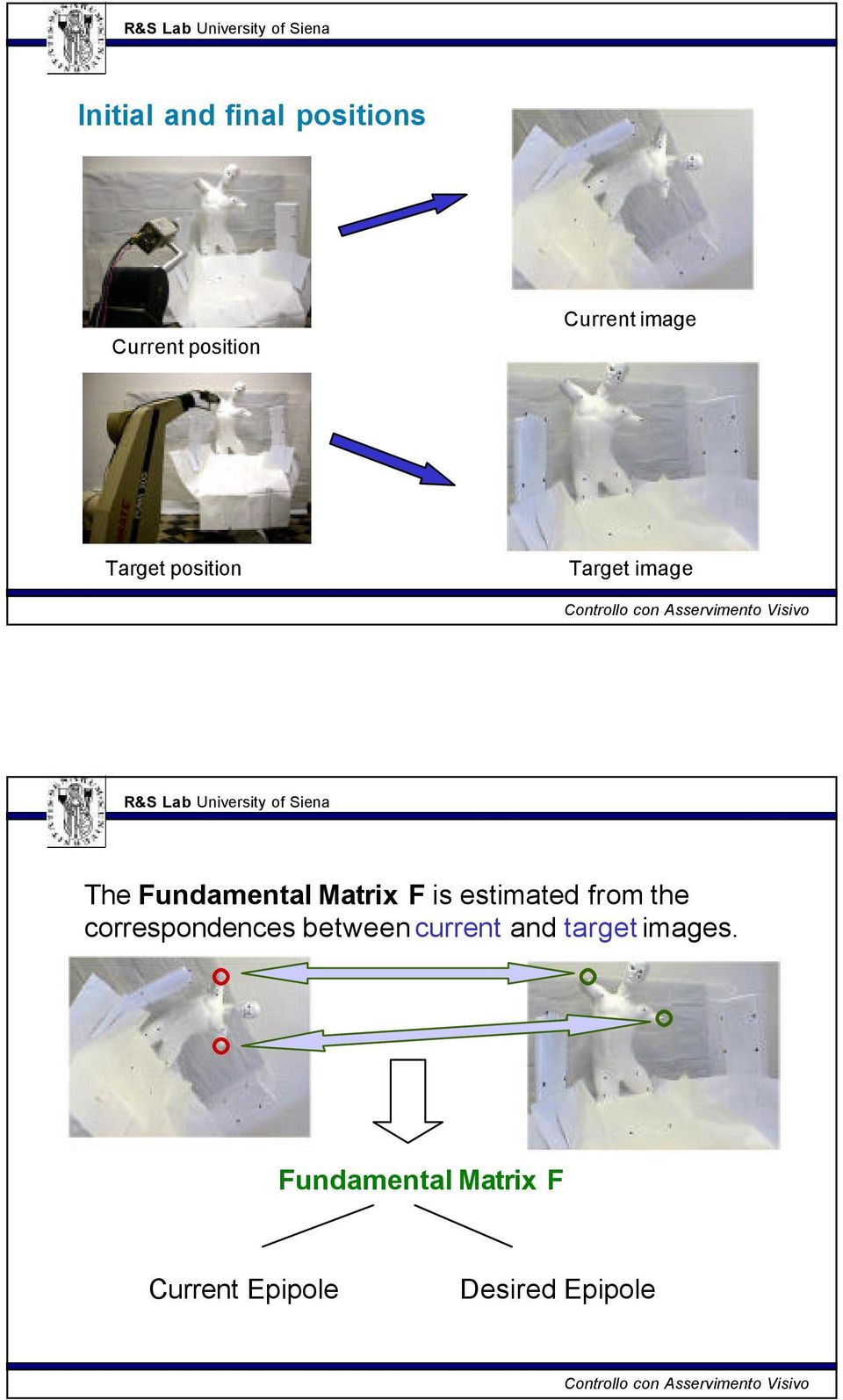
5 Givena set of corresponding points in homogeneous coordinates, there exists a matrix called the fundamental matrix [Faugeras 1993, Zissermann 2000] such that: Exploiting the kinematics of epipoles Target epipole MAIN PLANE Current epipole Main idea: perform a sequence of translations and rotations, depending on the epipole coordinates in order to reach the target.

6 3-Phases Algorithm Reaching the target plane Getting main target coplanarity the Planar Case the Planar Case or Planar Homing A general rotation R and translation t Exists between current and target frames

7 Essential and Fudamental Matrices two planar Homing methods Epipole Symmetry Algorithm Auto-Epipole Algorithm Rotate to get pure translation! [ICRA 2001] partially calibrated camera principal point (u 0,v 0 ) uncalibrated camera

8 Fundamental matrix under pure translation Theory not only for planar cases! the auto-epipole left image right image Current and desired epipoles are equal Epipolar lines have the same angular coeff.

9 Overlapped images If the camera motion is pure translation, a bi-tangent to the corresponding apparent contours coincides with an epipolar line. The epipole is the intersection of the bi-tangents. Pure traslation Four bi-tangents obtained from four corresponding points in the overlapped images

10 Non pure translation Four bi-tangents obtained from four corresponding points in the overlapped images Same orientation (pure translation)? All the bi-tangents intersect in the same point (the autoepipole)

11 Theorem Given 8 point matches (u a,u d ) in the two views and let the rank of matrix A be 8, then when all the bi-tangents intersect in the same point the two cameras have the same orientation and the point intersection is the epipole A = Visual Servoing (planar case) Step1 Find the right orientation exploiting the auto-epipole property Step2 Follow the base-line until the target is reached

12 Getting a pure translation (step1) Control based on the the relative distances of intersecting points

13 Keeping features in the field of view!? 2D Homing (step 2) Follow the base line until the target is reached! Following the base line direction the epipole does not change [P. Rives, INRIA] =

14 2D Homing TO DO Compensate the orientation Find the base-line direction Drive the camera to the target (one mode dof)

15 The auto-epipole experiment 3-Phases Algorithm Reaching the target plane Getting main target coplanarity the Planar Case
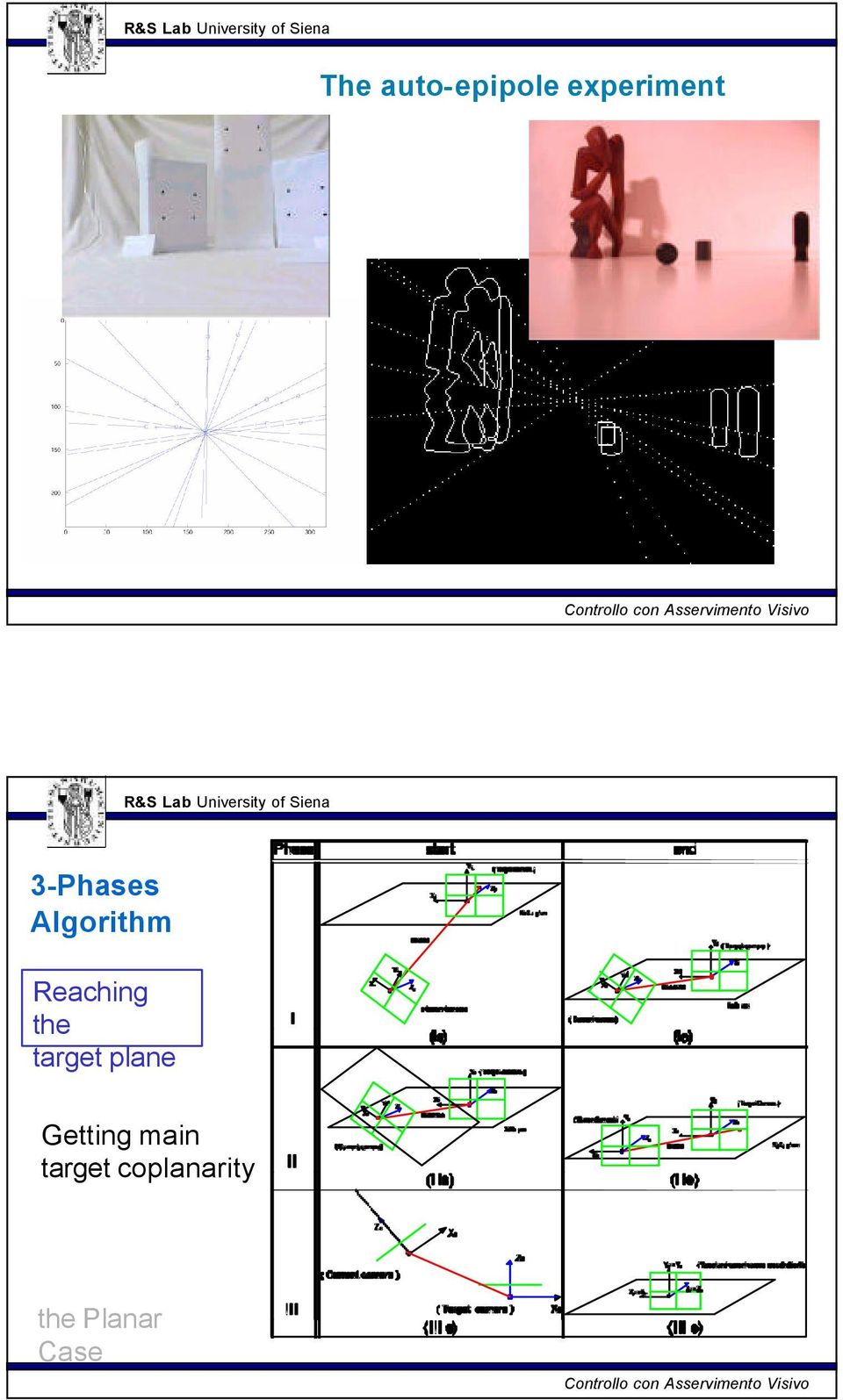
16 Reaching the target plane Property 1: The epipole e d has zero ordinate e (d,v) =0 iff the baseline belongs to the target plane. [Control Variable: e(d,v)] Desired camera Target Epipole The baseline is on the plane The epipole ed has ordinate equal to 0 Actual camera The experiment Phase 1 epipole plots
![[Control Variable: e(d,v)] Desired camera Target Epipole The baseline is on](/docs-images/44/2398457/images/page_16.jpg "the plane The epipole ed has ordinate equal to 0 Actual camera The")
17 3 Phases Algorithm Phase 2: Getting coplanarity

18 3 Phases Algorithm Phase 3: 2D homing R,t

19 Conclusions The VS algorithm is based on the epipole kinematics Epipole estimation obtained from scene point features (or contours...) Auto-epipole approach (completely uncalibrated camera) Next Epipole estimation must be robustly designed (image noise). Trade-off between accuracy and computational cost. Work is in progress for contour based visual servoing and comparison with existing methods Extension the auto-epipole to the fully actuated 3D camera motion (sinergy with surface reconstruct using apparent contours and profiles [Cipolla and Giblin, 2000], [Chesi, Malis and Cipolla, 2000] Enforce the estimation of epipoles for the contour case. Multipleview geometry [Hartley and Zisserman, 2000] Trajectory optimization (path planning) and phase fusion How to extend to omnidirectional cameras [Daniilidis]? MORE SLIDES..

20 3 Phases Algorithm Phase 2: Getting coplanarity 3 Phases Algorithm R,t Phase 3: 2D homing

21 The epipole s ordinate is not zero Phase 2: Getting coplanarity Observation:if xc is not on the plane translating along it the ordinate of target epipole change! The epipole s ordinate is equal to zero Phase 2: Getting coplanarity Observation:if xc is on the plane translating along it the ordinate of target epipole remain to zero!
22 Phase 2: Getting coplanarity Idea: Perform a test translation along xc and observe the target epipole Phase 2: Getting coplanarity Idea: Rotate aroud Zc and repeat the process
How To Analyze Ball Blur On A Ball Image
 Single Image 3D Reconstruction of Ball Motion and Spin From Motion Blur An Experiment in Motion from Blur Giacomo Boracchi, Vincenzo Caglioti, Alessandro Giusti Objective From a single image, reconstruct:
Epipolar Geometry. Readings: See Sections 10.1 and 15.6 of Forsyth and Ponce. Right Image. Left Image. e(p ) Epipolar Lines. e(q ) q R.
 Epipolar Geometry We consider two perspective images of a scene as taken from a stereo pair of cameras (or equivalently, assume the scene is rigid and imaged with a single camera from two different locations).
Introduction Epipolar Geometry Calibration Methods Further Readings. Stereo Camera Calibration
 Stereo Camera Calibration Stereo Camera Calibration Stereo Camera Calibration Stereo Camera Calibration 12.10.2004 Overview Introduction Summary / Motivation Depth Perception Ambiguity of Correspondence
Path Tracking for a Miniature Robot
 Path Tracking for a Miniature Robot By Martin Lundgren Excerpt from Master s thesis 003 Supervisor: Thomas Hellström Department of Computing Science Umeå University Sweden 1 Path Tracking Path tracking
THE problem of visual servoing guiding a robot using
 582 IEEE TRANSACTIONS ON ROBOTICS AND AUTOMATION, VOL. 13, NO. 4, AUGUST 1997 A Modular System for Robust Positioning Using Feedback from Stereo Vision Gregory D. Hager, Member, IEEE Abstract This paper
MetropoGIS: A City Modeling System DI Dr. Konrad KARNER, DI Andreas KLAUS, DI Joachim BAUER, DI Christopher ZACH
 MetropoGIS: A City Modeling System DI Dr. Konrad KARNER, DI Andreas KLAUS, DI Joachim BAUER, DI Christopher ZACH VRVis Research Center for Virtual Reality and Visualization, Virtual Habitat, Inffeldgasse
Projective Reconstruction from Line Correspondences
 Projective Reconstruction from Line Correspondences Richard I. Hartley G.E. CRD, Schenectady, NY, 12301. Abstract The paper gives a practical rapid algorithm for doing projective reconstruction of a scene
Animations in Creo 3.0
 Animations in Creo 3.0 ME170 Part I. Introduction & Outline Animations provide useful demonstrations and analyses of a mechanism's motion. This document will present two ways to create a motion animation
Geometric Camera Parameters
 Geometric Camera Parameters What assumptions have we made so far? -All equations we have derived for far are written in the camera reference frames. -These equations are valid only when: () all distances
CONTRIBUTIONS TO THE AUTOMATIC CONTROL OF AERIAL VEHICLES
 1 / 23 CONTRIBUTIONS TO THE AUTOMATIC CONTROL OF AERIAL VEHICLES MINH DUC HUA 1 1 INRIA Sophia Antipolis, AROBAS team I3S-CNRS Sophia Antipolis, CONDOR team Project ANR SCUAV Supervisors: Pascal MORIN,
Relating Vanishing Points to Catadioptric Camera Calibration
 Relating Vanishing Points to Catadioptric Camera Calibration Wenting Duan* a, Hui Zhang b, Nigel M. Allinson a a Laboratory of Vision Engineering, University of Lincoln, Brayford Pool, Lincoln, U.K. LN6
2-View Geometry. Mark Fiala Ryerson University [email protected]
 CRV 2010 Tutorial Day 2-View Geometry Mark Fiala Ryerson University [email protected] 3-Vectors for image points and lines Mark Fiala 2010 2D Homogeneous Points Add 3 rd number to a 2D point on image
CIS 536/636 Introduction to Computer Graphics. Kansas State University. CIS 536/636 Introduction to Computer Graphics
 2 Lecture Outline Animation 2 of 3: Rotations, Quaternions Dynamics & Kinematics William H. Hsu Department of Computing and Information Sciences, KSU KSOL course pages: http://bit.ly/hgvxlh / http://bit.ly/evizre
Wii Remote Calibration Using the Sensor Bar
 Wii Remote Calibration Using the Sensor Bar Alparslan Yildiz Abdullah Akay Yusuf Sinan Akgul GIT Vision Lab - http://vision.gyte.edu.tr Gebze Institute of Technology Kocaeli, Turkey {yildiz, akay, akgul}@bilmuh.gyte.edu.tr
Simulation of Trajectories and Comparison of Joint Variables for Robotic Manipulator Using Multibody Dynamics (MBD)
 Simulation of Trajectories and Comparison of Joint Variables for Robotic Manipulator Using Multibody Dynamics (MBD) Jatin Dave Assistant Professor Nirma University Mechanical Engineering Department, Institute
Using Many Cameras as One
 Using Many Cameras as One Robert Pless Department of Computer Science and Engineering Washington University in St. Louis, Box 1045, One Brookings Ave, St. Louis, MO, 63130 [email protected] Abstract We
B4 Computational Geometry
 3CG 2006 / B4 Computational Geometry David Murray [email protected] www.robots.o.ac.uk/ dwm/courses/3cg Michaelmas 2006 3CG 2006 2 / Overview Computational geometry is concerned with the derivation
An Efficient Solution to the Five-Point Relative Pose Problem
 An Efficient Solution to the Five-Point Relative Pose Problem David Nistér Sarnoff Corporation CN5300, Princeton, NJ 08530 [email protected] Abstract An efficient algorithmic solution to the classical
INSTRUCTOR WORKBOOK Quanser Robotics Package for Education for MATLAB /Simulink Users
 INSTRUCTOR WORKBOOK for MATLAB /Simulink Users Developed by: Amir Haddadi, Ph.D., Quanser Peter Martin, M.A.SC., Quanser Quanser educational solutions are powered by: CAPTIVATE. MOTIVATE. GRADUATE. PREFACE
Force and Visual Control for Safe Human Robot Interaction
 Force and Visual Control for Safe Human Robot Interaction Bruno SICILIANO www.prisma.unina.it PRISMA Team Force and Visual Control for Safe Human Robot Interaction 2/35 Bruno Siciliano Luigi Villani Vincenzo
3D Scanner using Line Laser. 1. Introduction. 2. Theory
 . Introduction 3D Scanner using Line Laser Di Lu Electrical, Computer, and Systems Engineering Rensselaer Polytechnic Institute The goal of 3D reconstruction is to recover the 3D properties of a geometric
Geometry: Unit 1 Vocabulary TERM DEFINITION GEOMETRIC FIGURE. Cannot be defined by using other figures.
 Geometry: Unit 1 Vocabulary 1.1 Undefined terms Cannot be defined by using other figures. Point A specific location. It has no dimension and is represented by a dot. Line Plane A connected straight path.
Metrics on SO(3) and Inverse Kinematics
 Mathematical Foundations of Computer Graphics and Vision Metrics on SO(3) and Inverse Kinematics Luca Ballan Institute of Visual Computing Optimization on Manifolds Descent approach d is a ascent direction
Robot coined by Karel Capek in a 1921 science-fiction Czech play
 Robotics Robot coined by Karel Capek in a 1921 science-fiction Czech play Definition: A robot is a reprogrammable, multifunctional manipulator designed to move material, parts, tools, or specialized devices
An Efficient Solution to the Five-Point Relative Pose Problem
 An Efficient Solution to the Five-Point Relative Pose Problem David Nistér Sarnoff Corporation CN5300, Princeton, NJ 08530 [email protected] Abstract An efficient algorithmic solution to the classical
3D Vision An enabling Technology for Advanced Driver Assistance and Autonomous Offroad Driving
 3D Vision An enabling Technology for Advanced Driver Assistance and Autonomous Offroad Driving AIT Austrian Institute of Technology Safety & Security Department Christian Zinner Safe and Autonomous Systems
Sensor Based Control of Autonomous Wheeled Mobile Robots
 Sensor Based Control of Autonomous Wheeled Mobile Robots Gyula Mester University of Szeged, Department of Informatics e-mail: [email protected] Abstract The paper deals with the wireless sensor-based
TWO-DIMENSIONAL TRANSFORMATION
 CHAPTER 2 TWO-DIMENSIONAL TRANSFORMATION 2.1 Introduction As stated earlier, Computer Aided Design consists of three components, namely, Design (Geometric Modeling), Analysis (FEA, etc), and Visualization
Real-time 3D Model-Based Tracking: Combining Edge and Texture Information
 IEEE Int. Conf. on Robotics and Automation, ICRA'6 Orlando, Fl, May 26 Real-time 3D Model-Based Tracking: Combining Edge and Texture Information Muriel Pressigout IRISA-Université de Rennes 1 Campus de
ROBOTICS 01PEEQW. Basilio Bona DAUIN Politecnico di Torino
 ROBOTICS 01PEEQW Basilio Bona DAUIN Politecnico di Torino Probabilistic Fundamentals in Robotics Robot Motion Probabilistic models of mobile robots Robot motion Kinematics Velocity motion model Odometry
Computer Graphics. Geometric Modeling. Page 1. Copyright Gotsman, Elber, Barequet, Karni, Sheffer Computer Science - Technion. An Example.
 An Example 2 3 4 Outline Objective: Develop methods and algorithms to mathematically model shape of real world objects Categories: Wire-Frame Representation Object is represented as as a set of points
Solving Simultaneous Equations and Matrices
 Solving Simultaneous Equations and Matrices The following represents a systematic investigation for the steps used to solve two simultaneous linear equations in two unknowns. The motivation for considering
Least-Squares Intersection of Lines
 Least-Squares Intersection of Lines Johannes Traa - UIUC 2013 This write-up derives the least-squares solution for the intersection of lines. In the general case, a set of lines will not intersect at a
Projective Geometry. Projective Geometry
 Euclidean versus Euclidean geometry describes sapes as tey are Properties of objects tat are uncanged by rigid motions» Lengts» Angles» Parallelism Projective geometry describes objects as tey appear Lengts,
Digital Image Increase
 Exploiting redundancy for reliable aerial computer vision 1 Digital Image Increase 2 Images Worldwide 3 Terrestrial Image Acquisition 4 Aerial Photogrammetry 5 New Sensor Platforms Towards Fully Automatic
Multiple View Geometry in Computer Vision
 Multiple View Geometry in Computer Vision Information Meeting 15 Dec 2009 by Marianna Pronobis Content of the Meeting 1. Motivation & Objectives 2. What the course will be about (Stefan) 3. Content of
Interactive Segmentation, Tracking, and Kinematic Modeling of Unknown 3D Articulated Objects
 Interactive Segmentation, Tracking, and Kinematic Modeling of Unknown 3D Articulated Objects Dov Katz, Moslem Kazemi, J. Andrew Bagnell and Anthony Stentz 1 Abstract We present an interactive perceptual
CALIBRATION OF A ROBUST 2 DOF PATH MONITORING TOOL FOR INDUSTRIAL ROBOTS AND MACHINE TOOLS BASED ON PARALLEL KINEMATICS
 CALIBRATION OF A ROBUST 2 DOF PATH MONITORING TOOL FOR INDUSTRIAL ROBOTS AND MACHINE TOOLS BASED ON PARALLEL KINEMATICS E. Batzies 1, M. Kreutzer 1, D. Leucht 2, V. Welker 2, O. Zirn 1 1 Mechatronics Research
CS 534: Computer Vision 3D Model-based recognition
 CS 534: Computer Vision 3D Model-based recognition Ahmed Elgammal Dept of Computer Science CS 534 3D Model-based Vision - 1 High Level Vision Object Recognition: What it means? Two main recognition tasks:!
Time Domain and Frequency Domain Techniques For Multi Shaker Time Waveform Replication
 Time Domain and Frequency Domain Techniques For Multi Shaker Time Waveform Replication Thomas Reilly Data Physics Corporation 1741 Technology Drive, Suite 260 San Jose, CA 95110 (408) 216-8440 This paper
Monash University Clayton s School of Information Technology CSE3313 Computer Graphics Sample Exam Questions 2007
 Monash University Clayton s School of Information Technology CSE3313 Computer Graphics Questions 2007 INSTRUCTIONS: Answer all questions. Spend approximately 1 minute per mark. Question 1 30 Marks Total
Segmentation of building models from dense 3D point-clouds
 Segmentation of building models from dense 3D point-clouds Joachim Bauer, Konrad Karner, Konrad Schindler, Andreas Klaus, Christopher Zach VRVis Research Center for Virtual Reality and Visualization, Institute
3D Model based Object Class Detection in An Arbitrary View
 3D Model based Object Class Detection in An Arbitrary View Pingkun Yan, Saad M. Khan, Mubarak Shah School of Electrical Engineering and Computer Science University of Central Florida http://www.eecs.ucf.edu/
UAV Pose Estimation using POSIT Algorithm
 International Journal of Digital ontent Technology and its Applications. Volume 5, Number 4, April 211 UAV Pose Estimation using POSIT Algorithm *1 M. He, 2. Ratanasawanya, 3 M. Mehrandezh, 4 R. Paranjape
Learning a wall following behaviour in mobile robotics using stereo and mono vision
 Learning a wall following behaviour in mobile robotics using stereo and mono vision P. Quintía J.E. Domenech C.V. Regueiro C. Gamallo R. Iglesias Dpt. Electronics and Systems. Univ. A Coruña [email protected],
Solution Guide III-C. 3D Vision. Building Vision for Business. MVTec Software GmbH
 Solution Guide III-C 3D Vision MVTec Software GmbH Building Vision for Business Machine vision in 3D world coordinates, Version 10.0.4 All rights reserved. No part of this publication may be reproduced,
CE801: Intelligent Systems and Robotics Lecture 3: Actuators and Localisation. Prof. Dr. Hani Hagras
 1 CE801: Intelligent Systems and Robotics Lecture 3: Actuators and Localisation Prof. Dr. Hani Hagras Robot Locomotion Robots might want to move in water, in the air, on land, in space.. 2 Most of the
Vision based Vehicle Tracking using a high angle camera
 Vision based Vehicle Tracking using a high angle camera Raúl Ignacio Ramos García Dule Shu [email protected] [email protected] Abstract A vehicle tracking and grouping algorithm is presented in this work
Whole-body dynamic motion planning with centroidal dynamics and full kinematics
 Sep. 18. 2014 Introduction Linear Inverted Pendulum compute ZMP with point-mass model linear system, analytical solution co-planar contact solve kinematics separately Our approach dynamic constraint for
3-D Scene Data Recovery using Omnidirectional Multibaseline Stereo
 3-D Scene Data Recovery using Omnidirectional Multibaseline Stereo Sing Bing Kang and Richard Szeliski Digital Equipment Corporation Cambridge Research Lab CRL 95/6 October, 1995 Digital Equipment Corporation
Introduction to Robotics Analysis, Systems, Applications
 Introduction to Robotics Analysis, Systems, Applications Saeed B. Niku Mechanical Engineering Department California Polytechnic State University San Luis Obispo Technische Urw/carsMt Darmstadt FACHBEREfCH
Lecture 2: Homogeneous Coordinates, Lines and Conics
 Lecture 2: Homogeneous Coordinates, Lines and Conics 1 Homogeneous Coordinates In Lecture 1 we derived the camera equations λx = P X, (1) where x = (x 1, x 2, 1), X = (X 1, X 2, X 3, 1) and P is a 3 4
Flow Separation for Fast and Robust Stereo Odometry
 Flow Separation for Fast and Robust Stereo Odometry Michael Kaess, Kai Ni and Frank Dellaert Abstract Separating sparse flow provides fast and robust stereo visual odometry that deals with nearly degenerate
Chapter. 4 Mechanism Design and Analysis
 Chapter. 4 Mechanism Design and Analysis 1 All mechanical devices containing moving parts are composed of some type of mechanism. A mechanism is a group of links interacting with each other through joints
Robotics. Lecture 3: Sensors. See course website http://www.doc.ic.ac.uk/~ajd/robotics/ for up to date information.
 Robotics Lecture 3: Sensors See course website http://www.doc.ic.ac.uk/~ajd/robotics/ for up to date information. Andrew Davison Department of Computing Imperial College London Review: Locomotion Practical
On Motion of Robot End-Effector using the Curvature Theory of Timelike Ruled Surfaces with Timelike Directrix
 Malaysian Journal of Mathematical Sciences 8(2): 89-204 (204) MALAYSIAN JOURNAL OF MATHEMATICAL SCIENCES Journal homepage: http://einspem.upm.edu.my/journal On Motion of Robot End-Effector using the Curvature
521493S Computer Graphics. Exercise 2 & course schedule change
 521493S Computer Graphics Exercise 2 & course schedule change Course Schedule Change Lecture from Wednesday 31th of March is moved to Tuesday 30th of March at 16-18 in TS128 Question 2.1 Given two nonparallel,
How To Fuse A Point Cloud With A Laser And Image Data From A Pointcloud
 REAL TIME 3D FUSION OF IMAGERY AND MOBILE LIDAR Paul Mrstik, Vice President Technology Kresimir Kusevic, R&D Engineer Terrapoint Inc. 140-1 Antares Dr. Ottawa, Ontario K2E 8C4 Canada [email protected]
A QCQP Approach to Triangulation. Chris Aholt, Sameer Agarwal, and Rekha Thomas University of Washington 2 Google, Inc.
 A QCQP Approach to Triangulation 1 Chris Aholt, Sameer Agarwal, and Rekha Thomas 1 University of Washington 2 Google, Inc. 2 1 The Triangulation Problem X Given: -n camera matrices P i R 3 4 -n noisy observations
CATIA Wireframe & Surfaces TABLE OF CONTENTS
 TABLE OF CONTENTS Introduction... 1 Wireframe & Surfaces... 2 Pull Down Menus... 3 Edit... 3 Insert... 4 Tools... 6 Generative Shape Design Workbench... 7 Bottom Toolbar... 9 Tools... 9 Analysis... 10
Projective Geometry: A Short Introduction. Lecture Notes Edmond Boyer
 Projective Geometry: A Short Introduction Lecture Notes Edmond Boyer Contents 1 Introduction 2 11 Objective 2 12 Historical Background 3 13 Bibliography 4 2 Projective Spaces 5 21 Definitions 5 22 Properties
3D/4D acquisition. 3D acquisition taxonomy 22.10.2014. Computer Vision. Computer Vision. 3D acquisition methods. passive. active.
 Das Bild kann zurzeit nicht angezeigt werden. 22.10.2014 3D/4D acquisition 3D acquisition taxonomy 3D acquisition methods passive active uni-directional multi-directional uni-directional multi-directional
Sensory-motor control scheme based on Kohonen Maps and AVITE model
 Sensory-motor control scheme based on Kohonen Maps and AVITE model Juan L. Pedreño-Molina, Antonio Guerrero-González, Oscar A. Florez-Giraldo, J. Molina-Vilaplana Technical University of Cartagena Department
AN INTERACTIVE USER INTERFACE TO THE MOBILITY OBJECT MANAGER FOR RWI ROBOTS
 AN INTERACTIVE USER INTERFACE TO THE MOBILITY OBJECT MANAGER FOR RWI ROBOTS Innocent Okoloko and Huosheng Hu Department of Computer Science, University of Essex Colchester Essex C04 3SQ, United Kingdom
RealTime Tracking Meets Online Grasp Planning
 RealTime Tracking Meets Online Grasp Planning Danica Kragić, Computer Vision and Active Perception Numerical Analysis and Computer Science Royal Institute of Technology SE 100 44 Stockholm, Sweden Andrew
Force/position control of a robotic system for transcranial magnetic stimulation
 Force/position control of a robotic system for transcranial magnetic stimulation W.N. Wan Zakaria School of Mechanical and System Engineering Newcastle University Abstract To develop a force control scheme
EXPERIMENTAL EVALUATION OF RELATIVE POSE ESTIMATION ALGORITHMS
 EXPERIMENTAL EVALUATION OF RELATIVE POSE ESTIMATION ALGORITHMS Marcel Brückner, Ferid Bajramovic, Joachim Denzler Chair for Computer Vision, Friedrich-Schiller-University Jena, Ernst-Abbe-Platz, 7743 Jena,
Lecture L6 - Intrinsic Coordinates
 S. Widnall, J. Peraire 16.07 Dynamics Fall 2009 Version 2.0 Lecture L6 - Intrinsic Coordinates In lecture L4, we introduced the position, velocity and acceleration vectors and referred them to a fixed
3D Tranformations. CS 4620 Lecture 6. Cornell CS4620 Fall 2013 Lecture 6. 2013 Steve Marschner (with previous instructors James/Bala)
 3D Tranformations CS 4620 Lecture 6 1 Translation 2 Translation 2 Translation 2 Translation 2 Scaling 3 Scaling 3 Scaling 3 Scaling 3 Rotation about z axis 4 Rotation about z axis 4 Rotation about x axis
T-REDSPEED White paper
 T-REDSPEED White paper Index Index...2 Introduction...3 Specifications...4 Innovation...6 Technology added values...7 Introduction T-REDSPEED is an international patent pending technology for traffic violation
Introduction to Computer Graphics
 Introduction to Computer Graphics Torsten Möller TASC 8021 778-782-2215 [email protected] www.cs.sfu.ca/~torsten Today What is computer graphics? Contents of this course Syllabus Overview of course topics
An Iterative Image Registration Technique with an Application to Stereo Vision
 An Iterative Image Registration Technique with an Application to Stereo Vision Bruce D. Lucas Takeo Kanade Computer Science Department Carnegie-Mellon University Pittsburgh, Pennsylvania 15213 Abstract
Classifying Manipulation Primitives from Visual Data
 Classifying Manipulation Primitives from Visual Data Sandy Huang and Dylan Hadfield-Menell Abstract One approach to learning from demonstrations in robotics is to make use of a classifier to predict if
Terrain Traversability Analysis using Organized Point Cloud, Superpixel Surface Normals-based segmentation and PCA-based Classification
 Terrain Traversability Analysis using Organized Point Cloud, Superpixel Surface Normals-based segmentation and PCA-based Classification Aras Dargazany 1 and Karsten Berns 2 Abstract In this paper, an stereo-based
DICOM Correction Item
 Correction Number DICOM Correction Item CP-626 Log Summary: Type of Modification Clarification Rationale for Correction Name of Standard PS 3.3 2004 + Sup 83 The description of pixel spacing related attributes
A PAIR OF MEASURES OF ROTATIONAL ERROR FOR AXISYMMETRIC ROBOT END-EFFECTORS
 A PAIR OF MEASURES OF ROTATIONAL ERROR FOR AXISYMMETRIC ROBOT END-EFFECTORS Sébastien Briot, Ilian A. Bonev Department of Automated Manufacturing Engineering École de technologie supérieure (ÉTS), Montreal,
Essential Mathematics for Computer Graphics fast
 John Vince Essential Mathematics for Computer Graphics fast Springer Contents 1. MATHEMATICS 1 Is mathematics difficult? 3 Who should read this book? 4 Aims and objectives of this book 4 Assumptions made
Dev eloping a General Postprocessor for Multi-Axis CNC Milling Centers
 57 Dev eloping a General Postprocessor for Multi-Axis CNC Milling Centers Mihir Adivarekar 1 and Frank Liou 1 1 Missouri University of Science and Technology, [email protected] ABSTRACT Most of the current
Tracking in flussi video 3D. Ing. Samuele Salti
 Seminari XXIII ciclo Tracking in flussi video 3D Ing. Tutors: Prof. Tullio Salmon Cinotti Prof. Luigi Di Stefano The Tracking problem Detection Object model, Track initiation, Track termination, Tracking
Industrial Robotics. Training Objective
 Training Objective After watching the program and reviewing this printed material, the viewer will learn the basics of industrial robot technology and how robots are used in a variety of manufacturing
PHOTOGRAMMETRIC TECHNIQUES FOR MEASUREMENTS IN WOODWORKING INDUSTRY
 PHOTOGRAMMETRIC TECHNIQUES FOR MEASUREMENTS IN WOODWORKING INDUSTRY V. Knyaz a, *, Yu. Visilter, S. Zheltov a State Research Institute for Aviation System (GosNIIAS), 7, Victorenko str., Moscow, Russia
Software Manual. IDEA The Software Version 1.0
 Software Manual IDEA The Software Version 1.0 > Open Technologies srl Rezzato 2014 1 Index 1 IDEA the application for Scan in a box...3 2 Application Interface...3 2.1.1 Project management panel...4 2.1.2
OBJECT TRACKING USING LOG-POLAR TRANSFORMATION
 OBJECT TRACKING USING LOG-POLAR TRANSFORMATION A Thesis Submitted to the Gradual Faculty of the Louisiana State University and Agricultural and Mechanical College in partial fulfillment of the requirements
Joao Pedro Barreto. Dept. of Electrical and Computer Engineering R: Antonio Jose de Almeida, 295, 1Esq. University of Coimbra telf: +351 938469263
 Joao Pedro Barreto [email protected] www.deec.uc.pt/ jpbar Dept. of Electrical and Computer Engineering R: Antonio Jose de Almeida, 295, 1Esq Faculty of Science and Technology 3000-045 Coimbra, Portugal
Real-Time Camera Tracking Using a Particle Filter
 Real-Time Camera Tracking Using a Particle Filter Mark Pupilli and Andrew Calway Department of Computer Science University of Bristol, UK {pupilli,andrew}@cs.bris.ac.uk Abstract We describe a particle
EFFICIENT VEHICLE TRACKING AND CLASSIFICATION FOR AN AUTOMATED TRAFFIC SURVEILLANCE SYSTEM
 EFFICIENT VEHICLE TRACKING AND CLASSIFICATION FOR AN AUTOMATED TRAFFIC SURVEILLANCE SYSTEM Amol Ambardekar, Mircea Nicolescu, and George Bebis Department of Computer Science and Engineering University
Structural Analysis - II Prof. P. Banerjee Department of Civil Engineering Indian Institute of Technology, Bombay. Lecture - 02
 Structural Analysis - II Prof. P. Banerjee Department of Civil Engineering Indian Institute of Technology, Bombay Lecture - 02 Good morning. Today is the second lecture in the series of lectures on structural