
An Introduction to Indiana s Medicaid Waiver Program for Home and Community Based Services
|
|
|
- Eleanor McCarthy
- 10 years ago
- Views:
Transcription
1 An Introduction to Indiana s Medicaid Waiver Program for Home and Community Based Services

2 An Introduction to Medicaid Waivers What are Medicaid waivers? Medicaid waivers allow Medicaid to fund supports and services for children and adults with disabilities in their own homes or residential neighborhoods instead of institutions. Medicaid waivers allow an individual to use traditional Medicaid services AND the additional services available under a waiver. Indiana offers five Medicaid waivers: Developmental Disabilities Autism Support Services Aged and Disabled Traumatic Brain Injury What services are covered? Different services are covered by different Medicaid waivers. Some services that may be covered include: respite care, therapies, pre-vocational services, employment supports, adult day services, behavior supports, supports to participate in the community, supports to families or an individual to live at home, family and caregiver training, transportation. How do you qualify? You must meet Indiana s Medicaid disability and financial eligibility requirements. Your family income and assets are NOT counted to determine eligibility for children under 18; however, assets or income in the child s name are counted. For those older than 18, only the individual s income and assets are counted. You must require the type of care that ordinarily would be provided in a Medicaid-funded facility, such as a nursing home, large residential facility or group home. You can apply and qualify for more than one waiver. For example, if you are eligible for the Autism or Developmental Disabilities waivers, you will also be eligible for the Support Services waiver. Where do you apply? Autism, Developmental Disabilities and Support Services Obtain the number for your local Bureau of Developmental Disability Services (BDDS) office by calling Aged and Disabled and Traumatic Brain Injury Obtain the number for your local Area Agency on Aging by calling If you need assistance in completing the application, contact The Arc at or

3 for Home and Community Based Services How long will you have to wait for services? There are waiting lists for all Medicaid waivers. The length of time that you may have to wait varies depending on the type of waiver(s) you are applying for and the availability of state and federal funds. When you apply, ask what the current status of the waiting list is and when you may expect to come off the waiting list. If you are eligible, should you apply now? Yes! Even if you do not need services now, you may need them by the time you come off the waiting list. Are there any exceptions to the waiting list? In limited circumstances, individuals who meet specific criteria may be eligible to receive Medicaid waiver services sooner than others, based on the availability of state and federal funds. This includes: Individuals whose caregivers are age 80 or older Individuals who have lost their primary caregiver due to death, long term institutionalization, incapacitation or incarceration Young adults who have aged out of residential or group home settings funded by DOE, DFC or Medicaid Special Education students who are leaving or who have left high school, ages (SS waiver) Is it important to keep in touch with BDDS and/or the Area Agency on Aging where I applied? Yes! It is very important to maintain contact with the BDDS and/or Area Agency on Aging office where you applied for Medicaid waiver services. Make a note on your calendar to call every year on the date that you applied. If you do not contact them, you may be removed from the waiting list. If your address or other contact information changes, it is critical that you call to keep your information up-to-date. What other supports are available to people with disabilities? Medicaid Health Insurance/Medical Supports Caregiver Support First Steps Early Childhood Education Vocational Rehabilitation Supplemental Security Income (SSI) Medicaid funded group homes Natural Supports and Community Programs

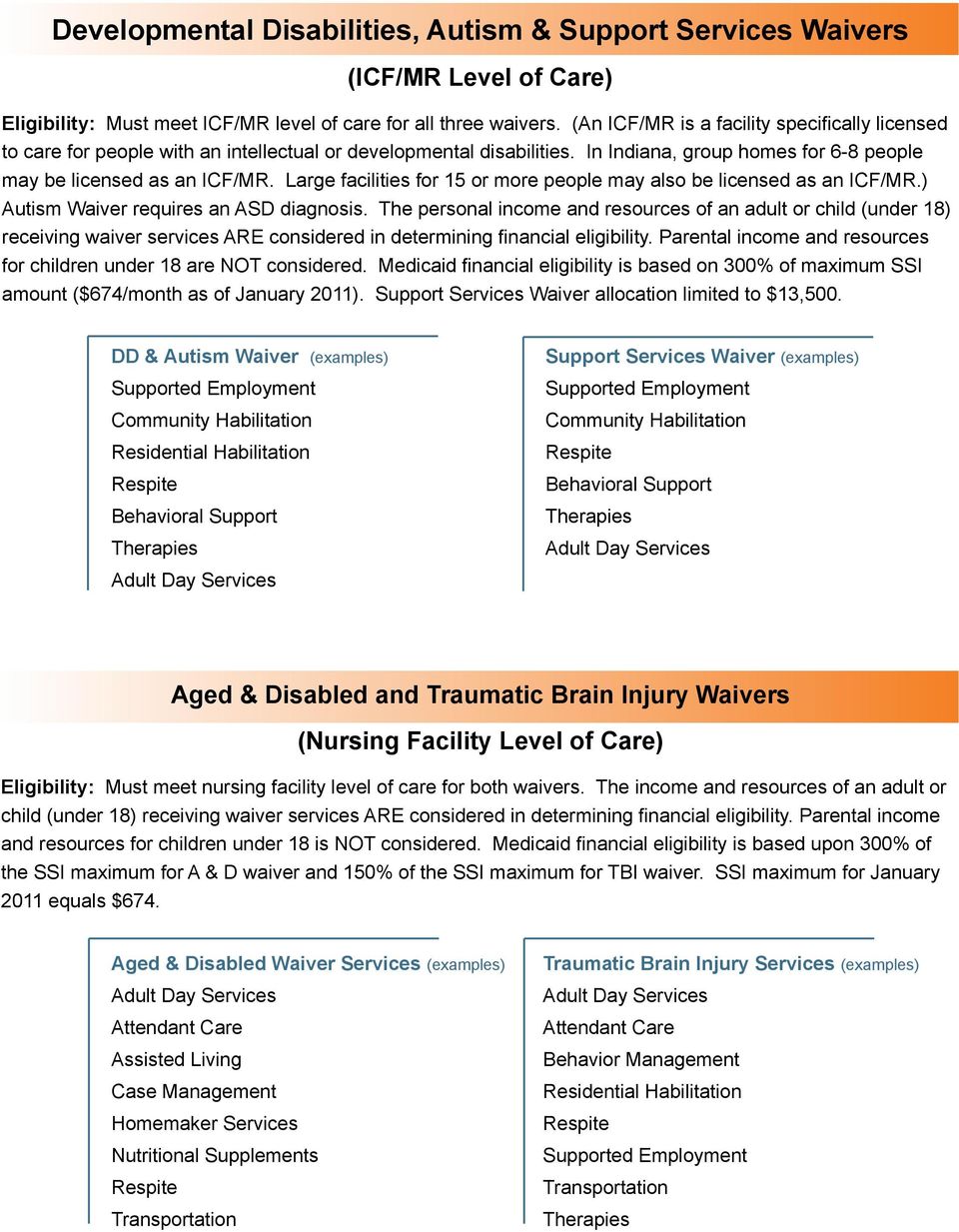
4 Developmental Disabilities, Autism & Support Services Waivers (ICF/MR Level of Care) Eligibility: Must meet ICF/MR level of care for all three waivers. (An ICF/MR is a facility specifically licensed to care for people with an intellectual or developmental disabilities. In Indiana, group homes for 6-8 people may be licensed as an ICF/MR. Large facilities for 15 or more people may also be licensed as an ICF/MR.) Autism Waiver requires an ASD diagnosis. The personal income and resources of an adult or child (under 18) receiving waiver services are considered in determining financial eligibility. Parental income and resources for children under 18 are NOT considered. Medicaid financial eligibility is based on 300% of maximum SSI amount ($674/month as of January 2011). Support Services Waiver allocation limited to $13,500. DD & Autism Waiver (examples) Supported Employment Community Habilitation Residential Habilitation Respite Behavioral Support Therapies Adult Day Services Support Services Waiver (examples) Supported Employment Community Habilitation Respite Behavioral Support Therapies Adult Day Services Aged & Disabled and Traumatic Brain Injury Waivers (Nursing Facility Level of Care) Eligibility: Must meet nursing facility level of care for both waivers. The income and resources of an adult or child (under 18) receiving waiver services are considered in determining financial eligibility. Parental income and resources for children under 18 is NOT considered. Medicaid financial eligibility is based upon 300% of the SSI maximum for A & D waiver and 150% of the SSI maximum for TBI waiver. SSI maximum for January 2011 equals $674. Aged & Disabled Waiver Services (examples) Adult Day Services Attendant Care Assisted Living Case Management Homemaker Services Nutritional Supplements Respite Transportation Traumatic Brain Injury Services (examples) Adult Day Services Attendant Care Behavior Management Residential Habilitation Respite Supported Employment Transportation Therapies
5 State and Federal Agencies Family and Social Services Administration, (FSSA) Division of Disability & Rehabilitative Services, (DDRS) Bureau of Developmental Disabilities Services (BDDS) Vocational Rehabilitation Services (VRS) Division of Aging First Steps (Early Intervention 0-3) STEP ( ) State Department of Education (Early Childhood and Special Education) Indiana Protection and Advocacy Services (P&A) Social Security Administration

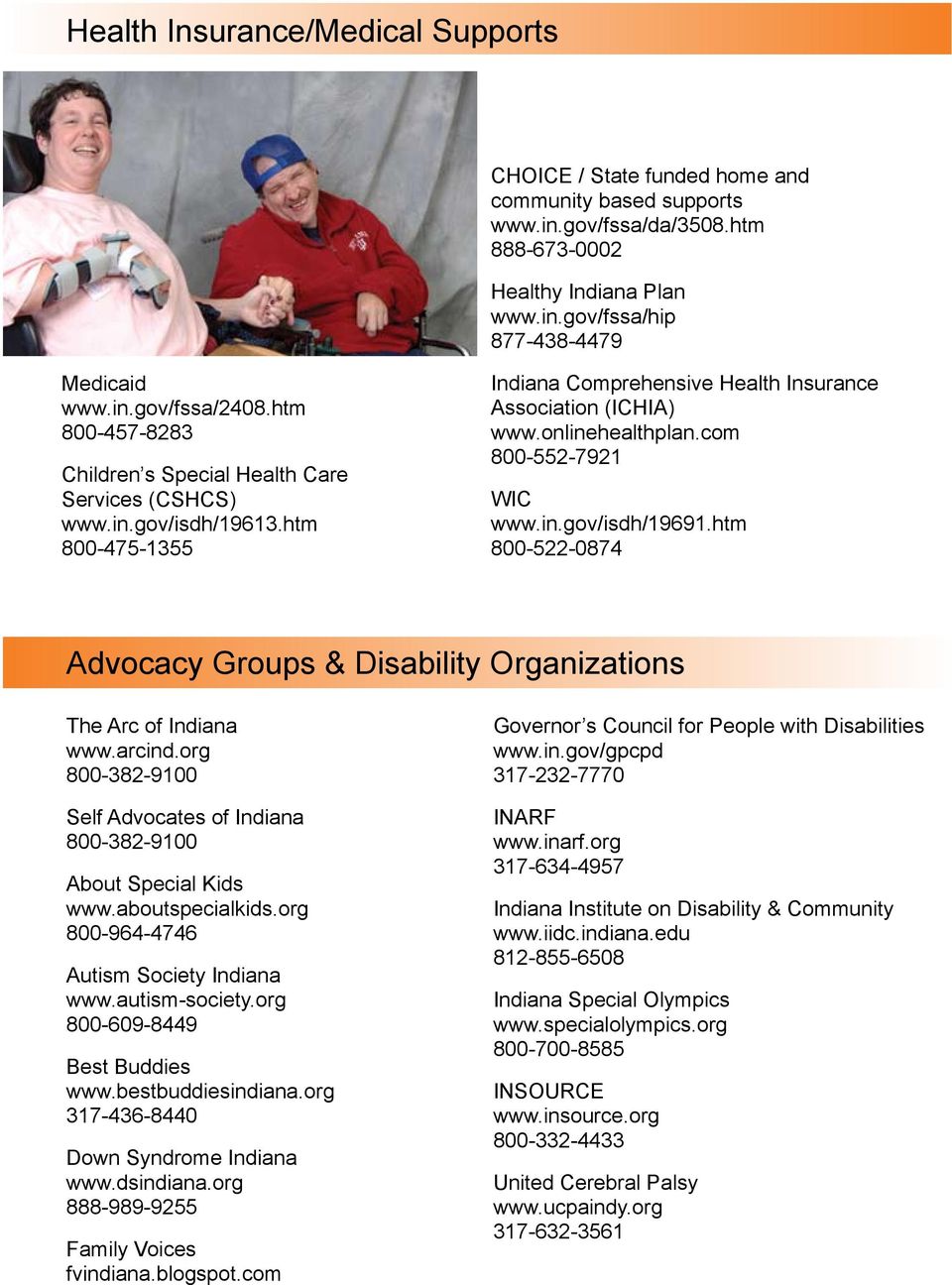
6 Health Insurance/Medical Supports CHOICE / State funded home and community based supports Healthy Indiana Plan Medicaid Children s Special Health Care Services (CSHCS) Indiana Comprehensive Health Insurance Association (ICHIA) WIC Advocacy Groups & Disability Organizations The Arc of Indiana Self Advocates of Indiana About Special Kids Autism Society Indiana Best Buddies Down Syndrome Indiana Family Voices fvindiana.blogspot.com Governor s Council for People with Disabilities INARF Indiana Institute on Disability & Community Indiana Special Olympics INSOURCE United Cerebral Palsy
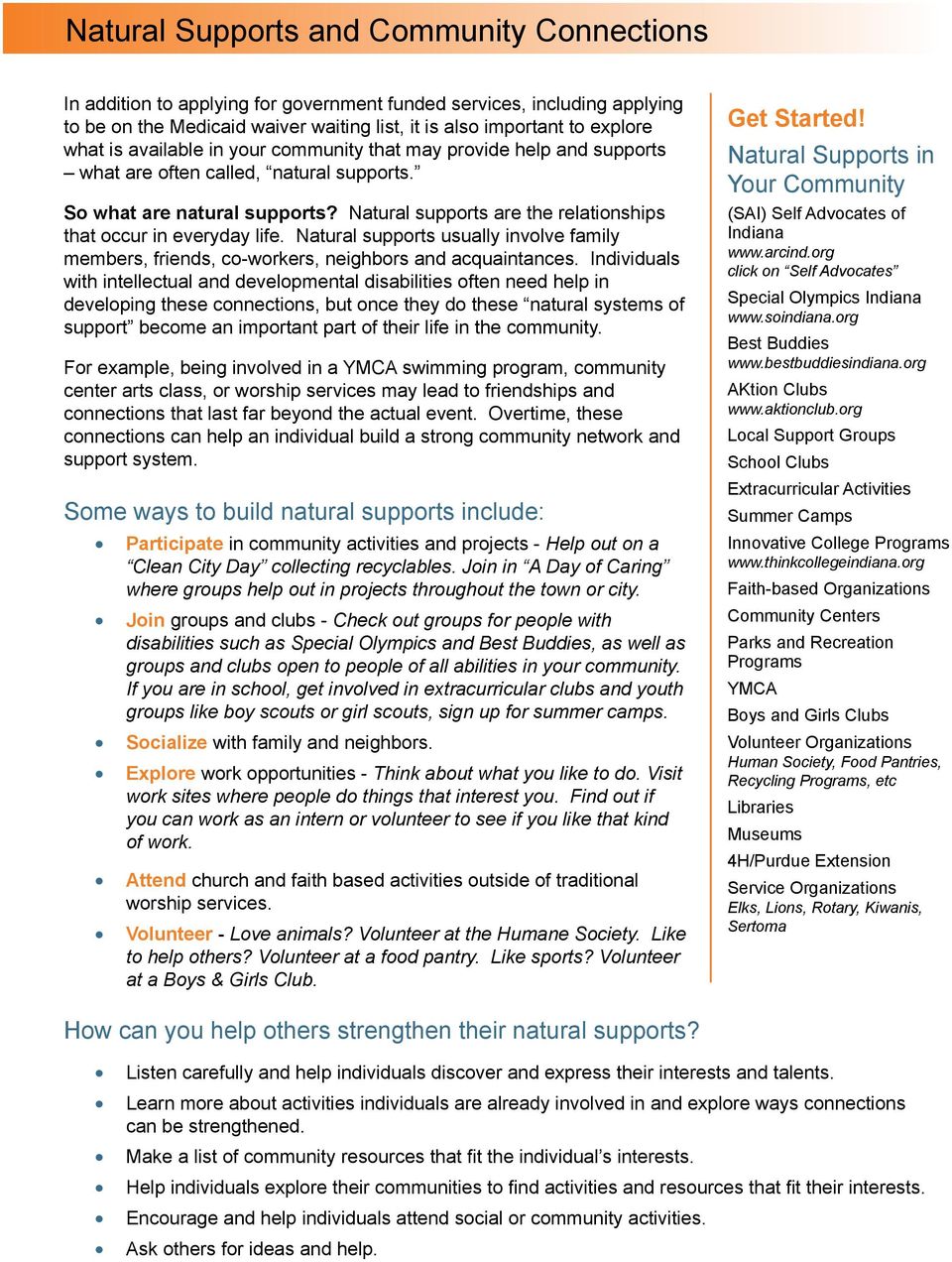
7 Natural Supports and Community Connections In addition to applying for government funded services, including applying to be on the Medicaid waiver waiting list, it is also important to explore what is available in your community that may provide help and supports what are often called, natural supports. So what are natural supports? Natural supports are the relationships that occur in everyday life. Natural supports usually involve family members, friends, co-workers, neighbors and acquaintances. Individuals with intellectual and developmental disabilities often need help in developing these connections, but once they do these natural systems of support become an important part of their life in the community. For example, being involved in a YMCA swimming program, community center arts class, or worship services may lead to friendships and connections that last far beyond the actual event. Overtime, these connections can help an individual build a strong community network and support system. Some ways to build natural supports include: Participate in community activities and projects - Help out on a Clean City Day collecting recyclables. Join in A Day of Caring where groups help out in projects throughout the town or city. Join groups and clubs - Check out groups for people with disabilities such as Special Olympics and Best Buddies, as well as groups and clubs open to people of all abilities in your community. If you are in school, get involved in extracurricular clubs and youth groups like boy scouts or girl scouts, sign up for summer camps. Socialize with family and neighbors. Explore work opportunities - Think about what you like to do. Visit work sites where people do things that interest you. Find out if you can work as an intern or volunteer to see if you like that kind of work. Attend church and faith based activities outside of traditional worship services. Volunteer - Love animals? Volunteer at the Humane Society. Like to help others? Volunteer at a food pantry. Like sports? Volunteer at a Boys & Girls Club. Get Started! Natural Supports in Your Community (SAI) Self Advocates of Indiana click on Self Advocates Special Olympics Indiana Best Buddies AKtion Clubs Local Support Groups School Clubs Extracurricular Activities Summer Camps Innovative College Programs Faith-based Organizations Community Centers Parks and Recreation Programs YMCA Boys and Girls Clubs Volunteer Organizations Human Society, Food Pantries, Recycling Programs, etc Libraries Museums 4H/Purdue Extension Service Organizations Elks, Lions, Rotary, Kiwanis, Sertoma How can you help others strengthen their natural supports? Listen carefully and help individuals discover and express their interests and talents. Learn more about activities individuals are already involved in and explore ways connections can be strengthened. Make a list of community resources that fit the individual s interests. Help individuals explore their communities to find activities and resources that fit their interests. Encourage and help individuals attend social or community activities. Ask others for ideas and help.
8 The Arc of Indiana was established in 1956 by parents of children with intellectual and developmental disabilities who joined together to build a better and more accepting world for their children. We are affiliated with The Arc of the United States and are proud to work with our local Arc chapters throughout the state. Our Programs and Services Public Policy Advocacy Through volunteers and staff, The Arc has a fulltime presence at the Indiana State House, and as an affiliate of The Arc of the United States, in the halls of Congress. The Arc Master Trust The nation s premier special needs trust, The Arc Master Trust serves Hoosiers of all disabilities. The Arc Network The Arc Network helps connect families and people with I/DD to information and resources on employment, community resources/natural supports, self-advocacy, state and federal programs, and housemates for people in residential programs. Family and Caregiver Training Our Family and Caregiver Training Program allows The Arc to pay the upfront cost of approved training for individuals and families receiving services through Medicaid waivers. COVOH Collaborative Work Lab The COVOH Collaborative Work Lab is a state-of-theart, computer-supported meeting space that allows users to share ideas via linked computers to reach group goals. Membership When you are a member of The Arc you belong to and support a respected local, state and national association committed to people with intellectual and developmental disabilities and their families. We re Here to Help Call: or Visit The Arc of Indiana at: You will find information in Help for Families and the Media Gallery The painting featured on the cover, The Sun Always Comes Out, was created especially for The Arc by artists at Studio OTB s Summer Art Camp. Learn more by visiting

An Introduction to Indiana s Medicaid Waiver Program for Home and Community Based Services
 An Introduction to Indiana s Medicaid Waiver Program for Home and Community Based Services March 2013 Update An Introduction to Medicaid Waivers What are Medicaid Waivers? Medicaid Waivers allow Medicaid
An Introduction to Indiana s Medicaid Waiver Program for Home and Community Based Services
 An Introduction to Indiana s Medicaid Waiver Program for Home and Community Based Services October 2014 Update An Introduction to Medicaid Waivers What are Medicaid Waivers? Medicaid Waivers allow Medicaid
Transition Planning Handbook
 Transition Planning Handbook A Checklist for Parents of Children with Disabilities Member: National Disability Rights Network The Protection and Advocacy System for Indiana Indiana Protection and Advocacy
Identifying the Scopes of Services for People with Disabilities in Travis County Executive Summary
 Identifying the Scopes of Services for People with Disabilities in Travis County Executive Summary By Louise Bonneau, Jennifer Gordon, Ann Roth, and Ted Wilson The University of Texas at Austin, School
HOW TO FIND YOUR WAY THROUGH THE DEVELOPMENTAL DISABILITY SYSTEM IN ILLINOIS
 HOW TO FIND YOUR WAY THROUGH THE DEVELOPMENTAL DISABILITY SYSTEM IN ILLINOIS If you are reading this card, you are most likely trying to find information about service options for yourself or your family
A GUIDE TO CHOOSING A DEVELOPMENTAL DISABILITIES SERVICE PROVIDER IN NEBRASKA
 A GUIDE TO CHOOSING A DEVELOPMENTAL DISABILITIES SERVICE PROVIDER IN NEBRASKA www.neserviceproviders.org TABLE OF CONTENTS PART 1: INTRODUCTION Introduction... 4 Principles... 4 About the Nebraska Association
J. PATRICK HACKNEY ALABAMA DISABILITIES ADVOCACY PROGRAM
 J. PATRICK HACKNEY ALABAMA DISABILITIES ADVOCACY PROGRAM WHAT IS MEDICAID? Medicaid is a joint state/federal program that provides medical assistance for certain individuals and families with low income
ASSISTIVE TECHNOLOGY FOR PERSONS WITH TRAUMATIC BRAIN INJURY
 ASSISTIVE TECHNOLOGY FOR PERSONS WITH TRAUMATIC BRAIN INJURY Figure 1: Person in a wheelchair using a computer. Prepared by: Disability Rights Network of Pennsylvania www.drnpa.org 1414 N. Cameron Street,
ASSISTIVE TECHNOLOGY FOR PERSONS WITH BRAIN INJURY. Assistive technology is a device or service that can help you to be more
 Disability Rights Network of Pennsylvania 1414 N. Cameron Street Second Floor Harrisburg, PA 17103-1049 (800) 692-7443 (Voice) (877) 375-7139 (TDD) www.drnpa.org ASSISTIVE TECHNOLOGY FOR PERSONS WITH BRAIN
Special Education NSSRS Data Element Definitions
 Special Education NSSRS Data Element Definitions These definitions are compiled to supplement the Special Education Snapshot instructions in the NSSRS Student Template available on the NSSRS Instructions
Frequently Asked Questions (FAQ) for Families of Children with Developmental Disabilities
 Frequently Asked Questions (FAQ) for Families of Children with Developmental Disabilities The New Jersey Department of Children and Families (DCF) is the designated State department responsible for providing
What can I do with a major in Justice Studies: Human Services?
 Lewis-Clark State College offers a Bachelor of Arts or Science Degree in Justice Studies with an Emphasis in Human Services through the Social Sciences Division. You can learn more about the Social Sciences
ASSISTIVE TECHNOLOGY FOR PERSONS WITH DISABILITIES: AN OVERVIEW
 ASSISTIVE TECHNOLOGY FOR PERSONS WITH DISABILITIES: AN OVERVIEW Figure 1: Man in manual wheelchair going up ramp to building. Prepared by: Disability Rights Network of Pennsylvania www.drnpa.org 1414 N.
Mass. Advocates for Children, Autism Omnibus Bill, http://massadvocates.org/autism-omnibus-law/
 AUTISM SERVICES IN MASSACHUSETTS Prepared by the Mental Health Legal Advisors Committee November 2015 THE AUTISM OMNIBUS LAW (2014) The 2014 Autism Omnibus Law addresses many issues faced by those with
Ottawa County Resource Guide
 Ottawa County Resource Guide Basic Needs: Resources for assistance with Housing, Food, Utilities, Furniture Good Samaritan Ministries Community Housing Partnership program offers assistance with obtaining
FLORIDA DEVELOPMENTAL DISABILITIES COUNCIL, INC. ACCOMPLISHMENTS FOR FISCAL YEAR ENDING SEPTEMBER 30, 2008
 FLORIDA DEVELOPMENTAL DISABILITIES COUNCIL, INC. ACCOMPLISHMENTS FOR FISCAL YEAR ENDING SEPTEMBER 30, 2008 In the second year of its five-year plan, the Council s efforts have had a positive impact in
ASSISTIVE TECHNOLOGY: HOW TO PAY FOR THE DEVICE OR SERVICE THAT YOU NEED
 ASSISTIVE TECHNOLOGY: HOW TO PAY FOR THE DEVICE OR SERVICE THAT YOU NEED COMMUNICATION HEARING MOBILITY LEARNING VISION Prepared by: Disability Rights Network of Pennsylvania www.drnpa.org 1414 N. Cameron
Human Services Careers List
 Human Services Careers List Social Services Administration and Planning - - Case Management - - Advocacy - - Program Evaluation - - Policy Development - - Volunteer Coordination - - Prevention Public welfare
Level One Waiver Handbook
 Level One Waiver Handbook A Guide To: What s are Covered, and for How Much? Who is Eligible? Revised February 2014 The Mission of the Ohio Department of Developmental Disabilities is continuous improvement
Home and Community Based Services
 Home and Community Based Services Waiver Program O F F I C E O F M E D I C A I D P O L I C Y A N D P L A N N I N G D I V I S I O N O F D I S A B I L I T Y A N D R E H A B I L I T A T I V E S E R V I C
Advocating for Services: How a Parent Can Access a Special Education Program, Special Education Teacher Support Services and/or Related Services
 Advocating for Services: How a Parent Can Access a Special Education Program, Special Education Teacher Support Services and/or Related Services Applied Behavioral Counseling Applied ABC Presented by Joan
Charting the System for Persons with Autism Spectrum Disorder. Page 1
 EI Early Intervention Families with eligible children receive an Individualized Family Service Plan (IFSP), which lists the s and supports that are needed for the child to achieve his/her outcomes. Services
NAS JACKSONVILLE. Child & Youth Programs
 NAS JACKSONVILLE Child & Youth Programs Navy Child and Youth Programs Quality Our programs are certified by the DoD and are nationally accredited by the National Association for the Education of Young
The Grandparent s and Other Relative Caregiver s Guide to Child Care and Early Childhood Education Programs
 The Grandparent s and Other Relative Caregiver s Guide to Child Care and Early Childhood Education Programs WHAT YOU NEED TO KNOW TO GIVE THE CHILD YOU ARE RAISING A HEAD START Join the Movement to Leave
The Early Intervention Program
 The Early Intervention Program u For Children with Special Needs Birth to Age Three u From the New York State Department of Health A Parent s Guide Welcome to the Early Intervention Program The early years
This Attachment represents a triennial assessment updated for the threeyear period beginning FFY 2014.
 Kansas Rehabilitation Services State Plan for Vocational Rehabilitation & Supported Employment Services Federal Fiscal Years 2014-2016 Attachment 4.11(a): Comprehensive statewide needs assessment Numerous
Brain Injury Association of New Jersey
 Brain Injury Association of New Jersey 825 Georges Road, 2nd Floor North Brunswick, NJ 08902 Phone: 732-745-0200 Helpline: 1-800-669-4323 Website: www.bianj.org E-mail: [email protected] SOURCES OF FUNDING
State and Federal Programs for Children and Youth with Special Health Care Needs
 State and Federal Programs for Children and Youth with Special Health Care Needs Rishi Agrawal, MD, MPH Conflict of Interest Disclosures for Rishi Agrawal, MD, MPH Grant/Research Support Consultant Speakers
6. HOME AND COMMUNITY-BASED SERVICE
 6. HOME AND COMMUNITY-BASED SERVICE For help call your ADRC/AAA toll-free at 1-877-222-3737. 83 For help call your ADRC/AAA toll-free at 1-877-222-3737. 84 6. Home & Community-Based Services The goal of
Side-by-side Comparison of Early Intervention and Preschool Special Education
 NM Part C Early Intervention Procedures - Appendix A. Side-by-side Comparison of Early Intervention and Preschool Special Education The following is a side-by-side comparison of: Early intervention services
Frequently Asked Questions (FAQ) for Families with Children with Developmental and Intellectual Disabilities
 Frequently Asked Questions (FAQ) for Families with Children with Developmental and Intellectual Disabilities The New Jersey Department of Children and Families (DCF) is the designated State department
Long Term Services and Supports Billing Guidelines
 Long Term Services and Supports Billing Guidelines The State of Illinois has altered its approach to providing Medicaid funding to members who require long term care services. Instead of providing care
Education Strategy 1.5: Improve early care by providing quality training for providers Iowa Association for the Education of Young Children - TEACH
 EDUCATION Education Result 1: School Readiness Education Strategy 1.1: Provide access to preventive health services that promote children s health and development Children & Families of Iowa - Mental Health
THERAPEUTIC RECREATION PROGRAM (TRP)
 THERAPEUTIC RECREATION PROGRAM (TRP) (719) 385-6958 (719) 385-6964 (719) 385-6855 www.springsgov.com/tr The Therapeutic Recreation Program (TRP) is part of the Parks, Recreation & Cultural Services Department
Florida Medicaid and Implementation of SB 2654
 Florida Medicaid and Implementation of SB 2654 Shachi Mankodi Counsel to the Chief of Staff Florida Agency for Health Care Administration Autism Compact Presentation September 18, 2008 Overview What is
Employment Resources:
 Employment Resources: Virginia Department of Rehabilitative Services (DRS): http://www.vadrs.org/ 2001 Maywill Street, Suite 202 Richmond, VA 23230 Phone (804) 588-3333 Fax (804) 367-1259 A state agency
The Family Caregiver Guide For Services in the HCBS-DD (Comprehensive) Waiver
 The Family Caregiver Guide For Services in the HCBS-DD (Comprehensive) Waiver Options and Choices For Colorado citizens with intellectual and developmental disabilities and their families September 2011
HOME AND COMMUNITY BASED SERVICES (HCBS) WAIVER PROGRAMS:
 HOME AND COMMUNITY BASED SERVICES (HCBS) WAIVER PROGRAMS: A Manual for Consumers and Advocates in Southwestern PA Copyright May 2009 Pennsylvania Health Law Project Helpline: 1-800-274-3258 and 1-866-236-6310
How To Apply For The Ipfw Program
 Application Overview: The IPFW Bridges to Education and Careers Program (Bridges) is a collection of college campus and community-based programs for students with intellectual disabilities in participating
A Guide to Behavioral Health Rehabilitation Services (BHRS) Planning
 BHRs A Guide to Behavioral Health Rehabilitation Services (BHRS) Planning Planning Created to help members and their families understand Behavioral Health Rehabilitation Services (BHRS) planning including
DRACUT HIGH SCHOOL CIVIC RESPONSIBILITY CIVIC SERVICE
 DRACUT HIGH SCHOOL CIVIC RESPONSIBILITY CIVIC SERVICE DHS CORE VALUES AND BELIEFS The Dracut High School community is committed to challenging all students with a rigorous curriculum within a safe, healthy,
The Arc of Texas MASTER POOLED. A trust for life.
 The Arc of Texas MASTER POOLED A trust for life. Todd s Story When Todd was 34, he was seriously injured in in an an automobile accident that that left left him him paralyzed from from the waist down.
The Lanterman Act RIGHTS UNDER THE LANTERMAN ACT. Chapter 1
 RIGHTS UNDER THE LANTERMAN ACT The Lanterman Act Chapter 1 This chapter explains the Lanterman Act and how this law: Protects your rights Helps you get and pay for the services and supports you need Helps
Planning Life After High School for Students on the Autism Spectrum
 Planning Life After High School for Students on the Autism Spectrum A Guide for Tennessee Families Introduction You and your family have already travelled a journey from a diagnosis of an autism spectrum
eci early childhood intervention Planning Transition conference or Meeting Next Steps Terms You may hear Resources Timelines Regulations
 beyond early childhood intervention eci Planning Moving on from the Texas Early Childhood Intervention (ECI) Program! This booklet will help your family make the transition from ECI. Transition conference
Office of Developmental Programs - Service Descriptions
 1 Office of Developmental Programs - Descriptions *The service descriptions below do not represent the comprehensive Definition as listed in each of the Waivers. Please refer to the appropriate Waiver
Alabama Autism Task Force Preliminary Recommendations
 Alabama Autism Task Force Preliminary Recommendations Having reviewed the findings to date from the Alabama Autism Collaborative Group (AACG), The Alabama Autism Task Force proposes the following changes
Turning Obstacles into Opportunities: Reinventing Respite Programs with a Unique Service Model
 Turning Obstacles into Opportunities: Reinventing Respite Programs with a Unique Service Model By: Melissa McQuilkin, MSW Social Services Administrator & Respite Director Broward Children s Center Jacqui
Home and Community Based Services (HCBS) Waiver Programs:
 Home and Community Based Services (HCBS) Waiver Programs: A Manual for Consumers and Advocates in Southwestern PA July 2012 Pennsylvania Health Law Project About PHLP The Pennsylvania Health Law Project
The National Survey of Children s Health 2011-2012 The Child
 The National Survey of Children s 11-12 The Child The National Survey of Children s measures children s health status, their health care, and their activities in and outside of school. Taken together,
Parent Transition Survey
 Parent Transition Survey Revised 2014 Fournier, L.L. (Revised 2014). Parent Transition Survey. From Parent Transition Survey by M.E. Morningstar, I. Crawford, J. Scarff & M. Blue-Banning (1994). Adapted
King County Developmental Disabilities Division
 King County Developmental Disabilities Division Older Adults with Intellectual and Developmental Disabilities Presentation for Aging & Disability Service Advisory Council Holly Woo April 10, 2015 Role
FUNDING FOR HOME MODIFICATIONS Assistive Technology for Kansans
 FUNDING FOR HOME MODIFICATIONS Assistive Technology for Kansans Introduction Many individuals require interior and exterior modifications to their homes so they can continue to live independently. These
Medicaid Home- and Community-Based Waiver Programs
 INFORMATION BRIEF Research Department Minnesota House of Representatives 600 State Office Building St. Paul, MN 55155 Danyell Punelli, Legislative Analyst 651-296-5058 Updated: November 2013 Medicaid Home-
A HANDBOOK OF PROGRAM DESCRIPTIONS, ELIGIBILITY CRITERIA, AND CONTACT INFORMATION
 A HANDBOOK OF PROGRAM DESCRIPTIONS, ELIGIBILITY CRITERIA, AND CONTACT INFORMATION KENTUCKY DISABILITY RESOURCE MANUAL Offered by the Human Development Institute at the University of Kentucky for persons
Documents Eligible to Earn Added Authorizations in Special Education (AASE) UPDATED 6/2012
 Documents Eligible to Earn Added Authorizations in Special Education (AASE) UPDATED 6/2012 Credential Held Autism Spectrum Disorders (ASD) Deaf- Blind Emotional Disturbance Orthopedic Impairment Other
Protocol to Support Individuals with a Dual Diagnosis in Central Alberta
 Protocol to Support Individuals with a Dual Diagnosis in Central Alberta Partners David Thompson Health Region Canadian Mental Health Association, Central Alberta Region Persons with Developmental Disabilities
Habilitative Services Senate Bill 701
 Habilitative Services Senate Bill 701 Who? The IFSP or IEP team must present the information to the family. When? Transition from ITP to preschool special education Initial IEP At least annually Upon the
Social Work Module. Table of Contents. Introduction to Social Work... 1. Examples of Social Work Practice Settings and Activities Social Work Practice
 Social Work Module Table of Contents Introduction to Social Work... 1 Examples of Social Work Practice Settings and Activities Social Work Practice History of Social Work Practice in the Field of Developmental
ACCESS TO MASSACHUSETTS REHABILITATION COMMISSION (MRC) SERVICES
 ACCESS TO MASSACHUSETTS REHABILITATION COMMISSION (MRC) SERVICES Prepared by the Mental Health Legal Advisors Committee January 2012 INTRODUCTION TO THE MASSACHUSETTS REHABILITATION COMMISSION What is
www.myamerigroup.com/ks 1-800-600-4441
 www.myamerigroup.com/ks 1-800-600-4441 1 There Are Many Ways to Connect With Us Amerigroup On Call where you can get answers to your health questions or concerns any time of the day or night Amerigroup
Medicaid Waiver Services Guide
 Medicaid Waiver Services Guide Home and Community-Based Services for People with Disabilities There s No Place Like Home March 2011 Edition Medicaid Waiver Information Center a collaborative project of
Parents Guide to Habilitative Services
 Parents Guide to Habilitative Services 2013 PARENTS GUIDE TO HABILITATIVE SERVICES What are habilitative services? Habilitative services are therapeutic services that are provided to children with genetic
Dignity, Independence, and Self-Determination for All.
 Dignity, Independence, and Self-Determination for All. State of Nevada Aging and Disability Services Division Budget Presentation Jane Gruner Administrator January 21, 2015 ORGANIZATIONAL STRUCTURE Department
STATE AGENCY WAIVER PROGRAMS: COMMUNITY LONG TERM CARE. Jocelin Dawson, SCDHHS Lori Manos, SCDDSN Susan Bolt, SCDHHS
 STATE AGENCY WAIVER PROGRAMS: COMMUNITY LONG TERM CARE Jocelin Dawson, SCDHHS Lori Manos, SCDDSN Susan Bolt, SCDHHS Presentation is current as of November 26, 2013 UPDATES ON MEDICAID LONG TERM CARE PROGRAMS
General Therapies for Individuals with Autism
 General Therapies for Individuals with Autism Speech and Language Pathology Speech- language therapy entails the assessment, diagnosis, treatment, and helping to prevent speech, language, cognitive, communication,
Transition to Early Childhood Special Education A Guide for Parents of Children with Disabilities Who Are Turning Three
 Transition to Early Childhood Special Education A Guide for Parents of Children with Disabilities Who Are Turning Three Originally developed: (1995) Bridging Early Services, Transition Taskforce, Kansas