
GLOSSARY OF STRATEGIC MANAGEMENT TERMS
|
|
|
- Thomasine Henderson
- 9 years ago
- Views:
Transcription
1 GLOSSARY OF STRATEGIC MANAGEMENT TERMS Acquisition: When one company, the acquirer, purchases and absorbs the operations of another, the acquired. Barriers to Entry/Exit: Economic or other characteristics of a marketplace that make it difficult for new firms to enter or exit. Examples include: economies of scale; product differentiation; capital requirements; cost disadvantages other than size; access to distribution channels; government policy; etc. Benchmarking: An analysis of competitor strengths and weaknesses; used to evaluate a firm s relative competitive position, opportunities or improving, and success/failure in achieving such improvement. Best Practices: The business methods and procedures utilized by firms considered the leader in an industry. Business Model: A company s business model is management s storyline for how the strategy will be a money maker. Company Culture: The mix of important assumptions shared by members of an organization; may be explicit or implicit, usually determined by the business environment of a firm s industry; the prior experience of employees in other firms, professions, communities, etc; and the experiences that the employees share in their everyday work environment within the firm. Company Mission: The unique purpose of a firm that sets it apart from firms of its type; identifies scope of operations including markets, customers, products, distribution, technology, etc. in manner that reflects values and priorities of the firm s strategies. Competitive Advantage: Advantages that a firm has over its competitors. See also Sustainable Competitive Advantage. Competitive Position: The position that a firm has or wishes to achieve within its industry as measured against its competition.

2 Competitive Reaction: Anticipated reaction of competition to a firm s strategic initiatives. Concentric Diversification: A strategy of growing a firm by acquiring other firms which are similar to and synergestic with the acquiring firm in terms of markets, products, or technology. See also Conglomerate Diversification. Conglomerate Diversification: A strategy of growing a firm by acquiring other firms for investment purposes; usually little or no anticipated synergy with the acquired firm. See also Concentric Diversification. Consolidation: The merger of business units and/or property portfolios. Core Competencies: The competencies of a firm required to fulfill its value proposition with its customers; competencies may be competitively unique to an industry but not necessarily a single firm. See also Competencies, Non-Core Activities, Value Proposition. Cost Advantage (Disadvantage): Operating advantage enjoyed by an entrenched firm, which would be difficult for entering firms to capture, regardless of size. May relate to patent protection, proprietary technology, learning curve, experience curve, government subsidies, favorable locations or access to key raw materials. Differentiation Strategy: One of three generic strategies in which a firm strives to create and market unique products/services for various customer groups. See also Focus Strategy and Low Cost Strategy. Diseconomy of Scale: When a company has become so large that additional production creates reduced marginal revenue. See also Economy of Scale. Distribution Channel: The means by which products or services are moved from production to customer. Distinctive Competence: A competence that provides a firm with a competitive advantage in the marketplace. Diversified Company: A company that has enough different products so it does not depend on success of one product or type of product. Divestiture: The sale of all or major part of a firm.

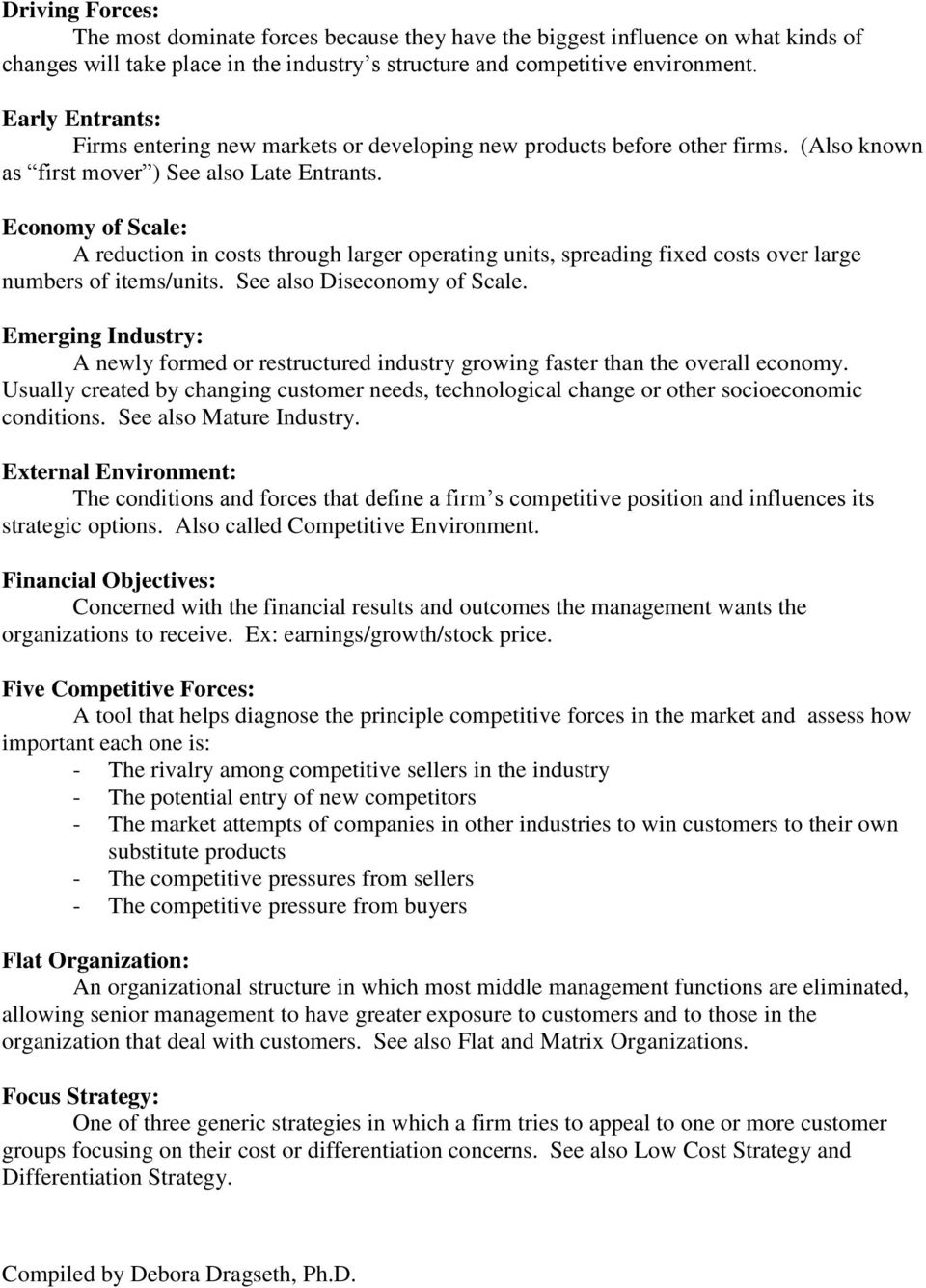
3 Driving Forces: The most dominate forces because they have the biggest influence on what kinds of changes will take place in the industry s structure and competitive environment. Early Entrants: Firms entering new markets or developing new products before other firms. (Also known as first mover ) See also Late Entrants. Economy of Scale: A reduction in costs through larger operating units, spreading fixed costs over large numbers of items/units. See also Diseconomy of Scale. Emerging Industry: A newly formed or restructured industry growing faster than the overall economy. Usually created by changing customer needs, technological change or other socioeconomic conditions. See also Mature Industry. External Environment: The conditions and forces that define a firm s competitive position and influences its strategic options. Also called Competitive Environment. Financial Objectives: Concerned with the financial results and outcomes the management wants the organizations to receive. Ex: earnings/growth/stock price. Five Competitive Forces: A tool that helps diagnose the principle competitive forces in the market and assess how important each one is: - The rivalry among competitive sellers in the industry - The potential entry of new competitors - The market attempts of companies in other industries to win customers to their own substitute products - The competitive pressures from sellers - The competitive pressure from buyers Flat Organization: An organizational structure in which most middle management functions are eliminated, allowing senior management to have greater exposure to customers and to those in the organization that deal with customers. See also Flat and Matrix Organizations. Focus Strategy: One of three generic strategies in which a firm tries to appeal to one or more customer groups focusing on their cost or differentiation concerns. See also Low Cost Strategy and Differentiation Strategy.
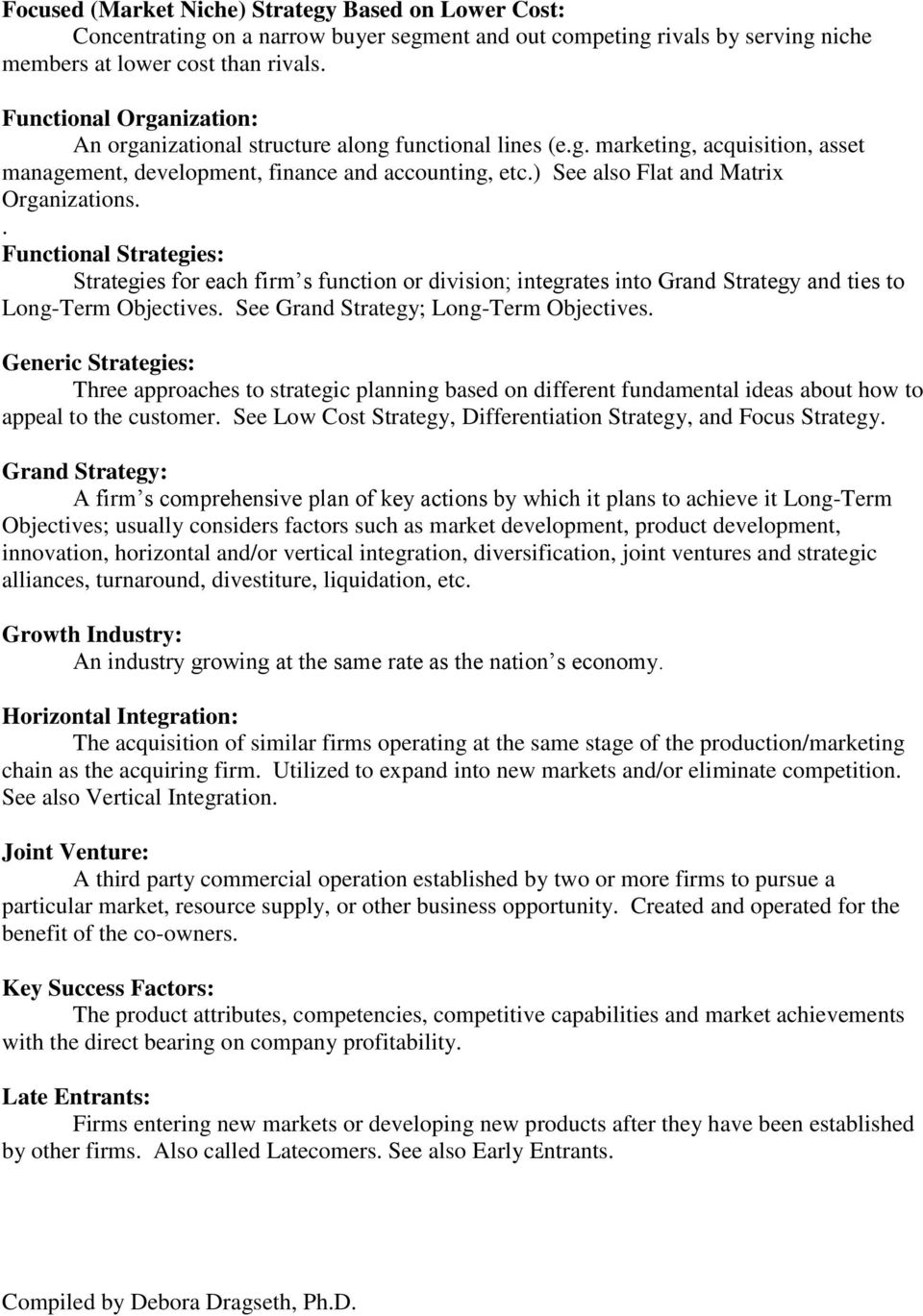
4 Focused (Market Niche) Strategy Based on Lower Cost: Concentrating on a narrow buyer segment and out competing rivals by serving niche members at lower cost than rivals. Functional Organization: An organizational structure along functional lines (e.g. marketing, acquisition, asset management, development, finance and accounting, etc.) See also Flat and Matrix Organizations.. Functional Strategies: Strategies for each firm s function or division; integrates into Grand Strategy and ties to Long-Term Objectives. See Grand Strategy; Long-Term Objectives. Generic Strategies: Three approaches to strategic planning based on different fundamental ideas about how to appeal to the customer. See Low Cost Strategy, Differentiation Strategy, and Focus Strategy. Grand Strategy: A firm s comprehensive plan of key actions by which it plans to achieve it Long-Term Objectives; usually considers factors such as market development, product development, innovation, horizontal and/or vertical integration, diversification, joint ventures and strategic alliances, turnaround, divestiture, liquidation, etc. Growth Industry: An industry growing at the same rate as the nation s economy. Horizontal Integration: The acquisition of similar firms operating at the same stage of the production/marketing chain as the acquiring firm. Utilized to expand into new markets and/or eliminate competition. See also Vertical Integration. Joint Venture: A third party commercial operation established by two or more firms to pursue a particular market, resource supply, or other business opportunity. Created and operated for the benefit of the co-owners. Key Success Factors: The product attributes, competencies, competitive capabilities and market achievements with the direct bearing on company profitability. Late Entrants: Firms entering new markets or developing new products after they have been established by other firms. Also called Latecomers. See also Early Entrants.
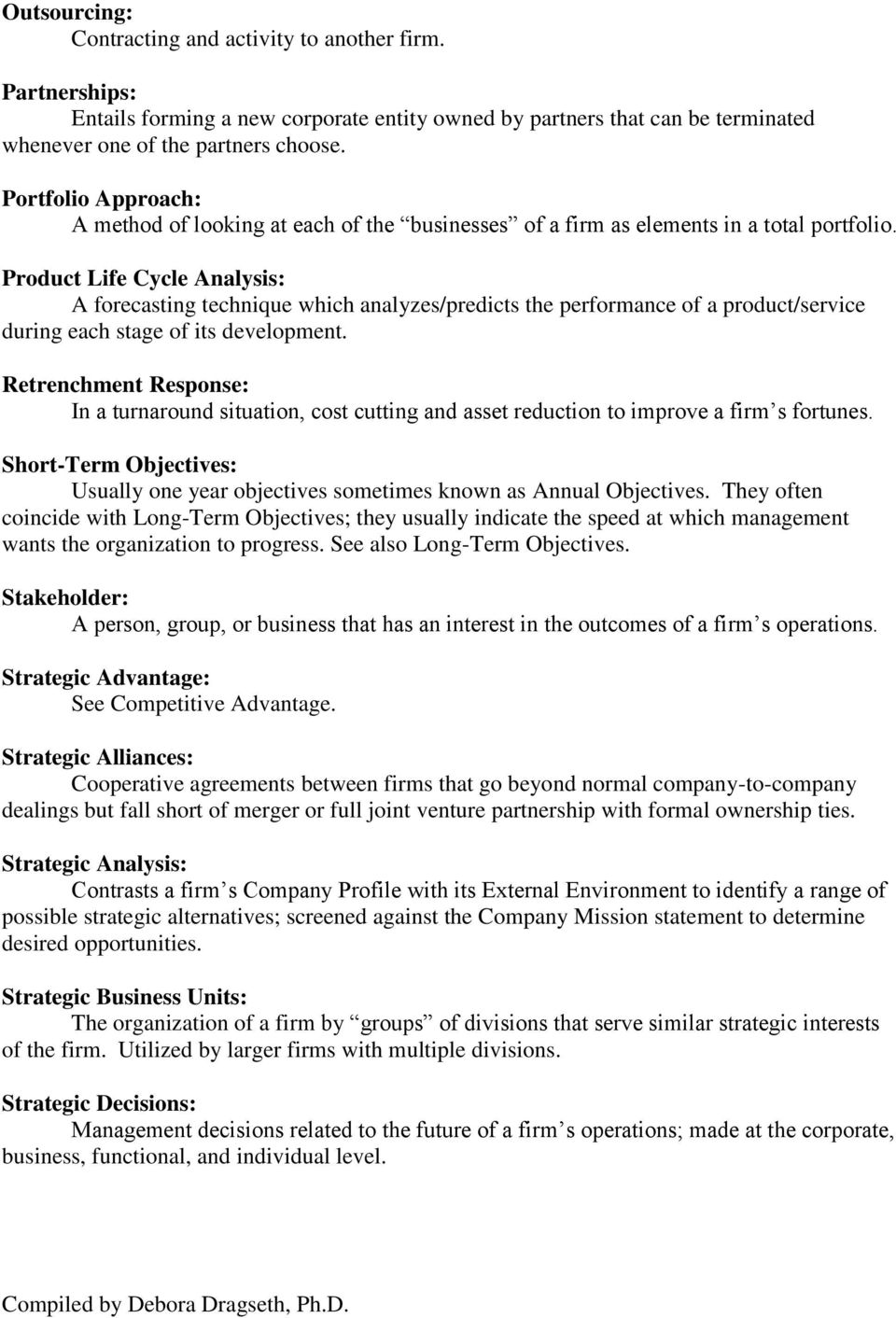
5 Leapfrogging: Establishing entirely new competitive space in which a firm is not only a leader but establishes most, if not all, of the standards by which other firms in its industry are measured. Long-Term Objectives: A firm s intended performance over a multi-year period of time; usually includes measures such as competitive position profitability, return on investment, technology leadership, productivity, employee relations and development, public responsibility. See also Short-Term Objectives. Low Cost Strategy: One of three generic strategies in which a firm attempts to establish itself as the cost leader in the industry. See also Focus Strategy and Differentiation Strategy. Macroenvironment: All relevant forces outside company boundaries that are important enough to affect the company s business model strategies. - The economy at large - Legislations and regulations - Population and demographics - Societal values and lifestyles - Technology - Immediate industry and competitive environment Market Leader: The company that has control over a certain market. Market Share: The revenues generated by a firm as a percentage of total revenues; usually measured by industries, markets, or products. Matrix Organization: An organizational structure which delegates power to independent operating units which then rely on centralized corporate facilities for functional support. See also Flat and Matrix Organizations. Mature Industry: An industry growing slower than the overall economy or actually declining. See also Emerging Industry. Merger: Combination and pooling of equal companies, with the newly created company often taking on a new name. Outcomes: Results arising from management actions.

6 Outsourcing: Contracting and activity to another firm. Partnerships: Entails forming a new corporate entity owned by partners that can be terminated whenever one of the partners choose. Portfolio Approach: A method of looking at each of the businesses of a firm as elements in a total portfolio. Product Life Cycle Analysis: A forecasting technique which analyzes/predicts the performance of a product/service during each stage of its development. Retrenchment Response: In a turnaround situation, cost cutting and asset reduction to improve a firm s fortunes. Short-Term Objectives: Usually one year objectives sometimes known as Annual Objectives. They often coincide with Long-Term Objectives; they usually indicate the speed at which management wants the organization to progress. See also Long-Term Objectives. Stakeholder: A person, group, or business that has an interest in the outcomes of a firm s operations. Strategic Advantage: See Competitive Advantage. Strategic Alliances: Cooperative agreements between firms that go beyond normal company-to-company dealings but fall short of merger or full joint venture partnership with formal ownership ties. Strategic Analysis: Contrasts a firm s Company Profile with its External Environment to identify a range of possible strategic alternatives; screened against the Company Mission statement to determine desired opportunities. Strategic Business Units: The organization of a firm by groups of divisions that serve similar strategic interests of the firm. Utilized by larger firms with multiple divisions. Strategic Decisions: Management decisions related to the future of a firm s operations; made at the corporate, business, functional, and individual level.
7 Strategic Vision: The company s direction and future product/customer/market/technology focus. Strategic Management- Consists of 5 Interrelated Managerial Tasks: 1. Develop a Strategic Vision 2. Set Objectives 3. Craft a Strategy 4. Implement and Execute the Strategy 5. Evaluate Performance, Monitoring New Development and Initiating Corrective Adjustment. Strength: A skill, resource, or other advantage that a firm has relative to its competitors that is important to serving the needs of customers in its marketplace. See also Weakness. Sustainable Competitive Advantage: Competitive advantages that can be maintained over a fairly long period of time. See also Competitive Advantage. Switching Costs: The costs incurred by a customer in changing from one firm to another to meet their requirements. Trend Extrapolation: A forecasting technique utilizing linear or exponential smoothing or averaging of historical values. Value-Chain: Separate activities, function and business processes that are performed in designing, producing, marketing, deliveries, and supporting a product or service. Vertical Integration: The acquisition of suppliers (backward integration) or distributors (forward integration). Utilized to expand operations, achieve greater market share, increase the efficiency of capital, and/or improve economies of scale. See also Horizontal Integration. Weakness: A limitation or lack of skills, resources, or capabilities that impedes a firm s effective performance. See also Strength.

Module 7 8/12/2010. What types of strategies are used by organizations? How are strategies formulated and
 Module 7 Module 7 Strategy and Strategic Management What types of strategies are used by organizations? How are strategies formulated and implemented? 7.1 Types of organizational strategies Comprehensive
K-12 Entrepreneurship Standards
 competitiveness. The focus will be on business innovation, change and issues related to the United States, which has achieved its highest economic performance during the last 10 years by fostering and
RELATIONAL DIAGRAM OF MAIN CAPABILITIES. Strategic Position position (A) Strategic Choices choices (B) Strategic Action action (C)
 Business Analysis (P3) September 2015 to August 2016 Syllabus AIM FR (F7) BA (P3) AB (F1) APM (P5) PM (F5) To apply relevant knowledge, skills, and exercise professional judgement in assessing strategic
Strategic Elements of Competitive Advantage. PPT 6 (First ppt slides after the mid-term) Assist. Prof. Dr. Ayşen Akyüz
 Strategic Elements of Competitive Advantage PPT 6 (First ppt slides after the mid-term) Assist. Prof. Dr. Ayşen Akyüz Industry Analysis: Forces Influencing Competition Industry group of firms that produce
Portfolio Management
 Portfolio Management Portfolio Management It is top management responsibility that requires the assessment of strengths and weaknesses of the current portfolio of businesses, in order to define the priorities
The impact of external environment on organizational development strategy
 MPRA Munich Personal RePEc Archive The impact of external environment on organizational development strategy Alina Voiculet and Nicoleta Belu and Denisa Elena Parpandel and Ionela Carmen Rizea Constantin
Supplier Relationships Lecture 7. Briony Boydell Managing Business Relationships
 Supplier Relationships Lecture 7 Briony Boydell Managing Business Relationships Objectives of lecture Identify the types of relationships within the supply chain Discuss the benefits of improved relations
Essentials of Strategic Management. Authors: David Hunger & Thomas. L. Wheelen. Book Review by Asik Kathwala
 Essentials of Strategic Management Authors: David Hunger & Thomas. L. Wheelen Book Review by Asik Kathwala www.hrfolks.com All Rights Reserved 1 The Essentials of Strategic Management The Essentials of
Fred R. David. twelfth edition Strategic Management CONCEPTS AND CASES. Prentice Hall PEARSON FRANCIS MARION UNIVERSITY FLORENCE, SOUTH CAROLINA
 twelfth edition Strategic Management CONCEPTS AND CASES Fred R. David FRANCIS MARION UNIVERSITY FLORENCE, SOUTH CAROLINA PEARSON Prentice Hall PEARSON EDUCATION INTERNATIONAL Contents Preface 12 Acknowledgments
Masters in Engineering and Management of Technology Masters in engineering Design Introduction to Entrepreneurship and New Venture Creation
 Masters in Engineering and Management of Technology Masters in engineering Design Introduction to Entrepreneurship and New Venture Creation Rui Baptista The Structural Analysis of Industries What is Strategy?
Course 103402 MIS. Information Systems, Organizations and Strategies
 Oman College of Management and Technology Course 103402 MIS Topic 2 Information Systems, Organizations and Strategies CS/MIS Department Organizations and Information Systems Information technology and
THE PLACE OF MARKETING STRATEGIES IN THE CONSOLIDATION OF ROMANIAN BAKERY FIRMS
 THE PLACE OF MARKETING STRATEGIES IN THE CONSOLIDATION OF ROMANIAN BAKERY FIRMS PhD Full, Professor Filimon Stremţan PhD Candidate, Lecturer Andreea Muntean 1Decembrie 1918 University Alba Iulia Abstract:
Learning Objectives: Quick answer key: Question # Multiple Choice True/False
 0 Learning Objectives: 11.1 Describe the advantages and disadvantages of the most common forms of business ownership. 11.2 Identify the stakeholders of a business and describe why they are important. 11.3
Existing Analytical Market Assessment Tools - Definitions
 Existing Analytical Market Assessment Tools - Definitions November, 2003 This list of market assessment tools was prepared by Development Alternatives Inc. (DAI) as an internal working document to support
INFO1400. Define an organization and compare the technical definition of organizations with the behavioral definition.
 Chapter 3 INFO1400 Review Questions 1. Which features of organizations do managers need to know about to build and use information systems successfully? What is the impact of information systems on organizations?
MODULE TITLE: Exploring Strategy
 SCHOOL OF ARTS, SOCIAL SCIENCES AND MANAGEMENT DIVISION OF BUSINESS, ENTERPRISE AND MANAGEMENT LEVEL 3 DIET 2 MODULE CODE: B3132 MODULE TITLE: Exploring Strategy DATE: 29 July 2013 WRITING TIME: 2 Hours
Management Information Systems
 Chapter 2 Compiled By: Muzammil Ahmad Khan Muhammad Kashif Shaikh 2-1 MIS Books Text Book 1. Management Information System, 8 th Edition By: James A. O' Brien, George Marakas Reference Books 1. Management
Key Terms. DECA Ryerson 2015-16 Case Guides Business to Business Marketing
 Key Terms Acquisition Costs: The incremental costs involved in obtaining a new customer. Agent: A business entity that negotiates, purchases, and/or sells, but does not take title to the goods. Benchmark:
Information Systems, Organizations, and Strategy
 Information Systems, Organizations, and Strategy VIDEO CASES Chapter 3 Case 1: National Basketball Association: Competing on Global Delivery with Akamai OS Streaming Case 2: IT and Geo-Mapping Help a Small
Fred R. David. twelfth edition Strategic Management CONCEPTS. Prentice Hall FRANCIS MARION UNIVERSITY FLORENCE, SOUTH CAROLINA
 .\>l.'*q twelfth edition Strategic Management CONCEPTS Fred R. David FRANCIS MARION UNIVERSITY FLORENCE, SOUTH CAROLINA HOCHSCHULE LIECHTENSTEIN BlWlothek PEARSON Prentice Hall PEARSON EDUCATION Contents
Case Interview - Frameworks
 WWW.MCONSULTINGPREP.COM Case Interview - Frameworks For more free and detailed materials on Management Consulting Preparation, visit www.mconsultingprep.com 2014 MConsultingPrep, Inc. COMPLETE FRAMEWORKS
II B.Com(International Business) [2014-2017] Semester III Core:International Business Strategy-317C Multiple Choice Questions.
![II B.Com(International Business) [2014-2017] Semester III Core:International Business Strategy-317C Multiple Choice Questions.](/thumbs/26/9027594.jpg "II B.Com(International Business) [2014-2017] Semester III Core:International Business Strategy-317C Multiple Choice Questions.") 1 of 22 8/8/2015 12:22 PM Dr.G.R.Damodaran College of Science (Autonomous, affiliated to the Bharathiar University, recognized by the UGC)Reaccredited at the 'A' Grade Level by the NAAC and ISO 9001:2008
1 of 22 8/8/2015 12:22 PM Dr.G.R.Damodaran College of Science (Autonomous, affiliated to the Bharathiar University, recognized by the UGC)Reaccredited at the 'A' Grade Level by the NAAC and ISO 9001:2008
THE COMPETITIVE ADVANTAGE THEORY AS A GROWTH STRATEGY
 THE COMPETITIVE ADVANTAGE THEORY AS A GROWTH STRATEGY Management Marketing - Tourism Ec. Ecaterina Nicoleta Ciurez Ph.D University of Craiova, Faculty of Economics and Business Administration, Craiova,
structures stack up Tom McMullen
 Making sure your organization structures stack up October 21, 2009 Tom McMullen Building effective organizations Trends in organization design Optimizing Focusing resources and reducing headcounts Removing
Planning, Strategy, and Competitive Advantage
 Planning, Strategy, and Competitive Advantage Chapter 6 website Mark Gosling Office: D404 Phone: 5417 Learning Objectives LO1 Identify the three main steps of the planning process and explain the relationship
Contents. Part- I: Introduction to Services Marketing. Chapter 1 Understanding Services 3-22. Chapter 2 The Nature of Services Marketing 23-38
 Contents Part- I: Introduction to Services Marketing Chapter 1 Understanding Services 3-22 Chapter 2 The Nature of Services Marketing 23-38 Part- II: The Customer Experience Chapter 3 Consumer Behavior
E3- Strategic Management Practice Test Answers
 E3- Strategic Management Practice Test Answers The Practice Test can be viewed at http://www.pearsonvue.com/cima/practiceexams/ These answers have been provided by CIMA for information purposes only. In
MBA Data Analysis Pad John Beasley
 1 Marketing Analysis Pad - 1985 Critical Issue: Identify / Define the Problem: Objectives: (Profitability Sales Growth Market Share Risk Diversification Innovation) Company Mission: (Source & Focus for
ECONOMIC DEVELOPMENT TITLE MARKETING & ATTRACTION. Julie Engel President/CEO Greater Yuma EDC. Arizona Basic Economic Development Course
 ECONOMIC DEVELOPMENT TITLE MARKETING & ATTRACTION Julie Engel President/CEO Greater Yuma EDC OUTLINE Overview of Economic Development Marketing Assessing the Economic Base Strategic Marketing: Using a
2. What is the connection between a company s strategy and its quest for competitive advantage?
 CH 1: What is Strategy? Potential Short Answer Questions 1. Briefly define each of the following terms: a. Strategy b. Strategic intent c. Strategic vision 2. What is the connection between a company s
Alexander Nikov. 3. Information Systems and Organisational Issues. Learning Objectives. Verizon or AT&T: Which Company Has the Best Digital Strategy?
 INFO 1500 Introduction to IT Fundamentals Learning Objectives 3. Information Systems and Organisational Issues 1. Identify and describe important features of organizations that managers need to know about
Community Futures Management Consultant in a Box
 Community Futures Management Consultant in a Box Strategic Business Planning Purpose of this Document The purpose of this document is to provide you with the process that a management consultant would
Business Plan Template
 Business Plan Template 1. Executive Summary... 3 1.1. Description of Business... 3 1.2. Finance Required... 3 1.3. Financial Projections... 3 1.4. Business Differentiators... 3 1.5. Business Credibility...
E-Commerce Business Models and Concepts
 Copyright 2002 Pearson Education, Inc. Slide 2-1 E-Commerce Business Models and Concepts Created by, David Zolzer, Northwestern State University Louisiana Learning Objectives! Identify the key components
A primer in Entrepreneurship
 Prof. Dr. Institutefor Strategy and Business Economics Where we are: Step 1 Step 2 Developing Successful Business Ideas 2008 Prentice Hall Chapter 5: Industry and Competitor Analysis Table of Contents
Institute of Incorporated Public Accountants. May 2015 Examinations Module 10 Strategic Management SOLUTIONS
 Institute of Incorporated Public Accountants May 2015 Examinations Module 10 Strategic Management SOLUTIONS SECTION A Compulsory Question Question 1 In today s competitive environment, it is very important
Shaping. Business Strategy. Through. Competitive Intelligence. Strategic Use of. Intellectual Property Information
 Shaping This project is funded by the EU Business Strategy Through Competitive Intelligence Strategic Use of Intellectual Property Information Strategic Planning Process Business Strategy Definition This
Growing Forward 2 In Newfoundland and Labrador
 Growing Forward 2 In Newfoundland and Labrador Business Plan Minimum Requirements Version1.0 Growing Forward 2 in Newfoundland and Labrador - 1 - Business Plan Minimum Requirements Minimum Requirements
Case Analysis Framework - Strategic Management Ian Lee, Ph.D Carleton University Ottawa, Canada [email protected]
 Case Analysis Framework - Strategic Management Ian Lee, Ph.D Carleton University Ottawa, Canada [email protected] Stratrategic Management National/Macro Context Industry Context Company Resources, Capabilities,
PORTER S STRATEGY, VALUE CHAINS AND COMPETITIVE ADVANTAGE
 PORTER S STRATEGY, VALUE CHAINS AND COMPETITIVE ADVANTAGE Vasile Voicu Pantea, Luiela Magdalena Csorba, Olga Irina Maxim University Aurel Vlaicu of Arad Abstract: A strategy means the plans and actions
Strategies for Sales & Marketing Management A Practical Guide for Growth. Bob Gollaher SandCastle Consulting
 Strategies for Sales & Marketing Management A Practical Guide for Growth Bob Gollaher SandCastle Consulting BASIC PREMISE Whatever it was that got you where you are today is not sufficient to keep you
A primer in Entrepreneurship. Chapter 3: Feasibility Analysis
 Chapter 3 Feasibilty Analysis Prof. Dr. Institute for Strategy and Business Economics Chapter 3: Feasibility Analysis Table of Contents A. What is feasibility analysis? C. Industry/Market Feasibility D.
Process Management: Creating Supply Chain Value
 Process Management: Creating Supply Chain Value Carol L. Marks, C.P.M., Director of Purchasing and Business Management Systems Industrial Distribution Group, Southern Division 704/398-5666; [email protected]
MHSA 7620 -- Healthcare Administration Essential Functions of Management The Planning Function
 MHSA 7620 -- Healthcare Administration Essential Functions of Management The Planning Function ** Overview of the Planning Function of Management ** Of all management functions discussed as they apply
Business Policy of CEZ Group and ČEZ, a. s.
 Business Policy of CEZ Group and ČEZ, a. s. Contents: Introduction 1. CEZ Group mission and vision 2. Scope of business of CEZ Group 3. Business concept Guiding principles Trade Generation Electricity
Edwards Jones 2006 Case Analysis. Next Step Consulting
 Edwards Jones 2006 Case Analysis Next Step Consulting Industry Industry SIC Code: 6211 Security Brokers, Dealers, and Flotation Companies Establishment that deal with: Securities Mutual and money market
CHAPTER 4 COMPETITIVE ANALYSIS FOR STRUCTUAL ATTRACTIVENESS
 By Roshan pant MBM 2 nd semester CHAPTER 4 Nepal Commerce Campus COMPETITIVE ANALYSIS FOR STRUCTUAL ATTRACTIVENESS Concept of Competition: This is the age of competition. Marketers must carefully identify
Marketing Plan. Contents. Introduction: Using the Marketing Planning Framework. The Elements of the Marketing Planning Framework
 Marketing Plan Contents Introduction: Using the Marketing Planning Framework The Elements of the Marketing Planning Framework Terms of Reference Executive Summary 1. Business Mission 2. External Marketing
CHAPTER 8: Organisational objectives, growth and scale
 CHAPTER 8: Organisational objectives, growth and scale The Objectives of Organisations Key Revision Points Organisational goals can be classified into a number of categories: Those that aim to make a profit
A primer in Entrepreneurship
 Prof. Dr. Institute for Strategy and Business Economics Spring semester2008 Chapter 5: Industry and Competitor Analysis Table of Contents I. Industry Analysis II. IV. The Importance of Industry Versus
Availability of substitute products places limits on the prices market leaders can charge High prices induce buyers to switch to the substitute
 Strategic Elements of Competitive Advantage Industry Analysis: Forces Influencing Competition Power of Suppliers Global Marketing Chapter 15 Power of Buyers Substitute Products Barriers to Entry Industry
RECOMMENDATIONS ON BUSINESS PLAN PREPARATION
 RECOMMENDATIONS ON BUSINESS PLAN PREPARATION 1. General provisions Business plan must contain: name of the investment project, as well description of its essence and feasibility; substantiation of the
THEME 7: STRATEGIC DIAGNOSIS
 THEME 7: STRATEGIC DIAGNOSIS SWOT analysis. Portfolio management. BCG matrix. Sallenave matrixes. GE-McKinsey matrix. Alfonso VARGAS SÁNCHEZ 1 STRATEGIC MANAGEMENT 1.-WHERE AM I NOW? 3.-WHAT DO I NEED
IDG Ventures Vietnam Guide to Writing a Business Plan
 IDG Ventures Vietnam Guide to Writing a Business Plan Initial Phase: Formulating the Idea You have a great idea for a company now is the time to do your homework. Before writing a business plan, extensive
The Future of Consumer Health Care
 The Future of Consumer Health Care Coming Together To Lead The Consumer Health Care Industry 2 Creating a New Business Model in Consumer Health Care 3 Serve More Consumers In More Parts of the World, More
Strategic Management of Public Relations
 Strategic Management of Public Relations The Integrative Framework Jeong-Nam Kim Concepts Relevant to the Strategic Management of Public Relations 1. Organizational Effectiveness Dozier, Grunig, & Grunig,
Project Portfolio Management. Breaking through the barrier to sustained growth and profitability
 Project Portfolio Management Breaking through the barrier to sustained growth and profitability Dr. Jim Wasson, PMP ([email protected]) October 8, 2013 Presentation Topics What is Project
Faculty. Experiences with Strategic Thinking, Planning, and Management in Public Health Organizations. Objectives. Faculty.
 Experiences with Strategic Thinking, Planning, and Management in Public Health Organizations Satellite Conference and Live Webcast Thursday, February 5, 2009 12:00-1:30 p.m. (Central Time) Faculty Peter
THEME 9: GROWTH STRATEGIES
 THEME 9: GROWTH STRATEGIES 1st Part: Vertical integration and Scope of the Firm 2nd Part: Internal and external growth 1st Part: Vertical Integration and The Scope of the Firm Vertical Integration and
The Value of Knowledge
 www.pwcacademy.rs The Value of Knowledge PwC Mini MBA Programme Programme Description Content 3 The Value of Knowledge 4 Duration Topics 5 Session 1 - Business Breakdown & Map 6 Session 2 - Corporate &
Application of Porter s Five Forces Model Paper
 Application of Porter s Five Forces Model Paper Example 1: Fast Casual Industry The Porter s Five Forces Model illustrates how the competitive landscape in an industry is impacted by five prominent forces.
CHAPTER 11 INTERNATIONAL STRATEGY AND ORGANIZATION
 CHAPTER 11 INTERNATIONAL STRATEGY AND ORGANIZATION LEARNING OBJECTIVES: 1. Explain the stages of identification and analysis that precede strategy selection. 2. Identify the two international strategies
Financial Services Industry Solutions. Winning in the financial services marketplace for banks and credit unions
 Financial Services Industry Solutions Winning in the financial services marketplace for banks and credit unions Financial services industry is now at a major changing point Banks and credit unions are
Chapter 2 INDUSTRIAL BUYING BEHAVIOUR: DECISION MAKING IN PURCHASING
 Chapter 1 THE ROLE OF PURCHASING IN THE VALUE CHAIN The role and importance of the purchasing and supply function in the value chain. The difference between concepts such as ordering, buying, purchasing,
Strategic Management Process: Strategy formulation 3.
 Strategic Management Process: Strategy formulation 3. By: Prof. Dr. András s NábrN brádi PhD, MBA University of Debrecen Faculty of Ag. Economics and Rural Development Dept.: Business Management and Marketing
Health Care Viewpoint
 Global Penetration: Growth and Competitive Advantage Health Care Viewpoint Number 6 Bain health care expertise As the year 2000 approaches, the health care industry is still turbulent. Customer requirements
Key Account Management
 Key Account Management Brent Warren What is KAM? the art of developing long-term relationships with selected customers The Financial Times. KAM is an art not a formula. It is a process of development,
GENERAL GUIDELINES FOR DEVELOPING A BUSINESS PLAN
 GENERAL GUIDELINES FOR DEVELOPING A BUSINESS PLAN August 2012 Table of contents Introduction... 3 1. Executive Summary... 3 2. Business Summary... 3 2.1 Company Summary... 3 2.2 Management Summary... 3
Lesson 1. Assessing the Marketplace
 Assessing the Marketplace Your first lesson consists of four assignments that cover the first four chapters. These assignments provide a useful overview of the contemporary marketing environment and all
Strategic Choices and Key Success Factors for Law Firms June, 2010. Alan Hodgart
 Strategic Choices and Key Success Factors for Law Firms June, 2010 Alan Hodgart The Association of Danish Law Firms 1 Huron Consulting Group Inc. All rights reserved. Huron is a management consulting firm
Warner EMI Music. Strategic Development for the First Decade of the New Millennium
 Innovative Marketing, Volume 2, Issue 1, 2006 67 Warner EMI Music. Strategic Development for the First Decade of the New Millennium Demetris Vrontis Abstract This case has been compiled to put forward
Coca-Cola Case Analyses. <Student Name> <Name and Section # of course> <Instructor Name> <Date>
 Running Head: COCA-COLA CASE Coca-Cola Case Analyses Coca-Cola Case 2 Coca-Cola Case Analyses This paper is about the company Coca-Cola
International Accounting Standard 36 Impairment of Assets
 International Accounting Standard 36 Impairment of Assets Objective 1 The objective of this Standard is to prescribe the procedures that an entity applies to ensure that its assets are carried at no more
Netflix Strategic Analysis
 XMBA 2013 Netflix Strategic Analysis Global Strategic Thinking Joey M. Reed, XMBA 2013 4/17/2013 EXECUTIVE SUMMARY In 1999, Reed Hastings launched an online movie rental service called, Netflix. The company
SWOT analysis can be used for:
 SWOT ANALAYSIS For business it is important to know your surrounding environment from internal and external point of view. Therefore it is important to evaluate environment opportunities in relation to
Business Innovation & Transformation Enablement (BITE) Method
 Business Innovation & Transformation Enablement (BITE) Method Henrik von Scheel LEAD Developer, responsible for BITE Method LEAD the Way Copyright note on Intellectual Capital: ALL RIGHTS RESERVED LEADing
Standard Life Assurance Limited OCTOBER 2013. Principles and Practices of Financial Management for the UK Smoothed Managed With Profits Fund
 Standard Life Assurance Limited OCTOBER 2013 Principles and Practices of Financial Management for the UK Smoothed Managed With Profits Fund Preface... 2 Background to the Principles and Practices of Financial
Fundamentals of Information Systems, Seventh Edition
 Chapter 1 An Introduction to Information Systems in Organizations 1 Principles and Learning Objectives The value of information is directly linked to how it helps decision makers achieve the organization
Skills Knowledge Energy Time People and decide how to use themto accomplish your objectives.
 Chapter 8 Selling With a Strategy Strategy Defined A strategy is a to assemble your resources Skills Knowledge Energy Time People and decide how to use themto accomplish your objectives. In selling, an
Profit Maximization. 2. product homogeneity
 Perfectly Competitive Markets It is essentially a market in which there is enough competition that it doesn t make sense to identify your rivals. There are so many competitors that you cannot single out
Sample marketing plan template
 Sample marketing plan template Table of Contents 1) Executive summary Page # 2) Situation analysis Page # 3) Marketing strategy Page # 4) Financials Page # 5) Implementation and Contingency Page # http://www.entrepreneurmag.co.za/
Succession Planning Discussion Guide
 Succession Planning Discussion Guide Overview This discussion guide is used to facilitate the development of the success profile for the CEO and/or other top leadership positions. The success profile describes
MASTER OF BUSINESS ADMINISTRATION (MBA) 800 Series
 MASTER OF BUSINESS ADMINISTRATION (MBA) 800 Series BBA 820: Managerial Functions Natural and scope of management of organizations operations. Systems approach to organizations. The management process planning,
What do you do well? What relevant resources do you have?
 SWOT Analysis - Understanding Strengths, Weaknesses, Opportunities and Threats by James Manktelow MBA, an experienced business strategist specializing in helping start-ups and small and medium-sized companies
STRATEGIES FOR ADAPTING AND REMODELING ACTIVITIES IN ROMANIAN INSURANCE COMPANIES
 DIANA MIRUNA HANCU STRATEGIES FOR ADAPTING AND REMODELING ACTIVITIES IN ROMANIAN INSURANCE COMPANIES Ph.D. Thesis - SUMMARY - Ph.D. Coordinators: Prof. Dan CÂNDEA, Ph.D. Prof. Dumitru MATIŞ, Ph.D. 2009
Strategic Marketing Planning Audit
 Strategic Marketing Planning Audit Violeta Radulescu Lecturer, PhD., Academy of Economic Studies, Bucharest Email: [email protected] Abstract Market-oriented strategic planning is the process of
Case Study 1: Paid Search Wars by John Sharp and Des Laffey
 Case Study 1: Paid Search Wars by John Sharp and Des Laffey Once an innovator in the industry, Yahoo s company direction has shifted over the years from that of leader to that of a follower in the search
Strategic Planning. Credit value: 15 Guided learning hours: 45. Unit aim. Unit introduction
 22727C Strategic Planning Unit code: QCF Level 7: H/602/2330 BTEC Professional Credit value: 15 Guided learning hours: 45 Unit aim This unit provides the learner with an understanding of how to review
APPENDIX Business Description Current Position of Company Financing Request
 APPENDIX SAMPLE BUSINESS PLAN Introduction Business Description A brief description of your business; product type, industry and target market and competitive position as compared to your rivals Current
What is a Business Plan?
 Social Entrepreneurship Venture Day Manila 2014 Co-organized by Peace and Equity Foundation Ateneo de Manila University - John Gokongwei School of Management IE Business School BUSINESS PLAN GUIDELINES
Chapter. Developing Business / IT Strategies. Copyright 2008, The McGraw-Hill Companies, Inc. All rights reserved.
 Chapter 6 Developing Business / IT Strategies McGraw-Hill/Irwin Copyright 2008, The McGraw-Hill Companies, Inc. All rights reserved. 2-2 Learning Objectives Discuss the role of planning in the business
Guidelines Business Plan
 Guidelines Business Plan and Innovation CTI Jurors evaluate business plans and provide feedback entrepreneurs in 9 areas and VCs in 4 areas Objectives Elements of evaluation Relevant for ranking 1 Jurors
J.P. MORGAN CHASE & CO.: THE CREDIT CARD SEGMENT OF
 SENEM ACET COSKUN BUS 9200 - FALL 2008 - MIDTERM J.P. MORGAN CHASE & CO.: THE CREDIT CARD SEGMENT OF THE FINANCIAL SERVICES INDUSTRY I-Executive Summary Consumers are increasingly using plastic cards and