
A Comparative Study of Costs in Defamation Proceedings Across Europe
|
|
|
- Norma Patterson
- 10 years ago
- Views:
Transcription

1 A Comparative Study of Costs in Defamation Proceedings Across Europe By Programme in Comparative Media Law and Policy Centre for Socio-Legal Studies University of Oxford December 2008 Page 1 of 190

2 Table of Contents: Table of Contents: Executive Summary Introduction Methodology Overall Methodological Considerations Background to litigation costs in England and Wales Conditional Fee Agreements in England and Wales Litigation costs and CFAs in context of freedom of expression Gathered Material from Europe Biographies Biographies of Researchers: Biographies of Authors of National Chapters: National Chapters Questionnaire to National researchers: National Chapters:...23 BELGIUM...23 BULGARIA...34 CYPRUS...40 ENGLAND AND WALES...51 FRANCE...63 GERMANY...77 IRELAND...86 ITALY...95 MALTA ROMANIA SPAIN SWEDEN Comparison of material gathered: Conduct of Litigation - How are defamation claims dealt with in your jurisdiction? Section II Fees and Costs Section III Scenarios Problems with Cost and CFA in ECHR perspective? CFA and ECHR CFA and ECHR Article CFA and ECHR Article Conclusion Page 2 of 190

3 1.0 Executive Summary 1. The purpose of this study is to understand how costs in English defamation proceedings compare to those elsewhere in Europe, and to consider the extent to which the English media s rights, as articulated in the European Convention on Human Rights, might be affected as a result of the level of costs in defamation proceedings. 2. The study initially considered concerns relating to the high level of costs that have been seen to occur in cases brought against the media under Conditional Fee Agreements (CFAs). Analysis of those cases demonstrated that the CFA scheme made it more difficult for media organisations to justify defending claims (even strong ones). This is a result of the media outlet being put in a position where it may be unable to recover its costs from a claimant who is without means if it wins the case, but where it faces the risk of paying for double the claimant s costs if it loses the case. As a result the study found that the CFA acts as a catalyst, forcing media outlets to settle claims, resulting in a self-imposed restraint on media outlets who are otherwise faced with the risk of being sued by a claimant on a CFA. Such restraint is imposed irrespective of journalistic standards and shackles the media outlets important role as a public watchdog. 3. The comparative element of the study analysed data collected from various jurisdictions across Europe via a questionnaire, which included specific questions about two factual scenarios. The data showed that even in non-cfa cases (where there is no success fee or insurance) England and Wales was up to four times more expensive than the next most costly jurisdiction, Ireland. Ireland was close to ten times more expensive than Italy, the third most expensive jurisdiction. If the figure for average costs across the jurisdictions is calculated without including the figures from England and Wales and Ireland, England and Wales is seen to be around 140 times more costly than the average. The data also showed that common law jurisdictions are by far the more expensive jurisdictions in which to conduct defamation proceedings. This was exacerbated by the use of CFAs. Based on the collected data the study was able to identify costs factors, unique to the common law tradition, which partially explain (although they do not justify) the comparatively high costs in England and Wales. Although the collected data did not enable the study to pinpoint the precise underlying reasons for these costs increases in numeric, proportionate and interrelated values, it did give strong suggestions as to why England and Wales is the most expensive jurisdiction. To identify these factors, the study compared traditional costs factors and isolated those that appeared to explain the high levels of costs in England and Wales. In particular the Page 3 of 190
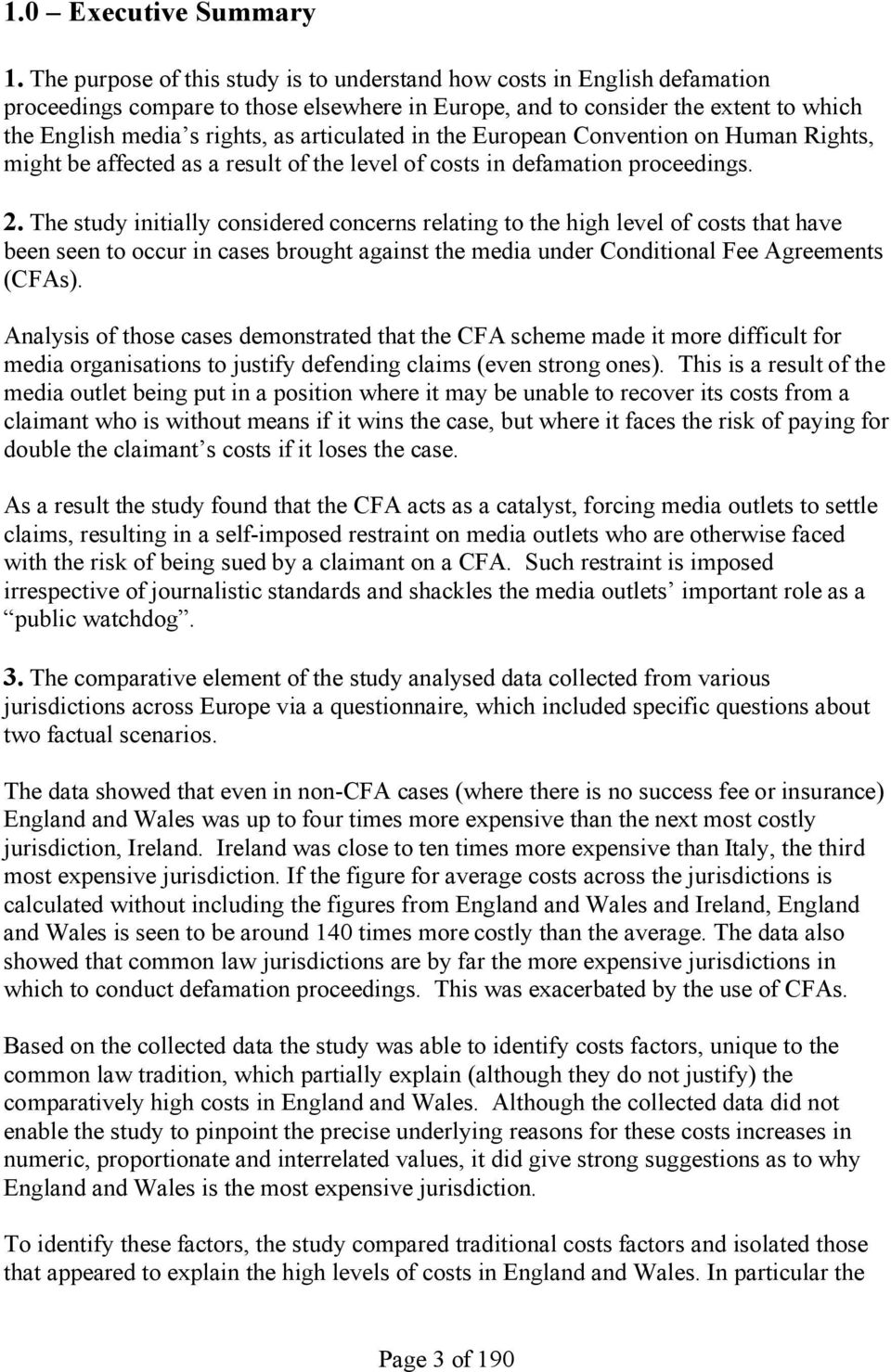
4 most influential costs factors leading to the high level of base costs in England and Wales appeared to be the number of lawyers involved in each case, combined with the length of court proceedings. The role of these isolated cost factors in inflating costs was confirmed by the study when the position in England and Wales was compared with that in Ireland, a jurisdiction which is also part of the common law family and which had the second highest level of costs of the sampled jurisdictions. The study found that the difference in costs between England and Wales and the other jurisdictions widened further in CFA cases where a success fee and ATE premium also had to be paid. 3,500,000 3,000,000 Costs in Scenario 1 and 2 allocated to Defendant and Claimant Sc1 - Defendants' Base Costs 3,250,000 Sc1 - Claimants' Base Costs Sc1 - Claimants' Costs incl CFA and ATE Sc2 - Defendants' Base Costs Sc2 - Claimants' Base Costs Sc2 - Claimants' Costs incl CFA and ATE 2,500,000 2,000,000 GBP 1,500,000 1,250,000 1,500,000 1,000, , , , ,500-14,000 14,000 14,000 14, ,000 2,000 2,500 2, , ,000 10,500 3,500 35,500 10,500 1,000 1, ,500 43,500 53,500 53,500 53,500 53, ,000 2,000 2,000 2,000 1,000 1,000 1,000 1,000 9,500 9,500 9,500 9,500 Belgium Bulgaria Cyprus England and Wales France Germany Ireland Italy Malta Romania Spain Sweden Page 4 of 190
5 Furthermore, the collected data showed that in England and Wales a claimant on a CFA incurred higher legal costs than a defendant without a CFA. This can be contrasted with the position in almost all the other jurisdictions, where the level of legal costs between claimant and defendant tended to be equal. The study determined that the difference between claimant s CFA costs and defendant s non-cfa costs can be explained by the fact that where a client has the benefit of a CFA or similar agreement, the client no longer has an incentive to exercise control over the legal work being done and to resist cost increases. This naturally erodes the client s resistance to high costs and distorts the costs control mechanism normally inherent to the market. Finally the comparative study demonstrated that the jurisdictions which tend to award the highest levels of damages are, in descending order, England and Wales, Ireland and Cyprus. These three jurisdictions can be distinguished from all other selected jurisdictions by the fact that they belong to the common law tradition. 4. The study went on to investigate whether the CFA scheme was compatible with rights set out in the European Convention on Human Rights, in particular Article 6 (Access to Justice) and Article 10 (Freedom of Expression). Although the CFA scheme increases access to justice for litigants bringing CFA-based defamation (clearly a legitimate aim pursuant to Article 6) the study found that the scheme creates a financial disincentive to defend the claim, and thereby undermines the media outlets own rights under Article 6. Because of the media outlets important role as public watchdog and defender of free speech, this must, inevitably, lead to an interference with their right to freedom of expression. With reservations about the predictability of the jurisprudence of the European Court of Human Rights the study concluded that CFAs are incompatible with both Article 6 and Article 10. Page 5 of 190
6 2.0 Introduction This study was brought about because of concerns about the level of costs and cost allocation in English defamation proceedings. The purpose of this study is to understand how costs in English defamation proceedings compare to those elsewhere in Europe, and to consider the extent to which the English media s rights, as articulated in the European Convention on Human Rights, might be affected as a result of the costs in defamation proceedings. This comparative research was initiated by conversations between Associated Newspapers Limited and the University of Oxford s Programme in Comparative Media Law and Policy (PCMLP). Associated Newspapers commissioned this study from PCMLP, and it began in January PCMLP is a research unit within the Centre for Socio-Legal Studies in the University of Oxford with significant experience in working with local media and legal professionals to build capacity for informed legal analysis. The research provides capacity and expertise to act as consultants for Inter-Governmental organizations, such as the EU and Council of Europe, on matters of media law. In addition to the experts working at its headquarters in Oxford it has a strong network of media law specialists from various regions of the world. With its combination of international and regional experts, PCMLP is prepared to assist in legislative processes, provide expert analysis of draft legislation, and to train local lawyers and editors to protect media freedoms over the long-term. For this study PCMLP has contributed its in-house expertise and its network of media lawyers which are spread in a number of worldwide jurisdictions, in particular a group of media lawyers formed into IMLA the International Media Lawyers Association. Contributors to this study are either directly members of the PCMLP network or have been invited thanks to recommendations of the members. Page 6 of 190
7 3.0 Methodology It was the concern about costs and cost allocation in defamation proceedings that encouraged this research. Concern about the position in England and Wales led to a curiosity about how costs issues are dealt with elsewhere in Europe. The comparisons we carried out aimed to provide a deeper understanding of the cost of defamation proceedings by looking at how different jurisdictions approach this issue. By examining this issue across national boundaries and across legal cultures we expected that a fuller picture would emerge. 1 We also sought to provide a comparative survey of the type that could be utilised in arguments before a court. As is well known, comparative media law studies, and indeed comparative law research in general, can run into some pitfalls, such as the comparability of data, concepts and research parameters. 2 When comparing jurisdictions researchers have to face: (1) differences in language and terminology, (2) differences between legal systems, (3) the potential of arbitrariness in the selection of objects of study, (4) difficulties in achieving comparability in comparison, (5) the desire to see or impose a common legal pattern in legal systems, (6) the tendency to impose the legal conceptions and expectations stemming from one s own national law on the systems being compared, and (7) dangers of exclusion of extralegal rules Overall Methodological Considerations The study was divided into three sections: background research, comparative research and human rights research. The background research outlined some of the potential issues around cost and cost allocation in England and Wales in general terms. The comparative research sought to understand how costs in English defamation proceedings compared to those elsewhere in Europe. We chose to form this study on the methodological approach of a functional comparative analysis. In simple terms a functional comparative analysis focuses on solutions rather than on institutional or legal styles, so even if the legal institutions in different systems are historically and conceptually quite different, the assumption is that they still perform the 1 The methodological issues that exist in the preparation of comparative media law have been analysed previously at PCMLP and in other fora See, e.g., Comparative Methodology: Theory and Practice in International Social Research (Else Oyen ed., 1990) and Stefaan Verhulst and Monroe Price, A Methodological Perspective on the Use of Comparative Media Law. Broadcasting Reform in India. Media Law from a Global Perspective (Monroe Price and Stefaan Verhulst, ed. 1998). 2 See Linda Hantrais & Steen Mangen, Cross-National Research Methods in the Social Sciences (1996). 3 See Konrad Zweigert & Hein Kötz, An Introduction to Comparative Law at vol. I (Tony Weir trans., 1989). Page 7 of 190
8 same function in the same way, achieve the same aims, and balance the same rights. This approach eliminates or at least minimises some of the potential problems of a comparative study which are described above. We prepared a list of questions regarding the costs of defamation actions and this questionnaire was completed by experienced practising lawyers examining their own jurisdiction. The questionnaire was developed by Reynolds Porter Chamberlain LLP with input from PCMLP. The questions posed are fairly flexible with concepts and terminology large enough to embrace the quite heterogeneous legal concepts of legal costs in context with defamation without losing the national researcher s attention to the object of comparison. The questions were of both a general and a specific nature. The general questions looked broadly at the material 4 and procedural 5 legal issues in question, while the specific questions were derived from two factual scenarios, which allowed the study to contextualize and consider further possible correlations. We calculated the average numeric answers in order to achieve consistency. 6 All currencies were converted into GBP on a rate taken over the last almost 6 years in order to even out any financial events not representative of the average. 7 We selected jurisdictions on an objective basis, and took economic as well as legal considerations into account when choosing the countries to include in this study, as follows: a) How countries were selected on an economic basic: Countries with GDP per capita closest to the UK (one higher, one lower). Countries with the two highest and two lowest GDP per capita. Countries with similar population sizes to the UK (two higher, two lower). Countries with the two highest and two lowest population sizes. b) How countries were selected on a legal basis: Common law countries (Cyprus, England and Wales, Ireland and Malta). One country from the Scandinavian legal tradition (Sweden). 4 Substantive law constitutes the greater body of law and defines and regulates legal rights and duties. 5 Procedural law prescribes the means of enforcing rights or providing redress of wrongs and comprises rules about jurisdiction, pleading and practice, evidence, appeal, execution of judgments, representation of counsel, costs, and other matters. 6 The average of the interval will be calculated as follows: interval (XX low + XX high)/2 = average. 7 Currencies are as follows: Euros to GBP is ; BGN to GBP is ; ROL to GBP is ; USD to GBP is and SEK to GBP is The average exchange rates are found at and the average is calculated from 01/16/2003 to 07/07/2008. The dates are a result of the homepage maximized by the history capacity of 2000 days. Page 8 of 190
9 Within civil law countries, a representative of the Germanic tradition (Germany) and the Romanic tradition (Belgium, France, Italy and Spain). Countries formerly in the Eastern bloc which through the influence of several years of technical assistance work have almost replaced their legal system wholesale (Bulgaria and Romania). Based on those criteria the following countries were chosen: 1: Belgium, 2: Bulgaria, 3: Cyprus, 4: England and Wales, 5: France, 6: Germany, 7: Ireland, 8: Italy, 9: Luxembourg 8, 10: Malta, 11: Romania, 12: Spain, 13: Sweden. 8 The author of the Luxembourg chapter was unable to submit within the timeframe of this report. Page 9 of 190
10 4.0 Background to litigation costs in England and Wales The issue of high litigation costs is not new in England and Wales, and in 1994 Lord Woolf was appointed to review the rules and procedures of the civil courts in those jurisdictions. One of the aims of the review was also to improve access to justice and reduce the cost of litigation. 9 It should be said, at that time, the UK costs of litigation were among the highest in the world, to the point that even those who made a living by conducting litigation accepted (in 1994) that they would themselves be unable to afford their own services. At the time of the review there were three main ways in which parties could fund legal representation in litigation. First, the parties could pay themselves. Secondly, state funded legal aid was available if a party met certain income criteria. 10 Finally, non-governmental organisations, i.e. trade unions or insurance companies with certain policies, might support litigation. 11 Effectively this meant that only the very poor (who could receive aid) or the very rich (who did not need any aid whatsoever) had practical access to justice. 12 In Lord Woolf s final report of 1995 he identified three reasons as to why litigation costs were a significant problem: a. litigation is so expensive that the majority of the public cannot afford it unless they receive financial assistance; b. the costs incurred in the course of litigation are out of proportion to the issues involved; and c. the costs are uncertain in amount so that the parties have difficulty in predicting what their ultimate liability might be if the action is lost. 13 As a part of his proposal for a large scale reform of access to justice in England and Wales, Lord Woolf suggested, with reservations, the use of Conditional Fee Agreements (CFAs) and insurance as a way to make civil litigation more affordable. 14 In order to provide broader access to justice, lawyers are today allowed to represent their clients on the basis of CFAs. 9 The Right Honourable the Lord Woolf, Access to Justice, Interim Report of June 1995, Introduction, see 10 Legal aid was not available for defamation claims. 11 Adrian Zuckerman, Civil Procedure Principles and Practice, Sweet & Maxwell Limited, 2006, page The Right Honourable the Lord Woolf, Access to Justice, Interim Report of June 1995, Chapter 3 The Problems and Their Causes, paragraph 17 and 26, see See also Adrian Zuckerman, Civil Procedure Principles and Practice, Sweet & Maxwell Limited, 2006, page The Right Honourable the Lord Wolf, Access to Justice, Final Report of July 1996, Case Management, Costs, paragraph 2, see 14 The Right Honourable the Lord Wolf, Access to Justice, Final Report of July 1996, Introduction, Overview, paragraph 2, see Page 10 of 190
11 4.1 Conditional Fee Agreements in England and Wales In the following section a brief explanation is given about how CFAs operate in England and Wales, and some of the implications of CFAs in relation to freedom of expression are considered. The rationale behind the CFA is to facilitate access to justice by reducing a CFA client s litigation costs liability. Before the introduction of CFAs a losing client would have to bear the litigation costs liability of its opponents as well as its own litigation costs. A losing client on a CFA basis has a litigation costs liability of its opponents only, and therefore a reduced litigation cost risk. A CFA is therefore often referred to as a no-win, no-fee contract between a client and its lawyers. 15 The terminology no-win, no-fee refers to the agreement between a client and a lawyer, where the latter s right to claim a fee from the former is usually conditional on a favourable outcome in court. The terminology no-win, no-fee is inaccurate mainly because a losing CFA client still has to pay the opponents costs of litigation. 16 A lawyer on a CFA who is successful in court can, in addition to the normal fee, claim a success uplift fee from the losing party. 17 The amount of the success fee that the successful CFA party is allowed to claim from the unsuccessful party depends on the difficulty of the case, and can be up to 100% added to the normal fee. In the event that a lawyer working on a CFA basis loses the case, such a lawyer will usually not be able to claim any fees. The lawyer s client (who lost the case) will still have to pay the winning party s lawyer s costs. The client can obtain cover for the cost of losing by taking an after the event (ATE) insurance policy to cover the winning party s costs, but this is not mandatory. 18 The consequence of the CFA is therefore that it facilitates, for the broad majority of the population, access to the English courts and justice system. The broader access to justice is achieved by re-allocating litigation costs from public funding to those who must meet the cost of litigation. 19 For those who have to meet CFA litigation costs the consequence is that they now have to face normal costs plus the success fee and any ATE premium, resulting in up to more than twice the amount of litigation cost liability. 15 A CFA is defined in the Courts and Legal Services Act 1990, section 58, where it regulates the client's payment of his advocates. 16 See Lord Justice Brooke s, Hollins vs. Russell, [2003] EWCA Civ 718, 22 May 2003, paragraph Adrian Zuckerman, Civil Procedure Principles and Practice, Sweet & Maxwell Limited, 2006, page ATE premiums are recoverable from an unsuccessful defendant. Where a claimant is unsuccessful, the usual position is that the ATE premium is not charged. The usual position is that ATE cover does not cover all of a claimant s potential liability to pay a defendant s costs. 19 Adrian Zuckerman, Civil Procedure Principles and Practice, Sweet & Maxwell Limited, 2006, page Page 11 of 190
12 4.1.1 Litigation costs and CFAs in context of freedom of expression In the following section general litigation costs and CFAs are examined in the context of the media and freedom of expression. The CFA system is intended to facilitate access to justice. However, the CFA s inherent allocation of costs creates certain concerns about the right to freedom of expression, in particular for the media whose existence relies on this fundamental freedom. These will be highlighted by concrete cases from England and Wales. A recent example is the case of Martyn Jones MP vs. Associated Newspapers Limited, which revolved around which offensive term the MP had used in front of a security guard who had asked to see the MP s security pass. Martyn Jones brought the case on a CFA basis and won 5,000 GBP in damages along with costs recovery from the unsuccessful party. In addition to the claimant s costs, which were set at 387,000 GBP, including a 100% success fee, insurance and VAT, the defendant had to pay its own costs. This straightforward case not only emphasises that one significant problem identified by Lord Woolf remains, namely that litigation costs are still disproportionate to the issues in dispute, but it also emphasises the fact that the CFA can as much as double this disproportionality and only worsen the financial pressure on the media. In Musa King vs. The Telegraph Group Limited (Court of Appeal, 18 May 2004) 20 the defendant newspaper claimed that the case had placed them in a no-win situation to the extent that it was tantamount to a violation of their right to freedom of expression as articulated in Article 10 of the ECHR. A claimant with no apparent means relied on a CFA without having taken after the event (ATE) insurance cover, which therefore reduced the newspaper s chances of recovering legal costs if winning. Adam Musa King had brought a libel action against the newspaper, which had published in its Sunday edition articles claiming that there were strong grounds to suspect the claimant of being a supporter and accomplice of al-qaeda. On appeal, the newspaper sought to reinstate certain paragraphs of their defence of justification, and they also sought some kind of special order for their protection because the claimant had brought the action under a CFA and without after the event (ATE) insurance cover. The Telegraph Group argued that if they won the case, they would not be able to recover their costs (around 400,000 GBP) from the claimant who had no apparent means; and if they lost it, because of the CFA, they could face up to double the usual level of costs because of the success fee, approximately 1,000,000 GBP. Situations where a defendant must pay irrespective of winning or losing have been referred to as the ransom factor or blackmail effect. Lord Justice Brooke summarized the deleterious effect of CFAs on the right to freedom of expression as follows (para 99): 20 [2004] All ER (D) 242 (May) Page 12 of 190
13 What is in issue in this case [...] is the appropriateness of arrangements whereby a Defendant publisher will be required to pay up to twice the reasonable and proportionate costs of the Claimant if the [the Defendant] loses [ ] and almost certainly have to bear his own costs (estimated in this case to be about 400,000 GBP) if he wins. The obvious unfairness of such a system is bound to have [a] chilling effect on a newspaper exercising its right to freedom of expression [ ] and lead to the danger of self-imposed restraints on publication. In the remaining paragraphs Lord Justice Brooke balanced the wishes of the democratic mandate inherent in Parliament when it allowed CFAs and the right to freedom of expression as articulated in the ECHR, and in essence concluded that the democratic mandate of Parliament prevails, although CFAs may have a chilling effect on freedom of expression. In Campbell vs. MGN Limited 21 (House of Lords, 20 October 2005), the CFA scheme was contended to be in conflict with Article 10 of the ECHR. On 6 May 2004, after overturning the decision of the Court of Appeal in this privacy matter, the House of Lords had ordered the defendant to pay the claimant's costs at first instance, in the Court of Appeal and in the House of Lords. The costs claimed from the defendant exceeded 1,000,000 GBP. The defendant had petitioned the House of Lords for a ruling that the success fees provided for in the conditional fee agreements should be disallowed. They contended that the success fees were an interference with their right to freedom of expression contained in Art. 10 ECHR (and the Human Rights Act), as an award of costs increased by a success fee was disproportionate (i) because it was more than the amount which, under the ordinary assessment rules, would be considered reasonable and proportionate; and (ii) because it was not necessary to give the claimant access to a court as she could have afforded to fund her own litigation. Lord Hoffmann of The House of Lords reached the same conclusion as Lord Justice Brooke reached in Musa King, when he stated in paragraph 28: It follows that in my opinion the success fee as such cannot be disallowed simply on the ground that MGN s liability would be inconsistent with its rights under Article 10. The scheme under which such liability is imposed was a choice open to the legislature. In the above-mentioned cases a media outlet s economic incentives to defend itself in defamation proceedings conflict with its right to freedom of expression. The media s concerns about general costs and the CFA success fee in litigation proceedings puts them in a position with no reasonable alternative: to avoid the risk of litigation costs and CFA success fees there is an obvious incentive for the defendant to make attempts to settle the action by offering compensation, irrespective of whether it has a good defence or not. However this approach is very far from ideal for two main reasons: firstly, because such an approach certainly would create an incentive for claimants and CFA lawyers to make related future claims, and secondly, for issues of journalistic integrity [2005] 4 All ER 793 (case No. 2) 22 Witness statement prepared by the solicitor of The Telegraph, Mr. Beabey, quoted at para. 37 of the judgment [2004] All ER (D) 242 (May). Page 13 of 190
14 The consequence of not having any financial motive to defend journalistic integrity leads to self-imposed restraint on publication for fear of being sued by CFA claimants with or without apparent means and irrespective of journalistic standards. Such self-imposed restraint therefore shackles the political and philosophical justifications for the right to freedom of expression. The political argument is that freedom of expression is a desirable activity and a fundamental value for democracy as it facilitates a free and independent media to monitor and scrutinize the democratically elected, allowing citizens freedom to receive information relevant to their choices in the voting process. 23 The right to freedom of expression is also underpinned by the more philosophical discovery of truth argument, which promotes open discussion, free exchange of ideas, freedom of enquiry, and freedom to criticize. 24 According to these arguments it is the role of the media to be the public watchdog, and in both the Musa King and Campbell cases the courts recognized that CFAs have a chilling effect (i.e. rational self-censorship) on media outlets. The English courts recognised that the CFA system causes this problem in relation to freedom of expression, but it did not find itself in a position to challenge the democratic mandate of Parliament. The legitimacy and proportionality of CFAs that increase access to justice to one litigant while in fact denying it to another and furthermore ultimately restrict the right to freedom of expression must be called into question in terms of the European Convention on Human Rights (ECHR). This will be considered after the comparative section, as relevant information may occur after analysing the collected data. 23 This argument, often referred to by as argument of democracy, was most carefully articulated by Alexander Meiklejohn, Political Freedom The Constitutional Powers of the People, Free Speech and Its Relation to Self-Government, New York, See for example Frederick Schauer, Free Speech: a Philosophical Enquiry, Cambridge University Press, 1982, pg. 15, or W. Sadurski, Freedom of Speech and Its Limits, Kluwer Academic Publishers, 1999, pg. 12. Page 14 of 190
15 5.0 Gathered Material from Europe 5.1 Biographies Biographies of Researchers: The following persons were responsible for collecting and analysing the comparative material as well as carrying out the background research for the study, in alphabetical order by surname: Larsen, Troels is carrying out research in the field of media law, as well as being in charge of projects at Programme in Comparative Media Law and Policy, University of Oxford. His main research interests are 1) freedom of expression within the framework of Council of Europe, i.e. the European Convention of Human Rights (ECHR) and the European Court of Human Rights (ECtHR), 2) comparative regional human rights law and regional jurisprudence. He will be doing a PhD in law from September Leonardi, Dr. Danilo was Head of the Programme in Comparative Media Law and Policy at the Centre for Socio-Legal Studies, Oxford University and has recently changed his academic career. He was also Coordinator of IMLA (the International Media Lawyers Association). Danilo has been coordinating MLAP - the Media Law Advocates Training Programme - since its inception in His main research interest is in media law and regulation in societies in transition to the rule of law Biographies of Authors of National Chapters: The following persons are responsible for collecting comparative data within their jurisdiction, in alphabetical order by surname: Alpren, Leah, Solicitor, Media Group, Reynolds Porter Chamberlain LLP, London: Leah qualified in 2006 and specialises in media law. She acts for newspapers, book publishers and web publishers and her experience includes libel, privacy/confidence and copyright law. Bratt, Percy, who is a lawyer working in Sweden specialised in media law since the early 1990 s. He has handled many high profile freedom of expression cases and is also a lecturer in great demand. As the chairman of the Swedish Helsinki Committee for Human Rights, Percy Bratt is deeply engaged in Human Rights law. Christofides, Pantelis graduated in 2006 with a First Class Honours LLB from the University of Leicester and joined L. Papaphilippou & Co in 2007 after obtaining the degree of Master of Laws at the University of Cambridge (Fitzwilliam College) specializing in E.U Law. He has published the article Of Certain Selling Arrangement: Keck and its Legacy in the Dock in the Cyprus & European Law Review (Vol.5 Oct.2007). Page 15 of 190
16 Costea, Doru lawyer; since 1983 member of Bucharest Bar; having a rich professional experience in civil law and criminal law, specialised in human rights litigations especially in press defamation; IMLA member. Geoffroy de Foestraets is a Partner at Jones Day, Brussels Office His main areas of practice include general commercial law, corporate law, litigation, intellectual property, technology, media, and telecommunications. He regularly advises national and international operators in the media and telecom area, and assists them in their activities in Belgium and in the European Union, and he has extensive experience in a variety of multimedia sectors such as cable TV, satellites, and film production. He has been recommended as a leading lawyer for intellectual property in PLC Which lawyer? (formerly Global Counsel 3000) since 2000; for EU regulatory, IT, and e-commerce in The European Legal 500 since 2002; and for EU and competition law in European Legal Experts since He is also author of various publications. Fricke, Michael is a lawyer at CMS Hasche Sigle in Hamburg and has long-term and extensive experience in advising on infringements of personal rights and all other matters concerning media and IP issues. Michael advises clients across a wide range of sectors, including broadcasting stations and publishing houses. Michael has published a number of articles on media and press law and is co-author of one of the leading commentaries on the German Copyright Law. Gaultier, Jean-Frédéric is a partner with Clifford Chance in Paris. He specialises in media law and intellectual property. Jean-Frédéric is a graduate from the University of Paris II with a DESS (Post-graduate degree) in business taxation and a Master in Business Law. He speaks French, English and Turkish. Recent experience includes defending English newspapers in defamation and privacy matters before French courts, including The Times, The Independent, The Daily Mail, News of the World. Ghirardelli, Aaron is an Italian lawyer, he is an associate at Clifford Chance in Italy and he works in the Dispute Resolution Department. He has been advising investment banks in relation to issues concerning insolvency and restructuring, banking law and securities litigation. He has been advising parties with regard to cases concerning liabilities and matters involving lawyers and their professional activities. He is author of various articles on legal issues for the leading Italian computer magazine Applicando and for Clifford Chance publications including "Understanding governments". Guastadisegni, Fabio is an Italian lawyer, he is a partner of Clifford Chance and he is head of the Litigation and Dispute Resolution Department of Clifford Chance in Italy. He has been advising and acting for investment banks in relation to issues concerning insolvency and restructuring, banking law and securities litigation, advising and acting for Italian and International corporations in a wide range of disputes on issues concerning commercial and corporate litigation, including post M&A litigation, contractual liability, liability in tort, product liability. He has been acting for parties involved in national and international arbitrations before the ICC of Paris and the Milan Chamber of Arbitration and he has been appointed as an arbitrator in Italian and international arbitration Page 16 of 190

17 proceedings. He is author of various Clifford Chance publications including "Are "class actions" on the way to Europe?" October 2005; "Understanding governments", November 2006; "European Insolvency procedures", 2007 Edition; "Global best practices", 2007; "Class actions make their way into Europe" May Jaramillo López-Herce, Enrique, has a degree in law and business administration. After a few years as a lawyer in the biggest law firm in Spain (Garrigues Abogados y Asesores Tributarios), in the Department of Litigation and Arbitration, he founded his own law firm in 2004, where he is the Director of the Department of Litigation and Arbitration. Has been invited by the European Court of Human Rights to do the examination for a vacancy as Spanish Lawyer. Member of the IMLA (International Media Law Association). President of the Court of Appeal of the Spanish Sports Federation for People with Physical Disabilities. Jourdain, Marie, associate with Clifford Chance Paris, is specialised in intellectual property law including patents, trademarks and designs, copyright, unfair competition, press law as well as sport law. She is a graduate from the University of Paris II with a DESS (post-graduate degree) in Intellectual Property. Marie has published several articles in legal gazettes amongst which "Google is not a marriage bureau" (Légipresse, May 2005), "A new legal basis for the liability of sponsored links providers?" (Juriscom.net, Feb. 2006) and "With the French first lady, damages take off" (Legalbiznext, Feb. 2008). Kashumov, Alexander is a human rights lawyer. Head of the legal team of Access to Information Programme in Bulgaria (AIP), and has been working for the NGO since 1997 providing legal consultations, comments on laws, trainings for journalists, civil servants and NGOs and supporting strategic litigation and campaigning. Doing litigation before domestic and international courts. Having been behind more than 120 access to information cases and decades of defamation cases, he has participated in comparative studies and publications on defamation. Kealey, Michael is a practising solicitor with an established reputation in defamation, privacy and media law in Ireland. He has written extensively on legal matters in the Irish press and elsewhere. He contributed a chapter on freedom of expression to Oxford University Press s book on the Irish experience of the European Convention on Human Rights. Michael is on the board of the Law Society s Gazette publication and is a member of its Human Rights Committee. Lindhorst, Dr. Hermann is a lawyer at Schlarmann von Geyso in Hamburg. Hermann is an IP expert who focuses on IT-, media and sports-related matters. He acts for international sports rights agencies, sports federations and individual athletes. Hermann lectures Law on sports and events at two academies in Hamburg and is a certified specialist-solicitor ( Fachanwalt ) for information technology law. He has published numerous articles on IT-, media- and sports law. Page 17 of 190

18 Lewis, Jaron, Partner, Media Group, Reynolds Porter Chamberlain LLP, London: Jaron is a specialist in media law, recently returning to private practice after eight years as a senior in-house litigator for the BBC. He acts for broadcasters, newspapers and web publishers and his experience includes libel, privacy/confidence, reporting restrictions, production orders and freedom of information. He has also handled wider commercial contract disputes involving the media sector, for example on sports rights and the supply and distribution of media content. Papaphilippou, Leandros has been a practising advocate since He is a member of the International Bar Association and the International Tax Planning Association. He is the co-author of the Cyprus section on M&A and Competition Law published by Practical Law Company and a country contributor of the International Law office on M&A. He is currently the managing partner of L. Papaphilippou & Co. Malaescu, Iulia lawyer; member of the Bucharest Bar since 2001, with a rich experience of 7 years in human rights freedom of expression, especially in press defamation litigations; IMLA member. Stafrace, Dr. Joseph Micallef graduated BA (1957) and LL.D (1959) from the University of Malta; Chairman Malta Broadcasting Authority Lecturer on Press Law in the Faculty of Laws and Centre for Communication Studies and Examiner same University. Extensive practice in Press Law Litigation. Vanbossele, Frederic is Senior Associate at Jones Day, Brussels Office. He practices in the areas of corporate and commercial litigation, with a special focus on media and copyright law. He regularly represents Belgian and foreign companies in national and international disputes before the courts and also assists them with their operations in Belgium in corporate and commercial law, trade practices and ICT law. 5.2 National Chapters The following are the national chapters, which are responses to this questionnaire: Questionnaire to National researchers: QUESTIONS Conduct of Litigation - How are defamation claims dealt with in your jurisdiction? 1. What does a claimant have to establish, at the minimum, in order to bring a defamation claim to a court? 2. What categories are available for making a defamation claim, e.g. financial loss, injury to reputation and personal feelings, other categories? What is the general level of damages awarded by courts within each category? Page 18 of 190

19 3. What defences are available? 4. What are the recent trends in defamation claims in your jurisdiction? Within the last 10 years: (a) (b) Has the number of cases brought gone up, down or has the number remained unchanged? Have the amounts awarded changed over time (apart from as a result of inflation)? If so please indicate possible reasons (change of law, caselaw, etc.)? 5. Are defamation claims determined by a judge alone or a jury? 6. Is the litigation adversarial or is the judge inquisitorial? 7. Who bears the burden of proof? What is the standard of proof? 8. Is witness evidence given orally or in writing? Are there limits on witness evidence? 9. How long would a case last on average? (In order for us to be able to conduct comparisons across the countries of this study, please try to follow this structure but clarify if parts of it are inapplicable in your jurisdiction) (a) (b) (c) (d) going all the way to a Supreme Court or equivalent; 2nd instance (middle court); 1st instance (lower court); Are there any criteria that have an effect on the length of time a case would last (other than a settlement outside court)? Fees and Costs 1. What fee structures are used in your jurisdiction in defamation claims in your report please consider all options that are permitted by your legal system, and whether there are any rules attached to the fee structure. Please consider the following: (a) (b) (c) Hourly rate. Task-based billing. Conditional fee agreements (CFA) (e.g. no win, no fee, if win, success fee where extra costs are placed on the defendant). What types of CFAs are available? Page 19 of 190
20 (i) (ii) (iii) Conditional uplift agreement (where the advocate recovers normal fees plus a success uplift in the event of a win). If used in your jurisdiction, what percentage can the advocate require in a success uplift? Conditional normal fee agreement (where the advocate will recover normal fees, but only in the event of winning). Contingency fee agreement (whereby the client agrees to pay the advocate a proportion of his winnings). (d) Other options available in your system or combinations of above please describe. 2. Are fees paid on an ongoing basis or when the claim is determined? Does one or the other arrangement depend on the agreement between the client and advocate? 3. Are fees limited by law or other circumstances in your jurisdiction? If so, what criteria limit fees, e.g. time spent, outcome of case? Are fees limited by the experience of the lawyers involved? Are there any other ways of limiting costs in your jurisdiction? 4. How are defamation claims usually funded? Can third parties fund them? Is insurance available for the costs of defamation claims? If so, what are the usual costs of premiums? 5. To what extent, if any, is the unsuccessful party liable to pay the successful party s costs? Are there any exceptions? 6. If the unsuccessful party has to pay the successful party s costs: (a) (b) (c) How would those costs be determined? Would the unsuccessful party be required to pay a premium / uplift to the advocate of the successful party? If it is clear at the start of the claim that one party will be unable to pay the other party their costs if he/she is unsuccessful how is this dealt with? 7. Is interest awarded on costs? If so, how is it calculated? Based on the facts of the scenarios below please answer the following questions focusing on your legal system: (please address each one of the scenarios separately in your answers) 1. How long would the case take to come to trial from issue-of-proceedings? Page 20 of 190

21 2. How long would a trial last in your jurisdiction (regarding the facts described in each scenario)? 3. What sort of witnesses would be called in each scenario? 4. What scale of damages would be awarded if the claimant wins? 5. How many lawyers would be involved and how much experience would they be expected to have? 6. What would be the most usual fee structure for the claimant to use in these scenarios? 7. Would the claimant in each case be able to obtain third party funding in relation to the claim? 8. If insurance is available, what would be the cost of a premium concerning this claim? 9. What would be the estimated claimant s costs of this claim in your jurisdiction? 10. What would be the estimated defendant s costs of this claim in your jurisdiction? 11. If the claimant won, what would be the total estimated costs liability of the defendant? 12. Are there any other points that you consider relevant? SCENARIOS Scenario 1 The facts: Alice and Peter were in a relationship. This relationship came to an end after a physical fight outside a party in There were no witnesses to the fight. In 2007 Alice, who is now a radio presenter reasonably well known in the country, gave an interview published in a high circulation daily national newspaper. In the interview she referred to this relationship and the break-up and the journalist said in the article that she maintains Peter hit her first. She is utterly adamant when she says this. Peter sues the newspaper for defamation as he believes that the article meant that he, in the absence of provocation and for no reason, hit Alice. Due to the newspaper article Peter complained of injury to his reputation and feelings. He did not complain of financial loss. Peter accepted that he had hit Alice but maintained that this was only after she had launched a hysterical and frenzied attack on him in which he received a black eye. Alice insisted that Peter had hit her first, splitting her lip, and she subsequently slapped him. In England and Wales, the outcome of the above could be: Page 21 of 190
22 Verdict: The trial took place over five days in May 2007 and the jury, after half a day s deliberation, returned a unanimous verdict in the Claimant s favour and awarded him 75,000 by way of damages (although, as the Claimant had limited his claim form to 50,000 he was only entitled to this amount by way of damages). The Claimant had made an offer to settle of 10,000 in September 2006 and as a result the judge ordered that costs be paid on the indemnity basis. Funding: The Claimant was funded by a Conditional Fee Agreement. His solicitors charged a 65% uplift and his barristers charged a 100% uplift in relation to the trial. He also obtained after the event insurance at a premium of nearly 92,000, which included an element of self-insurance. Following trial, the Claimant placed his costs at 512,000, exclusive of interest. By way of comparison, the Defendant s costs at the end of the trial were around 130,000 (exclusive of VAT). Scenario 2 The facts: Frank is a police officer. In 2001 he heads an investigation in which David and Joan, a well known couple, are arrested after allegations are made that they were involved in a serious crime. The allegations are found to be completely made-up. Shortly afterwards two national daily newspapers with high circulations publish articles concerning the investigation. The articles also refer to an investigation that took place in 1998 concerning a sexual assault on Gemma, a 17 year old school girl. Frank sues the newspapers as he believes that both articles meant that, in both cases, he had conducted grossly incompetent investigations which had wasted around 1.5 million of public money. He complained of injury to his reputation and feelings, but not of financial loss. He said that he could not be criticised in relation to either investigation. The newspapers said that Frank did not properly supervise the 1998 investigation which resulted in the case being dismissed by the trial judge, and that he should never have had David and Joan arrested. In England and Wales, the outcome of the above could be: Verdict: The trial took place before a judge alone over the course of three weeks in March The judge found against the Claimant and, because of the Claimant s unhelpful conduct of the case and because the Defendant had made a number of offers to settle the matter as the case progressed, awarded the Defendant costs on the indemnity basis. Funding: The Claimant in this action was funded on a Conditional Fee Agreement with a 100% uplift and the Claimant had the benefit of an after the event insurance policy (provided by the Police Association) with a premium of 616, Prior to trial the Claimant expressed his current costs as being 2,774,996 and estimated that costs following trial would lift this figure to 3,274,996. By way of comparison, the Defendant placed its costs following trial at around 1,250,000, excluding VAT. Page 22 of 190
23 5.2.2 National Chapters: BELGIUM by Geoffroy de Foestraets and Frederic Vanbossele QUESTIONS Conduct of Litigation - How are defamation claims dealt with in your jurisdiction? 1. What does a claimant have to establish, at the minimum, in order to bring a defamation claim to a court? Title II of the Constitution, "Belgians and Their Rights," includes two articles that have a bearing on the press. Article 25 specifically grants Belgians the right to a free press: "censorship can never be established; security from authors, publishers, or printers cannot be demanded". It further states that when the author is a known resident of Belgium, neither the publisher, nor the printer, nor the distributor can be prosecuted Article 19 grants Belgians, "freedom of worship, public practice of the latter, as well as freedom to demonstrate one's opinions on all matters." However, press freedom is not absolute. The press remains responsible for the abuses it may have committed in the exercise of this right. Among other abuses, the press may commit so called press offences, such as defamation or libel, as defined by article 443 of the Belgian Penal Code. Pursuant to article 98 of the Belgian Constitution, press offences fall within the exclusive competence of the Cour d assises (assize court), which is a criminal court composed of three judges and a jury of twelve members. With the exception of very few cases, nowadays it is rare to have trials before the Belgian Cour d assises for press offences. Moreover, as these offences cannot be sent before a lower criminal court, the press benefits - on a penal level - of de facto impunity. However this impunity is not total. The judicial practice has moved the debates about the press before the civil courts. It is actually on the basis of article 1382 of the Belgian Civil Code that claims against the press are brought to a civil court. Page 23 of 190
24 Based on article 1382 of the Belgian Civil Code, the claimant who intends to engage the tort liability of a journalist or an editor must establish three elements: the wrongful conduct of the journalist or the editor, the existence of a moral and/or of a material prejudice and a causal link between the alleged fault and the prejudice. In the exercise of their profession, journalists and/or editors may commit two main types of faults: invasion of privacy or damage to somebody s honour and reputation. In the present case, the claimant will have to establish that in the exercise of his profession, the journalist has committed a wrongful conduct that has damaged his honour and reputation. This wrongful conduct may consist in failing to provide the public with information as accurate, complete and objective as possible or in failing to show greatest care both when researching and spreading information or in causing damage to the credibility of individuals, changing the facts and more generally in failing to show good faith, correctness and objectivity. 2. What categories are available for making a defamation claim, e.g. financial loss, injury to reputation and personal feelings, other categories? What is the general level of damages awarded by courts within each category? Under Belgian law, the claimant will not be entitled to punitive damages. He will receive damages covering his effective material and/or moral damage. This supposes that the Court makes an evaluation of the totality of the damage. In principle, the evaluation of the material damage does not raise any specific difficulty. Material damage may consist, for example, in the loss of a market, the reduction of sale figures, the diminution of the notoriety of a brand, the end of a business, customer loss,... The evaluation will be made according to the importance of the loss itself or of the loss of earnings, as well as to the importance of the circulation of the newspaper or of the audience of the (news) coverage. The wrongful conduct will more generally damage somebody s honour and reputation or, in any case, an essential element of somebody s personality (intimacy, personal feelings, peace of mind ). The amount of those kind of damages will vary upon the extent of the moral prejudice of the claimant, but also upon the importance of the circulation of the newspaper or of the audience of the (news) coverage. All in all, on the basis of the Belgian case-law, the level of damages awarded by courts remains rather low. An alternative (or additional) type of reparation would consist for the claimant to ask the court to order the publication of its decision in the newspaper in which the article was published, or even in additional newspapers, at the journalist s and/or the editor s expense. Page 24 of 190
25 3. What defences are available? The journalist or the editor will have to bring to the Court any and all arguments showing that contrary to the Claimant s allegations, at least one of the three material elements required to engage his tort liability is not established: For instance he will have to establish that he has committed no wrongful conduct. Even if a case a wrongful conduct is retained against him, he can still try and establish that no damages have been suffered by the claimant. 4. What are the recent trends in defamation claims in your jurisdiction? Within the last 10 years: (a) (b) Has the number of cases brought gone up, down or has the number remained unchanged? Have the amounts awarded changed over time (apart from as a result of inflation)? If so please indicate possible reasons (change of law, case-law, etc.)? The examination of the published case-law on this subject shows that the number of cases against journalists who would have deliberately or not damaged somebody s honour and reputation has slightly increased over the past ten years. As mentioned above, under Belgian law, the claimant will not be entitled to punitive damages. He will receive damages covering his effective material and/or moral damage. All in all, the level of damages awarded by the courts remains rather low. Besides, while the trend is for courts to condemn journalists and to award damages to the claimant, this trend is often offset in appeal. Finally, most Court decisions concern satirical magazines/newspapers. Considering both the rather confidential circulation of this type of magazines/newspapers and the quality of their readership, it explains why the level of the damages that have been awarded in these cases has rarely exceeded 2.000,00 euros. 5. Are defamation claims determined by a judge alone or a jury? Since the judicial practice has moved the debates about press offences before civil courts, the claims are determined only by a judge. However, pursuant to article 764 of the Belgian Judicial Code, civil claims based on press offences are communicated to the prosecution service. The prosecutor is required to provide the Court with an advice, which the Court is free to follow or not. Page 25 of 190
26 6. Is the litigation adversarial or is the judge inquisitorial? Before the Belgian civil courts, the litigation is adversarial. The parties will exchange their briefs together with documentary evidence. 7. Who bears the burden of proof? What is the standard of proof? Pursuant to article 1315 of the Belgian Civil Code, the claimant bears the burden of proof of all the constitutive elements of the fault, the damage and the causal link between them. Conversely, the defendant who claims that he should be released from an obligation must prove that the obligation has been discharged by payment or otherwise. Furthermore, pursuant to article 870 of the Belgian Judicial Code, in a legal dispute, each party must give evidence of the facts that he alleges ( actori incumbit probatio ). It is then for the opposing party to refute the evidential value of the facts, if that is possible and allowed. 8. Is witness evidence given orally or in writing? Are there limits on witness evidence? Pursuant to article 915 of the Belgian Judicial Code, the claimant who offers to prove a precise and pertinent fact by means of witnesses may ask the court to call witnesses. The witnesses will testify before the judge. The parties and their attorneys may not speak directly to witnesses or interrupt them but must always address the court (article 936 Belgian Judicial Code). In other words, they cannot directly conduct an examination and/or crossexamination. The court, of its own motion or at the request of a party, may put any question to the witness that will help clarify or amplify the evidence (article 938 of the Belgian Judicial Code). Moreover, there are no particular rules on witness statements or depositions. The court will freely assess the evidence value of the submitted statements or depositions. Page 26 of 190
27 9. How long would a case last on average? (In order for us to be able to conduct comparisons across the countries of this study, please try to follow this structure but clarify if parts of it are inapplicable in your jurisdiction) (a) (b) (c) (d) going all the way to a Supreme Court or equivalent; 2nd instance (middle court); 1st instance (lower court); Are there any criteria that have an effect on the length of time a case would last (other than a settlement outside court)? For a long time, Belgium has faced an important judicial delay. As a matter of fact, going all the way to the Belgian Court of cassation, could take, on average, between 41 to 65 months for a civil case. Before the Court of Appeal, the procedure could take between 12 to 24 months. The same prevails before the Court of first instance. Considering these delays, Belgium adopted, on 26 April 2007, the Act modifying the Judicial Code aiming to fight judicial delays. This Act entered in force on 1 st September The main measure adopted consists in generalising the fixation of a precise and restricting calendar of whole proceedings as from the introduction of the cause before the Court, to the exchange between the parties and the submission to the Court of the written pleadings and to the final judgment. The Courts are now required to fix the timeframe of the proceedings six weeks after the introductory hearing. Fees and Costs 1. What fee structures are used in your jurisdiction in defamation claims in your report please consider all options that are permitted by your legal system, and whether there are any rules attached to the fee structure. Please consider the following: (a) (b) (c) Hourly rate. Task-based billing. Conditional fee agreements (CFA) (e.g. no win, no fee, if win, success fee where extra costs are placed on the defendant). What types of CFAs are available? (i) Conditional uplift agreement (where the advocate recovers normal fees plus a success uplift in the event of a win). If used Page 27 of 190
28 in your jurisdiction, what percentage can the advocate require in a success uplift? (ii) (iii) Conditional normal fee agreement (where the advocate will recover normal fees, but only in the event of winning). Contingency fee agreement (whereby the client agrees to pay the advocate a proportion of his winnings). (d) Other options available in your system or combinations of above please describe. Generally, attorneys work on an hourly rate basis. Another method consists in working with a fixed price per service. The attorney and his client may also agree upon a global fixed price for all the services that would be rendered in the case. In addition, a success fee can be agreed upon. However, the rules of professional conduct applicable to Belgian attorneys prohibit conditional fee agreements, such as, for instance, no win, no pay fee arrangements. Belgium has also a pro bono system whereby both legal fees and court costs system may be funded. 2. Are fees paid on an ongoing basis or when the claim is determined? Does one or the other arrangement depend on the agreement between the client and advocate? Generally fees are paid on an ongoing basis. They may be also paid at the end of the procedure. It actually all depends on the agreement between the attorney and his client. 3. Are fees limited by law or other circumstances in your jurisdiction? If so, what criteria limit fees, e.g. time spent, outcome of case? Are fees limited by the experience of the lawyers involved? Are there any other ways of limiting costs in your jurisdiction? The attorneys determine freely their fees. According to their professional rules however, they must be determined within the limits of a fair moderation. The fees will vary upon the fame of the attorney, his speciality, his experience. They may also vary upon the complexity of the case, its importance, its difficulty Page 28 of 190
29 4. How are defamation claims usually funded? Can third parties fund them? Is insurance available for the costs of defamation claims? If so, what are the usual costs of premiums? The defamation claims are usually funded by the claimant himself. Although this is not usual, it is not excluded that a defamation claim may be funded by a legal protection insurance covering in general terms private life disputes. Some specific insurance policies may also cover any and all type of procedures within the context of the professional activities of a person and/ or a company. The usual costs of the premiums of these insurance policies may vary between about 50,00 to 200,00 euros a year, or even 650,00 euros a year for the insurance policies covering, in more general terms, the professional activities of a person and/ or a company. 5. To what extent, if any, is the unsuccessful party liable to pay the successful party s costs? Are there any exceptions? The costs of civil proceedings include among others the registration fee and enrolment rights, the costs and fees related to the service of the writ of summons and of the judgement (i.e. bailiff fees and costs) and the procedural indemnity. The unsuccessful party is liable to pay these costs. 6. If the unsuccessful party has to pay the successful party s costs: (a) How would those costs be determined? The registration fees and enrolment rights are determined in the Belgian Registration Rights Code. They amount to 82 euros before the Courts of 1st instance and to 186 euros before the Courts of appeal. The fees of the bailiff amount from approximately 20 to 110 euros. The procedural indemnity is a lump sum for attorney s fees. The amount of this indemnity depends on the value of the claim and the nature of the proceedings. Since 1 January 2008, the amounts have been increased by a Royal Decree of 26 October They vary between 75,00 euros to 300,00 euros for disputes concerning claims up to 250,00 euros to 1.000,00 euros, to ,00 euros for disputes concerning claims exceeding ,01 euros. Page 29 of 190
30 (b) Would the unsuccessful party be required to pay a premium / uplift to the advocate of the successful party? Apart from the procedural indemnity mentioned here above, the unsuccessful party will not be required to pay any other indemnity covering any and all of the fees of the attorney of the successful party. (c) If it is clear at the start of the claim that one party will be unable to pay the other party their costs if he/she is unsuccessful how is this dealt with? It is up to the party concerned by potential financial difficulties to pay the other party s costs if he/she is unsuccessful to request the Court to reduce the amount of the procedural indemnity. Indeed, according to the Belgian Judicial Code, based on a specifically motivated decision, the Court may either reduce or increase the amount of the procedural indemnity, without exceeding the amounts determined in the Royal Decree. In its appreciation, the Court will take into account among others, the financial capacity of the unsuccessful party to reduce the amount of the indemnity or the complexity of the case. 7. Is interest awarded on costs? If so, how is it calculated? No interest is awarded on costs. However, the amounts of the procedural indemnity are subject to the consumer price index. Based on the facts of the scenarios below please answer the following questions focusing on your legal system: (please address each one of the scenarios separately in your answers) 1. How long would the case take to come to trial from issue-of-proceedings? As a rule, the first step in the proceedings is to issue a writ of summons. It is served by a bailiff, who then applies to the court s registry to have it put on the registrar of cases. The bailiff informs the parties of the date of the initial hearing. The usual term for defendants having their residence or registered seat in Belgium, to comply, is of eight days (Article 707 of the Judicial Code). At the initial hearing, the parties usually ask the Court to enact the calendar of the exchange between the parties and the submission to the Court of the written pleadings. Moreover, the Court will fix the timeframe of the proceedings six weeks after the introductory hearing (Article 747, 2 of the Judicial Code). Page 30 of 190
31 The timing for the hearing date will depend on the court's case-load and the time needed for the case. The exact timeframe is hard to predict, as it all depends on the type and complexity of the case (such as witnesses, for instance ). It is not unusual in the Belgian judicial system to hold the pleadings, 12 or even 24 months after the initial hearing. However, with the recent modification of the Belgian judicial Code, one can expect this period to be reduced. In both scenarios, it can reasonably be considered that it would take approximately 12 months for the case to come to trial (i.e. the hearing when the oral pleadings will be held) from the notification of the writ of summons. 2. How long would a trial last in your jurisdiction (regarding the facts described in each scenario)? The trial itself consists in the oral pleadings of the parties at the hearing of the Court. In both scenarios, the pleadings would last one or two hours. With the recent modification of the Belgian judicial Code, the possibility of interactive debates has been introduced under Belgian Law : at the hearing, or prior to it, the judge can propose to replace the pleadings by an interactive debate. If the parties agree, the judge will then lead the debate and will be able to orientate the parties on questions he will find relevant (Article 756bis of the Belgian Code). At the end of the hearing, the judge reserves judgment, which must generally be given within one month (Article 770 of the Judicial Code). 3. What sort of witnesses would be called in each scenario? Although this is rare, it cannot be excluded that the claimant or the defendants may ask to offer to prove a precise and pertinent fact by means of witnesses. In both scenarios, both parties may ask the court to call any and all person who would be able to confirm the precise and pertinent fact they wants to prove. 4. What scale of damages would be awarded if the claimant wins? Although the amount of the damages are not punitive, it can not be excluded that in the first scenario, considering the importance of the circulation of the newspaper, the damages that could be awarded could amount up to ,00 EUR. Page 31 of 190
32 Considering a case presenting some similarities with the second scenario, would the police officer have won, the amount of the damages could have raised approximately ,00 EUR. 5. How many lawyers would be involved and how much experience would they be expected to have? Each party decides whether it wants to be represented by one or more lawyers. No special experience is required. However, the parties may be willing to be assisted by a lawyer having a certain seniority or experience in defending this type of case. In both scenarios, we can reasonably consider that each party would have been represented by one lawyer (each with the help of one associate), having some experience in press law. 6. What would be the most usual fee structure for the claimant to use in these scenarios? The most usual fee structure for the claimant to use in these scenarios is an hourly rate. 7. Would the claimant in each case be able to obtain third party funding in relation to the claim? As long as the claimant benefits from an insurance covering judicial costs, the insurance company may cover part of the costs. In the second scenario is not excluded, however, that in case the claimant is member of a union defending his interests, he may benefit from a legal assistance, which would fund part of all of the costs. 8. If insurance is available, what would be the cost of a premium concerning this claim? In both scenarios, the amount of the premium would be of 50 to 200 euros a year. In the second scenario, the premium would be paid directly by the union for all its members, each member paying union dues including part of the premium. 9. What would be the estimated claimant s costs of this claim in your jurisdiction? In both scenarios, the estimated claimant s costs would be approximately ,00 euros. Page 32 of 190
33 10. What would be the estimated defendant s costs of this claim in your jurisdiction? In both scenarios, the estimated defendant s costs would also be approximately ,00 euros. 11. If the claimant won, what would be the total estimated costs liability of the defendant? The defendant would usually have to pay to the claimant, on top of the amount of the damages awarded, the costs of civil proceedings, as well as the procedural indemnity as defined by the Royal Decree of 26 October In both scenarios, the costs of the civil proceedings would be of approximately 196,00 euros, whereas the procedural indemnity would be most probably of 3.000,00 euros. 12. Are there any other points that you consider relevant? An alternative (or additional) type of reparation would consist of the claimant asking the court to order the publication of its decision in the newspaper in which the article was published, or even in additional newspapers, at the journalist s and/or the editor s expense. Page 33 of 190
34 BULGARIA by Alexander Kashumov QUESTIONS Conduct of Litigation - How are defamation claims dealt with in your jurisdiction? 1. What does a claimant have to establish, at the minimum, in order to bring a defamation claim to a court? The claimant should identify the item in issue (an article or programme for example) and the author. 2. What categories are available for making a defamation claim, e.g. financial loss, injury to reputation and personal feelings, other categories? What is the general level of damages awarded by courts within each category? Injury to reputation and other feelings are generally available as regards natural persons. Financial losses are available, but in practice hard to prove so not often invoked. Only material (pecuniary) damages are available in the cases of legal persons. Immaterial damages are generally estimated by courts from about 500 BGL to BGL (178 1,400 GBP). 3. What defences are available? Generally the defence of proof is provided in the Penal code (Art.147, para.2). The court practice has also developed the defence of good will and the public interest test (e.g. as regards public figures) 4. What are the recent trends in defamation claims in your jurisdiction? Within the last 10 years: (a) (b) Has the number of cases brought gone up, down or has the number remained unchanged? Have the amounts awarded changed over time (apart from as a result of inflation)? If so please indicate possible reasons (change of law, case-law, etc.)? Page 34 of 190
35 a) The number has generally remained the same. Two surveys of the Bulgarian Helsinki Committee show that the number of defamation cases pending in the country in 2001 (115) has slightly increased in 2002 (130). b) The amounts awarded are a bit more now, it could be concluded. In 2000 the penalty of imprisonment was abolished, but instead replaced by considerable financial penalties (fines) up to BGL (approximately 5,300 GBP). This lead in turn to a raise in damages. 5. Are defamation claims determined by a judge alone or a jury? Defamation could be claimed in either criminal or civil court. Civil claim is also available in a criminal case. In all these cases the first level (first instance) court is represented by a judge alone. 6. Is the litigation adversarial or is the judge inquisitorial? This is a hard question due to the artificial character of this distinction. The parties are free to invoke arguments and present evidence. In principle, the criminal court is empowered to collect evidence on its own initiative, but as these cases are not brought ex officio (since 2000) but by the affected person, in practice this rarely happens. In civil cases the litigation is of course adversarial. 7. Who bears the burden of proof? What is the standard of proof? Generally the burden is on the claimant. It is not clear who has the burden to prove the truth. According to some judges it is again a task of the claimant, while others accept negative facts (i.e. a lie) is not subject to prove. So the latter impose the burden on the defendant. As to the standard of proof it is often unclear. Some courts accept the defendant of the reasonable publication while others set the very high standard of e.g. a criminal conviction proving that the affected was really a criminal. 8. Is witness evidence given orally or in writing? Are there limits on witness evidence? In both criminal and civil cases witness evidence in written is absolutely unacceptable. There are no formal limits of witness evidence. 9. How long would a case last on average? (In order for us to be able to conduct comparisons across the countries of this study, please try to follow this structure but clarify if parts of it are inapplicable in your jurisdiction) (a) going all the way to a Supreme Court or equivalent; Page 35 of 190
36 (b) (c) (d) 2nd instance (middle court); 1st instance (lower court); Are there any criteria that have an effect on the length of time a case would last (other than a settlement outside court)? In the criminal court system such a case passes usually lower and middle court. Supreme Court is not available for such cases. Perhaps the average time is about 2 years or a bit more. In the civil courts the number of instances available is subject to the amount claimed. Above certain amount the cases could be sent to the Supreme Court of Cassation. All the procedure could be 2 ½ - 6 years. Criminal cases cannot last more than 3 years from the time of the publication. After this period the case should be terminated unless the parties mutually wish to continue. Fees and Costs 1. What fee structures are used in your jurisdiction in defamation claims in your report please consider all options that are permitted by your legal system, and whether there are any rules attached to the fee structure. Please consider the following: (a) (b) (c) Hourly rate. Task-based billing. Conditional fee agreements (CFA) (e.g. no win, no fee, if win, success fee where extra costs are placed on the defendant). What types of CFAs are available? (i) (ii) (iii) Conditional uplift agreement (where the advocate recovers normal fees plus a success uplift in the event of a win). If used in your jurisdiction, what percentage can the advocate require in a success uplift? Conditional normal fee agreement (where the advocate will recover normal fees, but only in the event of winning). Contingency fee agreement (whereby the client agrees to pay the advocate a proportion of his winnings). (d) Other options available in your system or combinations of above please describe. Page 36 of 190
37 In Bulgaria the practice is to require a determined fee for the representation of the case. In criminal cases it is subject to the level of seriousness of the criminal offence. In civil cases it is a percentage of the amount claimed in the case. Hourly rate is still very rare. Success fees are agreed between the advocate and the defendant. There are no patterns. 2. Are fees paid on an ongoing basis or when the claim is determined? Does one or the other arrangement depend on the agreement between the client and advocate? Usually fees are paid on an ongoing basis. It could be when the claim is determined. It is possible that arrangements depend on the agreements. 3. Are fees limited by law or other circumstances in your jurisdiction? If so, what criteria limit fees, e.g. time spent, outcome of case? Are fees limited by the experience of the lawyers involved? Are there any other ways of limiting costs in your jurisdiction? Only the minimum fee is limited. There is no maximum since this is regulated by the competition. The criteria for determining fees are the character of the criminal case or the amount of the claim in the civil case. The lawyer s experience is not taken into account. 4. How are defamation claims usually funded? Can third parties fund them? Is insurance available for the costs of defamation claims? If so, what are the usual costs of premiums? Third parties may fund any claims, but perhaps will not receive reimbursement even in case their party in the case wins. Insurance is yet not available for such cases to my knowledge. 5. To what extent, if any, is the unsuccessful party liable to pay the successful party s costs? Are there any exceptions? Usually the unsuccessful party covers all the costs made. In case the court finds them exaggerated it could minimize them. 6. If the unsuccessful party has to pay the successful party s costs: (a) (b) (c) How would those costs be determined? Would the unsuccessful party be required to pay a premium / uplift to the advocate of the successful party? If it is clear at the start of the claim that one party will be unable to pay the other party their costs if he/she is unsuccessful how is this dealt with? Page 37 of 190
38 Only paid costs could be covered by the unsuccessful party, no premiums. In any case the court could determine the amount to be paid by the unsuccessful party. Anyway, combined with the damages for the claimant and the fine (to the state) this amount could be quite a burden to the defendant. 7. Is interest awarded on costs? If so, how is it calculated? The interest to the costs could be relatively low. It is rarely applied. Based on the facts of the scenarios below please answer the following questions focusing on your legal system: (please address each one of the scenarios separately in your answers) 1. How long would the case take to come to trial from issue-of-proceedings? A criminal trial could come about 1 2 months after the publication (up to 6 months the latest). No difference in scenarios. 2. How long would a trial last in your jurisdiction (regarding the facts described in each scenario)? A criminal trial would last about a year before the first instance court and half an year before the second (and final) instance court. No difference in scenarios. 3. What sort of witnesses would be called in each scenario? There is no limit in calling witnesses in principle. However, the claimant in a criminal or (either) a civil case cannot give testimony. That will be a great constraint for the claimant in scenario 1. In a civil case the respondent could call the claimant to confess facts. In scenario 2 it is probable that other police officers participating in the investigation will be called and documents collected as evidence in the latter will be induced. 4. What scale of damages would be awarded if the claimant wins? In scenario 1 it is not much probable that more than 1000 BGL (approximately 355 GBP) non-material damage is awarded if the claimant wins. Another sum (fine) could be determined in the amount of BGL ( GBP). In scenario 2 the claimant could refer to his position as civil servant and ask more damages. In fact, the sum awarded will not differ much. 5. How many lawyers would be involved and how much experience would they be expected to have? It is likely that there are 1-2 lawyers per party in the case, rarely 3 lawyers on one side. Separation of functions between solicitors and barristers is not applicable. Page 38 of 190
39 6. What would be the most usual fee structure for the claimant to use in these scenarios? Most probably an honorarium of about BGL ( GBP) or more for appearance before one court instance. 7. Would the claimant in each case be able to obtain third party funding in relation to the claim? Practically it is possible, but not often. Sometimes media cover the costs of their journalist. 8. If insurance is available, what would be the cost of a premium concerning this claim? This is not applicable in Bulgaria. 9. What would be the estimated claimant s costs of this claim in your jurisdiction? About BGL ( GBP). 10. What would be the estimated defendant s costs of this claim in your jurisdiction? The same. 11. If the claimant won, what would be the total estimated costs liability of the defendant? Nearly the real costs incurred. Additional court costs could be considered. 12. Are there any other points that you consider relevant? The above answers address more the case of criminal trial. In a civil case it could be different and also the fees dependent on the interest. In all the cases discussed it will be considered by a single judge. Page 39 of 190
40 CYPRUS by Leandros Papaphilippou and Pantelis Christofides DEFAMATION PROCEEDINGS IN CYPRUS APPLICABLE LAW The relevant legal provisions of the Republic of Cyprus regulating the Tort of Defamation are to be found in the Civil Wrongs Law (A Law to Define and Amend the Law of Civil Wrongs) Cap. 148 and in particular within the ambit of The Civil Wrongs Law came into force in a Colonial Cyprus in the 1st January 1933 and was retained post Independence (The date of Independence being 16th August 1960.) as a part of the legal order of the new Republic via the Constitution of the Republic of Cyprus Art. 188 and the Law 14/1960 s. 21(1)(b). Within this context, it is stated in Cap. 148 that the provisions of the particular Statute, as well as the expressions employed therein, shall be interpreted in accordance with the principals of legal interpretation obtaining in England, except as may be otherwise expressly provided (See Cap (1»). Further more, it must be observed that the employment of the principles of Common Law as well as of Equity is not precluded except in the presence of a specific statutory provision regulating the issue (See Law 14/1960 s, 21(1)(c»). A. CONDUCT OF LITIGATION Q.l. Regarding the specific provisions on Defamation, three distinct causes of action are to be found under Civil Wrongs Law (A Law to Define and Amend the Law of Civil Wrongs) Cap. 148, those being Libel, Slander, Innuendo with Injurious Falsehood being closely related. General Principles The Person that allegedly has been defamed, hereinafter, the Plaintiff, has to prove on each occasion that a Publication was made, it was made by the Defendant, it concerned the Plaintiff and it was defamatory. As stated in various instances by the Supreme Court of Cyprus it is for the Judge to decide whether the words complained of are in their natural and ordinary sense reasonably capable of a defamatory meaning and whether the words were Page 40 of 190
41 in fact so understood (Tassos Papadopoulos v Kyrix Publishing Co. Ltd. and Others (1963) 2 C.L.R 290 at 301). It is by no means an issue of legal interpretation and is a direct result of the absence of a jury in the legal system of Cyprus. Malice is not considered a prerequisite, apart from the case of Injurious Falsehood, or the proof of actual damage apart from the case of Slander (Even in that respect, specified types of publication are actionable per se. See 5.17(3) post). Proving actual damage, is also necessary in the case that the Plaintiff is a Legal Entity (See Cap ), for all causes of action apart from the exceptions under the heading of Injurious Falsehood (See Cap (2) post). Meaning of Defamation Defamation consists, pursuant to Cap (1), of the publication by any person by means of print, writing, painting, effigy, gestures, spoken words or other sounds, or by any means whatsoever, including broadcasting by wireless telegraphy, of any matter which (a) imputes to any other person a crime ('Crime' bears, under 5.17(1), the meaning of any offence or other act punishable under any enactment in force in the Republic of Cyprus as well as any act committed abroad which if, committed within the jurisdiction of the Republic, would be punishable therein); or (b) imputes to any other person misconduct in any public office; or (c) naturally tends to injure or prejudice the reputation of any other person in the way of his profession, trade business, calling or office; or (d) is likely to expose any other person to general hatred, contempt or ridicule; or (e) is likely to cause any other person to be shunned or avoided by other persons. Meaning of Publication Publication of a defamatory matter can take place, according to 5.18(1), by means of printing, writing, painting, effigy, gestures, spoken words, or other sounds other means by which the defamatory matter is conveyed, either by exhibition, reading, recitation, description, delivery, communication, distribution, demonstration, expression or utterance, or otherwise. In addition, communication forms a prerequisite element of publication with the corresponding necessity for the defamatory meaning to become or to be likely to become known to any person other than the Plaintiff, or his wife or her husband, as the case may be, so long as the marriage is subsisting. Contrarily, communication by open letter or postcard, whether sent to the Plaintiff or any other person, is considered to constitute a publication (See Cap (2»). Additional Elements must be satisfied for the other species of Defamation other Page 41 of 190
42 than Libel, referring to a presentation which boasts a permanent form. Slander An action for Slander that being defamation by gestures, spoken words or other sounds, other than broadcasting by wireless telegraphy, according to 5.17(3), shall not lie without proof of special damage apart from the instances where they (a) impute a crime for which the Plaintiff may be made to suffer corporal punishment or imprisonment in the first instance; or (b) are calculated to injure or prejudice the reputation of the Plaintiff in the way of his profession, trade, business, calling or office; or (c) impute to the Plaintiff a contagious or infectious disease; or (d) impute adultery or unchastity to a woman or girl. Innuendo Pursuant to 5.17(4), it is not necessary for defamation that a defamatory meaning should be directly or completely expressed but it suffices if such meaning, and its application to the person alleged to be defamed, can be collected either from the alleged defamatory statement itself (Referring to the False Innuendo) or from extrinsic circumstances (Referring to the Legal Innuendo), or partly by the one and partly by the other means. Whilst in the first case there is not need for support of extrinsic fact, in the latter such need exists (See Civil Appeal 9435 Alithia Ekdotiki Eteria Ltd and Others v Charalambou Leonida judgment dated 19th May 1997). Injurious Falsehood Under the provisions of 5.25(1), Injurious Falsehood consists of the publication ('Publication', according to 5.25(3), has the same meaning as for Defamation under 5.18(1») maliciously by any person of a false statement, whether oral or otherwise, concerning - (a) the profession, trade, business, calling or office; or (b) the goods; or (c) the title to property, of any other person. Proof of actual damage, in accordance to s.25{2), is essential in each case apart from specified occasions those being where (a) the words upon which the action is founded are calculated to cause pecuniary loss to the Plaintiff and are published in writing or other permanent form; or (b) the said words are calculated to cause pecuniary loss to the Plaintiff in respect of any office, profession, calling, trade or business held or carried on by him at the time of the publication. Q.2. It is within the discretionary power of the Court apart from issuing a Prohibitory Order Page 42 of 190
43 that acts as restraint to the future publication of defamatory material by the Defendant, to award special, general and even punitive damages. Regarding damages, it was stated in AJitheia Ekdotiki Etaireia Ltd and Other v Charalambou Leonida (1997) l(a) Supreme Court Judgments 550 that their amount ought to be kept within a realistic level and taking into consideration the facts of each case. Special damages are awarded for any damage which can quantified in monetary terms upon the circumstances of each case and flows from the defamatory publication such the loss of employment or of a certain object. General damages, which are awarded for injury to reputation within society and personal feelings, are awarded by the Court taking into account the nature of the publication, malice, the failure to prove the defence of truth, the wide circulation of the media that published the defamatory material, the re - publication of the said material, the general conduct of the Defendant as well as the social status of the Plaintiff and the extent his reputation was injured (To that effect see Civil Appeal No Etaireia Dimosiografiki x.l.s Limited and Etaireia Kentrikis Dianomis Typou Papyros Ltd v. Christaki (Taki) Philippou alias Falconetti judgment dated 18th May 1998 and First Instance Judgement District Court of Limassol Case No. 2294/03 Doros Georgiades v Ekdoseis Arktinos Ltd judgment dated 6 th March 2008). Combination of the above and in particular of the nature of the publication and the social status of the Plaintiff can lead to the award of aggravated damages as in the case of Loukaides v Ekdotiki Etaireia Alithia Ltd ((2003) l(a) Supreme Court Judgments 22), where an award of was made in respect of a number of defamatory publications targeting the then Assistant Attorney General of the Republic and alleging misuse of public funds. Punitive damages may also be awarded where the defamatory publication concentrates at ridiculing the Plaintiff and directly attacks his or her personality. In Alitheia Ekdotiki Etaireia Ltd and Alekos Konstantinides v Alonefti (2002 ) 1(C) Supreme Court Judgments 1863 apart from General damages of 51,258, a further 8,543 were awarded in the form of Punitive damages. Q.3. The main Defences are to be found in the provisions of Cap. 148 and in particular in and 24. The Matter was True and the Presence of a Fair Comment on some matter of Public Interest Under 5.19, it is stipulated that in an action for defamation it shall be a defence that the matter of which complaint was made was - (a) True. Page 43 of 190
44 Provided that where the defamatory matter contains two or more distinct charges against the Plaintiff, the defence shall not fail by reason only that the truth of every charge is not proved, if the defamatory matter not proved to be true does not materially injure the Plaintiff's reputation having regard to the truth of the remaining charges. (b) A Fair Comment on some matter of Public Interest. Provided that where the defamatory matter consists partly of allegations of fact and partly of expression of opinion, the defence shall not fail by reason only that the truth of every allegation of fact is not proved, if the expression of opinion is a fair comment having regard to such of the facts alleged or referred to in the defamatory matter complained of as are proved. The Defences of Absolute and Conditional Privilege Furthermore, the Defences of Absolute and Conditional Privilege are encapsulated by and 21. It is worthy of mention that in regard to the defence of conditional privilege under 5.21, and to the defence of fair comment on some matter of public interest under 5.19(b), the aforesaid defences will fail if the Plaintiff proves that the publication was not made in good faith. The Defence oflack of Intention and Offering of Amends It is stated in 5.22 that a person who has published any matter alleged to be defamatory of another person may, if he claims that the matter was published by him innocently in relation to that other person, make an offer of amends under that section. The Special Defence in case of Defamatory Matter Published in Newspaper Under 5.24, it is noted that in any action brought against the proprietor of any newspaper, a subsisting permit to publish which has been issued to him under the provisions of the Press Law, in respect of any defamatory matter contained in such newspaper, the proprietor of the newspaper may, if he pays into Court a sum of money which in the opinion of the Court is sufficient amends, and pleads no other defence, prove by way of defence that (a) the defamatory matter was inserted without actual malice; and (b) there was no gross lack of reasonable care for which he was liable in connection with the insertion of such defamatory matter; and (c) before the commencement of the action or so soon afterwards as he had an opportunity, if the action was begun before he had an opportunity of so doing, he inserted in such newspaper a full apology, or if the newspaper is published at intervals exceeding one week, that he offered to publish an apology in any newspaper selected by the Plaintiff. Page 44 of 190
45 Q.4. During the last ten years, the number of defamation claims has increased significantly while the same trend was followed in regard to the monetary amounts awarded as damages. This increase in the amounts could be attributed to the evolution of case law starting from the leading case of Inomenoi Dimosiografoi Dias Ltd kai Alloi v Stavrou Nathanael (1993) 1 Supreme Court Judgments 893, where the Supreme Court acknowledged the trend for increasing the amount of damages awarded in defamation claims by analogy to the personal injury claims and awarded one of the largest monetary amounts until then, that being This trend continued in cases such as Civil Appeal No Alekos Konstantinides and Alitheia Ekdotiki Etaireia Ltd v Tassou Papadopoulou judgment dated 22nd June 1999 with an award of , as well as in the abovementioned Loukaides v Ekdotiki Etaireia Alithia Ltd with the award of However, the Supreme Court rejected the defamation claim in their recent judgment in Civil Appeal No Ekdoseis Arktinos Ltd v Nicos Papaefstathiou judgment dated 12th July 2007 on the basis, as it was stated, of the recent trend of the European Court of Human Rights (ECtHR) as illustrated in Lingens v. Austria (1986) 8 E.H.R.R. 407, to curtail the right to reputation when faced against the right of freedom of expression under Article 10 of the Convention for the Protection of Human Rights and Fundamental Freedoms. A comment was made in the judgment of the Supreme Court to the effect that the particular freedom, within the context of a pluralistic democratic society, applies not only to information and ideas that are seen as not insulting but also to those that possess that character. In the most recent judgment, though, of the District Court of Limassol in the case of Doros Georgiades v Ekdoseis Arktinos Ltd (See n. above.pg.36.), it was promulgated by Senior District Judge Ch. Malachtos, whilst taking into consideration the judgment in EkdoseisArktinos Ltd v Nicos Papaefstathiou, that the recent trend of the ECtHR does not in any case establish a right to publish defamatory material against any person. This first instance judgment further worth of mention due to the award as General damages of the amount of plus interest, that being the highest amount ever awarded in a defamation claim by a Court of the Republic. This may attributed to the particular circumstances of the case, the social status of the Plaintiff as well as the nature and profound impact of the publication (Ibid. Pg.51). Q.5. The Defamation claims are determined by a judge alone at First Instance and by three Supreme Court Judges in the Appellate Jurisdiction. Q.6 The Litigation is Adversarial. Page 45 of 190
46 Q.7. The Burden of Proof lies on the Plaintiff to prove the constituent elements of Defamation on the Balance of Probabilities. Q.8. Witness Evidence is primarily given orally, on oath or affirmation, but after the 2004 amendment in the Law of Evidence Cap. 9 by Law 32)1)/2004, s.25 Cap. 9 enables any witness to provide the Court with a written statement, the content of which he/she has to acknowledge as his/her position during trial and he/she can be cross - examined on that. Q.9. (a) First Instance: A judgment on a Defamation Claim by a District Court will be obtained after an average of 3-4 years after the action was filed. (b) Supreme Court on Appeal: A judgment from the Supreme Court of the Republic of Cyprus in its Appellate Jurisdiction will be obtained after an average of 2 years post the first instance judgment. A notice of appeal against a first instance judgment must be filed within 42 days from the date of that judgment. B. FEES AND COSTS Q.l. There is no specific fee structure for defamation claims but there are general scales of costs which are the same for all civil actions. These scales are issued by the Supreme Court according to the provisions of Article 163 of the Constitution and Law 33/1964 s.17. Their last two versions were published in 2006 and 2008, with the last one merely bringing the previous in line with the changeover from the Cypriot Pound to the Euro. The Plaintiff, with the filing of his/her action, acting upon the amount of his claim, he/she determines the analogous scale of the action. There are eight scales mentioned and their corresponding initial legal costs are as follows: Scale Initial Legal Costs Up to , , , , Exceeding ,00 Page 46 of 190
47 All the abovementioned legal costs are being increased according to the pleadings filed after the filing of the action and the number of appearances before the Court for Directions and Hearings. Regarding appearances for Directions, the successful party is entitled only to the costs of two appearances. In addition to the abovementioned legal costs, the advocate is entitled to negotiate with his client over the issue of his fees on the basis of a lump sum, or percentage on a larger or less amount of what the advocate is entitled to have as fees (See Rule 10 of the Advocates Procedural Rules 2002 issued in accordance with the provisions of s.14(3) Advocates Law Cap.2 and Supreme Court Judge Takis Eliades Advocates Ethics 2007 Edition pg.l11). At this point, it should be noted that according to the Code of Conduct for Lawyers in the European Union, which has not until the present moment been incorporated in Cyprus by the Advocates Procedural Rules 2002, and in particular Code Article 3.3.1, the advocate is not entitled to make a pectum de quota litis (conditional fee agreement). However this provision does not prohibit the charge in proportion to the value of the matter handled by the lawyer. Q.2 The norm is that an advance payment is rendered to the advocate upon filing of the claim and the remaining amount is payable on an ongoing basis. However, this can be altered in accordance to the particular agreement between the advocate and the client. Q.3 Legal Fees are set out according to the abovementioned scales issued by the Supreme Court and further to any specific agreement, between the advocate and the client, as described above. In addition, it should be stated that Rule 26 of the Advocates Procedural Rules stipulates that, in the absence of an agreement, the advocate has to take into account certain criteria in assessing the amount of his/her legal fees, those being the time spent for the action, the urgency and complexity of the matter, the amount of the claim, the novelty of the legal points raised, his/her specialty and experience, the financial situation of the client, the impossibility of representing other clients due to a potential conflict of interests, whether the employment of his legal services will be on a permanent or circumstantial basis and his/her level of participation in preparing the claim and representing the client. Q.4. There is neither funding by third parties in defamation claims nor insurance cover available for the costs of defamation claims. Q.5. Page 47 of 190
48 Law 14/ provides the Court with the discretionary power to award legal costs and to decide by which side they will be born. The norm is that the successful party will be awarded a judgment for costs payable by the unsuccessful one (See Kyriacou v Leontiou (1987) 1 CLR 420). On the other hand entitlement to costs may be disallowed in cases where the costs were increased due to the behaviour of the successful party (Nitsa Thrasyvoulou v. Arto Estates Ltd(1993) 1 Supreme Court Judgements 12.). Q.6. (a) They are assessed by the Registrar of the Court after the relevant Bill of Costs by the advocate of the successful party on the basis of the complexity of the matter, the novelty of the questions raised, the time spent by the advocate, his/her skills and specialised knowledge required, the urgency of the matter and the amount of the claim. (b) No. (c) The norm in such a situation is that the party, other than the potential unsuccessful party, will apply for an Order for payment into Court as Security for Costs under the Civil Procedure Rules Order 60 Rule 1 in regard to a party. However, the potential unsuccessful party has to be a permanent resident of a State other than the Member States of the European Union. Q.7. Law 14/ provides that interest can be paid on the monetary amount awarded to the Plaintiff, including the legal costs, of the rate of 8% per annum from the date the action was filed in the Court until final payment. The Court is entitled, upon the presence of specific circumstances, to award only on a part of the aforementioned monetary amount or in relation only to a part of the abovementioned period. C. SCENARIOS SCENARIO 1 1. The case will be heard after approx. 3 years from issue of proceedings. 2. This depends on the number of witnesses that will testify to Court for example the two parties and any witnesses regarding the alleged injury to Plaintiff's reputation. Normally 3-4 hearing will take place and the duration of the trial will be between 3-5 months. 3. It depends upon the nature of the defence, with the defences of Truth or Qualified Privilege being the most possible to be put forward. The witnesses will be the two parties, Alice for the purposes of establishing the defence of Truth and any witnesses regarding the alleged injury to the Plaintiff's reputation. 4. The scale of damages will be the one between Page 48 of 190
49 5. One Advocate expected to have an experience over five years in dealing with defamation claims. 6. The fees will be the sum of , that amount representing the initial legal costs of the particular scale and of the expenses after the filing of the action and the number of appearances before the Court for Directions and Hearings plus the out of pocket expenses. 7. No. 8. No insurance is available. 9. This will depend upon the number of appearances for Directions and Hearings. An approximate sum would be plus 15% VAT plus out of pocket expenses. 10. It will be approximately the same as the Plaintiff's. 11. The Defendant will have to cover both his/her advocate fees as well as the fees of the Plaintiff's advocate. The total will be in the region of plus 15% VAT plus out of pocket expenses. 12. No. SCENARIO 2 1. The case will be heard after approx. 3 years from the issue of proceedings. 2. This depends on the number of witnesses that will testify to Court for example the two parties and any witnesses regarding the alleged injury to Plaintiff's reputation. Normally 4-5 hearing will take place and the duration of the trial will be between 3-5 months. 3. It depends upon the nature of the defence, with the defences of Truth or Qualified Privilege being the most possible to be put forward, with the latter prevailing. The witnesses will be the two parties, witnesses called by Frank that will testify to the effect that Frank had information that could reasonably lead him to the actions taken, and any witnesses regarding the alleged injury to Frank's reputation. 4. The scale of damages will be the one between One Advocate expected to have an experience over five years in dealing with defamation claims. Page 49 of 190
50 6. The fees will be the sum of , that amount representing the initial legal costs of the particular scale and of the expenses after the filing of the action and the number of appearances before the Court for Directions and Hearings plus the out of pocket expenses. 7. No. 8. No insurance is available. 9. This will depend upon the number of appearances for Directions and Hearings. An approximate sum would be plus 15% VAT plus out of pocket expenses. 10. It will be approximately the same as the Plaintiff's. 11. The Defendant will have to cover both his/her advocate fees as well as the fees of the Plaintiff's advocate. The total will be in the region of plus 15% VAT plus out of pocket expenses. 12. No. Page 50 of 190
51 ENGLAND AND WALES by Jaron Lewis and Leah Alpren Conduct of Litigation - How are defamation claims dealt with in your jurisdiction? 1. What does a claimant have to establish, at the minimum, in order to bring a defamation claim to a court? The claimant must show: Identification: That the claimant has been identified, either directly or by implication. Publication: That there has been publication of the defamatory material to a third party. Defamatory words: That there has been a publication of words that lower the claimant in the estimation of right thinking members of society generally, cause others to shun or avoid the claimant or expose the claimant to hatred, contempt or ridicule. 2. What categories are available for making a defamation claim, e.g. financial loss, injury to reputation and personal feelings, other categories? What is the general level of damages awarded by courts within each category? An award of damages is the primary financial remedy for defamation, the purpose of which is to compensate the claimant for the effects of the defamatory statement. The main categories of damages available in this jurisdiction are: general damages; special damages; aggravated damages and exemplary damages. General Damages General damages compensate the claimant for: the distress suffered (unless the claimant is a company); harm to reputation including, where relevant, the claimant s business reputation; and vindication of the claimant s reputation. In a trial with a jury (see below), the jury will assess the level of damages, otherwise damages will be determined by the judge. General damages are not assessed by any mechanical, arithmetical or objective formula. The jury/judge will assess the level of damages, taking into account the conduct of the claimant, his position and standing, the nature of the libel, the mode and extent of publication, the absence or refusal of any retraction or apology and the conduct of the defendant from the time when the libel was published until the verdict. The jury receives limited guidance regarding what level it should assess general damages at. However, it is now current practice for the jury to be informed of the sorts of awards that are generally made in personal injury cases (where, for example, a person who has lost a finger will receive damages of between 5,000-12,000, and a person who has suffered very severe brain damage may receive between 165, ,000 damages). Page 51 of 190
52 The figure of 200,000 is broadly treated as an effective ceiling in libel cases (awarded in 2002 in relation to a case of widely publicised allegations of child abuse), although that figure may be adjusted for inflation. In a case concerning allegations of an MP swearing at a security guard an award of 5,000 was made by a jury. In a case concerning allegations that a successful foreign businessman habitually threatened people, a jury made an award of 50,000 and in a case concerning allegations that a politician had taken money from an enemy state for personal gain a judge sitting without a jury made an award of 150,000. Where the claimant has been technically libeled but the jury considers that because of his conduct the claimant should not be entitled to compensatory damages, it is entitled to award a nominal sum such as 1. Aggravated Damages Aggravated damages are awarded where a defendant s conduct was such that it added to a claimant s distress or injury. The conduct of the defendant, his conduct of the case, and his state of mind (ie, whether he acted maliciously) are all matters which the claimant may rely on as aggravating damages (thereby leading to a higher award). Special Damages Special damages compensate a claimant where he can prove that the libel caused him actual financial loss (eg, loss of business or employment). Such loss is recoverable as is long as it is not found to be too remote (ie not closely related) to the defamatory statement. However, it is rare for it to be claimed as the claimant needs to prove the loss was a result of the defamatory statement, and such evidence can be difficult to produce. Exemplary Damages Exemplary damages can also be awarded to punish a defendant for willful defamatory publication (ie, the defendant knows the words are untrue but publishes anyway because the economic advantage of publishing the libel outweighs the risk of economic penalty). The amount of profit made by the defendant is a relevant consideration in assessing these damages. Claims for exemplary damages are very rare. 3. What defences are available? Justification - the words were true in substance and in fact. The defendant must prove that the defamatory words were true (not that he believed they were true). It is sufficient for the substance of the libellous statement to be justified - it is not necessary to prove the truth of every statement. Fair comment - the words were fair comment (and were honestly believed) on a matter of public interest. The words must be shown to be comment (a statement of opinion), not statements of fact, but there must be a factual basis for the comment which is contained or alluded to in the matter complained of, or which is notorious or known to the person commenting at the time the comment was made. Absolute privilege - applies in prescribed situations where it is recognised that people should be entitled to speak freely without risk of defamation proceedings, even where that person knows the words are untrue or is reckless as to their truth (ie, in judicial proceedings, or fair and accurate contemporaneous reports of those proceedings, or in the course of parliamentary proceedings). Qualified privilege - applies in situations where it is warranted for people not to incur liability for defamation as long as they do not speak knowing that their words are untrue, or are reckless as to the untruth of their words. There are several classes of qualified privilege: Where a person has a duty to speak and the recipient has a corresponding interest to receive (eg, giving an employment reference or assisting in relation to criminal inquiries). Page 52 of 190
53 Where a publication is made to the public at large where a matter is of sufficient public concern and the nature, status and source of the material, and circumstances of publication mean that the publication should be protected (ie, an article is of public importance and in publishing it the defendant has followed good journalistic practice). This is known as Reynolds privilege. In prescribed situations in relation to fair and accurate reports (eg of public inquiries or government publications). Offer of amends (under s2 of the Defamation Act) - the defendant did not know or believe that the words complained of referred to the claimant (or were likely to be understood to refer to him) and were false and defamatory of him, and he has made an offer of amends (ie, an offer to publish a correction and pay compensation) which has not been accepted by the claimant. In these circumstances the judge will determine the correct level of damages in relation to the defamatory statement, and then reduce the damages by a certain percentage depending on when the offer of amends was made and the defendant s conduct. 4. What are the recent trends in defamation claims in your jurisdiction? Within the last 10 years: (a) Has the number of cases brought gone up, down or has the number remained unchanged? The number of claims issued in London are detailed in the schedule below. A small number of additional claims might have been issued outside of London. The numbers of claims issued each year has started to fall. Cases which are issued are now resolved much earlier. Year Defamation Writs Issued in London Not available 1990 Not available Page 53 of 190
54 (b) Have the amounts awarded changed over time (apart from as a result of inflation)? If so please indicate possible reasons (change of law, case-law, etc.)? There has been a slight increase in the level of awards over the past 10 years. In the 1980s libel awards were extremely high (ie an award of 1,500,000 for a peer accused of war crimes). When compared with awards in personal injury cases these libel awards were considered absurd. In 1996 the Court of Appeal held it was legitimate to draw the attention of the jury to the damages awards made in personal injury cases. As a result the level of libel awards decreased. Since that date they have remained reasonably constant. However, increasing numbers of terrorism-related libel claims (ie, where someone is accused of involvement in terrorism) have led to particularly high settlement figures, especially where there has been publication in a number of different places. 5. Are defamation claims determined by a judge alone or a jury? The general rule is that in defamation claims issues of fact are determined by juries (made up of 12 people drawn at random from the general public) and issues of law are determined by the judge. However, if, on the application of a party, the judge is of the opinion that the trial requires prolonged examination of documents, scientific or local examination, the trial can be heard by judge alone. There are specialist libel judges that hear defamation claims. 6. Is the litigation adversarial or is the judge inquisitorial? The litigation is adversarial. There is a split profession in this jurisdiction. As a result each party is usually represented by at least one solicitor and barrister. The solicitor will deal with the day to day conduct of the case and the barrister will represent the party in court. At trial the claimant presents his witness evidence through his barrister first, and those witnesses are then cross-examined by the defendant s barrister. The defendant s witness evidence is then presented by the defendant s barrister, and those witnesses crossexamined by the claimant s barrister. 7. Who bears the burden of proof? What is the standard of proof? The claimant bears the burden of proof of showing publication to a third party, identification of the claimant and defamatory meaning. The claimant must also prove the defendant published knowing the defamatory words were untrue, or was reckless as to their untruth, if this is alleged. The defendant bears the burden of proof in relation to his defence, and so, if advancing a defence of justification, bears the burden of proving the defamatory words are true. The standard of proof in all civil actions is balance of probabilities (that it was more probable than not). 8. Is witness evidence given orally or in writing? Are there limits on witness evidence? Witness statements are prepared, and exchanged, prior to trial. A witness statement sets out a witness s evidence and is accompanied by a statement of truth. However, at trial witness evidence is generally given orally and the jury will not see the witness statement. If a witness is unable to attend court it is possible to serve a notice indicating an intention to rely on evidence in a witness statement, although this will carry less weight than oral evidence. The parties can apply to the court to strike out parts of a party s witness statement that contain inadmissible evidence or fresh allegations. An example of inadmissible evidence is evidence as to the way the words were understood where the claimant is relying on their natural and ordinary meaning. The court must give effect to what is called the overriding objective (which requires the court to actively manage the case with regard to the cost, importance and complexity of the case, and the financial standing Page 54 of 190
55 of the parties) and so the court is entitled to control evidence, including limiting evidence to certain issues of fact. 9. How long would a case last on average? (In order for us to be able to conduct comparisons across the countries of this study, please try to follow this structure but clarify if parts of it are inapplicable in your jurisdiction) note - we have reversed the order so it makes more sense (c) 1st instance (lower court); It normally takes around one year for a case to come to trial in the High Court, from issue of proceedings. (b) 2nd instance (middle court); On first appeal, the defamation case normally goes to the Court of Appeal. In these circumstances it will take around six months from judgment in the lower court to judgment in the Court of Appeal (ie, up to 1 ½ years from issue of proceedings), unless an application was made to have the appeal dealt with more quickly. Permission to appeal is required from either the High Court or the Court of Appeal. (a) going all the way to a Supreme Court or equivalent; On second appeal, the defamation case will go to the House of Lords. In these circumstances it can take up to one year from judgment in the Court of Appeal to judgment in the House of Lords (ie, up to 2 ½ years from issue of proceedings). Permission is required to appeal from either the Court of Appeal or the House of Lords. The procedure for obtaining permission can add more time to the process. It is very rare for cases to go to this stage. (d) Are there any criteria that have an effect on the length of time a case would last (other than a settlement outside court)? Other things that have an effect on length of a case include : attempts to settle via mediation (it is possible for the court to order a stay to enable the parties to engage in negotiations); difficulties in finding a trial window for the trial (there are limited numbers of specialist libel judges in the High Court and so there are obvious pressures on their time); levels of disclosure (there is an obligation on the parties to give full disclosure of all documents relevant to the case, whether harmful to their case or not, at an advanced stage of litigation. Large numbers of documents can result in a long case); whether any applications are made prior to trial (for example, to limit the issues in the case, strike out defences, determine the meaning of the defamatory statement, or to seek disclosure from third parties); whether the parties choose to appeal the decisions arising from applications made prior to trial (it is possible for appeals on these decisions to go to the Court of Appeal and even to the House of Lords); and whether the claim or defence are amended so as to include new causes of action or defences. Page 55 of 190
56 Fees and Costs 1. What fee structures are used in your jurisdiction in defamation claims in your report please consider all options that are permitted by your legal system, and whether there are any rules attached to the fee structure. Please consider the following: (a) Hourly rate. Solicitors generally bill on the basis of an hourly rate. The hourly rate is set by each firm and often different rates will be negotiated for different clients. In this area of work claimant firms often charge high rates. For example, one claimant firm based in the West End typically charges an hourly rate of up to 600 for its senior partner and 375 for other partners. Another well known claimant firm charges an hourly rate of between 450 and 400 for partners, up to 275 for assistant solicitors and 160 for trainee solicitors. These are well above the rates charged by defendant libel firms. In some cases these fees are double those of defendant practices. Barristers may also charge an hourly rate in relation to general advice. Hourly rates vary depending on the seniority of the barrister and the nature of the work. (b) Task-based billing. Generally solicitors billing is not based on tasks, although budgets for each element of the litigation may be agreed with specific clients. Barristers will generally charge a specific fee, known as a brief fee, in relation to hearings. This will include the preparation done. At trial a barrister will charge a brief fee for the preparation and first day of trial, and will thereafter charge a refresher fee for each additional day of trial. Brief fees and refreshers vary depending on the seniority of the barrister and the difficulty of the case. (c) Conditional fee agreements (CFA) (e.g. no win, no fee, if win, success fee where extra costs are placed on the defendant). What types of CFAs are available? (i) Conditional uplift agreement (where the advocate recovers normal fees plus a success uplift in the event of a win). If used in your jurisdiction, what percentage can the advocate require in a success uplift? These are available to both claimants and defendants in this jurisdiction, although in libel actions they tend to be used only by claimants. Both solicitors and barristers can agree to enter into a CFA with a client. When they do, they will generally only be paid for their work if the case is won. If the case is lost, the barrister or solicitor will not be paid anything (thus these arrangements are commonly known as no win, no fee agreements). The percentage of the success uplift will depend on the barrister/solicitor s analysis of the case and its prospects of success. The maximum permissible uplift is 100% (ie, double the underlying costs). The riskier the case, the higher the success fee that can be charged, although the reality is that 100% is often charged as a matter of course. In the past year or two, some claimant firms have introduced staged success fees, with higher uplifts applied as the case progresses: for example if the case is resolved at the time of serving a defence, a 50% uplift is added, compared to a 100% uplift if the case progresses to trial. Page 56 of 190
57 A CFA is available to any litigant, regardless of whether they are wealthy enough to fund the litigation themselves. (ii) Conditional normal fee agreement (where the advocate will recover normal fees, but only in the event of winning). These are permissible but generally not used because of the availability of success fees. Occasionally a variation on this sort of agreement may be used, where a normal fee is paid on winning, but a reduced fee is paid if the case is lost. However, these agreements are relatively unusual. (iii) Contingency fee agreement (whereby the client agrees to pay the advocate a proportion of his winnings). These are not available. (d) Other options available in your system or combinations of above please describe. None that are seen in media cases. 2. Are fees paid on an ongoing basis or when the claim is determined? Does one or the other arrangement depend on the agreement between the client and advocate? Defendants normally pay their fees on an ongoing basis. Claimants normally pay their fees when the claim is determined. In fact, due to the way success is defined in most CFAs, to include a win at trial or a favourable settlement, in most cases the defendant will pay the claimant s costs, so the claimant does not pay anything. 3. Are fees limited by law or other circumstances in your jurisdiction? If so, what criteria limit fees, e.g. time spent, outcome of case? Are fees limited by the experience of the lawyers involved? Are there any other ways of limiting costs in your jurisdiction? Fees are not generally limited by law. However, the unsuccessful party to an action will normally be required to pay the successful party s legal costs. If the parties cannot agree on the level of those costs the costs that the paying party will be responsible for will be determined by specialised costs. The costs judge is meant to look at the successful party s costs and decide whether they are reasonable and proportionate. In assessing proportionality the costs judge is entitled to look at whether the costs incurred by the successful party were proportionate in relation to the ultimate outcome of the case (ie, the importance of the issues and the amount of damages received). The reality is somewhat different. There seems to be a view held by costs judges that libel claims are both risky and expensive. Since legal costs will always exceed the amount of damages awarded, costs judges rarely consider proportionality and concentrate instead on whether it was reasonable for the work to be carried out, and whether the rates claimed are reasonable. Finally the costs judge will look at each item that the receiving party is claiming costs for, and determine whether that action was reasonable and proportionate. They will not allow a receiving party to recover costs for work that was duplicated. The costs judge will also look at whether the work was carried out by someone too senior (and therefore a higher rate was charged for the work than should have been) or Page 57 of 190
58 whether the work was carried out by someone too junior (and therefore more time was spent on the work than should have been). It is possible to agree a limit on the costs that can be recovered from the other party (a costs cap), or for one party to apply to the trial judge to set a costs cap to limit the fees that can be recovered. The cap will usually be set by reference to estimates of costs that the parties have produced in the course of the litigation. Cost caps are very rare. A cap may be considered appropriate in a case where a claimant is on a Conditional Fee Agreement because it does not have sufficient funds to bring a libel action without a CFA but it does not have the benefit of insurance to meet the costs of the defending party if the claim is unsuccessful (see further below). In this instance, even if the defendant wins the case, and is awarded his costs, the claimant will not have enough money to pay him. On the other hand, the defendant will be liable for potentially limitless costs if the claimant wins. The defendant is therefore likely to settle the action, even if it has a very good defence. A cost cap will go some way to balancing the risks borne by each party as it limits the amount of money the claimant s CFA lawyers can incur bringing the claim. 4. How are defamation claims usually funded? Can third parties fund them? Is insurance available for the costs of defamation claims? If so, what are the usual costs of premiums? Historically, defamation claims have been funded privately. However, increasingly claims have been brought under CFAs. Now that the CFA system is in place there is little to stop any claimant, even one with limited funds and a poor claim, from bringing an action. Insurance is available for the costs of defamation claims. It is usually taken out to protect against the risk that the unsuccessful party will need to pay the successful party s costs (see below), although it can also be used to cover a successful party s own costs. It can either be : Before The Event Insurance (BTE), which is insurance taken out before the wrongful act occurs (ie, the publication of the defamatory statement). Potential defendants such as media organisations may have policies to protect against various sorts of claims, including claims for defamation. This sort of policy will cover the costs that the media organisation may need to pay out to a claimant, any sum of damages, and the media organisation s own costs in defending the action. However, premiums tend to be extremely high and, because the policies are taken out prior to proceedings, can never be recovered from the other side if the case is won; or After The Event Insurance (ATE), which can be taken out after the defamation occurs and is specifically taken out to fund the costs of proceedings. This sort of insurance is much more common among claimants in defamation claims. Because it is taken out after the defamation occurs (and often once proceedings have commenced) the premium of an ATE policy can be recovered as a cost from the other side if the case is won. ATE policies can include various exclusions, for example, they may not pay out if the claimant is found to have lied or misrepresented his case when applying for the insurance. Premiums for ATE insurance policies in libel actions are very high. There are two main ATE insurers in the defamation market. They each charge premiums of 68,250 for 100,000 of cover. The standard level of cover that claimants obtain is 100,000, although we do know of cases where claimants have obtained cover of around 200,000. It is extremely rare for claimants to obtain cover beyond this level, even though the costs in the case will be much more. An insured party can generally defer payment of his ATE insurance policy premium until the conclusion of the case. In these circumstances, if the insured party wins his action, the premium can be recovered from the unsuccessful party and the insured party does not pay anything. Page 58 of 190
59 If the insured party loses the action they may have to pay the premium of the policy, but in practice this rarely happens and so generally an insured party need not pay anything at all for ATE insurance. However, to protect against the risk of having to pay the premium of the policy, the insured party has been known to take out additional insurance. Taking out this additional insurance can increase the level of the premium by another 50%. In this instance, if the other side loses, they will be liable for the higher premium. 5. To what extent, if any, is the unsuccessful party liable to pay the successful party s costs? Are there any exceptions? The judge has a discretion as to whether costs are payable by one party to another, the amount of those costs and when they are to be paid. The general rule is that the unsuccessful party will be ordered to pay the successful party s costs. In deciding whether to follow the general rule the judge will take into account the conduct of the parties, whether a party has partially succeeded on his case, and whether any settlement offers have been made and beaten. If a party has partially succeeded, for example if a defendant has successfully managed to get rid of part of a claim, then the judge may order that they be paid their costs in relation to that element of the case, but that they pay the claimant s costs in relation to the rest of the case. Where a claimant is successful but has rejected a settlement offer that is higher than the amount of damages actually awarded (and where the offer has previously been notified to the claimant in accordance with court rules), the court will normally order that the claimant pay the defendant s costs for the time after the offer could have been accepted. Where the claimant is successful and the defendant has rejected a settlement offer that is lower than the damages actually awarded, the court will normally order the defendant to pay the claimant s costs with higher interest and on a more generous basis for the time after the offer could have been accepted. 6. If the unsuccessful party has to pay the successful party s costs: (a) How would those costs be determined? The claimant will produce a document detailing all of his costs and these will then be assessed by a specialist costs judge through a procedure called a detailed assessment hearing. The costs judge will determine the proportionality and reasonableness of the costs that the successful party is seeking and award a specific amount (see question 3 above for more detail on proportionality and reasonableness). (b) Would the unsuccessful party be required to pay a premium / uplift to the advocate of the successful party? If a CFA has been entered into by the successful party, the costs judge will normally order the unsuccessful party to pay percentage uplift to the successful party. As a result costs are often doubled. The level of the percentage uplift is, in theory, limited by the normal principles of reasonableness and proportionality and so the costs judge should consider whether or not the uplift sought was reasonable and proportionate in terms of the case as a whole. However, because libel claims are considered to be inherently risky, the successful party will often be awarded the full percentage uplift claimed. (c) If it is clear at the start of the claim that one party will be unable to pay the other party their costs if he/she is unsuccessful how is this dealt with? In most cases there is nothing that a party can do. A security for costs order may be made in certain prescribed situations which suggest that the claimant will avoid paying the defendant s costs if he is ordered to do so. For example, if the Page 59 of 190
60 claimant is resident outside of the EU, if he has not given his correct address in the course of the claim or changed his address to avoid the consequences of bringing the claim, or if he has taken steps to hide his assets. However, in practice security for costs orders tend to be very rare, firstly because claimants are based in the EU and secondly because in libel claims the courts are concerned that such an order will prevent claimant exercising his right to a fair hearing, under Article 6 of the European Convention on Human Rights. It may also be possible to apply to the court to stay the claim in circumstances where a party has failed to pay an interim costs order. Again, however, the courts are very reluctant to make these sorts of orders. 7. Is interest awarded on costs? If so, how is it calculated? Interest is generally awarded on costs at the standard rate (8%). It will generally be awarded on costs from the date of judgment, so as to reimburse the receiving party for any interest they have not received as a result of having had to pay legal fees before their claim is resolved. Where the claimant has offered to settle a case and subsequently receives a higher amount in damages than he offered, the court has a discretion to order the defendant to pay a higher rate of interest on costs incurred after the offer could have been accepted. This can be anything up to 10% above the Bank of England base rate (currently 5%). Based on the facts of the scenarios below please answer the following questions focusing on your legal system: (please address each one of the scenarios separately in your answers) 1. How long would the case take to come to trial from issue-of-proceedings? Scenario 1 : Scenario 2 : The case would take just under 1 year to come to trial. The case would probably take between 1 and 2 years to come to trial (depending on the nature of any applications made before trial, in a case of this size you would anticipate a number of significant applications before trial). 2. How long would a trial last in your jurisdiction (regarding the facts described in each scenario)? Scenario 1 : Scenario 2 : The trial would probably only last a few days - 4 at most. The trial would probably last two to three weeks. 3. What sort of witnesses would be called in each scenario? Scenario 1 : Scenario 2 : Limited witnesses would be called as no one saw the fight. Peter would give evidence, and may also call evidence as to the effect of the defamatory statement (from a friend or relative perhaps). He might also call evidence as to his injuries. The defendant would call Alice and might also call evidence as to her injuries, and anyone who knew her. The defendant might also call the journalist who did the interview. Frank would give evidence, and would probably also call large numbers of other police officers involved in both investigations to show that the investigations were properly carried out. If the defendant were justifying the allegations they would also need numerous police witnesses who could testify as to how the investigations were carried out. If defending on the basis of qualified privilege, evidence as to the way in which the article was written would be required - the journalists involved would need to testify. Page 60 of 190
61 4. What scale of damages would be awarded if the claimant wins? Scenario 1 : Scenario 2 : You would typically expect in these circumstances for damages to be low, perhaps around 10,000. (Note - in actual fact the jury awarded damages of 75,000). Damages in this scenario would be higher because the claimant says he is accused of incompetence in his job. However, the claimant was not accused of lying, or of criminal offences. Damages would probably be 50,000 to 75, How many lawyers would be involved and how much experience would they be expected to have? Scenario 1 : Scenario 2 : For both parties, you would expect the claim to be conducted by a partner (a senior solicitor of at least 8 years experience), supported by a junior assistant with probably one or two years experience. Throughout the case a junior barrister would provide advice and prepare pleadings. At trial, each party would have an experienced leading barrister, known as a QC, and the junior barrister would assist. On each side you might have up to three assistant solicitors supporting a partner at certain points in the proceedings, each having differing levels of experience (and dropping out during lulls in activity). You would also have trainee solicitors providing assistance. Throughout the case a QC would be assisted by at least one, and possibly two, junior barristers. They would also represent the parties at trial. 6. What would be the most usual fee structure for the claimant to use in these scenarios? Scenario 1 : Scenario 2 : It is open to the claimant to use any fee structure. Increasingly CFAs are being used in these sorts of cases Again, it is open to Frank to use any fee structure. Claimants now usually use CFAs 7. Would the claimant in each case be able to obtain third party funding in relation to the claim? Scenario 2 : Third party funding is very rare in libel actions. It only really arises where a claimant is a member of a trade association or union, and that association or union agrees to pay the claimant s legal fees. The main union to do this is the Police Federation which looks after the interests of policemen. 8. If insurance is available, what would be the cost of a premium concerning this claim? Scenario 1 : ATE insurance is only likely to be available where the claimant s lawyers are working under a CFA. In this situation, the claimant is likely to only be able to get 100,000 of cover, even though his potential exposure will be much higher. The premium will be 68,250. However, the claimant will never have to pay this. ATE premiums are generally deferred, which means that the premium only becomes payable if the claimant is successful, in which case it will be paid by the defendant. Note - in this scenario the actual premium was 92,000 : 61,000 to cover defence costs of up to 200,000 and 31,000 to defer the premium so that the claimant could recover the premium if he lost the action. Scenario 2 : As scenario 1. Note - in this scenario the claimant s trade association agreed to meet any costs that the claimant was ordered to pay. UK law allowed the trade association to charge a premium for doing this of 615,000. Page 61 of 190
62 The claimant never had to pay this premium: as with ATE premiums, it only became payable in the event that the claimant won, and then only by the defendant. 9. What would be the estimated claimant s costs of this claim in your jurisdiction? Scenario 1 : Scenario 2 : If the claimant is not on a CFA, and does not have ATE insurance, the costs would be around 215,000. This figure assumes that there are limited witnesses, minimal disclosure and no significant applications before trial. If a 100% success fee were charged on counsel and solicitors fees and there is an ATE insurance premium, costs could be up to 515,000. If the claimant is not on a CFA, and does not have ATE insurance, the costs would be around 1,500,000. This figure assumes a number of complex applications prior to trial (for example, applications on available defences and applications concerning disclosure), a reasonable number of witnesses and extensive documents. If a 100% success fee were charged on counsel and solicitors fees and there is an ATE insurance premium, costs could be up to 3,250, What would be the estimated defendant s costs of this claim in your jurisdiction? Scenario 1 : Scenario 2 : Estimated defendant s costs would be around 145,000. Again, this figure is based on a straightforward case, with no significant applications prior to trial or unexpected changes to the case. Estimated defendant s costs would be around 1,250,000. This figure is, again, based on a more complex case in which there are a number of applications prior to trial, significant investigations are carried out and numerous witnesses are proofed. 11. If the claimant won, what would be the total estimated costs liability of the defendant? Scenario 1 : Scenario 2 : It is always necessary to allow for some reduction on claimant s costs to ensure they were reasonably incurred and necessary (normally you would expect that 80% of costs are recoverable). On this basis, the defendant would carry a total costs liability of around 317,000 (if there was no CFA or ATE insurance) or 557,000 (if there was a 100% CFA and ATE insurance). Allowing for some reduction to ensure the claimant s costs were reasonably incurred and necessary, the defendant would carry a total costs liability of around 2,400,000(if there was no CFA or ATE) or 3,850,000 (if there was a 100% CFA and ATE insurance). 12. Are there any other points that you consider relevant? N/A Page 62 of 190
63 FRANCE by Jean-Frédéric Gaultier and Marie Jourdain Conduct of Litigation - How are defamation claims dealt WITH in France? 1. What does a claimant have to establish, at the minimum, in order to be able to bring a defamation claim before a court? Article 29 of the Law 29 July 1881 on the Freedom of Press defines defamation as any allegation or imputation of a fact which bears upon or attacks the honour or standing of a person". To succeed in a defamation claim, five elements must be proven: - an allegation or an imputation of a determined fact (i.e. not an opinion); - that bears upon or attacks the honour or standing; - targeting an identifiable person; - the defendant is of bad faith (always presumed); - the allegation or imputation was published in France. Defamation is a criminal offence. Proceedings may be brought before either civil or criminal courts, at the discretion of the claimant, who is entitled to seek damages in both cases. There is no preliminary review of the case by French court that may lead to an early dismissal of the claim except to some limited extent: (i) before criminal courts, in case of investigation, the investigating magistrate will check out whether the statements at issue have been published in France, and (ii) before both civil and criminal courts, in practice, when jurisdiction is challenged, the court will review this issue at an early stage independently from the merits of the case. 2. What categories are available for making a defamation claim, e.g. financial loss, injury to reputation and personal feelings, other categories? What is the general level of damages awarded by courts within each category? The qualification of defamation is regardless of any damage suffered by the victim; the damage is assumed once the defamatory statements are proved to have been made. In practice, in most cases, even if the victim has no obligation to do so, he/she claims for damages. Loss or damage suffered by the victim of defamatory statements can be classified into two main categories: pecuniary and non-pecuniary. Pecuniary loss may consist in either loss of profits (e.g. depletion of goodwill, turnover reduction, loss of business) or loss of opportunity (e.g. chance to win an invitation to tender/contract). In practice, French courts very rarely award damages on this basis, considering that there is not sufficient evidence of a direct causal link between the Page 63 of 190
64 defamatory statements and the loss25. When the claimant succeeds in proving such causal link, damages may be substantial. For instance, in a decision of 28 May 2002, the Lyon Court of Appeal ordered the website publishers to pay 80,000 in damages to compensate for the pecuniary loss suffered by a company which had been described as crooks on said website. Non-pecuniary damage may consist in damage to reputation, personal feelings or presumption of the innocence of the slandered or libeled person. Giving an estimate of the average damages awarded by French courts is very difficult. Indeed, courts assess damage on a case-by-case basis, depending on the circumstances of the matter, e.g. extent of diffusion of the statements, conduct of the defendant, situation of the victim. In addition, there is no rule of precedent in France; with the result that, in two cases, judges may award widely differing amounts of damages even though the factual circumstances are very similar. Furthermore, it should be noted that it is not uncommon for French courts to award symbolic amounts to compensate non-pecuniary damage, e.g. 1. Lastly, the amount of damages depends on whether proceedings are brought before civil or criminal courts, such amounts being generally higher before civil courts. Subject to these reservations and on the basis of the non-exhaustive figures we have been able to collect with regard to defamation cases decided within the 10 last years in France, the general amount of damages (i.e. both non-pecuniary and pecuniary) awarded ranges from 5,000 to 10,000, even if in exceptional cases, the amount may be much more substantial. 3. What defences are available? The main defences available in a defamation claim are justification (truth), good faith and privilege/immunity. Please see our comments in paragraph 7. Another frequent defence is the time-bar, which is very short under French defamation law. Indeed, safe for limited exceptions26, the claimant has only 3 months, starting from the date of first diffusion of the allegedly defamatory statements in order to bring legal proceedings. 4. What are the recent trends in defamation claims in your jurisdiction? Within the last 10 years: Has the number of cases brought gone up, down or has the number remained unchanged? Have the amounts awarded changed over time (apart from as a result of inflation)?if so please indicate possible reasons (change of law, case-law)? We contacted a number of French courts, the French Ministry of Justice and several colleagues specialized in press law. There are no official statistics available on the number of defamation cases or the amount of damages awarded by French courts. Thus, the comments below are the result of our experience as well as of that of other lawyers specialising in defamation cases. 25 For instance, Douai Court of Appeal, 3 September 2002, Juris-data n Such is the case for defamatory statements about people's ethnic origins. Page 64 of 190
65 There has not been any change in law or case law, to the best of our knowledge, likely to affect the number of defamation cases and the amounts awarded as damages. The general number of defamation claims initiated before French courts appears to remain constant if not slightly diminishing. Within defamation claims, there is an upward trend in cases arising from statements diffused on the internet. The diminution in the number of defamation cases can be explained in view of (i) the complexity of procedural rules in defamation proceedings, which have been stringently applied by French judges over the last 15/20 years, and (ii) a better protection of the right of information under the control of the European Court of Human Rights. Apart from as a result of inflation, there has not been any significant change in the amounts of damages awarded. Here again, one should keep in mind that the amount of damages might vary substantially depending on the particular circumstances of the case. 5. Are defamation claims determined by a judge alone or a jury? Defamation cases are not heard by juries but by judges only. Whether civil or criminal proceedings, the court comprises a three-judge panel, i.e. a presiding judge and two other judges. For criminal proceedings, the public prosecutor also attends the hearings. In all cases, a clerk makes a summary of the oral debates. If an appeal is lodged against the first instance decision, the civil or the criminal section of the Court of Appeal, both composed of three judges, examines the matter. As regards civil proceedings, a special judge called juge des référés (judge for urgent applications) is empowered to grant preliminary injunctions, which may consist in the immediate prohibiting of publication of the defamatory article. In the event of an appeal, a three-judge panel will examine the matter. 6. Is litigation adversarial or is the judge inquisitorial? French procedure is mixed, i.e. both adversarial and inquisitorial. Civil proceedings are more adversarial and criminal ones more inquisitorial. Defamation proceedings are governed by specific procedural rules set out in the Law of 1881, whose spirit is mainly adversarial; the powers of French judges are very limited in comparison with those that they are granted within normal civil and criminal proceedings. In this way, they are not empowered to correctly re-qualify the facts at issue, i.e. they cannot put on the facts a legal construction different from that stated by the claimant in his/her writ of summons. Likewise, they cannot investigate the truthfulness of the statements at issue and/or the good faith of the defendant. The powers of the public prosecutor are also limited. For instance, he/she is entitled to bring an action only if the victim has previously filed a complaint, except when such statements have been made against a person or a group of people because of their race, origin, religion, nationality or membership of an ethnic group 27. In addition, in the event of the withdrawal of the complaint, the public action automatically comes to an end. 27 Article 48 of the Law of 1881 Page 65 of 190
66 A few aspects of defamation proceedings have an inquisitorial character. For instance, French judges are empowered to carry out searches on the date of publication of the statements concerned in order to determine the starting date of the time-bar period28 and, if applicable, they can raise themselves the point that the action is time-barred, regardless of the argumentation of the defendant. They can also ensure that the statements at issue have been made public29, this characteristic being a necessary requirement for defamation to be recognised. 7. Who bears the burden of proof? What is the standard of proof? The burden of proof falls on both parties but the defendant is presumed to be acting in bad faith. On the claimant's side, it is necessary to establish the five elements referred in section 1, it being reminded that one of them (bad faith) is presumed. To challenge a defamation claim, the defendant may use one or several of the three defences available under French law, i.e. justification (truth), good faith or privilege/immunity. - A defence of justification (exceptio veritatis) requires proving that the statements at issue are true in every material respect. This defence will succeed only if the defendant can demonstrate the possession of all relevant facts at the time when the statements were made. Justification is a complete defence except in the four following cases, where evidence of truth is prohibited: invasion of personal privacy, publication of allegations about event that took place more than ten years earlier (except if the allegations deal with sexual assaults and offences against a minor 30 ), publication of allegations about events covered by an amnesty 31 and defamatory statements made about the race of the victim The defendant must move quickly to use the defence of justification, as evidence proving the truth of the alleged defamation must be filed within ten days of receipt of the writ of summons. After that time, truth will not be considered by the court in respect of the defence of justification, even if it may still be used as an element in the defence of good faith. Within five days of the filing of evidence by the defendant and, at all events, at least three days before the hearing, the claimant must serve on the defendant copies of the documents as well as the contact details of the witnesses that he/she will use to challenge the defence of justification. After that time, the claimant's proof will not be considered by the court in relation to the defence of justification even if, here again, they may still be used to challenge the justification of good faith raised by the defendant. 28 Cour de Cassation, criminal division, 26 May 1992, Bull. Crim. n Cour de Cassation, criminal division, 5 October 1993, Bull. Crim. n Law n of 17 June 1998 reinforcing the prevention and the elimination of sexual offences 31 Article 35 of the Law of Paris Court of Appeal, 28 September 1995, Droit Pénal 1996, n 37 Page 66 of 190
67 - A defence based on good faith requires demonstration of the following: (i) a legitimate purpose, e.g. public interest, and (ii) an absence of malice, and (iii) the use of words that do not go further than is necessary to communicate the allegation and (iv) an attempt to verify the accuracy of information, journalists having an independent duty to check the stories that they publish. - Privilege/immunity is granted to publishers that report legal proceedings33. The report must not contain comment or opinion and must be objective. The presumption of innocence must be respected. French criminal law reposes on the principle of personal conviction and freedom of proof, it being specified that the doubt must be resolved in the favour of the accused person. As regards facts (as opposed to legal acts such as agreements), French civil law also reposes on the principle of freedom of proof, which is appreciated at the discretion of the court. In defamation cases, the standard of proof is however different. Indeed, as regards the defence of justification, the evidence disclosed by the defendant must be exhaustive; on the contrary, in case of doubt, this defence should not succeed. However, in practice, French judges are obliged to expressly state in their decision the facts on the basis of which they dismiss or not the presumption of bad faith of the defendant34 but they appreciate the facts and related-evidence at their discretion. 8. Is witness evidence given orally or in writing? Are there limits on witness evidence? French civil proceedings are mostly written and, likewise, parties mainly exchange written pieces of evidence. Oral evidence is more important in criminal proceedings even it is not as important as in common law countries. As far as defamation is concerned, both the Law of 1881 and, depending on the forum, general civil and criminal rules govern witness evidence. In practice, for the most important defamation cases, even in civil proceedings, witnesses appear before the court. In accordance with the Law of 1881 and the related case law: - if the defendant wants to use the defence of justification and, for this purpose, wants to resort to witnesses, within ten days of receipt of the claim, he/she must notify the claimant of the name, occupation and address of said witnesses35. Failing to do so, witness evidence, either given orally or in writing, will not be taken into consideration in relation to the defence of justification36. It may still be used as an element of good faith defence. - as mentioned in paragraph 7, evidence and, therefore, witness evidence, is not permitted for the defendant to prove the truthfulness of defamatory statements if (i) it causes an invasion of the claimant's personal privacy, (ii) it concerns events that took place more than ten years earlier (with the exception of allegations dealing with sexual 33 Article 41 of the Law of Cour de cassation, criminal division, 16 March 1948, S 1948, 1, page Article 55 of the Law of Cour de Cassation, criminal division, 14 October 1997, Bull. Crim. n 173 Page 67 of 190
68 assaults and offences against a minor), (iii) it refers to events covered by an amnesty and (iv) the statements were made about the ethnic origin of the victim. - hearsay witness evidence cannot constitute evidence of truth of the statements at issue 37. The general procedural rules on witness evidence set out below are also applicable. - Any person can be heard as witness except as otherwise provided by the law, e.g. in the event of absence of legal capacity (e.g. people who are under age), if the person has been deprived of his /her civil rights (for instance, this may arise from a criminal judgment), in the event of incompatibility (e.g. one may not be a witness in one s own case; the rationale behind this rule being that people might commit perjury in order to win a case). - When appearing before the court, any witness must take an oath to tell the truth38 and give evidence. Witnesses state their full name, age, status, profession, residence, whether they are related to the parties and whether and in what way they are employed by them. - There is no cross-examination of witnesses, as it is known in England. Normally lawyers can only ask the presiding judge of the tribunal to put a question to a witness. However, in practice, in defamation proceedings, judges authorize lawyers to question witnesses directly. - In civil defamation cases, written witness statements ("attestations") may be disclosed before the court. Under Article 202 of the Code of Civil Procedure, an attestation must be hand-written, dated and signed. It must state what relationship, if any, the witness has with the parties, and that the witness knows that the document will be used in evidence. A photocopy of identity papers showing the photograph of the person and his/her signature must also be produced. In the event of failure to comply with these requirements, the statement shall not be declared null and void39, the court being empowered to dismiss it or take it into account, at its discretion40. - In criminal defamation cases, the parties may also provide the Court with witness statements. These latter are not subject to similar requirements to those provided for by Article 202 of the Code of Civil Procedure. However, in practice, witness statements disclosed before criminal courts are often drafted in accordance with such Article Paris Court of Appeal, 17 May 2001, Juris-data n Consequence of oath is that the witness is liable to prosecution for perjury in the event of false statements. A person that cannot be heard as a witness can, however, testify but does not take an oath, such that the value of their statements will be in practice less important. 39 Cour de Cassation, civil division, 18 March 1998, Bull. Civ. II n Cour de Cassation, civil division, 20 March 2003, Bull. Civ. II n 70 Page 68 of 190
69 9. How long would a case last on average? 1st instance (lower court) Civil and criminal first-instance proceedings last approximately 9 months to 12 months. Civil summary proceedings before the "juge des référés" usually last 15 to 30 days. French case law requires that the defendant has at minimum a 10-days period of time as from the servicing of the writ of summons in order to be able to prove that the statements at issue are true in every material respect 41 ; the juge des référés cannot render any decision before. 2nd instance (higher court) Civil and criminal appeal proceedings last around one year. Going all the way up to the Supreme Court or equivalent A case before the Cour de Cassation, which is the French Supreme Court for civil and criminal matter, lasts on average two years. The Cour de Cassation does not discuss the factual findings of the lower courts, but only reviews whether French law was correctly applied. The decision issued by the Cour de Cassation may lead to one of the following: (i) the decision of the Court of Appeal is quashed, in whole or in part, and the matter is referred to a Court of Appeal ("cassation avec renvoi"), it being specified that the parties may appeal to the Cour de Cassation against the new decision that will be rendered by the Court of Appeal; (ii) the decision of the Court of Appeal is quashed in part, but the matter is not referred to the Court of Appeal ("cassation sans renvoi"), or (iii) the decision is upheld. Are there any criteria that have an effect on the length of time a case would last (other than a settlement outside court)? Apart from a settlement outside court, the following may have an effect on the length of time a case would last before French courts: (i) the conduct of the claimant and/or the defendant, who may attempt to delay the proceedings; this dilatory behaviour, when unreasonable, may be penalised by the court, by ordering the party in question to pay a civil fine, (ii) the complexity of the case, and (iii) whether defendants are domiciled abroad since several procedural time limits are extended. 41 Cour de cassation, civil division, 14 November 2002 Page 69 of 190
70 fees and costs 1. What fee structures are used in your jurisdiction in defamation claims in your report please consider all options that are permitted by your legal system, and whether there are any rules attached to the fee structure. a. Please consider the following: Hourly rate / Task-based billing / Conditional fee agreements (CFA) (e.g. no win, no fee, if win, success fee where extra costs are placed on the defendant). b. What types of CFAs are available? Conditional uplift agreement (where the advocate recovers normal fees plus a success uplift in the event of a win). If used in your jurisdiction, what percentage can the advocate require in a success uplift? / Conditional normal fee agreement (where the advocate will recover normal fees, but only in the event of winning)./ Contingency fee agreement (whereby the client agrees to pay the advocate a proportion of his winnings) c. Other options available in your system or combinations of above please describe. There is no specific fee structure in France for defamation claims. One should therefore resort to the general rules applicable to lawyers' fees. Lawyers determine their fees in agreement with their clients42. These fees are usually determined in consideration of the qualities of the lawyer (e.g. well-known, experienced, specialization) and the characteristics of the matter (e.g. nature, complexity, urgency of work). In all cases, to recover fees, lawyers must deliver to their clients an invoice, which must detail, in particular, the tasks on the basis of which the invoice has been made. Several types of fee agreements exist. - Lawyer's fees may be calculated on the basis of the time spent. In this case, lawyers will provide their clients with (i) the hourly rates of the lawyer(s) involved in the matter and (ii) an estimate of the time to be spent. This fee structure is usually applied for complicated defamation matters. - Lawyer's fees may also be levied on a fixed-fee basis, which is not necessarily related to the time actually spent by the lawyer(s). In this case, the agreement must expressly specify the work covered by such fixed-price. It is commonly used in defamation matters. - In addition to a general fee agreement (either calculated on the basis of the time spent or consisting in a fixed-price), lawyers may agree with their clients on a contingent fees agreement, which obeys specific rules. French law prohibits (i) fees that are exclusively based upon a judicial outcome and (ii) fees contingent on the judicial outcome in the absence of an agreement. As far as defamation cases are concerned, damages likely to be awarded to the winning party by French courts are usually limited, such that lawyers may be reluctant to agree on contingent fees based on the damages likely to be awarded. In the absence of any agreement between the lawyer and his/her client, lawyers' fees are determined according to common practice, contingent on the financial situation of the client, 42 According to Article 10 of the Law n of 10 July 1991 Page 70 of 190
71 the difficulty of the case, the costs incurred by the lawyer, the reputation of the lawyer and his/her work. 2. Are fees paid on an ongoing basis or when the claim is determined? Does one or the other arrangement depend on the agreement between the client and advocate? The lawyer and his/her client freely decide the terms of payment of lawyers' fees. It usually consists of either a single payment, when the matter is ended or payment in instalments, which is more generally the case when the matter lasts for more than a month. The lawyer may also ask for the payment of a retaining fee to be deducted from the amount of fees eventually due. Failing payment, the lawyer may, subject to specific requirements, cease working on the case. In the absence of any agreement, the client has to pay lawyer's fees within 30 days following the date of performance of the lawyer's work Are fees limited by law or other circumstances in your courts? If so, what criteria limit fees, e.g. time spent, outcome of case? Are fees limited by the experience of the lawyers involved? Are there any other ways of limiting costs in your jurisdiction? French law only prohibits exclusively basing lawyer's fees upon the judicial outcome of a case. Subject to this rule, there is no statutory limit on the determination of lawyers' fees, which result from an agreement between the lawyer and his client. French courts may reduce lawyer's fees in specific circumstances. In case of conflict related to the payment of the fees, the client or the lawyer has to bring a claim, by registered letter with acknowledgement of receipt, before the head of the Bar Association ("bâtonnier"), who will issue a decision within four months of the claim. Appeal proceedings may be lodged before the President of the Court of Appeal 44. Lawyer's fees will be reduced when they appear to be excessive in view of the services rendered How are defamation claims usually funded? Can third parties fund them? Is insurance available for the costs of defamation claims? If so, what are the usual costs of premiums? Defamation claims are usually funded by the parties. However, individuals of French nationality, citizens of the member states of the European Union and foreign nationals normally and lawfully resident in France are entitled to legal aid in certain circumstances. The income requirements taken into account for entitlement to legal aid is average income of all kinds earned in the course of the previous calendar year, excluding family allowances and certain welfare benefits. For the year 2008, for a single person, the ceilings are income of 10,620 in 2007 for full aid (allowing the recipient to bring legal proceedings without incurring any financial expense) and income between 10,620 and 15, 936 in 2007 for partial aid Article L al. 4 of the French Commercial Code 44 Under specific circumstances, the President of the Court of Appeal can decide that the matter will be decided by the Court of Appeal. 45 Cass. 3/03/1998, JCP 1998,159, n People who do not meet the above requirements may, however, qualify for the granting of this aid in very specific cases, e.g. foreigners who are minors, assisted witnesses, defendants, accused or convicted persons, parties claiming damages in criminal proceedings or those who are the subject of proceedings connected with the conditions governing entry to and residence in France by foreigners are entitled to legal aid without any residence requirements. Page 71 of 190
72 The costs incurred by defamation proceedings may also be funded by insurance. Court's costs incurred by claimant on the basis of defamation claims may be funded by insurance, regardless of the success of the claim. The situation is different for the defendant. Indeed, if the defamation claim is dismissed, the defendant may have the court's costs related to the proceedings funded by insurance whereas, if the court finds the defendant liable, no insurance is available to fund these costs as well as the fine that the defendant may be ordered to pay. This is explained by the fact that, under French law, it is not possible to insure the losses and damages incurred through intentional fault on the part of the insured person. Likewise, if the defendant is ordered to pay civil damages to the victim of defamatory statements, no insurance is normally available to fund these costs. We do not have any information on the usual costs of premiums as regards insurance related to either legal costs or lawyers' fees in respect of defamation proceedings. Lawyers' fees owed by either party may be funded, provided that said party has taken out insurance in this respect; in practice, lawyers' fees will be funded on the basis of a general civil liability insurance policy or a legal services insurance one. In practice, the circumstances of funding of defamation claim's judicial costs or lawyers' fees (e.g. franchise) will depend on the clauses provided in the insurance policy. 5. To what extent, if any, is the unsuccessful party liable to pay the successful party s costs? Are there any exceptions? If the unsuccessful party has to pay the successful party s cost: how would those costs be determined? Would the unsuccessful party be required to pay a premium/uplift to the advocate of the successful party? If it is clear at the start of the claim that one party will be unable to pay the other party their costs if he/she is unsuccessful how is this dealt with? The unsuccessful party may be ordered to contribute to the costs of the winning party. A distinction should be made between court's costs and lawyers' fees. - Court's costs For civil proceedings, the losing party will normally bear the costs pertaining to proceedings, processes and enforcement procedures ("dépens" 47 ). Under Article 695 of the Code of Civil Procedure, "dépens" represent costs pertaining to proceedings, processes and enforcement procedures, e.g. costs of translation of documents where the latter is rendered necessary by the law, expert fees, fixed amount disbursements, financial compensation awarded to witnesses. However, subject to a decision specifically motivated on this point, French judges can decide that either the winning party or a third party will bear these costs. The winning party is generally ordered to support judicial costs when she/he has committed a procedural tort 48. French judges may also decide that the burden of court's costs will fall on a third party but such decision must be expressly authorized by a legal provision. Such is for instance the case for lawyers and bailiffs, who may support these costs when they have carried out procedures that are unjustified or that have proved null and void through their fault. In practice, safe for translation costs, expert fees and witness compensation, court's costs rarely exceed Under Article 695 of the French Code of Civil Procedure, "dépens" represent costs pertaining to proceedings, processes and enforcement procedures, e.g. costs of translation of documents where the latter is rendered necessary by the law or international engagement, expert fees, fixed amount disbursements, etc. 48 Dijon Court of Appeal, 19 December 1986, Juris-Data n In this case, the party initiated long, costly and obviously useless proceedings related to the jurisdiction of the court. Page 72 of 190
73 With regard to criminal proceedings, in accordance with Article of the Code of Criminal Procedure, court costs are paid by the French State. For example, these costs include the financial compensation awarded to witnesses, expert fees, translation fees when these costs result from the decision of the court; in defamation proceedings, when either party resort to witness evidence, this party will support the corresponding costs (accommodation, travelling etc.). However, Article 1018 A of the General Tax Code provides that convicted persons/bodies have to pay a fixed fee, which amounts to 90 euros for decisions at first instance delivered by the Tribunal Correctional and 120 euros for judgments handed down by the criminal division of the Court of Appeal. According to Article of the Code of Criminal Procedure, upon the request of the defendant, any court having pronounced a dismissal, a discharge or an acquittal may grant him/her an indemnity, which is supported by the State or, if the court rules so, by the plaintiff when this latter has initiated the public action. - Lawyers' fees On the basis of Article 700 of Code of Civil Procedure, if so requested by one party, the judge may sentence the losing party to bear, in part or in whole, the costs that the winning party has incurred. In practice, the losing party is usually ordered to pay to the winning party a lump sum, which is assessed on a case-by-case basis, at the discretion of the judges. For criminal proceedings, according to Article of Code of Criminal Procedure, only the victim of defamatory statements may be awarded, upon his/her request or at the discretion of the court, a lump sum for the costs he/she supported. There is no similar rule for the defendant. However, according to Article 472 of the Code of Criminal procedure, this latter is entitled to claim that the plaintiff is ordered to pay him/or damages on the basis of abuse of proceedings. In both criminal and civil proceedings, the recovery of lawyer's fees and other costs incurred by the procedure scarcely covers the costs really incurred; French judges are quite reluctant to award much in this respect. In defamation matters, it rarely exceeds (i) 4,000 before civil courts and (ii) 2,000 before criminal courts. Judges may take into account the lawyer s bills, fairness, the economical situation of the losing party, etc.; the amount of the recovery being ascertained at their discretion. No detail on how the global amount was determined is provided in the judgement, so that it is impossible to know exactly the reasons for the amounts awarded. The unsuccessful party is not required to pay a premium/uplift to the advocate of the successful party. Under French law, there is no specific rule to deal with the situation in which, at the start of the claim, one party will be unable to pay the other party their costs if he/she is unsuccessful. At the end of the day, even if, at the start of the claim, the financial incapacity of either party is known, it will have no influence on the proceedings. Lastly, it is worthy to point out that, when initiating criminal proceedings, the plaintiff is required to make a security deposit ( consignation ), the purpose of which is to guarantee payment of a civil fine in case of dismissal of the plaintiff's claim. This deposit is determined by the court during the first procedural hearing following the filing the claim. Its amount is usually between 1,000 and 3,000 and will be fully reimbursed to the plaintiff at the end of the procedure if it is successful. Page 73 of 190
74 6. Is interest awarded on costs? If so, how is it calculated? French lawyer's invoices must indicate the interest rate and the conditions governing payment of interest in the event of late payment of fees. French law provides that the interest rate amounts to 1,5 times the legal interest rate, this rate being equal to the interest rate applicable by the European Central Bank to its latest re-financing operation, increased by 7%, it being specified that the parties can agree a higher interest rate but not a lower one. Interest may be awarded on court's costs for late payment. With regard to civil proceedings, the interest rate applicable is the legal one. However, French case law is not crystal clear on the date as from which interest is due. As regards criminal proceedings, the interest rate is of 0,40% per month; interests are due as from the date the decision of the court is enforceable. Interest may be also award on the civil damages awarded to the victim of defamatory statements in case of late payment or to the civil damages awarded to the accused person, if the claimant is found liable on the basis of abuse of proceedings: - Under Article of the Civil Procedural Code, the interest rate applicable is the legal one (3.99% in ). Interest automatically runs from the date the judgement is rendered. In case of appeal, if the Court of Appeal entirely upholds the first instance decision, interests are due from the date of this first decision. In the other cases, interests are due as from the date of the decision issued by the Court of Appeal. In all cases, the first instance court as well as the Court of Appeal can depart from these rules. - The legal interest rate is increased by 5 points after a two-months period of time: (i) for a first instance decision, this period of time runs as from the time-limit to initiate a recourse against the decision except if this decision is immediately enforceable, in which case the two-months period of time runs as from the servicing of the decision, and (ii) for a decision that cannot be subject to any recourse, the two-months period of time runs as from the servicing of the decision. - In specific circumstances, the interests due may themselves produce interest; a specific claim must be initiated before a civil court and the interest must be due for one year at least. Scenario 1) How long would the case take to come to trial from issue-of-proceedings? - Scenario 1: 9 months. - Scenario 2: 12 months. 2) How long would a trial last in your courts? - Scenario 1: one hour. - Scenario 2: three hours. 3) What sort of witnesses would be called in each scenario? 49 Decree n of 21 February Page 74 of 190
75 - Scenario 1: evidence and consequently, witness evidence, of the truthfulness of the facts at issue is not permitted since the statements at issue relate to privacy (please refer to our comments in paragraphs 7 and 8). Peter could however call witnesses in order to attempt to evidence the "hysterical" personality of Alice. The newspaper could call Alice to confirm what she said. - Scenario 2: witnesses with knowledge about the facts could be called by the newspaper. It would not be possible to call police officers to testify as they are bound by secrecy of investigation. 4) What scale of damages would be awarded if the claimant wins? - Scenario 1: Peter could be awarded 2,000 as damages; this amount might be increased if Peter evidences any financial loss he might have suffered. - Scenario 2: Franck could be awarded 15,000 as damages. 5) How many lawyers would be involved and how much experience would they be expected to have? Typically, in both scenarios, two lawyers per party would be involved: a senior lawyer (at least 10-years experience) and a junior one (between 1 and 3 years experience for scenario 1, and between 3 and 5 years experience for scenario 2). The lawyers would be specialised in press law. 6) What would be the most usual fee structure for the claimant to use in these scenarios? - Scenario 1: for both parties, the most usual fee structure would consist in a fixed-fee agreement: (i) around 5,000 on Peter's side and (ii) around 15,000 on the newspaper' side. Lawyer's fees incurred by Peter could be higher, depending on his financial situation. - Scenario 2: for the plaintiff, the most usual fee structure would consist in a fixed-fee agreement in the region of 15,000 on Frank's side (again, it might be higher depending on his financial situation). On the newspaper' side, fees would be charged on an hourly basis and would approximate 50,000. 7) Would the claimant in each case be able to obtain third party funding in relation to the claim? In both scenarios, the claimant would be able to obtain third party funding, if previously insured. 8) If insurance is available, what would be the cost of a premium concerning this claim? For either scenario, as above-mentioned, we do not have any information on the costs of premiums in respect of defamation proceedings, as premiums would be included in general civil liability or legal protection policies. 9) What would be the estimated claimant s costs of this claim in your jurisdiction? In both scenarios, it will be around 500 (servicing of the claim plus court's costs). Page 75 of 190
76 10) What would be the estimated defendant s costs of this claim in your jurisdiction? - Scenario 1: 0. - Scenario 2: 1,500 in legal costs for witness accommodation. 11) If the claimant won, what would be the total estimated costs liability of the defendant? - Scenario 1: the estimated costs liability of the defendant would be around 3,500 (2,000 as damages plus 1,000 to compensate the lawyer's fees incurred by the plaintiff plus 500 for legal costs). - Scenario 2: the estimated costs liability of the defendant would be around 18,500 (15,000 as damages plus 2,000 to compensate the lawyer's fees incurred by the plaintiff plus 1,500 for legal costs). 12) Are there any other points that you consider relevant? The publisher of the defamatory statement is generally ordered to publish a copy or an extract of the judgement. The claimant can also apply for destruction of the offending publication but this remedy is rarely ordered against newspapers because of their brief shelf life. In scenario 1, the civil route will be likely to be opted for; the criminal route in scenario 2. In scenario 2, the administration will probably join the proceedings. The defendant will be probably ordered to pay a fine which amount will be in the region of 3,000. Page 76 of 190
77 GERMANY by Michael Fricke and Dr. Hermann Lindhorst Conduct of Litigation - How are defamation claims dealt with in your jurisdiction? 1. What does a claimant have to establish, at the minimum, in order to bring a defamation claim to a court? A claimant needs to show to the court that on the balance of probabilities, the published statement (which has to be a statement of fact) is false, defamatory or protected by privacy law. 2. What categories are available for making a defamation claim, e.g. financial loss, injury to reputation and personal feelings, other categories? What is the general level of damages awarded by courts within each category? There are no special categories for making a defamation claim it is admissible to start and issue a claim if a statement violated the claimant s rights, e.g. the right of privacy. Hence, there is no general level of damages. 3. What defences are available? There are two defences available: The first defence is relevant when the alleged statement of fact is merely a statement of opinion. A statement of opinion or a meaning is a subjective valuation which cannot be proved. A statement of fact is provable, i.e. the truth of the statement can be verified. Therefore, from the claimant s point of view, it is much easier to claim against a (false) statement of fact than against a statement of opinion. The second defence is the defence of the fulfilment of journalistic diligence and carefulness ( journalistische Sorgfaltspflicht ). If the press has undertaken a diligent, careful research it is allowed under these circumstances to publish news that is not fully and in detail proved. This concept upholds the constitutionally protected function of the press and enables it to report also about misconduct, even when this has not yet been finally proven or judged. However, such news coverage has to be fair and balanced and has to make explicitly clear that the issue is still under investigation. In balancing the conflicting interests, it is of the essence whether the news coverage relates to a matter of substantial public interest or is just of entertaining value. Page 77 of 190
78 4. What are the recent trends in defamation claims in your jurisdiction? Within the last 10 years: (a) Has the number of cases brought gone up, down or has the number remained unchanged? The number of cases brought has gone up significantly. This development is due to four facts: Firstly the ongoing and rapid growth of people using the internet as their main source of information. The second fact is the increasing economical pressure put on news media regarding cost effectiveness. This aggravates in our opinion the trend to prefer a big, sensational headline (without diligent research) to balanced and fairly objective news coverage. A third circumstance is that lawyers have discovered a new market niche in press and defamation law which is based upon the last factor: The sensibility and awareness of the persons concerned is growing as image and reputation are becoming more and more important. (b) Have the amounts awarded changed over time (apart from as a result of inflation)? If so please indicate possible reasons (change of law, caselaw, etc.)? Claims based on privacy and defamation law which were brought before court from celebrities recently resulted in compensation for damages, which are slightly higher than they were before. Hence, the amounts awarded, which are traditionally low in Germany due to the fact that there is no punitive damages -concept, have gently increased over time. Nonetheless, German courts actually tend to increase the awarded damages in order to generate a restrictive impact on the press, because the financial benefit that (especially the yellow press) gains from sensational headlines is much higher than what it has to pay to the winning claimant. However, as there is no legal basis for punitive damages, see above, the increase is only of small significance. 5. Are defamation claims determined by a judge alone or a jury? Defamation claims at the Landgericht ( regional court ) with an amount of dispute above EUR 5, are determined by three professional judges. 348 Sec. 1 No. 2 a) of the Code of Civil Procedure ( Zivilprozessordnung, ZPO) determines explicitly that the claim will not be decided through a single judge ( Einzelrichter ), if the claim is related to publications through print products, picture- and soundcarrier of any manner, especially in press, broadcasting, movie and tv. Claims with an amount in dispute below EUR 5,000.00, which are rare in press related claims, are determined by one professional judge at the Amtsgericht ( local court ). Page 78 of 190
79 6. Is the litigation adversarial or is the judge inquisitorial? There is no inquisitorial litigation in German civil procedure law. It is the duty of the party s lawyers` to bring all facts and evidence before the judge who then decides completely impartially. 7. Who bears the burden of proof? What is the standard of proof? Normally, the claimant has to prove every fact which leads to his desired, claimed outcome. However, in defamation cases, the burden of proof is shifted and the defendant (i.e. the press) has to prove the truth of the defamatory statements. The standard of proof is a copy of the claimed statement and an affidavit especially in an application for an interim injunction that the alleged statement contains a false or defamatory content. 8. Is witness evidence given orally or in writing? Are there limits on witness evidence? As most of the cases related to defamation law are dealt with at the interim stage, witness evidence is given mostly in writing, connected with an explanation that the written statement has been made to the best knowledge ( affidavit ). In a normal court action (not at interim stage), evidence is primarily given orally at a court hearing. After having read the written evidence proposals of the lawyers, the judge decides in its own discretion which witnesses have to come to court to officially give evidence. There are no limits on witness evidence, but as explained before, it is in the judge s discretion to select and order witnesses to a court hearing. 9. How long would a case last on average? (In order for us to be able to conduct comparisons across the countries of this study, please try to follow this structure but clarify if parts of it are inapplicable in your jurisdiction) (a) going all the way to a Supreme Court or equivalent; Approximately three years. (b) 2nd instance (middle court); Approx. two years. (c) 1st instance (lower court); Approx. one year. (d) Are there any criteria that have an effect on the length of time a case would last (other than a settlement outside court)? Page 79 of 190
80 The most important criteria that has an effect on the length of time a case would last is the necessity to hear evidence cases, where no evidence has to be heard last definitely much shorter than those, where evidence has to be heard. The workload of the court is a further important fact that has significant impact on the length of a case. Fees and Costs 1. What fee structures are used in your jurisdiction in defamation claims in your report please consider all options that are permitted by your legal system, and whether there are any rules attached to the fee structure. Please consider the following: 1. Hourly rate Hourly rates are possible in Germany, but only on the basis of negotiated fees. These negotiated fees are subject to the provisions of the Bundesrechtsanwaltsordnung, BRAO ( Federal Lawyers Act ) and of the Rechtsanwaltsvergütungsgesetz, RVG ( Law on the remuneration of lawyers ). The most important statutory restriction is that negotiated fee must not be lower than the statutory, task-based billed rate, 49b Sec. 1, S. 1 BRAO. Moreover, negotiated fees have to be agreed in written form, if they lead to a higher remuneration than the statutory one according to 4 Sec. 1 RVG. 2. Task-based billing Task-based billing is the statutory fee structure system. The fees depend of the value in dispute and are set out in an binding annex to the RVG, the Vergütungsverzeichnis ( Directory of remuneration ). 3. Conditional fee agreements (CFA) (e.g. no win, no fee, if win, success fee where extra costs are placed on the defendant). What types of CFAs are available? To date, there are no conditional fee agreements available because they are prohibited by law: 49b Sec. 2 BRAO reads as follows: Agreements under which remuneration or the amount of fees depend on the outcome of the case or on the success of the Rechtanwalt's work ( success fee ) or under which the Rechtsanwalt keeps a part of the award made by the court as a fee (quota litis) are not permitted. Page 80 of 190
81 However, based on a claim brought before the court by a lawyer who was entrusted by a US-client who wished to agree on a success fee, the German Federal Constitutional Court ( Bundesverfassungsgericht, BVerfG) decided on 12 December 2006 that the before cited 49b Sec. 2 BRAO is unconstitutional. The BVerfG demanded from the German legislator to amend the BRAO in order to lift the prohibition of the success fee. Hence, a law on readjustment of the prohibition of `success fees was introduced into the Bundestag on 19 December 2007 ( Gesetz zur Neuregelung des Verbots der Vereinbarung von Erfolgshonoraren, BT- DrS 16/8384) and is presumably going to be passed on 25 April The law does not lift the prohibition on success fee, but introduces an exception to the prohibition: A success fee shall be allowed if it is agreed on a case-by-case basis only. Moreover, it shall only be eligible if the potential claimant can prove that he wouldn t have claimed without the success fee. 4. Other options available in your system or combinations of above please describe. Apart from those options already mentioned (negotiated fees / task-based billing), there are no other options available in the German legal system. 2. Are fees paid on an ongoing basis or when the claim is determined? Does one or the other arrangement depend on the agreement between the client and advocate? This question is fully left to the parties own discretion. Some advocates demand payments made in advance, some advocates wait with their first bill until the claim is determined. 3. Are fees limited by law or other circumstances in your jurisdiction? If so, what criteria limit fees, e.g. time spent, outcome of case? Are fees limited by the experience of the lawyers involved? Are there any other ways of limiting costs in your jurisdiction? There is no fee limitation in general. However, according to 4 Sec. 4 RVG, an agreed negotiated fee can be reduced up to the amount of the statutory fees, if the negotiated fee is, under review of all circumstances of the case, unreasonably high. 4. How are defamation claims usually funded? Can third parties fund them? Is insurance available for the costs of defamation claims? If so, what are the usual costs of premiums? There are no legal provisions on the funding of a claim to date in Germany. It is therefore open to the parties whether they want to finance their claim resp. defence through the support of third parties, who are in general allowed to do so. Page 81 of 190
82 Two ways of funding a claim are available: The first is classic legal protection insurance. Most of the classic legal protection insurances do exclude difficult cases, as defamatory claims generally are, from their scope of protection. The second option are Prozesskostenfinanzierer ( process costs funder companies ) who offer since 1998 to bear all legal costs connected to a litigation against a participation in case the process is won. 5. To what extent, if any, is the unsuccessful party liable to pay the successful party s costs? Are there any exceptions? The unsuccessful party is liable to pay the successful all costs of the successful party, but only to the extent of the statutory fee based on the RVG. Within the field of defamatory law, there are no exceptions to this rule. 6. If the unsuccessful party has to pay the successful party s costs: 1. How would those costs be determined? The determination of the costs according to the statutory fee based on the RVG depends on the size of the claim, i.e. the value of the litigation. A typical value in a typical defamatory claim for one false statement is deemed to be about EUR 20, Hence, the costs for an interim injunction with a hearing session according to the statutory fee of the RVG might be about EUR 4,800 (each lawyer EUR 2,000, court fee EUR 800). For a trial, the recoverable costs (i.e. the costs which can be claimed from the unsuccessful party) would not normally exceed EUR 10, Would the unsuccessful party be required to pay a premium / uplift to the advocate of the successful party? Since there is no success, contingency or any other CFA-fees, the unsuccessful party is not required to pay a premium and/or an uplift to the advocate of the successful party. 3. If it is clear at the start of the claim that one party will be unable to pay the other party their costs if he/she is unsuccessful how is this dealt with? The claimant can apply for a Prozesskostenhilfe ( legal aid ), which is paid by the state of Germany, if he is unable to cover the costs of a process. For this, he has to prove that he has a chance to win the case on the balance of probabilities. Apart from this, there are no other options. Hence, it is of risk to claim against a defendant who will not be able to pay the costs. Page 82 of 190
83 7. Is interest awarded on costs? If so, how is it calculated? Yes, it is awarded according to 104 Sec. 1 ZPO with 5 percentage points above the Basiszinssatz ( statutory base lending rate, currently 3,62%) and calculated from the moment where the application to fix the costs was received by the court. Based on the facts of the scenarios below please answer the following questions focusing on your legal system: (please address each one of the scenarios separately in your answers) 1. How long would the case take to come to trial from issue-of-proceedings? Scenario 1: This varies depending on the place of jurisdiction. In urgent cases, where an interim injunction is claimed, it needs from one to three months to hold an oral hearing. Scenario 2: See before, Scenario How long would a trial last in your jurisdiction (regarding the facts described in each scenario)? Scenario 1: This varies with the judge; some are very quick in deciding claims, others are less rapid. If a court hearing takes place, the hearing lasts in a standard defamatory case at around half an hour. Scenario 2: See before, Scenario What sort of witnesses would be called in each scenario? Scenario 1: Scenario 2: The only witness in Scenario 1 would be the journalist, because the other relevant persons (Alice and Peter) are parties of the litigation. Therefore, they are not allowed to be a witness at the same time. Claimant could have been called several of his colleagues to witness to prove that he conducted the investigation properly. Defendant could of course do the same. 4. What scale of damages would be awarded if the claimant wins? Scenario 1: As described before, there are no punitive damages according to German law. Nevertheless, German courts have recognised the need to for sanctions in comparable cases depending on two preconditions: (1) The defamatory act must be of severe and profound nature and Page 83 of 190
84 (2) There are no other appropriate sanctions in place, e.g. revocation or omission of the defamatory act. For this scenario, given that it s a high circulation national newspaper, which increases the level of damages, and given that the present infringement will not be rendered by court as extremely severe and intense, a maximum of EUR could be awarded as level of damages to the claimant. Scenario 2: The newspaper s allegations against Frank were not severe, especially not of a criminal nature. However, due to the high circulation of the newspapers, a maximum of EUR would have been awarded to the claimant in the event that he would have won the case. 5. How many lawyers would be involved and how much experience would they be expected to have? Scenario 1: German law does not have the concept of solicitors and barristers. Therefore, one lawyer acting on each parties behalf will be normal and sufficient. Scenario 2: See before, Scenario What would be the most usual fee structure for the claimant to use in these scenarios? Scenario 1: Depending on the lawyer he is entrusting, an hourly-based-rate will be the most usual fee structure for lawyer working in big law firms, and a fee structure according to the statutory RVG will be most usual if a single lawyer is in place. Scenario 2: See before, Scenario Would the claimant in each case be able to obtain third party funding in relation to the claim? Scenario 1: He could try and entrust a funding company, which will check and balance the possible outcome of the process in a risk scenario. We can not estimate whether the facts that were laid out in Scenario 1 will be promising enough to get third party funding here. Scenario 2: See before, Scenario 1. Page 84 of 190
85 8. If insurance is available, what would be the cost of a premium concerning this claim? Scenario 1: There are no insurances which are connected to a special case. The only option would be to rely on main legal expenses insurance or to entrust a funding company with a participating share of the win. Scenario 2: See before, Scenario What would be the estimated claimant s costs of this claim in your jurisdiction? The case value, which is the main criterion for the calculation of the legal costs, is not automatically the same as the amount of estimated damages. E.g. it is possible that a court grants a higher amount of damages than claimed and vice versa. Scenario 1: Given that the claimant exactly claims EUR in scenario 1, see question 4 above, the estimate is: 2100 EUR (EUR 600 court fee, EUR 1500 lawyer). Scenario 2: Given that the claimant exactly claims 4,000 EUR in scenario 2, see question 4 above, the estimate is: EUR 1050 (EUR 300 court fee, EUR 750 lawyer). 10. What would be the estimated defendant s costs of this claim in your jurisdiction? Scenario 1: Scenario 2: EUR 1500 for his lawyer, see reservation in question 9 above. EUR 750 for his lawyer, see reservation in question 9 above. 11. If the claimant won, what would be the total estimated costs liability of the defendant? Scenario 1: Scenario 2: EUR 3600 (EUR 600 court fee and EUR 3000 for both lawyers), see reservation in question 9 above. EUR 1800 (EUR 300 court fee and EUR 1500 for both lawyers), see reservation in question 9 above. 12. Are there any other points that you consider relevant? Scenario 1: Scenario 2: No. No. Page 85 of 190
86 IRELAND by Michael Kealey Conduct of Litigation 1. What does a claimant have to establish, at the minimum, in order to bring a defamation claim to court? A claimant must establish a false allegation that has the effect of his damaging his reputation. Libel (defamation in permanent form) claims are actionable per se, which means that a claimant does not have to prove special damage, viz financial loss consequent upon the publication of the defamatory statements. 2. What categories are available for making a defamation claim? What is the general level of damages awarded by a court in each category? There are no categories for making a defamation claim besides injury to reputation, personal feelings and financial loss. There tend not to be separate awards for each of these categories. There is no distinct category for awarding punitive damages under Irish Law. The issue of exemplary and punitive damages tends to be dealt with together, if it arises at all. As libel claims are actionable per se (see above), claims for special damages are relatively rare. Consequently, a single award of damages for injury to reputation and to personal feelings is the norm. 3. What defences are available? The major full defences are: Justification (Truth); Fair Comment (Expression of an honestly held opinion); and Privilege, including absolute and qualified privilege. Other defences, e.g. the publication of an apology, may be used to mitigate damage. Page 86 of 190
87 4. What are the recent trends in defamation claims in your jurisdiction? Within the last 10 years: a) Has the number of cases brought gone up, down or has the number remained unchanged? The number of claims has remained largely unchanged. However, claims from certain categories of claimants (e.g. politicians or those involved in politics) have reduced, while claims by other categories (e.g. sports personalities) has increased. b) Have the amounts awarded changed over time (apart from as a result of inflation)? If so please indicate possible reasons (change of law, case-law, etc.)? Most defamation actions are determined in the High Court by juries who decide both liability (whether the words complained of are defamatory) and quantum (the amount of any award). They decide quantum with little guidance from the trial judge. This makes awards erratic. The only way of reversing an award that is too high is following an appeal to the Supreme Court. Within the last eighteen months, juries gave the two highest defamation awards ever. In November 2006, well-known businessman Denis O Brien was given 750,000 damages following a report in the Irish Daily Mirro, which linked him with an improper payment to a politician. That was the highest ever award until February 2008, when a member of the travelling community was awarded 900,000 by a jury over a report in the Sunday World newspaper linking him to drug dealing. Both cases are under appeal. The highest defamation award upheld by the Supreme Court was one of IR 300,000 ( 381,000) given by a jury to a politician associated with paramilitary crime by a Sunday newspaper. That decision was given in July Are defamation claims determined by a judge alone or a jury? In the Circuit Court, a judge alone determines cases, who may make an award up to 38,000. In the High Court, a jury of 12 persons determines defamation claims. The jury has a largely free role in determining the level of an award. If an award is less than the jurisdiction of the Circuit Court ( 38,000) the claimant will likely suffer in recovering his legal costs from the defeated party. Page 87 of 190
88 6. Is the litigation adversarial or is the judge inquisitorial? The litigation is adversarial in nature. 7. Who bears the burden of proof? What is the standard of proof? The defendant bears the burden of proof on the balance of probabilities. A statement is presumed to be both false and injurious, until the Defendant establishes otherwise. 8. Is witness evidence given orally or in writing? Are there limits on witness evidence? Evidence is given orally. There are no limits on witness evidence. 9. How long would a case last on average? a) Going all the way to a Supreme Court or equivalent 3 ½ - 4 years. It should be noted also that a re-trial is likely where the Supreme Court overturns an award as excessive. In such a scenario, 1 more year should be added. b) 2 nd instance (middle court) 2 years between commencement of claim and High Court trial c) 1 st instance (lower court) 2 years between commencement of claim and Circuit Court trial d) Are there any criteria that have an effect on the length of time a case would last (other than settlement outside of court)? None. Page 88 of 190
89 Fees and Costs 1. What fee structures are used in your jurisdiction in defamation claims in your report please consider all options that are permitted by your legal system, and whether there are any rules attached to the fee structure. In Ireland, a successful party to litigation is entitled to recover legal costs, usually on a party/party basis from the losing party. Party/party costs generally represent approximately 65 to 70% of the full legal costs recoverable from a client. There is no provision in Ireland for a success fee or for a conditional fee arrangement, whereby a claimant s lawyers either take a percentage of any award or recover increased legal costs from an unsuccessful defendant. In practice, many, lawyers will act for all but the most wealthy individuals or corporate claimants on a no foal, no fee basis. This means that claimants will not have to pay any significant fees to their own lawyers unless the case is successful. In that scenario lawyers tend to accept the fees recoverable on a party/party basis from an unsuccessful claim in satisfaction of all their costs. Most media defendants have agreed rates of payments to their lawyers, either on the basis of hourly fee rates or annual retainers or a mixture of both. 2. Are fees paid on an ongoing basis or when the claim is determined? Does one or the other arrangement depend on the agreement between the client and advocate? In the case of media or corporate defendants defamation claim, fees tend to be paid on an ongoing basis. 3. Are fees limited by law or other circumstances in your jurisdiction? If so, what criteria limit fees, e.g. time spent, outcome of case? Are fees limited by the experience of the lawyers involved? Are there any other ways of limiting costs in your jurisdiction? In Ireland, the level of costs payable to a successful party by an unsuccessful one are determined at the end of a case. If costs cannot be agreed, they will be determined by a court official, the Taxing Master. If any party has an issue with the fees charged by their own lawyers, they can also bring the matter to the Taxing Master for a decision. 4. How are defamation claims usually funded? Can third parties fund them? Is insurance available for the cost of defamation claims? If so, what are the usual costs of premiums? Page 89 of 190
90 As already mentioned, a no win, no fee arrangement applies in the case of most plaintiffs. Third parties may not fund defamation claims in Ireland. Some, but not all, media clients take out libel insurance, usually through firms based in London. We do not have information on the premiums paid. While possible, it is extremely rare for a claimant to take out insurance to cover any liability for a defendant s costs in the event that the claim fails. 5. To what extent, if any, is the unsuccessful party liable to pay the successful party s costs? Are there any exceptions? An unsuccessful party is almost always liable for all of the successful party s costs almost without. 6. If the unsuccessful party has to pay the successful party s costs: a) How would these costs be determined? These costs are determined either by agreement between the parties or by the Taxing Master after a hearing before him. b) Would the unsuccessful party be required to pay a premium/uplift to the advocate of the successful party? No c) If it is clear at the start of the claim that one party will be unable to pay the other party their costs if he/she is unsuccessful how is this dealt with? The impecuniousness of a claimant is no bar to a case in defamation being taken. Even bankrupt claimants may take cases for defamation. If an individual or company based outside Ireland, and particularly outside the EU, brings a claim, a defendant may apply to court for security for costs. If successful, the court will order a claimant to pay an amount into a court controlled bank account to cover costs subsequently found to be due to the defendant. Typically the amount ordered to be paid would be about onethird of the defendant s estimated legal costs for the trial. If the ordered amount is not paid, the claimant will not be allowed to proceed with the case until it is. 7. Is interest awarded on costs? If so, how is it calculated? Interest is awarded on costs. It is calculated on a statutory basis from the date of taxation to the date of payment, at a rate of approximately 4%. Page 90 of 190
91 Scenarios Number 1 1. How long would the case take to come to trial from issue of proceedings? 2 years approximately 2. How long would a trial last in your jurisdiction? In the High Court, 3-6 days In the Circuit Court, 1-2 days 3. What sort of witnesses would be called? For the defendant: Alice, and one or more character witnesses for her and the journalist. For the claimant: Peter and character witnesses for him. 4. What scale of damages would be awarded if the claimant wins? In the Circuit Court, up to Eur 38,000 In the High Court, any figure, subject to an appeal. 5. How many lawyers would be involved and how much experience would they be expected to have? As such a scenario is most likely to involve a trial in the High Court, it is reasonable to assume at least 2 solicitors would be involved for both sides, one more senior than the other. It is reasonable to assume that at least one of the lawyers would be a partner with extensive experience. It is also likely that two Barristers, Senior and Junior Counsel, would be involved for both sides. 6. What would be the most usual fee structure for the claimant to use in these scenarios? No win, no fee. 7. Would the claimant be able to obtain third party funding in relation to the claim? No. 8. If insurance is available, what would be the cost of a premium concerning this claim? This is unclear. It is unlikely that Peter would take out insurance before taking the claim. The newspaper might be insured but the cost of the premium is unclear. Page 91 of 190
92 9. What would be the estimated claimant s costs of this claim in your jurisdiction? A 3-6 day high court trial could cost a claimant between 150,000 to 300,000. A Circuit Court hearing of 1-2 days would cost between 50,000 and 75, What would be the estimated defendant s costs of this claim in your jurisdiction? As above. 11. If the claimant won, what would be the total estimated costs liability of the defendant? For the Circuit Court between 100,000 and 150,000. For a fully fought High Court trial between 300,000 and 600, Are there any other points that you consider relevant? In Ireland, a claim is only limited in the Circuit Court to the maximum jurisdiction of that court ( 38,000). A claimant cannot limit the amount they seek in the High Court. Unless a defendant admits liability that is accepts that the words complained of are false and defamatory - she cannot make a financial offer of amends. A defendant, who admits liability, can make a payment into court and, in the event that the claimant fails to get an award higher than the amount paid into court, can recover her legal costs from the date of the payment into court from the claimant. This will usually be the majority of the fees involved. There are no CFAs in Ireland. Number 2 1. How long would the case take to come to trial from issue of proceedings? Approximately 2 years. 2. How long would this trial last in your jurisdiction? In the Circuit Court, 3-4 days. In the High Court, 8-10 days. Page 92 of 190
93 3. What sort of witnesses would be called in each scenario? For the claimant: Frank, officers involved in both investigations, superior officers to Frank and, possibly, Gemma. For the defendants: Dave and Joan,the Journalists who wrote the articles in question and, any one who acted as a source for the article and who would be prepared to give evidence in open court. 4. What scale of damages would be awarded if the claimant wins? If the claimant won, which seems unlikely, an award of between 75,000 and 150,000 would seem appropriate. 5. How many lawyers would be involved and how much experience would they be expected to have? As in scenario 1, although given the length of the case both sides might engage a second senior counsel. 6. What would be the most usual fee structure for the claimant to use in these scenarios? No win, no fee. 7. Would the claimant be able to obtain third party funding in relation to the claim? No. 8. If insurance is available, what would be the cost of a premium concerning this claim? As in scenario What would be the estimated claimant s costs of this claim in your jurisdiction? For the Circuit Court, between 150,000 and 200,000. For the High Court, between 500,000 and 750, What would be the estimated defendant s costs of this claim in your jurisdiction? As in 9 above. Page 93 of 190
94 11. If the claimant won, what would be the total estimated costs liability of the defendant? A 3-4 day Circuit Court trial could cost a defeated defendant (apart from any award) between 300,000 and 400,000. An 8-10 day High Court trial could cost between 1m and 1.5m. 12. Are there any other points that you consider relevant? As in answer 12 to scenario 1. Page 94 of 190
95 ITALY by Fabio Guastadisegni and Aaron Ghirardelli QUESTIONS As an introduction to the following comparative study, it is relevant to consider that pursuant to the Italian Legal System, a party offended by a defamatory conduct may seek defence before a criminal court or before a civil court. Procedures, requirements and timing are not the same. In view of this, answers will be provided - where suitable - with regard to both procedures and different aspects will be highlighted. Conduct of Litigation - How are defamation claims dealt with in your jurisdiction? 1. What does a claimant have to establish, at the minimum, in order to bring a defamation claim to a court? Pursuant to Article 595 of the Italian Criminal Code, defamation is considered as the conduct carried out by someone who, in the absence of the offended party and by way of contact with other parties, offends the reputation of the offended party. In order to consider a conduct as defamatory, the following items are required. Items concerning the content of the conduct carried out: The conduct has to be carried out in the absence of the offended party. The term "absence" does not have to be considered only as a real physical absence of the offended party, given that defamation may take place even if the offended party is present but this latter is not able to understand the defamatory content of the declarations or the conduct carried out by the offender (e.g. if someone hurts someone else's reputation by talking in a foreigner language - understood by some parties but not by the offended party); The defamatory declaration has to reach at least two persons; The conduct carried out by the offender has to affect the reputation of the offended party. This is a very delicate aspect of defamation: the offence has to be considered as such not only by the offended party but also by the social environment where the offended party lives in. In view of this, scholars and case law agree considering defamation a flexible crime, the content of which may change with the time passing Page 95 of 190
96 by. Some words, which were considered as defamatory in the past, may not be considered the same nowadays. Items concerning the mental attitude of the offender: According to the Italian Criminal Code and the relevant case law, a party, in order to be condemned for defamation, must carry out the defamatory conduct with a generic malice: it is not relevant the reason which caused the defamatory conduct and it is sufficient that the offender wanted to carry out the specific conduct and that he was aware this conduct would have hurt its target's reputation; According to the Italian Civil Code (i.e. the rule which will be applied if the offended party will seek justice before a civil Court), any conduct carried out with malice or negligence and which causes an unfair damage to someone implies that the author of the conduct must compensate the suffered damages. In view of the above, the offender will be condemned not only if the conduct was carried out with malice, but also if the same conduct was caused by negligence, imprudence or inexperience. 2. What categories are available for making a defamation claim, e.g. financial loss, injury to reputation and personal feelings, other categories? What is the general level of damages awarded by courts within each category? Please find below the categories available according to the Italian Legal System with regard to the compensation of damages, which the offended party may request: Financial loss: this is a category which is not easy to apply on defamation cases, given that defamation usually does not hit the offended party's financial status but something intangible such as his honour. In any case, the compensation of financial loss may be required by the offended party if the latter proves the specific loss and the direct link between the loss and the defamatory conduct. A classic example of financial loss arising from defamation is the one of a politician who loses contributions as a consequence of a defamation conduct. Please also note that some Italian courts consider the financial loss of the offended party as the amount of money needed to properly correct the misinformation carried out by the defamation's author (e.g. the cost of newspapers to inform the people about the correct information); Injury to reputation and personal feelings is another category of damages, which the Italian Courts usually recognize. The criteria used to determine the amount of damages to be compensated is equitable and the Judge has to evaluate the specific situation. In any case, case law has established some criteria which could help the Judge determine the amount of damages suffered by a party: the diffusion of the newspaper by way of which the defamation was carried out, to be considered as the amount of people reading the paper and not the amount of copies sold or printed; the geographic area where the newspaper is sold (i.e. local newspaper or national newspaper); contrast of the defamatory pictures or articles; words used; fame of the Page 96 of 190
97 offended party; profit from the publishing of the defamatory information; financial status of the offended party. Please note that it is not possible to have an average of the amount of damages awarded by Italian Courts within each one of the categories above-mentioned. Please refer to following point no. 4 (b) for an average of the total amount of damages awarded in the last years by Italian Courts. 3. What defences are available? The liability of the offender may be excluded, reduced or raised by way of some circumstances, which may occur. In particular, the liability of the offender may be excluded if the following circumstances occur: If the offence was allowed by the offended party. With this regard, please note that according to case law, a party may renounce to his honour - thus allowing someone else to offend the latter - only if this renunciation is limited in time, space and in its scope (e.g., a politician allowing the counterparty - during a TV show - to use insulting terms against him); If the offence was carried out during the accomplishment of a duty (e.g. a witness has to expose the facts in a proceedings in a truthful way, even if those facts may imply an offence to someone else's reputation); If the offence was carried out in a newspaper and there is the s.c. diritto di cronaca (i.e. the right of the journalist and the newspaper to inform the people, even if the information causes an offence to someone else's reputation): please note that the s.c. diritto di cronaca may exclude the offender's liability only if the story from which the offence derives is (i) true, (ii) if people are interested in the information provided and the information is useful to the public opinion and (iii) if the information was provided in a serious, neutral way. The above-mentioned criteria have to be considered in a more restrictive way when the information provided concern judicial matters, pursuant to the innocence's assumption of a party deriving from Article 27 of the Italian Constitution; If the offence was caused by a provocation. With this regard, the exclusion of the liability will be admitted only if the offence was a direct and impulsive reaction to an unfair conduct, which justifies this kind of reaction. Please note that according to relevant case law, the reaction might be carried out also after some time from the unfair conduct - e.g. from the time the offended party was aware of the offence. Please also note that according to relevant case law, the provocation does not have to be a declaration, given that silence may be considered - in some cases - a provocation; The final case of a total exclusion of the offender liability is the s.c. exceptio veritatis, i.e. when the offender is allowed to request a check on the truthfulness of the information he provided in order to exclude his own liability. This kind of Page 97 of 190
98 exclusion is allowed only (i) when the parties request that the Judge determine the truthfulness of the information provided before issuing the relevant judgment; (ii) when the information provided concern a public official; (iii) when the information provided is subject to a criminal proceedings currently pending involving the offended party; (iv) when the offended party requests the check of the truthfulness of the information provided. 4. What are the recent trends in defamation claims in your jurisdiction? Within the last 10 years: Please note that in Italy there is no official analysis on the trends concerning judgments issued by Italian Courts. In any case, with regard to defamation we may consider some relevant studies carried out on three different periods: The first study was carried out on 1986 with regard to the trend of the Court of Rome; The second study was carried out on 2002 with regard to the trend of the Court of Rome; The third study was carried out on 2004 with regard to the trend of the Court of Milan. Please note that the Courts of Rome and Milan are the most important courts in Italy. The information arising from the above-mentioned studies will be used in order to provide the data with regard to the following questions. (a) Has the number of cases brought gone up, down or has the number remained unchanged? According to the first above-mentioned study, between 1978 and 1983 the Court of Rome issued a total of 1,286 judgments concerning defamation. Amongst these judgments, we had 150 condemnations, 250 discharges, 66 rejections due to procedural issues and 820 proceedings were extinguished - mainly because of out-of-court settlement agreements. While the second above-mentioned study does not provide figures of the judgment issued, the third study - concerning judgments issued by the Court of Milan between 2001 and provides the following information: the Criminal Court issued 207 judgments - 50% of these judgments granted the request for condemnations - and the Civil Court issued 373 judgments - 54% of the request for condemnations were granted. In light of the above data, we may say that in the last years we had a slight decrease on judgments per year in the period from 1978 to 1983 and 145 per year in the period from but we had a strong increase of condemnations of the offender to the compensation of damages and pecuniary fines - 25 per year in the period from 1978 to 1983 and 76 per year in the period from Page 98 of 190
99 The above data has to be considered only as an informal view of the national status in light of the preliminary considerations concerning the studies from which the data were taken. (b) Have the amounts awarded changed over time (apart from as a result of inflation)? If so please indicate possible reasons (change of law, caselaw, etc.)? From the above-mentioned studies we can obtain data concerning the average amount of damages the compensation of which the offenders were condemned to by the Court of Rome and the Court of Milan. While in the second study, concerning the judgment issued by the Court of Rome in the period from 1997 to 2000, the average level of damages awarded was in the amount of Euro 10,000.00, the average level awarded by the Court of Milan in the period from 2001 to 2004 was in the amount of Euro 18, In view of the above, we may assert that in the last years - considering the inflation - a relevant increase in the amount of damages awarded occurred. In fact, if we consider that Euro 10, in 2000 is equal to Euro 11, in according to a revaluation of the currency in light of the specific ration provided by ISTAT - we see an increase in the amount of about 60%. 5. Are defamation claims determined by a judge alone or a jury? Both proceedings pending before Civil Court or Criminal Court are decided by a single judge 6. Is the litigation adversarial or is the judge inquisitorial? Pursuant to the Italian Criminal Law, the Italian litigation is adversarial. 7. Who bears the burden of proof? What is the standard of proof? In the civil proceedings the plaintiff (i.e. the offended party) bears the burden of proof. He has to prove that the damage suffered is a direct and strict consequence of the conduct carried out by the defendant and he has to prove the malice or negligence of the latter. In criminal proceedings, the relevant Public Prosecutor carries out the investigation. 8. Is witness evidence given orally or in writing? Are there limits on witness evidence? Witness evidence is given orally both in criminal and civil proceedings. There are no specific limits on witness evidence. The value of any witnesses' declaration is evaluated by the Judge. 9. How long would a case last on average? (In order for us to be able to conduct comparisons across the countries of this study, please try to follow this structure but clarify if parts of it are inapplicable in your jurisdiction) Page 99 of 190
100 (a) going all the way to a Supreme Court or equivalent; No data is available. Experience suggests that going from first instance proceedings to the judgment issued by the Supreme Court may take at least 9 years. (b) 2nd instance (middle court); No data is available. Experience suggests that appeal proceedings may take at least 3 years to be decided. (c) 1st instance (lower court); The studies mentioned in previous point no. 4 provide average length of time for civil (i.e. 3 and a half years) and criminal proceedings (i.e. 2 years) pending before the Court of Milan. (d) Are there any criteria that have an effect on the length of time a case would last (other than a settlement outside court)? No. Please note, however, that the length of time of proceedings may increase if the Judge admits the gathering of evidence requested by the parties or by the Public Prosecutor - in the criminal proceedings - (e.g. witnesses' examination, analysis carried out by experts appointed by the Judge, etc.). Fees and Costs 1. What fee structures are used in your jurisdiction in defamation claims in your report please consider all options that are permitted by your legal system, and whether there are any rules attached to the fee structure. Please consider the following: Please note that the Italian Bar Association has a fee rating system, which lawyers had to comply with. The fee rating system provides fees for specific activities carried out by lawyers and every fee is expressed with a minimum and maximum level and it is linked to the value of the matter at stake. For example: with regard to a civil proceedings having a value of Euro 150,000.00, a lawyer may request to his client for the drafting of the writ of summons an amount between Euro and 1, While minimum levels of the fee rating system were considered as mandatory, the Law Decree no. 223/2006 (turned into law by Law no 248/2006) removed the above-mentioned mandatory nature. In view of this, lawyers may request fees in the amount agreed with their client. Fees have to be fair and balanced with the activities carried out by the lawyer on behalf of his client. (a) Hourly rate. Hourly rates are allowed. The agreement between the client and his lawyer has to be in written form. Page 100 of 190
101 (b) Task-based billing. Task based billing agreements are allowed. The agreement between the client and his lawyer has to be in written form. (c) Conditional fee agreements (CFA) (e.g. no win, no fee, if win, success fee where extra costs are placed on the defendant). What types of CFAs are available? (i) Conditional uplift agreement (where the advocate recovers normal fees plus a success uplift in the event of a win). If used in your jurisdiction, what percentage can the advocate require in a success uplift? It is allowed. This kind of agreement has to be in written form and it has to be fair and balanced with the result obtained. (ii) Conditional normal fee agreement (where the advocate will recover normal fees, but only in the event of winning). It is still under discussion if this kind of agreement is allowed pursuant to the Italian Code of Conduct for Lawyers. In fact, while before the above-mentioned Law Decree no 223/2006 (turned into law by Law no 248/2006) the gratuitousness (i.e. what may happen if the lawyer loses the case) was allowed - as an infringement of the provision concerning the mandatory nature of the minimum level of the fee rating system - only for ethical and social reasons, nowadays the above-mentioned mandatory nature has been removed, thus in theory this kind of agreement should be considered as allowed. In any case, no relevant case law has discussed this issue yet. (iii) Contingency fee agreement (whereby the client agrees to pay the advocate a proportion of his winnings). It is now allowed, thanks to the above-mentioned Law Decree no. 223/2006 (turned into law by Law no 248/2006), which removed the previous ban of this kind of agreement. (d) Other options available in your system or combinations of above please describe. 2. Are fees paid on an ongoing basis or when the claim is determined? Does one or the other arrangement depend on the agreement between the client and advocate? Fees are paid on the basis of what the client agreed with the advocate. 3. Are fees limited by law or other circumstances in your jurisdiction? If so, what criteria limit fees, e.g. time spent, outcome of case? Are fees limited by the experience of the lawyers involved? Are there any other ways of limiting costs in your jurisdiction? Page 101 of 190
102 There is no limit deriving from the experience of the lawyers involved. In any case, fees have to be fair and balanced to the activities carried out by the advocate. 4. How are defamation claims usually funded? Can third parties fund them? Is insurance available for the costs of defamation claims? If so, what are the usual costs of premiums? Defamation claims are usually funded by the offended party. We have no evidence of insurance for the costs of defamation claims. 5. To what extent, if any, is the unsuccessful party liable to pay the successful party s costs? Are there any exceptions? According to Article 91 of the Italian Code of Civil Procedure, the Judge by way of the issued judgment condemns the losing party to reimburse to the winning party legal costs. Please note that the Judge condemn the losing party to pay legal costs determined on the basis of the fee rating system set out by the Italian Bar Association. Any agreement entered into by the winning party with his advocate may not be considered for the abovementioned condemnation. Please finally note that the complexity of the case, or if there is no winning party, may bring the Judge to avoid this kind of decision, thus letting each party to pay its own legal costs. 6. If the unsuccessful party has to pay the successful party s costs: (a) How would those costs be determined? Please refer to point no. 5. (b) Would the unsuccessful party be required to pay a premium / uplift to the advocate of the successful party? Please refer to point no. 5. (c) If it is clear at the start of the claim that one party will be unable to pay the other party their costs if he/she is unsuccessful how is this dealt with? The Italian Legal System does not take this kind of aspect into account. 7. Is interest awarded on costs? If so, how is it calculated? Legal costs, as any other receivable which is determined and due, have to be paid together with interests accrued in the amount determined by Law Decrees. The current interest rate is in the amount of 3% of the value of the receivable per year. Page 102 of 190
103 Based on the facts of the scenarios below please answer the following questions focusing on your legal system: (please address each one of the scenarios separately in your answers) SCENARIO 1 1. How long would the case take to come to trial from issue-of-proceedings? According to the average length of proceedings provided by the studies mentioned in previous point no. 1.4, the criminal proceedings might take two years to come to an end while civil proceedings might take three and a half year to have the relevant judgment issued. 2. How long would a trial last in your jurisdiction (regarding the facts described in each scenario)? Please refer to previous point no What sort of witnesses would be called in each scenario? With regard to civil proceedings, the plaintiff may request the gathering of evidence, requesting the admission of witnesses who were present at the moment of the facts described in the scenario. 4. What scale of damages would be awarded if the claimant wins? It is not possible to provide a forecast. The Judge would evaluate the specific nature of the offence and the effect this offence had on the reputation and health of the offended party. 5. How many lawyers would be involved and how much experience would they be expected to have? The number of lawyers involved in the matter is determined by the client. With regard to the experience, the Italian Code of Conduct for Lawyers prescribes that lawyers must have the experience needed to deal with assigned matters. 6. What would be the most usual fee structure for the claimant to use in these scenarios? There is no usual fee structure. This depends on the client's needs and in the kind of lawyers he appoints. For example, international law firms usually bill utilising hourly rates while single lawyers usually bill fees on the basis of the fee rating system set out by the Italian Bar Association. Page 103 of 190
104 7. Would the claimant in each case be able to obtain third party funding in relation to the claim? Third party funding is not used in Italy. 8. If insurance is available, what would be the cost of a premium concerning this claim? We are not aware of insurances for this kind of matter. 9. What would be the estimated claimant s costs of this claim in your jurisdiction? Apart from the fees of his lawyers, the claimant would have to pay specific costs (i.e. taxes) on the proceedings in an amount set out on the basis of the value of the matter. Furthermore, if the claimant loses the case, he would be condemned to reimburse to the counterparty legal costs determined on the basis of the fee rating system set by the Italian Bar Association. On the contrary, if the claimant wins the case, the counterparty will have to compensate him legal costs. No costs are required for criminal proceedings - apart from the fees of the lawyer assisting the offended party who decides to joins the criminal proceedings as civil party, requesting compensation for damages suffered. 10. What would be the estimated defendant s costs of this claim in your jurisdiction? The defendant would have to pay his own lawyer's costs and he might be condemned - if he loses the case - to reimburse to the counterparty legal costs determined on the basis of the fee rating system set by the Italian Bar Association. 11. If the claimant won, what would be the total estimated costs liability of the defendant? It is not possible to provide a forecast. 12. Are there any other points that you consider relevant? SCENARIO 2 [Please note that even if the two scenarios proposed are different and even if they could have different outcomes on the basis of the Italian Legal System, the information requested concern general procedural issues - very similar in the two scenarios - and in view of this, the answers we have provided will be similar to the ones provided with regard to scenario 1.] 1. How long would the case take to come to trial from issue-of-proceedings? According to the average length of proceedings provided by the studies mentioned in previous point no. 1.4, the criminal proceedings might take two years to come to an end Page 104 of 190
105 while civil proceedings might take three and a half year to have the relevant judgment issued. 2. How long would a trial last in your jurisdiction (regarding the facts described in each scenario)? Please refer to previous point no What sort of witnesses would be called in each scenario? With regard to civil proceedings, the plaintiff may request the gathering of evidence, requesting the admission of witnesses who were present at the moment of the facts described in the scenario. 4. What scale of damages would be awarded if the claimant wins? It is not possible to provide a forecast. The Judge would evaluate the specific nature of the offence and the effect this offence had on the reputation and health of the offended party. 5. How many lawyers would be involved and how much experience would they be expected to have? The number of lawyers involved in the matter is determined by the client. With regard to the experience, the Italian Code of Conduct for Lawyers prescribes that lawyers must have the experience needed to deal with assigned matters. 6. What would be the most usual fee structure for the claimant to use in these scenarios? There is no usual fee structure. This depends on the client's needs and in the kind of lawyers he appoints. For example, international law firms usually bill hourly rates while single lawyers usually bill fees on the basis of the fee rating system set by the Italian Bar Association. 7. Would the claimant in each case be able to obtain third party funding in relation to the claim? Third party funding is not used in Italy. 8. If insurance is available, what would be the cost of a premium concerning this claim? We are not aware of insurances for this kind of matter. 9. What would be the estimated claimant s costs of this claim in your jurisdiction? Apart from the fees of his lawyers, the claimant would have to pay specific taxes on the proceedings in an amount set on the basis of the value of the matter. Furthermore, if the Page 105 of 190
106 claimant loses the case, he would be condemned to reimburse to the counterparty legal costs determined on the basis of the fee rating system set by the Italian Bar Association. On the contrary, if the claimant wins the case, the counterparty will have to compensate him legal costs. No costs are required for criminal proceedings. 10. What would be the estimated defendant s costs of this claim in your jurisdiction? The defendant would have to pay his own lawyer's costs and he might be condemned - if he loses the case - to reimburse to the counterparty legal costs determined on the basis of the fee rating system set by the Italian Bar Association. 11. If the claimant won, what would be the total estimated costs liability of the defendant? It is not possible to provide a forecast. 12. Are there any other points that you consider relevant? Page 106 of 190
107 MALTA by Dr. Joseph Micallef Stafrace DEFAMATION CLAIMS Defamation is regulated by the Press Act (Chapter 248 of the Laws of Malta) viewed against the Freedom of Expression set out in art 41 of the Constitution of Malta and art. 10 of the European Convention for the Protection of Human Rights and Fundamental Freedoms. The substantive articles of the Convention have since 1987 become part of the Law of Malta as Chapter 319. i) Art 28 of the Press Act providing damages for defamatory libel states:- In the case of defamation, by any means mentioned in article 3, the object of which is to take away or injure the reputation of any person, the competent civil court may, in addition to the damages which may be due under any law for the time being in force in respect of any actual loss, or injury, grant to the person libeled a sum not exceeding 11, NBArticle 3 refers to the means by which an offence may here be committed namely printed matter and audiovisual means. The quantum of damages was originally expressed as LM5,000. On the first of January 2008 Malta joined the EuroZone and the equivalent is now shown in Euros. ii) Art 28 ( slander of title and trade libel ) states:- Whosoever, by any means mentioned in article 3, shall publish any statement which he knows or with due diligence could have known to be false and which is likely to damage any business concern or other property, shall be liable to pay, in addition to the damages which may be due under any law for the time being in force in respect of any actual loss or injury, a sum not exceeding 11, As in the first part of art 10 of the Convention, the right to freedom of expression is, in art 41 the Constitution, set out as the norm, namely:- Except with his own consent or by way of parental discipline, no person shall be hindered in the enjoyment of his freedom of expression, including freedom to hold opinions without interference, freedom to receive ideas and information without interference, freedom to communicate ideas and information without interference (whether the communication be to the public generally or to any person or class of persons) and freedom from interference with his correspondence. In the second part come the limitations necessary out of respect for the rights of society and those of the individual. Page 107 of 190
108 The incorporation of the Convention into Malta s corpus juris brings in its wake the relevance to Malta of the jurisprudence of the European Court of Human Rights. In examining these limitations in order to see whether an infringement of the right to freedom of expression has occurred or not, the considerations set out in Sunday Times vs United Kingdom (1979) are kept in mind. A limitation is legitimate only if a positive answer is given to each of the following four questions: (a) Is the restriction prescribed by law? (b) Does the restriction have a legitimate aim? (c) Is the restriction necessary in a democratic society? (d) Is the restriction within the state s margin of appreciation? It is pertinent to point out here that the journalist s position was in Malta enhance by the introduction in the Press Act, by Act X of 1996 of a Part under the heading Journalistic Freedoms. This Act, inter alia, protected the confidentiality of sources recognizing the importance of the role of the media in a democratic society. The provision rendered irrelevant earlier judgements stating that the journalist was not in a different position from that of the average citizen. Defamation is not given a specific definition but art 28 of the Press Act refers to a (statement) the object of which is to take away or injure the reputation of any person. In art 29 (trade libel) reference is made to the case where a person shall publish any statement which he knows or with due diligence could have known to be false or which is likely to damage any business concern or other property. The Courts also refer to writers and judgements that refer to the lowering of the plaintiff in the estimation of right thinking members of society. Statements that expose someone to hatred, ridicule or contempt. No hard and fast rule is given. Finally, everything is left in the hands of the judge, keeping in mind the time, place and the person concerned. A greater degree of tolerance to criticism is expected on the part of politicians, tradeunionists, public authorities and others who take part in public life. In this regard Malta s courts are guided by two important European Court judgements namely Handyside vs. The UK (1976) and Lingens vs Austria (1986). Protection is given not only to information and ideas that are favourably received or regarded as inoffensive or indifferent but also to those that offend or shock. Pluralism, tolerance and broadmindedness require this as freedom of expression constitutes one of the essential foundations of a democratic society. Page 108 of 190
109 Defamation is both a criminal offence and a civil wrong. The competent Court is the court of Magistrates in its criminal and civil jurisdiction respectively. In the case of a criminal offence the aggrieved party lodges a complaint with the Police but the case remains one between the parties concerned. The penalty is a fine and the Court may, at the request of the victim, order a summary of the judgement to be published. If the offender fails to do so he exposes himself to another fine. In both cases there is the right of appeal before a judge. The law provides for the right of reply, without prejudice to any other right. As the legal process takes a long time, the immediacy of the remedy afforded by the right of reply is important. If a case goes all the way up to the Supreme Court (Court of Appeal) it takes an average of two years. There is no middle Court in Malta. Before the court of first instance it takes about a year. Some rare cases may go before the Constitutional Court, which would take a further year. Having exhausted the local remedies on these rare occasions a case may end up in Strasbourg. Action may be taken against the author, the editor or, if the said persons cannot be identified, the publisher. Each radio or TV station must have a registered editor. In both the criminal and civil cases the onus of proof lies on the aggrieved party. It is the adversarial system. In criminal libel this proof has to be beyond reasonable doubt; in civil libel it is based on the balance of probabilities. Libel cases normally concern political matters and there is invariably a surge in their numbers during an election campaign. Having had an election on March 8, 2008 there were at the end of March 2008, 231 civil libel cases pending and 19 criminal ones. The Courts invariably decline a request for a case to be given an urgent hearing. Odd cases concerning defamation in commercial matters, sports, arts etc. are met with. Still one opts rather invariably for moral damages. To prove actual damages and their quantification may be difficult, sometimes impossible, but moral damages (though leading to a modest quantum) are presumed where there is defamation. This presumption is not easy to rebut In Malta victims of defamation are satisfied with a Court s declaration that clears their name and confirming their integrity and a monetary advantage is not the aim. In fact, when a settlement is reached, after the initiation of Court proceedings, this would invariably consist of a statement that is published. Together with the payment of costs, which do not amount to much, on the part of defendant no damages, even token, are included. Page 109 of 190
110 DEFENCE PLEAS There is a host of pleas that can be raised by defendant who is confronted with an allegation of defamation. Important ones are: i) One may plead that the writing (always including broadcast etc.) is not defamatory. When a writing can be given several meanings or interpretations, the one to be considered should be that most favourable to defendant. An innuendo can also be proved by the aggrieved party. As stated, once the defamatory nature of the writing is proved, animus injuriandi is presumed. This is so, though, juris tantum. Today the tendency is, in matters of public interest, to strike a balance between freedom of expression and the protection of one s good reputation, resorting to censure as little as possible especially where authorities are concerned. Whether the restriction is necessary in a democratic society is given great consideration here. ii) Lack of identification of the person allegedly defamed. The victim need not be mentioned by name. It suffices that he be identified by some readers. The use of the word some or a few is not a defence where an allegation is made against a very small group of persons in which the defamation may cause harm or point a doubtful finger against all. On the other hand, there is safety in numbers. If it is said that lawyers in Malta are xxx no lawyer can come forward and sue. iii) Animus jocandi. Humour is treated as such. However, in the words of Gatley a person shall not be allowed to murder another s reputation in jest. iv) Animus consulenti. This is hardly a successful plea where publicity is involved. It may succeed when a piece of writing is sent with the least possible publicity e.g. a written report to an authority. v) Plea of Justification or exceptio veritatis. This is a very important plea. It must be raised in limine litis after one assumes responsibility for the writing. It is available only against certain categories of persons, namely if the aggrieved party: (a) is a public officer or servant and the facts attributed to him refer to the exercise of his functions; or (b) is a candidate for a public office and the facts attributed to him refer to his honesty, ability or competency to fill that office; or (c) habitually exercises a profession, an art or a trade, and the facts attributed to him refer to the exercise of such profession, art or trade; or (d) takes an active part in politics and the facts attributed to him refer to his so taking part in politics; or (e) occupies a position of trust in a matter of general public interest. It is expected that no unnecessary insults will be indulged in. Domestic life is protected unless this impinges or one s public life e.g. the private life of a director Page 110 of 190
111 of family welfare is one thing; that of a director of fisheries is another. The whole exercise must be in the public interest and it is enough to prove the substance of the allegation. The result of a successful raising of the exceptio veritatis is that defendant is exempt from punishment and exempt from the payment of damages. Obviously, where this plea is raised the onus of proof shifts onto the defendant. vi) Fair comment value judgement. The old saying facts are sacred comment is free is the rule. Once the defamatory facts are proven, then the comments, opinions and judgements possible are limitless as, after all, tot capita tot sententiae. vii) Privileged Publications. Maltese Law provides a list of publications in respect of which no action may be taken. Here public interest is their characteristic: communications between public officers, and between government departments, bona fide reports of Parliamentary debates, publication of Court proceedings etc. viii) Qualified Privilege. Protection is given to the accurate report of a speech made in public by an identified person who knew that he was likely to be reported and when the publication of the speech is reasonably justifiable in a democratic society. Formerly it was argued that in such circumstances, if defamation is involved the journalist will be spreading it further. Now it is argued that the public has the right to be informed and the journalist has the duty to inform the public. ix) Other less important pleas are, volenti non fit injuria, de minimis non curat praetor, animus compernsandi this being possible only in the case of generic defamatory imputations and not specific ones. The number of lawyers regularly involved in this field is not more that four or five. These are somehow with political connections. Evidence in criminal matters is viva voce. In a civil suit the Court may allow the production of evidence by an affidavit. Subject to relevance no limit is put on the number of witnesses. Fees and Costs. In civil proceedings the costs are taxed and levied according to tariffs which stipulate the registry (court) costs and lawyers fees. For filing a defamation claim, registry fees are approximately six hundred and ninety eight euros and eighty cents ( ). The defendant will have to pay one-half that amount when filing a reply. Fees are assessed on the original amount being claimed by the plaintiff and irrespective of the actual amount awarded by the court or whether the claim is upheld or dismissed. However, if such an amount is not initially declared by the plaintiff, the Registrar will calculate the fees on the amount awarded by the court. Normally in defamation cases the plaintiff merely requests the liquidation and payment of a sum of money in terms of the Press Act, and therefore the quantum is left to the court's discretion. Page 111 of 190
112 Since in terms of the Press Act the maximum amount which a court can condemn a defendant to pay is eleven thousand six hundred and forty six euro and eighty seven cents ( 11,646.87), the fees are the following:- (a) The first 1, at 10%; (b) The balance ( 10,482.18) is calculated at 6.99 per ** If the claim is for 1,150, the lawyer's fee would be 115 (10% of 1,150). On the other hand if the claim is for 1,200, the lawyer's fee would be , i.e for the first and 1.06 at 3% on the excess of There are other costs which are also regulated by tariffs. For example the preparation of sworn declarations, summoning of witnesses, preparation and notification of written pleadings. The general rule is that lawyers are not entitled to fix by agreement their fees in an amount which is higher or lower than that established by the tariffs. Furthermore, lawyers are not entitled to enter into or make any agreement quotae litis. Costs are taxed by the court registrar. If a party is aggrieved with the bill of costs, he has a right to contest it by filing an application in court requesting a review of the bill of costs. Such an application has to be filed within one month. In terms of Article 233 of the Code of Organization and Civil Procedure (Chapter 12 of the Laws of Malta), the unsuccessful party normally is ordered to pay all expenses and fees. However, the court can order that all parties pay their own expenses and fees when:- (a) A difficult point of law has been decided; (b) Other circumstances which the court considers warrant such a measure; Furthermore, the successful party will collect all costs once the judgement is res judicata. The unsuccessful party can file an appeal within twenty (20) days of judgement. At appeal stage costs are increased by one-third (1/3) of the costs incurred in first instance. Unfortunately, if the unsuccessful party does not have the financial means to pay the costs of his opponent, the latter has no remedy. He can only hope that his debtor s financial position improves. The bill of costs is an executive title. If the unsuccessful party fails to pay the costs, executive warrants can be issued by court order. This will necessarily incur the creditor in further costs which are tariffs based. Furthermore, an unsuccessful party s obligation is to pay his opponent in terms of the bill of costs issued by the court registrar. Therefore no premium/uplift can be claimed by the advocate of the successful party. Page 112 of 190
113 Maltese law does not regulate the issue of how defamation claims are funded. It would therefore appear that a third party is fully entitled to fund such claims. However, the third party will not be a party to the lawsuit. Insurance cover is not available for the costs of defamation claims. Where a party to the lawsuit is absent from Malta and represented by an agent, the latter shall be personally liable for all costs. Interest is not awarded on costs. It is worth noting that if a defendant is ordered to pay costs or any part of the fees due to the registry, it is lawful for the registrar to claim from him, in solidum with the party who filed the lawsuit, the payment of such fees. In criminal proceedings only fees for court sittings are subject to a tariff. Scenario 1 SCENARIOS 1. About three months 2. About twelve months 3. Anybody who can help to establish which of the two versions should be accepted. Who lied. 4. Up to EUR 11,646.87c 5. One lawyer on each side. This is not a case calling for much espertise. 6. Just fees ad valorem not much according to an established tariff. The bill is obtainable as an official bill of costs 7. No 8. The question of insurance does not come into the defamation case ut sic. 9. Not applicable, apart from what is stated in no6 supra. 10. See No 6 supra. 11. See No 6 supra. 12. Here the case is one of defamation as distinct from sueing for damages resulting from physical assault. Page 113 of 190
114 See the answers to Scenario 1. SCENARIO 2 From the defamation point of view there is no difference between the present scenario and scenario 1. However, as police investigations are of public interest and concern, the newspapers may plead that they brought to the notice of the public a matter of public interest and that they acted in good faith and verified the information prior to publication. The issue of fair comment arises. Apart from any plea of justification,the defendant should choose which line of defense is best pursued. NB Claimants lawyer may agree with his client to receive a fee for services not covered by the tariff, but if Claimant wins with costs he cannot charge Defendant anything beyond what is established in the official bill of costs. Page 114 of 190
115 ROMANIA by Mss. Iulia Malaescu and Mr. Doru Costea QUESTIONS Conduct of Litigation - How are defamation claims dealt with in your jurisdiction? 1. What does a claimant have to establish, at the minimum, in order to bring a defamation claim to a court? In Romanian law a defamation claim can make the object of a civil action, based on the provisions of Articles of the Civil Code, which refer to civil delictual responsibility. Article 998 of the Civil Code enjoins that: Any act committed by a person who causes damage to another shall render the person through whose fault the damage was caused liable to make reparation for it. Article 998 of the Civil Code enjoins that: Everyone shall be liable for damage he has caused not only through his own act but also through his failure to act or his negligence. In penal matter, insult and defamation were abrogated in 2006 (by Law 278/2006), but following a decision of the Constitutional Court (DECISION No.62 of 18 January 2007) they were reintroduced into the penal code. However, the Decision of the Constitutional Court did not have the effect of re-incriminating insult and defamation, as in the Romanian law system judges cannot legiferate and jurisprudence is not a source of law. In order to prove the conditions for a civil delictual responsibility for defamation, the claimant has to previously establish (and prove) the existence of the following elements: The existence of the illicit deed, the existence of the defendant s guilt, the existence of the prejudice he was caused, the existence of a causality relationship between the illicit deed and the prejudice claimed. 2. What categories are available for making a defamation claim, e.g. financial loss, injury to reputation and personal feelings, other categories? What is the general level of damages awarded by courts within each category? In a defamation claim, two damage categories can be claimed: Page 115 of 190
116 a. moral damage - which implies: the honor, dignity, prestige or honesty of a person in society, the affecting of family life; b. material damage - which implies : financial loss, including actual material loss suffered (damnum emergens ) and unrealized profit (lucrum cessans). In the case of moral damage, the court in few cases awards compensation at the level claimed by the claimant. In this case, only the court evaluates the value of the compensation awarded to the claimant. The level of the compensation awarded by the Romanian courts goes up to the limit of 20% claimed by the claimant. According to our experience, the estimative level of amounts awarded for defamation is between 50 million lei 1 billion lei (approx Euro Euro ) - for moral damages. In respect of material damages, if these are fully proved, the court will award the entire amount required by claimant. As regards material damage, the courts generally award the claimed sums with enough restraint and prudence, minutely verifying the proofs produced by the claimant in this respect. 3. What defences are available? In the matter of defamation by the press, the defence consists in proving the journalist s good faith, in proving the public interest regarding the press material, the existence of a factual basis regarding those published, if the sanction is necessary in a democratic society. It is to observe that all defences are those whose source is Article 10 of the European Convention on Human Rights and the ECHR practice. In most cases, the ECHR practice and the criteria set forth by it in applying Article 10 are defences at the disposal of the newspaperman. According to Article 20 of the Constitution of Romania, the international regulations shall take precedence where inconsistencies exist between the covenants and treaties on fundamental human rights Romania is a party to and internal laws. Constitutional provisions concerning the citizens' rights and liberties shall be interpreted and enforced in conformity with the Universal Declaration of Human Rights, with the covenants and other treaties Romania is a party to. Page 116 of 190
117 4. What are the recent trends in defamation claims in your jurisdiction? Within the last 10 years: (a) Has the number of cases brought gone up, down or has the number remained unchanged? Until 2006 (when insult and defamation were incriminated penally), defamation cases were on the increase. Since 2006, (when insult and defamation were abrogated from the Penal Code, the number of defamation claims has decreased, largely due to the fact that in civil matters (civil delictual responsibility) the claimant was to pay a judicial tax calculated in percentage of the value of the claimed damage. This tax (which could reach 10 % of the value of the sum claimed as damage) was applicable both to material damage claims and to moral damage claims. Recently (on April 10, 2008) the provisions regarding the judicial tax were modified, in the sense that the judicial tax for defamation was reduced by 90% as compared to the usual value of the judicial tax imposed by the law for the claims assessable in money. It is to note that, until 2006, in criminal matters, the insult and defamation claim was exempt of judicial tax. After 2006, though, as we have already shown, insult and defamation were abrogated from the penal code. (b) Have the amounts awarded changed over time (apart from as a result of inflation)? If so please indicate possible reasons (change of law, case-law, etc.)? A tendency to increase the level of amounts awarded for defamation has been noticed. The possible explanations are not related to the legislative changes, but rather to the European courts practice concerning claim assessment criteria. Similarly, it cannot be neglected that the sedimentation of democratic principles has changed the assessment criteria used by courts. The judicial taxes also forced the claimant to a more careful evaluation of the chances to be awarded compensations. 5. Are defamation claims determined by a judge alone or a jury? In Romanian law, there was no institution of jury trial. Thus, all claims, without exception, are solved exclusively by a court made up of only one judge on the merits, two judges in appeals, and three judges in second appeals. Page 117 of 190
118 6. Is the litigation adversarial or is the judge inquisitorial? The claim is solved according to the principle of morality and in contradiction with the other party. The principle of contradiction is one of the fundamental principles of trial in Romanian Law. Contradiction consists in the possibility provided by the law to the parties to discuss and combat any element of a civil trial, in fact and in right. This principle dominates the whole activity in solving the litigation. The fundamental exigency of contradiction imposes the requirement that no measure is taken by the court before this has been raised for discussion by the parties. The court must ensure the parties of the possibility to uphold and argue the proofs, to invoke evidence, to know the proofs requested by the opponent and to raise and be acquainted with the exceptions of procedure. In Romanian Law, the judge has an active role in solving the case (article 129 of the Civil Procedure Code). The judges have the obligation to insist, by all legal means, to avoid any mistake in finding the truth in the case, based on establishing facts and by correctly applying the law, with the purpose of passing a thorough legal verdict. They can order the parties to produce evidence he considers necessary, even if the parties oppose. 7. Who bears the burden of proof? What is the standard of proof? The burden of proof is incumbent on the part that makes an assertion before the court. Article 1169 of Romanian Civil Code says the one who makes a request to the court must prove it. After the claimant has produced evidence, the defendant must react and defend by bringing contrary evidence. As regards admissibility of evidence, there are certain conditions to be met, namely: 1. the evidence shall be legal, that is not to be prohibited by substantive or procedural law ; 2. the evidence shall be plausible, that is to tend to prove real, possible, credible facts that do not contradict the laws of nature; 3. the evidence shall be useful (the evidence is useless when it tends to prove indisputable facts). 4. the evidence shall be pertinent, that is to be related to the object of the trial. 5. the evidence shall be convincing and lead to the solving of the respective cause. Page 118 of 190
119 8. Is witness evidence given orally or in writing? Are there limits on witness evidence? Witness evidence is given orally. Written declarations, submitted before the court are not admitted. The witness is first allowed to declare what he knows, then he is asked questions by the judge, after which he is asked questions by the parties in the case. The declaration is written down by clerk, to the judge s dictation. The witness reads and signs the declaration before the court. There are limits on the witness declaration. He must be limited only to the matters that the party that proposed him wants him to prove, to make declarations only regarding the facts he knows personally (not to give subjective appreciations). The judge can reject those questions asked to the witness, which he considers irrelevant, without any connection with the claim. 9. How long would a case last on average? (In order for us to be able to conduct comparisons across the countries of this study, please try to follow this structure but clarify if parts of it are inapplicable in your jurisdiction) (a) going all the way to a Supreme Court or equivalent; - between 2-4 years ; (b) 2nd instance (middle court); - between 1-2 years; (c) 1st instance (lower court); - 1 month to 2 years; (d) Are there any criteria that have an effect on the length of time a case would last (other than a settlement outside court)? There are no criteria. Fees and Costs 1. What fee structures are used in your jurisdiction in defamation claims in your report please consider all options that are permitted by your legal system, and whether there are any rules attached to the fee structure. Please consider the following: Page 119 of 190
120 According to Article 134 of the Statute of the legal profession, fees can be: a) per hour fees established per working hour, respectively a fixed sum of currency units due to the attorney for each hour of professional service provided to the client. b) fixed (lump) fees the fixed fee due to the attorney c) success fees fixed or variable sum, which can be convened as a complement, besides the per hour or fixed fees, according to the result or the service provided by the attorney; (a) Hourly rate. This calculation method is in practice, but not on a large scale. As a rule, the big lawyers houses use this mode to calculate fees. (b) Task-based billing. It is not forbidden, but it is not used. (c) Conditional fee agreements (CFA) (e.g. no win, no fee, if win, success fee where extra costs are placed on the defendant). What types of CFAs are available? (i) Conditional uplift agreement (where the advocate recovers normal fees plus a success uplift in the event of a win). If used in your jurisdiction, what percentage can the advocate require in a success uplift? Not applicable (ii) Conditional normal fee agreement (where the advocate will recover normal fees, but only in the event of winning). Not applicable (iii) Contingency fee agreement (whereby the client agrees to pay the advocate a proportion of his winnings). Not applicable (d) Other options available in your system or combinations of above please describe. No other options. As we have shown above, the fees and payment modalities are freely established, without any restriction between the attorney and the client. The only express interdiction refers to the pactum quota litis". The attorney cannot fix the fees with his client, prior to final conclusion of the case, through an agreement by which the client commits Page 120 of 190
121 himself to pay the attorney a portion of what results from the case, be the payment either in a sum of money, or any other good or asset. 2. Are fees paid on an ongoing basis or when the claim is determined? Does one or the other arrangement depend on the agreement between the client and advocate? As already shown, payment modalities and the fee quantum are established freely, without any restrictions between the attorney and the client. 3. Are fees limited by law or other circumstances in your jurisdiction? If so, what criteria limit fees, e.g. time spent, outcome of case? Are fees limited by the experience of the lawyers involved? Are there any other ways of limiting costs in your jurisdiction? In our jurisdiction there are no limits imposed by the law with regard to fee set-up (except for the pactum quota litis ). As a rule, fees are influenced by an attorney s experience, but are not limited by law through criteria regarding their experience. There are no other ways of limiting attorney fees. 4. How are defamation claims usually funded? Can third parties fund them? Is insurance available for the costs of defamation claims? If so, what are the usual costs of premiums? By the claimant. Yes third parties can fund them but is very rare in practice. There is no insurance system available. 5. To what extent, if any, is the unsuccessful party liable to pay the successful party s costs? Are there any exceptions? The unsuccessful party is obliged to pay the successful party the compensation awarded by the court, as well as the courts costs which usually include: the attorney s fee, the judicial tax, the fee paid to the experts in the case, the transportation expenses for the party or the attorney and of the witnesses. The exceptions consist in the fact that, according to the code of civil procedure (Article 274), the court can decrease or increase the total amount of the attorney s Page 121 of 190
122 fee and, consequently, the costs incumbent on the unsuccessful party. It is to note that this intervention of the court does not concern (has no influence) the relation between the client and the attorney, but only the decrease or the increase in trial costs for the unsuccessful party. 6. If the unsuccessful party has to pay the successful party s costs: (a) How would those costs be determined? Trial costs are determined only in based on the documentary evidence submitted by the successful party (fee, judicial tax, transportation, accommodation etc.). (b) Would the unsuccessful party be required to pay a premium / uplift to the advocate of the successful party? No. (c) If it is clear at the start of the claim that one party will be unable to pay the other party their costs if he/she is unsuccessful how is this dealt with? The parties solvency at the process starting moment is not questioned. This aspect is irrelevant for the court. After the sentence has been delivered, the successful party appeals to a judicial executor who will execute against movables and immovables, assets, bank accounts to cover costs (this is a procedure of forced execution of the sentence). Of course, one may fail to recover the sums due to the debtor s insolvency. If the debtor is insolvent for three years, the sums are prescribed. 7. Is interest awarded on costs? If so, how is it calculated? No. But costs can be updated (corrected) by inflation rate, at the moment of their effective execution/payment. Page 122 of 190
123 Based on the facts of the scenarios below please answer the following questions focusing on your legal system: (please address each one of the scenarios separately in your answers) 1. How long would the case take to come to trial from issue-of-proceedings? Scenario 1 - the claim turns directly into a lawsuit on the court s roll from the moment of its registration. There are no preliminary procedures. Scenario 2 - the claim turns into a lawsuit on the court s roll from the moment of its registration. There are no preliminary procedures. 2. How long would a trial last in your jurisdiction (regarding the facts described in each scenario)? Scenario 1 - approximately 2-4 years ( including merits, first appeal, second appeal) Scenario 2 - approximately 2-4 years (including merits, first appeal, second appeal) 3. What sort of witnesses would be called in each scenario? Scenario 1 The claimant can call as a witness any person of his entourage, or who has knowledge of the prejudice of image suffered following the appearance of the article about him in the newspaper. There are certain exceptions, in the sense that there are persons that cannot be heard as witnesses: - relatives and kin up to the third degree of kinship - spouse, even if separated; - wards and persons legally declared unfit to testify; - persons convicted of perjury or false evidence. The defendant can call as witness those who have knowledge of the information appeared in the newspaper, including Alice. Page 123 of 190
124 Scenario 2 The claimant can call as witness any person of his entourage, or who has knowledge of the suffering following the appearance of those press articles, with the exception of: relatives and kin up to the third degree of kinship, the spouse, the wards and persons legally declared unfit to testify; the persons convicted of perjury or false evidence. The defendant can call as witness colleagues from the editorial staff who may know the facts of how the author gathered documentary evidence in order to write the articles. The good faith of the author of the articles will be proven with these witnesses, and that his purpose was not to defame policeman Frank, but to inform the public about a matter of public interest, the coordination of an investigation by the police and the spending of public money. 4. What scale of damages would be awarded if the claimant wins? Scenario 1 A scale of damages cannot be estimated with accuracy. The judge only will decide the quantum of damages in keeping with the evidence brought in the case and his own professional conscience. Scenario 2 A scale of damages cannot be estimated with accuracy. The judge only will decide the quantum of damages in keeping with the evidence brought in the case and his own professional conscience. 5. How many lawyers would be involved and how much experience would they be expected to have? Scenario 1 There is no limitation. Usually a barrister for each party will provide legal assistance to the client, but will also assist and represent him before the court during the trial. The barrister is chosen by the client, so it is up to his client s option to choose an experienced attorney. Page 124 of 190
125 Scenario 2 There is no limitation. Usually a barrister for each party, will provide legal assistance to the client, but will also assist and represent him before the court during the trial. The barrister is chosen by the client, so it is up to his client s option to choose an experienced attorney. 6. What would be the most usual fee structure for the claimant to use in these scenarios? Scenario 1 Payment of fixed (lump) fee. The fee is usually paid in full, before the start of the trial. Scenario 2 Payment of fixed (lump) fee. The fee is usually paid in full, before the start of the trial. 7. Would the claimant in each case be able to obtain third party funding in relation to the claim? Scenario 1 Theoretically yes, although in practice this is seldom applicable. Scenario 2. Theoretically yes, although in practice this is seldom applicable. 8. If insurance is available, what would be the cost of a premium concerning this claim? Scenario 1 The insurance system is not available Scenario 2 The insurance system is not available. Page 125 of 190
126 9. What would be the estimated claimant s costs of this claim in your jurisdiction? Scenario 1 The costs are estimated depending on the attorney's fee and the judicial tax. There is no standard fee. This is freely set between attorney and claimant, so we cannot give estimation in this case. The judicial tax is calculated proportionally to the compensation claimed. (For example, if the claim is L75,000 - approximately 3.6 billion ROL, respectively 90,000 euros, the judicial tax would be approximately 800 euros according to the new law regarding judicial taxes in matters involving defamation). Estimate costs for claimant for 1st court instance e.g. costs for lawyers could amount between Euro; costs for judicial tax could amount to 800 Euro. Scenario 2 The costs are estimated depending on the attorney's fee and the judicial tax. There is no standard fee. This is freely set between attorney and claimant, so we cannot give an estimation in this case. The judicial tax is calculated proportionally to the compensation claimed. (see above ). Estimate costs for claimant for 1st court instance e.g costs for lawyers could amount between Euro; costs for judicial tax could amount to 800 Euro. 10. What would be the estimated defendant s costs of this claim in your jurisdiction? Scenario 1 The costs imply only the attorney's fee, freely set between attorney and defendant, but can be estimated to the following: Estimate costs for the defendant for 1 st court instance: costs for lawyers could be between 1000 Euro 5000 Euro. Scenario 2 The costs imply only the attorney's fee, freely set between attorney and defendant, but can be estimated to the following: Estimate costs for the defendant for 1 st court instance: costs for lawyers could be between 1000 Euro 5000 Euro. Page 126 of 190
127 11. If the claimant won, what would be the total estimated costs liability of the defendant? Scenario 1 In Romania, the defendant supports all expenses made by the claimant (fee, judicial tax, transportation, accommodation etc.) plus the compensation awarded. As already shown in the answer to Question 2, in practice the courts usually award between 10% and 20% of the sum claimed in the request and has the possibility to reduce the defendant's costs by reducing the claimant's attorney costs. Costs for defendant in the situation that the claimant wins: all the claimant s tax (claimant s lawyers plus judicial tax) and cost for his lawyers. Scenario 2 In Romania, the defendant supports all expenses made by the claimant (fee, judicial tax, transportation, accommodation etc.) plus the compensation awarded. As already shown in the answer to Question 2, in practice the courts usually award between 10% and 20% of the sum claimed in the request and has the possibility to reduce the defendant's costs by reducing the claimant's attorney costs. Costs for defendant in the situation that the claimant wins: all the claimant s tax (claimant s lawyers plus judicial tax) and cost for his lawyers. 12. Are there any other points that you consider relevant? Scenario 1 / Scenario 2 Freedom of expression in all post-communist countries, like Romania, has a consistency different from the one in the West. This is because of the fact that, for almost fifty years, freedom of expression was practically inexistent. Due to this special situation, the Romanian courts are particularly reticent in sanctioning the freedom of the press, which is considered an essential factor in instituting democracy. There is strong public opinion and sensitivity towards any limitation of freedom of expression. This explains why, in Romania, either in Scenario 1, or in Scenario 2, the claimants would not have won. On the other hand, in Romania, the high (even for UK) costs and sums would rather be regarded as a sanctioning of the defendant than a reparation of the moral prejudice. In the Romanian judicial system, the Conditional fee agreements (CFA) would be considered as a premeditated overload of the defendant's responsibility and, accordingly, they infringe the provisions of Article 998 of the Civil Code, which establish that the awarded sums have a reparatory, not a sanctioning function. Page 127 of 190
128 What results from Scenario 1 is, from the perspective of the Romanian judicial system, rather a sanctioning of the defendant, than reparation of the claimant's prejudice. This is the very reason why Romanian law expressly forbids attorney fees to be set in a percentage system (quota litis), considering it immoral. As a matter of fact, this interpretation is validated by the fact that the judge can decrease or increase the total amount of the attorney s fee and, consequently, the costs incumbent on the unsuccessful party. The Romanian judicial system rigorously applies the ECHR principles, where freedom of the press is a fundamental, priority value. These principles were introduced and used in the Constitution of Romania ever since 1991, taken over and developed in the Constitution of 2003 and they became internal law. Page 128 of 190
129 SPAIN by Enrique Jaramillo López-Herce QUESTIONS Conduct of Litigation - How are defamation claims dealt with in your jurisdiction? 1. What does a claimant have to establish, at the minimum, in order to bring a defamation claim to a court? Firstly, it should be noted that under the Spanish legal system defamation is regulated under both the Civil Code and the Penal Code. Title XI of the Penal Code covers crimes against honour, distinguishing between: (i) (ii) calumnias (slander), defined as "the imputation of a crime made with knowledge of its falsehood or rash disregard for the truth" (articles 205 through 207), and injurias (libel), which is defined as Action or expressions that harm the dignity of another person, discrediting their reputation or undermining their own selfesteem (articles 208 through 210). Due to the lack of precise correspondence to the English-language terms we will be using the Spanish in order to avoid confusion. Calumnia is punishable by a fine of between six and 12 months and Injuria by a fine of between three and six months. On the civil side, defamation is regulated under Organic Law 1/1982, adopted on May 5, on Civil Protection of the Right to Honour, Personal and Family Privacy, and an Individual s Own Image. This law develops the fundamental rights (in this case, that of honour) granted under article 18.1 of the Spanish Constitution. The decision to seek recourse under either the civil or the criminal code is voluntary in the case of a grave violation of this law. However, less serious violations must be tried under the civil jurisdiction. Accordingly, there is no obligation to file criminal charges for serious violations and the plaintiff can seek the corresponding remedy (damages, restraining order...) under civil law. The foregoing notwithstanding, we will in this text refer primarily to the penal code given that, comparatively, it is the remedy that the rest of the participating countries are more likely to discuss. Page 129 of 190
130 In this sense, it seems necessary to firstly state, that prior to bringing a defamation claim (slander or libel) to a court, the plaintiff must certify having held settlement procedures with the defendant, or having attempted to do so. If the complaint is for slander or libel during a trial, the authorisation of the presiding judge or tribunal in the trial is also required. This is a procedural requirement and the failure to provide the said certification and/or authorisation will result in the claim not being accepted. Injuria is only considered a crime when, due to its nature, effect and circumstances, it can be held to be within the public concept of serious. Specifically, the imputation of facts is not considered serious unless made with knowledge of their falsehood or rash disregard for the truth. Misdemeanour injuria is regulated under article of the Penal Code and is punishable by a fine of between 10 and 20 days. Higher penalties are imposed for both injuria and calumnia when done with publicity. Publicity is understood to exist when the slander or libel is propagated in print, radio or any other similarly efficient means. Calumnia with publicity is punishable by a prison term of between six months and two years and a fine of between 12 and 24 months, while injuria is punishable by a fine of between six and 14 months. 2. What categories are available for making a defamation claim, e.g. financial loss, injury to reputation and personal feelings, other categories? Article 9.3 of Organic Law 1/1982 establishes that the existence of damage shall be assumed to exist provided that the wrongful imputation is proven. The compensation will cover the moral damage that will be appraised, in relation to the circumstances of the case and the gravity of the harm that was in fact produced, so that, when applicable, the dissemination or audience of the media outlet through which it occurred will be taken into account. The benefit obtained as a result of the damage by the party causing the harm will also be appraised. Accordingly, by merely proving the slander or libel wrongful, the damage is assumed to exist. Damages can correspond to financial loss (compensatory damages), or moral injury (pain and suffering). Financial losses must be duly evidenced in order to be appraised. Pain and suffering, however, are left solely at the discretion of the judge or tribunal. The concept of punitive damages does not exist in Spanish law. Page 130 of 190
131 What is the general level of damages awarded by courts within each category? According to Spanish jurisprudence, there is no possibility to give an estimate in numbers on the general level of damages. As explained through the present study, it will depend on the circumstances of the case and the gravity of the harm that was in fact produced, so that, when applicable, the dissemination or audience of the media outlet through which it occurred will be taken into account. The benefit obtained as a result of the damage by the party causing the harm will also be appraised. Judicial resolutions may go from 300 euros up to euros. As an example, a recent resolution (11 june 2008) condemned a radio journalist to pay a fine of euros to the Major of Madrid (100 euros per day during 12 months). The Court found the journalist guilty of libel (serious injuria). The Public Minister was asking for a fine up to double the before-said amount. 3. What defences are available? The defence against a claim of calumnia and/or injuria is what is called exceptio veritatis, meaning the veracity of the imputation. However, the following should be taken into consideration in each of the cases. A) Injurias. When the injuria or libel is against an individual, as a general rule, exceptio veritatis does not apply given that Spanish case-law protects the intrinsic dignity of a person (self-esteem or internal honour). Accordingly, a person can be found guilty of the crime of injurias reales, which is libel that, while true, still represents contempt for the physical defects of a person or humiliates that person due to their race, sex or religion, with manifest contempt for the dignity of the person. In these cases, the veracity of the imputation, consisting of a value judgment of a pejorative nature, is not an accepted defence in trials. Conversely, when the injuria is directed against a government worker regarding facts (not judgment values) regarding the performance of their jobs, the commission of crimes or unlawful activities, exceptio veritatis is an acceptable defence and the defendant would have to prove the truth of the facts. The foregoing notwithstanding, there is firm precedent establishing that for the crime of injuria to exist, there must be animus iniurandi, making intent the core element or backbone of the crime of injuria. It is generally understood that words, expressions or gestures, of an obviously slanderous nature, are not a crime when the defendant did not act with the intent to belittle or disparage the person, but rather with the intent of exercising their right to criticise or denounce certain facts within specific contexts. Page 131 of 190
132 B) Calumnias. In the case of calumny, exceptio veritatis would exclude the cause from penal jurisdiction. If during the evidentiary proceedings the imputation is found to be correct, the defendant would be found innocent. 4. What are the recent trends in defamation claims in your jurisdiction? Within the last 10 years: (a) Has the number of cases brought gone up, down or has the number remained unchanged? The number of penal cases for injurias and calumnias, and civil procedures for violation of the right to honour has increased considerably over the last 10 years (b) Have the amounts awarded changed over time (apart from as a result of inflation)? If so please indicate possible reasons (change of law, case-law, etc.)? There has been no significant real change in the awards by the courts. However, it should be noted that the amount of the award for pain and suffering is determined discretionally by the court of first instance, with the amount being usually confirmed by the higher courts. 5. Are defamation claims determined by a judge alone or a jury? Under Spanish criminal procedure a complaint of injurias or calumnias is investigated by an Examining Court (Juzgado de Instrucción), which must decide whether there are reasonable indications of a crime. If the examining judge finds that there are reasonable indications of a crime, the case is forwarded to the Criminal Court presided over by a single judge who is responsible for deciding the case. 6. Is the litigation adversarial or is the judge inquisitorial? The examination phase is inquisitorial, while the trial phase, if any, is adversarial. 7. Who bears the burden of proof? What is the standard of proof? As stated, the defence against both calumnias and/or injurias focuses on exceptio veritatis, and the existence of animus iniurandi. In principle the burden of proof falls to the plaintiff, who must prove the events or imputations that constitute a crime of calumnia or injuria. Page 132 of 190
133 Nonetheless, exceptio veritatis must be proven during the judicial procedure, laying an additional burden of proof on the defendant who must prove that the imputations are true and that there was no wilful misconduct or animus iniurandi. 8. Is witness evidence given orally or in writing? Are there limits on witness evidence? It is given orally and there are no limits on witness evidence. The only exception is in the case of verbal libel or slander, where hearsay is inadmissible. 9. How long would a case last on average? (In order for us to be able to conduct comparisons across the countries of this study, please try to follow this structure but clarify if parts of it are inapplicable in your jurisdiction) (a) going all the way to a Supreme Court or equivalent; 5-7 years (b) 2nd instance (middle court); 2-3 years (c) 1st instance (lower court); 1 year (d) Are there any criteria that have an effect on the length of time a case would last (other than a settlement outside court)? Fees and Costs 1. What fee structures are used in your jurisdiction in defamation claims in your report please consider all options that are permitted by your legal system, and whether there are any rules attached to the fee structure. Under the Spanish legal system, the attorney-client relationship is governed by the principle of the freedom of agreement. If no express agreement exists, the fees are subject to the guidelines issued by the corresponding Bar Association (Colegio de Abogados). Fees may be based on an hourly rate or a global figure. Contingency fees (quota litis) are prohibited and considered to go against the dignity of the profession. Page 133 of 190
134 Quota litis is understood to be any agreement between the attorney and the client prior to the case being determined whereby the client agrees to pay the attorney a percentage of the results of the case, regardless of whether this consideration is monetary or consist of any other benefit, good or security achieved by the client through the case. 2. Are fees paid on an ongoing basis or when the claim is determined? Does one or the other arrangement depend on the agreement between the client and advocate? As stated above, the attorney-client relationship is governed by the principle of the freedom of agreement and if no express agreement exists, the fees are subject to the guidelines issued by the corresponding Bar Association. Accordingly, the specific payment terms are also subject to the agreements made between the cricket and the client. 3. Are fees limited by law or other circumstances in your jurisdiction? If so, what criteria limit fees, e.g. time spent, outcome of case? Are fees limited by the experience of the lawyers involved? Are there any other ways of limiting costs in your jurisdiction? The law does not establish any limitations; however, sees must conform to the rules, standards, use and customs of the Bar Association. Generally speaking, fees are based on: 1.- The time dedicated. 2.- The global amount involved in the case. 3.- The importance, nonfinancial, of the matter for the client. 4.- The time limits (urgency) imposed on the work of the attorney. 5.- The difficulties of the case taking into account the facts, people, documentation, complexity and legal speciality. 4. How are defamation claims usually funded? Can third parties fund them? Is insurance available for the costs of defamation claims? If so, what are the usual costs of premiums? 5. To what extent, if any, is the unsuccessful party liable to pay the successful party s costs? Are there any exceptions? The court either finds for or against the defendant and expressly assigns the costs of the procedure. The court can find that the costs are: Page 134 of 190
135 1º Declared to be de oficio, meaning that each party is responsible for their own costs and common fees are equally divided between them. 2º Assigned to the defendants or defendants, establishing the proportion to be paid by each if more than one. Costs are never assigned to defendants that are found not guilty. 3º Assigned to the plaintiff if it has been found that the complaint was made with malice or bad faith. 6. If the unsuccessful party has to pay the successful party s costs: (a) How would those costs be determined? The clerk of the court determines the amount to be paid in accordance with the finding of the court based on the following documents: - The attorney, barrister and expert witnesses present their invoices for the fees earned - The compensation for witnesses is calculated based on the amount justified in the cause. - Other expenses regulated by the court or tribunal based on the receipts presented. Once the determination of the amount is made by the clerk, the result is sent to the office of the Public Prosecutor and to the party assigned the payment, both of which have three days to make any declarations that they may deem appropriate. Based on these declarations the court or tribunal will either approve or revise the assignment. If either of the parties claims that the assignment is unlawful or excessive, the court or tribunal prior to making a finding will request a report from two individuals of the same profession as those that have presented the invoices accused of being excessive or unlawful, or from the Governing Body of the Bar Association if the fees being contested are from attorneys that are members of the bar in the same jurisdiction as the court or tribunal. Once the costs have been approved or revised, the responsible parties make a payment in accordance with the order of the court. Page 135 of 190
136 (b) Would the unsuccessful party be required to pay a premium / uplift to the advocate of the successful party? Never (c) If it is clear at the start of the claim that one party will be unable to pay the other party their costs if he/she is unsuccessful how is this dealt with? In principle there is no simple solution. If the party assigned the costs is unable to make payment, the goods in question can be seized and if the party does not have sufficient property, the amount is left pending in the event that the financial position of the party improves in the future. 7. Is interest awarded on costs? If so, how is it calculated? Yes, interest is accrued on the total amount assigned at the legal rate of interest, which for 2008 is 5.5%. Based on the facts of the scenarios below please answer the following questions focusing on your legal system: (please address each one of the scenarios separately in your answers) 1. How long would the case take to come to trial from issue-of-proceedings? Between 6 months and one year. 2. How long would a trial last in your jurisdiction (regarding the facts described in each scenario)? The trial will last half a day, but the judicial resolution will not be immediate. It will take approximately between one week and one month in order for it to be written down and notified to the parties. 3. What sort of witnesses would be called in each scenario? As there were no witnesses in the facts described. The only ones that would be called would be the journalist and Alice 4. What scale of damages would be awarded if the claimant wins? Pain and suffering damages. With all the reservations, the claimant would be awarded with no more than euros. Page 136 of 190
137 5. How many lawyers would be involved and how much experience would they be expected to have? The newspaper s lawyer and Peter s lawyer. A lawyer in Spain is supposed to have enough experience. 6. What would be the most usual fee structure for the claimant to use in these scenarios? According to Spanish law, the claimant will ask for a concrete amount of money as pain and suffering damages. The fee structure should be the application of a scale to the before-said amount, with regard to the Bar Association rules. 7. Would the claimant in each case be able to obtain third party funding in relation to the claim? It is no usual to obtain third party funding. 8. If insurance is available, what would be the cost of a premium concerning this claim? 9. What would be the estimated claimant s costs of this claim in your jurisdiction? It will depend on the amount of money discussed during the proceeding, not the final amount obtained with the judgement. The costs of lawyers in Spain are determined by the parties (the lawyer and the client). The Bar Association gives a recommendation of the costs, but there is no obligation to fix the costs according to that recommendation. Taking the before-said into consideration, the costs for lawyer will not be less than euros, but again, be aware that the costs for lawyers will depend on the lawyer and the special circumstances of each case. There is no difference between claimant or defendant. 10. What would be the estimated defendant s costs of this claim in your jurisdiction? See answer to question If the claimant won, what would be the total estimated costs liability of the defendant? Its own costs, plus the claimant s. If the claimant wins and the court resolution condemns the defendant to pay all legal costs, that will include the claimants lawyer, and all the costs incurred during the proceeding by the parties (such as independent reports, procurador ). Page 137 of 190
138 12. Are there any other points that you consider relevant? If the claimant won, the newspaper will be condemn to publish the judicial resolution. Scenario 2 1. How long would the case take to come to trial from issue-of-proceedings? Between 6 months and one year. 2. How long would a trial last in your jurisdiction (regarding the facts described in each scenario)? The trial will last one day, but the judicial resolution will not be immediate. It will take approximately between one week and one month in order for it to be written down and notified to the parties. 3. What sort of witnesses would be called in each scenario? None. Probably, it will be studied the collision between the right to inform and the allegued defamation. 4. What scale of damages would be awarded if the claimant wins? Pain and suffering damages. With all the reservations, the claimant would be awarded with no more than euros. 5. How many lawyers would be involved and how much experience would they be expected to have? The newspaper s lawyer and Frank s lawyer. A lawyer in Spain is supposed to have enough experience. 6. What would be the most usual fee structure for the claimant to use in these scenarios? According to Spanish law, the claimant will ask for a concrete amount of money as pain and suffering damages. The fee structure should be the application of a scale to the before-said amount, with regard to the Bar Association rules. 7. Would the claimant in each case be able to obtain third party funding in relation to the claim? It is no usual to obtain third party funding. Page 138 of 190
139 8. If insurance is available, what would be the cost of a premium concerning this claim? 9. What would be the estimated claimant s costs of this claim in your jurisdiction? It will depend on the amount of money discussed during the proceeding, not the final amount obtained with the judgement. The costs of lawyers in Spain are determined by the parties (the lawyer and the client). The Bar Association gives a recommendation of the costs, but there is no obligation to fix the costs according to that recommendation. Taking the before-said into consideration, the costs for lawyer will not be less than euros, but again, be aware that the costs for lawyers will depend on the lawyer and the special circumstances of each case. There is no difference between the claimant or the defendant. 10. What would be the estimated defendant s costs of this claim in your jurisdiction? See answer to question If the claimant won, what would be the total estimated costs liability of the defendant? Its own costs, plus the claimant s. If the claimant wins and the court resolution condemns the defendant to pay all legal costs, that will include the claimants lawyer, and all the costs incurred during the proceeding by the parties (such as independent reports, procurador ). 12. Are there any other points that you consider relevant? If the claimant won, the newspaper will be condemn to publish the judicial resolution. The costs of lawyers in Spain are determined by the parties (the lawyer and the client). The Bar Association gives a recommendation of the costs, but there is no obligation to fix the costs according to that recommendation. Taking the before-said into consideration, the costs for lawyer will not be less than euros, but again, be aware that the costs for lawyers will depend on the lawyer and the special circumstances of each case. There is no difference between the claimant or the defendant. Page 139 of 190
140 SWEDEN by Percy Bratt CONDUCT OF LITIGATION 1. How to bring a defamation claim to court Defamation is a crime according to The Swedish Penal Code, 5 th chapter section 1 and 2. The regulations read: Section 1 A person who points out someone as being a criminal or as reproachable for his mode of life, or otherwise gives information likely to expose him to disrespect of others, shall be sentenced for defamation to pay a fine. If he was in duty bound to express himself or if, considering the circumstances, the giving of information on the matter was defensible, and if he proves that the information was true or that he had reasonable grounds for it, no punishment shall be imposed. Section 2 If the crime mentioned in Section 1 is regarded as grave, a fine or imprisonment for at most two years shall be imposed for grave defamation. In judging the gravity of the crime, special attention shall be paid to whether the information, because of its content or the scope of its dissemination or otherwise, was likely to result in serious damage. The regulations about defamation are only applicable to physical persons; there is no corresponding regulation about economical defamation of companies or other economical business. It has been discussed if this order is in accordance with the requirements of the obligations under The European Convention on Human Rights, article 8 (respect for private and family life) and article 1 in protocol 1 (peaceful enjoyment of possession). In the Swedish legal system there is a strong safeguard for the freedom of expression in the press given in a special fundamental law (The Freedom of the Press ACT (TF)) and a corresponding strong safeguard in another fundamental law for modern mass media; radio, television, films and Internet news agencies (The Fundamental law of Freedom of Expression (YGL)). In the Swedish judicial system there is an essential difference in legal structure if defamation appears in the press/any other media protected by the special fundamental laws or if the defamation occurs outside the protected sphere. The constitutional protections of the freedom of expression is extensive in Sweden and has it owns rules of legal responsibility. Therefore it is essential to separate the proceedings where the special constitutional protection for the mass media is applicable from Page 140 of 190
141 defamation statements in other contexts. Almost all defamation cases in Sweden are in fact about alleged defamation in the mass media and I will therefore focus on the special regulation concerning criminal responsibility and procedure in the above mentioned fundamental laws. The very few defamation cases outside TF and YGL s sphere of application are normally civil litigation concerning claim for damages. Due to special restrictive rules concerning public prosecution for defamation there are almost no normal criminal cases concerning defamation. Concerning defamation in the press and modern mass media covered by the special fundamental laws mentioned above, the Chancellor of Justice (JK) is the sole public prosecutor. A few years ago, JK prosecuted the editor responsible for the Swedish evening paper Aftonbladet for defamation of a famous Swedish actor, known as the Persbrandt case. Before that several years had passed since JK prosecuted anyone for defamation. It is in other words extremely rare that JK prosecutes for defamation. If a suspected defamation occurs in the press or in another media protected by the constitution the person identified can only press charges against persons in the priority that the constitution sets. The main rule is that the responsibility is that of the editor. If the media has failed in its responsibility to appoint such an editor, the responsibility lays on the person who was responsible to do so. In Sweden, you can never get the writer or the source of information convicted, it is only the responsible editor who can be charged. Procedure regulated by TF and YGL is the only judicial procedure in Sweden with a jury. Before the court judges over the case, a jury decides if the case will proceed to the court (if not both parties oppose which rarely happens). A total of 24 jury members are appointed every forth year by the county council. The jury normally consists of politicians or other political active persons without too many other undertakings; the selection is based on political mandate. Before a trial, the court investigates that no one in the jury is disqualified by a connection to anyone involved in the process at hand. Thereafter, both parties get to strike off four names each and then there is a drawing of the rest of the names until nine jury members are left. The jury s only assignment is to vote yes or no to the question of whether a crime is committed. If the result of the jury s trial is positive, then the case is up for the court. If the result of the jury trial is negative, the courts only assignment is to decide which party will pay for the costs and then the claimant has no possibility to get his case tried by the court. The fact that the jury is politically appointed has been discussed and criticised from a fair trial point of view. In the case of Holm vs. Sweden (European Court of Human Rights 25 th November 1993) the Court found that the Swedish system in this aspect violated the right to a fair trial laid down in Article 6 when in this case the defamation had political aspects and the jury members political belonging could lead to a suspicion of affecting the outcome of the case. In spite of the above mentioned criticism there is still strong support in Sweden for jury trial in these cases. The underlying idea is the importance of a layman influence when deciding the border of the freedom of expression in every day law practice in court. Page 141 of 190
142 2. Categories of claim and level of compensation Claims for compensation caused by defamation in the media protected by the constitution can only be made if the text itself contains a press libel or an unfair comment. Such a claim can only address the same person as responsible for the crime according to the special rules for appointing the responsible party. Even though the court has to establish that a crime has occurred before deciding about damages, it is not a condition for a claim of damages that there is a special charge for criminal responsibility as well. If the claimant chooses only to claim for damages, the court will try, if a crime has occurred, without charging the responsible for criminal responsibility. The different types of compensation follow the general rules about compensation in Sweden compensation for financial damages and non-pecuniary damages. It is in general hard to get compensation for financial damages due to the difficulties to establish a causal connection between defamation and economic loss. An absolute majority of the defamation proceedings in Sweden concerns criminal responsibility and non pecuniary damages. The general level of compensation for non pecuniary damages in freedom of expression cases in Sweden at the moment is rather low a maximum of SEK (approximately Euro) and normally at a considerably lower level even for widespread grave defamation. If the defamation is not grave, the damages can be as low as SEK (approximately Euro). 3. Defences Apart from the above mentioned court proceeding, there are also other institutes for reviews of the press made by the press s own institutions. There are ethical rules for the press; these rules are guarded by institutions named Pressens Ombudsman (PO) and Pressens Opinionsnämnd (PON). Individuals who claim to have been exposed to defamation in the media can make a claim to PO. If PO finds that a violation of the ethical rules has occurred, PO hands over the case to Pressens Opinionsnämnd (PON). PON can then make a verdict with criticism of the paper. There are no possibilities to get economical compensation from PO or PON, but the injury to reputation can to some extent be healed when the paper has to publish the verdict from PON. There is another institute for television Granskningsnämnden that in the same way as PO/PON guard the ethical rules for television. As mentioned above, JK can prosecute for criminal responsibility and private prosecution is also available. If there is an accusation for criminal responsibility, the accused has a right to a defence lawyer. The relevant defence strategies are (i) the statement made is not a defamation statement (ii) the giving of information was defensible (iii) the statement made was true or at least reasonable grounded. Page 142 of 190
143 4. Recent trends within the last 10 years The number of Freedom of expression cases in Swedish courts is very low between 7-17 from No trend in either direction is visible. A landmark case in this aspect is the so called Hustler case from 1994 (NJA 1994 p. 657). The pornographic magazine Swedish Hustler had published pictures with well known politicians and artists in sexual situations. The pictures were photomontage where the faces of the celebrities had been placed on pornographic models acting in sexual situations. The Supreme Court granted the plaintiffs SEK (approximately Euro) each in non-pecuniary damages. The damages were much higher than previous case law. The Supreme Court emphasized the importance of a preventive effect against similar publications in the future. It was the first time general prevention considerations had been articulated in Swedish case law as a ground for increasing the level of non-pecuniary damages. The Hustler judgement can be interpreted as an attempt to hinder a development forwards a more brutal commercial exploitation of celebrities in modern media. The Hustler case meant a general increase of the level of non-pecuniary damages in freedom of expression cases, although the amount awarded for defamation was still considerably low in a comparative perspective. A turning point in the other direction came with the Gudrun Schyman judgement (defamation of a well known Swedish politician where a magazine untruly indicated that she would participate in an erotic film, see NJA 2003 p. 567). In this case, the Supreme Court awarded the victim of the defamation damages with SEK (5 000 Euro), considerably less than claimed. Because of the outcome of the level of damages, the claimant had to pay some of the costs since she had claimed for a much higher compensation. This means that even if a person wins the case, there could still be a financial loss in total. This landmark case can to some degree be seen as a retreat from the general prevention approached in the Hustler case. There is a present discussion in Sweden about the problem with the low level of damages. Since the costs of a trial is remarkably higher than the damages the winning party can expect to get, the risks of suing is striking. This leads according to some debaters to a situation where the media constantly pushes the line, especially in sensational journalism, and the editors dare to take more chances. It has been pointed out that a person who suffers from being falsely accused in the media strongly restrains from suing the responsible because of the great risks involved with high costs and low damages awarded. In addition to that, sometimes even the winning party has to pay some of the costs due to the low level of compensation compared to the damages claimed. In the light of the above said, the number of cases of defamation in press and mass media are few and even if someone do press charges, in the majority of cases the jury concludes that no defamation has occurred. The critical voices in the discussion conclude that in reality, the defamation regulation has no impact or preventive effect on modern journalism. It is clear that the development towards preventive considerations and higher level of damages that were set out in the Hustler case, is now broken. Page 143 of 190
144 5. Judge or jury As mentioned before, there are essential differences if the defamation is made through the press or other medias protected by the constitution, or if the defamation is made outside the sphere of protected medias. If the person who commits the defamation has the protection of the constitution, there is a jury involved in the way described above. If the defamation is made outside this protected sphere, there is no jury involved in the court procedure. 6. Adversarial or inquisitorial litigation In Sweden the litigation is adversarial. The defamation crime is set under private prosecution if not an exception is applicable. As mentioned above, it is rare that a prosecutor prosecutes for defamation. The accused has a right to an official defender. 7. The burden and the standard of proof The claimant has the burden of proof. The Swedish defamation rule is constructed in a way where there is no need to initially proof the truth. What is essential for the trial is if a defamation statement has occurred. For that question it is enough to show that the statement was meant to expose the claimant for other peoples disrespect. This is normally not something that has to be proven since it is an objective view of statements that generally are meant to expose someone for disrespect. If it is clear that a defamatory statement has occurred, then the burden of proof roll over to the accused to show that it was defensible to make the statement. If the court finds it defensible then the accused has to show that the information was true or that he had reasonable ground for it. The court is in theory not allowed to allow proving of truth in the litigation before that step in the process takes place. That means that if the statement made is disparaging and the one made it can not show that it was defensible then there is no reason to prove the truth. Earlier it occurred that the proceedings actually were divided in two parts, but this type of division is not in practise in the courts today. To sum up the claimant has to prove that the statement made is disrespectful in the way the law about defamation states. The accused then has to prove that it was defensible to make the statement and that the statement was true or that he had reasonable ground for it. The rules of evidence are special in defamation cases compared to other criminal cases in that aspect that the defendant to a great degree has the burden of proof. 8. The witnesses If there is a process in court, oral witnesses are normal. There are no limitations of witnesses or proof in the Swedish legal system. In the other institutes mentioned above PO and Granskningsnämnden the process is only in writing. Page 144 of 190
145 9. The time-sphere of a process If a case goes all the way to the Supreme Court it takes several years, approximately 2 3. If only the Middle Court approximately 1,5 years and 1 st instance approximately 1 year. There are no special criteria that affect the time limit of a case. FEES AND COSTS 1. Fee structure In Sweden, the common rule for all cases is that the losing party compensates the winning parties costs. There are some possibilities for the court to change this if the result would be totally unfair for the losing party. In cases of defamation it is not always that easy to decide which party that has lost and which party that has won. The reason for this is that the claimant might have claimed a much higher amount than the court decides. In those cases, the claimant might be forced to pay some of the costs even though he has won the question about defamation. This is an aspect you have to consider when advising a client to sue. In Sweden, a lawyer is prohibited to demand a fee according to the result of the trial. The most common way to finance a trial is using the insurance combined with private financing. These insurances (normal householders' comprehensive insurances) might compensate a trial for defamation and damages. The person accused for defamation in a criminal proceeding has the right to a public defender financed by the state. There is also a possibility to get legal aid but it is extremely rare that this opportunity occurs in defamation cases. Legal aid could possibly be offered to a person sued for damages in a civil lawsuit where the responsibility for defamation is set outside the criminal system and consequently no official defender is appointed. 2. Payment of fees There is normally an agreement between the client and the lawyer whether the fees are to be paid on an ongoing basis or at the end of the trial. Most insurance companies pays at the end of the trial but they can do exceptions every 6 th month. Both parties claim compensation for costs in the trial and the court judge over this together with the verdict of the case. 3. Limit of cost There are no limits for fees by law. However, the opposite party can object to the fees claimed and it arrives to the Court to estimate the fairness of the costs claimed. Page 145 of 190
146 4. The funding of defamation claims The funding of defamation cases is normally private funding. As mentioned above, it is extremely rare that a prosecutor prosecutes for defamation it is mostly private initiatives that bring such litigations. Therefore the economical risk in starting a legal process is high. The opponent is often a newspaper or a television company with a stronger economical situation than a private person. In court, the duty to pay the costs is divided between the two parties, but a third party can of course be the one to pay in the end. If an insurance company pays the fees, they do so in relation to the insured person. 5. Dividing of costs The basic principle is that the losing party pays the costs of the winning party. There are some exceptions to that, as mentioned above, but normally the court follows that basic principle when dividing the costs. 6. The unsuccessful party s obligation concerning costs a) See answer 3 above. If the opposite party admits to the claim, the court will not take that question to trial. When the court investigates whether a claim of costs is fair, they evaluate if the hours worked are reasonable. It is normal that the rate is different for different lawyers and the court accepts rather widely differences in this aspect. b) No, the unsuccessful party does not pay a special premium /uplift to the advocate of the successful party. c) There are no regulations about this problem in the Swedish legal system. The problem has been discussed in connection with situations where a financially weak party sues a financially strong party and forces the strong party to settle for an agreement outside court. It can be more rational from an economical point of view to settle outside court at an earlier stage and at a rather low level than to run the case with higher costs. Even if the defendant wins, it might be difficult to get the costs compensated from an opponent without assets. It is a sort of legal blackmail. Of course, there are also examples of abuses of the systems the other way around when financially strong parties make sure the other party has to settle because of the risks of accelerating costs. These problems are not especially appearing in defamation cases though. 7. Interests and costs No, the interests are not awarded on costs. SCENARIOS As has mentioned above, the Swedish legal system has a special division of responsibility when defamation occurs in the media protected by the fundamental laws TF and YGL. There is a total ban for investigating the source of information. The responsible party is Page 146 of 190
147 the editor and the source of information will never be punished. This means that the Newspaper agency s interests and focus in a trial is the investigations made by the editor and the writer of the particular article, to show that they at least had a reasonable ground for the statement that was published. Since there are no differences in the answers regarding the first and second scenarios I have answered both scenarios in the same text below. 1. According to the Swedish judicial system, the cases of TF and YGL are to be prioritized at the court. But still the handling process is at least one year in first instance, often longer. 2. The trial in these kinds of defamation cases normally lasts one day. 3. There would be witnesses and evidences in writing. In both scenarios, the Newspaper agency would refer to the journalist who wrote the article and refer to the research made to show that the research was sufficient. Peter, in scenario 1, would probably refer to a person present the night the fight occurred and medical journals. Frank, in scenario 2, would refer to someone (a colleague perhaps) that could certify that he has performed in a professional way handling his job. 4. The non-pecuniary damages claimed would probably be SEK ( Euro). The Swedish courts have never awarded anyone more than SEK and the recent trend is that the level of damages rather is decreasing (see above). 5. There would normally be two lawyers involved, one for each party. There are no requirements for judicial qualifications in the court. If the accused has a public defender, this person would have to be a certificated lawyer though. Since defamation cases normally are both criminal and civil cases, the accused responsible editor is entitled to get a defence lawyer. Normally, this same lawyer handles the civil damages case as well. In practice, there are a few lawyers that engage in TF/YGL cases and these lawyers have a great experience of these kinds of cases. 6. Lawyers debit by the hour and as seen above, the hourly fee can vary. If the claimant has insurance, this insurance covers the costs up to a certain level. Normally there is a limit for the hourly costs for a lawyer in the insurance conditions. If the lawyer at choice has a higher fee than the level the insurance company admits, then the claimant pays the difference himself. The insurance conditions normally have a limit of costs that the insurance cover, and of course an excess that the party pays himself. 7. There is no formal obstacle for third party funding even though it is rare that this occur. Even if a third party covers the costs, the costs will always be obligated the party. In Sweden, there are only a few non governmental organisations (NGOs) that stand behind individuals in court. This phenomena with NGOs taking cases of principal interests to court is new in Sweden. A reasonably grounded prognosis is that we will see a development in this field the years to come when different interest and pressure groups discover that cases in court is an effective way to communicate a message. Page 147 of 190
148 8. The premium varies between different insurance companies. The legal protection is normally incorporated in the ordinary householders' comprehensive insurance. 9. The costs would be approximate ( Euro) exclusive of VAT for each party it varies of course depending on the complexity of the case and the numbers of witnesses required. 10. See under The total cost is the total cost for both parties, in accordance with the numbers above approximately ( Euro) exclusive of VAT. 12. Settlement statements and offers made by the parties connected to attempt to settle outside court should not affect the trial in court if the parties fail to settle. It is strictly forbidden in the ethical rules for advocates to reveal information from these negotiations in front of the court. Page 148 of 190
149 6.0 Comparison of material gathered: In the following the collected data will be compared and analysed with the main focus on similarities and differences particularly from the perspective of England and Wales Conduct of Litigation - How are defamation claims dealt with in your jurisdiction? QUESTIONS Section I Question 1 What does a claimant have to establish, at the minimum, in order to bring a defamation claim to a court? The minimum level: In the 11 non-english and Welsh jurisdictions, the minimum level a claimant has to establish in order to bring a defamation claim to a court varies by between three and five differing criteria. However, closer inspection reveals that the interpretation of the national laws identifies defamation by similar means. In general, the claimant has to cumulatively establish a minimum of: 1) a published (in the broadest possible sense) statement of 2) imputation of fact, i.e. not opinion, which 3) lower claimant s public standing and 4) the defendant has done so in bad faith or with negligence. As for the bad faith of the defendant there are different thresholds. In France the defendant is presumed to be in bad faith, which therefore relieves the claimant s burden of proof. Other: In the Italian Criminal Code the claimant s public standing must be lowered in the absence of the offended party. Absence here does not just mean physically absent, as the offended can be physically present, but that the offended is not able to understand the defamatory content or conduct carried out by the offender, e.g. the offender hurts the reputation by talking in a language that the offended does not understand. England and Wales: In England and Wales the claimant must, as a minimum, in order to bring a defamation claim to court establish: 1) identification in 2) publication (to 3 rd party) which with 3) defamatory words lower the claimant in general society. Bad faith only really becomes an issue where the claimant alleges malice in order to defeat a defence of Fair Comment or Qualified Privilege. Page 149 of 190
150 Criminal and civil codes: In some countries the issue of defamation is regulated in both criminal and civil legislation. The major difference is that the criminal code requires establishment of intent, while the civil legislation requires a level of bad faith or negligence. The rules in civil laws (or codes in some countries) are generally formulated in broader terms; see for example Romania, which qualifies defamation under general civil delictual responsibility without any mention of conventional defamation terminology, i.e. publication or disregard for truth or injury to reputation, etc. In Romania the claimant has to establish 1) illicit deed; 2) defendant s guilt; 3) prejudice caused; and 4) causality between 1) and 3). Similar criteria can be seen in Belgium and Cyprus. Only a few countries have several categories of defamation, but these are independent of whether defamation is regulated under a criminal or civil regime. For example, the Spanish criminal code distinguishes between Slander and Libel and the Cypriot civil code distinguishes between Slander, Innuendo and Injurious Falsehood, each with specific qualifications. Section I Question 2 What categories are available for making a defamation claim, e.g. financial loss, injury to reputation and personal feelings, other categories? What is the general level of damages awarded by courts within each category? Broadly speaking, there are 2 main categories of compensation sought in defamation claims, namely 1) injury to reputation and personal feelings and 2) financial loss. Ad 1) Injury to reputation and personal feelings When determining damages for injury to reputation there are two main subcategories which tend to be used: a) evaluation (by which the judge or jury assesses, with reference to a broad range of criteria, the appropriate damages); b) direct/actual loss. Evaluation is frequently used in these jurisdictions to assess the correct level of damages for injury to reputation, taking into account almost exactly the same criteria as those described in the financial category below. In Malta moral damages are presumed where there is defamation, and this presumption is difficult to rebut. However, the amount in such cases are modest, and in any case damages are capped at 8,000 GBP. For England and Wales see separate section below. Ad 2) Financial loss In the category of financial loss there are two main sub categories: a) evaluation; b) direct/actual loss Page 150 of 190
151 Evaluation: Belgium is the only country where the Court makes an independent evaluation, where it takes into account criteria: 1) nature of publication; 2) malice; 3) failure to prove truth; 4) circulation; 5) general conduct of defendant; and 6) extent of injury suffered by claimant. Direct/actual loss: In the majority of countries, it is the responsibility of the claimant to establish a direct causal link between the defamatory article and the actual loss suffered. The requirement of causality is generally very strict in all countries, and makes financial loss a difficult claim. In Malta the level of damages for a defamed natural or legal person is limited to 8,000 GBP irrespective of actual financial loss. Symbolic damages: In France it is not uncommon for the courts to award symbolic amounts to compensate moral damage, such as 1 Euro. In Malta monetary damage is not the aim, but rather a court declaration clearing the claimant s name and confirming their integrity. In situations where court proceedings are initiated, but a settlement is reached, a statement will be published. In Belgium a claimant can ask a court as an alternative or additional type of reparation to order the publication of the judgment in the offending newspaper, or additional newspapers, at the journalist s and/or the editor s expense. Punitive damages: Only Cyprus and England and Wales (see below) have distinct categories for awarding punitive damages (known as exemplary damages in England and Wales and extremely rare). In Cyprus punitive damages will be awarded where the defamatory publication concentrates on ridiculing the plaintiff and directly attacks the claimant s personality. In a 2002 Supreme Court Judgment a claimant was awarded 35,000 GBP as injury to reputation and personal feelings and a further 5,900 GBP as punitive damages. In Ireland there is no distinct category for awarding punitive damages, but they seem to be an inherent part of damages, as the issue of exemplary and punitive damages tends to be dealt with together, if it arises at all. Page 151 of 190
152 England and Wales: In England and Wales there are four different categories of damages available for making a defamation claim. Though very similar overall to those described above, the categories are summarised as follows: The first is general damages, and the criteria are similar to the category of evaluation as described above. These claims are usually determined by a jury, and for the purpose of determining the level of damages the jury is asked to use as a reference point the level of damages awarded in personal injury cases. If a jury wishes, it may award nominal damages such as 1 GBP when it feels that a claimant should win, but does not merit financial compensation. The second category is aggravated damages, which is awarded when a defendant s conduct (for example malicious behaviour) added to the claimant s distress or injury. The third category is special damages, which is the same as financial loss as described above. Finally, it is possible to be awarded exemplary damages, those being punitive damages, and these are only awarded when the defendant publishes a wilfully defamatory statement. The application of this category is extremely rare. What is the general level of damages awarded by courts within each category? With respect to financial loss there are usually no restrictions as long as causality has been proved between defamation and loss. In the case of non-pecuniary damages the authors were generally reluctant to give many indications as to the general level of damages, and a significant number made reference to the case-by-case circumstances under which the damages are awarded. This may suggest inconsistency in some jurisdictions that less guidance can be obtained from caselaw. The amounts awarded in damages were usually related to the circumstances and set on a case-by-case basis: circulation of newspaper, conduct of defendant, situation of claimant, geography of newspaper, wording of defamation, profit from the published information. Even with those reservations a few authors pointed out that two different judges or juries looking at the same facts might reach a widely different amount. In Belgium damages rarely exceed 1,400 GBP and in Cyprus the highest awards from 2003 were capped at 69,300 GBP in general damages. In England and Wales there were different examples of different awards, but the highest recently given for non-pecuniary damages was 200,000 GBP in widely published allegations of child abuse, which is considered to be a ceiling for a single publication. In France, the damages within both categories are estimated, subject to reservations, to be around 3,500 7,000 GBP. There is no general level of damages in Germany. In Ireland, the largest damages award was Page 152 of 190
153 264,000 GBP from 1999 upheld by the Supreme Court two cases with awards of up to 624,000 GBP and 520,000 GBP, are under appeal and yet to be confirmed by the Supreme Court. In Italy (Milan) it was 12,400 GBP in In Malta and Sweden the damages are generally low, and are in any case limited to 8,000 and 7,000 GBP, respectively. Finally, there was no information available for Romania and Spain. Section I Question 3 What defences are available? The general defences for defamation claims are 1) truth or justification; 2) fair comment; 3) privilege; and 4) offering of amends. Ad 1) Truth or Justification: The truth or justification defence requires that the defendant proves that the statements at issue are true. The threshold for establishing the truth varies. In, for example France, the truth of the statement must be established in every material aspect, whereas in Cyprus, if the defamatory matter contains two or more distinct allegations against the claimant, the defence will not fail by reason only that the truth of every charge is not proved. In Malta the defence of truth is limited to people somehow in the public sphere and where the allegations relate to certain qualities of the claimant. For example where the claimant is a public officer or servant and the facts attributed to him refer to the exercise of his functions. Italy has similar, but less tightly defined limitations to this defence. Ad 2) Fair comment: The fair comment defence will initially be described in the context of the common law legal family, whose features are similar, after which the differences in the Romanic and Germanic legal traditions will be shown. In Cyprus the defence of fair comment is a variation of the truth defence and generally requires that the defamatory matter consists partly of allegations of objective facts and partly of expression of opinion. See England and Wales below. In Germany this defence argues that allegations are a statement of opinion rather than fact, because the truth of a statement of opinion cannot be proved as a statement of fact. In France a defence based on good faith requires demonstration of the following: (i) a legitimate purpose, e.g. public interest, and (ii) an absence of malice, and (iii) the use of words that do not go further than is necessary to communicate the allegation and (iv) an attempt to verify the accuracy of information, journalists having an independent duty to check the stories that they publish. Ad 3) Privilege: The defence of privilege can be divided into two categories: absolute and qualified. Page 153 of 190
154 Absolute privilege is widespread within the selected countries, and applies where it is recognised that persons should be entitled to speak freely without risk of defamation, i.e. in parliamentary debates. As for qualified privilege there is one defence common (though there are minor differences in qualifications), to all selected countries. It applies where a publication is made in good faith to the public at large where a matter is of sufficient public interest and the nature, status and source of the material and circumstances of publication mean that it should be protected. Ad 4) Offer of amends: In all the common law countries there is an option for the defendant to offer amends, which generally applies when the defendant did not know or believe that the words complained about referred to the claimant (or were likely to be understood to refer to him) and were false and defamatory of him. In Ireland the defendant can publish an apology to mitigate damages. Other: Apart from the above mentioned categories Italy has a defence which excludes defamation liability if the defamatory behaviour was a direct and impulsive reaction to an unfair conduct or provocation, which justifies this kind of reaction. In Belgium the defence is to establish that the claimant is unable to establish any of the 3 cumulative conditions, which qualify as defamation, either being 1) no wrong conduct or 2) no moral and/or material prejudice or 3) there is no causal link between wrong conduct or prejudice. England and Wales: England and Wales does not differentiate substantially in any way from the general approaches adopted in the majority of countries. As for the defence of truth (in England and Wales called justification) the defendant must establish truth in substance (i.e. not truth in every statement) objectively. In the fair comment defence the defendant must establish that the words were a fair comment (statement of opinion) with a factual basis in good faith. In the defence of privilege England and Wales distinguishes between absolute and qualified privilege. The first applies in situations where people should be entitled to speak freely without risk of defamation proceedings (i.e. parliamentary or judicial proceedings). Qualified privilege applies where the defendant is in good faith about untrue words. This defence applies in different situations: a duty to speak with a recipient with a corresponding interest to receive; a publication with sufficient public concern under the given circumstances; fair and accurate reports. Page 154 of 190
155 Section I Question 4 What are the recent trends in defamation claims in your jurisdiction? Within the last 10 years: (a) Has the number of cases brought gone up, down or has the number remained unchanged? Several countries voiced reservations about the available figures for answering this question. In Sweden only around 17 freedom of expression cases have been brought to court, which left the author without any visible signs of development. Critiques of the Swedish system argue that the low number of cases is caused by the low amount of damages awarded. The argument is that the amount of damages is so low that a claimant is often, when winning, not fully compensated for legal costs, and therefore there is no financial incentive to go to court. In addition complaints can be given to two different kinds of bodies, which both address press related complaints. Neither of the bodies can give financial compensation, and they only consider official ethical press rules. Cyprus, Germany and Spain have had a significant increase in the number of cases. The development in Cyprus is attributed to the development in case-law which started in 1993, and has led to an award of damages of 69,300 GBP in March In Germany the development is attributed to four main factors; namely the internet, increased economical pressure on media outlets, discovery of a market niche by lawyers, and finally the growing sensibility and awareness of the persons concerned as image and reputation are becoming more and more important. In Belgium and Italy there has been a slight increase in the number of cases. In Bulgaria and Ireland the numbers are largely unchanged. France, Italy and Romania are experiencing slight decreases. In Romania the decrease is attributed to the fact that defamation was removed from the Criminal Code, and a court tax reduction. In the jurisdiction of England and Wales the number of claims seems to be falling, and cases which are issued are resolved much earlier. (b) Have the amounts awarded changed over time (apart from as a result of inflation)? If so please indicate possible reasons (change of law, case-law, etc.)? In Sweden the developments in case-law have changed significantly regarding amounts awarded, since a landmark case in 1994 concerning a pornographic magazine where faces of models and artists involved in sexual situations were replaced with celebrities. Each claimant was awarded around 7,500 GBP ( 94-figures). In 2003 an article untruly indicated that a Swedish politician would participate in an erotic film for which the Page 155 of 190
156 politician was awarded 3,750 GBP ( 03-figures). This last case has by some been seen as a retreat from the harsher approach in the 94 case. Cyprus, Ireland and Italy are experiencing significant increases. In Italy, in the jurisdiction of Milan, the increase since has been 60% in amounts awarded for defamation. In Ireland there are two cases under appeal that, if upheld by the Supreme Court, will reach new levels of awarded damages: In the first there was an award of 520,000 GBP for allegations of improper payment of a politician, and in the second, a 624,000 GBP award for allegations of drug dealing. The highest defamation award upheld by the Irish Supreme Court was 264,000 GBP in 1999 (please note that this figure has not been adjusted for inflation). In Bulgaria, England and Wales, Germany and Romania there has been a slight increase in damages. In 2000 in Bulgaria the penalty imprisonment was abolished and replaced with increased fines of up to 5,300 GBP. In Belgium, France and Spain there are no general changes. In Malta the amount of damages is capped at 8,000 GBP. Section I Question 5 Are defamation claims determined by a judge alone or a jury? England and Wales and Ireland are the only countries that have juries determining the amounts awarded in defamation claims. Sweden has a jury in defamation claims relating to constitutional protection, and the only decision the jury is allowed to make is whether the case shall proceed to court. If the result of the jury trial is negative, the court s only assignment is to decide which party will pay for the costs and then there is no possibility of the claimant s case being tried by the court. In Ireland juries determine the amounts from the High Court (which is the second instance) to the Supreme Court, which makes the awards unpredictable. In England and Wales the general rule is that in defamation claims issues of fact are determined by juries and issues of law are determined by the judge, who is specialised to hear defamation claims. In complicated cases a judge might sit without a jury. In all other countries all aspects of a defamation case are determined by one or more judges. The number of judges depends on the level of court and/or the amount in dispute/claimed. Page 156 of 190
157 Section I Question 6 Is the litigation adversarial or is the judge inquisitorial? Belgium, Bulgaria, Cyprus, England and Wales, German, Ireland, Italy, Malta, Spain and Sweden all have adversarial litigation. France and Romania utilise a mixed approach. In France civil litigation is more adversarial while criminal litigation tends to be more inquisitorial. Section I Question 7 Who bears the burden of proof? The general approach is that whoever makes an assertion bears the burden of proof on all points, and if the defendant puts forward any of the defences in question 3 the defendant bears that burden of proof. In Germany in defamation cases the burden of proof falls on the defendant, who has to prove the truth of defamatory statements. Similarly in England and Wales and Ireland a defamatory statement is presumed to be false until the defendant establishes otherwise. What is the standard of proof? see Section I Question1 and Section I Question 3 above. Section I Question 8 Is witness evidence given orally or in writing? Are there limits on witness evidence? In all countries, except in French civil procedure, witness evidence is given orally. However, there are several variations of this procedure. In Belgium oral communication with witnesses takes place indirectly through the judge. The same applies in France, but in practice judges authorise lawyers to question witnesses directly. In England and Wales and Germany a written statement for each witness is prepared pretrial, while during the actual trial the witnesses give testimony orally. In Malta witness evidence is primarily given orally, but the court may allow written and sworn statements of fact as witness evidence. In Romania written declarations submitted before the court are not admitted. The procedure for witness evidence is that the witness declares what he knows, is then questioned by the judge and then by the party s legal representation. Page 157 of 190
158 The witness evidence is limited to matters that the litigating party, who proposed the witness, wants him to prove and the witness may make declarations only regarding the facts the witness knows personally. There are more variations of those outlined above. Section I Question 9 How long would a case last on average? (In order for us to be able to conduct comparisons across the countries of this study, please try to follow this structure but clarify if parts of it are inapplicable in your jurisdiction) (a) going all the way to a Supreme Court or equivalent; (b) 2nd instance (middle court); (c) 1st instance (lower court); (d) Are there any criteria that have an effect on the length of time a case would last (other than a settlement outside court)? It must be noted that the following figures are theoretical in the sense that they presume all defamation claims go through three instances on points of law. There are great differences in how long a case will last, but when categorising court level into first, second and third instance patterns start to emerge. There are six countries (Belgium, Cyprus, Ireland, Italy, Romania and Spain) where it may take more than five years to have the judgment from the 3 rd instance, with Italy, Ireland and Romania being the worst with nine and eight years respectively to have a judgment from their Supreme Court. Spain is in safe third place with seven years followed by Cyprus and Belgium with six and five and a half years respectively. 50 England and Wales is the fastest jurisdiction when it comes to have the court s decision from the issue of proceedings. 50 It should be noted that such comparison is mainly of illustrative value, as it is rare that a defamation case goes through all three court levels. Page 158 of 190
159 Graph 1 Shows length of a trial in the theoretical event a case goes from 1st to 3rd instance Length of trial 1st instance 2nd instance 3rd instance months Belgium Bulgaria Cyprus England and Wales France Germany Ireland Italy Malta Romania Spain Sweden Page 159 of 190
160 6.2 Section II Fees and Costs Section II Question 1 What fee structures are used in your jurisdiction in defamation claims in your report please consider all options that are permitted by your legal system, and whether there are any rules attached to the fee structure. Please consider the following: (a) Hourly rate. In all the countries lawyers can be paid by hourly rate, and in most cases these rates are determined by agreement between lawyer and client. France and Italy have specific rules concerning the nature of the contract between lawyer and client, which has to be in written form. Hourly rates are possible in Germany, but only on the basis of negotiated fees in a written agreement. These fees are subject to statutory restrictions, the most important being that the negotiated fee must not be lower than the statutory, task-billed rate. In Cyprus there is a general scale of costs for civil actions under which defamation claims fall. The fee scale has eight levels depending on the value of the claim, and the fee will be increased depending on pleadings filed and number of appearances before the courts. However the scale acts as a guideline, as the lawyer is entitled to negotiate fees with the client. England and Wales: Solicitors here will generally bill an hourly rate. Rates charged to defendants will generally be based on negotiations with clients. Barristers may also charge an hourly rate in relation to general advice. The hourly rate will depend on the seniority of lawyer. Within the area of defamation firms representing claimants often charge higher rates than those charged by those representing a defendant. Where a claimant is represented on a CFA there will usually be no negotiation on the rate between the claimant lawyer and client. (b) Task-based billing. In France the fee may be a fixed-fee, which is not necessarily related to time actually spent by lawyers. This type of agreement is commonly used in defamation claims. In Germany task-billing is the statutory fee structure system, and the fee depends on the value of the dispute and is binding. Page 160 of 190
161 England and Wales: Barristers generally charge a brief fee in relation to hearings, and will include preparation time and first day trial, and thereafter charge a refresher fee for each additional day in trial. Brief and refresher fees depend on the seniority of the barrister and the difficulty of the case. (c) Conditional fee agreements (CFA) (e.g. no win, no fee, if win, success fee where extra costs are placed on the defendant). What types of CFAs are available? (i) Conditional uplift agreement (where the advocate recovers normal fees plus success uplift in the event of a win). If used in your jurisdiction, what percentage can the advocate require in success uplift? Conditional fee agreements with a success uplift fee to the successful lawyer recoverable from the unsuccessful party are only available in England and Wales. In some jurisdictions a successful lawyer may be allowed to claim an additional fee, but this will not be recoverable from the unsuccessful party. England and Wales: Such agreements are available for both claimants and defendants, although in libel actions they tend to nearly always be used by claimants. Both solicitors and barristers can make such agreements, and generally they will only get paid if they win. The criteria determining the success uplift fee will depend on the prospects of success, but the reality is that 100% is often charged as a matter of course in a case that proceeds to trial. (ii) Conditional normal fee agreement (where the advocate will recover normal fees, but only in the event of winning). England and Wales: These agreements are available but generally not used, because of the availability of success fees. (iii) Contingency fee agreement (whereby the client agrees to pay the advocate a proportion of his winnings). In France lawyers may agree with their clients on a contingency fee, which is subject to specific conditions, and French law prohibits 1) fees that are exclusively based upon a judicial outcome, and 2) fees contingent on the judicial outcome in the absence of an agreement. French rules regarding cost-recovery from the unsuccessful party are limited, which is why such agreements are unattractive. Page 161 of 190
162 England and Wales: Not available. (d) Other options available in your system or combinations of above please describe. In Malta all lawyer fees are calculated according to a tariff applicable to advocates, legal prosecutors and curators. Fees are calculated on the amount being claimed by the claimant, which is capped at what the court is able to award in damages (8,000 GBP) irrespective of the actual loss. The fees are as follows: (a) The first 800 GBP is 10% in fee. (b) Between 801 8,000 GBP an additional 5 GBP in fee for every 162 GBP awarded to the first 10%. England and Wales: None in media cases. Section II Question 2 Are fees paid on an ongoing basis or when the claim is determined? Does one or the other arrangement depend on the agreement between the client and advocate? How the fees are paid is, in almost all the countries, determined by the agreement between the lawyer and client. There are variations in practice as to when fees are to be paid, see for example Cyprus where the usual practice is that the client pays a sum in advance with remaining fees payable on an ongoing basis. England and Wales: Clients normally pay their fees on an ongoing basis, unless they have made a Conditional Fee Agreement with their lawyers. Section II Question 3 Are fees limited by law or other circumstances in your jurisdiction? If so, what criteria limit fees, e.g. time spent, outcome of case? Are fees limited by the experience of the lawyers involved? Are there any other ways of limiting costs in your jurisdiction? All the countries have limitations on lawyer fees. Some countries have limitations in law, and others are limited by the rules established by their legal regulators (e.g. bar associations). The general threshold is that fees have to be fair and balanced (Italy) or not unreasonably high (Germany). The general criteria for assessing the fees are: the lawyer s speciality, experience, time dedicated to the case, complexity of the case, urgency and difficulty. Page 162 of 190
163 The procedural assessment of the fees varies from country to country. In some countries the fee will be assessed by a court (England and Wales and Ireland), whereas other countries fall back on fees set by the national bar association (Spain or Italy). England and Wales: Fees are not generally limited by law, but if the unsuccessful party does not agree with the level of costs he/she must pay to the successful party, the unsuccessful party can request a decision from a specialised costs judge. In most cases, where a party is entitled to payment of what are known as standard costs, the judge will assess the costs to ensure that they are proportionate and reasonable. However, in CFA cases, the judge is only required to ensure that base costs are proportionate and reasonable, and that the success fee is reasonable. The court rules expressly state a success fee will not be reduced simply on the ground that, when added to base costs which are reasonable and (where relevant) proportionate, the total appears disproportionate. However libel claims are considered risky and expensive by specialised costs judges, and a consequence of that is a cost judge rarely will focus on the proportionality of the costs, because legal costs always exceed the amount of damages awarded. Instead the costs judge will focus on whether the (base) costs by the successful party were reasonable for the work carried out and the rates claimed. Section II Question 4 How are defamation claims usually funded? Can third parties fund them? Is insurance available for the costs of defamation claims? If so, what are the usual costs of premiums? Defamation claims are as a general rule funded by the parties in all countries. Another general rule is that third parties can fund the parties in dispute (except Cyprus, Ireland and Spain). The availability of insurance in the selected countries is either uncommon or illegal. Jurisdictions where insurance is available: Belgium, premium of GBP; England and Wales, see below; France, the claimant can insure at the cost of court and the defendant can only insure if claim is dismissed; Germany, insurance available for legal expenses; Ireland, yes, but extremely rare; Sweden, insurance available in combination with private financing. Jurisdictions where insurance unavailable: Romania, Malta. Italy and Spain provided no data on insurance. England and Wales: Insurance is available for costs in defamation claims. Page 163 of 190
164 Defendant media organisations will often have some form of defamation insurance for their own defence costs and any order that might be made against them for damages and payment of the claimant s costs. Larger media organisations will usually have a high excess on their policy because it would otherwise become prohibitively expensive to obtain cover. For claimants, there are 2 main kinds of insurance: 1) Before the Event Insurance (BTE), which is insurance taken out before the act in dispute occurs. Because premiums are high and cannot be recovered if successful, BTE insurance is very uncommon for claimants. 2) After the Event Insurance (ATE), which is taken out after the act in dispute. In normal cases the ATE premium will not be payable if the insured party loses. However, the ATE premium can be recovered by the successful insured party alongside legal costs from the losing party. Premiums are very high, and for 100,000 GBP of risk cover costs around 68,250 GBP. It is very unlikely that a claimant would be able to obtain cover for all potential liabilities cover is usually limited to 100, ,000 GBP. Section II Question 5 To what extent, if any, is the unsuccessful party liable to pay the successful party s costs? Are there any exceptions? In all countries the unsuccessful party pays the costs for lawyers of the successful party. A few distinguish between lawyer fees and court fees. The unsuccessful party s cost liability is usually limited by the following criteria: a) Increase in costs due to successful party s behaviour, i.e. malice, unnecessary complication of case, b) part or full success, i.e. successful costs, c) difficulty of case. In Germany, France and Italy the unsuccessful party s liability to costs may not exceed statutory fees. In France the judges are quite reluctant to award full recovery of lawyer fees and other costs really incurred by the procedure, and in civil defamation claims the cost recovery rarely exceeds 1,600 GBP. Section II Question 6 If the unsuccessful party has to pay the successful party s costs: (a) How would those costs be determined? The determination of what costs the unsuccessful party has to pay the successful party can be categorised as follows: 1) depending on value of claim: Belgium (lump sum), Germany, Italy (pre-2006 guidelines), Malta. Page 164 of 190
165 2) depends on discretion of (cost) judge: Cyprus, England and Wales, France, Ireland 2a) documentary evidence: Romania, Spain (b) Would the unsuccessful party be required to pay a premium / uplift to the advocate of the successful party? Only in England and Wales is the unsuccessful party required to pay a premium / uplift to the advocate of the successful party, if the latter is on a CFA. None of the other countries sampled had an option for the successful party s lawyers to receive a premium / uplift. (c) If it is clear at the start of the claim that one party will be unable to pay the other party their costs if he/she is unsuccessful how is this dealt with? Whether a party, at the start of a claim, has sufficient funds is generally not an issue for the courts of the selected countries. Section II Question 7 Is interest awarded on costs? If so, how is it calculated? Generally interest is awarded on costs, and it is usually calculated according to a fixed official statutory base lending rate plus a certain amount of percentage points. The point from when the interest is calculated varies, but it is usually when the judgment has been declared. Belgium and Malta do not calculate interest on costs. In Romania costs can be regulated for inflation. Page 165 of 190
166 6.3 Section III Scenarios Based on the facts of the scenarios below please answer the following questions focusing on your legal system: (please address each one of the scenarios separately in your answers) Scenario 1 The facts: Alice and Peter were in a relationship. This relationship came to an end after a physical fight outside a party in There were no witnesses to the fight. In 2007 Alice, who is now a radio presenter reasonably well known in the country, gave an interview published in a high circulation daily national newspaper. In the interview she referred to this relationship and the break-up and the journalist said in the article that she maintains Peter hit her first. She is utterly adamant when she says this. Peter sues the newspaper for defamation as he believes that the article meant that he, in the absence of provocation and for no reason, hit Alice. Due to the newspaper article Peter complained of injury to his reputation and feelings. He did not complain of financial loss. Peter accepted that he had hit Alice but maintained that this was only after she had launched a hysterical and frenzied attack on him in which he received a black eye. Alice insisted that Peter had hit her first, splitting her lip, and she subsequently slapped him. Scenario 2 The facts: Frank is a police officer. In 2001 he heads an investigation in which David and Joan, a well known couple, are arrested after allegations are made that they were involved in a serious crime. The allegations are found to be completely made-up. Shortly afterwards two national daily newspapers with high circulations publish articles concerning the investigation. The articles also refer to an investigation that took place in 1998 concerning a sexual assault on Gemma, a 17 year old school girl. Frank sues the newspapers as he believes that both articles meant that, in both cases, he had conducted grossly incompetent investigations which had wasted around GBP 1.5 million of public money. He complained of injury to his reputation and feelings, but not of financial loss. He said that he could not be criticised in relation to either investigation. The newspapers said that Frank did not properly supervise the 1998 investigation which resulted in the case being dismissed by the trial judge, and that he should never have had David and Joan arrested. Section III Question 1 How long would the case take to come to trial from issue-of-proceedings? Scenario 1: In the vast majority of the jurisdictions it would take less than a year for the case to come to trial from issue of proceedings. Cyprus and Ireland provide interesting exceptions as the period required is much longer: three years and two years respectively. Page 166 of 190
167 England and Wales are included in the vast majority as it takes under 12 months before the case would come to trial. Scenario 2: In the majority of the jurisdictions it would take up to one year for the case to come to trial from issue of proceedings. In three jurisdictions, including England and Wales, it would take up to two years. Cyprus provides an interesting exception as the period required is longer (three years). Section III Question 2 How long would a trial last in your jurisdiction (regarding the facts described in each scenario)? Scenario 1 and Scenario 2: In most countries both scenarios would last between a few hours to a day. In Ireland scenario 1 would trigger one or two days of litigation in court, while scenario 2 would last from 8-10 days. The same applies to England and Wales with 4 days of litigation in scenario 1 and days in scenario 2. Section III Question 3 What sort of witnesses would be called in each scenario? Scenario 1: Several different answers are given by the jurisdictions. Five jurisdictions indicated that Alice would be called as a witness by the defendant. Four noted that the claimant (Peter) would be able to call witnesses to establish his reputation, Alice's state of mind, character witnesses etc. In three jurisdictions (Belgium, Malta and Romania) any relevant witness that may help in revealing the truth would be called (however, Romania presents four categories of people which are not allowed to testify, for example: relatives). Two jurisdictions (England and Wales, Italy) suggested that the potential witnesses are limited as no one was present during the incident between Alice and Peter. Scenario 2: In most jurisdictions any relevant witness that can help in revealing the truth would be called (however, in France this does not include police officers as they are bound by secrecy of investigation). Few jurisdictions specifically mentioned that the claimant would call anyone who can testify about his actions and reputation, including other policemen who were involved in each of the cases. Page 167 of 190
168 Section III Question 4 What scale of damages would be awarded if the claimant wins? Scenario 1 and 2: Graph 2 compares the scale of damages to be awarded if the claimant wins in scenario 1 and 2. Graph 2 Estimated damages in scenario 1 and 2: 80,000 60,000 GBP 40,000 Est. Damages in Scenario 1 & 2 50,000 62,500 78,000 Scenario 1 Scenario 2 20,000-7,000 17, ,000 21,000 Belgium Bulgaria Cyprus England and Wales 1,500 10,500 7,000 3,000 26,500 8,500 8,500 8,000 8,000 2,000 2,000 5,000 5,000 5,500 5,500 France Germany Ireland Italy Malta Romania Spain Sweden Generally all authors of the chapters had several reservations as to giving an estimate of possible awards in the event that the claimant wins. This is because the number of factors involved in determining damages is large, for example: number of readers, contrast of the defamatory pictures or articles, used words, fame of the offended party, geographic distribution (local or national), etc. A number of those factors determining such an award were not available from the briefly described fact patterns in either scenario 1 or 2. Even if the facts in scenario 1 and 2 were more thoroughly described some authors still seemed reluctant to give confident estimates, for example England and Wales and Ireland which all blamed the use of jury for unpredictability, whilst Italy stated that estimates are impossible. The reservations made by authors give rise to the observation that possible awards in libel claims across Europe are extremely difficult to predict. For scenario 1 the graph shows that the claimant in England and Wales will be awarded the highest amount of 50,000 GBP. It is interesting to note that the facts of scenario 1 are inspired by a real case in which the claimant was awarded 75,000 GBP by a jury, but limited to 50,000 GBP because of pre-trial procedures. Furthermore, it is suggested that the figure of 10,000 GBP would be a realistic estimate had the scenario not been based on a real case. The claimant in Ireland will be awarded the second highest amount of 26,500 Page 168 of 190
169 GBP. 51 As for Cyprus, with the third highest, the number illustrated is calculated as an average of scale of possible awards of 7,000 to 35,000 (21,000) GBP, which again illustrates the difficulties in the predictability of outcome. For scenario 2 Ireland estimates higher damages than England and Wales, the same three common law jurisdictions offer the highest estimates of damages. For scenario 2 the majority finds the facts similar in terms of estimating damages to the claimant. However Belgium, England and Wales, France and Ireland all view scenario 2 as a situation where the claimant will achieve a higher award, whereas it is Germany s view that the claimant will receive less. Graph 2 shows two interesting correlations. The first correlation is that the common law jurisdictions (Cyprus, England and Wales and Ireland) in the selection of countries have all given the highest estimates for damages in both scenarios. The second correlation is that England and Wales and Ireland are the only jurisdictions which have a jury to determine the level of damages to be awarded, and these jurisdictions have also given the highest estimated damages. The Germanic, Romanic and Scandinavian legal traditions all have one or more judges determining the level of damages. Sweden also uses a jury, but the jury only decides whether a trial should go to court, and not the level of damages. It is therefore reasonable to suggest that there is a correlation between the level of damages awarded and that this level is linked to the common law tradition and the latter s use of a jury. In Sweden and Malta the amount of available damages is capped at around 7,000 and 8,000 GBP, respectively, and in both jurisdictions the highest amount of possible damages is rarely given. Correlation between GDP per Capita and damages An interesting context in which to place the estimates of damages was with the general level of wealth of the jurisdiction. The chosen indicator used, in order to enable us to examine whether there is a correlation between the tentative estimated damages, is gross domestic product (GDP) per capita. 51 This number is based on the Irish Circuit Court, which allows 1 judge to determine claims of a value of up to 26,500 GBP. The author of the Irish chapter, Michael Kealey, made strong reservations as to giving an estimate for the High Court, as such an award would be determined by a jury, which makes outcome and awards in defamation claims difficult, if not impossible, to predict. Page 169 of 190
170 Graph 3 comparison of estimated damages vs. GDP per inhabitant: 52 80,000 70,000 GDP per capita vs damages GDP per capita Damages - Sc1 Damages - Sc2 60,000 GBP 50,000 40,000 30,000 20,000 10,000 - Ireland Sweden England and Wales Belgium France Germany Italy Spain Cyprus Malta Romania Bulgaria Graph 3 shows the GDP measurement of the wealthiest countries per capita from left to right. There is a descending GDP per capita trend from left to right. Damages for scenario 1 and 2 also have descending trend. There is therefore some correlation between the wealthiest and poorest sample and the level of damages awarded, as all values have a descending trend. The graph also shows that Ireland, England and Wales and Cyprus all have higher estimated damages than any other sampled jurisdiction, and it is therefore interesting to know whether these higher common law damages can be explained by GDP per capita. This was tested by a regression analysis, which shows in graph 3 that GDP per capita cannot explain why these three common law countries are different from the remaining samples, and that there is no significant statistical correlation between GDP per capita and estimated damages of sampled jurisdictions. 53 Taking into account the author s reservations about the limited statistical data, along with the data collected in comparison to GDP per capita as estimated by the International Monetary Fund, we can conclude that GDP is not an explanatory factor as to why the common law jurisdictions give higher damages than non-common law jurisdictions. The lack of correlation is confirmed by a statistical regression analysis.. 52 Numbers have been found on 53 Data available upon request. Page 170 of 190
171 Section III Question 5 How many lawyers would be involved and how much experience would they be expected to have? Scenario 1 and Scenario 2: In the vast majority of the jurisdictions there would be one lawyer representing each party. In most jurisdictions it would be an experienced lawyer with particular expertise in press law, defamation or media law. In scenario 1 in England and Wales four lawyers would be involved representing each party two solicitors (one with eight years of experience and one with a year or two) and two barristers (one leading QC and one junior). In the case of scenario 2, the number of lawyers involved in England and Wales is significantly higher. Each party would use up to three assistant solicitors supporting one partner, and one QC barrister supported by one or two junior barristers. Graph 4 Shows the estimated number of lawyers per party for each scenario: No. of lawyers for each party in Scenario 1 & Scenario 1 Scenario Belgium Bulgaria Cyprus England and Wales France Germany Ireland Malta Romania Spain Sweden When searching for an explanation as to why England and Wales and Ireland have a higher number of lawyers representing each party it is possible to rule out from the collected data that these jurisdictions have more complicated material laws on defamation litigation in terms of defining defamation, the level of proof and possible defamation defenses. Material law can therefore not be attributed weight as an explanatory factor as to why common law jurisdictions have a significantly higher number of lawyers. As well as the fact that they belong to the common law tradition, England and Wales and Ireland are the only jurisdictions which split the legal profession into solicitor and barrister, where the former conducts litigation outside court, and the latter before the court. This split in the legal profession does seem to have some correlation to higher number of lawyers than non-common law countries. Furthermore England and Wales and Ireland are the only jurisdictions where a jury determines defamation claims, which could indicate a connection, but in order to 54 In Italy it is not possible to forecast the number of lawyers as this decision is made on the sole discretion of the client. Number of lawyers indicated with X.5 indicates an interval of 1 additional lawyer. Page 171 of 190
172 conclude the jury s precise impact, if any, on the amount of lawyers, further studies must be carried out. Section III Question 6 What would be the most usual fee structure for the claimant to use in these scenarios? Scenario 1 and 2: In both scenarios three jurisdictions hourly rate is in line with the usual fee structure. Another three mentioned the scale of the damage as the most usual fee structure, and two jurisdictions mentioned the option of fixed fees. In Ireland the fee structure would be 'no win, no fee', but without the success fee. In England and Wales the fee structure would usually be CFA. Section III Question 7 Would the claimant in each case be able to obtain third party funding in relation to the claim? Scenario 1 and 2: With respect to the majority of the jurisdictions, including England and Wales, the claimant would not at all or rarely be able to obtain third party funding in relation to the claim. However, three jurisdictions mentioned insurance or funding company as an option for obtaining third party funding by the claimant. Section III Question 8 If insurance is available, what would be the cost of a premium concerning this claim? Scenario 1 and 2: In most jurisdictions insurance is not available. In those jurisdictions where insurance is available the costs of the premium concerning this claim were noted as GBP per year (Belgium) and 68,250 GBP (England and Wales) for 100,000 GBP of cover. Page 172 of 190
173 Section III Question 9 and 10 Q9: What would be the estimated claimant s costs of this claim in your jurisdiction? Q10: What would be the estimated defendant s costs of this claim in your jurisdiction? Graph 5 compare estimated legal costs on behalf of claimant and defendant for scenario 1: Claimants' and Defendants' costs Q9 and Q10 - Scenario 1 515, ,000 Claimants Costs incl CFA and ATE Clamiants' Base Costs Defendants' Base Costs 400, ,000 43,500 43,500 53,500 53, , ,000 GBP 200, ,000-14,000 14, ,000 2,000 3,500 10,500 1,500 1, ,000 2,000 1,000 1,000 9,500 9,500 Belgium Bulgaria Cyprus England and Wales France Germany Ireland Italy Malta Romania Spain Sweden The level of total base costs differs greatly in each jurisdiction with England and Wales, Italy and Ireland being the most expensive. The total base costs in England and Wales are as much as four times higher than Ireland and Italy on the claimant side and close to three times higher on the defendant side. If we add the claimant and defendant s base costs together from all jurisdictions, excluding England and Wales, we find that the total estimated costs of 11 jurisdictions is around 268,600 GBP. This is just less than half of Page 173 of 190
174 the claimant only costs in England and Wales with 515,000 GBP when including costs of CFA and ATE. Graph 6 compare estimated legal costs on behalf of claimant and defendant for scenario 2: 3,500,000 3,000,000 Claimants' and Defendants' Legal Costs Q9 and Q10 - Scenario 2 3,250,000 Claimants' Costs incl. CFA and ATE Claimants' Base Costs Defendants' Base Costs 2,500,000 2,000,000 GBP 1,500,000 1,500,000 1,250,000 1,000, , , ,500-14,000 14, ,500 2,500 10,500 35, ,500 53, ,000 2,000 1,000 1,000 9,500 9,500 Belgium Bulgaria Cyprus England and Wales France Germany Ireland Italy Malta Romania Spain Sweden The pattern is almost identical for scenario 2 as for scenario 1 for the level of costs, with England and Wales and Ireland being the most expensive. Base costs in England and Wales are as much as seven times higher than Ireland on the claimant side and as much as three times higher on the defendant side. If we add claimant and defendants base costs together from all jurisdictions, except England and Wales, we find that the total estimated costs of 11 jurisdictions is around 1,080,350 GBP, close to one third of the claimant only costs in England and Wales (3,250,000 GBP when including costs of CFA and ATE). Page 174 of 190
175 Graphs 5 and 6 raise two main questions: 1) why do England and Wales and Ireland have much higher costs than any other jurisdiction? 2) Why do England and Wales, France and Germany have different costs depending on representing claimant and defendant? 1) Why do England and Wales and Ireland have significantly higher costs than any other jurisdiction in the sample? Comparison of general level When looking at the general level of costs for scenario 1 and 2 the conclusion is irrefutable: England and Wales is by far the most expensive jurisdiction in which to conduct defamation proceedings. It is unfortunately not possible to pinpoint the precise underlying reasons in numeric proportionate values, but the collected data gives strong suggestions as to why England and Wales is the most expensive jurisdiction to seek legal counsel. This analysis will compare traditional cost factors, such as number of lawyers, length of trial, etc, and will also draw comparisons to Ireland which shares the similar common law tradition, and is also one of the most expensive jurisdictions which highlights the cost factors that distinguish the common law tradition from all the other jurisdictions. Cost Increase It is interesting to note the cost development for England and Wales and Ireland going up from scenario 1 to 2. For England and Wales the facts of scenario 2 dictate a cost increase compared to scenario 1 that are seven times higher on the claimant side and nine times higher on the defendant side. For Ireland scenario 2 triggers a cost increase approximately ten times higher than scenario 1. Nowhere else in the selected jurisdictions did the complication of fact pattern trigger such an increase in costs. Only in France and Cyprus did scenario 2 trigger a cost increase compared to scenario 1, but only about three times and one fifth as much, respectively. The cost increase for Ireland can partially be explained by the fact that scenario 2 takes place in the Circuit Court while scenario two takes place in the High Court. Number of lawyers The first cost factor we looked at was the number of lawyers involved in the cases: Page 175 of 190
176 Graph 4 Shows the estimated number of lawyers per party for each scenario: No. of lawyers for each party in Scenario 1 & Scenario 1 Scenario Belgium Bulgaria Cyprus England and Wales France Germany Ireland Malta Romania Spain Sweden The graphical illustration strongly suggests a correlation between the number of lawyers and costs, as England and Wales and Ireland have the highest costs and have the highest number of lawyers involved in cases. However the increase in number of lawyers from scenario 1 to 2 does not increase by the same factor as the costs (seven to nine), which is why the number of lawyers can only be regarded as a contributor to the level of cost and not an isolated explanatory factor. Also, it is not possible to rule out with certainty from the collected data that one lawyer in Sweden for scenario 1 would spend 40 hours, while four lawyers from England and Wales will spend 10 hours each and 40 hours in total, leaving the number of lawyers as a cost factor neutral, provided the hourly fee is the same. Length of proceedings Costs may be multiplied in relation to the number of lawyers and the time spent in court. While for example Belgium, France and Germany estimate a few hours; Spain and Sweden a few days for both scenarios, Cyprus, England and Wales and Ireland have estimated, in particular for scenario 2, significantly longer proceedings. In England and Wales the number of days in court goes from four days in scenario one to days in scenario 2, which is not quite a factor of ten, but combined with the number of lawyers the significantly higher costs are partly explained. Value of the claim The value of the claim in dispute does seem to have a correlation with the costs. England and Wales, France and Ireland all increased their estimated damages for scenario 2 and they all increased costs for scenario 2 as well. Germany decreased estimated damages from scenario 1 to scenario 2 and also reduced costs. Belgium increased estimated damages from scenario 1 to scenario 2, but, was the only jurisdiction to leave the cost unchanged, irrespective of increased damages. Cyprus left the estimated margin for damages and costs unchanged, but increased costs about 20%. All other countries left their estimates for damages unchanged from scenario 1 to scenario 2. The reasons for correlation, if any, must be subject to further studies. 55 In Italy it is not possible to forecast the number of lawyers as this decision is made on the sole discretion of the client. Number of lawyers indicated with X.5 indicates an interval of 1 additional lawyer. Page 176 of 190
177 Witnesses The facts of scenario 1 and 2 did not allow a specific estimate of the number of witnesses, but England and Wales and Ireland did not differ widely from the sample jurisdiction in pre-trial preparation or in-court handling of witnesses, so the data about witnesses collected is inconclusive. Other Estimates of hourly fee rates or time spent on a case given the scenarios are not factors taken into consideration in this study, but further and more thorough studies should include these factors. GDP per capita (either PPP or nominal) does not explain why England and Wales and Ireland have such high costs comparatively to the remaining samples. From the data collected it is possible to conclude that the significantly higher costs in England and Wales and Ireland can be explained most importantly by the high number of lawyers involved in a case, multiplied by the much longer trial proceedings. However it cannot be concluded from the collected data that these two cost factors and their relationship are the only relevant causes, and other factors are expected to have significance for explaining higher costs in England and Wales and Ireland. Further studies must be carried out. 2) Why do England and Wales, France and Germany have different costs depending on being claimant and defendant? Both graphs 5 and 6 show that the estimated costs for conducting a case are the same irrespective of being claimant and respondent in all jurisdictions, except in England and Wales, France and Germany. In France the defendant s costs are higher as the defendant is a newspaper, which is presumed to have a stronger financial position than the individual claimants in the scenarios. The difference in costs between claimant and defendant in Germany is caused by a court fee, which the claimant must pay. The claimants in both scenarios in England and Wales have higher base costs than the defendants in the same scenarios, and the claimant base cost shown in graphs 5 and 6 are calculated on the basis of a CFA. 56 The authors of England and Wales mention that claimant firms often charge high hourly rates, which in some cases are nearly twice as much as hourly rates of defendant firms. It was not possible to conclusively deduce why this is the case from the national chapter. England and Wales is the only jurisdiction that allows CFAs and Germany and France had other reasons for the difference in costs between claimant and defendant, which is why the CFA scheme was isolated and examined as an explanatory reason. 56 It is important to note that the cost for the English claimant does not include any success fees or ATE insurance, and that these numbers are not estimates but taken from a real case. Page 177 of 190
178 The fact that costs for claimants, on CFAs, is higher than for defendants, not on CFA, is interesting as the collected data seems to verify the results of John Peysner, 57 who showed that clients with agreements such as CFAs no longer have an incentive to resist cost increases, which undermines market forces and increases prices. Agreements such as CFAs therefore erode client resistance to costs and distort cost control mechanisms. The paying party, in both scenarios the defendant, cannot have any influence as this party is not involved in the fee agreement between the CFA client and its lawyer. Nothing indicates that English and Welsh claimants have a higher burden of proof that comparatively justifies this as being the only jurisdiction where claimants accumulate more costs than defendants. Given that France and Germany have particular reasons for different levels in costs for claimants and defendants, that England and Wales is the only jurisdiction utilising CFAs, and that the remaining sampled jurisdictions have the same level of costs for claimants and defendants, it is fair to conclude that the collected data confirms John Peysner s results. 57 John Peysner, What is wrong with Contingency Fees, (1) Nottingham Law Journal Page 178 of 190
179 Section III Question 11 If the claimant won, what would be the total estimated costs liability of the defendant? Scenario 1: The estimated costs liability of the defendant in England and Wales (including their own costs) would be around 317,000 GBP. This because only about 80% of base costs are recoverable (i.e. not including the ATE and success fee). Graph 7 shows the defendant s cost liability, i.e. the defendant s own legal costs plus the claimant s cost recovery from the defendant plus damages to be paid to the claimant, and its relationship to damages of scenario 1 in the event that the claimant wins: Defendant's Cost Liability vs Damages Question 11 - Scenario 1 500,000 Est. Damages GBP Claimant s estimated recoverable base costs plus defendant s costs Claimant s estimated recoverable costs incl CFA and AT E plus defendant s base costs 250,000 - Belgium Bulgaria Cyprus England and Wales France Germany Ireland Italy Malta Romania Spain Sweden Graph 8 Shows relationship between the defendant s cost liability, incl. CFA and ATE, in the event of losing in scenario 1 vs. damages to be paid in percentage: 100% 80% 60% 40% 20% Defendant's Cost Liability vs Damages in % Scenario 1 Est. damages Est. lawyer, CFA, ATE and court fees 0% Belgium Bulgaria Cyprus England and Wales France Germany Ireland Italy Malta Romania Spain Sweden Page 179 of 190
180 Scenario 2: Graph 9 shows the defendant s cost liability, i.e. the defendant s own legal costs plus the claimant s cost recovery from the defendant plus damages to be paid to the claimant, and its relationship to damages of scenario 2 in the event that the claimant wins: Defendant's Cost Liability vs. Damages Question 11 - Scenario 2 Est damages 4,000,000 3,850,000 Claimant s estimated recoverable base costs plus defendant s base costs Claimant s estimated recoverable base costs incl CFA and ATE plus defendant s base costs 3,000,000 GBP 2,000,000 2,400,000 1,000, ,000-17,500 16, ,000 5,000 62,500 10,500 38,000 3,000 1,250 78,000 8, ,000 8, ,000 1,250 5,000 2,000 5,500 19,000 Belgium Bulgaria Cyprus England and Wales France Germany Ireland Italy Malta Romania Spain Sweden Graph 10 - Shows relationship between the defendant s cost liability, incl. CFA and ATE, in the event of losing in scenario 2 vs. damages to be paid in percentage: 100% Damages vs. legal cost liability in % Q11 - Scenario 2 Damages Legal costs liability 75% GBP 50% 25% 0% Belgium Bulgaria Cyprus England and Wales France Germany Ireland Italy Malta Romania Spain Sweden Page 180 of 190
181 England and Wales are by far the most expensive jurisdictions when comparing the unsuccessful defendant s legal costs liability to the value in dispute. Graphs 7 and 9 show that a defendant of a defamation claim in England and Wales has little economical incentive in influencing the courts one way or another. In scenario 2 the defendant could save up to 60 times the amount claimed in damages by a CFA claimant by settling rather than going to court. In no other jurisdiction is the incentive to settle pretrial so strong for a defending media outlet. On the other end of the scale we find Malta, Cyprus and Germany with similar but reverse proportions. Both Germany and Malta scale the recoverable costs according to the value of the claim. In all jurisdictions except Belgium and France the losing party s responsibility is calculated as all legal costs incurred by both parties, subject to challenge, plus the amount of damages awarded. In Belgium and France the losing party s cost responsibility is limited, which means that the winning party can only get partial recovery from the unsuccessful party, which is in stark contrast to England and Wales with the CFA system, which allows base costs, which are already reasonable and proportionate, to be doubled. The collected data therefore shows that the argument developed in section 4.1, i.e. that the high legal costs and CFAs of media cases removes the economical incentive to defend defamation cases in court, is confirmed, and that the media in England and Wales are most likely to impose self-restraint on publication for fear of being sued and forced to settle. A further explanation for the high level of costs in England and Wales, in comparison to other jurisdictions, is the nature of the rules that govern the UK courts. Unlike other jurisdictions, where court rules specifically prevent the recovery of high costs, the court rules in England and Wales permit the recovery of high costs. Section III Question 12 Are there any other points that you consider relevant? Scenario 1 and 2: Three jurisdictions mentioned that the publisher of a defamatory statement would be ordered to publish the court decision (in the disputed newspaper and perhaps even in additional newspapers). In Romania courts are reluctant to sanction the press and hamper their role as democratic watch-dog. Page 181 of 190
182 7.0 Problems with Cost and CFA in ECHR perspective? The comparative study above shows that England and Wales is by far the most expensive jurisdiction in which to conduct defamation proceedings, even without taking the doubling of the cost liability of the CFA into account. In section it was established that the CFA scheme can place a defending media outlet in a no-win situation, i.e. even if winning the media outlet will still have to bear its own high base costs. Secondly, it was demonstrated that the CFA scheme in combination with the high base costs effectively deprives the media of any economical incentive to defend itself in court, which leads to self-imposed restrictions for fear of being sued. Based on those findings it is therefore reasonable to develop the following hypothesis: The CFA scheme increases access to justice for litigants bringing CFA-based defamation claims while eliminating financial incentives to defend and thereby denying access to justice to media outlets, which leads to an interference with the right to freedom of expression. Such a hypothesis must be considered in terms of the ECHR s Article 6 regarding the right to access justice and Article 10 regarding freedom of expression. While the European Court of Human Rights (ECtHR) aims for predictability in its jurisprudence it reserves the right to assess all facts on a case-by-case basis, which makes analysis and conclusions of a potential ECtHR case outcome theoretical. With that reservation on balancing competing aims and rights and consequently predictability, the following elements are likely to be considered by the ECtHR. 7.1 CFA and ECHR There are so far no judgments from the European Court of Human Rights that explicitly balance the conflict between access to justice and freedom of expression, as articulated in Articles 6 and 10 respectively of the ECHR. The European Court of Human Rights has so far viewed the facts of particular case under Article 6 and 10 separately CFA and ECHR Article 6 An assessment of the CFA regime in the light of Article 6 of the European Convention of Human Rights, has been made by Professor Adrian Zuckerman of the University of Oxford, and PCMLP have no reservations about his conclusions. 58 Zuckerman finds that [ ] it cannot be legitimate or proportionate to widen access to justice to some at the expense of restricting or denying it to others For full details of arguments of Adrian Zuckerman please see, Civil Procedure Principles and Practice, Sweet & Maxwell Limited, 2006, page Adrian Zuckerman, Civil Procedure Principles and Practice, Sweet & Maxwell Limited, 2006, page Page 182 of 190
183 [T]he jurisprudence of the ECtHR encourages member states to make provision for poor litigants, but the best way of doing so is by a publicly funded scheme, such as the legal aid scheme, which spreads the cost amongst taxpayers according to means. It is difficult to see how the ECtHR could find justification for requiring individual litigants, who may themselves be poor, to subsidise other litigants. For such a requirement impedes access to justice to defendants who are deterred from prosecuting even a meritorious defence for fear that they would have to pay not just the claimant s costs but his solicitor s success fee as well. 60 The main concern with Article 6 and the CFA regime is Article 6 s requirement for equality of arms, which entails that both parties should be afforded an equal and reasonable opportunity to advance their respective cases under conditions that do not substantially advantage or disadvantage either side. 61 The disadvantage to a defendant without a CFA against a claimant with a CFA is that the defendant is exposed to the risk of having to pay twice as much of what are already deemed to be reasonable and proportionate costs. Another example of a disadvantage is the ransom factor, which eliminates financial incentives from a media outlet to defend even a good case because the defendant must pay irrespective of winning or losing, as described in the Musa King case in section of this report. The CFA scheme is therefore unlikely to be an accepted solution by the ECtHR under Article 6 of the ECHR CFA and ECHR Article 10 When the ECtHR examines whether an interference is compatible with Article 10 it performs a 3-step cumulative test. For an interference to be in conformity with the article it has to 1) be prescribed by law, 2) pursue a legitimate aim, and 3) be necessary in democratic society. CFAs are prescribed by law and pursue the legitimate aim of providing access to justice. The ECtHR puts most emphasis on the third criteria of the CFA s compatibility with Article 10. In order for an interference to be necessary in a democratic society it must be proportionate to the legitimate aim pursued 62 without falling within the Contracting States certain but not unlimited margin of appreciation Op cit. 61 Op cit. page This is a simplification of the ECtHR s inclusion of criteria when determining whether an interference is compatible with article 10. For a more detailed description, see van Dirk, van Hoof and others, Theory and Practice of the European Convention on Human Rights, 4 th ed., 2006, pg See ECtHR cases of Handyside vs. UK, paragraphs and Wingrove vs. UK, paragraph 53. Page 183 of 190
184 The ECtHR will therefore balance the effects of CFAs against their impact on the right to freedom of expression. Based on the above discussions three issues regarding the proportionality of CFAs will most likely be taken into consideration: 1) the indirect sideeffect on Freedom of Expression; 2) the fact that they lead to costs higher than those which are already proportionate and reasonable; 3) available alternatives. As for the first, the CFA scheme is intended to give access to justice, but it does in fact act as a disincentive for the media to make use of their democratically fundamental right to access to justice and effectively causes the media to exercise self-censorship, which in turn obstructs freedom of expression. The effects of the CFA scheme are not intended to have such an impact on freedom of expression (in comparison with a direct interfering measure to restrict freedom of expression, for example restriction of hate speech). Such wide ranging and non-intentional effects do not favour proportionality. It is not enough to claim that one purpose has been achieved at the expense of another. Secondly, it should be mentioned that the basis for calculating the success fee is base costs that are reasonable and proportionate. 64 It is difficult to see how the ECtHR in their proportionality assessment would accept that something already reasonable and proportionate should be increased to twice that amount. Finally, there are alternatives available for maintaining a broad access to justice without interfering with the right to freedom of expression. One alternative is a complete removal of success fees in cases where the media is acting as a defendant, and instead allowing lawyers to represent a claimant on a no-win, no-fee basis. In practice, this is the approach sometimes found in Ireland. This approach does reduce, but not quite eliminate, the risk of the ransom factor, as the defendant media outlet is not guaranteed cost recovery from the claimant if winning the case. Without eliminating the ransom factor a media outlet will often be directed by financial criteria and settle early, and other times be guided by journalistic ideals and fight principally in court at its own expense. Securing the media cost recovery and eliminating the ransom factor is open to question and the alternatives are subject to further research. The alternative of removing the success fees from the CFA scheme will maintain a broad access to justice, while also removing the worst factors of the CFA scheme that impinges the right to freedom of expression and drives the public watchdog of democracy to exercise self-censorship. It will move the success fee and re-allocate costs away from the media. Margin of appreciation The margin of appreciation can be simply put as the individual contracting states of the ECHR cultural, philosophical and historic conditions. An important variable for determining the margin of appreciation is whether there is a uniform European conception/approach to the legitimate aim pursued by the interference. However as the 64 Adrian Zuckerman, Civil Procedure Principles and Practice, Sweet & Maxwell Limited, 2006, page Page 184 of 190
185 collected data shows, England and Wales cannot claim to fall within the uniform European approach to the general level of costs or cost allocation inherent in the CFA scheme. Even though England and Wales are dealing with exceptional circumstances in their legal system in terms of high litigation costs, which favours a wider margin of appreciation for this jurisdiction, it is unlikely that the ECtHR will accept the CFA scheme with disproportionate effects which interferes with two democratically fundamental human rights, such as access to justice and freedom of expression. Page 185 of 190
186 8.0 Conclusion This study, which examined how costs of defamation proceedings in England and Wales compare to those elsewhere in Europe, is the first of its kind. The study was divided into three sections: background research, comparative research and human rights research. The background research outlined concerns about cost and cost allocation in CFA scheme in defamation proceedings within England and Wales. The comparative research aimed to understand how costs in English defamation proceedings compared to those elsewhere in Europe. The comparative section looked generally at Conduct of Litigation and Fees and Costs, and more specifically at two specific fact patterns in two scenarios, which allowed us to contextualize the comparative part. Finally, some of the collected data was used to understand the relationship between CFAs and the European Convention on Human Rights. The background research outlined concerns about cost and cost allocation in defamation proceedings within England and Wales. Firstly, the concern for the general costs was identified with references to case-law in which the costs for a media outlet were close to 400,000 GBP in costs to the legal counsel of a CFA claimant (without including the media outlets cost to its legal counsel) to defend a claim of 5,000 GBP. The general level of costs and CFAs was identified as a catalyst for making media outlets settle pre-court, as the CFA scheme removed the media outlets financial incentive to defend, even a good case, before a court of law. This leads to self-imposed restraint on media outlets for fear of being sued by CFA claimants with or without apparent means and irrespective of journalistic standards, which again shackles the media outlets role as a public watchdog. The background research therefore initially established that the CFA scheme increases access to justice to CFA claimants while in fact denying it to media outlets, which in the context of the media causes self-imposed restraint. The comparative part examined England and Wales and the 11 European jurisdictions generally and more specifically. The general part of the comparative study examined both material and procedural legal issues in the context of costs in defamation proceedings. Concerning procedural legal issues it was established that England and Wales is the only jurisdiction which utilises conditional fee agreements as a means to access justice. England and Wales together with another common law jurisdiction, Ireland, were the only jurisdictions, which utilise a jury of peers to assess damages in defamation cases, and have a split legal counsel, i.e. barrister and solicitor. Page 186 of 190
187 The general comparative part also concluded that material legal issues in England and Wales cannot justify any difference in cost or damages in defamation proceedings in comparison to the other sampled jurisdictions. It is possible to conclude that in almost all the selected jurisdictions it was very difficult, if not impossible, to determine the outcome of a defamation case. The main reason is the numerous, often non-tangible, criteria with a complex interaction. The specific part of the comparative research took its starting point from two scenarios inspired by real cases. Where Lord Woolf in 1995 stated that UK costs of litigation were among the highest in the world this study can conclude, at least in terms of defamation proceedings, that England and Wales is clearly the most expensive jurisdiction, with or without CFAs, of the sampled jurisdictions. The study showed that England and Wales was, without including the CFA and ATE, as much as up to four times more expensive than the number two, Ireland, with Ireland being close to ten times more expensive than the number three, Italy. This makes England and Wales around 140 times more costly than the average, (calculated without England and Wales and Ireland), to conduct defamation litigation. This makes jurisdictions utilising the common law tradition by far the most expensive jurisdictions in which to conduct defamation proceedings. Where England and Wales could reach total legal costs of up to 4,500,000 GBP 65 for a claim with a value of up to 75,000 GBP the third most expensive jurisdiction (Italy) reached an estimated total legal cost of 107,000 GBP for a claim worth around 12,500 GBP. Based on the collected data the study identified cost factors, which are unique for the common law tradition and partly explain, but do not justify, the comparatively much higher costs in England and Wales. It must also be recognised that the collected data did not allow us precisely to pinpoint the underlying reasons in numeric proportionate and interrelated values, but the collected data did give strong suggestions as to why England and Wales is the most expensive jurisdiction. The analysis, without considering CFAs, compared traditional cost factors and isolated a few that may explain the cost situation in England and Wales. The isolated cost factors have to a large extent been confirmed by comparison to Ireland, which shares two verifying features with England and Wales, namely being part of the common law family, and having the second highest level of costs of the sampled jurisdictions. Without including CFAs the study isolated the following cost factors as contributors to the unique cost situation in England and Wales. The most observable cost factor is the number of lawyers involved in litigation in England and Wales, closely followed by Ireland. England and Wales use at least twice as 65 Calculated as claimants legal cost, including CFA and ATE, plus defendants legal costs of scenario 2. Page 187 of 190
188 many lawyers as number three (Belgium and France), and up to seven times as many lawyers compared to Bulgaria, Cyprus, Germany, Malta, Romania, Spain and Sweden. The study was able to rule out material legal issues by examining the necessity of the high number of lawyers within the collected data, i.e. defamation proceedings are not more complicated on points of law. It was possible to attribute the high number of lawyers in England and Wales to the split in the legal profession between solicitors and barristers. Whether the split in the legal profession is necessary is an old debate, but it is clear that the split in the legal profession contributes to the cost factor, although the exact share must be subject to further study. A multiplying cost to the number of lawyers may be the length of the proceedings, i.e. the time spent in court, where England and Wales and Ireland have the lengthiest proceedings. The data did not answer why these jurisdictions have proceedings lasting up to three weeks, while the other jurisdictions, taking into account the exact same facts, estimate proceedings to last no more than hours or perhaps a couple of days, and this question must therefore be subject to further study. There is also a correlation between cost and the value of the claim. There also seems to be a correlation between cost and the fact that it is a jury that decides the damages, but the collected data did not provide conclusive explanations for either correlation, or the exact relationship, if any, between cost, and the value of the claim, which therefore must be subject to further studies. GDP per capita (both purchase power parity or nominal) did not justify the significantly higher costs in England and Wales or Ireland in comparison to the remaining jurisdictions. While reaching the above conclusions without including the cost effects of CFAs we can conclude that the CFA scheme is not an isolated problem in terms of having a deterring impact on the media. It is, however, very clear that adding a 100% success fee and doubling the absolute highest base costs of sampled jurisdiction only makes a very bad situation much worse. The collected data showed that in the jurisdiction of England and Wales a claimant with a CFA generated more legal costs than a defendant without a CFA, which was different from almost all jurisdictions where the amount of legal costs was equal. This data therefore indicated a verification of the findings of John Peysner who showed that clients with agreements such as a CFA no longer have an incentive to resist cost increases, which therefore erodes the client resistance to costs and distorts the cost control mechanism inherent in market forces, or in simpler terms: CFA lawyers are more expensive, because their clients do not care as they are not paying, and the opposing party has limited objections to CFA lawyers calculation of base costs. To conclude this section on litigation costs, the CFA scheme can be seen to lead to a selfimposed restraint on the media. This is due to the media having no economic incentive to Page 188 of 190
189 go to court and defend themselves, which in turn has a negative impact on the media s role as the public watchdog. Damages The jurisdictions which award the most in damages in both scenarios are, in the following order England and Wales, Ireland and Cyprus. These three jurisdictions are distinguished from all other selected countries as they belong to the common law jurisdiction. The second correlation is that England and Wales and Ireland are the only jurisdictions which have a jury to determine the level of damages to be awarded, and that these jurisdictions also award the highest amount in damages. The Germanic, Romanic and Scandinavian legal traditions all have one or more judges determining the level of damages. It is therefore reasonable to suggest that there is a correlation between the level of damages awarded and the common law tradition and the latter s use of a jury. With reservations about the quantity of data, a regression analysis concluded that there is no significant statistical correlation between damages and GDP per capita, or in other words: The higher damages awarded in common law countries is not justified by GDP per capita. The comparative study altogether validated the concerns identified in the background study about the general level of costs and CFAs in defamation proceedings in England and Wales. Based on those findings it is therefore reasonable to develop the following hypothesis: The CFA scheme increases access to justice for litigants bringing CFA-based defamation claims while eliminating financial incentives and thereby denying access to justice to media outlets, which leads to an interference with the right to freedom of expression. Such a hypothesis must be considered in terms of the ECHR s Article 6 regarding the right to access justice and Article 10 regarding freedom of expression. With reservations about the predictability of the ECtHR jurisprudence the study concluded that CFAs are not compatible with Article 6 Access to Justice and Article 10 Freedom of Expression of the ECHR. For Article 6 the CFA scheme fails to meet the requirement of equality of arms and is therefore disproportionate. The CFA scheme may not be in conformity with Article 10, as it could be argued that it is not a necessity in a democratic society for three possible reasons: Firstly, the CFA scheme aims to give access to justice, but it does so at the expense of the media, which no longer has the economic incentive to defend itself in court, which ultimately leads the media to exercise self-censorship. Such unintended side-effects cannot be viewed favourably in an assessment of proportionality. Secondly, the CFA scheme and success fees double costs that are already reasonable and proportionate, and hence makes the costs disproportionate. Finally, there exist alternatives for securing access to justice Page 189 of 190
190 without interfering with Article 10, such as a complete removal of success fees where a media outlet is acting as defendant, and instead allowing lawyers to represent a claimant on a no-win, no-fee without success fees. The reasons given above, either in isolation or in combination, may indicate that the CFA scheme is not in conformity with the ECHR. The problems of high base costs and the CFA scheme which were identified in this report can be limited, and a logical starting point would be changes to the rules regulating costs. A possibility for reducing high base costs could be to limit the successful party s cost recovery from the unsuccessful party. From the sampled jurisdictions we see that this could be achieved by setting an official limit of how much a successful party can recover an hourly or fixed fee, for example, so that the successful party has to pay the lawyer the part exceeding the official recovery limit of the hourly or fixed fee. Whether the official limit is tied to damages claimed, awarded or something completely different is subject to political will. Page 190 of 190
Supreme Court Judgment in Coventry and Ors v Lawrence and another [2015] UKSC 50
![Supreme Court Judgment in Coventry and Ors v Lawrence and another [2015] UKSC 50](/thumbs/25/5934134.jpg "Supreme Court Judgment in Coventry and Ors v Lawrence and another [2015] UKSC 50") Alerter 24 th July 2015 Supreme Court Judgment in Coventry and Ors v Lawrence and another [2015] UKSC 50 The Supreme Court has handed down its Judgment in Coventry v Lawrence in which it considered the
Alerter 24 th July 2015 Supreme Court Judgment in Coventry and Ors v Lawrence and another [2015] UKSC 50 The Supreme Court has handed down its Judgment in Coventry v Lawrence in which it considered the
Advice Note. An overview of civil proceedings in England. Introduction
 Advice Note An overview of civil proceedings in England Introduction There is no civil code in England; English civil law comprises of essentially legislation by Parliament and decisions by the courts.
EXPLANATORY MEMORANDUM TO THE CONDITIONAL FEE AGREEMENTS (AMENDMENT) ORDER 2010. 2010 No. [Draft]
![EXPLANATORY MEMORANDUM TO THE CONDITIONAL FEE AGREEMENTS (AMENDMENT) ORDER 2010. 2010 No. [Draft]](/thumbs/24/2310498.jpg "EXPLANATORY MEMORANDUM TO THE CONDITIONAL FEE AGREEMENTS (AMENDMENT) ORDER 2010. 2010 No. [Draft]") EXPLANATORY MEMORANDUM TO THE CONDITIONAL FEE AGREEMENTS (AMENDMENT) ORDER 2010 2010 No. [Draft] 1. This explanatory memorandum has been prepared by the Ministry of Justice and is laid before Parliament
EXPLANATORY MEMORANDUM TO THE CONDITIONAL FEE AGREEMENTS (AMENDMENT) ORDER 2010 2010 No. [Draft] 1. This explanatory memorandum has been prepared by the Ministry of Justice and is laid before Parliament
CFAs & ATE Policies Implications for Professional Indemnity Market
 CFAs & ATE Policies Implications for Professional Indemnity Market Michael Lent Bond Pearce David Pipkin Temple Legal Protection Ltd July 2006 Indemnity principle Harold v Smith 1860 Gundry v Sainsbury
Proposals for Reform of Civil Litigation Funding and Costs in England and Wales
 Proposals for Reform of Civil Litigation Funding and Costs in England and Wales Consultation Paper Response of JUSTICE February 2011 Q 1 Do you agree that CFA success fees should no longer be recoverable
The Foundation of the International Association of Defense Counsel SURVEY OF INTERNATIONAL LITIGATION PROCEDURES: A REFERENCE GUIDE
 Responses submitted by: Name: Roddy Bourke Law Firm/Company: McCann FitzGerald Location: Dublin, Ireland 1. Would your jurisdiction be described as a common law or civil code jurisdiction? The Republic
COST AND FEE ALLOCATION IN CIVIL PROCEDURE
 International Academy of Comparative Law 18th World Congress Washington D.C. July 21-31, 2010 Topic II.C.1 COST AND FEE ALLOCATION IN CIVIL PROCEDURE National Reporter - Slovenia: Nina Betetto Supreme
Libel Reform Campaign Initial summary assessment of the Defamation Bill
 Libel Reform Campaign Initial summary assessment of the Defamation Bill The Defamation Bill has been agreed by Parliament and is awaiting Royal Assent to become the Defamation Act 2013. We have campaigned
Executive summary and overview of the national report for Denmark
 Executive summary and overview of the national report for Denmark Section I Summary of findings There is no special legislation concerning damages for breach of EC or national competition law in Denmark,
Conditional Fee Arrangements, After the Event Insurance and beyond!
 Conditional Fee Arrangements, After the Event Insurance and beyond! CFAs, ATEs, DBAs Let s de-mystify the acronyms! 1. Conditional Fee Arrangements 1.1. What is a Conditional Fee Arrangement A conditional
www.mcdermottqc.com Legal Aid, Sentencing and Punishment of Offenders Bill: Implications for Personal Injury Litigation
 www.mcdermottqc.com Legal Aid, Sentencing and Punishment of Offenders Bill: Legal Aid, Sentencing and Punishment of Offenders Bill: The Legal Aid, Sentencing and Punishment of Offenders Bill covers a wide
GADSBY WICKS SOLICITORS EXPLANATION OF LEGAL TERMS
 EXPLANATION OF LEGAL TERMS Affidavit: After the event litigation insurance: Application notice: Bar Council: Barrister: Basic Charges: Before the Event Legal Expenses Insurance: Bill of costs: Bolam test:
EXPLANATORY MEMORANDUM TO THE CONDITIONAL FEE AGREEMENTS ORDER 2013. 2013 No. 689
 EXPLANATORY MEMORANDUM TO THE CONDITIONAL FEE AGREEMENTS ORDER 2013 2013 No. 689 1. This explanatory memorandum has been prepared by the Ministry of Justice and is laid before Parliament by Command of
Insurance claims and losses in Spain. Procedural aspects of the Spanish legal system
 Insurance claims and losses in Spain. Procedural aspects of the Spanish legal system Further information If you would like further information, please contact a person mentioned below or the person with
LEGAL AID ADVISORY COMMITTEE REVIEW INTO ESTABLISHING A CONTINGENCY LEGAL AID FUND IN NORTHERN IRELAND
 LEGAL AID ADVISORY COMMITTEE REVIEW INTO ESTABLISHING A CONTINGENCY LEGAL AID FUND IN NORTHERN IRELAND WRITTEN SUBMISSIONS OF THE ASSOCIATION OF PERSONAL INJURY LAWYERS 1. The Association of Personal Injury
DEBT RECOVERY IN BELGIUM Law Firm Van Dievoet, Jegers, Van der Mosen & Partners
 Error!Marcador no definido.introduction The implementation of Directive 2000/35/EC of the European Parliament and of the Council of June 29, 2000 into Belgian law The European directive had to be implemented
1. Outline the qualifications and training required to become a barrister and solicitor, and describe the work each profession carries out.
 AQA LAW - AS EXAMINATIONS Unit 1 - LAW01 - Law Making and the Legal System THE LEGAL PROFESSIONS BARRISTERS and SOLICITORS 1. Outline the qualifications and training required to become a barrister and
Major UK Government Proposals on Reform of Litigation Costs and Funding
 Major UK Government Proposals on Reform of Litigation Costs and Funding Dr Christopher Hodges Head of the CMS Research programme on Civil Justice Systems Centre for Socio-Legal Studies University of Oxford
INFORMATION SHEET ON LIBEL AND SLANDER
 PAYNES SOLICITORS INFORMATION DOCUEMENTS COPYRIGHT 2009 PAYNES SOLICITORS donna@paynes solicitors.com www.paynes solicitors.com INFORMATION SHEET ON LIBEL AND SLANDER Essentially, libel and slander are
STEERING COMMITTEE ON THE MEDIA AND NEW COMMUNICATION SERVICES (CDMC)
 Strasbourg, 9 January 2012 CDMC(2011)018Rev8 STEERING COMMITTEE ON THE MEDIA AND NEW COMMUNICATION SERVICES (CDMC) Draft declaration of the Committee of Ministers on the desirability of international standards
Guide to compensation claims against the police
 Tel: 020 8492 2290 I N C O R P O R A T I N G D O N A L D G A L B R A I T H & C O Guide to compensation claims against the police This guide is designed to provide a general overview to bringing compensation
Delivering Justice in an Age of Austerity
 Delivering Justice in an Age of Austerity A Report by JUSTICE Chair of the Committee The Rt. Hon Sir Stanley Burnton ANNEXE. SUMMARY NOTE ON LEGAL EXPENSES INSURANCE Introduction This note summarises
There are alternatives to Sir Rupert Jackson s recommendations that have the benefit that they might actually work.
 First published in the Solicitors Journal April 2011 Let us not bend with the remover to remove There are alternatives to Sir Rupert Jackson s recommendations that have the benefit that they might actually
Bar Council response to the Reducing Legal Costs in Clinical Negligence Claims pre-consultation paper
 Bar Council response to the Reducing Legal Costs in Clinical Negligence Claims pre-consultation paper 1. This is the response of the General Council of the Bar of England and Wales (the Bar Council) to
PERSONAL INJURIES BAR ASSOCIATION STANDARD TERMS AND CONDITIONS TREATED AS ANNEXED TO THE CONDITIONAL FEE AGREEMENT BETWEEN SOLICITOR AND COUNSEL
 PERSONAL INJURIES BAR ASSOCIATION STANDARD TERMS AND CONDITIONS TREATED AS ANNEXED TO THE CONDITIONAL FEE AGREEMENT BETWEEN SOLICITOR AND COUNSEL FOR USE AFTER 31 JANUARY 2013 PLEASE NOTE: THESE TERMS
UK: Government Implementation of Jackson Reforms on the Costs and Funding of Litigation. Introduction of Contingency Fees and increased Mediation
 UK: Government Implementation of Jackson Reforms on the Costs and Funding of Litigation. Introduction of Contingency Fees and increased Mediation The UK government made a series of announcements on 30
An Introductory Guide to Rome II for Personal Injury Practitioners
 An Introductory Guide to Rome II for Personal Injury Practitioners An Introductory Guide from the International Practice Group Spring 2010 Charles Dougherty and Marie Louise Kinsler Introduction On 11
USING LAWYERS IN HONG KONG
 USING LAWYERS IN HONG KONG This Guide deals in general terms with using lawyers in Hong Kong. It aims to help a seafarer understand the legal profession in Hong Kong, and how to select, engage and if need
Making a cross border claim in the EU
 Making a cross border claim in the EU serving the community through the administration of justice Using the European Order for Payment procedure or the European Small Claims procedure Version: 2.0 Date
PROTECTING HUMAN RIGHTS IN THE UK THE CONSERVATIVES PROPOSALS FOR CHANGING BRITAIN S HUMAN RIGHTS LAWS
 PROTECTING HUMAN RIGHTS IN THE UK THE CONSERVATIVES PROPOSALS FOR CHANGING BRITAIN S HUMAN RIGHTS LAWS HUMAN RIGHTS IN CONTEXT Britain has a long history of protecting human rights at home and standing
Controlling Costs in Defamation Proceedings Reducing Conditional Fee Agreement Success Fees
 Controlling Costs in Defamation Proceedings Reducing Conditional Fee Agreement Success Fees Consultation Paper CP1/2010 Published on 19 January 2010 This consultation will end on 16 February 2010 Controlling
LLB (Hons) International Law Module Information
 LLB (Hons) International Law Module Information Year 1 Law of Contract and Problem Solving This module develops students knowledge and understanding of the law of contract. You will study the underlying
CCBE POSITION WITH RESPECT TO THE FREE CHOICE OF A LAWYER IN RELATION TO LEGAL EXPENSES INSURANCE
 CCBE POSITION WITH RESPECT TO THE FREE CHOICE OF A LAWYER IN RELATION TO LEGAL EXPENSES INSURANCE CCBE position with respect to the free choice of a lawyer in relation to legal expenses insurance The Council
Media Liability Insurance
 Media Liability Insurance Media Liability Insurance A highly responsive solution to a fast moving media world. By its very nature, the media industry is fast moving, dynamic and constantly evolving. Development
The Media Lawyers Association Defending freedom of expression
 The Media Lawyers Association Defending freedom of expression Response to Green Paper on Parliamentary Privilege published in April 2012 This response is submitted on behalf of the Media Lawyers Association
Briefing for the Legal Aid, Sentencing and Punishment of Offenders Bill Committee. An interlocking package of reforms
 Briefing for the Legal Aid, Sentencing and Punishment of Offenders Bill Committee An interlocking package of reforms March 2012 Briefing for Members of the Legal Aid, Sentencing and Punishment of Offenders
1.2 Distinguish between civil law and criminal law. 1.3 Distinguish between common law and equity
 Tech Level Unit Title: Level: Level 3 Credit Value: 10 INTRODUCTION TO LAW AND THE LEGAL SYSTEM IN ENGLAND AND WALES Guided Learning Hours 60 Learning outcomes Assessment criteria Knowledge, understanding
Clinical Negligence. Investigating Your Claim
 www.lees.co.uk Clinical Negligence Investigating Your Claim Lees Solicitors LLP 44/45 Hamilton Square Birkenhead Wirral CH41 5AR Tel: 0151 647 9381 Fax: 0151 649 0124 e-mail: [email protected] 1 The
The legal system. Chapter 2 TYPES OF LAW. Criminal and civil law. Public and private law
 Chapter This chapter covers the way the English legal system is organised: the two main branches of law; the personnel of the legal system and their roles; and the courts which make up the system. As court
Civil Justice Council response to Insurance Task Force interim report. May 2015
 Civil Justice Council response to Insurance Task Force interim report May 2015 The CJC welcomes an initiative to combat insurance fraud, which is not always easy to detect, but is a crime, and does lead
Pg. 01 French v Carter Lemon Camerons LLP
 Contents French v Carter Lemon Camerons LLP 1 Excelerate Technology Limited v Cumberbatch and Others 3 Downing v Peterborough and Stamford Hospitals NHS Foundation Trust 5 Yeo v Times Newspapers Limited
Legal Ombudsman February 2015. Report under section 120 of the Legal Services Act 2007: Transparency of the costs of legal services
 Legal Ombudsman February 2015 Report under section 120 of the Legal Services Act 2007: Transparency of the costs of legal services Contents Transparency of the costs of legal services 1 Introduction 2
The Jackson Reforms Jan Thompson, Director
 The Jackson Reforms Jan Thompson, Director In response to the perceived compensation culture in our civil justice system, the government has announced their intention to implement the majority of Lord
Civil Justice for Victims of Crime in England and Wales
 This booklet was published with the generous support of Warren Collins Birmingham, Bristol, Cardiff, Newcastle, Lancaster, Leeds, London, Manchester, Sheffield and Wimbledon. www.simpsonmillar.co.uk Telephone:
Guide to litigation costs and funding
 Guide to litigation costs and funding Contents Introduction Legal Aid Before the Event Insurance (BTE) Third Party Funding Paying for the claim yourself Alternative Billing Models (ABM) After the Event
DEALING WITH INTERNATIONAL PERSONAL INJURY CLAIMS KATHERINE ALLEN IRWIN MITCHELL SOLICITORS
 DEALING WITH INTERNATIONAL PERSONAL INJURY CLAIMS KATHERINE ALLEN IRWIN MITCHELL SOLICITORS Acting for clients who have been injured in accidents abroad can be immensely challenging and complex. There
Expert evidence. A guide for expert witnesses and their clients (Second edition)
 Expert evidence A guide for expert witnesses and their clients (Second edition) Addendum, June 2009 1. Introduction 1.1 The second edition of this Guide was published in October 2003, in order to set out
Setting Up Fee Charging Services
 Setting Up Fee Charging Services Client Care Letter: Template for work to be paid by fixed fee or hourly rate Dear [name of Client] RE:[subject] Thank you for instructing [name of Law Centre]. Purpose
European Union Law and Online Gambling by Marcos Charif
 With infringement proceedings, rulings by the European Court of Justice (ECJ) and the ongoing lack of online gambling regulation at EU level, it is important to understand the extent to which member states
Short Form CFA based on "APIL/PIBA 9" for personal injuries and clinical negligence claims from 1.10.2013
 LAMB CHAMBERS SHORT FORM CFA for use BETWEEN SOLICITORS AND COUNSEL on or after 1 October 2013 in personal injuries and clinical negligence claims (This agreement is not suitable for claims for diffuse
CONDITIONAL FEE AGREEMENTS GUIDANCE
 Disclaimer In all cases solicitors must ensure that any agreement with a client is made in compliance with their professional duties, the requirements of the SRA and any statutory requirements depending
THE POSSIBILITIES FOR PRIVATE ENFORCEMENT OF THE COMPETITION RULES IN THE NETHERLANDS
 THE POSSIBILITIES FOR PRIVATE ENFORCEMENT OF THE COMPETITION RULES IN THE NETHERLANDS A survey commissioned by the Dutch Ministry of Economic Affairs - EXECUTIVE SUMMARY - Amsterdam, 3 November 2005 Mr.
GUIDE TO NEW COSTS IN CIVIL CASE RULES GOVERNMENT REFORMS
 GUIDE TO NEW COSTS IN CIVIL CASE RULES GOVERNMENT REFORMS MAKE SURE YOU GET INSURANCE Introduction Landlords faced with claims from tenants have also in the past had to often pay success fees where tenants
APIL/PIBA CFA version 9, for personal injuries and clinical negligence claims, from 1.4.13,
 SHORT FORM CFA for use BETWEEN SOLICITORS AND COUNSEL on or after 1 April 2013 in personal injuries and clinical negligence claims (This agreement is not suitable for claims for diffuse mesothelioma.)
How To Understand The Law Of England
 UNIT 1: All Compulsory The syllabus lists what the Course must cover as a minimum, it is not set out in any order of importance, weight or otherwise. The course must always remain current, relevant and
SUBMISSION OF THE LAW SOCIETY S WORKING PARTY TO THE LEGCO LEGAL AFFAIRS PANEL REGARDING THE OPERATIONS OF RECOVERY AGENTS IN HONG KONG
 LC Paper No. CB(2)517/05-06(01) SUBMISSION OF THE LAW SOCIETY S WORKING PARTY TO THE LEGCO LEGAL AFFAIRS PANEL REGARDING THE OPERATIONS OF RECOVERY AGENTS IN HONG KONG 1. This is a submission of the Recovery
Motor Accidents Compensation Amendment (Claims and Dispute Resolution) Act 2007 No 95
 New South Wales Motor Accidents Compensation Amendment (Claims and Dispute Contents Page 1 Name of Act 2 2 Commencement 2 3 Amendment of Motor Accidents Compensation Act 1999 No 41 2 4 Amendment of other
Global Guide to Competition Litigation Poland
 Global Guide to Competition Litigation Poland 2012 Table of Contents Availability of private enforcement in respect of competition law infringements and jurisdiction... 1 Conduct of proceedings and costs...
Costs Law Update Lamont v Burton
 - The Defendant Costs Specialists Costs Law Update Lamont v Burton The Court of Appeal s decision last week in Lamont v Burton [2007] EWCA Civ 429 is likely to have serious costs implications for defendants
ORAL STATEMENT ON ACCESS TO JUSTICE REVIEW FINAL REPORT: 13 SEPTEMBER 2011
 ORAL STATEMENT ON ACCESS TO JUSTICE REVIEW FINAL REPORT: 13 SEPTEMBER 2011 Members will have heard me speak previously, in this chamber and elsewhere, of the opportunities that the devolution of justice
Insider. Damages-Based Agreements: potential or potential pitfall? Don McCue March 2013
 Our members review the latest legal developments in their specialist areas of law in an easy-to-read, digestible format. Damages-Based Agreements: potential or potential pitfall? Don McCue March 2013 As
HER MAJESTY S COURTS SERVICE (HMCS) Part of the Ministry of Justice (MoJ) CIVIL COURT FEES A RESPONSE BY THE ASSOCIATION OF PERSONAL INJURY LAWYERS
 HER MAJESTY S COURTS SERVICE (HMCS) Part of the Ministry of Justice (MoJ) CIVIL COURT FEES A RESPONSE BY THE ASSOCIATION OF PERSONAL INJURY LAWYERS June 2007 The Association of Personal Injury Lawyers
LLB (Hons) Law with Criminology Module Information
 LLB (Hons) Law with Criminology Module Information Year 1 Law of Contract and Problem Solving This module develops students knowledge and understanding of the law of contract. You will study the underlying
MOTOR LEGAL EXPENSES POLICY WORDING TERMS OF COVER
 Motor Legal Expenses provides:- 24/7 Legal Advice Insurance for legal costs for certain types of disputes HELPLINE SERVICES Legal Helpline MOTOR LEGAL EXPENSES Use the 24 hour advisory service for telephone
IMF (Australia) Ltd. Combined Financial Services Guide and Product Disclosure Statement
 IMF (Australia) Ltd Combined Financial Services Guide and Product Disclosure Statement Dated the 18th day of January 2010 FINANCIAL SERVICES GUIDE & PRODUCT DISCLOSURE STATEMENT PAGE 2 1. Introduction
THE IMPACT OF THE JACKSON REFORMS ON COSTS AND CASE MANAGEMENT
 THE IMPACT OF THE JACKSON REFORMS ON COSTS AND CASE MANAGEMENT 1. It has now been almost one year since the introduction of the Jackson reforms. The impact of these reforms has been far reaching in certain
MOTOR INSURANCE LAW & PRACTICE COSTS AND FUNDING UPDATE KATHARINE SCOTT 39 ESSEX STREET
 MOTOR INSURANCE LAW & PRACTICE COSTS AND FUNDING UPDATE KATHARINE SCOTT 39 ESSEX STREET INTRODUCTION 1 This paper is concerned with the following issues: (i) (ii) (iii) (iv) (v) When it is appropriate
CIVIL JUSTICE COUNCIL THE IMPACT OF THE JACKSON REFORMS ON COSTS AND CASE MANAGEMENT
 Introduction CIVIL JUSTICE COUNCIL THE IMPACT OF THE JACKSON REFORMS ON COSTS AND CASE MANAGEMENT Submission by the Motor Accident Solicitors Society (MASS) March 2014 1. This response is prepared on behalf
Management liability - Employment practices liability Policy wording
 Special definitions for this section Benefits Claim Defence costs The General terms and conditions and the following terms and conditions all apply to this section. Any compensation awarded to an employee
HP0868, LD 1187, item 1, 123rd Maine State Legislature An Act To Recoup Health Care Funds through the Maine False Claims Act
 PLEASE NOTE: Legislative Information cannot perform research, provide legal advice, or interpret Maine law. For legal assistance, please contact a qualified attorney. Be it enacted by the People of the
Human rights, property and the Recovery of Medical Costs for Asbestos Diseases (Wales) Bill in the Supreme Court
 Human rights, property and the Recovery of Medical Costs for Asbestos Diseases (Wales) Bill in the Supreme Court Frankie McCarthy* The Recovery of Medical Costs for Asbestos Diseases (Wales) Bill was referred
Damages Based Agreements: The Basics
 Damages Based Agreements: The Basics The main provisions of the Legal Aid, Sentencing and Punishment of Offenders Act 2012 (LASPO) came into force on the 1st April 2013 and promise to herald a major change
Northern Ireland Courts and Tribunals Service County Court Rules Committee Consultative Document on Scale Costs
 Northern Ireland Courts and Tribunals Service County Court Rules Committee Consultative Document on Scale Costs A response by the Association of Personal Injury Lawyers 30 September 2011 Page 1 of 13 The
COMMITTEE ON COURT PRACTICE AND PROCEDURE REVIEW OF PRACTICE AND PROCEDURE IN RELATION TO PERSONAL INJURIES LITIGATION
 COMMITTEE ON COURT PRACTICE AND PROCEDURE REVIEW OF PRACTICE AND PROCEDURE IN RELATION TO PERSONAL INJURIES LITIGATION THE SUBMISSIONS OF THE ASSOCIATION OF PERSONAL INJURY LAWYERS FEBRUARY 2003 The executive
International Mechanisms for Promoting Freedom of Expression JOINT DECLARATION ON CRIMES AGAINST FREEDOM OF EXPRESSION
 International Mechanisms for Promoting Freedom of Expression JOINT DECLARATION ON CRIMES AGAINST FREEDOM OF EXPRESSION The United Nations (UN) Special Rapporteur on Freedom of Opinion and Expression, the
Taylor Review. UNISON Scotland response to Review of Expenses and Funding of Civil Litigation in Scotland
 Taylor Review UNISON Scotland response to Review of Expenses and Funding of Civil Litigation in Scotland March 2012 Taylor Review UNISON Scotland response to Review of Expenses and Funding of Civil Litigation
Conditional Fee Agreement (CFA)
 Conditional Fee Agreement (CFA) This agreement is a binding legal contract between you and your solicitor/s. Before you sign, please read everything carefully. This agreement must be read in conjunction
A Practical Summary of the New Supreme Court Civil Rules for Clark Wilson LLP Insurance Clients
 A Practical Summary of the New Supreme Court Civil Rules for Clark Wilson LLP Insurance Clients by: Jennifer Loeb Clark Wilson LLP tel. 604.891.7766 [email protected] Edited by: Larry Munn Clark Wilson LLP
THE JACKSON REFORMS. Lord Justice Jackson s review of Civil litigation costs and the impact on insurers. Nicola Billen. The Jackson Reforms
 THE JACKSON REFORMS Lord Justice Jackson s review of Civil litigation costs and the impact on insurers Nicola Billen The Jackson Reforms The current civil justice system Costs generally Funding models
COMMISSION RECOMMENDATION. of XXX. on the right to legal aid for suspects or accused persons in criminal proceedings
 EUROPEAN COMMISSION Brussels, XXX C(2013) 8179/2 COMMISSION RECOMMENDATION of XXX on the right to legal aid for suspects or accused persons in criminal proceedings EN EN COMMISSION RECOMMENDATION of XXX
The legal process. By Tracey Storey, Solicitor at Irwin Mitchell LLP
 The legal process By Tracey Storey, Solicitor at Irwin Mitchell LLP Introduction The legacy of child abuse can be devastating, and the effects are often felt not only at the time of the abuse but also
COST AND FEE ALLOCATION IN CIVIL PROCEDURE: Reporter: Richard Moorhead, Professor of Law, Cardiff University, Wales, UK
 COST AND FEE ALLOCATION IN CIVIL PROCEDURE: REPORT FOR ENGLAND AND WALES Reporter: Richard Moorhead, Professor of Law, Cardiff University, Wales, UK INTRODUCTION This short report deals with the areas
CCBE RECOMMENDATIONS FOR THE IMPLEMENTATION OF THE DATA RETENTION DIRECTIVE
 Représentant les avocats d Europe Representing Europe s lawyers CCBE RECOMMENDATIONS FOR THE IMPLEMENTATION OF THE DATA RETENTION DIRECTIVE CCBE RECOMMENDATIONS FOR THE IMPLEMENTATION OF THE DATA RETENTION
LEGAL PROFESSION BILL REFERENCE GROUP FIRST MEETING 8 OCTOBER 2008 DEFINITION OF REGULATED LEGAL SERVICES
 LEGAL PROFESSION BILL REFERENCE GROUP FIRST MEETING 8 OCTOBER 2008 DEFINITION OF REGULATED LEGAL SERVICES Aim The Group is asked to consider options for defining regulated legal services provided by alternative
JAMAICA THE HON MR JUSTICE MORRISON JA THE HON MR JUSTICE BROOKS JA THE HON MS JUSTICE LAWRENCE-BESWICK JA (AG) BETWEEN GODFREY THOMPSON APPELLANT
 [2014] JMCA Civ 37 JAMAICA IN THE COURT OF APPEAL SUPREME COURT CIVIL APPEAL NO 41/2007 BEFORE: THE HON MR JUSTICE MORRISON JA THE HON MR JUSTICE BROOKS JA THE HON MS JUSTICE LAWRENCE-BESWICK JA (AG) BETWEEN
E-Discovery and EU Data Protection laws
 Robert Bond [email protected] Alexander Carter-Silk [email protected] IP, Technology & Data Group E-Discovery and EU Data Protection laws Alex Carter-Silk, Partner, IP, Technology
STANDARD TERMS AND CONDITIONS FOR CLAIMANT EMPLOYMENT TRIBUNAL AND EMPLOYMENT APPEAL TRIBUNAL WORK TREATED AS ANNEXED TO THE CONDITIONAL FEE AGREEMENT
 STANDARD TERMS AND CONDITIONS FOR CLAIMANT EMPLOYMENT TRIBUNAL AND EMPLOYMENT APPEAL TRIBUNAL WORK TREATED AS ANNEXED TO THE CONDITIONAL FEE AGREEMENT BETWEEN SOLICITOR AND COUNSEL FOR CLAIMANT EMPLOYMENT
HARMONISATION OF PERSONAL INJURY LAW IN THE EU
 HARMONISATION OF PERSONAL INJURY LAW IN THE EU By Muhammed Haque He is a civil advocate with wide experience in the County Court, High Court and Court of Appeal. He has acted in arbitrations and adjudications,
professional negligence:
 professional negligence: Conditional Fee Agreements (CFAs) Explained For CFAs not involving personal injury or clinical negligence, entered into from 1 April 2013. There is no avoiding the fact that court
briefing Guide to litigation funding
 briefing Guide to litigation funding The potential cost of litigation can be a major deterrent to bringing or defending legal proceedings even where there is a good chance of succeeding. Cost can be the
Draft Resolution for the United Nations Human Rights Council 30 th Session, September 14-25, 2015. Situation of Human Rights in Venezuela
 Draft Resolution for the United Nations Human Rights Council 30 th Session, September 14-25, 2015 Situation of Human Rights in Venezuela The Human Rights Council, Guided by the Charter of the United Nations
The New CFA and DBA Regime. Simon Edwards
 The New CFA and DBA Regime Simon Edwards CFAs post 1 April 2013 Section 58A (6) Courts and Legal Services Act 1990 (CLSA) provides that a costs order made in proceedings may not include provision requiring
Supported by. World Trademark Review. Anti-counterfeiting. Poland. Contributing firm Patpol Patent & Trademark Attorneys.
 Supported by World Trademark Review Anti-counterfeiting 2012 Poland Contributing firm A Global Guide Poland Contributing firm Authors Jaromir Piwowar and Bartek Kochlewski Legal framework Rights holders
Clinical Negligence. Issue of proceedings through to Trial
 Clinical Negligence Issue of proceedings through to Trial Lees Solicitors LLP 44/45 Hamilton Square Birkenhead Wirral CH41 5AR Tel: 0151 647 9381 Fax: 0151 649 0124 e-mail: [email protected] 1 1 April