
Individual Therapies Group Therapies Family Interventions Structural Interventions Contingency Management Housing Interventions Rehabilitation
|
|
|
- Randolph Richards
- 10 years ago
- Views:
Transcription
1

2 1980s Early studies focused on providing integrated treatment for individuals who have dual diagnosis (adding SA counseling to community MH treatment) Early studies also showed that clients did not readily fit into residential SA programs and that inpatient dual diagnosis treatment did not confer benefits after hospital discharge

3 1990s Dual diagnosis programs began to integrate MH and SA interventions and to individualize the intervention based on the person s stage of motivation Several open clinical trials demonstrated that integrated interventions were effective in engaging people in treatment helping them to reduce and eliminate their substance abuse, and helping to stabilize their mental illness 2000s

4 Individual Therapies Group Therapies Family Interventions Structural Interventions Contingency Management Housing Interventions Rehabilitation Interventions Pharmacological Interventions Mandated Treatment

5 Individual counseling intervention is usually combined with other interventions as part of a comprehensive program Motivational Counseling followed by Cognitive- Behavioral Counseling Eight studies show inconsistent results for motivational counseling and cognitivebehavioral counseling on reducing substance use and improving other outcomes

6 Part of most dual disorders programs and nearly all self-help approaches Group interventions, whether directed by professionals or within the self-help tradition, attempt to take advantage of several consistent findings: People with dual diagnosis are social beings People with dual diagnosis express social motivations for using substances People with dual diagnosis express the need for new social connections in the process of information, discussing, feedback and support

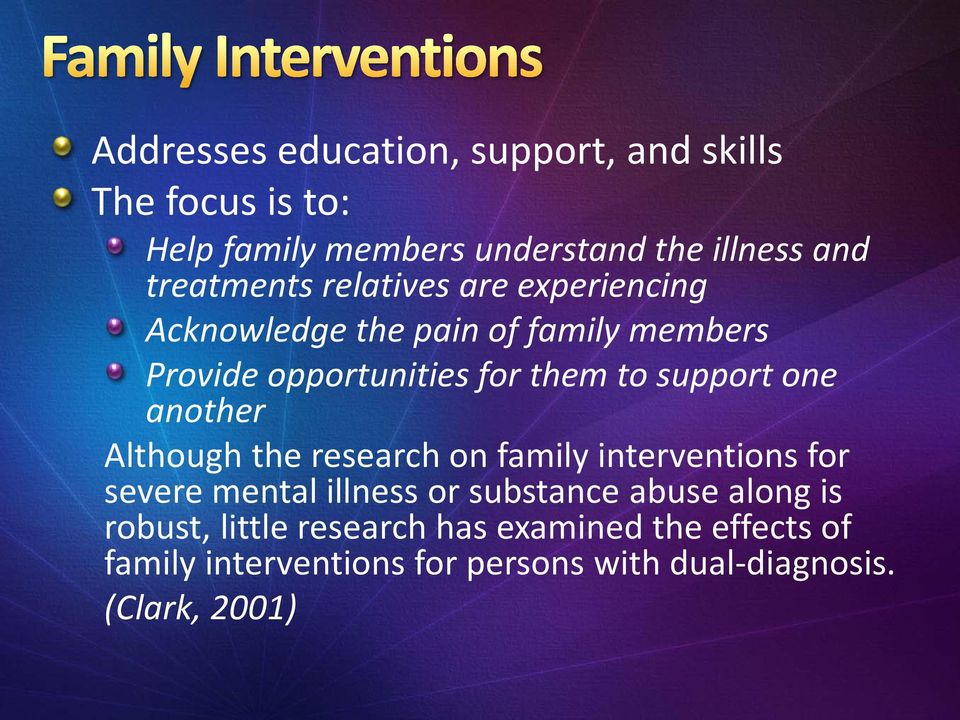
7 Addresses education, support, and skills The focus is to: Help family members understand the illness and treatments relatives are experiencing Acknowledge the pain of family members Provide opportunities for them to support one another Although the research on family interventions for severe mental illness or substance abuse along is robust, little research has examined the effects of family interventions for persons with dual-diagnosis. (Clark, 2001)
8 Involve changes in the organization of the healthcare system on how services (MH/SA) are delivered Most common approaches to delivering services include initiating assertive or intensive case management Previous studies of assertive community treatment indicate that people with dual diagnosis can benefit from assertive community treatment in terms of improving their residential stability and avoiding crises that lead to hospitalization and homelessness

9 Involves the systematic provision of incentives and/or disincentives for specific behaviors Have recently been used successfully to reduce illicit drug use among people with severe mental illness Contingent incentives have shown to reduce cigarette smoking among people with schizophrenia (Tidey, O Neill, & Higgins (2002)

10 Because substance abuse adversely impacts stable housing for person with dual disorders and is strongly associated with homelessness, integrated programs for people with dual disorders are increasingly common Highly supportive housing appears to be an important consideration, not only in achieving remissions but also in maintaining them (Drake, Wahach, & McGovern, 2005b)

11 Many studies, as well as, self-reports, suggest that people with dual diagnosis have difficulty in attaining and sustaining substance abuse remissions without changing their lives considerably in terms of developing new relationships and meaningful activities that do not involve substance use Rehabilitation interventions that address social and vocational functioning are therefore often incorporated into dual diagnosis programs, but there have been no controlled studies of standalong rehabilitation interventions

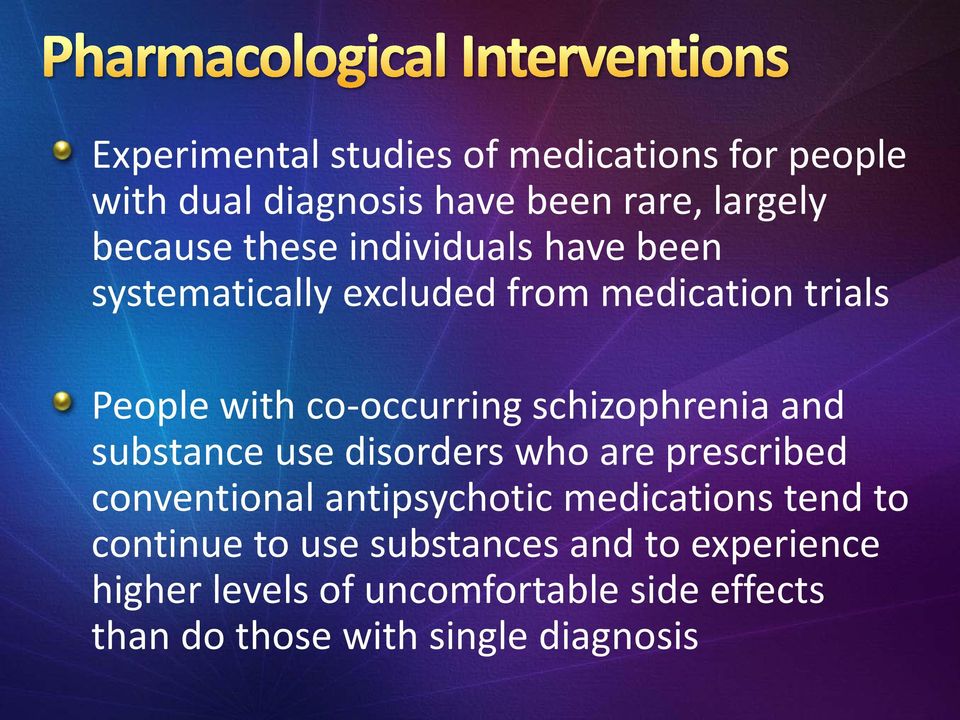
12 Experimental studies of medications for people with dual diagnosis have been rare, largely because these individuals have been systematically excluded from medication trials People with co-occurring schizophrenia and substance use disorders who are prescribed conventional antipsychotic medications tend to continue to use substances and to experience higher levels of uncomfortable side effects than do those with single diagnosis
13 Are commonly used with people who have dual disorders, in part because many are involved with the criminal justice system and under some sort of legal control or supervision Legal directives include incarcerations, conditions of probation, conditions of parole, involuntary hospitalization, outpatient commitments, coercive medication and guardianships for finances or other functions Given the frequency with which mandatory interventions are used for this population, remarkably few studies have addressed them.

14 Integrated Treatment Stagewise Treatments Engagement Interventions Motivational Interventions Active Treatment Interventions Relapse Prevention Interventions Long-Term Retention Comprehensive Services Interventions for Treatment Nonresponders

15 Integrated Treatment Combine and individually tailor the mental health and substance abuse interventions Stagewise Treatments Match treatments to the client s level of motivation and stage of recovery Long-term Retention Keep treatment, rehabilitation, and support available and easily accessible for as long as they need.

16 Comprehensive Services Address all areas of the individual s personal recovery Interventions for treatment nonresponders Provide different approaches to intervention for clients who are not making progress toward recovery

17 Book: ntegrated.html Video:

18

Treating Co-Occurring Disorders. Stevie Hansen, B.A., LCDC, NCACI Chief, Addiction Services
 Treating Co-Occurring Disorders Stevie Hansen, B.A., LCDC, NCACI Chief, Addiction Services Implementing SAMHSA Evidence-Based Practice Toolkits Integrated Dual Diagnosis Treatment (IDDT) Target group:
Integrated Treatment for Co-Occurring Disorders
 Integrated Treatment for Co-Occurring Disorders An Evidence-Based Practice What Are Evidence-Based Practices? Services that have consistently demonstrated their effectiveness in helping people with mental
information for service providers Schizophrenia & Substance Use
 information for service providers Schizophrenia & Substance Use Schizophrenia and Substance Use Index 2 2 3 5 6 7 8 9 How prevalent are substance use disorders among people with schizophrenia? How prevalent
MOVING TOWARD EVIDENCE-BASED PRACTICE FOR ADDICTION TREATMENT
 MOVING TOWARD EVIDENCE-BASED PRACTICE FOR ADDICTION TREATMENT June, 2014 Dean L. Babcock, LCAC, LCSW Associate Vice President Eskenazi Health Midtown Community Mental Health Centers Why is Evidence-Based
Evidence Based Approaches to Addiction and Mental Illness Treatment for Adults
 Evidence Based Practice Continuum Guidelines The Division of Behavioral Health strongly encourages behavioral health providers in Alaska to implement evidence based practices and effective program models.
Integrated Dual Disorder Treatment
 Integrated Dual Disorder Treatment In a (Dutch) rapid changing environment Strasbourg May 2010 Bas van der Hoorn [email protected] Who s talking? Psychiatrist Head of dual diagnosis treatment facility
2015 OPIOID TREATMENT PROGRAM DESCRIPTIONS
 2015 OPIOID TREATMENT PROGRAM PROGRAM DESCRIPTIONS Contents Opioid T reatment Program Core Program Standards... 2 Court Treatment (CT)... 2 Detoxification... 2 Day Treatment... 3 Health Home (HH)... 3
Outcomes for People on Allegheny County Community Treatment Teams
 Allegheny HealthChoices, Inc. Winter 2010 Outcomes for People on Allegheny County Community Treatment Teams Community Treatment Teams (CTTs) in Allegheny County work with people who have some of the most
Integrating Dual Diagnosis Treatment: Achieving Positive Public Safety and Public Health Outcomes for Offenders with Co- Occurring Disorders
 Integrating Dual Diagnosis Treatment: Achieving Positive Public Safety and Public Health Outcomes for Offenders with Co- Occurring Disorders Fred Osher, M.D. Director, Health Systems and Services Policy
Frequently Asked Questions (FAQs) of Drug Abuse Treatment for Criminal Justice Populations
 Frequently Asked Questions (FAQs) of Drug Abuse Treatment for Criminal Justice Populations From The National Institute on Drug Abuse (NIDA) 2. Why should drug abuse treatment be provided to offenders?
Contents Opioid Treatment Program Core Program Standards... 2
 2016 OPIOID TREATMENT PROGRAM PROGRAM DESCRIPTIONS Contents Opioid Treatment Program Core Program Standards... 2 Court Treatment (CT)... 2 Detoxification... 2 Day Treatment... 3 Health Home (HH)... 3 Integrated
American Society of Addiction Medicine
 American Society of Addiction Medicine Public Policy Statement on Treatment for Alcohol and Other Drug Addiction 1 I. General Definitions of Addiction Treatment Addiction Treatment is the use of any planned,
LEVEL III.5 SA: SHORT TERM RESIDENTIAL - Adult (DUAL DIAGNOSIS CAPABLE)
 LEVEL III.5 SA: SHT TERM RESIDENTIAL - Adult (DUAL DIAGNOSIS CAPABLE) Definition The following is based on the Adult Criteria of the Patient Placement Criteria for the Treatment of Substance-Related Disorders
Clinical Skills for Evidence-Based Substance Abuse Treatment Practices with Offenders. Treatment of Co-Occurring Disorders
 Clinical Skills for Evidence-Based Substance Abuse Treatment Practices with Offenders Treatment of Co-Occurring Disorders National TASC Conference, Columbus, Ohio; May 8, 2013 Roger H. Peters, Ph.D., University
Program of Assertive Community Services (PACT)
 Program of Assertive Community Services (PACT) Service/Program Definition Program of Assertive Community Services (PACT) entails the provision of an array of services delivered by a community-based, mobile,
4.401 Substance Use Partial Hospitalization Program (Adults and Adolescents)
 4.40 STRUCTURED DAY TREATMENT SERVICES 4.401 Substance Use Partial Hospitalization Program (Adults and Adolescents) Description of Services: Substance use partial hospitalization is a nonresidential treatment
WORKING WITH THE DUAL DIAGNOSED. Presenter Cherie A. Hunter Executive Director
 WORKING WITH THE DUAL DIAGNOSED Presenter Cherie A. Hunter Executive Director VIDEO Today s Overview : At the end of the workshop participants will be able to: 1 Review the Prevalence Data 2 Understand
Complete Program Listing
 Complete Program Listing Mental Health (MH) Services Division Adult Mental Health Outpatient Clinics - Provide outpatient mental health services to individuals 18 years and older who live with severe and
9/25/2015. Parallels between Treatment Models 2. Parallels between Treatment Models. Integrated Dual Disorder Treatment and Co-occurring Disorders
 Integrated Dual Disorder Treatment and Co-occurring Disorders RANDI TOLLIVER, PHD HEARTLAND HEALTH OUTREACH, INC. ILLINOIS ASSOCIATION OF PROBLEM-SOLVING COURTS OCTOBER 8, 2015 SPRINGFIELD, IL Parallels
What is CCS? Eligibility
 What is CCS? Department of Health Services Division of Mental Health and Substance Abuse Services Bureau of Prevention, Treatment and Recovery Services Comprehensive Community Services (CCS) Comprehensive
TREATMENT MODALITIES. May, 2013
 TREATMENT MODALITIES May, 2013 Treatment Modalities New York State Office of Alcoholism and Substance Abuse Services (NYS OASAS) regulates the addiction treatment modalities offered in New York State.
Mental Health Fact Sheet
 Mental Health Fact Sheet Substance Abuse and Treatment Branch (SATB), Community Supervision Services Re-Entry and Sanctions Center (RSC), Office of Community Justice Programs Adult Probationers / Parolees
Fairfax-Falls Church Community Services Board. 106-11-Alcohol and Drug Adult Day Treatment Services
 106-11-Alcohol and Drug Adult Day Treatment Services Fund/Agency: 106 Fairfax-Falls Church Community Services Board Personnel Services $1,480,282 Operating Expenses $288,147 Recovered Costs $0 Capital
Day Treatment Mental Health Adult
 Day Treatment Mental Health Adult Definition Day Treatment provides a community based, coordinated set of individualized treatment services to individuals with psychiatric disorders who are not able to
LEVEL II.1 SA: INTENSIVE OUTPATIENT - Adult
 LEVEL II.1 SA: INTENSIVE OUTPATIENT - Adult Definition The following is based on the Adult Criteria of the Patient Placement Criteria for the Treatment of Substance- Related Disorders of the American Society
OPTUM By United Behavioral Health OPTUM GUIDELINE EVIDENCE BASE: Level of Care Guidelines
 OPTUM By United Behavioral Health OPTUM GUIDELINE EVIDENCE BASE: Level of Care Guidelines Guideline Evaluation and Treatment Planning Discharge Planning Admission Criteria Continued Stay Criteria Discharge
Stopping the Revolving Door for Mentally Ill Offenders in the Criminal Justice System via Diversion and Re-entry Programs
 GEORGIA GEORGIA GEORGIA GEORGIA GEORGIA Department of Corrections ON THE MOVE Stopping the Revolving Door for Mentally Ill Offenders in the Criminal Justice System via Diversion and Re-entry Programs Academic
Working with young people who have mental health and substance use issues. Samar Zakaria
 Working with young people who have mental health and substance use issues. Samar Zakaria Main points Challenges faced while treating young adults in a dual diagnosis rehab unit Define dual diagnosis in
Assertive Community Treatment (ACT)
 Assertive Community Treatment (ACT) Definition The Assertive Community Treatment (ACT) Team provides high intensity services, and is available to provide treatment, rehabilitation, and support activities
2014 Quality Management Program Highlights
 2014 Quality Management Program Highlights March 2015 1 Table of Contents Quality Management Program Overview..... 3-4 Quality Committees. 5 Data Monitoring... 6 QM/UM Plan Highlights.. 7 Access to and
information for consumers Schizophrenia & Substance Use
 information for consumers Schizophrenia & Substance Use Schizophrenia and Substance Use Index 2 3 4 5 6 7 Why do people with schizophrenia use drugs and alcohol? How can using substances affect you if
A Breakthrough Approach to Integrating Substance Use and Mental Health Treatment. Susan Whitley, MD Director of Chemical Dependency Services
 A Breakthrough Approach to Integrating Substance Use and Mental Health Treatment Susan Whitley, MD Director of Chemical Dependency Services Date: September 17-21, 2012 In spite of the high percentage of
New Developments in Supported Employment San Francisco Behavioral Health Court
 New Developments in Supported Employment San Francisco Behavioral Health Court NADCP National Conference May 27, 2014 Lisa Lightman Kathleen Connolly Lacey, LCSW Gregory Jarasitis, MOT, OTR/L Goals of
Fairfax-Falls Church Community Services Board
 106-06-Mental Health Adult Residential Services Fund/Agency: 106 Fairfax-Falls Church Community Services Board Personnel Services $5,855,252 Operating Expenses $5,664,614 Recovered Costs $0 Capital Equipment
Dual Diagnosis. Location: VA Boston Healthcare System, Brockton Campus
 Track Director: Justin Enggasser, Ph.D. Psychology Service (116B) 940 Belmont Street Brockton, MA 02301 Telephone: (774) 826-1380 Email: [email protected] Dual Diagnosis Location: VA Boston Healthcare
CHAPTER 5. Rules and Regulations for Substance Abuse Standards. Special Populations for Substance Abuse Services
 CHAPTER 5 Rules and Regulations for Substance Abuse Standards Special Populations for Substance Abuse Services Section 1. Authority. These rules are promulgated by the Wyoming Department of Health pursuant
Texas Resilience and Recovery. Utilization Management Guidelines: Adult Mental Health Services
 Texas Resilience and Recovery Utilization Management Guidelines: Adult Mental Health Services Effective September 2015 Introduction Texas Resiliency and Recovery, or TRR is a term to describe the service
Federal Purpose Area 5 Drug Treatment Programs
 Federal Purpose Area 5 Drug Treatment Programs State Purpose Areas: 11F Mental Health Services 11F.01 Provide mental health services through various treatment modalities to a specified number of clients.
Dual Diagnosis and Integrated Treatment of Mental Illness and Substance Abuse Disorder
 Dual Diagnosis and Integrated Treatment of Mental Illness and Substance Abuse Disorder What are dual diagnosis services? Dual diagnosis services are treatments for people who suffer from co-occurring disorders
FRN Research Report March 2011: Correlation between Patient Relapse and Mental Illness Post-Treatment
 FRN Research Report March 2011: Correlation between Patient Relapse and Mental Illness Post-Treatment Background Studies show that more than 50% of patients who have been diagnosed with substance abuse
West Virginia Bureau for Behavioral Health and Health Facilities Covered Services 2012
 Assessment/Diagnostic & Treatment Services CATEGORY A & CATEGORY B Assessment/Diagnostic & Treatment Services are covered by Medicaid/Other third party payor or Charity Care - Medicaid Covered Services:
ASSERTIVE COMMUNITY TREATMENT (ACT) FIDELITY REPORT
 ASSERTIVE COMMUNITY TREATMENT (ACT) FIDELITY REPORT Date: August, 28 2015 To: Derrick Baker, Clinical Coordinator From: Jeni Serrano, BS T.J Eggsware, BSW, MA, LAC ADHS Fidelity Reviewers Method On August
Improving Service Delivery Through Administrative Data Integration and Analytics
 Improving Service Delivery Through Administrative Data Integration and Analytics Getty Images David Mancuso, PhD October 2, 2015 1 Analytics in the Social and Health Service Environment Program costs are
IMPLEMENTING SAMHSA EVIDENCE-BASED PRACTICE TOOLKITS. Integrated Dual Diagnosis Treatment (IDDT)
 This is a DRAFT summary of evidence supporting the IDDT model. It is one of a series of evidence summaries CIMH is creating. IMPLEMENTING SAMHSA EVIDENCE-BASED PRACTICE TOOLKITS Brief description of the
Appendix D. Behavioral Health Partnership. Adolescent/Adult Substance Abuse Guidelines
 Appendix D Behavioral Health Partnership Adolescent/Adult Substance Abuse Guidelines Handbook for Providers 92 ASAM CRITERIA The CT BHP utilizes the ASAM PPC-2R criteria for rendering decisions regarding
Integrated Dual Disorder Treatment (IDDT)
 Integrated Dual Disorder Treatment (IDDT) Jeff Stenseth Assistant Regional Director Southeast Human Service Center Department of Human Services Commission on Alternatives to Incarceration 9-13-2012 *Source:
Welcome. This presentation is designed for people working in criminal justice and drug abuse treatment settings. It provides an overview of drug
 Welcome. This presentation is designed for people working in criminal justice and drug abuse treatment settings. It provides an overview of drug abuse treatment principles for individuals involved in the
Mental Health 101 for Criminal Justice Professionals David A. D Amora, M.S.
 Mental Health 101 for Criminal Justice Professionals David A. D Amora, M.S. Director, National Initiatives, Council of State Governments Justice Center Today s Presentation The Behavioral Health System
UTAH DIVISION OF SUBSTANCE ABUSE AND MENTAL HEALTH SUBSTANCE USE DISORDER SERVICES MONITORING CHECKLIST (FY 2014) GENERAL PROGRAM REQUIREMENTS
 UTAH DIVISION OF SUBSTANCE ABUSE AND MENTAL HEALTH SUBSTANCE USE DISORDER SERVICES MONITORING CHECKLIST (FY 2014) Program Name Reviewer Name Date(s) of Review GENERAL PROGRAM REQUIREMENTS 2014 Division
ASSERTIVE COMMUNITY TREATMENT (ACT) FIDELITY REPORT
 ASSERTIVE COMMUNITY TREATMENT (ACT) FIDELITY REPORT Date: /4/201 To: Todd Andre, Clinical Director Stacey Byers, Clinical Coordinator Candise Sorensen, Site Administrator From: Georgia Harris, MAEd Karen
PERFORMANCE MEASURES FOR SUBSTANCE USE DISORDERS: CURRENT KNOWLEDGE AND KEY QUESTIONS
 PERFORMANCE MEASURES FOR SUBSTANCE USE DISORDERS: CURRENT KNOWLEDGE AND KEY QUESTIONS Deborah Garnick Constance Horgan Andrea Acevedo, The Heller School for Social Policy and Management, Brandeis University
Client Population Statistics
 Client Population Statistics Fiscal Year 6-7 Introduction On the following pages, the reader will find information about the client population that Daytop served during the fiscal year 6-7 in its diverse
RECOVERY HOUSING POLICY BRIEF
 I. Introduction and Intent As communities implement strategies to end homelessness, they need to be able to provide effective housing and services options for people experiencing homelessness who have
Financing Systems: Leveraging Funds to Support a Comprehensive Program
 Financing Systems: Leveraging Funds to Support a Comprehensive Program National Association of County Governments Jail Diversion Educational Forum October 1, 2009 Leon Evans President and Chief Executive
Telecare Corporation A GUIDE TO OUR SERVICES. Our Background. Our Clients
 Our Background is one of the nation s largest providers of services and supports to individuals with serious mental illness (SMI). Our Clients Telecare s clients are typically adults (18-55), older adults
Minnesota Co-occurring Mental Health & Substance Disorders Competencies:
 Minnesota Co-occurring Mental Health & Substance Disorders Competencies: This document was developed by the Minnesota Department of Human Services over the course of a series of public input meetings held
WITH OVER 20 YEARS OF EXPERIENCE, Unity Chemical Dependency is the Rochester area s most experienced and comprehensive treatment provider.
 WITH OVER 20 YEARS OF EXPERIENCE, Unity Chemical Dependency is the Rochester area s most experienced and comprehensive treatment provider. Our highly trained and dedicated team of counselors and physicians
MENTAL ILLNESS AND SUBSTANCE ABUSE
 MENTAL ILLNESS AND SUBSTANCE ABUSE PROBLEM What is the problem for Dallas County? Individuals with co-existing conditions of mental illness and substance abuse are a great burden on the mental health system,
SUBSTANCE ABUSE OUTPATIENT
 SUBSTANCE ABUSE OUTPATIENT Service Category Description Substance abuse services - outpatient is the provision of medical or other treatment and/or counseling to address substance abuse problems (i.e.,
THE INTEGRATED DUAL DIAGNOSIS TREATMENT PROGRAM OF VENTURA COUNTY BEHAVIORAL HEALTH. Presented by Linda Gertson, Ph.D. Behavioral Health Manager
 THE INTEGRATED DUAL DIAGNOSIS TREATMENT PROGRAM OF VENTURA COUNTY BEHAVIORAL HEALTH Presented by Linda Gertson, Ph.D. Behavioral Health Manager The California Institute of Mental Health (CIMH) was awarded
Subacute Inpatient MH - Adult
 Subacute Inpatient MH - Adult Definition Subacute Inpatient hospital psychiatric services are medically necessary short-term psychiatric services provided to a client with a primary psychiatric diagnosis
Performance Standards
 Performance Standards Co-Occurring Disorder Competency Performance Standards are intended to provide a foundation and serve as a tool to promote continuous quality improvement and progression toward best
Alcohol and Drug Abuse Treatment Centers
 Division of State Operated Healthcare Facilities Alcohol and Drug Abuse Treatment Centers Jenny Wood Interim ADATC Team Leader HHS LOC Mental Health Subcommittee February 24, 2014 ADATC Locations R.J.
Crisis Services and Psychiatric Hospitalization
 Mental Health Services GUIDE FOR wake county residents NAMI Wake Contact Information: Ann Akland www.nami-wake.org (919) 848-4490 Crisis Services and Psychiatric Hospitalization Emergency: Call 911 & ask
Mental Health and Substance Abuse Reporting Requirements Section 425 of P.A. 154 of 2005
 Mental Health and Substance Abuse Reporting Requirements Section 425 of P.A. 154 of 2005 By April 1, 2006, the Department, in conjunction with the Department of Corrections, shall report the following
A Resource for Public Defenders Representing U.S. Veteran Clients
 A Resource for Public Defenders Representing U.S. Veteran Clients Information generously provided to the Louisiana Public Defender Board by the Louisiana Department of Veterans Affairs (November 2010)
DDCAT Rating Scale Cover Sheet
 Cover Sheet Program Identification Date Rater(s) Time Spent (Hours) Agency Name Program Name Address Zip Code Contact Person 1) 2) Telephone FAX Email State Region Program ID Time Period 1= Baseline; 2
Kenneth Minkoff, MD 100 Powdermill Road, Box 319 Acton, MA 01720 781-932-8792x311 [email protected]
 Kenneth Minkoff, MD 100 Powdermill Road, Box 319 Acton, MA 01720 781-932-8792x311 [email protected] COMPREHENSIVE, CONTINUOUS, INTEGRATED SYSTEM OF CARE MODEL The Comprehensive, Continuous, Integrated System
LEVEL I SA: OUTPATIENT INDIVIDUAL THERAPY - Adult
 LEVEL I SA: OUTPATIENT INDIVIDUAL THERAPY - Adult Definition The following is based on the Adult Criteria of the Patient Placement Criteria for the Treatment of Substance-Related Disorders of the American
Psychiatric Rehabilitation Services
 DEFINITION Psychiatric or Psychosocial Rehabilitation Services provide skill building, peer support, and other supports and services to help adults with serious and persistent mental illness reduce symptoms,
CLINICAL PRACTICE GUIDELINES Treatment of Schizophrenia
 CLINICAL PRACTICE GUIDELINES Treatment of Schizophrenia V. Service Delivery Service Delivery and the Treatment System General Principles 1. All patients should have access to a comprehensive continuum
Optum By United Behavioral Health. 2015 Mississippi Coordinated Access Network (CAN) Medicaid Level of Care Guidelines
 Optum By United Behavioral Health 2015 Mississippi Coordinated Access Network (CAN) Medicaid Level of Care Guidelines Assertive Community Treatment is a multi-disciplinary, selfcontained clinical team
Attachment EE - Grant Application RSAT Aftercare
 Attachment EE - Grant Application RSAT Aftercare Residential Substance Abuse Treatment (RSAT) for State Prisoners Program CFDA #16.593 Statement of the Problem The Maryland Department of Public Safety
Topics In Addictions and Mental Health: Concurrent disorders and Community resources. Laurence Bosley, MD, FRCPC
 Topics In Addictions and Mental Health: Concurrent disorders and Community resources Laurence Bosley, MD, FRCPC Overview Understanding concurrent disorders. Developing approaches to treatment Definitions
Physician s Signature
 4. If testing for illegal substances (blood or urinalysis) is recommended: a) Does this respondent/patient have a history of substance abuse that is clinically related to his/her mental illness? If yes,
Integrated Dual Diagnosis Treatment Stagewise Treatment Interventions and Activities
 Integrated Dual Diagnosis Treatment Stagewise Treatment Interventions and Activities Dartmouth Dual Diagnosis Treatment Scale Evidenced Based Interventions Stage-Wise Activities for Case Managers Activities
PERFORMANCE STANDARDS DRUG AND ALCOHOL PARTIAL HOSPITALIZATION PROGRAM. Final Updated 04/17/03
 PERFORMANCE STANDARDS DRUG AND ALCOHOL PARTIAL HOSPITALIZATION PROGRAM Final Updated 04/17/03 Community Care is committed to developing performance standards for specific levels of care in an effort to
information for families Schizophrenia & Substance Use
 information for families Schizophrenia & Substance Use Schizophrenia and Substance Use Index 2 3 5 6 7 8 9 10 Why do people with schizophrenia use drugs and alcohol? What is the impact of using substances
Treatment for Co occurring Disorders
 Wisconsin Public Psychiatry Network Teleconference (WPPNT) This teleconference is brought to you by the Wisconsin Department of Health Services (DHS) Bureau of Prevention, Treatment, and Recovery and the
Psychiatric Residential Treatment Facility (PRTF): Aligning Care Efficiencies with Effective Treatment. BHM Healthcare Solutions 2013 1
 Psychiatric Residential Treatment Facility (PRTF): Aligning Care Efficiencies with Effective Treatment 1 Presentation Objectives Attendees will have a thorough understanding of Psychiatric Residential
Certified Criminal Justice Professional (CCJP) Appendix B
 Certified Criminal Justice Professional (CCJP) Appendix B Appendix B Certified Criminal Justice Professional (CCJP) Performance Domains and Job Tasks Domain I: Dynamics of Addiction and Criminal Behavior
Behavioral Health Services for Adults Program Capacity Eligibility Description of Services Funding Dosage Phase I 33 hours
 Outpatient Substance Abuse Recovery (OSARP) Dual Diagnosis Behavioral Health Services for Adults Capacity Eligibility Description of Services Funding Dosage 35 at any Adults with Phase I 33 hours point
Counselors are standing by 24/7 waiting for your free call 1-800-861-1768 thewatershed.com
 Counselors are standing by 24/7 waiting for your free call 1-800-861-1768 thewatershed.com Believe Again in Life. In The future. In Yourself. At The Watershed, our passion is helping addicts and alcoholics
Effective Intervention Strategies for Offenders with Co-Occurring Mental and Substance Use Disorders
 Effective Intervention Strategies for Offenders with Co-Occurring Mental and Substance Use Disorders Utah Fall Substance Abuse Conference Act, St. George, Utah September 24, 2014 Roger H. Peters, Ph.D.,
Date: Rater(s): Time Spent (Hours): Agency Name: Program Name: Address: Contact Person: 1) ; 2) Telephone: ; FAX: ; Email:
 Program Identification DUAL DIAGNOSIS CAPABILITY IN MENTAL HEALTH TREATMENT (MHT) VERSION 3.2 (Gotham, H. J., Brown, J. L., Comaty, J. E., & McGovern, M. P.) RATING SCALE COVER SHEET Date: Rater(s): Time
TABLE OF CONTENTS 2 10 QUESTIONS TO ASK
 TABLE OF CONTENTS Do You Offer Treatment Programs for People Who Have a Dual-Diagnosis Disorder? What Role Will My Family Play in the Rehabilitative Process? Do You Have Medical Personnel Available to
Treatment of Alcoholism
 Treatment of Alcoholism Why is it important Prevents further to body by getting people off alcohol. Can prevent death. Helps keep health insurance down. Provides assistance so alcoholics don t t have to
3.1 TWELVE CORE FUNCTIONS OF THE CERTIFIED COUNSELLOR
 3.1 TWELVE CORE FUNCTIONS OF THE CERTIFIED COUNSELLOR The Case Presentation Method is based on the Twelve Core Functions. Scores on the CPM are based on the for each core function. The counsellor must