
The Dual Diagnosis Capability in Mental Health Treatment (DDCMHT) Index
|
|
|
- Annabel Stokes
- 10 years ago
- Views:
Transcription
1 The Dual Diagnosis Capability in Mental Health Treatment (DDCMHT) Index Heather J. Gotham, PhD, 1 Jessica L. Brown, PhD, 2 Joseph E. Comaty, PhD, MP, 2,3 Mark McGovern, PhD 4 & Ronald E. Claus, PhD 5 1 Mid-America ATTC, University of Missouri-Kansas City 2 Louisiana Department of Health and Hospitals 3 Dept. of Psychology, Louisiana State University 4 Dartmouth Medical School 5 Missouri Institute of Mental Health AHSR 2009

2 Addiction services in mental health Addiction health services are provided in diverse settings such as primary care, corrections, and mental health. In fact, clients with co-occurring substance use and mental health disorders present most frequently to mental health programs.

3 Past Year Mental Health Care among Adults Aged 18 or Older with Both Serious Psychological Distress and a Substance Use Disorder: 2007 SAMHSA. (2008). Results from the 2007 national survey on drug use and health: National findings (Office of Applied Studies, NSDUH Series H-34, DHHS Publication No. SMA ). Rockville, MD.

4 The Dual Diagnosis Capability in Mental Health Treatment (DDCMHT) Index Need for fidelity/capability tools for COD in Mental Health settings Assess COD capability of mental health programs that are not specifically implementing IDDT Need to compare capability across primary mental health and addiction treatment programs Parallel instrument to the Dual Diagnosis Capability in Addiction Treatment (DDCAT) Index Began by revising DDCAT items into mental health terms Then further refined items to fit mental health treatment settings

5 Current Study Goals Examine the DDCMHT s reliability and validity Describe mental health program capability across six states

6 Method Three data sources Combined data of 67 agencies across 6 states from a Robert Wood Johnson grant Inter-rater reliability data from Louisiana COSIG project DDCMHT and IDDT scores from Missouri COSIG and Missouri Foundation for Health projects Like the DDCAT, the DDCMHT s 35 items are rated following a treatment program site visit Ethnographic observation Structured interviews with agency directors and staff Document review

7 DDCMHT: 7 DIMENSIONS, 35 ITEMS Dimension Content of items I Program Structure Program mission, structure and financing, format for delivery of substance abuse services. II Program Milieu Physical, social and cultural environment for persons with substance use disorders. III IV Clinical Process: Assessment Clinical Process: Treatment Processes for access and entry into services, screening, assessment & diagnosis. Processes for treatment including pharmacological and psychosocial evidence-based formats. V Continuity of Care Discharge and continuity for both substance use and psychiatric services, peer recovery supports. VI Staffing Presence, role and integration of staff with substance abuse treatment expertise, supervision process VII Training Proportion of staff trained and program s training strategy for co-occurring disorder issues.

8 DDCMHT INDEX RATINGS Mental Health Only Services (MHOS) serve clients with no or minimal co-occurring disorders Dual Diagnosis Capable (DDC) serve clients with low severity substance use Dual Diagnosis Enhanced (DDE) serve clients with more severe, unstable substance use disorders

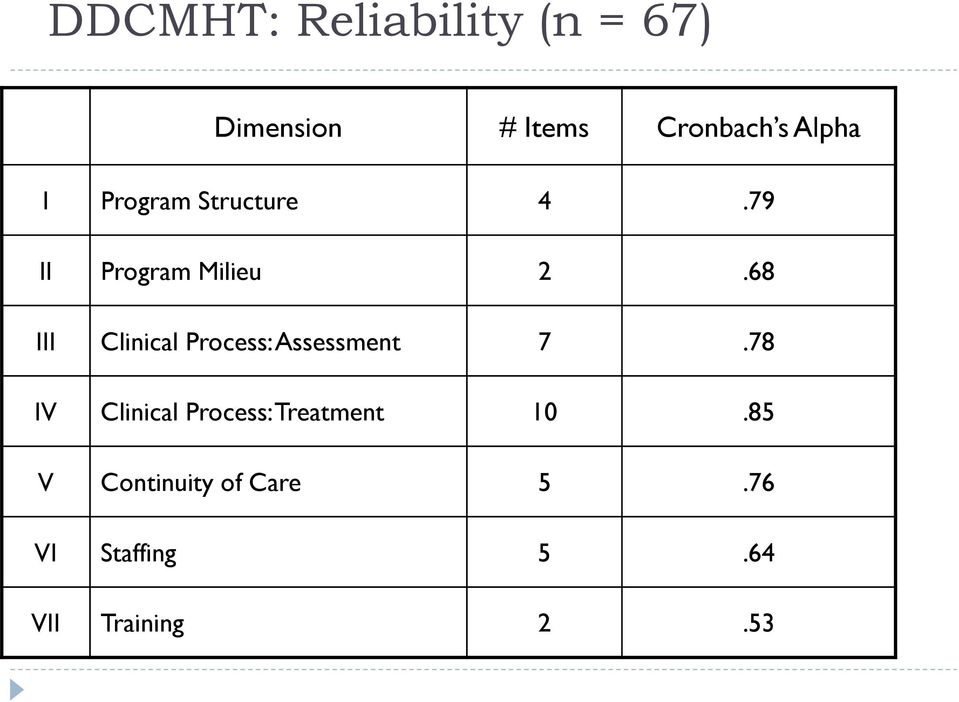
9 DDCMHT: Reliability (n = 67) Dimension # Items Cronbach s Alpha I Program Structure 4.79 II Program Milieu 2.68 III Clinical Process: Assessment 7.78 IV Clinical Process: Treatment V Continuity of Care 5.76 VI Staffing 5.64 VII Training 2.53
10 Inter-rater Reliability Louisiana COSIG study Brown & Comaty, mental health sites, 17 addiction sites 3 raters per site DDCMHT (N=527 total expected observations) ICC(2,1) =.829 (95% Confidence Interval ) DDCAT (N=388 total expected observations) ICC(2,1) =.843 (95% Confidence Interval )

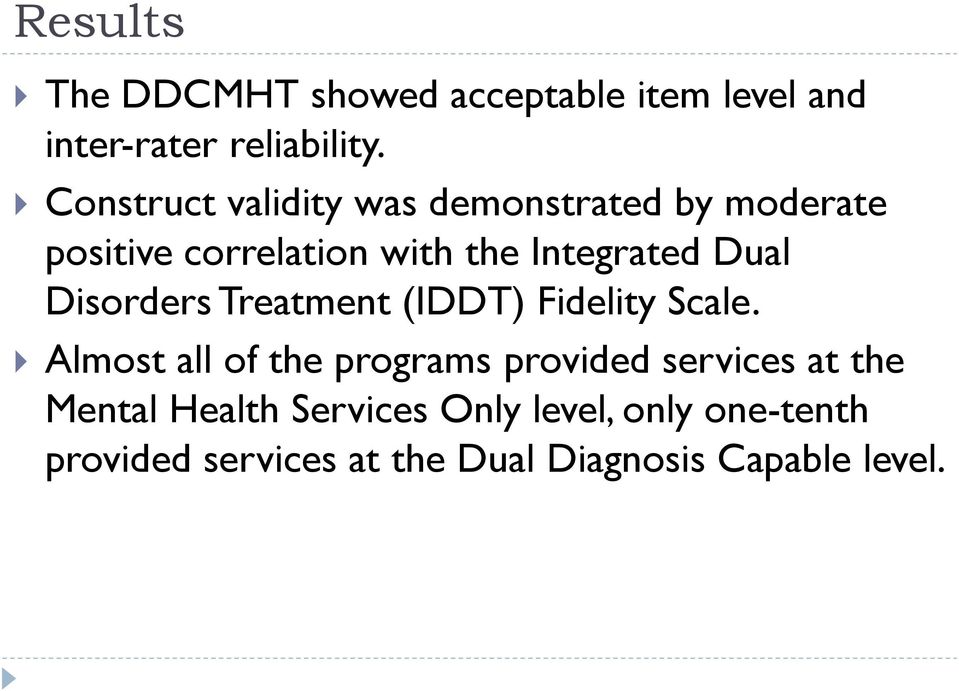
11 Construct Validity Construct validity was demonstrated by a large positive correlation with the Integrated Dual Disorders Treatment (IDDT) Fidelity Scale. Missouri COSIG and Missouri Foundation for Health data 22 mental health treatment sites across the state IDDT Fidelity Scale Total Score and DDCMHT Total Score, r =.70

12 DDCMHT (N=67) - Program Characteristics Sites across 6 states (1 23 per state) 66 of 67 are not-for-profit 61 only offer outpatient services (the other 6 offer a combination of outpatient, partial hospital, or inpatient) Most sites are general programs; 2 focus on adolescents, 1 focuses on clients with HIV 62% are time-unlimited programs

13 DDCMHT PROGRAM CATEGORIES: FIVE STATE SUMMARY (n=67) Criterion method: 80% or more items meet that level

14 DDCMHT PROGRAM CATEGORIES FIVE STATE SUMMARY (n=67) Scale method: based on overall score
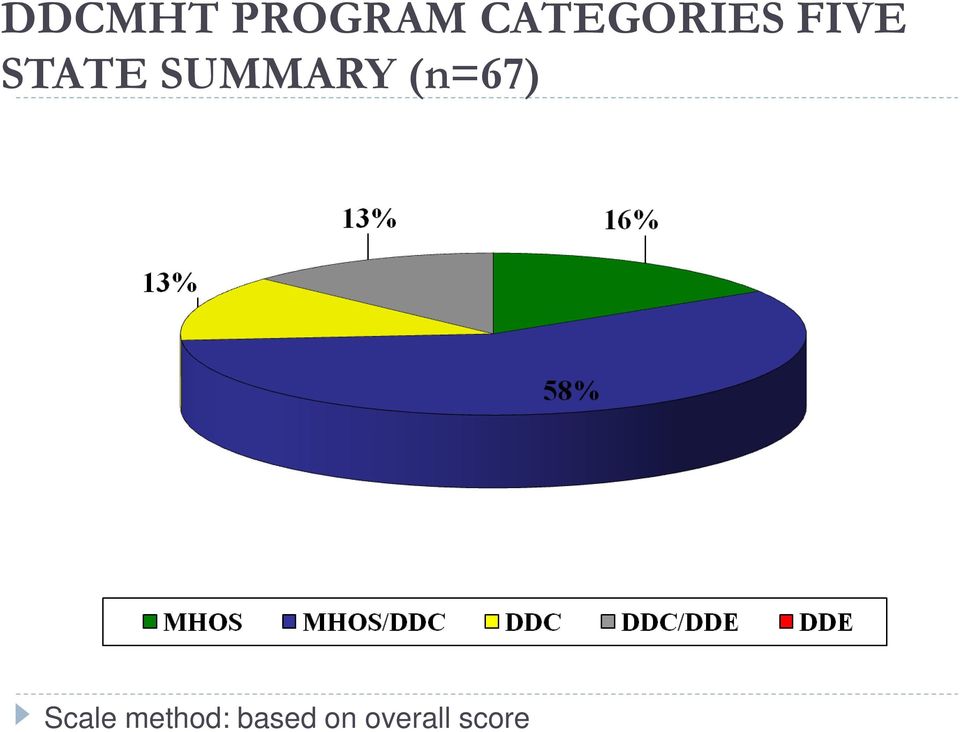
15 Results The DDCMHT showed acceptable item level and inter-rater reliability. Construct validity was demonstrated by moderate positive correlation with the Integrated Dual Disorders Treatment (IDDT) Fidelity Scale. Almost all of the programs provided services at the Mental Health Services Only level, only one-tenth provided services at the Dual Diagnosis Capable level.
16 Conclusions Data across several states suggest that many mental health programs are at a relatively low level of capability Results from this important new tool, the DDCMHT, can be used with programs in implementation planning and with states or nationally to affect policy change DDCMHT Index and Scoring Manual are available for download at:

17 Contact Heather J. Gotham, PhD Jessica Brown, PhD Joseph Comaty, PhD, MP Mark P. McGovern, PhD edu Ronald E. Claus, PhD This work was supported by SAMHSA/CSAT Grant TI15347, Robert Wood Johnson Foundation Substance Abuse Policy Research Program 63110, and the Missouri Foundation for Health (a philanthropic organization whose vision is to improve the health of the people in the community it services)
9/25/2015. Parallels between Treatment Models 2. Parallels between Treatment Models. Integrated Dual Disorder Treatment and Co-occurring Disorders
 Integrated Dual Disorder Treatment and Co-occurring Disorders RANDI TOLLIVER, PHD HEARTLAND HEALTH OUTREACH, INC. ILLINOIS ASSOCIATION OF PROBLEM-SOLVING COURTS OCTOBER 8, 2015 SPRINGFIELD, IL Parallels
Building the Continuum of Integrated Treatment for Co-Occurring Disorders 2015 AMHCA CONFERENCE PHILADELPHIA, PA
 Building the Continuum of Integrated Treatment for Co-Occurring Disorders 2015 AMHCA CONFERENCE PHILADELPHIA, PA 1 THE AFFORDABLE CARE ACT The Patient Protection and Affordable Care Act (ACA) aims to expand
DDCAT Top Rating Shows Ongoing Commitment to Superior Services
 FRN Research Report: July 2013 DDCAT Top Rating Shows Ongoing Commitment to Superior Services Background Foundations Recovery Network, headquartered in Nashville, Tenn., operates nine addiction treatment
Date: Rater(s): Time Spent (Hours): Agency Name: Program Name: Address: Contact Person: 1) ; 2) Telephone: ; FAX: ; Email:
 Program Identification DUAL DIAGNOSIS CAPABILITY IN MENTAL HEALTH TREATMENT (MHT) VERSION 3.2 (Gotham, H. J., Brown, J. L., Comaty, J. E., & McGovern, M. P.) RATING SCALE COVER SHEET Date: Rater(s): Time
DDCMHT. Dual Diagnosis Capability in Mental Health Treatment (DDCMHT) Toolkit. Version 4.0
 Dual Diagnosis Capability in Mental Health Treatment (DDCMHT) Toolkit Version 4.0 U.S. DEPARTMENT OF HEALTH AND HUMAN SERVICES Substance Abuse and Mental Health Services Administration Center for Mental
DDCAT Rating Scale Cover Sheet
 Cover Sheet Program Identification Date Rater(s) Time Spent (Hours) Agency Name Program Name Address Zip Code Contact Person 1) 2) Telephone FAX Email State Region Program ID Time Period 1= Baseline; 2
Q&A. What Are Co-occurring Disorders?
 What Are Co-occurring Disorders? Some people suffer from a psychiatric or mental health disorder (such as depression, an anxiety disorder, bipolar disorder, or a mood or adjustment disorder) along with
DUAL DIAGNOSIS CAPABILITY IN ADDICTION TREATMENT (DDCAT) VERSION 3.2 RATING SCALE COVER SHEET
 DUAL DIAGNOSIS CAPABILITY IN ADDICTION TREATMENT (DDCAT) VERSION 3.2 Program Identification RATING SCALE COVER SHEET Date: Rater(s): Time Spent (Hours): Agency Name: Program Name: Address: Zip Code: Contact
Dual Diagnosis Capability in Addiction Treatment (DDCAT) Toolkit. Version 4.0 DDCAT
 Dual Diagnosis Capability in Addiction Treatment (DDCAT) Toolkit Version 4.0 DDCAT Dual Diagnosis Capability in Addiction Treatment Toolkit Acknowledgements This document was produced for the Substance
CEIC Training Resource Guide
 CEIC Training Resource Guide DDCAT/DDCMHT Program Structure Module 1 Introduction Module 2 Implementing COD Treatment Module 24 Philosophy and Perspectives of Recovery Module 29 Integrating Medical, Psychiatric
Benefits of Dual Diagnosis Treatment: 2013 Patient Outcomes for Substance Use and Mental Health Disorders. FRN Research Report March/April 2014
 Benefits of Dual Diagnosis Treatment: 2013 Patient Outcomes for Substance Use and Mental Health Disorders FRN Research Report March/April 2014 Introduction New attitudes about substance abuse are shining
DDCAT. The Dual Diagnosis Capability in Addiction Treatment (DDCAT) Index. A Toolkit for enhancing ADDICTION ONLY SERVICE (AOS) PROGRAMS.
 DDCAT The Dual Diagnosis Capability in Addiction Treatment (DDCAT) Index A Toolkit for enhancing ADDICTION ONLY SERVICE (AOS) PROGRAMS And DUAL DIAGNOSIS CAPABLE (DDC) PROGRAMS Version 3.2-CT January 2010
Dual Diagnosis Enhanced Programs
 Dual Diagnosis Enhanced Programs Kenneth Minkoff, MD In 2001, the American Society of Addiction Medicine Patient Placement Criteria, Second Edition, Revised (ASAM PPC-2R) (American Society of Addiction
A Breakthrough Approach to Integrating Substance Use and Mental Health Treatment. Susan Whitley, MD Director of Chemical Dependency Services
 A Breakthrough Approach to Integrating Substance Use and Mental Health Treatment Susan Whitley, MD Director of Chemical Dependency Services Date: September 17-21, 2012 In spite of the high percentage of
DDCAT. The Dual Diagnosis Capability in Addiction Treatment (DDCAT) Index Toolkit. Adapted for use in the
 DDCAT The Dual Diagnosis Capability in Addiction Treatment (DDCAT) Index Toolkit Adapted for use in the Improved Services for People with Drug and Alcohol Problems and Mental Illness Initiative for the
Dual Diagnosis Capability in Heath Care Settings (DDCHCS) Toolkit
 Dual Diagnosis Capability in Heath Care Settings (DDCHCS) Toolkit Dual Diagnosis Capability in Health Care Settings Toolkit Acknowledgements This document was produced for the Substance Abuse and Mental
Clinical Perspective on Continuum of Care in Co-Occurring Addiction and Severe Mental Illness. Oleg D. Tarkovsky, MA, LCPC
 Clinical Perspective on Continuum of Care in Co-Occurring Addiction and Severe Mental Illness Oleg D. Tarkovsky, MA, LCPC SAMHSA Definition Co-occurring disorders may include any combination of two or
Minnesota Co-occurring Mental Health & Substance Disorders Competencies:
 Minnesota Co-occurring Mental Health & Substance Disorders Competencies: This document was developed by the Minnesota Department of Human Services over the course of a series of public input meetings held
DDCAT. The Dual Diagnosis Capability in Addiction Treatment (DDCAT) Index. A Toolkit for enhancing ADDICTION ONLY SERVICE (AOS) PROGRAMS.
 DDCAT The Dual Diagnosis Capability in Addiction Treatment (DDCAT) Index A Toolkit for enhancing ADDICTION ONLY SERVICE (AOS) PROGRAMS And DUAL DIAGNOSIS CAPABLE (DDC) PROGRAMS Version 2.0 December 2006
Appendix D. Behavioral Health Partnership. Adolescent/Adult Substance Abuse Guidelines
 Appendix D Behavioral Health Partnership Adolescent/Adult Substance Abuse Guidelines Handbook for Providers 92 ASAM CRITERIA The CT BHP utilizes the ASAM PPC-2R criteria for rendering decisions regarding
FOCUS ON INTEGRATED TREATMENT COURSE OBJECTIVES
 FOCUS ON INTEGRATED TREATMENT COURSE OBJECTIVES INDEX FIT The Complete Program Pages 2-6 FIT Complete Clinician Collection Pages 7-11 FIT Screening & Assessment Page 12 FIT Motivational Interviewing Page
Outcomes for Opiate Users at FRN Facilities. FRN Research Report September 2014
 Outcomes for Opiate Users at FRN Facilities FRN Research Report September 2014 Introduction The illicit use of opioids has reached epidemic proportions in the United States (Alford, 2007; Meges et al,
PROGRAM GUIDELINES FOR DOCTORAL TRAINING IN CLINICAL PSYCHOLOGY
 Diagnostic Practicum, Therapy Practicum, Advanced Therapy Practicum, Internship, Post-Doctoral Fellowship Gateway Foundation Chicago West 3828 W. Taylor St. Chicago, IL 60624 John M. Fusco, Psy.D., M.Div.,
ASSERTIVE COMMUNITY TREATMENT (ACT) FIDELITY REPORT
 ASSERTIVE COMMUNITY TREATMENT (ACT) FIDELITY REPORT Date: /4/201 To: Todd Andre, Clinical Director Stacey Byers, Clinical Coordinator Candise Sorensen, Site Administrator From: Georgia Harris, MAEd Karen
Performance Standards
 Performance Standards Co-Occurring Disorder Competency Performance Standards are intended to provide a foundation and serve as a tool to promote continuous quality improvement and progression toward best
ADOLESCENT CO-OCCURRING DISORDERS: TREATMENT TRENDS AND GUIDELINES AMANDA ALKEMA, LCSW BECKY KING, LCSW ERIC TADEHARA, LCSW
 ADOLESCENT CO-OCCURRING DISORDERS: TREATMENT TRENDS AND GUIDELINES AMANDA ALKEMA, LCSW BECKY KING, LCSW ERIC TADEHARA, LCSW INTRODUCTION OBJECTIVES National and Utah Statistics Best Practice Guidelines
Thursday September 23 rd 11:30 AM to 12.45 PM Kerhonkson, New York.
 NYAPRS 28 TH Annual Conference Integrating Mental Health and Addiction Recovery into our Lives and Systems Presenter: John Challis B.A., B.S.W., Dip Teach. Director of Technical Assistance Thursday September
Co-occurring Disorder Treatment for Substance Abuse and Compulsive Gambling
 Co-occurring Disorder Treatment for Substance Abuse and Compulsive Gambling Midwest Conference on Problem Gambling and Substance Abuse 2006 Problem Gambling and Co-occurrence: Improving Practice and Managing
FRN Research Report March 2011: Correlation between Patient Relapse and Mental Illness Post-Treatment
 FRN Research Report March 2011: Correlation between Patient Relapse and Mental Illness Post-Treatment Background Studies show that more than 50% of patients who have been diagnosed with substance abuse
Model Scopes of Practice & Career Ladder for Substance Use Disorder Counseling
 Model Scopes of Practice & Career Ladder for Substance Use Disorder Counseling February 2011 Background and Introduction Treatment of substance use disorders (SUD) is recognized as a multidisciplinary
How to Use. The Treatment of Depression in Older Adults Evidence-Based Practices KITs. The Treatment of Depression in Older Adults
 How to Use The Treatment of Depression in Older Adults Evidence-Based Practices KITs The Treatment of Depression in Older Adults How to Use The Treatment of Depression in Older Adults Evidence-Based Practices
Clinical Criteria 4.201 Inpatient Medical Withdrawal Management 4.201 Substance Use Inpatient Withdrawal Management (Adults and Adolescents)
 4.201 Inpatient Medical Withdrawal Management 4.201 Substance Use Inpatient Withdrawal Management (Adults and Adolescents) Description of Services: Inpatient withdrawal management is comprised of services
IMPLEMENTING SAMHSA EVIDENCE-BASED PRACTICE TOOLKITS. Integrated Dual Diagnosis Treatment (IDDT)
 This is a DRAFT summary of evidence supporting the IDDT model. It is one of a series of evidence summaries CIMH is creating. IMPLEMENTING SAMHSA EVIDENCE-BASED PRACTICE TOOLKITS Brief description of the
Attitudes toward evidence-based pharmacological treatments among community-based addiction treatment programs targeting vulnerable patient groups
 Attitudes toward evidence-based pharmacological treatments among community-based addiction treatment programs targeting vulnerable patient groups Center for Addictions Research and Services, Boston University
Integrated Dual Disorder Treatment (IDDT)
 Integrated Dual Disorder Treatment (IDDT) Jeff Stenseth Assistant Regional Director Southeast Human Service Center Department of Human Services Commission on Alternatives to Incarceration 9-13-2012 *Source:
States In Brief Substance Abuse and Mental Health Issues At-A-Glance
 virginia States In Brief Substance Abuse and Mental Health Issues At-A-Glance a Short report from the Office of applied Studies Prevalence of Illicit Substance 1 and Alcohol Use The National Survey on
4.401 Substance Use Partial Hospitalization Program (Adults and Adolescents)
 4.40 STRUCTURED DAY TREATMENT SERVICES 4.401 Substance Use Partial Hospitalization Program (Adults and Adolescents) Description of Services: Substance use partial hospitalization is a nonresidential treatment
CAADE s Tiered System and the SAMHSA Career Ladder/Scopes of Practice
 CAADE s Tiered System and the SAMHSA Career Ladder/Scopes of Practice Addiction Studies Programs in California Colleges and Universities http://caade.org/caade-colleges-and-universities Standardized College/University
Certified Addiction Counselor INTERNSHIP PROGRAM
 Certified Addiction Counselor INTERNSHIP PROGRAM Updated: January 2016 ASPENPOINTE The AspenPointe family of organizations has provided healthcare solutions to Southern Colorado residents for over 130
States In Brief. The National Survey on Drug Use and Health. texas. Prevalence of Illicit Substance 1 and Alcohol Use
 texas States In Brief Substance Abuse and Mental Health Issues At-A-Glance a short Report from the Office of applied studies Prevalence of Illicit Substance 1 and Alcohol Use The National Survey on Drug
ASSERTIVE COMMUNITY TREATMENT (ACT) FIDELITY REPORT
 ASSERTIVE COMMUNITY TREATMENT (ACT) FIDELITY REPORT Date: 8/6/2015 To: Jennifer Starks From: Jeni Serrano, BS T.J. Eggsware, BSW, MA, LAC ADHS Fidelity Reviewers Method On July 13-14, 2015 Jeni Serrano
Individual Therapies Group Therapies Family Interventions Structural Interventions Contingency Management Housing Interventions Rehabilitation
 1980s Early studies focused on providing integrated treatment for individuals who have dual diagnosis (adding SA counseling to community MH treatment) Early studies also showed that clients did not readily
The National Community Detoxification Pilot
 The National Community Detoxification Pilot Aoife Dermody, Progression Routes Initiative NDCI, 2011 Community Detoxification Protocols Guidelines for outpatient detoxification from methadone or benzodiazepines
Integrated Dual Disorder Treatment
 Integrated Dual Disorder Treatment In a (Dutch) rapid changing environment Strasbourg May 2010 Bas van der Hoorn [email protected] Who s talking? Psychiatrist Head of dual diagnosis treatment facility
YOUNG ADULTS IN DUAL DIAGNOSIS TREATMENT: COMPARISON TO OLDER ADULTS AT INTAKE AND POST-TREATMENT
 YOUNG ADULTS IN DUAL DIAGNOSIS TREATMENT: COMPARISON TO OLDER ADULTS AT INTAKE AND POST-TREATMENT Siobhan A. Morse, MHSA, CRC, CAI, MAC Director of Fidelity and Research Foundations Recovery Network YOUNG
STRUCTURED OUTPATIENT ADDICTION PROGRAM (SOAP)
 STRUCTURED OUTPATIENT ADDICTION PROGRAM (SOAP) Providers contracted for this level of care or service will be expected to comply with all requirements of these service-specific performance specifications.
Scopes of Practice & Career Ladder for Substance Use Disorder Counseling
 September 2011 Scopes of Practice & Career Ladder for Substance Use Disorder Counseling This document reports on a meeting, Expert Panel on Scopes of Practice In the Field of Substance of Use Disorders,
American Society of Addiction Medicine
 American Society of Addiction Medicine Public Policy Statement on Treatment for Alcohol and Other Drug Addiction 1 I. General Definitions of Addiction Treatment Addiction Treatment is the use of any planned,
Job Description. Job Title: Outpatient Counselor Division: Behavioral Health
 Job Description Job Title: Outpatient Counselor Division: Behavioral Health Created: 08/01/2014 Amended: Job Code: MH-00 Role: Clinical Function: Direct Care Wage & Hour Status: Exempt - Professional Employee
H.R 2646 Summary and S. 1945 Comparison
 H.R 2646 Summary and S. 1945 Comparison TITLE I ASSISTANT SECRETARY FOR MENTAL HEALTH AND SUBSTANCE USE DISORDERS It establishes an Office of the Assistant Secretary for Mental Health and Substance Use
OPTUM By United Behavioral Health OPTUM GUIDELINE EVIDENCE BASE: Level of Care Guidelines
 OPTUM By United Behavioral Health OPTUM GUIDELINE EVIDENCE BASE: Level of Care Guidelines Guideline Evaluation and Treatment Planning Discharge Planning Admission Criteria Continued Stay Criteria Discharge
BEST PRACTICES. Dual Diagnosis Capability: Moving from Concept to Implementation
 BEST PRACTICES Dual Diagnosis Capability: Moving from Concept to Implementation Kenneth Minkoff, MD Christie A. Cline, MD, MBA What is dual diagnosis capability (DDC)? As mental health and substance abuse
With Depression Without Depression 8.0% 1.8% Alcohol Disorder Drug Disorder Alcohol or Drug Disorder
 Minnesota Adults with Co-Occurring Substance Use and Mental Health Disorders By Eunkyung Park, Ph.D. Performance Measurement and Quality Improvement May 2006 In Brief Approximately 16% of Minnesota adults
THE INTEGRATED DUAL DIAGNOSIS TREATMENT PROGRAM OF VENTURA COUNTY BEHAVIORAL HEALTH. Presented by Linda Gertson, Ph.D. Behavioral Health Manager
 THE INTEGRATED DUAL DIAGNOSIS TREATMENT PROGRAM OF VENTURA COUNTY BEHAVIORAL HEALTH Presented by Linda Gertson, Ph.D. Behavioral Health Manager The California Institute of Mental Health (CIMH) was awarded
What is CCS? Eligibility
 What is CCS? Department of Health Services Division of Mental Health and Substance Abuse Services Bureau of Prevention, Treatment and Recovery Services Comprehensive Community Services (CCS) Comprehensive
TREATMENT MODALITIES. May, 2013
 TREATMENT MODALITIES May, 2013 Treatment Modalities New York State Office of Alcoholism and Substance Abuse Services (NYS OASAS) regulates the addiction treatment modalities offered in New York State.
Leading in Evidence-Based Co-Occurring Treatment. A Comprehensive System of Care Meeting All SAMHSA Best Practice Measures
 Leading in Evidence-Based Co-Occurring Treatment A Comprehensive System of Care Meeting All SAMHSA Best Practice Measures DID YOU KNOW... The Substance Abuse and Mental Health Services Administration (SAMHSA)
Foundations Recovery Network (FRN) Announces Groundbreaking Opiate Research Study Which Yields Compelling Results
 Foundations Recovery Network (FRN) Announces Groundbreaking Opiate Research Study Which Yields Compelling Results Results validate FRN s system of care approach through patient satisfaction Siobhan A.
The Expectation is Recovery... Evidence-Based Practices State-of-the-Art Strategies to Help Recover from Mental Illnesses
 State of Illinois Department of Human Services The Expectation is Recovery... Evidence-Based Practices State-of-the-Art Strategies to Help Recover from Mental Illnesses Ask your mental health provider
Procedure/ Revenue Code. Billing NPI Required. Rendering NPI Required. Service/Revenue Code Description. Yes No No
 Procedure/ Revenue Code Service/Revenue Code Description Billing NPI Rendering NPI Attending/ Admitting NPI 0100 Inpatient Services Yes No Yes 0114 Room & Board - private psychiatric Yes No Yes 0124 Room
Medicaid Application for Intensive Outpatient Programs Application Checklist for Providers
 Provider information Agency Name: Physical Address: If applying for multiple sites or applying to serve adolescents and/or adults please note and list specific physical locations: Mailing Address (if different
Assertive Community Treatment The Indiana Experience. Pat Casanova Director, Indiana Office of Medicaid Policy and Planning November 2009
 Assertive Community Treatment The Indiana Experience Pat Casanova Director, Indiana Office of Medicaid Policy and Planning November 2009 Indiana ACT History 2001: Division of Mental Health and Addictions
Subacute Inpatient MH - Adult
 Subacute Inpatient MH - Adult Definition Subacute Inpatient hospital psychiatric services are medically necessary short-term psychiatric services provided to a client with a primary psychiatric diagnosis
Performance Assessment Rubrics for the Addiction Counseling Competencies
 Performance Assessment Rubrics for the Addiction Counseling Competencies Steven Gallon and John Porter Northwest Frontier Addiction Technology Transfer Center Oregon Health and Science University APRIL
Topics In Addictions and Mental Health: Concurrent disorders and Community resources. Laurence Bosley, MD, FRCPC
 Topics In Addictions and Mental Health: Concurrent disorders and Community resources Laurence Bosley, MD, FRCPC Overview Understanding concurrent disorders. Developing approaches to treatment Definitions
Department of Psychiatry & Health Behavior. Medical Student Electives in Psychiatry 2014-2015
 Department of Psychiatry & Health Behavior If you are interested in declaring psychiatry as your area of interest, please contact Dr. Adriana Foster ([email protected]). Medical Student Electives in Psychiatry
1. Is the staff made up of a variety of professionals?
 Dual Diagnosis 1. Is the staff made up of a variety of professionals? Every parent wants to ensure that their child receives the best care possible. A good first step is to check the licenses and degrees
LEVEL I SA: OUTPATIENT INDIVIDUAL THERAPY - Adult
 LEVEL I SA: OUTPATIENT INDIVIDUAL THERAPY - Adult Definition The following is based on the Adult Criteria of the Patient Placement Criteria for the Treatment of Substance-Related Disorders of the American
HOPE HELP HEALING. A Place of Hope, Help and Healing Since 1910
 HOPE HELP HEALING A Place of Hope, Help and Healing Since 1910 For more than a century, Carrier Clinic has opened its hearts and its doors as a trusted, sought-after place of hope, help and healing for
HOPE HELP HEALING. A Place of Hope, Help and Healing Since 1910
 HOPE HELP HEALING A Place of Hope, Help and Healing Since 1910 For more than a century, Carrier Clinic has opened its hearts and its doors as a trusted, sought-after place of hope, help and healing for
Psychiatric Day Rehabilitation MH - Adult
 Psychiatric Day Rehabilitation MH - Adult Definition Day Rehabilitation services are designed to provide individualized treatment and recovery, inclusive of psychiatric rehabilitation and support for clients
Mental Health. Health Equity Highlight: Women
 Mental Health Background A person s ability to carry on productive activities and live a rewarding life is affected not only by physical health but by mental health. In addition, mental well-being can
Crosswalk of 2012 CPT 4 codes to 2013 CPT 4 codes
 The following code changes for behavioral health are effective January 1, 2013. Crosswalk of 2012 CPT 4 codes to 2013 CPT 4 codes 2012 Code (Deleted as of January 1, 2013) 90801 Psychiatric diagnostic
Web-Based Resources. Locating Treatment
 Web-Based Resources Locating Treatment http://dpt2.samhsa.gov/treatment/ -- This is the Substance Abuse and Mental Health Services Administration s (SAMHSA) page for locating both public and private opiate
CADC-CAS STUDY GUIDE. Studying for the Exam. Exam Content Outline
 CADC-CAS STUDY GUIDE Studying for the Exam The exam covers the following topic areas. Candidates are encouraged to review these areas and the items listed below in preparation for the exam. All questions