
Master of Science in Nursing Program Thesis and Research Project Handbook
|
|
|
- Francis Cook
- 9 years ago
- Views:
Transcription
1 Master of Science in Nursing Program Thesis and Research Project Handbook Guideline for the Preparation of Master Thesis or Research Project

2 Table of Contents Introduction...1 Thesis Option...1 Research Project Option...1 Course Description...2 NURS 640 Advanced Nursing Research and Evidence-Based Practice...2 NURS 795 MSN Research Project...2 NURS 799 MSN Thesis...3 Roles and Responsibilities...3 Student...3 Committee Chair...4 Committee Member...5 Preparing for Thesis or Research Project...6 Committee Chair and Committee Member Selection...6 Topic Selection...6 Thesis or Research Project Proposal...7 Thesis or Research Project Oral Defense...7 Thesis or Research Project Format...8 Thesis or Research Project Chapter Format...10 Sections of the Research Project Proposal...10 Title...10 Abstract...10 Dedication or Acknowledgement...10 Table of Contents...11 List of Tables or Figures...11 Body of the Research...11 Overview of the Thesis (Quantitative) Research Process...12 Chapter 1 Introduction...12 Developed 3/13 kl revised 3/4/14 kl 1

3 Chapter 2 Literature Review...13 Chapter 3 Methodology...14 Chapter 4 Data Analysis and Results...15 Chapter 5 Discussion...15 Overview of the Thesis (Qualitative) Research Process...17 Chapter 1 Introduction...17 Chapter 2 Literature Review...18 Chapter 3 Methodology...18 Chapter 4 Results...19 Chapter 5 Discussion...20 Overview of the Research Project Process...22 Chapter 1 Introduction...22 Chapter 2 Review of Evidence...23 Chapter 3 Project Methodology...24 Chapter 4 Project Outcomes...25 Chapter 5 Discussion...25 Language...27 Formatting and Pagination...27 Printing and Binding...27 Appendix A-Master Research Project Checklist...28 Appendix B-Master Thesis Quantitative Design Checklist...28 Appendix C-Master Thesis Qualitative Design Checklist...37 Appendix D-Master Thesis or Research Project Grading Rubric...42 Appendix E-Oral Defense Rubric...50 Appendix F-Thesis/Research Project Committee Chair & Committee Member Selection Form...51 Appendix G-Committee Chair or Committee Member Agreement Form...53 Appendix H-Thesis/Research Project Proposal Approval Form...57 Appendix I-Thesis/Research Project Timeline & Checklist...58 Appendix J-Credentialed Committee Chairs...59 Appendix K-Research Resources and Useful Websites...60 Table 1. Similarities and Differences in Master Thesis and Research Project...2 Table 2. Thesis or Research Project Chapter Outline...9 2

4 Introduction The Davenport University Master of Science in Nursing program master thesis and research project handbook serves as a guide for graduate students within the department of nursing. All MSN students enrolled at Davenport University will complete a master thesis or research project as partial fulfillment of the Master of Science in Nursing degree requirements. The thesis or research project is original research that contributes new knowledge to the field of nursing. The purpose of the master thesis or research project is to demonstrate the ability to identify a problem, express the problem theoretically, develop questions or hypothesis, design research, implement research, collect and analyze, discuss results and implications to nursing, and make recommendations for further research. Each option will provide data that demonstrates the student s ability to critically read, think, and communicate both in writing and orally. Both options will be concerned with framing a question significant to nursing and analyzing the evidence in literature that relates to the problem identified. Students will need to demonstrate the ability to analyze, interpret, and present data to answer the questions. Thesis Option The master s thesis involves quantitative or qualitative research that student s complete individually with the guidance of a committee chair and two (2) committee members. The student will search for and critically assess the evidence found by conducting a literature review for clinical or education applicability. The thesis will include designing a study and implementing the research process. The research process will be used to answer research questions that will contribute new knowledge to clinical practice or nursing education. The thesis committee chair supervises and directs the research. Research Project Option The research project option is an evidence-based project that connects research to nursing practice or nursing education. The emphasis of the research project is to apply, integrate, and utilize best practices for clinical practice or nursing education. The student will search for and critically assess the evidence found by conducting a literature review for clinical or education applicability. The research project will include a written scholarly paper and will produce a final product that is determined by the research project committee chair and student. The research project committee chair supervises and directs the project. 3

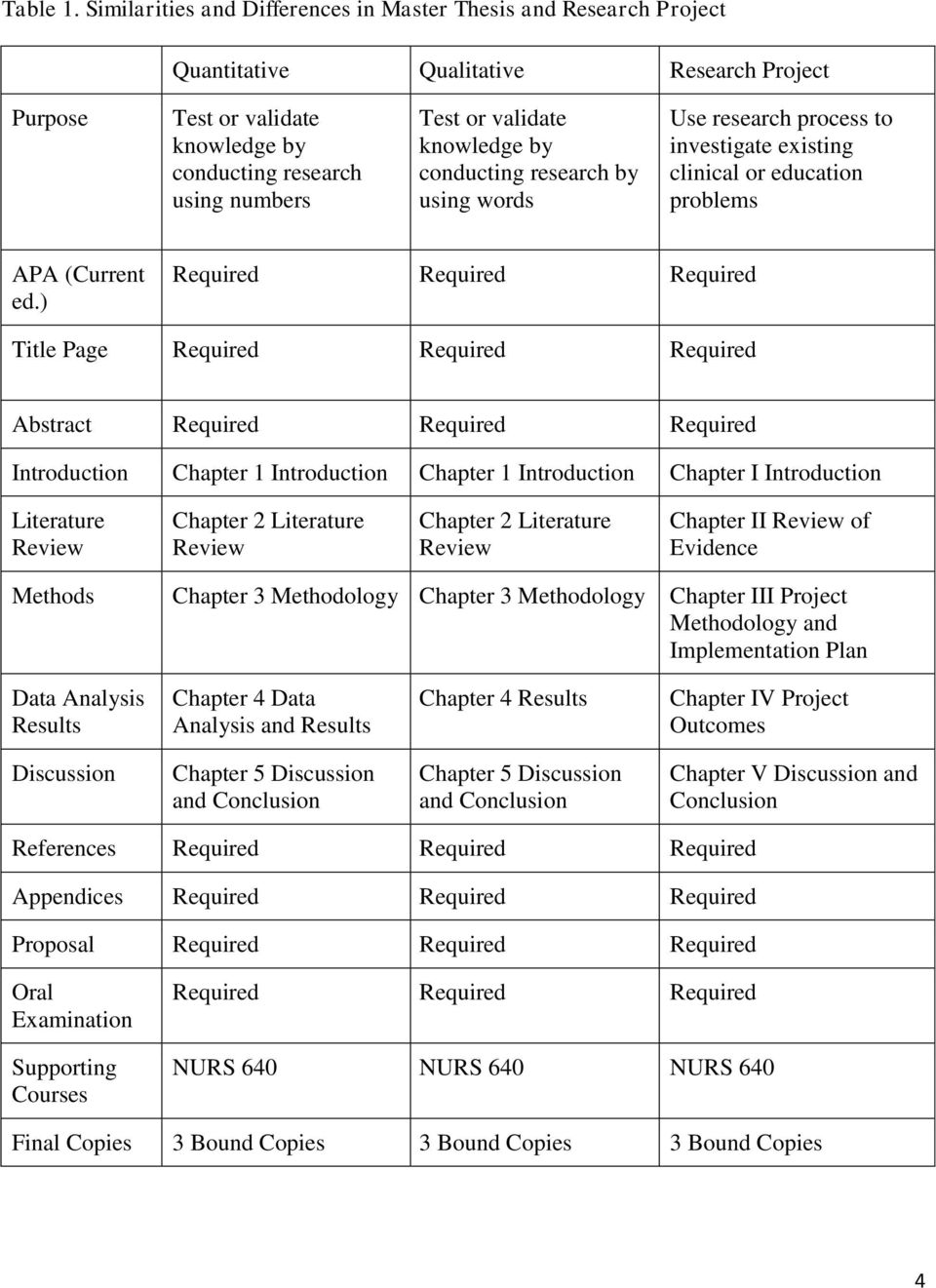
5 Table 1. Similarities and Differences in Master Thesis and Research Project Quantitative Qualitative Research Project Purpose Test or validate knowledge by conducting research using numbers Test or validate knowledge by conducting research by using words Use research process to investigate existing clinical or education problems APA (Current ed.) Required Required Required Title Page Required Required Required Abstract Required Required Required Introduction Chapter 1 Introduction Chapter 1 Introduction Chapter I Introduction Literature Review Chapter 2 Literature Review Chapter 2 Literature Review Chapter II Review of Evidence Methods Chapter 3 Methodology Chapter 3 Methodology Chapter III Project Methodology and Implementation Plan Data Analysis Results Chapter 4 Data Analysis and Results Chapter 4 Results Chapter IV Project Outcomes Discussion Chapter 5 Discussion and Conclusion Chapter 5 Discussion and Conclusion Chapter V Discussion and Conclusion References Required Required Required Appendices Required Required Required Proposal Required Required Required Oral Examination Supporting Courses Required Required Required NURS 640 NURS 640 NURS 640 Final Copies 3 Bound Copies 3 Bound Copies 3 Bound Copies 4
6 Course Descriptions NURS 640 Advanced Nursing Research and Evidence-Based Practice Critical discussion and analysis of the research process including the responsible conduct of research, qualitative and quantitative research methods and designs, analysis of data, and reporting of results. Strategies to improve dissemination and application of nursing research findings and integration of evidence-based practice will be discussed. NURS 795 MSN Special Research Project Description: Student identifies a salient health care topic of interest to investigate using the principles and methodologies inherent in the conduct of evidence-based research and practice to design and implement a special clinical research project. Student will obtain approval of proposed special project from the committee chair prior to initiating the research project. After implementing the special project, the student will use evaluation research methodology to assess project outcomes. Student s special project will entail all components of an evidence-based research project including determining clinical foreground (PICO) and background research questions: hypothesis (if applicable); research design: implementation of the project; data collection and data analysis procedures; discussion of the results and implications for advanced nursing practice, theory, and education; and recommendations for future research. Student will disseminate research results by presenting research findings at a professional conference and/or other appropriate public venue. NURS 799 MSN Thesis Description: Student identifies a salient health care topic of interest to investigate using the application of evidence-based systematic, scientific research principles and methodologies to complete a research thesis. Student will obtain approval of proposed research topic from the MSN faculty Research Advisor before initiating the research thesis. A student s research thesis will entail all states of a scientifically conducted study including: determining research questions; hypothesis (if applicable); research design; data collection and data analysis procedures; discussion of the results and implications for advanced nursing practice, theory, and education; and recommendations for future research. Student will disseminate research results by developing a manuscript suitable to be submitted for publication and/or presentation at professional conferences. 5

7 Roles and Responsibilities All communications must be completed electronically Student Identify a committee chair based on the student s interest and faculty s specialty area and obtain approval (Appendix K) Consult with committee chair to identify potential committee members Complete committee chair and committee member approval form and submit to committee chair Work with committee chair to discuss research thesis or project topic o Identify problem o Methods o Timetable (frequency of contact) o HSCP training and approval (certification placed in student file) o IRB approval process Complete Human Subjects Certification Program (HSCP)-DU IRB recommends the NIH site found at Submit copy of completed HSCP certification to committee chair, research course room, IRB, and student retains a copy Consult with committee chair to identify potential thesis or special research project topic Meet with committee to discuss and finalize thesis or research project topic, problem, theory, methods, timetable, expectations, ethics training, and IRB process Submit materials for review to committee chair allowing for at least two-weeks response time Work closely with committee chair until drafts of each chapter are ready for review by full committee Satisfactory progress in NURS640 (Minimum completed chapter 1/I, and satisfactory progress on Chapter 2/II, & Chapter 3/III). Each chapter will be submitted to Turnitin for student review and submitted to committee chair for review Work closely with the committee chair to discuss DU IRB process-information can be found at Complete IRB application, forms etc. Identify IRB process at research site and work with committee chair to obtain IRB approval (if required) from research site Inform committee chair when IRB approval or issues occur as well as research 6

8 site IRB requirements and approval Once proposal, committee, and IRB approval are obtained, data collection and analysis may begin-consult committee chair with any difficulties and report to committee chair monthly Complete chapters 4 and 5 once data has been collected and analyzed (Appendix A, B, & C Checklists) Make appropriate changes to thesis or project as directed by committee chair and committee in a timely manner Prepare for oral defense with PowerPoint presentation used to guide the discussion (Appendix E) Assure final report of IRB submitted (if required) Committee Chair Work with student to identify appropriate committee members to ensure methodological and subject matter expertise Submit a copy of committee chair and committee member approval form (placed in student file once approved) Work with student to complete a thesis or special research project that has rigor and contributes new knowledge to nursing Guide student in all aspects of the thesis or special research project Review results of Turnitin and discuss any concerns with student HSCP Training for committee chair and student-renewal required per DU IRB policy Meet with student and committee to discuss and approve thesis or special research project topic (topic approval form placed in student file) o Identify problem o Methods o Timetable (frequency of contact) o HSCP training and approval (certification placed in student file) o IRB approval process o Thesis or research project approval form and accepted proposal placed in student file Provide student with any feedback given from committee (committee must work with committee chair directly and not student unless approved by committee chair) Work closely with student to obtain IRB approval at DU and research site Guide student in data collection and analysis Consult with MSN Associate Chair if problems arise Assist student with preparation of oral defense (Appendix E) Assist with final revisions if necessary 7

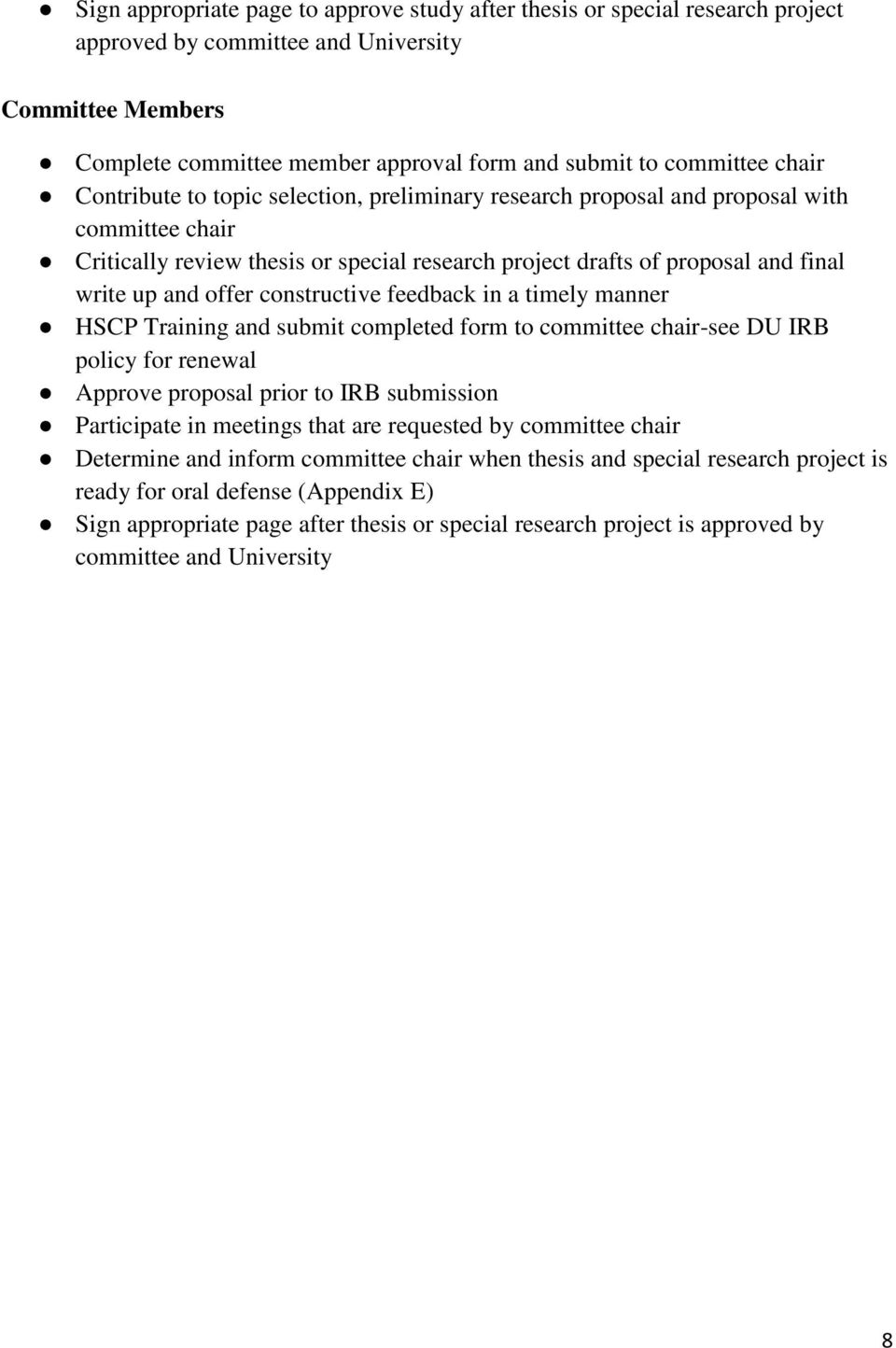
9 Sign appropriate page to approve study after thesis or special research project approved by committee and University Committee Members Complete committee member approval form and submit to committee chair Contribute to topic selection, preliminary research proposal and proposal with committee chair Critically review thesis or special research project drafts of proposal and final write up and offer constructive feedback in a timely manner HSCP Training and submit completed form to committee chair-see DU IRB policy for renewal Approve proposal prior to IRB submission Participate in meetings that are requested by committee chair Determine and inform committee chair when thesis and special research project is ready for oral defense (Appendix E) Sign appropriate page after thesis or special research project is approved by committee and University 8
10 Preparing for Thesis or Research Project Committee Chair and Committee Members Selection Establish collegial relationship with committee chair, student, and committee One member may be from outside the research or disciplinary specialty area must either have approval from the COHP Dean or all of the following: Nursing Associate Dean, Nursing Department Chair, and MSN Associate Chair Work with committee chair to identify possible committee members After committee members agree to be on committee, complete the committee approval form and send to committee members who will submit form to committee chair Thesis or Research Project Proposal The thesis or special research project proposal will provide a clear description of the problem and the proposed method of solving it. The proposal will explain the topic and problem being investigated that provides evidence that the student has critically read recent literature on the topic. Submit the research proposal form to committee chair After approval is received by committee chair, send to committee for approval Thesis or Research Project Final Oral Defense Complete once final thesis or research project has been approved by the committee Work with committee chair to set up oral defense Can be completed via conference call set up or other online communication tool Student will all committee members with several dates and times of student s availability and committee with respond with their availability (allow at least 1 week in advance for turn-around) Once a date has been finalized, the student will set up an appointment in the DU calendar and ask committee members to respond to the appointment request (the student also needs to include either the COHP Dean or the all of the following: Nursing Associate Dean, Nursing Department Chair, and MSN Associate Department Chair) The student will include a PowerPoint presentation of the proposal at least 1 week prior to the oral defense The committee chair will plan and lead the oral defense session 9

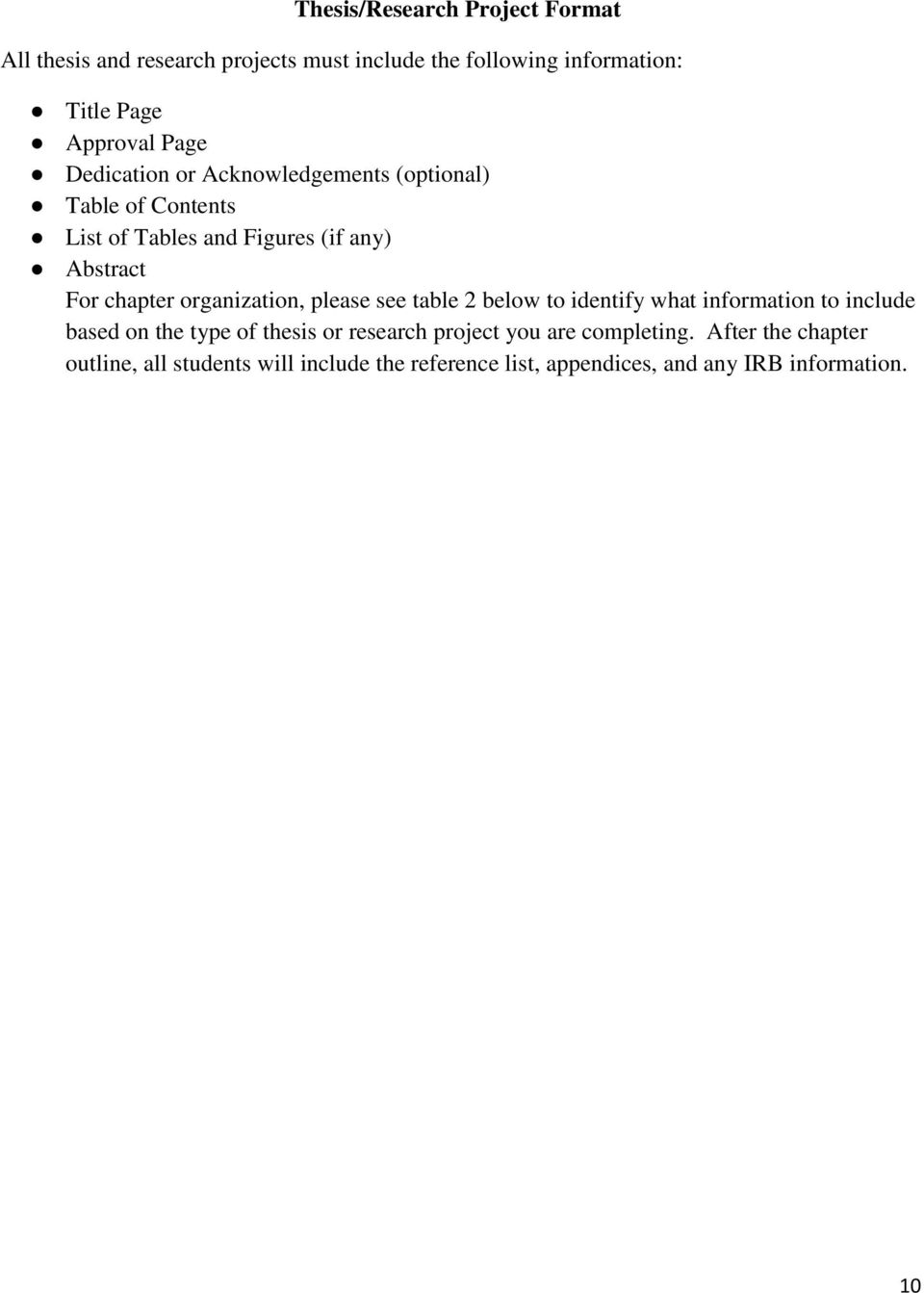
11 Thesis/Research Project Format All thesis and research projects must include the following information: Title Page Approval Page Dedication or Acknowledgements (optional) Table of Contents List of Tables and Figures (if any) Abstract For chapter organization, please see table 2 below to identify what information to include based on the type of thesis or research project you are completing. After the chapter outline, all students will include the reference list, appendices, and any IRB information. 10
12 Table 2. Thesis or Research Project Chapter Outline Chapter 1: Introduction Introduction to the study Statement of the research problem Background/research problem Research purpose Research question(s) and/or hypothesis Definitions of terms Significance to nursing Summary Chapter 2: Literature Review Introduction Theoretical Framework Literature Review Summary Chapter 3: Methodology Quantitative Design Introduction Design-Quantitative Population, Sample, Setting Instrumentation (include validity & reliability) Procedure for Data Collection Data Analysis Ethical considerations Limitations Summary Chapter 4: Results Introduction Findings Chapter 5: Discussions and Conclusion Introduction Discussion Conclusions Implications for Nursing Recommendations for Further Research 11

13 Qualitative Design Chapter 1: Introduction Introduction to the study Statement of the problem Background/research problem Research purpose Assumptions Research questions or objectives Defined concepts Significance to nursing Summary Chapter 2: Literature Review Introduction Theoretical Framework Literature Review Summary Chapter 3: Methodology Introduction Design-Qualitative Sampling & Setting Interview or Observation Protocol Procedure for Data Collection Data Analysis Ethical considerations Limitations Summary Chapter 4: Results Introduction Findings Chapter 5: Discussions and Conclusion Introduction Discussion Conclusions Implications for Nursing Recommendations for Further Research 12

14 Research Project Chapter I: Introduction Introduction to the research project Statement of the problem Background of the problem Purpose of the project PICO/PICOT Statement Definition or concepts of terms Significance to nursing Summary Chapter II: Review of Evidence Introduction Conceptual Model, Theory, or Framework Evaluation of Evidence Summary Chapter III: Project Methodology and Implementation Plan Introduction Identification of design Target group or aggregate Setting Plan and implementation process Ethical considerations Limitations Summary Chapter IV: Project Outcomes Introduction Characteristics of project Describe implementation of the project Outcomes Chapter V: Discussions and Conclusions Introduction Discussions Conclusion 13

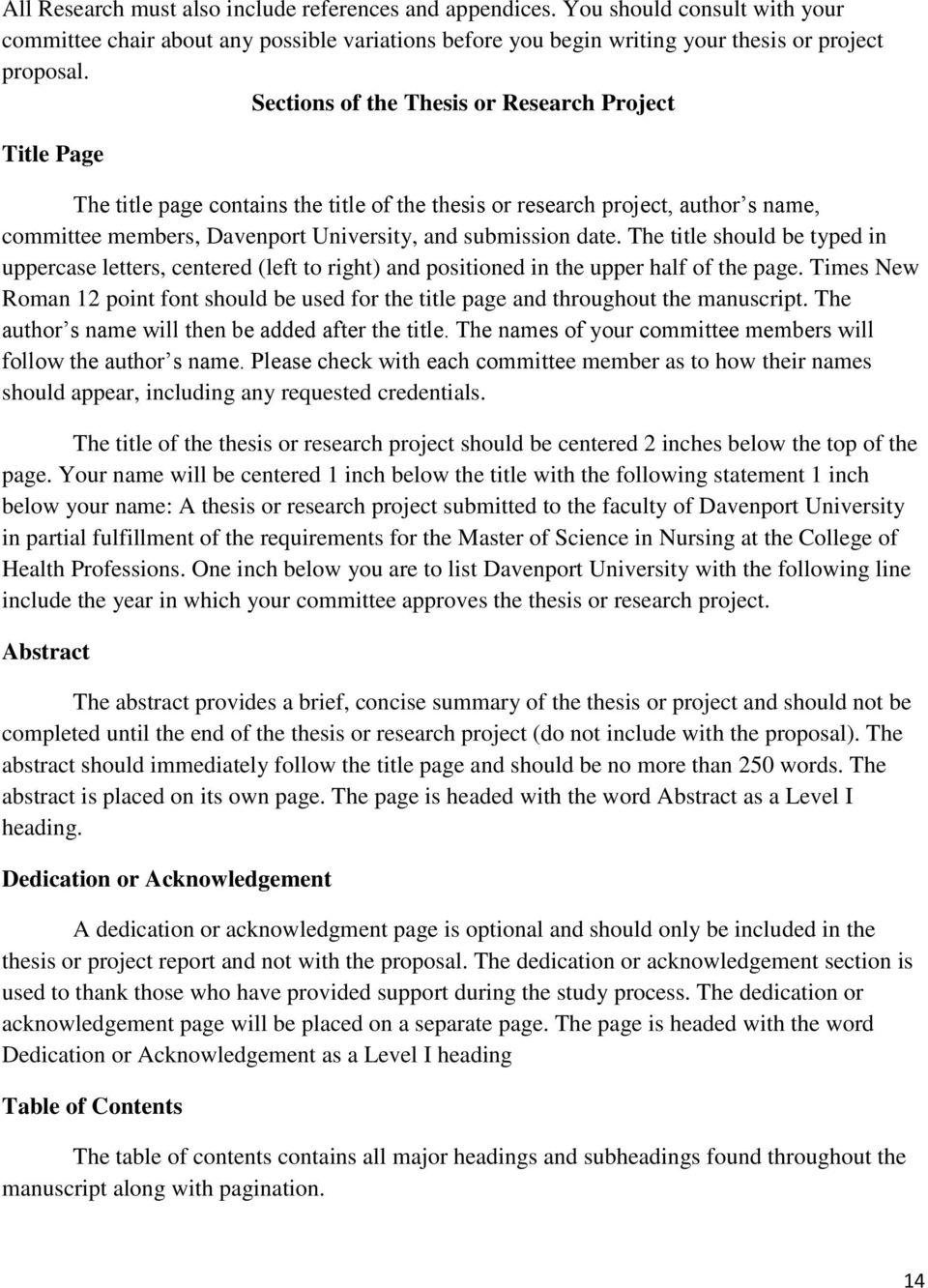
15 All Research must also include references and appendices. You should consult with your committee chair about any possible variations before you begin writing your thesis or project proposal. Sections of the Thesis or Research Project Title Page The title page contains the title of the thesis or research project, author s name, committee members, Davenport University, and submission date. The title should be typed in uppercase letters, centered (left to right) and positioned in the upper half of the page. Times New Roman 12 point font should be used for the title page and throughout the manuscript. The author s name will then be added after the title. The names of your committee members will follow the author s name. Please check with each committee member as to how their names should appear, including any requested credentials. The title of the thesis or research project should be centered 2 inches below the top of the page. Your name will be centered 1 inch below the title with the following statement 1 inch below your name: A thesis or research project submitted to the faculty of Davenport University in partial fulfillment of the requirements for the Master of Science in Nursing at the College of Health Professions. One inch below you are to list Davenport University with the following line include the year in which your committee approves the thesis or research project. Abstract The abstract provides a brief, concise summary of the thesis or project and should not be completed until the end of the thesis or research project (do not include with the proposal). The abstract should immediately follow the title page and should be no more than 250 words. The abstract is placed on its own page. The page is headed with the word Abstract as a Level I heading. Dedication or Acknowledgement A dedication or acknowledgment page is optional and should only be included in the thesis or project report and not with the proposal. The dedication or acknowledgement section is used to thank those who have provided support during the study process. The dedication or acknowledgement page will be placed on a separate page. The page is headed with the word Dedication or Acknowledgement as a Level I heading Table of Contents The table of contents contains all major headings and subheadings found throughout the manuscript along with pagination. 14
16 List of Tables and Figures Tables and figures are actually separated and listed on different pages. Each section should be labeled. It may be necessary to complete the labeling at the end of the revisions of the manuscript so that if tables and figures are moved around, they will be labeled correctly for the final version. Please pay attention to the tables and figures in the current APA manual. Make sure that the titles are brief and concise. Body of the Research Study The research will generally be divided by content and developed into chapters depending on the thesis or research project. Most manuscripts have the same basic five chapters that include: Thesis (Qualitative or Quantitative) Chapter 1. Introduction Chapter 2. Literature Review Chapter 3. Methodology Chapter 4. Results Chapter 5. Discussions and Conclusion Research Project Chapter I: Introduction Chapter II: Review of Evidence Chapter III: Project Methodology and Implementation Plan Chapter IV: Project Outcomes Chapter V: Discussions and Conclusions The research proposal is written in present tense for the proposal and changed to past tense for the final thesis or research project. Overview of the Thesis (Quantitative) Research Process Chapter 1 Introduction Introduction to the study Statement of the research problem Background/research problem Research purpose 15
17 Research question(s) / hypothesis Definitions of terms Significance to nursing Summary The introduction to the paper will address these issues in order to give the reader an understanding of what will be examined. Introduce the reader to the problem being addressed in this study. Include why the problem is worth being researched and a brief discussion of what has been reviewed in other research. Consider the importance of this research and how to present it before writing the introduction. Remember this is where the reader will develop an opinion about the research so you really want to make a good impression. Use level headings for the introduction. Statement of the Research Problem The statement of the research problem is a definition of what the investigator proposes to study. The statement also includes the general area of concern and justification of the need, such as a gap in the knowledge, conflicting findings, or group omission. Background of the Research Problem This section presents the problem to be investigated. The description should have enough detail that the reader can see why this is a worthy research study as well as a discussion of the context of the problem. For example, include explanations of how the problem is realized in the real world and/or the implications that might exist if it is not resolved. Research Purpose Begin this section with an explanation of the purpose of the study. Clearly lead the reader to understand why the study is important, and develop a clear rationale for the thesis or project selected. Introduce the reader to the issue being addressed and discuss why this is a study that is worthy to research. The purpose or intention of the thesis or research project should include a purpose statement related to the type of study, variables, population, and setting. The problem statement supports the purpose. The purpose of the study should guide this section. When stating your research question and/or hypothesis and objective, you will use present tense for the proposal. In the thesis or project final report, the purpose should be written in the past tense. The purpose is stated as a general goal. Research Questions and/or Hypotheses Thesis--This section can be divided into sub-sections according to the objectives of the research or project. The research questions and/or hypotheses are used in descriptive and exploratory studies. The hypotheses are statements of predicted outcomes. 16

18 The section need not be lengthy but should supply the following: Research questions-no set numbers of questions /and or hypotheses including null hypothesis Definitions of Terms Include definitions of the variables that are included in the thesis or research project. They should be defined conceptually and operationally and alphabetical order. Conceptual definition--defines the concept or construct Operational definition--assigns meanings to the construct or variable that are necessary to measure the construct Significance to Nursing This section will include the relationship of the problem to previous research and the need for this study. Summary Include a summary of chapter 1 and introduce chapter 2. Chapter 2 Literature Review Introduction Introduction Theoretical Framework/Concept Literature Review Summary Introduce the topics that will be discussed in the literature review section. Theoretical Framework/Model Include the organizing framework or theory selected for your study and explore how the theoretical framework/model applies to your study. The theoretical framework/concept will be a succinct description elaborating on the concepts that are related to the study and explaining relationships. Literature Review The literature review section will provide a systematic analysis of current and relevant literature on the topic. Literature reviews should be detailed and give the reader an understanding 17

19 of relevant research and theory that pertain to the thesis or research project. The literature review will also establish a need for the thesis or research project. The literature review includes the following: Theoretical articles and related studies Identification of the author, date, and method of each study Critique of any inconsistencies and/or limitations of the research Summary of current and related research conducted related to the problem Summary of the theory and/or conceptual arguments related to the problem Summary of current gaps in knowledge pertaining to the problem Definition of terms Synthesis of the studies but not a paragraph of each study Make sure you use credible sources in the literature review. Use professional, peerreviewed journals or other credible sources that can be accessed through the library. The DU library has a large list of credible electronic databases (i.e., CINAHL, ERIC, PsycInfo, etc.).the internet can also be a source for credible information, but caution should be used since there is no guarantee on the trustworthiness of the items found on the internet. Write the literature review in the past tense since the research and theory has taken place previously. Summary The summary will summarize of the theoretical framework/model and the literature review. The summary is included to synthesize each topic addressed in the review and demonstrate how literature has influenced the proposed study. Chapter 3 Methodology Introduction Identification of design Target group or aggregate Setting Plan and implementation process Ethical considerations Limitations Summary The methodology section will describe in detail what the student researcher will do and has done in the study. This section is a step by step guide on how the study will be conducted or was conducted and how the student researcher obtained the data and the procedures used to analyze the data. (Present tense in proposal and past test after data analysis). The section should also include: Design discussion about why the specific method was chosen for the study Description of the target group or aggregate--who will be included in the study 18

20 Where the research will take place Plan and implementation of the project--what is the plan for the study and how will it be implemented Procedure for data collection include how the following will be accomplished: Ethical Consideration Limitations Summary Chapter 4 Results Introduction Findings This section summarizes the data analyzed throughout the study. Present the findings to justify the conclusions made from the data. Report all results according to the study s hypotheses/research questions, including those that are contrary to the study results. Use tables and figures in the report to support the narrative. This section should be sufficient to help the reader understand the findings. Chapter 5. Discussion Introduction Discussion Conclusions Implications for Nursing Recommendations for Further Research The interpretation of the results is presented in the discussion. This section examines, interprets, qualifies, and evaluates what was found. Draw inferences from the results and related literature if they are applicable. Introduction Introduce chapter 5 discussion. Include the purpose of the study as well as the elements (discussion, conclusion, implications for nursing, and recommendations) that you will be including in the chapter. Discussion The discussion section will address detailed findings of the study and implications the findings have for the population studied. It should include strengths and weaknesses of the study. The discussion should improve the reader s awareness of the results as well as help them understand why they should come to the same conclusions as the study. Each question and/or hypothesis will be restated. Include support for the findings related to the research cited in the literature review. 19

21 Conclusions The conclusion section will include discussions of the conclusions from the findings. The conclusions are supported by the study. Implications The implication section will include implications of the study for nursing research, practice, and/or education. Recommendations for Further Research This section should also include recommendations for future research that have been identified during the research study or recommendations that should logically follow the study. References List all sources cited in the paper using APA format. Refer to the latest edition of the APA Manual for guidance in citing your references. The reference list should directly follow Chapter Five and be single-spaced within the reference and double-spaced between references. Appendices The last section of the paper is reserved for items not included in the body of the text. The items are essential to understand the context of the thesis or research project. Examples Forms Lesson plans Letters Survey instruments or other applicable instruments Copy of approval to use any copyrighted materials Each item in the appendices begins on its own page and includes a title, centered, at the top of the page. If including an item as an appendix, it must be referred to in the body of the paper. If it is not mentioned anywhere in the text, then it should not be included in the appendices. Items in the appendices should be listed and placed in the same order they are cited or discussed in the body of the report. IRB information and paperwork should also be included at the end of the report as part of the appendices. Chapter 1 Introduction Introduction to the study Overview of Thesis (Qualitative) Research Process 20
22 Statement of problem Background/research problem Research purpose Research question or objectives Defined concepts Significance to nursing Summary The introduction to the paper will address these issues in order to give the reader an understanding of what will be examined. Introduce the reader to the problem being addressed in this study. Include why the problem is worth being researched and a brief discussion of what has been reviewed in other research. Consider the importance of this research and how to present it before writing the introduction. Remember this is where the reader will develop an opinion about the research so you really want to make a good impression. Use level I headings for the introduction. Background of the Problem This section presents the problem to be investigated. The description should have enough detail that the reader can see why this is a worthy research study as well as a discussion of the context of the problem. For example, include explanations of how the problem is realized in the real world and/or the implications that might exist if it is not resolved. Research Purpose or Purpose of the Project Begin this section with an explanation of the purpose of the study. Clearly lead the reader to understand why the study is important, and develop a clear rationale for the thesis or project selected. Introduce the reader to the issue being addressed and discuss why this is a study that is worthy to research. The purpose or intention of the thesis or research project should include a purpose statement related to the type of study, variables, population, and setting. The problem statement supports the purpose. The purpose of the study should guide this section. When stating the research question and/or hypothesis and objective, l use present tense for the proposal. In the final thesis or project report, the purpose should be written in the past tense. The purpose is stated as a general goal. Research Questions or Objectives This section can be divided into sub-sections according to the objectives of the research or project. The research questions or objectives are used to drive the study. The section need not be lengthy but should supply the following: Research questions-no set numbers of questions /and or objectives 21
23 Definitions of Terms Include definitions of the variables that are in the thesis. The variables should be defined conceptually and operationally and placed in alphabetical order. Conceptual definition--defines the concept or construct Operational definition--assigns meanings to the construct or variable that are necessary to measure the construct Significance to Nursing This section will include the relationship of the problem to previous research and the need for this study. Summary Include a summary of chapter 1 and introduce chapter 2. Chapter 2. Literature Review Introduction Introduction Theoretical Framework/Concept Literature Review Summary Introduce the topics that will be discussed in the literature review section. Theoretical Framework/Model Include the organizing framework or theory selected for the study and explore how the theoretical framework/model applies to the study. The theoretical framework/concept will be a succinct description elaborating on the concepts that are related to the study and explaining relationships. Literature Review The literature review section will provide a systematic analysis of current and relevant literature on the topic. Literature reviews should be detailed and give the reader an understanding of relevant research and theory that pertain to the thesis or research project. The literature review will also establish a need for the thesis or research project. The literature review includes the following: Theoretical articles and related studies Identification of the author, date, and method of each study 22
24 Critique of any inconsistencies and/or limitations of the research Summary of current and related research conducted related to the problem Summary of the theory and/or conceptual arguments related to the problem Summary of current gaps in knowledge pertaining to the problem Definition of terms Synthesis of the studies but not a paragraph of each study Make sure to use credible sources in the literature review. Use professional, peerreviewed journals or other credible sources that can be accessed through the library. The DU library has a large list of credible electronic databases (i.e., CINAHL, ERIC, PsycInfo, etc.).the internet can also be a source for credible information, but caution should be used since there is no guarantee on the trustworthiness of the items found on the internet. Write the literature review in the past tense since the research and theory has taken place previously. Summary The summary will summarize the theoretical framework/model and the literature review. The summary is included to synthesize each topic addressed in the review and to demonstrate how literature has influenced the proposed study. Chapter 3 Methodology Introduction Design--Qualitative Sampling & Setting Selection Interview or Observation Protocol Procedure for Data Collection Data Analysis Ethical considerations Limitations Summary The methodology section will describe in detail what the student researcher will do (proposal) and has done in the study. This section is a step by step guide on how the study will be conducted (proposal) or was conducted (thesis/project report) and how the student researcher obtained the data and the procedures used to analyze the data. The section should also include: Design discussion about why the specific method was chosen for the study Description of sampling & setting selection, including: How they were selected and why they are relevant to the study Interview or observation protocol include materials used in the study Procedure for data collection include how the following will accomplished: Data Analysis-themes or codes used to analyze data Limitations Summary Ethical Consideration 23
25 Chapter 4 Results Introduction Findings This section summarizes the data analyzed throughout the study. Present the findings to justify the conclusions made from the data. Report all results according to study s hypotheses/research questions, including those that are contrary to the study s results. Use tables and figures in the report to support the narrative. This section should be sufficient to help the reader understand the findings. Chapter 5. Discussion Introduction Discussion Conclusions Implications for Nursing Recommendations for Further Research The interpretation of the results is presented in the discussion. This section examines, interprets, qualifies, and evaluates what was found. Draw inferences from the results and related literature if they are applicable. Introduction Introduce chapter 5 discussion. Include the purpose of the study as well as the elements (discussion, conclusion, implications for nursing, and recommendations) that you will be including in the chapter. Discussion The discussion section will address detailed findings of the study and implications the findings have for the population studied. It should include strengths and limitations of the study. The discussion should improve the reader s awareness of the results as well as help the reader understand why the reader should come to the same conclusions as the study. Each question and/or hypothesis will be restated. Include support for the findings related to the research cited in the literature review. Conclusions The conclusion section will include conclusions from the findings. The conclusions are supported by the study. Implications The implication section will include implications of the study for nursing research, practice, and/or education. 24
26 Recommendations for Further Research This section should also include recommendations for future research that was identified during the research study or recommendations that should logically follow the study. References List all sources cited in the paper using current APA format. Refer to the current APA Manual for guidance in citing your references. The reference list should directly follow Chapter Five with single-spacing within the reference itself and double-spaced between references. Appendices The last section of the paper is reserved for items not included in the body of the text. The items are essential to understand the context of the thesis or research project. Examples Forms Lesson plans Letters Survey instruments or other applicable instruments Copy of approval to use any copyrighted materials Each item in the appendices begins on its own page and includes a title, centered, at the top of the page. If including an item as an appendix, it must be referred to in the body of the paper. If it is not mentioned anywhere in the text, then it should not be included in the appendices. Items in the appendices should be listed and placed in the same order they are cited or discussed in the body of the report. IRB information and paperwork should also be included at the end of the report as part of the appendices. Chapter I Introduction Overview of the Research Project Process Introduction to the research project Statement of the research problem Background of the problem Purpose of the project PICO/PICO Statement/Educational Issue Statement Definition of terms Significance to nursing Summary Introduce the reader to the problem being addressed in this study. Include why the problem is worth being researched and a brief discussion of what has been reviewed in other 25
27 research. The introduction to the paper will address these issues in order to give the reader an understanding of what will be examined. Consider the importance of this research and how to present it before writing the introduction. Remember this is where the reader will develop an opinion about the research so you really want to make a good impression. Use level I headings for the introduction. Statement of the Research Problem The statement of the research problem is a definition of what the investigator proposes to study. The statement also includes the general area of concern and justification of the need is included, such as a gap in the knowledge, conflicting findings, or group omission. Background of the Research Problem This section presents the problem to be investigated. The description should have enough detail that the reader can see why this is a worthy research study as well as a discussion of the context of the problem. For example, include explanations of how the problem is realized in the real world and/or the implications that might exist if it is not resolved. Purpose of the Project Begin this section with an explanation of the purpose of the study. Clearly lead the reader to understand why the study is important, and develop a clear rationale for the thesis or project selected. Introduce the reader to the issue being addressed and discuss why this is a study that is worthy to research. The purpose or intention of the thesis or research project should include a purpose statement related to the type of study, variables, population, and setting. The problem statement supports the purpose. The purpose of the study should guide this section. When stating your research question and or hypothesis and objective, use present tense for the proposal. In the final thesis or project report, the purpose should be written in the past tense. The purpose is stated as a general goal. PICO/PICOT Statement-Educational Issue Statement The section need not be lengthy but should supply the following: This section is stated in a clinical practice problem (PICO/PICOT) format. If completing an educational project, please present the educational issue identified that will be addressed. Definitions of Terms Include definitions of the variables that are included in the thesis or research project. They should be defined conceptually and operationally and placed in alphabetical order. Conceptual definition--defines the concept or construct 26
28 Operational definition--assigns meaning to the construct or variable that is necessary to measure the construct Significance to Nursing This section will include the relationship of the problem to previous research and the need for this study. Summary Include a summary of chapter 1 and introduce chapter 2. Chapter II Review of Evidence Introduction Conceptual Model, Theory or Framework (if applicable) Evaluation of the Evidence Summary Introduction Introduce the topics that will be discussed in the literature review section. Conceptual Model, Theory, or Framework (if applicable) Include the conceptual model, theory or framework selected for your study (if applicable) and explore how the theoretical framework/model applies to the study. The theoretical framework/concept will be a succinct description elaborating on the concepts that are related to the study and explains relationships. Evaluation of Evidence The evaluation of evidence section will provide an analysis of current and relevant literature on the topic being researched. The evaluation of evidence review should be detailed and give the reader an understanding of relevant research and theory that pertain to the research project. The evaluation of evidence will also establish a need for the study. The evaluation includes the following: Analysis of the value and strength of evidence in answering the question Analysis of the instruments used to evaluate the evidence Make sure to use credible sources in the evaluation of evidence. Use professional, peerreviewed journals or other credible sources. The DU library has a large list of credible electronic databases (i.e., CINAHL, ERIC, PsycInfo, etc.).the internet can also be a source for credible information, but caution should be used since there is no guarantee on the trustworthiness of the 27
29 items found on the internet. Write the literature review in the past tense since the research and theory has taken place previously. Summary The summary will summarize the theoretical framework/model and the literature review. The summary is included to synthesize each topic addressed in the review and to demonstrate how literature has influenced the proposed study. Chapter III Project Methodology Introduction Identification of design Target group or aggregate Setting Plan and implementation process Ethical considerations Limitations Summary The methodology section will describe in detail what the student researcher will do (proposal) and has done in the study. This section is a step by step guide on how the study will be conducted (proposal) or was conducted (thesis/project report) and how the student researcher obtained the data and the procedures used to analyze the data. The section should also include: Design discussion about why the specific method was chosen for the study Description of participants, including: How they were selected and why they are relevant to the study Instruments - include materials used in the study Reliability and validity of the instruments Procedure for data collection include how the following will be accomplished: Data Analysis-Tests used to analyze results Limitations Summary Chapter IV Project Outcomes Introduction Findings Ethical Consideration This section summarizes the data analyzed throughout the study. Present the findings to justify the conclusions made from the data. Report all results according to the study s research questions. Use tables and figures in the report to support the narrative. This section should be sufficient to help the reader understand the findings. 28
30 Chapter V. Discussion Introduction Discussion Conclusions Implications for Nursing Recommendations for Further Research The interpretation of the results is presented in the discussion. This section examines, interprets, qualifies, and evaluates what was found. Draw inferences from the results and related literature if they are applicable. Introduction Introduce chapter 5 discussion. Include the purpose of the study as well as the elements (discussion, conclusion, implications for nursing, and recommendations) that you will be including in the chapter. Discussion The discussion section will address detailed findings of the study and implications the findings have for the population studied. It should include strengths and limitations of the study. The discussion should improve the reader s awareness of the results as well as help the reader understand why the reader should come to the same conclusions as the study. Each question and/or hypothesis will be restated. Include support for the findings related to the research cited in the literature review. Conclusions The conclusion section will have a list of the conclusions from the findings. The conclusions are supported by the study. Implications The implication section will include implications of the study for nursing research, practice, and/or education. Recommendations for Further Research This section should also include recommendations for future research that has been identified during the research study or recommendations that should logically follow the study. References List all sources cited in the paper using current APA format. Refer to the current APA Manual for guidance in citing references. The reference list should directly follow Chapter Five 29
31 with single-spacing within the reference itself and double-spacing between references. Appendices The last section of the paper is reserved for items not included in the body of the text. The items are essential to understand the context of the thesis or research project. Examples Forms Lesson plans Letters Survey instruments or other applicable instruments Copy of approval to use any copyrighted materials Each item in the appendices begins on its own page and includes a title, centered, at the top of the page. If including an item as an appendix, it must be referred to in the body of the paper. If it is not mentioned anywhere in the text, then it should not be included in the appendices. Items in the appendices should be listed and placed in the same order they are cited or discussed in the body of the report. IRB information and paperwork should also be included at the end of the report as part of the appendices. Language Use academic (scholarly) writing in your thesis/research project. Your writing should be direct and concise and not include run-on sentences. It is also important to avoid creative writing such as ambiguity, excessive description, and irrelevant observation. It is also important to eliminate redundancy, wordiness, jargon, and language that is racist, sexist, biased, disabling, or overtly stereotypical. Technical language should be understood by individuals within the discipline. Formatting and Pagination The thesis or research project must be double-spaced, error-free and printed neatly on one side of standard 8.5 x 11 inch, heavy white bond paper (20-24 pound). The most current APA manual will be followed in all areas of formatting unless directed. Level headings must be followed according to the most current APA manual. Page numbers should be included according to the current APA manual related to pagination. Margins, typeface, spacing, and all formatting will be completed according to current APA guidelines. Printing and Binding The student is responsible for the printing and binding of the thesis or research project. 30
32 Multiple hardbound copies are required. Copies will need to be made for the following areas Department of Nursing Digital Learning Center Committee Chair Student (as many as you choose) Additional soft-bound copies may be required for the faculty committee, department and others. Uniformity and binding of theses and research projects will be subject to University guidelines. The thesis or research project must be accepted and the printing and binding paid for prior to graduation. 31
33 Appendix A Master s Research Project Checklist Student: Title of Project: Committee Chair Committee Member Committee Member Date of Review Date of Review Date of Review Graded S= satisfactory U=unsatisfactory Title page Title of research Student s name and credentials Committee chair and members Thesis or research project presented in partial fulfillment of the requirement for the Master of Science in Nursing Degree Davenport University Date study approved Chair Comments Member 1 Comments Member 2 Comments Approval page Dedication page 32
34 Table of contents List of tables & figures Abstract Chapter I Introduction Introduction to the research project Statement of the problem Problem concisely stated and clearly defined Sufficiently narrowed down to be answered by selected methodology Background of problem Purpose of the Study PICO/PICOT Statement Definitions of concepts and/or terms Significance to nursing, background, and need for this study Relationship of 33
35 identified problem or to previous research is clear Summary Chapter II Review of Evidence Introduction Conceptual model, theory or framework appropriate Concepts clearly defined and relationship among concepts identified Evaluation of evidence supports need for project Provides overview of relevant studies including pertinent work from other disciplines A number of other sources of evidence (expert opinion, committee reports etc.) have been considered Gaps and limitations are identified in the literature and suggestions for future research are identified Summary 34
36 Chapter III Project Methodology Introduction Identification of research design appropriate for project Target population(s) or aggregate identified Setting Plan and implementation appropriate Reliability and validity issues related to data measures or evaluation methods are identified Data collection methods and/or evaluation methods are appropriate and clearly stated Proposed instrument, clinical protocol and/or guideline attached as an appendix Ethical considerations presented Human subject protection and IRB requirement or nonrequirement clearly articulated 35
37 HSCP completed Conflicts of interest are clearly stated Identification of limitations Summary Chapter IV Project Outcomes Introduction Characteristics of project presented Describe the implementation of the project Description of the outcomes of the project Chapter V Discussions and Conclusions Introduction Discussion Conclusions Recommendations for further research discussed 36
38 Reference list Appendices-- Including but not limited to instruments, IRB approval, etc 37
39 Student: Title of Project: Appendix B Master s Thesis Quantitative Design Checklist Committee Chair Committee Member Committee Member Date of Review Date of Review Date of Review Graded S= satisfactory U=unsatisfactory N/A= not applicable or not always needed Title page Chair Comments Member 1 Comments Member 2 Comments Title of research Student s name and credentials Committee chair and members Thesis or research project presented in partial fulfillment of the requirement for the Master of Science in Nursing Degree Davenport University Date study approved Approval page Dedication page Table of contents 38
40 List of tables & figures Abstract Chapter 1 Introduction Introduction to the study Statement of the research problem Problem concisely stated and clearly defined Sufficiently narrowed down to be answered by selected methodology Background of research problem Purpose of the Study Research questions and/or hypothesis Definitions of terms Significance to nursing, background, and need for this study Relationship of identified problem to previous research is clear 39
41 Summary Chapter 2 Literature Review Introduction Theoretical framework Literature review Summary Chapter 3 Methodology Introduction Identification of quantitative research design appropriate Target population(s) sample and setting identified and appropriate Instrumentation appropriate for topic Reliability and validity issues related to data measures or evaluation methods are identified Proposed instrument attached as an appendix Data collection methods and/or evaluation methods are appropriate and clearly 40
42 stated Data analysis is clear and appropriate for study Ethical considerations presented Human subject protection and IRB requirement or nonrequirement clearly articulated HSCP completed Conflicts of interest are clearly stated Identification of limitations Summary Chapter 4 Results Introduction Findings Chapter 5 Discussions and Conclusions Introduction Discussion Conclusions 41
43 Recommendations for further research discussed Reference list Appendices Including but not limited to instruments, IRB approval, etc 42
44 Appendix C Master s Thesis Qualitative Design Checklist Student: Committee Chair Committee Member Committee Member Title of Thesis: Date of Review Date of Review Date of Review Graded S= satisfactory U=unsatisfactory N/A= not applicable or not always needed Title page Chair Comments Member 1 Comments Member 2 Comments Title of research Student s name and credentials Committee chair and members Thesis or research project presented in partial fulfillment of the requirement for the Master of Science in Nursing Degree Davenport University Date study approved Approval page Dedication page 43
45 Table of content List of tables & figures Abstract Chapter 1 Introduction Introduction to the study Statement of the problem Problem concisely stated and clearly defined Sufficiently narrowed down to be answered by selected methodology Background of problem Purpose of the Study Research questions or objectives Definitions of concepts appropriate Significance to nursing, background, and need for this study Relationship of 44
46 identified problem to previous research is clear Summary Chapter 2 Literature Review Introduction Theoretical framework appropriate to study Concepts clearly defined and relationship among concepts identified Literature review is appropriate to topic of study Provides overview of relevant studies including pertinent work from other disciplines A number of other sources (expert opinion, committee reports etc.) have been considered Gaps and limitations are identified in the literature and suggestions for future research are identified Summary 45
47 Chapter 3 Methodology Introduction Identification of research design appropriate for qualitative research Target population(s)are identified Setting appropriate Sampling appropriate Procedure for data collection and implementation appropriate Data collection methods and/or evaluation methods are appropriate and clearly stated Interview or observation protocol attached as an appendix Ethical considerations presented Human subject protection and IRB requirement or nonrequirement clearly articulated HSCP completed Conflicts of interest are clearly 46
48 stated Identification of limitations Summary Chapter 4 Results Introduction Results discussed Chapter 5 Discussions and Conclusions Introduction Discussion Conclusions Recommendations for further research discussed Reference list Appendices-- Including but not limited to instruments, IRB approval, etc 47
49 Appendix D Thesis or Research Project Rubric (80% or higher to pass) Chapter 1 Introduction or Chapter I Introduction Expert Proficient Competent Advanced Beginner Novice Introduction to the study Strong introduction of problem to reader that is clear and demonstrates the problem is worth researching (support by scholarly peer reviewed journals) 2 paragraphs 5 Introduced problem to reader that is clear and demonstrates the problem is worth researching (support by scholarly peer reviewed journals) 2 paragraphs 4 Introduced problem to reader that is somewhat clear and demonstrates the problem is worth researching but needs more support (support by scholarly peer reviewed journals) 2 paragraphs 3 Introduced the problem to reader but is it not clear and does not demonstrate the problem is worth researching (support by scholarly peer reviewed journals) 1 paragraphs 2 Does not introduce problem to reader or does not use scholarly peer reviewed journals to support problem. 0-1 Statement of the research problem Strong organization of problem paragraph starts with broad problem that is clear, concise and describes the need for research. Reflected gap in knowledge that the research will try to fill. End of paragraph has a narrow focused problem statement that is researchable 10 Problem paragraph starts with broad problem that is clear, concise and describes the need for research. Reflected gap in knowledge that the research will try to fill. End of paragraph has a narrow focused problem statement that is researchable 9 Problem paragraph starts with broad problem that is not as clear nor concise as possible but describes the need for research. Reflected gap in knowledge that the research will try to fill but is too broad. End of paragraph has a narrow focused problem statement that is researchable but needs further development 8 Problem paragraph starts with broad problem that is not clear or concise and does not describe the need for research. Reflected gap in knowledge that the research will try to fill is not clear. End of paragraph has a broad focused problem statement that is not researchable 6 or 7 Problem paragraph does not start with broad problem and does not describe the need for research. Does not reflect gap in knowledge that the research will try to fill. End of paragraph does not have a narrow focused problem statement that is researchable 5 or less 48
50 Background of research problem Brief overview of problem that is exceptionally clear, key components or concepts of the problem, and how problem came about clearly articulated 10 Brief overview of problem, key components or concepts of the problem, and how problem came about 9 Brief overview of problem, key components or concepts of the problem, and how problem came about and somewhat relates to research topic 8 Brief overview of problem, key components or concepts of the problem, and how problem came about but it is not clear and does not relate to research topic 6-7 Brief overview of problem, key components or concepts of the problem, and how problem came about 5 or less Purpose of the Study Begins with strong purpose The purpose of the study is to in order to. The purpose is a response to the problem and what the study will accomplish with scholarly support 5 Begins with The purpose of the study is to in order to. The purpose is a response to the problem and what the study will accomplish with scholarly support 4.5 Begins with The purpose of the study is to in order to. The purpose is a response to the problem and what the study will accomplish but needs scholarly support 4 Begins with The purpose of the study is to in order to. The purpose is a response to the problem and what the study will accomplish but it needs to add more depth to support purpose 3 Does not begin with The purpose of the study is to in order to. The purpose is a response to the problem and what the study will accomplish is not clear and concise 2 or less Research questions and/or hypothesis or PICO/T Excellent flow from the problem statement and purpose that is clearly articulated 15 Logical flow from the problem statement and clear purpose Logically flow from the problem statement, purpose, and questions but they are not clearly articulated Logical flow from the problem statement, purpose, and questions but one or more areas not appropriately stated 9-10 Does not logically flow from the problem statement and purpose 8 or less Definitions of terms or concepts Terms or phrases are clearly defined that aides the reader in understanding terms used in the study are clearly articulated 10 Terms or phrases are clearly defined that aides the reader in understanding terms used in the study 9 Most of the terms or phrases are clearly defined that aides the reader in understanding terms used in the study 8 Terms or phrases are broadly defined that aides the reader in understanding terms used in the study but more depth needed 6 or 7 Terms or phrases are not defined that aides the reader in understanding terms used in the study 5 or less Significance to nursing, background, and need for this study The significance of the study clearly articulates how The significance of the study discussed how the study will fill the gap in The significance of the study discussed how the study will fill the gap in knowledge The significance of the study discussed how the study will fill the gap in knowledge The significance of the study does not discuss how the study will fill the gap in 49
51 the study will fill the gap in knowledge and need for the study 10 knowledge and the need for the study 9 and the need for the study but needs more depth to show gap and or need 8 but does not discuss the need for the study 6 or 7 knowledge but does not address the need for the study 5 or less Summary Strong summary of chapter 1 and introduced chapter 2 that is clear and concise 5 Summarized chapter 1 and introduced chapter Summarized chapter 1 and introduced chapter 2 but needs clarity 4 Summarized chapter 1 and introduced chapter 2 but needs more depth 3 Does not summarize chapter 1 nor introduce chapter 2 2 or less Chapter 2 Literature Review or Chapter II Review of Literature Expert Proficient Competent Advanced Beginner Novice Introduction Explained purpose of the study, chapter 2 introduction (what you will discuss), literature review, and theoretical framework 5 Explained purpose of the study, chapter 2 introduction (what you will discuss), literature review, and theoretical framework 4.5 Explained purpose of the study, chapter 2 introduction (what you will discuss), literature review, and theoretical framework but needs more depth 4 Explained purpose of the study, chapter 2 introduction (what you will discuss), literature review, and theoretical framework. Only discussed 2 aspects required in introduction 3 The purpose is not explained, chapter 2 introduction literature review, and theoretical framework, is not discussed 2 or less Literature review Or Review of Evidence Strong introduction of topics, subtopics, describing what is included (first paragraph) Strong summary of each topic and theme with citations and references. (include both sides of issue) Level headings for each topic. Literature synthesized and critiqued and scholarly Introduced topics, subtopics, describing what is included (first paragraph) Included summary of each topic and theme with citations and references. (include both sides of issue) Level headings for each topic. Literature synthesized and critiqued with scholarly support Introduced topics, subtopics, describing what is included (first paragraph) Included summary of each topic and theme with citations and references. (include both sides of issue) Level headings for each topic. Literature synthesized and critiqued but needs more scholarly support Introduced topics, subtopics, describing what is included (first paragraph) Does not include summary of each topic and theme with citations and references. (include both sides of issue) Level headings for each topic not according to APA. Literature synthesized or critiqued but not both-little scholarly support Does not introduce topics, subtopics, describing what is included (first paragraph) Summary of each topic and theme with citations and references are not included. Level headings for each topic are not included. Literature not synthesized and critiqued 50
52 supported or less Theoretical framework Clearly articulated the theory or conceptual framework supporting the study. Explained how the theory or framework supports study. Discussed components (concepts, constructs, assumptions, generalizations) Summarized in final paragraph with scholarly support 10 Described the theory or conceptual framework supporting the study. Explained how the theory or framework supports study. Discussed components (concepts, constructs, assumptions, generalizations) Summarized in final paragraph with scholarly support 9 Described the theory or conceptual framework supporting the study. Explained how the theory or framework supports study. Discussed components (concepts, constructs, assumptions, generalizations) Summarized in final paragraph but needs more depth and scholarly support 8 Briefly describes the theory or conceptual framework supporting the study but does not explain how the theory or conceptual framework supports the study. Discussed few components (concepts, constructs, assumptions, generalizations) Summarize in final paragraph not clear or concise and little scholarly support 6 or 7 Does not describe the theory or conceptual framework supporting the study. Does not explain how the theory or framework supports study. Does not discuss components (concepts, constructs, assumptions, generalizations) Does not summarize in final paragraph 5 or less Summary Strong summary of chapter 2 and strong introduction to chapter 3 5 Summarized chapter 2 and introduced to chapter Summarized chapter 2 and introduced to chapter 3 but need more depth 4 Summary of chapter 2 and introduction of chapter 3 is not clear and does not discuss all component of the chapters 3 Does not summarize chapter 2 and introduce to chapter 3 2 or less Chapter 3 Methodology or Chapter III Project Methodology Expert Proficient Competent Advanced Beginner Novice Introduction Strong introduction on the purpose of the study and introduced chapter 3 5 Introduced the purpose of the study and introduced chapter Introduced the purpose of the study and introduced chapter 3 but needs more depth 4 Introduced the purpose of the study and introduced chapter 3 but does not discuss all components 3 Does not introduce the purpose of the study and does not introduce chapter 3 2 or less Research design appropriate (include Strong description of the research design for the Described the research design for the study. Study design Described the research design for the study. Study design Does not describe the research design for the study accurately. Does not describe the research design for the study. Study 51
53 research questions from chapter 1) study. Study design justified by showing how the problem, purpose, and research question supports design clearly articulated 10 justified by showing how the problem, purpose, and research question supports design 9 justified by showing how the problem, purpose, and research question supports design but needs more scholarly support 8 Study design not clearly justified and not clearly discussing how the problem, purpose, and research question supports design but needs scholarly support 6-7 design not justified 5 or less Target population(s) sample or sampling and setting identified and appropriate Thoroughly described the population from which sample or sampling will be drawn. Discussed how you will select your sample and sample size (i.e. G*Power if quantitative study design) and how you will recruit the sample. Clearly described the setting of the proposed study 10 Described population from which sample or sampling will be drawn. Discussed how you will select your sample and sample size (i.e. G*Power if quantitative design) and how you will recruit the sample. Described the setting of the proposed study 9 Described population from which sample or sampling will be drawn. Discussed how you will select your sample and sample size (i.e. G*Power if quantitative design) and how you will recruit the sample. Described the setting of the proposed study. Need more depth to a few areas 8 Described population from which sample or sampling will be drawn but not clear identified. Minimally discussed how you will select your sample and sample size (i.e. G*Power if quantitative design) and how you will recruit the sample. Described the setting of the proposed study but not clear 7 Does not describe the population from which sample or sampling will be drawn. Does not discuss how you will select your sample and sample size (i.e. G*Power if quantitative design) and how you will recruit the sample. Does not describe the setting of the proposed study 6 or less Instrument appropriate for topic Reliability and validity issues related to data measures or evaluation methods are identified Or Interview &/or observation protocol (qualitative design) Proposed instrument attached as an Strong description of the instrument and what you want to measure. Clearly articulated the construct/s what the instrument measures. Or Interview &/or observation protocol (qualitative design) Included strong evidence of reliability and validity Described the instrument and what you want to measure. Discussed the construct/s what the instrument measures. Or Interview &/or observation protocol (qualitative design) Included the evidence of reliability and validity Described the instrument and what you want to measure. Discussed the construct/s what the instrument measures. Or Interview &/or observation protocol Included the evidence of reliability and validity Needs more depth for one or two areas Briefly described the instrument and what you want to measure. Briefly discussed the construct/s what the instrument measures. Or Interview &/or observation protocol (qualitative design) Included little evidence to show the reliability and validity of the instrument Does not describe the instrument and what you want to measure. Does not discuss the construct/s what the instrument measures. Does not include the evidence of reliability and validity Does not include Interview &/or observation protocol (qualitative design) 52
54 appendix or less Data collection methods and/or evaluation methods are appropriate and clearly stated or Implementati on process Procedure or implementation process is articulated clearly and precisely to make replication possible 10 Procedure or implementation process is clear and precise to make replication possible 9 Procedure or implementation process is clear and precise to make replication possible Needs more depth on procedure 8 Described the procedure or implementation process for data collection but not clear to be able to follow. Procedure is not very clear or precise to make replication possible 6 or 7 Does not describe the procedure or implementation process for data collection. Procedure is not clear nor precise to make replication possible. 5 or less Data analysis is clear and appropriate for study Provided significant stepby-step details on the data analysis is clear and precise so replication is possible 10 Provided stepby-step details on the data analysis is clear and precise so replication is possible. 9 Provided step-bystep details on the data analysis so it is clear and precise so replication is possible but needs depth 8 Did not sufficiently provide step-bystep details on the data analysis so replication is not possible 6 or 7 Does not provide a step-by-step details on the data analysis is clear and precise so replication is not possible 5 or less Ethical consideration s presented Thoroughly discussed ethical issues including conflict of interest. Clearly and completely described how you approached the protection from harm, informed consent, anonymity, confidentiality, potential risks, honesty, and other ethical issues 5 Discussed ethical issues including conflict of interest. Described how you approached the protection from harm, consent, anonymity, confidentiality, potential risks, honesty, and other ethical issues 4.5 Discussed ethical issues including conflict of interest. Described how you approached the protection from harm, informed consent, anonymity, confidentiality, potential risks, honesty, and other ethical issues but needs some clarity 4 Discussed ethical issues including conflict of interest. Briefly described but needs more depth on how you approached the protection from harm, informed consent, anonymity, confidentiality, potential risks, honesty, and other ethical issues 3 Does not discuss ethical issues including conflict of interest. Does not describe how you approached the protection from harm, informed consent, anonymity, confidentiality, potential risks, honesty, and other ethical issues 1 or 2 Identification of limitations Thoroughly describes the limitation including, design, sampling, sample size, instrument, etc. 5 Describes the limitation including, design, sampling, sample size, instrument, etc. 4.5 Describes the limitation including, design, sampling, sample size, instrument, etc. but missing possible consideration 4 Describes a few of the limitation including, design, sampling, sample size, instrument, but missing important considerations 3 Does not describe the limitation including, design, sampling, sample size, instrument, etc. 2 or less 53
55 Summary Strong summary of all elements required in chapter 3 and introduced chapter 4 5 Summarized all elements required in chapter 3 and introduced chapter Summarized most of the all elements required in chapter 3 and introduced chapter 4 4 Does not summarize all elements required in chapter 3 and introduced chapter 4 3 Does not summarize any elements required in chapter 3 and introduced chapter 4 2 or less Chapter 4 Results or Chapter IV Project Outcomes Expert Proficient Competent Advanced Beginner Novice Introduction Strong introduction on the purpose of the study and introduced chapter 4 5 Introduced the purpose of the study and introduced chapter Introduced the purpose of the study and introduced chapter 4 but needs more depth 4 Introduced the purpose of the study and introduced chapter 4 but does not discuss all components 3 Does not introduce the purpose of the study and does not introduce chapter 4 2 or less Results or Findings Strong discussion on the results and findings 5 Discussion of the results and findings 4 Summarized most of the results and findings 3 Does not summarize some of the results and findings 2 Does not summarize any of the results or findings. 0-1 Chapter 5 Discussions and Conclusions or Chapter V Discussions and Conclusions Expert Proficient Competent Advanced Beginner Novice Introductions Strong introduction on the purpose of the study and introduced chapter 5 5 Introduced the purpose of the study and introduced chapter Introduced the purpose of the study and introduced chapter 5 but needs more depth 4 Introduced the purpose of the study and introduced chapter 5 but does not discuss all components 3 Does not introduce the purpose of the study and does not introduce chapter 5 2 or less Discussions Superior discussion includes analysis of results and how they relate to current research 5 Discussion is clear and includes a thorough analysis of results and how the results relate to current research 4.5 Adequate discussion including analysis of results and how they relate to current research 4 Minimally discusses the study and includes analysis of results and how they relate to current research 3 Does not analyze results and how they relate to current research 2 or less Conclusions Clearly Discusses of the Adequate Minimally Does not include 54
56 articulated conclusion summarizes the study 5 conclusion clear and summarizes the study 4.5 discusses the conclusion and summary of the study 4 discusses the conclusion and summary of the study 3 the conclusions of the study 2 or less Recommenda tions for Further Research Strong recommendatio ns for further research appropriate and offer guidance for further research 5 Recommendatio ns for further research with guidance for further research based on research findings 4.5 Recommendations for further research with guidance based on research findings 4 Little recommendations based on research findings 3 Limited or no recommendations based on research findings 2 or less References Expert Proficient Competent Advanced Beginner Novice Reference Number is sufficient to study and appropriately documented according to current APA format 5 Number is sufficient to study and appropriately documented according to current APA format 5 Number is sufficient to study and appropriately documented according to current APA format 5 Number is limited and not sufficient to study and appropriately documented according to current APA format 3 or 4 Not sufficient to study and appropriately documented according to current APA format 2 or less Formatting Referenced textbook references and/or peerreviewed resources correctly using current APA format 10 Attempted textbook references and/or other peerreviewed resources using current APA format but was incomplete. 9 Attempted textbook references and/or other peerreviewed resources using current APA format but was incomplete. 8 Little evidence of attempted textbook references and other peerreviewed resources using current APA format 6 or 7 No evidence of attempted textbook references and other peerreviewed resources using current APA format 0 Grammar Free of spelling and/or grammatical errors, e.g., uses correct verb tenses and parts of speech appropriately. 10 Contained 1 or 2 spelling and/or grammatical errors, e.g., incorrect use of verb tenses and/or parts of speech. 9 Contained more than 2 spelling and/or grammatical errors, e.g., incorrect use of verb tenses and/or parts of speech. 8 Contained 3 or more spelling and/or grammatical errors e.g., incorrect use of verb tenses and/or parts of speech. 6-7 Contained more than 4 spelling and/or grammatical errors, e.g., incorrect use of verb tenses and/or parts of speech
57 Appendix E Oral Defense Rubric Exceeds Expectations Meets Expectations Does Not Meet Expectations Introduction Introduction was clear and convincing Introduction was clear and pertinent Introduction not clear Completeness Succinct overview of research organized in a logical argument Overview of research organized in a logical argument Nor organized in a logical argument Organization Excellent organization with a consistent layout Easy to follow with a consistent layout Poorly designed slides Speaking Skills Spoke with confidence and ease Delivery was strong and spoke clearly and loudly Delivery was poor and spoke with a soft voice reading word for word Visual Aids Appealing and enriched the message Interesting and enhanced verbal message Generally confusing Questions and Answers Substantive response to questions and answered correctly with in depth knowledge Substantive and concise with in depth knowledge of topic Questions not answered or little depth of knowledge of topic 56
58 Appendix F Thesis/Research Project Committee Chair and Committee Member Selection Form I (name) would like to request the following person to serve as my research chair. I have personally contacted the following person and discussed my research topic interests and requested his/her support in my research. Research Topic Committee Chair Date Signature Complete the following after approval of committee chair. With the approval of my committee chair, I would like to request the following to be on my thesis/research project committee. I have personally contacted the following people and discussed my research topic interests and requested their support. Committee Member Committee Member Signature and Date Signature and Date I understand that any changes to this committee will need to be approved by the Nursing Department Chair and MSN Associate Chair and the request will be completed and submitted with appropriate signatures. Student Signature Date 57
59 The committee chair and committee listed above was accepted on (date) for (student name) MSN Associate Chair or Nursing Department Chair 58
60 Appendix G Committee Chair or Committee Member Agreement Form I have discussed (student) proposed topic regarding and agree to serve as one of the following Committee Chair Date Committee Member Date 59
61 Appendix H Thesis/Research Project Proposal Approval Form Student s Name Thesis/Research Project Title Chapter 1 Chapter 2 Chapter 3 Anticipated Research Site Committee Chair Committee Member Committee Member Student Signature Date Date Date Date The form will be filed in the student s file. 60
62 Appendix I Thesis/Research Project Timeline and Checklist Time frame Items Student plan dates Committee chair plan dates NURS 640 NURS640 Fall year 2 Committee Approval Committee Chair Committee Members Topic Approval HSCP Training Proposal Approval (Chapter 1-3) Spring year 2 After proposal approval from committee After IRB approval IRB Approval Data Collection After data collection Chapter 4 After data collection and analysis After approval from committee chair and members After full thesis or project approval Chapter 5 Full Thesis or Research Project Approval Final Oral Defense 61
63 Appendix J Credentialed Committee Chairs Committee Chairs Graduate Degree Thesis or Project Topic Area Research Methods Expertise Robin Goodrich EdD Thesis Level IIIB Newborn Intensive Care, MS in Adult Health CNS, and Nursing Education Kari Luoma PhD Thesis Nursing Education, Leadership & Management, Quantitative Methods Quantitative Methods Marlene Berens DNPc Thesis or Project FNP Quantitative Methods 62
64 Appendix K Research Resources & Useful Websites Agency for Health Research & Quality. Website: APA Style. Website. Burns, N. & Grove, S. (2009). The practice of nursing research: Appraisal, synthesis, and generation of evidence. 6 th ed. St. Louis. Elsevier. Center for Disease Control and Prevention. Website: Cochrane Collaborative. Website: National Center for Research Resources (NCRR). Website: National Human Genome Project. Website: National Institute of Arthritis and Musculoskeletal and Skin Disorders. Website: National Institute of Child and Human Development. Website: National Institutes of Health (NIH). Website: National Institute of Neurological Disorders & Stroke (NINDS). Website: National Institute on Disability and Rehabilitation Research (NIDDR). Website: National Vital Statistics System. Website: Polit, D & Beck, C. (2013). Essentials of nursing research: Appraising evidence for nursing practice. Polit, D. & Beck, C. (2012). Nursing research: Generative and assessing evidence for practice. (9 th ed.). Philadelphia. Lippincott Williams & Wilkins nursing Nursing Organizations 63
65 American Nurses Association. (Website: This website American Academy of Nurse Practitioners. (Website: American College of Nurse Practitioners. (Website: The American American Nurses Credentialing Center. (Website: The National League of Nursing (NLN). (Website: Sigma Theta Tau International Honor Society of Nursing (STTIHSN). (Website: Other Useful Organizations Office of Human Research Protection (OHRP). Website: Office of Research Integrity. Website: PRIM&R (Public Responsibility in Medicine & Research). Website: Statistics Solutions. Website: THOMAS (Library of Congress). Website: U.S. Department of Education. Website: U.S. Department of Health & Human Services. Website: World Health Organization. Website: Useful Reference Textbooks and Checklists AcademyHealth. Systematic reviews and research resources. Accessed at: views&btnsearch.x=20&btnsearch.y=13 Agency for Health Research & Quality. Evidence-Based Practice. Accessed at: Agency for Health Research & Quality. Outcomes & effectiveness. Accessed at: Brinkerhoff, R.O. (2003). The Success case method: Find out quickly what s working and what s not. San Francisco, CA: Berrett-Koehler Publishers, Inc. Cook, T. D., & DeMets, D. L. (2008). Introduction to statistical methods for clinical trials. 64
66 New York, NY: Chapman & Hall, CRC. Dane, F. C. (2011). Evaluating research: Methodology for people who need to read research. Thousand Oaks: SAGE. Daniel, J. (2011). Sampling essentials: Practical guidelines for making sampling choices. Thousand Oaks: SAGE. Davidson, E. J. (2005). Evaluation methodology basics: The nuts and bolts of sound evaluation. Thousand Oaks, CA: SAGE Publications. IOM (Institute of Medicine). (2011). Clinical practice guidelines we can trust. Washington, DC: National Academies Press. IOM (Institute of Medicine). (2011). Finding what works in health care: Standards for systematic reviews. Washington, DC: The National Academies Press. Lazenblatt, A. (2002). The evaluation handbook for health care professionals. NY: Taylor & Francis. Levin, H. M. & McEwan, P. J. (2001). Cost-effectiveness analysis, 2 nd Ed. Thousand Oaks, CA: SAGE Publications. Lindberg, C. A. (2004). The Oxford American writer s thesaurus. New York, NY: Oxford University Press. Locke, L. F., Spirduso, W. W., & Silverman, S. J. (2007). Proposals that work: A guide for planning dissertations and grant proposals, 5 th Ed. Thousand Oaks, CA: SAGE Publications. Mark, M. M., Donaldson, S.I., & Campbell, B. (Eds.) (2011). Social psychology and evaluation. NY: Guilford Press. McDowell, I. (2006). Measuring health: A guide to rating scales and questionnaires, 3 rd Ed. New York, NY: Oxford University Press. Oxford University. Centre for Evidence-Based Medicine. Retrieved from: Rubin, H. J., & Rubin, L. S. (2011). Qualitative interviewing: The art of hearing data (3 rd Ed.). Thousand Oaks: SAGE Salkind, N. J. (2011). Statistics for people who (think they) hate statistics, (4 th Ed.). Thousand Oaks: SAGE. Salkind, N. J. (2006). Tests & measurement for people who (think they) hate tests & measurement. Thousand Oaks: SAGE. 65
67 Scriven, M. (2011). The Key Evaluation Checklist. Retrieved from: Stockman, R. (2011). A practitioner handbook on evaluation. Cheltenham, UK: Edward Elgar Publishing, Ltd. Van Belle, G. (2002). Statistical rules of thumb. New York, NY: Wiley-Interscience, John Wiley & Sons, Inc. 66
Master of Science in Nursing Program Thesis and Research Project Handbook 2014-2015
 Master of Science in Nursing Program Thesis and Research Project Handbook 2014-2015 Guideline for the Preparation of Master Thesis or Research Project Table of Contents Introduction...1 Thesis Option...1
Master of Science Education Capstone Experience Handbook Thesis/Project
 Master of Science Education Capstone Experience Handbook Thesis/Project Revised 11/6/2012 Contents INTRODUCTION: WHAT IS A CAPSTONE EXPERIENCE?... 3 Capstone Experience Options... 3 Which Option is Right
Research Guidelines for the Master of Science in Nursing. Northern Michigan University College of Professional Studies Department of Nursing
 Research Guidelines for the Master of Science in Nursing Northern Michigan University College of Professional Studies Department of Nursing May 2007 Table of Contents Introduction.. 4 Project Options..
Section Three. Nursing: MSN Research Procedures. Page 25
 Section Three Nursing Research Procedures Page 25 Research Competency Nursing majors are expected to develop their research skills throughout the program and demonstrate this skill in the final research
Winona State University
 Winona State University Graduate Programs in Nursing THESIS and EVIDENCE-BASED PRACTICE PROJECT GUIDELINES 2011-2012 Table of Contents Thesis or Evidence-Based Practice Project?... 1 Thesis/EBP Project
Master s Degree THESIS RESEARCH PROJECT CLINICAL PROJECT INFORMATION
 Master s Degree THESIS RESEARCH PROJECT CLINICAL PROJECT INFORMATION 1 All School of Nursing Master s Degree Plans of study must include one of three options: a research project, a clinical project or
Scholarly Project and Thesis Guidelines. for the. MSON Graduate Nursing Programs
 Scholarly Project and Thesis Guidelines for the MSON Graduate Nursing Programs Table of Contents Introduction 3 Course Descriptions 3 Project Options: Thesis.3-4 Project Options: Scholarly Project..4-7
FORMAT OF THE PROPOSAL FOR A THESIS Revised and adapted from Practical Guide to Research Methods by Lang and Heiss.
 THESIS PROPOSAL The proposal should describe what you propose to do for your research study. It should include: (a) your name; (b) date submitted; (c) a tentative title; (d) the problem; (e) the purpose
REQUIREMENTS FOR THE MASTER THESIS IN INNOVATION AND TECHNOLOGY MANAGEMENT PROGRAM
 APPROVED BY Protocol No. 18-02-2016 Of 18 February 2016 of the Studies Commission meeting REQUIREMENTS FOR THE MASTER THESIS IN INNOVATION AND TECHNOLOGY MANAGEMENT PROGRAM Vilnius 2016-2017 1 P a g e
CULMINATING PROJECT GUIDELINES
 CULMINATING PROJECT GUIDELINES Department of Educational Leadership and Interdisciplinary Studies Western Illinois University Macomb, IL 61455 Table of Contents Introduction 3 Culminating Project Completion
THESIS & COMPREHENSIVE EXAM PROCEDURES SCHOOL OF NURSING THE UNIVERSITY OF NORTH CAROLINA AT GREENSBORO GREENSBORO, NORTH CAROLINA.
 THESIS & COMPREHENSIVE EXAM PROCEDURES SCHOOL OF NURSING THE UNIVERSITY OF NORTH CAROLINA AT GREENSBORO GREENSBORO, NORTH CAROLINA Revised 6/09 TABLE OF CONTENTS Page Thesis Procedures...2 Selection of
STUDENT THESIS GUIDE
 STUDENT THESIS GUIDE Master s Thesis Option The individual thesis option allows the student to pursue research of personal interest, but requires a significant amount of independent initiative and effort.
COMPREHENSIVE EXAMINATION. Adopted May 31, 2005/Voted revisions in January, 2007, August, 2008, and November 2008 and adapted October, 2010
 COMPREHENSIVE EXAMINATION Adopted May 31, 2005/Voted revisions in January, 2007, August, 2008, and November 2008 and adapted October, 2010 All students are required to successfully complete the Comprehensive
Instructional Technology Capstone Project Standards and Guidelines
 Instructional Technology Capstone Project Standards and Guidelines The Committee recognizes the fact that each EdD program is likely to articulate some requirements that are unique. What follows are a
A Guide to Completing the Music Education Thesis
 A Guide to Completing the Music Education Thesis Revised: June, 2007 Frank Abrahams, Professor of Music Education Patrick K. Schmidt, Associate Professor of Music Education Westminster Choir College Music
THESIS MANUAL GRNS 391 DEPARTMENT OF NURSING GRADUATE PROGRAM
 THESIS MANUAL GRNS 391 DEPARTMENT OF NURSING GRADUATE PROGRAM COLLEGE OF NURSING AND HEALTH SCIENCES THE UNIVERSITY OF VERMONT Approved 12/98 Revised 6/01, 7/02, 11/03, 10/13, 1/2014 Contents Thesis Completion
STUDENT THESIS PROPOSAL GUIDELINES
 STUDENT THESIS PROPOSAL GUIDELINES Thesis Proposal Students must work closely with their advisor to develop the proposal. Proposal Form The research proposal is expected to be completed during the normal
LOURDES UNIVERSITY Graduate School Master of Science in Nursing NUR 698 NURSING CAPSTONE
 LOURDES UNIVERSITY Graduate School Master of Science in Nursing NUR 698 NURSING CAPSTONE Credit Hours: 3 semester hours Prerequisites: All graduate nursing courses Capstone Advisors: PhD Prepared nursing
TABLE OF CONTENTS. Accreditation and Educational Outcomes 1. Curriculum of the Post-Master s DNP Program 1-2. Program of Study 2-3
 DNP 2015 2016 TABLE OF CONTENTS Accreditation and Educational Outcomes 1 Curriculum of the Post-Master s DNP Program 1-2 Program of Study 2-3 Course Descriptions for Core Courses 4-6 The E-Portfolio 6-7
Thesis Handbook. Revised July 24, 2012
 Thesis Handbook Revised July 24, 2012 University of the Rockies 555 E. Pikes Peak Avenue, Suite #108 Colorado Springs, Colorado 80903-3612 719.442.0505 Toll Free: 877.442.0505 www.rockies.edu Table of
University of Cincinnati College of Nursing DNP Scholarly Project Process
 University of Cincinnati College of Nursing DNP Scholarly Project Process Overview A hallmark of the practice doctorate is the successful completion of a scholarly project demonstrating the synthesis of
PROCEDURES MANUAL FOR DOCTORAL STUDENTS. Ed.D. Human Resource & Workforce Development Education
 PROCEDURES MANUAL FOR DOCTORAL STUDENTS Ed.D. Human Resource & Workforce Development Education Department of Rehabilitation, Human Resources and Communication Disorders Graduate Studies The purpose of
DISSERTATION GUIDELINES. Center for Psychological Studies Nova Southeastern University
 DISSERTATION GUIDELINES Center for Psychological Studies Nova Southeastern University May 2011 TABLE OF CONTENTS I. INITIATING THE DISSERTATION PROCESS... 1 II. DEVELOPING AND WRITING THE DISSERTATION
College of Graduate Studies and Research Master s Thesis Manual
 College of Graduate Studies and Research Master s Thesis Manual Table of Contents GENERAL INFORMATION... 1 Selecting and formulating a thesis topic... 1 Preparing a thesis proposal... 2 Acceptance of a
Faculty of Nursing. Master s Project Manual. For Faculty Supervisors and Students
 1 Faculty of Nursing Master s Project Manual For Faculty Supervisors and Students January 2014 2 Table of Contents Overview of the Revised MN Streams in Relation to Project 3 The Importance of Projects
THESIS GUIDELINES for MA in Theology and Ministry, MA in Pastoral Ministry, and MEd in Religious Education
 THESIS GUIDELINES for MA in Theology and Ministry, MA in Pastoral Ministry, and MEd in Religious Education 2 PURPOSE Upon completion of this project, students will have demonstrated that they are able
FACULTY OF SOCIAL WORK
 FACULTY OF SOCIAL WORK MASTER OF SOCIAL WORK MSW THESIS MANUAL September 2015 TABLE OF CONTENTS Where to find required forms.. 3 Where to find completed theses... 3 Glossary of Terms. 5 INTRODUCTION...
Thesis and Dissertation Digital Handbook
 North Carolina Agricultural and Technical State University Thesis and Dissertation Digital Handbook This style guide outlines the thesis/dissertation formatting requirements at NC A&T. The Graduate School
Rochester Institute of Technology Master's Thesis Guidelines for Students and Faculty
 Rochester Institute of Technology Master's Thesis Guidelines for Students and Faculty The objective of this document is to provide guidance for students and faculty committees concerning the planning,
MASTER'S DEGREE EXIT PROJECT GUIDELINES
 The exit project provides International Studies graduate students an opportunity to integrate and apply what they have learned in the International Studies master's degree program. It is required for graduation.
Interdisciplinary Information Science PhD Program QUALIFYING EXAM PROCEDURES STUDENT ROLES HIGHLIGHTED
 Interdisciplinary Information Science PhD Program QUALIFYING EXAM PROCEDURES STUDENT ROLES HIGHLIGHTED IIS PhD Program Office ([email protected]; 940-891- 6795) Last updated December 8, 2015 p. 1 Dr. Oksana
TOWSON UNIVERSITY EXPERIMENTAL PSYCHOLOGY PROGRAM STUDENT GUIDE FOR COMPLETING A THESIS Last updated: October 22, 2012
 TOWSON UNIVERSITY EXPERIMENTAL PSYCHOLOGY PROGRAM STUDENT GUIDE FOR COMPLETING A THESIS Last updated: October 22, 2012 Purpose This guide is intended to supplement, but not replace, the Towson University
Guidelines for Preparing an Undergraduate Thesis Proposal Department of Agricultural Education and Communication University of Florida
 Guidelines for Preparing an Undergraduate Thesis Proposal Department of Agricultural Education and Communication University of Florida What is a thesis? In our applied discipline of agricultural education
IN PARTIAL FULFILLMENT OF THE REQUIREMENTS FOR THE DEGREE OF MASTER OF LANDSCAPE ARCHITECTURE OR MASTER OF LANDSCAPE DESIGN AND DEVELOPMENT
 CHATHAM UNIVERSITY LANDSCAPE ARCHITECTURE PROGRAMS GUIDELINES FOR PREPARING A RESEARCH THESIS IN PARTIAL FULFILLMENT OF THE REQUIREMENTS FOR THE DEGREE OF MASTER OF LANDSCAPE ARCHITECTURE OR MASTER OF
Appendices WERKLUND SCHOOL OF EDUCATION
 Appendices 1. Course Completion Checklist... 2 2. Field of Study Written Examination Timeline... 3 3. Field of Study Examination Criteria Option A: FoS Candidacy Portfolio... 4 4. Field of Study Examination
A Short Manual on How to Write Your Thesis for the MA in Psychology Programme
 ELTE Faculty of Education and Psychology Valid starting from 2010/2011 for students who began their studies in September 2008 or later A Short Manual on How to Write Your Thesis for the MA in Psychology
BCMB 496: BIOCHEMISTRY/MOLECULAR BIOLOGY SENIOR RESEARCH
 BCMB 496: BIOCHEMISTRY/MOLECULAR BIOLOGY SENIOR RESEARCH Course Description Biochemistry/Molecular Biology senior research is a two-semester long independent research project that culminates in the submission
SJSU MPH Thesis and Project Packet - Page 1. Master of Public Health Program. THESIS and Project Proposal Packet
 SJSU MPH Thesis and Project Packet - Page 1 Master of Public Health Program THESIS and Project Proposal Packet SJSU MPH Thesis and Project Packet - Page 2 The Thesis and Projects Option Pursuant to San
UNIVERSITY OF NAIROBI
 COLLEGE OF ARCHITECTURE AND ENGINEERING SCHOOL OF ENGINEERING GUIDELINES FOR ADMISSION TO DOCTOR OF PHILOSOPHY AND MASTERS PROGRAMMES AND RESEACH PROPOSAL FORMAT I: Doctor of Philosophy Programme - Guidelines
Educational Leadership Studies
 University of Kentucky Educational Leadership Studies Guidelines for the Doctoral (PhD/EdD) Prospectus, Qualifying Exams, Research Proposal and Dissertation Defense Spring 2014 Doctoral Prospectus and
MASTER S PROJECT HANDBOOK* MASTER OF ARTS IN STRATEGIC COMMUNICATION
 MASTER OF ARTS IN STRATEGIC COMMUNICATION MASTER S PROJECT HANDBOOK* This handbook is a work in progress, so be sure to consult your adviser and the NQSC graduate coordinator about master s project specifics.
MASTER OF INSTRUCTIONAL TECHNOLOGY (ITEC)
 MASTER OF INSTRUCTIONAL TECHNOLOGY (ITEC) Culminating Activity Revised August 2012 By ITEC Faculty Culminating Activity Candidates in the Master s of Instructional Technology program must complete a Culminating
PsyD Psychology (2014 2015)
 PsyD Psychology (2014 2015) Program Information Point of Contact Marianna Linz ([email protected]) Support for University and College Missions Marshall University is a multi campus public university providing
Dissertation Handbook
 Dissertation Handbook Revised July 1, 2014 University of the Rockies 555 E. Pikes Peak Avenue Colorado Springs, Colorado 80903-3612 (719) 442-0505 www.rockies.edu QUICK GUIDE SYMBOLS AND ABBREVIATIONS
ST. JOHN FISHER COLLEGE
 ST. JOHN FISHER COLLEGE WEGMANS SCHOOL OF NURSING MASTERS OF NURSING MASTERS CAPSTONE HANDBOOK 2014-2015 The purpose of this handbook is to offer guidance to graduate students as they develop their masters
The University of Western Ontario Arthur Labatt Family School of Nursing. MScN Thesis Guidelines
 The University of Western Ontario Arthur Labatt Family School of Nursing MScN Thesis Guidelines Completion of a master s thesis is a required milestone in the MScN program. By participating in the generation
APPENDIX T: GUIDELINES FOR A THESIS RESEARCH PROPOSAL. Masters of Science Clinical Laboratory Sciences Program
 APPENDIX T: GUIDELINES FOR A THESIS RESEARCH PROPOSAL Masters of Science Clinical Laboratory Sciences Program Name of Candidate:..... Name of Thesis Director:. Track :... I. Topic of research proposal
GUIDELINES FOR PROPOSALS: QUALITATIVE RESEARCH Human Development and Family Studies
 Drafted by Lynet Uttal using the Quantitative Research Proposal Guidelines and in consultation with GPC (5/99) GUIDELINES FOR PROPOSALS: QUALITATIVE RESEARCH Human Development and Family Studies Overview:
ISPN Foundation Nursing Research Grants ISPN Mental Health and Wellness Research Grant
 ISPN Foundation Nursing Research Grants ISPN Mental Health and Wellness Research Grant Purpose The purpose of this research award is to support the development of nursing research capacity for a graduate
Running head: RESEARCH PROPOSAL GUIDELINES: APA STYLE. APA Style: An Example Outline of a Research Proposal. Your Name
 Research Proposal Guidelines: APA Style - 1 Running head: RESEARCH PROPOSAL GUIDELINES: APA STYLE APA Style: An Example Outline of a Research Proposal Your Name School of Health & Applied Human Sciences
Thomas Edison State College W. Cary Edwards School of Nursing Guidelines for Synthesis Paper and MSN e-portfolio Nursing Informatics
 Thomas Edison State College W. Cary Edwards School of Nursing Guidelines for Synthesis Paper and MSN e-portfolio Nursing Informatics I. Purpose: The overall purpose of the MSN Synthesis Paper and e-portfolio
LITERATURE REVIEWS. The 2 stages of a literature review
 LITERATURE REVIEWS Literature reviews. are an integral part of graduate studies to help you become fully conversant with a topic area may be a stand alone paper or part of a research paper or proposal
How To Write a Grant or Fellowship Proposal
 How To Write a Grant or Fellowship Proposal Crafting a proposal for graduate-level funding is a competitive and complex undertaking. This guide provides general insight and advice regarding the proposal
MASTER OF PUBLIC HEALTH PROGRAM
 Revised January 2012 MASTER OF PUBLIC HEALTH PROGRAM GUIDE TO COMPLETING THE MASTER S THESIS Disclaimer This Guide to Completing the Master s Thesis is meant as a resource for students in the Master of
Thesis Guidelines. Master of Arts in General Psychology Program. University of North Florida PSYCHOLOGY
 Thesis Guidelines Master of Arts in General Psychology Program University of North Florida PSYCHOLOGY 2 Thesis Guidelines The purpose of this document is to provide you with important information, requirements,
Analyzing Research Articles: A Guide for Readers and Writers 1. Sam Mathews, Ph.D. Department of Psychology The University of West Florida
 Analyzing Research Articles: A Guide for Readers and Writers 1 Sam Mathews, Ph.D. Department of Psychology The University of West Florida The critical reader of a research report expects the writer to
Guidelines for Preparation of. Master's Thesis or Cluster Research Project
 Guidelines for Preparation of Master's Thesis or Cluster Research Project The University of Texas-Houston Health Science Center School of Nursing The Graduate Program Approved The Graduate Faculty November
Master of Social Work Program. Department of Social Work 2013-2014. Thesis Manual
 Master of Social Work Program Department of Social Work 2013-2014 Thesis Manual Southern Connecticut State University SOUTHERN CONNECTICUT STATE UNIVERSITY DEPARTMENT OF SOCIAL WORK GRADUATE THESIS MANUAL
Guidelines for Preparing a Proposal, Thesis or Research Paper
 Guidelines for Preparing a Proposal, Thesis or Research Paper The information contained in this guide is intended to complement related information in the FGPS General Regulations which is available on
Thomas Edison State College W. Cary Edwards School of Nursing Guidelines for Synthesis Paper and MSN e-portfolio Nursing Administration
 Thomas Edison State College W. Cary Edwards School of Nursing Guidelines for Synthesis Paper and MSN e-portfolio Nursing Administration I. Purpose: The overall purpose of the MSN Synthesis Paper and e-portfolio
JOMO KENYATTA UNIVERSITY OF AGRICULTURE AND TECHNOLOGY SCHOOL FOR HUMAN RESOURCE DEVELOPMENT
 JOMO KENYATTA UNIVERSITY OF AGRICULTURE AND TECHNOLOGY SCHOOL FOR HUMAN RESOURCE DEVELOPMENT STRUCTURE FOR RESEARCH PROJECT AND THESIS FOR GRADUATE STUDENTS 1. STRUCTURE OF RESEARCH PROPOSAL A) Title page
Doctor of Nursing Practice Capstone Handbook
 college of nursing Doctor of Nursing Practice Capstone Handbook Revised 11.17.2015 Page 1 of 26 Table of Contents Introduction... 3 Overview of Capstone Project... 3 DNP Residency (Practicum)... 4 Capstone
MASTER OF ARTS IN ECONOMIC GOVERNANCE AND DEVELOPMENT PROGRAMME MA THESIS PROPOSAL WRITING GUIDE
 MASTER OF ARTS IN ECONOMIC GOVERNANCE AND DEVELOPMENT PROGRAMME MA THESIS PROPOSAL WRITING GUIDE The MA thesis will be a good opportunity for you to demonstrate your research and analytical skills, ideas,
Doctor of Nursing Practice (DNP) Program CAPSTONE HANDBOOK Fifth Edition
 Doctor of Nursing Practice (DNP) Program CAPSTONE HANDBOOK Fifth Edition Revised 3/5/15 Page 1 of 22 Table of Contents Capstone Project Overview...3 Ethical and Privacy Concerns...4 Capstone Project Advisory
Master of Arts in Criminal Justice
 Master of Arts in Criminal Justice Planning Your Course of Study and Selecting an Exit Options: (Thesis, Professional Project, and Comprehensive Exam) The Master of Arts in Criminal Justice program offers
GRADUATE STUDENT HANDBOOK
 GRADUATE STUDENT HANDBOOK FOR STUDENTS IN THE MST IN HISTORY AND IN THE MST IN HISTORY WITH A CONCENTRATION IN THE SOCIAL SCIENCES DEPARTMENT OF HISTORY UW-STEVENS POINT Greg Summers, Chair Department
Texas State University. Sociology Department. Handbook. MA with a Major in Sociology. MS with a Major in Applied Sociology. 7 th Edition (2015)
 Texas State University Sociology Department Handbook MA with a Major in Sociology MS with a Major in Applied Sociology 7 th Edition (2015) Chair: Dr. Susan Day Director of Graduate Programs: Dr. Patti
Doctor of Nursing Practice (DNP) Student Handbook
 Doctor of Nursing Practice (DNP) Student Handbook 2013-2014 Table of Contents Introduction... 1 Program Description... 1 Program Objectives... 1 Course Requirements... 2 Post-Baccalaureate to DNP Clinical
College of Nursing. Masters of Nursing (MN) Professional Project Handbook 2015-2016
 College of Nursing Masters of Nursing (MN) Professional Project Handbook 2015-2016 Last Revised: June, 2015 Approved: Associate Dean for Research and Graduate Education Table of Contents Masters of Nursing
BACHELOR S ESSAY GUIDELINES Adopted by vote of the department faculty: March 28, 2006
 BACHELOR S ESSAY GUIDELINES Adopted by vote of the department faculty: March 28, 2006 Introduction The following guidelines have been adopted by the Department of Communication to provide guidance to students
Guidelines for Master of Public Health Master's Essay
 Guidelines for Master of Public Health Master's Essay Department of Public Health The University of Tennessee 1914 Andy Holt Avenue (390 HPER) Knoxville, Tennessee 37996-2710 (865) 974-5041 http://publichealth.utk.edu
KENYATTA UNIVERSITY SCHOOL OF PUBLIC HEALTH
 KENYATTA UNIVERSITY SCHOOL OF PUBLIC HEALTH BOARD OF POSTGRADUATE STUDIES GUIDELINES FOR WRITING RESEARCH PROPOSAL AND THESIS SEPTEMBER 2012 EDITION PREAMBLE This working document is a general guide for
MA Thesis Handbook AY2014-2015. Program on International Relations New York University. Fifth Floor 19 University Place New York, New York 10003
 MA Thesis Handbook AY2014-2015 Program on International Relations New York University Fifth Floor 19 University Place New York, New York 10003 The thesis The thesis is the culmination of independent supervised
College of Nursing. Doctor of Nursing Practice (DNP) Scholarly Project Handbook 2015-2016
 College of Nursing Doctor of Nursing Practice (DNP) Scholarly Project Handbook 2015-2016 Last Revised: June, 2015 NRSG 674 faculty: Jennifer K. Sofie, DNP, FNP-C, ANP-BC Approved: Associate Dean for Research
The University of Adelaide Business School
 The University of Adelaide Business School MBA Projects Introduction There are TWO types of project which may be undertaken by an individual student OR a team of up to 5 students. This outline presents
Thesis Manual. A Guide for Graduate Students. (Updated September 2013)
 Thesis Manual A Guide for Graduate Students (Updated September 2013) Contents The Thesis Option... 2 General Timeline for Master s Thesis Development... 3 Common Regulations Governing Theses in All Programs...
GUIDE TO PREPARING MASTERS THESIS/PUBLISHABLE PAPER PROPOSALS
 THE CLAREMONT GRADUATE UNIVERSITY FACULTY IN PSYCHOLOGY GUIDE TO PREPARING MASTERS THESIS/PUBLISHABLE PAPER PROPOSALS OVERVIEW The proposal is an essential step toward the completion of the Masters thesis
INFORMATION CONCERNING THE PREPARATION AND SUBMISSION OF DOCTORAL DISSERTATIONS
 Page 1 of 10 INFORMATION CONCERNING THE PREPARATION AND SUBMISSION OF DOCTORAL DISSERTATIONS A Note on Deadlines: The deadlines for scheduling the final oral examination. payment of fees and submission
Preparing a Dissertation Proposal
 Preparing a Dissertation Proposal Dr. Rosemary Talab Kansas State University October 2008 Dr. Rosemary Talab Kansas State University 226 Bluemont Hall Manhattan, KS 66506 (785) 532-5904 department office
KENYATTA UNIVERSIRTY SCHOOL OF ECONOMICS
 KENYATTA UNIVERSIRTY SCHOOL OF ECONOMICS GUIDELINES FOR WRITING ACADEMIC RESEARCH PROPOSAL AND THESIS IN THE SCHOOL OF ECONOMICS SEPTEMBER, 2012 School of Economics research proposal and thesis guidelines
Dissertation and Thesis Handbook Third Edition, 2007. Gallaudet University Washington, D.C.
 Dissertation and Thesis Handbook Third Edition, 2007 Gallaudet University Washington, D.C. Dissertation and Thesis Handbook Gallaudet University Washington, D.C. By Michael A. Karchmer and Robert C. Johnson
MA THESIS AND MA CAPSTONE PROJECT GUIDELINES. MA in Corporate Communication. Communication Studies Department
 1 MA THESIS AND MA CAPSTONE PROJECT GUIDELINES MA in Corporate Communication Communication Studies Department Baruch College, The City University of New York 2013-2014 COM 9991 MA THESIS IN CORPORATE COMMUNICATION
SYLLABUS PS 650.072 Thesis in Applied Behavior Analysis I (3 credits) Caldwell College Master of Arts in Applied Behavior Analysis
 SYLLABUS PS 650.072 Thesis in Applied Behavior Analysis I (3 credits) Caldwell College Master of Arts in Applied Behavior Analysis Semester: Fall 2009 Room: ACA Room 320 Professor: Kenneth F. Reeve, PhD,
Doctor of Nursing Practice The Practice Improvement Project Guidelines: Requirements to Complete the DNP
 Doctor of Nursing Practice The Practice Improvement Project Guidelines: Requirements to Complete the DNP Introduction All Medical University of South Carolina (MUSC) School of Nursing Doctor of Nursing
DEPARTMENT OF LEADERSHIP STUDIES DISSERTATION FORMATTING. The Publication Manual of the American Psychological Association, sixth edition
 DEPARTMENT OF LEADERSHIP STUDIES DISSERTATION FORMATTING The Publication Manual of the American Psychological Association, sixth edition (American Psychological Association, 2010, ISBN # 1-4338-0561-8),