
Sex and Power Who runs Britain?
|
|
|
- Shana Foster
- 10 years ago
- Views:
Transcription
1 Sex and Power 2013 Who runs Britain?

2 Sex and Power was researched and written by the Centre for Women & Democracy on behalf of the Counting Women In coalition (CfWD, the Electoral Reform Society, the Fawcett Society, the Hansard Society and Unlock Democracy). It was generously funded by the Joseph Rowntree Charitable Trust. Both the title and some historic data have been used by kind permission of the Equality and Human Rights Commission. Copyright 2013 Centre for Women and Democracy. For more information about the Counting Women In coalition, visit our website at All rights reserved. No part of this publication may be reproduced, stored in a retrieval system or transmitted in any form by any means, without the prior permission of the Centre for Women and Democracy.

3 Contents Contents Executive summary 5 Acknowledgements 10 Methodology 11 Introduction 13 Who runs Britain? Elected Office 2. Public Appointments 3. The Civil Service 4. Special Advisers 5. The Wider Picture Next steps: Recommendations 29 Appendix 1: Women decision-makers by sector 33 a) Politics & Government b) Finance & the Economy c) Justice & the Law d) Charities & Professional Bodies e) Education f) Health g) The Armed Forces h) The Police i) News, Media & Current Affairs j) The Arts k) Sport Appendix 2: Organisations 39 a) Non-Ministerial Departments b) Executive Agencies & Other Public Bodies c) Regulatory Bodies d) Local Enterprise Partnerships (LEPS) e) Professional Bodies f) Acute NHS Trusts g) Ambulance NHS Trusts h) Mental Health NHS Trusts i) Strategic Health Authority Trusts j) Health & Wellbeing Boards k) National Daily Newspapers l) Regional Daily & Evening Newspapers m) Top 20 paid-for Magazines n) Current Affairs & Political Magazines o) Museums & Art Galleries p) Theatres & Theatre Companies q) Sports Governing Bodies Notes & sources 43 3

4

5 Executive summary Executive summary It is now almost 40 years since the Sex Discrimination Act was passed, and over 80 since women got the right to vote equally with men, yet women, still, are all too often missing from politically powerful positions in the UK. And at the current rate of progress, a child born today will be drawing her pension before she has any chance of being equally represented in the Parliament of her country. This report is about the representation of women in politics and public decision-making in Britain, and it follows on from a series of such reports published first by the Equal Opportunities Commission (EOC) and then by its successor, the Equality and Human Rights Commission (EHRC). All of them have found the same thing. Britain is a country run largely by men. The Counting Women In coalition, which came together in the wake of the absence of visible women in the 2010 general election campaign, believes that the exclusion of women from positions of power damages the interests of both women and men, as well as the country as a whole. Women are a majority (51 percent)* of the population, but power is concentrated in the hands of a minority. What applies to politics applies to other areas as well. We looked at most of the fields which could be described as coming within the definition public life in other words, areas which either raise or spend public money (e.g. health), which make fundamental decisions about individual lives (e.g. the courts) or which influence or affect our national culture (e.g. the media). In almost all of them the over-representation of men is evident; in some the absence of women is marked. Even in trades and professions in which women predominate as employees they are often hard to find at the top, and, as research conducted by the Guardian in January 2013 shows, both the parliamentary lobby and its editors are heavily male. Our research found that: Progress towards parity in Britain s democratic institutions continues to be painfully slow; 22.5 percent of MPs are women, 21.7 percent of peers and 17.4 percent of the Cabinet; The level of women MPs has increased by only 3.9 percent since the year 2000, whilst the percentage of women in the Cabinet has decreased by 4.3 percent; Although all the political parties have improved to some degree, none will achieve 50:50 male/ female representation in the near future. Currently 16 percent of Conservative MPs are women, 32 percent of Labour MPs and 12 percent of Liberal Democrats. There is a considerable variation in terms of Westminster MPs between regions, from London (where 34.2 percent of MPs are women) to the South East of England (17.6 percent). Internationally, Britain still lags behind most of the rest of Europe and continues to fall through the global league table, and, at the time the research was conducted, lay 60 th equal out of 190 countries, as opposed to 33 rd in May Of western European countries, only Italy, Ireland and Monaco had a lower percentage of women legislators than the UK in * This figure is from the 2011 Census published by the ONS in July 2012, which showed that in England and Wales there were 27.6 million men and 28.5 million women. Guardian, 9 January 2013, Rankings from tables produced by the Inter-Parliamentary Union ( 5

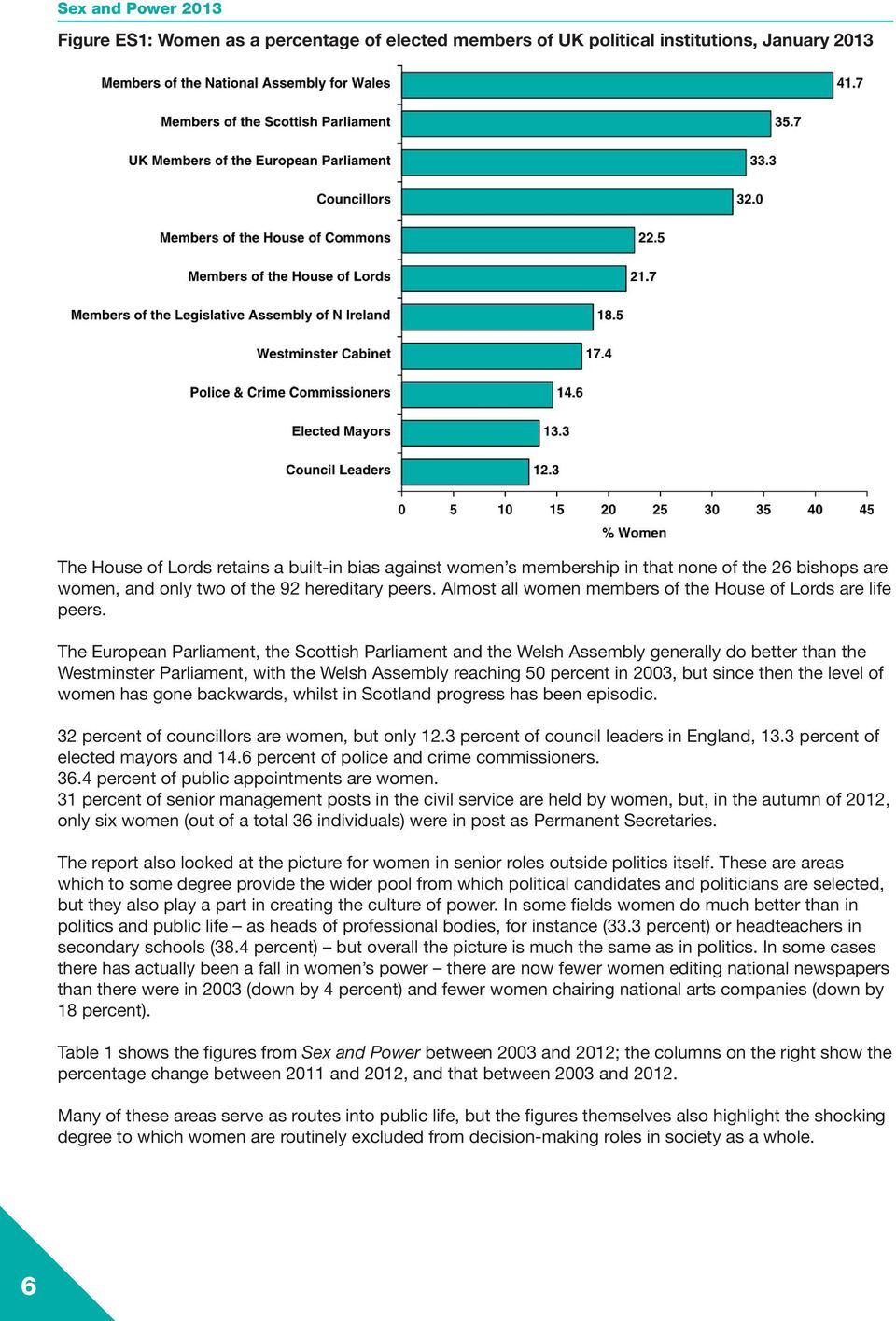
6 Sex and Power 2013 Figure ES1: Women as a percentage of elected members of UK political institutions, January 2013 The House of Lords retains a built-in bias against women s membership in that none of the 26 bishops are women, and only two of the 92 hereditary peers. Almost all women members of the House of Lords are life peers. The European Parliament, the Scottish Parliament and the Welsh Assembly generally do better than the Westminster Parliament, with the Welsh Assembly reaching 50 percent in 2003, but since then the level of women has gone backwards, whilst in Scotland progress has been episodic. 32 percent of councillors are women, but only 12.3 percent of council leaders in England, 13.3 percent of elected mayors and 14.6 percent of police and crime commissioners percent of public appointments are women. 31 percent of senior management posts in the civil service are held by women, but, in the autumn of 2012, only six women (out of a total 36 individuals) were in post as Permanent Secretaries. The report also looked at the picture for women in senior roles outside politics itself. These are areas which to some degree provide the wider pool from which political candidates and politicians are selected, but they also play a part in creating the culture of power. In some fields women do much better than in politics and public life as heads of professional bodies, for instance (33.3 percent) or headteachers in secondary schools (38.4 percent) but overall the picture is much the same as in politics. In some cases there has actually been a fall in women s power there are now fewer women editing national newspapers than there were in 2003 (down by 4 percent) and fewer women chairing national arts companies (down by 18 percent). Table 1 shows the figures from Sex and Power between 2003 and 2012; the columns on the right show the percentage change between 2011 and 2012, and that between 2003 and Many of these areas serve as routes into public life, but the figures themselves also highlight the shocking degree to which women are routinely excluded from decision-making roles in society as a whole. 6
7 Executive summary Table ES1: Sex & Power 2012 Index /8 2010/ Up/ down 2011/12 Up/ down 2003/12 Members of Parliament The Cabinet House of Lords Members of the Scottish Parliament Members of the National Assembly for Wales Members of the Legislative Assembly of Northern Ireland Local authority council n/a * leaders UK Members of the European Parliament Directors of FTSE Companies Directors of FTSE250 n/a n/a n/a Companies Editors of national newspapers Directors of major museums and art galleries Chairs of national arts companies Chief executives of national sports bodies Public appointments Local authority chief executives Senior ranks in the armed forces Senior police officers Senior judiciary (high court judge and above) Civil Service top management 1 Head teachers in secondary schools University vice chancellors NHS chief executives Trade union general secretaries Heads of professional bodies * Council leaders in England; the change is since Change since CEOs in England, Scotland and Wales 7

8 Sex and Power 2013 In terms of finance and the economy, not only are they a small minority of directors, but also only 15 percent of members of Local Economic Partnerships and 25 percent of general secretaries of trade unions with membership in excess of 200,000. * There are no women at all on the Bank of England Monetary Policy Committee. Other areas we examined include justice and the law, charities and professional bodies, education, health, the armed forces, the police, news, media and current affairs, sport and the arts. Detailed figures for these areas as well as finance and the economy and politics and public life are contained in Appendix 1 of the full report. We noted that there is considerable concern in some quarters about the professionalisation of politics. According to government figures, 41.0 percent of Special Advisers (SpAds) were women in October We found that there currently appear to be no figures on the diversity of people working as lobbyists, for public affairs companies or think tanks, or as political advisers to the opposition, and we have therefore not been able to report on them. However, we also noted that, according to the Equality and Human Rights Commission s Pathways to Politics report on the 2010 general election, the previous employment of the majority of politicians is still outside the political village ; for example, 10 percent came from financial services and at least 11 percent are qualified solicitors. In recent years there has been much discussion of what needs to be done to widen access to political power not just in relation to gender, but also ethnicity, disability, class and sexual orientation (to name but four). Certainly the current narrow social band from which MPs are drawn needs to be broader, but it is also the case that, given that it is probable that many MPs and other public representatives will continue to come from many of the occupations examined in this report, access to them is broadened also. Women access (or fail to access) public life in a number of ways, and the barriers to their participation have been well documented. We have not rehearsed them again in this report, but it is appropriate to note that, given that people will always enter political life from some or all of the routes examined above, the absence of women matters not just in terms of the professions and activities themselves, but also for the future of our political institutions. Recommendations The report makes six recommendations for action, the first four of which can and should be implemented before the next general election in Recommendation 1: Political parties should take immediate action to increase the number of women candidates at all levels of election with a view to fielding as many women candidates from as wide a variety of backgrounds and communities as possible in winnable seats in This should include active consideration of positive action measures in selection processes. Recommendation 2: In order to enable everyone concerned to develop a much better understanding of the issues, a monitoring form similar to that used in recruitment for public appointments and applications for funding should be introduced. It would be completed and submitted to returning officers by all candidates together with nomination forms at all levels of election, and the results collated and published annually. This requirement should be implemented at the 2014 English local and European elections. Recommendation 3: Government should pilot a new government-wide scheme in 2014 to increase women s presence, profile 8 * The women are all general secretaries of teaching unions. Since January 2013 the TUC has had a female general secretary. accessed January These include the Councillors Commission in 2007 and the Speaker s Conference report of 2010, both of which amply cover the major barriers women face and propose solutions.

9 Executive summary and participation in the 2015 general election and beyond. This could be done by drawing together experience from the UK and abroad which could be used to improve both the participation and the candidacy of women of all backgrounds in Britain. Recommendation 4: Government, political parties and others should act to implement the recommendations of the Speaker s Conference Report published in Recommendation 5: In addition to adopting the proposals for cultural change in public life contained in reports such as the Speaker s Conference, the Councillors Commission, and the Equality and Human Rights Commission s Pathways to Politics, steps should be taken to develop a much wider set of proposals for improving the culture of both politics at all levels and the media coverage of them. Recommendation 6: All organisations public, private and third sector should take steps to ensure that, at meetings and events, both women and men appear on platforms as speakers, and editors and broadcasters should also take responsibility for commissioning contributions from both women and men as commentators and experts. Individual citizens should be encouraged to object to men-only platforms, panels and programmes. It is our intention to review progress towards the implementation of these recommendations in 2013/14 and to publish our findings. 9

10 Sex and Power 2013 Acknowledgements We would like to thank the Joseph Rowntree Charitable Trust for making the funds available for the research and writing of this report, as well as for supporting the Counting Women In coalition in its early days; this support has been very much appreciated and without it this report would not have been possible. We would also like to thank the Equality and Human Rights Commission for permission to use the title Sex and Power: Who runs Britain? as well as material and tables from previous editions published by both them and their predecessor the Equal Opportunities Commission. The report has been researched and written by the Centre for Women & Democracy, with support from the Hansard Society, and in particular from Jess Smith who helped with the research, Ruth Fox who read the initial drafts, Virginia Gibbons and Helena Unwin-Golding who proof-read it and Matt Korris, who worked on the design. Sex and Power has also benefited hugely from comments and suggestions provided by all the Counting Women In partners, in particular from Katie Ghose, Jessica Garland, Claudia Laidlaw, Ashley Dé and Stuart Thomas at the Electoral Reform Society, Ceri Goddard, Preethi Sundaram and Charlie Woodworth at the Fawcett Society and Alexandra Runswick at Unlock Democracy. We are also grateful to Fiona Glen, Director of Research and Information at the Equality and Human Rights Commission, and Mark Hammond, the EHRC s Chief Executive, for their assistance and support. Nan Sloane Director, Centre for Women & Democracy 10

11 Methodology Methodology The figures in Sex and Power 2013 represent a snapshot of the gender breakdown of people in senior decision-making roles in August and September Any snapshot is by definition out-of-date almost immediately, and thus there are some figures which, if checked again at the time of publication (February 2013) will be found to have changed. We are confident, however, that in no case is the change very great. The major exception to this is the figure for the House of Commons, which has been adjusted to take account of the by-elections held in November There are also one or two other areas where data has become available only since the snapshot was taken. Where this has happened it is made clear in either the text or in a footnote. Unless otherwise stated, the terms Britain or Great Britain mean England, Scotland and Wales. In some cases separate figures for Northern Ireland have been included, but these are not always available. In some cases figures relate only to England and Wales, and, again, this is made clear in either the text or a footnote. In many cases we have undertaken our own research in order to arrive at the relevant figures. Where this has happened we have indicated the sources we have used, and Appendix 2 consists of a list of specific organisations examined in stated categories. It should be noted that the number of government agencies and advisory bodies is a moveable feast, and that ongoing restructuring means that any calculation can only provide a snapshot which may become very quickly out of date. However, we are confident that the picture which this snapshot shows remains broadly accurate even taking account of recent changes (for instance to Government executive agencies). Sources used for the whole project have been very varied, ranging from the websites of individual bodies (e.g. theatres, independent schools and sports governing bodies) to those of professional organisations (e.g. the police and the legal profession). However, in some cases we have used research already published elsewhere, and when this has happened we have made the sources clear in footnotes. Every effort has been made to ensure that the picture presented in this report is fair and accurate, and that sources have been identified and acknowledged. The authors would be grateful if any errors or omissions could be brought to their notice as soon as possible. 11

12

13 Introduction Introduction It is now almost 40 years since the Sex Discrimination Act was passed, and over 80 since women got the right to vote equally with men, yet women, still, are all too often missing from politically powerful positions in the UK. And at the current rate of progress, a child born today will be drawing her pension before she has any chance of being equally represented in the Parliament of her country. This report is about the representation of women in politically powerful positions in Britain, and it follows on from a series of such reports published first by the Equal Opportunities Commission (EOC) and then by its successor, the Equality and Human Rights Commission (EHRC). All of them have found the same thing. Britain is a country run largely by men. The Counting Women In coalition, which came together in the wake of the absence of visible women in the 2010 general election campaign, believes that the exclusion of women from positions of power damages the interests of both women and men, as well as the country as a whole. Women are a majority (51 percent) 2 of the population, but power is concentrated in the hands of the minority. Only 22.5 percent of MPs are women, 21.7 percent of peers and, at the time of writing, 17.4 percent of the Cabinet. And of the nine other ministers who attend Cabinet but do not vote, just one is female. 41 of 338 English local authorities are led by women (12.3 percent), and there are two female elected mayors (13.3 percent). In the recent elections for Police and Crime Commissioners in England and Wales only six (14.6 percent) of the 41 people elected to these powerful new posts were female. Internationally, the UK Parliament lies 60 th (out of 190) in the global league table in terms of women legislators, and lags behind every western European neighbour except Ireland, * Italy and Monaco. Despite improvements at the 2010 general election British women continue to be excluded from power to a greater degree than most of their continental sisters. Women have been told for years that they should be patient, that change is always slow, and that it s just a matter of time before equality is achieved. But we have already waited a lifetime for fair access to power; asking us to wait another will do nothing to improve matters, either for women themselves or for the quality of our democracy and public life. 14.6% of Police and Crime Commissioners 12.3% of council leaders in England are women There is a growing body of evidence, largely drawn from business, that women make a positive difference to actual decision-making itself. For example, in a report in 2011 the accounting firm Deloitte found that In Europe, of 89 publicly traded companies with a market capitalisation of over 150 million pounds, those with more women in senior management and on the board had, on average, more than 10 percent higher return on equity than those companies with the least percentage of women in leadership, and came to the conclusion that In reality, the question is not women or men, it s how to ensure women and men are working together in decision-making roles. 3 * Ireland will be introducing compulsory gender quotas for parliamentary candidates at the next general election in

14 Sex and Power 2013 If this is true for major companies, it is also true for government. Moreover, there is some evidence to suggest that the presence of women changes what is debated in the public realm as well as what government actually does. Research carried out by the Hansard Society 4 found that women can and do bring issues to the table which may not otherwise be debated, or which might wrongly be considered to be of less significance, Excluding women thus has the effect of making the legislature less relevant to the whole population, both male and female, than it has the potential to be. 36.4% of public appointments are women 14.2% of University Vice Chancellors Then there is the sheer waste of resources involved. There is huge investment in women and girls through the education system, and they go on to develop skills and expertise which, combined with their life experience, make them essential to good government. If they are largely excluded from national (and local) politics these skills are under-used in terms of public benefit in national leadership, and whilst it is true that in many respects the life experiences of men and women are the same, in many they are not. To be truly effective the country s democratic institutions need to attract the best possible people, regardless of who they are or what their background is. What applies to politics applies to other areas as well. We looked at most of the fields which could be described as coming within the definition public life in other words, areas which either raise or spend public money (e.g. health), which make fundamental decisions about individual lives (e.g. the courts) or which influence or affect our national culture (e.g. the media). In almost all of them the over-representation of men is evident; in some the absence of women is marked. Even in trades and professions in which women predominate as employees they are often hard to find at the top. Nor is the industry which comments on politics a balanced one. The parliamentary lobby, where most political journalists and their editors work, was found in research done by the Guardian newspaper to be heavily male, with only 23.1 percent of lobby journalists for national daily newspapers being female and none of the political editors. 5 The picture is slightly better for the Sunday papers, and slightly better again for broadcasters, but the overall picture and culture are so male that, when David Cameron and Nick Clegg held their press conference on the coalition s mid-term review on 7 January they seemed unable to find a single female journalist or commentator in the room from whom to take a question. All this matters because it means that all aspects of public life in Britain are headed up by people drawn from a very narrow section of the population, not just in terms of gender but also, amongst other things, of race, class, disability, sexuality and age. Many of our legislators are drawn from the professions and industries included in this study, and in the section of the report entitled The Wider Picture we look at them in more detail, but it is clear that, even allowing for the rise of the professional politician, many Members of the UK Parliament, Members of the European Parliament, Welsh Assembly Members and Members of the Scottish Parliament and others come from backgrounds in the law, finance, education, business and the armed forces. If the decision-making levels of these are heavily male, it is hardly surprising if women find it equally difficult to break into elected office. 15.6% of High Court Judges 23% of parliamentary lobby journalists We believe that, despite all that has happened in recent years, politics still matters, and that who does it matters too. Politicians are our legislators and form our governments. They make decisions which have a direct effect on people s lives on a huge range of issues, from who should receive child benefit to whether or not to go to war, from where high speed railways should be built to what the time limit for abortions should be, from what tax levels we all pay to whether or not political parties should be allowed to use positive action in candidate selections. A more diverse body politic with a wider spread of expertise and reflecting the life experience of both halves of the human race would be better placed to lead us through the 14

15 Introduction complex times that face us. The lack of diversity in public life in itself weakens democracy and public confidence in it. When people look at Parliament they do not see the best of themselves reflected back at them. This report relates specifically to women, but the same is true of many minority groups as well. We recognise that simply putting more white, middle-aged, middle-class women into Parliament will not solve the whole problem (though we do think, given the imbalance, that more white, middle-aged, middle-class women would still be better than more white middle-aged, middle-class men), and we would have liked to include much more detail about the lack of diversity in public life other than in terms of gender alone. However, the sad fact is that most of that information is not available, and is not even collected or collated; that it is available for women is largely due to the efforts of women s groups down the years to find it and get it published, and to the EOC and EHRC for having researched it since Campaigns to increase women in politics (or at the top of professions or in boardrooms) are sometimes criticised on the grounds that we are only concerning ourselves with a small minority of privileged women. We wholeheartedly agree that there is much more to gender equality than just who occupies well-paid and influential jobs. But these are spheres in which great power is exercised, not only financially but in terms of culture, access to education and training and the maintenance of civil rights and the law. They are also areas which are relatively straightforward to monitor and assess at least when it comes to gender. However, as our recommendations reflect, there should be a much more concerted effort made to identify who the people in public life (especially politics) are in terms of a much wider range of indicators, * and we find it particularly surprising that no effort whatsoever is made to monitor the diversity of people standing for public office at the point at which nominations are made. We need to know who is standing and not being elected as well as who stands and succeeds, and at the moment finding this out in any meaningful detail for any indicator other than sex is next to impossible. In an ideal world we might have been able to drill down a little further, but both our mission and our resources mean that in this report we have only been able to make sustained and detailed analysis of gender. We believe that unless there is significant and lasting improvement at all levels of society we will not achieve a culture in which women s access to power both personal and political at every level is a given rather than something which has to be asked for and may or may not be granted. For instance, the lack of women in the Cabinet means that women are not generally perceived as powerful; this perception filters throughout society, reinforces gendered assumptions and stereotypes of what a leader looks like, and impacts directly on women s power and agency. We can and must change that. We have often been told that we live in a meritocracy in which women could achieve high office if they wanted to, and that the failure of women to do so when they have equality of opportunity is more about them than it is about power, structures or prejudice. We agree that women more often want training, mentoring and support to take on senior roles, and indeed we regard this as a strength rather than a weakness, since it suggests that women want to prepare properly for responsibility. But we see no evidence to suggest that there actually is a meritocracy so far as women (or other under-represented groups) are concerned, and in fact the figures contained in this report seem to suggest the reverse. Getting more women into public life requires more than just equality of opportunity; it also requires equality of commitment and a real understanding of why the strengths and attributes of both sexes are essential to our future joint success. At the end of the report we have made six recommendations for what needs to be done, both now and in the longer term, to make faster progress towards parity in public life, and we call upon all those involved including government, Parliament, political parties and the media to implement them immediately. The monetary cost of doing so is very low, but the cost to democracy of failing will be high, and a small investment now will reap huge rewards in the future. We know that change is possible, but without real, committed and targeted action now we will continue to drift. * The protected strands identified by the EHRC are age, disability, gender, race, religion and belief, pregnancy and maternity, marriage and civil partnership, sexual orientation and gender reassignment. 15

16 Sex and Power 2013 In a year s time we will be coming back to see what progress has been made, especially as the 2014 English local and European elections and the 2015 general election will then be approaching. We hope that we will start to see real change, particularly in politics, and that we will be able to report much more positively about sex and power in After all, one lifetime is more than long enough to wait. Nan Sloane Katie Ghose Ceri Goddard Director Chief Executive Chief Executive Centre for Women & Democracy Electoral Reform Society Fawcett Society Ruth Fox Director & Head of Research Hansard Society Alexandra Runswick Deputy Director Unlock Democracy 16

17 Who runs Britain? Who runs Britain? Governments are generally thought to be composed of elected politicians, but in fact the activity of government and therefore the exercise of its power is carried on by a variety of officials and bodies. Elected office particularly that held by the political party in power is clearly the main element of this combination, but both individuals appointed through the public appointments system and civil servants have roles to play and powers to exercise. Taken together, these are the people who rule Britain, and the under-representation of women in their ranks is striking. 1. Elected Office In 1929, at the first general election to be held under universal suffrage, 14 women were elected to Parliament just 2.3 percent of the total. There were no women peers in the House of Lords, one woman in the Cabinet, * and only a light scattering of women councillors across the country. Neither of the devolved bodies in Scotland or Wales existed, and the European Parliament was still decades away. Since then, the world has changed very greatly. Democratic institutions have both multiplied and developed, and ideas about what democracy is and how it should work have also become more fluid. A traditionally representative system has acquired participative aspirations, and at the same time we are much more aware of how unrepresentative our institutions are and how much more representative we want them to be. Figure 1: Women as a percentage of elected members of UK political institutions, January 2013 * Margaret Bondfield, who, as Minister of Labour in the incoming Labour administration, was the first woman to hold Cabinet office. 17

18 Sex and Power 2013 The slow progress towards gender equality in our democratic structure is therefore both surprising and disappointing. At the 2010 general election, more than 80 years after electoral equality was achieved, just 142 women were elected certainly much better than in 1929, but at 22 percent bringing us nowhere near parity. There have been women in the House of Lords since 1957, but again the percentage is low (21.7 percent) and given that there is a built-in quota for men in the form of Church of England bishops and only two women sitting as hereditary peers (and 90 men), the cards are stacked against any kind of equality prevailing in an unreformed House. As the charts and tables in this report show, women have progressed in some areas (e.g. as local councillors) and are much better represented in the devolved institutions and the European Parliament, but there is no doubt that across the board there is still a long way to go and that progress is very slow. In the case of the House of Commons, for instance, it has been estimated that a child born today will be drawing her pension before there is parity of representation between women and men. Despite widespread anxiety over the lack of diversity in most of the UK s representative institutions, there have actually only been very small improvements since the turn of the century. Table 1 shows the margins of change between 2000 and 2013 in the relevant areas. Table 1: Percentage increase/decrease in the presence of women in UK political institutions Net Change 2000/2013 Members of Parliament 18.4% 18.1% 19.3% 22.5% + 4.1% The Cabinet 21.7% 27.3% 26.1% 17.4% - 3.5% House of Lords 15.8% 17.7% 19.7% 21.7% + 5.9% Members of the Scottish 37.2% 39.5% 34.1% 35.7% - 1.5% Parliament Members of the National 40.0% 50.0% 46.7% 41.7% + 1.7% Assembly for Wales Members of the Legislative n/a 16.7% 16.7% 18.5% + 1.8%* Assembly of Northern Ireland Local Authority Council Leaders n/a 16.6% 14.3% 12.3% - 4.3% Local Councillors 29.0% 30.0% 30.0% 32.0% +3.0% UK Members of the European 23.9% 24.4% 25.6% 33.3% + 9.4% Parliament * Change since Council leaders in England and Wales; the change is since Figure 2: Women as a percentage of MPs for each political party in 2000 and

19 Who runs Britain? The most frequent area of concern is the House of Commons which, as the UK s primary legislative body, is seen as having both a greater responsibility and a greater challenge in becoming and remaining reflective of the people it governs and serves. Figure 3: Women as a percentage of Westminster MPs in the English regions and devolved nations Prior to 1997, the percentage of women MPs never achieved double figures, the high point being 9.2 percent in In 1997 it doubled to 18.2 percent, but since then it has dawdled through three general elections in which, as Table 1 shows, the net change was negligible. Individually, however, the political parties have all improved to one degree or another, although, as Figure 2 suggests, Labour s use of positive action in 1997, 2005 and 2010 makes the overall improvement look better than it might otherwise have been. The increase in the Conservative position is largely due to the use of the (now abandoned) A-List system in 2010, whilst the percentage improvement shown by the Liberal Democrats represents a numerical advance over the period from three to seven women MPs. Figure 4: Women as a percentage of MPs in eight western European countries
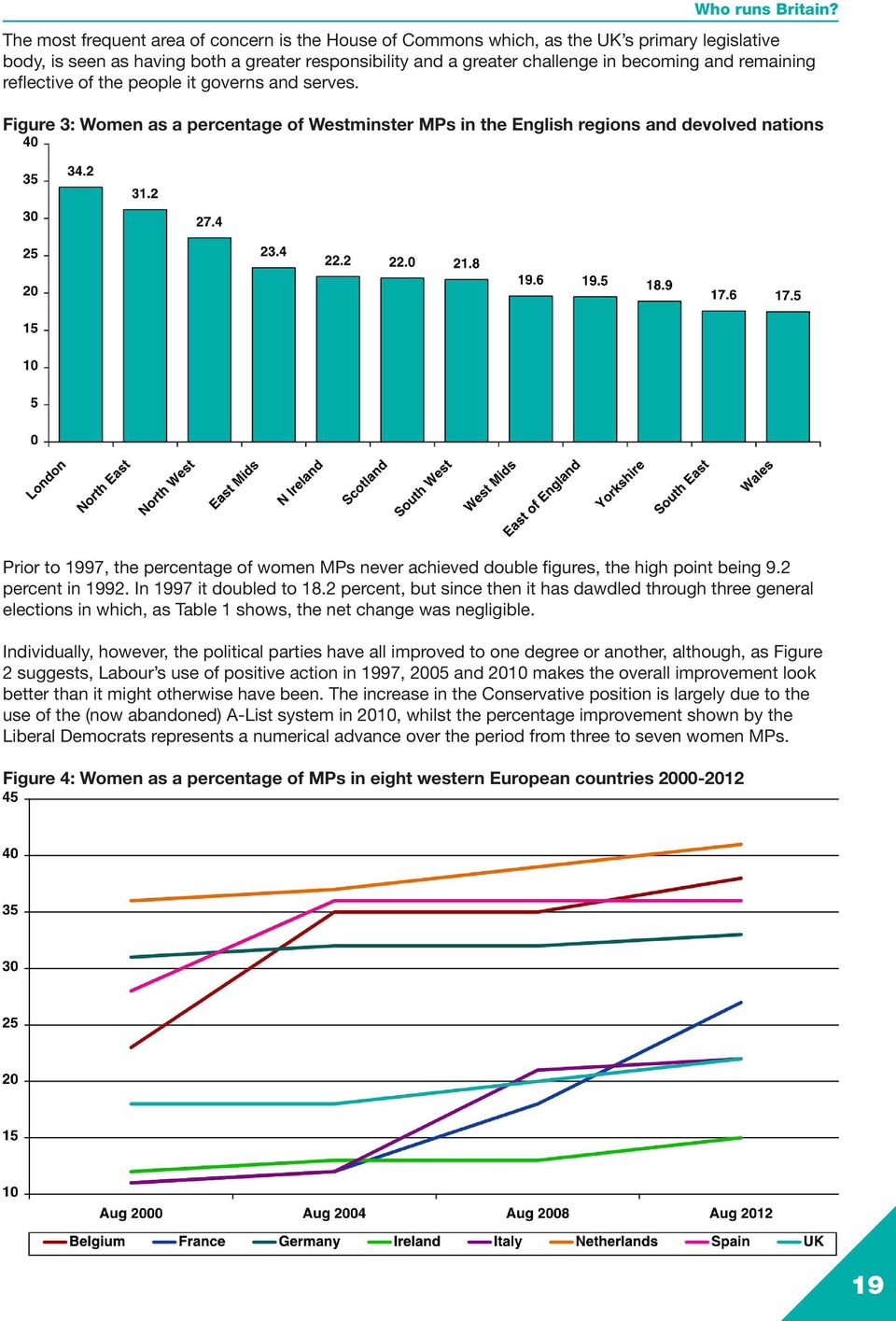
20 Sex and Power 2013 There is, as Figure 3 illustrates, a considerable variation between regions, from London (where 34.2 percent of MPs are women) to the South East of England (17.6 percent). Internationally, women are on the whole better represented than in much of the rest of the world, although that picture is a little less reassuring when comparisons are made (as in Figure 4) with western European (and therefore comparable) neighbours. The UK also continues its slow fall through the global league table. Just before the 2010 general election the Westminster Parliament was ranked 62 nd (out of 189 countries); immediately after it rose to 51 st equal. However, the effect of other countries leapfrogging up the table as their own elections produce improvements has been to push the UK back down to 60 th equal, and this pattern is likely to continue as we approach As Figure 5 shows, this represents a continuing underlying trend. Figure 5: UK placing in Inter-Parliamentary Union World Rankings in terms of Women as a percentage of MPs If the House of Commons is unrepresentative the House of Lords is no better, although excluding bishops, judicial peers and hereditary peers from the calculation improves matters a little on the surface. Appointments to the House of Lords are dealt with by the Lords Appointments Commission, three of the seven members of which are women (though the Chair is male). Figure 6: Women as a percentage of members of the House of Lords by type 20

21 Who runs Britain? Figure 7: Women as a percentage of each political party s peers The failure of House of Lords reform means that new life peers are likely to continue to be made; the gender breakdown of these remains to be seen. The UK sends 72 Members to the European Parliament, and here women do a little better. The European Parliament as a whole has usually out-performed the UK, though in recent elections the gap has been closing. Figure 8: Women as a percentage of MEPs for the UK and the EU as a whole in 2000 and 2012 MEPs are elected using the de Hondt system of proportional representation which involves parties producing ranked lists of candidates. Electors vote for the party rather than the individual candidates, with candidates being elected in the order in which they appear on the list until all seats are filled. As a result it is much easier for parties to use positive action to balance the lists if they wish, and Labour, the Liberal Democrats and the Green Party take advantage of this. The establishment in 1999 of the Scottish Parliament and the National Assembly for Wales raised considerable hopes of a new kind of politics, and indeed they have both consistently out-performed the Westminster Parliament in terms of women elected. However, progress has not been smooth and the high points of 2003 have proved elusive. Both bodies use proportional representation systems for their elections, and both the Labour Party and (in Wales) Plaid Cymru either use or have used positive action mechanisms at various points. 21
22 Sex and Power 2013 Figure 9: Women as a percentage of MSPs and AMs elected in Scotland and Wales When it comes to local government, the percentage of women councillors is now very slowly increasing, but the level of women in leadership roles is decreasing. Only 12.3 percent of councils are led by women, and research on local government leadership conducted by the Centre for Women & Democracy and published in found that women were much less likely than men to hold the key corporate (18 percent women), financial (7 percent) and economic development (12 percent) portfolios which form the main leadership pipeline. Women are slightly better represented in percentage terms as elected mayors (13.3 percent), but this represents two out of a total of only 15 individuals. Six (14.6 percent) of the 41 newly-elected Police and Crime Commissioners are women. 2. Public Appointments Public appointments are made to a wide variety of bodies and organisations, some of which are directly connected to government, whilst others are either arms-length or independent. They include organisations as diverse as the Driver and Vehicle Licensing Agency, the Care Quality Commission and the Office of Fair Trading, and collectively, they exercise considerable influence. Table 2 gives the figure for women as a percentage of public appointments overall, but also looks at four specific types of organisation. Many, but by no means all, of these have their chairs and board members appointed by ministers on the recommendation of the Commissioner for Public Appointments. The process by which this is done has long been regarded as difficult to access and pass through, and has proved particularly unattractive to women. In its 2010 Equality Strategy 7 the government set an aspirational target that, by 2015, 50% of new public appointments to public boards would be women. However, it does not seem to be monitoring this target, and its own progress review, published in May 2012, makes no mention of it. 8 The specific areas included in the study (largely because of either their closeness to government or their significant role in the regulation or delivery of services) are: Departmental Boards, which were set up in each ministry by the Coalition Government in 2010 to tap into the expertise of senior leaders with experience of managing complex organisations in the commercial private sector. 9 Boards are chaired by the relevant Secretary of State and include ministers, civil servants and non-executive members from outside government. The figures include this last group only, since ministers and senior civil servants are counted elsewhere; 22 Non-Ministerial Departmental Public Bodies, which are established by law with a specific remit
23 exercised at arm s length from government the Crown Prosecution Service, for instance, or HM Revenue and Customs but funded by the public purse to carry out functions which are part of the government s remit. They have a chair and board as well as a chief executive; Executive Agencies and other Public Bodies such as the Identity and Passport Service, the Parole Board or the Royal Parks, exercise specific functions connected with the delivery of services or policy. These bodies have chief executives (or equivalent) but not chairs or boards, and they may be directly responsible to a minister (e.g. the UK Border Agency is responsible to the Home Secretary). For purposes of this study we have looked at a sample of 72 which include a range of purposes and responsibilities; Regulatory Bodies, such as the Human Tissue Authority or the Information Commissioner s Office, which have legal duties either delegated to them by government or established in law. They function independently of government and usually have their own chair and chief executive working below the departmental level of responsibility with a range of activities. For purposes of this study we have looked at a sample of 58 which include a range of purposes and responsibilities. In a small number of cases, Chairs of Boards also function as Chief Executive Officers (CEO); where this happens the individual has been counted as CEO only to avoid double-counting. The list of bodies included in the study can be found in Appendix 2. Table 2: Public Appointments Percentage women Public Appointments 10 All 36.4% Departmental Boards 11 Non-Executive Directors 32.1% Non-ministerial Departments 12 Chairs 31.3% Chief Executives or equivalent 27.3% Executive Agencies 13 Chief Executives or equivalent 15.8% Regulatory Bodies 14 Chairs 41.6% Chief Executives or equivalent 25.4% 3. The Civil Service The third element of public decision-making is the Civil Service. Here women are also very poorly represented, and although there are improvements from time to time, they are rarely sustained for any significant period of time. Thus at the point (September 2012) at which this snapshot was taken, the higher echelons of the Civil Service were as lacking in diversity as their political masters (and mistresses); although 53 percent of all Civil Service staff are female, 15 there were only six women in post as Permanent Secretaries or equivalent (16.7 percent) 16 with women holding 31 percent of all top management posts Special Advisers Who runs Britain? There is considerable concern in some quarters about the professionalisation of politics, with an increase in the level of public representatives, especially MPs, being drawn from the ranks of ministerial Special Advisers (SpAds), public affairs and lobbying companies and think tanks. In October 2012, 41 percent of Special Advisers working for the government were women. 18 There are currently no figures available for political advisers working for the opposition. There are no figures either on the diversity of people working as lobbyists, for public affairs companies or in think tanks, and we have therefore not reported on them. 23
24 Sex and Power The Wider Picture Politics does not operate in a vacuum, nor are elected bodies the only repositories of power or public decision-making. Who holds senior office in other organisations, professions and spheres influences a wide variety of areas, including policy-making, funding, and the general culture of society as a whole as well as public life. These posts are also important because they often form part of the routes taken to access public office, so that a lack of diversity in them can and does impact on the diversity of our democracy. Table 3 shows women in selected top jobs and, in particular, in the last column, shows the increase or decrease between the statistics quoted in the first edition of Sex and Power in 2003 * and The figures in the columns in between are those from editions published in the relevant years. Appendix 1 gives detailed tables for many of these areas, as well as others not covered here. In many sectors there have been small increases between 2011 and 2012, including, most notably, in the percentages of women company directors a field in which a concerted effort has been made in recent years. But there are still all too many areas in which there has been very little advance, and some in which there has been none at all, and although there are one or two areas in which there has been significant advance since 2003, overall the picture is one of sluggish growth with occasional setbacks. Table 3: Sex & Power 2012 Index /8 2010/ Up/ down 2011/12 Up/ down 2003/12 Members of Parliament The Cabinet House of Lords Members of the Scottish Parliament Members of the National Assembly for Wales Members of the Legislative Assembly of Northern Ireland Local authority council n/a leaders UK Members of the European Parliament Directors of FTSE Companies Directors of FTSE250 n/a n/a n/a Companies Editors of national newspapers Directors of major museums and art galleries Chairs of national arts companies Chief executives of national sports bodies Public appointments * Published by the Equal Opportunities Commission, which is now subsumed into the Equality and Human Rights Commission, by whose kind permission Table 3 is reproduced.
25 /8 2010/ Up/ down 2011/12 Who runs Britain? Up/ down 2003/12 Local authority chief executives Senior ranks in the armed forces Senior police officers Senior judiciary (high court judge and above) Civil Service top management 19 Head teachers in secondary schools University vice chancellors NHS chief executives Trade union general secretaries Heads of professional bodies Council leaders in England; the change is since Change since CEOs in England, Scotland and Wales. Note: The statistics in this index have been selected to represent positions considered to have power or influence in Britain. As far as possible, these statistics relate to Great Britain or to the United Kingdom, with the obvious exceptions of the Scottish Parliament, the National Assembly for Wales and the Legislative Assembly of Northern Ireland, which relate only to those countries. For each statistic included, the percentage of women has either been taken directly from the source, or it has been calculated from the actual numbers of women and men. As we have noted, many of these areas act as pipelines for both women and men entering politics, and their relative representation in them both directly and indirectly affects the gender balance of public representatives. For this report we looked specifically at how women s presence in (or absence from) these pipelines might impact their access to political power. The Pathways to Politics research carried out for the Equality and Human Rights Commission after the 2010 general election 20 suggested that, whilst the pattern of access to politics was changing, it remained the case that both candidates and public representatives are still drawn largely from a small group of occupations, trades and professions. We have looked at this group in the light of how they serve as routes into public life, but the figures themselves also highlight the shocking degree to which women are routinely excluded from decision-making roles in society as a whole. Pathways to Politics found that for members of the Westminster, European and Scottish Parliaments and the Welsh Assembly the most common prior involvement in politics across all parties was as a local councillor; 52 percent of politicians elected had at some point held office at this level. 21 We have already noted that whilst women fare better in local government (at least on the back benches) than at other levels of political office, they still constitute only 32 percent of councillors. The 2007 Councillors Commission report examined in detail the barriers to women s access to local government, and the Centre for Women & Democracy produces annual reports on women s performance in local elections. To date, there are no signs that progress is accelerating, and the presence of women at the most senior levels is actually falling. If service as a local councillor continues to be a primary route into politics it will clearly not deliver significantly improved numbers of women in the short-term unless the numbers elected increase significantly. The area which has caused most concern recently is the apparent rise of the professional politician that is, politicians whose whole lives have been spent in political activity of one kind or another, who have worked for MPs or political parties, and who usually have a university education. The EHRC study found that 17 percent of politicians reported previous employment by an MP and a further 7 percent had been employed by a political party. 25
26 Sex and Power 2013 It also found that another 5 percent had worked either in public affairs or as lobbyists, whilst 3 percent had been employed by think tanks or policy groups. There are currently no available figures for the gender breakdown of any of these areas, and it is not therefore possible at present to specify whether this kind of background helps women or militates against them. For most politicians, however, previous employment was outside politics itself. 22 percent of new Conservative MPs elected in 2010, for instance, have a background in business, whilst 10 percent of all MPs had worked in financial services. 22 Thus the under-representation of women in our economic and financial institutions affects more than just women themselves, or even the quality of decision-making at board level. As Table b) in Appendix 1 demonstrates, women are largely absent from the higher echelons of business, and although considerable efforts have recently been made to change this, they have yet to bear significant fruit. In addition, there are now only two women chief executives running UK FTSE 100 companies. * When it comes to regional and local economic development, the new Local Enterprise Partnerships (LEPs) show an alarmingly low level of female participation. This is particularly disappointing since it is known that apart from anything else increasing women s economic activity could significantly promote growth. According to the Federation of Small Businesses, 29 percent of entrepreneurs are women, yet only 14.9 percent of private sector members of LEPs are women. Thus the relative absence of women from the business and financial sectors means that it is probable that fewer will come through into politics at a time when the numbers of MPs from that background are increasing. The trade unions, which are key players in both the public and private sectors, are also heavily maledominated, and this is particularly the case with the very large unions, all of which, with the exception of the two representing teachers, are led by men. In 2012 the TUC appointed its first female General Secretary, but it remains to be seen what impact this will have on the wider culture. More than 55 percent of politicians in national and devolved bodies are members of trade unions. 23 It is, of course, by no means the case that everyone who is a member of a trade union is active in it, and membership of a trade union does not indicate having had support from it, either. However, 8 percent of those surveyed for the Pathways to Politics report indicated that they had been employed by a trade union; since there is no gender breakdown available for trade union employees it is impossible to say whether or not this benefits women candidates. Another key route into politics for both men and women is the legal profession and, in theory, it is one in which women should be well represented at all levels. 66 percent of all students studying law in 2010/11 were women, 24 and, according to the Law Society, the number of women entering the legal profession has been steadily increasing. In 2011, 46.5 percent of solicitors were women; in 2010, 34.8 percent of barristers were women and 10.9 percent of Queen s Counsels (QCs). Yet, apart from at magistrate level, women feature relatively little at the higher levels of the judicial system; at almost all judicial levels women constitute less than 20 percent of office-holders (see Table c) in Appendix 1). One of the issues which can have a direct effect in reducing the numbers of women in the pipeline is the rate at which women leave careers before reaching senior levels. The law is one of the very few professions for which drop-out rates seem to be available; according to the Association of Women Solicitors, the drop-out rate for women is twice that of men, and according to the Bar Council the dropout rate for women barristers after 10 to 12 years of service is high. This means that in both professions 26 * In September 2012 there were four, but Marjorie Scardino at Pearson and Cynthia Carroll at Anglo American have since stood down.
27 Who runs Britain? women are significantly less likely to reach the levels from which they are likely to be considered for promotion to the most senior roles. 12 percent of politicians have been employed by a charity or campaigning organisation at senior level. 25 There are a vast number of charities in the UK, ranging from large international aid organisations to very small groups raising money for specific local causes. According to the Charity Commissioner s website there are just under 163,000 registered charities in the UK, 26 and many of these have a significant impact on the lives of millions of individuals. This will only increase as more services formerly provided by government are moved to the third sector. In September 2012, 24 percent of charities had women chief executives, * and 19.2% of professional bodies (i.e. bodies which have not been included in the section on public appointments because they are private bodies not under the auspices of either the government or the Commissioner for Public Appointments, e.g. the Law Society, the Royal College of Nursing or the Royal Institute of British Architects ). The rise in the number of MPs coming from political, business or campaigning backgrounds has been matched by falls in other areas. In 1997, for instance, 17 percent of MPs were drawn from the education sector; by 2010 this had fallen to just 5 percent. Similarly, those from the medical professions had halved from 8 percent in 1997 to 4 percent in As Tables e) and f) in Appendix 1 show, women are under-represented at senior levels in both of these fields; the only exception to this is as primary school heads (71.3 percent) and it remains to be seen what effect on this figure the 50 percent increase in the numbers of men applying to train as primary school teachers will have. 28 There are also a number of other areas in which important public decisions are made, whose leaders interact with politicians and may ultimately enter Parliament as either MPs or peers, or who are able to influence public thinking and activity through the way in which they use public or publicly raised funds. These include the police, the armed forces, sport and the arts, and figures for the representation of women in all of these are included in the tables in Appendix 1. Needless (and sadly) to say, women are underrepresented at senior levels in almost all of them, even those where they might have been expected to do well. Finally, the tone and much of the culture of public life is set by newspapers and the media, and here again there is a marked absence of women. Table i) in Appendix 1 gives figures in terms of both ownership and editors (women constitute 5 percent of editors of national daily papers), and research by Women in Journalism found that in a typical month, 78 percent of newspaper articles are written by men, 72 percent of Question Time contributors are men and 84 percent of reporters and guests on Radio 4 s Today programme are men. 29 Given that 75 percent of people get their political news and views from television, 27 percent from tabloid newspapers and 26 percent from radio, 30 this apparent silence from women has an effect on both the visibility of women as role models and the subject, nature and tenor of public debate. In recent years there has been much discussion of what needs to be done to widen access to political power not just in relation to gender, but also ethnicity, disability, class and sexuality (to name but four). Certainly the current narrow social band from which MPs are drawn needs to be broader, but it is also the case that, given that it is probable that many MPs and other public representatives will continue to be drawn from many of the occupations looked at in this report, access to them is broadened also. It is not within the scope of this report to look at how that might be done, but it is clear that the whole question of access is about more than just the political structures and their pipelines, and is in effect about the nature of the society we have and the one to which we aspire. Women access (or fail to access) public life in a number of ways, and the barriers to their doing so have been well rehearsed in other research and inquiries. It is not proposed to go through them again here, * Given the vast number of charities across the country, this study has concentrated on those with the highest incomes or assets as defined in Women Count s Charity Leaders 2012 report. For a full list of professional bodies included in this study see Appendix 2. These include the Councillors Commission in 2007 and the Speaker s Conference report of 2010, both of which amply cover 27
28 Sex and Power 2013 but it is appropriate to note that, given that people will always enter political life from some or all of the routes looked at above, the absence of women matters not just in terms of the professions and activities themselves, but also for the future of our political institutions. 28 the major barriers women face and propose solutions.
29 Next steps: Recommendations Next steps: Recommendations This research sets out the problems, but if we are not to be reporting the same figures again in future years action needs to be taken as a matter of urgency. We are therefore making six recommendations for things which could be done by various bodies and organisations to make a difference. We recognise that not all of them are simple, and some require both political and cultural will, but they are all known to work. These recommendations relate specifically to women and political power, but several would also be appropriate in other arenas. As we have already said, politics does not function in isolation from the rest of society, and change needs to happen across the board. 1. Selecting candidates Political parties are the gatekeepers to political power, and whilst some do better than others in terms of the diversity of candidates, all could do better. The face of politics in the UK will only change if political parties change; without action from them no actions elsewhere will be effective. R1: Political parties should take immediate action to increase the numbers of women candidates at all levels of election with a view to fielding as many women candidates from as wide a variety of backgrounds and communities as possible in winnable seats in This should include active consideration of positive action measures in selection processes. 2. Measuring what matters There is currently very little monitoring of the diversity of candidates for political office. * In particular, there is no monitoring of candidates at the point at which they hand in their nomination papers to returning officers, which would be the obvious stage at which meaningful information about gender, ethnicity, disability, sexual orientation and so on could be collected. At present some information is available on gender (or, more specifically male/female), but hardly any on any other aspect. If such information was collected at the point of nomination and sent by returning officers to a central point for collation and eventual publication it would be possible to monitor, track and understand progress much more easily. Data about individual candidates would not be published, but the aggregate figures are critical if we are to see real change in who has and holds political power. R2: In order to enable everyone concerned to develop a much better understanding of the issues, a monitoring form similar to that used in recruitment for public appointments and applications for funding should be introduced. It would be completed and submitted to returning officers by all candidates together with nomination forms at all levels of election, and the results collated and published annually. This requirement should be implemented at the 2014 English local and European elections. * A figure for women as local election candidates is included in the annual Local Elections Handbook produced by Colin Rallings and Michael Thrasher at the University of Plymouth. The Centre for Women & Democracy produces an annual analysis of women in local elections. Political parties are now required to declare diversity figures for parliamentary candidates every six months. 29
30 Sex and Power Training and mentoring Mentoring has become a recognised way, particularly in business, of encouraging and supporting talent, and ongoing training is key to identifying and developing potential candidates at all levels. We recognise that the primary function of all political parties is to fight and win elections, and that, although they are almost all committed to diversity in theory, it is often difficult for them to find resources for training and developing thousands of local government candidates. However, given that they are the gatekeepers to political office they bear a large part of the responsibility for the structures that promote diverse representation. We also recognise that, at least in the first instance, not all women come to politics through political parties, and there is currently no adequate provision for identifying and encouraging them. * In other countries NGOs exist which provide sustained and programmed political mentoring and training to women on a non-party basis, but at present there is no such body in the UK. R3: Government should pilot a new government-wide scheme in 2014 to increase women s presence, profile and participation in the 2015 general election and beyond. This could be done by drawing together experience from the UK and abroad which could be used to improve both the participation and the candidacy of women of all backgrounds in Britain. 4. Using what we know In recent years there have been several (expensive) inquiries into access to politics, including the Councillors Commission (which reported in 2007) and the Speaker s Conference Report of These, together with most other investigations, highlight the same problems and propose similar solutions. Failure to take note of these findings or to implement more than the most marginal of the recommendations means that progress is slow and the wheel is continuously being reinvented. If we are to make a difference to the access of women (and other under-represented groups) to power we need to make use of what we already know rather than looking over and over again for new solutions. R4: Government, political parties and others should act to implement the recommendations of the Speaker s Conference Report published in Changing the culture It is generally acknowledged that the culture of public life, exemplified by the schoolboy atmosphere of Prime Minister s Questions in the House of Commons but common at all levels of politics, together with the tone of much of the media coverage of women in politics, is off-putting to many women (and men). We know that this is not something which can be changed overnight, and that it feeds into and from a variety of other issues which are outwith the remit of this report, but we believe that, unless steps are taken to make both political life and the coverage of it less aggressive and demeaning it will remain difficult to change the face of democracy in the UK. R5: In addition to adopting the proposals for cultural change in public life contained in reports such as the Speaker s Conference, the Councillors Commission, and the Equality and Human Rights Commission s Pathways to Politics, steps should be taken to develop a much wider set of proposals for improving the culture of both politics at all levels and the media coverage of them. 30 * There have from time to time been individual projects, such as the government Equalities Office s BME Task Force and the Fawcett Society s Femocracy project, but it is not currently possible to follow these up once their funding expires. For instance, Women for Election in Ireland, which, in 2012, trained over 200 women from across the country. The Leveson Report on the Culture, Practice and Ethics of the Press noted that in some parts of the media even the most accomplished and professional women are reduced to the sum of their body parts and concedes that There is credible evidence that is (such coverage) has a broader impact on the perception and role of women in society, and the sexualisation of society generally. (Leveson Report, Part 2, pp ).
31 6. Making women visible Next steps: Recommendations Women are absent not just from policy and decision-making; they are also often invisible in discussion and debate, even where the issues being considered relate directly to them. In October 2012 the presenter John Humphries, chairing an all-male discussion on breast cancer screening, had to ask the participants to imagine that they were women in order to answer a question. * This is an extreme example, but by no means an isolated one. It is not uncommon for speakers panels at conferences, workshops and seminars to be all-male, and current affairs programmes of all kinds fall into the same trap. Unless this changes, women will continue to be excluded from the public discourse, and the public will continue to view political authority as male. R6: All organisations public, private and third sector should take steps to ensure that, at meetings and events, both women and men appear on platforms as speakers, and editors and broadcasters should also take responsibility for commissioning contributions from both women and men as commentators and experts. Individual citizens should be encouraged to object to men-only platforms, panels and programmes. It is our intention to review progress towards the implementation of these recommendations in 2013/14 and to publish our findings. * BBC Today Programme, Tuesday 30 October
32
33 Appendix 1: Women decision-makers by sector Appendix 1: Women decision-makers by sector The tables which follow show the percentages of women at top or senior levels in a variety of fields, occupations and professions. a) Politics & Government Percentage women Parliament 31 House of Commons 22.5% Conservative 16.0% Labour 32.4% Liberal Democrat 12.3% Others 19.4% House of Lords 21.7% Bishops 0.0% Hereditary Peers 2.2% Life Peers All 25.5% Life Peers (excl. 35.5% Judicial Life Peers) Conservative 18.4% Labour 28.9% Liberal Democrat 27.8% Cross Bench 20.8% Other % Government (all payroll) % Cabinet 17.4% Members of the European Parliament Representing the UK % Europe-wide % EU Commissioners % Scotland 37 Parliament 35.7% Conservative 40.0% Labour 45.9% Liberal Democrat 20.0% SNP 27.5% Others (3) 66.7% Government 31.8% Cabinet 30.0% 33
34 Sex and Power 2013 Wales Assembly % Conservative 28.6% Labour 50.0% Liberal Democrats 40.0% Plaid Cymru 36.4% Government % Cabinet 33.3% Northern Ireland 40 Legislative Assembly 19.4% Alliance 25.0% DUP 13.2% Sinn Fein 34.5% SDLP 14.3% UUP 13.3% Others (4) 0.0% Cabinet 26.7% London 41 London Assembly Members 32.0% Civil Service Permanent 16.7% Secretaries (or equivalent) 42 All Civil Service 53.0% Local Government Councillors % Council Leaders % Elected Mayors % Chief Executives % Police & Crime Commissioners % b) Finance & the Economy Percentage women Bank of England Monetary 0.0% Policy Committee 48 Directors of FTSE % Companies 49 Directors of FTSE % Companies 50 Non-Executive Directors of UK 15.5% Banks 51 CEOs of UK Banks % Local Enterprise Partnerships 53 All 15.1% Private Sector Members 14.9% Local Authority Members 13.2% 34
35 Appendix 1: Women decision-makers by sector Academic Members 25.0% Trade Union General 27.8% Secretaries 54 Trade Union General 25.0% Secretaries (over 200,000 members) 55 c) Justice & the Law Percentage women Supreme Court % Court of Appeal 57 Heads of Divisions (incl. Lord 0.0% Chief Justice) Lord Justices of Appeal 11.1% High Court 58 Chancery, Queens Bench & 15.6% Family Divisions Crown & County Courts 59 Circuit Judges 17.6% Recorders (2011) 16.5% District Judges 23.0% Deputy District Judges (2011) 32.9% Magistrates Courts 60 Bench Chairmen 45.9% Magistrates (2011) 50.6% Tribunals 61 Judicial and Lay Members 37.0% d) Charities & Professional Bodies Some charities are also professional bodies which regulate or represent specific activities such as branches of medicine or engineering. These have not been included in the sections on public appointments because they are private bodies not under the auspices of either the government or the Commissioner for Public Appointments, but they are important because their senior officers are usually seen as figures of authority within their fields, and, because they may be called upon to comment on various matters, are also the public faces of their profession. e) Education Percentage women Major Charities 62 Chair 8.0% CEO (or equivalent) 24.0% Professional Bodies 63 Chair 29.2% CEO 19.2% Percentage women University Vice Chancellors % Secondary School Heads % Primary School Heads % Independent School Heads % Free School Heads % 35
36 Sex and Power 2013 f) Health The NHS is currently undergoing a significant restructuring which means that this is the last year in which the figures below will be produced. In 2013, both Acute and Strategic Health Authorities will be abolished and replaced with new commissioning arrangements. Although the new commissioning bodies are in existence in many places, very little data on them is available. However, research in looked at the gender break-down of the groups which will make up the new boards and found that women were less likely to be well represented in all of them for one reason or another. The Health & Social Care Act also merges parts of the existing Primary Care Trusts responsibilities with the public health functions already held by local authorities and creates new Health and Wellbeing Boards. These have already been established, and although it should be noted that their composition will change once the Act becomes operational, the core local authority membership is already known. g) The Armed Forces Percentage women Acute NHS Trusts 70 Chairs 19.1% Chief Executives 38.3% Ambulance NHS Trust Chairs 27.3% Boards 71 Chief Executives 0.0% Mental Health NHS Trusts 72 Chairs 35.8% Chief Executives 32.1% Strategic Health Authority Chairs 50.0% Trusts 73 Chief Executives 25.0% Health & Wellbeing Boards 74 Chairs 40.2% Members (All) 40.0% In all countries, the Armed Forces are and remain with the possible exceptions of the highest echelons of sport the most indomitably male of all areas. There are long-standing cultural reasons for this, and change, though glacial, is slowly coming. There are currently no women at all at the very highest ranks of any service in the UK, although until recently there was one female Brigadier in the Army. * It is true that women are represented in increasing numbers at lower ranks in all services, and could therefore reasonably be expected to come through in future years. There are higher levels of women at lower officer levels in all three services; on the lowest rungs 19 percent of Flying Officers, 13 percent of Army Lieutenants and 14 percent of Naval Lieutenants are women. 75 However, the Ministry of Defence does not give any indication of how it proposes to ensure that some of these women do achieve the highest ranks in future, nor is it clear what the drop-out rate is for either women or men as they progress up the ranks. Percentage women Army 76 General, Major General, Brigadier 0.0% Colonel 3.6% Lieutenant Colonel 6.2% 36 * Brigadier Nicky Moffat was head of pay and strategic manning at the Ministry of Defence, but resigned in August It should be noted the MoD advises caution when interpreting officer percentages due to small numbers used in the percentage calculations.
37 Appendix 1: Women decision-makers by sector Royal Air Force 77 Royal Navy 78 Air Chief Marshal, Air Marshal, Air 0.0% Vice Marshal Air Commodore 5.5% Group Captain 5.2% Wing Commander 7.7% Admiral, Vice Admiral, Rear 0.0% Admiral, Commodore h) The Police The table below gives figures both for Chief Constables and for officers holding Association of Chief Police Officers (ACPO) rank, which is defined as chief officers who hold a substantive rank or appointment at the rank of Assistant Chief Constable level (Commander in the Metropolitan Police Service and City of London Police) or above as well as senior police staff equivalents. 79 Unlike other similar public services (e.g. the NHS or the armed forces), policing locally is now run by elected individuals. The first Police and Crime Commissioner elections were held in November The former Police Authorities have been replaced by Police and Crime Panels whose remit is to advise and scrutinise the activities of the Commissioner, and with whom budgets have to be agreed. Unpublished research 80 suggests that these Panels are on average no more than 20 percent female. Percentage women Chief Constables (UK All) % England 13.2% Scotland 12.5% Wales 25.0% Northern Ireland (1 post) 0.0% ACPO Ranks (including Chief Constables) % Chief Superintendent % Superintendent % Police Commissioners % i) News, Media & Current Affairs Editors Percentage women National Daily Newspaper Editors % Regional Daily Newspaper Editors % Top 20 Paid-for Magazines (Circulation) % Current Affairs & Political Magazines % Parliamentary Lobby Journalists (National 23.1% dailies, January 2013) 90 Political Editors (National dailies, January 2013) % Parliamentary Lobby Journalists (Sunday papers, 20.0% January 2013) 92 Political Editors (Sunday papers, January 2013) % Parliamentary Lobby Journalists (Broadcasters, 32.1% January 2013) 94 Political Editors (Broadcasters, January 2013) % 37
38 Sex and Power 2013 Political Bloggers (2011) % j) The Arts Directors of Television News Companies % At all levels, the arts are dependant upon sponsors and other funders; this is particularly the case at the lower levels. We have therefore included an analysis of the boards of three of the major funders in the field. Percentage women National and regional museums and galleries 98 Directors 28.0% Chairs 9.3% Trustees/Boards 27.4% Television Companies 99 CEO 0.0% Chair 0.0% Directors 27.6% BBC Trustees 50.0% National theatre companies 100 Directors 31.8% Chairs 10.0% k) Sport Funders Arts Council Board 43.8% Big Lottery Fund Board 30.0% Heritage Lottery Fund Board 60.0% Percentage women National Governing Bodies Sport England % Sport Scotland % Sport Wales % Sport Northern Ireland % Individual Sport Governing Board Members 20.7% Bodies (including the Ladies Golf Union) 105 Chairs 9.5% Chief Executives and Directors 23.8% Individual Sport Governing Board Members 18.7% Bodies (excluding the Ladies Golf Union) Chairs 5.0% Chief Executives and Directors 20.0% 38
39 Appendix 2: Organisations Appendix 2: Organisations In this section are listed all the groups and organisations whose websites were individually accessed as part of this research. These are grouped into various categories referenced in the text and data from them have been used to arrive at the figures used in the report and in Appendix 1. It should be noted that, particularly with government bodies, there has been considerable (and ongoing) change since 2010, which means that there may be small variations between the samples listed here and those used in previous editions of Sex & Power. a) Non-Ministerial Departments * Charity Commission for England and Wales, Crown Estate, Crown Prosecution Service, Food Standards Agency, Forestry Commission, Government s Actuary s Department, HM Revenue and Customs, National Savings and Investments, Ofsted, Ofqual, Office of Fair Trading, Office of Gas and Electricity Markets, Office of Rail Regulation, Public Works Loan Board, Royal Mint, Serious Fraud Office, UK Statistics Authority, UK Supreme Court, UK Trade and Investment, Water Services Regulation Authority. b) Executive Agencies & Other Public Bodies Acas, Animal Health & Veterinary Laboratories Agency, British Council, Centre for Environment, Fisheries and Aquaculture Science, Civil Nuclear Defence Authority, Civil Service Commission, Companies House, Competition Commission, Construction Industry Training Board, Defence Science & Technology Laboratory, Defence Support Group, Disclosure & Barring Service, Driver & Vehicle Licensing Agency, Driving Standards Agency, Economic & Social Research Council, English Heritage, English Heritage, Equality & Human Rights Commission, FCO Services, Fire Service College, Forest Enterprise England, Forest Research, Government Procurement Service, Highways Agency, HM Courts & Tribunal Service, HM Inspectorate of Prisons, HM Land Registry, Homes & Communities Agency, Human Fertilisation and Embryology Authority, Identity & Passport Service, Independent Living Fund, Insolvency Service, Maritime & Coastguard Agency, Medical Research Council, Medicines & Healthcare Products Regulatory Agency, MET Office, Ministry of Defence Police & Guarding Agency, National Archives, National Fraud Authority, National Offender Management Service, National Measurement Office, Natural England, Office for Budget Responsibility, Office for National Statistics, Office of the Public Guardian, Ordnance Survey, Parole Board, Pensions Ombudsman, Planning Inspectorate, Public Lending Right, Queen Elizabeth II Conference Centre, The Royal Parks, Rural Payments Agency, Serious Organised Crime Agency, Service Children s Education, Skills Funding Agency, Student Loans Company, Teaching Agency, Tribunals Service, UK Border Agency, UK Debt Management Office, UK Hydrographic Office, UK Intellectual Property Office, UK Space Agency, Valuation Office, Vehicle & Operator Services Agency, Vehicle Certification Agency, Veterinary Medicines Directorate, Westminster Foundation for Democracy, Wilton Park. c) Regulatory Bodies Advertising Standards Authority, Architects Registration Board, Bar Standards Board, Care and Social Services Inspectorate Wales, Care Council for Wales, Care Inspectorate, Care Quality Commission, Civil Aviation Authority, Commissioner for Public Appointments, Commissioner for Public Appointments Northern Ireland, Committee of Advertising Practice, Costs Lawyers Standards Board, Council for Healthcare Regulatory Excellence, (to become the Professional Standards Authority for Health and Social Care during 2012), Council for Licensed Conveyancers, Council for Curriculum, Examinations and Assessment, Financial Reporting Council, Financial Services Authority, Gambling Commission, General Chiropractic Council, General Dental Council, General Medical Council, General Optical Council, General Osteopathic Council, General Pharmaceutical Council, Health and Care Professions Council, General * As listed on the Government s website, 39
40 Sex and Power 2013 Teaching Council for Northern Ireland, General Teaching Council for Scotland, General Teaching Council for Wales, Health and Safety Executive, Healthcare Improvement Scotland, Healthcare Inspectorate Wales, Human Tissue Authority, ILEX Professional Standards, Information Commissioner s Office, Intellectual Property Regulation Board, Legal Services Board, Medical Practitioners Tribunal Service, Medical and Healthcare Products Regulatory Agency, Monitor, National Lottery Commission, Northern Ireland Social Care Council, Nursing and Midwifery Council, Ofcom, Office of Fair Trading, Office of Rail Regulation, Office of the Scottish Charity Regulator,, The Pensions Regulator, Pharmaceutical Society of Northern Ireland, PhonePayPlus, Press Complaints Commission, Public Appointments Commissioner, The Regulation and Quality Improvement Authority, Royal College of Veterinary Surgeons, Scottish Information Commissioner, Scottish Social Services Council, Solicitors Regulation Authority, The Takeover Panel, Utility Regulator. d) Local Enterprise Partnerships (LEPS) Greater Birmingham & Solihull; Black Country; Cheshire & Warrington; Coast to Capital; Cornwall & Isles of Scilly; Coventry & Warwickshire; Cumbria; Derby, Derbyshire, Nottingham and Nottinghamshire; Dorset; Enterprise M3; Greater Cambridge & Greater Peterborough; Greater Manchester; Heart of the South West; Hertfordshire; Humber; Kent, Greater Essex & East Sussex; Lancashire; Leeds City Region; Leicester & Leicestershire; Lincolnshire; Liverpool; The Marches, Shropshire & Herefordshire; New Anglia; North Eastern; Oxford City Region; Sheffield City Region; Solent; South East Midlands; Stoke & Staffordshire; West of England; Worcestershire; York, North Yorkshire & East Riding. e) Professional Bodies Association of Chief Police Officers, Chartered Institute of Building, Chartered Institute of Environmental Health, Chartered Institute of Housing, Chartered Institute of Personnel and Development, Engineering Council, Faculty of Advocates, General Council of the Bar, General Dental Council, General Medical Council, General Optical Council, General Social Care Council, General Teaching Council for England, General Teaching Council for Scotland, General Teaching Council for Wales, Health and Care Professions Council, Institute of Actuaries, Institute of Chartered Accountants, Institute of Chemical Engineers, Law Society, Law Society of Scotland, Royal College of General Practitioners, Royal College of Nursing, Royal College of Physicians, Royal College of Psychiatrists, Royal College of Surgeons, Royal Institute of British Architects. f) Acute NHS Trusts Aintree University Hospital, Airedale, Alder Hey Children s Hospital, Ashford & St Peter s, Barking, Havering & Redbridge, Barnet & Chase Farm, Barnsley, Barts, Basildon & Thurrock, Bedford, Birmingham Children s Hospital, Birmingham Women s Hospital, Blackpool Fylde & Wyre, Bolton, Bradford, Brighton & Sussex, Buckinghamshire, Burton, Calderdale & Huddersfield, Cambridge, Central Manchester, Chelsea & Westminster, Chesterfield Royal, City Hospitals Sunderland, Colchester, Countess of Chester, County Durham & Darlington, Croydon, Dartford & Gravesham, Derby, Doncaster & Bassetlaw, Dorset, Ealing, East & North Hertfordshire, East Cheshire, East Kent, East Lancashire, East Sussex, Epsom & St Helier, Frimley Park, Gateshead, George Eliot, Gloucestershire, Great Ormond Street, Great Western, Guy s & St Thomas, Hampshire, Harrogate & District, Heart of England, Heatherwood & Wrexham, Hinchingbroke, Homerton, Hull & East Yorkshire, Imperial College, Ipswich, Isle of Wight, James Paget, Kettering, King s College, Kingston, Lancashire, Leeds, Lewisham, Liverpool Heart & Chest, Liverpool Women s, Luton & Dunstable, Maidstone & Tunbridge Wells, Medway, Mid Cheshire, Mid Essex, Mid Staffordshire, Mid Yorkshire, Milton Keynes, Moorfield, Newcastle upon Tyne Hospitals, Norfolk & Norwich, North Bristol, North Cumbria, North Middlesex, North Tees & Hartlepool, North West London, Northampton, Northern Devon, Northern Lincolnshire & Goole, Northumbria, Nottingham, Oxford, Papworth, Pennine, Peterborough & Stamford, Plymouth, Poole, Portsmouth, Queen Victoria, Robert Jones & Agnes Hunt Orthopaedic, Rotherham, Royal Berkshire, Royal Brompton, Royal Cornwall, Royal Devon, Royal Free, Royal Liverpool & Broadgreen, Royal National Hospital for Rheumatic Diseases, Royal National Orthopaedic, Royal Surrey County, Royal United Hospital Bath, Salford Royal, Salisbury, Sandwell & West Birmingham, Scarborough & North East Yorkshire, Sheffield Children s, Sheffield, Sherwood Forest, Shrewsbury & Telford, South Devon, South Tees, South Tyneside, South Warwickshire, Southend, Southport & Ormskirk, St George s, St Helen s & Knowsley, Stockport, Surrey & Sussex, Tameside, Taunton & Somerset, The Christie, The Clatterbridge Cancer Centre, The Dudley Group, The Hillingdon Hospitals, The Princess Alexandra, The Queen Elizabeth, The Royal Bournemouth & Christchurch, The Royal Marsden, The Royal Orthopaedic, The Royal Wolverhampton, The Walton Centre, The Whittington, Torbay & Southern Devon, United Lincolnshire, 40
41 University College London, University Hospital Birmingham, University Hospital of North Staffordshire, University Hospital of South Manchester, University Hospital Southampton, University Hospitals Bristol, University Hospitals Coventry & Warwickshire, University Hospitals of Leicester, University Hospitals of Morecambe Bay, Walsall, Warrington & Halton, West Hertfordshire, West Middlesex, West Suffolk, Western Sussex, Weston, Wirral, Worcestershire, Wrighton Wigan & Leigh, Wye Valley, Yeovil District, York. g) Ambulance NHS Trust Boards East Midlands, East of England, Great Western, London, North East, North West, South Central, South East Coast, Welsh, West Midlands, Yorkshire. h) Mental Health NHS Trusts Avon & Wiltshire, Barnet Enfield & Haringey, Berkshire, Birmingham & Solihull, Black Country, Bradford, Calderstones, Cambridgeshire & Peterborough, Camden & Islington, Central & North West London, Cheshire & Wirral, Cornwall, Coventry & Warwickshire, Cumbria, Derbyshire, Devon, Dorset, Dudley & Walsall, East London, Greater Manchester West, Hertfordshire, Humber, Kent & Medway, Leeds & York, Leicestershire, Lincolnshire, Manchester, Mersey, North East London, North Essex, North Staffordshire, Northamptonshire, Northumberland Tyne & Wear, Nottinghamshire, Oxford, Oxleas, Pennine, Rotherham Doncaster & South Humber, Sheffield, South Essex, South London & Maudsley, South Staffordshire & Shropshire, South West London & St George s, South West Yorkshire, Southern, Surrey & Borders, Sussex, Tavistock & Portman, Tees Esk & Wear, West London, 2gether, 5 Boroughs. i) Strategic Health Authority Trusts London, Midlands & East, North, South. j) Health & Wellbeing Boards Bath & NE Somerset, Birmingham, Bristol, Buckinghamshire, Bury, Calderdale, Camden, Cornwall, Coventry, Devon, Dorset, Dover & Shepway, Dudley, East Riding, Hampshire, Harrow, Herefordshire, Islington, Kent, Kingston-upon-Thames, Kirklees, Lancashire, Leeds, Leicester, Lewisham, Luton, Middlesbrough, North Tyneside, Nottinghamshire, Oxfordshire, Plymouth, Portsmouth, Redbridge, Richmond upon Thames, Rotherham, Sefton, Sheffield, Southwark, St Albans, Staffordshire, Stoke-on- Trent, Sunderland, Swindon, Thurrock, Torbay, Trafford, Waltham Forest, Wandsworth, West Sussex, Worcestershire. k) National Daily Newspapers Daily Express, Daily Mail, Daily Record, Daily Star, Financial Times, Independent on Sunday, Mail on Sunday, Sunday Express, Sunday Sun, The Guardian, The Independent, The Mirror & Sunday Mirror, The Observer, The People, The Sun, The Sunday Sport, The Sunday Telegraph, The Sunday Times, The Telegraph, The Times. l) Regional Daily & Evening Newspapers Aberdeen Evening Express, Belfast Telegraph, Birmingham Mail, Blackpool Gazette, Bolton Evening News, Bournemouth Daily Echo, Bradford Telegraph & Argus, Brighton Evening Argus, Bristol Evening Post, Bristol Western Daily Press, Burton Daily Mail, Cambridge Evening News, Carlisle News & Star, Colchester Evening Gazette, Coventry Evening Telegraph, Daily Post (Wales), Daily Record (Scotland), Derby Evening Telegraph, Dorset Echo, Dundee Courier & Advertiser, Dundee Evening Telegraph, East Anglian Daily Times, Edinburgh Evening News, Evening Leader (Wrexham & Chester), Glasgow Evening Times, Gloucestershire Echo, Greenock Telegraph, Grimsby Evening Telegraph, Hartlepool Mail, Herald Scotland, Huddersfield Daily Examiner, Hull Daily Mail, Irish News (Belfast), Lancashire Evening Post, Lancashire Evening Telegraph, Leicester Mercury, Liverpool Echo, Manchester Evening News, Newcastle Evening Chronicle, Newcastle Journal, North West Evening Mail (Barrow), Northern Echo, Norwich Evening News, Nottingham Evening Post, Oldham Chronicle, Oxford Mail, Paisley Daily Express, Plymouth Evening Herald, Portsmouth News, Sheffield Star, Shields Gazette, Shropshire Star, South Wales Argus, South Wales Echo, South Wales Evening Post, Southern Daily Echo, Stoke Sentinel, Sunderland Echo, Swindon Evening Advertiser, Teeside Evening Gazette, The Evening Standard, The Scotsman, West Midlands Express & Star, Western Mail, Western Morning News, Worcester Evening News, York Evening Press, Yorkshire Evening Post, Yorkshire Post. m) Top 20 paid-for Magazines by circulation Appendix 2: Organisations 41
42 Sex and Power 2013 TV Choice, What s On TV, Radio Times, Take a Break, Saga Magazine, Glamour, New!, Closer, Slimming World, Good Housekeeping, Chat, OK!, Woman & Home, Cosmopolitan, Hello!, Woman s Weekly, That s Life, National Geographic, Heat, Star. n) Current Affairs & Political Magazines Economist, New Scientist, New Statesman, Private Eye, Prospect, Spectator, Standpoint, Total Politics, Tribune, The Week o) Museums & Art Galleries Ashmolean, Baltic (Gateshead), Beamish, Birmingham Museums, British Library, British Museum, Design Museum, Fitzwilliam (Cambridge), Geffrye Museum, Glasgow Museums, Hepworth Gallery, Wakefield, Horniman Museum & Gardens, Imperial War Museum, Ironbridge Gorge Museum, Leeds Museums & Galleries, London Transport Museum, Manchester Art Galleries, Museum of London, National Archives, National Army Museum, National Coal Mining Museum, England, National Football Museum, National Galleries Scotland, National Gallery, National Library of Scotland, National Maritime Museum, National Media Museum, National Museum of Science & Industry, National Museum of Wales, National Museums Liverpool, National Museums Northern Ireland, National Museums Scotland, National Portrait Gallery, National Railway Museum, National Trust, Natural History Museum, Norfolk Museums & Archaeology Service, People s History Museum, Royal Air Force Museum, Royal Armouries, Royal Navy National Museum, Science Museum, Science Museum Group, Serpentine Gallery, Sir John Soane s Museum, Tate, Tyne & Wear Archives & Museums, V & A, Wallace Collection, Whitworth Gallery, Manchester. p) Theatres & Theatre Companies Bath Theatre Royal, Belfast Grand Opera House, Belgrade Theatre, Coventry, Birmingham Rep, Birmingham Royal Ballet, Bristol Old Vic, Crucible (Sheffield), English National Ballet & Opera, Hull Truck Theatre Company, Rambert Dance, Royal Ballet, Royal Exchange Manchester, Royal National Theatre, Royal Opera House, Royal Shakespeare Company, Sadler s Wells, Scottish Ballet, Scottish Opera, South Bank Centre, Welsh National Opera, West Yorkshire Playhouse. q) Sports Governing Bodies Amateur Boxing Association, British Crown Green Bowling Association, British Cycling, British Equestrian Federation, British Gymnastics, British Horse Racing Authority, British Judo Association, British Rowing, British Swimming, British Volleyball Association, England Golf, England Hockey, English Association of Snooker and Billiards, Football Association, Golf Union of Wales, Ladies Golf Union, Lawn Tennis Association, Motor Sports Association, Premier League, Rugby League, Scottish Golf Union, UK Athletics. 42
43 Notes & sources Notes & sources 1 Civil Service Monitoring Diversity, figures for April This figure is from the 2011 Census published by the Office for National Statistics in July This showed that in England and Wales there were 27.6 million men and 28.5 million women. 3 The Gender Dividend: making the business case for investing in women, Greg Pellegrino, Sally d Amato & Anne Weissman, for Deloitte, Women at the Top: Changing Numbers, Changing Politics?, Sarah Childs, Joni Lovenduski & Rosie Campbell, for the Hansard Society, Guardian, 9 January 2013, 6 Leadership in Local Government 2011, Centre for Women & Democracy, The Equality Strategy Building a Fairer Britain, December 2010, p.15 publications/equalities/equality-strategy-publications/equality-strategy/equality-strategy?view=binary 8 The Equality Strategy Building a Fairer Britain: Progress Report, May publications/equalities/equality-strategy-publications/progress-report?view=binary annualreport pdf, accessed August Data taken from the websites of individual government departments and accessed August Data taken from the websites of 20 non-ministerial bodies listed in Appendix 2 and accessed August Data taken from the websites of 49 executive agencies listed in Appendix 2 and accessed August Data taken from the websites of 69 regulatory bodies listed in Appendix 2 and accessed August accessed August Civil Service Monitoring Diversity accessed January Civil Service Monitoring Diversity figures for April Pathways to Politics: EHRC Research Report 65, Catherine Durose, Francesca Gains, Liz Richardson, Ryan Combs, Karl Broome & Christine Eason, Ibid, p Robert Booth, Parliament s 2010 intake shows swing towards private sector, politics/2010/may/10/mp-intake-private-sector 23 Pathways to Politics, p accessed September Pathways to Politics, p Robert Booth, Parliament s 2010 intake shows swing towards private sector, politics/2010/may/10/mp-intake-private-sector 28 Teaching Agency press release, July 2012, record-numbers-of-men-teaching-in-primary-schools 29 Seen But Not Heard, Women in Journalism, October 2012, uploads/2012/10/seen_but_not_heard.pdf 30 Audit of Political Engagement 9, The 2012 Report Part Two: The media and politics, Hansard Society, p.13 43
44 Sex and Power All figures for the Westminster Parliament are taken from accessed August Peers listed as DUP, Plaid Cymru, UUP, UKIP, Independent, Conservative Independent, Independent Labour, Independent Liberal Democrat 33 A Broken Promise: The Gender Gap in Cameron s government, Counting Women In, September 2012, Inter-Parliamentary Union, accessed August Ibid 36 accessed August accessed August accessed August accessed August accessed August accessed August accessed August Local Government Association National Census of Local Authority Councillors 2010, adjusted to allow for results of elections in 2011 and Local Government Leadership 2012, Centre for Women & Democracy, September Local Government Leadership 2012, Centre for Women & Democracy, September Data collated from the websites of 341 English local authorities, combined with figures from the Convention of Scottish Local Authorities and the Welsh Local Government Association 47 accessed November accessed August accessed August accessed August Data collated from the websites of the following banks: Bank of England, Barclays, Clydesdale/Yorkshire Bank, Co-Op Bank, HSBC, Lloyds TSB, Nationwide, RBS/Nat West, Santander, accessed August Ibid 53 Data collated from the websites of 32 Local Enterprise Partnerships in England listed in Appendix 2, accessed August accessed August Ibid. The 8 unions with in excess of 200,000 members are: CWU, GMB, NASUWT, NUT, PCS, Unison, Unite and USADW 56 Website of the Supreme Court, Ibid 59 Ibid 60 Ibid 61 Ibid 62 All data taken from Women Count: Charity Leaders 2012, Norma Jarboe OBE, for Women Count, May Data collated from the websites listed in Appendix 2 and accessed September accessed August accessed August Ibid 67 and individual school websites, accessed August Data collated from the websites of individual schools as listed at leadership/typesofschools/freeschools/b /open-free-schools, accessed August Unintended Consequences: the impact of the government s legislative programme on women in public roles, Centre for Women & Democracy, July Data collated from the websites of 162 Acute NHS Trusts, as listed in Appendix 2 and accessed September Data collated from the websites of 11 Ambulance Trusts, as listed in Appendix 2 and accessed September
45 Notes & sources 72 Data collated from the websites of 52 Mental Health Trusts, as listed in Appendix 2 and accessed September Data collated from the websites of Strategic Health Authorities as listed in Appendix 2 and accessed September Data collated from the websites of 50 (out of 130) Health & Wellbeing Boards as listed in Appendix 2 and accessed November Unintended Consequences: the impact of the government s legislative programme on women in public roles, Centre for Women & Democracy, July accessed September Ibid 78 Ibid 79 Association of Chief Police Officers website, 80 Research on Police Commissioners and Police and Crime Panels being carried out by the Centre for Women & Democracy to be published in early accessed August 2012, together with information from individual police force websites 82 hosb0912/, figures as at March 2012 and accessed September Ibid 84 Ibid 85 accessed November Data collated from the websites of 20 national daily newspapers as listed in Appendix 2 and accessed August Data collated from the websites of 68 regional daily and evening newspapers as listed in Appendix 2, and accessed September ABC Audit of circulation figures for the first half of 2012, top 20 magazines listed in Appendix 2 89 Data collated from the websites of 10 current affairs magazines listed in Appendix 2, and accessed September Research conducted by the Guardian newspaper article and data published 9 January 2013, guardian.co.uk/news/datablog/2013/jan/09/david-cameron-female-political-journalists-question 91 Ibid 92 Ibid 93 Ibid 94 Ibid 95 Ibid Data collated from the websites of the BBC, Channel 4, ITV, Sky and Viacom (MTV), accessed August Data collated from the websites of 50 museums and art galleries listed in Appendix 2 and accessed September Data collated from the websites of the BBC, Channel 4, ITV, Sky and Viacom (MTV), accessed August Data collated from the websites of 22 theatres and theatre companies listed in Appendix 2 and accessed August accessed August accessed August accessed August accessed August Data collated from the websites of 22 sport governing bodies listed in Appendix 2 and accessed August
46 Counting Women In coalition The Centre for Women & Democracy campaigns to increase and promote women at all levels of public decision-making in the UK. Based in the north of England, we work with partners and supporters across the country to achieve equal representation and power for women in politics, democracy and public life. The Electoral Reform Society is campaigning for a better democracy. We put voters first. We offer an independent voice, and work across Britain to shape the democratic debate at all levels. Our vision is a representative democracy fit for the 21st century. Fawcett is the UK s leading campaign for women s rights at home, at work and in public life. We trace our roots to 1866 and our founders parliamentary campaign for women s suffrage. Our vision is of society where women and our rights are equally valued and respected and where we have equal say in decisions that affect our lives. The Hansard Society is the UK s leading independent, non-partisan, political research and education charity. We aim to strengthen parliamentary democracy and encourage greater public involvement in politics. Unlock Democracy is the UK s leading campaign for democracy, rights and freedoms. The Counting Women In coalition has been funded by the Joseph Rowntree Charitable Trust. In particular, we campaign for: fair, open and honest elections; rights, freedoms and a written constitution; stronger parliament and accountable government; bringing power closer to the people; and a culture of informed political interest and responsibility.
Using the TUC Manifesto for Disability Equality. A guide for trade union activists
 Using the TUC Manifesto for Disability Equality A guide for trade union activists Section one Why a manifesto? Trade unions campaign for a better future for all. The TUC s new Manifesto for Disability
UK Youth Parliament Procedures Book 2013-14. Version 11
 UK Youth Parliament Procedures Book 2013-14 Version 11 1 Contents 1. Name, status, aims and objectives... 4 2. Members of the Youth Parliament (MYPs)... 4 2.1. Membership... 4 2.2. Allocations... 4 2.3.
THE RIGHT HON. THE LORD THOMAS OF CWMGIEDD LORD CHIEF JUSTICE OF ENGLAND AND WALES
 THE RIGHT HON. THE LORD THOMAS OF CWMGIEDD LORD CHIEF JUSTICE OF ENGLAND AND WALES SPEECH TO THE TEMPLE WOMEN S FORUM AND THE ASSOCIATION OF WOMEN BARRISTERS 29 APRIL 2015 INTRODUCTION 1. Thank you very
Devolution of Policing & Criminal Justice to Northern Ireland. An Aid for Dialogue. European Union
 European Union European Regional Development Fund Investing in your future Devolution of Policing & Criminal Justice to Northern Ireland An Aid for Dialogue Devolution of Policing & Criminal Justice to
THE EXECUTIVE AND LEGISLATIVE BRANCHES OF GOVERNMENT
 THE EXECUTIVE AND LEGISLATIVE BRANCHES OF GOVERNMENT The political institutions of the United Kingdom are divided into the legislative, the executive and the judiciary. The last of these will be developed
The impact of electoral systems on women s political representation
 The impact of electoral systems on women s political representation About Fawcett The Fawcett Society is the UK s leading campaign for gender equality. Our vision is of a society in which women and men
Sex & Power Who Runs Britain? 2015
 Sex & Power Who Runs Britain? 2015 Sex and Power was researched and written by the Centre for Women & Democracy on behalf of the Counting Women In coalition (CFWD, the Electoral Reform Society, the Fawcett
Equal marriage What the government says
 Equal marriage What the government says Easy Read Document Important This is a big booklet, but you may not want to read all of it. Look at the list of contents on pages 3, 4 and 5. It shows what is in
The legal system. Chapter 2 TYPES OF LAW. Criminal and civil law. Public and private law
 Chapter This chapter covers the way the English legal system is organised: the two main branches of law; the personnel of the legal system and their roles; and the courts which make up the system. As court
CONSULTATION RESPONSE BY THOMPSONS SOLICITORS SCOTLAND
 CONSULTATION RESPONSE BY THOMPSONS SOLICITORS SCOTLAND SCOTTISH GOVERNMENT CONSULTATION ON THE DRAFT ORDER IN COUNCIL FOR THE TRANSFER OF SPECIFIED FUNCTIONS OF THE EMPLOYMENT TRIBUNAL TO THE FIRST TIER
Employee Monitoring Report
 Annex A to Mainstreaming Report Scottish Natural Heritage Employee Monitoring Report Published: April 2013 Scottish Natural Heritage Great Glen House, Leachkin Road, Inverness IV3 8NW www.snh.gov.uk Table
Public Sector Equality Duty for CCG s. Tim Gunning and Joanna Owen
 Public Sector Equality Duty for CCG s Tim Gunning and Joanna Owen About the Equality and Human Rights Commission (EHRC) Set up in October 2007. Merged the three previous equality commissions: the Commission
History of the House of Lords
 History of the House of Lords The House of Lords is an essential part of the UK Parliament. It checks and challenges the work of government and considers all legislation. Its long and eventful history
SUTTON TRUST BRIEFING NOTE: THE EDUCATIONAL BACKGROUNDS OF THE UK S TOP SOLICITORS, BARRISTERS AND JUDGES. June 2005
 SUTTON TRUST BRIEFING NOTE: THE EDUCATIONAL BACKGROUNDS OF THE UK S TOP SOLICITORS, BARRISTERS AND JUDGES June 2005 Executive Summary To establish whether there has been any change in the educational characteristics
EQUALITY ACT 2010: The public sector Equality Duty: reducing bureaucracy. Policy review paper
 EQUALITY ACT 2010: The public sector Equality Duty: reducing bureaucracy 17 March 2011 Contents Introduction 1 Page Reducing bureaucracy and delivering equality improvements 2 Background 3 Details of the
Code of Practice for Ministerial Appointments to Public Bodies
 This Code of Practice is published by the Commissioner for Public Appointments in fulfilment of his duties as set out in the Order in Council for Public Appointments 2002 (as amended). This Code is effective
The Work on Gender Mainstreaming in the Ministry of Employment by Agnete Andersen, legal adviser
 The Work on Gender Mainstreaming in the Ministry of Employment by Agnete Andersen, legal adviser Agnete Andersen The outset for the work on gender mainstreaming Gender equality is a difficult bird because
Practice Note. 10 (Revised) October 2010 AUDIT OF FINANCIAL STATEMENTS OF PUBLIC SECTOR BODIES IN THE UNITED KINGDOM
 October 2010 Practice Note 10 (Revised) AUDIT OF FINANCIAL STATEMENTS OF PUBLIC SECTOR BODIES IN THE UNITED KINGDOM The Auditing Practices Board (APB) is one of the operating bodies of the Financial Reporting
A Guide to the Human Rights Act
 A Guide to the Human Rights Act A booklet for People with Learning Disabilities Human Rights Human Rights Illustrations by CHANGE Picture Bank What s inside This booklet,..................................1
introduction to GLSS who we are
 introduction to GLSS The Government Legal Service for Scotland (GLSS) is a professional community of lawyers in government in Scotland. It exists in order to raise awareness of the roles of public service
The Presidential Year Plan - Trends For 2014
 COUNCIL 10 December 2014 Item 10 Classification Public Purpose For noting PRESIDENTIAL UPDATE The Issues This paper presents an update on my activities since taking office in July 2014 with a particular
How To Pass The Same Sex Marriage Act
 Marriage (Same Sex Couples) Act: A factsheet Marriage is a hugely important institution in this country. The principles of long-term commitment and responsibility which underpin it bind society together
The Educational Backgrounds of Members of the House of Commons and House of Lords
 The Educational Backgrounds of Members of the House of Commons and House of Lords December 2005 1 Key Findings House of Commons Overall, almost one third (32%) of current MPs attended independent schools,
Marriage (Same Sex Couples) Act 2013
 Marriage (Same Sex Couples) Act 2013 CHAPTER 30 Explanatory Notes have been produced to assist in the understanding of this Act and are available separately 10.75 Marriage (Same Sex Couples) Act 2013 CHAPTER
Skills & Demand in Industry
 Engineering and Technology Skills & Demand in Industry Annual Survey www.theiet.org The Institution of Engineering and Technology As engineering and technology become increasingly interdisciplinary, global
Nursing our future. An RCN study into the challenges facing today s nursing students in the UK
 Nursing our future An RCN study into the challenges facing today s nursing students in the UK Nursing our future An RCN study into the challenges facing today s nursing students in the UK Royal College
Information for Candidates. Upland Forum. Appointment of Chair & Members
 Information for Candidates Upland Forum Appointment of Chair & Members 1 Background The Upland Forum is a non-executive Ministerial Advisory Group established in 2005 to advise Welsh Government and the
CARDIFF COUNCIL. Equality Impact Assessment Corporate Assessment Template
 Policy/Strategy/Project/Procedure/Service/Function Title: Proposed Council budget reductions to grant funding to the Third Sector Infrastructure Partners New Who is responsible for developing and implementing
Teaching and Learning Together. Equal Opportunities Policy (see also Disability Non-Discrimination; EAL; Gifted and Talented; Racial Equality; SEN)
 Teaching and Learning Together Equal Opportunities Policy (see also Disability Non-Discrimination; EAL; Gifted and Talented; Racial Equality; SEN) 1 Introduction We are committed to inclusion and will
Holyrood and Westminster who does what?
 Holyrood and Westminster who does what? What is devolution? Devolution is the transfer of powers from a central to a regional authority. In 1999 an Act of the UK Parliament created a Scottish Parliament
Directors of Public Health in Local Government
 Directors of Public Health in Local Government i) Roles, responsibilities and context 1 DH INFORMATION READER BOX Policy Clinical Estates HR / Workforce Commissioner Development IM & T Management Provider
House of Commons Corporate Governance Framework
 House of Commons Corporate Governance Framework What is Corporate Governance? 1. Good corporate governance is fundamental to any effective organisation and is the hallmark of any well-managed corporate
Equality and Diversity Policy. Deputy Director of HR Version Number: V.2.00 Date: 27/01/11
 Equality and Diversity Policy Author: Deputy Director of HR Version Number: V.2.00 Date: 27/01/11 Approval and Authorisation Completion of the following signature blocks signifies the review and approval
MAYFIELD SCHOOL. Author: Torbay Human Resources [April 2011] Renewed 9 th November 2015
![MAYFIELD SCHOOL. Author: Torbay Human Resources [April 2011] Renewed 9 th November 2015](/thumbs/30/14355908.jpg "MAYFIELD SCHOOL. Author: Torbay Human Resources [April 2011] Renewed 9 th November 2015") MAYFIELD SCHOOL Policy: TUPE Guidelines for Managers Author: Torbay Human Resources [April 2011] Governors Committee: Leadership Date adopted: 23 rd May 2011 Renewed 9 th November 2015 Next review: Autumn
MAYFIELD SCHOOL Policy: TUPE Guidelines for Managers Author: Torbay Human Resources [April 2011] Governors Committee: Leadership Date adopted: 23 rd May 2011 Renewed 9 th November 2015 Next review: Autumn
Background briefing on the Crown Dependencies: Jersey, Guernsey and the Isle of Man. The Ministry of Justice Crown Dependencies Branch
 Background briefing on the Crown Dependencies: Jersey, Guernsey and the Isle of Man The Ministry of Justice Crown Dependencies Branch Background briefing on the Crown Dependencies (Bailiwick of Jersey,
January 2011. For more information contact: Rhodri Davies Policy Manager 03000 123221 [email protected]
 Response to Cabinet Office Green Paper Modernising Commissioning: Increasing the role of charities, social enterprises, mutuals and cooperatives in public service delivery January 2011 For more information
The civil service workforce
 INSTITUTE FOR GOVERNMENT The civil service workforce The number of civil servants has been cut by more than 70,000 since the Spending Review in 2010, meaning the Civil Service is at its smallest since
I. CONTEXT II. POLITICAL PRIORITIES IDENTIFIED
 SHAPING THE FUTURE OF EQUALITY POLICIES IN THE EU JOINT HIGH LEVEL EVENT ON NON-DISCRIMINATION AND EQUALITY, ROME, 6-7 NOVEMBER 2014 SUMMARY AND MAIN CONCLUSIONS I. CONTEXT The Italian Presidency of the
GUIDE. Guide to the Legal System of the Cayman Islands
 GUIDE Guide to the Legal System of the Cayman Islands TABLE OF CONTENTS Preface... 2 Introduction...3 The Cayman Islands Constitution... 3 The Governor......3 The Legislature... 3 The Executive...4 Sources
CROWN PROCEEDINGS. This Practice Direction supplements CPR Part 66
 PRACTICE DIRECTION PART 66 PRACTICE DIRECTION 66 CROWN PROCEEDINGS This Practice Direction supplements CPR Part 66 TRANSFER 1.1 Rule 30.3(2) sets out the circumstances to which the court must have regard
Young Legal Aid Lawyers briefing for House of Lords debate Criminal Legal Aid (Remuneration etc.) (Amendment) Regulations 2015 7 September 2015
 Young Legal Aid Lawyers briefing for House of Lords debate Criminal Legal Aid (Remuneration etc.) (Amendment) Regulations 2015 7 September 2015 1. On 7 September 2015 Lord Beecham is to move a motion that
Consultation on the introduction of diversity succession planning for board appointments and the lowering of the 150 employees threshold for
 Consultation on the introduction of diversity succession planning for board appointments and the lowering of the 150 employees threshold for publishing gender pay gap and equal pay statements etc. October
E.33 SOI (2009-2014) Statement of Intent. Crown Law For the Year Ended 30 June 2010
 E.33 SOI (2009-2014) Statement of Intent Crown Law For the Year Ended 30 June 2010 Contents Foreword: Attorney-General 3 Introduction from the Solicitor-General 4 Nature and Scope of Functions 6 Strategic
Libel Reform Campaign Initial summary assessment of the Defamation Bill
 Libel Reform Campaign Initial summary assessment of the Defamation Bill The Defamation Bill has been agreed by Parliament and is awaiting Royal Assent to become the Defamation Act 2013. We have campaigned
Introduction of a ban on the payment of referral fees in personal injury cases Equality Impact Assessment
 Introduction of a ban on the payment of referral fees in personal injury cases Equality Impact Assessment Introduction This Equality Impact Assessment (EIA) relates to amendments to the Legal Aid, Sentencing
ATHENA PROJECT. Case Study No 9 UNIVERSITY OF OXFORD SWAN BRONZE AWARD MARCH 2006
 ATHENA PROJECT Case Study No 9 UNIVERSITY OF OXFORD SWAN BRONZE AWARD MARCH 2006 The University of Oxford, a founder member of the Athena SWAN Charter, was awarded Bronze SWAN recognition in March 2006.
Full report - Women in the labour market
 Full report - Women in the labour market Coverage: UK Date: 25 September 2013 Geographical Area: UK Theme: Labour Market Key points The key points are: Rising employment for women and falling employment
How To Build Trust In The Statistics Service
 Whose trust matters most? Paper for the session Meeting expectations from users within resources IAOS Conference Da Nang, Vietnam, 8-10 October 2014. Richard Laux and Richard Alldritt The importance of
1. Executive Summary...1. 2. Introduction...2. 3. Commitment...2. 4. The Legal Context...3
 Mainstreaming Report and Equality Outcomes April 2013 to March 2017 Contents 1. Executive Summary...1 2. Introduction...2 3. Commitment...2 4. The Legal Context...3 5. An Overview of the Mainstreaming
Supporting your students to access the professions. Dr Morag McIvor (Senior Widening Participation Officer)
 Supporting your students to access the professions Dr Morag McIvor (Senior Widening Participation Officer) Learning outcomes Identify the barriers that young people face in accessing the professions Evaluate
Joint Response to The Programme for Cohesion, Sharing and Integration Consultation Document
 Joint Response to The Programme for Cohesion, Sharing and Integration Consultation Document Introduction This is a joint response to the draft Programme for Cohesion, Sharing and Integration ( Cohesion
RCN INTERNATIONAL DEPARTMENT
 RCN INTERNATIONAL DEPARTMENT Royal College of Nursing (UK) consultation response to the European Commission s Green Paper on the European Workforce for Health. With a membership of just under 400,000 registered
BOARD MEETING 26 JANUARY 2016. Professor Nicholas Hopkins, Commissioner for Property, Family and Trust Law
 BOARD MEETING 26 JANUARY 2016 Board: Sir David Bean, Chairman Elaine Lorimer, Chief Executive Professor Nicholas Hopkins, Commissioner for Property, Family and Trust Law Stephen Lewis, Commissioner for
QUOTAS IN PRACTICE: THE CHALLENGE OF IMPLEMENTATION AND ENFORCEMENT IN RWANDA
 QUOTAS IN PRACTICE: THE CHALLENGE OF IMPLEMENTATION AND ENFORCEMENT IN RWANDA Honourable Judith Kanakuze, Member of Parliament, Chamber of Deputies, Kigali, Rwanda A paper presented at the International
Convention on the Elimination of All Forms of Discrimination against Women
 United Nations CEDAW/C/DEU/Q/6 Convention on the Elimination of All Forms of Discrimination against Women Distr.: General 12 August 2008 Original: English ADVANCE UNEDITED VERSION Committee on the Elimination
EXPLANATORY MEMORANDUM TO THE CONDITIONAL FEE AGREEMENTS (AMENDMENT) ORDER 2010. 2010 No. [Draft]
![EXPLANATORY MEMORANDUM TO THE CONDITIONAL FEE AGREEMENTS (AMENDMENT) ORDER 2010. 2010 No. [Draft]](/thumbs/24/2310498.jpg "EXPLANATORY MEMORANDUM TO THE CONDITIONAL FEE AGREEMENTS (AMENDMENT) ORDER 2010. 2010 No. [Draft]") EXPLANATORY MEMORANDUM TO THE CONDITIONAL FEE AGREEMENTS (AMENDMENT) ORDER 2010 2010 No. [Draft] 1. This explanatory memorandum has been prepared by the Ministry of Justice and is laid before Parliament
EXPLANATORY MEMORANDUM TO THE CONDITIONAL FEE AGREEMENTS (AMENDMENT) ORDER 2010 2010 No. [Draft] 1. This explanatory memorandum has been prepared by the Ministry of Justice and is laid before Parliament
S L S THE SOCIETY OF LEGAL SCHOLARS
 S L S THE SOCIETY OF LEGAL SCHOLARS From The Honorary Secretary Professor Nick Wikeley, M.A. (Cantab.), Barrister, John Wilson Chair in Law Faculty of Law, University of Southampton, Highfield, Southampton
Individual Electoral Registration Frequently asked questions
 Individual Electoral Registration Frequently asked questions 1 Contents Contents... 2 About the change to individual electoral registration... 6 Has the registration system changed?... 6 Who is responsible
The Netherlands: Gender discrimination in the field of employment
 The Netherlands: Gender discrimination in the field of employment This document outlines legislation in Belgium that prohibits discrimination on the basis of race and national origin in the provision of
Replacing LACSEG with the Education Services Grant
 Replacing LACSEG with the Education Services Grant Government response to the consultation on funding Academies and local authorities for the functions that devolve to Academies 1 Introduction 1. The school
MANAGEMENT PLAN. Equal Employment Opportunity & Workforce Diversity
 MANAGEMENT PLAN Equal Employment Opportunity & Workforce Diversity Final Version: 1.0 Identifier CCS 5.1.7 Policy Section: HR Management Date Adopted: 8 November 2012 Review Date: November 2015 Author:
The Equality Act 2010 a summary guide
 The Equality Act 2010 a summary guide The Equality Act 2010 a summary guide This factsheet is part of our Your rights range. You will find it useful if you are a person with hearing loss and want to find
Welcome to the Royal College of Nursing of the United Kingdom. Our policy and international work
 Welcome to the Royal College of Nursing of the United Kingdom Welcome to the Royal College of Nursing by Chief Executive & General Secretary Janet Davies and President Cecilia Anim We are very pleased
Symposium report. The recruitment and retention of nurses in adult social care
 Symposium report The recruitment and retention of nurses in adult social care Overview 1. Social care employers providing nursing care services have been raising concerns about nursing recruitment and
LEAGUE OF WOMEN VOTERS: OBJECTIVES
 Labor but were upset at the class divisions it encouraged between workers and bosses. That set people apart instead of bringing them together as citizens. They saw Labor as a selfish party, caring for
MULTI ANNUAL WORK PLAN 2013 2015
 MULTI ANNUAL WORK PLAN 2013 2015 Translation into English: Elena Arrebola 1. CONTEXT a) Mandate The Council promotes the principle of equal treatment and non-discrimination of persons on racial or ethnic
Disability Discrimination Act 2005
 Disability Discrimination Act 2005 CHAPTER 13 Explanatory Notes have been produced to assist in the understanding of this Act and are available separately 7 50 Disability Discrimination Act 2005 CHAPTER
Equality with Human Rights Analysis Toolkit
 Equality with Human Rights Analysis Toolkit The Equality Act 2010 and Human Rights Act 1998 require us to consider the impact of our policies and practices in respect of equality and human rights. We should
Can Equity Release Mechanisms fund long term care costs? Desmond Le Grys
 2001 Health Care Conference Can Equity Release Mechanisms fund long term care costs? Desmond Le Grys 1 Introduction 1.1 Scope This paper attempts to explain why equity release products have rarely been
Patient survey report 2008. Category C Ambulance Service User Survey 2008 North East Ambulance Service NHS Trust
 Patient survey report 2008 Category C Ambulance Service User Survey 2008 The national Category C Ambulance Service User Survey 2008 was designed, developed and co-ordinated by the Acute Surveys Co-ordination
Statistical Bulletin. Civil Service Statistics, 2012. Headline figures are: Overview
 Statistical Bulletin Civil Service Statistics, 2012 Coverage: UK Date: 24 October 2012 Geographical Area: European (NUTS) Theme: Government Headline figures are: Civil Service Employment on 31 March 2012
Equality between women and men
 Equality between women and men Gender equality means an equal visibility, empowerment, responsibility and participation of women and men in all spheres of public and private life. It also means an equal
Civil servants and MPs salaries
 Civil servants and MPs salaries Standard Note: SN/SG/4675 Last updated: 16 July 2013 Author: Section: Nicholas Duckworth Social and General Statistics Historically MPs pay was linked to the salary scales
Business Plan 2015/18
 Business Plan 2015/18 BUSINESS PLAN 2015/18 FORWARD In May 2015 a new Government will be ushered in. However, whatever the outcome the same challenge remains, to tackle local government's projected 12.4
Sickness Absence in the Northern Ireland Public Sector
 Sickness Absence in the Northern Ireland Public Sector REPORT BY THE COMPTROLLER AND AUDITOR GENERAL 23 April 2013 Sickness Absence in the Northern Ireland Public Sector Published 23 April 2013 This
Romanian Economic and Business Review Vol. 3, No. 2 EQUAL PAY THE TIME-BOMB UNDER PAY STRUCTURES IN ROMANIA
 Romanian Economic and Business Review Vol. 3, No. 2 EQUAL PAY THE TIME-BOMB UNDER PAY STRUCTURES IN ROMANIA W. David Rees and Christine Porter Abstract One of the major consequences of Romania joining
EQUAL CIVIL MARRIAGE: A CONSULTATION RESPONSE
 "!" EQUAL CIVIL MARRIAGE: A CONSULTATION RESPONSE! PLAID CYMRU THE PARTY OF WALES JUNE 2012 " " EQUAL CIVIL MARRIAGE: A CONSULTATION RESPONSE PLAID CYMRU THE PARTY OF WALES JUNE 2012 Equal Civil Marriage:
NHS Constitution The NHS belongs to the people. This Constitution principles values rights pledges responsibilities
 for England 21 January 2009 2 NHS Constitution The NHS belongs to the people. It is there to improve our health and well-being, supporting us to keep mentally and physically well, to get better when we
upport uy in ccountable ndependent epresentative impact ower and influence Measuring the impact and success of your youth voice vehicle
 Measuring the impact and success of your youth voice vehicle epresentative ccountable ndependent upport uy in impact ower and influence A guide for staff, councillors and young people involved in youth
A GENDER EDIT of A STRONGER SCOTLAND: THE GOVERNMENT S PROGRAMME FOR SCOTLAND 2015-16
 A GENDER EDIT of A STRONGER SCOTLAND: THE GOVERNMENT S PROGRAMME FOR SCOTLAND 2015-16 This document is a gender edit guide to the Scottish Government s Programme for Government 2015-16. It includes all
Technology in Business Fast Stream Graduate Programme
 Technology in Business Fast Stream Graduate Programme 02 Contents Welcome p.03 What is the Technology in Business Fast Stream? p.04 What are we looking for? p.06 Your Fast Stream career path p.08 Profiles
EQUALITY AND DIVERSITY POLICY & PROCEDURE MICHAEL W HALSALL (SOLICITORS)
 EQUALITY AND DIVERSITY POLICY & PROCEDURE MICHAEL W HALSALL (SOLICITORS) JANUARY 2010 Michael W Halsall Anti-Discrimination Policy Introduction Michael W. Halsall Solicitors serves a diverse client base.
Get in on the Act. The Care Act 2014. Corporate
 Get in on the Act The Care Act 2014 Corporate Get in on the Act The Care Act 2014 Background The Care Act was first published as a Bill in the House of Lords on 9 May 2013, following prelegislative scrutiny.
The Equality Act 2010 a summary guide
 Factsheet Your rights The Equality Act 2010 a summary guide You ll find this factsheet useful if you want an outline of how the Equality Act 2010 protects people who are deaf or have a hearing loss from
European Union Referendum Bill 2015 House of Commons Second Reading briefing
 European Union Referendum Bill 2015 House of Commons Second Reading briefing 9 June 2015 Introduction This briefing sets out the Electoral Commission s view on key issues arising from the European Union
Attitudes in the Workplace
 Attitudes in the Workplace A study of sexism and discrimination in Britain How gender stereotypes and discrimination affect people s views and perceptions of the roles of men and women in the British workplace.
www.younglegalaidlawyers.org [email protected] Twitter: @YLALawyers YOUNG LEGAL AID LAWYERS LEGAL AID AN INTRODUCTION SEPTEMBER 2012
 YOUNG LEGAL AID LAWYERS LEGAL AID AN INTRODUCTION SEPTEMBER 2012 1. Background to the modern legal aid system 1 The modern system of legal aid was created by the Legal Advice and Assistance Act 1949. The