
CONCODE Guide to the Agreement for the appointment of project managers for commissions for construction projects in the NHS STATUS IN WALES ARCHIVED
|
|
|
- Helena Goodwin
- 9 years ago
- Views:
Transcription
1 CONCODE Guide to the Agreement for the appointment of project managers for commissions for construction projects in the NHS 1995 STATUS IN WALES ARCHIVED For queries on the status of this document contact or telephone Status Note amended March 2013

2 Guide the Agreement for the appointment of project managers for commissions for construction projects in the National Health Service (1995 Edition) to London: HMSO

3 Crown copyright 1995 Application for reproduction should be made to HMSO Copyright Unit First published 1993 Second edition 1995 ISBN HMSO Standing order service Placing a standing order with HMSO BOOKS enables a customer to receive future titles in this series automatically as published. This saves the time, trouble and expense of placing individual orders and avoids the problem of knowing when to do so. For details please write to HMSO BOOKS (PC 13A/1), Publications Centre, PO Box 276, London SW8 5DT quoting reference The standing order service also enables customers to receive automatically as published all material of their choice which additionally saves extensive catalogue research. The scope and selectivity of the service has been extended by new techniques, and there are more than 3,500 classifications to choose from. A special leaflet describing the service in detail may be obtained on request.

4 About this publication This guide is a commentary on the Agreement for the appointment of project managers for construction projects in the National Health Service. It provides advice to users on how to make the entries required in parts 1 and 6 of the agreement. The procedures to be adopted in the selection and appointment of individual firms of project managers and Department of Health requirements governing fee competition are included in the Guide to procedures for commissioning building and engineering consultants. This guide is one of the series of documents that forms New Concode ; the sections that have been issued to date are: a. Policy; b. Contract procedures; c. Guide to procedures for commissioning building and engineering consultants; d. Guide to the JCT Agreement for minor building works; e. Guide to the agreement for the appointment of architects, surveyors and engineers for commissions in the National Health Service (1995 Edition); f. Guide to contract strategies for construction projects in the NHS; g. Guide to the requirements of European Community public procurement directives; h. Guide to the JCT Standard Form of Building Contract 1980 Edition, Local Authorities (as amended).

5 Contents About this publication 1. The agreement for the appointment of project managers for commissions for construction projects in the National Health Service page Background 1.7 Work stages 1.8 Quality of service 1.9 The roles of the client, project director and project manager 1.13 The roles and responsibilities of the equipping and commissioning officer 1.14 Reference to the appropriate health department in the event of doubt or dispute 1.15 Guidance on selection, tendering and evaluation procedures 2. Completion of scheme particulars (part 1) Page 5 General Clauses : scope of appointment/scheme Clause 1.4: estimated cost Clause 1.5: target dates Clause 1.6: project director Clause 1.7: design team Clauses : contract strategy Clause 1.11: details of documentation Clauses 1.12 and 1.13: client's procedures Clause 1.14: meetings 3. Conditions of appointment (part 2) page 7 General Clauses 2.2 and 2.3: objectives and obligations of the project manager Clause 2.4: attendance at meetings Clause 2.5: additional duties Clause 2.7: delegated authority Clauses 2.8 and 2.9: changes Clause 2.10: progression between work stages Clause 2.11: programme Clause 2.12: named individual Clause 2.14: terms of service of site inspection staff Clause 2.15: duties of the client Clause 2.16: Construction (Design and Management) Regulations 1994 Clause 2.17: information from the client Clause 2.18: provision of accommodation and facilities for project management staff Clause 2.19: copyright entitlement Clause 2.20: documentation provided by the client Clause 2.21: client s licence and restrictions Clause : professional Indemnity Insurance Clauses : certification Clause 2.28: assignment by the project manager Clause 2.29: assignment by the client Clause : variation, extension, suspension or termination Clause 2.39 and 2.50: settlement of disputes Clause 2.51 and 2.52: Race Relations Act Clause 2.53 to 2.55: governing laws 4. Provision for fees and expenses (part 3) page 70 Clause 3.1: cost of the works Clause 3.1a: works cost at stage 0 and 1 Clause 3.1b: fees for stage 2 and 3 duties Clause 3.2: cost of the works in the event of no tender being acceptable Clause 3.3: methods of payment Clause 3.4: payment on a percentage basis Clause 3.5: payment on a lump sum basis Clause 3.7: basis of fees when excess tenders are received Clause 3.8: payment on a timecharge basis Clause : travelling, subsistence and other expenses Clause 3.14: payment for site accommodation and equipment Clause 3.16: post-contract changes (stage 4 onwards) Clause 3.18: fees for additional duties required by the client Clause 3.19: fee for attendance at meetings required by the project director Clauses 3.20 and 3.21: use of computers and/or other special equipment Clauses : payment of accounts 5. Specimen certificates page Definitions page Memorandum of agreement (part 6) page I5 General Article 6.3: named person Article 6.4: payment for duties Article 6.4A: appointment at work stages 0, 1, 7 or 8 Article 6.48: appointment at work stages 2-6 Article 6.5: time charge rates Article 6.6: travelling, subsistence and other expenses Article 6.7: attendance at meetings required by the project director Article 6.8: site accommodation and equipment Article 6.9: delegated authority Article 6.10: accounts and Interim payments Article 6.11: index for lump sum bids
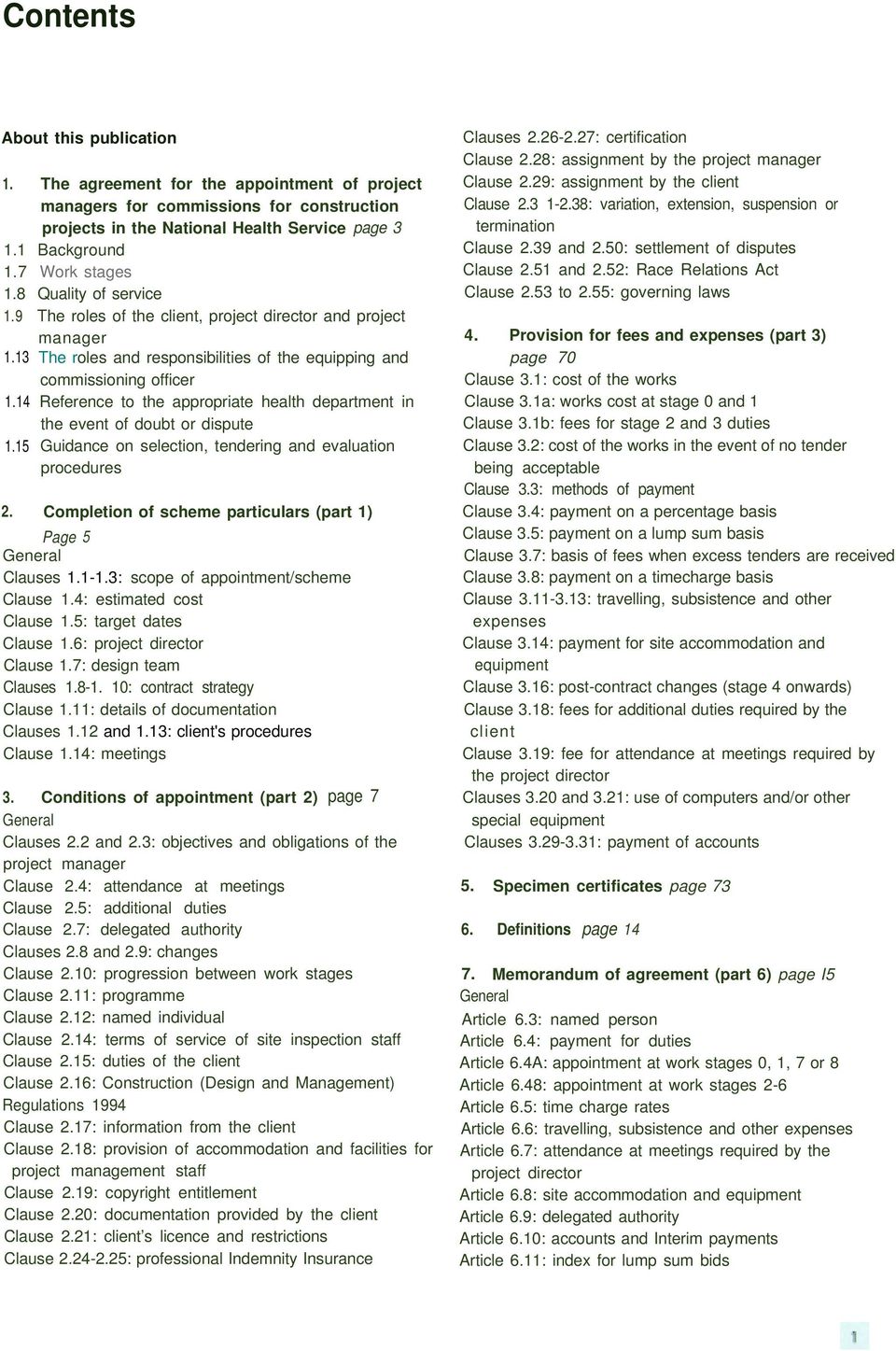
6 Article 6.12: adjudicator Article 6.13: special conditions Article 6.14: conditions not to apply Appendix 3 - Examples of the method used to adjust lump sum fees page 25 Appendix 4 - Equipping and commissioning 8. Schedule l/schedule 2: memorandum of officer - roles and responsibilities page 27 agreement (part 6) page 18 Other publications in this series page 32 Appendix 1 - Diagram illustrating progression between work stages when using the agreement About NHS Estates page 33 page 19 Appendix 2 - Contracts Guidance Sheet 25 - Construction (Design and Management) Regulations 1994 page 20

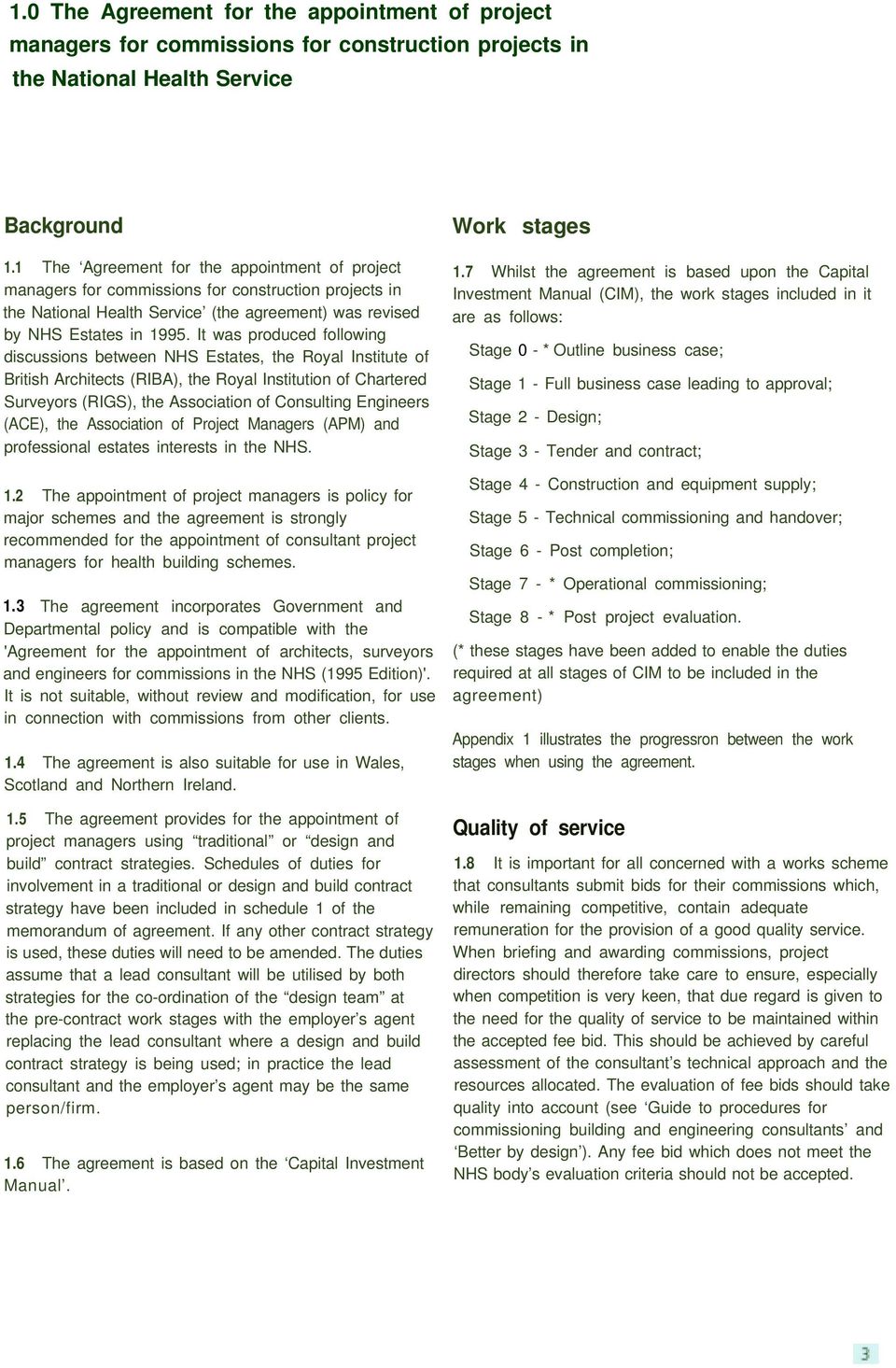
7 1.0 The Agreement for the appointment of project managers for commissions for construction projects in the National Health Service Background 1.1 The Agreement for the appointment of project managers for commissions for construction projects in the National Health Service (the agreement) was revised by NHS Estates in It was produced following discussions between NHS Estates, the Royal Institute of British Architects (RIBA), the Royal Institution of Chartered Surveyors (RIGS), the Association of Consulting Engineers (ACE), the Association of Project Managers (APM) and professional estates interests in the NHS. 1.2 The appointment of project managers is policy for major schemes and the agreement is strongly recommended for the appointment of consultant project managers for health building schemes. 1.3 The agreement incorporates Government and Departmental policy and is compatible with the 'Agreement for the appointment of architects, surveyors and engineers for commissions in the NHS (1995 Edition)'. It is not suitable, without review and modification, for use in connection with commissions from other clients. 1.4 The agreement is also suitable for use in Wales, Scotland and Northern Ireland. 1.5 The agreement provides for the appointment of project managers using traditional or design and build contract strategies. Schedules of duties for involvement in a traditional or design and build contract strategy have been included in schedule 1 of the memorandum of agreement. If any other contract strategy is used, these duties will need to be amended. The duties assume that a lead consultant will be utilised by both strategies for the co-ordination of the design team at the pre-contract work stages with the employer s agent replacing the lead consultant where a design and build contract strategy is being used; in practice the lead consultant and the employer s agent may be the same person/firm. 1.6 The agreement is based on the Capital Investment Manual. Work stages 1.7 Whilst the agreement is based upon the Capital Investment Manual (CIM), the work stages included in it are as follows: Stage 0 - * Outline business case; Stage 1 - Full business case leading to approval; Stage 2 - Design; Stage 3 - Tender and contract; Stage 4 - Construction and equipment supply; Stage 5 - Technical commissioning and handover; Stage 6 - Post completion; Stage 7 - * Operational commissioning; Stage 8 - * Post project evaluation. (* these stages have been added to enable the duties required at all stages of CIM to be included in the agreement) Appendix 1 illustrates the progressron between the work stages when using the agreement. Quality of service 1.8 It is important for all concerned with a works scheme that consultants submit bids for their commissions which, while remaining competitive, contain adequate remuneration for the provision of a good quality service. When briefing and awarding commissions, project directors should therefore take care to ensure, especially when competition is very keen, that due regard is given to the need for the quality of service to be maintained within the accepted fee bid. This should be achieved by careful assessment of the consultant s technical approach and the resources allocated. The evaluation of fee bids should take quality into account (see Guide to procedures for commissioning building and engineering consultants and Better by design ). Any fee bid which does not meet the NHS body s evaluation criteria should not be accepted.
8 The roles of the client, project director and project manager 1.9 The project manager s commission will be with the client NHS body. Ownership of a specific scheme will be delegated to a project director who must be named in part 1 of the agreement (clause 1.6). The project director will be nominated to act for the client, will undertake most of the client s responsibilities in respect of the project manager and design team consultants, and will act as the project manager s interface with the client. The project director s responsibilities and actions in relation to the project manager are listed in schedule 2 of the memorandum of agreement In carrying out the procedures for the selection and appointment of a project manager, the project director must provide adequate briefing about the project and the nature and quality of the services to be provided by the project manager. The successful execution of a building project requires a clear understanding of the scheme requirements and objectives and the nature of the services to be provided Although responsible to the project director, the project manager is required to manage other appointed consultants and the project team. In carrying out duties in relation to the design team, the project manager will normally deal with the consultant who has lead responsibility for the design team (the lead consultant ) to ensure that the progress of the work is fully coordinated at all times. The project manager will also lead the project team Any reference to the client in the agreement is to be taken to refer to the NHS body by whom the project manager has been engaged to provide services under the agreement. In most cases, the project director will act for the client. The roles and responsibilities of the equipping and commissioning officer 1.13 Appendix 4 of this volume provides an example of a schedule of the duties that involve the equipping and commissioning officer who will normally be responsible for operational commissioning at work stage 7. It is important to note that the equipping and commissioning officer will be required to be involved at the early stages of a project. Reference to the appropriate health department in the event of doubt or dispute 1.14 Any doubts concerning interpretation of the provisions contained in the agreement should be referred to NHS Estates in England or the appropriate health department in Wales, Scotland or Northern Ireland, who will consult as necessary with the relevant NHS or professional bodies. Guidance on selection, t tendering and evaluation procedures 1.15 This is included in Guide to procedures for commissioning building and engineering consultants.

9 2.0 Completion of scheme particulars (part 1) General This part of the agreement describes the scheme for which the project manager is to be appointed and should be completed by the project director as far as possible. If the project manager is to be appointed at CIM stage 0, 1, 7 or 8, it will only be possible to complete some of the entries. Those which cannot be completed should be deleted. The information given should be in as much detail as IS necessary for the project manager to prepare a fee offer and should reflect the selected method of payment of fees. It is on the basis of the information provided that the consultant s fee offer wiii be made. Clauses : scope of appointment/ scheme As much information as is available about the location, general description and phasing of the scheme should be entered here. Additional briefing material should be provided, if available, to cover the broad intent of the scheme and its basic requirements and objectives. Clause 1.4: estimated cost The estimated cost of the works for new constructron and for alterations and extensions should be stated separately. The associated work stage, index level at which costs are established, and the name of the index should also be stated. Delete the entire clause if the project director cannot provide these details for appointments at stage 0, 1, 7 or 8. Clause 1.5: target dates Enter into the matrix the relevant CIM work stages together with their programmed start and finish dates. These details are important for the consultant s bid and should be completed as accurately as possible by the project director. Clause 1.6: project director Enter the name and position of the person in the client s organisation who will be the project director. This appointment is important as the person nominated will provide the client interface with the project manager, and project and design teams. Reference to schedule 2 of the memorandum of agreement reveals the extent of information to be provided and action to be taken by the project director throughout the duration of the scheme. Because of the diversity of information required, the project director should, if necessary, have access to professional advice and support. Clause 1.7: design team State the client s intentions regarding the composition of the design team, the name of the firm in each discipline, if known, and identify the discipline of the lead consultant. When using a design and build contract strategy, a design team may be appointed to assist with the preparation of the employer s requirements, evaluation of tenders, and monitoring of compliance with the contract documents and cost management. Clauses contract strategy State the likely contract strategy. This could be, for example: a lump sum contract based upon a fully detailed design, bills of firm quantities, JCT Standard Form of Building Contract (1980) obtained by competitive tendering; a lump sum contract based upon a performance specification (employer s requirements), JCT Standard Form of Building Contract with Contractor s Design (1981) obtained by competitive tendering. Include the discipline of the contract administrator or employer s agent depending on the contract strategy being used. Clause 1.11: details of documentation State the number of copies of documents and records that are to be provided for the use of the project director. The project manager will estimate the number of copies required for use by the project manager and other project participants, and this will be included in the fee bid. The documentation may be required in electronic format, for example CAD drawings.

10 Clauses 1.12 and 1.13: client s procedures CIM procedures will apply to all schemes and clause 1.12 should not therefore be deleted. The project director should provide all the other procedural requirements with which the project manager must comply. These may include the NHS body s audit procedures, standing orders, etc. If these procedures are contained in separate documents, they should be referred to in this clause and either copies attached for fee bidding purposes or reference made in the fee bid documentation as to when and where they are available for inspection by the consultant. If the procedures are changed during the period of the commission, the effect of the change should be negotiated with the consultant. perform the duties set out in schedule 1 of the memorandum of agreement (see clause 2.4). Provide details of the purpose, location, timing and frequency of the meetings and the category of project management personnel required to attend, together with any other relevant requirements. If this information is precise, the project manager will be able to make provision in the fee bid for the time and expense involved. Payment option (a) in article 6.7 of the memorandum of agreement can then be selected. If the requirements for any of the additional meetings are not fully known, option (b) of artricle 6.7 should be selected. Payment will then be made on the basis of time charge in accordance with clause 3.8 or an agreed lump sum. Clause 1.14: meetings Enter the meetings that the project director will require the project manager to attend in addition to those required to

11 3.0 Conditions of appointment (part 2) General The conditions of appointment should generally remain unamended, but if any scheme-specific conditions are to be added or any printed conditions are not to apply, the details should be provided in articles 6.13 and 6.14 respectively of the memorandum of agreement. Clauses 2.2 and 2.3: objectives and obligations of the project manager The project manager s fee bid should cover all costs and expenses in fulfilling the objectives and obligations described in clauses 2.2(a)-(h) inclusive and in carrying out the duties stated in schedule 1 of the memorandum of agreement. Project managers should not carry out any duties additional to those stated in the agreement without the approval of the client. Clause 2.4: attendance at meetings The project manager s fee bid should cover all the costs of attending meetings necessary to perform the duties stated in schedule 1 of the memorandum of agreement. Additional meetings required by the client are stated in clause Clause 2.5: additional duties Project managers should not carry out duties additional to those stated in the agreement without the formal approval of the project director. Clause 2.7: delegated authority State the limit of delegated financial authority to be vested in the project manager within the approved sum. The figures are to be inserted in article 6.9 of the memorandum of agreement. Clauses 2.8 and 2.9: changes The management of change is an important function of the project manager s duties. Clause 2.9 allows the project manager some financial authority to carry out this function up to the delegated limit referred to in clause 2.7. Clause 2.10: progression between work stages The project director s written approval is required by the project manager before proceeding to the next work stage described in schedule 1 of the memorandum of agreement. The work stages refer to CIM stages 0-8 inclusive (see paragraph 1.7 of this guidance). Clause 2.11: programme The project manager shall submit a programme to the project director in respect of the commission within 14 days of the execution of the agreement. This programme shall be maintained during the existence of the commission. Clause 2.12: named individual The named individual who acts on behalf of the project manager in carrying out the duties for a scheme is important to its success. Although this person is nominated by the project manager in article 6.3 of the memorandum of agreement, the project director should take care in carrying out consultant commissioning procedures to assess the capabilities of proposed named individuals. Clause 2.14: terms of service of site inspection staff The project manager may arrange for the appointment of site inspection staff employed by the NHS body. Clause 2.16 of the Agreement for the appointment of architects, surveyors and engineers for commissions in the National Health Service (1995 Edition) states that site staff must be under the consultant s direction and control but the consultant will not be responsible for any failure on the part of staff employed other than by the consultant. The project director may therefore prefer the design consultants to employ site inspection staff direct to avoid this division of responsibility. Clause 2.15: duties of the client It is essential that the NHS body nominates a project director, usually a suitable employee, to represent and

12 have the authority of the client in respect of the scheme. All instructions given by the project director are deemed to be given by the client. All advice given to the project director is deemed to have been given to the client. Schedule 2 of the memorandum of agreement lists the information to be provided by, and action required of, the project director. The list covers a wide range of activities and assumes considerable technical and procedural knowledge and experience. NHS bodies should ensure that adequate support IS provided for project directors, so that they can carry out their duties effectively. Clause 2.16: Construction (Design and Management) Regulations 1994 NHS bodies must comply with the requirements of these Regulations including the selection and appointment of a planning supervisor and a principal contractor. Clause 2.17: information from the client The project director must ensure that adequate and timely information in accordance with schedule 2 of the memorandum of agreement IS available so that the project manager s duties can be satisfactorily executed in accordance with the programme. Clause 2.18: provision of accommodation and facilities for project management staff The project manager can request in article 6.8 of the memorandum of agreement that the client provide site office accommodation and facilities for use by project management staff. It is therefore Important that when project managers offers are made, both the project director and consultants clearly understand whether offers Include or exclude the provision of office accommodation for project management staff. The client requirements in this respect can be discussed at Interview and should be included in the briefing upon which consultants offers are made. If the client does not want to provide accommodation and facilities, article 6.8 of the memorandum of agreement should be deleted. Clause 2.19: copyright entitlement The copyright and all other Intellectual property rights in all materials generated by the project manager in connectron with the scheme remain vested in the project manager, unless otherwise agreed. Clause 2.20: documentation provided by the client The copyright of standard documentation provided by the client remains vested in the client unless the copyright is already held by another body. Clause 2.21: client s licence and restrictions The client as owner has the right to re-use materials (including basic factual data) originated by the project manager for any other purpose at a future date However, the project manager s IiabiIity is restricted to the purpose for which the materials were prepared and provided by the project manager Clauses : professional indemnity insurance The requirements for professional indemnity insurance have been agreed between Government departments. The required level of cover IS set out in the certificate shown in part 4 of the agreement. Although NHS bodies are required to ensure that consultant project managers are adequately insured before they are commissioned for work in the NHS, in exceptional circumstances it may be that some project managers are unable, in particular cases, to maintain that insurance throughout the period stated in clause In such instances, it is recommended that project directors discuss fully the way in which the position of the NHS body and the project manager can be protected. This may, for example, entail a separate ancillary agreement which meets the circumstances of the particular case and maintains continuity of professional input. NHS bodies should note the advice contained in Guide to procedures for commissioning building and engineering consultants with specific reference to limited liability companies. Clauses : certification The project manager is responsible for obtaining from the lead consultant or members of the design team copies of signed certificates as required by their conditions of engagement, and for passing them onto the project director, if acceptable. The project manager will separately confirm readiness to proceed to design and tender by means of additional certificates, specimens of which are shown in part 4 of the agreement. It should be noted that the provisions of the certificate of readiness to proceed to

13 tender, to be completed by the project manager, enhance those provided by the design team. Clause 2.28: assignment by the project manager This clause applies to assignment by the project manager and does not apply to transfer by the NHS body. Clause 2.29: assignment by the client This clause applies to assignment by the NHS body. The contract may be unilaterally transferred by one NHS body to another. The project manager should be advised in writing by the project director if it is proposed to assign the commission in this way. Clauses : variation, extension, suspension or termination Clause 2.31 allows the project director to vary or extend in time, the duties by giving reasonable notice to the project manager. Clause 2.32 allows the project director to suspend or terminate the duties on expiry of reasonable notice given in writing to the project manager. Clause 2.33 details circumstances which permit termination of this agreement by the client. Clause 2.34 deals with the requirements for the resumption of duties following suspension. the Clause 2.35 allows the project manager to terminate the commission on expiry of reasonable notice given in writing to the client. Clause 2.36 details circumstances which permit the termination of this agreement by the project manager. Clause 2.37 allows for the termination of the appointment due to the death or incapacity of the project manager s key personnel. Clause 2.38 applies on termination of the commission. It requires the satisfactory delivery to the project director of all the documents prepared by the project manager. Entitlement to payment of outstanding fees and expenses depends on completion of this action. Clauses : settlement of disputes These clauses deal with the requirements for the settlement of disputes during the period of the commission by agreement or adjudication, thereafter by arbitration, unless the requirements of clause 2.40 have not been complied with. When selecting an adjudicator, the person must be completely impartial and therefore have: a. no involvement with the NHS body; b. no involvement with the project manager; c. no involvement with the project. Clauses 2.51 and 2.52: Race Relations Act 1976 Although the agreement is governed by the applicable laws, it is policy that a specific reminder in respect of the Race Relations Act should be included in Government contracts. Clauses : governing laws These clauses deal with the laws governing the contract. It will be noted that these refer to the laws of England, Wales, Scotland and Northern Ireland. Whichever of these two clauses is not to apply should be entered at article 6.14 of the memorandum of agreement.

14 4.0 Provision for fees and expenses (part 3) Clause 3.1: cost of the works Fees are payable on a percentage, lump sum or time charge basis. The fee option at each stage is to be at the discretion of the client/project director and stated in article 6.4 of the memorandum of agreement. At stage 2 and at subsequent stages, where a percentage fee is selected, fees will be calculated by applying the quoted percentage for each stage to the works cost calculated in accordance with clause 3.1. Clause 3.1a: works cost at stage 0 and 1 There may be doubt as to whether the works cost at CIM stage 1 used for calculating percentage fees includes or excludes any allowance for local variations in the cost of the scheme included for budgeting purposes. To avoid future misunderstanding, NHS bodies are advised to clarify in the consultant s brief whether or not such an allowance will be used in the calculation of fees for this stage. Clause 3.1b: fees for stage 2 and 3 duties There may be agreement among members of the design and project teams, supported by information from relevant tender price indices, that a falling trend in building prices is likely to result in a tender figure that is less than the agreed budget cost. In such circumstances, the project director is advised to seek guidance from the project manager and the design team about the anticipated tender level to ensure that no overpayment of fees in respect of stage 2 and 3 duties occurs. Clause 3.2: cost of the works in the event of no tender being acceptable The lower of the alternatives must be selected from costs calculated on the same basis. To compare with tender costs, the updated works cost at stage 1 should take account of local variations in the cost of the scheme, if this has not already been included in the CIM stages 0 and 1 cost referred to in 3.1a. Clause 3.3: methods of payment Fees may be payable on a percentage, lump sum or time charge basis. Article 6.4 of the memorandum of agreement should be completed to obtain fee bids on the basis desired by the client. Articles 6.4A and 6.4B are alternatives: the option not selected should be deleted. Article 6.4A applies for appointments made at stages 0, 1, 7 or 8. This article only allows for fee bids to be obtained on a time charge or lump sum basis. It is not considered feasible to invite fee bids on the basis of a percentage of the works cost at this stage, when the preferred option may not be established. Article 6.4A also contains provision for a commission at stage 0 or stage 1 to be extended to further stages. Article 6.4B applies for appointments made from stage 2 onwards. Fee bids may be invited on a percentage, lump sum or time charge basis for each or any of the stages for which the appointment is to be made. Decisions about the basis of fee bids will be schemespecific. Percentage and lump sum fee bids should be invited only where it is possible to adequately define, with a degree of certainty, the scheme briefing and other information upon which consultants fee bids will be made. Clause 3.4: payment on a percentage basis Where fees are payable on a percentage basis, they should be calculated for each work stage by applying the percentage figure stated in article 6.4A or 6.4B (whichever is applicable) to the cost of the works for that stage as defined in clause 3.1 (costs of the works). Clause 3.5: payment on a lump sum basis This clause details the mechanism whereby the lump sum is adjusted by reference to movements in the index identified by the client/project director in article 6.11 of the memorandum of agreement. The lump sum fee is on a fixed price basis for the first 24 months, with adjustment occurring 24 months after the date of the agreement. This first 24 months is a period during which the project manager should be able to accurately forecast and allow
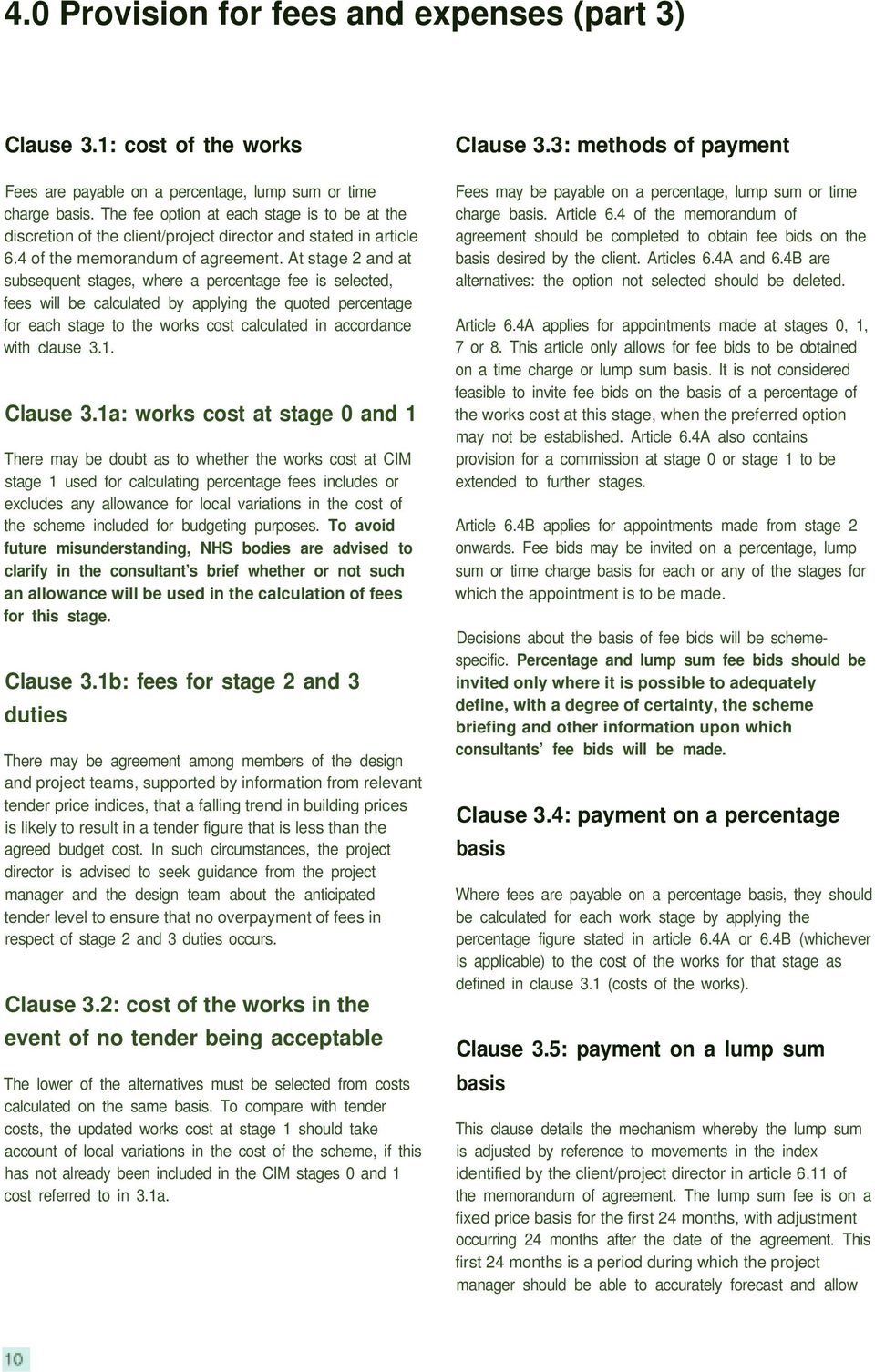
15 in the lump sum fee bid for cost fluctuations, and complies with Government policy in respect of all contracts of less than two years duration being fixed price. extensive, an indication of the relevant NHS staff rates may be included in briefing, as information to the project manager. It should be noted that only 90% of the outstanding balance of unpaid fees is adjustable. The 10% nonadjustable element is equivalent to that used in construction contracts subject to formula fluctuations. Appendix 3 provides an adjust lump sum fees. example of the method used to Clause 3.7: basis of fees when excess tenders are received This clause indicates how fees will be calculated in the event of an excess tender being received. As the project manager s input to this stage may be critical to the achievement of a successful tender, the fees for negotiating and effecting a reduction in the tender shall be adjusted in accordance with clause The fees for the duties under the agreement shall be based on the reduced tender figure. Clause 3.8: payment on a time charge basis This clause sets out the conditions applicable to fees payable on a time charge basis. Time charges are calculated on rates for principals and other categories of project management staff. The rates per hour are set out and quoted for in article 6.5 of the memorandum of agreement. The quoted rates apply for a period of 12 months from the date of the agreement and are adjusted annually thereafter by reference to the movements in the index identified by the client/project director in article 6.11 of the memorandum of agreement. Clauses : travelling, subsistence and other expenses When option (a) of article 6.6 of the memorandum of agreement is selected, those items of travelling, subsistence and other expenses listed in clause 3.11 will be included in the lump sum or percentage fee stated by the project manager. Those items of expenses listed in clause 3.12 will be reimbursed in addition. When option (b) of article 6.6 is selected, or when time based charges apply, travelling, subsistence and other expenses will be reimbursed in accordance with clause If the application of clause 3.13 is likely to be Clause 3.14: payment for site accommodation and equipment Where article 6.8 of the memorandum of agreement has not been deleted by the client, the client will be responsible for the cost of providing the accommodation and equipment specified therein by the project manager. This may include items such as office accommodation, furniture, telex, facsimile, telephone and other equipment reasonably required for the project manager s staff on site. The intentions of the client/project director regarding the provision of such accommodation, equipment and other resources should be clarified in briefing and, if necessary, discussed with project managers at interview. Clause 3.16: post-contract changes (stage 4 onwards) The project manager s input to post-contract changes will be variable and not necessarily related to the value of the variations. Fees should be negotiated for each postcontract variation made by the project director, preferably on a lump sum basis, before the project manager s services are provided. If this is not possible, fees can be paid on a time charge basis under the provisions of clause 3.8. It is only where the works are varied by the project director that additional fees and expenses are payable. Clause 3.18: fees for additional duties required by the client Project manager s fees in respect of the validation of contractor s claims and other similar duties are additional to the fees dealt with in the preceding clauses. Where such duties are at the specific instruction of the project director and can be reasonably defined, the fees should be agreed on a lump sum basis. Failing that, they may be paid on a time charge basis. Clause 3.19: fees for attendance at meetings required by the project director See guidance notes for clause 1.14.

16 Clauses 3.20 and 3.21: use of computers and/or other special equipment Specific requests by the project director for the use of computers and/or other special equipment will give rise to additional fee charges. It is therefore Important that the project director ensures that the project manager is made aware of any such requirements, if known, so that the fee bid may include them. If the project director requests the use of such equipment after the project manager s bid has been received, the additional requirement and fee should be agreed before work commences. expenses and time charges. It should be noted that fees due from the client to the project manager should be paid within 30 days of submission of the project manager s account. In accordance with Government policy on prompt payment, project managers shall pay all sub-contractors within 30 days of receipt of a fee account from the subcontractor. Clauses : payment of accounts Fee accounts should be submitted to the client at the intervals stated by the client in article 6.9 of the memorandum of agreement. Fee accounts should be accompanied by the necessary documentary evidence particularly in the case of travelling, subsistence, other

17 5.0 Specimen certificates (part 4) 5.1 This part of the agreement contains specimens of the certificates that are referred to in the agreement and that are required to be signed or obtained by the project manager. Where a certificate contains alternative undertakings, the project director should make the appropriate deletions. 5.2 Specimens of the certificates that are to be signed and obtained from the other consultants are contained in the Agreement for the appointment of architects, surveyors and engineers for commissions in the National Health Service (1995 Edition). It should be noted that the project manager will need to obtain these signed certificates from the lead consultant before completing the project management certification. 5.3 It is important that project directors ensure that project managers are adequately Insured before they are commissioned for work in the NHS, particularly when considering small practices for large projects.

18 6.0 Definitions 6.1 This part of the agreement contains a list of terms used in the agreement. Each term is defined so as to avoid errors in interpretation of the provisions of the agreement.

19 7.0 Memorandum of agreement (part 6) General This part of the agreement comprises the memorandum of the agreement between the client and the project manager. It consists of a number of articles ( ) describing the terms of the agreement, two schedules and space for the agreement to be signed under hand or as a deed (under seal). Schedule 1 describes project manager. the duties to be completed by the Schedule 2 lists the information which the project director should provide to the project manager as well as action required by the project director to enable the project manager to fulfil the obligations under the terms of the agreement, including the performance of the duties set out in schedule 1. Article 6.3: named person The project manager should insert the name of the individual referred to in clause The Identity of this individual is very Important and the project director should carefully evaluate during the selection and commissioning procedures the person s s&ability and experience in relation to the services to be provided by the project manager. The management staff category of the named Individual (see part 5 - definitions) should also be inserted by the project manager. Article 6.4: payment for duties Articles 6.4A and 6.4B are alternatives, one of which should be deleted by the project director. Article 6.4A: appointment at work stages 0, 1, 7 or 8 The use of article 6.4A enables an appointment to be made at stage 0 and stage 1 with no obligation on the client to continue with the scheme beyond that stage. This would apply, for example, if an appraisal study were to confirm that a non-constructional option was the most advantageous strategy and construction work was unnecessary. However, article 6.4A also provides a payment method by which the client can continue the appointment of the same project manager on a competitive bid basis beyond the stage where the work could be defined at the time of the fee bid. Payment for stage 0, 1, 7, or 8 duties in relation to article 6.4A can be on either a time charge or a lump sum basis. Articles 6,4A(s)(i) and 6.4A(a)(ii) are alternatives, and one should be deleted. If no deletion is made, article 6.4A(s)(i) will apply and payment will be made on a time charge basis. A lump sum payment method should only be selected if the work is sufficiently well defined for the project manager to estimate the time and resources required to execute the commission. Payment for stage 2 and subsequent stages is based on completion of the two matrices contained in article 6.4A(b)(i). If an appointment is to be made at stage 1 and a fee bid is required for the later stages, the project director should enter the first matrix at article 6.4A(b)(i). A range of estimated costs and time duration for the scheme is to be estimated in months or years. The project manager will be able to offer a fee bid relating to these estimates. The project manager will then be paid according to the fee bid if the actual cost of the works at stage 2 (as defined in clause 3.1a) and the time duration from the actual commencement of stage 2 to the estimated date of practical completion falls within the ranges specified by the client. If the actual cost of the works at stage 2 (as defined in clause 3.1a) and the time duration from the actual commencement of stage 2 to the estimated date of practical completion falls outside the ranges, then the fees shall be established in accordance with the provisions of clause Article 6.4A(b)(iv) requires the client to state whether the fee offered by the project manager is to be on a lump sum or a percentage basis. This is done by deletion of the inappropriate wording. The second matrix (at article 6.4A(b)(v)) allows apportionment of fees into work stages from stage 2 to the stage inserted by the project director in the space provided. The first column should be completed by the project director to list each work stage required. The project manager will state what percentage of the fee relates to each stage by completing the second column. Apportionment of fees into work stages IS cart-led out by applying these percentages to the total fee. The percentages should be realistic and reflect the workload appropriate to each stage.

20 Article 6.4B: appointment at work stages 2-6 Article 6.4B enables an appointment to be made from stage 2 onwards. The project director should state the applicable work stages in the first column of the table, together with the basis on which fee bids are to be made in the third column. Fees can be made on a lump sum, percentage or timecharge basis. Fee bids should only be invited on a lump sum basis if the work is sufficiently well defined for the project manager to estimate the time and resources required. The project manager wiii complete the second column of the table, stating a fee for each work stage which should realistically reflect the workload of that stage. The adjustment of lump sum fees in relation to the fluctuations in cost is described in clause 3.5 of the agreement. Article 6.5: time charge rates The project manager is required to enter the hourly rate for fees to be paid on a time charge basis for each category of project management staff indicated by the project director. The rates will need to be taken into account in evaluating fee bids. The categories of project management staff are defined in part 5 of the agreement. Where the project director is aware that categories of management staff other than those stated are required, these should be listed in the space provided. These other categories of staff will need to be added to the list in part 5 of the agreement under the heading management staff categories, and their roles defined. Article 6.6: travelling, subsistence and other expenses Provision is made for these charges to be Included in the fees stated in article 6.4A or 6.4B, or for them to be charged separately. If one of the alternatives in article 6.6 is not deleted, the agreement states that article 6.6(a) will apply, and expenses are deemed to be included in the fees. Article 6.7: attendance at meetings required by the project director See guidance notes for clause 1.14 Article 6.8: site accommodation and equipment The client should delete this article if the project manager is to be responsible for the provision of all accommodation and facilities. Article 6.9: delegated authority The project director should insert the overall limit of financial authority to be delegated to the project manager by the client within the approved sum for the scheme, and also within this limit, the maximum value of any single change. The purpose of this article is to allow the project manager financial authority commensurate with the responsibilities which are defined in the project manager s duties. The assessment of the delegated amounts will be based on the nature and value of the specific scheme and on the stage at which the project manager is to be appointed. A measure of the overall amount to be delegated can be an estimate of unallocated design and contingency reserves included in the approved sum. Taking works professional advice if necessary, the project director will decide the proportion of these reserves to be delegated, bearing in mind a need to retain an amount in the project director s own control. Article 6.10: accounts and interim payments The project director should state the intervals at which accounts are to be submitted and interim payments made. These may be on a monthly, quarterly or stage payment basis. If no deletion is made, the monthly basis will apply. Article 6.11: index for lump sum bids The project director should identify the index, referred to in clause 3.5 of the agreement, which is to be used to adjust a lump sum fee bid and the time charge rates. Information on indices is obtainable from the Employment Gazette which is published monthly by HMSO. This publication includes indices for retail prices and employment from which the most suitable index can be selected for a scheme. It is essential that the project director identifies the index precisely. For example, if the Retail Prices Index is used, reference must be made to the category, for example the general index for retail prices for all items.

21 Article 6.12: adjudicator The project director should insert the name of the individual referred to in clause 2.39 to whom all disputes should be referred during the course of this commission. Article 6.14: conditions not to apply The project director should insert the numbers of any clauses in parts 2 and 3 of the agreement which will not apply to the appointment. The appropriate alternative clause 2.53, 2.54 or 2.55 should be inserted. Article 6.13: special conditions The project director should detail any conditions additional to those contained in parts 2 and 3 of the agreement which are to apply to the appointment.
22 8.0 Schedule 1/schedule 2: memorandum of agreement (part 6) Schedule 1 This schedule sets out the duties of the project manager in terms of the required organisation, control, planning, attendance at meetings and reports to be provided. The schedule contains a list of general duties relating mainly to procedures, together with a more specific list of duties broken down into CIM stages of work, modified as stated earlier in this guidance. For reasons of clarity, the duties have been described in some detail They also provide a useful checklist. To enable the inclusion of duties for both traditional and design and build contract strategies, alternative lists of duties have been provided for some stages. The schedule indicates which alternatives apply to which strategy. It is Important to note that the duties have been drafted for these strategies on the basis that the lead consultant will co-ordinate either the preparation of the detailed design or the employer s requirements with the employer s agent under a design and build strategy taking over after the award of the contract. The project director should delete those duties not required for the project manager s appointment and should add details of any additional duties, for example a requirement to provide effective value management procedures at stage 0 and stage 1 and subsequent work stages. Care should be taken to ensure that if any changes are made to the project manager s duties they are compatible with: action and information to be provided by the project director; l duties of design team consultants appointed in accordance with the Agreement for the appointment of architects, surveyors and engineers for commissions in the National Health Service (1995 Edition)'. Under meetings and reports in the general duties section, options are stated. The project director should decide, on a value for money basis, whether the client or project manager should provide secretanal support for the meetings listed. The Inappropriate option should be deleted. If no deletion is made, the project manager will supply this support and Include the cost in the fee bid. Schedule 2 This schedule lists the information to be provided and the actions required from the project director to enable the project manager to fulfil the obligations under the terms of the agreement. These are set out both generally and in CIM work stage order (modified as stated in section 1 of this guidance). The project director should take advice on the requirements, if necessary, and if unable to provide any of the listed information, should make separate arrangements for its provision. The project director should ensure that the information and actions listed in the schedule are compatible with the project manager s duties set out in schedule 1. Due account must be taken of the effect of any revisions to either schedule
23 Appendix 1 Diagram illustrating progression between work stages when using the agreement
24 Appendix 2 Construction (Design and Management) Regulations 1994 Copy of Contracts Guidance No. 25 issued in March 1994 under Estates Professional Letter (94)14. Although the Regulations were not enacted on the date specified in this contracts guidance sheet, it is anticipated that they will come into force in the near future. Contracts Guidance Sheet 25 EC Temporary or Mobile Construction Sites Directive (92/57/EEC) (Construction (Design and Management) Regulations 1994) Introduction 1. The EC Temporary or Mobile Construction Sites Directive (92/57/EEC) came into force on 1 January This Directive will be implemented in the UK by means of the Construction (Design and Management) Regulations 1994 (CDM Regulations) and until these Regulations are enacted into UK law (they are currently in draft form) the requirements of the Directive will not be enforced in the UK. 2. The objective of the CDM Regulations is to raise the standard of health and safety management in the construction industry. 3. The date currently proposed for the CDM Regulations to be introduced is 1 July 1994 with a three-month lead-in period to 1 October This is to permit clients, designers, contractors, etc to set up arrangements to meet the requirements of the regulations. During the three-month lead-in period it is currently understood that only the most serious breaches of the CDM Regulations will result in any action by the Health and Safety Executive (HSE). 4. All NHS trusts and authorities will be subject to the provisions of the CDM Regulations, including the penalties (see paragraph 18) for contravening them. Implementation by NHS trusts and authorities 5. Chief executives of NHS trusts/unit general managers should note: that the definition of construction work in the CDM Regulations includes maintenance and demolition works as well as the construction of new buildings (see paragraph 8); the Regulations place certain responsibilities on clients as well as designers and contractors. Therefore, they must ensure that those responsible for the management of their estate are aware of the requirements of these regulations and are taking appropriate action to ensure compliance when the regulations are introduced. 6. It is important that NHS trusts and authorities start to consider about how to implement the CDM Regulations for all construction works. This requirement is emphasised by the current absence of any transitional arrangements as explained in paragraph Therefore, NHS trusts and authorities intending to award contracts after 1 January 1994 are advised to refer to the CDM Regulations (they will be available from HMSO) or, in their absence, to: Proposals for Construction (Design and Management) Regulations and Approved Code of Practice - Consultative Document by Health and Safety Executive (CD51; E500; 10/92); Temporary or Mobile Construction Sites Directive 92/57/EEC.
25 Coverage 8. The CDM Regulations will apply to all projects which include construction work. Construction work is defined in the draft CDM Regulations as follows: Constructron work means the carrying out of any building, civii engineering or engineering constructron work and Includes any of the following work: a. the construction, alteration, conversion, fitting-out, renovation, repair, upkeep, maintenance (including redecoration and cleaning), demolition or dismantling of a structure; b. the preparation for (including excavation), and laying or installing the foundations of, an Intended structure; c. the assembly or disassembly of prefabricated elements of a structure; d. the removal of a structure or part of a structure or of any product or waste resulting from demolition or dismantling of a structure or disassembly of prefabricated elements of a structure; e. the installation, commissioning, telecommunications, computer maintenance, repair or or similar services as an removal integral of mechanical, electrical, gas, compressed part of a structure; f. the commissioning of any fixed manufacturing plant in respect of which such work involves a risk of falling more than 2 metres, g. the cleaning of any glass wall, window, ceiling or roof in a structure where such cleaning involves a risk of falling more than 2 metres, but does not include the exploration for or extraction of mineral resources or activities preparatory thereto. 9. In addition, the CDM Regulations use the term project when referring to constructron work as defined above air, Parties involved 10. Client: any person for whom a project is carried out. 11. Designer: any employer or self-employed person who prepares the design of a structure or of part of the structure (this includes quantity surveyors, building surveyors and anyone else who is involved in specifying), the CDM Regulations also make it clear that the project manager is considered to be a designer. 12. Planning Supervisor: a competent person who shall be appointed from among the employers and self-employed persons who are responsible to the client for the design of the project. 13. Principal contractor: a competent contractor (who shall be appointed from among the contractors who are responsible to the client for the execution in supervision of the execution of the project. (This principal contractor should be the management contractor or construction manager if a management style of building contract is used.) Responsibilities of parties 14. Client These are as follows the client must appoint a planning supervisor and principal contractor (both of whom have specific functions under the CDM Regulations); the client must give notice of the commencement of a project to the HSE (Annex A provides a list of information to be provided); this notice is not required where it IS believed that the constructron stage will: (i) be of less than 30 days duration; (ii) not involve more than 500 person days of construction work; the client must ensure that adequate time and financial provisions are allowed for everyone involved in the project to comply with their relevant statutory obligations; the client must ensure that the planning supervisor has all the information he needs in order to comply with his obligations under the CDM Regulations;
26 the client must obtain the health and safety file at the end of the project containing all the relevant information about the material used on the project and the methods of construction. This record must be kept so that: (i) it can be consulted in the future by anyone carrying out work on the project; (ii) it can be h an d e dover to any subsequent owner/occupier. 15. Designers These are as follows: to ensure, as far as is reasonably practicable, that if the structure conforms to their design, persons at work on the building at any time will not be exposed to risks to their health or safety (it is important to note that the designer s obligations extend not only to considering how the design will affect health and safety during the construction phase, but also to any subsequent phase including maintenance and demolition of the structure); to ensure that the design contains adequate information about anything which might affect the health and safety of anyone carrying out work on the structure. 16. Planning supervisors These are as follows: to ensure that the design of any structure in the project is such that, (as for the designer), if the new structure conforms to the design, persons at work who are either building, maintaining or repairing the structure will not be exposed to risks to their health and safety; to ensure that before construction starts on site, a health and safety plan has been prepared which will ensure the health and safety of everyone who will work on the project; to ensure that the contractor s tender incorporates adequate financial provision and time for compliance with the CDM Regulations; to ensure that a health and safety file is prepared containing all the relevant information about the material used on the project and the methods of construction. 17. Principal contractors These are as follows: to ensure that the requirements of the CDM Regulations are complied with on site: this includes co-ordinating cooperation between the various subcontractors in relation to health and safety matters; to be responsible for the health and safety plan during construction and ensure that it continues to contain all the relevant information about matters which might affect health and safety on site; to ensure, as far as is reasonably practicable, that every contractor and employees comply with any rules in the health and safety plan; to ensure that only authorised persons are allowed on the site; to review the health and safety file during construction and amend or add to it as necessary; to ensure that the necessary health and safety training is given by employers; to ensure that those working on the site can discuss and offer him advice on health and safety. Enforcement of the CDM Regulations 18. The CDM Regulations will be made under the Health and Safety at Work etc Act 1974 and the rights of enforcement available to the HSE under that Act are also applicable to the CDM Regulations. Under the provisions of the Act the HSE have the following powers: warning letter;
27 prohibition notice (the activity concerned cannot be recommenced until the prohibited of it has been remedied); improvement notice (a time limit is set within which the improvement must be made); prosecution (usually only if there is an accident which the HSE considers to be the responsibility of a particular party) which can result in a substantial fine. Transitional arrangements 19. There are currently no transitional provisions in the CDM Regulations and the HSE recognises that the regulations cannot always be implemented immediately, particularly where a large and lengthy project is in the course of construction. Nevertheless the HSE will require that designers and others take account of the CDM Regulations as far as possible and that a planning supervisor and principal contactor be appointed for all projects by 1 October 1994 at the latest. Further information 20. Further guidance will be given when the CDM Regulations come into force.
28 Annex A Particulars to be notified to the Executive 1. Date of forwarding 2. Exact address of the construction site 3. Client(s) name(s) and address(es) 4. Type of project 5. Planning supervisors (name(s) and address(es) 6. A declaration by the planning supervisor that he/she has been appointed as such 7. Principal contractor(s) (name(s) and address(es) 8. A declaration by the principal contractor that he/she has been appointed as such 9. Date planned for start of construction phase 10. Planned duration of the construction phase 11. Estimated maximum number of people at work on the construction site 12. Planned number of contractors on the construction site 13. Details of contractors already chosen ( Form 10rev obtainable from local HSE offices can be used to notify them of the above information) 24
29 Appendix 3 Examples of the method used to adjust 2. Fee payments during the first 24 months after the lump sum fees 1. The graph below illustrates the application of the index stated in article 6.11 of the memorandum of agreement on lump sum fee payments (indices are for exemplar purposes only). See the commentary on clause 3.5. date of the agreement are on a fixed price basis. Thereafter, 90% of the outstanding balance of unpaid fees is adjusted at the end of each subsequent 12-month period. Adjustment is by reference to the movements in the index stated in article 6.11, calculated from the end of the fixed price period to the midpoint of the relevant subsequent 12-month period.
30 3. An example calculation follows of the addition to a lump sum fee: Payment for increased costs ( ) (i) (ii) (iii) (iv) (v) First 24 (2 x 12) months after date of this agreement - no adjustment, fixed price period Third 12 month period - assumed outstanding balance of fee: 27,000 (0.90 x 27,000)(158*-148 ) = (say) nil Fourth 12-month period - assumed outstanding balance of fee: 14,000 (0.90 x 14,000) (181*-148 ) = Fifth 12-month period - assumed outstanding balance of fee: 9,000 (0.90 x 9,000) (197*-148 ) = (say) Final period (six months) - assumed outstanding balance of fee: 4,000 (0.90 x 4,000) (200*-148 ) = (say) Total addition to the accepted lump sum fee 8398 * index of midpoint index level at date 24 months after date of the agreement
31 Appendix 4 Equipping and commissioning officer - roles and responsibilities Stage 0 - Outline business case Stage 1 - Full business case leading to approval (Capital planning before commissioning starts - prebuilding con tract) 1. Develop structure of commissioning team. 2. Develop management systemsand procedures for commissioning team. 3. Establish constituents of commissioning team. 4. Prepare roles and responsibilities of members of commissioning team. 5. Prepare a brief for the commissioning team Stage 2 - Design Stage 3 - Tender and contract (The preliminaries to commissioning pre-building contract) 1. Consider preliminary manpower estimates and compare them with DoH guidelines. 2. Finalise the terms of reference of the commissioning team members. 3. Establish and appoint a commissioning team. 4. Identify the aims and objectives of the commissioning team. 5. Establish structure and procedures for commissioning team. 6. Undertake a strategic planning workshop on the commissioningstructure and procedures. 6. Undertake a strategic planning workshop on the commissioning brief. 7. Establish regular liaisonwith user representatives hospital departments. from 7. Prepare preliminary activity sheets. 8. Co-ordinate a meeting structure between commissioning team and user groups. 8. Comment on the design as it develops in relation to equipment and commissioning. 9. Establishlines ofcommunication with other project participants, 9. Prepare preliminary operational policies. 10. Develop the manpower plan. 10. Prepare preliminary capital equipment estimates. 11. Review financial assumptions and agree the financial 11. Prepare preliminary manpower plans and estimates. brief in relation to equipping and commissioning. 12. Make a preliminary assessment of capital and revenue costs associated with equipping and commissioning. 13. Set preliminary capital and revenue budgets. 14. Establish principle of equipment re-use. 15. Establish preliminary logistics/decanting programme. 12. Review and update capital and revenue budgets. 13. Resourcefinance for capital and revenue expenditure. Stage 4 - Construction and equipment supply (The initial commissioning preparation period during the building contract but pre-building services commissioning) 1. Prepare a preliminary plan for equipping and commissioning.
32 2. Undertake strategic workshop on preliminary project control plan for equipping and commissioning. 3. Identify key milestones and any specific phasing of construction activities. 4. Determine phasing of hospital commissioning and the opening of hospital departments. 5. Liaise with the project manager in respect of a preliminary equipping and commissioning programme. 6. When agreed, network the project control plan for equipping and commissioning and routinely monitor and review. 7. Check availability of funding for equipping and commissioning to suit cashflow. 22. Establish user group requirements for equipment and specify the equipment. 23. Prepare preliminary specification for all equipment. 24. Co-ordinate agreed equipment schedules with the development of operational policies. 25. Prepare total equipment asset register as required for the new hospital/department. 26. Prepare equipment asset register of available equipment for existing hospital/departments. 27. from Identify a schedule for equipment to be transferred existing facilities. 28. Identify new items of equipment to be procured 8. Re-assess capital and revenue budgets, 29. Check compatibility of equipment to be transferred. 9. Ensure adequate financial contingency is available for equipping and commissioning budget. 10. Monitor user group meetings and equipping and commissioning team. liaison with the 11. Form specific specialist user groups as necessary. 12. Establish structure and routine communication links between user groups and the equipping and commissioning team. 13. Through the user systems. groups, develop the operational 30. Make preliminary assessment of consumable equipment. 31. Rationalise new equipment required with available budget. 32. Determine budget contingencies and team members authority for approval of change. 33. Develop and use specific change control procedures for equipping and commissioning activities. 34. Advise on the implication of change on the operational facilities and functional content as they occur. 14. Develop management systems associated with the 35. Identify decommissioning logistics. operational systems. 36. Prepare detailed specification for new equipment 15. Through the user groups, complete and confirm the items in consultation with the users. activity data sheets. 37. Consider the procurement and commissioning of the 16. Prepare draft equipment schedule. equipment as specified. 17. Classify draft equipment schedule into groupings. 38. Establish detailed budgets and programmes for all equipment on a departmental basis. 18. Determine systems and software requirements to manage the equipping and commissioning. 39. Review equipment against the budget. 19. Computerise equipment schedule. 20. Prepare running costs forecast for equipment and its staffing in operational use for inclusion in revenue budget. 21. Identify scope of equipment and arrange inspection of sample equipment as necessary. 40. Prepare a commissioning check list for each department. 41. Identify cri tical lead times for major items of equipment and rationalise with the master programme. 42. Plan equipment purchasing operation.
33 43. and Monitor and review a control plan for equipment 10. Establish all necessary training associated with new commissioning. equipment. 44. Establish comprehensive warranty provision for items 11. Plan a delivery programme. of equipment. 12. Continuously monitor progress of orders. 45. Instigate procurement procedures for agreed equipment schedule. 13. Prepare a manpower control plan. 46. Tender equipment. 14. Identify any special areas of difficulty in terms of specialist recruitment. 47. Evaluate tenders for equipment. 15. Liaise with local and associated services such as 48. Review evaluation of equipment tenders with user family practitioners, etc. groups. 16. Review staff training needs department by 49. Check equipment warranties and guarantees. department. 50. Consider any special commissioning, training and storage requirements of individual equipment tenders. 17. Prepare strategy for staff training, including precommissioning visits. 51. Place orders for the equipment. 18. Arrange a programme of staff training on new equipment. 52. Feed equipment order information into control plan. 19. Identify a complete training plan for all staff. 53. Continuously monitor progress of orders. 20. Ensure all hospital activities are completed and are undertaken in the proper manner accommodating all Stage 5 - Technical commissioning and handover requirements of health and safety legislation. (The commissioning period during building services commissioning) 1. Regularly monitor and review project control plan. 2. Liaise with the project manager in relation to the detailed equipping and commissioning programme. 3. Interface with client, direct contracts and equipment supplies with the activities of the main contractor. 21. Obtain from the project manager the constraints of the contract and contractors progress. 22. Liaise with the existing hospital and department managers to develop relocation plans and budgets. 23. Establish a control closure of services. plan to develop the transfer and 24. Prepare a new clinical programme. 4. Structure procedures for the relocation and commissioning of transferred equipment. 25. Arrange early familiarity visits by staff undertaking any necessary liaison with the unions. 5. Prepare a programme of installation and feed into the master control plan. 26. Consider the transfer of staff records. 6. Manage the inspections, delivery, installation and commissioning of equipment and its receiving environment Consider the transfer of medical records. Consider the necessary steps to decommission the existing facilities. 7. Establish detailed equipping and commissioning programme and budgets. 8. Undertakestrategic plan and workshop commissioning programme and budget. 9. Regularly monitor control plan, detailed programme and budgets. of 29. Develop the planned preventative maintenance programmes prior to building services handover. 30. Establish housekeeping changeover - post office, telephones, stationery, publicity.
34 Stage 6 - Post completion Stage 7 - Operational commissioning (Approaching handover; practical completion and opening, pre- and post-building practical completion and handover) 1. Undertake total review of project control plan. 2. Finalise plan for operational management. 3. Finalise details of departmental operational procedures. 4. Undertake intensive revenue financial review. 5. Establish insurance regime. 6. Phase out existing service agreements and other ongoing contracts. 7. Arrange any necessary staff visits. 8. Procure transportation and delivery facilities for the future relocation activities. 9. Prepare delivery checklist by department. 10. Make all necessary arrangements for equipment installations and commissioning. 11. Establish strategy for disposal of redundant equipment. 12. Ensure a proper understanding of phasing by all staff. 13. Make arrangements for any shared access. 14. Develop arrangements for accessing site including security, fire precautions, etc. 15. Establish procedures to permit visits and deliveries to site. 16. Communicate need to adopt visiting procedures to all parties. 17. Minimise contractors impact, noise, dust etc, once parts of the hospital are operational. 18. Ensure adequate fire precautions particularly during joint ownership. 19. Undertake special security measures during shared ownership. 20. Select and appoint any specialist staff requirements. 21. Ensure building services and hospital equipment and commissioning are inspected, tested and certified. 22. Ensure commissioning is completed under operational conditions. 23. In conjunction with the design consultants, witness the commissioning of building services. 24. Set up all necessary maintenance and operational contracts needed to provide hospital services. 25. Ensure adequate detailed handover instruction has been completed. 26. Examine and accept as-built drawings and maintenance manuals. 27. Agree a programme of access to ensure timely completion of outstanding snagging. 28. Monitor equipment deliveries and transfers to ensure timely availability. 29. Prepare a control plan on the opening of hospital facilities on a master and departmental basis. 30. Prepare a detailed build-up of the health services. 31. Finalise any outstanding staff transfer arrangements. 32. Examine admissions policy including contingency planning. 33. Identify spare resource as trouble-shooters prior to becoming operational. 34. Ensure all necessary pre-handover engineering services checks have been completed. 35. Ensure all necessary operational and training manuals are available. 36. On handover ensure that all necessary insurances are in place. 37. On handover ensure the security of the new facility. 38. On handover ensure adequate fire precautions and procedures are in place. 39. Undertake an intensive period of staff training prior to opening new services. 40. Establish and implement a strategy for staff timetable etc. 41. Communicate operating strategy plan to all staff.
35 42. Prepare for opening ceremony 53. Evaluate the opportunities in relation to redundant facilities. 43. Continuously monitor equipment deliveries and commissioning. Stage 8 - Post-project evaluation 44. Establish a detailed cleaning programme. 45. Monitor and record building defects as they are identified. (After building has been operational for a period of time) 1. After hospital is functioning, undertake a strategic review on a departmental basis. 46. Establish procedures for ensuring continuity patient care during periods of relocation. 47. Continuously review contingency to the provision of health services. planning in relation 48. Ensure patient safety checks are complete prior to first admission. of 2. Review user aspects of design etc. 3. Undertake short-term evaluation of commissioning process. 4. Prepare evaluation report in relation to equipping and commissioning. 5. Review operational systems once the hospital has 49. Transfer existing records. opened and has run for a proper period. 50. Opening ceremony. 6. Prepare a detailed evaluation report in relation to the equipping and commissioning, manpower and resourcing. 51. Secure existing vacant building and health facilities and ensure adequate insurance. 7. Arrange long-term evaluation of the equipping and commissioning process of the whole facility. 52. Maintain the equipping and commissioning team until all problems and snagging have been resolved.
36 Other publications in this series Given below are details of other documents in the Concode series which are either published by HMSO or in preparation. Information is correct at time of publication of this document. Contracts and commissions for the NHS estate: Policy 1993 Agreement for the appointment of project managers for commissions for construction projects in the National Health Service, 1995 Guide to the Agreement for the appointment of architects, surveyors and engineers for commissions in the National Health Service, 1995 Agreement for the appointment of architects, surveyors and engineers for commissions in the NHS Vol 1: Scheme particulars, conditions of appointment, provision for fees and expenses, specimen certificates, definitions, memorandum of agreement, 1995 Vol 2: Supplementary annexure, 1995 Contracts and commissions for the NHS estate: Contract procedures, 1994 Guide to the requirements of European public procurement directives, 1995 Guide to contract strategies for construction projects in the NHS, 1995 Guide to the JCT Standard Form of Building Contract, 1980 Edition, Local Authorities (as amended), Documents published by HMSO can be purchased from HMSO Bookshops in London (post orders to PO Box 276, SW8 5DT), Edinburgh, Belfast, Manchester, Birmingham and Bristol or through good booksellers. Enquiries (but not orders) should be addressed to: NHS Estates, Marketing Unit, Department of Health, 1 Trevelyan Square, Boar Lane, Leeds LS1 6AE. NHS Estates is a non-profit-making Executive Agency of the Department of Health. The price of this publication has been set to make some contribution to the costs incurred by NHS Estates in its preparation. Guide to procedures for commissioning building and engineering consultants, 1994
37 About NHS Estates NHS Estates is an Executive Agency of the Department of Health and is involved with all aspects of health estate management, development and maintenance. The Agency has a dynamic fund of knowledge which it has acquired during 30 years of working in the field. Using this knowledge NHS Estates has developed products which are unique in range and depth. These are described below. NHS Estates also makes its experience available to the field through its consultancy services. Enquiries about NHS Estates should be addresses to: NHS Estates, Marketing Unit, Department of Health, 1 Trevelyan Square, Boar Lane, Leeds LS1 6AE. Telephone Some other NHS Estates products Activity Database - a computerised system for defining the activities which have to be accommodated in spaces within the health buildings. NHS Estates Design Guides - complementary to Health Building Notes, Design Guides provide advice for planners and designers about subjects not appropriate to the Health Building Notes series. HMSO Estatecode - user manual for managing a health estate. Includes a recommended methodology for property appraisal and provides a basis for integration of the estate into corporate business planning. HMSO Works Information Management System - a computerised information system for estate management tasks, enabling tangible assets to be put into the context of servicing requirements. NHS Estates Health Building Notes - advice for project teams procuring new buildings and adapting or extending existing buildings. HMSO Health Guidance Notes - an occasional series of publications which respond to changes in Department of Health policy or reflect changing NHS operational management. Each deals with a specific topic and is complementary to a related HTM. HMSO Health Technical Memoranda - guidance on the design, installation and running of specialised building service systems, and on specialised building components. HMSO Health Facilities Notes - debate current and topical issues of concern across all areas of healthcare provision. HMSO Firecode - for policy, technical guidance and specialist aspects of fire precautions. HMSO Capital Investment Manual Database - software support for managing the capital programme. Compatible with the Capital Investment Manual. NHS Estates Model Engineering Specifications - comprehensive advice used in briefing consultants, contractors and suppliers of healthcare engineering services to meet Departmental policy and best practice guidance. NHS Estates Quarterly briefing - gives a regular overview on the construction industry and an outlook on how this may affect building projects in the health sector, in particular the impact on business prices. Also provides information on new and revised cost allowances for health buildings. Published four times a year; available on subscription direct from NHS Estates. NHS Estates Works Guidance Index - an annual, fully crossreferenced index listing all NHS Estates publications and other documents related to the construction and equipping of health buildings. NHS Estates Items noted HMSO can be purchased from HMSO Bookshops in London (post orders to PO Box 276, SW8 5DT), Edinburgh, Belfast, Manchester, Birmingham and Bristol or through good booksellers. NHS Estates consultancy service Designed to meet a range of needs from advice on the oversight of estates management functions to a much fuller collaboration for particularly innovative or exemplary projects. Enquiries should be addressed to: NHS Estates Consultancy Service (address as above). Printed in the United Kingdom for HMSO Dd C11 3/
38 Department of Health Scottish Office Welsh Office Department of Health and Social Services, Northern Ireland This guide provides analysis of the Agreement for the appointment of project managers for commissions for construction projects in the National Health Service, 1995 Edition. Pubished by HMSO and available from: HMSO Publication Centre (Mail, fax and telephone orders only) PO Box 276, London, SW8 5DT Telephone orders General enquiries (queuing system in operation for both numbers) Fax orders HMSO Bookshops 49 High Holborn, London, WC1V 6HB (counter service only) Fax Bull Street, Birmingham, B4 6AD Fax Wine Street, Bristol, BS1 2BQ Fax Princess Street, Manchester, M60 8AS Fax Arthur Street, Belfast, BT1 4GD Fax Lothian Road, Edinburgh, EH3 9AZ Fax HMSO s Accredited Agents (see Yellow Pages) and through good booksellers HMSO C
CONCODE Agreement for the appointment of architects, surveyors and engineers for commissions for minor works STATUS IN WALES ARCHIVED
 CONCODE Agreement for the appointment of architects, surveyors and engineers for commissions for minor works 1996 STATUS IN WALES ARCHIVED For queries on the status of this document contact [email protected]
CONCODE Guide to contract strategies for construction projects in the NHS STATUS IN WALES ARCHIVED
 CONCODE Guide to contract strategies for construction projects in the NHS 1995 STATUS IN WALES ARCHIVED For queries on the status of this document contact [email protected] or telephone 029 2031 5512
A Guide to Small Works. A brief explanation
 A Guide to Small Works A brief explanation A Guide to House Extensions/Small Works - a brief explanation Small works are an ongoing, cherished part of DDC's activity and restricted only by distance. Here
Guide to Procedure for Competitive Tendering March 2003
 Guide to Procedure for Competitive Tendering March 2003 The Landscape Institute 33 Great Portland Street London W1W 8QG Tel: +44 (0)20 7299 4500 Fax: +44 (0)20 72994501 Email: [email protected]
ENGAGING A LANDSCAPE CONSULTANT GUIDANCE FOR CLIENTS ON FEES SEPTEMBER 2002
 ENGAGING A LANDSCAPE CONSULTANT GUIDANCE FOR CLIENTS ON FEES SEPTEMBER 2002 The Landscape Institute 33 Great Portland Street London W1W 8QG Tel: +44 (0)20 7299 4500 Fax: +44 (0)20 7299 4501 Email: [email protected]
The Society of Garden Designers
 The Society of Garden Designers Engaging a Garden Designer Guidance for Clients on Professional Fees Society of Garden Designers Registered Office Katepwa House Ashfield Park Avenue Ross-on-Wye Herefordshire
CONTRACT FOR THE APPOINTMENT OF AN APPROVED INSPECTOR
 CONTRACT FOR THE APPOINTMENT OF AN APPROVED INSPECTOR CIC/AppInsp The Construction Industry Council - Association of Consultant Approved Inspectors contract for the appointment of an approved inspector
DIRECTORATE OF ESTATES & FACILITIES
 DIRECTORATE OF ESTATES & FACILITIES PROCEDURE AND INFORMATION MANUAL EPM PM4 Client Representative (University Project Manager) for Capital Projects Scope of Services Document Originated: April 2006 By:
Standard Conditions of Appointment. Architect s Copy ONLINE VERSION ONLINE VERSION ONLINE VERSION. for an Architect (CA-S-07-A)
 Standard Conditions of Appointment for an Architect (CA-S-07-A) Architect s Copy Royal Institute of British Architects RIBA Agreements are produced in association with: the Royal Incorporation of Architects
Capital Works Management Framework Document No. GN 1.7. Standard Conditions of Engagement for Consultancy Services (Technical)
 Capital Works Management Framework Document No. GN 1.7 Standard Conditions of Engagement for Consultancy Services (Technical) Guidance Note and Sample Schedules GN 1.7 090708 1 About This Document Background
Rating Consultancy RICS/IRRV/RSA Code of Practice. 3rd edition
 Rating Consultancy RICS/IRRV/RSA Code of Practice 3rd edition Copyright notice Copyright of this Code of Practice belongs to RICS. Purchasers of this Code of Practice are, however, permitted to reproduce
香 港 特 別 行 政 區 政 府. The Government of the Hong Kong Special Administrative Region. Development Bureau Technical Circular (Works) No.
 香 港 特 別 行 政 區 政 府 The Government of the Hong Kong Special Administrative Region 政 府 總 部 發 展 局 工 務 科 香 港 添 馬 添 美 道 2 號 政 府 總 部 西 翼 1 8 樓 Works Branch Development Bureau Government Secretariat 18/F, West
A JCT 2011 Minor Works Building Contract
 A JCT 2011 Minor Works Building Contract A20 JCT MINOR WORK BUILDING CONTRACT (MW) Minor works transparency document Rev A A20 / A20 JCT MINOR WORK BUILDING CONTRACT (MW) JCT MINOR WORKS BUILDING CONTRACT
Code of Practice for Agents Undertaking Renovation Grants
 Code of Practice for Agents Undertaking Renovation Grants July 1998 Contents Introduction Page 1 Approved List of Agents Page 1 Procurement Page 2 Approval Page 5 Works in Progress Page 6 Completion Page
scotland ACE Agreement 2: Advisory, Investigatory and other Services
 2 ACE Agreement 2: Advisory, Investigatory and other Services for the appointment of a Consultant to undertake any type of services in the built and natural environments except where the Client appointing
ACE Agreement 2: Advisory, Investigatory and other Services (for use in Scotland)
 2 ACE Agreement 2: Advisory, Investigatory and other Services (for use in Scotland) for the appointment of a Consultant to undertake any type of services in the built and natural environments except where
Guide to Reviewing Contract Documentation
 Guide to Reviewing Contract Documentation Introduction In order to help members address the issues associated with the review of contracts The Royal Institute of British Architects (RIBA), in association
CONTRACT FOR CONSULTANCY SERVICES. Section 1 Form of Contract
 CONTRACT FOR CONSULTANCY SERVICES Equatorial Fidelity Centre 2 nd Floor, Off Waiyaki Way P.O Box 313-00606 Nairobi, Kenya. Tel +254 20 423 5000 Section 1 Form of Contract CONTRACT FOR: [Insert Title here]
A Guidance Note to. Conditions of Contract for Consultancy Services (2005)
 A Guidance Note to Conditions of Contract for Consultancy Services (2005) This Guidance Note is based on a document prepared by the Auckland Region Contract Group, and verified by ACENZ, in February 2005.
THE COMBINED CODE PRINCIPLES OF GOOD GOVERNANCE AND CODE OF BEST PRACTICE
 THE COMBINED CODE PRINCIPLES OF GOOD GOVERNANCE AND CODE OF BEST PRACTICE Derived by the Committee on Corporate Governance from the Committee s Final Report and from the Cadbury and Greenbury Reports.
A Guide to Standard forms of Construction Contract Outlining Key Characteristics and Components
 Produced for SCALA and the Local Government Task Force by Rob Tate Dip Arch. Dip TP. Dip Arb. FCIArb. RIBA 01582 516662 [email protected] You can contact the Local Government Task Force tel 020 7837
Dated 29 February 2016. Flood Re Limited. Payments Dispute Process. Version 1.0
 Dated 29 February 2016 Flood Re Limited Payments Dispute Process Version 1.0 1. General 1.1 The following provisions will apply to all disputes referred to and conducted under this Payments Dispute Resolution
Project manager services
 Corporate Professional Local Project manager services For use with the RICS Standard form of consultant s appointment and RICS Short form of consultant s appointment The mark of property professionalism
CLIENT / PROJECT MANAGER AGREEMENT
 Authorship of this work is claimed by The Association of Construction Project Managers and any unauthorised reproduction constitutes an infringement in terms of the Copyright Act No 98 of 1978. CLIENT
The South African Council for the Project and Construction Management Professions. Guideline Scope of Services and Tariff of Fees
 The South African Council for the Project and Construction Management Professions Guideline Scope of Services and Tariff of Fees For Persons Registered in terms of the Project and Construction Management
A guide to appointing an architect
 A guide to appointing an architect and to being a good client Hurditch Architecture, 24 Botallack, St Just, Penzance, Cornwall, TR19 7EP Page 1 of 7 RIBA Chartered Architects Architects act 1997 In the
JRI S STANDARD TERMS OF PURCHASE. Business Day: a day (other than a Saturday, Sunday or public holiday) when banks in London are open for business.
 JRI S STANDARD TERMS OF PURCHASE 1. INTERPRETATION 1.1 Definitions. In these Conditions, the following definitions apply: Business Day: a day (other than a Saturday, Sunday or public holiday) when banks
COST SHARING AGREEMENT FOR SERVICES. between. Royal Holloway and Bedford New College. and. Royal Holloway Enterprise Limited
 COST SHARING AGREEMENT FOR SERVICES between Royal Holloway and Bedford New College and Royal Holloway Enterprise Limited 1 THIS COST SHARING AGREEMENT is made this... day of... 2010 by and between Royal
Engineering Council of South Africa
 Government Gazette No. 26180, 2 April 2004 Page 1 of 30 Board Notice 42 of 2004 Engineering Council of South Africa Guideline Scope of Services and Tariff of Fees for Persons Registered in terms of the
ANGUS COUNCIL SUPPLEMENTARY CONDITIONS OF CONTRACT. SC 01 - Contract Performance Guarantee Insurance
 SC 01 - Contract Performance Guarantee Insurance For contracts equal to or exceeding 750,000 in value the Contractor shall, within 28 days of the date of the award of the Contract, obtain and provide to
MDB Harmonised Particular Conditions
 FIDIC Plant and Design-Build Contract MDB Harmonised Particular Conditions 1. Introduction There is a need for FIDIC to provide sample Particular Conditions that render the General Conditions of the 1st
Internal Audit Report. Chief Executive s Unit. Review of Contract Management
 Internal Audit Report Chief Executive s Unit Review of Contract Management February 2010 CONTENTS 1. BACKGROUND 1 Page 2. AUDIT SCOPE AND OBJECTIVES 1 3. AUDIT APPROACH 1 4. AMENDED PROCESS 2 5. SUMMARY
LEGAL SCHEME REGULATIONS
 LEGAL SCHEME REGULATIONS These Regulations came into force on 1 July 2014. 1 Introduction 1.1 These Regulations govern the Union s legal Scheme. The Rules of the Union set out your other rights and entitlements.
BUILDING CONTRACT MEMORANDUM OF AGREEMENT AND CONDITIONS OF CONTRACT
 BUILDING CONTRACT MEMORANDUM OF AGREEMENT AND CONDITIONS OF CONTRACT MADE and entered into by and between: (hereinafter referred to as the OWNER); and (hereinafter referred to as the BUILDER) WHEREAS the
Chartered Architectural Technologists: Client information for domestic projects
 Chartered Architectural Technologists: Client information for domestic projects 1 Contents Section 0. (Pg. 1) Section 1. (Pg. 2) Section 2. (Pg. 3) Section 3. (Pg. 5) Section 4. (Pg. 9) Section 5. (Pg.
GENERAL CONDITIONS OF CONTRACT MINOR WORKS AND SERVICES
 GENERAL CONDITIONS OF CONTRACT MINOR WORKS AND SERVICES GENERAL CONDITIONS OF CONTRACT FOR MINOR WORKS PAGE 1 BASE D ON WA LOCAL GOVERNMENT ASSOCIATION MODEL 2010 TABLE OF CONTENTS 1 INTERPRETATION 2 RISE
2a. Membership of UKALA shall commence from the date advised in writing by UKALA and will last for a contract term of twelve calendar months.
 UKALA: letting agents thrive The UK Association of Letting Agents The UK Association of Letting Agents 22-26 Albert Embankment To promote and protect the interest s London SE1 7TJ of letting and management
STATEMENT OF INSOLVENCY PRACTICE 9 (SCOTLAND) REMUNERATION OF INSOLVENCY OFFICE HOLDERS
 STATEMENT OF INSOLVENCY PRACTICE 9 (SCOTLAND) REMUNERATION OF INSOLVENCY OFFICE HOLDERS 1 INTRODUCTION 1.1 This Statement of Insolvency Practice (SIP) is one of a series issued to licensed insolvency practitioners
Terms and Conditions of Offer and Contract (Works & Services) Conditions of Offer
 Conditions of Offer A1 The offer documents comprise the offer form, letter of invitation to offer (if any), these Conditions of Offer and Conditions of Contract (Works & Services), the Working with Queensland
Standard conditions of purchase
 Standard conditions of purchase 1 OFFER AND ACCEPTANCE 2 PROPERTY, RISK & DELIVERY 3 PRICES & RATES The Supplier shall provide all Goods and Services in accordance with the terms and conditions set out
RBI ASSET MANAGEMENT STANDARD CONDITIONS OF BUSINESS
 RBI Asset Management (Pty) Ltd P O Box 7192 Halfway House 1685 Tel: 011 805 7933 Fax: (086) 675-9194 E-mail: [email protected] RBI ASSET MANAGEMENT STANDARD CONDITIONS OF BUSINESS 1. DEFINITIONS These Conditions,
Explaining an architect s services. General information on the usual tasks undertaken by an architect
 Explaining an architect s services General information on the usual tasks undertaken by an architect June 2008 What an architect may do for you Introduction The root cause of disputes and complaints against
Appointment Contracts RIBA Agreements 2010
 An Overview of the RIBA Appointment Agreements RIBA NW Pt 3 - Chester 16 April 2011 Richard Brindley RIBA RIBA Group Director Membership & professional Support Why do we need a standard form of agreement/contract
Capital Works Management Framework Guidance Note for Public Works Contracts
 Capital Works Management Framework Guidance Note for Public Works Contracts Copyright 2006 Department of Finance 30 April 2007 Published in April 2007 by: The National Public Procurement Policy Unit of
BUILDING INFORMATION MODEL (BIM) PROTOCOL
 BUILDING INFORMATION MODEL (BIM) PROTOCOL 2013 Standard Protocol for use in projects using Building Information Models The CIC acknowledges the technical input and leadership provided by the BIM Task Group
BEST PRACTICE GUIDE 6: ESTABLISHING CONTRACTS. RDTL MINISTRY OF FINANCE Procurement Service
 RDTL MINISTRY OF FINANCE Procurement Service BEST PRACTICE GUIDE 6: ESTABLISHING CONTRACTS 1 RDTL Procurement Guidelines The Procurement Legal Regime Decree Law sets out new procurement processes which
PERSONAL DENTAL SERVICES STATEMENT OF FINANCIAL ENTITLEMENTS 2013
 PERSONAL DENTAL SERVICES STATEMENT OF FINANCIAL ENTITLEMENTS 2013 1. Introduction TABLE OF CONTENTS PART 1 ANNUAL AGREEMENT VALUES 2. Negotiated Annual Agreement Values Nomination of first Negotiated Annual
GDC 1970 Pension and Life Assurance Plan
 Item 12 Council 5 December 2013 GDC 1970 Pension and Life Assurance Plan Purpose of paper Action Public/Private Corporate Strategy 2013-15 Business Plan 2013 Decision Trail Recommendations Authorship of
The role will require the management of consultancy and in-house teams in the successful execution of the estates strategy.
 Senior Project Manager Job Description Reference: 102014/51 Job Title: Senior Project Manager Purpose of Role: The University is committed to providing an environment conducive to high quality teaching
2008 No. 3229 COMPANIES. The Companies (Model Articles) Regulations 2008
 STATUTORY INSTRUMENTS 2008 No. 3229 COMPANIES The Companies (Model Articles) Regulations 2008 Made - - - - 16th December 2008 Laid before Parliament 17th December 2008 Coming into force - - 1st October
Anglo American Procurement Solutions Site
 Anglo American Procurement Solutions Site Event Terms and Conditions Anglo American Procurement Solutions Site Event Terms and Conditions Event Terms and Conditions 3 1. Defined terms 3 2. Interpretation
Thames Water Utilities Limited. Settlement deed
 Thames Water Utilities Limited Settlement deed DATED [ ] THAMES WATER UTILITIES LIMITED the Undertaker [ ] the Owner DEED relating to the mitigation of the effects of settlement arising from the construction
Appendix A8.1: Service Level Agreement Contents
 Appendix A8.1: Service Level Agreement Contents 11/03/2010 This section provides a practical guide to the preparation and use of Service Level Agreements (SLAs) in the context of shared services. It will
Association of Consultant Architects ACA SFA/08
 Association of Consultant Architects Standard Form of Agreement for the of an Architect ACA SFA/08 ACA SFA/08 Appointment Worked Example Preface aca sfa/08 The Association of Consultant Architects Standard
London STOCK EXCHANGE
 London STOCK EXCHANGE 16 March 2006 For the attention of the Nominated Advisers/ Finance Directors/ Company Secretaries, all AIM Companies 10 Paternoster Square London EC4M 7LS Telephone 020 7797 1000
NHS Standard Contract 2015/16 General Conditions
 NHS Standard Contract 2015/16 Draft for consultation December 2014 NHS Standard Contract 2015/16 Draft for consultation Version number: 1 First published: December 2014 Updated: Prepared by: NA NHS Standard
PERSONAL ALERT SYSTEMS REBATE SCHEME PROVIDER PANER DEED
 DATED DAY OF 2015 PERSONAL ALERT SYSTEMS REBATE SCHEME PROVIDER PANER DEED between MINISTER FOR COMMUNITIES AND SOCIAL INCLUSION - and - [INSERT PARTY NAME] ACN [INSERT] Page 1 of 1 TABLE OF CONTENTS BACKGROUND...
NOTE FOR MINING AND OIL & GAS COMPANIES - JU N E 2 0 0 9
 NOTE FOR MINING AND OIL & GAS COMPANIES - JU N E 2 0 0 9 A G U I D E T O A I M U K TA X B E N E F I T S 2 AIM Note for Mining, Oil and Gas Companies Contents Introduction 1 Companies to which this Note
Unofficial Consolidation
 CENTRAL BANK (SUPERVISION AND ENFORCEMENT) ACT 2013 (SECTION 48) (LENDING TO SMALL AND MEDIUM-SIZED ENTERPRISES) REGULATIONS 2015 (S.I. No. 585 of 2015) Unofficial Consolidation This document is an unofficial
2013 No. 2356 PUBLIC SERVICE PENSIONS, ENGLAND AND WALES. The Local Government Pension Scheme Regulations 2013
 S T A T U T O R Y I N S T R U M E N T S 2013 No. 2356 PUBLIC SERVICE PENSIONS, ENGLAND AND WALES The Local Government Pension Scheme Regulations 2013 Made - - - - 12th September 2013 Laid before Parliament
BOARD NOTICE COUNCIL FOR THE BUILT ENVIRONMENT. Notice No... 2011
 BOARD NOTICE COUNCIL FOR THE BUILT ENVIRONMENT Notice No.... 2011 NOTICE IN TERMS OF THE COUNCIL FOR THE BUILT ENVIRONMENT ACT, 2000 (ACT NO. 43 OF 2000) The Council for the Built Environment has under
FACTORING POLICY. This policy sets out the scope of and management arrangements for the Association s Factoring Service.
 FACTORING POLICY 1.0 INTRODUCTION This policy sets out the scope of and management arrangements for the Association s Factoring Service. 2.0 FACTORING DEFINITION a property management service provided
Contract Certainty Principles and Guidance Notes
 Contract Certainty Principles and Guidance Notes Scope This guidance applies to all reinsurance contracts entered into by an MAS- regulated (re)insurer, or arranged through an MAS-regulated intermediary.
CONTRACT CONDITIONS FOR LOGISTICS (2014)
 CONTRACT CONDITIONS FOR LOGISTICS (2014) The Company provides all items and services on the following Conditions which can be varied only in writing by an Officer of the Company. The Company is a member
ENERGY PERFORMANCE CONTRACT
 DATED DAY OF ENERGY PERFORMANCE CONTRACT THE CUSTOMER SPECIFIED IN THE FORMAL INSTRUMENT OF AGREEMENT -AND- THE ESCO SPECIFIED IN THE FORMAL INSTRUMENT OF AGREEMENT [This document is a DRAFT provided only
Redundancy & Redeployment Policy. Transformation & Human Resources
 Redundancy & Redeployment Policy Transformation & Human Resources Issued by HR Policy Team Effective from REDUNDANCY AND REDEPLOYMENT POLICY 1 General Principles Purpose 1.1 The purpose of the policy is
Schedule 11. The Transfer of Undertakings (Protection of Employment) Regulations 2006
 Schedule 11 The Transfer of Undertakings (Protection of Employment) Regulations 2006 1 Definitions 1.1 In this Schedule 11 the following definitions apply: Contractor Personnel means any employee, worker,
Overview of the Transfer of Undertakings (Protection of Employment) Regulations 2006
 TUPE Overview of the Transfer of Undertakings (Protection of Employment) Regulations 2006... 1 Service Provision Changes... 1 Employer Liability Information... 2 Liability for Failure to Inform and Consult
Employment Policies, Procedures & Guidance CONTRACT HIRE (CAR LEASING) SCHEME
 CONTRACT HIRE (CAR LEASING) SCHEME 1. Introduction GUIDANCE NOTES The following details describe the conditions for providing a contract hire car to employees of the Council. Under the scheme, the Council
We released this document in response to a Freedom of Information request. Over time it may become out of date. Department for Work and Pensions
 We released this document in response to a Freedom of Information request. Over time it may become out of date. Department for Work and Pensions 1. Change Control Principles Schedule 24: Change Control
General Terms of Public Procurement in Service Contracts JYSE 2014 SERVICES
 General Terms of Public Procurement in Service Contracts January 2015 Contents Introduction...3 Issues to be observed in applying...5 General Terms of Public Procurement in Service Contracts ()...9 1 Definitions...9
LEGAL INDEMNITY POLICY OF TITLE INSURANCE FOR COMMERCIAL PROPERTY COVERAGE FOR KNOWN RISK
 LEGAL INDEMNITY POLICY OF TITLE INSURANCE FOR COMMERCIAL PROPERTY COVERAGE FOR KNOWN RISK ENGLAND & WALES (FORM KR E&W 03/09) SCHEDULE Online File Number 20499062 Policy Number KR (E&W) - 15317800316 Policy
LEAD PROVIDER FRAMEWORK CALL OFF TERMS AND CONDITIONS
 LEAD PROVIDER FRAMEWORK CALL OFF TERMS AND CONDITIONS 1 LEAD PROVIDER FRAMEWORK - CALL OFF TERMS AND CONDITIONS - SUMMARY Where an Order Form is issued by the Authority that refers to the Framework Agreement,
The South African Council for the Project and Construction Management Professions (SACPCMP)
 The South African Council for the Project and Construction Management Professions (SACPCMP) Registration Rules for Professional Construction Mentors in terms of Section 18(1) (c) of the Act, 2000 (Act
The Role of Construction Managers. FIDIC offers two contributions on the question of the role of a construction manager in a construction contract:
 The Role of Construction Managers FIDIC offers two contributions on the question of the role of a construction manager in a construction contract: A. Notes on the use of FIDIC in the Middle East B. A Communication
FACTORING AGREEMENT ARGYLL COMMUNITY HOUSING ASSOCIATION LIMITED
 ARGYLL COMMUNITY HOUSING ASSOCIATION LIMITED This is a FACTORING AGREEMENT between Argyll Community Housing Association Limited, having our registered office at 63-65 Chalmers Street, Ardrishaig, Argyll,
MIB Uninsured Agreement
 MIB Uninsured Agreement THIS AGREEMENT is made on the 3rd July 2015 between the SECRETARY OF STATE ( the Secretary of State ) and the MOTOR INSURERS BUREAU ( MIB ), whose registered office is for the time
CAPITAL & INFRASTRUCTURE BUILDING CONTRACT DIRECTIVE Copyright Reserved BCD.1 DATE: March 2014
 CAPITAL & INFRASTRUCTURE BUILDING CONTRACT DIRECTIVE Copyright Reserved BCD.1 DATE: March 2014 GENERALLY: THIS DIRECTIVE IS APPLICABLE TO THE MAJORITY OF SCHEMES BUT IT WILL NOT NECESSARILY BE APPROPRIATE
Asset Protection Agreement Templates - Customer Explanatory Notes. Explanatory Notes on Asset Protection Agreement
 Asset Protection Agreement Templates - Customer Explanatory Notes Explanatory Notes on Asset Protection Agreement Clause Heading Background The Asset Protection Agreement is intended for use where the
Appendix 15 CORPORATE GOVERNANCE CODE AND CORPORATE GOVERNANCE REPORT
 Appendix 15 CORPORATE GOVERNANCE CODE AND CORPORATE GOVERNANCE REPORT The Code This Code sets out the principles of good corporate governance, and two levels of recommendations: code provisions; and recommended
GETTING STARTED WITH THE NEC3
 GETTING STARTED WITH THE NEC3 NEC3 TERM SERVICE CONTRACT (TSC) AND NEC3 TERM SERVICES SHORT CONTRACT (TSSC) Supported by: Published by the British Institute of Facilities Management April 2015 Introduction
(INDIVIDUALS ONLY) IndContPkge Version: 1.7 Updated: 18 Jul. 03
 INDEPENDENT CONTRACTOR PACKAGE (INDIVIDUALS ONLY) IndContPkge Version: 1.7 Updated: 18 Jul. 03 Contents Preface 2 Checklist 3 Helpful Hints 4 Frequently Asked Questions 5 Agreement with an Independent
A Guide to the Design Build Process
 A Guide to the Design Build Process Essential reading for anyone considering or undertaking building work We are an affiliation of Chartered Architects and Chartered Building Surveyors who together provide
Heat Networks Delivery Unit
 Heat Networks Delivery Unit HNDU Round 6: Overview April 2016 Crown copyright 2016 URN 16D/056 You may re-use this information (not including logos) free of charge in any format or medium, under the terms
3.6. Please also note, unless your policy confirms otherwise, the rights under your policy may only be pursued in an English court.
 Terms of business agreement - commercial customers M & N Insurance Service Limited Authorised and regulated by the Financial Conduct Authority No: 305837. Registered Office: 248 Hendon Way London NW4 3NL
REPORT ON CONTRACTORS PERFORMANCE
 SECTION 4 REPORT ON CONTRACTORS PERFORMANCE 4.1 General 4.1.1 The standard proforma of the Report on Contractor s Performance is attached at Appendix 4A. The report should be completed in accordance with
REQUEST FOR QUOTATION (RFQ) FOR PROVISION OF GENDER PANEL SERVICES
 Appendix A Request for Quotation Template Dear REQUEST FOR QUOTATION (RFQ) FOR PROVISION OF GENDER PANEL SERVICES [INSERT NAME OF DEPARTMENT OR AGENCY] is seeking a service provider for the provision of
Elite Retirement Account TM
 Elite Retirement Account TM Key Features of the Elite Retirement Account The Elite Retirement Account (ERA) is a Self Invested Personal Pension (SIPP). A SIPP is a personal pension that allows you greater
Consumer Code for Home Builders
 Consumer Code for Home Builders This document contains the mandatory Consumer Code requirements that Home Builders are required to follow Clear Print Edition Third Edition April 2013 Contents Meaning of
EMPLOYING QUINQUENNIAL ARCHITECTS/SURVEYORS AND OTHER
 EMPLOYING QUINQUENNIAL ARCHITECTS/SURVEYORS AND OTHER 5 PROFESSIONAL ADVISORS GUIDANCE SHEET It is important for every church to have a good working relationship with its QI architect/surveyor as well
General Terms of Public Procurement in Supply Contracts JYSE 2014 SUPPLIES
 General Terms of Public Procurement in Supply Contracts January 2015 Contents Introduction...3 Issues to be observed in applying...5 General Terms of Public Procurement in Supply Contracts ()...8 1 Definitions...8
Summary of the role and operation of NHS Research Management Offices in England
 Summary of the role and operation of NHS Research Management Offices in England The purpose of this document is to clearly explain, at the operational level, the activities undertaken by NHS R&D Offices
PROJECT MANAGEMENT FRAMEWORK
 PROJECT MANAGEMENT FRAMEWORK DOCUMENT INFORMATION DOCUMENT TYPE: DOCUMENT STATUS: POLICY OWNER POSITION: INTERNAL COMMITTEE ENDORSEMENT: APPROVED BY: Strategic document Approved Executive Assistant to
SUFFOLK COUNTY COUNCIL PROCUREMENT RULES. Version 2 Jan 2016. Page 1 of 19
 SUFFOLK COUNTY COUNCIL PROCUREMENT RULES 2015 Version 2 Jan 2016. Page 1 of 19 TABLE OF CONTENTS 1. Introduction and Definitions... 3 2. Scope... 4 3. General Principles... 5 4. Responsibilities... 7 5.
Clearing and Settlement Procedures. New Zealand Clearing Limited. Clearing and Settlement Procedures
 Clearing and Settlement Procedures New Zealand Clearing Limited Clearing and Settlement Procedures 30 November 2011 Contents Section A: Interpretation and Construction 6 Section 1: Introduction and General