
International Handball Federation. Rules of the Game. Edition : 1 August 2005
|
|
|
- Ashlyn Lee
- 9 years ago
- Views:
Transcription
1 International Handball Federation Rules of the Game Edition : 1 August 2005
2 International Handball Federation Rules of the Game Edition : 1 August 2005 Reprinted : September 2004
3 FOREWORD These Rules of the Game will take effect on August 1, The Rules Text, the Comments, the IHF Hand Signals, the Clarifications to the Rules of the Game, and the Substitution Area Regulations are all components of the overall Rules. This does not apply to the Guidelines for Playing Courts and Goals, which are simply included in the rule book for the convenience of the users of that text. Issued by : International Handball Federation Peter Merian-Strasse 23 P.O. Box CH-4002 Basel Switzerland Note : For the sake of simplicity, this rule book generally uses the male form of words with respect to players, officials, referees and other persons. However, the rules apply equally to male and female participants, except as regards the rules for the size of the balls to be used (see Rule 3). Printed by : OTT Imprimeur Zone Artisanale «Les Pins» F Wasselonne France
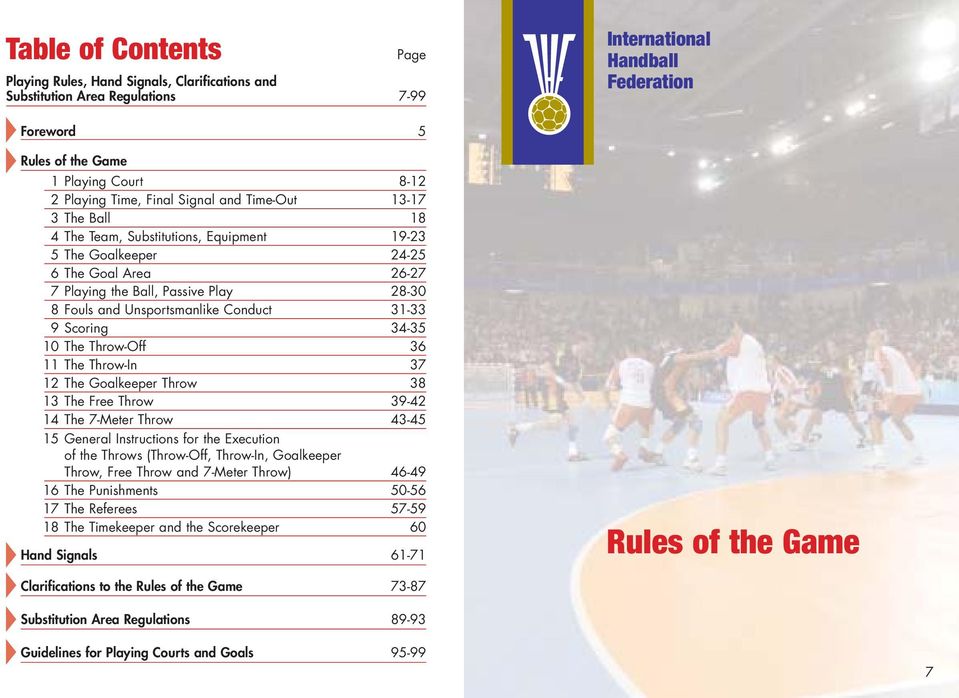
4 Table of Contents n n n n n n Foreword 5 Rules of the Game Page Playing Rules, Hand Signals, Clarifications and Substitution Area Regulations Playing Court Playing Time, Final Signal and Time-Out The Ball 18 4 The Team, Substitutions, Equipment The Goalkeeper The Goal Area Playing the Ball, Passive Play Fouls and Unsportsmanlike Conduct Scoring The Throw-Off The Throw-In The Goalkeeper Throw The Free Throw The 7-Meter Throw General Instructions for the Execution of the Throws (Throw-Off, Throw-In, Goalkeeper Throw, Free Throw and 7-Meter Throw) The Punishments The Referees The Timekeeper and the Scorekeeper 60 Hand Signals Clarifications to the Rules of the Game Substitution Area Regulations Guidelines for Playing Courts and Goals International Handball Federation Rules of the Game 7
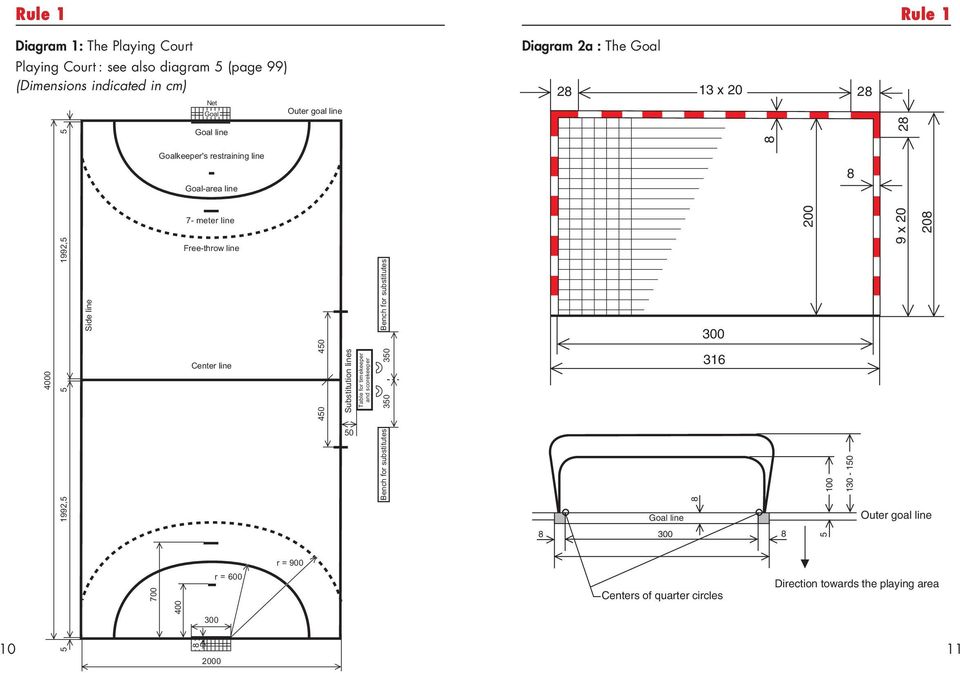
5 Rule 1 Playing Court 1:1 The playing court (see diagram 1) is a 40 meter long and 20 meter wide rectangle, consisting of two goal areas (see 1:4 and 6) and a playing area. The longer boundary lines are called side lines, and the shorter ones are called goal lines (between the goalposts) or outer goal lines (on either side of the goal). There should be a safety zone surrounding the playing court, with a width of at least 1 meter along the side lines and 2 meters behind the goal lines. The characteristics of the playing court must not be altered during the game in such a way that one team gains an advantage. 1:2 A goal (see diagrams 2a and 2b) is placed in the center of each outer goal line. The goals must be firmly attached to the floor or to the walls behind them. They have an interior height of 2 meters and a width of 3 meters. The goalposts are joined by a horizontal crossbar. The rear side of the goalposts shall be in line with the rear edge of the goal line. The goalposts and the crossbar must have an 8cm square cross section. On the three sides which are visible from the court they must be painted in bands of two contrasting colors, which also contrast clearly with the background. The goals must have a net, that should be attached in such a way that a ball thrown into the goal normally remains in the goal. 1:3 All lines on the court are fully part of the area that they enclose. The goal lines shall be 8cm wide between the goalposts (see diagram 2a), whereas all other lines shall be 5cm wide. Lines between two adjacent areas may be replaced with a difference in colors between the adjacent areas of the floor. Rule 1 1:4 In front of each goal there is a goal area (see diagram 5). The goal area is defined by the goal-area line (6-meter line), which is drawn as follows : a) a 3 meter long line directly in front of the goal ; this line is parallel to the goal line and 6 meters away from it (measured from the rear edge of the goal line to the front edge of the goal-area line) ; b) two quarter circles, each with a radius of 6 meters (measured from the rear inner corner of the goalposts), connecting the 3 meter long line with the outer goal line (see diagrams 1 and 2a). 1:5 The free throw line (9-meter line) is a broken line, drawn 3 meters outside the goal-area line. Both the segments of the line and the spaces between them measure 15cm (see diagram 1). 1:6 The 7-meter line is a 1 meter long line, directly in front of the goal. It is parallel to the goal line and 7 meters away from it (measured from the rear edge of the goal line to the front edge of the 7-meter line) ; (see diagram 1). 1:7 The goalkeeper s restraining line (the 4-meter line) is a 15cm long line, directly in front of the goal. It is parallel to the goal line and 4 meters away from it (measured from the rear edge of the goal line to the front edge of the 4-meter line) ; (see diagram 1). 1:8 The center line connects the midpoints of the two side lines (see diagrams 1 and 3). 1:9 The substitution line (a segment of the side line) for each team extends from the center line to a point at a distance of 4.5 meters from the center line. This end point of the substitution line is enhanced by a line which is parallel to the center line, extending 15cm inside the sideline and 15cm outside the sideline (see diagrams 1 and 3). Note : More detailed technical requirements for the playing court and the goals can be found in the Guidelines for Playing Courts and Goals, starting on page

6 10 Rule 1 Diagram 1: The Playing Court Playing Court : see also diagram 5 (page 99) (Dimensions indicated in cm) , ,5 5 Side line 700 Goalkeeper's restraining line 400 Net Goal Goal line Goal-area line 7- meter line Free-throw line Center line r = 600 Outer goal line r = Substitution lines 50 Table for timekeeper and scorekeeper Bench for substitutes Bench for substitutes Diagram 2a : The Goal x Goal line Centers of quarter circles Rule x Outer goal line Direction towards the playing area 11
7 12 Rule 1 Diagram 2b : The Goal - lateral view Diagram 3 : Substitution lines and substitution area Bench bench for Substitutes substitutes 445 Substitution line Centre line 50 Table for timekeeper and scorekeeper Substitution line The table for timekeeper and scorekeeper and the benches for substitutes have to be placed in such a way that the scorekeeper/timekeeper can see the substitution lines. The table should be placed closer to the side line than the benches, but at least 50cm outside the side line Side line bench Bench for Substitutes substitutes n Playing Time, Final Signal and Time-Out Rule 2 Playing Time 2:1 The normal playing time for all teams with players of age 16 and above is 2 halves of 30 minutes. The half-time break is normally 10 minutes. The normal playing time for youth teams is 2 x 25 minutes in age group and 2 x 20 minutes in age group In both cases the half-time break is normally 10 minutes. 2:2 Overtime is played, following a 5-minute break, if a game is tied at the end of the regular playing time and a winner has to be determined. The overtime period consists of 2 halves of 5 minutes, with a 1-minute half-time break. If the game is again tied after a first overtime period, a second period is played after a 5-minute break. This overtime period also has 2 halves of 5 minutes, with a 1-minute half-time break. If the game is still tied, the winner will be determined in accordance with the rules for the particular competition. In the case that the decision is to use 7-meter-throwing as tie-breaker to decide a winner, the procedures indicated below shall be followed. Comment : If 7-meter-throwing is used as a tie-breaker, players who are not suspended, disqualified or excluded at the end of the playing time are entitled to participate. Each team nominates 5 players. These players make one throw each, alternating with the players of the other team. The teams are not required to predetermine the sequence of their throwers. Goalkeepers may be freely chosen and substituted among the players eligible to participate. Players may participate in the 7-meter throwing as both throwers and goalkeepers. 13

8 n Rule 2 The referees decide which goal is used. The referees make a coin toss, and the winning team chooses whether they wish to throw first or last. The opposite sequence is used for the remainder of the throws, if the throwing has to continue because the score is still tied after the first five throws each. For such a continuation, each team shall again nominate five players. All or some of them may be the same as in the first round. This method of nominating five players at a time continues as long as it is necessary. However, the winner is now decided as soon as there is a goal difference after both teams have had the same number of throws. Players may be disqualified from further participation in the 7-meter throwing in cases of significant or repeated unsportsmanlike conduct (16.13). If this concerns a player who has just been nominated in a group of five throwers, the team must nominate another thrower. Final Signal 2:3 The playing time begins with the referee s whistle for the initial throw-off. It ends with the automatic final signal from the public clock or from the timekeeper. If no such signal comes, the referee whistles to indicate that the playing time is over (17:9). Comment : If a public clock with an automatic final signal is not available, the timekeeper shall use a table clock or a stopwatch and end the game with a final signal (18:2, 2 nd paragraph). Rule 2 2:4 Infractions and unsportsmanlike conduct that take place before or simultaneously with the final signal (for half-time or end of game, also in overtime) are to be punished, also if the resulting free-throw (under Rule 13:1) or 7-meter-throw cannot be taken until after the signal. Similarly, the throw must be retaken, if the final signal (for half-time or end of game, also in overtime) sounds precisely when a free-throw or a 7-meter throw is being executed or when the ball is already in the air. In both cases, the referees end the game only after the free-throw or 7-meter throw has been taken (or retaken) and its immediate result has been established. 2:5 For free-throws taken (or retaken) under Rule 2:4, special restrictions apply regarding player positions and substitutions. As an exception to the normal substitution flexibility in Rule 4:4, the only player substitution allowed is for one player on the throwing team. Violations are penalized under Rule 4:5, 1 st paragraph. Moreover, all the team mates of the thrower must be positioned at least 3 meters away from the thrower, in addition to being outside the free-throw line of the opponents (13:7, 15:6; see also Clarification No. 1). The positions of the defending players are indicated in Rule 13:8. 2:6 Players and team officials remain subject to personal punishment for infractions or unsportsmanlike conduct which take place during the execution of a free-throw or 7-meter throw in the circumstances described in Rules 2:4-5. An infraction during the execution of such a throw cannot, however, lead to a free-throw in the opposite direction
9 n Rule 2 2:7 If the referees determine that the timekeeper has given the final signal (for half-time or end of game, also in overtime) too early, they must keep the players on the court and play the remaining time. The team that was in possession of the ball at the time of the premature signal will remain in possession when the game resumes. If the ball was out of play, then the game is restarted with the throw that corresponds to the situation. If the ball was in play, then the game is restarted with a free-throw in accordance with Rule 13:4a-b. If the first half of a game (or an overtime period) has been terminated too late, the second half must be shortened correspondingly. If the second half of a game (or an overtime period) has been terminated too late, then the referees are no longer in a position to change anything. Time out 2:8 A time-out is obligatory when: a) a 2-minute suspension, disqualification, or exclusion is given ; b) a team time-out is granted; c) there is a whistle signal from the timekeeper or the technical delegate; d) consultations between the referees are necessary in accordance with Rule 17:7. A time-out is normally also given in certain other situations, depending on the circumstances (see Clarification No. 2). Infractions during a time-out have the same consequences as infractions during the playing time (16:13, 1 st paragraph). Rule 2 2:9 In principle, the referees decide when the clock is to be stopped and started in connection with a time-out. The interruption of the playing time is to be indicated to the timekeeper through three short blasts on the whistle and hand signal no. 16. However, in the case of obligatory time-outs where the game has been interrupted by a whistle signal from the timekeeper or Delegate (2:8b-c), the timekeeper is required to stop the official clock immediately, without awaiting a confirmation from the referees. The whistle must always be blown to indicate the restart of the game after a time-out (15:5b). Comments : A whistle signal from the timekeeper/delegate effectively stops the game. Even if the referees (and the players) do not immediately realize that the game has been stopped, any action on the court after whistle signal is invalid. This means that if a goal was scored after the whistle signal from the table, the goal must be disallowed. Similarly, a decision to award a throw to a team (7-meter throw, free-throw, throw-in, throw-off or goalkeeper-throw) is also invalid. The game shall instead be restarted in the manner that corresponds to the situation that existed when the timekeeper/delegate whistled. (It should be kept in mind that the typical reason for the intervention is a team time-out or a faulty substitution). However, any personal punishment given by the referees between the time of the whistle from the table and the time the referees stop the action remains valid. This applies regardless of the type of the violation and regardless of the severity of the punishment. 2:10 Each team has the right to receive one 1-minute team time-out in each half of the regular playing time, but not in overtime (Clarification No. 3)
10 18 Rule 3 The Ball 3:1 The ball is made of leather or a synthetic material. It must be spherical. The surface must not be shiny or slippery (17:3). 3:2 The ball sizes, i.e. the circumference and weight, to be used by different categories of teams are as follows : 58-60cm and g (IHF Size 3) for Men and for Male Youth (over age 16) ; 54-56cm and g (IHF Size 2) for Women, Female Youth (over age 14), and Male Youth (age 12 to 16) ; 50-52cm and g (IHF Size 1) for Female Youth (age 8 to 14) and Male Youth (age 8 to 12). Comments : The technical requirements for the balls to be used in all official international games are described in the IHF Ball Regulations. The size and weight of balls to be used for Mini-Handball are not regulated in the normal playing rules. 3:3 For every game there must be at least two balls available. The reserve balls must be immediately available at the timekeeper s table during the game. The balls must meet the requirements of Rules 3:1-2. 3:4 The referees decide when to use a reserve ball. In such cases, the referees should get the reserve ball into play quickly in order to minimize interruptions and avoid time-outs. n The Team, Substitutions, Equipment The Team Rule 4 4:1 A team consists of up to 14 players. No more than 7 players may be present on the court at the same time. The remaining players are substitutes. At all times during the game, the team must have one of the players on the court designated as a goalkeeper. A player who is recognized as a goalkeeper may become a court player at any time. Similarly, a court player may become a goalkeeper at any time (see, however, 4:4 and 4:7). A team must have at least 5 players on the court at the start of the game. The number of players on a team can be increased up to 14, at any time during the game, including overtime. The game may continue even if a team is reduced to less than 5 players on the court. It is for the referees to judge whether and when the game should be permanently suspended (17:12). 4:2 A team is allowed to use a maximum of 4 team officials during the game. These team officials may not be replaced during the course of the game. One of them must be designated as the «responsible team official». Only this official is allowed to address the timekeeper/ scorekeeper and, possibly, the referees (see, however, Clarification No. 3 : team time-out). A team official is generally not allowed to enter the court during the game. A violation of this rule is to be penalized as unsportsmanlike conduct (see 8:4, 16:1c, 16:3d and 16:6a). The game is restarted with a free-throw for the opponents (13:1a-b ; see, however, Clarification No. 9). The responsible team official shall ensure that, once the game has started, no other persons than the (maximum 4) registered team officials and the players who are entitled to participate (see 4:3) are present in the substitution area. A violation of this rule leads to progressive punishment for the responsible team official (16:1c, 16:3d, and 16:6a). 19

11 n Rule 4 4:3 A player or team official is entitled to participate if he is present at the start of the game and is included in the score sheet. Players and team officials who arrive after the game has started must obtain their entitlement to participate from the timekeeper/ scorekeeper and must be entered into the score sheet. A player who is entitled to participate may, in principle, enter the court through the team s own substitution line at any time (see, however, 4:4 and 4:6). The responsible team official shall ensure that only players who are entitled to participate enter the court. A violation is to be penalized as unsportsmanlike conduct by the responsible team official (13:1a-b, 16:1c. 16:3d, and 16:6a ; see, however, Clarification No.9) Player Substitutions 4:4 Substitutes may enter the court, at any time and repeatedly (see, however, Rule 2:5), without notifying the timekeeper/scorekeeper, as long as the players they are replacing have already left the court (4:5). The players involved in the substitution shall always leave and enter the court over their own team s substitution line (4:5). These requirements also apply to the substitution of goalkeepers (see also 4:7 and 14:10). The substitution rules also apply during a time-out (except during a team time-out). Rule 4 Comments : The purpose of the concept of the substitution line is to ensure fair and orderly substitutions. It is not intended to cause punishments in other situations, where a player steps over the sideline or outer goal line in a harmless manner and without any intention of gaining an advantage (e.g., getting water or a towel at the bench just beyond the substitution line, or leaving the court in a sportsmanlike manner when receiving a suspension and crossing the sideline at the bench but just outside the 15cm line). Tactical and illegal usage of the area outside the court is dealt with separately in Rule 7:10. 4:5 A faulty substitution shall be penalized with a 2-minute suspension for the guilty player. If more than one player from the same team is guilty of faulty substitution in the same situation, only the first player committing an infraction is to be penalized. The game is restarted with a free- throw for the opponents (13:1a-b; see, however, Clarification No. 9). 4:6 If an additional player enters the court without a substitution, or if a player illegally interferes with the game from the substitution area, there shall be a 2-minute suspension for the player. Thus, the team must be reduced by one player on the court for the next 2 minutes (apart from the fact that the entering additional player must leave the court). If a player enters the court while serving a 2-minute suspension, he shall be given an additional 2-minute suspension. This suspension shall begin immediately, so the team must be further reduced on the court during the overlap between the first and the second suspension. The game is in both cases restarted with a free-throw for the opponents (13:1a-b ; see, however, Clarification No. 9)
12 n Rule 4 Equipment 4:7 All the court players on a team must wear identical uniforms. The combinations of colors and design for the two teams must be clearly distinguishable from each other. All players used in the goalkeeper position on a team must wear the same color, a color that distinguishes them from the court players of both teams and the goalkeeper(s) of the opposing team (17:3). 4:8 The players must wear numbers that are at least 20 cm high in the back of the shirt and at least 10cm in the front. The numbers used should be from 1 to 20. A player who is switching between the court player and goalkeeper positions must wear the same number in both positions. The color of the numbers must contrast clearly with the colors and design of the shirt. 4:9 The players must wear sports shoes. It is not permitted to wear objects that could be dangerous to the players. This includes, for instance, head protection, face masks, bracelets, watches, rings, visible piercing, necklaces or chains, earrings, glasses without restraining bands or with solid frames, or any other objects which could be dangerous (17:3). Flat rings, small earrings and visible piercing may be allowed, as long as they are taped over in such a way that they are no longer deemed dangerous to other players. Headbands are allowed, as long as they are made of soft, elastic material. Players who do not meet this requirement will not be allowed to take part until they have corrected the problem. Rule 4 4:10 A player who is bleeding or has blood on the body or uniform must leave the court immediately and voluntarily (through a normal substitution), in order to have the bleeding stopped, the wound covered, and the body and uniform cleaned off. The player must not return to the court until this has been done. A player who does not follow the instructions of the referees in connection with this provision is deemed guilty of unsportsmanlike conduct (8:4, 16:1c and 16:3c). 4:11 In the case of an injury, the referees may give permission (through hand signals no. 16 and 17) for two of the persons who are entitled to participate (see 4:3) to enter the court during a time-out, for the specific purpose of assisting an injured player from their team. If additional persons enter the court after two persons have already entered, it shall be punished as illegal entry, in the case of a player under Rule 4:6 and 16:3a, and in the case of a team official under Rules 4:2, 16:1c, 16:3d and 16:6a. A person who has been permitted to enter the court but, instead of assisting the injured player, gives instructions to players, approaches opponents or referees etc., shall be considered guilty of unsportsmanlike conduct (16:1c, 16:3c-d and 16:6a)

13 Rule 5 The Goalkeeper The goalkeeper is allowed to : 5:1 touch the ball with any part of his body while in the act of defense inside the goal area 5:2 move with the ball inside the goal area, without being subject to the restrictions applying to court players (7:2-4, 7:7); the goalkeeper is not allowed, however, to delay the execution of the goalkeeperthrow (6:4-5, 12:2 and 15:5b); 5:3 leave the goal area without the ball and participate in the game in the playing area; when doing so, the goalkeeper becomes subject to the rules applying to players in the playing area; The goalkeeper is considered to have left the goal area as soon as any part of the body touches the floor outside the goal-area line. 5:4 to leave the goal area with the ball and play it again in the playing area if he has not managed to control it. Rule 5 5:8 take the ball into the goal area when it is stationary or rolling on the floor outside the goal area (6:1, 13:1a); 5:9 re-enter the goal area from the playing area with the ball (6:1, 13:1a); 5:10 touch the ball with the foot or the leg below the knee, when it is stationary on the floor in the goal area or moving out towards the playing area (13:1a); 5:11 cross the goalkeeper s restraining line (4-meter line) or its projection on either side, before the ball has left the hand of the opponent who is executing a 7-meter throw (14:9). Comment : As long as the goalkeeper keeps one foot on the floor on or behind the restraining line (4-meter line), he is permitted to move the other foot or any other part of his body out over the line in the air. The goalkeeper is not allowed to : 5:5 endanger the opponent while in the act of defense (8:2, 8:5); 5:6 leave the goal area with the ball under control; this leads to a free-throw (according to 6:1, 13:1a and 15:7, 3 rd paragraph), if the referees had whistled for the execution of the goalkeeper-throw; otherwise the goalkeeper-throw is simply repeated (15:7, 2 nd paragraph); see, however, the advantage interpretation in 15:7, if the goalkeeper were to lose the ball outside the goal area after having crossed the line with the ball in his hand); 5:7 touch the ball when it is stationary or rolling on the floor outside the goal area, while he is inside the goal area (6:1, 13:1a); 24 25

14 Rule 6 The Goal Area 6:1 Only the goalkeeper is allowed to enter the goal area (see, however, 6:3). The goal area, which includes the goal-area line, is considered entered when a court player touches it with any part of the body. 6:2 When a court player enters the goal area, the decisions shall be as follows : a) goalkeeper-throw when a player of the team in possession enters the goal area in possession of the ball or enters without the ball but gains an advantage by doing so (12:1); b) free-throw when a court player of the defending team enters the goal area and gains an advantage, but without destroying a chance of scoring (13:1b); See also Clarification No. 5:1 c) 7-meter throw when a court player of the defending team enters the goal area and because of this destroys a clear chance of scoring (14:1a). 6:3 Entering the goal area is not penalized when: a) a player enters the goal area after playing the ball, as long as this does not create a disadvantage for the opponents; b) a player from one of the teams enters the goal area without the ball and does not gain an advantage by doing so; 6:4 The ball is considered to be out of play when the goalkeeper controls the ball with his hands in the goal area (12:1). The ball must be put back into play through a goalkeeper-throw (12:2). Rule 6 6:5 The ball remains in play, while it is rolling on the floor inside the goal area. It is in the possession of the goalkeeper s team an only the goalkeeper may touch it. The goalkeeper may pick it up, which brings it out of play, and then put it back into play, in accordance with 6:4 and 12:1-2 (see, however, 6:7b). It leads to a free-throw (13:1a) if the ball is touched by a teammate of the goalkeeper while it is rolling (see, however, 14:1a, in conjunction with Clarification 8c), and the game is continued with a goalkeeper-throw (12:1 (iii)) if it is touched by an opponent. The ball is out of play, as soon as it is lying on the floor in goal area (12:1 (ii)). It is in the possession of the goalkeeper s team and only the goalkeeper may touch it. The goalkeeper must put it back into play in accordance with 6:4 and 12:2 (see, however, 6:7b). It remains a goalkeeper-throw if the ball is touched by any other player of either team (12:1 2 nd paragraph, 13:3). It is fully permitted to touch the ball when it is in the air over the goal area. 6:6 Play shall continue (through a goalkeeper-throw according to 6:4-5) if a player of the defending team touches the ball when in the act of defense, and the ball is caught by the goalkeeper or comes to rest in the goal area. 6:7 If a player plays the ball into his own goal area, the decisions shall be as follows: a) goal if the ball enters the goal; b) free-throw if the ball comes to a rest in the goal area, or if the goalkeeper touches the ball and it does not enter the goal (13:1a-b); c) throw-in if the ball goes out over the outer goal line (11:1); d) play continues if the ball passes through the goal area back into the playing area, without being touched by the goalkeeper. 6:8 A ball that returns from the goal area out into the playing area remains in play

15 n Rule 7 Playing the Ball, Passive Play Playing the Ball It is permitted to : 7:1 throw, catch, stop, push or hit the ball, by using hands (open or closed), arms, head, torso, thighs, and knees; 7:2 hold the ball for a maximum of 3 seconds, also when it is Iying on the floor (13:1a); 7:3 take a maximum of 3 steps with the ball (13:1a); one step is considered taken when: a) a player who is standing with both feet on the floor lifts one foot and puts it down again, or moves one foot from one place to another; b) a player is touching the floor with one foot only, catches the ball and then touches the floor with the other foot; c) a player after a jump touches the floor with one foot only, and then hops on the same foot or touches the floor with the other foot; d) a player after a jump touches the floor with both feet simultaneously, and then lifts one foot and puts it down again, or moves one foot from one place to another. Comment : It counts as only one step if one foot is moved from one place to another, and then the other foot is dragged next to the first one. Rule 7 7:4 while standing or running: a) bounce the ball once and catch it again with one or both hands; b) bounce the ball repeatedly with one hand (dribble), and then catch it or pick it up again with one or both hands; c) roll the ball on the floor repeatedly with one hand, and then catch it or pick it up again with one or both hands. As soon as the ball thereafter is held in one or both hands, it must be played within 3 seconds or after no more than 3 steps (13:1a). The bouncing or dribbling is considered to have started when the player touches the ball with any part of his body and directs it towards the floor. After the ball has touched another player or the goal, the player is allowed to tap the ball or bounce it and catch it again (see, however, 14:6). 7:5 move the ball from one hand into the other one; 7:6 play the ball while kneeling, sitting or lying on the floor; this means that is it permitted to execute a throw (for instance a free-throw), from such a position, if the requirements of Rule 15:1 are met, including the requirement of having a part of one foot in constant contact with the floor. It is not permitted to : 7:7 after the ball has been controlled, to touch it more than once, unless it has touched the floor, another player, or the goal in the meantime (13:1a); however, touching it more than once is not penalized, if the player is fumbling the ball, i.e, failing to control it when trying to catch or stop it; 7:8 touch the ball with a foot or leg below the knee, except when the ball has been thrown at the player by an opponent (13:1a-b); 7:9 Play continues if the ball touches a referee on the court

16 n 30 Rule 7 7:10 If a player with the ball moves outside the playing court with one or both feet (while the ball is still inside the court), for instance to get around a defending player, this shall lead to a free-throw for the opponents (13:1a). If a player from the team in possession takes up position outside the court without the ball, the referees shall indicate to the player that he must move into the court. If the player does not do so, or if the action is later repeated by the same team, there shall be a free-throw awarded to the opponents (13:1a) without any further forewarning. Such actions shall not lead to personal punishment under Rules 8 and 16. Passive Play 7:11 It is not permitted to keep the ball in the team s possession without making any recognizable attempt to attack or to shoot on goal. Similarly, it is not allowed to delay repeatedly the execution of a throw-off, free-throw, throw-in, or goalkeeper-throw for one s own team (see Clarification No. 4). This is regarded as passive play, which is to be penalized with a free-throw against the team in possession of the ball unless the passive tendency ceases (13:1a). The free-throw is taken from the spot where the ball was when play was interrupted. 7:12 When a tendency to passive play is recognized, the forewarning signal (hand signal no. 18) is shown. This gives the team in possession of the ball the opportunity to change its way of attacking in order to avoid losing possession. If the way of attacking does not change after the forewarning signal has been shown, or no shot on goal is taken, then a free-throw is called against the team in possession (see Clarification No. 4). In certain situations the referees can call a free throw against the team in possession also without any prior forewarning signal, e.g. when a player intentionally refrains from trying to utilize a clear scoring chance. Fouls and Unsportsmanlike Conduct It is permitted to : Rule 8 8:1 a) use arms and hands to block or gain possession of the ball; b) use an open hand to play the ball away from the opponent from any direction; c) use the body to obstruct an opponent, even when the opponent is not in possession of the ball; d) make body contact with an opponent, when facing him and with bent arms, and maintain this contact in order to monitor and follow the opponent. It is not permitted to : 8:2 a) pull or hit the ball out of the hands of an opponent; b) block or force away an opponent with arms, hands or legs; c) restrain or hold (body or uniform), push, run or jump into an opponent; d) endanger an opponent (with or without the ball). 8:3 Violations of Rule 8:2 may occur in the struggle for the ball; however, violations where the action is mainly or exclusively directed at the opponent and not at the ball, are to be punished progressively. This means that, in addition to a free-throw or 7-meter throw, there is also a need for a personal punishment, beginning with a warning (16:1b), followed by increasingly severe punishments, such as suspensions (16:3b) and disqualifications (16:6f). (Unsportsmanlike conduct is also to be punished progressively, under 16:1c, 16:3c and 16:6f). As indicated in Rule 16:3 Comment, however, the referees have the right to determine that a particular violation warrants an immediate 2-minute suspension, even if the player did not previously have a warning. 31
17 Rule 8 8:4 Physical and verbal expressions that are incompatible with the spirit of good sportsmanship are regarded as constituting unsportsmanlike conduct (for example see Clarification No. 5). This applies to both players and team officials on or off the playing court. Progressive punishment also applies in the case of unsportsmanlike conduct (16:1c, 16:3c-d and 16:6a). 8:5 A player who endangers the opponent's health when attacking him, shall be disqualified (16:6b) particularly if he : a) from the side or from behind, either strikes or pulls back the throwing arm of a player who is in the process of throwing or passing the ball; b) takes any action resulting in the opponent being struck on the head or neck; c) deliberately hits the body of an opponent with his foot or knee or in any other way; this includes tripping; d) pushes an opponent who is running or jumping, or attacks him in such a way that the opponent loses control of his body; this also applies when a goalkeeper leaves his goal area in connection with a counter-attack from the opponents; e) hits a defending player in the head with a free-throw taken as a direct shot on goal, assuming that the defending player was not moving; or similarly, hits the goalkeeper in the head with a 7-meter throw, assuming that the goalkeeper was not moving. Rule 8 8:6 Seriously unsportsmanlike conduct by a player or team official on or outside the court (for example see Clarification No. 6) shall be punished with disqualification (16:6c). 8:7 A player who is guilty of assault during the playing time shall be excluded (16:9-11). Assault outside the playing time (see 16:13) leads to a disqualification (16:6d; 16:14b). A team official who is guilty of assault shall be disqualified (16:6e). Comment : Assault is, for the purposes of this rule, defined as a forceful and deliberate attack against the body of another person (player, referee, timekeeper/scorekeeper, team official, delegate, spectator, etc.). In other words, it is not simply a reflex action or the result of careless and excessive methods. Spitting on another person, so that the person is actually hit, is specifically regarded as assault. 8:8 Violations of Rules 8:2-7 lead to a 7-meter throw for the opponents (14:1) if the violation directly, or indirectly because of the interruption it causes, destroys a clear chance of scoring for the opponents. Otherwise the violation leads to a free-throw for the opponents (see 13:1a-b but see also 13:2 and 13:3). Comment: Even a foul with a very small physical impact can be very dangerous and have potentially very serious consequences, if the timing of the foul is such that the opponent is defenseless and caught unaware. It is the risk to the player and not the seemingly minor nature of the body contact that should be guiding in determining the appropriateness of a disqualification
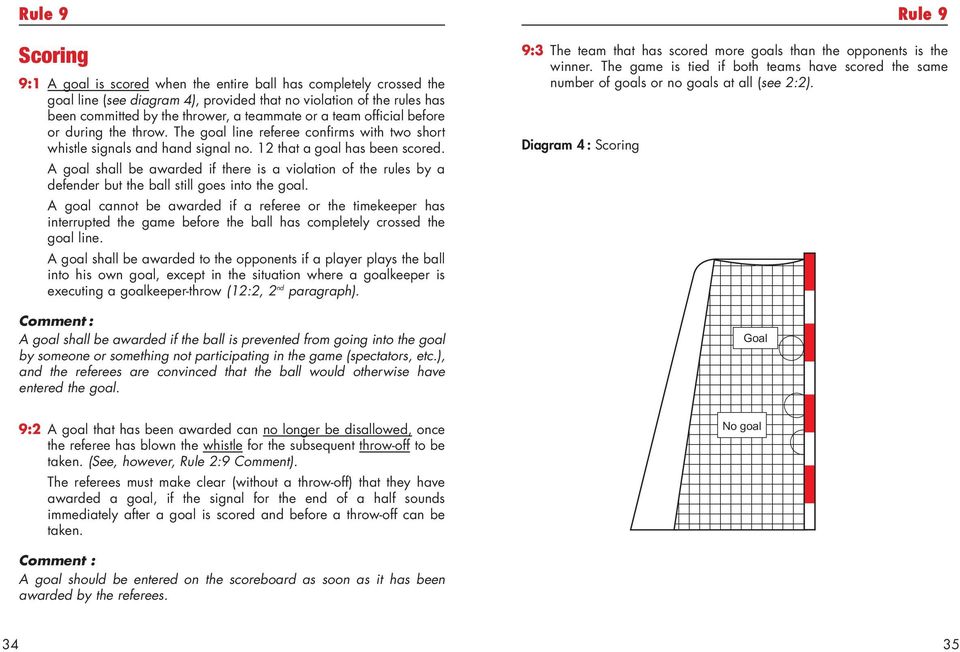
18 Rule 9 Scoring 9:1 A goal is scored when the entire ball has completely crossed the goal line (see diagram 4), provided that no violation of the rules has been committed by the thrower, a teammate or a team official before or during the throw. The goal line referee confirms with two short whistle signals and hand signal no. 12 that a goal has been scored. A goal shall be awarded if there is a violation of the rules by a defender but the ball still goes into the goal. A goal cannot be awarded if a referee or the timekeeper has interrupted the game before the ball has completely crossed the goal line. A goal shall be awarded to the opponents if a player plays the ball into his own goal, except in the situation where a goalkeeper is executing a goalkeeper-throw (12:2, 2 nd paragraph). Comment : A goal shall be awarded if the ball is prevented from going into the goal by someone or something not participating in the game (spectators, etc.), and the referees are convinced that the ball would otherwise have entered the goal. Rule 9 9:3 The team that has scored more goals than the opponents is the winner. The game is tied if both teams have scored the same number of goals or no goals at all (see 2:2). Diagram 4 : Scoring Goal 9:2 A goal that has been awarded can no longer be disallowed, once the referee has blown the whistle for the subsequent throw-off to be taken. (See, however, Rule 2:9 Comment). The referees must make clear (without a throw-off) that they have awarded a goal, if the signal for the end of a half sounds immediately after a goal is scored and before a throw-off can be taken. No goal Comment : A goal should be entered on the scoreboard as soon as it has been awarded by the referees
19 36 Rule 10 The Throw-Off 10:1 At the start of the game, the throw-off is taken by the team that wins the coin toss and elects to start with the ball in its possession. The opponents then have the right to choose ends. Alternatively, if the team that wins the coin toss prefers to choose ends, then the opponents take the throw-off. The teams change ends for the second half of the game. The throw-off at the start of the second half is taken by the team that did not have the throw-off at the start of the game. A new coin toss is undertaken prior to each overtime period, and all the above-stated regulations under Rule 10:1 also apply to overtime. 10:2 After a goal has been scored play is resumed with a throw-off taken by the team that conceded the goal (see, however, 9:2, 2 nd paragraph). 10:3 The throw-off is taken in any direction from the center of the court (with a tolerance sideways of about 1.5 meters). It is preceded by a whistle signal, following which it must be taken within 3 seconds (13:1a, 15:7 3 rd paragraph). The player taking the throw-off must take up a position with at least one foot on the center line, and the other foot on or behind the line (15:6), and remain in this position until the ball has left his hand (13:1a, 15:7 3 rd paragraph) (see also Clarification No. 7). The teammates of the thrower are not allowed to cross the center line prior to the whistle signal (15:6). 10:4 For the throw-off at the start of each half (incl. any period of overtime), all players must be in their own half of the court. However, for the throw-off after a goal has been scored, the opponents of the thrower are allowed to be in both halves of the court. In both cases, however, the opponents must be at least 3 meters away from the player taking the throw-off (15:4,15:9, Clarification No. 5:2b). The Throw-In Rule 11 11:1 A throw-in is awarded when the ball has completely crossed the side line, or when a court player on the defending team was the last one to touch the ball before it crossed his team s outer goal line. It is also awarded when the ball has touched the ceiling or a fixture above the court. 11:2 The throw-in is taken without whistle signal from the referees (see, however, 15:5b) by the opponents of the team whose player last touched the ball before it crossed the line or touched the ceiling or fixture. 11:3 The throw-in is taken from the spot where the ball crossed the side line or, if it crossed the outer goal line, from the intersection of the side line and the outer goal line on that side. For a throw-in after the ball touched the ceiling or a fixture above the court, the throw-in is taken at the nearest point on the nearest side line in relation to the spot where the ball touched the ceiling or fixture. 11:4 The thrower must stand with a foot on the side line (15:6) and remain in a correct position until the ball has left his hand (15:7 2 nd and 3 rd paragraph, 13:1a). There is no limitation for the placement of the second foot. 11:5 While the throw-in is being taken, the opponents may not be closer than 3 meters to the thrower (15:4, 15:9, Clarification No. 5:2b). They are, however, always allowed to stand immediately outside their goal-area line even if the distance between them and the thrower is less than 3 meters then. 37

20 Rule 12 The Goalkeeper-Throw 12:1 A goalkeeper-throw is awarded when: (i) a player of the opposing team has entered the goal area in violation of Rule 6:2a; (ii) the goalkeeper has controlled the ball in the goal area or the ball is stationary on the floor in the goal area (6:4-5); (iii) a player of the opposing team has touched the ball when it is rolling or stationary on the floor in the goal area (6:5, 1 st paragraph) or (iv) when the ball has crossed the outer goal line, after having been touched last by the goalkeeper or a player of the opposing team. This means that in all these situations the ball is considered out of play, and that the game is resumed with a goalkeeper-throw (13:3) if there is a violation after a goalkeeper-throw has been awarded and before it has been executed. 12:2 The goalkeeper-throw is taken by the goalkeeper without whistle signal from the referee (see, however, 15:5b), from the goal area out over the goal area line. The goalkeeper-throw is considered to have been taken, when the ball thrown by the goalkeeper has completely crossed the goal-area line. The players of the other team are allowed to be immediately outside the goal-area line, but they are not allowed to touch the ball until it has completely crossed the line (15:4, 15:9, Clarification No. 5:2b). n Free-Throw Free-Throw Decision Rule 13 13:1 In principle, the referees interrupt the game and have it restarted with a free-throw for the opponents when: a) the team in possession of the ball commits a violation of rules that must lead to a loss of possession (see 4:2-3, 4:5-6, 5:6-10, 6:5, 6:7b, 7:2-4, 7:7-8, 7:10, 7:11, 8:8, 10:3, 11:4, 13:7, 14:4-7, 15:7 1 st paragraph, and 15 :8). b) the opponents commit a violation of rules that causes the team in possession of the ball to lose it (see 4:2-3, 4:5-6, 5:5, 6:2b, 6:7b, 7:8, 8:8). 13:2 The referees should allow continuity in the game by refraining from interrupting the game prematurely with a free-throw decision. This means that, under Rule 13:1a, the referees should not call a free-throw if the defending team gains possession of the ball immediately after the violation committed by the attacking team. Similarly, under Rule 13:1b, the referees should not intervene until and unless it is clear that the attacking team has lost possession of the ball or is unable to continue their attack, due to the violation committed by the defending team. If a personal punishment is to be given because of rules violation, then the referees may decide to interrupt the game immediately, if this does not cause a disadvantage for the opponents of the team committing the violation. Otherwise the punishment should be delayed until the existing situation is over. Rule 13:2 does not apply in the case of infringements against Rules 4:2-3 or 4:5-6, where the game shall be interrupted immediately, normally through the intervention of the timekeeper
21 n Rule 13 13:3 If a violation that would normally lead to a free-throw under Rule 13:1 a-b takes place when the ball is out of play, then the game is restarted with the throw that corresponds to the reason for the existing interruption. 13:4 In addition to the situations indicated in Rule 13:1 a-b, a free-throw is also used as the way of restarting the game in certain situations where the game is interrupted (i.e. when the ball is in play), even though no violation of rules has occurred : a) if one team is in possession of the ball at the time of the interruption, this team shall retain possession; b) if neither team is in possession of the ball, then the team that last had possession shall be given possession again; The advantage rule under Rule 13:2 does not apply in the situations covered by Rule 13:4. 13:5 If there is a free-throw decision against the team that is in possession of the ball when the referee whistles, then the player who has the ball at that moment must immediately drop it or put it down on the floor at the spot where he is (16:3e). Free-Throw Execution 13:6 The free-throw is normally taken without any whistle signal from the referee (see, however, 15:5b) and, in principle, from the place where the infraction occurred. The following are exceptions to this principle: In the situations described under 13:4 a-b, the free-throw is taken, after whistle signal, in principle from the place where the ball was at the time of the interruption. Rule 13 If a referee or technical delegate (of the IHF or a continental/ national federation) interrupts the game because of an infringement on the part of a player or team official of the defending team, and this results in a verbal caution or a personal punishment, then the free- throw should be taken from the place where the ball was when the game was interrupted, if this is a more favorable location than the position where the infringement took place. The same exception as in the previous paragraph applies if a timekeeper interrupts the game because of violations under Rules 4:2-3 or 4:5-6. As indicated in Rule 7:11, free-throws called because of passive play shall be taken from the place where the ball was when the game was interrupted. Notwithstanding the basic principles and procedures stated in the preceding paragraphs, a free-throw can never be taken inside the throwing team s own goal area or inside the free-throw line of the opponents. In any situation where the location indicated by the one of the preceding paragraphs involves either one of these areas, the location for the execution must be moved to the nearest spot immediately outside the restricted area. Comment : If the correct position for the free-throw is at the free-throw line of the defending team, then the execution must take place essentially at the precise spot. However, the further away the location is from the defending team s free-throw line, the more of a margin there is for allowing the free-throw to be taken a short distance away from the precise spot. This margin gradually increases up to 3 meters, which applies in the case of a free-throw taken from just outside the throwing team s own goal area. The margin just explained does not apply following a violation of Rule 13:5, if this violation is being punished in accordance with Clarification No. 5 :3a. In such cases, the execution should always be from the precise spot where the violation has been committed
22 Rule 13 13:7 Players of the throwing team must not touch or cross the free-throw line of the opponents before the free-throw has been taken. See also the special restriction under Rule 2:5. The referees must correct the positions of players of the throwing team who are between the free-throw line and the goal-area line prior to the execution of the free-throw, if the incorrect positions have an influence on the game (15:3, 15:6). The free-throw shall then be taken following a whistle signal (15:5b). The same procedure applies (Rule 15:7, 2 nd paragraph) if players of the throwing team enter the restricted area during the execution of the free-throw (before the ball has left the thrower s hand), if the execution of the throw was not preceded by a whistle signal. In the case where the execution of a free-throw has been authorized through a whistle signal, if players from the attacking team touch or cross the free-throw line before the ball has left the hand of the thrower, there shall be a free-throw awarded to the defending team (15:7, 3 rd paragraph; 13:1a). 13:8 When a free throw is being taken, the opponents must remain at a distance of at least 3 meters from the thrower. They are, however, allowed to stand immediately outside their goal-area line if the free-throw is being taken at their free-throw line. Interference with the execution of the free-throw is penalized in accordance with Rule 15:9 and Clarification 5:2b. n The 7-Meter Throw 7-Meter Decision Rule 14 14:1 A 7-meter throw is awarded when: a) a clear chance of scoring is illegally destroyed anywhere on the court by a player or a team official of the opposing team; b) there is an unwarranted whistle signal at the time of a clear chance of scoring; c) a clear chance of scoring is destroyed through the interference of someone not participating in the game, for instance a spectator entering the court or stopping the players through a whistle signal (except when 9:1 Comment applies). By analogy, this rule also applies in the case of a force majeure, such as a sudden electrical failure, that stops the game precisely during a clear chance of scoring. see Clarification No. 8 for the definition of clear chance of scoring. 14:2 If an attacking player retains full control of ball and body despite a violation as in Rule 14:1a, there is no reason to give a 7-meter throw, even if thereafter the player fails to utilize the clear scoring chance. Whenever there is a potential 7-meter decision, the referees should always hold off on intervening until they can clearly determine if a 7-meter decision is indeed justified and necessary. If the attacking player scores a goal despite the illegal interference from the defenders, then there is obviously no reason to give a 7-meter throw. Conversely, if it becomes apparent that the player really has lost ball or body control because of the violation, so that a clear chance no longer exists, then a 7-meter throw is to be given
23 n Rule 14 14:3 When awarding a 7-meter throw the referees may give a time-out, but only if there is a substantial delay, for instance due to a substitution of the goalkeeper or the thrower, and a time-out decision would be in line with the principles and criteria stated in Clarification No Meter Execution 14:4 The 7-meter throw is to be taken as a shot on goal, within 3 seconds after a whistle signal from the referee (15:7, 3 rd paragraph; 13:1a). Rule 14 14:9 The 7-meter throw is to be retaken, unless a goal is scored, if the goalkeeper crosses his restraining line, i.e. the 4-meter line (1:7, 5:11), before the ball has left the thrower s hand. However, it does not result in a personal punishment for the goalkeeper. 14:10 It is not permitted to change goalkeepers once the thrower is ready to take the 7-meter throw, standing in the correct position with the ball in hand. Any attempt to make a substitution in this situation is to be penalized as unsportsmanlike conduct (8:4, 16:1c and 16:3c). 14:5 The player who is taking the 7-meter throw must take up a position behind the 7-meter line, not further away than 1 meter behind the line (15:1, 15:6). After the whistle signal from the referee, the thrower must not touch or cross the 7-meter line before the ball has left his hand (15:7, 3 rd paragraph; 13:1a). 14:6 The ball must not be played again by the thrower or a teammate following the execution of a 7-meter throw, until it has touched an opponent or the goal (15:7, 3 rd paragraph; 13:1a). 14:7 When a 7-meter throw is being executed, the teammates of the thrower must position themselves outside the free-throw line, and remain there until the ball has left the thrower s hand (15:3, 15:6). If they do not do so, a free-throw will be called against the team taking the 7-meter throw (15:7, 3 rd paragraph; 13:1a). 14:8 When a 7-meter throw is being executed, the players of the opposing team must remain outside the free-throw line and at least 3 meters away from the 7-meter line, until the ball has left the thrower s hand. If they do not do so, the 7-meter throw will be retaken if it does not result in a goal, but there is no personal punishment
24 n n Rule 15 General Instructions for the Execution of the Throws (Throw-Off, Throw-In, Goalkeeper-Throw, Free-Throw and 7-Meter Throw) The Thrower 15:1 Prior to the execution, the thrower must be in the correct position prescribed for the throw. The ball must be in the hand of the thrower. (15:6) During the execution, except in the case of the goalkeeper-throw, the thrower must have one part of a foot in constant contact with the floor until the ball is released. The other foot may be lifted and put down repeatedly. (See also Rule 7:6). The thrower must remain in the correct position until the throw has been executed. (15:7, 2 nd and 3 rd paragraph). 15:2 A throw is considered taken when the ball has left the hand of the thrower (see, however, 12:2). The thrower must not touch the ball again until it has touched another player or the goal. (15:7, 15:8). See also further restrictions for situations under 14:6. A goal may be scored directly from any throw, except that a direct own goal cannot be scored through a goalkeeper-throw (i.e., by dropping the ball into one s own goal). The Teammates of the Thrower 15:3 The teammates must take up the positions prescribed for the throw in question (15:6). The players must remain in correct positions until the ball has left the hand of the thrower, except as under 10:3, 2 nd paragraph. The ball must not be touched by, or handed over to, a teammate during the execution (15:7, 2 nd and 3 rd paragraph). n n Rule 15 The Defending Players 15:4 The defending players must take up the positions prescribed for the throw and remain in correct position until the ball has left the hand of the thrower (15:9). Incorrect positions on the part of the defending players in connection with the execution of a throw-off, throw-in, or free-throw must not be corrected by the referees if the attacking players are not at a disadvantage by taking the throw immediately. If there is a disadvantage, then the positions are to be corrected. Whistle Signal for the Restart 15:5 The referee must blow the whistle for the restart : a) always in the case of a throw-off (10:3) or 7-meter throw (14:4); b) in the case of a throw-in, goalkeeper-throw or free-throw : for a restart after a time-out; for a restart with a free-throw under Rule 13:4; when there has been a delay in the execution; after a correction of the player positions; after a verbal caution or a warning. The referee may judge it appropriate, for the sake of clarity, to blow the whistle for the restart on any other occasion. In principle, the referee shall not give the whistle signal for the restart unless and until the requirements for player positions under 15:1, 15:3 and 15:4 are met. (See, however, 13:7 2 nd paragraph and 15:4 2 nd paragraph). If the referee blows his whistle for a throw to be taken, despite incorrect positions on the part of players, then those players are fully entitled to intervene. After the whistle signal the thrower must play the ball within 3 seconds
25 n Rule 15 Sanctions 15:6 Violations by the thrower or his teammates prior to the execution of a throw, i.e., typically in the form of incorrect positions or the touching of the ball by a teammate, shall lead to a correction. (See, however, 13:7 2 nd paragraph). 15:7 The consequences of violations by the thrower or his teammates (15:1-3) during the execution of a throw depend primarily on whether the execution was preceded by a whistle signal for the restart. In principle, any violation during an execution that was not preceded by a restart signal is to be handled through a correction and a retaking of the throw after a whistle signal. However, an advantage concept, in analogy with Rule 13:2, applies here. If the thrower s team immediately loses possession after an incorrect execution, then the throw is simply considered to have been executed and play continues. In principle, any violation during an execution after a restart signal is to be penalized. This applies, for instance, if the thrower jumps during the execution, holds on to the ball for more than 3 seconds, or moves out of the correct position before the ball has left his hand. It applies if the teammates move into illegal positions after the whistle signal but before the ball has left the thrower s hands (Note 10:3, 2 nd paragraph). In such cases, the initial throw is forfeited, and the opponents are awarded a free-throw (13:1a) from the place of the infraction (see, however, Rule 2:6). The advantage provision under Rule 13:2 does apply, i.e., if the thrower s team loses possession of the ball before the referees have an opportunity to intervene, play continues. Rule 15 15:8 In principle, any violation immediately following, but related to, the execution is to be penalized. This refers to a violation of 15:2, 2 nd paragraph, i.e., the thrower touches the ball a second time before it has touched another player or the goal. It can take the form of a dribble, or grabbing the ball again after it is in the air or has been put down on the floor. This is sanctioned with a free-throw (13:1a) for the opponents. As in the case of 15:7 3 rd paragraph, the advantage provision applies. 15:9 Except as indicated in Rules 14:8, 14:9, 15:4 2 nd paragraph and 15:5 3 rd paragraph, defending players who interfere with the execution of a throw for the opponents, for instance by not taking up a correct position initially or by moving into an incorrect position subsequently, shall be penalized. This applies regardless of whether it happens prior to the execution or during the execution (before the ball has left the thrower s hand). It also applies whether the throw was preceded by a whistle signal for the restart or not. Clarification No. 5:2b applies, in conjunction with Rules 16:1c and 16:3c. A throw that was negatively affected by a defender s interference shall, in principle, be repeated
26 n Rule 16 The Punishments Warning 16:1 A warning can be given for : a) fouls and similar infractions against an opponent (5:5 and 8:2), which do not fall under the category of punished progressively in Rule 8:3; A warning shall be given for : b) such fouls which are to be punished progressively (8:3); c) unsportsmanlike conduct by a player or team official (8:4; Clarification No. 5 :1-2). Comment : An individual player should not be given more than one warning, and a team should not be given more than 3 warnings; thereafter, the punishment should be at least a 2-minute suspension; A player who has already had a 2-minute suspension should not subsequently be given a warning. No more than one warning in total should be given to the officials of a team. 16:2 The referee shall indicate the warning to the guilty player or official and to the timekeeper/scorekeeper by holding up a yellow card. (hand signal no. 13). n Rule 16 Suspension 16:3 A suspension (2 minutes) shall be given : a) for a faulty substitution, if an additional player enters the court, or if a player illegally interferes with the game from the substitution area (4:5-6); b) for repeated fouls of the type that they are to be punished progressively (see 8:3; 16:1 Comment); c) for repeated unsportsmanlike conduct by a player, on the court or outside the court (see 8:4; 16:1 Comment); d) for unsportsmanlike conduct by any one of the officials of a team, after one of them has previously received a warning in accordance with 8:4 and 16:1c; see Rule 16:1 Comment; e) for unsportsmanlike conduct of a type that is judged to warrant a 2-minute suspension on each occasion (8:4; Clarification No. 5:3); see also Rule 16:3 Comments; f) as a consequence of a disqualification of a player or team official (16:8, 2 nd paragraph; see, however, 16:14b); g) for unsportsmanlike conduct by a player before the game has been restarted, after he has just been given a 2-minute suspension (16:12a). Comments : It is indicated in b), c) and d), that the suspension in those cases is generally intended for cases of repeated fouls or unsportsmanlike conduct. However, the referees have the right to determine that a particular violation warrants an immediate suspension, even if the player did not previously have a warning and the team did not yet have a total of three warnings. Similarly, a team official may be given a suspension even if the officials of that team did not previously have a warning. It is not possible, however, to give the officials of a team more than one 2-minute suspension in total. When a 2-minute suspension is called against a team official in accordance with 16:3d, the official is allowed to remain in the substitution area and carry out his functions, however, the team s strength on the court is reduced for 2 minutes
27 n 52 Rule 16 16:4 After calling time-out the referee shall clearly indicate the suspension to the guilty player and to the timekeeper/scorekeeper through the prescribed hand signal, i.e. one arm raised with two fingers extended (hand signal no. 14). 16:5 A suspension is always for a playing time of 2 minutes; the third suspension for the same player also always leads to a disqualification (16:6f). The suspended player is not allowed to participate in the game during his suspension time, and the team is not allowed to replace him on the court. The suspension period begins when play is restarted with a whistle signal. A 2-minute suspension carries over to the second half of the game if it has not been completed by the end of the first half. The same applies from the normal playing time to overtime and during overtime. An unexpired 2-minute suspension at the end of overtime means that the player is not entitled to participate in a subsequent tie-breaker, such as 7-meter-throws in accordance with 2:2 Comment. Disqualification 16:6 A disqualification shall be given : a) for unsportsmanlike conduct by any one of the officials of a team, after they have previously received both a warning and a 2-minute suspension in accordance with 8:4, 16:1c and 16:3d; b) for fouls which endanger the opponent s health (8:5); c) for seriously unsportsmanlike conduct by a player or a team official, on or outside the court (8:6; Clarification No. 6), and for the special case of significant or repeated unsportsmanlike conduct during a tie-breaker such as 7-meter throwing (2:2 Comment and 16:13); d) for an assault by a player before the game or during a tie-breaking procedure (2:2 Comment, 8:7; 16:14b); e) for an assault by a team official (8:7); f) because of a third suspension to the same player (16:5); Rule 16 16:7 After calling a time-out, the referees shall clearly indicate the disqualification to the guilty player or official, and to the timekeeper/scorekeeper, by holding up a red card. (hand signal no. 13). 16:8 A disqualification of a player or team official is always for the entire remainder of the playing time. The player or official must leave the court and the substitution area immediately. After leaving, the player or official is not allowed to have any form of contact with the team. The disqualification of a player or a team official, on or off the court, during the playing time, always carries with it a 2-minute suspension for the team. This means that the team s strength on the court is reduced by one (16:3f). The reduction on the court will, however, last for 4 minutes if a player has been disqualified in the circumstances indicated in Rule 16:12b-d. A disqualification reduces the number of players, or officials, which is available to the team (except as in 16:14b). The team is, however, allowed to increase the number of players on the court again following the expiration of the 2-minute suspension. A disqualification applies, in principle, only to the remainder of the game in which it is given. It is regarded as a decision by the referees on the basis of their observations of facts. There shall be no further consequences of a disqualification beyond the game, except in the case of disqualifications due to assault (16:6d-e), or when seriously unsportsmanlike conduct by a player or team official (16:6c) falls under category a), d) or g) in Clarification No. 6. Such disqualifications shall be explained in the match report (17:10). 53
28 n n Rule 16 Exclusion 16:9 An exclusion shall be given : when a player is guilty of an assault (as defined under 8:7) during the playing time (see 16:13, 1 st paragraph, and 2:6), on or outside the playing court. 16:10 After calling a time-out, the referees shall clearly indicate the exclusion to the guilty player and to the timekeeper/scorekeeper, through the prescribed hand signal, i.e. the referee crosses his arms above his head (hand signal no. 15). 16:11 Exclusion is always for the entire remainder of the playing time, and the team must continue with one player less on the court. If a player who receives an exclusion was already serving (or had just received) a 2-minute suspension, or had caused a 2-minute reduction in team strength under Rule 16:12, then such a suspension or reduction would be incorporated into the exclusion. This means that the only remaining reduction is that which is caused by the exclusion. The excluded player must not be replaced and must leave both the court and the substitution area immediately. After leaving, the player is not allowed to have any form of contact with the team. An exclusion must be explained by the referees in the match report to the relevant authorities (17:10). More than one Violation in the Same Situation 16:12 If a player or team official is guilty of more than one violation simultaneously or in direct sequence before the game has been restarted, and these violations warrant different punishments, then in principle, only the most severe one of these punishments shall be given. This is always the case when one of the violations is an assault. There are however the following specific exceptions where in all cases the team must play at reduced strength on the court for 4 minutes : a) if a player who has just been given a 2-minute suspension is guilty of unsportsmanlike conduct before the game restarted, then the player is given an additional 2-minute suspension (16:3g) "If the additional suspension is the player s third one, then the player is to be disqualified"; 54 Rule 16 b) if a player who has just been given a disqualification (directly or because of a third suspension) is guilty of unsportsmanlike conduct before the game is restarted, then the team is given a further punishment so that the reduction will be for 4 minutes (16:8, 2 nd paragraph); c) if a player who has just been given a 2-minute suspension is guilty of seriously unsportsmanlike conduct before the game is restarted, then the player is furthermore disqualified (16:6c); these punishments combined lead to a 4-minute reduction (16:8, 2 nd paragraph); d) if a player who has just been given a disqualification (directly or because of a third suspension) is guilty of seriously unsportsmanlike conduct before the game is restarted, then the team is given a further punishment so that the reduction will be for 4 minutes (16:8, 2 nd paragraph). 16:13 The situations described in Rules 16:1, 16:3, 16:6, and 16:9 generally involve offenses during the playing time. For the purpose of these rules, playing time includes overtime, time-outs, all half-time breaks and intermissions and, in the case of 16:6, also any tie-breaking procedures (such as 7-meter throwing). During such tie-breaking procedures, the referees may determine that, as time-specific punishments are then meaningless, any cases of significant or repeated unsportsmanlike conduct should lead to a disqualfication from further participation in the procedures (2:2 Comment). 55
29 n Rule 16 Infractions Outside the Playing Time 16:14 Unsportsmanlike conduct, seriously unsportsmanlike conduct, or an assault on the part of a player or team official, taking place on the premises where a game is played but outside the playing time, shall be punished as follows : Before the game a) a warning shall be given in the case of unsportsmanlike conduct (16:1c) ; b) a disqualification of the guilty player or official shall be given in the case of repeated or seriously unsportsmanlike conduct, or assault, but the team is allowed to start with 14 players and 4 officials; Rule 16:8, 2 nd paragraph applies only for violations during the playing time; accordingly, the disqualification does not carry with it a 2-minute suspension. Such punishments for violations prior to the game can be implemented at any time during the game, whenever the guilty person is discovered to be a participant in the game, as this fact may not be possible to establish yet at the time of the incident. After the game : c) a written report. The Referees Rule 17 17:1 Two referees with equal authority shall be in charge of each game. They are assisted by a timekeeper and a scorekeeper. 17:2 The referees monitor the conduct of the players and team officials from the moment they enter the premises until they leave. 17:3 The referees are responsible for inspecting the playing court, the goals, and the balls before the game starts; they decide which balls will be used (1 and 3:1). The referees also establish the presence of both teams in proper uniforms. They check the score sheet and the equipment of the players. They ensure that the number of players and officials in the substitution area is within the limits, and they establish the presence and identity of the «responsible team official», for each team. Any discrepancies must be corrected (4:1-2 and 4:7-9). 17:4 The coin toss (10:1) is undertaken by one of the referees in the presence of the other referee and the responsible team official for each team, or a team official or player on behalf of the responsible team official
30 Rule 17 17:5 In principle, the entire game shall be conducted by the same referees. It is their responsibility to ensure that the game is played in accordance with the rules, and they must penalize any infractions (see, however, 13:2 and 14:2). If one of the referees becomes unable to finish the game, the other referee will continue the game alone. (For IHF and continental events, this situation is handled in accordance with the applicable regulations.) 17:6 If both referees whistle for an infraction and agree about which team should be penalized but have different opinions as to the severity of the punishment, then the most severe of the two punishments shall be given. 17:7 If both referees whistle for an infraction, or the ball has left the court, and the two referees show different opinions as to which team should have possession, then the joint decision that the referees reach after consulting with each other will apply. If they do not manage to reach a joint decision, then the opinion of the court referee will prevail. A time-out is obligatory. Following the consultation between the referees, they give clear hand signals and the game is restarted after whistle signal (2:8d, 15:5). Rule 17 17:10 The referees are responsible for ensuring after the game that the score sheet is completed correctly. Exclusions (16:11) and disqualifications of the type indicated in Rule 16:8, 4 th paragraph, must be explained in the match report. 17:11 Decisions made by the referees on the basis of their observations of facts or their judgments are final. Appeals can be lodged only against decisions that are not in compliance with the rules. During the game, only the respective «responsible team officials» are entitled to address the referees. 17:12 The referees have the right to suspend a game temporarily or permanently. Every effort must be made to continue the game, before a decision is taken to suspend it permanently. 17:13 The black uniform is primarily intended for the referees. 17:8 Both referees are responsible for keeping the score. They also take notes about warnings, suspensions, disqualifications, and exclusions. 17:9 Both referees are responsible for controlling the playing time. If there is any doubt about the accuracy of the timekeeping, the referees reach a joint decision (see also 2:3)
31 Rule 18 The Timekeeper and the Scorekeeper 18:1 In principle, the timekeeper has the main responsibility for the playing time, the time-outs, and the suspension time of suspended players. The scorekeeper has the main responsibility for the team rosters, the score sheet, the entering of players who arrive after the game has started, and the entering of players who are not entitled to participate. Other tasks, such as the control of the number of players and team officials in the substitution area, and the exit and entry of substituting players, are regarded as joint responsibilities. Generally, only the timekeeper (and, when applicable, a Technical Delegate from the responsible Federation) should interrupt the game when this becomes necessary. See also Clarification No. 9 regarding proper procedures for the interventions of the timekeeper/scorekeeper when fulfilling some of the responsibilities indicated above. 18:2 If there is no public scoreboard clock available, then the timekeeper must keep the «responsible team official» for each team informed about how much time has been played or how much time is left, especially following time-outs. If there is no scoreboard clock with automatic signal available, the timekeeper assumes the responsibility for giving the final signal at half-time and at the end of the game (see 2:3). If the public scoreboard is not capable of displaying also the suspension time (at least three per team during IHF games), the timekeeper shall display a card on the timekeeper s table, showing the expiration time of each suspension, together with the player s number. International Handball Federation Hand Signals When a free-throw or throw-in is called, the referees must show immediately the direction for the throw that is to follow (signals 7or 9). Thereafter, as applicable, the appropriate obligatory hand signal(s) should be given, to indicate any personal punishment (signals 13-15). If it seems that it would also be useful to explain the reason for a freethrow or 7-meter throw decision, then the applicable one of signals 1-6 and 11 could be given for the sake of information. (Signal 11 should, however, always be given in those situations where a free-throw decision for passive play was not preceded by signal 18.) Signals 12, 16 and 17 are mandatory in those situations where they apply. Signals 8, 10 and 18 are used as deemed necessary by the referees
32 Hand Signals Hand Signals The List of the Hand Signals Page 1 Entering the goal area 63 2 Illegal dribble 63 3 Too many steps, or holding the ball more than 3 seconds 64 4 Restraining, holding, or pushing 64 1 Entering the goal area Empiètement sur la surface de but Betreten des Torraums 5 Hitting 65 6 Offensive foul 65 7 Throw-in - direction 66 8 Goalkeeper-throw 66 9 Free-throw - direction Keep the distance of 3m Passive play Goal 68 2 Illegal dribble Double dribble Fang-, Prell- oder Tippfehler 13 Warning (yellow); disqualification (red) Suspension (2 minutes) Exclusion Time-out Permission for two persons (who are entitled to participate) to enter the court during time-out Forewarning signal for passive play
33 Hand Signals Hand Signals 3 Too many steps or holding the ball more than three seconds Marcher ou 3 secondes Schritt- oder Zeitfehler 5 Hitting Frapper Schlagen 4 Restraining, holding or pushing Ceinturer, retenir ou pousser Umklammern, Festhalten oder Stoßen 6 Offensive foul Faute d attaquant Stürmerfoul 64 65
34 Hand Signals Hand Signals 7 Throw-in - direction Remise en jeu - direction Einwurf - Richtung 9 Free-throw - direction Jet franc - direction Freiwurf - Richtung 8 Goalkeeper-throw Renvoi Abwurf 10 Keep the distance of 3 meters Non-respect de la distance des 3 mètres Nichtbeachten des 3-Meter-Abstandes 66 67
35 Hand Signals Hand Signals 11 Passive play Jeu passif Passives Spiel 13 Warning (yellow) Disqualification (red) Avertissement (jaune) Disqualification (rouge) Verwarnung (gelb) Disqualifikation (rot) 12 Goal But Torgewinn 14 Suspension (2 minutes) Exclusion (2 minutes) Hinausstellung (2 Minuten) 68 69
36 Hand Signals Hand Signals 15 Exclusion Expulsion Ausschluss 17 Permission for two persons who are «entitled to participate» to enter the court during time-out Autorisation accordée à deux personnes autorisées à participer au jeu de pénétrer sur l aire de jeu pendant l arrêt du temps de jeu Erlaubnis für zwei teilnahmeberechtigte Personen zum Betreten der Spielfläche bei Time-out 16 Time-out Arrêt du temps de jeu Time-out 18 Forewarning signal for passive play Geste d avertissement pour jeu passif Warnzeichen für passives Spiel 70 71
37 International Handball Federation Clarifications to the Rules of the Game 73
38 Table of contents Page Clarification No. 1 1 Free-Throw Execution after the Final Signal (2:4-6) 75 2 Time-Out (2:8) 76 3 Team Time-Out (2:10) Passive Play (7:11-12) Unsportsmanlike Conduct (8:4, 16:1c, 16:3e) Seriously Unsportsmanlike Conduct (8:6, 16:6c) 84 7 Throw-Off (10:3) 85 8 Definition of Clear Chance of Scoring (14:1) 86 9 Interruption by the Timekeeper (18:1) 87 Free-Throw Execution after the Final Signal (2:4-6) In many cases, the team that has the opportunity to execute a free-throw after the playing time has expired is not really interested in trying to score a goal, either because the outcome of the game is already clear or because the position for the free-throw is too far away from the goal of the opponents. Although technically the rules require that the free-throw be executed, the referees should show good judgment and consider the free-throw taken if a player who is in the approximately correct position simply lets the ball drop or hands it to the referees. In those cases where it is clear that the team wants to try to score a goal, the referees must try to find a balance between allowing this opportunity (even though it is a very small one) and ensuring that the situation does not deteriorate into a time-consuming and frustrating «theater». This means that the referees should get the players from both teams into correct positions firmly and quickly so that the free-throw can be executed without delay. The new restrictions in Rule 2:5 regarding player positions and substitutions must be enforced (4:5 and 13:7). The referees must also be very alert to other punishable violations by the two teams. Persistent encroachment by the defenders must be punished (15:4, 15:9, 16:1c, 16:3c). Moreover, the attacking players often violate the rules during the execution, e.g. one or more players cross the free-throw line after the whistle but before the throw (13:7, 3 rd paragraph), or the thrower actually moves or jumps when throwing (15:1, 15:3). It is very important not to allow any goals scored illegally
39 Clarification No. 2 Clarification No Time-Out (2:8) Apart from the situations indicated in Rule 2:8, where a time-out is obligatory, the referees are expected to use their judgment regarding the need for time-outs also in other situations. Some typical situations where time-outs are not obligatory but nevertheless tend to be given in normal circumstances are: a) there are external influences, e.g. the court must be wiped; b) a player seems to be injured; c) a team is clearly wasting time, e.g. when the team is delaying the execution of a formal throw, or when a player is throwing the ball away or not releasing it; d) if the ball touches the ceiling or a fixture above the court (11:1), and the ball is deflected so that it goes far away from the location of the resulting throw-in, causing an unusual delay. When determining the need for a time-out in these and other situations, the referees should foremost take into consideration whether an interruption of the game without a time-out would create an unfair disadvantage for one of the teams. For instance, if a team is leading by a very clear margin late in the game, then it might not be necessary to make a time-out during a brief interruption to wipe the court. Similarly, if the team that would be disadvantaged by the lack of a time-out is the team that, for some reason, is itself causing a delay or wasting time, then there is obviously no reason for a time-out. Another important factor is the expected duration of the interruption. The length of an interruption caused by an injury is often difficult to estimate, so it may then be safer to call a time-out. Conversely, the referees should not be too quick to call a time-out just because the ball has left the playing court. In such cases the ball is often back and ready to be played almost immediately. If not, the referees should concentrate on getting a reserve ball into play quickly (3:4), precisely in order to make a time-out unnecessary. The obligatory time-out in connection with 7-meter throws has been removed. It may still be necessary to give a time-out based on subjective judgment on some occasions, in accordance with the principles just discussed. This may involve situations where one of the teams clearly delays the execution, including for instance through a substitution of the goalkeeper or the thrower. Team Time-Out (2:10) Each team has the right to receive one 1-minute team time-out in each half of the regular playing time (but not in overtime). A team that wishes to request a team time-out must do so by having a team official place a green card on the table in front of the timekeeper. (It is recommended that the green card measures about 15 x 20 cm and has a large «T» on each side). A team may request their team time-out only when it has possession of the ball (when the ball is in play or during an interruption). Provided that the team does not lose possession before the timekeeper has time to whistle (in which case the green card would be returned to the team), the team will be granted the team time-out immediately. The timekeeper then interrupts the game by blowing the whistle, and stops the clock (2:9). He gives the hand signal for time-out (no. 16) and points with a stretched arm at the team that requested the team time-out. (If necessary, due to noise and commotion, the timekeeper stands up while doing so.) The green card is placed on the table, on the side of the team that equested the team time-out, and remains there during the time-out. The referees acknowledge the team time-out, and the timekeeper starts a separate clock controlling the duration of the team time-out. The scorekeeper enters the time of the team time-out in the score sheet for the team that requested it. During the team time-out the players and team officials remain at the level of their substitution areas, either on the court or in the substitution area. The referees stay in the center of the court, but one of them may briefly go to the timekeeper's table for consultation. 77
40 Clarification No. 3 Infractions during a team time-out have the same consequences as infractions during playing time. It is irrelevant in this context whether the players concerned are on or off court; under Rules 8:4 and 16:3c, a suspension may be given for unsportsmanlike conduct. After 50 seconds the timekeeper gives an acoustic signal indicating that the game is to be continued in 10 seconds. The teams are obliged to be ready to resume play when the team time-out expires. The game is restarted either with the throw that corresponds to the situation that existed when the time-out was granted or, if the ball was in play, with a free-throw for the team requesting the team time-out from the place where the ball was at the time of the interruption. When the referee blows the whistle the timekeeper starts the clock. Passive Play (7:11-12) General Guidelines Clarification No. 4 The application of the rules regarding passive play has the objective of preventing unattractive methods of play and intentional delays in game. This requires that the referees throughout the game recognize and judge passive methods in a consistent manner. Passive methods of play may arise in all phases of a team s attack, i.e. when the ball is moved down the court, during the build-up phase, or during the finishing phase. Passive ways of playing may be used relatively more frequently in the following situations : a team is narrowly in the lead towards the end of the game; a team has a player suspended; when the defense of the opponents is superior. The Utilization of the Forewarning Signal The forewarning signal should be shown particularly in the following situations : When substitutions are made slowly or when the ball is moved slowly down the court. Typical indications are : players are standing around in the middle of the court waiting for substitutions to be completed; * a player is delaying the execution of a free-throw (by playing around with the ball or pretending not to know the correct spot), throw-off (by a slow recovery of the ball by the goalkeeper, by an erratic pass to middle, or by slow walking with the ball to the middle), goalkeeper-throw, or throw-in, after the team has previously been admonished for such delaying tactics; a player is standing still bouncing the ball; the ball is played back into the team s own half of the court, even though the opponents are not putting on any pressure; 79
41 Clarification No In connection with a late substitution after the build-up phase has already started. Typical indications are : all players have already taken up their attacking positions; the team starts the build-up phase with a preparatory passing play; not until this stage does the team undertake a substitution. Comment : A team which has attempted a rapid counter-attack from its own half of the court, but has failed to get to an immediate scoring opportunity after reaching the opponents half of the court, must be allowed to undertake a quick substitution of players at that stage. 3. During an excessively long build-up phase. In principle, a team must always be allowed a build-up phase with a preparatory passing play before they can be expected to start a targeted attacking situation. Typical indications of an excessively long build-up phase are : the team s attack does not lead to any targeted attacking action; Comment : A targeted attacking action exists particularly when the attacking team uses tactical methods to move in such a way that they gain spatial advantage over the defenders, or when they increase the pace of the attack in comparison with the build-up phase; players are repeatedly receiving the ball while standing still or moving away from the goal; repeated bouncing of the ball while standing still; when confronted by an opponent, the attacking player turns away prematurely, waits for the referees to interrupt the game, or gains no spatial advantage over the defender; active defensive actions : active defensive methods preventing the attackers from increasing the pace because the defenders block the intended ball movements and running; the attacking team achieves no clear increase in pace from the build-up phase to the finishing phase. 80 Clarification No After showing the forewarning signal After showing the forewarning signal, the referees should allow a build-up phase. (The referees should recognize that younger players and teams at lower levels may require more time). If after this build-up phase there is no clear increase in pace and no targeted attacking action can be recognized, then the referees must conclude that the team in possession of the ball is guilty of passive play. Comment : The referees must be careful not to take action against passive play precisely at the moment when the attacking team is actually trying to shoot or undertake a move against the goal of the opponents. How the Forewarning Signal should be shown If a referee (either the court referee or the goal-line referee) recognizes the emergence of passive play, he lifts the arm (Hand signal No.18). The other referee should also give the forewarning signal. (They should use the arm that is closest to the team benches.) This is to indicate the judgment that the team in possession is not trying to get a scoring opportunity or is repeatedly delaying a restart of the game. The hand signal is maintained until : 1. the attack is over or 2. the forewarning signal is no longer valid (see below). If the team in possession does not make a recognizable attempt to get into position to take a shot on goal, then one of the referees whistles for passive play and awards a free-throw to the opponents. An attack, which begins when the team gets into possession of the ball, is considered over when the team scores a goal or loses possession. The forewarning signal normally applies for the entire remainder of the attack. However, during the course of an attack, there are two situations where the judgement of passive play is no longer valid, and the forewarning signal must be stopped immediately : 1. the team in possession takes a shot on goal and the ball rebounds to the team from the goal or the goalkeeper (directly or in the form of a throw-in) or 2. a player or team official of the defending team is given a progressive punishment under Rule 16 due to a rules infraction or unsportsmanlike conduct. In these two situations, the team in possession must be allowed a new build-up phase. 81
42 Clarification No. 5 Clarification No. 5 Unsportsmanlike Conduct (8:4, 16:1c, 16:3e) For the purpose of punishments under Rule 16, unsportsmanlike conduct falls into one of the three categories for which examples are provided below : 5.1 Punished progressively if the action is repeated (16:1c) 5.2 Punished progressively already the first time (16:1c) 5.3 Specifically always punished with a 2-minute suspension (16:3e) The following specific situations are indicative of when the three categories should apply : 5.3 a) when there is a decision against a team in possession, and the player with the ball does not immediately drop it or put it down on the floor; similarly, if the ball is already on the floor and a player pushes the ball away; b) interference with the game from players or team officials in the substitution area, e.g., intervening by reaching over the side line into the court or by not releasing a ball that went into the substitution area. 5.1 When defending players are using the goal area as their basic defensive position (i.e., not just as a sudden reaction in an isolated situation when confronted by a player in a scoring position); 5.2 a) harassing an opponent or teammate through words or gestures of a provoking nature; a specific example : shouting to an opponent who is executing a 7-meter-throw; b) delaying the execution of a formal throw for the opponents, typically by not respecting the 3-meter distance or, for example, when a goalkeeper does not release the ball to a 7-meter thrower; (see, however, Rules 14:8, 14:9, 15:4 2 nd paragraph, and 15:5 3 rd paragraph); c) through fake action ( theater ) trying to mislead the referees regarding the actions of an opponent (e.g., pretending that a foul was committed); d) when actively blocking a shot or pass by using a foot or lower leg; (a reflex motion, such as instinctively closing the legs when the ball is coming; or blocking the ball in a normal movement of the legs while moving the whole body forward towards the opponent, are not to be punished); see also Rule 7:8; 82 83
43 Clarification No. 6 Clarification No. 7 Seriously Unsportsmanlike Conduct (8:6, 16:6c) The following are examples of actions that should lead to punishment in the form of a direct disqualification in accordance with Rule 16:6c. By analogy, other actions could be deemed by the referees to belong in the same category : a) insulting behavior (through speech, facial expressions, gestures or body contact) directed at another person (referee, timekeeper/scorekeeper, delegate, team official, player, spectator, etc.); b) throwing or kicking the ball away in a demonstrative manner, after a decision by the referees; c) if a goalkeeper demonstratively refrains from trying to stop a 7-meter throw; d) taking revenge after having been fouled (hitting back in a reflex action); e) deliberately throwing the ball at an opponent during a stoppage in the game; (if it is done with a lot of force and from very short distance it is more appropriately regarded as assault); f) destruction of a clear chance of scoring through interference by a team official or an additional player entering the court (4:2, 4:3, 4:6), or by a team official or player intervening by reaching into the court from the substitution area. g) if during the last minute of a game, a player uses methods that could be seen as falling under Rules 8:5 or 8:6, simply in order to prevent the opponents from having the time to get into a position to score a deciding goal (to win or tie the game, or to gain the necessary goal difference) or to get into a position where a 7-meter-throw could be awarded; Throw-Off (10:3) As a guiding principle for the interpretation of Rule 10:3, the referees should keep in mind the objective of encouraging teams to make use of a quick throw-off. This means that the referees should avoid being pedantic and should not search for opportunities to interfere with, or penalize, a team trying to throw quickly. For instance, the referees must avoid letting note-taking or other tasks interfere with their readiness to check the player positions quickly. The court referee should be ready to whistle at the very moment when the thrower reaches the correct position, assuming that there is no clear need for corrections of other player positions. The referees must also keep in mind that the teammates of the thrower are allowed to move across the center line as soon as the whistle is blown. (This is an exception from the basic principle for the execution of formal throws.) Although the rule states that the thrower must step on the center line and be within 1.5 meter from the center, the referees should not be excessively precise and concerned about centimeters. The main thing is to avoid unfairness and uncertainty for the opponents as regards when and where the throw-off is taken. Moreover, most courts do not have the center point marked, and some courts may even have the center line interrupted due to advertising at the center. In such cases, both the thrower and the referee will obviously need to estimate the correct position, and any insistence on exactness would then be unrealistic and inappropriate
44 Clarification No. 8 Clarification No. 9 Definition of Clear Chance of Scoring (14:1) For the purposes of Rule 14:1, a clear chance of scoring exists when : a) a player who already has ball and body control at the goal-area line of the opponents has the opportunity to shoot on goal, without any opponent being able to prevent the shot with legal methods; b) a player who has ball and body control is running (or dribbling) alone towards the goalkeeper in a counter-attack, without any other opponent being able to come in front of him and stop the counter-attack; c) a player is in a situation which corresponds to a) or b), except that the player does not yet control ball but is ready for an immediate reception of the ball; the referees must be convinced that no opponent will be able to prevent the reception of the ball with legal methods; d) a goalkeeper has left his goal area and an opponent with ball and body control has a clear and unimpeded opportunity to throw the ball into the empty goal. (This also applies if defenders are in positions between the throwing player and the goal, but the referees must then take into account the possibility for these players to intervene in a legal manner.) Interruption by the Timekeeper (18:1) If a timekeeper interrupts the game due to a faulty substitution or illegal entry under Rules 4:2-3, 5-6, the game is restarted with a free-throw for the opponents, normally at the place of the infringement. If, however, the ball was at a more favorable position for the opponents at the time of the interruption, then the free-throw should be taken from that place (see 13:6, 3 rd and 4 th paragraphs). In the case of such infringements, the timekeeper shall interrupt the game immediately, without regard for the general advantage rules in 13:2 and 14:2. If a clear scoring chance is destroyed because of such an interruption, when it is caused by an infringement on the part of the defending team, then a 7-meter throw shall be awarded in accordance with Rule 14:1a. In the event of other types of infringements that need to be reported to the referees, the timekeeper should generally wait until the next interruption in the game. If the timekeeper nevertheless interrupts the game, such an intervention cannot lead to a loss of possession. The game will be restarted with a free-throw for the team which had possession at the time of the interruption. If, however, the interruption was caused by an infringement on the part of the defending team, and the referees judge that the premature interruption destroyed a clear chance of scoring for the opponents, then a 7-meter throw shall be awarded in analogy with Rule 14:1b. As a general principle, infringements observed and reported by the timekeeper/ scorekeeper (except as under 4:2-3, 5-6) do not lead to personal punishments. The provision for awarding a 7-meter throw in accordance with Rule 14:1a, as indicated in the second paragraph above, also applies if a referee or technical delegate (of the IHF or a continental/national federation) interrupts the game for an infringement leading to a verbal caution or a punishment against a player or an official of the defending team, at a moment when the team in possession has a clear chance of scoring
45 International Handball Federation Substitution Area Regulations 89
46 Substitution area regulations 1. The substitution areas are situated outside the sideline, to the left and right of the extension of the center line, up to end of the respective team benches, and also behind the benches if there is space (Rules of the Game : diagram 1). The regulations for IHF and continental federation events prescribe that the team benches shall start at a distance of 3.5 meters from the center line. This is also a ecommendation for games at all other levels. No objects of any kind may be placed at the side line in front of the team benches (for at least 8 meters from the center line). 2. Only the players and team officials entered in the score sheet are allowed to be in the substitution area (4:1-2). If an interpreter is needed, he must take up a position behind the team bench. 3. The team officials in the substitution area must be fully dressed in sportswear or civilian clothing. 4. The timekeeper and scorekeeper shall support the referees in monitoring the occupancy of the substitution area before and during the game. If before the game there are any infringements of the rules as regards the substitution area, the game may not start until the infringements have been remedied. If these rules are infringed during the game, the game may not be continued after the next interruption until the matter has been resolved. Substitution area regulations 5. The team officials have the right and duty to guide and manage their team also during the game, in a fair and sporting spirit within the framework of the rules. In principle, they should sit on the team bench. However, the officials are permitted to move around within the substitution area, specifically in order to : manage the substitution of players; give tactical advice to players on the court and on the bench; give medical care; request a team time-out; communicate with the timekeeper/scorekeeper; this applies only to the responsible team official and only in unusual situations (see 4:2). At any given point in time, the permission to move around applies to only one official per team. Moreover, the team official who is moving must respect the limits of the substitution area as defined in point no.1 above. Similarly, the team official must also respect the need for unrestricted vision on the part of the timekeeper/scorekeeper. In principle, players in the substitution area should sit on the team bench. The players are however permitted to : move around behind the bench to warm up, without ball, provided that there is sufficient space and that it is not disruptive. It is not permitted for team officials or players to : interfere with or insult referees, delegates, timekeeper/scorekeeper, players, team officials, or spectators, by behaving in a provocative, protesting, or otherwise unsportsmanlike manner (speech, facial expression or gestures); leave the substitution area in order to influence the game; stand or move along the side line while warming up
47 Substitution area regulations Team officials and players are generally expected to remain in the substitution area of their team. If a team official nevertheless leaves the substitution area for another position, he loses the right to guide and manage his team and must return to the substitution area to regain his right. More generally, players and team officials remain under the jurisdiction of the referees throughout the game, and the normal rules for personal punishments apply also if a player or official decides to take up a position away from the court and the substitution area. Therefore, unsportsmanlike conduct, seriously unsportsmanlike conduct, and assault are to be punished in the same manner as if the violation had taken place on the court or in the substitution area. Substitution area regulations 8. If the referees do not take action regarding an infringement of the Substitution Area Regulations, even after they have been made aware of it, then the technical delegate of the IHF (or continental/ national federation) must submit a report to the appropriate authority (e.g. Disciplinary Commission). This authority shall rule on the events in the substitution area and on the attitude of the referees. 6. If the Substitution Area Regulations are infringed, the referees are obliged to act in accordance with Rules 16:1c, 16:3c-d or 16:6a,c (warning, suspension, disqualification). 7. If the referees fail to notice an infringement of the Substitution Area Regulations, they must be informed about it by the timekeeper/ scorekeeper during the next interruption of the game. Technical Delegates of the IHF, a continental federation or national federation who are on duty at a game are allowed to draw the attention of the referees (at the next interruption of the game) to a possible violation of rules or a failure to comply with the Substitution Area Regulations (except in the case of decisions made by the referees on the basis of their observations of the facts). In such cases the game must be restarted with the appropriate throw depending on the game situation. However, if the technical delegate of the IHF (or the continental/ national federation) finds it necessary to interrupt the game immediately because of an infringement by one team, then the game is resumed with possession of the ball for the opponents (free-throw or, in the case of a clear scoring opportunity, 7-meter throw). The player or official who committed an infringement shall be punished by the referees; the details shall be recorded in the score sheet
48 International Handball Federation Guidelines for Playing Courts and Goals 95
49 Guidelines for playing courts and goals a) The playing court (diagram 1) consists of a rectangle which measures 40 x 20m. It should be checked by measuring the length of the two diagonals. From the outer side of one corner to the outside of the opposite corner they should measure 44.72m. The length of the diagonals for one half of the court should measure 28.28m. from the outside of each of the corners to the opposite outer middle of the center line. The playing court is provided with marking lines which are called «lines». The width of the goal lines (between the goalposts) is 8cm like the goalposts, all other lines have a width of 5cm. Lines which separate adjacent areas of the playing court can be replaced by a change in colors between the adjacent areas. b) The goal area in front of the goals consists of a 3 x 6m rectangle and two connecting quarter circle sectors each with a radius of 6m. It is constructed by drawing a 3m long line parallel to the goal line at a distance of 6m from the rear edge of the goal line to the front edge of the goal-area line. On both sides this line continues in two quarter-circle arcs with the center at the rear inside edge of the respective goalposts and with a radius of 6m. The lines and arcs which enclose the goal area are called the goal area line. The outer distance between the points where the two arcs meet the outer goal line in this way will measure 15m (diagram 5). c) The broken free-throw line (9m line) is made parallel and concentric to the goal-area line with a 3m larger distance from the goal line. The segments as well as the spaces between them measure 15cm. The segments should be cut off right-angled and radially respectively. The measurements of the curved segments are taken over the outer chord (diagram 5). d) The 1m long 7-meter line is drawn directly in front of the goal, parallel to the goal line, at a distance of 7m from the rear edge of the goal line to the front edge of the 7m line (diagram 5). Guidelines for playing courts and goals e) The goalkeeper s restraining line (the 4m line) directly in front of the goal is 15cm long. It is parallel to, and 4m away from, the goal line measured from the rear edge of the goal line to the front edge of the 4m line, which means that the widths of both lines are included in this measure. f) The playing area should be surrounded by a safety zone of at least 1m along the side lines and 2m behind the outer goal lines. g) The goal (diagram 2) is placed in the center of each outer goal line. The goals must be firmly attached to the floor or to the wall behind them. The interior measures are 3m in width and 2m in height. The goal frame must be a rectangle, which means that the inside diagonals will measure 360.5cm (max. 361cm min. 360cm, in one and the same goal the difference must be maximum 0.5cm). The rear side of the goalposts shall be in line with the rear edge of the goal line (and the outer goal line), which means that the front side of the goalposts is placed 3cm in front of the outer goal line. The goalposts and the horizontal crossbar which joins them shall be made of a uniform material (e.g. wood, light metal or synthetic material) and have a square cross section of 8cm with rounded edges with a rounding radius of 4±1mm. On the three sides which are visible from the court, the goalposts and the crossbar must be painted in bands of two colors which contrast clearly with each other and with the background; the two goals on one and the same playing court must have the same colors. The color bands of the goals measure in the corner between posts and bar 28cm in each direction in the same color. All other color bands shall be 20cm long. The goals must have a net, called goal net, which must be attached in such a way that a ball thrown into the goal cannot immediately rebound or pass through the goal. If necessary, an additional net, placed in the goal behind the goal line can be used. The distance from the goal line to this additional net should be approximately 70cm, but minimum 60cm
50 Guidelines for playing courts and goals h) The depth of the goal net should at the top be 0.9m behind the goal line, and at the bottom 1.1m, both measures with a tolerance of ± 0.1m. The size of the meshes should not be more than 10 x 10cm. The net must be fixed to the post and the crossbar at least at every 20cm. It is allowed to bind together the goal net and the additional net in such a way that no ball can go between the two nets. i) Behind the goal in the middle of the outer goal line at a distance of approximately 1.5m, there should be a vertical barrage net with a length of 9-14m and a height of 5m from the floor. j) In the middle of the substitution area at one of the side lines the table for the timekeeper is placed. The table of a length of max. 4m should be placed 30-40cm above the floor of the playing court in order to secure the field of vision. k) All measurements without specification of a tolerance must correspond to the ISO-Norm (International Standard Organization - ISO :1989). l) Handball goals are standardized by the European Committee for Standardization, CEN (Comité Européen de Normalisation) as EN 749 in connection with EN Guidelines for playing courts and goals Diagram 5 : The Goal Area and Surroundings r = r = All dimensions are in cm Centre of quarter circle 98 99
51 Notes IHF Partners T he International Handball Federation concluded contracts with worldrenowned companies and partners, which were thus given special rights as well as obligations concerning product quality. Currently, the World Association is co-operating with a total of 34 partners. Apart from general Sportfive, holder of the TV rights, these are manufacturers of sports floors, balls, goals and timekeeping which have been awarded the IHF seal of approval. These products are subject to permanent monitoring, make proof of high quality and may be used for any handball event. Partenaires de l IHF L a Fédération Internationale de Handball a conclu des contrats avec des sociétés et des partenaires reconnus dans le monde entier, contrats qui leurs confèrent des droits spécifiques mais également des devoirs en matière de qualité. Actuellement, l association mondiale travaille avec 34 partenaires en tout. En plus de la chaîne de TV commerciale Sportfive, ce sont des producteurs de revêtements de sols sportifs, de ballons, de buts et de chronomètres qui ont obtenu le certificat de conformité de l IHF. Ces produits subissent des contrôles permanents, se caractérisent par une très bonne qualité et peuvent être utilisés lors de toutes les manifestations de handball. Partner der IHF D ie Internationale Handball Federation hat mit weltweit anerkannten Firmen und Partnern Verträge geschlossen, die diesen bestimmte Rechte einräumen, ihnen aber auch Pflichten im Hinblick auf die Qualität der Produkte auferlegen. Derzeit arbeitet der Weltverband mit insgesamt 34 Partnern zusammen. Neben TV-Vermarkter Sportfive sind dies Produzenten von Sportböden, Handbällen, Toren und Zeitmessanlagen denen das Gütesiegel der IHF verliehen worden ist. Diese Produkte unterliegen einer ständigen Kontrolle, zeichnen sich durch besondere Qualität aus und dürfen bei allen Handballveranstaltungen eingesetzt werden. TV rights / Marketing / Droits TV / Marketing / TV-Rechte / Marketing Balls / Ballons / Bälle CAMBUCI SA Rua Verbo Divino, andar BR CHACARA SANTO ANTONIO SAO PAULO -Brazil Tel. : Fax : [email protected] Web: ERIMA Sportbekleidungs GmbH Carl-Zeiss-Strasse 10 DE PFULLINGEN - Germany Tel Fax [email protected] SPORTFIVE GmbH & Co. KG Herrengraben HAMBURG - Germany Tel. : Fax : [email protected] CAWILA SPORTBALLFABRIK Hauptstrasse 6 DE LATHEN - Germany Tel. : Fax : [email protected] Web : FOOTBALL THAI FACTORY SPORTING GOODS CO. LTD FBT Sports Complex Building, Ramakamhaeng Road Huamark, Bangkapi BANGKOK Thailand Tel. : Fax : [email protected] Web: Manufacturer of Sports Equipment since 1952 A fond la forme DECATHLON PRODUCTION 4, boulevard de Mons - B.P. 299 FR VILLENEUVE D ASCQ. CEDEX - France Tel. : Fax : KIMPEX SPORTS Claudisvej 1 - P.O. Box 247 DK-7430 IKAST - Denmark Tel. : Fax : DERBYSTAR Sportartikelfabrik GmbH Klever Strasse 77 - Postfach DE GOCH - Germany Tel. : Fax : [email protected] Web: MIKASA CORPORATION 11-2, 3-chome,Kusunoki-cho,Nishi-Ku HIROSHIMA Japan Tel. : Fax : [email protected] Web: 101
52 IHF Partners / Partenaires de l IHF / Partner der IHF IHF Partners / Partenaires de l IHF / Partner der IHF Goals / Buts / Tore MOLTEN CORPORATION N 1-8, Yokogawa Shin-machi Nishi-ku JP-HIROSHIMA Japan Tel. : Fax : [email protected] NASSAU CO. LTD. San 7, Chuneui-dong, Wonmi-gu - Buchon-si KR-KYONGGI-DO - Korea Tel. : Fax : [email protected] RUCANOR EUROPE B.V. Hoogeveenenweg P.O. 256 NL-2910 AG NIEUWERKERK A/D IJSSEL - Netherlands Tel. : Fax : [email protected] - Web: TRIAL s.r.l. Via Fleming, 1 - IT FORLI - Italy Tel. : Fax : [email protected] uhlsport GmbH Grünewaldstraße 1 - D BALINGEN - Germany Tel. : Fax : [email protected] Web: Sports flooring / Revêtements / Sportböden DESSO DLW SPORT SYSTEMS GmbH Stuttgarter Strasse 75 DE BIETIGHEIM-BISSINGEN - Germany Tel. : Fax : E.mail: [email protected] Web: ELASTOMER LTD Ul. Chuykova str. 75, Office 101 RU VOLGOGRAD - Russia Tel. : Fax : [email protected] Web: MONDO S.p.A. Via Garibaldi 192 IT GALLO D ALBA - Italy Tel. : Fax : [email protected] Web: B.V. DESCOL KUNSTSTOF CHEMIE P.O. Box 420 NL-7400 AK DEVENTER - Netherlands Tel. : Fax : [email protected] Web: G. BENZ Turngerätefabrik GmbH & Co. Postfach 220 DE WINNENDEN - Germany Tel. : Fax : [email protected] Web: OGAWA CHOSHUNKAN CO LTD Hikino-Cho, Fukuyama JP-HIROSHIMA Japan Tel. : Fax : [email protected] Web: SCHELDE INTERNATIONAL B.V. Olympiastraat 2 - Postbus 21 NL-4460 AA GOES - Netherlands Tel. : Fax : [email protected] Web: SCHELDE INTERNATIONAL Export Division Philippe de Denterghemlaan DEURLE - Belgium Tel. : Fax : Web: Timekeeping / Chronométrage / Zeitmessung SELECT SPORT A/S Fabriksparken 46 - P.O. Box 1311 DK GLOSTRUP - Denmark Tel. : Fax : select@select-dk Web: SilVER STAR Enterprises (Pvt.) LTD Silver Star Road - PK-SIALKOT Pakistan Tel. : Fax : [email protected] Web: Berleburger Schaumstoffwerke GmbH Postfach BAD BERLEBURG - Germany Tel. : Fax : [email protected] Web: GERFLOR 43 boulevard Garibaldi TARARE France Tel. : Fax : [email protected] HERCULAN SPORTS SURFACES BV Energieweg 6 NL-4231 DJ MEERKERK - The Netherlands Tel. : Fax : [email protected] SPORT COURT INTERNATIONAL Attn : Andrew Gettig or Rayn Burke 939 S. 700 W. US-Salt Lake City, UT USA Tel. : Fax : [email protected] Web: ERHARD SPORT INTERNATIONAL GmbH & Co. Oberer Kaiserweg 8 - Postfach 1163 DE ROTHENBURG OB DER TAUBER - Germany Tel. : Fax : [email protected] Web: OMEGA ELECTRONICS AG Rue des Prés 149 CH-2500 Bienne 4 - Switzerland Tel: Fax: QINGDAO SYNSHEEN SPORTING GOODS CO., LTD High Scientific & Technical Garden Zhonghan-Cun Bei Qingdao City, Shandong-Sheng CN - Post Code China Tel. : Fax : [email protected] Web: Degussa Construction Chemicals (Schweiz) AG Division CONICA Technik Industriestraße 26 CH-SCHAFFHAUSEN - Switzerland Tel. : Fax : [email protected] Web: LIMONTA SPORT S.p.A. Via Crema 60 IT COLOGNO AL SERIO (BG) - Italy Tel. : Fax : E.mail : [email protected] Web: SPORTS TECHNOLOGY INTERNATIONAL A Division of APT Chemieprodukte GmbH Kraehenfeld 1 B De BRAUNSCHWEIG - Germany Tel: Fax: [email protected] [email protected] [email protected] [email protected] Web: GES Equipements Sports et Loisirs 76, Route Nationale 20 FR SAINT-JORY - France Tel. : Fax : [email protected] Web: ges-sports.com 103
53 International Handball Federation Peter-Merian-Strasse 23 - P.O. Box CH-4002 Basle, Switzerland Tel: Fax: [email protected] Web:
17 Laws of Soccer. LAW 5 The Referee The referee enforces the 17 laws.
 17 Laws of Soccer The 17 laws explained below are the basic laws of soccer accepted throughout the world. These laws are usually altered slightly so the game is more fun and beneficial for young players.
17 Basic Rules of Soccer
 17 Basic Rules of Soccer Soccer has 17 laws or rules by which the game is played. Most of these laws are easy to understand. The laws are designed to make soccer fun, safe, and fair for all participants.
FUTSAL RULES Below are additions and/or highlights to FIFA Futsal Rules For details on FIFA Rules, see Rules PDF.
 FUTSAL RULES Below are additions and/or highlights to FIFA Futsal Rules For details on FIFA Rules, see Rules PDF. Equipment & Uniforms Game balls are to be provided. Personal Futsal balls are allowed,
FIFA Laws of the Game U10-18
 FIFA Laws of the Game U10-18 Law 1: Field of Play Law 2: The Ball Field size for U6-U12 players is reduced for small- sided play. U14 U19 play on regulation size fields. U6 & U8 play with size 3 soccer
Player Information eligible to play on only one intramural soccer team per season. Illegal or Ineligible Penalty: Penalty: poor weather conditions
 Soccer Rules The following rules will govern play in Intramural Soccer. Rules not covered below are governed by FIFA (Federation International of Football Association) Rules. I. Player Information A. Player
Team Handball Study Guide
 Team Handball Study Guide Grotthuss History Team Handball originated in northern Europe (Denmark, Germany, Norway and Sweden) in the end of the 19 th century. The Dane Holger Nielsen drew up the rules
2015 FFA Laws Of The Game Certificate Help File
 2015 FFA Laws Of The Game Certificate Help File Field Of Play 1. Move sections of the pitch to correct positions 2. 2.44m x 7.32m (8 feet x 8 yards) 3. 1.5m (5 feet) 4. Correct Field Markings Corner Flags
7 v 7 Outdoor Soccer - Rules
 G e o r g e M a s o n U n i v e r s i t y 7 v 7 Outdoor Soccer - Rules Each player must present a valid Mason G Card before each contest to be eligible to participate. No ID No Play No Exceptions! *Note:
EAA In-House Basketball Rules. Grades 4-6
 Welcome to EAA Inhouse Basketball Parent, coach, and player conduct Player Code of Conduct Rules for all schools Referee Coordinator Referees Referee Timesheet Missing referee Misconduct Sportsmanship
Summary of FUTSAL Laws of the Gamel. A summary of FIFA's Futsal Laws of the Game
 Summary of FUTSAL Laws of the Gamel A summary of FIFA's Futsal Laws of the Game This is a summary of FIFA's "Laws of the Game for Futsal (Indoor Football)" Click the hypertext in the above sentence for
Play is governed by NFHS Soccer rules with the following modifications:
 Play is governed by NFHS Soccer rules with the following modifications: 1. AREA OF PLAY All Soccer matches will be played at the Intramural Fields with the below modifications to a regulation pitch. The
Law 12 Fouls and Misconduct (Part 1 - Fouls)
 Law 12 Fouls and Misconduct (Part 1 - Fouls) Topics 2 Fouls Basis requirements for a foul Direct Free Kick Indirect Free kick Careless, reckless, using excessive force Charging an opponent Holding an opponent
Each player must present a Rowan ID card before each contest to be eligible to participate.
 5 on 5 Basketball Rules Each player must present a Rowan ID card before each contest to be eligible to participate. All intramural participants are responsible for their own medical expenses. Any student
SECTION A OFFICIAL EVENTS
 1 The Official Special Olympics Sports Rules for Football (Soccer) shall govern all Special Olympics competitions. As an international sports program, Special Olympics has created these rules based upon
R e f e r e e s G u i d e l i n e s Issued by Director of Refereeing
 Page 1 of 6 R e f e r e e s G u i d e l i n e s Issued by Director of Refereeing No one goes to a Sports Event to see the Referees. We are the people without fans But we have a commitment with the sport;
III. TEAM COMPOSITION
 Volleyball Rules I. GAME CHARACTERISTICS 1. Volleyball is a sport played by two teams on a playing court divided by a net. There are different, versions available for specific circumstances in order to
FLOOR HOCKEY RULES. Rule 1: Eligibility
 INTRAMURAL SPORTS Mission Statement The mission of the Department of Campus Recreation is to develop and provide high quality innovative fitness, recreation, and leadership programming to promote retention
Official Basketball Rules 2014
 Official Basketball Rules 2014 As approved by FIBA Central Board Barcelona, Spain, 2 nd February 2014 Valid as of 1 st October 2014 Page 2 of 86 OFFICIAL BASKETBALL RULES 2014 May 2014 TABLE OF CONTENTS
Official Basketball Rules 2008
 Official Basketball Rules 2008 As approved by FIBA Central Board Beijing, People s Republic of China, 26 th April 2008 Valid as of 1 st October 2008 April 2008 Page 2 of 80 April 2008 Page 3 of 80 TABLE
The Laws of the Game Questions and Answers 2005
 The Laws of the Game Questions and Answers 2005 CONTENTS Questions and Answer 2005 Laws of the Game Law Answers Page 1 The Field of Play 1 7 4 2 The Ball 1 3 6 3 The Number of Players 1 29 7 4 The Players
SUFFOLK SOCCER INTERLEAGUE LAWS OF THE GAME MODIFIED FIFA RULES
 LAW I THE FIELD OF PLAY The field of play must be rectangular. The length of the touch line must be greater than the length of the goal line. Length: minimum = 100yds, maximum = 130 yds Width: minimum
F. CONDUCT OF SPECTATORS
 RULES OF THE GAME A. SISTAS RULES: In general, our rules are governed by F.I.F.A. Please see our rules below for exceptions and clarification. A substitution may be requested after goals, goal kicks, during
Official Basketball Rules 2010
 Official Basketball Rules 2010 As approved by FIBA Central Board San Juan, Puerto Rico, 17 th April 2010 Valid as of 1 st October 2010 April 2010 Page 2 of 81 OFFICIAL BASKETBALL RULES 2010 OFFICIAL BASKETBALL
Rules 2012/13. www.englandhockey.co.uk/in2hockey. The Rules of In2Hockey. are published by the EHB
 Rules 2012/13 The Rules of In2Hockey www.englandhockey.co.uk/in2hockey are published by the EHB in2hockey 7-A-Side Rules 2012/13 RULE 1 TEAMS a. The game is played between two teams. They shall each have
SMALL SIDED FOOTBALL LAWS OF THE GAME REVISED FEBRUARY 2012
 SMALL SIDED FOOTBALL LAWS OF THE GAME REVISED FEBRUARY 2012 Contents Introduction... 4 Section 1 - Small Sided Football Laws of the Game LAW 1: The Playing Area... 6 LAW 2: The Ball... 8 LAW 3: The Number
Most Misunderstood Basketball Rules
 Most Misunderstood Basketball Rules This is a list of basketball rules that are often misunderstood by coaches, players, and parents. This has been developed over the past twenty-five years, officiating
Laws of the Game. All full field divisions U19 and below.
 OBJECT OF THE GAME: To score more goals than your opponent. METHOD OF SCORING: A goal is scored when the entire ball, while in play, has passed completely over the goal line, between the goal posts and
Socci Sport Alternative Games
 - 1 - Socci Sport Alternative Games Table of Contents 1 Roller Socci 2 2 Pass and Shoot Socci 2 3 Punt & Catch Socci 2 4 Long Pass Socci 3 5 Pass, Dribble, and Shoot Socci 3 6 Scooter Socci Basketball
Rules for the IEEE Very Small Competition Version 1.0
 7th LATIN AMERICAN IEEE STUDENT ROBOTICS COMPETITION Joint with JRI 2008 (Brazilian Intelligent Robotic Journey) and SBIA 2008 (19 th Brazilian Symposium on Artificial Intelligence) Rules for the IEEE
Official Rules of Netball
 Official Rules of Netball Revised 2012 Netball Australia L.2, 140 King St, Melbourne VIC 3000 PO Box 13285, Law Courts VIC 8010 Tel +61 3 8621 8600 Fax +61 3 9614 4308 [email protected] www.netball.asn.au
Official Basketball Rules 2012
 Official Basketball Rules 2012 As approved by FIBA Central Board Rio de Janeiro, Brazil, 29 th April 2012 Valid as of 1 st October 2012 April 2012 Page 2 of 80 Table of contents / Table of diagrams RULE
Chapter Three Laws of the Game Of the Greater Longview Soccer Association
 Chapter Three Laws of the Game Of the Greater Longview Soccer Association 3.1 General FIFA Laws of the Game as Modified (recommended 2016/2017, mandatory 2017/2018). The Rules of play for Adult and Youth
RULE 1. The Field of Play
 RULE 1 The Field of Play 1.1 Dimensions 1.1.1 The field of play shall be rectangular, the width of which shall not be more than 75 yards [68.58 m] or less than 70 yards [64.01 m] and shall not exceed the
The Technical Committee of the Alberta Soccer Association wishes to thank
 The Technical Committee of the Alberta Soccer Association wishes to thank The St. Albert Soccer Association and Sherwood Park Soccer Association for their assistance with the development of the RULES for
SCHOOL NETBALL LEAGUE RULES FORMAT AND LOGISTICS
 SCHOOL NETBALL LEAGUE RULES FORMAT AND LOGISTICS Sporting-world.net schools Netball league handbook Aims Hasten the progress of youngsters to the standard game. Offer a game to suit the curriculum, extra-curricular
MEMORANDUM. Stefanie Sparks Smith Secretary-Rules Editor, NCAA Women s Lacrosse Rules Committee.
 MEMORANDUM September 25, 2015 VIA EMAIL TO: Head Women s Lacrosse Coaches and Officials. FROM: Julie Myers Chair, NCAA Women s Lacrosse Rules Committee. Stefanie Sparks Smith Secretary-Rules Editor, NCAA
RULES OF THE GAME FOR INTRAMURAL VOLLEYBALL Revised July 10, 2013
 RULES OF THE GAME FOR INTRAMURAL VOLLEYBALL Revised July 10, 2013 OFFICE OF INTRAMURAL SPORTS DEPARTMENT OF UNIVERSITY RECREATION DIVISION OF STUDENT AFFAIRS MISSISSIPPI STATE UNIVERSITY General Information
Washington State Youth Soccer Association. Small-Sided Program Format Summary
 Washington State Youth Soccer Association Small-Sided Program Format Summary Field Size Goal Size Ball Size Field Players Roster Size Game Length Year of (w x l in yds) (max feet) (maximum) (maximum) Implementation
Futsal Laws of the Game Questions and Answers 2006
 Futsal Laws of the Game Questions and Answers 2006 CONTENTS Questions and Answers 2006 Futsal Laws of the Game Law Page 1 THE PITCH 4 2 THE BALL 6 3 THE NUMBER OF PLAYERS 7 4 THE PLAYERS EQUIPMENT 16 5
PART VI WATER POLO RULES 2015-2017
 PART VI WATER POLO RULES 2015-2017 WP 1 WP 2 WP 3 WP 4 WP 5 WP 6 WP 7 WP 8 WP 9 WP 10 WP 11 WP 12 WP 13 WP 14 WP 15 WP 16 WP 17 WP 18 WP 19 WP 20 WP 21 WP 22 WP 23 WP 24 WP 25 WPAG Appendix A Appendix
INTER-CROSSE RULEBOOK
 INTER-CROSSE RULEBOOK VERSION 4.0 (2007.07) TABLE OF CONTENTS SECTION 1 THE GAME...4 SECTION 2 PLAYING AREA... 5 SECTION 3 EQUIPMENT... 7 3.1GOALS...7 3.2STICK...7 3.3BALL...8 3.4JERSEY...8 3.5FIELD PLAYER...
Bocce Ball Rules and Regulations of Play
 Bocce Ball Rules and Regulations of Play GAME TYPE: Ø Games are played to 16 points or a maximum of 1 hour. EQUIPMENT: Ø Players should wear the No Idea Sports Bocce Ball T-Shirts when playing. Ø The official
IIHF COACH DEVELOPMENT PROGRAM LEVEL I RULES AND REGULATIONS
 IIHF COACH DEVELOPMENT PROGRAM LEVEL I RULES AND REGULATIONS 24. RULES 24. Rules Like most organized sports, hockey is governed by a set of rules designed to ensure equality for all participants. As a
NATIONAL PADDLEBALL ASSOCIATION FOUR-WALL / INDOOR PADDLEBALL OFFICIAL FOUR WALL RULES
 NATIONAL PADDLEBALL ASSOCIATION FOUR-WALL / INDOOR PADDLEBALL OFFICIAL FOUR WALL RULES REVISED APRIL 2016 &CONSISTS OF 10 PAGES (POLICIES, RECOMMENDATIONS, & OUTDOOR PROVISIONS ARE PAGES 11 & 12) RULE
US INDOOR SOCCER RULES THE OFFICIAL RULES OF INDOOR SOCCER Youth and Amateur Edition
 US INDOOR SOCCER RULES THE OFFICIAL RULES OF INDOOR SOCCER Youth and Amateur Edition The Rules Rule 1 - The Field Of Play Due to structural differences among indoor soccer facilities, The Field of Play
MARBLE FALLS LEAGUES. Volleyball Rules
 MARBLE FALLS LEAGUES Volleyball Rules MATCH - Matches may either consist of 15 points or 30 minutes (whichever is first) TO WIN A GAME - One game match: 15 points, win by 2, no cap (until 30 minute mark)
Intramural Sports 4- on- 4 Volleyball Rules
 Intramural Sports 4- on- 4 Volleyball Rules Men s, Women s and Co- Rec Participation Warning There are inherent risks of mental and physical injury in Intramural Sports Volleyball; therefore, you may be
YMCA Basketball Games and Skill Drills for 3 5 Year Olds
 YMCA Basketball Games and s for 3 5 Year Olds Tips ( s) Variations Page 2 Dribbling Game 10 Players will learn that they must be able to dribble to attack the basket (target) to score in basketball. The
Youth League rules are subject to change at the discretion of the League Director at any time during the course of the season.
 Youth League Rule Handbook 6v6 / 7v7 / 8v8 Youth Leagues* *5v5 League Rules included in separate handbook Youth League rules are subject to change at the discretion of the League Director at any time during
MINI-BASKETBALL RULES
 MINI-BASKETBALL RULES 2005 FEDERATION INTERNATIONALE DE BASKETBALL INTERNATIONAL BASKETBALL FEDERATION FIBA Founded in 1932 Address: Chemin de Blandonnet 8 P.O. Box 715 CH-1214 Vernier Geneva Switzerland
The referee acts on the advice of assistant referees regarding incidents that he has not seen
 Law 5 The Referee Topics 2 Powers and Duties Advantage Injuries Cooperation with Assistant Referees Cooperation with Fourth Official Team officials Trifling (minor) offences More than one offence occurring
A Let Serve is allowed. It is when the serve touches the net and goes over the net.
 League Rules Please make sure that the scoresheet is correct and signed before you leave the court. I can only record score I see that are valid by both captains. Sitzmark Volleyball is COED sixes. Which
2011 Part II Soccer Exam. Question #1. Question #2. Question #3. Question #4. Question #5. Question #6
 2011 Part II Soccer Exam Question #1 The Team A goalkeeper is dribbling the ball with his feet in his own penalty area when opponent B1 fairly charges and steals the ball. The referee penalizes B1 and
2013 SCFOA Football Rules & Mechanics Examination
 2013 SCFOA Football Rules & Mechanics Examination Use a #2 pencil to COMPLETELY fill in the correct answer. To change your answer ERASE COMPETELY & CLEANLY and mark again. Make no extra marks on the answer
Laws of the Game 2010/2011. www.fifa.com
 Laws of the Game 2010/2011 www.fifa.com Laws of the Game 2010/2011 Fédération Internationale de Football Association President: Joseph S. Blatter Secretary General: Jérôme Valcke Address: FIFA FIFA-Strasse
2016/ 2017 Laws of the Game for Indoor Soccer
 2016/ 2017 Laws of the Game for Indoor Soccer All basic rules of play as described by FIFA, USSF and USYSA will be used by TEAMWORKS and Indoor Sports with adaptations and exceptions as noted below. Law
PART 8: FLOOR HOCKEY TECHNICAL RULES
 2013 IDAF Rules 32 7.8 OFFICIALS 7.8.1 Minimum number. There shall be one head referee for the overall boccia tournament, one match referee for each match, and one scorekeeper for each match. The head
FIBA vs North American Rules Comparison
 FIBA vs North American Rules Comparison by Anthony Reimer During his officiating career of over 20 years, Anthony Reimer became known in the province of Alberta, Canada, for his expertise in basketball
AYSO Intermediate Coaching Course Instructor Notes
 AYSO Intermediate Coaching Course Instructor Notes 12/20/10 John Ouellette AYSO INTERMEDIATE Coaching Course The Intermediate Coaching course is a fifteen hour course designed to link the technical aspects
Team Selection. Team Selection. Advanced Game. Positions. Advanced Game
 Welcome to Subbuteo Dream Team Stadium: the classic game of tabletop football, now with an all-star, international line-up. You are the player-manager of an elite dream team, made up of the most talented
4 on 4 Intramural Volleyball Rules
 4 on 4 Intramural Volleyball Rules COURT 1. NET HEIGHT: Men: 7'11", Women/Co-Rec: 7'4" 2. OUT AREA: The players have the right to play the ball in the out court. Where competition is being conducted on
OFFICIAL BASKETBALL RULES SUMMARY OF CHANGES 2014
 OFFICIAL BASKETBALL RULES SUMMARY OF CHANGES 2014 1 No Charge Semi-circle Rule The no-charge semi-circle rule shall be applied when the defensive player has one foot or both feet in contact with the no-charge
Alpine School District Team Handball Presentation
 Alpine School District Team Handball Presentation Submitted by: Brandon Gustafson USA Team Handball Development 2330 California Ave. Salt Lake City, UT 84108 (801) 463-2000 About Team Handball Team Handball,
West Chester University Department of Campus Recreation Intramural Table Tennis Rules
 West Chester University Department of Campus Recreation Intramural Table Tennis Rules West Chester University Intramural Table Tennis will follow the current rules of USATT (USA Table Tennis) and NIRSA
SPECTATORS GUIDE TO RUGBY (Borrowed from a USA RUGBY brochure)
 SPECTATORS GUIDE TO RUGBY (Borrowed from a USA RUGBY brochure) The sport of Rugby is often referred to as the father of American football. Football evolved with many of the same principles, strategies
Tiamo Festival Cup Tournament
 Tiamo Festival Cup Tournament General Information: July 16 to July 17 th, 2016 TOURNAMENT STRUCTURE AND RULES SHEET For Coaches/Officials/Convenors TOURNAMENT INFORMATION, RULES AND SPECTATOR CODE 1. Registration
Notes on The Laws of the Game. Key FEDERATION INTERNATIONALE DE FOOTBALL ASSOCIATION
 Laws of the Game July 2003 Authorised by the International Football Association Board This booklet may not be reproduced or translated in whole or in part in any manner without the permission of FIFA Published
The offensive team takes possession of the ball at its 5 yard line and has four
 RULES Scoring Touchdown: 6 Points PAT: 1 point from 3 yard line; 2 points from 10 yard line Team scoring a TD must declare 1 or 2 point decision immediately. The first declaration to the official will
Updated: Jan. 24, 2016
 Section 4 Officiating Philosophies The following rules-based philosophies have been adopted for NCAA games. They also appear in the appropriate sections of this manual. Ball-Spotting 1. The ball can be
RECREATIONAL RULES AND MODIFICATIONS TABLE OF CONTENTS. 1. Applicable to all Age Brackets 2. 2. Under 7...4. 3. Under 8...6. 4. Under 9...
 RECREATIONAL RULES AND MODIFICATIONS TABLE OF CONTENTS Club-Specific League Policies 1. Applicable to all Age Brackets 2 Age-Specific League Policies: 2. Under 7...4 3. Under 8...6 4. Under 9...8 5. Under
SECTION A OFFICIAL EVENTS
 1 The Official Special Olympics Sports Rules for Basketball shall govern all Special Olympics competitions. As an international sports program, Special Olympics has created these rules based upon Federation
NHSOA 2013 SOCCER EXAM
 NHSOA 2013 SOCCER EXAM 1. During their inspection of the field, the referees note that the portable goals are not secured, anchored or counterweighted. The home team s head coach says that this is the
Answers are either TRUE or False = A or B (on the answer sheet) Example: [ A ] [==] [ C ] [ D ]
![Answers are either TRUE or False = A or B (on the answer sheet) Example: [ A ] [==] [ C ] [ D ]](/thumbs/40/21170446.jpg "Answers are either TRUE or False = A or B (on the answer sheet) Example: [ A ] [==] [ C ] [ D ]") 2012 SCFOA Football Rules & Mechanics Examination Use a #2 pencil to COMPLETELY fill in the correct answer. To change your answer ERASE COMPETELY & CLEANLY and mark again. Make no extra marks on the answer
2012 SCFOA Football Rules & Mechanics Examination Use a #2 pencil to COMPLETELY fill in the correct answer. To change your answer ERASE COMPETELY & CLEANLY and mark again. Make no extra marks on the answer
Tab Ramos Sports Center Adult Roller Hockey Rules & Regulations
 Tab Ramos Sports Center Adult Roller Hockey Rules & Regulations 1) Leagues / Format: Sunday/Monday/Wednesday Men s Open will play 4v4 w/goalie & two 24 minute halves Tuesday Men s Over 30 will play 4v4
Laws of the Game 2008/2009
 Laws of the Game 2008/2009 Laws of the Game 2008/2009 100 YEARS FIFA 1904-2004 Fédération Internationale de Football Association Fédération Internationale de Football Association President: Joseph S. Blatter
Fédération Internationale de Football Association. Secretary General: Jérôme Valcke
 Laws of the Game 2012/2013 Fédération Internationale de Football Association President: Joseph S. Blatter Secretary General: Jérôme Valcke Address: FIFA FIFA-Strasse 20 P.O. Box 8044 Zurich Switzerland
Differences Between Box Lacrosse and Hockey
 Differences Between Box Lacrosse and Hockey Referees on the Floor Both referees on the floor have the same level of authority. o The more senior of the 2 officials will face off the ball at the beginning
headed toward the goal. Violation - Major Penalty to be served by a team member on the floor. 2. Goalies may only be substituted for during a
 Floor Hockey 1. AREA OF PLAY A. All Floor Hockey matches will be played on the Multi-Activity Courts. B. The active playing area is designated as the entire court surface within the walled perimeter. C.
THE BAR VOLLEYBALL RULES (Derived from USAV, AVA and AVP official outdoor volleyball rules)
 THE BAR VOLLEYBALL RULES (Derived from USAV, AVA and AVP official outdoor volleyball rules) Playing Area and Equipment: 1. Balls will be supplied by The Bar. 2. Nets without antennas. Poles will act as
Spring Doubles Tennis Rules
 Spring Doubles Tennis Rules USTA Tennis Rules Condensed USTA Rules may be modified for IM Play at the discretion of the Intramural Sports Office RULE 1: The Court The court shall be a rectangle, 78 feet
IIHF CASE BOOK. Copyright 2014 by the International Ice Hockey Federation (IIHF). All rights reserved.
 IIHF CASE BOOK Copyright 2014 by the International Ice Hockey Federation (IIHF). All rights reserved. Contents RULE 34 - HELMET... 3 RULE 41 MEASUREMENT OF A PLAYER S EQUIPMENT... 3 RULE 49 PUCK IN PLAY...
TOURNAMENT RULES. American Darts Organization
 American Darts Organization TOURNAMENT RULES AMERICAN DARTS ORGANIZATION 230 N. Crescent Way Unit #K Anaheim, CA 92801 (714) 254-0212 / 0214 Fax [email protected] American Darts Organization TOURNAMENT
Law 14 The Penalty Kick
 Law 14 The Penalty Kick Topics 2 Cooperation Preparing for the Penalty Kick Infringements Kicks from the Penalty Mark Cooperation 3 Referee: manages prerequisites for the restart monitors infringements
TABLE TENNIS SINGLES RULES
 TABLE TENNIS SINGLES RULES Table Tennis Singles Rules 1) Elimination Tournament. 2) One player per team. 3) Play best of 3 games. Games to 21, unless ties at 20. In that case, alternate service and must
MVAA 4th - 5th Grade Boys Basketball Rules
 MVAA 4th - 5th Grade Boys Basketball Rules I. STATEMENT OF PURPOSE: The purpose of the MVAA Basketball program is to promote the sport of basketball in an environment that is both fun and educational for
a. COREC MODIFICATIONS CoRec teams must have at least 2 males and 2 females to start and continue a game.
 -Texas A&M University- Department of Recreational Sports INTRAMURAL SPORTS INDOOR SOCCER Regulations published in the Texas A&M Rec Sports Handbook will be the governing policies for all intramural sports.
2 THE LAWS OF TABLE TENNIS
 2 THE LAWS OF TABLE TENNIS 2.1 THE TABLE 2.1.1 The upper surface of the table, known as the playing surface, shall be rectangular, 2.74m long and 1.525m wide, and shall lie in a horizontal plane 76cm above
A Quick 20 Step Guide to the Youth Rules (up to 16 years of age)
 A Quick 20 Step Guide to the Youth Rules (up to 16 years of age) Compiled by Nick Leonard Updated April 2014 1 The Playing Area for Youth Tag Rugby For recreational games of Tag Rugby it is by no means
b. The playing surface shall be free from any projections which a player could encounter in the course of play.
 1 The Official Special Olympics Rules shall govern all Special Olympics Floor Hockey competitions. Special Olympics, Inc. is the International Governing Body for Floor Hockey. SECTION A - OFFICIAL EVENTS
Emerald Isle Parks & Recreation Adult Soccer Rules
 RULE I GENERAL RULES a. No profanity, regardless if you are playing in a game or not. Profanity will not be tolerated. You will get ONE WARNING then a YELLOW card and then a RED card. b. No fighting. Fighting
DOUBLES TENNIS LEAGUE
 DOUBLES TENNIS LEAGUE *The following rules provided by Purdue Intramural Sports are not meant to be all encompassing. Please refer to the Participant Manual for comprehensive eligibility guidelines, policies,
DOUBLES TENNIS LEAGUE *The following rules provided by Purdue Intramural Sports are not meant to be all encompassing.*
 DOUBLES TENNIS LEAGUE *The following rules provided by Purdue Intramural Sports are not meant to be all encompassing.* SECTION 1. TOURNAMENT FORMAT I. League Overview A. The league will consist of a five
TABLE TENNIS TABLE TENNIS
 1 The Official Special Olympics Sports Rules for Table Tennis shall govern all Special Olympics competitions. As an international sports program, Special Olympics has created these rules based upon International
SECTION A OFFICIAL EVENTS
 1 The Official Special Olympics Sports Rules for Volleyball shall govern all Special Olympics competitions. As an international sports program, Special Olympics has created these rules based upon Federation
Tab Ramos Sports Center ALL RULES ARE SUBJECT TO CHANGE
 Tab Ramos Sports Center ALL RULES ARE SUBJECT TO CHANGE Adult & High School 5 v 5 Youth Travel Recreational Soccer Tournament Tie Breakers ADULT & HIGH SCHOOL SOCCER RULES: ALL FIFA RULES APPLY EXCEPT
BEACH VOLLEYBALL SHORT COURT RULES
 Revised March 11, 2016 BEACH VOLLEYBALL SHORT COURT RULES City of Santa Barbara Parks & Recreation beach volleyball leagues are designed to be competitive and FUN. Referees are not provided and therefore
How To Play Usbf
 Open Rules The United States Bocce Federation is a nonprofit, charitable corporation organized to promote the sport of Bocce through education and amateur competition and any funds received are used strictly
NFHS 2013-14 FOOTBALL EXAM PART 2 (Answers)
 NFHS 2013-14 FOOTBALL EXAM PART 2 (Answers) 1) Football gloves must meet the NOCSAE test standard at the time of manufacture, unless made of unaltered plain cloth. [Rule 1-5-2b] 2) The field of play is
The first rules, written in longhand by Mr. Morgan, contained the following basic features:
 HISTORY OF VOLLEYBALL RULES Adapted and updated to 2006, from A Summary of Seventy-Five Years of Rules by William T. Odeneal, which appeared in the 1970 Annual Official Volleyball Rules and Reference Guide
November 2, 2015. Volleyball Canada Indoor Officials Frequently Asked Questions Updated: November 2015
 November 2, 2015 1 A - 1084 Rue Kenaston Street Ottawa, Ontario K1B 3P5 Tel: 613-748 - 5681 Fax: 613-748.5727 [email protected] www.volleyball.c a Volleyball Canada Indoor Officials Frequently Asked Questions