
Web-based tests in Second/Foreign Language Self-assessment
|
|
|
- Avice Fox
- 9 years ago
- Views:
Transcription
1 Web-based tests in Second/Foreign Language Self-assessment Miguel Fernández Álvarez Juan García Rico Cicero Public Schools Abstract This article focuses on the use of computers in Language Testing. The first part of the article gives a general introduction to three different kinds of tests administered with a computer: (1) computer-based tests (CBTs), (2) computer-adaptive tests (CATs), and finally (3) web-based tests (WBTs). On the other hand, the second part of the article focuses on self-assessment and web-based tests, presenting the DIALANG project (a new European work which has developed diagnostic language assessment tools in fourteen European languages, delivered over the Internet). Introduction Technology is increasingly being an important factor of change in education. As a matter of fact, instructors, administrators, students, parents and book editors and writers have experienced during the last two decades the greatest revolution that ever happened in the classroom. This advancement has been influenced basically by the introduction and use of the computer in the process of teaching and learning. Thus, learning became significantly richer as students started having access to new and different types of information, as they manipulated it on the computer through graphic displays or controlled experiments in ways never before possible, and as they could be able to communicate their results and conclusions in a variety of media to their teacher, students in the next classroom, or students around the world. The rationale behind Foreign and Second Language instruction is based on the notion that maximum contact with the target language yields maximum learning, which is why this field has found a great advantage in the introduction of computers in the classroom (Council of Europe 1997). The new approach allowed addressing all four critical skills in language learning (speaking, listening, writing, and reading) by engaging the students interest and providing a culturally and linguistically realistic context, at the same time that more materials were accessible. Computer-based tests (CBTs) Language Testers also found a new perspective for the assessment and evaluation of language acquisition. In fact, CBTs started being developed and used since the early 80s. These tests represented a new way of measurement for language competency, and were delivered on an individual computer or a closed network. CBTs can be offered at any time unlike mass paper-and-pencil administrations which are constrained by logistical considerations. In addition, CBTs consisting of dichotomously-scored items can provide feedback on the test results immediately upon completion of the test. They can also provide immediate feedback on each test taker's responses, a characteristic that is very useful for pedagogical purposes (Bennett 1999). Here we highlight some of the main advantages found in CBTs: Efficient Administration: CBTs can be administered to individuals or small groups of students in classrooms or computer labs, eliminating timing issues caused by the need to administer paper/pencil tests in large groups in single sittings. Different students can take different tests simultaneously in the same room. Immediate Results: One of the major drawbacks of testing on paper has been the long wait for results because of the need to distribute, collect, and then scan test booklets/answer forms and hand score openresponse items and essays. On the other hand, the results of computer-based tests can be available immediately, providing schools with diagnostic tools to use for improved instruction, and states with information to guide policy. Even open-ended items can be scored automatically, greatly reducing cost and scoring time (Thompson 1999). Efficient Item Development: As computer-based testing becomes more developed, item development will be more efficient, higher quality, and less expensive (National Governors Association 2002). Bennett 13
2 (1998) believes that at some point items might be generated electronically, with items matched to particular specifications at the moment of administration. Increased Authenticity: Computers allow for increased use of authentic assessments responses can be open-ended rather than just relying on multiple choice. Computer-adaptive tests (CATs) Adaptive testing is not new. In fact it has probably been around for centuries as a better way to test. And even since the beginning of the 20th century, when large-scale testing began, adaptive tests were some of the first tests ever constructed. Computers as a testing medium rapidly attracted the attention of psychometricians because they allow the application of Item Response Theory (IRT) for delivering CATs, which can often pinpoint a test taker's ability level faster and with greater precision than paper-and-pencil tests. The computer can make the necessary calculations needed to estimate a person s proficiency and to choose the questions to present. Based on the test taker's responses, the computer selects items of appropriate difficulty thereby avoiding delivering items that are too difficult or too easy for a test taker, but instead selects more items at the test taker's level of ability than a non-adaptive test could include (Alderson, Clapham & Wall 1995; McNamara 1996; Fernández Álvarez and Sanz Sainz 2004). CATs offers a potentially more efficient way of collecting information on people s ability (Hughes 2003: 23). Figure 1 shows in a clear and detailed manner the way CATs work: Figure 1. Selection of items in a CAT According to Davies et al. (1999: 29), CATs are claimed to facilitate greater accuracy of measurement as a result of presenting candidates with items which are at the maximum discretion level, i.e., are more or less at the candidate level of ability, items of this type providing more information about the candidate than items which are too easy or too hard. CATs, like CBTs, show some advantages. In fact, CATs were developed to eliminate the time-consuming and traditional test that presents easy questions to high-ability persons and excessively difficult questions to lowability testees. Dunkel (1999) identifies some other advantages in their use: Self-Pacing: CATs allow test takers to work at their own pace. The speed of examinee responses could be used as additional information in assessing proficiency, if desired and warranted. Challenge: Test takers are challenged by test items at an appropriate level; they are not discouraged or annoyed by items that are far above or below their ability level. Immediate Feedback: The test can be scored immediately, providing instantaneous feedback for the examinees. 14
3 Improved Test Security: The computer contains the entire item pool, rather than merely those specific items that will make up the examinee's test. As a result, it is more difficult to artificially boost one's scores by merely learning a few items or even types of items (Wainer 1990). However, in order to achieve improved security, the item pool must be sufficiently large to ensure that test items do not reappear with a frequency sufficient to allow examinees to memorize them. Multimedia Presentation: Tests can include text, graphics, photographs, and even full-motion video clips, although multimedia CAT development is still in its infancy. Web-based tests (WBTs) The last innovative testing technique is the so-called WBTs, which is a CBT delivered via the internet, written in the "language" of the internet (HTML), and possibly enhanced by scripts. The test is located as a website on the tester's server where it can be accessed by the test taker's computer, the client. The client's browser software (Netscape Navigator, MS Internet Explorer) displays the test, the test taker completes it and -if so desired- sends his/her answers back to the server, from which the tester can download and score them. If the test consists of dichotomous items (true/false or multiple choice) it can be made self-scoring by using scripts. Even though we can still find several drawbacks in the use of WBTs (like security or technical problems such as server failure and browser incompatibilities), it is obvious that there are several advantages linked to them. Roever (2001) distinguishes three main advantages: Flexibility in time and space: This is probably the biggest advantage of a WBT. All that is required to take a WBT is a computer with a Web browser and an Internet connection (or the test on disk). Test takers can take the WBT whenever and wherever it is convenient, and test designers can share their test with colleagues all over the world and receive feedback. Even though security is a big issue in the use of WBTs, there are still advantages to delivering the test via the Web, that is, no specialized software necessary, existing facilities like computer labs can be used as testing centers. Easy to write: Whereas producing traditional CBTs requires a high degree of programming expertise and the use of specially-designed and non-portable delivery platforms, WBTs are comparatively easy to write and require only a free, standard browser for their display. In fact, anybody with a computer and an introductory HTML handbook can write a WBT without too much effort, and anybody with a computer and a browser can take the test; language testers do not have to be computer programmers to write a WBT. This is largely due to HTML's not being a true programming language but only a set of formatting commands, which instruct the client's Web browser how to display content. In addition, HTML contains elements that support the construction of common item types, such as radio buttons for multiple-choice items, input boxes for short response items, and text areas for extended response items (essays or dictations). Affordability: A WBT is very inexpensive for all parties concerned. Testers can write the test by hand or with a free editor program without incurring any production costs except the time it takes to write the test. Once a test is written, it can be uploaded to a server provided by the tester's institution or to one of many commercial servers that offer several megabytes of free web space. Since WBTs tend to be small files of no more than a few kilobytes, space on a free server is usually more than sufficient for a test. The use of images, sound, or video can enlarge the test considerably, however, and may require the simultaneous use of several servers or the purchase of more space. CATs are possible on the Web and do not pose many technical problems beyond those encountered in linear tests but it cannot be emphasized enough that the design of a sophisticated WBT is a very complex undertaking that requires considerable expertise in IRT. The DIALANG Project In this section we will focus on the use of WBTs in Second/Foreign Language Self-assessment, based mainly on the DIALANG project. ( DIALANG is one of so many examples of WBTs. It is a new European project which has developed diagnostic language assessment tools in fourteen European languages, delivered over the Internet. The fourteen languages of the DIALANG project include all the official EU languages as well as Irish, Icelandic and Norwegian. The assessment materials cover all levels from beginners to advanced; there are separate assessments for reading, 15
4 writing, and listening as well as for structures and vocabulary. The project complements traditional approaches to language assessment by exploring the use of new technologies for assessing the use of language. DIALANG offers validated tests of different language skills, together with a range of feedback and expert advice on how to improve the skills. It also offers scientifically validated self-assessment activities and allows users to determine their language level, strengths and weaknesses as well as to increase their awareness of current skills and of what it means to know a language. It has been developed by more than twenty major European institutions, with the backing of the European Commission and is based on the Council of Europe's Common European Framework (CEF) of Reference (2001), which has become established throughout Europe as the most widely recognized frame of reference in the field of language learning. The purpose of the DIALANG assessment system is to provide language users and learners with diagnostic information about their language proficiency which will help them to become aware of their strengths and weaknesses and to find ways of improving their proficiency (Alderson 2005). The assessment system will also help learners locate themselves in relation to the levels of the CEF, for a variety of uses specified in the Framework and associated documents. Feedback from the system will also provide learners with information that can be used as a guide when setting new learning goals and planning their future language learning. Like other WBTs, it offers many advantages such as the ones mentioned above: flexibility in time and space, easiness to write and affordability. As opposed to proficiency tests, the main advantage that it offers is its security: it would be useless to memorize lists of vocabulary, or to take the test several times in order to learn the specific items, because the basis of the test is self-assessment. The test does not provide a certificate to enter a university, or to obtain a better professional position. Trying to cheat the machine would result into cheating oneself. Furthermore, DIALANG offers the test takers the possibility to choose the skill, skill level, sub-skill, topics, etc. that they whish to assess. All this learner oriented control means that the test is designed for a large variety of learners. Any candidates preparing for any kind of examinations, following any kind of teaching methodology, and aging 16 and over could benefit from the test assessment. The main gain of the project is probably the way in which it provides assessment information: The feedback is immediate. Scores are objective. There is not a global grade but an identification of the test taker s current level. It suggests learners further study. It enables the planning of curricula. It tries to cover learner s needs It allows the storage of the results for later comparison to check progress. The procedure to follow in order to take the test does not require a lot of computer skills. The first thing to do is to choose the language in which instructions will be given. Instructions can be chosen in a different language from the language tested in order for the student to understand them whatever his/her level of proficiency in the target language is. After that, the skill and language to be tested are chosen. Then, test takers have the option to take a placement activity to measure their vocabulary knowledge in the target language and determine the items that should be present in the assessment. The next step is an optional battery of self-assessment questions that the learner has to answer in order to receive some feedback about what he/she thinks his/her level is. Next, learners take the test on the skill chosen previously. The items are frequently multiple choice questions, but sometimes a word or phrase has to be written. In these cases, only one answer is possible. Finally, DIALANG displays the results in terms of level, answer verification, score in the placement test, self-assessment feedback and advice. 16
5 Figure 2. Feedback Menu The window under your level shows the level of the learner s proficiency according to the CEF. Under advice, information about the current level is provided such as the capabilities of the learner, and recommendations for further development that would facilitate the step into the next level are granted. In figure 3 it can be seen the information that DIALANG provides about the test takers level of proficiency indicating the type of speech that they understand, what they generally understand and their conditions and limitations. Figure 3. Information provided about the test taker s level of proficiency 17
6 A real challenge for CBTs, CATs and WBTs is to assess productive skills: speaking and writing. DIALANG lacks at the moment a system to assess listening and writing in terms of full sentences, paragraphs or essays. However, a project to include these deficiencies is currently taking place (Lancaster University n.d.). These are some of the items that are in the experimental phase: Indirect speaking with audio clips as alternatives. After listening to a recording, the test taker has four options which are also recordings intended to be the answer or reply to the first recording. This technique simulates speaking since the answer is not written, but oral. At the same time it is a multiple choice item, as we can see in figure 4. Figure 4. Indirect Speaking with Audio clips as Alternatives Interactive picture with sound. Oral instructions are given and the learner has to give an answer interacting with the computer. In figure 5, instructions are given to locate a room in a map. The answer is not the traditional written multiple choice item, but locating the room in the map. Figure 5. Interactive Picture with Sound Re-organization. In this activity some sentences have to be rearranged in order to make a coherent sentence (figure 6). Test takers have to drag and drop the sentences until they find the order they consider correct. This technique is taking us to a closer step towards the evaluation of coherence and cohesion through a computer. 18
7 Figure 6. Re-organization Benchmarking in direct writing is the opportunity to assess free writing. Learners are given a prompt, and they have to write freely about it. After they finish their text, they are given a range of sample texts to compare with their own. Figure 7 provides an example. The sample texts are answers that could be given by a learner in a determined CEF level. As a final assessment tool, advice is provided stating the features that characterize each kind of writing level and some tips to help improve writing skills. Figure 7. Benchmarking in direct writing Self-assessment in speaking. A question is posed for which several oral answers are given. The test taker has to decide whether he/she can do it better than the recordings. Based on the answer, a level is assigned to the reply and feedback information about the level is provided (figure 8). 19
8 Figure 8. Self-assessment in Speaking Conclusion The importance of assessment in Second/Foreign Language learning is unquestionable. The feedback received from assessment can be used to place a student in the correct classroom, to measure learners progress, to revise and develop curricula, to create material, to propose teaching methods, etc. That is why it is not surprising that so much attention is focused on improving the assessment system. Technology plays a very important role in the development of testing methods. There are different kinds of computerized assessments such as CBTs, CATs and WBTs that offer great advantages to assessment research: They provide immediate feedback, ways to store test results for further analysis, improved security, storage of large amounts of items, grading objectivity, multimedia presentations, test takers self pacing, etc. However, there are certain areas that pose a real challenge to computer testing. Computers lack human intelligence to assess direct speaking ability or free written compositions. It is here where research is studying new pathways to improve assessment. DIALANG is a current project that aims these goals. DIALANG researchers are designing innovative test items to diagnose learners levels of proficiency, and the improvements are having a considerable impact on the considerations of computer testing. DIALANG focuses on self-assessment taking into account the learners interest in grading him/herself fairly, but it could not be used as a certification system. No wonder that future research will take into account the progress achieved so far and will try to apply it to other kind of tests, such as placement tests, certification systems, etc. Furthermore, although we cannot expect computers to equal human intelligence, DIALANG is demonstrating that there are ways to improve computer testing. We will be expectant to hear new advances that will surprise us as much as DIALANG latest findings. References Alderson, J. C. (2005). Diagnosing Foreign Language Proficiency: the Interface between learning and assessment. London: Continuum. Alderson, J. C., Clapham, C. & Wall, D. (1995). Language Test Construction and Evaluation. Cambridge: Cambridge University Press. Bennett, R. E. (1998). Reinventing assessment: Speculations on the future of large-scale educational testing. Princeton, NJ: Policy Information Center, Educational Testing Service. Bennett, R.E. (1999). Using new technology to improve assessment. Educational Measurement Issues and Practice, 18(3), Council of Europe. (1997). New Technologies in Language Learning and Teaching. Strasbourg: Council of Europe. Council of Europe. (2001). A Common European Framework of Reference for Languages. Learning, Teaching, Assessment. Strasbourg: Council of Europe. Davies, A. et al. (1999). A Dictionary of Language Testing. Cambridge: Cambridge University Press. DIALANG Home page. (n.d.). Retrieved October, 2005, from Dunkel, P. (1999). Considerations in Developing or Using Second/Foreign Language Proficiency Computer- Adaptive Tests. Language Learning & Technology, 2(2),
9 Fernández Álvarez, M. & Sanz Sainz, I. (2004). Computer Adaptive Tests (CATs) and their Paper and Pen Versions: a Case Study. Language Testing Update, 36, Hughes, A. (2003). Testing for Language Teachers. Cambridge: Cambridge University Press. Lancaster University. (n.d.). Retrieved October, 2005, from McNamara, T. (1996). Measuring Language Performance. New York: Longman. National Governors Association. (2002). Using electronic assessment to measure student performance. Education Policy Studies Division. National Governors Association. Retrieved October, 2005, from Roever, C. (2001). Web-based Language Testing. Language Learning & Technology, 5(2), Thompson, C. (1999). New word order: The attack of the incredible grading machine. Linguafranca 9(5). Retrieved October, 2005, from UCLES. (2001). Quick Placement Test. Oxford: Oxford University Press. Wainer, H. (1990). Computer adaptive testing: A primer. Hillsdale, NJ: Lawrence Erlbaum Associates. 21
oxford english testing.com
 oxford english testing.com The Oxford Online Placement Test What is the Oxford Online Placement Test? The Oxford Online Placement Test measures a test taker s ability to communicate in English. It gives
Information for teachers about online TOEIC Listening and Reading practice tests from
 oxford english testing.com Information for teachers about online TOEIC Listening and Reading practice tests from www.oxford english testing.com oxford english testing.com What do the online TOEIC Listening
Result Analysis of the Local FCE Examination Sessions (2013-2014) at Tomsk Polytechnic University
 Doi:10.5901/mjss.2015.v6n3s1p239 Abstract Result Analysis of the Local FCE Examination Sessions (2013-2014) at Tomsk Polytechnic University Oksana P. Kabrysheva National Research Tomsk Polytechnic University,
Comparison of the Cambridge Exams main suite, IELTS and TOEFL
 Comparison of the Cambridge Exams main suite, IELTS and TOEFL This guide is intended to help teachers and consultants advise students on which exam to take by making a side-by-side comparison. Before getting
The NEPTON test: System Overview and functionality
 1 The NEPTON test: System Overview and functionality Salomi Papadima-Sophocleous Christopher Alexander Intercollege (The International University of Cyprus) [email protected] [email protected]
A Review On Authoring Tools
 2011 5th International Conference on Distance Learning and Education IPCSIT vol.12 (2011) (2011) IACSIT Press, Singapore A Review On Authoring Tools Maryam Khademi 1+, Maryam Haghshenas 2 and Hoda Kabir
COMPUTER APPLICATIONS TECHNOLOGY TEACHER GUIDE
 COMPUTER APPLICATIONS TECHNOLOGY TEACHER GUIDE Welcome to the Mindset Computer Applications Technology teaching and learning resources! In partnership with Coza Cares Foundation, Mindset Learn, a division
Chinese Tests Chinese Proficiency Test (HSK)
 Chinese Tests To help evaluate the Chinese levels of non-native Chinese speakers across the world, Hanban has developed three exams, HSK (Hanyu Shuiping Kaoshi), YCT (youth learner test) and BCT (business
COMPUTER TECHNOLOGY IN TEACHING READING
 Лю Пэн COMPUTER TECHNOLOGY IN TEACHING READING Effective Elementary Reading Program Effective approach must contain the following five components: 1. Phonemic awareness instruction to help children learn
THE UNIVERSITY ENTRANCE EXAM IN SPAIN: PRESENT SITUATION AND POSSIBLE SOLUTIONS 1
 THE UIVERSITY ETRACE EXAM I SPAI: PRESET SITUATIO AD POSSIBLE SOLUTIOS 1 Dr. Inmaculada Sanz (University of Granada Spain) 2 Miguel Fernández (Cicero Public Schools U.S.A.) Any official language test in
ELL Considerations for Common Core-Aligned Tasks in English Language Arts
 ELL Considerations for Common Core-Aligned Tasks in English Language Arts A substantial body of research clearly indicates that utilizing specific instructional modifications as well as targeted pedagogical
THE DESIGN AND CREATION OF AN ELECTRONIC LANGUAGE LEARNING ENVIRONMENT FOR GREEK AS FOREIGN/SECOND LANGUAGE
 THE DESIGN AND CREATION OF AN ELECTRONIC LANGUAGE LEARNING ENVIRONMENT FOR GREEK AS FOREIGN/SECOND LANGUAGE Giannis Spantidakis University of Crete Vasilia Kourtis-Kazoullis University of the Aegean [email protected];
The Impact of Using Technology in Teaching English as a Second Language
 English Language and Literature Studies; Vol. 3, No. 1; 2013 ISSN 1925-4768 E-ISSN 1925-4776 Published by Canadian Center of Science and Education The Impact of Using Technology in Teaching English as
CELTA. Syllabus and Assessment Guidelines. Fourth Edition. Certificate in Teaching English to Speakers of Other Languages
 CELTA Certificate in Teaching English to Speakers of Other Languages Syllabus and Assessment Guidelines Fourth Edition CELTA (Certificate in Teaching English to Speakers of Other Languages) is regulated
National assessment of foreign languages in Sweden
 National assessment of foreign languages in Sweden Gudrun Erickson University of Gothenburg, Sweden [email protected] The text is based on a summary of a presentation given at the FIPLV Nordic
The Impact of Input Enhancement through Multimedia on the Improvement of Writing Ability
 The Impact of Input Enhancement through Multimedia on the Improvement of Writing Ability Roya Khoii 1, Azin Tabrizi 2 1 Islamic Azad University, Tehran North Branch, Tehran, Iran, 2 Young Researchers Club,
FOREIGN LANGUAGE TEACHING AN INTERVIEW WITH NINA SPADA
 SPADA, Nina. Foreign Language Teaching: an interview with Nina Spada. ReVEL, vol. 2, n. 2, 2004. ISSN 1678-8931 [www.revel.inf.br/eng]. FOREIGN LANGUAGE TEACHING AN INTERVIEW WITH NINA SPADA Nina Spada
Final Project Report
 Centre for the Greek Language Standardizing The Certificate of Attainment in Greek on the Common European Framework of Reference Final Project Report Spiros Papageorgiou University of Michigan Thessaloniki,
What are some effective standards-based classroom assessment practices?
 How does classroom assessment help teachers and students? Classroom assessments can help teachers plan and implement effective instruction and can help students learn at deeper and higher levels. Assessments
ENGLISH FILE Intermediate
 Karen Ludlow New ENGLISH FILE Intermediate and the Common European Framework of Reference 2 INTRODUCTION What is this booklet for? The aim of this booklet is to give a clear and simple introduction to
Supporting English Language Learners Through Technology
 Supporting English Language Learners Through Technology SUMMARY English language learners benefit from the reinforcement of vocabulary and concepts through pictures, graphics and video. They also benefit
CAMBRIDGE EXAMINATIONS, CERTIFICATES & DIPLOMAS FCE FIRST CERTIFICATE IN ENGLISH HANDBOOK. English as a Foreign Language UCLES 2001 NOT FOR RESALE
 CAMBRIDGE EXAMINATIONS, CERTIFICATES & DIPLOMAS FCE FIRST CERTIFICATE IN ENGLISH English as a Foreign Language UCLES 2001 NOT FOR RESALE HANDBOOK PREFACE This handbook is intended principally for teachers
Information for students about FCE practice tests from
 oxford english testing.com Information for students about FCE practice tests from www.oxford english testing.com oxford english testing.com What is oxfordenglishtesting.com? It is a website that gives
The. Languages Ladder. Steps to Success. The
 The Languages Ladder Steps to Success The What is it? The development of a national recognition scheme for languages the Languages Ladder is one of three overarching aims of the National Languages Strategy.
Dr. Wei Wei Royal Melbourne Institute of Technology, Vietnam Campus January 2013
 Research Summary: Can integrated skills tasks change students use of learning strategies and materials? A case study using PTE Academic integrated skills items Dr. Wei Wei Royal Melbourne Institute of
Assessing speaking in the revised FCE Nick Saville and Peter Hargreaves
 Assessing speaking in the revised FCE Nick Saville and Peter Hargreaves This paper describes the Speaking Test which forms part of the revised First Certificate of English (FCE) examination produced by
Reliability on ARMA Examinations: How we do it at Miklós Zrínyi National Defence University
 AARMS Vol. 3, No. 2 (2004) 319 325 EDUCATION Reliability on ARMA Examinations: How we do it at Miklós Zrínyi National Defence University ILONA VÁRNAINÉ KIS Miklós Zrínyi National Defence University, Budapest,
Administering and Scoring of the Oral Reading Fluency and Maze Tests
 Administering and Scoring of the Oral Reading Fluency and Maze Tests Path Driver for Reading uses two forms of curriculum-based measurements (CBMs) to monitor student reading development oral reading fluency
Computer Assisted Language Testing [CALT]: Advantages, Implications and Limitations
![Computer Assisted Language Testing [CALT]: Advantages, Implications and Limitations](/thumbs/29/13780203.jpg "Computer Assisted Language Testing [CALT]: Advantages, Implications and Limitations") Computer Assisted Language Testing [CALT]: Advantages, Abstract: Implications and Limitations --Mr. Mustafa Mubarak Pathan The University of Sebha, Sebha, Libya With the promulgation of technology as powerful
Computer Assisted Language Testing [CALT]: Advantages, Abstract: Implications and Limitations --Mr. Mustafa Mubarak Pathan The University of Sebha, Sebha, Libya With the promulgation of technology as powerful
HTML-eZ: The Easy Way to Create a Class Website
 For more resources click here -> HTML-eZ: The Easy Way to Create a Class Website Henry Borysewicz Director, AeroSpace Network / Scientific Computing Center John D. Odegard School for Aerospace Sciences,
Considerations of Conducting Spoken English Tests for Advanced College Students. Dr. Byron Gong
 Considerations of Conducting Spoken English Tests for Advanced College Students Dr. Byron Gong English Department Soochow University, Taipei, Taiwan [email protected] Abstract The ability to speak the
The Michigan State University - Certificate of English Language Proficiency (MSU- CELP)
 The Michigan State University - Certificate of English Language Proficiency (MSU- CELP) The Certificate of English Language Proficiency Examination from Michigan State University is a four-section test
Comparison of Computer Assisted Language Learning Software before Investment Dinçer Biçer [1], Ramazan Şükrü Parmaksız[2]
![Comparison of Computer Assisted Language Learning Software before Investment Dinçer Biçer [1], Ramazan Şükrü Parmaksız[2]](/thumbs/29/13780023.jpg "Comparison of Computer Assisted Language Learning Software before Investment Dinçer Biçer [1], Ramazan Şükrü Parmaksız[2]") Comparison of Computer Assisted Language Learning Software before Investment Dinçer Biçer [1], Ramazan Şükrü Parmaksız[2] [1] Bülent Ecevit University Email: [email protected] [2] Bülent Ecevit University
Comparison of Computer Assisted Language Learning Software before Investment Dinçer Biçer [1], Ramazan Şükrü Parmaksız[2] [1] Bülent Ecevit University Email: [email protected] [2] Bülent Ecevit University
A Context-Based Online Diagnostic Test of Spanish
 A Context-Based Online Diagnostic Test of Spanish JERRY W LARSON HAROLD H. HENDRICKS Brigham Young University ABSTRACT Among the areas of emphasis in the language-teaching profession today we find considerable
Chinese Proficiency Test (HSK)
 Chinese Proficiency Test (HSK) The new HSK test was launched by Hanban in an effort to better serve Chinese language learners. The test is the result of coordinated efforts by experts from different disciplines
Tips for Working With ELL Students
 Session One: Increasing Comprehensibility One goal for every teacher working with ELL students is to increase comprehensibility. In other words, to increase understanding or make course content more intelligible.
TESOL Standards for P-12 ESOL Teacher Education 2010. 1 = Unacceptable 2 = Acceptable 3 = Target
 TESOL Standards for P-12 ESOL Teacher Education 2010 1 = Unacceptable 2 = Acceptable 3 = Target Standard 1. Language: Candidates know, understand, and use the major theories and research related to the
January 6, 2012. The American Board of Radiology (ABR) serves the public.
 1 2 3 4 5 6 7 8 9 10 11 12 13 14 15 16 17 18 19 20 21 22 23 24 25 26 27 28 29 30 31 32 33 34 35 36 37 38 39 40 41 42 January 6, 2012 ABR s EXAM SECURITY The American Board of Radiology (ABR) serves the
Designing a Multimedia Feedback Tool for the Development of Oral Skills. Michio Tsutsui and Masashi Kato University of Washington, Seattle, WA U.S.A.
 Designing a Multimedia Feedback Tool for the Development of Oral Skills Michio Tsutsui and Masashi Kato University of Washington, Seattle, WA U.S.A. Abstract Effective feedback for students in oral skills
Developing Vocabulary in Second Language Acquisition: From Theories to the Classroom Jeff G. Mehring
 3 Developing Vocabulary in Second Language Acquisition: From Theories to the Classroom Jeff G. Mehring Abstract This paper examines the theories behind vocabulary acquisition in second language learning
Computer Assisted Language Learning
 Computer Assisted Language Learning!" # $ % &'$#($ Abstract $$ $ $ "$"" " "$ $ $ # "$ ( '$$ $ $ " " '' $ $" $ # $"$'" "" '"$' "$$ ) "*$"" +$# "$",-+../$ $$ # "-+..'$' "# "#$ " $$0#$$"$ $""-+.. $ Key words:
Unit 351: Website Software Level 3
 Oxford Cambridge and RSA Unit 351: Website Software Level 3 Level: 3 Credit value: 5 Guided learning hours: 40 Learning Outcomes Assessment Criteria Examples The learner will: The learner can: 1. Create
ETS Automated Scoring and NLP Technologies
 ETS Automated Scoring and NLP Technologies Using natural language processing (NLP) and psychometric methods to develop innovative scoring technologies The growth of the use of constructed-response tasks
Assessment Policy. 1 Introduction. 2 Background
 Assessment Policy 1 Introduction This document has been written by the National Foundation for Educational Research (NFER) to provide policy makers, researchers, teacher educators and practitioners with
CALIFORNIA S TEACHING PERFORMANCE EXPECTATIONS (TPE)
 CALIFORNIA S TEACHING PERFORMANCE EXPECTATIONS (TPE) The Teaching Performance Expectations describe the set of knowledge, skills, and abilities that California expects of each candidate for a Multiple
Course-Based Key Assessment #4 ESOL Teaching Portfolio and Reflective Summary of Field Experience Used in TESL 5040 Practicum in ESOL
 Course-Based Key Assessment #4 ESOL Teaching Portfolio and Summary of Field Experience Used in TESL 5040 Practicum in ESOL Introduction Advanced teacher candidates work with an experienced, certified ESOL
FFor many of us, the lure of computers is a powerful one. However, many of us
 Multimedia as an Educational Tool 2 FFor many of us, the lure of computers is a powerful one. However, many of us also refrain from using computers for fear of failure. We want to hone computer skills,
Version 1.0 Copyright 2009, DynEd International, Inc. August 2009 All rights reserved http://www.dyned.com
 Teaching English: A Brain-based Approach Instructor s Guide Version 1.0 Copyright 2009, DynEd International, Inc. August 2009 All rights reserved http://www.dyned.com 1 Teaching English A Brain-based Approach
Reading Competencies
 Reading Competencies The Third Grade Reading Guarantee legislation within Senate Bill 21 requires reading competencies to be adopted by the State Board no later than January 31, 2014. Reading competencies
Alignment of the National Standards for Learning Languages with the Common Core State Standards
 Alignment of the National with the Common Core State Standards Performance Expectations The Common Core State Standards for English Language Arts (ELA) and Literacy in History/Social Studies, Science,
A Survey of Online Tools Used in English-Thai and Thai-English Translation by Thai Students
 69 A Survey of Online Tools Used in English-Thai and Thai-English Translation by Thai Students Sarathorn Munpru, Srinakharinwirot University, Thailand Pornpol Wuttikrikunlaya, Srinakharinwirot University,
What is the Common European Framework of Reference for language?
 What is the Common European Framework of Reference for language? The Common European Framework of Reference for Language was created by the Council of Europe as the main part of the project "Language Learning
Working with us Support and benefits for authorised centres
 Working with us Support and benefits for authorised centres Helping you serve your customers better Cambridge English exams are delivered by 2,800 exam centres in more than 130 countries. We put our centres
How To Test English Language Skills On A Touch Tablet
 Assessing Language Performance with the Tablet English Language Learner Assessment (TELL) International Association for Educational Assessment (IAEA) 2014 Conference Singapore Peter W. Foltz Paula Hidalgo
King Fahd University of Petroleum and Minerals DEANSHIP OF ACADEMIC DEVELOPMENT KFUPM ONLINE COURSES:
 King Fahd University of Petroleum and Minerals DEANSHIP OF ACADEMIC DEVELOPMENT KFUPM ONLINE COURSES: LAST REVISED: March 2003 TABLE OF CONTENTS Page 1. INTRODUCTION 1 2. ESSENTIAL FEATURES FOR AN EFFECTIVE
elearning Guide: Instructional Design
 elearning Guide: Instructional Design Produced by NHS Education for Scotland, 2013 Introduction This e-learning Guide provides the standards to be followed when developing content Web-based Training (WBT)
KET for Schools Reading and Writing Part 9 teacher s notes
 KET for Schools Reading and Writing Part 9 teacher s notes Description This is a guided discovery activity to find out what candidates need to do in KET for Schools Reading and Writing Part 9. Students
The Michigan State University - Certificate of English Language Proficiency (MSU-CELP)
 The Michigan State University - Certificate of English Language Proficiency (MSU-CELP) The Certificate of English Language Proficiency Examination from Michigan State University is a four-section test
Introduction to the Common European Framework (CEF)
 Introduction to the Common European Framework (CEF) The Common European Framework is a common reference for describing language learning, teaching, and assessment. In order to facilitate both teaching
How To Evaluate An Online Course
 OCEP Overview The Online Course Evaluation Project (OCEP) identifies and evaluates existing online courses in higher education, Advanced Placement, and high school. The goal of OCEP is to provide the academic
Reading Specialist (151)
 Purpose Reading Specialist (151) The purpose of the Reading Specialist test is to measure the requisite knowledge and skills that an entry-level educator in this field in Texas public schools must possess.
All instructional materials are online; there are no videos or workbooks to purchase.
 What is U.S.A. Learns? U.S.A. Learns is a free Web site funded by the U.S. Department of Education to support immigrants who want to learn or improve their English skills as they become part of American
Standards of Quality and Effectiveness for Professional Teacher Preparation Programs APPENDIX A
 APPENDIX A Teaching Performance Expectations A. MAKING SUBJECT MATTER COMPREHENSIBLE TO STUDENTS TPE 1: Specific Pedagogical Skills for Subject Matter Instruction Background Information: TPE 1. TPE 1 is
2015-2016 Newburgh Enlarged City School District Middle Level Honors/Accelerated Program. Program Description...1
 2015-2016 Newburgh Enlarged City School District Middle Level Honors/Accelerated Program Program Description...1 Courses Offered at Each Grade Level...2 Eligibility Criteria for Admission into the Honors/Accelerated
Call Activity. LING 526 Assignment 3. Jacob Larsen. Iowa State University
 LARSEN CALL ACTIVITY Call Activity LING 526 Assignment 3 Jacob Larsen Iowa State University Spring 2006 LARSEN CALL ACTIVITY 2 Introduction Since its inception in the 1960s computer assisted language learning
Requirements & Guidelines for the Preparation of the New Mexico Online Portfolio for Alternative Licensure
 Requirements & Guidelines for the Preparation of the New Mexico Online Portfolio for Alternative Licensure Prepared for the New Mexico Public Education Department Educator Quality Division http://www.ped.state.nm.us/
CLASSROOM ASSESSMENT TECHNIQUE EXAMPLES
 CLASSROOM ASSESSMENT TECHNIQUE EXAMPLES By Thomas A. Angelo and K. Patricia Cross From Classroom Assessment Techniques: A Handbook for College Teachers, 2nd Ed. Fifty Classroom Assessment Techniques are
Crosswalk of the Common Core Standards and the Standards for the 21st-Century Learner Writing Standards
 Crosswalk of the Common Core Standards and the Standards for the 21st-Century Learner Writing Standards AASL Standards 1. Inquire, think critically, and gain knowledge. 1.1 Skills 1.1.1 Follow an inquiry-based
Principles of Data-Driven Instruction
 Education in our times must try to find whatever there is in students that might yearn for completion, and to reconstruct the learning that would enable them autonomously to seek that completion. Allan
FSA Infrastructure Trial Guide
 FSA Infrastructure Trial Guide 2015 2016 Published September 25, 2015 Prepared by the American Institutes for Research Table of Contents Infrastructure Trial Overview... 1 Infrastructure Trial Guide Overview...
Language Arts Literacy Areas of Focus: Grade 5
 Language Arts Literacy : Grade 5 Mission: Learning to read, write, speak, listen, and view critically, strategically and creatively enables students to discover personal and shared meaning throughout their
PTE Academic Recommended Resources
 PTE Academic Recommended Resources Language Leader Intermediate Pearson Longman, 2008 April 2012 V2 Pearson Education Ltd 2012. No part of this publication may be reproduced without the prior permission
A Guide to Cambridge English: Preliminary
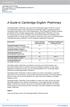 Cambridge English: Preliminary, also known as the Preliminary English Test (PET), is part of a comprehensive range of exams developed by Cambridge English Language Assessment. Cambridge English exams have
Teaching Framework. Competency statements
 Framework Competency statements CE/3007c/4Y09 UCLES 2014 Cambridge English Framework Competency statements Introduction The following stage descriptions are intended to be representative of a specific
LevelSet: Online Lexile Assessment
 LevelSet: Online Lexile Assessment Accurately match students to instructional text without taking time away from instruction Achieve3000 s LevelSet, an online assessment that utilizes the Lexile Framework,
PTE Academic Recommended Resources
 PTE Academic Recommended Resources Language Leader Pre-Intermediate Pearson Longman, 2008 April 2012 V2 Pearson Education Ltd 2012. No part of this publication may be reproduced without the prior permission
How To Teach Technical English In English
 ICT IN TEACHING PROFESSIONAL ENGLISH FOR MECHANICAL ENGINEERING Michaela Vesela Brno University of Technology, Faculty of Mechanical Engineering, Institute of Foreign Languages Brno / Czech Republic E-mail:
Linking Classroom Assessment. Student Learning. with. Listening. Learning. Leading.
 Listening. Learning. Leading. Linking Classroom Assessment with Student Learning Classroom assessment is among an instructor s most essential educational tools. When properly developed and interpreted,
ENGLISH FILE Elementary
 Karen Ludlow New ENGLISH FILE Elementary and the Common European Framework of Reference 2 INTRODUCTION What is this booklet for? The aim of this booklet is to give a clear and simple introduction to the
Virtual Classroom Student Guide
 Virtual Classroom Student Guide Table of Contents Overview 3 Grade Weights 3 Finding Help 3 Virtual Classroom Login 4 Virtual Classroom Lobby 5 The Course Map 6 Activities in the Virtual Classroom 7 Vocabulary
Guide to Pearson Test of English General
 Guide to Pearson Test of English General Level 3 (Upper Intermediate) November 2011 Version 5 Pearson Education Ltd 2011. No part of this publication may be reproduced without the prior permission of Pearson
Linking Singapore s English Language Syllabus 2010 to The Lexile Framework for Reading: STELLAR as an Example
 WHITE PAPER Linking Singapore s English Language Syllabus 2010 to The Lexile Framework for Reading: STELLAR as an Example Colin Emerson, Learning Science and Technology, MetaMetrics Abstract The recent
Creating and Implementing Conversational Agents
 Creating and Implementing Conversational Agents Kenneth J. Luterbach East Carolina University Abstract First, this paper discusses the use of the Artificial Intelligence Markup Language (AIML) for the
FINNISH AS A FOREIGN LANGUAGE
 University of Tampere Language Centre FINNISH AS A FOREIGN LANGUAGE 2015 2016 University of Tampere Language Centre FINNISH AS A FOREIGN LANGUAGE 2015 2016 TAMPEREEN YLIOPISTO Tampereen yliopistopaino
ESOL Endorsement Program
 NORTHWEST GEORGIA REGIONAL EDUCATIONAL SERVICE AGENCY ESOL Endorsement Program Methods and Materials NWGA RESA 6/1/2007 Instructor: Lynn Lewis Office: Griffin RESA Conceptual Framework Endorsement and
Information for candidates For exams from 2015
 Ready for success in study, work and life Information for candidates For exams from 2015 First Certificate in English (FCE) www.cambridgeenglish.org/first How to use this guide You can print this document
QAA Good Practice Knowledgebase case study. University of Reading: Web-based support for assessment
 QAA Good Practice Knowledgebase case study University of Reading: Web-based support for assessment Theme Assessment and feedback Sub-themes Web-based support Feature of good practice as identified by Institutional
Criteria for Evaluating Instructional Materials in Science, Kindergarten Through Grade Eight
 Criteria for Evaluating Instructional Materials in Science, Kindergarten Through Grade Eight Instructional materials are adopted by the state for the purpose of helping teachers present the content set
Virginia English Standards of Learning Grade 8
 A Correlation of Prentice Hall Writing Coach 2012 To the Virginia English Standards of Learning A Correlation of, 2012, Introduction This document demonstrates how, 2012, meets the objectives of the. Correlation
Instructional Design Tips
 Instructional Design Tips Category 1 Learner Support and Resources Information about being an online/hybrid learner Tips for being an online/hybrid student Quiz to self-assess readiness to be an online/hybrid
Northeastern State University Online Educator Certificate
 Northeastern State University Online Educator Certificate Purpose Beginning in October 1999, the Northeastern State University Distance Learning Advisory Committee (now the Center for Teaching and Learning
Implementation and Security Development Online Exam, Performances and problems for Online University Exam
 Implementation and Security Development Online Exam, Performances and problems for Online University Exam Mohammad Attallah Sarrayrih Information Systems and Technology Department, Sur University College
User interface design. Ian Sommerville 2004 Software Engineering, 7th edition. Chapter 16 Slide 1
 User interface design Ian Sommerville 2004 Software Engineering, 7th edition. Chapter 16 Slide 1 Objectives To suggest some general design principles for user interface design To explain different interaction