
Chapter 4: Credit Underwriting
|
|
|
- Ilene Reynolds
- 10 years ago
- Views:
Transcription
1 Chapter 4: Credit Underwriting Chapter 4 Credit Underwriting Overview In this Chapter This chapter contains the following topics. Topic See Page 4.01 How to Underwrite a VA Guaranteed Loan Income Income Taxes and Other Deductions from Income Assets Debts and Obligations Required Search for and Treatment of Debts Owed to the 4-36 Federal Government 4.07 Credit History Documentation for Automated Underwriting Cases How to Complete VA Form , Loan Analysis How to Analyze the Information on VA Form Examples of Underwriting Deficiencies

2 4.01 How to Underwrite a VA-Guaranteed Loan VA Underwriting Standards VA loans involve a veteran s benefit. Therefore, lenders are encouraged to make VA loans to all qualified veterans who apply. VA s underwriting standards are intended to provide guidelines for lenders underwriters as well as VA s underwriters. Underwriting decisions must be based on sound application of the underwriting standards, and underwriters are expected to use good judgment and flexibility in applying the guidelines set forth in the following pages. Basic Requirements By law, VA may only guarantee a loan when it is possible to determine that the veteran is a satisfactory credit risk, and has present and anticipated income that bear a proper relation to the contemplated terms of repayment. VA s underwriting standards are incorporated into VA regulations at 38 CFR and explained in this chapter. This chapter addresses the verifications, procedures, and analysis involved in underwriting a VAguaranteed loan. It provides guidance on how to treat income, debts and obligations, credit history, and so on., and how to present and analyze these items on VA s loan analysis form. It does not deal with every possible circumstance that will arise; therefore, underwriters must apply reasonable judgment and flexibility in administering this important veteran s benefit. [38 CFR ] Lender Responsibility Lenders are responsible for developing all credit information properly obtaining all required verifications and the credit report ensuring the accuracy of all information on which the loan decision is based complying with the law and regulations governing VA s underwriting standards, and with VA s underwriting policies, procedures, and guidelines, and certifying as to compliance with all of the above. 4-2

3 Chapter 4: Credit Underwriting 4.01 How to Underwrite a VA-Guaranteed Loan, Continued Lender Procedures Section 5.02 provides an overview of all procedures which must be completed when making a VA loan. The procedures below address only the credit underwriting of the loan. Step Action 1 Initiate the VA and CAIVRS inquiries described in Section 4.06 in this chapter. 2 Obtain all necessary verifications. The applicant s authorization can be obtained for each verification needed, or on one blanket authorization form (attach a copy of the blanket authorization to each verification requested, including VA Form , Verification of VA Benefit-Related Indebtedness, if applicable). The credit report and verifications can be ordered by the lender or its agent or a party designated by the lender to perform that function. However, these documents must always be delivered by the credit reporting agency or verifying party directly to the lender or its agent, and never to another party. That is, while a lender may delegate authority for a builder, realtor, or other person to order the report for the lender, the report may not be delivered to such builder, realtor, and so on, and may not pass through the hands of any such party or the applicant. 3 Compare similar information received from different sources. For example: The number of dependents provided on the URLA, tax returns, credit report, and so on, should be the same. The status of debts provided on the URLA and credit report should be the same. Resolve any discrepancies. 4 Complete VA Form , Loan Analysis, in conjunction with a careful review of the loan application and supporting documentation. The form is not required for IRRRLs (except IRRRLs to refinance delinquent VA loans). 4-3

4 4.01 How to Underwrite a VA-Guaranteed Loan, Continued Lender Procedures (continued) Step Action 5 Indicate the loan decision in item 50 of the Loan Analysis after ensuring that the treatment of income, debts, and credit is in compliance with VA underwriting standards. 6 Loans closed by an automatic lender The underwriter must certify review and approval of the loan by signing item 51 of the Loan Analysis (for Loan Prospector cases, see Section For nonsupervised automatic lenders, this must be a VA-approved underwriter. Prior approval loans The individual with authority to determine that the loan meets VA credit standards and should be submitted to VA, must sign item 51 of the Loan Analysis. 7 An officer of the lender authorized to execute documents and act on behalf of the lender must complete the following certification: The undersigned lender certifies that the loan application, all verifications of employment, deposit, and other income and credit verification documents have been processed in compliance with 38 CFR Part 36; that all credit reports obtained in connection with the processing of this borrower s loan application have been provided to VA; that, to the best of the undersigned lender s knowledge and belief, the loan meets the underwriting standards recited in Chapter 37 of title 38 United States Code and 38 CFR Part 36; and that all information provided in support of this loan is true, complete and accurate to the best of the undersigned lender s knowledge and belief. [38 CFR Part 36] 4-4

5 Chapter 4: Credit Underwriting 4.01 How to Underwrite a VA-Guaranteed Loan, Continued Underwriting Special Types of Loans The underwriting standards and procedures explained in this chapter apply to these special types of loans generally. However, some special underwriting considerations also apply and can be found as follows: Type of Loan Handbook Chapter Joint Loans 7.01 Energy Efficient Mortgages (EEMs) 7.03 Graduated Payment Mortgages (GPMs) 7.06 Growing Equity Mortgages (GEMs) 7.07 Loans Involving Temporary Interest Rate Buydowns 7.08 Farm Residence Loans 7.09 Refinancing Loans While the underwriting standards detailed in this chapter apply to cash-out refinances, IRRRLs generally do not require any underwriting. IRRRLs made to refinance VA loans 30 days or more past due must be submitted to VA for prior approval. It must be reasonable to conclude that the circumstances that caused the delinquency have been corrected, and the veteran can successfully maintain the new loan. Reference: See Chapter 6 for details on all types of refinancing loans. 4-5

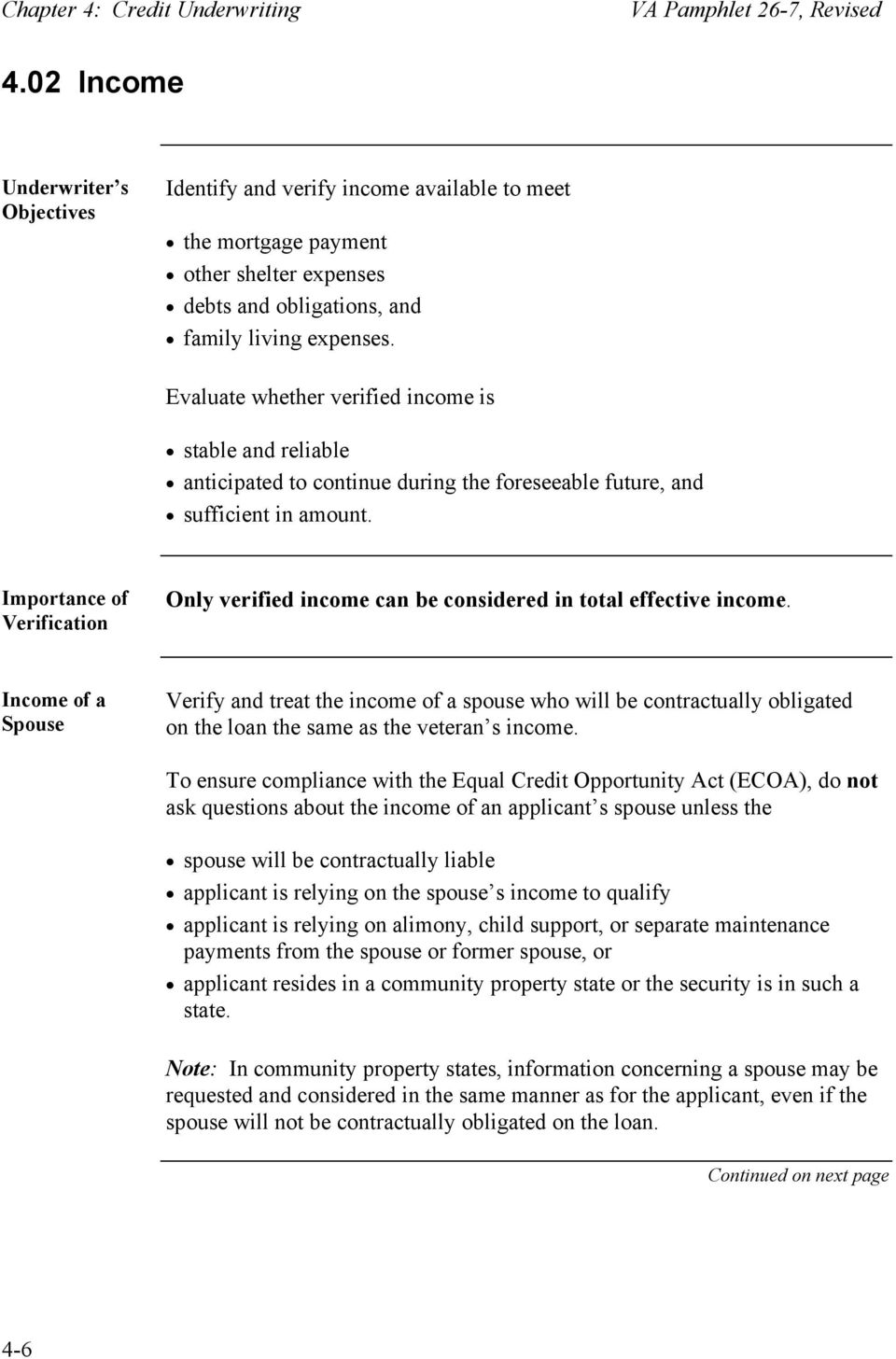
6 4.02 Income Underwriter s Objectives Identify and verify income available to meet the mortgage payment other shelter expenses debts and obligations, and family living expenses. Evaluate whether verified income is stable and reliable anticipated to continue during the foreseeable future, and sufficient in amount. Importance of Verification Only verified income can be considered in total effective income. Income of a Spouse Verify and treat the income of a spouse who will be contractually obligated on the loan the same as the veteran s income. To ensure compliance with the Equal Credit Opportunity Act (ECOA), do not ask questions about the income of an applicant s spouse unless the spouse will be contractually liable applicant is relying on the spouse s income to qualify applicant is relying on alimony, child support, or separate maintenance payments from the spouse or former spouse, or applicant resides in a community property state or the security is in such a state. Note: In community property states, information concerning a spouse may be requested and considered in the same manner as for the applicant, even if the spouse will not be contractually obligated on the loan. 4-6
7 Chapter 4: Credit Underwriting 4.02 Income, Continued ECOA Considerations Restrict inquiries related to the applicant s spouse to the situations listed in the Income of a Spouse heading in this section. Always inform the applicant (and spouse, if applicable) that they do not have to divulge information on the receipt of child support, alimony, or separate maintenance. However, in order for this income to be considered in the loan analysis, it must be divulged and verified. Income cannot be discounted because of sex, marital status, age, race, or other prohibited bases under the Equal Credit Opportunity Act (ECOA). Treat income from all sources equally; that is, the fact that all or part of an applicant s income is derived from any public assistance program is not treated as a negative factor, provided the income is stable and reliable. Income from Non-Military Employment Verification: General Requirement Verify a minimum of two years employment. If the applicant has been employed by the present employer less than two years verify prior employment plus present employment covering a total of two years provide an explanation of why two years employment could not be verified. compare any different types of employment verifications obtained (such as, Verification of Employment, pay stubs, tax returns, and so on) for consistency, and clarify any substantial differences in the data that would have a bearing on the qualification of the applicant. 4-7

8 4.02 Income, Continued Income from Non-Military Employment (continued) Verification: Standard Documentation Acceptable verification consists of: VA Form , Request for Verification of Employment (VOE) or any format which furnishes the same information as VA Form , plus a pay stub if the employer normally provides one to the applicant. If the employer does not indicate the probability of continued employment on the VOE, the lender is not required to request anything additional on that subject. The VOE and pay stub must be no more than 120 days old (180 days for new construction). For loans closed automatically, the date of the VOE and pay stub must be within 120 days of the date the note is signed (180 days for new construction). For prior approval loans, the date of the VOE and pay stub must be within 120 days of the date the application is received by VA (180 days for new construction). The VOE must be an original. The pay stub may be an original or a copy certified by the lender to be a true copy of the original. Verification: Employment Verification Services Lenders may use VOEs supplied by an employment verification service only if VA has approved the use of VOEs from that particular provider. VA has approved two: FULL verifications of employment through The Work Number for Everyone, a service of the TALX Corporation. (No pay stub is needed with the TALX verification.) Verifications through VIE, Inc., a wholly owned subsidiary of Wells Fargo Home Mortgage. (VIE verifications must be supplemented by a pay stub or telephone verification of the applicant s current employment. For telephone verification, document the date of verification and the name, title, and telephone number of the person with whom employment was verified.) 4-8

9 Chapter 4: Credit Underwriting 4.02 Income, Continued Income from Non-Military Employment (continued) Verification: Alternative Documentation Alternative documentation may be submitted in place of a VOE if the lender concludes that the applicant s income is stable, reliable, and anticipated to continue during the foreseeable future; that is, if the applicant s income qualifies as effective income. Two years employment is not required to reach this conclusion. Alternative documentation consists of pay stubs covering at least the most recent 30-day period W-2 forms for the previous two years, and telephone verification of the applicant s current employment. Document the date of verification and the name, title, and telephone number of the person with whom employment was verified. If the employer is not willing to give telephone verification of applicant s employment or the pay stubs or W-2 forms are in any way questionable as to authenticity, use standard documentation. Alternative documentation cannot be used. Pay stubs and W-2 forms may be originals or copies certified by the lender to be true copies of the originals. Verification: Additional Documentation for Persons Employed in the Building Trades or Other Seasonal or Climate-Dependent Work In addition to the standard documentation (VOE and pay stub), obtain documentation evidencing the applicant s total earnings year to date signed and dated individual income tax returns for the previous two years, and if applicant works out of a union, evidence of the union s history with the applicant. 4-9

10 4.02 Income, Continued Income from Non-Military Employment (continued) Analysis: General Guidance Income analysis is not an exact science. It requires the lender to underwrite each loan on a case by case basis, using: judgment common sense, and flexibility, when warranted. Analyze the probability of continued employment (that is, whether income is stable and reliable) by examining the applicant s past employment record applicant s training, education, and qualifications for his/her position type of employment, and employer s confirmation of continued employment, if provided. Two years employment in the applicant s current position is a positive indicator of continued employment. It is not a required minimum and not always sufficient by itself to reach a conclusion on the probability of continued employment. 4-10

11 Chapter 4: Credit Underwriting 4.02 Income, Continued Analysis: Applicant Employed Less Than 12 Months Generally, employment less than 12 months is not considered stable and reliable. However, it may be considered stable and reliable if the individual facts warrant such a conclusion. Carefully consider the employer s evaluation of the probability of continued employment, if provided, and whether the applicant s training and/or education equipped him or her with particular skills that relate directly to the duties of his/her current position. For the most part, this applies to skilled positions. Examples include nurse, medical technician, lawyer, paralegal, and computer systems analyst. If the probability of continued employment is high-based on these factors then the lender may give favorable consideration to including the income in total effective income. An explanation of why income of less than 12 months duration was used must accompany the loan submission. If the probability of continued employment is good, but not as well supported or employment will be terminated at some point in the future which can be reasonably estimated, the lender may still consider the income of an applicant who has been employed at least 6 months to partially offset debts of 10 to 24 months duration. Determine the amount which can be used, based on such factors as the employer s evaluation of the probability of continued employment, if provided the length of employment (for example, 10 months versus six months). Include an explanation with the loan submission. 4-11

12 4.02 Income, Continued Analysis: Recent History of Frequent Changes of Employment Short-term employment in a present position combined with frequent changes of employment in the recent past require special consideration to determine stability of income. Analyze the reasons for the changes in employment. Reference: See Section CI.04 under Current Issues for a discussion of frequent job changes by individuals with low-to-moderate incomes. Give favorable consideration to changes for the purpose of career advancement in the same or related field. Favorable consideration may not be possible for changes with no apparent betterment to the applicant, and from one line of work to another. If the lender includes applicant s income in effective income, an explanation must accompany the loan submission. Income from Overtime Work, Parttime Jobs, Second Jobs, and Bonuses Generally, such income cannot be considered stable and reliable unless it has continued (and is verified) for two years. To include income from these sources in effective income: The income must be regular and predictable, and there must be a reasonable likelihood that it will continue in the foreseeable future based on its compatibility with the hours of duty and other work conditions of the applicant s primary job, and how long the applicant has been employed under such arrangement. The lender may use this income, if it is not eligible for inclusion in effective income, but is verified for at least 12 months, to offset debts of 10 to 24 months duration. Include an explanation. 4-12

13 Chapter 4: Credit Underwriting 4.02 Income, Continued Income from Commissions Verification When all or a major portion of the applicant s income is derived from commissions, obtain the following documentation: Verification of employment or other written verification which provides the actual amount of commissions paid year-to-date the basis for payment (that is, salary plus commission, straight commission, or draws against commission) when commissions are paid (that is, monthly, quarterly, semiannually, or annually), plus individual income tax returns, signed and dated, plus all applicable schedules for the previous two years (or additional periods if needed to demonstrate a satisfactory earnings record) Analysis Generally, income from commissions is considered stable when the applicant has obtained such income for at least two years. Less than two years cannot usually be considered stable unless the applicant has had previous related employment and/or extensive specialized training. Less than one year can rarely qualify. In-depth development is required for a conclusion of stable income on less than one year cases. 4-13

14 4.02 Income, Continued Self- Employment Income Verification Obtain the following documentation: Current financial statements prepared in a generally recognized format, including: year-to-date profit and loss statement current balance sheet Note: The financial statements must be sufficient for a loan underwriter to determine the necessary information for loan approval. The lender may require accountant-prepared financial statements or financial statements audited by a Certified Public Accountant if needed to make such a determination due to the nature of the business or the content of the financial statements. Individual income tax returns, signed and dated, plus all applicable schedules for the previous two years (or additional periods if needed to demonstrate a satisfactory earnings record). if the most recent year s tax return has not yet been prepared, provide a profit and loss statement for that year, and if the business is a corporation or partnership copies of the signed federal business income tax returns for the previous two years plus all applicable schedules, and a list of all stockholders or partners showing the interest each holds in the business Note: Obtain a written credit report on the business as well as the applicant as needed. Analysis Generally, income from self-employment is considered stable when the applicant has been in business for at least two years. Less than two years cannot usually be considered stable unless the applicant has had previous related employment and/or extensive specialized training. Less than one year can rarely qualify. In-depth development is required for a conclusion of stable income on less than one year cases. 4-14

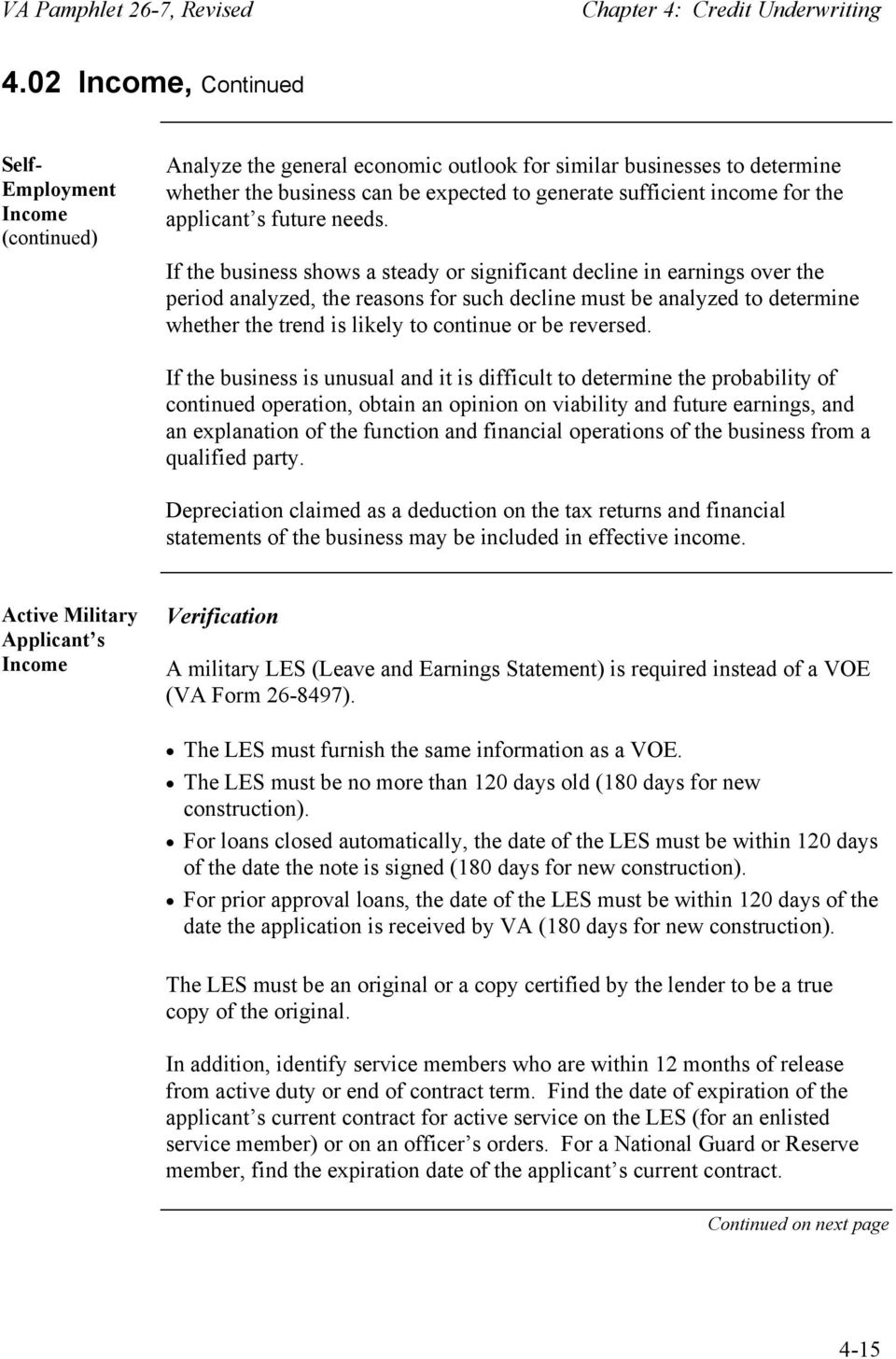
15 Chapter 4: Credit Underwriting 4.02 Income, Continued Self- Employment Income (continued) Analyze the general economic outlook for similar businesses to determine whether the business can be expected to generate sufficient income for the applicant s future needs. If the business shows a steady or significant decline in earnings over the period analyzed, the reasons for such decline must be analyzed to determine whether the trend is likely to continue or be reversed. If the business is unusual and it is difficult to determine the probability of continued operation, obtain an opinion on viability and future earnings, and an explanation of the function and financial operations of the business from a qualified party. Depreciation claimed as a deduction on the tax returns and financial statements of the business may be included in effective income. Active Military Applicant s Income Verification A military LES (Leave and Earnings Statement) is required instead of a VOE (VA Form ). The LES must furnish the same information as a VOE. The LES must be no more than 120 days old (180 days for new construction). For loans closed automatically, the date of the LES must be within 120 days of the date the note is signed (180 days for new construction). For prior approval loans, the date of the LES must be within 120 days of the date the application is received by VA (180 days for new construction). The LES must be an original or a copy certified by the lender to be a true copy of the original. In addition, identify service members who are within 12 months of release from active duty or end of contract term. Find the date of expiration of the applicant s current contract for active service on the LES (for an enlisted service member) or on an officer s orders. For a National Guard or Reserve member, find the expiration date of the applicant s current contract. 4-15
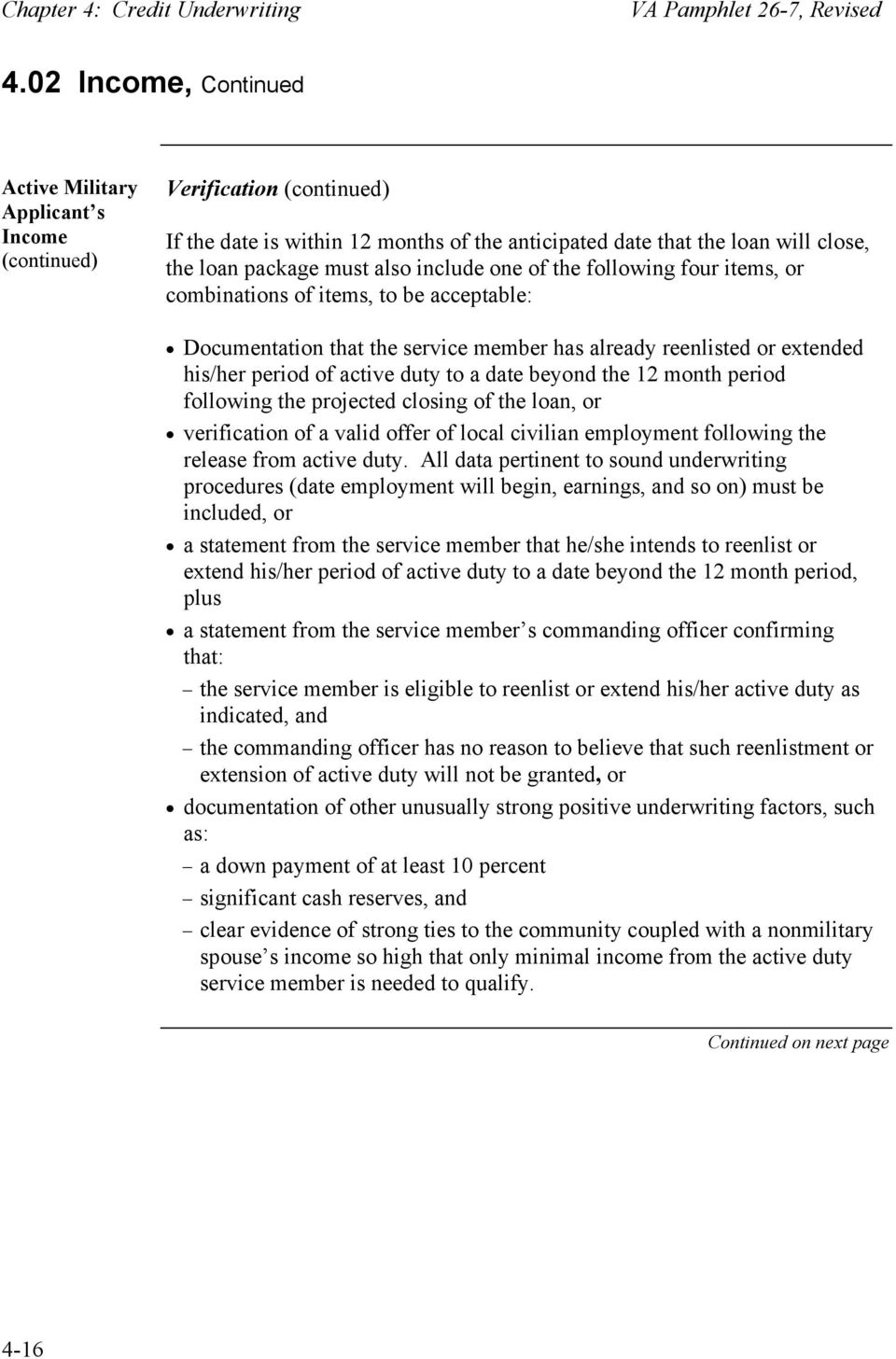
16 4.02 Income, Continued Active Military Applicant s Income (continued) Verification (continued) If the date is within 12 months of the anticipated date that the loan will close, the loan package must also include one of the following four items, or combinations of items, to be acceptable: Documentation that the service member has already reenlisted or extended his/her period of active duty to a date beyond the 12 month period following the projected closing of the loan, or verification of a valid offer of local civilian employment following the release from active duty. All data pertinent to sound underwriting procedures (date employment will begin, earnings, and so on) must be included, or a statement from the service member that he/she intends to reenlist or extend his/her period of active duty to a date beyond the 12 month period, plus a statement from the service member s commanding officer confirming that: the service member is eligible to reenlist or extend his/her active duty as indicated, and the commanding officer has no reason to believe that such reenlistment or extension of active duty will not be granted, or documentation of other unusually strong positive underwriting factors, such as: a down payment of at least 10 percent significant cash reserves, and clear evidence of strong ties to the community coupled with a nonmilitary spouse s income so high that only minimal income from the active duty service member is needed to qualify. 4-16
17 Chapter 4: Credit Underwriting 4.02 Income, Continued Active Military Applicant s Income (continued) Analysis: Base Pay Consider the applicant s base pay as stable and reliable except if the applicant is within 12 months of release from active duty: Analyze the additional documentation submitted. If the applicant will not be reenlisting, determine whether the applicant s anticipated source of income is stable and reliable, and/or unusually strong underwriting factors compensate for any unknowns regarding future sources of income. Verification: Military Quarters Allowance To use a military quarters allowance in the underwriting analysis, obtain: DD Form 1747, Status of Housing Availability, indicating that item b (Permanent) or item d of that form apply. This form serves as notice that: Quarters will not be made available to the applicant, and the applicant is authorized to make permanent arrangements for nonmilitary housing. Except DD Form 1747 is not required in either of the following circumstances: When the applicant s duty assignment clearly qualifies the applicant for quarters allowance. Examples include personnel stationed overseas whose families remain stateside, recruiters on detached duty, and military personnel stationed in areas where no on-base housing exists. When VA has established that the waiting lists for on-base housing in a particular geographic area are so long that it is improbable that individuals desiring to purchase off-base housing would be precluded from doing so in the foreseeable future. VA issues a release to all lenders in the jurisdiction to inform them of its determination. Include an explanation with the loan submission of the circumstances justifying omission of the form. 4-17

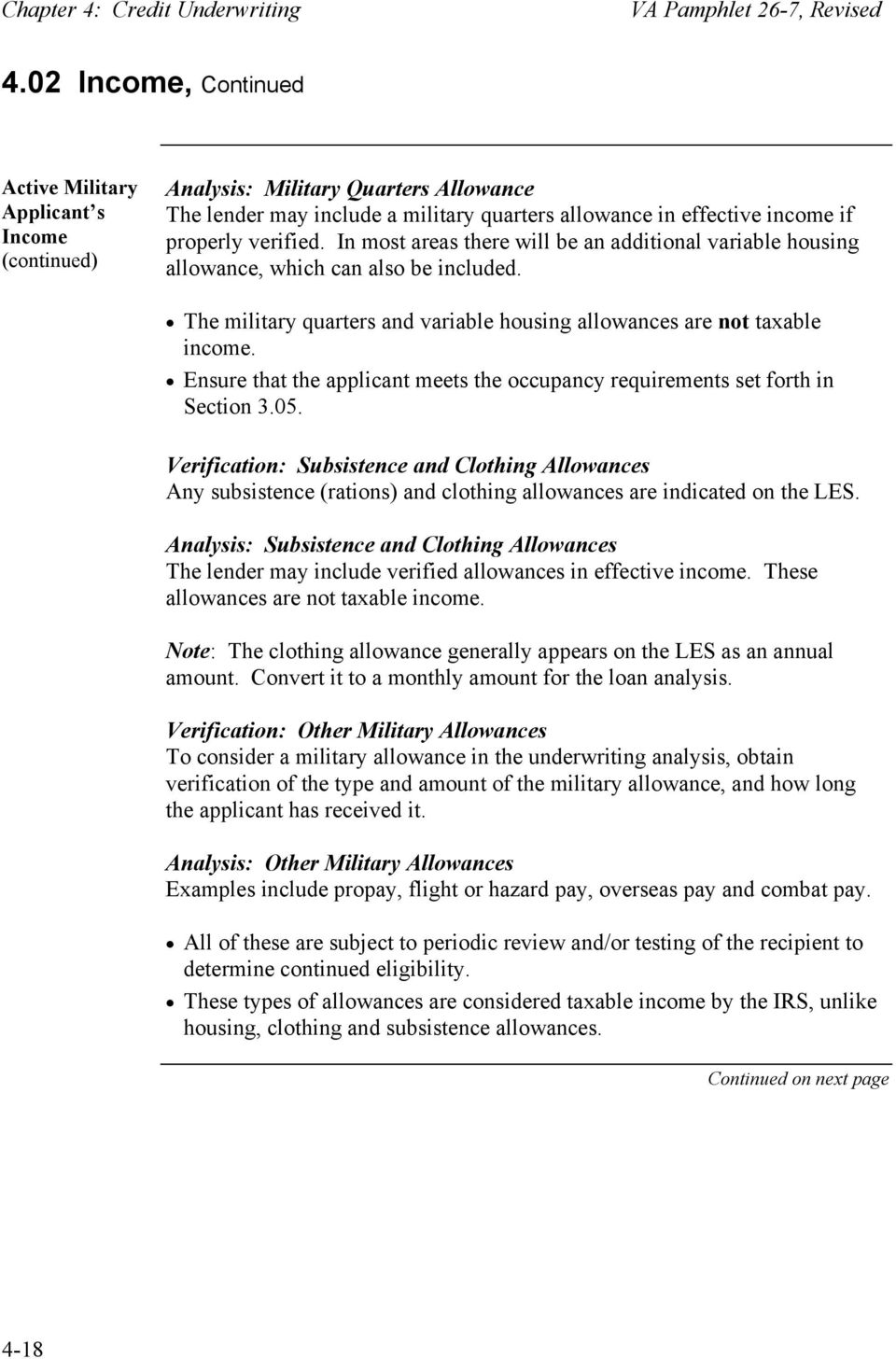
18 4.02 Income, Continued Active Military Applicant s Income (continued) Analysis: Military Quarters Allowance The lender may include a military quarters allowance in effective income if properly verified. In most areas there will be an additional variable housing allowance, which can also be included. The military quarters and variable housing allowances are not taxable income. Ensure that the applicant meets the occupancy requirements set forth in Section Verification: Subsistence and Clothing Allowances Any subsistence (rations) and clothing allowances are indicated on the LES. Analysis: Subsistence and Clothing Allowances The lender may include verified allowances in effective income. These allowances are not taxable income. Note: The clothing allowance generally appears on the LES as an annual amount. Convert it to a monthly amount for the loan analysis. Verification: Other Military Allowances To consider a military allowance in the underwriting analysis, obtain verification of the type and amount of the military allowance, and how long the applicant has received it. Analysis: Other Military Allowances Examples include propay, flight or hazard pay, overseas pay and combat pay. All of these are subject to periodic review and/or testing of the recipient to determine continued eligibility. These types of allowances are considered taxable income by the IRS, unlike housing, clothing and subsistence allowances. 4-18
19 Chapter 4: Credit Underwriting 4.02 Income, Continued Active Military Applicant s Income (continued) Military allowances may be included in effective income only if such income can be expected to continue because of the nature of the recipient s assigned duties. Example: Flight pay verified for a pilot. If duration of the military allowance cannot be determined, this source of income may still be used to offset obligations of 10 to 24 months duration. Income from Service in the Reserves or National Guard Income derived from service in the Reserves or National Guard may be included in effective income if the length of the applicant s total active and Reserve/Guard service indicates a strong probability that the Reserve/Guard income will continue. Otherwise, this income may be used to offset obligations of 10 to 24 months duration. 4-19

20 4.02 Income, Continued Income of Recently Discharged Veterans Verification Obtain verification of any of the following which apply: Employment income Reference: See Income from Non-Military Employment in this section for verification requirements retirement income, and military separation payments. If the applicant has been employed in a position for only a short time, obtain a statement from the employer that the applicant is performing the duties of the job satisfactorily and the probability of continued employment is favorable. Analysis: Prospects for Continued Employment Cases involving recently discharged veterans often require the underwriter to exercise a great deal of flexibility and judgment in determining whether the employment income will continue in the foreseeable future. This is because some veterans may have little or no employment experience other than their military occupation. Continuity of employment is essential for a veteran with no retirement income or insufficient retirement income to support the loan obligation. 4-20

21 Chapter 4: Credit Underwriting 4.02 Income, Continued Income of Recently Discharged Veterans (continued) Analysis: Prospects for Continued Employment (continued) For recently discharged veterans who have been in their new jobs only a very short time, analyze prospects for continued employment as follows: If the duties the applicant performed in the military are similar or directly related to the duties of the present position, use this as one indicator that the employment is likely to continue. If the applicant s current job requires skills for which the applicant has had no training or experience, greater time in the current job may be needed to establish stability. If the applicant s retirement income, compared to total estimated shelter expense, long-term debts and family living expense, is such that only minimal income from employment is necessary to qualify from the income standpoint, resolve doubt in favor of the applicant. Examples: Qualifying short-term employment - An applicant who was an airplane mechanic in the military is now employed as an auto mechanic or machinist. Nonqualifying short-term employment - An applicant who was an Air Force pilot is now employed as an insurance salesperson on commission. Most cases fall somewhere between these extremes. Fully develop the facts of each case in order to make a determination. Apply the guidelines under Self-Employment Income in this section to a recently discharged veteran who is self-employed. Analysis: Voluntary Separation Payments Two types of voluntary separation payments are used to facilitate military downsizing: (1) Special Separation Benefit (SSB) A one-time lump sum Taxable in the year received, and Treat the same as any substantial cash reserve. 4-21
22 4.02 Income, Continued Income of Recently Discharged Veterans (continued) Analysis: Voluntary Separation Payments (continued) (2) Voluntary Separation Incentive (VSI) Annual payments Taxable in the year received Include in effective income Calculated by multiplying the veteran s years of service times two Requires a minimum of six years service (equates to a minimum of 12 years annual payments). If the veteran receives both VSI and VA disability compensation payments, the VSI is reduced by the amount of disability compensation. However, if the disability compensation is related to an earlier period of service and the VSI a later period of service, the VSI is not reduced by the amount of disability compensation. VSI is reduced by the amount of any base pay or compensation a member receives for active or reserve service, including inactive duty training. The veteran can designate a beneficiary for VSI payments in the event of death. 4-22
23 Chapter 4: Credit Underwriting 4.02 Income, Continued Rental Income Verification: Multi-Unit Property Securing the VA Loan Verify cash reserves totaling at least 6 months mortgage payments (principal, interest, taxes, and insurance - PITI), and documentation of the applicant s prior experience managing rental units or other background involving both property maintenance and rental. Analysis: Multi-Unit Property Securing the VA Loan Include the prospective rental income in effective income only if evidence indicates the applicant has a reasonable likelihood of success as a landlord, and cash reserves totaling at least six months mortgage payments are available. The amount of rental income to include in effective income is based on 75 percent of verified prior rent collected on the units (existing property), or the appraiser s opinion of the property s fair monthly rental (proposed construction). Note: A percentage greater than 75% may be used if the basis for such percentage is adequately documented. Verification: Rental of the Property Applicant Occupied Prior to the New Loan Obtain a copy of the rental agreement on the property, if any. Analysis: Rental of the Property Applicant Occupied Prior to the New Loan Use the prospective rental income only to offset the mortgage payment on the rental property and only if there is no indication that the property will be difficult to rent. This rental income may not be included in effective income. Obtain a working knowledge of the local rental market. If there is no lease on the property, but the local rental market is very strong, the lender may still consider the prospective rental income for offset purposes. 4-23
24 4.02 Income, Continued Rental Income (continued) Verification: Rental of Other Property Not Securing the VA Loan Obtain documentation of cash reserves totaling at least three months mortgage payments (principal, interest, taxes, and insurance - PITI), and individual income tax returns, signed and dated, plus all applicable schedules for the previous two years, which show rental income generated by the property. Analysis: Rental of Other Property Not Securing the VA Loan Rental income verified as stable and reliable may be included in effective income. If there is little or no prior rental history on the property, make a determination based on review of documentation of the applicant s prior experience managing rental units or other background involving both property maintenance and rental any leases on the property, and the strength of the local rental market. Property depreciation claimed as a deduction on the tax returns may be included in effective income. 4-24
25 Chapter 4: Credit Underwriting 4.02 Income, Continued Alimony, Child Support, and Maintenance Payments See ECOA Considerations in this section. Verify the income if the applicant wants it to be considered. The payments must be likely to continue in order to include them in effective income. Factors used to determine whether the payments will continue include, but are not limited to whether the payments are received pursuant to a written agreement or court decree the length of time the payments have been received the regularity of receipt, and the availability of procedures to compel payment. Automobile or Similar Allowances Generally, automobile allowances are paid to cover specific expenses related to an applicant s employment, and it is appropriate to use such income to offset a corresponding car payment. However, in some instances, such an allowance may exceed the car payment. With proper documentation, income from a car allowance which exceeds the car payment can be counted as effective income. Likewise, any other similar type of allowance which exceeds the specific expenses involved may be added to gross income to the extent it is documented to exceed the actual expense. 4-25
26 4.02 Income, Continued Other Types of Income If it is reasonable to conclude that other types of income will continue in the foreseeable future, include it in effective income. Otherwise, consider whether it is reasonable to use the income to offset obligations of 10 to 24 months duration. Other types of income which may be considered as effective income include, but are not limited to pension or other retirement benefits disability income dividends from stocks interest from bonds, savings accounts, and so on, and royalties. The lender may include verified income from public assistance programs in effective income if evidence indicates it will probably continue for three years or more. The lender may include verified workers compensation income that will continue in the foreseeable future, if the veteran chooses to reveal it. The lender may include verified income received specifically for the care of any foster child(ren). Generally, however, foster care income is to be used only to balance the expenses of caring for the foster child(ren) against any increased residual income requirements. Do not include temporary income items such as VA educational allowances and unemployment compensation in effective income. Exception: If unemployment compensation is a regular part of the applicant s income due to the nature of his or her employment (for example, seasonal work), it may be included. 4-26
27 Chapter 4: Credit Underwriting 4.03 Income Taxes and Other Deductions from Income Income Tax and Social Security Deductions Determine the appropriate deductions for Federal income tax and Social Security using the Employer s Tax Guide, Circular E, issued by the Internal Revenue Service. Determine the appropriate deductions for state and local taxes using similar materials provided by the states. The lender may consider the applicant s potential tax benefits from obtaining the loan (for example, mortgage interest deduction) in the analysis. To do so, determine what the applicant s withholding allowances will be, using the instructions and worksheet portion of IRS Form W-4, Employee s Withholding Allowance Certificate, and apply that withholding number when calculating Federal and state income tax deductions. 4-27
28 4.03 Income Taxes and Other Deductions from Income, Continued Income Tax Credits from Mortgage Credit Certificates Mortgage Credit Certificates (MCCs) issued by state and local governments may qualify a borrower for a Federal tax credit. The Federal tax credit is based on a certain percentage of the borrower s mortgage interest payment. Lenders must provide a copy of the MCC to VA with the loan package which indicates the percentage to be used to calculate the tax credit, and the amount of the certified indebtedness. The certified indebtedness can be comprised of a loan incurred by the veteran to acquire a principal residence or a qualified home improvement or rehabilitation loan. If the percentage on the MCC is more than 20%, there is an annual limit on the tax credit equal to the lesser of $2,000 or the borrower s maximum tax liability. Calculate the tax credit by applying the specified percentage to the interest paid on the certified indebtedness. Then apply the annual limit. Example: The MCC shows a 30 percent rate and $100,000 certified indebtedness. The borrower will pay approximately $8,000 in annual mortgage interest. Borrower s estimated total Federal income tax liability is $9,000. Calculate the tax credit as follows: 30% of $8,000 = $2,400 Apply the annual $2,000 limit The tax credit will be $2,000 Use $167 (one-twelfth of $2,000) in the monthly analysis. Note: If the mortgage on which the borrower pays interest is greater than the amount of certified indebtedness, limit the interest used in the tax credit calculation to that portion attributable to the certified indebtedness. 4-28
29 Chapter 4: Credit Underwriting 4.04 Assets Amount of Cash Required The applicant or spouse must have sufficient cash to cover any closing costs or points which are the applicant s responsibility and are not financed in the loan the down payment, if a Graduated Payment Mortgage, and the difference between the sales price and the loan amount, if the sales price exceeds the reasonable value established by VA. VA does not require the applicant to have additional cash to cover a certain number of mortgage payments, unplanned expenses, or other contingencies. However, the applicant s ability to accumulate liquid assets and the current availability of liquid assets for unplanned expenses should be considered in the overall credit analysis. Verification Requirement Verify all liquid assets owned by the applicant or spouse to the extent they are needed to close the loan. In addition, verify any liquid assets that may have a bearing on the overall credit analysis; that is, significant assets. Use VA Form a, Request for Verification of Deposit, as appropriate. Acceptable alternative documentation is the original or certified true copies of the applicant s last two bank statements. Verifications must be no more than 120 days old (180 days for new construction). For automatically closed loans, this means the date of the deposit verification is within 120 days of the date the note is signed (180 days for new construction). For prior approval loans, this means the date of the deposit verification is within 120 days of the date the application is received by VA (180 days for new construction). 4-29
30 4.04 Assets, Continued Pending Sale of Real Estate In some cases, the determination that the income and/or assets of a veteran are sufficient to qualify for the loan depends upon the consummation of the sale of presently owned real property. Sales proceeds may be necessary to make a down payment or pay closing costs on the VA loan. In addition, the lender may want to consider the amount of equity the applicant has accumulated in the property and the extent to which that equity is attributable to the applicant s investment rather than the housing market, in evaluating the applicant s ability to manage assets. The lender may consider any down payment or costs on the VA loan as provided for by the sale of the property if available information provides a reasonable basis for concluding the equity to be realized from the sale will be sufficient for this purpose. References: See Section 5.04 for prior approval loans which depend upon the sale of property for the borrower to qualify. See Section 5.06 for required loan closing documents. 4-30
31 Chapter 4: Credit Underwriting 4.05 Debts and Obligations Verification Significant debts and obligations of the applicant must be verified and rated. Obtain a credit report. Reference: See Section 4.07 for details on the type of credit report required. For obligations not included on the credit report which are revealed on the application or through other means, the lender must obtain a verification of deposit showing the obligation or other written verification directly from the creditor. The lender must also separately verify accounts listed as will rate by mail only or need written authorization. When a pay stub or leave-and-earnings statement indicates an allotment, the lender must investigate the nature of the allotment to determine whether the allotment is related to a debt. For obligations that have not been rated on the credit report or elsewhere, obtain the verification and rating directly from the creditor. Include a written explanation for any obligation that is not rated. Resolve all discrepancies. If the credit report or deposit verification reveals significant debts or obligations which were not divulged by the applicant obtain clarification as to the status of such debts from the applicant, then verify any remaining discrepancies with the creditor. Credit reports and verifications must be no more than 120 days old (180 days for new construction). For automatically closed loans, this means the date of the credit report or verification is within 120 days of the date the note is signed (180 days for new construction). For prior approval loans, this means the date of the credit report or verification is within 120 days of the date the application is received by VA (180 days for new construction). 4-31
32 4.05 Debts and Obligations, Continued Verification (continued) ECOA prohibits requests for, or consideration of, credit information on a spouse who will not be contractually obligated on the loan except if the applicant is relying on alimony, child support, or maintenance payments from the spouse (or former spouse), or in community property states. If the property is located in a community property state, VA requires consideration of the spouse s credit information (whether or not the spouse will be personally liable on the note and whether or not the applicant and spouse choose to have the spouse s income considered). Verification of Alimony and Child Support Obligations The payment amount on any alimony and/or child support obligation of the applicant must be verified. Do not request documentation of an applicant s divorce unless it is necessary to verify the amount of any alimony or child support liability indicated by the applicant. If, however, in the routine course of processing the loan, the lender encounters direct evidence (such as, in the credit report) that a child support or alimony obligation exists, make any inquiries necessary to resolve discrepancies and obtain the appropriate verification. 4-32
33 Chapter 4: Credit Underwriting 4.05 Debts and Obligations, Continued Analysis of Debts and Obligations Deduct significant debts and obligations from total effective income when determining ability to meet the mortgage payments. Significant debts and obligations include debts and obligations with a remaining term of 10 months or more; that is, long-term obligations, and accounts with a term less than 10 months that require payments so large as to cause a severe impact on the family s resources for any period of time. Example: Monthly payments of $300 on an auto loan with a remaining balance of $1,500, even though it should be paid out in five months, would be considered significant. The payment amount is so large as to cause a severe impact on the family s resources during the first, most critical, months of the home loan. Determine whether debts and obligations which do not fit the description of significant should be given any weight in the analysis. They may have an impact on the applicant s ability to provide for family living expenses. If a married veteran wants to obtain the loan in his or her name only, the veteran may do so without regard to the spouse s debts and obligations in a non-community property state. However, in community property states, the spouse s debts and obligations must be considered even if the veteran wishes to obtain the loan in his or her name only. Debts assigned to an ex-spouse by a divorce decree will not generally be charged against a veteran-borrower. This includes debts that are now delinquent. 4-33
34 4.05 Debts and Obligations, Continued Applicant as Co-obligor on Another s Loan The applicant may have a contingent liability based on co-signing a loan. If there is evidence that the loan payments are being made by someone else, and there is no reason to believe that the applicant will have to participate in repayment of the loan, then the lender may exclude the loan payments from the monthly obligations factored into the net effective income calculation in the loan analysis. Pending Sale of Real Estate In some cases, the determination that the income and/or assets of a veteran are sufficient to qualify for the loan depends upon the consummation of the sale of presently owned real property. Sales proceeds may be necessary to clear the outstanding mortgage(s) against the property pay off outstanding consumer obligations, and/or make a down payment or pay closing costs on the VA loan. Alternatively, the veteran may intend to sell the property with the buyer assuming the outstanding mortgage obligation. The lender may disregard the payments on the outstanding mortgage(s) and any consumer obligations which the veteran intends to clear if available information provides a reasonable basis for concluding the equity to be realized from the sale will be sufficient for this purpose. References: See Section 5.04 for prior approval loans dependent upon the sale of property for the borrower to qualify. See Section 5.06 for required loan closing documents. 4-34
35 Chapter 4: Credit Underwriting 4.05 Debts and Obligations, Continued Secondary Borrowing If the applicant plans to obtain a second mortgage simultaneously with the VA-guaranteed loan include the second mortgage payment as a significant debt. Reference: See Section 9.04 for VA limitations on secondary borrowing. From an underwriting standpoint, the veteran must not be placed in a substantially worse position than if the entire amount borrowed had been guaranteed by VA. 4-35
36 4.06 Required Search for and Treatment of Debts Owed to the Federal Government The Search Requirement There are two separate procedures the lender must follow. Both should be initiated immediately upon receipt of a loan application to avoid delays in closing the loan. (1) Ask the veteran and any veteran co-obligors (including spouse if a veteran) if he or she is receiving VA disability benefits would be entitled to receive VA disability benefits but for the receipt of retired pay has received VA disability benefits in the past, or is a surviving spouse of a veteran who died on active duty or as a result of a service-connected disability. If the veteran falls under one of the above categories, follow the procedures discussed under Debt Related to VA Benefits below. (2) For all applicants and co-obligors (veteran or nonveteran) on all VA loans including Interest Rate Reduction Refinancing Loans (IRRRLs), perform a CAIVRS inquiry. Reference: See CAIVRS Procedures in this section. Debt Related to VA Benefits Before processing a loan involving certain veterans, as described in item (1) of The Search Requirement, the lender must submit VA Form , Verification of VA Benefit-Related Indebtedness, to the VA office where the loan application and/or closed loan package will be sent. VA will complete and return the form to the lender. The loan cannot be submitted for prior approval or approved under the automatic procedure until the lender obtains the completed form from VA. The lender must submit the completed form with the loan package. If the form indicates that the applicant receives nonservice-connected pension or has been rated incompetent by VA, the loan cannot be closed automatically. Submit the loan for prior approval. 4-36
37 Chapter 4: Credit Underwriting 4.06 Required Search for and Treatment of Debts Owed to the Federal Government, Continued Debt Related to VA Benefits (continued) If the form indicates that the applicant has any of the following: An outstanding indebtedness of overpaid education, compensation or pension benefits an education or direct home loan in default an outstanding indebtedness resulting from payment of a claim on a prior guaranteed home loan, a repayment plan for any of these debts that is not current, then one of the following must accompany the loan package: evidence of payment in full of the debt, or evidence of a current repayment plan acceptable to VA and evidence that the veteran executed a promissory note for the entire debt balance. Note: No promissory note is required in cases referred to the Department of Justice, General Accounting Office, or VA Regional Counsel for judicial enforcement. In such cases, VA will obtain information on the applicant s debt status from these parties and relay pertinent information to the lender. VA may find a repayment plan acceptable if the veteran has been satisfactorily making payments on a repayment plan in effect prior to the lender s inquiry the veteran s overall credit history and anticipated financial capacity after the proposed loan is made indicate a reasonable likelihood that the repayment plan will be honored and the outstanding amount of indebtedness is not so large that it would prevent payment in full within a reasonable period (approximately one year), or the case involves unusually meritorious circumstances. Example: Consideration would be given to a veteran with an outstanding credit history and adequate income whose debt balance is too large to be reasonably paid out in less than 18 months to two years. VA will offer special consideration to a veteran s claim that he or she was not previously aware of an overpayment of benefits. 4-37
38 4.06 Required Search for and Treatment of Debts Owed to the Federal Government, Continued What is CAIVRS? CAIVRS is a HUD-maintained computer information system which enables participating lenders to learn when an applicant has previously defaulted on a federally-assisted loan. The system s interactive voice response function provides instant credit information. The database includes default information from the Department of Agriculture, the Small Business Administration, the Department of Education, HUD, and VA. The VA default information included in the database relates to overpayments on education cases overpayments on disability benefits income, and claims paid due to home loan foreclosures. CAIVRS Procedures VA assigns an 11-digit VA ID number to each new lender (See Section 1.13, Lender ID Numbers), then automatically forwards the ID number to HUD with a request to grant the lender CAIVRS access. The lender can begin accessing CAIVRS within several weeks of its VA ID number assignment. Perform a CAIVRS screening on each applicant and any co-obligor immediately upon receipt of a loan application. This includes Interest Rate Reduction Refinancing loan applicants. Step-by-step instructions follow. (See also HUD Mortgagee Letter 92-31). HUD also offers direct online access to CAIVRS through the FHA Connection. Contact HUD for details. Step Action 1 Call CAIVRS using a touch-tone telephone. Dial (301) Monday through Saturday 8:00 a.m. to 8:00 p.m. Eastern Time. 2 You will hear, Welcome to the HUD Voice Response System. To access the Credit Alert System, press 1. To access the Line of Credit Control System, press 2. If you have completed your call, press Zero. Thank you. Enter
39 Chapter 4: Credit Underwriting 4.06 Required Search for and Treatment of Debts Owed to the Federal Government, Continued CAIVRS Procedures (continued) Step Action 3 You will hear, You have reached the HUD Credit Alert System. Please enter your credit alert access code and then press #. Enter the first 10 digits of your VA lender ID number, then the # sign. CAIVRS will only allow one second attempt to enter an access code. The session is terminated if the second attempt fails. 4 If the lender is authorized to process more than one loan type, you will hear a menu. If you are processing a HUD Title I loan, press 1, or if you are processing a FHA Single Family mortgage loan, press 2, or if you are processing a HUD 312 LPA, press 3, or if you are processing a Veterans Affairs loan, press 4, or if you are...(and so on),..then press #. Enter 4, then #. 5 You will hear, Please now enter applicant s Social Security Number and then press * OR the Tax Identification Number and then press #. Enter the appropriate number and symbol. 6 You will hear, You have entered Social Security Number (repeat of number entered) or Tax Identification Number Please enter Y if this is correct, or N if not correct. Enter Y if correct. If incorrect, enter N and repeat Step
40 4.06 Required Search for and Treatment of Debts Owed to the Federal Government, Continued CAIVRS Procedures (continued) Step Action 7 If there is no match, you will hear, There are no claims, foreclosures or defaults for this borrower. If there is a match, you will hear a message reciting: The type of match (For example, There is a foreclosure on this borrower. ) The case number (For example, DVA default ) The point of contact referral message ( For information, please call area code ). Copy down all pertinent information provided. 8 You will hear, Credit Alert Confirmation Code is Copy down the confirmation code for future identification of the particular inquiry. 9 You will hear, If you would like the access information repeated, press 1, or if you would like to enter another applicant for the same type of loan, press 2, or for a different type of loan press 3. Enter 1 (to have the applicant s information repeated) or enter 2 (then return to Step 5) or enter 3 (then return to Step 4) or hang up (if you are finished). 10 If you remain on the line you will hear, To return to the main menu press zero. If call completed, you may hang up now. Thank you for using the HUD Voice Response System. Enter O, or hang up. 4-40
41 Chapter 4: Credit Underwriting 4.06 Required Search for and Treatment of Debts Owed to the Federal Government, Continued CAIVRS Procedures (continued) Step Action 11 Enter the CAIVRS confirmation code on VA Form , Loan Analysis, as evidence the screening was performed. Enter the code in the space to the right of the NO block in item 47. For IRRRLs, enter the CAIVRS confirmation code on VA Form , IRRRL Worksheet, beside the word Note which is located near the bottom of the form. Applicant Presently Delinquent If the CAIVRS screening indicates an applicant (or coobligor) is presently delinquent or has had a foreclosure or a claim paid on a loan made, guaranteed or insured by a Federal agency, take the following actions: Step Action 1 Suspend processing of the loan application. 2 Contact the applicant or coobligor for information regarding the loan default, foreclosure or claim. If a previous VA loan is involved, the applicant may call to make arrangements to repay the debt. 3 Contact the Federal agency that reported the applicant to CAIVRS if further information is needed. Use the phone number provided by CAIVRS (Step 7 in the previous table). 4 If the CAIVRS-provided point of contact does not provide a satisfactory solution, or if the applicant believes the CAIVRS information is erroneous, the lender must contact the agency point(s) of contact in the following list. 4-41
42 4.06 Required Search for and Treatment of Debts Owed to the Federal Government, Continued Applicant Presently Delinquent (continued) Program to Which the Default Relates HUD Title I HUD Title II Section 312 loans SBA loans USDA loans DVA loans Education loans Contact The local Title I Debt Management Centers The local HUD field offices Department of Housing & Urban Development Rehabilitation Loans and Homesteading Division 451 Seventh Street, SW Room 7168 Washington, DC Telephone: REFER TO CAIVRS INFORMATION Small Business Administration Operations Assistance Branch 409 Third Street, SW Washington, DC Telephone: USDA/Rural Housing Service Quality Assurance Branch 1520 Market St., FC-351, Room 3519 St. Louis, MO Telephone: Department of Veterans Affairs Debt Management Center Bishop Henry Whipple Federal Bldg., Fort Snelling St. Paul, MN Telephone: The Education Regional Offices 4-42
43 Chapter 4: Credit Underwriting 4.06 Required Search for and Treatment of Debts Owed to the Federal Government, Continued Applicant Presently Delinquent (continued) Give full consideration to the CAIVRS information, and any subsequent clarifying information provided, in applying VA credit standards. Consider the terms of any repayment plan in analyzing monthly debt payments. Consider any delinquencies in determining creditworthiness. CAIVRS information is only for the lender s and applicant s use in processing the loan application. Only those persons having responsibility for screening applicants and/or co-obligors may use CAIVRS. Any other use is unauthorized. Treatment of Federal Debts An applicant cannot be considered a satisfactory credit risk if he or she is presently delinquent or in default on any debt to the Federal Government until the delinquent account has been brought current or satisfactory arrangements have been made between the applicant and the Federal agency. The refinancing of a delinquent VA loan with an IRRRL satisfies this requirement. An applicant cannot be considered a satisfactory credit risk if he or she has a judgment lien against his or her property for a debt owed to the Government until the judgment is paid or otherwise satisfied. 4-43
44 4.07 Credit History Credit Report Standards Credit reports used in analyzing VA loans must be either: Three-file Merged Credit Reports (MCR), or Residential Mortgage Credit Reports (RMCR). The credit report must be less than 120 days old (180 days for new construction). For automatically closed loans, the date of the credit report must be within 120 days of the date the note is signed (180 days for new construction). For prior approval loans, the date of the credit report must be within 120 days of the date the application is received by VA (180 days for new construction). If an RMCR is Used The standards applicable to an RMCR include, but are not limited to, the following: The report must be prepared by a reputable credit reporting agency. Each account with a balance must have been checked with the creditor within 90 days of the date of the credit report. For each debt listed, the report must provide the creditor s name, date the account was opened, high credit, current status, required payment, unpaid balance, and payment history. The report must name at least two national repositories of credit records contacted for each location in which the borrower has resided during the most recent two years. Separate repository inquiries are required for any coborrowers with individual credit records. The report must include all available public records information that is not considered obsolete under the Fair Credit Reporting Act; such as bankruptcies, judgments, law suits, foreclosures and tax liens. The RMCR must be an original report, with no erasures, whiteouts, or alterations. The report must contain a 24 month employment and residency history. All inquiries made within the last 90 days must be included on the report. 4-44
45 Chapter 4: Credit Underwriting 4.07 Credit History, Continued Credit Report Standards (continued) VA may decline to accept a credit report which does not meet these standards. VA will notify the lender and the credit reporting agency of how quality standards are not being met. If the problem continues, VA will inform all participating lenders that credit reports from the particular credit reporting agency are unacceptable. Verification and Rating of Debts and Obligations See Section 4.05 for requirements of verification. How to Analyze Credit The applicant s past repayment practices on obligations are the best indicator of his or her willingness to repay future obligations. Emphasis should be on the applicant s overall payment patterns rather than isolated occurrences of unsatisfactory repayment. Determine whether the applicant (and spouse, if applicable) are satisfactory credit risks based on a careful analysis of the credit report and other credit data. Rent and Mortgage Payment History The applicant s rental history and any outstanding, assumed, or recently retired mortgages must be verified and rated. Housing expense payment history is often the best indicator of how motivated the applicant is to make timely mortgage payments in the future. Absence of Credit History For applicants with no established credit history, base the determination on the applicant s payment record on utilities, rent, automobile insurance, or other expenses that applicant has paid. 4-45
46 4.07 Credit History, Continued How to Analyze Credit (continued) Absence of a credit history is not generally considered an adverse factor. It may result when recently discharged veterans have not yet developed a credit history applicants have routinely used cash rather than credit, and/or applicants have not used credit since some disruptive credit event such as bankruptcy or debt pro-ration through consumer credit counseling. In these cases, develop evidence of timely payment of noninstallment obligations such as rent and utilities since the disruptive credit event. Reference: For bankruptcy cases, see Bankruptcy in this section. Accounts in the Spouse s Name Under ECOA Upon the applicant s request, the lender must consider any account reported in the name of the applicant s spouse or former spouse that the applicant can demonstrate accurately reflects the applicant s creditworthiness. Consideration of the Spouse s Credit History ECOA prohibits requests for, or consideration of, the credit of a spouse who will not be contractually obligated on the loan except if the applicant is relying on alimony, child support, or maintenance payments from the spouse (or former spouse), or in community property states. If the property is located in a community property state, VA requires consideration of the spouse s credit (whether or not the spouse will be personally liable on the note and whether or not the applicant and spouse choose to have the spouse s income considered). If a married veteran wants to obtain the loan in his or her name only, the veteran may do so without regard to the spouse s credit only in a noncommunity property state. 4-46
47 Chapter 4: Credit Underwriting 4.07 Credit History, Continued How to Analyze Credit (continued) Adverse Data In circumstances not involving bankruptcy, satisfactory credit is generally considered to be reestablished after the veteran, or veteran and spouse, have made satisfactory payments for 12 months after the date of the last derogatory credit item. If the applicant and/or spouse are determined satisfactory credit risks in spite of derogatory credit information, include an explanation of the basis for the determination. For unpaid debts or debts that have not been paid timely pay-off of these debts after the acceptability of applicant s credit is questioned does not alter the unsatisfactory record of payment. Lenders may consider a veteran s claim of bona fide or legal defenses regarding unpaid debts except when the debt has been reduced to judgment. Collection accounts do not necessarily have to be paid off as a condition for loan approval. Account balances reduced to judgment by a court must either be paid in full or subject to a repayment plan with a history of timely payments. Consumer Credit Counseling Plan If a veteran, or veteran and spouse, have prior adverse credit and are participating in a Consumer Credit Counseling plan, they may be determined to be a satisfactory credit risk if they demonstrate 12 months satisfactory payments and the counseling agency approves the new credit. If a veteran, or veteran and spouse, have good prior credit and are participating in a Consumer Credit Counseling plan, such participation is to be considered a neutral factor, or even a positive factor, in determining creditworthiness. Do not treat this as a negative credit item if the veteran entered the Consumer Credit Counseling plan before reaching the point of having bad credit. 4-47
48 4.07 Credit History, Continued Bankruptcy The fact that a bankruptcy exists in an applicant s (or spouse s) credit history does not in itself disqualify the loan. Develop complete information on the facts and circumstances of the bankruptcy. Consider the reasons for the bankruptcy and the type of bankruptcy filing. Bankruptcy Filed Under the Straight Liquidation and Discharge Provisions of the Bankruptcy Law You may disregard a bankruptcy discharged more than two years ago. If the bankruptcy was discharged within the last one to two years, it is probably not possible to determine that the applicant or spouse is a satisfactory credit risk unless both of the following requirements are met: The applicant or spouse has obtained consumer items on credit subsequent to the bankruptcy and has satisfactorily made the payments over a continued period, and the bankruptcy was caused by circumstances beyond the control of the applicant or spouse such as unemployment, prolonged strikes, medical bills not covered by insurance, and so on, and the circumstances are verified. Divorce is not generally viewed as beyond the control of the borrower and/or spouse. If the bankruptcy was caused by failure of the business of a self-employed applicant, it may be possible to determine that the applicant is a satisfactory credit risk if the applicant obtained a permanent position after the business failed there is no derogatory credit information prior to self-employment there is no derogatory credit information subsequent to the bankruptcy, and failure of the business was not due to the applicant s misconduct. If a borrower or spouse has been discharged in bankruptcy within the past 12 months, it will not generally be possible to determine that the borrower or spouse is a satisfactory credit risk. 4-48
49 Chapter 4: Credit Underwriting 4.07 Credit History, Continued Bankruptcy (continued) Petition Under Chapter 13 of the Bankruptcy Code This type of filing indicates an effort to pay creditors. Regular payments are made to a court-appointed trustee over a two to three year period or, in some cases, up to five years, to pay off scaled down or entire debts. If the applicant has finished making all payments satisfactorily, the lender may conclude that the applicant has reestablished satisfactory credit. If the applicant has satisfactorily made at least 12 months worth of the payments and the Trustee or the Bankruptcy Judge approves of the new credit, the lender may give favorable consideration. Foreclosures The fact that a home loan foreclosure (or deed-in-lieu of foreclosure) exists in an applicant s (or spouse s) credit history does not in itself disqualify the loan. Develop complete information on the facts and circumstances of the foreclosure. Apply the guidelines provided for bankruptcies filed under the straight liquidation and discharge provisions of the bankruptcy law. See the preceding heading entitled Bankruptcy. If the foreclosure was on a VA loan, the applicant may not have full entitlement available for the new loan. Ensure that the applicant s Certificate of Eligibility reflects sufficient entitlement to meet any secondary marketing requirements of the lender. 4-49
50 4.08 Documentation for Automated Underwriting Cases General VA has approved Freddie Mac s Loan Prospector, Fannie Mae s DU (and the pmiaura System for VA), and the CLUES System (for use with loans originated by Countrywide) automated underwriting systems (AUS) for use in connection with VA guaranteed home loans. These systems incorporate VA s credit standards and processing requirements. Lenders may use certain reduced documentation requirements on cases processed with approved AUSs. The level of reduced documentation depends on the risk classification assigned. The systems use slightly different terminology such as Approve or Accept. The tables in this section give a general description of documentation waivers. Please note that the documentation requirements are the same for these cases as for non-aus cases, except for any differences cited in the tables. Lenders must maintain a copy of the AUS feedback certificate (or equivalent) with their origination package. Underwriter s Certification Because the Loan Prospector system will be making the determination that the loan satisfies credit and income requirements, cases receiving an Accept rating will not require the underwriter s certification on VA Form , Loan Analysis (items 50 through 54). Instead, lenders will need to complete the following certification on Accept loans: I, the undersigned lender, hereby certify that case number (insert VA loan number) was processed through and received an Accept rating. I further certify that all information entered into the system has been verified and that any credit discrepancies have been reconciled. This certification must be signed by a representative of the lender and submitted along with a copy of the AUS Feedback Certificate indicating the risk classification. 4-50
51 Chapter 4: Credit Underwriting 4.08 Documentation for Automated Underwriting Cases, Continued Documentation Guidelines For Credit History Subject and Reference Types of credit reports used in reconciliation (Section 4.07) Explanation of discrepancies in reported debt (Section 4.05) Verification of significant nonmortgage debt (Section 4.05) Refer to the following table for Documentation guidelines for credit history. Documentation Classification Documentation Guidelines and Reductions for Refer Use either of the following, if <90 days old: Merged credit report RMCR Provide written explanation for any single debt >2% of gross monthly income which appears on the credit report but is not listed on the application. Obtain direct verification for significant debts not reported on the credit report. Note: Significant means that the debt has a monthly payment exceeding 2% of the stable monthly income for all borrowers. Additional Documentation Reductions for Accept Use any of the following, if <90 days old: Selected in-file report All in-file reports Merged credit report RMCR No explanation is required. Same as Refer. Note: Perform manual downgrade to Refer if direct verification reveals more than 1x30 day late payment in the past 12 months for any of the omitted debts. 4-51
52 4.08 Documentation for Automated Underwriting Cases, Continued Documentation Guidelines For Credit History (continued) Subject and Reference Mortgage payment history (Section 4.07) Account balances (Section 4.07) Rental payment history (Section 4.07) Derogatory credit information (Section 4.07) Documentation Classification Documentation Guidelines and Reductions for Refer Obtain direct verification when ratings are not available on mortgages that are any of the following: Outstanding Assumed Recently retired A written explanation of mortgage payment history is required for borrowers with more than 1x30 day late payment for all mortgages for the past 12 months. No re-verification is required for an account with an outstanding balance last updated <90 days before the date of the credit report, unless the account has a past due current status. Provide a written explanation when ratings are not available on the applicant s rental payment history. Explain basis of satisfactory credit risk determination in spite of derogatory credit information in the Remarks section of VA Form , Loan Analysis. Additional Documentation Reductions for Accept Obtain direct verification when ratings are not available on mortgages that are any of the following: Outstanding Assumed Recently retired Note: Perform manual downgrade to Refer if direct verification reveals more than 1x30 day late payment in the past 12 months for any mortgage debts. Same as Refer. No verification of rent is required when a minimum of four credit references is reported for all borrowers, each open for at least four years. No explanation is required for adverse or derogatory credit information. 4-52
53 Chapter 4: Credit Underwriting 4.08 Documentation for Automated Underwriting Cases, Continued Documentation Guidelines For Credit History (continued) Subject and Reference Employment gaps (Section 4.02) Documentation Classification Documentation Guidelines and Reductions for Refer No explanation for employment gaps is required if the gaps are <30 days. Additional Documentation Reductions for Accept No explanation for employment gaps is required if all of the following conditions are met: Alimony and/or child support payments (Section 4.02) Provide the following: Proof of deposits on bank statements for three months Front page and details of support payments from the divorce decree, indicating evidence of at least three years continuance Gaps are <60 days New employment is >6 months. Same as Refer. 4-53
54 4.08 Documentation for Automated Underwriting Cases, Continued Documentation Guidelines for Borrowers-Not Self Employed Subject and Reference Verifying current employment for borrowers who are not self-employed (Section 4.02) Refer to the following table for documentation guidelines for employment/income for borrowers who are not self-employed. Documentation Classification Documentation Guidelines and Reductions for Refer Document telephone contact verifying borrower s current employer. Use only one current pay stub (versus pay stubs for one month) provided that it covers at least one full month of employment and contains the following: Additional Documentation Reductions for Accept Same as Refer. Year-to-date (YTD) information Bonus information Overtime information 4-54
55 Chapter 4: Credit Underwriting 4.08 Documentation for Automated Underwriting Cases, Continued Documentation Guidelines for Borrowers-Not Self Employed (continued) Subject and Reference Verifying previous employment (Section 4.02) Documentation Guidelines and Reductions for Refer Use a Verification of Employment (VOE) or any of the following, covering the two year period prior to closing: Documentation Classification Additional Documentation Reductions for Accept No VOE is required if the borrower has been with the same employer for one year and W-2 Forms for one previous year have been collected. W-2 Forms Income information obtained from the IRS via one of the following forms: Form 8821 (or alternate form acceptable to the IRS that collects comparable information) Form 4506 (or alternate form acceptable to the IRS that collects comparable information) No W-2 Forms are required for a borrower on active duty. No W-2 Forms are required if all of the following are met: Borrower with same employer >2 years Employer phone contact verifies the length of employment and current status (still employed) Borrower not self-employed or commissioned Bonus, overtime, or secondary income not needed to qualify Stable monthly income to be determined by using current base pay only (rather than total earnings) Borrower signs one of the following for the previous two tax years: - Form 8821, and - Form
56 4.08 Documentation for Automated Underwriting Cases, Continued Documentation Guidelines for Borrowers-Self Employed Subject and Reference Individual tax returns for self-employed borrowers (Section 4.02) Refer to the following table for documentation guidelines for employment/income for borrowers who are self-employed. Documentation Guidelines and Reductions for Refer Provide one of the following, with all line items captured: Signed copies of individual tax returns for the most recent two year period Individual income information obtained from the IRS via one of the following forms: Form 8821 (or an alternate form acceptable to the IRS that collects comparable information) Form 4506 (or an alternate form acceptable to the IRS that collects comparable information) Documentation Classification Additional Documentation Reductions for Accept Same as Refer. 4-56
57 Chapter 4: Credit Underwriting 4.08 Documentation for Automated Underwriting Cases, Continued Documentation Guidelines for Borrowers-Self Employed (continued) Subject and Reference Balance sheets and profit and loss statements for selfemployed borrowers (Section 4.02) Documentation Guidelines and Reductions for Refer No balance sheet or YTD Profit and Loss (YTD P&L) is required if any of the following occur: Documentation Classification Individual and business income information is obtained from the IRS prior to closing, via one of the following forms: Form 8821 (or alternate form acceptable to the IRS that collects comparable information) Form 4506 (or alternate form acceptable to the IRS that collects comparable information) Origination date is < seven months from the business fiscal year end (for which tax returns were provided) Borrower is a de minimus selfemployed borrower Additional Documentation Reductions for Accept No balance sheet or YTD P&L is required. 4-57
58 4.08 Documentation for Automated Underwriting Cases, Continued Documentation Guidelines for Borrowers-Self Employed (continued) Subject and Reference Business tax returns for self-employed borrowers (Section 4.02) Tax returns for de minimus self-employed borrowers (Section 4.02) Documentation Guidelines and Reductions for Refer Provide one of the following, with all line items captured: Signed copies of business tax returns for the most recent two year period Business income information obtained from the IRS via one of the following forms: Form 8821 (or an alternate form acceptable to the IRS that collects comparable information) Form 4506 (or an alternate form acceptable to the IRS that collects comparable information) No business tax returns are required. Documentation Classification Additional Documentation Reductions for Accept No business tax returns are required if all of the following conditions are met: Borrower proves ownership of the business for at least the past five years. Individual tax returns reflect consistent income for the past two years. No personal debt (revolving or installment) is being paid by the business (except business-use automobiles). Funds for down payment or closing costs are not from the business. Business structure (such as, partnership, corporation, sole proprietorship) has not changed in the past five years. Loan is a purchase or no cash-out refinance. Business income is not being used to qualify the borrower. Same as Refer. 4-58
59 Chapter 4: Credit Underwriting 4.08 Documentation for Automated Underwriting Cases, Continued Documentation Guidelines for Assets Subject and Reference Verify closing costs (Section 4.04) Refer to the following table for documentation guidelines for assets. Documentation Classification Documentation Guidelines and Reductions for Refer Verify veteran s source of funds for payment of any difference between sales price and loan amount plus closing costs, if sales price exceeds reasonable value established by a CRV or Notice of Value (NOV). Additional Documentation Reductions for Accept No verification of veteran s source of funds is required if closing costs plus difference between the sales price of the property and the base loan amount is <4% of the lesser of the following: Verify assets to close in applicant s name (Section 4.04) Provide original bank statements or certified true copies covering the most recent two month period in lieu of a Verification of Deposit (VOD). Sales price Reasonable value established by a CRV or NOV. Provide original bank statements or certified true copies covering most recent one month period in lieu of a VOD. 4-59
60 4.09 How to Complete VA Form , Loan Analysis General In order to properly enter information on VA Form , the underwriter must understand and apply the guidelines provided in the preceding sections of this chapter. This form can be found at Self-explanatory items are not discussed in this section. Section C, Estimated Monthly Shelter Expenses It is important to estimate these expenses accurately based on property location, and type of house old or new large or small, and type of construction, because the total (item 22) is carried down to item 43 as a deduction from monthly income to arrive at the balance available for family support. Special instructions are listed in the following table. Item Special Instructions 16 If taxes are expected to increase, use the increased amount. 17 Include the flood insurance premium for properties located in special flood hazard areas. 18 If special assessments are anticipated, use the anticipated amount. 20 Consult local utility companies for current rates. Realistically estimate cost based on age, size, and type of construction of the house. 21 For condominiums or houses in a PUD (planned unit development), include the monthly amount of maintenance assessment payable to the homeowner s association. If the assessment is less than the maximum provided in the covenants or master deed and it appears likely that the assessment will be insufficient for operation of the condominium or PUD, include the maximum amount the veteran could be charged. 4-60
61 Chapter 4: Credit Underwriting 4.09 How to Complete VA Form , Loan Analysis, Continued Section D, Debts and Obligations List all known debts and obligations of the applicant and spouse including any alimony and/or child support payments. Place a check mark in the ( ) column next to any significant debt or obligation. See the topic Analysis of Debts and Obligations in Section 4.05, for an explanation of significant. Job Related Expense Include any costs for dependent care, significant commuting costs, and any other direct or incidental costs associated with the applicant s (or spouse s) employment. Check mark this item if total job related expenses are significant. Item 33, Federal Income Tax Enter the applicant s estimated monthly Federal income tax. If the applicant has a Mortgage Credit Certificate, reduce the Federal income tax by the estimated tax credit. Reference: See the topic Income Tax Credits from Mortgage Credit Certificates in Section Item 44, Balance Available for Family Support Enter the appropriate residual income amount from the following tables in the guideline box. Residual income is the amount of net income remaining (after deduction of debts and obligations and monthly shelter expenses) to cover family living expenses such as food, health care, clothing, and gasoline. The numbers are based on data supplied in the CES (Consumer Expenditures Survey) published by the Department of Labor s Bureau of Labor Statistics. They vary according to loan size, family size, and region of the country. Special Instructions for Using Tables Count all members of the household (without regard to the nature of the relationship) when determining family size, including an applicant s spouse who is not joining in title or on the note, and any other individuals who depend on the applicant for support. For example, children from a spouse s prior marriage who are not the applicant s legal dependents. 4-61
62 4.09 How to Complete VA Form , Loan Analysis, Continued Item 44, Balance Available for Family Support (continued) Special Instructions for Using Tables (continued) Exception: The lender may omit any individuals from family size who are fully supported from a source of verified income which, for whatever reason, is not included in effective income in the loan analysis. For example a spouse not obligated on the note who has stable and reliable income sufficient to support his or her living expenses, or a child for whom sufficient foster care payments or child support is received regularly. Reduce the residual income figure (from the following tables) by a minimum of 5 percent if the applicant or spouse is an active-duty or retired serviceperson, and there is a clear indication that he or she will continue to receive the benefits resulting from use of military-based facilities located near the property. Use 5 percent unless the VA office of jurisdiction has established a higher percentage, in which case, apply the specified percentage for that jurisdiction. A key to the geographic regions is listed in the following tables. Table of Residual Incomes by Region For loan amounts of $79,999 and below Family Northeast Midwest South West Size 1 $390 $382 $382 $425 2 $654 $641 $641 $713 3 $788 $772 $772 $859 4 $888 $868 $868 $967 5 $921 $902 $902 $1,004 over 5 Add $75 for each additional member up to a family of
63 Chapter 4: Credit Underwriting 4.09 How to Complete VA Form , Loan Analysis, Continued Item 44, Balance Available for Family Support (continued) Table of Residual Incomes by Region For loan amounts of $80,000 and above Family Northeast Midwest South West Size 1 $450 $441 $441 $491 2 $755 $738 $738 $823 3 $909 $889 $889 $990 4 $1,025 $1,003 $1,003 $1,117 5 $1062 $1,039 $1,039 $1,158 over 5 Add $80 for each additional member up to a family of 7. Key to Geographic Regions Used in the Preceding Tables Northeast Connecticut Maine Massachusetts New Hampshire New Jersey New York Pennsylvania Rhode Island Vermont Midwest South West Illinois Indiana Iowa Kansas Alabama Arkansas Delaware District of Columbia Florida Georgia Alaska Arizona California Colorado Michigan Minnesota Missouri Nebraska Kentucky Louisiana Maryland Mississippi North Carolina Oklahoma Hawaii Idaho Montana Nevada North Dakota Ohio South Dakota Wisconsin Puerto Rico South Carolina Tennessee Texas Virginia West Virginia New Mexico Oregon Utah Washington Wyoming 4-63
64 4.09 How to Complete VA Form , Loan Analysis, Continued Item 45, Debtto-Income Ratio VA s debt-to-income ratio is a ratio of total monthly debt payments (housing expense, installment debts, and so on) to gross monthly income. Add: Items = Debt Add: Items * = Income Divide: Debt Income = Debt-to-Income Ratio Round: To the nearest two digits The Debt-to-Income Ratio heading in Section 4.10 contains special procedures to apply if the ratio exceeds 41 percent. *Tax-free income may be grossed up for purposes of calculating the debtto-income ratio only (not residual income). This is a tool that may be used to lower the debt ratio for veterans who clearly qualify for the loan. Grossing up involves adjusting the income upward to a pre-tax or gross income amount which, after deducting state and Federal income taxes, equals the taxexempt income. Use current income tax withholding tables to determine an amount which can be prudently employed to adjust the borrower s actual income. Do not add non-taxable income to taxable income before grossing up. Tax-free income includes certain military allowances, child support payments, workers compensation benefits, disability retirement payments and certain types of public assistance payments. Verify that the income is indeed tax-free before grossing up. If grossing up is used, indicate such and provide the grossed up ratio in item 48, Remarks. Item 46, Past Credit Record Indicate whether the applicant (and spouse, if applicable) is a satisfactory or unsatisfactory credit risk based on a complete analysis of credit data. 4-64
65 Chapter 4: Credit Underwriting 4.10 How to Analyze the Information on VA Form Residual Income VA s minimum residual incomes (balance available for family support) are a guide. They should not automatically trigger approval or rejection of a loan. Instead, consider residual income in conjunction with all other credit factors. An obviously inadequate residual income alone can be a basis for disapproving a loan. If residual income is marginal, look to other indicators such as the applicant s credit history, and in particular, whether and how the applicant has previously handled similar housing expense. Consider whether the purchase price of the property may affect family expense levels. For example, a family purchasing in a higher priced neighborhood may feel a need to incur higher-than-average expenses to support a lifestyle comparable to that in their environment, whereas a substantially lower priced home purchase may not compel such expenditures. Also consider the ages of the applicant s dependents in determining the adequacy of residual income. 4-65
66 4.10 How to Analyze the Information on VA Form , Continued Debt-to-Income Ratio VA s debt-to-income ratio is a ratio of total monthly debt payments (housing expense, installment debts, and so on) to gross monthly income. It is a guide and, as an underwriting factor, it is secondary to the residual income. It should not automatically trigger approval or rejection of a loan. Instead, consider the ratio in conjunction with all other credit factors. A ratio greater than 41% requires close scrutiny unless the ratio is greater than 41% solely due to the existence of tax-free income (Put notation regarding the tax-free income in the loan file or calculate an adjusted, smaller ratio based on grossing up of the tax-free income.), or residual income exceeds the guideline by at least 20 percent. Loans Closed Automatically with Ratio Greater than 41% Include a statement justifying the reasons for approval, signed by the underwriter s supervisor, unless residual income exceeds the guideline by at least 20 percent. The statement must not be perfunctory, or list the compensating factors justifying approval of the loan. Credit History A poor credit history alone is a basis for disapproving a loan. If credit history is marginal, look to other indicators such as residual income. 4-66
67 Chapter 4: Credit Underwriting 4.10 How to Analyze the Information on VA Form , Continued Compensating Factors Compensating factors may affect the loan decision. These factors are especially important when reviewing loans which are marginal with respect to residual income or debt-to-income ratio. They cannot be used to compensate for unsatisfactory credit. Valid compensating factors should represent unusual strengths rather than mere satisfaction of basic program requirements. For example, the fact that an applicant has sufficient assets for closing purposes, or meets the residual income guideline, is not a compensating factor. Valid compensating factors should logically be able to compensate (to some extent) for the identified weakness in the loan. For example, significant liquid assets may compensate for a residual income shortfall whereas longterm employment would not. Compensating factors include, but are not limited to the following: Excellent credit history Conservative use of consumer credit Minimal consumer debt Long-term employment Significant liquid assets Sizable down payment The existence of equity in refinancing loans Little or no increase in shelter expense Military benefits Satisfactory homeownership experience High residual income Low debt-to-income ratio Tax credits for child care, and Tax benefits of home ownership. 4-67
68 4.10 How to Analyze the Information on VA Form , Continued Compare What Shelter Expenses will be to What Applicant Pays Now Closely scrutinize a case in which the applicant will be paying significantly higher shelter expenses than he or she currently pays. Consider the ability of the applicant and spouse to accumulate liquid assets; such as cash and bonds, and amount of debts incurred while paying a lesser amount for shelter. If an application shows little or no capital reserves and excessive obligations, it may not be reasonable to conclude that a substantial increase in shelter expenses can be absorbed. 4-68
69 Chapter 4: Credit Underwriting 4.11 Examples of Underwriting Deficiencies Purpose Because of the high loan-to-value ratios of VA-guaranteed loans, it is critical that underwriters use sound judgment. The underwriting deficiencies listed in this section represent a sample of actual deficiencies found on VA loans that went into default. The deficiencies were of such significance that many of the loans should not have been made. Inadequate Development of Credit Information Deficiencies included failure to compare documented information with the applicant s initial application failure to question and investigate obvious discrepancies in the number of dependents or household size, and between actual year-to-date average monthly earnings and the income claimed on the loan application failure to question multiple Social Security numbers for an applicant failure to determine future plans of an active-duty serviceperson whose separation from service is imminent, and accepting an explanation for a bad credit history without documenting the circumstances alleged to have caused the credit problem, judgment, or bankruptcy. Missing Documentation Deficiencies included failure to inquire about and document the payment history on previous home loans, including prior VA loans, and to obtain documentation of employment history during the previous two years. 4-69
70 4.11 Examples of Underwriting Deficiencies, Continued Verification and Procedural Errors Deficiencies included requiring the veteran to sign partially completed or blank forms permitting income or asset deposit information to be handcarried by the applicant, real estate/sales agent, or a party other than the lender s specifically-designated employee addressing verification forms to an individual chosen by the applicant rather than to the employer s personnel or payroll department, and obtaining multiple/revised credit reports without validating the need for the subsequent reports. Income Analysis Errors Deficiencies included showing that an applicant is a salaried employee when, in fact, the applicant works solely on a commission basis, is a contract employee, or is actually self-employed failure to use net profit or net income from Schedule C of IRS Form 1040 rather than the gross income of an applicant who is self-employed using short-term, temporary, or sporadic income to qualify an applicant for a loan, and Examples of unreliable income sources include overtime pay in an industry or area that is experiencing an economic slowdown or decline income from a second job even though the applicant does not have a record of steadily working two jobs rental income even though the applicant does not have verified experience as a landlord, and poorly documented income from self-employment. qualifying a marginal applicant for a loan by using a buydown or graduated payment mortgage without establishing that the applicant s income will keep pace with the scheduled increase in mortgage payments. This is especially important in times of low inflation and stagnant or declining real estate markets. 4-70
71 Chapter 4: Credit Underwriting 4.11 Examples of Underwriting Deficiencies, Continued Other Analysis Errors Deficiencies included failure to consider changes in marital status or household size after application and prior to closing, and pay statements showing deductions to creditors that are not shown on the application, credit reports, or deposit verifications approving a loan solely on the basis of an emotional appeal from the applicant or spouse, the sales agent, seller, or other interested party. A decision or an inclination to reject a loan application should not be changed unless there is new and compelling information available to justify approving the loan. approving high debt-to-income ratio loans with few or no valid compensating factors using gift letters to offset past due obligations, pay off debts, and so on, without consideration of the credit risk implications of the past due obligations ignoring debts, judgments, bankruptcies, alimony or child support obligations because they don t appear on the credit report, and failure to reconcile a large increase in shelter expense with an undemonstrated ability to accumulate cash assets. 4-71
72 Absence of Credit History, 4-45 Accounts in the Spouse s Name, 4-46 Active Military Applicant s Income, 4-15 Adverse Credit Data, 4-47 Alimony, Child Support, and Maintenance Payments. See ECOA Considerations Amount of Cash Assets, 4-29 Analysis of Active Military Applicant's Base Pay, 4-17 Analysis of Debts and Obligations, 4-33 Analysis of Military Quarters Allowance, 4-18 Analysis of Multi-Unit Property Securing the VA Loan, 4-23 Analysis of Other Military Allowances, 4-18 Analysis of Prospects for Continued Employment, 4-20 Analysis of Rental of the Property Applicant Occupied Prior to the New Loan, 4-23 Analysis of Subsistence and Clothing Allowances, 4-18 Analysis of Voluntary Separation Payments, 4-21 Analysis: Rental of Other Property Not Securing the VA Loan, 4-24 Analyzing Credit, 4-45 Applicant as Co-obligor, 4-34 Assets, 4-29 Automated Underwriting Cases, 4-50 Automobile or Similar Allowances, 4-25 Bankruptcy, 4-48 Bankruptcy Filed Under the Straight Liquidation and Discharge Provisions, 4-48 CAIVRS Description, 4-38 CAIVRS Procedures, 4-38 Compare Shelter Expenses, 4-68 Compensating Factors, 4-67 Consideration of the Spouse s Credit History, 4-46 Credit Counseling Plan, 4-47 Credit History, 4-44, 4-66 Credit Report Standards, 4-44 Credits from Mortgage Credit Certificates, 4-28 Debt Related to VA Benefits, 4-36 Debts and Obligations. See Section 4.07 for details on the type of credit report required Debt-to-Income Ratio, 4-66 ECOA Considerations, 4-7 Employed Less Than 12 Months, 4-11 Federal Debts, 4-43 Foreclosures, 4-49 Frequent Changes of Employment, 14-2 Guidelines for Assets. See Section 4.04, Assets Guidelines for Borrowers-Not Self Employed. See Section 4.02 Income Guidelines for Borrowers-Self Employed. See Section 4.02, Income Guidelines For Credit History. See 4-51 thru 4-53 How to Analyze the Information on VA Form See 4-65 thru 4-68 How to Complete VA Form See 4-60 thru 4-64 How to Underwrite a VA-Guaranteed Loan, 4-2 Importance of Income Verification, 4-6 Inadequate Development of Credit Information, 4-69 Income, 4-6 Income Analysis Errors, 4-70 Income Analysis: General Guidance, 4-10 Income from Commissions, 4-13 Income from Non-Military Employment. See 4-7 thru 4-10 Income from Overtime Work, 14-2 Income from Service in the Reserves or National Guard. See Income from Non- Military Employment Income of a Spouse, 4-6 Income of Recently Discharged Veterans, 4-20 Income Taxes and Other Deductions, 4-27 Income Verification: Additional Documentation for Persons Employed in the Building Trades or Other Seasonal or Climate-Dependent Work,
73 Income Verification: Alternative Documentation, 4-9 Income Verification: Employment Verification Services, 4-8 Income Verification: General Requirement, 4-7 Income Verification: Standard Documentation, 4-8 Item 33, Federal Income Tax, 4-61 Item 44, Balance Available for Family Support, 4-61 Item 45, Debt-to-Income Ratio, 4-64 Item 46, Past Credit Record, 4-64 Lender Procedures. See Section 5.02 Lender Responsibility for VA Guaranteed Loans, 4-2 Loans closed by an automatic lender. See Section 4.08 Documentation for Automated Underwriting Cases Missing Credit Documentation, 4-69 Other Analysis Errors, 4-71 Other Types of Income, 4-26 Pending Sale of Real Estate, 34. See Section 5.04, Conditional Commitments and Section 5.06, Submit Other Necessary Documents Petition Under Chapter 13 of the Bankruptcy Code, 4-49 Prior Approval Loans, 4-4 Refinancing Loans. See Chapter 6 Rent and Mortgage Payment History, 45 Rental Income, 4-23 Residual Income, 4-65 Search Requirement of Debts Owed to the Federal Government. See Chapter 4, CAIVRS Procedures Secondary Borrowing. See Section 9.04 for VA Limitations on secondary borrowing Section C, Estimated Monthly Shelter Expenses, 4-60 Section D, Debts and Obligations, 4-61 Self-Employment Income, 4-14 Social Security Deductions, 4-27 Standards Applicable to an RMCR, 4-44 Treatment of Debts Owed to the Federal Government. See 4-38 CAIVRS Procedures Underwriter s Certification, 4-50 Underwriter s Objectives for Verifying Income, 4-6 Underwriting Deficiencies, 4-69 VA Guarantee Loan Basic Requirements, 4-2 VA Underwriting Standards, 4-2 Verification and Procedural Errors, 4-70 Verification and Rating of Debts and Obligations, 4-45 Verification of Active Military Applicant's Income, 4-15 Verification of Alimony and Child Support Obligations, 4-32 Verification of Multi-Unit Property Securing the VA Loan, 4-23 Verification of Other Military Allowances, 4-18 Verification of Recently Discharge Veterans Income, 4-20 Verification of Rental of Other Property Not Securing the VA Loan, 4-24 Verification of Rental of the Property Applicant Occupied Prior to the New Loan, 4-23 Verification of Subsistence and Clothing Allowances, 4-18 Verification Requirement of Assets, 4-29 Verification: Military Quarters Allowance, 4-17 Verifying Debts and Obligations,
Standards for Determining Monthly Debt and Income Appendix Q
 Standards for Determining Monthly Debt and Income Appendix Q October 2014 2012 Genworth Financial, Inc. All rights reserved. Agenda What we will cover General Income Requirements Documentation Requirements
Chapter 6: Refinancing Loans
 VA Pamphlet 26-7, Revised Chapter 6: Refinancing Loans Chapter 6 Refinancing Loans Overview In this Chapter This chapter contains the following topics. Topic See Page 6.01 Interest Rate Reduction Refinancing
Chapter 6. Refinancing Loans
 Chapter 6. Refinancing Loans VA Pamphlet 26-7, Revised Overview In this Chapter This chapter contains the following topics. Topic Topic Name See Page 1 Interest Rate Reduction Refinancing Loans (IRRRLs)
VA 101: An Introduction to VA Guaranteed Home Loans
 VA 101: An Introduction to VA Guaranteed Home Loans Course Description: The Basics of VA course is comprised of the fundamentals of VA. It provides both an excellent foundation for those newer to VA as
Government Loans Department of Veteran Affairs
 Module 6 Module 6 Government Loans Explanation: This pdf is only a copy of the module slides. To proceed through the course, you must read and click through each slide. VA The Servicemen s Readjustment
Name Account Executive. Contact Number E-Mail Address Website Address
 VA Loan Information Name Account Executive Contact Number E-Mail Address Website Address Benefits of VA No Down Payment, 100% up to $417,000. No Monthly Mortgage Insurance Premiums. Leniency on Credit
Borrower Fees and Charges and the VA Funding Fee
 VA Pamphlet 26-7, Revised Chapter 8: Borrower Fees and Charges and the VA Funding Fee Chapter 8 Borrower Fees and Charges and the VA Funding Fee Overview Introduction This chapter contains information
Magnolia Bank VA Refinance Options
 Interest Rate Reduction Refinance Loans (IRRRLS) Eligibility Cash Out Refinance 1. ELIGIBLE PRODUCTS VA Fixed Rate Product VA Hybrid ARMs VA High Balance Products VA Fixed Rate Product VA Hybrid ARMs VA
Contents. VA Credit Overlays
 Contents... 1 Introduction... 3 Links... 3 Transaction Types... 3 Purchase Transactions... 3 Refinance Transaction Regular Refinance... 3 Refinance Transaction Interest Rate Reduction Refinance Loan/IRRRL...
VA Product Profile 05.01.2014
 Maximum LTV / CLTV and FICO Requirements Purchase VA IRRRL / Rate & Term Cash-out Refinance Maximum LTV 1 / CLTV 1 Min FICO 2 Maximum LTV 1 / CLTV 1 Min FICO 2 Maximum LTV 1 / CLTV 1 Min FICO 2 100% 640
VA Refinance Cash Out
 VA Refinance Cash Out This matrix is intended as an aid to help determine whether a property/loan qualifies for certain financing. It is not intended as a replacement for VA guidelines. Users are expected
VA Product Guidelines
 July 16, 2015 VA Product Guidelines Purchase Occupancy Units LTV CLTV Minimum Credit Score Primary 1-4 100 100 620 Rate/Term Refinance Occupancy Units LTV CLTV Minimum Credit Score Primary 1-4 90 90 620
The FHLBI may, in its discretion, allow applicants to follow the income guidelines of other funding sources where differences exist.
 Attachment D Income Guidelines For all FHLBI Affordable Housing Program (AHP) projects (including competitive AHP and the Homeownership Set-aside Programs) sponsors and members are required to use the
Appendix B: VA Forms and Their Uses
 VA Pamphlet 26-7, Revised How to Use this Appendix This appendix lists and describes the forms most frequently used by lenders and other program participants in connection with the processing, closing,
11.1 INTRODUCTION 11.2 THE RATIOS
 0BCHAPTER 11: RATIO ANALYSIS 11.1 INTRODUCTION Ratios are used to determine whether the borrower s repayment income can reasonably be expected to meet the anticipated monthly housing expense and total
Chapter 5. How to Process VA Loans and Submit Them to VA Overview
 Chapter 5. How to Process VA Loans and Submit Them to VA Overview In this Chapter This chapter contains the following topics. Topic Topic name See Page 1 Refinancing Loans 5-2 2 Processing Procedures 5-3
NOTE: This matrix includes overlays, which may be more restrictive than VA requirements. A thorough reading of this matrix is recommended.
 VA Refinance IRRRL This matrix is intended as an aid to help determine whether a property/loan qualifies for certain financing. It is not intended as a replacement for VA guidelines. Users are expected
How To Understand The Veteran Loan Policy
 Chapter 8. Borrower Fees and Charges and the VA Funding Fee Overview In this Chapter This chapter contains the following topics. Topic Topic Name See Page 1 VA Policy on Fees and Charges Paid by the Veteran-Borrower
Underwriting Guidelines VA Interest Rate Reduction Refinancing Loans (IRRRL)
 VA Interest Rate Reduction Refinancing Loans (IRRRL) OVERVIEW Purpose The following document describes the responsibilities and requirements of the Carrington Mortgage Services, LLC (CMS) Underwriter (Underwriter)
FHA Guideline Changes Effective for Case Numbers Assigned On or After Sept 14, 2015
 Topic Current FHA Guideline New FHA Guideline Assets Gift Funds as Reserves Manual Underwriting: Not allowed as reserves Manual underwriting: Not allowed as reserves TOTAL Scorecard: Not allowed as reserves
The VA Loan and Guaranty
 Chapter 3 The VA Loan and Guaranty Overview In this Chapter This chapter contains the following topics. Topic See Page 3.01 Basic Elements of a VA-Guaranteed Loan 3-2 3.02 Eligible Loan Purposes 3-5 3.03
E MORTGAGE MANAGEMENT, LLC 704 VA
 E MORTGAGE MANAGEMENT, LLC 704 VA IRRRLs PRODUCT GUIDELINES 1/26/2015 Mortgage Eligibility Product Code Short Long Description Description Description VF15IRL VA 15 YR IRRRL VF15IRL - VA 15 YR IRRRL VF30IRL
VA Refinance IRRRL. VA Refinance IRRRL
 This matrix is intended as an aid to help determine whether a property/loan qualifies for certain financing. It is not intended as a replacement for VA guidelines. Users are expected to know and comply
FHA-Home Affordable Modification Program
 These guidelines supplement requirements outlined in e Letter 2009-23 Guidance e Mortgagors FHA-Home Affordable Modification Program The Servicer of the modified FHA-HAMP mortgage must be FHA-Approved.
VA Lending Basic Training
 VA Lending Basic Training Brought to you by: Quicken Loans Mortgage Services Q-University October 19, 2011 February 2014 1 What You will learn Today The Facts and Benefits Of VA Who is Eligible for VA
VA Borrower Fees and Charges
 VA Borrower Fees and OVERVIEW Purpose The VA home loan program involves a veteran s benefit. VA policy has evolved around the objective of helping the veteran to use his/her home loan benefit. Therefore,
Section C. Borrower Credit Analysis Overview
 Section C. Borrower Credit Analysis Overview In This Section This section contains the topics listed in the table below. Topic Topic Name See Page 1 General Guidelines for Analyzing Borrower 4-C-2 Credit
VA Product Guidelines
 August 10, 2015 VA Product Guidelines Purchase Occupancy Units LTV CLTV Primary 1-4 100 100 620 Rate/Term Refinance Occupancy Units LTV CLTV Primary 1-4 100 100 620 IRRRL Occupancy Units LTV CLTV Primary
Federal Home Loan Bank of Boston Affordable Housing and Equity Builder Program Income Calculation Guidelines
 Federal Home Loan Bank of Boston Affordable Housing and Equity Builder Program I. Introduction: The Federal Home Loan Bank of Boston (Bank) is using the following guidelines to verify household income
DOWN PAYMENT ASSISTANCE PROGRAM Frequently Asked Questions
 I need help with a down payment to buy a home. Where do I start? Register for a home buyer education course by calling 512/974-3100 or go to http://www.austintexas.gov/department/housing-smarts-counseling
The Chase Guaranteed Rural Housing Refinance Program Features
 PROGRAM ELIGIBILITY Borrower Eligibility In order to be eligible for a Rural Development guaranteed loan, the Borrowers adjusted household income cannot exceed the maximum allowable income limit set forth
QUICK MORTGAGE GUIDE
 QUICK MORTGAGE GUIDE TABLE OF CONTENTS FNMA CONVENTIONAL LOANS - Page 3 FHA LOANS - Page 7 VA LOANS - Page 11 ADJUSTABLE RATE MORTGAGES - Page 15 CONTACT INFORMATION - Page 16 FNMA CONVENTIONAL LOANS The
This Offer in Compromise package includes: Information you need to know before submitting an offer in compromise
 www.irs.gov Form 656 (Rev. 5-2001) Catalog Number 16728N Form 656 Offer in Compromise This Offer in Compromise package includes: Information you need to know before submitting an offer in compromise Instructions
Conventional DU Refi Plus
 Endeavor America Loan Services Conventional DU Refi Plus Guidelines Conventional Guidelines... 3 Matrix... 3 Overview... 3 Program Expiration... 3 Loan Purpose... 4 Maximum LTV, CLTV, and HCLTV Ratios
County "SELP" Program Guidelines & Procedures
 Charles County First Time Home Buyers Settlement Expense Loan Program for Charles County County "SELP" Program Guidelines & Procedures December 1997 Revised May 8, 2012 Supported by Charles County Commissioners
It s easier than you think! Phoenix Regional Loan Center
 It s easier than you think! Phoenix Regional Loan Center Why VA Loans? Help veterans Fast and easy to process Flexible underwriting standards Potential Income--- Over 18.6 Billion Loans Totaling $1,027,282,752,622!
What Every Veteran Should Know About the VA Mortgage
 What Every Veteran Should Know About the VA Mortgage P a g e 2 TABLE OF CONTENTS COMMON QUESTIONS VA MORTGAGE ELIGIBILITY VA ENTITLEMENT (Loan Limit) QUALIFICATION - Credit QUALIFICATION - Occupancy QUALIFICATION
Section A. Borrower Eligibility Requirements
 Overview Section A. Borrower Eligibility Requirements In This Section This section contains the topics listed in the table below. Local Topic Topic Name See Page 1 Borrower, Coborrower, and Cosigner Eligibility
CITY OF MURFREESBORO AFFORDABLE HOUSING ASSISTANCE PROGRAM POLICIES AND PROCEDURES
 CITY OF MURFREESBORO AFFORDABLE HOUSING ASSISTANCE PROGRAM POLICIES AND PROCEDURES 100. Purpose The Murfreesboro Affordable Housing Assistance Program (the Program) encourages homeownership for low-income,
FHA STREAMLINE REFINANCE PRODUCT PROFILE
 Terms 30 Year Terms 15 Year Terms Maximum LTV/CLTV LTV/CLTV Score LTV/CLTV Score Non-Credit Qualifying N/A N/A Credit Qualifying 97.75% 97.75% Applies to Case Numbers assigned on or after January 26, 2015
FEDERAL HOME LOAN BANK OF DES MOINES COMMUNITY INVESTMENT. Homeownership AHP and Down Payment Products (DP) Income Calculation Guidelines
 FEDERAL HOME LOAN BANK OF DES MOINES COMMUNITY INVESTMENT Homeownership AHP and Down Payment Products (DP) Income Calculation Guidelines TABLE OF CONTENTS I. Income Eligibility Requirements (3) II. Basis
Federal Home Loan Bank of Chicago Community Investment. DPP Income Calculation Guidelines
 Federal Home Loan Bank of Chicago Community Investment DPP Income Calculation Guidelines TABLE OF CONTENTS I. Income Eligibility Requirements II. Basis for Income Eligibility A. Determining Household Size
To see if you qualify for this program, send the items listed below to Northwest Savings Bank.
 COMPLETE YOUR CHECKLIST We need this information to help you modify your mortgage payment. To see if you qualify for this program, send the items listed below to Northwest Savings Bank. 1. The enclosed
UNDERWRITING GUIDELINES (Applicant and Income Requirements)
 (Applicant and Income Requirements) Applicant Eligibility Have the ability to personally occupy the dwelling Be a citizen of the United States or be admitted for permanent residency Non-occupant co-borrowers
A LENDER S TUTORIAL 1
 A LENDER S TUTORIAL 1 Table of Contents Page How to Navigate the Eligibility Links........ 3 How to Navigate the Eligibility Links In Detail.........3 Search Link.......... 4 Automated Certificate of Eligibility
Borrower Response Package Directions Mortgage Assistance Request Form Follows
 Borrower Response Package Directions Mortgage Assistance Request Form Follows If you are experiencing a temporary or long-term hardship and need help, you must complete and submit this form along with
Real Estate Professionals Selling to Veterans. St. Petersburg Regional Loan Center
 Real Estate Professionals Selling to Veterans St. Petersburg Regional Loan Center Agenda Overview and History of VA Home Loan Program Understanding VA Home Loan Entitlement Occupancy Requirements Qualifying
El Paso County, Colorado!
 El Paso County, Colorado ADMINISTRATOR S GUIDELINES PUBLISHED 7-16 14 Updates are shown on Page 3 El Paso County, Colorado MCC Program Page 2 TABLE OF CONTENTS PROGRAM UPDATES 3 THE ORIGINATION TEAM 4
Fifth Third Home Buying Guide. A Guide to Residential Home Buying.
 Fifth Third Home Buying Guide A Guide to Residential Home Buying. Important Contacts and Numbers. Use this page to record important information as you move through the homebuying process. Realtor/Builder
Document source of funds if amount exceeds 1% of sales price OR appears excessive based on borrower's savings history.
 ASSETS Earnest Money Document source of funds if amount exceeds 2% of sales price OR appears excessive based on borrower's savings history. Document source of funds if amount exceeds 1% of sales price
Chapter 1 The Lender Overview
 Chapter 1 The Lender Overview In this Chapter This chapter contains the following topics. Topic See Page 1.01 Definitions and Authorities 1-2 1.02 Before a Lender Starts Making VA Loans 1-6 1.03 Before
Franchise Tax Board 4905BE Booklet Offer In Compromise for Business Entities
 State of California Franchise Tax Board 4905BE Booklet Offer In Compromise for Business Entities What you should know before preparing an Offer in Compromise Are you an OIC Candidate? If your business
Home Mortgage Interest Deduction
 Department of the Treasury Internal Revenue Service Publication 936 Cat.. 10426G Home Mortgage Interest Deduction For use in preparing 1998 Returns Contents Introduction... 1 Part I: Home Mortgage Interest...
Section 1: Loan Characteristics
 Home Flex Quick Reference: Program Summary The following is an outline of the underwriting and closing requirements of New Hampshire Housing Home Flex program, which is available to lenders who have signed
NORTH IOWA SINGLE-FAMILY NEW CONSTRUCTION APPLICATION FOR HOME BUYER ASSISTANCE
 NORTH IOWA SINGLE-FAMILY NEW CONSTRUCTION APPLICATION FOR HOME BUYER ASSISTANCE Applicant Name: Social Security Number: Spouse /Co-Householder Name: Social Security Number: Address/City/Zip: Telephone
Chapter 3. The VA Loan and Guaranty Overview
 Chapter 3. The VA Loan and Guaranty Overview In this Chapter This chapter contains the following topics. Topic Topic Name See Page 1 Basic Elements of a VA-Guaranteed Loan 3-2 2 Eligible Loan Purposes
Uniform Residential Loan Application 1003
 Uniform Residential Loan Application 1003 Purpose Mortgage Loan Application The loan application is your introduction to the borrower. Analysis of the form helps you to develop an image of the borrower
VA FIXED RATE PROGRAM HIGHLIGHTS
 Program Summary Loan Term & Program Category Entitlement These guidelines represent underwriting requirements for VA fixed rate mortgages. Also review the VA Lender s Handbook for any guidelines not specifically
VA Loan Program Guidelines
 The following guidelines apply to all DIRECTORS MORTGAGE VA loan programs. All loans must adhere to the criteria of these guidelines or the individual loan programs. While DIRECTORS MORTGAGE makes every
Quick Reference Program Summary. The following is an outline of the underwriting and closing requirements of New Hampshire Housing.
 Quick Reference Program Summary The following is an outline of the underwriting and closing requirements of New Hampshire Housing. Specific Program Rules are attached to this reference. A reservation cannot
A Simplified Overview of FHA Loan Origination
 Introduction to FHA Origination A Simplified Overview of FHA Loan Origination Topics of Discussion Introduction to FHA Fundamentals of Loan Origination FHA Loan Limits Borrower Eligibility Property Eligibility
Compromise Application
 Compromise Application Before we will consider accepting less than the full amount due, we must receive all of the information requested below. Your documentation will be reviewed and verified. A Revenue
RESIDENTIAL REHABILITATION PROGRAM
 City of North Lauderdale COMMUNITY DEVELOPMENT DEPARTMENT 701 S.W. 71 st Avenue North Lauderdale, Florida 33068 Telephone: (954) 724-7065 Fax: (954) 720-2064 RESIDENTIAL REHABILITATION PROGRAM If you are
Definitions. In some cases a survey rather than an ILC is required.
 Definitions 1. What is the closing? The closing is a formal meeting at which both the buyer and seller meet to sign all the final documentation required for the buyer's mortgage loan. Once the closing
AFFORDABLE HOUSING HOMEOWNERSHIP APPLICATION CHECKLIST
 AFFORDABLE HOUSING HOMEOWNERSHIP APPLICATION CHECKLIST Return checklist indicating ALL applicable information included with application 1. HOMEBUYER INFORMATION WORKSHEET 2. BORROWER SIGNATURE AUTHORIZATION
West Valley City Grants Department Down Payment Assistance Policy & Information Packet
 West Valley City Grants Department Down Payment Assistance Policy & Information Packet Current Revision: 9/09 1 CONTENTS DOWN PAYMENT ASSISTANCE (DPA) POLICY: Section I Section II Section III Section IV
Brooklyn Park Economic Development Authority
 Brooklyn Park Economic Development Authority Neighborhood Stabilization Program NSP HOMEBUYER ASSISTANCE PROGRAM FOR CITY/PARTNER ACQUISITION AND REHAB Program Description & Guidelines July 2011 TABLE
MORTGAGE TERMS. Assignment of Mortgage A document used to transfer ownership of a mortgage from one party to another.
 MORTGAGE TERMS Acceleration Clause This is a clause used in a mortgage that can be enforced to make the entire amount of the loan and any interest due immediately. This is usually stipulated if you default
Loan Prospector Documentation Matrix
 Use the following information as a reference for documenting your Loan Prospector loans. For complete documentation information and specific program eligibility requirements, refer to the Freddie Mac Single-
Your home financing process checklist
 Your home financing process checklist As you prepare to purchase a home or refinance your loan, it s important to know what to expect along the way. Here, we ve outlined some of the general steps in the
VA IRRL 2. CURRENT FIRST MORTGAGE ELIGIBILITY
 1. PRODUCT DESCRIPTION VA Fixed Rate and ARM Mortgages for Refinance Transactions Fixed Rate Mortgage 10 to 30 years in 5 year increments Fully amortizing Qualified Mortgage (QM) Safe Harbor loans are
CASH FLOW ANALYSIS (FORM 1084)
 CASH FLOW ANALYSIS (FORM 1084) Form 1040 Individual Income Tax Return Line 1 - Total Income: Begin with Total Income, which represents the borrower's gross income before adjustments. Line 2 Wages, Salaries,
CALHOME MORTGAGE ASSISTANCE PROGRAM GUIDELINES
 PLANNING AND DEVELOPMENT DEPARTMENT HOUSING AND COMMUNITY DEVELOPMENT DIVISION CALHOME MORTGAGE ASSISTANCE PROGRAM GUIDELINES PROGRAM OVERVIEW The CalHome Mortgage Assistance Program is a program funded
E MORTGAGE MANAGEMENT, LLC 703 VA HIGH BALANCE PRODUCT GUIDELINES
 E MORTGAGE MANAGEMENT, LLC 703 VA HIGH BALANCE PRODUCT GUIDELINES 4/30/2014 Mortgage Eligibility Product Code Short Description Long Description Description VF30HB 30 YR VA HB VF30HB - 30 YR VA HIGH BALANCE
FMC Product and Credit Guidance for Wholesale Divisions
 FMC Product and Credit Guidance for Divisions Ineligible Product Programs and Properties FMC does not accept Loan Prospector AUS for Conventional, FHA or VA loans The Negative Equity FHA (MHA) loan program
VA Loan Guaranty Program Serve the mortgage lending needs of borrowers who serve our country
 VA Loan Guaranty Program Serve the mortgage lending needs of borrowers who serve our country Jaime A Garcia 626.768.0700 NMLS 290316 DRE 01148553 Desktop Underwriter is a registered trademark of Fannie
HOMEOWNER REHABILITATION LOAN
 City of Mobile COMMUNITY & HOUSING DEVELOPMENT DEPARTMENT DEADLINE: Friday, February 27, 2015 at 4:00 p.m. CITYWIDE IV HOMEOWNER REHABILITATION LOAN APPLICATION Please Return the Completed Application
USDA Rural Development/Special Loan Servicing
 Guidance Lender (Loan Holder/Loan Servicer) Borrowers USDA Rural Development/Special Loan Servicing The Lender must be a Section 502 Single Family Housing Guaranteed Loan Program approved Lender. The current
Tri-Valley Down Payment Assistance Program Guidelines
 Tri-Valley Down Payment Assistance Program Guidelines The Tri-Valley Down Payment Assistance (DPA) Program is a regional program that provides secondary down payment and closing cost assistance to income
RHODE ISLAND HOUSING AND MORTGAGE FINANCE CORPORATION REGULATIONS GOVERNING THE REVERSE EQUITY MORTGAGE LOAN PROGRAMS
 RHODE ISLAND HOUSING AND MORTGAGE FINANCE CORPORATION REGULATIONS GOVERNING THE REVERSE EQUITY MORTGAGE LOAN PROGRAMS I. DEFINITIONS A. As used in these regulations: 1. "Advance" means a monthly cash advance
502 Home Loan Pre Qualification Worksheet
 502 Home Loan Pre Qualification Worksheet Please complete the following information and have each person over the age of 18 sign a separate Form 3550 1 Authorization to Release Information and in house
APPENDIX I: INCOME AND ASSETS
 APPENDIX I: INCOME AND ASSETS Annual Income Annual gross income means all amounts, monetary or not, which go to, or on behalf of, the family head or spouse or to any other family member received from a
Bank of America Home Affordable Foreclosure Alternative (HAFA) Matrix
 Bank of America Home Affordable Foreclosure Alternative (HAFA) Matrix If you do not qualify for the Home Affordable Modification Program (HAMP) or other modification programs that we offer, you will be
The Florist Credit Union:
 The Florist Federal Credit Union BUSINESS LOAN APPLICATION I. GENERAL INFORMATION Applicants Name / Borrower (individual business owner or business name): Tax ID Number: Mailing Address: Contact Person:
Appraisal A written analysis prepared by a qualified appraiser and estimating the value of a property
 REAL ESTATE BASICS Affordability Analysis An analysis of a buyer s ability to afford the purchase of a home, reviews income, liabilities, and available funds, and considers the type of mortgage a buyer
U.S. DEPARTMENT OF HOUSING AND URBAN DEVELOPMENT
 U.S. DEPARTMENT OF HOUSING AND URBAN DEVELOPMENT WASHINGTON, DC 20410-8000 ASSISTANT SECRETARY FOR HOUSING- FEDERAL HOUSING COMMISSIONER DATE: September 3, 2013 TO: ALL FHA-APPROVED MORTGAGEES MORTGAGEE
OLSEN, OLSEN & DAINES Chapter 7 Signing Form
 Dear Client: OLSEN, OLSEN & DAINES Chapter 7 Signing Form After you have reviewed the bankruptcy petition we need you to CAREFULLY read the following, initial each paragraph and sign at the end. Be sure
April 2010. FHA FAQs/HOT TOPICS. www.hud.gov 1-800-CALL FHA. Servicing the American Homebuyer Since 1934
 April 2010 FHA FAQs/HOT TOPICS 1 Presenters CONNIE SCHOENWALD LAURA ARUNDEL LINDA THOMPSON PAVLINA KUSNIERZ 2 AGENDA Occupancy Income/employment Credit Miscellaneous Property FHA Connection Refinances
LOSS MITIGATION APPLICATION
 Loan Number: {1} LOSS MITIGATION APPLICATION COMPLETE ALL PAGES OF THIS FORM See Instructions corresponding with numbers in brackets {} on form BORROWER {3} CO BORROWER {4} Borrower s Name Co Borrower
Revolving Debt & Other Agency Guideline Revisions Note: SunTrust specific overlays are underlined.
 Assets Section 2.04 DU Refi Plus Loan Program DU Refi Plus STM to STM Transactions Asset Documentation Requirements Assets must be documented in accordance with DU Refi Plus eligible DU Findings report.
Financing Residential Real Estate. Lesson 12: VA-Guaranteed Loans
 Financing Residential Real Estate Lesson 12: VA-Guaranteed Loans Introduction In this lesson we will cover: characteristics of VA loans, eligibility requirements, VA guaranty, VA loan amounts, and underwriting
BankFirst Mortgage Services
 BankFirst Mortgage Services Thank you for taking the time to educate yourself on your new mortgage loan. We understand that it is a difficult process for new home buyers. We ll be happy to answer any question
E MORTGAGE MANAGEMENT, LLC 701 VA FIXED PRODUCT GUIDELINES
 E MORTGAGE MANAGEMENT, LLC 70 VA FIXED PRODUCT GUIDELINES 2/24/205 Mortgage Eligibility Product Code Short Description Long Description Description VF5 VA 5 YR VF5 - VA FIXED 5 YEAR VF20 VA 20 YR VF20
HARP DU REFI PLUS Training
 HARP DU REFI PLUS Training Offered by FIRST MORTGAGE CORPORATION JUNE 14, 2013 Desktop Underwriter is a registered trademark of Fannie Mae. Loan Prospector is a registered trademark of Freddie Mac. This