
Report. by the Comptroller and Auditor General. Ministry of Defence. Army 2020
|
|
|
- Shauna Townsend
- 10 years ago
- Views:
Transcription
1 Report by the Comptroller and Auditor General Ministry of Defence Army 2020 HC 263 SESSION JUNE 2014
2 Our vision is to help the nation spend wisely. Our public audit perspective helps Parliament hold government to account and improve public services. The National Audit Office scrutinises public spending for Parliament and is independent of government. The Comptroller and Auditor General (C&AG), Amyas Morse, is an Officer of the House of Commons and leads the NAO, which employs some 820 employees. The C&AG certifies the accounts of all government departments and many other public sector bodies. He has statutory authority to examine and report to Parliament on whether departments and the bodies they fund have used their resources efficiently, effectively, and with economy. Our studies evaluate the value for money of public spending, nationally and locally. Our recommendations and reports on good practice help government improve public services, and our work led to audited savings of almost 1.1 billion in 2013.

3 Ministry of Defence Army 2020 Report by the Comptroller and Auditor General Ordered by the House of Commons to be printed on 11 June 2014 This report has been prepared under Section 6 of the National Audit Act 1983 for presentation to the House of Commons in accordance with Section 9 of the Act Amyas Morse Comptroller and Auditor General National Audit Office 10 June 2014 HC

4 This report examines the Army s progress in implementing Army 2020 and considers how it is managing risks to successful implementation and dependencies with other wider defence change programmes. National Audit Office 2014 The material featured in this document is subject to National Audit Office (NAO) copyright. The material may be copied or reproduced for non-commercial purposes only, namely reproduction for research, private study or for limited internal circulation within an organisation for the purpose of review. Copying for non-commercial purposes is subject to the material being accompanied by a sufficient acknowledgement, reproduced accurately, and not being used in a misleading context. To reproduce NAO copyright material for any other use, you must contact [email protected]. Please tell us who you are, the organisation you represent (if any) and how and why you wish to use our material. Please include your full contact details: name, address, telephone number and . Please note that the material featured in this document may not be reproduced for commercial gain without the NAO s express and direct permission and that the NAO reserves its right to pursue copyright infringement proceedings against individuals or companies who reproduce material for commercial gain without our permission. Links to external websites were valid at the time of publication of this report. The National Audit Office is not responsible for the future validity of the links /14 NAO

5 Contents Key facts 4 Summary 5 Part One A new Army structure 14 Part Two Transition to a new Army structure 23 Appendix One Our audit approach 42 Appendix Two Our evidence base 44 The National Audit Office study team consisted of: Colin Ross and Tom Bourne, with assistance from Alice Foster and Emily Todd, under the direction of Lee Summerfield. This report can be found on the National Audit Office website at For further information about the National Audit Office please contact: National Audit Office Press Office Buckingham Palace Road Victoria London SW1W 9SP Tel: Enquiries: Website:
6 4 Key facts Army 2020 Key facts 82,500 trained regular Army personnel planned in December ,000 trained Army reserves planned by the end of the financial year, bn total reduction in the Army s budget between and ,000 planned reduction in regular Army numbers, down from 102,000, by December ,947 Army personnel selected for redundancy between 2011 and May ,000 minimum increase in trained Army reserves, from 19,000, needed by the end of ,975 reserve soldiers recruited by Capita in against a December 2012 Army Demand Plan requirement of 6,000 3,184 regular Army training places unfi lled in , from a planned allocation of 9,382 places

7 Army 2020 Summary 5 Summary 1 The Coalition Agreement identified a need for the government to reduce public spending, including on defence, and the October 2010 Strategic Defence and Security Review set out proposals to increase the flexibility of the armed forces. This would help the Ministry of Defence (the Department) to better respond to an increasingly uncertain security environment. At the time of the Strategic Defence and Security Review, the Department planned to reduce the size of the regular Army from around 102,000 to 94,000 by 2020, which would help the Army make savings of 5.3 billion over the ten years from to Work undertaken by the Department following the Strategic Defence and Security Review led to it developing plans for an Army of 82,500 trained regular soldiers and 30,000 trained reserve soldiers. This is a change from pre-review levels of around 102,000 trained regular soldiers and 19,000 trained reserve soldiers. 2 The Department projected that this further reduction would help the Army to make savings of 5.3 billion over the ten years from to These savings were in addition to the 5.3 billion of savings already identified by the Strategic Defence and Security Review. The Department therefore expected to make overall savings of 10.6 billion between and It removed these savings from the Army s budget over that period. The Army had to provide the capability needed within the staffing and funding requirements the Department set. The Army decided it needed to restructure itself into a fully integrated Army of regulars and reserves, and this became known as Army Army 2020 is an ambitious programme and means the Army must develop a force with a new size and adaptable structure that is able to respond to unexpected threats. The Army needs to reduce regular Army numbers by 20,000. It must also work with its recruitment partner, Capita, to recruit enough suitable personnel for the Army 2020 structure. The transition to Army 2020 will involve coordination of several activities over the next six years, and beyond, to ensure that the new Army structure operates as planned. These include: changing the Army s structure by merging and moving units; introducing new equipment; returning UK troops from Germany and combat operations in Afghanistan; and recruiting, training and integrating an increased number of reserves into a single Army. 4 Army 2020 must take place alongside other changes in the Department. The Department designed these changes to bring the ten-year departmental programme in line with a reduced budget. They include work to address an affordability gap in the Department s Equipment Plan and the returning of the Army to the UK from Germany by Two of the main organisations that will be supporting Army 2020, the Defence Infrastructure Organisation and Defence Equipment and Support, are also themselves transforming over the same period.

8 6 Summary Army 2020 Scope of the report 5 This report examines the development of Army 2020 and the Army s progress in implementing it. It also examines the main risks to successful implementation of Army 2020 and its dependencies with wider defence change programmes. It does not examine whether Army 2020 will provide enough military capability for the Army to meet its required defence outputs. Key findings 6 Army 2020 requires the Army to adopt a fundamentally different structure. Implementation of that structure requires a significant reduction in the size of the regular Army and is reliant on the recruitment, training and integration of a substantially increased number of Army reserves. The primary judgements in our report are that: The decision to adopt an Army structure with fewer regular soldiers and an increased number of reserves was made to enable the Department to provide defence outputs within its available budget. We have not seen evidence that the feasibility of increasing the number of trained reserves within the planned timescale, needed to provide the required capability, was robustly tested. The Army has made progress in implementing structural changes and reducing the size of the regular Army, but the transition to the new Army structure comes with some significant further risks. If not mitigated, they could significantly affect value for money and the Army s ability to achieve its objectives. The decision to adopt a new Army structure 7 The future size of the Army was determined by the need to make financial savings while maintaining enough military capability to deliver required defence outputs. The Department developed eight high-level force structures that would enable the Army to achieve the financial savings it needed. The Department costed and assessed options against whether it could meet several potential defence scenarios. The capability risks associated with these options were assessed by a senior military judgement panel on the basis of its military judgement. Such panels are considered by the Department to provide a suitable level of challenge on the risks and benefits to providing military capability. None of the eight options developed were considered by the panel to provide adequate capability and a hybrid option was instead developed and chosen. The hybrid option proposed a regular Army of around 80,000 personnel and options for an Army Reserve of between 19,000 and 38,000 (paragraphs 1.8 to 1.10 and 1.14 to 1.16).

9 Army 2020 Summary 7 8 The Department did not test whether increasing the trained strength of the Army Reserve to 30,000 was feasible. The government commissioned a review of the reserves. The review recommended that the Department increase the trained strength of the reserves from around 19,000 to 30,000. The Department accepted this recommendation. However, the Department did not assess whether it was feasible to recruit and train the required number of reserves within the necessary timescale. Undertaking such testing was particularly important in view of the requirement for reserves to undertake a substantially different role in a smaller army in order for the Army to provide the defence outputs required of it (paragraphs 1.15 and 1.23). 9 The Department s recruitment targets for reserves are not underpinned by robust planning data. When the Department set the target to increase the trained strength of the Army Reserve from around 19,000 to 30,000 it did not have a mature workforce model or good data to help it accurately assess how long it would take to recruit the required number of reserves. The Department has since developed a workforce model for reserves but it contains limited historical data. It is not yet clear what effect steps being taken by the Army to improve recruitment, such as marketing campaigns and the offer of financial incentives, are having on recruitment rates. However, the model suggests that it could be 2025 before the trained strength of the reserve is increased to 30,000. This assessment assumes an increase in recruitment rates for new reserves as well as an un-evidenced assumption that the percentage of reserve recruits that go on to become trained strength can be increased from the current level of 34 per cent to 55 per cent from A significant further improvement in both areas will be required if the Army is to increase the trained strength of the Army Reserve to 30,000 by April The Department is confident that the action it is taking will increase the trained strength of the Army Reserve to 30,000 by April 2019 if the trained strength of the Army Reserve includes reserves returning from Full Time Reserve Service in the regular Army and sponsored reserves. We were not provided with the revised model that informs this assessment and have not, therefore, been able to test the Department s assumptions (paragraphs 1.17 and 2.28). 10 Reducing the size of the Army will not alone deliver the financial savings required. The Department s 2011 decision to further reduce the size of the Army from the previously planned 94,000 to 82,500 enabled it to reduce the Army budget by an additional 5.3 billion over the ten years to However, the Department identified that further savings of 1.1 billion a year would need to be made across the armed forces from budget areas other than equipment by the end of the ten-year period. The Department accepted that further savings would be required to offset the higher costs of the chosen option and took these into account when finalising its overall financial position (paragraphs 1.1, 1.14 to 1.15 and 1.25).
10 8 Summary Army Greater reliance on reserves will help the Department make savings but may lead to increased costs for HM Treasury. Costing work considered by the Department suggests that reserves cost around 87 per cent compared to regulars when mobilised. However, these costs do not take account of all of the costs related to the training, integration and preparation of reserves for use on operations. As a result, the senior military judgement panel identified that the Treasury might be required to pay more when [reserves are] mobilised. This is because the Department is funded to generate armed forces ready for operations and the extra costs of military operations are currently funded through the Treasury Special Reserve. Relying more on reserves will help the Department to make savings on its staffing budget, but if reserves are used on operations there may be an increase in costs for the Treasury. The Department planned on the assumption that the Treasury will continue to meet these costs, in line with existing government policy (paragraphs 1.21 to 1.22). 12 The Department did not fully assess the value for money of its decision to reduce the size of the Army. Work carried out by the Department following the Strategic Defence and Security Review aimed to develop options for providing required defence outputs while also bringing the Department closer to its budget. The Department assessed that value for money could be achieved on the basis of the cost savings the Army could make through staff reductions, while also maintaining enough military capability to provide required defence outputs. However, cost reduction itself does not necessarily result in value for money. For example, other factors that can influence value for money, such as whether the Army would achieve its outputs more efficiently, were not considered at that time because the implications of the decision on the Army s structure and ways of working had not been determined. Since developing the Army 2020 structure, the Army is seeking to assess value for money as it develops detailed implementation plans for the programme and establishes the consequential impact it may have on Army basing, training and equipment (paragraph 1.24). Transition to a new Army structure Transitional changes to staffing and structure 13 The Army has identified and planned the structural changes needed to set up Army Transition to the Army 2020 design requires changes such as moving personnel, merging or disbanding Army units, creating new units and changing command and control arrangements. The necessary structural changes are planned to take place between April 2014 and the end of As at 1 June 2014, the Army reported that it had issued 167 of 303 implementation orders to make the required structural changes (paragraphs 2.4 to 2.5).
11 Army 2020 Summary 9 14 The Army is ahead of its target to reduce its military staff to 82,500 by 2018 and deliver the staffing savings required by its reduced budget. As at May 2014, the Department had selected 7,947 personnel for redundancy. The Army expects the remaining reduction of around 12,000 personnel to come from a fourth and final round of approximately 1,000 redundancies to be announced in June 2014, voluntary exits, involuntary exits, retirement and lower-than-projected recruitment. The Army forecasts that the four rounds of redundancy will cost some 320 million. These costs will be met centrally by the Department and have been planned for (paragraphs 2.7, 2.10 and Figure 4). 15 The trained strength of the Army Reserve has not increased since April At April 2012, the trained strength of the Army Reserve was 19,410. As at April 2014, the trained strength of the Army Reserve was 19,400. This is some 600 above the target of 18,800 set by the Department in December There has not been a significant growth in the overall trained strength of the Army Reserve in the last two years (paragraphs 2.26 to 2.27). 16 Recruitment of reserve and regular soldiers is behind the requirement set by the Army for In , 6,366 regular Army recruits entered training against a target of 9,715. This is an in-year shortfall of 34 per cent. Recruiting reserves has also been lower than expected. The Department had set no targets for recruiting reserves at the start of The Army set Capita a requirement to recruit 6,000 reserves to staff the new Army structure by the end of March By 31 March 2014, Capita had recruited 1,975 new and rejoining reserves. This is some 67 per cent below its contractual requirement. In December 2013, the Department forecast that by the end of March 2014 it would recruit 1,750 new reserves and 750 former regulars into the Army Reserve. By 31 March 2014, the Army and Capita had together recruited 1,310 new reserves (25 per cent below forecast) and 1,050 former regulars (40 per cent above forecast). A further 660 reserves were obtained through other means, for example reserves returning from a full time post in the regular Army, leading to a reported total inflow to the Army Reserve of 3,020 in Reserve recruitment targets increase substantially over the next five years. For example, in , the Army will need to recruit 9,270 reserves, including 8,000 new recruits. A significant change in performance is therefore required, particularly for new reserves, if the Army 2020 structure is to be staffed in time. The Department is taking mitigating actions to improve recruitment, such as offering financial incentives to recruits, but it is too early to say how effective these will be (paragraphs 2.23 and 2.26 to 2.27).

12 10 Summary Army The Department failed to provide ICT infrastructure critical to the success of the Army s Recruiting Partnering Project with Capita. Capita s performance, agreed in its contract with the Army, depended on the Department providing supporting ICT infrastructure for Capita s new recruitment software by an agreed date. The Department did not provide this infrastructure which meant Capita could not run the recruitment process as it had planned to. Capita had to develop an interim approach which introduced new processes and built on existing recruitment software. This means poor recruitment performance cannot be distinguished from the impact of ICT failings and the Army could not implement its performance regime. Capita has, however, voluntarily agreed to an interim performance regime which is planned to be in place from June 2014 (paragraph 2.17). 18 The Department s failure to enable the setting up of new recruitment software has impacted on recruitment activities and increased costs. Recruitment software that was to be launched in March 2013 is now not expected to be ready until summer In the interim, the Army is incurring increased operational costs of around 1 million a month. These costs relate to the Army having to use legacy recruitment systems for longer, support manual workarounds by funding extra civilian staff to help Capita with recruitment activities and pay Capita extra interim operational costs. If Capita launches the software in summer 2015 as planned, these extra costs are likely to total some 25 million. These costs do not include the opportunity costs of using additional soldiers to support the interim recruitment arrangements (paragraph 2.17). Operational risks 19 The financial and operational benefits of Army 2020 are heavily dependent upon timely and successful delivery of a number of wider change programmes. The Army faces a significant challenge to implement Army 2020 alongside other substantial change programmes, such as the implementation of a new Army basing programme including the return of UK troops from Germany. Working-level meetings have identified the high-level dependencies between these programmes. However, the Army cannot sufficiently differentiate the potential financial and operational impact these dependencies pose to the programme. The Army 2020 programme board alone cannot fully control the mitigations for these risks. The Army must better understand these risks as dependencies become financially and operationally critical during the later stages of the programme. The senior responsible owners for these interdependent programmes met to discuss key strategic dependencies in March 2014 (paragraphs 2.1 to 2.2 and 2.36 to 2.43).
13 Army 2020 Summary Successfully integrating reserves into the Army is critical and will require a significant behavioural change. Army 2020 seeks, for the first time, to integrate fully regulars and reserves within a single force structure. The Department s 2014 Armed Forces Continuous Attitude Survey data show that 65 per cent of regular Army respondents believe regular and reserve forces are not well integrated, compared to 44 per cent in Regular Army respondents views of the professionalism and value of reserves have also declined over the same period, although there was little change in the results between 2013 and The Army plans to improve integration through joint training and pairing reserves with regular units, to prepare for paired deployment on operations. The Army s ability to do this depends in part on the success of the basing programme that the Defence Infrastructure Organisation is running, working jointly with the Army, to build new living and training facilities for regulars and reserves (paragraphs 2.44 to 2.47 and Figure 10). 21 Army 2020 is dependent on additional funding for equipment. The Army s budget has been set for the next ten years. To balance its Equipment Plan, the Department has an uncommitted equipment budget of 8.4 billion over the next ten years. The Department has indicatively allocated 4.7 billion of this budget to pay for the equipment necessary for Army The Department and the Army are planning on the basis that the Army will be allocated this 4.7 billion. If these funds are not available in future years, the Army will not have sufficient equipment to provide the capability required of Army 2020 (paragraphs 2.39 to 2.40). 22 The Army has not publicly set out in detail the required dates for the different aspects of transformational change that are needed for Army 2020 to operate effectively. For example, while the Army plan to achieve the full integration of reserves into the Army structure by 2020, they have not set out how progress towards this objective will be measured. This makes it difficult to measure progress towards full implementation. The Army has also not set clear trigger points for enacting any contingency plans in the event that recruitment, training and integration of reserves into the Army 2020 structure remains behind schedule (paragraph 2.6).

14 12 Summary Army 2020 Conclusion on value for money 23 Army 2020 requires the Army to adopt a fundamentally different structure. Successful implementation of this structure requires a significant reduction in the size of the regular Army and is reliant on the recruitment, training and integration of a substantially increased number of Army reserves. We understand the importance of military judgement in making decisions on capability, but committing to moving towards an Army structure with fewer regular soldiers and an increased number of reserves within the planned timescale should have been subject to more rigorous testing of feasibility. 24 Transition to the new structure comes with significant risks associated with key dependencies on other defence change programmes and successful recruitment, training and integration of the required numbers of reserves, which was well behind the original requirement set by the Army for If the reserve recruitment shortfall persists there is a risk of staffing gaps in some parts of the Army structure and increased pressure on regular units. There are significant risks to value for money which are currently not well understood by the Department or the Army. Recommendations 25 The Department and the Army should continue to work together to assess the ongoing value for money of the Army 2020 programme. The Army is focused on working within its reduced staffing budget. But the overall value for money of Army 2020 depends on the savings in other change programmes. If other programmes are delayed, or assumptions about future funding change, the Army will need to make informed decisions about value for money in adjusting Army 2020 milestones or objectives. 26 Senior responsible owners of other Army change programmes, on which Army 2020 is dependent, should continue to work together through the Defence Major Programmes Portfolio to understand programme interdependencies and key milestones for delivery. Without better understanding of these dependencies, and when risks may materialise, the Army 2020 programme board can have only limited assurance that mitigations are in place to address risks in dependent programmes. Without comprehensive data on the progress of these programmes, the board may focus on performance against high-profile targets and overlook areas where data are poor. The senior responsible owners for these interdependent programmes met to discuss key strategic dependencies in March The Department should reassess its targets for recruiting reserves. The Army will soon have data for a full cohort of recruits passing through the recruitment and training system. The Department should use these data to see whether future reserve recruitment and trained strength targets will be met.

15 Army 2020 Summary The Army should seek to better understand the factors that are affecting recruitment performance. There is a risk that too much focus on the issues with implementation of new recruitment software is distracting attention from understanding more fundamental problems with Army recruitment. The Army has identified reasons for poor recruitment beyond the issues with implementation of new recruitment software. It needs to better understand the relative effect of each of these factors, and how it can influence them, if it is to address them successfully. 29 The Army should assess the impact of the incentives they are offering new recruits in an effort to increase recruitment rates. The Army has developed a new package of financial incentives, designed to improve recruitment performance. The impact of these financial incentives should be assessed to allow them to be tailored and used effectively. 30 The Department should closely monitor the effectiveness of the governance regime put in place to monitor Capita in developing a new environment to host its recruitment application. The Department needs to oversee Capita as it develops its new hosting environment and recruitment software. The Department must ensure that the ICT Programme Board, established in May 2014, is effectively managing risks to further delays in the Recruiting Partnering Project operating as intended. 31 The Army should develop contingency plans to be enacted if it fails to fully staff the Army 2020 structure. If recruitment of regulars and reserves does not improve, the Army may need to take mitigating actions to ensure it has sufficient capability to deliver its objectives. The Army needs to establish what these actions will be and clear criteria for triggering them.
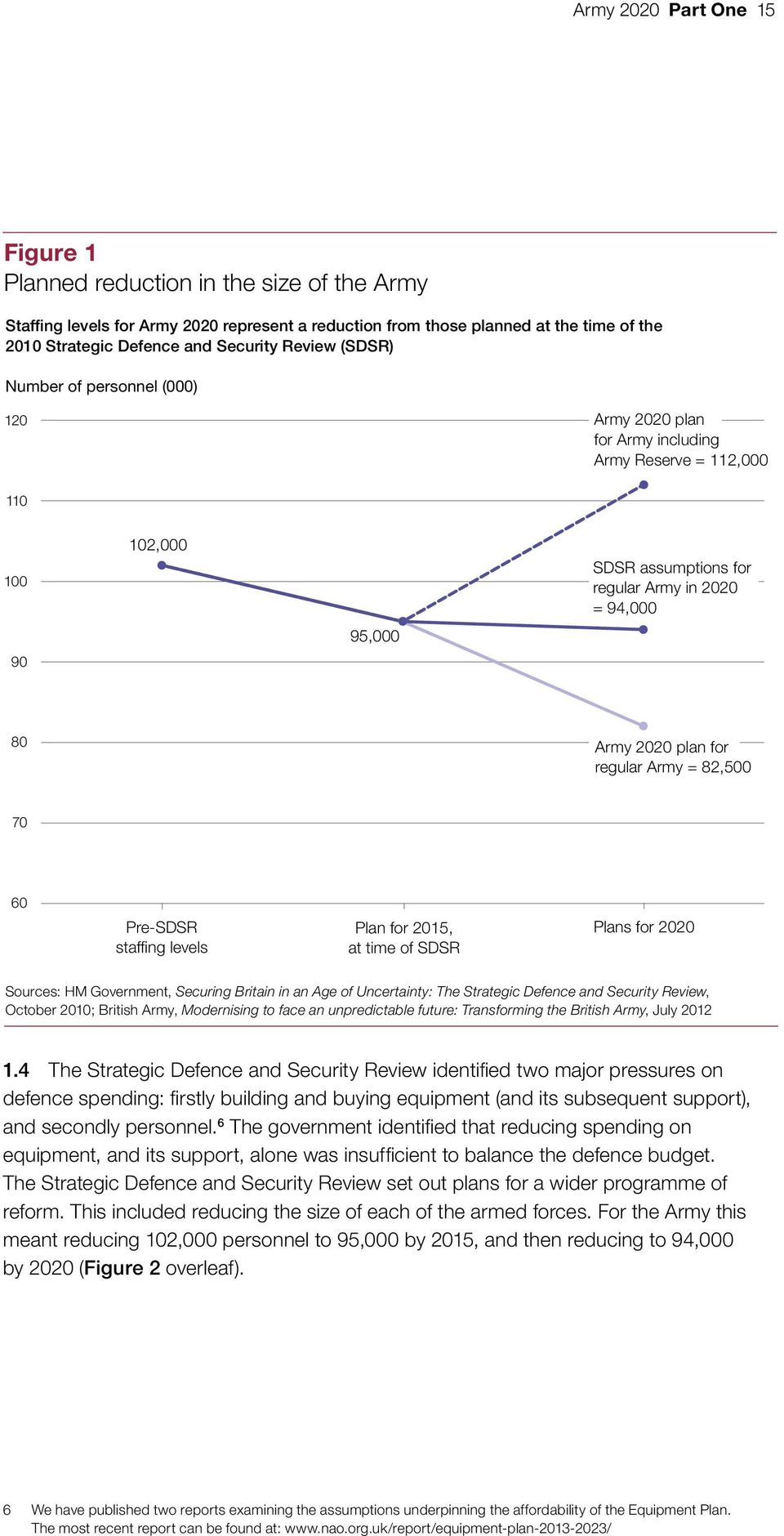
16 14 Part One Army 2020 Part One A new Army structure 1.1 In July 2011, the then Secretary of State for Defence announced plans for an Army of 120,000 personnel by 2020, with a 70:30 ratio of regulars to reserves. 1 The Ministry of Defence (the Department) later clarified that this was 82,000 2 regulars and 30,000 reserves, with an extra 8,000 reserves to be in training at any one time to maintain the 30,000 reserves (Figure 1). 3 This is a significant change from pre-2010 levels of some 102,000 trained regular soldiers and 19,000 trained reserve soldiers. The Department projected that this revised force size would enable the Army to achieve staffing savings of 5.3 billion over the ten years from to , and provide the defence outputs required. It removed these savings from the Army s budget for that period and asked it to develop a plan for creating the Army of These savings were in addition to 5.3 billion of savings already identified by the Strategic Defence and Security Review. The Department therefore expected to make overall savings of 10.6 billion. 1.2 The Army s response is an ambitious programme of change and restructuring known as Army Within the constraints of a significantly smaller regular Army, the programme is designed to create a fundamentally different structure for the Army which is sufficiently flexible to respond quickly to unexpected threats. Army 2020 also seeks, for the first time, to integrate fully the regular Army with a larger and more frequently used Army Reserve. This part of the report sets out how the new Army structure was developed by the Department and the Army, and the context in which these developments took place. Strategic and financial challenges 1.3 In October 2010, the Strategic Defence and Security Review 4 set out the government s requirements for the armed forces over the ten years to The government set these requirements during strategic uncertainty and with the need to reduce the government budget deficit. Two of the main objectives of the Strategic Defence and Security Review were therefore to: generate flexible and adaptable armed forces, able to respond to unexpected threats and rapid changes in adversaries behaviour; and reduce the estimated gap between planned government funding and the forecast cost of defence over ten years, which was estimated at 38 billion. 1 Hansard HC, 18 July 2011, vol. 531, col The Army is now seeking to reduce to a size of 82, Hansard HC, 19 January 2012, vol. 538, col. 939W. 4 HM Government, Securing Britain in an Age of Uncertainty: The Strategic Defence and Security Review, Cm 7948 October Informed by Defence Planning Assumptions which set out the government s assumptions about the size of the operations it plans to undertake, and how often it might undertake them.

17 Army 2020 Part One 15 Figure 1 Planned reduction in the size of the Army Staffing levels for Army 2020 represent a reduction from those planned at the time of the 2010 Strategic Defence and Security Review (SDSR) Number of personnel (000) 120 Army 2020 plan for Army including Army Reserve = 112, ,000 95,000 SDSR assumptions for regular Army in 2020 = 94, Army 2020 plan for regular Army = 82, Pre-SDSR staffing levels Plan for 2015, at time of SDSR Plans for 2020 Sources: HM Government, Securing Britain in an Age of Uncertainty: The Strategic Defence and Security Review, October 2010; British Army, Modernising to face an unpredictable future: Transforming the British Army, July The Strategic Defence and Security Review identified two major pressures on defence spending: firstly building and buying equipment (and its subsequent support), and secondly personnel. 6 The government identified that reducing spending on equipment, and its support, alone was insufficient to balance the defence budget. The Strategic Defence and Security Review set out plans for a wider programme of reform. This included reducing the size of each of the armed forces. For the Army this meant reducing 102,000 personnel to 95,000 by 2015, and then reducing to 94,000 by 2020 (Figure 2 overleaf). 6 We have published two reports examining the assumptions underpinning the affordability of the Equipment Plan. The most recent report can be found at:
18 16 Part One Army 2020 Figure 2 Planned reductions in size of the armed forces, as in the 2010 Strategic Defence and Security Review Pre-SDSR SDSR plans for 2015 (% change from pre-sdsr number) SDSR assumptions for 2020 (% change from pre-sdsr number) Army 102,000 95,000 (-7%) 94,000 (-8%) Royal Navy 35,000 30,000 (-14%) 29,000 (-17%) Royal Air Force 38,000 33,000 (-13%) 31,500 (-17%) Source: 2010 Strategic Defence and Security Review 1.5 Reductions in the size of the armed forces were at that stage working assumptions, for the following reasons: The Department needed to identify the precise number of personnel required to staff the proposed force structures. The Department needed to test its assumptions about staffing reductions against its 2010 spending review settlement. At the time of the Strategic Defence and Security Review, this had yet to be finalised. The Department had not decided on how to use reserve forces, as it was subject to a separate government review Plans for other change programmes across the Department s portfolio were also set out in the Strategic Defence and Security Review. The Department designed these to help bring the ten-year departmental programme in line with a reduced budget and to improve the Department s overall performance. These change programmes included the return of the Army to the UK from Germany by The operational and financial interdependencies between these programmes were not fully understood by the Department at this stage. 1.7 The Strategic Defence and Security Review also identified a need for the armed forces to adapt to meet several different strategic challenges. Operations in Afghanistan were due to be completed by December The government identified that it had an Army with capabilities and structures designed to support enduring stabilisation operations, such as Iraq and Afghanistan. But it needed to move to a more adaptable structure able to meet a range of potential future threats. 7 Ministry of Defence, Future Reserves 2020: The Independent Commission to Review the United Kingdom s Reserve Forces, July 2011.

19 Army 2020 Part One 17 Responding to increased financial challenge Eight options set out 1.8 Prior to the Strategic Defence and Security Review, the Department had estimated the funding gap between the defence budget and the cost of the defence programme to be around 38 billion over ten years. A subsequent reduction in the budget following the 2010 spending review, and the emergence of other financial pressures during the Strategic Defence and Security Review, meant that the overall shortfall was around 74 billion. Changes to the defence programme as a result of the Strategic Defence and Security Review did not entirely close this funding gap. The Department therefore undertook additional work following the Strategic Defence and Security Review to develop options for providing the defence outputs required while also bringing the Department closer to its budget. 1.9 A substantial reduction in the size of the Army, from 102,000 down to 78,000, was initially considered as part of the work leading up to the Strategic Defence and Security Review in October The Strategic Defence and Security Review proposed an army of 94,000, which was considered to be affordable subject to the outcome of the 2010 spending review. This option, however, was subsequently found not to meet the additional savings needed in the 2010 spending review. In late 2010, the Department began work to see what type, size and structure of armed forces would enable it to achieve the savings it required, while still providing required levels of military capability. Subsequently, in 2011, it developed eight high-level force structures that considered varying levels of staffing reduction, and changes to equipment and capability. Each of the eight options delivered the savings required. For the Army, the structures presented were staffed by a range of 72,000 to 81,000 personnel against the Strategic Defence and Security Review baseline of 94,000, with various corresponding options for the Royal Navy and Royal Air Force. The Department: costed options at a high level, based on the estimated cost of various elements of capacity across each of the armed forces, such as personnel, equipment and training; and assessed the options against a number of scenarios to test whether they could deliver the defence outputs set out in the 2010 National Security Strategy and the Strategic Defence and Security Review The Department presented the options to a senior military judgement panel led by the Vice Chief of the Defence Staff, with members from the Royal Navy, Army and Royal Air Force. Such panels are considered by the Department to provide a suitable level of challenge on the risks and benefits to providing military capability. The panel selected three of the eight options for further development. The three options were selected on the basis of the panel s military judgement following debate between the panel members. The capability risks associated with these options were assessed by the panel on the basis of its military judgement.

20 18 Part One Army 2020 Three structures assessed 1.11 The three options the senior military judgement panel selected were subject to the Department s further assessment to determine: the overall costs and cost implications of removing elements of capability, such as specific types of equipment or numbers of personnel; and extra risks to achieving required defence outputs when reducing capability over and above those already identified for the Strategic Defence and Security Review baseline option The decision documents we reviewed do not set out what savings target the Department was seeking to achieve. However, the three options it presented included projected savings of between 12.8 billion and 13.3 billion across the armed forces over the ten years between and These savings covered equipment and staffing and were in addition to savings already planned in the Strategic Defence and Security Review The Department s costing work used peacetime costs and did not include the costs of using reserve forces at this stage. This was in line with the government policy whereby the net additional cost of military operations is funded by the Treasury Special Reserve. The Department scaled down projected savings associated with each option by 10 per cent, to account for optimism bias. Options were not formally scored against each other using defined criteria or tested for feasibility. The capability risks associated with each option were assessed by the senior military judgement panel on the basis of its military judgement. A hybrid option 1.14 Using the information provided by the Department, the senior military judgement panel decided that the three shortlisted options created unacceptable risk to the armed forces ability to deliver the defence outputs required by the Strategic Defence and Security Review. The panel proposed a hybrid option which included a regular Army supplemented by reserve forces (as well as proposals for the Royal Navy and Royal Air Force), and asked the Department to develop this option in more detail The panel reviewed the hybrid option further. It decided that the option would give enough capability, compared with the three rejected options, to provide the required defence outputs and offered a tolerable level of military risk. However, the hybrid option did not meet the financial savings required. With no further action, it would lead to a 1.1 billion a year funding shortfall across all three services by the end of the ten-year period. The panel identified that the Department would need to make further savings from budget areas other than equipment to make the option affordable (see paragraph 1.25). The panel did not consider whether recruiting and training the increased number of reserves was feasible as part of its assessment, or whether the requirement for reserves to undertake a substantially different role in a smaller Army would have an impact on recruitment.
21 Army 2020 Part One The chosen hybrid option proposed a regular Army of around 80,000 personnel and options for an Army Reserve of between 19,000 and 38,000. The Department projected that this revised force size would enable the Army to achieve staffing savings of 5.3 billion over the ten years from to , while meeting its required outputs. The Department then asked the Army to develop a detailed plan, which later became known as Army 2020, for delivering an Army within its revised budget. Quality of evidence base Recruitment planning data 1.17 Most of the Army s recruitment is for regular soldiers. The workforce model to support this activity is underpinned by good data. The Army has refined that data over many years, and understands likely inflow and outflow rates in the regular Army. In contrast, there is a lack of good-quality data on reserves. When the Department set the target to increase the trained strength 8 of the reserves from around 19,000 to 30,000 it did not have a mature workforce model or good data to help it accurately assess how long it would take to recruit the required number of reserves The Department has since developed a workforce model for reserves. However, the model has several information gaps, where the Department has limited historical data to inform its assumptions and plan recruitment and training activities. These include factors important in attracting and retaining reserves and why there are variations in recruitment success between regions. Collecting new data on individual reserves is difficult, because the data are held in local reserve centres, rather than centrally, and are not sufficiently quality assured. Staff in these local centres do not have the authority to require reserves to provide key information, for example of training progress, injuries and employment restrictions. To support improvements in data quality, the Army has funded around 150 civilian posts to provide additional administrative support to reserve units at a cost of 4 million a year in , rising to 5 million a year in The limited data that were available to the Army became less relevant as the Department changed the definition of what constituted a trained reserve. Historically, reserves entered the trained strength after completing phase one training (see paragraphs ). Under Army 2020, they are now categorised on the same basis as their regular counterparts. This means reserves are not counted against the trained strength until they complete phase one and phase two training. Data available on the number of trained reserves became less usable because it did not identify which reserves had completed phase two training. The Department therefore lacked the data it needed to help assess the likelihood of increasing the trained strength of the reserve from 19,000 to 30,000 within the necessary timescale. 8 Trained strength refers to the number of fully trained personnel within the Army structure.
22 20 Part One Army The Army also had weak data on the number of people already in its recruitment system. When the Army handed over the lead for recruitment to Capita as part of the Recruiting Partnering Project (see paragraph 2.11) its management information indicated there were 55,000 candidates in the recruitment system who had applied to join either the regular Army or the reserves. However, Capita found the data to be unreliable. There were many duplicate records and other records included people who had already successfully joined the Army or another of the armed forces. After reviewing the records Capita found there were 12,000 valid records remaining, with half of these having entered the recruitment process 12 months ago or more which increases the likelihood that they will withdraw their application. Costing reserves 1.21 When the Department chose the hybrid option in June 2011, it could not precisely estimate the cost of routinely using the Army Reserve in operations. This is because it had not decided how many regulars and how many reserves there would be in the new Army structure. The Department gave the senior military judgement panel an analysis to show the cost of the Army Reserve at a total strength of 38,000 personnel. This analysis, based on work undertaken for the government review of reserves, showed that reserves cost around 20 per cent of regular personnel to employ when not mobilised, and around 87 per cent if mobilised. 9, 10 However, these costs do not take account of the potential costs of using a formed unit of reserve soldiers when force generation factors and rates of use are taken into account. They also do not take account of the possible cost implications of training and integrating reserves The Department costed the option of using reserves on operations, on the assumption that the Treasury would fund that option, in line with existing government policy. The panel identified that the reserve might prove a cheaper means to provide contingent capability but that the Treasury might be required to pay more when [they are] mobilised. This is because the Department is funded to produce armed forces ready for operations and the Treasury Special Reserve currently funds the extra costs of military operations. The Department did no work to determine the potential cost to the government of using reserves on military operations. It planned on the assumption that the Treasury will continue to meet these costs. 9 Mobilisation of personnel refers to the process of preparing and organising troops for active service. 10 Building on the independent commission of the reserve forces which had developed an initial Regular:Reserve Cost Comparison Model. Ministry of Defence, Future Reserves 2020: The Independent Commission to Review the United Kingdom s Reserve Forces, July 2011.
23 Army 2020 Part One The government-commissioned review of reserves published in July 2011 decided the armed forces could exploit the potential of reserves more. It also found that all three services, including the Army, had allowed reserve forces to decline and had failed to modernise their role. The review recommended a new and greater role for reserves. It recommended the total trained strength of the Army, including regulars and reserves, should be 120,000. The review recommended increasing the reserve to 30,000 by 2015, from its 2011 level of about 20, The recommended increase in the size of the reserve did not depend on reducing the regular Army. Revised budget and staffing Reduced Army budget 1.24 The Department expected the hybrid option to help the Army make savings of 5.3 billion over ten years. The Department removed these expected savings from the Army s budget and gave it revised total budgets for to When deciding to reduce the size of the Army, the Department assessed that value for money could be achieved on the basis of the cost savings the Army could make through staff reductions, while also maintaining enough military capability to provide required defence outputs. It did not consider whether the Army would achieve its outputs more efficiently at that time because the implications of the decision on the Army s structure and ways of working had not been determined. The Army is seeking to assess value for money as it develops detailed implementation plans for the Army 2020 programme and establishes the consequential impact it may have on Army basing, training and equipment. Financial risk of chosen option identified 1.25 The senior military judgement panel identified that the hybrid option would not make the required financial savings. The panel recognised that further cost savings would need to be made across the Department, including from both staffing costs and the Equipment Plan. It noted that, without extra funding, there was a risk of key equipment projects being deferred or deleted. The Army could not make significant early reductions to its workforce size and structure because of continuing commitments in Afghanistan. Therefore, without extra funding, the required savings were likely to come from cancelling or postponing equipment projects in the short term, followed by workforce reductions in later years. This course of action introduced risks that the Army would be left under-equipped and that delays to necessary equipment projects would add costs to those projects. 12 When finalising its overall financial position, the Department accepted that further savings would be required to offset the higher costs of the hybrid option. These savings are expected to come from budget areas other than equipment, such as returning troops from Germany which it expects to result in annual savings of 240 million. 11 The 20,000 figure is taken from the government-comissioned review of reserves as the Department did not collect data on the number of trained and untrained reserves before April The review identified that some estimates put the trained and active strength of the reserves as low as 14, For example, Comptroller and Auditor General, Strategic Financial Management of the Defence Budget, Session , HC 290, National Audit Office, 21 July 2010.
24 22 Part One Army 2020 Restructure needed for The Department gave the Army a revised budget and a defined force size, to develop into a detailed implementation plan. During an internal review, the Army concluded that it would need to fundamentally restructure itself and change the way it operates if it is to be sufficiently flexible to respond to unexpected threats. This was in order to meet future defence output requirements within substantially reduced staffing and funding requirements set by the Department. The new design, known as Army 2020, involves an integrated Army of regulars and reserves. This comprises three distinct elements: Reaction Force A high-readiness force, ready to undertake short-notice contingency tasks, including providing forces for the first phases of any future enduring operation. It will comprise mostly regular forces with about 10 per cent coming from the reserves. Adaptable Force A pool of regular and reserve units also available for combat operations, particularly enduring stabilisation (such as in Iraq and Afghanistan). It will provide the force elements for the Army s standing commitments (Cyprus, Brunei, the Falkland Islands and ceremonial duties) and United Nations commitments. It will also take the lead in other tasks, such as supporting other government departments during home-based natural disasters and public service strikes. Force Troops Integral to the reaction and adaptable forces, they provide a wide range of regular and reserve capabilities including engineer, artillery and medical support from a centralised pool of resources, as well as a coordination and control function Army 2020 seeks, for the first time, to integrate fully regulars and reserves within a single force structure. It builds on the Territorial Army model used during the Cold War, where reserves were used in formed units and subunits. Under Army 2020, reserves are likely to be used on operations short of general war. 13 These include, for example, stabilisation operations (such as in Afghanistan), peacekeeping and defence engagement (such as in training and exercising with partners). Some specialist capabilities, such as medical, will be delivered predominantly from the Army Reserve in all circumstances. Using reserves in this way will require a change in culture. To prepare for this, reserve units will be paired and will train with regular units. This means that development of the Army Reserve needs to be fully integrated with setting up Army In July 2012, the Department announced that it would invest 1.8 billion over ten years to help equip and develop reserves across the armed forces. The Department is funding this investment centrally. 13 General war refers to armed conflict between major powers in which the total resources of the combatant are employed, and the national survival of a major combatant is in jeopardy. For example, the First World War.
25 Army 2020 Part Two 23 Part Two Transition to a new Army structure 2.1 Transition to the new Army 2020 structure will require the Army to coordinate several activities, and manage their associated risks, against a challenging timescale. It must reduce the size of the regular Army by 20,000. It also needs to work with its recruitment partner, Capita, to recruit sufficient personnel to staff the Army 2020 structure. This requires recruiting enough regulars to maintain the planned regular Army size of 82,500 and enough reserves to increase its trained size from around 19,000 to 30,000. Implementation of Army 2020 also needs to be closely coordinated with wider change programmes across the Ministry of Defence (the Department). For example, Army 2020 is financially and operationally dependent, on: withdrawing troops from operations in Afghanistan; bringing back troops from Germany; introducing a new employment model for the armed forces; fully integrating regular and reserve personnel into a single force; and purchasing equipment needed for a new Army structure. 2.2 These interdependencies were known to the Department when it decided to reduce the size of the Army. However, the precise timing of the changes, and the financial and operational risks to implementation of Army 2020, were to be considered by the Army as it further developed the implementation plans for Army 2020 and these wider change programmes. Figure 3 overleaf sets out the timetable for the transition to the new Army 2020 structure alongside these wider change programmes. 2.3 This part of the report examines the progress the Army has made towards recruiting into the Army 2020 structure as well as setting out the main risks and dependencies that could influence whether Army 2020 is successful. Structural changes 2.4 The Army has identified and planned for the structural changes it needs to make to support Army These include relocating personnel, merging or disbanding Army units and creating new units. These structural changes need to be sequenced to account for several factors, including pairing regular and reserve units, and bringing back units from Germany.
26 24 Part Two Army 2020 Figure 3 Timetable for transition to the new Army 2020 structure Operation Herrick Afghanistan Deliver regular structural change Regular structures announcement Integrate reserves Deliver Reserve structural change Reserve structures announcement Return from Germany Force Troops Command form Unit moves and mergers Regular basing announcement Reorganise units into Reaction Force, Adaptable Force and Force Troops Recruit and train additional reserves Reserves at 30,000 Integrated Army at 112,000 Note 1 Operation Herrick is the codename under which all British operations in the war in Afghanistan have been conducted since Source: British Army, Transforming the British Army: an update, July 2013
27 Army 2020 Part Two Since Army 2020 was announced in July 2012, the Army has been finalising the detail of the design and planning to implement these structural changes. The Army has identified that to set up Army 2020 it will need to issue some 303 implementation orders. These direct the action that must occur to enable the structural change, including personnel movement, unit disbandment or relocation, and changes to command and control arrangements. The necessary structural changes are planned to take place between April 2014 and the end of As at 1 June 2014, the Army reported that it had issued 167 of 303 implementation orders. 2.6 The Army must ensure it has sufficient capability to deliver its objectives as the regular Army reduces in size, restructures and seeks to integrate the Army Reserve. The Army has set completion dates for implementation of the various components of Army 2020 (Figure 3). However, it has not publicly set out in detail the required dates for the different aspects of transformational change that are needed for Army 2020 to operate effectively. For example, while the Army plan to achieve the full integration of reserves into the Army structure by 2020, they have not set out how progress towards this objective will be measured. This makes it difficult to measure progress towards full implementation. The Army has also not set clear trigger points for enacting any contingency plans in the event that recruitment, training and integration of reserves into the Army 2020 structure remains behind schedule. Staffing changes Reducing the regular Army 2.7 The Army is ahead of its target to reduce the regular Army from 102,000 to 82,500 and make staffing savings by This reduction is to be achieved through voluntary and compulsory redundancies, voluntary exits, involuntary exits 14 and reducing recruitment to meet the requirement for a smaller Army. In 2010, the Department estimated that the cost of reducing the Army to 82,500 would be between 310 million and 500 million. This estimate was based on two elements: projected redundancy payments and projected extra resettlement costs above the Army s routine spend on people leaving the Army. These costs are variable, depending on the number of redundancy volunteers and individual circumstances. The variation between the high and low estimates occurred because the Department did not know the number and rank of personnel who would apply for redundancy at that time. The Army now forecasts that the four rounds of redundancy will cost some 320 million. The Department will meet these costs centrally. 2.8 The deadline for completing redundancies was originally The Department brought this forward to because of further demands on the budget requiring them to make staffing savings earlier. The Department began the first group of redundancies in 2011 and should complete the fourth and final group by the middle of Applications for voluntary redundancy have been high: between 85 per cent and 90 per cent of redundancies being voluntary across the three groups completed so far. 14 Involuntary exits include exits from the Army for medical reasons, misconduct, compassionate reasons, dismissal or death.
28 26 Part Two Army The Department developed a detailed policy to guide which staff were selected for redundancy, with the intention of matching the projected size and structure of the Army against the requirement set out for Army The guidance considered a number of factors, including the actual and required number of personnel by: rank; skill or trade; and length of service in the Army. These factors are important to avoid future gaps in the Army s skills or ranks, which can be costly to manage. We have previously identified that significant reductions in staff create a risk that skills gaps will be exacerbated. 15 To address this risk, the Army has developed its approach to redundancy to explicitly exclude key skills required in its Army 2020 structure As at May 2014, the Department had selected 7,947 personnel for redundancy (Figure 4). The Army expects the remaining reduction of around 12,000 to come from a fourth and final round of approximately 1,000 redundancies to be announced in June 2014, and natural turnover, including: voluntary exits; involuntary exits; retirements; and lower than projected recruitment levels. 16 Recruiting Partnering Project 2.11 In March 2012, the Department awarded a contract to Capita for a Recruiting Partnering Project. Capita is responsible for recruitment activities from the point of attracting applicants to when successful candidates enter the training system, in conjunction with the Army. Figure 5 shows Capita s and the Army s roles in the recruitment process. Figure 4 Redundancies from the regular Army Redundancy group Total (1 3) Date announced September 2011 June 2012 June 2013 Total to date Number of applicants 657 2,055 3,714 6,426 Personnel selected for redundancy from the regular Army Percentage of redundancies that were voluntary 898 2,720 4,329 7, Notes 1 All percentages stated exclude Gurkhas. 2 Not all people selected for redundancy have been made redundant. Source: Army Personnel Centre 15 Comptroller and Auditor General, Managing change in the Defence workforce, Session , HC 1791, National Audit Office, 9 February British Army, Transforming the British Army: an update, July 2013.
29 Army 2020 Part Two 27 Figure 5 Army recruitment roles and responsibilities Marketing New segmentation Intelligence-led Direct sourcing Candidate search Early contact High street Multi-channel Web focus Mining of contact pool Eligibility screen Online/phone Basic eligibility Medical self-screen Outreach High street Education Mobile Capita and Army Capita Note 1 The basic steps in the recruitment process are the same for regulars and reserves. Source: Army Recruiting and Training Division Suitability screen Online test Psychometric assessment Aptitude, interest, motivation and judgement Interview Face-to-face Structured format Career choices Assessment centre Enhanced assessment Repeated psychometrics Medical and physical selection Final checks and loading to training References Background checks GP report Preparation support Loading
30 28 Part Two Army At the point of contract award in March 2012, the total ten-year cost of the Recruiting Partnering Project was projected to be some 1.2 billion (Figure 6). The Department projected that the project could generate 267 million of cashable benefits over the life of the contract. It would do this by releasing some 900 military recruiters back to other Army tasks, making other efficiencies from working with a private sector partner and, through improved training, reducing numbers leaving the Army during either phase one or phase two training. Other planned benefits of the Recruiting Partnering Project included: better management information; transferring risk associated with recruitment, and its management, to Capita; replacing a paper-based application system with a more efficient digital application form; and consolidating 40 small contracts with providers, leading to better contract management Due to the lack of a suitable hosting environment, Capita was unable to set up new recruitment software on time, which increased the Army s costs. At the start of the tendering process for the Recruiting Partnering Project in 2008, the Army planned to contract a single service provider to provide a fully integrated recruitment service. As well as running day-to-day recruitment, the winning provider would develop a new online recruitment application and an environment to host that application. Figure 6 Forecast ten-year cost of the Recruiting Partnering Project Element of the Recruiting Partnering Project Cost ( m) Capita element 495 Ministry of Defence element 646 ATLAS ICT hosting environment 19 Total 1,160 Note 1 As at contract award in March Source: Ministry of Defence
31 Army 2020 Part Two The Army s aim of having a single provider conflicted with departmental efforts to harmonise government ICT infrastructure and government efforts to maximise existing contracts. As a result, the Department removed responsibility for providing the hosting environment from the bid specification. This meant that Defence Information Infrastructure, through its existing provider ATLAS, was contracted to provide a hosting environment for the new online recruitment applications being developed by Capita The Department signed the Recruiting Partnering Project contract with Capita in March The Department decided to use the ATLAS hosting solution, which meant that the Department and the Army were responsible for ensuring that the ATLAS hosting environment was ready in time for Capita to integrate its online recruiting software applications. The Department held the contract with ATLAS and the Army held the contract with Capita. The decision, therefore, also meant that the Army had to manage the relationship between two providers who had no contractual relationship with each other. The online recruitment application was expected to reach interim operating capability by contract launch in March 2013, and full operating capability in July By late 2012, the Department realised that the hosting environment and software would not be ready in time for the launch of the Recruiting Partnering Project. Having taken on the risk associated with integrating Capita s software with the ATLAS hosting environment, the Department and the Army did not manage effectively the relationship between Capita and ATLAS. This resulted in delays to ATLAS providing a suitable hosting environment that Capita required to test the recruitment applications it was developing The delays in launching the new online recruitment application meant Capita could not run the recruitment process as it had planned to. However, the Army could not continue with the existing recruiting operation due to changes that had already been agreed, such as reductions in recruitment staff and recruiting office closures. The Army instead had to contract with Capita to create a hybrid approach which introduced different business processes and extended the existing recruitment software. This had the following results: Increased costs The Army will incur increased operational costs of around 1 million per month until the new recruitment software is launched. These costs are related to the Army having to use legacy systems for longer ( 0.43 million), support manual workarounds by funding extra civilian staff to help Capita with recruitment activities ( 0.47 million), and pay Capita extra interim operational costs ( 0.12 million). If Capita launches the software in summer 2015 as planned, these extra costs are likely to total some 25 million. These costs do not include the opportunity costs of around 80 additional soldiers to work in Army career centres and the Army s National Recruitment Centre, and around 100 temporary posts to support additional recruitment activities from October The Army is assessing the impact of the delays on the projected benefits of 267 million over the life of the contract.
32 30 Part Two Army 2020 Recruitment below target Recruitment of regulars and reserves has been substantially below the demand plan requirement set for Capita by the Army (see Figure 7). Not all of the poor performance can be attributed to ICT issues. However, they have impacted on performance and led to inefficiencies in recruitment and training. Inability to implement performance regime The Recruiting Partnering Project is an output-based contract, with Capita incentivised to provide the quantity and quality of recruits required. However, the contract depended on the Department providing an ICT hosting environment in time for Capita to develop, test and launch its online recruitment application. Because it was not provided on time, Capita could not run the recruitment process as it had planned to. This means poor recruitment performance cannot be distinguished from the impact of ICT failings. The Army has had to pay Capita the full rate as though they were meeting the required quantity and quality standards for recruitment set in the Army s demand plan. Capita has, however, voluntarily agreed to an interim performance regime, which should be in place from June In December 2013, the Department decided to contract with Capita to mitigate the risk of further delays in providing the ICT hosting environment and the online recruitment software. The Department has reverted back to the Army s original intention of having a single supplier running day-to-day recruitment, an online recruitment application and an environment to host that application. The Department expects the hosting environment and accompanying recruitment software to be launched in summer This decision places the integration risk with Capita. The Department sees this as the quickest way of ending the extra and ongoing monthly costs In January 2014, the Army estimated that reverting to the fallback position of a hosting solution provided by Capita would cost an extra 47.7 million. This figure included an estimate of the cost of Capita developing the hosting environment and the Department s integration liabilities, 17 and an element of contingency. The decision to revert to a hosting environment provided by Capita is now expected to cost around an extra 70 million. These costs include 25 million to Capita for developing the hosting environment and 34 million to Capita for replanning provision of its recruitment software applications. Other additional costs to the Army include 5 million for ATLAS to provide a test environment for Capita and support for that environment until the middle of The Army also expects to write-off around 6 million of the work previously carried out by ATLAS to develop the hosting environment. 17 For example, provision of a testing environment, data migration, software interfaces and resources to support testing.
33 Army 2020 Part Two 31 Recruiting for Army The size of the Army is measured according to its trained strength. Trained strength comprises Army personnel who have completed phase one and phase two training: Phase one training includes all new entry training to provide basic military skills. Phase two training includes initial individual specialisation, sub-specialisation and technical training The length of time it takes to complete phase one and phase two training varies between regulars and reserves, and between specialisations and ranks. For example, phase one training for a standard regular entrant takes 14 weeks. The duration of phase two training varies. For example, phase two training for a Royal Electrical and Mechanical Engineers Technician takes almost a year-and-a-half, while it takes three years for a student nurse. The length of time it takes to train a reserve soldier varies considerably depending on how they choose to undertake their training. Generally, the Army assumes that it will take one year for reserves to complete phase one training and a further year to complete phase two training. Recruits do not become ready for use on operations until they have completed phase two training, and, therefore, there is a time gap between recruitment to the Army and contributing to the Army s trained strength. Regular Army 2.22 The Army is reducing in size from a trained strength of some 102,000 to 82,500 by However, it must still recruit and train sufficient personnel to staff the Army 2020 structure, as people leave voluntarily and as people are promoted through the ranks. Reducing recruitment saves money in the short term, but can lead to staffing gaps that persist for up to 24 years. 18 Freezing Army recruitment under the Options for Change programme in the 1990s led to a staffing gap that is still evident in the Army structure. It has cost the Department an estimated 250 million to address this gap over the last 16 years Recruitment of regular soldiers is currently behind schedule. In , some 6,366 recruits entered phase one training against the Army s original target of 9,715, which equates to an in-year shortfall of 34 per cent (Figure 7 overleaf). 19 In , 3,184 training places, from a total planned allocation of 9,382 places (around 34 per cent), were unfilled as there were insufficient recruits. This has led to a number of courses being run with lower-than-planned numbers of recruits or to courses being cancelled altogether. The Army could not quantify the associated opportunity costs but recognised that there was inefficiency and waste in the training system. 18 Current soldier engagements are for a period of 24 years. 19 Against a target of 649, the Army enlisted 553 regular officer recruits in This equates to an in-year shortfall of 15 per cent. Officers represent 6 per cent of the overall target for recruitment to the regular Army.
34 32 Part Two Army 2020 Figure 7 Recruitment against the Army Demand Plan Recruitment to the Army is currently behind schedule for both regulars and reserves Number of recruits (000) % % Apr May Jun Jul Aug Sep Oct Nov Dec Jan Feb Mar Regular Army required 1,066 1,760 2,400 3,120 3,432 5,181 6,022 6,636 6,676 7,662 8,574 9,715 Regular Army actual 762 1,160 1,630 2,121 2,365 3,628 4,127 4,522 4,575 5,121 5,556 6,366 Army Reserve required ,064 1,496 2,046 2,696 3,272 3,894 3,978 4,828 5,490 6,000 Army Reserve actual ,011 1,228 1,306 1,576 1,787 1, recruitment shortfall Source: Army Recruiting and Training Division 2.24 As at April 2014, the trained strength of the regular Army was 87,180, compared with a requirement of 91,910. The April 2014 requirement was previously 94, but was revised down by the Department in May The Department s forecasts show that the size of the regular Army will be around 83,000 by mid-2015 (Figure 8). The Army is therefore on track to achieve the staffing savings required by its reduced budget. Being ahead of schedule has introduced staffing gaps in the Army but these are being managed as a short-term transitional risk as the Army moves towards its new structure The Army s long-term forecasts suggest that it will be at full strength against the Army 2020 requirement of 82,500 in However, natural turnover, which is anticipated to be lower in than in recent years, may lead to a greater strength than forecast. This will partly offset some of the recruitment challenges, but it brings financial risks. Conversely, if the Army faces prolonged recruitment challenges, it may fail to sustain and provide sufficient regular personnel to staff the Army 2020 structure. 20 Ministry of Defence, UK armed forces monthly personnel report 1 April 2014, 15 May 2014.
35 Army 2020 Part Two 33 Figure 8 Progress in reducing regular Army staffing (000) Apr Jun Aug Oct Dec Feb Apr Jun Aug Oct Dec Feb Apr Jun Aug Oct Dec Feb Apr Jun Aug Oct Dec Feb Apr Jun Aug Oct Dec Feb Apr Army 2020 drawdown plan Indicative strength Army 2020 requirement Source: Army
36 34 Part Two Army 2020 Army Reserve 2.26 The Army is trying to increase the trained strength of the Army Reserve from around 19,000 to 30,000. The trained strength of the Army Reserve has not increased since April At April 2012, the trained strength of the Army Reserve was 19,410. As at April 2014, the trained strength of the Army Reserve was 19, The Department had set no targets for recruiting reserves at the start of The Army set Capita a requirement to recruit 6,000 reserves to staff the new Army structure by the end of March By 31 March 2014, Capita had recruited 1,975 new and rejoining reserves. This is some 67 per cent below its contractual requirement (Figure 7) In December 2013, the Department forecast that by the end of March 2014 it would recruit 1,750 new reserves and 750 former regulars into the Army Reserve. The Department reports that, by 31 March 2014, the Army and Capita had recruited 1,310 new reserves (25 per cent below forecast) and 1,050 former regulars (40 per cent above forecast). The Army also obtained 660 additional reserves through other means, for example reserves returning from a full-time post in the regular Army, leading to a total inflow to the reserve of 3,020 in As at April 2014, the trained strength of the Army Reserve is some 600 above the target of 18,800 set by the Department in December In December 2013, the deadline for increasing the trained strength of the Army Reserve to 30,000 was changed from 31 December 2018 to 31 March The Department published reserve recruitment targets for to in December The targets for numbers of reserve recruits increase substantially over the next five years. For example, in , the Army will need to recruit 9,270 reserves, including 8,000 new recruits (Figure 9). Meeting the targets will therefore require a significant improvement in recruitment performance. The Department s internal strength modelling suggests that, based on performance to date, the Army Reserve is unlikely to be increased to 30,000 by 2019 as planned. The model suggests that it could be 2025 before that target is reached. This assessment assumes an increase in recruitment rates for new reserves as well as an un-evidenced assumption that the percentage of reserve recruits that go on to become trained strength can be increased from the current level of 34 per cent to 55 per cent from Figure 9 Trained strength and recruitment targets for the Army Reserve, to end of Targets Trained strength 18,800 19,900 20,200 22,900 26,100 30,100 New recruits 3,600 6,000 8,000 8,000 7,000 Trained entrants 1,300 1,270 1, Source: Hansard HC, 19 December 2013, col. 124WS; Paper deposited in the House of Commons Library by the Ministry of Defence, Future Reserves 2020, 19 December 2013 (Ref: DEP ), available at: 21 Ministry of Defence, TSP7 UK Reserve Force and Cadets 1 April 2014, 29 May Against a target of 351, the Army enlisted 80 reserve officer recruits in This equates to an in-year shortfall of 77 per cent. Officers represent 6 per cent of the overall target for recruitment to the Army Reserve.
37 Army 2020 Part Two It is not yet clear what effect steps being taken by the Army to improve recruitment, such as marketing campaigns and the offer of financial incentives (see paragraph 2.30), are having on recruitment rates. However, further mitigating action will be required if the Army is to increase the trained strength of the Army Reserve to 30,000 by April The Department is confident that the action it is taking will increase the trained strength of the Army Reserve to 30,000 by April 2019 if the trained strength of the Army Reserve includes reserves returning from Full Time Reserve Service 23 in the regular Army and sponsored reserves. 24 We were not provided with the revised model that informs this assessment and have not, therefore, been able to test the Department s assumptions. Addressing under-recruitment 2.30 The Army has identified three main reasons for poor recruitment beyond the issues it has experienced with the Recruiting Partnering Project: Offer to new recruits A changing offer to new recruits, with no enduring stabilisation operations, such as recent conflicts in Afghanistan and Iraq, that may have motivated some people to enlist. Public confusion about recruitment Major reductions in the size of the regular Army running concurrently to recruitment efforts. The Army say that this conflicting message is confusing the general public who think that the Army is not recruiting. Marketing constraints Reduced Army funding for marketing campaigns prior to Capita assuming responsibility for marketing in October The Army reports that these reductions limited marketing activity in The Army has not assessed or quantified the relative effect of each of the above factors on recruitment performance, or how it can influence them The Department is implementing measures designed to improve recruitment performance. This includes offering a cash incentive of 300 to applicants to cover costs associated with the application process, such as travelling costs. Successful recruits into the Army Reserve will also be offered a financial incentive of 1,000 for passing phase one training and a further 1,000 for successfully passing phase two training. It is also increasing the financial value of the incentives offered to ex-regular personnel, known as regular reserves. 25 This encourages them to transfer to the reserves for 10,000 in staggered payments over four years. 23 Full-Time Reserve Service are personnel who fill posts for a set period on a full-time basis while being a member of one of the reserve services, either as an ex-regular or as a volunteer. 24 Sponsored reserves are nominated employees of an organisation that has signed a contract for providing sponsored reserves. Sponsored reserves have special liabilities for reserve service, military training and call out. 25 Regular reserves are former members of the regular Army who retain a liability to be called up for service to the Army. The length of time people remain in the Regular Reserve depends on the length of their regular service, age and sex.
38 36 Part Two Army It is too early to say whether these measures will help to recruit the number of personnel required by the Army 2020 structure. If the Army does not meet its aim of growing the Army Reserve to 30,000 by 2018, then it may need to take mitigating actions. This may include deploying units of regular personnel more frequently than planned. This will cover staffing gaps in the short term but may fail to make the efficiencies expected of the Army 2020 programme. In the event that the Army is asked to undertake more activity than planned, as has been the case in recent years, it will also increase pressure on regular staff, particularly those in understaffed trades. It is therefore not a long-term solution. Recruitment and training systems 2.34 There are aspects of maturity in the Army s management system for recruitment and training. However, our confidence in the Army s ability to implement its plan will remain low until it understands and addresses problems in the system. It must also align the recruitment process to meet the Army s demand (skills, roles and when specific types of recruit are needed) We wanted to see how effectively the Army was managing its recruitment and training process, at a snapshot in time. We assessed processes with Army and Capita staff working in the Recruiting Partnering Project over two days in late January Our assessment, based on the working practices we observed over the two days, identified several areas for improvement. Three of the most critical issues identified were as follows: Inconsistent understanding of Army staffing requirements An inconsistent understanding of requirements across the end-to-end recruitment and training system. Recruitment staff were focusing on making the process easy for the candidate. They did not have a clear enough understanding of the skills required by the Army. Candidates were, therefore, not always being channelled towards the roles that were a priority for the Army. To address this issue, the Army will need to ensure that it aligns objectives across the end-to-end recruitment and training process. And make sure that all staff are concentrating their effort on activities that support the ultimate objective recruiting in line with the Army 2020 plan. Limited use of management information Management information, collected by Army Recruiting, was used solely for the purpose of reporting upwards, or not being used at all. Overall, there is a lack of clarity over what information helps the process to be managed effectively and staff do not routinely use information to identify causes of problems or to make improvements across the system.
39 Army 2020 Part Two 37 No systematic approach to improvement No evidence of a systematic approach to improving or reducing the number of people dropping out of the recruitment and training system. Teams working within the Recruiting Partnering Project had identified a number of known problems but were not capturing, assessing or tackling them systematically. For example, staff did not mention activity to understand in detail when people drop out and why, or activity to reduce dropout rates. For people leaving the Army during training, the answer was seen to be to enlist more people or to try and improve training success rates. Operational risks Critical dependencies 2.36 The financial and operational benefits of Army 2020 depend heavily on the success of other change programmes over the remaining six years to The high level dependencies between Army 2020 and other programmes are known, but the Army 2020 programme board alone cannot fully control the risks. There are four critical programmes that the board will particularly need to monitor Army 2020 depends on the Defence Infrastructure Organisation working jointly with the Army to implement a basing programme within agreed time frames and in accordance with specified user requirements for living and working accommodation, and training facilities. Army 2020 also depends, in part, on ensuring that all units return from Germany to their new location in the UK within agreed time frames. Delays in setting up the Army s basing programme on time could increase costs. For example, troops may have to remain in Germany longer than planned. A dislocated Army may also operate poorly if troops are separated from training locations and equipment Army 2020 depends on the introduction of the Department s New Employment Model which is harmonising terms of service across the armed forces, and between regulars and reserves. The New Employment Model is also linked with the Army s own work to introduce a single integrated career development framework for both regulars and reserves. The successful implementation of these two initiatives will be important for recruitment and retention. Failure to attract and retain recruits may result in the Army being unable to provide certain capabilities required under the Strategic Defence and Security Review. 26 Or it may over-rely on units of regular Army personnel, for example deploying them more frequently than planned. This would increase costs and not achieve the efficiencies expected of Army HM Government, Securing Britain in an Age of Uncertainty: The Strategic Defence and Security Review, Cm 7948, October 2010.
40 38 Part Two Army The Army s budget has been set for the next ten years. Army 2020 depends on the Department allocating additional funding for equipment. The Department s ten-year Equipment Plan sets out its forecast expenditure plans to provide and support the equipment the armed forces require. Within its 164 billion, ten-year Equipment Plan, the Department has an unallocated budget of 8.4 billion. The Department has indicatively allocated 4.7 billion, over half of its unallocated budget to the Army, where gaps in capability are more likely to be experienced unless additional equipment to that already in the programme can be purchased. 27 The Department and the Army are planning on the basis that the Army will be allocated this 4.7 billion. The Army committed 144 million of these funds during its 2014 annual budgetary cycle. The remainder of the 4.7 billion may become available for the Army to spend in future years. However, common to all budgets across the Department, the ongoing availability of these funds is subject to a number of risks including: possible overall departmental budget reductions; a large rise in the cost of the core equipment programme; 28 the inability to realise planned efficiency savings across the armed forces; and the need to support equipment coming back from Afghanistan If funds are not allocated in future years, the Army will not have sufficient equipment to provide the capability required of Army A lack of equipment could also lead to wider impacts such as inefficient and less effective training, or a reduction in Army outputs Army 2020 depends on the Future Reserves 2020 programme providing the required level of growth in the Army Reserve. Army 2020 also depends on Future Reserves 2020 to implement relevant policies. These policies will improve conditions for: increased recruitment and retaining of reserves; better and easier mobilisation of the Army Reserve; support from employers, coupled with appropriate protection for employees; and the rebranding of the Territorial Army to the Army Reserve. Achievement of the outputs required by the Strategic Defence and Security Review may be undermined by Future Reserves 2020 not providing the required level of reserves growth, not integrating the Army Reserve into the Army structure, or a lack of sufficient legislative power to use the Army Reserve in new ways. 27 Comptroller and Auditor General, Ministry of Defence: Equipment Plan 2013 to 2023, Session , HC 816, National Audit Office, 13 February The core equipment programme refers to equipment the Department funds, as opposed to urgent operational requirements, which HM Treasury funds.
41 Army 2020 Part Two If the Army does not achieve the required level of growth in the Army Reserve, it has stated that it could call up regular reserves to cover any shortfall. The Army holds data on some 30,000 regular reserves who retain a liability to be called up for service to the Army. All soldiers have a primary trade recorded. However, the data have some limitations. For example, around 40 per cent of soldiers records do not contain information on their medical fitness for use on operations. This means that the data are more suited to identifying regular reserves that are needed to fill a specific skill gap, rather than as a mitigation against wholesale under-recruitment Working-level meetings since late 2012 have identified interdependencies between Army 2020 and other defence change programmes. Senior responsible owners for these programmes are required to report programme risks and dependencies on a quarterly basis to the Department. However, the Army cannot sufficiently differentiate the potential financial and operational impact these dependencies pose to the programme. It recognises that it must understand interdependent risk between programmes better, to mitigate the risks. The Army needs to understand these risks as dependencies become financially and operationally critical during the later stages of the programme, especially at the point when the Army needs to implement difficult transformational and behavioural change. The senior responsible owners for these interdependent programmes met to discuss key strategic dependencies in March Integrating reserves and behavioural change 2.44 Army 2020 seeks, for the first time, to integrate fully regulars and reserves within a single force structure. It builds on the Territorial Army model used during the Cold War, where reserves were used in formed units and subunits. Under Army 2020, reserves are likely to be used on operations short of general war. These include, for example, stabilisation operations (such as in Afghanistan), peacekeeping and defence engagement (such as in training and exercising with partners). Some specialist capabilities, such as medical, will be delivered predominantly from the Army Reserve. Using reserves in this way will require a change in culture Fully integrating regulars and reserves is critical to the Army 2020 design. Without effective integration, the Army will have to rely more on regular personnel and may be unable to complete all of the tasks in the Strategic Defence and Security Review. The Army plans to achieve integration through pairing of reserves with regular units and joint training to prepare for paired deployment on operations.
42 40 Part Two Army The Army is making progress in changing its size and structure. However, it faces significant behavioural challenges in creating a fully integrated Army. These challenges extend beyond changing how reserves are equipped and trained. It will require a change in how reserves are perceived. The Army is confident that it can achieve this cultural change and believes that reserves contribution is more valued and relevant following their involvement on operations in Iraq and in Afghanistan. However, the Department s 2014 Armed Forces Continuous Attitude Survey shows that 65 per cent of regular Army respondents believe regular and reserve forces are not well integrated, compared to 44 per cent in Regular Army respondents views of the professionalism and value of reserves have also declined over the same period, although there was little change in the results between 2013 and 2014 (Figure 10) The Army needs to manage morale while making the transition to Army In 2010, 59 per cent of Army personnel reported high morale and 15 per cent reported low morale. In 2014, 41 per cent reported high morale and 27 per cent reported low morale. It is not possible to know what proportion of the change in morale can be attributed to the planned changes to the Army. However, implementing Army 2020 during a period of lower morale is an extra challenge for the Department.
43 Army 2020 Part Two 41 Figure 10 Regular Army personnel s perception of the reserves Sixty-five per cent of regular Army respondents, in 2014, believe that regular and reserve forces are not very well integrated Well integrated Not very well integrated Don t know Valuable Not very valuable Don t know Professional Not very professional Don t know Percentage of regular Army respondents Notes Results by individual survey year may not sum to 100 per cent due to rounding. 2 Responses were limited to those who stated they had working contact with reserve personnel in the last two years. 3 These questions were not included in the survey before Each of the 2014 survey questions had over 2,100 respondents. Source: Armed Forces Continuous Attitude Survey 2014: reference tables. Reference tables B11.10 B Available at:
44 42 Appendix One Army 2020 Appendix One Our audit approach 1 This report examined the progress that the Ministry of Defence (the Department) and the Army have made in reducing and restructuring the Army to reduce costs while maintaining capability. We reviewed: how the Department decided to reduce the size of the Army; the progress the Army has made towards staffing the Army 2020 structure and making the required savings; and how well the Army is managing the main risks and dependencies that could affect whether Army 2020 is successful. 2 We developed an evaluative framework to assess value for money. The framework considers the best way to create an affordable Army with the right capability by By this we mean the most effective Army possible, while acknowledging expressed or implied restrictions or constraints. One constraint is the funding available, another is the uncertainty about future military threats. 3 Our audit approach is summarised in Figure 11. Our evidence base is described in Appendix Two.
45 Army 2020 Appendix One 43 Figure 11 Our audit approach The Department s and the Army s objective How this will be achieved To successfully move the Army to the Army 2020 structure and make financial savings while maintaining enough military capability to deliver required defence outputs. By reducing the size of the regular Army by 20,000 personnel, while at the same time recruiting sufficient regular and reserve personnel to man the Army 2020 structure. Transition to the new Army 2020 structure will also require coordination of a range of activities over the next six years to ensure a fully integrated Army of regulars and reserves. These activities include the implementation of structural changes to the Army; mergers and moves of individual units; and the recruitment, training and integration of 11,000 reserves into the Army. Our study We examined the development of Army 2020 and the Army s progress in implementing it. We also examined the main risks to successful implementation of Army 2020 and its dependencies with wider defence change programmes. Our evaluative criteria Does the Department have comprehensive plans for implementing Army 2020? Is the Army on track to supply the right level of personnel for the Army 2020 structure? Is the Army identifying and managing the key risks to implementing the Army 2020 programme? Our evidence (see Appendix Two for details) We assessed the planning process by: reviewing and analysing official documents including meeting notes and decision documents, and Army 2020 planning documents interviewing senior officials responsible for developing the Army 2020 programme. We assessed progress by: reviewing and analysing official documents used in assessing performance against plans and the recruitment partnering contract with Capita reviewing the assumptions and data underpinning the recruitment and training plans for Army 2020 assessing the recruitment and training process led by Capita and the Army interviewing senior officials responsible for implementing and monitoring the Army 2020 programme. We assessed the risks and dependencies by: reviewing and analysing official documents and data including planning documents from Army 2020 and other related change programmes for the Department attending a meeting of the Army 2020 programme board interviewing senior officials responsible for implementing and monitoring the Army 2020 programme and managing wider change within the Department. Our conclusions Army 2020 requires the Army to adopt a fundamentally different structure. Successful implementation of this structure requires a significant reduction in the size of the regular Army and is reliant on the recruitment, training and integration of a substantially increased number of Army reserves. We understand the importance of military judgement in making decisions on capability, but committing to moving towards an Army structure with fewer regular soldiers and an increased number of reserves within the planned timescale should have been subject to more rigorous testing of feasibility. Transition to the new structure comes with significant risks associated with key dependencies on other defence change programmes and successful recruitment, training and integration of the required numbers of reserves, which was well behind the original requirement set by the Army for If the reserve recruitment shortfall persists there is a risk of staffing gaps in some parts of the Army structure and increased pressure on regular units. There are significant risks to value for money which are currently not well understood by the Department or the Army.
46 44 Appendix Two Army 2020 Appendix Two Our evidence base 1 We reached independent conclusions on the Department s and the Army s performance in setting up and managing the Army 2020 programme after analysing evidence that we collected between January and March Our audit approach is outlined in Appendix One. 2 We assessed the extent to which the Department has comprehensive plans for setting up Army We considered the context for the Department when developing its plans, such as the financial pressures and capability requirements. We then, where available, reviewed official documents that showed how the Department took key decisions and what information was used to inform these decisions. These documents included plans setting out potential options for the Army and the minutes of discussions held by the decision-making panel. 4 We conducted semi-structured interviews with the senior officials responsible for developing the Army 2020 programme. We discussed how the Army 2020 structure was developed, the decisions that needed to be taken, and the factors that informed those decisions. 5 We evaluated whether the Army is on track to supply the right level of personnel for the Army 2020 structure. 6 We reviewed key documentation and performance management information that tracks progress against plans for Army We also reviewed the contract, and supporting documents, that set out the Department s agreement with Capita on how it would recruit new personnel. We spent two days doing a process management assessment within the recruitment and training process (that is, reading key documents, watching the process and speaking to staff). We reviewed the assumptions and data underpinning the Department s workforce model and recruitment and training plans, to assess the extent to which plans were tested for feasibility.
47 Army 2020 Appendix Two 45 7 We supplemented the above work with semi-structured interviews with those responsible for implementing and monitoring the Army 2020 programme. This included Army and Department officials, and staff employed by both Capita and ATLAS, which gave us further insight into how and why current challenges to staffing the Army 2020 structure have emerged. 8 We examined the key risks to the successful implementation of the Army 2020 programme, and its dependencies with other change programmes. 9 We reviewed official documents, such as key planning materials for Army 2020, in order to explore known risks, and set out the interdependencies between Army 2020 and wider change programmes being managed by the Army and the Department. Using this information we considered what the most important risks were to the Army 2020 programme. We also viewed and analysed data to understand financial risks and interdependencies, and the risks posed to the Army 2020 programme from factors such as morale, existing attitudes towards reserves and failure to engender required behavioural change in Army personnel. For example, financial information and the Department s own survey of its regular Army personnel. 10 We supplemented this review and analysis with semi-structured interviews with senior officials responsible for implementing and monitoring the Army 2020 programme, and for managing wider change within the Department. We discussed the potential financial and operational impacts of identified risks and dependencies, the time-frame in which they may materialise and the scope and effectiveness of the mitigations in place to prevent impacts from occurring.
48 This report has been printed on Evolution Digital Satin and contains material sourced from responsibly managed and sustainable forests certified in accordance with the FSC (Forest Stewardship Council). The wood pulp is totally recyclable and acid-free. Our printers also have full ISO environmental accreditation, which ensures that they have effective procedures in place to manage waste and practices that may affect the environment.
49 10.00 ISBN Design and Production by NAO Communications DP Ref:
Report. by the Comptroller and Auditor General. Ministry of Defence. Army 2020
 Report by the Comptroller and Auditor General Ministry of Defence Army 2020 HC 263 SESSION 2014-15 11 JUNE 2014 4 Key facts Army 2020 Key facts 82,500 trained regular Army personnel planned in December
Financial viability of the social housing sector: introducing the Affordable Homes Programme
 REPORT BY THE COMPTROLLER AND AUDITOR GENERAL HC 465 SESSION 2012-13 4 JULY 2012 Department for Communities and Local Government Financial viability of the social housing sector: introducing the Affordable
Code of Audit Practice
 Code of Audit Practice APRIL 2015 Code of Audit Practice Published pursuant to Schedule 6 Para 2 of the Local Audit and Accountability This document is available on our website at: www.nao.org.uk/ consultation-code-audit-practice
Care Act first-phase reforms
 Report by the Comptroller and Auditor General Department of Health Care Act first-phase reforms HC 82 SESSION 2015-16 11 JUNE 2015 Our vision is to help the nation spend wisely. Our public audit perspective
Settling large tax disputes
 REPORT BY THE COMPTROLLER AND AUDITOR GENERAL HC 188 SESSION 2012-13 14 JUNE 2012 HM Revenue & Customs Settling large tax disputes Our vision is to help the nation spend wisely. We apply the unique perspective
Student loan repayments
 Report by the Comptroller and Auditor General Department for Business, Innovation & Skills Student loan repayments HC 818 SESSION 2013-14 28 NOVEMBER 2013 Our vision is to help the nation spend wisely.
Comprehensive Spending Review 2007 covering the period 2008-2011
 MEASURING UP HOW GOOD ARE THE GOVERNMENT S DATA SYSTEMS FOR MONITORING PERFORMANCE AGAINST PUBLIC SERVICE AGREEMENTS? JUNE 2010 Comprehensive Spending Review 2007 covering the period 2008-2011 Review of
The BBC s approach to managing the cost of its support functions
 The BBC s approach to managing the cost of its support functions Report by the Comptroller and Auditor General presented to the BBC Trust Finance Committee, 29 March 2012 BRITISH BROADCASTING CORPORATION
THE CERTIFICATE OF THE COMPTROLLER AND AUDITOR GENERAL TO THE HOUSE OF COMMONS
 THE CERTIFICATE OF THE COMPTROLLER AND AUDITOR GENERAL TO THE HOUSE OF COMMONS I certify that I have audited the financial statements of Defence Equipment & Support for the year ended 31 March 2015 under
The Levy Control Framework
 Report by the Comptroller and Auditor General Department of Energy & Climate Change The Levy Control Framework HC 815 SESSION 2013-14 27 NOVEMBER 2013 4 Key facts The Levy Control Framework Key facts 2bn
Social care for adults in England: overview
 Report by the Comptroller and Auditor General Department of Health Department of Communities and Local Government Social care for adults in England: overview Online appendices MARCH 2014 Our vision is
HC 677 SesSIon 2010 2011 17 December 2010. HM Revenue & Customs. Managing civil tax investigations
 Report by the Comptroller and Auditor General HC 677 SesSIon 2010 2011 17 December 2010 HM Revenue & Customs Managing civil tax investigations 4 Summary Managing civil tax investigations Summary 1 In 2009-10,
Report. by the Comptroller and Auditor General. Department for Work & Pensions. The Work Programme
 Report by the Comptroller and Auditor General Department for Work & Pensions The Work Programme HC 266 SESSION 2014-15 2 JULY 2014 Our vision is to help the nation spend wisely. Our public audit perspective
JUNE 2010. Assurance for high risk projects
 JUNE 2010 Assurance for high risk projects Our vision is to help the nation spend wisely. We apply our unique perspective of public audit to help Parliament and government drive lasting improvement in
Investigation into financial support for students at alternative higher education providers
 Report by the Comptroller and Auditor General Department for Business, Innovation & Skills Investigation into financial support for students at alternative higher education providers HC 861 SESSION 2014-15
The Audit Committee self-assessment checklist
 GOOD PRACTICE The Audit Committee self-assessment checklist 2nd edition January 2012 Financial Management and Reporting 2 The Audit Committee self-assessment checklist Our vision is to help the nation
TEC Capital Asset Management Standard January 2011
 TEC Capital Asset Management Standard January 2011 TEC Capital Asset Management Standard Tertiary Education Commission January 2011 0 Table of contents Introduction 2 Capital Asset Management 3 Defining
Sustainability and financial performance of acute hospital trusts
 Report by the Comptroller and Auditor General Department of Health Sustainability and financial performance of acute hospital trusts HC 611 SESSION 2015-16 16 DECEMBER 2015 Our vision is to help the nation
Shared service centres
 Report by the Comptroller and Auditor General Cabinet Office Shared service centres HC 16 SESSION 2016-17 20 MAY 2016 4 Key facts Shared service centres Key facts 90m estimated savings made to date by
<Business Case Name> <Responsible Entity> <Date>
 (The entity Chief Information Officer, Chief Financial Officer and Business Area programme Lead must sign-off the completed business case) Signed: Date:
Research and Development funding for science and technology in the UK
 MEMORANDUM FOR THE HOUSE OF COMMONS SCIENCE AND TECHNOLOGY COMMITTEE JUNE 2013 Cross-government Research and Development funding for science and technology in the UK Our vision is to help the nation spend
Severance payments and wider benefits for senior BBC managers
 Severance payments and wider benefits for senior BBC managers Report by the Comptroller and Auditor General presented to the BBC Trust Finance Committee, 20 June 2013 BRITISH BROADCASTING CORPORATION
The BBC s move to Salford
 The BBC s move to Salford Report by the Comptroller and Auditor General presented to the BBC Trust Finance Committee, 10 April 2013 BRITISH BROADCASTING CORPORATION The BBC s move to Salford Report by
REPORT BY THE COMPTROLLER AND AUDITOR GENERAL HC 541 SESSION 2013-14 18 JULY 2013. Cross-government. Charges for customer telephone lines
 REPORT BY THE COMPTROLLER AND AUDITOR GENERAL HC 541 SESSION 2013-14 18 JULY 2013 Cross-government Charges for customer telephone lines Our vision is to help the nation spend wisely. Our public audit perspective
REPORT BY THE COMPTROLLER AND AUDITOR GENERAL HC 795 SESSION 2012-13 18 DECEMBER 2012. HM Revenue & Customs. Customer service performance
 REPORT BY THE COMPTROLLER AND AUDITOR GENERAL HC 795 SESSION 2012-13 18 DECEMBER 2012 HM Revenue & Customs Customer service performance 4 Key facts Customer service performance Key facts 900m spent on
The Government's Drug Strategy
 Report by the Comptroller and Auditor General HC 297 SesSIon 2009 2010 march 2010 Tackling problem drug use Report by the Comptroller and Auditor General Tackling problem drug use HC 297 Session 2009-2010
CODE OF PRACTICE DEALING WITH THE RELATIONSHIP BETWEEN THE NATIONAL AUDIT OFFICE AND THE COMPTROLLER AND AUDITOR GENERAL
 CODE OF PRACTICE DEALING WITH THE RELATIONSHIP BETWEEN THE NATIONAL AUDIT OFFICE AND THE COMPTROLLER AND AUDITOR GENERAL The Budget Responsibility and National Audit Act received Royal Assent in March
Scotland s public sector workforce. Good practice guide
 Scotland s public sector workforce Good practice guide Prepared by Audit Scotland March 2014 Contents Introduction... 4 Purpose of the guide... 4 What s in the guide?... 4 Part 1. Good practice in workforce
Financial services mis-selling: regulation and redress
 Report by the Comptroller and Auditor General Financial Conduct Authority and Financial Ombudsman Service Financial services mis-selling: regulation and redress HC 851 SESSION 2015-16 24 FEBRUARY 2016
Electricity Settlements Company Ltd Framework Document
 Electricity Settlements Company Ltd Framework Document This framework document has been drawn up by the Department of Energy and Climate Change in consultation with the Electricity Settlements Company.
The centre of government: an update
 Report by the Comptroller and Auditor General Cabinet Office and HM Treasury The centre of government: an update HC 1031 SESSION 2014-15 12 MARCH 2015 4 Overview The centre of government: an update Overview
Improving access to finance for small and medium-sized enterprises
 Report by the Comptroller and Auditor General Department for Business, Innovation & Skills and HM Treasury Improving access to finance for small and medium-sized enterprises HC 734 SesSIon 2013-14 1 November
Reorganising central government. Synergy reporting for Mergers and Acquisitions
 Reorganising central government Synergy reporting for Mergers and Acquisitions MARCH 2010 Contents Drawing parallels with the private sector National Audit Office Synergy reporting for Mergers and Acquisitions
Regulating financial services
 Report by the Comptroller and Auditor General The Financial Conduct Authority and the Prudential Regulation Authority Regulating financial services HC 1072 SESSION 2013-14 25 MARCH 2014 Our vision is to
The Help to Buy equity loan scheme
 Report by the Comptroller and Auditor General Department for Communities and Local Government The Help to Buy equity loan scheme HC 1099 SESSION 2013-14 6 MARCH 2014 Our vision is to help the nation spend
16- to 18-year-old participation in education and training
 Report by the Comptroller and Auditor General Department for Education 16- to 18-year-old participation in education and training HC 624 SESSION 2014-15 3 SEPTEMBER 2014 Our vision is to help the nation
REPORT BY THE COMPTROLLER AND AUDITOR GENERAL HC 535 SESSION 2013-14 5 JULY 2013. Department for Culture, Media & Sport. The rural broadband programme
 REPORT BY THE COMPTROLLER AND AUDITOR GENERAL HC 535 SESSION 2013-14 5 JULY 2013 Department for Culture, Media & Sport The rural broadband programme 4 Key facts The rural broadband programme Key facts
Part B1: Business case developing the business case
 Overview Part A: Strategic assessment Part B1: Business case developing the business case Part B2: Business case procurement options Part B3: Business case funding and financing options Part C: Project
Agencies and Public Bodies Team Public Bodies: A Guide for Departments
 Agencies and Public Bodies Team Public Bodies: A Guide for Departments Chapter 7: Financial Management Planning, Funding and Control Chapter 7: Financial Management - Planning, Funding and Control FINANCIAL
UK Guarantees scheme for infrastructure
 Report by the Comptroller and Auditor General HM Treasury UK Guarantees scheme for infrastructure HC 909 SESSION 2014-15 28 JANUARY 2015 4 Key facts UK Guarantees scheme for infrastructure Key facts 40bn
Jenny Obee, Head of Information Management [email protected], Tel: 020 8359 4859. Micailah Fleming, IT Director [email protected].
 Performance and Contract Management Committee 7 January 2016 Title Report of Wards Status ICT Operations ITIL Methodology Assessment Chief Operating Officer All Public Urgent Key No No Enclosures None
HM CUSTOMS AND EXCISE. Gambling Duties
 HM CUSTOMS AND EXCISE Gambling Duties REPORT BY THE COMPTROLLER AND AUDITOR GENERAL HC 188 Session 2004-2005 14 January 2005 EXECUTIVE SUMMARY 1 There are six types of gambling duties: lottery, general
Good Practice Guide: the internal audit role in information assurance
 Good Practice Guide: the internal audit role in information assurance Janaury 2010 Good Practice Guide: the internal audit role in information assurance January 2010 Official versions of this document
Managing ICT contracts in central government. An update
 Managing ICT contracts in central government An update Prepared by Audit Scotland June 2015 Auditor General for Scotland The Auditor General s role is to: appoint auditors to Scotland s central government
The Help to Buy equity loan scheme
 Report by the Comptroller and Auditor General Department for Communities and Local Government The Help to Buy equity loan scheme HC 1099 SESSION 2013-14 6 MARCH 2014 4 Key facts The Help to Buy equity
Gateway review guidebook. for project owners and review teams
 Gateway review guidebook for project owners and review teams The State of Queensland (Queensland Treasury and Trade) 2013. First published by the Queensland Government, Department of Infrastructure and
Framework Agreement between the Department of Health and the NHS Trust Development Authority. Annex C: Finance and Accounting
 Framework Agreement between the Department of Health and the NHS Trust Development Authority Annex C: Finance and Accounting 2014 1. The Framework Agreement sets out the governance and accountability arrangements
Emergency admissions to hospital: managing the demand
 Report by the Comptroller and Auditor General Department of Health Emergency admissions to hospital: managing the demand HC 739 SESSION 2013-14 31 OCTOBER 2013 Our vision is to help the nation spend wisely.
Efficiency and reform in government corporate functions through shared service centres
 REPORT BY THE COMPTROLLER AND AUDITOR GENERAL HC 1790 SESSION 2010 2012 7 MARCH 2012 Cross government Efficiency and reform in government corporate functions through shared service centres 4 Key facts
DEFENSE ACQUISITION WORKFORCE
 United States Government Accountability Office Report to Congressional Committees December 2015 DEFENSE ACQUISITION WORKFORCE Actions Needed to Guide Planning Efforts and Improve Workforce Capability GAO-16-80
Update on the National Cyber Security Programme
 Report by the Comptroller and Auditor General Cabinet Office Update on the National Cyber Security Programme HC 626 SESSION 2014-15 10 SEPTEMBER 2014 Our vision is to help the nation spend wisely. Our
Review of the Assurance and Approval Processes applicable to Investment Projects Progress Update
 Finance and Policy Committee Date: 17 June 2015 Item: Review of the Assurance and Approval Processes applicable to Investment Projects Progress Update This paper will be considered in public 1 Summary
The Transport Business Cases
 Do not remove this if sending to pagerunnerr Page Title The Transport Business Cases January 2013 1 Contents Introduction... 3 1. The Transport Business Case... 4 Phase One preparing the Strategic Business
Progress with preparations for High Speed 2
 Report by the Comptroller and Auditor General Department for Transport and HS2 Ltd Progress with preparations for High Speed 2 HC 235 SESSION 2016-17 28 JUNE 2016 Our vision is to help the nation spend
Section A: Introduction, Definitions and Principles of Infrastructure Resilience
 Section A: Introduction, Definitions and Principles of Infrastructure Resilience A1. This section introduces infrastructure resilience, sets out the background and provides definitions. Introduction Purpose
Open-book accounting and supply-chain assurance
 Report by the Comptroller and Auditor General Cross-government Open-book accounting and supply-chain assurance HC 91-I SESSION 2015-16 1 JULY 2015 Our vision is to help the nation spend wisely. Our public