
Worksheet 1. What You Need to Know About Motion Along the x-axis (Part 1)
|
|
|
- Jean Boone
- 9 years ago
- Views:
Transcription
1 Worksheet 1. What You Need to Know About Motion Along the x-axis (Part 1) In discussing motion, there are three closely related concepts that you need to keep straight. These are: If x(t) represents the position of a particle along the x-axis at any time t, then the following statements are true. 1. Initially means when = At the origin means = At rest means = If the velocity of the particle is positive, then the particle is moving to the. 5. If the velocity of the particle is, then the particle is moving to the left. 6. To find average velocity over a time interval, divide the change in by the change in time. 7. Instantaneous velocity is the velocity at a single moment (instant!) in time. 8. If the acceleration of the particle is positive, then the is increasing. 9. If the acceleration of the particle is, then the velocity is decreasing. 10. In order for a particle to change direction, the must change signs. 11. One way to determine total distance traveled over a time interval is to find the sum of the absolute values of the differences in position between all resting points. Here s an example: If the position of a particle is given by: x(t) 1 3 t 3 t 2 3t 4, find the total distance traveled on the interval 0 t 6. Dixie Ross, Pflugerville High School, Pflugerville, Texas 5
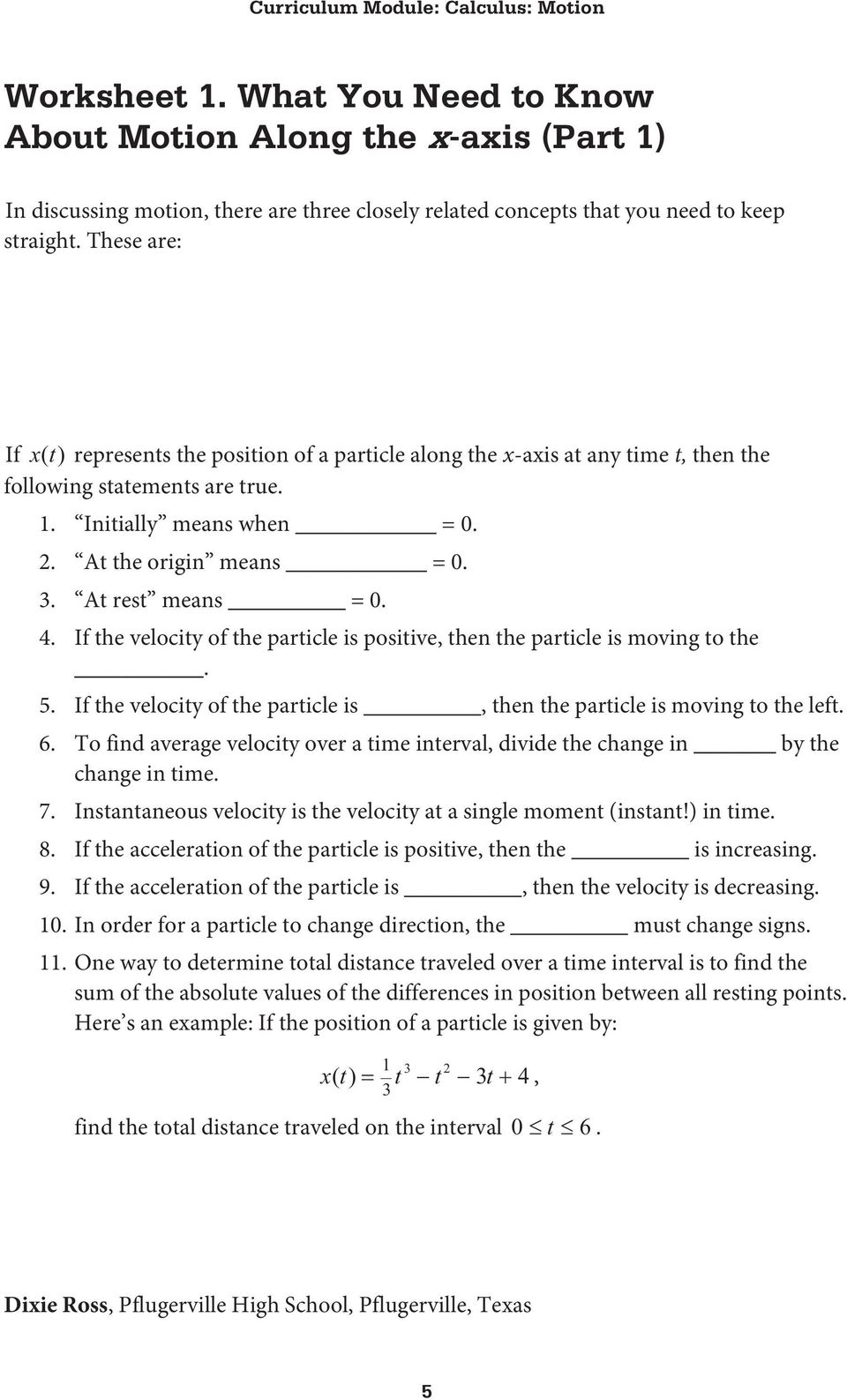
2 Worksheet 1. Solutions and Notes for Students The three concepts are as follows. Position: x(t) determines where the particle is located on the x-axis at a given time t Velocity: v(t) x (t) determines how fast the position is changing at a time t as well as the direction of movement Acceleration: a(t) v (t) x (t) determines how fast the velocity is changing at time t; the sign indicates if the velocity is increasing or decreasing The true statements are as follows. 1. Initially means when time, t = At the origin means position, x(t) = At rest means velocity, v(t) = If the velocity of the particle is positive, then the particle is moving to the right. 5. If the velocity of the particle is negative, then the particle is moving to the left. 6. To find average velocity over a time interval, divide the change in position by the change in time. 7. Instantaneous velocity is the velocity at a single moment (instant!) in time. 8. If the acceleration of the particle is positive, then the velocity is increasing. 9. If the acceleration of the particle is negative, then the velocity is decreasing. 10. In order for a particle to change direction, the velocity must change signs. 11. First, find the times at which x (t) v(t) 0. That would be t 1 (which is out of our interval) and t 3. Next, evaluate the position at the end points and at each of the resting points. The particle moved to the left 9 units and then to the right by 27 units for a total distance traveled of 36 units. Point out to students how this is similar to a closed interval test, where you have to determine function values at the end points as well as at any critical points found. t x(t) Dixie Ross, Pflugerville High School, Pflugerville, Texas 6

3 Worksheet 2. Sample Practice Problems for the Topic of Motion (Part 1) Example 1 (numerical). The data in the table below give selected values for the velocity, in meters/minute, of a particle moving along the x-axis. The velocity v is a differentiable function of time t. Time t (min) Velocity v(t) (meters/min) At t = 0, is the particle moving to the right or to the left? Explain your answer. 2. Is there a time during the time interval 0 t 12 minutes when the particle is at rest? Explain your answer. 3. Use data from the table to find an approximation for v (10) and explain the meaning of v (10) in terms of the motion of the particle. Show the computations that lead to your answer and indicate units of measure. 4. Let a(t) denote the acceleration of the particle at time t. Is there guaranteed to be a time t c in the interval 0 t 12 such that a(c) 0? Justify your answer. 7
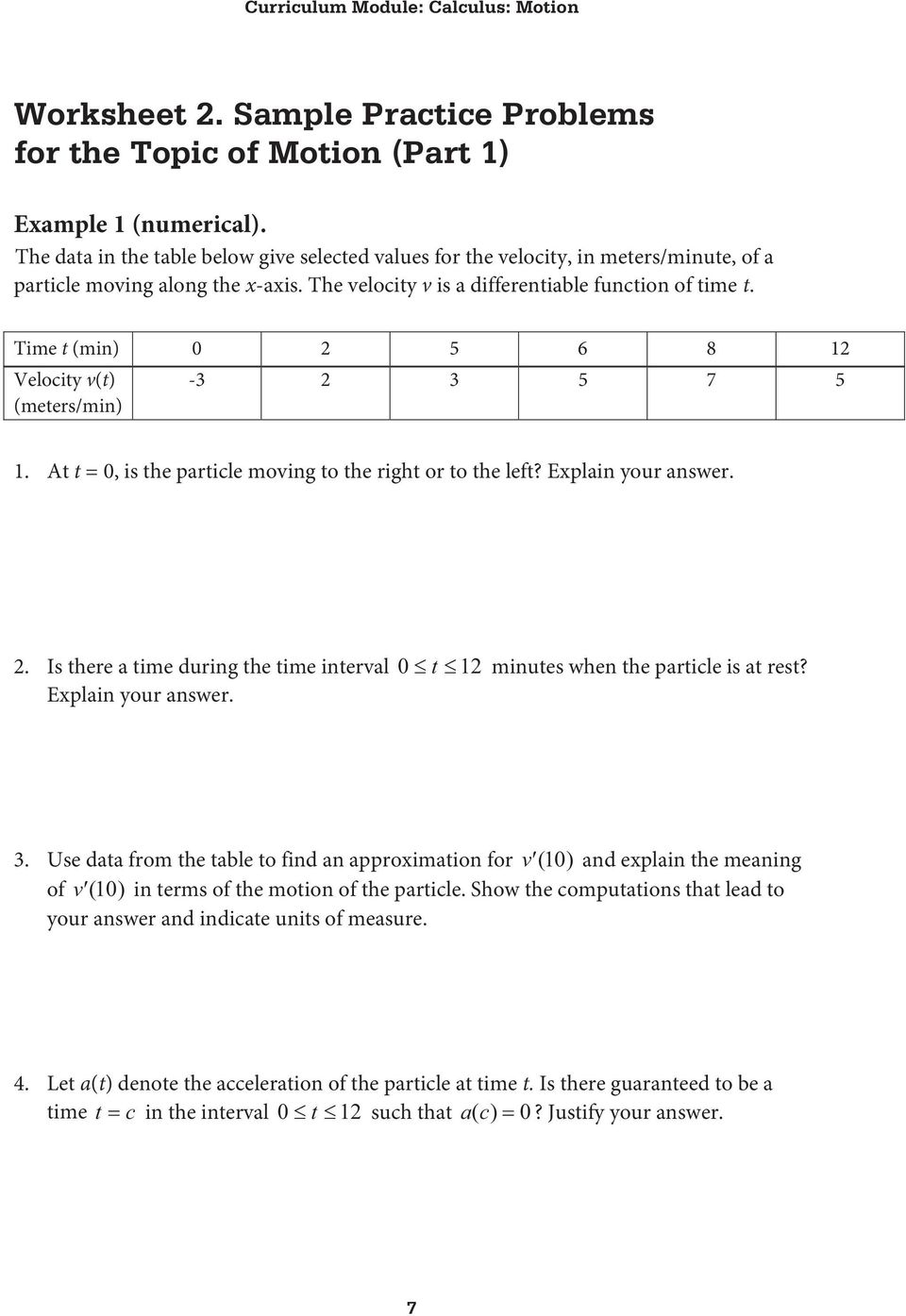
4 Example 2 (graphical). The graph below represents the velocity v, in feet per second, of a particle moving along the x-axis over the time interval from t = 0 to t = 9 seconds. 1. At t = 4 seconds, is the particle moving to the right or left? Explain your answer. 2. Over what time interval is the particle moving to the left? Explain your answer. 3. At t = 4 seconds, is the acceleration of the particle positive or negative? Explain your answer. 4. What is the average acceleration of the particle over the interval 2 t 4? Show the computations that lead to your answer and indicate units of measure. 5. Is there guaranteed to be a time t in the interval 2 t 4 such that v (t) 3 2 ft/sec 2? Justify your answer. 8
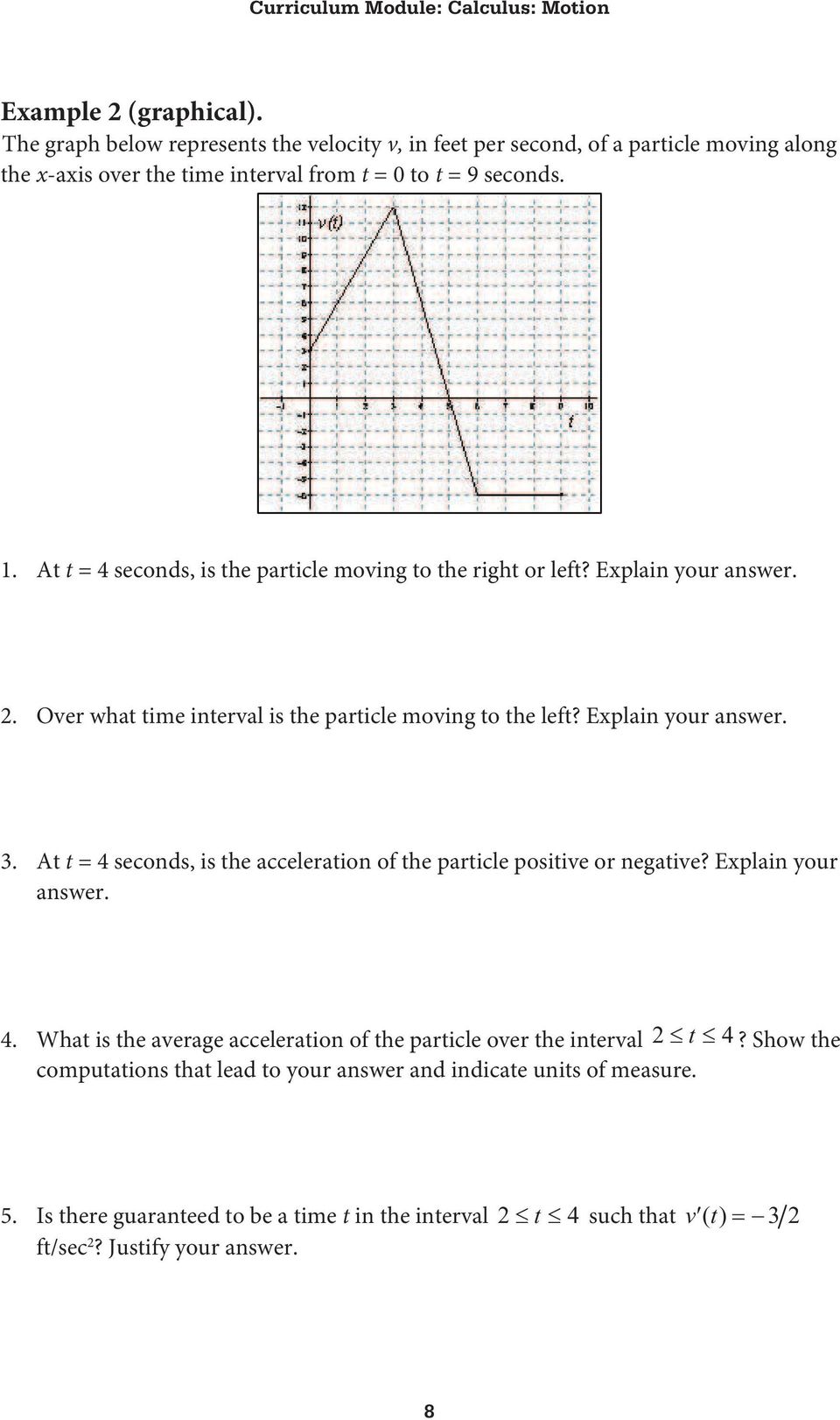
5 6. At what time t in the given interval is the particle farthest to the right? Explain your answer. Example 3 (analytic). A particle moves along the x-axis so that at time t its position is given by: x(t) t 3 6t 2 9t At t = 0, is the particle moving to the right or to the left? Explain your answer. 2. At t = 1, is the velocity of the particle increasing or decreasing? Explain your answer. 3. Find all values of t for which the particle is moving to the left. 4. Find the total distance traveled by the particle over the time interval 0 t 5. Dixie Ross, Pflugerville High School, Pflugerville, Texas 9

6 Worksheet 2. Solutions Example 1 (numerical) 1. At t = 0, the particle is moving to the left because the velocity is negative. 2. Yes, there is a time when the particle is at rest during the time interval 0 < t < 12 minutes. Since the velocity function is differentiable, it also is continuous. Hence, by the Intermediate Value Theorem, since velocity goes from negative to positive, it must go through zero and v(t) = 0 means the particle is at rest. 3. Since t = 10 is not one of the times given in the table, we should approximate the derivative by using a difference quotient with the best (closest) data available. Because 10 lies between 8 and 12, the best approximation is given by: Here, v(12) v(8) v (10) m / min min v (10) is the acceleration of the particle at t = 10 minutes. m min Yes, such a point is guaranteed by the Mean Value Theorem or Rolle s Theorem. Since velocity is differentiable (and therefore also continuous) over the interval 6 t 12 and: v(12) v(6) , then there must exist a point c in the interval such that v (c) a(c) 0. Note: If we add the hypothesis that v is continuous, then we may use the Intermediate Value Theorem to establish the result. In this case, since the values in the table indicate that velocity increases and then decreases on the interval 0 t 12, then v (t) a(t) must go from positive to negative and by the Intermediate Value Theorem must therefore pass through zero somewhere in that interval. It is the Mean Value Theorem, applied to the differentiable function v, that guarantees v takes on at least one positive value in the interval 0 t 8 (note that 7 ( 3) is one such 4 value), and at least one negative value in the interval 8 t 12 (note that is one such value). 2 10

7 Example 2 (graphical) 1. At t = 4 seconds, the particle is moving to the right because the velocity is positive. 2. The particle is moving to the left over the interval 5 t 9 seconds because the velocity is negative. 3. The acceleration of the particle is negative because the velocity is decreasing, OR the acceleration is the slope of the velocity graph and the slope of the velocity graph at t = 4 is negative. 4. Average acceleration over the time interval can be found by dividing the change in velocity by the change in time: v(4) v(2) ft / sec sec ft sec 2 5. No such time is guaranteed. The Mean Value Theorem does not apply since the function is not differentiable at t = 3 due to the sharp turn in the graph. If students have not yet learned the MVT, you can slide a tangent line (toothpick or stick) along the graph to show that no such point exists where the slope of the tangent line would be equal to the slope of a secant line between t = 2 and t = The particle is farthest to the right at t = 5 seconds. Since the velocity is positive during the time interval 0 t 5 seconds and negative during the time interval 5 t 9 seconds, the particle moves to the right before time t = 5 seconds and moves to the left after that time. Therefore, it is farthest to the right at t = 5 seconds. Example 3 (analytic) 1. The particle is moving to the right because x (0) v(0) 9 which is positive. 2. At t = 1, the velocity of the particle is decreasing because x (1) v (1) a(1) 6, and if the acceleration is negative then the velocity is decreasing. 3. The particle is moving to the left for all values of t where v(t) < 0. We have: v(t) x (t) 3t 2 12t 9 0 for 1 < t < 3. 11
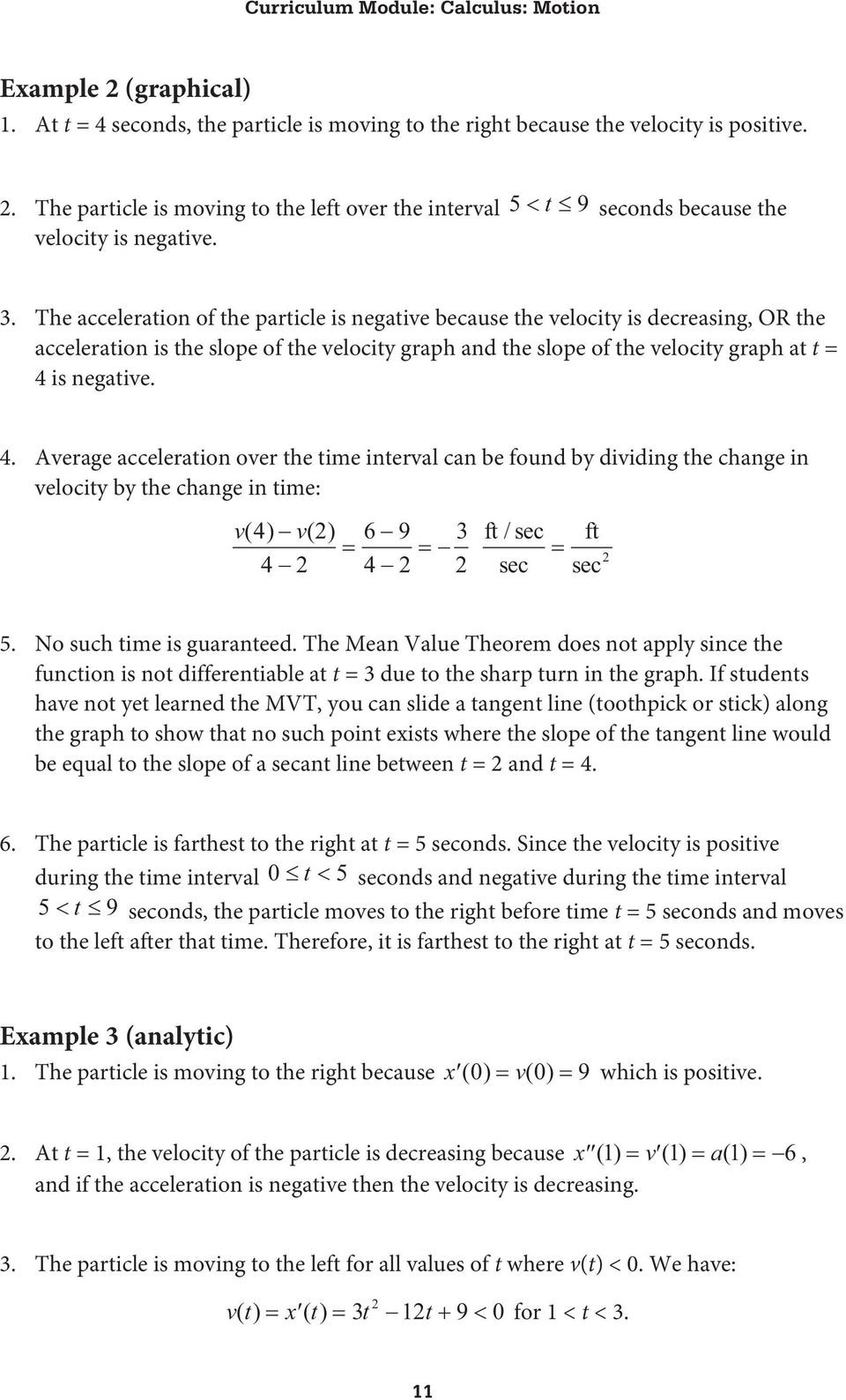
8 4. t x(t) The particle moves right 4 spaces, left 4 spaces and then right 20 spaces. Therefore, the particle has traveled a total of 28 units. The common error that students make is to calculate x(5) x(0) 20, which gives the displacement or net change in position, rather than the total distance traveled. Teachers should reinforce the difference between these two concepts every chance they get. Dixie Ross, Pflugerville High School, Pflugerville, Texas 12

9 Worksheet 3. Understanding the Relationships Among Velocity, Speed, and Acceleration Speed is the absolute value of velocity. It tells you how fast something is moving without regard to the direction of movement. 1. What effect does absolute value have on numbers? 2. What effect does taking the absolute value of a function have on its graph? For each situation below, the graph of a differentiable function giving velocity as a function of time t is shown for 1 t 5, along with selected values of the velocity function. In the graph, each horizontal grid mark represents 1 unit of time and each vertical grid mark represents 4 units of velocity. For each situation, plot the speed graph on the same coordinate plane as the velocity graph and fill in the speed values in the table. Then, answer the questions below based on both the graph and the table of values. Situation 1: Velocity graph time velocity speed In this situation, the velocity is and. Positive or negative? Because velocity is, we know acceleration is. Positive or negative? By examining the graph of speed and the table of values, we can conclude that speed is. 13
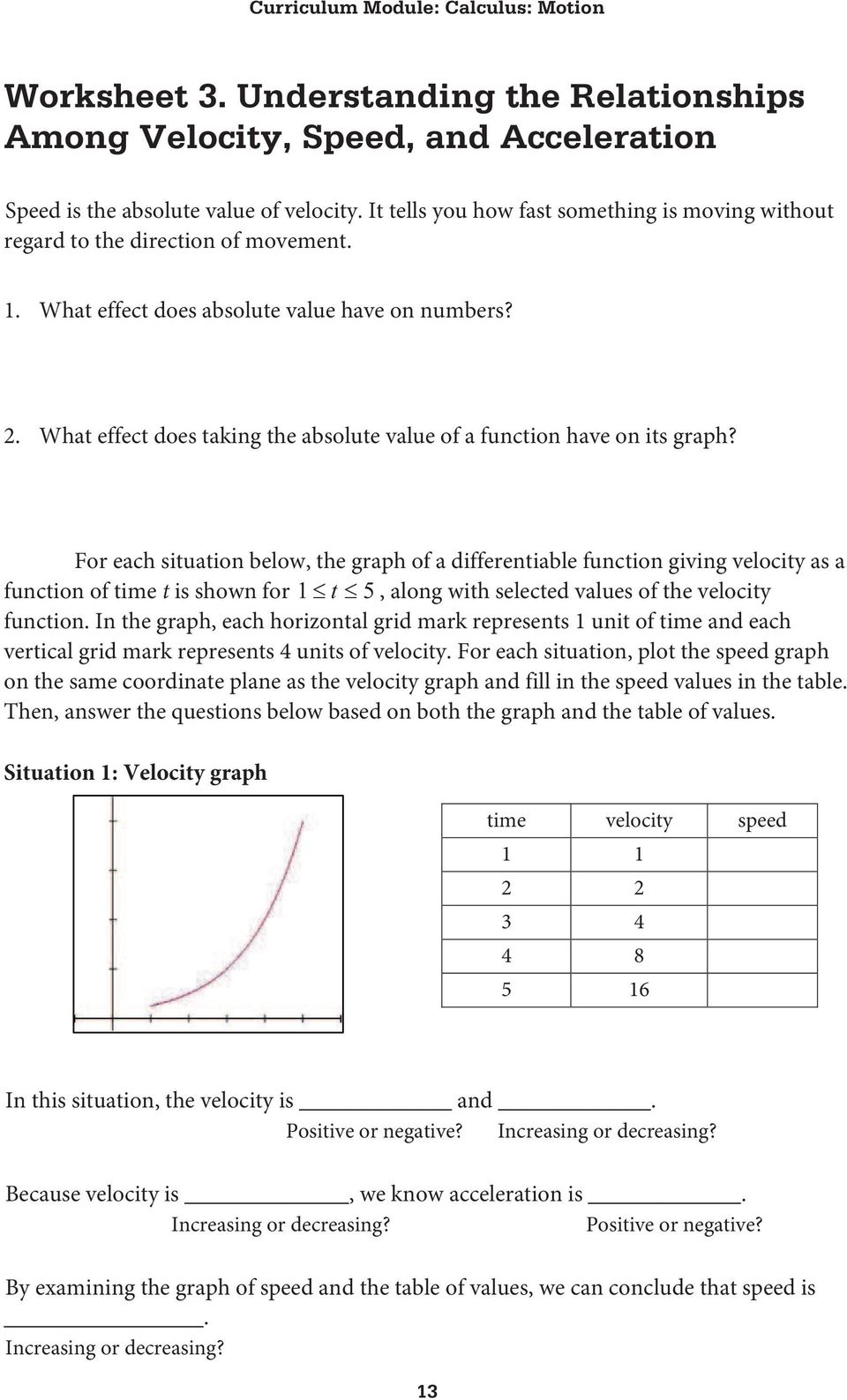
10 Situation 2: Velocity graph time velocity speed In this situation, the velocity is and. Positive or negative? Because velocity is, we know acceleration is. Positive or negative? By examining the graph of speed and the table of values, we can conclude that speed is. Situation 3: Velocity graph time velocity speed In this situation, the velocity is and. Positive or negative? Because velocity is, we know acceleration is. Positive or negative? By examining the graph of speed and the table of values, we can conclude that speed is. 14
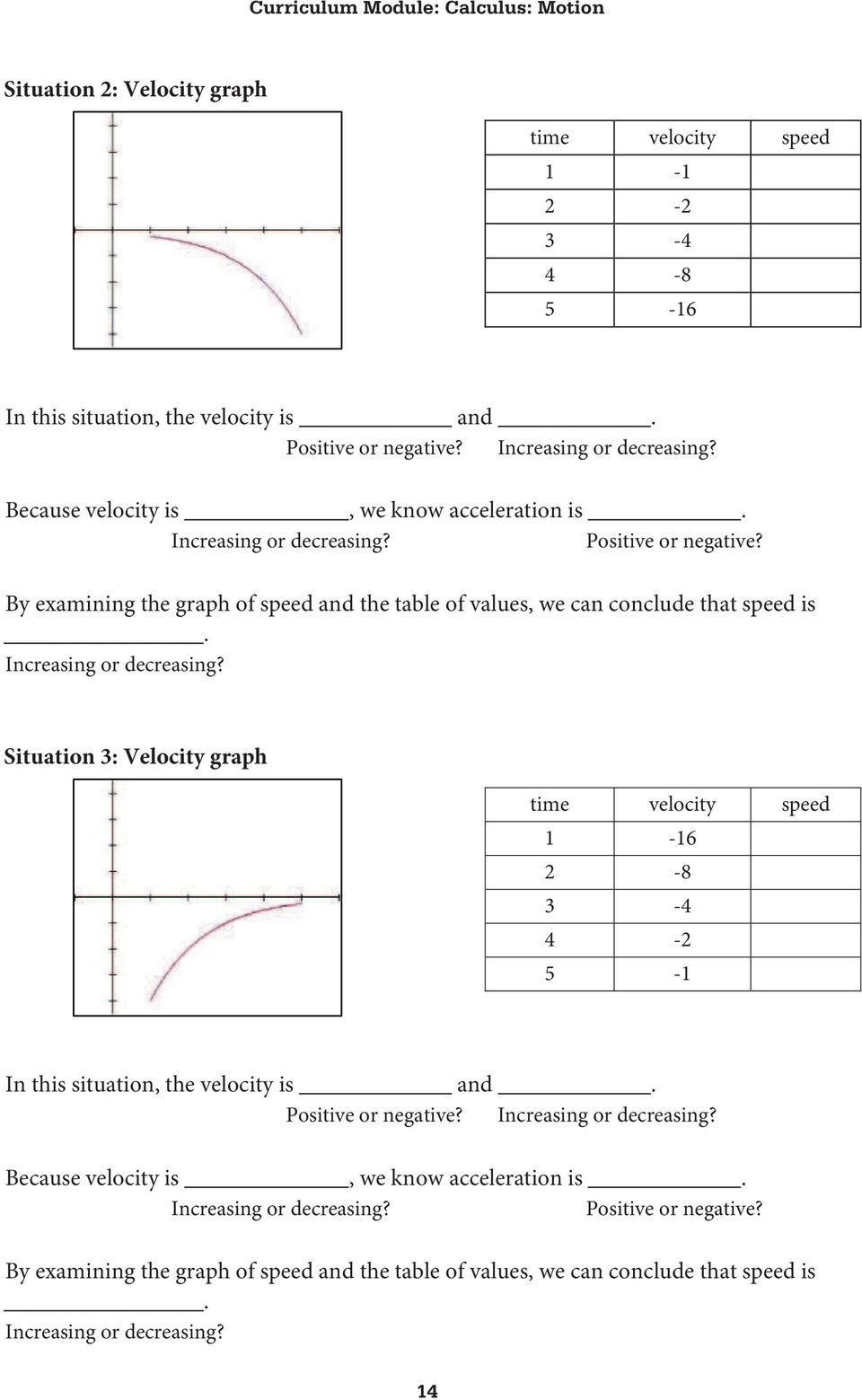
11 Situation 4: Velocity graph time velocity speed In this situation, the velocity is and. Positive or negative? Because velocity is, we know acceleration is. Positive or negative? By examining the graph of speed and the table of values, we can conclude that speed is. Conclusion: In which situations was the speed increasing? When the speed is increasing, the velocity and acceleration have signs. Same or opposite? In which situations was the speed decreasing? When the speed is decreasing, the velocity and acceleration have signs. Same or opposite? Dixie Ross, Pflugerville High School, Pflugerville, Texas 15

12 Assessing Students Understanding (A Short Quiz): 1. If velocity is negative and acceleration is positive, then speed is. 2. If velocity is positive and speed is decreasing, then acceleration is. 3. If velocity is positive and decreasing, then speed is. 4. If speed is increasing and acceleration is negative, then velocity is. 5. If velocity is negative and increasing, then speed is. 6. If the particle is moving to the left and speed is decreasing, then acceleration is. Dixie Ross, Pflugerville High School, Pflugerville, Texas 16

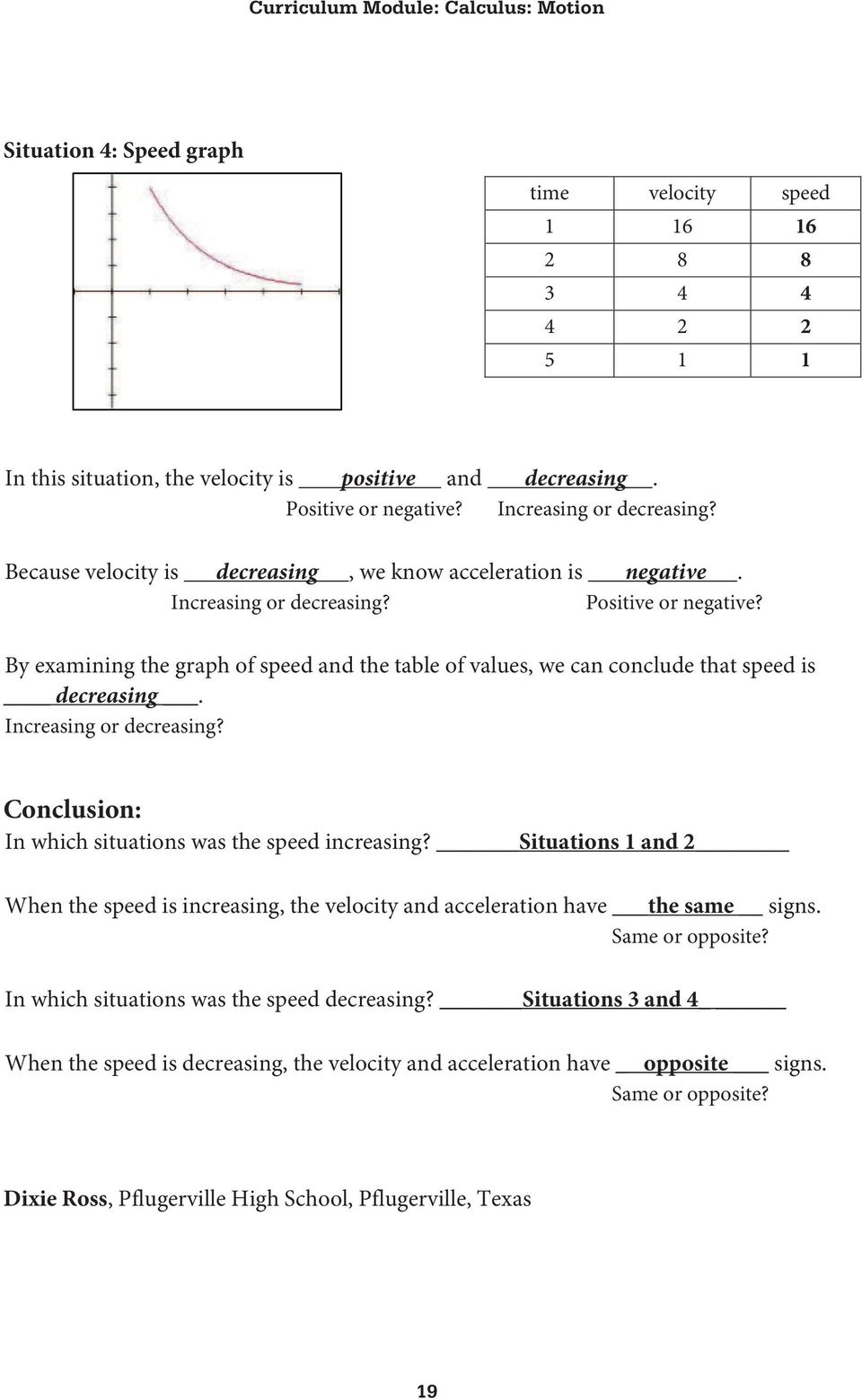
13 Worksheet 3. Solutions Speed is the absolute value of velocity. It tells you how fast something is moving without regard to the direction of movement. 1. What effect does absolute value have on numbers? Absolute value makes all numbers non-negative. 2. What effect does taking the absolute value of a function have on its graph? Taking the absolute value of a function will cause any portion of its graph that is below the x- axis to be reflected across the x-axis. For each situation below, the graph of a differentiable function giving velocity as a function of time t is shown for 1 t 5, along with selected values of the velocity function. In the graph, each horizontal grid mark represents 1 unit of time and each vertical grid mark represents 4 units of velocity. For each situation, plot the speed graph on the same coordinate plane as the velocity graph and fill in the speed values in the table. Then, answer the questions below based on both the graph and the table of values. Situation 1: Speed graph time velocity speed In this situation, the velocity is positive and increasing. Positive or negative? Because velocity is increasing, we know acceleration is positive. Positive or negative? By examining the graph of speed and the table of values, we can conclude that speed is increasing. 17

14 Situation 2: Speed graph time velocity speed In this situation, the velocity is negative and decreasing. Positive or negative? Because velocity is decreasing, we know acceleration is negative. Positive or negative? By examining the graph of speed and the table of values, we can conclude that speed is increasing. Situation 3: Speed graph time velocity speed In this situation, the velocity is negative and increasing. Positive or negative? Because velocity is increasing, we know acceleration is positive. Positive or negative? By examining the graph of speed and the table of values, we can conclude that speed is decreasing. 18
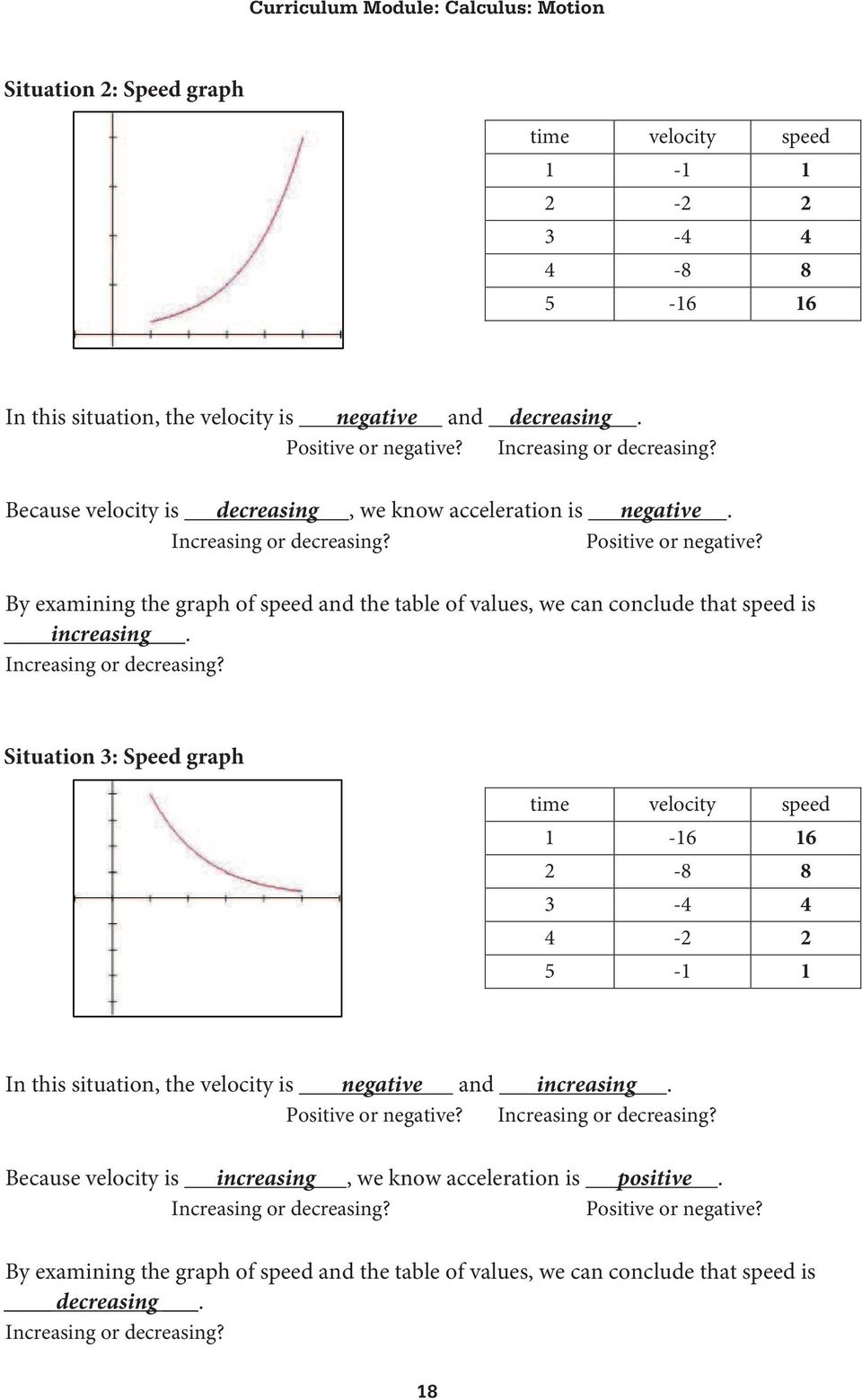
15 Situation 4: Speed graph time velocity speed In this situation, the velocity is positive and decreasing. Positive or negative? Because velocity is decreasing, we know acceleration is negative. Positive or negative? By examining the graph of speed and the table of values, we can conclude that speed is decreasing. Conclusion: In which situations was the speed increasing? Situations 1 and 2 When the speed is increasing, the velocity and acceleration have the same signs. Same or opposite? In which situations was the speed decreasing? Situations 3 and 4 When the speed is decreasing, the velocity and acceleration have _ opposite signs. Same or opposite? Dixie Ross, Pflugerville High School, Pflugerville, Texas 19
16 Assessing Students Understanding (A Short Quiz): 1. If velocity is negative and acceleration is positive, then speed is decreasing. 2. If velocity is positive and speed is decreasing, then acceleration is negative. 3. If velocity is positive and decreasing, then speed is decreasing. 4. If speed is increasing and acceleration is negative, then velocity is negative. 5. If velocity is negative and increasing, then speed is decreasing. 6. If the particle is moving to the left and speed is decreasing, then acceleration is positive. Dixie Ross, Pflugerville High School, Pflugerville, Texas 20

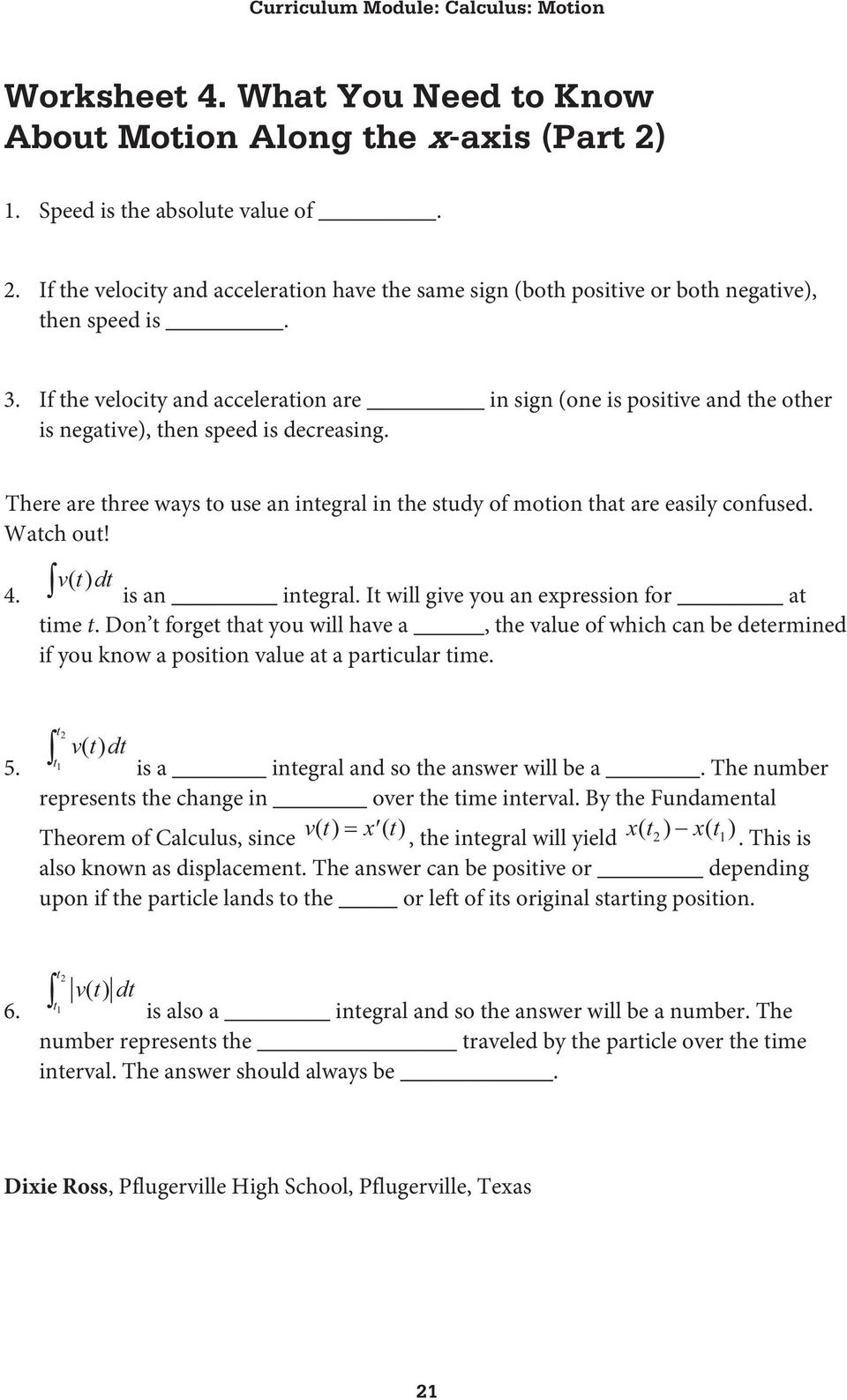
17 Worksheet 4. What You Need to Know About Motion Along the x-axis (Part 2) 1. Speed is the absolute value of. 2. If the velocity and acceleration have the same sign (both positive or both negative), then speed is. 3. If the velocity and acceleration are in sign (one is positive and the other is negative), then speed is decreasing. There are three ways to use an integral in the study of motion that are easily confused. Watch out! 4. v(t)dt is an integral. It will give you an expression for at time t. Don t forget that you will have a, the value of which can be determined if you know a position value at a particular time. 5. t 2 v(t)dt t 1 is a integral and so the answer will be a. The number represents the change in over the time interval. By the Fundamental Theorem of Calculus, since v(t) x (t), the integral will yield x(t ) x(t ) 2 1. This is also known as displacement. The answer can be positive or depending upon if the particle lands to the or left of its original starting position. 6. t 2 v(t) dt t 1 is also a integral and so the answer will be a number. The number represents the traveled by the particle over the time interval. The answer should always be. Dixie Ross, Pflugerville High School, Pflugerville, Texas 21
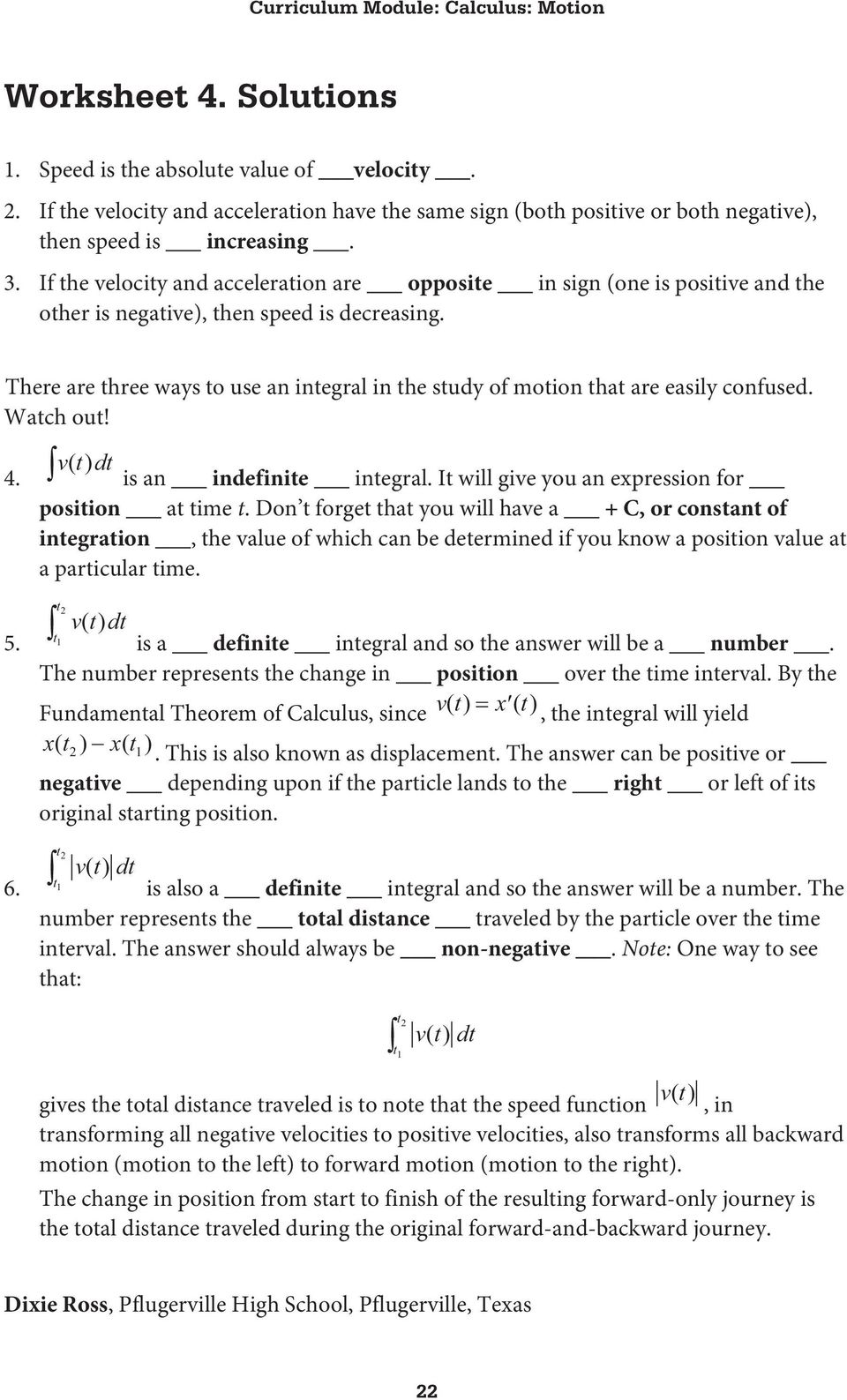
18 Worksheet 4. Solutions 1. Speed is the absolute value of velocity. 2. If the velocity and acceleration have the same sign (both positive or both negative), then speed is increasing. 3. If the velocity and acceleration are opposite in sign (one is positive and the other is negative), then speed is decreasing. There are three ways to use an integral in the study of motion that are easily confused. Watch out! v(t)dt is an indefinite integral. It will give you an expression for position at time t. Don t forget that you will have a + C, or constant of integration, the value of which can be determined if you know a position value at a particular time. t 2 v(t)dt t 1 is a definite integral and so the answer will be a number. The number represents the change in position over the time interval. By the Fundamental Theorem of Calculus, since v(t) x (t), the integral will yield x(t 2 ) x(t 1 ). This is also known as displacement. The answer can be positive or negative depending upon if the particle lands to the right or left of its original starting position. t 2 v(t) dt t 1 is also a definite integral and so the answer will be a number. The number represents the total distance traveled by the particle over the time interval. The answer should always be non-negative. Note: One way to see that: t 2 t 1 v(t) dt gives the total distance traveled is to note that the speed function v(t), in transforming all negative velocities to positive velocities, also transforms all backward motion (motion to the left) to forward motion (motion to the right). The change in position from start to finish of the resulting forward-only journey is the total distance traveled during the original forward-and-backward journey. Dixie Ross, Pflugerville High School, Pflugerville, Texas 22
19 Worksheet 5. Sample Practice Problems for the Topic of Motion (Part 2) Example 1 (graphical). The graph to the right shows the velocity, v(t), of a particle moving along the x-axis for 0 t 11. It consists of a semicircle and two line segments. Use the graph and your knowledge of motion to answer the following questions. 1. At what time t, 0 t 11, is the speed of the particle the greatest? 2. At which of the times, t = 2, t = 6 or t = 9, is the acceleration of the particle the greatest? Explain your answer. 3. Over what time intervals is the particle moving to the left? Explain your answer. 4. Over what time intervals is the speed of the particle decreasing? Explain your answer. 5. Find the total distance traveled by the particle over the time interval 0 t Find the value of the problem v(t) dt and explain the meaning of this integral in the context of 23

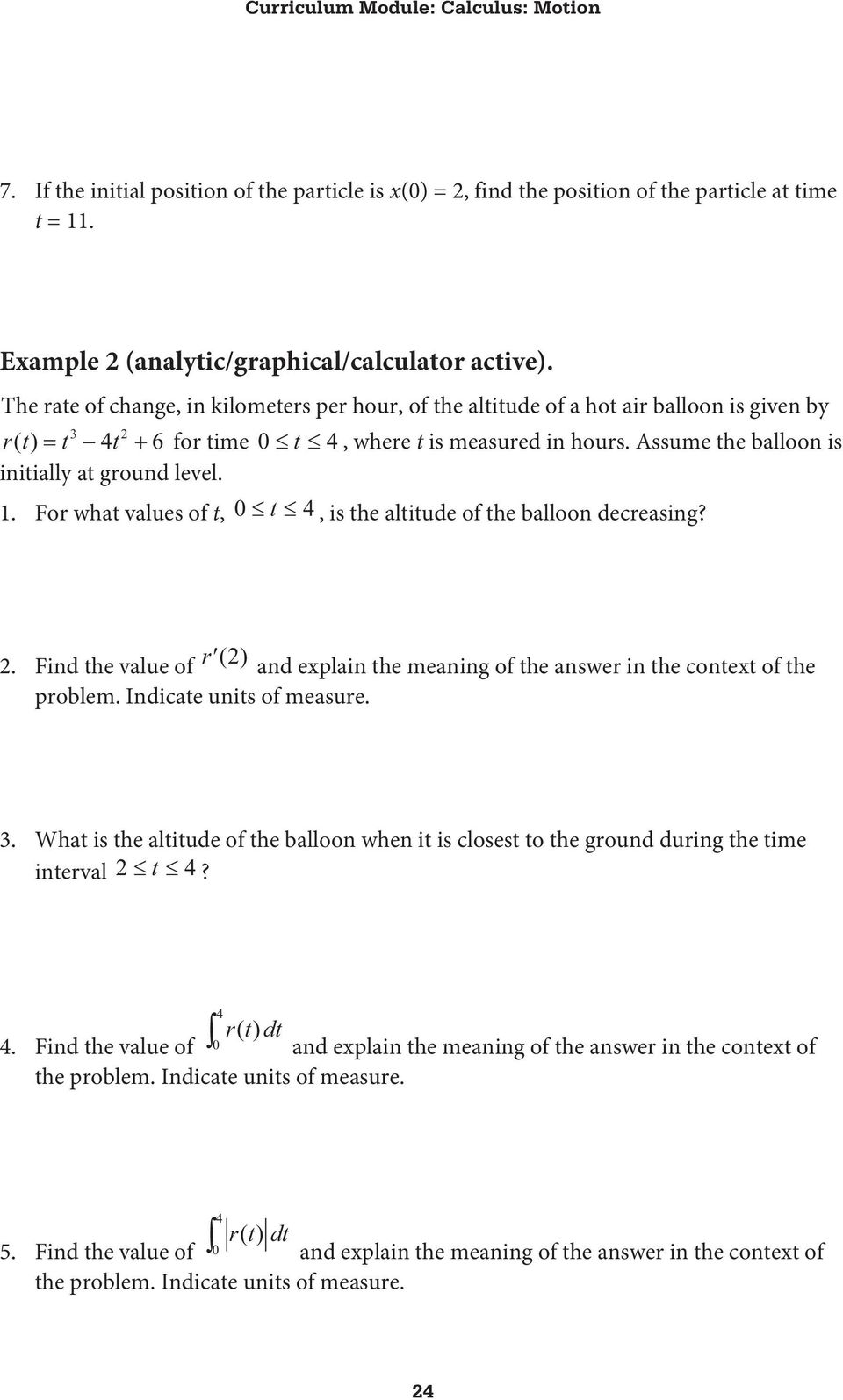
20 7. If the initial position of the particle is x(0) = 2, find the position of the particle at time t = 11. Example 2 (analytic/graphical/calculator active). The rate of change, in kilometers per hour, of the altitude of a hot air balloon is given by r(t) t 3 4t 2 6 for time 0 t 4, where t is measured in hours. Assume the balloon is initially at ground level. 1. For what values of t, 0 t 4, is the altitude of the balloon decreasing? 2. Find the value of r (2) and explain the meaning of the answer in the context of the problem. Indicate units of measure. 3. What is the altitude of the balloon when it is closest to the ground during the time interval 2 t 4? 4 r(t) dt 4. Find the value of 0 and explain the meaning of the answer in the context of the problem. Indicate units of measure. 4 r(t) dt 5. Find the value of 0 and explain the meaning of the answer in the context of the problem. Indicate units of measure. 24
21 6. What is the maximum altitude of the balloon during the time interval 0 t 4? Example 3 (numerical). The table below gives values for the velocity and acceleration of a particle moving along the x-axis for selected values of time t. Both velocity and acceleration are differentiable functions of time t. The velocity is decreasing for all values of t, 0 t 10. Use the data in the table to answer the questions that follow. Time, t Velocity, v(t) Acceleration, a(t) Is there a time t when the particle is at rest? Explain your answer. 2. At what time indicated in the table is the speed of the particle decreasing? Explain your answer. v(t) dt 3. Use a left Riemann sum to approximate 0. Show the computations you use to arrive at your answer. Explain the meaning of the definite integral in the context of the problem
22 4. Is the approximation found in part (3) greater than or less than the actual value of the definite integral shown below? Explain your reasoning v(t) dt 10 v(t) dt 5. Approximate the value of 0 using a trapezoidal approximation with the three sub-intervals indicated by the values in the table. Show the computations you use to arrive at your answer. Explain the meaning of the definite integral in the context of the problem. 6. Determine the value of context of the problem a(t) dt. Explain the meaning of the definite integral in the Dixie Ross, Pflugerville High School, Pflugerville, Texas 26
23 Worksheet 5. Solutions Example 1 (graphical) 1. Speed is greatest at t = 8 since that is when the magnitude of the velocity is the greatest. 2. The acceleration is the derivative or slope of the velocity graph. Therefore: a(2) = 0, a(6) 3, and a(9) = 3. 2 The acceleration of the particle is greatest at t = The particle is moving to the left over the time interval 4 < t < 10 because that is where the velocity is negative (velocity graph lies below the horizontal axis). 4. Whenever velocity and acceleration are opposite in sign, the speed is decreasing. The velocity is positive and decreasing for 2 t 4, which means v (t) a(t) 0 for 2 t 4. This means the speed of the particle is decreasing for the time interval 2 t 4 and in fact for the time interval 2 t 4. The velocity is negative and increasing for 8 t 10, which means v (t) a(t) 0 for 8 t 10. This means the speed of the particle also is decreasing for the time interval 8 t 10 and in fact for the time interval 8 t 10. Or, sketch and label clearly the graph of the speed function, v(t), to see that the speed decreases for 2 t 4 and 8 t The total distance traveled by the particle is the sum of the areas of the regions between the velocity graph and the t-axis. Therefore the total distance traveled is given by the expression: Equivalently, the total distance traveled is given by: 11 v(t) dt = The definite integral shown below represents the net change in position, or the displacement, of the particle over the time interval 0 t v(t) dt Using the Fundamental Theorem of Calculus, x(11) x(0) v(t)dt
24 Example 2 (analytic/graphical/calculator active) 1. The altitude of the balloon is decreasing whenever r(t) 0. By graphing r(t) and using the zero feature of the calculator, the time interval will be: t hours. Students should be taught to store these values to use for subsequent calculations or to use more decimal places than the three that are required so that their subsequent answers will have three decimal place accuracy. 2. Students can use the numerical derivative feature of their calculator or compute by hand the value: r (2) 4 km/hr = km hr hr 2 This value is the rate of change of the altitude of the hot air balloon at time t = 2 hours. In this case, at time t = 2 hours, the rate of change of the altitude is decreasing at a rate of 4 km/hr 2. Note: The rate of change of the altitude at time t = 2 hours is r(2) 2 km/hr, indicating that the altitude itself also is decreasing at this time. Note also that if the balloon moved only vertically, then r(t) would be its velocity and r (t) its acceleration. In this case, students could report that r (2) 4 means the acceleration of the balloon is 4 km/hr 2 or, equivalently, that the velocity of the balloon is decreasing at a rate of 4 km/hr By the result of part (1), the balloon is closest to the ground at t = hours. If y(t) denotes the altitude of the balloon after t hours, then, by the Fundamental Theorem of Calculus, the minimum altitude of the balloon for 2 t 4 is: y(3.514) y(0) r(t)dt km. Students should use the definite integral feature of the calculator to evaluate this integral. 28
25 4. The definite integral shown below represents the net change in the altitude of the balloon over the time interval 0 t r(t) dt km. Since the balloon was initially at ground level, this definite integral also gives the altitude of the balloon at t = 4 hours. 5. The definite integral shown below represents the total vertical distance traveled by the balloon over the time interval 0 t 4. (Note that if the balloon moved only vertically, then r(t) would be its speed.) 0 4 r(t) dt km. 6. The maximum altitude of the balloon can occur either at the critical point where r(t) goes from positive to negative (t = 1.572) or at the right endpoint of the time interval (t = 4). Since: y(1.572) y(0) r(t)dt km. and since, by part (d), y(4) = km, then the maximum altitude of the balloon is km. 29
26 Example 3 (numerical) 1. Yes, there is a time when the particle is at rest. Since velocity is a differentiable function of time t, then velocity must also be continuous and the Intermediate Value Theorem can be applied. Since v(2) = 3 and v(6) 1, then there must be a value of t in the interval 2 t 6 such that v(t) = Speed is decreasing at t = 2 since at that time velocity and acceleration are opposite in sign. 3. Below, the definite integral represents the net change in position, or displacement, over the time interval 0 t v(t) dt ( 1)(4) Because velocity is given to be a decreasing function on the interval 0 t 10, the approximation in part (3) will be greater than the actual value of the integral. 5. The definite integral shown below represents the total distance traveled by the particle over the time interval 0 t v(t) dt (5 3) 1 2 4(3 1) 1 4(1 8) Using the Fundamental Theorem of Calculus, 10 0 a(t) dt v(10) v(0) The definite integral gives the net change in the velocity of the particle over the time interval 0 t 10. Dixie Ross, Pflugerville High School, Pflugerville, Texas 30
= f x 1 + h. 3. Geometrically, the average rate of change is the slope of the secant line connecting the pts (x 1 )).
 Math 1205 Calculus/Sec. 3.3 The Derivative as a Rates of Change I. Review A. Average Rate of Change 1. The average rate of change of y=f(x) wrt x over the interval [x 1, x 2 ]is!y!x ( ) - f( x 1 ) = y
Graphing Motion. Every Picture Tells A Story
 Graphing Motion Every Picture Tells A Story Read and interpret motion graphs Construct and draw motion graphs Determine speed, velocity and accleration from motion graphs If you make a graph by hand it
1.3.1 Position, Distance and Displacement
 In the previous section, you have come across many examples of motion. You have learnt that to describe the motion of an object we must know its position at different points of time. The position of an
AP Calculus AB 2010 Free-Response Questions Form B
 AP Calculus AB 2010 Free-Response Questions Form B The College Board The College Board is a not-for-profit membership association whose mission is to connect students to college success and opportunity.
In order to describe motion you need to describe the following properties.
 Chapter 2 One Dimensional Kinematics How would you describe the following motion? Ex: random 1-D path speeding up and slowing down In order to describe motion you need to describe the following properties.
Student Performance Q&A:
 Student Performance Q&A: 2008 AP Calculus AB and Calculus BC Free-Response Questions The following comments on the 2008 free-response questions for AP Calculus AB and Calculus BC were written by the Chief
AP Calculus AB 2007 Scoring Guidelines Form B
 AP Calculus AB 7 Scoring Guidelines Form B The College Board: Connecting Students to College Success The College Board is a not-for-profit membership association whose mission is to connect students to
Calculus 1st Semester Final Review
 Calculus st Semester Final Review Use the graph to find lim f ( ) (if it eists) 0 9 Determine the value of c so that f() is continuous on the entire real line if f ( ) R S T, c /, > 0 Find the limit: lim
Section 3.7. Rolle s Theorem and the Mean Value Theorem. Difference Equations to Differential Equations
 Difference Equations to Differential Equations Section.7 Rolle s Theorem and the Mean Value Theorem The two theorems which are at the heart of this section draw connections between the instantaneous rate
W i f(x i ) x. i=1. f(x i ) x = i=1
 Work Force If an object is moving in a straight line with position function s(t), then the force F on the object at time t is the product of the mass of the object times its acceleration. F = m d2 s dt
Ground Rules. PC1221 Fundamentals of Physics I. Kinematics. Position. Lectures 3 and 4 Motion in One Dimension. Dr Tay Seng Chuan
 Ground Rules PC11 Fundamentals of Physics I Lectures 3 and 4 Motion in One Dimension Dr Tay Seng Chuan 1 Switch off your handphone and pager Switch off your laptop computer and keep it No talking while
correct-choice plot f(x) and draw an approximate tangent line at x = a and use geometry to estimate its slope comment The choices were:
 Topic 1 2.1 mode MultipleSelection text How can we approximate the slope of the tangent line to f(x) at a point x = a? This is a Multiple selection question, so you need to check all of the answers that
Mark Howell Gonzaga High School, Washington, D.C.
 Be Prepared for the Calculus Eam Mark Howell Gonzaga High School, Washington, D.C. Martha Montgomery Fremont City Schools, Fremont, Ohio Practice eam contributors: Benita Albert Oak Ridge High School,
AP Calculus BC 2008 Scoring Guidelines
 AP Calculus BC 8 Scoring Guidelines The College Board: Connecting Students to College Success The College Board is a not-for-profit membership association whose mission is to connect students to college
AP Calculus AB 2004 Scoring Guidelines
 AP Calculus AB 4 Scoring Guidelines The materials included in these files are intended for noncommercial use by AP teachers for course and eam preparation; permission for any other use must be sought from
AP Calculus AB 2011 Free-Response Questions
 AP Calculus AB 11 Free-Response Questions About the College Board The College Board is a mission-driven not-for-profit organization that connects students to college success and opportunity. Founded in
2008 AP Calculus AB Multiple Choice Exam
 008 AP Multiple Choice Eam Name 008 AP Calculus AB Multiple Choice Eam Section No Calculator Active AP Calculus 008 Multiple Choice 008 AP Calculus AB Multiple Choice Eam Section Calculator Active AP Calculus
1 One Dimensional Horizontal Motion Position vs. time Velocity vs. time
 PHY132 Experiment 1 One Dimensional Horizontal Motion Position vs. time Velocity vs. time One of the most effective methods of describing motion is to plot graphs of distance, velocity, and acceleration
Calculus AB 2014 Scoring Guidelines
 P Calculus B 014 Scoring Guidelines 014 The College Board. College Board, dvanced Placement Program, P, P Central, and the acorn logo are registered trademarks of the College Board. P Central is the official
PRACTICE FINAL. Problem 1. Find the dimensions of the isosceles triangle with largest area that can be inscribed in a circle of radius 10cm.
 PRACTICE FINAL Problem 1. Find the dimensions of the isosceles triangle with largest area that can be inscribed in a circle of radius 1cm. Solution. Let x be the distance between the center of the circle
AP Calculus AB 2006 Scoring Guidelines
 AP Calculus AB 006 Scoring Guidelines The College Board: Connecting Students to College Success The College Board is a not-for-profit membership association whose mission is to connect students to college
Physics Kinematics Model
 Physics Kinematics Model I. Overview Active Physics introduces the concept of average velocity and average acceleration. This unit supplements Active Physics by addressing the concept of instantaneous
AP Calculus AB 2003 Scoring Guidelines Form B
 AP Calculus AB Scoring Guidelines Form B The materials included in these files are intended for use by AP teachers for course and exam preparation; permission for any other use must be sought from the
AP Calculus AB 2005 Free-Response Questions
 AP Calculus AB 25 Free-Response Questions The College Board: Connecting Students to College Success The College Board is a not-for-profit membership association whose mission is to connect students to
SPEED, VELOCITY, AND ACCELERATION
 reflect Look at the picture of people running across a field. What words come to mind? Maybe you think about the word speed to describe how fast the people are running. You might think of the word acceleration
Motion Graphs. It is said that a picture is worth a thousand words. The same can be said for a graph.
 Motion Graphs It is said that a picture is worth a thousand words. The same can be said for a graph. Once you learn to read the graphs of the motion of objects, you can tell at a glance if the object in
To define concepts such as distance, displacement, speed, velocity, and acceleration.
 Chapter 7 Kinematics of a particle Overview In kinematics we are concerned with describing a particle s motion without analysing what causes or changes that motion (forces). In this chapter we look at
2.2. Instantaneous Velocity
 2.2. Instantaneous Velocity toc Assuming that your are not familiar with the technical aspects of this section, when you think about it, your knowledge of velocity is limited. In terms of your own mathematical
Chapter 4 One Dimensional Kinematics
 Chapter 4 One Dimensional Kinematics 41 Introduction 1 4 Position, Time Interval, Displacement 41 Position 4 Time Interval 43 Displacement 43 Velocity 3 431 Average Velocity 3 433 Instantaneous Velocity
AP Calculus BC 2001 Free-Response Questions
 AP Calculus BC 001 Free-Response Questions The materials included in these files are intended for use by AP teachers for course and exam preparation in the classroom; permission for any other use must
AP CALCULUS AB 2006 SCORING GUIDELINES. Question 4
 AP CALCULUS AB 2006 SCORING GUIDELINES Question 4 t (seconds) vt () (feet per second) 0 10 20 30 40 50 60 70 80 5 14 22 29 35 40 44 47 49 Rocket A has positive velocity vt () after being launched upward
AP Calculus AB 2013 Free-Response Questions
 AP Calculus AB 2013 Free-Response Questions About the College Board The College Board is a mission-driven not-for-profit organization that connects students to college success and opportunity. Founded
Slope and Rate of Change
 Chapter 1 Slope and Rate of Change Chapter Summary and Goal This chapter will start with a discussion of slopes and the tangent line. This will rapidly lead to heuristic developments of limits and the
AP Calculus BC 2006 Free-Response Questions
 AP Calculus BC 2006 Free-Response Questions The College Board: Connecting Students to College Success The College Board is a not-for-profit membership association whose mission is to connect students to
MATH 10550, EXAM 2 SOLUTIONS. x 2 + 2xy y 2 + x = 2
 MATH 10550, EXAM SOLUTIONS (1) Find an equation for the tangent line to at the point (1, ). + y y + = Solution: The equation of a line requires a point and a slope. The problem gives us the point so we
8. As a cart travels around a horizontal circular track, the cart must undergo a change in (1) velocity (3) speed (2) inertia (4) weight
 1. What is the average speed of an object that travels 6.00 meters north in 2.00 seconds and then travels 3.00 meters east in 1.00 second? 9.00 m/s 3.00 m/s 0.333 m/s 4.24 m/s 2. What is the distance traveled
Exam 1 Review Questions PHY 2425 - Exam 1
 Exam 1 Review Questions PHY 2425 - Exam 1 Exam 1H Rev Ques.doc - 1 - Section: 1 7 Topic: General Properties of Vectors Type: Conceptual 1 Given vector A, the vector 3 A A) has a magnitude 3 times that
Worksheet for Exploration 2.1: Compare Position vs. Time and Velocity vs. Time Graphs
 Worksheet for Exploration 2.1: Compare Position vs. Time and Velocity vs. Time Graphs Shown are three different animations, each with three toy monster trucks moving to the right. Two ways to describe
AP Calculus AB 2012 Free-Response Questions
 AP Calculus AB 1 Free-Response Questions About the College Board The College Board is a mission-driven not-for-profit organization that connects students to college success and opportunity. Founded in
MATH 60 NOTEBOOK CERTIFICATIONS
 MATH 60 NOTEBOOK CERTIFICATIONS Chapter #1: Integers and Real Numbers 1.1a 1.1b 1.2 1.3 1.4 1.8 Chapter #2: Algebraic Expressions, Linear Equations, and Applications 2.1a 2.1b 2.1c 2.2 2.3a 2.3b 2.4 2.5
AP Calculus AB 2009 Free-Response Questions
 AP Calculus AB 2009 Free-Response Questions The College Board The College Board is a not-for-profit membership association whose mission is to connect students to college success and opportunity. Founded
AP Calculus AB 2011 Scoring Guidelines
 AP Calculus AB Scoring Guidelines The College Board The College Board is a not-for-profit membership association whose mission is to connect students to college success and opportunity. Founded in 9, the
Plot the following two points on a graph and draw the line that passes through those two points. Find the rise, run and slope of that line.
 Objective # 6 Finding the slope of a line Material: page 117 to 121 Homework: worksheet NOTE: When we say line... we mean straight line! Slope of a line: It is a number that represents the slant of a line
7.6 Approximation Errors and Simpson's Rule
 WileyPLUS: Home Help Contact us Logout Hughes-Hallett, Calculus: Single and Multivariable, 4/e Calculus I, II, and Vector Calculus Reading content Integration 7.1. Integration by Substitution 7.2. Integration
AP Calculus AB First Semester Final Exam Practice Test Content covers chapters 1-3 Name: Date: Period:
 AP Calculus AB First Semester Final Eam Practice Test Content covers chapters 1- Name: Date: Period: This is a big tamale review for the final eam. Of the 69 questions on this review, questions will be
AP CALCULUS AB 2009 SCORING GUIDELINES
 AP CALCULUS AB 2009 SCORING GUIDELINES Question 5 x 2 5 8 f ( x ) 1 4 2 6 Let f be a function that is twice differentiable for all real numbers. The table above gives values of f for selected points in
Scalar versus Vector Quantities. Speed. Speed: Example Two. Scalar Quantities. Average Speed = distance (in meters) time (in seconds) v =
 Scalar versus Vector Quantities Scalar Quantities Magnitude (size) 55 mph Speed Average Speed = distance (in meters) time (in seconds) Vector Quantities Magnitude (size) Direction 55 mph, North v = Dx
Vectors. Objectives. Assessment. Assessment. Equations. Physics terms 5/15/14. State the definition and give examples of vector and scalar variables.
 Vectors Objectives State the definition and give examples of vector and scalar variables. Analyze and describe position and movement in two dimensions using graphs and Cartesian coordinates. Organize and
18.01 Single Variable Calculus Fall 2006
 MIT OpenCourseWare http://ocw.mit.edu 8.0 Single Variable Calculus Fall 2006 For information about citing these materials or our Terms of Use, visit: http://ocw.mit.edu/terms. Unit : Derivatives A. What
Example SECTION 13-1. X-AXIS - the horizontal number line. Y-AXIS - the vertical number line ORIGIN - the point where the x-axis and y-axis cross
 CHAPTER 13 SECTION 13-1 Geometry and Algebra The Distance Formula COORDINATE PLANE consists of two perpendicular number lines, dividing the plane into four regions called quadrants X-AXIS - the horizontal
3.1 MAXIMUM, MINIMUM AND INFLECTION POINT & SKETCHING THE GRAPH. In Isaac Newton's day, one of the biggest problems was poor navigation at sea.
 BA01 ENGINEERING MATHEMATICS 01 CHAPTER 3 APPLICATION OF DIFFERENTIATION 3.1 MAXIMUM, MINIMUM AND INFLECTION POINT & SKETCHING THE GRAPH Introduction to Applications of Differentiation In Isaac Newton's
AP Calculus AB 2003 Scoring Guidelines
 AP Calculus AB Scoring Guidelines The materials included in these files are intended for use y AP teachers for course and exam preparation; permission for any other use must e sought from the Advanced
Solutions to old Exam 1 problems
 Solutions to old Exam 1 problems Hi students! I am putting this old version of my review for the first midterm review, place and time to be announced. Check for updates on the web site as to which sections
Mark Howell Gonzaga High School, Washington, D.C.
 Be Prepared for the Calculus Exam Mark Howell Gonzaga High School, Washington, D.C. Martha Montgomery Fremont City Schools, Fremont, Ohio Practice exam contributors: Benita Albert Oak Ridge High School,
1 of 7 9/5/2009 6:12 PM
 1 of 7 9/5/2009 6:12 PM Chapter 2 Homework Due: 9:00am on Tuesday, September 8, 2009 Note: To understand how points are awarded, read your instructor's Grading Policy. [Return to Standard Assignment View]
Physics: Principles and Applications, 6e Giancoli Chapter 2 Describing Motion: Kinematics in One Dimension
 Physics: Principles and Applications, 6e Giancoli Chapter 2 Describing Motion: Kinematics in One Dimension Conceptual Questions 1) Suppose that an object travels from one point in space to another. Make
2After completing this chapter you should be able to
 After completing this chapter you should be able to solve problems involving motion in a straight line with constant acceleration model an object moving vertically under gravity understand distance time
Differentiation of vectors
 Chapter 4 Differentiation of vectors 4.1 Vector-valued functions In the previous chapters we have considered real functions of several (usually two) variables f : D R, where D is a subset of R n, where
Rolle s Theorem. q( x) = 1
 Lecture 1 :The Mean Value Theorem We know that constant functions have derivative zero. Is it possible for a more complicated function to have derivative zero? In this section we will answer this question
Despite its enormous mass (425 to 900 kg), the Cape buffalo is capable of running at a top speed of about 55 km/h (34 mi/h).
 Revised Pages PART ONE Mechanics CHAPTER Motion Along a Line 2 Despite its enormous mass (425 to 9 kg), the Cape buffalo is capable of running at a top speed of about 55 km/h (34 mi/h). Since the top speed
AP CALCULUS AB 2007 SCORING GUIDELINES (Form B)
 AP CALCULUS AB 2007 SCORING GUIDELINES (Form B) Question 4 Let f be a function defined on the closed interval 5 x 5 with f ( 1) = 3. The graph of f, the derivative of f, consists of two semicircles and
2-1 Position, Displacement, and Distance
 2-1 Position, Displacement, and Distance In describing an object s motion, we should first talk about position where is the object? A position is a vector because it has both a magnitude and a direction:
Physics Midterm Review Packet January 2010
 Physics Midterm Review Packet January 2010 This Packet is a Study Guide, not a replacement for studying from your notes, tests, quizzes, and textbook. Midterm Date: Thursday, January 28 th 8:15-10:15 Room:
AP Calculus AB Syllabus
 Course Overview and Philosophy AP Calculus AB Syllabus The biggest idea in AP Calculus is the connections among the representations of the major concepts graphically, numerically, analytically, and verbally.
AP Calculus BC 2013 Free-Response Questions
 AP Calculus BC 013 Free-Response Questions About the College Board The College Board is a mission-driven not-for-profit organization that connects students to college success and opportunity. Founded in
Motion & The Global Positioning System (GPS)
 Grade Level: K - 8 Subject: Motion Prep Time: < 10 minutes Duration: 30 minutes Objective: To learn how to analyze GPS data in order to track an object and derive its velocity from positions and times.
Answer Key for California State Standards: Algebra I
 Algebra I: Symbolic reasoning and calculations with symbols are central in algebra. Through the study of algebra, a student develops an understanding of the symbolic language of mathematics and the sciences.
Derivatives as Rates of Change
 Derivatives as Rates of Change One-Dimensional Motion An object moving in a straight line For an object moving in more complicated ways, consider the motion of the object in just one of the three dimensions
Microeconomic Theory: Basic Math Concepts
 Microeconomic Theory: Basic Math Concepts Matt Van Essen University of Alabama Van Essen (U of A) Basic Math Concepts 1 / 66 Basic Math Concepts In this lecture we will review some basic mathematical concepts
1.(6pts) Find symmetric equations of the line L passing through the point (2, 5, 1) and perpendicular to the plane x + 3y z = 9.
 .(6pts Find symmetric equations of the line L passing through the point (, 5, and perpendicular to the plane x + 3y z = 9. (a x = y + 5 3 = z (b x (c (x = ( 5(y 3 = z + (d x (e (x + 3(y 3 (z = 9 = y 3
Chapter 3 Falling Objects and Projectile Motion
 Chapter 3 Falling Objects and Projectile Motion Gravity influences motion in a particular way. How does a dropped object behave?!does the object accelerate, or is the speed constant?!do two objects behave
Speed, velocity and acceleration
 Chapter Speed, velocity and acceleration Figure.1 What determines the maximum height that a pole-vaulter can reach? 1 In this chapter we look at moving bodies, how their speeds can be measured and how
Performance. 13. Climbing Flight
 Performance 13. Climbing Flight In order to increase altitude, we must add energy to the aircraft. We can do this by increasing the thrust or power available. If we do that, one of three things can happen:
A Determination of g, the Acceleration Due to Gravity, from Newton's Laws of Motion
 A Determination of g, the Acceleration Due to Gravity, from Newton's Laws of Motion Objective In the experiment you will determine the cart acceleration, a, and the friction force, f, experimentally for
Review of Fundamental Mathematics
 Review of Fundamental Mathematics As explained in the Preface and in Chapter 1 of your textbook, managerial economics applies microeconomic theory to business decision making. The decision-making tools
(b)using the left hand end points of the subintervals ( lower sums ) we get the aprroximation
 (1) Consider the function y = f(x) =e x on the interval [, 1]. (a) Find the area under the graph of this function over this interval using the Fundamental Theorem of Calculus. (b) Subdivide the interval
Elements of a graph. Click on the links below to jump directly to the relevant section
 Click on the links below to jump directly to the relevant section Elements of a graph Linear equations and their graphs What is slope? Slope and y-intercept in the equation of a line Comparing lines on
EXPERIMENT 3 Analysis of a freely falling body Dependence of speed and position on time Objectives
 EXPERIMENT 3 Analysis of a freely falling body Dependence of speed and position on time Objectives to verify how the distance of a freely-falling body varies with time to investigate whether the velocity
AP Calculus AB 2004 Free-Response Questions
 AP Calculus AB 2004 Free-Response Questions The materials included in these files are intended for noncommercial use by AP teachers for course and exam preparation; permission for any other use must be
3 e) x f) 2. Precalculus Worksheet P.1. 1. Complete the following questions from your textbook: p11: #5 10. 2. Why would you never write 5 < x > 7?
 Precalculus Worksheet P.1 1. Complete the following questions from your tetbook: p11: #5 10. Why would you never write 5 < > 7? 3. Why would you never write 3 > > 8? 4. Describe the graphs below using
Average rate of change
 Average rate of change 1 1 Average rate of change A fundamental philosophical truth is that everything changes. 1 Average rate of change A fundamental philosophical truth is that everything changes. In
Readings this week. 1 Parametric Equations Supplement. 2 Section 10.1. 3 Sections 2.1-2.2. Professor Christopher Hoffman Math 124
 Readings this week 1 Parametric Equations Supplement 2 Section 10.1 3 Sections 2.1-2.2 Precalculus Review Quiz session Thursday equations of lines and circles worksheet available at http://www.math.washington.edu/
Adding and Subtracting Positive and Negative Numbers
 Adding and Subtracting Positive and Negative Numbers Absolute Value For any real number, the distance from zero on the number line is the absolute value of the number. The absolute value of any real number
Motion Graphs. Plotting distance against time can tell you a lot about motion. Let's look at the axes:
 Motion Graphs 1 Name Motion Graphs Describing the motion of an object is occasionally hard to do with words. Sometimes graphs help make motion easier to picture, and therefore understand. Remember: Motion
Numerical Solution of Differential Equations
 Numerical Solution of Differential Equations Dr. Alvaro Islas Applications of Calculus I Spring 2008 We live in a world in constant change We live in a world in constant change We live in a world in constant
Lab #4 - Linear Impulse and Momentum
 Purpose: Lab #4 - Linear Impulse and Momentum The objective of this lab is to understand the linear and angular impulse/momentum relationship. Upon completion of this lab you will: Understand and know
Physics 1010: The Physics of Everyday Life. TODAY Velocity, Acceleration 1D motion under constant acceleration Newton s Laws
 Physics 11: The Physics of Everyday Life TODAY, Acceleration 1D motion under constant acceleration Newton s Laws 1 VOLUNTEERS WANTED! PHET, The PHysics Educational Technology project, is looking for students
Representing Vector Fields Using Field Line Diagrams
 Minds On Physics Activity FFá2 5 Representing Vector Fields Using Field Line Diagrams Purpose and Expected Outcome One way of representing vector fields is using arrows to indicate the strength and direction
ALGEBRA 2: 4.1 Graph Quadratic Functions in Standard Form
 ALGEBRA 2: 4.1 Graph Quadratic Functions in Standard Form Goal Graph quadratic functions. VOCABULARY Quadratic function A function that can be written in the standard form y = ax 2 + bx+ c where a 0 Parabola
= δx x + δy y. df ds = dx. ds y + xdy ds. Now multiply by ds to get the form of the equation in terms of differentials: df = y dx + x dy.
 ERROR PROPAGATION For sums, differences, products, and quotients, propagation of errors is done as follows. (These formulas can easily be calculated using calculus, using the differential as the associated
Math 120 Final Exam Practice Problems, Form: A
 Math 120 Final Exam Practice Problems, Form: A Name: While every attempt was made to be complete in the types of problems given below, we make no guarantees about the completeness of the problems. Specifically,
Chapter 28 Fluid Dynamics
 Chapter 28 Fluid Dynamics 28.1 Ideal Fluids... 1 28.2 Velocity Vector Field... 1 28.3 Mass Continuity Equation... 3 28.4 Bernoulli s Principle... 4 28.5 Worked Examples: Bernoulli s Equation... 7 Example
Projectile motion simulator. http://www.walter-fendt.de/ph11e/projectile.htm
 More Chapter 3 Projectile motion simulator http://www.walter-fendt.de/ph11e/projectile.htm The equations of motion for constant acceleration from chapter 2 are valid separately for both motion in the x