
JOHN DRYDEN S AN ESSAY ON DRAMATIC POESY: QUESTIONS WITH ANSWERS
|
|
|
- Annice Mathews
- 9 years ago
- Views:
Transcription
1 Tarvin 1 JOHN DRYDEN S AN ESSAY ON DRAMATIC POESY: QUESTIONS WITH ANSWERS This handout was prepared by Dr. William Tarvin, a retired professor of literature. Please visit my free website Over 500 works of American and British literature are analyzed there for free. THE ANSWER KEY IS PROVIDED AT THE END OF THIS HANDOUT. Text used: Charles Kaplan and William David Anderson, eds. Criticism: Major Statements, 4 th ed. New York: Bedford, I. INTRODUCTION 1. During the 1600s, became the center of literary criticism. 2. French dramatists at that time sought to imitate plays, many of which observe the unities of action, time, and place. 3. These French writers believed that a play was more believable to an audience if it portrayed only one action (no subplots): Unity of ; if it represented a short time period (the day preferred by Aristotle): Unity of ; and if it was set in a confined or fixed place (one house or one street): Unity of. 4. French dramatists and critics looked down on English playwrights who, they felt, were not following these unities in their plays. They noted, for instance, that England s greatest dramatist Shakespeare typically used sub ; his plays sometimes covered or even decades; and the action of his plays freely shifted from one to another, even from one continent to another. 5. This French criticism of England s greatest writer upset John ( ), the major writer in England from 1660 to He wrote An Essay on Dramatic Poesy to answer this criticism. Note: Poesy is an old-fashioned form of poetry.

2 Tarvin 2 II. AN ESSAY ON DRAMATIC POESY 1. Using Kaplan and Anderson s headnote on p. 136, briefly summarize their comments on the dramatic setting of the essay, what they call a dramatization of a debate. It opens with reference to a battle between the British and on June 3, 1665, in the English Channel. Four gentlemen are observing the battle from a barge floating in the River. After the battle, which the English navy wins, as they are rowed back to shore, the gentlemen begin a discussion of the literary position of in world literature. 2. Why do the editors suggest that Dryden places this discussion of literature after a naval battle? Their debate over literature becomes another kind of dispute. The larger naval battle in which the English defeat the Dutch prefigures the outcome of the debate aboard the, in which writers will be declared the winner against writers. However, the debaters are shown as being superior to the politicians who make. At the end of the essay, the four critics exit the barge and go their separate ways. Although not agreeing on every aspect of their literary discussion, they are still gentlemen, who on their right to disagree. Thus in a sense they are superior to countries, which as the opening shows too often resort to. 3. After the battle, as they are being rowed back to their docking place, the four Englishmen in the barge given the aliases or borrowed names (137) of Crites, Eugenius, Lisideius, and Neander begin to debate the current state of literature. NOTE: The following four approaches to literary criticism are used in the following analysis. I define them briefly here: (1) MIMETIC APPROACH: A literary work is judged by how well it imitates the real world since mimetic means imitative. This approach concentrates on the world outside the literary work. (2) OBJECTIVE APPROACH: A literary work is judged by how well it integrates internal aspects of the work, such as theme, characters, plot, symbolism, etc. This approach focuses on the literary work itself. (3) AFFECTIVE APPROACH: A literary work is judged by its effect on its reader or its audience. I liked that novel is a simple use of the Affective Approach. This approach centers on the reader or audience of a literary work. (4) EXPRESSIVE APPROACH: A literary work is judged by how well it conveys the author s feelings or ideas. This approach concentrates on the author of a literary work.

3 Tarvin 3 4. Preparatory to the debate, the four men first agree on a definition of a play. Copy this definition, given on page 141. Of the four approaches to literary criticism mimetic, objective, affective, and expressive which ones are contained in this definition? A play is a and of nature, representing its and humours [moods] [MIMETIC], and the of to which it [human nature] is subject [OBJECTIVE], for the and of mankind [AFFECTIVE]. 5. The men debate many critical issues, but clearly two stand out: (1) Are Greek and Roman dramatists better than modernday playwrights (a debate usually termed the Ancients vs. the? (2) Are modern-day dramatists better than their counterparts? 6. CRITES favors the (141-45). His name comes from the Greek word meaning critic, or a person knowledgeable about a subject such as literature. He expounds the extreme classic view that the Greeks and Romans fully discovered those reasonable and perennial to which the modern drama can do no better than conform. He praises the observance of the in drama, something which is absent from modern plays, he contends: If by these... we should judge our modern plays,... that which should be the of a, takes up in some of them an age; instead of, they are the epitomes [modern plays present all] of a man s life; and for of (which the stage should represent) we are sometimes in more than the map can show us (144). (Here the MIMETIC and OBJECTIVE Approaches are used.) 7. EUGENIUS likes the (145-53). His name literally means a well-born genius. He states that since modern-day science has disproved most of the scientific theories in the time of, then it follows that [presentday] poesy [drama] and other arts are also still nearer to (146) than classical drama. He also cites many places where classical plays violate the, and he adds that modern writers are better than their classical counterparts in dealing with -scenes (151). (Here MIMETIC and OBJECTIVE standards are used.) 8. LISIDEIUS contends that modern-day dramatists are superior to English playwrights (153-59) because they follow the rules for decorous imitation of nature.
![A play is a and of nature, representing its and humours [moods] [MIMETIC], and the of to which it [human nature] is subject [OBJECTIVE], for the and of mankind [AFFECTIVE]. 5.](/docs-images/46/21714519/images/page_3.jpg "The men debate many critical issues, but clearly two stand out: (1) Are Greek and Roman dramatists better than modernday playwrights (a debate usually termed the")
4 Tarvin 4 His name is probably based on the royal emblem of France, the fleur-delis. The last two syllables of that word ( lis and de ) are similar in spelling to the first two syllables of Lisideius. Like their classical counterparts, the French playwrights observe the, do not incorporate distracting subplots under (153) and do not mingle with comedy: There is no theatre in the world has any thing so absurd as the English (154). (Here MIMETIC and OBJECTIVE criteria are being set.) He attacks English dramas as unrealistic when it portrays battles, violent events, and deaths. He says that French dramas always portray deaths since can never be [realistically] imitated on stage, so the audience cannot [help] when the actors are to (157). (The AFFECTIVE Approach is employed here.) 9. NEANDER (who represents himself) praises modern-day English drama. Neander is formed from two Greek words meaning new man. The arguments of the first three critics had all rested on the first term in the definition of a play given earlier (141), the word just. That is, they have all tried to set a value on drama according to the degree of its verisimilitude: Does it follow the rules and the unities? However, Neander redirects the discussion by centering on the word (160) in this definition. He concedes that it is true that drama follows the classical rules of drama better than English dramas. Yet, too strict an adherence to these rules has meant that French dramas are lifeless. They have all the beauties of a, but not of a because they are not with passions and feelings (160). (The MIMETIC Approach is used at this point.) He praises the of tragic and comic elements and the use of underplots by English playwrights as adding realistic variety to a play (161). French plays he finds are the I have ever read (161), consisting mainly of long set... which us with [their] length (161). He says that the and replies of English plays are more lifelike (162). (Here the OBJECTIVE Approach is used to justify a MIMETIC interpretation.) As for Lisideius s contention that the audience will not accept certain actions, such as death, to occur on stage, Neander asks the commonsensical question: For why may not our as well suffer itself to be deluded with the of [an onstage death], as with any other thing in the play? (163). That is, since we know that everything on the stage is make-believe, not life, why should we ridicule the presentation of an onstage death as unrealistic and not make-believe? (This presents an AFFECTIVE Approach.) As for the unities, Neander again takes a commonsensical approach: Certain dramatic plots benefit from the unities of,, and, but strictly (164) to force them on all plays will produce (164) in the action and decrease audience-pleasing variety: For, if you consider the plots, [English plays] are fuller of (165). He admits the English sometimes break the rules, but they can add so much more zest to the play when they do. (These are OBJECTIVE criteria.)

5 Tarvin Neander then makes his (Dryden s) famous comparison of Shakespeare and his contemporary Ben Jonson. He hails Shakespeare as the largest and most soul of all modern, and perhaps ancient, poets (166). When Shakespeare describes anything, you than see it, you it too. Those who accuse him to have wanted [lacked] [formal education], give him the greater commendation: he was learned [he learned about life by studying nature and human nature, not books]. (Here an EXPRESSIVE Approach is used in analyzing Shakespeare s genius.) Neander adds, If I would compare [Ben Jonson] with Shakespeare, I must acknowledge him [Jonson] the more poet, but Shakespeare the greater [possessor of wisdom]. Shakespeare was the, or father of our dramatic poets; Jonson was the, the pattern of elaborate writing. I [Jonson], but I Shakespeare (167).
![Those who accuse him to have wanted [lacked] [formal education], give him the greater commendation: he was learned [he learned about life by studying nature and human nature, not books].](/docs-images/46/21714519/images/page_5.jpg "(Here an EXPRESSIVE Approach is used in analyzing Shakespeare s genius.")
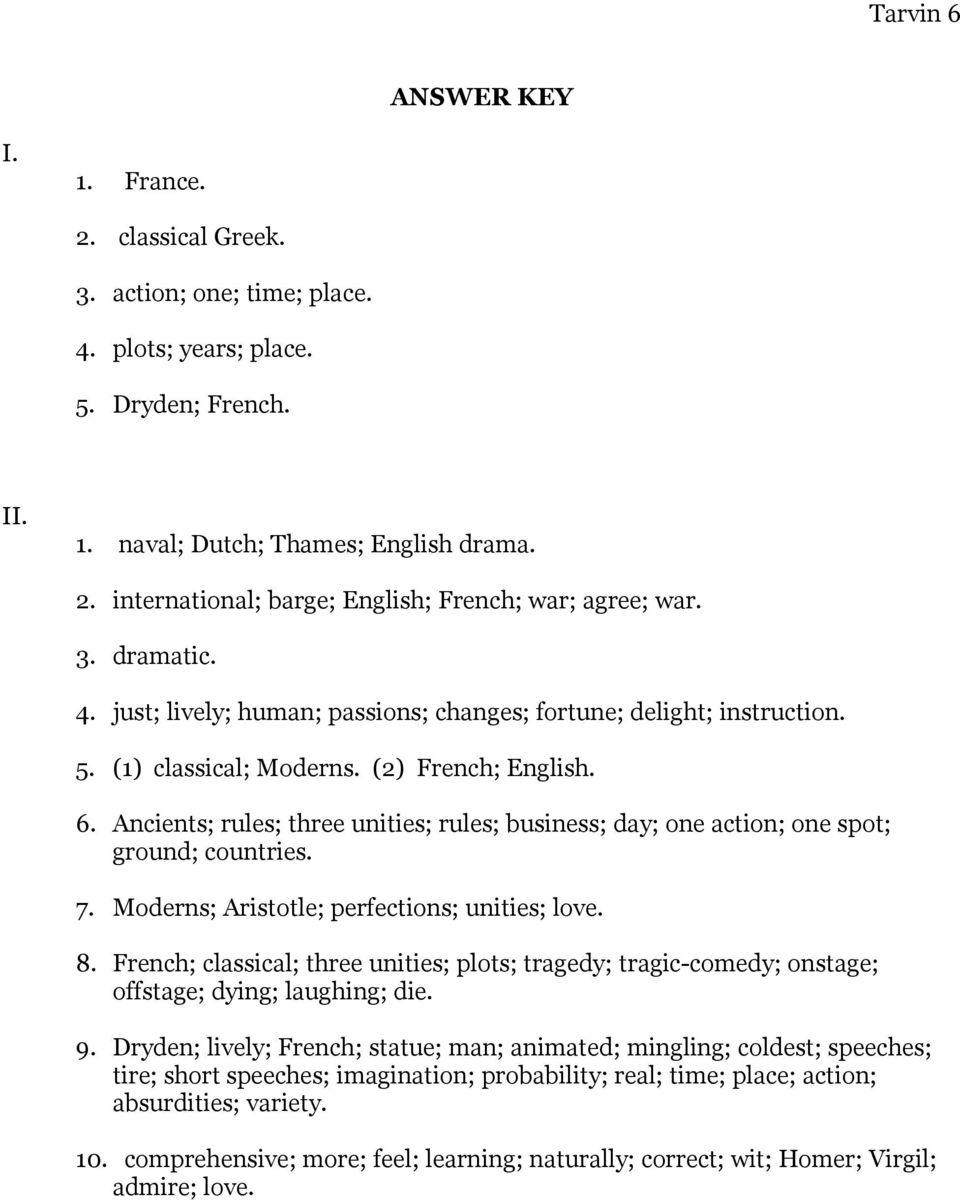
6 Tarvin 6 ANSWER KEY I. 1. France. 2. classical Greek. 3. action; one; time; place. 4. plots; years; place. 5. Dryden; French. II. 1. naval; Dutch; Thames; English drama. 2. international; barge; English; French; war; agree; war. 3. dramatic. 4. just; lively; human; passions; changes; fortune; delight; instruction. 5. (1) classical; Moderns. (2) French; English. 6. Ancients; rules; three unities; rules; business; day; one action; one spot; ground; countries. 7. Moderns; Aristotle; perfections; unities; love. 8. French; classical; three unities; plots; tragedy; tragic-comedy; onstage; offstage; dying; laughing; die. 9. Dryden; lively; French; statue; man; animated; mingling; coldest; speeches; tire; short speeches; imagination; probability; real; time; place; action; absurdities; variety. 10. comprehensive; more; feel; learning; naturally; correct; wit; Homer; Virgil; admire; love.
The Literature of Classical Greece
 The Literature of Classical Greece The golden age of classical Greece lasted from the early fifth to the late fourth century BC, and was concentrated in Asia Minor and the Greek Isles. Although this era
Unit 4: Chapter 8 Chapter Literary Focus
 Chapter Literary Focus SKILL BUILDER ELEMENTS OF DRAMA Write T or F on the line to tell whether it is true or false. 1. A story is prose narrative, while a play consists entirely of the characters words
English Literature Unit 3: Shakespeare and Contemporary Drama
 Edexcel GCSE English Literature Unit 3: Shakespeare and Contemporary Drama Sample Controlled Assessment Material Paper Reference 5ET03/01 Turn over S42139A 2012 Pearson Education Ltd. 1/2/1/ *S42139A*
Starting point for theatrical production Entity that remains intact after production Blueprint for production or for reader s imagination
 Chapter 3: The Play The Play is: Starting point for theatrical production Entity that remains intact after production Blueprint for production or for reader s imagination The play may serve as the basis
Lesson 3. The Novel ASSIGNMENT 8. Introduction to the Novel. Plot. Character
 The Novel ASSIGNMENT 8 Read the following Introduction to the Novel and the background to The Call of the Wild by Jack London. Then read pages 1 24 in the novel. When you finish your reading, study the
INTRODUCTION TO DRAMA UNIT 4
 INTRODUCTION TO DRAMA UNIT 4 DRAMA Drama: composition in prose form that presents a story entirely told in dialogue and action, and written with the intention of its eventual performance before an audience.
PROGRAM FOR LICENSING ASSESSMENTS FOR COLORADO EDUCATORS (PLACE ) OBJECTIVES FIELD 030: DRAMA
 PROGRAM FOR LICENSING ASSESSMENTS FOR COLORADO EDUCATORS (PLACE ) OBJECTIVES Subareas History of Theatre and Dramatic Literature Principles of Dramatic Literature and Theatre Theatrical Preparation and
TEACHER S GUIDE BIG IDEAS SIMPLY EXPLAINED THE VISUAL GUIDE TO UNDERSTANDING SHAKESPEARE. Aligned with the Common Core standards by Kathleen Odean
 BIG IDEAS SIMPLY EXPLAINED THE VISUAL TO UNDERSTANDING SHAKESPEARE Aligned with the Common Core standards by Kathleen Odean A WORLD OF IDEAS: SEE ALL THERE IS TO KNOW www.dk.com TIS HATCHED AND SHALL BE
A Tale of Two Cities
 Reflections: A Student Response Journal for A Tale of Two Cities by Charles Dickens written by Jack Turner Copyright 2007 by Prestwick House, Inc., P.O. Box 658, Clayton, DE 19938. 1-800-932-4593. www.prestwickhouse.com
A Tale of Two Cities by Charles Dickens
 A Tale of Two Cities by Charles Dickens Charles Dickens Born in 1812 in Portsmouth, England He had very encouraging parents who supported his writing and acting His father was sent to debtor s prison At
The KING S Medium Term Plan English Y7 Learning Cycle 4 Programme
 The KING S Medium Term Plan English Y7 Learning Cycle 4 Programme Module Building on prior learning Future learning Shakespeare: The Merchant of Venice This module will build on students knowledge of Shakespeare
Ancient Greece Unit Test
 Ancient Greece Unit Test Name: Date: Completion: Choose the correct word to complete each sentence: ancestors barbarians polis oligarchy democracy Delian aristocracy Illiad monarchy Hellenistic Odyssey
WRITING AN ESSAY Some thoughts to help you get started. A: 'Golden rules' of essay-writing
 WRITING AN ESSAY Some thoughts to help you get started. A: 'Golden rules' of essay-writing 1. STRUCTURE Always make it clear to yourself and to your reader: "Where you are, how you got there, and where
1. imagery 2. plot 3. foreshadowing. 10. structure 11. symbol 12. narrative. 13. motif 14. conflict 15. theme
 Literary Terms: English, R. Clemente name: 9 th Grade Literature Unit Two, study sheet A. Literary Terms... 1. imagery 2. plot 3. foreshadowing 4. alliteration 5. onomatopoeia 6. rhyme scheme 7. personification
Note: These activities are suitable for students who don t know a lot (possibly nothing at all) about Shakespeare s writing.
 Shakespeare Teacher s notes Level: Topic: Subject(s): Time (approx): Preparation: Lower Intermediate (and above) Shakespeare Literature and History Activity 1: 15-20 minutes Activity 2: 10 minutes Activity
Sophia s War: a Tale of the Revolution Teaching Guide
 Sophia s War: a Tale of the Revolution Teaching Guide ABOUT THE BOOK In 1776, the War of Independence comes to New York City, and to twelve-year-old Sophia Calderwood s family. William, her older soldier
Julius Caesar: Act I Reading and Study Guide
 Julius Caesar: Act I Reading and Study Guide Name Pd. I. VOCABULARY: Be able to define the following words and understand them when they appear in the play. wherefore exeunt ( k s - nt, - nt ) vulgar What
Dramatic & Stylistic Features of An Inspector Calls
 Dramatic & Stylistic Features of An Inspector Calls Well-made play In many respects, An Inspector Calls fulfils the criteria of the well-made play. The well-made play was invented by Eugene Scribe (1791-1861).
Genre Definitions. Albemarle County Public Schools, August 1996 Appendix F
 Genre Definitions I. Fiction A. Realistic Fiction Imaginative writing that accurately reflects life as it could be lived today. Everything is a realistic fiction story could conceivably happen to real
Hobbes, Locke, Montesquieu, and Rousseau on Government
 CONSTITUTIONAL RIGHTS FOUNDATION Bill of Rights in Action 20:2 Hobbes, Locke, Montesquieu, and Rousseau on Government Starting in the 1600s, European philosophers began debating the question of who should
EXAMS Leaving Certificate English
 EXAMS Leaving Certificate English Theme Language focus Learning focus Learning Support Language Support Exams: English Key vocabulary for exam questions, type and structure of questions. Understanding
Greek Tragedy The Sixth Century BCE
 Introduction: The Sixth Century BCE, or the End of the Pre Classical Age Theatron: Performance Space Actors and Acting in Greek Tragedy Conclusion: Euripides Orestes, or Why the Greeks Went to the Theatre
National Quali cations SPECIMEN ONLY
 H National Qualications SPECIMEN ONLY SQ11/H/01 Drama Date Not applicable Duration 2 hours Total s 40 SECTION 1 s Attempt ONE question. SECTION 2 s Attempt this question. Write your answers clearly in
EXAMPLE PAPER 2 PRACTICE ESSAY: GLASS MENAGERIE VS. ANTIGONE
 Ima Writer Period EXAMPLE PAPER 2 PRACTICE ESSAY: GLASS MENAGERIE VS. ANTIGONE Question: A dramatist often creates a gap between what the audience knows and what the characters know. With a reference to
A Modern Tragic Hero. Day had broken cold and gray, exceedingly cold and gray, (London, 341). In
 許 文 馨 Literary Criticism (I) January 12, 2006 A Modern Tragic Hero Day had broken cold and gray, exceedingly cold and gray, (London, 341). In the first sentence of Jack London s famous short story To Build
Sample Items. HEIghten Critical Thinking. Questions 1-2 are based on the material below.
 Questions 1-2 are based on the material below. HEIghten Critical Thinking Sample Items 1. Records indicate that William Shakespeare was baptized on April 26, 1564, and buried April 25, 1616, in Stratford-upon-Avon,
Romeo and Juliet Act 3 Scene 5
 What do we learn about Juliet s relationship with her father from? Why does Lord Capulet arrange his daughter s wedding to Paris? He wants to see his daughter settled and married to a man he approves of
Formal, Analytical Essay Writing. Review: Literary Analysis Format; Plagiarism (page # s refer to Writers Inc.)
 Formal, Analytical Essay Writing Review: Literary Analysis Format; Plagiarism (page # s refer to Writers Inc.) What is an Literary Analysis Essay? (pg 245-252) An essay is essentially an argument, based
D36. Core Analysis Frame: Poetry. Examine Content. Examine Form and Structure. (continued on page D37)
 Core Analysis Frame: Poetry D36 The questions on this analysis frame will help you achieve a basic understanding of any poem you read. For more advanced, in-depth analysis of each element, use the following
D24. Core Analysis Frame: Fiction. Examine Setting. Analyze Characters. Examine Plot. (continued on page D25)
 Core Analysis Frame: Fiction D24 These questions will help you understand any story you read. For more advanced, in-depth analysis of each element, use the following frames: Setting Plot Author s Craft
British Literature, Quarter 2, Unit 1 of 3. Macbeth. Overview
 British Literature, Quarter 2, Unit 1 of 3 Macbeth Overview Overall days: 20 (1 day = 50-55 minutes) Purpose The purpose of this unit is to read, analyze, and perform scenes from Shakespeare s Macbeth.
Greek Theater History Notes
 Greek Theater History Notes All drama originates from Ancient Greece where groups of people worshiped the god Dionysus by singing and dancing together. Soon, this religious ritual became formalized into
1. Give at least three characteristics of Mr. Jones. Be sure to cite where you find the evidence of these characteristics.
 Name Period Animal Farm Chapter Questions Directions: Answer each question in complete sentences. Chapter 1 Scullery Ensconced Benevolent Cynical Dissentients 1. Give at least three characteristics of
Exhibit memory of previously-learned materials by recalling facts, terms, basic concepts, and answers. Key Words
 The Six Levels of Questioning Level 1 Knowledge Exhibit memory of previously-learned materials by recalling facts, terms, basic concepts, and answers. who what why when where which omit choose find how
The Odyssey. Teaching Unit. Individual Learning Packet. by Homer (Trans. by W.H.D Rouse) ISBN 978-1-60389-877-5 Item No. 200672
 Individual Learning Packet Teaching Unit by Homer (Trans. by W.H.D Rouse) Copyright 1999 by Prestwick House Inc., P.O. Box 658, Clayton, DE 19938. 1-800-932-4593. www.prestwickhouse.com Permission to copy
Critical Analysis So what does that REALLY mean?
 Critical Analysis So what does that REALLY mean? 1 The words critically analyse can cause panic in students when they first turn over their examination paper or are handed their assignment questions. Why?
Teaching guide: AO2 - the ways in which meanings are shaped
 Teaching guide: AO2 - the ways in which meanings are shaped AS and A-level English Literature now require students to analyse a range of ways in which meanings are shaped in literary texts. Within this,
Evaluation Essay Movie Review
 Evaluation Essay Movie Review Everybody goes to the movie, it seems, to be entertained, but how many go to study movies as works of art. That is what movie reviewing involves: seeing a film as more than
Name: Date: Class: Read all directions carefully. When finished, review your test and check all answers.
 II. General Student Test with Answer Key Name: Date: Class: Read all directions carefully. When finished, review your test and check all answers. PART ONE: Multiple choice (2 points each) Choose the BEST
Stop Being Lost In Translation
 ESSAI Volume 2 Article 24 Spring 2004 Stop Being Lost In Translation Aaron Olson College of DuPage Follow this and additional works at: http://dc.cod.edu/essai Recommended Citation Olson, Aaron (2004)
Poetry to Play Creating a Dramatic Scene from a Chapter of The Odyssey Lesson Plan
 Poetry to Play Creating a Dramatic Scene from a Chapter of The Odyssey Grade Level: 9-12 Curriculum Focus: Literature Lesson Duration: Two or more class periods Student Objectives Materials Discover that
TWAS THE NIGHT BEFORE CHRISTMAS STUDY GUIDE
 TWAS THE NIGHT BEFORE CHRISTMAS STUDY GUIDE TEACHERS: Twas The Night Before Christmas is a very special type of show. This performance is the sequel to our highly popular show, The 12 Days Of Christmas.
Conventions of the Formal Essay
 Name 1. Write in the third person. Conventions of the Formal Essay Avoid using the first person (I, me, we, us). In analytical writing, you are not expressing opinion; instead, you are making objective
ENGLISH LANGUAGE ARTS TESTING OUT EXAM
 ENGLISH 9 ENGLISH LANGUAGE ARTS TESTING OUT EXAM ANN ARBOR PUBLIC SCHOOLS Sytlabns HURON/PIONEER HIGH SCHOOL English 9 2nd semester Passing standard (C+) For the exam, students must provide their own pens,
Name: English 11 Kingsbury/Tietz
 Name: English 11 Kingsbury/Tietz Chapter 1 1. How does Nick describe himself at the beginning of the novel? 2. How do East and West Egg compare? 3. During what period is the novel set? 4. How does Nick
General Certificate of Secondary Education June 2010
 General Certificate of Secondary Education June 2010 English Literature 3712/H (Specification A) Higher Tier Tuesday 25 May 2010 9.00 am to 10.45 am H For this paper you must have:! a 12-page answer book!
GREEK THEATRE. Objective: To analyze the rudiments of theatre history through Greek Theatre.
 GREEK THEATRE Objective: To analyze the rudiments of theatre history through Greek Theatre. What do you know already about Greek Theatre? What do you think it s about? WHAT DO YOU SEE? VIDEO OF GREEK THEATRE
7. What do you think Zaroff means when he says to himself, the American hadn t played the game?
 Name: Period: Sullivan Eng I Advanced Short Story Unit THIS WILL COUNT AS A MAJOR GRADE WHEN COMPLETE. Reading questions: 50 points Map: 15 points Charts and diagrams: 35 points The Most Dangerous Game
THE ART OF ACTING 3: SHAKESPEARE S VERSE. Daniel Foster
 THE ART OF ACTING 3: SHAKESPEARE S VERSE Daniel Foster As most of you know, performing Shakespeare often requires the speaking of verse, usually blank verse, with a rhyming couplet at the end of certain
General information for studying GCSE English Literature
 General information for studying GCSE English Literature Examination questions Styles of questions These examples of different types of examination question are taken from the sample assessment materials.
Rising Action. The action and events that take place in the story and build up to the critical moment when the main conflict is confronted.
 PLOT The sequence of events or actions in a short story, novel, play, or narrative poem Exposition The author lays the groundwork for the story by revealing the Setting Relationships between the Situation
Classical Music Ludwig Van Beethoven
 Non-fiction: Classical Music Ludwig Van Beethoven Classical Music Ludwig Van Beethoven When Beethoven met Mozart in Vienna in 1787, Mozart said, You will make a big noise in the world. Mozart was right.
MASTER OF ARTS IN ENGLISH M.A. (English)
 MASTER OF ARTS IN ENGLISH M.A. (English) The master s degree in English has four major areas of concentration: Asian Literature, English and American Literature, Creative Writing, and Teaching English
WSESU English Language & Literature Curriculum Framework
 WSESU English Language & Literature Curriculum Framework WSESU ENGLISH LANGUAGE AND LITERATURE STANDARDS 5.8 TYPES OF LITERATURE Students read a variety of types of literature, fiction and nonfiction (e.g.,
Journal for Nightswimming
 Journal for Nightswimming Read the lyrics of Nightswimming. 1.Note any important aspects of the song in relation to growing up, the passage of time, etc. in the margin or by underlining key words/phrases.
Active Reading Hamlet Act 1
 Active Reading Hamlet Act 1 All the major characters of Hamlet emerge in the first act. As you read act 1, focus on Hamlet s developing relationships with the characters listed below. In each box state
Name: Date: Ms. Hepner English 10R. Steps to Writing a Critical Lens Essay
 Name: Date: Ms. Hepner English 10R Critical Lens: Introduction Steps to Writing a Critical Lens Essay 1. Recopy the critical lens statement (the quote) word for word and leave it in quotation marks. Be
ROMEO AND JULIET Study Questions
 ROMEO AND JULIET Study Questions As you read the play either at home or in class, try to answer the questions as best you can and plan to come to class seeking the answers you could not get on your own.
Using sentence fragments
 Lesson 8 Descriptive Essays Description is not a distinct mode of writing, like expository, narrative, and persuasive, but the ability to write descriptively is essential to a host of writing genres. Many
WRITING A CRITICAL ARTICLE REVIEW
 WRITING A CRITICAL ARTICLE REVIEW A critical article review briefly describes the content of an article and, more importantly, provides an in-depth analysis and evaluation of its ideas and purpose. The
WELCOME TO GOD S FAMILY
 WELCOME TO GOD S FAMILY To all who received him, to those who believed in his name, he gave the right to become children of God children born not of natural descent, nor of human decision or a husband
There s a Boy in the Girls Bathroom by Louis Sachar
 There s a Boy in the Girls Bathroom by Louis Sachar This unit lasts three weeks This book has as its main character Bradley Chalkers, a bad boy who is always in trouble. In this story, we are allowed to
School and Festival Appearances. By Brian Falkner - Author
 School and Festival Appearances By Brian Falkner - Author School and Festival Visits By Brian Falkner - Author Introduction You have probably been sent this document if your school is expecting or considering
Teacher Guide for FAST-R Passage: FAST-R: Formative Assessments of Student Thinking in Reading
 Teacher Guide for FAST-R Passage: FAST-R: Formative Assessments of Student Thinking in Reading Shakespeare Sonnet 116 & Elizabeth Barrett Browning Sonnet 43 (Poetry) At a Glance Recommended for Reading
Grade 4 Writing Curriculum Map
 Curriculum Map BOE Approval November 2013 CURRICULUM MAP WRITING GRADE 4 SEPTEMBER OCTOBER NOVEMBER DECEMBER JANUARY Creating a Buzz About : It s All About Me! Tell Me A Story Realistic Fiction Tell Me
HarperOne Reading and Discussion Guide for The Weight of Glory. Reading and Discussion Guide for. The Weight of Glory. C. S. Lewis.
 Reading and Discussion Guide for The Weight of Glory by C. S. Lewis The Weight of Glory is a series of essays and talks that Lewis wrote over a long period (roughly between 1939 and 1956). We have organized
Elements of a Novel and Narrative Writing Grade 10
 Ohio Standards Connection Literary Text Benchmark B Explain and analyze how the context of setting and the author s choice of point of view impact a literary text. Indicator 2 Analyze the features of setting
Classroom Drama From Classic Literature
 Classroom Drama From Classic Literature TABLE OF CONTENTS For the Teacher: Introduction ---------------------------------------------------------------------------------- 3 Skills and Knowledge Acquired
Pre-AP English I, Period Of Mice and Men Study Guide. Literary Terms
 Name Pre-AP English I, Period Of Mice and Men Study Guide Date Literary Terms CHARACTERIZATION: Find an example of Steinbeck's use of characterization to describe three of the following characters. Then
Comparing a Play and a Film
 A Rose by Any Other Name INTRODUCTION Attention-getter What s in a name? That which we call a rose By any other word would smell as sweet. (Romeo and Juliet II.2.43-44) Introduction of film, play, and
What are you. worried about? Looking Deeper
 What are you worried about? Looking Deeper Looking Deeper What are you worried about? Some of us lie awake at night worrying about family members, health, finances or a thousand other things. Worry can
The following questions are a combination of comprehension/knowledge level questions and interpretive level questions.
 THE GREAT GATSBY GUIDED QUESTIONS The following questions are a combination of comprehension/knowledge level questions and interpretive level questions. CHAPTER ONE 1. How does Nick describe himself at
ANALYZING SHORT STORIES/NOVELS
 ANALYZING SHORT STORIES/NOVELS When analyzing fiction, you should consider the plot, setting, characters, point of view, imagery, symbolism, tone, irony, and the theme. PLOT Plot refers to what happens
ACTIVITY SHEET A CRITIC FOR A DAY. 1. In which theatre you saw the musical. 2. A brief account of the plot (don t give too much away)
 A CRITIC FOR A DAY Now that you have seen My Fair Lady, write the kind of review that might go into a newspaper. Try looking in a few of the Sunday newspapers to get ideas about how they are written. Make
MAIN POINT THIS WEEK: Father, Son, and Spirit are united in their work (14:17 18, 23, 26; 15:26; 20:21 22).
 LESSON 12 The Word is UNIFIED WITH FATHER AND SPIRIT IN THEIR WORK OF REVELATION AND REDEMPTION FACILITATOR S Note MAIN POINT THIS WEEK: Father, Son, and Spirit are united in their work (14:17 18, 23,
ANIMAL FARM STUDY GUIDE CHAPTERS ONE FOUR
 ANIMAL FARM STUDY GUIDE CHAPTERS ONE FOUR Remember to give textual support in all of your answers; trust me, it will benefit you later on when you re studying for the tests! Remember to cite support correctly.
More Than Just Words: Concerning Shakespeare. Jester Touchstone in William Shakespeare s comedy As You Like It declares, The fool
 Buckley 1 Erica Buckley Professor Fellinger EN 150 3 October 2014 More Than Just Words: Concerning Shakespeare Jester Touchstone in William Shakespeare s comedy As You Like It declares, The fool doth think
Read, discuss, write. Read, discuss, write. Read, discuss, write. Read, discuss, write. Read, discuss, write. Read, discuss, write
 Themes Week Text Task 1 Act I scene i Introduction Writing Prompt/Activity What do you expect to gain from this experience? Literary Term 2 Act I Fate 3 Act II 4 Act II Would you want to know your future?
The Once and Future King
 Individual Learning Packet Teaching Unit The Once and Future King by T.H. White Copyright 2000 by Prestwick House Inc., P.O. Box 658, Clayton, DE 19938. 1-800-932-4593. www.prestwickhouse.com Permission
Ancient Rome: Expansion and Conquest: Teacher s Guide
 Ancient Rome: Expansion and Conquest: Teacher s Guide Grade Level: 6-8 Curriculum Focus: Ancient History Lesson Duration: Two class periods Program Description They came, they saw, they conquered. They
What is your name? Do you think it reveals something about your identity and where you come from? If so, what does it reveal?
 Red Dog Identity Regardless of who we are, or where we come from, we all have our own identity. Your name, the school you go to, the suburb you live in, the country in which you were raised in are just
[i carry your heart with me(i carry it in] i carry your heart with me(i carry it in. my heart)i am never without it(anywhere
![[i carry your heart with me(i carry it in] i carry your heart with me(i carry it in. my heart)i am never without it(anywhere](/thumbs/40/21579009.jpg "[i carry your heart with me(i carry it in] i carry your heart with me(i carry it in. my heart)i am never without it(anywhere") 1 2 3 4 5 6 7 8 9 10 Edward Estlin Cummings (E.E. Cummings) was born in Cambridge, Massachusetts on October 14, 1894, to a well-known family. His father was a professor at Harvard University. His mother,
1 2 3 4 5 6 7 8 9 10 Edward Estlin Cummings (E.E. Cummings) was born in Cambridge, Massachusetts on October 14, 1894, to a well-known family. His father was a professor at Harvard University. His mother,
Grade 4: Module 3B: Unit 3: Lesson 2 Reading Opinion Pieces, Part II: How Authors Support Their Opinions with Reasons and Evidence
 Grade 4: Module 3B: Unit 3: Lesson 2 How Authors Support Their Opinions with Reasons and Evidence This work is licensed under a Creative Commons Attribution-NonCommercial-ShareAlike 3.0 Unported License.
Create an Editorial Cartoon
 Create an Editorial Cartoon Background Information for Students What is an Editorial Cartoon? Editorial cartoons use humor and satire to show a position about current issues. Editorial cartoons constitute
THE HISTORY OF FRANKENSTEIN
 THE HISTORY OF FRANKENSTEIN Mary Shelley s novel, FRANKENSTEIN, first appeared in 1818. Since then the story has been retold and adapted for the stage, on film, on radio, on television and in comics. There
Leaving Certificate. English. Ordinary Level
 Leaving Certificate English Ordinary Level Leaving Certificate English is made up of two examination papers. Paper One is a language paper and Paper Two is a literature paper. General Tips: Always make
The Arts and Architecture
 Lesson 4 The Legacy of Greece MAIN IDEAS Culture Greek art and architecture introduced new styles and concepts that set standards for generations of artists around the world. Culture The Greek love of
The Scarlet Letter. Chapters 1-8
 The Scarlet Letter Study guide The Scarlet Letter Chapters 1-8 GROUP FOCUS ACTIVITY How does our society punish people who break the law? In a small group, talk about shame and what role it plays in the
Hints and tips on how to get the most out of the performance. Book 4. Acting tips
 Hints and tips on how to get the most out of the performance. Book 4 Acting tips Tips on how to introduce the show to the group, run workshops, explore the text, cast and organise the show. Before the
Teaching Unit The Comedy of Errors written by Ashlin Bray
 Individual Learning Packet Teaching Unit by William Shakespeare written by Ashlin Bray Copyright 2006 by Prestwick House Inc., P.O. Box 658, Clayton, DE 19938. 1-800-932-4593. www.prestwickhouse.com Permission
English Courses & Descriptions
 English Courses & Descriptions ENGL 101. Elements of Composition (3; F, S) Three hours per week. An emphasis on the principles of writing and an introduction to the reading of college-level prose. ENGL
How To Understand The Nature Of God
 The Nature of God Teleological argument (intelligent design) Order and complexity via intelligent design by God. From Greek word telos meaning purpose suggests that the world has been designed for a purpose.
North Carolina Essential Standards Kindergarten Theatre Arts. Communication. Analysis. Aesthetics
 North Carolina s Kindergarten Theatre Arts Note on Numbering/Strands: C - Communication, A - Analysis, AE Aesthetics, CU - Culture Communication K.C.1 K.C.2 Use movement, voice, and writing to communicate
Dr. Bill E. Lawson, Scholar/Philosopher. My general sense of Booker T. Washington is that he was committed to the
 Reflections on Booker T. Washington in Uncle Tom or New Negro?_African Americans Reflect on Booker T. Washington and UP FROM SLAVERY 100 Years Later, editor Rebecca Carroll, Harlem Moon, 2006 Dr. Bill
Imagery and Figurative Language in Wordsworth s Poem s "The World is too much with us" and "My Heart Leaps up"
 Imagery and Figurative Language in Wordsworth s Poem s "The World is too much with us" and "My Heart Leaps up" Dr. Chirag M. Patel (Asst.Professor - SIT Affiliated to GTU) Email - [email protected]
Our Country s Good. Social, Historic and political Context http://www.youtube.com/watch?v= jog38f2kabw&safe=active
 Our Country s Good Social, Historic and political Context http://www.youtube.com/watch?v= jog38f2kabw&safe=active And remember There is loads more here- http://www.bgsperformingarts.com/ourcountrys-good.html
WILL WE BE MARRIED IN THE LIFE AFTER DEATH?
 Explanatory Notes: WILL WE BE MARRIED IN THE LIFE AFTER DEATH? Series title: Topic: Marriage in heaven / heaven as a marriage Table of Contents: Message 1: What is the Life after Death Like? p. 1 Message
French Revolution [10th grade]
![French Revolution [10th grade]](/thumbs/40/20826976.jpg "French Revolution [10th grade]") Trinity University Digital Commons @ Trinity Understanding by Design: Complete Collection Understanding by Design 6-15-2006 French Revolution [10th grade] Jenna Smith Trinity University Follow this and
Trinity University Digital Commons @ Trinity Understanding by Design: Complete Collection Understanding by Design 6-15-2006 French Revolution [10th grade] Jenna Smith Trinity University Follow this and
Oedipus and Troy Maxson: The Classic and Modern Tragic Heroes of Literature
 Carlson 1 Oedipus and Troy Maxson: The Classic and Modern Tragic Heroes of Literature What makes a hero? Many would think of modern day superheroes such as Super Man, Spider Man, and Wonder Woman. Fighting
Live by Faith. A Disciple s Response to God s Word
 Live by Faith A Disciple s Response to God s Word Most of us get along pretty well in this world. Our physical senses serve us well in exploring our world and exposing any dangers that dwell there. We