
The concept of human resource management
|
|
|
- Howard Blankenship
- 9 years ago
- Views:
Transcription
1 1 5 The concept of human resource management In the first section of this chapter human resource management (HRM) is defined in general and as a system. Its aims and characteristics are described in later sections of the chapter. HRM DEFINED Human resource management is defined as a strategic and coherent approach to the management of an organization s most valued assets the people working there, who individually and collectively contribute to the achievement of its objectives. Boxall et al (2007) describe HRM as the management of work and people towards desired ends. John Storey (1989) believes that HRM can be regarded as a set of interrelated policies with an ideological and philosophical underpinning. He suggests four aspects that constitute the meaningful version of HRM: 1) a particular constellation of beliefs and assumptions; 2) a strategic thrust informing decisions about people management; 3) the central involvement of line managers; and 4) reliance upon a set of levers to shape the employment relationship. HRM is further defined by the two models of HRM developed by what might be described as its founding fathers.

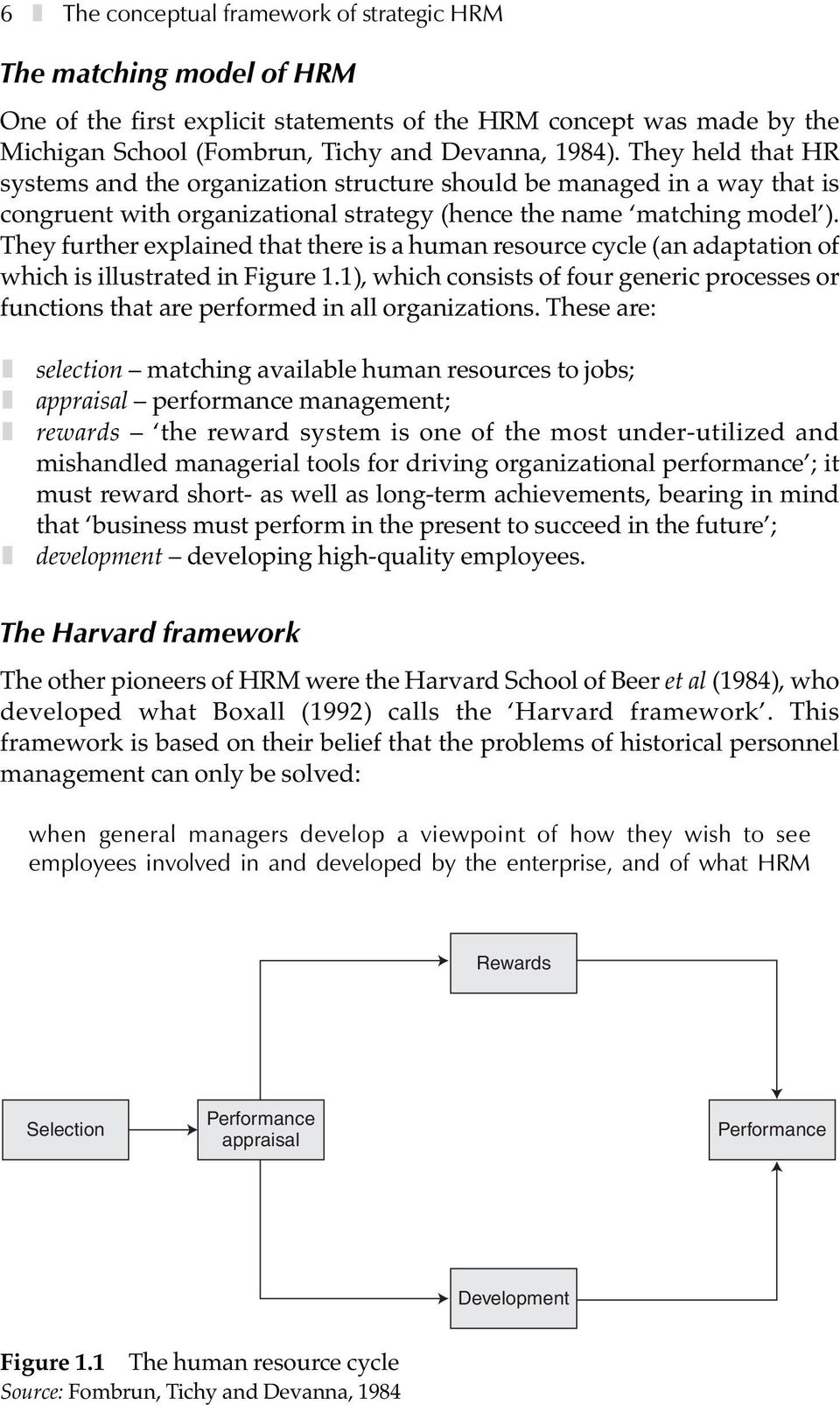
2 6 l The conceptual framework of strategic HRM The matching model of HRM One of the first explicit statements of the HRM concept was made by the Michigan School (Fombrun, Tichy and Devanna, 1984). They held that HR systems and the organization structure should be managed in a way that is congruent with organizational strategy (hence the name matching model ). They further explained that there is a human resource cycle (an adaptation of which is illustrated in Figure 1.1), which consists of four generic processes or functions that are performed in all organizations. These are: l selection matching available human resources to jobs; l appraisal performance management; l rewards the reward system is one of the most under-utilized and mishandled managerial tools for driving organizational performance ; it must reward short- as well as long-term achievements, bearing in mind that business must perform in the present to succeed in the future ; l development developing high-quality employees. The Harvard framework The other pioneers of HRM were the Harvard School of Beer et al (1984), who developed what Boxall (1992) calls the Harvard framework. This framework is based on their belief that the problems of historical personnel management can only be solved: when general managers develop a viewpoint of how they wish to see employees involved in and developed by the enterprise, and of what HRM Rewards Selection Performance appraisal Performance Development Figure 1.1 The human resource cycle Source: Fombrun, Tichy and Devanna, 1984
3 The concept of human resource management l 7 policies and practices may achieve those goals. Without either a central philosophy or a strategic vision which can be provided only by general managers HRM is likely to remain a set of independent activities, each guided by its own practice tradition. Beer and his colleagues believed that, Today, many pressures are demanding a broader, more comprehensive and more strategic perspective with regard to the organization s human resources. These pressures have created a need for A longer-term perspective in managing people and consideration of people as potential assets rather than merely a variable cost. They were the first to underline the HRM tenet that it belongs to line managers. They also stated that Human resource management involves all management decisions and action that affect the nature of the relationship between the organization and its employees its human resources. The Harvard school suggested that HRM had two characteristic features: 1) line managers accept more responsibility for ensuring the alignment of competitive strategy and personnel policies; 2) personnel has the mission of setting policies that govern how personnel activities are developed and implemented in ways that make them more mutually reinforcing. The Harvard framework as modelled by Beer et al is shown in Figure 1.2. Stakeholder interests: shareholders management employees government unions HRM policy choices: employee influence human resource flow reward systems work systems HR outcomes: Long-term consequences: individual well-being organizational effectiveness societal wellbeing Situational factors: workforce characteristics business strategy and conditions management philosophy labour market unions task technology laws and social values commitment congruence costeffectiveness Figure 1.2 The Harvard framework for human resource management Source: Beer et al, 1984

4 8 l The conceptual framework of strategic HRM According to Boxall (1992) the advantages of this model are that it: l incorporates recognition of a range of stakeholder interests; l recognizes the importance of trade-offs, either explicitly or implicitly, between the interests of owners and those of employees as well as between various interest groups; l widens the context of HRM to include employee influence, the organization of work and the associated question of supervisory style; l acknowledges a broad range of contextual influences on management s choice of strategy, suggesting a meshing of both product-market and socio-cultural logics; l emphasizes strategic choice it is not driven by situational or environmental determinism. HRM is seen in the UK as a substantially different model built on unitarism, individualism, high commitment and strategic alignment (Guest, 1987). However, the Harvard model has exerted considerable influence over the theory and practice of HRM, particularly in its emphasis on the fact that HRM is the concern of management in general rather than the HR function in particular. As Boxall, Purcell and Wright (2007) point out, HRM is not just what HR departments do. HUMAN RESOURCE SYSTEMS Human resource management operates through human resource systems as illustrated in Figure 1.3. These bring together in a coherent way: l HR philosophies, describing the overarching values and guiding principles adopted in managing people; l HR strategies, defining the direction in which HRM intends to go; l HR policies, which are the guidelines defining how these values, principles and strategies should be applied and implemented in specific areas of HRM; l HR processes, consisting of the formal procedures and methods used to put HR strategic plans and policies into effect; l HR practices, consisting of the informal approaches used in managing people; l HR programmes, which enable HR strategies, policies and practices to be implemented according to plan.

5 The concept of human resource management l 9 HUMAN RESOURCE MANAGEMENT HR philosophies Human capital management HR strategies, policies, processes, practices and programmes Corporate social responsibility Organization Resourcing Learning and development Reward management Employee relations Design Workforce planning Organizational learning Job evaluation/ market surveys Industrial relations Development Recruitment and selection Individual learning Grade and pay structures Employee voice Job/role design Talent management Management development Contingent pay Communications Health and safety Performance management Employee benefits Employee well-being Knowledge management HR services Figure 1.3 HRM activities AIMS OF HRM The overall purpose of human resource management is to ensure that the organization is able to achieve success through people. As Ulrich and Lake (1990) remark: HRM systems can be the source of organizational capabilities that allow firms to learn and capitalize on new opportunities. Dyer and Holder (1988) analyse management s HR goals under the dimensions of contribution (what kind of employee behaviour is expected?),

6 10 l The conceptual framework of strategic HRM composition (what headcount, staffing ratio and skill mix?), competence (what general level of ability is desired?) and commitment (what level of employee attachment and identification?). Twelve policy goals for HRM have been identified by Caldwell (2004): 1. managing people as assets that are fundamental to the competitive advantage of the organization; 2. aligning HRM policies with business policies and corporate strategy; 3. developing a close fit of HR policies, procedures and systems with one another; 4. creating a flatter and more flexible organization capable of responding more quickly to change; 5. encouraging teamworking and cooperation across internal organizational boundaries; 6. creating a strong customer-first philosophy throughout the organization; 7. empowering employees to manage their own self-development and learning; 8. developing reward strategies designed to support a performance-driven culture; 9. improving employee involvement through better internal communication; 10. building greater employee commitment to the organization; 11. increasing line management responsibility for HR policies; 12. developing the facilitating role of managers as enablers. But as Dyer and Holder (1988) emphasize: HRM goals vary according to competitive choices, technologies or service tangibles, characteristics of their employees (eg could be different for managers), the state of the labour market and the societal regulations and national culture. And Boxall, Purcell and Wright (2007) note that The general motives of HRM are multiple. Specifically, HRM is concerned with achieving objectives in the areas summarized below. Organizational effectiveness Distinctive human resource practices shape the core competencies that determine how firms compete (Cappelli and Crocker-Hefter, 1996). Extensive research has shown that such practices can make a significant impact on firm performance. HRM strategies aim to support programmes for improving organizational effectiveness by developing policies in such areas as knowledge management, talent management and generally creating a great place to work. This is the big idea as described by Purcell et al

7 The concept of human resource management l 11 (2003), which consists of a clear vision and a set of integrated values. More specifically, HR strategies can be concerned with the development of continuous improvement and customer relations policies. Human capital management The human capital of an organization consists of the people who work there and on whom the success of the business depends. It has been defined by Bontis et al (1999) as follows: Human capital represents the human factor in the organization; the combined intelligence, skills and expertise that gives the organization its distinctive character. The human elements of the organization are those that are capable of learning, changing, innovating and providing the creative thrust which if properly motivated can ensure the long-term survival of the organization. Human capital can be regarded as the prime asset of an organization, and businesses need to invest in that asset to ensure their survival and growth. HRM aims to ensure that the organization obtains and retains the skilled, committed and well-motivated workforce it needs. This means taking steps to assess and satisfy future people needs and to enhance and develop the inherent capacities of people their contributions, potential and employability by providing learning and continuous development opportunities. It involves the operation of rigorous recruitment and selection procedures, performance-contingent incentive compensation systems, and management development and training activities linked to the needs of the business (Becker et al, 1997). It also means engaging in talent management the process of acquiring and nurturing talent, wherever it is and wherever it is needed, by using a number of interdependent HRM policies and practices in the fields of resourcing, learning and development, performance management and succession planning. The process of human capital management (HCM) as described in the next chapter is closely associated with human resource management. However, the focus of HCM is more on the use of metrics (measurements of HR and people performance) as a means of providing guidance on people management strategy and practice. Knowledge management Knowledge management is any process or practice of creating, acquiring, capturing, sharing and using knowledge, wherever it resides, to enhance learning and performance in organizations (Scarborough et al, 1999). HRM aims to support the development of firm-specific knowledge and skills that are the result of organizational learning processes.

8 12 l The conceptual framework of strategic HRM Reward management HRM aims to enhance motivation, job engagement and commitment by introducing policies and processes that ensure that people are valued and rewarded for what they do and achieve and for the levels of skill and competence they reach. Employee relations The aim is to create a climate in which productive and harmonious relationships can be maintained through partnerships between management and employees and their trade unions. Meeting diverse needs HRM aims to develop and implement policies that balance and adapt to the needs of its stakeholders and provide for the management of a diverse workforce, taking into account individual and group differences in employment, personal needs, work style and aspirations and the provision of equal opportunities for all. Bridging the gap between rhetoric and reality The research conducted by Gratton et al (1999) found that there was generally a wide gap between the sort of rhetoric expressed above and reality. Managements may start with good intentions to do some or all of these things, but the realization of them theory in use is often very difficult. This arises because of contextual and process problems: other business priorities, short-termism, limited support from line managers, an inadequate infrastructure of supporting processes, lack of resources, resistance to change and lack of trust. An overarching aim of HRM is to bridge this gap by making every attempt to ensure that aspirations are translated into sustained and effective action. To do this, members of the HR function have to remember that it is relatively easy to come up with new and innovatory policies and practice. The challenge is to get them to work. They must appreciate, in the phrase used by Purcell et al (2003), that it is the front-line managers who bring HR policies to life, and act accordingly. CHARACTERISTICS OF HRM The characteristics of the HRM concept are that it is: l diverse; l strategic, with an emphasis on integration;

9 The concept of human resource management l 13 l commitment-orientated; l based on the belief that people should be treated as assets (human capital); l unitarist rather than pluralist, individualistic rather than collective, in its approach to employee relations; l a management-driven activity the delivery of HRM is a line management responsibility; l focused on business values, although this emphasis is being modified in some quarters and more recognition is being given to the importance of moral and social values. The diversity of HRM There are no universal characteristics of HRM. Many models exist, and practices within different organizations are diverse, often corresponding to the conceptual version of HRM in only a few respects. As Boxall et al (2007) remark: Human resource management covers a vast array of activities and shows a huge range of variations across occupations, organizational levels, business units, firms, industries and societies. Hendry and Pettigrew (1990) play down the prescriptive element of the HRM model and extend the analytical elements. As pointed out by Boxall (1992), such an approach rightly avoids labelling HRM as a single form and advances more slowly by proceeding more analytically. It is argued by Hendry and Pettigrew that better descriptions of structures and strategymaking in complex organizations, and of frameworks for understanding them, are an essential underpinning for HRM. A distinction was made by Storey (1989) between the hard and soft versions of HRM. The hard version of HRM emphasizes that people are important resources through which organizations achieve competitive advantage. These resources have therefore to be acquired, developed and deployed in ways that will benefit the organization. The focus is on the quantitative, calculative and business-strategic aspects of managing human resources in as rational a way as for any other economic factor. As Guest (1999) comments, The drive to adopt HRM is based on the business case of a need to respond to an external threat from increasing competition. It is a philosophy that appeals to managements who are striving to increase competitive advantage and appreciate that to do this they must invest in human resources as well as new technology. He also comments that HRM reflects a long-standing capitalist tradition in which the worker is regarded as a commodity. The emphasis is therefore on the interests of management, integration with business strategy, obtaining added value from people by the processes of human resource development and performance management, and the need for a strong corporate culture expressed in mission and value

10 14 l The conceptual framework of strategic HRM statements and reinforced by communications, training and performance management processes. The soft version of HRM traces its roots to the human-relations school; it emphasizes communication, motivation and leadership. As described by Storey (1989), it involves treating employees as valued assets, a source of competitive advantage through their commitment, adaptability and high quality (of skills, performance and so on). It therefore views employees, in the words of Guest (1999), as means rather than objects, but it does not go as far as following Kant s (2003 [1781]) advice: Treat people as ends unto themselves rather than as means to an end. The soft approach to HRM stresses the need to gain the commitment the hearts and minds of employees through involvement, communications and other methods of developing a high-commitment, high-trust organization. Attention is also drawn to the key role of organizational culture. In 1998, Karen Legge defined the hard model of HRM as a process emphasizing the close integration of human resource policies with business strategy which regards employees as a resource to be managed in the same rational way as any other resource being exploited for maximum return. In contrast, the soft version of HRM sees employees as valued assets and as a source of competitive advantage through their commitment, adaptability and high level of skills and performance. It has, however, been observed by Truss (1999) that, even if the rhetoric of HRM is soft, the reality is often hard, with the interests of the organization prevailing over those of the individual. And research carried out by Gratton et al (1999) found that, in the eight organizations they studied, a mixture of hard and soft HRM approaches was identified. This suggested to the researchers that the distinction between hard and soft HRM was not as precise as some commentators have implied. The strategic nature of HRM Perhaps the most significant feature of HRM is the importance attached to strategic integration, which flows from top management s vision and leadership, and which requires the full commitment of people to it. David Guest (1987, 1989a, 1989b, 1991) believes that this is a key policy goal for HRM, which is concerned with the ability of the organization to integrate HRM issues into its strategic plans, to ensure that the various aspects of HRM cohere, and to encourage line managers to incorporate an HRM perspective into their decision making. Karen Legge (1989) considers that one of the common themes of the typical definitions of HRM is that human resource policies should be integrated with strategic business planning. Keith Sisson (1990) suggests that a

11 The concept of human resource management l 15 feature increasingly associated with HRM is a stress on the integration of HR policies both with one another and with business planning more generally. John Storey (1989) suggests that The concept locates HRM policy formulation firmly at the strategic level and insists that a characteristic of HRM is its internally coherent approach. The commitment-orientated nature of HRM The importance of commitment and mutuality was emphasized by Walton (1985) as follows: The new HRM model is composed of policies that promote mutuality mutual goals, mutual influence, mutual respect, mutual rewards, mutual responsibility. The theory is that policies of mutuality will elicit commitment which in turn will yield both better economic performance and greater human development. David Guest (1987) wrote that one of the HRM policy goals was the achievement of high commitment behavioural commitment to pursue agreed goals, and attitudinal commitment reflected in a strong identification with the enterprise. It was noted by Karen Legge (1995) that human resources may be tapped most effectively by mutually consistent policies that promote commitment and which, as a consequence, foster a willingness in employees to act flexibly in the interests of the adaptive organization s pursuit of excellence. But this emphasis on commitment has been criticized from the earliest days of HRM. Guest (1987) asked: commitment to what?, and Fowler (1987) has stated: At the heart of the concept is the complete identification of employees with the aims and values of the business employee involvement but on the company s terms. Power, in the HRM system, remains very firmly in the hands of the employer. Is it really possible to claim full mutuality when at the end of the day the employer can decide unilaterally to close the company or sell it to someone else? People as human capital The notion that people should be regarded as assets rather than variable costs, in other words treated as human capital, was originally advanced by Beer et al (1984). HRM philosophy, as mentioned by Karen Legge (1995), holds that human resources are valuable and a source of competitive advantage. Armstrong and Baron (2002) stated that People and their collective skills, abilities and experience, coupled with their ability to deploy these in the interests of the employing organization, are now recognized as making a significant contribution to organizational success and as constituting a significant source of competitive advantage.

12 16 l The conceptual framework of strategic HRM Unitary philosophy The HRM approach to employee relations is basically unitary it is believed that employees share the same interests as employers. This contrasts with what could be regarded as the more realistic pluralist view, which says that all organizations contain a number of interest groups and that the interests of employers and employees do not necessarily coincide. Individualistic HRM is individualistic in that it emphasizes the importance of maintaining links between the organization and individual employees in preference to operating through group and representative systems. HRM as a management-driven activity HRM can be described as a central, senior management-driven strategic activity that is developed, owned and delivered by management as a whole to promote the interests of their organization. John Purcell (1993) thinks that the adoption of HRM is both a product of and a cause of a significant concentration of power in the hands of management, while the widespread use of the language of HRM, if not its practice, is a combination of its intuitive appeal to managers and, more importantly, a response to the turbulence of product and financial markets. He asserts that HRM is about the rediscovery of management prerogative. He considers that HRM policies and practices, when applied within a firm as a break from the past, are often associated with words such as commitment, competence, empowerment, flexibility, culture, performance, assessment, reward, teamwork, involvement, cooperation, harmonization, quality and learning. But the danger of descriptions of HRM as modern best-management practice is that they stereotype the past and idealize the future. Keith Sisson (1990) suggests that The locus of responsibility for personnel management no longer resides with (or is relegated to ) specialist managers. More recently, Purcell et al (2003) underline the importance of line management commitment and capability as the means by which HR policies are brought to life. Focus on business values The concept of HRM has been largely based on a management- and businessorientated philosophy. It is concerned with the total interests of the organization. The interests of the members of the organization are recognized but subordinated to those of the enterprise: hence the importance attached to strategic integration and strong cultures, which flow from top management s

13 The concept of human resource management l 17 vision and leadership, and which require people who will be committed to the strategy, who will be adaptable to change and who will fit the culture. By implication, as Guest (1991) says, HRM is too important to be left to personnel managers. In 1995 Karen Legge noted that HRM policies are adapted to drive business values and are modified in the light of changing business objectives and conditions. She describes this process as thinking pragmatism and suggests that evidence indicates more support for the hard versions of HRM than the soft version. In accordance with labour process theory, Thompson and Harley (2007) believe that What is happening is a process of capitalising on humanity rather than investing in human capital. Recognizing the importance of moral and social values The emphasis may be on the business case for HRM, but there is a growing body of opinion that there is more to HRM than that. Boxall et al (2007) stress that, While HRM does need to support commercial outcomes (often called the business case ), it also exists to serve organizational needs for social legitimacy. And it was noted by Paauwe (2004) that Added value represents the harsh world of economic rationality, but HRM is also about moral values The yardstick of human resource outcomes is not just economic rationality a stakeholder perspective is required, ie develop and maintain sustainable relationships with all the relevant stakeholders, not just customers and shareholders. Thomas Kochan (2007), Professor of Management at the MIT Sloan School of Management, believes that the HR profession has always had a special professional responsibility to balance the needs of the firm with the needs, aspirations and interests of the workforce and the values and standards society expects to be upheld at work A regime which provides human beings no deep reason to care about one another cannot long preserve its legitimacy. RESERVATIONS ABOUT HRM For some time, HRM was a controversial topic, especially in academic circles. The main reservations have been that HRM promises more than it delivers and that its morality is suspect. HRM promises more than it can deliver Noon (1992) has commented that HRM has serious deficiencies as a theory: It is built with concepts and propositions, but the associated variables and

14 18 l The conceptual framework of strategic HRM hypotheses are not made explicit. It is too comprehensive If HRM is labelled a theory it raises expectations about its ability to describe and predict. Guest (1991) believes that HRM is an optimistic but ambiguous concept ; it is all hype and hope. Mabey et al (1998) follow this up by asserting that the heralded outcomes [of HRM] are almost without exception unrealistically high. To put the concept of HRM into practice involves strategic integration, developing a coherent and consistent set of employment policies, and gaining commitment. This requires high levels of determination and competence at all levels of management and a strong and effective HR function staffed by business-orientated people. It may be difficult to meet these criteria, especially when the proposed HRM culture conflicts with the established corporate culture and traditional managerial attitudes and behaviour. Gratton et al (1999) are convinced on the basis of their research that there is a disjunction between rhetoric and reality in the area of human resource management between HRM theory and HRM practice, between what the HR function says it is doing and that practice as perceived by employers, and between what senior management believes to be the role of the HR function, and the role it actually plays. In their conclusions they refer to the hyperbole and rhetoric of human resource management. Caldwell (2004) believes that HRM is an unfinished project informed by a self-fulfilling vision of what it should be. The above comments are based on the assumption that there is a single monolithic form of HRM. This is not the case. HRM comes in all sorts of shapes and sizes. Sometimes it is just new wine in old bottles personnel management under another name. Often it is aspirational, for example, in Walton s (1985) phrase, aiming to move from control to commitment. It has to be conceded that many organizations that think they are practising HRM as described earlier are not doing so, at least to the full extent. It is difficult, and it is best not to expect too much. For example, most of the managements that hurriedly adopted performance-related pay as an HRM device that would act as a lever for change have been sorely disappointed. However, the research conducted by Guest and Conway (1997) covering a stratified random sample of 1,000 workers established that a notably high level of HRM was found to be in place. This contradicts the view that management has tended to talk up the adoption of HRM practices. The HRM characteristics covered by the survey included the opportunity to express grievances and raise personal concerns on such matters as opportunities for training and development, communications about business issues, single status, effective systems for dealing with bullying and harassment at work, making jobs interesting and varied, promotion from within,
![Mabey et al (1998) follow this up by asserting that the heralded outcomes [of HRM] are almost without exception unrealistically high.](/docs-images/46/21677761/images/page_14.jpg "To put the concept of HRM into practice involves strategic integration, developing a coherent and consistent set of employment policies, and gaining commitment.")
15 The concept of human resource management l 19 involvement programmes, no compulsory redundancies, performancerelated pay, profit sharing and the use of attitude surveys. The morality of HRM HRM is accused by many academics of being manipulative if not positively immoral. Willmott (1993) remarks that HRM operates as a form of insidious control by compliance when it emphasizes the need for employees to be committed to do what the organization wants them to do. It preaches mutuality but the reality is that behind the rhetoric it exploits workers. It is, they say, a wolf in sheep s clothing (Keenoy, 1990a). As Legge (1998) pointed out: Sadly, in a world of intensified competition and scarce resources, it seems inevitable that, as employees are used as means to an end, there will be some who will lose out. They may even be in the majority. For these people, the soft version of HRM may be an irrelevancy, while the hard version is likely to be an uncomfortable experience. The accusation that HRM treats employees as means to an end is often made. However, it could be argued that, if organizations exist to achieve ends, which they obviously do, and if those ends can only be achieved through people, which is clearly the case, the concern of managements for commitment and performance from those people is not unnatural and is not attributable to the concept of HRM it existed in the good old days of personnel management before HRM was invented. What matters is how managements treat people as ends and what managements provide in return. Much of the hostility to HRM expressed by a number of academics is based on the belief that it is against the interests of workers, ie that it is managerialist. However, the Guest and Conway (1997) research established that the reports of workers on outcomes showed that a higher number of HR practices were associated with higher ratings of fairness, trust and management s delivery of their promises. Those experiencing more HR activities also felt more secure in and more satisfied with their jobs. Motivation was significantly higher for those working in organizations where more HR practices were in place. In summary, as commented by Guest (1999), it appears that workers like their experience of HRM. These findings appear to contradict the radical critique view produced by academics such as Mabey et al (1998) that HRM has been ineffectual, pernicious (ie managerialist) or both. Some of those who adopt this stance tend to dismiss favourable reports from workers about HRM on the grounds that they have been brainwashed by management. But there is no evidence to support this view. Moreover, as Armstrong (2000) points out:

16 20 l The conceptual framework of strategic HRM HRM cannot be blamed or given credit for changes that were taking place anyway. For example, it is often alleged to have inspired a move from pluralism to unitarism in industrial relations. But newspaper production was moved from Fleet Street to Wapping by Murdoch, not because he had read a book about HRM but as a means of breaking the print unions control. Contradictions in the reservations about HRM Guest (1999) has suggested that there are two contradictory concerns about HRM. The first as formulated by Legge (1995, 1998) is that, while management rhetoric may express concern for workers, the reality is harsher. And Keenoy (1997) complains that The real puzzle about HRMism is how, in the face of such apparently overwhelming critical refutation, it has secured such influence and institutional presence. Other writers, however, simply claim that HRM does not work. Scott (1994), for example, finds that both management and workers are captives of their history and find it very difficult to let go of their traditional adversarial orientations. But these contentions are contradictory. Guest (1999) remarks that It is difficult to treat HRM as a major threat (though what it is a threat to is not always made explicit) deserving of serious critical analysis while at the same time claiming that it is not practiced or is ineffective.

STRATEGIC HUMAN RESOURCE MANAGEMENT
 STRATEGIC HUMAN RESOURCE MANAGEMENT i iii STRATEGIC HUMAN RESOURCE MANAGEMENT A GUIDE TO ACTION 3RD EDITION Michael Armstrong London and Philadelphia iv Publisher s note Every possible effort has been
MODELS OF HUMAN RESOURCE MANAGEMENT (HRM) Unit 10 SHRM, Prepared By: Ms. SHABNAM
 MODELS OF HUMAN RESOURCE MANAGEMENT (HRM) UNIT 10 SHRM, SESSION 2 PREPARED BY: MS SHABNAM LEARNING OBJECTIVES By the end of this session students will be able to: Understand the HRM system Explore various
Strategic human resource management toolkit
 19 205 Strategic human resource management toolkit The purpose of the toolkit is to provide the basis for conducting a strategic review of human resource management practices in order to develop and implement
Leading Self. Leading Others. Leading Performance and Change. Leading the Coast Guard
 Coast Guard Leadership Competencies Leadership competencies are the knowledge, skills, and expertise the Coast Guard expects of its leaders. The 28 leadership competencies are keys to career success. Developing
1. Dream, Mission, Vision and Values
 1. Dream, Mission, Vision and Values This document constitutes Chapter 1 of the Fundamental Texts of CGI Group Inc. It begins with the mission statement of the company and is followed by the vision, the
Optimizing Rewards and Employee Engagement
 Optimizing Rewards and Employee Engagement Improving employee motivation and engagement, and identifying the right total rewards strategy to influence workforce effectiveness. Kevin Aselstine, Towers Perrin
What is Human Resource Management?
 What is Human Resource Management? It is appropriate to begin by defining our subject area. HRM describes the range of strategies and processes utilised to achieve competitive advantage by matching the
the Defence Leadership framework
 the Defence Leadership framework Growing Leaders at all Levels Professionalism Loyalty Integrity Courage Innovation Teamwork Foreword One of the founding elements of Building Force 2030, as outlined in
THE CULTURE OF INNOVATION AND THE BUILDING OF KNOWLEDGE SOCIETIES. - Issue Paper -
 THE CULTURE OF INNOVATION AND THE BUILDING OF KNOWLEDGE SOCIETIES - Issue Paper - UNESCO, Bureau of Strategic Planning September 2003 1 I. The past and present scope of innovation During the last two decades,
Why organisations are interested in employee engagement
 Page 1 of 6 Homepage > HR Resources > Factsheets > Employee engagement Employee engagement Revised July 2012 In this factsheet What is employee engagement? Why organisations are interested in employee
Appendix B Data Quality Dimensions
 Appendix B Data Quality Dimensions Purpose Dimensions of data quality are fundamental to understanding how to improve data. This appendix summarizes, in chronological order of publication, three foundational
Strategic Human Resource Management Catherine Truss, David Mankin & Clare Kelliher
 Catherine Truss, David Mankin & Clare Kelliher Oxford University Press (2012) ISBN: 978-0199583065 Theme of the Book What makes a good HR strategy and how does one develop it? These are just two of the
34 Talent Management. Key concepts and terms. Learning outcomes. Talent management Talent relationship management. Talent pool War for talent
 579 34 Talent Management Key concepts and terms Talent management Talent relationship management Talent pool War for talent Learning outcomes On completing this chapter you should be able to define these
CIPD Employee engagement
 CIPD Employee engagement See www.cipd.co.uk for further details January 2007 This factsheet gives introductory guidance. It: considers what is meant by employee engagement and why organisations are interested
STRATEGIC ALIGNMENT AND CAPACITY BUILDING FOR THE HR COMMUNITY
 STRATEGIC ALIGNMENT AND CAPACITY BUILDING FOR THE HR COMMUNITY An Overview Designing, driving and implementing people management strategies, processes and projects for real business value HR Strategic
Advanced Level: Module summaries
 Advanced Level: Module summaries Contents HRM in context 3 Leading managing and developing people 4 Developing skills for business leadership 5 Investigating a business issue from an HR perspective 6 Leadership
Managing Your Career Tips and Tools for Self-Reflection
 Managing Your Career Tips and Tools for Self-Reflection Your career may well be the primary vehicle for satisfying many of your personal needs, i.e. your need to feel a sense of belonging, to feel appreciated
1 INTRODUCTION TO HUMAN RESOURCE MANAGEMENT
 1 INTRODUCTION TO HUMAN RESOURCE MANAGEMENT Objectives This chapter will help you to: define human resource management (HRM) become familiar with the concept of HRM and its place in an organisation trace
Center for Effective Organizations
 Center for Effective Organizations HR METRICS AND ANALYTICS USES AND IMPACTS CEO PUBLICATION G 04-8 (460) EDWARD E. LAWLER III ALEC LEVENSON JOHN BOUDREAU Center for Effective Organizations Marshall School
The Basics of a Compensation Program
 The Basics of a Compensation Program Learning Objectives By the end of this chapter, you should be able to: List three ways in which compensation plays a role in the management of the enterprise. Describe
Human Resources Management Philosophy JAGODA MRZYGŁOCKA-CHOJNACKA PHD 1
 Human Resources Management Philosophy JAGODA MRZYGŁOCKA-CHOJNACKA PHD 1 Human Resources Management Philosophy The HR Management Philosophy is not mainly about Human Resources Function. It is more about
CHANGING HRM PRACTICES WITH SPECIAL REFERENCE TO RETENTION POLICIES AT TCS
 CHANGING HRM PRACTICES WITH SPECIAL REFERENCE TO RETENTION POLICIES AT TCS Ms. Ruchita Petkar Asst. Professor ATSS CBSCA, Chinchwad, Pune Dr. Suhas Sahasrabudhe Principal CSIT, Shahu Nagar, Pune Abstract:
HRQM AND COLLIDING GYROSCOPES AN ALTERNATIVE WAY OF LOOKING AT VALUE CREATION IN ORGANIZATIONS
 HRQM AND COLLIDING GYROSCOPES AN ALTERNATIVE WAY OF LOOKING AT VALUE CREATION IN ORGANIZATIONS Study stream Human resource and Quality management JOOP VINKE Arnhem Business School Arnhem, HAN University
Self Assessment Tool for Principals and Vice-Principals
 The Institute for Education Leadership (IEL) brings together representatives from the principals' associations, the supervisory officers' associations, councils of directors of education and the Ministry
The War for Talent Retaining critical resources during outsourcing transitions
 September 19, 2008 The War for Talent Retaining critical resources during outsourcing transitions www.mercer.com What we will talk about today Setting the stage: Outsourcing means transformation The talent
WRITING A CRITICAL ARTICLE REVIEW
 WRITING A CRITICAL ARTICLE REVIEW A critical article review briefly describes the content of an article and, more importantly, provides an in-depth analysis and evaluation of its ideas and purpose. The
Managing Human Resources. I Introduction
 Managing Human Resources I Introduction Contents 1. HRM definition 2. HRM features 3. HRM goals 4. HRM approaches 5. SHRM 6. Seminar activities Learning outcomes This session has been designed for you
Coaching the team at Work
 Coaching the team at Work Introduction While a great deal has been written about coaching individuals, there has been relatively little investigation of coaching teams at work. Yet in discussions with
Discussion paper. Performance management
 Discussion paper Performance management History and foundations of performance management Since 1993 the CIPD has been regularly reviewing and publishing work on performance management. As one of the key
Managing for Results. Purpose. Managing for Results Practitioner-level Standards
 Managing for Results Practitioner-level Standards Managing for Results Purpose In all sectors and at all levels managers must have the knowledge, understanding and skills to enable them to grasp the right
Leadership and Management Competencies
 Leadership and Management Competencies 0 The Saskatchewan Public Service Vision: The Best Public Service in Canada Our Commitment to Excellence Dedicated to service excellence, we demonstrate innovation,
HKIHRM HR PROFESSIONAL STANDARDS MODEL
 HKIHRM HR PROFESSIONAL STANDARDS MODEL Creating Values For You and For Organisations Setting Standards Recognising s ABOUT HKIHRM The Hong Kong Institute of Human Resource Management (HKIHRM) is the leading
Exploring Strategic Change
 Julia Balogun, Veronica Hope Hailey, Gerry Johnson, Kevan Scholes FT Prentice Hall 2003 ISBN: 0273683276, 280 pages Theme of the Book The book links into (and develops further) the ideas on strategic change
RISK BASED INTERNAL AUDIT
 RISK BASED INTERNAL AUDIT COURSE OBJECTIVE The objective of this course is to clarify the principles of Internal Audit along with the Audit process and arm internal auditors with a good knowledge of risk
Comparison Between Joint Commission Standards, Malcolm Baldrige National Quality Award Criteria, and Magnet Recognition Program Components
 Comparison Between Joint Commission Standards, Malcolm Baldrige National Quality Award Criteria, and Magnet Recognition Program Components The Joint Commission accreditation standards, the National Institute
LEADERSHIP DEVELOPMENT FRAMEWORK
 LEADERSHIP DEVELOPMENT FRAMEWORK February 13, 2008 LEADERSHJP PERSPECTIVE I consider succession planning to be the most important duty I have as the Director of the NOAA Corps. As I look toward the future,
29 Human Resource Planning
 485 29 Human Resource Planning Key concepts and terms Demand forecasting Human resources planning Scenario planning Supply forecasting Hard human resources planning Ratio-trend analysis Soft human resources
The Leadership Pipeline Ram Charan, Stephen Drotter, and James Noel
 The Big Idea The Leadership Pipeline Ram Charan, Stephen Drotter, and James Noel There is a growing need to develop leaders within many corporations. The demand for leaders greatly outpaces the supply.
International Management Journals
 International Management Journals www.managementjournals.com International Journal of Applied HRM Volume 3 Issue 1 Are there significant differences in approach between Personnel Management and Human Resource
Building HR Capabilities. Through the Employee Survey Process
 Building Capabilities Through the Employee Survey Process Survey results are only data unless you have the capabilities to analyze, interpret, understand and act on them. Your organization may conduct
ARMSTRONG S HANDBOOK OF HUMAN RESOURCE MANAGEMENT PRACTICE
 ARMSTRONG S HANDBOOK OF HUMAN RESOURCE MANAGEMENT PRACTICE i ii THIS PAGE IS INTENTIONALLY LEFT BLANK iii 12TH EDITION ARMSTRONG S HANDBOOK OF HUMAN RESOURCE MANAGEMENT PRACTICE KoganPage Michael Armstrong
The psychological contract
 http://www.cipd.co.uk/subjects/empreltns/psycntrct/psycontr.htm?wa_src=email&wa_pub=cipd&wa_crt=feature3_main_none&wa_cm p=cipdupdate_160610 The psychological contract Employee relations Revised May 2010
Workplace Spirituality, Spiritual Leadership and Performance Excellence
 Workplace Spirituality, Spiritual Leadership and Performance Excellence Fry, L. W. & Matherly, L. L. (In Press). Encyclopedia of Industrial/Organizational Psychology. San Francisco: Sage A major change
Revised Body of Knowledge And Required Professional Capabilities (RPCs)
 Revised Body of Knowledge And Required Professional Capabilities (RPCs) PROFESSIONAL PRACTICE Strategic contribution to organizational success RPC:1 Contributes to the development of the organization s
ARHINFUL LORETTA ABA A (844974) SAM PETRA MENSIMAA (844794) AHMED SK ASHIF (843888)
 GROUP MEMBERS ARHINFUL LORETTA ABA A (844974) SAM PETRA MENSIMAA (844794) AHMED SK ASHIF (843888) P W 1 THE HRM BUSINESS MODEL OF ENTERPRISE LIFE ASSURANCE COMPANY GHANA (ELAC) CONTENT ENTERPRISE LIFE
QualityHumanResourcesManagementforEffectiveEducationalSystem. Quality Human Resources Management for Effective Educational System
 Global Journal of Management and Business Research Administration and Management Volume 13 Issue 5 Version 1.0 Year 2013 Type: Double Blind Peer Reviewed International Research Journal Publisher: Global
Total Quality Management
 Total Quality Management 1 Chapter 12: Total Employee involvement 2 Human factor is very important in implementation of any process or principle. It is all the more important in Quality Management. Organization
01 The essence of human resource management (HRM)
 01 The essence of human resource management (HRM) Key ConCePts and terms Added value Agency theory AMO theory Commitment Contextual model of HRM Contingency theory European model of HRM 5-P model of HRM
Impact of Human Resource Practices on Employees Productivity A Comparative Study between Public and Private Banks in India
 International Journal of Trade and Commerce-IIARTC January-June 2012, Volume 1, No. 1, pp. 142-148 ISSN-2277-5811 SGSR. (www.sgsrjournals.com) All right reserved. Impact of Human Resource Practices on
Young Enterprise Masterclass
 Young Enterprise Masterclass About the Young Enterprise Masterclass Young Enterprise provides the context by which student groups can take part in entrepreneurial and work related learning by doing. The
JULY 1, 2010 JUNE 30, 2013 STRATEGIC PLAN
 DEPARTMENT OF HUMAN RESOURCES JULY 1, 2010 JUNE 30, 2013 STRATEGIC PLAN Introduction Human resource strategies are institutional efforts to support people (leaders, faculty and staff) to contribute to
KEY CONCEPTS AND IDEAS
 LEAD SELF The domain of the LEADS in a Caring Environment leadership capability framework, consists of four capabilities: a leader (1) Is Self-Aware, (2) Manages Self, (3) Develops Self, and (4) Demonstrates
Ph. D. Program in Education Specialization: Educational Leadership School of Education College of Human Sciences Iowa State University
 Ph. D. Program in Education Specialization: Educational Leadership School of Education College of Human Sciences Iowa State University The purpose of the doctoral program in Educational Leadership is to
Internal Audit and supervisory expectations building on progress
 1 Internal Audit and supervisory expectations building on progress Speech given by Sasha Mills, Director, Cross Cutting Policy, Bank of England Ernst & Young, London 3 February 2016 2 Introductions Hello,
QUALITY ASSURANCE POLICY
 QUALITY ASSURANCE POLICY ACADEMIC DEVELOPMENT & QUALITY ASSURANCE OFFICE ALPHA UNIVERSITY COLLEGE 1. BACKGROUND The Strategic Plan of 2003-2005 E.C of Alpha University s defines the direction Alpha University
Team Building. HR can provide you with support for building effective team work.
 Team Building HR can provide you with support for building effective team work. Developing Effective Teams Model Typically we work with the leader or a smaller working group to determine what they would
Strategic Human Resource Management
 Strategic Human Resource Management SHRM Dr. Abdelfattah ABUQAYYAS Telecom/HR Consultant CITC - KSA Telephone: +966 1 461 8076 Fax: +966 1 461 8206 Mobile: +966 556642230 Sana a Yemen, 1-3 December 2007
Health and wellbeing Principles and practice
 Health and wellbeing Principles and practice Curriculum for Excellence has an important role to play in promoting the health and wellbeing of children and young people and of all of those in the educational
How Human Resources can link business objectives to HR deliverables
 Whitepaper Strategy Models How Human Resources can link business objectives to HR deliverables CourageousHR works with HR leaders and Communities to identify their distinctive contribution and then make
Employee Engagement FY15. 1. Introduction. 2. Employee Engagement. 3. Management Approach
 1. Introduction This document forms part of our Disclosures on Management Approach (DMA) series, prepared in accordance with the Global Reporting Initiative s G4 Guidelines. The DMA series is designed
Employee Engagement Survey 2015. Nova Scotia Government-wide Report
 Employee Engagement Survey 2015 Nova Scotia Government-wide Report Employee Engagement Survey 2015 This summary report provides information on the state of employee engagement in the Nova Scotia public
HAND-OUTS ON STRATEGIC HUMAN RESOURCE MANAGEMENT. 1. Strategic Human Resource Management
 1 HAND-OUTS ON STRATEGIC HUMAN RESOURCE MANAGEMENT October 2011 1. Strategic Human Resource Management The conceptual basis of strategic HRM The concept of strategy: Strategy is the approach selected to
A COMPARATIVE STUDY OF WORKFORCE DIVERSITY IN SERVICE AND MANUFACTURING SECTORS IN INDIA
 IMPACT: International Journal of Research in Business Management (IMPACT: IJRBM) ISSN(E): 2321-886X; ISSN(P): 2347-4572 Vol. 2, Issue 3, Mar 2014, 1-8 Impact Journals A COMPARATIVE STUDY OF WORKFORCE DIVERSITY
Motivation An Important Key to improve Employees Performance
 Motivation An Important Key to improve Employees Performance Ms. Swati Agarwal Assistant Professor Department of Management Institute of Management Studies Ghaziabad 201009 (U.P.), India Dr. S. K Agarwal
Management of Change and Organizational Development. Batch: FO_J11_01 Subject: Management CS Foundation Programme The ICSI Ahmedabad Chapter
 Management of Change and Organizational Development Batch: FO_J11_01 Subject: Management CS Foundation Programme The ICSI Ahmedabad Chapter Meaning of Change Change may be defined as a variation in the
Chris Bell. Customer Experience Coach. www.customerexperiences.co.nz
 Chris Bell Customer Experience Coach Developing Your Unique Customer Experience Introduction As more and more business leaders start to understand what a customer experience strategy is all about and more
Right: People Roles Recognition - Culture
 Our HR Strategy sion Vi Our ambitious new strategy requires a workforce which can demonstrate speed and agility; to achieve this we need to recruit, develop and retain people with the right skills, knowledge
Sample Strategic Plan The ABC Service Agency
 Sample Strategic Plan The ABC Service Agency Table of Contents Introduction...2 Executive Summary...2 Background and History...2 Direction and Results...3 Goals...3 Organization of the Strategic Plan...4
DoD CIVILIAN LEADER DEVELOPMENT FRAMEWORK COMPETENCY DEFINITIONS. Leading Change
 DoD CIVILIAN LEADER DEVELOPMENT FRAMEWORK COMPETENCY DEFINITIONS Leading Change Definition: This core competency involves the ability to bring about strategic change, both within and outside the organization,
5/30/2012 PERFORMANCE MANAGEMENT GOING AGILE. Nicolle Strauss Director, People Services
 PERFORMANCE MANAGEMENT GOING AGILE Nicolle Strauss Director, People Services 1 OVERVIEW In the increasing shift to a mobile and global workforce the need for performance management and more broadly talent
Research Proposal on Strategic Human Resource Management
 Strategic Human Resource Management Page 1 of 11 Research Proposal on Strategic Human Resource Management Title The key aim of Strategic Human Resource Management is to give an Organization a Competitive
SAP Solutions Analyst (Finance and Payroll)
 SAP Solutions Analyst (Finance and Payroll) IT Services Application Services Salary Grade 8-40,847-45,954 per annum Open Ended Contract Ref: CSE00899 At Leicester we re going places. Ranked in the top-12
Emotional Intelligence Style Report
 Emotional Intelligence Style Report Warner,Jon Wednesday, 12 March 2008 page 1 Copyright 19992007 Worldwide Center for Organizational Development (WCOD). Emotional Intelligence Style Table Of Contents
BC Public Service Competencies
 BC Public Service Competencies Competencies that support LEADING PEOPLE For Executive and Directors: Motivating for Peak Performance Motivating for peak performance involves knowledge and skills in using
as a key driver of their financial performance, can be influential in realizing on that objective. SMART HR Manager By : Irene
 SMART HR Manager By : Irene Dhanavathi Abstract: Human resource management (HRM), the management of work and people towards desired ends, is a fundamental activity in any organization in which human beings
Introduction. Page 2 of 11
 Page 1 of 11 Introduction It has been a year since The Walton Centre brought its recruitment function in-house and it was critical that the organisation took this step. This is a specialist organisation
Egon Zehnder International. The Leading Edge of Diversity and Inclusion. 11th International Executive Panel October 2012
 Egon Zehnder International The Leading Edge of Diversity and Inclusion 11th International Executive Panel October 2012 Contents 1 2 3 4 Foreword 3 Executive Summary 4 Survey Design 8 Results The Findings
Introduction to Team-based Organizations
 INTRODUCTION TO TEAM-BASED ORGANIZATIONS 1 1 Introduction to Team-based Organizations He makes tools (and does so within more than one technical tradition), builds shelters, takes over natural refuges
NHS Staff Management and Health Service Quality
 NHS Staff Management and Health Service Quality Michael West 1 and Jeremy Dawson 2 1 Lancaster University Management School and The Work Foundation 2 Aston Business School Foreword This report draws on
The elementary questions for strategic planning are Where are we going? and What do we need to do to get there?
 INTRODUCTION TO HRM PURPOSE AND SCOPE This paper gives an overview of the concept of Human Resource Management, HRM. It describes the most important HRM processes and the prevalent ideas about the roles
Consultants: Stop Giving Away This High-Value Service to Clients for Free!
 1 Consultants: Stop Giving Away This High-Value Service to Clients for Free! Three ways to capture revenue from a natural consulting skill that has become a high-demand solution Andrew Neitlich, Founder
International Journal of Business and Social Science Vol. 5, No. 6; May 2014
 Role of Human Capital Management Strategies on Employee Mobility in Kenya s Public Universities: A Case Study of Jomo Kenyatta University of Agriculture and Technology (JKUAT) Grace Mwamburi Odhiambo Master
Introducing Social Psychology
 Introducing Social Psychology Theories and Methods in Social Psychology 27 Feb 2012, Banu Cingöz Ulu What is social psychology? A field within psychology that strives to understand the social dynamics
Improve Sales Performance
 Improve Performance by Investing In Talent Management Competitive compensation programs have their place in motivating sales teams, but not all sales force performance problems can be solved with money.
Making HR a Strategic Asset
 Making HR a Strategic Asset By Brian E. Becker State University of New York at Buffalo Mark A. Huselid Rutgers University Dave Ulrich University of Michigan October 2001 (Please do not cite without permission)
Ethical Conduct in Youth Work
 Ethical Conduct in Youth Work a statement of values and principles from The National Youth Agency Reprinted December 2004 Eastgate House, 19 23 Humberstone Road, Leicester LE5 3GJ. Tel: 0116 242 7350.
Members respond to help identify what makes RNs unique and valuable to healthcare in Alberta.
 CARNA - Uniquely RN Members respond to help identify what makes RNs unique and valuable to healthcare in Alberta. RNs have expressed that their role is not always understood by colleagues, employers and
Creating a Culture of Inclusion
 Creating a Culture of Inclusion 23 rd Annual Governor s Equal Employment Opportunity Conference Mac Werner Research Associate Lynn T. Bertsch Director, Employer Engagement powered by UNIVERSITY OF KENTUCKY
Courses: Part-time MBA program
 Courses: Part-time MBA program Term 1/2 Problem Solving and Communication The course addresses the question of how to deal with new and complex management problems. As part of this course participants
GIVING VOICE TO VALUES: BRIEF INTRODUCTION
 GIVING VOICE TO VALUES: BRIEF INTRODUCTION Most of us want to bring our whole selves to work. Yet, experience and research demonstrate that many of us will encounter values conflicts in our careers, when
Sociology Central The Mass Media. 2. Ownership and Control: Theories
 2. Ownership and Control: Theories Traditional (Instrumental) Marxism An individual's economic position in society (their class) influences the way they see and experience the social world. For instrumental
Test your talent How does your approach to talent strategy measure up?
 1 Test your talent How does your approach to talent strategy measure up? Talent strategy or struggle? Each year at Head Heart + Brain we carry out research projects to help understand best practice in
CHEA. Accreditation and Accountability: A CHEA Special Report. CHEA Institute for Research and Study of Acceditation and Quality Assurance
 CHEA Institute for Research and Study of Acceditation and Quality Assurance Accreditation and Accountability: A CHEA Special Report CHEA Occasional Paper Special Report December 2006 CHEA The Council for
MANAGING & REWARDING EMPLOYEE S PERFORMANCE
 262 ABSTRACT MANAGING & REWARDING EMPLOYEE S PERFORMANCE S. SUBRAMANIAM* *Assistant Professor, Datta Meghe Institute of Management Studies, Rashtrasant Tukadoji Maharaj Nagpur University, SDMP Campus,
Leadership Competency Self Assessment
 USDA Virtual University School of Talent Management Leadership Essentials Certificate Program Leadership Competency Self Assessment Building Blocks for Workforce Development Based on OPM Competencies Updated:
A Principal s Guide to Intensive Reading Interventions for Struggling Readers in Reading First Schools
 BUILDING A C OMMUNITY OF R EADING E XPERTS A Principal s Guide to Intensive Reading Interventions for Struggling Readers in Reading First Schools PROFESSIONAL DEVELOPMENT We will never teach all our students
Wiltshire Council s Behaviours framework
 Wiltshire Council s Behaviours framework It s about how we work Trust and respect Simplicity Responsibility Leadership Working together Excellence Why do we need a behaviours framework? Wiltshire Council
Level 1 Articulated Plan: The plan has established the mission, vision, goals, actions, and key
 S e s s i o n 2 S t r a t e g i c M a n a g e m e n t 1 Session 2 1.4 Levels of Strategic Planning After you ve decided that strategic management is the right tool for your organization, clarifying what
Relationship Marketing: Is It a Paradigm Shift?
 Introduction Relationship marketing emerged as a contestant to traditional marketing theories since the early 1990s. Proponents of relationship marketing as a paradigm shift to traditional marketing theories