
What is epilepsy? English
|
|
|
- Derek Walker
- 9 years ago
- Views:
Transcription
1 What is epilepsy? English

2 WHAT IS EPILEPSY? An epileptic seizure is the term used for a temporary brain dysfunction due to a sudden and uncontrolled disturbance of the brain s electrical activity. Epilepsy is not a single disease but a symptom of various conditions, which have in common that they lead to repeated epileptic seizures. Thus, the cause of epilepsy can vary from person to person and can be virtually all types of disease or brain damage. In about half the cases, however, no definite cause is ever identified. In principle, anyone can have an epileptic seizure when they are under particular stress or suffering from certain illnesses. People with epilepsy have a lower seizure threshold than others, and therefore tend to experience repeated seizures. TYPES OF SEIZURES Epileptic seizures are broadly divided into two main categories, called generalised and focal, depending on where in the brain the seizure starts. A seizure that seems to start over the entire brain at once is called generalised, whereas a seizure that starts in one particular area is called focal. GENERALISED SEIZURES Absences Brief episodes of unconsciousness during which the patient suddenly stops what they are doing and does not respond when spoken to. Absence seizures last only a few seconds and may occur many times a day. This type of seizure is most often seen in children. Generalised tonic-clonic seizures (GTC) The patient loses consciousness and collapses. First, their body stiffens, then their arms and legs will begin to spasm and jerk. During the attack, the patient may briefly stop breathing. The patient may froth at the mouth and may sometimes be incontinent of urine and faeces. Myoclonic seizures These are brief twitches lasting only a few seconds, most often in the arms and shoulders, and can typically be triggered more easily by movements. Atonic seizures The patient suddenly loses all strength in their body and collapses. A sudden attack can cause serious injury, but the seizures are usually short.

3 FOCAL SEIZURES Focal seizures with no impact on consciousness These seizures vary greatly in form, depending on the area of the brain from which they arise. The seizures may e.g. manifest themselves as a twitching hand, a strange sensation in the leg, a strange taste, smell or a rising sensation in the stomach. Some patients also have psychological symptoms such as anxiety or fear. Common to this type of seizure is that there is no interruption to consciousness during the episode. The patient can therefore monitor what is happening and also carry on a conversation during the seizure. Focal seizures with an impact on consciousness These seizures can also vary significantly in form. Common to this type of seizure is that consciousness is reduced, but the extent of this impairment can vary widely. The patient typically becomes vacant, frequently stops talking, may fumble with their clothes, make chewing movements, moisten their lips, swallow, repeat things they are doing over and over again or they can stand up and walk around aimlessly. This is the most common type of epileptic seizure. Focal seizures with secondary generalisation All focal seizures with or without an impact on consciousness can lead to a generalised seizure, usually a GTC seizure. A good many GTC seizures are secondary generalised seizures. Status epilepticus Occasionally, an epileptic seizure does not stop, or a new seizure starts immediately following the previous seizure. This condition is known as status epilepticus. This is a serious condition that requires immediate hospitalisation. What kinds of medical examinations are conducted? The medical assessment begins with a thorough examination by a neurologist, possibly a paediatrician specialising in epilepsy, including a close look at the circumstances surrounding the individual episodes and the patient s medical history in general. The two key, supplementary examinations are EEG and MRI. EEG The first examination is usually an EEG examination, where electrodes are attached to the scalp to record electrical activity in the brain. Often, it is necessary to repeat this examination several times, including after a night without sleep, if no abnormal, epileptic activity is detected the first time. In some cases, EEG recordings may be carried out over a lengthy period. This may also include video monitoring for closer observation of the seizures. Magnetic resonance imaging (MRI) This is an examination that takes sectional images of the brain at different levels. An MRI examination is very thorough and the images will reveal even small changes in the brain. Other examinations Cerebral computed tomography (CT) is another way to obtain sectional images of the brain. In some cases, a CT scan is used instead of or as a supplement to an MRI. Other examinations used in special cases include examinations of the brain s blood flow (SPECT) or energy metabolism (PET). It may also occasionally be necessary to examine the cerebrospinal fluid (using a procedure called a lumbar puncture ) or look for specific genetic markers when searching for the cause of epilepsy. Some patients will also undergo neuropsychological testing to see if i.e. functions such as memory and concentration are affected by their epilepsy. TREATMENT Treatment of epilepsy can be divided into three methods 1. Seizure prevention measures In many cases, epileptic seizures can be attributable to certain causative factors, i.e. lack of sleep, lack of food, excessive alcohol consumption or psychological stress. Each patient must carefully think through any potentially relevant factors that may be the cause of their seizures, as this may enable them to prevent their seizures without the use of medication. 2. Medical treatment The choice of medication will depend on the patient s seizure type. Frequently, trial and error over time may be required to find out which medication has the best effect. Serious side effects from the use of antiepileptic drugs (AEDs) and medications are rare, and such medications are generally not addictive. The more common side effects include fatigue, allergic reactions, skin rashes, fluctuations in weight, altered hair growth patterns and nausea (this will especially be a side effect at the beginning of treatment). However, there are great individual differences. Side effects usually subside when the medication is changed. Epilepsy medicine must be taken regularly and over a number of years. Only after 3 5 years without seizures can one consider discontinuing medication. However, an individual assessment is necessary. 3. Surgical treatment For a small group of patients, it may be necessary to remove the seizure-generating area of the brain surgically.

4 CAN YOU LIVE A NORMAL LIFE WITH EPILEPSY? The prognosis depends on the cause of the epilepsy. In general, 60 70% of people with epilepsy can become seizure-free. Children with absence seizures have a good prognosis and up to 80% end up seizure-free. For GTC seizures, 60% of patients can stop having seizures with simple medication, and in patients with focal seizures with impaired consciousness, roughly about one third end up seizure-free, one third significantly improve, while one third continue to have numerous seizures. Although many people with epilepsy never become seizure-free, most people manage well, can get a normal education and participate in the workforce on equal terms with everyone else. FIRST AID FOR EPILEPTIC SPASMODIC SEIZURES 1. Stay calm. Time the seizure. 2. Make sure the person does not injure themselves during the seizure. 3. When the spasms have subsided, it is important to ensure the person has a clear airway. If possible, put the person in the recovery position. 4. Call 113 if the spasms have not subsided within 5 minutes, or if they start again before the person regains consciousness. FIRST AID FOR FOCAL SEIZURES Stay calm, make sure that person does not hurt themselves. Stay with the person until they have regained full consciousness and can manage on their own. There is a Norwegian special interest group for people with epilepsy and their families. The Norwegian Epilepsy Association (Norsk Epilepsiforbund NEF) is a national interest group with about 5,500 members. The organisation was founded in Through the many local associations/county groups, you can meet people in the same situation as yourself. NEF is a place where adults, young people, children and their parents can meet. For most people, this contact provides excellent support in their daily lives. NEF has a separate children and youth organisation, NEFU. WHAT DOES NEF DO? NEF aims to: Give advice to people with epilepsy and their families. Work continuously with national and local authorities to improve services for people with epilepsy. Inform about epilepsy. Publish brochures, journals and books that increase overall knowledge about epilepsy. Establish self-help groups. Support epilepsy research in Norway. Our goal will not be reached until: Every person with epilepsy can function to their full individual capacity. We live in a society where epilepsy is demystified.

5 Contact information: Norsk Epilepsiforbund Karl Johans gate Oslo [email protected] Design og trykk: konsis.no,

Seizures explained. Helpline: 0808 800 2200 Text: 07786 209 501 www.epilepsyscotland.org.uk. Epilepsy Scotland Guides
 Epilepsy Scotland Guides Seizures explained Helpline: 0808 800 2200 Text: 07786 209 501 www.epilepsyscotland.org.uk Epilepsy Scotland, 48 Govan Rd, Glasgow G51 1JL General: 0141 427 4911 Fax: 0141 419
Types of Seizures. Seizures. What you need to know about different types and different stages of seizures
 Types of Seizures Seizures What you need to know about different types and different stages of seizures Seizure Phases or Stages There are several major phases (or stages) of seizures: You ll notice a
First aid for seizures
 First aid for seizures What is epilepsy? Epilepsy is a tendency to have repeated seizures that begin in the brain. For most people with epilepsy their seizures will be controlled by medication. Around
Do I Have Epilepsy? Diagnosing Epilepsy and Seizures. Epilepsy & Seizures: Diagnosis
 Epilepsy & Seizures: Diagnosis Do I Have Epilepsy? Diagnosing Epilepsy and Seizures Artwork by Studio E participant Ashley N. (details on inside cover) About the Cover: Cover artwork was created by Ashley
Epilepsy. What is Epilepsy? Epilepsy is a common brain condition. About 1 person in every 200 has epilepsy. Epilepsy is when you keep having seizures.
 Epilepsy What is Epilepsy? Epilepsy is a common brain condition. About 1 person in every 200 has epilepsy. Epilepsy is when you keep having seizures. A seizure is a sudden burst of electrical activity
Seizures - Epilepsy Neurology 7645 Wolf River Circle Germantown, TN 38138 (901) 572-3081 Fax: (901) 572-5090 www.memphisneurology.
 Not every seizure is Epilepsy Usually, a seizure caused by fever, alcohol, drugs hypoglycemia or an acute injury is not Epilepsy. In over half the cases no known cause can be found for the patient s Epilepsy.
Epilepsy and learning disabilities
 Epilepsy and learning disabilities www.epilepsy.org.uk Epilepsy Helpline: 0808 800 5050 Epilepsy Action aims to improve the quality of life and promote the interests of people living with epilepsy. Our
Epilepsy. a brief report
 Epilepsy a brief report? Introduction One out of 150 Dutchmen suffers from epilepsy. Despite that, many people still know little to nothing about this condition. Maybe they once experienced someone having
Non-epileptic seizures
 Non-epileptic seizures a short guide for patients and families Information for patients Department of Neurology Royal Hallamshire Hospital What are non-epileptic seizures? In a seizure people lose control
Steps to getting a diagnosis: Finding out if it s Alzheimer s Disease.
 Steps to getting a diagnosis: Finding out if it s Alzheimer s Disease. Memory loss and changes in mood and behavior are some signs that you or a family member may have Alzheimer s disease. If you have
Epilepsy and Neuropsychology Dr. Sare Akdag, RPsych
 Epilepsy and Neuropsychology Dr. Sare Akdag, RPsych Most people living with epilepsy do not experience serious problems with their thinking. However, there are aspects of thinking that can be affected
X-Plain Trigeminal Neuralgia Reference Summary
 X-Plain Trigeminal Neuralgia Reference Summary Introduction Trigeminal neuralgia is a condition that affects about 40,000 patients in the US every year. Its treatment mostly involves the usage of oral
Epilepsy in Children: The Teacher s Role
 Epilepsy in Children: The Teacher s Role About the Epilepsy Foundation The Epilepsy Foundation is the national voluntary agency solely dedicated to the welfare of the more than three million people with
Smell and Taste Disorders
 Smell and Taste Disorders Delivering the best in care UHB is a no smoking Trust To see all of our current patient information leaflets please visit www.uhb.nhs.uk/patient-information-leaflets.htm What
Lewy body dementia Referral for a Diagnosis
 THE Lewy Body society The more people who know, the fewer people who suffer Lewy body dementia Referral for a Diagnosis Lewy Body Dementias REFERRAL FOR A DIAGNOSIS In the UK people with all forms of dementia
ANTISEIZURE MEDICATION GUIDE
 ANTISEIZURE MEDICATION GUIDE January, 2013 ANTISEIZURE MEDICATION GUIDE Copyright 2013 by Orange County Department of Education ALL RIGHTS RESERVED Printed in the United States of America Inquiries regarding
Withycombe Raleigh C of E Primary School Administering Medication in Schools 2015
 K.Lee - 2009 Revised August 2012/Sept 2013/July 2014 Latest Review July 2015 Withycombe Raleigh C of E Primary School Administering Medication in Schools 2015 At Withycombe Raleigh Church of England Primary
Types of Brain Injury
 Types of Brain Injury The bones of your skull are hard and they protect your brain. Your brain is soft, like firm Jell-O. When your head moves, your brain moves inside your skull. When your head is hit
NEUROPSYCHOLOGY QUESTIONNAIRE. (Please fill this out prior to your appointment and bring it with you.) Name: Date of appointment: Home address:
 NEUROPSYCHOLOGY QUESTIONNAIRE (Please fill this out prior to your appointment and bring it with you.) Name: Date of appointment: Date of birth: Age: _ Home address: _ Home phone: Cell phone: Work phone:
A patient guide to mild traumatic brain injury
 A patient guide to mild traumatic brain injury Delivering the best in care UHB is a no smoking Trust To see all of our current patient information leaflets please visit www.uhb.nhs.uk/patient-information-leaflets.htm
trust clinical guideline
 CG23 VERSION 1.0 1/7 Guideline ID CG23 Version 1.0 Title Approved by Transient Loss of Consciousness Clinical Effectiveness Group Date Issued 01/01/2013 Review Date 31/12/2016 Directorate Authorised Staff
What Medical Emergencies Should a Dental Office be Prepared to Handle?
 What Medical Emergencies Should a Dental Office be Prepared to Handle? Gary Cuttrell, DDS, JD, University of NM Division of Dental Services Santiago Macias, MD, First Choice Community Healthcare Dentists
Heat Illness Prevention Program
 I. Policy Heat Illness Prevention Program Responsible Executive: Vice President for Administration and Finance Responsible Office: Environmental Health and Instructional Safety Originally Issued: February
All about stroke. English fact sheet. How do I recognise the signs of stroke? What is a stroke? Call StrokeLine 1800 STROKE (1800 787 653)
 What is a? A happens when the blood supply to the brain is interrupted. Blood contains oxygen and important nutrients for your brain cells. Blood may stop moving through an artery because it is blocked
Fit, (falls) and funny turns. Richard J Davenport Consultant Neurologist Edinburgh
 Fit, (falls) and funny turns Richard J Davenport Consultant Neurologist Edinburgh The plan Epilepsy nuggets 10 things I would like GPs to know This week s FS clinic What is epilepsy? Characterised by two
NEW PATIENT CLINICAL INFORMATION FORM. Booth Gardner Parkinson s Care & Movement Disorders Center Evergreen Neuroscience Institute
 NEW PATIENT CLINICAL INFORMATION FORM Booth Gardner Parkinson s Care & Movement Disorders Center Evergreen Neuroscience Institute Date: Name: Referring Doctor: How did you hear about us? NWPF Your Physician:
EPILEPSY AND SEIZURES
 EPILEPSY AND SEIZURES INTRODUCTION There are many different types of seizures disorders. Seizures can be caused by drugs or alcohol, or they can be caused by withdrawal from drugs or alcohol. They can
Heat Illness Prevention Program
 Heat Illness Prevention Program I. Policy Employees working in outdoor places of employment or in other areas at times when the environmental risk factors for heat illness are present, are at risk for
Interscalene Block. Nancy A. Brown, MD
 Interscalene Block Nancy A. Brown, MD What is an Interscalene Block? An Interscalene block is a form of regional anesthesia used in conjunction with general anesthesia for surgeries of the shoulder and
Dizziness and Vertigo
 Dizziness and Vertigo Introduction When you are dizzy, you may feel lightheaded or lose your balance. If you also feel that the room is spinning, you may have vertigo. Vertigo is a type of severe dizziness.
New Onset Seizure Clinic
 New Onset Seizure Clinic Timely Care from the Region s Experts The New Onset Seizure Clinic at UH Rainbow Babies & Children s Hospital provides expert diagnostic services, referrals, treatment and follow-up
Coping With Stress and Anxiety
 Coping With Stress and Anxiety Stress and anxiety are the fight-and-flight instincts that are your body s way of responding to emergencies. An intruder crawling through your bedroom window in the dark
Electroconvulsive Therapy - ECT
 Electroconvulsive Therapy - ECT Introduction Electroconvulsive therapy, or ECT, is a safe and effective treatment that may reduce symptoms related to depression or mental illness. During ECT, certain parts
NHS Continuing Healthcare
 NHS Continuing Healthcare Questionnaire In association with Questionnaire 1. Full name of patient 2. Home address (prior to transfer into care home if applicable) 3. Patient s Date of Birth 4. Patient
Get help with problems before they get too big: if talking to your friends doesn t help, then please contact one of:
 Practical tips for students taking examinations Examination anxiety During the build up to exams when you are trying to revise, or during the examination period, please do not suffer in silence and let
Depression. Introduction Depression is a common condition that affects millions of people every year.
 Depression Introduction Depression is a common condition that affects millions of people every year. Depression has an impact on most aspects of everyday life. It affects eating and sleeping routines,
HEAT ILLNESS PREVENTION PLAN FOR SUTTER COUNTY SUPERINTENDENT OF SCHOOLS
 HEAT ILLNESS PREVENTION PLAN FOR SUTTER COUNTY SUPERINTENDENT OF SCHOOLS TABLE OF CONTENTS 1.0 Purpose... 1 2.0 Heat Illness Prevention... 2 2.1 Heat Stroke... 2 2.2 Heat Exhaustion... 2 2.3 Heat Cramps...
Criminal Justice: Arrest for Seizure-Related Behaviors
 Seizures are caused by a sudden malfunction in the electrical system of the brain, which has the effect of swamping part or all of the brain with an electrical overload. This in turn produces temporary
Epilepsy a guide for teachers
 Basic first aid for tonic-clonic (convulsive) seizures Do keep calm - once a seizure starts it will usually stop on its own. Do reassure other pupils in the class. Do check the time to see how long the
Epidurals for pain relief after surgery
 Epidurals for pain relief after surgery This information leaflet is for anyone who may benefit from an epidural for pain relief after surgery. We hope it will help you to ask questions and direct you to
Psychotic Disorders. 1995-2013, The Patient Education Institute, Inc. www.x-plain.com mhff0101 Last reviewed: 01/10/2013 1
 Psychotic Disorders Introduction Psychotic disorders are severe mental disorders that cause abnormal thinking and perceptions. These disorders cause people to lose touch with reality. As a result, people
CHAPTER 2 APPROACH TO THE INCIDENT
 CHAPTER 2 APPROACH TO THE INCIDENT Reassuring the casualty is very important in first aid and the best reassurance for both casualty and bystanders is a confident first aider taking decisive action. In
VNS Therapy for Epilepsy
 VNS Therapy for Epilepsy This pamphlet provides general information for the public. It is not intended to cover all possible uses, directions, precautions, interactions or adverse effects involving any
PARKINSON S DISEASE INTRODUCTION. Parkinson s disease is defined as a disease of the nervous system that affects voluntary movement.
 PARKINSON S DISEASE INTRODUCTION Parkinson s disease is a disorder of the brain and the nervous system. It is one of the more common neurological diseases in people over the age of 60, and it is more common
What are Non-Epileptic Seizures?
 What are Non-Epileptic Seizures? What Is A Seizure? Cleveland Clinic Epilepsy Center Cleveland Clinic Epilepsy Center, established in 1978, is a national and international pacesetter in the treatment of
WHEN SEIZURES DON T LOOK LIKE SEIZURES
 WHEN SEIZURES DON T LOOK LIKE SEIZURES About the Epilepsy Foundation The Epilepsy Foundation is the national voluntary agency solely dedicated to the welfare of the more than three million people with
MULTIPLE SCLEROSIS. Mary Beth Rensberger, RN, BSN, MPH Author
 MULTIPLE SCLEROSIS Mary Beth Rensberger, RN, BSN, MPH Author All rights reserved. Purchasers of this module are permitted to reproduce the forms contained herein for their individual internal use only.
What Is an Arteriovenous Malformation (AVM)?
 What Is an Arteriovenous Malformation (AVM)? From the Cerebrovascular Imaging and Intervention Committee of the American Heart Association Cardiovascular Council Randall T. Higashida, M.D., Chair 1 What
Epidural Continuous Infusion. Patient information Leaflet
 Epidural Continuous Infusion Patient information Leaflet April 2015 Introduction You may already know that epidural s are often used to treat pain during childbirth. This same technique can also used as
Medication Guide EQUETRO (ē-kwĕ-trō) (carbamazepine) Extended-Release Capsules
 Medication Guide EQUETRO (ē-kwĕ-trō) (carbamazepine) Extended-Release Capsules Read this Medication Guide before you start taking EQUETRO and each time you get a refill. There may be new information. This
JAMES PETROS, M.D., INC. PHONE: (408) 528-8833 FAX: (408) 528-8557
 FIGHTING PAIN. TOUCHING LIVES. JAMES PETROS, M.D., INC. PHONE: (408) 528-8833 FAX: (408) 528-8557 Personal Information Emergency Contact Today s Date: Name: Patient: Realtionship: Birth Date: Age: Sex:
RADIATION THERAPY FOR BRAIN METASTASES. Facts to Help Patients Make an Informed Decision TARGETING CANCER CARE AMERICAN SOCIETY FOR RADIATION ONCOLOGY
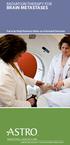 RADIATION THERAPY FOR BRAIN METASTASES Facts to Help Patients Make an Informed Decision TARGETING CANCER CARE AMERICAN SOCIETY FOR RADIATION ONCOLOGY FACTS ABOUT BRAIN METASTASIS Brain metastases are clusters
HEAD INJURY Discharge Instructions
 Hospital Copy NEUROSURGICAL CONSULTANTS, INC. www.neurosurgical-consult.com MICHAEL GIEGER, ABNS MICHAEL H. FREED, M.D., FACS, ABNS MARC H. FRIEDBERG, M.D., Ph.D., FACS, ABNS LINDEN BUILDING FIRST FLOOR
Ischaemic stroke 85% (85 in every 100 strokes)
 UNDERSTANDING STROKE DUE TO INTRACEREBRAL HAEMORRHAGE This factsheet provides information for people who have had a stroke due to an intracerebral (bleed in the brain) and for their families and carers.
Tuberculosis: FAQs. What is the difference between latent TB infection and TB disease?
 Tuberculosis: FAQs What is TB disease? Tuberculosis (TB) is a disease caused by bacteria (germs) that are spread from person to person through the air. TB usually affects the lungs, but it can also affect
Clinically isolated syndrome (CIS)
 Clinically isolated syndrome (CIS) Spirella Building, Letchworth, SG6 4ET 01462 476700 www.mstrust.org.uk reg charity no. 1088353 We hope you find the information in this factsheet helpful. If you would
Delirium. The signs of delirium are managed by treating the underlying cause of the medical condition causing the delirium.
 Delirium Introduction Delirium is a complex symptom where a person becomes confused and shows significant changes in behavior and mental state. Signs of delirium include problems with attention and awareness,
Head Injury in Infants, Children and Adults: Triage, Assessment, Investigation and Early Management
 Head Injury in Infants, Children and Adults: Triage, Assessment, Investigation and Early Management Information for people who have injured their head, their families and carers NICE Guideline (Patient
National Hospital for Neurology and Neurosurgery. Migraine associated dizziness Department of Neuro-otology
 National Hospital for Neurology and Neurosurgery Migraine associated dizziness Department of Neuro-otology If you would like this document in another language or format or if you require the services of
Diuretics: You may get diuretic medicine to help decrease swelling in your brain. This may help your brain get better blood flow.
 Hemorrhagic Stroke GENERAL INFORMATION: What is a hemorrhagic stroke? A hemorrhagic stroke happens when a blood vessel in the brain bursts. This may happen if the blood vessel wall is weak, or sometimes
Spinal cord stimulation
 Spinal cord stimulation This leaflet aims to answer your questions about having spinal cord stimulation. It explains the benefits, risks and alternatives, as well as what you can expect when you come to
Managing Side Effects of Palliative Radiation Therapy
 RADIATION THERAPY SYMPTOM MANAGEMENT Managing Side Effects of Palliative Radiation Therapy In this booklet you will learn about: Common side effects when you receive palliative radiation therapy Tips on
Healing the Invisible Wound. Recovery and Rehabilitation from a Post Traumatic. Stress Injury. By Dr. Amy Menna
 Healing the Invisible Wound Recovery and Rehabilitation from a Post Traumatic Stress Injury By Dr. Amy Menna Post Traumatic Stress Disorder can affect anyone. It is a term used to describe a reaction to
Quick Read Series. Driving & You. Information for people with seizure disorders
 Quick Read Series Driving & You Information for people with seizure disorders 2002, 2009 Epilepsy Foundation of America, Inc. This pamphlet is for general information only. Decisions about driving should
RECOGNISE AND REMOVE
 RECOGNISE AND REMOVE Remember the 4 R s of concussion management: RECOGNISE REMOVE RECOVER RETURN Identifying concussion is not always easy, and players may not exhibit the signs or symptoms immediately
Alcohol and Drug Use Following Traumatic Brain Injury. Patient Information Booklet. Talis Consulting Limited
 Alcohol and Drug Use Following Traumatic Brain Injury Patient Information Booklet Talis Consulting Limited Why does Alcohol and Drug Use Matter after a Head Injury? Alcohol and drugs affect our behaviour,
Traumatic brain injury (TBI)
 Traumatic brain injury (TBI) A topic in the Alzheimer s Association series on understanding dementia. About dementia Dementia is a condition in which a person has significant difficulty with daily functioning
METASTASES TO THE BONE
 RADIATION THERAPY FOR METASTASES TO THE BONE Facts to Help Patients Make an Informed Decision TARGETING CANCER CARE AMERICAN SOCIETY FOR RADIATION ONCOLOGY WHAT ARE BONE METASTASES? Cancer that starts
General Information about Sleep Studies and What to Expect
 General Information about Sleep Studies and What to Expect Why do I need a sleep study? Your doctor has ordered a sleep study because your doctor is concerned you may have a sleep disorder that is impacting
Brain Cancer. This reference summary will help you understand how brain tumors are diagnosed and what options are available to treat them.
 Brain Cancer Introduction Brain tumors are not rare. Thousands of people are diagnosed every year with tumors of the brain and the rest of the nervous system. The diagnosis and treatment of brain tumors
Seizures (Convulsions, Status Epilepticus) in Dogs
 Customer Name, Street Address, City, State, Zip code Phone number, Alt. phone number, Fax number, e-mail address, web site Seizures (Convulsions, Status Epilepticus) in Dogs Basics OVERVIEW Seizures are
St. Luke s MS Center New Patient Questionnaire. Name: Date: Birth date: Right or Left handed? Who is your Primary Doctor?
 St. Luke s MS Center New Patient Questionnaire Name: Date: Birth date: Right or Left handed? Who is your Primary Doctor? Who referred you to the MS Center? List any other doctors you see: Reason you have
Temple Physical Therapy
 Temple Physical Therapy A General Overview of Common Neck Injuries For current information on Temple Physical Therapy related news and for a healthy and safe return to work, sport and recreation Like Us
Understanding. Brain Tumors. Jana, diagnosed in 1999, with her husband, Paul.
 Understanding Brain Tumors Jana, diagnosed in 1999, with her husband, Paul. What Is a Brain Tumor? A brain tumor, like other tumors, is a collection of cells that multiply at a rapid rate. The tumor may
Whiplash. Whiplash is part of our modern lives. One in 200 of us will suffer from it at some point but it is rarely serious.
 Whiplash www.physiofirst.org.uk Whiplash is part of our modern lives. One in 200 of us will suffer from it at some point but it is rarely serious. Most people make a full return to health. What you do
Fainting - Syncope. This reference summary explains fainting. It discusses the causes and treatment options for the condition.
 Fainting - Syncope Introduction Fainting, also known as syncope, is a temporary loss of consciousness. It is caused by a drop in blood flow to the brain. You may feel dizzy, lightheaded or nauseous before
Zomig Nasal Spray. Zolmitriptan 5 mg Nasal Spray Solution. CONSUMER MEDICINE INFORMATION
 Zomig Nasal Spray Zolmitriptan 5 mg Nasal Spray Solution. CONSUMER MEDICINE INFORMATION What is in this leaflet This leaflet answers some of the common questions people ask about It does not contain all
Introduction. What is syncope?
 Syncope Introduction What is syncope? Syncope (SING-kuh-pee) is a medical term for fainting. When you faint, your brain is not receiving enough blood and oxygen, so you lose consciousness temporarily.
FOLFOX Chemotherapy. This handout provides information about FOLFOX chemotherapy. It is sometimes called as FLOX chemotherapy.
 FOLFOX Chemotherapy This handout provides information about FOLFOX chemotherapy. It is sometimes called as FLOX chemotherapy. What is chemotherapy? Chemotherapy is a method of treating cancer by using
Denver Spine Surgeons David Wong, MD, Sanjay Jatana, MD, Gary Ghiselli, MD
 Cervical and Lumbar Spine Health History Name: Today s Date: Referring Provider: How did you find us: (Please circle) Primary care physician, Google search, Facebook, Friend or Family member, Website (JatanaSpine
NEW PATIENT HISTORY QUESTIONNAIRE. Physician Initials Date PATIENT INFORMATION
 NEW PATIENT HISTORY QUESTIONNAIRE Physician Initials Date PATIENT INFORMATION JHH# DOB# AGE HOME PH CELL PH DAY PH EMAIL Who is your REFERRING PHYSICIAN? (The doctor who referred you to Johns Hopkins Neurology.)
Understanding your Tecfidera treatment
 Understanding your Tecfidera treatment Information for patients who have been prescribed treatment with Tecfidera. (dimethyl fumarate) Contents About Multiple Sclerosis (MS) What is MS? Symptoms of MS
Understanding your Tecfidera treatment
 Understanding your Tecfidera treatment Information for patients who have been prescribed treatment with Tecfidera. (dimethyl fumarate) Contents About Multiple Sclerosis (MS) What is MS? Symptoms of MS
www.epilepsy.org.uk Epilepsy Helpline: 0808 800 5050 Epilepsy: sport and leisure
 www.epilepsy.org.uk Epilepsy Helpline: 0808 800 5050 Epilepsy: sport and leisure Epilepsy Action aims to improve the quality of life and promote the interests of people living with epilepsy. Our work...
Acute Low Back Pain. North American Spine Society Public Education Series
 Acute Low Back Pain North American Spine Society Public Education Series What Is Acute Low Back Pain? Acute low back pain (LBP) is defined as low back pain present for up to six weeks. It may be experienced
EMS Training. Epilepsy and Seizure Management TRAINER S GUIDE
 EMS Training Epilepsy and Seizure Management TRAINER S GUIDE The leads the fight to stop seizures, find a cure, and overcome the challenges created by epilepsy. The is the national voluntary agency solely
NEW ZEALAND CONSUMER MEDICINE INFORMATION Arrow - Diazepam
 NEW ZEALAND CONSUMER MEDICINE INFORMATION Arrow - Diazepam Diazepam 2mg and 5mg tablets What is in this leaflet This leaflet answers some common questions about ARROW - DIAZEPAM. It does not contain all
Depression & Multiple Sclerosis
 Depression & Multiple Sclerosis Managing specific issues Aaron, diagnosed in 1995. The words depressed and depression are used so casually in everyday conversation that their meaning has become murky.
Concussion Management Return to Play Protocol
 Concussion Management Return to Play Protocol Returning to play following a concussion involves a stepwise progression once the individual is symptom free. There are many risks to premature return to play
Heart information. CPR cardiopulmonary resuscitation
 Heart information CPR cardiopulmonary resuscitation Contents 3 What is CPR? 3 What is cardiac arrest? 4 Heart attack and cardiac arrest 4 Cardiopulmonary resuscitation (CPR) 5 Danger 6 Response 7 Send
F r e q u e n t l y A s k e d Q u e s t i o n s
 Myasthenia Gravis Q: What is myasthenia gravis (MG)? A: Myasthenia gravis (meye-uhss- THEEN-ee-uh GRAV uhss) (MG) is an autoimmune disease that weakens the muscles. The name comes from Greek and Latin
CHILDREN S NEUROSCIENCE CENTER
 CHILDREN S NEUROSCIENCE CENTER W hen families come to Children s Memorial Hermann Hospital, they expect to find the technological advances and healing expertise of a university-affiliated, academic hospital.
Low Blood Pressure. This reference summary explains low blood pressure and how it can be prevented and controlled.
 Low Blood Pressure Introduction Low blood pressure, or hypotension, is when your blood pressure reading is 90/60 or lower. Some people have low blood pressure all of the time. In other people, blood pressure