
Buyers guide. Hospital grade non-invasive blood pressure monitors CEP 08018
|
|
|
- Norma Small
- 9 years ago
- Views:
Transcription
1 Buyers guide Hospital grade non-invasive blood pressure monitors CEP May 2008
2 Contents 2 Introduction... 3 Technical considerations... 6 Operational considerations... 8 Economic considerations Purchasing Market review Acknowledgements Glossary References Appendix 1: Supplier contact details Appendix 2: EU procurement procedure Appendix 3: Data collection pro-forma Author and report information... 76
3 Introduction 3 General This buyers guide is intended to assist in the selection of automated non-invasive blood pressure (NIBP) monitors for use in hospitals. Information is presented in a standardised format to help purchasers prepare a short-list of devices. The eighteen models in this issue represent the state of the UK market from late 2006 to late Several manufacturers offer a range of related models. We have attempted to represent the full range of current models and major optional additions or upgrades that are available. Models are presented alphabetically by manufacturer. Abbreviations used in this report are defined in the Glossary (page 64). Scope The guide reviews hospital grade monitors selected (see Method, page 13) from the large number of automated blood pressure monitors currently available in the UK. All 18 of the devices assessed carried out automated measurements using the oscillometric measurement technique. This works on the principle that when an inflated cuff partially occludes blood flow in the brachial artery, pulsatile changes in blood volume during each heart beat induce small (typically < 3 mmhg) pulses in the cuff. Devices measure the size of these pressure pulses while inflating or deflating the cuff (see box, page 7). All 18 devices were capable of making single manually initiated measurements. Twelve of them were 'automatic cycling' types. These can work unattended because they have a builtin timer to allow repeated measurements to be made at intervals from 1 to 60 or more minutes. Such devices must have overpressure safety mechanisms (see page 14) and alarms. Two devices provided the additional facility of allowing measurements to be made using manual auscultation (see box, page 6). National guidance British Hypertension Society (BHS) Guidelines [1] In 2004 the BHS issued guidelines for management of hypertension. Those relating to blood pressure measurements are: Use a properly maintained, calibrated and validated device Measure sitting blood pressure routinely; standing blood pressure should be recorded at the initial estimate in elderly and diabetic patients Remove tight clothing, support arm at heart level, ensure hand relaxed and avoid talking during the measurement procedure Use a cuff of appropriate size: the bladder should surround at least 80% of the upper arm; using too large a cuff will result in a underestimation of blood pressure, while too small a cuff will lead to overestimation When using the auscultatory method (see box, page 6) lower mercury column slowly (2 mm/s); read blood pressure to the nearest 2mmHg; measure diastolic as disappearance of sounds (phase V)

4 Introduction 4 Take the mean of at least two readings; more recordings are needed if marked differences between initial measurements are found Do not treat on the basis of an isolated reading. Medicines and Healthcare Products Regulatory Agency (MHRA) In 2005 the MHRA issued a report containing recommendations of the Independent Advisory Group on Blood Pressure Monitoring in Clinical Practice [2] and followed it up with a medical device alert [3]. Those recommendations which are relevant to the selection of hospital grade NIBP monitors are: Recommendation 3 Where oscillometric blood pressure measurement is used, it should not be assumed that a CE marked blood pressure monitor is automatically suitable for use in the diagnosis of hypertension. Recommendation 4 In those clinical conditions where oscillometry is inappropriate (e.g. arrhythmias, preeclampsia and certain vascular diseases) an alternative method of pressure measurement (auscultation, arterial cannulation) should be used. Recommendation 5 The MHRA, in collaboration with the Committee on Blood Pressure Monitoring in Clinical Practice, should define acceptable performance criteria against which automated noninvasive blood pressure monitors should be evaluated. Evidence for compliance with these criteria should be obtained from properly conducted clinical trials [4, 5, 6, 7, 8]. The population characteristics for which the device has been evaluated should be specifically included. Recommendation 6 The NHS and other healthcare sectors should only purchase devices that meet the performance criteria in the recommendation above. Recommendation 7 Auscultation as a method of determining blood pressure should continue to be taught to healthcare workers as appropriate. Calibrated non-mercury devices, which do not rely on oscillometry, should be made available in all clinical areas. These should be used to check oscillometric results and other non auscultatory alternative blood pressure measurement determination on individual patients. These devices should also be used in clinical conditions where alternative methods may be inappropriate e.g. arrhythmia, preeclampsia or specific vascular disease. The "acceptable performance criteria" were not defined explicitly in the MHRA report, which left some users uncertain as to how to take action on the associated device alert [3]. In practice, acceptable performance criteria for validation have been published in international standards and in test protocols and acceptance criteria published by clinical groups. These are summarised below:
![Practice [2] and followed it up with a medical device alert [3].](/docs-images/46/21596434/images/page_4.jpg "Those recommendations which are relevant to the selection of hospital grade NIBP monitors are: Recommendation 3 Where oscillometric blood pressure measurement is used, it should not be assumed that a")
5 Introduction 5 Devices placed on the market before June 2005 Prior to June 2005, manufacturers were required [9] to collect sufficient evidence to satisfy a notified body that the new device agreed with trained human observers to within a mean error of 5 mmhg, with a standard deviation not exceeding 8 mmhg. However the size or composition of the study population was not specified and the results of the trial were not required to be put in the public domain. Whether to scrutinize the validation trial results is at the discretion of the notified body. Some manufacturers opted to validate their devices according to one of several recognised protocols requiring 85 subjects [4, 5, 6] or 33 subjects [7]. In many cases the trial results are available from the manufacturer, or were published in peer-reviewed journals. Devices placed on the market after June 2005 The minimum criteria for a validation protocol (including the number and composition of subjects) are published in an EU standard [8]. In June 2005, an amendment to EN [10] was published which requires manufacturers to follow a validation protocol which meet these criteria. Of the common protocols, three [4, 5, 6] meet these criteria of [8], but one - the "International Protocol" [7] - does not. Whether to scrutinize the results of the validation study remains at the discretion of the notified body. Manufacturers are not required to place their validation results in the public domain. In many cases the results are available from the manufacturer, or were published in peer-reviewed journals.

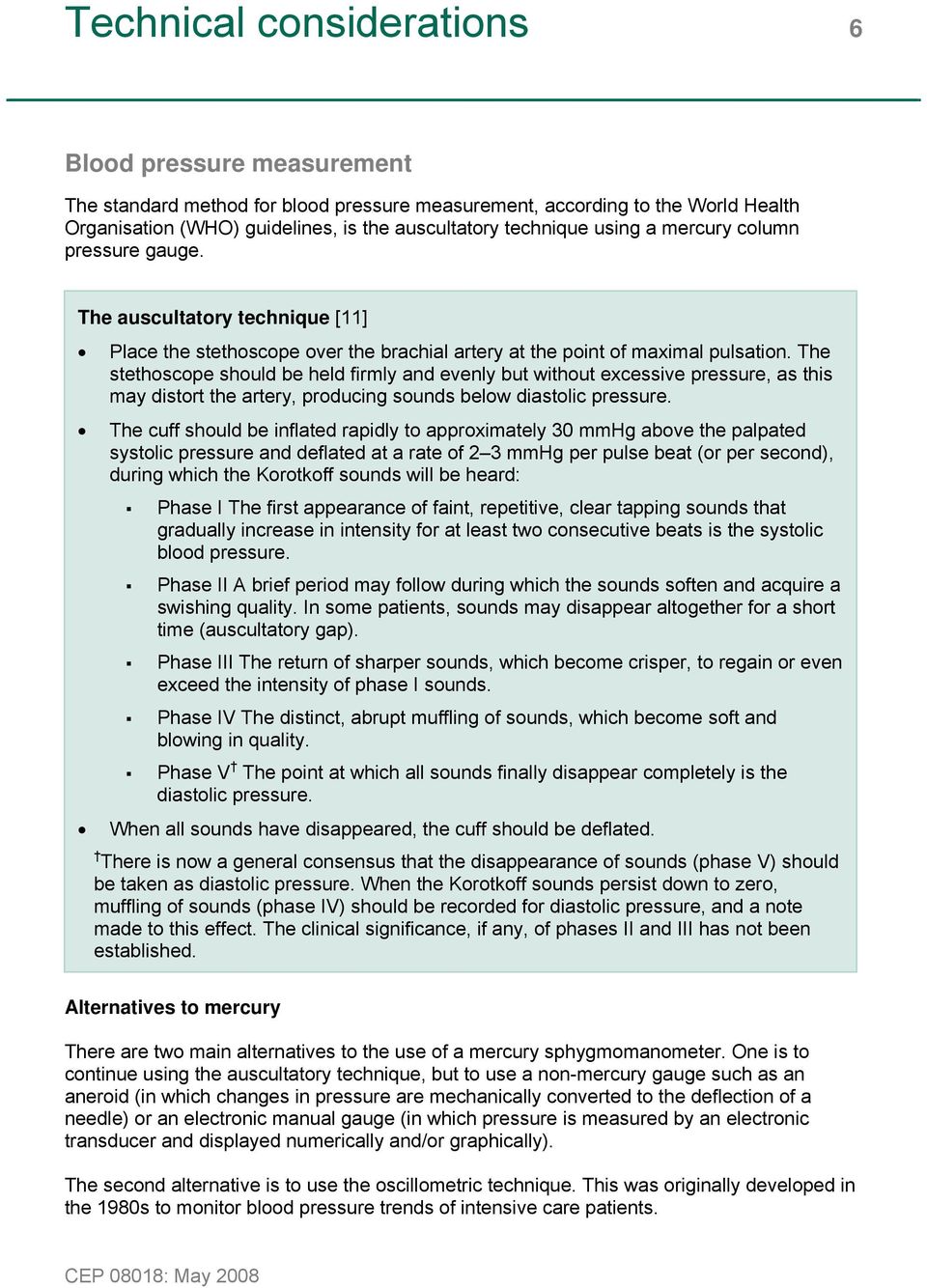
6 Technical considerations 6 Blood pressure measurement The standard method for blood pressure measurement, according to the World Health Organisation (WHO) guidelines, is the auscultatory technique using a mercury column pressure gauge. The auscultatory technique [11] Place the stethoscope over the brachial artery at the point of maximal pulsation. The stethoscope should be held firmly and evenly but without excessive pressure, as this may distort the artery, producing sounds below diastolic pressure. The cuff should be inflated rapidly to approximately 30 mmhg above the palpated systolic pressure and deflated at a rate of 2 3 mmhg per pulse beat (or per second), during which the Korotkoff sounds will be heard: Phase I The first appearance of faint, repetitive, clear tapping sounds that gradually increase in intensity for at least two consecutive beats is the systolic blood pressure. Phase II A brief period may follow during which the sounds soften and acquire a swishing quality. In some patients, sounds may disappear altogether for a short time (auscultatory gap). Phase III The return of sharper sounds, which become crisper, to regain or even exceed the intensity of phase I sounds. Phase IV The distinct, abrupt muffling of sounds, which become soft and blowing in quality. Phase V The point at which all sounds finally disappear completely is the diastolic pressure. When all sounds have disappeared, the cuff should be deflated. There is now a general consensus that the disappearance of sounds (phase V) should be taken as diastolic pressure. When the Korotkoff sounds persist down to zero, muffling of sounds (phase IV) should be recorded for diastolic pressure, and a note made to this effect. The clinical significance, if any, of phases II and III has not been established. Alternatives to mercury There are two main alternatives to the use of a mercury sphygmomanometer. One is to continue using the auscultatory technique, but to use a non-mercury gauge such as an aneroid (in which changes in pressure are mechanically converted to the deflection of a needle) or an electronic manual gauge (in which pressure is measured by an electronic transducer and displayed numerically and/or graphically). The second alternative is to use the oscillometric technique. This was originally developed in the 1980s to monitor blood pressure trends of intensive care patients.
7 Technical considerations 7 How oscillometric blood pressure monitors work [12] When an inflated brachial cuff partially constricts blood flow, pulsatile changes in blood volume during each heart beat induce small (typically < 3 mmhg) pressure pulses in the cuff; an oscillometric blood pressure device measures the size of these pulses The device automatically inflates the cuff pressure above systolic pressure. Some devices do this by detecting the absence of oscillometric pulses. Others simply inflate to a pre-determined level; often this starting pressure is configurable. The device deflates the cuff at a controlled rate and measures the size of the oscillometric pressure pulses as a function of cuff pressure. Some devices measure the oscillometric pulses during inflation, the measurement concluding after the systolic pressure is determined. A proprietary algorithm is applied to the pressure pulse profile to calculate the systolic, diastolic and mean blood pressure. Problems of inaccuracy The intricate mechanical design of aneroid gauges makes them susceptible to damage caused by mechanical shock and to wear and tear of moving parts. Where such damage does not lead to failure of the device, there is a risk that the displayed pressure may be in error, leading to inaccurate blood pressure measurement. Electronic manual gauges have few moving parts and are less susceptible to damage from mechanical shock. Manufacturers of oscillometric devices use proprietary algorithms to calculate blood pressure; systematic differences of the order of 10 mmhg between devices have been measured due to differences between algorithms [13]. The oscillometric technique may not be clinically appropriateness of t for important patient groups including pregnant women [14], diabetics [15] and those with cardiac arrhythmias. Some clinical bodies specifically state [16] that the use of oscillometric devices is not advised if blood pressure measurement is being used to determine treatment. Strategies to improve accuracy Errors in the measurement of blood pressure can arise from observer (or protocol) or from the device used. In auscultatory measurement, errors of the former type can be minimised by good training and by adherence to a recognised protocol, such as that published by the British Hypertension Society [4]. Some recommendations such as choosing the correct deflation rate (2-3 mmhg/s) and correct cuff size are often ignored. Errors due to devices can be minimised by good equipment management. Aneroid gauges should be calibrated at least once a year and should at least have their calibration checked if they are dropped or suffer a similar accident. Electronic manual gauges should also be calibrated once a year. Oscillometric devices incorporate a pressure transducer and should, in principle, undergo a similar static pressure calibration as an electronic manual gauge. Many, if not all, of hospital grade NIBP monitors have dedicated service and calibration modes which allow this.

8 Operational considerations 8 Device selection should be based on matching device features to user needs. Table 1 illustrates the range of NIBP monitor characteristics that should be considered. These should be used along with the product information tables (page 17) found in the Market review section. Table 1 Device considerations Feature Model ranges Parameters Power Display Memory Description Some manufacturers have multiple models to cover all possible variants; others have a model range and list of options. In the Product information tables (page 17) beside each model range is a figure in brackets which is our estimate of the distinct model variants on offer. As well as NIBP some devices include additional monitoring parameters such as SpO 2 and temperature. We have identified what is offered in the most basic model and additional features from other models in a range or options available. Additional parameters (usually at extra cost) may not be important if the device is to be used solely as an NIBP monitor. All of the devices in the buyers guide are mains and battery powered. Some provide mains by a separate adaptor worth noting if space is limited. All batteries are recharged in situ when mains power is provided. Various battery technologies are employed e.g. Liion, NiMH etc. This can either be an LED numerical display with accompanying indicators, an LCD flat panel or a combination of the two. Some displays are monochromatic whilst others are colour. Users should consider whether high visibility or brightly coloured displays are important. Most of the monitors have a measurement memory. Some only recall the last measurement made whilst others can store several hundred readings for multiple patients. All of the automatic cycling monitors (i.e. those with timed measurements) store the readings in memory for subsequent review.

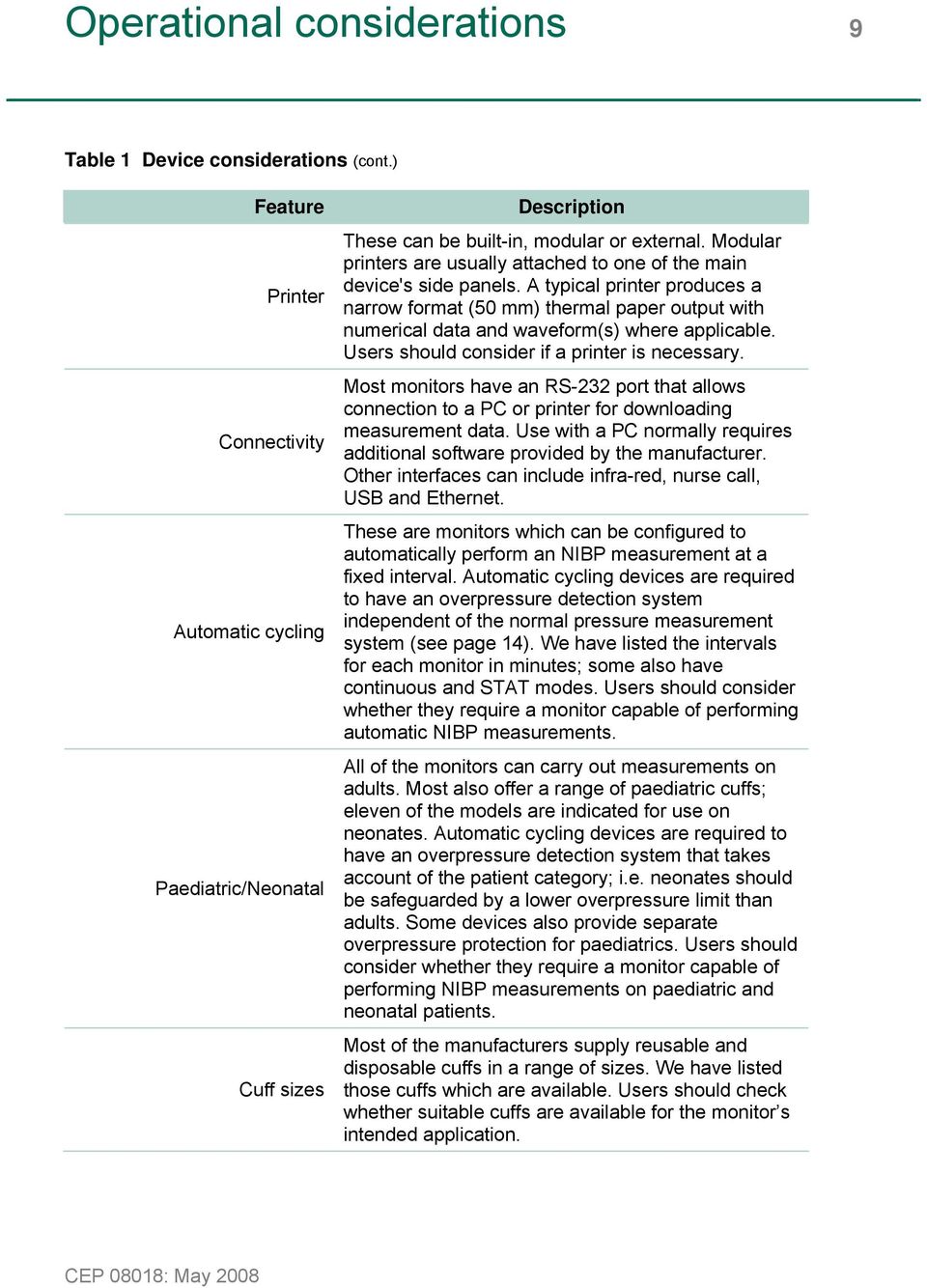
9 Operational considerations 9 Table 1 Device considerations (cont.) Feature Printer Connectivity Automatic cycling Paediatric/Neonatal Cuff sizes Description These can be built-in, modular or external. Modular printers are usually attached to one of the main device's side panels. A typical printer produces a narrow format (50 mm) thermal paper output with numerical data and waveform(s) where applicable. Users should consider if a printer is necessary. Most monitors have an RS-232 port that allows connection to a PC or printer for downloading measurement data. Use with a PC normally requires additional software provided by the manufacturer. Other interfaces can include infra-red, nurse call, USB and Ethernet. These are monitors which can be configured to automatically perform an NIBP measurement at a fixed interval. Automatic cycling devices are required to have an overpressure detection system independent of the normal pressure measurement system (see page 14). We have listed the intervals for each monitor in minutes; some also have continuous and STAT modes. Users should consider whether they require a monitor capable of performing automatic NIBP measurements. All of the monitors can carry out measurements on adults. Most also offer a range of paediatric cuffs; eleven of the models are indicated for use on neonates. Automatic cycling devices are required to have an overpressure detection system that takes account of the patient category; i.e. neonates should be safeguarded by a lower overpressure limit than adults. Some devices also provide separate overpressure protection for paediatrics. Users should consider whether they require a monitor capable of performing NIBP measurements on paediatric and neonatal patients. Most of the manufacturers supply reusable and disposable cuffs in a range of sizes. We have listed those cuffs which are available. Users should check whether suitable cuffs are available for the monitor s intended application.
10 Operational considerations 10 Table 1 Device considerations (cont.) Feature Physical size and weight Carrying handle Mounting options Training List price Validation Description These factors may be important if the monitor is to be used for transfer/transport purposes. Sizes and weights are as measured in our laboratory of a basic unit without optional add-on modules, but including batteries. All of the monitors evaluated in the buyers guide included a carrying handle but of differing designs e.g. top mounted handles, integrated grips or flip up. The type of handle may be important to consider depending on the monitors placement and main use. We have listed the various mounting options which are available. Users should check whether suitable options are available for the monitor s intended application and placement. We have listed what training the manufacturer / supplier provides. Most have competency based training courses. Some also provide training for service personnel. Users should consider what training is required and whether the manufacturer / supplier training meets their needs. We have shown the price excluding VAT of a base model or a price range of several models. In most cases these can be taken as guide prices since actual prices paid will be dependent on commercial factors. We have shown which monitors are clinically validated, which protocol was used and whether the results have been published in a peer reviewed journal. Where possible, we have also shown the BHS grade for systolic and diastolic pressure. Users should carefully consider the validation information when choosing a monitor. We would not recommend a device which had not been clinically validated (see pages 16 and 59).

11 Economic considerations 11 Additional costs To achieve best value when purchasing a hospital grade NIBP monitor users should consider the following costs: Accessories Are additional accessories (supplied at extra cost) required to use the monitor e.g. wall mounting brackets or roll stands? Consumables Cuffs: If disposable cuffs are to be used how many will be required and in what sizes? If reusable cuffs are to be used, what is their life expectancy? Batteries: What is the expected operating life of a battery? How much are replacements? Other parameters: If the NIBP monitor has been specified with additional monitoring parameters, what additional consumables are required (e.g. SpO 2 probes, temperature probes, probe covers) and at what cost? Training In the product information tables (page 17) found in the Market review section we have listed what training the manufacturer /supplier provides and at what cost. Most manufacturers provide competency based training courses free of charge, but some charge hourly rates. Users should consider what training is required and take any costs into account. Servicing Some manufacturers / suppliers also provide training for service personnel to allow hospital EBME departments to carry out routine servicing and calibration. Alternatively, service contracts are available from the manufacturers / supplier. We have listed servicing costs in the product information tables (see page 17). Warranty Warranty periods vary from one to three years with the option to extend (for an additional cost) on some devices. We have listed warranty periods and associated costs in the product information tables (see page 17). Users should be aware of these costs especially if they do not have access to service personnel in their organisation.

12 Purchasing 12 Purchasing procedures PASA s Trust Operational Purchasing Procedures Manual provides details of the procurement process [17]. European Union procurement rules apply to public bodies, including the NHS. The purpose of these rules is to open up the public procurement market and ensure the free movement of goods and services within the EU. In the majority of cases, a competition is required and decisions should be based on best value. The EU procurement rules apply to contracts worth more than 90,319 (from January 1 st 2008) [18]. Further details of the process are detailed in Appendix 2. NHS Supply Chain (NHS SC) offers national contracts or framework agreements for some products, goods and services. Use of these agreements is not compulsory and NHS organisations may opt to follow local procedures. Sustainable procurement The UK Government launched its current strategy for sustainable development, Securing the Future [19] in March The Strategy describes four priorities to progress sustainable development, in the UK and in the world as a whole: sustainable production and consumption working towards achieving more with less natural resource protection and environmental enhancement protecting the natural resources and habitats upon which we depend sustainable communities creating places where people want to live and work, now and in the future climate change and energy confronting the greatest identified threat facing the global community. The strategy also highlights the key role of public procurement in delivering sustainability. Energy consumption Suppliers/manufacturers should offer guidance on energy-efficient use of devices. Where devices are in constant use, mains and battery energy costs should be included in whole-life cost calculations. End of life disposal Consideration should be given to the likely financial and environmental costs of disposal at the end of the product s life. Where appropriate, suppliers of equipment placed on the market after the 13 th August 2005 should be able to demonstrate compliance with the UK Waste Electrical and Electronic Equipment (WEEE) regulations (2006) [20]. The WEEE regulations place responsibility for financing the cost of collection and disposal on the producer. Electrical and electronic equipment is exempt from the WEEE regulations where it is deemed to be contaminated at the point at which the equipment is scheduled for disposal by the final user. However, if it is subsequently decontaminated such that it no longer poses an infection risk, it is again covered by the WEEE regulations, and there may be potential to dispose of the unit through the normal WEEE recovery channels.

13 Market review 13 Method Starting in mid 2005 and continuing to the conclusion of the evaluation, we carried out a market review of NIBP devices on the UK market. We looked for information in medical literature, from known suppliers, validation reports and from the internet. Establish device selection criteria A large number of devices were identified in the price range 30 to Some manufacturers produced several models within a product range. A judgement was required to establish a dividing line between those indicated for personal home-use and devices appropriate to a hospital setting. Looking at the prices of the simplest model in each device range, we noted that none lay in the price band 100 to 240. Thus there was a natural grouping into devices costing 100 or less and devices costing 240 or more. The subjects of this report are those devices whose base model costs 240 or more. Low cost devices will be the subject of a separate buyers guide. Acquire devices All but one of the devices were borrowed from the manufacturers to carry out the assessment protocol. The remaining device had been evaluated previously. Sometimes suppliers provided devices with extra parameters and accessories compared with the simplest model. Assessment protocol In the evaluation laboratory we carried out an assessment protocol (see below) to acquire information and test each device. On multi-parameter models, vital signs other than blood pressure were not tested. We used the document reproduced in Appendix 3 to record results. Recommendations We made recommendations based on the criteria described on page 16. Assessment protocol Product information Much of the information included in this document was sourced from the suppliers or manufacturers product data or specifications published in user manuals this was used as the basis of the comparative product information (page 17). Since each had its own corporate style and format we have presented the information in its simplest common format and as consistently as possible to more readily allow comparison between manufacturers. We gave suppliers an opportunity to check and comment on the report prior to publication. CE marking and clinical validation We inspected the CE marking and noted compliance with relevant standards. Where clinical validation was claimed we inspected any evidence the manufacturers provided including published peer reviewed evidence. A short description of the validation process is given below.
14 Market review 14 Overpressure testing Automatic cycling monitors are required to have overpressure limitation mechanisms due to the possibility of failure when running unattended. We would expect devices complying with this standard to have two independent pressure transducers. We would not expect non-cycling devices to meet this requirement, but since some did we applied the same test to them all. We simulated single fault conditions on the NIBP monitors by pinching off the air supply to their pressure transducers prior to and during an NIBP determination and noted the resulting behaviour. BS EN :2000 [21] states that the cuff pressure must not exceed 330 mmhg under single fault conditions. Simulator testing We attached an NIBP simulator to the monitor under test and applied a series of simulated blood pressures to measure repeatability under normal conditions, in the presence of tremor artifact and with weak pulse. Measurement repeatability normal conditions Thirty measurements were taken with each monitor using the NIBP simulator set at 120/80 (93) mmhg. The repeatability of the simulator (a Bio-Tek BP pump) is within 0.1 mmhg [13]. The results were averaged and the standard deviation (SD) calculated. A rating was given according to the consistency achieved for systolic, diastolic and mean pressures: Excellent Good Satisfactory Poor Very poor SD 1 mmhg SD >1, 2 mmhg SD >2, 3 mmhg SD >3, 4 mmhg SD >4 mmhg Measurement repeatability tremor artefact /weak pulse Five measurements were taken at each of five different levels of tremor artefact (25 total) and four different levels of weak pulse (20 total). Using the criteria described below, we counted how many of the measurements could be described as misleading. Criteria for a misleading reading There is no widely accepted criterion for determining when a reading is misleading so we have adopted the following strategy: When comparing two methods of measurement [22], e.g. an oscillometric device with human observers measuring blood pressures by auscultation, the ANSI/AAMI standard [5] requires that the bias must not exceed 5 mmhg and that the standard deviation of differences must not exceed 8 mmhg for 85 subjects. For any given device which meets the ANSI/AAMI criteria, the bias and standard deviation are known from a clinical trial, and the 95% limits of agreement can be calculated. For a device chosen at random from a group of devices which meet the criteria, we can be (approximately) 95% confident that a single measurement will lie within -21 to +21 mmhg (-5-8x2 to +5+8x2 mmhg) of a trained observer. Therefore we have set a limit of -21 to +21 mmhg with respect to the simulator setting to define a misleading measurement for both systolic and diastolic pressures.
15 Market review 15 Documentation We assessed the user manuals for the presence of relevant information such as setting up, operation, calibration, battery replacement, cleaning and sterilization. Where devices were capable of in-house repair, we assessed the service manual for fault finding guides, dismantling procedures, functional testing and calibration accuracy check instructions. Some could be repaired only by the manufacturer. In such cases, service manuals (if available) were assessed on this basis. This is a check only of the device's pressure transducer against a calibrated pressure gauge. It is not a check of the device's clinical validation. Clinical validation process The measurement accuracy of an NIBP monitor requires a clinical trial using human subjects. There are a number of such protocols with different compositions of patient groups needed for the trial and different ways of presenting the results either as a grade or pass/fail. Devices in this report have been validated against protocols by the British Hypertension Society (BHS) [4], the US Association for the Advancement of Medical Instrumentation (ANSI/AAMI SP ) [5] and the European Society of Hypertension (ESH) [7]. The first two of these require 85 subjects and the ESH requires 33 subjects. Accuracy O Brien et al [22] made recommendations based on the following: A device fulfilling the AAMI criteria and graded A or B for both systolic and diastolic pressure under the BHS protocol has been recommended on grounds of accuracy without equivocation; one that fails the AAMI protocol for either systolic or diastolic pressure and has a grade of C or D for either systolic or diastolic pressure under the BHS protocol cannot be recommended on the grounds of accuracy. Table 2 BHS grading criteria see O'Brien E, et al [4] Absolute difference between standard and test device 5 mmhg 10 mmhg 15 mmhg Grade Cumulative percentage of readings A 60% 85% 95% B 50% 75% 90% C 40% 65% 85% D Worse than C Readings taken by the device under validation are compared with those independently taken by two trained observers using the auscultatory technique. The observer s measurements are performed simultaneously; the device measurements are performed sequentially to the observer measurements. There are 85 subjects; 255 measurements are taken in total. Grades are derived from the percentage of device readings within 5, 10 and 15 mmhg of the observers readings. To achieve a particular grade, all three percentages must be equal to or greater than the tabulated values above.

16 Market review 16 Where a BHS grade was not quoted in either a peer reviewed paper or in an unpublished report we used ANSI/AAMI SP10 data to derive an equivalent BHS grade. Criteria for recommendation Our general recommendations are based on three criteria which are important to consider when purchasing a device: Accuracy: Passed ANSI/AAMI SP10 and achieved a BHS grade A or B (or equivalent) in a clinical validation study for both systolic and diastolic pressure Level of evidence, in order of preference: independent clinical validation study published in a peer review journal; independent clinical validation study with an unpublished report; in-house clinical validation study and report Excellent measurement repeatability (within 1mmHg) from 30 consecutive measurements of 120/80 mmhg when tested using a repeatable [13] laboratory NIBP simulator.
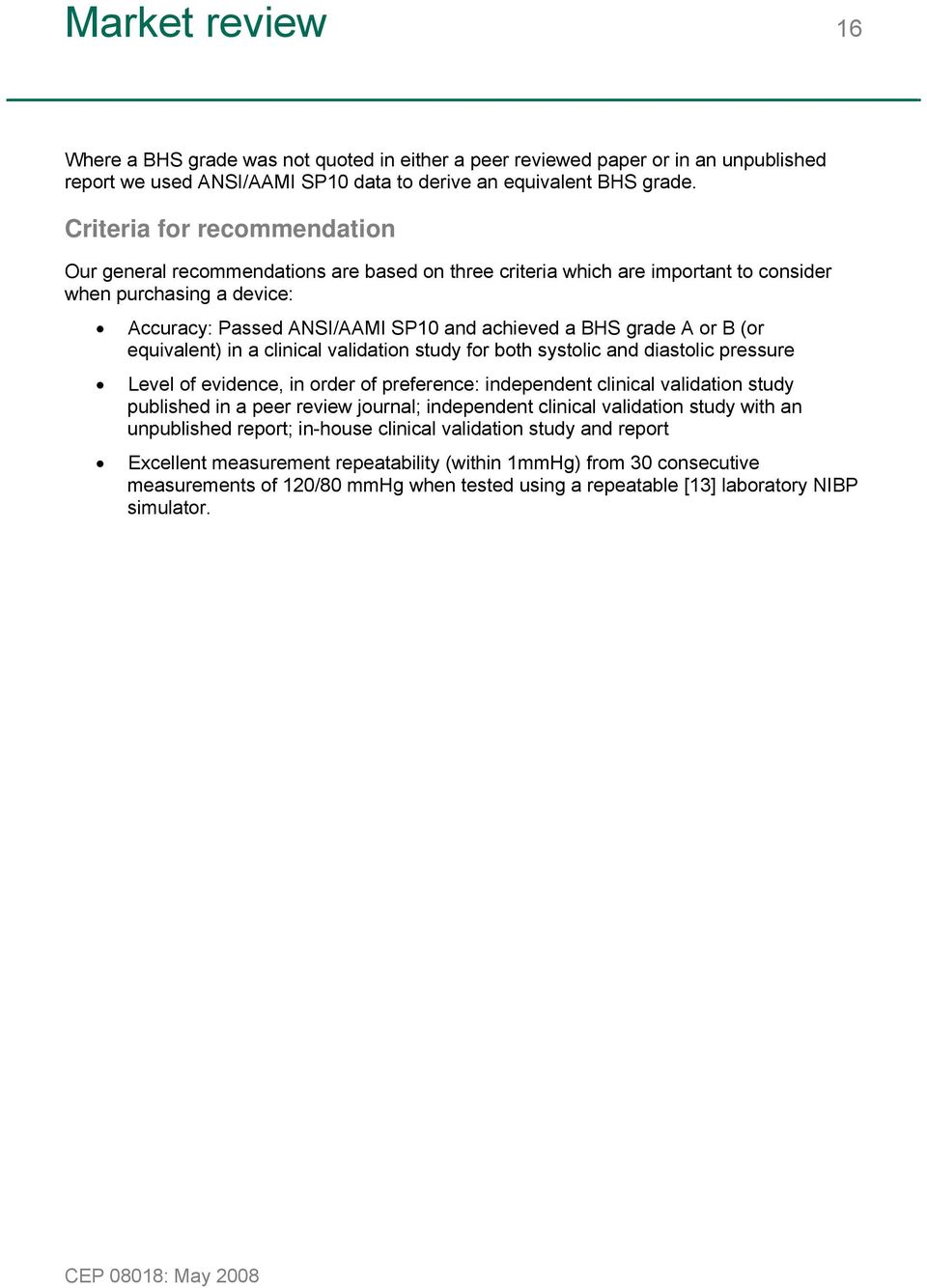
17 Market review 17 Product information Manufacturer BiOSYS Co. Ltd CAS Medical Systems Inc Criticare Systems Inc Model range (no.of models ) Sentry (4) CAS 740 (4) 506N3 (8) Parameters & features Base model NIBP; SpO 2 NIBP NIBP; SpO 2 (Criticare or Nellcor) Other models printer; trend screen SpO 2 ; temperature temperature; printer Options in all models temperature printer; RS-232 and nurse-call Interface none Power mains; ext. 12 V DC supply; rechargeable 7.2 V 3 Ah Li ion battery mains; ext. 12 V DC supply; rechargeable 7.2 V 3.7 Ah NiMH battery mains; rechargeable 6 V 7.2 Ah SLA battery Battery charger built-in charger built-in charger built-in charger Display LED & LCD (trend screen) LED LED & LCD Memory up to 100 measurements up to 480 measurements Printer/recorder Connection interface yes: modular no yes: external printer via infrared interface infrared; RS-232 & nurse-call Pressure range mmhg not specified Systolic pressure range Diastolic pressure range not specified not specified adult: mmhg neonate: mmhg adult: mmhg neonate: mmhg last 24 hrs - all parameters, single or multi-patient data yes: built-in RS-232 adult: mmhg paediatric: mmhg neonate: mmhg adult: mmhg paediatric: mmhg neonate: mmhg Pulse rate range adult & paediatric: bpm neonate: bpm adult: bpm neonate: bpm bpm (NIBP); bpm (SpO 2 ) Automatic measurement cycles 2, 5, 10, 15, 30, 60 or 120 mins 1, 2, 3, 4, 5, 10, 15, 30, 60 or 90 mins 1, 2, 3, 5, 10, 15, 30, 45, 60, 120 or 240 mins Paediatric/neonate yes yes yes Cuff sizes reusable: infant; child; small adult; adult; large adult; thigh neonatal disposable: sizes 1-5 reusable and disposable: infant; small child; child; small adult; adult; large adult; x-large adult neonatal disposable: cm reusable: infant; child/small adult; adult; large arm; thigh disposable: 3-6 cm; 4-8 cm; 6-11 cm; 7-13 cm; 8-15 cm; infant; child; small adult; adult; large arm; thigh Physical size (H x W x D) 248 x 180 x 175 mm 170 x 215 x 75 mm 220 x 180 x 165 mm Weight 2.9 kg 1.4 kg 3.15 kg Mounting options rolling stand; IV pole mount rolling stand; swivelled hard mount (ambulance application); universal mount rolling stand; IV pole mount Carrying handle yes (recessed grip) yes; carrying case (optional) yes Training user training - free of charge competency based training; service training competency based training - free of charge List price (exc. VAT) ,850 Servicing costs Validation 1 year warranty - free; maintenance contract not available no evidence found 110 plus parts yes: ANSI/AAMI SP10 independent study & unpublished report; derived BHS grade A/A 2 year warranty - free; annual contract - 96 or 165 inc. repairs & parts; 5 year cover or 445 inc. repairs & parts claimed due to similarity to Criticare Poet Plus 8100 according to independent study & unpublished report; derived BHS grade A/B

18 Market review 18 Manufacturer Datascope Corp. Datascope Corp. GE Medical Systems Model range (no.of models ) Accutorr Plus (5) Duo (3) Dinamap Pro (4 ) Parameters & features Base model NIBP NIBP NIBP; printer; trend screen Other models SpO 2 (Masimo or Nellcor); trend screen SpO 2 ; temperature Options in all models temperature; printer; choice of SpO 2 (Masimo or Nellcor); battery type temperature none Power mains; rechargeable 11.1 V 4.4 Ah Li ion battery rechargeable SLA battery recently discontinued mains; rechargeable 7.2 V 6.6 Ah Li ion battery mains; ext V DC supply; int. rechargeable 12 V 2.3 Ah SLA battery Battery charger built-in charger built-in charger built-in charger Display LED; LCD (trend screen) LED LED & LCD Memory up to 100 measurements no up to 100 measurements Printer/recorder yes: modular no yes: built-in Connection interface RS-232 no RS-232 Pressure range Systolic pressure range Diastolic pressure range Pulse rate range Automatic measurement cycles adult: mmhg paediatric: mmhg neonate: mmhg adult: mmhg paediatric: mmhg neonate: mmhg adult: mmhg paediatric: mmhg neonate: mmhg adult/paediatric: bpm neonate: bpm off, cont, 1, 2.5, 5, 10, 15, 20, 30, 60, 120 or 240 mins mmhg adult: mmhg paediatric: mmhg adult: mmhg paediatric: mmhg bpm no adult/paediatric: mmhg neonate: mmhg adult/paediatric: mmhg neonate: mmhg ault/paediatric: mmhg neonate: mmhg adult/paediatric: bpm neonate: bpm 1, 2, 3, 4, 5, 10, 15, 20, 30, 45, 60, 90 or 120 mins Paediatric/neonate yes paediatric only yes Cuff sizes reusable & disposable: small child; child; small adult; adult long; adult; large adult long; large adult; adult thigh neonatal disposable: sizes 1-5 reusable: child; small adult; adult long; adult; large adult disposable: child; small adult; adult long; adult reusable & disposable: infant; child; small adult; adult; large adult; thigh; a range of neonate sizes Physical size (H x W x D) 270 x 190 x 210 mm 243 x 130 x 140 mm 250 x 248 x 175 mm Weight 5 kg 2.1 kg 3.5 kg Mounting options integrated rear panel cam-lock for pole mounting; rolling stand; wall mount; universal mounting bracket; table mount rolling stand rolling stand Carrying handle yes (recessed grip) yes yes (recessed grip) Training EBME technician training course; user training courses EBME technician training course; user training courses competency based training List price (exc. VAT) Servicing costs Validation 3 year warranty - free warranty / PPM contract (1-4+ years): per annum; non-contract hourly rate: yes: ANSI/AAMI SP10 & BHS independent studies and peerreveiwed publications; BHS grade A/A 2 year warranty - free warranty / PPM contract (1-4+ years): per annum; non-contract hourly rate: yes: ANSI/AAMI SP10 in-house study and unpublished report unable to derived BHS grade from data in supplied report 3 year warranty - free; extended warranty to 5 years yes: ANSI/AAMI SP10 independent study and peer reviewed publication BHS grade B/C

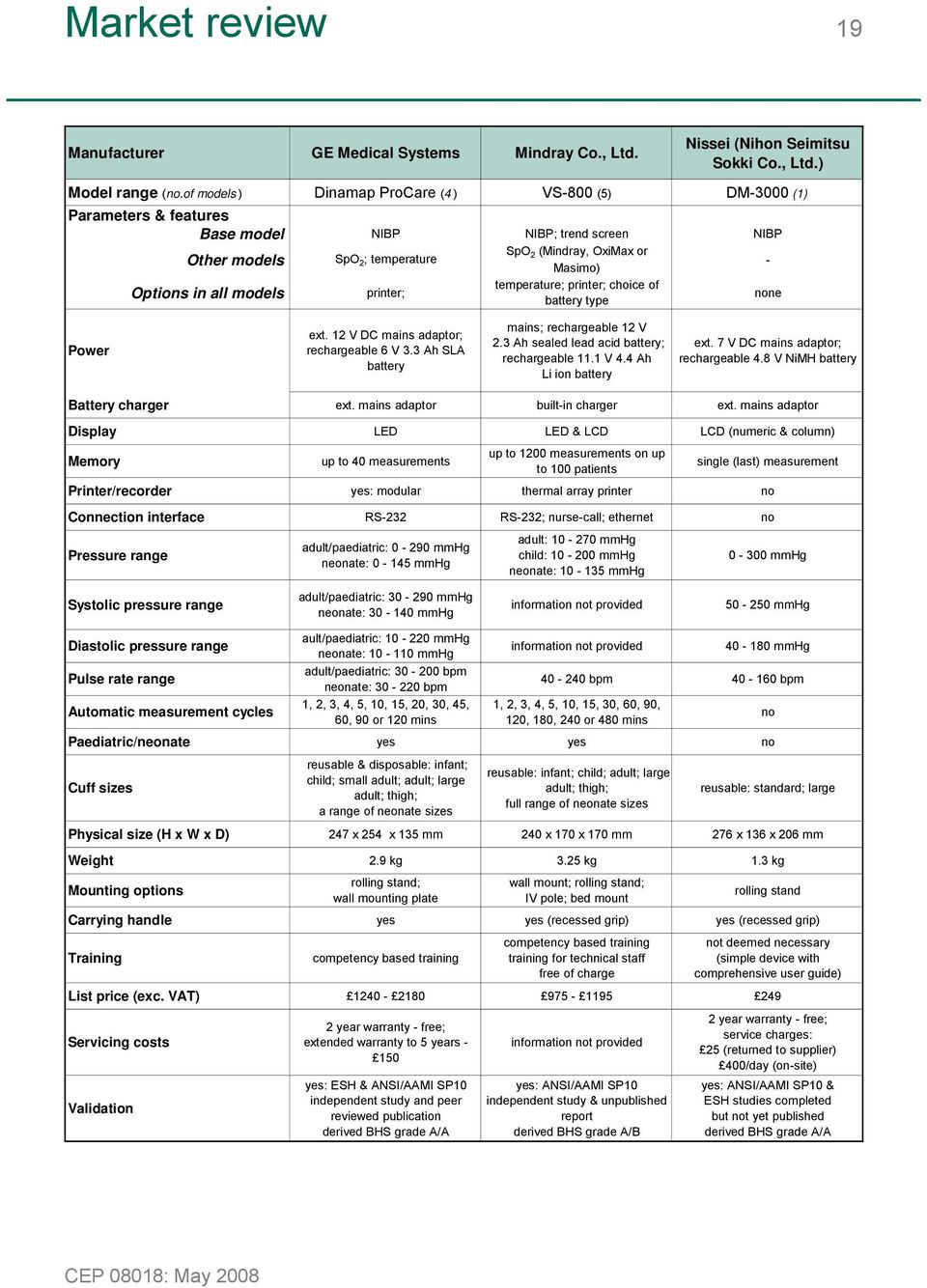
19 Market review 19 Manufacturer GE Medical Systems Mindray Co., Ltd. Nissei (Nihon Seimitsu Sokki Co., Ltd.) Model range (no.of models ) Dinamap ProCare (4 ) VS-800 (5) DM-3000 (1) Parameters & features Base model NIBP NIBP; trend screen NIBP SpO Other models SpO 2 ; temperature 2 (Mindray, OxiMax or Masimo) - Options in all models printer; temperature; printer; choice of battery type none Power ext. 12 V DC mains adaptor; rechargeable 6 V 3.3 Ah SLA battery mains; rechargeable 12 V 2.3 Ah sealed lead acid battery; rechargeable 11.1 V 4.4 Ah Li ion battery ext. 7 V DC mains adaptor; rechargeable 4.8 V NiMH battery Battery charger ext. mains adaptor built-in charger ext. mains adaptor Display LED LED & LCD LCD (numeric & column) Memory up to 40 measurements up to 1200 measurements on up to 100 patients single (last) measurement Printer/recorder yes: modular thermal array printer no Connection interface RS-232 RS-232; nurse-call; ethernet no Pressure range adult/paediatric: mmhg neonate: mmhg adult: mmhg child: mmhg neonate: mmhg mmhg Systolic pressure range adult/paediatric: mmhg neonate: mmhg information not provided mmhg Diastolic pressure range Pulse rate range Automatic measurement cycles ault/paediatric: mmhg neonate: mmhg adult/paediatric: bpm neonate: bpm 1, 2, 3, 4, 5, 10, 15, 20, 30, 45, 60, 90 or 120 mins information not provided mmhg bpm bpm 1, 2, 3, 4, 5, 10, 15, 30, 60, 90, 120, 180, 240 or 480 mins Paediatric/neonate yes yes no Cuff sizes reusable & disposable: infant; child; small adult; adult; large adult; thigh; a range of neonate sizes reusable: infant; child; adult; large adult; thigh; full range of neonate sizes no reusable: standard; large Physical size (H x W x D) 247 x 254 x 135 mm 240 x 170 x 170 mm 276 x 136 x 206 mm Weight 2.9 kg 3.25 kg 1.3 kg Mounting options rolling stand; wall mounting plate wall mount; rolling stand; IV pole; bed mount rolling stand Carrying handle yes yes (recessed grip) yes (recessed grip) Training competency based training competency based training training for technical staff free of charge not deemed necessary (simple device with comprehensive user guide) List price (exc. VAT) Servicing costs Validation 2 year warranty - free; extended warranty to 5 years yes: ESH & ANSI/AAMI SP10 independent study and peer reviewed publication derived BHS grade A/A information not provided yes: ANSI/AAMI SP10 independent study & unpublished report derived BHS grade A/B 2 year warranty - free; service charges: 25 (returned to supplier) 400/day (on-site) yes: ANSI/AAMI SP10 & ESH studies completed but not yet published derived BHS grade A/A
20 Market review 20 Manufacturer Nonin Medical Inc. Omron Healthcare Co., Ltd. Philips Medical Systems Model range (no.of models ) Avant 2120 (1) HEM-907 (1) SureSigns VS1 (8) Parameters & features Base model NIBP; SpO 2 NIBP NIBP Other models - - SpO 2 ; temperature; printer Options in all models printer none - Power ext. 12 V DC mains adaptor; rechargeable 7.2 V 4.0 Ah NiMH battery ext. 8V DC mains adaptor; rechargeable 4.8 V 1.6 Ah NiMH battery mains; rechargeable 6 V 5 Ah SLA battery Battery charger ext. mains adaptor ext.mains adaptor built-in charger Display LED LCD LED & LCD Memory up to 300 measurements up to 3 measurements in 'Average' mode up to 400 measurements Printer/recorder yes: external no yes: internal Connection interface RS-232 no RS-232 Pressure range mmhg mmhg mmhg Systolic pressure range mmhg not specified Diastolic pressure range mmhg not specified adult/paediatric: mmhg neonate: mmhg adult/paediatric: mmhg neonate: mmhg Pulse rate range up to 200 bpm bpm Automatic measurement cycles 1, 2, 3, 5, 10, 15, 45, 60 or 90 mins no adult/paediatric: bpm neonate: bpm 1, 2, 2.5, 3, 5, 10, 15, 20, 30, 60, 90, 120 or 180 mins Paediatric/neonate paediatric only no yes Cuff sizes reusable: small; standard; large reusable: small; medium; large reusable & disposable: infant; paediatric; small adult; adult; large adult; thigh neonatal disposable: sizes 1-4 Physical size (H x W x D) 138 x 190 x 114 mm 203 x 139 x 131 mm 258 x 210 x 285 mm Weight 1.35 kg 1.0 kg 3.75 kg Mounting options Carrying handle Training rolling stand; wall bracket; pole clamp yes (recessed grip); carrying case (optional) training for clinical & technical staff - free of charge rolling stand; wall bracket; pole mount yes (recessed grip) competency based training - free of charge rolling stand yes (recessed grip) training - free of charge List price (exc. VAT) Servicing costs Validation 3 year warranty on main unit, sensor & NIBP module; 1 year warranty on charger/ cord & battery pack yes: ANSI/AAMI SP10 in-house study and unpublished report derived BHS grade A/A recalibration: free of charge under 3 year warranty; 30 after 3 years yes: ESH & ANSI/AAMI SP10 independent studies and peer reviewed publications derived BHS grade A/B 1 year warranty claimed ANSI/AAMI SP10 no supporting evidence

21 Market review 21 Manufacturer Philips Medical Systems Schiller AG Smiths Medical PM Inc. Model range (no.of models ) SureSigns VS3 (6) Argus VCM (4) Mini-Torr Plus (1) Parameters & features Base model NIBP NIBP NIBP Other models SpO 2 ; temperature; printer SpO 2 ; temperature; printer - Options in all models none SpO 2 ; temperature; printer Power mains, rechargeable battery 11.1 V 6 Ah Li ion battery mains; rechargeable 6 V 4 Ah SLA battery ext. 24 V DC mains adaptor; rechargeable 6 V NiCd battery Battery charger buit-in charger built-in charger ext. mains adaptor Display colour LCD LED LED Memory up to 400 measurements up to 200 measurements Information not provided Printer/recorder yes: internal yes: internal yes; internal or external Connection interface USB RS-232 nurse call via RS232 Pressure range not specified mmhg Systolic pressure range Diastolic pressure range Pulse rate range Automatic measurement cycles adult/paediatric: mmhg neonate: mmhg adult/paediatric: mmhg neonate: mmhg adult/paediatric: bpm neonate: bpm 1, 3, 5, 10, 15, 30, 60, 90 mins; also 'Stat' adult: mmhg paediatric: mmhg neonate: mmhg adult: mmhg paediatric: mmhg neonate: mmhg bpm 1, 2, 3, 4, 5, 10, 15, 30, 45, 60, 90, 120 or 240 mins; also 'Stat' RS-232 adult: mmhg neonate: mmhg Information not provided Information not provided adult: bpm neonate: bpm 1, 2, 2.5, 5, 10, 15, 20, 30, 45, 60 or 90 mins Paediatric/neonate yes yes yes Cuff sizes reusable & disposable: infant; paediatric; small adult; adult; large adult; thigh neonatal disposable: sizes 1-4 reusable: neonate sizes 1 to 4; infant; small child; child; small adult; adult; large adult; thigh reusable: newborn; infant; small child; child; small adult; adult; large adult disposable neonate: range of sizes Physical size (H x W x D) 215 x 255 x x 278 x 130 mm 82 x 216 x 140 mm Weight 3.25 kg 2.7 kg 1.6 kg Mounting options rolling stand; wall mount rolling stand rolling stand; IV pole mount Carrying handle yes yes yes (flip up) Training training - free of charge on-site training: cost depends on quantity provided Information not provided List price (exc. VAT) not provided Servicing costs 1 year warranty annual ppm 65 ex warranty parts & labour 126 repair 90 per hour 2 year warranty Validation yes: ANSI/AAMI SP10 independent study & unpublished report; derived BHS grade B/A claimed ANSI/AAMI SP10 no supporting evidence claimed ANSI/AAMI SP10 no supporting evidence
22 Market review 22 Manufacturer Welch Allyn, Inc. Welch Allyn, Inc. Welch Allyn, Inc. Model range (no.of models ) Spot Vital Signs (6 ) Spot Vital Signs Lxi (6 ) VSM 300 (12 ) Parameters & features Base model NIBP NIBP; temperature (Welch Allyn or Braun) NIBP SpO Other models 2 (Masimo or Nellcor); SpO SpO 2 (Masimo or Nellcor) 2 (Masimo or Nellcor); temperature temperature; printer Options in all models none printer none Power ext. 7.2 V 1 A DC mains adaptor; rechargeable 6 V 4.5 Ah SLA battery ext. 9 V 1.5 A DC mains adaptor; 6 V 6 Ah rechargeable SLA battery ext. 8 V DC mains adaptor; rechargeable 6 V 4 Ah SLA battery Battery charger ext. mains adaptor ext. mains adaptor ext. mains adaptor Display LCD LCD LED & LCD Memory last measurement only up to 50 measurements up to 99 measurements Printer/recorder no yes: external yes: internal Connection interface infra-red RS-232; USB RS-232; nurse-call Pressure range mmhg mmhg mmhg Systolic pressure range mmhg mmhg Diastolic pressure range mmhg mmhg adult: mmhg paediatric: mmhg neonate: mmhg adult: mmhg paediatric: mmhg neonate: mmhg Pulse rate range bpm bpm bpm Automatic measurement cycles no no 1, 3, 4, 5, 10, 15, 30, 45, 60, 90, 120 or 240 mins; also 'Stat' Paediatric/neonate paediatric only paediatric only yes Cuff sizes Physical size (H x W x D) durable and disposable ranges: small child; child; small adult; adult; large adult; thigh adult 246 x 145 x 120 mm reusable: child; adult; large adult; thigh. durable & disposable ranges: infant; small child; child; small adult; adult; large adult; thigh. 270 x (Braun) or 190 (Welch Allyn) x mm reusable: neonate sizes 1 to 6; infant; small child; child; small adult; adult; large adult; thigh 168 x 254 x 152 mm Weight 2.2 kg 3.4 kg 2.4 kg Mounting options options: rolling stand; wall mount; IV pole mount rolling stand; wall mount rolling stand; wall mount; IV pole mount Carrying handle yes yes yes (recessed grip) Training competency based training; cost depends on quantity of units supplied and are dealt with individually competency based training; cost dependent on quantity of units supplied, sometimes FOC where quantities are large competency based training handbook supplied List price (exc. VAT) Information not provided Servicing costs Validation annual PPM 93; fully comprehensive 185; field service call out 121; unscheduled repair 218 yes: ANSI/AAMI SP10 in-house testing unpublished summary report BHS grade not derivable from summary annual PPM 127; fully comprehensive 273; field service call out 121; unscheduled repair 218 yes: ANSI/AAMI SP10 & BHS independent study and peer reviewed publication BHS grade A/A annual PPM 155; fully comprehensive 310; field service call out 121; unscheduled repair 218 yes: ANSI/AAMI SP10 in-house study and unpublished report derived BHS grade A/A
23 Market review 23 Biosys Sentry Brief description Four models were available in the range. The base model (Sentry NS) monitored NIBP including automatic timed measurements, SpO 2 and optionally temperature. NIBP was indicated for use on all patient categories (adult, paediatric and neonate).the other three models monitored the same parameters but included a printer module, a trend display screen or both. The monitor was operated by 16 control buttons in conjunction with nine numerical indicator displays that showed patient parameter information. An LCD panel was provided on the two models with trend display capability. A large, clearly visible alarm indicator was mounted centrally above the display area. Other indicator icons showed NIBP patient category and mains/battery status. NIBP measurements were performed during the cuff inflation phase, followed by immediate cuff deflation when the measurement was complete; this can be faster and more comfortable for patients than conventional measurement during deflation. Pressure readings were cleared after five minutes except when SpO 2 was also being measured. A pull-out reference card was slotted underneath the case. Summary Validation We could find no evidence of a clinical validation of this monitor against an appropriate protocol or standard. Good points Well constructed. Good measurement consistency across a range of pulse rates (SD ± 2.0 mmhg) provided that no tremor artefact was present. Gave no misleading readings when subjected to low pulse strengths. Disadvantages Gave six misleading readings from 25 tests when subjected to varying degrees of tremor artefact.
24 Market review 24 Results NIBP performance tests Model tested: NS (NIBP, SpO 2 ) pressure range satisfactory, SD ± 2.3 mmhg measurement consistency satisfactory, SD ± 2.1 mmhg variable pulse rate good, SD ± 2.0 mmhg susceptibility to artefact 6 misleading readings from 25 tests variable pulse strength no misleading readings overpressure pass General usability good Manuals user manual satisfactory service manual satisfactory Construction case material: plastic mechanical good electrical good serviceability in house satisfactory (main assembly replacement) o battery replaceable CE marking CE 0470 Technical discussion Construction The monitor was supplied with a 3 m hose and an adult reusable cuff. The rear panel housed the battery, a recessed carrying slot (not visible in photo) and an attachment point for a pole/roll stand. There was no RS-232 port for connection to a PC. Internally, the monitor was well constructed with a metal chassis and assemblies securely mounted. Surface mount components were used on high quality circuit boards with good component labelling. The NIBP pneumatic components consisted of two pressure sensors and two pressure release valves. Overpressure test With a single fault applied to either of the two pressure transducers before or during a measurement, the monitor immediately aborted the measurement and immediately displayed an error message an acceptable outcome. Power supply The monitor was powered from the mains or a 7.2 V rechargeable Li-ion battery specified to provide up to one hour of operating time. It was charged in-situ when AC mains was connected; the specified recharge time was two hours. Serviceability The user and service manuals stated that the device should be repaired by authorised personnel only but nevertheless provided some servicing information. NIBP calibration accuracy checks and leak tests could be accessed from a service menu and fault identification procedures were given. Replacement main assembly price lists were provided by the supplier.
25 Market review 25 CAS 740 Brief description Four models were available in the range. The base model CAS monitored NIBP including automatic timed measurements and was indicated for use on all patient categories (adult, paediatric neonate). Other parameters available, depending on model, were SpO 2 (Masimo, Nellcor or Nonin) and temperature. An optional external printer was available with data transferred via an infrared data port. The monitor was operated by ten control buttons in conjunction with five numeric LED displays that showed patient parameter information; there was also an LED message area. A set of indicator icons were used to show adult or neonatal mode, SpO 2 signal strength bar, battery status and alarm status. The battery indicator had three colours: green when charging; orange when running on battery power; red when the battery was low. The monitor had a data storage capacity of up to 480 data entries. Summary Validation The NIBP performance was clinically validated using the ANSI/AAMI SP10 protocol. It was supported by means of an independent study and an unpublished report (supplied). From the data we derived its equivalent BHS grade to be A/A. Good points Good construction. Excellent user manual. Good measurement consistency across a range of pressures (SD ± 1.5 mmhg) provided that no tremor artefact was present. Excellent measurement consistency across a range of pulse rates (SD ± 0.9 mmhg). Gave no misleading readings when subjected to tremor artefact or low pulse strength. Disadvantages None identified.
26 Market review 26 Results NIBP performance tests Model tested: (NIBP, SpO 2, temp) pressure range good, SD ± 1.5 mmhg measurement consistency good, SD ± 1.1 mmhg variable pulse rate excellent, SD ± 0.9 mmhg susceptibility to artefact gave no misleading readings variable pulse strength gave no misleading readings overpressure 6 pass General usability good Manuals user manual excellent service manual good Construction case material: plastic mechanical good electrical good serviceability in house good (main assembly replacement) o battery replaceable CE marking CE 0086 Technical discussion Construction The monitor was supplied with a 3 m hose, an adult reusable cuff and a child size reusable cuff. The rear panel housed the battery and an attachment point for a variety of mounting options. An infrared data connection port was mounted on the lower panel: an optional interface unit provided a nurse call connector and an RS-232 port for connection to a PC. Internally the monitor was well constructed, surface mount components were used on high quality circuit boards and all assemblies were securely mounted. The NIBP circuit board contained two pressure transducers. Overpressure test A maximum cuff pressure of 299 mmhg was recorded when a single fault condition was applied below the permissible maximum limit. Power supply The monitor was powered from the mains, an external 12 V DC supply or a rechargeable 7.2 V NiMH battery with a specified capacity of 100 NIBP measurements when repeated at five-minute intervals. The battery was charged in-situ when AC mains was connected; the specified recharge time was four hours. Serviceability The user manual gave details on cleaning and maintenance of the unit, recommended intervals for pneumatic checks, calibration accuracy checks and replacement of the battery pack. A configuration menu enabled user preferences to be set. The service manual was good, enabling in-house servicing to main assembly replacement level.
27 Market review 27 Criticare VitalCare 506N3 Brief description Eight models were available in the VitalCare range. The base model monitored NIBP including automatic timed measurements indicated for use on all patient categories (adult, paediatric and neonatal) and SpO 2. The seven other models provided different permutations of temperature, SpO 2 technology (Criticare or Nellcor) and printer. The monitor (base model) was operated using ten front panel control buttons. Five numeric LED displays showed patient parameter information. A small LCD text panel showed status messages and menu information. A further six LED icons indicated when AC power was connected, battery status, patient category and SpO 2 sensor off. An alarm silence indicator and an SpO 2 signal strength bar were provided. NIBP measurements were performed during the cuff inflation phase, followed by immediate cuff deflation when the measurement was complete; this can be faster and more comfortable for patients than conventional measurement during deflation. Summary Validation The manufacturer claimed clinical validation owing to similarity with the Criticare Poet Plus 8100 which meets the ANSI/AAMI SP10 protocol according to an unpublished report (supplied). From the data we derived its equivalent BHS grade to be A/B. Good points Well constructed. Good service facilities and documentation. Excellent measurement consistency at a fixed pressure of 120/80 mmhg (SD ± 0.6 mmhg). Gave no misleading readings when subjected to low pulse strengths. Disadvantages Poor measurement consistency at pulse rates below 60 bpm (SD ± 11.9 mmhg). Gave one misleading reading from 25 tests when subjected to varying degrees of tremor artefact. Failed the overpressure test.
28 Market review 28 Results NIBP performance tests Model tested: base model (NIBP, SpO 2 ) pressure range good, (SD ± 2.0 mmhg) measurement consistency excellent, (SD ± 0.6 mmhg) variable pulse rate poor, (SD ± 11.9 mmhg) susceptibility to artefact 1 misleading reading from 25 tests variable pulse strength no misleading readings overpressure fail (> 400 mmhg) General usability good Manuals user manual excellent service manual excellent Construction case material: plastic mechanical good electrical good serviceability in house good (main assembly replacement) o battery user replaceable CE marking CE 0413 Technical discussion Construction The monitor was supplied with an adult reusable cuff and a 3 m coiled hose. The unit's rear panel housed the battery, printer module (when specified) and an RS-232 port for connection to a PC. A roll stand/pole mounting point was provided. Internally, all assemblies were securely mounted. Surface mount components were used on high quality circuit boards with good component labelling throughout. The NIBP components consisted of a single pressure transducer and two pressure release valves. Overpressure test The maximum cuff pressure achieved with a simulated single fault condition was 412 mmhg before the cuff was manually deflated to prevent damage auto-cycling monitors are required to limit pressure to 330 mmhg under single fault conditions. Power supply The monitor was powered from the mains or a rechargeable 6 V SLA battery with an eight hour specified capacity with NIBP measurements repeating at five minute intervals. The battery was charged in-situ when AC mains was connected; the specified recharge time was four hours. Serviceability An excellent service manual covered configuration, planned maintenance, service testing and NIBP calibration accuracy checks. Service menus gave access to the NIBP calibration accuracy procedure using a PC connection and additional manufacturer's software (not supplied).
29 Market review 29 Datascope Accutorr Plus Brief description Five models were available in the Accutorr range. The base model monitored NIBP including automatic timed measurements and was indicated for use on all patient categories (adult, paediatric and neonatal). Other parameters available were SpO 2 (with a choice of Datascope, Nellcor or Masimo) and temperature modules. Four models included a trend display and a printer module was available on all models. The monitor was operated by 15 control buttons in conjunction with seven numeric LED displays that showed patient parameter information, error codes and service information. A set of indicator icons showed NIBP patient category, alarm status, AC power and battery status. Models with trend option had an additional LCD up to 100 readings were displayed. Summary Validation The NIBP performance was clinically validated by independent studies using the ANSI/AAMI SP10 protocol and the British Hypertension Society (BHS) protocol, under which it was graded A/A. The work was supported by peer-reviewed publications [23, 24]. Good points Well constructed with good documentation and service facilities. Good measurement consistency at a fixed pressure of 120/80 mmhg (SD ± 1.5 mmhg). Good measurement consistency across a range of pulse rates (SD ± 2.0 mmhg). Gave no misleading readings when subjected to low pulse strengths. Disadvantages Gave two misleading readings from 25 tests when exposed to varying degrees of tremor artefact.
30 Market review 30 Results NIBP performance tests Model tested: base model (NIBP) pressure range satisfactory, SD ± 2.1 mmhg measurement consistency good, SD ± 1.5 mmhg variable pulse rate good, SD ± 2.0 mmhg susceptibility to artefact 2 misleading readings from 25 tests variable pulse strength gave no misleading readings overpressure satisfactory (built-in self test see below) General usability excellent Manuals user manual excellent service manual good Construction case material: plastic mechanical excellent electrical excellent serviceability in house good (main assembly replacement) o battery replaceable CE marking CE 0044 Technical discussion Construction The monitor was supplied with a 3.5 m hose and a range of three adult reusable cuffs. The battery was housed in the monitor's base. On the rear panel was a pole/roll stand mounting point, a recessed carrying grip (not visible in photo) and an RS-232 port for connection to a PC. Internally, all assemblies were securely mounted. Surface mount components were used on high quality circuit boards with good component labelling. Overpressure test The service menu overpressure test gave a satisfactory result but we were unable to apply our standard simulated single fault to the NIBP assembly due to inaccessibility. It included two pressure transducers and two release valves that were broadly similar to those in the Duo (page 31), which we could test more easily and met the single fault requirements. We were therefore reasonably confident the Accutorr Plus also complied. Power supply The monitor was powered from the mains or a rechargeable 11.1 V Li-ion battery with a specified 9.5 hour capacity when measuring NIBP at five minute intervals. The battery was charged in-situ when AC mains was connected; the specified recharge time was 4 hours. Early models had an SLA battery option now discontinued. Serviceability The service manual procedures were clearly described, including NIBP calibration accuracy checks and performance verification via a service diagnostics menu. Repair of the unit was to board/assembly replacement level status and error codes were displayed to help identify faulty assemblies.
31 Market review 31 Datascope Duo Brief description Three models were available in the Duo range. The base model monitored NIBP, was indicated for use on adult and paediatric patient categories and was manually initiated only (i.e. no automatic timed measurements). The other two models included either Masimo or Nellcor SpO 2. A temperature display was built in to the front panel of the supplied model but this option was not available at the time of this report. The monitor was operated by four control buttons below the display area. A set of numeric LED displays showed patient parameter information and alongside them were LED indicators that gave additional information, e.g. pulse rate source (SpO 2 or NIBP), patient category, battery charging status, AC power, and NIBP start/stop. The monitor had a battery power saving features: Standby invoked after 2-3 minutes of inactivity Auto shutoff after 13 minutes in standby Summary Validation The NIBP performance was clinically validated using the ANSI/AAMI SP10 protocol. It was supported by means of an in-house study and an unpublished report (supplied). We were unable to derive a BHS grade from the data given in the supplied report. Good points Very well built. Excellent measurement consistency at a fixed pressure of 120/80 mmhg (SD ± 0.5 mmhg) and varying pulse rates pulse rates (SD ± 0.9 mmhg). Good consistency across a range of pressures (SD ± 1.1 mmhg). Gave no misleading readings when subjected to low pulse strengths. Disadvantages Gave two misleading readings from 25 tests when subjected to varying degrees of tremor artefact.
32 Market review 32 Results NIBP performance tests Model tested: NIBP, SpO 2 pressure range good, SD ± 1.1 mmhg measurement consistency excellent, SD ± 0.5 mmhg variable pulse rate excellent, SD ± 0.9 mmhg susceptibility to artefact 2 misleading readings from 25 tests variable pulse strength gave no misleading readings overpressure pass General usability excellent Manuals user manual good service manual good Construction case material: plastic; rubber grip handle mechanical excellent electrical excellent serviceability in house good (main assembly replacement) o battery replaceable CE marking CE 0044 Technical discussion Construction The monitor was supplied with a 3.5 m hose and a range of three adult reusable cuffs. The battery was housed in the monitor's base and a roll stand mounting bracket was available. There was no RS-232 port for connection to a PC. Internally all assemblies were securely mounted. Surface mount components were used on high quality circuit boards with good component labelling throughout. There were two pressure sensors and two pressure release valves. Overpressure test (single measurement device*) An overpressure test was performed with a simulated single fault condition applied. The monitor halted cuff inflation at 320 mmhg and an error message was displayed a good result because standards do not require a single measurement device to comply with this test. Power supply The device was powered from the mains or a rechargeable 7.2 V Li-ion battery with a specified 14 hour capacity when measuring NIBP at seven minute intervals. The battery was charged in-situ when AC mains was connected; the specified recharge time was 4.5 hours. Serviceability The service manual procedures were clearly described and dismantling was straightforward. Diagnostic tests occurred when the monitor was switched on; if a failure occurred an error code was displayed to assist fault finding. Repair of the unit was to board/assembly replacement level. Configuration, calibration accuracy checks and testing were carried out from a menu accessible by pressing a combination of control buttons. *Standards do not require a single measurement device to comply with this test.
33 Market review 33 GE Dinamap Pro Brief description Four models were available in the Dinamap Pro range. The base model (Pro 100V2) monitored NIBP including automatic timed measurements and was indicated for use on all patient categories (adult, paediatric and neonatal). The other three models included temperature, SpO 2 (Nellcor/Masimo) or both. All models had a trend display and a printer. An LCD panel showed trends, alarms, control menus and user interface messages. A set of numeric LED displays showed patient parameter information. Other indicators included an alarm silence icon, a low battery warning and a battery charging indicator. LED intensity was controlled by automatic ambient light compensation. The monitor was operated by four buttons and a rotary/push control knob to highlight/select menu items on the LCD panel. It detects the presence of neonatal cuffs/hoses and changes to neonatal mode automatically. The monitor had a 'Clinician Mode', accessible by pass code, which allowed initial cuff inflation pressure to be set, NIBP calibration accuracy checks check and permanent silencing of alarms. Summary Validation The NIBP performance was clinically validated using the ANSI/AAMI SP10 protocol. The work was an independent study described in a peer-reviewed publication [25]. The BHS grade was B/C. The publication acknowledged that the computational algorithm used by this device was derived and tested using intra-arterial blood pressure measurements. Good points Very well constructed with excellent documentation and service facilities. Good measurement consistency at a fixed pressure of 120/80 mmhg (SD ± 1.3 mmhg). Good measurement consistency across a range of pulse rates (SD ± 1.6 mmhg). Gave no misleading readings when subjected to low pulse strengths. Disadvantages Gave one misleading reading from 25 tests when subjected to varying degrees of tremor artefact.
34 Market review 34 Results NIBP performance tests Model tested: 400 V2 (NIBP,SpO 2, temp) pressure range satisfactory, SD ± 3.3 mmhg measurement consistency good, SD ± 1.3 mmhg variable pulse rate good, SD ± 1.6 mmhg susceptibility to artefact 1 misleading reading from 25 tests variable pulse strength gave no misleading readings overpressure pass General usability excellent Manuals user manual good service manual good Construction case material: plastic mechanical excellent electrical excellent serviceability in house excellent (main assembly replacement) o battery replaceable CE marking CE 0086 Technical discussion Construction The monitor was supplied with a 3.66 m hose and a wide range of cuffs was available; all were dual lumen. This feature was claimed to reduce measurement errors in the event of air hose kinking since both lumens were less likely to kink simultaneously. The monitor had an integrated carrying grip (not visible in the photo). The rear panel housed the battery and an integrated pole mounting rail with securing knob. Also on the rear panel was an RS-232 port for connection to a PC. Internally, all assemblies were securely mounted. Two pressure transducers and two pressure release valves were present. All pneumatic components were encased in foam to reduce noise. Overpressure test We performed an overpressure test whilst applying a simulated single fault condition. The highest cuff pressure recorded was 301 mmhg, within the allowable limit. Power supply The device was powered from the mains, an external 24 V DC supply or a rechargeable 12 V SLA battery specified with a two hour minimum capacity. It was recharged in-situ when AC mains was connected; the specified recharge time was two hours (monitor off) or eight hours (monitor on). Serviceability The service manual dismantling procedure was straightforward and clear diagrams were provided. A troubleshooting guide and error codes helped to identify faults. A pass code protected service mode was similar to 'Clinician Mode' but with additional facilities including overpressure point adjustment and calibration accuracy verification.
35 Market review 35 GE Dinamap ProCare Brief description There were four models in the ProCare range. The base model (ProCare 100) monitored NIBP including automatic timed measurements and was indicated for use on all patient categories (adult, paediatric and neonatal). The other three models included temperature, SpO 2 (Nellcor/Masimo) or both. A printer module was optionally available on all models. The monitor was operated by sets of buttons on both sides of the display area. A set of numeric LED displays showed patient parameter information. Other indicators included an alarm silence icon, a low battery warning and a battery charging indicator. The monitor detects the presence of neonate cuffs/hoses and changes to neonatal mode automatically. A protected access configuration mode included adjustments to date and time, initial inflation pressure and the alarm silence interval. Configuration changes can be saved no more than 90 times after which an error message is issued. This can be reset only by returning the monitor to a GE service centre. A pull-out reference guide was slotted underneath the case. Summary Validation The NIBP performance was clinically validated using the International Protocol of the European Society of Hypertension and ANSI/AAMI SP10. It was supported by an independent study and a peer-reviewed publication [26]. From the data we derived its equivalent BHS grade to be A/A. Good points Very well constructed with good documentation and service facilities. Good measurement consistency at a fixed pressure of 120/80 mmhg (SD ± 1.5 mmhg). Good measurement consistency across a range of pressures (SD ± 1.9 mmhg). Gave no misleading readings in the presence of tremor artefact or low pulse strength. Disadvantages None identified.
36 Market review 36 Results NIBP performance tests Model tested: 400 (NIBP, SpO 2, temp) pressure range good, SD ± 1.9 mmhg measurement consistency good, SD ± 1.5 mmhg variable pulse rate satisfactory, SD ± 3.5 mmhg susceptibility to artefact gave no misleading readings variable pulse strength gave no misleading readings overpressure not tested General usability excellent Manuals user manual good service manual good Construction case material: plastic mechanical excellent electrical excellent serviceability in house good (main assembly replacement) o battery replaceable CE marking CE 0086 Technical discussion Construction The monitor was supplied with a 3.66 m hose and a range of cuffs; all were dual lumen. This feature was claimed to reduce measurement errors in the event of an air hose kinking since both lumens were less likely to kink simultaneously. The rear panel housed the battery, a pole mounting bracket and an RS-232 port for connection to a PC. Internally, all the components were securely mounted with the NIBP assembly encased in foam to reduce noise. Overpressure test We were unable to apply our standard simulated single fault to the NIBP assembly due to inaccessibility. The NIBP assembly included two independent pressure sensors and two release valves that were broadly similar to those in the Dinamap Pro (page 33), which we could test more easily and met the single fault requirements. We were therefore reasonably confident the Dinamap ProCare also complied. Power supply The device was powered by an external 12 V mains adapter or a rechargeable 6 V SLA battery specified with a five hour minimum capacity. It was recharged in-situ when AC mains was connected; recharge time was five hours (monitor off) or eight hours (monitor on). Serviceability The service manual procedures were clearly described and dismantling was straightforward. Fault identification was assisted by error codes following self-tests. The service menu gave access to functional checks including pressure transducer calibration accuracy checks and leak tests. Any changes in this menu contributed to the tally of configuration changes referred to in the brief description (page 35).
37 Market review 37 Mindray VS-800 Brief description The VS-800 monitor had five model variants of which four measured NIBP including automatic timed measurements and was indicated for use on all patient categories (adult, paediatric and neonatal). Other models monitored SpO 2 (Massimo, Nellcor or Mindray) and temperature. Options for all models included a printer and a choice of battery type. The monitor was operated by up to 12 front panel buttons (depending on model) in conjunction with a set of LED displays that showed patient parameter information. A backlit LCD showed trend information, on-screen messages and SpO 2 waveform. Users could access simple configuration settings e.g. date and time through on-screen menus. Other indicators included SpO 2 pulse strength, external/battery power LED, alarm silence, pressure units and patient category icons. A large alarm indicator was positioned centrally at the top of the case. Summary Validation The NIBP performance was clinically validated using the ANSI/AAMI SP10 protocol. It was supported by means of an independent study and unpublished report (supplied). From the data we derived its equivalent BHS grade to be A/B for adult/paediatric patients. Good points Easy to use. Well constructed. Excellent measurement consistency across a range of pressures (SD ± 0.8 mmhg). Excellent measurement consistency at a fixed pressure of 120/80 mmhg (SD ± 0.8 mmhg). Gave no misleading readings in the presence of tremor artefact or low pulse strength. Disadvantages None identified.
38 Market review 38 Results NIBP performance tests Model tested: NIBP, SpO 2 pressure range excellent, SD ± 0.8 mmhg measurement consistency excellent, SD ± 0.8 mmhg variable pulse rate satisfactory, SD ± 2.3 mmhg susceptibility to artefact gave no misleading readings variable pulse strength gave no misleading readings overpressure pass General usability excellent Manuals user manual excellent service manual good Construction case material: plastic mechanical excellent electrical good serviceability in house good (main assembly replacement) o battery replaceable CE marking CE 0123 Technical discussion Construction The monitor was supplied with a 3 m hose and an adult reusable cuff. The unit had an integrated carrying grip (not visible in the photo) and the printer (if specified) was installed in the left hand side panel. On the rear panel was a pole mounting point, an RS-232 port for connection to a PC, a nurse call connector and an Ethernet connector for use with a Mindray central monitoring system. The battery compartment was located underneath. Internally, all assemblies were securely mounted; surface mount components were used on high quality circuit boards with good labelling throughout. Two pressure transducers were connected to a common manifold. Overpressure test A simulated single fault condition was applied and the resulting overpressure was measured whilst the monitor attempted to perform an NIBP determination. The maximum pressure recorded was 328 mmhg an acceptable outcome. Power supply The monitor was powered from the mains or a rechargeable battery. Two types of battery were available depending on the monitor purchased: a 12 V SLA with a specified 4.5 hour capacity and an 8 hour charge time or 11.1 V Li-ion with a specified 10.5 hour capacity and an 8 hour charge time. Serviceability Monitor disassembly was very straightforward and was detailed in the service manual. Repair of the unit was to circuit board/assembly replacement level. A service menu gave access to pressure transducer calibration accuracy checks and a leak test.
39 Market review 39 Nissei DM-3000 Brief description The Nissei DM-3000 was an NIBP device packaged to resemble a mercury sphygmomanometer and enabled a user to take blood pressure measurements by manual auscultation. It also had an 'automatic' setting in which the monitor measured blood pressure by the oscillometric method. Cuff pressure was shown on a blue backlit LCD in the form of a 300 mm mercury column graduated in 2 mm steps. A separate numeric LCD showed systolic/diastolic pressure and pulse rate. A rotary knob with settings mmhg adjusted the initial cuff inflation pressure. Once an NIBP determination had been performed the measurement readings were shown on both the column and the numeric LCD. The device had a single (last) reading memory for automatic readings only. An LED indicator showed battery charge status: orange when charging and green when charged. In manual auscultation mode, the cuff was inflated automatically and cuff deflation was via the monitor's internal bleed valve. The user could select a bleed rate of 2.5, 4.5 or 6.5 mmhg/sec. A bulb inflator (not supplied) could be used with pump off selected. This did not appear to disable the internal bleed valve but the instructions suggested that if the lowest bleed rate setting was selected, then the deflation valve on the bulb inflator could be used effectively. Summary Validation At the time of writing this report studies to validate performance with respect to manual auscultation and oscillometric measurements using the ANSI/AAMI SP10 protocol and the International Protocol of the European Society of Hypertension (ESH) had been made but not yet published. The British Hypertension Society working party had approved and reviewed the auscultatory validation data. We were supplied with preliminary results from the ESH oscillometric validation, these indicated that the device passed and also met the ANSI/AAMI SP10 criteria. From this we derived an equivalent BHS grade to be A/A. Good points Manual auscultation facility. Excellent measurement consistency at a fixed pressure of 120/80 mmhg (SD ± 0.7 mmhg). Good measurement consistency across a range of pressures (SD ± 1.1 mmhg) provided that no tremor artefact was present. Good measurement consistency across a range of pulse rates (SD ± 1.3 mmhg) Gave no misleading readings when subjected to low pulse strengths. Inexpensive. Disadvantages Gave ten misleading readings from 25 tests when subjected to varying degrees of tremor artefact.
40 Market review 40 Results NIBP performance tests Model tested: DM-3000 pressure range good, SD ± 1.3 mmhg measurement consistency excellent, SD ± 0.7 mmhg variable pulse rate good, SD ± 1.3 mmhg susceptibility to artefact 10 misleading readings from 25 tests variable pulse strength gave no misleading readings overpressure > 370 mmhg General usability oscillometric use: good manual auscultation: not assessed Manuals user manual satisfactory service manual not available Construction case material: plastic mechanical good electrical good serviceability in house calibration accuracy checks only o battery replaceable CE marking CE 0123 Technical discussion Construction The monitor was supplied with two reusable cuff sets: size adult and large adult each with a 1.5 m hose. The monitor is shown in its base unit (see photo) which included an accessory compartment and a pole mounting point. The case had a carrying grip (not visible in the photo). Internally, surface mount components were used on high quality circuit boards with good component labelling. There was a single pressure transducer and two pressure release valves. There was no RS-232 port for connection to a PC. Overpressure test (single measurement device*) We tested the monitor for overpressure with a simulated single fault condition applied. We recorded a cuff pressure of 370 mmhg before releasing the pressure manually to prevent damage. The device had satisfactory means for the user to deflate the cuff immediately. Power supply The monitor could be powered by an external mains adaptor or a rechargeable 4.8 V NiMH battery but no operating time was specified. It was recharged in-situ when the AC mains adapter was connected with a recharge time of up to four hours. Serviceability No service manual was provided with the device, but the user manual contained some service information, including instructions for checking the accuracy of the pressure readings, cleaning procedures and advice stating that the monitor should be returned to the manufacturer or authorised supplier every two years for a calibration accuracy check. *Standards do not require a single measurement device to comply with this test.
41 Market review 41 Nonin Avant 2120 Brief description The Avant 2120 monitored NIBP with automatic timed measurements and SpO 2. The NIBP function was indicated for use on adult and paediatric patients only. There were no model variants although a compatible external printer was available. The monitor was operated by 11 control buttons and a set of LED numerical displays. Five of them showed patient parameter information and a sixth showed a variety of other data including cuff pressure and timed measurement interval. An SpO 2 pulse strength bar graph doubled as a battery capacity indicator A set of LED icon indicators included sensor data, alarm status and battery charging status. The NIBP display was cleared five minutes after the last measurement. Up to 300 NIBP readings, 33.5 hours of SpO 2 and pulse rate data (not NIBP) were stored and available for download to a PC. Summary Validation The NIBP performance was clinically validated using the ANSI/AAMI SP10 protocol. It was supported by means of an in-house study and an unpublished report (supplied). From the data we derived its equivalent BHS grade to be A/A. Good points Excellent measurement consistency across a range of blood pressures (SD ± 1.3 mmhg) and pulse rates (SD ± 0.8 mmhg). Gave no misleading readings when subject to varying degrees of tremor artefact and low pulse strengths. Disadvantages Failed overpressure test.
42 Market review 42 Results NIBP performance tests Model tested: Avant 2120 pressure range excellent, SD ± 1.3 mmhg measurement consistency good, SD ± 1.2 mmhg variable pulse rate excellent, SD ± 0.8 mmhg susceptibility to artefact gave no misleading readings variable pulse strength gave no misleading readings overpressure fail General usability good Manuals user manual satisfactory service manual not available Construction case material: plastic mechanical good electrical good serviceability in house calibration accuracy checks only o battery replaceable CE marking CE 0123 Technical discussion Construction The monitor was supplied with a 1.85 m hose and reusable cuffs of size small, standard and large. The case had a recessed carrying grip (not visible on photo) which doubled as a battery compartment cover. An RS-232 port the rear panel could be used with an external serial printer or for connection to a PC. There were facilities for a range of mounting options. Internally, all assemblies were securely mounted. Surface mount components were used on high quality circuit boards with good component labelling throughout. There was a single pressure transducer and two pressure release valves. Overpressure test We tested the monitor for overpressure with a simulated single fault condition applied. The maximum cuff pressure recorded was 360 mmhg and would have continued increasing, but at this point we released the pressure manually to prevent damage a poor result. Power supply The monitor was powered by an external mains adaptor or a rechargeable 7.2 V NiMH battery specified with a five hour minimum capacity. The battery was recharged in-situ when AC mains was connected; the specified recharge time was up to four hours (monitor off). Serviceability The user manual stated that repair was via manufacturer's agents only therefore no service manual was available. The monitor performed self-tests at power on with error codes and remedial action listed in the user manual. Also listed was a calibration accuracy check procedure for the NIBP module. Monitor configuration was via a set of miniature switches under the battery compartment cover.
43 Market review 43 Omron HEM-907 Brief description The HEM-907 measures NIBP using the oscillometric method and had facilities for users to measure blood pressure by manual auscultation. There were no model variants. In oscillometric mode it could be set to make a single measurement or provide an average of two or three readings taken at preset intervals (5 sec to 3 minutes). Initial inflation pressure could be set by the user or left for the device to determine for itself. In its manual auscultation mode, inflation and deflation was not user controllable but occurred automatically while the user listens to the Korotkoff sounds. A rapid deflate button could be used as appropriate to conclude the process. The device was operated by five front panel buttons (start, stop etc) and two rotary controls (initial pressure and function selector switch). An LCD display was used to show systolic pressure, diastolic pressure and pulse rate. There were additional indicators for device ready, pulse level/number of irregular pulses, battery level, battery charging and external power source connected. Summary Validation The performance of the HEM-907 in automated mode was clinically validated using the ANSI/AAMI SP10 protocol and the International Protocol of the European Society of Hypertension (ESH). It was supported by independent studies and peer-reviewed publications [27, 28]. From the data we derived its equivalent BHS grade to be A/B. Good points Excellent measurement consistency across a range of blood pressures (SD ± 0.6 mmhg) and pulse rates (SD ± 0.9 mmhg). Gave no misleading readings when subjected to low pulse strengths. Manual auscultation was possible. Inexpensive. Disadvantages Gave one misleading reading from 25 tests when subjected to varying degrees of tremor artefact.
44 Market review 44 Results NIBP performance tests Model tested: HEM-907 pressure range excellent, SD ± 0.6 mmhg measurement consistency excellent, SD ± 0.5 mmhg variable pulse rate excellent, SD ± 0.9 mmhg susceptibility to artefact 1 misleading reading from 25 tests variable pulse strength gave no misleading readings overpressure see test below General usability oscillometric mode: good manual auscultation : not assessed Manuals user manual satisfactory service manual not available Construction case material: plastic mechanical good electrical good serviceability in house o battery CE marking CE 0197 Technical discussion calibration accuracy checks only replaceable Construction The monitor was supplied with a 1 m hose and a medium size adult reusable cuff. The rear panel had a moulded grip (not visible in photo), a battery compartment and a pole/roll-stand mounting point. Internally, the monitor was well constructed with surface mount components and high quality circuit boards. All assemblies were securely mounted. The device had a single pressure transducer and single release valve. There was no RS-232 port for connection to a PC. Overpressure test (single measurement device*) Standards do not require a single measurement device to comply with this test but the monitor addressed the possibility of complete transducer failure (and hence the risk of overpressure) by checking that a valid and increasing pressure reading occurred after a few seconds of inflation. Our test confirmed that this worked correctly. Power supply The monitor was powered from the mains or a 4.8 V rechargeable NiMH battery with a specified capacity of up to 300 NIBP tests. It was charged in-situ when AC mains was connected, taking up to 12 hours. Serviceability Repair was via manufacturer's agents therefore no service manual was available. However, the instruction manual gave a basic procedure (selected from the front panel 'mode' switch) to check accuracy against a calibrated pressure gauge. Cleaning instructions and battery maintenance were also provided. *Standards do not require a single measurement device to comply with this test.
45 Market review 45 Philips SureSigns VS1 Brief description The VS1 range comprised eight models. The base model monitored NIBP including automatic timed measurements and was indicated for use on all patient categories (adult, paediatric and neonatal). The other models added permutations of SpO 2, temperature and internal printer. Six numeric LED displays showed patient parameter information and cuff pressure during inflation. An LCD panel showed trend data (400 data sets), control menus, user interface messages. There were eleven control buttons, five of which were used in conjunction with the LCD panel menus. Other indicators/icons included patient category, alarm status, NIBP measurement underway, power on and battery charging red when charging, green when charged. The monitor had a battery power saving feature that invoked standby after five minutes of inactivity. Summary Validation The manufacturer claimed (in the user manual) that the NIBP performance was clinically validated using the ANSI/AAMI SP10 protocol. However, no evidence was provided nor could any published evidence be found to verify this claim. Good points Gave no misleading readings when subjected to varying degrees of tremor artefact. Large trend data memory. Good service facilities. Disadvantages Poor measurement consistency at low (<60 bpm) pulse rates (SD ± 6.8 mmhg). Gave two misleading readings from 20 tests when subjected to low pulse strengths. Note: This device range is discontinued and has been superseded by the SureSigns VS3 (page 47).
46 Market review 46 Results NIBP performance tests Model tested: NIBP, SpO 2, temp pressure range satisfactory, SD ± 3.6 mmhg measurement consistency satisfactory, SD ± 2.8 mmhg variable pulse rate poor, SD ± 6.8 mmhg susceptibility to artefact gave no misleading readings variable pulse strength 2 misleading readings from 20 tests overpressure pass General usability good Manuals user manual good service manual good Construction case material: plastic mechanical good electrical good serviceability in house good (main assembly replacement) o battery replaceable CE marking CE 0123 Technical discussion Construction The device was supplied with a 3.6 m hose and an adult reusable cuff. Neonatal cuffs required a different hose. On the monitor's rear panel was an integrated carrying grip (not visible in photo), the air hose connector and an RS-232 port for connection to a PC. The battery was housed in the bottom panel and the printer (when fitted) in a side panel. Internally, all assemblies were securely mounted; surface mount components were used on high quality circuit boards with good component labelling throughout. There were two pressure transducers and two pressure release valves. Overpressure test A simulated single fault condition was applied and the resultant cuff pressure was measured whilst an NIBP determination was performed. The maximum pressure recorded was 304 mmhg an acceptable outcome. Power supply The monitor was powered from the mains or a rechargeable 6 V SLA battery specified with a six hour operating time. It was charged in-situ when AC mains was connected; the specified recharge time was approximately four hours. Serviceability The service manual included a troubleshooting guide and a list of error messages. Repair of the unit was to board/assembly replacement level. Monitor configuration, performance tests and calibration accuracy checks were available from the service menu.
47 Market review 47 Philips SureSigns VS3 Brief description The VS3 range comprised six models. The base model monitored NIBP including automated timed measurements and was indicated for use on all patient categories (adult, paediatric and neonatal). The other models added permutations of SpO 2, temperature and internal printer. The monitor was controlled by six front panel buttons and a rotate/push 'navigation wheel' in conjunction with menus on the colour LCD panel. The panel displayed all patient parameter information and waveforms (depending on model) or trend information. Other screen information included patient category, alarm status and battery gauge. Two LED indicators show mains and battery status information. Summary Validation The NIBP performance was clinically validated using the ANSI/AAMI SP10 protocol. It was supported by means of an independent study and an unpublished report (supplied). From the data we derived its equivalent BHS grade to be B/A. Good points Excellent measurement consistency across a range of pressures (SD ± 0.9 mmhg). Good measurement consistency across a range of pulse rates (SD ± 1.7 mmhg). Gave no misleading readings when subjected to varying degrees of tremor artefact and low pulse strengths. Excellent build quality and serviceability. Disadvantages None identified.
48 Market review 48 Results NIBP performance tests Model tested: NIBP, SpO 2, temp pressure range excellent, SD ± 0.9 mmhg measurement consistency excellent, SD ± 0.8 mmhg variable pulse rate good, SD ± 1.7 mmhg susceptibility to artefact gave no misleading readings variable pulse strength gave no misleading readings overpressure not tested General usability excellent Manuals user manual good service manual good Construction case material: plastic mechanical excellent electrical excellent serviceability in house excellent (main assembly replacement) o battery replaceable CE marking CE 0123 Technical discussion Construction The device was supplied with a 3 m hose and an adult reusable cuff. On the rear panel was a battery compartment, a USB port for connection to a PC and an Ethernet port for networking. On the base was a roll stand mounting point. Internally, all assemblies were securely mounted on a metal chassis; surface mount components were used on high quality circuit boards with good component labelling throughout. Overpressure test The device incorporated two pressure transducers and two release valves necessary to fulfil this requirement but we were unable to carry out our standard over pressure test due to inaccessibility of the pneumatic components. Power supply The monitor was powered from the mains or a rechargeable11 V lithium-ion battery but no operating time was specified. It was recharged in-situ when AC mains was connected; the recharge time was not specified. Serviceability The monitor carried out self-tests when switched on. The service menu had a system diagnostic function and access to the pressure test /calibration accuracy check procedure. The service manual contained an extensive troubleshooting guide with a list and description of error messages.
49 Market review 49 Schiller Argus VCM Brief description The Argus VCM (as supplied in the UK) had four model variants. The base model monitored NIBP including automatic timed measurements and was indicated for use on all patient categories (adult, paediatric and neonatal). The other models added permutations of SpO 2 and internal printer. The monitor was operated by nine control buttons (ten on models with printers) labelled with symbols instead of text. Patient parameter information was shown on a set of numeric LED displays. Other indicator icons included patient category, alarm status, mains connection status and battery status. Summary Validation The manufacturer claimed that the NIBP performance was clinically validated using the ANSI/AAMI SP10 protocol. However, no evidence was provided nor could any published evidence be found to verify this claim. Good points Excellent measurement consistency at a fixed pressure of 120/80 mmhg (SD ± 1 mmhg). Good measurement consistency across a range of simulated blood pressures (SD ± 1.7 mmhg) and across a range of pulse rates (SD ± 1.3 mmhg). Gave no misleading readings when subjected to varying degrees of tremor artefact and low pulse strengths. Disadvantages None identified.
50 Market review 50 Results NIBP performance tests Model tested: NIBP, SpO 2 pressure range good, SD ± 1.7 mmhg measurement consistency excellent, SD ± 1.0 mmhg variable pulse rate good, SD ± 1.3 mmhg susceptibility to artefact gave no misleading readings variable pulse strength gave no misleading readings overpressure pass General usability excellent Manuals user manual excellent service manual satisfactory Construction case material: plastic mechanical excellent electrical excellent serviceability in house good (main assembly replacement) o battery replaceable CE marking CE 0434 Technical discussion Construction The monitor was supplied with a 1.8 m hose and an adult reusable cuff. The rear panel had a battery compartment, an RS-232 port for connection to a PC and underneath was a roll stand mounting point. Alarm fault identification information was printed on the top panel. Internally, all assemblies were securely mounted. Surface mount components were used on high quality circuit boards with good component labelling throughout. The NIBP assembly had two pressure transducer and two pressure release valves. Overpressure test We measured the cuff pressure with a simulated single fault condition applied. The maximum pressure recorded was 297 mmhg an acceptable outcome. Power supply The monitor could be powered directly by mains or by a rechargeable 6 V SLA battery; operating time was stated (by the supplier) as two hours. It was recharged in-situ when AC mains was connected; the specified recharge time was up to 12 hours. Serviceability The manufacturer included a troubleshooting guide and an error code list. Repair of the unit was to board/assembly replacement level. The device had a dedicated service mode, entered by pressing a combination of buttons at switch-on. Facilities provided included NIBP calibration accuracy checks and pressure tests.
51 Market review 51 Smiths Mini-Torr Plus Brief description The Mini-Torr Plus monitored NIBP including automatic timed measurements and was indicated for use on all patient categories (adult, paediatric and neonatal). There were model variants that included SpO 2 and temperature; some models also had a built-in printer. The monitor was operated by eleven control buttons in conjunction with six numeric LED displays (on fully equipped models) that showed patient parameter information. Other indicator icons included an SpO 2 pulse strength bar, alarm condition with priority, alarm silenced, battery charge and low battery status. Summary Validation The manufacturer claimed that the NIBP performance was clinically validated using the ANSI/AAMI SP10 protocol. However, no published evidence was found to verify this claim. Good points Excellent repeatability at a fixed blood pressure of 120/80 mmhg (SD ± 0.8 mmhg). Good measurement consistency across a range of simulated blood pressures (SD ± 1.5 mmhg) and a range of pulse rates (SD ± 1.3 mmhg). Gave no misleading readings when subjected to varying degrees of tremor artefact or low pulse strength settings. Disadvantages None identified.
52 Market review 52 Results NIBP performance tests from Evaluation report May 2001 pressure range good, SD ± 1.5 mmhg measurement consistency excellent, SD ± 0.8 mmhg variable pulse rate good, SD ± 1.3 mmhg susceptibility to artefact gave no misleading readings variable pulse strength gave no misleading readings overpressure pass General usability good Manuals user manual excellent service manual good Construction case material: plastic mechanical satisfactory electrical good serviceability in house good (main assembly replacement) o battery replaceable (internal battery within enclosure) CE marking CE 0473 Technical discussion Construction The monitor was supplied with a 3 m hose and an adult reusable cuff. The carrying handle (not visible in photo) flipped up' and was shaped to hook over a hospital bed rail. The case had a pole/ roll stand mounting point. On the rear panel was an RS-232 port for connection to a PC. Internally, all assemblies were securely mounted. Surface mount components were used on high quality circuit boards with good component labelling throughout. The NIBP assembly had two pressure transducers and two pressure release valves. Overpressure test We tested the monitor for overpressure with a simulated single fault condition applied. The maximum cuff pressure achieved was 330 mmhg, meeting the requirements of the performance standard. Power supply The monitor was powered by a mains adaptor or an internal rechargeable 6 V NiCd battery with a specified capacity of six hours. It was charged in-situ when mains was connected; the specified recharge time was up to four hours. Serviceability The manufacturer provided a good service manual with the device. Repair was to board/assembly replacement level. If a problem was detected by self-tests, error codes were displayed to aid fault finding. The monitor had a system setting mode that allowed NIBP calibration accuracy checks procedures.
53 Market review 53 Welch Allyn Spot Vital Signs Brief description Six models were available in the Spot Vital Signs range. The base model (4200B) monitored NIBP and was indicated for adult and paediatric patient categories, manually initiated only (i.e. no automatic timed measurements).the other five models included different permutations of SpO 2 (Nellcor or Massimo) and temperature. The monitor was operated by five control buttons. in conjunction with a monochrome backlit LCD display. Other indicators included a battery level gauge and battery charging icon. A configuration mode could be accessed to preset the initial cuff inflation pressure, change units of pressure (mmhg or kpa), change time of day etc. Summary Validation The NIBP performance had been clinically validated using the ANSI/AAMI SP10 protocol; the results were also classified against the British Hypertension Society (BHS) protocol, under which an A/A rating was achieved. This was supported by an independent study and had been submitted for publication in a peer reviewed journal [29]. Good points Excellent repeatability at a fixed blood pressure of 120/80 mmhg (SD ± 0.7 mmhg). Excellent measurement consistency across a range of pulse rates (SD ± 1.0 mmhg). Gave no misleading readings when subjected to low pulse strengths. Disadvantages Gave four misleading readings from 25 tests when subjected to varying degrees of tremor artefact.
54 Market review 54 Results NIBP performance tests Model tested: 42N0B (NIBP, SpO 2 ) pressure range good, SD ± 1.5 mmhg measurement consistency excellent, SD ± 0.7 mmhg variable pulse rate excellent, SD ± 1.0 mmhg susceptibility to artefact 4 misleading readings from 25 tests variable pulse strength gave no misleading readings overpressure > 400 mmhg General usability good Manuals user manual good service manual satisfactory Construction case material: plastic mechanical excellent electrical satisfactory serviceability in house good (main assembly replacement) o battery replaceable CE marking CE 0297 Technical discussion Construction The monitor was supplied with a 1.5 m hose and a large adult reusable cuff. The rear panel housed the battery and had an attachment point for pole or wall mounting. A moulded carrying handle (partially obscured in photo) was integrated into the rear panel. There was no RS-232 port but an IR port enabled connection to a PC. Internally all assemblies were fixed securely. Surface mount components were used on high quality circuit boards with good component labelling throughout. The NIBP assembly had a single pressure transducer and a single release valve. Overpressure test (single measurement device*) We tested the monitor for overpressure with a simulated single fault condition applied. We recorded a cuff pressure of 400 mmhg before releasing the pressure manually to prevent damage. The device had satisfactory means for the user to deflate the cuff immediately. Power supply The monitor was powered by a mains adaptor or a rechargeable 6 V SLA battery with a specified capacity of 130 NIBP measurements. It was charged in-situ when mains was connected; the specified recharge time was up to twelve hours. Serviceability The service manual described maintenance, calibration accuracy checks and repair procedures to board replacement level but advised they should be carried out only by personnel approved by Welch Allyn. The NIBP calibration accuracy procedure required manufacturer's separately available software and hardware. *Standards do not require a single measurement device to comply with this test.
55 Market review 55 Welch Allyn Spot Vital Signs LXi Brief description Six models were available in the Spot Vital Signs LXi range. The base model (450T0) monitored NIBP and temperature. NIBP was indicated for adult and paediatric patient categories, manually initiated only (i.e. no automatic timed measurements). The other five models included different permutations of SpO 2 (Nellcor or Massimo) and temperature module. An external printer was also available. The monitor was operated by seven control buttons in conjunction with a monochrome backlit LCD which showed patient parameter information. The user could scroll through the previous 50 NIBP readings. Other indications were a battery level gauge and mains/battery charge status. A Body Mass Index calculator was included on all models. NIBP measurements were performed during the cuff inflation phase, followed by immediate cuff deflation when the measurement was complete; this can be faster and more comfortable to patients than conventional measurement during deflation. When pulse was weak or tremor artefact was present, it made the measurement during the cuff deflation phase. Summary Validation The NIBP performance had been clinically validated using the ANSI/AAMI SP10 protocol; the results were also classified against the British Hypertension Society (BHS) protocol, under which an A/A rating was achieved. This was supported by an independent study and a peer reviewed publication [30]. Good points Excellent repeatability at a fixed simulated blood pressure of 120/80 mmhg (SD ± 0.7 mmhg). Gave no misleading readings when subjected to low pulse strengths. Disadvantages Poor response at higher (200/150 mmhg) simulated blood pressure settings (SD ± 8.0 mmhg). Gave three misleading readings from 25 tests when subjected to varying degrees of tremor artefact.
56 Market review 56 Results NIBP performance tests Model tested: 45NE0 (NIBP, SpO 2, temp) pressure range poor, SD ± 8.0 mmhg measurement consistency excellent, SD ± 0.7 mmhg variable pulse rate satisfactory, SD ± 3.2 mmhg susceptibility to artefact 3 misleading readings from 25 tests variable pulse strength gave no misleading readings overpressure > 400 mmhg General usability good Manuals user manual good service manual good Construction case material: plastic mechanical excellent electrical satisfactory serviceability in house excellent (main assembly replacement) o battery replaceable CE marking CE 0050 Technical discussion Construction The monitor was supplied with a 1.5 m hose and an adult cuff both of which were dual lumen. The rear panel housed the battery and had an attachment point for pole or wall mounting. A moulded carrying handle (partially obscured in photo) was integrated into the rear panel. Two RS-232 ports and a USB port were provided. Internally, all assemblies were securely attached. Surface mount components were used on high quality circuit boards with good component labelling throughout. The NIBP assembly had a single pressure transducer and a single release valve. Overpressure test (single measurement device*) We tested the monitor for overpressure with a simulated single fault condition applied. We recorded a cuff pressure of 400 mmhg before releasing the pressure manually to prevent damage. The device had satisfactory means for the user to deflate the cuff immediately. Power supply The monitor was powered by a mains adaptor or a rechargeable 6 V SLA battery which was charged in-situ when mains was connected; the specified recharge time was up to six hours. Serviceability The service manual described maintenance, calibration accuracy checks and repair procedures to board replacement level but advised they should be carried out only by personnel approved by Welch Allyn. The NIBP calibration accuracy procedure required manufacturer's separately available software via the USB port. *Standards do not require a single measurement device to comply with this test.
57 Market review 57 Welch Allyn VSM 300 Features and usability Twelve models were available in the VSM range. The base model measured NIBP including automatic timed measurements and was indicated for use on all patient categories (adult, paediatric or neonatal). The other models included different permutations of SpO 2 (Masimo or Nellcor), temperature and printer. The monitor had a 99 NIBP reading memory with review facility. The monitor was controlled by a set of up to nine control buttons (depending on model) in conjunction with LED displays which showed patient parameter information. A small LCD panel showed MAP (configuration option), NIBP timer interval, alarm limits, and status messages. Other indicator icons used were patient category, pressure units (mmhg or kpa) and battery status (low, charged or charging). The configuration menu had facilities to enable the MAP display, select pressure units and set date and time. Summary Validation The NIBP performance was clinically validated using the ANSI/AAMI SP10 protocol. It was supported by means of an in-house study and an unpublished report (supplied). From the data we derived its equivalent BHS grade to be A/A. Good points Excellent repeatability at a fixed blood pressure of 120/80 mmhg (SD ± 0.8 mmhg). Good measurement consistency across a range of pulse rates (SD ± 1.1 mmhg). Gave no misleading readings when subjected to low pulse strengths. Disadvantages Gave four misleading readings from 25 tests when subjected to varying degrees of tremor artefact.
58 Market review 58 Results NIBP performance tests Model tested: 53STP (NIBP, SpO 2, temp) pressure range good, SD ± 1.5 mmhg measurement consistency excellent, SD ± 0.8 mmhg variable pulse rate good, SD ± 1.1 mmhg susceptibility to artefact 4 misleading readings from 25 tests variable pulse strength gave no misleading readings overpressure not tested General usability excellent Manuals user manual good service manual satisfactory Construction case material: plastic mechanical excellent electrical excellent serviceability in house good (main assembly replacement) o battery replaceable CE marking CE 0123 Technical discussion Construction The monitor was supplied with a 1.85 m hose and an adult reusable cuff. In the rear of the case was a carrying slot (not visible in photo), a battery compartment, a nurse call connector, an RS-232 port for connection to a PC. On the base was a pole/wall-mount attachment point. Internally, all assemblies were securely mounted to the case. Surface mount components were used on high quality circuit boards with good component labelling. Overpressure test The manufacturer specifies an overpressure limit of mmhg. The design incorporated two pressure transducers and two release valves necessary to fulfil this requirement but we were unable to carry out our standard over pressure test due to inaccessibility of the pneumatic components. Power supply The monitor was powered by a mains adaptor or a rechargeable 6 V SLA battery with a specified minimum capacity of eight hours. It was charged in-situ when the mains was connected; the specified recharge time was up to twelve hours. Serviceability Error code information was given in the user manual and printed on the right hand side panel. The scope of the service manual was for preventative maintenance and repair procedures to board replacement level. A service menu gave access to an NIBP test routine and pressure measurement verification. Service utility software provided further NIBP performance tests and downloading of event logs.
59 Market review 59 Recommendations Results The results obtained for each device in the report are summarised in Table 3 (page 60). Three criteria were measured as described in Methods (page 13): accuracy, level of evidence and measurement repeatability. To show which devices performed best against these criteria we have displayed the results diagrammatically in a Venn diagram, Figure 1 (page 62). It contains three overlapping circles labelled Accuracy, Level of evidence and Repeatability. Every device is located on the diagram according to which of the criteria it satisfied. Those which satisfied all criteria are shown at the centre of the diagram where all three circles overlap we would recommend these NIBP monitors. Devices which satisfied two criteria, where two circles overlap, should also be considered. Devices that satisfied only one criterion and devices which satisfied none of the criteria (those shown outside of the circles) are monitors we do not recommend to the NHS. None of the monitors evaluated was rated worse than satisfactory for measurement consistency at 120/80 (93) mmhg. Devices are listed in alphabetical order. Recommended Omron HEM 907 Welch Allyn Spot Vital Signs Welch Allyn Spot Vital Signs LXi Consider Criticare VitalCare 506N3 Datascope Accutorr Plus GE Dinamap ProCare Mindray VS-800 Nissei DM-3000 Philips SureSigns VS3 Welch Allyn VSM 300 Automatic cycling no no no yes yes yes yes no yes yes Evaluator s note: All of the above devices except the GE Dinamap ProCare, Mindray VS-800 and Philips SureSigns VS3 gave some misleading readings when subjected to varying degrees of tremor artefact using an NIBP simulator under test conditions care should be taken when measuring patients blood pressure in the presence of tremor. Not recommended Biosys Sentry (not currently available in UK - April 2008) CAS 740 Datascope Duo GE Dinamap Pro Nonin Avant 2120 Philips SureSigns VS1 (discontinued) Schiller Argus VCM Smiths Mini-Torr Plus yes yes no yes yes yes yes yes
60 Market review 60 Table 3 Summary of results Monitor Accuracy Level of evidence Biosys Sentry n/a We could find no evidence of a validation being performed on the device. Repeatability (mmhg) (30 measurements) Satisfactory ± 2.1 / 81.0 ± 0.8 (95.3 ± 1.0) CAS 740 SP10: Mean difference less than ± 5 mmhg SD less than ± 8 mmhg Results: Pass 1.2 ± 5.8 / -1.4 ± 6.3 mmhg BHS grade A/A (derived from SP10 data) ANSI/AAMI SP10. Unpublished independent report. Good ± 0.9 / 85.9 ± 1.0 (97.8 ± 1.1) Criticare VitalCare 506N3 SP10: Mean difference less than ± 5mmHg SD less than ±8 mmhg Results: Pass -0.2 ± 5.5 / -0.4 ± 6.6 mmhg BHS grade A/B (derived from SP10 data) Validation claimed due to similarity with Criticare Poet Plus 8100 which meets the ANSI/AAMI SP10 according to an unpublished independent report. Excellent ± 0.6 / 82.4 ± 0.6 (98.3 ± 0.6) Datascope Accutorr Plus SP10: Mean difference less than ± 5 mmhg SD less than ± 8 mmhg Results: Pass 0.0 ± 7.9 / 0.4 ± 5.8 mmhg BHS: A/A ANSI/AAMI SP10 and BHS. Peer-reviewed publications [23, 24]. Good ± 1.5 / 78.7 ± 0.9 (93.5 ± 1.0) Datascope Duo SP10: Mean difference less than ± 5 mmhg SD less than ± 8 mmhg Results: Pass 1.7 ± 5.9 / 0.2 ± 6.2 mmhg Unable to derive BHS grade from the SP10 data supplied. The device uses a Mindray 630B NIBP module which meets the ANSI/AAMI SP10 according to an unpublished in-house report. Excellent ± 0.5 / 85.1 ± 0.3 (96.6 ± 0.5) GE Dinamap Pro SP10: Mean difference less than ± 5 mmhg SD less than ± 8mmHg Results: Fail -0.5 ± 9.8 / -2.9 ± 6.6 mmhg BHS: B/C ANSI/AAMI SP10. Peer-reviewed published study [25] showed equivalent AAMI and BHS results. Good ± 1.3 / 85.8 ± 0.6 (98.7 ± 0.5) GE Dinamap ProCare SP10: Mean difference less than ± 5 mmhg SD less than ± 8 mmhg Results: Pass -2.5 ± 5.4 / 0.5 ± 4.5 mmhg ESH: phase 1 and phase 2 Results: Pass BHS grade A/A (derived from SP10 data) ANSI/AAMI SP10 and International protocol (ESH). Peer-reviewed publication [26]. Good ± 1.5 / 83.4 ± 1.3 (94.9 ± 0.7) Mindray VS-800 SP10: Mean difference less than ± 5 mmhg SD less than ± 8 mmhg. Results: Pass -1.4 ± 5.1 / -0.2 ± 6.1 mmhg BHS: A/B (derived from SP10 data) ANSI/AAMI SP10. Unpublished independent report. Excellent ± 0.8 / 84.2 ± 0.4 (94.2 ± 0.8) Nissei DM-3000 SP10: Mean difference less than ± 5 mmhg SD less than ± 8 mmhg. Results: Pass -0.8 ± 6.0 / 0.8 ± 4.8 mmhg ESH: phase 1 and phase 2. Results: Pass BHS grade A/A (derived from ESH data) At the time of writing this report the International protocol (ESH) validation study had not been published but we were supplied with preliminary results. Excellent ± 0.7 / 82.4 ± 0.6
61 Market review 61 Monitor Accuracy Level of evidence Repeatability (mmhg) (30 measurements) Nonin Avant 2120 SP10: Mean difference less than ± 5 mmhg SD less than ± 8 mmhg Results: Pass -2.3 ± 5.3 / -0.9 ± 4.5 mmhg BHS grade A/A (derived from SP10 data) ANSI/AAMI SP10. Unpublished in-house report. Good ± 1.2 / 78.4 ± 0.9 (92.6 ± 0.9) Omron HEM-907 SP10: Mean difference less than ± 5 mmhg SD less than ± 8 mmhg Results: Pass 1.6 ± 4.4 / 3.5 ± 4.6 mmhg ESH: phase 1 and phase 2 Results: Pass SP10 equivalent: Pass; -1.0 ± 7.0 / -5.0 ± 6.0 mmhg BHS equivalent grade A/B (stated in ESH validation paper) ANSI/AAMI SP10 and International Protocol (ESH) Peer-reviewed publications [27, 28]. Excellent ± 0.5 / 78.9 ± 0.4 Philips SureSigns VS1 SP10 results not supplied. ANSI/AAMI SP10. FDA 510(k) K summary states that the Colin OEM NIBP module has passed ANSI/AAMI SP10. Satisfactory ± 2.8 / 77.7 ± 2.1 (88.9 ± 1.9) Philips SureSigns VS3 SP10: Mean difference less than ± 5 mmhg SD less than ± 8 mmhg Results: Pass 1.1 ± 6.0 / -0.5 ± 5.9 mmhg BHS grade B/A (derived from SP10 data) The device uses a CAS NE OEM NIBP module which meets the ANSI/AAMI SP10 according to an unpublished independent report. Excellent ± 0.4 / 85.7 ± 0.5 (98.1 ± 0.8) Schiller Argus VCM n/a Claimed validated to ANSI/AAMI SP10. We could find no evidence to substantiate the claim. Excellent ± 1.0 / 82.9 ± 0.8 (93.8 ± 0.5) Smiths Mini-Torr Plus n/a Claimed validated to ANSI/AAMI SP10. We could find no evidence to substantiate the claim. Excellent ± 0.7 / 83.9 ± 0.8 (96.9 ± 0.6) Welch Allyn Spot Vital Signs SP10: Mean difference less than ± 5 mmhg SD less than ± 8 mmhg Results: Pass -1.0 ± 4.0 / -0.4 ± 6.1 mmhg BHS grade A/A ANSI/AAMI SP10 and BHS. Submitted for publication in a peer-reviewed journal [29]. Excellent ± 0.7 / 81.4 ± 0.5 (94.2 ± 0.4) Welch Allyn Spot Vital Signs LXi SP10: Mean difference less than ± 5 mmhg SD less than ± 8 mmhg Results: Pass -0.9 ± 7.2 / -2.2 ± 6.7 mmhg BHS: A/A ANSI/AAMI SP10 and BHS. Peer-reviewed publication [30]. Excellent ± 0.7 / 81.4 ± 0.5 (95.2 ± 0.4) Welch Allyn VSM 300 Series SP10: Mean difference less than ± 5 mmhg SD less than ± 8 mmhg Results: Pass -2.2 ± 7.0 / -1.4 ± 5.1 mmhg BHS grade A/A (derived from SP10 data) ANSI/AAMI SP10. Unpublished in-house report. Excellent ± 0.8 / 84.7 ± 0.7 (94.9 ± 0.4)
62 Market review 62 Figure 1 Venn diagram of results Level of evidence Peer-reviewed study Accuracy Passed ANSI/AAMI SP10 and BHS grade A or B (or equivalent) for systolic and diastolic pressure GE Dinamap Pro Datascope Accutorr Plus GE Dinamap ProCare CAS 740 Nonin Avant 2120 Omron HEM 907 Welch Allyn Spot Welch Allyn Spot LXi Criticare VitalCare 506N3 Mindray VS-800 Nissei DM-3000 Philips SureSigns VS3 Welch Allyn VSM 300 Datascope Duo Schiller Argus VCM Smiths Mini-Torr Plus Repeatability Excellent (SD 1 mmhg) Others Biosys Sentry Philips SureSigns VS1
63 Acknowledgements 63 We would like to thank all the manufacturers and suppliers for providing information and samples for evaluation free of charge.
64 Glossary 64 Terms and abbreviations used in this report AC BPM DC IBP NIBP IR LCD LED Li Li-ion LiMnO 2 NIBP NiCd NiMH MAP PPM SD SLA SMT SpO 2 STAT Alternating Current Beats per minute Direct Current Invasive Blood Pressure Non Invasive Blood Pressure Infrared Liquid Crystal Display This type of display can be monochrome or colour. Light Emitting Diode Lithium A type of non-rechargeable battery cell. Lithium ion A type of re-chargeable battery cell. Lithium manganese dioxide A type of non-rechargeable battery cell. Non-invasive blood pressure Nickel cadmium A type of rechargeable battery cell. Nickel metal hydride A type of rechargeable battery cell. Mean Arterial Pressure Planned Preventative Maintenance Standard Deviation Sealed Lead Acid. A type of rechargeable battery cell. Surface Mount Technology A method for constructing electronic circuits in which the electronic components are mounted directly onto the surface of printed circuit boards, thus reducing the overall size. Oxygen saturation An abbreviation of the Latin 'statim', meaning 'immediately'.
65 References 65 1 Williams B, Poulter NR, Brown MJ, Davis M, McInnes GT, Potter JF, Sever PS, McG Thom S. Guidelines for management of hypertension: report of the fourth working party of the British Hypertension Society, 2004 BHS IV. J Hum Hypertens 2004; 18: Medicines and Healthcare products Regulatory Agency (MHRA). Report of the Independent Advisory Group on Blood Pressure Monitoring in Clinical Practice, June Medicines and Healthcare products Regulatory Agency (MHRA). Medical Device Alert Ref. MDA/2005/069, December O Brien E, Petrie J, Littler WA, de Swiet M, Padfield PL, Altman DG, et al. The British Hypertension Society protocol for the evaluation of blood pressure measuring devices. J Hypertens 1993; 11(Suppl. 2):S43 S63. 5 Association for the Advancement of Medical Instrumentation. Manual, electronic or automated sphygmomanometers. Arlington, Virginia, USA: Association for the Advancement of Medical Instrumentation. American National Standard ANSI/AAMI SP10: Mieke S. Deutsches DIN 58130: 1995 Non-invasive sphygmomanometers Clinical Investigations. Institut Fuer Normung E.V. (German Institute for Standardisation). 7 O Brien E, Pickering T, Asmar R, Myers M, Parati G, Staessen J, Mengden T, Imai Y, Waeber B, Palatini P with the statistical assistance of Neil Atkins and William Gerin. Working group on blood pressure monitoring of the European Society of Hypertension international protocol for validation of blood pressure measuring devices in adults. Blood Press Monit 2002; 7: British Standard BS EN : 2004 Non-invasive sphygmomanometers Test procedures to determine the overall system accuracy of automated non-invasive sphygmomanometers. 9 British Standard BS EN : 1997 Non-invasive sphygmomanometers Supplementary requirements for electro-mechanical blood pressure measuring systems. 10 British Standard BS EN : 1997 with the incorporation of amendment A1:2005 Non-invasive sphygmomanometers Supplementary requirements for electromechanical blood pressure measuring systems. 11 O'Brien E. Asmar R. Beilin L. Imai Y. Mallion JM. Mancia G. Mengden T. Myers M. Padfield P. Palatini P. Parati G. Pickering T. Redon J. Staessen J. Stergiou G. Verdecchia P. European Society of Hypertension recommendations for conventional, ambulatory and home blood pressure measurement. J Hypertens 2003; 5: Sims AJ. Non-mercury sphygmos: a practical guide for GPs. Pulse 2004; 19/ Sims AJ, Reay CA, Bousfield DR, Menes JA, Murray A. Oscillometric blood pressure devices and simulators: measurements of repeatability and differences between models. J Med Eng and Technol 2005; 3: Lo C. Taylor RS. Gamble G. McCowan L. North RA. Use of automated home blood pressure monitoring in pregnancy. Is it safe? Am J Obstet and Gynaecol 2002; 187:
66 References van Popele NM. Bos WJW. de Beer NAM. van der Kuip DAM. Hofman A. Grobbee DE. Witteman JCM. Arterial stiffness as underlying mechanism of disagreement between oscillometric blood pressure monitor and a sphygmomanometer. Hypertension 2000; 36: Wood D. de Backer G. Faergeman O. et al. Clinician s manual on total risk management. A guide to prevention of coronary heart disease. Based on 1998 recommendations of the European Society of Cardiology. European Society of Hypertension and the European Atherosderosis Society. Science Press, London, UK, procurement_thresholds_.asp 19 UK Government Strategy for Sustainable Development; Securing the Future 20 EC Directive on Waste Electrical and Electronic Equipment 21 British standard BS EN : 2000 Particular requirements for the safety, including essential performance, of automatic cycling non-invasive blood pressure monitoring equipment. 22 Bland, J.M. and Altman, D., 1986, Statistical methods for assessing agreement between two methods of clinical measurement. Lancet, 1(8476), O Brien E, Waeber B, Parati G, Staessen J, Myers MG. Blood pressure measuring devices: recommendations of the European Society of Hypertension. BMJ 2001; 319: Anwar YA, Tendler BE, McCabe EJ, Mansoor GA, White WB. Evaluation of the Datascope Accutorr Plus according to the recommendations of the Association for the Advancement of Medical Instrumentation. Blood Press Monit 1997; 2: Ni K, Wu C, Prineas R, Shea S, Liu K, Kronmal R, Bild D. Comparison of Dinamap Pro-100 and mercury sphygmomanometer blood pressure measurements in a population based study. American Journal of Hypertension 2006; 19: Reinders A, Reggiori F, Shennan A. Validation of the DINAMAP ProCare blood pressure device according to the international protocol in an adult population. Blood Press Monit 2006; 11: White WB, Anwar YA. Evaluation of the overall efficacy of the Omron office digital blood pressure HEM-907 monitor in adults. Blood Press Monit 2001; 6: El Assaad M, Topouchian JA, Darné BM, Asmar RG. Validation of the Omron HEM-907 device for blood pressure measurement. Blood Press Monit 2002; 7: Alpert BS. Validation of the Welch Allyn Spot Vital Signs blood pressure device according to ANSI/AAMI SP10:2002. Submitted for publication in Blood Press Monit. 30 Alpert BS. Clinical evaluation of the Welch Allyn SureBP algorithm for automated blood pressure measurement. Blood Press Monit 2007; 12:
67 References Sims AJ, Menes JA, Bousfield DR, Reay CA, Murray A. Automated non-invasive blood pressure devices: are they suitable for use? Blood Pressure Monitoring 2005; 10: ent/dh_ DH_
68 Appendix 1 68 Supplier contact details Biosys No UK supplier. At the time of writing the UK supplier had ceased supplying Biosys products. CAS and Mindray Tel: +44 (0) Artemis Medical Ltd Butterly Avenue Fax: +44 (0) Questor Business Park website: Dartford DA1 1JG [email protected] Criticare and Omron Tel: +44 (0) R.L. Dolby & Co. Ltd. Monitor House Fax: +44 (0) Kerse Road website: Stirling FK7 7RZ [email protected] Datascope Tel: +44 (0) Datascope Medical Co. Ltd. Lakeview Court Fax: +44 (0) Ermine Business Park website: Huntingdon PE29 6XR [email protected] GE Dinamap Tel: +44 (0) GE Healthcare 71 Great North Road Hatfield Hertfordshire AL9 5EN Fax: +44 (0) website: via website Nissei and Omron Tel: +44 (0) White Medical Meranti Lodge Fax: +44 (0) Hillmorton Lane website: Clifton upon Dunsmore Rugby, CV23 0BA [email protected]
69 Appendix 1 69 Nonin Tel: +44 (0) Proact Medical Ltd Oakley Hay Lodge Great Folds Road Great Oakley Northamptonshire NN18 9AS Fax: +44 (0) website: [email protected] Philips Tel: +44 (0) Cardiac Services Ltd. The Acumen Centre First Avenue Poynton Manchester SK12 1FJ Fax: +44 (0) website: via website Schiller Tel: +44 (0) Amazon Medical Ltd. Carrington Business Park Carrington Manchester M31 4XL Fax: +44 (0) website: [email protected] Smiths Tel: +44 (0) PULMOLINK Redwood House Canterbury Road Charing Kent TN27 0EU Fax: +44 (0) website: [email protected] Welch Allyn Tel: +44 (0) Welch Allyn UK Ltd Cublington Road Fax: +44 (0) Aston Abbotts website: Buckinghamshire HP22 4ND [email protected]
70 Appendix 2 70 EU procurement procedure Lease options National frameworks are in place for operating leases to help the NHS procure leases more cost efficiently and effectively. The framework came into place on 1st April 2007 and runs for two years. Further details are available from the PASA website [32]. EU procedures The Public Sector Directive (2004/18/EC) has been transposed into UK law. This has been achieved by means of the following statutory instruments: the Public Contracts Regulations SI 2006 No.5 (the regulations) the Utilities Contracts Regulations SI 2006 No. 6 (not relevant to this guide). The regulations apply to contracts worth more than 90,319 (from January 1 st 2008) [18] over their whole life, and specify the procedures to be followed for public sector contracting, including adherence to strict timetables, requirements for advertising, invitation to tender and the award of contract. Organisations undertaking a procurement exercise covered by the regulations must give all suppliers an equal opportunity to express an interest in tendering for the contract by placing a contract notice in the Official Journal of the European Union (OJEU). At all stages of the procurement process, the purchaser must be demonstrably fair, as any decision made can be challenged by the unsuccessful suppliers. Establishing a procurement strategy To achieve a successful outcome, decisions need to be made on: whether an existing contract/agreement can be used the need to consider sustainable development issues whether EU directives apply the type and form of contract sourcing potential suppliers duration of contract and opportunity to review/extend payment schedules how to minimise any risks with the chosen strategy, including supplier appraisal and evaluation/clarification of suppliers bids. Preparing a business case A business case should be drafted and approved before conducting any procurement exercise. Further guidance on preparing business cases is available from the Office of Government Commerce [33] and an illustrative example is provided in the NHS PASA Operational Purchasing Procedures Manual, Procedure 1-01 [34].
71 Appendix 2 71 The EU tendering exercise EU procurements usually take between 4 and 6 months to complete. This needs to be taken into account in the planning stages. The length of the exercise depends on the chosen procedure (open or restricted). Further information is available from the Department of Health [35]. The procurement panel A multidisciplinary team should be selected to guide the purchase. Representatives from clinical, user, technical, estates and financial areas should be considered. Identifying potential suppliers Criteria for supplier selection must be established. A supplier pre-qualification questionnaire may be employed as an initial screen to exclude unsuitable suppliers which asks for details such as skills and experience of the service engineers. Evaluation criteria Performance specifications should be derived from local operational requirements, and agreed by the procurement panel. They will form the basis for assessing the adequacy of suppliers technical specifications, provided in response to the technical specification questionnaire. It is important to have agreed on the performance specifications of the product as they will be used in the adjudication against company specifications. Requests for features which are supplier-specific are not permitted under the regulations. Very specific features which are not supported by operational requirements are also not allowed. Award of contract Following award of the contract to the successful supplier; unsuccessful suppliers may need to be debriefed. This is at the supplier s request. Buyers must be aware of the Alcatel procedure (see the Trust Operational Purchasing Procedures Manual [17], Procedure No.T-08, section 6 - Mandatory Standstill Period ). For more information on procurement please refer to the Department of Health Website [36].
72 Appendix 3 72 Data collection pro-forma
73 Appendix 3 73
74 Appendix 3 74
75 Appendix 3 75
76 Author and report information 76 Buyers guide: Hospital grade non-invasive blood pressure monitors C A Reay J A Menes D R Bousfield E S Colechin A J Sims Regional Medical Physics Dept Freeman Hospital Freeman Hospital Newcastle upon Tyne NE7 7DN Tel: Fax: [email protected] Web: About CEP Sign up to our alert service All our publications since 2002 are available in full colour to download from our website. To sign up to our alert service and receive new publications straight to your mailbox contact: Centre for Evidence-based Purchasing Room 152C Skipton House 80 London Road SE1 6HL Tel: Fax : [email protected] Web: Crown Copyright 2008 The Centre for Evidence-based Purchasing (CEP) is part of the Policy and Innovation Directorate of the NHS Purchasing and Supply Agency. We underpin purchasing decisions by providing objective evidence to support the uptake of useful, safe and innovative products and related procedures in health and social care. We are here to help you make informed purchasing decisions by gathering evidence globally to support the use of innovative technologies, assess value and cost effectiveness of products, and develop nationally agreed protocols.
Blood pressure measurement devices. December 2013
 Blood pressure measurement devices December 2013 Contents 1 Executive summary... 3 2 Introduction... 3 3 Blood pressure measurement equipment... 5 3.1 Manual auscultatory technique... 5 3.2 Automated oscillometric
Upper Arm Blood Pressure Monitor SC 6800. Instructions for use
 Upper Arm Blood Pressure Monitor SC 6800 Instructions for use Contents page Introduction... 3 Features of the SC 6800. 3 Safety instructions... 4 WHO-Interpretation of blood pressure readings... 4 Device
FREEPHONE 0800 0855617 FREEFAX 0800 0859849
 178 SPHYGS Dekamet Sphygmomanometer Made in UK and guaranteed accurate to BS EN 1060 1 Lightweight diecast case Shatterproof plastic manometer tube Mercury reservoir isolation valve Comes in 3 attractive
Measurement of Blood Pressure
 Measurement of Blood Pressure Ambulatory and Home Blood Pressure Monitoring BHS Non Medical Prescribing Update MSc. Management of Hypertension in Primary Care University of Birmingham February 2013 Louise
Evaluation copy. Blood Pressure. Project PROJECT DESIGN REQUIREMENTS
 Blood Pressure Project 9 Blood pressure is a measure of the fluid pressure within the circulatory system. This pressure is required to ensure the delivery of oxygen and nutrients to, and the removal of
Vasc Health Risk Manag. 2011; 7: 709 717. Published online 2011 November 30. doi: 10.2147/VHRM.S27193 PMCID: PMC3237100
 Vasc Health Risk Manag. 2011; 7: 709 717. Published online 2011 November 30. doi: 10.2147/VHRM.S27193 PMCID: PMC3237100 Validation of four automatic devices for self-measurement of blood pressure according
Device Equivalence Evaluation Form
 Comparison of the Omron M3 (HEM-7131-E) with the Omron M6 AC (HEM-7322-E) Devices Omron M3 (HEM-7131-E) Omron M6 AC (HEM-7322-E) Pictures Display Validation ESH 2010 Device 1 Criteria Same Criteria Measurement
Name: OMRON M3 HEM-7200-E Upper Arm Blood Pressure Monitor
 -NEW PRODUCT INFORMATION SHEET- Specifications subject to change Name: OMRON M3 HEM-7200-E Upper Arm Blood Pressure Monitor Product USPs: Full size display with all parameters at once Comfort inflation:
Automatic Wrist Blood Pressure Monitor with
 Instruction Manual Automatic Wrist Blood Pressure Monitor with Model HEM-609 ENGLISH ESPAÑOL CONTENTS Before Using the Monitor Introduction...................................... 3 Important Safety Notes.............................
AMBULATORY BLOOD PRESSURE MONITORING QUICK START GUIDE
 C A R D I O P E R F E C T AMBULATORY BLOOD PRESSURE MONITORING QUICK START GUIDE UNDERSTANDING ERROR CODES ERROR CODE DESCRIPTION 1 Unknown error 2 This can indicate one of the following problems: After
OEM MAXNIBP Frequently Asked Questions
 Frequently Asked Questions Why does the monitor sometimes inflate the BP cuff, then shortly thereafter reinflate the cuff? How will I know if the monitor is experiencing motion artifact during a measurement?
Device Equivalence Evaluation Form
 Comparison of the Omron M2 Basic (HEM 7116 E2) with the Omron M3 Intellisense (HEM 7051 E) Devices M2 Basic (HEM 7116 E2) M3 Intellisense (HEM 7051 E) Pictures Display Validation ESH IP 2002 Device 1 Criteria
Blood Pressure Accessories and Supplies
 Blood Pressure Accessories and Supplies SOFT-CUF, Disposable Blood Pressure Cuffs.......... 92 CLASSIC-CUF, Disposable Blood Pressure Cuffs....... 94 CLASSIC-CUF, Disposable Blood Pressure Cuffs For Isolation..................................
CARESCAPE VC150 Vital Signs Monitor. Connecting intelligence and care.
 CARESCAPE VC150 Vital Signs Monitor Connecting intelligence and care. A trusted name in vital signs monitoring Enabling more time with patients. In hospital departments where patients are not routinely
Manual Blood Pressure Measurement
 Manual Blood Pressure Measurement 1 Peter Mahoney, CETL Clinical Skills Facilitator Measuring Blood Pressure manually can be difficult if not practised regularly. However it is important to be able to
Device Equivalence Evaluation Form
 Comparison of the Beurer (Sanitas) SBM 45 with the Andon KD 5915 Devices Beurer (Sanitas) SBM 45 Andon KD 5915 Pictures Display Validation ESH Device 1 Criteria Buttons/Switches Touch Screen Activation
OMNI TOUCH SCREEN PATIENT MONITOR
 OMNI TOUCH SCREEN PATIENT MONITOR OMNI n Intuitive Designed for a fast paced work environment, the Infinium Omni series patient monitors offers an extremely simple and adaptable user interface. The Omni
Affordable ABPM and strictly guideline-based SBPM for accurate out-of-office blood pressure measurement.
 Affordable ABPM and strictly guideline-based SBPM for accurate out-of-office blood pressure measurement. Instruction Manual EN 3 a EN The Microlife WatchBP O3 (Out Of Office) is designed to provide reliable
GE Healthcare. Critikon Cuffs. Total solutions for non-invasive blood pressure
 GE Healthcare Critikon Cuffs Total solutions for non-invasive blood pressure Quality cuffs For every patient, every size, every need, every department You need blood pressure cuffs in many types and sizes
How to measure blood pressure using digital monitors
 How to measure blood pressure using digital monitors What is high blood pressure? Blood pressure is the pressure exerted by circulating blood upon the walls of blood vessels. Systolic pressure is the blood
All Products of MEDIANA. All because of you,mediana will be better...
 A world Leading Company in the 21st century All Products of MEDIANA All because of you,mediana will be better... www.mediana.co.kr Healthcare Solutions you can trust. Central Monitoring System YM9000 Main
Electronics Ltd. Presenting. Power, Intelligence... with a sense of feeling
 Electronics Ltd Presenting Power, Intelligence... with a sense of feeling By Appointment to Her Majesty The Queen Supplier of Fire Detection Equipment Kentec Electronics Ltd. Dartford Plug in slots K772
MEDIANA Corporate Profile. Contents
 MEDIANA Corporate Profile Contents Company Profile History & Partners All Products of Mediana ODM Products Mediana Products Products History & Future Products Manufacturing & Management R&D (Research &
D-19673-2015. A cost effective monitor that meets your clinical needs VISTA 120
 D-19673-2015 A cost effective monitor that meets your clinical needs VISTA 120 02 VISTA 120 03 Part of a complete departmental solution A comprehensive monitor at exceptional value D-3533-2011 Hospitals
An accurate automated blood pressure device for use in pregnancy and pre-eclampsia: the Microlife 3BTO-A
 BJOG: an International Journal of Obstetrics and Gynaecology DOI: 10.1111/j.1471-0528.2005.00617.x An accurate automated blood pressure device for use in pregnancy and pre-eclampsia: the Microlife 3BTO-A
>DEFIBRILLATION AEDs (Automatic External Defibrillators)
 > AEDs (Automatic External Defibrillators) > AED 10 124 > AED 20 126 Monitors/Defibrillators > PIC 30 128 > PIC 40 128 > PIC 50 129 > PIC Add-ons/Accessories 129 124 AEDs AED 10 Designed for easy operation
Druck PV 62x pneumatic/hydraulic pressure stations
 GE Sensing & Inspection Technologies Druck PV 6x pneumatic/hydraulic pressure stations safety and quick reference guide - K08 A. PV 6: Pneumatic pressure station (Figure A.) -90 mbar to 0 bar (-3. to 300
INSTRUCTION MANUAL. Ultra Premium Blood Pressure Monitor featuring ComFit TM Cuff. Model HEM-775
 INSTRUCTION MANUAL Ultra Premium Blood Pressure Monitor featuring ComFit TM Cuff Model HEM-775 ENGLISH ESPAÑOL TABLE OF CONTENTS Before Using the Monitor Introduction..................................................4
Instruction Manual FL
 3. Operation Overview The most common used features (such as displaying force, peak hold, zero and changing of displayed units) can all be done by pressing a single dedicated key identified on the front
QFP910. Water detector. Building Technologies. CE1N2732en 2016-03-01. Synco living
 2 732 Synco living Water detector QFP910 Wireless radio sensor to record water puddles RF communication based on KNX standard (868 MHz unidirectional) Battery operation with standard 1.5 V batteries Use
Your night vision. Operating Instructions CAMERA MODULE. with integral instant recording
 Your night vision Operating Instructions CAMERA MODULE with integral instant recording Camera Introduction Congratulations on the purchase of the NiteSite R-camera. The R-camera module is a retro-fit recording
CARESCAPE V100 Vital Signs Monitor
 GE Healthcare CARESCAPE V100 Vital Signs Monitor Service Manual Silence Systolic HIGH MAP/Cuff Inflate/Stop Alarms Diastolic LOW HIGH ADULT NEONATE AUTO CYCLE Cycle LOW HISTORY History To clear hold 2
INSTRUCTION MANUAL. 10 series Blood Pressure Monitor with ComFit TM Cuff. Model BP785 ESPAÑOL ENGLISH
 INSTRUCTION MANUAL 10 series Blood Pressure Monitor with ComFit TM Cuff Model BP785 ENGLISH ESPAÑOL TABLE OF CONTENTS Before Using the Monitor Introduction................................................4
Welch Allyn Connex Vital Signs Monitor 6000 Series and Accessory Cable Management Stand. Advanced accessory management that stands on its own.
 Advanced accessory management that stands on its own. The Accessory Cable Management Stand, with its unique accessory storage and cable routing system, is ergonomically designed for ease of use. All system
INSTRUCTION MANUAL HEM-6052
 INSTRUCTION MANUAL Automatic Wrist Blood Pressure Monitor Model HEM-6052 Contents Before using the unit Introduction... 3 Important Safety Information... 4 1. Overview... 6 2. Preparation... 8 2.1 Installing/Replacing
User Guide. Temperature and Humidity Datalogger. Model 42280
 User Guide Temperature and Humidity Datalogger Model 42280 Introduction Congratulations on your purchase of the Extech 42280 Thermometer and Relative Humidity Datalogger. The 42280 is a wall-mount, tripod
DINAMAP Portable Adult/Pediatric and Neonatal Vital Signs Monitor Model 8100 Operation Manual
 DINAMAP Portable Adult/Pediatric and Neonatal Vital Signs Monitor Model 8100 Operation Manual LIST OF EFFECTIVE PAGES U.S. Patent 4,349,034 U.S. Patent 4,360,029 U.S. Patent 4,501,280 U.S. Patent 4,546,775
INSTRUCTION MANUAL. 10 series Blood Pressure Monitor with ComFit TM Cuff. Model BP785CAN FRANÇAIS ENGLISH
 INSTRUCTION MANUAL 10 series Blood Pressure Monitor with ComFit TM Cuff Model BP785CAN ENGLISH FRANÇAIS TABLE OF CONTENTS Before Using the Monitor Introduction..................................................4
Welch Allyn Connex ProBP 3400 digital blood pressure device. Directions for use
 Welch Allyn Connex ProBP 3400 digital blood pressure device Directions for use 2011 Welch Allyn. All rights are reserved. To support the intended use of the product described in this publication, the purchaser
R Series Quick Reference Guide
 R Series Quick Reference Guide 2010 ZOLL Medical Corporation. All rights reserved. CPR Index, OneStep, R Series, Real CPR Help, See-Thru CPR, statpadz, and ZOLL are trademarks or registered trademarks
Multi-Range Programmable DC Power Supplies 9115 Series
 Data Sheet Multi-Range Programmable DC Power Supplies 1200 W / 3000 W Multi-Range DC Power Supplies Features & Benefits Any model can replace several supplies on your bench or in your rack. Unlike conventional
INTRODUCTION Chapters
 INTRODUCTION Chapters 1. Operation 2. Theory of Operation 3. Specifications 4. Repair Information 5. Schematics 6. Parts 7. Calibration 8. Preventive Maintenance A complete, detailed table of contents
INSTRUCTION MANUAL. 7 series Blood Pressure Monitor with ComFit TM Cuff. Model BP760 ESPAÑOL ENGLISH
 INSTRUCTION MANUAL 7 series Blood Pressure Monitor with ComFit TM Cuff Model BP760 ENGLISH ESPAÑOL TABLE OF CONTENTS Before Using the Monitor Introduction................................................4
Current Monitoring Kit
 Current Monitoring Kit QUICK START GUIDE DO090-6 CONTENTS Issues: 1) 2.10.02 WP A4 format 2) 2.10.02 Added safety warning 3) 17.3.06 Word A5 format. S1: Removed relay modules. S2: Added MI010. S4.1: added
The PACE5000 Modular Pressure Controller/Indicator
 GE Sensing The PACE5000 Modular Pressure Controller/Indicator First in a new generation of modular, high precision Druck pressure controllers/indicators, designed for ATE and test bench applications. The
ABB i-bus EIB Logic Module LM/S 1.1
 Product Manual ABB i-bus EIB Logic Module LM/S 1.1 Intelligent Installation System Contents page 1 General... 3 1.1 About this manual... 3 1.2 Product and functional overview... 3 2 Device technology...
Introduction 1 The system 1 The meter 2 The display 3 The mode 3 The measurement 4 Coding the meter 4 How to obtain a drop of blood 6 Application of
 Introduction 1 The system 1 The meter 2 The display 3 The mode 3 The measurement 4 Coding the meter 4 How to obtain a drop of blood 6 Application of the blood 7 Procedure to test glucose 7 Procedure to
FT-100 Fire Training Fog Machine User Manual English
 FT-100 Fire Training Fog Machine User Manual English 2015 Antari Lighting and Effects Ltd. User Manual - English Safety Information Please read the following safety information carefully before operating
Plank 1 Tool: Hypertension Medical Assistant Training (Providence Medical Group)
 Plank 1 Tool: Hypertension Medical Assistant Training (Providence Medical Group) Task Qualification Training Packet Volume 1 Date Performing Blood Pressure Checks SUBJECT AREA Vital Signs EQUIPMENT REQUIRED
DRTS 33. The new generation of advanced test equipments for Relays, Energy meters, Transducers and Power quality meters
 The new generation of advanced test equipments for Relays, Energy meters, Transducers and Power quality meters Testing all relay technologies: electromechanical, solid state, numerical and IEC61850 Manual
AN500T, AN1000, AN1000T, AN1500, AN1500T AN2000, AN2000T
 Product Instruction Manual Accona AN500T, AN1000, AN1000T, AN1500, AN1500T AN2000, AN2000T Panel heater v16.5/5 Version 3.2 Jan 2015 Contents 1. Important safety points 2. Installation 2.1. Wall mounting
CardioCard System. Product Specification and Sample Reports. PC-Based ECG CardioCard. PC-Based Stress. PC-Based Holter. CardioCard.
 CardioCard System Product Specification and Sample Reports CardioCard PC-Based ECG CardioCard PC-Based Stress CardioCard PC-Based Holter Table Lorem of Contents Ipsum iii 1 i Table of Contents 1 Advanced
digital Vitals BY MIDMARK vitals
 digital Vitals BY MIDMARK IQ IQ Midmark IQ is an affordable, Windows based, touchscreen device that provides automated blood pressure, temperature, SpO 2 and pulse rate readings with a touch of the screen.
Welch Allyn Office-Based Connectivity Solutions
 Welch Allyn Office-Based Connectivity Solutions What is connectivity and why should I connect my diagnostic devices to an EHR? Connectivity means a device can electronically exchange information and transfer
Welch Allyn Office-Based Connectivity Solutions
 Welch Allyn Office-Based Connectivity Solutions Welch Allyn has a broad range of connected device solutions that can improve your office workflow Quickly, accurately, and electronically capture, save,
rigel 288 Electrical Medical Safety Analyser Key Features Applications
 rigel 288 Electrical Medical Safety Analyser Key Features Versatile Test in Accordance with the leakage requirements of IEC/EN 60601-1, AAMI and NFPA, IEC 62353 (VDE 0751-1) using separate IEC 60601 and
Ultrasound Technologies. PD1v. vascular pocket doppler. Operating Instructions
 Ultrasound Technologies PD1v vascular pocket doppler Operating Instructions Before using your Pocket Doppler for the first time, please read these operating instructions carefully. 1 INTRODUCTION The UltraTec
Making Simulation Easier. SimPad System. Laerdal Simulation Solutions. laerdal.com. laerdal.com
 Making Simulation Easier SimPad System TM Laerdal Simulation Solutions laerdal.com laerdal.com When simulation tools are easy to use, teaching becomes more effective Why simulation? While simulation is
PROCARE Monitor B20. Balanced performance and investment CHINA SFDA PENDING
 PROCARE Monitor B20 Balanced performance and investment With the PROCARE * Monitor B20 from GE Healthcare, there are no compromises. You ll find what you re looking for to monitor your patients: Versatile
Lithium-ion battery technology: Getting the most from Smart Batteries
 Lithium-ion battery technology: Getting the most from Smart Batteries Abstract... 2 Introduction... 2 Lithium-ion batteries... 2 Battery cycle life... 3 Battery capacity... 3 Warranty period... 4 Smart
INSTRUCTION MANUAL. 10 series Plus Blood Pressure Monitor with ComFit TM Cuff. Model BP791IT ESPAÑOL ENGLISH
 INSTRUCTION MANUAL 10 series Plus Blood Pressure Monitor with ComFit TM Cuff Model BP791IT ENGLISH ESPAÑOL TABLE OF CONTENTS Before Using the Monitor Introduction..................................................4
Trilogy accessory guide
 Trilogy accessory guide 2 Trilogy accessory guide Light, versatile, and easy to use, Trilogy portable life-support ventilators are designed for use in the home and alternative care sites and provide noninvasive
digital fever alert ear thermometer suitable from birth instruction manual
 digital fever alert ear thermometer suitable from birth instruction manual digital fever alert ear thermometer instruction manual Please read these instructions carefully before using the thermometer and
Bioinstrumentation. Kuo-Sheng Cheng, Ph.D. Department of Biomedical Engineering National Cheng Kung University
 Bioinstrumentation Medical Instrumentation: Application and Design Third Edition John G. Webster, Editor Kuo-Sheng Cheng, Ph.D. Department of Biomedical Engineering National Cheng Kung University The Importance
Vtial sign #1: PULSE. Vital Signs: Assessment and Interpretation. Factors that influence pulse rate: Importance of Vital Signs
 Vital Signs: Assessment and Interpretation Elma I. LeDoux, MD, FACP, FACC Associate Professor of Medicine Vtial sign #1: PULSE Reflects heart rate (resting 60-90/min) Should be strong and regular Use 2
Section 6 Fire Detection and Alarm Systems Russell Porteous Chief Executive Officer Firewize Services
 Section 6 Fire Detection and Alarm Systems Russell Porteous Chief Executive Officer Firewize Services General Information Section 6 of AS1851-2012 covers: Fire Detection and Alarms Systems Electrical Detection
Policy Document Control Page
 Policy Document Control Page Title Title: Medical Devices Management Policy Version: 10 Reference Number: CO16 Supersedes Supersedes: Version 9 Description of Amendment(s): Originator Addition of 4.8 Sharps
MEASURING AND RECORDING BLOOD PRESSURE
 MEASURING AND RECORDING BLOOD PRESSURE INTRODUCTION The blood pressure, along with the body temperature, pulse, and respirations, is one of the vital signs. These measurements are used to quickly, easily,
Temperature & Humidity SMS Alert Controller
 Temperature & Humidity Alert Controller METERS 3 simple steps starting the unit: Insert the SIM card Plug in the sensors connectors Connect the AC power cord. Specifications: AC 90~260V Auto Select Internal
4-Channel Thermometer / Datalogger
 USER GUIDE 4-Channel Thermometer / Datalogger RTD and Thermocouple Inputs Model SDL200 Introduction Congratulations on your purchase of the Extech SDL200 Thermometer, an SD Logger Series meter. This meter
GE Healthcare. B40 Patient Monitor Connecting intelligence and care.
 GE Healthcare B40 Patient Monitor Connecting intelligence and care. The right monitor for your clinical demands The B40 Patient Monitor from GE Healthcare provides versatile clinical capabilities to help
AGRI-ALERT 128 TOUCH AGRI-ALERT 800EZE ALARM SYSTEMS
 AGRI-ALERT 128 TOUCH AGRI-ALERT 800EZE ALARM SYSTEMS AGRI-ALERT ALARM SYSTEMS Peace of Mind Agri-Alert is a complete alarm system for monitoring temperature, power, feed and watering systems, burglary,
Indirect Blood Pressure Measurement
 P r o c e d u r e s P r o C A R D I O L O G Y Peer Reviewed Indirect Blood Pressure Measurement Maintenance of appropriate systemic arterial blood pressure is vital for survival. Because many common situations
Hand-held thermometer Model CTH7000
 Calibration technology Hand-held thermometer Model CTH7000 WIKA data sheet CT 55.50 Applications Precision thermometer for very accurate temperature measurements in a range of -200... +962 C Reference
Specifying higher-quality durable power tools
 Case study Specifying higher-quality durable power tools June 2011 A case study of three cordless drills to illustrate and encourage specifications for durability and repair, with design principles that
MANUAL. * Supply plugs may differ to suit your wall socket. EN 3. Continue to press the MODE-button to combine charging program with charging options.
 MX MANUAL CONGRATULATIONS to the purchase of your new professional switch mode battery charger. This charger is included in a series of professional chargers from CTEK SWEDEN AB and represents the latest
Key Features. Product Overview. Threaded Joint Rate Simulator
 Key Features 4 A threaded fastener and nut 4 Fully automated quick release of fastener 4 Fully automated variable joint rate from soft to hard 4 Tool testing in accordance with VDI/VDE2647 4 Torque or
HP ProDisplay P19A LED Backlit Monitor. User Guide
 HP ProDisplay P19A LED Backlit Monitor User Guide 2013 Hewlett-Packard Development Company, L.P. The only warranties for HP products and services are set forth in the express warranty statements accompanying
Assessment Centres and Psychometric Testing. Procedure
 Assessment Centres and Psychometric Testing Procedure INDEX INTRODUCTION 3 DEFINITION 3 Assessment & Development Centres 3 Psychometric Tests 3 SCOPE 4 RESPONSIBILITIES 5 WHEN SHOULD TESTS BE USED 5 CHOOSING
ACE. Automated Soil CO 2 Exchange System. Soil flux: an important component of total carbon budget
 ACE Automated Soil CO 2 Exchange System Automated operation Automatically exposes soil area between measurements CO 2 analyser in chamber Highly accurate CO 2 IRGA housed directly inside soil chamber assembly
BW-500 BED WEIGHER USER MANUAL
 BW-500 BED WEIGHER USER MANUAL 0 1 TABLE OF CONTENTS SPECIFICATION... 3 Equipment... 4 INSTALLING WEIGH BEAM... 5 PREPARATION FOR MEASUREMENT... 6 DP3800 Indicator... 8 POWER SUPPLY... 8 PANEL... 9 KEY
Important Safety Instructions
 PR-D7 GB Revision 1 Important Safety Instructions 1. Read these instructions. 2. Keep these instructions. 3. Heed all warnings. 4. Follow all instructions. 5. Do not use this apparatus near water. 6. Clean
Product Manual. ABB i-bus KNX Data Logging Unit BDB/S 1.1. Intelligent Installation Systems ABB
 Product Manual ABB i-bus KNX Data Logging Unit BDB/S 1.1 Intelligent Installation Systems ABB This manual describes the function of the Data Logging Unit BDB/S 1.1. Subject to changes and errors excepted.
Project 4.2.1: Heart Rate
 Project 4.2.1: Heart Rate Introduction Even before you were born, one of the first things your doctor did when you went for an office visit was listen to your heart. Your heart rate, the number of times
Spirodoc. One Touch Laboratory for respiratory analysis two functional modes: doctor and patient. Spirometer with Touch Screen display
 MEDICAL INTERNATIONAL RESEARCH Spirodoc One Touch Laboratory for respiratory analysis two functional modes: doctor and patient Spirometer with Touch Screen display Pulse Oximeter intelligent with on screen
DC Electronic Loads 8500 series
 Data Sheet DC Electronic Loads 8500 series 2400W 600 W - 1200 W 300 W Versatile & Economical DC Electronic Loads The 8500 series Programmable DC Electronic Loads can be used for testing and evaluating
EasyStart R + Operating instructions. Comfort radio remote control with integrated timer for parking heaters and more.
 EasyStart R + Operating instructions. Comfort radio remote control with integrated timer for parking heaters and more. 22 1000 32 80 06 03.2009 Contents Introduction Please read first... 3 Purpose... 3
WildFire EVO For Xbox 360
 Index WildFire EVO For Xbox 360 1 1. Thank you for Choosing WildFire EVO 2. Carton Contents 3. Important Information 4. Controller Overview 5. Combat Command LCD Display Overview 6. Inserting Batteries
GSM Alarm System User Manual
 GSM Alarm System User Manual For a better understanding of this product, please read this user manual thoroughly before using it. Quick Guider After getting this alarm system, you need to do the following
RDJ10RF/SET. Wireless room temperature controller with 24-hour time switch and LCD. Programmable, for heating systems
 3 072 RDJ10RF RCR10/433 Wireless room temperature controller with 24-hour time switch and LCD Programmable, for heating systems RDJ10RF/SET Operating modes: Automatic, Comfort, Energy Saving, and Frost
Pocket Tach 99 (PT99) Non-Contact Tachometer
 CE DECLARATION OF CONFORMITY As Manufacturer: Monarch Instrument Division of Monarch International Inc. 15 Columbia Drive, Amherst NH 03031 USA declares under Monarch s sole responsibility that the product:
Product Information Sheet UH36 Hi Pot Tester
 Product Information Sheet UH36 ETL Prüftechnik GmbH Telefon: +49 711 83 99 39-0 E-Mail: [email protected] Carl-Peters-Straße 23 D-70825 Korntal-Münchingen Telefax: +49 711 83 99 39-9 Internet: www.etl-prueftechnik.de
QFP910. Water detector. Building Technologies. CE1N2732en. Synco living
 2 732 Synco living Water detector QFP910 Wireless radio sensor to record water puddles RF communication based on KNX standard (868 MHz unidirectional) Battery operation with standard 1.5 V batteries Use
Everything you need for protection scheme testing
 Power System Simulator for Testing Protection Relays and Schemes Everything you need for protection scheme testing The is the only instrument with the high power, flexibility and software to perform full
DAB+ / FM Tuner Model: TU-201
 DAB+ / FM Tuner Model: TU-201 Instruction Manual www.pulse-audio.co.uk 1 Safety Information The lightning bolt within a triangle is intended to alert the user to the presence of dangerous voltage levels
Microwave Meter. Instruction Manual
 Microwave Meter 840046 Instruction Manual Microwave Meter 840046 Copyright 2009 by Sper Scientific ALL RIGHTS RESERVED Printed in the USA The contents of this manual may not be reproduced or transmitted
Peak Atlas IT. RJ45 Network Cable Analyser Model UTP05. Designed and manufactured with pride in the UK. User Guide
 GB05-6 Peak Atlas IT RJ45 Network Cable Analyser Model UTP05 Designed and manufactured with pride in the UK User Guide Peak Electronic Design Limited 2001/2012 In the interests of development, information
Current Monitoring Kit QUICK START GUIDE
 Current Monitoring Kit QUICK START GUIDE Pico Technology EL040 Current Monitoring Kit Quick Start Guide CONTENTS 1 Introduction... 1 2 Kit contents... 3 3 Installation... 3 3.1 Connecting the system together...