
Response to the IFAC Part 2, SMO Self-Assessment Questionnaire
|
|
|
- Brandon Short
- 9 years ago
- Views:
Transcription
1 Response to the IFAC Part 2, SMO Self-Assessment Questionnaire Member Name: Country: Published Date: September 2006 Disclaimer: Please refer to the Disclaimer published on IFAC s website about this assessment. Number Question Title/Text/Help text Answer Comments IFAC Part 2 SMO Self-Assessment 1. SMO Quality Assurance Program Quality Assurance Review Program In your jurisdiction is there a mandatory quality assurance review program in place for members of your organization performing audits of financial statements of listed companies? 1 Yes - The QA reviews by the FSS are reviews of the audit firm. - Reviews are on a cycle basis. The cycle under discussing is 2 years for Big 4s and 3 to 5 years for other firms. - Reviewers are the staff of the FSS. - The KICPA published KSQC based on ISQC1 in The KSQC has been followed as guidance by the members of the KICPA. - The FSS held presentation explaining the QA review Page 1 of 135

2 program and the checklist for the reviewers in Responsibility for Quality Assurance - Overview Responsibility for Quality Assurance Within your jurisdiction, is your organization responsible for monitoring the quality of the work of your members performing audits of financial statements? Select the answer option that is most appropriate Name of Other Body Responsible for QA - Listed Entities State the name of the body external to the profession that is responsible for quality 2 No 1 Yes - for all audits of financial statements 2 Yes - for all audits except those of listed entities 3 Our organization shares responsibility for the quality assurance program with another body 4 No, responsibility for quality assurance for all audits rests with another body 5 Other (please describe) 6 Not applicable - no members of our organization perform audits of listed entities The name of the KICPA committee responsible for QA is "Audit Quality Control Supervisory Committee". Financial Supervisory Service(FSS) There is Audit Review Committee under the FSS, Page 2 of 135
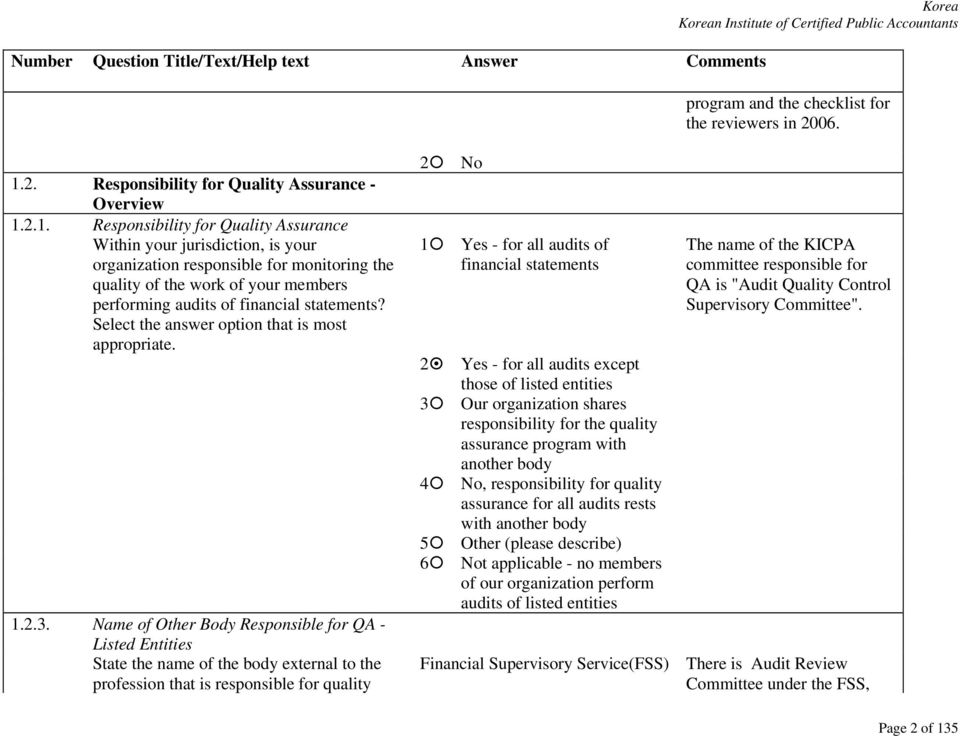
3 assurance review for audits of listed entities. which deals with QA. The committee deliberates the results of QA reviews and the recommendations presented by Auditing Oversight Teams. The committee submits its opinion and the recommendations to the Securities and Future Commission. The SFC makes a final decision upon the recommendations based on the opinion of Audit Review Committee Quality Assurance (Other Body) - Scope Is the scope of the of the quality assurance review program implemented by another body materially narrower than the scope of the requirements of SMO1? Quality Assurance (Member Body) - Scope What types of engagements are included in the scope of the quality assurance review program performed by your organization? Select all the answer options that are appropriate. 1 Yes 2 No 1 Financial statement audit - audit of other than listed entities Page 3 of 135

4 1.3. Activities to promote SMO 1 Please describe what activities your organization undertakes to promote obligations set in SMO 1 Quality Assurance Member - Benchmarking Quality Control Standards and Guidance Quality Control Standards Has your organization established and published quality control standards requiring firms to implement a system of quality control in accordance with International Standard on Quality Control 1? Quality Control Standards - Name State the name of the relevant quality control standards Other Quality Control Guidance Has your organization established and published other quality control guidance to assist your members to understand the objectives of quality control and to 2 Other Assurance Services (e.g., Review, Compilation) 3 Insolvency 4 Other (please specify) We established TF to improve our Qualit Assurance review program and published n Standard on Quality Control fully adopting International Standard on Quality Control in December Yes 2 No n Standard on Quality Control 1 Yes Page 4 of 135

5 implement and maintain appropriate systems of quality control? Other Quality Control Guidance Follow Up What plans does your organization have for developing and issuing other quality control guidance for your members? If you do not have such plans, what special reasons or conditions for that fact exist? Design of the Quality Assurance Review Program Subject of the QA Review Program Who is the subject of the quality assurance review program? Audit Firm As the audit firm is the subject of the quality assurance review program, the quality assurance program should be designed, as required by SMO 1, to obtain reasonable assurance that: 2 No In 2006 we plan to publish a guidance to assist our members to understand our quality control standard and to implement and maintain appropriate sysmems of quatlity control. 1 Audit firm 2 Partner 1 Yes - The firm has an adequate system of quality control relating to audits of financial statements of listed entities (and of other entities or engagements that are also included in the scope of the review). - The firm complies with that system. Page 5 of 135

6 - The firm and engagement teams have adhered to professional standards and regulatory and legal requirements in performing audits of financial statements selected for review. Does the quality assurance program contain all three of these elements? Publication of Scope Does your organization publish a description of the scope and design of its quality assurance review program? 2 No 1 Yes Name of Documents Please name the published document(s) that describe the scope and design of the quality assurance review program Location of Documents Please indicate where the document(s) that include details on the scope and design of the quality assurance program can be located (e.g., provide internet address or indicate that documents are available from your organization). 2 No Standard on Quality assurance review, Guidance for Quality assurance review, Quality assurance review manual The documents are available from our organization. But English version is not available. Page 6 of 135

7 Review Cycle Selection Approach Please select the approach used to select subjects for quality assurance review. Select all the answer options that are appropriate Cycle Approach - Firm As the audit firm is the subject of the review, please indicate the maximum number of years in the review cycle: 1 Cycle approach 2 Risk-based approach 1 1 year Cycle Greater Than Three Years As the review cycle is more than the three year cycle recommended by SMO1, please provide an explanation for adopting a longer cycle. 2 2 years 3 3 years 4 4 years 5 5 years 6 6 or more years The review cycle was determined before SMO1 was announced. New review cycle is under discussion. According to the plan of the FSS, the review cycle for Big firms would be 2 years and the review cycle for other firms would be from 3 to 5 years depending on the number of the listed companies audited by the firms. New review Page 7 of 135

8 cycle is expected to be implemented in Implementation of the Quality Assurance Program Date of Implementation On what date did the quality assurance review program commence? (provide month/year) Number of Reviews How many quality assurance reviews were completed during the year ended December 31, 2005 (or other 12 month period ending in 2005)? Number of Reviews How many quality assurance reviews were completed during the year ended December 31, 2004 (or other 12 month period ending in 2004)? Number of Reviews How many quality assurance reviews were completed during the year ended December 31, 2003 (or other 12 month period ending in 2003)? 10/1/ firms 267 engagements 9 9 firms 235 engagements 5 5 firms 223 engagements Quality Assurance Review Team Procedures Page 8 of 135

9 Publication of Review Guidelines Does your organization publish guidelines for procedures to be followed by quality assurance review teams? 1 Yes Name of Guidelines State the name of the published document(s) that include the procedures required to be followed by quality assurance review teams Location of Guidelines How can the document(s) that include the procedures required to be followed by quality assurance review teams be located (e.g., provide internet address or indicate that documents are available from your organization)? Content of Guidelines SMO 1 requires that the procedures to be performed during the quality assurance review include: 2 No Standard on Quality Assurance review, Guidance for Quality Assurance review, Quality Assurance review manual The documents are available from our organization. But English version is not available. 1 Yes a. An assessment of the system of quality control relating to audits of financial statements of listed entities (minimum requirement) Page 9 of 135

10 b. Sufficient review of the quality control policies and procedures and reviews of engagement working papers to evaluate: - The functioning of that system of quality control, and compliance with it; and - The compliance with professional standards and regulatory and legal requirements in respect of audits of financial statements c. Review of engagement working papers d. Specific requirements regarding documentation of the review Does your quality assurance review program include requirements for all of these procedures? Review of Engagement Working Papers SMO 1 requires procedures to be performed for the review of engagement working papers, including the evaluation of: 2 No 1 Yes - The existence and effectiveness of the system of quality control implemented by the subject of the review; - Compliance with professional standards and regulatory and legal requirements in performing the engagement; - The sufficiency and appropriateness of evidence documented in the working papers; Page 10 of 135

11 and - Whether the auditor's reports are appropriate in the circumstances. Does your quality assurance review program include requirements for all of these procedures? Documentation Do the procedures to be performed by the quality assurance review team require documentation: 2 No 1 Yes - of evidence supporting the quality assurance review report; and - that establishes that the quality assurance review was carried out in accordance with the established guidelines. Are both of these requirements included in the quality assurance review program? The Quality Assurance Review Team Skills and Competence Members of the quality assurance review team should have the necessary competencies to perform expected work. As required by SMO 1, these competencies should include: 2 No 1 Yes Page 11 of 135

12 - Appropriate professional education - Relevant professional experience - Specific training on performing quality assurance reviews Does the quality assurance review program require members of the quality assurance review team to have all three of these competencies? Certification/Credentials Are members of the quality assurance review team required to possess certification or credentials issued by your organization to be eligible to serve as team members? Quality Assurance Review Team Leader Where more than one reviewer is used to conduct a review, is a quality assurance review team leader assigned for each quality assurance review assignment? QA Review Team Leader - Responsibilities As required by SMO 1, the responsibilities of the quality assurance review team leader should include: 2 No 1 Yes 2 No 1 Yes 2 No 1 Yes - Supervision of the quality assurance review. Page 12 of 135

13 - Communication of the quality assurance review team's conclusions to the subject of the review. - Preparation of the quality assurance review report. Does the quality assurance program place all these responsibilities on the review team leader? Size of Quality Assurance Review Team Please estimate the average number of reviewers included on a review team. 2 No Quality Assurance Confidentiality - QA Review Team Exemption for QA Reviewers Does your organization exempt members from professional client confidentiality requirements concerning audit engagement working papers for the purpose of quality assurance reviews? Confidentiality Requirements Is the quality assurance review team required to follow professional confidentiality requirements similar to those established for professional accountants performing audits of financial statements? 1 Yes 2 No 1 Yes Page 13 of 135

14 Ethical Requirements and QA Review Team Fundamental Principles Are the fundamental principles set out in the IFAC Code of Ethics (relevant national ethical requirements) considered in relation to the quality assurance review team's conduct of a review? Consideration of Independence Quality assurance review team members are expected to be independent of the member (i.e., the accountant or firm being reviewed) and the member's clients selected for review. Do those who select and approve a review team determine whether the independence of the quality assurance review team leader and each member of the quality assurance review team has been reasonably assured? Reciprocal Reviews Where the review is performed by team members from a single firm (e.g., a "peer review"), please indicate whether firms are permitted to perform reciprocal quality assurance reviews. 2 No 1 Yes 2 No 1 Yes 2 No 1 Yes, reciprocal reviews are permitted 2 No, reciprocal reviews are not permitted Page 14 of 135

15 Reporting Quality Assurance Review Report Is the quality assurance review team leader required to issue a written quality assurance review report to the reviewed firm or partner upon completion of each quality assurance review assignment? Contents of Report As required by SMO 1, the quality assurance review report should include the following elements: 3 Not applicable - peer review is not used 1 Yes 2 No 1 Yes - The review guidelines (referred to in Question ) utilized by the quality assurance review team. - Recommendations for areas of improvement at both firm wide and engagement level. Does the quality assurance program require both of these elements to be included in the report? Contents of Report - Firm As required by SMO 1, the quality assurance review report should include the following 2 No 1 Yes Page 15 of 135

16 conclusions: - Whether the firm's system of quality control has been designed to meet the requirements of the applicable quality control standards; - Whether the firm has complied with its system of quality control during the period under review; and - Reasons for reaching negative conclusions on either or both of the above. Does the quality assurance program require all of these elements to be included in the report? Response to Reporting Is the subject of the review required to provide a timely written response to the recommendations and conclusions of the quality assurance review report, including planned actions and expected time of completion or implementation? Reporting to the Public Does your organization prepare and make available to the public (and upon request from regulatory authorities) an annual report summarizing the results of the quality assurance review program? 2 No 1 Yes 2 No 1 Yes Page 16 of 135
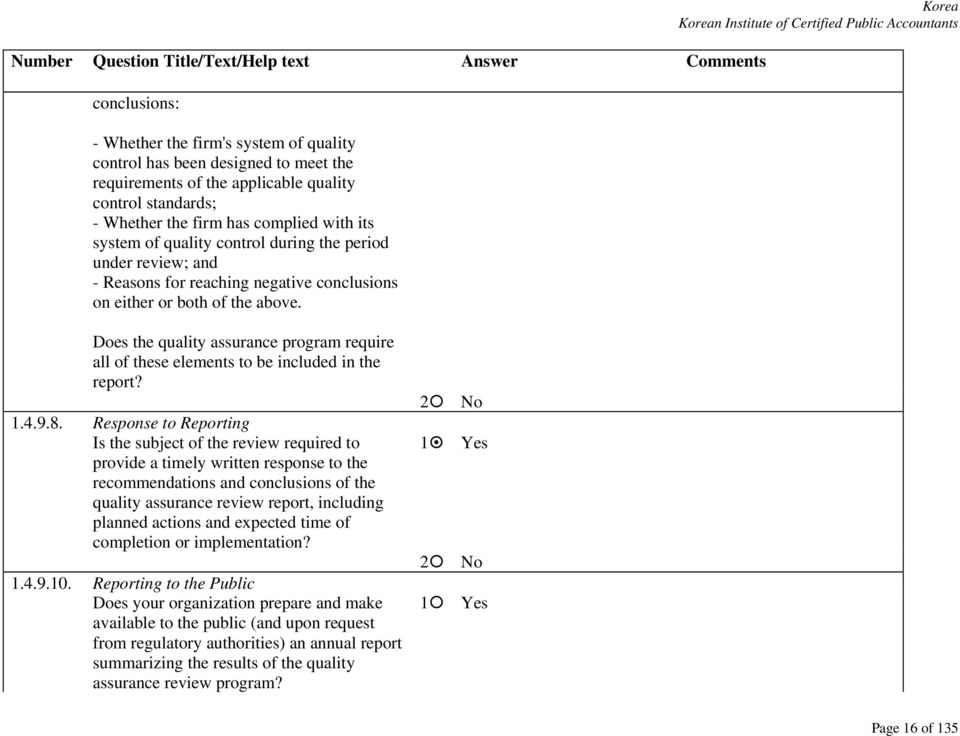
17 Reporting to the Public Follow Up Please explain why your organization does not prepare an annual report summarizing the results of the quality assurance review program available to the public? 2 No The KICPA plans to prepare review reports available to the public. Currently the FSS is establishing QA review system. The FSS plans to prepare a report summarizing its findings and recommendations for areas of improvement for the individual firm. The report will not be open to the public until 1 year after the firm receives the review report. The FSS plans to prepare a comprehensive report annually and make the report open to the public. This plan is expected to be implemented in The KICPA will prepare review reports available to the public following the plan of the FSS Corrective and Disciplinary Actions Corrective Actions Required Does your organization require each of its members to make appropriate corrections to its system of quality control, or in its 1 Yes Page 17 of 135

18 compliance with policies and procedures? Disciplinary Actions If one of your members subsequently fails to demonstrate compliance with professional standards and regulatory and legal requirements, do you take appropriate disciplinary action? Disciplinary Actions Follow Up Please explain why your organization does not take appropriate disciplinary action if one of your members subsequently fails to demonstrate compliance with professional standards and regulatory and legal requirements. 2 No 1 Yes 2 No From 2006, the firms that audit listed companies will be reviewed by FSS. Therefore FSS and the KICPA are considering appropriate disciplinary actions. When the KICPA QA review system commenced in 2003 before the announcement of SMO1, the objective of the QA review was to guide and assist the members of the KICPA in designing and implementing their QA control system. There were 4 types of conclusions of the review reports of the KICPA, such as unqualified, qualified, adverse, and disclaimer. If a firm receives opinion other than unqualified, the firm may lose its good reputation. Therefore the opinion itself has been considered to be disciplinary action to the firm. However, the KICPA has never issued opinions other than unqualified and the conclusions have not been made to the public. Instead, the KICPA has prepared Page 18 of 135

19 review reports recommending areas of improvement of the QA system of the firms in order to provide the firms with guidance of designing and implementing QA control systems. In 2005, the QA reviews for the major firms that audit listed companies were determined to be performed directly by the FSS. Therefore, currently the FSS is developing a new QA review system including discipline system. The KICPA will apply the new QA discipline system developed by the FSS in Linkage with Disciplinary Actions Does your organization clearly establish a link between less than satisfactory results of quality assurance reviews and the initiation of corrective and disciplinary actions under its disciplinary system? 1 Yes 2 No Page 19 of 135
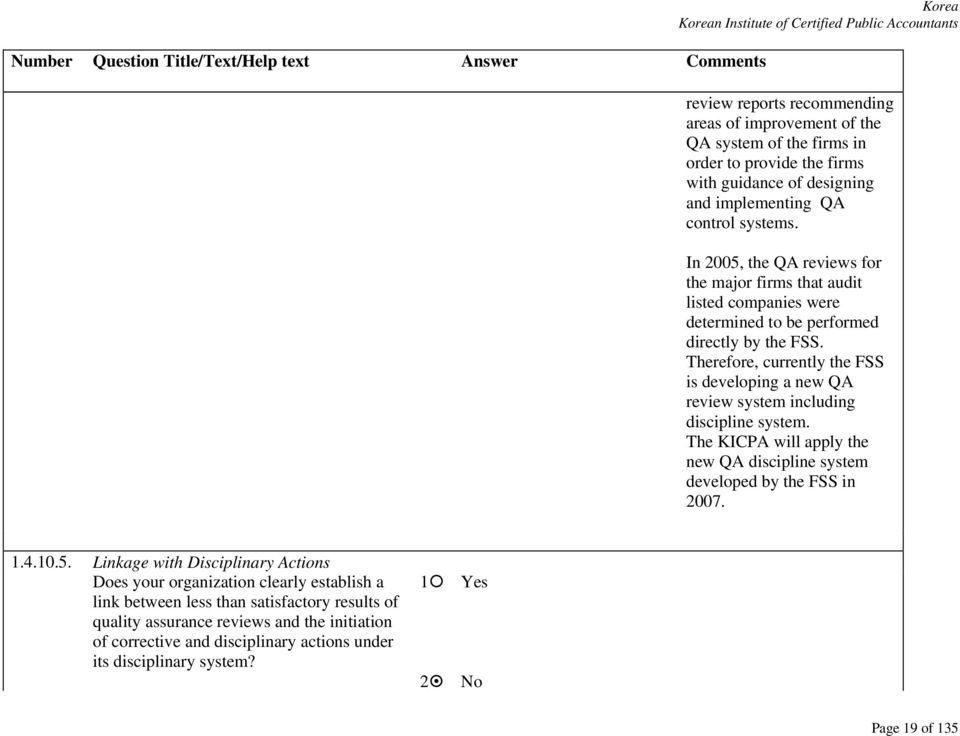
20 Disciplinary Actions Link Follow Up Please explain the reason why your organization has not clearly established a link between less than satisfactory results of quality assurance reviews and the initiation of corrective and disciplinary actions under its disciplinary system. Please see answer and comments to The KICPA QA review process didn't issue discipline and corrective actions against the members but the KICPA has required the firms to improve their quality control systems. The KICPA has prepared review reports recommending areas of the improvement of their QA control systems. 2. SMO MB Membership Requirements Which of the following are required for individuals to be admitted as members in your organization? Select all the options that are appropriate. 1 Complete a program of professional accountancy education 2 Complete a practical experience requirement 3 Complete a final assessment of the individual's professional capabilities and competencies 4 None of the above Page 20 of 135
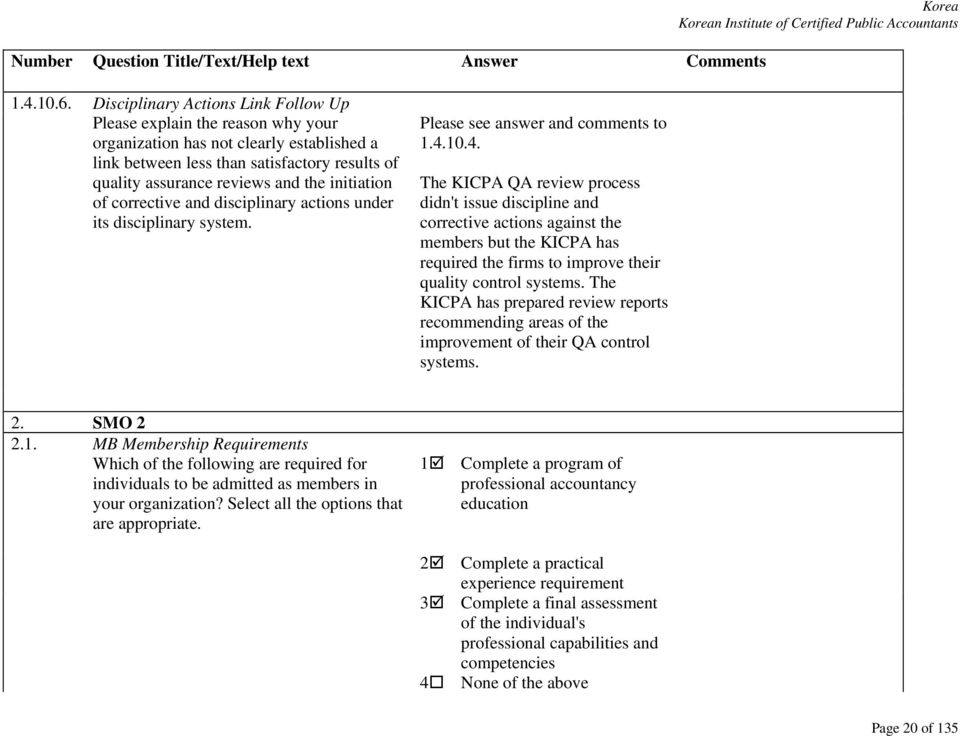
21 2.2. Continuous Professional Development Is there a requirement for your members to develop and maintain competence through continuous professional development (CPD)? 2.3. Professional Accountancy Education Professional Accountancy Education Program Who delivers the professional accountancy education program for your members? Select all the answer options that are appropriate IES 1 Entry Requirements Entry Requirements and Equivalency Section 2.7 deals with the entry requirements to the professional accountancy education program delivered by your organization. Are the entry requirements to the program equivalent to admissions requirements for a recognized university degree program (or its equivalent)? 1 Yes 2 No 1 Our organization 2 Another IFAC member body 3 Universities 4 Approved training institutions 5 Government bodies 6 Other organizations 1 Entry requirements are at least equivalent to that for admission into a recognized university degree program (or its equivalent) 2 Entry requirements are not Page 21 of 135
22 Process for Checking Equivalency Is there a formal process for assessing whether an individual's experience and knowledge is equivalent to that for admissions into a recognized university? 2.8. IES 2 Content of Professional Accounting Education Program Gaining Accountancy Knowledge Section 2.8 deals with the general content of the professional accountancy education program delivered by your organization. 1 Yes 2 No equivalent to that for admissions into a recognized university degree program (or its equivalent) 1 Post-secondary accounting degree What forms of pre-qualification, professional accountancy knowledge are recognized by your organization? Select all the answer options that are appropriate. 2 Post-secondary business or finance degree 3 Post-secondary degree in another subject matter 4 Qualification offered by another IFAC member body 5 Relevant work experience 6 Other Page 22 of 135
23 Describe Other Describe the other ways professional accountancy knowledge may be gained that are recognized by your organization. From 2007, any person who has earned not less than regular credits in regular subjects at any university, college or creditrecognition institution shall not apply to CPA examination. The kinds of regular subjects and the number of credits shall be as follows: 1.Accounting and tax-related subjects: 12 credits; 2.Business administration: 9 credits; and 3.Economics: 3 credits. In addition, n CPA examination is very difficult. Therefore, the CPA examination requires candidates to gain enough professional accountancy knowledge Pre-Qualification for Professional Knowledge What is the length of the professional accountancy knowledge component of prequalification education? Select the answer 1 Two years of full-time study or part-time equivalent Page 23 of 135
24 option that is the most appropriate Length Follow Up Please describe the extent of professional accountancy knowledge that is required as part of the pre-qualification education component. Include in your description factors that were relevant in selecting the extent of knowledge required Pre-Qualification Content Accounting and Finance Section deals with the specific content of the professional accountancy education program delivered by your organization. Which of the following accounting, finance, and related knowledge subject areas are required prior to qualification? Select all the answer options that are appropriate. 2 Less than two years of fulltime study or part-time equivalent 3 More than two years of fulltime study or part-time equivalent study Accounting and Tax related(12 credits), Business Administration(9 credits), Economics(3 credits) 1 Financial accounting and reporting 2 Management accounting and control 3 Control 4 Taxation Page 24 of 135
25 Organizational and Business Knowledge Which of the following organizational and business knowledge subject areas are required prior to qualification? Select all the answer options that are appropriate Information Technology Which of the following information technology (IT) subject areas and competences are required prior to qualification? Select all the answer options that are appropriate. 5 Business and commercial law 6 Audit and assurance 7 Finance and financial management 8 Professional values and ethics 9 None of the above 1 Economics 2 Business environment 3 Corporate governance 4 Business ethics 5 Financial markets 6 Quantitative methods 7 Organizational behavior 8 Management and strategic decision making 9 Marketing 10 International business and 11 globalization None of the above 1 General knowledge of IT Page 25 of 135
26 Additional Content by Requirement Are there additional content requirements specified by law or regulation, or your organization? Additional Content - Describe Describe the additional content required by law / regulation or determined to be necessary by your organization including whether this requirement applies to all professional accountants or those operating in public practice or employed in business IES 3 Professional Skills Development of Intellectual Skills Section 2.9 deals with the professional skills required by the professional accountancy education program delivered by your organization. 2 IT control knowledge 3 IT control competences 4 IT user competences 5 One of, or a mixture of, the competences of, the roles of manager, evaluator or designer of information systems 6 None of the above 1 Yes, as required by law or regulation 2 Yes, as determined to be necessary by our organization 3 No professional ethics 1 As part of general education and / or as part of the professional accountancy education program entry Page 26 of 135
27 At what points in the professional accountancy education program are intellectual skills developed? Select all the answer options that are appropriate. In responding to this question refer to IES 3 paragraphs 13 and Intellectual Skills Describe the specific intellectual skills candidates are required to have at the point of qualification and how these skills are assessed Development of Technical and Functional Skills At what points in the professional accountancy education program are technical and functional skills developed? requirements 2 Through specific professional accountancy education course content 3 Through practical experience requirement 4 Other (please describe) Our CPA exam is very difficult to pass and it is based on specific cases. Therefore the candidates who pass the exam are considered to have the appropriate intellectual skills. The candidates also obtain these skills through practical experience and are assessed by their mentors or employers. 1 As part of general education and / or as part of the professional accountancy Page 27 of 135
28 Select all the answer options that are appropriate. In responding to this question refer to IES 3 paragraphs 13 and Technical and Functional Skills Describe the specific technical and functional skills candidates are required to have at the point of qualification and how these skills are assessed Development of Personal Skills At what points in the professional accountancy education program are personal skills developed? Select all the answer options that are appropriate. In responding to this question IES 3 paragraphs 13 and 16. education program entry requirements 2 Through specific professional accountancy education course content 3 Through practical experience requirement 4 Other (please describe) Candidates are required to have the following technical and functional skills: - numeracy and IT proficiency - decision modeling and risk analysis - reporting - compliance with legislative and regulatory requirements Candidates also obtain these skills through practical experience and are assessed by their mentors or employers. 1 As part of general education and / or as part of the professional accountancy education program entry requirements Page 28 of 135
29 Personal Skills Describe the specific personal skills candidates are required to have at the point of qualification and how these skills are assessed Dev of Interpersonal and Communication Skills At what points in the professional accountancy education program are interpersonal and communication skills developed? Select all the answer options that are appropriate. In responding to this question refer to IES 3 paragraphs 13 and 2 Through specific professional accountancy education course content 3 Through practical experience requirement 4 Other (please describe) Candidates are required to have the following personal skills: - the ability to select and assign priorities within restricted resources and to organize work to meet tight deadlines - considering the implications of professional values, ethics and attitudes in decision making - professional skepticism Candidates also obtain these skills through practical experience and are assessed by their mentors or employers. 1 As part of general education and / or as part of the professional accountancy education program entry requirements Page 29 of 135
30 Interpersonal and Communication Skills Describe the specific interpersonal and communication skills candidates are required to have at the point of qualification and how these skills are assessed Dev of Organizational and Business Mngt Skills At what points in the professional accountancy education program are organizational and business management skills developed? Select all the answer 2 Through specific professional accountancy education course content 3 Through practical experience requirement 4 Other (please describe) Candidates are required to have the following interpersonal and communication skills: - work in teams - negotiate acceptable solutions and agreements in professional situations - present, discuss, report and defend views effectively through formal, informal, written and spoken communication Candidates also obtain these skills through practical experience and are assessed by their mentors or employers. 1 As part of general education and / or as part of the professional accountancy education program entry Page 30 of 135
31 options that are appropriate. In responding to this question refer to IES 3 paragraphs 13 and Organizational and Business Management Skills Describe the specific organizational and business management skills candidates are required to have at the point of qualification and how these skills are assessed. requirements 2 Through specific professional accountancy education course content 3 Through practical experience requirement 4 Other (please describe) Candidates are required to have the following organizational and business management skills: - strategic planning, project management, management of people and resources, and decision making - leadership - professional judgment and discernment Candidates also obtain these skills through practical experience and are assessed by their mentors or employers IES 4 Professional Values, Ethics and Attitudes Content for Values, Ethics and Attitudes Section 2.10 deals with professional ethics, 1 Yes Page 31 of 135
32 values, and attitude content and requirements of the professional accountancy education program delivered by your organization. Does the professional accountancy education program include coverage of values, ethics and attitudes? Values, Ethics and Attitudes in Content Program Content for Values, Ethics and Attitudes Which of the following are included in the program content? Select all the answer options that are appropriate. 2 No 1 The nature of ethics 2 Differences of detailed rulesbased and framework approaches to ethics, their advantages and drawbacks 3 Compliance with the fundamental ethical principles of integrity, objectivity, commitment to professional competence and due care, and confidentiality 4 Professional behavior and compliance with technical standards 5 Concepts of independence, skepticism, accountability Page 32 of 135
33 IFAC Code of Ethics Is the program content based on the relevant sections of the IFAC Code of Ethics? and public expectations 6 Ethics and the profession: social responsibility 7 Ethics and law, including the relationship between laws, regulations and the public interest 8 Consequences of unethical behavior to the individual, to the profession and to society at large 9 Ethics in relation to business and good governance Yes Ethics and the individual professional accountant: whistle blowing, conflicts of interest, ethical dilemmas and their resolution. None of the above 2 No Workplace Learning Development At what points in the professional 1 As part of general education We include education program introducing IFAC Code of Ethics and explaining the differences between our code of ethics and IFAC code of ethics. Page 33 of 135
34 accountancy education program are values, ethics, attitudes and adherence to them developed? Select all the answer options that are appropriate. and / or as part of the program entry requirements IES 5 Practical Experience Requirement Approved Provider Section 2.11 deals with the practical experience requirement established by your organization. Does the practical experience requirement have to be obtained with approved providers or employers? Provider Characteristics Please describe the characteristics set by your organization for recognizing approved providers. 2 Through specific program course content 3 Through practical experience requirement 4 Other (please describe) 1 Yes 2 No The MOFE (Ministry of Financial Economy) approve the following providers by law. - accounting firms - listed companies - the companies required to be audited by the external audit law - KICPA Page 34 of 135
35 - Financial Supervisory Service Length of Practical Experience What is the required length of prequalification practical experience? Select the answer option that is most appropriate Length of Practical Experience Follow Up Describe the length of the practical experience requirement and what special conditions or factors were relevant in establishing the length Practical Application SMO Practical Application Where relevant graduate (beyond undergraduate, e.g., masters) professional education has a strong element of practical accounting application, may any portion of the professional education be contributed to the practical experience requirement? Timing of Experience Pre or Post Qualification Experience The practical experience for accountants may be obtained (select all the answer 1 Three years 2 Less than three years 3 More than three years 1 or 2 year - 1 year : for candidate who will perform professional services except audit services - 2 year : for candidates who will perform all the professional services including audit services 1 Yes 2 No 1 Before the professional accountancy education Page 35 of 135
36 options that are appropriate): IES 5 Monitoring of Practical Experience Requirement Monitoring of Practical Experience Is the period of practical experience monitored? Monitoring Practical Experience How is the practical experience requirement (or practical application) monitored and assessed? Select all the answer options that are appropriate. program of study 2 At the same time as the professional accountancy education program of study 3 After the professional accountancy education program of study 1 Yes 2 No 1 Mentoring system 2 Approved training employers and organizations 3 Self-declaration required from the candidate 4 Record of the practical experience is kept and submitted to the member body when applying for membership 5 An assessment is made by the mentor or employer 6 Other (please describe) Page 36 of 135
37 2.13. IES 6 Assessment of Prof Capabilities and Competence Assessment by IFAC Body or Other Section 2.13 deals with the final assessment requirements established by your organization. Select all the organizations involved in conducting the final assessment. If the final assessment is conducted jointly between various organizations, select all those that have some responsibility for conducting the final assessment and in the Comment Box, describe the nature of their respective roles and responsibilities Characteristics of Assessment Which of the following characteristics are applicable to the final assessment process? Select all the answer options that are appropriate. 1 Our organization (including training entities that are affiliated with our organization or a subsidiary of our organization). 2 Another IFAC member body 3 Government or regulatory body 4 Other 1 Uniform for all students 2 Given simultaneously where it is being held in more than once location in the country 3 Assessment is set and assessed only by qualified or Page 37 of 135
38 Qualifying for Final Assessment What requirements must the candidate satisfy to take the final assessment? Select all the answer options that are appropriate Timing Considerations for Final Assessment Is there a requirement or restriction for completing the final assessment? For example, some organization may require the candidate to take the final examination within a specified number of years of meeting the pre-assessment requirements Requirement or Restrictions Describe the requirements or restrictions relating to when the final assessment must be undertaken. approved individuals 4 None of the above 1 Specified pre-qualification requirements relating to professional knowledge, professional skills, and professional values, ethics, and attitudes 2 Specified practical experience requirements 3 Other (please describe) 4 None of the above 1 Yes 2 No Our organization requires the candidate to pass the final examination within 5 years from the commencement of practical experience Assess Professional Knowledge Describe in general terms how required The professional knowledge is Page 38 of 135
39 professional knowledge (e.g. technical knowledge about accounting, finance, audit, financial reporting, legislative requirements, information technology etc) is assessed during the final assessment Assess Professional Skills Describe in general terms how required professional skills (e.g. ability to solve problems, make decisions, exercise judgment, personal skills, interpersonal and communication skills, organizational and business management skills etc) are assessed during the final assessment Assess Professional Values, Ethics, Attitudes Describe in general terms how required professional values, ethics, and attitudes are assessed during the final assessment Recorded or Oral Format Is the final assessment conducted through: assessed by the final written test after taking lessons relating to the technical knowledge on accounting, finance, audit and others after accomplishment the required practical experiences. The professional skills are assessed by the written final test after taking lessons relating to ability to solve problems, making decisions, exercising judgment, personal skills and others after accomplishment the required practical experiences. The professional values, ethics and attitudes are assessed by the final test after taking lessons relating to ethics after accomplishment the required practical experiences. 1 Recorded format with recorded (e.g. written) response required 2 Oral format with oral responses 3 Both recorded and oral Page 39 of 135
40 Assessment Formats What formats are used in conducting the final assessment (select all the answer options that are appropriate)? Reliability and Validity Describe in general terms the procedures in place to ensure the final assessments are reliable and valid. Include a description of how the assessment questions are set and by whom and also how reviewers / assessors are selected Frequency of Final Assessments How many times in a year is the final assessment offered? Select the answer option that is the most appropriate IES 7 Continuing Professional response formats 1 Multiple choice questions 2 Case studies 3 Technical questions 4 Thesis 5 Other (please describe) 6 None of the above The lecturers make the assessment questions relating to their own lectures and then the researchers in our organization select some of the questions. The lecturers assess the test. 1 Yearly (or once a year) 2 Half yearly (or twice a year) 3 Three sessions a year 4 Four sessions a year 5 Five sessions a year 6 Other (please describe the frequency of the examinations) Page 40 of 135
41 Development - CPD Responsibility for CPD Requirements Section 2.14 deals with the continuous professional development requirements established by your organization. Who establishes the continuous professional development requirements applicable to your members? Select all the answer options that are appropriate CPD and Professional Accountants Which membership categories are required to maintain professional competence through continuous professional development? Select all the answer options that are appropriate. 1 Our organization 2 Another organization (state the name of the organization including whether it is an IFAC member body) 3 Law and / or regulation (state the name of the law / regulation) 4 Other (please describe) 1 All our qualified members According to n CPA Act, any certified public accountant who intends to render professional services to the public shall be registered to the Minister of Finance and Economy and shall enter into the KICPA. In addition, the Act prescribed the CPD requirements for the CPAs in Page 41 of 135
42 2 Qualified members who perform audits of listed entities 3 Qualified members who perform audits of entities public practice. (There is no requirement of registration or CPD for the CPAs not in public practice.) Therefore, almost all the activities of the KICPA have focused on assisting the members of public practice. At the present there is not a specific plan to introduce CPD for members in business. However, the KICPA recognizes the increase of the numbers of the members in business. The KICPA considers that it is important to review all the issues relating to the members in business such as laws and regulations, membership system of the KICPA, etc.,. Page 42 of 135
43 Requirement - CPD Type of CPD Requirement Which of the following answer options describes the way the continuous professional development is structured? Select all the answer options that are appropriate Hours of Continuous Professional Development other than listed entities 4 Qualified members who provide services (other than audit) to the public 5 Qualified members who are employed in business 6 Other (please describe) 1 Members must satisfy a number of hours of continuous professional development a year or over a number of years 2 All members are to satisfy specified content requirements (e.g. specified courses or knowledge content) 3 Members working in specialist areas or areas of high risk to the public are to satisfy specified content requirements (e.g. specified courses or knowledge content) 4 Other Page 43 of 135
44 Which one of the following answer options best describes the continuous professional development hours required? Other Hours Follow Up Describe the continuous development hours required by members Describe Content Requirement Describe the content requirement applicable to all members. 1 Members have to complete a minimum of 120 hours or equivalent learning units of relevant professional development activity over a three-year rolling period. 2 Members have to complete a minimum of 20 hours or equivalent learning units in each year 3 Other Members shall complete a minimum of 40 hours or equivalent learning units in each year. professional ethics(2hours), accounting(4hours) Monitoring of CPD Is there a process to monitor whether your members who are qualified as professional accountants meet the continuous professional development requirements? 1 Yes, there is a monitoring process for CPD requirements 2 No, there is no monitoring process for CPD requirements Monitoring of CPD Requirement Monitoring Process SMO 2 Which of the following elements does the 1 Professional accountants are Page 44 of 135
45 monitoring process include? Select all the answer options that are appropriate Sanctions SMO 2 Where a professional accountant does not satisfy the CPD requirements (within a reasonable period of encouraging the professional accountant to meet the requirements), are sanctions or other noncompliance actions, such as expulsion or denial of the right to practice, imposed? Sanction Types and CPD Describe the nature and extent of the sanction, expulsions or denial of the right to required to submit a declaration 2 Professional accountants are required to submit evidence 3 Our organization audits a sample of professional accountants to check compliance 4 Compliance is monitored through firm quality control standards 5 Compliance is monitored through a quality assurance review program 6 Other (please describe) 7 None of the above 1 Yes, sanctions or actions for non-compliance are imposed 2 No, sanctions or other noncompliance actions are not imposed 50% of the hours not satisfied by the members will be added- Page 45 of 135
46 practice Activities to Promote IESs SMO 2 Please describe the activities your organization undertakes to promote and assist in implementing the pronouncements issued by IFAC's International Accounting Education Standards Board. 3. SMO Auditing Standards in Law/Regulation Does law or regulation establish the set of auditing standards to be used in the audit of private sector listed entities and non-listed entities? Select all the answer options that are appropriate. transferred to the Ethics Investigation Deliberative Committee We implement remote internet education system to provide more our members with more education programs. We also plan to recommend to our government that the length of our pre-qualification practical experience should be extended to three years in compliance with IES. 1 Yes for audits of listed entities Where the law / regulation establishes the auditing standards to be used by reference to the set of standards to be used by their name or by including the text of the standards in the law / regulation, please respond "yes" to this question. Section 3.8. of this module includes questions about the law / Page 46 of 135
47 regulation. Where the law / regulation gives authority to a national standard-setter to establish the auditing standards, please respond "no". Section 3.2. of this module includes questions about the standard-setter and the auditing standards that are established Responsibility for Private Sector Auditing Standards Auditing Standards - Private Sector Is there only one set of auditing standards or are the auditing standards applicable to listed entities different from non-listed entities? Responsibility for Auditing Standards Who has the authority for establishing the auditing standards for listed and non-listed entities? 2 Yes for audits of non-listed entities 3 No for audits of listed entities 4 No for audits of non-listed entities 1 The auditing standards for listed entities and non-listed entities are the same set of standards 2 The auditing standards for listed entities and non-listed entities are not the same set of standards 1 Our organization Only after obtaining an approval of FSS (Financial Supervisory Services), our organization can issue the auditing standards. Page 47 of 135
48 3.3. Member Body SMO MB Convergence Objective SMO 3 Has convergence with IAASB pronouncements been established as an objective? MB Convergence Implemented SMO 3 Has the convergence objective for auditing standards been implemented? 3.6. Incorporation of Auditing Standards Incorporation Approach SMO 3 Where your response indicates that convergence with IAASB pronouncements has been implemented, which of the following best describes the approach is used to incorporate the IAASB pronouncements into national standards? Select the answer option that is most appropriate. Help text: Answer Option 1 and reference to "adopted without amendment" Select this option where IAASB 2 Another IFAC member body 3 Joint process between our organization and another IFAC member body or other organization 4 Another organization 1 Yes 2 No 1 Yes 2 No 1 IAASB pronouncements are adopted as drafted without amendments (refer Help Text) 2 IAASB pronouncements are adopted as national standards and amended as necessary to address differences due to Page 48 of 135
49 pronouncements are adopted as drafted except for changes to: Rename the IAASB pronouncement to a national standard name; Translate the IAASB pronouncement into another language; Apply an effective date that differs from the IAASB pronouncement. Answer Option 2 and 3 reference to "Differences" In responding to this question, "differences" may include: Requirements in addition to those specified in the IAASB pronouncement or ISA; Deletion of a basic principle, essential procedure, and / or related guidance specified in the IAASB pronouncement or ISA; Modification of a requirement specified in the IAASB pronouncement or ISA (e.g. an ISA requirement was not deleted in full because a similar requirement was included). conflicts with legal or regulatory requirements (refer Help Text) 3 Existing national standards are compared with IAASB pronouncements to eliminate to the extent possible differences between the national standard and the Page 49 of 135
50 Adoption with Amendments SMO IAASB Pronouncements with Amendments Which of the following IAASB pronouncements have been adopted or incorporated? Select all the answer options that are appropriate Name of Standards SMO 3 - Amendments When the IAASB pronouncements are adopted, are the IAASB pronouncements renamed as national standards and pronouncements? IAASB pronouncement (refer Help Text) 4 Other 1 International Standard on Quality Control 1 2 International Standards on Auditing 3 International Auditing Practices Statements 4 International Standards on Assurance Engagements 5 International Standards on Review Engagements 6 International Standards on Related Services 1 IAASB pronouncements are adopted without changes to the pronouncement's name 2 IAASB pronouncements are adopted with changes to their names Name of National Auditing Standards - Amendments State the name of the national auditing n standards on Quality Page 50 of 135
51 standards and pronouncements Adopted with Amendments SMO 3 Is information publicly available describing: The IAASB pronouncements that have been adopted; Whether the adopted IAASB pronouncement is the version in effect as at September 30, 2005; The effective date set by your organization where it differs from the IAASB pronouncement; The differences between the IAASB pronouncement and what was adopted; The reasons for the differences? Submit Information - Amendments SMO 3 If the standard-setter has issued information about the status of adopted ISAs and other IAASB pronouncements and it is available in English, indicate this in your response and submit a copy of the information to Compliance Staff. Control n Standards on Auditing n Standards on Assurance Engagements n Standards on Review Engagements n Standards on Related Services 1 Yes 2 No 1 The information is available and in English and will be submitted to Compliance Staff See submitted information further below. Page 51 of 135
52 If this information is not available, complete the <a href="smo 3 Comparison with IAASB Pronouncements.doc">SMO 3: Comparison with IAASB Pronouncements</a> report by clicking on the link and submit it in Word format to Compliance Staff. Indicate whether your organization will be submitting available information or the "SMO 3: Comparison with IAASB Pronouncements" report. Help text: Translation SMO Translation of IAASB Pronouncements Are the IAASB pronouncements translated into a national language? 2 The "SMO 3: Comparison with IAASB Pronouncements" report will be completed and submitted to Compliance Staff 1 No as English is the national language or a widely spoken language 2 Yes, the IAASB pronouncements are translated 3 No and English is not an official language or is not widely spoken Page 52 of 135
53 IFAC Translation Policy SMO 3 Is the IFAC Translation Policy followed? 1 Yes All the required procedures were not followed. For example, there is not a principal translator formally appointed by the KICPA and there is not translation policy or translation process formally developed or announced. However, in practically most of our translation process is in compliance with the IFAC Translation Policy. 2 No Principal Translator SMO 3 Who is the principal translator? Select the answer option that is most appropriate Key Words SMO 3 Does the translation process include a list of key words? Faithful Translation SMO 3 1 Our organization is the principal translator 2 The government or another organization is the principal translator 3 Our organization and the government or another organization are the principal translators 1 Yes 2 No Page 53 of 135
54 What processes are in place to ensure a faithful translation of the IAASB pronouncements? Activities to Promote IAASB Pronouncements Please describe the activities your organization undertakes to promote and assist in the implementation of IAASB pronouncements and other IAASB activities. 4. SMO Responsibility and National Ethical Requirements IFAC MB and Ethical Requirements Does your organization establish ethical requirements (e.g. code of ethics, code of conduct, ethics rules, member regulations, etc.) to be complied with by your members? Help text: In some countries, ethical requirements may be established on a regional, provincial, or state basis. Where this is the case in your Key words listing Detailed review process by the Auditing Standards Committee and FSS(Financial Supervisory Service) - KSAs and Other standards are also based on IAASB pronouncements and are highly recommended to our members. - Periodic introduction and explanation on IAASB pronouncements to our members through our monthly magazine and our web site. 1 Yes, our organization does establish ethical requirements 2 No, our organization does not establish ethical requirements Page 54 of 135
55 country for the ethical requirements that apply to your members, please contact Compliance Staff for further instruction IFAC MB and Convergence with IFAC Code Has your organization implemented convergence with the IFAC Code of Ethics as an objective? IFAC MB Approach to Ethics Which of the following options best describes your organization's activities to incorporate the IFAC Code? 1 Yes 2 No 1 Our organization adopted the IFAC Code as issued without modifications For the purposes of the Part 2 SMO 4 module, modifications include: Deletion/omission of concepts, principles, or guidance that are established in the IFAC Code; Inclusion of concepts, principles, or guidance that are not in the IFAC Code; Other amendments that give rise to differences between your organization's ethical requirements and the IFAC Code. 2 Our organization adopted the IFAC Code but with modifications 3 Our organization has developed our own ethical requirements with a process Page 55 of 135
56 IFAC MB and Code - Eliminate Differences Describe the process used to adopt the IFAC Code or the process used to eliminate differences between your organization's ethical requirements and the IFAC Code MB and Version of IFAC Code Version of IFAC Code Which version of the IFAC Code was adopted or used as the basis for your organization's ethical requirements? 4.3. Ethical Requirements by Gov / Reg Bodies In addition to the ethical requirements established by your organization, are there also laws or regulations that set out ethical requirements to be complied with by your to eliminate differences between our ethical requirements and the IFAC Code 4 Our organization develops our own ethical requirements and uses another approach to incorporate the IFAC Code of Ethics We fully adopt the IFAC Code. In our policy, we do not apply less stringent standards than IFAC Code. 1 The IFAC Code currently in effect, revised and issued in June A version issued prior to The revised IFAC Code issued and in effect June 30, Yes Page 56 of 135
57 members? 4.4. Gov / Reg Bodies and Ethical Requirements Gov/Reg Bodies - Ethical Requirements Where ethical requirements applicable to your members are established in law or regulation, do they include any of the following types of laws and regulations? Select all the answer options that are appropriate. 2 No 1 There is a law / regulation (e.g. Audit Law, Accountants Law) that sets out ethical requirements to be complied with by all professional accountants 2 There is a law / regulation that sets out ethical requirements to be complied with by professional accountants who audit listed entities 3 There is a law / regulation that sets out ethical requirements to be complied with by professional accountants who audit entities other than listed entities 4 There is a law / regulation that sets out ethical requirements to be complied with by professional accountants who provide Page 57 of 135
58 Describe Law / Reg - Prof Accountants Regarding your response to question and the law / regulation for professional accountants, please: State the law / regulation's name; Provide a general description of the law / regulation; Describe how the law / regulation sets out the scope of professional accountants that it applies to Describe Law / Reg - Audit Regarding your response to question and professional accountants who audit listed entities and / or other entities, please: State the law / regulation's name; Provide a general description of the law / regulation; Describe how the law / regulation sets out the scope of professional accountants that it applies to. services to the public (other than as auditors of listed or other entities) 5 There is a law / regulation that sets out ethical requirements for professional accountants employed in business 6 None of the above - The CPA Act - Stipulates CPA exam, qualification requirements, CPA practice, CPD and others - all professional accountants who pass the CPA exam, complete one or two year practical experience, 100 hour basic training courses and pass the final test - The CPA Act - Stipulates CPA exam, qualification requirements, CPA practice, CPD and others - all professional accountants who pass the CPA exam, complete two year practical experience, 100 hour basic training courses and pass the final test Page 58 of 135
59 Describe Law / Reg - Other Services Regarding your response to question and professional accountants who provide services to the public (other than as auditors or listed or other entities) please: State the law / regulation's name; Provide a general description of the law / regulation; Describe how the law / regulation sets out the scope of professional accountants that it applies to Gov/Reg and Convergence Please explain whether your organization has undertaken any activities to promote the IFAC Code of Ethics to the relevant government or regulatory body that sets ethical requirements. Include in your explanation descriptions of any specific activities and the outcome or the reasons why such activities have not been undertaken Comparison of Requirements SMO 4 Does your organization have information that identifies any differences between the IFAC Code of Ethics currently in effect or the revised Code and the national ethical requirements? In responding to this - The CPA Act - Stipulates CPA exam, qualification requirements, CPA practice, CPD and others - professional accountants who pass the CPA exam, complete two year practical experience, 100 hour basic training courses and pass the final test We communicate to the government or regulatory body that we should fully adopt IFAC Code. 1 Yes, our organization has this information and it will be submitted Page 59 of 135
60 question, differences include: Principles, concepts, and guidance in the IFAC Code that are not addressed in the national ethical requirements; Principles, concepts, and guidance in the IFAC Code that are not equivalent to the national ethical requirements; Principles, concepts, rules, regulations, laws, or other mandatory ethical requirements in national ethical requirements that are not addressed in the IFAC Code. The phrase "national ethical requirements" as used in this questionnaire refers to the totality of ethical requirements established by your organization and others including government and regulatory bodies that are applicable to your members Fundamental Principles - National Integrity - Principle Integrity Do the national ethical requirements require professional accountants to comply with the fundamental principle "integrity" as 2 This information will be submitted by another IFAC member body 3 No, the information is not available 1 Yes, professional accountants are required to comply with the same principle Page 60 of 135
61 described in the revised IFAC Code? Integrity Requirement Is the principle set out in your organization's ethical requirements and / or in laws and regulations? Select all the answer options that are appropriate Objectivity - Principle Objectivity Do the national ethical requirements require professional accountants to comply with the fundamental principle "objectivity" as described in the revised IFAC Code? Objectivity Requirement 2 Yes, professional accountants are required to comply with a similar or equivalent principle 3 The same or similar / equivalent principle has not been established 1 Our organization's ethical requirements 2 Law that regulates professional accountants and / or auditors 3 Securities regulation 4 Other laws and / or regulation 1 Yes, professional accountants are required to comply with the same principle 2 Yes, professional accountants are required to comply with a similar or equivalent principle 3 The same or similar / equivalent principle has not been established Page 61 of 135
62 Is the principle set out in your organization's ethical requirements and / or in laws and regulations? Select all the answer options that are appropriate Professional Competence / Due Care - Principle Prof Competence / Due Care Do the national ethical requirements require professional accountants to comply with the fundamental principle "professional competence and due care" as described in the revised IFAC Code? Prof Competence / Due Care Req Is the principle set out in your organization's ethical requirements and / or in laws and regulations? Select all the answer options that are appropriate. 1 Our organization's ethical requirements 2 Law that regulates professional accountants and / or auditors 3 Securities regulation 4 Other laws and / or regulation 1 Yes, professional accountants are required to comply with the same principle 2 Yes, professional accountants are required to comply with a similar or equivalent principle 3 The same or similar / equivalent principle has not been established 1 Our organization's ethical requirements 2 Law that regulates professional accountants and / Page 62 of 135
63 Confidentiality - Principle Confidentiality Do the national ethical requirements require professional accountants to comply with the fundamental principle "confidentiality" as described in the revised IFAC Code? Confidentiality Requirement Is the principle set out in your organization's ethical requirements and / or in laws and regulations? Select all the answer options that are appropriate Professional Behavior - Principle Professional Behavior Do the national ethical requirements require professional accountants to comply with the fundamental principle "professional or auditors 3 Securities regulation 4 Other laws and / or regulation 1 Yes, professional accountants are required to comply with the same principle 2 Yes, professional accountants are required to comply with a similar or equivalent principle 3 The same or similar / equivalent principle has not been established 1 Our organization's ethical requirements 2 Law that regulates professional accountants and / or auditors 3 Securities regulation 4 Other laws and / or regulation 1 Yes, professional accountants are required to comply with the same principle Page 63 of 135
64 behavior" as described in the revised IFAC Code? Professional Behavior Requirement Is the principle set out in your organization's ethical requirements and / or in laws and regulations? Select all the answer options that are appropriate Threats and Safeguards - National Threats and Safeguards Do the national ethical requirements establish a framework or principle similar or equivalent to the threats and safeguards framework as described in the revised IFAC Code (effective June 30, 2006)? Select the answer option that is the most appropriate. 2 Yes, professional accountants are required to comply with a similar or equivalent principle 3 The same or similar / equivalent principle has not been established 1 Our organization's ethical requirements 2 Law that regulates professional accountants and / or auditors 3 Securities regulation 4 Other laws and / or regulation 1 Yes, our organization has a threats and safeguards framework or similar / equivalent framework in our ethical requirements 2 Yes, a threats and safeguards framework or similar / equivalent framework is in Page 64 of 135
65 Threats and Safeguards - Other Please describe the threats and safeguards framework or similar requirement established by your organization or law / regulation Application of Framework SMO 4 Which of the following does the threats and safeguards framework, or similar / equivalent requirement, apply to? Select the answer option that is the most appropriate Ethical Behavior Resolution Identifying and Resolving Unethical Behavior the ethical requirements established in law and / or regulation 3 No, a threats and safeguards framework, or similar / equivalent framework has not been established in the national ethical requirements threats : self-interest / self-review / familiarity / intimidation / advocacy safeguards : safeguards created by the profession, legislation or regulation / safeguards in the work environment 1 All professional accountants 2 Only to independence requirements relating to professional accountants in public practice. 3 Other Page 65 of 135
66 Are there specific requirements and guidance provided to assist your members in identifying and resolving ethical matters? Select all of the answer option that are appropriate. 1 Yes, our organization has developed requirements for identifying and resolving ethical matters MB and Ethical Conflict Resolution Are the ethical conflict resolution requirements and guidance adopted from the IFAC Code or similar / equivalent to the guidance in the Code? Select the answer option that is the most appropriate. 2 Yes, government, regulatory, or oversight bodies have developed requirements for identifying and resolving ethical mattes 3 No, there is no such requirements or guidance 1 Yes, the requirements and guidance are adopted from the IFAC Code 2 Yes, the IFAC Code was used as a model in developing the requirements 3 Yes, the requirements are similar / equivalent to the IFAC Code 4 No, the requirements differ from the IFAC Code 4.9. Independence and Threats So Significant Provisions and Threats to Independence The "SMO 4: Provisions Relating to Threats 1 Our organization will See submitted information Page 66 of 135
67 to Independence" report refers to specific provisions of Section 290 of the revised IFAC Code of Ethics that are currently in effect. Section 290 requires members of assurance teams, firms, and when applicable, network firms be independent of assurance clients and describes specific circumstances that may give rise to threats to independence. Where Section 290 is applicable to your members, the <a href="smo 4 Comparison of Threats to Independence.doc">SMO 4: Provisions Relating to Threats to Independence report</a> should be completed and submitted to Compliance Staff. Alternatively, where this information is available in another format it can be submitted instead of the report. Select the option below to confirm the information to be submitted. Help text: Section 290 of the revised Code of Ethics is currently in effect. Section 290 describes specific provisions that may give rise to threats to independence that are so significant, no safeguards are available to reduce the threat to an acceptable level. For some provisions the Code describes the complete the "SMO 4: Provisions Relating to Threats to Independence" report 2 Our members provide assurance services; however, another IFAC member body will complete the "SMO 4; Provisions Relating to Threats to Independence" report or provide the relevant information to Compliance further below. Page 67 of 135
68 actions that are available to address the threat National Ethical Requirements - Other National - Prof Accountants National Additional - Prof Accountants Are there rules, regulations, laws, or other mandatory ethical requirements established by your organization, government, regulatory or other bodies that your members must comply with but are not addressed in the revised IFAC Code (effective June 30, 2006)? National Conflicts - Prof Accountants Are there principles, concepts, and guidance in the revised IFAC Code (effective June 30, 2006) that conflict with national ethical requirements applicable to your requirements? National Comparison - Prof Accountants Please provide a general description about the additional national ethical requirements Staff. 3 Our members do not provide assurance services; therefore, Section 290 and the Provisions Relating to Threats to Independence is not applicable to our organization. 1 Yes 2 No 1 Yes 2 No Additional requirements : prevent lending licenses Consolidated financial statements are not primary Page 68 of 135
69 or conflicts with the revised IFAC Code. This information may be submitted as a separate document to Compliance Staff. Conflicts(with the IFAC Code): When the client is a listed entity, financial statement audit client does not include its related entities until financial statements in. In addition, MOFE interprets that the independence requirements shall be applied to separate companies respectively, regardless of the consolidation of those companies. Currently the FSC and KASB plan to introduce consolidated financial statements as primary financial statements in order to adopt IFRSs in 2008 or For these reasons, n Code of Ethics prescribes in its supplementary clause that the related entities of listed financial statement audit clients are not included in the definition of the financial statement audit client until The KICPA translated n Code of Ethics into English. It will be available from our web-site in a few Page 69 of 135
70 months National - Public Practice National Additional - Public Practice Are there rules, regulations, laws, or other mandatory ethical requirements established by your organization, government, regulatory or other bodies that are applicable to your members who are professional accountants in public practice that are not addressed in the revised IFAC Code (effective June 30, 2006)? National Conflicts - Public Practice Are there principles, concepts, and guidance in the revised IFAC Code (effective June 30, 2006) that conflict with national ethical requirements applicable to your members who are professional accountants in public practice? National Comparison - Public Practice Please provide a general description about the additional national ethical requirements or conflicts with the revised IFAC Code. This information may be submitted as a separate document to Compliance Staff. 1 Not applicable as our members do not operate as professional accountants in public practice 2 Yes 3 No 1 Not applicable as our members do not operate as professional accountants in public practice 2 Yes 3 No The concept of the financial statements audit client does not include its related entities until See the comment to Question Page 70 of 135
71 National - Business National Additional - Business Are there rules, regulations, laws, or other mandatory ethical requirements established by your organization, government, regulatory or other bodies that are applicable to your members who are professional accountants in business that are not addressed in the revised IFAC Code (effective June 30, 2006)? National Conflicts - Business Are there principles, concepts, and guidance in the revised IFAC Code (effective June 30, 2006) that conflict with national ethical requirements applicable to your members who are professional accountants employed in business? Translation of IFAC Code Has your organization or others (e.g. government or regulatory body) translated the IFAC Code (in effect) or earlier versions of the Code? Select all the answer options that are appropriate. 1 Not applicable as our members do not operate as professional accountants employed in business 2 Yes 3 No 1 Not applicable as our members do not operate as professional accountants employed in business 2 Yes 3 No 1 No, as English is an official language or widely spoken language 2 Yes, our organization has translated the IFAC Code However, our organization published Ethic Standards Exposure Draft(April 17, 2006)that fully adopted IFAC Code of ethics. Page 71 of 135
72 3 Yes, a government, regulatory, or other body has translated the IFAC Code 4 No, the IFAC Code has not been translated and English is not an official language or widely spoken language IFAC Code Translated SMO IFAC Translation Policy SMO 4 Was the IFAC Translation Policy followed? 1 Yes All the required procedures were not followed.however, in practically most of our translation process is in compliance with the IFAC Translation Policy. 2 No 3 It was translated by a government or regulatory body and the information is not available Principal Translator SMO 4 Who was the principal translator? Select the answer option that is the most appropriate. 1 Our organization is the principal translator 2 The government or another organization is the principal translator 3 Our organization and the government or another organization are the principal translators Page 72 of 135
73 Key Words SMO 4 Does the translation process include a list of key words including terms defined within the IFAC Code? Faithful Translation SMO 4 What processes are in place to ensure a faithful translation of the IFAC Code? If it was translated by a government or regulatory body and the information is not available, please state this is in the response Activities to Promote IFAC Code of Ethics Please describe the activities your organization undertakes to promote and assist in implementing the pronouncements (e.g. IFAC Code of Ethics) and work of IFAC's International Ethics Standards Board for Accountants. 4 It was translated by a government or regulatory body and the information is not available 1 Yes 2 No 3 It was translated by a government or regulatory body and the information is not available We established technical committee to ensure a correct and reliable translation of the IFAC Code. The members of the committee reviewed the translation drafts over and over again. Introduction IFAC Code of Ethics and the recent activities of IESBA to our members through our magazine or our site or by mailing a newsletter. 5. SMO 5 Page 73 of 135
74 5.1. Public Sector Accounting Standards - Objective Has the federal government / national government established convergence with International Public Sector Accounting Standards (IPSASs) as an objective? 5.4. Activities to Promote IPSASB Pronouncements Please describe the activities your organization undertakes to promote pronouncements issued by the International Public Sector Accounting Standards Board. Please provide an explanation where such activities have not been undertaken because they are not within the scope of your organization's objectives or work program. 1 Yes 2 No 3 Information is not available or not known We plan to make a roadmap for adopting the International Public Sector Accounting Standards. 6. SMO Investigation and Discipline Program In your jurisdiction is there a program for investigating and disciplining members of your organization for misconduct, including breaches of professional standards and rules? 1 Yes 2 No Page 74 of 135
75 6.3. Responsibility for Investigation and Discipline Body Responsible for Investigation and Discipline Is your organization responsible for investigation and discipline of misconduct, including breaches of professional standards and rules by its individual members (and, if local laws and practices permit, by firms)? Select the answer option that is most appropriate Name of Body Responsible for Investigation and Discipline Provide the name(s) of the external body responsible for investigation and discipline or the name of the body sharing this responsibility with the member body. 1 Yes, our organization has this responsibility 2 No, responsibility for investigation and discipline rests solely with an external body 3 Our organization shares responsibility for investigation and discipline with an external body 4 Other Securities and Futures Commission MOFE(Ministry Of Finance and Economy) Certified Public Accountant Disciplinary Committee(under MOFE) Page 75 of 135
76 6.5. SMO 6 - Detailed Assessment Rules and Procedures for Investigation and Discipline Rules and Procedures Does your organization establish in its constitution or rules the provisions and processes for the investigating and disciplining your members? Misconduct In your jurisdiction, which of the following are considered "misconduct" as described in SMO 6 paragraph 4? Select all the answer options that are appropriate Types of Sanctions 1 Yes 2 No 1 Criminal activity 2 Acts or omissions likely to bring the accountancy profession into disrepute 3 Breaches of professional standards 4 Breaches of ethical requirements 5 Gross professional negligence 6 A number of less serious instances of professional negligence that, cumulatively, may indicate unfitness to exercise practicing rights 7 Unsatisfactory work 8 Other (please describe) Breaches of KICPA's constitution Page 76 of 135
77 Which of the following actions can be imposed by those who judge such issues: Select all the answer options that are appropriate Provision of Information and Guidance to Members Information and Guidance Does your organization make each member fully aware of: 1 Reprimand 2 Loss or restriction of practice rights 3 Fine/payment of costs 4 Loss of professional title (designation) 5 Exclusion from membership 6 Other (please describe) 1 Yes - All provisions of the ethical code and other applicable professional standards, rules and requirements (and any amendments), whether issued by IFAC or at the national level by the member body and - Consequences of non-compliance? Information and Guidance Description Provide a brief description of how your organization meets this requirement of SMO 6. 2 No We issues and distributes handbooks including all ethical pronouncements, relevant laws, rules and requirements and other Page 77 of 135
78 professional standards Obligations to Report to Outside Bodies Reporting to Outside Bodies Is your organization obligated under local laws to report possible involvement in serious crimes and offences by its individual members or member firms to the appropriate public authority and disclose related information to that authority? Approach to Proceedings What type of approach does your organization use to initiate investigation and discipline proceedings? Select all the answer options that are appropriate Investigative Powers and Processes Powers Does your organization have all required powers so that authorized personnel can carry out an effective investigation? 1 Yes 2 No 1 Information-based 2 Complaints-based 3 Other (please describe) 4 None of the above 1 Yes Cooperation of Members Do the powers to carry out an effective investigation include: 2 No 1 A requirement for members (and member firms) to co- Page 78 of 135
79 Select all the answer options that are appropriate Expertise and Resource Does your organization maintain appropriate expertise and adequate financial and other resources to enable timely investigative and disciplinary action? operate in the investigation of complaints and to respond promptly to all communications from the member body 2 Provision for sanctions in the event of failure to comply 3 None of the above 1 Yes (please describe) The members of the Ethics Investigation Deliberative Committee are elected by the Assembly of Delegates Independence and Subject of Investigation Does your organization in all cases, confirm at the start of the investigation that any individual chosen to assist in an investigation is independent from (a) the subject of the investigation, and (b) anyone connected with or interested in the matter investigated? Help text: If a conflict exists at the start of an investigation, or arises during the investigation, the chosen individual should immediately withdraw. Similar considerations apply equally to anyone else 2 No 1 Yes 2 No Page 79 of 135
80 connected with the investigation and hearing of cases Infrastructure Which of the following best describes your organization's investigation and discipline infrastructure? Select all the answer options that are appropriate. 1 One committee/panel to investigate the complaint and a separate committee/tribunal to administer disciplinary action 2 A single committee/panel to conduct the investigation and administer disciplinary 1. Ethics Investigation Deliberative Committee : investigates the complaint, and deliberates and decides upon disciplinary actions 2. Audit Quality Control Review Committee: deliberates and decides upon diciplinary actions pertaining to the reviews of audit opinions on financial statements 3. Ethics Committee(under the KICPA) : deliberates and decides upon diciplinary actions requested by the Ethics Investigation Deliberative Committee or the Audit Quality Control Review Committee and diciplinary actions entrusted by Minister of Financial and Economy. Page 80 of 135
81 Independent Review Has your organization established and does it maintain a process for the independent review of complaints by clients and others where it has been decided by the investigation committee that the matter will not be referred to a disciplinary hearing? The Disciplinary Process Composition of Tribunal Does the tribunal responsible for the disciplinary hearing contain a balance of professional expertise and outside judgment (e.g., composed of accountants and nonaccountants)? Conflicts Are members of the investigation committee or the disciplinary tribunal permitted to serve on both at the same time, or in relation action. 3 Other 1 Yes 2 No 1 Yes (please describe) 2 No 1 Yes - a person nominated by MOFE - a person nominted by FSS - a chair of AQCRC(Audit Quality Control Review Committee) under our organization - a professor nominated by n Accounting Association - a lawyer designated by the president of our organization Page 81 of 135
82 to the same case? Independence of Tribunal Briefly describe how the disciplinary tribunal exhibits independence Appeals Process Does your organization's rules: Select all the answer options that are appropriate. 2 No 1. Most memebers are not our members and they represent the public such as government, regulators, and professors. 2. If a member is a close family of the defendent or associated with the matters, the member should be excluded from the deliberation process. 1 Permit a qualified lawyer or other person chosen by the defendant to accompany and represent the defendant at all disciplinary hearings and to advise him or her throughout the investigative and disciplinary process 2 Permit the defendant to appeal the conviction and any imposed sanction 3 Permit any order made against the defendant to be suspended by the tribunal that convicted the defendant, Page 82 of 135
83 Administrative Processes Elements of Administrative Processes As a part of Investigation and Discipline administrative processes does your organization: Select all the answer options that are appropriate. pending the hearing of that appeal 4 Prohibit the appeal tribunal from including a prosecutor or a member of the first tribunal, or any other individual who was concerned with the original conviction 5 Require that the same procedures apply to the appeal process as apply to hearings before the disciplinary tribunal 6 None of the above 1 Establish time limits for disposal (completion) of all cases 2 Maintain and operate tracking mechanisms, to ensure that all investigations and prosecutions are promptly handled, and that all necessary action is taken at the appropriate stage Page 83 of 135
84 3 Maintain a procedure requiring (a) notification to all persons employed or otherwise participating in the investigative and disciplinary processes (or having access to information concerning such processes) of the importance of maintaining confidentiality, and (b) a binding agreement to maintain that confidentiality 4 Maintain secure and confidential facilities for the storage of case papers and other evidence 5 Maintain records of all investigation and disciplinary proceedings 6 None of the above Case Numbers Heard Case Numbers Indicate the number of cases heard in This number is the same as the number of cases Completed. * In 2005, the KICPA intensify monitoring of the compliance of the members with CPD requirements. Page 84 of 135
85 Consequently the numbers of non-compliance with CPD requirements found highly increased in Heard Case Numbers Indicate the number of cases heard in This number is the same as the number of cases Completed Heard Case Numbers Indicate the number of cases heard in This number is the same as the number of cases Completed Completed Case Numbers Indicate the number of cases completed in Completed Case Numbers Indicate the number of cases completed in Completed Case Numbers Indicate the number of cases completed in Average time required for disposal of cases Indicate the average time (in months) 1 Page 85 of 135
86 required for the disposal (completion) of a case. This number should include both the time spent on (a) the investigation of the complaints and (b) the disciplinary proceedings. 7. SMO Accounting Standards in Law/Regulation Does law or regulation establish the set of accounting standards to be used for preparation of financial statements of private sector listed entities and non-listed entities? Select all the answer options that are appropriate. 1 Yes, for financial statements of listed entities Where the law / regulation establishes the accounting standards to be used by reference to the set of standards to be used by their name or by including the text of the standards in the law / regulation, please respond "yes" to this question. Section 7.8. of this module includes questions about the law / regulation. Where the law / regulation gives authority to a national standard-setter to establish the accounting standards, please respond "no". Section 7.2. of this module includes questions about the standard-setter and the accounting standards that are established. Page 86 of 135
87 7.2. Responsibility for Private Sector Accounting Standards Accounting Standards - Private Sector Is there only one group of accounting standards or are the accounting standards applicable to listed entities different from non-listed entities? Responsibility for Accounting Standards Who has the authority establishing the accounting standards for listed and nonlisted entities? Responsibility - Other SMO 7 State the organization's name that is responsible for establishing accounting standards for listed and non-listed entities. 2 Yes, for financial statements of non-listed entities 3 No, for financial statements of listed entities 4 No, for financial statements of non-listed entities 1 The accounting standards for listed entities and non-listed entities are the same set of standards 2 The accounting standards for listed entities and non-listed entities are not the same set of standards 1 Our organization 2 Another IFAC member body 3 Joint process between our organization and another IFAC member body 4 Another organization Accounting Standards Board Page 87 of 135
88 7.7. Other Organization Standard-Setter SMO Standard-Setter and Convergence SMO 7 Has the standard-setter established convergence of national accounting standards with IFRSs and other IASB pronouncements? Select the answer option that is most appropriate Convergence Established - Standard- Setter SMO Standard-Setter Amendments SMO 7 Has the standard-setter issued information that describes differences between the IFRSs, other IASB pronouncements and national standards including: 1 Standard-setter's convergence objectives are not known 2 Standard-setter has established convergence as a formal objective 3 Standard-setter has not established convergence as a formal objective 1 Yes KASB uses 'adoption-with amendments' in terms of convergence. Currently the FSC(Financial Supervisory Commission) and KASB are discussing IFRSs convergence starategy and policy. However, the specific information has not yet published. Page 88 of 135
89 IFRSs and other IASB pronouncements in effect as at September 30, 2005 that have been adopted or compared with a similar or equivalent national standard or pronouncement; The effective date of national standard or pronouncement where it differs from the IFRS or other IASB pronouncement; The differences between the IFRS or other IASB pronouncement and the similar or equivalent national standard and pronouncement; and The reasons for the differences? Submit Information - Standard-Setter SMO 7 If the standard-setter has issued information about differences between IFRSs and other IASB pronouncements and the national standards and it is available in English, indicate this in your response and submit a copy of the information to Compliance Staff. If this information is not available, refer to the <a href="smo 7 Comparison with IASB Pronouncements.doc">SMO 7: Comparison with IASB Pronouncements</a> report by clicking on the link and complete it to the extent your organization is able to and 2 No 1 Yes, information is available for standard-setter and in English and will be submitted to Compliance Staff See submitted information further below. Page 89 of 135
90 submit it in Word format to Compliance Staff. Indicate whether your organization will be submitting available information or the "SMO 7: Comparison with IASB Pronouncements" report Translation SMO Translation of IFRSs Are the IFRSs and other IASB pronouncements translated into national language? Translation Follow Up SMO 7 Explain why IFRSs are not translated (include information about specific 2 No, information is not available from standardsetter; however our organization or jointly with another IFAC member / associate will complete the "SMO 7: Comparison with IASB Pronouncements" and submit it to Compliance Staff 3 No, information is not available 1 No, as English is an official language or widely spoken language 2 Yes, the IFRSs are translated 3 No and English is not an official language or is not widely spoken n accounting standards are based on IFRSs. n accounting Currently the FSC and KASB are developing the roadmap Page 90 of 135
91 impediments and challenges). standards have been thought to be very similar to the IFRSs. The translation of IFRSs has not been considered to be necessary because most of the contents of IFRSs have been thought to be obtained through the n Accounting Standards. on IFRS convergence. The specific plan of the translaion of IFRSs is said to be included in this roadmap. This roadmap will be published in a couple of months Promotion Activities SMO 7 Please describe the activities your organization undertakes to promote and assist in the implementation of IFRSs and other IASB pronouncements and activities. 8. Certification of Chief Executive 8.1. Complete Certification Once all required questions have been completed, the Certification of Chief Executive should be signed and submitted to Compliance Staff. Click <a href="part 2 SMO Self Assessment Certification.doc">here</a> to download a copy of the Certification form. We participate in Task Force Committee for making a roadmap on IFRS Convergence initiated by FSS(Financial Supervisory Services) 1 Yes, the Certification of Chief Executive has been submitted 2 Page 91 of 135
92 KOREA KICPA SMO 3: Comparison with IAASB Pronouncements No. IAASB Pronouncements Issued and in Effect 1 as of September 30, 2005 State the name and effective date of the national auditing standard and related pronouncement that addresses this IAASB pronouncement. 2 Describe any national auditing standards and related pronouncements requirements that are not required by the IAASB pronouncements (or state None ) Describe the IAASB principles, procedures or related guidance that are omitted from or modified to comply with national requirements or practices (or state None ) Comment Box for additional relevant information General The current n Auditing Standard (KAS) is primarily based on the 1999 version of ISA with the partial modification or addition reflecting the new pronouncements of the IAASB. And, the Audit Risk ISAs issued in 2004 and the related conforming changes have not yet been adopted because of timing lag arising from its translation into the n language and the approval procedure by n Financial Supervisory Committee (FSC). The KSA in the n language is substantially and almost identical with ISA, and we are now preparing the English version for more convenience to peoples SMP consideration was added as KSA 800 We divided entire ISA into KSA and its Application Guidance. KSA consists of the basic principles and essential procedures of ISA while the Application Guidance does related guidance of ISA. PSP omitted because of inapplicability in. KSA acts as a framework for engagement for the private company. Except for some differences from national requirements and practices, all of the ISA was translated and incorporated in KSA KSA was partly modified and added in Re-arranged and reissued on March 29, 1 Where no effective date is indicated, the pronouncement does no have an effective date and is deemed to be effective. 2 Where the IAASB pronouncement has not yet been addressed in national auditing standards and related pronouncements indicate whether it is in the standardsetter s work program or the reasons why it has not yet been addressed. Page 92 of 135
93 No. IAASB Pronouncements Issued and in Effect 1 as of September 30, 2005 State the name and effective date of the national auditing standard and related pronouncement that addresses this IAASB pronouncement. 2 Describe any national auditing standards and related pronouncements requirements that are not required by the IAASB pronouncements (or state None ) Describe the IAASB principles, procedures or related guidance that are omitted from or modified to comply with national requirements or practices (or state None ) other than in 2005 Comment Box for additional relevant information Glossary of Terms Same (in the n language) Re-arranged and reissued on March 29, 2005 Terms not directly relevant with auditing standard was omitted, for example, the term prospective financial information. ISQC 1 International Standards on Quality Control (ISQC) Quality Control for n Standard on Quality Control (KSQC) Dec 31, 2005 Page 93 of 135
94 No. IAASB Pronouncements Issued and in Effect 1 as of September 30, 2005 Firms that Perform Audits and Reviews of Historical Financial Information, and Other Assurance and Related Services Engagements. State the name and effective date of the national auditing standard and related pronouncement that addresses this IAASB pronouncement. 2 Describe any national auditing standards and related pronouncements requirements that are not required by the IAASB pronouncements (or state None ) Describe the IAASB principles, procedures or related guidance that are omitted from or modified to comply with national requirements or practices (or state None ) Comment Box for additional relevant information Systems in compliance with ISQC 1 are required to be established by June 15, 2005 International Framework for Assurance Engagements (ISA Framework of International Standards on Jan 24, 2006 Page 94 of 135
95 No. IAASB Pronouncements Issued and in Effect 1 as of September 30, 2005 State the name and effective date of the national auditing standard and related pronouncement that addresses this IAASB pronouncement. 2 Describe any national auditing standards and related pronouncements requirements that are not required by the IAASB pronouncements (or state None ) Describe the IAASB principles, procedures or related guidance that are omitted from or modified to comply with national requirements or practices (or state None ) Comment Box for additional relevant information Auditing was withdrawn in December 2004) International Standards on Auditing (ISAs) ISA 200 Objective and General Principles Governing an Audit of Financial Statements Feb 27, 1999 According to the prohibition of non-audit service to the audit client in the n Act of CPA, KSA added procedures for independence and prohibition of non-audit service for the client Amendments to ISA 200 is not adopted, see general ISA 210 Terms of Audit Engagements Feb 27, 1999 ISA 220 (Revised) Quality Control for Audits of Historical Financial Information Effective for audits of historical Feb 27,1999 KSQC and old appendix to ISA 220 is being simultaneously applied till entire revision of KSA, scheduled approximately in 2008 Page 95 of 135
96 No. IAASB Pronouncements Issued and in Effect 1 as of September 30, 2005 financial information for periods commencing on or after June 15, 2005 State the name and effective date of the national auditing standard and related pronouncement that addresses this IAASB pronouncement. 2 Describe any national auditing standards and related pronouncements requirements that are not required by the IAASB pronouncements (or state None ) KSA requires the auditor to record the estimate auditing hours and actual hours in the auditing docuemnt Describe the IAASB principles, procedures or related guidance that are omitted from or modified to comply with national requirements or practices (or state None ) ISA 230 Documentation Feb 27,1999 Audit Risk Conforming changes are not reflected ISA 240 The Auditor s Responsibility to Consider Fraud in an Audit of Financial Statements Jul 14, 2003 Revised 240 is not adopted, see general Comment Box for additional relevant information ISA 250 Effective for audits of financial statements for periods beginning on or after December 15, 2004 Consideration of Laws and Regulations in an Feb 27,1999 Audit Risk Conforming changes are not reflected Page 96 of 135
97 No. ISA 260 IAASB Pronouncements Issued and in Effect 1 as of September 30, 2005 Audit of Financial Statements Communications of Audit Matters With Those Charged With Governance State the name and effective date of the national auditing standard and related pronouncement that addresses this IAASB pronouncement. 2 Describe any national auditing standards and related pronouncements requirements that are not required by the IAASB pronouncements (or state None ) Describe the IAASB principles, procedures or related guidance that are omitted from or modified to comply with national requirements or practices (or state None ) Jul 14, 2003 Audit Risk Conforming changes are not reflected Comment Box for additional relevant information ISA 300 Effective for audits of financial statements for periods ending on or after December 31, 2000 Planning an Audit of Financial Statements Feb 27,1999 The Audit Risk ISAs issued in 2004 have not yet been adopted, See general Effective for audits of financial statements for periods beginning on or after December 15, 2004 Page 97 of 135
98 No. IAASB Pronouncements Issued and in Effect 1 as of September 30, 2005 State the name and effective date of the national auditing standard and related pronouncement that addresses this IAASB pronouncement. 2 ISA 310 Feb 27,1999 Describe any national auditing standards and related pronouncements requirements that are not required by the IAASB pronouncements (or state None ) Describe the IAASB principles, procedures or related guidance that are omitted from or modified to comply with national requirements or practices (or state None ) Comment Box for additional relevant information ISA 315 Understanding the Entity and Its Environment and Assessing the Risks of Material Misstatement The Audit Risk ISAs issued in 2004 have not yet been adopted See general Effective for audits of financial statements for periods beginning on or after December 15, 2004 (ISA 310 Knowledge of the Business was withdrawn in December 2004) ISA 320 Audit Materiality Feb 27,1999 Audit Risk Conforming changes are not reflected ISA 330 The Auditor s Procedures in Response to Assessed Risks N/A The Audit Risk ISAs issued in 2004 have not yet been adopted, See general Page 98 of 135
99 No. IAASB Pronouncements Issued and in Effect 1 as of September 30, 2005 State the name and effective date of the national auditing standard and related pronouncement that addresses this IAASB pronouncement. 2 Describe any national auditing standards and related pronouncements requirements that are not required by the IAASB pronouncements (or state None ) Describe the IAASB principles, procedures or related guidance that are omitted from or modified to comply with national requirements or practices (or state None ) Comment Box for additional relevant information ISA 402 Effective for audits of financial statements for periods beginning on or after December 15, 2004 (ISA 400 Risk Assessments and ISA 401 Internal Control and Auditing in a Computer Information Systems Environment were withdrawn in December 2004) Audit Considerations Relating to Entities Using Service Organizations Feb 27,1999 Audit Risk Conforming changes are not reflected Page 99 of 135
100 No. ISA 500 IAASB Pronouncements Issued and in Effect 1 as of September 30, 2005 Audit Evidence Effective for audits of financial statements for periods beginning on or after December 15, 2004 ISA 501 Audit Evidence Additional Considerations for Specific Items ISA 505 External Confirmations State the name and effective date of the national auditing standard and related pronouncement that addresses this IAASB pronouncement. 2 Describe any national auditing standards and related pronouncements requirements that are not required by the IAASB pronouncements (or state None ) Describe the IAASB principles, procedures or related guidance that are omitted from or modified to comply with national requirements or practices (or state None ) Feb 27,1999 The Audit Risk ISAs issued in 2004 have not yet been adopted, See general Feb 27, 1999 Minimum audit procedures for the significant accounts are added as appendix according to the requirement of n FSC Audit Risk Conforming changes are not reflected Jul 14, 2003 Audit Risk Conforming changes are not reflected Comment Box for additional relevant information Effective for audits of financial statements for periods ending on or after December 31, 2001 ISA 510 Initial Feb 27,1999 Audit Risk Conforming changes Page 100 of 135
101 No. IAASB Pronouncements Issued and in Effect 1 as of September 30, 2005 State the name and effective date of the national auditing standard and related pronouncement that addresses this IAASB pronouncement. 2 Describe any national auditing standards and related pronouncements requirements that are not required by the IAASB pronouncements (or state None ) Describe the IAASB principles, procedures or related guidance that are omitted from or modified to comply with national requirements or practices (or state None ) Comment Box for additional relevant information Engagements Opening Balances are not reflected ISA 520 Analytical Procedures Feb 27,1999 Audit Risk Conforming changes are not reflected ISA 530 Audit Sampling and Other Selective Testing Procedures Feb 27,1999 Audit Risk Conforming changes are not reflected Effective for audits of financial statements for periods ending on or after July 1, 1999 ISA 540 Audit of Accounting Estimates Feb 27,1999 Audit Risk Conforming changes are not reflected ISA 545 Auditing Fair Value Measurements and Disclosures Mar 29, 2005 Audit Risk Conforming changes are not reflected Effective for audits of financial statements for Page 101 of 135
102 No. IAASB Pronouncements Issued and in Effect 1 as of September 30, 2005 State the name and effective date of the national auditing standard and related pronouncement that addresses this IAASB pronouncement. 2 Describe any national auditing standards and related pronouncements requirements that are not required by the IAASB pronouncements (or state None ) Describe the IAASB principles, procedures or related guidance that are omitted from or modified to comply with national requirements or practices (or state None ) periods ending on or after December 31, 2003 ISA 550 Related Parties Feb 27,1999 Audit Risk Conforming changes are not reflected ISA 560 Subsequent Events Feb 27,1999 KSA describe the date of issuance of F/S is that of shareholder s meeting following to the regulation in the n Commercial Code This causes it to result in significant difficulty in and differences to the accounting and auditing practice in, especially related to ISA 560 ISA 570 Going Concern Feb 27,1999 Revised : Jul 14, Effective for audits 2003 of financial statements for periods ending on or after December 31, 2000 Audit Risk Conforming changes are not reflected Audit Risk Conforming changes are not reflected. We deleted the paragraph of the alternative authoritative basis presentation and auditor s opinion of fair presentation as we do not have such the basis. Comment Box for additional relevant information Page 102 of 135
103 No. IAASB Pronouncements Issued and in Effect 1 as of September 30, 2005 State the name and effective date of the national auditing standard and related pronouncement that addresses this IAASB pronouncement. 2 Describe any national auditing standards and related pronouncements requirements that are not required by the IAASB pronouncements (or state None ) Describe the IAASB principles, procedures or related guidance that are omitted from or modified to comply with national requirements or practices (or state None ) Comment Box for additional relevant information ISA 580 Management Representations Feb 27,1999 Audit Risk Conforming changes are not reflected ISA 600 Using the Work of Another Auditor Feb 27,1999 Audit Risk Conforming changes are not reflected ISA 610 Considering the Work of Internal Auditing Feb 27,1999 Audit Risk Conforming changes are not reflected ISA 620 Using the Work of an Expert Feb 27,1999 Audit Risk Conforming changes are not reflected ISA 700 The Auditor s Report on Financial Statements Feb 27,1999 Revised : Jul 14, 2003 Effective for audits of financial statements for periods ending on or after September 30, 2002 ISA 710 Comparatives Effective for reports Feb 27,1999 The paragraphs related to the Corresponding figures are all deleted as the n GAAP Page 103 of 135
104 No. IAASB Pronouncements Issued and in Effect 1 as of September 30, 2005 State the name and effective date of the national auditing standard and related pronouncement that addresses this IAASB pronouncement. 2 Describe any national auditing standards and related pronouncements requirements that are not required by the IAASB pronouncements (or state None ) Describe the IAASB principles, procedures or related guidance that are omitted from or modified to comply with national requirements or practices (or state None ) Comment Box for additional relevant information issued or reissued on or after July 1, 1997 does not allow this system. ISA 720 Other Information in Documents Containing Audited Financial Statements Feb 27,1999 ISA 800 The Auditor s Report on Special Purpose Audit Engagements Dec 22, 2005 International Auditing Practice Statements (IAPSs) IAPS 1000 Inter-Bank Confirmation Procedures Draft in the n language IAPS 1004 The Relationship Between Bank Supervisors and Banks External Draft in the n language Page 104 of 135
105 No. IAASB Pronouncements Issued and in Effect 1 as of September 30, 2005 State the name and effective date of the national auditing standard and related pronouncement that addresses this IAASB pronouncement. 2 Describe any national auditing standards and related pronouncements requirements that are not required by the IAASB pronouncements (or state None ) Describe the IAASB principles, procedures or related guidance that are omitted from or modified to comply with national requirements or practices (or state None ) Comment Box for additional relevant information Auditors IAPS 1005 The Special Considerations in the Audit of Small Entities Draft in the n language IAPS 1006 Audits of the Financial Statements of Banks Draft in the n language IAPS 1010 The Consideration of Environmental Matters in the Audit of Financial Statements Draft in the n language IAPS 1012 Auditing Derivative Financial Instruments Draft in the n language IAPS 1013 Electronic Commerce Effect on the Audit of Financial Statements Draft in the n language IAPS 1014 Reporting by Draft in the n Page 105 of 135
106 No. IAASB Pronouncements Issued and in Effect 1 as of September 30, 2005 State the name and effective date of the national auditing standard and related pronouncement that addresses this IAASB pronouncement. 2 Describe any national auditing standards and related pronouncements requirements that are not required by the IAASB pronouncements (or state None ) Describe the IAASB principles, procedures or related guidance that are omitted from or modified to comply with national requirements or practices (or state None ) Comment Box for additional relevant information Auditors on Compliance With International Financial Reporting Standards language Approved in March 2003 for publication on June 1, 2003 International Standards on Review Engagements (ISREs) ISRE 2400 Engagements to Review Financial Statements (Previously ISA 910) Dec 22, 2005 International Standards on Assurance Engagements Page 106 of 135
107 No. IAASB Pronouncements Issued and in Effect 1 as of September 30, 2005 State the name and effective date of the national auditing standard and related pronouncement that addresses this IAASB pronouncement. 2 Describe any national auditing standards and related pronouncements requirements that are not required by the IAASB pronouncements (or state None ) Describe the IAASB principles, procedures or related guidance that are omitted from or modified to comply with national requirements or practices (or state None ) Comment Box for additional relevant information (ISAEs) ISAE 3000 Assurance Engagements Other Than Audits or Reviews of Historical Financial Information Mar 22, 2006 Effective for assurance reports dated on or after January 1, 2005 ISAE 3400 The Examination of Prospective Financial Information (Previously ISA 810) Dec 22, 2005 International Standards on Related Services (ISRSs) Page 107 of 135
108 No. IAASB Pronouncements Issued and in Effect 1 as of September 30, 2005 State the name and effective date of the national auditing standard and related pronouncement that addresses this IAASB pronouncement. 2 Describe any national auditing standards and related pronouncements requirements that are not required by the IAASB pronouncements (or state None ) Describe the IAASB principles, procedures or related guidance that are omitted from or modified to comply with national requirements or practices (or state None ) Comment Box for additional relevant information ISRS 4400 Engagements to Perform Agreedupon Procedures Regarding Financial Information (Previously ISA 920) Engagements to Compile Financial Information (Previously ISA 930) Dec 22, 2005 ISRS 4410 Dec 22, 2005 IAASB Pronouncements Issued but Not in Effect as of September 30, 2005 The following IAASB pronouncements have been issued but are not in effect as of September 30, Page 108 of 135
109 ISA 230 (Revised ) ISA 700 (Revised ) IAASB Pronouncements Issued and not in Effect 1 as of September 30, 2005 Audit Documentation Effective for audits of historical financial information for periods beginning on or after June 15, 2006 The Independent Auditor s Report on a Complete Set of General Purpose Financial Statements Has this IAASB pronouncement been adopted or otherwise incorporated into national standards on auditing and related pronouncements? (Yes / No ) If yes, please state the name of the pronouncement and its effective date. If no, please explain whether this pronouncement has been included in the work program. No We will include it when Entire Revision of KSA is done, which is expected to be around The revision will contain all the contents under supervision of n government of Audit Risk and the IFAC s Clarity Project No See above Comment Box for additional relevant information ISA 701 Effective for auditors reports dated on or after December 31, 2006 Modifications to the Independent Auditor s Report No See above Page 109 of 135
110 ISRE 2410 IAASB Pronouncements Issued and not in Effect 1 as of September 30, 2005 Effective for auditors reports dated on or after December 31, 2006 Review of Interim Financial Information Performed by the Independent Auditor of the Entity Has this IAASB pronouncement been adopted or otherwise incorporated into national standards on auditing and related pronouncements? (Yes / No ) If yes, please state the name of the pronouncement and its effective date. If no, please explain whether this pronouncement has been included in the work program. No We completed translation of ISRE 2410, and are taking the government approval procedures. Exact time unknown Comment Box for additional relevant information ISA 200 (Amende d) Effective for engagements to review the interim financial information of an audit client for periods beginning on or after December 15, 2006 ISA 200 Amended as a Result of ISA 700 (Revised) Effective for No See above Page 110 of 135
111 IAASB Pronouncements Issued and not in Effect 1 as of September 30, 2005 Audits of Financial Statements for Periods Beginning On or After December 15, 2005 Has this IAASB pronouncement been adopted or otherwise incorporated into national standards on auditing and related pronouncements? (Yes / No ) If yes, please state the name of the pronouncement and its effective date. If no, please explain whether this pronouncement has been included in the work program. Comment Box for additional relevant information ISA 210 (Amende d) ISA 560 (Amende d) ISA 800 (Amende d) ISA 210 Amended as a Result of ISA 700 (Revised) Effective for Audits of Financial Statements for Periods Beginning on or after December 15, 2005 Conforming Amendments to ISA 560 as a Result of ISA 700 (Revised) - Effective for Auditor s Reports Dated On or After December 31, 2006 Conforming Amendments to ISA 800 as a Result of ISA 700 (Revised) Effective for Auditor s No See above No See above No See above Page 111 of 135
112 IAASB Pronouncements Issued and not in Effect 1 as of September 30, 2005 Reports Dated On or After December 31, 2006 Has this IAASB pronouncement been adopted or otherwise incorporated into national standards on auditing and related pronouncements? (Yes / No ) If yes, please state the name of the pronouncement and its effective date. If no, please explain whether this pronouncement has been included in the work program. Comment Box for additional relevant information IAASB Pronouncements that Have Been Withdrawn The following IAASB pronouncements have been withdrawn and are no longer in effect as of September 30, IAPS 1001 Withdrawn IAASB Pronouncements IT Environments Stand-alone Personal Has your organization withdrawn this IAASB pronouncement or the similar / equivalent national standard or pronouncement addressing this subject matter? (Yes / No) This statement was not adopted in If no, please explain whether there are plans to withdraw the pronouncement and provide a description of the plans. Where there are no plans to withdraw the pronouncement, please explain the reasons, conditions that exist and give rise to the need for this pronouncement. Comment Box for additional relevant information Page 112 of 135
113 IAPS 1002 IAPS 1003 IAPS 1007 IAPS 1008 Withdrawn IAASB Pronouncements Computers Withdrawn December 2004 IT Environments On-line Computer Systems Withdrawn December 2004 IT Environments Database Systems Withdrawn December 2004 Communications With Management Withdrawn Risk Assessments and Internal Control CIS Characteristics and Considerations Withdrawn December Has your organization withdrawn this IAASB pronouncement or the similar / equivalent national standard or pronouncement addressing this subject matter? (Yes / No) This statement was not adopted in This statement was not adopted in This statement was not adopted in This statement was not adopted in If no, please explain whether there are plans to withdraw the pronouncement and provide a description of the plans. Where there are no plans to withdraw the pronouncement, please explain the reasons, conditions that exist and give rise to the need for this pronouncement. Comment Box for additional relevant information Page 113 of 135
114 IAPS 1009 IAPS 1011 Withdrawn IAASB Pronouncements 2004 Computer-assisted Audit Techniques Withdrawn December 2004 Implications for Management and Auditors of the Year 2000 Issue Withdrawn Has your organization withdrawn this IAASB pronouncement or the similar / equivalent national standard or pronouncement addressing this subject matter? (Yes / No) This statement was not adopted in This statement was not adopted in If no, please explain whether there are plans to withdraw the pronouncement and provide a description of the plans. Where there are no plans to withdraw the pronouncement, please explain the reasons, conditions that exist and give rise to the need for this pronouncement. Comment Box for additional relevant information Page 114 of 135
115 KOREA KICPA SMO 4: Provisions Relating to Threats to Independence Paragraph (refer to the full text of the relevant paragraph in the revised IFAC Code of Ethics) General: Yes Yes Restricted Use Reports: Yes Engagement Period: Yes Yes 6. Provisions Applicable to All Assurance Clients: Yes Provisions Applicable to Financial Statement Audit Clients: Yes Yes Yes Yes Does the same /equivalent or similar national ethical requirement exist? Answer Options: 1. Yes 2. No 3. Under development please describe 4. Other please describe Describe differences between the revised IFAC Code and the national ethical requirements including differences in scope of application and required actions and safeguards by the professional accountant. Comment Box for additional information Fully adoption the revised IFAC Code of Ethics is our on going project. We plan to finish this project by June 2006 and issue our new code of ethics. This code will be probably in effect as of January 1, All the provisions in our new code will be thought to be almost the same as the revised IFAC Code. Page 115 of 135
116 Paragraph (refer to the full text of the relevant paragraph in the revised IFAC Code of Ethics) Yes Yes Provisions Applicable to Non- Financial Statement Audit Assurance Clients: Yes Yes Yes Loans and Guarantees: Yes Yes Yes 20. Close Business Relationships With Assurance Clients: Yes Family and Personal Relationships: Yes Recent Service with Assurance Clients: Does the same /equivalent or similar national ethical requirement exist? Answer Options: 1. Yes 2. No 3. Under development please describe 4. Other please describe Describe differences between the revised IFAC Code and the national ethical requirements including differences in scope of application and required actions and safeguards by the professional accountant. Comment Box for additional information Page 116 of 135
117 Paragraph (refer to the full text of the relevant paragraph in the revised IFAC Code of Ethics) Yes Serving as an Officer or Director on the Board of Assurance Clients: Yes Yes Financial Statement Audit Clients That are Listed Entities: Yes Provision of Non- Assurance services to Assurance Clients: Yes Yes 29. Preparing Accounting Records and Financial Statements: Yes Yes Valuation Services: Does the same /equivalent or similar national ethical requirement exist? Answer Options: 1. Yes 2. No 3. Under development please describe 4. Other please describe Describe differences between the revised IFAC Code and the national ethical requirements including differences in scope of application and required actions and safeguards by the professional accountant. Comment Box for additional information Page 117 of 135
118 Paragraph (refer to the full text of the relevant paragraph in the revised IFAC Code of Ethics) Yes Provision of Internal Audit Services to Financial Statement Audit Clients: Yes Provision of IT Systems Services to Financial Statement Audit Client: Yes Temporary Staff Assignments to Financial Statement Audit Clients: Yes Yes Yes Yes Pricing: Yes Contingent Fees: Does the same /equivalent or similar national ethical requirement exist? Answer Options: 1. Yes 2. No 3. Under development please describe 4. Other please describe Describe differences between the revised IFAC Code and the national ethical requirements including differences in scope of application and required actions and safeguards by the professional accountant. Comment Box for additional information Page 118 of 135
119 Paragraph (refer to the full text of the relevant paragraph in the revised IFAC Code of Ethics) Yes Gifts and Hospitality: Yes Does the same /equivalent or similar national ethical requirement exist? Answer Options: 1. Yes 2. No 3. Under development please describe 4. Other please describe Describe differences between the revised IFAC Code and the national ethical requirements including differences in scope of application and required actions and safeguards by the professional accountant. Comment Box for additional information Page 119 of 135
120 KOREA KICPA SMO 7: Comparison with IASB Pronouncements IFRS 1 IASB pronouncements 3 issued and in effect as of September 30, Framework for the Preparation and Presentation of Financial Statements First-time Adoption of International Financial Reporting Standards State the name and effective date of the NAS and related pronouncement that addresses this IASB pronouncement Statement of n Accounting Concepts ( Dec. 4, 2003) Describe any NAS and related pronouncement requirements that are not required by the IASB pronouncements (or state None ) None None None None None Describe the IASB requirements or guidance that are omitted from or modified to comply with national requirements or practices (or state None ) Comment Box for additional relevant information IFRS 2 Share-based Payment Interpretations Share-based Payments (Dec. 31, 2003) None 1. This interpretation shall be applied in accounting for share options and share appreciation rights only. This interpretation excludes employee share purchase plan and share option plan having the same characteristics of an employee share purchase plan in economic substance. 2. Share appreciation rights settled in shares shall be accounted for as a liability transaction because such share appreciation 3 IASB pronouncements are available by contacting the IASB or refer to its website at 4 Each IASB pronouncement contains information about the effective date of the pronouncement and for amendments to the pronouncements. Where applicable, the IASB pronouncement also contains information about transitional provisions. Refer to the IASB pronouncement for information about effective dates and transitional provisions. Page 120 of 135
121 IFRS 3 IASB pronouncements 3 issued and in effect as of September 30, Business Combinations State the name and effective date of the NAS and related pronouncement that addresses this IASB pronouncement Accounting standards for Business Combination (Mar. 25, 1999) Describe any NAS and related pronouncement requirements that are not required by the IASB pronouncements (or state None ) 1. The use of the pooking of interests method is permitted. 2. Business combinations where the acquirer is not identified will be treated as uniting of interests transactions. 3. Goodwill is required to be amortized over its useful life using the straight-line method. 4. The acquiree is required to disclose related business combination information. Describe the IASB requirements or guidance that are omitted from or modified to comply with national requirements or practices (or state None ) rights settled in share are presumed to be a type of share option which is settled in payment of cash in lieu of issuing shares. 3. The equity instruments granted shall be measured at fair value with no exception. The intrinsic value is not allowed. 4. For cash-settled share-based payment transactions, the entity shall measure compensation costs at their intrinsic value, which is calculated as the difference between the exercise price and the share price at each reporting date and at the settlement date. 5. In cases where the counter-party has the rights of choosing alternatives, the entity shall recognize the compensation costs as a liability. 1. An acquirer is not required to recognize separately the acquiree s contingent liabilities at the acquisition date as part of allocation the cost of a business combination. 3. There is no prescription of the reassessment. 4. The amount of negative goodwill not exceeding the fair values of acquired identifiable non-monetary assets should be recognized as income using the straight-line method over the remaining weighted average useful life of the identifiable acquire depreciable/amortizable assets. 5. If the subsequent identification or changes are made before the end of th Comment Box for additional relevant information Page 121 of 135
122 IASB pronouncements 3 issued and in effect as of September 30, State the name and effective date of the NAS and related pronouncement that addresses this IASB pronouncement Describe any NAS and related pronouncement requirements that are not required by the IASB pronouncements (or state None ) Describe the IASB requirements or guidance that are omitted from or modified to comply with national requirements or practices (or state None ) period commencing after the acquisition date, goodwill or negative goodwill should be adjusted correspondingly to these adjustments. However, the subsequent identification or changes are made after the end of the period commencing after the acquisition date, profit or loss should be recognized correspondingly to these adjustments. Comment Box for additional relevant information IFRS 4 IFRS 5 Insurance Contracts Non-current Assets Held for Sale and Discontinued Operations Accounting standards for Insurance (Dec.31, 2001) SKAS 11 Discontinued operations (Dec. 31, 2006) 1. Expenses shall be accounted for as assets or liabilities depending on the characteristics of the matching revenues. 2. Catastrophe Reserve is recognized as liability. 3. Acquisiton Cost is capitalized and amortized over its contract period. 4. Reserve for Participationg Policyholder s Dividends is recognized as liability. None 1. Accounting for assets held for sale is not included in the scope of SKAS An entity classifies an operation as discontinuing, an entity shall estimate the recoverable amount of each asset of the discontinuing operation (at the higher of the asset s net selling price or its value in use.) 3. There is no specific guidance on separation of assets and liabilities related to the discontinued operations from other Page 122 of 135
123 IAS 1 IASB pronouncements 3 issued and in effect as of September 30, Presentation of Financial Statements State the name and effective date of the NAS and related pronouncement that addresses this IASB pronouncement SKAS 21 Presntation of Financial Statements (Jan. 1, 2007) Describe any NAS and related pronouncement requirements that are not required by the IASB pronouncements (or state None ) 1. A statement of appropriations of unappropriated retained earnings is included in a complete set of financial statements. Describe the IASB requirements or guidance that are omitted from or modified to comply with national requirements or practices (or state None ) assets in the balance sheet. The carrying amounts of such assets and liabilities should be disclosed in the notes. 1. There is no prescription for a 52-week financial period. Comment Box for additional relevant information IAS 2 Inventories SKAS10 Inventories IAS 7 IAS 8 IAS 10 IAS 11 Cash Flow Statements Accounting Policies, Changes in Accounting Estimates, and Errors Events after the Balance Sheet Date Construction Contracts (Dec.31, 2003) KFAS Articles Statement of Cash Flows (Aug. 25, 2000) SKAS 1 Accounting Policies, Changes in Accounting Estimates, and Errors (Mar. 30, 2001) SKAS 6 Events after the Balance Sheet Date (Dec.31, 2002) SKAS12 Construction Contracts 1. KGAAP permits the use of the LIFO method. None None 1. The entity is required to disclose the name of the body which has approved the financial statements. None 1. The standard cost method is not allowed. 1. Bank overdrafts are not included in cash and cash equivalents. 2. No requirement for disclosure of cash anc cash equivalents. 1. An entity is required to correct prior period errors only if those errors are dertermined as fundamental ( material in IAS 8)errors. The definition of fundamental errors is errors that are so significant that the financial statements are no longer considered reliable. The concept of fundamental errors is more significant than the concept of material errors. None 1. Contract costs are not recognized by reference to the stage of completion of the Page 123 of 135
124 IASB pronouncements 3 issued and in effect as of September 30, State the name and effective date of the NAS and related pronouncement that addresses this IASB pronouncement (Dec.31, 2003) IAS 12 Income Taxes SKAS16 Income Taxes (Dec.31, 2004) IAS 14 IAS 16 Segment Reporting Property, Plant and Equipment Interpretation Segment Reporting (Jun.29, 1999) SKAS 5 Property, Plant and Equipment (Dec.31, 2002) Describe any NAS and related pronouncement requirements that are not required by the IASB pronouncements (or state None ) 1. Deferred tax assets and deferred tax liabilities should be classified into current assets (liabilities) or noncurrent assets (liabilities) based on the classification of related assets and liabilities on the face of the balance sheet. None None Describe the IASB requirements or guidance that are omitted from or modified to comply with national requirements or practices (or state None ) contract activity at the balance sheet date. Contract costs are recognized at the amount of total actual costs incurred during the period. 1. Deferred tax assets and liabilities are measured using the marginal tax rates that are expected to apply to the taxable profit of the periods in which the temporary differences are expected to reverse. 1. There is no classification of segments reporting, such as primary segment reporting and secondary segment reporting. 2. An entity is required to disclose segment revenue, operating results, tangible and intangible assets, and depreciation and amortization for each reportable segment. 1. Revaluation model is not allowed. 2. The cost of property, plant, and equipment acquired in exchange for a similar asset is measured at the carrying amount of the asset given up. 3. Periodic review of the residual and useful life of an asset is not allowed. The change of useful life is allowed only when the change is justified with fair and reasonable reasons. The change shall be accounted for as a change in accounting estimate. 4. The change of depreciation method shall be accounted for as a change in accounting Comment Box for additional relevant information Page 124 of 135
125 IASB pronouncements 3 issued and in effect as of September 30, State the name and effective date of the NAS and related pronouncement that addresses this IASB pronouncement IAS 17 Leases SKAS 19 Leases (Dec.31, 2005) IAS 18 Revenue SKAS 4 Revenue (Dec.31, 2002) IAS 19 Employee Benefits KFAS Article 27 Severance and Retirement benefits (Aug. 25, 2000) KAI SOP 05-2 Pensions (Nov.29, 2005) IAS 20 Accounting for Government Grants and Disclosure of Government Assistance KFAS Article 71 Accounting for Government Grants, etc.. (Aug. 25, 2000) Interpretations Accounting for Government Grants and Disclosure of Government Assistance (Dec.27, 2001) Describe any NAS and related pronouncement requirements that are not required by the IASB pronouncements (or state None ) None 1. With respect to the rendering of services, when it is probable that expected total costs will exceed total revenue, the expected loss shall be recognized as an expense immediately. None None Describe the IASB requirements or guidance that are omitted from or modified to comply with national requirements or practices (or state None ) policy. 1. The concept of the inception of the lease is not separated from the concept of the commencement of the lease term. 2. The concept of economic life is not used in SKAS 19. None 1. Government grants related assets shall be presented in the balance sheet only by deducting the grant in arriving at the carrying amount of the asset. The grants shall be amortized against depreciation of the acquired assets over the useful lives of the assets. IAS 21 The Effects of KFAS Articles None 1. All non-monetary assets and liabilities Comment Box for additional relevant information Page 125 of 135
126 IASB pronouncements 3 issued and in effect as of September 30, Changes in Foreign Exchange Rates State the name and effective date of the NAS and related pronouncement that addresses this IASB pronouncement 48,49,68 and 69 Translation of assets and liabilities denominated in foreign currencies (Aug. 25, 2000) IAS 23 Borrowing Costs SKAS 7 Capitalization of borrowing costs (Dec. 31, 2002) IAS 24 Related Party Disclosures SKAS 20 Related Disclosures (Dec. 31, 2005) Party Describe any NAS and related pronouncement requirements that are not required by the IASB pronouncements (or state None ) None None Describe the IASB requirements or guidance that are omitted from or modified to comply with national requirements or practices (or state None ) denominated in foreign currencies shall be translated using the exchange rated at the date of the transaction. 2. No guidance on a change in an entity s functional currency. 3. No guidance on financial reporting in a hyperinflationary economy. 1. Gains or losses arising from valuation and transactions of derivatives with respect to borrowings are explicitly specified as one of borrowing costs. 2. The capitalization rate can be calculated as the weighted-average of the borrowing costs applicable to the borrowing of the entity that are outstanding at closing date, provided that changes or fluctuations in the balance of borrowings during the period are not significant. 1. Non-listed companies can be exempted from disclosure of the compensation of key management personnel. Comment Box for additional relevant information IAS 26 IAS 27 Accounting and Reporting by Retirement Benefit Plans Consolidated and Separate Financial Statements None None None Accounting Standard for Consolidated Financial Statements (Mar. 23, 2000) None 1. The excess of losses applicable to the minority is not allocated against the majority interest to the extent that the minority has a binding obligation and is able to make an additional investment to Page 126 of 135
127 IAS 28 IAS 29 IAS 30 IAS 31 IASB pronouncements 3 issued and in effect as of September 30, Investments in Associates Financial Reporting in Hyperinflationary Economies Disclosures in the Financial Statements of Banks and Similar Financial Institutions Interests in Joint Ventures State the name and effective date of the NAS and related pronouncement that addresses this IASB pronouncement Describe any NAS and related pronouncement requirements that are not required by the IASB pronouncements (or state None ) Describe the IASB requirements or guidance that are omitted from or modified to comply with national requirements or practices (or state None ) cover the losses. SKAS A subsidiary and a jointly 1. When the acquisition of significant Investments in controlled entity are included influence is achieved by successive Associates in an associates because the purchases, goodwill or negative goodwill is (Dec. 31, 2004) definition of significant not recognized by a step-by-step. The influence includes the amount of goodwill or negative goodwill is concept of control or joint determined by the total of the fair values, at control. Under KGAAP, the acquisition date of significant influence. separate financial statements 2. Goodwill is required to be amortized over are the principal financial its useful life using the straight-line method. statements for accounting and Goodwill relating to an associate is included financial reporting purposes. in the determination of the investor s share of the associate s profits or losses. None None None Accounting standards for Banks (Dec. 31, 2001) Accounting standards for Stock brokerage (Dec. 31, 2001) SKAS 18 Interests in Joint Ventures (Dec. 31, 2005) Refer to the below IAS 32 and IAS When a venturer contributes non-monetary assets to a joint venture and reliable measurement of gains or losses are not available, a venturer shall not recognize any gains or losses from the contribution transaction. Refer to the below IAS 32 and IAS A venturer shall recognize its interest in a jointly-controlled entity using the equity method only and the use of proportionate consolidation is not permitted. Comment Box for additional relevant information Page 127 of 135
128 IAS 32 IAS 33 IAS 34 IAS 36 IASB pronouncements 3 issued and in effect as of September 30, Financial Instruments: Disclosure and Presentation Earnings per Share Interim Financial Reporting Impairment of Assets State the name and effective date of the NAS and related pronouncement that addresses this IASB pronouncement SKAS 8 Investments in Securities (Dec. 31, 2002) SKAS 9 Convertible Securities (Dec. 31, 2002) SKAS 13 Troubled Debt Restructurings (Dec. 31, 2003) Interpretation Accounting for Derivative Instruments (Jan. 25, 2002) Interpretation Calculation of Earings per share and Ordinary Income per share SKAS 2 Interim Financial Reporting (Dec. 31, 2002) KFAS Article 55 Standards for Asset Valuation (Aug. 25, 2000) SKAS 3 Describe any NAS and related pronouncement requirements that are not required by the IASB pronouncements (or state None ) None None None None Describe the IASB requirements or guidance that are omitted from or modified to comply with national requirements or practices (or state None ) 1. There is no specific guidance on determining whether a financial instrument is an equity instrument or a financial liability. 2. A redeemable preferred share is classified as an equity instrument because redemption of the preferred share should be accounted for as an appropriation of retained earnings. 3. There is no specific guidance on the disclosure of the fair value of financial assets and financial liabilities. 1. There is no specific guidance on the effects of reduction of preference shares and exercise price for share options. 1. An entity is required to present interim financial statements in the same way as annual financial statements. However, it is allowed to present accounts in summarized amounts on the face of the financial statements. 2. A statement of change in equity is not included in interim financial statements. 1. There is no specific guidance in assessing whether there is any indication that an asset may be impaired or an impairment loss of an asset may be reversed. However, some external indicators are illustrated. Comment Box for additional relevant information Page 128 of 135
129 IAS 37 IASB pronouncements 3 issued and in effect as of September 30, Provisions, Contingent Liabilities and Contingent Assets State the name and effective date of the NAS and related pronouncement that addresses this IASB pronouncement Intangible assets (Dec. 31, 2002) SKAS 5 Property, Plant and Equipment (Dec. 31, 2002) Accounting Standards for Business Combinations (Mar. 25, 1999) SKAS 17 Provisions, Contingent Liabilities and Contingent Assets (Dec. 31, 2004) IAS 38 Intangible Assets SKAS 3 Intangible assets (Dec. 31, 2002) Describe any NAS and related pronouncement requirements that are not required by the IASB pronouncements (or state None ) None None 1. Accounting for expenditure on the development and extraction of minerals, oil, natural, gas, etc. are included in the scope of SKAS 3. Describe the IASB requirements or guidance that are omitted from or modified to comply with national requirements or practices (or state None ) 2. There is no specific guidance on the detailed meanings of fair value less costs to sell and value in use, and a method to determine or estimate them, which is necessary for measuring any recoverable amounts. 3. There is no prescription of the concept of a cash generating unit( CGU ). 1. The cost of an intangible asset acquired in exchange for a dissimilar asset is measured at the fair value of the asset given up(unless the fair value of the asset received is more clearly evident). However, the cost of an intangible asset acquired in exchange for a similar asset is measured at the crrying amount of the asset given up. 2. Revaluation model is not allowed. 3. The useful life of an intangible asset shall not exceed 20 years from the date when the asset is available for use, except in the case where, by contract or related laws, an entity has monopolistic and exclusive rights to control an intangible asset. 4. The amortization period and the amortization method for an intangible asset Comment Box for additional relevant information Page 129 of 135
130 IAS 39 IASB pronouncements 3 issued and in effect as of September 30, Financial Instruments: Recognition and Measurement State the name and effective date of the NAS and related pronouncement that addresses this IASB pronouncement SKAS 8 Investments in Securities (Dec. 31, 2002) SKAS 9 Convertible Securities (Dec. 31, 2002) SKAS 13 Troubled Debt Restructurings (Dec. 31, 2003) Interpretation Accounting for Derivative Instruments (Jan. 25, 2002) Describe any NAS and related pronouncement requirements that are not required by the IASB pronouncements (or state None ) None Describe the IASB requirements or guidance that are omitted from or modified to comply with national requirements or practices (or state None ) shall be applied consistently over the useful life. 1. Equity and debt securities are classified into (a) trading, (b) available-for-sale, (c) held-to-maturity, and (d) derivatives classified as other assets or liabilities. 2. A foreign exchange spot, which is usually settled within two days from the transaction date, is not subject to accounting for derivative instruments, and it is required to be accounted for as other assets or liabilities. 3. A security with a put option by the holder could be classified as a held-to-maturity security provided that the reporting entity has an ability and positive intent to hold the security until maturity. 4. Only conversion rights embedded in detachable convertible bonds could be recognized as embedded derivatives. 5. The regular way purchase or sale should be recognized or derecognized at the trading date. The settlement date accounting is not allowed to use. 6. Foreign exchange gains and losses on available-for-sale financial assets should be recognized directly in equity, not though profit or loss. 7. A held-to-maturity can be a hedged item only with respect to the credit risk. It is required that a held-to-maturity should not be hedged against risks from changes in foreign currency exchange rates. Comment Box for additional relevant information Page 130 of 135
131 IAS 40 IASB pronouncements 3 issued and in effect as of September 30, Investment Property State the name and effective date of the NAS and related pronouncement that addresses this IASB pronouncement KFAS Article 17 Investments (Aug. 25, 2000) SKAS 5 Property, plant and Equipment (Dec. 31, 2002) Describe any NAS and related pronouncement requirements that are not required by the IASB pronouncements (or state None ) None IAS 41 Agriculture None None None IFRIC None None None 1 IFRIC 2 IFRIC 4 IFRIC 5 Changes in Existing Decommissioning, Restoration and Similar Liabilities Members Share in Co-operative Entities and Similar Instruments Determining Whether an Arrangement Contains a Lease Rights to Interests Arising From Decommissioning, Restoration and Environmental Rehabilitation Funds None None None SKAS 19 Leases (Dec.31, 2005) Describe the IASB requirements or guidance that are omitted from or modified to comply with national requirements or practices (or state None ) 1. Property held to earn rental income is not classified as investment property. It is classified as property, plant and equipment. 2. The fair value model is not allowed. Only the cost model shall be applied. Refer to the above IAS 17 Refer to the above IAS 17 None None None SIC 7 Introduction of None None None the Euro SIC 10 Government KFAS Article 71 Refer to the above IAS 20 Refer to the above IAS 20 Comment Box for additional relevant information Page 131 of 135
132 IASB pronouncements 3 issued and in effect as of September 30, Assistance No Specific Relation to Operating Activities SIC 12 Consolidation Special Purpose Entities SIC 13 Jointly Controlled Entities Non- Monetary Contributions by Venturers SIC 15 Operating Leases - Incentives SIC 21 Income Taxes recovery of Revalued Non- Depreciable Assets SIC 25 Income Taxes Changes in the Tax Status of an Entity or its Shareholders SIC 27 Evaluating the Substance of State the name and effective date of the NAS and related pronouncement that addresses this IASB pronouncement Accounting for Government Grants, etc.. (Aug. 25, 2000) Interpretations Accounting for Government Grants and Disclosure of Government Assistance (Dec.27, 2001) Describe any NAS and related pronouncement requirements that are not required by the IASB pronouncements (or state None ) None None None SKAS 18 Interests in Joint Ventures (Dec. 31, 2005) Describe the IASB requirements or guidance that are omitted from or modified to comply with national requirements or practices (or state None ) Refer to the above IAS 31 Refer to the above IAS 31 None None None SKAS16 Income Taxes (Dec.31, 2004) SKAS16 Income Taxes (Dec.31, 2004) SKAS 4 Revenue Refer to the above IAS 12 Refer to the above IAS 12 Refer to the above IAS 12 Refer to the above IAS 12 Refer to the above IAS 18 Refer to the above IAS 18 Comment Box for additional relevant information Page 132 of 135
133 IASB pronouncements 3 issued and in effect as of September 30, Transactions Involving the Legal Form of a Lease SIC 29 Disclosure Service Concession Arrangements SIC 31 Revenue Barter Transactions Involving Advertising Services SIC 32 Intangible Assets Web Site Costs State the name and effective date of the NAS and related pronouncement that addresses this IASB pronouncement (Dec.31, 2002) Describe any NAS and related pronouncement requirements that are not required by the IASB pronouncements (or state None ) None None None SKAS 4 Revenue (Dec.31, 2002) SKAS 3 Intangible assets (Dec. 31, 2002) Describe the IASB requirements or guidance that are omitted from or modified to comply with national requirements or practices (or state None ) Refer to the above IAS 18 Refer to the above IAS 18 Refer to the above IAS 38 Refer to the above IAS 38 Comment Box for additional relevant information IASB Pronouncements Issued but Not in Effect as of September 30, 2005 The following IASB pronouncements have been issued but are not in effect as of September 30, IASB Pronouncements Issued and not in Effect 1 as of September 30, 2005 Has this IASB pronouncement been adopted or otherwise incorporated into national accounting standards and related pronouncements? (Yes / No ) If yes, please state the name of the pronouncement and its effective date. If no, please explain whether this pronouncement has been included in the work program. Comment Box for additional relevant information Page 133 of 135
134 IFRS 6 Exploration for and Evaluation of Mineral Resources No Not included in the work program Page 134 of 135
135 IASB Pronouncements that Have Been Withdrawn The following IASB pronouncements have been withdrawn and are no longer in effect as of September 30, IFRIC 3 Withdrawn IAASB Pronouncements Emission Rights Has your organization withdrawn this IAASB pronouncement or the similar / equivalent national standard or pronouncement addressing this subject matter? (Yes / No) If no, please explain whether there are plans to withdraw the pronouncement and provide a description of the plans. Where there are no plans to withdraw the pronouncement, please explain the reasons, conditions that exist and give rise to the need for this pronouncement. Comment Box for additional relevant information Page 135 of 135
INTERNATIONAL EDUCATION STANDARDS FOR PROFESSIONAL ACCOUNTANTS
 INTERNATIONAL EDUCATION STANDARDS FOR PROFESSIONAL ACCOUNTANTS Assist.prof. Aleksandar Kostadinovski Ph.D., Assist.prof. Janka Dimitrova Ph.D., Assist.prof. Vesna Georgieva Svrtinov Ph.D. Faculty of Economics,
Competence Requirements for Audit Professionals
 Education Committee Exposure Draft April 2005 Comments are requested by July 15, 2005 Proposed International Education Standard for Professional Accountants Competence Requirements for Audit Professionals
Action Plan Developed by. Association of Accounting Technicians of Sri Lanka (AAT Sri Lanka) BACKGROUND NOTE ON ACTION PLANS
 BACKGROUND NOTE ON ACTION PLANS Action Plans are developed by IFAC members and associates to address policy matters identified through their responses to the IFAC Compliance Self-Assessment questionnaire.
Professional Development for Engagement Partners Responsible for Audits of Financial Statements (Revised)
 IFAC Board Exposure Draft August 2012 Comments due: December 11, 2012 Proposed International Education Standard (IES) 8 Professional Development for Engagement Partners Responsible for Audits of Financial
Action Plan Developed by. KHT-yhdistys Finnish Institute of Authorised Public Accountants BACKGROUND NOTE ON ACTION PLANS
 Kht-Yhdistys - Finnish of Authorised Public Accountants BACKGROUND NOTE ON ACTION PLANS Action Plans are developed by IFAC members and associates to address policy matters identified through their responses
Action Plan Developed By Federation of Accounting Professions (FAP) BACKGROUND NOTE ON ACTION PLANS
 Action Plan Developed By Federation of Accounting Professions (FAP) BACKGROUND NOTE ON ACTION PLANS Action Plans are developed by IFAC members and associates to address policy matters identified through
BACKGROUND NOTE ON ACTION PLANS
 BACKGROUND NOTE ON ACTION PLANS SMO Action Plans are developed by IFAC Members and Associates to demonstrate fulfillment of IFAC Statements of Membership Obligations (SMOs). SMOs require IFAC Members and
Initial Professional Development - Professional Values, Ethics, and Attitudes (Revised)
 IFAC Board Exposure Draft July 2012 Comments due: October 11, 2012 Proposed International Education Standard (IES) 4 Initial Professional Development - Professional Values, Ethics, and Attitudes (Revised)
Action Plan Developed by Chartered Accountants Ireland (ICAI) BACKGROUND NOTE ON ACTION PLANS
 BACKGROUND NOTE ON ACTION PLANS Action Plans are developed by IFAC members and associates to address policy matters identified through their responses to the IFAC Compliance Self- Assessment Questionnaire.
IFAC Board Exposure Draft December 2015 Comments due: March 15, 2015
 IFAC Board Exposure Draft December 2015 Comments due: March 15, 2015 Proposed Drafting Changes to International Education Standards, Framework for International Education Standards for Professional Accountants
Action Plan developed by Institute of Certified Public Accountants in Israel BACKGROUND NOTE ON ACTION PLANS
 BACKGROUND NOTE ON ACTION PLANS Action Plans are developed by IFAC members and associates to address policy matters identified through their responses to the IFAC Compliance Self- Assessment Questionnaire.
Approaches to Developing and Maintaining Professional Values, Ethics, and Attitudes
 International Accounting Education Standards Board IEPS 1 October 2007 International Education Practice Statement 1 Approaches to Developing and Maintaining Professional Values, Ethics, and Attitudes International
Practical Experience Requirements Initial Professional Development for Professional Accountants
 International Accounting Education Standards Board AGENDA ITEM 2-3 Revised Draft of IEPS(Clean Version) Proposed International Education Practice Statement Practical Experience Requirements Initial Professional
Preface No changes of substance have been made in the Framework, Introduction or the IESs.
 International Accounting Education Standards Board International Federation of Accountants 545 Fifth Avenue, 14th Floor New York, New York 10017 USA E-mail: [email protected] Website: http://www.ifac.org
Learning Outcomes Implementation Guidance - Revised Staff Questions & Answers Document
 Committee: International Accounting Education Standards Board Meeting Location: IFAC Headquarters, New York, USA Meeting Date: November 4 6, 2015 SUBJECT: Learning Outcomes Implementation Guidance - Revised
Action Plan Developed By Institute of Cost and Management Accountants of Pakistan (ICMAP) BACKGROUND NOTE ON ACTION PLANS
 Action Plan Developed By BACKGROUND NOTE ON ACTION PLANS Action Plans are developed by IFAC members and associates to address policy matters identified through their responses to the IFAC Compliance Self-Assessment
Action Plan developed by Pakistan Institute of Public Finance Accountants (PIPFA) BACKGROUND NOTE ON ACTION PLANS
 BACKGROUND NOTE ON ACTION PLANS Action Plans are developed by IFAC members and associates to address policy matters identified through their responses to the IFAC Compliance Self-Assessment Questionnaires.
Action Plan Developed By Institute of Cost and Management Accountants of Pakistan (ICMAP) BACKGROUND NOTE ON ACTION PLANS
 Action Plan Developed By BACKGROUND NOTE ON ACTION PLANS Action Plans are developed by IFAC members and associates to address policy matters identified through their responses to the IFAC Compliance Self-Assessment
Proposed Framework for International Education Standards for Professional Accountants
 International Accounting Education Standards Board Exposure Draft January 2009 Proposed Framework for International Education Standards for Professional Accountants REQUEST FOR COMMENTS The International
Action Plan Developed by Den norske Revisorforening (DnR) BACKGROUND NOTE ON ACTION PLANS
 BACKGROUND NOTE ON ACTION PLANS Action Plans are developed by IFAC members and associates to address policy matters identified through their responses to the IFAC Compliance Self-Assessment Questionnaires.
Action Plan Developed by Kammer der Wirtschaftstreuhänder (KWT) / Institut Österreichischer Wirtschaftsprüfer (iwp) BACKGROUND NOTE ON ACTION PLANS
 BACKGROUND NOTE ON ACTION PLANS Action Plans are developed by IFAC members and associates to address policy matters identified through their responses to the IFAC Compliance Self- Assessment Questionnaires.
Background. Audit Quality and Public Interest vs. Cost
 Basis for Conclusions: ISA 600 (Revised and Redrafted), Special Considerations Audits of Group Financial Statements (Including the Work of Component Auditors) Prepared by the Staff of the International
Initial Professional Development Technical Competence (Revised)
 IFAC Board Exposure Draft July 2012 Comments due: November 1, 2012 Proposed International Education Standard (IES) 2 Initial Professional Development Technical Competence (Revised) COPYRIGHT, TRADEMARK,
CONTENT OF THE AUDIT LAW
 CONTENT OF THE AUDIT LAW I. GENERAL PROVISIONS Article 1 This Law shall regulate the conditions for conducting an audit of legal entities which perform activities, seated in the Republic of Macedonia.
Continuing Professional Development: A Program of Lifelong Learning and Continuing Development of Professional Competence
 Education Committee IES 7 May 2004 International Education Standard for Professional Accountants 7 Continuing Professional Development: A Program of Lifelong Learning and Continuing Development of Professional
ESTABLISHING AND DEVELOPING A PROFESSIONAL ACCOUNTANCY BODY
 ESTABLISHING AND DEVELOPING A PROFESSIONAL ACCOUNTANCY BODY The mission of the International Federation of Accountants (IFAC) is to serve the public interest, strengthen the accountancy profession worldwide
ISA 620, Using the Work of an Auditor s Expert. Proposed ISA 500 (Redrafted), Considering the Relevance and Reliability of Audit Evidence
 International Auditing and Assurance Standards Board Exposure Draft October 2007 Comments are requested by February 15, 2008 Proposed Revised and Redrafted International Standard on Auditing ISA 620, Using
Prequalification Education, Assessment of Professional Competence and Experience Requirements of Professional Accountants
 9 First Issued July 1991 Revised October 1996 Prequalification Education, Assessment of Professional Competence and Experience Requirements of Professional Accountants CONTENTS Preface Introduction...
(Effective as of December 15, 2009) CONTENTS
 INTERNATIONAL STANDARD ON QUALITY CONTROL 1 QUALITY CONTROL FOR FIRMS THAT PERFORM AUDITS AND REVIEWS OF FINANCIAL STATEMENTS, AND OTHER ASSURANCE AND RELATED SERVICES ENGAGEMENTS (Effective as of December
Practical Experience Requirements
 CPA Practical Experience Requirements Effective September 1, 2014 NATIONAL STANDARDS 2014 Chartered Professional Accountants of Canada All rights reserved. This publication is protected by copyright and
Action Plan Developed by. Mauritius Institute of Professional Accountants BACKGROUND NOTE ON ACTION PLANS
 BACKGROUND NOTE ON ACTION PLANS Action Plans are developed by IFAC members and associates to address policy matters identified through their responses to the IFAC Compliance Self-Assessment Questionnaires.
INTERNATIONAL STANDARD ON AUDITING 600 USING THE WORK OF ANOTHER AUDITOR CONTENTS
 INTERNATIONAL STANDARD ON AUDITING 600 USING THE WORK OF ANOTHER AUDITOR (This Standard is effective) CONTENTS Paragraph Introduction... 1-5 Acceptance as Principal Auditor... 6 The Principal Auditor s
APES 320 Quality Control for Firms
 APES 320 Quality Control for Firms APES 320 Quality Control for Firms is based on International Standard on Quality Control (ISQC 1) (as published in the Handbook of International Auditing, Assurance,
ISRE 2400 (Revised), Engagements to Review Historical Financial Statements
 International Auditing and Assurance Standards Board Exposure Draft January 2011 Comments requested by May 20, 2011 Proposed International Standard on Review Engagements ISRE 2400 (Revised), Engagements
Practical Experience Requirements
 CPA Practical Experience Requirements Effective September 1, 2015 NATIONAL STANDARDS CPA Alberta CPA provincial/ regional bodies CPA Atlantic Region CPA British Columbia CPA Canada International CPA Manitoba
IFAC EDUCATION COMMITTEE FRAMEWORK FOR INTERNATIONAL EDUCATION STATEMENTS CONTENTS
 FRAMEWORK FOR INTERNATIONAL EDUCATION STATEMENTS IFAC EDUCATION COMMITTEE FRAMEWORK FOR INTERNATIONAL EDUCATION STATEMENTS CONTENTS PAGE INTRODUCTION.......................................... 2 OBJECTIVES
ISAE 3000 (Revised), Assurance Engagements Other Than Audits or Reviews of Historical Financial Information
 International Auditing and Assurance Standards Board Exposure Draft April 2011 Comments requested by September 1, 2011 Proposed International Standard on Assurance Engagements (ISAE) ISAE 3000 (Revised),
INSTITUTE OF CERTIFIED PUBLIC ACCOUNTANTS OF UGANDA
 Promoting Professionalism in Accountancy INSTITUTE OF CERTIFIED PUBLIC ACCOUNTANTS OF UGANDA AUDIT PRACTICE GUIDELINES DECEMBER 2012 Plot 42 Bukoto Street, Kololo, P.O. Box 12464, Kampala, UGANDA Tel.
International Education Standards Establishing the Proficiency of Accounting Professionals
 International Education Standards Establishing the Proficiency of Accounting Professionals prof. Radosław Ignatowski Head of International Accounting Unit Department of Accounting Management Faculty University
Assist Members in developing their own national arrangements through being able to draw on and hence benefit from the experience of other members;
 Introduction IFIAR is an organization of independent audit regulators (hereinafter, audit regulators ). The organization s primary aim is to enable its Members to share information regarding the audit
APES GN 30 Outsourced Services
 APES GN 30 Outsourced Services Prepared and issued by Accounting Professional & Ethical Standards Board Limited ISSUED: [DATE] Copyright 2012 Accounting Professional & Ethical Standards Board Limited (
CONTINUING PROFESSIONAL DEVELOPMENT (CPD)
 CONTINUING PROFESSIONAL DEVELOPMENT (CPD) A Program of Continuing Development of Professional Competence and Lifelong Learning CONTINUING PROFESSIONAL DEVELOPMENT (CPD) Table of Contents Page # Preamble
DRAFT COPY. Good Practice Guide: The Education, Training, and Development of Accounting Technicians. IFAC Developing Nations Committee
 IFAC Developing Nations Committee Agenda Item 8.2 December 2008 DRAFT COPY Good Practice Guide: The Education, Training, and Development of Accounting Technicians IFAC Developing Nations Committee International
How To Comply With The Law Of The Firm
 A Firm s System of Quality Control 2523 QC Section 10 A Firm s System of Quality Control (Supersedes SQCS No. 7.) Source: SQCS No. 8. Effective date: Applicable to a CPA firm s system of quality control
The CPA Certification Program
 The CPA Certification Program Contents The CPA Certification Program An Overview... 2 Terminology... 3 The CPA Competency Map: Defining the competencies of the newly qualified CPA... 4 Details of the Canadian
Schedule B to the Bylaws PUBLIC ACCOUNTING LICENSING REGULATIONS CGA ONTARIO 240 EGLINTON AVENUE EAST TORONTO, ONTARIO M4P 1K8
 Schedule B to the Bylaws PUBLIC ACCOUNTING LICENSING REGULATIONS CGA ONTARIO 240 EGLINTON AVENUE EAST TORONTO, ONTARIO M4P 1K8 CGA ONTARIO PUBLIC ACCOUNTING LICENSING REGULATIONS TABLE OF CONTENTS Preamble...
INTERNATIONAL FRAMEWORK FOR ASSURANCE ENGAGEMENTS CONTENTS
 INTERNATIONAL FOR ASSURANCE ENGAGEMENTS (Effective for assurance reports issued on or after January 1, 2005) CONTENTS Paragraph Introduction... 1 6 Definition and Objective of an Assurance Engagement...
Frequently Asked Questions
 Frequently Asked Questions The New CPA Certification Program: Overview 3 1. How will the competencies of the legacy programs be incorporated into the new CPA competency map?... 3 2. What will the new CPA
INTERNATIONAL STANDARD ON ASSURANCE ENGAGEMENTS 3000 ASSURANCE ENGAGEMENTS OTHER THAN AUDITS OR REVIEWS OF HISTORICAL FINANCIAL INFORMATION CONTENTS
 INTERNATIONAL STANDARD ON ASSURANCE ENGAGEMENTS 3000 ASSURANCE ENGAGEMENTS OTHER THAN AUDITS OR REVIEWS OF HISTORICAL FINANCIAL INFORMATION (Effective for assurance reports dated on or after January 1,
INTERNATIONAL STANDARD ON AUDITING 200 OBJECTIVE AND GENERAL PRINCIPLES GOVERNING AN AUDIT OF FINANCIAL STATEMENTS CONTENTS
 INTERNATIONAL STANDARD ON AUDITING 200 OBJECTIVE AND GENERAL PRINCIPLES GOVERNING (Effective for audits of financial statements for periods beginning on or after December 15, 2005. The Appendix contains
How To Be A Successful Businessperson
 FURGISON & CO., CPA, P.C. QUALITY CONTROL DOCUMENT Furgison & Co., CPA, P.C. s quality control policies and procedures for the six elements of quality control are presented below. All employees of the
PUBLIC ACCOUNTANTS COUNCIL HANDBOOK
 PUBLIC ACCOUNTANTS COUNCIL HANDBOOK Adopted by the Public Accountants Council for the Province of Ontario: April 17, 2006 PART I: PROFESSIONAL COMPETENCY REQUIREMENTS FOR PUBLIC ACCOUNTING PART II: PRACTICAL
CHARTERED PROFESSIONAL ACCOUNTANTS REGULATION
 Province of Alberta CHARTERED PROFESSIONAL ACCOUNTANTS ACT CHARTERED PROFESSIONAL ACCOUNTANTS REGULATION Alberta Regulation 84/2015 Extract Published by Alberta Queen s Printer Alberta Queen s Printer
June 2008 Report No. 08-037. An Audit Report on The Texas Education Agency s Oversight of Alternative Teacher Certification Programs
 John Keel, CPA State Auditor An Audit Report on The Texas Education Agency s Oversight of Alternative Teacher Certification Programs Report No. 08-037 An Audit Report on The Texas Education Agency s Oversight
PROGRAMME SPECIFICATION COURSE TITLE: MSc Advanced Accounting
 PROGRAMME SPECIFICATION COURSE TITLE: MSc Advanced Accounting PLEASE NOTE. This specification provides a concise summary of the main features of the course and the learning outcomes that a typical student
Practical experience component achieved. Principal. Principal. Principal. Total
 HONG KONG INSTITUTE OF CERTIFIED PUBLIC ACCOUNTANTS ( HKICPA / the Institute ) Prospective Member s Record Practical Experience for Membership Admission Employment Summary Prospective Member Name Prospective
The CPA Profession in Japan
 The CPA Profession in Japan The Japanese Institute of Certified Public Accountants July 2008 (Seventh Edition) Copyright 2008 by the Japanese Institute of Certified Public Accountants. All rights reserved.
Entry Requirements to Professional Accounting Education Programs (Revised)
 IFAC Board Final Pronouncement February Exposure 2013 Draft October 2011 Comments due: February 29, 2012 International Education Standard (IES) 1 Entry Requirements to Professional Accounting Education
A17.0 Research Higher Degree Programs Policy
 A17.0 Research Higher Degree Programs Policy Policy Category Academic Document Owner Vice Chancellor and President Responsible Officer Academic Director Review Date 1 January 2015 File Number Staff Code
ISSAI 1300. Planning an Audit of Financial Statements. Financial Audit Guideline
 The International Standards of Supreme Audit Institutions, ISSAI, are issued by the International Organization of Supreme Audit Institutions, INTOSAI. For more information visit www.issai.org. Financial
Global Accountancy Education Recognition Study 2012
 NASBA Global Accountancy Education Recognition Study 2012 The first ever systematic and detailed comparison of existing bilateral and multilateral recognition of qualifications of accountants and auditors
Initial Professional Development (IPD) - A Guide for Graduates seeking registration
 Initial Professional Development (IPD) - A Guide for Graduates seeking registration What is IPD? IPD stands for Initial Professional Development and is the term that describes how a recently graduated
CMI A PROFESSIONAL DESIGNATION IN SALES TAXATION
 CMI A PROFESSIONAL DESIGNATION IN SALES TAXATION In 1984, the Institute for Professionals in Taxation (formerly Institute of Property Taxation) adopted a professional designation program, Certified Sales
252 CMR: BOARD OF REGISTRATION IN PUBLIC ACCOUNTANCY
 252 CMR 2.00: REQUIREMENTS FOR CERTIFICATION Section 2.01: Eligibility of Candidates to Take Examination 2.02: Times and Places of Examinations 2.03: Administration and Grading of Examinations 2.04: Subject
1. Why did MICPA and ACCA enter into this agreement?
 ACCA to MICPA FAQs 1. Why did MICPA and ACCA enter into this agreement? This Mutual Recognition Agreement (MRA) strengthens the already excellent relationship between the two bodies. It provides a route
European Common Audit Inspection Methodology. Tone at the Top work programme Expected inspection procedures
 European Common Audit Inspection Methodology Tone at the Top work programme Expected inspection procedures Tone at the Top ISQC 1 16-19 Directive articles 3, 4, 5 and 40 To assess the tone set by the firm
Association of Professional Accountants and Auditors of the Republic of Moldova founded in 1996
 Association of Professional Accountants and Auditors of the Republic of Moldova founded in 1996 5h REPARIS Education Community of Practice Workshop Meeting May 24 25, 2010, Chişinău, Moldova Marina Şelaru,
CONSULTATION DOCUMENT. Insolvency Practitioner Regulation
 CONSULTATION DOCUMENT Insolvency Practitioner Regulation June 2013 1 Contents Purpose of this consultation document... 3 Introduction - NZICA and INSOL... 4 NZICA... 4 INSOL New Zealand... 4 Insolvency
CONTINUING PROFESSIONAL DEVELOPMENT GUIDELINES
 CONTINUING PROFESSIONAL DEVELOPMENT GUIDELINES Edition 12/02 Association of International Accountants 1 1.0 PROFESSIONAL RESPONSIBILITY 4 2.0 LIFELONG LEARNING 5 3.0 CPD FOR ALL 6 4.0 REQUIREMENTS 7 5.0
STAFF QUESTIONS AND ANSWERS
 STAFF QUESTIONS AND ANSWERS APPLYING ISQC 1 PROPORTIONATELY WITH THE NATURE AND SIZE OF A FIRM This Questions & Answers (Q&A) publication is issued by staff of the International Auditing and Assurance
Accredited Body Report CPA Australia. For the period ended 30 June 2013
 Accredited Body Report CPA Australia For the period ended 30 June 2013 Financial Markets Authority Website: www.fma.govt.nz Auckland Office Level 5, Ernst & Young Building 2 Takutai Square, Britomart PO
MULTILATERAL MEMORANDUM OF UNDERSTANDING CONCERNING CO-OPERATION IN THE EXCHANGE OF INFORMATION FOR AUDIT OVERSIGHT
 MULTILATERAL MEMORANDUM OF UNDERSTANDING CONCERNING CO-OPERATION IN THE EXCHANGE OF INFORMATION FOR AUDIT OVERSIGHT INTERNATIONAL FORUM OF INDEPENDENT AUDIT REGULATORS Adopted on June 30, 2015 1 Table
How To Ensure That A Quality Control System Is Working Properly
 HKSQC 1 Issued June 2009; revised July 2010, May 2013, February 2015 Effective as of 15 December 2009 Hong Kong Standard on Quality Control 1 Quality Control for Firms that Perform Audits and Reviews of
Proposed Consequential and Conforming Amendments to Other ISAs
 IFAC Board Exposure Draft November 2012 Comments due: March 14, 2013, 2013 International Standard on Auditing (ISA) 720 (Revised) The Auditor s Responsibilities Relating to Other Information in Documents
CPA Certification Program. Pursuing Unification of Alberta s Accounting Profession
 CPA Certification Program Pursuing Unification of Alberta s Accounting Profession The CPA Certification Program The Institute of Chartered Accountants of Alberta is working toward a fall 2013 launch of
Guidance Note: Corporate Governance - Board of Directors. March 2015. Ce document est aussi disponible en français.
 Guidance Note: Corporate Governance - Board of Directors March 2015 Ce document est aussi disponible en français. Applicability The Guidance Note: Corporate Governance - Board of Directors (the Guidance
Re. Request for feedback on Assurance on <IR> Introduction & Exploration of Issues
 Chartered Professional Accountants of Canada 277 Wellington Street West Toronto ON CANADA M5V 3H2 T. 416 977.3222 F. 416 977.8585 www.cpacanada.ca Comptables professionnels agréés du Canada 277, rue Wellington
QUAๆASSURANCE IN FINANCIAL AUDITING
 Table of contents Subject Page no. A: CHAPTERS Foreword 5 Section 1: Overview of the Handbook 6 Section 2: Quality Control and Quality Assurance 8 2. Quality, quality control and quality assurance 9 2.1
HKSAE 3000 (Revised), Assurance Engagements Other than Audits or Reviews of Historical Financial Information
 HKSAE 3000 Issued March 2014; revised February 2015 Hong Kong Standard on Assurance Engagements HKSAE 3000 (Revised), Assurance Engagements Other than Audits or Reviews of Historical Financial Information
INTERNATIONAL STANDARD ON AUDITING 620 USING THE WORK OF AN AUDITOR S EXPERT CONTENTS
 INTERNATIONAL STANDARD ON AUDITING 620 USING THE WORK OF AN AUDITOR S EXPERT (Effective for audits of financial statements for periods beginning on or after December 15, 2009) CONTENTS Paragraph Introduction
STATE OF NEW HAMPSHIRE APPLICATION FOR LICENSURE AS A LAND SURVEYOR. $120.00 Application Fee. 1. General lnformation
 STATE OF NEW HAMPSHIRE APPL# For Office Use Only APPLICATION FOR LICENSURE AS A LAND SURVEYOR $120.00 Application Fee The application must be filled out completely and typewritten Check Payable to Treasurer,
International Education Standards 1-8
 International Accounting Education Standards Board August 2008 International Accounting Education Standards Board International Education Standards 1-8 International Accounting Education Standards Board
Introduction Continuing Competence Framework Components Glossary of Terms. ANMC Continuing Competence Framework
 continuing competence framework february 2009 Introduction Continuing Competence Framework Components Glossary of Terms ANMC Continuing Competence Framework Component Requirement PROFESSIONAL PORTFOLIO
The CPA Certification Program
 The CPA Certification Program Contents The CPA Certific atio n Prog ram An Overview... 1 The CPA Competency Map: Defining the competencies of the newly qualified C PA...2 Details of the Canadian CPA Certification
Action Plan Developed by. Botswana Institute of Chartered Accountants BACKGROUND NOTE ON ACTION PLANS
 BACKGROUND NOTE ON ACTION PLANS Action Plans are developed by IFAC members and associates to address policy matters identified through their responses to the IFAC Compliance Self-Assessment Questionnaires.
September 2015. IFAC Member Compliance Program Strategy, 2016 2018
 September 2015 IFAC Member Compliance Program Strategy, 2016 2018 This Strategy is issued by the International Federation of Accountants (IFAC ) with the advice and oversight of the Compliance Advisory
International Education Standards for Professional Accountants
 IFAC Education International Education Standards for Professional Accountants IES 1 6 October 2003 Committee International Education Standards for Professional Accountants Issued by the International Federation
SOCIAL WORKERS PROFESSION REGULATION
 Province of Alberta HEALTH PROFESSIONS ACT SOCIAL WORKERS PROFESSION REGULATION Alberta Regulation 82/2003 With amendments up to and including Alberta Regulation 170/2012 Office Consolidation Published
The Principles of Professionalism
 1. Professionalism, for the actuarial profession, means: the application of specialist actuarial knowledge and expertise; the demonstration of ethical behaviour, especially in doing actuarial work; and
INTERNATIONAL STANDARD ON AUDITING (UK AND IRELAND) 700 THE AUDITOR S REPORT ON FINANCIAL STATEMENTS CONTENTS
 INTERNATIONAL STANDARD ON AUDITING (UK AND IRELAND) 700 THE AUDITOR S REPORT ON FINANCIAL STATEMENTS CONTENTS Paragraphs Introduction... 1-4 Basic Elements of the Auditor s Report... 5-26-1 The Auditor
Change to the Definition of Engagement Team in the Code of Ethics for Professional Accountants
 IFAC Board Basis for Conclusions Exposure Draft Prepared by the Staff of the IESBA October 2011 March 2013 Comments due: February 29, 2012 International Ethics Standards Board for Accountants Change to
November 9, 2012 494/584
 Mr. Peter Wolnizer, Chair International Accounting Education Standards Board International Federation of Accountants 545 Fifth Avenue, 14 th Floor New York 10017, USA November 9, 2012 494/584 Dear Peter,