
ECN 221 Chapter 5 practice problems This is not due for a grade
|
|
|
- Clement McCormick
- 9 years ago
- Views:
Transcription
1 ECN 221 Chapter 5 practice problems This is not due for a grade 1. Assume the price of pizza is $2.00 and the price of Beer is $1.00 and that at your current levels of consumption, the Marginal Utility from pizza is 10 and the Marginal Utility from beer is 6. True or false: You can increase total utility by buying more beer and less pizza. TRUE Calculate the marginal utility per dollar from each of the goods: Pizza: MU/$ = 10/2 = 5 Beer: MU/$ = 6/1 = 6 you receive higher marginal utility from a dollar spent on beer than from pizza, so to increase your total utility you should buy more beer and less pizza. 2. The price of steak is $7 per pound, and the price of chicken is $2 per pound. Your mother currently receives a marginal utility of 14 from consuming steak this week and 6 from consuming chicken this week. The marginal utility of chicken is therefore less than that of steak. Does this imply that your mother should buy less chicken this week? Explain. No. the marginal utility per dollar is 2 from steak and 3 from chicken, therefore mom can increase total utility by spending more money on chicken and less on steak. 3. Explain the equimarginal principle as it pertains to the consumption of two or more goods. Why is the resulting quantity of these goods referred to as a consumer equilibrium? The utility maximizing rule or the equimarginal principle is the rule to follow to find the utility maximizing combination of 2 or more goods. This combination is the one for which the marginal utility per dollar spent is as close to equal as possible across the goods (and for which all income is spent). If the marginal utility per dollar is higher for one good, total utility can be increased by buying more of that good and less of the other good. When the marginal utility per dollar is equal across goods, then we can no longer increase total U by moving dollars between goods we re doing the best we can given prices and income. A Consumer Equilibrium is attained when the utility-maximizing bundle of goods is purchased and all other things are held constant. In other words, by following the equimarginal principle, consumers reach an equilibrium, in that they will not change their consumption of the goods since they have found the combination that gives them the highest utility.

2 4. Consider the following data showing Bob s total utility from the consumption of two goods: Winston Cup Races and Broadway musicals. Assume the price of races is $50.00 (Bob gets his tickets early), the price of Broadway musicals is $ (Bob likes to sit in the orchestra section), and Bob has $300 to spend on the two goods. Number of Races U MU MU/$ Number of Musicals U MU MU/$ 1 1, , , , , , , , , , a. (6) Assuming that he wishes to maximize his utility, what combination of Winston Cup Races and Broadway musicals will Bob purchase? Carefully justify your answer. For each good you must calculate marginal utility (MU) and the marginal utility per dollar (MU /$). The marginal utility per dollar is found by dividing marginal utility by the price of the good. Now look to see where the equimarginal principle is satisfied. At 4 races and 1 musical, the marginal utility per dollar is equal across the goods, so this is the utility-maximizing combination. Note that this exactly uses up Bob s $300 income (4 races at $50 each = $200 and 1 musical at $100 each = $100). b. (3) If the price of musicals doubles, what will happen to Bob s consumption of the two goods? Explain. If the price of musicals doubles, the marginal utility per dollar is cut in half for each unit. The new values look like this: Number of Races U MU MU/$ Number of Musicals U MU MU/$ 1 1, , , , , , , , , , Now we see that the equimarginal principle is satisfied at 5 races and 2 musicals, but Bob cannot afford this combination with available income and prices. So, in this case, he will purchase 5 races and 0 musicals and have $50 left over (he can buy a mark martin hat and tee shirt at the races). To see how this is found, simply spend the income one purchase at a time, and for each purchase, always buy the good that yields the highest marginal utility per dollar. 5. Assume that UB40 CD s are a normal good for you, and that you regularly purchase these CD s. Following is a decrease in the price of UB40 CD s: a. You will consume fewer CD s because there is no income effect. b. You will consume more CD s because both the income and substitution effect dictate that you do so. c. You will consume more CD s because both the income effect always outweighs the substitution effect for normal goods. d. Your consumption of CD s will not change because the substitution effect and income effect will offset each other. e. You can t be sure whether you will increase or decrease consumption of CD s without knowing the relative sizes of the income effect and substitution effect. B

3 6. Matt eats five slices of pizza on a Saturday night but admits each slice of pizza doesn't taste as good as the previous one. This suggests that for Matt a The marginal utility of a slice of pizza is positive but decreasing. b. The marginal utility of a slice of pizza is negative. c. The total utility of slices of pizza is declining. d. The total utility of slices of pizza is increasing by larger and larger increments. e. The law of diminishing marginal utility does not hold for Matt A 7. Fill in the missing information in the table below: UNITS TOTAL UTILITY MARGINAL UTILITY a b c d Consider the following data describing how total benefits change with your consumption of SCUBA diving trips in Key Largo per year. Assume the price of each trip is $ and this price accurately represents the marginal cost to you. Q (# trips) Price (MC) Total Benefits ($) marginal benefit (a) How many trips will you take per year? Explain. calculate marginal benefits and find the point where MB = MC. Q* is 3 units. (b) What is the total consumer surplus from this number of trips? consumer surplus is total net benefits at Q* = $450 + $200 + $0 = $650

4 9. Consider the following data describing the change in Johnny s utility when he consume various levels of apples and grapefruit. The price of apples is $0.50, and the price of grapefruit is $1.00. Q apples TU Apples MU MU/$ Q Grapefruit TU Grapefruit MU MU/$ Johnny s mother sends him to the store with $6.00 to spend on apples and grapefruits, and says Son, spend all the cash and be sure to maximize your utility. What will Johnny purchase? Explain. Notice that there are 2 combinations of apples and grapefruit where the equimarginal principle is satisfied: 1. 4 apples and 4 grapefruit (marginal utility per dollar = 10 for each), and 2. 8 apples and 7 grapefruit (marginal utility per dollar = 2 for each). However, only the first of these is within Johnny s budget. 4 apples and 4 grapefruit costs Johnny $2 + $4 = $6. So, the utility maximizing combination in this case is 4 apples and 4 grapefruit. 10. If marginal utility is negative, we can infer that a. Total utility is also negative. b. Total utility is increasing by smaller and smaller amounts. c. The product is an inferior good. d. Total utility is falling. e. The law of diminishing marginal utility does not hold. D 11. Assume leisure is a normal good. The substitution effect of a wage decrease implies a demand for leisure and a labor supply. A. lower; higher B. higher; lower C. higher; higher D. lower; lower A

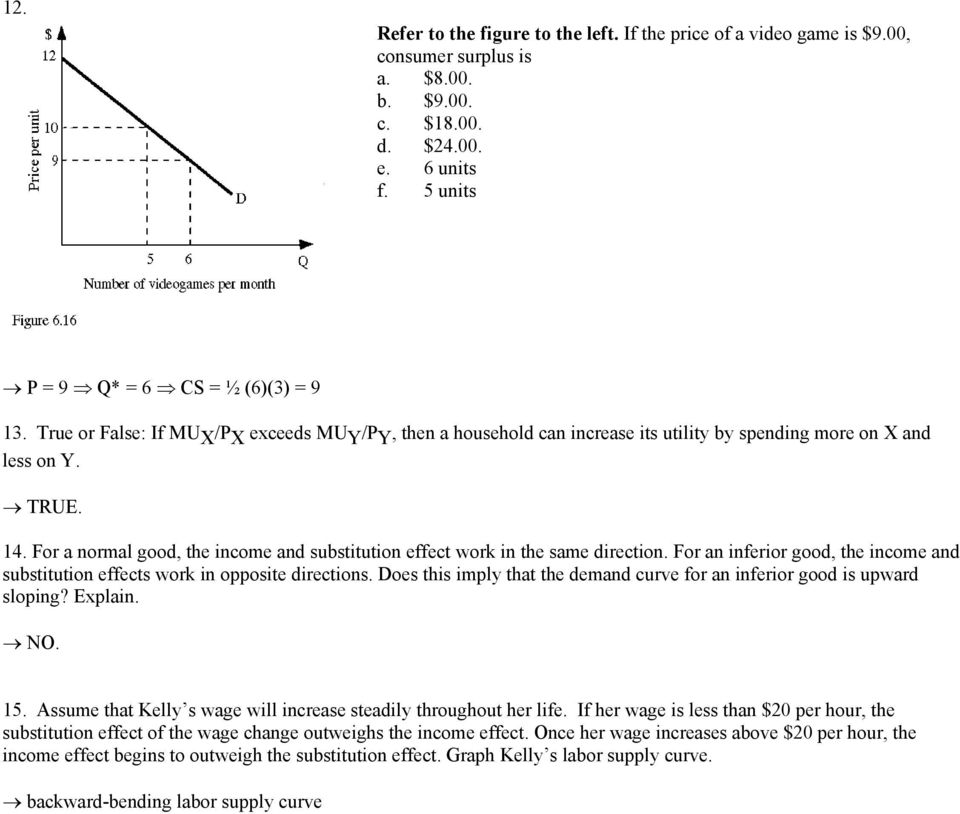
5 12. Refer to the figure to the left. If the price of a video game is $9.00, consumer surplus is a. $8.00. b. $9.00. c. $ d. $ e. 6 units f. 5 units P = 9 Q* = 6 CS = ½ (6)(3) = True or False: If MU X /P X exceeds MU Y /P Y, then a household can increase its utility by spending more on X and less on Y. TRUE. 14. For a normal good, the income and substitution effect work in the same direction. For an inferior good, the income and substitution effects work in opposite directions. Does this imply that the demand curve for an inferior good is upward sloping? Explain. NO. 15. Assume that Kelly s wage will increase steadily throughout her life. If her wage is less than $20 per hour, the substitution effect of the wage change outweighs the income effect. Once her wage increases above $20 per hour, the income effect begins to outweigh the substitution effect. Graph Kelly s labor supply curve. backward-bending labor supply curve
UTILITY AND DEMAND. Chapter. Household Consumption Choices
 Chapter 7 UTILITY AND DEMAND Household Consumption Choices Topic: Consumption Possibilities 1) The level of utility a consumer can achieve is limited by A) prices only. B) income only. C) the consumer
Chapter 10. Consumer Choice and Behavioral Economics
 Chapter 10. Consumer Choice and Behavioral Economics Instructor: JINKOOK LEE Department of Economics / Texas A&M University ECON 202 504 Principles of Microeconomics Utility Utility: the satisfaction people
Problem Set #5-Key. Economics 305-Intermediate Microeconomic Theory
 Problem Set #5-Key Sonoma State University Economics 305-Intermediate Microeconomic Theory Dr Cuellar (1) Suppose that you are paying your for your own education and that your college tuition is $200 per
Managerial Economics Prof. Trupti Mishra S.J.M. School of Management Indian Institute of Technology, Bombay. Lecture - 13 Consumer Behaviour (Contd )
 (Refer Slide Time: 00:28) Managerial Economics Prof. Trupti Mishra S.J.M. School of Management Indian Institute of Technology, Bombay Lecture - 13 Consumer Behaviour (Contd ) We will continue our discussion
Figure 4-1 Price Quantity Quantity Per Pair Demanded Supplied $ 2 18 3 $ 4 14 4 $ 6 10 5 $ 8 6 6 $10 2 8
 Econ 101 Summer 2005 In-class Assignment 2 & HW3 MULTIPLE CHOICE 1. A government-imposed price ceiling set below the market's equilibrium price for a good will produce an excess supply of the good. a.
Consumers face constraints on their choices because they have limited incomes.
 Consumer Choice: the Demand Side of the Market Consumers face constraints on their choices because they have limited incomes. Wealthy and poor individuals have limited budgets relative to their desires.
MULTIPLE CHOICE. Choose the one alternative that best completes the statement or answers the question.
 Midterm II ECO2301-003 Spring2014 Name R# MULTIPLE CHOICE. Choose the one alternative that best completes the statement or answers the question. 1) Hector has $1,000 a month to spend on clothing and food.
Demand. See the Practical #4A Help Sheet for instructions and examples on graphing a demand schedule.
 Demand Definition of Demand: Demand is a relation that shows the quantities that buyers are willing and able to purchase at alternative prices during a given time period, all other things remaining the
Economics 100 Exam 2
 Name: 1. During the long run: Economics 100 Exam 2 A. Output is limited because of the law of diminishing returns B. The scale of operations cannot be changed C. The firm must decide how to use the current
Economics 301 Problem Set 4 5 October 2007
 Economics 301 Name Problem Set 4 5 October 2007 Budget Lines and Indifference Curves and the Consumer Optimum 1. Parvez, a pharmacology student, has allocated $120 per month to spend on paperback novels
Microeconomics Instructor Miller Practice Problems Labor Market
 Microeconomics Instructor Miller Practice Problems Labor Market 1. What is a factor market? A) It is a market where financial instruments are traded. B) It is a market where stocks and bonds are traded.
CHAPTER 3 CONSUMER BEHAVIOR
 CHAPTER 3 CONSUMER BEHAVIOR EXERCISES 2. Draw the indifference curves for the following individuals preferences for two goods: hamburgers and beer. a. Al likes beer but hates hamburgers. He always prefers
Chapter 3 Consumer Behavior
 Chapter 3 Consumer Behavior Read Pindyck and Rubinfeld (2013), Chapter 3 Microeconomics, 8 h Edition by R.S. Pindyck and D.L. Rubinfeld Adapted by Chairat Aemkulwat for Econ I: 2900111 1/29/2015 CHAPTER
AK 4 SLUTSKY COMPENSATION
 AK 4 SLUTSKY COMPENSATION ECON 210 A. JOSEPH GUSE (1) (a) First calculate the demand at the original price p b = 2 b(p b,m) = 1000 20 5p b b 0 = b(2) = 40 In general m c = m+(p 1 b p0 b )b 0. If the price
MULTIPLE CHOICE. Choose the one alternative that best completes the statement or answers the question.
 Chapter 11 Perfect Competition - Sample Questions MULTIPLE CHOICE. Choose the one alternative that best completes the statement or answers the question. 1) Perfect competition is an industry with A) a
chapter: Solution Solution The Rational Consumer
 S11-S156_Krugman2e_PS_Ch1.qxp 9/16/8 9:21 PM Page S-11 The Rational Consumer chapter: 1 1. For each of the following situations, decide whether Al has increasing, constant, or diminishing marginal utility.
Cameron ECON 100: FIRST MIDTERM (A) Winter 01
 Cameron ECON 100: FIRST MIDTERM (A) Winter 01 Answer all questions in the space provided on the exam. Total of 40 points (and worth 22.5% of final grade). Read each question carefully, so that you answer
Practice Problem Set 2 (ANSWERS)
 Economics 370 Professor H.J. Schuetze Practice Problem Set 2 (ANSWERS) 1. See the figure below, where the initial budget constraint is given by ACE. After the new legislation is passed, the budget constraint
MULTIPLE CHOICE. Choose the one alternative that best completes the statement or answers the question.
 Econ 201 Practice Test 1 Professor V. Tremblay MULTIPLE CHOICE. Choose the one alternative that best completes the statement or answers the question. 1) Scarcity can best be defined as a situation in which:
Economics 103h Fall l 2012: Review Questions for Midterm 2
 Economics 103h Fall l 2012: Review Questions for Midterm 2 Essay/Graphing questions 1, Explain the shape of the budget line. 2. What shifts the budget line and why? Give an example in words and demonstrate
Pre Test Chapter 3. 8.. DVD players and DVDs are: A. complementary goods. B. substitute goods. C. independent goods. D. inferior goods.
 1. Graphically, the market demand curve is: A. steeper than any individual demand curve that is part of it. B. greater than the sum of the individual demand curves. C. the horizontal sum of individual
The fundamental question in economics is 2. Consumer Preferences
 A Theory of Consumer Behavior Preliminaries 1. Introduction The fundamental question in economics is 2. Consumer Preferences Given limited resources, how are goods and service allocated? 1 3. Indifference
 1 The Market for Factors of Production Factors of Production are the inputs used to produce goods and services. The markets for these factors of production are similar to the markets for goods and services
CHAPTER 7: CONSUMER BEHAVIOR
 CHAPTER 7: CONSUMER BEHAVIOR Introduction The consumer is central to a market economy, and understanding how consumers make their purchasing decisions is the key to understanding demand. Chapter 7 explains
MULTIPLE CHOICE. Choose the one alternative that best completes the statement or answers the question.
 MBA 640, Survey of Microeconomics, Quiz #4 Fall 2006 Name MULTIPLE CHOICE. Choose the one alternative that best completes the statement or answers the question. 1) In the short run, A) there are no variable
CHAPTER 4 Consumer Choice
 CHAPTER 4 Consumer Choice CHAPTER OUTLINE 4.1 Preferences Properties of Consumer Preferences Preference Maps 4.2 Utility Utility Function Ordinal Preference Utility and Indifference Curves Utility and
MULTIPLE CHOICE. Choose the one alternative that best completes the statement or answers the question.
 Multiple choice review questions for Midterm 2 MULTIPLE CHOICE. Choose the one alternative that best completes the statement or answers the question. 1) A consumption point inside the budget line A) is
DEMAND FORECASTING. Demand. Law of Demand. Definition of Law of Demand
 DEMAND FORECASTING http://www.tutorialspoint.com/managerial_economics/demand_forecasting.htm Copyright tutorialspoint.com Demand Demand is a widely used term, and in common is considered synonymous with
N. Gregory Mankiw Principles of Economics. Chapter 13. THE COSTS OF PRODUCTION
 N. Gregory Mankiw Principles of Economics Chapter 13. THE COSTS OF PRODUCTION Solutions to Problems and Applications 1. a. opportunity cost; b. average total cost; c. fixed cost; d. variable cost; e. total
MULTIPLE CHOICE. Choose the one alternative that best completes the statement or answers the question.
 MULTIPLE CHOICE. Choose the one alternative that best completes the statement or answers the question. 1) Firms that survive in the long run are usually those that A) remain small. B) strive for the largest
INTRODUCTION THE LABOR MARKET LABOR SUPPLY INCOME VS. LEISURE THE SUPPLY OF LABOR
 INTRODUCTION Chapter 15 THE LBOR MRKET This chapter covers why there are differences in wages: How do people decide how much time to spend working? What determines the wage rate an employer is willing
The Central Idea CHAPTER 1 CHAPTER OVERVIEW CHAPTER REVIEW
 CHAPTER 1 The Central Idea CHAPTER OVERVIEW Economic interactions involve scarcity and choice. Time and income are limited, and people choose among alternatives every day. In this chapter, we study the
An increase in the number of students attending college. shifts to the left. An increase in the wage rate of refinery workers.
 1. Which of the following would shift the demand curve for new textbooks to the right? a. A fall in the price of paper used in publishing texts. b. A fall in the price of equivalent used text books. c.
MULTIPLE CHOICE. Choose the one alternative that best completes the statement or answers the question.
 MBA 640 Survey of Microeconomics Fall 2006, Quiz 6 Name MULTIPLE CHOICE. Choose the one alternative that best completes the statement or answers the question. 1) A monopoly is best defined as a firm that
Demand, Supply, and Market Equilibrium
 3 Demand, Supply, and Market Equilibrium The price of vanilla is bouncing. A kilogram (2.2 pounds) of vanilla beans sold for $50 in 2000, but by 2003 the price had risen to $500 per kilogram. The price
The Cost of Production
 The Cost of Production 1. Opportunity Costs 2. Economic Costs versus Accounting Costs 3. All Sorts of Different Kinds of Costs 4. Cost in the Short Run 5. Cost in the Long Run 6. Cost Minimization 7. The
DEMAND AND SUPPLY. Chapter. Markets and Prices. Demand. C) the price of a hot dog minus the price of a hamburger.
 Chapter 3 DEMAND AND SUPPLY Markets and Prices Topic: Price and Opportunity Cost 1) A relative price is A) the slope of the demand curve B) the difference between one price and another C) the slope of
2. With an MPS of.4, the MPC will be: A) 1.0 minus.4. B).4 minus 1.0. C) the reciprocal of the MPS. D).4. Answer: A
 1. If Carol's disposable income increases from $1,200 to $1,700 and her level of saving increases from minus $100 to a plus $100, her marginal propensity to: A) save is three-fifths. B) consume is one-half.
Chapter 4 Individual and Market Demand
 Chapter 4 Individual and Market Demand Questions for Review 1. Explain the difference between each of the following terms: a. a price consumption curve and a demand curve The price consumption curve (PCC)
Theory of Demand. ECON 212 Lecture 7. Tianyi Wang. Winter 2013. Queen s Univerisity. Tianyi Wang (Queen s Univerisity) Lecture 7 Winter 2013 1 / 46
 Theory of Demand ECON 212 Lecture 7 Tianyi Wang Queen s Univerisity Winter 2013 Tianyi Wang (Queen s Univerisity) Lecture 7 Winter 2013 1 / 46 Intro Note: Quiz 1 can be picked up at Distribution Center.
THE ECONOMY AT FULL EMPLOYMENT. Objectives. Production and Jobs. Objectives. Real GDP and Employment. Real GDP and Employment CHAPTER
 THE ECONOMY AT 29 FULL EMPLOYMENT CHAPTER Objectives After studying this chapter, you will able to Describe the relationship between the quantity of labour employed and real GDP Explain what determines
7 AGGREGATE SUPPLY AND AGGREGATE DEMAND* Chapter. Key Concepts
 Chapter 7 AGGREGATE SUPPLY AND AGGREGATE DEMAND* Key Concepts Aggregate Supply The aggregate production function shows that the quantity of real GDP (Y ) supplied depends on the quantity of labor (L ),
BPE_MIC1 Microeconomics 1 Fall Semester 2011
 Masaryk University - Brno Department of Economics Faculty of Economics and Administration BPE_MIC1 Microeconomics 1 Fall Semester 2011 Final Exam - 05.12.2011, 9:00-10:30 a.m. Test A Guidelines and Rules:
Econ 202 Section 2 Midterm 1
 Douglas, Fall 2009 September 29, 2009 A: Special Code 0000 21 PLEDGE: I have neither given nor received unauthorized help on this exam. SIGNED: PRINT NAME: Econ 202 Section 2 Midterm 1 1. What will happen
Where are we? To do today: finish the derivation of the demand curve using indifference curves. Go on then to chapter Production and Cost
 Where are we? To do today: finish the derivation of the demand curve using indifference curves Go on then to chapter Production and Cost Utility and indifference curves The point is to find where on the
CHAPTER 9 Building the Aggregate Expenditures Model
 CHAPTER 9 Building the Aggregate Expenditures Model Topic Question numbers 1. Consumption function/apc/mpc 1-42 2. Saving function/aps/mps 43-56 3. Shifts in consumption and saving functions 57-72 4 Graphs/tables:
CHAPTER 1: LIMITS, ALTERNATIVES, AND CHOICES
 CHAPTER 1: LIMITS, ALTERNATIVES, AND CHOICES Introduction At the heart of the study of economics is the simple but very real prospect that we cannot have it all. We have too few resources to meet all of
Midterm Exam #2. ECON 101, Section 2 summer 2004 Ying Gao. 1. Print your name and student ID number at the top of this cover sheet.
 NAME: STUDENT ID: Midterm Exam #2 ECON 101, Section 2 summer 2004 Ying Gao Instructions Please read carefully! 1. Print your name and student ID number at the top of this cover sheet. 2. Check that your
Chapter 5 End of Chapter Review Question KEY
 Chapter End of Chapter Review Question KEY - (Key Question) Complete the following table and answer the questions below: Units consumed Total utility Marginal utility 0 0 0 0 0 a. At which rate is total
CHAPTER 13 MARKETS FOR LABOR Microeconomics in Context (Goodwin, et al.), 2 nd Edition
 CHAPTER 13 MARKETS FOR LABOR Microeconomics in Context (Goodwin, et al.), 2 nd Edition Chapter Summary This chapter deals with supply and demand for labor. You will learn about why the supply curve for
Chapter 3 Market Demand, Supply, and Elasticity
 Chapter 3 Market Demand, Supply, and Elasticity After reading chapter 3, MARKET DEMAND, SUPPLY, AND ELASTICITY, you should be able to: Discuss the Law of Demand and draw a Demand Curve. Distinguish between
MULTIPLE CHOICE. Choose the one alternative that best completes the statement or answers the question.
 Chapter 11 Monopoly practice Davidson spring2007 MULTIPLE CHOICE. Choose the one alternative that best completes the statement or answers the question. 1) A monopoly industry is characterized by 1) A)
8. Average product reaches a maximum when labor equals A) 100 B) 200 C) 300 D) 400
 Ch. 6 1. The production function represents A) the quantity of inputs necessary to produce a given level of output. B) the various recipes for producing a given level of output. C) the minimum amounts
Study Questions for Chapter 9 (Answer Sheet)
 DEREE COLLEGE DEPARTMENT OF ECONOMICS EC 1101 PRINCIPLES OF ECONOMICS II FALL SEMESTER 2002 M-W-F 13:00-13:50 Dr. Andreas Kontoleon Office hours: Contact: [email protected] Wednesdays 15:00-17:00 Study
Pre-Test Chapter 18 ed17
 Pre-Test Chapter 18 ed17 Multiple Choice Questions 1. (Consider This) Elastic demand is analogous to a and inelastic demand to a. A. normal wrench; socket wrench B. Ace bandage; firm rubber tie-down C.
Chapter 4 The Theory of Individual Behavior
 Managerial Economics & Business Strategy Chapter 4 The Theory of Individual Behavior McGraw-Hill/Irwin Copyright 2010 by the McGraw-Hill Companies, Inc. All rights reserved. Overview I. Consumer Behavior
Chapter 4 Online Appendix: The Mathematics of Utility Functions
 Chapter 4 Online Appendix: The Mathematics of Utility Functions We saw in the text that utility functions and indifference curves are different ways to represent a consumer s preferences. Calculus can
Learning Objectives. After reading Chapter 11 and working the problems for Chapter 11 in the textbook and in this Workbook, you should be able to:
 Learning Objectives After reading Chapter 11 and working the problems for Chapter 11 in the textbook and in this Workbook, you should be able to: Discuss three characteristics of perfectly competitive
Table of Contents MICRO ECONOMICS
 economicsentrance.weebly.com Basic Exercises Micro Economics AKG 09 Table of Contents MICRO ECONOMICS Budget Constraint... 4 Practice problems... 4 Answers... 4 Supply and Demand... 7 Practice Problems...
This file includes the answers to the problems at the end of Chapters 1, 2, 3, and 5 and 6.
 This file includes the answers to the problems at the end of Chapters 1, 2, 3, and 5 and 6. Chapter One 1. The economic surplus from washing your dirty car is the benefit you receive from doing so ($6)
CHAPTER 5 MARGINAL UTILITY AND CONSUMER CHOICE
 CHAPTER 5 MARGINAL UTILITY AND CONSUMER CHOICE Chapter in a Nutshell In Chapter 3, we studied the law of demand, noting that when price falls, quantity demanded increases. But why? It seemed obvious, didn't
Principles of Economics: Micro: Exam #2: Chapters 1-10 Page 1 of 9
 Principles of Economics: Micro: Exam #2: Chapters 1-10 Page 1 of 9 print name on the line above as your signature INSTRUCTIONS: 1. This Exam #2 must be completed within the allocated time (i.e., between
POTENTIAL OUTPUT and LONG RUN AGGREGATE SUPPLY
 POTENTIAL OUTPUT and LONG RUN AGGREGATE SUPPLY Aggregate Supply represents the ability of an economy to produce goods and services. In the Long-run this ability to produce is based on the level of production
1. Briefly explain what an indifference curve is and how it can be graphically derived.
 Chapter 2: Consumer Choice Short Answer Questions 1. Briefly explain what an indifference curve is and how it can be graphically derived. Answer: An indifference curve shows the set of consumption bundles
Demand and Consumer Behavior emand is a model of consumer behavior. It attempts to identify the factors
 R. Larry Reynolds Demand and Consumer Behavior R. Larry Reynolds (005) Demand and Consumer Behavior emand is a model of consumer behavior. It attempts to identify the factors D that influence the choices
I d ( r; MPK f, τ) Y < C d +I d +G
 1. Use the IS-LM model to determine the effects of each of the following on the general equilibrium values of the real wage, employment, output, the real interest rate, consumption, investment, and the
Chapter 14 Monopoly. 14.1 Monopoly and How It Arises
 Chapter 14 Monopoly 14.1 Monopoly and How It Arises 1) One of the requirements for a monopoly is that A) products are high priced. B) there are several close substitutes for the product. C) there is a
Demand. Lecture 3. August 2015. Reading: Perlo Chapter 4 1 / 58
 Demand Lecture 3 Reading: Perlo Chapter 4 August 2015 1 / 58 Introduction We saw the demand curve in chapter 2. We learned about consumer decision making in chapter 3. Now we bridge the gap between the
Chapter 22 The Cost of Production Extra Multiple Choice Questions for Review
 Chapter 22 The Cost of Production Extra Multiple Choice Questions for Review 1. Implicit costs are: A) equal to total fixed costs. B) comprised entirely of variable costs. C) "payments" for self-employed
ECON 443 Labor Market Analysis Final Exam (07/20/2005)
 ECON 443 Labor Market Analysis Final Exam (07/20/2005) I. Multiple-Choice Questions (80%) 1. A compensating wage differential is A) an extra wage that will make all workers willing to accept undesirable
PPA 723, Fall 2006 Professor John McPeak
 Quiz One PPA 723, Fall 2006 Professor John McPeak Name: The total quiz is worth 20 points. Each question is worth 2 points, and each sub question is worth an equal share of the two points. 1) The demand
N. Gregory Mankiw Principles of Economics. Chapter 14. FIRMS IN COMPETITIVE MARKETS
 N. Gregory Mankiw Principles of Economics Chapter 14. FIRMS IN COMPETITIVE MARKETS Solutions to Problems and Applications 1. A competitive market is one in which: (1) there are many buyers and many sellers
4 THE MARKET FORCES OF SUPPLY AND DEMAND
 4 THE MARKET FORCES OF SUPPLY AND DEMAND IN THIS CHAPTER YOU WILL Learn what a competitive market is Examine what determines the demand for a good in a competitive market Chapter Overview Examine what
AP Microeconomics Chapter 12 Outline
 I. Learning Objectives In this chapter students will learn: A. The significance of resource pricing. B. How the marginal revenue productivity of a resource relates to a firm s demand for that resource.
Common sense, and the model that we have used, suggest that an increase in p means a decrease in demand, but this is not the only possibility.
 Lecture 6: Income and Substitution E ects c 2009 Je rey A. Miron Outline 1. Introduction 2. The Substitution E ect 3. The Income E ect 4. The Sign of the Substitution E ect 5. The Total Change in Demand
Chapter 3 Market Demand, Supply and Elasticity
 Chapter 3 Market Demand, Supply and Elasticity Multiple Choice Questions Choose the one alternative that best completes the statement or answers the question. 1. Ceteris paribus means (a) other things
4. Answer c. The index of nominal wages for 1996 is the nominal wage in 1996 expressed as a percentage of the nominal wage in the base year.
 Answers To Chapter 2 Review Questions 1. Answer a. To be classified as in the labor force, an individual must be employed, actively seeking work, or waiting to be recalled from a layoff. However, those
Theoretical Tools of Public Economics. Part-2
 Theoretical Tools of Public Economics Part-2 Previous Lecture Definitions and Properties Utility functions Marginal utility: positive (negative) if x is a good ( bad ) Diminishing marginal utility Indifferences
EC2105, Professor Laury EXAM 2, FORM A (3/13/02)
 EC2105, Professor Laury EXAM 2, FORM A (3/13/02) Print Your Name: ID Number: Multiple Choice (32 questions, 2.5 points each; 80 points total). Clearly indicate (by circling) the ONE BEST response to each
MULTIPLE CHOICE. Choose the one alternative that best completes the statement or answers the question.
 MULTIPLE CHOICE. Choose the one alternative that best completes the statement or answers the question. 1) The law of demand states that, other things remaining the same, the lower the price of a good,
Notes - Gruber, Public Finance Chapter 20.3 A calculation that finds the optimal income tax in a simple model: Gruber and Saez (2002).
 Notes - Gruber, Public Finance Chapter 20.3 A calculation that finds the optimal income tax in a simple model: Gruber and Saez (2002). Description of the model. This is a special case of a Mirrlees model.
Name Eco200: Practice Test 2 Covering Chapters 10 through 15
 Name Eco200: Practice Test 2 Covering Chapters 10 through 15 1. Four roommates are planning to spend the weekend in their dorm room watching old movies, and they are debating how many to watch. Here is
The Circular Flow of Income and Expenditure
 The Circular Flow of Income and Expenditure Imports HOUSEHOLDS Savings Taxation Govt Exp OTHER ECONOMIES GOVERNMENT FINANCIAL INSTITUTIONS Factor Incomes Taxation Govt Exp Consumer Exp Exports FIRMS Capital
Lab 17: Consumer and Producer Surplus
 Lab 17: Consumer and Producer Surplus Who benefits from rent controls? Who loses with price controls? How do taxes and subsidies affect the economy? Some of these questions can be analyzed using the concepts
ECON 103, 2008-2 ANSWERS TO HOME WORK ASSIGNMENTS
 ECON 103, 2008-2 ANSWERS TO HOME WORK ASSIGNMENTS Due the Week of June 23 Chapter 8 WRITE [4] Use the demand schedule that follows to calculate total revenue and marginal revenue at each quantity. Plot
ELASTICITY Microeconomics in Context (Goodwin, et al.), 3 rd Edition
 Chapter 4 ELASTICITY Microeconomics in Context (Goodwin, et al.), 3 rd Edition Chapter Overview This chapter continues dealing with the demand and supply curves we learned about in Chapter 3. You will
ANSWERS TO END-OF-CHAPTER QUESTIONS
 ANSWERS TO END-OF-CHAPTER QUESTIONS 9-1 Explain what relationships are shown by (a) the consumption schedule, (b) the saving schedule, (c) the investment-demand curve, and (d) the investment schedule.
Practice Multiple Choice Questions Answers are bolded. Explanations to come soon!!
 Practice Multiple Choice Questions Answers are bolded. Explanations to come soon!! For more, please visit: http://courses.missouristate.edu/reedolsen/courses/eco165/qeq.htm Market Equilibrium and Applications
Advanced International Economics Prof. Yamin Ahmad ECON 758
 Advanced International Economics Prof. Yamin Ahmad ECON 758 Sample Midterm Exam Name Id # Instructions: There are two parts to this midterm. Part A consists of multiple choice questions. Please mark the
Pre-Test Chapter 25 ed17
 Pre-Test Chapter 25 ed17 Multiple Choice Questions 1. Refer to the above graph. An increase in the quantity of labor demanded (as distinct from an increase in demand) is shown by the: A. shift from labor
Elasticity. I. What is Elasticity?
 Elasticity I. What is Elasticity? The purpose of this section is to develop some general rules about elasticity, which may them be applied to the four different specific types of elasticity discussed in
N. Gregory Mankiw Principles of Economics. Chapter 15. MONOPOLY
 N. Gregory Mankiw Principles of Economics Chapter 15. MONOPOLY Solutions to Problems and Applications 1. The following table shows revenue, costs, and profits, where quantities are in thousands, and total
Douglas, Spring 2008 February 21, 2008 PLEDGE: I have neither given nor received unauthorized help on this exam.
 , Spring 2008 February 21, 2008 PLEDGE: I have neither given nor received unauthorized help on this exam. SIGNED: PRINT NAME: Econ 202 Midterm 1 1. What will happen to the equilibrium price of hamburgers
Agenda. Productivity, Output, and Employment, Part 1. The Production Function. The Production Function. The Production Function. The Demand for Labor
 Agenda Productivity, Output, and Employment, Part 1 3-1 3-2 A production function shows how businesses transform factors of production into output of goods and services through the applications of technology.
CHAPTER 7: AGGREGATE DEMAND AND AGGREGATE SUPPLY
 CHAPTER 7: AGGREGATE DEMAND AND AGGREGATE SUPPLY Learning goals of this chapter: What forces bring persistent and rapid expansion of real GDP? What causes inflation? Why do we have business cycles? How
PART A: For each worker, determine that worker's marginal product of labor.
 ECON 3310 Homework #4 - Solutions 1: Suppose the following indicates how many units of output y you can produce per hour with different levels of labor input (given your current factory capacity): PART
QE1: Economics Notes 1
 QE1: Economics Notes 1 Box 1: The Household and Consumer Welfare The final basket of goods that is chosen are determined by three factors: a. Income b. Price c. Preferences Substitution Effect: change
Potential GDP and Economic Growth
 Potential GDP and Economic Growth CHAPTER17 C H A P T E R C H E C K L I S T When you have completed your study of this chapter, you will be able to 1 Explain the forces that determine potential GDP and
CHAPTER 5 WORKING WITH SUPPLY AND DEMAND Microeconomics in Context (Goodwin, et al.), 2 nd Edition
 CHAPTER 5 WORKING WITH SUPPLY AND DEMAND Microeconomics in Context (Goodwin, et al.), 2 nd Edition Chapter Overview This chapter continues dealing with the demand and supply curves we learned about in
Econ 201 Final Exam. Douglas, Fall 2007 Version A Special Codes 00000. PLEDGE: I have neither given nor received unauthorized help on this exam.
 , Fall 2007 Version A Special Codes 00000 PLEDGE: I have neither given nor received unauthorized help on this exam. SIGNED: PRINT NAME: Econ 201 Final Exam 1. For a profit-maximizing monopolist, a. MR