
Conners' Adult ADHD Rating Scales Self-Report: Long Version (CAARS S:L)
|
|
|
- Joseph Goodwin
- 9 years ago
- Views:
Transcription
1 Conners' Adult ADHD Rating Scales Self-Report: Long Version (CAARS S:L) By C. Keith Conners, Ph.D., Drew Erhardt, Ph.D., and Elizabeth Sparrow, Ph.D. Interpretive Report Copyright 00 Multi-Health Systems Inc. All rights reserved. P.O. Box 950, North Tonawanda, NY Victoria Park Ave., Toronto, ON MH M6

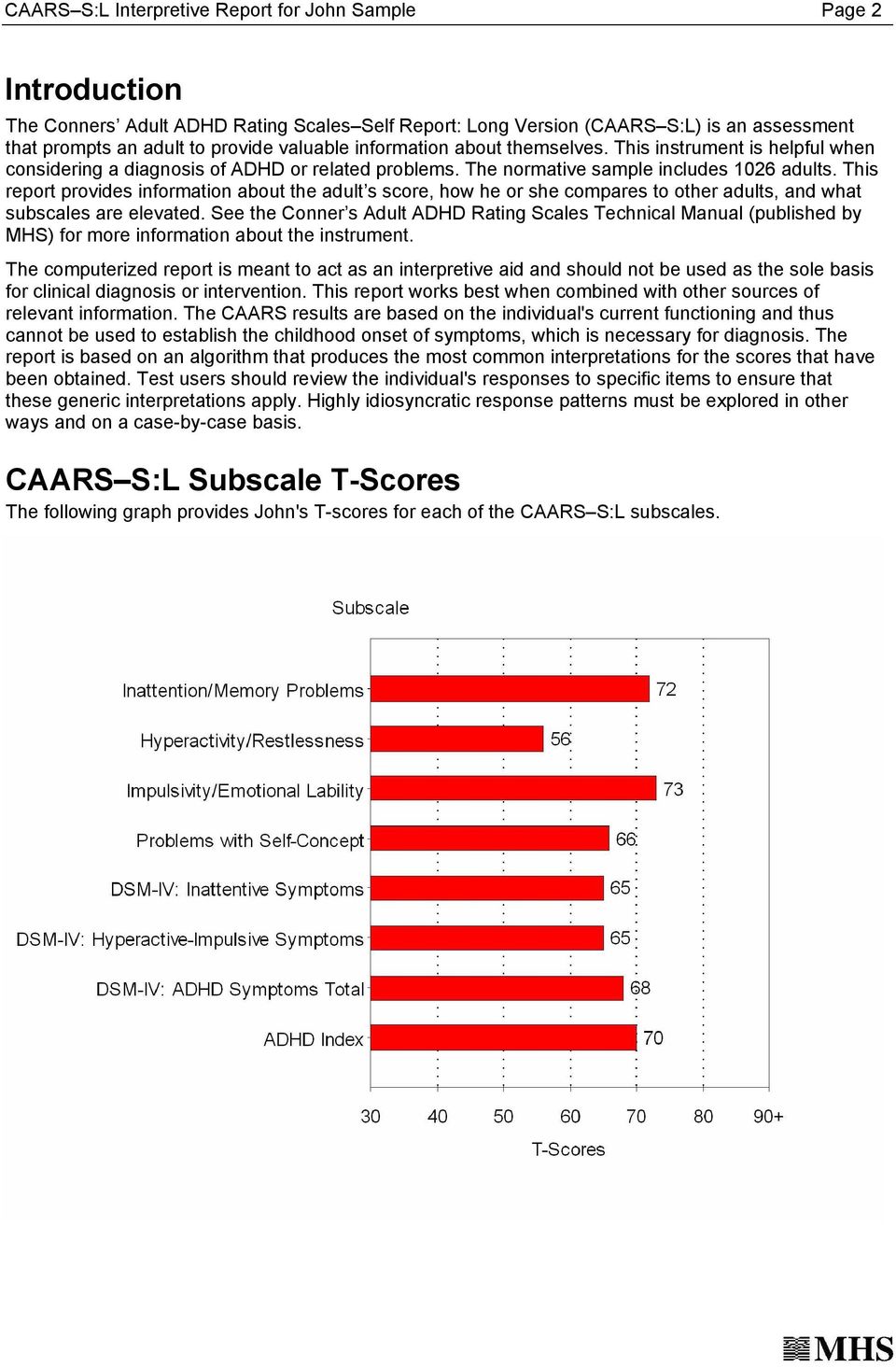
2 CAARS S:L Interpretive Report for John Sample Page Introduction The Conners Adult ADHD Rating Scales Self Report: Long Version (CAARS S:L) is an assessment that prompts an adult to provide valuable information about themselves. This instrument is helpful when considering a diagnosis of ADHD or related problems. The normative sample includes 06 adults. This report provides information about the adult s score, how he or she compares to other adults, and what subscales are elevated. See the Conner s Adult ADHD Rating Scales Technical Manual (published by MHS) for more information about the instrument. The computerized report is meant to act as an interpretive aid and should not be used as the sole basis for clinical diagnosis or intervention. This report works best when combined with other sources of relevant information. The CAARS results are based on the individual's current functioning and thus cannot be used to establish the childhood onset of symptoms, which is necessary for diagnosis. The report is based on an algorithm that produces the most common interpretations for the scores that have been obtained. Test users should review the individual's responses to specific items to ensure that these generic interpretations apply. Highly idiosyncratic response patterns must be explored in other ways and on a case-by-case basis. CAARS S:L Subscale T-Scores The following graph provides John's T-scores for each of the CAARS S:L subscales.
3 CAARS S:L Interpretive Report for John Sample Page Summary of Subscale Scores The following table summarizes John's subscale scores and gives general information about how he compares to the nomative group. More interpretive data are provided later in this report. Subscale Inattention/Memory Problems Hyperactivity/Restlessness Impulsivity/Emotional Lability Problems with Self-Concept DSM-IV: Inattentive Symptoms DSM-IV: Hyperactive-Impulsive Symptoms DSM-IV: ADHD Symptoms Total ADHD Index Raw Score T- Score Guideline Markedly atypical Slightly atypical (borderline: should raise concern) Markedly atypical Moderately atypical Mildly atypical (possible significant Mildly atypical (possible significant Moderately atypical Moderately atypical Common Characteristics of High Scorers Difficulties may include trouble concentrating, difficulty planning or completing tasks, forgetfulness, absent-mindedness, being disorganized. Difficulties may include problems with working at the same task for long periods of time, feeling more restless than others seems to be, fidgeting. Difficulties may include engaging in more impulsive acts than others do, low frustration tolerance, quick and frequent mood changes, feeling easily angered and irritated by people. Difficulties may include poor social relationships, low self-esteem and self confidence. Behave in a manner consistent with the Inattentive Subtype of ADHD, described in the DSM-IV. Behave in a manner consistent with the Hyperactive-Impulsive Subtype of ADHD, described in the DSM-IV. Behave in a manner consistent with the DSM-IV diagnostic criteria for Combined type ADHD. Identifies individuals 'at risk' for ADHD

4 CAARS S:L Interpretive Report for John Sample Page 4 Item Response Table The following response values were entered for the items on CAARS S:L. Response Key 0 = Not at all, Never = Just a little, Once in a while = Pretty much, Often = Very much, Very frequently

5 CAARS S:L Interpretive Report for John Sample Page 5 DSM-IV Subscales: Elevated Responses The following graph shows the number of items for which John answered " Very much, Very Frequently" () or "Pretty much, Often" (). The answers are grouped by DSM-IV subscale. The DSM-IV subscales are interpreted in more detail later in this report.

6 CAARS S:L Interpretive Report for John Sample Page 6 Validity Assessment If the findings presented here conflict with other sources of information, then the reason(s) for the conflicting information should be considered, and the results described in this report should be interpreted with these reasons in mind. If these results conflict with other information, then it is possible that the respondent is either exaggerating current problems, or has denied the existence of problems previously. It is also possible, however, that behavior and attitudes are situation specific. That is, behavior and attitudes at home may be quite different than behavior and attitudes away from home (e.g., at work). Use of the CAARS observer form is recommended to help resolve apparent inconsistencies. An examination of the individual item responses reveals some possible inconsistencies. Quite different responses were given to items with similar content. If possible, discrepancies in the responses to items should be discussed with John. Some items may have been misunderstood, or perhaps he was unwilling or unable to give a clear picture of his own behavior and attitudes. The following item pairs reveal inconsistent responses that should be explored further. Item pairs with similar content Response 0 0 Score Differential Examination of Subscale Scores ADHD Index: T-Score = 70 Moderately elevated. This index consists of the best set of items on CAARS for identifying adults "at risk" for ADHD. John's score on this index is notably elevated, indicating possible ADHD. This finding should be combined with other information to corroborate whether a diagnosis of ADHD is appropriate. Inattention/Memory Problems: T-Score = 7 Marked elevated. John could experience serious difficulties with organizing or planning his work, completing tasks or projects, and concentrating on tasks that require sustained mental effort. A number of items on this subscale indicate some difficulties related to memory and inattentiveness.

7 CAARS S:L Interpretive Report for John Sample Page 7 Hyperactivity/Restlessness: T-Score = 56 Slightly elevated. The score obtained on this subscale indicates that John might have some difficulty sitting still or remaining stationary for very long. John is probably also a little more restless than most individuals. Impulsivity/Emotional Lability: T-Score = 7 Markedly elevated: John's score on the Impulsivity/Emotional Lability subscale is quite high, indicating an individual who is very prone to emotional responses/behaviors like getting upset or having temper outbursts. John is likely to be more impulsive, both verbally and behaviorally, than is typical of others. He is also likely to have a low frustration tolerance and hence prone to moodiness and to be easily angered or irritated. Problems with Self Concept: T-Score = 66 Moderately elevated. The score on this subscale indicates that John perceives himself as having low self-confidence and low self-esteem. Assessment efforts might focus on identifying the factor or factors that contribute to this individual's poor self-concept. He may lack confidence in his own abilities and avoid taking on new challenges as a result. Analysis DSM-IV Subscales Inattentive Symptoms: T-Score = 65 John's responses to the DSM-IV items indicate that the criterion for the Inattentive Subtype of ADHD has not been met. Six or more symptoms of ADHD are required, but only of 9 items is rated "Very much, Very frequently" and only of 9 items is rated "Pretty much, Often". Hyperactive-Impulsive Symptoms: T-Score = 65 Six or more symptoms of ADHD are required for Hyperactive-Impulsive Subtype of ADHD to be present. John's responses suggest that this criterion has not been met. However, given that close to six symptoms could be present (i.e., of 9 items is rated "Very much, Very frequently", 4 of 9 items is rated "Pretty much, Often"), further investigation of the possible presence of Hyperactive-Impulsive Subtype of ADHD is warranted. Combined Type ADHD: T-Score = 68 Based on John's self-report, there is strong evidence for a diagnosis of the Inattentive Subtype ADHD. The evidence for Hyperactive-Impulsive Subtype is more moderate. Nonetheless, the possibility of Combined Type ADHD should be considered. General Examination of the Profile There are several substantial subscale elevations. These elevations relate to different areas of behavior suggesting the possibility of comorbidity. More specific information about the areas that are elevated can be obtained from examining the subscale descriptions. Integrating Results with Other Information, and (if required) Determine Intervention Strategy The following subscale scores are elevated (T-Score > 60) and could be cause for concern. Inattention/Memory Problems Impulsivity/Emotional Lability Problems with Self-Concept

8 CAARS S:L Interpretive Report for John Sample Page 8 DSM-IV: Inattentive Symptoms DSM-IV: Hyperactive-Impulsive Symptoms DSM-IV: ADHD Symptoms Total ADHD Index These results must be incorporated with other information before drawing any conclusions. At a minimum, it is recommended that a comprehensive evaluation include A history of the pregnancy, delivery, and developmental milestones from infancy; A family history of psychiatric disorders; Assessment of specific symptoms, including onset, severity, frequency, chronicity, situational specificity, and duration; A functional assessment that covers school history, employment history, and work records; An overview of the individual's intrapsychic processes, including self-image and sense of efficacy with family, peers, and work; Current family interaction patterns and family structure; Screen for medical and psychiatric disorders and life circumstances that can lead to symptoms that mimic ADHD; An assessment of neurological status, when indicated by other evidence. CAARS S:L results interpreted without considering these other factors may have limited validity. There are a large number of possible treatment approaches and the choice of which treatment is most appropriate can vary from case to case. The following resources are recommended for use in making treatment decisions: Barkley, R. A. (997). ADHD and the nature of self-control. New York: Guilford Press. Barkley, R. A. (998). Attention-deficit hyperactivity disorder: A handbook for diagnosis and treatment (nd ed.). New York: Guilford Press. Biederman, J. (Presenter), Spencer, T. (Presenter), & Wilens, T. (Presenter). (997). Medical management of attention deficit hyperactivity disorder [Videotape Series]. Plantation, FL: Specialty Press. Conners, C. K. (Ed.). (996 --). Journal of Attention Disorders. Toronto, ON: Multi-Health Systems Inc. Conners, C. K. & Jett, J. L. (999). Attention deficit hyperactivity disorder in adults and children: The latest assessment and treatment strategies. Kansas City, MO: Compact Clinicals. Dawson, P. & Guare, R. (998). Coaching the ADHD Student. Toronto, ON: Multi-Health Systems Inc. Hallowell, E. M. & Ratey, J. J. (995). Driven to distraction: Recognizing and coping with attention deficit disorder from childhood through to adulthood. New York: Simon & Schuster. Ingersoll, B. D. & Goldstein, S. (99). Attention deficit disorder and learning disabilities: Realities, myths and controversial treatments. New York: Doubleday. Additional information can be obtained by contacting this organization: Children and Adults with Attention Deficit Disorders (C.H.A.D.D.) National Office 499 NW 70th Avenue, Suite 09 Plantation, FL

9 CAARS S:L Interpretive Report for John Sample Page 9 USA 7 Phone: (05) Fax: (05) Date Printed: January, 005 End of Report

Conners' Continuous Performance Test II (CPT II V.5)
 Conners' Continuous Performance Test II (CPT II V.5) By C. Keith Conners, Ph.D., Drew Erhardt, Ph.D., Elizabeth Sparrow, Ph.D., and MHS Staff CPT II/CAARS Multimodal Integrated Report This report is intended
Conners' Continuous Performance Test II (CPT II V.5)
 Conners' Continuous Performance Test II (CPT II V.5) By C. Keith Conners, Ph.D. and MHS Staff CPT II/CRS-R Multimodal Integrated Report This report is intended to be used by the test administrator as an
Adult ADHD Self-Report Scale-V1.1 (ASRS-V1.1) Symptoms Checklist from WHO Composite International Diagnostic Interview
 Adult ADHD Self-Report Scale-V1.1 (ASRS-V1.1) Symptoms Checklist from WHO Composite International Diagnostic Interview World Health Organization 2003 All rights reserved. Based on the Composite International
Conners' Continuous Performance Test II (CPT II V.5)
 Conners' Continuous Performance Test II (CPT II V.5) By C. Keith Conners, Ph.D. and MHS Staff Profile Report This report is intended to be used by the test administrator as an interpretive aid. This report
Documentation Guidelines for ADD/ADHD
 Documentation Guidelines for ADD/ADHD Hope College Academic Success Center This document was developed following the best practice recommendations for disability documentation as outlined by the Association
Billy. Austin 8/27/2013. ADHD & Bipolar Disorder: Differentiating the Behavioral Presentation in Children
 ADHD & Bipolar Disorder: Differentiating the Behavioral Presentation in Children Judy Goodwin, MSN, CNS Meadows Psychiatric Associates Billy Austin 1 Introduction Distinguishing between ADHD and Bipolar
Continuous Performance Test 3 rd Edition. C. Keith Conners, Ph.D.
 Continuous Performance Test 3 rd Edition C. Keith Conners, Ph.D. Assessment Report Name/ID: Alexandra Sample Age: 16 Gender: Female Birth Date: February 16, 1998 Grade: 11 Administration Date: February
For more than 100 years, extremely hyperactive
 8 WHAT WE KNOW ADHD Predominantly Inattentive Type For more than 100 years, extremely hyperactive children have been recognized as having behavioral problems. In the 1970s, doctors recognized that those
Behavior Rating Inventory of Executive Function - Adult Version BRIEF-A. Interpretive Report. Developed by
 Behavior Rating Inventory of Executive Function - Adult Version BRIEF-A Interpretive Report Developed by Peter K. Isquith, PhD, Robert M. Roth, PhD, Gerard A. Gioia, PhD, and PAR Staff Client Information
MCPS Special Education Parent Summit
 MCPS Special Education Parent Summit May 17, 2014 Rockville High School 2100 Baltimore Road Rockville, MD 20851 When ADHD Is Not ADHD: ADHD Look-Alikes and Co-occurring Disorders David W. Holdefer MCPS
ADHD in Children vs. Adults
 ADHD in Children vs. Adults ADHD Symptoms In Children DSM-IV INATTENTION 1) Often does not give close attention to details or makes careless mistakes in schoolwork, work, or other activities. 2) Often
Attention-deficit/hyperactivity disorder (ADHD)
 5C WHAT WE KNOW ADHD and Coexisting Conditions: Depression Attention-deficit/hyperactivity disorder (ADHD) is a common neurobiological condition affecting 5-8 percent of school age children 1,2,3,4,5,6,7
ADD and/or ADHD Verification Form
 ADD and/or ADHD Verification Form Disability Services for Students (DSS) provides academic services and accommodations for students with diagnosed disabilities. The documentation provided regarding the
DSM-5. Presented by CCESC School Psychologist Interns: Kayla Dodson, M.Ed. Ellen Doll, M.S. Rich Marsicano, Ph.D. Elaine Wahl, Ph.D.
 DSM-5 Presented by CCESC School Psychologist Interns: Kayla Dodson, M.Ed. Ellen Doll, M.S. Rich Marsicano, Ph.D. Elaine Wahl, Ph.D. Introduction Lifespan approach to diagnosis Diagnoses occurring in children
Dr. Varunee Mekareeya, M.D., FRCPsychT. Attention deficit hyperactivity disorder
 Attention deficit hyperactivity disorder Dr. Varunee Mekareeya, M.D., FRCPsychT Attention deficit hyperactivity disorder (ADHD) is one of the most common psychiatric disorders in childhood. At least half
Policy for Documentation
 Policy for Documentation act.org 2015 by ACT, Inc. All rights reserved. 3836 Introduction The ACT Policy for Documentation contains information individual examinees, professional diagnosticians, and qualified
Cognitive Responses to Stress, Depression, and Anxiety and their Relationship to
 Running Head: ADHD SYMPTOMS AND STRESS Cognitive Responses to Stress, Depression, and Anxiety and their Relationship to ADHD (Attention Deficit Hyperactivity Disorder) Symptoms in First Year Psychology
THE OVERLAP BETWEEN ADHD AND LEARNING DISABILITIES
 THE OVERLAP BETWEEN ADHD AND LEARNING DISABILITIES Stephanie Moulton Sarkis PhD NCC LMHC Stephanie Moulton Sarkis PhD NCC LMHC Ph.D. from University of Florida Author of 4 books on ADHD Private practice
Attention-Deficit/ Hyperactivity Disorder
 Attention-Deficit/ Hyperactivity Disorder NICHCY Disability Fact Sheet #19 Updated March 2012 Mario s Story Mario is 10 years old. When he was 7, his family learned he had AD/HD. At the time, he was driving
Defining Success for the ADHD Client
 Defining Success for the ADHD Client Ellen Hankes, CPO-CD,M.Ed. Calahan Solutions, Inc. www.calahansolutions.com (712) 310-7449 [email protected] I know what to do but I don t do it. Carol, age
Collaborative Documentation on Daily Living Activities Regardless of Age
 Collaborative Documentation on Daily Living Activities Regardless of Age Katherine Hirsch and Annie Jensen MTM Services http://www.thenationalcouncil.org/mtm-services/ 0 Learning Objectives Participants
ADHD DSM Criteria and Evidence-based Treatments
 ADHD DSM Criteria and Evidence-based Treatments DSM-5 Criteria for ADHD A. A persistent pattern of inattention and/or hyperactivity-impulsivity that interferes With functioning or development, as characterized
ADHD & Executive Functioning Measures. Conners 3. History. Conners, Brown ADDS, BRIEF, CPT-II, TEA, DBRS
 ADHD & Executive Functioning Measures Conners, Brown ADDS, BRIEF, CPT-II, TEA, DBRS Conners 3 History Conners 3, published in 2008, is a revision of Conners Rating Scales Revised (CRS R) Major updates
In recent years, researchers have begun to recognize PROCEEDINGS DSM-IV: ADHD AND EXECUTIVE FUNCTION IMPAIRMENTS * Thomas E. Brown, PhD ABSTRACT
 DSM-IV: ADHD AND EXECUTIVE FUNCTION IMPAIRMENTS * Thomas E. Brown, PhD ABSTRACT Attention-deficit/hyperactivity disorder (ADHD) is a medical condition that first appears in childhood, affecting 6% to 8%
The core symptoms of ADHD, as the name implies, are inattentiveness, hyperactivity and impulsivity. These are excessive and long-term and
 Attention Deficit Hyperactivity Disorder What is Attention Deficit Hyperactivity Disorder? The core symptoms of ADHD, as the name implies, are inattentiveness, hyperactivity and impulsivity. These are
What is ADHD/ADD and Do I Have It?
 What is ADHD/ADD and Do I Have It? ADHD Definition and Symptoms Adults with ADHD Possible Coexistent Conditions Medications and Treatments Additional Resources Works Cited What is Attention Deficit Hyperactivity
Disruptive Mood Dysregulation Disorder
 The Center for Counseling Practice, Policy, and Research counseling.org/practice_briefs 703-823-9800 x324 Disruptive Mood Dysregulation Disorder Brandy L. Gilea Ph.D. and Rachel M. O Neill Ph.D., Walden
ADD in Adults? When is it
 Focus on CME at Queen s University McMaster Queen s University When is it ADD in Adults? By Nick Kates, MB, BS, FRCPC In this article: 1. How can ADD present in adults? 2. What are the symptoms of ADD?
AD/HD Is a Developmental Disability Mary Durheim
 AD/HD Is a Developmental Disability Mary Durheim Mary Durheim is an educational consultant in Texas and the past president of CHADD. She currently is the chair of the CHADD public policy committee and
written by Harvard Medical School ADHD Attention Deficit Hyperactivity Disorder www.patientedu.org
 written by Harvard Medical School ADHD Attention Deficit Hyperactivity Disorder www.patientedu.org Every child gets restless and fidgety from time to time; in particular, boys are often bursting with energy
Development of an Infrequency Index for the CAARS
 Development of an Infrequency Index for the CAARS Journal of Psychoeducational Assessment 29(2) 160 170 2011 SAGE Publications Reprints and permission: http://www. sagepub.com/journalspermissions.nav DOI:
Guidelines for Documentation of Attention Deficit/Hyperactivity Disorder In Adolescents and Adults
 Guidelines for Documentation of Attention Deficit/Hyperactivity Disorder In Adolescents and Adults Third Edition 2016 Office of Disability Policy Educational Testing Service Princeton, NJ 08541 Copyright
UCLA-NPI/VA PG-2 Child & Adolescent Psychiatry Course 2004-5. Week 3:Attention Deficit Hyperactivity Disorder
 UCLA-NPI/VA PG-2 Child & Adolescent Psychiatry Course 2004-5 Week 3:Attention Deficit Hyperactivity Disorder ADHD:Epidemiology Point Prevalence 2-18% M:F>= 2:1 ADHD Symptoms Cognitive (attention) Impulsivity
A Parent Management Training Program for Parents of Very Young Children with a Developmental Disability
 A Parent Management Training Program for Parents of Very Young Children with a Developmental Disability Marcia Huipe April 25 th, 2008 Description of Project The purpose of this project was to determine
ADHD. & Coexisting Disorders in Children
 ADHD & Coexisting Disorders in Children ADHD AND CHILDREN Attention-deficit/hyperactivity disorder (ADHD) is a recognized medical condition that often requires medical intervention. Establishing a diagnosis
ADHD IN ADULTS. Dr. A/Moneim A/Hakam Sr Consultant Psychiatrist Hamad Medical Corporation
 ADHD IN ADULTS Dr. A/Moneim A/Hakam Sr Consultant Psychiatrist Hamad Medical Corporation 1 1. Adult ADHD Stats ADHD afflicts 3% to 5% of school-age children and an estimated 30% to 70% of those will maintain
Diagnostic and Statistical Manual of Mental Disorders (DSM-IV-TR) (APA, 2001) 10
 5. Diagnosis Questions to be answered: 5.1. What are the diagnostic criteria for ADHD in children and adolescents? 5.2. How is ADHD diagnosed in children and adolescents? Who must diagnose it? 5.3. Which
Anxiety, Depression, and ADD/ADHD The Holistic Approach for Children in the Classroom
 Anxiety, Depression, and ADD/ADHD The Holistic Approach for Children in the Classroom Anxiety Facts 20% of American children are diagnosed with a mental illness Nearly 5 million children are diagnosed
Attention Deficit/Hyperactivity Disorder (ADHD)
 Attention Deficit/Hyperactivity Disorder (ADHD) What is it? ADHD is an acronym for Attention-Deficit/Hyperactivity Disorder. It is a neurological brain disorder that is marked by a continual pattern of
Conduct Disorder: Treatment Recommendations. For Vermont Youth. From the. State Interagency Team
 Conduct Disorder: Treatment Recommendations For Vermont Youth From the State Interagency Team By Bill McMains, Medical Director, Vermont DDMHS Alice Maynard, Mental Health Quality Management Chief, Vermont
ADHD AND ANXIETY AND DEPRESSION AN OVERVIEW
 ADHD AND ANXIETY AND DEPRESSION AN OVERVIEW A/Professor Alasdair Vance Head, Academic Child Psychiatry Department of Paediatrics University of Melbourne Telephone: 9345 4666 Facsimile: 9345 6002 Email:
Guidelines for the Clinical Research Program Test Accommodations Request Process
 Guidelines for the Clinical Research Program Test Accommodations Request Process Introduction The Clinical Research Program (CRP) provides reasonable and appropriate accommodations in accordance with the
ADHD Monitoring System
 ADHD Monitoring System by David Rabiner, Ph.D. Duke University The ADHD Monitoring System is intended to help parents and health care professionals monitoring the ongoing effectiveness of treatment(s)
Irritability and DSM-5 Disruptive Mood Dysregulation Disorder (DMDD): Correlates, predictors, and outcome in children
 Irritability and DSM-5 Disruptive Mood Dysregulation Disorder (DMDD): Correlates, predictors, and outcome in children Ellen Leibenluft, M.D. Chief, Section on Bipolar Spectrum Disorders National Institute
Classroom Management and Teaching Strategies. Attention Deficit Hyperactivity Disorder. Allison Gehrling ABSTRACT. Law & Disorder
 Page 43 Law & Disorder Classroom Management and Teaching Strategies for Students with Attention Deficit Hyperactivity Disorder Allison Gehrling Elementary General Education, Senior, Indiana University
Treatment Planning. The Key to Effective Client Documentation. Adapted from OFMQ s 2002 provider training.
 Treatment Planning The Key to Effective Client Documentation Adapted from OFMQ s 2002 provider training. 1 Models Medical Model Diagnosis Psych Eval Problems Symptoms Psycho/Social/Behavioral Model Diagnosis
ADHD WHEN EVERYDAY LIFE IS CHAOS
 ADHD WHEN EVERYDAY LIFE IS CHAOS There s nothing unusual in children finding it hard to sit still, concentrate and control their impulses. But for children with ADHD (Attention Deficit Hyperactivity Disorder),
Clinical Practice Guidelines: Attention Deficit/Hyperactivity Disorder
 Clinical Practice Guidelines: Attention Deficit/Hyperactivity Disorder AACAP Official Action: OUTLINE OF PRACTICE PARAMETERS FOR THE ASSESSMENT AND TREATMENT OF CHILDREN, ADOLESCENTS, AND ADULTS WITH ADHD
NICHQ Vanderbilt Assessment Scale PARENT Informant
 NICHQ Vanderbilt Assessment Scale PARENT Informant Today s Date: Child s Name: Date of Birth: Parent s Name: Parent s Phone Number: Directions: Each rating should be considered in the context of what is
Guidelines for Documentation of a A. Learning Disability
 Guidelines for Documentation of a Learning Disability A. Learning Disability B. Attention Deficit Disorder C. Psychiatric Disabilities D. Chronic Health Disabilities A. Learning Disability Students who
Form 20 Initial Assessment Children and Adolescents (< 18)
 Form 20 Initial Assessment Children and Adolescents (< 18) Client s name: Date: Starting time: Ending time: Duration: PART A. BIOPSYCHOSOCIAL ASSESSMENT 1. Presenting Problem (Client s brief statement
Tiltak for barn og unge med ADHD
 Tiltak for barn og unge med ADHD Myter Trender Bakteppe: Evidensbaserte tiltak. Habilitering for fremtiden Oslo kongressenter 15.11.2011 Psycho-social and neurocognitive treatments for ADHD Geir Øgrim
Study Guide - Borderline Personality Disorder (DSM-IV-TR) 1
 Study Guide - Borderline Personality Disorder (DSM-IV-TR) 1 Pervasive pattern of instability of interpersonal relationships, selfimage, and affects, and marked impulsivity that begins by early adulthood
Concordance of Self- and Informant Ratings of Adults Current and Childhood Attention-Deficit/Hyperactivity Disorder Symptoms
 Psychological Assessment Copyright 2002 by the American Psychological Association, Inc. 2002, Vol. 14, No. 4, 379 389 1040-3590/02/$5.00 DOI: 10.1037//1040-3590.14.4.379 Concordance of Self- and Informant
DSM 5 AND DISRUPTIVE MOOD DYSREGULATION DISORDER Gail Fernandez, M.D.
 DSM 5 AND DISRUPTIVE MOOD DYSREGULATION DISORDER Gail Fernandez, M.D. GOALS Learn DSM 5 criteria for DMDD Understand the theoretical background of DMDD Discuss background, pathophysiology and treatment
Why you should take a do it yourself ADD ADHD Test?
 Why you should take a do it yourself ADD ADHD Test? ADD/ADHD diagnoses are always based on rigorous objective standards being followed. Right? Wrong! In most cases where ADD/ADHD patients are eventually
A Review of Conduct Disorder. William U Borst. Troy State University at Phenix City
 A Review of 1 Running head: A REVIEW OF CONDUCT DISORDER A Review of Conduct Disorder William U Borst Troy State University at Phenix City A Review of 2 Abstract Conduct disorders are a complicated set
Neuropsychiatry Disorders
 Neuropsychiatry Disorders Larry Fisher, Ph.D., ABN UHS Neurobehavioral Systems (Copyright UHS 2009; All rights reserved) For more information: Larry Fisher, Ph.D., ABN UHS Neurobehavioral Systems 12710
Making the Grade with ADHD: How to Succeed in College with Attention Deficit Hyperactivity Disorder. Stephanie Sarkis PhD NCC LMHC
 Making the Grade with ADHD: How to Succeed in College with Attention Deficit Hyperactivity Disorder Stephanie Sarkis PhD NCC LMHC Stephanie Moulton Sarkis PhD NCC LMHC Author of 4 books on adult ADD Ph.D.
ADHDInitiative. The Vermont A MULTIDISCIPLINARY APPROACH TO ADHD FOR FAMILIES/CAREGIVERS, EDUCATIONAL & HEALTH PROFESSIONALS
 The Vermont ADHDInitiative A MULTIDISCIPLINARY APPROACH TO ADHD FOR FAMILIES/CAREGIVERS, EDUCATIONAL & HEALTH PROFESSIONALS ACKNOWLEDGEMENTS: This work and its resulting improvements in the care provided
Comorbid Conditions in Autism Spectrum Illness. David Ermer MD June 13, 2014
 Comorbid Conditions in Autism Spectrum Illness David Ermer MD June 13, 2014 Overview Diagnosing comorbidities in autism spectrum illnesses Treatment issues specific to autism spectrum illnesses Treatment
Fact Sheet 10 DSM-5 and Autism Spectrum Disorder
 Fact Sheet 10 DSM-5 and Autism Spectrum Disorder A diagnosis of autism is made on the basis of observed behaviour. There are no blood tests, no single defining symptom and no physical characteristics that
AUTISM SPECTRUM RATING SCALES (ASRS )
 AUTISM SPECTRUM RATING ES ( ) Sam Goldstein, Ph.D. & Jack A. Naglieri, Ph.D. PRODUCT OVERVIEW Goldstein & Naglieri Excellence In Assessments In Assessments Autism Spectrum Rating Scales ( ) Product Overview
EFFECTIVENESS OF INTERVENTION PROGRAM FOR THE CHILDREN WITH ADHD
 ISSN: 0973-5755 EFFECTIVENESS OF INTERVENTION PROGRAM FOR THE CHILDREN WITH ADHD Jayanthi. M* and S. Kadhiravan** ABSTRACT Attention Deficit Hyperactive Disorder [ADHD] is a disruptive behavior disorder
Vanderbilt ADHD Diagnostic Rating Scales
 Vanderbilt ADHD Diagnostic Rating Scales Overview The Vanderbilt ADHD Rating Scales (VADRS) are based on DSM-5 criteria for ADHD diagnosis and include versions specific for parents and teachers. These
CRITERIA FOR DIAGNOSIS AND MANAGEMENT OF ATTENTION DEFICIT HYPERACTIVITY DISORDER IN ADULTS
 CRITERIA FOR DIAGNOSIS AND MANAGEMENT OF ATTENTION DEFICIT HYPERACTIVITY DISORDER IN ADULTS For the purpose of this document adults are considered to be persons who are 18 years or over. Separate criteria
The Diagnosis and Neuropsychological Assessment of Adult Attention Deficit/Hyperactivity Disorder
 The Diagnosis and Neuropsychological Assessment of Adult Attention Deficit/Hyperactivity Disorder Scientific Study and Practical Guidelines RICHARD GALLAGHER a AND JOSEPH BLADER b a NYU Child Study Center,
Crosswalk to DSM-IV-TR
 Crosswalk to DSM-IV-TR Note: This Crosswalk includes only those codes most frequently found on existing CDERs. It does not include all of the codes listed in the DSM-IV-TR nor does it include all codes
Chris Bedford, Ph.D. Licensed Psychologist Clinic for Attention, Learning, and Memory
 Chris Bedford, Ph.D. Licensed Psychologist Clinic for Attention, Learning, and Memory WHO AM I? WHAT DO I DO? Psychologist at the Clinic for Attention, Learning, and Memory CALM Work with children, adolescents,
Behavior Rating Inventory of Executive Function BRIEF. Interpretive Report. Developed by. Peter K. Isquith, PhD, Gerard A. Gioia, PhD, and PAR Staff
 Behavior Rating Inventory of Executive Function BRIEF Interpretive Report Developed by Peter K. Isquith, PhD, Gerard A. Gioia, PhD, and PAR Staff Client Information Client Name : Sample Client Client ID
Paying Attention to Executive Functioning. Charlene J Barva PhD RPsych Calgary Board of Education. Kelly Schwartz PhD RPsych University of Calgary
 This edition of Getting Schooled focuses on Executive Functioning. Drs. Barva, Schwartz and Zwiers have provided us with an overview of Executive Functioning that includes assessment considerations and
Presented by the National Resource Center on ADHD
 Presented by the National Resource Center on ADHD Gina Richman, PhD Kristi Phillips, PsyD Child and Family Therapy Clinic The Kennedy Krieger Institute and The Johns Hopkins University School of Medicine
Policy Statement For Documentation of Attention-Deficit/Hyperactivity Disorder In Adolescents and Adults
 Policy Statement For Documentation of Attention-Deficit/Hyperactivity Disorder In Adolescents and Adults Second Edition 2008 Office of Disability Policy Educational Testing Service Princeton, NJ 08541
Putting the smiles back. When Something s Wr ng o. Ideas for Families
 Putting the smiles back When Something s Wr ng o Ideas for Families Borderline Personality Disorder (BPD) Disorder is characterized by an overall pattern of instability in interpersonal relationships and
ATTENTION DEFICIT HYPERACTIVITY DISORDER AND TUBEROUS SCLEROSIS COMPLEX
 ATTENTION DEFICIT HYPERACTIVITY DISORDER AND TUBEROUS SCLEROSIS COMPLEX What is ADHD? Attention Deficit Hyperactivity Disorder (ADHD) is a common neurobehavioral disorder. It is usually first diagnosed
Optum By United Behavioral Health. 2015 Florida Medicaid Managed Medical Assistance (MMA) Level of Care Guidelines
 Optum By United Behavioral Health 2015 Florida Medicaid Managed Medical Assistance (MMA) Level of Care Guidelines (TBOS) Therapeutic behavioral on-site services are intended to prevent members under the
Practice Test for Special Education EC-12
 Practice Test for Special Education EC-12 1. The Individualized Educational Program (IEP) includes: A. Written evaluation B. Assessment tests C. Interviews 2. Learning disabilities include: A. Cerebral
Cognitive behavioral therapy (CBT) may improve the home behavior of children with Attention Deficit/Hyperactivity Disorder (ADHD).
 ADHD 4 Cognitive behavioral therapy (CBT) may improve the home behavior of children with Attention Deficit/Hyperactivity Disorder (ADHD). CITATION: Fehlings, D. L., Roberts, W., Humphries, T., Dawe, G.
ATTENTION DEFICIT DISORDERS EVALUATION SCALE - Third Edition (ADDES-3)
 ATTENTION DEFICIT DISORDERS EVALUATION SCALE - Third Edition (ADDES-) Stephen B. McCarney, Ed.D. & Tamara J. Arthaud, Ph.D. Copyright 2004 The Attention Deficit Disorders Evaluation Scale - Third Edition
Discriminating between Attention Deficit Hyperactivity Disorder (ADHD) and Developmental Dyslexia: Differential Diagnosis and Interventions.
 Discriminating between Attention Deficit Hyperactivity Disorder (ADHD) and Developmental Dyslexia: Differential Diagnosis and Interventions. James Vincent, Ph.D. & Pat Purvis, Ph.D. Children often have
Psychiatric Mnemonics & Clinical Guides
 Psychiatric Mnemonics & Clinical Guides Second Edition Mnemonic comes from the Greek word mnemon, meaning mindful. Mnemosyne was a Titan, and the goddess of memory in Greek Mythology. She and Zeus bore
Interview for Adult ADHD (Parent or Adult Questionnaire)
 Interview for Adult ADHD (Parent or Adult Questionnaire) (client s name here) is undergoing evaluation for Attention Deficit Hyperactivity Disorder (ADHD). You have been identified as someone who could
Daredevils and Daydreamers. Strategies for Students with ADHD
 Daredevils and Daydreamers Strategies for Students with ADHD Outline Students who are Inatttentive, Impulsive, Distractible a) What to look for b) What questions to ask c) What to do What is ADHD? Characteristics
Children s Community Health Plan INTENSIVE IN-HOME MENTAL HEALTH / SUBSTANCE ABUSE SERVICES ASSESSMENT AND RECOVERY / TREATMENT PLAN ATTACHMENT
 Children s Community Health Plan INTENSIVE IN-HOME MENTAL HEALTH / SUBSTANCE ABUSE SERVICES ASSESSMENT AND RECOVERY / TREATMENT PLAN ATTACHMENT Please fax with CCHP prior authorization form to 608-252-0853
Washington State Regional Support Network (RSN)
 Access to Care Standards 11/25/03 Eligibility Requirements for Authorization of Services for Medicaid Adults & Medicaid Older Adults Please note: The following standards reflect the most restrictive authorization
Accommodations STUDENTS WITH DISABILTITES SERVICES
 Accommodations Otis College of Art and Design is committed to providing equality of education opportunity to all students. To assist in increasing the student s learning outcome, Students with Disabilities
Social Service Agencies. Programs for Schools & Music Therapy. Outreach
 Music Therapy Outreach Programs for Schools & Social Service Agencies Innovative and creative programs addressing the therapeutic needs of children, adolescents, and adults. Brooklyn-Queens Conservatory
Integrated Visual and Auditory (IVA) Continuous Performance Test
 DISCLAIMER The information contained within this document does not constitute medical advice or diagnosis and is intended for education and information purposes only. It was current at the time of publication
ADHD, bipolar and borderline personality disorder
 ADHD, bipolar and borderline personality disorder Philip Asherson MRCPsych, PhD Professor of Molecular Psychiatry & Honorary Consultant Psychiatrist, MRC Social Genetic Developmental Psychiatry, Institute
Required Documentation of Disability for Accommodation of USCBP Pre-Employment Testing and Supervisory/Managerial Assessments 1 (July 25, 2005 )
 Required Documentation of Disability for Accommodation of USCBP Pre-Employment Testing and Supervisory/Managerial Assessments 1 (July 25, 2005 ) In accordance with Federal law, the U.S. Customs and Border
Self Assessment: Substance Abuse
 Self Assessment: Substance Abuse Please respond TRUE (T) or FALSE (F) to the following items as they apply to you. Part 1 I use or have used alcohol or drugs for recreational purposes. I use alcohol despite
DSM-V: DISRUPTIVE BEHAVIORS, PERSONALITY DISORDERS AND V-CODES
 DSM-V: DISRUPTIVE BEHAVIORS, PERSONALITY DISORDERS AND V-CODES STEPHEN SOLTYS, MD PROFESSOR AND CHAIRMAN DEPARTMENT OF PSYCHIATRY SOUTHERN ILLINOIS UNIVERSITY SCHOOL OF MEDICINE DISCLOSURES No conflicts