
Hospitality Benchmark 2014
|
|
|
- Junior Lee
- 9 years ago
- Views:
Transcription
1 2014 KPMG Accountants N.V., all rights reserved. TRAVEL, LEISURE & TOURISM Hospitality Benchmark 2014 Figures make it clear! kpmg.nl Jos Sweers Ilse de Graaff

2 2 Hospitality Benchmark KPMG Accountants N.V., all rights reserved. Content Foreword 3 About the authors 4 Introduction 5 Methodology 6 1. Market indicators Key indicators Market segmentation Ownership structure Personnel 15 2 Benchmark analysis Benchmark analysis 2013/2012/ Ten years of Hospitality Benchmark Market developments Property management Rise of chains Absenteeism Distribution, digitisation and individualisation Benchmark analysis Current developments Market developments Star rating system Big Data 34 Explanation of the terms used 35 About KPMG in the Netherlands 36

3 2014 KPMG Accountants N.V., all rights reserved. Hospitality Benchmark Foreword This year we achieved a milestone, with KPMG s Travel, Leisure & Tourism sector group presenting the tenth edition of its annual Hospitality Benchmark. All these editions could not have been published without the commitment and dedication of the hoteliers who participated every year. We would like to sincerely thank them for their participation. There have been many changes since the publication of the first Hospitality Benchmark in We started out with a survey in hardcopy that was sent by post, with 90 hotels responding. In 2010, we switched to an electronic survey. We have also increasingly generated enthusiasm with hoteliers, leading to 252 participating hotels in In addition to the Hospitality Benchmark, we provide other publications on current developments and we are also on Twitter. If you would like to discuss the vision behind the figures or any of the other topics, you will find a professional discussion partner in KPMG. We hope that you will enjoy reading this report. Amstelveen, June 2014 The Hospitality Benchmark provides an overview of key performance indicators and analyses trends in the hotel sector. This report enables you to compare the performance of your hotel(s) with that of other hotels in Netherlands. To mark the tenth anniversary of the Hospitality Benchmark, in this edition we will be paying extra attention to developments over the past ten years. Jos Sweers Segmentleider Travel, Leisure & Tourism KPMG Accountants N.V. [email protected] Ilse de Graaff Senior Manager Travel, Leisure & Tourism KPMG Accountants N.V. [email protected]

4 4 Hospitality Benchmark KPMG Accountants N.V., all rights reserved. About the authors Jos Sweers and Ilse de Graaff have been working as accountants in KPMG s Travel, Leisure & Tourism sector group for many years. Jos heads a multi-disciplinary team that handles financial statement audits, audit-related engagements and advisory engagements relating to strategic and tactical issues, such as financing issues, mergers and acquisitions, centralisation, outsourcing, feasibility studies and distribution management. The Travel, Leisure & Tourism sector group consists of a passionate and dedicated team. Over 40 graduates of various hotel schools work at different departments within KPMG. Thanks to their wide knowledge, they are able to gain a good understanding of current issues in the hotel sector. Jos, Ilse and the team share a passion for the hotel sector. Wendy Hikspoors and Robbert Kock also contributed to the compilation of this year s edition. The Hospitality Benchmark fits in with the sector group s core activity: reinforcing and sharing KPMG s knowledge of the hospitality industry.

5 2014 KPMG Accountants N.V., all rights reserved. Hospitality Benchmark Introduction As in previous years, our 2014 survey of the hotel sector was conducted in the first half of the year. Once again, a large number of hotels participated in the survey. A detailed and reliable benchmark helps hotels gain insight into their market position now that the economy is coming out of recession. As in previous years, we provide this sector report free of charge. The KPMG Hospitality Benchmark report consists of four parts: 1 Market indicators 2 Benchmark analysis 3 Ten years of Hospitality Benchmark 4 Current developments The first section of the report provides insight into the development of the key ratios used to manage organisations. Segmentation into different levels, such as province, room size, location, star rating and price band, helps you compare your organisation with other organisations in the sector. To mark our tenth anniversary, we have also included the key figures for the past ten years, enabling you to place the developments in recent years in a broader perspective and look back on this period. The final section of the report discusses some recent developments. This year we will be looking at market developments, the star rating system used at Dutch hotels, and the use of Big Data in the hotel sector. The second section of this Hospitality Benchmark consists of the benchmark analysis. Here you can compare your income statement with that of other hotels in the market. The income statement is presented in terms of percentages of total sales revenue. By referring to the different segment levels, you can reliably asses the development of your hotel(s). The Hospitality Benchmark also allows you to review your budgeting process and improve it, if necessary.
6 6 Hospitality Benchmark KPMG Accountants N.V., all rights reserved. Methodology The information in this report was obtained by means of quantitative research. An electronic questionnaire was sent out to around 1,000 Dutch hotels with three, four or five stars and more than 20 rooms. A questionnaire makes it possible to compare the figures with previous years and thus ensure their validity. The data have not been audited. In 2013 around 1,630 hotels registered as a three, four or five star hotel in the Netherlands (source: Hospitality and Catering Industry Board [Bedrijfschap Horeca en Catering]). Of the 1,000 hotels approached, 252 completed and returned the survey, corresponding to a response rate of 25%. Breakdown of participants Number of hotels Number of rooms Average number of rooms per hotel Total ,699 25,283 28, Province Groningen, Friesland en Drenthe ,025 1,004 1, Overijssel , Gelderland ,265 2,339 1, Utrecht en Flevoland ,882 1,860 1, Noord-Holland ,935 10,386 12, Zuid-Holland ,303 4,387 5, Zeeland Noord-Brabant ,663 2,144 2, Limburg ,533 1,763 1, Size < 50 rooms ,869 1,662 2, rooms ,946 6,492 8, rooms ,895 4,945 5, > 150 rooms ,989 12,184 12, Location Amsterdam + Schiphol ,827 9,860 10, Other ,872 15,423 18, Star rating Three stars ,043 5,524 7, Four stars ,081 18,101 20, Five stars ,575 1,658 1, Price band < e ,132 4,082 5, e 65 - e ,257 6,798 6, e 81 - e ,897 8,489 7, > e ,413 5,914 9,

7 2014 KPMG Accountants N.V., all rights reserved. Hospitality Benchmark According to the Hospitality and Catering Industry Board, in 2012 there were 88,000 rooms in the three, four and five star accommodation segment. In 2013 this increased to 92,000 rooms. The total number of rooms at the 252 participating hotels comes to 26,699, corresponding to 29% of the market. Respondents by property management (%) We have seen a significant increase in the number of hotels participating, especially in the provinces of North Holland and South Holland. Expressed in percentages, the breakdown has remained virtually the same Ownership Lease The adjoining table shows the breakdown into owned versus rented properties. Last year, 56% of properties was owned and 44% was rented saw a continuation of the trend of separating ownership of the property from the operation of the hotel. It is important to note that it is not our intention to draw general conclusions regarding the entire population of accommodation-providing businesses. Instead, we want to provide guidance for interpreting trends in the hotel sector.

8 8 Hospitality Benchmark KPMG Accountants N.V., all rights reserved. 1. Market indicators 1.1 Key indicators The adjoining table shows the key indicators for hotels occupancy rate, average room rate, the revenue per available room (RevPAR) and total revenue per room segmented by province, room size, region, star rating and price band. The nation-wide increase in the occupancy rate by 1.1% is mainly due to the recovery in the four and five star segment. Despite this increase, at 65.2% the occupancy rate is still three percentage points lower than in 2007, before the recession, when it stood at 68.2%. The average room rate dropped from EUR 92 in 2012 to EUR 87 in This means the average room rate has gone back to where it was in The drop in the average room rate was to be expected given the rise in hotel capacity and the small increase in the occupancy rate. This resulted in RevPAR of EUR 57 in 2013, compared to EUR 59 in As expected, the Amsterdam and Schiphol region has been the first to experience a recovery in the occupancy rate, with an increase by 3.3% compared to In the rest of the Netherlands the occupancy rate stabilised and increased by a mere 0.1%. Remarkably, the luxury hotel segment performed well in As the luxury hotels are mainly concentrated in the Randstad conurbation, we can tentatively conclude that the Amsterdam and Schiphol region is beginning to recover. Hotels with an average room rate exceeding EUR 105 recorded an increase in both occupancy rate and average room rate of around 2%. This led to an increase in RevPAR from EUR 107 in 2012 to EUR 112 in Despite the increase in the luxury hotel segment, the average room rate for five star hotels dropped by EUR 14 to EUR 220, compared to EUR 234 in This is probably due to the increase in hotel capacity with the opening of many new hotels, which has put the average room rate under pressure. There was a remarkable decrease in the occupancy rate at hotels in the lowest prince band (< EUR 65) by 2.2%. If we include previous years, we see that the occupancy rate for the hotels in the lowest price band fell from 65.3% in 2007 to 58.7% in As the average room rate also decreased during this period, from EUR 58 to EUR 53, RevPAR fell by EUR 7 compared to Three star hotels also recorded a decrease in the occupancy rate and average room rate in It appears that guests are opting for either luxury hotels or budget accommodation. Both four star hotels and hotels in the EUR price band recorded an increase in the occupancy rate. There is also more competition from budget accommodation options, such Airbnb, couchsurfing and B&Bs. Almost 40% of the hoteliers in our survey reported facing competition from these private accommodation providers.
9 2014 KPMG Accountants N.V., all rights reserved. Hospitality Benchmark Table Market indicators Occupancy rate (%) Average room rate (e) RevPAR (e) Total revenue per room (e) Total ,425 41,572 39,694 Province Groningen. Friesland en Drenthe ,557 41,690 39,870 Overijssel ,214 41,997 35,005 Gelderland ,539 41,508 44,530 Utrecht en Flevoland ,268 31,302 39,822 Noord-Holland ,407 49,058 45,316 Zuid-Holland ,170 45,128 46,702 Zeeland ,482 28,467 25,329 Noord-Brabant ,191 27,989 29,684 Limburg ,842 48,263 31,589 Size < 50 rooms ,248 46,753 42, rooms ,623 42,548 38, rooms ,331 38,128 36,879 > 150 rooms ,882 49,503 41,646 Location Amsterdam + Schiphol ,588 51,705 50,549 Other ,002 38,503 36,152 Star rating Three stars ,995 26,235 28,935 Four stars ,946 42,565 39,033 Five stars , ,293 95,248 Price band < e ,650 26,840 27,419 e 65 - e ,315 34,995 29,989 e 81 - e ,768 43,070 39,047 > e ,838 65,061 61,688

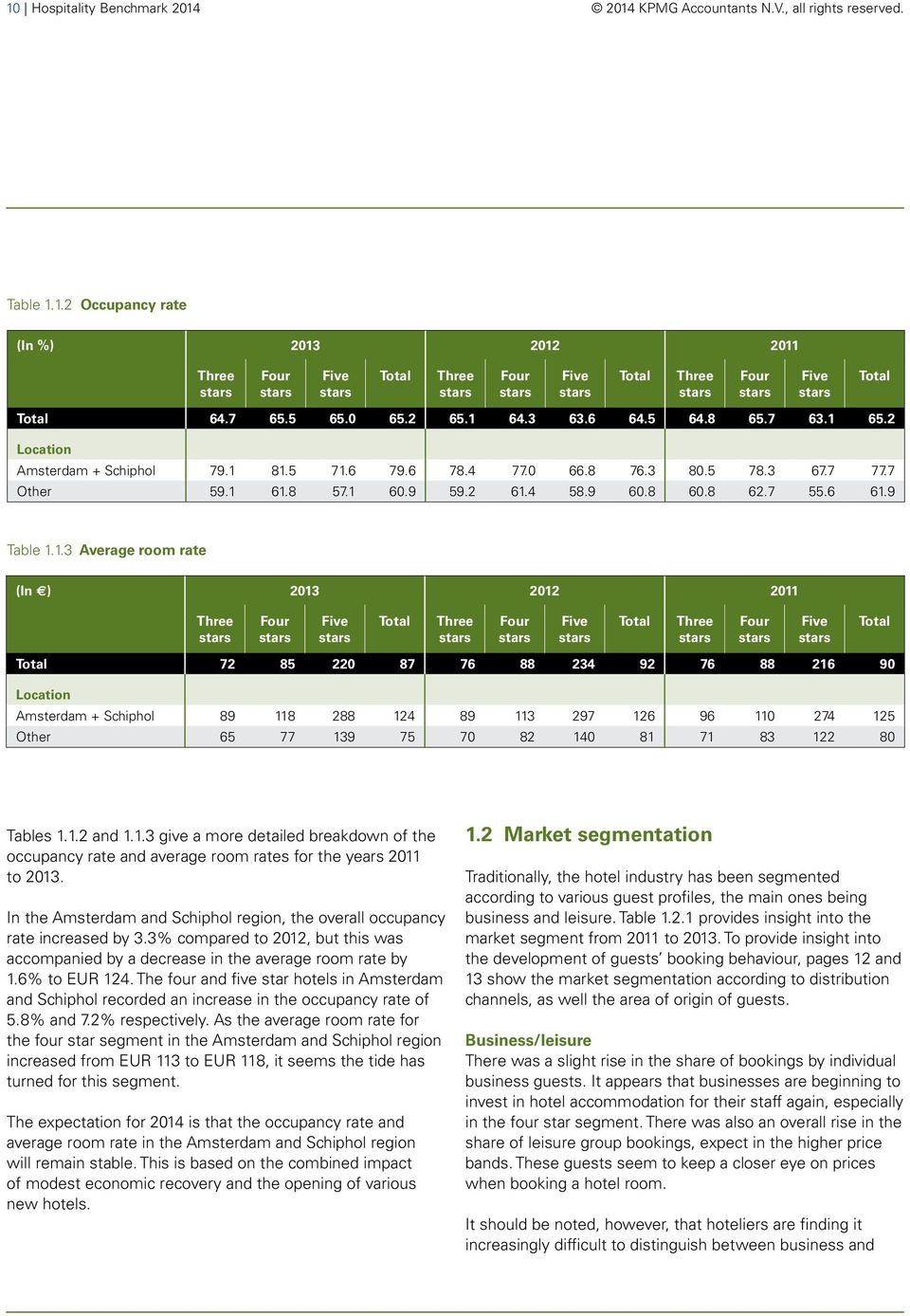
10 10 Hospitality Benchmark KPMG Accountants N.V., all rights reserved. Table Occupancy rate (In %) Three stars Four stars Five stars Total Three stars Four stars Five stars Total Three stars Four stars Five stars Total Total Location Amsterdam + Schiphol Other Table Average room rate (In e) Three stars Four stars Five stars Total Three stars Four stars Five stars Total Three stars Four stars Five stars Total Total Location Amsterdam + Schiphol Other Tables and give a more detailed breakdown of the occupancy rate and average room rates for the years 2011 to In the Amsterdam and Schiphol region, the overall occupancy rate increased by 3.3% compared to 2012, but this was accompanied by a decrease in the average room rate by 1.6% to EUR 124. The four and five star hotels in Amsterdam and Schiphol recorded an increase in the occupancy rate of 5.8% and 7.2% respectively. As the average room rate for the four star segment in the Amsterdam and Schiphol region increased from EUR 113 to EUR 118, it seems the tide has turned for this segment. The expectation for 2014 is that the occupancy rate and average room rate in the Amsterdam and Schiphol region will remain stable. This is based on the combined impact of modest economic recovery and the opening of various new hotels. 1.2 Market segmentation Traditionally, the hotel industry has been segmented according to various guest profiles, the main ones being business and leisure. Table provides insight into the market segment from 2011 to To provide insight into the development of guests booking behaviour, pages 12 and 13 show the market segmentation according to distribution channels, as well the area of origin of guests. Business/leisure There was a slight rise in the share of bookings by individual business guests. It appears that businesses are beginning to invest in hotel accommodation for their staff again, especially in the four star segment. There was also an overall rise in the share of leisure group bookings, expect in the higher price bands. These guests seem to keep a closer eye on prices when booking a hotel room. It should be noted, however, that hoteliers are finding it increasingly difficult to distinguish between business and
11 2014 KPMG Accountants N.V., all rights reserved. Hospitality Benchmark leisure guests, due to growth of booking via online travel agencies (OTAs). With online bookings, it is not always clear what type of guest is booking the room. Areas of origin Table provides insight into the areas of origin of guests. Although the share of hotel guests from the Netherlands decreased, they are still the largest group, followed by guests from Western Europe and the United States. Market segmentation of distribution channels In 2013, the percentage of bookings via OTAs again increased, from 28.9% to 32.2%. In recent years this category has increased by around 3% a year. If they want to remain visible to guests and tap into new markets, hotels have to join up with an OTA, which has the advantage of being able to reduce their marketing budget, but it also means having to pay commissions. Initially this channel was mainly used by leisure guests, but it also facilitates hotel bookings for business trips. This has made it more difficult for hoteliers to identify what type of guest uses OTAs to book their room. The rise in bookings via OTAs seems to have hurt the number of bookings made via direct contacts, although the latter is still the most popular booking channel. Bookings via tour operators/travel agents and auction sites also saw a further decrease. This shift is expected to become more pronounced in the coming years. Table Market segmentation (In %) Business individual Business group Leisure individual Leisure group Total Size < 50 rooms rooms rooms > 150 rooms Location Amsterdam + Schiphol Other Star rating Three stars Four stars Five stars Price band < >

12 12 Hospitality Benchmark KPMG Accountants N.V., all rights reserved. Table Market segmentation by area of origin (In %) The Netherlands Western Europe (including UK) Eastern Europe (including Russia) Total Province Groningen. Friesland en Drenthe Overijssel Gelderland Utrecht en Flevoland Noord-Holland Zuid-Holland Zeeland Noord-Brabant Limburg Locati0n Amsterdam + Schiphol Other Star rating Three stars Four stars Five stars Table Market segmentation by distribution channel (In %) Walk-inns Direct contact Own website / Smartphone application Total Province Groningen. Friesland en Drenthe Overijssel Gelderland Utrecht en Flevoland Noord-Holland Zuid-Holland Zeeland Noord-Brabant Limburg Star rating Three stars Four stars Five stars

13 2014 KPMG Accountants N.V., all rights reserved. Hospitality Benchmark North and South America Africa / Middle East Asia / Oceania Own reservation system Online travel agencies Tour operator / travel agent Auction sites

14 14 Hospitality Benchmark KPMG Accountants N.V., all rights reserved. 1.3 Ownership structure The hotel industry is characterised by various ownership structures and forms of management. For the purposes of our survey, we distinguish between: independent operator without franchise formula (standalone hotel); independent operator with franchise formula; under management of an (international) chain (management contract); part of a chain of private hotels (property and operation using a chain). Table shows the number of standalone hotels participating increased, while the number of chains remained stable compared to the previous survey. This increase in standalone hotels seems contradictory, given the current growth of (international) chains, with hotels increasingly joining a nationwide or international chain in recent years. Table Forms of exploitation 2013 (%) 7 15 Stand alone hotel 52 Franchised hotel Managed by an international chain 26 Part of a chain of own hotels

15 2014 KPMG Accountants N.V., all rights reserved. Hospitality Benchmark Personnel Personnel costs take up a third of sales revenue in the hotel industry. To improve their financial performance, hotels will have to keep this cost item under control, though not at the expense of their staff. This section focuses on personnel, looking at the development in the overall number of FTEs, the costs and revenues per FTE, and absenteeism. Since 2008 there had been an ongoing reduction in the overall number of FTEs, but this trend was reversed in 2013, with an increase in FTEs across all hotels, except those with rooms. Hotels that use outsourcing will have a lower number of FTEs, as outsourced FTEs are not included in our personnel analysis. In previous years, we saw a drop in the number of FTEs and hotels increasingly used outsourcing (see table 1.4.5). This year we see this trend being reversed, as FTEs are on the rise again and fewer hotels are using outsourcing. The rise in the number of FTEs is mainly due to increases in the number of Administrative, General & HR and Room staff. The drop in the number of FTEs in the F&B area continued. This seems to fit the trend in recent years, which saw a drop in the sales revenue share from F&B and a rise in the sales revenue share from Rooms. Table Personnel analysis by number of rooms (In fte s) < 50 rooms rooms rooms > 150 rooms Total Total Department Administration. General & Human Resources Rooms F&B Sales & Marketing Property management & Maintenance Other departments Total number of fte Table Personnel analysis by star rating (In fte s) Three stars Four stars Five stars Total Total Department Administration. General & Human Resources Rooms F&B Sales & Marketing Property management & Maintenance Other departments Total number of fte

16 16 Hospitality Benchmark KPMG Accountants N.V., all rights reserved. Table Average payroll costs per FTE (full-time equivalent) (In e) Administration, General & Human Resources Rooms F&B Sales & Marketing Property Management & Maintenance Total 63,442 59,709 62,480 45,552 44,930 39,281 37,516 42,147 35,672 42,186 44,500 41,847 41,814 35,494 39,238 41,592 43,252 43,392 Total Table Revenue per FTE (full-time equivalent) (In e) Total revenue per employee Total room revenue per room employee Total revenue from F&B per F&B employee Total 118, , , , , ,256 94, ,298 93,003 Average wage costs per FTE In the previous edition of the Benchmark, we posed the question whether wage costs per FTE could further decrease. This year s figures show that, overall, this indeed is the case, with a slight decrease in costs per FTE. This is due to total number of FTEs rising and the share of personnel costs in the income statement remaining at the same level, resulting in lower average costs per FTE. The average costs per FTE decreased for F&B, Sales and Marketing staff. The lower wage costs per FTE in the area of F&B may point to the increased use of zero-hour contracts. Revenue per FTE The revenue per FTE remained virtually unchanged in the past year. In recent years, hotels have tried to deploy their staff as efficiently as possible, which is reflected in the figures for Based on the economic growth forecast by Statistics Netherlands, we expect that hotels will record a slight increase in sales revenue. If hotels manage to keep their number of FTEs unchanged, as they have in the past year, there will be a slight rise in revenue per FTE in the coming years. Table Percentage of hotels using outsourcing (In %) Outsourcing Total Size < 50 rooms rooms rooms > 150 rooms Star rating Three stars Four stars Five stars Price band < >

17 2014 KPMG Accountants N.V., all rights reserved. Hospitality Benchmark Absenteeism The absenteeism rate increased slightly to 3% in This puts the hotel industry well below the national average absenteeism rate of 3.9% (source: Statistics Netherlands) and is 1% lower than at the height of the recession in 2009 (4.0%). The four star segment recorded the biggest increase in absenteeism, from 2.8% to 3.1%. Also noteworthy is the decrease from 14.6% to 3.5% in the five star hotel segment. A possible explanation is that this segment experienced an increase in outsourcing compared to the previous year. Making use of outsourcing means that absenteeism is not allocated to the hotel. Table Absenteeism by star rating (In %) Absenteeism Total Star rating Three stars Four stars Five stars Table Absenteeism by number of rooms (In %) Absenteeism Total Size < 50 rooms rooms rooms > 150 rooms

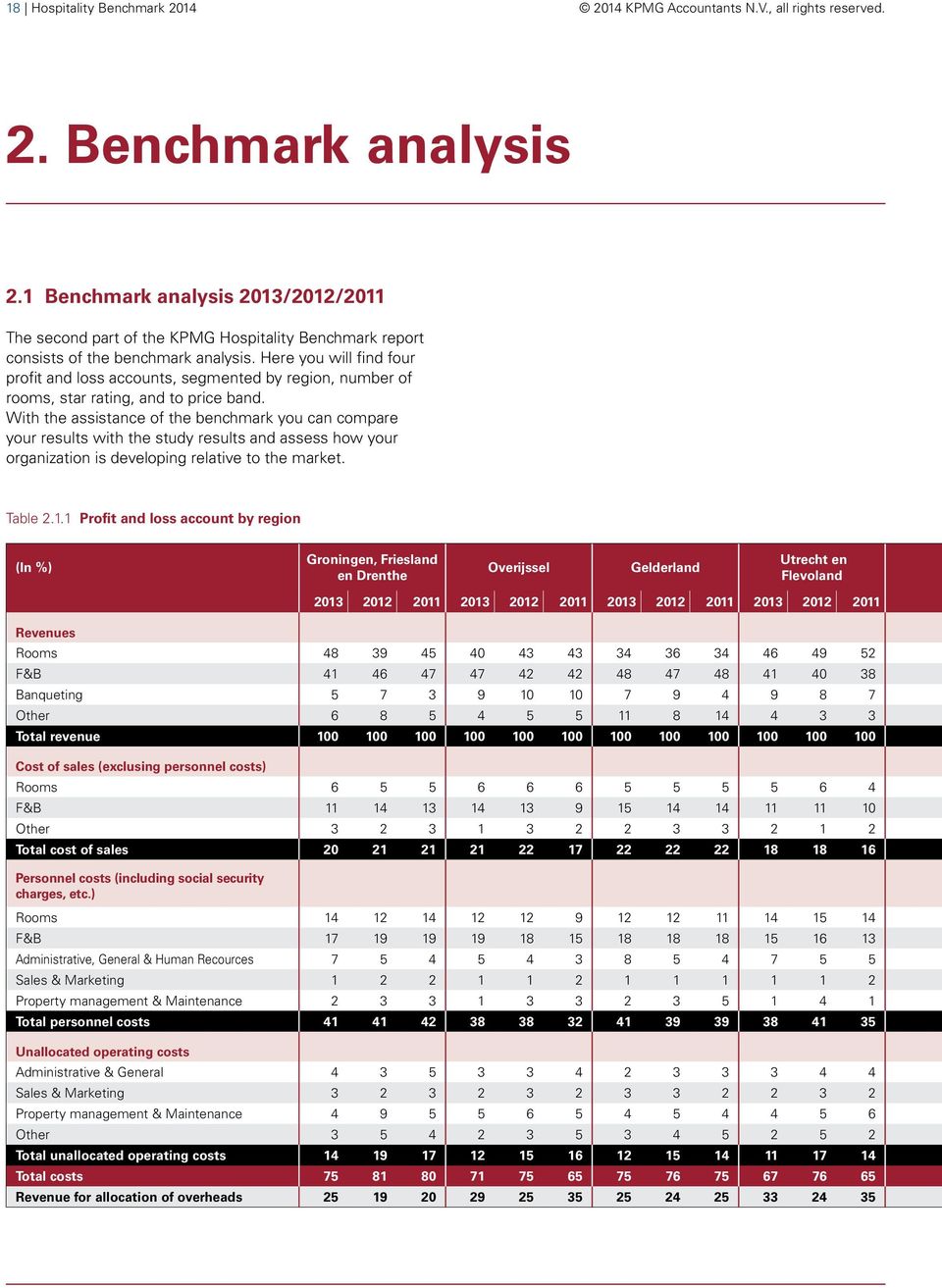
18 18 Hospitality Benchmark KPMG Accountants N.V., all rights reserved. 2. Benchmark analysis 2.1 Benchmark analysis 2013/2012/2011 The second part of the KPMG Hospitality Benchmark report consists of the benchmark analysis. Here you will find four profit and loss accounts, segmented by region, number of rooms, star rating, and to price band. With the assistance of the benchmark you can compare your results with the study results and assess how your organization is developing relative to the market. Table Profit and loss account by region (In %) Groningen, Friesland en Drenthe Overijssel Gelderland Utrecht en Flevoland Revenues Rooms F&B Banqueting Other Total revenue Cost of sales (exclusing personnel costs) Rooms F&B Other Total cost of sales Personnel costs (including social security charges, etc.) Rooms F&B Administrative, General & Human Recources Sales & Marketing Property management & Maintenance Total personnel costs Unallocated operating costs Administrative & General Sales & Marketing Property management & Maintenance Other Total unallocated operating costs Total costs Revenue for allocation of overheads
19 2014 KPMG Accountants N.V., all rights reserved. Hospitality Benchmark Noord-Holland Zuid-Holland Zeeland Noord-Brabant Limburg Total

20 20 Hospitality Benchmark KPMG Accountants N.V., all rights reserved. Table Profit and loss account by number of rooms (In %) < 50 rooms rooms rooms > 150 rooms Total Revenues Rooms F&B Banqueting Other Total revenue Cost of sales (exclusing personnel costs) Rooms F&B Other Total cost of sales Personnel costs (including social security charges, etc.) Rooms F&B Administrative, General & Human Recources Sales & Marketing Property management & Maintenance Total personnel costs Unallocated operating costs Administrative & General Sales & Marketing Property management & Maintenance Other Total unallocated operating costs Total costs Revenue for allocation of overheads

21 2014 KPMG Accountants N.V., all rights reserved. Hospitality Benchmark
22 22 Hospitality Benchmark KPMG Accountants N.V., all rights reserved. Table Profit and loss account by star rating (In %) Three stars Four stars Five stars Total Revenues Rooms F&B Banqueting Other Total revenue Cost of sales (exclusing personnel costs) Rooms F&B Other Total cost of sales Personnel costs (including social security charges, etc.) Rooms F&B Administrative, General & Human Recources Sales & Marketing Property management & Maintenance Total personnel costs Unallocated operating costs Administrative & General Sales & Marketing Property management & Maintenance Other Total unallocated operating costs Total costs Revenue for allocation of overheads
23 2014 KPMG Accountants N.V., all rights reserved. Hospitality Benchmark Table Profit and loss account by price band (In %) < e 65 e 65 - e 80 e 81 - e 105 > e 105 Total Revenues Rooms F&B Banqueting Other Total revenue Cost of sales (exclusing personnel costs) Rooms F&B Other Total cost of sales Personnel costs (including social security charges, etc.) Rooms F&B Administrative, General & Human Recources Sales & Marketing Property management & Maintenance Total personnel costs Unallocated operating costs Administrative & General Sales & Marketing Property management & Maintenance Other Total unallocated operating costs Total costs Revenue for allocation of overheads
24 24 Hospitality Benchmark KPMG Accountants N.V., all rights reserved. 3. Ten years of Hospitality Benchmark This is the tenth edition of the Hospitality Benchmark, an annual survey of KPMG s Travel, Leisure & Tourism sector group looking at the Dutch hotel industry. In the past ten years, the industry has been transformed into a transparent and competitive market thanks to extensive digitisation. Changes in the wishes of guests and creative entrepreneurs have brought about product innovation and enhanced the accommodation experience. The economic recession that broke out in 2008 has also dealt a heavy blow and led to new developments. In this section we look back on this period by referring to the benchmark figures 3.1 Market developments Figures from Statistics Netherlands show the growth in gross domestic product (GDP) decreasing in the early years of this century, from 3.9% in 2000 to 0.1% in 2002). The economy went into a downturn, with consumer spending dropping from 3.7% to 0.9% during this period (source: Statistics Netherlands). When the internet bubble burst in 2001, this worsened the economic slump. In addition, the travel industry was affected by the fallout of the 9/11 attacks, which led to a decrease in the number of tourists. When KPMG launched the Hospitality Benchmark in 2004, Dutch GDP grew by 2.2% according to Statistics Netherlands. This growth continued until 2007, when GDP grew by 3.9% compared to the previous year. The key ratios in our Benchmark also increased between 2004 and 2007: the occupancy rate from 63.4% to 68.2% and the average room rate from EUR 81 to EUR 97. Interestingly, new developments in the hotel sector are first noticeable in the Amsterdam and Schiphol region and then spread to the rest of the Netherlands. Amsterdam and Schiphol were the first to feel the impact when the credit crunch broke out in 2008, with the occupancy rate dropping from 81.1% in 2007 to 70.9% in A year later, in 2008, the overall occupancy rate decreased throughout the Netherlands, followed by the average room rate.
25 2014 KPMG Accountants N.V., all rights reserved. Hospitality Benchmark If we analyse the occupancy rate based on the breakdown into business and leisure, we see it was mainly the business market that was strongly affected, with a 10% decrease in During the same period the leisure market showed fractional growth of 1%. We can therefore conclude that the business market is more affected by the state of the economy. Since 2010, the overall market has partly recovered, although figures remain below the 2007 level. In 2013, the occupancy rate and average room rate came to 79.6% and EUR 124 for the Amsterdam and Schiphol region and 65.2% and EUR 87 for the Netherlands overall, which is quite similar to figures for The 1.2% drop in GDP in 2013 (source: Statistics Netherlands) affected the average room rate, which dropped by 5.4%. It appears the economic situation in the Netherlands has a major impact on financial performance in the hotel industry. This implies that the recovery that started in 2010 is still fragile. Table Development market indicators Amsterdam + Schiphol Occupancy rate (%) Average room rate (e) RevPAR (e) Table Development market indicators the Netherlands Occupancy rate (%) Average room rate (e) RevPAR (e)
26 26 Hospitality Benchmark KPMG Accountants N.V., all rights reserved. 3.2 Property management The economic downturn between 2000 and 2004 meant that hotel chains were faced with a worsening liquidity position. This was due to various factors. The rise of the internet increased market transparency, which was one of the factors leading to a drop in the average room rate. This triggered a search for ways to improve liquidity, and one of the options was the sale & leaseback of properties. These so-called asset-light strategies were used by many hotel chains. They involved keeping the operation of the hotel, but not ownership of the property, in the hands of the chain. This allowed hotels chains to improve their liquidity position and continue to expand despite the recession. Transactions like sale & leaseback and sale & manage-back ensure that the operator is not exposed to property risks and involve converting silent reserves into extra liquidity and equity. Shortening the balance sheet also increases solvency, making it easier to obtain future financing. This is especially important at a time when many loan capital providers impose strict requirements. But such transactions also have drawbacks. They can tie hotels to high rental costs for a long period, which often increase annually. Moreover, the hotel will not benefit from any increase in the property value, and often the property owners want a say in the operation of the hotel. Our figures show a clear separation between property ownership and the operation of hotels. The percentage of hotels that own their own properties decreased from 72.5% in 2005 to 53% in Table Forms of exploitation 2005 (%) Table Forms of exploitation 2013 (%) Stand alone hotel Franchised hotel Managed by an international chain Part of a chain of own hotels Stand alone hotel Franchised hotel Managed by an international chain Part of a chain of own hotels
27 2014 KPMG Accountants N.V., all rights reserved. Hospitality Benchmark Rise of chains A similar trend is observed in the increasing percentage of hotels that are part of a chain (chain of own hotels that is part of an (international) chain). Among the respondents this percentage increased from 42% in 2005 to 67% in 2013, mainly at the expense of standalone hotels (which decreased from 44% to 26% during this period). Being part of a chain offers advantages such as a joint booking system, loyalty programmes, name recognition, and easier financing and sharing of overheads, which are all important aspects in times of recession. 3.4 Absenteeism The economic situation also appears to an impact on the absenteeism rate. In 2009, absenteeism stood at 4%, 1 percentage point higher than in After the initial market recovery in 2010, the absenteeism rate returned to pre-recession levels. During the recession, restructurings to cut staff levels often led to heavier workloads and increasing stress, which could account for the rise in absenteeism. Table Development absenteeism (%)
28 28 Hospitality Benchmark KPMG Accountants N.V., all rights reserved. 3.5 Distribution, digitisation and individualisation The distribution of hotel rooms has changed entirely in the past ten years. OTAs have gained ground, more than doubling their market share from 15.2% in 2004 to 32.2% in This has been mainly at the expense of the market share of direct bookings, which fell from 54% in 2004 to 36.8% in Four years ago, we saw the launch of online auction sites for hotel rooms. They now have a market share of 3.5%. Tour operators and travel agents saw their market share drop from 11.7% to 6.2%. The position occupied by OTAs has stirred a lively debate. On the one hand, OTAs provide hotels with new booking channels and greater reach towards potential guests, leading to a higher occupancy rate. And when bookings are largely made via OTAs, hotels can also opt to reduce their own marketing budget. On the other hand, hoteliers have to take into account the commissions they will have to pay. We are also seeing how hotels can feel restricted by best-price clauses, which preclude hotels from offering a lower rate for their rooms than the rate they offer via OTAs. Each hotelier will have to weigh up the benefits and drawback of using OTAs for themselves. The past ten years have also witnessed the rise of social media. This allows guests to compare prices directly and post online reviews. Thanks to apps, rooms can now be booked anytime and from anywhere. Like other businesses, hotels have also made wide use of social media as a marketing tool to better position themselves on the market. This means that customer relationship management is now mostly done online. In the 2010 edition of the Benchmark, we already said that online reviews are an essential Table Development distribution channels (%) 100% 90% 80% 70% 60% 50% 40% 30% 20% 10% Auction sites Touroperator/travel agent Online travel agencies Own website/ reservation system Direct contact/walk-ins 0%
29 2014 KPMG Accountants N.V., all rights reserved. Hospitality Benchmark component of the selection process used by guests. Their importance has only increased, so it s essential to ensure that reviews are consistently managed, followed up and responded to. The concept of accommodation as an experience has become further embedded in the hotel industry. Today s guests are looking for a hotel that matches their lifestyle. To extent to which hotels manage to adapt to their target group will contribute to guests feeling more of a connection with the hotel in question. Not only will they book another stay, they will also recommend the hotel (online!) The growing popularity of boutique and lifestyle hotels is a good example of this trend.
30 30 Hospitality Benchmark KPMG Accountants N.V., all rights reserved. 3.6 Benchmark analysis The benchmark analysis shows a curve in the income before fixed charges that is clearly related to the underlying economic trend. In the period , income before fixed charges as a percentage of sales revenue rose from 28% to 32%. The onset of the recession in 2008 led to a drop in the income before fixed charges to 27% in 2010, after which it increased again, reaching 34% in The recent rise in income before fixed charges is mainly due to a drop in unallocated operating costs (such as costs of property management and maintenance). These are the first items hotels turn to when looking for cost savings in times of recession. In addition, as hotel chains have become so widespread in the industry, overheads are being shared and costs per hotel are decreasing. In the past ten year, we have also seen a shift in the breakdown of sales revenue from rooms, F&B and other sources. The revenue share from rooms has steadily increased from 48% in 2004 to 60% in This can be explained by the rise of no-frills concepts that suit the current mindset. Guests are making less use of additional services, mainly due to greater price awareness and falling consumer spending. The growing individualisation when travelling also means that guests increasingly venture out on their own into the city, using restaurant review sites for example, and spend less time at their hotel. Table Sales segmentation 2004 (%) Table Sales segmentation 2013 (%) Rooms F&B Other Rooms F&B Other
31 2014 KPMG Accountants N.V., all rights reserved. Hospitality Benchmark Table Development profit and loss account (In %) Revenues Rooms F&B Other Total revenu Cost of sales (excluding personnel costs) Rooms F&B Other Total cost of sales Personnel costs (including social security charges, etc.) Rooms F&B Administrative, General & Human Resources Sales & Marketing Property management & Maintenance Total personnel costs Unallocated operating costs Administrative, General & Human Resources Sales & Marketing Property management & Maintenance Other Total unallocated operating costs Total costs Revenue for allocation of overheads
32 32 Hospitality Benchmark KPMG Accountants N.V., all rights reserved. 4. Current developments In this final section of our report we describe a number of current developments in the hotel sector. This includes the annually recurring topic of market developments. In addition, this year we will also look at changes in the star rating system and the use of Big Data. 4.1 Market developments 2013 saw a fall in the average room rate and a rise in the occupancy rate. This led to a slight fall in RevPAR. Despite the fractionally lower RevPAR, Dutch hoteliers have less cause for concern than in previous years. 42% of respondents expected that average room rate would increase in the first half of A slightly higher percentage also expected that the occupancy rate would increase in the first half of 2014 compared to the first half of After a number of turbulent years, it appears that a measure of stability is returning to the market. In the beginning of 2014, there was a modest economic recovery and the current players are beginning to find their market position. Many market players have had to reposition themselves, and especially hotels outside the Randstad have had a very difficult time. Even so, the hard times have not yet receded. Two years ago, unexpected competition emerged due to the increase in private individuals renting out their apartments. Suddenly, hotels are confronted with the fact that any individual with a room available is a potential competitor. Nearly 40% of the hoteliers in our survey reported experiencing this type of competition. Dutch politicians at national level have not yet expressed a clear opinion on this. Local governments, however, have already introduced policies. In Amsterdam, for example, private individuals renting out apartments to travellers have to pay tourist tax and report the income earned to the tax authorities. However, it is unclear to what extent private individuals are complying with these policies. We have observed new initiatives to align supply and demand, such as the online marketplace Bidroom, where guests can post requests and hotels can make an offer.
33 2014 KPMG Accountants N.V., all rights reserved. Hospitality Benchmark Other websites work with private individuals who look for the best deals for guests for a small fee. In the future, we expect that in addition to the current OTAs, other types of online intermediaries will emerge. This will ensure that the market become dynamic and that it will be in the hands of a large number of players. Amsterdam/Schiphol 2013 was a special year for Amsterdam. The Rijksmuseum reopened, the city celebrated the 400th anniversary of its canal district, King Willem-Alexander was inaugurated, and there were many major conferences bringing in business guests. Amsterdam demonstrated that it is a city of international allure and with the matching facilities for both business and leisure guests. This led to rise in the occupancy rate by 3.3% to almost 80%. What does the future hold in store? We have some reservations about current market developments, especially about the development of hotel property management in the coming years. The municipality of Amsterdam has ambitious plan for the development of hotels on the edge of the city. A few years ago, the regional hotel strategy for Amsterdam was formulated. The aim is to increase the number of hotel rooms in Amsterdam to by 2015 There has been steady growth in the number of available hotel rooms. Currently, 88.3% of the target of hotels rooms has already been realised (source: municipality of Amsterdam). Annual visitor numbers to Amsterdam are increasing. In 2012, there were 9.7 million overnight hotel stays. The tourism barometer of the municipality of Amsterdam recorded 11.3 million overnight hotel stays for This represents an increase of 1.6 million or 16.5%. But despite this steep rise in the number of overnight stays, the average room rate fell due to the increase in the number of rooms. The one-offs (such as the 400th anniversary of the canal district and the inauguration made 2013 a profitable year. Now the question is how hotels will cope without these one-offs in the coming years. The outlook for the city of Amsterdam is positive, but it remains to be seen if demand can keep up with the ever-growing supply of hotel rooms. 4.2 Star rating system Originally, the star rating system was developed so that guests could asses hotels based on their facilities and services. Referring to the number of stars, guests will have certain expectations and a reasonable idea of how much they will have to pay. It may well be the case that the star rating system used in the Netherlands will be replaced by a new international system from 2015, prompting renewed debate about the value of a star rating system. One of the problems with the current star rating system is that it is not based on a uniform international standard. Hotels with the same facilities and services may have different star ratings in different countries. This creates confusion with guests. It also begs the question what added value a star rating system has for the various stakeholders, such as guests, investors and hotel operators? Looking at hotel guests, we are witnessing the emergence of a new generation. This generation wants to find a hotel that offers the best fit with their view of life. Hotels with a particular theme are increasingly gaining ground. Examples are budget hotels with a modern feel and hotels that are 100 percent sustainable. They represent a new type of accommodation, where the key factor is not the star rating, but matching the vision and facilities to the beliefs of the guest. In the future, guests will base their choices less on star ratings and more on brands and reviews in social media. From the perspective of the investor, who usually focuses on the expected return and benchmark data, this will involve changes. Investment decisions are usually based on hard benchmark figures and market expectations. The benchmark might be based on all the four star hotels in a given region. But if this uniformity were to disappear, hotels will no longer be the same just because they have four stars. As an example of this, consider the five star segment in Amsterdam in The rates charged by five star hotels vary enormously due to the level of services and facilities on offer. If uniformity were to disappear, it will be more difficult to gain insight into the figures by referring to benchmarks. Therefore, (international) uniformity in star ratings would be big plus.
34 34 Hospitality Benchmark KPMG Accountants N.V., all rights reserved. 4.3 Big Data Sustained success in business requires constantly capitalising on current developments. One development that cannot be overlooked is the rise of the data-driven society. There is lots of information available inside and outside the organisation, but it will not automatically produce better insight into market developments, customer needs, fraud, risks and/or sales revenue growth. To ensure success in business, decisions need to be based on accurate and real-time data. The hotel industry is particularly well suited for deploying Big Data analyses to ensure a better match with the requirements of guests. The options in the online reservation channel to inform guests as best as possible early on the booking process are already widely used. Of course these tailor-made offerings also have a downside. Dig Data are often associated with George Orwell s Big Brother, which particularly in the hotel industry is a line no one wants to cross. As long as guests experience the service offered as convenient, they will value these initiatives. But as soon as they feel that it encroaches on their privacy, there is a risk of reputational damage. It will be interesting to see what direction developments in this area will take in the coming years. Will we be seeing differentiation? Some guests might choose less convenience in return for knowing that the hotel will not in any way attempt to build a profile on them. While other guests who expect everything to be perfectly tailored to their wishes and requirements, might be willing to sacrifice a little privacy. What choice will your hotel make? The use of more detailed profiles helps to map the wishes and requirements of guests. In addition to demographic and historical data, the concept of community is increasingly used, allowing guests to share information with each other. This kills two birds with one stone: it gives the hotel better insight into the guest sharing the information, enabling them to better anticipate the guest s wishes and requirements, while also generating more relevant information that can be used to approach other guests. By aligning the different parties in the process, hotels can ensure better preparations for the guests they receive. Combined with the new options for mapping guest behaviour, such as using smartphone data (including location, network use, etc.), this enables hotels to offer a tailor-made experience. This is essential these days, when only a minimal effort is needed to access comparative information on hotels, and price is no longer the only way to stand out from the competition.
35 2014 KPMG Accountants N.V., all rights reserved Hospitality Benchmark Explanation of the terms used Room revenue This category comprises the sales revenue from guest accommodation. It does not include any sales revenue from the use of available services. F&B revenue This category comprises the sales revenue from food and beverages sold to guests in the restaurant/café or via room service. It does not include revenue from staff purchases. Other revenue This category comprises parking charges, exchange rate gains, and revenue from telephone, laundry and dry cleaning services. Occupancy rate The occupancy rate is calculated by dividing the number of rooms actually occupied during the year by the number of rooms available throughout the year. Average room rate The average room rate is calculated by dividing the room revenue by the total number of rooms occupied during the year. RevPAR The RevPAR (revenue per available room) is calculated by dividing the room revenue by the total number of rooms available during the year. Total revenue per room The total revenue per room is calculated by dividing the total revenue by the total number of rooms. Personnel costs This category comprises the payroll costs of the staff at the department in question. These costs include the statutory social insurance contributions, holiday pay, pension contributions and other related costs. Cost of sales This category comprises the purchase cost of the goods or services sold by the department in question. It does not include the purchase cost of goods or services sold to employees. Unallocated operating costs This category includes other costs such as energy costs, maintenance expenditure, travel expenses and consultancy fees. Income before fixed charges This is calculated by deducting the cost of sales, personnel costs and unallocated operating costs from the total revenue.
36 36 Hospitality Benchmark KPMG Accountants N.V., all rights reserved. About KPMG in the Netherlands KPMG offers services in the field of audit, tax and advisory. We work for a wide range of clients: major domestic and international companies, medium-sized enterprises, non-profit organizations and government institutions. The complicated problems faced by our clients require a multidisciplinary approach. Our professionals excel in their own specialist fields while, at the same time, working together to offer added value that enables our clients to flourish in their own environment. In doing so, we draw from a rich source of knowledge and experience gained worldwide at a broad range of organizations and markets. Travel, Leisure & Tourism (TLT) Group The KPMG Travel, Leisure & Tourism Group has a wealth of expertise with respect to hotels, conference centers, bungalow parks, travel agents, restaurant chains and catering companies, and understands not just the world of the figures, but also what goes on behind the figures. It is a multi-disciplinary team of professionals with experience in the industry. Many members of our Group also have qualifications in hotel management. Below you will find specific examples of how the KPMG Travel, Leisure & Tourism Group can be of service to you. Audit of the financial statements You can engage KPMG to audit your financial statements, to perform review engagements and to compile your financial statements. Thanks to our knowledge of the hotel sector, we can act as a professional sparring partner. Benchmark quick scan KPMG compares your figures to the benchmark figures and analyses the differences. KPMG can offer you advice regarding the key differences identified in order to gain better insight into your hotel s performance. Internal control smart card How well do you know the processes within your company, and to what extent is your staff aware of the internal controls within the processes? KPMG uses handy smartcards to help identify the processes and internal controls at your company. Optimizing the financial organization We review your financial organization with you. We identify the strengths and points for improvement, on the basis of which we draft an action plan. The aspects we assess include the quality of the reporting processes, management s and staff members competencies, and efficiency (such as the integration of financial systems). Assessing websites KPMG has a staff member with a hotel management qualification and a degree in Information Management, who is specialized in online developments in the hotel industry and changes in the distribution network. We can help you improve your own website in order to generate more bookings via this channel. We also advise you on how use various booking sites more effectively. Improving the budgeting and forecasting process Many companies see the planning and- control cycle as a difficult task. KPMG supports the development of a process that is efficient, in line with your operating management, and allows you to define clear targets. Thanks to our multidisciplinary teams we can use IT solutions to facilitate this. Operating capital management Less operating capital means more room to invest in existing or new hotels. KPMG reviews your operating processes from the perspective of cash flow, providing specific suggestions on reducing the operating capital requirement. This could involve, for example, improving payment terms with suppliers, reducing stocks by improving the ordering process, etc.
37 2014 KPMG Accountants N.V., all rights reserved. Hospitality Benchmark Cost optimization KPMG can offer you advice on reducing your costs in the short term and help you raise the cost awareness within your organization. We prioritize savings opportunities and help you implement improvements. Speeding up and improving reporting processes Companies are increasingly faced with situations where the quality requirements for figures conflict with transparency requirements. This puts a lot of pressure on the reporting processes. KPMG carefully analyses the preparation of the reports. We identify bottlenecks and determine which information is absolutely essential. Sustainability Climate change compels companies to think about the way in which they do business. In the long term, hotel chains need to develop strategies to manage their impact on the environment (their so-called carbon footprint ). KPMG can help you calculate your carbon footprint and provides insight into how it can be managed and reduced. Fraud How effectively is your company protected against fraud? KPMG can help you prevent fraud and draft a plan of action if fraud is discovered. VAT/corporation tax/wage tax scan How well informed are your financial accounts department and HR department about tax legislation and regulations? Find out with the aid of our tax scans. Feasibility studies What is the feasibility of your plan to open a new hotel, to invest in a SPA? KPMG can carry out a feasibility study for you. Expanding into new and emerging markets KPMG can help you identify and act on opportunities in new and emerging markets. Assistance with mergers, acquisitions and disposals Are you looking for a buyer for your company because you have no business successor or would like to realize your economic interest, or due to other (external) developments? Or have you identified opportunities for expanding your company? KPMG can assist you by ensuring optimal management of the process, with minimal disruption to your daily operations and the best possible result.
38 38 Hospitality Benchmark KPMG Accountants N.V., all rights reserved. Advice on acquisitions and disposals KPMG can help you analyze possible acquisition candidates with the aid of industry experts, who identify the risks and opportunities that may arise if you acquire property from a real estate investor or real estate portfolio. KPMG can assist you in due diligence investigations; as soon as the parties are in contact, we assist our clients, both in their domestic market and abroad, to ensure a detailed quantification of the potential risks arising from a transaction. KPMG offers advice on disposals; our broad range of advisory services includes assisting management during the disposal process, preparing vendor due diligence reports, and designing data rooms. Financing re-structuring KPMG provides advice on structuring financing; we structure property financing for both property-specific financing as well as portfolio and capital markets financing. Information security scan KPMG assists you in designing a practical security policy that is tailored to your organization s objectives and strategic priorities and enjoys internal support. Inadequate security awareness and behavior within your organization may give rise to various risks, including the risk of fraud, unauthorized access, loss information, and reputational damage. When performing our scan, we can use ethical hacking, which involves IT specialists investigating whether your hotel s IT systems and data are secure. Business succession KPMG can support your business succession. Often, the Managing Director and Majority Shareholder [directeurgrootaandeelhouder (DGA)] will have only very limited experience with business succession and/or disposal processes. Given the complexity of the many aspects involved, the DGA needs professional support to assist with the entire process, which takes an average of three to so seven years. KPMG has the required business, legal and tax expertise to provide optimal support to the DGA during the entire process of selling the company or transferring it to a successor. Financing requests KPMG supports companies who want to request financing. If for whatever reason your company needs financing, KPMG can provide support and assistance, helping you draw up a financing request. Business plans KPMG actively assists hoteliers in preparing, redesigning or adjusting a business plan for their company. We coordinate the process, act as a sounding board and provide support by utilizing our KPMG tools. The main KPMG tools are the business planning workbook, workshops and our VisionPlanner software package, which allows you to systematically draw up a business plan and the accompanying financial forecasts. Selecting your IT packages KPMG assists you with the selection of the IT packages you require. We help you chose from a range of IT packages for your Enterprise Resource Planning, Human Resource Management, Customer Relationship Management, and Consolidation and Reporting. Supporting IT implementations KPMG assists you in implementing IT packages, supporting the various components, such as tests, conversions and internal controls. If your organization wants to obtain assurance regarding the contents of an IT implementation and the progress made on it, we can provide quality assurance regarding the project management. Big Data & analytics KPMG conducts complex data analysis for large organisations, working with a team of scientists who previously worked for CERN. KPMG has developed a platform where large amounts of data can be processed in a scalable way. This platform has a privacy-proof layer that enables us to combine data from all kinds of sources into new insights, regardless of the structure of the sources. The combination of sector knowledge, legal expertise and highly specialised data scientists is unique in the market. The engagements of this team range from operational strategy, workshops and privacy analyses to turnkey implementations of solutions and beyond. Operational efficiency and knowing your customer are the key concerns. For more information, please contact Sander Klous, head of Big Data & analytics ([email protected]).
39 Hospitality Benchmark
40 Contact us KPMG Accountants N.V. Laan van Langerhuize DS Amstelveen Postbus DC Amsterdam Jos Sweers Travel, Leisure & Tourism T: (020) E: [email protected] Ilse de Graaff Travel, Leisure & Tourism T: (020) E: [email protected] KPMG Advisory N.V., registered with the trade register in the Netherlands under number , is a subsidiary of KPMG Europe LLP and a member firm of the KPMG network of independent member firms affiliated with KPMG International Cooperative ( KPMG International ), a Swiss entity. All rights reserved. The name KPMG, logo and cutting through complexity are registered trademarks of KPMG International. The information contained herein is of a general nature and is not intended to address the circumstances of any particular individual or entity. Although we endeavor to provide accurate and timely information, there can be no guarantee that such information is accurate as of the date it is received or that it will continue to be accurate in the future. No one should act on such information without appropriate professional advice after a thorough examination of the particular situation.
Hospitality Benchmark 2013
 travel, leisure & tourism Hospitality Benchmark 2013 Figures make it clear! kpmg.nl Jos Sweers Ilse de Graaff Contents Foreword 1 About the authors 2 Introduction 3 Methodology 4 1 Market indicators 6
TOURISM IN THE AMSTERDAM METROPOLITAN AREA: NIGHTS, ACCOMMODATIONS AND JOBS IN THE TOURISM SECTOR 2014-2015
 TOURISM IN THE AMSTERDAM METROPOLITAN AREA: NIGHTS, ACCOMMODATIONS AND JOBS IN THE TOURISM SECTOR 21-21 Research, Information and Statistics (OIS), February 21 Europe is the world's most popular holiday
Dutch hiking tourism. Terje Rakke/Nordic life - Visitnorway.com
 Dutch hiking tourism Terje Rakke/Nordic life - Visitnorway.com Index Chapter page Executive summary 3 1 Introduction 4 2 The Dutch hiking segment 5 3 Mapping Phase I 6 4 Survey Phase II: Selection and
Research and Statistics Economic Development Department. Fact sheet. Amsterdam remains a popular tourist destination
 Research and Statistics Economic Development Department Fact sheet number 4a October 2008 Amsterdam remains a popular tourist destination For the past few years, tourism in Amsterdam has been rapidly growing.
DEVELOPMENTS FOR OUR EMPLOYEES
 2015 ANNUAL REPORT FORWARD-LOOKING STATEMENT This annual report contains certain forward-looking statements regarding the financial situation and results of USG People N.V., as well as a number of associated
Capacity and Turnover in Public Accommodation Establishments in Hungary
 Capacity and Turnover in Public Accommodation Establishments in Hungary According to Act I of 1978 on domestic trade, in Hungary all establishments operated as a business for overnight accommodation and
REVIEW OF THE SURVEY OF ENTERPRISES ON BUSINESS FINANCING. Second half
 + REVIEW OF THE SURVEY OF ENTERPRISES ON BUSINESS FINANCING 2016 2013 Q1 REVIEW OF THE SURVEY OF ENTERPRISES ON BUSINESS FINANCING Second half ISSN 2424-4791 (ONLINE) REVIEW OF THE SURVEY OF ENTERPRISES
Risk management. Loan impairment charges and loan impairments allowance. 2015 2014 Loan impairment charges (in basis points) Loan impairment Allowance
 Risk management Rabobank pursues a risk policy aimed at maintaining a moderate risk profile. The risk strategy focuses on continuity and realises protection of our profits and profit growth, the retention
Golf Benchmark Survey in the EMA region 2006
 TRAVEL, LEISURE AND TOURISM PRACTICE Golf Benchmark Survey in the EMA region 2006 Regional Report: Benchmark indicators and performance of golf courses in South Africa ADVISORY All seven regional Golf
Operational Excellence Wolfgang M. Neumann, Executive Vice President & COO INVESTORS DAY - 2 DECEMBER 2011 RADISSON BLU PORTMAN HOTEL, LONDON
 Operational Excellence Wolfgang M. Neumann, Executive Vice President & COO INVESTORS DAY - 2 DECEMBER 2011 RADISSON BLU PORTMAN HOTEL, LONDON Executive Summary Focus on RevPAR Index (RGI) improvement Fully
Total Factor Productivity of the United Kingdom Food Chain 2013 final estimate
 30 th July 2015 Total Factor Productivity of the United Kingdom Food Chain 2013 final estimate 1. Key messages Total factor productivity of the UK food chain beyond the farmgate has increased by 0.5 per
Report Overview Vietnam Hotel Survey 2015
 Report Overview Vietnam Hotel Survey 2015 This is an Executive Summary of the full 60 page Hotel Survey Report. Full copies can be obtained from Grant Thornton Vietnam. Grant Thornton Vietnam Page 1 Introduction
2. Incidence, prevalence and duration of breastfeeding
 2. Incidence, prevalence and duration of breastfeeding Key Findings Mothers in the UK are breastfeeding their babies for longer with one in three mothers still breastfeeding at six months in 2010 compared
Retail Sector Labour Market Review September 2013
 Retail Sector Labour Market Review September 2013 Contents Introduction... 3 Economic contribution and performance... 6 What constitutes the retail sector?... 6 Size and number of businesses... 6 Table
Week 3 - Hotels and Hotel Organisation
 Activity: Week 3 - Hotels and Hotel Organisation Learner: Andries Lethole ([email protected]) Tutor: Marlene Knoetze Signup Date: 2011-02-14 Due Date: 2011-02-18 Worksheet Score: 77 / 82 [1%] Week 3 -
THE DUTCH PRIVATE EQUITY AND VENTURE CAPITAL MARKET IN 2014 ENTERPRISING CAPITAL APRIL 2015
 THE DUTCH PRIVATE EQUITY AND VENTURE CAPITAL MARKET IN 2014 ENTERPRISING CAPITAL APRIL 2015 ABOUT THIS PUBLICATION METHODOLOGY The Nederlandse Vereniging van Participatiemaatschappijen (NVP) continuesly
Strategic Hotel Development and Positioning
 10.1177/0010880405281519 2006 CORNELL UNIVERSITY DOI: 10.1177/0010880405281519 Volume 47, Number 2 146-154 Strategic Hotel Development and Positioning by JOHN W. O NEILL and ANNA S. MATTILA A study of
IMCD reports strong results for 2014
 IMCD reports strong results for 2014 Rotterdam, The Netherlands 11 March 2015 - IMCD N.V. ( IMCD or Company ), a leading international speciality chemicals-focused distributor, today announces the 2014
TRENDS IN IRISH TOURISM. A report for Dublin Port Company Limited
 TRENDS IN IRISH TOURISM A report for Dublin Port Company Limited February 2011 SECTION 1 RECENT TRENDS IN IRISH TOURISM Economic Significance of Tourism Since 2007 the growth dynamic of the Irish economy
Speech at the annual press conference on the 2010 financial year Bonn, February 25, 2011
 The spoken word shall prevail Speech at the annual press conference on the 2010 financial year Bonn, February 25, 2011 Timotheus Höttges Chief Financial Officer Deutsche Telekom AG Thank you, René Obermann!
INTRODUCTION TO THE 2013 BENCHMARKING GUIDE
 INTRODUCTION TO THE 2013 BENCHMARKING GUIDE This guide is a supporting document for the Business Diagnostic Indicator for Hotels. It has been designed to be used by hoteliers who have completed the Business
Women and Men in the Recovery: Where the Jobs Are Women Recover Jobs Lost in Recession in Year Five
 IWPR #C426 November 2014 Women and Men in the Recovery: Where the Jobs Are Women Recover Jobs Lost in Recession in Year Five Heidi Hartmann, Ph.D., Elyse Shaw, and Rachel O Connor Overview While the number
THE CURRENT STATUS OF HOTEL DEVELOPMENT ACTIVITY AND CONSTRUCTION COSTS IN CANADA
 CANADIAN MONTHLY LODGING OUTLOOK JANUARY 2013 THE CURRENT STATUS OF HOTEL DEVELOPMENT ACTIVITY AND CONSTRUCTION COSTS IN CANADA www.hvs.com HVS IN CANADA 6 Victoria Street, Toronto, ON M5E 1L4, CANADA
Warsaw, Poland Market Snapshot
 JUNE, 2010 Warsaw, Poland Market Snapshot CRISTINA BALEKJIAN, Market Intelligence Analyst SAURABH CHAWLA, Associate Director HVS LONDON OFFICE 7 10 Chandos Street Cavendish Square London, W1G 9DQ Tel:
Norwegian Foreign Visitor Survey 2011
 Summary: Norwegian Foreign Visitor Survey 2011 TØI Report 1166/2011 Author(s): Eivind Farstad, Arne Rideng and Iratxe Landa Mata Oslo 2011, 67 pages Norwegian language In 2011 a total of 5.0 million foreign
ADVISORY. KPMG Pensions Accounting Survey in the Netherlands. 2014 year-end preview and 2013 year-end retrospective. kpmg.nl
 KPMG Pensions Accounting Survey in the Netherlands 2014 year-end preview and 2013 year-end retrospective kpmg.nl ADVISORY 2 KPMG Pensions Accounting Survey in the Netherlands Introduction 3 Headlines 4
Jeff Edwards Head of Global Hotels Group June 2013
 Jeff Edwards Head of Global s Group June 2013 Agenda Why? Industry context and business opportunity Distribution strategy and business proposition IT Competitive environment Our strategy Our product offering
Annual survey report 2009. Absence management
 Annual survey report 2009 Absence management Contents Summary of key findings 2 Rates of employee absence 4 The cost of absence 13 Targets and benchmarking 16 Causes of absence 18 Work-related stress
Business in Ireland. Published by the Stationery Office, Dublin, Ireland. Available from:
 An Phríomh-Oifig Staidrimh Central Statistics Office Business in Ireland 2012 Published by the Stationery Office, Dublin, Ireland. Available from: Central Statistics Office, Information Section, Skehard
THE INCREASING IMPORTANCE OF BRANDED RESIDENCES
 MAY 2014 THE INCREASING IMPORTANCE OF BRANDED RESIDENCES Lucy Payne Consultant & Valuation Analyst Arlett Oehmichen, MRICS Director www.hvs.com HVS London 7 10 Chandos Street, London W1G 9DQ Following
The Airbnb Community in Vancouver
 The Airbnb Community in Vancouver With more than two million listings in 34,000 cities and 192 countries, Airbnb is proud of the positive impact our hosts and guests are having in communities around the
Total Factor Productivity of the United Kingdom Food Chain 2014 final estimate
 28 th July 2016 Total Factor Productivity of the United Kingdom Food Chain 2014 final estimate 1. Key messages Total factor productivity of the UK food chain beyond the farmgate has decreased by 2.8 per
Quarterly Report Egypt Hotels Full-Year 2015. Egypt Full-Year 2015 Review 4 Key Cities
 Quarterly Report Egypt Hotels Full-Year 2015 Egypt Full-Year 2015 Review 4 Key Cities Contents Cairo... 3 Sharm El Sheikh... 4 Hurghada... 5 Alexandria... 6 2 Cairo SUPPLY A number of high profile properties
Overview on milk prices and production costs world wide
 Overview on milk prices and production costs world wide This article summarises the key findings of the IFCN work in 2013 and the recently published IFCN Dairy Report 2013 Authors: Torsten Hemme and dairy
TRADE UNION MEMBERSHIP 2014. Statistical Bulletin JUNE 2015
 TRADE UNION MEMBERSHIP 2014 Statistical Bulletin JUNE 2015 Contents Contents... 2 Introduction... 3 Key findings... 5 1. Long Term Trends... 6 2.Private and Public Sectors. 12 3. Personal and job characteristics...
A LOOK AT THE CANADIAN LODGING INDUSTRY IN 2011 AND AHEAD TO 2012
 OCTOBER 2011 CANADIAN MONTHLY LODGING OUTLOOK A LOOK AT THE CANADIAN LODGING INDUSTRY IN 2011 AND AHEAD TO 2012 Carrie Russell, AACI Senior Vice President www.hvs.com HVS IN CANADA 6 Victoria Street, Toronto,
Consolidated Financial Results for the First Quarter of the Fiscal Year Ending March 31, 2016 (Japan GAAP)
 Consolidated Financial Results for the First Quarter of the Fiscal Year Ending March 31, 2016 (Japan GAAP) Name of Listed Company: Yokogawa Electric Corporation (the Company herein) Stock Exchanges Where
Managing Customer. Relationships
 Managing Customer Relationships A guide to help you identify a range of areas to address in order to get the most from your relationships with your customers Managing customer relationships should be seen
INTERIM REPORT 1.1.-30.6.2004
 INTERIM REPORT 1.1.-30.6.2004 RAUTE OYJ 1 (9) RAUTE OYJ S INTERIM REPORT FOR JANUARY 1 JUNE 30, 2004 Net sales MEUR 41.9 (MEUR 33.0) and operating profit MEUR 4.1 (MEUR -7.4) increased. Net sales of current
Alternative Payment and Distribution Landscape: Airline Distribution Channels
 Alternative Payment and Distribution Landscape: Airline Distribution Channels Contents Introduction 04 At a glance 05 Setting the scene 06 Mobile payments 08 The challenges of mobile 10 The social media
Note: This feature provides supplementary analysis for the material in Part 3 of Common Sense Economics.
 1 Module C: Fiscal Policy and Budget Deficits Note: This feature provides supplementary analysis for the material in Part 3 of Common Sense Economics. Fiscal and monetary policies are the two major tools
Analyze the Hotel Industry in Porter Five Competitive Forces
 Analyze the Hotel Industry in Porter Five Competitive Forces Dr. David S. Y. Cheng, Faculty (Business) Upper Iowa University Hong Kong Campus ABSTRACT This article is going to discuss the strengths and
The Impact of the Crisis on the Athens Hotel Industry
 The Impact of the Crisis on the Athens Hotel Industry February 2014 The Greek tourism economy The tourism industry is of vital importance for Greece, as it contributes directly and indirectly- around 17%
Overview of the Airbnb Community in Berlin
 Overview of the Airbnb Community in Berlin Overview of the Airbnb Community in Berlin Airbnb hosts in Berlin have been welcoming guests into their homes since 2009. The following page captures the Airbnb
Property Data Report
 Property Data Report Introduction This document sets out some key facts about commercial property, a sector which makes up a major part of the UK economy in its own right, as well as providing a platform
TRENDS SHAPING ONLINE TRAVEL Euromonitor International. @Euromonitor
 TRENDS SHAPING ONLINE TRAVEL Euromonitor International 18 MARCH 2014 @Euromonitor @CarolineBremner GLOBAL OVERVIEW CONSUMER TRENDS IN ONLINE TRAVEL A NEW COMPETITIVE ENVIRONMENT GLOBAL OVERVIEW Global
Internationalisation Monitor 2013
 Internationalisation Monitor 2013 Internationalisation Monitor 2013 Explanation of symbols. Data not available * Provisional figure ** Revised provisional figure (but not definite) x Publication prohibited
Understanding the links between employer branding and total reward
 8 September 2010 Understanding the links between employer branding and total reward An overview of our research findings and the implications for reward Limited is authorised and regulated by the Financial
Finns' travel to Central Europe increased in 2013
 Transport and Tourism 2014 Finnish Travel 2013 Finns' travel to Central Europe increased in 2013 According to Statistics Finland's survey, Finns made 7.8 million different leisure trips abroad in 2013.
The three most important things in retailing are location, location and location.
 Location Introduction Most business studies textbooks can t resist starting a section on business location with the following phrase: The three most important things in retailing are location, location
CEO Pay Ratios: The Story Behind the Trends
 CEO Pay Ratios: The Story Behind the Trends 111 Academy Drive, Suite 270 Irvine, CA 92617 800-627-3697 www.erieri.com Introduction The total pay comparison of the typical executive to the average worker
Tourism in figures 2012
 Tourism in figures 2012 the Belgian market in Flanders July 2013 toerisme vlaanderen TABLE OF CONTENT A. THE BELGIAN MARKET IN FLANDERS 5 1. Key figures 5 2. Distribution within Flanders 5 3. Trends 8
THE NETHERLANDS RETAIL PROPERTY MARKET
 March 215 Contents 1. take-up 2. supply 3. prices STATE OF AFFAIRS THE NETHERLANDS MARKET 4. investments T Colophon Composed by Drs. G. Raven Data source NVM Data & Research, Nieuwegein Design PROOF the
Finns travelled in Finland as well as to Central Europe in the cool summer of 2015
 Transport and Tourism 015 Finnish Travel 015, Summer (1 May to 1 Aug 015) Finns travelled in Finland as well as to Central Europe in the cool summer of 015 According to Statistics Finland's preliminary
GLOBAL TOURISM - Geography Explained Fact Sheet
 Billion (US$) GLOBAL TOURISM - Geography Explained Fact Sheet Introduction With almost all the leading tourist destination countries having reported their international tourism receipts for 2006, the WTO
MEDIA RELEASE SIKA WITH STRONG GROWTH IN EMERGING MARKETS
 DATUM 1 / 6 Zugerstrasse 50 6341 Baar, Switzerland www.sika.com CONTACT TELEPHONE E MAIL Dominik Slappnig Corporate Communications & Investor Relations +41 58 436 68 21 [email protected] SIKA
May 2015. Atradius Payment Practices Barometer. International survey of B2B payment behaviour Survey results for Eastern Europe
 May 2015 Atradius Payment Practices Barometer International survey of B2B payment behaviour Survey results for Eastern Europe Survey design for Eastern Europe SURVEY DESIGN SURVEY RESULTS STATISTICAL APPENDIX
Latvia Hotel Market Overview
 Research & Forecast Report Latvia 2016 Latvia Hotel Market Overview Annual Review Accelerating success. Hotel Market General Overview > > During the first three quarters of 2015, the number of visitors
Revenue Recognition for Lessors: A clarification and discussion in the context of different approaches to lessor accounting.
 Revenue Recognition for Lessors: A clarification and discussion in the context of different approaches to lessor accounting March 2010 Dear Sir David, dear Mr Herz, To date, the IASB and FASB (the Boards)
Private Sector Employment Indicator, Quarter 1 2015 (February 2015 to April 2015)
 STATISTICAL RELEASE Date: 14 July 2015 Status: Experimental Official Statistics Coverage: England; Regions Private Sector Employment Indicator, Quarter 1 2015 (February 2015 to April 2015) 1. Introduction
K-12 Entrepreneurship Standards
 competitiveness. The focus will be on business innovation, change and issues related to the United States, which has achieved its highest economic performance during the last 10 years by fostering and
UK application rates by country, region, constituency, sex, age and background. (2015 cycle, January deadline)
 UK application rates by country, region, constituency, sex, age and background () UCAS Analysis and Research 30 January 2015 Key findings JANUARY DEADLINE APPLICATION RATES PROVIDE THE FIRST RELIABLE INDICATION
INTERIM REPORT 1.1.-30.9.2004
 INTERIM REPORT 1.1.-30.9.2004 RAUTE OYJ 1 (9) RAUTE OYJ S INTERIM REPORT FOR JANUARY 1 - SEPTEMBER 30, 2004 Net sales MEUR 60.6 (MEUR 55.1) and operating profit MEUR 4.8 (MEUR -7.6) grew markedly. Net
Sparkassen Immobilien AG Report on the first half of 2004
 Sparkassen Immobilien AG Report on the first half of 2004 Dear Ladies and Gentlemen, Shareholders and Investors, Will we have to work longer in the future? Are our pensions secure, and how long will they
Reference: Gregory Mankiw s Principles of Macroeconomics, 2 nd edition, Chapters 10 and 11. Gross Domestic Product
 Macroeconomics Topic 1: Define and calculate GDP. Understand the difference between real and nominal variables (e.g., GDP, wages, interest rates) and know how to construct a price index. Reference: Gregory
HOTEL MARKET REPORT SOFIA 2015
 www.kohl-int.com HOTEL MARKET REPORT SOFIA 2015 A REPORT BY INCREASING TREND OF OVERNIGHTS! After a period of stagnation in Sofia s overnights between 2009-2011, since 2012 the number of arrivals and spent
NHS Staff Earnings Estimates March 2011
 NHS Staff Earnings Estimates March 2011 - Based on payments to staff in the NHS in England from October to December 2010. Copyright 2011, The Health and Social Care Information Centre. All Rights Reserved.
CONTENTS: bul BULGARIAN LABOUR MIGRATION, DESK RESEARCH, 2015
 215 2 CONTENTS: 1. METHODOLOGY... 3 a. Survey characteristics... 3 b. Purpose of the study... 3 c. Methodological notes... 3 2. DESK RESEARCH... 4 A. Bulgarian emigration tendencies and destinations...
2016 ICF Global Coaching Study
 2016 ICF Global Coaching Study EXECUTIVE SUMMARY 2016 ICF Global Coaching Study EXECUTIVE SUMMARY Disclaimer and Copyright NOTE: The figures presented in this report are based on survey responses and therefore
THE REGION S PREMIER PARTNER FOR HOTELS RESIDENTIAL SERVICED OFFICES & RETAIL VENTURES.
 THE REGION S PREMIER PARTNER FOR HOTELS RESIDENTIAL SERVICED OFFICES & RETAIL VENTURES. www.tfgassetmanagement.com +971 4 455 0100 APPRECIATING PROPERTIES TFG ASSET MANAGEMENT MANAGES OVER 3,000 UNITS
Quarterly Economics Briefing
 Quarterly Economics Briefing March June 2015 2016 Review of Current Conditions: The Economic Outlook and Its Impact on Workers Compensation The exhibits below are updated to reflect the current economic
Position Paper. Full consolidation of partly owned subsidiaries requires additional disclosure
 Position Paper Full consolidation of partly owned subsidiaries requires additional disclosure 1. Introduction Many entities control one or more partly owned subsidiaries 1. International Financial Reporting
Housing finance in Italy
 Housing finance in Italy Defining characteristics One of the salient features of the Italian housing market is the high rate of ownership. According to data from the 2001 census, 71% of Italian households
JSE Accredited to Audit JSE Listed Companies
 Internal Audit: JSE Accredited to Audit JSE Listed Companies Background Since the introduction of King III, the need for a risk based internal audit has been emphasised through the following five principles;
Supply chain integration
 Whitepaper 18.12.2013 1 / 6 Blurring boundaries to deliver results: Supply chain integration Author: Jouni Kauremaa Project Manager, D.Sc. (Tech.) [email protected] Sometimes it s simply
RENTAL PROGRAM. [email protected] - www.elementbay.mu
 RENTAL PROGRAM THE RENTAL SERVICES As an owner of Element Bay you will be able to enjoy the facilities of a short or long term rental service giving you an additional income and return on your investment.
Interpretation of Financial Statements
 Interpretation of Financial Statements Author Noel O Brien, Formation 2 Accounting Framework Examiner. An important component of most introductory financial accounting programmes is the analysis and interpretation
Striking it Richer: The Evolution of Top Incomes in the United States (Update using 2006 preliminary estimates)
 Striking it Richer: The Evolution of Top Incomes in the United States (Update using 2006 preliminary estimates) Emmanuel Saez March 15, 2008 The recent dramatic rise in income inequality in the United
Salary Benchmarking Report 2015
 Salary Benchmarking Report 2015 A comprehensive study of remuneration levels within the Management Consulting sector Sponsored by 2 CONTENTS INTRODUCTORY REMARKS OUR SPONSOR SURVEY DEMOGRAPHICS Introductory
Prague, Bratislava and Budapest back on track?
 CEE hotel market snapshot Prague, Bratislava and Budapest back on track? April 2015 CEE: Prague, Bratislava and Budapest back on track? Introduction Dear Readers, Dear Friends of Christie + Co, Central
MUNDUS GRADUATE IMPACT SURVEY
 NOVEMBER 2015 ERASMUS MUNDUS Graduate Impact Survey 1 / 29 REPORTED BY: DR. THOMAS KRÜGER AND KONRAD KLEIN, UZBONN 2 / 29 TABLE OF CONTENTS I INTRODUCTION 5 II METHODOLOGY 5 III RESULTS OF THE GRADUATE
52 ARTICLE The relationship between the repo rate and interest rates for households and companies
 ARTICLE The relationship between the repo rate and interest rates for households and companies Figure A. Rates for new mortgage agreements for households and the repo rate 8 9 Average mortgage rate Short
Hotel Asset Management
 Hotel Asset Management A World Apart The leading Hotel Asset Management Company serving Asia Pacific region S i n g a p o r e B a l i N e w Z e a l a n d i n f o @ g l o b a l a s s e t s o l u t i o n.
Dear Hotelier, what we can do for you? Simply, build profitable hotel business with zero risk!
 Dear Hotelier, what we can do for you? Simply, build profitable hotel business with zero risk! Who we are Spyrou Philoxenia is a subsidiary of Spyrou Hotels & Companies, a 40 year, Greek, hotel business
THE NETHERLANDS OFFICE MARKET
 March 214 Contents 1. Take-up of offices 2. Supply of offices STATE OF AFFAIRS THE NETHERLANDS OFFICE MARKET 3. Office rents 4. Office investments Colofon Composition Drs. R. L. Bak Data source NVM Data
Interim report ICA AB. January 1 March 31, 2009
 Interim report ICA AB January 1 March 31, 2009 Interim report Stockholm, May 6, 2009 Increased net sales and improved operating income for the ICA Group during the first quarter First quarter Net sales
Revenue Management. Business Intelligence. Electronic Distribution
 REVENUE MANAGEMENT HOTEL PRICING Whitepaper on the function of Pricing Limitations and Opportunities Revenue Management. Business Intelligence. Electronic Distribution Table Of Contents 1. Executive Summary
Taiwan Life Insurance Market Report for First Half of 2013
 Taiwan Life Insurance Market Report for First Half of 2013 I. Life Insurance Financial and Business Overview A. Business Statistics and Overview In the first half of 2013, Taiwan life insurance companies