
Data Structures and Algorithms(5)
|
|
|
- Sherilyn Farmer
- 9 years ago
- Views:
Transcription
1 Ming Zhang Data Structures and Algorithms Data Structures and Algorithms(5) Instructor: Ming Zhang Textbook Authors: Ming Zhang, Tengjiao Wang and Haiyan Zhao Higher Education Press, (the "Eleventh Five-Year" national planning textbook)
2 Chapter 5 Concepts of Abstract Data Types Depth-First Search Breadth-First Search B D Storage Structures of A E G C H F I Binary Search Tree Heap and Priority Queue Huffman Tree and its Application 2

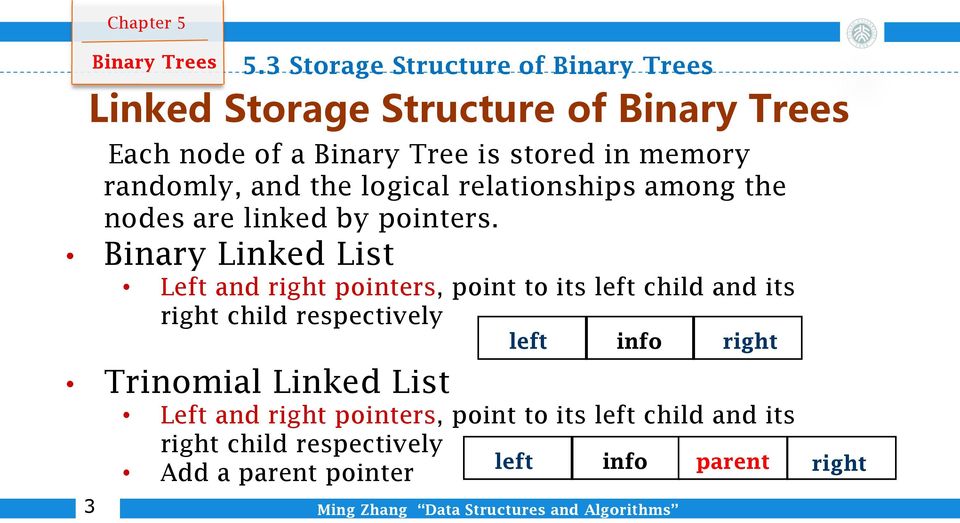
3 3 Chapter Storage Structure of Linked Storage Structure of Each node of a Binary Tree is stored in memory randomly, and the logical relationships among the nodes are linked by pointers. Binary Linked List Left and right pointers, point to its left child and its right child respectively Trinomial Linked List Left and right pointers, point to its left child and its right child respectively Add a parent pointer left info right left info parent right
4 5.3 Storage Structure of Binary Linked List t D B A E C F G H I A B C D E F G H I 4 (a) (b)

5 5.3 Storage Structure of Trinomial Linked List Pointer parent points to its parent, the ability of "upward" t D A B E G C F H I A B C D E F G H I 5 (a) (b)

6 5.3 Storage Structure of Add Two Private Data Members into Class BinaryTreeNode private: BinaryTreeNode<T> *left; // The pointer pointing to the left subtree BinaryTreeNode<T> *right; // The pointer pointing to the right subtree template <class T> class BinaryTreeNode { friend class BinaryTree<T>; // Declare the class of as a friend class private: T info; // Data domain of nodes in a binary tree public: BinaryTreeNode(); // Default constructor function BinaryTreeNode(const T& ele); // Construction with given data BinaryTreeNode(const T& ele, BinaryTreeNode<T> *l, BinaryTreeNode<T> *r); // Construction of nodes in a subtree. } 6

7 7 Chapter Storage Structure of A Recursive Structure to Find out the Father Node Be Careful of its Return template<class T> BinaryTreeNode<T>* BinaryTree<T>:: Parent(BinaryTreeNode<T> *rt, BinaryTreeNode<T> *current) { BinaryTreeNode<T> *tmp, if (rt == NULL) return(null); if (current == rt ->leftchild() current == rt->rightchild()) return rt; // If the child is current, then return parent if ((tmp =Parent(rt- >leftchild(), current)!= NULL) return tmp; if ((tmp =Parent(rt- > rightchild(), current)!= NULL) return tmp; return NULL; }

8 5.3 Storage Structure of Questions What structure does the algorithm use? Which order of traversal does the algorithm belong to? Could we use non-recursive methods? Could we use BFS? How to find out brother nodes starting from this algorithm? 8

9 } } } 9 Chapter Storage Structure of A Non-Recursive Structure to Find out the Father Node BinaryTreeNode<T>* BinaryTree<T>::Parent(BinaryTreeNode<T> *current) { using std::stack; // Use the stack in STL stack<binarytreenode<t>* > astack; BinaryTreeNode<T> *pointer = root; astack.push(null); // The lookout at the bottom of the stack while (pointer) { // Or!aStack.empty() if (current == pointer->leftchild() current == pointer->rightchild()) return pointer; // if the child of pointer is current, then return parent if (pointer->rightchild()!= NULL) // Push the non-empty right subtree into the stack astack.push(pointer->rightchild()); if (pointer->leftchild()!= NULL) pointer = pointer->leftchild(); // Go down along the left side else { // After visiting the left subtree, it is turn to visit the right subtree pointer=astack.top(); astack.pop(); // Get the element on the top of the stack and pop it

10 5.3 Storage Structure of Analysis of the Space Cost Storage density ( 1) means the efficiency of the structure of data storage Storage size of data itself (storage density) = Storage size of the whole structure Overhead of the structure = 1-10
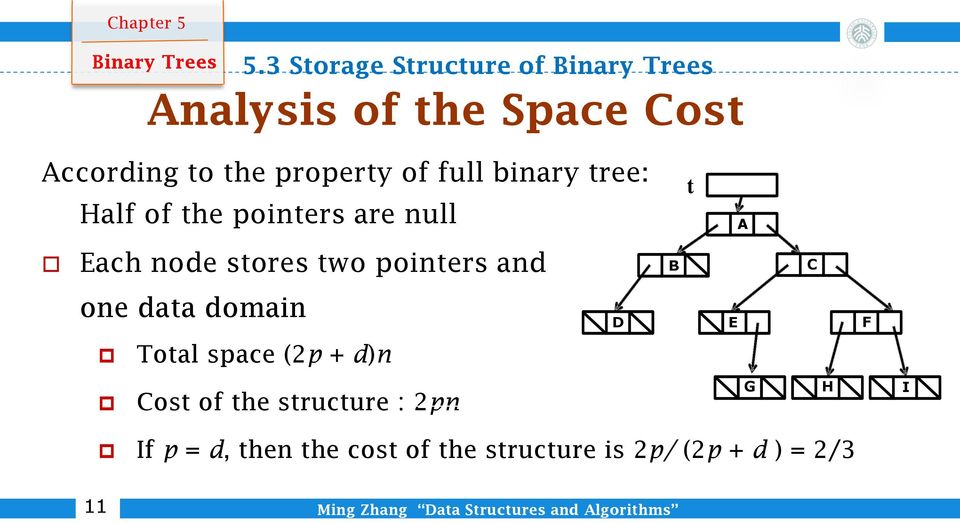
11 5.3 Storage Structure of According to the property of full binary tree: Half of the pointers are null Each node stores two pointers and one data domain Chapter 5 Analysis of the Space Cost Total space (2p + d)n Cost of the structure:2pn (a) (b) If p = d, then the cost of the structure is 2p/ (2p + d ) = 2/3 t A B C D E F G H I 11
12 5.3 Storage Structure of Analysis of the Space Cost C++ has two methods to implement different branch and leaf nodes: Use union type to define Use the subclass in C++ to implement branch nodes and leaf nodes respectively, and use virtual function isleaf to distinguish branch nodes and leaf nodes Save memory resource at the early stage Use a idle bit (one bit) of the pointer of a node to mark the type of the node Use the pointer pointing to a leaf or the pointer domain in a leaf to store the value of this leaf node 12

13 Storage Structure of Sequential Storage Structure of Complete Binary Tree Chapter 5 Sequential method to store a binary tree Store nodes into a piece of continuous space according to a particular order Make the position of nodes in the sequence able to reflect corresponding information of the structure The storage structure is linear It is still a structure of a binary tree on its logical structure
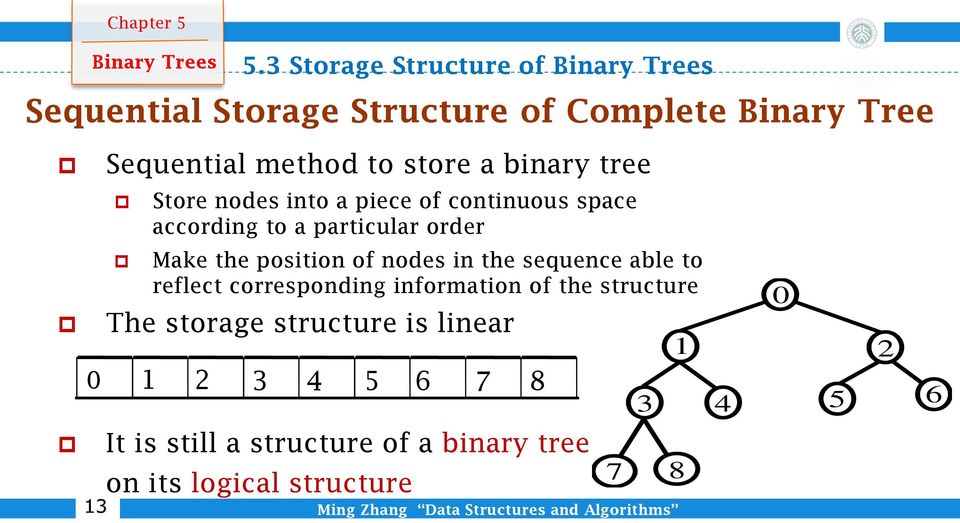
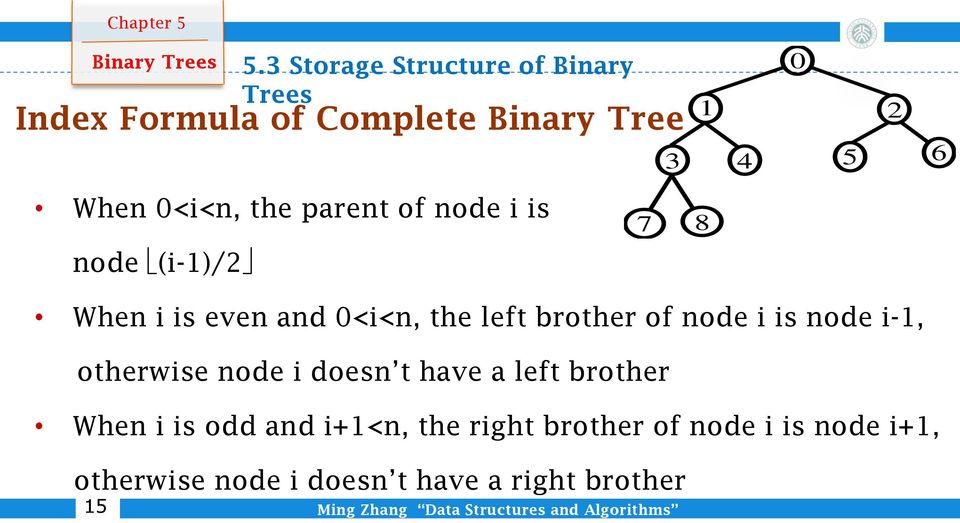
14 5.3 Storage Structure of Index Formula of Complete Binary Tree We could know the indexes of a node s parent, children and brothers according to its index When 2i+1<n, the left child of node i is node 2i+1, otherwise node i doesn t have a left child When 2i+2<n, the right child of node i is node 2i+2, otherwise node i doesn t have a right child

15 5.3 Storage Structure of Binary Trees Index Formula of Complete Binary Tree When 0<i<n, the parent of node i is node (i-1)/2 7 8 When i is even and 0<i<n, the left brother of node i is node i-1, otherwise node i doesn t have a left brother When i is odd and i+1<n, the right brother of node i is node i+1, otherwise node i doesn t have a right brother 15
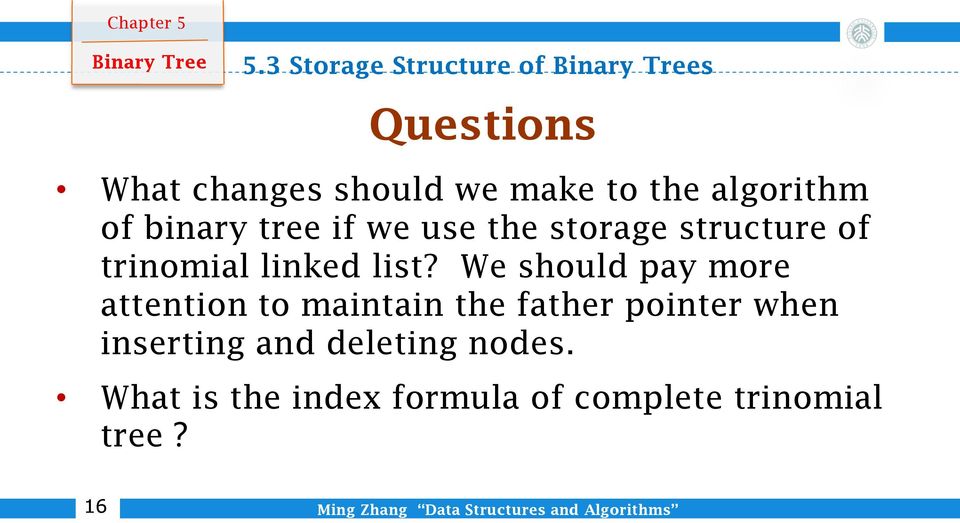
16 Binary Tree 5.3 Storage Structure of Questions What changes should we make to the algorithm of binary tree if we use the storage structure of trinomial linked list? We should pay more attention to maintain the father pointer when inserting and deleting nodes. What is the index formula of complete trinomial tree? 16
17 Ming Zhang Data Structures and Algorithms Data Structures and Algorithms Thanks! the National Elaborate Course (Only available for IPs in China) Ming Zhang, Tengjiao Wang and Haiyan Zhao Higher Education Press, (awarded as the "Eleventh Five-Year" national planning textbook)
1) The postfix expression for the infix expression A+B*(C+D)/F+D*E is ABCD+*F/DE*++
 Answer the following 1) The postfix expression for the infix expression A+B*(C+D)/F+D*E is ABCD+*F/DE*++ 2) Which data structure is needed to convert infix notations to postfix notations? Stack 3) The
Converting a Number from Decimal to Binary
 Converting a Number from Decimal to Binary Convert nonnegative integer in decimal format (base 10) into equivalent binary number (base 2) Rightmost bit of x Remainder of x after division by two Recursive
Data Structure with C
 Subject: Data Structure with C Topic : Tree Tree A tree is a set of nodes that either:is empty or has a designated node, called the root, from which hierarchically descend zero or more subtrees, which
DATA STRUCTURES USING C
 DATA STRUCTURES USING C QUESTION BANK UNIT I 1. Define data. 2. Define Entity. 3. Define information. 4. Define Array. 5. Define data structure. 6. Give any two applications of data structures. 7. Give
Data Structures Using C++ 2E. Chapter 5 Linked Lists
 Data Structures Using C++ 2E Chapter 5 Linked Lists Doubly Linked Lists Traversed in either direction Typical operations Initialize the list Destroy the list Determine if list empty Search list for a given
10CS35: Data Structures Using C
 CS35: Data Structures Using C QUESTION BANK REVIEW OF STRUCTURES AND POINTERS, INTRODUCTION TO SPECIAL FEATURES OF C OBJECTIVE: Learn : Usage of structures, unions - a conventional tool for handling a
Home Page. Data Structures. Title Page. Page 1 of 24. Go Back. Full Screen. Close. Quit
 Data Structures Page 1 of 24 A.1. Arrays (Vectors) n-element vector start address + ielementsize 0 +1 +2 +3 +4... +n-1 start address continuous memory block static, if size is known at compile time dynamic,
TREE BASIC TERMINOLOGIES
 TREE Trees are very flexible, versatile and powerful non-liner data structure that can be used to represent data items possessing hierarchical relationship between the grand father and his children and
Binary Search Trees (BST)
 Binary Search Trees (BST) 1. Hierarchical data structure with a single reference to node 2. Each node has at most two child nodes (a left and a right child) 3. Nodes are organized by the Binary Search
INTERNATIONAL JOURNAL OF PURE AND APPLIED RESEARCH IN ENGINEERING AND TECHNOLOGY
 INTERNATIONAL JOURNAL OF PURE AND APPLIED RESEARCH IN ENGINEERING AND TECHNOLOGY A PATH FOR HORIZING YOUR INNOVATIVE WORK A REVIEW ON THE USAGE OF OLD AND NEW DATA STRUCTURE ARRAYS, LINKED LIST, STACK,
Structural Design Patterns Used in Data Structures Implementation
 Structural Design Patterns Used in Data Structures Implementation Niculescu Virginia Department of Computer Science Babeş-Bolyai University, Cluj-Napoca email address: [email protected] November,
A binary search tree or BST is a binary tree that is either empty or in which the data element of each node has a key, and:
 Binary Search Trees 1 The general binary tree shown in the previous chapter is not terribly useful in practice. The chief use of binary trees is for providing rapid access to data (indexing, if you will)
Quiz 4 Solutions EECS 211: FUNDAMENTALS OF COMPUTER PROGRAMMING II. 1 Q u i z 4 S o l u t i o n s
 Quiz 4 Solutions Q1: What value does function mystery return when called with a value of 4? int mystery ( int number ) { if ( number
CS104: Data Structures and Object-Oriented Design (Fall 2013) October 24, 2013: Priority Queues Scribes: CS 104 Teaching Team
 CS104: Data Structures and Object-Oriented Design (Fall 2013) October 24, 2013: Priority Queues Scribes: CS 104 Teaching Team Lecture Summary In this lecture, we learned about the ADT Priority Queue. A
Binary Heap Algorithms
 CS Data Structures and Algorithms Lecture Slides Wednesday, April 5, 2009 Glenn G. Chappell Department of Computer Science University of Alaska Fairbanks [email protected] 2005 2009 Glenn G. Chappell
Heaps & Priority Queues in the C++ STL 2-3 Trees
 Heaps & Priority Queues in the C++ STL 2-3 Trees CS 3 Data Structures and Algorithms Lecture Slides Friday, April 7, 2009 Glenn G. Chappell Department of Computer Science University of Alaska Fairbanks
1. The memory address of the first element of an array is called A. floor address B. foundation addressc. first address D.
 1. The memory address of the first element of an array is called A. floor address B. foundation addressc. first address D. base address 2. The memory address of fifth element of an array can be calculated
Data Structures. Level 6 C30151. www.fetac.ie. Module Descriptor
 The Further Education and Training Awards Council (FETAC) was set up as a statutory body on 11 June 2001 by the Minister for Education and Science. Under the Qualifications (Education & Training) Act,
5. A full binary tree with n leaves contains [A] n nodes. [B] log n 2 nodes. [C] 2n 1 nodes. [D] n 2 nodes.
![5. A full binary tree with n leaves contains [A] n nodes. [B] log n 2 nodes. [C] 2n 1 nodes. [D] n 2 nodes.](/thumbs/40/21353779.jpg "5. A full binary tree with n leaves contains [A] n nodes. [B] log n 2 nodes. [C] 2n 1 nodes. [D] n 2 nodes.") 1. The advantage of.. is that they solve the problem if sequential storage representation. But disadvantage in that is they are sequential lists. [A] Lists [B] Linked Lists [A] Trees [A] Queues 2. The
1. The advantage of.. is that they solve the problem if sequential storage representation. But disadvantage in that is they are sequential lists. [A] Lists [B] Linked Lists [A] Trees [A] Queues 2. The
Physical Data Organization
 Physical Data Organization Database design using logical model of the database - appropriate level for users to focus on - user independence from implementation details Performance - other major factor
MAX = 5 Current = 0 'This will declare an array with 5 elements. Inserting a Value onto the Stack (Push) -----------------------------------------
 =============================================================================================================================== DATA STRUCTURE PSEUDO-CODE EXAMPLES (c) Mubashir N. Mir - www.mubashirnabi.com
Unordered Linked Lists
 Unordered Linked Lists Derive class unorderedlinkedlist from the abstract class linkedlisttype Implement the operations search, insertfirst, insertlast, deletenode See code on page 292 Defines an unordered
Algorithms and Data Structures
 Algorithms and Data Structures Part 2: Data Structures PD Dr. rer. nat. habil. Ralf-Peter Mundani Computation in Engineering (CiE) Summer Term 2016 Overview general linked lists stacks queues trees 2 2
Full and Complete Binary Trees
 Full and Complete Binary Trees Binary Tree Theorems 1 Here are two important types of binary trees. Note that the definitions, while similar, are logically independent. Definition: a binary tree T is full
Binary Search Trees. Data in each node. Larger than the data in its left child Smaller than the data in its right child
 Binary Search Trees Data in each node Larger than the data in its left child Smaller than the data in its right child FIGURE 11-6 Arbitrary binary tree FIGURE 11-7 Binary search tree Data Structures Using
Lecture 6: Binary Search Trees CSCI 700 - Algorithms I. Andrew Rosenberg
 Lecture 6: Binary Search Trees CSCI 700 - Algorithms I Andrew Rosenberg Last Time Linear Time Sorting Counting Sort Radix Sort Bucket Sort Today Binary Search Trees Data Structures Data structure is a
Analysis of Algorithms I: Binary Search Trees
 Analysis of Algorithms I: Binary Search Trees Xi Chen Columbia University Hash table: A data structure that maintains a subset of keys from a universe set U = {0, 1,..., p 1} and supports all three dictionary
Questions 1 through 25 are worth 2 points each. Choose one best answer for each.
 Questions 1 through 25 are worth 2 points each. Choose one best answer for each. 1. For the singly linked list implementation of the queue, where are the enqueues and dequeues performed? c a. Enqueue in
Course: Programming II - Abstract Data Types. The ADT Stack. A stack. The ADT Stack and Recursion Slide Number 1
 Definition Course: Programming II - Abstract Data Types The ADT Stack The ADT Stack is a linear sequence of an arbitrary number of items, together with access procedures. The access procedures permit insertions
How To Create A Tree From A Tree In Runtime (For A Tree)
 Binary Search Trees < 6 2 > = 1 4 8 9 Binary Search Trees 1 Binary Search Trees A binary search tree is a binary tree storing keyvalue entries at its internal nodes and satisfying the following property:
Krishna Institute of Engineering & Technology, Ghaziabad Department of Computer Application MCA-213 : DATA STRUCTURES USING C
 Tutorial#1 Q 1:- Explain the terms data, elementary item, entity, primary key, domain, attribute and information? Also give examples in support of your answer? Q 2:- What is a Data Type? Differentiate
Binary Trees and Huffman Encoding Binary Search Trees
 Binary Trees and Huffman Encoding Binary Search Trees Computer Science E119 Harvard Extension School Fall 2012 David G. Sullivan, Ph.D. Motivation: Maintaining a Sorted Collection of Data A data dictionary
Analysis of Algorithms I: Optimal Binary Search Trees
 Analysis of Algorithms I: Optimal Binary Search Trees Xi Chen Columbia University Given a set of n keys K = {k 1,..., k n } in sorted order: k 1 < k 2 < < k n we wish to build an optimal binary search
KITES TECHNOLOGY COURSE MODULE (C, C++, DS)
 KITES TECHNOLOGY 360 Degree Solution www.kitestechnology.com/academy.php [email protected] [email protected] Contact: - 8961334776 9433759247 9830639522.NET JAVA WEB DESIGN PHP SQL, PL/SQL
Recursive Implementation of Recursive Data Structures
 Recursive Implementation of Recursive Data Structures Jonathan Yackel Computer Science Department University of Wisconsin Oshkosh Oshkosh, WI 54901 [email protected] Abstract The elegant recursive definitions
Binary Search Trees CMPSC 122
 Binary Search Trees CMPSC 122 Note: This notes packet has significant overlap with the first set of trees notes I do in CMPSC 360, but goes into much greater depth on turning BSTs into pseudocode than
Data Structures Fibonacci Heaps, Amortized Analysis
 Chapter 4 Data Structures Fibonacci Heaps, Amortized Analysis Algorithm Theory WS 2012/13 Fabian Kuhn Fibonacci Heaps Lacy merge variant of binomial heaps: Do not merge trees as long as possible Structure:
Binary Search Trees. A Generic Tree. Binary Trees. Nodes in a binary search tree ( B-S-T) are of the form. P parent. Key. Satellite data L R
 Binary Search Trees A Generic Tree Nodes in a binary search tree ( B-S-T) are of the form P parent Key A Satellite data L R B C D E F G H I J The B-S-T has a root node which is the only node whose parent
ER E P M A S S I CONSTRUCTING A BINARY TREE EFFICIENTLYFROM ITS TRAVERSALS DEPARTMENT OF COMPUTER SCIENCE UNIVERSITY OF TAMPERE REPORT A-1998-5
 S I N S UN I ER E P S I T VER M A TA S CONSTRUCTING A BINARY TREE EFFICIENTLYFROM ITS TRAVERSALS DEPARTMENT OF COMPUTER SCIENCE UNIVERSITY OF TAMPERE REPORT A-1998-5 UNIVERSITY OF TAMPERE DEPARTMENT OF
Algorithms Chapter 12 Binary Search Trees
 Algorithms Chapter 1 Binary Search Trees Outline Assistant Professor: Ching Chi Lin 林 清 池 助 理 教 授 [email protected] Department of Computer Science and Engineering National Taiwan Ocean University
Algorithms and Data S tructures Structures Stack, Queues, and Applications Applications Ulf Leser
 Algorithms and Data Structures Stack, Queues, and Applications Ulf Leser Content of this Lecture Stacks and Queues Tree Traversal Towers of Hanoi Ulf Leser: Alg&DS, Summer semester 2011 2 Stacks and Queues
PES Institute of Technology-BSC QUESTION BANK
 PES Institute of Technology-BSC Faculty: Mrs. R.Bharathi CS35: Data Structures Using C QUESTION BANK UNIT I -BASIC CONCEPTS 1. What is an ADT? Briefly explain the categories that classify the functions
ECE 250 Data Structures and Algorithms MIDTERM EXAMINATION 2008-10-23/5:15-6:45 REC-200, EVI-350, RCH-106, HH-139
 ECE 250 Data Structures and Algorithms MIDTERM EXAMINATION 2008-10-23/5:15-6:45 REC-200, EVI-350, RCH-106, HH-139 Instructions: No aides. Turn off all electronic media and store them under your desk. If
Previous Lectures. B-Trees. External storage. Two types of memory. B-trees. Main principles
 B-Trees Algorithms and data structures for external memory as opposed to the main memory B-Trees Previous Lectures Height balanced binary search trees: AVL trees, red-black trees. Multiway search trees:
CS711008Z Algorithm Design and Analysis
 CS711008Z Algorithm Design and Analysis Lecture 7 Binary heap, binomial heap, and Fibonacci heap 1 Dongbo Bu Institute of Computing Technology Chinese Academy of Sciences, Beijing, China 1 The slides were
Binary Heaps. CSE 373 Data Structures
 Binary Heaps CSE Data Structures Readings Chapter Section. Binary Heaps BST implementation of a Priority Queue Worst case (degenerate tree) FindMin, DeleteMin and Insert (k) are all O(n) Best case (completely
Output: 12 18 30 72 90 87. struct treenode{ int data; struct treenode *left, *right; } struct treenode *tree_ptr;
 50 20 70 10 30 69 90 14 35 68 85 98 16 22 60 34 (c) Execute the algorithm shown below using the tree shown above. Show the exact output produced by the algorithm. Assume that the initial call is: prob3(root)
A binary search tree is a binary tree with a special property called the BST-property, which is given as follows:
 Chapter 12: Binary Search Trees A binary search tree is a binary tree with a special property called the BST-property, which is given as follows: For all nodes x and y, if y belongs to the left subtree
Learning Outcomes. COMP202 Complexity of Algorithms. Binary Search Trees and Other Search Trees
 Learning Outcomes COMP202 Complexity of Algorithms Binary Search Trees and Other Search Trees [See relevant sections in chapters 2 and 3 in Goodrich and Tamassia.] At the conclusion of this set of lecture
Linked List as an ADT (cont d.)
 Linked List as an ADT (cont d.) Default constructor Initializes list to an empty state Destroy the list Deallocates memory occupied by each node Initialize the list Reinitializes list to an empty state
Algorithms and Data Structures Written Exam Proposed SOLUTION
 Algorithms and Data Structures Written Exam Proposed SOLUTION 2005-01-07 from 09:00 to 13:00 Allowed tools: A standard calculator. Grading criteria: You can get at most 30 points. For an E, 15 points are
root node level: internal node edge leaf node CS@VT Data Structures & Algorithms 2000-2009 McQuain
 inary Trees 1 A binary tree is either empty, or it consists of a node called the root together with two binary trees called the left subtree and the right subtree of the root, which are disjoint from each
Binary Coded Web Access Pattern Tree in Education Domain
 Binary Coded Web Access Pattern Tree in Education Domain C. Gomathi P.G. Department of Computer Science Kongu Arts and Science College Erode-638-107, Tamil Nadu, India E-mail: [email protected] M. Moorthi
CompuScholar, Inc. Alignment to Utah's Computer Programming II Standards
 CompuScholar, Inc. Alignment to Utah's Computer Programming II Standards Course Title: TeenCoder: Java Programming Course ISBN: 978 0 9887070 2 3 Course Year: 2015 Note: Citation(s) listed may represent
Big Data and Scripting. Part 4: Memory Hierarchies
 1, Big Data and Scripting Part 4: Memory Hierarchies 2, Model and Definitions memory size: M machine words total storage (on disk) of N elements (N is very large) disk size unlimited (for our considerations)
Binary Search Trees 3/20/14
 Binary Search Trees 3/0/4 Presentation for use ith the textbook Data Structures and Algorithms in Java, th edition, by M. T. Goodrich, R. Tamassia, and M. H. Goldasser, Wiley, 04 Binary Search Trees 4
Lecture 10: Regression Trees
 Lecture 10: Regression Trees 36-350: Data Mining October 11, 2006 Reading: Textbook, sections 5.2 and 10.5. The next three lectures are going to be about a particular kind of nonlinear predictive model,
Lecture Notes on Binary Search Trees
 Lecture Notes on Binary Search Trees 15-122: Principles of Imperative Computation Frank Pfenning Lecture 17 March 17, 2010 1 Introduction In the previous two lectures we have seen how to exploit the structure
Introduction to Data Structures and Algorithms
 Introduction to Data Structures and Algorithms Chapter: Elementary Data Structures(1) Lehrstuhl Informatik 7 (Prof. Dr.-Ing. Reinhard German) Martensstraße 3, 91058 Erlangen Overview on simple data structures
Data Structure [Question Bank]
![Data Structure [Question Bank]](/thumbs/40/21355705.jpg "Data Structure [Question Bank]") Unit I (Analysis of Algorithms) 1. What are algorithms and how they are useful? 2. Describe the factor on best algorithms depends on? 3. Differentiate: Correct & Incorrect Algorithms? 4. Write short note:
Unit I (Analysis of Algorithms) 1. What are algorithms and how they are useful? 2. Describe the factor on best algorithms depends on? 3. Differentiate: Correct & Incorrect Algorithms? 4. Write short note:
Ordered Lists and Binary Trees
 Data Structures and Algorithms Ordered Lists and Binary Trees Chris Brooks Department of Computer Science University of San Francisco Department of Computer Science University of San Francisco p.1/62 6-0:
Data Structure and Algorithm I Midterm Examination 120 points Time: 9:10am-12:10pm (180 minutes), Friday, November 12, 2010
 Data Structure and Algorithm I Midterm Examination 120 points Time: 9:10am-12:10pm (180 minutes), Friday, November 12, 2010 Problem 1. In each of the following question, please specify if the statement
The following themes form the major topics of this chapter: The terms and concepts related to trees (Section 5.2).
 CHAPTER 5 The Tree Data Model There are many situations in which information has a hierarchical or nested structure like that found in family trees or organization charts. The abstraction that models hierarchical
The ADT Binary Search Tree
 The ADT Binary Search Tree The Binary Search Tree is a particular type of binary tree that enables easy searching for specific items. Definition The ADT Binary Search Tree is a binary tree which has an
A binary heap is a complete binary tree, where each node has a higher priority than its children. This is called heap-order property
 CmSc 250 Intro to Algorithms Chapter 6. Transform and Conquer Binary Heaps 1. Definition A binary heap is a complete binary tree, where each node has a higher priority than its children. This is called
Chapter 14 The Binary Search Tree
 Chapter 14 The Binary Search Tree In Chapter 5 we discussed the binary search algorithm, which depends on a sorted vector. Although the binary search, being in O(lg(n)), is very efficient, inserting a
Lecture 1: Data Storage & Index
 Lecture 1: Data Storage & Index R&G Chapter 8-11 Concurrency control Query Execution and Optimization Relational Operators File & Access Methods Buffer Management Disk Space Management Recovery Manager
Abstract Data Type. EECS 281: Data Structures and Algorithms. The Foundation: Data Structures and Abstract Data Types
 EECS 281: Data Structures and Algorithms The Foundation: Data Structures and Abstract Data Types Computer science is the science of abstraction. Abstract Data Type Abstraction of a data structure on that
Data Structures and Algorithms
 Data Structures and Algorithms CS245-2016S-06 Binary Search Trees David Galles Department of Computer Science University of San Francisco 06-0: Ordered List ADT Operations: Insert an element in the list
From Last Time: Remove (Delete) Operation
 CSE 32 Lecture : More on Search Trees Today s Topics: Lazy Operations Run Time Analysis of Binary Search Tree Operations Balanced Search Trees AVL Trees and Rotations Covered in Chapter of the text From
Exercises Software Development I. 11 Recursion, Binary (Search) Trees. Towers of Hanoi // Tree Traversal. January 16, 2013
 Exercises Software Development I 11 Recursion, Binary (Search) Trees Towers of Hanoi // Tree Traversal January 16, 2013 Software Development I Winter term 2012/2013 Institute for Pervasive Computing Johannes
Fast nondeterministic recognition of context-free languages using two queues
 Fast nondeterministic recognition of context-free languages using two queues Burton Rosenberg University of Miami Abstract We show how to accept a context-free language nondeterministically in O( n log
Sorting revisited. Build the binary search tree: O(n^2) Traverse the binary tree: O(n) Total: O(n^2) + O(n) = O(n^2)
 Sorting revisited How did we use a binary search tree to sort an array of elements? Tree Sort Algorithm Given: An array of elements to sort 1. Build a binary search tree out of the elements 2. Traverse
Sample Questions Csci 1112 A. Bellaachia
 Sample Questions Csci 1112 A. Bellaachia Important Series : o S( N) 1 2 N N i N(1 N) / 2 i 1 o Sum of squares: N 2 N( N 1)(2N 1) N i for large N i 1 6 o Sum of exponents: N k 1 k N i for large N and k
Atmiya Infotech Pvt. Ltd. Data Structure. By Ajay Raiyani. Yogidham, Kalawad Road, Rajkot. Ph : 572365, 576681 1
 Data Structure By Ajay Raiyani Yogidham, Kalawad Road, Rajkot. Ph : 572365, 576681 1 Linked List 4 Singly Linked List...4 Doubly Linked List...7 Explain Doubly Linked list: -...7 Circular Singly Linked
Cpt S 223. School of EECS, WSU
 Priority Queues (Heaps) 1 Motivation Queues are a standard mechanism for ordering tasks on a first-come, first-served basis However, some tasks may be more important or timely than others (higher priority)
Data Structures and Data Manipulation
 Data Structures and Data Manipulation What the Specification Says: Explain how static data structures may be used to implement dynamic data structures; Describe algorithms for the insertion, retrieval
Data Structures Using C++
 Data Structures Using C++ 1.1 Introduction Data structure is an implementation of an abstract data type having its own set of data elements along with functions to perform operations on that data. Arrays
B-Trees. Algorithms and data structures for external memory as opposed to the main memory B-Trees. B -trees
 B-Trees Algorithms and data structures for external memory as opposed to the main memory B-Trees Previous Lectures Height balanced binary search trees: AVL trees, red-black trees. Multiway search trees:
Introduction Advantages and Disadvantages Algorithm TIME COMPLEXITY. Splay Tree. Cheruku Ravi Teja. November 14, 2011
 November 14, 2011 1 Real Time Applications 2 3 Results of 4 Real Time Applications Splay trees are self branching binary search tree which has the property of reaccessing the elements quickly that which
Parallelization: Binary Tree Traversal
 By Aaron Weeden and Patrick Royal Shodor Education Foundation, Inc. August 2012 Introduction: According to Moore s law, the number of transistors on a computer chip doubles roughly every two years. First
Symbol Tables. Introduction
 Symbol Tables Introduction A compiler needs to collect and use information about the names appearing in the source program. This information is entered into a data structure called a symbol table. The
Vector storage and access; algorithms in GIS. This is lecture 6
 Vector storage and access; algorithms in GIS This is lecture 6 Vector data storage and access Vectors are built from points, line and areas. (x,y) Surface: (x,y,z) Vector data access Access to vector
Chapter 8: Binary Trees
 Chapter 8: Binary Trees Why Use Binary Trees? Tree Terminology An Analogy How Do Binary Search Trees Work Finding a Node Inserting a Node Traversing the Tree Finding Maximum and Minimum Values Deleting
Motivation Suppose we have a database of people We want to gure out who is related to whom Initially, we only have a list of people, and information a
 CSE 220: Handout 29 Disjoint Sets 1 Motivation Suppose we have a database of people We want to gure out who is related to whom Initially, we only have a list of people, and information about relations
Binary Search Trees. Ric Glassey [email protected]
 Binary Search Trees Ric Glassey [email protected] Outline Binary Search Trees Aim: Demonstrate how a BST can maintain order and fast performance relative to its height Properties Operations Min/Max Search
1. What are Data Structures? Introduction to Data Structures. 2. What will we Study? CITS2200 Data Structures and Algorithms
 1 What are ata Structures? ata Structures and lgorithms ata structures are software artifacts that allow data to be stored, organized and accessed Topic 1 They are more high-level than computer memory
Data Structures and Algorithm Analysis (CSC317) Intro/Review of Data Structures Focus on dynamic sets
 Data Structures and Algorithm Analysis (CSC317) Intro/Review of Data Structures Focus on dynamic sets We ve been talking a lot about efficiency in computing and run time. But thus far mostly ignoring data
Algorithms and Data Structures
 Algorithms and Data Structures CMPSC 465 LECTURES 20-21 Priority Queues and Binary Heaps Adam Smith S. Raskhodnikova and A. Smith. Based on slides by C. Leiserson and E. Demaine. 1 Trees Rooted Tree: collection
Glossary of Object Oriented Terms
 Appendix E Glossary of Object Oriented Terms abstract class: A class primarily intended to define an instance, but can not be instantiated without additional methods. abstract data type: An abstraction
Binary Heaps * * * * * * * / / \ / \ / \ / \ / \ * * * * * * * * * * * / / \ / \ / / \ / \ * * * * * * * * * *
 Binary Heaps A binary heap is another data structure. It implements a priority queue. Priority Queue has the following operations: isempty add (with priority) remove (highest priority) peek (at highest
Unit 4.3 - Storage Structures 1. Storage Structures. Unit 4.3
 Storage Structures Unit 4.3 Unit 4.3 - Storage Structures 1 The Physical Store Storage Capacity Medium Transfer Rate Seek Time Main Memory 800 MB/s 500 MB Instant Hard Drive 10 MB/s 120 GB 10 ms CD-ROM
Common Data Structures
 Data Structures 1 Common Data Structures Arrays (single and multiple dimensional) Linked Lists Stacks Queues Trees Graphs You should already be familiar with arrays, so they will not be discussed. Trees
Class Notes CS 3137. 1 Creating and Using a Huffman Code. Ref: Weiss, page 433
 Class Notes CS 3137 1 Creating and Using a Huffman Code. Ref: Weiss, page 433 1. FIXED LENGTH CODES: Codes are used to transmit characters over data links. You are probably aware of the ASCII code, a fixed-length
Persistent Binary Search Trees
 Persistent Binary Search Trees Datastructures, UvA. May 30, 2008 0440949, Andreas van Cranenburgh Abstract A persistent binary tree allows access to all previous versions of the tree. This paper presents
CSE 326: Data Structures B-Trees and B+ Trees
 Announcements (4//08) CSE 26: Data Structures B-Trees and B+ Trees Brian Curless Spring 2008 Midterm on Friday Special office hour: 4:-5: Thursday in Jaech Gallery (6 th floor of CSE building) This is
Sorting Hierarchical Data in External Memory for Archiving
 Sorting Hierarchical Data in External Memory for Archiving Ioannis Koltsidas School of Informatics University of Edinburgh [email protected] Heiko Müller School of Informatics University of Edinburgh
Application of Stacks: Postfix Expressions Calculator (cont d.)
 Application of Stacks: Postfix Expressions Calculator (cont d.) Postfix expression: 6 3 + 2 * = FIGURE 7-15 Evaluating the postfix expression: 6 3 + 2 * = Data Structures Using C++ 2E 1 Application of
1. Domain Name System
 1.1 Domain Name System (DNS) 1. Domain Name System To identify an entity, the Internet uses the IP address, which uniquely identifies the connection of a host to the Internet. However, people prefer to
Data Structures Using C++ 2E. Chapter 5 Linked Lists
 Data Structures Using C++ 2E Chapter 5 Linked Lists Test #1 Next Thursday During Class Cover through (near?) end of Chapter 5 Objectives Learn about linked lists Become aware of the basic properties of