
Gleim / Flesher CMA Review 15th Edition, 1st Printing Part 1 Updates
|
|
|
- Maximillian Whitehead
- 9 years ago
- Views:
Transcription
1 Page 1 of 8 Gleim / Flesher CMA Review 15th Edition, 1st Printing Part 1 Updates NOTE: Text that should be deleted from the outline is displayed as struck through with a red background. New text is shown in courier font with a green background. Introduction Middle of page 5: This is a correction clarifying test question difficulty. Level of Performance Required The ICMA has specified three levels of coverage as reproduced below and indicated in its content specification outlines. All topics on the CMA exam are tested at up to Skill Level C. The relative proportions of multiple-choice questions are: Skill Level A 25%, Skill Level B 50%; Skill Level C 25%. Study Unit 1 -- Budgeting Concepts and Forecasting Techniques Middle of page 34: This corrects a typo; percentages should be minutes. a) With the completion of the final batch (units 9 16), the average had come down to 40.96% minutes. b) For it to reach this level from the 51.2% minutes it had reached at the end of the fourth batch (units 5 8), the average of the units in the fifth batch alone must have been 30.72% minutes [(40.96% minutes 2) 51.2% minutes].

2 Page 2 of 8 Bottom of page 38: This adds an example showing that, even though the best answer is to stock two yachts, which will yield a profit of $225,000 in the long run, there will be some risk averse dealers who would not want to expose themselves to a $100,000 loss when demand is zero and two yachts are stocked. Thus, there are behavioral implications that might take precedence over what seemingly is the best decision. e. The expected value criterion is likely to be adopted by a decision maker who is risk neutral. However, other circumstances may cause the decision maker to be risk averse or even risk seeking. 1) EXAMPLE: A dealer in luxury yachts may order 0, 1, or 2 yachts for this season s inventory. a) The dealer projects demand for the season as follows: Demand Probability 0 yachts 10% 1 yacht 50% 2 yachts 40% b) The cost of carrying each excess yacht is $50,000, and the gain for each yacht sold is $200,000. The profit or loss resulting from each combination of decision and outcome is thus as follows: Expected Value Without States of Nature Perfect Info. Decision Demand = 0 Demand = 1 Demand = 2 Totals Stock 0 yachts $ 0 $ 0 $ 0 $ 0 Stock 1 yacht (50,000) 200, , ,000 Stock 2 yachts (100,000) 150, , ,000 2) Thus, in the example on the previous page In this example, a risk averse decision maker may not wish to accept the risk of losing $100,000 by ordering two yachts.

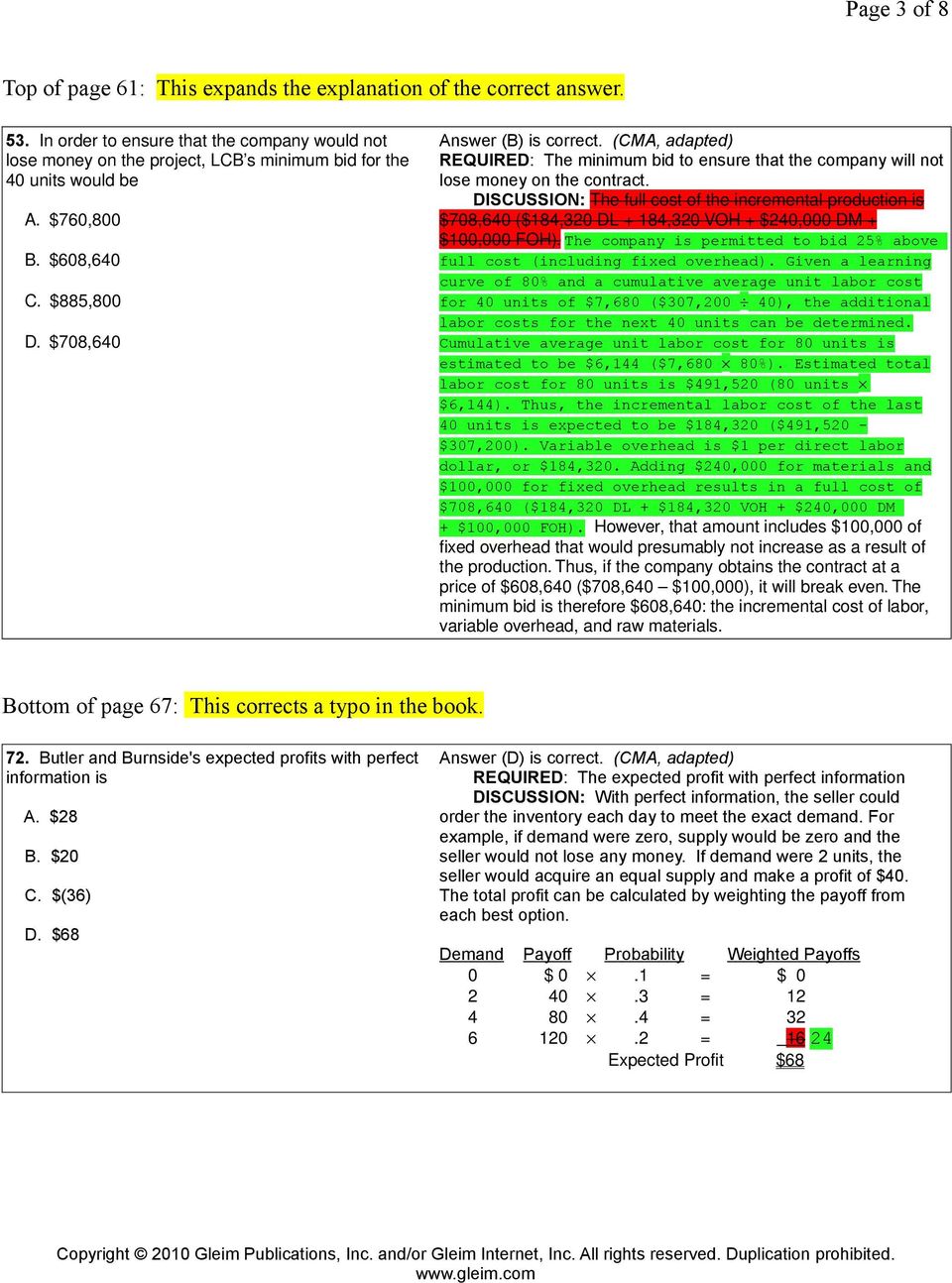
3 Page 3 of 8 Top of page 61: This expands the explanation of the correct answer. 53. In order to ensure that the company would not Answer (B) is correct. (CMA, adapted) lose money on the project, LCB s minimum bid for the REQUIRED: The minimum bid to ensure that the company will not 40 units would be lose money on the contract. DISCUSSION: The full cost of the incremental production is A. $760,800 $708,640 ($184,320 DL + 184,320 VOH + $240,000 DM + $100,000 FOH). The company is permitted to bid 25% above B. $608,640 full cost (including fixed overhead). Given a learning curve of 80% and a cumulative average unit labor cost C. $885,800 for 40 units of $7,680 ($307,200 40), the additional labor costs for the next 40 units can be determined. D. $708,640 Cumulative average unit labor cost for 80 units is estimated to be $6,144 ($7,680 80%). Estimated total labor cost for 80 units is $491,520 (80 units $6,144). Thus, the incremental labor cost of the last 40 units is expected to be $184,320 ($491,520 - $307,200). Variable overhead is $1 per direct labor dollar, or $184,320. Adding $240,000 for materials and $100,000 for fixed overhead results in a full cost of $708,640 ($184,320 DL + $184,320 VOH + $240,000 DM + $100,000 FOH). However, that amount includes $100,000 of fixed overhead that would presumably not increase as a result of the production. Thus, if the company obtains the contract at a price of $608,640 ($708,640 $100,000), it will break even. The minimum bid is therefore $608,640: the incremental cost of labor, variable overhead, and raw materials. Bottom of page 67: This corrects a typo in the book. 72. Butler and Burnside's expected profits with perfect Answer (D) is correct. (CMA, adapted) information is REQUIRED: The expected profit with perfect information DISCUSSION: With perfect information, the seller could A. $28 order the inventory each day to meet the exact demand. For example, if demand were zero, supply would be zero and the B. $20 seller would not lose any money. If demand were 2 units, the seller would acquire an equal supply and make a profit of $40. C. $(36) The total profit can be calculated by weighting the payoff from each best option. D. $68 Demand Payoff Probability Weighted Payoffs 0 $ 0.1 = $ = = = Expected Profit $68
4 Page 4 of 8 Study Unit 2 -- Budget Methodologies and Budget Preparation Middle of page 82: This corrects a typo in the book. Sample Company CASH BUDGET For Quarter Ending March 31, Year 10 January February March Total Beginning cash balance $ 80 $ 20 $ 1,957 $ 80 Receipts: Collection from sales* 6,800 9,350 11,825 27,975 TOTAL CASH AVAILABLE $6,880 $9,370 $13,782 $28,055 Payments: Purchases** $3,150 $2,760 $ 3,960 $ 9,870 Sales salaries 1,350 1,455 2,093 4,898 Supplies ,306 Utilities Administrative salaries 1,800 1,800 1,800 5,400 Advertising Equipment purchases ,000 3,820 TOTAL PAYMENTS $6,860 $7,413 $11,591 $25,864 ENDING BALANCE $ 20 $1,957 $ 2,191 $ 2,191 Top of page 85: This corrects a typo in the book. b. The full per-hour cost of labor can now be determined. This will be used in determining the costs embedded in units remaining in ending finished goods inventory. 1) Since a first-in, first-out (FIFO) assumption is used for all inventories and only units produced in June are expected to remain at the end of June, the calculation is only necessary for June s data. Total projected Total projected Full direct direct labor direct labor = labor cost cost hours per hour Ref. $87,360 3,640 = $24 DLB5

5 Page 5 of 8 Study Unit 3 -- Cost Management Terminology Top of page 149: This corrects a minor typo in the book. QUESTIONS 3.1 Cost Management Terminology 1. The terms direct cost and indirect cost are Answer (C) is correct. (CMA, adapted) commonly used in accounting. A particular cost might REQUIRED: The factor that influences whether a cost is be considered a direct cost of a manufacturing classified as direct or indirect. department but an indirect cost of the product DISCUSSION: A direct cost can be specifically associated produced in the manufacturing department. with a single cost object in an economically feasible way. An Classifying a cost as either direct or indirect depends indirect cost cannot be specifically associated with a single cost upon object. Thus, the specific cost object influences whether a cost is direct or indirect. For example, a cost might be directly A. The behavior of the cost in response to volume associated with a single plant. The same cost, however, might changes. not be directly associated with a particular department in the plant. B. Whether the cost is expensed in the period in Answer (A) is incorrect. Behavior in response to volume which it is incurred. changes is a factor only if the cost object is a product. Answer (B) is incorrect. The timing of an expense is not a means C. The cost objective to which the cost is being of classifying a cost as direct or indirect. Answer (D) is incorrect. related. Both direct and indirect costs can be either avoidable or unavoidable, depending upon the cost object. D. Whether an expenditure is unavoidable because it cannot be changed regardless of any action taken

6 Page 6 of 8 Study Unit 5 -- Cost Allocation Techniques Top of page 234: This rewording more clearly elucidates the meaning of the example. c. If the by-products are material, they are recognized at the time of production and recorded capitalized in a separate inventory account, as in this example: Finished goods inventory Asphalt (net manufacturing allocated costs) $XX,XXX Finished goods inventory Fuel oil (net manufacturing allocated costs) XX,XXX Finished goods inventory Diesel fuel (net manufacturin allocated costs) XX,XXX Finished goods inventory Kerosene (net manufacturing allocated costs) XX,XXX Finished goods inventory Gasoline (net manufacturing allocated costs) XX,XXX By-product inventory Sludge (estimated net realizable value) X,XXX Work-in-process (total manufacturing costs for period) $XXX,XXX 1) The amount of miscellaneous revenue (or reduction to cost of goods sold) reported capitalized is the entire estimated net realizable value of the byproducts generated during the period. a) This treatment is justifiable when a ready market for the by-products is available. 2) Because revenue (or cost of goods sold) was affected at the time of production, these accounts are unaffected when the by-products are sold. Cash By-product inventory Sludge $X,XXX $X,XXX d. If the by-products are immaterial, they are not recognized until the time of sale and are thus not recorded on the balance sheet. 1) The amount of miscellaneous revenue or reduction to cost of goods sold reported is the actual proceeds from the sale of the by-products. Middle of page 235: This change more clearly elucidates the point being made. a. The crucial quality of an allocation base is that it be a cost driver of the costs in the pool to be allocated. 1) Recall that a cost driver must capture a cause-and-effect relationship between the level of the driver and the level of the cost being allocated and the cost object to which the costs are being attached.

7 Page 7 of 8 Bottom of page 235: The application rate is per hour, not per unit. The company s best projection is that 1,110,000 units will be produced and 57,000 machine hours will be expended during the upcoming year. The overhead allocation rates can thus be calculated as follows: Variable overhead application rate: $281,000 1,110,000 units of output = $0.253 per unit Fixed overhead application rate: $375,000 57,000 machine hours = $6.579 per unit hour Middle of page 266: This is a correction of the correct answer. 55. Assuming two overhead accounts are used, Answer (D) is correct. (Publisher, adapted) what is the entry to close them and to charge REQUIRED: The journal entry to close the overhead underapplied overhead to cost of goods sold? accounts and to charge underapplied overhead to CGS. DISCUSSION: Although not theoretically sound, total under- A. Cost of goods sold XX or overapplied overhead is often debited (credited) to CGS. The Finished goods XX correct entry to close the overhead accounts and to charge underapplied overhead to CGS is to debit the factory overhead B. Factory O/H applied XX applied account for the amount of overhead applied for the period Finished goods XX and to credit factory overhead control for the amount of overhead Cost of goods sold XX actually incurred for the period. The amount actually incurred exceeds the amount of overhead applied because overhead is C. Cost of goods sold XX underapplied. The difference is the amount charged to CGS. Factory O/H applied XX Answer (A) is incorrect. A debit to cost of goods sold and a credit to finished goods expenses inventoried costs related to D. Cost of goods sold XX items sold. Answer (B) is incorrect. The entry to close the Factory O/H applied XX overhead accounts credits CGS when overhead has been Factory O/H control XX overapplied. Answer (C) is incorrect. Debiting CGS and crediting overhead applied does not close the overhead accounts. Factory O/H applied XX Cost of goods sold XX Factory O/H control XX Study Unit 6 -- Operational Efficiency and Business Process Performance Middle of page 281: The inventory items were listed in the wrong order in the book, so it made the beginning inventories incorrect. This gives the correct quantities for each item. Current inventory quantities are as follows: Subunit On Hand CM12 25 PR75 35 LQ TT XH

8 Page 8 of 8 Study Unit 8 -- Responsibility Accounting and Performance Measures Extensive changes have been made to Subunit 8.5. The replacement pages can be viewed at the following link: Bottom of page 398: Question 6 has been removed because the topic is not covered by the CMA exam. Appendix A Middle of page 517: The note at the bottom of the page has been deleted. Pages : The old/unchanged 4-part exam Registration Form has been replaced by a new Registration Form for the new, 2-part exam. You can fill out a registration form online at

n System Design Job Order Costing n What is Product Costing n Types of Product Costing n When and how to use Job-Order Costing McGraw-Hill /Irwin
 2-1 Today s Lecture Management Accounting Lecture 7 (Chapter 2) Systems Design: n System Design Job Order Costing n What is Product Costing n Types of Product Costing n When and how to use n Journal entries
REVIEW FOR FINAL EXAM, ACCT-2302 (SAC)
 REVIEW FOR FINAL EXAM, ACCT-2302 (SAC) CHAPTER 13 1. Corporate Organization: a. Application for incorporation. b. State grants Charter or Articles of Incorporation. c. By-laws: rules and procedures of
AGENDA: JOB-ORDER COSTING
 TM 3-1 AGENDA: JOB-ORDER COSTING A. The documents in a job-order costing system. 1. Materials requisition form. 2. Direct labor time ticket. 3. Job cost sheet. B. Applying overhead using a predetermined
There are two basic types of cost accounting systems:
 CHAPTER 2 JOB ORDER COSTING Managerial Accounting, Fourth Edition 2-1 Cost Accounting Systems There are two basic types of cost accounting systems: 2-2 LO 1: Explain the characteristics and purposes of
Gleim / Flesher CMA Review 15th Edition, 1st Printing Part 2 Updates Available December 2010
 Page 1 of 3 Gleim / Flesher CMA Review 15th Edition, 1st Printing Part 2 Updates Available December 2010 NOTE: Text that should be deleted from the outline is displayed as struck through with a red background.
Quiz Chapter 3 - Solutions. 1. The manufacturing operation that would be most likely to use a job-order costing system is:
 Quiz Chapter 3 - Solutions 1. The manufacturing operation that would be most likely to use a job-order costing system is: A) toy manufacturing. B) candy manufacturing. C) crude oil refining. D) shipbuilding.
Chapter 3 Notes Page 1
 Chapter 3 Notes Page 1 Job-Order System There are basically two approaches to assign manufacturing costs to products produced or services rendered: Job-Order Costing and Process Costing. The approach that
REVIEW FOR EXAM NO. 1, ACCT-2302 (SAC) (Chapters 16-18)
 A. Chapter 16 (Managerial Accounting). 1. Purposes and Principles. (Page 956) REVIEW FOR EXAM NO. 1, ACCT-2302 (SAC) (Chapters 16-18) a. Provides economic/financial information (both historical and estimated)
CSUN GATEWAY. Managerial Accounting Study Guide
 CSUN GATEWAY Managerial Accounting Study Guide Table of Contents 1. Introduction to Managerial Accounting 2. Introduction to Cost Terms and Cost Concepts 3. Allocation of Manufacturing Overhead Costs 4.
Budgetary Planning. Managerial Accounting Fifth Edition Weygandt Kimmel Kieso. Page 9-2
 9-1 Budgetary Planning Managerial Accounting Fifth Edition Weygandt Kimmel Kieso 9-2 study objectives 1. Indicate the benefits of budgeting. 2. State the essentials of effective budgeting. 3. Identify
Module 2: Job-order costing
 Module 2: Job-order costing Required reading Overview Chapter 3, pages 69-99 This module introduces the distinctions between two methods of determining unit costs of production joborder costing and process
ANALYZING OVERHEAD VARIANCE WITHOUT UTILIZING A SINGLE FORMULA
 ANALYZING OVERHEAD VARIANCE WITHOUT UTILIZING A SINGLE FORMULA James M. Emig, Ph.D., CPA Associate Professor Accountancy Villanova University Villanova, Pennsylvania [email protected] Robert P.
McGraw-Hill /Irwin 2-2 A company produces many units of a single product. One unit of product is indistinguishable from other units of product.
 Chapter 2-1 Chapter 2 Systems Design: Job-Order Costing McGraw-Hill /Irwin The McGraw-Hill Companies, Inc., 2007 Learning Objective LO1 To distinguish between process costing and job-order costing and
Dutchess Community College ACC 204 Managerial Accounting Quiz Prep Chapter 2
 Dutchess Community College ACC 204 Managerial Accounting Quiz Prep Chapter 2 Job Order Cost Accounting Peter Rivera January 2010 Disclaimer This Quiz Prep is provided as an outline of the key concepts
Marginal Costing and Absorption Costing
 Marginal Costing and Absorption Costing Learning Objectives To understand the meanings of marginal cost and marginal costing To distinguish between marginal costing and absorption costing To ascertain
MGT402 - Cost & Management Accounting Glossary For Final Term Exam Preparation
 MGT402 - Cost & Management Accounting Glossary For Final Term Exam Preparation Glossary Absorption costing : Includes all manufacturing costs --- including direct materials, direct labor, and both variable
Chapter 6. Inventories
 1 Chapter 6 Inventories 2 Learning objectives 1. Define and identify the items included in inventory at the reporting date 2. Determine the s to be included in the value of inventory 3. Describe the four
CHAPTER 9. Cost accounting systems CONTENTS
 CHAPTER 9 Cost accounting systems CONTENTS 9.1 Job order costing and factory overhead 9.2 Job order costing 9.3 Process costing 9.4 Calculating unit costs with process costing 9.5 Cost of production reports
ACG 3024 Accounting for Non-Financial Majors Homework Portfolio Study Guide
 ACG 3024 Accounting for Non-Financial Majors Homework Portfolio Study Guide These are similar questions with the answers to help guide you when preparing the Homework Portfolio that you will upload to
Inventories: Cost Measurement and Flow Assumptions
 CHAPTER Inventories: Cost Measurement and Flow Assumptions OBJECTIVES After careful study of this chapter, you will be able to: 1. Describe how inventory accounts are classified. 2. Explain the uses of
COST CLASSIFICATION AND COST BEHAVIOR INTRODUCTION
 COST CLASSIFICATION AND COST BEHAVIOR INTRODUCTION LESSON# 1 Cost Accounting Cost Accounting is an expanded phase of financial accounting which provides management promptly with the cost of producing and/or
CHAPTER 9 WHAT IS REPORTED AS INVENTORY? WHAT IS INVENTORY? COST OF GOODS SOLD AND INVENTORY
 CHAPTER 9 COST OF GOODS AND INVENTORY 1 WHAT IS REPORTED AS INVENTORY? Inventory represents goods that are either manufactured or purchased for resale in the normal course of business Inventory is classified
Chapter 9: Inventories. Raw materials and consumables Finished goods Work in Progress Variants of valuation at historical cost other valuation rules
 Chapter 9: Inventories Raw materials and consumables Finished goods Work in Progress Variants of valuation at historical cost other valuation rules 1 Characteristics of Inventories belong to current assets
RAPID REVIEW Chapter Content
 RAPID REVIEW BASIC ACCOUNTING EQUATION (Chapter 2) INVENTORY (Chapters 5 and 6) Basic Equation Assets Owner s Equity Expanded Owner s Owner s Assets Equation = Liabilities Capital Drawing Revenues Debit
Lesson 5: Inventory. 5.1 Introduction. 5.2 Manufacturer or Retailer?
 Lesson 5: Inventory 5.1 Introduction Whether it is a brick and mortar or digital store, for many businesses, inventory management is a key cog of their operations. Managing inventory is an important key
Accounting Building Business Skills. Learning Objectives: Learning Objectives: Paul D. Kimmel. Chapter Thirteen: Cost Accounting Systems
 Accounting Building Business Skills Paul D. Kimmel Chapter Thirteen: Cost Accounting Systems PowerPoint presentation by Kate Wynn-Williams University of Otago, Dunedin 2003 John Wiley & Sons Australia,
CHAPTER 19. Managerial Accounting. Brief 1, 2, 3 1 1 4, 5, 6, 7 2, 3 10, 11 4, 5, 7 2, 3, 4, 5, 6 12 6 3, 4, 5, 7, 13 14, 15, 16, 17
 CHAPTER 19 Managerial Accounting ASSIGNMENT CLASSIFICATION TABLE Study Objectives Questions Brief Exercises Exercises A Problems B Problems *1. Explain the distinguishing features of managerial accounting.
SECTION IX. ACCOUNTING FOR INVENTORY
 SECTION IX. ACCOUNTING FOR INVENTORY A. IAS 2 IAS 2 Inventories pertains to inventories that are: Assets held for sale in the ordinary course of business (finished goods and merchandise); Assets in the
STUDENT NAME: STUDENT ID: UWDIR/Quest Id:
 MIDTERM EXAM AFM 102: Introduction to Managerial Accounting Sections 001, 002, 003 and 005 February 27, 2009: 4:30 6:00 PM Instructors: Robert Ducharme; Thomas Vance; Yutao Li STUDENT NAME: STUDENT ID:
Comprehensive Business Budgeting
 Management Accounting 137 Comprehensive Business Budgeting Goals and Objectives Profit planning, commonly called master budgeting or comprehensive business budgeting, is one of the more important techniques
(b) financial instruments (Ind AS 32, Financial Instruments: Presentation and Ind AS 109, Financial Instruments and ); and
 Indian Accounting Standard (Ind AS) 2 Inventories (This Indian Accounting Standard includes paragraphs set in bold type and plain type, which have equal authority. Paragraphs in bold italic type indicate
Standard Costs Overview
 Overview 1. What are standard Costs. 2. Why do we set standard costs? 3. How do we set the standards? 4. Calculating Variances: DM and DL - Disaggregating variances into price and volume. - Difference
Accounting 610 6A Relevant Costs and Operational Decisions Page 1
 Accounting 610 6A Relevant Costs and Operational Decisions Page 1 I. Relevant Costs in Operational Decisions A. Theo Epstein the 37 year old (as of spring, 2011) Executive Vice President/General Manager
What is a cost? What is an expense?
 What is a cost? What is an expense? A cost is a sacrifice of resources. An expense is a cost incurred in the process of generating revenues. Expenses are recorded at the same time that the associated revenues
Part 1 : 07/28/10 08:41:15
 Question 1 - CIA 1192 IV-21 - Manufacturing Input Variances - Materials and Labor A manufacturer has the following direct materials standard for one of its products. Direct materials: 3 pounds @ $1.60/pound
Dutchess Community College ACC 204 Managerial Accounting Quiz Prep Chapter 9
 Dutchess Community College ACC 204 Managerial Accounting Quiz Prep Chapter 9 Budgetary Planning Peter Rivera March 2011 Disclaimer This Quiz Prep is provided as an outline of the key concepts from the
Classification of Manufacturing Costs and Expenses
 Management Accounting 51 Classification of Manufacturing Costs and Expenses Introduction Management accounting, as previously explained, consists primarily of planning, performance evaluation, and decision
PRODUCTION BUDGET Budgeted sales + desired ending inventory beginning inventory = required production
 PARTS 3 and 4: Master Budget Formulas SALES BUDGET Forecasted units sold x selling price = total sales PRODUCTION BUDGET Budgeted sales + desired ending inventory beginning inventory = required production
Pool Canvas. Question 1 Multiple Choice 0 points Modify Remove. Question 2 Multiple Choice 0 points Modify Remove
 Page 1 of 21 TEST BANK > CONTROL PANEL > POOL MANAGER > POOL CANVAS Pool Canvas Add, modify, and remove questions. Select a question type from the Add Question drop-down list and click Go to add questions.
House Published on www.jps-dir.com
 I. Cost - Volume - Profit (Break - Even) Analysis A. Definitions 1. Cost - Volume - Profit (CVP) Analysis: is a means of predicting the relationships among revenues, variable costs, and fixed costs at
Exam 1 Chapters 1-3 Key
 Exam 1 Chapters 1-3 Key 1. Which of the following should NOT be included as part of manufacturing overhead at a company that makes office furniture? A. Sheet steel in a file cabinet made by the company.
Management Accounting and Decision-Making
 Management Accounting 15 Management Accounting and Decision-Making Management accounting writers tend to present management accounting as a loosely connected set of decision making tools. Although the
Fundamentals of Financial Accounting
 Fundamentals of Financial Accounting CHAPTER I Accounting in action. What is accounting? Accounting is the recording of financial transactions plus storing, sorting, retrieving, summarizing, and presenting
Multiple Choice Questions (45%)
 Multiple Choice Questions (45%) Choose the Correct Answer 1. The following information was taken from XYZ Company s accounting records for the year ended December 31, 2014: Increase in raw materials inventory
Introduction To Cost Accounting
 Page 1 Introduction To Cost Accounting 15.501/516 Accounting Spring 2004 Professor S. Roychowdhury Sloan School of Management Massachusetts Institute of Technology April 28, 2004 6 Outline Overview of
The estimated total cash collections during April from sales and accounts receivables would be: A) $155,900. B) $167,000. C) $171,666. D) $173,400.
 1. Orion Corporation is preparing a cash budget for the six months beginning January 1. Shown below are the company's expected collection pattern and the budgeted sales for the period. Expected collection
CHAPTER 8 Valuation of Inventories: A Cost Basis Approach
 CHAPTER 8 Valuation of Inventories: A Cost Basis Approach 8-1 LECTURE OUTLINE This chapter can be covered in three to four class sessions. Students should have had previous exposure to inventory accounting
UG802: COST MEASUREMENT AND COST ANALYSIS
 UG802: COST MEASUREMENT AND COST ANALYSIS April 6, 2014 Kanokporn Rienkhemaniyom, Ph.D. Managerial Accounting - Overview Definition: A profession that involves partnering in management decision making,
Inventories: Measurement
 RECORDING AND MEASURING INVENTORY TYPES OF INVENTORY There are two types of inventories depending on the kind of business operation. Merchandise Inventory A merchandising concern buys and resells inventory
Job-order Costing; T-Accounts; Income Statement
 JOB-ORDER COSTING 1 Job-order Costing; T-Accounts; Income Statement Gold Nest Company is a family-owned enterprise that makes birdcages in Chinatown. A popular pastime among older Chinese men is to take
Marginal and. this chapter covers...
 7 Marginal and absorption costing this chapter covers... This chapter focuses on the costing methods of marginal and absorption costing and compares the profit made by a business under each method. The
Chapter 8. Inventory Chapters. Learning Objectives. Learning Objectives. Inventory. Inventory. Valuation of Inventories: A Cost-Basis Approach
 Chapter 8 Valuation of Inventories: A Cost-Basis Approach Chapters Topic of chapters 8 and 9 : Asset on balance sheet Cost of goods sold: Expense on I/S See Safeway, Dr. Pepper, Campbell, Grainger, Amazon,
VOLUME 4, CHAPTER 20: JOB ORDER COST ACCOUNTING SUMMARY OF MAJOR CHANGES. All changes are denoted by blue font.
 VOLUME 4, CHAPTER 20: JOB ORDER COST ACCOUNTING SUMMARY OF MAJOR CHANGES All changes are denoted by blue font. Substantive revisions are denoted by a * preceding the section, paragraph, table, or figure
University of Waterloo Final Examination
 University of Waterloo Final Examination Term: Winter Year: 2006 Student Name UW Student ID Number Place an X by the section in which you are registered: 1 (MWF 8:30 am to 9:20 am) 2 (MWF 9:30 am to 10:20
Inventories. 15.501/516 Accounting Spring 2004. Professor S. Roychowdhury. Feb 25 / Mar 1, 2004
 Inventories 15.501/516 Accounting Spring 2004 Professor S. Roychowdhury Sloan School of Management Massachusetts Institute of Technology Feb 25 / Mar 1, 2004 1 Inventory Definition: Inventory is defined
JOB ORDER COST 10 SYSTEMS AND OVERHEAD ALLOCATIONS
 10-1 10-2 Chapter JOB ORDER COST 10 SYSTEMS AND OVERHEAD ALLOCATIONS To explain the purposes of cost accounting systems. LO1 10-3 10-4 Cost Accounting Systems Cost Accounting Systems Determining unit manufacturing
Financial Statements for Manufacturing Businesses
 Management Accounting 31 Financial Statements for Manufacturing Businesses Importance of Financial Statements Accounting plays a critical role in decision-making. Accounting provides the financial framework
Understanding, Allocating, and Controlling Overhead Costs
 Understanding, Allocating, and Controlling Overhead Costs Oklahoma Cooperative Extension Service Division of Agricultural Sciences and Natural Resources F-217 Phil Kenkel Extension Economist O verhead
STUDENT NAME: STUDENT ID:
 MIDTERM EXAM AFM 102: Introduction to Managerial Accounting Sections 001, 002, 003 and 004 February 29, 2008: 4:30 6:00 PM Instructors: Rob Ducharme; Thomas Vance STUDENT NAME: STUDENT ID: TUTORIAL: Room:
This is How Are Operating Budgets Created?, chapter 9 from the book Accounting for Managers (index.html) (v. 1.0).
 This is How Are Operating Budgets Created?, chapter 9 from the book Accounting for Managers (index.html) (v. 1.0). This book is licensed under a Creative Commons by-nc-sa 3.0 (http://creativecommons.org/licenses/by-nc-sa/
COST AND MANAGEMENT ACCOUNTING
 EXECUTIVE PROGRAMME COST AND MANAGEMENT ACCOUNTING SAMPLE TEST PAPER (This test paper is for practice and self study only and not to be sent to the institute) Time allowed: 3 hours Maximum marks : 100
IPSAS 12 INVENTORIES
 IPSAS 12 INVENTORIES Acknowledgment This International Public Sector Accounting Standard (IPSAS) is drawn primarily from International Accounting Standard (IAS) 2 (revised 2003), Inventories published
CE2451 Engineering Economics & Cost Analysis. Objectives of this course
 CE2451 Engineering Economics & Cost Analysis Dr. M. Selvakumar Associate Professor Department of Civil Engineering Sri Venkateswara College of Engineering Objectives of this course The main objective of
Lesson-13. Elements of Cost and Cost Sheet
 Lesson-13 Elements of Cost and Cost Sheet Learning Objectives To understand the elements of cost To classify overheads on different bases To prepare a cost sheet Elements of Cost Raw materials are converted
Absorption Costing - Overview
 Absorption Costing - Overview 1. Overview of Absorption costing and Variable Costing 2. Review how costs for Manufacturing are transferred to the product 3. Job Order Vs. Process Costing 4. Overhead Application
Questions 1, 3 and 4 gained reasonable average marks, whereas Question 2 was poorly answered, especially parts (b),(c) and (f).
 General Comments This sitting produced a reasonable pass rate for a resit paper although there was a large variation in pass rates between centres. It was clear that well-prepared candidates did not have
Valuation of Inventories
 8 Accounting Standard (AS) 2 Valuation of Inventories Contents OBJECTIVE SCOPE Paragraphs 1-2 DEFINITIONS 3-4 MEASUREMENT OF INVENTORIES 5-25 Cost of Inventories 6-13 Costs of Purchase 7 Costs of Conversion
Performance Review. Sample Company
 Performance Review Sample Company For the period ended 12/31/2017 Provided By Page 1 / 18 This report is designed to assist you in your business' development. Below you will find your overall ranking,
OPERATIONAL CASE STUDY PRACTICE EXAM ANSWERS
 OPERATIONAL CASE STUDY PRACTICE EXAM ANSWERS The Practice Exam can be viewed at http://www.pearsonvue.com/cima/practiceexams/ These answers have been provided by CIMA for information purposes only. The
CHAPTER 20. Job Order Cost Accounting ASSIGNMENT CLASSIFICATION TABLE. Brief. A Problems. B Problems
 CHAPTER 20 Job Order Cost Accounting ASSIGNMENT CLASSIFICATION TABLE Study Objectives Questions Brief Exercises Exercises A Problems B Problems 1. Explain the characteristics and purposes of cost accounting.
Chapter 6 Cost Allocation and Activity-Based Costing
 Chapter 6 Cost Allocation and Activity-Based Costing QUESTIONS 1. Indirect costs are allocated to (1) provide information for decision making, (2) reduce frivolous use of common resources, (3) encourage
6 Costing of Service Sector
 6 Costing of Service Sector LEARNING OBJECTIVES : After finishing this chapter, you will be able to understand and appreciate the peculiarities involved in the costing of service sector. Through this chapter
Merchandise Inventory, Cost of Goods Sold, and Gross Profit. Pr. Zoubida SAMLAL
 Merchandise Inventory, Cost of Goods Sold, and Gross Profit Pr. Zoubida SAMLAL 1 Accounting for Inventory Inventory (balance sheet) = Number of units of inventory on hand X Cost per unit of inventory Cost
Management Accounting 2 nd Year Examination
 Management Accounting 2 nd Year Examination August 2010 Paper, Solutions & Examiner s Report NOTES TO USERS ABOUT THESE SOLUTIONS The solutions in this document are published by Accounting Technicians
CHAPTER 8. Valuation of Inventories: A Cost-Basis Approach 1, 2, 3, 4, 5, 6, 8, 9. 2. Perpetual vs. periodic. 2 9, 13, 14, 17
 CHAPTER 8 Valuation of Inventories: A Cost-Basis Approach ASSIGNMENT CLASSIFICATION TABLE (BY TOPIC) Topics Questions Brief Exercises Exercises Problems Concepts for Analysis 1. Inventory accounts; determining
CHAPTER 12. Cost Sheet ( or) Statement of Cost ELEMENTS OF COST
 CHAPTER 12 Cost Sheet ( or) Statement of Cost Introduction ELEMENTS OF COST Elements of cost are necessary to have a proper classification and analysis of total cost. Thus, elements of cost provide the
Copyright 2015 Pearson Canada Inc. 1
 1 Building Blocks of Managerial Accounting CHAPTER 2 2 Distinguish among service, merchandising, and manufacturing companies OBJECTIVE 1 3 Service Companies Provide an intangible service only Largest sector
Accounting for Manufacturing
 Accounting for Manufacturing 1 Accounting for Manufacturing and Inventory Impairments TABLE OF CONTENTS Accounting for manufacturing 2 Production activities 2 Production cost flows 3 Accounting for production
C02-Fundamentals of financial accounting
 Sample Exam Paper Question 1 The difference between an income statement and an income and expenditure account is that: A. An income and expenditure account is an international term for an Income statement.
Principles of Cost Accounting, 16th Edition, Edward J. VanDerbeck, 2013 Cengage Learning. All Rights Reserved. May not be copied, scanned, or
 Principles of Cost Accounting, 16th Edition, Edward J. VanDerbeck, 2013 Cengage Learning. All Rights Reserved. May not be copied, scanned, or duplicated, in whole or in part, except for use as permitted
Preparing cash budgets
 3 Preparing cash budgets this chapter covers... In this chapter we will examine in detail how a cash budget is prepared. This is an important part of your studies, and you will need to be able to prepare
Indian Accounting Standard (Ind AS) 2 Inventories. Cost of agricultural produce harvested from biological assets 20
 Contents OBJECTIVE Indian Accounting Standard (Ind AS) 2 Inventories Paragraphs 1 SCOPE 2-5 DEFINITIONS 6-8 MEASUREMENT OF INVENTORIES Cost of inventories 10-22 Costs of purchase Costs of conversion Other
Accounting Skills Assessment Practice Exam Page 1 of 10
 NAU ACCOUNTING SKILLS ASSESSMENT PRACTICE EXAM & KEY 1. A company received cash and issued common stock. What was the effect on the accounting equation? Assets Liabilities Stockholders Equity A. + NE +
27Forecasting cash flows 27Activity 27.1 open-ended question.
 27Forecasting cash flows 27Activity 27.1 open-ended question. Activity 27.2 (page 497): April cash flow 1 Draw up a revised cash-flow forecast for April assuming: cash sales are forecast to be $1,000 higher
Paper F2. Management Accounting. Fundamentals Pilot Paper Knowledge module. The Association of Chartered Certified Accountants. Time allowed: 2 hours
 Fundamentals Pilot Paper Knowledge module Management ccounting Time allowed: 2 hours LL FIFTY questions are compulsory and MUST be attempted. Paper F2 o NOT open this paper until instructed by the supervisor.
ACC 561 Week 3 Assignment Practice Quiz
 ACC 561 Week 3 Assignment Practice Quiz To purchase this material click below link http://www.assignmentcloud.com/acc-561/acc-561- Week-3-Assignment-Practice-Quiz Multiple Choice Question 37 A major purpose
MANAGE. Inventory Costing. Microsoft Dynamics NAV 5.0. Technical White Paper
 MANAGE Microsoft Dynamics NAV 5.0 Inventory Costing Technical White Paper This paper is intended for people who are involved in the implementation of costing functionality at a customer site and for those
for Sage 100 ERP Work Order Overview Document
 for Sage 100 ERP Work Order Document 2012 Sage Software, Inc. All rights reserved. Sage Software, Sage Software logos, and the Sage Software product and service names mentioned herein are registered trademarks
ACCOUNTING COMPETENCY EXAM SAMPLE EXAM. 2. The financial statement or statements that pertain to a stated period of time is (are) the:
 ACCOUNTING COMPETENCY EXAM SAMPLE EXAM 1. The accounting process does not include: a. interpreting d. observing b. reporting e. classifying c. purchasing 2. The financial statement or statements that pertain
NEPAL ACCOUNTING STANDARDS ON INVENTORIES CONTENTS Paragraphs
 NAS 04 NEPAL ACCOUNTING STANDARDS ON INVENTORIES CONTENTS Paragraphs OBJECTIVE 1 SCOPE 2 5 DEFINITIONS 6 8 MEASUREMENT OF INVENTORIES 9-32 Cost of inventories 10-21 Costs of purchase 11 Costs of conversion
NON-INTEGRAL OR COST LEDGER ACCOUNTING SYSTEM
 CHAPTER 7 NON-INTEGRAL OR COST LEDGER ACCOUNTING SYSTEM INTRODUCTION Just as financial accounting system is maintained with certain objectives in view, cost accounting system is often distinctively maintained
Most economic transactions involve two unrelated entities, although
 139-210.ch04rev.qxd 12/2/03 2:57 PM Page 139 CHAPTER4 INTERCOMPANY TRANSACTIONS LEARNING OBJECTIVES After reading this chapter, you should be able to: Understand the different types of intercompany transactions
12 Marginal Costing. 12.1 Definitions
 12 Marginal Costing Learning Objectives When you have finished studying this chapter, you should be able to Understand the difference between absorption costing and marginal costing Understand the concept
Management Accounting 2 nd Year Examination
 Management Accounting 2 nd Year Examination August 2012 Exam Paper, Solutions & Examiner s Report NOTES TO USERS ABOUT THESE SOLUTIONS The solutions in this document are published by Accounting Technicians
FINAL ACCOUNTS FINAL ACCOUNTS AND THE TRIAL BALANCE
 12 FINAL ACCOUNTS For most businesses, the final accounts, which are produced at the end of each financial year, comprise: trading account profit and loss account balance sheet Final accounts can be presented
Review of Production and Cost Concepts
 Sloan School of Management 15.010/15.011 Massachusetts Institute of Technology RECITATION NOTES #3 Review of Production and Cost Concepts Thursday - September 23, 2004 OUTLINE OF TODAY S RECITATION 1.
Balance Sheet Valuation (MM- IM-VP)
 Balance Sheet Valuation (MM- IM-VP) HELP.MMIVMBVAL Release 4.6C SAP AG Copyright Copyright 2001 SAP AG. All rights reserved. No part of this publication may be reproduced or transmitted in any form or
Chapter 5 Revenue & Cost Analysis
 Chapter 5 Revenue & Cost Analysis 1. General Cost data are subject to great misunderstanding than are value data. The main reason: although the various categories of costs have precise meaning to the accountant,