
AP English Language and Composition Syllabus
|
|
|
- Easter Griffin
- 9 years ago
- Views:
Transcription
1 AP English Language and Composition Syllabus Course Description Students in AP English Language and Composition study how writers use language to create meaning. Students will read a variety of nonfiction prose and will analyze many styles and genres including essays, journalism, political writing, science writing, nature writing, autobiographies/biographies, diaries, speeches, history writing, and criticism. They focus the majority of their practice on writing expository, analytical, and argumentative essays. Analysis is based on writers who are listed in the AP English Course Description. In addition to writing, students also study visual rhetoric such as photographs, advertisements, and political cartoons. As suggested in the AP English Course Description, students learn to read primary and secondary sources carefully, to synthesize material from these texts in their own compositions, and to cite sources using conventions recommended by the Modern Language Association. The class is structured around teaching reading and writing skills honed by close reading of and writing original student essays, many of which are products of several revisions. This content is presented in an online course through which students will view lectures from experienced highly qualified instructors, access nonfiction rhetoric (written and visual), and practice close reading and writing skills with continual feedback from instructors by means of various communication technologies, including phone, Instant Message, , discussion thread, and live chat. Materials Needed Textbooks: Author: Renee H. Shea, Lawrence Scanlon, and Robin Dissin Aufses Title: The Language of Composition Publisher: Bedford/St. Martin s (2008) Outside Texts: Author: Frank McCourt Title: Angela s Ashes Publisher: Metropolitan Books (2001) Author: Barbara Ehrenrich Title: Nickel and Dimed Publisher: Metropolitan Books (2001) Author: Jon Krakauer Title: Into the Wild Publisher: Anchor (1996) Supplemental Websites: URL: Description: A compilation of resources, criticisms, suggestions and texts which are helpful in teaching AP students. Page 1 AP English Language & Composition Syllabus Edgenuity Inc.

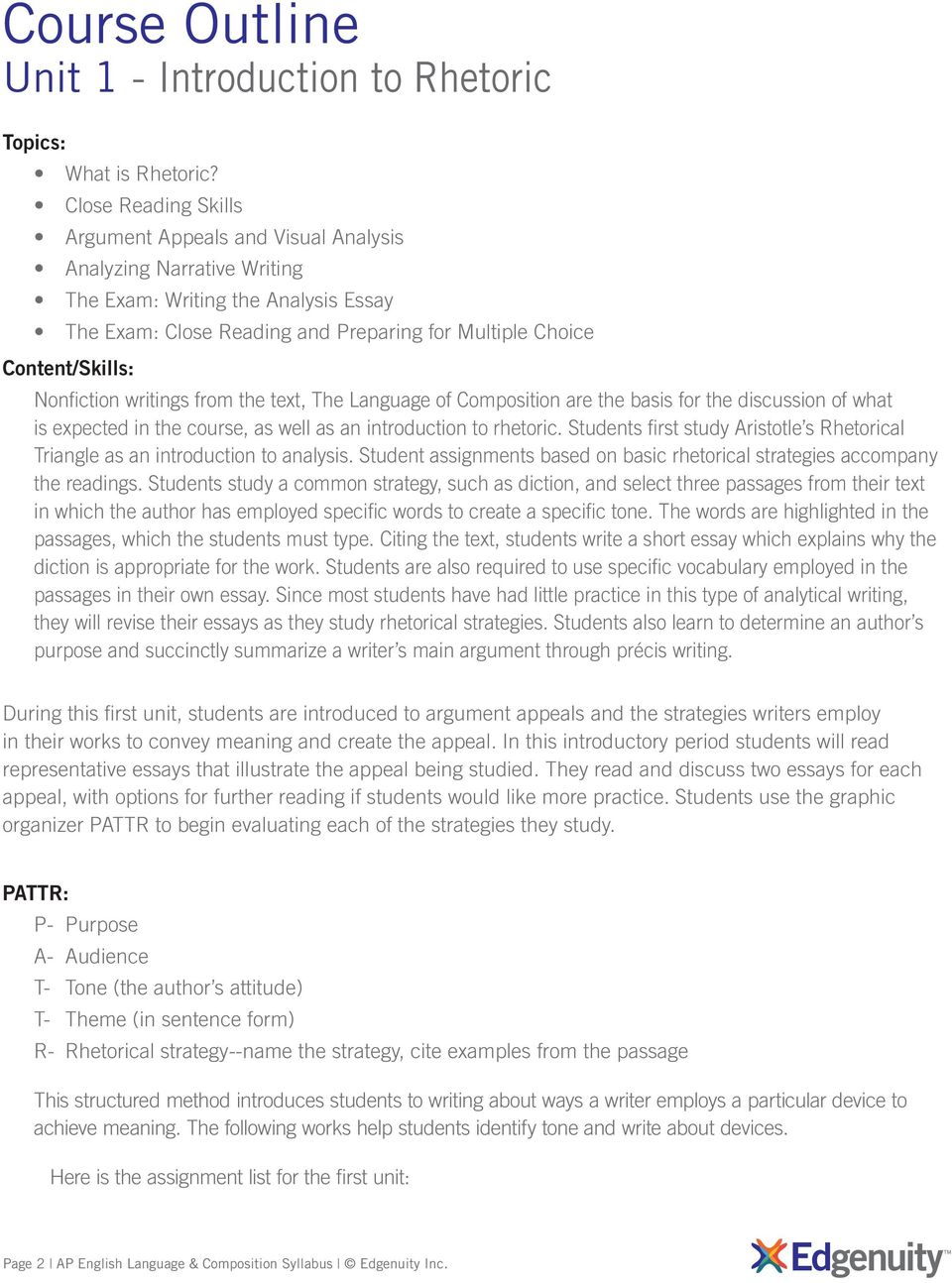
2 Course Outline Unit 1 - Introduction to Rhetoric Topics: What is Rhetoric? Close Reading Skills Argument Appeals and Visual Analysis Analyzing Narrative Writing The Exam: Writing the Analysis Essay The Exam: Close Reading and Preparing for Multiple Choice Content/Skills: Nonfiction writings from the text, The Language of Composition are the basis for the discussion of what is expected in the course, as well as an introduction to rhetoric. Students first study Aristotle s Rhetorical Triangle as an introduction to analysis. Student assignments based on basic rhetorical strategies accompany the readings. Students study a common strategy, such as diction, and select three passages from their text in which the author has employed specific words to create a specific tone. The words are highlighted in the passages, which the students must type. Citing the text, students write a short essay which explains why the diction is appropriate for the work. Students are also required to use specific vocabulary employed in the passages in their own essay. Since most students have had little practice in this type of analytical writing, they will revise their essays as they study rhetorical strategies. Students also learn to determine an author s purpose and succinctly summarize a writer s main argument through précis writing. During this first unit, students are introduced to argument appeals and the strategies writers employ in their works to convey meaning and create the appeal. In this introductory period students will read representative essays that illustrate the appeal being studied. They read and discuss two essays for each appeal, with options for further reading if students would like more practice. Students use the graphic organizer PATTR to begin evaluating each of the strategies they study. PATTR: P- Purpose A- Audience T- Tone (the author s attitude) T- Theme (in sentence form) R- Rhetorical strategy--name the strategy, cite examples from the passage This structured method introduces students to writing about ways a writer employs a particular device to achieve meaning. The following works help students identify tone and write about devices. Here is the assignment list for the first unit: Page 2 AP English Language & Composition Syllabus Edgenuity Inc.
3 Precis: From If Black English Isn t a Language, Then Tell Me, What Is? by James Baldwin ( Paragraph 4) From Civil Disobedience by Henry David Thoreau (The Language of Composition Paragraph 1) Optional: From Nature by Ralph Waldo Emerson (The Language of Composition Paragraph 2) Ethos: Alfred Green s speech to Northern slaves during the Civil War (AP English Language and Composition Exam, 2003, Question 2) Real Patriots Speak Their Minds by Barbara Ehrenreich (Time Optional: A Talk to Teachers by James Baldwin (The Language of Composition) Logos: Transsexual Frogs by Elizabeth Royte (The Language of Composition) Labour by Thomas Carlyle (The Language of Composition) Optional: The Blank Slate by Steven Pinker (The Language of Composition) Pathos: Mother Tongue by Amy Tan (The Language of Composition) Me Talk Pretty One Day by David Sedaris ( Talk%20Pretty%20One%20Day%20by%20Sedaris.pdf) Optional: The Clan of the One-Breasted Women by Terry Tempest Williams (The Language of Composition) Graphics: The Politics of Fear by Barry Blitt ( blittcovers#slide=1) Migrant Mother by Dorthea Lange ( dorothea-lange-migrant-mother.jpg) Optional: Migrant Mother by Dorthea Lange ( com/2009/03/dorothea-lange-migrant-mother.jpg) Rhetorical Analysis: As the rhetorical skills are introduced, students graphically organize their analysis under the acronym PATTR. After discussion, teacher review, and practice writing, students revise one PATTR analytical paragraph per week. That revision is graded, discussed and the information derived will be incorporated into the next PATTR. Novel: Students read Angela s Ashes by Frank McCourt outside class and discuss the author s purpose in writing this personal memoir. The analysis of this larger piece will be discussed in conjunction with shorter narrative pieces, as students analyze the unique qualities of narrative writing. Major Assignments/Assessments Imitation Exercises: After reading several of the essays for Introduction to Rhetoric, students pick a passage with personal appeal, regarding content and style. They will copy the passage and then write a passage of their own which imitates the chosen passage and uses the vocabulary of the writer. Students practice imitation exercises with teacher feedback. Students also study peer samples of analytical writing. Page 3 AP English Language & Composition Syllabus Edgenuity Inc.

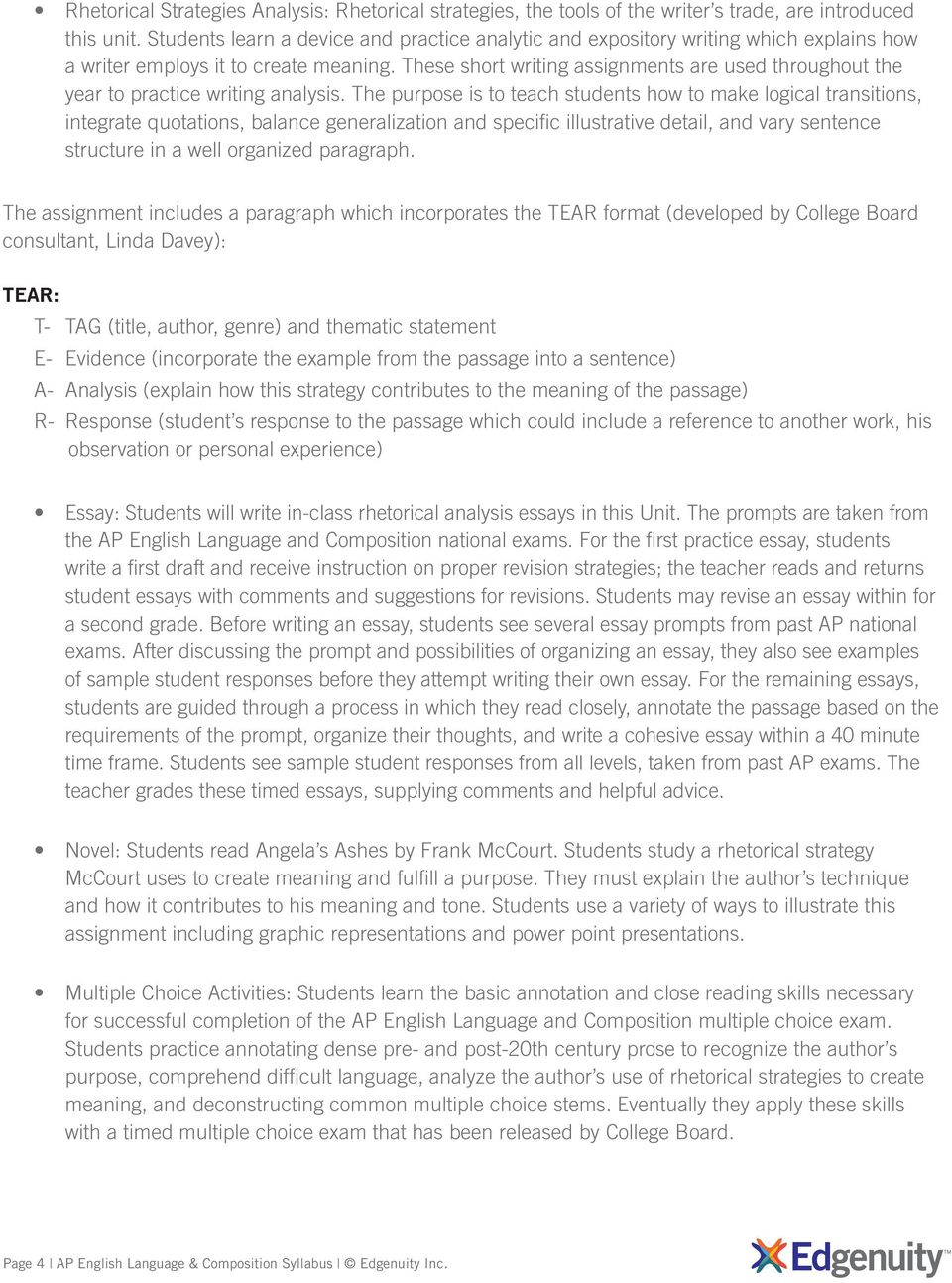
4 Rhetorical Strategies Analysis: Rhetorical strategies, the tools of the writer s trade, are introduced this unit. Students learn a device and practice analytic and expository writing which explains how a writer employs it to create meaning. These short writing assignments are used throughout the year to practice writing analysis. The purpose is to teach students how to make logical transitions, integrate quotations, balance generalization and specific illustrative detail, and vary sentence structure in a well organized paragraph. The assignment includes a paragraph which incorporates the TEAR format (developed by College Board consultant, Linda Davey): TEAR: T- TAG (title, author, genre) and thematic statement E- Evidence (incorporate the example from the passage into a sentence) A- Analysis (explain how this strategy contributes to the meaning of the passage) R- Response (student s response to the passage which could include a reference to another work, his observation or personal experience) Essay: Students will write in-class rhetorical analysis essays in this Unit. The prompts are taken from the AP English Language and Composition national exams. For the first practice essay, students write a first draft and receive instruction on proper revision strategies; the teacher reads and returns student essays with comments and suggestions for revisions. Students may revise an essay within for a second grade. Before writing an essay, students see several essay prompts from past AP national exams. After discussing the prompt and possibilities of organizing an essay, they also see examples of sample student responses before they attempt writing their own essay. For the remaining essays, students are guided through a process in which they read closely, annotate the passage based on the requirements of the prompt, organize their thoughts, and write a cohesive essay within a 40 minute time frame. Students see sample student responses from all levels, taken from past AP exams. The teacher grades these timed essays, supplying comments and helpful advice. Novel: Students read Angela s Ashes by Frank McCourt. Students study a rhetorical strategy McCourt uses to create meaning and fulfill a purpose. They must explain the author s technique and how it contributes to his meaning and tone. Students use a variety of ways to illustrate this assignment including graphic representations and power point presentations. Multiple Choice Activities: Students learn the basic annotation and close reading skills necessary for successful completion of the AP English Language and Composition multiple choice exam. Students practice annotating dense pre- and post-20th century prose to recognize the author s purpose, comprehend difficult language, analyze the author s use of rhetorical strategies to create meaning, and deconstructing common multiple choice stems. Eventually they apply these skills with a timed multiple choice exam that has been released by College Board. Page 4 AP English Language & Composition Syllabus Edgenuity Inc.
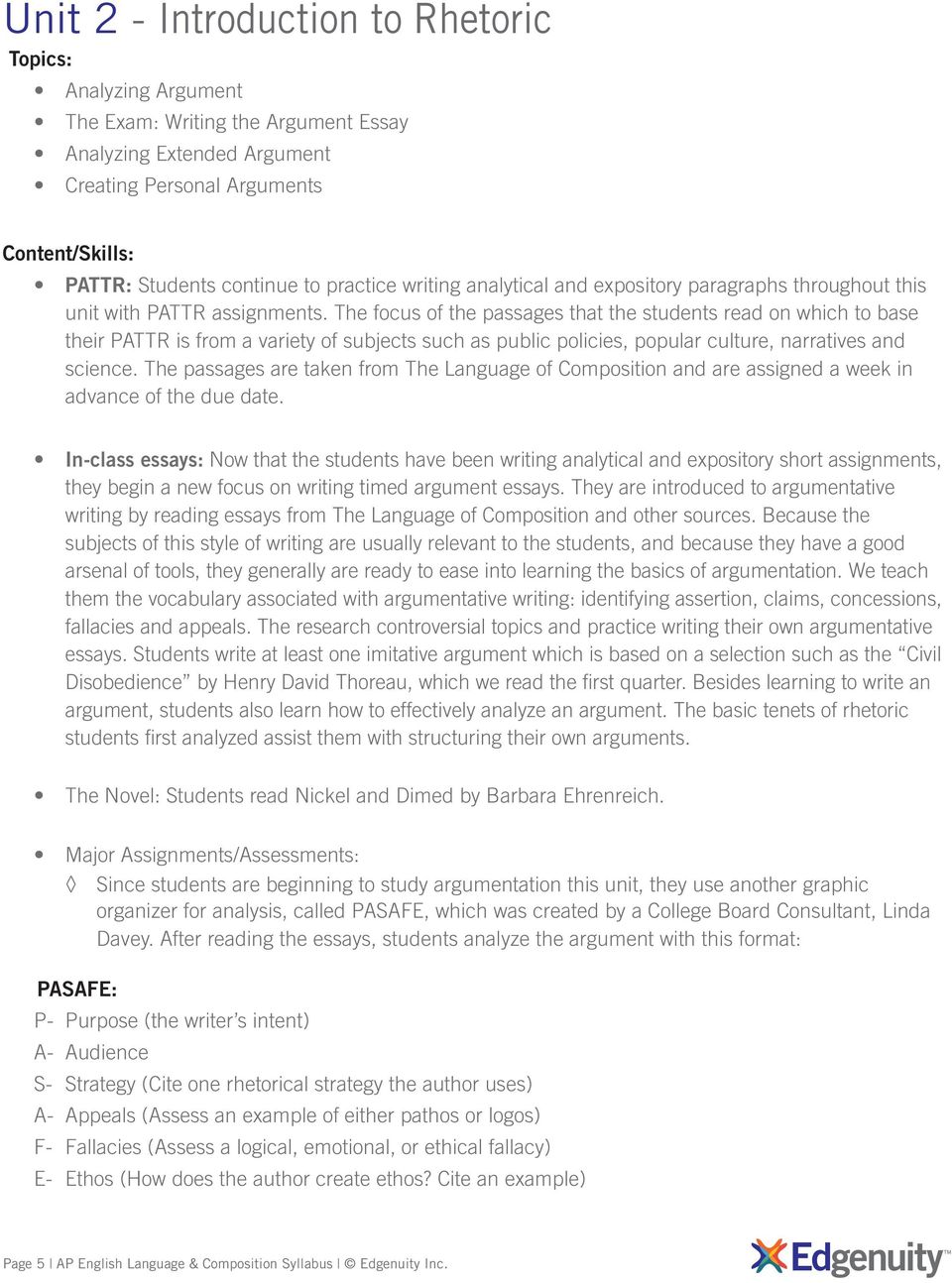
5 Unit 2 - Introduction to Rhetoric Topics: Analyzing Argument The Exam: Writing the Argument Essay Analyzing Extended Argument Creating Personal Arguments Content/Skills: PATTR: Students continue to practice writing analytical and expository paragraphs throughout this unit with PATTR assignments. The focus of the passages that the students read on which to base their PATTR is from a variety of subjects such as public policies, popular culture, narratives and science. The passages are taken from The Language of Composition and are assigned a week in advance of the due date. In-class essays: Now that the students have been writing analytical and expository short assignments, they begin a new focus on writing timed argument essays. They are introduced to argumentative writing by reading essays from The Language of Composition and other sources. Because the subjects of this style of writing are usually relevant to the students, and because they have a good arsenal of tools, they generally are ready to ease into learning the basics of argumentation. We teach them the vocabulary associated with argumentative writing: identifying assertion, claims, concessions, fallacies and appeals. The research controversial topics and practice writing their own argumentative essays. Students write at least one imitative argument which is based on a selection such as the Civil Disobedience by Henry David Thoreau, which we read the first quarter. Besides learning to write an argument, students also learn how to effectively analyze an argument. The basic tenets of rhetoric students first analyzed assist them with structuring their own arguments. The Novel: Students read Nickel and Dimed by Barbara Ehrenreich. Major Assignments/Assessments: Since students are beginning to study argumentation this unit, they use another graphic organizer for analysis, called PASAFE, which was created by a College Board Consultant, Linda Davey. After reading the essays, students analyze the argument with this format: PASAFE: P- Purpose (the writer s intent) A- Audience S- Strategy (Cite one rhetorical strategy the author uses) A- Appeals (Assess an example of either pathos or logos) F- Fallacies (Assess a logical, emotional, or ethical fallacy) E- Ethos (How does the author create ethos? Cite an example) Page 5 AP English Language & Composition Syllabus Edgenuity Inc.
6 The assignment includes a paragraph which incorporates the TARE format: TARE: T- TAG (title, author, genre) and thematic statement A- Appeal noted and explained R- Rhetorical device used in the passage E- Evaluate why the argument was successful or not, including the author s use of fallacies if necessary Typical passages students analyze (taken from text The Language of Composition) are: Education by Ralph Waldo Emerson Best in Class by Margaret Talbot The Atlanta Exposition Address by Booker T. Washington In Praise of a Snail s Pace by Ellen Goodman The Singer Solution to World Poverty by Peter Singer The Case for Torture by Michael Levine I Know Why the Caged Bird Cannot Read by Francine Prose Letter from Birmingham Jail by Martin Luther King Like the PATTR, we use the PASAFE as our method to practice reading closely and analyzing argumentation. Argumentation is the emphasis for the rest of the unit. Essays: Students write four timed essays this unit: responding to a brief quote, and open-ended prompt, a longer passage, and recognition of a current debate. Prompts are taken from past AP English Language exams. We may use the Ruskin prompt to analyze argument and the Milan Kundera prompt to write an argumentative essay. After the students have considered the prompt and sample essays, and after reviewing their previous essays with teacher comments, they may revise two of the essays for a second grade. The semester exam is a mini synthesis essay. The students research political cartoons using an internet site such as Gocomics.com or any reputable newspaper and choose two cartoons by two different artists, but on the same subject. Then they research the topic using at least two reputable sources. Using these three sources, they then synthesize them into a one-page expository essay that concludes with their own opinion. They use the Modern Language Association as the source for citations and a Works Cited page. Novel: Students read Nickel and Dimed. Through a series of lectures, students are asked to consider the source of Ehrenreich s ethos as well as her uses of pathos and logos to create her argument regarding the position of the working poor. Individually, students find other more recent editorials and essays by Ehrenreich to consider changes in this argument or other issues about which she has similarly passionate views. Students create a graphic representation of their findings in some sort of comparison form (T-Chart, etc.). In addition, students find editorials or opinionated essays that oppose Ehrenreich s view and find strengths and fallacies in those arguments and present their findings in journal form. Page 6 AP English Language & Composition Syllabus Edgenuity Inc.

7 Multiple Choice: Students continue using passages from released exams to practice the multiple choice skills. Students keep a journal of the vocabulary used in the exams. Knowing the format and the language used in multiple choice exams is a skill that will help them not only on the AP, but on the SAT and the ACT. Personal Argument: Students compose a narrative essay, which is based on childhood photographs. Students choose a personal photograph, or series of related photographs, and consider what argument they would like to make about themselves in reflecting on the photograph(s). They work through the process of creating a descriptive narrative to implicitly communicate a specific argument about themselves. Unit 3 - Synthesis Topics: Analyzing Synthesis The Exam: Writing the Synthesis Essay Writing a Research Paper Content/Skills: Researched Argumentative Writing: With the inclusion of the new synthesis essay on the national exam, students continue to practice research papers this quarter. They begin by analyzing synthesized arguments as a basis from which to write their own. Next, they create another synthesis essay like the one they wrote the second quarter, based on outside research. The second synthesis essay is from a released AP English Language and Composition Exam. Students consider this prompt via teacher lecture and read several sample student responses, noting especially how explicit and implicit citations are used. They practice writing the introduction and citing the three sources into paragraphs. After the teacher provides feedback on these practice exercises, students use the prompt and their notes to write the essay on their own. These essays are reviewed by their teacher who makes suggestions, and then students revise. The teacher then reads the essays and makes comments, which will be incorporated into the next synthesis essay. Argumentative, Expository and Analytical Practice: Students continue practicing reading closely and writing about nonfiction and analyzing the passages using the PATTR and PASAFE formats. These assignments are done as homework, and are followed up by teacher discussion. Many of the writings we read are examples of political and science and nature writings taken from our text, The Language of Composition: A Modest Proposal by Jonathan Swift Shooting an Elephant by George Orwell The Bird and the Machine by Loren Eiseley Silent Spring by Rachel Carson Message to President Franklin Pierce by Chief Seattle Against Nature by Joyce Carol Oates On Seeing England for the First Time by Jamaica Kincaid On the Rainy River by Tim O Brien Page 7 AP English Language & Composition Syllabus Edgenuity Inc.

8 Essays: We add the synthesis essay to timed analytical and argumentative essays. Students will write three timed synthesis essays. After discussion and peer review, students receive the comments of the teacher. They may revise two to turn in for a second grade. The Novel: Students read Into the Wild by Jon Krakauer during this unit. Major Assignments/Assessments: Essays: Students will study typical synthesis essay prompts and practice creating thesis statements, analyzing sources, implicitly and explicitly synthesizing source material as part of their larger argument, and appropriate use of outside examples and experience within the timed essays. Multiple Choice: Students continue using passages from released exams to practice the multiple choice skills. Mini Research Paper: Students continue their understanding of how to write a synthesis essay by writing a second mini research paper. Students research political cartoons or another piece of visual rhetoric, choose two on one subject and then research an article on the same subject. Using these documents, they synthesize them, with citations, into a cohesive one-page essay which explains each, and concludes with the student s own perspective on the subject. Students are required to use the MLA style of documentation and to write their Works Cited page. Graphics, including political cartoons, provide the basis for the subject and Internet research provides the text. Unit 3 - Synthesis Topics: Essays Multiple Choice Narrative Synthesis Content/Skills: Review: essay organization and timed essay strategies for annotation, précis, analysis, argument, source assessment, and synthesis writing. Review: multiple choice strategies within time constraints. Narrative Synthesis: Students revisit their photo memoirs and incorporate sources to establish a more sophisticated and researched argument. Major Assignments/Assessments: Review: This final unit is a review of the skills students have learned throughout the year. However, students continue to practice writing and reading nonfiction which focuses on autobiography, biography, diary and history. The PASAFE and PATTR passages (all from The Language of Composition) include: Page 8 AP English Language & Composition Syllabus Edgenuity Inc.

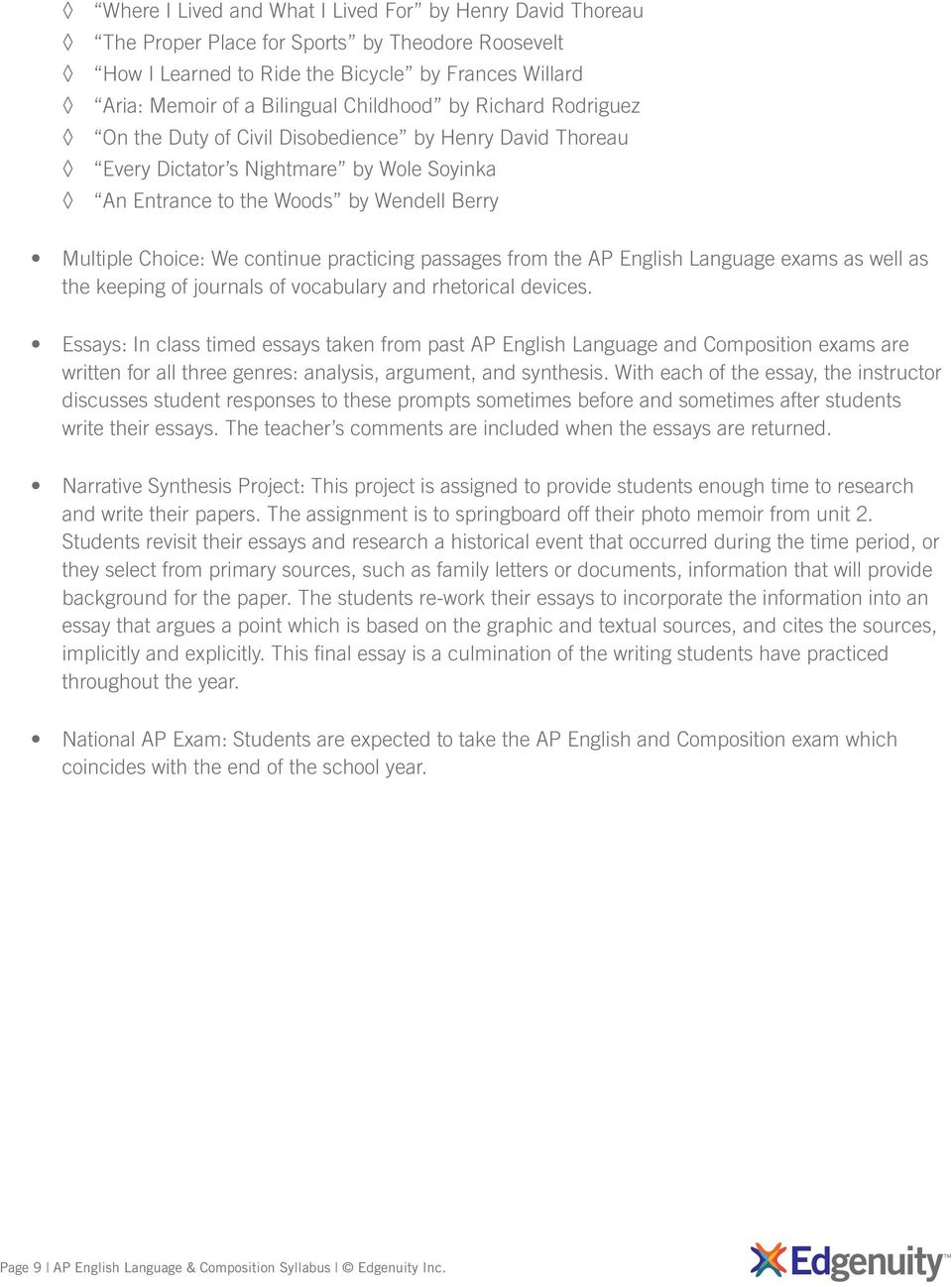
9 Where I Lived and What I Lived For by Henry David Thoreau The Proper Place for Sports by Theodore Roosevelt How I Learned to Ride the Bicycle by Frances Willard Aria: Memoir of a Bilingual Childhood by Richard Rodriguez On the Duty of Civil Disobedience by Henry David Thoreau Every Dictator s Nightmare by Wole Soyinka An Entrance to the Woods by Wendell Berry Multiple Choice: We continue practicing passages from the AP English Language exams as well as the keeping of journals of vocabulary and rhetorical devices. Essays: In class timed essays taken from past AP English Language and Composition exams are written for all three genres: analysis, argument, and synthesis. With each of the essay, the instructor discusses student responses to these prompts sometimes before and sometimes after students write their essays. The teacher s comments are included when the essays are returned. Narrative Synthesis Project: This project is assigned to provide students enough time to research and write their papers. The assignment is to springboard off their photo memoir from unit 2. Students revisit their essays and research a historical event that occurred during the time period, or they select from primary sources, such as family letters or documents, information that will provide background for the paper. The students re-work their essays to incorporate the information into an essay that argues a point which is based on the graphic and textual sources, and cites the sources, implicitly and explicitly. This final essay is a culmination of the writing students have practiced throughout the year. National AP Exam: Students are expected to take the AP English and Composition exam which coincides with the end of the school year. Page 9 AP English Language & Composition Syllabus Edgenuity Inc.
Student Performance Q&A:
 Student Performance Q&A: 2011 AP English Language and Composition Free-Response Questions The following comments on the 2011 free-response questions for AP English Language and Composition were written
AP English: Language and Composition
 Course Objectives: Syllabus: AP English 11: Language and Composition The AP Language and Composition course is a college-level rhetoric course designed to prepare students for analytical, argumentative,
Language Arts Literacy Areas of Focus: Grade 5
 Language Arts Literacy : Grade 5 Mission: Learning to read, write, speak, listen, and view critically, strategically and creatively enables students to discover personal and shared meaning throughout their
AP English Language and Composition Syllabus
 AP English Language and Composition Syllabus Instructors: Mrs. M. McGue [email protected] (847) 731-9380 Mr. J. Sevener [email protected] (847) 731-9388 Mrs. H. Engstrom [email protected] (847) 731-9376
Language Arts Literacy Areas of Focus: Grade 6
 Language Arts Literacy : Grade 6 Mission: Learning to read, write, speak, listen, and view critically, strategically and creatively enables students to discover personal and shared meaning throughout their
Virginia English Standards of Learning Grade 8
 A Correlation of Prentice Hall Writing Coach 2012 To the Virginia English Standards of Learning A Correlation of, 2012, Introduction This document demonstrates how, 2012, meets the objectives of the. Correlation
Framingham State University ENGL 110 Expository Writing Summer 2016
 Framingham State University ENGL 110 Expository Writing Summer 2016 Disclaimer: This syllabus is intended to give the student guidance in what may be covered in the course and will be followed as closely
Elements of Writing Instruction I
 Elements of Writing Instruction I Purpose of this session: 1. To demystify the goals for any writing program by clearly defining goals for children at all levels. 2. To encourage parents that they can
Expository Reading and Writing By Grade Level
 Expository and Writing By Grade Level Kindergarten TEKS identify the topic of an informational text heard identify the topic and details in expository text heard or read, referring to the words and/or
ENGL-101 ENGLISH COMPOSITION I
 Coffeyville Community College ENGL-101 COURSE SYLLABUS FOR ENGLISH COMPOSITION I Ryan Butcher Instructor COURSE NUMBER: ENGL-101 COURSE TITLE: English Composition I CREDIT HOURS: 3 INSTRUCTOR: Mr. Ryan
English 2 - Journalism Mitch Martin: [email protected]
 Mission English 2 - Journalism Mitch Martin: [email protected] To educate students to be self-directed learners, collaborative workers, complex thinkers, quality producers, and community contributors
AP ENGLISH LANGUAGE AND COMPOSITION 2013 SCORING GUIDELINES
 AP ENGLISH LANGUAGE AND COMPOSITION 2013 SCORING GUIDELINES Question 2 The score should reflect the essay s quality as a whole. Remember that students had only 40 minutes to read and write; the paper,
AP English Language Research Project Assignment Created by Sandy Jameson, Nazareth Area High School, 2013
 Assignment Created by Sandy Jameson, Nazareth Area High School, 2013 You will be creating an AP Exam style Synthesis Question. The Synthesis Question gives you several sources, and asks you to combine
Grade 4 Writing Curriculum Map
 Curriculum Map BOE Approval November 2013 CURRICULUM MAP WRITING GRADE 4 SEPTEMBER OCTOBER NOVEMBER DECEMBER JANUARY Creating a Buzz About : It s All About Me! Tell Me A Story Realistic Fiction Tell Me
Appendix: W. Item: Curriculum Course Guide - New High School Course/Honors Creative Writing Department: Instructional Services
 Appendix: W Item: Curriculum Course Guide - New High School Course/Honors Creative Writing Department: Instructional Services Background/Historical Context: Creative Writing has been offered in our school
Master Syllabus. Learning Outcomes. ENL 260: Intermediate Composition
 Master Syllabus ENL 260: Intermediate Composition University Studies Cluster Requirement 1C: Intermediate Writing. This University Studies Master Syllabus serves as a guide and standard for all instructors
Montgomery County Public Schools Advanced English Semester A Exam Review
 Montgomery County Public Schools Advanced English Semester A Exam Review Four Readings including a narrative a poem a non-fiction piece a visual FORMAT Thirty Selected Response Items (SRs) Students will
AP Language and Composition Argument
 AP Language and Composition Argument Horace Adversity 1 Overview The AP Language & Composition exam s argument essay is a free response question that asks students to respond to a moral or ethical debate
Students will know Vocabulary: claims evidence reasons relevant accurate phrases/clauses credible source (inc. oral) formal style clarify
 Sixth Grade Writing : Text Types and Purposes Essential Questions: 1. How do writers select the genre of writing for a specific purpose and audience? 2. How do essential components of the writing process
SANTA BARBARA CITY COLLEGE ASSOCIATE DEGREE CREDIT COURSE OUTLINE
 SANTA BARBARA CITY COLLEGE ASSOCIATE DEGREE CREDIT COURSE OUTLINE Department: English Subject Area and Course Number: English 110 Course Title: Composition and Reading Discipline: English Units: 3 Repeatability:
Units of Study 9th Grade
 Units of Study 9th Grade First Semester Theme: The Journey Second Semester Theme: Choices The Big Ideas in English Language Arts that drive instruction: Independent thinkers construct meaning through language.
Explain Yourself: An Expository Writing Unit for High School
 Trinity University Digital Commons @ Trinity Understanding by Design: Complete Collection Understanding by Design 2013 Explain Yourself: An Expository Writing Unit for High School Adele Barnett Trinity
Writing Emphasis by Grade Level Based on State Standards. K 5.1 Draw pictures and write words for specific reasons.
 Writing Emphasis by Grade Level Based on State Standards Grade K K 5.1 Draw pictures and write words for specific reasons. Grade 1 1.5.1 Write brief narratives describing an experience. Grade 2 2.5.2 Write
Due: Draft due: Wednesday, January 16 Revision due: Monday, January 28
 Research Proposal Assignment Assignment: Overview This assignment asks you to produce a formal proposal of at least 1200 words describing the research project you intend to pursue for the rest of the quarter.
ENGL 1101NN: College Composition I Fall 2013 M 230-345pm UH 234 W 230-345pm UH 239
 ENGL 1101NN: College Composition I Fall 2013 M 230-345pm UH 234 W 230-345pm UH 239 Professor: Dr. Cheryl R. Hopson Office: AH E238 (Allgood E238) Office Hours: M/W 10am-noon, and other times by appointment.
Columbus State Community College English Department
 Columbus State Community College English Department Course and Number: ENGL 1100 Composition I CREDITS: 3 CLASS HOURS PER WEEK: 3 INSTRUCTOR: OFFICE PHONE: EMAIL: DEPARTMENT PHONE: 614/287-2531 or 614/287-2201
CENTRAL TEXAS COLLEGE: English 1301
 Instructor: Ms. Anita Dugat-Greene E-mail: [email protected] CENTRAL TEXAS COLLEGE: English 1301 Website: http://www.anitagale.com On the front page of my web site, click on the CTC Classes button at
Course Evaluation Methods
 1 PVAMU Developmental English Course Syllabus Integrated Reading/Writing 0133 Department of Academic Enhancement College of University College Instructor Name: Dr. Ayodeji Daramola Office Location: Delco
Develop Research Skills Emphasize how research informs almost all writing by crafting assignments that require students to draw on traditional and
 College Writing Program: What Students Should Learn The following are the core skills and ideas students should gain from the College Writing course sequence: Concepts of Writing Students should understand
Rhetorical Analysis Essay
 Rhetorical Analysis Essay PWR 1 The Rhetoric of Gaming Fall 2015 Assignment Description: For this assignment, you ll select a text related to gaming culture and write an essay of at least 1500 words in
Comparing Primary and Secondary Sources Lesson Plan
 Comparing Primary and Secondary Sources Lesson Plan Description Students learn to differentiate between primary and secondary sources. Working in groups, students will evaluate an example of both source
Language Arts Division
 1 Language Arts Division English 103, Composition and Critical Thinking, Spring 2016 Online Section #8193 Transfers to UC/CSU, 3 units 11 April 6 June 2016, 6 hrs 30 mins per week Prerequisites: Completion
English 114: Friendship
 1 Dr. Briallen Hopper [email protected] Office: 35 Broadway, #207M Office Hours: TBD English 114: Friendship Wherever you are it is your own friends who make your world. William James From ancient
Assoc Degree Applic. - Transfer to UC/CSU/Private
 Solano Community College - Prof. Steven Federle English 2, Spring 2010, Section 10283 Tuesday, 6:15 9:05 P.M., Room 743 Computer Lab Critical Thinking & Writing about Literature Class Communications: Voice
Academic Standards for Reading, Writing, Speaking, and Listening June 1, 2009 FINAL Elementary Standards Grades 3-8
 Academic Standards for Reading, Writing, Speaking, and Listening June 1, 2009 FINAL Elementary Standards Grades 3-8 Pennsylvania Department of Education These standards are offered as a voluntary resource
EXAMS Leaving Certificate English
 EXAMS Leaving Certificate English Theme Language focus Learning focus Learning Support Language Support Exams: English Key vocabulary for exam questions, type and structure of questions. Understanding
WRITING A CRITICAL ARTICLE REVIEW
 WRITING A CRITICAL ARTICLE REVIEW A critical article review briefly describes the content of an article and, more importantly, provides an in-depth analysis and evaluation of its ideas and purpose. The
MATRIX OF STANDARDS AND COMPETENCIES FOR ENGLISH IN GRADES 7 10
 PROCESSES CONVENTIONS MATRIX OF STANDARDS AND COMPETENCIES FOR ENGLISH IN GRADES 7 10 Determine how stress, Listen for important Determine intonation, phrasing, points signaled by appropriateness of pacing,
The Business Writer s Handbook, eleventh edition, Alred et al. A Peacock in the Land of Penguins, Hateley, BJ and Warren Schmidt
 San José State University Department of English and Comparative Literature Spring 2016 English 100WB, Written Communication: Business Section 7 W 9:00 11:45 BBC 120 Instructor: Leanne Lindelof Office:
PENNSYLVANIA COMMON CORE STANDARDS English Language Arts Grades 9-12
 1.2 Reading Informational Text Students read, understand, and respond to informational text with emphasis on comprehension, making connections among ideas and between texts with focus on textual evidence.
English Courses & Descriptions
 English Courses & Descriptions ENGL 101. Elements of Composition (3; F, S) Three hours per week. An emphasis on the principles of writing and an introduction to the reading of college-level prose. ENGL
Alignment of the National Standards for Learning Languages with the Common Core State Standards
 Alignment of the National with the Common Core State Standards Performance Expectations The Common Core State Standards for English Language Arts (ELA) and Literacy in History/Social Studies, Science,
Grade: 9 (1) Students will build a framework for high school level academic writing by understanding the what of language, including:
 Introduction: The following document is a draft of standards-designed, comprehensive Pacing Guide for high school English Grade 9. This document will evolve as feedback is accumulated. The Pacing Guide
Heroes and Villains. Date Time Concept Activity. Establish rules and administrative details. Build a cohesive community and safe academic environment
 Sample Syllabus - Day version Journal: What makes a hero? Week One: Monday Day 1 Establish rules and administrative details Review and sign the Honor Code and Acceptable Computer Use Policy Build a cohesive
Writing and Presenting a Persuasive Paper Grade Nine
 Ohio Standards Connection Writing Applications Benchmark E Write a persuasive piece that states a clear position, includes relevant information and offers compelling in the form of facts and details. Indicator
Focus: Reading Unit of Study: Fiction/Expository/Persuasive/Research/Media Literacy
 4 th Grade Reading and Writing TEKS 4th Nine Weeks Focus: Reading Unit of Study: Fiction/Expository/Persuasive/Research/Media Literacy Figure 19: Reading/Comprehension Skills. Students use a flexible range
Creative Writing Mrs. Maryjo Williams Room A213
 Creative Writing Mrs. Maryjo Williams Room A213 One of the most valuable things we can do to heal one another is listen to each other s stories. ----- Rebecca Falls Course Description This course introduces
French Language and Culture. Curriculum Framework 2011 2012
 AP French Language and Culture Curriculum Framework 2011 2012 Contents (click on a topic to jump to that page) Introduction... 3 Structure of the Curriculum Framework...4 Learning Objectives and Achievement
AP English Literature and Composition Syllabus 2007-2008
 AP English Literature and Composition Syllabus 2007-2008 General Course Information Grade level offered: 12 1.0 Credits (.5 per semester) Prerequisites: Accelerated 11 is highly recommended Course Description
English 110. Course Objectives/Competencies
 English 110 Course Objectives/Competencies The following competencies reflect the contribution of College Composition I to the General Education Objectives and thus are assessed as part of the course as
Montgomery County Public Schools English 9B Exam Review
 Montgomery County Public Schools English 9B Exam Review June 2013 FORMAT Five Readings an excerpt from a Shakespeare play (not Romeo and Juliet) two poems a narrative a nonfiction article related to the
American Literature, Quarter 1, Unit 2 of 3 The Puritan Tradition and The Crucible. Overview. (1 day = 50-55 minutes)
 American Literature, Quarter 1, Unit 2 of 3 The Puritan Tradition and The Crucible Overall days: 16 (1 day = 50-55 minutes) Overview Purpose This unit will focus on the beliefs of early American Puritans
Reading and Viewing Achievement Standards
 Reading and Viewing Achievement Standards The following outlines text study over the semester in English Language Arts (at least 30% should be Canadian content and include representation from New Brunswick).
Paragraphs Narrative, Descriptive, Expository, and Persuasive. If written as a story, the essay should include all the parts of a story.
 Paragraphs Narrative, Descriptive, Expository, and Persuasive Narrative When writing a narrative essay, one might think of it as telling a story. These essays are often anecdotal, experiential, and personal
They Say, I Say: The Moves That Matter in Academic Writing by Gerald Graff and Cathy Birkenstein
 English Composition 102 Tuesdays 6:00 8:40 ATG 207 Instructor: Erin McCourt [email protected] Office Hours: Tuesday ATG 476 4-6 Technology, Literature, and Literacy In this class, we will continue
New Jersey Core Curriculum Content Standards: For Language Arts Literacy
 For STANDARD 3.1 (READING) ALL STUDENTS WILL UNDERSTAND AND APPLY THE KNOWLEDGE OF SOUNDS, LETTERS, AND WORDS IN WRITTEN ENGLISH TO BECOME INDEPENDENT AND FLUENT READERS AND WILL READ A VARIETY OF MATERIALS
HIGH SCHOOL MASS MEDIA AND MEDIA LITERACY STANDARDS
 Guidelines for Syllabus Development of Mass Media Course (1084) DRAFT 1 of 7 HIGH SCHOOL MASS MEDIA AND MEDIA LITERACY STANDARDS Students study the importance of mass media as pervasive in modern life
Essay 2: A Service Memoir
 Essay 2: A Service Memoir Context At Edmonds Community College, our Center for Service Learning gives students the opportunity to serve the community and learn while they do so. Service at our school means
Running head: AMERICAN REVOLUTION 1
 Running head: AMERICAN REVOLUTION 1 American Revolution Persuasive Essay Student A. Sample Grand Canyon University: HIS 345 12/12/2012 AMERICAN REVOLUTION 2 American Revolution Persuasive Essay The American
SOUTH DAKOTA Reading and Communication Arts Standards Grade 9 Literature: The Reader s Choice Course 4 2002
 SOUTH DAKOTA Reading and Communication Arts Standards Literature: The Reader s Choice Course 4 2002 OBJECTIVES Reading Goals and Indicators Ninth Grade Reading Goal 1: Students are able to read at increasing
Grade Genre Skills Lessons Mentor Texts and Resources 6 Grammar To Be Covered
 Grade Genre Skills Lessons Mentor Texts and Resources 6 Grammar To Be Covered 6 Personal Narrative Parts of speech (noun, adj, verb, adv) Complete sentence (subj. and verb) Capitalization Tense (identify)
STAAR Sample Short Answer Questions
 STAAR Sample Short Answer Questions ENGLISH I, II, and III Single Selection: Literary In this excerpt from Anne of Green Gables, do you think the stage directions enhance your understanding of the scene?
PTE Academic Recommended Resources
 PTE Academic Recommended Resources Language Leader Intermediate Pearson Longman, 2008 April 2012 V2 Pearson Education Ltd 2012. No part of this publication may be reproduced without the prior permission
ESL I English as a Second Language I Curriculum
 ESL I English as a Second Language I Curriculum ESL Curriculum alignment with NJ English Language Proficiency Standards (Incorporating NJCCCS and WIDA Standards) Revised November, 2011 The ESL program
Writing learning objectives
 Writing learning objectives This material was excerpted and adapted from the following web site: http://www.utexas.edu/academic/diia/assessment/iar/students/plan/objectives/ What is a learning objective?
AK + ASD Writing Grade Level Expectations For Grades 3-6
 Revised ASD June 2004 AK + ASD Writing For Grades 3-6 The first row of each table includes a heading that summarizes the performance standards, and the second row includes the complete performance standards.
More on Objective versus Subjective
 Introduction o Welcome o Credits o Search Essays o Essays o "Mother Tongue" by Amy Tan o "The Cold Hard Facts of Freezing to Death" by Peter Stark Author's Voice! Skill Building Focus Activity o Essay
English 101, WB12: Academic Writing University of Maryland, College Park Summer Session I 2015 Course Policies
 English 101, WB12: Academic Writing University of Maryland, College Park Summer Session I 2015 Course Policies Instructor: Douglas Kern E-mail: [email protected] Office Hour: Online (by appt) NOTE This
Grade 5: Module 3A: Unit 2: Lesson 13 Developing an Opinion Based on the Textual Evidence:
 Grade 5: Module 3A: Unit 2: Lesson 13 Developing an Opinion Based on the Textual Evidence: Jackie Robinson s Role in the Civil Rights Movement This work is licensed under a Creative Commons Attribution-NonCommercial-ShareAlike
Delta College English 112 Course Syllabus
 Burhans 1 Delta College English 112 Course Syllabus Second-Year Composition Winter 2016 Section ENG 112 WN 119 Tuesdays & Thursdays 8:30 9:55 AM Classroom: DCMC 103 Instructor: Clint Burhans Office Hours:
TEKS: 8.14A, 8.14B, 8.14C, 8.14D, 8.14E, 8.18A, 8.18B, 8.18C
 Course: 8 th Grade Grading Period: 3 rd Six Weeks Model Lesson for Middle School ELAR Unit: PerspectivesPersuasion and Information in Reading and Writing Arc: PersuasionWriting 20102011 Lesson Title: Persuasive
The Art of Rhetoric. Rhetorical Appeals. Logos The intellectual power of one s speech or writing. The Five Rhetorical Canons
 The Art of Rhetoric Rhetoric, whether spoken or written, is the art of using language effectively to inform and persuade. It includes the use of three types of appeal to the audience and can be divided
Senior Year 2016-2017 COMMUNICATION ARTS. Communication Arts ENGLISH COURSE OFFERINGS. Adlai E. Stevenson High School. for SENIORS
 Adlai E. Stevenson High School COMMUNICATION ARTS Communication Arts Senior Year Welcome to Senior Year! Having completed the three-year scope and sequence for skill building and refinement in the study
Read Kansas! A History of American Indian Education. High School H-4. Overview. Standards
 A History of American Indian Education Read Kansas! High School H-4 Overview This lesson explores the history of racial and ethnic relations through the lens of American Indian education and the example
NEW YORK STATE TEACHER CERTIFICATION EXAMINATIONS
 NEW YORK STATE TEACHER CERTIFICATION EXAMINATIONS TEST DESIGN AND FRAMEWORK DRAFT June 2012 This document is a working draft. The information in this document is subject to change, and any changes will
Hagerstown Community College OFFICIAL COURSE SYLLABUS DOCUMENT
 Hagerstown Community College OFFICIAL COURSE SYLLABUS DOCUMENT COURSE: ENG 112 Technical Writing 3 credits INSTRUCTOR: Drumgoole SEMESTER/YEAR: CONTACT INFORMATION: COURSE DESCRIPTION: This course in the
English 12.2. Unit 12.2: Joining the Conversation. Enduring Understandings. Essential Questions. Common Tasks
 English 12.2 Unit 12.2: Joining the Conversation Enduring Understandings Effective reading, writing, speaking, listening, and viewing are essential for literate individuals. Effective communicators consider
Recounts retell past events. They aim to inform or entertain the reader.
 What is recount Recounts retell past events. They aim to inform or entertain the reader. English Features of recount writing: Recounts normally start by setting the scene, e.g., what?, where?, when?, how?
2014 Intermediate Literacy Assessment. Teacher Information Guide
 2014 Intermediate Literacy Assessment Teacher Information Guide Table of Contents Introduction......................................................... What is the purpose of the assessment? When will
Course Syllabus: English 1301 Section 2P and Section 6P Dual Credit
 Course Syllabus: English 1301 Section 2P and Section 6P Dual Credit Instructor: Janis May NOTE: This syllabus is subject to change during the semester. Please check this syllabus on a regular basis for
Writing a Research Paper Writing a Rough Draft. Lesson Summary
 Writing a Research Paper Writing a Rough Draft QuickView Topic: Projects Writing Skills Grade Levels: 9 12 Lexile Range: 1070 1140 Focus Question: From the information you gathered from all your different
Academic Standards for Reading, Writing, Speaking, and Listening
 Academic Standards for Reading, Writing, Speaking, and Listening Pre-K - 3 REVISED May 18, 2010 Pennsylvania Department of Education These standards are offered as a voluntary resource for Pennsylvania
How to Plan and Guide In Class Peer Review Sessions
 How to Plan and Guide In Class Peer Review Sessions Incorporating peer review into your course can help your students become better writers, readers, and collaborators. However, peer review must be planned
English 103: Composition and Critical Thinking Fall 2013 Section 1019 (Tuesday/Thursday, 9:35 11 a.m. in GC 160)
 English 103: Composition and Critical Thinking Fall 2013 Section 1019 (Tuesday/Thursday, 9:35 11 a.m. in GC 160) Dr. Kimberly Manner Email: [email protected] Office Phone: (310) 287-4551 Student Drop-In
AP ENGLISH LANGUAGE AND COMPOSITION 2007 SCORING GUIDELINES (Form B)
 AP ENGLISH LANGUAGE AND COMPOSITION 2007 SCORING GUIDELINES (Form B) Question 1 The score should reflect a judgment of the essay s quality as a whole. Remember that students had only 15 minutes to read
The Language of Literature Model Unit
 Grade: 11 th The Language of Literature Model Unit Topic: Nonfiction Unit on American Puritanism Prepared by: Charlene Sadler, formerly of Sam Houston High School Unit Focus/: In this unit, students will
The Writing Program The University of Texas at San Antonio. WRC 1013.013 and WRC 1013.014 Freshman Composition I
 1013.013 and 1013.014 Treviño 1 The Writing Program The University of Texas at San Antonio WRC 1013.013 and WRC 1013.014 Freshman Composition I Instructor: Jason B. Treviño Email: [email protected]
UNM TAOS-Syllabus. Textbook:
 UNM TAOS-Syllabus 1 Course Name: English 101 Composition I: Expository Writing Semester: Spring 2012 Day/Time: Tuesdays and Thursdays, Noon 2:30pm Location: Klauer Campus, TCTECH 102 and Online Instructor:
Civil Disobedience During the Civil Rights Movement Grade 10
 Ohio Standards Connection: Citizenship Rights and Responsibilities Benchmark A Analyze ways people achieve governmental change, including political action, social protest and revolution. Indicator 2 Explain
McDougal Littell Bridges to Literature Level III. Alaska Reading and Writing Performance Standards Grade 8
 McDougal Littell Bridges to Literature Level III correlated to the Alaska Reading and Writing Performance Standards Grade 8 Reading Performance Standards (Grade Level Expectations) Grade 8 R3.1 Apply knowledge
No Evidence. 8.9 f X
 Section I. Correlation with the 2010 English Standards of Learning and Curriculum Framework- Grade 8 Writing Summary Adequate Rating Limited No Evidence Section I. Correlation with the 2010 English Standards
U. S. Constitution [8th grade]
![U. S. Constitution [8th grade]](/thumbs/40/20655561.jpg "U. S. Constitution [8th grade]") Trinity University Digital Commons @ Trinity Understanding by Design: Complete Collection Understanding by Design 6-15-2006 U. S. Constitution [8th grade] Ben Altman Trinity University Follow this and
Trinity University Digital Commons @ Trinity Understanding by Design: Complete Collection Understanding by Design 6-15-2006 U. S. Constitution [8th grade] Ben Altman Trinity University Follow this and
This template presents a process for helping your students read,
 Assignment Template Aligned to California s Common Core State Standards for English Language Arts and Literacy This template presents a process for helping your students read, comprehend, and respond to
PTE Academic Recommended Resources
 PTE Academic Recommended Resources Language Leader Pre-Intermediate Pearson Longman, 2008 April 2012 V2 Pearson Education Ltd 2012. No part of this publication may be reproduced without the prior permission
For All Psychology Courses STUDENT PACKET FOR PORTFOLIO DEVELOPMENT. Dr. Rosalyn M. King, Professor
 For All Psychology Courses STUDENT PACKET FOR PORTFOLIO DEVELOPMENT Dr. Rosalyn M. King, Professor [You can download this packet from www.psyking.net, under Psy201-202, Lessons and Handouts, Downloadable
Purposes and Processes of Reading Comprehension
 2 PIRLS Reading Purposes and Processes of Reading Comprehension PIRLS examines the processes of comprehension and the purposes for reading, however, they do not function in isolation from each other or