
International Advocacy Capacity Tool for organizational assessment
|
|
|
- Horatio Warner
- 9 years ago
- Views:
Transcription
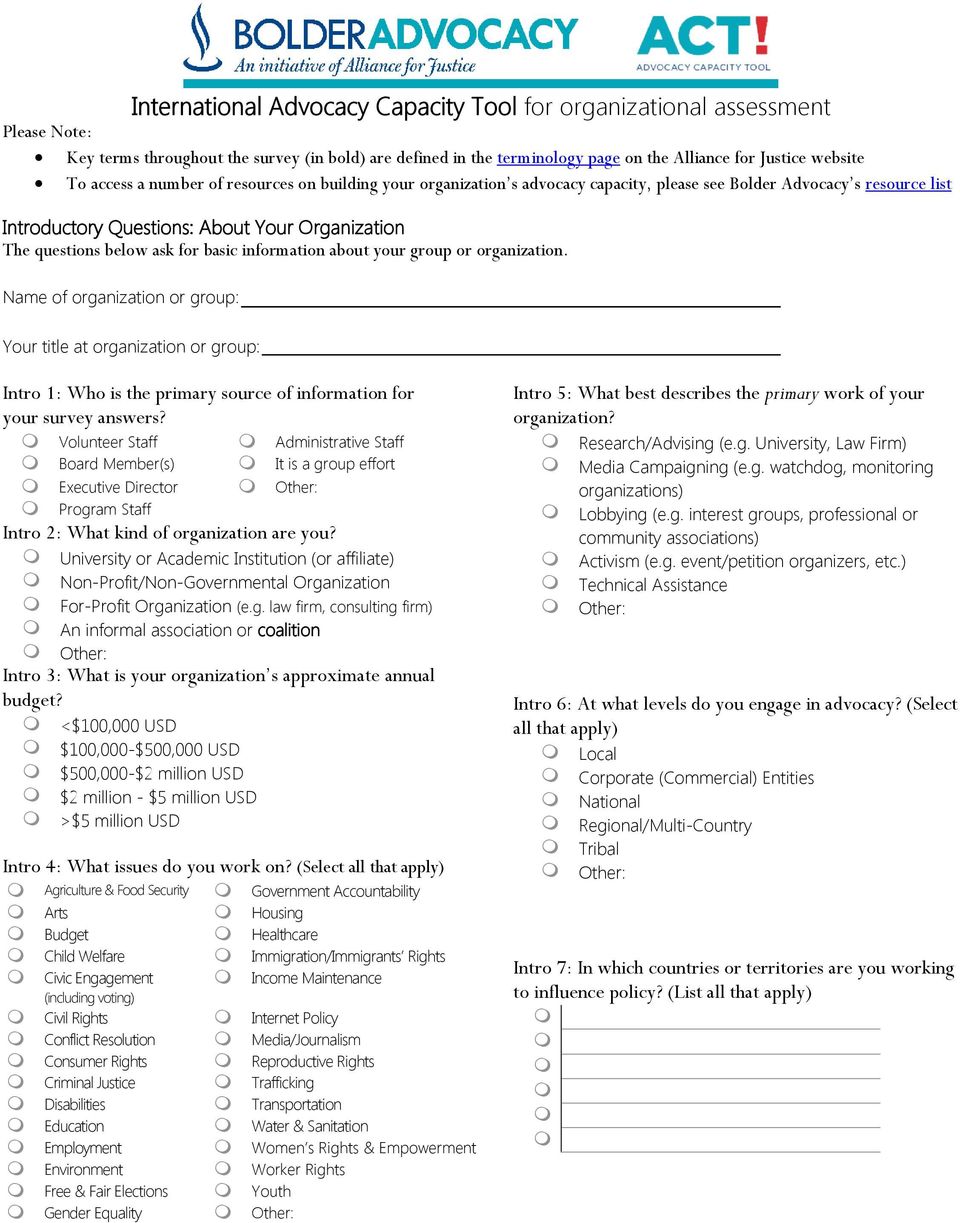
1 International Advocacy Capacity Tool for organizational assessment Please e: Key terms throughout the survey (in bold) are defined in the terminology page on the Alliance for Justice website To access a number of resources on building your organization s advocacy capacity, please see Bolder Advocacy s resource list Introductory Questions: About Your Organization The questions below ask for basic information about your group or organization. Name of organization or group: Your title at organization or group: Intro 1: Who is the primary source of information for your survey answers? Volunteer Staff Administrative Staff Board Member(s) It is a group effort Executive Director Other: Program Staff Intro 2: What kind of organization are you? University or Academic Institution (or affiliate) Non-Profit/Non-Governmental Organization For-Profit Organization (e.g. law firm, consulting firm) An informal association or coalition Other: Intro 3: What is your organization s approximate annual budget? <$100,000 USD $100,000-$500,000 USD $500,000-$2 million USD $2 million - $5 million USD >$5 million USD Intro 4: What issues do you work on? (Select all that apply) Agriculture & Food Security Government Accountability Arts Housing Budget Healthcare Child Welfare Immigration/Immigrants Rights Civic Engagement (including voting) Income Maintenance Civil Rights Internet Policy Conflict Resolution Media/Journalism Consumer Rights Reproductive Rights Criminal Justice Trafficking Disabilities Transportation Education Water & Sanitation Employment Women s Rights & Empowerment Environment Worker Rights Free & Fair Elections Youth Gender Equality Other: Intro 5: What best describes the primary work of your organization? Research/Advising (e.g. University, Law Firm) Media Campaigning (e.g. watchdog, monitoring organizations) Lobbying (e.g. interest groups, professional or community associations) Activism (e.g. event/petition organizers, etc.) Technical Assistance Other: Intro 6: At what levels do you engage in advocacy? (Select all that apply) Local Corporate (Commercial) Entities National Regional/Multi-Country Tribal Other: Intro 7: In which countries or territories are you working to influence policy? (List all that apply)
2 As you begin this survey, keep these two questions in mind: What are your long-term and short-term advocacy goals? o For example: a housing advocacy group may have a long-term goal of obtaining policy to provide enough public housing for all of the state s homeless, and a short-term goal of stopping proposed legislation to decrease the current state appropriations for public housing. How can your organization uniquely contribute to accomplishing these goals? o Factors to consider: This includes the type of role (mobilizer of networks, legislative strategy leader for a coalition, lone advocate on a narrow issue, public leader versus behind the scenes player, etc.) your organization wants to play, what other groups are doing, where your expertise lies, etc. Section 1: Advocacy Goals, Plans, & Strategies Please select the response for each measure that best fits your organization. Advanced questions are optional. For more information on advanced questions, please click here. S1.1 Preparation Introduces key elements of basic preparation for engaging in advocacy. The organization identifies and articulates its mission and goals. The organization has basic knowledge about its subject matter, including how its issues affect constituents. The organization understands the overall policy environment related to its issues, including trends, possible allies and opponents, and other organizations working towards the same goals The organization identifies its existing advocacy capacities, including staffing, skills and knowledge, and strength of field operation. S1.1 Preparation: Advanced (Optional) The organization has a long-term vision or plan for its advocacy goals and for increasing its advocacy over time. S1.2 Agenda Introduces the importance of having a clear, written agenda that defines advocacy goals and prioritizes activities The organization has a written advocacy agenda, approved by the organization s leadership that identifies its goals and priorities. The organization gathers information and recommendations from constituents and other stakeholders in the development of its agenda. The organization shares its agenda or segments thereof, with decisionmakers, constituents, partners, and media, as appropriate. The organization adjusts its focus on particular agenda items in response to internal and external changes. S1.2 Agenda: Advanced (Optional) The agenda includes one or more priorities that are proactive rather than reactive. The organization has an agenda setting process that is understood throughout the organization.

3 S1.3 Plans, Strategies, and Adaptability Introduces the importance of developing a flexible plan to carry out the written agenda The organization analyzes what it will take to accomplish each written agenda item, including who has the power to make decisions in legislative, administrative, electoral, litigation, and other areas. The organization develops a plan for how it will strategically advance each written agenda item. The plan identifies appropriate targets, tactics, major activities, and expected results. The organization monitors internal and external changes in the policy environment and adapts its strategies as needed. The organization has a plan for assessing advocacy capacity and for strengthening its capacity as needed. S1.3 Plans, Strategies, and Adaptability: Advanced (Optional) The organization plans to test new, improved strategies and tactics, such as new methods of communication or of mobilizing networks. Section 2: Conducting Advocacy For most of the indicators in this section, you will have the option of choosing as your answer. You should choose if the organization has decided not to build capacity in a particular measure because it primarily gets that capacity from other individuals or groups. For more information on the option, please click here. S2.1 Research and Analysis Assesses the extent to which the organization researches and gathers information and conducts analyses on its issues. The organization researches, compiles and analyzes information about specific issues. The organization researches and analyzes the impact of current policies, the policy environment and opportunities for advancing its goals. The organization employs a process for verifying that its issues or issue analyses and other materials are accurate and reliable. The organization shares information, analyses and supporting materials with decision-makers, constituents, and partners, as appropriate. S2.1 Research and Analysis: Advanced (Optional) The organization conducts in-depth research and produces reports or other materials related to its advocacy agenda. The organization has access to and utilizes information (case studies, best practices, statistics, strategies, etc.) from other strengthen or better target its advocacy efforts.

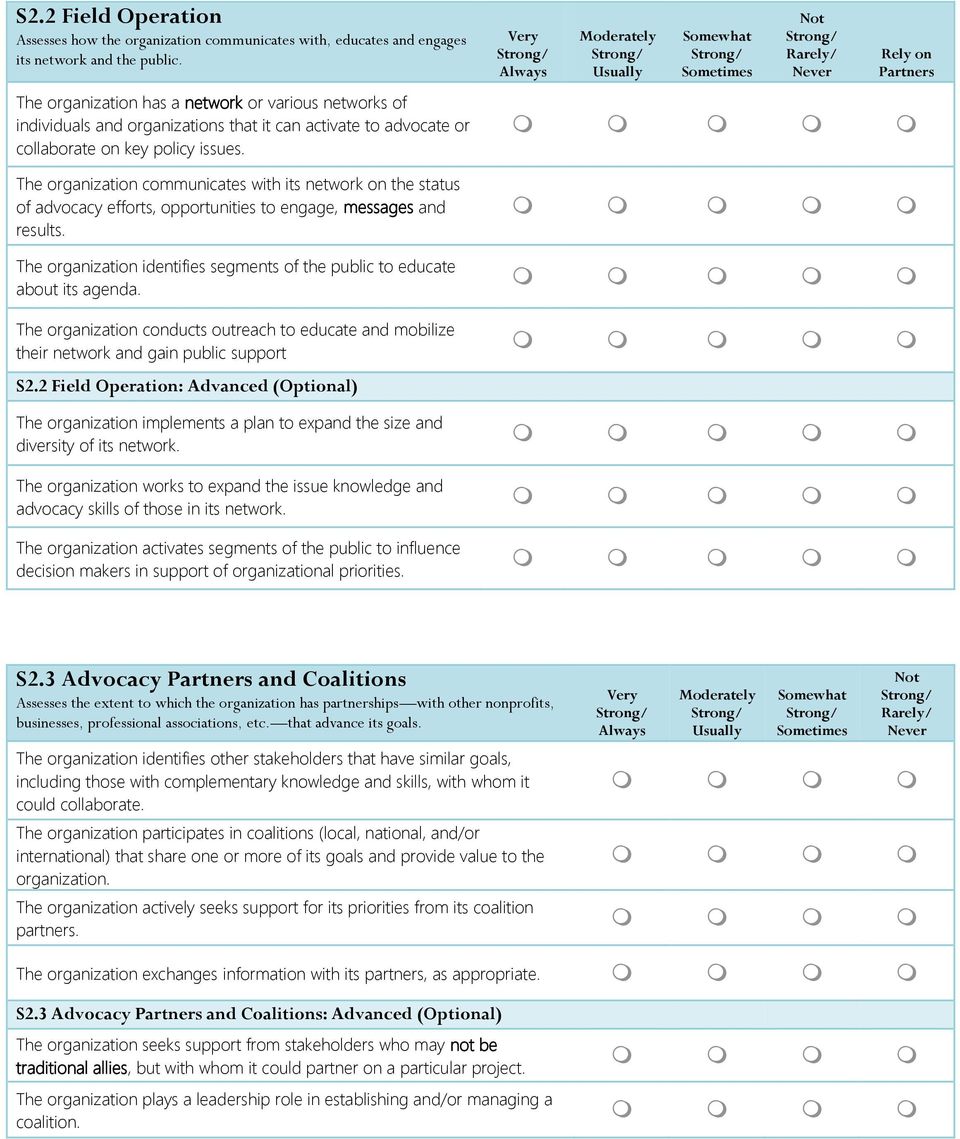
4 S2.2 Field Operation Assesses how the organization communicates with, educates and engages its network and the public. The organization has a network or various networks of individuals and organizations that it can activate to advocate or collaborate on key policy issues. The organization communicates with its network on the status of advocacy efforts, opportunities to engage, messages and results. The organization identifies segments of the public to educate about its agenda. The organization conducts outreach to educate and mobilize their network and gain public support S2.2 Field Operation: Advanced (Optional) The organization implements a plan to expand the size and diversity of its network. The organization works to expand the issue knowledge and advocacy skills of those in its network. The organization activates segments of the public to influence decision makers in support of organizational priorities. S2.3 Advocacy and Coalitions Assesses the extent to which the organization has partnerships with other nonprofits, businesses, professional associations, etc. that advance its goals. The organization identifies other stakeholders that have similar goals, including those with complementary knowledge and skills, with whom it could collaborate. The organization participates in coalitions (local, national, and/or international) that share one or more of its goals and provide value to the organization. The organization actively seeks support for its priorities from its coalition partners. The organization exchanges information with its partners, as appropriate. S2.3 Advocacy and Coalitions: Advanced (Optional) The organization seeks support from stakeholders who may not be traditional allies, but with whom it could partner on a particular project. The organization plays a leadership role in establishing and/or managing a coalition.
5 S2.4 Messaging Assesses how the organization develops and delivers its advocacy messages. The organization develops clear, compelling and concise messages tailored to its target audiences. The organization bases its messages and materials on reliable, credible and up-to-date information. The organization identifies and uses effective messengers and spokespeople. The organization chooses a variety of paid and/or earned media strategies to communicate its messages. S2.4 Messaging: Advanced (Optional) The organization conducts polling and focus groups to develop and test effective messages. S2.5 Media Relations Assesses the extent to which the organization communicates effectively with the media and uses various media to advance its policy goals. S2.6 Influencing Decision-Makers Assess the extent to which the organization builds influential relationships with targeted decision-makers. The organization monitors the actions of decision-makers related to the organization s agenda. The organization builds working relationships with decisionmakers by providing information. The organization consistently nurtures relationships with decision-makers throughout the year. The organization deliberately builds relationships with elected officials without regard to political affiliations. S2.6 Influencing Decision-Makers: Advanced (Optional) The organization identifies and builds relationships with influential individuals and groups who can persuade decisionmakers. Moderatel y The organization monitors media coverage related to its issues The organization identifies, develops and maintains a list of media contacts relevant to its program issue(s) The organization distributes information to a wide range of media outlets including online, broadcast and print media to communicate its messages The organization has a written media plan with objectives, targets, and timelines S2.5 Media Relations: Advanced (Optional) The organization identifies, builds and maintains relationships with key personnel in online, broadcast and print media. The organization maintains an active social media presence The organization has developed a crisis communications strategy for effectively dealing with negative press or an internal crisis.

6 Section 3: Advocacy Avenues This section includes: administrative, legislative, electoral and litigation indicators. Fill in the survey for the areas in which you work. You can choose to fill out one to all of these indicators. No matter how many you fill out, you will be able to view them all. Please note, ballot measures are included under legislative advocacy. For all of the indicators in this section, you will have the option of choosing as your answer. You should choose if the organization has decided not to build capacity in a particular measure because it primarily gets that capacity from other individuals or groups. For more information on the option, please click here. S3.1 Administrative Assess the organization s skills, knowledge and actions related to administrative advocacy. The organization understands processes of the agencies that implement policies and programs, and how to influence these processes. The organization identifies and works with appropriate decision-makers within the administrative agencies, including related commissions and advisory committees. The organization identifies monitors and analyzes proposed rules, regulations, other administrative branch activities, and their potential impact on the organization s priorities. The organization recommends policies or actions through comments (or endorsements of other groups comments) on proposed regulations or other administrative policies, through testimony at agency hearings and/or to further its priorities. S3.1 Administrative: Advanced (Optional) The organization initiates new regulations, executive orders, commissions, enforcement measures or other actions to further its purpose The organization is aware of planned activities by the administration related to the organization s priorities. S3.2 Legislative Assess the organization s skills, knowledge and actions related to legislative advocacy. The organization has knowledge of the legislative process (including budgeting and appropriations), and knows how to influence these processes. The organization identifies and works with appropriate legislators, committees, staff and stakeholders. The organization identifies monitors and analyzes proposed legislation and the potential impact on its priorities. The organization promotes, opposes or helps design or amend legislation. S3.2 Legislative: Advanced (Optional) The organization is aware of planned activities by legislators and other advocates that are related to the organization s priorities.

7 S3.3 Ballot Measures, Referenda, and Initiatives Assess organization s skills, knowledge, and actions related to activity on ballot measures. The organization identifies, monitors, and analyzes measures that will appear or may appear on the ballot and the potential impact on its policy priorities. The organization takes public positions on ballot measures related to its interests, its constituents interests, or its priorities. The organization educates its constituents and other voters about its position on measures that will appear on the ballot. The organization conducts get-out-the-vote efforts to promote or oppose ballot measures related to its interests. S3.3 Ballot Measures, Referenda, and Initiatives: Advanced (Optional) The organization is aware of state laws and processes governing the process for qualifying a measure for the ballot. The organization drafts and circulates ballot measures to further its priorities. S3.4 Electoral Assess organization s skills, knowledge, and actions related to activity to electoral activity. The organization understands the primary and general election processes for candidate elections in relevant jurisdictions and the possible roles nonprofits can play. The organization reminds and encourages its constituency and the public to vote. The organization participates in voter and/or candidate education efforts. The organization educates its staff and governing body about the legal guidelines for electoral activity. S3.4 Electoral: Advanced (Optional) The organization initiates voter and candidate education efforts. The organization engages in efforts to register voters and/or turn out voters.

8 S3.5 Litigation Assess the organization s skills, knowledge and actions related to litigation and other legal activity. The organization understands the role litigation plays to complement other strategies. The organization identifies appropriate courts, regions and other court leanings to inform possible litigation actions related to the organization s priorities. The organization has access to competent counsel who can provide advice or pursue legal strategies. The organization pursues legal activities such as initiating litigation or signing on to amicus briefs, as needed. S3.5 Litigation: Advanced (Optional) The organization monitors relevant court cases and decisions. S3.6 Corporate/Private Sectors The organization understands the role corporate/private sectors play in influencing policy. The organization identifies and works with appropriate corporate and private sector stakeholders. The organization identifies, monitors and analyzes new policies supported or implemented by corporate/private sectors. The organization promotes, opposes, or helps to craft corporate/private sector policies. S3.5 Litigation: Advanced (Optional) The organization is aware of planned activities by the corporate/private sectors that are related to the organization s priorities.

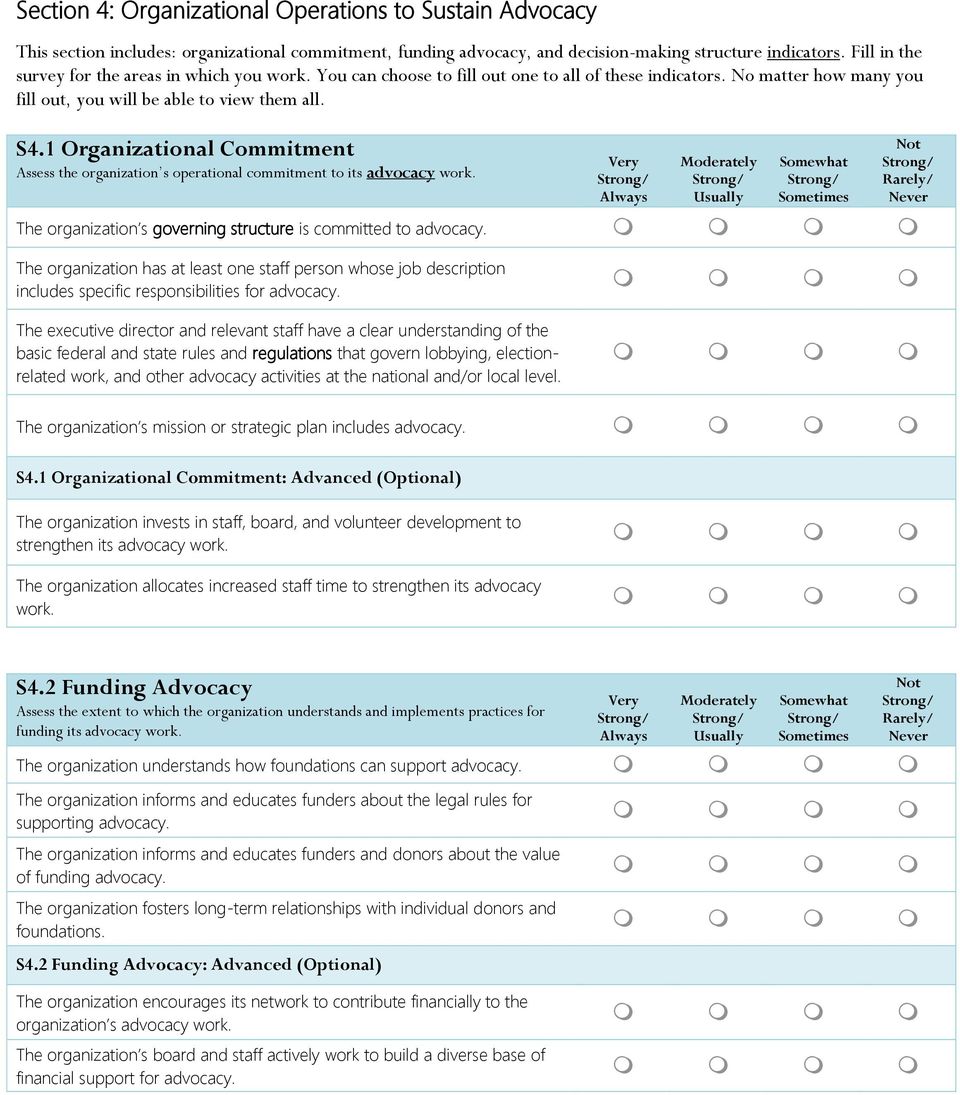
9 Section 4: Organizational Operations to Sustain Advocacy This section includes: organizational commitment, funding advocacy, and decision-making structure indicators. Fill in the survey for the areas in which you work. You can choose to fill out one to all of these indicators. No matter how many you fill out, you will be able to view them all. S4.1 Organizational Commitment Assess the organization s operational commitment to its advocacy work. The organization s governing structure is committed to advocacy. The organization has at least one staff person whose job description includes specific responsibilities for advocacy. The executive director and relevant staff have a clear understanding of the basic federal and state rules and regulations that govern lobbying, electionrelated work, and other advocacy activities at the national and/or local level. The organization s mission or strategic plan includes advocacy. S4.1 Organizational Commitment: Advanced (Optional) The organization invests in staff, board, and volunteer development to strengthen its advocacy work. The organization allocates increased staff time to strengthen its advocacy work. S4.2 Funding Advocacy Assess the extent to which the organization understands and implements practices for funding its advocacy work. The organization understands how foundations can support advocacy. The organization informs and educates funders about the legal rules for supporting advocacy. The organization informs and educates funders and donors about the value of funding advocacy. The organization fosters long-term relationships with individual donors and foundations. S4.2 Funding Advocacy: Advanced (Optional) The organization encourages its network to contribute financially to the organization s advocacy work. The organization s board and staff actively work to build a diverse base of financial support for advocacy.
10 S4.3 Decision-Making Structure and Process Assess the extent to which the organization has a process for making decisions. The organization has a leadership structure or body that makes timely decisions. The organization s leadership and advocacy staff communicate regularly about the status of activities. Staff identifies, for organizational leaders, potential opportunities and risks for the organization before engaging in advocacy work. The organization evaluates its progress and uses lessons learned to inform its decision-making. S4.3 Decision-Making Structure and Process: Advanced (Optional) The leadership structure includes those that have knowledge, passion and/or experience in advocacy. S4.4 Fiscal Management and Sustainability Assess the organization s fiscal management practices. The organization s leadership and key program staff have received training and understand rules for monitoring and written government regulations related to advocacy, and the extent to which these regulations are enforced and/or adhered to. The organization s financial management system tracks advocacy activities and expenses -- as well as funds not allowable for advocacy -- in keeping with appropriate laws. The organization budgets funds for advocacy programs. The organization commits a portion of general operating support to advocacy. S4.4 Fiscal Management and Sustainability: Advanced (Optional) The organization monitors changes to taxing authority rules or interpretations of rules that may affect its tax status or way of doing business. Results Next, you can score your responses to determine the following information (please note advanced questions are not included in scoring): Numerical results for each of the 19 indicators, by section Number of times was chosen for each indicator Numerical results for each section For information on analyzing these results, please click here. ***Please review the results below then answer a few final questions*** Don t get too focused on the numbers! The objective here is to identify organizational strengths and weaknesses, and where to build advocacy capacity not to get the highest score. For example, where groups choose to mostly rely on partners, the organizational score is expected to be low.

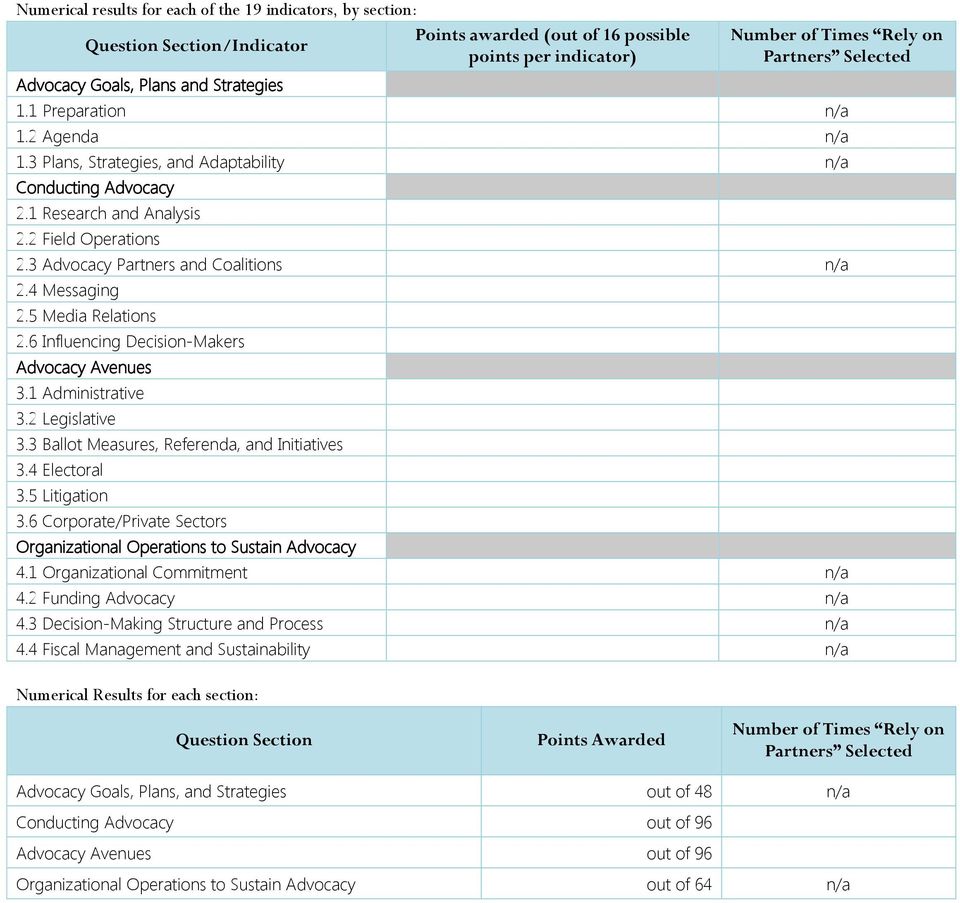
11 Numerical results for each of the 19 indicators, by section: Points awarded (out of 16 possible Question Section/Indicator points per indicator) Advocacy Goals, Plans and Strategies Number of Times Selected 1.1 Preparation n/a 1.2 Agenda n/a 1.3 Plans, Strategies, and Adaptability n/a Conducting Advocacy 2.1 Research and Analysis 2.2 Field Operations 2.3 Advocacy and Coalitions n/a 2.4 Messaging 2.5 Media Relations 2.6 Influencing Decision-Makers Advocacy Avenues 3.1 Administrative 3.2 Legislative 3.3 Ballot Measures, Referenda, and Initiatives 3.4 Electoral 3.5 Litigation 3.6 Corporate/Private Sectors Organizational Operations to Sustain Advocacy 4.1 Organizational Commitment n/a 4.2 Funding Advocacy n/a 4.3 Decision-Making Structure and Process n/a 4.4 Fiscal Management and Sustainability n/a Numerical Results for each section: Question Section Points Awarded Number of Times Selected Advocacy Goals, Plans, and Strategies out of 48 n/a Conducting Advocacy out of 96 Advocacy Avenues out of 96 Organizational Operations to Sustain Advocacy out of 64 n/a

12 Strengthening After reviewing the above results, please select two to three areas in which your organization may want to strengthen organizational advocacy capacity and/or capacity from partners. For help in choosing areas to strengthen, please click here. Section 1: Advocacy Goals, Plans and Strategies Preparation Agenda Plans, Strategies, and Adaptability Section 2: Conducting Advocacy Research and Analysis Field Operation Advocacy and Coalitions Messaging Media Relations Influencing Decision-Makers Section 3: Advocacy Avenues Administrative Legislative Ballot Measures, Referenda, and Initiatives Electoral Litigation Corporate/Private Sectors Section 4: Organizational Operations to Sustain Advocacy Organizational Commitment Funding Advocacy Decision-Making Structure and Process Fiscal Management and Sustainability Thank you for using for organizational assessment It is recommended that you complete the entire tool again as needed, or at least every 18 months.

MCH LEADERSHIP SKILLS SELF-ASSESSMENT
 MCH LEADERSHIP SKILLS SELF-ASSESSMENT This self-assessment corresponds to the Maternal and Child Health Leadership Competencies Version 3.0, by the MCH Leadership Competencies Workgroup (Eds), June 2009.
Detailed Knowledge, Skills and Abilities Tested on the Computerbased Examination for Accreditation in Public Relations (effective January 2016)
 Detailed Knowledge, Skills and Abilities Tested on the Computerbased Examination for Accreditation in Public Relations (effective January 2016) Objective 1 Researching, Planning, Implementing and Evaluating
Legal Aid Board Training. 2010 Legal Aid Education P, Session 1, Page 1 Session 1. Introduction
 to Legal Aid 2010 Legal Aid Education P, Session 1, Page 1 Session 1 Governance as Leadership What is governance? Governance is the exercise of authority, direction and control of an organization in order
PUBLIC HEALTH Nurse. L. Michele Issel, PhD, RN University of Illinois at Chicago School of Public Health 312-355-1137 [email protected].
 PUBLIC HEALTH Nurse Competency Self-Assessment L. Michele Issel, PhD, RN University of Illinois at Chicago School of Public Health --7 [email protected] and Kathleen Baldwin, PhD, RN University of Illinois
Transit Campaign Planning A strategy template for organizers
 Transit Campaign Planning A strategy template for organizers Updated October 2011 Transit Campaign Planning: A strategy template for organizers Written by Neha Bhatt and Elisa Ortiz Updated October 2011
Medicaid Expansion Campaign Planning Guide
 Medicaid Expansion Campaign Planning Guide State advocates have a critical role to play in ensuring the implementation of the Affordable Care Act s (ACA) Medicaid expansion. The ACA has the potential to
PAINTER EXECUTIVE SEARCH
 PAINTER EXECUTIVE SEARCH Position Description Painter Executive Search is supporting the in a search for an experienced to lead a broad regional coalition of Bay Area land conservation agencies and organizations
HIMMELMAN Consulting 210 Grant Street West, Suite 422 Minneapolis, MN 55403-2245 612/998-5507 [email protected]
 HIMMELMAN Consulting 210 Grant Street West, Suite 422 Minneapolis, MN 55403-2245 612/998-5507 [email protected] COLLABORATION FOR A CHANGE (revised January 2002) Definitions, Decision-making models,
HUMAN SERVICES MANAGEMENT COMPETENCIES
 HUMAN SERVICES MANAGEMENT COMPETENCIES A Guide for Non-Profit and For Profit Agencies, Foundations and Academic Institutions Prepared by: Anthony Hassan, MSW, Ed.D. William Waldman, MSW Shelly Wimpfheimer,
Introductions and Welcome. Why Get Engaged. What 501c3s can do during election season. What FRAC, VTEH, and CLC are up to. Q and A throughout.
 Introductions and Welcome Why Get Engaged What 501c3s can do during election season What FRAC, VTEH, and CLC are up to Q and A throughout Agenda Many elected officials will be voted into office this There
ASAE s Job Task Analysis Strategic Level Competencies
 ASAE s Job Task Analysis Strategic Level Competencies During 2013, ASAE funded an extensive, psychometrically valid study to document the competencies essential to the practice of association management
Competency Requirements for Executive Director Candidates
 Competency Requirements for Executive Director Candidates There are nine (9) domains of competency for association executives, based on research conducted by the American Society for Association Executives
Tools to Support Public Policy Grantmaking
 doi: 10.4087/FOUNDATIONREVIEW-D-09-00027.1 TOOLS Tools to Support Public Policy Grantmaking Martha Campbell, M.P.A., The James Irvine Foundation, and Julia Coffman, M.S., Center for Evaluation Innovation
AAM Online Advocacy Training: Creating an Advocacy Plan for 2011 And Beyond!
 AAM Online Advocacy Training: Creating an Advocacy Plan for 2011 And Beyond! The American Association of Museums Online Advocacy Training Series Have no fear! We ll explain muting, Q&A and other details
Proven Strategies, Considerations, and Tools to Get You Started Gretchen Williams Torres, MPP and Frances S. Margolin, MA
 The Collaboration Primer Proven Strategies, Considerations, and Tools to Get You Started Gretchen Williams Torres, MPP and Frances S. Margolin, MA Introduction Hospitals, clinicians, public health departments,
Government Communication Professional Competency Framework
 Government Communication Professional Competency Framework April 2013 Introduction Every day, government communicators deliver great work which supports communities and helps citizens understand their
DATA ANALYSIS AND USE
 CapacityDevelopment RESOURCE GUIDE DATA ANALYSIS AND USE July 2014 The s highlight the key technical areas of expertise needed to effectively influence health policy design, implementation, and monitoring
Mapping an Advocacy Strategy
 Mapping an Advocacy Strategy Taking into consideration implementers limited time and resources, the tools in Pathfinder International s Straight to the Point Series provide clear, concise guidance on a
Component 4: Organizational Leadership & Governance
 Component 4: Organizational Leadership & Governance Scope: Lead your local United Way to successfully fulfill its mission, and in doing so, garner trust, legitimacy and support from the local community
Director of Communications Washington, DC
 Director of Communications Washington, DC Fighting for a fair America through citizen access to democratic decision-making and to the federal judiciary The Organization Alliance for Justice is a national
Develop a strategic plan. A tool for NGOs and CBOs M
 Develop a strategic plan A tool for NGOs and CBOs M Developing Strategic Plans: A Tool for Community- and Faith-Based Organizations Developed by the International HIV/AIDS Alliance and Davies & Lee: AIDS
An Overview of Nonprofit Governance David O. Renz, Ph.D. Midwest Center for Nonprofit Leadership at UMKC
 David O. Renz, Ph.D. at UMKC This article is adapted from a chapter prepared for Philanthropy in the U.S.: An Encyclopedia (Dwight Burlingame, ed.) Governance is the process of providing strategic leadership
Advanced Training Course in International Assistance for. Institution Building and Electoral Monitoring
 Advanced Training Course in International Assistance for Institution Building and Electoral Monitoring ADVANCED TRAINING COURSE IN INTERNATIONAL ASSISTANCE FOR INSTITUTION BUILDING AND ELECTORAL MONITORING
Winning Proposals: Understanding the Basics of Federal and Foundation Grants
 WEBINAR BRIEFING Winning Proposals: Understanding the Basics of Federal and Foundation Grants Featuring Hanover Research Grants Consultant Bryan DeBusk, Ph.D., GPC And Hanover Research Grants Consultant
Multicultural Council of Tasmania GUIDE FOR MANAGEMENT COMMITTEE MEMBERS
 Multicultural Council of Tasmania CONTENTS GUIDE FOR MANAGEMENT COMMITTEE MEMBERS (February 2013) 1. INTRODUCTION 2 2. OUR ORGANISATION 2 2.1 Purpose and aims of MCOT 2.2 Organisational status and funding
Swe Tha Har. Vacancy Announcement
 Vacancy Announcement Swe Tha Har Social Services is a national peace organization and committed to promote peace justice and development among diverse ethnic and religious communities through peace education,
Understanding and Influencing The Legislative Process
 Understanding and Influencing The Legislative Process Table of Contents SGNA Legislative Platform... 3 Communicating with your Legislator Telephone Calls... 3 Writing a Letter or E-mail... 3 Social Media...
Objective Oriented Planning Module 1. Stakeholder Analysis
 III. Stakeholder Analysis Stakeholders are people, groups, or institutions, which are likely to be affected by a proposed project (either negatively or positively), or those which can affect the outcome
ADOLESCENT HEALTH SYSTEM CAPACITY ASSESSMENT TOOL
 ADOLESCENT HEALTH SYSTEM CAPACITY ASSESSMENT TOOL SECTION 1: INTRODUCTION ADOLESCENT HEALTH SYSTEM CAPACITY ASSESSMENT TOOL 1 SECTION 1: INTRODUCTION Adolescent Health System Capacity Tool: A state public
Guide to Strategic Planning for Advocacy
 ACNM Department of Advocacy and Government Affairs Grassroots Advocacy Resources Guide to Strategic Planning for Advocacy What is Advocacy Planning? Advocacy planning is an interactive process which intends
PAUNG KU JOB ANNOUNCEMENT
 PAUNG KU JOB ANNOUNCEMENT Paung Ku is assisting the American Friends Service Committee (AFSC) to recruit one staff for a peace building program based in Yangon: Job Title: Place of work: Myanmar Quaker
Academic Standards for Civics and Government
 Academic Standards for June 1, 2009 FINAL Elementary Standards Grades 3-8 Pennsylvania Department of Education These standards are offered as a voluntary resource for Pennsylvania s schools and await action
Self Assessment. Introduction and Purpose of the Self Assessment Welcome to the AdvancED Self Assessment.
 Self Assessment Introduction and Purpose of the Self Assessment Welcome to the AdvancED Self Assessment. The Self Assessment is designed to serve as a valuable tool to help schools assess and maintain
Governor s Developmental Disabilities Council
 Governor s Developmental Disabilities Council The Governor's DD Council is a federally funded state agency that advocates for the development of services and supports so that Iowans with developmental
Utah Educational Leadership Standards, Performance Expectations and Indicators
 Utah Educational Leadership Standards, Performance Expectations and Indicators Standard 1: Visionary Leadership An educational leader promotes the success of every student by facilitating the development,
Why Write a Funding Proposal?
 Writing Funding Proposals Why Write a Funding Proposal? Given today s economy and increasing demands for citizen services and programs, many municipalities are being asked to do more with less. Grants
Knowing the Rules for Nonprofit Lobbying
 Knowing the Rules for Nonprofit Lobbying Please note that the information in this section comes from The Nonprofit Lobbying Guide by Bob Smucker (second edition, 1999) and the Internal Revenue Service
Module 1: Association & Non-Profit Organization Basics
 Module 1: Association & Non-Profit Organization Basics Table of Contents The Nonprofit Sector Page 1 Definition and Importance of Associations Page 2 Characteristics of Nonprofit Organizations Page 3 Duties
I. Organizing A. Knowledge for Organizing Services and Programs for Communities
 Weil, Marie, Dorothy N. Gamble and Emily MacGuire. 2009. Community Practice Skills: Local to Global Perspectives Workbook, pp. 110-124. New York: Columbia University Press. Core Knowledge Areas for Work
FY17 Operating Budget Testimony Michael H. Reed, Esquire, Chairman Philadelphia Board of Ethics Prepared for City Council April, 2016
 FY17 Operating Budget Testimony Michael H. Reed, Esquire, Chairman Philadelphia Board of Ethics Prepared for City Council April, 2016 My name is Michael H. Reed, and I serve as the Chair of the Philadelphia
National Standards for Disability Services. DSS 1504.02.15 Version 0.1. December 2013
 National Standards for Disability Services DSS 1504.02.15 Version 0.1. December 2013 National Standards for Disability Services Copyright statement All material is provided under a Creative Commons Attribution-NonCommercial-
Contract for Individual Consultant (other Specialists) Request for written proposal. Net-Med youth Project in Jordan
 Contract for Individual Consultant (other Specialists) Request for written proposal Net-Med youth Project in Jordan Date: 7 January 2015 1 Request to submit a written proposal for a work assignment with
Communications Policy
 [insert organisation name/logo] Communications Policy Document Status: Draft or Final Date Issued: [date] Lead Author: [name and position] Approved by: [insert organisation name] Board of Directors on
2013-2016 NASW CA STRATEGIC PLAN MISSION STATEMENT
 MISSION STATEMENT To promote the quality, effectiveness and image of the social work profession and to promote social change and social justice in order to improve the well being of all residents of California.
Leading Self. Leading Others. Leading Performance and Change. Leading the Coast Guard
 Coast Guard Leadership Competencies Leadership competencies are the knowledge, skills, and expertise the Coast Guard expects of its leaders. The 28 leadership competencies are keys to career success. Developing
GOVERNANCE AND CIVIL SOCIETY
 PARTNERS FOR CHANGE GOVERNANCE AND CIVIL SOCIETY SUB-SAHARAN AFRICA PARTNERS FOR CHANGE GOVERNANCE AND CIVIL SOCIETY PARTNERS FOR CHANGE The British Council is committed to building engagement and trust
National Network of Fiscal Sponsors. Guidelines for Comprehensive Fiscal Sponsorship
 Introduction National Network of Fiscal Sponsors Guidelines for Comprehensive Fiscal Sponsorship Fiscal sponsorship has evolved as an effective and efficient mechanism for starting new nonprofits, seeding
CALIFORNIA GIS COUNCIL CHARTER
 CALIFORNIA GIS COUNCIL CHARTER ADOPTED JANUARY 7, 2015 SECTION 1: FINDING AND DECLARATIONS WHEREAS: A. Geographic Information Systems (GIS) are a critical tool for improving the quality, accuracy and responsiveness
Capacity Assessment Indicator. Means of Measurement. Instructions. Score As an As a training. As a research institution organisation (0-5) (0-5) (0-5)
 Assessing an Organization s in Health Communication: A Six Cs Approach [11/12 Version] Name & location of organization: Date: Scoring: 0 = no capacity, 5 = full capacity Category Assessment Indicator As
Best Practices for Executive Directors and Boards of Nonprofit Organizations
 for Executive Directors and Boards of Nonprofit Organizations The following document on best practices was developed from a highly-successful training program called MATRIX* that was conducted in 1999
How Community Advisory Boards Can Assist the Work of the Justice System
 How Community Advisory Boards Can Assist the Work of the Justice System Community engagement is an essential component of a well-functioning justice system. By strategically engaging the public, justice
Directors, Managers, and Supervisors Skill Profile
 Directors, Managers, and Supervisors Skill Profile Instructions for use: Completing this Skill Profile supports the development of an individualized staff development plan for each staff member in early
ADVERTISEMENT. Markets for Change / M4C Communications and Monitoring & Evaluation Officer (SC SB-4)
 ADVERTISEMENT Vacancy Announcement No. 2016/11 The UN Women Fiji Multi Country Office (MCO) seek to recruit a suitably qualified Solomon Islands national for the following position to be based in Honiara,
NEA Leadership Competencies Guide
 NEA Leadership Competencies Guide NEA Leadership Competencies Guide Table of Contents NEA Vision, Mission, and Values 5 Setting the context for leadership competencies 7 Leadership competency framework
COMMUNICATIONS STRATEGIST
 June 2014 DEFINITION COMMUNICATIONS STRATEGIST Provide direct, high-level communication and community engagement oversight and strategic planning support to the city manager and the city council, with
Manager, Corporate Planning & Reporting BC Oil & Gas Commission, Victoria Applied Leadership. Office of the Commissioner - Corporate Affairs
 Manager, Corporate Planning & Reporting BC Oil & Gas Commission, Victoria Applied Leadership Office of the Commissioner - Corporate Affairs The Manager, Corporate Planning & Reporting is responsible for
Framework for Leadership
 Framework for Leadership Date Leader Self-Assessment Evaluator Assessment Domain 1: Strategic/Cultural Leadership Principals/school leaders systemically and collaboratively develop a positive culture to
Anti-Lobbying Restrictions for CDC Grantees
 Anti-Lobbying Restrictions for CDC Grantees Language included in Section 503 of Division F, Title V, of the FY 12 Consolidated Appropriations Act (P.L. 112-74, excerpted below) reinforces and (in selected
Women s Fund of Long Island Social Change Grants 2015 Request for Proposals
 Women s Fund of Long Island Social Change Grants 2015 Request for Proposals The mission of Women s Fund of Long Island (WFLI) is to ignite networks that transform the lives of women and girls on Long Island
HUMAN RESOURCES MANAGER DESCRIPTION OF WORK: Knowledge Professional and Organizational. Leadership/Human Resources Management. Program Management
 HUMAN RESOURCES MANAGER DESCRIPTION OF WORK: Employees in this banded class provide leadership and supervision to professional/technical staff in the delivery of a contemporary human resources program(s)
FAO Competency Framework
 FAO Competency Framework FAO Competency Framework Acknowledgements FAO is grateful to the UNAIDS Secretariat, which has kindly permitted FAO to re-use and adapt the explanatory text on competencies from
Communications strategy refresh. January 2012. 1 c:\documents and settings\mhln.snh\objcache\objects\a654473.doc
 Communications strategy refresh January 2012 1 c:\documents and settings\mhln.snh\objcache\objects\a654473.doc Contents 1. Introduction p 3 a. SNH: corporate aims and objectives b. SNH and communications
NLN AFFILIATED CONSTITUENT LEAGUE Reference & Resources. Guidelines for Advocacy Public Policy & Public Relations
 NLN AFFILIATED CONSTITUENT LEAGUE Reference & Resources Guidelines for Advocacy Public Policy & Public Relations Table of Contents Public Affairs Committee... 1 Policy on Legislation and Political Action...
Unique Methods in Advocacy Evaluation
 Unique Methods in Advocacy Evaluation Julia Coffman Evaluation Consultant Ehren Reed Innovation Network Evaluation methods define how data are collected. They are systematic approaches for gathering qualitative
JOB DESCRIPTION HEALTH COMMISSIONER
 JOB DESCRIPTION HEALTH COMMISSIONER ROLE OVERVIEW: An appointed public official who serves as the Health Commissioner of the General Health District in Mahoning County, Ohio, and chief executive officer
Guidelines for Civil Society participation in FAO Regional Conferences
 Viale delle Terme di Caracalla, 00153 Rome, Italy Fax: +39 0657053152 Tel: +39 0657051 www.fao.org Guidelines for Civil Society participation in FAO Regional Conferences 1. Intro: Civil Society participation
Extracted from Strategic Planning for Political Parties: A Practical Tool International Institute for Democracy and Electoral Assistance 2013.
 Extracted from Strategic Planning for Political Parties: A Practical Tool International Institute for Democracy and Electoral Assistance 2013. International IDEA, Strömsborg, 103 34 Stockholm, Sweden Phone
Truman State University Alumni Association Strategic Plan 2012 2016
 Truman State University Alumni Association Strategic Plan 2012 2016 At its core, the Truman State University Alumni Association exists to serve and benefit Truman State University and its alumni, and to
NYUWagner THE COVER LETTER OFFICE OF CAREER SERVICES
 NYUWagner Robert F. Wagner Graduate School of Public Service THE COVER LETTER OFFICE OF CAREER SERVICES The Puck Building, 295 Lafayette Street, 2 nd Fl., New York, NY 10012 212.998.7474 Fax 212.995.4165
Strategic Communications Audits
 Strategic Communications Audits Prepared for the Communications Consortium Media Center Julia Coffman October 2004 Nonprofit organizations are now continuously being challenged to be more strategic in
Arizona Association of Student Councils
 1. Communication 1.1 Student communicates effectively in large and small groupings 1.1.a Student develops content and ideas into organized presentations. 1.1b Student learn to monitor and adjust based
PARTNERING ALUMNI ADVOCACY WITH GOVERNMENT RELATIONS UNIVERSITY ADVANCEMENT AGRICULTURAL EXTENSION AND ENROLLMENT MANAGEMENT.
 PARTNERING ALUMNI ADVOCACY WITH GOVERNMENT RELATIONS UNIVERSITY ADVANCEMENT AGRICULTURAL EXTENSION AND ENROLLMENT MANAGEMENT Submitted by Steve Johnson Director of Alumni Relations 1106 Blake Ave. PO Box
LAWS AND GUIDELINES REGARDING YOUR INVOLVEMENT IN SHAPING HEALTH POLICY
 LAWS AND GUIDELINES REGARDING YOUR INVOLVEMENT IN SHAPING HEALTH POLICY It has generally been accepted that educating federal decision makers is not lobbying, but. Rather, a safe harbor of permissible
United Way Thompson Nicola Cariboo
 United Way Thompson Nicola Cariboo Strategic Plan 2016-2021 Operational Business Plan 2016 177 Victoria Street Kamloops, BC V2C 1Z4 250-372-9933 www.unitedwaytnc.ca /unitedwaytnc @unitedwaytnc @unitedwaytnc
TOOLS FOR STATE VOADS TO PREPARE FOR DISASTER CASE MANAGEMENT
 TOOLS FOR STATE VOADS TO PREPARE FOR DISASTER CASE MANAGEMENT Audience for document State and Territory Voluntary Organizations Active in Disaster (VOAD) disaster case management (DCM) organizations and
Campus Network Planning and Technical Assistance Overview
 Campus Network Planning and Technical Assistance Overview WHAT IS THE PURPOSE OF A NETWORK? Networks are part of the California College Pathways (CCP) Initiative s strategy to expand college and career
Conducting A Communications Audit
 Conducting A Communications Audit Paralyzing nightmare or 2 Liberating Dream Come True? 3 Schedule Introductions The Basics of Audits What, How, Why, Who Process Step by Step Non Profit Audit Practical
Enhancing Law Enforcement Response to Victims:
 Enhancing Law Enforcement Response to Victims: Strategy Implementation Checklist Enhancing Law Enforcement Response to Victims is a new professional standard developed by the International Association
Core Competencies for Public Health Professionals
 Core Competencies for Public Health Professionals Revisions Adopted: May 2010 Available from: http://www.phf.org/programs/corecompetencies A collaborative activity of the Centers for Disease Control and
BYLAWS. Students for Criminal Justice Reform (SCJR)
 BYLAWS Students for Criminal Justice Reform (SCJR) Created: November 6, 2015 ARTICLE I. Organization Name The name of the organization shall be Students for Criminal Justice Reform ( SCJR ). ARTICLE II.
Office of the Mayor (AA0)
 (AA0) www.dc.gov Telephone: 202-727-1000 % FY 2013 FY 2014 FY 2015 from Description Actual Approved Proposed FY 2014 Operating Budget $12,193,975 $12,099,801 $12,233,168 1.1 FTEs 87.4 85.0 81.0-4.7 The
4.1 Identify what is working well and what needs adjustment. 4.1.1 Outline broad strategies that will help to effect these adjustments.
 (Overview) Step 1 Prepare 1.1 Identify specific issues or choices that the planning process should address. 1.2 Develop an organizational profile. 1.3 Identify any information that must be collected to
The Development Plan Matrix
 The Development Plan Matrix Mission, Vision, Results Marketing: Branding, Messaging Organizational Infrastructure Development Plan Successful fundraising campaigns are built on four important elements