
2016 national curriculum assessments. Key stage Assessment and reporting arrangements (ARA) Published September 2015
|
|
|
- Kathryn Chandler
- 9 years ago
- Views:
Transcription
1 2016 national curriculum assessments Key stage Assessment and reporting arrangements (ARA) Published September 2015

2 Contents 1. Introduction 4 2. Key changes New tests Test administration window Interim teacher assessment frameworks Moderation of teacher assessment Test orders 5 3. Key dates key dates key dates national curriculum tests Overview of 2016 tests Scaled scores Sample test materials Test frameworks Test orders Modified test materials Delivery of test materials Participation in tests Participating pupils Access arrangements Test administration Test administration window Security of test materials Headteachers declaration forms Reporting test results Phonics screening check Key dates Participation in the check Check materials Security of check materials Administration Monitoring Maladministration Reporting phonics screening check results Teacher assessment What teachers must assess Interim teacher assessment frameworks 23 Page 2 of 36

3 8.3 Pupils working below the standard of the national curriculum Pupils who move schools Moderation of the end of KS1 assessments Reporting results of the end of KS1 assessments Maladministration Reporting to parents What reports must cover Keeping and maintaining records Disclosure of educational records Transferring records to a pupil s new school Legal requirements and responsibilities Legal status of the ARA Application of ARA to different types of school Headteachers responsibilities Teachers responsibilities Governing bodies responsibilities Academy trusts responsibilities Local authorities responsibilities 34 Page 3 of 36

4 1. Introduction This guidance details the statutory requirements for key stage 1 (KS1) national curriculum assessment and reporting for the 2015 to 2016 academic year. It is produced by the Standards and Testing Agency (STA), an executive agency of the Department for Education (DfE). The assessment and reporting arrangements apply to maintained schools, including maintained special schools, academies, including free schools, Service Children s Education (SCE) schools and participating independent schools with pupils in KS1. Full details of how the ARA applies to different types of schools are included in section The new national curriculum has been taught in all local authority (LA) maintained primary schools, and some academies, in England since September Those pupils who are at the end of KS1 in May 2016 will be the first to be assessed against the new national curriculum. This guidance details the key changes for the 2015 to 2016 assessments and the updated reporting and assessment arrangements for the period. 2. Key changes 2.1 New tests From 2016, KS1 national curriculum test outcomes will no longer be reported using levels. Scaled scores will be used instead; guidance is available at A new set of KS1 national curriculum tests replaces the previous tests and tasks. The new tests consist of: English reading Paper 1: combined reading prompt and answer booklet English reading Paper 2: reading booklet and reading answer booklet English grammar, punctuation and spelling Paper 1: spelling English grammar, punctuation and spelling Paper 2: questions mathematics Paper 1: arithmetic mathematics Paper 2: reasoning There is no longer a test for English writing. Schools should no longer use the 2007 and 2009 KS1 test and task materials. A full set of sample tests and materials has been published to help teachers prepare for the 2016 KS1 national curriculum tests. These are available at: Page 4 of 36

5 2.2 Test administration window The KS1 tests do not have set days for their administration, but schools must administer the tests during May A number of schools will be selected to administer one of the KS1 tests in April 2016 to inform the standard setting for the tests. These schools should do all the other tests in May. For any schools selected to administer one of the KS1 tests in April 2016, participation is statutory. 2.3 Interim teacher assessment frameworks Following the removal of teacher assessment levels, interim teacher assessment frameworks have been provided to support teachers in making robust and accurate judgements for pupils at the end of KS1 in The interim teacher assessment frameworks for KS1 are available at: and for KS2 at: They are for 2015 to 2016 only. The DfE is evaluating options for future years. 2.4 Moderation of teacher assessment Details of schools and LAs responsibilities relating to the moderation of teacher assessment (TA) will be provided when these arrangements have been confirmed. 2.5 Test orders Maintained schools, academies and free schools do not need to place a test order for the standard versions of the KS1 tests. Quantities of test materials will be sent to schools based on their autumn census data. Independent schools who want to participate in the tests will need to place a test order by Friday 27 November Special schools, pupil referral units (PRUs), hospital schools and secure units can confirm zero test orders by Friday 27 November, where all pupils are working below the standard of the tests or pupils will not be participating in the tests. Otherwise these schools will receive test materials based on their autumn census data. Page 5 of 36

6 3. Key dates The introduction of the new KS1 tests has brought a number of key changes to the dates in the assessment cycle key dates Monday 28 September Test orders section of NCA tools, available at: opens for schools to order modified versions of the KS1 English reading; English grammar, punctuation and spelling; and mathematics tests. Maintained schools, academies and free schools do not need to order standard versions of the tests. The quantities of standard test materials schools require will be based on their autumn census. Monday 28 September Friday 27 November Friday 27 November Friday 27 November End of autumn term Independent schools who want to participate in the KS1 assessments will need to place orders on NCA tools, available at: for both the standard and modified versions of the tests from this date. Deadline for maintained schools, academies and free schools to order modified versions of the KS1 tests. Deadline for independent schools to order standard and modified versions of the KS1 tests and issue privacy notices. Deadline for special schools, PRUs, hospital schools and secure units to confirm zero test orders on NCA tools, available at: where all pupils are working below the standard of the tests. Academies to have chosen which LA will undertake their monitoring of the KS1 national curriculum assessments key dates March Monday 11 April to Friday 22 April w/c 18 April May Phonics screening check administration guidance will be published for the 2016 administration period and will be available on GOV.UK. Selected schools to administer KS1 tests early to inform standard setting. Schools receive their standard and modified versions of the KS1 tests. KS1 test administration window. 6 May Deadline for ordering braille versions of the phonics screening check from STA s modified tests agency, telephone number Page 6 of 36

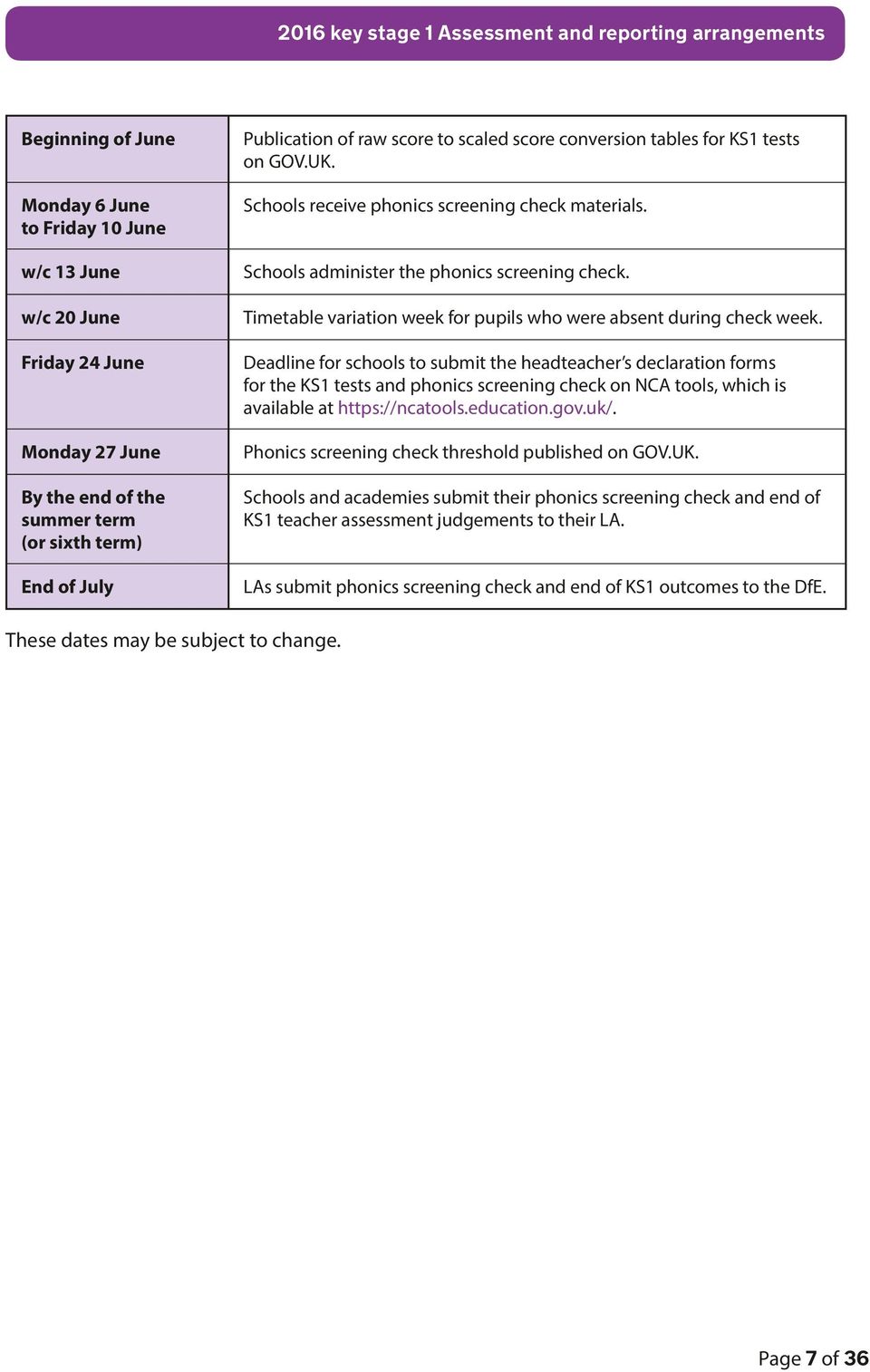
7 Beginning of June Monday 6 June to Friday 10 June w/c 13 June w/c 20 June Friday 24 June Monday 27 June By the end of the summer term (or sixth term) End of July Publication of raw score to scaled score conversion tables for KS1 tests on GOV.UK. Schools receive phonics screening check materials. Schools administer the phonics screening check. Timetable variation week for pupils who were absent during check week. Deadline for schools to submit the headteacher s declaration forms for the KS1 tests and phonics screening check on NCA tools, which is available at Phonics screening check threshold published on GOV.UK. Schools and academies submit their phonics screening check and end of KS1 teacher assessment judgements to their LA. LAs submit phonics screening check and end of KS1 outcomes to the DfE. These dates may be subject to change. Page 7 of 36
8 national curriculum tests 4.1 Overview of 2016 tests For 2016, a new set of KS1 national curriculum tests replaces the previous tests and tasks. Schools should no longer use the 2007 and 2009 KS1 test and task materials as they relate to the old national curriculum. The new tests consist of: English reading Paper 1: combined reading prompt and answer booklet English reading Paper 2: reading booklet and reading answer booklet English grammar, punctuation and spelling Paper 1: spelling English grammar, punctuation and spelling Paper 2: questions mathematics Paper 1: arithmetic mathematics Paper 2: reasoning There is no longer a test for English writing. There won t be any test-based assessment of writing as part of the KS1 tests. This will be done through teacher assessment. Teachers can use their discretion to decide if pupils require a break during any of the tests or whether, if appropriate, to stop the test early. KS1 English reading test The new reading test has a greater emphasis on the comprehension elements of the new curriculum. There are 2 reading papers, one with the texts and questions combined and one with more challenging texts with the questions in a separate booklet. Both papers must be administered to all pupils. Each paper will have a selection of unrelated texts of increasing difficulty. There will be a mixture of text genres. Paper 1 consists of a combined reading prompt and answer booklet. It is expected that the test will take approximately 30 minutes to complete but it is not strictly timed. The paper includes a list of useful words and some practice questions for teachers to use to introduce the contexts and question types to pupils. Paper 2 consists of a reading answer booklet and a separate reading booklet. It is expected that the test will take approximately 40 minutes to complete but it is not strictly timed. There are no practice questions on this paper. KS1 English grammar, punctuation and spelling test The new grammar, punctuation and spelling test has an emphasis on technical aspects of grammar. There are 2 papers, Paper 1: spelling and Paper 2: questions. The written task has been removed and writing will instead be assessed through teacher assessment. Page 8 of 36

9 Paper 1: spelling consists of an answer booklet for pupils to complete and a test transcript to be read by the test administrator. Pupils will have approximately 15 minutes to complete the test but it is not strictly timed, writing the 20 missing words in the answer booklet. Paper 2: questions consist of a single test paper focusing on pupils knowledge of grammar, punctuation and vocabulary. Pupils will have approximately 20 minutes to complete the questions in the test paper but it is not strictly timed. There will be no contextualised questions in the test (as there were in the initial sample questions). KS1 mathematics test In mathematics at KS1, an arithmetic test has been introduced. There are two papers, Paper 1: arithmetic and Paper 2: reasoning. Paper 1: arithmetic assesses pupils confidence and mathematical fluency with whole numbers, place-value and counting. The test consists of a single test paper. It is expected that the test will take approximately 20 minutes to complete but it is not strictly timed. Some items in the arithmetic test have grids in the answer spaces or working out spaces. The grids are there for questions where the pupils may benefit from using more formal methods for calculations. Paper 2: reasoning assesses pupils mathematical fluency, problem solving and reasoning skills. This test consists of a single test paper. It is expected that the reasoning paper will take approximately 35 minutes to complete but it is not strictly timed. The paper includes a practice question and 5 aural questions. After the aural questions, the time for the remainder of the paper should be approximately 30 minutes. 4.2 Scaled scores From 2016 scaled scores, see guidance at: will be used to report national curriculum test outcomes. Headteachers won t need to change the way their school prepares for, or administers, the tests because of the introduction of scaled scores. Scaled scores help test results to be reported consistently from one year to the next. National curriculum tests are designed to be as similar as possible year on year, but slight differences in difficulty will occur between years. Scaled scores maintain their meaning over time so that two pupils achieving the same scaled score in different years will have demonstrated the same attainment. For the KS1 tests a scaled score of 100 will always represent the expected standard. A pupil s scaled score will be based on their raw score. The raw score is the total number of marks a pupil receives in a test, based on the number of questions they answered correctly. The pupil s raw score will be translated into a scaled score using a conversion table. For 2016 KS1 tests, conversion tables will be published on GOV.UK at the beginning of June Teachers will need to use these to translate pupils raw scores into scaled scores to see whether each pupil has met the expected standard. Page 9 of 36

10 4.3 Sample test materials A full set of sample questions and materials has been published for the 2016 KS1 national curriculum tests at: to help teachers prepare for them. They have been designed to be as close as possible to the look and feel of the live tests. They can be used by schools as practice tests for pupils prior to the live tests. Modified versions of the sample tests will be published during the autumn term. Alongside the sample tests are mark schemes and test administration instructions. 4.4 Test frameworks Test frameworks, available at: are also available for each test. Although written primarily for test developers, these may also be of interest to schools. A description of a pupil performing at the expected standard is included in the test framework; it will be used to set the standard in relation to the test. Each framework sets out: what will and won t be assessed in the test how each element of the subject will be assessed the structure of the tests a test performance descriptor that describes the standard a pupil will be expected to achieve on the test in each subject The performance descriptor describes the range of knowledge and skills that a pupil working at the expected standard will be required to demonstrate in each key stage test, in each subject. The test frameworks don t provide information on how schools should teach the new national curriculum. Teachers shouldn t use the frameworks to guide their teaching and learning. 4.5 Test orders Maintained schools do not need to place a test order for the standard versions of the KS1 tests. Quantities of test materials will be sent to schools based on their autumn census data. Independent schools who want to participate in the tests will need to place a test order by Friday 27 November. Special schools, pupil referral units (PRUs), hospital schools and secure units can confirm zero test orders by Friday 27 November, where all pupils are working below the standard of the tests or pupils will not be participating in the tests. Otherwise these schools will receive test materials based on their autumn census data. Page 10 of 36

11 4.6 Modified test materials All schools can order modified versions of the tests, in enlarged print, modified large print and braille, via the Test orders section of the NCA tools website at until Friday 27 November For 2016, braille versions of the tests will only be available in Unified English Braille (UEB). Access arrangements guidance will be published on GOV.UK and will provide detailed information about the adjustments available for each subject so pupils can access the phonics screening check and the KS1 tests. 4.7 Delivery of test materials Schools will receive their test materials, including any modified test orders, in the week commencing 18 April Materials will be delivered to school addresses taken from EduBase, see Schools must make sure their details are up to date by logging in to EduBase via Secure Access. Further information on updating an establishment s records is provided on the Edubase website at: If schools have not received their test materials by Friday 22 April then they should contact the NCA national helpline on Headteachers must check their delivery against the delivery note to ensure that the correct number and type of test materials have been received. Headteachers must delegate a senior member of staff if they re not available. If a delivery is incomplete headteachers should contact the national curriculum assessments helpline on Page 11 of 36

12 5. Participation in tests Participation in the tests depends on the type of school. The types of schools required to participate in the tests are detailed in section Participating pupils Pupils must take the KS1 tests if they: have completed the programme of study for KS1 are considered to be working at the standard of the test The tests are designed to be used with all pupils at the appropriate standard. There will be some pupils who will be working below the expected standard of the test, who will not achieve a scaled score of 100, but who should still take the tests. Teachers should use their knowledge of each pupil to decide whether to administer the tests to them. They may use the sample materials, available at sample-materials to help inform these decisions. Pupils that shouldn t take the tests Teachers shouldn t use the tests with pupils who: are working below the standard of the tests are unable to participate in the tests using suitable access arrangements Headteachers should decide whether it is appropriate for each of their pupils to take the tests. The headteacher s decision regarding participation is final. If pupils can t access the tests, teachers should make a teacher assessment at the end of KS1 based on the work the pupils completed in class throughout the year. Decisions on participation in the tests Headteachers can make final decisions about participation in the tests. As part of the decision-making process, headteachers should: discuss the pupil s circumstances and needs with their parents and teachers if appropriate, consult with educational psychologists, medical officers or other specialist staff If a headteacher decides a pupil shouldn t take one or more of the tests they should explain this decision to the parents. They should also write a report which: explains why the pupil can t take some or all of the tests refers to any action the school has already taken or special support the pupil has been offered identifies any procedures that they ve used to analyse and monitor the pupil s needs and indicate where the information is recorded Page 12 of 36

13 identifies whether these circumstances are likely to be long term or short term A copy of the report must be sent to the: pupil s parents chair of the governing body LA Details of the parents right to appeal the decision should be included with the report. If a headteacher believes that a parent may have difficulty in understanding the report, they may offer appropriate assistance. A copy of the report should be placed on the pupil s educational record. 5.2 Access arrangements The tests are intended to assess pupil s ability in a fair and comparable way, with as many pupils as possible able to access them. They are designed so that most pupils with a special educational need (SEN) or disability can participate in the standard format. However, teachers may need to use access arrangements to adapt the administrative arrangements for the tests for some pupils so that they can demonstrate their abilities. Using access arrangements during the tests should be based primarily on normal classroom practice for particular needs. They should neither advantage nor disadvantage individual pupils. Teachers should decide whether any access arrangements are appropriate by carefully considering the assessment needs of individual pupils. Access arrangements that can be used to support pupils: with hearing impairments with visual impairments who use sign language Access arrangements may be appropriate for pupils: with a statement of SEN or an Education Health and Care Plan as described in the SEN Code of Practice, which is available at: for whom provision is being made in school using the SEN Support system and/or whose learning difficulty or disability significantly affects their ability to access the tests who requires alternative access arrangements because of a disability (which may or may not give rise to a special educational need) who is unable to sit and work for a long period because of a disability or because of behavioural, emotional or social difficulties with English as an additional language and who have limited fluency in English Page 13 of 36

14 6. Test administration 6.1 Test administration window The KS1 tests do not have set days for their administration, and they may be administered to groups of children on different days, but schools must administer the tests during May 2016, except where a school has been selected to administer one of the tests early in April. Pupils must only be allowed take each test once. A number of schools will be selected to administer one of the KS1 tests in April 2016 to inform the standard setting for the tests. These schools should do all the other tests in May. For any schools selected to administer one of the KS1 tests in April 2016, participation is statutory. It s the headteacher s responsibility to ensure that anyone who is involved in administering and marking the tests reads, follows and understands the published guidance. Schools should use the sample materials, available at to prepare for the administration of the live tests. Test specific instructions will be provided with the live tests. These instructions will contain test specific content so they must only be accessed immediately before the administration of each test. Headteachers are responsible for making sure: pupils have the correct test materials and equipment the tests are introduced and administered according to the guidance provided pupils are aware of what they are required to do and the time they will be given to complete the test that, where appropriate, access arrangements are made available to pupils no additional support, information or help which would provide an unfair advantage is given to pupils with the content of the tests If any pupil s response to a test doesn t represent their own independent work, the headteacher should be informed. The headteacher must contact their LA for guidance on what action should be taken. A school could be subject to a maladministration investigation if it doesn t comply with the test administration guidance. Allegations of maladministration can come from misunderstandings about correct test administration. To help avoid this, all staff, pupils and parents should understand how and when the tests will be administered. 6.2 Security of test materials Headteachers must ensure that the integrity of the tests is maintained so that no pupil has an unfair advantage. The test materials must be kept secure and treated as confidential from the point they are received in school until the end of May. Guidance about keeping test materials secure will be published later in the assessment cycle. Page 14 of 36

15 Test packs should be opened in the test room when the pupils are ready to start the test. The content of the tests must not be used to prepare pupils. This could lead to inaccurate results that do not represent the pupils unaided abilities. Teachers and test administrators mustn t discuss the content of the test papers with anyone or use question-specific information to prepare pupils for the test. In particular, specific content which could compromise the test must not be discussed on social media or published in blogs. After the tests have been administered the test materials must be kept securely until the end of May. A breach of the security of the test materials, or using the test content to prepare pupils, could lead to a maladministration investigation at the school. 6.3 Headteachers declaration forms Headteachers will be required to complete and submit a headteacher s declaration form for the KS1 tests. The form will confirm that the tests have been administered according to the published guidance or that any issues have been raised with STA. 6.4 Reporting test results Schools are not required to report test results to their LA or the next school when a pupil moves. However, where the school has recorded this data it can choose whether to include these results in any data provided to the LA or next school (see section 9). LAs do not give test results to the DfE. Schools are not obliged to report test results to parents in an annual report (see section 11). However, parents must be allowed access to their child s results on request. Page 15 of 36

16 7. Phonics screening check The phonics screening check is designed to confirm whether pupils have learnt phonic decoding to an appropriate standard. It will identify pupils who need extra help to improve their decoding skills. The check consists of 20 real words and 20 pseudo-words that a pupil reads aloud to the teacher. Teachers can use the sample materials, available at to familiarise themselves with the check. Teachers can also look at materials from previous years, available at: Key dates The check must be taken during the week commencing 13 June. A pupil may only take the check the following week if they were absent during check week. If a pupil doesn t take the check during this period and returns to school after Friday 24 June they must be recorded as absent. March Friday 6 May Monday 6 June to Friday 10 June w/c 13 June w/c 20 June Friday 24 June Monday 27 June By the end of the summer term (or sixth term) End of July Phonics screening check administration guidance will be published for the 2016 administration period and will be available on GOV.UK. Deadline for ordering braille versions of the materials. Schools receive phonics screening check materials. Schools administer the phonics screening check. Timetable variation week for pupils who were absent during check week. Deadline for schools to submit the headteacher s declaration form for the phonics screening check on NCA tools at Phonics screening check threshold published on GOV.UK. Schools and academies submit their phonics screening check results to their LA. Schools report pupils phonics screening check results to parents. LAs submit phonics screening check results to the DfE. Page 16 of 36

17 7.2 Participation in the check Participation in the check depends on the type of school. Which types of schools are required to participate in the check are detailed in section 11. Pupils that should take the check With some exceptions (see below), all pupils who have reached the end of year 1 must take the check. This includes pupils registered at maintained nursery schools who will reach the age of 6 before the end of the school year, the equivalent age to those pupils in year 1 at primary and infant schools. Unless they fit the exceptions (below), pupils in year 2 must also take the check if they: didn t meet the required standard in year 1 haven t taken it before Schools don t need to register pupils for the check. Pupils that shouldn t take the check Pupils shouldn t take the check if they: haven t shown any understanding of grapheme-phoneme correspondences have recently moved to the country and are unable to understand letters and sounds in English use British sign language or other sign-supported communication, eg communication boards, to spell out individual letters are mute or selectively mute If a pupil didn t take the check in year 1 or year 2, or if they still did not meet the standard of the check in year 2, they don t need to be considered for the check in future years. However, these pupils must continue to receive support in phonics. Decisions on participation in the tests Headteachers should decide whether it is appropriate for each of their pupils to take the check or not. The headteacher s decision regarding participation is final. Schools should explain their decision to the pupil s parents so that they understand why their child is or is not being assessed. If appropriate, they should provide the parents with documentary evidence to support their decision. Where the decision has been made not to administer the check to a child, schools should also explain how they are helping the child learn to decode using phonics. Page 17 of 36

18 7.3 Check materials Schools don t need to order standard materials for the check. Materials are sent to schools based on the year 1 autumn school census data. Braille materials must be ordered by Friday 6 May via our modified test helpline on To comply with the Data Protection Act 1998, schools mustn t request materials by . Schools will receive their check materials, including any braille orders, in the week commencing Monday 6 June. Materials are delivered to school addresses taken from the EduBase website at Schools must make sure their details are up to date by logging in to EduBase via Secure Access. Further information on updating establishment s records is provided on the Edubase website. Additional materials Schools will be able to download materials from the Phonics screening check section of the NCA tools website at from Monday 13 June. This includes the mark sheet and modified versions of the check, excluding braille. 7.4 Security of check materials Headteachers are responsible for ensuring that the integrity of the check is maintained so that no pupil has an unfair advantage over another. Headteachers must keep their check materials secure and treat them as confidential from the point the school receives them until Friday 24 June. Advice on keeping your check materials secure will be published during the assessment cycle. Check packs mustn t be opened before Monday 13 June. They must only be opened when the check is going to be administered. Teachers mustn t discuss the content of the check with anyone or use question-specific information to prepare pupils for the check. This helps to maintain the integrity of the check. In particular, teachers mustn t discuss specific content which could compromise the check on social media or publish it in blogs. After the check has been administered, schools must make sure the materials are stored securely until Friday 24 June. A breach of the security of the check materials could lead to a maladministration investigation at the school. Page 18 of 36

19 7.5 Administration Pupils must only attempt the check once during the check window. The check must be administered in accordance with the STA s check administration guidance, available at: Headteachers must make sure the guidance is read, followed and understood by everyone involved in administering and scoring the check in order to avoid allegations of maladministration. The online check administration guidance will be published for the 2016 check period in March. Phonics check administrators The check must be administered on a one-to-one basis and should be administered by a teacher who s known to the pupil. The role of check administrator requires a teacher s professional judgement about which responses are correct. Check administrators must administer the check according to the published guidance in order to avoid allegations of maladministration. The check should not be administered by a: teaching assistant higher level teaching assistant The check must not be administered by a relative or parent of the pupil taking the check. 7.6 Monitoring Monitoring visitors, from either the LAs or STA, will make unannounced visits to schools that are participating in the check. They will check if the school is following the published procedures, which are available at: on: keeping the check materials secure administering and scoring the check If schools receive a monitoring visit they must allow visitors to: see all materials and any relevant delivery notes observe any checks being administered see copies of correspondence and other documents sent to and received from their LA or STA about the administration of the check Page 19 of 36

20 STA will carry out a full investigation if a monitoring visitor reports: administrative irregularities potential maladministration These investigations are used to make decisions on the accuracy or correctness of pupils results. Schools should refer to the guidance on monitoring visits, available at: for further information. This will be revised in April Maintained schools LAs have a statutory duty to make monitoring visits to at least 10% of maintained schools in their authority, including any academy that has chosen to be monitored by the LA, before, during and after the check period. Academies Academies should have arrangements for monitoring of the KS1 national curriculum assessments, with their chosen LA, in place and have informed STA by the end of the autumn term. Academies must choose which LA is responsible for monitoring the phonics screening check. This can be an academy s geographical LA or another LA. Academies must inform STA which LA they have chosen to monitor their KS1 national curriculum assessments by the end of the autumn term. If a school became an academy after the 2015 autumn term they will be part of their geographical LA s arrangements. 7.7 Maladministration The term maladministration refers to any act that: affects the integrity, security or confidentiality of the phonics screening check could lead to results that don t reflect pupils unaided work A school could be subject to investigations of maladministration if it doesn t comply with: the Assessment and reporting arrangements STA s check administration guidance, which is available at: Maladministration can lead to changes to, or annulment of, results for a whole cohort, groups of pupils or individual pupils. Schools should report any issue with the administration of the check and/or any allegations of maladministration they receive by calling the national curriculum assessments helpline on Page 20 of 36

21 STA has a statutory duty to investigate any matter brought to its attention relating to the accuracy or correctness of any pupil s check results. STA s maladministration team works closely with LAs to investigate any allegations of maladministration. The Maladministration investigation procedures, available at maladministration-investigation-procedures explain how we do this. 7.8 Reporting phonics screening check results The threshold mark will be published on Monday 27 June on GOV.UK. Schools and LAs do not need to wait until the threshold mark is published before submitting their data. Reporting to local authorities Schools must report phonics screening check scores for their pupils to their LA. LAs must submit check data to the DfE between Monday 13 June and Friday 29 July. Data received by the DfE after 29 July will not be included in the provisional statistics or initial release of RAISEonline data, available at Guidance on how to submit phonics check data will be provided: in the check administration guidance, available at: in March by LAs Schools should contact their LA directly if they have any queries. Reporting to parents By the end of the summer term headteachers should report: each pupil s phonics screening check score an outcome if a pupil has left the school, is absent, did not participate in the check or if the result is affected by maladministration For more detail about what should be reported to parents see section 9 of this guidance document. How results will be used by DfE and Ofsted The DfE won t publish school-level results for the phonics screening check in performance tables. It will use national results to track standards over time. Ofsted will have access to school-level results for the check via the RAISEonline website, available at for use in inspections. They will use the check results alongside other information about a school s teaching when considering a school s performance. Page 21 of 36
22 Schools will have access to: school-level check results via RAISEonline so that they can analyse their own performance national and LA check results, available at National and LA check results will be published in autumn Page 22 of 36
23 8. Teacher assessment Teacher assessment is the main focus for end of KS1 assessment and reporting. It is carried out as part of teaching and learning. TA provides a rounded judgement that: is based on knowledge of how the pupil has performed over time and in a variety of contexts takes into account strengths and weaknesses of the pupil s performance In 2016, teacher assessments must be reported using the standards set out in the interim teacher assessment frameworks, available at Headteachers must submit their KS1 TA outcomes to their LA by the end of the summer term (or final term) of each academic year. 8.1 What teachers must assess At the end of KS1, teachers must make their judgements for each eligible pupil, taking into account the pupil s progress and performance throughout the key stage. They must base their TA judgement on a broad range of evidence from across the curriculum for each pupil and use their knowledge of a pupil s work over time, taking into account the pupil s written, practical and oral classwork results of the statutory KS1 tests homework Teachers may not be able to provide a full TA judgement for some pupils, eg because of lengthy periods of absence. They will still need to report a TA code when they submit their TA data. 8.2 Interim teacher assessment frameworks Following the removal of teacher assessment levels, the interim teacher assessment frameworks, available at are to support teachers in making robust and accurate judgements for pupils at the end of KS1 in The interim teacher assessment frameworks are for 2015 to 2016 only. The DfE is evaluating options for future years. The interim frameworks set out the standard(s) a child will be assessed against at the end of the key stage for reading, writing, mathematics and science. Teachers must refer to the interim teacher assessment frameworks to fulfill their statutory duty to report at the end of the key stage. The frameworks contain a number of pupil can statements such as, The pupil can write a narrative about their own and others experiences (real and fictional), after discussion with the teacher using sentences with different forms in their writing (statements, questions, exclamations and commands). Page 23 of 36
24 To demonstrate that pupils have met a standard, teachers will need to have evidence that a pupil demonstrates consistent attainment of all the statements within the standard and all the statements in any preceding standard(s). Frameworks for English reading, writing and mathematics For KS1 English reading, English writing and mathematics, teacher assessment is the primary outcome used for accountability and teachers should refer to the interim frameworks. The frameworks contain 3 standards: working towards the expected standard working at the expected standard working at greater depth within the expected standard Pupils will be grouped into 4 categories for accountability; the 3 categories above plus an additional category for those pupils that do not meet the working towards standard. Framework for science For KS1 science, where results are are not used for formal accountability, the framework contains one standard: working at the expected standard. Pupils will be grouped into 2 categories; the working at the expected standard category plus an additional category for those pupils that do not meet that standard. 8.3 Pupils working below the standard of the national curriculum A review into assessment for pupils working below the standard of national curriculum tests was announced in July Information about how to record and report the achievements of these pupils will be communicated to schools and LAs after the publication of the final report of the review. This section of the ARA will also be updated when the information is available. 8.4 Pupils who move schools Change of school before KS1 test period If a pupil changes school before the KS1 test window, the receiving school must administer the KS1 tests to the pupil and submit TA data for the pupil. Change of school during KS1 test period If a pupil changes school during the KS1 test period, the new school must find out which tests have already been administered to the pupil and administer any remaining tests. The 2 schools must reach an agreement with regards to submission of TA for the pupil. Change of school after the KS1 test period If a pupil changes school after the KS1 test period, the school where the pupil was registered during the KS1 test period must submit TA data. Page 24 of 36
25 8.5 Moderation of the end of KS1 assessments External moderation is statutory. It gives confidence that schools TA judgements are accurate and consistent with national standards. However, details of the requirements for the moderation of the 2016 KS1 assessments have not yet been confirmed. These will be communicated to schools and LAs as soon as they are available. This section of the ARA will also be updated when the information is available. 8.6 Reporting results of the end of KS1 assessments Schools, including academies and participating independent schools, must report end of KS1 TA to their LA by the end of the summer term (or final term). Some LAs may ask for the results earlier than the end of term. For all pupils, schools must submit TA judgements in English reading, English writing, mathematics and science. Headteachers responsibilities for TA Headteachers are responsible for: ensuring that the required national processes are followed ensuring that their school s TA judgements are accurate submitting accurate TA data Headteachers must ensure those carrying out TA have enough opportunity to become familiar with the interim teacher assessment frameworks, using funds available within the school s overall resources. If there is evidence that a school has not followed the correct administration processes, this may be investigated as maladministration. 8.7 Maladministration STA has a statutory duty to investigate any matter brought to its attention relating to the accuracy or correctness of a pupil s TA. STA s maladministration team will work closely with LAs to investigate any allegations of maladministration. The maladministration investigation procedures published on GOV.UK explain how STA process allegations, as well as roles and responsibilities for school visits. This is supported by guidance for LAs carrying out visits on our behalf. Once an investigation has finished STA are responsible for deciding whether the school s TA is accurate. STA may void the school s TA judgements if we conclude that there is doubt about the accuracy of pupils assessments. Page 25 of 36
26 9. Reporting to parents Headteachers at maintained schools, including maintained special schools, must prepare annual reports for every pupil s parents. Headteachers must make arrangements for parents to discuss the report with their child s teacher, if the parents wish to do so. The term parent is used here as defined in section 576 of the Education Act 1996 as: parents of a pupil any person who is not a parent of a pupil but who has parental responsibility for the pupil any person who has care of a pupil 9.1 What reports must cover The report must start from the day after the last report was given. It must be available to parents before the end of the summer term. The report must cover the pupil s: achievements general progress attendance record Where appropriate it must also include results of any: national curriculum tests public examinations, by subject and grade Detailed content requirements, including specific information for KS1, are set out in Schedule 1 of the Education (Pupil Information) (England) Regulations 2005 (SI 2005/1437). Academies requirements are set out in their funding agreements. Religious education Religious education is a statutory subject for all pupils registered at a maintained school, except for pupils: in nursery classes who have been withdrawn by their parents under section 71 of the School Standards and Framework Act 1998 It is a general requirement that schools report pupils progress in religious education to parents. There is no required format for reports. Page 26 of 36
27 Pupils with special educational needs Requirements for reporting on pupils with special educational needs are set out in paragraph 2 of Schedule 1 to the Pupil Information Regulations 2005, which is available at: Pupils who change schools If a pupil changes school before the end of the academic year, the headteacher should still write an annual report for the pupil. This should be issued to the pupil s parents. The parents should have the opportunity to discuss the report with their child s teacher. Pupils who are registered at more than 1 school Pupils may be registered at more than 1 school. This helps to ensure continuity of learning for pupils whose families travel for occupational purposes or who may not have a fixed address. If a pupil is registered at more than 1 school each headteacher should write an annual report for parents. Each headteacher should also make arrangements for parents to discuss the report with their child s teacher (if the parent wishes). Regulation 9 of the Education (Pupil Registration) (England) Regulations 2006, available at allow the dual registration of families that travel for occupational purposes. Regulation 9(3) and (4) define which school would be the base school (school of ordinary attendance). Regulation 9 (1) applies to a pupil who: has no fixed abode for the reason that his/her parent is engaged in a trade or business of such a nature as to require him/her to travel from place to place is at the time registered as a pupil at 2 or more schools Page 27 of 36
28 10. Keeping and maintaining records Schools must ensure that educational records are maintained and disclosed to parents on request, as noted in the Education (Pupil Information) (England) Regulations 2005 (SI2005/1437) available at Educational records include information about pupils (and former pupils): processed by, or on behalf of, the governing body or a teacher originating from or supplied by LA employees (for certain schools) originating from or supplied by teachers or other employees of the school (eg voluntary aided or non-maintained special schools) Records processed by a teacher solely for the teacher s own use will be excluded from pupils educational records. Schools must also keep curricular records on every pupil. Curricular records form a subset of a pupil s educational record. They are a formal record of a pupil s academic achievements, skills, abilities and the progress they make at a school. They must be updated at least once a year. Under the Data Protection Act 1998 (DPA), schools are responsible for ensuring that the collation, retention, storage and security of all personal information they produce and hold meets the provisions of the DPA. This includes: personal information appearing in a pupil s educational record any other information they hold which identifies individuals, including pupils, staff and parents Schools must consider the implications of the DPA, under which they are required to register as a data controller with the Information Commissioner s Office (ICO). Many schools consult their legal advisors for guidance on their responsibilities under the DPA and advice on developing their data policies Disclosure of educational records There are several pieces of legislation under which information may be accessed from public organisations, including schools. These include the DPA and the Freedom of Information Act Access to a pupil s educational information is covered by the right of access under the Pupil Information Regulations. All information incorporated within a pupil s educational record constitutes personal data under the DPA. It is therefore subject to disclosure following a written subject access request by the pupil or a parent on their behalf. Under these Regulations a school s governing body must ensure that a pupil s educational record is made available for parents to see within 15 school days of receipt of the parent s written request. If a parent makes a written request for a copy of the record this must also be provided within 15 school days. Governing bodies can charge a fee for the copy. If they do the fee must not be more than the cost of supply. Page 28 of 36
29 The Regulations describe the material that is exempt from disclosure to parents. This relates to information that the pupil couldn t lawfully be given under the Data Protection Act It also relates to information which s/he wouldn t have right of access to under that Act, or by virtue of any order made under section 30(2) or section 38(1) of the Act. This includes material which may cause serious harm to the physical or mental health or condition of the pupil or someone else. A school may not fulfil a parent s request for these records if there is a court order in place which limits a parent s exercise of parental responsibility. This affects the parent s entitlement to receive such information. The ICO, see can provide further advice Transferring records to a pupil s new school Headteachers at maintained schools, including maintained special schools, must ensure the statutory requirements for the transfer of records between schools are fulfilled, including the completion of the common transfer file (CTF). This is noted in the Pupil Information Regulations. If a pupil moves to another school in England, Wales, Scotland or Northern Ireland the pupil s CTF and educational record must be passed to the new school. Academies are not subject to these regulations however they are expected to adhere to the following protocols, as a matter of good practice. The means of transfer to a school outside England must be in line with the arrangements for transfer between schools in England. Information must be transferred within 15 school days of any request from the pupil s new school. The pupil s CTF should be sent to the new school either: through the school to school (s2s) secure file transfer system, available at government/publications/school-to-school-guides-for-schools-and-local-authorities. over a secure network that can only be accessed by the LA, the governing body or a teacher at any school within that LA If either school can t send or receive information in this way, LAs may provide the file. However there must be agreed and secure local arrangements in place. If the new school is unknown, the Department for Education recommends that the school should still complete the CTF and load it onto s2s. If you don t receive CTFs for a new pupil you can ask your LA to search for the files on s2s. You can refer to the School to school guides, available at: for details on: what information CTF should contain handling records for pupils where their destination is not known sending CTFs between schools Schedule 2 to the Regulations, available at made explains more about the content of CTFs. Page 29 of 36
30 11. Legal requirements and responsibilities 11.1 Legal status of the ARA This statutory guidance contains provisions made pursuant to Article 9 of The Education (National Curriculum) (Key Stage 1 Assessment Arrangements) (England) Order 2004, as amended. This Order is made under section 87 of the Education Act This document gives full effect to, or otherwise supplements, the provisions made by the Order and as such has effect as if made by the Order. The Order can be viewed on the government s legislation archive, available at The ARA also contains guidance and information that does not form part of the law Application of ARA to different types of school This section details how the ARA applies to different types of school. Maintained schools The ARA applies to maintained schools, including maintained special schools, with pupils in KS1. There are different arrangements for maintained hospital schools (see below). Maintained schools and LAs have a statutory duty to ensure that provision is made to meet the special educational needs of their pupils. Access arrangements guidance will be published on GOV.UK and will provide detailed information about the adjustments available so pupils can access the phonics screening check and the KS1 tests. Maintained nursery schools Maintained nursery schools with pupils who will reach the age of 6 before the end of the school year must administer the phonics screening check. Academies and free schools in England All references to academies include free schools, as in law they are academies. The following information also applies to alternative provision (AP) academies. (See the information on alternative provision academies at An academy s funding agreement may say that they will follow guidance issued by the Secretary of State in relation to assessments of pupils performance. If so, they must comply with the ARA. The KS1 assessment and reporting arrangements are only applicable if they provide education to pupils at this stage of learning. Academies are not required to follow the national curriculum. They need to teach a broad and balanced curriculum which, as a term of their funding agreement, includes English, mathematics and science. (For AP academies, this only includes English and mathematics.) The funding agreement means that they must comply with statutory assessments on the same basis as maintained schools. Page 30 of 36
31 They must make provision to meet the special educational needs of their pupils, according to the requirements set out in their funding agreement. Access arrangements guidance will be published on GOV.UK and will provide detailed information about the adjustments available so pupils can access the phonics screening check and the KS1 tests. Academies should have arrangements for monitoring of the KS1 national curriculum assessments, with their chosen LA, in place and have informed STA by the end of the autumn term. Academy trusts must make sure their academies have complied with the moderation, monitoring and data submission requirements in this publication. Independent schools in England Independent schools in England may take part in the assessment and reporting arrangements for 1 or more subjects at the end of KS1, although they are not required to do so. Independent schools who want to participate in the tests will need to place a test order for the KS1 tests by Friday 27 November and must follow the arrangements in this ARA Participating independent schools must confirm their intent to issue a privacy notice to the parents of pupils who are going to participate in any tests. They must gain approval from the parents of each participating pupil before the school places a test order on the NCA tools website at Independent schools can t formally administer the phonics screening check. The 2016 materials, available at will be available to download in June, once the check administration window has closed. Pupil referral units and maintained hospital schools Pupils studying at a PRU or hospital school but who are on the register of a maintained school or academy, are required to take the phonics screening check and end of KS1 assessments. Their results should be reported by the school where the pupil is registered. Pupils not on the register of a maintained school or academy that attend a PRU or hospital school are not required to take the check or participate in the end of KS1 assessments. However, they are expected to receive a comparable education to a pupil in a mainstream school. Therefore it is recommended that KS1 assessments form part of their educational provision where appropriate. Service Children s Education schools SCE schools take part in the national curriculum assessment and reporting arrangements in line with the arrangements for administration in England. This includes administering the phonics screening check. Overseas schools Overseas schools, which are not SCE schools, cannot formally participate in the check or end of KS1 assessments. They will be able to download the 2016 KS1 test materials in June after the test administration window has closed and the 2016 phonics screening check materials also in June, once the check administration window has closed. Page 31 of 36
32 Non-maintained special schools Non-maintained special schools may take part in the assessment and reporting arrangements at the end of KS1, although they are not required to do so. If they choose to participate they should follow the arrangements in this ARA. Non-maintained special schools who want to participate in the tests must place a test order for the KS1 tests by Friday 27 November. They can t formally administer the phonics screening check although they will be able to download the 2016 check materials in June, once the check administration window has closed. Home-educated pupils Pupils who are educated at home cannot participate in the end of KS1 assessments unless they are on the register of a maintained school, academy or other independent school that is participating. They can only take the phonics screening check if they are registered with a maintained school or academy that is participating in the check Headteachers responsibilities All references to headteachers include acting headteachers or anyone with delegated authority in the absence of the headteacher. Headteachers at participating schools have a duty to ensure that: the requirements in the ARA are implemented in their school teachers and other staff comply with the assessment and reporting arrangements the deadlines in the ARA are met These requirements are summarised below. Please refer to the relevant sections of the ARA for further detail. Phonics screening check Headteachers at maintained schools and academies must: identify which year 1 pupils should take the check, including any registered at maintained nursery schools who will reach the age of 6 before the end of the school year identify any pupils who should take the check in year 2 because they didn t take it in year 1 identify any pupils in year 2 who should take the check because they did not meet the required standard in year 1 ensure that any pupils who did not meet the standard of the check in year 2 continue to receive support in phonics consider whether any pupils will need modified versions of the check and download them from NCAtools during the check period ensure that the security of the check materials is maintained and that the integrity of the check is not compromised Page 32 of 36
33 ensure their teachers score pupils responses accurately and consistently complete and submit the phonics headteacher s declaration form on the NCA tools website at comply with national data submission requirements by submitting their check results to their school s governing body notify STA of any issues which may have affected the security, integrity or confidentiality of the check End of key stage 1 tests Headteachers must: identify which pupils will take the end of KS1 assessments consider whether any pupils will need modified versions of the tests and place a test order by Friday 27 November ensure the tests are administered according to the published guidance during the test window. keep all assessment materials secure and treat them as confidential ensure that the specific content of all assessment materials is not used to prepare pupils for the tests ensure that the correct administrative procedures are followed ensure pupils responses are marked accurately and consistently. complete and submit the KS1 tests headteacher s declaration form on the NCA tools website at where selected, ensure their school administers, marks and returns item level data for their pupils for the required KS1 test in April 2016 to inform the standard setting for the tests. notify STA of any issues which may have affected the security, integrity or confidentiality of the tests. Where headteachers do not meet the above responsibilities this could result in the school being investigated for maladministration of the assessments. Teacher assessment Headteachers must: ensure standards for English reading, English writing, mathematics and science are recorded for all pupils at the end of KS1 ensure their school has an appropriate system to record and submit data to their governing body by the end of the summer term to enable it to comply with national data submission requirements notify STA of any issues which may have affected the integrity of the teacher assessments Page 33 of 36
34 Reporting to parents What headteachers at maintained schools, including maintained special schools, must report to parents is detailed in section 9 of this guidance Keeping and maintaining records The statutory requirements of headteachers at maintained schools, including maintained special schools for the transfer of records between schools are detailed in section 10 of this ARA Teachers responsibilities Teachers must comply with the provisions of this ARA when carrying out assessment and reporting functions. Where teachers do not comply with the provisions of this ARA and other published guidance this could result in the school being investigated for maladministration of the assessments Governing bodies responsibilities Governing bodies of maintained schools must carry out their functions to ensure that the KS1 assessments are administered in their school according to this ARA and all other published guidance Academy trusts responsibilities An academy s funding agreement will usually require the academy trust to ensure that the KS1 assessments are administered in the school according to this ARA and all other published guidance. Academies must inform STA which local authority they have chosen to monitor and moderate their KS1 national curriculum assessments by the end of the autumn term Local authorities responsibilities LAs must ensure that their maintained schools and any academies, and independent schools which have chosen to participate in the KS1 assessments, administer the statutory assessment and reporting arrangements appropriately. LAs must make arrangements for monitoring the administration of the phonics screening check. Details of LA s responsibilities relating to moderation of teacher assessment will be provided when these arrangements have been confirmed. LAs should ensure their schools: understand and follow the statutory requirements set out in this ARA, as well as any funding agreement requirements are offered support on all aspects of the administration of the KS1 assessments and the phonics screening check have an electronic system to submit their data are given instructions on how to submit their data are aware of the need to store all assessment materials securely Page 34 of 36
35 LAs will: offer training and advice on all aspects of assessment at KS1, including to any academy trusts that have requested to be part of these assessment arrangements make unannounced monitoring visits for the phonics screening check to at least 10% of their schools before, during and after the check period inform STA of any irregularities in schools administration of the KS1 assessments and phonics screening check and discuss steps to take collect results, and quality assure and submit data to the DfE in the required format by the due dates. Page 35 of 36
36 The Assessment and reporting arrangements (ARA) contains provisions made pursuant to Article 11 of The Education (National Curriculum) (Key Stage 2 Assessment Arrangements) (England) Order 2003, SI 2003/1038 (amended by SI 2009/1585, SI 2010/290, SI 2010/677, SI 2011/2392, SI 2012/765, SI 2012/838 and SI 2013/1513). This Order is made under section 87(3) of the Education Act The ARA gives full effect to or otherwise supplements the provisions made in the Order and as such has effect as if made by the Order. The ARA provides information and guidance on national curriculum assessments and their administration. Please discard and recycle previous printed versions of this guidance. Crown copyright Key stage 1 Assessment and reporting arrangements Electronic version product code: STA/15/7381/e ISBN: You may re-use this document/publication (not including logos) free of charge in any format or medium, under the terms of the Open Government Licence v3.0. To view this licence, visit or [email protected]. Where we have identified any third party copyright information you will need to obtain permission from the copyright holders concerned. This document is available for download at
Hillocks Primary and Nursery School
 Hillocks Primary and Nursery School Policy for Assessment, recording and reporting. 1 POLICY FOR ASSESSMENT, RECORDING AND REPORTING Introduction At Hillocks, the key purpose for assessment is to move
2016 national curriculum assessments EYFS. 2016 Early years foundation stage assessment and reporting arrangements (ARA) Published September 2015
 2016 national curriculum assessments EYFS 2016 Early years foundation stage assessment and reporting arrangements (ARA) Published September 2015 Contents 1. Introduction 3 2. Early years foundation stage
Assessment and the new curriculum. Parents information evening 2
 Assessment and the new curriculum Parents information evening 2 Brief update New national curriculum in all maintained primary and secondary schools since September 2014 All schools have the same assessment
Assessment Policy. Date of next review: September 2016
 Assessment Policy 2015 Policy Review Details This policy will be reviewed by the governing body on an annual basis Date of Issue: September 2015 Governor Signature Date of next review: September 2016 Headteacher
COMPLETING THE KEY STAGE 2 2016 DATA COLLECTION GUIDANCE
 COMPLETING THE KEY STAGE 2 2016 DATA COLLECTION GUIDANCE Please ensure you have completed the Import Routine for All Key Stages prior to starting the following processes Key Stage 2 2016 1 Contents PROCEDURE
Key Stage 1 Assessment Information Meeting
 Key Stage 1 Assessment Information Meeting National Curriculum Primary curriculum applies to children in Years 1-6. Introduced in September 2014. The curriculum is structured into core and foundation subjects.
Statutory guidance for appropriate bodies, local authorities, head teachers, school staff and governing bodies
 Statutory guidance for appropriate bodies, local authorities, head teachers, school staff and governing bodies Contents GUIDANCE FOR APPROPRIATE BODIES, LOCAL AUTHORITIES, HEAD TEACHERS, SCHOOL STAFF AND
Assessment Without Levels
 Assessment reform As part of our reforms to the national curriculum, the current system of levels used to report children s attainment and progress will be removed from September 2014 and will not be replaced.
Schools causing concern Intervening in failing, underperforming and coasting schools. Guidance for local authorities and RSCs
 Schools causing concern Intervening in failing, underperforming and coasting schools Guidance for local authorities and RSCs March 2016 Contents Summary 4 About this guidance 4 Effective from date 4 Expiry
Reforming assessment and accountability for primary schools. Government response to consultation on primary school assessment and accountability
 Reforming assessment and accountability for primary schools Government response to consultation on primary school assessment and accountability March 2014 Contents Introduction 3 The case for change 4
THE QUEEN S SCHOOL Assessment Policy
 The Queen s Church of England Primary School Encouraging every child to reach their full potential, nurtured and supported in a Christian community which lives by the values of Love, Compassion and Respect.
National curriculum tests. Key stage 1. English reading test framework. National curriculum tests from 2016. For test developers
 National curriculum tests Key stage 1 English reading test framework National curriculum tests from 2016 For test developers Crown copyright 2015 2016 key stage 1 English reading test framework: national
Induction for newly qualified teachers (England) Statutory guidance for appropriate bodies, headteachers, school staff and governing bodies
 Induction for newly qualified teachers (England) Statutory guidance for appropriate bodies, headteachers, school staff and governing bodies Revised September 2015 Contents SECTION 1: INTRODUCTION 6 Purpose
Bridgewater Primary School
 Understanding Assessment in Bridgewater Primary School Thursday 5 th November 2015 Reason for Assessment Update The changes to assessments in line with the new curriculum. Purpose of Assessment 1. Help
THE REDWAY SCHOOL. This policy was written in line with the whole school Learning and Teaching Policy and Target Setting Policy.
 THE REDWAY SCHOOL Policy: Assessment, Recording and Reporting Date of Policy: September 2009 Reviewed each September Date of Current Policy: September 2015 Member of staff responsible: Ruth Sylvester Introduction
Knowing Your School. A series of briefing notes for school governors from the National Governors Association produced in association with partners
 Knowing Your School A series of briefing notes for school governors from the National Governors Association produced in association with partners RAISEonline for Governors of Primary Schools Briefing note
Assessment, Recording and Reporting Policy
 St Peter s CE (VA) Infants School Assessment, Recording and Reporting Policy Philosophy Assessment is essential for the promotion of effective learning and teaching. It enables the teacher to deliver an
KS1 Assessment, Monitoring and Moderation (2015/16) January 2016
 KS1 Assessment, Monitoring and Moderation (2015/16) January 2016 Aims To outline the statutory requirements of KS1 assessment in 2016; To summarise the local authority KS1 assessment procedures for 2015/16.
Guidance EARLY EDUCATION. Supporting children aged 0-5 with SEND to access their childcare
 This guidance has been reviewed following the publication of the Special Educational Needs and Disability Code of Practice: 0 to 25 years published by the Department for Education and Department of Health
The John Fisher School. Assessment, Recording and Reporting Policy
 The John Fisher School Assessment, Recording and Reporting Policy Responsible: Governors Curriculum Committee Date Revised: 2012 Review: Annual Rationale The Assessment Policy at John Fisher is designed
Assessing children s writing at the end of Key Stage 2. 6 th December 2013
 Assessing children s writing at the end of Key Stage 2 6 th December 2013 Aims of this morning: To outline the statutory requirements of KS2 writing assessment in 2014. To summarise Gloucestershire s KS2
Assessment, Recording and Reporting Policy. Introduction
 Assessment, Recording and Reporting Policy Introduction Assessment is essential for the promotion of effective learning and teaching. It enables the teacher to deliver an appropriate curriculum and provides
Knowing Your School. A series of briefing notes for school governors from the National Governors Association produced in association with partners
 Knowing Your School A series of briefing notes for school governors from the National Governors Association produced in association with partners RAISEonline for Governors of Primary Schools Briefing Note:
TUNBRIDGE WELLS GIRLS GRAMMAR SCHOOL Adopted: March 2015 Review: March 2016
 TUNBRIDGE WELLS GIRLS GRAMMAR SCHOOL Adopted: March 2015 Review: March 2016 SPECIAL EDUCATIONAL NEEDS AND DISABILITY (SEND) POLICY RATIONALE This policy document is a statement of the aims, principles
Policy Document Planning, Assessment, Recording and Reporting September 2010
 Policy Document Planning, Assessment, Recording and Reporting September 2010 PLANNING, ASSESSMENT, RECORDING AND REPORTING POLICY 1 INTRODUCTION Planning, assessment, recording and reporting are an integral
Prettygate Junior School. Assessment, Recording and Reporting Policy. Date: Summer 2015 Review: Summer 2018
 Prettygate Junior School Assessment, Recording and Reporting Policy Date: Summer 2015 Review: Summer 2018 Vision Ensuring a safe, welcoming environment where everyone is valued Providing experiences to
Special Educational Needs & Disability Policy
 Special Educational Needs & Disability Policy Date Review Date Special Needs Co-ordinator (SENCO) Nominated Director 23/12/15 01/12/16 Stacey White Director of Education This policy is written in line
SCHOOL CENSUS: RECORDING OF PUPILS ENROLMENT STATUS:
 Document Title: SCHOOL CENSUS: RECORDING OF PUPILS ENROLMENT STATUS: Contact Details: Tony Verrier Information Officer Performance Management & Information Team Business Development Group Tel : 01823 355961
2016 national curriculum assessments. Key stage 1. Interim teacher assessment frameworks at the end of key stage 1. September 2015
 2016 national curriculum assessments Key stage 1 Interim teacher assessment frameworks at the end of key stage 1 September 2015 2016 National national Curriculum curriculum assessments Interim teacher
2016 national curriculum tests. Key stage 1. Pre-key stage 1: pupils working below the test standard. Interim teacher assessment framework
 2016 national curriculum tests Key stage 1 Pre-key stage 1: pupils working below the test standard Interim teacher assessment framework Interim pre-key stage 1 standard for English reading The interim
Sure Start children s centres statutory guidance. For local authorities, commissioners of local health services and Jobcentre Plus
 Sure Start children s centres statutory guidance For local authorities, commissioners of local health services and Jobcentre Plus April 2013 Contents Summary 3 Sure Start children s centres statutory guidance
Assessment, Recording and Reporting Policy
 Assessment, Recording and Reporting Policy Assessment Assessment enables teachers and pupils to monitor and evaluate learning and to set new targets. Its purpose is to articulate progress and shape the
Ryburn Valley High School
 Ryburn Valley High School Assessment, Recording & Reporting Policy Date of Issue: February 2015 Strive to Excel Page 1 Contents Page Introduction Rationale 3 Aims and Objectives 3 Definitions 4 Development
Assessment, Recording and Reporting
 Assessment, Recording and Reporting Rationale: Daiglen School Persevere and Excel Assessment, recording and reporting are central to the development of learning and are part of good primary school practice.
Much Birch Primary School
 Much Birch Primary School Co-ordinator : Linda Willimont Updated November 2013 Next review date September 2015 1 2 Mathematics Policy Person Responsible:- Mrs Willimont Date Policy discussed and agreed
Generic grade descriptors and supplementary subjectspecific guidance for inspectors on making judgements during visits to schools
 Religious education Generic grade descriptors and supplementary subjectspecific guidance for inspectors on making judgements during visits to schools Inspectors visit 150 schools each year to inform Ofsted
School Data Dashboard guidance
 This document provides guidance on the measures used to populate the School Data Dashboard. Specifically, it provides information on the definitions used, the limitations of the data and any changes in
KINETON GREEN PRIMARY SCHOOL MATHEMATICS POLICY FEBRUARY 2015
 KINETON GREEN PRIMARY SCHOOL MATHEMATICS POLICY FEBRUARY 2015 Review Date: February 2018 Contents 1 Introduction... 2 2 The Aims of Mathematics... 2 3 Entitlement... 3 4 Implementation... 3 5 Organisation
Data Submission User Manual 2016
 Data Submission User Manual 2016 Performance and Intelligence (C and A) Page 1 of 49 Contents - Interactive Contents 2 Contact Details 4 Version Log 4 Assessment and Reporting Arrangements Guidance 5 Ensuring
ST BARTHOLOMEW S SCHOOL. PERFORMANCE MANAGEMENT POLICY (Teachers and the Headteacher)
 ST BARTHOLOMEW S SCHOOL PERFORMANCE MANAGEMENT POLICY (Teachers and the Headteacher) Reviewed by Learning Resources Committee, Spring 2011 Approved by Full Governing Body, Spring 2011 To be reviewed Spring
Version 1. Chair of Governors Signature.. Review Date: Spring term 2017
 Version 1 Chair of Governors Signature.. Date of Adoption/Ratification: 4 th February 2015 Review Date: Spring term 2017 Purpose Cliff Park School s Trust collects and uses personal information about staff,
Ealing, Hammersmith and West London College
 Ealing, Hammersmith and West London College Re-inspection monitoring visit report Unique reference number: 130408 Name of lead inspector: Jo Parkman, HMI Last day of inspection: 14 January 2016 Type of
Shottery CE Primary School. Assessment, Recording and Reporting Policy
 Shottery CE Primary School Assessment, Recording and Reporting Policy At Shottery Primary School At Shottery Primary we aim to follow the principles of assessment for learning, in that we share with the
Policy statement: Assessment, recording and reporting achievement.
 Policy statement: Assessment, recording and reporting achievement. In partnership with the home and the local community, the school has a responsibility to fulfil the demands of the national curriculum
Statistical First Release
 Statistical First Release Revised GCSE and equivalents results in England, 2013 to 2014 Reference SFR 02/2015 Date 29 January 2015 Coverage England Theme GCSEs (key stage 4) Issued by Department for Education,
Changes to statutory reporting for pupils working below the standard on the National Curriculum
 Changes to statutory reporting for pupils working below the standard on the National Curriculum Rochford Review: interim recommendations http://preview.tinyurl.com/jghjwn7 This report provides guidance
Abbey College Cambridge
 S c h o o l r e p o r t Abbey College Cambridge 17 Station Road, Cambridge, CB1 2JB Inspection dates 28 30 January 2014 Overall effectiveness 1 Pupils achievement 1 Pupils behaviour and personal development
Free Early Education Entitlement for Two, Three and Four Year Olds
 Essex County Council Free Early Education Entitlement for Two, Three and Four Year Olds A Guide for Parents April 2016 1 Contents 1. Introduction 3 2. Eligibility 4 Frequently Asked questions 3. Flexibility
SCHOOL AND COLLEGE PERFORMANCE TABLES STATEMENT OF INTENT 2012
 SCHOOL AND COLLEGE PERFORMANCE TABLES STATEMENT OF INTENT 2012 Overview This note sets out the Department s intentions on the content of the 2012 School and College Performance Tables which we plan to
National curriculum tests. Key stage 2. English reading test framework. National curriculum tests from 2016. For test developers
 National curriculum tests Key stage 2 English reading test framework National curriculum tests from 2016 For test developers Crown copyright 2015 2016 key stage 2 English reading test framework: national
Resource document for school governors and schools. Summary of Special Educational Needs (SEN) Code of Practice for Wales
 Resource document for school governors and schools Summary of Special Educational Needs (SEN) Code of Practice for Wales Teifion Rees SEN Governor Cwrt Sart Comprehensive School April 2004 1 Acknowledgements
Assessment, Recording and Reporting Policy. Committee Responsible: Curriculum & Standards
 The process of assessing, recording and reporting is required to: Inform students, parents and teachers of attainment and progress being made by students in all areas of the curriculum. Allow realistic
SEN Information Report
 SEN Information Report 2014-15 SENCO: Mrs Mary Hull SEN Governor: Mrs Sally Dyson Contact: [email protected] (01732 365125 EXT230) Dedicated SEN time: Full Time SENCO Local Offer Contribution: http://www.kent.gov.uk/education-and-children/special-educational-needs
Primary school accountability in 2016. A technical guide for primary maintained schools, academies and free schools
 Primary school accountability in 2016 A technical guide for primary maintained schools, academies and free schools January 2016 Contents Summary 3 About this guidance 3 Expiry or review date 4 Who is this
INTRODUCTION 1 STRUCTURE AND APPROACH 1 CONTEXT AND PURPOSE 2 STATEMENT OF PURPOSE 3
 June 2007 Table of Contents INTRODUCTION 1 STRUCTURE AND APPROACH 1 CONTEXT AND PURPOSE 2 STATEMENT OF PURPOSE 3 3 Standard 1: Statement of purpose 3 Standard 2: Written guide to the adoption service for
Assessment in the New National Curriculum
 Assessment in the New National Curriculum Introduction We believe that effective assessment provides information to improve teaching and learning. We give learners regular feedback on their learning so
ASSESSMENT, RECORDING AND REPORTING (ARR) GUIDELINES
 Assessment, Recording and Reporting Guideline Dated May 2015 Review Period 3 Years Curriculum Author DS CHRISTLETON HIGH SCHOOL ASSESSMENT, RECORDING AND REPORTING (ARR) GUIDELINES 1 Introduction 1.1 Every
2014 School and College Performance Tables. Statement of Intent
 2014 School and College Performance Tables Statement of Intent July 2014 Table of Contents Introduction... 3 Primary performance tables... 4 Future developments... 4 Secondary performance tables... 5 Future
Stanbridge Primary School ASSESSMENT POLICY
 Stanbridge Primary School ASSESSMENT POLICY Signed (Chair): Name: Date: Signed (Head): Name: Date: Ratified: by Governing Body on Next Review: Every two years Sept 2017 Equality Impact Assessment (EIA)
Higher level teaching assistant. Professional standards for higher level teaching assistants
 Higher level teaching assistant Professional standards for higher level teaching assistants Foreword Schools are changing. Headteachers and teachers know that the school workforce needs to be able to
GREAT WALTHAM C of E PRIMARY SCHOOL
 GREAT WALTHAM C of E PRIMARY SCHOOL CHILD PROTECTION POLICY JULY 2015 Approved by Staff July 2015 Adopted by Governors of the FGB Committee July 2015 Recommended Review Date July 2016 1 KEY CONTACTS WITHIN
Mark Rutherford School Assessment Policy (Reviewed by Governors Curriculum sub committee January 2014)
 Mark Rutherford School Assessment Policy (Reviewed by Governors Curriculum sub committee January 2014) The quality of assessment has a significant impact on attitudes to learning and on attainment in schools
Da Vinci Community School
 School report Da Vinci Community School St Andrew's View, Breadsall, Derby, DE21 4ET Inspection dates 5 6 November 2014 Overall effectiveness Previous inspection: Requires improvement 3 This inspection:
Brooklands Primary School School Development Plan
 Brooklands Primary School School Development Plan April 2015 July 2016 (Summer Term 2015 completed, 2015-16 actions to be completed after completion of new headteacher s first term) 1 Contents School Mission
School inspection handbook
 Handbook for inspecting schools in England under section 5 of the Education Act 2005 (as amended by the Education Act 2011) This document was archived on 28 August 2015. This handbook provides instructions
What is good progress for children and young people with Special Educational Needs in English and Maths. Interim Advice
 What is good progress for children and young people with Special Educational Needs in English and Maths Interim Advice Autumn Term 2008 Page 2 What is good progress for children and young people with Special
SAMPLE MATERIALS - DO NOT USE FOR LIVE TEST ADMINISTRATION. English grammar, punctuation and spelling
 National curriculum tests Key stage 1 English grammar, punctuation and spelling Paper 2: questions pack Information on when the tests should be administered and instructions on opening the test packs will
Moving school in 2014
 Moving school in 2014 Information for parents and carers of children applying to transfer to middle, secondary, or high schools for September 2014 Find out more and apply online before the closing date
Sneyd Green Primary School Mathematics Policy Together we make a difference.
 Sneyd Green Primary School Mathematics Policy Together we make a difference. Leader name - Mr J.Hyder Date 04/12/14 Aims and objectives Mathematics teaches us how to make sense of the world around us through
EAST RIDING OF YORKSHIRE COUNCIL
 EAST RIDING OF YORKSHIRE COUNCIL ADMISSION ARRANGEMENTS, CO-ORDINATED SCHEMES AND PROTOCOLS FOR SCHOOL ADMISSIONS 2016-2017 Co-Ordinated Scheme for Primary School Admissions Co-Ordinated Scheme for Secondary
Statutory assessment arrangements for the Foundation Phase and end of Key Stages 2 and 3
 Statutory assessment arrangements for the Foundation Phase and end of Key Stages 2 and 3 Guidance Guidance document no: 185/2015 Date of issue: November 2015 Replaces guidance document no: 148/2014 Statutory
COMPLETING THE KEY STAGE 2 2015 DATA COLLECTION GUIDANCE
 COMPLETING THE KEY STAGE 2 2015 DATA COLLECTION GUIDANCE Please ensure you have completed the Import Routine for All Key Stages prior to starting the following processes Contents PROCEDURE FOR END OF KEY
Guidance on Baseline Assessment in England
 28 February 2015 Guidance on Baseline Assessment in England This guidance on current options for standardised baseline assessment of children s attainment on entry to a reception class has been compiled
PEDMORE TECHNOLOGY COLLEGE & COMMUNITY SCHOOL
 PEDMORE TECHNOLOGY COLLEGE & COMMUNITY SCHOOL ASSESSMENT, RECORDING, REPORTING, MARKING & TARGET SETTING POLICY July 2006 Updated October 2008 Reviewed January 2009 Updated May 2010 Updated September 2010
Mathematics. Introduction
 Mathematics Introduction Numeracy is a core subject within the National Curriculum. This policy outlines the purpose, nature and management of the mathematics taught and learned in our school. Mathematics
MANAGING PERFORMANCE MANAGEMENT ADVICE TO NUT SCHOOL REPRESENTATIVES
 MANAGING PERFORMANCE MANAGEMENT ADVICE TO NUT SCHOOL REPRESENTATIVES All schools need a written and agreed performance management policy so that everyone in the school community understands how performance
Requesting initial teacher training places. Process for the 2017 to 2018 academic year
 Requesting initial teacher training places Process for the 2017 to 2018 academic year June 2016 1 Contents 1. Introduction 3 2. The request period 4 3. How to request places 5 4. Requirements for requests
VIII. Examination Conventions for Taught Masters Degrees
 VIII. Examination Conventions for Taught Masters Degrees A. Introduction 1. These conventions shall be understood alongside the definition of terms in the Masters Degree Progress Regulations, Taught and
Statistical First Release
 Statistical First Release Special Educational Needs in England: January 2014 Reference SFR 26/2014 Date 4 September 2014 Coverage England Theme Children, Education and Skills Issued by Department for Education,
IV. Masters Degree Progress Regulations, Taught and Research (excluding MPhil programmes)
 IV. Masters Degree Progress Regulations, Taught and Research (excluding MPhil programmes) These regulations shall be understood in conjunction with requirements laid down in the General Regulations and
Knowing Your School. A series of briefing notes for school governors from the National Governors Association produced in association with partners
 Knowing Your School A series of briefing notes for school governors from the National Governors Association produced in association with partners Governors and staff performance Briefing note: 4 Second
Reffley Community School
 School report Reffley Community School Reffley Lane, King's Lynn, PE30 3SF Inspection dates 3 4 July 2014 Overall effectiveness Previous inspection: Requires improvement 3 This inspection: Good 2 Achievement
Understanding the UK education system
 Understanding the UK education system The education system in the UK is currently undergoing perhaps more change than at any time since the 1944 Butler Education Act. There are now a huge range of schools
Mrs H Darnbrough. Mrs C Cox (clerk to the governors) GB/33/13 Apologies for absence Action
 MINUTES OF MEETING School: Meeting title: Date and time: Location: Membership A denotes absence In attendance A A A Heymann Primary Autumn term meeting of the governing body Monday, 11 November, 2013 at
qwertyuiopasdfghjklzxcvbnmqwerty uiopasdfghjklzxcvbnmqwertyuiopas dfghjklzxcvbnmqwertyuiopasdfghjkl zxcvbnmqwertyuiopasdfghjklzxcvbn
 qwertyuiopasdfghjklzxcvbnmqwerty uiopasdfghjklzxcvbnmqwertyuiopas dfghjklzxcvbnmqwertyuiopasdfghjkl Reading by Six How the best schools do it St Stephen and All Martyrs CE Primary zxcvbnmqwertyuiopasdfghjklzxcvbn
Exclusion from maintained schools, Academies and pupil referral units in England
 Exclusion from maintained schools, Academies and pupil referral units in England A guide for those with legal responsibilities in relation to exclusion Contents 1. About this guide 2 2. Key points 4 3.
Admissions Policy for the Reception Year/Foundation 2
 1 SPEEN CHURCH OF ENGLAND VOLUNTARY AIDED SCHOOL ADMISSIONS POLICY 2017 The school is primarily a village school, having a catchment area comprising Speen, North Dean and Great Hampden. Speen Church of
School Teacher Registration Guidance for Employers. (Local Authorities, Schools and Private Supply Teaching Agencies)
 School Teacher Registration Guidance for Employers (Local Authorities, Schools and Private Supply Teaching Agencies) Contents April 2015 1.0 Introduction 2.0 Who needs to be registered with EWC and how