
Investment Funds in Luxembourg. A technical guide September 2015
|
|
|
- Amos Porter
- 9 years ago
- Views:
Transcription
1 Investment Funds in Luxembourg A technical guide September 2015

2

3 Foreword It s my great pleasure to welcome you to our 2015 edition of Investment Funds in Luxembourg A Technical Guide. The headline numbers would indicate that the investment fund industry is in very good health with strong asset flows over the last 12 months and margins remaining broadly stable. These strong asset flows are driven by zero to negative interest rates and a greater realization by investors that they must take direct personal responsibility for their future retirement and saving requirements. However the fund industry will have to deal with a number of significant headwinds in the near future. These include the much discussed expected increase in US interest rates, a cooling Chinese economy and volatile markets, a weak EU economy still dealing with Euro matters in addition to the potential fall-out from a range of potential political risks from Russia, Ukraine and the Middle East. The passive sector experienced some of the strongest overall inflows, (despite some recent outflows) with assets in ETF types of products now estimated at around Euro 2.7 trillion. The growth of the passive sector has had many spill-over effects on the traditional passive sector with greater focus on fees and performance but also pushing the active managers into greater product innovation. Overall European assets under management amounted to approximately Eur 12.7 trillion as of May 2015, an increase of 12% since December UCITS assets in Europe still dominate with a 73% share of the total AUM, the balance being made up of a range of non-ucits products including those that come within the remit of the Alternative Investment Fund Directive. Over the coming years, we can expect further significant product shift with out-sized growth in the alternative, passive and solution segments resulting in the core traditional active sector coming under further pressure. The implementation of the regulatory agenda continues unabated, with much focus and discussion on depositary reform, remuneration polices and practices, the future of money market funds, extension of the AIFMD Passport to non-eu domiciled products and managers, and the likely impact of MiFID II all being in the headlines. The unrelenting focus and investment on implementing the regulatory agenda, strengthening risk management and compliance will continue to put margins under some pressure. The impact of technology, the digital world, utilization of big data are all much discussed topics with the overriding view that mobile technology will have a critical role to play in the distribution of investment funds to the next generation of investors. Looking to the future, what should the fund industry be focusing on? Many of the key areas of focus are highlighted in ALFI`s (Luxembourg Investment Fund Association) recently published 2020 Ambition Paper. The overall key ambition must be that the industry is serving the interests of investors and the economy. To achieve this overall ambition, ALFI has set itself five equally important key objectives: Promote practices that align the interests of investors and industry Articulate the essential role of investment funds for the global economy Connect investors with worldwide market opportunities Ensure Luxembourg remains the fund center of choice for asset managers Stimulate innovation, research, education and talent development We at EY strongly support these objectives and will work closely with ALFI and other stakeholders to achieve them. I hope you find this publication useful; we look forward to your feedback. My Team and I look forward supporting you over the coming years so that we may collectively realize the many opportunities offered by this industry. Michael Ferguson Partner, Luxembourg Asset Management and EMEIA Regulated Funds Practice Leader

4 Contents Foreword 1 1. Luxembourg investment funds Introduction Luxembourg s investment fund industry Luxembourg s investment fund solutions Organization of a UCI and its service providers UCI structures and specificities Introduction Principal regulations Types of structures of UCIs Specific requirements by regime Minimum capital Requirements applicable to specific types of UCI Vehicles used in conjunction with AIF Authorization, supervision, restructuring and liquidation Introduction Pre-launch considerations Authorization Updates to the application for authorization Ongoing supervision Restructuring UCIs Mergers of UCIs Authorization of a side pocket Transfer of foreign UCIs to Luxembourg Liquidation of UCIs and compartments Dormant compartments Investment rules Introduction UCIs under the 2010 Law SIFs AIF EuVECA and EuSEF Money market funds (MMF) European long-term investment funds (ELTIF) Governance and liability Governance Criminal and civil liability Management of UCIs: management companies and AIFM Introduction Scope of activities Main applicable regulations Setting up and operating a management entity Cross-border management passport Expenses and taxation of management entities Risk management and valuation Introduction Risk management of UCITS Risk management for AIF Risk management of SIFs Valuation 229

5 8. Administration Introduction Administration function Regulatory requirements Organizational requirements UCI portfolio requirements Net asset value (NAV) Subscriptions and redemptions of shares or units and payment of dividends Errors, materiality and compensation to investors Depositary Introduction Appointment Eligible entities Duties Conduct of business and conflict of interest rules Liability Delegation Prime broker Other reporting and disclosure obligations Fund documentation and reporting Introduction Constitutional documents Initial disclosures to investors Periodic investor disclosures and updates Financial reporting General meetings Submission to the Trade Register Financial information reporting to authorities Electronic transmissions to the CSSF and publication Expenses and taxation Introduction Expenses Taxation Value added tax (VAT) Marketing Introduction Information provided to investors before they invest Marketing Luxembourg UCITS in other EU/EEA Member States Marketing foreign UCITS in Luxembourg Marketing of full AIFM regime AIF Marketing of simplified AIFM registration regime AIF Marketing of AIF in Luxembourg Marketing regulations applicable in Luxembourg Marketing intermediaries Stock exchange listing Introduction Luxembourg Stock Exchange (LuxSE) Procedures for admission to a securities market of the LuxSE Continuing obligations for issuers of securities Listing of SIFs Transfer, suspension, withdrawal and delisting 381 Appendices 382 Appendix I. Understanding UCIs 384 Appendix II. Key regulations and reference texts 396 Appendix III. Withholding Tax Rates Applicable to Luxembourg UCIs 432 Appendix IV. Glossary 474 Appendix V. EY investment fund services 480

6 Luxembourg investment funds EY supports asset managers and alternative investment fund houses through the choice of fund vehicle, the analysis of target markets, the definition of an efficient operating model and distribution strategy, and the selection of service providers. Concept Michael Ferguson Traditional funds Operating models Kai Braun Alternative funds Operating models Launch Rafael Aguilera Fund registration and distribution Business Bernd Henninger Service provider due diligence Olivier Marechal Operational efficiency improvement Pascal Vaucouleur Information technology Luxembourg investment funds

7 1. Luxembourg investment funds Luxembourg investment funds Introduction This Chapter introduces Luxembourg s investment fund industry and outlines Luxembourg s solutions for investment funds What is an investment fund? An investment fund (often referred to as an undertaking for collective investment UCI collective investment undertaking CIU; UCI is the term used in this Technical Guide) has the following characteristics: There is collective investment of funds The capital is raised from a number of investors The capital is invested in accordance with a defined investment policy for the benefit of those investors, generally in accordance with the principle of risk spreading The shares or units of some UCIs may be distributed to the general public while others are reserved for certain circles of investors, such as informed, qualified or institutional investors. Depending on the structure of the UCI, these shares or units may be obtained through private placement, direct distribution, distributors, or through stock exchanges. The portfolio of collective investments may consist of transferable securities and/or other assets. Risk spreading is required to prevent excessive concentration of investments Why set up a UCI? An investment fund, or UCI, can offer investors the possibility to: Generate current income or capital appreciation, or both Access a diversified portfolio of investments Benefit from professional management of the portfolio Share the associated costs Gain exposure to specific investments in the case of investors who are not able to access the investment directly, for example due to investor qualification requirements 1. Luxembourg investment funds 5

8 1.2. Luxembourg s investment fund industry Why Luxembourg? The success of Luxembourg in attracting investment funds, and becoming a major financial center, may be attributed to a number of factors such as: Reputation of the Luxembourg brand in the investment fund industry Attractive range of investment fund solutions Regulatory environment including accessibility, knowledge and responsiveness of the regulator Stability: Political, economic and social environment Legal and tax environment Ability to achieve tax efficiency for products by considering direct and indirect taxation implications at fund and investor levels Operational factors such as relocation costs, local infrastructure, and the qualifications and knowledge of the multicultural, multilingual international workforce Service provider considerations such as their expertise and ability to meet specific local distribution market requirements from Luxembourg Central location at the heart of Europe with easy access to other financial centers UCIs are authorized and supervised by the Commission for the Supervision of the Financial Sector (Commission de Surveillance du Secteur Financier CSSF). The Luxembourg fund industry has, since 1988, been successfully represented and promoted by the Association of the Luxembourg Fund Industry (Association Luxembourgeoise des Fonds d Investissement ALFI). Since 2008, LuxembourgforFinance, the agency for the development of the financial center, has also been promoting the Luxembourg fund industry Key figures Luxembourg is the leading global center for UCIs. The first Luxembourg fund was established in By June 2015, there were slightly over 3,900 UCIs, comprising approximately 14,000 compartments (often referred to as sub-funds) 1, with net assets of approximately 3.5 trillion (US$3.9 trillion), analyzed as follows: Luxembourg UCIs Number and net assets by regime and basic structure (June 2015) Number of UCIs Net assets in billion 2010 Law Common funds (FCP) Variable capital (SICAV) Investment companies Fixed capital (SICAF) Total Common funds (FCP) Variable capital (SICAV) Investment companies Fixed capital (SICAF) Part I (UCITS 2 ) 1, , , ,962.8 Part II SIF Law (SIFs) 464 1, , Total 1,741 2, , , ,528.1 Note: figures may not add up due to rounding Source: Commission for the Supervision of the Financial Sector (Commission de Surveillance du Secteur Financier CSSF) Total 1 Multiple compartment UCIs are covered in Section Undertakings for Collective Investment in Transferable Securities Luxembourg investment funds

9 The following chart illustrates the investment policies of Luxembourg UCIs by number of compartments at the end of June 2015: Investment policies of Luxembourg UCIs by number of compartments (June 2015) 27 Venture Capital 2003 Fund of funds 4066 Mixed transferable securites Real estate Money market instruments and other short-term securities 3721 Variable-yeld transferable securities Luxembourg investment funds 1 Source: CSSF 35 Cash 140 Private equity 3128 Fixed-income transferable securities 168 Other assets 153 Futures and/or options The following chart illustrates the investment policies of new compartments of UCIs authorized in 2014: Investment policies of new compartments of UCIs authorized in % Other assets 2.1% In risk capital (SICARs) 1.3% Futures, options, warrants 2.4% Real estate 0.1% Venture Capital 1% Non-listed transferable securities 0.2% Cash 0.5% Money market instrument and other short-term securities 27.4% Mixed transferable securities 15% Fund of funds 24.5% Fixed-income transferable securities 23.4% Variable-yeld transferable securities Source: CSSF Annual Report 2014 The following chart presents the assets under management (AuM) of Luxembourg UCIs by geographic area of investment at the end of June 2015: AuM of Luxembourg UCIs by geographic area of investment (June 2015) 1% Others 8% Asia 49% Global 14% North America 29% Europe Source: EY Global Fund Distribution (EY GFD) market intelligence 3 3 EY GFD market intelligence service analysis leverages fund data sourced by Morningstar. Morningstar depends on fund companies to communicate their up to date fund information and data. The EY GFD database: Includes global open-ended funds (UCITS and non-ucits), but excludes closed-ended funds, exchange-traded funds, hedge funds, insurance and pension funds, and private funds Covers retail and institutional classes Uses Morningstar s global categories, i.e., allocation, alternative, commodities, convertibles, equity, miscellaneous, money market and property 1. Luxembourg investment funds 7

10 The following chart presents the AuM of Luxembourg UCIs by eligible investor type at the end of June 2015: AuM of Luxembourg UCIs by eligible investor type (June 2015) 32% Institutional investors 68% Retail and institutional investors Source: EY Global Fund Distribution (EY GFD) market intelligence 4 The following chart presents the share or unit classes 5 of Luxembourg UCIs by number of countries in which they are distributed at the end of June 2015: Share or unit classes of Luxembourg UCIs by number of countries of distribution (June 2015) 7% 5-6 distribution countries 3,115 share classes 50% >7 distribution countries 21,195 share classes 17% 3-4 distribution countries 7,338 share classes 26% 1-2 distribution country(ies) 10,749 share classes Source: EY Global Fund Distribution (EY GFD) market intelligence 6 The following table presents the top distribution markets of Luxembourg UCIs by AuM at the end of June 2015: Top distribution markets of Luxembourg UCIs (June 2015) Rank Distribution market 1 Germany 2 France 3 Italy 4 United Kingdom 5 Luxembourg 6 Switzerland 7 Spain 8 Netherlands 9 Sweden 10 Austria 11 Belgium 12 Norway 13 Taiwan Rank Distribution market 14 Finland 15 South Korea 16 Denmark 17 Ireland 18 Poland 19 Japan 20 Hong Kong 21 Greece 22 Singapore 23 Portugal 24 Czech Republic 25 Hungary Source: EY Global Fund Distribution (EY GFD) market intelligence 7 4 See footnote 3. 5 See Section See footnote 3. 7 See footnote Luxembourg investment funds
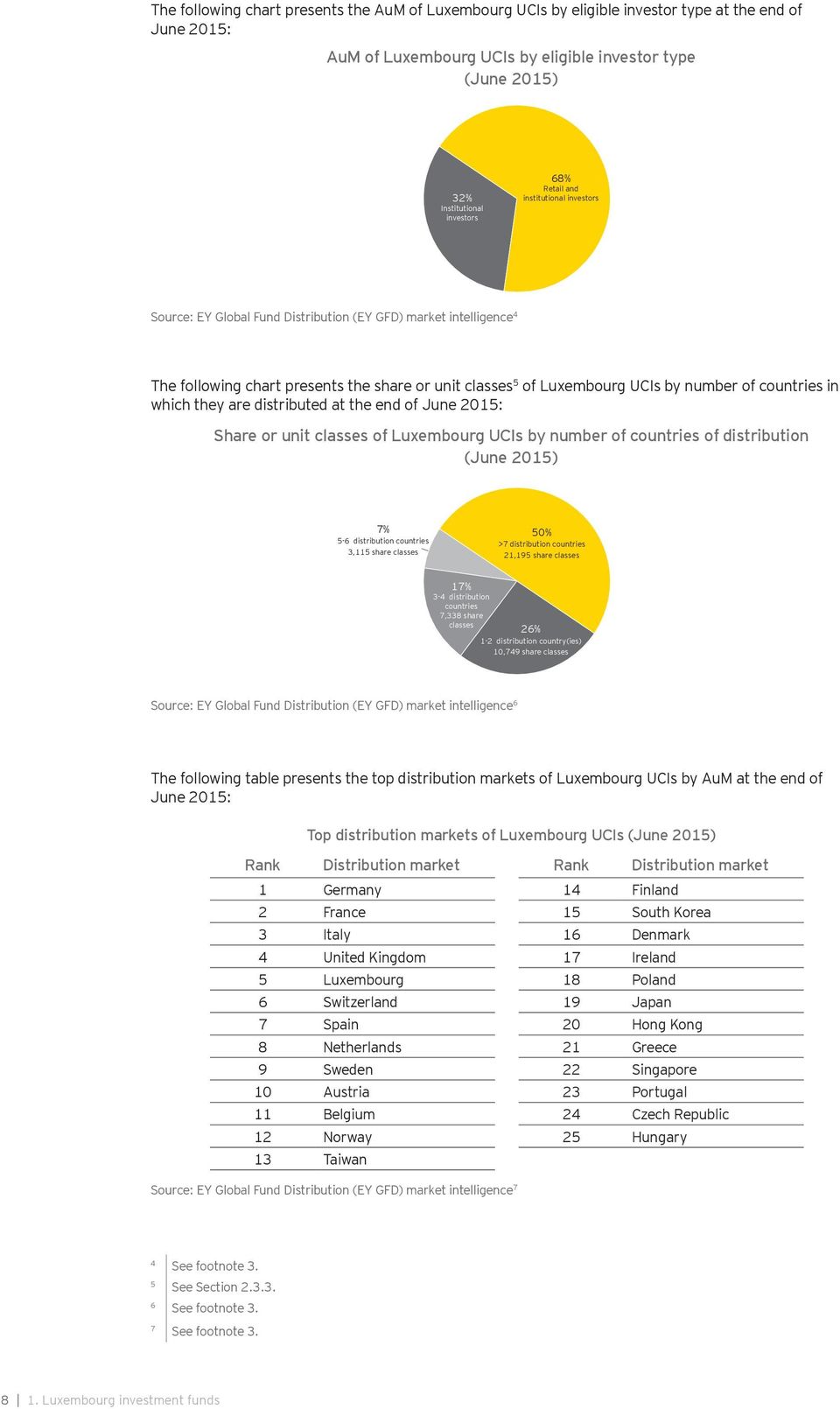
11 The following table presents Luxembourg UCIs top distribution markets DNA of AuM at the end of June 2015: Luxembourg investment funds 1 Germany France Italy United Kingdom Luxembourg Switzerland Spain Netherlands Sweden Austria Belgium Norway Taiwan Finland South Korea Denmark Ireland Poland Japan Hong Kong Greece Singapore Portugal Czech Republic Hungary 0% 20% 40% 60% 80% 100% Domestic funds Foreign ex. Luxembourg funds Luxembourg funds 1.3. Luxembourg s investment fund solutions Fund regimes and passports A. Introduction Luxembourg offers an attractive range of solutions for the creation of UCIs. Luxembourg UCIs can be established under either of the following regimes: Fund category Product Regime Common name of UCI UCITS Undertakings for Collective Investment in Transferable Securities AIF Alternative Investment Funds Part I of the Law of 17 December 2010, as amended (the 2010 Law) on UCIs Part II of the 2010 Law on UCIs The Specialized Investment Fund Law (the SIF Law) The Investment Company in Risk Capital Law (the SICAR Law 8 ) UCITS 2010 Law Part II UCI SIF SICAR 9 8 Not covered by this publication. 9 Idem. 1. Luxembourg investment funds 9

12 B. Marketing passports Most Luxembourg UCIs are marketed to investors in a number of countries. Many Luxembourg UCIs UCITS and Alternative Investment Funds (AIF) benefit from a Product passport enabling them to be marketed to investors in the European Union (EU)/European Economic Area (EEA) 10, following a notification procedure. Marketing of Luxembourg UCIs which do not benefit from a Product passport is subject to the national regimes of the country where the marketing takes place. UCITS can be marketed to all investors in the EU/EEA 11. The UCITS passport means that the shares or units of UCITS can be marketed to all types of investors, both retail and professional, throughout the EEA, following a notification procedure. The marketing of AIF depends on whether or not they are managed in accordance with, and subject to, the full Alternative Investment Fund Managers (AIFM) requirements ( Full AIFM regime AIF ). Full AIFM regime AIFs are AIFs which are managed by an authorized AIFM or authorized internally managed AIF. Authorized AIFM, and authorized internally managed AIF, must meet the full requirements of the AIFM Directive (AIFMD), which is transposed in Luxembourg by the AIFM Law. AIFM compliance is required when the assets of all the AIF under management exceed certain thresholds. Other AIFs are subject to a simplified AIFM registration regime ( Simplified AIFM registration regime AIF ). Chapter 6 covers AIFM requirements in more detail. The marketing of AIF may be summarized as follows: Full AIFM regime AIF can be marketed to: Professional investors in the EU/EEA 12 : authorized AIFM, and authorized internally managed AIF benefit from a passport permitting them to market the shares or units of the AIF they manage to professional investors throughout the EU/EEA Retail investors in the EU/EEA under stricter national rules: each EU/EEA Member State may permit authorized AIFM, and authorized internally managed AIF to market the shares or units of the AIF they manage to retail investors in the Member State. The Member State may also apply stricter requirements than those applicable to marketing to professional investors Simplified AIFM registration regime AIF can be marketed to professional investors in the EU/EEA under national private placement regimes (i.e., subject to national requirements), where such regimes exist. The passport is not applicable. However, a specific regime exists for the managers of qualifying European Venture Capital Funds (EuVECA) and of qualifying European Social Entrepreneurship Funds (EuSEF) which meet the requirements of the simplified EU/EEA regulatory regimes. Such managers can benefit from a passport permitting them to market the shares or units of the qualifying European funds they manage to suitably qualified investors throughout the EU/EEA (see Section ) EU/EEA professional investors may, on their own initiative, purchase the shares or units of any AIF, irrespective of the domicile of the AIF or AIFM, provided that there is no marketing (also referred to as reverse solicitation ) In addition to the rules applicable to AIF, SIFs can only be distributed to informed investors (see Section ) Summary of marketing of Luxembourg UCIs in the EU/EEA Products Regulatory framework Marketing regime Investors UCITS UCITS EU/EEA passport Retail and professional AIF Full AIFM regime AIF EU/EEA passport Professional EuVECA and EuSEF EU/EEA passport Qualified Simplified AIFM registration regime AIF National private placement regimes (NPPRs) Full AIFM regime AIF and, if relevant, simplified AIFM registration regime AIF Any AIF (Full AIFM regime or simplified AIFM registration regime) National retail distribution regimes, where applicable Reverse solicitation Marketing outside the EEA is subject to each country s national requirements. Chapter 12 covers the marketing of UCIs. Professional Retail Professional 10 The EEA includes European Union (EU) Member States plus Iceland, Liechtenstein and Norway. The EEA Agreement establishes freedom to provide services across the EEA, and any specific provisions. 11 The EEA Agreement implements the UCITS Directive passports across the EEA by including reference to it in Annex, without any specific limitations. 12 The EEA Agreement did not list the AIFM Directive in Annex at the time of writing, but the AIFM Directive is identified as a text with EEA relevance Luxembourg investment funds

13 C. Overview of fund regimes and basic structures The choice of regime and basic structure is presented in schematic form below: Luxembourg investment funds 1 Choice of regime UCITS Luxembourg s solutions for UCIs Law Part II SIF Common fund (FCP) A common fund must be managed by a management company A UCITS management company is required. It may be either: A Luxembourg UCITS (Chapter 15) management company EU/EEA UCITS management company An AIF common fund must be managed by a Luxembourg management company, which may be: A Luxembourg UCITS (Chapter 15) management company A Luxembourg non-ucits (Chapter 16) management company The management company may, in turn, appoint an AIFM which may be: An authorized Luxembourg AIFM An authorized EU/EEA AIFM However, where the assets managed by the management company exceed certain thresholds, the management company is required to either: Obtain authorization as an AIFM itself Appoint an AIFM Choice of basic structure A UCITS investment company must either: Be managed by a UCITS management company A Luxembourg UCITS (Chapter 15) management company EU/EEA UCITS management company Manage itself (a selfmanaged UCITS) Investment company with variable capital (SICAV) or investment company with fixed capital (SICAF) An AIF investment company 14 must either: Be managed by: An AIFM directly. The AIFM may be: An authorized Luxembourg AIFM An authorized EU/EEA AIFM A management company which may be: A Luxembourg UCITS (Chapter 15) management company A Luxembourg non-ucits (Chapter 16) management company The management company may, in turn, appoint an AIFM which may be: An authorized Luxembourg AIFM An authorized EU/EEA AIFM However, where the assets managed by the management company exceed certain thresholds, the management company is required to either: Obtain authorization as an AIFM itself Appoint an AIFM Manage itself (an internally managed AIF). Where the assets of the AIF exceed certain thresholds, the internally managed AIF is required to either: Obtain authorization as an AIFM Appoint an AIFM Choice of compartment structure Two structures are possible: Single compartment structure Multiple compartment (umbrella) structure. Each compartment of a multiple compartment structure may pursue a different investment policy 13 Section covers basic structures, Section covers the requirements applicable to AIF, and Section 6.1. introduces management companies and AIFM. 14 This general outline does not cover the specific cases of certain partnerships; for further information, see Section Luxembourg investment funds 11

14 The following table outlines the main characteristics of Luxembourg s investment fund regimes: Regimes UCITS 2010 Law Part II SIF Regulation Regulated Regulated Regulated Regulator CSSF CSSF CSSF Authorization procedure (see Chapter 3) Structures available (see Chapter 2) Eligible investors 15 (see Section B. and Chapter 2) Distribution in European Union (EU)/European Economic Area (EEA) 17 (see Section B. and Chapter 12) to: Prior to set-up Prior to set-up Prior to set-up Common fund: FCP Investment company: SICAV or SICAF Common fund: FCP Investment company: SICAV or SICAF Common fund: FCP Investment company: SICAV or SICAF All All Informed investors 16 Retail investors EU/EEA passport National retail distribution requirements Professional investors EU/EEA passport EU/EEA passport if managed by an authorized AIFM 18, otherwise national private placement regimes (NPPRs) Maximum number of shareholders or unitholders (see Section 2.3.) Minimum number of shareholders or unitholders (see Section 2.3.) Minimum investment by a shareholder or unitholder (see Chapter 2) Use of compartments (sub-funds) (see Section ) Cross-investment between compartments (see Section ) Multiple share or unit classes (see Section ) No limit No limit No limit 20 National retail distribution requirements No minimum No minimum No minimum EU/EEA passport if managed by an authorized AIFM 19, otherwise national private placement regimes (NPPRs) None None 125,000; less if certification Yes Yes Yes Yes, subject to conditions Yes, subject to conditions Yes, subject to conditions Yes Yes Yes 15 Additional restrictions may be included in the constitutional document or prospectus. 16 See Section B. 17 European Union (EU) Member States plus Iceland, Liechtenstein and Norway. 18 See Chapter Idem. 20 Except in the case of a SIF set up as a private limited liability company (S.à r.l.), in which case the maximum number of investors is Luxembourg investment funds

15 Luxembourg investment funds 1 Regimes Eligible investments (see Chapter 4) Diversification (see Chapter 4) Risk management (see Chapter 7) Fees/expenses including performance and advisory fees Transferability of shares or units (see Chapter 2) Information for investors (see Chapter 10) UCITS 2010 Law Part II SIF Transferable securities such Some restrictions Any (unrestricted) as equities, bonds, money market instruments (MMI) and certain derivatives Techniques and instruments related to transferable securities Detailed restrictions apply Detailed requirements General requirements General requirements Detailed requirements No detailed restrictions Must be disclosed General requirements, and AIFM requirements (where applicable) No detailed restrictions Must be disclosed General requirements on risk management system, and AIFM requirements (where applicable) No detailed restrictions Must be disclosed Generally freely transferable Generally freely transferable May or may not be freely transferable Subject to informed investor qualification Prospectus Prospectus 23 Prospectus or offering Key Investor Information (KII) document 26 Financial statements 21 Financial statements 24 Financial statements 27 Required service providers (see Chapter 6) 29 Periodic disclosures 22 UCITS management company (common fund) Periodic disclosures 25 Luxembourg management company (common fund) Periodic disclosures 28 Luxembourg management company (common fund) (see Chapter 9) Luxembourg depositary Luxembourg depositary Luxembourg depositary (see Chapter 8) Administration, registrar and transfer agent which must be in Luxembourg if the management company is in Luxembourg Luxembourg administration, registrar and transfer agent Luxembourg administration, registrar and transfer agent (see Section ) Luxembourg auditor Luxembourg auditor Luxembourg auditor 21 At least audited annual and unaudited semi-annual financial statements. 22 See Section For full AIFM regime AIF, information to be disclosed in the prospectus or separately (see Section ). 24 At least audited annual and unaudited semi-annual financial statements. 25 For full AIFM regime AIF (see Section ). 26 For full AIFM regime AIF, information to be disclosed in the prospectus or separately (see Section ). 27 At least audited annual financial statements. 28 For full AIFM regime AIF (see Section ). 29 Main service providers only listed here; see Section Luxembourg investment funds 13

16 Regulator reputational checks (see Chapter 5) Regimes UCITS 2010 Law Part II SIF Portfolio manager and/or adviser Directors of UCI, or of management company 31 Promoter 30 Portfolio manager and/or adviser Directors of UCI, or of management company 32 (see Chapter 9) Depositary Depositary Depositary Listing possible (see Chapter 13) Net asset value (NAV) calculation and redemption frequency (see Section 8.6.) Subscription and redemption price (see Section ) Tax treatment (see Section 11.3.) Yes Yes Yes Minimum twice a month Minimum monthly and, if managed by an authorized AIFM, the NAV must be calculated on the occasion of each issue. Directors of SIF, or of management company If managed by an authorized AIFM, on the occasion of each issue or subscription or redemption or cancellation of shares or units, and at least once a year. In any case, NAV required for reporting purposes NAV 35 NAV 36 Subscription and redemption conditions laid down in the constitutional document No tax, except for annual subscription tax of 0.05% on the Net Asset Value (NAV) unless a reduced rate of 0.01% or exemption applies No withholding tax (WHT) on dividends paid 37 No tax, except for annual subscription tax of 0.05% on the Net Asset Value (NAV) unless a reduced rate of 0.01% or exemption applies No withholding tax (WHT) on dividends paid 38 No tax, except for annual subscription tax of 0.01% on the Net Asset Value (NAV) unless an exemption applies No withholding tax (WHT) on dividends paid 30 Where the 2010 Law Part II UCI is not managed by a UCITS (Chapter 15) management company. 31 For self-managed UCITS, see Section For internally managed AIF, see Section Directors means, in the case of public limited companies and in the case of cooperatives in the form of a public limited company, the members of the Board of Directors, in the case of partnerships, the managers or general partner, in the case of private limited liability companies, the manager(s) and in the case of common funds, the members of the Board of Directors or the managers of the management company. 34 For internally managed AIF, see Section The net asset value per share or unit may be adjusted to incorporate a swing factor if swing pricing procedures are in place (see Section ). 36 Idem. 37 The Law of 25 November 2014 amends the Luxembourg law of 21 June 2005 transposing the present EU Savings Directive (2003/48/CE) on taxation of savings income in the form of interest payments. As from 1 January 2015, Luxembourg replaced the former regime of withholding tax on interest payments made to an EU individual by the automatic exchange of information on interest payments made by a paying agent established in Luxembourg to individuals resident in another EU Member State. Consequently, the first information exchanges will take place in early 2016 with respect to interest payments made in Idem Luxembourg investment funds

17 Basic structures The decision as to whether to create a UCI in contractual form (common fund FCP) or in corporate form (an investment company, generally with variable capital SICAV) 39 is primarily driven by tax, operational and marketing considerations. The following table details the main differences between common funds and investment companies: Luxembourg investment funds 1 Management entity Control Shareholders or unitholders meetings Common fund (FCP) Luxembourg management company which, in the case of an AIF, may appoint an AIFM Board of Directors of management company in conjunction with depositary Unitholders meetings are not mandatory for a common fund Basic structures Investment company (SICAV or SICAF) Self-managed investment company: Board of Directors, general partner or manager(s) 40. Managed investment company: UCITS: a management company AIF: a management company and/or an AIFM Board of Directors, general partner or manager(s) and ultimately by investors 41 At least one meeting of shareholders must be held annually Taxable status Tax transparent (with limited exceptions) Not tax transparent (with limited exceptions) Tax implications VAT status (Value added tax) Individual underlying investors may benefit from certain double taxation treaties (DTTs) VATable person (via its management company) SICAV may directly benefit from certain DTTs 42 VATable person Luxembourg s investment fund regimes and basic structures, and the requirements for each, are described in more detail in Chapter Traditional investment funds Traditional investment funds include: Equity funds Bond funds Money market funds (MMF) Mixed funds Multiple-asset class investment funds: investment funds with multiple compartments investing in different asset classes Funds of traditional investment funds Appendix I describes in more detail what UCIs are and explains the various types of funds and asset classes. Traditional investment funds may be set up under any of Luxembourg s investment fund regimes (i.e., as UCITS, 2010 Law Part II UCIs or SIFs) using any of the basic structures mentioned previously Alternative investment funds (AIF) Alternative investment funds (AIF) include: Hedge funds Real estate funds Private equity funds 39 See also Section In the case of public limited companies and in the case of cooperatives in the form of a public limited company, the members of the Board of Directors, in the case of partnerships, the managers or general partner, and in the case of private limited liability companies, the manager(s). 41 Except in the case of a partnership. 42 See Circular L.G. -1 n 61 on Certificates of Residence for Luxembourg UCIs 1. Luxembourg investment funds 15

18 Thematic funds such as AIF: Investing in specific segments, such as environment Investing in collectibles, such as luxury goods Investing in intangible assets, such as patents Meeting specific criteria, such as responsible investment criteria Multiple-asset class AIF: AIF with multiple compartments investing in different asset classes, sometimes with interlinked compartments Funds of AIF European long-term investment funds Appendix I describes in more detail what UCIs are and explains the various types of funds and asset classes. AIF are generally set up either as 2010 Law Part II UCIs, or SIFs. Any of the basic structures may be used for 2010 Law Part II UCIs or SIFs. Certain types of AIF are subject to specific rules (Section 2.6.). Going forward, AIF will also be able to set up as European long-term investment funds (ELTIF) (Section ). UCITS may also, to a limited extent, pursue alternative investment strategies (so-called alternative UCITS ). A number of vehicles may be used in conjunction with AIF, for example to hold the underlying investments. Luxembourg vehicles which may be used in conjunction with AIF include commercial companies, referred to as SOPARFIs, and securitization vehicles (see Section 2.7.) Funds of funds and master-feeder structures There are two main types of UCIs which invest into other UCIs: funds of funds and master-feeder structures Funds of funds A fund of funds invests into several other UCIs. A key role of the manager of a fund of funds is the selection and monitoring of the underlying UCIs. It is possible to create funds of funds under any of Luxembourg s fund regimes, subject to the applicable eligibility criteria and diversification requirements (see Chapter 4). Funds of funds may, for example, offer investors diversification and therefore lower risk than direct investment into the underlying UCIs Master-feeder structures In master-feeder structures, the feeder UCI invests most of its assets in a master UCI. Therefore, the management of a significant portion of the portfolio of the feeder UCI is effectively performed by the manager of the master UCI. A feeder UCITS is a non-diversified investment structure investing into a diversified product (master UCITS), permitting the pooling of assets. In a UCITS master-feeder structure, a feeder UCITS invests at least 85% of its assets in a master UCITS. It may invest up to 15% of its assets in liquid assets, financial derivative instruments for hedging purposes or, in the case of investment companies, property essential for the direct pursuit of business. An existing UCITS may be converted into a feeder UCITS. Alternatively an existing UCITS may become a master UCITS. A feeder UCITS may also change its master UCITS. The master UCITS, or one or more of the feeder UCITS, can be located in different EEA Member States. Master and feeder UCITS can be created under Luxembourg s UCITS regime (Part I of the 2010 Law) or the UCITS regime of another EEA Member State. See also Section In an AIF master-feeder structure, a feeder AIF invests at least 85% of its assets in a master AIF, or in more than one master AIF whose master AIF have identical investment strategies, or has otherwise an exposure of at least 85% of its assets to such a master AIF. Master and feeder AIF can be created under any of Luxembourg s AIF regimes, the AIF regime of another EEA Member State or a third country. However, for the AIFM of the feeder AIF to benefit from the AIFM marketing passport, the feeder AIF must invest into a master AIF which is managed by an authorized AIFM (see Section 12.5.). Master-feeder structures may be used by asset managers as a distribution mechanism to facilitate access to certain markets. For example, some French investors may prefer to invest in a local UCITS. An asset manager which currently only offers a Luxembourg domiciled UCITS may take advantage of the UCITS master-feeder provisions and create a feeder UCITS domiciled in France which invests in the master UCITS domiciled in Luxembourg. This structure will enable the manager to distribute to such French investors while managing only one portfolio of investments Luxembourg investment funds

19 Specific types of UCIs Specific types of UCIs can be created under Luxembourg s UCI regimes. These include: Money market funds (MMFs) Exchange traded funds (ETFs) Index tracking UCIs UCIs using efficient portfolio management (EPM) techniques, such as securities lending and currency hedging transactions UCITS using financial derivative instruments (FDIs) Structured UCIs Hedge funds Real estate funds Private equity funds European long-term investment funds (ELTIFs) Requirements applicable to specific types of UCIs are covered in Section Luxembourg investment funds Pension Fund Pooling Vehicles (PFPVs) Pension Fund Pooling Vehicles (PFPVs) can be set up as Luxembourg common funds, which are tax transparent. PFPVs are also exempt from subscription tax (see Chapter 11 for more information on taxation and VAT issues related to Luxembourg funds). Thus, Luxembourg offers a regime that allows the pooling of pension fund investments in a way that is both tax and cost efficient, in the interest of the beneficiaries (see also Section I.4.7. of Appendix I for a description of PFPVs and Section on comanagement and pooling of assets) Unit-linked products Luxembourg life insurers are permitted to offer a range of unit-linked life insurance products. Unit-linked life insurance products are products which are linked to one or more investment funds, which may be either: External UCIs, which: Can be one of the following: A UCITS or another UCI investing in transferable securities An open-ended fund of AIF (i.e., a fund of hedge funds) An open-ended real estate UCI Are subject to investment limits which depend on the category of UCI Internal funds which do not offer a guarantee. There are two categories: Collective investment funds that are: Subject to specific investment restrictions, which vary according to the characteristics of the investor Managed by way of a portfolio management mandate, similar to ordinary UCIs Dedicated funds that are: Subject to a minimum investment premium Subject to specific investment restrictions, which vary according to the characteristics of the investor Managed by way of a discretionary mandate Internal collective investment funds which guarantee returns Life insurance products offering exposure to underlying UCIs are sometimes referred to as life insurance wrappers. Life-insurance companies are required to provide certain information regarding the underlying investment fund(s) to investors before they invest. Luxembourg insurance supervisory authority (Commissariat aux Assurances CaA) Circular 08/1, as amended clarifies the rules applicable to unit-linked life insurance products. These products are not further covered in this Technical Guide. 1. Luxembourg investment funds 17

20 1.4. Organization of a UCI and its service providers This section outlines the typical organization of a UCI, summarizes the roles of the main service providers and outlines the factors impacting the choice of organizational model Typical organization of a UCI As part of the formation procedures of a UCI, several service providers must be appointed. The following diagrams show illustrative examples of the organization of UCIs; other models may be possible. Typical organization of a UCI UCITS AIF Common fund Initiator Common fund Depositary Common fund (FCP) Sponsor Portfolio manager UCITS management company Group/Third-party Administrator, registrar, transfer, domiciliation agent Depositary Paying agent(s) Auditor Distributors Portfolio manager Management company and AIFM (if applicable) Group/Third-party Administrator, registrar, transfer, domiciliation agent Prime broker Paying agent(s) Auditor Distributors Investment adviser Investment adviser Depositary Investment company which has not appointed a management company Sponsor Portfolio manager Investment adviser Self-managed UCITS investment company Board of Directors Administrator, registrar, transfer, domiciliation agent Depositary Paying agent(s) Auditor Distributors Initiator Portfolio manager Investment adviser Internally managed AIF investment company Board of Directors Administrator, registrar, transfer, domiciliation agent Prime broker Paying agent(s) Auditor Distributors Investment company which has appointed a management company Sponsor Portfolio manager Investment adviser Investment company Board of Directors Management company Group/Third-party Administrator, registrar, transfer, domiciliation agent Depositary Paying agent(s) Auditor Distributors Initiator Portfolio manager Investment adviser Investment company Board of Directors Management company and/or AIFM Group/Third-party Administrator, registrar, transfer, domiciliation agent Depositary Prime broker Paying agent(s) Auditor Distributors Key: : Appointed by Luxembourg investment funds

21 UCI service providers This section outlines the principal duties of the main service providers. The appointment of service providers is covered in Subsection 6.1.F.. Luxembourg investment funds 1 A. Sponsor, initiator or promoter For UCITS management companies, the CSSF may ask a sponsor to issue a letter of assurance (or sponsorship ), in which the sponsor commits to the CSSF, that the management company respects, and will continue to respect, the applicable prudential requirements (see also Section ). In practice, the sponsor will generally be the main shareholder of the management company, or a group entity to which the main shareholder belongs. The creator of a UCI is generally referred to in Luxembourg as the promoter in the case of 2010 Law UCIs and the initiator in the case of SIFs. These terms are not defined in Law. A promoter is required for a 2010 Law Part II UCI which is not managed by a UCITS (Chapter 15) management company. The initiator or promoter generally plays one or more important roles in the activity of the UCI. For example, the initiator or promoter may: Be the portfolio manager or adviser Play a role in the oversight of the activity of the UCI, generally by being represented on the Board of Directors of the UCI or its management company and/or Alternative Investment Fund Manager (AIFM) Be a shareholder of the management company Play a role in the distribution of the UCI The role of sponsor of a Chapter 15 management company replaces the role of promoter of a UCI managed by a UCITS management company (see Chapter 6). See also Sections and B. Management company or AIFM Management companies and AIFM are companies that manage UCIs. Management includes, in general, portfolio management, administration and distribution. A common fund (FCP) must be managed by a management company. An investment company can appoint a management company or an AIFM, or manage itself (see also Section and Chapter 6). C. Portfolio manager The portfolio manager manages the UCI (or certain of its compartments) with respect to the investment, divestment and reinvestment of the assets of the UCI. It is a delegate of the UCI or of its management company. D. Investment adviser The investment adviser advises the portfolio manager, the management company or the UCI itself with respect to the investment, divestment and reinvestment of the assets of the UCI. It does not make decisions. E. Administrator The administrator is, inter alia, responsible for keeping the accounting records of the UCI, calculating the NAV, assisting in preparing the financial statements, and acting as a contact with the CSSF and the independent auditor 43. Administration is further discussed in Chapter 8. F. Registrar and transfer agent The registrar and transfer agent is responsible for keeping the principal register of shareholders or unitholders of the UCI, and for arranging the issue, transfer, allotment, conversion, subscription, redemption and/or purchase and sale of shares or units of the UCI (see also Chapter 8). 43 In this Technical Guide, we use the term Independent auditor for Approved statutory auditor 1. Luxembourg investment funds 19
22 G. Domiciliation agent The domiciliation agent provides the registered office of the UCI. It is responsible for providing office accommodation and other facilities to the UCI, keeping all correspondence of the UCI, and arranging payment of bills on behalf of the UCI (see also Chapter 8). H. Distributor Distributors are intermediaries who perform one or both of the following activities: Actively market the shares or units Receive subscription and redemption orders as appointed agents of the UCI See also Section I. Nominee Nominees act as intermediaries between investors and the UCI of their choice. See also Section J. Market maker Market makers are intermediaries participating on their own account and at their own risk in subscription and redemption transactions of UCI shares or units. See also Section K. Depositary The depositary is, inter alia, responsible for the safekeeping of the assets of the UCI, and for the dayto-day administration of the assets (e.g., receipts, sales, dividends), based on instructions received from the asset managers or management company (unless they conflict with the constitutional document). It also plays an oversight role (see also Chapter 9). L. Prime broker A prime broker is an entity subject to prudential regulation and ongoing supervision, which: Offers one or more services to professional investors primarily to finance or execute transactions in financial instruments as counterparty May also provide other services such as clearing and settlement of trades, custodial services, securities lending, customized technology and operational support facilities 44 (see Section 9.8.) M. Paying agent The paying agent arranges for payment of distributions made by the UCI. A paying agent may be required in each country where the UCI is distributed. Generally, the depositary and its network will provide paying agent services (see Section ). Paying agent is a term used differently in the context of the EU Savings Directive (see Section ). N. Independent auditor The financial statements of a UCI must be audited by a Luxembourg independent auditor (réviseur d entreprises agréé see Section ) Organizational model considerations The choice of organizational model for the UCI, its management and service providers will depend on a number of factors, including: The basic structure of the UCI Preference for a group entity or a third party The other fund ranges of the group. Where the group has fund ranges in multiple jurisdictions, it may consider cross-border management Service provider considerations 44 Based on the AIFM Directive and AIFM Law definition of a prime broker Luxembourg investment funds
23 Basic structure of the UCI A common fund (FCP) has no legal personality and must be managed by an authorized management company, regardless of whether it is created under the 2010 Law or the SIF Law. The Board of Directors of the management company, in conjunction with the depositary, has ultimate control of the common fund. The management company is responsible for the common fund, including the appointment and oversight of service providers. An investment company must appoint an approved management company or designate itself as selfmanaged. The Board of Directors of the investment company, and ultimately the shareholders, control the investment company. The Board of Directors is responsible for the investment company, including the appointment and oversight of service providers. It may appoint a management company to manage the investment company, in which case the oversight of some of the service providers is delegated to the appointed management company. The sponsor, initiator or promoter is usually represented on the Board of Directors of the investment company. Both common funds and investment companies can be single or multiple compartment (sub-fund), and each compartment can have one or more share-classes. It is also possible to create master-feeder structures. In master-feeder structures, the feeder UCI invests most of its assets in a master UCI. The key differences between the basic structures of UCIs are summarized in Section The basic structures, multiple compartment UCIs, and share or unit classes are described in more detail in Section 2.3. and the requirements for UCIs by specific regime (UCITS, Part II 2010 Law and SIF) in Section Master-feeder structures are covered in Section Group or third party Sponsors, initiators and promoters can choose between group or third party models. In the group model, the UCI or management entity (management company or AIFM) is created within the group of the sponsor, initiator or promoter, or an existing group structure is used. In the third party model, the sponsor, initiator or promoter uses a third party. Third parties may also make available independent Board Members and key function holders. A. UCI Sponsors, initiators and promoters generally create their own UCIs. However, some portfolio managers and investment advisers choose a UCI created by a third party. In this case, a new UCI will be created by the third party, or a new compartment will be created in an existing multiple compartment UCI (see Section ) of the third party; they will then be appointed as the portfolio manager of, or investment adviser to, the compartment. Luxembourg investment funds 1 Third party UCI is generally a market entry strategy. An option open to sponsors, initiators and promoters who wish to offer UCI products to their clientele, but do not wish to create or manage the products, is to white label third party products. In this case, the third party creates and manages the UCI, but the product is generally marketed under the brand of the sponsor, initiator or promoter. The association with the third party will depend on the model implemented. White labeling enables the same product to be offered to different clients by different sponsors and promoters, such as private banks. Under one model, specific share or unit classes are created for each sponsor, initiator or promoter within an existing UCI. In this case, the product is generally primarily marketed under the brand of the third party. Under another model, some of the fund documentation is branded by the sponsor, initiator or promoter. The third party is, for example, referred to in the fund documentation (e.g., as management company and/or Board of the UCI). The requirements on key investor information (KII) of a UCITS restrict, to a certain extent, white labeling of UCITS. The KII must, in general, be provided to investors before they invest. The KII must be used without alterations or supplements in all Member States where the UCITS is notified (see Sections and ). 1. Luxembourg investment funds 21
24 B. Management entity Sponsors, initiators and promoters who require or wish to use the services of a management company or AIFM (referred to as a management entity in this Technical Guide) have the following options: Create a new group management entity, or use their existing group management entity In practice, the group to which the initiator belongs usually holds a majority shareholding in the management company and is represented on the Board. The group to which the initiator belongs thereby controls the management company and the group entity will be considered the sponsor of the management company (see also Section ). Appoint a third party management entity A number of groups and independent management entities offer third party management services. In the third party management entity model, the initiator or promoter generally does not control the management entity. It may or may not be represented on one of the key committees, such as an investment committee. C. Key function holders When appointing key function holders, sponsors, initiators and promoters have the choice between persons belonging to the group and external ( independent ) persons. Independent persons may make themselves available on a one-to-one basis, or be made available by a third party entity to which they belong. Key function holders may include: Members of the Board of Directors of the UCI (see Chapter 5) and management company or AIFM (see also Section ) Senior management (also known as conducting officers see Section ) Control functions (see Section ) A number of specialist firms offer third party key function holders Cross-border management The UCITS and AIFM Directives 45 have introduced management passports. The passports allow a management entity (management company or AIFM) to manage UCIs (UCITS and AIF, respectively) crossborder i.e., in EU/EEA Member States other than their home Member State ( host Member States). UCIs may be managed cross-border either directly (free provision of services) or via a branch. Branches do not themselves benefit from a management passport. UCIs which have not appointed a management entity do not have a management passport. The following table illustrates the cross-border management possibilities under selected group models: Cross-border management possibilities under selected group models UCIs which can be managed Management configurations Local UCIs UCIs in host Member State(s) Management company managing: Directly Via a branch in host Member State X Self-managed UCIs X See also Section Under the UCITS IV recast of the UCITS Directive Luxembourg investment funds
25 Group management models Asset management groups, particularly those operating in multiple jurisdictions, have a number of options for the management of their UCIs. UCITS management companies and AIFM may combine authorizations within a single entity and obtain a dual authorization as UCITS management company and AIFM. A dual authorized management entity is authorized to manage both UCITS and AIF, and can use the management passport to perform the activities for which it has been authorized in other EU/EEA Member States. It also benefits from product passports to market the UCITS products it manages to any type of investor, and the AIF products it manages to professional investors, in all EU/EEA Member States. The optimal model will probably be based on one or a combination of the following: The super model: creating a single management entity (a management company and/or AIFM) for an ensemble of UCIs, or converting an existing management company to a super entity Luxembourg investment funds 1 Typically super entities will manage UCIs cross-border (see also Section ). The multiple model: local management entities in each UCI domicile, or for specific fund ranges This is the typical legacy structure existing today. The third party model: appointing one or more third party management entities. Under this model, one third party super management entity or multiple third party management entities are appointed rather than setting up group management entities (see also Section ) The self-managed model: self-managed UCITS and internally managed AIF (which are subject to the AIFM Law) are required to comply with most of the requirements applicable to management entities (see Section ). However, neither self-managed UCITS nor internally managed AIF benefit from a passport enabling them to provide cross-border services An increasing number of self-managed UCIs are appointing management entities. The following table briefly summarizes possible management models for UCITS and AIF: Super model Multiple model Third party model Self-managed model Possible management models for UCITS and AIF UCITS AIF UCITS and AIF Super management company Multiple management companies Third party management company Self-managed UCITS investment company Super AIFM Multiple management companies and/or AIFM Third party AIFM Internally-managed AIF investment company Super ManCo and AIFM Multiple management companies and multiple AIFM Third party management company and AIFM n.a. 1. Luxembourg investment funds 23
26 Emerging mixed models Two mixed models are emerging in practice: Super entity model, potentially combining both branches and free provision of services: These asset management groups will convert existing management entities in some Member States into branches of a single Super entity, and make use of free provision of services to manage UCIs in new Member States where the group does not operate (such as feeder UCITS in new domiciles). The following is an illustrative example of this model: Super management entity Member State A UCI A1 UCI A2 UCI A... UCI An Branch C UCI B1 UCI B2 UCI B... UCI Bn UCI C1 UCI C2 UCI D Feeder UCI E Member State B Member State C Member States D & E Home Member State Super entity plus international domicile entity model: These asset management groups will opt to keep a management entity in their home domicile, and another in an international fund domicile. One of the management entities will be selected to provide crossborder services to UCIs in other Member States. The following is an illustrative example of this model: Super management entity Member State A UCI A1 UCI A2 UCI A... UCI An Management entity B UCI B1 UCI B2 UCI B... UCI Bn UCI C1 UCI C2 UCI D Feeder UCI E Member State B Member State C Member States D & E Service provider models Two important considerations when selecting service providers are whether the service provider is a group company or third party and the domicile of the proposed service provider. A. Group or third party Where the UCI or management company is part of a financial group, the Board of a UCI and/or its management entity may choose between group service providers and third parties. In certain cases, a service provider may be created by two or more groups as a joint venture. In certain cases, delegation within a group is relevant from a regulatory perspective. For example: Management entities may consider delegation to a group internal audit function (see Subsection C.) IT infrastructure of a management company may be provided by a group company (see Section ) Conflicts of interest must be considered in a group context (see Section ) Luxembourg investment funds
27 In the context of the AIFM letter box provisions, when assessing whether an AIFM delegates the performance of investment management functions (portfolio management and risk management) to an extent that exceeds by a substantial margin the investment management functions performed by the AIFM itself, one of the factors to be taken into account is whether the delegate is part of the same corporate group as the AIFM (see Subsection C.) B. Domicile Management entities are subject to the delegation requirements of their home Member State. They must also comply with the requirements of the home Member State of the UCIs they manage (the host Member State where the UCIs are managed on a cross-border basis) on the constitution and functioning of the UCIs. In certain cases, asset management groups may therefore have the choice between service providers in: The domicile of the management company The domicile of the UCI Another country An asset management group may therefore implement one or a combination of the following service provider models: Single service provider: Centralized: a single service provider is selected to serve the UCIs in all host Member States from a central location Decentralized: service providers from the same financial services group are selected generally one in each host Member State Multiple service providers: service providers from different financial services groups are selected to serve different UCIs From a Luxembourg perspective, there are a number of minimum rules which apply in relation to the domicile of service providers to UCIs, including the following: Administration (see also Chapter 8): UCITS: A Luxembourg UCITS management company which manages a Luxembourg UCITS is authorized to delegate the administration of the UCITS to an entity established in Luxembourg which is authorized to provide administration services and has adequate organization in order to perform the administration A Luxembourg UCITS management company which manages a UCITS domiciled in another Member State is authorized to delegate the administration of the UCITS to an entity established in either: Luxembourg The Member State where the UCITS is domiciled The entity must be authorized to provide administration services and have an adequate organization in order to perform the administration Luxembourg AIF (including Part II 2010 Law UCIs and SIFs): the central administration of the UCI must be in Luxembourg Depositary: the depositary of a Luxembourg UCI must be established in Luxembourg (see also Chapter 9) Luxembourg investment funds Restructuring a UCI Asset management groups may decide to restructure UCIs for a variety of reasons including, inter alia, optimization of operating models, cost reduction, economies of scale and focusing on certain target investor markets. Typical types of restructuring of UCIs include: Restructuring UCIs: Conversion of Luxembourg UCIs: 2010 Law UCIs into SIFs and vice versa (see Section ) or from one basic structure to another (see Section ) Conversion of an existing UCITS to a feeder UCITS (see Section ) A feeder UCITS changing master UCITS (see Section ) Mergers of UCIs (see Section 3.7.) Creation of a side pocket, typically to hold illiquid assets (see Section and 3.8.) Transferring foreign UCIs to Luxembourg (see Section 3.9.) Liquidation of UCIs and compartments (see Section 3.10.) 1. Luxembourg investment funds 25
28 UCI structures and specificities EY supports asset managers and alternative investment fund houses through the choice of fund vehicle and the creation of a fund structure that meets the relevant regulatory and tax requirements. Concept Michael Ferguson Traditional funds Operating models [email protected] Launch Business Dietmar Klos Tax structuring Alternative funds [email protected] Kai Braun Alternative funds Operating models [email protected] Adam Miller Tax structuring Alternative funds [email protected] UCI structures and specificities
29 2. UCI structures and specificities UCI structures and specificities Introduction This chapter covers: The principal regulations applicable to Luxembourg investment funds (Undertakings for Collective Investment UCIs) The types of structures of UCIs: The basic structures of UCIs (common funds and investment companies) Single and multiple compartment UCIs Share or unit classes Master-feeder structures Co-management or pooling of assets Cross investment between compartments of multiple compartment UCIs Side pockets The requirements applicable to: Undertakings for Collective Investment in Transferable Securities (UCITS) 2010 Law Part II UCIs Specialized Investment Funds (SIFs) Alternative Investment Funds (AIF): full Alternative Investment Fund Managers (AIFM) regime AIF and simplified AIFM registration regime AIF European Venture Capital Funds (EuVECA) and European Social Entrepreneurship Funds (EuSEF) European long-term investment funds (ELTIF) Minimum capital requirements The requirements applicable to specific types of UCIs: Money market funds (MMFs) UCITS exchange traded funds (ETFs) Index tracking UCITS UCIs using efficient portfolio management (EPM) techniques, such as securities lending and currency hedging transactions UCITS using financial derivative instruments (FDIs) Structured UCITS Hedge funds Real estate funds Private equity funds Vehicles used in conjunction with AIF, with a focus on Luxembourg vehicles: Sociétés de Participations Financières (SOPARFI) Securitization vehicles 2.2. Principal regulations The principal regulations applicable to Luxembourg UCIs comprise Luxembourg laws, regulations and circulars issued by the Commission for the Supervision of the Financial Sector (Commission de Surveillance du Secteur Financier CSSF), and also certain Grand-Ducal regulations. 2. UCI structures and specificities 27
30 The principal law on UCIs is the Law of 17 December 2010, as amended (the 2010 Law), which covers: Part I: UCITS Part II: other UCIs (2010 Law Part II UCIs) Part III: foreign UCIs Part IV: management companies (see Chapter 6) Part V: general provisions applicable to UCITS and Part II UCIs The 2010 Law, inter alia, transposes the UCITS Directive (Directive 2009/65/EC often referred to as UCITS IV) into Luxembourg Law. Directive 2014/91/EU of 23 July 2014 on UCITS as regards depositary functions, remuneration policies and sanctions (UCITS V) was published in the Official Journal of the European Union on 28 August UCITS V focuses on 3 main areas: Revision of the depositary regime Introduction of rules on remuneration Harmonization of administrative sanctions Level 2 measures relating to the implementation of UCITS V are expected to be adopted by the European Commission before the end of UCITS V must be implemented into national law by 18 March 2016 and it will become applicable from the same date. The other law on UCIs is the Specialized Investment Fund Law of 13 February 2007, as amended (the SIF Law) covering SIFs. The Law of 12 July 2013 on Alternative Investment Fund Managers (the AIFM Law), transposing the AIFM Directive (Directive 2011/61/EU), lays down requirements applicable to AIF. Two EU Regulations, each creating a fund regime, are directly applicable in Luxembourg: Regulation (EU) No 345/2013 of 17 April 2013 on European Venture Capital Funds (EuVECA) and Regulation (EU) No 346/2013 of 17 April 2013 on European Social Entrepreneurship Funds (EuSEF). Finally, Regulation (EU) No 760/2015 of 29 April 2015 on European long-term investment funds (ELTIF) will be directly applicable in Luxembourg on 9 December Types of structures of UCIs UCITS, 2010 Law Part II UCIs and SIFs can be structured: In contractual form as a common fund (FCP). A common fund must be managed by a management company In corporate form as an investment company: With variable capital (SICAV) With fixed capital (SICAF) While a UCITS must be open-ended 46, non-ucits can be open-ended or closed-ended. The different basic structures are outlined in Section A UCI may take the form of a single compartment UCI (a stand alone UCI) or a multiple compartment UCI (a multiple sub-fund UCI, also known as an umbrella UCI). Multiple compartment UCIs are covered in Section Share or unit classes can be created within a single UCI, or within one or several compartments of a multiple compartment UCI; this is covered in Section In order to manage portfolios in an efficient manner, it is also possible to create master-feeder structures as outlined in Section and to co-manage or to pool funds, as outlined in Section The shares or units of open-ended UCIs are, at the request of holders, redeemed directly or indirectly, out of the UCI s assets UCI structures and specificities
31 Cross investment between compartments of a multiple-compartment UCI is permitted under certain conditions, as described in Section Side pockets may be created in exceptional circumstances, typically to hold illiquid assets as described in Section On 29 April 2015, the European Parliament and the Council of the European Union adopted Regulation (EU) 2015/760 that created a new investment fund vehicle, namely the European longterm investment fund (ELTIF). The ELTIF Regulation was published in the Official Journal of the European Union on 19 May It entered into force on 8 June 2015 and will become applicable in Member States from 9 December The purpose of this new regulation is to boost European long-term investments in the real economy. The regulation applies to EU AIFs that are marketed in the European Union under the ELTIF label. Only authorized EU AIFMs may manage and market ELTIFs. ELTIFs will be subject to additional rules requiring them, inter alia, to invest at least 70% of their capital in clearly-defined categories of eligible assets (generally illiquid assets). Trading in assets other than long-term investments will only be permitted up to a maximum of 30% of their capital (generally liquid assets). An ELTIF is not required to offer redemption rights before the end of its life. This must be clearly indicated as a specific date in the ELTIF rules or instruments of incorporation and disclosed to investors. ELTIFs will target both professional and retail investors in the EU. See Section UCI structures and specificities Basic structures Common fund Common fund (fonds commun de placement FCP) A common fund is a co-proprietorship whose joint owners are only liable up to the amount they have contributed and whose ownership rights are represented by units. A common fund has no legal personality and must be managed by an authorized management company: A UCITS common fund must be managed by a Luxembourg UCITS (Chapter 15) management company or a management company established in another EU/EEA Member State 47 An AIF common fund must be managed by a Luxembourg management company. The management company may either: Manage the AIF itself; where the assets of all the AIF managed by the management company exceed certain thresholds, the management company will be required to obtain authorization as an AIFM Appoint an authorized AIFM in Luxembourg or another EU/EEA Member State Management companies and AIFM are covered in Chapter 6. A common fund is deemed in most cases to be tax transparent. The constitutional document of a common fund is the management regulations (also known as fund rules). The management regulations of a Luxembourg common fund are subject to Luxembourg Law (see Section ) Investment company Investment company with variable capital (société d investissement à capital variable SICAV) Investment company with fixed capital (société d investissement à capital fixe SICAF) An investment company with variable capital (SICAV) is a company whose capital is always equal to its net assets. No formalities are required for increases and decreases in capital. The share capital of an investment company with fixed capital (SICAF) may only be increased or decreased by way of a decision of the general meeting of shareholders to be held before a notary, and subject to applicable publication requirements. However, the capital may be increased by the SICAF s managing body directly, without requiring an extraordinary general meeting of shareholders to decide upon the increase, via the authorized share capital mechanism. In such a case, notarization and publication requirements will still apply. 47 The European Economic Area (EEA) Member States are the European Union (EU) Member States plus Iceland, Liechtenstein and Norway. The reference to the EEA is clarified in Section B. 2. UCI structures and specificities 29
32 An investment company may: Be managed by an authorized management company or AIFM: A UCITS investment company may appoint either: A Luxembourg UCITS (Chapter 15) management company A UCITS management company established in another EU/EEA Member State 48 An AIF investment company (or in the case of a limited partnership or a partnership limited by shares, the managing general partner or the manager) may appoint either: An authorized AIFM, which may either be: A Luxembourg AIFM Another EU/EEA Member State AIFM A Luxembourg management company, which may either be: A Luxembourg UCITS (Chapter 15) management company A Luxembourg non-ucits (Chapter 16) management company The management company may either: Manage the AIF itself. However, where the assets of all the AIF managed by the management company exceed certain thresholds, the management company will be required to: Obtain authorization as an AIFM Appoint an authorized AIFM Appoint an authorized AIFM which may either be: A Luxembourg AIFM Another EU/EEA Member State AIFM Manage itself: A UCITS investment company which manages itself is called a self-managed UCITS. The specific requirements applicable to self-managed UCITS are covered in Sections and An AIF investment company which manages itself is called an internally managed AIF 49. Where the AIF is in the form of a limited partnership or a partnership limited by shares, and the purpose of the manager of the partnership is limited to the AIF, such AIF may also be considered as an internally managed AIF. However, where the assets of the AIF exceed certain thresholds, the internally managed AIF is required to either: Obtain authorization as an AIFM Appoint an authorized AIFM The specific requirements applicable to internally managed AIF are covered in Section Management companies and AIFM are covered in Chapter 6. An investment company is not tax transparent (with very limited exceptions). The constitutional document of an investment company is the articles of incorporation (also known as instruments of incorporation, articles of association or statutes) or partnership agreement (see Section ). UCIs established as investment companies are also subject to the Luxembourg laws covering commercial companies (in particular the Law of 10 August 1915 on commercial companies, as amended the 1915 Law) insofar as the law governing the UCI (the 2010 Law or the SIF Law) does not derogate from it. 50 Investment companies may, in some cases, be subject to the requirements on remuneration policies in the financial sector (see Section ). While a 2010 Law SICAV must be set up as a public limited company (société anonyme S.A.) or a European company (S.E.), a SIF SICAV can be set up as a public limited company, a private limited liability company (société à responsabilité limitée S.à r.l.), a partnership limited by shares (société en commandite par actions S.C.A.), a limited partnership (société en commandite simple S.C.S.), a special limited partnership (société en commandite spéciale S.C.Sp.), or a cooperative company organized as a public limited company (société coopérative organisée sous forme de société anonyme). A SICAV set up as a public limited company or a private limited liability company may be created for a single shareholder, enabling SICAVs to be incorporated by a single entity/person and permitting their creation for a single investor. 48 Idem. 49 Special limited partnerships are not legal entities; they cannot manage themselves. 50 UCIs established as European investment companies must meet the requirements imposed on Luxembourg public limited companies by the 1915 Law, insofar as the Law the UCI is under does not derogate from it, as well as certain other provisions set out in the Law of 25 August 2006 on the European company UCI structures and specificities
33 French name Common abbreviation Possible use by investment companies A 2010 Law Part II SICAF or a SIF SICAF may take any commercial company form, such as the aforementioned legal forms or, in addition, the form of an unlimited company (société en nom collectif). The following table details the main differences between the corporate forms which may be used to create investment companies: Public limited company Société Anonyme European company Main corporate forms of investment companies Société Européenne 52 Private limited liability company Société à responsabilité limitée Partnership limited by shares Société en Commandite par Actions Special limited partnership 51 Société en Sommandite Spéciale Limited partnership Société en Commandite Simple Cooperative company organized as a public limited company Société Coopérative organisée sous forme de Société Anonyme S.A. S.E. S.à r.l. S.C.A. S.C.Sp. S.C.S. S.Co S.A Law SICAV or SICAF SIF Law SICAV or SICAF 2010 Law SICAV or SICAF SIF Law SICAV or SICAF 2010 Law Part II SICAF SIF Law SICAV or SICAF 2010 Law Part II SICAF SIF Law SICAV or SICAF 2010 Law Part II SICAF SIF Law SICAV or SICAF 2010 Law Part II SICAF SIF Law SICAV or SICAF Legal entity Yes Yes Yes Yes No Yes Yes Listing possible Yes Yes No Yes No No No Minimum subscribed share capital 53 Transferability of shares/units 31, ,000 12,500 31,000 None None None Free, subject to restriction in articles of association Free, subject to restriction in articles of association Restricted Free, subject to any restrictions in articles of association Free, subject to any restrictions in articles of association Requires unanimous consent of all the partners Notarial deed Yes Yes Yes Yes Yes Yes Yes Minimum number of shareholders or partners Maximum number of shareholders or partners Minimum number of Directors or managers (1 general partner and 1 limited partner) 2 (1 general partner and 1 limited partner) 2 (1 general partner and 1 limited partner) 2010 Law Part II SICAF SIF Law SICAV or SICAF Not transferable to third parties Unlimited Unlimited 40 Unlimited Unlimited Unlimited Unlimited One-tier: 3 Directors; Two-tier 54 : 2 members of management Board, 3 members of supervisory Board 55 3 managers 56 3 managers or a general partner (whose Board is composed of at least 3 members) 3 managers or a general partner 57 (whose Board is composed of at least 3 members) 3 managers or a general partner 58 (whose Board is composed of at least 3 members) 7 3 Directors 59 UCI structures and specificities 2 In practice, an investment company is generally set up as an S.A. or an S.à r.l. or, in the case of a partnership, an S.C.S. or an S.C.A.. 51 The AIFM Law implemented significant amendments to the 1915 Law, including the clarification of the partnership regimes and the introduction of a new Special limited partnership (Société en Commandite Spéciale S.C.Sp.). 52 More generally known by the Latin name societas europaea. 53 Minimum capital requirements are covered in Section Whereas a one-tier structure has a single governing body, a two-tier structure has a Management Board and a Supervisory Board. The Management Board has the power to execute all activities necessary to achieve the company s objectives and must have at least two members (one member is permit ted if the share capital of the company is less than 500,000, or if the company has a single shareholder). The Supervisory Board is in charge of the supervision of the company and cannot play a role in the day-to-day management of the company. 55 Where there is more than one shareholder. 56 In practice. 57 Expected minimum requirement. 58 Expected minimum requirement. 59 In practice. 2. UCI structures and specificities 31
34 Multiple compartment UCIs Multiple compartment UCIs (otherwise known as umbrella funds) are UCIs which comprise, or may comprise, two or more compartments (sub-funds), each with different features generally a different investment policy/strategy. Different compartments may, for example, invest in different asset classes. Multiple compartment structures are favored by the larger promoters and initiators of UCIs. The assets of each compartment of a multiple compartment UCI are generally segregated and the accounting records of each compartment are kept separate. Multiple compartment UCIs are recognized under Article 181 of the 2010 Law, and Article 71 of the SIF Law. Multiple compartment UCIs may be created provided their constitutional document expressly permits it and specifies the applicable operational rules, and their prospectus or offering document specifies the investment policy and specific features of each compartment. By way of derogation from the Luxembourg Civil Code, the rights of investors and of creditors concerning a compartment, or which have arisen in connection with the creation, operation or liquidation of a compartment, are limited to the assets of that compartment (i.e., segregation of assets and liabilities on a compartment by compartment basis protected cell concept), unless a clause included in the constitutional document provides otherwise. Investors may, if permitted by the constitutional document, prospectus or offering document, switch all or part of their investment from one compartment to another, in principle without incurring significant charges. By permitting investors to switch between compartments, promoters and initiators may retain in the same UCI those investors who wish to change their investment strategy. A. All multiple compartment UCIs All multiple compartment UCIs must meet the following requirements: The constitution of a multiple compartment UCI must ensure that each compartment is treated as a separate entity having its own funding, capital gains and losses, expenses, etc. The opening of a new compartment requires CSSF approval and a prospectus or offering document update The UCI must have a single name and each compartment should have a distinct name The UCI must have a single depositary (i.e., the same depositary for all compartments); the depositary may use a sub-custodian network The UCI must have a single auditor (i.e., the same auditor for all compartments) Shareholders or unitholders may, in principle, be able to move from one compartment to another without incurring significant charges; the fund documentation of the UCI may restrict this possibility The constitutional document must state the presentation currency of the combined financial statements of the UCI, obtained by aggregating the various compartments The net asset value (NAV) of a share or unit is calculated by reference to the net assets of the compartment for which that share or unit has been issued, by reference to the net assets of the share or unit class in which this share or unit has been issued. The value of shares or units in respect of the same UCI consequently differs between compartments, and within one compartment, between share or unit classes Subscription and redemption of shares or units of each compartment must, for 2010 Law UCIs, be executed at a price obtained by dividing the NAV of each compartment (or, where relevant, of each share or unit class) by the number of shares or units in circulation; SIFs are required to follow the rules laid down in their constitutional document (see Sections 8.6. and 8.7.) Certificates or other documents evidencing the rights of shareholders or unitholders may only differ in respect of the designation of the particular compartment for which they are issued Diversification rules specified by the law or the regulator must be complied with by each compartment, except those restrictions relating to significant influence over an issuer which also apply to all compartments taken together (see Section ) One compartment of a multiple compartment UCI may invest in other compartments of the same UCI (see Section ) UCI structures and specificities
35 B. Multiple compartment common funds In addition to the requirements described in Subsection A., multiple compartment common funds must meet the following conditions: The UCI must have a single management company (i.e., the same management company for all compartments) The UCI must have a set of management regulations, either global or per compartment, which define the general rules of valuation, supervision, subscription and redemption and investment restrictions C. Multiple compartment investment companies In addition to the requirements described in Subsection A., multiple compartment investment companies must meet the following conditions: The investment company must have a capital represented by shares, which consequently implies that: There is a single share capital expressed in a single currency The nominal or par value is expressed in that same currency The annual accounts are also expressed in that same currency However, the NAV of each compartment or, where relevant, of each share class, is denominated in the currency of the relevant compartment or share class (see Section ) Each share of the same type gives the right to one vote. The CSSF recommends that the equality of voting rights is emphasized in the articles of incorporation. In addition, the articles of incorporation should distinguish between decisions in which all shareholders have an interest and which are taken at the company s general meeting of shareholders and those concerning the particular shareholders of one compartment which are taken at the general meeting of shareholders of that compartment (see also Section and 10.6.) 60 The articles of incorporation must list the conditions for suspension of the NAV calculation and the subscription and redemption of shares of the UCI and of an individual compartment UCI structures and specificities Share or unit classes Multiple share or unit classes may be created within a UCI or, in the case of a multiple compartment UCI, within a compartment. While the investment policy is defined at the level of the UCI or the compartment, share or unit classes permit the implementation of features, generally customized to one or more specific needs or preferences, such as a specific fee structure, currency of denomination, hedging policy, dividend policy, investor type or country of distribution. Identification numbers (such as ISIN (International Security Identification Number) are attributed at the level of the share or unit class. The UCITS Directive recognizes the possibility for UCITS to offer different share classes to investors but it does not prescribe whether, and to what extent, share classes of a given UCITS can differ from each other. ESMA published a discussion paper on different share classes of UCITS on 23 December 2014 identifying the diverging national practices as to the types of share class that are permitted, ranging from very simple share classes e.g. with different levels of fees, to much more sophisticated share classes e.g. with potentially different investment strategies. In this discussion paper, ESMA sets out its views on what constitutes a share class, including how to distinguish share classes from compartments of UCITS. The paper also provides possible approaches to the extent of differentiation between share classes that should be permitted. The closing date for responses to the paper was 27 March Subject to restrictions for cross investments (see also Section ) 2. UCI structures and specificities 33
36 Schematic of a possible multiple compartment, multiple share or unit class structure 61 UCI Multiple compartment UCI Compartments, each with specific features US equity UK equity Europe equity Europe bonds Euro long/short Share or unit classes, each with specific features Fee structure (combinations of entry, exit and ongoing) Currency (e.g.,, US$, JPY) or hedged Dividend policy (Distribution or capitalization) Investor type (e.g., professional, retail) Management of assets In addition to the traditional management of assets may be managed using master-feeder structures or co-management or pooling to manage portfolios in an efficient manner Master-feeder structures In master-feeder structures, the feeder UCI invests most of its assets in a master UCI. Therefore, the management of a significant portion of the portfolio of the feeder UCI is effectively performed by the manager of the master UCI. Master-feeder structures can be created under any of Luxembourg s fund regimes. They can also be created in combination with foreign UCIs the Luxembourg UCI being the master and the foreign UCI the feeder and vice versa. Taxation issues in relation to master-feeder structures are covered in Section A. UCITS Specific requirements are applicable to master-feeder UCITS structures i.e., where both the master and feeder are UCITS. UCITS are, inter alia, required to meet detailed diversification requirements (see Section ). The possibility to create a feeder UCITS represents a specific derogation from UCITS investment rules, and is therefore subject to specific requirements. These are outlined in the remainder of this section. Master-feeder UCITS structures are covered by Chapter 9 of the 2010 Law. To be deemed a master-feeder UCITS structure under the 2010 Law, the feeder UCITS must invest at least 85% of its assets into a single master UCITS. The feeder UCITS may invest up to 15% of its assets in ancillary liquid assets, financial derivative instruments which may only be used for hedging or, in the case of investment companies, moveable and immoveable property essential for the direct pursuit of business (see also Subsection VII.). Possible master-feeder scenario Country X Feeder UCITS A 15% of assets (e.g., liquid assets) Country X Feeder UCITS B 15% of assets (e.g., liquid assets) 85% of assets Country Y Feeder UCITS C 15% of assets (e.g., liquid assets) 85% of assets Country Z Master UCITS 85% of assets A master UCITS cannot itself be a feeder and cannot invest in a feeder UCITS. The master UCITS and the feeder UCITS can be located in different EU/EEA Member States. 61 This graphic is designed to illustrate a multiple-compartment, multiple share or unit class structure; it is not designed to represent a typical structure UCI structures and specificities
37 Before investing into a master UCITS, the feeder UCITS will have to obtain the approval from the CSSF. The master UCITS and feeder UCITS are required to enter into an agreement, inter alia to provide the feeder UCITS with all documents and information necessary for the feeder UCITS to be able to comply with the requirements of the 2010 Law. The minimum content is detailed in CSSF Regulation 10-5 and includes, inter alia: Access to information, including: How and when the master UCITS provides the feeder UCITS with its constitutional document, prospectus and Key Investor Information (KII), information on delegation of portfolio management and risk management functions, and, where applicable, internal operating documents The details of constitutional document or bilateral agreement breaches which the master UCITS will notify to the feeder UCITS, the manner and the timing thereof (see Section ) Where the feeder UCITS uses financial derivative instruments for hedging purposes, how and when the master UCITS will provide the feeder UCITS with information about its actual exposure to financial derivative instruments to enable the feeder UCITS to calculate its own global exposure A statement that the master UCITS will inform the feeder UCITS of any other information-sharing arrangements entered into with third parties, and, where applicable, how they will be made available to the feeder UCITS Basis of investment and divestment by the feeder UCITS, standard dealing arrangements and events affecting dealing arrangements (see Section ) Standard arrangements for the audit report Changes to standing arrangements The applicable law (i.e., the law of the master s and/or feeder s home Member State) and that both UCITS agree to the exclusive jurisdiction of the courts of that Member State Where both the master UCITS and feeder UCITS are managed by the same management company, the agreement may be replaced by internal conduct of business rules, which should cover, inter alia: Measures to mitigate conflicts of interest that may arise between the feeder UCITS and the master UCITS, or between the feeder UCITS and other shareholders and unitholders of the master UCITS, to the extent that these are not sufficiently addressed by the measures applied by the management company (see Section ) Basis of investment and divestment by the feeder UCITS, standard dealing arrangements and events affecting dealing arrangements (see Section ) Standard arrangements for the audit report The prospectus of the feeder UCITS must declare explicitly its status as a feeder UCITS. The prospectus must include, inter alia, information on the investment objectives and policies of both master UCITS and feeder UCITS, a summary of the agreement (or internal conduct of business rules) between master UCITS and feeder UCITS, costs and tax implications as well as an indication of where to obtain the prospectus of the master UCITS (see also Subsection J.). Master UCITS and feeders UCITS may have different depositaries and auditors. Such depositaries and auditors must enter into information-sharing agreements (see also Section ). An existing UCITS may convert to a feeder UCITS. A feeder UCITS may also change its master UCITS. Prior to making such changes, the UCITS must inform its shareholders or unitholders and provide certain information to them including, inter alia, its KII and the KII of the master UCITS. The shareholders or unitholders will then have 30 days to request the redemption of their shares or units free of charge (except for divestment costs) (see also Section ). If any distribution fee or commission is received due to the investment of the feeder UCITS in the master UCITS (by the feeder UCITS itself, its management company or by any other person acting on behalf of the feeder UCITS or its management company), this distribution fee or commission should be paid to the feeder UCITS. An existing UCITS may become a master UCITS. A master UCITS should immediately inform the supervisory authority of its home Member State of the identity of each feeder UCITS which invests in its shares or units. The master UCITS must not charge subscription or redemption fees to the feeder UCITS. UCI structures and specificities 2 2. UCI structures and specificities 35
38 B. SIFs SIF feeder structures are permitted under the SIF diversification rules which specify that SIFs are not subject to the SIF diversification rules if they invest into target UCIs which are subject to risk diversification principles that are at least comparable to those relevant to SIFs (see Section 4.3.). C. AIF Under the AIFM Law and the AIFM Directive, an authorized AIFM is permitted to market feeder AIF to professional investors in the EU/EEA with a passport only if the master AIF is managed by an authorized EEA AIFM (see Section ) Co-management and pooling of assets To ensure efficient portfolio management, and provided the investment policies so permit, the management of a UCI may decide to co-manage, or pool, certain assets within a single fund vehicle (intra-pooling) or between two or more Luxembourg fund vehicles (extra-pooling). Cross-border pooling between fund vehicles domiciled in different national jurisdictions may also be permitted. The assets being co-managed are commonly referred to as a pool. Pooling enables different compartments of a fund or funds to invest in a pool or several pools of assets. This arrangement is an administrative process that can reduce portfolio management, administration and custody costs without changing the legal rights and obligations of shareholders or unitholders. The pools are not legal entities and are not directly accessible to investors. Each of the co-managed funds remains entitled to its specific assets, and responsible for its liabilities. Where the assets of one or more funds are pooled the assets of the pool attributable to each fund will initially be based on the value of the assets allocated to the pool. Subsequently, each fund s portion of the pool will vary according to withdrawals from and additional allocations to the pool. Each line item held within the pool, as well as all gains and losses made by the pool, must be allocated to each fund investing in the pool in accordance with the ratio of the pool each fund is entitled to. Intra-pooling Extra-pooling Umbrella UCI (SICAV/FCP) Umbrella UCI 1 Umbrella UCI 2 Fund vehicle Pools } } } Compartment A Pool I (e.g., fixed income) Compartment B Pool II (e.g., equity) Compartment C * Compartment A Compartment B Compartment C Pool I (e.g., fixed income) * Compartment M Pool II (e.g., equity) Compartment N Underlying Investments Pool I Investments Pool II Investments Pool I Investments Pool II Investments * In the scenario, Compartment C invests 100% in Pool II The impact of the European Market Infrastructure Regulation (EMIR) should be carefully considered in the framework of existing and future pooling structures. Whether pools are considered as legal entities under EMIR will depend on each specific situation UCI structures and specificities
39 Cross investment Multiple compartment UCIs are permitted to invest in other compartments of the same UCI (cross investment) as long as certain conditions are met. Such investment is provided for in the: Constitutional document Prospectus or offering document Conditions to be met in the case of cross investment The target compartment does not invest in the investing compartment Not more than 10% of the assets of the target compartment must be invested in other compartments of the same UCI The voting rights of the investing compartment in relation to its investment into the target compartment are suspended during the period of investment The value of cross investments must not be taken into account in calculating the net assets in the context of meeting the minimum net assets requirements There is no duplication of management, subscription or redemption fees for the assets cross invested Creation of a side pocket 2010 Law UCIs SIFs X X X X X X 62 X X X X X 63 Where a UCI or a compartment thereof is invested in illiquid assets, some or all of these assets may, under certain conditions, be transferred to a side pocket. Side pockets may be created within both 2010 Law UCIs and SIFs. However, a side pocket may only be created within a UCITS in very restricted circumstances. Side pockets may not be used to solve temporary valuation problems. Two main types of side pocket are: A spin-off from an existing share class or unit class to a new share class or unit class A spin-off from an existing compartment to a new compartment On the date of creation of the side pocket, the illiquid assets are allocated to the new share class, unit class or compartment the side pocket. The investors of the existing share class, unit class or compartment receive shares or units in the side pocket on a pro rata basis according to their holding in the existing share class, unit class or compartment. The side pocket is closed to any new subscriptions and suspended for redemptions (and conversions). The manager is required to manage the assets in the side pocket with the objective of realizing them in the best interests of, and distributing the proceeds to, investors. Upon the sale of the assets in the side pocket, its shares or units are redeemed or cancelled. The fast-track procedure for the creation of a side pocket is outlined in Section UCI structures and specificities 2 62 In practice, for SIFs, such information may also be disclosed in the constitutional document. 63 The SIF Law specifically states that no duplication of management fees is permitted for the assets cross invested. 2. UCI structures and specificities 37
40 2.4. Specific requirements by regime This section outlines specific requirements applicable to 2010 Law UCIs, SIFs and ELTIFs. In addition to the requirements outlined in this Section, UCIs may be subject to specific requirements on: Investment rules, covered in Chapter 4 Portfolio management Risk management and valuation, covered in Chapter 7 Prospectus and issuing document and financial reporting, covered in Chapter 10 Marketing, covered in Chapter 12 Requirements common to all Luxembourg AIF, including 2010 Law Part II UCIs, SIFs and ELTIFs are covered in Section Requirements applicable to investment companies which have not appointed a management company (self-managed UCITS and internally managed AIF) are covered in Section UCIs established under the 2010 Law Definition of a UCI under the 2010 Law This Section outlines the provisions of the 2010 Law which must be complied with by UCITS and 2010 Law Part II UCIs. A. Collective investment of funds There must be collective investment of funds, which is understood to be the mutual investment of capital raised from individual investors. Such investments may be made in transferable securities or other assets; they must be made in compliance with the applicable investment restrictions (UCITS and 2010 Law Part II UCIs are subject to different investment restrictions see Chapter 4), as well as the fund documentation (see Chapter 10). The objective of this investment is to generate income or obtain capital appreciation. Consequently, a UCI may normally not acquire holdings where, beyond seeking return, the objective is to achieve a position of significant influence or control over the long-term. As an exception, Part II UCIs that invest in venture capital (see Section ) may acquire significant holdings or control as this is indicative of the nature of such investment policy rather than a desire for control. B. Raised from the public The funds invested collectively must be raised from the public. The public is approached when the raising of funds is not confined to a restricted circle of investors. C. Diversification of risk The investments arising from the collective investment of funds must be made according to the principle of diversification of risk, in order to prevent the risk attached to an excessive concentration of investments (see also Section 4.2.) Promoters and initiators of 2010 Law UCIs A promoter is required for a 2010 Law Part II UCI that is not managed by a UCITS (Chapter 15) management company (see Section A.). In general, the promoter or initiator is represented in the governing bodies of the UCI, or is a shareholder of the management company of a common fund UCI structures and specificities
41 Distinction between Part I (UCITS) and Part II UCIs The 2010 Law distinguishes between UCITS (set up under Part I of the 2010 Law) and Part II UCIs (set up under Part II of the 2010 Law). The distinction between UCITS and 2010 Law Part II UCIs is covered in Section Requirements applicable to UCITS (Part I UCI) In addition to complying with the definition of a UCI in Section , a UCITS must: Comply with the specific investment and borrowing rules (see Section ) Be open-ended i.e., the shares or units of the UCITS are, at the request of holders, redeemed directly or indirectly, out of the UCITS assets. Action taken by a UCITS to ensure that the stock exchange value of its shares or units does not significantly vary from its net asset value (NAV) is regarded as equivalent to such redemption Have an approved UCITS management company (authorized either under Chapter 15 of the 2010 Law, or under the UCITS Directive in another Member State), or alternatively in the case of an investment company, designate itself as self-managed and comply with the requirements similar to those of such an approved management company (see Section ) In accordance with Article 3 of the 2010 Law, specifically excluded from Part I are UCIs: Which are closed-ended (see Section 2.3.) Which raise capital without promoting the sale of their shares or units to the public within the EU The shares or units of which, under their constitutional document, may only be sold outside the EU (even though they may be listed on the Luxembourg Stock Exchange (LuxSE)) For which the specific investment and borrowing rules (see Section ) are inappropriate in view of their investment and borrowing policies Requirements applicable to a self-managed UCITS As stated in Section , a UCITS investment company must either appoint a management company (that complies with Chapter 15 of the 2010 Law see Chapter 6) or designate itself as self-managed (all common funds are managed by a management company). The requirements applicable to a selfmanaged investment company as stated in Articles 27 and 39 of the 2010 Law and in CSSF Circular 12/546 may be summarized as follows: Minimum capital at date of authorization is 300,000 (see also Section 2.5.) The application for authorization must be accompanied by a business plan (program of activity), setting out, inter alia, the organizational structure of the UCITS (see also Section ) It may only manage assets of its own portfolio and may not, under any circumstances, manage assets on behalf of a third party A self-managed UCITS must also comply with most of the rules which are applicable to a UCITS management company (see Section ) Delegation by investment companies A self-managed UCITS investment company must comply with the rules which are applicable to a UCITS management company in relation to delegation (see Section ) Law Part II investment companies are required to comply with the requirements on delegation similar to those applicable to Chapter 16 management companies (see Subsection D.). Those qualifying as full AIFM regime AIF are required to comply with the provisions of the AIFM Law in relation to delegation (see Section ) Law investment companies exercising voting rights A 2010 Law investment company that has designated a management company but has not specifically mandated the management company to exercise the voting rights attached to the instruments held in its portfolio is required to develop its own strategy for the exercise of voting rights. UCI structures and specificities 2 2. UCI structures and specificities 39
42 SIFs Objective of a SIF The primary objective of a SIF must be the collective investment of the funds raised from its investors while applying the principle of risk diversification. A. Collective investment of funds There must be collective investment of funds, which is understood to be the mutual investment of capital raised from individual investors. B. Raised from informed investors 64 SIFs can only raise capital from informed investors who are able to understand and assess the risks associated with investment in such a fund. Informed investors are: Institutional investors Professional investors Other types of investors who have declared in writing that they are informed investors, and meet either of the following criteria: They invest a minimum of 125,000 The CSSF has clarified that in the case of co-investment into the SIF by more than one investor, each investor must invest the minimum amount. They have an appraisal from a bank, an investment firm or a management company (all of these with a European passport) certifying that they have the appropriate expertise, experience and knowledge to adequately understand the investment made in the SIF Directors 65 and other persons involved in the management of the SIF are exempt from these requirements. C. Diversification of risk The investments of the SIF must be made according to the principle of diversification of risk Risk management Risk management requirements applicable to SIFs are covered in Section Conflicts of interest SIFs must be structured and organized in such a way as to mitigate the risk of any conflict of interest, which may potentially adversely affect the interests of the investors, such conflict of interest being between the SIF and, where applicable, any person involved in the activities of the SIF or directly or indirectly related to the SIF. In case of potential conflicts of interest, the SIF is required to protect the interests of its investors. CSSF Regulation details the conflicts of interest requirements to be applied by SIFs. For the purpose of identifying potential conflicts of interest whose existence may damage the interests of the SIF, SIFs must take into account, as a minimum, whether any person involved in the activities of the SIF, or directly or indirectly linked to the SIF, is in any of the following situations: The person is likely to make a financial gain, or avoid a financial loss, at the expense of the SIF The person has an interest in the outcome of a service provided to the SIF or to another client, of an activity carried out for their benefit, or of a transaction carried out on behalf of the SIF or another client, which is distinct from the interest of the SIF in that outcome The person has a financial or other incentive to favor the interests of another client or group of clients over the interests of the SIF 64 The CSSF translates the original French term investisseurs avertis as well-informed investors. 65 Directors means, in the case of public limited companies and cooperatives in the form of a public limited company, the members of the Board of Directors, in the case of partnerships, the managers or general partner, in the case of private limited liability companies, the manager(s) and in the case of common funds, the members of the Board of Directors or the managers of the management company UCI structures and specificities
43 The person carries on the same activities for the SIF as for one or several clients that are not SIFs The person receives or will receive from a person other than the SIF an inducement in relation to the collective portfolio management activities performed for the benefit of the SIF in the form of monies, goods or services structure other than the standard commission or fee for that service The Regulation requires SIFs to establish, implement and maintain an effective written conflicts of interest policy which: Identifies, in relation to portfolio management activities performed by or on behalf of the SIF, the circumstances which constitute or may potentially give rise to a conflict of interest entailing a material risk of damage to the interests of the SIF Defines the procedures to be followed and the measures to be taken in order to manage conflicts of interest The conflicts of interest policy must be proportionate to the organizational structure of the SIF, and to the nature, scale and complexity of its activities. Where the SIF belongs to a group, the conflicts of interest policy must take into account the potential conflicts of interest resulting from the structure and activities of other members of the group. The conflicts of interest procedures and measures must ensure that persons engaged in activities entailing a conflict of interest act with a level of independence that is appropriate to the size and activities of the SIF and of the group to which it belongs and to the extent of the risk of damage to the interests of the SIF. SIFs are also required to establish, implement and maintain a policy to prevent any relevant person from entering into personal transactions which may give rise to conflicts of interest. SIFs are also required to set up an adequate policy to prevent or manage any conflicts of interest resulting from the exercise of voting rights attached to instruments held. The Regulation requires SIFs to keep, and regularly update, a record of the types of collective portfolio management activities performed by or on behalf of the SIF for which a conflict of interest entailing a material risk of damage to the interests of the SIF has arisen, or may arise. Where the organizational and administrative arrangements made by the SIF to manage conflicts of interest are not sufficient to guarantee, with reasonable confidence, that risks of damage to the interests of the SIF or its investors will be prevented, the Directors must be informed promptly so that they can take any measure necessary to ensure that the SIF will act in its best interests and those of its investors. The SIF is required to inform the investors of any such conflicts of interest and explain the measures adopted by the SIF (see also Section ). SIFs are required to confirm to the CSSF that they have established a conflicts of interest policy in their application for authorization (see Section 3.3.). Conflicts of interest requirements applicable to management companies and AIFM are covered in Section Delegation When a SIF or its management company delegates one or more of their own functions to third parties, such delegation must be made with a view to conducting operations in a more efficient manner and the following conditions must be complied with: The CSSF must be adequately informed of any delegation The mandate cannot prevent the effectiveness of supervision of the SIF, and in particular must not prevent the SIF from acting, or the SIF from being managed, in the best interests of the investors When the delegation concerns portfolio management, the following requirements must be met: The mandate may only be given to persons or entities that are authorized or registered for the purpose of asset management and subject to prudential supervision In case of delegation to a third country undertaking, there must be cooperation arrangements between the CSSF and the supervisory authority of the third country Where the conditions of the previous bullet point cannot be met, the delegate must be of sufficiently good repute and sufficiently experienced, and the delegation is subject to the prior approval of the CSSF Portfolio management functions cannot be delegated to the depositary UCI structures and specificities 2 2. UCI structures and specificities 41
44 When the delegation concerns risk management, the requirements outlined in Section must be met The Directors of the SIF, or of its management company in case of a common fund, must be able to demonstrate that: The delegate is qualified and capable of undertaking the functions in question The delegate was selected with all due care The SIF is in a position to monitor effectively the delegated activity, to give further instructions at any time to the delegate or to withdraw the mandate with immediate effect in order to protect the interests of the investors The prospectus or offering document of the SIF must list the delegated functions Requirements applicable to AIF AIF, including 2010 Law Part II UCIs and SIFs, will either fall into one of the following categories: Full AIFM regime: AIF managed by an authorized AIFM Authorized internally managed AIF Simplified AIFM registration regime AIF (i.e., where the AIF assets under management fall below the de minimis thresholds outlined in Subsection D.): AIF managed by simplified registration regime AIFM Simplified AIFM registration regime internally managed AIF European Venture Capital Funds (EuVECA) and European Social Entrepreneurship Funds (EuSEF) European long-term investment funds (ELTIF) Full AIFM regime AIF AIF managed by authorized AIFM must be managed in accordance with AIFM Directive requirements. These requirements are implemented in Luxembourg by the AIFM Law. Internally managed AIF which are in scope of the AIFM Law must also be managed in accordance with AIFM Law requirements. AIFM compliance is required when the assets under management of all AIFs managed by an AIFM, or of an internally managed AIF, exceed certain thresholds (see Subsection D.). AIFM requirements are covered in Chapter 6. The specific requirements applicable to authorized internally managed AIF are covered in Section The relevant provisions of the AIFM Law must be applied by full AIFM regime AIF, or the AIFM acting on their behalf. The provisions include those on: Investments in securitization vehicles (see Section ) Major holdings and control over portfolio companies (see Section ) Risk management, including leverage (see Section 7.3.) Delegation of functions (see Section ) The depositary of the AIF (see Chapter 9) Valuation (see Section 7.5.) Information provided to investors (see Chapter 10) Marketing (see Chapter 12) Requirements which must be met by feeder AIF in order to benefit from the marketing passport are covered in Subsection C Simplified AIFM registration regime AIF AIF which are managed by simplified registration regime AIFM are impacted by AIFM requirements. Simplified registration regime AIFM are subject to registration and reporting requirements, which includes, inter alia, the requirement to provide detailed information to the CSSF on each AIF they manage (see Subsection E. and Section ). Simplified AIFM registration regime internally managed AIF are subject to the same registration and reporting requirements as simplified registration regime AIFM. Simplified registration regime AIFM and simplified AIFM registration regime internally managed AIF may choose to opt-in under the AIFM Law in order to benefit from the rights granted to AIFM (in particular passports). In this case, they must comply with all the provisions of the AIFM Law (see Section ) UCI structures and specificities
45 Simplified registration regime AIFM are required to monitor their assets under management and, when the assets under management exceed the relevant de minimis threshold on more than a temporary basis, apply for authorization as an AIFM (see Section ) EuVECA and EuSEF The managers of qualifying European Venture Capital Funds (EuVECA) and of qualifying European Social Entrepreneurship Funds (EuSEF) that are subject to a simplified EU/EEA regulatory regime can benefit from a passport permitting them to market the shares or units of the qualifying European funds they manage to suitably qualified investors throughout the EU/EEA. The applicable regimes are: Regulation on European Venture Capital Funds (EuVECA) 66 Regulation on European Social Entrepreneurship Funds (EuSEF) 67 The regimes create labels ( designations ) for investment funds investing primarily in small and medium sized enterprises (SMEs) and offer their managers passports enabling them to market their EuVECA and EuSEF to suitably qualified investors throughout the EU/EEA. The EuVECA and EuSEF regimes will initially be available to managers of UCIs established in the EU/EEA whose assets fall below the AIFM Directive threshold of 500 million applicable to managers managing unleveraged, closed-ended AIF that comply with the organizational requirements and investment rules. The regimes are also available to internally managed AIF. The two new regimes are voluntary. If a manager chooses not to meet the requirements of one of the regimes and not to benefit from one of the passports, the Regulations do not apply; existing national rules and general EU rules continue to apply. The managers of EuVECA and EuSEF are covered in Section The applicable investment restrictions are covered in Section The information to be disclosed to investors before they invest is covered in Section The annual reporting requirements are covered in Section The marketing of EuVECA and EuSEF is covered in Section The audit requirements are covered in Section UCI structures and specificities ELTIF On 29 April 2015, the European Parliament and the Council of the European Union adopted Regulation (EU) 2015/760 that created a new investment fund vehicle, namely the European long-term investment fund (ELTIF). The purpose of this new regulation is to boost European long-term investments in the real economy. The Regulation entered into force on 8 June 2015 and will become applicable in Member States from 9 December A. Authorization and investors Only EU AIFs will be eligible to apply for and to be granted authorization as an ELTIF. ELTIFs may be marketed to retail and professional investors. B. Eligible investments Eligible investments of an ELTIF include: Eligible investment assets, being: Equity or quasi-equity instruments Debt instruments issued by a qualified portfolio undertaking Regulation (EU) No 345/2013 of 17 April 2013 on European venture capital funds. 67 Regulation (EU) No 346/2013 of 17 April 2013 on European social entrepreneurship funds. 68 A qualified portfolio undertaking is defined by Regulation (EU) 2015/760 as a portfolio undertaking other than a collective investment undertaking that fulfils the following requirements: (i) it is not a financial undertaking, (ii) it is an undertaking which is not admitted to trading on a regulated market or on a multilateral trading facility; or is admitted to trading on a regulated market or on a multilateral trading facility and at the same time has a market capitalization of no more than EUR 500, , and (iii) it is established in a Member State, or in a third country provided that the third country is not a highrisk and non-cooperative jurisdiction identified by the Financial Action Task Force and that the third country has signed an agreement with the home Member State of the manager of the ELTIF and with every other Member State in which the units or shares of the ELTIF are intended to be marketed to ensure that the third country fully complies with Article 26 of the OECD Model Tax Convention on Income and Capital and ensures effective exchange of information in tax matters, including any multilateral tax agreements. 2. UCI structures and specificities 43
46 Loans granted by the ELTIF to a qualifying portfolio undertaking 69 with a maturity no longer than the life of the ELTIF Units or shares of one or several other ELTIFs, EuVECAs and EuSEFs provided that those ELTIFs, EuVECAs and EuSEFs have not themselves invested more than 10% of their capital in ELTIFs Direct holdings or indirect holdings via qualified portfolio undertakings 70 of individual real assets with a value of at least 10,000,000 or its equivalent in the currency which, and at the time when, the expenditure is incurred Assets eligible for UCITS (see Section ) An ELTIF is not permitted to: Short sell assets Take direct or indirect exposure to commodities Enter into securities lending, securities borrowing, repurchase transactions, or any other agreement which has an equivalent economic effect and poses similar risks, if thereby more than 10% of the assets of the ELTIF are affected Use financial derivative instruments, except for hedging purposes of the ELTIF s other investments ESMA is expected to draft technical standards specifying criteria for establishing the circumstances in which the use of financial derivative instruments solely serves the purpose of hedging the risks inherent to other investments of the ELTIF. C. Conflicts of interest An ELTIF is not permitted to invest in an eligible investment asset in which the manager of the ELTIF has or takes a direct or indirect interest, other than by holding units or shares of the ELTIFs, EuVECAs, or EuSEFs that it manages. D. Composition and diversification requirements An ELTIF must comply with the following diversification requirements: An ELTIF must invest at least 70% of its capital in eligible investment assets An ELTIF should invest no more than: 10% of its capital in instruments issued by, or loans granted to, any single qualifying portfolio undertaking 10% of its capital directly or indirectly in a single real asset An ELTIF may raise both of the above 10% limits to 20% provided that the aggregate value of the assets held by the ELTIF in qualifying portfolio undertakings and in individual real assets in which it invests more than 10% of its capital does not exceed 40% of the value of the capital of the ELTIF 10% of its capital in units or shares of any single ELTIF, EuVECA or EuSEF 5% of its capital in assets eligible to UCITS (see Section ) An ELTIF may raise the 5% limit to 25% where bonds are issued by a credit institution which has its registered office in a Member State and is subject by law to special public supervision designed to protect bond-holders. The aggregate value of units or shares of ELTIFs, EuVECAs and EuSEFs in an ELTIF portfolio should not exceed 20% of the value of the capital of the ELTIF The aggregate risk exposure to a counterparty of the ELTIF from OTC derivative transactions, repurchase agreements, or reverse repurchase agreements should not exceed 5% of the value of the capital of the ELTIF Companies which are included in the same group for the purpose of consolidated accounts should be considered as a single qualifying portfolio undertaking or a single body for the purpose of calculating the diversification limits. E. Concentration requirements An ELTIF cannot acquire more than 25% of the units or shares of a single ELTIF, EuVECA or EuSEF. 69 Idem 70 Idem UCI structures and specificities
47 An ELTIF should comply with the concentration limits set out in the last bullet point of Section with respect to its holdings in assets eligible for UCITS. F. Borrowing requirements An ELTIF may borrow cash provided that such borrowing fulfils the following conditions: It represents no more than 30% of the value of the capital of the ELTIF It serves the purpose of investing in eligible investment assets, except for loans referred to in Subsection B. It is contracted in the same currency as the assets to be acquired with the borrowed cash It has a maturity no longer than the life of the ELTIF It encumbers assets that represent no more than 30% of the value of the capital of the ELTIF G. Redemption policy Investors will not be able to request redemption of their shares or units in an ELTIF before the end of its life unless certain conditions are met. The marketing of ELTIFs is discussed in Chapter 12. UCI structures and specificities Minimum capital UCITS with a management company, 2010 Law Part II UCITs, and SIFs must have a minimum capital/net assets of 1,250,000, which must be achieved within six months of the date of authorization in the case of 2010 Law UCIs and 12 months in the case of SIFs. For a self-managed SICAV under Part I of the 2010 Law, the minimum capital at the date of authorization is 300,000. Internally managed AIF that are full AIFM regime AIF must have an initial capital of 300,000. Measures are to be taken when the capital of the UCI falls below one-fourth and two-thirds of the minimum capital (see also Section ). Any share premium paid in addition to the subscribed capital is taken into account to compute the minimum capital requirements. The shares or units of an investment company must be fully subscribed. Those of a 2010 Law SICAV must be fully paid up. However, in the case of a SIF investment company, only 5% of the amount of the subscription per share or unit has to be paid up. This will enable structures such as private equity funds to make capital calls over a period of time Requirements applicable to specific types of UCI Specific types of UCIs subject to specific requirements include: Money market funds (MMFs), which are subject to guidelines defining the requirements to be met for investment funds to be labeled as MMF (see Section ) UCITS exchange traded funds (ETFs), which are subject to specific rules and disclosure requirements and must meet additional requirements in relation to the protection of investors dealing on a secondary market (see Section ) Index tracking UCITS, which are subject to disclosure and reporting requirements (see Section ) UCIs using efficient portfolio management (EPM) techniques such as securities lending and currency hedging transactions, which are subject to specific rules (see Section ) and disclosure requirements (see Chapter 10) on the use of such techniques UCITS using financial derivative instruments (FDIs), including, inter alia, financial indices, which are subject to specific rules (see Subsection F.) and disclosure requirements (see Chapter 10) Structured UCITS, which are subject to specific disclosure requirements (see Section ) Hedge funds, which are subject to specific requirements (see Section 2.6.7) Real estate funds, which are subject to specific requirements (see Section ) Private equity funds, which are subject to specific requirements (see Section ) See also Appendix I.3. on the types of UCIs. 2. UCI structures and specificities 45
48 Money market funds (MMFs) MMFs are subject to ESMA s (European Securities and Markets Authority, previously CESR s 71 ) Guidelines on a common definition of European money market funds issued in May ESMA s guidelines set out a two-tiered approach for a definition of a European money market fund (MMF): Short-term money market funds Money market funds Both short-term money market funds and money market funds must comply with general guidelines and also have to comply with specific guidelines relating to their category. Objective Type of net asset value (NAV) NAV calculation frequency Requirements applicable to MMF Short-term MMF MMF The primary investment objective must be to maintain the principal of the fund and to provide a return in line with money market rates. Constant (CNAV) or variable (VNAV) Variable (VNAV) Daily NAV and price calculation and daily subscription and redemption of units. A non- UCITS money market fund marketed solely through employee savings schemes and to a specific category of investor that is subject to divestment restrictions may provide weekly subscription and redemption opportunities to investors in accordance with its home Member State regulation. Eligible assets See Section 4.7. ESMA s guidelines apply both to UCITS and non-ucits MMF. Other money market-type funds can continue to be authorized but cannot use the money market fund label since the introduction of the guidelines. Non-UCITS MMF must ensure that the liquidity and valuation of the portfolio is assessed on a UCITSequivalent basis. An MMF must indicate in its prospectus and, in the case of a UCITS, in its Key Investor Information (KII) document whether it is a Short-Term Money Market Fund or a Money Market Fund. In both cases, specific disclosure is required to draw attention to the difference between the MMF and investment in a bank deposit. It should be clear, for example, that an objective to preserve capital is not a capital guarantee. A money market fund must provide to investors appropriate information on the risk and reward profile of the fund so as to enable investors to identify any specific risks linked to the investment strategy of the fund. In September 2013, the European Commission proposed a new EU Regulation on Money Market Funds (MMF). The Regulation applies to UCITS and AIF. It lays down detailed requirements on MMF eligible assets, investment policies and risk management, valuation rules, specific requirements for constant net asset value (CNAV) MMF (including the requirement to have a NAV buffer), rules in relation to external support, and transparency requirements. On 29 April 2015, the European Parliament voted to retain two types of MMF: Constant NAV (CNAV) Variable NAV (VNAV) In summary, the European Parliament agreed that inter alia: CNAV MMF will be limited to two sub-categories: retail CNAV MMF will only be available for subscription by charities, not-for-profit organizations, public authorities and public foundations; and public debt CNAV MMF which will invest 99.5% of its assets in public debt instruments Low volatility CNAV MMF may also be permitted to display a CNAV under certain conditions MMF will be required to diversify their portfolios, invest in high quality assets, follow strict liquidity and concentration requirements and have sound stress testing processes in place Assets of MMF should be valued at least once a day and the result published daily on the MMF s website Weekly reporting should be made to investors on the liquidity profile, weighted average maturity of the portfolio, weighted average life of the portfolio and concentration of the top five investors in the MMF Public debt and retail CNAV MMF must apply liquidity fees and redemption gates in certain circumstances to stem sudden outflows Discussions with the European Council are expected to be held in the second half of The Committee of European Securities Regulators (CESR) became the ESMA on 1 January UCI structures and specificities
49 On 22 August 2014, ESMA issued its opinion on the review of CESR s Guidelines on a common definition of European money market funds. Following this, ESMA concluded that the guidelines had the potential to trigger sole or mechanistic reliance on credit ratings. The purpose of this opinion was to explain how national competent authorities should apply the modifications set out in the opinion report when monitoring the application of the CESR guidelines by the relevant financial market participants. The CSSF implemented the amendments introduced by ESMA s opinion for UCIs and SIFs via its Circular 14/598 issued 2 December UCI structures and specificities 2 For 2010 Law UCIs, a reduced tax rate is applicable in the cases described in Section UCITS exchange traded funds (ETFs) UCITS exchange traded funds (ETF) are subject to ESMA s Guidelines on ETFs and other UCITS issues originally issued in July 2012 and amended in August The amended version of the guidelines modifies the original provision on diversification of the collateral received by UCITS in the context of the efficient portfolio management techniques and OTC financing derivative transactions. With respect to UCITS ETFs 72 these guidelines require: Use of the UCITS ETF identifier in the sub-fund/fund name, constitutional document, prospectus, KII, and marketing communications. This English identifier should be used independently of the language of the document. The identifiers UCITS ETF, ETF or exchange-traded fund cannot be used by other UCITS Prospectus, KII and marketing communication disclosure on the policy on portfolio transparency and where information on the portfolio and the indicative net asset value (inav) can be obtained Prospectus disclosure on how the inav is calculated and the frequency of calculation Prospectus, KII, and marketing communication disclosures for an actively-managed UCITS ETF: That it is actively managed Strategy to meet the stated investment policy, including any intention to outperform an index Treatment of secondary market investors: Inclusion of a warning in the prospectus and marketing communications, to the effect that shares or units purchased on the secondary market are generally not redeemable from the ETF Providing secondary market investors with the possibility to sell their shares or units back to the ETF in case the stock exchange value of the shares or units of the ETF varies significantly from the NAV (e.g., in case of market disruption) Disclosure requirements are covered further in Chapter 10. CSSF Circular 14/592 implemented the amended version of the guidelines dated August Index-tracking UCITS For index-tracking UCITS, ESMA s Guidelines on ETFs and Other UCITS issues, as amended, require: Prospectus disclosure on the description of the index, including a link to information on its underlying components, how the index will be tracked and implications in terms of exposure to the underlying index and counterparty risk, anticipated tracking error (in normal market conditions), and factors impacting the ability of the UCITS to track the performance of the index. The prospectus can direct investors to a web site where the exact compositions of indices are published Summary KII disclosure on how the index will be tracked and implications in terms of exposure to the underlying index and counterparty risk Annual and semi-annual report disclosure on actual tracking error, explanation of any divergence with anticipated tracking error, and annual tracking difference For index-tracking leveraged UCITS, the guidelines require: Compliance with the limits and rules on global exposure, either through the commitment or VaR approach Prospectus disclosure and KII disclosure, in summary form, on the leverage policy, associated costs and risks, impact on returns, impact of any reverse leverage (short exposure), and description of how the performance may differ significantly from the multiple of the index over the medium to long term Disclosure requirements are covered further in Chapter 10 and global exposure is covered in Section A UCITS ETF is a UCITS at least one share or unit class of which is traded throughout the day on at least one regulated market or Multilateral Trading Facility with at least one market maker, which takes action to ensure that the stock exchange value of the shares or units does not significantly vary from the shares or units net asset value and where applicable the indicative Net Asset Value (inav). 2. UCI structures and specificities 47
50 UCIs using efficient portfolio management (EPM) techniques UCIs using efficient portfolio management (EPM) techniques, such as securities lending and currency hedging transactions, are subject to specific rules (see Section ) and disclosure requirements (see Chapter 10) UCITS using financial derivative instruments (FDIs) UCITS using financial derivative instruments (FDIs), including, inter alia, financial indices, are subject to specific rules (see Section ) and disclosure requirements (see Chapter 10) Structured UCITS Structured UCITS are defined as UCITS which provide investors, at certain predetermined dates, with algorithm-based payoffs that are linked to the performance or to the realization of price changes or other conditions, of financial assets, indices or reference portfolios or UCITS with similar features. They include capital-protected and guaranteed UCITS. Structured UCITS are subject to specific requirements in relation to risk management (see Section 7.2.), the prospectus (see Section ), and the KII ( see Section ) Hedge funds Hedge funds under Part II of the 2010 Law are subject to specific requirements in relation to: Investments rules for hedge funds (see Section ) and futures contracts and/or options UCIs (see Section ) Prospectus for hedge funds (see Section ) and futures contracts and/or options UCIs (see Section ) Financial reporting for futures contracts and options UCIs (see Section ) Full AIFM regime AIF using a prime broker are subject to specific requirements (see Section 9.8.) and to disclosure requirements (see Section ) Real estate funds Real estate UCIs under Part II of the 2010 Law are subject to specific requirements in relation to: Investments rules (see Section ) Prospectus (see Section ) Financial reporting (see Section ) Private equity funds Venture capital UCIs under Part II of the 2010 Law are subject to specific requirements in relation to: Investments rules (see Section ) Prospectus (see Section ) Financial reporting (see Section ) Full AIFM regime AIF are subject to specific requirements on major holdings and control over portfolio companies (see Section ) Vehicles used in conjunction with AIF Alternative assets are often held through holding vehicles, typically holding companies (often referred to as special purpose vehicles SPVs or special purpose entities). Such holding vehicles may be owned either exclusively by the AIF or its AIFM on its behalf, or as joint ventures, for example with other AIF UCI structures and specificities
51 Typically, holding vehicles are used in AIF structures to hold assets such as: Real estate properties for real estate AIF Unlisted companies for private equity AIF Other non-aif vehicles may also be used in conjunction with AIF for other purposes for example, to structure investments into AIF. Luxembourg vehicles which may be used in conjunction with AIF include commercial companies, referred to as SOPARFIs, and securitization vehicles. This section provides a brief description of these vehicles. SOPARFIs and securitization vehicles are not covered in detail in this Technical Guide. UCI structures and specificities SOPARFIs SOPARFI (Société de Participations Financières) is the name usually given to Luxembourg companies whose main corporate purpose is the holding of participations in other companies. The SOPARFI is not a specific vehicle or regime; like other Luxembourg companies it is subject to the 1915 Law. SOPARFIs play a central role in the structuring of cross-border transactions. SOPARFIs are fast and inexpensive to incorporate. SOPARFIs are unregulated vehicles which can be set up in any Luxembourg corporate form; the most common corporate forms are the public limited company and the private limited liability company. SOPARFIs are not subject to risk spreading requirements or restricted to any specific types of investments. The taxation of SOPARFIs is covered in Subsection A Securitization vehicles Securitization vehicles (special purpose vehicles) acquire receivables or bear risks associated with commitments taken or activities carried out by third parties and, in exchange, issue securities whose return is directly linked to the risks borne. Luxembourg securitization vehicles are also occasionally used in combination with alternative investment funds. The Law of 22 March 2004 on securitization, as amended (the Securitization Law), provides a legal framework for securitization. It offers initiators flexibility to develop workable and efficient structures for securitization transactions. Luxembourg securitization vehicles may be regulated by the CSSF or unregulated where the securitization vehicle does not make more than three issuances of securities to the public during the year. The Securitization Law offers investors a very flexible regime for securitization vehicles, a high level of protection and legal certainty as well as a tax-neutral treatment in Luxembourg. Under the Securitization Law, any tangible or intangible asset or activity with a reasonably ascertainable value or predictable future stream of revenues can be securitized. Securitization structures can range from traditional to the most innovative (e.g., such as simple repackaging, term transactions and commercial paper conduits). Luxembourg securitization vehicles can either be set up as corporate entities (sociétés de titrisation), or funds with no legal personality managed by a management company (fonds de titrisation). These can be set up as single or multi-compartment vehicles; each compartment can issue several tranches of securities. The assets of each compartment can be segregated (the protected cell concept). A single securitization vehicle can be established to carry out an entire securitization transaction, or separate securitization vehicles can be established one to acquire the assets or bear the risks, and another to issue securities to the investors. Multiple layer securitization structures with two or more acquisition or issuing vehicles can be created to optimize the risk spreading. A reference to the Securitization Law in the constitutional documents should be sufficient in order to enable the entity to benefit from the provisions of Luxembourg s securitization regime. The taxation of Luxembourg securitization vehicles is covered in Subsection B.. 2. UCI structures and specificities 49
52 Authorization, supervision, restructuring and liquidation EY supports asset managers and alternative investment fund houses with fund set up and application for authorization, as well as restructuring and liquidation. Concept Dietmar Klos Tax structuring Alternative Funds Adam Miller Tax structuring Alternative Funds Jean-Marc Cremer Asset eligibility and compliance Launch Business Authorization, supervision, restructuring and liquidation
53 3. Authorization, supervision, restructuring and liquidation 3.1. Introduction Authorization, supervision, restructuring and liquidation 3 This Chapter describes the procedures to be followed when setting up or amending a UCI in Luxembourg, as well as ongoing supervisory requirements. The Chapter also sets out requirements and considerations for conversions and mergers of UCIs, the fast track authorization procedure for the creation of a side pocket, transfer of foreign UCIs to Luxembourg and liquidation of UCIs and compartments, as well as dormant compartments. In addition, conversions and mergers of UCIs should be considered not only from a regulatory perspective (covered in this Chapter) but also from an expenses and taxation perspective (see Chapter 11) Pre-launch considerations All UCIs created in Luxembourg, be they UCITS, 2010 Law Part II UCIs, or SIFs, must obtain authorization from the CSSF prior to launch. In practice, a large amount of preparatory work would be performed by the sponsor, initiator, promoter, management company (if applicable and already existing), professional advisors and main service providers before submission of the application for authorization of a UCI. Typically, such work carried out prior to authorization will deliberate and decide upon, inter alia: Investment policy Distribution strategy Fund structuring Governance Fee structures Key fund pre-launch considerations Service providers Fund information Valuation & accounting Operations Controls The fund management options, including appointing an existing management company, setting up a new management company, or setting up a self-managed UCITS or an internally managed AIF, are covered in Section and Chapters 2 and 6. The costs associated with the set-up of a UCI are outlined in Section Authorization, supervision, restructuring and liquidation 51
54 3.3. Authorization A Luxembourg UCI, or its management entity acting on its behalf, is required to submit an application for authorization to the CSSF and obtain authorization before commencing activities. This section describes the authorization process and the required information and documents to be provided in the application for authorization. In addition, an AIF, including 2010 Law Part II UCIs and SIFs, will either be a full AIFM regime AIF or a simplified AIFM registration regime AIF. Where the AIF has not appointed a management entity (i.e., an internally managed AIF), it will also be required to obtain authorization as an AIFM, or will be subject to registration as a simplified AIFM registration regime AIF. For further information, see Section Authorization process The authorization process for setting up a new UCI or a new compartment of an existing UCI can be summarized as follows: The authorization process Initial submission Acknowledgement Examination Completion of examination Final documents Registration UCI CSSF Main documents exchanged Initial Acknowledgement submission of request for authorization including: Application form Required information and draft documents Comments Requests for further information or supporting documents Final documents Registration on official list and issuance of: Accreditation letters Attestations Visa-stamped prospectus or offering document Identification codes Initial submission to the CSSF of request for authorization The request for authorization is submitted in the form of an application file which should include: Application form for the set up of a UCI From 1 September 2014, the CSSF requires that the form Application questionnaire to set up a UCITS, available on its website, be completed when submitting an application to set up a UCITS to the CSSF for approval. For 2010 Law Part II UCIs and SIFs the following form should be used UCI-PART II/SIF Application questionnaire to set up an undertaking for collective investment. Required information and draft documents (see Section ) The application file should be submitted via either: The secured e-file system e-file (e-file.lu) is a communication platform for the transmission of data, documents and regulatory and statistical reports between financial institutions and the Luxembourg authorities (see also Section ) Authorization, supervision, restructuring and liquidation
55 For applications for approval to set up a UCITS, files sent via ([email protected]), a nomenclature specified in the Documents tab of the application form Application questionnaire to set up a UCITS has to be followed to name the and attachments. The CSSF recommends applicants to file an application only once all components of the project are available in final draft form. Acknowledgement of receipt of the application file The CSSF will acknowledge receipt of the application file within two working days and indicate the officer in charge of examining the application. Authorization, supervision, restructuring and liquidation 3 Transmission of comments and, where relevant, further requests of information or documents after initial examination Within 10 working days of its acknowledgment of the receipt of the authorization application, the CSSF will provide feedback to the applicant (or contact person designated in the application form). The CSSF may: Make comments on the information and documents transmitted Require further information and/or supporting documents to complete the file or explain specific considerations of the application This phase may be repeated until the CSSF is fully satisfied with the documentation and information submitted. In case the applicant does not respond to requests for additional information from the CSSF within a reasonable period of time not exceeding three months, the CSSF will contact the applicant to clarify whether the application is to be continued or withdrawn. Completion of examination phase Once the CSSF informs the applicant about the completion of the examination phase of the application, changes of scope or alterations of the last draft versions of constitutional documents on the basis of which the examination has been completed are no longer permitted. Any such alterations at this stage will result in the application returning to the examination phase. Submission of final version of compulsory documents The applicant transmits to the CSSF the final clean version of the required documents as agreed upon and retained during examination. Prospectuses or offering documents have to be submitted in accordance with the requirements of CSSF Circular 08/371 of 5 September 2008 on the electronic transmission of prospectuses and financial reports of UCIs to the CSSF (see Section ). The constitutional document and agreements have to be submitted in signed form. Registration on the official list Upon satisfactory receipt of all required documents as requested, the CSSF will proceed with the registration of the UCI on the relevant official list Law UCIs and SIFs are entered by the CSSF on official lists which are published on the website of the CSSF and in the official gazette (the Mémorial). In parallel, the CSSF will, within five working days: Issue, where applicable, the official authorization letter, the related attestations (for UCITS), and identification codes Register the documentation Return a visa-stamped version of the prospectus or offering document previously submitted via the e-file system 3. Authorization, supervision, restructuring and liquidation 53
56 Required information and draft documents The application file submitted to the CSSF must include the application form and the following information and documents in English, French or German (all documents in one language only): Draft constitutional document: management regulations (common funds) or articles of incorporation (investment companies) (see Section 10.2.) Draft prospectus for 2010 Law UCIs (see Section ) or offering document for SIFs (see Section ) Draft key investor information (KII) document for UCITS (see Sections ) Information on the members of the governing body (see Chapter 5) and senior management (where applicable see also Chapter 6) including: Name and position Curriculum vitae (up-to-date, including place and date of birth, dated and signed, CSSF template optional) Declaration of honor (CSSF template required) Extract of criminal record (or affidavit only if criminal record extract may not be obtained) Information on: Management company (if applicable) Draft articles of incorporation of the general partner, if the UCI is structured as a limited partnership Structure of the investment company, including a program of activity and human and technical infrastructure for self-managed investment companies (see also Section ) Information on the promoter of 2010 Law Part II UCIs which are not managed by a Chapter 15 (UCITS) management company including: Contact details Description Organization chart of the group Track record and relevant experience List of authorized activities Certificate from supervisory authority and audited financial reports of the last three years (where available) Information on: Portfolio manager and investment adviser, including certificate from supervisory authority and audited financial reports of the last three years (where available) Administration (see Chapter 8) Depositary (see Chapter 9) Auditor (see Section ) Other delegates (see also Sections , , and ) Draft contracts: Depositary Central administration Domiciliation agent Portfolio management Investment advisory Global distribution Auditor (mandate acceptance letter) Any other relevant contracts Description of investment policy (for each compartment): NAV calculation frequency Portfolio manager and/or investment adviser Investment policy Use of financial derivative instruments (FDIs) (see Chapter 4) Use of efficient portfolio management (EPM) techniques (see Chapter 4) Strategy Authorization, supervision, restructuring and liquidation
57 Countries of distribution Target investors For UCITS: Global exposure calculation method (see Section 7.2.) Names of share or unit classes Range of synthetic risk and reward indicator (SRRI) (see Section ) Information on value-at-risk (VaR) approach (if applicable) (see Section 7.2.) Description of valuation principles (see Sections 7.5. and 8.6.) Information on marketing or offering of the shares or units including: The terms and conditions pertaining to subscriptions and redemptions (see Section 8.3.) Marketing strategy, target investors, and distribution channels (see Chapter 12) Distributors, supervision and compliance with anti-money laundering and counter terrorist financing (AML/CFT) requirements (see Section ) For UCITS: Information on the risk management process (see Section 7.2.) For SIFs: Description of the risk management system (see Section ) Confirmation that a conflicts of interest policy has been set up (see Section ) Investment companies which have not appointed a management company (self-managed UCITS see Section ; and internally managed AIF - see Section ) should submit information to demonstrate how they will comply with the applicable requirements: For self-managed UCITS, see Sections on the applicable requirements. The application for authorization must be accompanied by a business plan (see Section ) For internally managed AIF subject to the AIFM Law, see Sections on the applicable requirements and A. on the authorization process For simplified AIFM registration regime internally managed AIF, see Section on the applicable requirements The CSSF does not require a promoter (see also Subsection A.) for: UCITS 2010 Law Part II UCIs which are managed by a Chapter 15 (UCITS) management company SIFs Authorization, supervision, restructuring and liquidation 3 In practice, the application for authorization of a SIF should also include information on the initiator: Information on the identity of the initiator Evidence of authorization/regulation of the initiator (such as a certificate from the supervisory authority), if any Audited financial reports of the initiator (where available); where audited financial statements are not available, the CSSF will expect information on the track record of the initiator The CSSF will not perform detailed checks on the status or financial position of the portfolio manager, this being left to the due diligence of the investors. 3. Authorization, supervision, restructuring and liquidation 55
58 3.4. Updates to the application for authorization The granting of authorization by the CSSF implies an obligation, for the members of the governing body of the relevant UCI, to notify the CSSF on their own initiative of any change regarding the substantial information on which the CSSF based its examination of the initial application before implementing the change. Such changes may include, inter alia: Change in the constitutional document Change of the registered address Corporate events (e.g., merger, liquidation, spin off, etc.) Change in governance of an investment company (board members, conducting persons, others) Closure of a compartment(s) Change of denomination of a UCI and/or compartment(s) Change of investment policy/investment restrictions of a UCI and/or compartment(s) Change of set up characteristics of UCI and/or compartment(s) (consolidation currency, compartment currency, type of share classes, etc.) Change of rules in respect of subscriptions or redemptions Change of management company Change of a service provider (depositary bank, administrator, asset managers, domiciliation agent, independent valuer, paying agent, distributors, independent auditor, etc.) Process for amending an existing UCI The process to amend an existing UCI, or one or several of its compartments, can be summarized as follows: Initial submission of the request for approval of the amendments, together with the necessary documents (see Section ) Acknowledgement of receipt of the amendment file by the CSSF Transmission of comments and possibly further requests of information after initial examination by the CSSF Completion of examination phase Submission of final version of required documents Record of the amendments after entry into force and issuance by the CSSF of an official letter Required information and documents The amendment file should contain at least a detailed explanatory letter of the contemplated amendment(s), the relevant CSSF identifier of existing undertaking or compartment(s) subject to amendment, any supporting document, any notices to the investors, where applicable, a new marked-up version of the prospectus, constitutional document, KII (for UCITS) and contracts where applicable. See also Section For open-ended 2010 Law UCIs, the CSSF may assess, on a case-by-case basis and based on the information provided, whether the proposed change should be deemed material and, where appropriate, to require notification to investors. Such a material change may, in principle, not be implemented until after the expiration of a notification period of one month. During the one month period before the entry into force of the material change, investors have the right to request, without any repurchase or redemption charge, the repurchase or redemption of their shares or units. In addition to the possibility to redeem shares or units free of charge, the UCI may also offer to investors the option to convert their shares or units into shares or units of another UCI (or, in case the change affects only one sub-fund, into shares or units of another sub-fund of the same UCI) without any conversion charges. The CSSF may nevertheless agree, through a duly supported request for derogation made in advance, to not require such a notification period with the ability for investors to redeem or convert their holdings free of charge (for example, in cases where all the investors in the relevant UCI agree with the contemplated change). Similarly, the CSSF may agree to only require a notification period to duly inform the investors of the relevant change before it becomes effective, but without the ability for investors to redeem or convert their holdings free of charge Authorization, supervision, restructuring and liquidation
59 3.5. Ongoing supervision The CSSF supervises UCIs on a continuous basis Law UCIs are required to electronically transmit the final version of their prospectuses, and KII (for UCITS), and, on an ongoing basis, their financial reports, as well as monthly, quarterly, and annual financial information, to the CSSF (see Chapter 10). A long form report also has to be provided to the CSSF for 2010 Law UCIs (see Section ). SIFs are required to electronically transmit the final version of their offering document and, on an ongoing basis, their financial reports, as well as monthly and annual financial information, to the CSSF (see Chapter 10). The CSSF also has the right, either directly or through an intermediary, to examine the books and records of a UCI. The depositary is required to provide the CSSF on request with all the information that it has obtained in the exercise of its duties and which is necessary to enable the CSSF to monitor compliance by the UCITS with the 2010 Law (see Section ). Authorization, supervision, restructuring and liquidation Restructuring UCIs It is possible to convert UCIs from one legal regime to another and/or from one basic structure to another. For example, it may be possible to convert a 2010 Law Part II UCI to a UCITS. However, it is not possible to convert a UCITS into another type of UCI. It may be possible to liquidate a UCI and, with shareholder or unitholder consent, contribute its assets to a new UCI. Restructuring of a Luxembourg UCI is subject to authorization; a new or updated application for authorization should be submitted to the CSSF (see Sections 3.3. and 3.4.). The reasons for the restructuring of the UCI should be explained in the application Conversion between regimes: 2010 Law UCIs and SIFs A UCI created under Part II of the 2010 Law may be converted into a SIF or a UCITS and a SIF can be converted into a UCITS or a 2010 Law Part II UCI. However, a UCITS cannot be converted into a 2010 Law Part II UCI or a SIF. Requirements or considerations to take into account include, for example: Requirement/ consideration Conversion from a 2010 Law Part II UCI to a SIF Conversion from a SIF to a 2010 Law Part II UCI or UCITS Conversion from a 2010 Law Part II UCI to a UCITS Investment restrictions (see Chapter 4) Since the investment rules applicable to a 2010 Law UCI are more restrictive than those applicable to a SIF, a 2010 Law Part II UCI should not encounter significant issues with respect to the investment rules. Investment rules under the 2010 Law are more restrictive than those applicable to a SIF. Investment rules applicable to UCITS are more restrictive than those applicable to 2010 Law Part II UCIs. Investment rules applicable to UCITS are more restrictive than those applicable to 2010 Law Part II UCIs. Qualification of shareholders or unitholders 2010 Law UCI investors may not meet the informed investor criteria required for SIFs, described in Subsection B.. Action may need to be taken to ensure that all investors qualify as informed investors. No requirement to meet informed investor criteria under the 2010 Law. In principle, no impact. 3. Authorization, supervision, restructuring and liquidation 57
60 Requirement/ consideration Conversion from a 2010 Law Part II UCI to a SIF Conversion from a SIF to a 2010 Law Part II UCI or UCITS Conversion from a 2010 Law Part II UCI to a UCITS Investors approval of conversion Constitutional document needs to be adapted to the SIF Law requirements. Shareholders, or unitholders, need to approve the conversion and must be notified of changes to the prospectus. Constitutional document needs to be adapted to the 2010 Law requirements. Shareholders, or unitholders, need to approve the conversion and must be notified of changes to the offering document. Constitutional document needs to be adapted to the UCITS requirements. Shareholders, or unitholders, need to approve the conversion and must be notified of changes to the offering document. Service provider agreements Amendments will need to be made to existing agreements. Amendments will need to be made to existing agreements. Amendments will need to be made to existing agreements. Promoter or initiator (see Section A.) The CSSF should be contacted to ensure that they have sufficient information on the initiator. The CSSF requires detailed information on the promoter of a 2010 Law Part II UCI that is not managed by a UCITS (Chapter 15) management company. A UCITS management company or a self-managed UCITS is required to have a sponsor. No promoter is required. Cross-border distribution (see Chapter 12) The authorities of the countries where the UCI is distributed should be contacted on conversion. The authorities of the countries where the UCI is distributed should be contacted on conversion. The authorities of the countries where the UCI is distributed should be contacted on conversion. Tax implications (see Chapter 11) Subscription tax will generally be levied at 0.01% per annum of the net asset value. Subscription tax may be 0.01% or 0.05% per annum of the net asset value. To be considered on a caseby-case basis. NAV production (see Chapter 8.6) A SIF must publish its NAV at least annually Law UCIs must publish their NAVs at least twice a month (UCITS) or monthly (2010 Law Part II UCI). UCITS must publish their NAVs at least twice a month. Financial reporting (see Chapter 10) A SIF is required to produce an audited annual report. No requirement to produce a semi-annual report 73 or long form report Law UCIs are required to produce non-audited semi-annual reports, audited annual reports and a long form report in accordance with financial reporting requirements, which are more detailed for UCITS than 2010 Law Part II UCIs. More detailed financial reporting requirements apply to UCITS than 2010 Law Part II UCIs. Offering document (see Chapter 10) A SIF must prepare an offering document Law UCIs must prepare a prospectus and, in the case of a UCITS, a KII. Specific requirements apply to the prospectus of a UCITS. In addition, a UCITS must prepare a KII. Risk management (see Chapter 7) A SIF is required to implement risk management systems. If the SIF is managed by an authorized AIFM, AIFM risk management requirements apply. UCITS are required to comply with detailed risk management requirements. There are no specific risk management requirements for 2010 Law Part II UCIs; however, if the UCI is managed by an authorized AIFM, AIFM risk management requirements apply. UCITS are required to comply with detailed risk management requirements. 73 Unless it is a listed closed-ended UCI (see Section ) Authorization, supervision, restructuring and liquidation
61 Conversion from one basic structure to another It is possible to convert UCIs from one basic structure to another, either directly or indirectly. The conversion of common funds (FCPs) and investment companies with fixed capital (SICAFs) into investment companies with variable capital (SICAVs) is foreseen under the 2010 Law and the SIF Law. The conversion of SICAVs and SICAFs into FCPs is not foreseen under the investment fund laws. In general, the process of conversion requires, inter alia: A new application for authorization (see Section 3.3.) or an update to the application (see Section 3.4.) Shareholder or unitholder approval or consent to the proposed change It may also be possible to contribute the assets and liabilities of a compartment of one UCI to a compartment of another UCI (see also Section ). Some of the considerations outlined herein are relevant in this case. The key considerations when converting between basic structures will include: Governance: while an investment company has a Board of Directors, general partner or manager, and is ultimately controlled by the shareholders, a common fund has no legal personality and is controlled by its management company. The Board of Directors, general partner or managers of an investment company are responsible for the appointment of service providers, whereas for a common fund, the management company appoints the service providers. Taxation: investment companies have a legal personality and are therefore subject to taxation. Common funds do not have a legal personality and are therefore generally considered tax transparent. The differences between common funds and investment companies are summarized in Section Basic structures are covered in Section Authorization, supervision, restructuring and liquidation 3 A. Conversion into an investment company (SICAV or SICAF) The conversion of an FCP to a SICAV or SICAF involves, inter alia: Application for authorization from the CSSF for the conversion and the creation of the new investment company (see Section 3.3.) Incorporation of the new investment company Approval by unitholders of the FCP Change of contractual arrangements A SICAF can be converted into a SICAV and vice versa. There are two possible scenarios: If the contemplated new SICAV or SICAF structure has been incorporated in the same legal form as the existing SICAF or SICAV, only the amendment of the articles of incorporation is required If this is not the case (e.g., if a private limited liability company S.à r.l. is converted into a public limited company S.A.), the investment company must follow the procedure for conversion into another company. The procedure depends on the type of company created 3. Authorization, supervision, restructuring and liquidation 59
62 The conversion involves, inter alia: Application for authorization from the CSSF for the conversion, (see Section 3.4.) If relevant, creation and incorporation of the new investment company Approval by shareholders If relevant, in particular in case of incorporation of the new investment company: Change of contractual arrangements The contribution of the investment company s assets and liabilities to the new investment company The liquidation of the dissolving investment company, if relevant (see Section 3.10.) B. Conversion into a common fund (FCP) The conversion of SICAVs and SICAFs into FCPs is not foreseen under the investment fund laws. It is not possible to exchange the shares of an investment company for units of an FCP, and the voting rights of shareholders in investment companies may not be withdrawn without shareholders approval. There may be practical alternatives to conversion, such as: the liquidation of the investment company and the creation of a new FCP with contribution by the shareholders of the SICAV or SICAF of the assets and liabilities to the new FCP, or through mergers by absorption Conversion of UCITS into feeder UCITS and change of master UCITS An existing UCITS may become a feeder UCITS (see also Section ). A feeder UCITS may change its master UCITS. In both cases, the feeder UCITS must inform, and provide certain information to, its shareholders or unitholders including: A statement that the competent authority of the feeder UCITS home Member State approved the investment of the feeder UCITS in shares or units of the master UCITS The KII of the master UCITS and the feeder UCITS The date when the feeder UCITS is to start to invest in the master UCITS or, if it has already invested therein, the date when its investment will exceed the applicable limit (see Section E.) A statement that the shareholders or unitholders have the right to request, within 30 days, the repurchase or redemption of their shares or units free of charge (except for divestment costs). That right becomes effective from the date the feeder UCITS has provided the information to its shareholders or unitholders The taxation implications of conversion of a UCITS into a feeder UCITS and changes of master UCITS are covered in Section Specific provisions cover the cases of liquidation (see Section ) and merger or division of the master UCITS (see Section ) Mergers of UCIs The 2010 Law permits cross-border as well as domestic mergers of UCITS and lays down detailed requirements to be met. The provisions of the 1915 Law relating to mergers are not applicable to mergers of UCITS. The provisions of the 2010 Law on mergers of UCITS are not applicable to mergers of 2010 Law Part II UCIs or SIFs. The taxation implications of mergers of UCIs are covered in Section The remainder of this section focuses on the mergers of UCITS Authorization, supervision, restructuring and liquidation
63 Principle and the common draft terms of mergers Principle A merger takes place between one or more UCITS or compartment thereof ( merging UCITS ) and a receiving UCITS or compartment thereof ( receiving UCITS ). There are three possible merger scenarios: 1. The merging UCITS transfer all of their assets and liabilities to an existing receiving UCITS. In exchange, the receiving UCITS issues shares or units to the shareholders or unitholders of the merging UCITS; the receiving UCITS may also make a cash payment. The merging UCITS are dissolved. Merging dissolving UCITS Scenario 1 Transfer of assets and liabilities Issuance of shares/units to shareholders/ unitholders of merging dissolving UCITS Merging receiving UCITS Authorization, supervision, restructuring and liquidation 3 2. The merging UCITS transfer all of their assets and liabilities to a receiving UCITS that they form. In exchange, the receiving UCITS issues shares or units to the shareholders or unitholders of the merging UCITS; the receiving UCITS may also make a cash payment. The merging UCITS are dissolved. Merging UCITS (direct dissolution) Issuance of shares/units of receiving UCITS to merging UCITS shareholders/ unitholders Scenario 2 Transfer of assets and liabilities New/Existing receiving UCITS Merging UCITS (direct dissolution) Issuance of shares/units of receiving UCITS to merging UCITS shareholders/ unitholders 3. The merging UCITS transfer their net assets to a receiving UCITS, which may be another compartment of one of the merging UCITS, a new UCITS that they form or another existing UCITS. The merging UCITS continue to exist until their liabilities have been fully discharged. Merging UCITS (No direct dissolution Continue to exist until liabilities have been discharged) Issuance of shares/units of receiving UCITS to merging UCITS shareholders/ unitholders Scenario 3 Transfer of net assets (excluding liabilities) New or existing receiving UCITS Merging UCITS (No direct dissolution Continue to exist until liabilities have been discharged) Issuance of shares/units of receiving UCITS to merging UCITS shareholders/ unitholders The merger or the division of a master UCITS will result in the liquidation of the feeder UCITS unless the CSSF grants approval to the feeder UCITS for one of the following: Continuing to be a feeder UCITS of the master UCITS or another UCITS resulting from the merger or division of the master UCITS Investing at least 85% of its assets in shares or units of another master UCITS not resulting from the merger or the division Amending its constitutional document in order to convert into a UCITS that is not a feeder UCITS For any merging UCITS that ceases to exist, the effective date of the merger must be recorded by notarial deed. 3. Authorization, supervision, restructuring and liquidation 61
64 Common draft terms of merger The merging UCITS and the receiving UCITS must draw up common draft terms of merger comprising, inter alia, (i) the type of merger and the name of the UCITS involved, (ii) the rationale for the proposed merger, (iii) the expected impact of the proposed merger on the shareholders or unitholders of both the merging UCITS and the receiving UCITS, (iv) the criteria adopted for valuation of the assets and, where applicable, the liabilities on the planned effective date of the merger, (v) the calculation method of the exchange ratio, (vi) the planned effective date of the merger, (vii) the respective fund rules applicable to the transfer of assets and the exchange of shares or units, and (viii) the instruments of incorporation of the receiving UCITS or in case of a merger described in Scenarios 2 and 3 (if there is the creation of a new receiving UCITS), the constitutional document of the newly constituted receiving UCITS Authorization The merging UCITS established in Luxembourg Where a merging UCITS is established in Luxembourg, the merger is subject to prior authorization by the CSSF. The merging UCITS must provide to the CSSF an authorization file including the following information: The common draft terms of the proposed merger duly approved by the merging UCITS and the receiving UCITS An up-to-date version of the prospectus and KIIs of the receiving UCITS (if established in another Member State) Statements issued by the depositaries of the merging UCITS and the receiving UCITS, respectively, confirming compliance of certain elements of the common draft terms of the proposed merger with the constitutional document of the relevant UCITS Information that will be provided by the merging UCITS and the receiving UCITS to their respective shareholders or unitholders This authorization file can be provided to the CSSF in Luxembourgish, French, German or English. If the authorization file is not complete, the CSSF will request additional information within a maximum of 10 working days. Where the receiving UCITS is not established in Luxembourg and once the authorization file is complete, the CSSF must immediately transmit copies of the authorization file to the competent authority of the receiving UCITS home Member State. The CSSF will authorize the merger, providing all relevant conditions have been met, within 20 working days of submission of the complete information. The receiving UCITS competent authority does not approve the merger. However, the CSSF and the competent authority of the receiving UCITS will assess whether they are satisfied with the proposed information to be provided to the shareholders or unitholders of the merging and receiving UCITS, respectively. Where approval by the shareholders or unitholders of mergers between UCITS is required, the constitutional document must lay down the quorum and majority requirements applicable. Common draft terms of the merger have to be approved by a simple majority of shareholders or unitholders, without however requiring more than 75% of the votes cast by the shareholders or unitholders present or represented at the meeting. For any merging UCITS that ceases to exist, the effective date of the merger must be recorded by notarial deed The merging UCITS established in another Member State and the receiving UCITS established in Luxembourg The CSSF must receive copies of the authorization file (except the up-to-date version of the prospectus and KII of the receiving UCITS) from the competent authority of the merging UCITS home Member State. The CSSF and the competent authority of the merging UCITS home Member State will consider the potential impact of the proposed merger on shareholders or unitholders of the receiving UCITS and the merging UCITS, respectively, to assess whether appropriate information is being provided to shareholders or unitholders Authorization, supervision, restructuring and liquidation
65 If the CSSF considers it necessary, it may require, in writing, within 15 working days of receipt of the copies of the complete information, that the receiving UCITS modifies the information to be provided to its shareholders or unitholders. The CSSF will inform the competent authority of the merging UCITS home Member State within 20 working days of being notified thereof whether it is satisfied with the modified information to be provided to the shareholders or unitholders of the receiving UCITS Third-party involvement, information and other rights of shareholders or unitholders The depositaries of the merging UCITS and the receiving UCITS verify the compliance of certain elements of the common draft terms of the proposed merger (including the identification of the type of merger and of the UCITS involved, the planned effective date of the merger, and the rules applicable to the transfer of assets and the exchange of units) with the 2010 Law and the constitutional documents of their respective UCITS (see also Section ). An independent auditor must validate (i) the criteria adopted for the valuation of the assets and, if necessary, liabilities, (ii) the calculation method of the exchange ratio, and, where applicable, (iii) the cash payment per share or unit. The independent auditor must also validate the actual exchange ratio. Investors in the merging and receiving UCITS have the right to redeem their shares or units, or convert them into shares or units of another UCITS with similar investment policies and managed by the same management company or by a related company, free of charge (except for disinvestment costs). Information on the proposed merger must be provided to shareholders or unitholders of both the merging and the receiving UCITS, only after the CSSF has authorized the proposed merger, and at least 30 days before the deadline for redemption or conversion. This information shall include the following: The background to and the rationale for the proposed merger The possible impact of the proposed merger on the shareholders or unitholders of both the merging UCITS and the receiving UCITS (including, inter alia, any material differences in respect of investment policy and strategy, costs, expected outcome, periodic reporting, possible dilution in performance, and, where relevant, their tax treatment) Any specific rights shareholders or unitholders have in relation to the proposed merger (including, inter alia, the right to obtain additional information, the right to obtain a copy of the report of the independent auditor or, if applicable, of the depositary, and the right to request the redemption or, as the case may be, the conversion of their shares or units without charge) The relevant procedural aspects and the planned effective date of the merger A copy of the KII of the receiving UCITS Authorization, supervision, restructuring and liquidation Costs and investment limits The legal, advisory, and administrative costs associated with the preparation and the completion of the merger are to be borne by the management company unless the relevant UCITS are self-managed. In practice, merger costs of a UCITS that has not appointed a management company may be borne by the investment manager, sponsor or an affiliated entity. While ensuring observance of the principle of risk-spreading, the receiving UCITS may derogate from certain diversification rules (see Sections I.(1) to (8), II., III. and IV.) for a period of six months starting from the effective date of the merger. 3. Authorization, supervision, restructuring and liquidation 63
66 3.8. Authorization of a side pocket The CSSF has implemented a fast-track authorization procedure for the creation of side pockets for non- UCITS. Side pockets are described in Section The fast-track procedure can be used when the assets to be side pocketed represent less than 20% of the total net assets of the UCI or compartment, and where the fees are charged to the side pocket at a reduced level. Where the assets represent more than 20%, the CSSF will treat each application on a caseby-case basis; this will imply an assessment of whether suspension or liquidation are not more appropriate than the creation of the side pocket. To create a side pocket, the following requirements must be met: The management company of the common fund or the governing body of the investment company must confirm that the proposed side pocketing is not contrary to the constitutional document of the UCI The illiquidity of the assets to be side pocketed must be fully established The administration must be technically capable of servicing the side pocket The assets must be realized as soon as they become liquid The following information must be submitted to the CSSF with the application for authorization to create a side pocket: Description of the illiquid assets: the percentage of the assets to be side pocketed and the reasons for side pocketing the assets Side pocketing option: the choice of creation of a new share class or unit class or compartment, and the reasons leading to this choice Description of the fees to be charged to the side pocket: The fees charged to the side pocket are normally expected to be at a reduced level (i.e. less than the total expense ratio (TER) of the compartment initiating the side pocket) as the management and administrative services rendered to the side pocket are deemed to be provided less actively and/or at a reduced level Except for legal expenses for legal actions to preserve the rights and value in relation to the illiquid assets, only charges that are described in the prospectus can be applied The fast-track procedure cannot be used where there is any charging of specific or additional charges in relation to the side pockets not in line with the aforementioned principles Communication to investors: this includes communication on the implementation of the side pocketing option, information on any charges related to the side pocket or the assets therein, and a holdings report at a frequency similar to that of the compartment initiating the side pocket Communication to other authorities, if applicable Confirmation that periodic reports will describe the side pockets existing at the time of their issue The CSSF will generally provide its authorization or submit comments and observations to the applicant within one week of receipt of the application. Once the side pocket application is approved, the CSSF requires at least quarterly information on the state and the evolution of the side pocket. The CSSF must be informed immediately when a side pocket is paid out or terminated. For UCIs whose manager is subject to the AIFM Law, side pockets may be one element of the special liquidity management arrangements implemented by AIFM; this is covered in Section C Authorization, supervision, restructuring and liquidation
67 3.9. Transfer of foreign UCIs to Luxembourg Transfer options The main options to transfer a foreign UCI to Luxembourg can be summarized as follows: Redomiciliation by transfer of the registered office of the foreign UCI to Luxembourg otherwise known as transfer of registered office Contribution of the assets and liabilities of the foreign UCI to an existing or newly created Luxembourg UCI, or one or more compartments thereof Cross-border merger between the foreign UCI and a Luxembourg UCI, or one or more compartments thereof When transferring a foreign UCI, there are a number of factors to consider, such as eligibility of the assets and compliance with investment limits, qualification of investors, investor approval, compliance with antimoney laundering and counter terrorist financing requirements, and taxation. Authorization, supervision, restructuring and liquidation Redomiciliation by transfer of the registered office to Luxembourg The transfer of the registered office consists of the relocation of the registered office of the foreign UCI to Luxembourg. The 1915 Law provides the concept of the continuity of legal entities, thereby permitting a foreign UCI to transfer its registered office to Luxembourg. The transfer of registered office is, therefore, permitted for investment companies. However, it is not permitted for common funds. To transfer the registered office, the following process would normally be followed: A corporate decision is made by the shareholders and/or governing body of the foreign UCI to relocate the registered office If applicable, a notification is sent to the foreign regulator The fund documentation of the foreign UCI is amended to comply with Luxembourg law Prior approval of the CSSF is obtained before the transfer (see Section 3.3. and 3.4.) Local service providers are appointed An extraordinary general meeting (EGM) of shareholders, in front of a Luxembourg notary, is required to ratify the transfer In practice, it is advisable to obtain a formal legal opinion confirming that the laws of the country of origin allow such continuation of the legal personality of the foreign UCI after the transfer of its registered office in a foreign country. 3. Authorization, supervision, restructuring and liquidation 65
68 Contribution of the assets and liabilities to a Luxembourg UCI The principle of a contribution in kind is that the foreign UCI contributes all of its assets and liabilities to an existing or newly incorporated Luxembourg UCI, or a compartment thereof. In exchange, the receiving UCI issues shares or units to the shareholders or unitholders of the foreign UCI. To contribute the assets and liabilities of a foreign UCI to a Luxembourg UCI, the following process would normally be followed: The constitutional document and offering documents of the Luxembourg UCI would need to permit contributions in kind Prior approval of the CSSF would be obtained before the contribution in kind (see Section 3.3.) Contributed assets would need to be eligible assets for the receiving Luxembourg UCI (see Chapter 4) Investors of the foreign UCI would need to be eligible in accordance with the applicable requirements (see Section 2.4.) The shareholders and/or governing body of the Luxembourg UCI would need to approve the contribution in kind before it takes effect A report would be issued by an independent auditor to confirm, inter alia, that the value of the contribution in kind corresponds at least to the number and to the value of the shares or units to be issued Cross-border merger with a Luxembourg UCI The principle of the cross-border merger is that the foreign UCI transfers all of its assets and liabilities to an existing or newly incorporated Luxembourg UCI, or a compartment thereof. In exchange, the receiving Luxembourg UCI issues shares or units to the shareholders or unitholders of the foreign UCI. To merge a foreign UCI with a Luxembourg UCI, the requirements on mergers of Luxembourg UCIs have to be met (see in Section 3.7.) Liquidation of UCIs and compartments Liquidation of a UCI The liquidation procedure for a UCI depends on the reason (voluntary or legally required) and on the legal structure. It is mainly governed by the 1915 Law, the 2010 Law and the SIF Law. Taxation on dissolution is covered in Section Voluntary liquidation Investment companies A. Liquidation scenarios There are three possible voluntary liquidation scenarios for investment companies: According to the 1915 Law, the shareholders of a UCI set up as an investment company can voluntarily decide to dissolve the company and put it into liquidation at an extraordinary general meeting (EGM) If the capital falls below two-thirds of the minimum capital of 1,250,000, the governing body of the UCI must submit the question of the dissolution to the shareholders at an EGM. No quorum is prescribed; the decision is made by a simple majority of the shares represented at the EGM If the capital falls below one-fourth of the minimum capital of 1,250,000, the dissolution may be resolved by shareholders holding one-fourth of the shares at an EGM Authorization, supervision, restructuring and liquidation
69 In the second and third types of voluntary liquidation, the EGM must be held within 40 days of the date of ascertainment that the net assets have fallen below two-thirds or one-fourth of the minimum capital, as the case may be. B. Liquidation process UCIs that have only one (remaining) ultimate shareholder may be dissolved if the shareholder decides to dissolve the UCI. In such cases the appointment of a liquidator, is not required; however, the UCI s auditor is required to issue an independent report on the financial statements of the UCI covering the period from the beginning of the accounting period to the beginning of the liquidation period (i.e., until the date that the UCI is removed from the official list of the CSSF). The dissolution of the UCI is formalized by a notary deed. In all other cases (including cases where the one (remaining) shareholder decides not to apply the simplified process referred to in the preceding paragraph), the liquidation process involves a liquidator. The liquidator s main responsibility is to realize the assets and to settle the liabilities. The key phases of voluntary liquidation are summarized as follows: An EGM is convened before a public notary in order to, inter alia: Resolve the dissolution and the liquidation of the investment company Appoint a liquidator and determine his responsibilities. The liquidator has to obtain prior approval from the CSSF before being appointed by the shareholders The UCI s auditor issues an independent report on the financial statements of the UCI covering the period from the beginning of the accounting period to the beginning of the liquidation period (i.e., until the date that the UCI is removed from the official list of the CSSF) Authorization, supervision, restructuring and liquidation 3 Additional EGMs may be held to authorize certain actions, such as contribution of the UCIs assets to other companies, or to inform shareholders of the progress of the liquidation. The liquidator issues its liquidation report The independent auditor of the UCI issues a report on the liquidator s report and the liquidation accounts for the period from the beginning of the liquidation to the end of the liquidation A final EGM is convened (generally by private deed) in order to, inter alia: Present the liquidator s report Present and approve the independent auditor s report on the liquidator s report and the liquidation accounts Approve the liquidator s report Grant discharge to the liquidator Indicate the place where the corporate books and records are to be kept for a period of at least five years after the publication of the closing of the liquidation in the Official Gazette (Mémorial) Common funds A. Liquidation scenarios The management company of a common fund can define the possible liquidation scenarios in the management regulations. The management company is entitled, or obliged, to liquidate the common fund if one of these defined scenarios occurs. 3. Authorization, supervision, restructuring and liquidation 67
70 B. Liquidation process The liquidation process for a common fund is generally described in the management regulations. In general, the appointment of a liquidator is mandatory. However, in situations where there is only one remaining unitholder or where the total number of units outstanding is redeemed, the appointment of a liquidator is not required. The liquidation of the common fund generally takes place as follows: The liquidator generally the management company itself, or any other liquidator approved by the CSSF realizes the assets, settles the liabilities and divides the remaining net asset value between the unitholders in proportion to the number of units held by them The auditor issues an independent report on the financial statements of the UCI covering the period from the beginning of the accounting period to the beginning of the liquidation period (i.e., until the date that the UCI is removed from the official list of the CSSF) The liquidator issues its liquidation report The independent auditor of the UCI then issues a report on the liquidator s report and the liquidation accounts for the period from the beginning of the liquidation to the end of the liquidation Required liquidation Investment companies A UCI whose authorization has been withdrawn may be judicially liquidated upon request of the CSSF or of the Public Prosecutor Common funds A common fund may also be legally required to be liquidated in the following cases: Upon the expiry of a period which may be fixed by or foreseen in the management regulations In case of bankruptcy of its management company In case of cessation of duties by the management company or by the depositary, if they have not been replaced within two months (until it is replaced, the depositary must continue to act in the interests of the unitholders) Where the net assets of the common fund have fallen, for more than six months, below one fourth of the legal minimum If authorization of the common fund is withdrawn If the net assets fall below two thirds of the legal minimum of 1,250,000, the management company must immediately inform the CSSF which may require the common fund to be put into liquidation Liquidation of a compartment Compartments of UCIs can be liquidated (i.e., permanently closed) separately as if they were separate entities. For a UCI incorporated as an investment company, the articles of incorporation state whether the decision to liquidate a compartment should be taken by the governing body or by the shareholders. In the latter case, the articles of incorporation should clarify whether all the shareholders of the UCI should take part in the vote, or only the shareholders of the compartment. For a common fund, the governing body of the management company is entitled to decide to liquidate a compartment. The management regulations can require the management company to submit the decision to liquidate the compartment to the unitholders; in this case, the management regulations should clarify whether all the unitholders of the UCI should take part in the vote, or only the unitholders of the compartment. The liquidation of the last compartment of a UCI implies, as a consequence, the liquidation of the UCI Authorization, supervision, restructuring and liquidation
71 CSSF Circular 12/540 of July 2012 covers, inter alia, compartments in liquidation: a compartment needs to be removed from the prospectus or offering document at its next update and at the latest within six months of the date of the decision by the Board of Directors to either: Liquidate the compartment Close the compartment by realizing and distributing all assets to the investors No specific auditor s report is required on the liquidation (i.e., closure) of a compartment at the liquidation date. The liquidation is covered by the audit of the annual financial statements. However, the auditor may, at the request of the UCI, perform agreed-upon procedures on the liquidation NAV and report the results of such procedures. Authorization, supervision, restructuring and liquidation Liquidation of feeder or master UCITS The liquidation of a master UCITS entails the liquidation of the feeder UCITS unless the CSSF approves either of the following: The investment of at least 85% of the assets of the feeder UCITS in shares or units of another master UCITS i.e., change of master UCITS (see Section ) The amendments of the constitutional document of the feeder UCITS in order to allow it to convert into an ordinary, non-feeder UCITS In case of voluntary liquidation, the liquidation of the master UCITS cannot take place in the three-month period following the date on which the master UCITS informed all of its shareholders or unitholders and the CSSF of the binding decision to liquidate. The merger or the division of a master UCITS implies as a consequence the liquidation of the feeder UCITS unless the CSSF approves specific provisions (see Section ) Dormant compartments CSSF Circular 12/540 of July 2012 on non-launched compartments, compartments awaiting reactivation and compartments in liquidation covers both compartments under the 2010 Law and the SIF Law. Share or unit classes within compartments are not covered by this Circular. The Circular lays down that: Non-launched compartments: new compartments approved by the CSSF, but which have not issued shares or units, have to be launched within a period of 18 months following the date of the CSSF authorization letter Compartments awaiting reactivation: compartments that become inactive after the redemption of all of the shares or units can remain inactive for up to 18 months following the date on which they became inactive Non-launched compartments and compartments that have not been reactivated within the 18-month period must be removed from the prospectus or offering document at its next update and at the latest within an additional six-month period. Marketing materials must also be adapted. If the compartment does not appear in the prospectus or offering document, the CSSF considers that the proposed launch of the compartment has been abandoned. 3. Authorization, supervision, restructuring and liquidation 69
72 Investment rules EY supports asset managers in defining fund investment objectives and policies, analyzing asset eligibility and reviewing compliance with investment restrictions. Concept Nicolas Bannier Asset eligibility and compliance Jean-Marc Cremer Asset eligibility and compliance Pierre Kempeneer Asset eligibility and compliance Launch Business Investment rules
73 4. Investment rules 4.1. Introduction This Chapter summarizes investment and borrowing rules applicable to UCITS, 2010 Law Part II UCIs, SIFs, AIF, EuVECA and EuSEF, money market funds (MMF), and European long-term investment funds (ELTIF). UCITS are subject to detailed investment and borrowing rules Law Part II UCIs are subject to less detailed investment and borrowing rules that are specific to the type of UCI: UCIs investing in transferable securities, hedge funds, venture capital funds, futures contracts and options funds, and real estate funds. SIFs are subject to general diversification requirements. AIF managed by authorized AIFM and internally managed AIF that are subject to the AIFM Law ( Full AIFM regime AIF ) are subject to specific requirements in relation to their investments in securitization positions and major holdings and control of non-listed companies and issuers. The managers of qualifying European Venture Capital Funds (EuVECA) and qualifying European Social Entrepreneurship Funds (EuSEF) are required to comply with specific investment restrictions in order to benefit from the passport for the marketing of their EuVECA and EuSEF. Funds using the label Short-term money market fund or Money market fund are subject to specific eligible asset requirements and diversification rules. European long-term investment funds (ELTIF) are subject to specific eligible asset requirements and diversification rules. Investment rules UCIs under the 2010 Law Introduction UCITS and Part II UCIs The investment and borrowing rules for UCITS (Part I UCIs) are set out in Section The investment and borrowing rules for 2010 Law Part II UCIs are set out in Section Disclosure requirements for 2010 Law UCIs (e.g., prospectus and financial statement disclosures) arecovered in Chapter Multiple compartment UCIs In the case of multiple compartment UCIs, the investment and borrowing restrictions must be complied with by all compartments, except those relating to significant influence over an issuer (see Sections and C.), which apply to all compartments collectively (Article 48 (1) of the 2010 Law and Chapter J of Circular 91/75). 4. Investment rules 71
74 UCITS This section introduces the concepts of core and non-core eligible assets and the regulations setting down the investment and borrowing rules applicable to UCITS. It then outlines the investment and borrowing rules, which can be classified as follows: Eligible assets (see Section for a summary and Section for further details) Diversification requirements (see Section for a summary and Section for further details) Borrowing requirements, rules relating to the granting of loans, and short selling (see Section for a summary and Section for further details) Techniques and instruments relating to transferable securities and MMIs (see Section for a summary and Section for further details) Core and non-core eligible assets A UCITS must invest in eligible assets. There are two types of eligible assets, which are, for the purposes of this Chapter of the Technical Guide, defined as core and non-core. Core and non-core eligible assets are not terms used in the regulations. Core eligible assets are assets that are eligible for investment by UCITS under Article 41 (1) of the 2010 Law. They include: A. Transferable securities admitted to or dealt in on a regulated market, including: Structured financial instruments (SFIs) Transferable securities or money market instruments embedding derivatives Recently issued transferable securities or money market instruments B. Money market instruments (MMIs) C. Deposits D. Closed-ended UCIs E. Open-ended UCIs F. Financial derivative instruments (FDIs), including FDIs on financial indices G. Ancillary assets Non-core eligible assets are assets that are eligible for investment by UCITS under Article 41 (2) a) of the 2010 Law, sometimes referred to as the trash ratio. No more than 10% of net assets may be invested in non-core investments. Where assets are only eligible as non-core investments, this is indicated in this Section. Precious metals and certificates representing them are assets specifically prohibited by the 2010 Law Applicable regulations The basic investment and borrowing rules for UCITS are set out in the 2010 Law. These rules have been clarified by a Grand-Ducal Regulation, CSSF Circulars and the European Securities and Markets Authority (ESMA 74 ) guidelines. Such clarifications remain applicable under the 2010 Law. The investment and borrowing rules of the 2010 Law transpose the requirements of the UCITS Directive. To further clarify the definition of eligible investments ( eligible assets ) for a UCITS and to ensure consistent interpretation and implementation of the UCITS Directives across all EU Member States, the European Commission issued a Directive clarifying certain definitions (Directive 2007/16/EC of 19 March 2007 the Eligible Assets Directive). ESMA has issued two sets of additional guidelines clarifying certain parts of this Directive: Eligible assets for investment by UCITS of March 2007, as amended. ESMA guidelines concerning eligible assets for investment by UCITS were amended in September 2008 Eligible assets for investment by UCITS The classification of hedge fund indices as financial indices of July The Committee of European Securities Regulators (CESR) became the ESMA on 1 January Investment rules
75 The Grand-Ducal Regulation of 8 February 2008 (the Grand-Ducal Regulation ) concerning certain definitions of the 2010 Law transposes the Eligible Assets Directive into national regulation. CSSF Circular 08/339 of 19 February 2008, as amended by CSSF Circular 08/380 of 26 November 2008, reproduces ESMA s two sets of Guidelines of the Committee of European Securities Regulators (CESR) concerning eligible assets for investment by UCITS. CSSF Circulars 11/512, 08/356, and 91/75 also provide some clarifications relevant to the investment and borrowing rules of UCITS. ESMA s Guidelines on ETFs and other UCITS issues of 18 December 2012, as amended, impact UCITS using efficient portfolio management (EPM) techniques, such as securities lending, sale and repurchase agreements (repos) and purchase and resale agreements (reverse repos), as well as specific categories of UCITS: ETFs, index-tracking UCITS (including leveraged index-tracking UCITS), UCITS entering into total return swaps (TRS), and UCITS investing in financial indices. ESMA s guidelines also cover the management of collateral for OTC financial derivative instrument (FDI) transactions and EPM techniques. CSSF Circular 14/592 dated 30 September 2014 implements the latest version of ESMA s guidelines published on 1 August Eligible assets summary This Section provides a high level overview of the eligible assets for investment by UCITS. Investment rules 4 A. Transferable securities for example, ordinary shares and bonds Transferable securities which are listed on or dealt in on a regulated market are eligible as core investments. Transferable securities which are not listed on or dealt in on a regulated market are eligible as non-core investments only. To be transferable, the following criteria must be met: The potential loss on the investment is limited to the amount paid to acquire it The liquidity of the instrument must not compromise the ability of the UCITS to meet its repurchase obligations A reliable valuation must be available for the investment Appropriate information on the investment must be available The instrument must be negotiable i.e., there are no limitations on its transferability The acquisition of the investment must be consistent with the investment policy of the UCITS The risks associated with the investment must be adequately captured by the risk management process of the UCITS Detailed requirements are outlined in Section Structured financial instruments (SFIs) for example, certificates on stock indices, commodities or real estate Provided they meet the aforementioned transferable securities criteria, financial instruments backed by or linked to the performance of other assets (which may not be eligible assets) are included within the definition of transferable securities. Detailed requirements are outlined in Section Transferable securities or money market instruments (MMIs) embedding derivatives for example, convertible bonds A transferable security or MMI may embed a derivative, i.e., it is an instrument that contains a component fulfilling the following criteria: Some or all of the cash flows of the transferable security or the MMI (host contract) can be modified according to a variable, and therefore vary in a way similar to a stand-alone derivative Its economic characteristics and risks are not closely related to the economic characteristics and risks of the host contract It has a significant impact on the risk profile and pricing of the transferable security or MMI For those transferable securities or MMIs embedding a derivative, the underlying of the embedded derivative instrument must consist of eligible assets for a UCITS. Detailed requirements are outlined in Section Recently issued transferable securities or money market instruments (MMIs). 4. Investment rules 73
76 Recently issued transferable securities and MMIs not yet listed on or dealt in on a regulated market are permitted provided that the terms of issue include an undertaking that an application will be made for admission to a regulated market and that such admission is secured within one year of issue. Detailed requirements are outlined in Section B. Money market instruments (MMIs) for example, commercial papers MMIs are eligible as core investments if they meet the following criteria: They are normally dealt in on the money market They are liquid They have a value that can be accurately determined at any time Either: They are listed on an official stock exchange or traded on a regulated market Their issue or issuer is regulated for the purpose of protecting investors and savings and one of the following criteria is met: They are issued or guaranteed by a state or local authority or a supranational issuer They are issued by an undertaking that has securities which are dealt in on a regulated market They are issued or guaranteed by an establishment subject to sufficient prudential supervision They are issued by a securitization vehicle that benefits from a secured banking liquidity line Detailed requirements are outlined in Section The specific requirements applicable to money market funds are covered in Section C. Deposits with credit institutions Deposits are eligible as core investments if they meet the following criteria: They are with a credit institution that has its registered office in an EU Member State or, if located in a non-member State, it is subject to equivalent prudential rules They are repayable on demand or have the right to be withdrawn They have a maturity of up to 12 months D. Closed-ended UCIs Closed-ended undertakings for collective investment (UCIs) are eligible as core investments if they are listed on or dealt in on a regulated market, meet the transferable securities criteria (see Point A.) and if: They are subject to corporate governance mechanisms equivalent to those applied to companies ESMA guidance on investments in closed-ended UCIs in contractual form: In assessing whether the corporate governance mechanisms for UCIs in contractual form are equivalent, the following factors are indicators, which can be used as guidance: a) Unitholders rights. The management regulations (or other contract on which the fund is based) should provide for: Right to vote of the unitholders in the essential decision making processes of the fund (including appointment and removal of the asset management company, amendment to the contract that set up the fund, modification of investment policy, merger, and liquidation) Right to control the investment policy of the fund through appropriate mechanisms b) It is understood that the assets of the fund should be separate and distinct from those of the asset manager and the fund will be subject to liquidation rules adequately protecting the unitholders. They are managed by an entity subject to national regulation for the purpose of investor protection Listed closed-ended hedge funds may, therefore, be eligible as core investments provided these criteria are met. Unlisted closed-ended UCIs may be eligible as non-core investments if the aforementioned criteria are met (including the transferable securities criteria). UCITS may not invest in closed-ended funds for the purpose of circumventing the investment limits Investment rules
77 The CSSF clarified that it is not necessary to analyze the eligibility of the underlying assets of the closed-ended fund provided that the fund itself meets the transferable securities criteria. E. Open-ended UCIs Shares or units of open-ended UCITS and other UCIs, including Exchange Traded Funds (ETFs), are eligible as core investments if: Their sole object consists of collective investment in transferable securities or in other liquid financial assets that are eligible assets for UCITS, they raise capital from the public, and they operate on the principle of risk-spreading Their shares or units are, at the request of holders, repurchased or redeemed, directly or indirectly, out of their assets They are subject to supervision considered by the CSSF to be equivalent to that laid down in EU Law and the cooperation between authorities is sufficiently ensured ESMA guidance: In assessing whether a UCI is subject to equivalent supervision, the following factors can be used to guide a decision on equivalence: Memoranda of Understanding (bilateral or multilateral), membership of an international organization of regulators, or other cooperative arrangements (such as an exchange of letters) to ensure satisfactory cooperation between the authorities The management company of the target UCI, its rules, and choice of depositary have been approved by its regulator Authorization of the UCI in an Organisation for Economic Co-operation and Development (OECD) Member State Investment rules 4 The level of protection for shareholders or unitholders in the other UCIs is equivalent to that provided for shareholders or unitholders of a UCITS (asset segregation, borrowings, lending, etc.) ESMA guidance: In assessing whether the level of protection is equivalent, the following factors can be used to guide a decision on equivalence: Rules guaranteeing the autonomy of the management of the UCI, and management in the exclusive interest of the unitholders The existence of an independent trustee/custodian with similar duties and responsibilities in relation to both safekeeping and supervision. Where an independent trustee/custodian is not a requirement of local law as regards collective investment schemes (CIS), robust governance structures may provide a suitable alternative Availability of pricing information and reporting requirements Redemption facilities and frequency Restrictions in relation to dealings by related parties The extent of asset segregation The local requirements for borrowing, lending and uncovered sales of transferable securities, and money market instruments in relation to the portfolio of the UCI They produce semi-annual and annual reports They do not invest, according to their constitutional document, more than 10% of their net assets in other UCITS or UCIs The CSSF clarified that it is not possible for a UCITS to invest in feeder funds. F. Financial derivative instruments (FDIs) For FDIs to be eligible, the underlying asset of the FDI must be a core eligible asset a transferable security, deposit, MMI, closed and open-ended fund or a financial index, interest rates, foreign exchange rates or currency. If the acquisition or use of an FDI could result in the delivery or the transfer of non-eligible assets, the FDI, regardless of its nature, is not eligible. 4. Investment rules 75
78 Over-the-counter (OTC) FDIs must meet the following criteria: The counterparties must be subject to prudential supervision, approved by the CSSF They must be subject to daily, reliable, and verifiable valuation They must be able to be sold, liquidated or closed by an offsetting transaction at any time at their fair value at the UCITS initiative Eligible FDIs include, but are not limited to, futures, options, swaps (interest rate swaps, currency swaps, total return swaps, credit default swaps (CDS), etc.), forwards, and contracts for differences. Detailed requirements are outlined in Section FDIs on financial indices To be eligible as the underlying of an FDI, financial indices must meet the following criteria: Be sufficiently diversified Represent an adequate benchmark for the market it refers to Be published in an appropriate manner Based on these eligibility criteria, eligible indices may, among others, consist of commodity and metal indices, real estate indices, private equity indices, or hedge funds indices. Detailed requirements are outlined in Section G. Ancillary assets Movable and immovable property may be acquired by an investment company if it is essential for its business. Ancillary liquid assets may be held Diversification requirements summary This Section provides a high level overview of the diversification requirements for UCITS. As well as meeting the eligible assets criteria, the investments of UCITS must meet the following diversification requirements: No more than 10% of net assets may be invested in transferable securities or MMIs issued by the same body. In certain cases, a higher limit may be applied (where the issuer or issuance meet specific criteria, and in the case of index replicating UCITS) No more than 20% of net assets may be invested in deposits with the same body The risk exposure to a counterparty in an OTC FDI transaction may not exceed 10% of net assets in the case of a credit institution and 5% in other cases The total value of transferable securities and MMIs held in issuing bodies in each of which is invested more than 5% of net assets must not exceed 40% of net assets No more than 20% of net assets may be invested in any combination of the following with a single body: Transferable securities or MMIs Deposits OTC FDIs Techniques and instruments relating to transferable securities and MMIs No more than 20% of net assets may be invested in a single UCITS or other UCI (for the purposes of applying this limit, each compartment of a target multiple compartment UCI is considered as a separate issuer) No more than 30% of net assets may be invested in aggregate in shares or units of other UCIs (excluding UCITS) A UCITS (or its management company in the case of a common fund) may not acquire any shares carrying voting rights which would enable it to exercise significant influence over the management of an issuing body Furthermore, a UCITS may acquire no more than: 10% of the non-voting shares of the same issuer 10% of the debt securities of the same issuer 25% of the shares or units of the same UCI 10% of the MMIs issued by the same issuer Detailed requirements are outlined in Section Investment rules
79 Borrowing requirements and rules relating to the granting of loans and short selling summary This Section provides a high level overview of the borrowing requirements and the rules relating to the granting of loans and short selling for UCITS. Neither an investment company, a management company nor a depositary acting on behalf of a common fund may borrow. However, there are certain exceptions to this rule, including: Up to 10% of net assets may be borrowed on a temporary basis only Back-to-back loans may be acquired and are not considered as borrowings for the purposes of these limits Granting of loans or acting as guarantor on behalf of third parties is not permitted. Short selling of securities is not permitted. Detailed requirements are outlined in Section Techniques and instruments relating to transferable securities and MMIs summary This Section provides a high level overview of the techniques and instruments relating to transferable securities and MMIs that can be used by UCITS. Techniques and instruments relating to transferable securities and MMIs may be employed provided they are used for the purpose of efficient portfolio management (EPM) and do not result in the UCITS diverging from its investment objectives or in a risk profile higher than that described in its sales documents. Such techniques and instruments may include: Securities lending transactions Sale with the right of repurchase transactions Reverse repurchase and repurchase agreement transactions Currency hedging transactions Transferable securities and MMIs embedding FDIs Physical short selling of borrowed securities is not a permitted activity. It may be possible to use FDIs to create synthetic short positions. Permitted techniques and instruments should meet the following criteria: Be economically appropriate and realized in a cost-effective manner Be entered into for at least one of the following reasons: Risk reduction Cost reduction Generation of additional capital or income for the UCITS, provided that risk levels and diversification remain consistent Be captured by the risk management process Detailed requirements are outlined in Section Detailed rules regarding eligible assets Transferable securities definitions and requirements Transferable securities that are admitted to an official listing on a regulated market or dealt in on another regulated market that operates regularly and is recognized and open to the public are eligible as core investments. Stock exchanges or other regulated markets that are outside the EU and used by UCITS should be specified in the constitutional document. Transferable securities are defined in Article 1 of the 2010 Law as: Shares and other securities equivalent to shares ( shares ) Bonds and other forms of securitized debt ( debt securities ) Any other negotiable securities that carry the right to acquire such transferable securities by subscription or exchange, excluding techniques and instruments (see Section (1)) Investment rules 4 4. Investment rules 77
80 I. The Grand-Ducal Regulation clarifies that transferable securities should meet the following criteria: (1) The potential loss, which the UCITS may incur as a result of holding the securities, should be limited to the amount paid for them. ESMA clarification: a partly paid security must not expose the UCITS to a loss beyond the amount to be paid for it. (2) The liquidity of the securities must not compromise the ability of the UCITS to repurchase or redeem its shares or units at the request of the shareholders or unitholders. ESMA clarification: in determining liquidity, the following may need to be taken into account: Volume and turnover in the security If the price is determined by supply and demand in the market, the issue size and the portion of the issue that the asset manager plans to buy, and evaluation of the opportunity and timeframe to buy or sell Where necessary, an independent analysis of bid and offer prices over a period of time may indicate the relative liquidity and marketability of the instrument, as may the comparability of the available prices In assessing the quality of secondary market activity in a transferable security, analysis of the quality and number of intermediaries and market makers dealing in the transferable security concerned should be considered The CSSF clarified that, in determining liquidity, the entire portfolio must be taken into consideration and not only transferable securities considered individually. Financial instruments which are admitted to or dealt in on a regulated market (see Point II.(1)) are presumed not to compromise the ability of the UCITS to repurchase or redeem its shares or units at the request of the shareholders or unitholders. (3) A reliable valuation is available for them: (i) In the case of securities admitted to or dealt in on a regulated market, in the form of accurate, reliable and regular prices, which are either market prices or prices made available by valuation systems independent from issuers (ii) In the case of other securities, in the form of a periodic valuation that is derived from information from the issuer of the security or from competent investment research (4) Appropriate information is available for them: (i) (ii) In the case of securities admitted to or dealt in on a regulated market, in the form of regular, accurate, and comprehensive information on the security or, where relevant, on the portfolio of the security In the case of other securities, in the form of regular and accurate information on the security or, where relevant, on the portfolio of the security (5) They are negotiable i.e., there are no limitations on their transferability ESMA clarification: There is a presumption, but not a guarantee, that transferable securities admitted to trading on a regulated market are negotiable. The presumption does not apply if the UCITS knows or ought reasonably to know that a particular security is not negotiable. (6) Their acquisition is consistent with the investment objectives or the investment policy, or both (7) Their risks are adequately captured by the risk management process of the UCITS (see Section 7.2.) ESMA clarification: the security s risk and its contribution to the overall risk profile of the portfolio must be assessed on an ongoing basis Investment rules
81 II. Regulated Market (1) Regulated market A regulated market within the context of the 2010 Law is a regulated market in the sense of the Markets in Financial Instruments Directive (MiFID) 75. European Economic Area (EEA) 76 regulated markets appear on the relevant European Commission list. (2) Regulated market which operates regularly and is recognized and open to the public Circular 91/75 defines a regulated market which operates regularly and is recognized and open to the public as follows: Regulated : the essential characteristic of a regulated market is the clearing which presupposes the existence of a central market organization for the processing of orders. Such a market may also be distinguished by multilateral order matching (general matching of bid and offers enabling the setting of a single price), transparency (maximum information distribution among buyers and sellers giving them the possibility to follow the evolution of the market so that they may ensure that their orders have been carried out at current conditions), and the neutrality of its organizer (the organizer s role must be limited to recording and supervision) Recognized : the market must be recognized by a state or by a public authority delegated by that state or by another entity recognized by the state or by that public authority, such as a professional association Operating regularly : securities admitted to this market must be dealt in at a certain fixed frequency (no sporadic dealings) Open to the public : the securities dealt in thereon must be accessible to the public Structured financial instruments for example, certificates Provided they meet the transferable securities criteria, financial instruments backed by or linked to the performance of other assets (which may not be eligible assets) are included within the definition of transferable securities. Investment rules 4 CSSF clarification provided in its Annual Report 2009: The eligibility analysis of structured financial instruments, i.e., transferable securities linked to the performance of other underlying assets through an FDI, comprises different steps. In order to qualify as eligible assets in accordance with Sections or (Article 41 (1) a) d) of the 2010 Law) and as transferable securities, the structured financial instruments must first meet the transferable securities criteria (see Subsection I.). Secondly, the security should be analyzed to determine if there is an embedded FDI (see Section for criteria). There are two possible situations: (a) Transferable securities embedding an FDI In this case, the investment manager must apply the look through principle and verify the eligibility of the underlying assets in accordance with eligibility criteria for FDIs (see Section for criteria): If the underlying assets of the FDIs qualify as eligible assets (in accordance with Sections and and Subsections II. and III., C., D and E Article 41 (1) of the 2010 Law), the transferable securities are eligible as core investments for the UCITS If the underlying assets of the FDIs do not qualify as eligible assets, the transferable securities are not eligible investments for the UCITS in accordance with Sections or Nevertheless, if the underlying assets of the FDIs qualify as non-core investments, the transferable securities are eligible as non-core investments. When a transferable security embeds an FDI, the risk management process requirements apply to this FDI (see Section 7.2.). 75 Markets in Financial Instruments Directive (MiFID), Directive 2004/39/EC, as amended. 76 The European Economic Area (EEA) Member States are the European Union (EU) Member States plus Iceland, Liechtenstein, and Norway. 4. Investment rules 79
82 (b) Transferable securities not embedding an FDI In principle, in this case, the investment manager is not required to apply the look through principle and does not have to verify the eligibility of the underlying assets in accordance with eligibility criteria for FDIs. Nevertheless, a UCITS must always be managed in accordance with the principle of risk diversification i.e., it is not acceptable for a UCITS to exclusively invest in different transferable securities which are all linked to the performance of the same underlying asset. As a consequence, the principle of risk diversification applies to each transferable security as well as to its underlying assets independently of the fact that the transferable security embeds or does not embed an FDI. The investment manager and the officers responsible for the UCITS must provide for means to satisfy the principle of risk diversification Transferable securities and MMIs embedding FDIs (1) Such financial instruments must meet the criteria for transferable securities (see Section ) or MMIs (see Section ) and must contain a component that fulfills the following criteria: Some or all of the cash flows that otherwise would be required by the transferable security, which functions as a host contract, can be modified according to a specific interest rate, financial instrument price, foreign exchange rate, index of prices or rates, credit rating or credit index, or other variable, and therefore vary in a way similar to a stand-alone FDI Its economic characteristics and risks are not closely related to the economic characteristics and risks of the host contract It has a significant impact on the risk profile and pricing of the transferable security (2) A transferable security or MMI shall not be regarded as embedding an FDI where it contains a component that is contractually transferable independently of the transferable security or the MMI. ESMA states that collateralized debt obligations (CDOs) or asset backed securities using FDIs will generally not qualify as structured financial instruments (SFIs) embedding FDIs, except if they are: Leveraged Not sufficiently diversified Where a product is structured as an alternative to an OTC FDI, its treatment should be similar to that of an OTC FDI. ESMA has indicated that the following instruments may embed FDIs: Credit linked notes Convertible bonds Exchangeable bonds SFIs whose performance is linked to the performance of a bond index SFIs whose performance is linked to a basket of shares SFIs with a fully guaranteed nominal value whose performance is linked to the performance of a basket of shares UCITS using SFIs embedding FDIs must respect the principles of the 2010 Law regarding FDIs. For those transferable securities or MMIs embedding an FDI, the underlying of the embedded FDI must consist of assets eligible for a UCITS. For example, catastrophe bonds and delta one certificates may be eligible provided the transferable securities criteria are met (see Section I.). However, leverage loans will not be eligible because they do not qualify as transferable securities Investment rules
83 Recently issued transferable securities or MMIs Recently issued transferable securities and MMIs not yet listed on or dealt in on a regulated market are permitted as core investments provided that the terms of issue include an undertaking that application will be made for admission to a regulated market (see Point II.(1)) or another regulated market that operates regularly and is recognized and open to the public (see Point II.(2)) and that such admission is secured within one year of issue Money market instruments (MMIs) for example, commercial papers I. MMIs (1) Article 1 of the 2010 Law defines MMIs as instruments meeting all of the following criteria: Normally negotiated on a money market (see Point (2)) That are liquid (see Point (3)) Whose value can be determined with precision at any time (see Point (4)) The Grand-Ducal Regulation clarifies that MMIs should be understood to mean those that are either admitted to trading or dealt in on a regulated market or are not admitted to trading. Investment rules 4 ESMA clarifications: Gaining exposure to precious metals through investment in MMIs is forbidden. Short selling of MMIs is prohibited. (2) MMIs normally dealt in on the money market should be understood to mean those that meet one of the following conditions: (a) (b) (c) (d) Have a maturity at issuance not exceeding 397 days Have a residual maturity not exceeding 397 days Undergo regular yield adjustments at least every 397 days Have a risk profile, including credit and interest rate risks, that corresponds to that of financial instruments that have a maturity of not exceeding 397 days or are subject to a yield adjustment at least every 397 days ESMA clarification: Treasury and local authority bills, certificates of deposit, commercial papers, and banker s acceptances will usually meet the criterion normally dealt in on the money market. (3) Liquid MMIs are those that can be sold at limited cost in an adequately short timeframe, taking into account the UCITS obligations to repurchase or redeem its shares or units at the request of the shareholders or unitholders. ESMA advises that when assessing the liquidity of MMIs, the following should be considered: Frequency of trades and quotes for the MMI Number of dealers willing to buy and sell the MMI, time needed to sell the MMI, method of soliciting offers, and method of transfer Size of the issuance/program Possibility to repurchase, redeem, or sell the MMI in a short period, at limited cost, and with short settlement delay When assessing the liquidity of the UCITS, ESMA advises that the following factors should be taken into consideration to ensure that any single MMI does not affect the liquidity of the UCITS: Shareholder or unitholder structure and concentration of shareholders or unitholders Purpose of funding of shareholders or unitholders Quality of information on the UCITS cashflow Prospectus guidelines on limiting withdrawals 4. Investment rules 81
84 (4) MMIs that have a value that can be accurately determined at any time means: They allow the UCITS to calculate its NAV in accordance with the value at which the financial instrument held in the portfolio could be exchanged between knowledgeable willing parties in an arm s length transaction They are based either on market data or on valuation models including systems based on amortized cost ESMA is of the view that if an amortization method is used to assess the value of an MMI, the UCITS must ensure that this will not result in a material discrepancy between the value of the MMI and the value calculated according to the amortization method. ESMA is of the view that this would generally be the case in either of the following cases: MMI with a residual maturity of less than 3 months and with no specific sensitivity to market parameters, including credit risk UCITS investing solely in high-quality instruments with, as a general rule, a maturity, or residual maturity, of at most 397 days, or regular yield adjustments in line with such maturities and with a weighted average maturity of 60 days. The high quality of the instruments should be adequately monitored, taking into account both the credit risk and the final maturity of the instrument The aforementioned principle, along with adequate procedures defined by the UCITS, should avoid situations where discrepancies between the value of the MMI as defined in Point (4) and the value calculated according to the amortization method would become material, either at the individual MMI level or at the UCITS level. The UCITS procedures might include updating the credit spread of the issuer or selling the MMI. ALFI s recommendations on the use of amortized cost as the valuation basis for sub-three month paper are outlined in Subsection II. MMIs dealt in on a regulated market (1) MMIs normally dealt in on the money market or admitted to, or dealt in on, a regulated market are presumed to be liquid and to have a value that can be accurately determined at any time. As such they are eligible as core investments. III. MMIs not dealt in on a regulated market (1) MMIs not dealt in on a regulated market are also permitted as core investments if the issue or issuer is regulated for the purpose of protecting investors and savings (see Point (2)) and one of the following criteria is met: They are issued or guaranteed by a central, regional or local authority or central bank of an EU Member State, the European Central Bank, the EU, a non-eu Member State, in the case of a Federal State, by one of the members making up the federation, or by a public international body to which at least one EU Member State belongs They are issued by an undertaking any securities of which are dealt in on regulated markets They are issued or guaranteed by an establishment subject to prudential supervision in accordance with criteria defined by EU law or by an establishment that is subject to and complies with prudential rules considered by the CSSF to be at least as stringent as those of EU law (see Point (3)) They are issued by other bodies belonging to categories approved by the CSSF under various specific conditions (2) Instruments of which the issue or issuer is regulated for the purpose of protecting investors and savings (a) For MMIs that are not dealt in on a regulated market but the issuer is regulated, the following criteria must be met: Fulfill one of the criteria for MMIs normally dealt in on the money market and all of the criteria for MMIs that are liquid and MMIs that have a value that can be accurately determined at any time Appropriate information must be available for them, including information that allows an appropriate assessment of the credit risks related to the investment in such instruments Freely transferable Investment rules
85 (b) For MMIs described in (a), and issued by an undertaking the securities of which are dealt in on a regulated market (second bullet of Point (1)), or issued by other bodies belonging to the categories approved by the UCITS competent authority (fourth bullet of Point (1)), or issued by a local or regional authority of a Member State or by a public international body but are not guaranteed by a Member State, or, in the case of a Federal State that is a Member State, by one of the members of the federation, appropriate information as mentioned in (a) second bullet should consist of: Information on both the issue or the issuance program and the legal and financial situation of the issuer prior to the issuance of the MMI Updates of this information on a regular basis and whenever a significant event occurs Verification of this information by qualified third parties not subject to instructions from the issuer Available and reliable statistics on the issue or the issuance program ESMA s view is that regular updates should normally occur on an annual basis and that third parties should specialize in the verification of legal or financial documentation and be composed of persons meeting professional standards of integrity. Investment rules 4 (c) For MMIs described in (a) and issued or guaranteed by an establishment subject to prudential supervision (third bullet of Point (1)), appropriate information as mentioned in (a) second bullet should consist of: Information on the issue or the issuance program or on the legal and financial situation of the issuer prior to the issue of the MMI Updates of this information on a regular basis and whenever a significant event occurs Available and reliable statistics on the issue or the issuance program or other data enabling an appropriate assessment of the credit risks related to the investment in such instruments (d) For MMIs referred to in the third bullet of Point (1), except those referred to in (b) and those issued by the European Central Bank or by a central bank of a Member State, appropriate information as mentioned in (a) should consist of information on the issue or the issuance program or on the legal and financial situation of the issuer prior to the issue of the MMI. (3) Establishment which is subject to and complies with prudential rules considered by the CSSF to be at least as stringent as those of EU law The reference to an establishment that is subject to and complies with prudential rules considered by the CSSF to be at least as stringent as those laid down by EU law should be understood as a reference to an issuer that is subject to and complies with prudential rules and fulfils one of the following criteria: It is located in the European Economic Area (EEA) It is located in an OECD Member State belonging to the Group of Ten It has at least investment grade rating It can be demonstrated on the basis of an in-depth analysis of the issuer that the prudential rules applicable to that issuer are at least as stringent as those laid down by EU law Financial derivative instruments (FDIs) Eligible financial derivative instruments include, but are not limited to, futures, options, swaps (interest rate swaps, currency swaps, total return swaps, credit default swaps, etc.), forwards, and contracts for differences. (1) FDIs (including equivalent cash-settled instruments) that are dealt in on a regulated market or overthe-counter (OTC) are permitted as core investments provided that: The underlying consists of transferable securities (see Section ), recently issued transferable securities (see Section ), money market instruments (see Subsections II. and III.), deposits with credit institutions (see Subsection C.), closed-ended UCIs (see Subsection D.), open-ended UCIs (see Subsection E.), financial indices (see Section ), interest rates, foreign exchange rates, or currencies, in which the UCITS may invest in accordance with the Law and its constitutional document The counterparties to OTC FDIs are institutions subject to prudential supervision, approved by the CSSF 4. Investment rules 83
86 In the case of OTC FDIs, the counterparties are institutions subject to prudential supervision and belonging to the categories approved by the UCITS competent authority and the OTC FDIs are subject to a reliable and verifiable valuation (see Point (3)) on a daily basis and can be sold, liquidated or closed by an offsetting transaction at any time at their fair value at the UCITS initiative FDIs should meet the following criteria: They allow the transfer of the credit risk of an asset independently from the other risks associated with that asset They do not result in the delivery or in the transfer of assets other than eligible assets of UCITS They comply with the criteria for OTC FDIs Their risks are adequately captured by the risk management process of the UCITS FDIs on commodities (including non-financial indices) are not considered to be eligible assets. CSSF clarification: Credit default swaps on loans are considered to be eligible assets provided that they are cash settled. The loan is considered as an eligible underlying asset as long as it meets the requirements in the first bullet of Point (1). (2) The global exposure relating to FDIs must not exceed the total net asset value (NAV) of the UCITS (see also Chapter 7). (3) Reliable and verifiable valuation The requirements for a reliable and verifiable valuation are outlined in Subsection B.. (4) Total return swaps or similar instruments Where a UCITS enters into a total return swap or invests in other financial derivative instruments with similar characteristics: The assets held by the UCITS should comply with the investment limits set out in Sections I.- IV. and For example, when a UCITS enters into an unfunded swap, the UCITS investment portfolio that is swapped out should comply with the aforementioned investment limits The underlying exposures of the financial derivative instruments must be taken into account to calculate the investment limits laid down in Section I.-II. Where the counterparty has discretion over the composition or management of the UCITS investment portfolio or of the underlying of the financial derivative instrument, the agreement between the UCITS and the counterparty should be considered as an investment management delegation arrangement and should comply with the UCITS requirements on delegation FDI on financial indices Financial indices are defined as those meeting the following criteria: (a) They are sufficiently diversified To be sufficiently diversified, the following criteria must be fulfilled: The index must be composed in such a way that price movements or trading activities regarding one component do not unduly influence the performance of the whole index Independent of whether the index is composed of core or non-core eligible assets, the index must be composed in such a way that the diversification limit of 20% (or, if justified, 35%) must be respected in relation to: Investment in either shares or debt securities, or both, issued by the same body Other components of the index (e.g., a commodity) (b) They represent an adequate benchmark for the market to which they refer To represent an adequate benchmark for the market to which they refer, the following criteria must be fulfilled: The index measures the performance of a representative group of underlying components in a relevant and appropriate way The index is revised or rebalanced periodically to ensure that it continues to reflect the markets to which it refers following criteria that are publicly available The underlying components are sufficiently liquid, which allows users to replicate the index, if necessary Investment rules
87 (c) They are published in an appropriate manner To be published in an appropriate manner, the following criteria must be fulfilled: Their publication process relies on sound procedures to collect prices and to calculate and to subsequently publish the index value, including pricing procedures for components where a market price is not available Material information on matters such as index calculation, rebalancing methodologies, index changes or any operational difficulties in providing timely or accurate information is provided on a wide and timely basis ESMA s guidelines state that indices based on FDIs on commodities or indices on property may be eligible provided they comply with the criteria set down for financial indices. If the composition of the index is not sufficiently diversified, its underlying assets have to be combined with the other assets of the UCITS (see Points I.(1) to (7), II.(1) and IV.(1)). CSSF clarification: the governing body of a UCITS should have a methodology for the use of financial derivative instruments with financial indices as underlying assets. This detailed methodology should describe how the investment policy is impacted by its exposure to financial indices. Investment rules 4 The ESMA Guidelines on ETFs and other UCITS issues clarified that: UCITS should not invest in a financial index that has a single component that has an impact on the overall index return that exceeds the relevant diversification requirements i.e., 20%/35%. In the case of a leveraged index, the impact of one component on the overall return of the index, after having taken into account the leverage, should respect the same limits. A UCITS should not invest in commodity indices that do not consist of different commodities. Subcategories of the same commodity (for instance, from different regions or markets or derived from the same primary products by an industrialized process) should be considered as being the same commodity for the calculation of the diversification limits. For example, WTI Crude Oil, Brent Crude Oil, Gasoline or Heating Oil contracts should be considered as being all sub-categories of the same commodity (i.e., oil). Sub-categories of a commodity should not be considered as being the same commodity if they are not highly correlated. With respect to the correlation factor, two components of a commodity index that are sub-categories of the same commodity should not be considered as highly correlated if 75% of the correlation observations are below 0.8. For that purpose, the correlation observations should be calculated (i) on the basis of equally-weighted daily returns of the corresponding commodity prices and (ii) from a 250-day rolling time window over a five-year period. A UCITS should be able to demonstrate that an index satisfies the index criteria in Sections IV. and (a)-(c), including that of being a benchmark for the market to which it refers. For that purpose: An index should have a clear, single objective in order to represent an adequate benchmark for the market The universe of the index components and the basis on which these components are selected for the strategy should be clear to investors and competent authorities If cash management is included as part of the index strategy, the UCITS should be able to demonstrate that this does not affect the objective nature of the index calculation methodology An index should not be considered as being an adequate benchmark of a market if it has been created and calculated on the request of a market participant or a very limited number of market participants and according to the specifications of those market participants. UCITS should not invest in financial indices: Whose rebalancing frequency prevents investors from being able to replicate the financial index. Indices which rebalance on an intra-day or daily basis do not satisfy this criterion. For the purpose of these guidelines, technical adjustments made to financial indices (such as leveraged indices or volatility target indices) according to publicly available criteria should not be considered as rebalancing in the context of this paragraph Whose full calculation methodology (inter alia enabling investors to replicate the financial index) is not disclosed by the index provider. This includes providing detailed information on index constituents, index calculation (including effect of leverage within the index), rebalancing methodologies, index changes, and information on any operational difficulties in providing timely or accurate information. Calculation methodologies should not omit important parameters or elements to be taken into account by investors to replicate the financial index. This information should be easily accessible, free of charge, to investors and prospective investors, for example, via the internet. Information on the performance of the index should be freely available to investors 4. Investment rules 85
88 That do not publish their constituents together with their respective weightings. This information should be easily accessible, free of charge, to investors and prospective investors, for example, via the internet. Weightings may be published after each rebalancing on a retrospective basis. This information should cover the previous period since the last rebalancing and include all levels of the index Whose methodology for the selection and the rebalancing of the components is not based on a set of pre-determined rules and objective criteria Whose index provider accepts payments from potential index components for inclusion in the index Whose methodology permits retrospective changes to previously published index values ( backfilling ) The UCITS should carry out and appropriately document due diligence on the quality of the index. This due diligence should take into account whether the index methodology contains an adequate explanation of the weightings and classification of the components on the basis of the investment strategy and whether the index represents an adequate benchmark. The due diligence should also cover matters relating to the index components. The UCITS should also assess the availability of information on the index including: Whether there is a clear narrative description of the benchmark Whether there is an independent audit and the scope of such an audit The frequency of index publication and whether this will affect the ability of the UCITS to calculate its NAV The UCITS should ensure that the financial index is subject to independent valuation Detailed rules regarding diversification Concentration rules I. General rules (1) No more than 10% of net assets may be invested in transferable securities or MMIs issued by the same body. (2) The total value of transferable securities and MMIs held in issuing bodies in each of which the UCITS has invested more than 5% of net assets must not exceed 40% of net assets. This limit does not apply to: Deposits and OTC FDIs made with financial institutions subject to prudential supervision Transferable securities and MMIs referred to in Points (3) and II.(1) Investments in other UCITS or UCIs (3) The limit of 10% in Point (1) is increased to 25% for certain debt securities if they are issued by a credit institution with registered office in an EU Member State and subject to public supervision designed to protect the holders of debt securities (in the case of bankruptcy). In addition, the total value of such debt securities held in such issuing bodies in each of which the UCITS has invested more than 5% of net assets must not exceed 80% of net assets. (4) No more than 20% of net assets may be invested in deposits with the same body. (5) The risk exposure to a counterparty in an OTC FDI transaction may not exceed 10% of net assets in the case of a credit institution and 5% in other cases. The risk exposures to a counterparty arising from OTC FDI transactions and EPM techniques should be combined when calculating the counterparty risk limits. ESMA s Guidelines on risk measurement and the calculation of global exposure and counterparty risk for UCITS and CSSF Circular 11/512 clarifications: The types of collateral that are eligible for the purpose of limiting the counterparty risk linked to efficient portfolio management transactions (EPM) also apply in the framework of OTC FDI transactions (see Point (6)(b)). The UCITS needs to define and apply appropriate and prudent discounts. Collateral received by the UCITS, other than cash, cannot be sold, reinvested or pledged. Cash collateral can only be reinvested in risk-free assets that are eligible under the 2010 Law, i.e., eligible assets that do not provide a yield greater than the risk-free rate. Reinvestment of cash collateral should be taken into account within the diversification limits applicable Investment rules
89 (6) No more than 20% of net assets may be invested in any combination of the following with a single body: Transferable securities or MMIs Deposits OTC FDIs Techniques and instruments relating to transferable securities and MMIs (7) The limits set out in Points (1) (6) and II.(1) may not be combined; thus investments in transferable securities or MMIs issued by the same body, in deposits or FDIs made with this body shall under no circumstances exceed in total 35% of the net assets. (8) Companies which are included in the same group for the purposes of consolidated accounts, as defined in Directive 2013/34/EU on the annual financial statements, consolidated financial statements and related reports of certain types of undertakings 77, or in accordance with recognized international accounting rules, are regarded as a single body for the purpose of calculating the limits. CSSF clarification on single body: The CSSF considers that the notion of group, as defined in Point (8), does not apply with respect to the application of the limits referred to in Points (1), (2), (4) and (5). Consequently, the CSSF considers that the notion of body referred to in Point (1) should be interpreted as issuer. The restrictions set out in Point (2) also apply to the individual issuer. Furthermore, the CSSF considers that consolidation of accounts allows the presentation of the accounts of a group of companies with common interests and considers that the companies comprised within the scope of consolidation are part of the same group. Consequently, Point (8) applies to all consolidated companies. The CSSF also considers, by analogy with the provisions referred to in Point (6), that the investment restriction relating to the notion of group provided for in Point (8) applies to all instruments (including deposits and transactions on derivatives) of the group companies. Investment rules 4 II. Exception for securities issued by governments (1) The limit of 10% in Point I.(1) is increased to 35% if the transferable securities are issued or guaranteed by an EU Member State or its local authorities, by a non-member State of the EU or by public international bodies of which one or more EU Member States are members. (2) The CSSF may authorize investment of up to 100% of net assets in at least six different transferable securities, issued or guaranteed by an EU Member State, its local authorities, a non- Member State of the EU or public international bodies of which one or more EU Member States are members, of which one issue may not account for more than 30% of the total. The CSSF will only grant such an authorization if it considers that shareholders or unitholders in the UCITS have protection equivalent to that of shareholders or unitholders in UCITS complying with the concentration limits laid down in Section I. and Point II.(1). Such UCITS must indicate the States, the local public authorities or public international bodies issuing or guaranteeing securities in which they intend to invest more than 35% of their net assets in: Their constitutional document Their prospectus or marketing communications, drawing attention to such authorization III. Exception for investments in other open-ended UCIs (1) No more than 20% of net assets may be invested in a single UCITS or other UCI (for the purposes of applying this limit, each compartment of a multiple compartment UCI is considered as a separate issuer). (2) No more than 30% of net assets may be invested in aggregate in shares or units of other UCIs (excluding UCITS). 77 Directive 2013/34/EU repeals Directive 83/349/EEC. 4. Investment rules 87
90 (3) Where investments are made in other UCITS and/or other UCIs that are linked to the investing UCITS (i.e., the same management company or a company linked to the management company), subscription or redemption fees may not be charged to the investing UCITS. Where a substantial proportion of net assets are invested in other UCIs that are linked to the investing UCITS, the prospectus must disclose the maximum level of management fees that may be charged both to the UCITS itself and to the other UCIs in which it intends to invest. In its annual report, it must indicate the maximum percentage of management fees charged both to the UCITS itself and to the other UCIs in which it invests. CSSF clarifications: Substantial portion is considered to be more than 50% of the net assets of the UCITS The maximum percentage of management fees that must be disclosed in the annual report should exclude commission that has been retroceded IV. Exception for index replicating UCITS (1) Index replicating UCITS are those that replicate the composition of the underlying assets of the index, including the use of FDIs and other techniques and instruments. The limit of 10% mentioned in Point I.(1) is raised to 20% (or, if justified, 35%) for investment in either shares or debt securities, or both, issued by the same body where the investment policy is to replicate an index that is recognized by the CSSF. The CSSF bases its recognition on the following criteria: Composition of the index is sufficiently diversified (see Point (2)) Index represents an adequate benchmark (see Point (3)) for the particular market Index is published in an appropriate manner (see Point (4)) (2) Sufficiently diversified An index whose composition is sufficiently diversified is an index that complies with the risk diversification rules of the second sub-paragraph of Point (1). (3) Represents an adequate benchmark An index that represents an adequate benchmark is an index whose provider uses a recognized methodology that generally does not result in the exclusion of a major issuer to the market to which it refers. (4) Published in an appropriate manner An index that is published in an appropriate manner is an index that is accessible to the public and the provider of which is independent from the index-replicating UCITS. V. Provisional derogations from investment restrictions (1) The aforementioned investment restrictions need not be complied with when exercising subscription rights; however the UCITS must remedy the situation as a priority objective. In addition, recently formed UCITS may derogate from Points I.(1) to (7), II., III., and IV. during the first six months. CSSF clarification: The six months begin from the date of inscription of the UCITS on the CSSF official list. (2) Following mergers, the receiving UCITS may derogate from Points I.(1) to (7), II., III. and IV. during the first six months following the effective date of the merger (see Section ) Investment rules
91 VI. Investment in other compartments (1) A compartment of a UCITS may, subject to the requirements of the constitutional document as well as the prospectus, subscribe, acquire, and/or hold securities to be issued or issued by one or more compartments of the same UCITS without that UCITS, when it is formed as an investment company, being subject to the requirements of the 1915 Law with respect to the subscription, acquisition, and/or the holding by the company of its own shares, provided all the following conditions are met: The target compartment does not, in turn, invest in the compartment invested in this target compartment Not more than 10% of the assets of the target compartment must be invested in other compartments of the same UCI/UCITS Voting rights, if any, attaching to the relevant securities are suspended for as long as they are held by the compartment concerned As long as these securities are held by the UCI/UCITS, their value will not be taken into consideration for the calculation of the net assets of the UCI for the purposes of verifying the minimum threshold of the net assets imposed by the 2010 Law There is no duplication of management/subscription or repurchase fees at the level of the compartment of the UCI/UCITS having invested in the target compartment and this compartment VII. Rules regarding master-feeder structures (1) A feeder UCITS or a compartment of a feeder UCITS must invest at least 85% of its assets in shares or units of another UCITS or compartment thereof (the master UCITS) (2) A feeder UCITS may hold up to 15% of its assets in one or more of the following: Ancillary liquid assets FDIs, which may be used only for hedging purposes Movable and immovable property that is essential for the direct pursuit of its business, if the feeder UCITS is an investment company (3) A master UCITS or a compartment thereof: Must have, among its shareholders or unitholders, at least one feeder UCITS Must not be itself a feeder UCITS Must not hold units of a feeder UCITS Rules regarding significant influence over an issuer (1) An investment company or a management company acting in connection with all of the UCITS common funds it manages may not acquire any shares carrying voting rights that would enable it to exercise significant influence over the management of an issuing body. (2) Furthermore, a UCITS may acquire no more than: 10% of the non-voting shares of the same issuer 10% of the debt securities of the same issuer 25% of the shares or units of the same UCI 10% of the MMIs issued by the same issuer Investment rules 4 CSSF clarification: The 25% rule applies to the investing UCITS taken as a whole, and not to individual compartments. In other words, a multiple compartment UCITS taken as a whole may not acquire more than 25% of the units issued by the investee UCI taken as a whole. (3) The restrictions of Points (1) and (2) are not applicable to: Transferable securities and MMIs issued or guaranteed by an EU Member State or its local authorities or by a non-member State of the EU Transferable securities and MMIs issued by public international bodies of which one or more EU Member States are members 4. Investment rules 89
92 Shares held in an intermediary incorporated in a non-member State of the EU that invests mainly in securities issued by that State and where such holding is the only way in which the UCITS can hold these securities Shares held by an investment company in the capital of subsidiaries carrying on only the business of management, advice, or marketing in the country where the subsidiary is located, in regard to the repurchase of shares or units at the request of shareholders or unitholders (4) In the case of a multiple compartment UCITS, the restrictions in Point (2) limiting the holding of securities of one issuer also apply to all compartments taken together Detailed borrowing rules and rules relating to granting of loans and short selling The following section includes a detailed analysis of borrowing, lending, and short selling rules applicable to UCITS. (1) In general, neither an investment company nor the management company nor depositary acting on behalf of a common fund may borrow. However, there are three exceptions to this rule: Up to 10% of net assets may be borrowed on a temporary basis only Up to 10% of net assets in the case of an investment company may be borrowed to acquire property essential for the business The combined amount of such borrowings may not in total exceed 15% of net assets Back-to-back loans may be acquired and are not considered as borrowings for the purposes of these limits CSSF clarifications: A UCITS cannot use its borrowing entitlement to finance additional investments or for investment purposes, except if the requirements of the next bullet point are met A UCITS may borrow up to 10% of its net assets on a temporary basis (i.e., on a nonrevolving basis) either to: Meet redemptions For investment purposes under certain conditions: borrowing must be temporary in the sense that it must mature in a reasonable period of time, taking into account the conditions under which it was concluded, and that such borrowing must not be permanently part of the investment policy of the UCITS i.e., borrowings for investment purposes must not be performed on a recurring basis Anticipate subscriptions provided that the subscriber is obliged to pay within a reasonable delay (two to three days) and that his commitment is formal The balances of the current accounts held with the same legal counterparty, whatever the currency, may be netted in the fund currency for the calculation of the 10% limit referred to in the previous bullet provided all of the following conditions are met: The UCITS current accounts are free of pledge The contracts signed by the UCITS and the counterparty governing these current accounts foresee such netting The law that governs aforementioned contracts allows such netting Compensation of debit and credit balances with different legal entities is not permitted The management of the UCITS remains responsible for ensuring that any borrowing is reimbursed within a reasonable delay taking into account the conditions under which it has been granted (2) Granting of loans or acting as guarantor on behalf of third parties is not permitted (acquiring transferable securities that are not fully paid is allowed). (3) Short selling of securities is not permitted. However, it may be possible to use FDIs to create synthetic short positions Detailed rules regarding techniques and instruments relating to transferable securities and MMIs (1) Techniques and instruments relating to transferable securities and to MMIs may be employed provided they are used for the purpose of efficient portfolio management (EPM) and do not result in the UCITS diverging from its investment objectives or in a risk profile higher than that described in its sales documents Investment rules
93 Such techniques and instruments may include: Securities lending transactions Sale with the right of repurchase transactions Reverse repurchase and repurchase agreement transactions Currency hedging transactions Transferable securities and MMIs embedding derivatives In September 2008, ESMA removed securities borrowing from the list of techniques and instruments relating to transferable securities and MMIs permitted for use for the purpose of EPM. Therefore, the physical short selling of borrowed securities is not a permitted activity (neither is short selling in general). In line with this amendment to ESMA s guidelines, CSSF Circular 08/380 updates CSSF Circular 08/339. The risk exposures to a counterparty arising from OTC FDI transactions and EPM techniques should be combined when calculating the counterparty risk limits. Permitted techniques and instruments should meet the following criteria: Be economically appropriate and realized in a cost-effective manner Be entered into for at least one of the following reasons: Risk reduction Cost reduction Generation of additional capital or income for the UCITS, provided that risk levels and diversification remain consistent Be captured by the risk management process According to ESMA s Guidelines on ETFs and other UCITS issues, all revenues arising from EPM techniques, net of direct and indirect operational costs, should be returned to the UCITS. (2) Certain techniques and instruments relating to transferable securities and MMIs CSSF Circular 08/356 of 4 June 2008 (as modified by CSSF Circular 11/512 of 30 May 2011) outlines rules applicable to UCIs when they employ certain techniques and instruments relating to transferable securities and MMIs. The techniques and instruments covered by the Circular are: Securities lending transactions (see Point (3)) Sale with the right of repurchase transactions (see Point (4)) Reverse repurchase and repurchase agreement transactions (see Point (5)) The corporate governance principles of the UCI should address the case of securities lending operations taking place when a general assembly of the issuer of the securities is to be held. (3) Securities lending transactions A UCITS may lend its securities: Directly Via a standardized lending system organized by a recognized securities clearing institution Via a lending system organized by a financial institution subject to prudential supervision rules considered by the CSSF as equivalent to those prescribed by EU law and specialized in these types of transactions A UCITS involvement in such transactions is subject to the following rules: A UCITS may enter into a securities lending transaction only if the counterparty meets the following criteria: It is subject to prudential supervision rules, considered by the CSSF as equivalent to those laid down in EU law. In case the financial institution acts on its own account, it is to be considered as the counterparty in the securities lending agreement If the counterparty is a related party to the UCITS, attention must be paid to conflicts of interest, which might result therefrom The UCITS must receive, at the same time or prior to the transfer of securities lent, collateral that meets the requirements set out in Point (6)(b). If, however, the securities lending transaction takes place via a lending system, then securities lent may be transferred before the receipt of the collateral if the intermediary concerned ensures proper completion of the transaction and, in lieu of the borrower, provides the UCITS with eligible collateral assets Investment rules 4 4. Investment rules 91
94 The UCITS should ensure, at all times, that the level of such transactions entered into at any one time permits the UCITS to meet its redemption obligations The UCITS should ensure that it is able at any time to recall any security lent out or terminate any securities lending agreement it has entered (4) Sale with the right of repurchase transactions (a) Purchase of securities with a repurchase option A UCITS is permitted to enter into a contract to purchase securities with the seller retaining the right to repurchase the securities from the UCITS at a price and date agreed between the two parties. Such transactions are subject to the following rules: The counterparties to these transactions must be subject to prudential supervision rules considered by the CSSF as equivalent to that prescribed by EU law Throughout the duration of the transaction, a UCITS is not permitted to sell the securities it acquired as part of the transaction before the counterparty has exercised its option or until the repurchase date has passed, unless the UCITS has other means of coverage The UCITS should ensure, at all times, that the level of such transactions entered into at any one time permits it to meet its redemption obligations Securities that are the subject of a purchase with repurchase option transaction are limited to: Short-term bank certificates or MMIs (as defined in Subsection I.) Bonds issued or guaranteed by an OECD Member State, by their local public authorities, or by supranational institutions and undertakings with EU, regional, or worldwide scope Shares or units issued by MMFs calculating a daily net asset value and being assigned a rating of AAA or its equivalent CSSF clarification: Only credit ratings issued or backed by credit rating agencies registered or certified in the EU may be used for regulatory purposes. An updated list is available on the ESMA website. Bonds issued by non-governmental issuers offering adequate liquidity Shares quoted or negotiated on a regulated market of an EU Member State or on a stock exchange of an OECD Member State, on the condition that these shares are included in a main index Securities purchased as part of a purchase with option to repurchase transaction, when combined with the rest of the UCITS portfolio, comply with the UCITS investment policies and restrictions (b) Sale of securities with a repurchase option Conversely, the UCITS is also permitted to sell securities with a repurchase option. In a similar manner to the transaction described in Point (a), the contract entered into with the buyer would allow the UCITS the right to repurchase the securities from the buyer at a price and date agreed between the two parties on entering into the contract. UCITS entering into sales of securities with repurchase option transactions must, however, adhere to the following rules: The counterparties to these transactions must be subject to prudential supervision rules considered by the CSSF as equivalent to that prescribed by EU law On maturity of the repurchase option, the UCITS must have sufficient assets available to be able to pay, if applicable, the amount agreed to buy back the securities, and continue to comply with the investment policy and restrictions (5) Reverse repurchase and repurchase agreement transactions (a) Reverse repurchase transactions Such transactions involve the UCITS entering into a forward transaction at the maturity of which the counterparty (seller) has the obligation to repurchase the assets sold and the UCITS has the obligation to return the assets received under the transaction Investment rules
95 A UCITS can only enter into such transactions if the following rules are complied with: The counterparties to these transactions must be subject to prudential supervision rules considered by the CSSF to be equivalent to those prescribed by EU law The UCITS may not sell or pledge/give as security the securities purchased as part of the contract throughout the life of the contract, unless it has other means of coverage The value of the reverse repurchase transactions is kept at a level that allows the UCITS to meet its redemption obligations at all times Securities that may be purchased in a reverse repurchase agreement must be: Short-term bank certificates or MMIs (as defined in Subsection I.) Bonds issued or guaranteed by an OECD Member State, by their local public authorities or by supranational institutions and undertakings with EU, regional or worldwide scope Shares or units issued by money market UCIs calculating a daily NAV and being assigned a rating of AAA or its equivalent CSSF clarification: Only credit ratings issued or backed by credit rating agencies registered or certified in the EU may be used for regulatory purposes. An updated list is available on the ESMA website. Investment rules 4 Bonds issued by non-governmental issuers offering adequate liquidity Shares quoted or negotiated on a regulated market of an EU Member State or on a stock exchange of an OECD Member State, on the condition that these shares are included in a main index Securities purchased through a reverse repurchase transaction must, when combined with the rest of the UCITS portfolio, comply with the UCITS investment policies and restrictions (b) Repurchase agreement transactions A UCITS may enter into repurchase agreement transactions, being forward transactions at the maturity of which the UCITS has the obligation to repurchase the assets sold and the buyer has the obligation to return the assets received under the transaction. Such transactions are subject to the following rules: The counterparty must be subject to prudential supervision rules considered by the CSSF to be equivalent to those prescribed by EU law At the maturity of the agreement, the UCITS must have sufficient assets to enable it to settle the amount agreed with the counterparty, and continue to comply with the investment policy and restrictions The UCITS must ensure that the level of repurchase agreement transactions is kept at a level to enable it to meet all redemption obligations (6) Limitation of counterparty risk and receipt of appropriate collateral (a) Limitation of counterparty risk To ensure that the counterparty risk linked to securities lending transactions is covered at all times, the UCITS must receive eligible collateral assets. Such assets must, throughout the duration of the agreement, amount to at least 90% of the value of the global valuation of the securities lent (all rights included, i.e., interest, dividends). UCITS may take into account collateral received in order to reduce the counterparty risk in sale with right of repurchase transactions and/or reverse repurchase and repurchase transactions. The net exposures (i.e., the exposures of the UCITS less the collateral received by the UCITS) to a counterparty arising from securities lending transactions, reverse repurchase transactions or repurchase agreement transactions must be taken into account in the calculation of the 20% limit within a single body (see also Point I.(6)). 4. Investment rules 93
96 (b) Receipt of eligible assets as collateral The following assets are considered as eligible collateral: Liquid assets, including: Cash and short-term bank deposits MMIs as defined in Subsection I. (issued by an issuer not affiliated to the counterparty) Letters of credit or guarantees on first demand issued by first class credit institutions not affiliated to the counterparty Bonds issued or guaranteed by: An OECD Member State, their local authorities, or supranational bodies and organizations with community, regional, or worldwide character First class issuers offering adequate liquidity Shares or units issued by any of the following: Daily valued money market UCIs assigned a rating of AAA or equivalent UCITS investing in bonds issued or guaranteed by first class issuers offering adequate liquidity which is not affiliated to the counterparty UCITS investing in shares (providing that these shares are included in a main index) admitted to or dealt in on a regulated market of an EU Member State or listed on a stock exchange of an OECD Member State Shares (providing that these shares are included in a main index) that are either: Admitted to or dealt in on a regulated market of an EU Member State Listed on a stock exchange of an OECD Member State If collateral is given in any form other than cash or shares or units of a UCITS or other UCI, it must be issued by an entity not affiliated to the counterparty. On receipt of collateral, the UCITS must value the assets received on a daily basis. In addition, the lending agreement must include provisions which require the counterparty to give the UCITS additional collateral, at very short notice, if the value of the collateral initially given is insufficient in comparison with the amount to be covered. In addition, provisions should also provide for margins to take into consideration exchange risks or market risks inherent to the assets accepted as collateral. The following considerations must be taken into account with respect to collateral: If cash has been received as collateral, the UCITS may be exposed to credit risk vis-à-vis the custodian of the collateral. If this risk exists, the UCITS must take the collateral into consideration for the purpose of the limits on deposits (Article 43 (1) of the 2010 Law see Point I.(4)) Cash collateral must not be safekept by the counterparty except if the assets are legally protected from consequences of default of the counterparty Non-cash collateral must not be safekept by the counterparty except if it is adequately segregated from the counterparty s assets The collateral must, at all times, be available either: Directly Via a first class financial institution or a wholly-owned subsidiary thereof to enable the UCITS to seize or realize the collateral assets if the counterparty does not comply with its obligation to return the securities lent In case of a reorganization or liquidation, or similar, the UCITS must ensure (via its contractual terms) that it is able to discharge its obligation to return assets received as collateral if the securities cannot be returned under the initially agreed terms Furthermore, the collateral: Must be received before or at the same time as the transfer of securities lent (see also (3)) May not be sold or given as security or pledged by the UCITS, subject to the latter being otherwise covered May be returned at the same time as, or subsequent to, when the lent securities are being returned Investment rules
97 According to ESMA s Guidelines on ETFs and other UCITS issues, all assets received by UCITS in the context of EPM techniques should be considered as collateral. Where a UCITS enters into OTC FDI transactions and EPM techniques, all collateral used to reduce counterparty risk exposure should comply with the following criteria at all times: Liquidity any collateral received other than cash should be highly liquid and traded on a regulated market or multilateral trading facility with transparent pricing so that it can be sold quickly at a price that is close to pre-sale valuation. Collateral received should also comply with the requirements of Section Valuation collateral received should be valued on at least a daily basis and assets that exhibit high price volatility should not be accepted as collateral unless suitably conservative haircuts are in place Issuer credit quality collateral received should be of high quality Correlation the collateral received by the UCITS should be issued by an entity that is independent from the counterparty and is expected not to display a high correlation with the performance of the counterparty Collateral diversification (asset concentration) collateral should be sufficiently diversified in terms of country, markets and issuers. The criterion of sufficient diversification with respect to issuer concentration is considered to be respected if the UCITS receives from a counterparty of EPM and OTC FDI transactions a basket of collateral with a maximum exposure to a given issuer of 20% of its NAV. When UCITS are exposed to different counterparties, the different baskets of collateral should be aggregated to calculate the 20% limit of exposure to a single issuer Investment rules 4 According to ESMA s Guidelines on ETFs and other UCITS issues, by way of derogation from the aforementioned diversification rules, a UCITS may be fully collateralized in different transferable securities and money market instruments issued or guaranteed by a Member State, one or more of its local authorities, a third country, or a public international body to which one or more Member States belong. Such a UCITS should receive securities from at least six different issues, but securities from any single issue should not account for more than 30% of the UCITS net asset value. UCITS that intend to be fully collateralized in securities issued or guaranteed by a Member State, local authorities, third countries, or public international bodies should disclose this fact in the prospectus of the UCITS. UCITS should also identify the Member States, local authorities, third countries, or public international bodies issuing or guaranteeing securities from which they are able to accept as collateral for more than 20% of their net asset value. This derogation does not affect the other criteria for collateral management as set out in the guidelines. Risks linked to the management of collateral, such as operational and legal risks, should be identified, managed, and mitigated by the risk management process Where there is a title transfer, the collateral received should be held by the depositary of the UCITS. For other types of collateral arrangement, the collateral can be held by a third party custodian that is subject to prudential supervision and that is unrelated to the provider of the collateral Collateral received should be capable of being fully enforced by the UCITS at any time without reference to or approval from the counterparty (7) Reinvestment of collateral If collateral is received in the form of cash, then the cash may be reinvested by the UCITS in the following: Shares or units of daily valued MMFs assigned a rating of AAA or equivalent CSSF clarification: Only credit ratings issued or backed by credit rating agencies registered or certified in the EU may be used for regulatory purposes. An updated list is available on the ESMA website. Short-term bank deposits MMIs as defined in Section I. Short-term bonds issued or guaranteed by an EU Member State, Switzerland, Canada, Japan or the United States or by their local authorities or by supranational institutions and undertakings of a community, regional or worldwide nature 4. Investment rules 95
98 Bonds issued or guaranteed by first class issuers offering adequate liquidity Reverse repurchase agreements eligible under CSSF Circular 08/356 If financial assets are purchased through the reinvestment of cash received as collateral, then the purchased financial assets: If other than bank deposits and shares or units of UCIs, must be issued by an entity not affiliated to the counterparty If other than bank deposits, must not be safekept by the counterparty, except if they are segregated in an appropriate manner from the latter s own assets If bank deposits, must not be safekept by the counterparty unless they are legally protected from consequences of default of the counterparty May not be pledged or given as a guarantee except if the UCITS has sufficient liquidity to return the received collateral in the form of cash If short-term bank deposits, MMIs, and, bonds, must be core eligible investments in accordance with the 2010 Law Exposures arising from the reinvestment of collateral received by the UCITS from securities lending transactions, sale with right of repurchase transactions, reverse repurchase agreement transactions, and repurchase agreement transactions must be taken into account within the diversification limits applicable under the 2010 Law (see Section ). The UCITS must also ensure that: If short-term bank assets are likely to expose the UCITS to credit risk vis-à-vis the custodian, the UCITS must take this into account when computing the deposit limits set out in Article 43(1) of the 2010 Law see Point I.(4) The reinvestment must be taken into account for the calculation of the global exposure of the UCITS in particular if it creates a leverage effect. Any reinvestment of collateral provided in the form of cash in financial assets providing a return in excess of the risk free rate is subject to this requirement Any collateral assets that have been reinvested must be specifically mentioned, with their values given, in an appendix to the financial reports of the UCITS According to ESMA Guidelines on ETFs and other UCITS issues: Non-cash collateral received should not be sold, reinvested, or pledged Cash collateral received should only be: Placed on deposit with a credit institution that has its registered office in an EU Member State or, if located in a non-member State, subject to equivalent prudential rules Invested in high-quality government bonds Used for the purpose of reverse repurchase transactions provided the transactions are with credit institutions subject to prudential supervision and the UCITS is able to recall at any time the full amount of cash on an accrued basis Invested in short-term money market funds as defined in the Guidelines on a Common Definition of European Money Market Funds (see Sections and 4.6.) Reinvested cash collateral should be diversified in accordance with the diversification requirements applicable to non-cash collateral ESMA clarified that when a UCITS reinvests cash collateral in short term money market funds, these short term money market funds should not invest, according to their constitutional document, more than 10% of their net assets in other UCITS or UCIs Part II UCIs Part II of the 2010 Law contains no provisions regarding investment or borrowing rules for such UCIs. Such rules are specified in CSSF circulars or determined on a case-by-case basis by the CSSF. The CSSF has to date issued rules or guidelines for 2010 Law Part II UCIs investing in the following activities: Transferable securities (see Section ) Alternative investments (i.e., hedge funds) (see Section ) Venture capital (see Section ); see also Section 4.5 on the investment restrictions applicable to qualifying European Venture Capital Funds (EuVECA) Futures contracts and options (see Section ) Real estate (see Section ) Investment rules
99 The rules applicable for UCIs employing certain techniques and instruments relating to transferable securities and money market instruments set out in CSSF Circular 08/356 are also, in principle, applicable to 2010 Law Part II UCIs (see Points (2) to (7)); however, the requirements of ESMA s Guidelines on ETFs and other UCITS issues are, in principle, not applicable to 2010 Law Part II UCIs. In addition to the general annual reporting requirements, specific requirements apply to these types of 2010 Law Part II UCIs (see Section ). In addition, full AIFM regime 2010 Law Part II UCIs that: Invest in securitization positions are subject to the requirements outlined in Section Acquire major holdings or control over non-listed companies are subject to the requirements outlined in Section Part II UCIs investing in transferable securities The following summarizes investment and borrowing restrictions as set out in Chapter G of Circular 91/75. Certain of these limits will not apply if they are not compatible with the investment policy of the UCI (e.g., UCI whose investment policy provides for the investment of 20% or more of their net assets in venture capital or the permanent borrowing for investment purposes of at least 25% of their net assets). A. Unlisted securities (1) No more than 10% of net assets may be invested in securities not quoted on a stock exchange or dealt in on another regulated market (see, however, Point D.(1)). Investment rules 4 B. Investment in any one security or issuer (1) No more than 10% of net assets may be invested in securities issued by any one issuer (see, however, Point D.(1)). C. Significant influence over an issuer (1) No more than 10% of securities issued by any one issuer may be acquired (see, however, Point D.(1)). (2) In the case of multiple compartment UCIs, the restriction in Point C.(1) limiting the holding of securities of one issuer also applies to all compartments taken together. D. Derogation (1) Restrictions in Points A.(1) to C.(1) are not applicable to securities issued or guaranteed by OECD Member States or their local authorities or public international bodies with EU, regional or worldwide scope. E. Investment in other UCIs (1) Restrictions in Points A.(1) to C.(1) are applicable to the investment in other UCIs of the openended type where those UCIs are not subject to risk diversification requirements comparable to those in Points A.(1) to D.(1). Investment in closed-ended UCIs is permitted and subject to the restrictions applicable to transferable securities. If investment is to be made in other UCIs (fund of funds), this must be expressly stated in the prospectus and, if such investment is to be in other UCIs of the same promoter, the prospectus must specify the nature of fees and expenses arising. F. Investment in other compartments (1) A compartment of a UCI may, subject to the conditions laid down in the constitutional document as well as in the prospectus, subscribe, acquire and/or hold securities issued or to be issued by one or more compartments of the same UCI without that UCI, when it is formed as an investment company, being subject to the requirements of 1915 Law with respect to the subscription, acquisition, and/or the holding by the company of its own shares, provided all the following conditions are met: The target compartment does not, in turn, invest in the compartment invested in this target compartment No more than 10% of the net assets of the target compartments, whose acquisition is contemplated, may be invested, pursuant to their constitutional document, in shares or units of other target compartments of the same UCI 4. Investment rules 97
100 G. Borrowings Voting rights, if any, attaching to the relevant securities are suspended for as long as they are held by the compartment concerned As long as these securities are held by the UCI, their value will not be taken into consideration for the calculation of the net assets of the UCI for the purposes of verifying the minimum threshold of the net assets imposed by the 2010 Law There is no duplication of management/subscription or repurchase fees at the level of the compartment of the UCI having invested in the target compartment and this compartment (1) Borrowings of up to 25% of net assets without any restriction are allowed. Leveraged UCIs are not subject to this restriction Alternative investments (i.e., hedge funds) A. Introduction UCIs which adopt alternative investment strategies were not specifically covered by the provisions of Circular 91/75. Therefore, CSSF issued Circular 02/80, which concerns specifically UCIs whose investment objective is to adopt so-called alternative investment strategies (i.e., hedge funds). The overall objective of the Circular is to clarify the legal and regulatory framework applicable to such products. The Circular s purpose is to provide a formal framework for establishing regulated hedge fund products that had previously been approved on a case-by-case basis. The CSSF may allow departures from the provisions set out in the Circular, where justified, or impose additional investment restrictions, where appropriate. This may include cases where the Circular is more restrictive than subsequent regulations. B. Short selling Short selling may be carried out subject to the following rules: Aggregate commitment (i.e., unrealized losses) in terms of short selling may not exceed 50% of assets The short sales of transferable securities for which the UCI holds adequate coverage are not to be considered in the calculation of the total commitments referred to above. The granting by the UCI of a security, of whatever nature, on its assets to third parties in order to secure its obligations towards such third parties, is not to be considered as adequate coverage of the UCI s commitments In connection with short sales on transferable securities, UCIs are authorized to enter, as borrower, into securities lending transactions with first class professionals specialized in this type of transaction. The counterparty risk (i.e., the difference between the value of the securities pledged and the value of the securities borrowed) per lender may not exceed 20% of assets Up to 10% of assets may be invested in short positions of unlisted securities, provided such securities are liquid Not more than 10% of the same type of securities issued by the same issuer may be sold short Short positions on securities issued by the same body may not exceed 10% of assets and/or the commitment on such securities may not exceed 5% of assets If the UCI enters into short sale transactions, it must hold sufficient assets enabling it at any time to close the open positions resulting from such short sales C. Borrowing Borrowing for investment purposes on a permanent basis from first class credit institutions who specialize in this type of transaction is permitted subject to the following: Borrowings may not exceed 200% of the net assets. Consequently, the value of the total assets may not exceed 300% of the value of net assets In cases where there is a high degree of correlation between long and short positions, borrowings may rise to 400% of net assets Counterparty risk (defined under short selling ) cannot represent more than 20% of the UCI s assets per lender Investment rules
101 D. Investments in other UCIs (fund of funds) Investments in other UCIs are subject to the following provisions: Up to 20% of net assets may be invested in the securities of the same UCI. However, in applying this limit each compartment of a multiple compartment UCI will be considered as a separate UCI, provided that no cross-liability exists between the compartments Up to 100% of the shares issued by a multiple compartment UCI may be held, provided that the total investment in the UCI does not exceed 50% of net assets These limits are not applicable to investments in open-ended regulated UCIs that apply a diversified investment policy. This derogation may not result in an excessive concentration of the investments of the UCI in one single target UCI provided that for the purpose of this limitation, each compartment of a target UCI with multiple compartments is to be considered as a distinct target UCI and that no crossliability exists between the compartments. UCIs that principally invest in other UCIs must make sure that their portfolio of target UCIs presents appropriate liquidity features to enable the UCIs to meet their obligation to redeem their shares. Their investment policies must include a description of how their portfolio of target UCIs presents appropriate liquidity features. E. Long positions Long positions must meet the following criteria: No more than 10% of its assets may be invested in unlisted securities No more than 10% of the same type of securities issued by the same entity may be acquired Exposure to a single issuer may not exceed 20% of assets These restrictions do not apply to investments in other UCIs and to securities issued or guaranteed by an OECD Member State or by its local authorities or by supranational bodies or organizations of an EU, regional or worldwide nature. Investment rules 4 F. Securities lending In general, such UCIs may lend through a standard system organized by a recognized clearing institution or through a first class financial institution, subject to the following provisions: Collateral (in the case of a first class institution only) received must be at least equal to the value of securities lent Securities lent may not exceed 50% of the value of the UCI s portfolio unless the UCI has the right to cancel the contract at any time Lending contracts may not exceed 30 days unless the UCI has the right to cancel the contract at any time G. Financial derivative instruments (FDIs) Such UCIs are authorized to use all types of exchange traded/otc FDIs such as options, forward or futures contracts, as well as swap contracts, provided that the following conditions are met: The UCI s total commitments arising from such instruments (exchange traded and OTC) and short selling cannot exceed the value of the assets Total margin deposits (exchange traded), commitments arising from FDIs (i.e., unrealized losses for OTC instruments) and premiums paid for the acquisition of options outstanding may not exceed 50% of the assets Sufficient liquid assets (for example, term deposits, Treasury bills, Treasury bonds and MMIs) to finance margin calls must be maintained Borrowings may not be used to finance margin deposits Margin requirements or commitments on a single contract may not exceed 5% of the assets Premiums paid on options with identical characteristics may not exceed 5% of the assets It may not invest directly in commodities, although it may hold commodities futures and hold precious metals dealt in on an organized market The UCI must ensure an adequate spread of investment risks by sufficient diversification The UCI margin requirements/commitments in respect of a single commodity/class of financial futures may not exceed 20% of the assets UCIs that use such techniques and instruments must include in their prospectus the maximum total leverage and a description of the risks inherent in such transactions. 4. Investment rules 99
102 H. Repurchase and reverse repurchase agreements The UCI may enter into sale with right of repurchase transactions which entail the purchase and sale of securities where the terms reserve the right to the seller to repurchase the securities from the buyer at a price and at a time agreed between the two parties at the time when the contract is entered into. The UCI can also enter into repurchase transactions which consist of transactions where, at maturity, the seller has the obligation to take back the asset sold whereas the original buyer either has a right or an obligation to return the asset sold. The UCI can either act as buyer or as seller in the context of the aforementioned transactions. The UCI may enter into such transactions provided that the following conditions are met: The transactions must be carried out with first class institutions During the duration of a sale with right of repurchase agreement where the UCI acts as purchaser, the UCI may not sell the securities that are the subject of the contract before the counterparty has exercised its right to repurchase the securities or until the deadline for the repurchase has expired, unless the UCI has other means of coverage. If the UCI is open for redemption, it must ensure that the value of such transactions is kept at a level such that it is at all times able to meet its redemption obligations. The same conditions are applicable in the case of a repurchase transaction on the basis of a purchase and firm resale agreement where the UCI acts as purchaser (transferee) Where the UCI acts as seller (transferor) in a repurchase transaction (repo), the UCI may not, during the whole duration of the repo, transfer the title to the security under the repo or pledge them to a third party, or repo them a second time, in whatever form. The UCI must, at the maturity of the repurchase transaction, hold sufficient assets to pay, if appropriate, the agreed upon repurchase price payable to the transferee I. Minimum entry investment There is no minimum level of initial investment by investors. J. Breach of investment limits Where an investment limit is breached due to passive reasons (market movements, redemptions), the UCI must take corrective action in the best interests of the shareholders or unitholders. K. Prime broker The use of a prime broker is subject to the counterparty risk limitation mentioned under Subsection C. and the requirements outlined in Section Venture capital UCIs Investment in venture capital is defined as investment in securities of unlisted companies because either these companies are recently formed, or they are still in the course of development and therefore have not yet obtained the stage of maturity required to have access to stock markets. Venture capital UCIs invest in these higher risk companies with the intention of achieving a higher rate of return. The principal regulations applicable to venture capital UCIs are stated in Chapter I.I. of Circular 91/75. The managers and investment advisers must be able to demonstrate their specific experience in venture capital. A. Investment restrictions Investments must be diversified in order to spread the risk and, in particular, no more than 20% of net assets may be invested in any one company Futures contracts and/or options UCIs The principal regulations applicable to UCIs investing in one or more of commodity futures, financial futures and options are stated in Chapter I.II. of Circular 91/75. The managers and investment advisers must be able to demonstrate their expertise in this field Investment rules
103 A. Investment restrictions (1) Margin deposits related to commitments on purchase and sale of futures contracts and call and put options may not exceed 70% of net assets, the balance of 30% representing a liquidity reserve. (2) Futures contracts, including those underlying options, must be dealt in on an organized market. (3) Contracts concerning commodities, other than commodity futures contracts, are not allowed. The acquisition of precious metals, negotiable on an organized market, for cash is permitted. (4) Only call and put options dealt in on an organized market are permitted. Premiums paid for such options are included in the 70% limit in Point (1). (5) Investments must be sufficiently diversified in order to spread risk. (6) An open forward position may not be held in any one contract for which the margin requirement represents 5% or more of net assets. This also applies to open positions resulting from the sale of options. (7) Premiums paid to acquire options having identical characteristics may not exceed 5% of net assets. (8) Open positions in futures contracts concerning a single commodity or a single category of financial futures must be less than 20% of net assets. This also applies to open positions resulting from the sale of options. Investment rules 4 B. Borrowings (1) Borrowings of up to 10% of net assets are permitted but not for investment purposes Real estate UCIs The CSSF defines real estate for the purposes of Circular 91/75 as being: Property consisting of land and/or buildings registered in the name of the UCI Participations in real estate companies (as well as loans to such companies) the exclusive purpose and objects of which are the acquisition, development, and sale together with the letting and tenanting of real estate, assuming that such participations are at least as realizable as those real estate interests held directly by the UCI Various long-term real estate related interests such as rights to ground rents, long-term leases and option rights over real estate investments The principal regulations applicable to real estate UCIs are stated in Chapter I.III. of Circular 91/75. The managers and investment advisers must have experience in real estate investment. A. Investment restrictions (1) Investment in property must be sufficiently diversified in order to spread risk, and in any case no more than 20% of net assets may be invested in any one property. Property which has an economic life dependent on another property is not considered as a separate property. This 20% rule does not apply during a start up period not exceeding four years. B. Borrowings (1) Total borrowings may not exceed 50% of the value of all properties. C. Valuations of properties (1) One or more experienced independent property valuers must be appointed. (2) At the year end, all properties owned by the UCI or its affiliated real estate companies must be valued by the property valuers. (3) Properties may not be acquired or sold without a valuation by the property valuers, although a new valuation is not required if the sale of a property occurs within six months of the last valuation. (4) The purchase or sale price may not be appreciably higher or lower than the valuation, except under justifiable circumstances, which must be explained in the next financial report. 4. Investment rules 101
104 4.3. SIFs SIFs are required to comply with general diversification and risk management requirements, but are not subject to detailed investment or borrowing rules. This section covers the diversification requirements; risk management requirements are covered in Section In addition, full AIFM regime SIFs that: Invest in securitization positions are subject to the requirements outlined in Section Acquire major holdings or control over non-listed companies are subject to the requirements outlined in Section SIFs that are EuVECA or EuSEFs are subject to the specific requirements on their investments set out in Section Diversification The SIF Law states that a SIF should apply the principle of risk diversification. CSSF Circular 07/309 on risk spreading in the context of specialized investment funds complemented the SIF Law and provided clarification on the investment restrictions that must be adhered to in order to ensure adequate risk diversification: (1) A SIF cannot, in principle, invest more than 30% of its assets or its commitments to subscribe to securities of the same nature issued by the same issuer. This restriction is not, however, applicable to investments in: Securities issued or guaranteed by an OECD Member State or by its local authorities or by supranational bodies or organizations of an EU, regional, or worldwide nature Target UCIs that are subject to risk diversification principles that are at least comparable to those relevant to SIFs (e.g., a feeder SIF investing in a master UCI). Each compartment of a target multiple compartment UCI may be considered as a distinct issuer provided that the segregation of assets and liabilities on a compartment by compartment basis is implemented (2) Short selling cannot, in principle, result in the SIF holding uncovered securities of the same nature issued by the same issuer representing more than 30% of its assets. (3) When using financial derivative instruments (FDIs), the SIF must ensure comparable risk diversification through appropriate diversification of the underlying assets. Counterparty risk of OTC operations must be limited according to the quality and qualification of the counterparty. The risk diversification requirements should, in practice, be complied with by each compartment of a multiple compartment SIF. The CSSF may provide exemptions from the restrictions laid out in Circular 07/309 on a case-by-case basis for example, exemptions may be granted, for a limited period, to real estate and private equity SIFs making their first investments. However, the CSSF may also request that additional restrictions are adhered to, in cases of funds with specific investment policies. A compartment of a SIF may, subject to the conditions set out in the offering document, subscribe, acquire, and/or hold securities issued or to be issued by one or several other compartments of the same SIF, without this SIF, when it is formed as an investment company, being subject to the requirements regarding the subscription, acquisition, and/or holding by a company of its own shares set out in the 1915 Law, subject to the following conditions: The target compartment does not, in turn, invest in the compartment invested in this target compartment The voting rights, if any, which might be attached to the securities concerned will be suspended for as long as they are held by the relevant compartment and without prejudice to an appropriate treatment in accounting and in the periodical reports As long as these securities are held by the SIF, their value must not be taken into account for the calculation of the SIF s net assets for the calculation of the minimum threshold of net assets imposed by the SIF Law Sufficient information and documentation must be provided to the CSSF to enable it to determine compliance with the investment restrictions. Details of how the principle of risk diversification will be implemented, including quantifiable investment limits, must be disclosed in the offering document (see Section ) Investment rules
105 4.4. AIF Full AIFM regime AIF are subject to specific requirements regarding: Investments in securitization vehicles (see Section ) Major holdings and control over portfolio companies (see Section ) Risk management requirements, including leverage requirements, are covered in Section Investments in securitization vehicles When an AIFM acting on behalf of an AIF invests in a securitization position: The originator, sponsor, or original lender must retain a net economic interest Qualitative requirements must be met by the originator and sponsor The AIFM is required to meet qualitative requirements in relation to the risks inherent in the position Where the requirements are not met, the AIFM must take corrective action in the best interests of the investors in the AIF. Investment rules 4 I. Requirement for retained interest: An AIFM may only assume exposure to credit risk of a securitization vehicle on behalf of one or more AIF it manages if the originator, the sponsor, or the original lender of the securitization vehicle to be acquired retains, on an ongoing basis, a material net economic interest of not less than 5%. However, an AIFM is exempt from this requirement where the securitized exposures are claims or contingent claims that are fully, unconditionally, and irrevocably guaranteed by: Central governments or central banks Regional governments, local authorities, and public sector entities of Member States Medium to low risk credit institutions or investment firms (institutions to which a 50% risk weight or less is assigned under the standardized approach ) Multilateral development banks Retention of a material net economic interest of not less than 5% means any of the following: Retention of no less than 5% of the nominal value of each of the tranches sold or transferred to the investors In the case of securitization vehicles of revolving exposures, retention of the originator s interest of not less than 5% of the nominal value of the securitized exposures Retention of randomly selected exposures, equivalent to not less than 5% of the nominal value of the securitized exposures, where such exposures would otherwise have been securitized in the securitization vehicle, provided that the number of potentially securitized exposures is not less than 100 at origination Retention of the first loss tranche, and, if necessary, other tranches having the same or a more severe risk profile than those transferred or sold to investors and not maturing any earlier than those transferred or sold to investors, so that the retention equals in total not less than 5% of the nominal value of the securitized exposures Retention of a first loss exposure of not less than 5% of every securitized exposure in the securitization vehicle Net economic interest must be measured at the origination and must be maintained on an ongoing basis. The net economic interest must not be subject to any credit risk mitigation or any short positions or any other hedge and must not be sold. It must be determined by the notional value for off-balance sheet items. There are no multiple applications of the retention requirements for any given securitization vehicle. II. Qualitative requirements concerning sponsors and originators: Before assuming exposure to the credit risk of a securitization position on behalf of one or more AIF, an AIFM must ensure that the originator and the sponsor: Grant credit based on sound and well-defined criteria and clearly establish the process for approving, amending, renewing, and re-financing loans to exposures to be securitized as they apply to exposures they hold 4. Investment rules 103
106 Have in place and operate effective systems to manage the ongoing administration and monitoring of their credit risk-bearing portfolios and exposures, including for identifying and managing problem loans and for making adequate value adjustments and provisions Adequately diversify each credit portfolio based on the target market and overall credit strategy Have a written policy on credit risk that includes their risk tolerance limits and provisioning policy and describes how it measures, monitors, and controls that risk Make available all material relevant data on the credit quality and performance of the individual underlying exposures, cash flows, and collateral supporting securitization exposure and such information that is necessary to conduct comprehensive and well informed stress tests on the cash flows and collateral values supporting the underlying exposures. For that purpose, materially relevant data must be determined at the date of the securitization and, where appropriate due to the nature of the securitization, thereafter Make available all other relevant data necessary for the AIFM to comply with the requirements regarding securitization vehicles as detailed in Section III below Disclose the level of their retained net economic interest as referred to in Subsection I above, as well as any matters that could undermine the maintenance of the minimum required net economic interest III. Qualitative requirements concerning AIFMs exposed to securitization vehicles: Before being exposed to the credit risk of a securitization vehicle on behalf of one or more AIF, and as appropriate thereafter, AIFMs must be able to demonstrate to the competent authorities for each of their individual securitization positions that they have a comprehensive and thorough understanding of these positions and have implemented formal policies and procedures appropriate to the risk profile of the relevant AIF investments in securitization vehicles for analyzing and recording: Information referred to in Subsection I above, from originators or sponsors to specify the net economic interests that they maintain on an ongoing basis in the securitization vehicle The risk characteristics of the individual securitization vehicles The risk characteristics of the exposures underlying the securitization vehicles The reputation and loss experience in earlier securitization vehicles of the originators or sponsors in the relevant exposure classes underlying the securitization vehicles The statements and disclosures made by the originators or sponsors, or their agents or advisors, about their due diligence on the securitized exposure and, where applicable, on the quality of the collateral supporting the securitized exposure Where applicable, the methodologies and concepts on which the valuation of collateral supporting the securitized exposures is based and the policies adopted by the originators or sponsor to ensure the independence of the valuer All the structural features of the securitization vehicle that can materially impact the performance of the institution s securitization position, such as the contractual waterfall and waterfall related triggers, credit enhancements, liquidity enhancements, market value triggers, and deal-specific definitions of default Where an AIFM has assumed exposure to a material value of the credit risk of a securitization vehicle on behalf of one or more AIF, it must regularly perform stress tests appropriate to such securitization vehicles (see Section 7.3.). The stress test must be commensurate with the nature, scale, and complexity of the risk inherent in the securitization vehicle. AIFM are required to establish formal monitoring procedures in line with the principles laid down in the risk management requirements applicable to AIFM (see Section 7.3.) commensurate with the risk profile of the relevant AIF in relation to the credit risk of the exposure to securitization vehicles in order to monitor on an ongoing basis and, in a timely manner, performance information on the exposures underlying such securitization vehicles. AIFM are required to apply the same standards of analysis to participations or underwritings in securitization vehicle issues purchased from third parties. For the purposes of appropriate risk and liquidity management, AIFM assuming exposure to the credit risk of a securitization vehicle on behalf of one or more AIF must properly identify, measure, monitor, manage, control, and report the risks that arise because of mismatches between the assets and liabilities of the relevant AIF, concentration risk or investment risk arising from these instruments. The AIFM must ensure that the risk profile of such exposure to securitization vehicles corresponds to the size, overall portfolio structure, investment strategies, and objectives of the relevant AIF as laid down in the AIF rules or instruments of incorporation, prospectus, and offering documents. AIFM must ensure that there is an adequate degree of internal reporting to the senior management so that senior management is fully aware of any material assumption of exposure to securitization vehicles and that the risks arising from those exposures are adequately managed Investment rules
107 AIFM are required to include appropriate information on their exposures to the credit risk of securitization vehicles and their risk management procedures in this area in AIF disclosures to investors, AIF annual reports, and AIFM reporting to competent authorities (see Sections , , and ). IV. Corrective action: AIFM are required to take such corrective action in the best interest of investors in the relevant AIF where: They discover, after the assumption of an exposure to a securitization vehicle, that the determination and disclosure of the retained interest did not meet the applicable requirements The retained interest becomes less than 5 % at a given moment after the assumption of the exposure and this is not due to the natural payment mechanism of the transaction V. Grandfathering clause: Sections I to IV apply in relation to new securitization vehicles issued on or after 1 January After 31 December 2014, Subsection I to IV apply in relation to existing securitization vehicles where new underlying exposures were added or substituted after that date Major holdings and control over portfolio companies and issuers The AIFM Law sets down requirements on the acquisition of major holdings or control of non-listed companies and issuers by AIF. A non-listed company is defined as a company that has its registered office in the EU and the shares of which are not admitted to trading on a regulated market within the meaning of the MiFID Directive 78. An issuer is defined as an issuer within the meaning of the Transparency Directive 79 where that issuer has its registered office in the EU and where its shares are admitted to trading on a regulated market within the meaning of the MiFID Directive. The provisions on acquisition of control apply to AIFM acting individually, or cooperating with one or more other AIFM on the basis of an agreement, managing one or more AIF, which AIF either individually or jointly with other AIF on the basis of an agreement aimed at acquiring control, acquire control of a nonlisted company, and, for certain limited provisions, an issuer. Control is defined as more than 50% of the voting rights for non-listed companies and by reference to Article 5(3) of the Takeover Bids Directive 80 for issuers. The provisions are neither applicable to EU small and medium-sized enterprises (SMEs 81 ) nor to special purpose vehicles (SPVs) with the purpose of purchasing, holding, or administering real estate. When an AIF acquires, disposes, or holds shares of a non-listed company, the AIFM must notify the competent authority of its home Member State of the proportion of voting rights of the non-listed company held by the AIF whenever the proportion reaches, exceeds, or falls below any of the following thresholds: 10%, 20%, 30%, 50%, and 75%. When an AIF acquires, individually or jointly, control over a non-listed company, the AIFM is required to: Notify, within ten working days, the non-listed company, its shareholders, and its competent authority of the resulting situation in terms of voting rights and the conditions under which control has been reached, including information about the identity of the different shareholders involved Disclose to the non-listed company, its shareholders, and its competent authority: The identity of the AIFM that, either individually or in agreement with other AIFM, manage(s) the AIF that has/have reached control The policy for preventing and managing conflicts of interests The policy for external and internal communication relating to the company, in particular as regards employees Investment rules 4 78 Point (14) of Article 4(1) of Directive 2004/39/EC on markets in financial instruments. 79 Point (d) of Article 2(1) of Directive 2004/109/EC on the harmonisation of transparency requirements in relation to information about issuers whose securities are admitted to trading on a regulated market. 80 Directive 2004/25/EC on takeover bids. 81 Micro, small, and medium-sized enterprises (SMEs) are enterprises that employ fewer than 250 persons and have an annual turnover not exceeding 50 million, and/or an annual balance sheet total not exceeding 43 million. 4. Investment rules 105
108 These provisions also apply to issuers. In addition, the AIFM must disclose: To the non-listed company and its shareholders: its intentions regarding the future business of the nonlisted company and the likely repercussion on employment To its competent authority and the investors of the AIF: information on the financing of the acquisition In the notification and disclosure to the non-listed company, the AIFM must request the Board of Directors of the company to inform the representatives of employees or the employees themselves of the acquisition of control by the AIF managed by the AIFM and provide the information notified and disclosed. This also applies to issuers. The AIFM is required to ensure that information on the development of the non-listed company s business is disclosed to the investors in the AIF and make its best efforts to ensure that the information is made available to employees of the company. The AIFM may either: Request and use its best efforts to ensure that the annual report of the non-listed company is made available by the Board of Directors of the company to the employees representatives or, where there are none, to the employees themselves within the period such annual report has to be drawn up in accordance with the applicable national law, and also make the information available to the investors of each such AIF at the latest when the annual report of the non-listed company is made available Include in the annual report of each such AIF (see also Section ) information relating to the relevant non-listed company, and also request and use its best efforts to ensure that the Board of Directors of the non-listed company makes available this information to the employees representatives of the company concerned or, where there are none, to the employees themselves at the latest when the annual report of the AIF is made available The information to be included in the annual report of the non-listed company or the AIF must include at least a fair review of the development of the company s business representing the situation at the end of the period covered by the annual report and give an indication of: Any important events that have occurred since the end of the financial year The company s likely future development The information concerning acquisitions of own shares In the case of acquisition of control of a non-listed company or issuer by one or more AIF, the AIFM cannot, within 24 months of the acquisition of control of the company by the AIF, facilitate, support, or instruct any distribution, capital reduction, share redemption, and/or acquisition of own shares by the company or vote in favor of a distribution, capital reduction, share redemption, and/or acquisition of own shares by the company where: The portfolio company s net assets are lowered below the subscribed capital plus legally nondistributable reserves Distribution would exceed the amount of available profit The AIFM is required to make its best efforts to prevent distributions, capital reductions, share redemptions, and/or the acquisition of own shares by the company EuVECA and EuSEF The managers of qualifying European Venture Capital Funds (EuVECA) and of qualifying European Social Entrepreneurship Funds (EuSEF) are required to comply with regulatory requirements which include investment restrictions. The EuVECA and EuSEF regimes are introduced in Section ; the applicable investment restrictions and leverage provisions are outlined in this section Qualifying EuVECA Qualifying EuVECA are UCIs that invest no more than 30% of their aggregate capital contributions and uncalled committed capital 82 in assets other than qualifying investments. 82 After deduction of all relevant costs. Cash and cash equivalents are excluded from the calculation Investment rules
109 Qualifying investments include: Equity and quasi-equity instruments 83 that are issued by: A qualifying portfolio undertaking and acquired directly by the EuVECA from the qualifying portfolio undertaking A qualifying portfolio undertaking in exchange for an equity security issued by a qualifying portfolio undertaking An undertaking of which the qualifying portfolio undertaking is a majority-owned subsidiary and which is acquired by the EuVECA in exchange for an equity instrument issued by the qualifying portfolio undertaking Secured or unsecured loans granted by the EuVECA to a qualifying portfolio undertaking in which the EuVECA already holds qualifying investments, provided that no more than 30 % of the aggregate capital contributions and uncalled committed capital in the qualifying venture capital fund is used for such loans Shares of a qualifying portfolio undertaking acquired from existing shareholders of that undertaking Shares or units of one or several other qualifying EuVECA, provided that those qualifying EuVECA have not themselves invested more than 10 % of their aggregate capital contributions and uncalled committed capital in qualifying EuVECA A qualifying portfolio undertaking must: Meet the criteria applicable to a small and medium-sized enterprise (SME) i.e., have less than 250 employees and must have either a turnover not exceeding 50 million or an annual balance sheet not exceeding 43 million Be established in an EEA Member State or a third country that: Is not listed as a non-cooperative country and territory (NCCT) by the Financial Action Task Force (FATF) 84 Has signed an Organisation for Economic Co-operation and Development (OECD) Article 26 Model compliant tax convention 85 with the home Member State of the manager of the EuVECA and each other Member State in which the shares or units of the EuVECA are intended to be marketed Not be listed at the time of investment Investment rules Qualifying EuSEF Qualifying EuSEF are UCIs that invest no more than 30% of their aggregate capital contributions and uncalled committed capital in assets other than qualifying investments. Qualifying investments include: Equity and quasi-equity instruments that are issued by: A qualifying portfolio undertaking and acquired directly by the EuSEF from the qualifying portfolio undertaking A qualifying portfolio undertaking in exchange for an equity security issued by a qualifying portfolio undertaking An undertaking of which the qualifying portfolio undertaking is a majority-owned subsidiary and which is acquired by the EuSEF in exchange for an equity instrument issued by the qualifying portfolio undertaking Securitized or unsecuritized debt instruments issued by a qualifying portfolio undertaking Shares or units of one or several other qualifying EuSEF, provided that those qualifying EuSEF have not themselves invested more than 10% of their aggregate capital contributions and uncalled committed capital in qualifying EuSEF Secured or unsecured loans granted by the EuSEF to a qualifying portfolio undertaking Any other type of participation in a qualifying portfolio undertaking 83 Quasi-equity means any type of financing instrument that is a combination of equity and debt, where the return on the instrument is linked to the profit or loss of the qualifying portfolio undertaking and where the repayment of the instrument in the event of default is not fully secured. 84 An intergovernmental body whose purpose is the development and promotion of national and international policies to combat money laundering and terrorist financing. 85 Article 26 of the OECD Model Tax Convention creates an obligation to exchange information that is foreseeably relevant to the correct application of a tax convention as well as for purposes of the administration and enforcement of domestic tax laws of the contracting states. 4. Investment rules 107
110 A qualifying portfolio undertaking must: Have the achievement of measurable, positive social impacts as a primary objective in accordance with its constitutional document, where the undertaking meets one of the following criteria: Provides services or goods to vulnerable, marginalized, disadvantaged or excluded persons Employs a method of production of goods or services that embodies its social objective Provides financial support exclusively to such social undertakings Use its profits primarily to achieve its primary social objective Be managed in an accountable and transparent way, in particular by involving workers, customers and stakeholders affected by its business activities Be established in an EEA Member State or a third country that: Is not listed as a non-cooperative country and territory (NCCT) by the Financial Action Task Force (FATF) Has signed an Organisation for Economic Co-operation and Development (OECD) Article 26 Model compliant tax convention with the home Member State of the manager of the EuSEF and each other Member State in which the shares or units of the EuSEF are intended to be marketed Not be listed at the time of investment EuSEF managers must employ, for each EuSEF that they manage, clear and transparent procedures to measure the extent to which the qualifying portfolio undertakings in which the EuSEF invests achieve the positive social impact to which they are committed. Indicators may cover one or more of the following subjects: Employment and labor markets Standards and rights related to job quality Social inclusion and protection of particular groups Equal treatment, equal opportunities and non-discrimination Public health and safety Access to and effects on social protection and on health and educational systems Use of leverage The manager of the qualifying European fund must not employ any method to increase the exposure at the level of the qualifying fund beyond the level of its committed capital. It may borrow cash or securities, issue debt obligations or provide guarantees where such borrowings, debt obligations or guarantees are covered by uncalled commitments Money market funds (MMF) MMFs are subject to ESMA s Guidelines on a common definition of European money market funds issued in May 2010, as described in Section The guidelines lay down, inter alia, the eligible assets requirements applicable to MMF, which are summarized in the following table: Eligible assets Requirements applicable to money market funds Short-term money market funds Money market funds Money market instruments (MMIs) that comply with the criteria for money market instruments as set out in the UCITS Directive (more detailed requirements are outlined hereafter) Deposits with credit institutions Derivatives used in line with the money market investment strategy of the fund. Derivatives that give exposure to foreign exchange may only be used for hedging purposes. Investment in non-base currency securities is allowed provided the currency exposure is fully hedged. Other UCIs that comply with the definition of a Short-Term Money Market Fund, and limited investment in UCIs that do not comply with the definition Other UCIs that comply with the definitions of a Short-Term Money Market Fund or a Money Market Fund, and limited investment in UCIs that do not comply with the definitions Investment rules
111 Prohibited assets Quality of MMIs Residual maturity Maximum portfolio weighted average maturity (WAM) Portfolio weighted average life (WAL) WAL calculation WAL and WAM calculations Requirements applicable to money market funds Short-term money market funds Money market funds Direct or indirect exposure to equity or commodities, including via derivatives. An MMIs must be of high quality. In making its determination, a management company 86 must take into account a range of factors including, but not limited to: The credit quality of the MMI The nature of the asset class represented by the MMI For structured financial instruments, the operational and counterparty risk inherent within the structured financial transaction The liquidity profile An MMI is not considered of high quality unless it has been awarded one of the two highest available short-term credit ratings by each recognized credit rating agency that has rated the instrument or, if the MMI is not rated, it is of an equivalent quality as determined by the management company s internal rating process. A MMF may also hold sovereign issuance of at least investment grade quality. Sovereign issuance are MMIs issued or guaranteed by a central, regional or local authority or central bank of a Member State, the European Central Bank, the European Union or the European Investment Bank. See also Subsection B. on money market instruments as eligible assets. Investment in securities is limited to those with a residual maturity until the legal redemption date of less than or equal to 397 days. Investment in securities is limited to those with a residual maturity until the legal redemption date of less than or equal to 2 years, provided that the time remaining until the next interest rate reset date is less than or equal to 397 days. Floating rate securities should reset to a money market rate or index. 60 days 6 months 120 days 12 months When calculating the WAL for securities, including structured financial instruments, the maturity calculation must be based on the residual maturity until the legal redemption of the instruments. However, when a financial instrument embeds a put option, the exercise date of the put option may be used instead of the legal residual maturity only if the following conditions are fulfilled at all times: The put option can be freely exercised by the management company at its exercise date The strike price of the put option remains close to the expected value of the instrument at the next exercise date The investment strategy of the UCITS implies that there is a high probability that the option will be exercised at the next exercise date WAL and WAM calculations must take into account the impact of financial derivative instruments, deposits and efficient portfolio management techniques. Investment rules 4 86 All references to management company in this section should be understood as including self-managed investment companies and operators of non-ucits collective investment undertakings. 4. Investment rules 109
112 4.7. European long-term investment funds (ELTIF) The ELTIF regime is introduced in Section ; the applicable investment restrictions and diversification rules are outlined in this section. A. Eligible investments Eligible investments of an ELTIF include: Eligible investment assets, being: Equity or quasi-equity instruments Debt instruments issued by a qualified portfolio undertaking 87 Loans granted by the ELTIF to a qualifying portfolio undertaking 88 with a maturity no longer than the life of the ELTIF Units or shares of one or several other ELTIFs, EuVECAs, and EuSEFs provided that those ELTIFs, EuVECAs, and EuSEFs have not themselves invested more than 10% of their capital in ELTIFs Direct holdings or indirect holdings via qualified portfolio undertakings 89 of individual real assets with a value of at least EUR 10,000,000 or its equivalent in the currency which, and at the time when, the expenditure is incurred Assets eligible for UCITS (see Section ) An ELTIF is not permitted to: Short sell assets Take direct or indirect exposure to commodities Enter into securities lending, securities borrowing, repurchase transactions, or any other agreement which has an equivalent economic effect and poses similar risks, if thereby more than 10% of the assets of the ELTIF are affected Use financial derivative instruments, except for hedging purposes of the ELTIF s other investments ESMA is expected to draft technical standards specifying criteria for establishing the circumstances in which the use of financial derivative instruments solely serves the purpose of hedging the risks inherent to other investments of the ELTIF. B. Composition and diversification requirements An ELTIF must comply with the following diversification requirements: An ELTIF must invest at least 70% of its capital in eligible investment assets An ELTIF should invest no more than: 10% of its capital in instruments issued by, or loans granted to, any single qualifying portfolio undertaking 10% of its capital directly or indirectly in a single real asset An ELTIF may raise both of the above 10% limits to 20% provided that the aggregate value of the assets held by the ELTIF in qualifying portfolio undertakings and in individual real assets in which it invests more than 10% of its capital does not exceed 40% of the value of the capital of the ELTIF. 87 A qualified portfolio undertaking is defined by Regulation (EU) 2015/760 as a portfolio undertaking other than a collective investment undertaking that fulfils the following requirements: (i) it is not a financial undertaking, (ii) it is an undertaking which is not admitted to trading on a regulated market or on a multilateral trading facility; or is admitted to trading on a regulated market or on a multilateral trading facility and at the same time has a market capitalization of no more than EUR 500, , and (iii) it is established in a Member State, or in a third country provided that the third country is not a high-risk and non-cooperative jurisdiction identified by the Financial Action Task Force and that the third country has signed an agreement with the home Member State of the manager of the ELTIF and with every other Member State in which the units or shares of the ELTIF are intended to be marketed to ensure that the third country fully complies with Article 26 of the OECD Model Tax Convention on Income and Capital and ensures effective exchange of information in tax matters, including any multilateral tax agreements. 88 Idem 89 Idem Investment rules
113 10% of its capital in units or shares of any single ELTIF, EuVECA, or EuSEF 5% of its capital in assets eligible to UCITS (see Section ) An ELTIF may raise the 5% limit to 25% where bonds are issued by a credit institution that has its registered office in a Member State and is subject by law to special public supervision designed to protect bondholders. The aggregate value of units or shares of ELTIFs, EuVECAs, and EuSEFs in an ELTIF portfolio should not exceed 20% of the value of the capital of the ELTIF The aggregate risk exposure to a counterparty of the ELTIF from OTC derivative transactions, repurchase agreements, or reverse repurchase agreements should not exceed 5% of the value of the capital of the ELTIF Companies which are included in the same group for the purpose of consolidated accounts should be considered as a single qualifying portfolio undertaking or a single body for the purpose of calculating the diversification limits C. Concentration requirements An ELTIF cannot acquire more than 25% of the units or shares of a single ELTIF, EuVECA, or EuSEF. An ELTIF should comply with the concentration limits set out in the last bullet point of Section with respect to its holdings in assets eligible for UCITS. Investment rules 4 D. Borrowing requirements An ELTIF may borrow cash provided that such borrowing fulfils the following conditions: It represents no more than 30% of the value of the capital of the ELTIF It serves the purpose of investing in eligible investment assets, except for loans referred to in Subsection 4.7.B. It is contracted in the same currency as the assets to be acquired with the borrowed cash It has a maturity no longer than the life of the ELTIF It encumbers assets that represent no more than 30% of the value of the capital of the ELTIF 4. Investment rules 111
114 Governance and liability EY supports asset managers and alternative investment fund houses in defining and implementing governance models for investment funds and their managers, performing due diligence on delegates and service providers, and also offers technical training to members of governing bodies. Concept Michael Ferguson UCITS and Hedge Funds Michael Hornsby Real Estate Launch Business Olivier Coekelbergs Private Equity Bernd Henninger Service provider due diligence Kai Braun Alternative Funds Governance and liability
115 5. Governance and liability 5.1. Governance Introduction Governance provides the structure through which the objectives of the company are set, and the means of attaining those objectives and monitoring performance are determined. 90 Governance from a strategic perspective is covered in Section Governance involves a set of relationships between a company s management, its Board, its shareholders and other stakeholders. 91 In the context of UCIs, there are many types of direct and indirect relationships with stakeholders. They may be illustrated as follows: Governance and liability 5 Illustration of stakeholders in the context of UCIs 92 UCITS AIF Sponsor/ Shareholders Management company Group/Third-party Delegates & Service providers Investors UCITS Investments Financial markets Supervisory authorities Shareholders Management entity Group/Third-party Delegates & Service providers Investors AIF Investments Initiator Financial markets Supervisory authorities The relationships between UCIs, their management entities (management companies and/or AIFM) and other stakeholders are recurring themes throughout this chapter. Governance in relation to investors, investments, and financial markets is covered in Section The impact of the structure and organization of a UCI on its governance is covered in Section Governance models in Luxembourg are covered in Section In the context of UCIs, a number of regulatory requirements cover: The role and responsibilities of governing bodies and senior management The qualifications of governing bodies and senior management Internal organization Delegation Governance roles in the context of UCIs are covered in Section UCIs and management entities are required to comply with rules of conduct. Furthermore, UCIs and their management entities may voluntarily apply corporate governance principles including general corporate governance principles, such as the OECD s Principles of Corporate Governance, as well as principles specific to UCIs, such as ALFI s Code of Conduct for the Boards of Luxembourg funds. Governance principles and rules of conduct are covered in Section The oversight of UCIs is covered in Section Preamble to Principles of Corporate Governance, Organisation for Economic Co-operation and Development (OECD), Idem. 92 In these illustrations, the UCI is managed by a management company or an AIFM. For a UCI which has not appointed a management company or AIFM, the illustration would be slightly different see also Section Governance and liability 113
116 Governance from a strategic perspective The role of the governing body of a management entity or a UCI can also be seen from a strategic perspective. It may be argued that the governing body is: Responsible for establishing and maintaining the vision, mission and values Responsible for determining the strategy Responsible for overseeing the implementation of the strategy Accountable to unit/shareholders and responsible towards stakeholders A. Establish and maintain vision, mission and values A key role of the governing body is to establish and maintain the vision, mission and values: Vision indicates a view of the future Mission statement outlines what needs to be done to achieve the envisaged state Values are a set of principles and standards that drive decision making B. Determine the strategy The vision, mission and values should be implemented by a strategy, which is approved by the governing body. This may include: Choice of organizational model for the UCI, its management and service providers. Some of the organizational model choices are outlined in Section 1.4. Drawing up a program of activities: management entities and UCIs that have not appointed a management entity are required, in the application for authorization, to provide the CSSF with a program of activities, setting out, inter alia, the organizational structure of the entity, as described in Section Determining the strategy to meet the investment policy of the UCI C. Oversee the implementation of the strategy Overseeing the implementation of the strategy includes, inter alia: Implementing the investment policy of the UCI, in compliance with investor disclosures and fund documentation and the law Maintaining an appropriate governance structure and internal organization (see Section ) Complying with applicable values statements, governance principles and rules of conduct (see Section ) Appointing and overseeing external delegates and other service providers (see Section B.) Complying with contractual obligations D. Accountable to unit/shareholders and responsible towards stakeholders UCIs are required to demonstrate accountability to investors, making available: Initial disclosures: prospectus, key investor information (KII) document, or issuing document Annual reports Specific disclosures, inter alia, on: Conflicts of interest Policy and practice on exercise of voting rights Any preferential treatment of certain investors Remuneration policy and amounts of remuneration Fees and inducements Prime brokerage arrangements The governing body, or governing bodies, are ultimately responsible for these disclosures, and will in some cases approve them. In many cases, these disclosures will be made public. They are covered in more detail in Chapter 10. With respect to UCIs in corporate form, such as investment companies, the governing body will be responsible for convening shareholder meetings, including the annual general meeting (see Section 10.6.) Governance and liability
117 UCIs and their management entities are subject to the ongoing supervision of the CSSF. They are required, inter alia, to: Provide the CSSF with updates to any information submitted in their application for authorization, as outlined in Section 3.4. for UCIs and Section D. for management entities Submit to the CSSF information on their activities on a regular basis, as outlined in Section 3.5. for UCIs and Section for management entities Promptly provide information requested by the CSSF Governance in the wider context of UCIs This section focuses on roles and responsibilities of the UCI and management entity in relation to stakeholders not covered in the previous sections. A. Investors The UCI or its management entity has a direct responsibility to investors, for example in terms of implementing the investment policy with a view to generating returns, being transparent on costs and risks involved, acting in the best interests of the UCI and its investors and accountability. However, it may also have an indirect responsibility to many more investors. Institutional investors, such as pension funds, funds of funds, and nominee accounts may, in turn, represent thousands of individuals. Governance and liability 5 B. Investments As an investor, the UCI directly or indirectly plays a role in society. The role of the UCI as an investor will depend on the type of investments. For example: An equity UCI, as a shareholder of a listed company, should exercise its voting rights in accordance with the Law and in line with its policy on the exercise of voting rights, and may exercise influence on the company in concert with other shareholders A fixed income UCI may play an important role in financing public bodies and companies Private equity UCIs will generally control non-listed companies, either acting individually or jointly. In relation to the investee company, the private equity UCI may play roles ranging from incubator to a pure investor role. The UCI can exert significant influence over the governing body and the management of a company A real estate UCI may invest in assets of significant importance for a community, such as residential properties, offices or shopping centers An infrastructure UCI may play an important role in developing and managing infrastructure in areas such as the environment, energy, healthcare, urban infrastructure, public and local utility facilities, telecommunications and transport UCIs and their management entities are required to define and implement a policy on the exercise of voting rights in the portfolio of assets of the UCI. C. Financial Markets UCIs and management entities are required to respect the integrity of the market. They are covered by securities laws, such as those on market abuse, and also reporting or clearing obligations in relation to derivatives. UCIs are also subject to specific investment rules (see Chapter 4). UCIs and management entities are also required to provide regular information to the competent authorities, which use such information, inter alia, for the purposes of monitoring systemic risk (see Section 3.5. for UCIs and Section for management entities) The impact of the structure and organization of a UCI on its governance The governance model of a UCI is driven by the basic structure of the UCI, and the organization of its management company and/or AIFM (except in the case of investment companies which have not appointed a management entity). The basic structures of UCIs are described in more detail in Section The possible fund management models are illustrated in Subsection 6.1.E.. 5. Governance and liability 115
118 A. Common funds A common fund (FCP) has no legal personality and must be managed by an authorized management company. A common fund is controlled by the management company, and ultimately the governing body of the management company is in charge of the governance of the common fund, under the oversight of the depositary on certain matters. Unitholders of a common fund generally have no control over the fund. There is no requirement to hold unitholder meetings, except in very specific circumstances. B. Investment companies An investment company (SICAV or SICAF) has a legal personality. An investment company is controlled by its governing body (generally a Board of Directors). The shareholders of an investment company have ultimate control over the fund. The governing body of the investment company is required to convene annual shareholder meetings. An investment company may either: Appoint an authorized management entity (a management company or AIFM) Manage itself (a self-managed UCITS or an AIF). In this case, the governing body of the UCI plays the role of the management entity Where investment companies delegate management to a management entity, at least two governing bodies are involved: The governing body of the UCI The governing body of the management company or AIFM Where multiple governing bodies are involved, a clear governance model is required to ensure that there are no overlaps or gaps. Cross-border management creates an additional level of complexity. C. Management companies managing AIF Under the AIFM Directive, management companies can manage AIF in the following ways: Manage the AIF itself, where the management company also has an AIFM authorization (see Subsection 6.1.C.), or where the AIF under management fall below the de minimis thresholds (see Subsection D.) Designate an authorized AIFM, in the case of a management company that is not authorized as an AIFM The models are illustrated in Subsection 6.1.E.. Where the management company of a common fund in turn appoints an AIFM, two Boards are involved: The governing body of the management company The governing body of the AIFM In this case, the governing body of the management company of a common fund plays a role comparable to that of the governing body of an investment company. Where an investment company delegates management to a management entity, which in turn appoints an AIFM, three Boards are involved: The governing body of the UCI The governing body of the management company The governing body of the AIFM D. Role of the management entity The management company or AIFM is generally responsible for the key functions of: Portfolio management Risk management (see also Chapter 7) Administration (see also Chapter 8) Governance and liability
119 Marketing/Distribution (see also Chapter 12) In the case of AIFM, activities related to the assets of AIF 93 The entity is permitted to delegate some of its functions. Section B. covers delegation from a governance perspective. Responsibility for the appointment and oversight of other service providers, such as the depositary, the auditor and, where applicable, the management entity, also depends on the basic structure. In general responsibility for the appointment and oversight of other service providers lies with: In the case of a common fund, the management company In the case of an investment company, the governing body of the UCI The responsibilities of governing bodies in relation to the appointment of delegates and service providers are illustrated in Subsection 6.1.F.. E. The organization of the UCI Board Members must fully understand the UCI structures and their roles and duties with respect to the specificities of the structure. It is good practice for Board Members to ensure that the UCI formalizes and maintains illustrations of its relationship with the management entity or asset management group/sponsor/initiator, covering, inter alia: The relationship between the UCI, the management entity, and investors The internal organization of the management entity The relationship with group entities and third parties, covering, inter alia, responsibility for the due diligence, appointment, and ongoing monitoring of: Delegates, such as portfolio managers and administrator (see also Subsection B.) Other service providers, such as depositary, auditor and legal advisers The holding and investment structures of the UCI Governance and liability 5 The following diagrams illustrate two typical Luxembourg UCI structures: Internally-managed AIF a Specialized Investment Fund (SIF) Super management company with multiple UCIs Internally-managed AIF a Specialized Investment Fund (SIF) Investors Initiator SIF investment company Board of Directors Risk management Compliance Portfolio management (supervision) Compartment 1 Compartment 2 Administrator, transfer and domiciliation agent Depositary Delegates Distributors Internal audit Valuation Portfolio manager 1 Prime broker Paying agent(s) Auditor Lawyers Service providers Portfolio manager 2 Investment adviser 2 Investments Underlying Asset 1 Underlying Asset 2 93 See Section Governance and liability 117
120 Super ManCo with multiple UCIs AIFM Super ManCo UCITS ManCo External delegates/service providers (appointed by the Super Management company) BOD Director 1 Director 2 Director 3 (Lux) Director 4 (non-lux) Internal audit SM Conducting Officer 1 Conducting Officer 2 Valuation Committee 1 (PE) Valuation Committee 2 (RE) Administrator Portfolio management Risk management Compliance Supervision of valuation (UCITS) External valuer UCITS AIF AIF Investors Super ManCo BOD (UCITS ManCo) FCP Super ManCo BOD (AIFM) FCP BOD SICAV Governing bodies Investments Transferable securities Underlying PE/RE asset (directly held) Holding company (SPV) Underlying PE/RE asset (indirectly held) Auditor 1 Depositary 1 Auditor 2 Depositary 2 External service providers (appointed by UCIs) Governance models in Luxembourg Luxembourg companies have the choice between two possible governance models: One tier Two tier In a one tier governance model, the governing body (generally, the Board of Directors) plays the dual roles of ultimate decision making body and the supervisory function. In practice, day to day decisions are generally made by senior management. In a two tier governance model, these roles are separated. The Management Board has the power to execute all activities necessary to achieve the company s objectives. The Supervisory Board, on the other hand, is in charge of the supervision of the company and cannot play a role in the day to day management of the company. The following table illustrates how these two roles or governing bodies may typically be implemented in a one tier and two tier governance structure: Typical implementation of roles of governing in one tier and two tier governance models One tier Two tier Ultimate decision Board of Directors Management Board making body Supervisory function Members of the Board of Directors responsible for the supervision of senior management Supervisory Board The one tier governance model is the most common in Luxembourg Governance and liability
121 Governance roles in the context of UCIs Governance is primarily the responsibility of the management company s governing body (in the case of common funds) or the UCI s governing body (in the case of investment companies), as described in Section The governance structure of a UCI or its management entity may be considered to be composed of: Board of Directors Senior management Internal organization A key role of the governing body is overseeing internal and external delegates. A. Governing body The governing body is generally a Board of Directors, but may also be the Board of Managers or a General Partner, depending, as the case may be, on the corporate form of the UCI and of the management company. Directors can be categorized as: Related to the promoter, initiator or sponsor Related to the UCI s management company, related parties or service providers Independent Governance and liability 5 In practice, the governing body must have at last three members. Luxembourg UCIs increasingly appoint independent directors, inter alia, in order to enhance the level of independence, experience and objectivity in the decision making process. Both the 2010 and SIF Laws require that Directors 94 be of sufficiently good repute and be sufficiently experienced in relation to the type of business carried out by the UCI. The Board should have good professional standing and appropriate experience and use best efforts to ensure that it is collectively competent to fulfill its responsibilities: The composition of the Board, as well as any Board committees (discussed later in this section), should be balanced so it can make well-informed decisions. Members of the Board should therefore have appropriate experience, with complementary knowledge and skills relative to the size, complexity and activities of the UCI The Board should ensure that it keeps abreast of relevant laws and regulations and that it remains vigilant about evolving risks and market developments The Board may call upon expert assistance The members of the Board are expected to (i) understand the activities of the UCI, (ii) analyze and critically review the diverse aspects of the business (e.g., shareholder representation, portfolio and risk management, UCI asset classes and geographical scope, legal, compliance, oversight of delegates and service providers, risks of malpractices), and (iii) devote sufficient time to their role. The CSSF will expect the members of the Board to justify their capacity to perform their role. 94 Directors means, in the case of public limited companies and in the case of cooperatives in the form of a public limited company, the members of the Board of Directors, in the case of partnerships, the managers or general partner, in the case of private limited liability companies, the manager(s), and in the case of common funds, the members of the Board of Directors or the managers of the management company. 5. Governance and liability 119
122 The governing body is responsible for managing the business of the UCI in good faith, with reasonable care, in a competent, prudent and active manner for the benefit of the UCI and its shareholders or unitholders. The tasks of the governing body include, inter alia: Ensuring that the UCI is managed in accordance with its strategy and objectives (investment strategy, realization of objectives in compliance with the applicable law, regulations, CSSF Circulars and prospectus) Convening annual and extraordinary general meetings Preparing management reports and financial statements The roles of the governing body of a UCI or a management entity are laid down in regulations in relation, inter alia, to: Compliance with regulatory requirements Oversight Internal controls Risk management Conflicts of interest Remuneration The roles and qualifications of a governing body of the management entity of a UCI, or of a UCI that has not appointed a management entity, are covered in more detail in Section The Board may create dedicated committees (e.g., audit, investment, valuation, remuneration) for the fulfilment of its duties; this does not diminish in any way the Board s collective responsibility. UCIs and their management entities can be configured in many different ways to deal with the specificities of different asset classes, geographies, frequently or infrequently traded assets, and the trend towards investor influence in the oversight of a UCI. In these different configurations, there can be a range of governance and oversight bodies alongside the Boards, which, together, form the fabric of the governance structure. The key oversight bodies of UCIs and their management entities may include a combination of the following: Board of UCI Board of management company Board of AIFM Board committees: Investment committee (dedicated or not to a specific asset class) Corporate governance committee Appointment committee Valuation committee Audit committee Remuneration committee Shareholder/Unitholder/Investor Advisory Committee (with or without decision powers) Senior management Internal control functions: Risk management Compliance Internal audit Boards of delegate portfolio manager, risk manager, other delegates, advisers and service providers Boards of holding and investment structures Governance and liability
123 B. Internal and external delegation In practice, the governing body generally delegates, wholly or partially, the performance of certain: Management activities to conducting officers (also known as senior management) Activities to service providers Delegation must always be reasonable, justified, in the interest of the UCI and its shareholders or unitholders, and under the supervision of the governing body. The governing body retains overall responsibility, including responsibility for performing due diligence on the delegate, making the decision to delegate, and monitoring the delegate. Delegation of functions by the governing body Internal delegation External delegation Delegate Key requirements for delegation Conducting officers (also known as senior management), who can be Directors, managers or officers who are external to the governing body Senior management must: Be appropriately qualified Have sufficient resources available and monitor its activity Service providers (e.g., portfolio manager, administrator, distributor see Section 6.1.F.) The management entity and/or governing body of a UCI must: Justify the delegation with objective reasons Perform initial and ongoing due diligence on service providers to ensure that they are qualified and capable Monitor the performance of delegated activities Be able to withdraw the mandate at any time Governance and liability 5 Sub-delegation by delegate Conducting officers delegate to heads of departments who delegate to employees In general, delegates can delegate to sub-service providers, under the same conditions as those applicable to delegation Formalization Internal organizational structure and reporting lines, allocation of tasks, definitions of roles and responsibilities, procedures manual, and employment contract CSSF approval is required Written contract Service level agreements covering information exchange Liability Delegation does not change the liability of the governing body. Formalization, however, permits the governing body to hold delegates responsible for the delegated tasks Information to be provided to CSSF Information must be provided to the CSSF on all key function holders CSSF must be informed of delegation and sub-delegation CSSF must be informed of any material changes to the conditions for initial organization, before implementation Governing bodies should perform an initial due diligence before any delegation, and ensure ongoing monitoring of the activities once delegated. This ongoing monitoring does not only include access to the data documenting the delegate s activities for and on behalf of the governing bodies, but also receipt of documents such as activity reports, KPIs, controls reports, extract/attestation on the establishment and implementation of procedures and visits to the external service providers. Delegation to external entities is covered in more detail in Section Delegation is subject to specific conditions under the AIFM Directive. It is possible for the AIFM to delegate certain aspects of the activities to third parties, but not to the extent that the delegation results in the AIFM becoming a letter box entity. In practice, governing bodies in UCI structures have to meet regulatory and tax substance requirements (Board, senior management, control, professionals) at all levels (manager, fund, holding, and investment structures). 5. Governance and liability 121
124 C. Senior management Senior management (i.e., the conducting officers), and the supervisory function (if any), have responsibility for ensuring compliance with legal and regulatory obligations. This role includes, inter alia: Ensuring and regularly verifying effective implementation and compliance with the general investment policy, investment strategies and risk limits, even if the risk management function is delegated Overseeing the approval of investment strategies Approving and regularly reviewing the internal procedures for undertaking investment decisions so as to ensure that they are consistent with the approved investment strategies Approving and regularly reviewing the risk management policy and its implementation Assessing and regularly reviewing the effectiveness of policies, arrangements and procedures put in place to comply with the requirements of the Law, and taking any appropriate corrective measures Ensuring that there is a permanent and effective compliance function, even if this function is delegated Reviewing on a regular basis (at least once a year) reports on compliance matters, internal audit, and risk management, and any remedial measures taken Ensuring that proper valuation policies and procedures are implemented in line with the regulatory requirements Establishing and applying a remuneration policy The number of conducting officers must be at least two in order to guarantee, inter alia, the separation in the oversight of risk management and of portfolio management. The conducting officers may exercise more than one mandate, if it is clearly demonstrated to the CSSF that multiple mandates does not impact their ability to execute their duties. The conducting officers should cooperate closely and act collectively as a Board of Management (see Section C.). The management entity should ensure that senior management and the supervisory function are responsible for: Complying with the management entity s obligations under the Law such as the 2010 Law and/or the AIFM Law Assessing and periodically reviewing the effectiveness of policies, arrangements and procedures put in place to comply with the management entity s obligations under the Law Receiving on a frequent basis, and at least annually, written reports on matters of compliance, internal audit, and risk management indicating in particular whether appropriate remedial measures have been taken in the event of any deficiencies The roles and qualifications of senior management of the management entity of a UCI, or of a UCI that has not appointed a management entity, are covered in more detail in Section D. Internal organization Management companies and AIFM are required to comply with general organizational requirements including the following: Establish, implement, and maintain decision-making procedures and an organizational structure which specifies reporting lines and allocates functions and responsibilities clearly and in a documented manner Ensure that the risk management function is functionally and hierarchically separate from the portfolio management function and that any internal valuation function is functionally independent from the portfolio management function Ensure that the staff are aware of the procedures to be followed for the proper discharge of their responsibilities Establish, implement, and maintain adequate internal control mechanisms designed to secure compliance with decisions and procedures at all levels of the management entity Establish, implement, and maintain effective internal reporting and communication of information at all relevant levels of the management entity and effective information flows with any third party involved Monitor and, on a regular basis, evaluate the adequacy and effectiveness of their systems, internal control mechanisms, and arrangements, and take appropriate measures to address any deficiencies Governance and liability
125 The principle of proportionality applies: management companies and AIFM should take into account the nature, scale and complexity of their businesses, and the nature and range of services and activities undertaken. The general organizational requirements applicable to management entities are covered in more detail in Section Governance principles in the context of UCIs Management entities and UCIs that have not appointed a management entity are required to comply with rules of conduct, requiring them, inter alia, to: Act honestly, fairly, and with due skill, care, and diligence, in conducting their activities Act in the best interests of the UCIs or the investors of the UCIs they manage and the integrity of the market Have and employ effectively the resources and procedures that are necessary for the proper performance of their business activities Take all reasonable steps to (i) avoid conflicts of interest and, when they cannot be avoided, identify, manage, monitor and, where applicable, disclose those conflicts of interest in order to prevent them from adversely affecting the interests of the UCIs and their investors and (ii) to ensure that the investors of the UCIs they manage are fairly treated Comply with all regulatory requirements applicable to the conduct of their business activities so as to promote the best interests of the UCIs or the investors of the UCIs they manage and the integrity of the market Treat all UCI investors fairly Governance and liability 5 The rules of conduct applicable to management entities and UCIs that have not appointed a management entity are covered in detail in Section In addition, there are a number of governance principles that may be applied in the context of UCIs. General governance principles include the OECD s Principles of Corporate Governance, the Luxembourg Stock Exchange s Ten Principles of Corporate Governance, and INREV s The Principles of Corporate Governance. UCIs may also apply principles specific to UCIs. A key reference governance code in the context of Luxembourg UCIs is the Association of the Luxembourg Fund Industry s (ALFI) Code of Conduct for Luxembourg Investment Funds updated in The objective of the Code of Conduct is to provide Boards of Directors with a framework of high-level principles and best practice recommendations for the governance of Luxembourg investment funds and of management companies, where appropriate. ALFI recommends that the Code of Conduct be applied by all UCIs listed and unlisted and to management companies in order to have a uniform and consistent approach in the marketplace. Under the Code of Conduct, the Boards of Luxembourg funds should: I. Ensure that high standards of corporate governance are applied at all times II. Have good professional standing and appropriate experience and ensure that it is collectively competent to fulfill its responsibilities III. Act fairly and independently in the best interests of the investors IV. Act with due care and diligence in the performance of its duties V. Ensure compliance with all applicable laws, regulations and with the fund s constitutional documents VI. Ensure that investors are properly informed, are fairly and equitably treated, and receive the benefits and services to which they are entitled VII. Ensure that an effective risk management process and appropriate internal controls are in place VIII. Identify and manage fairly and effectively, to the best of its ability, any actual, potential or apparent conflict of interest and ensure appropriate disclosure IX. Ensure that shareholder rights are exercised in a considered way and in the best interests of the fund X. Ensure that the remuneration of the Board members is reasonable and fair and adequately disclosed 5. Governance and liability 123
126 The Accounting Directive 95, published in June 2013, requires that Public Interest Entities include a corporate governance statement in their management report. That statement must be included as a specific section of the management report and must contain, inter alia, the following information: A reference to the following, where applicable: The corporate governance code to which the undertaking is subject The corporate governance code, which the undertaking may have voluntarily decided to apply All relevant information about the corporate governance practices applied over and above the requirements of national law Where an undertaking, in accordance with national law, departs from a corporate governance code referred above, an explanation by the undertaking as to which parts of the corporate governance code it departs from and the reasons for doing so; where the undertaking has decided not to refer to any provisions of a corporate governance code referred above, it shall explain its reasons for not doing so A description of the main features of the undertaking s internal control and risk management systems in relation to the financial reporting process The composition and operation of the administrative, management, and supervisory bodies and their committees Luxembourg is required to bring into force the laws, regulations and administrative provisions necessary to comply with this Directive in Luxembourg may provide that the new rules are applicable to financial statements for financial years beginning on 1 January 2016 or during the calendar year The financial reports of UCIs are covered in Section and listed UCIs are covered in Chapter The oversight of UCIs The governing body plays a key role in the oversight of UCIs. Other entities playing important roles in the ongoing oversight of UCIs include: The management company, and delegates thereof: the senior management and control functions play key roles, but also all heads of units and each member of staff plays a role (see Chapter 6) The depositary in the context of its oversight duties (see Chapter 9) The auditor (see Section ) The supervisory authorities (see Section 3.5.) 5.2. Criminal and civil liability This section provides a brief overview of criminal and civil liability of entities and individuals in the context of Luxembourg UCIs. Directive 2014/91/EU of 23 July 2014 on UCITS as regards depositary functions, remuneration policies and sanctions (UCITS V) was published in the Official Journal of the European Union on 28 August Member States have until 18 March 2016 to implement the Directive into national law. One of the areas of focus of UCITS is the harmonization of the administrative sanctions. UCITS V requires Member States to establish rules on administrative sanctions and other administrative measures to be imposed on both companies and individuals in respect to national provisions transposing UCITS IV and UCITS V. Member States are required to impose maximum pecuniary sanctions for legal persons of at least 5 million or 10% of total annual turnover of legal persons and of a maximum of at least 5 million for natural persons or twice the benefit derived from the breach. 95 Directive 2013/34/EU of 26 June 2013 on the annual financial statements, consolidated financial statements and related reports of certain types of undertakings, amending Directive 2006/43/EC of the European Parliament and of the Council and repealing Council Directives 78/660/EEC and 83/349/EEC Governance and liability
127 Competent authorities will be required to provide ESMA, on an annual basis, with aggregate information regarding penalties or other measures imposed for breaches of the national laws implementing UCITS IV and UCITS V. Competent authorities will also be required to publish on their websites information on the type and nature of breaches and the identity of persons responsible. UCITS also requires Member States to establish mechanisms to encourage whistleblowing of potential and actual breaches. This will require investment companies, UCITS management companies and depositaries to have in place appropriate measures to enable employees to report breaches through a secure channel Criminal liability Both legal entities (including Luxembourg UCIs set up as investment companies and management companies) and physical persons (including the Directors and managers of such legal entities) can be held criminally liable for misdemeanors (minor offences) and crimes (serious offences). While the criminal liability of Directors and managers of Luxembourg UCIs as individual physical persons has always existed, criminal liability of UCIs as corporate entities was only implemented in Luxembourg law in Criminal liability of Directors and managers Governance and liability 5 Luxembourg law subjects all individuals holding a de jure or de facto management function with respect to a management company or investment company to criminal liability. The criminal liability of physical persons prevents individuals from hiding behind a corporate veil. Delegation by the governing body of a Luxembourg management company or investment company to conducting officers and the chain of sub-delegation increases the number of individuals who can potentially incur the criminal liability of a management company or investment company, and who can be held liable as physical persons Criminal liability of Luxembourg legal entities Any Luxembourg legal entity can be held criminally liable for misdemeanors and crimes, and may therefore be subject to the same criminal penalties as physical persons. Therefore, investment companies and management companies may be held criminally liable. Furthermore, criminal proceedings may also be brought against a foreign entity which has breached Luxembourg criminal law. In order for a legal entity to be held criminally liable in Luxembourg, the misdemeanor or crime must meet all of the following conditions: Be the result of one or more of the actions/omissions of the de jure or de facto Directors or managers Have been committed both: In the name of the company For the benefit of the company (such benefit not necessarily being of financial nature) Under Luxembourg law, the disappearance of the legal personality (e.g., through a dissolution or merger) results in the end of any pending criminal proceedings but does not remove the obligation of such legal entity to execute any penalty it was sentenced to prior to dissolution or merger. Public prosecution and investigating judges may also delay or prohibit dissolution or any transaction that could lead to it Punishable misdemeanors and crimes, and applicable penalties Legal entities and physical persons may be held criminally responsible for all types of misdemeanors and crimes covered by the Luxembourg criminal code, as well as for those covered by specific laws, such as the 2010 Law, the SIF Law, and the AIFM Law. The most serious types of general crimes for which they may be held criminally liable include money laundering and concealment, acts of terrorism and financing of terrorism, misappropriation of public funds, embezzlement, active and passive corruption, and private corruption. 5. Governance and liability 125
128 In addition, the 2010 Law and the SIF Law provide for specific offences including, inter alia: Where a person makes use of designations or descriptions giving the impression that the activities are subject to the 2010 Law or SIF Law without having obtained the relevant authorization from the CSSF Where a person carries out, or directs the carrying out of, operations involving receipt of funds from investors if the relevant UCI is not duly authorized Where a person has made loans or advances on units of a common fund using assets of the common fund, or has by any means at the expense of the common fund made payments in order to pay up units, or acknowledged payments to have been made that have not actually been so made When the assets of the UCI fall below the minimum thresholds required by Law (see Sections 2.5. and ) and: In the case of a common fund, the CSSF is not informed without delay In the case of an investment company, a general meeting is not convened Where the issuance and redemption price of the shares or units of the UCI is not determined at the required specified intervals, where the share or unit issuance and redemption price is not determined, or net asset value (NAV) is not calculated in accordance with the requirements of the law, or where, in the case of 2010 Law UCIs, such price is not made public (see also Sections and 8.6.) While the main sanctions applicable to physical persons are fines (up to 50, )and imprisonment (up to two years 97 ), the main penalties for legal entities are fines (up to 750, for crimes and twice the amount of the fine applicable to individuals under the relevant law for misdemeanors) and dissolution (where the entity was created for the sole purpose of committing the crime). Additional penalties for legal entities also include, for example, the seizure of assets. The AIFM Law subjects AIFM, and their governing bodies or management, to administrative penalties for sanctionable behaviors as follows: Sanctionable behavior Possible penalties Disclosure Failing to comply with the obligations of the AIFM Law and the relevant implementing measures Refusing to provide accounting documents or other requested information Providing documents or other information that proves to be incomplete, inaccurate or false Contravening the rules governing the publication of balance sheets and accounts Preventing the CSSF from exercising its powers of supervision, inspection and investigation Failing to act in response to orders of the CSSF Behaving in a manner that risks jeopardizing the sound and prudent management of the institution concerned Warning Reprimand Fine of between 250 and 250,000 Temporary or definitive prohibition on carrying out operations or activities, as well as any other restrictions on the activity of the person or entity Temporary or definitive prohibition on acting as Directors, managers or conducting persons of entities subject to the supervision of the CSSF The CSSF may publicly disclose the penalties imposed, unless such disclosure would seriously jeopardize the financial markets or cause disproportionate damage to the parties involved When imposing a penalty, the CSSF is required to take into account the nature, duration, and the severity of the infringement, the conduct and past record of the natural or legal person to be sanctioned, the damage caused to third parties, and the potential benefits or gain and/or those effectively deriving from the infringement. 96 This maximum amount of fine may be increased up to EUR 125,000 in case of fraudulent intention. 97 This may be increased up to ten years in case of fraudulent bankruptcy. 98 This amount may be increased up to five times if the crime is made against the State or in case of laundering (or any other cases listed in Article 37 of the Luxembourg Criminal Code) Governance and liability
129 Civil liability The civil liability of the governing or managing body of a UCI and its members is mainly established by Luxembourg corporate and contractual laws. Neither the 2010 Law, the SIF Law, nor the AIFM Law regulate the civil liability of the governing or managing body of a UCI, or its members. The civil liability of a management company of a common fund is mainly established by the Luxembourg Civil Code Civil liability of Directors and managers of Luxembourg investment companies Directors and managers who commit a management fault (e.g., providing misleading financial information) may be held individually or collectively liable to the UCI 99. Liability for a management fault can only be established if the management fault has caused damage suffered by the plaintiff. The UCI, its shareholders and any other interested third parties may also invoke the joint and several liability of the Directors or managers in case of infringement of the provisions of the 1915 Law (e.g., failure to convene an annual general meeting (AGM)) or breach of the articles of incorporation of the UCI (e.g., failure to respect the corporate objective). Directors or managers who are not directly involved in the decision leading to the breach and who reported the breach at the first general meeting of shareholders of the UCI after they had acquired knowledge thereof may, however, escape their liability. Furthermore, a UCI is considered to have waived its right to bring court action if its shareholders have validly discharged the Directors or managers for the relevant period at the general meeting. Governance and liability 5 Neither individual shareholders nor the UCI s creditors can be held liable for a management fault Civil liability of a Luxembourg management company As an entity acting in the name and on behalf of a UCI, a management company of a common fund is liable to the unitholders for any loss resulting from the non-fulfillment or improper fulfillment of its obligations 100. The management company is subject to civil law provisions governing its mandate and remains fully liable with respect to any delegated functions. Directors and managers of the management company of a common fund are subject to the provisions of the 1915 Law and the Luxembourg Civil Code, and may only be held liable if a fault can be attributed to them. The management company of an investment company, or a management company providing services to an investment company, is contractually liable towards the UCI. In such cases, individual shareholders of the investment company are not permitted to sue the management company. Unlike the Directors or managers of a UCI, the Directors of the management company cannot be discharged of their liability by the general meeting of shareholders of the UCI it manages or services. 99 Article 59 of the 1915 Law 100 Article 15 of the 2010 Law 5. Governance and liability 127
130 Management of UCIs: management companies and AIFM EY supports asset managers and alternative investment fund houses in defining an efficient operating model and business plan, and complying with the applicable regulatory and tax requirements, including: Drafting policies, procedures, and processes Application for authorization Tax planning Review of fee structures Controls reporting (e.g., ISAE 3402, SSAE 16) Concept Michael Ferguson Traditional funds Operating models Kai Braun Alternative funds Operating models Launch Dietmar Klos Tax structuring Alternative fund managers Business Adam Miller Tax structuring Alternative fund managers Ted Anderson SOC reporting Pierre-Marie Boul SOC reporting Management of UCIs: management companies and AIFM
131 6. Management of UCIs: management companies and AIFM 6.1. Introduction A management company or alternative investment fund manager (AIFM) is a legal entity that manages one or more UCIs. For the purposes of this Chapter, these entities are collectively referred to as management entities. A common fund (FCP) must always be managed by a management company. An investment company (SICAV or SICAF) must either appoint a management company or manage itself. This Chapter: Outlines the scope of activities of management entities Lists the key regulations applicable to Luxembourg management entities Summarizes requirements applicable to the setting up and operation of Luxembourg management entities and investment companies that manage themselves (self-managed UCITS and internally managed AIF) Outlines the management passports Summarizes the expenses and taxation of management entities Management of UCIs: management companies and AIFM 6 In much of this Chapter, we outline the regulatory requirements applicable to management entities in particular UCITS management companies and AIFM. We indicate the type of entity to which the regulatory requirements apply. In certain cases, in the absence of existing clarification, the provisions applicable to one type of entity may provide an indication of the supervisory expectations of the CSSF in relation to another type of entity. The remainder of the introduction to this Chapter provides a brief summary of: The scope of activities of management entities The European Economic Area (EEA 101 ) management and product passports available to management entities Dual authorization of management entities The concept of sponsor of a management company The basic fund management models The responsibilities of management entities in relation to the appointment and oversight of service providers Key limitations on delegation by management entities Services that management entities may provide as delegates The relationship between management entities and other regulated entities A. Scope of activities of management entities Management includes, in general, investment management, administration, and marketing. In practice, many management entities delegate some of these functions. The management entity remains responsible for overseeing and supervising all delegated functions. 101 The European Economic Area (EEA) Member States are the European Union (EU) Member States plus Iceland, Liechtenstein and Norway. The reference to the EEA is clarified in Section B.. 6. Management of UCIs: management companies and AIFM 129
132 There are three types of authorized management entity in Luxembourg: Chapter 15 (UCITS) management company: the regular business of a UCITS management company is managing UCITS. A UCITS must either be managed by a UCITS management company, or designate itself as self-managed. Only investment companies can be self-managed UCITS. Selfmanaged UCITS are subject to most of the requirements applicable to management companies (see Section ). A UCITS management company may also obtain authorization to engage in certain other activities, including managing other UCIs and providing discretionary portfolio management services and investment advice in relation to financial instruments. AIFM: the regular business of an AIFM is managing alternative investment funds (AIF, as defined in Subsection C.). AIFM authorization is required where the AIF assets it manages are above the AIFM Law de minimis thresholds (see Subsection D.). The AIFM may be an external entity or the AIF itself, in the case of an internally managed AIF. Only AIF in corporate form, such as investment companies, can be internally managed. Internally managed AIF are subject to almost all of the same requirements as AIFM (see Section ). An external AIFM may also obtain authorization to perform certain other activities, including providing discretionary portfolio management services and investment advice. It is necessary to distinguish between authorized AIFM, which are required to comply fully with the AIFM Law or AIFM Directive requirements, and simplified registration regime AIFM, whose assets under management are below the de minimis thresholds. 102 In this Chapter, AIFM means authorized AIFM, unless otherwise specified. Chapter 16 (non-ucits) management company: the regular business of a Chapter 16 management company is managing non-ucits (almost all non-ucits are AIF). Where the AIF assets under management of the management company are below the AIFM Law de minimis thresholds (see Subsection D.), the AIF may be managed by a Chapter 16 management company without an AIFM authorization. Where the AIF assets under management of the management company are above the AIFM Law de minimis thresholds, the management company must either obtain authorization as an AIFM or designate another management entity as AIFM. A Chapter 16 management company may also manage investment vehicles other than AIF. The following table provides a brief summary of the activities that management entities may perform: Regular business Other possible activities Brief summary of scope of activities of management entities Chapter 15 management company Managing UCITS Managing other UCIs Discretionary portfolio management Investment advice AIFM Managing alternative investment funds (AIF) Activities related to the assets of AIF Discretionary portfolio management Investment advice Chapter 16 management company (not authorized as an AIFM) Managing non-ucits Managing investment vehicles other than AIF Management entities may combine authorizations as summarized in Subsection C. B. Passports UCITS management companies and AIFM have two types of passports : A Management passport, permitting them to perform activities for which they have been authorized in other EU/EEA Member States without obtaining prior authorization in the host Member State. Management entities may manage UCIs cross-border either through free provision of services or the establishment of a branch (see Section 6.5.) Example: A Luxembourg UCITS management company may, in addition to managing Luxembourg UCITS, manage: A UCITS in Italy through a branch A feeder UCITS in Sweden directly through free provision of services 102 Simplified registration regime AIFM are covered in Subsection E Management of UCIs: management companies and AIFM
133 A Product passport, permitting the marketing of the UCITS or AIF they manage in other EU/EEA Member States, following a notification (see Chapter 12) Example: A Luxembourg authorized AIFM may, following notification sent to the CSSF, market its SIFs in Italy and Sweden, either directly or through an intermediary acting on its behalf. National private placement rules applicable to the marketing of AIF in these countries do not apply. The scope of the Management passport depends on the management entity: A UCITS management company can perform, in other EU/EEA Member States, the activities for which it has been authorized in such States An AIFM can manage AIF in other EU/EEA Member States, but not perform the other activities for which it has been authorized A Chapter 16 management company that is not authorized as an AIFM does not benefit from a passport to perform outside Luxembourg the activities for which it has been authorized The functioning of the Product passport depends on the regime: Authorized UCITS benefit from a passport enabling the marketing of their shares or units to retail and professional investors in EU/EEA Member States. A notification procedure must be followed to market each UCITS in each Member State, apart from Luxembourg An AIFM benefits from a passport enabling it to market the AIF it manages to professional investors in EU/EEA Member States. A notification procedure must be followed to market each AIF in each Member State, including Luxembourg A Chapter 16 management company that is not authorized as an AIFM does not benefit from a product passport. However, the shares or units of the non-ucits managed by a Chapter 16 management company may be marketed in Luxembourg and in other Member States under national private placement requirements Management of UCIs: management companies and AIFM 6 The following table summarizes the scope of the passports of management entities: Scope of EU/EEA crossborder management passport Managing UCIs Other activities (e.g., discretionary portfolio management) Scope of EU/EEA cross-border product passport C. Dual authorization Brief summary of scope of passports of management entities Chapter 15 management company UCITS AIFM AIF Chapter 16 management company (not authorized as an AIFM) X X UCITS marketing passport AIF marketing passport X X Private placement only Management entities may combine authorizations as follows: Chapter 15 management company/aifm. With this dual authorization, a management entity is authorized to manage both UCITS and AIF and benefits from the management passport to perform in other EU/EEA Member States the activities for which it has been authorized and product passports to market the UCITS products it manages to any type of investor and the AIF products it manages to professional investors in all EU/EEA Member States Chapter 16 management company/aifm. With this dual authorization, a management entity is authorized to manage AIF both AIF common funds (for which a Luxembourg management company is required see Subsection F.) and investment companies and benefits from the management passport to manage AIF in other EU/EEA Member States and product passports to market the AIF products it manages to professional investors in all EU/EEA Member States 6. Management of UCIs: management companies and AIFM 131
134 The following management entity authorizations may be combined: Combined authorizations of management entities Chapter 15 management company AIFM AIFM N/A Chapter 16 management company D. Sponsor X For Chapter 15 management companies, the CSSF may ask the sponsor to issue a letter of assurance (or sponsorship ), in which the sponsor commits to the CSSF that the management company respects, and will continue to respect, the applicable prudential requirements, in particular in relation to the own funds of the management company. In practice, the sponsor will generally be the main shareholder at incorporation of the management company, or a group entity to which the main shareholder belongs (see also Section ). The role of sponsor of a Chapter 15 management company replaces the role of promoter of a UCI managed by a Chapter 15 management company (see Section A.). E. Fund management models The following figure illustrates the typical management models for UCIs: Illustrative fund management models Model A managed model One or more UCIs are managed directly by a management company or AIFM. UCI 1 UCI 2 Management company and/or AIFM UCI (n)... Model B self-managed model An investment company manages itself i.e., a selfmanaged UCITS or an internally managed AIF. The UCI itself must meet the applicable requirements. Self-managed investment company Model C managed model with AIFM One or more AIF are managed by a management company. The management company is not itself authorized as an AIFM but appoints another entity as AIFM. In this case, the management company itself plays the key role of the governing body of appointment and oversight of the AIFM. For common funds, the management company may therefore play a role similar to that of the governing body of an investment company. AIF 1 AIF 2 AIF (n)... Management company AIFM Other investment vehicle Group management models are covered in Section Management of UCIs: management companies and AIFM
135 F. Appointment and oversight of service providers The responsibilities of the management entity depend on the basic structure of the investment fund: A common fund has no legal personality; it is created and managed by a management company. The management company may delegate certain of its collective management functions; it must monitor the activities of its delegates. It must also appoint the other required service providers An investment company is a legal entity, with a governing body; it can appoint a management entity or manage itself: Investment company managed by a management entity: one of the main responsibilities of the governing body is the appointment and monitoring of the management entity. The management entity may, itself, delegate certain of its collective management functions; it must monitor the activities of its delegates. The governing body is also responsible for the appointment and oversight of other service providers Investment company manages itself (a self-managed UCITS or an internally managed AIF): the governing body is responsible for the appointment and oversight of all of the service providers Collective management delegates may include, for example portfolio management, risk management, and marketing. Delegation is summarized in Subsection G. The other service providers include, inter alia, the depositary (see Chapter 9), paying agent (see Section M.), and auditor (see Section ). The following illustrates the typical responsibilities in relation to the appointment and monitoring of service providers: Common fund Investment company: Managed Self-managed or internally managed Who usually appoints and monitors the service providers? Management entity Collective management delegates (e.g., portfolio manager, risk management function service provider, administrator, or distributor) Other service providers (e.g., depositary, auditor, legal advisor) n.a. Management company creates the common fund it is not appointed Governing body of investment company n.a. Management company Management entity Governing body of investment company Management company Governing body of investment company Governing body of investment company Management of UCIs: management companies and AIFM 6 The appointment of service providers and delegation is also illustrated in Section Management of UCIs: management companies and AIFM 133
136 G. Delegation by management entities A management entity is permitted to delegate some of its tasks, generally in order to achieve a more efficient conduct of its business. However, a management entity should not delegate its tasks to the extent that it becomes a letter box entity. The following table provides a summary of some of the key limitations on delegation: Chapter 15 management companies AIFM Overview of key limitations on delegation of activities by management entities Activities that may be delegated 103 Activities that cannot be delegated The management functions of collective portfolio management: Portfolio management Administration Marketing Risk management Complaints handling Compliance function Internal audit function Operation of the IT system Definition of the general investment policy of a common fund Definition of the risk profile of each UCITS Interpretation of the risk management analysis, including any corrective measures Implementing the conflicts of interest policy, and its monitoring Implementing the best execution policy, and its monitoring Where a representative price is not available, ensuring that the senior management has taken a decision on the determination of a probable fair value or have all of the necessary supporting information to take such a decision Choice of service provider Monitoring and control of delegated functions The AIFM is not permitted to delegate activities to the extent that the AIFM: No longer retains the necessary expertise and resources to supervise the delegated tasks effectively and manage the risks associated with the delegation No longer has the power to take decisions in key areas that fall under the responsibility of the senior management or no longer has the power to perform senior management functions in particular in relation to the implementation of the general investment policy and investment strategies Loses its contractual rights to inquire, inspect, have access, or give instructions to its delegates or the exercise of such rights becomes impossible in practice If portfolio management and, in the case of AIFM, risk management are delegated, they should be delegated to regulated entities. These include: AIFM UCITS management companies Investment firms authorized to perform portfolio management Credit institutions authorized to perform portfolio management Third country entities authorized or registered for the purpose of asset management and effectively supervised by a competent authority in those countries, and subject to the existence of cooperation agreements between the CSSF and the third country supervisory authority In the case of AIFM and Chapter 16 management companies, the CSSF may also, on a case-by-case basis, permit delegation to unregulated entities. AIFM are not permitted to delegate the performance of investment management functions (i.e., portfolio management and risk management) to an extent that exceeds by a substantial margin the investment management functions performed by the AIFM itself. Delegation is covered in more detail in Section Subject to the applicable requirements Management of UCIs: management companies and AIFM
137 H. Management entities as delegates Where authorized to do so, a UCITS management company or an AIFM, as a delegate, may provide services to other UCITS or their management companies or to other AIF or their AIFM. In such cases, the delegate management company or AIFM is not appointed as management company or AIFM of the UCITS or AIF. For example, a UCITS management company, as a delegate, may provide portfolio management or administration services to an AIF or an AIFM. In such cases, a UCITS management company will not need to seek additional authorization as an AIFM, or an AIFM as a UCITS management company. Services that may be provided by management entities as delegates Services provided to UCITS management company AIFM A UCITS or its management company An AIF or its AIFM I. Relationship between management entities and other regulated entities Management entities are not permitted to obtain authorization as another type of financial sector entity, such as a credit institution, an investment firm, or another type of professional of the financial sector (PSF). Other financial sector entities are not permitted to obtain authorization as a management entity. Management entities, credit institutions, and investment firms may delegate certain activities to each other, such as portfolio management or investment advice, subject to the applicable requirements, such as those on delegation and on conflicts of interest. Management of UCIs: management companies and AIFM 6 There is some overlap between the permitted activities of management entities, credit institutions, and investment firms. Certain services may be offered by both types of entity: Areas of overlap between services that may be offered by management entities and MiFID 104 firms Services offered by credit institutions and investment firms UCITS management company AIFM Investment services and activities Ancillary services Portfolio management Investment advice In relation to shares or units of UCIs: Safekeeping and administration Portfolio management Investment advice Reception and transmission of orders in relation to one or more financial instruments In relation to shares or units of UCIs: Safekeeping and administration In relation to the assets of AIF: advice to undertakings on capital structure, industrial strategy and related matters, and advice and services relating to mergers and the purchase of undertakings 104 Markets in Financial Instruments Directive (MiFID), Directive 2004/39/EC, as amended. 6. Management of UCIs: management companies and AIFM 135
138 6.2. Scope of activities Permitted activities The following table outlines the permitted activities of management entities: Scope of UCIs that may be managed Scope of management activity Chapter 15 management company UCITS and other UCIs for which the management company is subject to prudential supervision Management of UCITS includes: Portfolio management Risk management (see Chapter 7) 105 Administration (see Chapter 8) Marketing (see Chapter 12) Passport for management activity Additional activities Discretionary portfolio management: management of portfolios of investments, including those owned by pension funds, on a discretionary client-byclient basis, where such portfolios include one or more of the financial instruments 107 As non-core services: Investment advice concerning one or more financial instruments Safekeeping and administration in relation to shares or units of UCIs Passport for additional activities Specific requirements applicable to the provision of additional services Provision of domiciliary services Scope of activities of management entities AIF AIFM Managing AIF means performing, for one or more AIF, at least the investment management services of: Portfolio management Risk management (see Chapter 7) AIFM may also provide the services of: Administration (see Chapter 8) Marketing (see Chapter 12) Activities related to the assets of AIF 106 Yes, for management of UCITS Yes, for management of AIF None Discretionary portfolio management: management of portfolios of investments, including those of pension funds and institutions for occupational retirement provision, on a discretionary, client-by-client basis As non-core services: Investment advice Safekeeping and administration in relation to shares or units of UCIs Reception and transmission of orders in relation to one or more financial instruments Yes To be phased in by January No Neither Chapter 15 management companies nor AIFM can be authorized to provide only discretionary portfolio management services and non-core services, or to provide non-core services without being authorized to provide discretionary portfolio management services. The provision of such additional services is subject to conduct of business obligations and organizational requirements (see Section ). Management entities are permitted to provide domiciliation services 110 to: The UCIs they manage Subsidiaries of the UCIs they manage Chapter 16 management company not authorized as AIFM Non-UCITS Either of the following: Management company that designates an AIFM for the AIF it manages Managing AIF itself, where assets of the AIF under management do not exceed the threshold above which authorization as AIFM is required Managing investment vehicles other than AIF, as defined by the AIFM Directive 108. Such entities may, for example, include holding companies and joint ventures. This activity cannot be the sole activity of the management company. This activity cannot be the sole activity of the management company Management of UCIs: management companies and AIFM
139 Requirement for an authorized management entity This Section provides an overview of key factors to be taken into account when determining whether an authorized management entity is required. The choice of organizational model is covered in Section A. Basic structure of the UCI A common fund must always be managed by a management company. An investment company (or in the case of a limited partnership or a partnership limited by shares, the managing general partner or the manager) must either appoint a management company or manage itself. For further information, see Section Not explicitly mentioned as a function included in the activity of collective portfolio management in the Annexes to the 2010 Law and the UCITS Directive. 106 Such activities include: Services necessary to meet the fiduciary duties of the AIFM Facilities management Real estate administration activities Advice to undertakings on capital structure Advice to undertakings on industrial strategy and related matters Advice and services relating to mergers and the purchase of undertakings Other services connected to the management of the AIF and the companies and other assets it has invested in 107 Financial instruments are listed in Section B of Annex II to the Law of 5 April 1993 on the financial sector, as amended (the 1993 Law). They include: Transferable securities Money market instruments Units in collective investment undertakings Options, futures, swaps, forward rate agreements, and any other derivative contracts relating to securities, currencies, interest rates or yields, or other derivatives instruments, financial indices, or financial measures that may be settled physically or in cash Options, futures, swaps, forward rate agreements, and any other derivative contracts relating to commodities that must be settled in cash or may be settled in cash at the option of one of the parties (other than by reason of a default or other termination event) Options, futures, swaps, and any other derivative contract relating to commodities that can be physically settled provided that they are traded on a regulated market or a multilateral trading facility (MTF) Options, futures, swaps, and any other derivative contract relating to commodities that can be physically settled provided that they are traded on a regulated market or a multilateral trading facility (MTF) Options, futures, swaps, forwards, and any other derivative contracts relating to commodities that can be physically settled but not otherwise mentioned in the previous bullet point, and not being for commercial purposes, which have the characteristics of other derivative financial instruments, having regard to whether, inter alia, they are cleared and settled through recognized clearing houses or are subject to regular margin calls Derivative instruments for the transfer of credit risk Options, futures, swaps, forward rate agreements, and any other derivative contracts relating to climatic variables, freight rates, emission allowances, or inflation rates or other official economic statistics that must be settled in cash or may be settled in cash at the option of one of the parties (other than by reason of a default or other termination event), as well as any other derivative contracts relating to assets, rights, obligations, indices, and measures that have the characteristics of other derivative financial instruments, having regard to whether, inter alia, they are traded on a regulated market or an MTF, are cleared and settled through recognized clearing houses or are subject to regular margin calls 108 The law explicitly states that a Chapter 16 management company may perform the administration of its own assets as an ancillary activity. 109 The AIFM Directive permits AIFM to manage AIF on a cross-border basis, but does not explicitly permit AIFM to provide additional services for which it has been authorized, including portfolio management and investment advice, on a crossborder basis. However, the recast MiFID Directive (MiFID II), inter alia, modifies the AIFM Directive to permit AIFM to provide on a crossborder basis additional services for which it has been authorized. Member States are required to apply this provision by January The domiciliation of companies is, in general, subject to the Law of 31 May 1999 governing the domiciliation of companies, as amended. However, the Law provides for exemptions in relation to: The domiciliation of a company with a natural person who is himself a direct or indirect partner exerting a significant influence over the conduct of the company s affairs The domiciliation of an investment company or of any other undertaking for collective investment having the legal form of a commercial company, with a management company of undertakings for collective investment The domiciliation of a management company of undertakings for collective investment or an advisory company of undertakings for collective investment with another management company of undertakings for collective investment The domiciliation of a company with a company belonging to the same group Management entities are not authorized to provide domiciliation services to entities other than the aforementioned entities. Credit institutions and certain financial sector professionals (PSFs) are authorized to provide corporate domiciliation services; they are subject to the supervision of the CSSF. The administrator of the UCI may also provide domiciliation services to UCIs see Section Management of UCIs: management companies and AIFM 6 6. Management of UCIs: management companies and AIFM 137
140 B. Managing UCITS A UCITS must either be managed by a UCITS management company or designate itself as selfmanaged. Only investment companies can be self-managed. Self-managed UCITS are subject to most of the requirements applicable to management companies (see Section ). C. Managing AIF Each AIF is required to have a single AIFM, which is responsible for ensuring compliance with the requirements of the AIFM Directive, which is implemented in Luxembourg by the AIFM Law. The regular business of an AIFM is managing AIF. An AIFM is any legal person whose regular business is managing one or more AIF. The AIFM may be an external manager, or the AIF itself (internally managed AIF) where the AIF s governing body chooses not to appoint an external AIFM and such is permitted by the corporate structure of the AIF. Managing AIF means performing, for one or more AIF, at least the investment management services of: Portfolio management Risk management In order to be considered the AIFM of an AIF, the AIFM must be appointed to perform the portfolio management and risk management of the AIF (although it may wholly or partially delegate at least one of these functions see Subsection C.); i.e., the AIFM must be responsible for both portfolio management and risk management. The AIFM may also be appointed to perform activities including administration and marketing, but this is not required. An AIF is any UCI 111, including investment compartments thereof, that raises capital from a number of investors with a view to investing it in accordance with a defined investment policy for the benefit of those investors and is not a UCITS. An undertaking as a whole should be considered as an AIF where a compartment of the undertaking exhibits all the elements in the definition of an AIF. An undertaking that exhibits all of the following characteristics should be considered as a UCI: It does not have a general commercial or industrial purpose It pools together capital raised from its investors for the purpose of investment with a view to generating a pooled return for those investors from investments The unitholders or shareholders of the undertaking, as a collective group, have no discretion or control, beyond that normally exercised through shareholder meetings, over operational matters relating to the daily management of the undertakings assets Raising capital means taking direct or indirect steps by the undertaking, the AIFM or another entity acting on its behalf, to procure the transfer or commitment of capital by one or more investors to the undertaking for the purpose of investment in accordance with a defined investment policy. Such activity may: Take place once, on several occasions, or on an ongoing basis Be in the form of subscriptions or redemptions in kind When capital is raised from a pre-existing group for the investment of whose wealth the undertaking has been exclusively established, this is not likely to be within the scope of raising capital. A preexisting group is a group of family members whose existence pre-dates the establishment of the undertaking. A family office vehicle that invests the private wealth of investors without raising external capital should not be considered to be an AIF. Where a collective investment undertaking is not prevented by national law, the constitutional document, or a provision or arrangement with binding effect from raising capital from more than one investor, it should be considered as a collective investment undertaking that raises capital from a number of investors even if it has: 111 The AIFM Directive refers to collective investment undertakings (CIUs) Management of UCIs: management companies and AIFM
141 Only one investor A sole investor, which invests funds raised from more than one legal or natural person for the benefit of those persons or consists of an arrangement or structure with in total more than one investor (e.g., feeder structures or fund of fund structures and certain nominee arrangements) A defined investment policy is a policy about how the pooled capital in the undertaking is to be managed to generate a pooled return for the investors. The factors that may indicate the existence of such a policy include: The investment policy is determined and fixed, at the latest by the time that investors commitments to the undertaking become binding on them The investment policy is set out in a document that becomes part of, or is referenced in, the constitutional document of the undertaking The undertaking, or the entity managing it, has an obligation to investors, which is legally enforceable by them, to follow the investment policy The investment policy specifies investment guidelines in relation to pursuit of certain strategies, investment in certain categories of asset or geographical regions, or conformity to restrictions, for example, on leverage, holding periods, or risk diversification All AIF are covered by the AIFM Directive, independent of their open-ended or closed-ended nature (see also Subsection D.), legal form, and structure. D. AIFM authorization An AIFM may be either an: External AIFM: External AIFM are separate legal entities that can manage one or more AIF The AIF itself an internally managed AIF: the activities of internally managed AIF are limited to the management of the assets of the AIF itself. Only AIF in corporate form can be internally managed. Internally managed AIF are subject to almost all of the same requirements as AIFM (see Section ) Management of UCIs: management companies and AIFM 6 An AIFM authorization is required where the AIF assets managed by the management entity are above the AIFM Law de minimis thresholds: AIFM that manage portfolios of AIF whose assets under management, including any assets acquired through use of leverage, in total, do not exceed a threshold of 100 million AIFM that manage portfolios of AIF whose assets under management, in total, do not exceed a threshold of 500 million when the portfolio of AIF consists of AIF that are not leveraged and have no redemption rights exercisable during a period of five years following the date of initial investment in each AIF An AIFM may be either or both of the following: An AIFM of open-ended AIF An AIFM of closed-ended AIF An AIFM of an open-ended AIF is an AIFM that manages an AIF whose shares or units are, at the request of any of its shareholders or unitholders, repurchased or redeemed prior to the commencement of its liquidation phase or wind-down, directly or indirectly, out of the assets of the AIF and in accordance with the procedures and frequency set out in its rules or instruments of incorporation, prospectus, or offering documents. A decrease in the capital of the AIF in connection with distributions according to the rules or instruments of incorporation of the AIF, its prospectus, or offering documents, including one that has been authorized by a resolution of the shareholders passed in accordance with those rules or instruments of incorporation, prospectus, or offering documents, is not taken into account for the purpose of determining whether or not the AIF is an open-ended AIF. AIF s shares or units that can be negotiated on the secondary market and are not repurchased or redeemed by the AIF are not taken into account for the purpose of determining whether or not the AIF is an open-ended AIF. An AIFM of a closed-ended AIF is an AIFM that manages an AIF other than open-ended AIF. AIFM of closed-ended AIF may benefit from certain grandfathering provisions (see Subsection G.) or certain exemptions in relation to liquidity management (see Subsection C.) and valuation (see Section 7.5.). 6. Management of UCIs: management companies and AIFM 139
142 E. Simplified registration regime AIFM AIFM that are below the de minimis thresholds (e.g., Chapter 16 management companies, internally managed 2010 Law Part II investment companies, and internally managed SIF investment companies, whose assets, in each case, fall below the de minimis thresholds) are required to monitor their assets under management and are subject to certain registration and regulatory reporting requirements (see Section ). Such AIFM may choose to opt-in under the AIFM Law in order to benefit from the rights granted to AIFM (in particular passports); in this case, they must comply with all the provisions of the AIFM Law. A specific European regime exists for the managers of qualifying European Venture Capital Funds (EuVECA) and of qualifying European Social Entrepreneurship Funds (EuSEF). The EuVECA and EuSEF regimes are initially applicable to managers who manage portfolios of AIF whose assets under management, in total, do not exceed a threshold of 500 million when the portfolio of AIF consists of AIF that are not leveraged and have no redemption rights exercisable during a period of five years following the date of initial investment in each AIF (see Section ). F. Management companies managing AIF Management companies that manage AIF have the following options: To become fully AIFM compliant: Luxembourg UCITS management companies (Chapter 15 management companies) may choose to obtain an additional authorization as an AIFM; thus management companies can benefit from dual UCITS management company and AIFM authorizations Luxembourg management companies of non-ucits (Chapter 16 management companies) may choose to obtain authorization as an AIFM Not to become fully AIFM compliant: both Chapter 15 and Chapter 16 management companies may also continue to perform management company functions for AIF, without obtaining authorization as AIFM. In this case, the following restrictions apply to the activities they can perform: Where AIF assets under management of the management company do not exceed the threshold above which authorization as AIFM is required, they may manage the AIF themselves as simplified registration regime AIFM (see Subsection E.) Where AIF assets under management of the management company exceed the threshold above which authorization as AIFM is required, they must designate another authorized entity as AIFM of the AIF they manage. The AIFM may be in Luxembourg or in another EU/EEA Member State. It must perform at least the portfolio management and the risk management of the AIF. The management company has the choice between performing the functions of administration and/ or marketing itself, delegating one or both of the functions to the AIFM, and/or delegating one or both of the functions to another third party G. Grandfathering and exemptions Managers of some closed-ended AIF existing at the final date of transposition may benefit from grandfathering clauses, namely: Managers of closed-ended AIF which do not make any additional investments after 22 July 2013 may continue to manage such AIF without authorization under the AIFM Directive Managers of fully subscribed closed-ended AIF that had their final close prior to mid-2011 and are constituted with a maximum life that requires them to be liquidated by mid-2016 at the latest may continue to manage such AIF without complying with most of the requirements of the AIFM Directive The AIFM Law provides for several exemptions from the Directive s provisions. Full exemptions apply to holding companies as defined in the Directive 112, securitization special purpose entities, institutions for occupational retirement provision (IORP), and their managers insofar as they do not manage AIF, and to certain group AIFM entities Under the Directive, a holding company is a company with shareholdings in one or more other companies, the commercial purpose of which is to carry out a business strategy or strategies through its subsidiaries, associated companies or participations in order to contribute to their long-term value, and that is either: A company operating on its own account and whose shares are admitted to trading on a regulated market in the European Union A company not established for the main purpose of generating returns for its investors by means of divestment of its subsidiaries or associated companies, as evidenced in its annual report or other official documents 113 AIFM insofar as they manage one or more AIF whose only investors are the AIFM or the parent undertakings or the subsidiaries of the AIFM or other subsidiaries of those parent undertakings, provided that none of those investors itself is an AIF Management of UCIs: management companies and AIFM
143 6.3. Main applicable regulations The following table summarizes the main regulations applicable to Luxembourg management entities, at the time of writing: Main regulations applicable to management entities Chapter 15 management company AIFM Chapter 16 management company Level 1: Law Level 2: Regulations Chapter 15 of the 2010 Law AIFM Law Chapter 16 of the 2010 Law CSSF Regulation 10-4 on organizational, conflicts of interest, conduct of business, risk management requirements applicable to Chapter 15 management companies and content of the agreement between a depositary and a management company Commission Delegated Regulation (EU) No 231/2013 of 19 December 2012 supplementing Directive 2011/61/ EU of the European Parliament and of the Council with regard to exemptions, general operating conditions, depositaries, leverage, transparency and supervision Commission Delegated Regulation (EU) No 694/2014 of 17 December 2013 supplementing Directive 2011/61/ EU of the European Parliament and of the Council with regard to regulatory technical standards determining types of alternative investment fund managers Commission Implementing Regulation (EU) No 447/2013 of 15 May 2013 establishing the procedure for AIFMs which choose to opt in under Directive 2011/61/EU of the European Parliament and of the Council Commission Implementing Regulation (EU) No 448/2013 of 15 May 2013 establishing a procedure for determining the Member State of reference of a non- EU AIFM pursuant to Directive 2011/61/ EU of the European Parliament and of the Council ESMA Guidelines on key concepts of the AIFMD (2013/600) ESMA Guidelines on sound remuneration policies under the AIFMD (2013/201) ESMA Guidelines on reporting obligations under Articles 3 (3) (d) and 24 (1), (2) and (4) of the AIFMD None Management of UCIs: management companies and AIFM 6 Level 3: Circulars and Guidelines CSSF Circular 12/546 on the authorization and organization of Chapter 15 management companies and UCITS investment companies which have not designated a management company CSSF Circular 11/512 providing further clarifications from the CSSF on risk management rules and defining the content and format of the risk management process to be communicated to the CSSF CSSF Circular 04/155 on the compliance function CSSF Circular 98/143 on internal control, as amended None Requirements applicable to all entities The 1915 Law, insofar as the Law that the management entity is under does not derogate from it CSSF Circular 10/437 on the remuneration policy Prevention of money-laundering and terrorist financing requirements (AML/CFT) see Section Protection against late trading and market timing requirements see Section Errors, materiality, and compensation to investor requirements see Section 8.8. CSSF Regulation No relating to the out-of-court resolution of complaints complemented by CSSF Circular 14/ Management of UCIs: management companies and AIFM 141
144 6.4. Setting up and operating a management entity This section summarizes the requirements applicable to the set up and operation of a management entity covering: Scope of applicability of provisions covered in this Section Chapter 15 management company and self-managed UCITS 114 AIFM and internally managed AIF Chapter 16 management company Authorization Legal form and office Shareholders, sponsor, and related parties Own funds and professional liability cover General organizational requirements Governing bodies Senior management Internal control framework Internal control functions Central administration Accounting function Human resources Technical resources Rules of conduct Delegation Depositary appointment Prime brokers and counterparties Conflicts of interest Complaints handling Remuneration policy Reporting to the CSSF Annual accounts Requirements applicable to management entities providing additional services (where relevant) Requirements applicable to Simplified registration regime AIFM (where relevant) Requirements applicable to managers of EuVECA and EuSEF (where relevant) Liquidation and insolvency The proportionality principle may be invoked by management entities in relation to the application of certain provisions 115. In general, this means that the CSSF will take into account the nature, scale, and complexity of the activities of the management entity when considering whether the management entity complies with certain requirements. For Chapter 15 management companies, the CSSF has clarified that, in its assessment of proportionality, it will take into account, inter alia, the following factors: the number of UCITS and other UCIs managed by the management company, the total assets under management, investment into assets that are considered to be riskier, the extent of the delegated functions, and specific intragroup expertise. 114 Where applicable. The provisions applicable to self-managed UCITS investment companies are listed in Section We have, in general, indicated where the proportionality principle applies Management of UCIs: management companies and AIFM
145 Authorization Management entities must obtain authorization from the CSSF prior to incorporation and commencing business. A. Application for authorization The main objective of the application for authorization is to demonstrate to the CSSF how the management entity will comply with the applicable legal requirements. In summary, the application for authorization must contain, inter alia, the information on: The applicant Shareholding structure Governing bodies and senior management Program of activities Own funds, professional liability cover, budget forecast Organization and infrastructure Internal control and risk management Delegation and service providers Rules of conduct, conflicts of interest, and remuneration Additional information for management entities providing additional services The CSSF may request additional information necessary to complete the assessment of the application for authorization. The detailed list of information to be included in the application for authorization of a management company or AIFM is available on the CSSF website. Management of UCIs: management companies and AIFM 6 The following pages provide more details on the information to be provided in the application for authorization. Information to be provided in the application for authorization Information on the applicant Chapter 15 management company Presentation of the management company (denomination, legal form, initial capital) Contact person in Luxembourg Draft constitutional document Reasons for establishing business in Luxembourg AIFM 116 Chapter 16 management company Name, registered office, head office, and legal form Contact person in Luxembourg Draft constitutional document or updated constitutional document For existing regulated entities: confirmation, where applicable, that there have not been any changes since the last filing with the CSSF in relation to: Governing bodies and senior management Shareholding structure Program of activity Organizational requirements In addition, for existing unregulated entities: Information on any branches Presentation of the management company (denomination, legal form, initial capital) Draft constitutional document Reasons for establishing business in Luxembourg 116 New AIFM, existing management companies requesting authorization as AIFM, and internally managed AIF. 6. Management of UCIs: management companies and AIFM 143
146 Shareholding structure (direct or indirect qualifying shareholders see also Section 6.4.3) Chapter 15 management company Legal entities: Description of the group Organization chart of the direct and indirect shareholding structure, highlighting entities subject to prudential supervision and their respective regulatory authorities Identification of the beneficial owners Denomination of the shareholders, with an indication of the number of shares held Audited financial reports for the last three years The constitutional document Information on any consolidated supervision of the group to which the shareholder belongs Confirmation that the initial capital has not been sourced from a loan or other cash advance and that the shares of the management company are unsecured Any additional information listed in the Appendix to the Guidelines for the prudential assessment of acquisitions and increase of holdings in the financial sector required by Directive 2007/44/EC (see Subsection A.), in order for the CSSF to be able to evaluate the quality and financial strength of the proposed shareholders Natural persons: Curriculum vitae, extract of criminal record or affidavit, declaration of honor, and copy of their identity card or passport Evidence that the shareholder has sufficient financial resources to ensure the sound and prudent management of the management company Confirmation that the initial capital has not been sourced from a loan or other cash advance and that the shares of the management company are unsecured Confirmation that the shareholder holds the shares for their own account Indication of beneficial owners Indication of whether the shareholder is subject to regulation by a supervisory authority Qualifying holdings: Any additional information listed in the Appendix to the Guidelines for the prudential assessment of acquisitions and increase of holdings in the financial sector required by Directive 2007/44/EC (see Subsection A.), in order for the CSSF to be able to evaluate the sound and prudent management of the proposed shareholders Information to be provided in the application for authorization AIFM 116 Chapter 16 management company Organization chart of the direct and indirect ownership structure Identification of all direct and indirect shareholders or members, including nationality, supervisory authority (if applicable), direct or indirect nature of holding, and amount of holding Qualifying holdings: information listed in the Appendix to the Guidelines for the prudential assessment of acquisitions and increase of holdings in the financial sector required by Directive 2007/44/EC (see Subsection A.), in order for the CSSF to be able to evaluate the sound and prudent management of the proposed shareholders Relationship with other financial institutions (AIFM, UCITS management company, investment firm, or credit institution): name and supervisory authority of: Any financial institution of which the AIFM is a subsidiary Any parent entity that controls another financial institution Information on any consolidated supervision of the group to which the shareholder belongs Information on any close links (see Subsection D.) Information on the shareholding structure (direct or indirect), and where applicable, organization chart of the group Management of UCIs: management companies and AIFM
147 Information to be provided in the application for authorization Governing bodies and senior management (see also Sections and 6.4.7) Program of activities Chapter 15 management company Governing bodies (including Board of Directors, supervisory bodies (if any)), and senior management: curriculum vitae, extract of criminal record, or affidavit and declaration of honor, and copy of identity card or passport Senior management (often referred to as conducting officers): Areas of responsibility, and relevant experience in these areas Employment contract, or convention regulating the availability of senior management In case the members of senior management work for several companies, evidence that they are able to fulfill at all times the tasks for which they are responsible Any request for derogation from the requirement that at least two conducting officers permanently reside in Luxembourg, or a country permitting them to come to Luxembourg on a daily basis Description of the method of operation of the Board of Management Scope of activities and services for which authorization is sought (see also Section ) Information on the UCIs to be managed directly or as a delegate for the next three financial years, including, number, net assets, covering UCIs which are created at the initiative of the group to which the management company belongs, and those created at the initiative of other groups The investment policies of the UCIs and financial instruments and markets in which they are to invest Additional information in relation to UCIs managed: Information on the initiators of the UCIs managed by the management company Where the management company intends to manage UCIs under foreign law, the country of origin of the UCIs, their investment policies, and services offered AIFM 116 Chapter 16 management company Governing bodies and senior management: Curriculum vitae, extract of criminal record, declaration of honor, and copy of identity card or passport Any close links (see also Subsection D.) Governing bodies: Justification of adequate collective knowledge, skills, and experience Demonstration that each member can dedicate the required time and attention Types of training foreseen Senior management: Contact details Nature and date of contractual agreement Justification of experience in relation to the AIF investment strategies List of other mandates with other AIFM, and demonstration of sufficient time and resources to fulfill duties Any request for derogation from the requirement that at least two conducting officers permanently work in Luxembourg Scope of activities and services for which authorization is sought (see also Section ) Information on the AIF it intends to manage, including: Information about the investment strategies, including the types of underlying funds if the AIF is a fund of funds, the AIFM s policy as regards the use of leverage, risk profiles, and other characteristics of the AIF it manages or intends to manage The EU or third country domiciles and countries where the AIF is marketed Information on where the master AIF is established if the AIF is a feeder AIF The constitutional documents of each AIF it intends to manage* Evidence of how the AIFM will ensure that a depositary will be appointed for each AIF the AIFM intends to manage and details of the depositary for each AIF, including draft depositary contracts or current status of depositary negotiations, confirmation that the contract meets the minimum requirements (see Section ), confirmation that portfolio management or risk management are not delegated to the depositary, and confirmation in relation to asset segregation by the depositary and any sub-custodians (see Sections and ) Where a prime broker is appointed, name and details of the interactions between the prime broker, the AIFM, and related parties, and draft agreement (see Section ) Information on senior management: Curriculum vitae, extract of criminal record, declaration of honor, and copy of their identity card or passport Program of activity, including information on the UCIs to be managed for the next three financial years Management of UCIs: management companies and AIFM 6 6. Management of UCIs: management companies and AIFM 145
148 Information to be provided in the application for authorization Own funds, professional liability cover (see Section ), and budget forecast Organization and infrastructure Chapter 15 management company Own funds: Initial capital Details of the investment policy in relation to the initial capital, indicating where applicable, the name of the financial institution at which the initial capital is deposited Where relevant, the draft guarantee agreement provided by a credit institution or insurance undertaking in relation to any additional amount of own funds Provisional three-year budget forecast Functional organization chart, number of persons working for the management company, and, where possible, their names (see also Section ) Confirmation of the existence of a procedures manual, which details its internal functioning, the allocation of tasks to staff, reporting lines, and, where relevant, the information exchange procedures with, and the controls performed on, delegates (see Sections and ) Description of the administrative, accounting, and IT infrastructure (including hardware, software, and information sources) (see Section ) AIFM 116 Chapter 16 management company Own funds: Own funds Initial capital Value of portfolios of AIF managed Amount of own funds Where relevant, information on any guarantee agreement provided by a credit institution or insurance undertaking in relation to any additional amount of own funds Type of assets in which own funds will be invested Professional liability cover, either: Additional own funds: amount as a percentage of portfolio managed, breakdown of the calculation, date of annual recalculation, and confirmation that additional own funds amount to at least 0.01% of the value of the portfolios managed Professional indemnity insurance: information on issuer and its supervisory authority, information on insurance issuance date, term, excess, and cancellation, persons and liability risks covered, any excess covered by professional own funds and amount, and confirmation of the coverage of individual claims and aggregate claims per year Evolution of the business, covering the AIF managed or intended to be managed, total assets under management, and forecast financial statements for a three-year period Functional organization chart, number of employees, details of any secondments from other companies (see Section ) Evidence that the AIFM complies with the organizational requirements (see Section ) Evidence that the AIFM has: Sound administrative and accounting procedures (see Section ) Control and safeguard arrangements for electronic data processing (see Section ) Details of the AIFM s technical infrastructure, including business continuity plan and back-up solutions (see Section ) Description of the organizational structure (human and technical resources) Management of UCIs: management companies and AIFM
149 Information to be provided in the application for authorization Chapter 15 management company AIFM 116 Chapter 16 management company Name and brief description of relevant professional experience of: Compliance officer Internal auditor Risk manager Risk management (see Section 7.3.): Risk management process including description of delegates and a description of the investment due diligence procedure Qualitative and quantitative risk limits for each AIF, for at least market, credit, liquidity, counterparty, and operational risk Comprehensive description of permanent risk management function and evidence that the function is functionally and hierarchically independent from the operating units, including portfolio management (see Section ) Leverage and re-use of collateral: for each AIF, maximum leverage calculated according to gross and commitment methods and right of re-use of collateral or guarantee granted under a leveraging arrangement (see Section 7.3.) Description of the liquidity management system (see Section 7.3.) Internal control (see Section ) and risk management (see Chapter 8) Delegation (see also Section ) and service providers Information, including curriculum vitae, on the persons in charge of: Compliance Internal audit Risk management Risk management process (see Section 7.2.) Detailed description of insourced and delegated activities, including information on delegates Draft contracts with delegates Detailed description of due diligence carried out by the management company on delegates Information on the person or company responsible for the accounting of the management company, and, where relevant, the company responsible for maintaining the management company s accounting records (see Section ) Information on the person responsible for accounting administration of the UCIs at the management company (see also Chapter 8) In case the management company intends to act as administrator, required additional information (see also Section ) Name of auditor (see Subsection ) Information on the distribution network, including countries of distribution, intermediaries, and target clients (see also Chapter 12) Information on arrangements made for full or partial delegation and sub-delegation to third parties covering: Delegated functions: portfolio management, risk management, administration, marketing, and activities related to the assets of AIF Name of the delegate, country, authorization(s), issuing authorities, full or partial delegation (indicating activities delegated vs those retained) Delegation to group vs other entities Copy of each delegation agreement Objective reasons for delegation Evidence that AIFM effectively supervises the delegate Initial and ongoing due diligence on delegate Delegation of compliance and internal audit: information on the entity to which the function is delegated and the name of the person within the AIFM responsible for monitoring the delegated function Valuation (see Section 7.5.), including information on: Function: external valuer (indicating professional registration and supervisory authority), AIFM itself (including evidence of functional independence and conflicts of interest mitigation) or depositary (including evidence of functional and hierarchical separation, conflicts of interest management, and due diligence) Valuation models and validation thereof Policies and procedures Person in charge of the accounting function of the AIFM (see Section ) Name of the auditor (see Section ) Detailed description of insourced and delegated activities, including information on delegates Draft contracts with delegates Detailed description of due diligence carried out by the management company on delegates In case the management company intends to act as an administrator, additional information required (see also Section ) Name of auditor (see Section ) and accountant, if applicable Information on the distribution network, including countries of distribution, intermediaries, and target clients (see also Chapter 12) Management of UCIs: management companies and AIFM 6 6. Management of UCIs: management companies and AIFM 147
150 Rules of conduct (see Section ), conflicts of interest (see Section ), and remuneration (see Section ) Additional information for management entities providing additional services (see Section ) Chapter 15 management company Confirmation regarding compliance with the requirements on rules of conduct and conflicts of interest policy Description of the remuneration policy Information on the person responsible for complaints handling and a description of the complaint handling procedures (see Subsection ) Draft anti-money laundering and counter-terrorist financing procedures (see Section ) Additional information to be included in the program of activities: Discretionary portfolio management: number of private, institutional, and pension fund clients, assets under management by client type, financial instruments and markets The credit institutions at which the client assets will be deposited The risk management policy applied in relation to discretionary portfolio management Where relevant, the non-core services offered Template of the discretionary management contracts and, if relevant, investment advisory services contracts, which the management company intends to request its clients to sign Confirmation of Deposit Guarantee Association, Luxembourg (AGDL) membership Confirmation of compliance with the additional requirements of the MiFID Directive 117 Information to be provided in the application for authorization AIFM 116 Chapter 16 management company Evidence that the AIFM has procedures: To ensure that the assets of the AIF are invested in accordance with the applicable requirements and on the basis of appropriate due diligence On order handling, best execution, and recording of transactions (see Section ) On recording and reporting of subscription and redemption orders (see Section ) On fair treatment of investors, inducements, personal transactions by its employees (see Section ) On the selection and appointment of counterparties and prime brokers (see Section ) Where the AIF invest in securitization positions, basis of such exposures (e.g., main investment strategy, ancillary basis) and associated risk mitigation (see Section ) Confirmation that the AIFM has established an adequate and effective strategy for the exercise of voting rights Confirmation that the AIFM has established and maintains an effective conflicts of interest policy, covering, inter alia, the investments on its own account Description of the remuneration policy, demonstrating compliance with remuneration requirements Additional information to be included in the program of activities: Discretionary portfolio management: number of private, institutional, and pension fund clients, assets under management by client type, financial instruments and markets The credit institutions at which the client assets will be deposited The risk management policy applied in relation to discretionary portfolio management Staff involved in the provision of additional services Technical infrastructure to provide additional services Template of the discretionary management contracts and, if relevant, investment advisory services contracts, which the management company intends to request its clients to sign For AIFM intending to provide discretionary portfolio management services, confirmation of commitment to adhere to investor compensation scheme Confirmation of compliance with the additional requirements of the MiFID Directive 118 * Information marked with an asterisk (*) may be provided up to one month before commencing business Description of management of potential conflicts of interest Description of the remuneration policy 117 Markets in Financial Instruments Directive (MiFID), Directive 2004/39/EC, as amended. 118 Idem Management of UCIs: management companies and AIFM
151 B. Granting authorization Following submission of a complete application, the CSSF will inform the management entity whether or not authorization has been granted within a period of six months in the case of a management company and three months (extendable) in the case of an AIFM. The management entity may commence business following approval of the application. Time to approval Chapter 15 management company Six months Time to approval of a management entity Three months AIFM Chapter 16 management company The CSSF may prolong this period for up to three additional months, where they consider it necessary due to the specific circumstances of the case and after having notified the AIFM accordingly. Six months If the CSSF refuses the application, the CSSF will outline the reasons for the refusal. See also Subsection E.. Authorized management companies are entered by the CSSF on a list, which it publishes. Entry onto the list is equivalent to authorization and is notified by the CSSF to the concerned management company. This list and any modifications made thereto are also published in the Official Gazette (the Mémorial). C. Restrictions on activities Management of UCIs: management companies and AIFM 6 The CSSF may restrict the scope of the authorization of a management entity, in relation to: The types of UCITS that a Chapter 15 management company is authorized to manage The investment strategies of AIF an AIFM is allowed to manage D. Updates to authorization The management entity must, on its own initiative and before implementation, inform the CSSF of any material changes to the conditions for initial authorization. E. Withdrawal of authorization The CSSF can withdraw authorization of the management entity. Reasons for withdrawal include: Does not make use of the authorization within 12 months, expressly renounces the authorization, or has ceased the activity covered by the authorization for the preceding six months No longer meets the conditions under which authorization was granted Has seriously or systematically infringed the provisions adopted pursuant to the Law Has obtained the authorization by making false statements Legal form and office Management companies may be set up under any of the following forms: Public limited company (société anonyme S.A.) Private limited company (société à responsabilité limitée S.à r.l.) Cooperative company (société cooperative) Cooperative company organized as a public limited company (société coopérative organisée sous forme de société anonyme) Corporate limited partnership (société en commandite par actions) Both the head office and registered office of a management entity must be in Luxembourg. 6. Management of UCIs: management companies and AIFM 149
152 Shareholders, sponsor, and related parties A. Shareholders and their suitability The CSSF must be informed of the identity of the direct and indirect shareholders (or members) of the management entity that have qualifying holdings, and the amounts of those holdings. The shareholders may be individuals or legal persons. The CSSF will need to be satisfied as to the suitability of such shareholders or members. The ownership structure of the management entity must be transparent and organized in a way that permits prudential supervision to be exercised effectively (see also Subsection D.). The CSSF has outlined in more detail the requirements applicable in relation to the shareholders or members of a Chapter 15 management company and AIFM. The CSSF requires that: Each individual acquiring, directly or indirectly, a qualifying holding in a Chapter 15 management company or AIFM must be suitable to ensure sound and prudent management of the company. The criteria for evaluating suitability include: Reputation of the proposed acquirer Reputation and experience of those who will direct the business Financial soundness of the proposed acquirer Compliance with the prudential requirements at group level Anti-money laundering and counter-terrorist financing (see also Section ) The capital of each company acquiring a direct or indirect holding in a Chapter 15 management company must itself meet the minimum capital requirement applicable to the management company, following any deductions for any other holdings (see also Section B.) Qualifying holdings are deemed to be holdings of 10% or more of the capital or of the voting rights, whether direct or indirect, or where it is possible to exercise significant influence. B. Sponsor For Chapter 15 management companies, the CSSF may request a letter of assurance from a sponsor. In the letter of sponsorship, the sponsor makes a commitment to the CSSF that the management company respects/will respect the applicable prudential requirements in particular in relation to the own funds of the management company. Such a letter may be requested: At the time of authorization When there is a change of shareholders When the financial capacity of one or more of the shareholders of the management company is no longer certain CSSF Circular 12/546 does not explicitly state which entity should issue the letter of sponsorship. However, it is expected that the CSSF will require it to be issued by a shareholder, or an entity of the group controlling one or more of the shareholders. C. Consultation with other Member States The authorities of other Member States will be consulted prior to authorization where the management company is: A subsidiary of an entity authorized in another Member State A subsidiary of the parent undertaking of another entity authorized in another Member State Controlled by the same persons/entity that control other entities authorized in another Member State D. Close links The CSSF will refuse authorization of the management entity where the effective exercise of its supervisory functions is prevented by any of the following: Close links between the management entity and other natural or legal persons The laws, regulations, or administrative provisions of a third country governing natural or legal persons with which the management entity has close links Difficulties involved in the enforcement of those laws, regulations, and administrative provisions Close links means a situation in which two or more individuals or legal persons are linked by ownership, directly or by way of control, of 20% or more of the voting rights or capital of an undertaking. Control refers to the relationship between a parent undertaking and a subsidiary or a similar relationship Management of UCIs: management companies and AIFM
153 Own funds and professional liability cover A. Summary Chapter 15 management companies and AIFM are covered, respectively, by the 2010 Law and AIFM Law own funds requirements for their collective portfolio management activities (covering the portfolios of common funds and investment companies, but excluding portfolios managed under delegation). They are also covered by capital adequacy requirements in the same way as investment firms under MiFID when they perform discretionary portfolio management services. These requirements only cover the individual discretionary portfolio management activities of management companies, not collective portfolio management. B. Minimum initial capital and own funds Chapter 15 management company Capital requirements of a management entity AIFM Chapter 16 management company Initial capital 125, , ,000 Additional own funds Additional own funds 119 of 0.02% of the amount of the portfolios 120 which exceeds 250 million. Maximum total required capital, however, is 10 million, unless the minimum amount of own funds is higher. Up to 50% of the additional own funds may be provided by means of a guarantee given by a credit institution or an insurance undertaking established in the EU or in a non-eu country subject to prudential rules considered by the CSSF as equivalent to those laid down in EU law. n.a. Minimum amount of own funds (floor) One quarter of their preceding year s fixed overheads 121 (the amount prescribed in Article 97 of Regulation No 575/2013) or, in the case of new management entities, of the fixed overheads projected in the business plan. n.a. Management of UCIs: management companies and AIFM 6 An AIFM is required to maintain financial resources adequate to its assessed risk profile (see also Subsection B.). Self-managed UCITS and internally managed AIF are subject to initial capital requirements of 300,000 (see also Section 2.5.). 119 The definition of own funds for management companies and AIFM, under both the 2010 Law and the AIFM Law, refers to the definition of own funds applicable to investment firms. The Capital Requirements Regulation (CRR Regulation No 575/2013 on prudential requirements for credit institutions and investment firms) defines own funds, inter alia for investment firms. Under the CRR, own funds include, inter alia: Capital instruments which meet specific requirements Share premium accounts related to capital instruments Retained earnings Accumulated other comprehensive income Other reserves 120 For capital requirements purposes, portfolios are deemed to be UCIs managed by the management entity, including portfolios for which it has delegated the management function, but excluding portfolios that it is managing under delegation. 121 Overheads include the costs for staff and administrative bodies, as well as operating costs. For investment firms, the European Banking Authority (EBA) draft Regulatory Technical Standards on own funds requirements for investment firms based on fixed overheads lays down the methodology for calculating fixed overheads. In summary, investment firms should calculate the fixed overheads of the preceding year by using figures resulting from the applicable accounting framework by subtracting the following items from the total expenses after the distribution of profits in their most recent audited annual financial statements: Discretionary staff bonuses Employees, directors, and partners shares in profits, to the extent that they are fully discretionary Other appropriations of profits and other variable remuneration, to the extent that they are fully discretionary Shared commission and fees payable that are directly related to commission and fees receivable, which are included within total revenue, and where the payment of the commission and fees payable is contingent upon the actual receipt of the commission and fees receivable Fees, brokerage and other charges paid to clearing houses, exchanges, and intermediate brokers for the purposes of executing, registering or cleaning transactions Fees to tied agents Interest paid to customers on client money Non-recurring expenses from non-ordinary activities A tied agent is a natural or legal person who, under the full and unconditional responsibility of only one investment firm on whose behalf it acts, promotes investment and/or ancillary services to clients or prospective clients, receives and transmits instructions or orders from the client in respect of investment services or financial instruments, places financial instruments, and/or provides advice to clients or prospective clients in respect of those financial instruments or services. 35% of all the fees related to tied agents should be added to the result to obtain the fixed overheads. 6. Management of UCIs: management companies and AIFM 151
154 C. Requirements in relation to own funds 122 The capital of the management entity must be represented by registered shares. The own funds must consist of liquid assets. The CSSF does not, in principle, accept contributions in kind, such as debt contributions, either at the time of incorporation or in case of a capital increase. The legally required minimum amount of own funds must be permanently available to the management entity and invested in its own interests. Subject to the principle of prudence, the own funds may be invested to finance the management company s operating costs. The own funds cannot be invested in or loaned to the shareholder. The own funds can be invested in liquid assets or assets readily convertible into cash in the short term, but must not contain speculative positions. Every holding of the management entity in another company must be notified to the CSSF and financed exclusively by a surplus own funds above the legally required minimum amount. The activity of a subsidiary must be aligned with the activities of the management entity. D. Professional liability cover To cover potential professional liability risks, AIFM must either have additional own funds or hold professional indemnity insurance. The amount of additional own funds or professional indemnity insurance depends on the value of the portfolios of AIFs managed. The portfolios of AIFs managed is defined as the sum of the absolute value of all assets of all AIF managed by the AIFM, including assets acquired through the use of leverage, whereby derivative instruments are valued at their market value. Methods to cover professional liability Additional own funds Professional indemnity insurance The additional own funds should be at least equal to 0.01% of the value of the portfolios of AIF managed. However, the CSSF may, on the basis of a three-year historical loss assessment, authorize the AIFM to hold a lower amount of additional own funds of not less than 0.008% of the value of the portfolios of AIF managed by the AIFM. This additional own funds requirement must be recalculated at the end of each financial year or when the value of the portfolios of AIF managed increases significantly, and the amount of additional own funds adjusted accordingly. The coverage of the insurance for an individual claim must be equal to at least 0.7% of the value of the portfolios of AIF managed by the AIFM. The coverage of the insurance for claims in aggregate per year must be equal to at least 0.9% of the value of the portfolios of AIF managed by the AIFM. The professional liability insurance must: Have an initial term of no less than one year Have a notice period for cancellation of at least 90 days Cover professional liability risks Be taken out from an EU or non-eu undertaking authorized to provide professional indemnity insurance in accordance with EU law or national law Be provided by a third party entity Operational management requirements, including the scope of professional liability risks and the requirement to set up a historical loss database, are covered in Subsection B.. E. Additional requirements applicable to management entities that provide discretionary portfolio management services Where a Chapter 15 management company or an AIFM is also engaged in the management of portfolios of investments that include financial instruments on a discretionary and individual basis (see Section ), it must respect own funds requirements in respect of these discretionary portfolio management activities. CSSF Circular 07/290, as amended, covers the definition of capital ratios pursuant to the Law of 5 April 1993 on the financial sector, as amended (the 1993 Law). 122 This Subsection consolidates and summarizes the CSSF s expectations in relation to own funds. The reference sources include: The 2010 Law and the AIFM Law CSSF Circular 12/546 The CSSF s explanations concerning the authorization procedure of Chapter 15 and Chapter 16 management companies (available on the CSSF website) Management of UCIs: management companies and AIFM
155 The Circular defines a capital adequacy ratio designed to ensure that investment undertakings, such as management companies, set aside sufficient own funds to cover their exposures to risks. The capital adequacy ratio compares eligible own funds to the overall capital requirement for the risks concerned. The Circular covers, inter alia: Definition of own funds Coverage of risks: general principles and coverage on a consolidated basis Minimum capital requirements for credit risk, settlement risk, counterparty credit risk, recognition of credit risk mitigation techniques, coverage of credit risks associated with securitization, position risk, foreign exchange risk, commodities risk, operational risk, and large exposures The aforementioned requirements may be subject to review in the context of the Luxembourg implementation of the new Capital Requirements Directive IV Package General organizational requirements Management companies and AIFM are required to comply with general organizational requirements including the following: Establish, implement, and maintain decision-making procedures and an organizational structure that specifies reporting lines and allocates functions and responsibilities clearly and in a documented manner (see Sections and ) Ensure that the staff is aware of the procedures to be followed for the proper discharge of their responsibilities (see Section ) Establish, implement, and maintain adequate internal control mechanisms designed to secure compliance with decisions and procedures at all levels of the management entity (see Section ) Establish, implement, and maintain effective internal reporting and communication of information at all relevant levels of the management entity (see Section ) and effective information flows with any third party involved (see Section ) Maintain adequate and orderly records of their business and internal organization (see Section ) Establish, implement, and maintain systems and procedures that are adequate to safeguard the security, integrity, and confidentiality of information, taking into account the nature of the information in question (see Section ) Establish, implement, and maintain an adequate business continuity policy aimed at ensuring, in the event of an interruption to their systems and procedures, the preservation of essential data and functions and the maintenance of services and activities or, where that is not possible, the timely recovery of such data and functions and the timely resumption of their services and activities (see Section ) Establish, implement, and maintain accounting policies and procedures and valuation rules that enable them, at the request of the CSSF, to deliver in a timely manner to the CSSF financial reports that reflect a true and fair view of their financial position and comply with all applicable accounting standards and rules (see also Section , and ) Monitor and, on a regular basis, evaluate the adequacy and effectiveness of their systems, internal control mechanisms, and arrangements and take appropriate measures to address any deficiencies (see also Section , and ) Management of UCIs: management companies and AIFM Governing bodies A. Definitions A distinction is made between two roles of governing bodies of Chapter 15 management companies and AIFM: The ultimate decision making body of the management entity The supervisory function of the management entity 123 The CRD IV package consists of: Regulation (EU) No 575/2013 of the European Parliament and of the Council on prudential requirements for credit institutions and investment firms and amending Regulation (EU) No 648/2012 (The Capital Requirements Regulation CRR This Regulation is directly applicable in Luxembourg without national transposition) Directive 2013/36/EU of the European Parliament and of the Council on access to the activity of credit institutions and the prudential supervision of credit institutions and investment firms, amending Directive 2002/87/EC and repealing Directives 2006/48/EC and 2006/49/EC (The Capital Requirements Directive CRD IV This Directive must be transposed into Luxembourg Law) The package is completed by implementing measures and guidelines. The provisions of the CRD IV Package will be phased in over a period of time from 1 January 2014 until at least 1 January Management of UCIs: management companies and AIFM 153
156 The following table illustrates how these two roles of governing bodies may typically be implemented in a one tier and two tier governance model: Ultimate decision making body Supervisory function Typical implementation of roles of governing in one tier and two tier governance models One tier Two tier Board of Directors Members of the Board of Directors responsible for the supervision of senior management Management Board Supervisory Board The following table provides more precise definitions of governing bodies used in relation to Chapter 15 management companies and AIFM: Ultimate decision making body Supervisory function Definitions of governing bodies of Chapter 15 management companies and AIFM Chapter 15 management company AIFM Board of Directors means the Board of Directors of the management company The term Board of Directors does not comprise the Supervisory Board where management companies have a dual structure composed of a Board of Directors and a Supervisory Board. Supervisory function means the relevant persons or body or bodies responsible for the supervision of the senior management and for the assessment and periodical review of the adequacy and effectiveness of the risk management process and of the policies, arrangements, and procedures put in place to comply with the obligations under the 2010 Law Governing body means the body with ultimate decision making authority in an AIFM, comprising the supervisory and the managerial functions, or only the managerial function if the two functions are separated Supervisory function means the relevant persons or body or bodies responsible for the supervision of the AIFM s senior management and for the assessment and periodical review of the adequacy and effectiveness of the risk management process and of the policies, arrangements, and procedures put in place to comply with the obligations under the AIFM Directive/ AIFM Law 124 B. Roles The roles of governing bodies of Chapter 15 management companies and AIFM, as laid down in the regulations, include the following: Oversight over management entity s activities Compliance Roles of governing bodies of Chapter 15 management companies and AIFM Chapter 15 management company AIFM The Board of Management (the body composed of senior management see Section ) must regularly provide the Board of Directors of the management company with written complete information on the activities of the management company and the UCITs that it manages. Senior management and, where it exists, the supervisory function, are responsible for the management company s compliance with its obligations under the 2010 Law. Senior management and, where appropriate, its governing body or supervisory function must: Assess and periodically review the effectiveness of the policies, arrangements, and procedures put in place to comply with the obligations laid down in the 2010 Law Take appropriate measures to address any deficiencies The governing body, the senior management and, where it exists, the supervisory function are responsible for the AIFM s compliance with its obligations under the AIFM Directive. Senior management and, where appropriate, its governing body or supervisory function must: Assess and periodically review the effectiveness of the policies, arrangements, and procedures put in place to comply with the obligations laid down in the AIFM Directive Take appropriate measures to address any deficiencies 124 ESMA Guidelines on sound remuneration policies under the AIFMD, February Management of UCIs: management companies and AIFM
157 Internal controls (see also Section and ) Risk management (see also Chapter 7) Conflicts of interest (see also Section ) Remuneration (see also Section ) Roles of governing bodies of Chapter 15 management companies and AIFM Chapter 15 management company The supervisory function, if any, must receive written reports on matters of compliance, internal audit, and risk management indicating in particular whether appropriate remedial measures have been taken in the event of any deficiencies. The management company s Board of Directors receives advice from the permanent risk management function as regards the identification of the risk profile of each managed UCITS. The management company s Board of Directors and, where it exists, its supervisory function, receives regular reports from the permanent risk management function on: The consistency between the current levels of risk incurred by each managed UCITS and the risk profile agreed for that UCITS The compliance of each managed UCITS with relevant risk limit systems The adequacy and effectiveness of the risk management process, indicating in particular whether appropriate remedial measures have been taken in the event of any deficiencies The risk management policy must state the terms, contents, and frequency of reporting of the risk management function to the Board of Directors and to senior management and, where appropriate, to the supervisory function The governing body should approve the conflicts of interest policy and monitor its implementation. The Board of Directors is responsible for: Determining the remuneration of the members of the Board of Directors and management bodies of the management company Establishing the general principles of the remuneration policy of the management company and supervising its implementation AIFM The governing body or the supervisory function, if any, must receive on a regular basis written reports on matters of compliance, internal audit, and risk management indicating in particular whether appropriate remedial measures have been taken in the event of any deficiencies. The risk management function must be represented in the governing body or the supervisory function, where it has been established, at least with the same authority as the portfolio management function. The AIFM s governing body and, where it exists, its supervisory function: Must be notified in a timely manner by the permanent risk management function when it considers the AIF s risk profile inconsistent with the risk limits or sees a material risk that the risk profile will become inconsistent with these limits Receives regular updates from the permanent risk management function on: The consistency between and compliance with the risk limits and the risk profile of the AIF as disclosed to investors The adequacy and effectiveness of the risk management process, indicating in particular whether appropriate remedial measures have been or will be taken in the event of any actual or anticipated deficiencies Reviews the functional and hierarchical separation of the risk management function (see Section ) The governing body of the AIFM and, where it exists, the supervisory function must establish the safeguards against conflicts of interest, regularly review their effectiveness, and take timely remedial action to address any deficiencies. The management body of the AIFM, in its supervisory function, must adopt and periodically review the general principles of the remuneration policy and is responsible for its implementation. The Board of Directors must establish the general principles of the remuneration policy and is responsible for its implementation. The Board of Directors must fix the remuneration of the members of the governing and management bodies. 125 Management of UCIs: management companies and AIFM CSSF Circular 10/ Management of UCIs: management companies and AIFM 155
158 C. Qualifications The following table outlines the required minimum qualifications of governing bodies of management entities: Knowledge, skills, and experience Sufficient time Reputation 126, integrity, and independence Training Minimum qualifications of governing bodies of management entities Chapter 15 management company AIFM Every member of the Board of Directors, or representative, if a legal person has been appointed as Director, must be sufficiently experienced in relation to the type of UCIs concerned. Adequate professional experience must have been gained through having already performed similar activities to a high level of responsibility and autonomy. Every member of the Board of Directors must dedicate sufficient time and attention to his duties. He is required to limit the number of other professional engagements, in particular the mandates held in other companies, to the extent necessary in order to be able to perform his tasks correctly. Every member of the Board of Directors, or representative, if a legal person has been appointed as Director, must be of sufficiently good repute. The composition must not compromise the independence of the Board of Directors, for example: Where a depositary is a shareholder of the management company and also appointed as depositary of the UCITs managed by the management company, the Board of Directors of the management company must not be predominately composed of representatives of the depositary Where a management company is appointed by an investment company, the Board of Directors of the two entities should not be predominately composed of the same people The governing body of the AIFM must possess adequate collective knowledge, skills, and experience to be able to understand the AIFM s activities, in particular the main risks involved in those activities and the assets in which the AIF is invested. The members of the governing body must commit sufficient time to properly perform their functions in the AIFM, and must therefore limit the number of other professional engagements and mandates accordingly. Each member of the governing body must act with honesty, integrity and independence of mind. The AIFM must devote adequate resources to the induction and training of members of the governing body. 126 The concept of good repute of members of the Board of Directors or of senior management does not seem to be clarified in the regulations in relation to management entities. However, the AIFM Directive Level 2 does provide some clarifications with respect to the good repute of persons who effectively conduct the business of a delegate. They shall not be deemed of sufficiently good repute if they have any negative records relevant both for the assessment of good repute and for the proper performance of the delegated tasks or if there is other relevant information that affects their good reputation. Such negative records shall include but shall not be limited to criminal offences, judicial proceedings, or administrative sanctions relevant for the performance of the delegated tasks. Special attention shall be given to any offences related to financial activities, including but not limited to obligations relating to the prevention of money laundering, dishonesty, fraud or financial crime, bankruptcy, or insolvency. Other relevant information shall include information indicating that the person is not trustworthy or honest. Furthermore, where the delegate is regulated in respect of its professional services within the EU, the persons who conduct the business may be deemed to be of good repute when the relevant supervisory authority has reviewed the criterion of good repute within the authorization procedure, unless there is evidence to the contrary Management of UCIs: management companies and AIFM
159 Senior management A. Introduction and definitions The persons who effectively conduct the business of a Chapter 15 management company or an AIFM are referred to as senior management or, in Luxembourg, conducting officers. There must be at least two conducting officers who, in general, should be Luxembourg residents. The conducting officers of a Chapter 15 management company collectively form a Board of Management. Senior management is defined slightly differently for Chapter 15 management companies and AIFM: Definitions of senior management of Chapter 15 management companies and AIFM Chapter 15 management company AIFM Senior management means the persons who effectively conduct the business of a management company. Senior management means the person or persons who effectively conduct the business of an AIFM and, as the case may be, the executive member or members of the governing body While there are no explicit requirements on the senior management of a Chapter 16 management company, the management company must provide in its application for authorization to the CSSF information on the members of senior management (see Section ). B. Roles The roles of senior management of Chapter 15 management companies and AIFM, as laid down in the regulations, include the following: Management of UCIs: management companies and AIFM 6 Providing Board of Directors with overview of management entity s activities Compliance Roles of senior management of Chapter 15 management companies and AIFM Chapter 15 management company AIFM The Board of Management must regularly provide the Board of Directors of the management company with written complete information on the activities of the management company and the UCITs that it manages. Senior management and, where it exists, the supervisory function, are responsible for the management company s compliance with its obligations under the 2010 Law. The governing body, the senior management, and, where it exists, the supervisory function are responsible for the AIFM s compliance with its obligations under the AIFM Law. Central administration (see also Section ) Senior management and, where appropriate, its governing body or supervisory function must: Assess and periodically review the effectiveness of the policies, arrangements, and procedures put in place to comply with the obligations laid down in the 2010 Law Take appropriate measures to address any deficiencies Senior management is responsible for the implementation of strategies and guiding principles for central administration and internal governance through specific policies and procedures. The concept of central administration covers the management functions and the operational and control functions, which should enable the management company to control all of its activities. Senior management and, where appropriate, its governing body or supervisory function must: Assess and periodically review the effectiveness of the policies, arrangements, and procedures put in place to comply with the obligations laid down in the AIFM Law Take appropriate measures to address any deficiencies 6. Management of UCIs: management companies and AIFM 157
160 Internal controls (see also Section and ) Risk management (see also Chapter 7) Portfolio management Valuation (see also Section 7.5.) Roles of senior management of Chapter 15 management companies and AIFM Chapter 15 management company Senior management is responsible for the implementation of adequate internal control mechanisms (permanent compliance, permanent risk management, and permanent internal audit functions). Senior management is responsible for ensuring that the management company has a permanent and effective compliance function, even if this function is performed by a third party. Senior management must receive on a frequent basis, and at least annually, written reports on matters of compliance, internal audit, and risk management indicating in particular whether appropriate remedial measures have been taken in the event of any deficiencies. Senior management must: Approve and review on a periodic basis the risk management policy and arrangements, processes and techniques for implementing that policy, including the risk limit system for each managed UCITS, and filing these for review Ensure and verify on a periodic basis that the risk limits of each managed UCITS are properly and effectively implemented and complied with, even if the risk management function is performed by third parties Receive, from the permanent risk management function, regular reports outlining the current level of risk incurred by each managed UCITS and any actual or foreseeable breaches to their limits, to ensure that prompt and appropriate action can be taken Senior management: Is responsible for the implementation of the general investment policy, as defined, where relevant, in the prospectus and the constitutional document, for each managed UCITS Must oversee the approval of investment strategies for each managed UCITS Must ensure and verify on a periodic basis that the general investment policy and the investment strategies are properly and effectively implemented and complied with Must approve and review on a periodic basis the adequacy of the internal procedures for undertaking investment decisions for each managed UCITS, to ensure that such decisions are consistent with the approved investment strategies Senior management should ensure that valuation policies and procedures are established and implemented. AIFM Senior management is responsible for ensuring that the AIFM has a permanent and effective compliance function, even if this function is performed by a third party. Senior management must receive on a frequent basis, and at least annually, written reports on matters of compliance, internal audit, and risk management indicating in particular whether appropriate remedial measures have been taken in the event of any deficiencies. Senior management must: Approve and review on a periodic basis the risk management policy and the arrangements, processes, and techniques for implementing that policy, including the risk limit system for each AIF it manages Ensure and verify on a periodic basis that the risk limits of each managed AIF are properly and effectively implemented and complied with, even if the risk management function is performed by third parties Receive, from the permanent risk management function, regular updates outlining the current level of risk incurred by each managed AIF and any actual or foreseeable breaches of any risk limits, to ensure that prompt and appropriate action can be taken Senior management: Is responsible for the implementation of the general investment policy, as defined, where relevant, in the constitutional document, the prospectus or the offering documents, for each managed AIF Must oversee the approval of the investment strategies for each managed AIF Must ensure and verify on a periodic basis that the general investment policy and the investment strategies are properly and effectively implemented and complied with Must approve and review on a periodic basis the adequacy of the internal procedures for undertaking investment decisions for each managed AIF, to ensure that such decisions are consistent with the approved investment strategies Senior management is responsible for ensuring that the valuation policies and procedures are established and implemented and for approving any changes thereto. Senior management must also approve any model used to value the assets of the AIF Management of UCIs: management companies and AIFM
161 Conflicts of interest (see also Section ) Distribution (see also Chapter 12) Prime brokers (see Section ) Remuneration (see also Section ) Roles of senior management of Chapter 15 management companies and AIFM Chapter 15 management company Where the organizational or administrative arrangements made by the management company for the management of conflicts of interest are not sufficient to ensure, with reasonable confidence, that risks of damage to the interests of the UCITS or of its investors will be prevented, the senior management or other competent internal body of the management company must be promptly informed in order for them to take any necessary decision to ensure that in any case the management company acts in the best interests of the UCITS and of its shareholders or unitholders. Senior management is responsible for implementing and monitoring the marketing and the distribution network of the UCITs under management. AIFM Senior management must receive on a frequent basis, and at least annually, written reports on monitoring of conflicts of interest. Where the organizational or administrative arrangements made by the AIFM for the management of conflicts of interest are not sufficient to ensure, with reasonable confidence, that risks of damage to the interests of the AIF or investors in the AIF are prevented, the senior management or other competent internal body of the AIFM must be promptly informed in order to take any necessary decision or action to ensure that the AIFM acts in the best interests of the AIF or the investors in that AIF. Senior management must approve the list of selected prime brokers. Senior management is responsible for establishing and applying a remuneration policy that meets the AIFM Law requirements. Authorized management 127 is responsible for implementing the remuneration policy. It must elaborate procedures to this effect and submit them to the Board of Directors for approval. It must also inform the relevant personnel of the policies and procedures. Management of UCIs: management companies and AIFM 6 C. Functioning The conducting officers of a Chapter 15 management company, as the Board of Management, are required to cooperate closely and act collectively in the execution of their duties. The Board of Management must be in regular contact and hold periodic meetings. Minutes of these meetings must be available in the premises of the management company in Luxembourg. At its meetings, the Board of Management must, inter alia, discuss management information (see also Section ); management information must be a permanent item on its agenda. The Board of Management must regularly provide the Board of Directors of the management company with written complete information on the activities of the management company and the UCITS that it manages. Each conducting officer must be assigned specific areas of responsibility in relation to collective portfolio management activities, including risk management. The allocation of tasks must be performed in a manner that avoids conflicts of interest. The functional and hierarchical separation of portfolio management and risk management at the level of senior management is required for both Chapter 15 management companies and AIFM: Functional and hierarchical separation of portfolio management and risk management at senior management levels Chapter 15 management company AIFM The permanent risk management function must be hierarchically and functionally independent from the operating units. A conducting officer cannot be responsible for both investment management and risk management (see also Section ). The functional and hierarchical separation of the risk management function from the operating units, including the portfolio management function, must be ensured throughout the whole hierarchical structure of the AIFM, up to its governing body (see also Section ). 127 This term is used in CSSF Circular 10/ Management of UCIs: management companies and AIFM 159
162 The conducting officers of a Chapter 15 management company may also, on the basis of a service level agreement, make use of the expertise and/or technical means of other units within the group to which the management company belongs or a third party that has the competencies, quality, and authorizations necessary to provide the required support in a professional manner. Conducting officers may direct the activities of more than one management company where it is demonstrated to the CSSF that the exercise of multiple functions does not prevent the execution of each function in an appropriate, honest, and professional manner. Such conducting officers must be supported by a sufficient number of qualified staff working in Luxembourg. The CSSF must be able to contact the members of senior management directly. They must be able to provide the CSSF with any information that it requires in the framework of its supervisory tasks. D. Qualifications and employment Knowledge, skills, and experience Availability Reputation 128, integrity, and independence of mind Residence Employer Qualifications of senior management of management entities Chapter 15 management company The persons who effectively conduct the business of a management company must be sufficiently experienced also in relation to the type of UCITS managed by the management company. Members of senior management must have already acquired an adequate level of professional experience through the performance of similar activities at a senior level in terms of responsibility and independence. The CSSF must be able to contact the members of senior management directly. The persons who effectively conduct the business of a management company must be of sufficiently good repute. The principle of independence of the management company from the depositary of the UCITs under management implies that the conducting officers cannot be employees of the depositary. The members of senior management should, in principle, be permanently present in Luxembourg in order to execute their functions. They may, however, live in a location from where they are able, in principle, to come to Luxembourg each day. By derogation, the CSSF may, however, upon duly supported request, permit that only one conducting officer is permanently present in Luxembourg. Conducting officers do not have to be employees of the management company as long as there is an agreement precisely defining their rights and duties and, where applicable, their reporting lines (e.g., to the Board of Directors and any other group entity). AIFM Chapter 16 management company The persons who effectively conduct the business of the AIFM must be sufficiently experienced also in relation to the investment strategies pursued by the AIF managed by the AIFM. The persons who effectively conduct the business of the AIFM must be of sufficiently good repute. At least two of the senior managers should, in principle, permanently work during normal business hours in Luxembourg. Having regard to the nature, scale, and complexity of the activities of the AIFM, the CSSF may nevertheless on a caseby-case basis accept, on request, that only one of the conducting officers of the AIFM permanently works in Luxembourg. The persons who effectively conduct the business must have already acquired an adequate level of professional experience through the performance of similar activities at a senior level in terms of responsibility and independence. The persons who effectively conduct the business must prove their good repute. The principle of independence of the management company from the depositary of the UCIs under management implies that the conducting officers cannot be employees of the depositary. 128 See also Subsection C Management of UCIs: management companies and AIFM
163 Internal control framework The following diagram illustrates a possible internal control framework of a management entity: Schematic of possible internal control structure Board of Directors Ensuring compliance with the Law Compliance Establish, implement, and maintain adequate compliance policies and procedures Ensure compliance with applicable laws Advise on compliance matters Provision of reports to Senior Management and Board Senior management Implementation of the general investment policy Ensuring compliance with the Law Oversight of the risk management policy and its implementation Effective supervision of delegated functions Independent functions Risk management Implementation of risk management policies and procedures Ensure risk profile is consistent with risk limits and monitor compliance with risk limits Provision of reports to Senior Management and Board Internal audit Establish, implement, and maintain audit plan Issue recommendations based on results of work Provision of reports to Senior Management and Board Management of UCIs: management companies and AIFM Internal control functions The three internal control functions of a management entity are compliance, risk management, and internal audit. Chapter 15 management companies and AIFM are required to establish and maintain operational permanent compliance, risk management, and, subject to proportionality considerations, internal audit functions. Senior management must receive on a frequent basis, and at least annually, written reports on matters of compliance, risk management, and internal audit indicating in particular whether appropriate remedial measures have been taken in the event of any deficiencies. The CSSF has clarified that, in a Chapter 15 management company, the risk management and/or compliance function cannot be combined with the internal audit function, but risk management and compliance may be combined. Neither the compliance officer, the head of risk management, nor the internal auditor can be a member of the Board of Directors of the management company. A conducting officer may be responsible for the permanent risk management function provided the officer has the relevant qualifications, knowledge, and experience. Where the compliance and internal audit functions have been delegated, the monitoring of these functions cannot be carried out by the same individual. A Chapter 15 management company must promote an internal culture of control and of risk, which aims to ensure that all members of staff actively participate in the detection, declaration, and control of risks incurred by the management company. Anti-money laundering and counter terrorist financing internal control requirements are covered in Section Management entities are required to submit to the CSSF on an annual basis a written report of the management on the state of the internal controls. The report must address the realization of the internal control objectives, describe the means implemented, and summarize the main observations made and deficiencies observed by the internal control functions, the corrective measures taken, and the effective follow-up of these measures. It should include a copy of the summary report on the controls carried out by the internal audit during the previous financial year. 6. Management of UCIs: management companies and AIFM 161
164 A. Compliance Chapter 15 management companies and AIFM are required to establish, implement, and maintain adequate policies and procedures designed to detect any risk of failure to comply with its obligations under the Law, and the associated risks, and put in place adequate measures and procedures designed to minimize such risk. The management entity should take into account the nature, scale, and complexity of its business and the nature and range of services and activities undertaken in the course of that business. Chapter 15 management companies and AIFM are required to establish and maintain a permanent and effective compliance function, responsible for: Monitoring of adequacy and effectiveness of measures, policies, and procedures put in place to detect any risk of failure by the management entity to comply with its obligations under the Law, as well as the associated risks, and the actions taken to address any deficiencies in the management entity s compliance with its obligations Advising and assisting relevant persons responsible for carrying out services and activities on matters of compliance with the law The management entity must ensure that: The compliance function must have the necessary authority, resources, expertise, and access to all relevant information A compliance officer is appointed. The compliance officer is responsible for: The compliance function Reporting on a frequent basis, and at least annually, to senior management on matters of compliance, indicating in particular whether appropriate remedial measures have been taken in the event of any deficiencies Persons in the compliance function are not involved in the performance of services or activities they monitor The method of determining the remuneration of a compliance officer and other persons in the compliance function does not affect their objectivity and is not likely to do so (see also Section ) A management entity is not required to comply with either of the last two bullet points where it is able to demonstrate that, in view of the nature, scale, and complexity of its business and the nature and range of its services, those requirements are not proportionate and that its compliance function continues to be effective. Chapter 15 management companies should comply with the requirements of CSSF Circular 04/155 on the compliance function, with the exception of the prohibition on delegation of the function to third parties. However, a management company providing additional services (see Section ) is not permitted to delegate the compliance function. ESMA s Guidelines on certain aspects of the MiFID compliance function requirements published in July 2012 provide additional insight into the responsibilities and organization of the compliance function in the MiFID context. The guidelines are not applicable to most management entities. On the responsibilities of the compliance function, the guidelines cover: Compliance risk assessment: risk-based approach Monitoring obligations: compliance monitoring program, the priorities of which should be determined by the compliance risk assessment Reporting obligations: regular reporting to senior management and where there are significant findings Advisory obligations including: support for staff training, day-to-day assistance for staff, and participation in the establishment of new policies and procedures within the investment firm On the organizational requirements for the compliance function, the guidelines cover: Effectiveness: appropriate human and other resources, authority, information, and knowledge, experience, and expertise of the compliance officer Permanence: performance of the responsibilities of the compliance function on an ongoing basis Independence: ensuring that the compliance staff act independently when performing their tasks and appointment Exemptions: remuneration where the compliance function may be involved in the performance of services or activities it monitors Combining compliance with other functions Outsourcing of the compliance function Management of UCIs: management companies and AIFM
165 The guidelines are applicable to investment firms, including credit institutions that provide investment services and UCITS management companies that provide the investment services of individual portfolio management or investment advice. B. Risk management The risk management function is covered in Chapter 7. C. Internal audit Chapter 15 management companies and AIFM are required to establish and maintain an internal audit function, where this is appropriate in view of the nature, scale, and complexity of the business as well as the nature and range of collective portfolio management activities undertaken. The internal audit function is responsible for: Establishing, implementing, and maintaining an internal audit plan to examine and evaluate the adequacy of the management entity s systems, internal control mechanisms, and arrangements Issuing recommendations based on the work carried out Verifying compliance with the recommendations issued Issuing internal audit reports, at least annually Management companies should comply with the requirements of CSSF Circular 98/143 on internal control. The internal audit function may, in general, be delegated to an external expert specialized in internal audit, such as the group internal audit function Central administration Management of UCIs: management companies and AIFM 6 Chapter 15 management companies and AIFM are required to have and employ the human and technical resources and procedures that are necessary for the proper performance of their business activities. For Chapter 15 management companies, the CSSF has clarified the concept of central administration, which must be at the head office of the management company. The central administration consists of two key elements: A decision center: senior management and the heads of the administrative and control functions, or the different departments or professionals existing within the management company An administrative center: human and technical resources including a sound administrative and accounting organization permitting adequate execution of operations, correct and complete recording of operations, the timely production of reliable management information, the oversight over delegated activities, the management of conflicts of interest, and the respect of the applicable rules of conduct A Chapter 15 management company must establish a precise and clear procedures manual describing its internal functioning, the allocation of tasks among its staff, hierarchical lines, and, where applicable, the procedures for exchanging information with, and controls undertaken on, delegates. The manual has to be available at the registered office of the management company, accessible to its staff and kept up to date, taking into account the evolution of the management company s activity. The management company is required to elaborate a number of procedures, and regularly update them. The management company must confirm the existence of such procedures to the CSSF in its application for authorization. The CSSF may request a copy of the relevant procedure at any time. The procedures should include, inter alia: Personal transactions (see Section F.) Conflicts of interest (see Section ) Rules of conduct (see Section ) Strategy for the exercise of voting rights Remuneration (see Section ) A Chapter 15 management company should generate management information on its activities, and those of its delegates. The management information should cover, inter alia: The results of controls performed on the activities of delegates The risk management analysis Incidents related to collective management (e.g., NAV calculation errors, breaches of investment limits, valuation issues, reconciliation issues, situations giving rise to conflicts of interest) The best execution policy Complaints The minutes of previous meetings 6. Management of UCIs: management companies and AIFM 163
166 Chapter 15 management companies and AIFM should maintain adequate and orderly records of its business and internal organization. Chapter 15 management companies and AIFM must at all times have the necessary expertise and resources to effectively monitor the activities carried out by delegates on the basis of an arrangement with the management company, especially with regard to the management of the risk associated with the delegation. Chapter 15 management companies and AIFM should ensure that they receive all the information they require from delegates in order to effectively oversee their activities and, in the case of Chapter 15 management companies, in order to be able to generate management information (see also Section ). Management information must be available in Luxembourg and preferably saved in a central database available at any time in Luxembourg. The administration function is covered in Chapter Accounting function A Chapter 15 management company can either put in place its own accounting function or use, under its responsibility, the expertise of a third party specialized in the area of accounting. Every Chapter 15 management company and AIFM must communicate to the CSSF the name of the person responsible within the management company who can provide information on the financial information of the management company. Every use of a third party must be notified to the CSSF in advance. Independent of the organization of the accounting function (see Section 8.4.), the accounting records relating to the activity of a Chapter 15 management company must be available at, or electronically accessible from, the headquarters of the management company in Luxembourg. See also Section Human resources Management companies and AIFM are required to establish, implement, and maintain decision-making procedures and an organizational structure that specifies reporting lines and allocates functions and responsibilities clearly and in a documented manner. Chapter 15 management companies and AIFM are required to employ personnel with the skills, knowledge, and expertise necessary for the discharge of the responsibilities allocated to them, taking into account the nature, scale, and complexity of their business and the nature and range of services and activities undertaken in the course of that business. For Chapter 15 management companies, the CSSF may, however, grant a derogation from this requirement and allow some or all of the personnel to be seconded or temporarily assigned from an entity belonging to the same group or from a third party entity. In such cases, the agreement covering such arrangement must be submitted to the CSSF. In addition, this agreement must deal with the conflicts of interest between the personnel concerned and the entity, if it belongs to the same group. The staff seconded or assigned must be available in Luxembourg during normal business hours. Chapter 15 management companies must ensure that the performance of multiple functions by relevant persons does not and is not likely to prevent those relevant persons from discharging any particular function soundly, honestly, and professionally. Long-term absences or resignations must not prevent the well-functioning of the Chapter 15 management company. In its application for authorization, an AIFM must provide: A detailed organization chart of the applicant AIFM, showing the names and positions of all managers, and the names of the departments for which they are responsible Indicate the number of employees and give details of any employees that are seconded from other companies Chapter 15 management companies and AIFM are required to ensure that the staff is aware of the procedures to be followed for the proper discharge of their responsibilities Management of UCIs: management companies and AIFM
167 Technical resources The CSSF has clarified that a Chapter 15 management company has the following options in relation to its IT infrastructure: Implement its own IT infrastructure, including its own computers and duly documented programs at its premises in Luxembourg. This IT infrastructure should be supported by the management company s own IT department, organized and surrounded by an internal control system determined by the management authority. The management company may use the services of a third party, including advice, programming, and maintenance, under a formalized agreement Be connected via a link to a data processing center at its parent company or a subsidiary thereof. In this case, the management company must verify that the parent company or subsidiary is qualified and capable of providing the service in question. It must have rapid and unlimited access to its data. The system must ensure security of communication and confidentiality of client information The electronic data systems, accounting, recording of portfolio transactions and of subscription and redemption orders, and record-keeping requirements are covered in Chapter 8. Chapter 15 management companies and AIFM are required to establish, implement, and maintain systems and procedures that are adequate to safeguard the security, integrity, and confidentiality of information, taking into account the nature of the information in question. Chapter 15 management companies and AIFM are required to monitor and, on a regular basis, evaluate the adequacy and effectiveness of their systems and take appropriate measures to address any deficiencies. Chapter 15 management companies and AIFM are required to establish, implement, and maintain an adequate business continuity policy aimed at ensuring, in the event of an interruption to their systems and procedures, the preservation of essential data and functions and the maintenance of services and activities, or, where that is not possible, the timely recovery of such data and functions and the timely resumption of their services and activities. For Chapter 15 management companies, the CSSF has clarified that the management company must establish, implement, and maintain a business continuity plan permitting it to re-establish its activity after a disaster and foreseeing regular verification of the backup capacity. Where the management company delegates, in whole or in part, one or more of its collective portfolio management activities, including risk management, it must ensure that the service provider has implemented an adequate business continuity plan. Management of UCIs: management companies and AIFM Rules of conduct A. General rules Chapter 15 management companies and AIFM must at all times comply with similar rules of conduct. General rules of conduct applicable to management entities Chapter 15 management company AIFM Act honestly and fairly in conducting its business activities in the best interests of the UCITS it manages and the integrity of the market Act with due skill, care, and diligence, in the best interests of the UCITS it manages and the integrity of the market Have and employ effectively the resources and procedures that are necessary for the proper performance of its business activities Try to avoid conflicts of interests and, when they cannot be avoided, ensure that the UCITS it manages are fairly treated Comply with all regulatory requirements applicable to the conduct of its business activities so as to promote the best interests of its investors and the integrity of the market Act honestly, fairly, and with due skill, care, and diligence in conducting their activities Act in the best interests of the AIF or the investors of the AIF they manage and the integrity of the market Have and employ effectively the resources and procedures that are necessary for the proper performance of their business activities Take all reasonable steps to avoid conflicts of interest and, when they cannot be avoided, identify, manage and monitor, and, where applicable, disclose those conflicts of interest in order to prevent them from adversely affecting the interests of the AIF and their investors and to ensure that the AIF they manage are fairly treated Comply with all regulatory requirements applicable to the conduct of their business activities so as to promote the best interests of the AIF or the investors of the AIF they manage and the integrity of the market Treat all AIF investors fairly 6. Management of UCIs: management companies and AIFM 165
168 B. Acting in the best interests of the UCI and its investors The following table outlines the main requirements in relation to the duty to act in the best interests of the UCI and investors: Treating investors fairly Best interests of UCIs and their investors provisions to management entities Chapter 15 management company AIFM Management companies must ensure that shareholders or unitholders of managed UCITS are treated fairly. Management companies cannot place the interests of any group of shareholders or unitholders above the interests of any other group of shareholders or unitholders. AIFM must treat all AIF investors fairly. A description of how the AIFM ensures a fair treatment of investors must be provided to them before they invest. Any preferential treatment accorded by an AIFM to one or more investors 129 must not result in an overall material disadvantage to the other investors. Where investors obtain preferential treatment, this must be disclosed in the relevant AIF s constitutional document. Market malpractices Valuation (see also Section 7.5.) Costs Whenever an investor obtains preferential treatment or the right to obtain preferential treatment, the AIFM must provide to investors before they invest a description of that preferential treatment, the type of investors who obtain such preferential treatment, as well as, where relevant, their legal or economic links with the AIF or AIFM. Management entities must apply appropriate policies and procedures for preventing malpractices that might reasonably be expected to affect the stability and integrity of the market. Without prejudice to any other provisions of Luxembourg law, management companies are required to ensure that fair, correct, and transparent pricing models and valuation systems are used for the UCITS they manage, in order to comply with the duty to act in the best interests of the shareholders or unitholders. Management companies must be able to demonstrate that the UCITS portfolios have been accurately valued. Management entities must ensure that the UCIs they manage and their investors are not charged undue costs. C. Fees and inducements Management companies and AIFM will not be regarded as acting fairly, honestly, and professionally in the best interests of the UCIs they manage and their investors if, in relation to the management of UCIs 130, they pay, or are paid, any fee or commission, or provide or are provided with any nonmonetary benefit other than: A fee, commission, or non-monetary benefit paid or provided to or by the UCI or a person on behalf of the UCI A fee, commission, or non-monetary benefit paid or provided to or by a third party or a person acting on behalf of a third party where: The existence, nature, and amount of the fee, commission, or non-monetary benefit is clearly disclosed to the investors in the UCI in a comprehensive, accurate, and understandable manner prior to provision of the relevant service. The management entity is permitted to disclose the essential terms where it undertakes to disclose further details at the request of the investor, and fulfills that commitment 129 Such as side letters. 130 The inducements provisions applicable to UCITS management companies specifically cover the activities of investment management and administration, whereas inducements provisions applicable to AIFM cover all management activities (i.e., including marketing). See also Section Management of UCIs: management companies and AIFM
169 The payment of the fee or commission, or provision of the non-monetary benefit, is designed to enhance the quality of the service and not impair compliance with the management entity s duty to act in the best interests of the UCI or the investors in the UCI Proper fees that enable or are necessary for the provision of the relevant service (such as custody costs, settlement and exchange fees, regulatory levies or legal fees) and which by their nature do not give rise to conflicts with the management entity s duties to act honestly, fairly, and in accordance with the best interests of the UCI it manages or the investors in the UCI In practice, any new monetary or non-monetary benefit paid or received by the management company (or its outsourced service providers) should be identified, and classified as proper fees or inducements. Management entities should determine whether benefits identified as inducements comply with these criteria and terminate non-compliant agreements. Such classification and assessment should be sufficiently documented. See also Sections , , and D. Portfolio management UCITS management companies and AIFM are required to comply with rules of conduct related to their portfolio management activities including on: Investment due diligence in the selection and ongoing monitoring of investments Best execution of decisions to deal on behalf of the UCIs Placing of orders: acting in the best interest of the UCI when placing orders to deal on behalf of the UCI with other entities for execution Handing of orders: ensuring prompt, fair, and expeditious execution of portfolio transactions on behalf of the UCI Management of UCIs: management companies and AIFM 6 E. Subscriptions and redemptions UCITS management companies and AIFM are required to comply with reporting and recordkeeping requirements in respect of execution of subscription and redemption orders (see Section ). F. Personal transactions UCITS management companies and AIFM are required to establish, implement, and maintain adequate arrangements designed to prevent any relevant person from: Entering into a personal transaction that is prohibited by the Market Abuse Directive or the Market Abuse Law and/or implies the misuse or improper disclosure of confidential information Outside the normal scope of its employment, advising any person to enter into a transaction that would constitute misuse of information relating to pending orders Outside the normal scope of its employment, disclosing to any person information or opinion that may lead any person to enter into a transaction that fulfills these conditions Any relevant person must be aware of the restrictions on personal transactions and the measures established by the management entity in connection with personal transactions and disclosure. The management company must be informed promptly of any personal transaction entered into by a relevant person (by means of notification or by other measures) and the transaction must be recorded, including any authorization or prohibition of the transaction. Exemptions are granted for: Personal transactions carried out in the context of discretionary portfolio management, if there is no prior communication between the relevant person and the manager Personal transactions on UCITS and other European regulated funds, if the relevant person is not involved in their management See also Section Management of UCIs: management companies and AIFM 167
170 Delegation A. Introduction Management entities and investment companies are permitted to delegate, or partially delegate, to third parties the execution of one or more of their functions on their behalf. The management entity remains responsible for the delegated activities. The requirements to be met vary between management entities. Generally, they include the following: Summary of delegation requirements applicable to management entities All types of delegation Specific to the investment management function The CSSF must be adequately informed of the delegation There must be an objective reason for the delegation, such as the efficient conduct of business The management entity must perform initial and ongoing due diligence on the delegate The delegation should be formalized in a written agreement The delegate should be qualified and capable of undertaking the delegated functions The management entity must effectively supervise the delegated functions The mandate must not prevent effective supervision of the management company or prevent it from acting, or the UCI from being managed, in the best interests of its investors Investment management should be delegated to authorized and supervised undertakings Where the investment management related mandate is given to a thirdcountry undertaking, there should be appropriate cooperation arrangements in place between the CSSF and the supervisory authority of such country A mandate with regard to the core function of investment management cannot be given to the depositary The delegate may sub-delegate, provided the management entity is properly informed. The requirements applicable to delegation apply to sub-delegation. In view of the differences between the requirements applicable to delegation by management entities, in the following sections, we summarize the requirements entity by entity. Delegation of the risk management function is covered in Chapter 7. Investment companies that have not appointed a management entity are also subject to the delegation requirements of the respective fund Laws: Self-managed UCITS are required to comply with requirements on delegation applicable to Chapter 15 management companies (see Subsection B.) Investment companies under Part II of the 2010 Law are required to comply with requirements on delegation similar to those applicable to Chapter 16 management companies (see Subsection D.); if they are full AIFM regime AIF, they are also required to comply with AIFM requirements on delegation (see Subsection C.) SIFs or their management companies that delegate one or more of their own functions to third parties are subject to SIF Law delegation requirements (see Section ); if they are full AIFM regime AIF, they are also required to comply with AIFM requirements on delegation (see Subsection C.). B. Chapter 15 management companies Chapter 15 management companies may wholly or partially delegate one or more of their functions for the purpose of ensuring more efficient conduct of their business. The delegate may, in turn, subdelegate. The delegation does not in any way affect the responsibilities of the management company. The management company must not delegate its functions to the extent that it becomes a letter box entity. The following general conditions must be complied with: The management company must inform the CSSF and submit, for each UCITS it manages, all the information it needs in order to verify that the requirements applicable to the delegation are met, including a detailed description of the duties it is proposing to delegate, the entities to which the duties are to be delegated, and the procedures in place to monitor the activities of the mandated entities A written contract must be concluded between the management company and the delegate The mandate must not prevent effective supervision of the management company or prevent it from acting, or the UCITS from being managed, in the best interests of its investors. The delegation must be structured in a manner that guarantees compliance with the rules of conduct applicable to management companies (see also Section ) The delegate entity must be qualified and capable of undertaking the delegated functions. In addition to having any required authorizations, it must demonstrate that it has the adequate human and technical resources with regard to the delegated functions Management of UCIs: management companies and AIFM
171 Where the management company delegates, wholly or partially, one or several of its collective portfolio management functions, it must verify that the delegate has taken suitable measures to comply with the organizational requirements, conflicts of interest requirements, and rules of conduct applicable to management companies (see Sections , , and ). The management company must monitor the compliance with these requirements on an ongoing basis The management company must at all times have the necessary expertise and resources to effectively monitor the activities carried out by delegates on the basis of an arrangement with the management company, especially with regard to the management of the risk associated with the delegation The mandated entity must have an internal organization and internal procedures that enable access to all the information allowing efficient control by the management company over such delegate, inter alia: Before a management company delegates to a third party, it must perform written due diligence on the service provider. The due diligence must permit, inter alia, the management company to identify the operational risks entailed by the delegation. The due diligence must be made available to the CSSF upon request Measures must be implemented which enable the conducting officers of the management company to monitor effectively at any time the activity of the delegate. This requires the implementation of control arrangements permitting the conducting officers and staff to access data evidencing the work performed by the delegate on behalf of the management company and the UCITS it manages. The management company s control arrangements must cover, inter alia monitoring: The activities of the investment manager, including, for example, ensuring that assets of the UCITS are invested in accordance with the constitutional documents and the applicable requirements and the best execution policy is respected The risk exposures of the UCITS (see also Section 7.2.) The activities of the administrator, including the transfer agent. This includes verifying the existence of a second level monitoring system, covering, for example, the NAV calculation (see also Section 8.6.), or implementation of such a system itself The implementation of the marketing policy, covering, for example, registration in new countries and reimbursement of distribution fees (see also Chapter 12) Management of UCIs: management companies and AIFM 6 The conducting officers must regularly receive detailed reports on these control arrangements, in respect of each UCITS it manages. The delegation must not prevent the conducting officers from accessing, either on-line or on request, the data relating to the UCITS. Where the delegate respects an internal control framework, documented in a written report prepared by the delegate and reviewed and attested by an independent auditor in accordance with a professional standard such as ISAE , or the requirements of MiFID, the management company may take this into account in the organization of its control. The management company may also take into account the transversal or specific competencies existing within its group. The management company and the delegate must establish, implement, and maintain a business continuity plan permitting the re-establishment of the activity after a disaster and foreseeing regular verification of the backup capacity, where this is deemed necessary in view of the nature of the delegated activity The delegation mandate must not prevent the conducting officers of the management company from issuing at any time additional instructions to the delegate or withdrawing the mandate with immediate effect when this is in the interest of investors (see also Section ). This must be covered by the contract The UCITS prospectuses must list the delegated functions In the case of the partial delegation of one or more functions, or the partial or whole sub-delegation, the CSSF must be informed and all the delegation requirements must be complied with in relation to the partial delegation or the sub-delegation. The specific additional requirements applicable to delegation of the risk management function in Section The specific additional requirements applicable to delegation of the administration function are outlined in Section The CSSF has provided a non-exhaustive list of activities that may be delegated by a Chapter 15 management company and a list of the activities that a management company cannot delegate under any circumstances. 131 International Standards on Assurance Engagements (ISAE) 3402, Assurance Reports on Controls at Third Party Service Organization issued by the International Auditing and Assurance Standards Board. 6. Management of UCIs: management companies and AIFM 169
172 Delegation by a Chapter 15 management company Activities that may be delegated 132 The management functions of collective portfolio management: Portfolio management Administration (see also Section 8.2.) Marketing (see also Chapter 12.) Risk management (see also Section ) Complaints handling (see also Section ) Compliance function (see also Section A.) Internal audit function (see also Section C.) Operation of the IT system (see also Section ) C. AIFM Activities that cannot be delegated Definition of the general investment policy of a common fund Definition of the risk profile of each UCITS Interpretation of the risk management analysis, including any corrective measures Implementing the conflicts of interest policy, and its monitoring Implementing the best execution policy, and its monitoring Where a representative price is not available, ensuring that the senior management has taken a decision on the determination of a probable fair value or have all of the necessary supporting orders to take such a decision Choice of service provider Monitoring and control of delegated functions AIFM may delegate, or partially delegate, to third parties the task of carrying out functions on their behalf. The delegate may, in turn, sub-delegate. The obligations of the AIFM towards the AIF and its investors are not altered as a result of the delegation. In the context of delegation, it is important to distinguish between delegation of functions, which is subject to the AIFM delegation provisions, and other activities, such as provision of advice and the performance of certain preparatory tasks, which may not be subject to the AIFM delegation provisions. The following conditions must be met: The AIFM must notify the CSSF before the delegation arrangements become effective The AIFM must be able to justify its entire delegation structure on objective reasons, which may include: Optimizing business functions and processes Cost saving Expertise of the delegate in administration or in specific markets or investments Access of the delegate to global trading capabilities The delegation structure must not allow for the circumvention of the AIFM s responsibilities or liability The delegation arrangement must take the form of a written agreement concluded between the AIFM and the delegate, setting out the respective rights and obligations of the AIFM and the delegate. The AIFM must ensure that the agreement sets out its right of information, inspection, admittance and access, and its instruction, monitoring, and termination rights. The agreement must ensure that sub-delegation can take place only with the consent of the AIFM The delegation must not prevent the effectiveness of supervision of the AIFM and, in particular, must not prevent the AIFM from acting, or the AIF from being managed, in the best interests of its investors. To this end, the AIFM and the competent authorities must have effective access to data related to the delegated functions and to the business premises of the delegate, the competent authorities must be able to exercise those rights of access, and the delegate must cooperate with the competent authorities of the AIFM in connection with the delegated functions The AIFM must be able to demonstrate that the delegate is qualified and capable of undertaking the functions in question, that the delegate was selected with all due care, and that the AIFM is in a position to monitor effectively at any time the delegated activity, to give at any time further instructions to the delegate, and to withdraw the delegation with immediate effect when this is in the interest of investors 132 Subject to the applicable requirements Management of UCIs: management companies and AIFM
173 The AIFM must supervise effectively the delegated functions and manage the risk associated with the delegation. For this purpose, the AIFM must have at all times the necessary expertise and resources to supervise the delegated functions. The AIFM must also ensure that the delegate properly supervises the performance of the delegated functions and adequately manages the risks associated with the delegation The delegate must have sufficient resources and employ sufficient personnel with the skills, knowledge, and expertise necessary for the proper discharge of the tasks delegated to it and have an appropriate organizational structure supporting the performance of the delegated tasks The persons who effectively conduct the business of the delegate must be of sufficiently good repute 133. Where the delegate is regulated in the EU and the relevant supervisory authority has reviewed the criterion of good repute within the authorization procedure, this criterion is deemed to be met Persons who effectively conduct the activities delegated by the AIFM must have sufficient experience, appropriate theoretical knowledge, and appropriate practical experience in the relevant functions. Their professional training and the nature of the functions they have performed in the past must be appropriate for the conduct of the business The AIFM must ensure that the delegate carries out the delegated functions effectively and in compliance with applicable law and regulatory requirements and must establish methods and procedures for reviewing on an ongoing basis the services provided by the delegate. The AIFM must take appropriate action if it appears that the delegate cannot carry out the functions effectively or in compliance with applicable laws and regulatory requirements The AIFM must ensure that the continuity and quality of the delegated functions or of the delegated task of carrying out functions are maintained also in the event of termination of the delegation either by transferring the delegated functions or the delegated task of carrying out functions to another third party or by performing them itself The AIFM must ensure that the delegate discloses to the AIFM any development that may have a material impact on the delegate s ability to carry out the delegated functions effectively and in compliance with applicable laws and regulatory requirements The AIFM must ensure that the delegate protects any confidential information relating to the AIFM, the AIF affected by the delegation, and the investors in that AIF The AIFM must ensure that the delegate establishes, implements, and maintains a contingency plan for disaster recovery and periodic testing of backup facilities while taking into account the types of delegated functions Management of UCIs: management companies and AIFM 6 The delegate may sub-delegate any of the functions delegated to it provided that: The AIFM consented in writing prior to the sub-delegation The AIFM notified the CSSF before the sub-delegation arrangements become effective. The notification must contain details of the delegate, the name of the competent authority where the sub-delegate is authorized or registered, the delegated functions, the AIF affected by the subdelegation, a copy of the written consent by the AIFM, and the intended effective date of the subdelegation All the delegation requirements must be complied with in relation to the sub-delegation Any further sub-delegation is subject to the same requirements. The AIFM s liability towards the AIF and its investors is not affected by the fact that the AIFM has delegated functions to a third party or by any further sub-delegation. An AIFM cannot delegate its functions to the extent that, in essence, it can no longer be considered to be the manager of the AIF and to the extent that it becomes a letter box entity. An AIFM is no longer considered to be the manager of the AIF and is deemed a letter box entity in any of the following situations: The AIFM no longer retains the necessary expertise and resources to effectively supervise the delegated tasks and manage the risks associated with the delegation The AIFM no longer has the power to take decisions in key areas that fall under the responsibility of the senior management or no longer has the power to perform senior management functions The AIFM loses its contractual rights to inquire, inspect, have access or give instructions to its delegates, or the exercise of such rights becomes impossible in practice 133 Persons who effectively conduct the business of a delegate shall not be deemed of sufficiently good repute if they have any negative records relevant both for the assessment of good repute and for the proper performance of the delegated tasks or if there is other relevant information that affects their good reputation. Such negative records shall include but shall not be limited to criminal offences, judicial proceedings, or administrative sanctions relevant for the performance of the delegated tasks. Special attention shall be given to any offences related to financial activities, including but not limited to obligations relating to the prevention of money laundering, dishonesty, fraud or financial crime, bankruptcy, or insolvency. Other relevant information shall include information indicating that the person is not trustworthy or honest. Furthermore, where the delegate is regulated in respect of its professional services within the EU, the persons who conduct the business may be deemed to be of good repute when the relevant supervisory authority has reviewed the criterion of good repute within the authorization procedure, unless there is evidence to the contrary. 6. Management of UCIs: management companies and AIFM 171
174 The AIFM delegates the performance of investment management functions (portfolio management and risk management) to an extent that exceeds by a substantial margin the investment management functions performed by the AIFM itself. When assessing the extent of delegation, the CSSF is required to assess the entire delegation structure taking into account not only the assets managed under delegation but also the following qualitative criteria: The types of assets the AIF or the AIFM acting on behalf of the AIF is invested in and the importance of the assets managed under delegation for the risk and return profile of the AIF The importance of the assets under delegation for the achievement of the investment goals of the AIF The geographical and sectorial spread of the AIF s investments The risk profile of the AIF The type of investment strategies pursued by the AIF or the AIFM acting on behalf of the AIF The types of tasks delegated in relation to those retained The configuration of delegates and their sub-delegates, their geographical sphere of operation, and their corporate structure, including whether the delegation is conferred on an entity belonging to the same corporate group as the AIFM The CSSF may also, where relevant, take into account the delegation provisions applicable to UCITS management companies (see Section B.). Both portfolio management and risk management are multi-faceted functions, each of which may be delegated in part or in whole. The multi-faceted nature of risk management is covered in Chapter 7 and, in the specific context of AIF, in Section As the delegation structure will be assessed by the CSSF as a whole, AIFM that manage multiple AIF are not, in principle, prevented from delegating the performance of both portfolio management and risk management for certain AIF they manage. Furthermore, partial delegation of the multi-faceted investment management functions may offer AIFM a pragmatic alternative to wholly insourcing at least one of the functions, while remaining compliant with the letter box provisions Delegation of the risk management function is covered in Section AIFM must provide a description of any delegated management function to investors before they invest (see Section ). D. Chapter 16 management companies The permitted activities of a Chapter 16 management company are outlined in Section F.. A Chapter 16 management company that is also authorized as an AIFM is subject to AIFM delegation requirements (see Subsection C.). A Chapter 16 management company that is not also authorized as an AIFM may also designate another entity as AIFM; in this case, the AIFM will be subject to delegation requirements. However, as an AIFM is only required to perform the key functions of portfolio management and risk management, a Chapter 16 management company is permitted to delegate to another third party, for the purposes of more efficient conduct of business, the power to carry out on its behalf one or more of the functions of administration or marketing. Those Chapter 16 management companies that manage AIF and other investment vehicles themselves are permitted to delegate to third parties, for the purposes of more efficient conduct of business, the power to carry out on their behalf one or more of their functions. The following general requirements must be met in case of delegation: The CSSF must be adequately informed of the delegation including: Description of the activities delegated and of the activities performed internally by the management company Draft contracts concluded with the delegates Description of the controls performed by the management company on the delegates The mandate must not prevent effective supervision of the management company or prevent it from acting, or the UCI from being managed, in the best interests of its investors Management of UCIs: management companies and AIFM
175 Depositary appointment For each Luxembourg UCI, a depositary must be appointed. Furthermore, an AIFM is required to ensure that, for each AIF it manages, a single depositary is appointed. The required qualifications and role of the depositary are outlined in Chapter 9. The appointment of the depositary should be evidenced by a written contract. The minimum content of the written agreement/contract between the depositary and the management entity and/or the UCI (UCITS or AIF) is laid down in respect of: UCITS which are managed cross-border (see also Section 6.5.) All full AIFM regime AIF Requirements applicable to the contract between the depositary of a UCITS and the UCITS management company and/or UCITS are laid down in the UCITS V Directive and CSSF Circular 14/587 laying down provisions applicable to credit institutions acting as UCITS depositary. For further information, see Chapter 9. The contract has to cover at least the following elements: Safekeeping duties Information to be provided by the depositary to the management entity Information to be provided to the depositary Information on cash accounts Subscriptions and redemptions Summary of particulars of the depositary agreement UCITS managed cross-border Full AIFM regime AIF Description of procedures to be adopted for each type of asset of the UCITS entrusted to the depositary, including those related to the safekeeping Description of the means and procedures by which the depositary will transmit to the management company the information it needs to perform its duties, including in relation to the exercise of any rights attached to financial instruments, and to allow the management company and the UCITS to have timely and accurate access to information relating to the accounts of the UCITS 134 Description of the means and procedures by which the depositary will have access to all relevant information it needs to perform its duties 135 Information that needs to be exchanged between the UCITS, its management company, and the depositary relating to subscriptions and redemptions Description of the services to be provided by the depositary and the procedures to be adopted for each type of asset in which the AIF may invest and therefore entrust to the depositary. This must cover the way in which the safekeeping and oversight function is to be performed by type of asset and by geographical region and, with respect to custody, the procedure for adding or withdrawing countries from the list of countries. The means and procedures by which the depositary transmits to the AIFM or the AIF all relevant information that it needs to perform its duties, including the exercise of any rights attached to assets, and in order to allow the AIFM and the AIF to have a timely and accurate overview of the accounts of the AIF The means and procedures by which the AIFM or the AIF transmits all relevant information or ensures the depositary has access to all the information it needs to fulfill its duties, including the procedures ensuring that the depositary will receive information from other parties appointed by the AIF or the AIFM Information on all cash accounts opened in the name of the AIF or in the name of the AIFM acting on behalf of the AIF and the procedures ensuring that the depositary will be informed when any new account is opened Information that needs to be exchanged between the AIF, the AIFM, a third party acting on behalf of the AIF or the AIFM, on the one hand, and the depositary, on the other hand, related to subscriptions and redemptions Management of UCIs: management companies and AIFM The details may be included in a service level agreement or a separate written agreement. 135 Idem. 6. Management of UCIs: management companies and AIFM 173
176 Prevention of money laundering and the financing of terrorism (see Section ) Modification of UCI documentation Depositary monitoring of management entity Management entity monitoring of depositary Depositary escalation procedures Segregation by sub-custodian issue notification Appointment of third parties by either party (management entity or depositary) Asset re-use Liability in case of delegation of custody Confidentiality Summary of particulars of the depositary agreement UCITS managed cross-border Tasks and responsibilities of the parties in respect of obligations relating to the prevention of money laundering and the financing of terrorism Description of procedures to be followed where the management company envisages a modification of the constitutional document or prospectus of the UCITS, identifying when the depositary should be informed and where the depositary s prior agreement is necessary Description of procedures by which the depositary has the ability to enquire into the conduct of the management company and to assess the quality of information transmitted, including on-site visits Description of procedures by which the management company can review the performance of the depositary in respect of the depositary s contractual obligations Undertaking to provide details of any third parties appointed to carry out their respective duties and, upon request, information on criteria used for selecting the third party and steps taken to monitor its activities A statement that a depositary s liability is not affected by the fact that it has entrusted to a third party all or some of the assets in its safekeeping Confidentiality obligations applicable to the parties, which must not impair the ability to have access to relevant documents and information Full AIFM regime AIF Tasks and responsibilities of the parties in respect of obligations relating to the prevention of money laundering and the financing of terrorism, where applicable The procedures to be followed when an amendment to the constitutional document or offering documents is being considered, detailing the situations in which the depositary has to be informed, when the depositary should be informed, and where the depositary s prior agreement is necessary The procedures ensuring that the depositary, in respect of its duties, has the ability to enquire into the conduct of the AIFM and, as the case may be, the AIF, and to assess the quality of information transmitted including by way of having access to the books of the AIF and/or the AIFM or by way of on-site visits The procedures ensuring that the AIFM and/ or the AIF can review the performance of the depositary in respect of the depositary s contractual obligations Details regarding the depositary s escalation procedures, including the identification of the persons to be contacted within the AIF and/or the AIFM when the depositary launches such a procedure A commitment by the depositary to notify the AIFM when it becomes aware that the segregation of assets is insufficient to ensure protection from insolvency of sub-custodian Commitment to provide details of any third party appointed to carry out parts of their respective duties and, upon request, information on the criteria used to select the third party and the steps envisaged to monitor the activities carried out by the selected third party Information on whether or not the depositary or a third party to whom safekeeping functions are delegated may re-use the assets it has been entrusted with and, if any, the conditions attached to any such re-use A statement that the depositary s liability is not affected by any delegation of its custody functions, unless the depositary has discharged itself of its liability in accordance with the relevant requirements. In case of discharge of liability, the contract must expressly permit the discharge of the depositary s liability and establish the objective reason to contract such a discharge. Confidentiality obligations applicable to the parties, which must not impair the ability to have access to relevant documents and information Management of UCIs: management companies and AIFM
177 Amendments and termination of the agreement Summary of particulars of the depositary agreement UCITS managed cross-border Period of validity, conditions under which the contract may be amended or terminated, and transition arrangements in case of change of depositary Full AIFM regime AIF Period of validity, conditions under which the contract may be amended or terminated, and transition arrangements in case of change of depositary Applicable law The law of the UCITS home Member State Applicable law must be specified Scope of List of all UCITS covered by the agreement List of all AIF covered by the agreement agreement In addition to meeting the requirements laid down in the depositary contract, the AIFM is required, inter alia, to: Ensure that all instructions and relevant information related to the AIF s assets and operations are sent to the depositary (see Subsections B. and ) Provide the depositary, upon commencement of its duties and on an on-going basis, with all relevant information it needs in order to perform the oversight duties including information to be provided to the depositary by third parties (see Section ) Provide the depositary with all information relating to any reservations on the AIF s financial statements expressed by the auditor (see Section ) Prime brokers and counterparties AIFM must exercise due skill, care, and diligence in the selection of prime brokers and counterparties before appointing them and, thereafter, on an ongoing basis, taking into account the full range and quality of their services. When selecting prime brokers or counterparties of an AIFM or an AIF in an over-thecounter (OTC) derivatives transaction, in a securities lending or in a repurchase agreement, AIFM must ensure that those prime brokers and counterparties: Are subject to ongoing supervision by a public authority Are financially sound, taking into account the applicable prudential regulation, including capital requirements and effective supervision Have the necessary organizational structure and resources for performing the services that are to be provided by them to the AIFM or the AIF Management of UCIs: management companies and AIFM 6 The list of selected prime brokers must be approved by the AIFM s senior management. Where an AIFM uses a prime broker, the arrangement must be set out in a written contract, which must cover the terms under which the prime broker may transfer and re-use AIF assets. The contract must also provide that the depositary, if separate from the prime broker, be informed of the contract. In its application for authorization, the AIFM is required to provide details of the workflows of the processes and interactions between the prime broker, the AIFM, and other related parties. AIFM must ensure that from the date of the appointment of a prime broker, an agreement is in place pursuant to which the prime broker is required to make available to the depositary daily statements providing detailed information on the assets of the AIF. The relationship between the prime broker and the depositary is covered in Section Information that must be disclosed to investors before they invest is covered in Section Conflicts of interest A. Introduction Management entities should take all reasonable steps designed to identify, prevent, manage, and monitor conflicts of interest in order to prevent them from adversely affecting the interests of the UCIs and their investors. Where the arrangements made by the management entity to identify, prevent, manage, and monitor conflicts of interest are not sufficient to ensure, with reasonable confidence, that risks of damage to investors interests will be prevented, the management entity must disclose the general nature or sources of conflicts of interest to the investors. 136 Specific conflicts of interest requirements apply to SIFs (see Section ). 136 The wording of this summary is based on the requirements applicable to AIFM. 6. Management of UCIs: management companies and AIFM 175
178 B. Applicable general rules The wording of the general requirements on conflicts of interest differs between UCITS management companies and AIFM: General requirements on conflicts of interest applicable to management entities Chapter 15 management company AIFM A UCITS management company is required to try to avoid conflicts of interests and, when they cannot be avoided, to ensure that the UCITS it manages are fairly treated. A UCITS management company is structured and organized in such a way as to minimize the risk of UCITS or clients interests being prejudiced by conflicts of interest between the management company and its clients, between two of its clients, between one of its clients and a UCITS, or between two UCITS. An AIFM is required to take all reasonable steps to avoid conflicts of interest and, when they cannot be avoided, to identify, manage and monitor, and, where applicable, disclose those conflicts of interest in order to prevent them from adversely affecting the interests of the AIF and their investors and to ensure that the AIF they manage are fairly treated. AIFM are required to maintain and operate effective organizational and administrative arrangements with a view to taking all reasonable steps designed to identify, prevent, manage, and monitor conflicts of interest in order to prevent them from adversely affecting the interests of the AIF and their investors. AIFM are required to segregate, within their own operating environment, tasks and responsibilities that may be regarded as incompatible with each other or that may potentially generate systematic conflicts of interest. AIFM must assess whether their operating conditions may involve any other material conflicts of interest and disclose them to the investors of the AIF. Where organizational arrangements made by the AIFM to identify, prevent, manage, and monitor conflicts of interest are not sufficient to ensure, with reasonable confidence, that risks of damage to investors interests will be prevented, the AIFM must clearly disclose the general nature or sources of conflicts of interest to the investors before undertaking business on their behalf, and develop appropriate policies and procedures. Chapter 16 management companies are required to submit a description of how they manage potential conflicts of interest in their application for authorization. C. Types of conflicts of interest For the purpose of identifying the types of conflicts of interest that arise in the course of their business, UCITS management companies and AIFM must take into account, in particular, whether the management entity, a relevant person or a person directly or indirectly linked by way of control is in any of the following situations: Is likely to make a financial gain or avoid a financial loss at the expense of the UCI or its investors Has an interest in the outcome of a service or an activity provided to the UCI or its investors or to a client or of a transaction carried out on behalf of the UCI or a client, which is distinct from the UCI s interest in that outcome Has a financial or other incentive to favor the interest of a UCITS, a client or group of clients, or another UCI over the interest of the UCI or, in the case of AIFM, the interest of one investor over the interest of another investor or group of investors in the same AIF Carries out the same activities for the UCI and for another UCI or other client Receives or will receive from a person other than the UCI or its investors an inducement in relation to collective portfolio management activities provided to the UCI, in the form of monies, goods, or services other than the standard commission or fee for that service (see also Subsection C.) Management of UCIs: management companies and AIFM
179 Chapter 15 management company UCITS management companies, when identifying the types of conflicts of interest, must take into account the following: The interests of the management company, including, if relevant, those deriving from its belonging to a group or from its services and activities and those of other group members The interests of investors The duties of the management company towards the UCITS The interests of two or more UCITS its manages Conflicts of interest identification requirements applicable to management entities AIFM An AIFM is required to take all reasonable steps to identify conflicts of interest that arise in the course of managing AIF between: The AIFM, including its managers, employees, or any person directly or indirectly linked to the AIFM by control, and the AIF managed by the AIFM or the investors in that AIF The AIF or the investors in that AIF and another AIF or the investors in that AIF The AIF or the investors in that AIF and another client of the AIFM The AIF or the investors in that AIF and any UCITS it manages (where the AIFM has also been authorized as a UCITS management company) or the investors in any such UCITS Two clients of the AIFM Potential conflicts of interest may exist between, for example: Risk management and operations: the functional and hierarchical separation of the functions of risk management and the operating units, including portfolio management, is covered in Chapter 7. The functional and hierarchical separation requirements for AIFM are set out in more detail in Section Internal audit function and risk management function: the roles of internal control functions are covered in Section The role of the internal audit function of an AIFM in reviewing the performance of the risk management function is covered in Section Internal audit function and compliance function: the roles of internal control functions are covered in Section Valuation and portfolio management: the functional independence of the valuation function from the portfolio management function is covered in Section 7.5. Depositary and portfolio management or risk management functions: requirements to be met in case of delegation of portfolio management or risk management to an entity that is part of the group of the depositary or part of the group of a delegate of the depositary is covered in Section Management of UCIs: management companies and AIFM 6 Potential conflicts of interest may also arise where: The parent company, another group company, or a related party is appointed as portfolio manager, investment adviser, or service provider Related parties play an influential role within the management entity, for example when a service provider represented in the Board or an investment adviser represented in the portfolio management function or the Board The UCI challenges the portfolio management decisions of the management entity or portfolio manager A deal could be allocated to several UCIs In the interests of investors and in accordance with the relevant UCI s valuation rules, an asset held by two different UCIs managed by the same management entity may be valued differently (see also Section 7.5.) Different decisions need to be taken for different UCIs, in order to act in the best interests of each, for example, in the exercise of voting rights attached to the assets of the AIF or in exiting the investment The interests of investors subscribing shares or units vs those of existing shareholders or unitholders or those of shareholders or unitholders redeeming shares or units vs those remaining in the UCI diverge Delegates may be subject to conflicts of interest requirements, as described in Section Transparency requirements in relation to conflicts of interest that may arise from delegation are covered in Chapter Management of UCIs: management companies and AIFM 177
180 D. Conflicts of interest policy Management companies and AIFM must establish, implement, and apply an effective conflicts of interest policy. The policy must be set out in writing and be appropriate to the size and organization of the management entity and the nature, scale, and complexity of its business. Where the management entity is a member of a group, the policy must also take into account any circumstances that may give rise to a conflict of interest resulting from the structure and business activities of other members of the group. The conflicts of interest policy must cover the following: With reference to the activities carried out by or on behalf of the management entity, identification of the circumstances that constitute or may give rise to a conflict of interest entailing a material risk of damage to the interests of the UCI or its investors or one or more other clients Procedures to be followed and measures to be adopted in order to prevent, manage, and monitor such conflicts E. Procedures and measures preventing or managing conflicts of interest The procedures and measures established for the prevention or management of conflicts of interest must be designed to ensure that the relevant persons engaged in different business activities involving a risk of conflict of interest carry out these activities having a degree of independence that is appropriate to the size and activities of the UCITS management company or AIFM and of the group to which it belongs and to the materiality of the risk of damage to the interests of the UCI, its investors, or other clients. F. Monitoring conflicts of interest The UCITS management company or AIFM must keep and regularly update a record of the types of activities undertaken by or on behalf of the management entity in which a conflict of interest entailing a material risk of damage to the interests of one or more UCIs or its investors has arisen or, in the case of an ongoing activity, may arise. In the case of AIFM, senior management must receive on a frequent basis, and at least annually, written reports on such activities. G. Managing conflicts of interest Where the organizational or administrative arrangements made by the UCITS management company or AIFM are not sufficient to ensure, with reasonable confidence, that risks of damage to the interests of the UCI or investors in the UCI are prevented, the senior management or other competent internal body of the management entity must be promptly informed in order to take any necessary decision or action to ensure that the management entity acts in the best interests of the UCIs or its investors. H. Disclosure of conflicts of interest Management entities are required to disclose to investors information on conflicts of interest that cannot, with reasonable confidence, be prevented (see Section 10.4.). I. Investor liquidity An AIFM that manages open-ended AIF must identify, manage, and monitor conflicts of interest arising between investors wishing to redeem their investments and investors wishing to maintain their investments in the AIF and any conflicts between the AIFM s incentive to invest in illiquid assets and the AIF s redemption policy. J. Voting rights UCITS management companies and AIFM must develop measures and procedures to prevent or manage conflicts of interest arising from the exercise of voting rights linked to instruments held in the portfolio Management of UCIs: management companies and AIFM
181 Complaints handling UCITS management companies are required to establish, implement, and maintain effective and transparent procedures for the reasonable and prompt handling of complaints received from investors. The management company must ensure that each complaint and the measures taken for its resolution are recorded. Investors must be able to file complaints free of charge. The information regarding complaints handling procedures must be made available to investors free of charge. The management company must designate among its staff one person responsible for the handling, centralization, and follow-up of complaints. A specific mandate for the handling of complaints can be given to a specialized third party. A description of the complaints handling procedures and the name of the person responsible must be communicated to the CSSF in the application for authorization. The management company must also communicate a list of third parties authorized to handle complaints. The management company is required to submit to the CSSF, within one month of the annual general meeting of the management company, annual information on the investor complaints, the reasons for the complaints, and the status of their handling. In October 2013, the CSSF published Regulation No on the out-of-court resolution of complaints. The Regulation specifies the obligations incumbent on financial sector entities in relation to the handling of complaints including: Complaints handling policy, procedure, and responsibility for complaints handling: The complaints management policy should be defined, endorsed, and implemented by the management of the entity. It should be set out in a document and available to all relevant staff members The procedure must be efficient and transparent and reflect the need for objectivity and search for truth. It must enable the identification and mitigation of any conflict of interest The person responsible for the complaints must ensure that every complaint is properly registered. It is his responsibility to inform the complainant of the name and contact details of the person in charge of his file Entities must provide clear, precise, and up-to-date information on the complaints procedure to be followed Entities must acknowledge receipt of a complaint within 10 working days and provide an answer without undue delay, in any case within one month Communication of information to the CSSF: The entity must cooperate with the CSSF and provide the CSSF with comprehensive answers to any query that they have The person responsible for complaints must communicate to the CSSF on an annual basis indicating the number of complaints registered, sorted by type of complaints, a summary report, and the measures taken to deal with them Management of UCIs: management companies and AIFM 6 The Regulation also covers the rules applicable to the request for the out-of-court resolution of complaints filed with the CSSF. The procedure aims to facilitate the resolution of complaints against professionals without judicial proceedings. The procedure is not a mediation procedure within the meaning of the Luxembourg Mediation Law. The Regulation is complemented by CSSF Circular 14/589 of June 2014 providing Details concerning Regulation CSSF N of 15 October 2013 relating to the out-of-court resolution of complaints. 6. Management of UCIs: management companies and AIFM 179
182 Remuneration policy The key regulations on remuneration that may be applicable in the context of Luxembourg management companies, AIFM, and investment companies are summarized in the following table: Title Entities in scope Key remuneration regulations CSSF Circular CSSF Circular 10/437 entitled Guidelines concerning the remuneration policies in the financial sector 137 All entities under the supervision of the CSSF ( financial undertakings ), including management entities and, in some cases, investment companies AIFM AIFM Law and ESMA s Guidelines on sound remuneration policies under the AIFMD (2013/201) AIFM and internally managed AIF The EU UCITS V Directive amends the UCITS Directive, inter alia, including specific provisions on remuneration applicable to management companies. Overall, the UCITS V remuneration provisions are similar to the AIFM Directive provisions. Under UCITS V, management companies are required to establish and apply remuneration policies and practices that: Are consistent with and promote sound and effective risk management and do not encourage risktaking that is inconsistent with the risk profiles or constitutional documents of the UCITS they manage Do not impair compliance with the management company s duty to act in the best interest of the UCITS UCITS V covers requirements on: Remuneration policies and practices Remuneration principles to be complied with by managers Remuneration committee, for management companies that are significant in terms of their size or the size of the UCITS they manage, their internal organization, and the nature, scope, and complexity of their activities Disclosure in the prospectus, Key Investor Information (KII) Document, and annual report The UCITS V Directive was published in the Official Journal of the European Union on 28 August Member States will have up to 18 March 2016 to transpose UCITS V into national law, the Directive becoming applicable at the latest on the same day, i.e. 18 March The following subsections outline the main requirements of the CSSF Circular and the AIFM provisions. A. CSSF Circular Key principles Staff in scope Applicability to delegates Key provisions of CSSF Circular 10/437 The Circular requires financial undertakings to establish, implement, and maintain a remuneration policy that is consistent with and promotes sound and effective risk management and does not induce excessive risk-taking. The policy must be in line with the business strategy, objectives, values, and long-term interests of the financial undertaking and be consistent with the principles relating to the protection of clients and investors when providing services. The Circular applies to the remuneration of members of the Board and management bodies of financial undertakings, as well as those categories of staff whose professional activities have a material impact on the risk profile of the financial undertaking. However, where the remuneration of these individuals is fixed, the financial undertaking is exempted from applying the Circular. The Circular is applicable to entities under the supervision of the CSSF. It does not apply to fees and commissions received by intermediaries and external service providers in case of outsourced activities. 137 The Circular implements European Commission Recommendation 2009/384/EC on remuneration policies in the financial services sector Management of UCIs: management companies and AIFM
183 Key requirements on remuneration Key provisions of CSSF Circular 10/437 Where remuneration includes a variable component or a bonus, the remuneration policy should be structured with an appropriate balance of fixed and variable remuneration components. The remuneration policy must set a maximum limit on the variable component. The fixed component of the remuneration should represent a sufficiently high proportion of the total remuneration allowing the financial undertaking to operate a fully flexible bonus policy. In particular, the financial undertaking should be able to withhold bonuses entirely or partly when performance criteria are not met by the individual concerned, the business unit concerned, or the financial undertaking in its entirety. Governance Where a significant bonus is awarded, the major part of the bonus should be deferred with a minimum period of deferral. The deferred element of the bonus should take into account the outstanding risks associated with the performance to which the bonus relates. Where remuneration is performance related, its total amount should be based on a combination of the assessment of the performance of the individual, of the business unit concerned, and of the overall results of the financial undertaking. The assessment of performance should be set in a multi-year framework (e.g., three to five years) in order to ensure that the assessment process is based on longer term performance and that the actual payment of bonuses is spread over the business cycle of the company. Under the Circular, the remuneration policy should include measures to avoid conflicts of interest. The procedures for determining remuneration within the financial undertaking should be clear and documented and should be internally transparent. The Board of Directors is responsible for: Determining the remuneration of the members of the Board of Directors and management bodies of the financial undertaking Establishing the general principles of the remuneration policy of the financial undertaking and supervising its implementation Management of UCIs: management companies and AIFM 6 A remuneration committee may assist the Board of Directors in its duties. The implementation of the remuneration policy should be subject to central and independent internal review, at least annually, by control functions, for compliance with policies and procedures defined by the Board. The report of the internal control review must be sent to the Board of Directors and be available to the CSSF. Disclosure and internal communication Relevant information on the remuneration policy, and any updates in case of policy changes, should be disclosed by the financial undertaking in a clear and easily understandable way to relevant stakeholders. Such disclosure may take the form of an independent remuneration policy statement, a periodic disclosure in annual financial statements, or any other form (see Section ). B. AIFM provisions Key AIFM provisions on remuneration Key principles The AIFM Law requires AIFM to have remuneration policies that: Are consistent with, and promote, sound and effective risk management Do not encourage risk-taking that is inconsistent with the risk profiles or constitutional documents of the AIF it manages Are in line with the business strategy, objectives, values, and interests of the AIFM and the AIF it manages or the investors of such AIF and includes measures to avoid conflicts of interest 6. Management of UCIs: management companies and AIFM 181
184 Staff in scope Applicability to delegates Group remuneration policy Key requirements on remuneration Key AIFM provisions on remuneration An AIFM s remuneration policies and practices must cover those categories of staff whose professional activities have a material impact on the risk profiles of the AIFM or of the AIF it manages including: Executive and non-executive members of the governing body of the AIFM, such as Directors, chief executive officer, and executive and non-executive partners Senior management Staff responsible for heading portfolio management, administration, marketing, and human resources Control functions Other risk takers, such as staff whose professional activities, either individually or collectively, can exert material influence on the AIFM s risk profile or on an AIF it manages, including persons capable of entering into contracts/positions and taking decisions that materially affect the risk positions of the AIFM or the AIF it manages for example, sales persons, traders, and trading desks personnel Any employee receiving total remuneration that takes them into the same remuneration bracket as senior management and risk takers whose activities have a material impact on the risk profile of the AIFM or the AIF it manages AIFM should define what constitutes materiality within the context of the AIFM and the AIF it manages, including an analysis of the impact on the AIFM s results and/or balance sheet and/or performance of the AIF and job functions and responsibilities. The provisions apply to categories of staff of the entity or entities to which portfolio management or risk management activities have been delegated by the AIFM, whose professional activities have a material impact on the risk profiles of the AIF that the AIFM manages. When delegating portfolio management or risk management activities, AIFM should ensure that either of the following criteria are met: The entities to which portfolio management or risk management activities have been delegated are subject to regulatory requirements on remuneration that are equally as effective as those applicable under ESMA s guidelines Appropriate contractual arrangements are put in place with entities to which portfolio management or risk management activities have been delegated in order to ensure that there is no circumvention of the remuneration rules set out in the AIFM Directive, the AIFM Law, and ESMA s guidelines. These contractual arrangements should cover any payments made to the delegates identified staff as compensation for the performance of portfolio or risk management activities on behalf of the AIFM AIFM that are subsidiaries of a financial group with a group remuneration policy are not exempt from the sector-specific remuneration principles set out in the AIFM Law. Compliance with these sectorial remuneration principles by AIFM that belong to banking, insurance, investment groups, or financial conglomerates should be considered as ensuring the respect by such a group of the remuneration principles applicable to the group with specific regard to the AIFM. AIFM are required to comply with a series of principles set out in the Annex II of the AIFM Law in a way that is appropriate to their size, internal organization, and the nature, scope, and complexity of their activities. For example: Where remuneration is performance related, the total amount of remuneration must be based on a combination of the assessment of the performance of the individual, and of the business unit or AIF concerned, and of the overall results of the AIFM. When assessing individual performance, financial as well as non-financial criteria must be taken into account The assessment of performance must be set in a multi-year framework appropriate to the life-cycle of the AIF managed by the AIFM Fixed and variable components of total remuneration must be appropriately balanced and the fixed component must represent a sufficiently high proportion of the total remuneration to allow the operation of a fully flexible policy, on variable remuneration components, including the possibility to pay no variable remuneration component In general, at least 50% of any variable remuneration must consist of shares or units of the AIF concerned or equivalent non-cash instruments At least 40% of the variable remuneration component must be deferred over a period that is appropriate in view of the life-cycle and redemption policy of the AIF concerned and is correctly aligned with the nature of the risks of the AIF in question (generally three to five years) Staff engaged in control functions must be compensated in accordance with the achievement of the objectives linked to their functions, independent of the performance of the business areas they control Management of UCIs: management companies and AIFM
185 Proportionality general principles Key AIFM provisions on remuneration AIFM should comply with remuneration principles in a way and to the extent that is appropriate to their size, internal organization, and the nature, scope, and complexity of their activities. Not all AIFM will have to comply with the remuneration requirements in the same way and to the same extent. Proportionality should operate both ways: some AIFM will need to apply more sophisticated policies or practices in fulfilling the requirements; other AIFM may meet the requirements in a simpler way. The AIFM has the responsibility to assess its own characteristics and to develop and implement remuneration policies and practices that appropriately align the risks faced and provide adequate and effective incentives to its staff. Proportionality in respect of the characteristics of the AIFM The criteria relevant to the application of the proportionality principle are: Size: the criterion relates to the value of the AIFM capital and to the value of the assets of the AIF it manages; liabilities or risks exposure of the AIFM and of the AIF managed; the number of staff, branches, or subsidiaries of an AIFM. The full remuneration principles apply when the aggregate set of the AIF it manages becomes potentially systemically important (e.g., in terms of total assets under management) or leads to complex investment management activities Internal organization: the assessment should take into consideration the entire organization of the AIFM, including the legal structure, the complexity and internal governance structure, all the AIF managed, and the listing of the AIFM or AIF it manages Nature, scope, and complexity of the activities: the underlying risk profile of the business activity should be taken into account. Such elements could include the type of authorized activities, the type of investment policies and strategies of the AIF the AIFM manages, the cross-border nature of the business activities, and the additional management of UCITS. Management of UCIs: management companies and AIFM 6 Disapplication of certain requirements in application of the proportionality principle Proportionality may apply, on an exceptional basis and taking into account specific facts, to the disapplication of some requirements if this is consistent with the risk profile, risk appetite, and the strategy of the AIFM and the AIF it manages. AIFM should be able to explain to competent authorities, if requested, the rationale for each requirement that is disapplied. AIFM should perform an assessment for each of the remuneration requirements to determine whether proportionality allows them not to apply each individual requirement. The following are the only requirements that may be disapplied if it is proportionate to do so: Pay-out process some AIFM, either for the total of their identified staff or for some categories within their identified staff, may not apply the requirements on: Variable remuneration in instruments Retention Deferral Ex-post risk adjustment of variable remuneration The requirement to establish a remuneration committee If not applied, the minimum deferral period of three to five years, the minimum portion of 40 to 60% of variable remuneration that should be deferred, and the minimum portion of 50% of variable remuneration that should be paid in instruments must be disapplied in its entirety; it is not possible to apply lower thresholds based on proportionality. Risk alignment An AIFM s remuneration policy should encourage the alignment of the risks taken by its staff with those of the AIF it manages, the investors of such AIF, and the AIFM itself. The general requirements on risk alignment should be applied by the AIFM only to the individual remuneration packages of the identified staff, but a voluntary AIFM-wide application is strongly recommended. The key provisions on risk alignment include: Fully flexible policy on variable remuneration: A fully flexible policy implies not only that the variable remuneration should decrease as a result of negative performance but also that it can go down to zero in some cases. Risk alignment of variable remuneration: Variable remuneration should be performance-based and risk adjusted. The risk alignment process should include performance and risk measurement, award, and payout processes. The remuneration system should start by defining the objectives of the AIFM, the unit, as well as the staff and the investment strategy of the AIF concerned. The right to receive the variable remuneration is earned ( awarded ) at the end of the accrual period or during the accrual period, which should be at least one year, but may be longer. 6. Management of UCIs: management companies and AIFM 183
186 Risk alignment (cont d) Governance Key AIFM provisions on remuneration When assessing the risk and performance, AIFM should take into account both current and future risks that are taken by the staff member, the business unit, the AIF concerned, or the AIFM as a whole. The risk alignment process should use a mix of quantitative and qualitative approaches. AIFM should take into account all risks, whether on or off balance sheet, differentiating among risks affecting the AIFM, the AIF it manages, business units, and individuals. In order to take into account all material risks, AIFM should use the same risk measurement methods as those used in the risk management policy established for the AIF managed by the AIFM (see Section 7.3.). AIFM should also take into account, if relevant, the risks arising from the management of UCITS, from additional activities, and the potential professional liability risks that the AIFM has to cover. In order to align the actual payment of remuneration to the life-cycle and redemption policy of the AIF managed by the AIFM and their investment risks, the variable remuneration should partly be paid upfront (short-term) and partly deferred (longterm): The short-term component should be paid directly after the award and rewards staff for performance delivered in the accrual period The long-term component should be awarded to staff during and after the deferral period. It should reward staff for the sustainability of the performance in the long term, which is the result of decisions taken in the past Before paying out the deferred part, a reassessment of the performance and, if necessary, a risk adjustment should be required in order to align variable remuneration to risks and errors in the performance and risk assessments that have appeared since the staff members were awarded their variable remuneration component (ex post risk adjustment). The management body of the AIFM must adopt and periodically review the general principles of the remuneration policy and is responsible for its implementation. There must be at least annual, central, and independent internal reviews of compliance with remuneration policies and procedures. AIFM that are significant in terms of their size or the size of the AIF they manage, their internal organization, and the nature, scope, and complexity of their activities are required to establish a remuneration committee 138. The remuneration committee is responsible for the preparation of decisions regarding remuneration. It is required to directly oversee the remuneration of the senior officers in the risk management and compliance functions. The remuneration committee must exercise independent judgment. It must be chaired by, and composed of, non-executive Directors 139. Disclosure and internal communication The implementation of the remuneration policy must, at least annually, be subject to central and independent internal review for compliance with policies and procedures for remuneration adopted by the management body in its supervisory function. The annual report of the AIF must disclose (see Section ): The total amount of remuneration for the financial year, split into fixed and variable, paid by the AIFM, number of beneficiaries, and, where relevant, carried interest paid by the AIF The aggregate amount of remuneration broken down by senior management and staff impacting the risk profile of the AIF The remuneration policy of an AIFM should be accessible to all staff members of that AIFM. The staff members should know in advance the criteria that will be used to determine their remuneration. The appraisal process should be properly documented and should be transparent to the member of staff concerned. 138 The following are examples of AIFM that may not need to establish a remuneration committee: AIFM for which the value of the portfolios of AIF that they manage does not exceed 1.25 billion and not having more than 50 employees, including those dedicated to the management of UCITS and the provision of services other than the management of AIF AIFM that are part of banking, insurance, investment groups, or financial conglomerates within which an entity is obliged to set up a remuneration committee that performs its tasks and duties for the whole group, subject to equivalent rules governing and the existing remuneration committee takes responsibility for checking the compliance of the AIFM with the rules set out in ESMA s guidelines. 139 i.e., Directors who are not members of the management body Management of UCIs: management companies and AIFM
187 Reporting to the CSSF A. Chapter 15 management companies UCITS management companies are required to establish, implement, and maintain accounting policies and procedures that enable them, at the request of the CSSF, to deliver in a timely manner financial reports that reflect a true and fair view of their financial position and comply with all applicable accounting standards and rules. UCITS management companies and self-managed investment companies are required to send financial information to the CSSF on a quarterly basis in accordance with CSSF Circular 12/546 and CSSF Circular 10/467. They are required to report information on: The financial situation The profit and loss account The management of Luxembourg and foreign UCIs: UCIs managed by the management company UCIs managed under delegation Additional activities Staff In addition to the tables related to the activities of the registered office, management companies that have one or more branches are required to submit tables regarding activities of each individual branch, as well as global figures, totaling those of the registered office and of the branches (see also Section 6.5.). The report formats are included as appendices to CSSF Circular 10/467. The Circular also covers the secure transmission requirements and the transmission channels. Management of UCIs: management companies and AIFM 6 Both of the transmission channels commonly used by the CSSF e-file and SOFIE include a secure transmission module. e-file (e-file.lu) is a communication platform for the transmission of data, documents, and regulatory and statistical reports between financial institutions and the Luxembourg authorities. The e-file system is a joint initiative of the Luxembourg Stock Exchange and its subsidiary, Fundsquare. Fundsquare also makes available a database of Luxembourg investment funds. SOFiE SORT is a reporting tool offered by CETREL Securities, a subsidiary of CETREL specialized in financial data processing. Reports have to be received by the CSSF by the 20th day of the following month. Management companies are also required to submit, within one month of the general meeting, information that reflects the figures audited by the independent auditor at the end of each financial year. Management companies are required to communicate their risk management process to the CSSF (see Section ). Management companies are required to communicate annual information on investor complaints (see Section ). Disclosures to investors are covered in Chapter 10 (e.g., in relation to fees, conflicts of interest, and voting policies). Reporting to the authorities in relation to UCIs is covered in Section Management of UCIs: management companies and AIFM 185
188 B. AIFM AIFM are required to establish, implement, and maintain accounting policies and procedures and valuation rules that enable them, on request, to deliver in a timely manner to the CSSF financial reports that reflect a true and fair view of their financial position and comply with all applicable accounting standards and rules. AIFM, including simplified registration regime AIFM, are required to report to the CSSF on a regular basis information on their activities and those of the AIF they manage or market in the EU/EEA, including: Principal markets in which it trades on behalf of the AIF it manages Principal instruments in which it trades on behalf of the AIF it manages Values of assets under management for all AIF managed AIF name Fund manager Fund identification codes Inception date Domicile Identification of the prime broker(s) Base currency Jurisdictions of three main funding sources Predominant AIF type (hedge fund, private equity fund, real estate fund, fund of funds, other) and breakdown of investment strategies Main instruments in which the AIF is trading (type of instrument, value, long/short position) Geographical focus (by region) as a percentage of the NAV 10 principal exposures of the AIF at reporting date 5 most important portfolio concentrations Typical deal/position size Principal markets in which the AIF trades Investor concentration (percentage of AIF shares or units held by five largest beneficial owners (implementing look-through where possible), breakdown by MiFID status: professional and retail) For each of the EEA AIF they manage and for each of the AIF they market in the EEA, AIFM (not including simplified registration regime AIFM) must provide the CSSF with: Detailed list of all AIF which it manages Identification of the AIF: AIF name Fund manager Fund identification codes Inception date Domicile Identification of the prime broker(s) Base currency Jurisdictions of three main funding sources Instruments traded and individual exposures: Individual exposures in which it is trading and the main categories of assets in which the AIF invested as at the reporting date (securities by category and sub-category, derivatives by category and sub-category, physical assets by category and sub-category, UCIs by category and sub-category, other asset classes) Value of turnover in each asset class over the reporting months (securities by category, derivatives by category, physical assets by category, UCIs by category, other asset classes) Total long and short value of exposures (before currency hedging) by currency group Private equity funds: Typical deal/position size Dominant influence for each company over which the AIF has a dominant influence (including name, percentage of voting rights, and transaction type) Risk profile of the AIF: Market risk profile: Expected annual investment return/irr in normal market conditions (in percent) (Net Equity Delta, Net DV01, Net CS01) Management of UCIs: management companies and AIFM
189 Counterparty risk profile: Estimated percentage (in terms of market value) of securities and derivatives traded (on a regulated exchange and OTC) and derivatives transactions cleared (by a central clearing counterparty (CCP) and bilaterally) Value of collateral and other credit support that the AIF has posted to all counterparties (in the form of cash and cash equivalents, securities, letters of credit, and similar instruments) Percentage of the amount of collateral and other credit support that the AIF has posted to counterparties and that has been re-hypothecated by counterparties Identity of top five counterparties: To which the AIF has the greatest mark-to-market net counterparty credit exposure, measured as a percentage of the NAV of the AIF That have the greatest mark-to-market net counterparty credit exposure to the AIF, measured as a percentage of the NAV of the AIF Direct clearing through central clearing counterparties (CCPs), including, where relevant, identity of the top three CCPs in terms of net credit exposure Liquidity Profile: Portfolio liquidity profile: Percentage of portfolio capable of being liquidated within specified periods Value of unencumbered cash Investor liquidity profile: Percentage of investor equity that can be redeemed within specified periods (as a percentage of the NAV of the AIF) Investor redemptions: Whether AIF provide investors with withdrawal/redemption rights in the ordinary course of business Frequency of investor redemptions (if multiple classes of shares or units, report for the largest share class by NAV) Notice period in days required by investors for redemptions (asset weighted notice period if multiple classes or shares or units) Investor lock up period in days (asset weighted notice period if multiple classes or shares or units) Special arrangements (percentage of the AIF s NAV subject to arrangements by category, the percentage of net asset value of the AIF s assets that are currently subject to the special arrangements arising from their illiquid nature) Whether any investors receive preferential treatment or right to preferential treatment and, where relevant, type of preferential treatment Breakdown of the ownership of units in the AIF by investor group (percentage of the NAV of the AIF; look-through to the beneficial owners where known or possible) Financing liquidity: Aggregate amount of borrowing by and cash financing available to the AIF (including all drawn and undrawn, committed and uncommitted lines of credit as well as any term financing) and breakdown by length of period for which the creditor is contractually committed to provide such financing Borrowing and exposure risk: Value of borrowings of cash or securities represented by unsecured cash borrowing and breakdowns of collateralized/secured cash borrowing Breakdowns of value of borrowing embedded in financial instruments Value of securities borrowed for short positions Gross exposure of financial and/or legal structures controlled by the AIF Leverage of the AIF as calculated under the gross method and the commitment method Operational and other risk aspects: Total number of open positions Historical risk profile: Gross Investment returns or IRR of the AIF over the reporting period (in percent, gross of management and performance fees) Net Investment returns or IRR of the AIF over the reporting period (in percent, net of management and performance fees) Management of UCIs: management companies and AIFM 6 6. Management of UCIs: management companies and AIFM 187
190 Change in Net Asset Value of the AIF over the reporting period (in percent, including the impact of subscriptions and redemptions) Subscriptions over the reporting period Redemptions over the reporting period Results of stress tests: Stress tests on risks associated with each investment position of the AIF and their overall effect on the AIF s portfolio Assessment and monitoring of the liquidity risk of the AIF under normal and exceptional liquidity conditions Additional reporting by AIFM managing AIF employing leverage on a substantial basis (i.e., above three times the NAV calculated according to the commitment method see Subsection A.): Percentage of the amount of collateral and other credit support that the reporting AIF has posted to counterparties and that has been re-hypothecated by counterparties Borrowing and exposure risk Value of borrowings of cash or securities represented by unsecured cash borrowing and breakdowns of collateralized/secured cash borrowing Breakdowns of value of borrowing embedded in financial instruments Five largest sources of borrowed cash or securities (short positions) Value of securities borrowed for short positions Gross exposure of financial and/or legal structures controlled by the AIF Leverage of the AIF as calculated under the gross method and the commitment method Where necessary for the effective monitoring of systemic risk, the CSSF may require additional information, on a periodic as well as on an ad-hoc basis. Additional information would cover: Information on the total number of transactions carried out using high frequency algorithmic trading, together with the corresponding market value of buys and sells in the base currency of the AIF over the reporting period Information on geographical focus based on the domicile of investments expressed as a percentage of the total value of assets under management Where the five most important instruments in which the AIF is trading includes short positions, the extent of the hedging Information on the Value at Risk (VaR) of the AIFs and, where relevant according to the investment strategy of the AIF, the portfolio s sensitivity to a change in FX rates or commodity prices Information on non-eu master AIF not marketed in the European Union, in so far as one of the feeder AIF of these master AIFs is an EU AIF or is marketed in the European Union and is managed by the same AIFM as the master AIF The minimum frequency of the reporting is as follows: On a semi-annual basis by AIFM managing portfolios of AIF whose assets under management calculated in total exceed the applicable 100 million or 500 million threshold (see Section D.) but do not exceed 1 billion, for each of the EU AIF they manage and for each of the AIF they market in the EEA On a quarterly basis by AIFM, for each AIF whose assets under management, including any assets acquired through use of leverage, in total exceed 500 million, in respect of that AIF On a quarterly basis by AIFM managing portfolios of AIF whose assets under management in total exceed 1 billion, for each of the EU AIF they manage and for each of the AIF they market in the EEA On an annual basis by AIFM in respect of each managed unleveraged AIF that, in accordance with its core investment policy, invests in non-listed companies and issuers in order to acquire control In addition, AIFM (not including simplified registration regime AIFM) are required at the end of each quarter to provide the CSSF with a detailed list of all the AIF that they manage (EU and non-eu AIF) including: AIF name Fund identification codes Inception date Management of UCIs: management companies and AIFM
191 AIF type (hedge fund, private equity fund, real estate fund, fund of funds, other) NAV Whether the AIF is an EU AIF Requirements applicable to specific types of AIF include: Master-feeder AIFs: AIFM should treat feeder AIFs of the same master fund individually. AIFMs should not aggregate master-feeder structures in a single report. When reporting information on feeder AIF, AIFM should identify the master AIF in which each feeder invests but should not look through the master AIF(s) to its(their) holdings. If applicable, AIFMs should also report detailed information on investments that are made at feeder AIF level, such as investments in financial derivative instruments Funds of funds: When reporting information on funds of funds, AIFM should not look through the holdings of the underlying funds in which the AIF invests Multiple compartment AIF: If an AIF takes the form of an umbrella AIF with several compartments, AIF-specific information should be reported at the level of the compartments In cases where AIFM do not have any information on AIF to report, such as where there is a delay between the authorization or registration being granted to a new AIFM and the actual start of activity or between the creation of an AIF and the first investments. In such a scenario, AIFM should still provide a report to the CSSF by indicating that no information is available by using a specific field. AIFM should generally start reporting as from the first day of the following quarter after they have information to report until the end of the first reporting period. The deadline for submitting the reporting is the last day of the month following the end of the period. Where the AIF is a fund of funds, this deadline is extended to the 15th day of the following month. Management of UCIs: management companies and AIFM 6 The reporting to the CSSF should be transmitted to the CSSF via e-file system or via SOFiE SORT Annual accounts The annual accounts of management companies are subject to the provisions of Section XIII of the 1915 Law, inter alia, by the Law of 19 December 2002 on the Trade and Companies Register and the accounting and annual accounts of companies, as amended. A company may prepare its annual accounts under Luxembourg generally accepted accounting principles ( Lux GAAP ) ), International Financial Reporting Standards (IFRS), as adopted by the EU, or Lux GAAP with the fair value option. The annual accounts must include: Balance sheet Profit and loss account Notes to the accounts 6. Management of UCIs: management companies and AIFM 189
192 The annual report of a management company should, in addition to the annual accounts, also include a management report 140 which should cover, inter alia: A fair review of the development and performance of the company s business and of its position A description of the main risks and uncertainties that the company faces Any important events that have occurred since the end of the financial year The company s likely future development Activities in the field of research and development Information on the acquisition of its own shares, if applicable Existence of branches of the company With respect to the use of financial instruments and where such instruments are material for the assessment of the company s assets, liabilities, financial position, and profits or losses: Financial risk management objectives and policies Exposure to price risk, credit risk, liquidity risk, and cash flow risk The layout of the annual report and the contents of the notes will depend on the size of the company and the legal form, as well as the accounting principles chosen. Annual accounts of the management entity must be audited by an independent auditor. Any change of independent auditor must be previously approved by the CSSF. The duties and obligations of the independent auditor of a management company are similar to those of the independent auditor of a UCI, as outlined in Section Usually, the annual accounts must be submitted by Directors to the annual general meeting of shareholders within six months of the end of the financial year and registered at the Trade and Companies Register (Registre de Commerce et des Sociétés, Luxembourg RCS) within one month of its approval by the annual general meeting of shareholders. The annual accounts of the management entity should be transmitted to the CSSF via the e-file system (see Section ). The independent auditor s management letter relative to the audit of the annual accounts of the management entity should be transmitted to the CSSF via the e-file system and sent by post Investment companies which have not appointed a management entity A self-managed UCITS investment company is required to comply with prudential requirements. It is required to have sound administrative and accounting procedures, control and safeguard arrangements for electronic data processing, and adequate internal control mechanisms. A self-managed UCITS must have its registered office and decision-making center and administrative center in Luxembourg (see Section ). It may delegate administration to a Luxembourg administrator i.e., a service provider in Luxembourg that is authorized to provide administration to UCIs (see Chapter 8). It is required to comply, inter alia, with requirements on: Capital and business plan (see Subsection ) Sponsor (see Subsection B.) Governing bodies and senior management (see Sections and ) The portfolio management function and, where applicable, delegation thereof Permanent risk management function and risk management process (see Chapter 7) Rules of conduct (see Subsection ) 140 Mandatory for management companies that are not considered of small size. A management company is of small size if on its balance sheet date it does not exceed two of the following three criteria: Balance sheet total of 4.4 million Net turnover of 8.8 million Average number of full-time staff during the year of Management of UCIs: management companies and AIFM
193 Delegation of functions (see Section ) Conflicts of interest (see Subsection ) Complaints handling (see Subsection ) Remuneration policy (see Section ) Reporting to the CSSF (see Subsection ) Securities and instruments regulatory requirements External audit (see Section ) A full AIFM regime internally managed AIF is subject to the same requirements as AIFM, except the capital requirements. However, an internally managed AIF is subject to initial capital requirements applicable to UCI of 300,000 (see also Section 2.5.) and to professional liability cover requirements see Section D.. An internally managed AIF can only manage assets of its own portfolio. It cannot under any circumstances provide services to third parties Management entities providing additional services The additional services that may be provided by management entities are discretionary portfolio management and non-core services including investment advice (see Section ). The provision of such additional services is subject to prior authorization (see Section ). The provision of discretionary portfolio management or non-core services by UCITS management companies and AIFM is also subject to: The conduct of business obligations of Article 37-3 of the 1993 Law when providing investment services to clients The organizational requirements of Article 37-1 of the 1993 Law The provision of such services is also subject to most of the implementing measures laid down in the Grand-Ducal Regulation of 13 July 2007 on the organizational requirements and operating conditions for investment firms and the relevant MiFID rules of conduct in the financial sector laid down in CSSF Circular 07/307, as amended. Management of UCIs: management companies and AIFM 6 Neither management companies nor AIFM that are authorized to provide discretionary portfolio management services may invest on behalf of their discretionary portfolio management clients in shares or units of UCIs they manage without prior general approval of the client. The risk management policy applied in relation to discretionary portfolio management must be submitted to the CSSF in the application for authorization. Management companies that are authorized to provide discretionary portfolio management services must join the Deposit Guarantee Association, Luxembourg (Association pour la Garantie des Dépôts, Luxembourg AGDL). By 31 March each year, AGDL members are required to provide the Association with figures at 31 December of the previous year, on Deposits Claims (instruments and monies) In practice, this information is collected by the CSSF Simplified registration regime AIFM Simplified registration regime AIFM are subject to registration with the CSSF. They are required to provide the following information: Identity Identity of the AIF that they manage, including the total value of assets under management For each AIF, the offering document or a relevant extract from the offering document or a general description of the investment strategy, including at least: The main categories of assets in which the AIF may invest Any industrial, geographic, or other market sectors or specific classes of assets that are the focus of the investment strategy A description of the AIF s borrowing or leverage policy 6. Management of UCIs: management companies and AIFM 191
194 Simplified registration regime AIFM are required to monitor their assets under management at least annually. This implies, inter alia: Identifying all AIF for which it is appointed as the external AIFM or the AIF for which it is the AIFM, where the legal form of the AIF permits internal management Identifying for each managed AIF the portfolio of assets and determining the corresponding value of assets under management, including all assets acquired through use of leverage Aggregating the determined values of assets under management for all AIF managed. Derivative instruments must be converted into their equivalent position in the underlying assets (see Subsection A.) Comparing the resulting total value of assets under management to the relevant de minimis threshold (see Section D.) Simplified registration regime AIFM are required to monitor the assets under management on an ongoing basis. Simplified registration regime AIFM must notify the CSSF in the event that they exceed the AIFM Law de minimis threshold. When the assets under management exceed the relevant de minimis threshold on more than a temporary basis (i.e., it is likely to continue for more than three months), the AIFM has 30 days to apply for AIFM authorization. Simplified registration regime AIFM must report to the CSSF annually on the main instruments in which they are trading and on the principal exposures and most important concentrations of the AIF that they manage in order to enable the competent authorities to monitor systemic risk effectively (see Subsection B.) Managers of EuVECA and EuSEF The managers of qualifying European Venture Capital Funds (EuVECA) and of qualifying European Social Entrepreneurship Funds (EuSEF) must be legal persons whose regular business includes managing at least one qualifying European fund and they must be established in the EU/EEA. The manager benefits from the AIFM Directive exemption applicable to managers who manage portfolios of AIF whose assets under management, in total, do not exceed a threshold of 500 million when the portfolio of AIF consists of AIF that are not leveraged and have no redemption rights exercisable during a period of five years following the date of initial investment in each AIF. Such managers are subject to certain registration and regulatory reporting requirements under the AIFM Directive. They may also manage other types of UCIs. When the total assets under management subsequently exceed the AIFM Directive threshold of 500 million, the manager (who must obtain authorization under the AIFM Directive) may continue to use the qualifying European fund designations provided it continues to meet requirements of the qualifying European fund regime. The managers of qualifying European funds are required to meet conduct of business requirements including: Act honestly, fairly, and with due skill, care, and diligence in conducting their activities Apply appropriate policies and procedures for preventing malpractices Conduct their business activities so as to promote: The best interests of the qualifying European funds they manage, the investors in those qualifying European funds, and the integrity of the market In the case of EuSEF, the positive social impact of the qualifying portfolio undertakings Apply a high level of diligence in the selection and ongoing monitoring of investments in qualifying portfolio undertakings and, in the case of EuSEF, the positive social impact of those undertakings Possess adequate knowledge and understanding of the qualifying portfolio undertakings in which they invest Treat investors fairly Ensure that no investor obtains preferential treatment, unless such preferential treatment is disclosed in the constitutional document of the qualifying fund The manager of a qualifying European fund may delegate functions to third parties. The delegation must not prevent that manager from acting, or the qualifying venture capital fund from being managed, in the best interests of the investors therein. The manager s liability towards the qualifying European fund or the investors therein is unaffected by the delegation. The manager cannot delegate functions to the extent that it becomes a letter-box entity Management of UCIs: management companies and AIFM
195 The managers of qualifying European funds are required to identify and avoid conflicts of interest and, where they cannot be avoided, manage, monitor, and disclose those conflicts of interest in order to prevent them from adversely affecting the interests of the qualifying European funds and their investors and to ensure that the qualifying European funds they manage and their investors are fairly treated. The manager of a qualifying European fund must have sufficient own funds and employ adequate and appropriate human and technical resources. The EuVECA and EuSEF regimes are introduced in Section Liquidation and insolvency In the event of a voluntary liquidation of a management company, the liquidator(s) must be approved by the CSSF. The liquidator(s) must provide all guarantees of honorability and professional skills. The assets of the UCIs under management do not form part of the estate in case of insolvency of the management company and cannot be claimed by the creditors of the management company Cross-border management passport A. Introduction Both Chapter 15 management companies and authorized AIFM have a passport permitting them to manage UCIs in other EU/EEA Member States 141. Management of UCIs: management companies and AIFM 6 The passport allows a management entity to manage UCIs (UCITS and AIF, respectively) in EU/EEA Member States other than their home Member State ( host Member States) either through the free provision of services or the establishment of a branch. The passport also allows a UCITS management company to perform in other EU/EEA Member States the other activities for which it has been authorized in its home Member State (e.g., providing discretionary portfolio management or investment advice). The management passport offers asset management groups flexibility at two levels: The management entity appointed to manage the UCIs: The passport is an opportunity for management companies to manage UCIs cross-border, both intra-group and as a third party The administration service provider appointed by the management company (see Section ) The management company passport does not mean additional flexibility with regard to the choice of depositary, which must be in the home Member State of the UCI. The host Member State may not make the free provision of services, or the establishment of a branch, subject to any authorization requirement and cannot impose additional requirements on the management entity in relation to the matters covered by the relevant Directive i.e., UCITS Directive or the AIFM Directive. The host Member State of a UCI that is managed cross-border cannot, for example, require the performance of activities, such as administration, in the host Member State, or the delegation of an activity or function to an entity in the host Member State. 141 The European Economic Area (EEA) Member States are the European Union (EU) Member States plus Iceland, Liechtenstein, and Norway. The reference to the EEA is clarified in Subsection B.. 6. Management of UCIs: management companies and AIFM 193
196 Any management entity is required to comply with its home Member State rules relating to any delegated activities or functions and, where applicable, the rules of the UCI home Member State regarding the constitution and functioning of the UCI. The CSSF has clarified that a Chapter 15 management company that manages: Luxembourg UCITS is authorized to delegate the administration of the UCITS to an entity that is established in Luxembourg and that is authorized to provide administration services and has adequate organization in order to perform the administration UCITS domiciled in other Member States is authorized to delegate the administration of the UCITS to an entity that is established either in Luxembourg or the Member State of domicile of the UCITS and that is authorized to provide administration services and has adequate organization in order to perform the administration A practical challenge for a management entity or a delegate of the management entity (such as an administrator or risk management service provider) operating cross-border is complying with local requirements of the host Member State in relation to the UCIs it manages. For example, administrators serving UCITS in another Member State will need to comply with the accounting requirements of the UCITS home Member State. The following Subsection provides an overview of the operation of the management passport and the applicable regulatory requirements, focusing on EU/EEA management entities managing EU/EEA UCIs. The taxation implications of cross-border management are covered in Section This section concludes with a brief overview of the EEA non-eea situations: EEA AIFM managing non-eea AIF and non-eea AIFM managing EEA AIF. B. The free provision of services The management entity manages UCIs in the host Member States directly. Under the free provision of services, a management entity can provide its services cross-border without establishing a presence in the host Member State. For example, a Luxembourg management company will be able to manage a Polish UCITS, a Luxembourg master UCITS, and a Portuguese feeder UCITS. C. The establishment of a branch The management entity manages UCIs in host Member States by establishing branches. Branches do not themselves benefit from the management company passport. Branches are a way of having a local presence without establishing a full management entity. For example, the Luxembourg AIFM may also manage French or Italian AIF by establishing branches in those countries. For existing management companies, cross-border status can be achieved by converting an existing management company into a branch or by transferring activities via mergers, acquisitions or liquidations Management of UCIs: management companies and AIFM
197 D. Possible cross-border management scenarios The following illustrates some of the possible cross-border management scenarios. Illustration of possible cross-border management scenarios Luxembourg Scenario 1 No cross-border management Scenario 2 Cross-border management through free provision of services; UCI and administrator in same Member State UCI Other EEA Member State Luxembourg UCI Management company/aifm Fund administrator Management company/aifm Fund administrator Luxembourg UCIs are managed crossborder by a management entity established in another EU/EEA Member State through the free provision of services. A Luxembourg administrator is appointed. The Luxembourg management entity manages Luxembourg UCIs. A Luxembourg administrator is appointed. The management passport is not used for the management of these UCIs. Luxembourg Other EEA Member State UCI Management company/aifm Fund administrator A Luxembourg management entity manages UCIs established in another EU/EEA Member State cross-border through the free provision of services. An administrator in the host Member State is appointed. Management of UCIs: management companies and AIFM 6 Scenario 3 Cross-border management through free provision of services; management entity and administrator in same Member State Other EEA Member State Management company/aifm Luxembourg UCI Fund administrator Luxembourg UCIs are managed crossborder by a management entity established in another EU/EEA Member State through the free provision of services. An administrator in the host Member State is appointed. Luxembourg Management company/aifm Other EEA Member State UCI Fund administrator A Luxembourg management entity manages UCIs established in another EU/EEA Member State cross-border through the free provision of services. A Luxembourg administrator is appointed. Other EEA Member State Luxembourg Scenario 4 Cross-border management through a branch; branch, UCI and administrator in same Member State Management company/aifm Luxembourg UCI Branch Fund administrator Luxembourg UCIs are managed crossborder by a management entity established in another EU/EEA Member State through a Luxembourg branch. A Luxembourg administrator is appointed. Management company/aifm UCI Other EEA Member State Branch Fund administrator A Luxembourg management entity manages UCIs established in another EU/ EEA Member State cross-border through a branch established in the other EU/EEA Member State. An administrator in the host Member State is appointed. 6. Management of UCIs: management companies and AIFM 195
198 Notification of cross-border management A UCITS management company or AIFM intending to carry out activities in another Member State must notify its intention to its home Member State competent authority and provide it with the following information: The host Member State in which it intends to operate or establish a branch The program of operations, including a description of the activities envisaged In the case of a UCITS management company: The risk management process put in place by the management company The measures put in place to properly deal with investor complaints and the exercise of their rights The program of operations should also cover, where applicable, discretionary portfolio management mandates In the case of branches: The organizational structure of the branch The address in the host Member State from which documents may be obtained Address and names of conducting officers In the case of management of UCITS through free provision of services: a description of the main marketing techniques that it intends to use (e.g., regular trips to the host Member State, distance marketing) The notification should be submitted in a language mutually acceptable to the CSSF and the competent authority of the host Member State. A UCITS management company must also provide the authorities of the host Member State with a copy of the agreement with the depositary (see Section ) and information on the delegation arrangements regarding the functions of investment management and administration (unless it has already provided such information to the authorities for the same type of UCITS see also Section ). The management entity home Member State competent authority will communicate the information received to the host Member State competent authority within one month in the case of free provision of services and two months in the case of branches. In the case of collective portfolio management, the management entity home Member State competent authority will also include an attestation confirming the management entity s authorization, including a description of the scope of this authorization and, if applicable, any restriction on the types of UCIs the management entity is authorized to manage 142. In the case of cross-border management of UCITS, the management company can start the free provision of services in the host Member State as soon as the required information has been communicated to the host Member State competent authority. Branches may start business on receipt of a communication from the host Member State competent authority or on the expiration of a further two-month period. In the case of cross-border management of AIF, the AIFM s home Member State competent authority must immediately notify the AIFM about the communication. Upon receipt of the notification, the AIFM may start to provide services in the host Member State Regulatory requirements A. Introduction UCITS management companies and AIFM are subject to the requirements applicable to their setting up and operation outlined in Section In addition, the regulations lay down requirements, and provide clarifications, in relation to the crossborder management of UCITS. B. Cross-border management of UCITS The management company (and its branches, if applicable) is subject to its home Member State s organizational requirements, including, inter alia: Delegation arrangements and risk management The implementation of sound administrative and accounting processes 142 The communication in relation to any restrictions on the activity of the management entity is explicitly stated in the UCITS Directive and the 2010 Law; however, as the CSSF may restrict the scope of authorization of an AIFM, it seems reasonable to assume that information on any restriction will be provided to the host Member State also in the case of AIFM Management of UCIs: management companies and AIFM
199 Control arrangements for electronic data processing Internal control requirements to ensure conflicts of interest are minimized Reporting It is the responsibility of the home Member State competent authority to ensure compliance with these matters. Where the management company manages UCITS cross-border, the host Member State competent authority (i.e., the UCITS home Member State competent authority) must approve the choice of management company. Management companies must ensure that each host Member States requirements regarding the constitution and functioning of the UCITS are met, as well as the specific requirements of the UCITS fund rules or instruments of incorporation, prospectuses, and offering documents. The activities relating to the constitution and functioning of a UCITS include: Set up and authorization Issuance and redemption of shares or units Investment policies and limits, including the calculation of the global risk exposure and leverage Borrowing, lending, and short selling restrictions Valuation of assets and accounting Calculation of the issue and redemption price, the NAV computation errors, and related investor compensation Distribution and reinvestment of income Disclosure and reporting requirements of the UCITS, including the prospectus, KII, and periodic reports Marketing arrangements Relationship with shareholders or unitholders Merging and restructuring of the UCITS Dissolution and liquidation of the UCITS Content of the shareholder or unitholder register, where applicable Authorization and supervision fees of the UCITS Exercise of the shareholders voting rights Management of UCIs: management companies and AIFM 6 In addition, the UCITS home Member State competent authority must approve the fund rules or instruments of incorporation and the choice of depositary. The depositary must either have its registered office or be established in the UCITS home Member State. The management company and depositary must enter into a written agreement on the flow of information between them to enable the depositary to carry out its duties. The minimum content of the agreement is covered in Section When delegating activities or functions to a third party, the management company must perform due diligence to establish whether the third party is qualified and capable of undertaking the activity or function in question. The delegation is subject to the requirements of the home Member State of the management company. The management company must verify that the third party fulfills all the organizational and conflicts of interest requirements related to the delegated activity or function, and monitor its compliance with these requirements. Such delegation does not affect the management company s liability with respect to the activity delegated by the management company (see also Section ). The management company must implement procedures and arrangements to enable the host Member State to monitor the UCITS compliance with the rules under the responsibility of the host Member State. The depositary must make available to the UCITS home Member State competent authority, on request, all the information, obtained during the exercise of its duties, that is necessary for the authority to perform its supervisory duties in relation to the UCITS Third countries A. Introduction Further situations that are relevant from a cross-border management perspective include EEA AIFM managing non-eea AIF and non-eea AIFM managing EEA AIF and non-eea AIFM marketing EEA and non-eea AIF. 6. Management of UCIs: management companies and AIFM 197
200 The extension of the passport regimes to non-eea AIF and non- EEA AIFM is dependent on ESMA issuing a positive opinion on the functioning of the passport for EU AIFM marketing EU AIF and the European Commission adopting the required delegated act in the light of ESMA s advice. In July 2015, ESMA advised that only three third countries Jersey, Guernsey, and Switzerland be allowed to distribute alternative funds across the European Union. Further advice from ESMA is expected early in Marketing of AIF is covered in Chapter 12. B. EEA AIFM managing non-eea AIF In summary, the provisions of the AIFM Directive apply to the AIFM in relation to the management of non-eu AIF. EEA AIFM may manage non-eea AIF that are not marketed in the EEA if the following conditions are fulfilled: The EEA AIFM complies with all of the relevant requirements of the AIFMD except the requirements on depositary (see Chapter 9) and annual report (see Section ) in respect of those AIF There must be appropriate cooperation arrangements between the EEA AIFM home Member State competent authority and the supervisory authority of the non-eea AIF third country, to ensure at least an efficient exchange of information (see Section C.) C. Non-EEA AIFM managing EEA AIF Non-EEA AIFM may continue to manage EEA AIF, subject to national requirements, until the implementation of the management and product passports for non-eu AIFM. Following introduction of the passports for non-eea AIFM, a non-eea AIFM wishing to benefit from the passport will have to comply with the requirements of the AIFM Directive and receive prior authorization from the competent authority of an EEA Member State of reference if it intends to: Manage EEA AIF (following the phasing in of the passport for non-eea AIFM). Authorized non- EEA AIFM may manage AIF in their Member State of reference once they are authorized in that Member State. They may also manage AIF in EEA Member States other than their Member State of reference. The procedures to be followed are similar to those applicable to EEA AIFM intending to manage an AIF established in another Member State Market with a passport the EEA and/or non-eea AIF they manage in the EEA (once the passport has been phased in for non-eea AIFM see Section ) To obtain such authorization in an EEA Member State of reference, the AIFM must comply with the requirements of the AIFM Directive or equivalent rules. The Member State of reference is determined in accordance with a complex series of rules. In summary, it is generally the Member State where the applicant AIFM carries out most management or marketing. The non-eea AIFM cannot select its Member State of reference. The following conditions must also be met: The non-eea AIFM must appoint a legal representative in the Member State of reference, which will, alongside the AIFM itself, have the role of a contact person for investors and EEA authorities. The legal representative must also jointly perform with the AIFM the compliance functions relating to the management and marketing activities of the AIFM under the AIFM Directive There must be appropriate cooperation arrangements between the Member State of reference competent authority, EEA AIF competent authority (if relevant), and the non-eea AIFM supervisory authority at least for efficient exchange of information (see Section ) The non-eea AIFM country must not be listed as a non-cooperative country and territory (NCCT) by the Financial Action Task Force (FATF) 143 The non-eea AIFM country must have signed an Organisation for Economic Co-operation and Development (OECD) Model Article 26 compliant tax convention 144 with the AIFM Member State of reference and any other Member State in which the non-eu AIF will be marketed The effective exercise by the competent authority of its supervisory functions must neither be prevented by laws, regulations, or administrative provisions of the third country governing the AIFM nor by limits on the supervisory and investigatory powers of the third-country regulator 143 An intergovernmental body whose purpose is the development and promotion of national and international policies to combat money laundering and terrorist financing. 144 Article 26 of the OECD Model Tax Convention creates an obligation to exchange information that is foreseeably relevant to the correct application of a tax convention as well as for purposes of the administration and enforcement of domestic tax laws of the contracting states Management of UCIs: management companies and AIFM
201 6.6. Expenses and taxation of management entities Introduction This Section covers: The formation and operating expenses incurred by management entities The taxation of Luxembourg management entities Advisory companies are also covered in this Section. Management companies are commercial companies, therefore, they are subject to normal corporate taxes in Luxembourg. Fees that management companies are required to pay to the CSSF in relation to their application for authorization and ongoing supervisory are covered in Section Expenses Formation expenses of a Luxembourg management entity, or a Luxembourg general partner, excluding own funds and professional liability cover (see Section ), may include the following: Notary fees Legal fees Advisory fees relating to initial structuring and product marketing CSSF initial management entity authorization fee: Chapter 15 management company that is not an AIFM: 10,000 Chapter 15 management company and AIFM: 10,000 Chapter 16 management company that is not an AIFM: 5,000 Chapter 16 management company and AIFM: 10,000 AIFM: 10,000 Formation expenses of UCIs they manage, or a portion thereof (if applicable) (see Section ) Management of UCIs: management companies and AIFM 6 Ongoing expenses of a Luxembourg management entity, or a Luxembourg general partner, may include the following: Staff costs (e.g., wages, pensions, benefits, social security) Office-related costs (e.g., rent, furniture) IT infrastructure costs (e.g., hardware, software, maintenance, internet, and telephone) Legal and audit fees Directors fees and expenses Accounting fees Insurance CSSF annual fees for a management company: Chapter 15 management company that is not an AIFM: 20,000 Chapter 15 management company and AIFM: 25,000 Chapter 16 management company that is not an AIFM: 15,000 Chapter 16 management company and AIFM: 25,000 AIFM: 25,000 An additional 2,000 for each subsidiary UCI management-related costs (if applicable) (see Section ) UCI reorganization costs (if applicable) 6. Management of UCIs: management companies and AIFM 199
202 Registration duty Luxembourg companies are subject to a registration duty of 75 at incorporation and in case of: Modification of the articles of incorporation Transfer of the effective place of management or registered office to Luxembourg In the case of management companies of single common funds, although the registration duty is payable by the management company, it may be charged to the common fund Annual taxation A. General Luxembourg resident commercial companies are fully taxable entities. The taxable worldwide income is subject to corporate income tax (CIT) plus an employment fund surcharge and municipal business tax. The aggregate tax rate is currently 29.22% in Luxembourg City. Companies are subject to the annual Luxembourg net worth tax (NWT) at a rate of 0.5% on the adjusted net asset value (the unitary value ) at the beginning of the year. This net worth tax, however, under certain conditions, can be partially credited against the corporate income tax due. All Luxembourg resident entities in corporate form that are subject to Luxembourg corporate income tax and whose net assets do not consist of more than 90% of financial assets (transferable securities, bank deposits, receivables held against related parties/companies in whom the corporation holds participations, and shares or units held in a tax transparent entity) are subject to a flat annual minimum corporate income tax of 3,210 ( 3,000 plus contribution to employment fund). Luxembourg resident entities in corporate form that do not meet the above conditions are subject to a variable annual minimum corporate income tax which ranges from 535 to 21,400 ( 5,000 and 20,000 plus contribution to employment fund), depending on the balance sheet total as at the financial year end. It is not possible to reduce the minimum tax by applying certain available domestic tax credits (e.g., tax credits for professional training, hiring of unemployed, or venture capital investments). B. Management companies of a single common fund The Luxembourg tax authorities have clarified that all Luxembourg management companies, including management companies managing a single common fund, are considered as fully taxable entities. C. Tax regime for carried interest The Luxembourg AIFM law defines carried interest as a share in the profits of the AIF accrued to the AIFM as compensation for the management of the AIF (See Section ). D. VAT Management services provided to UCIs, including AIF, are VAT exempt (See Section 11.4.) Dividends and interest For commercial companies, withholding tax (WHT) on dividends amounts to 15% of the gross amount 145. Under Luxembourg domestic law, a full WHT exemption applies to dividends if they are paid to qualifying entities established in EU/European Economic Area (EEA) Member States, Switzerland, or a country with which Luxembourg has entered into a double taxation treaty (DTT) and if certain conditions are met. Management or advisory companies are subject to the normal authorization procedures for paying interim dividends and are also required to create a legal reserve. The interim dividend authorization procedures include specific authorization in the articles of association and the preparation of interim financial statements. The independent auditor must issue a report stating whether the conditions of the 1915 Law 146 relating to the payment of interim dividends have been satisfied. The legal reserve requirement is 5% of net profit until the accumulated reserve equals 10% of subscribed capital. 145 A 17.65% rate applies on the net dividend if the withholding tax is not charged to the recipient. 146 Article 72-2 of the Law of 10 August 1915 on commercial companies, as amended Management of UCIs: management companies and AIFM
203 Luxembourg does not levy any WHT on interest payments made by Luxembourg resident companies except in very specific cases (e.g., if interest is paid to Luxembourg resident individuals or if interest is paid on specific profit participating bonds (See Section )) Dissolution Liquidation proceeds distributed by normal taxable companies are not subject to WHT in Luxembourg. Nevertheless, the liquidation triggers the realization of all the assets of the company; consequently the liquidation profit will include all unrealized capital gains and will be subject to corporate income tax Management passport A UCITS management company or AIFM may manage UCIs in other EU/EEA Member States. A UCITS management company may also perform the other activities for which it has been authorized in its home Member State in other EU/EEA Member States (see Section 6.5.). However, a careful evaluation is recommended in order to understand the tax implications before deciding to make use of the management company passport. The main types of tax implications include: Transformation: one-off tax cost of the restructuring: Taxation related to the transfer of the management entity s business (client base, etc.) to another management entity (cross-border or within the same country) Taxation issues relating to the merger, relocation, or liquidation of a management entity, or conversion into a branch Transfer pricing including cross-border transfer pricing Payroll taxes and expatriation Ongoing direct and indirect tax impacts for the management entity and group going forward: Corporate taxation Access to DTTs Group tax filing requirements VAT on services provided to, and by, the management entity (see Section 11.4.) The direct and indirect tax impacts on the UCIs and their investors, inter alia including: Tax residency of UCIs: the management company passport may raise the question of the tax residency and treatment of a UCI established under the law of an EU/EEA Member State and managed by a management company located in another EU/EEA Member State. In certain cases, this could lead to one or more of the following: Taxation of the UCI income in the Member State of the management entity Additional WHT on distribution from the UCI Taxation of unrealized gains in the hands of the investor The 2010 Law and the AIFM Law have introduced provisions into Luxembourg tax law whereby UCIs established under foreign law whose place of effective management or central administration is in Luxembourg are exempt from corporate income tax, municipal business tax, and net worth tax in Luxembourg. With regard to Luxembourg common funds, and in particular common funds managed cross-border, the 2010 Law clarifies that the management regulations are subject to Luxembourg law (see also Section ). Access to DTTs (see also Section ) VAT on services provided to the UCIs by the management entity and the service providers (see Section 11.4.) Management of UCIs: management companies and AIFM 6 6. Management of UCIs: management companies and AIFM 201
204 Risk management and valuation EY supports asset managers, alternative investment fund houses and service providers in defining or reviewing their risk management processes, performing risk management reporting, with specific risk areas (e.g., stress testing, liquidity risk management, back testing), valuation model reviews, and independent valuation. Concept Laurent Denayer Traditional funds and hedge funds Risk management and valuation Kai Braun Private Equity and Real Estate Risk management Launch Business Olivier Coekelbergs Private Equity Valuation Michael Hornsby Real Estate Valuation Christophe Vandendorpe Valuation and Business Modelling Risk management and valuation
205 7. Risk management and valuation 7.1. Introduction This chapter covers the risk management and valuation requirements applicable to UCIs, management companies, and AIFM: UCITS management companies and self-managed UCITS AIFM and internally managed AIF that are subject to the AIFM Directive SIFs The following sections provide a brief summary of the risk management and valuation requirements, and some practical perspectives thereon. A. Risk management The risk profile of a UCI should be disclosed to investors before they invest. The management entity 147 should implement a risk management system to ensure that the UCI complies with the risk profile disclosed to investors and, where relevant, take remedial action in the best interests of investors. The remainder of this section provides a brief overview of how these objectives should be achieved. Management entities should: Ensure that the risk profile of the UCI corresponds to the objectives of the UCI as laid down in the UCI s constitutional document, prospectus, and offering documents Establish and implement quantitative or qualitative risk limits, or both, for each UCI it manages, taking into account all relevant risks. The risk limits define the risk appetite of the UCI and ensure compliance with the risk profile Implement an adequate risk management system (the risk management process for UCITS; the risk management system for AIF) in order to identify, measure, manage, and monitor appropriately all risks relevant to each UCI s investment strategy and to which each UCI is or may be exposed. The risk management system should be reviewed at an appropriate frequency and at least once a year and updated where necessary Establish, implement, and maintain an adequate and documented risk management policy that: Identifies all the relevant risks to which the UCIs it manages are or may be exposed Describes the procedures necessary to enable the management entity to assess, for each UCI it manages, the exposure of the UCI to each risk that may be material Ensure that risks are assessed in relation to each investment: Implement a documented and regularly updated due diligence process when investing on behalf of the UCI. Such due diligence process should be appropriate to the investment strategy, objectives, and risk profile of the UCI Ensure that the risks associated with each investment position of the UCI and their overall effect on the UCI s portfolio can be properly identified, measured, managed, and monitored on an ongoing basis Implement a risk management function that should: Be functionally and hierarchically separate from the operating units, including from the functions of portfolio management, unless this is not proportional, in which case, the management entity should be able to demonstrate that specific safeguards have been taken against conflicts of interest to allow the independent performance of risk management activities, and that the risk management process is effective Implement the risk management policies Ensure that the risk profile disclosure to investors is consistent with the risk limits Monitor compliance with the risk limits Risk management and valuation In the case of a UCI that has not appointed a management entity, the Board of Directors of a UCI. 7. Risk management and valuation 203
206 Provide to the governing body regular updates on compliance with the risk limits and the adequacy and effectiveness of the risk management process (see also Section ) Provide to senior management regular updates on the current levels of risk and any foreseeable or actual breaches of risk limits (see also Section ) Test the risk management system by conducting periodic back tests in order to review the validity of risk measurement arrangements, which include model-based forecasts and estimates Assess the impact of changes in market conditions that might adversely impact the UCI by conducting periodic appropriate stress tests and scenario analyses, including extreme scenarios Provide the CSSF with a description of the risk management system Regularly disclose information on the risk profile of the UCI both to the investors in the UCI and the CSSF The definitions of the risks which should be covered by risk management systems, and for which risk limits should be set, may vary according to the asset classes in which the UCI invests. The following are indicative descriptions of selected types of risk: Market risk: the risk of loss for the UCI resulting from fluctuations in the market value of positions in its portfolio, such as fluctuations attributable to changes in market variables such as interest rates, exchange rates, equity, and commodity prices Credit risk: the risk of loss that could arise from a credit event, such as a credit downgrade or a counterparty s inability to repay some or all of a debt Counterparty risk: the risk of loss for the UCI resulting from the fact that the counterparty to a transaction may default on its obligations prior to the final settlement of the transaction s cash flow Issuer risk: the risk of loss resulting from the default of an issuer of securities Concentration risk: the risk of loss arising from a significant exposure, for example to a group of issuers and/or counterparties, an asset class, geographic region or market Liquidity risk 148 : the risk that a position in the portfolio of the UCI cannot be sold, liquidated or closed at a limited cost in a sufficiently short time frame and that the ability of the UCI to comply at any time with the terms and forms of redemption laid down in the constitutional document of the UCI is thereby compromised Operational risk: the risk of loss for the UCI resulting from the inadequate internal processes and failures in relation to people and systems, or entailed by delegated activities, or resulting from external events, including legal and documentation risk, and risk resulting from trading, settlement, and valuation procedures executed on behalf of the UCI The risk management function will play a key role in ensuring that the management entity is compliant with these requirements. The risk management function will generally also, inter alia, oversee or perform: Implementation of risk modeling and risk aggregation techniques Calculation of investment risk exposures (at portfolio and aggregate level), working in collaboration with the portfolio management function, including: Calculation of market risk using the commitment approach or advanced risk measurement techniques (model-based approaches value-at-risk (VaR) and/or more appropriate model including stress testing scenario analysis and back testing) Calculation of counterparty risk/issuer concentration measures (ultimate risk exposure) Calculation of liquidity risk exposure (at portfolio and investor level) Monitoring of the leverage levels (at portfolio and aggregate level) Interaction with the pricing and valuation of over-the-counter (OTC) derivative instruments (e.g., data sources, illiquid assets) The functional and hierarchical separation of the risk management function must be implemented at senior management level to avoid conflicts of interest. The same conducting officer cannot be responsible for both portfolio management and risk management (see Subsection C.). For UCITS, the risk management requirements focus in detail on risk measurement, in particular on market risk measurement, whereas the AIFM Directive lays down an overall risk management framework, with a particular focus on liquidity risk management. 148 The AIFM Directive exempts unleveraged closed-ended AIF from some of the liquidity risk management requirements Risk management and valuation
207 For AIFM, the portfolio management and risk management functions are classified together as investment management functions. The risk management function is considered to be one of the two essential functions of an AIFM (see also Section 6.2.). Management entities are permitted to delegate the risk management activity (entirely or a part thereof) to specialist third parties. In this case, they are required to exercise due skill, care, and diligence when entering into, managing, and terminating any such arrangements. The management entity remains responsible for the delegated risk management activity. The specific requirements on delegation are covered in more detail in the following sections: UCITS and their management companies: Section AIFM and internally managed AIF: Subsection SIFs: Section The general requirements on delegation are covered in Section Management entities are required to implement remuneration policies that cover, inter alia, staff whose professional activities have a material impact on the risk profiles of the UCIs they manage. The policies should promote sound and effective risk management and not encourage risk-taking that is inconsistent with the risk profiles or constitutional documents of the UCIs they manage (see Section ). Management entities are also required to appropriately mitigate or manage the risks related to conflicts of interest and provide disclosures to investors on conflicts of interest (see Section and ). Management entities are also required to comply with anti-money laundering and counter-terrorist financing (AML/CFT) requirements, inter alia, on documenting their risk management approach in relation to AML/CFT and the AML/CFT risk analysis report to be issued (see Section ). Risk management activities comprise two levels of responsibilities: the risks of the management entity and the investment risks of the UCIs it manages. The risk management requirements focus primarily on the risks faced by the UCIs themselves, including the operational risks of the management entity. In practice the risk management function may also play an important role in managing the risk of the management entity as a business. Risk management and valuation 7 Risks inherent in the business of the management entity itself are partially covered by the own funds requirements and, in the case of AIFM, the professional liability cover (see Section ). In addition, the shareholders of the management entity must be appropriately qualified. In the case of a UCITS (Chapter 15) management company, the CSSF may request a letter of sponsorship, in which the sponsor makes a commitment in relation to the management company s respect of the applicable prudential requirements in particular in relation to the own funds of the management company. The following table summarizes most of the potential risks faced by UCIs and their management entities: Potential risks impacting UCIs (Investment risks) Market risk Credit risk Counterparty risk Issuer risk Concentration risk Liquidity risk Risks faced by UCIs and their management entities 149 Potential risks impacting management entities Risks related to own investments Management entity liquidity risk Business/product risk Potential risks impacting both UCIs and management entities Operational risks: Technical resources/it related risks People risks Organizational/process risks Fraud risks Delegated function and outsourcing risks Other external factor risks Other risks: Legal/regulatory risk Model risk Tax risk Distribution risk Reputational risk 149 Based on ALFI s Risk Management Guidelines, March Risk management and valuation 205
208 B. Valuation The regimes covering the valuation of the assets of a UCI and the calculation of the net asset value (NAV) vary significantly: For 2010 Law UCIs, management companies are required to establish appropriate procedures to ensure the proper and accurate valuation of the assets and liabilities of the UCI. The valuation requirements are not set out in detail, but specific requirements cover, for example, the valuation of over-the-counter (OTC) derivatives AIFM are required to establish, maintain, implement, and review, for each AIF they manage, written policies and procedures that ensure a sound, transparent, comprehensive, and appropriately documented valuation process. The valuation requirements are set out in detail The rules for the valuation of assets must be disclosed to investors before they invest, in the prospectus of 2010 Law UCIs or in the disclosure to investors before they invest in the case of AIF For SIFs, the assets should be valued at fair value 7.2. Risk management of UCITS Introduction A UCITS management company or self-managed UCITS investment company (referred to collectively in this section as the management company) must employ a risk-management process that enables it to monitor and measure at any time the risk of the positions and its contribution to the overall risk profile of the portfolio. It must assess, monitor, and periodically review the adequacy and effectiveness of the risk management policy and any measures taken to address any deficiencies in the risk management process Key regulations The fundamental risk management requirements are laid down in the 2010 Law. CSSF Regulation 10-4 lays down more detailed requirements, inter alia, on: The risk management function The risk management policy, its assessment, monitoring, and review The risk management processes including measurement and management of risk and calculation of global exposure, liquidity risk, counterparty risk exposure, and issuer concentration Procedures for the valuation of OTC FDIs CSSF Circular 11/512 details the risk management requirements applicable to Luxembourg UCITS management companies and UCITS (including self-managed UCITS). The Circular provides guidelines for the implementation of a risk management framework. It covers the main regulatory risk management requirements for UCITS, inter alia, covering: The risk management policy The risk management function Risk profile and limits Delegation of risk management The risk measurement techniques (including liquidity and operational risk) Risk management in relation to OTC derivatives and efficient portfolio management (EPM) transactions Risk-related disclosures in the prospectus and annual accounts The structure of the Risk Management Process (RMP) CSSF Circular 12/546 on the authorization and organization of Chapter 15 management companies and UCITS investment companies that have not designated a management company also sets out some additional requirements in relation to the governance and implementation of the risk management function Risk management and valuation
209 In addition to Circular 11/512, the following ESMA guidelines are relevant in the context of the risk management framework: ESMA s 150 Risk management principles for UCITS, February 2009 ESMA s Guidelines on risk measurement and the calculation of global exposure and counterparty risk for UCITS, July 2010 ESMA s Guidelines to competent authorities and UCITS management companies on risk measurement and the calculation of global exposure for certain types of structured UCITS, April 2011, updated in March 2012 ESMA s Guidelines on ETFs and other UCITS issues of 18 December 2012, as amended ESMA, the CSSF, and ALFI have issued documents providing additional guidance and clarifications including: ESMA s Questions and Answers on Risk Measurement and Calculation of Global Exposure and Counterparty Risk for UCITS, July 2012, updated in December 2013, covering, inter alia: Hedging strategies Disclosure of leverage by UCITS Concentration rules Calculation of global exposure for fund of funds Calculation of counterparty risk for exchange-traded derivatives and centrally-cleared OTC transactions CSSF Communiqué 12/29 UCITS: Publication of the document Questions and Answers: Risk Measurement and Calculation of Global Exposure and Counterparty Risk for UCITS by ESMA and clarification by the CSSF for the Luxembourg UCITS covering, inter alia, the leverage to be included in the prospectus ALFI s Risk Management guidelines, March 2012, covering: Good practices for the organization of the risk function of a UCITS management company or UCITS investment company Guidance paper for the risk monitoring of functions outsourced/delegated by a management company or investment company Collateral management ALFI s practical guidelines on UCITS Liquidity Risk Management, March 2013 ALFI s guidelines on Operational Risk Management within UCITS, May 2014 ALFI s Principles for sound stress testing practices, April 2013 ALFI s FAQ on CSSF Circular 11/512, December 2011, covering, inter alia: Risk disclosures, including leverage Portfolio risk calculation methods, including stress testing Content of risk management reporting to conducting officers and the Board of Directors Risk management and valuation Risk profile and risk limits The Board of Directors of the management company must define and approve a risk profile for each UCITS it manages. The risk profile will be defined on the basis of advice from the risk management function and result from the process of risk identification, which must take into account all the risks that may be material for the UCITS. The risk profile of a UCITS could be defined as a measure of the risk aversion relative to the investment strategy (i.e., risk and reward trade-off given the material risks implied by the investment strategy). The management company must establish, implement, and maintain a documented system of internal limits regarding risks that may be material to the UCITS and ensure compliance with the risk profile of the UCITS. The UCITS risk limit system should take into account applicable legal limits. Senior management must approve and review on a periodic basis the risk limit system for each managed UCITS. 150 The Committee of European Securities Regulators (CESR) became the ESMA on 1 January Risk management and valuation 207
210 Internal limits (stricter than regulatory limits) may be defined by the management company. Management companies must implement appropriate procedures on remedial action to be taken, in the best interests of unitholders, in case of breaches or foreseeable breaches of the limits Risk management policy Management companies are required to establish, implement and maintain an adequate and documented risk management policy that identifies the risks to which the UCITS are or might be exposed, taking into account the nature, scale and complexity of their business and of the UCITS they manage. The risk management policy must comprise the procedures necessary to enable the management company to assess for each UCITS it manages the exposure of that UCITS to market risks (including global exposure), liquidity, and counterparty risks as well as all other risks, including operational risks, that may be material for each UCITS it manages, considering the investment objectives and strategies, the styles or methods of management, and the process of assessment. The risk management policy must cover: The techniques, tools, and arrangements to enable the management company to comply with its obligations regarding the measurement and management of risk The allocation of risk management responsibilities within the management company The risk management policy must state the terms, contents, and frequency of reporting of the risk management function to the Board of Directors and to senior management and, where appropriate, to the supervisory function. The risk management policy should detail the risk management process (RMP see also Section ) implemented by the management company for the identification, measurement, monitoring, and reporting of the risks. This includes how the market risks (including global exposure), liquidity, counterparty and all other risks, including operational risks, must be measured and guidance on the methodologies applied must be documented. The policy should also detail techniques, tools, and resources. The measurement techniques should include both quantitative and qualitative methods and allow an adequate assessment of the concentration and interaction of risks at the level of the portfolios managed by the management company. The risk management policy may take the form of a manual. Senior management must approve and review on a periodic basis the risk management policy and arrangements, processes, and techniques for implementing that policy. Management companies must assess, monitor, and periodically review: The adequacy and effectiveness of the risk management policy and of the arrangements, processes, and techniques implemented for the measurement and management of risk and the calculation of global exposure The level of compliance by the management company with the risk management policy and with arrangements, processes, and techniques for the measurement and management of risk and the calculation of global exposure The adequacy and effectiveness of measures taken to address any deficiencies in the performance of the risk management process Risk management function Management companies are required to establish and maintain a permanent risk management function. The permanent risk management function is responsible for: Implementing the risk management policy and procedures Ensuring compliance with the UCITS risk limit system, including statutory limits concerning global exposure and counterparty risk Providing advice to the Board of Directors as regards the identification of the risk profile of each UCITS Risk management and valuation
211 Providing regular reports to the Board of Directors and, where it exists, the supervisory function, on: The consistency between the current levels of risk incurred by each managed UCITS and the risk profile agreed for that UCITS The compliance of each managed UCITS with relevant risk limit systems The adequacy and effectiveness of the risk management process, indicating in particular whether appropriate remedial measures have been taken in the event of any deficiencies Providing regular reports to senior management outlining the current level of risk incurred by each managed UCITS and any actual or foreseeable breaches to their limits to ensure that prompt and appropriate action can be taken For UCITS using value-at-risk (VaR) to calculate global exposure, validating, implementing, and monitoring a system of VaR limits consistent with the risk profile approved by senior management and the Board of Directors and monitoring and control of the VaR limits Reviewing and supporting, where appropriate, the arrangements and procedures for the valuation of OTC derivatives The permanent risk management function should be in regular communication with the portfolio management function in order to enable the efficient conduct of risk management activities. The permanent risk management function should be hierarchically and functionally independent from operating units. However, the CSSF may allow management companies to derogate from this obligation where the derogation is appropriate and proportionate in view of the nature, scale, and complexity of the management company s business and of the UCITS it manages. A management company must, in any case, be able to demonstrate that appropriate safeguards against conflicts of interest have been adopted to allow an independent performance of risk management activities and that its risk management process satisfies the requirements of the 2010 Law. The permanent risk management function must have the necessary qualifications, knowledge, and expertise in this area. The person must perform his mandate under the direct responsibility of the conducting officer who is responsible for the risk management function. By virtue of the principle of proportionality, one of the conducting officers may be directly appointed as a person responsible for the permanent risk management function where he has the necessary qualifications, knowledge, and expertise. The same conducting officer cannot be responsible for both portfolio management and risk management, even if it is delegated to a third party (see Subsection C.). The relationship between the internal control functions and the Board of Directors and between internal control functions themselves is covered in Section Risk management and valuation 7 The independence of the risk management function is meant to avoid conflicts of interest and to be able to escalate issues to senior management and/or the Board of Directors. ALFI s Best Practice Proposals for the Organisation of the Risk Function of a UCITS Management Company or UCITS Investment Company are part of its Risk Management Guidelines issued in March They cover, inter alia: Risk management principles, risk management function, and other control functions: Risk management function Risk management and its relationship with other control functions Practical implementation of a risk management function: Governance and organization Identification of risks Measurement and management of risks Reporting Role of risk management in the life-cycle of a fund In practice, the risk management function will also play a key role in the calculation of the synthetic risk and reward indicator (SRRI) in the key investor information (KII) document (see Section ). 7. Risk management and valuation 209
212 Risk measurement and management A. Introduction The techniques and resources dedicated to the measurement of risks should be commensurate to the nature and scale of the activities of the management company and to the complexity of the investment strategy of the UCITS, including, inter alia, the extent to which derivative instruments are used. The risk categories listed hereafter are the minimum requirements set by the CSSF in terms of risk measurement. UCITS and their management companies may be exposed to other types of risks (e.g., tax risk, legal risk). As part of the risk measurement process, management companies are required to use sound and reliable data and when appropriate, undertake periodic stress tests and scenario analysis to ensure the adequacy of the methodologies applied. ALFI s guidelines on stress testing practice for UCITS entitled Principles for sound stress testing practices, issued in April 2013, are relevant for all types of risk and all types of UCITS products. They focus on: Use of stress testing and integration in UCITS risk governance Stress testing methodologies and scenario selection Specific areas of focus: specific risks and products Reporting and management actions Areas of development and improvement in stress testing practices B. Global risk exposure (market risk) Management companies are required to self-assess the individual risk profile of each UCITS and to determine, accordingly, the adequate global risk exposure methodology (commitment approach or value-at-risk (VaR)/internal model based approach). In its Guidelines on risk measurement and the calculation of global exposure, ESMA indicates that the commitment approach should not be applied to UCITS: That engage in complex investment strategies that represent more than a negligible part of the UCITS investment policy That have more than a negligible exposure to exotic derivatives For which the commitment approach may not adequately capture the related risks (e.g., nondirectional risks like volatility risk, gamma risk or basis risk) UCITS are expected to use a maximum loss approach to assess whether the complex investment strategy or the use of exotic derivatives represent more than negligible exposure. Index tracking leveraged UCITS (and UCITS replicating leveraged indices) must comply with the limits and rules on global exposure, using either the commitment approach or the relative VaR approach. Calculation, measurement, and monitoring of the global exposure need to be performed at least on a daily basis. CSSF Circular 11/512 introduced the intra-day calculation concept, whenever required. ESMA s guidelines also provide some clarifications on the extent to which intra-day market risk calculations would need to be performed: in case of exceptional market circumstances (e.g., on a particular day due to increased volatility) or on the basis of complex investment strategies for which the global exposure would change significantly from one day to the next. Where FDIs are used and benefit only specific share classes (e.g., hedging, leverage), it is good practice to calculate global risk exposure (market risk) and leverage at share class level, although there are no specific requirements on calculations at share class level Risk management and valuation
213 (a) Commitment approach The total commitment is considered to be the sum of the absolute value of the commitment of each individual position, after taking into account netting and hedging. The management company should convert each FDI position into the market value of an equivalent position in the underlying asset of that derivative (standard commitment approach). Management companies may apply other calculation methods that are equivalent to the standard commitment approach. CSSF Circular 11/512 refers to the ESMA guidelines on the calculation methodologies to be adopted for the most common FDIs: Futures Plain vanilla options (bought/sold puts and calls) Swaps Forwards Financial instruments that embed derivatives Non-standard (exotic) derivatives calculation methodologies are detailed for variance swaps, volatility swaps, and barrier (knock-in knock-out) options. ESMA excludes an FDI from the calculation of the global exposure when it meets all of the following criteria: It swaps the performance of the assets held in the UCITS portfolio for the performance of other assets It totally offsets the market risks of the swapped assets held in the UCITS portfolio It includes neither additional optional features, leverage clauses, nor additional risks as compared to a direct holding in the reference financial assets The management company may take account of netting and hedging arrangements when calculating global exposure, where these arrangements do not disregard obvious and material risks and result in a clear reduction in risk exposure. Where the use of FDIs does not generate incremental exposure for the UCITS, the underlying exposure need not be included in the commitment calculation. Risk management and valuation 7 Temporary borrowing arrangements need not be included in the global exposure calculation. An optional regime is available to structured UCITS that meet specific criteria. In such cases, based on the pay-off structure of the UCITS and the applicable scenarios for the investor, the commitment approach may be used to calculate the global exposure for each scenario. The global exposure of each individual scenario would need to comply with the limit set for the UCITS. (b) Value-at-risk (VaR)/internal model approach UCITS using a maximum loss approach should base the calculation of the market risk on an internal model taking into consideration general market risk as well as specific market risk. The most commonly accepted internal model is the VaR model supplemented by stress tests. Other models can be used provided they receive CSSF approval. The choice of the appropriate VaR model (e.g., parametric, historical simulation or Monte Carlo) remains the responsibility of the UCITS. ESMA considers in particular that the VaR model selected should include all the positions of the UCITS portfolio and capture all the material risks associated with the portfolio positions. Models need to be independently validated and back-tested before being used for the first time. The validation should cover the implementation of the VaR model in the overall risk management framework, providing highlights on governance, data management, methodologies, reporting, and use. The validation is expected to be performed by an independent business unit dedicated to internal controls or model validation or by an external entity (different to the entity providing the VaR model) that would be able to demonstrate sufficient knowledge and expertise on risk management (e.g., internal audit, external auditor). 7. Risk management and valuation 211
214 Should a significant change be made to the model, independent validation must be repeated. The validation of the VaR model to be undertaken by a party independent from that involved in the development process is intended to ensure the model is conceptually sound and adequately captures all material risks. A model governance process should also be put in place to make sure that the model is fit for purpose. CSSF Circular 11/512 introduces two concepts of VaR with different limits: If a reference portfolio (or benchmark ) can be determined, the CSSF allows the use of a relative VaR where the portfolio VaR cannot be more than twice the reference portfolio VaR. The choice of the reference portfolio needs to be duly documented Where there is no reference portfolio, an absolute VaR figure must be calculated. Absolute VaR limit cannot exceed 20% of the NAV ESMA guidelines in relation to the selection of a reference portfolio Under the relative VaR approach, ESMA detailed the requirements related to the selection of a reference portfolio. The reference portfolio should comply with the following criteria: It should be unleveraged and not contain any derivatives (or embedded derivatives), except for UCITS investing in long/short investment strategies and UCITS that intend to have a currency hedged portfolio The risk profile of the reference portfolio should be consistent with the UCITS investment objectives The risk/return profile of the UCITS should not change frequently The process relating to the determination and maintenance of the reference portfolio should be documented The risk management function must, for each UCITS, validate and implement a system of VaR limits consistent with the risk profile that is to be approved by senior management and the Board of Directors. This may be in the form of a separate document. The monitoring and control of the VaR limits must be undertaken by the risk management function on a daily basis and regular control over the level of leverage generated by the UCITS must be performed. Through regular reports, senior management must be informed of the current VaR measures. The VaR model parameters to be used are the following: Confidence interval: 99% Holding period: equivalent to 1 month (20 days) Observation period of risk factors: at least 1 year (250 days), unless a shorter period is justified by a significant increase in price volatility Data update: quarterly (particularly relevant to parametric VaR models) Calculation frequency: at least daily A different confidence interval or holding period may be used with prior approval of the CSSF provided a conversion is made to bring the VaR to an equivalent value. Additional details on the rescaling of the VaR limit are provided in ESMA s guidelines. The risk management function is responsible for sourcing, testing, maintaining and using internal models (e.g., VaR models) on a day-to-day basis. As part of its responsibility, the risk management function must ensure the model is adapted to the UCITS portfolio on a continuous basis and perform regular validations. The VaR model should be fully integrated within the risk management function and be part of its daily work. The VaR process should be developed in coordination with the investment process led by the investment managers in order to keep the UCITS risk profile under control and consistent with the investment strategy Risk management and valuation
215 The management company must adequately document the VaR model and the related processes and techniques. The documentation must cover, inter alia, the following: Risks covered by the model Model methodology Mathematical assumptions and foundations Data used Accuracy and completeness of the risk assessment Back testing process Stress testing process Validity range of the model Operational implementation (c) Additional techniques/measures to be implemented in case of the use of a VaR approach Back testing In addition to the daily computation of the VaR, the accuracy and performance of the model (i.e., prediction capacity of risk estimates) need to be monitored by conducting a back testing program at least on a monthly basis. ESMA guidelines in relation to back testing: The back testing program should provide for each business day a comparison of the oneday VaR measure generated by the UCITS model for the UCITS end-of-day positions to the one-day change of the UCITS portfolio value by the end of the subsequent business day The UCITS should carry out the back testing program at least on a monthly basis, subject to always performing retroactively the comparison for each business day in the previous bullet point The UCITS should determine and monitor the overshootings on the basis of this back testing program. An overshooting is a one-day change in the portfolio s value that exceeds the related one-day VaR measure calculated by the model If the back testing results reveal a percentage of overshootings that appears to be too high, the UCITS should review the VaR model and make appropriate adjustments The UCITS senior management should be informed at least on a quarterly basis (and where applicable the UCITS competent authority should be informed on a semi-annual basis) if the number of overshootings for each UCITS for the most recent 250 business days exceeds four in the case of a 99% confidence interval. This information should contain an analysis and explanation of the sources of overshootings and a statement of what measures, if any, were taken to improve the accuracy of the model. The competent authority may take measures and apply stricter criteria to the use of VaR if the overshootings exceed an unacceptable number Risk management and valuation 7 Stress testing CSSF Circular 11/512 requires UCITS using a VaR model to complement the approach with a stress testing program. Stress tests aim at capturing extreme markets events (e.g., 9/11 attacks, Lehman default) with theoretical or historical scenarios. ESMA guidelines provide additional details on stress testing qualitative and quantitative requirements. The stress testing program should capture the impact of unexpected changes in market parameters and correlation factors on the UCITS portfolio value. Results should be taken into account in the investment management and risk management process. Under the quantitative requirements, stress tests must capture all the risks not adequately covered by the VaR model and those risks that, though not significant in normal circumstances, are likely to be significant in situations of stress (e.g., unusual correlation changes, illiquidity of markets in stressed market situations or the behavior of complex structured products under stressed liquidity conditions). Finally, stress tests should foresee scenarios exposing the UCITS portfolio to large downside risks leading to events such as the default of the UCITS (i.e., NAV < 0) in case of significant leverage. Under the qualitative requirements, stress tests must be performed at least on a monthly basis. The design of the scenarios should be suitable to the UCITS portfolio composition and market conditions. The design of the program should be duly justified and documented. 7. Risk management and valuation 213
216 Further guidance is provided in ALFI s Principles for sound stress testing practices. Leverage ratio Additional safeguards require regular monitoring of the UCITS leverage. Leverage should be calculated as the sum of the notionals of the derivatives used. The level of leverage may, for example, be the average of the levels of leverage observed during the financial year. The data must be at least bi-monthly. CSSF Communiqué 12/29 clarifies that, in line with ESMA s Guidelines on risk measurement and the calculation of global exposure and counterparty risk for UCITS, the leverage to be included in the prospectus (see also Section ) and the annual report (see also Section ) for those UCITS determining the global exposure using a VaR approach is to be calculated on the basis of the sum of the notionals of derivative instruments used, while allowing these UCITS to supplement this information using (a) leverage figure (s) calculated through the commitment approach. UCITS employing high levels of leverage are required to provide additional information to the CSSF (see Section ). Additional risk indicators ESMA guidelines indicate that UCITS should supplement the VaR and stress testing framework, where appropriate, by taking into account the risk profile and the investment strategy being pursued, with other risk measurement methods. Conditional VaR (CVaR) or Extreme Value Theory (EVT) approaches might be considered together with basic risk indicators (e.g., Greeks). C. Counterparty risk The counterparty risk linked to over-the-counter (OTC) FDIs should be calculated as the positive markto-market value of the contract. The 2010 Law limits the OTC counterparty risk exposure to 10% of the NAV when the counterparty is an EU credit institution or a credit institution subject to prudential rules considered by the CSSF to be equivalent to that laid down in EU Law and 5% of the NAV in all other cases. Eligible counterparties must be subject to CSSF supervision or equivalent prudential supervision and specialized in this type of transaction. The net exposures of UCITS to a counterparty arising from securities lending transactions or reverse purchase/repurchase agreement transactions should be taken into account within the limit of 20% provided for in Section I.(6). If there are no arrangements that protect UCITS against the risk of insolvency of the relevant broker, exposure in relation to the initial margins posted by UCITS to a broker and variation margins to be received by UCITS from the broker within the context of FDIs dealt in on a regulated market or OTC FDIs must be included within the counterparty risk limits of 5% and 10%. ESMA guidelines set out general principles related to collateral eligibility for netting purposes (e.g., with respect to liquidity, valuation, and issuer credit rating). ESMA s Guidelines on ETFs and other UCITS issues lay down rules on the management of collateral for OTC FDI transactions (see Section F.) and efficient portfolio management (EPM) techniques (see Section ). These include, inter alia: Risk exposures to a counterparty arising from OTC FDI transactions and EPM techniques should be combined when calculating the counterparty risk limits Operational and legal risk related to the management of collateral need to be mentioned in the risk management process (RMP see Section ) UCITS receiving collateral for at least 30% of its assets need to design a stress testing policy in order to assess the liquidity risk attached to the collateral UCITS need to define a clear haircut policy adapted for each class of assets received as collateral Risk management and valuation
217 Additionally, UCITS using EPM techniques need to: Adequately capture in the RMP the risks arising from these activities, with a focus on counterparty risk Ensure EPM does not add substantial supplementary risks in comparison to the original risk policy Consider the EPM usage when developing the liquidity risk management process, in order to comply at any time with redemption obligations OTC FDI transactions may be excluded from the counterparty risk exposure, if all of the following requirements are met: Backing by an appropriate completion guarantee Daily valuation of the market values of the positions on FDIs Making margin calls at least once a day ALFI issued practical guidelines in its Industry work paper - collateral management as part of its Risk Management Guidelines of March According to ESMA s Questions and Answers on Risk Measurement and Calculation of Global Exposure and Counterparty Risk for UCITS, when calculating the counterparty risk for exchangetraded derivatives and OTC transactions that are centrally cleared, UCITS should look at the clearing model used to determine the existence of counterparty risk and, if any, where the counterparty risk is located. When analyzing the clearing model used, UCITS should have regard to the existence of segregation arrangements of the assets and the treatment of claims on these assets in the event of bankruptcy of the clearing member or central counterparty. D. Liquidity risk Management companies are required to implement an appropriate liquidity risk management procedure supported by a stress testing program (if appropriate) in order to ensure that the liquidity profile of the investments of the UCITS is appropriate to the redemption policy. Liquidity risk is the risk that a position in the UCITS portfolio cannot be sold, liquidated or closed at limited cost in an adequately short time frame or that the ability of a UCITS to proceed, at any time, with investor redemptions is compromised. Risk management and valuation 7 The liquidity risk framework should cover funding risk, market liquidity risk, reconciliation to other risk types and regulatory requirements, and operational issues and be integrated into the current global risk management framework. ALFI s guidelines on UCITS Liquidity Risk Management cover, inter alia: Principles of liquidity risk management for UCITS funds distinguishing between Market liquidity risk (also referred to as asset liquidity risk) Funding liquidity risk (also referred to as investor behavior risk or subscription/redemption risk) Elements of a sound liquidity risk management framework Liquidity risk management tools and techniques E. Concentration risk The issuer concentration risk must be calculated using the commitment approach, if this is appropriate, or the maximum potential loss approach. Netting is authorized, provided certain conditions are met. For concentration risk requirements, see Section F. Operational risk Operational risk is defined as the risk of loss for the UCITS resulting from inadequate internal processes and failures in relation to people and systems of the management company or from external events, and includes legal and documentation risk and risk resulting from the trading, settlement, and valuation procedures operated on behalf of the UCITS. A management company is required to cover operational risks in its risk management policy. The operational risk entailed by delegated activities is covered in Section Risk management and valuation 215
218 ALFI s guidelines on Operational Risk Management within UCITS cover, inter alia: Legal and regulatory framework as well as European and Luxembourg industry guidelines The governance and management of operational risks, including examples of generic and specific operational risks to UCITS funds and recommended risk mitigants. The aim of these guidelines on operational risks is to present good practice proposals Tools to assist with the assessment, monitoring, and tracking of operational risks for UCITS. The tools include: An operational risk monitoring table providing an overview of risk measurement and monitoring approaches for the categories of operational risk, focusing on the three main functions of a management company (investment management, administration, marketing/ distribution) Well-defined policies and procedures Risk control self-assessments (RCSA) Key risk indicators/key performance indicators Risk management approval for new business Due diligence on delegates Maintenance of a risk event database (RED) Additional recommended tools (Internal Capital Adequacy Assessment Process (ICAAP), scenario analysis, post implementation reviews) General principles on the effective reporting of risk management issues to senior management and the Board, covering to whom and when to effectively escalate operational risk issues Key risk indicators for operational risk G. Reliance on external credit ratings Directive 2013/14/EU on over-reliance on credit ratings sets out a general principle against the overreliance on credit ratings that should be integrated into the risk management processes and systems of a UCITS management company or investment company. A UCITS management company or investment company must not solely or mechanistically rely on external credit ratings issued by credit rating agencies for assessing the creditworthiness of the UCITS assets. Taking into account the nature, scale, and complexity of the UCITS activities, the national competent authority (i.e., CSSF) is required to monitor the adequacy of the credit assessment processes of the management company or investment company, assess the use of references to external credit ratings and, where appropriate, encourage mitigation of the impact of such references, with a view to reducing sole and mechanistic reliance on such external credit ratings. ESMA publishes a list of registered and certified credit rating agencies Delegation of risk management activities Where management companies delegate the risk management function to third parties, the responsibility for risk management remains with the management company. Management companies are required to exercise due skill, care, and diligence when entering into, managing or terminating any arrangements with third parties in relation to the performance of risk management activities. Before entering into such arrangements, management companies must take the necessary steps in order to verify that the third party has the ability and capacity to perform the risk management activities reliably, professionally, and effectively. The management company must establish methods for the ongoing assessment of the standard of performance of the third party (see also Subsection B.) Risk management and valuation
219 ALFI issued a Guidance paper for the risk monitoring of functions outsourced/delegated by a management company or investment company as part of its Risk Management Guidelines of March The paper covers each phase of delegation of outsourcing relationships: Initiation (planning to outsource) Life (ongoing delegate monitoring) Termination Communication to the CSSF The CSSF requires management companies to provide certain information in relation to the risk management policy in order to identify, measure, manage, control, and report on the risks that may be material for the UCITS they manage. CSSF Circular 11/512 lays down the required content and format of the risk management process document (RMP): 1. Governance and risk management function organization 1.1 Organization chart 1.2 Governance structure 1.3 Independence of the risk management function 1.4 Risk management policy 1.5 Permanent risk management function 1.6 Adequacy and review of the risk management policy 1.7 Risk reporting 1.8 IT tools and systems 1.9 Delegation 1.10 New products approval process 1.11 Interaction with compliance and internal audit 2. Global exposure 2.1 General description (frequency, self-assessment and methodology) 2.2 Commitment approach 2.3 VaR approach 2.4 Back testing 2.5 Stress testing 2.6 Disclosure 3. Liquidity risk 4. Counterparty risk of OTC FDIs 5. Counterparty risk linked to EPM techniques 6. Operational risk 7. Concentration risk 7. Pricing risk 9. Legal risk 10. OTC FDI valuation 11. Cover rules 12. Specific requirements for discretionary portfolio management 13. List of UCITS 14. Conclusion Risk management and valuation 7 7. Risk management and valuation 217
220 The RMP must be included in the application for authorization for a management company. It must be updated at least on a yearly basis and it must be submitted to the CSSF within one month of the closing date of the management company s financial year or the self-managed UCITS financial year. In case of any material modification to the risk management policy, the RMP must be updated promptly and communicated to the CSSF. A copy of the report regularly established by the risk management function for the senior management and governing body relating to the adequacy and effectiveness of the method for risk management must be included with the RMP transmitted to the CSSF. UCITS employing high levels of leverage should provide the CSSF with information on the ownership structure (e.g., target investors). The CSSF may request such UCITS to provide additional quarterly ad hoc reporting on performance and risks (e.g., leverage, VaR, stress tests). Breaches of VaR limit requirements should be reported to the CSSF. Where a management entity is authorized as UCITS management company and AIFM, the management entity should provide a single RMP to the CSSF, following the aforementioned format, indicating clearly where the processes differ between UCITS and AIF. Reporting of UCI financial information to the CSSF is covered in Chapter Disclosures to investors The risk and reward profile of a UCITS must be disclosed in the key investor information (KII), including guidance on the associated risks. This will take the form of: A synthetic risk and reward indicator (SRRI): The SRRI aims to provide potential investors with an indication of the overall risk and reward profile of a UCITS. The SRRI corresponds to an integer number designed to rank the UCITS, according to its increasing level of volatility, on a scale from 1 to 7 A narrative explanation of the main limitations of the SRRI A narrative presentation of the material risks that are not fully captured by the methodology of the SRRI For further information, see Section Prospectus disclosures in relation to market risk are required on: The method to calculate the global exposure Expected level of leverage as well as possibility of higher leverage levels, where relevant Information on reference portfolio for UCITS using a relative VaR approach Additional risk-related prospectus disclosures are required, inter alia, for: Structured UCITS where the commitment approach is used for the calculation of global exposure UCITS using efficient portfolio management (EPM) techniques UCITS entering into total return swaps (TRS) or similar derivative instruments Management of collateral Index-tracking UCITS For further information, see Section Annual report disclosures are required on: The method to calculate the global exposure Information on reference portfolio for UCITS using a relative VaR approach Information on the VaR limit The leverage level during the last financial year for UCITS using the VaR to determine the global exposure Good practice would also be to disclose such information in the semi-annual report. For further information, see Section Risk management and valuation
221 7.3. Risk management for AIF Introduction AIFM must implement adequate risk management systems in order to identify, measure, manage and monitor appropriately all risks relevant to each AIF investment strategy and to which each AIF is or may be exposed. Risk management systems comprise relevant elements of the organizational structure of the AIFM, with a central role for a permanent risk management function, policies and procedures related to the management of risk relevant to each AIF s investment strategy, and arrangements, processes and techniques related to risk measurement and management employed by the AIFM in relation to each AIF it manages. AIFM must review their risk management systems, and update them whenever necessary: With appropriate frequency, and at least once a year Where material changes are made to risk management policies, internal or external events indicate that a review is required or material changes are made to the investment strategy and objectives of the AIF AIFM must, for each managed AIF that is not an unleveraged closed-ended AIF, employ an appropriate liquidity management system and adopt procedures that enable them to monitor the liquidity risk of the AIF and to ensure that the liquidity profile of the investments of the AIF complies with its underlying obligations Key regulations The risk and liquidity management requirements applicable to AIFM are laid down in the AIFM Law and the AIFM Level 2 implementing regulation. In May 2014, ALFI published a document entitled Risk Management under AIFMD. The document outlines general principles on, and illustrates, the risk management function under AIFMD. Risk management and valuation 7 This guidance covers, inter alia: An overview of risk management areas addressed by AIFMD High level principles when implementing a risk management function: Governance and organization of risk management Risk management models Risk management policy, procedures, and process Identification of risks Measurement and management of risks Reporting of risks and related information To the senior management or the Board To the competent authorities To investors As each AIFM should tailor its risk management systems to its own structure and AIF, and taking into account the principle of proportionality where relevant, the document does not provide detailed rules on risk management under AIFMD. In addition to the guidelines, ALFI also published the first edition of the Q&A document Risk Management for AIF under AIFMD in May The document covers, inter alia: Leverage: The difference between the sum of notional approach for UCITS and the gross and commitment approaches under AIFMD The meaning of cash and cash equivalents Risk governance and risk processes: Comparison of UCITS and AIFMD risk limits Reliance on data from private sources Role and responsibilities of the conducting officer and of the permanent risk management function 7. Risk management and valuation 219
222 Risk profile and risk limits An AIFM s governing body is required to approve the risk profile of the AIF it manages. The AIFM must ensure that the risk profile of the AIF corresponds to the size, portfolio structure and investment strategies and objectives of the AIF as laid down in the constitutional document, prospectus and offering documents. The AIFM is required to periodically disclose to investors the current risk profile of the AIF and the risk management systems employed to manage those risks. The AIFM is required to establish and implement quantitative or qualitative risk limits, or both, for each AIF it manages, taking into account all relevant risks. The qualitative and quantitative risk limits for each AIF must, at least, cover: Market risks Credit risks Liquidity risks Counterparty risks Operational risks The risk management function is required to ensure that the risk profile of the AIF disclosed to investors is consistent with the risk limits. Senior management must approve and review on a periodic basis the risk limit system for each AIF. AIFM must implement appropriate procedures on remedial action to be taken, in the best interests of shareholders or unitholders, in case of breaches or foreseeable breaches of the limits (see also Section ) Risk management policy An AIFM is required to establish, implement, and maintain an adequate and documented risk management policy that identifies all the relevant risks to which the AIF it manages are or may be exposed. The risk management policy must comprise the procedures necessary to enable the AIFM to assess for each AIF it manages the exposure of that AIF to market, liquidity, and counterparty risks, and the exposure of the AIF to all other relevant risks, including operational risks, that may be material for each AIF it manages. The risk management policy must cover: The techniques, tools, and arrangements that enable it to comply with its obligations regarding the measurement and management of risk The techniques, tools, and arrangements that enable liquidity risk of the AIF to be assessed and monitored under normal and exceptional liquidity conditions including through the use of regularly conducted stress tests The allocation of responsibilities within the AIFM pertaining to risk management The risk limits set and a justification of how these are aligned with the risk profile of the AIF disclosed to investors The terms, contents, frequency, and addressees of reporting by the permanent risk management function to the governing body and senior management The risk management policy must include a description of the safeguards against conflicts of interest to allow for the independent performance of the risk management activities (see Section ). The risk management policy must be appropriate to the nature, scale, and complexity of the business of the AIFM and of the AIF it manages. Senior management must approve and review on a periodic basis the risk management policy and arrangements, processes, and techniques for implementing that policy. AIFM must assess, monitor, and periodically, at least once a year, review: The adequacy and effectiveness of the risk management policy and of the arrangements, processes, and techniques implemented for the measurement and management of risk The degree of compliance by the AIFM with the risk management policy and with arrangements, processes, and techniques for the measurement and management of risk The adequacy and effectiveness of measures taken to address any deficiencies in the performance of the risk management process Risk management and valuation
223 Risk management function An AIFM must establish and maintain a permanent risk management function. The permanent risk management function is responsible for: Implementing effective risk management policies and procedures in order to identify, measure, manage and monitor on an ongoing basis all risks relevant to each AIF s investment strategy to which each AIF is or may be exposed Ensuring that the risk profile of the AIF disclosed to investors is consistent with the risk limits Monitoring compliance with the risk limits and notifying the AIFM s governing body and, where it exists, the AIFM s supervisory function in a timely manner when it considers the AIF s risk profile inconsistent with these limits or sees a material risk that the risk profile will become inconsistent with these limits Providing regular updates to the governing body of the AIFM and, where it exists, the AIFM s supervisory function at a frequency that is in accordance with the nature, scale, and complexity of the AIF or the AIFM s activities on: The consistency between and compliance with the risk limits and the risk profile of the AIF as disclosed to investors The adequacy and effectiveness of the risk management process, indicating in particular whether appropriate remedial measures have been or will be taken in the event of any actual or anticipated deficiencies Providing regular updates to senior management outlining the current level of risk incurred by each managed AIF and any actual or foreseeable breaches of any risk limits set to ensure that prompt and appropriate action can be taken The risk management function must have the necessary authority and access to all relevant information necessary to fulfill its tasks. AIFM must functionally and hierarchically separate the functions of risk management from the operating units, including from the functions of portfolio management. However, the CSSF may allow AIFM to derogate from this obligation in accordance with the principle of proportionality. The AIFM must, in any case, be able to demonstrate that specific safeguards against conflicts of interest allow for the independent performance of risk management activities and that the risk management process satisfies the requirements of the AIFM and is consistently effective. Risk management and valuation 7 The functional and hierarchical separation of the risk management function must be ensured throughout the whole hierarchical structure of the AIFM, up to its governing body, and must be reviewed by the governing body and, where it exists, the supervisory function of the AIFM. The risk management function is considered as functionally and hierarchically separated from the operating units, including the portfolio management function, when all the following conditions are satisfied: Persons engaged in the performance of the risk management function are not supervised by those responsible for the performance of the operating units, including the portfolio management function, of the AIFM Persons engaged in the performance of the risk management function are not engaged in the performance of activities within the operating units, including the portfolio management function Persons engaged in the performance of the risk management function are compensated in accordance with the achievement of the objectives linked to that function, independently of the performance of the operating units, including the portfolio management function The remuneration of senior officers in the risk management function is directly overseen by the remuneration committee, where such a committee has been established (see also Section ) The risk management policy must include a description of the safeguards against conflicts of interest to allow for the independent performance of the risk management activities, in particular: The nature of the potential conflicts of interest The remedial measures put in place The reasons why these measures should be reasonably expected to result in independent performance of the risk management function How the AIFM expects to ensure that the safeguards are consistently effective 7. Risk management and valuation 221
224 The safeguards against conflicts of interest must ensure, at least, that: Decisions taken by the risk management function are based on reliable data that are subject to an appropriate degree of control by the risk management function The remuneration of those engaged in the performance of the risk management function reflects the achievement of the objectives linked to the risk management function, independently of the performance of the business areas in which they are engaged The risk management function is subject to an appropriate independent review to ensure that decisions are being arrived at independently The risk management function is represented in the governing body or the supervisory function, where it has been established, at least with the same authority as the portfolio management function Any conflicting duties are properly segregated Where proportionate, taking into account the nature, scale, and complexity of the AIFM: The performance of the risk management function is reviewed regularly by the internal audit function or, if the latter has not been established, by an external party appointed by the governing body Where a risk committee has been established, it is appropriately resourced and its non-independent members do not have undue influence over the performance of the risk management function AIFM must assess, monitor, and periodically review: The performance of the risk management function The adequacy and effectiveness of measures aiming to ensure the functional and hierarchical separation of the risk management function Risk measurement and management AIFM are required to implement adequate and effective arrangements, processes, and techniques in order to identify, measure, manage, and monitor at any time the risks to which the AIF under their management are or might be exposed and in order to comply with the risk limits. This implies at least: Putting in place such risk measurement arrangements, processes, and techniques necessary to ensure that the risks of positions taken and their contribution to the overall risk profile are accurately measured on the basis of sound and reliable data, on an ongoing basis, and that the risk measurement arrangements, processes, and techniques are adequately documented Conducting periodic back tests in order to review the validity of risk measurement arrangements which include model-based forecasts and estimates Conducting appropriate periodic stress tests and scenario analyses to address risks arising from potential changes in market conditions that might adversely impact the AIF Ensuring that the current level of risk complies with the risk limits Establishing, implementing, and maintaining adequate procedures that, in the event of actual or anticipated breaches of the risk limits of the AIF, result in timely remedial actions in the best interest of investors Ensuring that there are appropriate liquidity management systems and procedures for each AIF The arrangements, processes, and techniques must be proportionate to the nature, scale and complexity of the business of the AIFM and of each AIF it manages and consistent with the AIF s risk profile as disclosed to investors. Where FDIs are used and benefit only specific share classes (e.g., hedging, leverage), it is good practice to calculate global risk exposure (market risk) and leverage at share class level, although there are no specific requirements on calculations at share class level. A. Leverage Leverage is defined as any method by which the AIFM increases the exposure of an AIF it manages whether through borrowing of cash or securities, or leverage embedded in derivative positions or by any other means. Leverage of an AIF is expressed as the ratio between the exposure of an AIF and its net asset value (NAV). The AIFM is required to set a maximum level of leverage that the AIFM may employ on behalf of each AIF it manages as well as the extent of the right of the re-use of collateral or guarantee that could be granted under the leveraging arrangement. The AIFM must demonstrate that the leverage limits for each AIF it manages are reasonable and that it complies at all times with the leverage limits set by it. The competent authority of the AIFM may impose limits on the use of leverage for systemic risk mitigation purposes Risk management and valuation
225 Leverage is considered to be employed on a substantial basis when the exposure of an AIF as calculated according to the commitment method exceeds three times its NAV. AIFM that employ leverage on a substantial basis are required to provide additional reporting to their competent authorities (See Section ).AIFM are required to calculate the exposure of the AIF managed in accordance with both the gross method and the commitment method. (a) General rules An AIFM must have appropriately documented procedures to calculate the exposure of each AIF under its management in accordance with the gross method and the commitment method. The calculation must be applied consistently over time. The following general rules apply when calculating leverage: Private equity: for AIF whose core investment policy is to acquire control of non-listed companies or issuers, the AIFM should not include in the calculation of the leverage any exposure that exists at the level of those non-listed companies and issuers provided that the AIF or the AIFM acting on behalf of the AIF does not have to bear potential losses beyond its investment in the respective company or issuer Certain holding structures set up to increase the leverage of the AIF: Exposure contained in any financial or legal structures involving third parties controlled by the relevant AIF must be included in the calculation of the exposure where the structures referred to are specifically set up to directly or indirectly increase the exposure at the level of the AIF For example, some Real Estate AIF may have to include certain holding structures in their leverage calculations Temporary borrowing: AIFM should exclude temporary borrowing arrangements if these are fully covered by contractual capital commitments from investors in the AIF (b) Gross method for calculating the exposure of the AIF The exposure of an AIF calculated in accordance with the gross method is the sum of the absolute values of all positions. The value of positions should be calculated in accordance with the AIFM Law valuation requirements (see Section ). To calculate the exposure of an AIF according to the gross method, an AIFM must: Exclude the value of any cash and cash equivalents, which are highly liquid investments held in the base currency of the AIF Convert derivative instruments into the equivalent position in their underlying assets Exclude cash borrowings that remain in cash or cash equivalents Include exposure resulting from the reinvestment of cash borrowings Include positions within repurchase or reverse repurchase agreements and securities lending or borrowing or other arrangements Risk management and valuation 7 The AIFM Level 2 measures outline methods of increasing exposure of an AIF for: Derivative instruments: interest rate swaps, contracts for differences, futures contracts, total return swaps, forward contracts, options, and credit default swaps Arrangements: convertible borrowings, repurchase agreements, reverse repurchase agreements, securities lending arrangements, and securities borrowing arrangements The Level 2 measures lay down calculation methodologies to be adopted for the most common financial derivative instruments: Futures contracts Plain vanilla options (bought/sold puts and calls) Swaps Forward contracts Financial instruments that embed derivatives Non-standard (exotic) derivatives calculation methodologies are detailed for variance swaps, volatility swaps, and barrier (knock-in knock-out) options. (c) Commitment method for calculating the exposure of an AIF The exposure of an AIF calculated in accordance with the commitment method shall be the sum of the absolute values of all positions, after taking into account netting and hedging. 7. Risk management and valuation 223
226 The value of positions should be calculated in accordance with the AIFM Law valuation requirements (see Section ). To calculate the exposure of an AIF according to the commitment method, an AIFM must: Convert each derivative instrument position into an equivalent position in the underlying asset of that derivative, in accordance with the same methodologies and methods as those applied under the gross method (see (b)) Apply netting and hedging arrangements Calculate the exposure created through the reinvestment of borrowings where such reinvestment increases the exposure of the AIF Include positions within repurchase or reverse repurchase agreements and securities lending or borrowing or other arrangements (see (a)) The AIFM Level 2 measures set out rules to be applied in relation to: Netting arrangements Hedging arrangements Instruments that should not be converted into an equivalent position in the underlying asset: swaps meeting certain criteria and derivatives equivalent to long positions Exclusion of derivative instruments used for currency hedging purposes meeting certain criteria ALFI s Q&A document on Risk Management for AIF under AIFMD provides further clarification on the difference between the gross approach and the commitment approach under AIFMD. The main difference stems from the inclusion in the leverage calculation under the commitment method, and exclusion under the gross method, of cash and cash equivalents in the fund currency. Cash and cash equivalents are also explicitly defined in this Q&A document as being highly liquid, held in the AIF s base currency, readily convertible to a known amount of cash, subject to insignificant risk of change in value, and provide a return no greater than a threemonth high quality (investment grade) government bond (in the base currency of the AIF). AIFM managing AIF that, in accordance with their core investment policy, primarily invest in interest rate derivatives are required to make use of the specific duration netting rules in order to take into account the correlation between the maturity segments of the interest rate curve. B. Operational risk AIFM are required to implement effective internal operational risk management policies and procedures in order to identify, measure, manage, and monitor appropriately operational risks including professional liability risks to which the AIFM is or could be reasonably exposed. It should implement effective measures for the treatment of non-compliance with these policies and for taking corrective action. Professional liability risks include, inter alia, risks of: Loss of documents evidencing title to assets of the AIF Misrepresentations or misleading statements made to the AIF or its investors Acts, errors or omissions resulting in a breach of: Legal and regulatory obligations Duty of skill and care towards the AIF and its investors Fiduciary duties Obligations of confidentiality AIF rules or instruments of incorporation Terms of appointment of the AIFM by the AIF Failure to establish, implement, and maintain appropriate procedures to prevent dishonest, fraudulent or malicious acts Improperly carried out valuation of assets or calculation of share or unit prices Losses arising from business disruption, system failures, failure of transaction processing or process management Operational risk management must be performed independently, as part of the risk management policy Risk management and valuation
227 Operational risk exposures and loss experience must be monitored on an ongoing basis and must be subject to regular internal reporting. The AIFM must set up a historical loss database, in which any operational failures, loss, and damage experience must be recorded. This database must record, inter alia, any professional liability risks that have materialized. The AIFM should make use of its internal historical loss data and, where appropriate, external data, scenario analysis, and factors reflecting the business environment and internal control systems. See also Subsection D.. C. Liquidity risk AIFM must, for each managed AIF that is not an unleveraged closed-ended AIF, employ an appropriate liquidity management system and adopt procedures that enable them to monitor the liquidity risk of the AIF and to ensure that the liquidity profile of the investments of the AIF complies with its underlying obligations. AIFM must ensure that, for each AIF that they manage, the investment strategy, the liquidity profile and the redemption policy are consistent, i.e., when investors have the ability to redeem their investments in a manner consistent with the fair treatment of all AIF investors and in accordance with the AIF s redemption policy and its obligations. The liquidity management system and procedures must at least ensure that: The AIFM maintains a level of liquidity in the AIF appropriate to its underlying obligations The AIFM monitors the liquidity profile of the AIF s portfolio of assets and the material liabilities and commitments, contingent or otherwise, that the AIF may have in relation to its underlying obligations. For these purposes the AIFM shall take into account the profile of the investor base of the AIF, including the type of investors, the relative size of investments, and the redemption terms to which these investments are subject Where the AIF invests in other UCIs, the AIFM monitors the liquidity management approach adopted by the managers of those other UCIs The AIFM implements and maintains appropriate liquidity measurement arrangements and procedures to assess the quantitative and qualitative risks of positions and of intended investments that have a material impact on the liquidity profile of the portfolio of the AIF s assets to enable their effects on the overall liquidity profile to be appropriately measured The AIFM considers and puts into effect the tools and arrangements, including special arrangements (e.g., side pockets, gates), necessary to manage the liquidity risk of each AIF under its management Risk management and valuation 7 AIFM must include appropriate escalation measures in their liquidity management system and procedures to address anticipated or actual liquidity shortages or other distressed situations of the AIF. Where appropriate, considering the nature, scale, and complexity of each AIF they manage, AIFM must implement and maintain adequate limits for the liquidity or illiquidity of the AIF consistent with its underlying obligations and redemption policy and in accordance with the quantitative and qualitative risk limits. AIFM should monitor compliance with those limits and, where limits are exceeded or likely to be exceeded, determine the required (or necessary) course of action. AIFM are required to regularly conduct stress tests, at least annually, under normal and exceptional liquidity conditions, which enable them to assess the liquidity risk of each AIF under their management. The stress tests must: Where appropriate, simulate a shortage of liquidity of the assets in the AIF and atypical redemption requests Cover market risks and any resulting impact, including on margin calls, collateral requirements or credit lines Account for valuation sensitivities under stressed conditions D. Securitization Risk management requirements in relation to investments in securitization positions are covered in Section Risk management and valuation 225
228 E. Reliance on external credit rating Directive 2013/14/EU on over-reliance on credit ratings sets out a general principle against the overreliance on credit ratings that should be integrated into the risk management processes and systems of AIFM. An AIFM must not solely or mechanistically rely on external credit ratings issued by credit rating agencies for assessing the creditworthiness of the AIF s assets. Taking into account the nature, scale, and complexity of the AIF s activities, the national competent authority (i.e., CSSF) is required to monitor the adequacy of the credit assessment processes of the AIFM, assess the use of references to external credit ratings, and, where appropriate, encourage mitigation of the impact of such references, with a view to reducing sole and mechanistic reliance on such external credit ratings. ESMA publishes a list of registered and certified credit rating agencies. According to ALFI s Q&A document on Risk Management for AIF under AIFMD, data from external sources should be subject to qualitative checks. The risk data interpretation and management task should be performed by the risk management function of the AIFM Delegation of risk management activities Delegation of the risk management function is subject to the general provisions on delegation. For example: the delegation arrangement must take the form of a written agreement between the delegate and the AIFM. The general provisions on delegation are covered in Section The AIFM is not permitted to delegate the performance of investment management functions (portfolio management and risk management) to an extent that exceeds by a substantial margin the investment management functions performed by the AIFM itself. When assessing the extent of delegation, the CSSF is required to assess the entire delegation structure taking into account not only the assets managed under delegation but also the qualitative criteria. These are outlined in Subsection D.. As well as the general provisions on delegation, specific provisions apply to the delegation of investment management functions, including risk management Communication to the CSSF The risk profiles of AIF must be communicated in the application for authorization of the AIFM. The AIFM is required to describe its risk management systems in their applications for authorization and must notify the CSSF of any material changes to the risk management policy and of the arrangements, processes, and techniques. Where a management entity is authorized as a UCITS management company and AIFM, the management company should provide a single RMP to the CSSF (see Section ). AIFM are required to report to the CSSF information on the current risk profile of the AIF and the risk management systems employed by the AIFM to manage the market risk, liquidity risk, counterparty risk, and other risks including operational risk (see Section B.). AIFM managing one or more AIF employing leverage on a substantial basis (i.e., exceeding three times the NAV) must make available to the CSSF information about the overall level of leverage employed by each AIF it manages, a breakdown between leverage arising from borrowing of cash or securities and leverage embedded in financial derivatives, the five largest sources of borrowed cash or securities, and the extent to which their assets have been reused under leveraging arrangements (see Section B.) Risk management and valuation
229 Disclosures to investors AIFM are required to disclose to investors, before they invest, a description of the AIF s liquidity risk management, including the redemption rights both in normal and in exceptional circumstances, and the existing redemption arrangements with investors (see also Section ). AIFM are required to periodically disclose to investors: The percentage of the AIF s assets that are subject to special arrangements arising from their illiquid nature, and information on the arrangements Any new liquidity management arrangements, systems, and procedures The current risk profile of the AIF The main features of the risk management systems employed by the AIFM See Section AIFM must disclose information on leverage to investors before they invest in an AIF (see Section ). AIFM managing leveraged AIF are also required to disclose information on leverage to investors on a regular basis (see Section ) Risk management of SIFs Introduction SIFs are required to implement risk management systems to identify, measure, manage, and monitor appropriately the risks associated with the investment positions and their contribution to the overall risk profile of the portfolio. The Directors of the SIF or its management company 151 must adopt the risk management system of the SIF and, subsequently, have it reviewed and documented on a regular basis Key regulations Risk management and valuation 7 The risk management requirements applicable to SIFs are outlined in the SIF Law and CSSF Regulation No laying down detailed rules for the application of Article 42a of the law of 13 February 2007 relating to specialised investment funds concerning the requirements regarding risk management and conflicts of interest. ALFI issued Recommendations on the Risk Management System for Specialised Investment Funds in June They cover: The risk management function and implementation of appropriate risk management systems: Responsibility for the maintenance of the risk management system Interpretation of results Ownership of the function within the decision making bodies Independence of the function Risk identification, measurement, and monitoring: Determining the material risks to which the SIF is or may be exposed Determining the method to measure the risks identified Approach to qualitative and quantitative risk limits and the monitoring frequency Determining the process for reporting and escalation of breaches Risk management function SIFs are required to establish and maintain a risk management function. 151 Directors means, in the case of public limited companies and in the case of cooperatives in the form of a public limited company, the members of the Board of Directors, in the case of partnerships limited by shares, the general partner, in the case of private limited liability companies, the manager(s), and in the case of common funds, the members of the Board of Directors or the managers of the management company. 7. Risk management and valuation 227
230 The role of the risk management function includes: Implementing and maintaining an appropriate and documented risk management policy that allows adequate detection, measurement, management, and monitoring of exposure to market, liquidity, and counterparty risks, as well as of exposure to all other risks, including operational risk, that may be significant in the context of the activities of the SIF (or compartments thereof) Ensuring compliance with the risk limit system of the SIF SIFs are required to take into account the nature, scale, and complexity of their activities, as well as their structure. The risk management function must have the necessary authority and access to all relevant information that is necessary for the performance of its tasks. The risk management function should be hierarchically and functionally independent from operating units. However, the CSSF may allow a SIF to derogate from this obligation of independence where this derogation is appropriate and proportionate in view of the nature, scale, and complexity of the activities and the structure of the SIF. A SIF must be able to demonstrate that appropriate safeguards against conflicts of interests have been adopted to allow the independent performance of risk management activities and that its risk management system fulfills the SIF Law Delegation of risk management activities SIFs are permitted to delegate all or part of the activities of the risk management function to third parties, provided that the third party has the necessary competence and capacity to exercise the activities of the risk management function in a reliable, professional, and efficient manner and in accordance with the applicable legal and regulatory requirements. The delegation does not impact the liability of the Directors of the SIF or its management company in relation to the adequacy and efficiency of the risk management system and the monitoring of risks linked to the activities of the SIF Communication to the CSSF SIFs must provide a description of the risk management system to the CSSF as part of their application for authorization. This description must cover, inter alia: The risk management function (including the allocation of responsibilities), its independence or the specific protection measures implemented to avoid conflicts of interest and, ultimately, to allow independent execution of the risk management activities or procedures Processes and methods to appropriately measure and manage the risks arising from the investment strategies and the risk profile of the SIF (or compartments thereof) Any subsequent major change to their risk management system must be notified to the CSSF. See also Sections 3.3. and Risk management and valuation
231 7.5. Valuation This section covers the rules applicable to the valuation of the assets and liabilities of 2010 Law UCIs, full AIFM regime AIFs, and SIFs. The net asset value (NAV) calculation is covered in Section The role of the depositary in ensuring that the value of the shares or units is calculated in accordance with the applicable law and the constitutional document of the UCI is covered in Section Law UCIs Management companies are required to establish appropriate procedures which are consistent with the constitutional document to ensure the proper and accurate valuation of the assets and liabilities of the UCI. In order to comply with the duty to act in the best interests of the shareholders or unitholders, management companies are required to ensure that fair, correct, and transparent pricing models and valuation systems are used for the UCITS they manage. Management companies must be able to demonstrate that the UCITS portfolios have been accurately valued. The 2010 Law states that unless otherwise provided for in the constitutional document of the UCI, the valuation of the assets of the UCI must be based, in the case of officially listed securities, on the last known stock exchange price, unless such price is not representative. For securities not so listed and for securities which are so listed, but for which the latest price is not representative, the valuation must be based on the probable realization value, estimated with care and in good faith. For UCITS, the net asset value (NAV) per share or unit must be calculated at least twice a month. For 2010 Law Part II UCIs, the NAV per share or unit must be calculated at least monthly (see Section 8.6.). The rules for the valuation of assets must be described in the prospectus (see Section ). The protective measures adopted by a UCI against late trading and market timing practices may include the valuation of securities at fair value (see Section ). Risk management and valuation 7 Detailed valuation rules or guidelines have been laid down for specific cases. These include the use of amortized cost as the valuation basis for sub-three month papers and valuation of OTC FDIs in the portfolios of UCITS. A. The use of amortized cost as the valuation basis for sub-three month papers (see also Section ) In February 2009, ALFI issued recommendations on the use of amortized cost as the valuation basis for sub-three month papers. In accordance with Article 9(3) and Article 28(4) of the 2010 Law, the CSSF accepts that the Board of Directors of management companies or investment companies may permit the inclusion of sub-three month papers in the mark-to-market assessment at an amortized cost price, if they consider that amortized cost is the closest to the probable realization value, estimated with care and in good faith. In such cases, ALFI recommends the following conditions be met: Fair valuation at amortized cost should be restricted to securities with the highest-level credit rating (A1/P1 and A1+/P1 or equivalent) and with a final residual maturity of less than three months. Where such securities are downgraded, full mark-to-market valuation should immediately be applied Full mark-to-market valuation should be applied to structured investment vehicles (SIVs) The decision to value the money market instruments (MMIs) on an amortized cost basis for the mark-to-market assessment must be approved by the Directors of the fund and the rationale underlying the decision documented 7. Risk management and valuation 229
232 The exclusion of MMIs from the mark-to-market valuation is based on the premise that such securities will be held to maturity or are realizable at par. If required to meet potential liquidity needs of the fund, these securities or a portion thereof should be reclassified within the full mark-to-market analysis. The reclassification process should be documented, reviewed, and approved on a periodic basis by the Board of Directors of the investment company or management company B. OTC FDIs A reliable and verifiable valuation is required for OTC FDIs (see also Section I.(3). Management companies are thus required to establish, document, implement, and maintain arrangements and procedures that ensure appropriate, transparent, and fair valuation of OTC FDIs. CSSF Circular 11/512 requires UCITS and management companies to draft policies and procedures for valuing OTC FDIs in a transparent, independent, and fair manner. Valuation principles should be presented in the format laid out in the Appendix to the Circular on the content of the risk management process to be communicated to the CSSF, including the following information: type of FDIs, volume, price provider, frequency of valuation, valuing system, independence of source, and valuation controls performed on the price. A reliable and verifiable valuation is understood to refer to a valuation corresponding to the fair value. Fair value is understood as the price that would be received to sell an asset or paid to transfer a liability in an orderly transaction between market participants at the measurement date (i.e. an exit price). It should not rely only on the market quotations by the counterparty. The valuation should fulfill the following criteria: The valuation must be based on a current market value. If no such market value is available, then the valuation should be based on a valuation model that uses an appropriate and recognized methodology The verification of the valuation must be performed by one of the following: An independent third party who performs the verification on a sufficiently frequent basis (in practice at a frequency at least equal to the NAV calculation frequency) and following a process that can be monitored by the UCITS A unit independent of the portfolio management of the UCITS. The UCITS may use a third party valuation system or market data but must verify their adequacy. Models used by a party linked to the UCITS (such as a dealing room through which the UCITS settles its FDI transactions) are expressly prohibited if they have not been reviewed by the UCITS The UCITS must be able to determine with reasonable accuracy the fair value of the OTC FDIs throughout their entire lifespan. ESMA is of the view that a process must be developed that enables the UCITS, throughout the life of the FDI, to value the investment concerned with reasonable accuracy at its fair value on a reliable basis reflecting an up-to-date market value. This process must include organization and means of allowing for a risk analysis realized by a department independent from commercial or operational units and from the counterparty or, if these conditions cannot be fulfilled, by an independent third party. In the latter case, the UCITS remains responsible for the correct valuation of the OTC FDIs and must, inter alia, check that the independent third party can adequately value the types of OTC FDIs it wishes to invest in. Lastly, this organization of the UCITS implies that risk limits are to be defined. ESMA believes that independent and adequately equipped means a unit that has the adequate means to perform the valuation. This implies that the UCITS uses its own valuation systems, which can however be provided by an independent third party - excluding the use of valuation models provided by a third party related to the UCITS (such as a dealing room with which OTC FDIs are concluded) which have not been reviewed by the UCITS and excluding the use of data (such as volatility or correlations) produced by a process that has not been qualified by the UCITS Risk management and valuation
233 Full AIFM regime AIFs AIFM are required to establish, maintain, implement, and review, for each AIF they manage, written policies and procedures that ensure a sound, transparent, comprehensive, and appropriately documented valuation process. The AIFM must ensure that fair, appropriate, and transparent valuation methodologies are consistently applied for the AIF it manages. AIFM must ensure that the net asset value per share or unit is calculated, at each subscription or redemption of shares or units, and at least once a year, according to documented procedures and the methodology. The AIFM is responsible for the proper valuation of the AIF assets, the calculation of the net asset value (NAV), and the publication of the NAV. A description of the AIF s valuation procedure and of the pricing methodology for valuing assets, including the methods used in valuing hard-to-value assets, must be disclosed to investors before they invest (see Section ). A. Implementation of valuation policies and procedures The valuation policies must identify, and the procedures implement, the valuation methodologies used for each type of asset in which the AIF may invest in accordance with applicable national law and the AIF constitutional document. The AIFM cannot invest in a particular type of asset for the first time unless the valuation policy covers appropriate valuation methodology or methodologies for that specific type of asset. The selection process of a particular methodology must include an assessment of the available relevant methodologies, taking into account their sensitivity to changes in variables and how specific strategies determine the relative value of the assets in the portfolio. Prices must be obtained from independent sources whenever possible and appropriate. The valuation policies and procedures must cover: Valuation methodologies covering, inter alia: Inputs, including selection criteria for pricing and market data sources Models: main features (see Subsection B.) The obligations, roles, and responsibilities of all parties involved in the valuation process, including the senior management of the AIFM The competence and independence of personnel who are effectively carrying out the valuation of assets The specific investment strategies of the AIF and the assets the AIF might invest in The controls over the selection of valuation inputs, sources, and methodologies Review process for the individual values of assets and escalation channels for resolving differences in values for assets (see Subsection F.) The valuation of any adjustments related to the size and liquidity of positions or to changes in the market conditions, as appropriate The appropriate time for closing the books for valuation purposes The appropriate frequency for valuing assets How a change to the valuation policy may be implemented (see Subsection D.) Risk management and valuation 7 The valuation policies and procedures and the designated valuation methodologies must be applied consistently: To all assets within an AIF taking into account the investment strategy, the type of asset, and, if applicable, the existence of different external valuers Over time, where no update is required, and ensuring that valuation sources and rules remain consistent over time Across all AIF managed by the same AIFM, taking into account the investment strategies and the types of asset held by the AIF and, if applicable, the existence of different external valuers B. Use of models to value assets If a model is used to value the assets of an AIF, the model and its main features must be explained and justified in the valuation policies and procedures. The reason for the choice of the model, the underlying data, the assumptions used in the model and the rationale for using them, and the limitations of the model-based valuation must be appropriately documented. The valuation policies and procedures must ensure that, before being used, a model is validated by a person with sufficient expertise who has not been involved in the process of building that model. The model must be subject to prior approval by the senior management of the AIFM. 7. Risk management and valuation 231
234 C. Valuation function The valuation function must be either performed by: The AIFM itself, provided that the valuation task is functionally independent from the portfolio management and the remuneration policy and other measures ensure that conflicts of interest are mitigated and that undue influence upon the employees is prevented. In this case, the valuation policies must include a description of the safeguards for the functionally independent performance of the valuation task. Such safeguards must include measures to prevent or restrain any person from exercising inappropriate influence over the way in which a person carries out valuation activities. The CSSF may require the AIFM to have its valuation procedures and/or valuations verified by an external valuer or, where appropriate, an auditor An external valuer subject to mandatory professional registration, independent from the AIF, the AIFM, and any other persons with close links to the AIF or the AIFM. In this case, the valuation policies and procedures must: Set out a process for the exchange of information between the AIFM and the external valuer to ensure that all necessary information required for the purpose of performing the valuation task is provided Ensure that the AIFM conducts initial and periodic due diligence on third parties that are appointed to perform valuation services External valuers must provide upon request professional guarantees to demonstrate their ability to perform the valuation function. The professional guarantees must contain evidence of the external valuer s qualification and capability to perform proper and independent valuation, including, inter alia evidence of: Sufficient personnel and technical resources Adequate procedures safeguarding proper and independent valuation Adequate knowledge and understanding of the investment strategy of the AIF and of the assets the external valuer is appointed to value A sufficiently good reputation and sufficient experience with valuation If the external valuer is subject to registration, name of the authority and indication of the legal or regulatory provisions or rules of professional conduct to which the external valuer is subject The CSSF s Frequently Asked Questions (FAQ) on Luxembourg s AIFM Law and on Commission Delegated Regulation (EU) No 231/2013 ( Level 2 ) (the FAQ on AIFM) clarifies that: The appointment of the depositary appointed for an AIF as external valuer of that AIF is subject to the condition that it has functionally and hierarchically separated the performance of its depositary functions from its tasks as external valuer and the potential conflicts of interest are properly identified, managed, monitored, and disclosed to the investors of the AIF A third party that has been appointed to perform administration for an AIF (i.e., the AIF s administrator), including calculation of the net asset value, can be considered as an external valuer for the purposes of the AIFMD if it provides tailor-made valuations for individual assets, specifically for those requiring subjective judgment on the value of the assets. However, it should be noted that the administrator should not be assumed to always be the external valuer. The administrator s appointment as the AIF s external valuer should clearly follow from the terms of the contract with the administrator The appointment of a third party as the AIF s external valuer has to be formalized by a written contract, which clearly states that the third party is appointed as external valuer D. Periodic review of valuation policies and procedures Valuation policies must provide for a periodic review of the policies and procedures, including of the valuation methodologies. The review must be carried out at least annually and before the AIF engages with a new investment strategy or a new type of asset that is not covered by the existing valuation policy. The valuation policies and procedures must cover how a change to the valuation policy, including a methodology, may be effected and in what circumstances this would be appropriate. Senior management must review and approve any changes to the policies and procedures. E. Frequency of valuation of assets The assets of an AIF must be valued and the net asset value (NAV) per share or unit calculated (see Section 8.6.) at least once a year Risk management and valuation
235 For open-ended AIF, financial instruments held must be valued every time the NAV per share or unit is calculated. Other assets held by open-ended AIF must be valued at least once a year, and every time there is evidence that the last determined value is no longer fair or proper. For closed-ended AIF, such valuations and calculations must also be carried out in case of an increase or decrease of the capital by the relevant AIF. F. Review of individual values of assets AIFM must ensure that all assets held by the AIF are fairly and appropriately valued, and document the way the appropriateness and fairness of the individual values is assessed. The valuation policies and procedures must set out a review process for the individual values of assets, where a material risk of an inappropriate valuation exists, including in the following cases: The valuation is based on prices only available from a single counterparty or broker source The valuation is based on illiquid exchange prices The valuation is influenced by parties related to the AIFM The valuation is influenced by other entities that may have a financial interest in the AIF s performance The valuation is based on prices supplied by the counterparty who originated an instrument, in particular where the originator is also financing the AIF s position in the instrument The valuation is influenced by one or more individuals within the AIFM The review process must include sufficient and appropriate checks and controls on the reasonableness of individual values, including: Verifying values by a comparison among counterparty-sourced pricings and over time Validating values by comparison of realized prices with recent carrying values Considering the reputation, consistency, and quality of the valuation source A comparison with values generated by a third party An examination and documentation of exemptions Highlighting and researching any differences that appear unusual or any variations from valuation benchmarks established for the type of asset Testing for stale prices and implied parameters A comparison with the prices of any related assets or their hedges A review of the inputs used in model-based pricing, in particular of those to which the model s price exhibits significant sensitivity Risk management and valuation 7 The valuation policies and procedures shall include appropriate escalation measures to address differences or other problems in the valuation of assets. G. Liability The AIFM is responsible towards the AIF and its investors for the proper valuation of the assets of the AIF, the calculation of the NAV, and its publication (see Section 8.6.). However, when an external valuer is appointed, the external valuer should be liable to the AIFM for any losses suffered by the AIFM as a result of its negligence or intentional failure to perform its tasks SIFs The valuation of the assets of SIFs should be based on the fair value 152. This value must be determined in accordance with the rules set forth in the constitutional document and, in practice, disclosed in the offering document. These procedures could, for example, provide for valuation principles established by professional associations of a specific industry 153. For SIFs that are not full AIFM regime AIFs (see Section ), there are no specific requirements on the independence of the valuation of the assets. The minimum frequency of NAV calculation of a SIF is once a year (see Section 8.6.). 152 Although the SIF Law states The valuation of the assets of the SIF must be based on the fair value unless otherwise provided for in the constitutional document, in practice assets should be valued at fair value. 153 e.g., the International Private Equity and Venture Capital Valuation Guidelines for private equity/venture capital funds and the Royal Institution of Chartered Surveyors (RICS) Valuation Standards in the case of real estate funds. 7. Risk management and valuation 233
236 Administration EY supports fund administrators in defining or upgrading their operating models and business plans, including set up and application for authorization, with anti-money laundering and counter terrorist financing issues, benchmarking of fee structures, and SOC reporting (e.g., ISAE 3402, SSAE 16). Concept Bernd Henninger Administration Traditional Funds Kai Braun Administration Alternative Funds Launch Business Ted Anderson SOC Reporting Pierre-Marie Boul SOC reporting Christophe Wintgens Anti-money laundering services Administration
237 8. Administration 8.1. Introduction This Chapter covers the administration function including: The roles and responsibilities of the administrator Entities that may perform administration of Luxembourg UCIs: the management company, AIFM or third party administrator The authorization procedure for administrators The regulatory requirements applicable where administration is performed by the management company or AIFM, or delegated Organizational requirements covering, inter alia, policies, procedures, and systems UCI portfolio requirements on recording of portfolio transactions Net asset value (NAV) calculation, use of the NAV, and swing pricing The subscription and redemption of shares or units, anti-money laundering and counter terrorist financing (AML/CFT) procedures, protection against late trading and market timing practices, and payment of dividends The treatment of NAV computation errors and compensation of losses arising from non-compliance with applicable investment restrictions 8.2. Administration function Scope of administration activities Administration 8 The 2010 Law and the AIFM Law define the activities of administration of UCIs. These include: Legal and fund management accounting services Customer inquiries Valuation of the portfolio (see Section 7.5.) and pricing of the shares or units (i.e., calculating the NAV) (see Section 8.6.) Regulatory compliance monitoring Maintenance of shareholder or unitholder register Distribution of income Share or unit issues and redemptions Contract settlements (including certificate dispatch) Record keeping In practice, the services provided by the administrator may include, inter alia, the following: Client due diligence and onboarding new UCIs Domiciliation of the UCI Supporting the drawing up of the prospectus, financial reports, and all other documents intended for investors and other legal services to the UCI UCI investment portfolio: Recording of trading activity from the investment manager(s) Handling and processing of corporate actions and income from the investment portfolio Valuation of the portfolio (See Section 7.5.) Pricing of the shares or units (i.e., calculating the NAV) 8. Administration 235
238 Shareholder or unitholder relationship: Maintenance of shareholder or unitholder register Share or unit issues and redemptions Distribution of income Dispatching of financial reports and other documents intended for the shareholders or unitholders Services related to tax reporting Handling of restructuring events (e.g., mergers, conversions, liquidations see Chapter 3) Customer inquiries Fund accounting: Valuation of UCIs other assets and liabilities Performance fee calculation Recording of investment and other income Recording of operating and other expenses Recording of shares/units transactions (subscriptions and redemptions) (see Section and ) Recording of dividend distribution to share/unitholder(s) (see Section ) Series accounting and equalization support Cash management Record keeping Regulatory compliance monitoring Reporting of financial information and electronic transmission of prospectus, Key Investor Information (KII) for UCITS, and financial reports (annual reports, long form reports, and other reports see Chapter 10) to the CSSF Entities performing administration of Luxembourg UCIs Administration is one of the functions of the management company, the AIFM, the self-managed UCITS or internally managed AIF. In practice, management companies, AIFM, self-managed UCITS or an internally managed AIF generally delegate administration to a specialized third party administrator (hereafter referred to as an administrator ). In general, in Luxembourg, one service provider will be appointed to carry out the activities of: Fund administration (covering, for example, accounting services) Registrar and transfer agent (generally referred to as transfer agent, covering, inter alia, the maintenance of the shareholder or unitholder register) Domiciliation agent It is also possible to appoint different service providers to carry out these activities, which may or may not be part of the same group. ALFI issued a Framework for Due Diligence Information Packs for service providers acting as central administrators and/or depositary/custodian with a view to simplify and facilitate initial and ongoing due diligence reviews. This Framework seeks to provide a table of contents upon which service providers (delegates) to which a UCI s Board of Directors, Management Company or AIFM has delegated activities and services can base their preparation of documentation required to support the initial and ongoing due diligence reviews of a UCI and/ or its Management Company under Luxembourg regulations. A Luxembourg administrator of UCIs may be one of the following entities: A credit institution A financial sector professional (PSF) authorized as a registrar agent or an administrative agent of the financial sector A management company An AIFM Administration
239 A registrar may be one of the following entities: A credit institution A financial sector professional (PSF) authorized as a registrar agent or a distributor of units/shares of UCIs A management company An AIFM A domiciliation agent may be one of the following entities: A credit institution A financial sector professional (PSF) authorized as a corporate domiciliation agent Management entities are permitted to provide domiciliary services (see Section ) to: The UCIs they manage Subsidiaries of the UCIs they manage PSFs that offer administration services will generally be authorized as registrar agents. This authorization automatically permits them to also provide the services of client communication agents and financial sector administrative agents. Luxembourg administrators are required to comply with the relevant laws and regulatory requirements, have adequate organization in order to perform the administration, and obtain authorization from the CSSF (see Section ) Authorization Management companies, AIFM, and third party entities requesting authorization as administrators of UCIs are required to provide information to the CSSF including, inter alia, information on: UCITS, other UCIs, and other vehicles for which the administrator intends to provide administration services over the next three years and estimated budget Human resources, including curriculum vitae of responsible officers and organization chart Technical resources: Administrative procedures Accounting procedures Related functions and responsibilities Details of office premises, including location, size, security arrangements, and document archiving protocols Internal control procedures: Client acceptance Registrar Administration Client communication Anti-money laundering and counter terrorist financing procedures (see Section ) Details on the execution of administrative tasks including: Accounting, including NAV calculation (see Section ) Holding of accounting and other essential documentation of the UCI Holding of the shareholder or unitholder register, including measures taken against market timing and late trading (see Section 8.7.5) The issue and redemption of the shares or units (see Section 8.7.) The drawing up of the prospectus, financial reports, and all other documents intended for investors Dispatching of financial reports and other documents intended for the shareholders or unitholders Reporting of financial information and electronic transmission of prospectus, KII, and financial reports to the CSSF (see Chapter 10) Information on sub-delegation of activities The information flow between the different departments of the administrator and between the administrator, the investment manager, the entity or person responsible for the administration, and the depositary Administration 8 This information provided will be in addition to that included within a standard application for authorization; for management companies, this is covered in Section Administration 237
240 8.3. Regulatory requirements A UCITS management company, AIFM or the third party administrator acting on their behalf, is subject to the management company s or AIFM s home Member State s organizational requirements, including those on administration. These include, inter alia: Requirements to have and employ the human and technical resources and procedures that are necessary for the proper performance of their business activities Requirements on the implementation of sound administrative and accounting processes Control and security arrangements for electronic data processing Reporting requirements In the case of UCITS, the management company or the third party administrator acting on their behalf, must ensure the UCITS home Member State s requirements regarding the constitution and functioning of the UCITS, as well as the specific requirements of the UCITS fund rules or instruments of incorporation, prospectuses, and offering documents, including in cases where the UCITS is managed cross-border, are met. For example, the accounting and valuation must be performed in accordance with the UCITS home Member State requirements (see Section 6.5.). A Luxembourg UCITS management company may delegate the administration of the UCITS it manages to a third party that is authorized to provide administration services and has an adequate organization in order to perform the administration: A Luxembourg UCITS management company that manages a Luxembourg UCITS is authorized to delegate the administration of the UCITS to an entity established in Luxembourg A Luxembourg UCITS management company that manages a UCITS domiciled in another Member State is authorized to delegate the administration of the UCITS to an entity established in either: Luxembourg The Member State where the UCITS is domiciled In the case of AIF, the AIFM and, where applicable, the third party administrator acting on its behalf, is required to comply with the relevant national AIF product rules. The central administration of a Luxembourg AIF (2010 Law Part II UCIs, SIF, and other Luxembourg AIF) must be in Luxembourg. Activities that should be carried out in Luxembourg are outlined in Section The management company or AIFM is required to monitor the third party administrator to ensure that it complies with the regulatory requirements. The management company is, inter alia, required to ensure that the delegate has an internal organization and internal procedures that enable easy access to all necessary information permitting efficient control by the management company over the delegated activities. If the administration function has been delegated to a Luxembourg administrator, the CSSF may permit, on a case-by-case basis, the performance of certain preparatory tasks outside Luxembourg subject to the overall responsibility of the appointed Luxembourg administrator. The CSSF must be informed beforehand of any delegation or sub-delegation as regards the administration of UCIs and detailed requirements must be met (see Subsection ). The requirements applicable to administration are laid down in: For UCITS and other UCIs: The 2010 Law CSSF Regulation 10-4, inter alia, on organizational, conflicts of interest, conduct of business and risk management requirements applicable to Chapter 15 management companies CSSF Circular 12/546 on the authorization and organization of Chapter 15 management companies and UCITS investment companies which have not designated a management company For AIF: The AIFM Law European Commission Delegated Regulation (EU) No 231/2013 supplementing Directive 2011/61/ EU with regard to exemptions, general operating conditions, depositaries, leverage, transparency and supervision CSSF Circular 91/75 provides some additional clarification Circular 91/75 refers to the 1988 Law, the precursor to the 2002 Law, now the precursor to the 2010 Law. The CSSF has indicated its intention to review this Circular with a view to issuing a circular that complements and is compatible with the updated Laws (see Circular 03/87). Certain provisions of Circular 91/75 may still be relevant to UCIs created under the 2010 Law; some of these provisions may also be relevant to UCIs created under the SIF Law Administration
241 8.4. Organizational requirements Accounting procedures Management companies, AIFM, self-managed UCITS, and internally managed AIF are required to employ accounting policies and procedures to ensure the protection of investors. The accounts of the UCI must be kept in such a way that all assets and liabilities of the UCI can be directly identified at all times. If a UCI has different investment compartments, separate accounts must be maintained for those compartments. Management companies must establish, implement, and maintain accounting policies and procedures in accordance with accounting rules of the UCITS home Member States, so as to ensure that the calculation of the NAV of each UCITS is accurately carried out, on the basis of its accounts, and that subscription and redemption orders can be properly executed at that NAV. AIFMs must establish, implement, and maintain accounting and valuation policies and procedures so as to ensure that the net asset value of each AIF is accurately calculated on the basis of the applicable accounting rules and standards. Management companies and AIFM must establish appropriate procedures to ensure the proper and accurate valuation of the assets and liabilities of the UCIs (see Section 7.5.). The accounting administration of management companies and AIFM is covered in Section Electronic data systems The management company, AIFM or its administrator must have suitable electronic systems to permit a timely and proper recording of each portfolio transaction and subscription and redemption order. For Chapter 15 management companies, the CSSF has clarified that the aforementioned requirements in relation to portfolio transactions and subscription and redemption orders may be ensured through either of the following: Equipping itself with suitable electronic systems Ensuring that its delegates are equipped, on an ongoing basis, with suitable electronic systems, through initial and ongoing due diligence The management company, AIFM or its administrator must ensure a high level of security during electronic data processing as well as integrity and confidentiality of the recorded information, as appropriate. This would include, inter alia, enabling at least timely recovery of data and functions and resumption of activities (see Section ). Administration 8 According to Chapter D of Circular 91/75, the IT system that processes the accounting records and the calculation of the NAV should meet the following conditions: The administrator and/or the management company should have the means to input and extract information, such access being immediate and unrestricted The administrator and/or the management company should have knowledge of the operation of the processing unit and authorize any program modifications The administrator and/or the management company should have the ability to intervene directly in the processing of information stored in the processing unit Where other parties use the computer unit, adequate protection should exist to prevent access to the UCI data 8. Administration 239
242 According to Chapter D of Circular 91/75, the following additional conditions should be met where the IT system is located abroad: Information stored in the processing unit must be transferred and downloaded on each valuation date and at least weekly The administrator and/or the management company must be able to continue normal operations in the event of an emergency, such as a breakdown in communications with the processing unit It would be expected that investment advisers or other agents abroad may have immediate access to the IT system and may instigate accounting operations within the scope of their duties, provided that: Controls exist to ensure that only they have access to the data applicable to their duties The UCI has established management control procedures to ensure that the operations initiated by the portfolio managers comply with its regulations Procedures and documents According to Chapter D of Circular 91/75, the administrator and/or the management company should have at its/their disposal all accounting and other documentation of the UCI required for: The preparation of accounts and portfolio valuations The drawing up of certificates of title and indebtedness The allocation of shares or units in circulation The general protection of the interests of the UCI, including all agreements These requirements imply that all documents relating to transactions initiated from abroad should be immediately forwarded to the domicile of the administrator and/or the management company Record keeping The records of Chapter 15 management companies and AIFM should be kept at least five years, on a medium that must allow for: Easy reconstitution of all steps of each portfolio transaction (see also Section 8.5.) Easy identification of any correction or update to the original records, as well as having access to the original records No manipulation or alteration of the record content Ready access by the CSSF Activities which should be carried out in Luxembourg According to Chapter D of Circular 91/75, the activities of central administration that are to be carried out in Luxembourg comprise accounting and administrative functions, as follows: The accounts must be kept and the accounting documents must be available in Luxembourg Subscriptions and redemptions of shares or units must be carried out in Luxembourg The register of shareholders or unitholders must be kept in Luxembourg The prospectus, financial reports, and all other documents intended for investors must be established in cooperation with the central administration in Luxembourg Correspondence and the dispatch of financial reports and other documents intended for the shareholders or unitholders must be carried out from Luxembourg and in any case under the responsibility of the central administration in Luxembourg The calculation of the NAV must be carried out in Luxembourg Administration
243 8.5. UCI portfolio requirements Recording of portfolio transactions The management company (for each portfolio transaction relating to UCITS), AIFM or its administrator must ensure that a record of information that is sufficient to reconstruct the details of the order and the executed transaction or of the agreement (in the case of AIF) is produced without delay. The record must include: The name or other designation of the UCI and of the person acting on account of the UCI The details necessary to identify the instrument in question or, in the case of an AIF, the asset The quantity The type of the order or transaction The price For orders, the date and exact time of the transmission of the order and name or other designation of the person to whom the order was transmitted, or for transactions, the date and exact time of the decision to deal and execution of the transaction The name of the person transmitting the order or executing the transaction Where applicable, the reasons for the revocation of an order For executed transactions, the counterparty and execution venue identification 8.6. Net asset value (NAV) Determining the NAV The NAV of a UCI is defined as the value of its assets less the value of its liabilities. NAV calculation is the result of the process of the accounting procedures performed by the UCI administration. These accounting procedures are usually supported by computerized systems and involve a series of accounting tasks aimed at recording any change in a UCI s financial position including investor capital inflows and outflows, dividend distribution, purchases and sales of investments and related investment income, portfolio valuation, gains, losses, and operating expenses of the UCI. Administration 8 Net asset value per share/unit is calculated by dividing the UCI NAV by the number of outstanding shares or units. Such a price may be increased in the case of subscriptions and reduced in the case of redemptions by a specified percentage to cover commissions and expenses. In certain cases, a swing factor may be applied to the NAV (see Section ). The procedures and the methodology for calculating the NAV per share or unit must be documented. The NAV calculation methodology used depends on accounting principles, Luxembourg or international regulations that may apply, and the specific rules that apply to the UCI in question. The frequency of NAV per share or unit calculation is specified in the UCIs constitutional document. The NAV must, in general, be calculated each time the shares or units are issued or repurchased, and at least twice a month for a UCITS, at least monthly for Part II UCIs and at least annually for SIFs. 8. Administration 241
244 For AIF managed by authorized AIFM, the AIFM is required as a minimum to: Ensure that for each AIF they manage the NAV per share or unit is calculated on the occasion of each issue or subscription or redemption or cancellation of shares or units, and at least once a year Regularly verify the NAV calculation procedures and methodologies and their application Ensure that the number of shares or units in issue is subject to regular verification, at least as often as the share or unit price is calculated The valuation of the assets of UCI is covered in Section An AIFM is responsible towards the AIF and its investors for the proper valuation of the assets of the AIF, the calculation of the NAV, and its publication. The requirement for the depositary to ensure that the value of the shares or units is calculated in accordance with the applicable law and the constitutional document of the UCI is covered in Section Remedial procedures must be implemented in the event of an incorrect calculation of the NAV (See Section 8.8.) Use of NAV in subscriptions and redemptions The NAV per share/unit is generally the price at which shares/units can be bought (subscriptions) and sold (redemptions) by investors. For 2010 Law UCIs, shares or units must be issued and repurchased at a price that corresponds to the NAV of the relevant share or unit class. The price must be determined and made public each time the shares or units are issued or repurchased and at least twice a month for a UCITS and at least monthly for 2010 Law Part II UCIs. Under the SIF Law, there is significant flexibility regarding subscription and redemption of shares or units. The subscription and redemption of shares or units must be carried out in accordance with the rules laid down in the constitutional document. These rules could provide, for example, for shares or units to be subscribed or redeemed at a price other than the NAV. The subscription and redemption conditions, including the determination of the price and the frequency, are specified in the constitutional document. Subscriptions and redemptions are covered in Section Swing pricing Definition a method of counteracting dilution Swing pricing has been identified as a possible means of protecting a UCI s performance and thus the interest of existing investors from the dilution effect of frequent trading, which is also a characteristic of market timing activity. Swinging a UCI s NAV price is an attempt to pass on the cost of underlying capital activity to the active shareholders or unitholders and thus to protect investors from costs associated with capital activity. However, it must be understood that swing pricing affords protection against dilution at the UCI level and is not designed to address specific shareholder or unitholder transactions. The swing pricing policy should be approved by the UCI s Board of Directors and reviewed at least annually. The prospectus should disclose the swing pricing policy, including among others, the possibility for the UCI to swing the NAV, a short description of the swing pricing mechanism, the maximum swing factor as a percentage of a UCI s NAV, and appropriate wording explaining that swing pricing is designed to prevent the dilution of existing investors The operational process The primary operational considerations associated with swing pricing comprise: Whether to adopt full or partial swing If a partial swing is adopted, the appropriate swing threshold for a particular UCI Once the decision is made to swing the NAV, the appropriate swing factor for a particular UCI Determination of the frequency of review Administration
245 ALFI issued a guidance paper on Swing Pricing, updated in February Full or partial swing Generally, the NAV is swung using one of the following methods: Full swing: The NAV is swung on every dealing date on a net deal basis regardless of the size of the net capital activity. No threshold is therefore applied in the full swing model Partial swing: The process is triggered, and the NAV swung, only when the net capital activity exceeds a predefined threshold known as the swing threshold Determination of the swing threshold In principle, the swing threshold should reflect the point at which net capital activity triggers the investment manager to trade a UCI s securities. As an example, the policy would state that a net capital activity greater than X% of the UCI s NAV would trigger swing pricing. Factors influencing the determination of the swing threshold ordinarily include: The size of the UCI The type and liquidity of securities in which the UCI invests The costs, and hence the dilution impact, associated with the markets in which the UCI invests The investment manager s investment policy and the extent to which a UCI can retain cash (or near cash) as opposed to always being fully invested Ideally the application of swing pricing should be mechanical and triggered on a consistent basis. Determination of the appropriate swing factor The swing factor is the amount (normally expressed as a percentage) by which the NAV is adjusted in order to protect existing investors in a UCI from the cost of trading securities as a result of capital activity. Generally, once the net capital activity is known for a given dealing date and the swing pricing process is triggered, the NAV of all of the UCI s share or unit classes (in the case of a multi-share or unit class UCI) is swung on the following basis: Net inflows: the price used to process all transactions is adjusted upwards by the swing factor to a notional offer price Net outflows: the price used to process all transactions is adjusted downwards by the swing factor to a notional bid price The most commonly adopted approach is to calculate the NAV and then apply the swing factor. Periodic verification of the swing factor Administration 8 It is recommended that the swing factor should be monitored to ensure reasonability when compared to the charges incurred and should be revised as and when necessary. The objective is to ensure that the swing factor is consistent with the UCI s security and investment profile, the markets in which it invests, and the various cost components. This should be undertaken by a swing pricing committee under the supervision of the UCI s Board of Directors or equivalent responsible body. Additional topics covered by the guidelines The guidelines also cover, inter alia: Conceptual considerations: advantages and disadvantages of full and partial swing pricing Operational considerations including dealing information, communication, recording, fund mergers, new fund launch, new share or unit class launch, contributions and redemptions in kind Investment fund structures: single and multiple share or unit classes, master-feeder structures, fund of funds, and pooled structures Performance considerations: impact on performance, first assessment, peer performance analysis, external and internal fund performance reporting, disclosure in external reports, and performance fee calculations Financial reporting including suggested presentation of swing pricing in financial statements prepared under Luxembourg legal and regulatory requirements. Since the swing factor itself is not reflective of any actual asset and liability held by the UCI, in practice, it may not be appropriate to disclose the factor on the face of the financial statements. It would, however, be acceptable to disclose the swung NAV in a footnote to the financial statements that also provides a reconciliation of the traded NAV to that disclosed within the primary statements Swing errors Constitutional document and prospectus and KII disclosure 8. Administration 243
246 8.7. Subscriptions and redemptions of shares or units and payment of dividends This section covers: The specific requirements applicable to subscriptions and redemptions The recording and reporting to investors of subscription and redemption orders Prevention of money laundering and terrorist financing Prevention of late trading and market timing Payment of dividends The use of the NAV in subscriptions and redemptions is covered in Section Subscriptions (issues) Shares or units are represented by certificates in registered or bearer form or by a confirmation of registration. Fractions of shares or units are permitted. Shares or units are to be issued in accordance with the conditions laid down in the constitutional document and may be denominated in any currency. In the case of a common fund, the management company and the depositary are required to sign the certificates and securities representing one or more portions of the common fund. A SIF must implement procedures to ensure that the shares or units are only distributed to informed investors (see Sections and ). In July 2014, a law on unlisted bearer shares or units was voted by the Luxembourg Parliament. The law introduces the requirement to deposit bearer shares or units with a depositary (which is not necessarily a bank). The depositary should be appointed by the Board of Directors or management of the UCI or its management company. The depositary is required to maintain a register of bearer shares or units containing, inter alia, information on each shareholder. Each bearer shareholder or unitholder will be permitted to request a certificate listing all inscriptions in the register that concern themselves. Companies that have outstanding bearer shares or units and, in the case of common funds, their managers were required to appoint a depositary by 18 February 2015 at the latest. Bearer shares or units must be deposited with the depositary by 18 February Bearer shares or units not deposited by that time will be cancelled. Subscriptions are routinely made in exchange for cash; however, the UCI, at the discretion of the Board of Directors, may accept payment for shares by an in kind subscription of suitable investments. For in kind subscriptions (contributions in kind), an independent auditor is required to review the valuation of the assets and liabilities subscribed. Marketing is covered in Chapter Master-feeder UCITS In master-feeder UCITS structures, the agreement between the master UCITS and the feeder UCITS or, where the master and feeder are managed by the same management company, the management company s internal conduct of business rules must cover the following in relation to subscriptions and redemptions (see also Section ): Basis of investment and divestment by the feeder UCITS: A statement of which share or unit classes of the master UCITS are available for investment by the feeder UCITS The charges and expenses to be borne by the feeder UCITS, and details of any rebate or retrocession of charges or expenses by the master UCITS Where applicable, the terms on which any initial or subsequent transfer of assets in kind may be made from the feeder UCITS to the master UCITS Administration
247 Standard dealing arrangements including: Coordination and frequency of NAV calculation process and the publication of prices of shares or units Coordination of transmission of dealing orders by the feeder UCITS, including, where applicable, the role of transfer agents or any other third party Events affecting dealing arrangements: The manner and timing of a notification by either UCITS of the temporary suspension and the resumption of redemption or subscription of shares or units of that UCITS Arrangements for notifying and resolving pricing errors in the master UCITS Conversion of UCITS into feeder UCITS and change of master UCITS are covered in Section Venture capital UCIs The shares or units of venture capital UCIs under Part II of the 2010 Law, which may be in registered or bearer form, must have a minimum value of 12,400 at the time of issue Futures contracts and options UCIs The shares or units of futures contracts and options UCIs under Part II of the 2010 Law, which may be in registered or bearer form, must have a minimum value of 12,400 at the time of issue Real estate UCIs The NAV of real estate UCIs under Part II of the 2010 Law must be calculated at the year-end and on each day when the UCI s shares or units are issued or repurchased. Property valuations at the year-end may be used in the determination of the NAV during the following year, unless a change of circumstances renders such valuation inappropriate Redemptions (repurchases) Redemptions of shares or units have to take place in accordance with the conditions laid down in the constitutional document. UCITS are required to repurchase their shares or units at the request of investors. However, a UCITS may, if it can be justified, provide in its constitutional document that management is able, in specific circumstances (e.g., temporary liquidity shortage) or when requests in a single dealing day exceed a certain set level in relation to the number of shares or units in circulation, to arrange for a delay in settlement of redemption requests for a specific time or for a proportional reduction of all redemption requests so that the set level is not exceeded. Administration 8 Redemptions may be suspended under the conditions specified in the constitutional document or, in certain circumstances, at the request of the CSSF. Redemptions are routinely made in exchange for cash; however, the UCI or the investor, in certain circumstances, may request payment by an in kind distribution of investments, in lieu of cash. An in kind distribution can be derived using a proportional or non-proportional basis. A proportional basis requires that the in kind redemptions comprise an equal share of all of the UCI s investments. In certain circumstances, in kind redemptions may also be performed on a non-proportional basis whereby the investor receives different weightings of the portfolio holdings. For in kind redemptions, an independent auditor is required to review the valuation of the assets and liabilities redeemed. Unless stipulated by the prospectus or offering document of the UCI, the CSSF may permit an exemption from the requirement for a review by the independent auditor where the redemption is performed on a proportional basis. Such reviews are conducted in accordance with the professional guidance issued by the Luxembourg Institute of Auditors (Institut des Réviseurs d Entreprises IRE). The valuation, together with the NAV of the share or unit class, determines the investments to be distributed. 8. Administration 245
248 Master-feeder UCITS See Section Venture capital UCIs Where investors have the right to redeem their shares or units in a venture capital UCI under Part II of the 2010 Law, the UCI may provide for certain restrictions to this right. Any such restrictions must be stated in the prospectus Real estate UCIs Where investors have the right to redeem their shares or units in a real estate UCI under Part II of the 2010 Law, the UCI may provide for certain restrictions to that right. Any such restrictions must be stated in the prospectus. See also Section Subscription and redemption orders A. Recording The management company, AIFM or its administrator must take all reasonable steps to ensure that the subscription and redemption orders received are centralized and recorded immediately after receipt of any such order in the case of UCITS or without undue delay after receipt of any such order in the case of AIF. That record includes information on the following: The relevant UCI The person giving or transmitting the order The person receiving the order The date and time of the order The terms and means of payment The type of the order The date of execution of the order The number of shares or units subscribed or redeemed The subscription or redemption price for each share or unit or, in the case of AIF, the amount of capital committed and paid The total subscription or redemption value of the shares or units The gross value of the order including charges for subscription or net amount after charges for redemption B. Reporting to investors UCITS management companies and AIFM are subject to similar although not identical requirements on reporting of subscription and redemption orders to investors. Management companies are required to notify investors, no later than the first business day following execution of a subscription or redemption, by means of a durable medium, confirming execution of the order. The notice should contain the following information: Management company identification Designation of the shareholder, unitholder or client Date and time of the receipt of the order and method of payment Date of execution UCITS identification Order type (subscription or redemption) Number of shares or units involved NAV per share/unit Value date Gross value of the order including charges for subscription or net amount after deduction of charges for redemptions Total sum of commission and expenses charged and, if requested by the investor, an itemized breakdown Administration
249 If the UCITS management company does not execute the order itself, it should confirm execution of the order no later than one day after reception of the third party s notice. Where shareholders or unitholders orders are executed periodically on their behalf, the UCITS management company may provide investors with periodic disclosure, at least every six months. UCITS management companies must, on request, provide investors with information about the status of their orders. Where AIFMs have carried out a subscription or, where relevant, a redemption order from an investor, they must promptly provide the investor, by means of a durable medium, with the essential information concerning the execution of that order or the acceptance of the subscription offer, as the case may be. The essential information must include the following: The identification of the AIFM The identification of the investor The date and time of receipt of the order The date of execution The identification of the AIF The gross value of the order including charges for subscription or the net amount after charges for redemptions Prevention of money laundering and terrorist financing Legal framework The Law of 12 November 2004 on the fight against money laundering and terrorist financing, as amended by the Law of 17 July 2008 and the Law of 27 October 2010 sets out the legal framework on the fight against money laundering and terrorist financing and the obligations applicable to persons and entities in Luxembourg. The Law of 17 July 2008 transposes the Third Anti-Money Laundering Directive (Directive 2005/60/EC) and its implementing measures (Directive 2006/70/EC), modifying, inter alia, the Law of 12 November The Law of 27 October 2010 reinforces and clarifies the Luxembourg anti-money laundering and counter terrorist financing (AML/CFT) framework. It covers: Scope of entities subject to AML/CFT obligations Scope of operations subject to AML/CFT requirements Standard, simplified, and enhanced due diligence Politically exposed persons (PEPs) Cooperation with the authorities and sanctions Administration 8 Grand-Ducal Regulation of 1 February 2010 clarifies certain provisions of the amended Law of 12 November 2004 on the fight against money laundering and terrorist financing, covering, inter alia: The different types of customer due diligence: Standard customer due diligence Simplified customer due diligence Enhanced customer due diligence Customer due diligence performed by third parties Obligations of branches and subsidiaries in foreign countries CSSF Regulation 12/02 on Combating money laundering and terrorist financing and prevention of the use of the financial sector for the purpose of money laundering and terrorist financing of 14 December 2012 makes existing anti-money laundering and counter terrorist financing (AML/CFT) professional obligations legally binding. It clarifies certain elements of the Law of 12 November 2004, as amended, and the Grand-Ducal Regulation of 1 February 2010 with regard to the following topics: Risk-based approach Client due diligence Internal organization Cooperation with authorities Review by the external auditor 8. Administration 247
250 The Regulation takes into account some of the features of the Financial Action Task Force (FATF) 155 recommendations released in February In February 2013, the European Commission issued a Proposal for a Directive on the prevention of the use of the financial system for the purpose of money laundering and terrorist financing. The proposed fourth anti-money laundering and counter terrorist financing (AML/CFT) Directive aims to strengthen the EU AML/CFT regime, inter alia, in line with the international recommendations of the Financial Action Task Force (FATF) updated in February 2012; the European Parliament approved the final text of the fourth AML Directive (the Fourth AMLD ) on 20 May The main enhancements to the EU s AML/CFT regime include: Implementation of a risk based approach in three main areas: Entities covered by the Directive will be required to identify, understand, and mitigate their risks and to document and update the assessments of the risks that they face Member States will be required to identify, understand, and mitigate the risks that they face The utilization of the resources of supervisory authorities Simplified and enhanced customer due diligence: No exemptions would apply to the requirement to perform due diligence Decisions on when and how to undertake simplified due diligence would have to be justified on the basis of risk; the minimum factors to be taken into account would have to be defined Politically exposed persons (PEPs): enhanced due diligence should always be conducted on PEPs, including domestic PEPs Non-face-to-face business relationships or transactions are no longer automatically subject to enhanced due diligence Beneficial owner: companies and other legal persons are required to hold information on their own beneficial ownership. This information should be made available both to competent authorities and entities performing AML/CFT controls, and also to any persons or organizations that can demonstrate a legitimate interest and/or may be subject to online registration and to the payment of a fee Third country equivalence: the concept of positive equivalence will be removed. Customer due diligence will henceforth become more risk-based and less focused on geographical factors Threshold for cash payments: the threshold for traders in high value goods dealing with cash payments is reduced from 15,000 to 10,000. The Fourth AMLD came into effect on 26 June EU Member States have two years from this date to implement the rules contained in the Directive into national law. The following CSSF Circulars may also be applicable: Circulars 11/519 and 11/529 on the risk analysis regarding the fight against money laundering and terrorist financing, applicable to credit institutions and other financial sector professional entities under the supervision of the CSSF Circular 11/528 on the abolition of the transmission to the CSSF of suspicious transaction reports regarding potential money laundering or terrorist financing Circular 10/486 and 10/484, both relating to the role of external auditor Circular 13/556 on the entry into force of CSSF Regulation and repealing the CSSF Circulars 08/387 and 10/476 Circulars issued in light of Financial Action Task Force (FATF) statements regarding jurisdictions whose AML/CFT regime: Has substantial and strategic deficiencies Is not making sufficient progress in remedying the deficiencies Is not satisfactory 155 An intergovernmental body whose purpose is the development and promotion of national and international policies to combat money laundering and terrorist financing Administration
251 Industry practice In July 2013, AML/CFT guidance for the Luxembourg fund industry entitled Practices and Recommendations aimed at reducing the risk of money laundering and terrorist financing in the Luxembourg Fund Industry was issued by the Association of the Luxembourg Fund Industry (ALFI), in association with the Luxembourg Bankers Association (ABBL), the Association of Luxembourg Compliance Officers (ALCO), and the Association of Professionals in Risk Management, Luxembourg (ALRiM). The Practices and Recommendations cover: AML/CFT responsibilities Risk-based approach Due diligence process Suspicious transaction reporting Direct investor due diligence Correspondent relationship due diligence Third party introducer Performance of identification and verification of identity by outsourced third parties and delegation arrangements The Practices and Recommendations have been updated to align them with international standards, including the Financial Action Task Force (FATF) 40 Recommendations updated in February 2012 entitled International Standards on Combating Money Laundering and the Financing of Terrorism & Proliferation. The guidelines include, inter alia: Guidance on a risk-based approach in relation to customer identification and transaction monitoring, in line with international standards, including FATF A methodology for assessing the equivalence of legal and regulatory know your customer (KYC) requirements of foreign jurisdictions by comparing them to FATF standards The updated Practices and Recommendations introduce new notions, such as the notion of correspondent relationships representing the business relationship between the UCI (or a third party acting on behalf of the UCI, such as service providers) and any intermediary, for which specific due diligence must be performed and documented. These guidelines may not be used to overrule any provision of the Luxembourg legislation on the fight against money laundering and terrorist financing or any Circular on this topic. Administration 8 In January 2014, the CSSF responded to specific questions from the ABBL in relation to Luxembourg AML/CFT requirements, and in particular CSSF Regulation 12/02, covering, inter alia: Distribution channels Risk-based approach Customer due diligence Correspondent bank relationships Adequate internal organization Scope of the AML/CFT legal framework A. AML/CFT offences Money laundering and terrorist financing offences are defined in Articles to of the Luxembourg Criminal Code. In general terms, the offences consist of any of the following: Helping to justify the untrue origin of the subject or the proceeds of certain criminal activities Helping to place, convert or hide the subject or proceeds of such activities Acquiring, detaining or using the proceeds of such activities The underlying criminal activities concerned include, for example, drug trafficking, organized crime, kidnapping of minors, sexual offence against minors, and prostitution. The definition of money laundering offences includes any crime punished by a prison sentence of more than six months. 8. Administration 249
252 B. Entities in scope The scope of application of the legal framework is as follows: (1) Entities covered by prevention of money laundering and terrorist financing obligations (referred to in this Section as Entities ) include, inter alia: Banks and Professionals of the Financial Sector (PSF) entities that are authorized to exercise their activities in Luxembourg on the basis of the 1993 Law. These include, for example, banks, investment advisers, distributors of shares or units of UCIs, and domiciliation agents 2010 Law UCIs and SIFs Management companies that market shares or units of UCIs or perform additional activities (see Section ) Managers and advisers of UCIs, and pension funds Securitization vehicles where they provide services to companies Foreign firms providing services into Luxembourg on a cross-border basis (without establishing a branch) (2) Branches and subsidiaries of Luxembourg Entities: All Entities within the scope of the Law of 12 November 2004, as amended, are required to ensure that their AML/CFT obligations are also complied with by their branches and subsidiaries located abroad (paying particular attention to branches and subsidiaries in countries that do not apply equivalent AML/CFT standards). The branches and subsidiaries of foreign Entities established in Luxembourg are also in scope of Luxembourg AML/CFT obligations and must comply with them Professional AML/CFT obligations applicable to financial services Entities Introduction Entities are required to implement appropriate AML/CFT policies, procedures, and controls that are tailored to the specific situation of the Entity. Entities are required to perform customer due diligence or to ensure that customer due diligence is duly performed. The customer due diligence must be adapted to the client AML/CFT risks: Identification of the client i.e., the investor (potential shareholder or unitholder) generally referred to in AML/CFT terms as the beneficial owner Verification of the client identity There are three types of customer due diligence: Standard customer due diligence Simplified customer due diligence Enhanced customer due diligence The customer due diligence may be performed by: The Entity itself A third party, such as the entities that are part of a financial group. Third parties may be: An Entity that introduces the client A delegate of the Entity that performs the AML/CFT risk assessment The choice of customer due diligence method will depend on a number of factors including: Geographical origin of the client Type of client (e.g., natural person, corporate entity) Evidence of AML/CFT framework applicable to and implemented by third parties: The AML/CFT regulatory and supervisory regime applicable to any third party The AML/CFT measures implemented by the third party Administration
253 Entities are required to perform ongoing monitoring of: Their book of clients against AML/CFT blacklists Client transactions in order to identify potentially suspicious transactions Third parties acting on their behalf Related stakeholders (including directors, shareholders owning more than 25% of the shares of an entity, and proxies) Entities are required to: Appoint an officer responsible for AML/CFT Keep adequate records of AML/CFT documentation for a required period of time Establish a written AML/CFT risk analysis report Take appropriate anti-aml/cft measures in relation to hiring and training employees Integrate AML/CFT reviews into the tasks of the internal audit function The remainder of this section summarizes the professional AML/CFT obligations applicable to financial services Entities Internal organization A. Obligation to establish adequate internal organization Entities must implement adequate and appropriate policies and procedures on customer due diligence, reporting, record keeping, internal control, risk assessment, risk management, compliance management, and communication in order to meet their AML/CFT legal obligations. Policies, controls, and procedures must be validated by the person in charge of AML/CFT and approved by management and, for credit institutions and investment firms, by the Board of Directors. AML/CFT procedures must include, inter alia: Procedures to follow in case of account opening before the achievement of the verification of identify of the client and when required of the ultimate beneficial owner Procedures to follow in case of numbered account opening (i.e., accounts where the name of the client or beneficial owner is replaced by numbers) Procedures to follow to respect the obligations included in the European Regulation (EC) 1781/2006 in relation to transfers of funds (see Subsection B.) AML/CFT hiring and training procedures Entities are also required to coordinate their AML/CFT procedures with their branches and subsidiaries in foreign countries. Administration 8 B. Appointment of an AML/CFT officer Each Entity must designate a person specifically in charge of ensuring compliance with AML/ CFT obligations. This may be the compliance officer. This person must ensure implementation of internal policies and procedures relating to customer acceptance, identification, monitoring, and risk management. The AML/CFT officer must not only have the professional experience and the knowledge of the legal and regulatory framework in force in Luxembourg, but also the access to the identification data and other relevant documents and information and the necessary availability required to efficiently and autonomously perform his functions. It is possible to delegate the AML/CFT activities, although responsibility remains with the AML/CFT officer, senior management, and the governing body. The AML/CFT officer is required to report regularly, and on an ad hoc basis if necessary, to authorized management and, where relevant, to the Board of Directors or specialized committees. The report must cover the follow-up of recommendations, issues, deficiencies, and exceptions identified in the past and new matters identified. Each report must specify the related risks and their degree of importance (measurement of impact) and remediation action proposed. These reports must enable the evaluation of the significance of suspicions of money laundering or terrorist financing and provide an opinion on the adequacy of the AML/CFT policy. 8. Administration 251
254 Once a year, the AML/CFT officer must produce a summary report on its activities and its operations. This report must be submitted to the Board of Directors for approval and provided for information to authorized management (see also Subsection E.). One or more other functions held by the AML/CFT officer must not jeopardize his independence, objectivity, and independent decision-making. His workload must be adapted in order not to jeopardize the effectiveness of the AML/CFT framework Risk-based approach Entities must define and implement a risk-based approach in relation to customer identification and transaction monitoring. The concept of risk based approach implies therefore that entities should concentrate their efforts on clients assessed as higher risk because of, for example, their country, sector of activity or level of regulation. Entities are required to adapt their practices and processes to the assessed level of risk of money laundering and terrorist financing. Entities are required to perform an assessment of the AML/CFT risk exposure related to their activities (see Subsection E.). The level of due diligence will depend upon factors including whether the client is a natural person or a legal entity and, in the latter case, whether or not the Entity is regulated (authorized and supervised by a competent authority) and located in an EEA Member State or FATF-identified jurisdiction (see Subsection D.). Each Entity should design questionnaires for prospective clients appropriate to the situation (e.g., the communication medium used and the nature of the business relationship with the prospective client, including the types of services) and the associated risks. Standard customer due diligence must be applied systematically. However, the level of customer due diligence must be adapted depending on the risk. In specific cases, simplified customer due diligence will be sufficient (see Section ). When there is a higher risk of money laundering or terrorist financing, enhanced customer due diligence must be applied in addition to the standard measures for example, in case the client is located in a non-equivalent country or located in an equivalent country but is not regulated (see Section ). Any refusal to enter into a relationship must be documented. The refusal must be documented even if the refusal is not related to a suspicion of money laundering or terrorist financing Standard customer due diligence A. Performed by the Entity The Entity must identify its client and verify his identity by means of documentary evidence at the outset of a business relationship and, in particular, when opening an account. (1) Required identification documentation The identification and verification of physical persons must be based on a valid document issued by a competent authority, bearing a photo and signature. Passports, identity cards, and other official documents, such as residential permits, can be accepted. The identification and verification of the identity of corporate (legal entity) clients must be based on the latest and coordinated articles of association (or equivalent) and a recent extract from the Trade and Companies Register. For prospective corporate clients, the Entity must at least identify and verify the identity of the members of management and of the Board of Directors (including those having no power to operate the account) with whom it is in contact. This principle also applies to wellknown prospective institutional clients. For physical and corporate clients, supplementary verification measures to be applied based on the risk assessment of the client may include, for example: For corporate entities, review of latest annual report, on-site visit to the company For physical clients, the verification of the address indicated by the client by evidence of domicile Administration
255 The obligation to maintain the client documentation, data or information, up-to-date is an integral part of the professional AML/CFT obligations. The Entity must conduct a periodical review, especially of documents that are essential to the business relationship and knowledge of the client, at a frequency that depends on the client risk assessment and the risk associated to this business relationship. Documents must be updated in case of any change since the previous review. (2) Persons to be identified Client identification and verification must cover both the direct customer, which may be a representative, and the persons on whose account the direct customer is acting i.e., the beneficial owner(s). The principle of identifying beneficial owners applies both to natural persons and legal persons. Identification of both the persons in whose names an account is opened and the persons for whose account these clients are acting is mandatory when the customers do not act on their own behalf. For companies, identifying the ultimate beneficial owner implies identifying the natural persons with a controlling interest and the natural persons who comprise the mind and management of the company. A beneficial owner can be someone who owns less than 25% of a company structure but nevertheless controls the company. A person holding less than 25% of a company can be the ultimate beneficial owner if he otherwise exercises control over the legal entity, even if another person has a participation exceeding this 25% threshold. It is therefore important that Entities look beyond the 25% threshold and take reasonable measures to enable them to fully understand the structure of ownership and control of the company. A beneficial owner declaration should be signed by the client (the account holder) or by the beneficial owner himself. However, the client must inform the Entity of any change related to the beneficial owner. The notion of representative also covers legal representatives of physical persons who are incapable of managing their own affairs and representatives of physical or corporate persons authorized to act on behalf of clients based on a proxy. Administration 8 (3) Information to be collected For the purposes of the identification and verification of the ultimate beneficial owner(s), Entities are required to collect and store at least the following information: Surname First name Nationality Date and place of birth Address When establishing a relation with a client, the information on the origin of funds must form part of the initial customer due diligence, whatever the risk level of the client. B. Performed by a third party introducer A specific introductory regime is foreseen where the client is identified through a Luxembourg financial institution or a foreign financial institution subject to customer identification requirements equivalent to those provided under Luxembourg law. 8. Administration 253
256 A UCI, its management company or AIFM that markets its shares or units via an intermediary (distributor) that is a regulated domestic or foreign financial institution subject to equivalent AML/ CFT obligations will be exempt from the requirement to identify the underlying investors as they may rely on identification performed by the intermediary. The third party introduction regime avoids the duplication of know your customer (KYC) procedures. In this case, the intermediary must be: A Luxembourg credit or financial institution, a Luxembourg auditor, notary or lawyer A credit or financial institution established in a foreign Member State that: Is subject to mandatory professional registration, recognized by law Applies customer due diligence and record keeping requirements laid down or equivalent to those laid down in Luxembourg law or in the Third Anti-Money Laundering Directive Is supervised in compliance with the requirements of Luxembourg law, the Third Anti-Money Laundering Directive or the law of a Third Country that imposes equivalent requirements to those laid down in the Third Anti-Money Laundering Directive Entities must assess the equivalence of third countries AML/CFT requirements and establish their own risk-based approach. In practice, this means that the Entity must perform due diligence on the countries of the distributor/investors to assess the equivalence of each third country s AML/CFT requirements and keep their knowledge of the third countries AML/CFT requirements up to date. Such assessment should be updated, in particular when relevant new information becomes available on the country in question. The Entity may be guided by information contained in official reports on corruption and AML/CFT published by the FATF, the Organization for Economic Co-operation and Development (OECD), the World Bank, and the International Monetary Fund, as well as lists of countries quoted in CSSF Circulars. Entities are also referred to the Common Understanding between Member States on third country equivalence under the Anti-Money Laundering Directive (Directive 2005/60/EC) published by the European Commission. The agreement between the UCI and the intermediary must include an AML/CFT provision requiring the intermediary to perform due diligence measures from the beginning of the relationship, towards underlying investors, so that the UCI obtains the necessary assurance that documents and information have been obtained towards investors and are available upon request. Where shares or units of UCIs are subscribed by intermediaries acting on behalf of clients, the UCI, its management company or AIFM, or its representative is required to apply enhanced due diligence to the intermediary in order to ensure that the intermediary applies AML/CFT measures that can be considered as equivalent to Luxembourg s (see Section ). This check must be documented and the record kept. C. Performed by a third party delegate Entities may under certain conditions, contractually outsource the execution of the identification requirements to national or foreign firms subject to equivalent identification requirements. The Entity remains, however, responsible for compliance with the identification requirements. The following conditions must be met when the material process of identifying customers is outsourced: The delegation must be formalized in an agreement The contract must precisely define the delegated tasks and list in detail the documents and information to be requested and verified by the delegate The delegation agreement should foresee that at least a copy of the identification documents be transmitted to the Entity each time Copies have to be duly certified by the delegates or authorized persons in case of a client who is not physically present for identification purposes (see Subsection A.). The professional cannot rely on a certificate issued by a third party that confirms that it knows the client, has verified the client s identity, and has received the required documentation Administration
257 The contract grants the Entity the right to access at anytime the identification documents during a defined period Entities must have a monitoring framework to ensure that delegates comply with AML/CFT terms of contracts Entities cannot outsource identification to delegates in FATF-identified countries (see Subsection D.). The Practices and Recommendations for the Luxembourg Fund Industry (see Section ) provide guidance on the respective roles and responsibilities of the transfer agent and global distributor in terms of customer due diligence (KYC obligations): Role and responsibilities of the transfer agent Where the UCI s transfer agent and the global distributor are different entities, the KYC obligations of the transfer agent are limited to the verification of the identity of the investors whose instructions (subscription forms, transfer and redemption orders) have not been submitted by a regulated and supervised financial professional subject to equivalent AML/ CFT obligations. While transfer agents have no responsibility over the due diligence process to be performed on appointed distributors, they are obliged to identify the distributor to ensure that the distributor is subject to equivalent AML/CFT obligations Role and responsibilities of the global distributor The global distributor is responsible for developing and maintaining a distribution network that complies with Luxembourg and FATF standards. It should be responsible for the due diligence process at both the country and distributor level Role and responsibilities of the Board of Directors of the UCI or of its management company The Board of Directors of the UCI or of its management company is responsible for monitoring the distributors and should take all appropriate measures to ensure compliance with Luxembourg AML/CFT obligations and standards Simplified customer due diligence Entities may, in certain cases, apply simplified due diligence measures when the customer is a Luxembourg credit institution or financial institution (recognized by the Law of 12 November 2004, as amended) or credit or financial institution (recognized under the Third Anti-Money Laundering Directive) of another Member State or situated in a third country that implements requirements equivalent to those laid down in the Luxembourg AML/CFT Law or in the Third Anti-Money Laundering Directive and whose compliance with those requirements is subject to supervision. However, it is not mandatory to apply the simplified customer due diligence regime. Administration 8 Before implementing simplified due diligence and before relying on performance of client due diligence by third parties, Entities are required to perform a risk assessment of the country in question (be it an EU Member State or a third country) and document, at the time when the decision is taken, the reasons justifying why they deem the country s AML/CFT regime to be equivalent to Luxembourg s. Such decisions must be based on relevant and up to date information. This country risk assessment must be updated on a regular basis. In relation to the country risk assessment, EU Member States are deemed to have equivalent regimes, except when relevant information indicates that this presumption cannot be maintained. In practice, such relevant information could, for instance, include CSSF Circulars on FATF statements on jurisdictions whose AML/CFT regime has substantial and strategic deficiencies, are not making sufficient progress in remedying the deficiencies or are not satisfactory (jurisdictions with insufficient AML/CFT regimes see also Subsection D.). However, even where an EU Member State or a third country has a regime equivalent to Luxembourg s, this does not free Entities from the obligation to apply enhanced due diligence measures in situations that, by their nature, can present high AML/CFT risks. Enhanced due diligence must be applied in any business relationship and transactions where the client, representative or beneficial owner is a resident of a country whose AML/CFT regime is considered by the FATF to be insufficient. 8. Administration 255
258 Entities are required to ensure that simplified due diligence requirements continue to be fulfilled by the customers on an ongoing basis. Furthermore, when applying simplified due diligence, other obligations such as monitoring of clients and transactions must still be performed by Entities. In practice, comfort letters provided by parent companies subject to equivalent AML/CFT requirements are used by branches and subsidiaries in relation to the implementation of customer identification requirements. Comfort letters enable Entities to apply simplified due diligence to their subsidiaries located in non-equivalent countries and subsidiaries in equivalent countries that are not regulated Enhanced customer due diligence Enhanced vigilance and due diligence measures have to be applied in situations considered to be higher risk, including non-face-to-face relationships, politically exposed persons, transactions with Entities holding third party funds, and any business relationship where the client, Directors or beneficial owner lives in a non-equivalent country. A. Non-face-to-face relationships Where a client is not physically present for identification purposes, the Entity must take the specific and additional verification measures necessary to be able to effectively face the higher risks of money laundering or terrorist financing. The Entity must choose between the following types of additional verification measures to be applied before entering into a business relationship, but may decide, based on its risk assessment of the customer, to apply several of them: Scrutiny of the most recent management report and of the most recent accounts, as the case may be, certified by an authorized auditor Verification, after consultation of the trade and companies register or any other source of professional data, that the company has not been, or is not in the process of being, dissolved, removed from the register, in bankruptcy proceedings or liquidated Verification of information gathered from independent and reliable sources, such as notable public and private databanks A visit to the company, to the extent possible, or via contact with the company, notably by registered letter with acknowledgement of receipt B. Politically exposed persons (PEPs) Enhanced customer due diligence must be carried out on PEPs. PEPs are individuals who hold or have been appointed to prominent public functions, their family members, and close associates. PEPs include: Heads of State or of government, ministers, and deputy and assistant ministers Members of Parliament Members of supreme courts, of constitutional courts or of other high-level judicial bodies whose decisions are not subject to further appeal except in exceptional circumstances Members of courts of auditors or of the boards of central banks Ambassadors, chargés d affaires, and high-ranking officers in the armed forces Members of the administrative, management or supervisory bodies of State-owned enterprises Important political party officials PEPs also include such positions at European Community and international levels. Immediate family members of PEPs who should also be treated as if they were PEPs include all the following natural persons: The spouse Any partner considered by national law as equivalent to the spouse The children and their spouses or partners The parents Administration
259 Specific attention must be paid by Entities when seeking to enter into a business relationship with, or accepting custody of assets belonging to PEPs residing abroad, whether directly or indirectly. In addition to normal due diligence measures, Entities are required to: Implement appropriate procedures to determine whether the investor or the beneficial owner is a foreign PEP Verify the source of funds and request documentary evidence if there is the slightest doubt Involve the compliance officer in the acceptance process and, where justified, obtain authorization of one of the authorized executive managers before entering into a business relationship with a PEP. The business relationship must continue to be closely monitored by the compliance officer Where a customer has been accepted and the customer or beneficial owner is subsequently found to be, or subsequently becomes a PEP, Entities must also obtain approval to continue the business relationship from senior management. Enhanced due diligence must be applied not only when the client is a PEP, but also when the effective beneficial owner is such a person. Finally, enhanced due diligence must be applied to clients and beneficial owners when they later become PEPs. C. Transactions with Entities holding third party funds For clients having a professional activity that implies the transfer of third party funds (e.g., lawyers and notaries), the Entity must determine whether the relevant client acts for its own account or on behalf of third party clients. In the latter case, the Entity must identify not only his client but also the beneficial owner for whom such client acts and request as such all the required identification documents of the ultimate beneficial owner(s). D. Clients from FATF-identified jurisdictions Any client from a FATF-identified jurisdiction must be subject to enhanced due diligence at the time the relationship is entered into and throughout the relationship. FATF-identified jurisdictions are those identified by the CSSF as jurisdictions whose AML/CFT regime is considered by FATF as: Having substantial and strategic deficiencies Not making sufficient progress Not satisfactory Other professional AML/CFT obligations A. Monitoring of client relationship and transactions Administration 8 Blacklists, PEPs, and country screening needs to be performed for all clients, their directors, authorized signatures, beneficial owners, and proxies for all accounts and all transactions. The screening must cover all accounts and transactions. Entities are required to monitor the payer for incoming transfers and the payee for outgoing transfers. Monitoring of transfers implies monitoring the recipient of the funds; this control is currently limited to the screening of names against the official blacklists. It is expected that the obligation to monitor payments will most likely be extended to require the detection of PEPs (for the payee). Entities should take adequate measures to cover such risks. In case of payments made by financial institutions, the screening of the signatories of orders is not required. The Entity must have a complete overview of its business. Based on its risk-based approach, the Entity can reduce the monitoring of certain operations if it considers that the risk of money laundering and terrorist financing is low. All results of these controls must be evidenced and documented, whether the result is positive or negative. In case of positive blacklist screening, the case must be reported to the Luxembourg prosecutor and to the CSSF. 8. Administration 257
260 B. Obligation in relation to transfers of funds The name or account number of the transferor must be incorporated in fund transfer and associated messages, as required by the EU Regulation (EC) No 1781/2006. The name of the beneficiary must be mentioned along with the name of the customer in any transaction document. Entities must have automatic controls to detect incomplete incoming or outgoing payments, for which information required by Regulation (EC) No 1781/2006 is missing, unless Entities can evidence that automatic systems are not compulsory based on the volume of business of the Entities. C. Obligation to keep certain documents Documents relating to identification and transactions must be kept by the Entity: Identification documents must be kept for at least five years from the end of the business relationship with the customer Transaction documents must be kept for at least five years following the carrying-out of the transaction; the different components of transaction records must, when brought together, provide, at least, the following information: customer s and beneficiary s name, address or other identification information normally recorded by the intermediary, the nature and date of the transaction, the type and amount of currency involved, and the type and number of any account involved in the transaction These requirements are without prejudice to any longer record keeping periods laid down in other laws. Records can be kept on any medium, as long as the documents meet the criteria allowing them to serve as evidence in the context of a judicial procedure or of an investigation on money laundering or terrorist financing. D. Obligation to co-operate with the authorities and obligation to inform The Luxembourg Financial Investigation Unit (Cellule de Renseignement Financier FIU) is the direct contact partner of Entities on AML/CFT matters. Entities must inform the FIU, on their own initiative, of any suspicion or proof of money laundering or terrorist financing. Declarations of suspicion must be made even when the person who is suspicious is not able to identify an underlying offence. Prior formal consent must be obtained from the FIU before a professional can report the existence of a freezing order to the clients, in order to justify the nonexecution of a transaction. The initial duration of the freezing order of three months to six months can be extended; extensions are granted for each additional month up to a maximum of six months. The no tipping-off rule does not prohibit communication of information on suspicious cases with other Entities of the financial sector; under certain specific conditions, Entities are authorized to communicate to other Entities information on suspicious cases notified to the authorities. Entities must document the procedures, conditions, deadlines, and steps for the communication of reports of potential suspicious transactions or facts in relation to their clients to the AML/CFT officer. The analysis of these reports and the decision taken by the AML/CFT officer on whether or not to inform, on his own initiative, the State Prosecutor of the Court of Luxembourg of a suspicion or certitude of money laundering or terrorist financing must be documented. In case of a business relationship for which a declaration to the authorities has already been made, a complementary declaration must be made in case of new evidence of money laundering or terrorist financing. Entities, their Directors, and employees are obliged to respond and co-operate as comprehensively as possible in response to any legal request received from the FIU. The Entity must have adequate internal systems to be able to respond fully and without delay to the FIU Administration
261 E. Obligation to establish a written AML/CFT risk analysis report Entities are required to perform an analysis of the AML/CFT risks inherent to their business activities, and the functioning of the AML/CFT officer, and to document the findings of this analysis. This implies: Identifying the AML/CFT risks to which it is exposed: the features to be considered in order to identify the AML/CFT risks, with regard to and with respect to the nature of: The clients of the Entity including inter alia: Geographical origin of customers (residential/non-residential customers, customers coming from countries that do not or insufficiently apply AML/CFT measures, customers coming from countries subject to international sanctions) Activity sector/customers profession Means of entering into business relationship with the customer (business providers, non-faceto-face entry into business relationship, execution of customer due diligence by third parties, etc.) Degree of complexity of the structure implemented for the benefit of a customer (use of shell companies, trusts, etc.) Customers who require the application of enhanced due diligence measures, notably in case of PEPs The products and services offered, including inter alia: Volume and frequency of transactions, application or non application of relevant limits Transfers from or to countries that do not or insufficiently apply AML/CFT measures and/or are subject to international financial sanctions Product/service offers facilitating anonymity (holding numbered accounts) Classify the risks according to its own methodology: the importance given to each type of risk (individually or in combination) will be different for every institution. Each institution must carry out the identification and categorization of money laundering and terrorist financing risks to which it considers itself to be exposed according to its own methodology Define and implement measures to mitigate the identified risks: the description must include, inter alia, the following features: Number of clients to which simplified due diligence is applied Number of clients to which enhanced due diligence is applied Process of client acceptance Process of completion of incomplete client files System of identification of complex, unusual, and suspicious transactions System of name and country matching Employee training process Corporate governance measures Administration 8 The AML/CFT risk analysis report must be prepared at least annually. Where statistics are presented, the statistics must be accompanied by analysis. In order to help Entities to set up their own risk based approach, Entities are referred to the FATF Guidance on the Risk-Based Approach to Combating Money Laundering and Terrorist Financing High Level Principles and Procedures. F. AML/CFT requirements in relation to hiring Entities are required to implement appropriate screening procedures to ensure that all employees have the necessary honorability and appropriate experience of AML/CFT for the tasks and functions. In particular, the AML/CFT officer must have the necessary experience and appropriate honorability according to the AML/CFT risk depending of the tasks and function to exercise. For management, information regarding the judicial past of the persons must be obtained by requesting an extract of the criminal record or equivalent document. 8. Administration 259
262 G. AML/CFT requirements in relation to training All the employees must be provided with AML/CFT training tailored to the specificities of their functions. Training materials must be provided, and the implementation of the training program must be documented. Any employees must receive ongoing training, and staff in direct contact with the customer must also attend specific training. When they are hired, new employees must follow an AML/CFT training course that makes them aware of AML/CFT policy and requirements. Training must take into account the evolution of AML/CFT techniques and reflect the latest AML/CFT legal and regulatory requirements. H. Internal audit The review of the AML/CFT policy must be part of the tasks of the internal audit function. The internal audit function is required to report at least annually on whether the AML/CFT policy has been respected. I. External audit The long form report, where required, (see also Section ) must cover: Number of declarations made by the UCI to the FIU, specifying the ones related to a client and the ones related to a transaction Amounts, corresponding to the amount reported on the forms sent by the Entity to the FIU Historical statistics of detected suspicious transactions related to the current fiscal year Sanctions Laundering money from, or linked to, any of the underlying criminal activities (see Subsection A.) is punishable by one to five years of imprisonment and/or a fine of up to 1,250, Protection against late trading and market timing practices Introduction On 17 June 2004, the CSSF issued Circular 04/146 on the Protection of UCIs and their investors against Late Trading and Market Timing practices. The Circular: Clarifies the protective measures to be adopted by UCIs and certain of their service providers Fixes more general rules of conduct to be complied with by all professionals subject to the supervision of the CSSF Extends the role of the independent auditor of the UCI, as described in CSSF Circular 02/81 (see Section 10.9.), regarding the verification of the procedures and controls established by the UCI to protect it against late trading and market timing practices Following the Circular, ALFI issued in 2004 its report entitled Fair Value Pricing & Arbitrage Protection. The report aims to provide a reference document collating the reports and recommendations that emerged following accusations of late trading and market timing in the international mutual fund industry. This includes the Guidelines issued by ALFI to its members and the complete Report of the ALFI Working Group on fair value pricing and arbitrage protection Administration
263 Definitions A. Late trading Late trading is the acceptance of a subscription, conversion or redemption order after the time limit fixed for accepting orders (cut-off time) on the relevant day and the execution of such order at the price based on the NAV applicable to such same day. Through late trading, an investor may take advantage of knowledge of events or information published after the cut-off time that are not yet reflected in the price that will be applied to such an investor. This investor is therefore privileged compared to the other investors who have complied with the official cut-off time. The advantage of this practice to the investor is increased even more if he is able to combine late trading with market timing. The late trading practice is not acceptable as it violates the prospectuses of the UCIs, which include provisions that an order received after the cut-off time is dealt with at a price based on the next applicable NAV. The acceptance of an order is not considered as a late trading transaction where the intermediary in charge of the marketing of the UCI transmits to the transfer agent after the official cut-off time an order to be dealt at the NAV applicable on such day if the order has been issued by the investor before the cut-off time. To limit the risk of abuse, the transfer agent of the UCI must ensure that such an order is transmitted to him within a reasonable timeframe. The acceptance of an order dealt with or corrected after the cut-off time, by applying the NAV applicable on such day, is also not considered as a late trading transaction if such order has been issued by the investor before the cut-off time. B. Market timing Market timing is an arbitrage method through which an investor systematically subscribes and redeems or converts shares or units of the same UCI within a short time period, by taking advantage of time differences and/or imperfections or deficiencies in the method of determining the NAV of the UCI. Opportunities arise for the market timer either if the NAV of the UCI is calculated on the basis of market prices that are no longer up-to-date ( stale prices ) or if the UCI is already calculating the NAV when it is still possible to issue orders. The practice of market timing is not acceptable as it may affect the performance of the UCI through an increase in the costs and/or entail a dilution of the profit. C. Master-feeder UCITS Administration 8 In case of master-feeder structures, the master and the feeder UCITS are required to take appropriate measures to coordinate the timing of their NAV calculation and publication, in order to avoid market timing in their shares or units, preventing arbitrage opportunities Prevention of late trading and market timing practices As late trading and market timing practices are likely to affect the performance of the UCI and are likely to harm investors, the preventive measures presented hereafter should be applied with great care. The Board of Directors should analyze such solutions with care and is responsible for implementing them or making certain that they are implemented Protective measures to be adopted by the UCI and by certain of its service providers A. Late trading The investor must, in principle, subscribe, redeem or convert the shares or units of a UCI at an unknown NAV. This implies that the cut-off time must be fixed in a manner to precede or to be simultaneous to the moment when the NAV, on which the applicable price is based, is calculated ( forward pricing ). A non-precise cut-off time such as, for example, until the close of business is to be avoided. The prospectus must specifically mention that subscriptions, redemptions, and conversions are dealt with at an unknown NAV and must indicate the cut-off time. 8. Administration 261
264 The transfer agent of the UCI is required to ensure that subscription, redemption, and conversion orders are received before the cut-off time as set forth in the UCI s prospectus in order to process them at the price based on the NAV applicable on that day. In respect of orders received after such cut-off time, the transfer agent applies the price based on the next applicable NAV. The transfer agent is required to ensure that it receives within a reasonable time period the orders that have been issued by investors before the cut-off time but have been forwarded to the transfer agent by intermediaries in charge of the marketing of the UCI only after such time limit. In order to be able to ensure the compliance with the cut-off time, the transfer agent of the UCI must adopt appropriate procedures and undertake to perform the necessary controls. The transfer agent undertakes either to provide the UCI on an annual basis with a confirmation from its auditor on its compliance with the cut-off time or to authorize the independent auditor of the UCI to perform a review of the transfer agent s controls on the compliance of the cut-off time. If intermediaries in charge of marketing the UCI have been appointed by the UCI to ensure the collection of orders and to control the cut-off time with regard to the acceptance of the orders, the UCI must ensure that it obtains from each intermediary concerned a contractual undertaking pursuant to which the intermediaries undertake towards the UCI to transmit to the transfer agent of the UCI, for the processing at the NAV applicable on such day, only such orders that it has received before such cut-off time. The cut-off time, the time at which the prices of securities are taken into account for the calculation of the NAV, and the time at which the NAV is calculated must be combined in a manner so as to minimize any arbitrage possibilities arising from time differences and/or imperfections/deficiencies in the method of determining the NAV of the UCI. B. Market timing UCIs that, due to their structure, are exposed to market timing practices must put in place adequate measures of protection and/or control to prevent and avoid such practices. The introduction of appropriate subscription, redemption, and conversion charges, increased monitoring of dealing transactions, and the valuation of the portfolio securities at fair value (see Section 7.5.) may constitute possible solutions for such UCIs. The UCI should ensure that transactions it knows to be, or it has reasons to believe to be, related to market timing are not permitted and use its best available means to avoid such practices. If formal contractual relationships exist between the UCI and intermediaries in charge of its marketing, the UCI should ensure it obtains from each intermediary a contractual undertaking not to permit transactions that the intermediary knows to be, or has reasons to believe to be, related to market timing. The prospectus of the UCIs concerned must include a statement indicating that the UCI does not permit practices related to market timing and that the UCI reserves the right to reject subscription, conversion, and redemption 156 orders from an investor who the UCI suspects of using such practices and to take, if appropriate, the necessary measures to protect the other investors of the UCI. Particular attention has to be paid to subscription, conversion or redemption orders from employees of the service providers to the UCI or from any person who holds or is likely to hold privileged information (e.g., knowledge on the exact composition of the portfolio of the UCI). Accordingly, adequate measures must be taken by the service providers of the UCIs to avoid the risk that any such person could take advantage of his privileged situation either directly or through another person Rules of conduct to be followed by all professionals subject to the supervision of the CSSF The CSSF prohibits any express or tacit agreement that permits certain investors to undertake late trading or market timing practices. The CSSF requires that any professional subject to its supervision refrains from using late trading or market timing practices when investing in a UCI or from processing a subscription, conversion or redemption 157 order of shares or units of a UCI that he knows to be, or has reasons to believe to be, related to late trading or market timing. 156 Redemptions are not specifically mentioned in the Circular in this context, but, in practice, the measures should also cover redemptions. 157 Idem Administration
265 The CSSF requires that any professional subject to its supervision that detects or is aware of a case of late trading or market timing informs, as soon as possible, the CSSF by providing to the latter the necessary information to enable it to make a judgment on the situation Compensation and sanctions Any person who is guilty of knowingly undertaking or supporting late trading or market timing practices as defined by CSSF Circular 04/146 exposes himself to sanctions and, in addition, to the obligation of repairing the damage caused to the UCI. In case of indemnification of investors harmed by late trading or market timing practices during the accounting year, the independent auditor must give, in the long form report, an opinion as to whether investors have been adequately indemnified. CSSF Circular 04/146 provides details of the role of the independent auditor in relation to late trading and market timing. For further information, see Section Payment of dividends There are no restrictions on distributions made by UCIs except that the net assets of the UCI after distribution must exceed the minimum capital of 1,250,000. However, many UCIs or their management companies may choose to include additional restrictions with respect to distributions; any such restrictions, including, if relevant, the fact that capital may be used to pay dividends, should be prominently disclosed in the offering document. A SICAF, however, is subject to the normal authorization procedures for paying interim dividends and is also required to create a legal reserve. The interim dividend authorization procedures include specific authorization in the articles of association and the preparation of interim financial statements. The independent auditor must issue a report stating whether the conditions relating to the payment of interim dividends outlined in Article 72-2 of the Law of 1915 have been satisfied. SICAFs are also subject to the legal reserve requirement, which is 5% of net profit until the accumulated reserve equals 10% of subscribed capital. The legal reserve cannot be distributed Errors, materiality and compensation to investors Introduction This Section covers the treatment of NAV computation errors and compensation of losses arising from non-compliance with applicable investment restrictions. Administration 8 CSSF Circular 02/77, entitled Protection of investors in case of NAV calculation error and correction of the consequences resulting from non-compliance with the investment rules applicable to undertakings for collective investment, establishes guidelines for the Luxembourg fund industry when dealing with errors. It introduced a simplified reporting procedure for material errors and active breaches (i.e., breaches for reasons that are not beyond the control of the UCITS) where the total compensation does not exceed 25,000 and the amount payable to a single investor does not exceed 2,500. Errors generally relate to NAV errors or instances of breaches of the investment policy on investment or borrowing limits as specified in either the prospectus or the law. It is the responsibility of the management company, sponsor or promoter of the UCI to ensure that any errors are properly dealt with in accordance with the Circular. The Circular distinguishes the procedures to be followed between NAV computation errors and breaches of investment restrictions, as outlined in Sections and Section covers the applicability of these measures to SIFs. 8. Administration 263
266 Treatment of NAV computation errors Definition of a NAV computation error A NAV computation error occurs where there are one or more factors or circumstances that lead to the computation process producing an inaccurate result. As a general rule, such factors or circumstances may be put down to inadequate internal control procedures, management deficiencies, failings or shortcomings in computer systems, accounting systems or communication systems, or to non-compliance with the valuation rules laid down in the UCI s constitutional document or prospectus Concept of materiality in the context of NAV computation errors It is generally acknowledged that the NAV computation process is not an exact process and that the result of the process is the closest possible approximation of the actual market value of a UCI s assets. It is accepted practice in the majority of leading fund administration centers to recognize only those computation errors with a material impact on the NAV. The Circular introduces the concept of materiality to Luxembourg UCIs and sets the acceptable tolerance limits for the different types of UCIs. This differentiated approach is warranted by the fact that the degree of inaccuracy inherent in a given NAV computation may vary from one type of UCI to another due to external factors, such as market volatility. The acceptable tolerance limits for the different types of UCIs are as follows: As % of NAV Money market funds/cash fund 0.25% Bond funds 0.50% Equity and other funds 1.00% Mixed funds 0.50% The CSSF has clarified that the materiality level may be defined according to the underlying assets of FDIs (look-through principle) where the yield of the underlying assets account for at least 80% of the performance of the UCI. The management company, sponsor or promoter of the UCI are free to set lower tolerance levels or even to adopt a policy of zero tolerance. The procedures to be followed in the Circular, however, are only obligatory for material errors using the tolerance levels set out in the Circular. It is a matter for the Board of Directors of a UCI (or its management company in the case of a common fund) to ensure that where the UCI s shares or units are distributed in a foreign jurisdiction, the proposed tolerance levels do not conflict with local requirements. A material error may not just be an isolated error but also several errors that in aggregate exceed the materiality limit. The obligation to compensate losses applies only to those valuation days affected by a material NAV computation error Corrective action for material NAV computation errors Reporting to the management company, sponsor or promoter, depositary, CSSF and independent auditor The UCI s administrator must notify, immediately upon discovery of a material error, the management company, its sponsor or promoter, the depositary, the CSSF, and the independent auditor and must submit to the management company, sponsor or promoter, and the supervisory authority a remedial action plan dealing with the corrective action proposed or already taken to resolve the problems that caused the error, and must make appropriate improvements to existing administrative and control structures to avoid a recurrence of the failure. The remedial action plan should further detail the action proposed or already taken in order to: Determine categories of investors affected by the error Recompute NAVs used for subscriptions and redemptions during the period the error became material and the date of correction ( error period ) Administration
267 Determine on the basis of the recomputed NAVs the amounts to be paid as compensation to the UCI and to the investors Notify the supervisory authorities in those foreign jurisdictions where the shares or units are sold, where so required by such authorities Advise impacted investors of the error and the arrangements for compensation However, a simplified procedure may be adopted where the amount of compensation does not exceed 25,000 and the amount payable to an investor does not exceed 2,500. Such a procedure requires that the administrator notifies the CSSF; however, no remedial action plan needs to be prepared. In the case of nominee accounts the determination of the amount payable to an investor not exceeding 2,500 remains at the level of the beneficial owner and not at the level of the nominee account. The limit of 25,000 is an aggregate compensation amount due to investors and due to the UCI Quantifying the financial impact of a computation error The administration must remedy the error as swiftly as possible. For the purpose of quantifying the financial impact of a computation error, the UCI s administrator should make a distinction between: Investors existing prior to the error period who redeemed during the error period New investors during the error period who held their shares or units beyond the end of the error period The following gives an overview of the position of a UCI and its investors where the NAV is understated or overstated: A. NAV understated Investors existing before the error period who redeemed their shares or units during the error period must be compensated for the difference between the recomputed NAV and the original understated NAV used as the basis for their redemption transaction The UCI must be compensated for the difference between the recomputed NAV and the original understated NAV as applied to shares or units subscribed during the error period and still held beyond the end of the error period B. NAV overstated The UCI must be compensated for the difference between the original overstated NAV as applied to shares or units held prior to the error period and redeemed during the error period and the recomputed NAV New investors during the error period who held their shares or units beyond the end of the error period must be compensated for the difference between the original overstated NAV as applied to such subscriptions and the recomputed NAV Administration 8 Investors incurring a loss as a result of an error may be compensated out of the assets of the UCI where such payments represent the refund of excess receipts by the UCI. Alternatively, the management company, its sponsor, or the UCI s promoter or administrator may, as appropriate, elect to bear the cost of such compensation. 8. Administration 265
268 A question arises as to whether a UCI which has sustained a loss as a result of a computation error has the right to look to investors who have unknowingly benefited from the error to compensate any underpayment for a subscription based on an understated NAV or any excess receipt from a redemption based on an overstated NAV. As this is a somewhat controversial issue to which no clear answer may be given in the absence of a judicial ruling on the matter, the Circular does not advocate recourse to investors for compensation of losses sustained by the UCI, except where institutional or other expert investors are concerned and where such investors have explicitly and knowingly agreed to indemnify the UCI for such losses. In principle, the administrator or, as appropriate, the management company, its sponsor, or the UCI s promoter compensates the UCI for any loss. As soon as the misstated NAVs have been recomputed, the appropriate accounting entries to record the compensation payments receivable and/or payable must be entered in the UCI s accounting records Payment of compensation for losses incurred The obligation to compensate losses incurred by the UCI and/or its investors applies only to those valuation days affected by a material NAV computation error. The UCI s administrator must expedite the compensation payments to the UCI and/or the impacted investors subject to completion of the independent auditor s review (see Section ). In order to speed up the correction process, the UCI s administrator may begin work on the various steps involved without prior authorization from the CSSF who may be informed of action taken after the event. Where, as a result of a NAV computation error, the amount of compensation does not exceed 25,000 and the amount payable to an investor does not exceed 2,500, the administrator must expedite the release of the amounts of compensation due to the UCI and/or impacted investors as soon as such amounts of compensation have been quantified. The CSSF may, however, intervene if it deems appropriate. In the majority of leading investment fund centers, fund managers are permitted by the supervisory authority to apply de minimis (minimum amount) rules to compensation amounts due to individual investors. This procedure avoids the situation of investors who are entitled to relatively modest amounts of compensation seeing the payment effectively nullified by bank and other expenses incurred by them. Luxembourg UCIs are permitted to apply de minimis rules. The CSSF has not set a fixed de minimis as the appropriate amount may vary from UCI to UCI depending on where its shares or units are sold. It is for each UCI to set, with the consent of the CSSF, its proposed de minimis. The de minimis rule may not be used to refuse compensation to investors who have specifically requested compensation. In the case of investors who still hold shares or units in the UCI, the UCI may elect to credit them (without charge) with new shares or units rather than by payment. Where impacted investors subscribed via a nominee, the investor compensation will be remitted to the nominee, who must give an undertaking to the UCI s administrator to forward the amounts to the beneficial owner. In practice, the CSSF may request that the UCI be reimbursed for losses incurred due to fees charged incorrectly to the UCI, even when such fees are not considered to be material The role of the independent auditor in reviewing the correction process As stated in Section , when notifying the management company, its sponsor or promoter, the depositary, and the CSSF of the occurrence of a material computation error, the UCI s administrator must also advise the UCI s independent auditor and, if the simplified procedure cannot be applied, commission a (first) special report on the appropriateness of the methods intended to be used in order to: Determine in the most appropriate manner which categories of investors are affected by the error Recompute the NAVs used as the basis for subscription and redemption orders received during the period between the date at which the error became material and the date at which it was corrected Determine on the basis of the recomputed NAVs the amounts to be paid to the UCI and to investors by way of compensation for losses sustained as a result of the error The conclusions of the independent auditor on the proposed methods should be attached to the compensation arrangements document referred to in Section Administration
269 Where the calculation error is detected by the independent auditor, it should be reported to the UCI s administrator immediately together with a request that the management company, sponsor or promoter, depositary, and the CSSF be notified forthwith. Where the independent auditor finds that the administration has failed to comply with this request, the CSSF should be advised accordingly. Once the UCI s administrator has completed the correction process to the extent of making the appropriate entries in the UCI s accounting records, the independent auditor should carry out procedures and produce a (second) special report stating whether, in their opinion, the correction process is appropriate and reasonable in the circumstances. The report should deal with: The methods referred to in the first paragraph of this Section The recomputed NAVs as originally misstated The loss sustained by the UCI and/or its investors The administrator should forward a copy of the (second) special report of the independent auditor to the CSSF and, if requested, to the supervisory authorities of those jurisdictions in which the UCI s shares or units are registered for distribution. The independent auditor should issue a final (third) special report certifying that the amounts of compensation due to the UCI and/or impacted investors have been effectively paid. A copy of this (third) special report should also be forwarded to the CSSF and, where applicable, to the authorities of foreign jurisdictions where the shares or units are sold. However, under the simplified procedure, the independent auditor is required to review the correction process and declare in the long form report whether, in its opinion, the correction process is relevant and reasonable Communicating with impacted investors entitled to compensation Material computation errors must be reported to investors entitled to compensation. This may be either by individual notification or announcement in the press, giving particulars of the computation error and the action taken to correct the error and compensate the UCI and/or investors affected. Draft versions of the proposed communications must be submitted to the CSSF and, if requested, to the supervisory authorities of those jurisdictions in which the UCI s shares or units are registered for distribution Liability for expenses incurred in remedying a computation error Expenses incurred as a result of remedial action taken to correct a computation error, including the cost of the special report(s) of the independent auditor, must not be borne by the UCI. They should therefore be borne in full by the UCI s administrator or by the management company, its sponsor or the UCI s promoter. Administration 8 It is the duty of the independent auditor to ensure, as part of his statutory review of the accounting information contained in the UCI s annual report, that such expenses have not been met out of the assets of the UCI Master-feeder UCITS For master-feeder UCITS, NAV computation errors detected that may have a negative impact on the feeder UCITS include, but are not limited to: Errors in the NAV calculation of the master UCITS Errors in transactions for or settlement of subscription or redemption by the feeder UCITS of shares or units in the master UCITS Errors in the payment or capitalization of income arising from the master UCITS or in the calculation of any related withholding tax 8. Administration 267
270 Compensation for losses arising from non-compliance with investment restrictions Rectification of non-compliance Immediately upon discovery of an instance of non-compliance with applicable investment restrictions, the management of the UCI should take all appropriate measures to rectify the situation in which the UCI finds itself as a consequence of the non-compliance. In particular: Where the nature of the non-compliance is the making of investments in contravention of the investment policy stated in the UCI s prospectus, the UCI should arrange to dispose of such investments Where the investment limits stipulated by law or by the UCI s prospectus have been breached in circumstances other than those provided for by Article 49 of the 2010 Law (see Subsection V.), the UCI should arrange to dispose of the excess positions. However, where there is a breach of Article 43(2) of the 2010 Law (see Point I.(2)), the UCI may also encash a position other than those that caused the breach Where the borrowing limits stipulated by the law or by the UCI s prospectus have been breached, the UCI should arrange to reduce the excess borrowing within the applicable limit Calculation of compensation In the three cases referred to in Section , the UCI should seek compensation for any loss sustained by it. In the first two cases, the amount of such loss should be determined in principle by reference to the loss on disposal of the unauthorized investment. In the third case, the UCI should in principle seek compensation for the amount of interest payable and other costs attributable to the unauthorized portion of the borrowing. Where multiple investment restriction compliance failures occur, compensation should be sought for any aggregate net loss arising as a result of the rectifications as a whole. Where such rectifying transactions produce an aggregate net profit to the UCI, the UCI should be entitled to recognize and retain such profit. In these circumstances, the UCI s administrator only needs to notify the CSSF and the independent auditor. By way of exception, where warranted in all the circumstances, alternative methods other than those outlined may be adopted to determine the amount of the loss, including, in particular, the method whereby the loss is quantifiable in terms of the performance differential had the unauthorized investments sustained the same movements as the authorized portfolio invested in accordance with the investment policy and investment limits stipulated by the law or by the prospectus Application of materiality levels In July 2004, the CSSF clarified the applicability of the materiality levels (see Section ) in the case of non-compliance with investment restrictions, as follows: The UCI must always be compensated for losses resulting from selling the unauthorized investment or the excess position of this investment or the expenses attributable to the unauthorized portion of the borrowing, whatever the impact of the breach; no materiality levels may be applied to these situations Administration
271 If the realized loss shows that the impact on the NAV exceeds the materiality levels, the NAV must be recomputed for the breach period and the UCI and its investors that have suffered a loss must be compensated. If, however, the realized loss shows that the impact on the NAV does not exceed the materiality levels, the NAV need not be recomputed for the breach period and the UCI and its investors that have suffered a loss need not be compensated Responsibility for compensation It is the responsibility of the party that caused the breach through a failure to fulfill its obligations to compensate the loss. In all other circumstances, the management company, its sponsor or the UCI s promoter should be responsible for rectifying the loss Remedial action procedures The same procedure for determining what remedial action is required in cases of NAV computation error should apply, as is appropriate in the circumstances, to cases of non-compliance with investment restrictions (see Section ). Specific reference is made in this context to the mandatory procedures that deal with: Reporting to the management company, sponsor or promoter and the depositary of the UCI and to the CSSF Determining which categories of investor have been impacted by the loss sustained by the UCI Quantifying the financial impact of the loss for individual investors and making arrangements for their compensation The role of the independent auditor in reviewing the correction process Communicating with impacted investors entitled to compensation With respect to investor compensation arrangements, the procedure set out in Section applies Master-feeder UCITS For master-feeder UCITS, a non-compliance with investment restrictions detected that may have a negative impact on the feeder UCITS includes, inter alia: Breaches of the investment objectives, policy or strategy of the master UCITS, as described in its fund rules or instrument of incorporation, prospectus or KII Breaches of investment and borrowing limits set out in national law or in the fund rules or instruments of incorporation, prospectus or KII Applicability to SIFs Administration 8 CSSF Circular 02/77 is, in principle, not applicable to SIFs. SIFs must have their own guidelines covering valuation errors, compliance breaches, and compensation to investors but they may also apply the provisions of CSSF Circular 02/77. Those rules must remain within reasonable limits with respect to the SIF s investment policy. The CSSF considers that SIFs apply by default Circular CSSF 02/77 in the aforementioned cases if such own internal rules are not in place. 8. Administration 269
272 Depositary EY supports depositaries in the following tasks: Definition or review of operating model and business plan Application for authorization as a depositary Support on compliance with regulatory requirements (e.g., AIFM, UCITS V) SOC reporting (e.g., ISAE 3402, SSAE 16) Selection and due diligence on sub-custodians and counterparties Review and benchmarking of fee structures Concept Launch Christoph Haas Depositaries Traditional Funds [email protected] Bernd Henninger Depositaries Traditional Funds [email protected] Kai Braun Depositaries Alternative Funds [email protected] Business Depositary
273 9. Depositary 9.1. Introduction This Chapter focuses on the depositary of Luxembourg UCIs. It covers: The qualifications of the depositary The duties of the depositary Conduct of business rules Depositary liability Delegation by the depositary to third parties In this chapter, the term: Full AIFM regime AIF means AIF managed by authorized AIFM and internally managed AIF that are subject to the AIFM Law Simplified AIFM registration regime AIF means AIF whose manager is not subject to the full provisions of the AIFM Law (or the AIFM Directive) and internally managed AIF that are not subject to the full provisions of the AIFM Law In future, a number of regulatory developments will update the regulatory regime applicable to depositaries. 1) One key development, the EU UCITS V Directive, will, in general, align the regime applicable to the depositaries of UCITS with the regime applicable to the depositaries of full AIFM regime AIF. The UCITS V Directive amends the UCITS Directive (Directive 2009/65/EC). In relation to UCITS depositaries, UCITS V addresses, inter alia: The appointment of the depositary, including the content of the contract Entities eligible to be depositaries of UCITS Duties of the depositary: Safekeeping of financial instruments and other assets, including provisions on the reuse of assets Cash flow monitoring Monitoring and oversight Provision of information to competent authorities Liability: Loss of financial instruments held in custody Other losses Delegation of safekeeping: Conditions for delegation Delegation and liability Depositary 9 The European Parliament passed the UCITS V text in April On 17 September 2014 the UCITS V Directive (2014/91/EU) amending Directive 2009/65/EC entered into force following publication of the text in the Official Journal of the European Union on 26 August Member States have 18 months, until 18 March 2016, to transpose the Directive into national law. Delegated acts relating to the depositary provisions under UCITS V Directive are expected to be published in the second half of ) Another European regulatory development that will impact depositaries is the Regulation on securities settlement and on central securities depositaries (CSDs). The CSD Regulation is designed to increase the safety and efficiency of securities settlement in the EU, promote greater choice for issuers and users by enhancing the single market, and harmonize settlement periods for transferable securities traded on EU markets. 9. Depositary 271
274 The CSD Regulation provides, inter alia, for shorter settlement periods, measures to promote settlement discipline, access rights requirements for CSD services, prudential and conduct of business rules for CSDs, and increased prudential and supervisory requirements for CSDs and other institutions providing banking services ancillary to securities settlement. The CSD Regulation entered into force in September 2014 with partial implementation on 1 January 2015 and full implementation by 1 January At the time of writing, the adoption of regulatory technical standards (RTS) and implementing technical standards (ITS) on a number of areas is still pending. 3) From a practical perspective, depositaries will also be impacted by the implementation of Target2Securities (T2S), the pan-european IT platform for domestic and cross-border settlement of securities. T2S offers a single set of standards for settlement and a single operational framework for settlement. T2S is owned and operated by the Eurosystem the European Central Bank (ECB) and national central banks. The T2S platform became operational in June The connection of 24 CSDs to the platform will be arranged in groups, which migrate in four waves, starting in June 2015 to February ) In July 2014, the CSSF issued Circular 14/587 laying down provisions applicable to credit institutions acting as UCITS depositary, a comprehensive Circular applicable to UCITS depositaries. The Circular clarifies key aspects of the role, obligations, and rights of credit institutions acting as depositary of UCITS. It covers, inter alia: Eligibility and authorization as a UCITS depositary The appointment of the depositary, including the content of the contract and escalation procedure between the management company or UCITS and the depositary Duties of the depositary: Safekeeping: Financial instruments held in custody by the depositary and by third party custodians or sub-custodians Other assets Due diligence Right to information and to give instructions Specific requirements related to the investment policy of, or techniques used by, the UCITS Cash flow monitoring Monitoring and oversight obligations Provision of information to competent authorities Delegation of depositary functions: duties and limits with respect to delegation Governance, conflicts of interest, and organizational requirements Information flows between the depositary and the UCITS Overall, the Circular is broadly aligned with the provisions of the AIFM Law and related delegated acts, as well as the upcoming UCITS V text. However, some significant differences exist between the various texts. Depositaries, UCITS and their management companies are required to comply with the provisions of the Circular by 18 March This deadline was recently extended from 31 March 2015 through CSSF Circular 15/608. The harmonization of the deadlines of the Circular and UCITS V will facilitate dual implementation. The CSSF is expected, in due course, to make further amendments to Circular 14/587 in order to adapt it to the provisions concerning the depositary aspects of the UCITS V Directive and delegated acts relating thereto Appointment A single depositary must be appointed for each Luxembourg UCI. The appointment and any replacement of the depositary must be approved by the CSSF Depositary
275 There is no specific depositary license to be obtained as such; the Circular however introduces detailed rules regarding the content of a file to be submitted, the conditions to be met, and the procedures to be put in place by the depositary in order to be granted the approval to act as depositary by the CSSF. The information to be provided to the CSSF is described in Section 9.9 Other reporting and disclosure obligations. The appointment of the depositary must be evidenced by a written contract. The Circular provides a comprehensive list of elements that are required to be included in the written contract. The content of the written contract as defined by the Circular is very much aligned with the depositary written contract requirements of AIFMD and its delegated acts as well as the UCITS V Directive. It is anticipated that the UCITS V delegated acts (to be published in the second half of 2015) will provide more detailed requirements concerning the written depositary contract. Such requirements are expected to be largely in-line with requirements of AIFMD delegated acts. The written contract should, inter alia, regulate the flow of information deemed necessary to allow the depositary to perform its function for the UCITS and/or AIF to which is has been appointed. The minimum content of the depositary contracts for AIF is covered in Section Neither a management company nor an AIFM can act as depositary Eligible entities The entities which are eligible to act as a depositary depend on the regime applicable to the UCI Depositary of a UCITS The depositary of a UCITS must be a credit institution with its registered office in Luxembourg or established in Luxembourg if its registered office is in another EU Member State. The UCITS V Directive in principle also allows national central banks and other legal entities authorized by the competent authority under the laws of the Member State to carry on depositary activities under the UCITS Directive, subject to specific conditions (inter alia meeting certain capital adequacy requirements). A Luxembourg branch of a non-eu credit institution may not act as depositary of a UCITS according to the rules applied in Luxembourg Depositary of AIF The depositary of a 2010 Law Part II UCI or a SIF must, in general, be a credit institution or an investment firm (often referred to as a MiFID 158 firm) with its registered office in Luxembourg or established in Luxembourg if its registered office is in another EEA Member State 159. Depositary 9 For Luxembourg simplified AIFM registration regime AIF, a credit institution or investment firm established in Luxembourg with its registered office in a non-eea Member State may also be appointed. A Luxembourg branch of any non-eea bank may consequently act as depositary for simplified AIFM registration regime AIF. Under certain conditions, a specialized professional of the financial sector (PSF) called a Professional depositary of assets other than financial instruments may act as depositary of a full AIFM regime AIF or a simplified AIFM registration regime AIF. Both of the following conditions must be fulfilled by the AIF for such a PSF to be eligible to act as depositary: It must have no redemption rights exercisable during the period of 5 years from the date of the initial investments It does not generally invest in assets to be held in custody or generally invests in issuers or non-listed companies in order to potentially acquire control over such companies Such AIF are mainly private equity and real estate funds. 158 Markets in Financial Instruments Directive (MiFID), Directive 2004/39/EC, as amended. 159 European Union (EU) Member States plus Iceland, Liechtenstein, and Norway. 9. Depositary 273
276 Investment firms as depositaries Where an investment firm wishes to act as depositary, it must notify the CSSF prior to commencing depositary activities. The CSSF may object within a period of up to two months, explaining its reasons. An investment firm that intends to act as depositary must inter alia: Be authorized to provide the ancillary service of safekeeping and administration of financial instruments for the account of clients Have capital of 730,000 Have an internal governance structure, including an organizational, administrative, and internal control structure that is appropriate to the activity of a depositary Professional depositaries of assets other than financial instruments A specialized PSF Professional depositary of assets other than financial instruments must obtain authorization from the CSSF prior to starting its activities. It must have minimum capital of 500, Summary of qualifications The eligibility of depositaries for UCITS, other UCIs, and SIFs can be summarized in the following table: Entities eligible to act as depositaries by UCI regime UCITS Full AIFM regime AIF 2010 Law SIF Part II UCI Simplified AIFM registration regime AIF 2010 Law SIF Part II UCI Luxembourg credit institution Yes Yes Yes Yes Yes Luxembourg branch of an EU credit institution Yes Yes Yes Yes Yes Luxembourg branch of a non-eu credit institution No No No Yes Yes Luxembourg investment firm No Yes Yes Yes Yes Luxembourg branch of an EEA investment firm No Yes Yes Yes Yes Luxembourg branch of a non-eea investment firm No No No Yes Yes Professional depositaries of assets other than financial instruments No Yes Yes Yes Yes Applicable core regulations Circular 14/587 UCITS V AIFMD 2010 Law Part II Circular 91/75 Chap. E SIF Law Circular 91/75 Chap. E 9.4. Duties General In general, the depositary of a UCI should perform the following duties: The safekeeping of financial instruments and other assets belonging to the UCI Cash flow monitoring Carrying out a number of other monitoring and oversight duties There are currently certain differences between the duties of the depositary of a UCITS, a full AIFM regime AIF, and a simplified AIFM registration regime 2010 Law Part II UCI or SIF, as well as between the duties of the depositary of a common fund and the depositary of an investment company. UCITS V and Circular 14/587 will, once implemented, harmonize to a large extent the existing differences in duties as described hereafter Depositary
277 The duties of the depositary in relation to Luxembourg UCIs can be summarized as follows: Overview of depositary duties UCITS Full AIFM regime AIF Simplified AIFM registration regime AIF 2010 Law Part II UCI SIF 2010 Law Part II UCI SIF Common fund Investment company 160 Common fund Investment company Common fund Investment company Common fund Investment company Common fund Oversight duties Investment company Safekeeping of the UCI s assets x x x x x x x x x x Carrying out all operations concerning the day-to-day administration of the assets of the UCI 161 x x 162 x x x x Cash flow monitoring x 163 x 164 x x x x Ensuring that the subscription and redemption of shares or units of the UCI are carried out in accordance with the law and the constitutional document Ensuring that the value of the shares or units is calculated in accordance with the law and the constitutional document Carrying out the instructions of the management company or AIFM, unless they conflict with the constitutional document Ensuring that in transactions involving the UCI s assets, any consideration is remitted to it within the usual time limits Ensuring that the UCI s income is applied in accordance with the constitutional document x x x x x x x x 165 x x x x x x 166 x x x x x x x x x x x x x x x x x x x x x The depositary is also required to provide the CSSF, on request, with all the information that it has obtained in the exercise of its duties and that is necessary to enable the CSSF to monitor compliance by the UCI and the AIF with the law. The depositary and its network may also be appointed to provide paying agent services to the UCI. The paying agent arranges for payment of distributions made by the UCI. A paying agent may be required in countries where the UCI is distributed. Depositary UCITS V and Circular 14/587 will, once implemented, harmonize, to a large extent, the existing differences between AIF and UCITS including common funds and investment companies. 161 In theory, some of the duties are specific to common funds; in practice, the depositary generally performs these duties for both common funds and investment companies. 162 Refer to footnote Idem 164 Idem 165 Idem 166 Idem 9. Depositary 275
278 Safekeeping The depositary s safekeeping duties will generally entail: Holding in custody: All financial instruments belonging to the UCI that may be registered in a financial instruments account, in accounts which are segregated (i.e., separately from the depositary s own assets) and opened in the name of the UCI (or of the management company acting on behalf of the UCI), so that they can at all times be clearly identified as belonging to the UCI Financial instruments are generally held in custody through a custody network. They may include, for example, listed equities, bonds, and money market instruments. All financial instruments that can be physically delivered to the depositary For all other assets of the UCI, verifying ownership and maintaining a record of the assets for which it is satisfied that they belong to the UCI. The assessment of ownership is determined on the basis of all information and documentation regularly provided by the UCI or on behalf of the UCI, or any evidence the depositary can rely on Other assets not held in custody may include, for example, over-the-counter (OTC) derivatives, foreign exchange derivatives, equities in non-listed companies, real estate, physical assets such as luxury goods, and intellectual property. The depositary is permitted to delegate its safekeeping duties under certain conditions (see Section 9.7.) Safekeeping of AIF assets For full AIFM regime AIF, a distinction is made between the depositary s safekeeping duties relating to financial instruments that can be held in custody and those relating to other assets. A. Assets held in custody The depositary must hold in custody: All financial instruments belonging to the AIF (or the AIFM acting on behalf of the AIF) where both of the following requirements are met: They are transferable securities, including those that embed derivatives (see Section ), money market instruments, or units of UCIs 167 They are capable of being registered or held in an account directly or indirectly in the name of the depositary Financial instruments that, in accordance with applicable national law, are only directly registered in the name of the AIF with the issuer itself or its agent, such as a registrar or a transfer agent, are not considered to be held in custody. The CSSF s Frequently Asked Questions (FAQ) on Luxembourg s AIFM Law and on Commission Delegated Regulation (EU) No 231/2013 ( Level 2 ) (the FAQ on AIFM) clarifies that financial instruments can be directly registered in the name of the AIF, or the AIFM on behalf of the AIF, with the issuer or an agent of the issuer in the following circumstances: When the law applicable to the issuer explicitly requires those financial instruments to be registered directly in the name of the AIF, or the AIFM on behalf of the AIF, with the issuer or an agent of the issuer When the law applicable to the issuer does not prohibit an AIF to register its investment directly in the name of the AIF, or the AIFM on behalf of the AIF, with the issuer or an agent of the issuer, provided that the AIF or the AIFM and the depositary agree to register the financial instruments in the name of the AIF or the AIFM on behalf of the AIF All financial instruments that can be physically delivered to the depositary 167 According to the AIFMD rules, investments in UCIs (underlying funds) are considered to be held in custody if registered or held in an account directly or indirectly in the name of the depositary. Investments in UCIs may also be directly registered in the name of the AIF, or the AIFM on behalf of the AIF, with the issuer or registrar of the AIF when the law applicable to the issuer does not prohibit such a registration. UCITS V and the Circular 14/587 introduce comparable rules concerning the safekeeping of investments into UCIs Depositary
279 In order to comply with its safekeeping duties with respect to financial instruments held in custody, the depositary must at least ensure that: (1) The financial instruments are properly registered in the depositary s books within segregated accounts, opened in the name of the AIF (or the AIFM acting on behalf of the AIF), so that they can be clearly identified, in accordance with the applicable law, as belonging to the AIF at all times (2) Records and segregated accounts are maintained in a way that ensures their accuracy, and in particular record the correspondence with the financial instruments and cash held for AIFs (3) Reconciliations are conducted on a regular basis between the depositary s internal accounts and records and those of any third party to whom custody functions may be delegated (4) Due care is exercised in relation to the financial instruments held in custody in order to ensure a high standard of investor protection (5) All relevant custody risks throughout the custody chain are assessed and monitored and the AIFM is informed of any material risk identified (6) Adequate organizational arrangements are introduced to minimize the risk of loss or diminution of the financial instruments or of rights in connection with those financial instruments as a result of fraud, poor administration, inadequate registering, or negligence (7) The AIF s ownership right or the ownership right of the AIFM acting on behalf of the AIF over the assets is verified The depositary s safekeeping duties apply on a look-through basis to underlying assets held by financial or legal structures controlled directly or indirectly by the AIF (or the AIFM acting on behalf of the AIF). This requirement does not, however, apply to fund of funds structures or master-feeder structures where the underlying funds have a depositary that keeps in custody the assets of these funds. Where an AIF provides its assets as collateral to a collateral taker, these assets must be kept in custody as long as the AIF owns the financial instruments. In these circumstances, custody can be arranged in one of the following ways: The collateral taker is the depositary of the AIF or is appointed by the AIF s depositary as subcustodian over the AIF s collateralized assets The AIF s depositary appoints a sub-custodian that acts for the collateral taker The collateralized assets remain with the AIF s depositary and are earmarked in favor of the collateral taker Financial instruments owned by the AIF (or by the AIFM on behalf of the AIF) for which the AIF (or the AIFM on behalf of the AIF) has given its consent to re-use by the depositary remain in custody as long as the right of re-use has not been exercised. B. Other assets Depositary 9 For other assets, the depositary is required to verify the ownership of the AIF (or the AIFM acting on behalf of the AIF) of such assets and maintain a record of those assets for which it is satisfied that the AIF (or the AIFM acting on behalf of the AIF) holds the ownership of such assets. The assessment of whether the AIF (or the AIFM acting on behalf of the AIF) holds the ownership must be based on information or documents provided by the AIF or the AIFM and, where available, on external evidence. In order to comply with its obligations in relation to safekeeping of other assets, the depositary must at least have access without undue delay to all relevant information it needs in order to perform its ownership verification and record-keeping duties, including relevant information to be provided to the depositary by third parties, and: Possess sufficient and reliable information for it to be satisfied of the AIF s ownership right (or of the ownership right of the AIFM acting on behalf of the AIF) over the assets Maintain a record of those assets for which it is satisfied that the AIF (or the AIFM acting on behalf of the AIF) holds the ownership. In order to comply with this obligation, the depositary must: Register in its record, in the name of the AIF, assets, including their respective notional amounts, for which it is satisfied that the AIF (or the AIFM acting on behalf of the AIF) holds the ownership 9. Depositary 277
280 Be able to provide at any time a comprehensive and up-to-date inventory of the AIF s assets, including their respective notional amounts This implies ensuring that there are procedures in place so that registered assets cannot be assigned, transferred, exchanged, or delivered without the depositary or its delegate having been informed of such transactions and the depositary shall have access without undue delay to documentary evidence of each transaction and position from the relevant third party. The AIFM is required to ensure that the relevant third party provides the depositary without undue delay with certificates or other documentary evidence every time there is a sale or acquisition of assets or a corporate action resulting in the issue of financial instruments and at least once a year. Ensure that the AIFM has and implements appropriate procedures to verify that the assets acquired by the AIF it manages are appropriately registered in the name of the AIF, or in the name of the AIFM acting on behalf of the AIF, and to check the consistency between the positions in the AIFM s records and the assets for which the depositary is satisfied that the AIF (or the AIFM acting on behalf of the AIF) holds the ownership. The AIFM is required to ensure that all instructions and relevant information related to the AIF s assets are sent to the depositary, so that the depositary is able to perform its own verification or reconciliation procedure Set up and implement an escalation procedure for situations where an anomaly is detected including notification of the AIFM and of the competent authorities if the situation cannot be clarified and, as the case may be, corrected The CSSF s FAQ on AIFM clarifies that the depositary can maintain a record in systems operated by the depositary or use records of third parties provided that the depositary performs ongoing due diligence on the third party and has access to all information satisfactory to the depositary in order to comply with its obligations. The concept of third party in this context also includes other divisions or services of the depositary, provided that a functional and hierarchical separation of the performance of the depositary functions is ensured. The depositary s safekeeping duties apply on a look-through basis to underlying assets held by financial and/or legal structures established by the AIF (or by the AIFM acting on behalf of the AIF) for the purposes of investing in the underlying assets and that are controlled directly or indirectly by the AIF (or by the AIFM acting on behalf of the AIF). This requirement does not apply to fund of funds structures and master-feeder structures where the underlying funds have a depositary that provides ownership verification and record-keeping functions for the underlying fund s assets. The CSSF FAQ on AIFM clarifies that the definition of a controlled entity is a matter of professional judgment and will depend on the specific structure in question. The AIF or the AIFM should provide the depositary with all the required information to confirm whether the underlying entity is directly or indirectly controlled or not Safekeeping of the UCITS assets The safekeeping rules in place concerning the UCITS assets are, for the time being, less detailed compared to the rules applicable to AIF. However, UCITS V and Circular 14/587 will align the rules applicable to UCITS with the rules currently in place for AIF. The main differences and areas where the rules applicable to UCITS go partially beyond AIFMD are highlighted in this section. The new safekeeping rules of UCITS V and the Circular, like AIFMD, make a distinction between the depositary s safekeeping duties relating to financial instruments that can be held in custody and those relating to other assets. The new UCITS V and Circular rules for financial instruments and other assets are, in principle, identical to the rules described above for AIFs. A. Assets held in custody UCITS V defines tighter rules compared to AIFMD concerning the re-use of assets. The assets held in custody by the depositary are allowed to be reused only where: (a) (b) (c) (d) The reuse of the assets is executed for the account of the UCITS The depositary is carrying out the instructions of the management company on behalf of the UCITS The reuse is for the benefit of the UCITS and in the interest of the unitholders The transaction is covered by high-quality and liquid collateral received by the UCITS under a title transfer arrangement Depositary
281 It is important to note that as stated under (d) the collateral is realized under a title transfer arrangement, not a pledge arrangement. The Circular defines, in addition, specific organizational arrangements at the level of the depositary in view of the investment policy or techniques of the UCITS. The depositary must, in-line with the AIFMD rules, be able to determine whether collateral provided to or by a third party for the benefits of the UCITS is owned by the UCITS. This assessment by the depositary must take into consideration the legal nature and the legal and regulatory or contractual provisions applicable to the relevant transaction. The depositary needs to further take into account, in relation to collateral, the ESMA Guidelines on ETF and other UCITS issues as implemented by Circular 13/559 (replaced by 14/592) in Luxembourg when the UCITS enters into OTC transactions or when it has recourse to effective portfolio management techniques. The duties of the depositary include in this respect inter alia (see also CSSF Circular 08/356): To ensure that the collateral to be received by the UCITS in the context of securities lending transactions is effectively received prior to, or at the same time as, the transfer of the securities To verify that collateral received complies with the legal and regulatory provisions in force considering also the rules of CSSF Circular 13/559 (replaced by 14/592) Specific obligations in case of delegation of custody activities to third-party sub-custodians are described in Section B. Other assets The obligation to carry out due diligence applies also in relation to all assets that cannot be held in custody. However, Circular 14/587 clearly states that for those other assets, it is the obligation of the UCITS to carry out the due diligence. The depositary can discharge itself from its obligations by ensuring that an adequate due diligence procedure has been established by the UCITS or by its management company, that the due diligence procedure has been effectively implemented, and that this procedure is subsequently reviewed. The UCITS or the management company must provide the depositary with all relevant information in this respect. With respect to UCITS investments in financial derivative instruments, the depositary is, inter alia, obliged to: Know the whereabouts of all positions of the UCITS in such instruments, particularly in relation to positions held at clearing brokers or with a central counterparty. The depositary may use for that purpose the records of the administrative agent of the UCITS or third parties under specific conditions that are largely in-line with the related principles published in the CSSF FAQ on AIFMD (version 8, 29 December 2014) concerning the Luxembourg Law of 12 July 2013 on alternative investment fund managers as well as the Commission Delegated Regulation (EU) No 231/2013 of 19 December 2012 supplementing Directive 2011/61/EU of the European Parliament and of the Council with regard to exemptions, general operating conditions, depositaries, leverage transparency, and supervision Monitor on a daily basis the statements made with regard to initial margin deposits carried out by the UCITS with an intermediary (e.g. broker) and the variation margin in the context of financial derivative instruments dealt on a regulated market or OTC financial derivative instruments. The depositary may base itself on the broker statements received or on reconciliations carried-out by the administrative agent Depositary 9 With respect to the reporting obligations of the depositary towards the management company or the investment company, the rules of UCITS V go beyond AIFMD and require the depositary to provide on a regular basis a comprehensive inventory of all assets of the UCITS Other safekeeping duties Specific Luxembourg requirements may apply in addition to the safekeeping requirements applicable to the depositaries of UCITS and AIF. If the Luxembourg depositary itself holds the securities of the UCI in custody, then it is required to respect the Luxembourg legal requirements on deposits, including those of the Luxembourg Civil Code (in particular Title XI) and the Law of 1 August 2001 concerning the circulation of securities and other fungible financial instruments, as amended. The Law of 1 August 2001 requires, inter alia, that fungible securities and other financial instruments received on deposit or held in an account be booked to an account with the depositary opened in the name of the depositor, separate from its own assets, and offbalance sheet. In respect of financial collateral of UCITS and 2010 Law Part II UCIs, additional requirements apply on how collateral and assets acquired upon reinvestment of cash collateral must be safekept (see Point (6) and (7). 9. Depositary 279
282 In addition, the depositary may also be required to comply with the Luxembourg Law of 5 August 2005 on financial collateral arrangements, which implements Directive 2002/47/EC of the European Parliament and of the Council of 6 June 2002 on financial collateral arrangements Day-to-day administration of the assets of the UCI Day-to-day administration of the assets of the UCI may include, for example, the collection of dividends, interest, and proceeds of matured securities, the exercise of options, and, in general, any other operation concerning the day-to-day administration of the assets of the UCI Cash flow monitoring Circular 14/587, UCITS V, and AIFMD are largely aligned with respect to cash flow monitoring. It is expected that the UCITS V delegated acts (to be published in the second half of 2015) concerning cash flow monitoring will also be largely in-line with AIFMD delegated acts. The cash flow monitoring rules as already implemented under AIFMD are as follows: For full AIFM regime AIF, the depositary must in general ensure that the AIF s cash flows are properly monitored and in particular ensure that all payments made by or on behalf of investors upon the subscription of units or shares of an AIF have been received and that all cash of the AIF has been booked in cash accounts opened in the name of the AIF, or in the name of the AIFM acting on behalf of the AIF, or in the name of the depositary acting on behalf of the AIF. The AIFM is required to ensure that the depositary is provided, upon commencement of its duties and on an ongoing basis, with all information it needs to comply with its cash flow monitoring obligations. In order to have access to all information regarding the AIF s cash accounts and cash flows, the depositary must at least be: Informed, upon its appointment, of all existing cash accounts opened in the name of the AIF or in the name of the AIFM acting on behalf of the AIF Informed at the opening of any new cash account by the AIF or by the AIFM acting on behalf of the AIF Provided with all information related to the cash accounts opened at the third party entity, directly by those third parties The depositary is required to perform the following cash flow monitoring duties: Ensure that all cash of the AIF is booked in accounts opened with a central bank, an authorized EU credit institution, or a bank authorized in a third country, or another entity of the same nature, in the relevant market where cash accounts are required provided that such entity is subject to effective prudential regulation and supervision that has the same effect as European Union law and is effectively enforced. Where the cash accounts are opened in the name of the depositary acting on behalf of the AIF, no cash of the entity at which the cash accounts are opened, and none of the depositary s own cash, can be booked on such accounts Implement effective and proper procedures to reconcile all cash flow movements and perform such reconciliations on a daily basis or, in case of infrequent cash movements, when such cash flow movements occur Implement appropriate procedures to identify at the close of business day significant cash flows and in particular those that could be inconsistent with the AIF s operations Review periodically the adequacy of those procedures, including a full review of the reconciliation process at least once a year, and ensure that the cash accounts opened in the name of the AIF, in the name of the AIFM acting on behalf of the AIF, or in the name of the depositary acting on behalf of the AIF, are included in the reconciliation process Monitor on an on-going basis the outcomes of the reconciliations and actions taken as a result of any discrepancies identified by the reconciliation procedures and notify the AIFM if an irregularity has not been rectified without undue delay and also the competent authorities if the situation cannot be clarified and/or corrected Check the consistency of its own records of cash positions with those of the AIFM Depositary
283 With respect to subscriptions, the AIFM must ensure that the depositary is provided with information about payments made by or on behalf of investors upon the subscription of shares or units of an AIF at the close of each business day when the AIFM, the AIF or a party acting on behalf of it, such as a transfer agent, receives such payments or an order from the investor. The AIFM must ensure that the depositary receives all other relevant information it needs to make sure that the payments are then booked in cash accounts of the AIF. The CSSF s FAQ on AIFM clarifies that the depositary may rely on material tasks executed by a third party with respect to cash flow monitoring for the execution of its own obligations or may use information received with respect to cash flow reconciliations performed by a third party, provided that the depositary obtains all information it needs to comply with its own cash monitoring obligation and has performed an adequate due diligence of the reconciliation processes performed by the third party. The concept of third party in this context also includes other divisions or services of the entity appointed as depositary of an AIF, provided that a functional and hierarchical separation of the performance of the depositary functions is ensured. While the safekeeping duties related to financial instruments and other assets are subject to a look-through obligation with regard to ownership verification and other duties for assets held by underlying legal structures that are directly or indirectly controlled by the AIFM, the CSSF s FAQ on AIFM clarifies that the Level 2 Regulation solely requires effective and proper monitoring of cash accounts opened in the name of the AIF. Further clarification on the cash flow monitoring provisions and guidance on controls is provided in the ABBL and ALFI Guidelines and Recommendations for Depositaries Oversight Duties and Cash Flow Monitoring for AIFs Oversight duties General requirements The depositary is required to perform a number of oversight duties some of which aim to verify whether the UCI is managed in accordance with the provisions of its constitutional documents and its prospectus or issuing document. In carrying out its oversight duties, the depositary is not required to execute the tasks itself, but rather to ensure that they are correctly executed. General rules to be followed by the depositary have been defined under AIFMD as described below. Similar rules will be introduced by Circular 14/587 and UCITS V for all UCITS. It is expected that the UCITS V delegated acts (to be published in the second half of 2015) will also be largely in-line with AIFMD delegated acts in relation to the oversight duties. Depositary 9 These general oversight rules as already implemented under AIFMD are as follows: For full AIFM regime AIF, general principles and requirements must be complied with in relation to oversight duties, as well as specific requirements: Risk assessment: the depositary must at the time of its appointment assess the risks associated with the nature, scale, and complexity of the AIF s strategy and the AIFM s organization in order to devise oversight procedures that are appropriate to the AIF and the assets in which it invests and that are then implemented and applied. Such procedures must be regularly updated Procedures review: the depositary must perform ex-post controls and verifications of processes and procedures that are under the responsibility of the AIFM, the AIF, or an appointed third party. The depositary must in all circumstances ensure that an appropriate verification and reconciliation procedure exists that is implemented and applied and frequently reviewed. The AIFM must ensure that all instructions related to the AIF s assets and operations are sent to the depositary, so that the depositary is able to perform its own verification or reconciliation procedure Escalation procedure: the depositary must establish a clear and comprehensive escalation procedure to deal with situations where potential irregularities are detected in the course of its oversight duties, the details of which shall be made available, upon request, to the competent authorities of the AIFM 9. Depositary 281
284 Access to information: the AIFM must provide the depositary, upon commencement of its duties and on an on-going basis, with all relevant information it needs in order to perform the oversight duties including information to be provided to the depositary by third parties. The AIFM must, in particular, ensure that the depositary is able to have access to the books and perform on-site visits on premises of the AIFM and of those of any service provider appointed by the AIF or the AIFM, such as administrators or external valuers, and/or to review reports and statements of recognized external certifications by qualified independent auditors or other experts in order to ensure the adequacy and relevance of the procedures in place Further clarification on the oversight duties and guidance on controls is provided in the ABBL and ALFI Guidelines and Recommendations for Depositaries Oversight Duties and Cash Flow Monitoring for AIFs. The text provides a list of proposed oversight activities and controls in relation to subscriptions and redemptions, the valuation of shares/units, carrying out the fund s instructions, the timely settlement of transactions, and the fund s income distribution Subscriptions and redemptions The oversight duties regarding subscriptions and redemptions apply to all UCITS and 2010 Law Part II UCIs and all full AIFM regime AIF. The depositary is required to ensure that the sale, issue, repurchase, and cancellation of shares or units of the UCI are carried out in accordance with the law and the constitutional document. More detailed requirements apply to full AIFM regime AIF: The depositary must ensure that the AIF, the AIFM, or the designated entity has established, implemented, and applied an appropriate and consistent procedure to: Reconcile the subscription orders with the subscription proceeds and the number of shares or units issued with the subscription proceeds received by the AIF Reconcile the redemption orders with the redemptions paid and the number of shares or units cancelled with the redemptions paid by the AIF Verify on a regular basis that the reconciliation procedure is appropriate In particular, the depositary must regularly check the consistency between the total number of shares or units in the AIF s accounts and the total number of outstanding shares or units that appear in the AIF s register A depositary must ensure and regularly check that the procedures regarding the sale, issue, repurchase, redemption, and cancellation of shares or units of the AIF comply with the applicable national law and with the AIF rules or instruments of incorporation and verify that these procedures are effectively implemented The frequency of the depositary s checks must be consistent with the frequency of subscriptions and redemptions Circular 14/587 also defines detailed requirements for UCITS that are aligned with the above described detailed requirements under AIFMD. Subscriptions and redemptions are covered in Section Valuation of shares or units The oversight duties regarding the valuation of shares or units apply to all UCITS common funds and all full AIFM regime AIF. Circular 14/587 and UCITS V define aligned rules that will be applicable to all UCITS common funds and UCITS investment companies. The depositary is required to ensure that the value of the shares or units is calculated in accordance with the law and the constitutional document. More detailed requirements apply to full AIFM regime AIF: The depositary must: Verify on an on-going basis that appropriate and consistent procedures are established and applied for the valuation of the assets of the AIF in compliance with AIFM Law or AIFM Directive and its implementing measures and with the AIF constitutional document Ensure that the valuation policies and procedures are effectively implemented, for example, by the performance of sample checks or by comparing the consistency of the change in the NAV calculation over time with that of a benchmark Ensure that the valuation policies and procedures are periodically reviewed Depositary
285 The depositary s procedures must be conducted at a frequency that is consistent with the AIF s valuation policy as defined in the AIFM Law or AIFM Directive and its implementing measures Where a depositary considers that the calculation of the value of the shares or units of the AIF has not been performed in compliance with applicable law or the AIF rules or with the AIFM Law valuation requirements, it must notify the AIFM and/or the AIF and ensure that timely remedial action is taken in the best interest of the investors in the AIF Where an external valuer has been appointed, a depositary must check that the external valuer s appointment is in accordance with the AIFM Law or AIFM Directive and its implementing measures The AIFM valuation requirements are covered in Section Carrying out of the manager s instructions The oversight duties regarding the carrying out of the manager s instructions apply to all UCITS and 2010 Law Part II common funds and all full AIFM regime AIF. Circular 14/587 and UCITS V define aligned rules that will be applicable to all UCITS common funds and UCITS investment companies. The depositary is required to carry out the instructions of the management company or AIFM, unless they conflict with the constitutional document. More detailed requirements apply to full AIFM regime AIF. The depositary must at least set up and implement: Appropriate procedures to verify that the AIF and AIFM comply with applicable laws and regulations and with the AIF s constitutional document. In particular, the depositary must monitor the AIF s compliance with investment restrictions and leverage limits laid down in the AIF s offering documents. Those procedures should be proportionate to the nature, scale, and complexity of the AIF An escalation procedure for situations where the AIF has breached one of the aforementioned limits or restrictions Timely settlement of transactions The oversight duties regarding the timely settlement of transactions apply to all UCITS and 2010 Law Part II UCIs, and all full AIFM regime AIF. Circular 14/587 and UCITS V define aligned rules that will be applicable to all UCITS common funds and UCITS investment companies. More detailed requirements apply to full AIFM regime AIF. The depositary must: The depositary must set up a procedure to detect any situation where a consideration related to the operations involving the assets of the AIF or of the AIFM acting on behalf of the AIF is not remitted to the AIF within the usual time limits, notify the AIFM, and, where the situation has not been remedied, request the restitution of the financial instruments from the counterparty where possible Where transactions do not take place on a regulated market, the usual time limits must be assessed with regard to the conditions attached to the transactions (OTC derivative contracts or investments in real estate assets or in privately held companies) Distribution of the UCI s income Depositary 9 The oversight duties regarding the distribution of income apply to all UCITS and 2010 Law Part II UCIs, and all full AIFM regime AIF. Circular 14/587 and UCITS V define aligned rules that will be applicable to all UCITS common funds and UCITS investment companies. More detailed requirements apply to full AIFM regime AIF. The depositary must: Ensure that the net income calculation, once declared by the AIFM, is applied in accordance with the AIF constitutional document and applicable national law Ensure that appropriate measures are taken where the AIF s auditors have expressed reservations on the annual financial statements. The AIF (or the AIFM acting on behalf of the AIF) must provide the depositary with all information on the reservations expressed on the financial statements Check the completeness and accuracy of dividend payments, once they are declared by the AIFM, and, where relevant, of the carried interest Where a depositary of a full AIFM regime AIF considers that the income calculation has not been performed in compliance with applicable law or with the AIF rules or instruments of incorporation, it must notify the AIFM and/or the AIF and ensure that timely remedial action has been taken in the best interest of the AIF s investors. 9. Depositary 283
286 Other specific duties in relation to UCITS Luxembourg UCITS managed cross-border In the case of Luxembourg UCITS that are managed by a management company in another EU Member State (i.e., the management company passport regime see Section 6.5.), the depositary must sign with the management company a written agreement regulating the flow of information deemed necessary to allow it to perform its functions (see Section ) Master-feeder UCITS In the case of master-feeder UCITS (see Section ), if the master and feeder UCITS have different depositaries, those depositaries must enter into an information-sharing agreement in order to ensure the fulfillment of the duties of both depositaries. The agreement must cover, inter alia: The documents and information that are to be routinely shared between both depositaries The manner and timing of the transmission of information by the depositary of the master UCITS to the depositary of the feeder UCITS The coordination of the involvement of both depositaries, to the extent appropriate in view of their respective duties under national law, in relation to operational matters, including: The procedure for calculating the NAV of each UCITS, including any measures appropriate to protect against the activities of market timing The processing of the feeder UCITS subscription and redemption orders for shares or units in the master UCITS and the settlement of such transactions, including any arrangement to transfer assets in kind The coordination of accounting year-end procedures Information to be provided by the depositary of the master UCITS to the depositary of the feeder UCITS on breaches by the master UCITS of the law and the constitutional document The procedure for handling ad hoc requests for assistance from one depositary to the other Identification of particular contingent events that ought to be notified by one depositary to the other on an ad hoc basis and the manner and timing of notification The depositary of the master UCITS is required to immediately inform the competent authorities of the master UCITS home Member State, the feeder UCITS, or, where applicable, the management company and the depositary of the feeder UCITS about any irregularities that it detects with regard to the master UCITS and that are deemed to have a negative impact on the feeder UCITS. Such irregularities include: Errors in the NAV calculation of the master UCITS Errors in transactions or settlement of feeder UCITS subscription or redemption orders for shares or units in the master UCITS Errors in the payment or capitalization of income arising from the master UCITS or in the calculation of any related withholding tax Breaches of the investment objectives, policy, or strategy of the master UCITS, as described in its constitutional document, prospectus, or Key Investor Information (KII) Breaches of investment and borrowing limits set out in national law or in the management regulations, instruments of incorporation, prospectus, or KII Mergers of UCITS Where two UCITS merge (see Section 3.7.), the depositaries of the merging and receiving UCITS that are established in Luxembourg are required to verify compliance of certain particulars of the common draft terms of merger with the requirements of the 2010 Law and the constitutional document of their respective UCITS and to issue a statement to the CSSF confirming that they have performed the verification. The particulars to be verified include the rules applicable to the transfer of assets and the exchange of shares or units Depositary
287 9.5. Conduct of business and conflict of interest rules The depositary is expected to act honestly, fairly, professionally, and independently, solely in the interest of the UCI and its investors. The Directors of the depositary should be of good repute and sufficiently experienced in relation to the UCI. The depositary cannot be appointed as a delegate to provide the core function of portfolio management. The depositary of full AIFM regime AIF is not permitted to carry out activities for the AIF that may create conflicts of interest between the AIF, the investors in the AIF, the AIFM, and the depositary, unless the depositary has functionally and hierarchically separated the performance of its depositary tasks from its other potentially conflicting tasks and the potential conflicts of interest are properly identified, managed, monitored, and disclosed to the investors of the AIF. The relationship between the depositary and prime broker is covered in Section The assets of the AIF cannot be re-used by the depositary without the prior consent of the AIF (or the AIFM acting on behalf of the AIF) (see also Sections and ). The constraints concerning the re-use of asset as defined under UCITS V go even further as described in Section Circular 14/587 defines numerous additional governance rules for UCITS. In the context of the conflict of interests, the Circular imposes the AIFMD rules and clarifies that: No delegation of the principal function of investment management can be made to the depositary or to any entity in the custody chain. The delegation to an entity linked to the depositary by common control is not prohibited Neither the depositary nor an entity in the custody chain can be entrusted with the risk management function. However, certain tasks linked to the risk management function can be delegated to a depositary or any entity within the custody chain The depositary may hold a direct or indirect shareholding in the management company appointing it, under certain conditions No person deployed by the depositary can act as a Director of a UCITS appointing it In addition, the Circular clarifies further that subject to, inter alia, the above mentioned conflict of interest requirements, the depositary of a UCITS may also act as fund administration agent, transfer agent, collateral manager, counterparty or may provide tax or other reporting services for UCITS to which it acts as depositary. The conflict of interest topic is the area in which the Commission has sought technical advice from ESMA prior to finalizing the UCITS V delegated acts. ESMA provided its technical advice on the delegated acts on 28 November 2014 (ESMA/2014/1417) providing its views on independence at management/supervisory body level and at group level concerning cross-shareholdings as well as on insolvency protection. The final UCITS delegated acts that may include the ESMA advice (expected in the second half of 2015) concerning conflicts of interest are awaited with great anticipation as they could have far reaching consequences. Depositary 9 Circular 14/587 also provides explicit requirements concerning internal procedures of the depositary and written procedures or contracts with external parties. Internal written procedures must be established for accepting new depositary mandates and executing the depositary function and must describe the type of UCITS (legal nature and investment strategies) that the depositary may serve. The depositary further needs to describe the human and technical resources put in place for the performance of the duties and to describe in detail the due diligence criteria applied by the depositary. In addition to the internal procedures, the depositary must also establish written procedures with the external persons who have not been appointed by the depositary itself such as, for example, the registrar agent of a UCITS, or contracts with the external persons who have been appointed by the depositary itself, such as, for example, a delegate of the depositary. The objective of the written procedures that may be completed by operating memoranda or service level agreements is to document the operational procedures between the depositary and the third parties. The depositary of a UCITS is not permitted to grant loans or act as a guarantor for third parties. A depositary acting on behalf of a UCITS common fund cannot carry out uncovered sales of transferable securities, money market instruments, or other financial instruments. The depositary of a 2010 Law Part II common fund is not permitted to grant loans to purchasers and unitholders of the common fund with a view to the acquisition or subscription of units. 9. Depositary 285
288 9.6. Liability The current liability regime applicable to the depositary of UCITS and simplified AIFM registration regime AIF is significantly different from the liability regime applicable to full AIFM regime AIF. UCITS V mirrors the liability rules of AIFMD as described under and while Circular 14/587 does not address the liability of the depositary at all. The only difference in the depositary s liability between AIFMD and UCITS V concerns the case of delegation that is covered in UCITS V foresees, under no circumstances, a discharge of liability. It further says that the liability of the depositary shall not be excluded or limited by agreement UCITS The liability rules applicable to UCITS, until the effective implementation of UCITS V in Luxembourg (18 March 2016), are summarized below. The depositary is liable to the management company or investment company and shareholders or unitholders for any loss suffered by them as a result of its improper performance of, or unjustifiable failure to perform, its duties (also in case of delegation of safekeeping tasks). Those who have suffered damages should prove the depositary s negligence in respect of its duty of supervision and the link between cause and effect. As regards the extent of the duty of supervision of the depositary, the depositary may be considered to have performed its duty of supervision when it is satisfied from the outset and during the whole of the duration of the contract that the third parties with whom the assets of the UCITS are on deposit are reputable and competent and have sufficient financial resources. The liability of the depositary in matters of custody is different from that in respect of a deposit agreement. Where the assets of the UCITS are on deposit with the depositary itself, its liability is governed by the Law applicable to deposit agreements (Article 1915 and subsequent articles of the Civil Code). The detailed liability provisions applicable to UCITS, 2010 Law Part II UCIs that are simplified AIFM registration regime AIF, and SIFs that are simplified AIFM registration regime AIF are slightly different Full AIFM regime AIF Loss of financial instruments held in custody As a general rule, the depositary is liable to an AIF or its investors for the loss of financial instruments held in custody by the depositary itself or by a third party to whom custody had been delegated (the sub-custodian 168 ). In case of such loss, the depositary is required to return to the AIF (or the AIFM acting on behalf of the AIF) a financial instrument of identical type or the corresponding amount, without undue delay. A loss of a financial instrument held in custody is deemed to have taken place when, in relation to a financial instrument held in custody by the depositary or by a third party to whom the custody of financial instruments held in custody has been delegated, any of the following conditions is met: A stated right of ownership of the AIF is demonstrated not to be valid because it either ceased to exist or never existed The AIF has been definitively deprived of its right of ownership over the financial instrument The AIF is definitively unable to directly or indirectly dispose of the financial instrument The ascertainment by the AIFM of the loss of a financial instrument must follow a documented process readily available to the competent authorities. Once a loss is ascertained, it must be notified immediately to investors in a durable medium. A financial instrument held in custody is not deemed to be lost where an AIF is definitively deprived of its right of ownership in respect of a particular instrument, but this instrument is substituted by or converted into another financial instrument or instruments. 168 Liability in the case of delegation is covered in Depositary
289 In the event of insolvency of the third party to whom the custody of financial instruments held in custody has been delegated, the loss of a financial instrument held in custody must be ascertained by the AIFM as soon as one of the aforementioned conditions is met with certainty. There is certainty as to whether any of the conditions is fulfilled at the latest at the end of the insolvency proceedings. The AIFM and the depositary must monitor closely the insolvency proceedings to determine whether all or some of the financial instruments entrusted to the third party to whom the custody of financial instruments held in custody has been delegated are effectively lost. A loss of a financial instrument held in custody must be ascertained irrespective of whether the loss is the result of fraud, negligence, or other intentional or non-intentional behavior. However, the depositary is not liable if it can prove that the loss has arisen as a result of an external event beyond its reasonable control, the consequences of which would have been unavoidable despite all reasonable efforts to the contrary. The notion of external event beyond reasonable control covers all events that are not related to the depositary and its sub-custodians. Therefore, events that occur within the chain of custody would not be deemed external, irrespective of whether these events happened at the level of an affiliated sub-custodian or at the level of a sub-custodian that does not belong to the same corporate group as the depositary. Any natural disasters, acts of state, or government measures (e.g., market closures) would be classified as being external events beyond reasonable control. Liability in the case of delegation is covered in Other losses The depositary is also liable to the AIF or its investors for all other losses suffered by them as a result of negligent or intentional failure to properly perform its duties Simplified AIFM registration regime AIF The liability regime for simplified AIFM registration regime AIF is similar to that applicable to UCITS Delegation The UCI depositary is in principle authorized to delegate certain functions or certain tasks related to its different functions in accordance with the defined rules. With regards to the core functions of the depositary and as a general rule, the depositary is permitted to delegate safekeeping tasks to a third party, but not the general duty of safekeeping or its oversight duties. Depositary 9 In practice, the depositary has to appoint and to entrust third parties to effectively execute certain tasks of safekeeping of assets in custody after performing due diligence on the third party that typically covers, inter alia, the good repute, effective prudential regulation and supervision as well as expertise and effective segregation of assets. AIFMD as well as UCITS V and Circular 14/587 define precise procedures and criteria that need to be followed at the initial due diligence stage and that need to be re-performed on an regular basis, at least annually. The rules summarized below regarding UCITS according to the Circular, UCITS V, and AIFMD are largely aligned with respect to delegation of safekeeping tasks and due diligence activities to be performed. The existing differences as well as the general delegation principles defined by the Circular with respect to UCITS, e.g. concerning IT outsourcing or intra-group delegation, are highlighted below. Another key topic in the context of the delegation of safekeeping that is further addressed in Sub-sections and is the segregation requirements. This topic is still under intense discussions as different interpretation exists and as it has far-reaching operational and cost implications. The concepts and different requirements are described in Section 9.7. The debate is still ongoing; see also the ESMA Consultation Paper - Guidelines on asset segregation under the AIFMD (issued 1 December 2014). 9. Depositary 287
290 Full AIFM regime AIF General requirements The depositary is permitted to delegate safekeeping duties to a third party, but not its cash flow monitoring and oversight duties. The depositary may delegate safekeeping duties to a third party if it can demonstrate that: The tasks are delegated for a demonstrable, objective reason and not with the intention of avoiding the AIFM requirements It has exercised all due skill, care, and diligence in the selection, appointment, periodic review, and ongoing monitoring of: The third party to whom it has delegated its tasks The arrangements of the third party in respect of the matters delegated The depositary is required to implement and apply an appropriate, documented due diligence procedure for the selection and on-going monitoring of the delegate. The due diligence must be reviewed regularly, at least once a year, and made available upon request to competent authorities. When selecting and appointing a third party to whom safekeeping functions are delegated, the depositary must exercise all due skill, care, and diligence to ensure that entrusting financial instruments to this third party provides an adequate standard of protection, including at least: Assessing the regulatory and legal framework, including country risk, custody risk, and the enforceability of the third party s contracts. The assessment must enable the depositary to determine the potential implication of an insolvency of the third party on the assets and rights of the AIF. If a depositary becomes aware that the segregation of assets is not sufficient to ensure protection from insolvency because of the law of the country where the third party is located, it must immediately inform the AIFM (see also Section ) Assessing whether the third party s practice, procedures, and internal controls are adequate to ensure that the financial instruments of the AIF or of the AIFM acting on behalf of the AIF are subject to a high standard of care and protection Assessing whether the third party s financial strength and reputation are consistent with the tasks delegated. That assessment must be based on information provided by the potential third party as well as other data and information, where available Ensuring that the third party has the operational and technological capabilities to perform the delegated custody tasks with a satisfactory degree of protection and security The depositary must exercise all due skill, care, and diligence in the periodic review and on-going monitoring to ensure that the third party continues to comply with the aforementioned criteria. To this end the depositary must at least: Monitor the third party s performance and its compliance with the depositary s standards Ensure that the third party exercises a high standard of care, prudence, and diligence in the performance of its custody tasks and in particular that it effectively segregates the financial instruments in line with the requirements (see Section ) Review the custody risks associated with the decision to entrust the assets to the third party and without undue delay notify the AIF or AIFM of any change in those risks. That assessment must be based on information provided by the third party and other data and information, where available. During market turmoil or when a risk has been identified, the frequency and the scope of the review must be increased. If the depositary becomes aware that the segregation of assets is no longer sufficient to ensure protection from insolvency because of the law of the country where the third party is located, it must immediately inform the AIFM The depositary is required to ensure that, at all times during the performance of the tasks delegated to it, the third party: (1) Has the structure and expertise that are adequate and proportionate to the nature and complexity of the assets that have been entrusted to it (2) As far as the delegation of safekeeping of financial instruments is concerned, is subject to effective prudential regulation, including minimum capital requirements, and supervision in the jurisdiction concerned and to periodic external audit to ensure that the financial instruments are in its possession (3) Segregates the assets of the depositary s clients from its own assets and from the assets of the depositary so that they can at any time be clearly identified as belonging to clients of the depositary (see Section ) Depositary
291 (4) Does not make use of the assets without prior consent of the AIF (or the AIFM acting on behalf of the AIF) and prior notification of the depositary (5) Complies with the same general custody obligations and prohibitions applicable to the depositary Where the law of a third country requires that certain financial instruments are held in custody by a local entity and no local entity satisfies the delegation requirements of Point (2) of the previous paragraph, certain exemptions may apply under strict conditions (see the second paragraph of Section ). In case of delegation of safekeeping of financial instruments held in custody, the depositary remains subject to requirements on records and segregated accounts, reconciliations, due care, and custody risks (see Points (2) to (5) of the second paragraph of Subsection A.). The CSSF s FAQ on AIFM clarifies that with respect to those financial instruments sub-custodied by the depositary with a third party (e.g., prime broker or collateral safekeeping agent), the depositary can rely on the books of the third party in order to meet its obligations in terms of records and segregated accounts, provided that the depositary has daily access to the records and segregated accounts maintained by the third party and that the depositary has performed due diligence on the third party ensuring that the records and segregated accounts of the third party are maintained in accordance with the provisions of the AIFM requirements. In addition, the depositary is required to ensure that the third party delegate complies with these requirements and, in addition, those on adequate organizational arrangements and right of ownership (see Points (2) to (7) of the second paragraph of Subsection A.). The depositary is required to monitor compliance with the AIFM requirements in relation to conflicts of interest. The depositary is required to devise contingency plans for each market in that it appoints a third party in accordance with the delegation rules to perform safekeeping duties. Such a contingency plan must include the identification of an alternative provider, if any. The depositary is required to take measures, including termination of the contract, that are in the best interest of the AIF and its investors where the delegate no longer complies with the requirements. A third party delegate may in turn sub-delegate these tasks, provided that the same conditions are met. AIFM are required to make available to AIF investors, before they invest in the AIF, information on any safekeeping function delegated by the depositary, the identification of the delegate, and any conflicts of interest that may arise from such delegation, as well as any material changes thereto (see Section ) Segregation obligation Where safekeeping functions have been delegated wholly or partly to a third party, the depositary must ensure that the third party acts in accordance with the segregation obligation by verifying that the third party: Keeps such records and accounts as are necessary to enable it at any time and without delay to distinguish assets of the depositary s AIF clients from its own assets, assets of its other clients, assets held by the depositary for its own account, and assets held for clients of the depositary that are not AIF Maintains records and accounts in a way that ensures their accuracy and in particular their correspondence to the assets safekept for the depositary s clients Conducts, on a regular basis, reconciliations between its internal accounts and records and those of the third party to whom it has delegated safekeeping functions Introduces adequate organizational arrangements to minimize the risk of loss or diminution of financial instruments or of rights in connection with those financial instruments as a result of misuse of the financial instruments, fraud, poor administration, inadequate record-keeping, or negligence Where the third party is a central bank, an authorized EU credit institution, or a bank authorized in a third country that is subject to effective prudential regulation and supervision that has the same effect as European Union law and is effectively enforced, the depositary must take the necessary steps to ensure that the AIF s cash is held in an account or accounts in accordance with the cash flow monitoring requirements applicable to the depositary (see Section ) Depositary 9 9. Depositary 289
292 Where a depositary has delegated its custody functions to a third party in accordance with the delegation requirements, the monitoring of the third party s compliance with its segregation obligations must ensure that the financial instruments belonging to its clients are protected from any insolvency of that third party. If, according to the applicable law, including in particular the law relating to property or insolvency, the requirements laid down in the previous paragraph are not sufficient to achieve that objective, the depositary is required to assess what additional arrangements are to be made in order to minimize the risk of loss and maintain an adequate standard of protection. The same requirements apply when the third party delegate sub-delegates its safekeeping tasks Liability in the case of delegation In general, the depositary s liability is not affected by delegation. Liability for loss of financial instruments held in custody can, however, be transferred from the depositary to the third party if the delegation complies with the delegation requirements and the following conditions are met: There is a written contract between the depositary and the AIF (or the AIFM acting on behalf of the AIF) that establishes the objective reason to contract such a discharge of liability The objective reasons to contract a discharge of liability must be: Limited to precise and concrete circumstances characterizing a given activity Consistent with the depositary s policies and decisions The objective reasons must be established each time the depositary intends to discharge itself of liability. The depositary is considered to have objective reasons for contracting the discharge of its liability when the depositary can demonstrate that it had no other option but to delegate its custody duties to a third party. This is the case where: The law of a third country requires that certain financial instruments be held in custody by a local entity and local entities exist that satisfy the delegation requirements The AIFM insists on maintaining an investment in a particular jurisdiction despite warnings by the depositary as to the increased risk this presents The CSSF s FAQ on AIFM clarifies that the definition of objective reasons for discharge of liability is a matter of professional judgment, based on the aforementioned criteria and the facts of the specific case in question. The objective reasons could, for example, be related to: The investment policy and strategy of the AIF The types of counterparties used by the AIFM on behalf of the AIF The sub-custody network used for safekeeping of the financial instruments There is a written contract between the depositary and the third party that explicitly provides for the transfer of liability from the depositary to the third party and makes it possible for the AIF, the AIFM, or the depositary acting on their behalf to make a claim against the third party in respect of the loss of financial instruments The arrangement is disclosed to investors before they invest (see Sections and ) Further, where the delegation requirements with regard to financial instruments held in custody cannot be met in a certain country (Point (2) of the sixth paragraph of Section ) because there are no such entities, the depositary can discharge itself of its liability provided that the following conditions are fulfilled: The constitutional document expressly allows for such discharge The investors in the AIF have been duly informed prior to their investment, of the discharge, and the reasons justifying the discharge The AIF (or AIFM acting on behalf of the AIF) instructed the depositary to delegate the custody of such financial instruments There is a written contract between the depositary and AIF (or the AIFM acting on behalf the AIF) that expressly allows such a discharge There is a written contract between the depositary and the third party that explicitly transfers the liability of the depositary to that local entity and makes it possible for the AIF, the AIFM acting on behalf of the AIF, or the depositary acting on their behalf to make a claim against that local entity in respect of the loss of financial instruments Depositary
293 9.7.2 UCITS General requirements The general requirements concerning the delegation of safekeeping tasks to a third party for UCITS mirrors the principles of AIFMD. The key safekeeping delegation principles for UCITS are: The depositary may only delegate functions in relation to the safekeeping function subject to certain conditions, inter alia: There is an objective reason for delegation and not with the intention of avoiding the requirements of Directive Due diligence is exercised with skill and due care in the selection and appointment of the 3 rd party A periodic review and ongoing monitoring is carried out The third party to whom safekeeping functions have been delegated has to meet certain requirements, inter alia: Ensure the structures and expertise are adequate and proportionate to the nature and complexity of the assets of the UCITS Maintain effective prudential regulation, minimum capital requirements, and supervision Be subject to an external audit to ensure that the financial instruments are in its possession Ensure there is segregation of assets Sub-delegation (cascading delegation) is in principle allowed if the rules that apply to the delegation are fulfilled also for the sub-delegation case. Provisions on conduct and on the management of conflicts of interest should apply also in case of delegation of safekeeping duties. If the law of a third country requires that certain financial instruments be held in custody by a local entity and no local entities satisfy the delegation requirements, the depositary may delegate the safekeeping to such a local entity under the following conditions: The investors of the relevant UCITS are duly informed of the circumstances and risks involved (prior to their investment) The investment company or the management company on behalf of the UCITS have instructed the depositary accordingly With respect to delegation, there is one particular point to be noted in the recitals of UCITS V that diverges significantly from AIFMD. While AIFMD states that entrusting the custody of assets to the operator of a securities settlement system as designated for the purposes of Directive 98/26/EC of the European Parliament and of the Council of 19 May 1998 should not be considered to be a delegation of custody functions, UCITS V provides a more differentiated view regarding the use of Central Securities Depositaries (CSD): If the UCITS entrusts the custody of securities to a CSD, this should be considered a delegation of custody function unless the CSD operates a securities settlement system and provides initial recording in a book-entry system through initial crediting or is maintaining securities accounts at the top tier level for the securities concerned. CSSF Circular 14/587 provides additional general rules for delegation in principle, which include, inter alia, the following: It is the responsibility of UCITS depositaries to pursue an appropriate policy in relation to the delegation of activities in particular to maintain an adequate organization. The delegating UCITS depositaries shall ensure that risk management policies and procedures are in place to identify and manage the identified risks associated with every delegation concerning the depositary function Every delegation by the depositary shall be recorded in contractual documentation between the depositary and the delegate Each delegation of an essential or important operation linked to the depositary function shall be subject to prior consultation with the CSSF before decision and implementation With respect to IT outsourcing, the requirements of CSSF Circular 12/552 amended by CSSF Circular 13/563 apply also to the depositary function Depositary 9 9. Depositary 291
294 Circular 14/587 includes important requirements relating to the specific case of the concentration of the deposit of assets of a UCITS with a limited number of third parties or with a single third party: The depositary and the sub-custodian(s) are part of the same group (joint management or jointly controlled) or when it can be documented that there is no unjustifiable increase of safekeeping risk due to concentration There needs to be objective reasons for the concentration The use of concentration and the concerned entities need to be adequately disclosed in the prospectus Additional particular requirements apply with respect to account set-up and segregation in case of concentration as described in Section Segregation obligation UCITS V defines segregation requirements that are aligned to AIFMD. Any asset held in custody for a UCITS should be distinguished from the depositary s own assets, and at all times should be identified as belonging to that UCITS. A third party to whom the safekeeping of assets is delegated should be able to maintain an omnibus account for multiple UCITS. More details are expected in the UCITS V delegated acts (to be published in the second half of 2015). CSSF Circular 14/587 states with respect to segregation, in alignment with AIFMD, inter alia, the following requirements for the depositary: The ownership of each asset in which its client UCITS is invested is verified An adequate segregation is in place for each of the assets across the different levels of the custody chain of an asset Performance of reconciliations on a regular basis between the depositary s own records and the accounts of the delegates There are also areas where the Circular defines requirements in relation to segregation for UCITS that go beyond AIFMD, which include for example: Any custody delegates needs to confirm segregation to the depositary on an annual basis Any custody delegates needs to confirm that due diligence has successfully been executed on subdelegates in case of cascading delegation Another particular and important segregation requirement of the Circular relates to the specific case of concentration of assets with a single or a limited number of sub-delegates. The accounts opened at the single or limited custody delegates are necessarily in the name of the depositary with reference to the name(s) of the UCITS The accounts opened with the correspondents of the single or limited custody delegates identify the UCITS concerned as the ultimate beneficial owners or that they take the structure of omnibus accounts, which specifically identify the accounts as being a client account of the depositary Liability in the case of delegation The UCITS V liability regime is aligned with AIFMD and has the following key elements: The depositary is liable to the UCITS and to the investors of the UCITS, for the loss by the depositary or a third party to whom the custody of financial instruments held in custody has been delegated In the case of such a loss of a financial instrument held in custody, the depositary must return a financial instrument of identical type or the corresponding amount without undue delay The depositary is not liable if it can prove that the loss of the financial instrument has arisen as a result of an external event beyond its reasonable control (e.g. natural disaster, state act) The depositary is also liable to the UCITS and to the investors of the UCITS for all other losses suffered by them as a result of the depositary s negligent or intentional failure to properly fulfill its obligations pursuant to the UCITS V Directive The liability of the depositary is not affected by any delegation The unitholder in the UCITS may invoke the liability of the depositary directly or indirectly though the management company provided that this does not lead to a duplication of redress or to unequal treatment of unitholders There is one key deviation of UCITS V from AIFMD in the area of liability. In contrast to AIFMD, UCITS V does not foresee a discharge of liability in case of custody delegation. The liability of the depositary is not excluded or limited by agreement Depositary
295 9.8. Prime broker A prime broker is an entity subject to prudential regulation and ongoing supervision that: Offers to professional investors one or more services primarily to finance or execute transactions in financial instruments as counterparty May also provide other services such as clearing and settlement of trades, custodial services, securities lending, customized technology, and operational support facilities 169 The selection and appointment of the prime broker is generally the responsibility of: The Board of Directors of the UCI, in the case of an investment company The management company or AIFM, in the case of a common fund For full AIFM regime AIF, where a prime broker is appointed, the depositary, if separate from the prime broker, must be informed of the contract with the prime broker. The appointment of the prime broker is covered in Section The prime broker is required to report information to the depositary on a daily basis (see Section ). If the depositary entrusts the safekeeping of the assets of the AIF to the prime broker, the prime broker must be appointed by the depositary as a sub-custodian, and all the requirements applicable to delegation of safekeeping must be met (see Section ). A prime broker may also act as depositary, if certain conditions are met (see Section ). The models possible where an AIF provides its assets as collateral to a collateral taker are outlined in Subsection A.. The contract with the prime broker must cover the terms under which the prime broker may transfer and re-use AIF assets (see Section ). According to Circular 14/587 the prime brokerage contract defines the terms on which the UCITS may make use of the services of a prime broker. Any possibility of the transfer of assets as permitted by the prospectus of the UCITS defined in the contract must satisfy the provisions of the management regulations, the articles, and prospectus of the UCITS. Circular 14/587 specifies further the following requirements for depositaries with respect to the use of counterparties that qualify as prime brokers for UCITS according to the Circular. The UCITS must act with the required skill, care, and diligence when appointing a prime broker. The depositary is required to carry out sub-custodian due diligence on the prime broker if the prime broker is supposed to hold in-custody assets of the UCITS. The depositary has the right to refuse the choice and appointment of a prime broker made by a UCITS in this case. The UCITS has to further ensure that the depositary has a right of information and instruction against the entity acting as prime broker. Information that must be disclosed to investors before they invest in AIF or UCITS (as stated in the Circular) is the following: The identify of one or more prime broker(s) A description of any material arrangements of the UCITS or AIF with the prime broker(s) The way conflicts of interest thereto are handled The provisions in the contract with the depositary on the possibility of a transfer of assets Depositary 9 For AIF, the following additional information that is not foreseen for UCITS needs to be disclosed: The provisions in the contract with the depositary on the possibility of re-use of assets Information about any transfer of liability to the prime broker 169 AIFM Law definition. 9. Depositary 293
296 Reporting obligations Where a prime broker has been appointed, the AIFM is required to ensure that from the date of that appointment, an agreement is in place pursuant to which the prime broker is required to make available to the depositary a statement in a durable medium that contains the following information at the close of each business day: The total value of assets held by the prime broker for the AIF, where safekeeping functions are delegated (see also Section ), and the value of each of the following: Cash loans made to the AIF and accrued interest Securities to be redelivered by the AIF under open short positions entered into on behalf of the AIF Current settlement amounts to be paid by the AIF under any futures contracts Short sale cash proceeds held by the prime broker in respect of short positions entered into on behalf of the AIF Cash margins held by the prime broker in respect of open futures contracts entered into on behalf of the AIF. This obligation is in addition to the cash flow monitoring obligations Mark-to-market close-out exposures of any OTC transaction entered into on behalf of the AIF Total secured obligations of the AIF against the prime broker All other assets relating to the AIF The value of other assets held as collateral by the prime broker in respect of secured transactions entered into under a prime brokerage agreement The value of the assets where the prime broker has exercised a right of use in respect of the AIF s assets A list of all the institutions at which the prime broker holds or may hold cash of the AIF in an account opened in the name of the AIF or in the name of the AIFM acting on behalf of the AIF The statement must be made available to the depositary of the AIF no later than the close of the next business day to which it relates. The prime broker is also required to make available to the depositary details of any other matters necessary to ensure that the depositary of the AIF has up-to-date and accurate information about the value of assets the safekeeping of which has been delegated. The rules of Circular 14/587 mirror the above reporting obligations for UCITS with one exception. The Circular does not foresee the re-use of assets by the prime broker and hence there is no such reporting requirement for UCITS working with a prime broker Delegation to prime brokers Delegation of custody tasks by the depositary to a prime broker is permitted provided the delegation conditions are met (see Section 9.7.) Prime broker acting as depositary A prime broker can also act as a depositary only if: It has functionally and hierarchically separated the performance of its depositary functions from its tasks as a prime broker The requirements on delegation of custody tasks by the depositary to a third party are met (see Section 9.7.) The potential conflicts of interest are properly identified, managed, monitored, and disclosed to the investors of the UCITS and the AIF (see also Section for more information on AIF disclosure requirements) Depositary
297 9.9. Other reporting and disclosure obligations In addition to the aforementioned disclosure requirements, UCITS V and AIFMD define some general requirements with regards to disclosure to investors. Both UCITS V and AIFMD require, in addition to the identity of the depositary, a description in the prospectus of any safe-keeping function delegated by the depositary, the identification of the delegate, and any conflicts of interest that may arise from such delegations. UCITS V goes even further and requires a disclosure of sub-delegates and potential conflicts of interest arising from the sub-delegation. UCITS V states further that up-to-date information regarding the above disclosures needs to be made available to investors on request. Circular 14/587 requires new depositaries to provide comprehensive information. The information needs to be kept up-to-date and to be delivered to the CSSF on a regular basis. This information includes, inter alia, the following elements (additional elements can be required upon request of the CSSF): Name and title of the person(s) in charge of the depositary bank business Organization chart, especially of the departments that intervene and work on the various functions of a depositary bank Number of employees of the depositary bank business CV detailing background and experience of the person(s) in charge Detailed description of the technical means, for example IT infrastructure and systems List of the sub-custodians List of the delegates assisting the depositary including a description of the links with each delegate and the mode of operation with them Description of the links with the transfer agent and the fund administrator including the elements assuring the segregation of the duties, if they belong to the same legal entity Report of the auditor detailing the adequacy of the organization Description of the compliance measures The contract of designation of the depositary List of operational procedures indicating the date of their latest update Description of the type of UCITS the depositary wishes to include in its service portfolio Depositary 9 9. Depositary 295
298 Fund documentation and reporting EY supports asset managers and alternative investment fund houses with the drafting of fund documentation including prospectuses, KII and other investor information, preparation of financial reports (Luxembourg GAAP, IFRS and US GAAP), periodic reporting to supervisory authorities and provides assurance services, such as foreign supervisory authority reporting. Concept Kerry Nichol Assurance services Sébastien Fourny Fund reporting Bob Fischer Accounting and compliance reporting Launch Business Renaud Breyer Financial reporting advisory Fund documentation and reporting
299 10. Fund documentation and reporting Introduction This Chapter covers: The content of the initial disclosures to investors to be included in the: Prospectus (for 2010 Law UCIs) Key Investor Information (KII) document (for UCITS) Initial disclosures to investors in AIF, as required by the AIFM Law Offering document (for SIFs, EuVECAs, EuSEFs and ELTIFs) Periodic investor disclosures and updates Financial reporting: the annual, semi-annual, quarterly and interim reporting requirements and audit requirements General meetings Submission of periodic reports to the Trade and Companies Register Information to be sent to the authorities responsible for the collection of such information, including monthly, quarterly, semi-annual and annual financial information as well as financial reports and prospectuses or offering documents Marketing of UCIs to investors is covered in Chapter 12. Additional reporting requirements for UCIs admitted to trading on a securities market of the Luxembourg Stock Exchange (LuxSE) are set out in Section In this Chapter, the term AIF is used to refer to both AIF managed by authorized AIFM and internally managed AIF that are subject to the AIFM Law ( Full AIFM regime AIF ). The term management company is used to refer to both management companies and AIFM where the AIFM fulfils management company activities Investor information for 2010 Law UCIs A 2010 Law investment company, or a management company for each of the 2010 Law common funds that it manages, is required to publish: A prospectus The prospectus must include the information necessary for investors to be able to make an informed judgment of the investment proposed to them, and, in particular, of the associated risks. The essential elements of the prospectus must be kept up-to-date. Fund documentation and reporting 10 The prospectus must meet UCI-specific prospectus requirements covered in Section If the UCI applies for admission to a securities market, the prospectus will, in addition, be required to meet the Prospectus Directive requirements (see also Chapter 13). KIIs, for UCITS The KII is designed to provide investors with information on the essential characteristics of the UCITS, so that investors are reasonably able to understand, before they invest, the nature and the risks of the investment product that is being offered to them. The essential elements of the KII must be kept up-to-date. 10. Fund documentation and reporting 297
300 An annual report for each financial year: For UCITS: within four months of the end of the period to which it relates For 2010 Law Part II UCIs: within six months of the end of the period to which it relates or four months when the UCI is admitted to trading on a regulated market (see Section ). A semi-annual report covering the first six months of the financial year: For UCITS: within two months of the end of the period to which it relates For 2010 Law Part II UCIs: within three months of the end of the period to which it relates or two months when the UCI is admitted to trading on a regulated market Subscription and redemption price (see Sections 8.6. and 8.7.) The prospectus and the latest published annual and semi-annual reports must be provided to investors on request and free of charge. For UCITS, the KII must be provided to investors free of charge; in general, the KII must be provided to investors before they invest (see Section 12.2.). The prospectus and, for UCITS, KII may be provided to investors in a durable medium or by means of a website. A paper copy of the prospectus, the latest published annual and semi-annual reports, and, for UCITS, the KII must be delivered to the investors on request and free of charge. For UCITS, an up-to-date version of the KII must be made available on the website of the investment company or management company. The annual and semi-annual reports must be available to investors in the manner specified in the prospectus and, for UCITS, in the KII. All marketing communications to investors (e.g., factsheets) must meet certain requirements. The marketing of UCITS, including provision of fund information to investors, is covered in Chapter 12. Updates to existing UCIs may entail amendments to the prospectus and, for UCITS, the KII; the procedure to be followed is outlined in Section The management company, AIFM or investment company that has not appointed a management company is also required to disclose information on the exercise of voting rights and may be required to disclose information in relation to conflicts of interest Investor information for SIFs A SIF investment company and a management company for each of the SIF common funds that it manages must establish: An offering document The offering document must include the information necessary for investors to be able to make an informed judgment of the investment proposed to them and, in particular, of the associated risks. An annual report for each financial year, which must in general, be available to investors within six months from the end of the period to which it relates The offering document and the latest annual report must be provided to investors on request, free of charge Investor information for full AIFM regime AIF Full AIFM regime AIF are required to meet AIFM investor information requirements on: Information that must be provided to investors before they invest. This information must be disclosed in the prospectus or the offering document or as supplementary information Periodic and regular disclosures to investors, for example on leverage and liquidity Annual report Fund documentation and reporting
301 Investor information for ELTIFs ELTIFs are required to publish: A prospectus containing all information required to be disclosed by closed-end UCIs in accordance with the Prospectus Directive 170 and Commission Regulation No 809/2004. A key investor information document, if the ELTIF is marketed to retail investors Periodical reports Annual reports Financial reporting standards Most UCIs prepare their financial statements under Luxembourg generally accepted accounting principles (LuxGAAP). The Law of 10 December 2010 on the introduction of international financial reporting standards for companies, however, introduced the possibility for commercial companies to prepare and present their annual and consolidated accounts under International Financial Reporting Standards (IFRS) as adopted by the European Union. As such, UCIs created as investment companies may now prepare their financial statements under IFRS as long as this is disclosed in the prospectus or offering document. UCIs created as common funds should seek pre-approval, on a case-by-case basis, from the CSSF, to prepare their financial statements under IFRS Constitutional documents Management regulations of a common fund The management company is required to draw up the management regulations for a common fund. The provisions of the management regulations are deemed to be accepted by unitholders who acquire units of the common fund. The management regulations of the common fund are subject to Luxembourg Law and must contain provisions at least on the following: The name and duration of the common fund and the name of the management company and the depositary The investment policy, elaborated in line with the specific objectives and criteria of the UCI The distribution policy The remuneration and expenses that the management company is entitled to charge to the common fund and the method of calculation of that remuneration Information to be disclosed The date of the closing of the accounts of the common fund Subscriptions and redemptions: The procedure for the issue of units In the case of a 2010 Law common fund, the procedure for the repurchase of units and the conditions under which repurchases are carried out and may be suspended In the case of a SIF common fund, the procedure for the redemption of units, where relevant The procedures for amendment of the management regulations The cases where, without prejudice to legal grounds, the common fund shall be dissolved Fund documentation and reporting 10 The management regulations of the common fund must expressly provide that the common fund may be comprised of multiple compartments, each compartment corresponding to a distinct part of the assets and liabilities of the common fund, and the applicable operational rules (see Section ). These management regulations must be submitted to the Trade and Companies Register (Registre de Commerce et des Sociétés, Luxembourg - RCS) and published in the Official Gazette (the Mémorial) by way of a notice advising of the submission, in accordance with the provisions of the 1915 Law. 170 Directive 2003/71/EC, as amended by Directive 2010/73/EU 10. Fund documentation and reporting 299
302 Articles of incorporation of an investment company The articles of incorporation of an investment company, and any amendment to them, must be recorded in a special notarial deed drawn up in French, German or English. Where the notarial deed is drawn up in English, translation into one of the official languages is not required. The articles of incorporation of an investment company generally contain provisions on the following: The name, registered office, duration, and object/purpose of the investment company The share capital and characteristics of shares The governing body and management of the investment company and its administration Expenses to be borne by the investment company The financial year General meetings of the investment company The distribution policy Valuation policy for the underlying assets Subscriptions and redemptions: the issue and repurchase of shares including, inter alia, time limits for issue and repurchase payments, the frequency of calculation of the issue and repurchase price, and the conditions under which the issues and repurchases are carried out and the conditions under which the issues and repurchases may be suspended The procedure to amend the articles of incorporation In case of a multiple compartment investment company, the possibility to liquidate or merge compartments The cases where, without prejudice to legal grounds, the investment company shall be liquidated The articles of incorporation of the investment company must expressly provide that the investment company may be comprised of multiple compartments, each compartment corresponding to a distinct part of the assets and liabilities of the investment company, and the applicable operational rules (see Section ). Where other deeds recorded in notarial form are drawn up in English, such as notarial deeds drawing-up reports of shareholders meetings of an investment company or recording a merger project regarding an investment company, translation into one of the official languages is not required. The rules or instruments of incorporation of an ELTIF should specifically disclose: A specific date for the end of the life of the ELTIF and may provide for the right to extend temporarily the life of the ELTIF and the conditions for exercising such a right; The procedures for the redemption of shares or units and the disposal of assets, and state clearly that redemptions to investors will commence on the day following the date of the end of the life of the ELTIF. Should the ELTIF provide the possibility to redeem before the end of its life, the rules or instruments of incorporation must state this fact along with the conditions required to be met for such redemptions to be possible, being: Redemptions are not granted before the date the ELTIF invests at least 70% of its capital in eligible investment assets The manager is able to demonstrate that an appropriate liquidity management system and effective procedures for monitoring the liquidity risk of the ELTIF are in place The manager sets out a defined redemption policy which clearly indicates when investors may request redemptions The redemption policy ensures that the overall amount of redemptions within any given period is limited to a percentage of the eligible assets the ELTIF is invested in The redemption policy ensures that investors are treated fairly and redemptions are granted on a pro rata basis if the total amounts of redemption requests exceed the limit in the previous bullet point The distribution policy the ELTIF will apply during its life The rules or instruments of incorporation of an ELTIF marketed to retail investors should provide that all investors benefit from equal treatment and no preferential treatment or economic benefits are granted to individual, or groups of, investors Fund documentation and reporting
303 10.3. Initial disclosures to investors Prospectus of 2010 Law UCIs The principal contents of the prospectus are set out in Schedule A of Annex I to the 2010 Law and in Chapter L of Circular 91/75. The prospectus, and any amendments thereto, must be approved by the CSSF before the prospectus is used (see Chapter 3). The essential elements of the prospectus must be kept up-to-date. Commission Regulation (EU) No 583/2010 outlines the conditions applying when providing a prospectus to investors in a durable medium other than paper or by means of a website. The prospectus in general must be clear and easily understandable and must include the information necessary for investors to be able to make an informed judgment of the investment proposed to them, and, in particular of the risks attached thereto. The information required may be summarized as follows: A. Information concerning the UCI and its management company, if applicable Common fund Investment company Management company Name X X X Legal form X X Registered and head office (if different) X X Date of establishment/incorporation X X X Other UCIs managed by management company X For umbrella funds, the name of the compartments 171 X X Place where constitutional document may be obtained (see Section 10.2.) X X Brief description of tax system including details of whether deductions from the income and capital gains paid by the shareholders or unitholders are made at source X X Accounting and distribution dates X X Name of auditor X X Names and positions of management and their outside activities Capital X X Details of types and characteristics of shares or units (for each compartment, if applicable) Stock exchanges on which shares or units are listed (for each compartment, if applicable) Procedures and conditions for issuing shares or units (for each compartment, if applicable) Procedures and conditions for repurchasing and switching of shares or units (for each compartment, if applicable) Circumstances for suspending subscriptions and redemptions Rules for determining and applying income X X Description of the investment objectives (for each compartment, if applicable), including its financial objectives (e.g., capital growth or income), investment policy (e.g., specialization in geographical or industrial sectors), any limitations on that investment policy, and an indication of any techniques and instruments or borrowing powers that may be used in the management of the UCI, or each compartment of a multiple compartment UCI 172 X X X X X X X X X X X X X X Fund documentation and reporting Unlaunched compartments and compartments awaiting reactivation for more than 18 months must be removed from the prospectus (see Section 3.11.). 172 See Subsection L. 10. Fund documentation and reporting 301
304 Description of the risks (for each compartment, if applicable 173 ) Common fund X Investment company Rules for valuing assets X X Frequency of the NAV calculation (for each compartment, if applicable 174 ) Determination of subscription and redemption price (method and frequency of calculation, charges, places, and frequency of publication) (for each compartment, if applicable) Information on remuneration paid by the UCI to the management company, depositary or third parties (for X X each compartment, if applicable) 175 X X X X X Management company B. Information concerning the depositary Name, legal form, registered and head office (if different) Main activity C. Information concerning investment advisers (for each compartment, if applicable) Name Material provisions of the contract, excluding remuneration Other significant activities D. Investor redemption arrangements and investor information Information concerning arrangements for making payments to shareholders or unitholders and repurchasing shares or units and making available information on the UCI; such information is to be given in Luxembourg and other countries where the prospectus is to be circulated. E. Other information (to be provided for all compartments in the case of multiple compartment UCIs) Historical performance of the UCI (where applicable): such information may be either included in or attached to the prospectus and should be updated on an annual basis Profile of the typical investor F. Fees and expenses Possible expenses or fees, other than charges relating to the subscription or redemption of shares or units, distinguishing between those to be paid directly by the shareholder or unitholder and those to be borne by the UCI. G. Date The prospectus must be dated and may only be used as long as the information in it is accurate. H. Delegation of management company functions The prospectus of a UCITS must list the functions delegated by the management company, including name of the delegate, legal form and material provisions of the contract. I. Risk management disclosures for UCITS (see also Subsection B.) The UCITS should disclose in its prospectus the method used to calculate the global exposure (i.e., commitment approach, relative VaR or absolute VaR). UCITS using VaR approaches should disclose in the prospectus the expected level of leverage and the possibility of higher leverage levels. CSSF Circular 11/512 provides further clarification on the assessment and disclosure of the expected level of leverage. 173 Required in practice. 174 Idem. 175 Where a substantial proportion of net assets of a UCITS is invested in other UCIs that are linked to the investing UCITS, the prospectus must disclose the maximum level of management fees that may be charged both to the UCITS itself and to the other UCIs in which it intends to invest (see Point III.(3)) Fund documentation and reporting
305 CSSF Communiqué 12/29 clarifies that, as regards the publication of leverage in the prospectus, the CSSF considers that newly created UCITS (including UCITS compartments) must, from the date of launch, base the disclosure of leverage in the prospectus on the sum of the notionals approach. This information may be completed with the leverage determined based on the commitment approach (provided that the underlying calculation method is clearly and precisely indicated for every mentioned figure) or with other additional explanations. Where FDIs are used and benefit only specific share classes (e.g., hedging, leverage), it is good practice to disclose global risk exposure (market risk) and leverage at share class level, although there are no specific requirements on disclosures at share class level. When using the relative VaR approach, information on the reference portfolio should be disclosed in the prospectus. CSSF Circular 11/512 provides further clarification on the content of the information to be disclosed. For structured, passively managed UCITS where the commitment approach is used for the calculation of global exposure, the prospectus should: Contain full disclosure regarding the investment policy, underlying exposure, and payoff formulae in clear language that can be easily understood by the retail investor Include a prominent risk warning informing investors who redeem their investment prior to maturity that they do not benefit from the predefined payoff and may suffer significant losses J. Prospectus of a feeder In addition to the information required by Schedule A of Annex I of the 2010 Law, the prospectus of a feeder UCITS must contain the following: A declaration that the feeder UCITS is a feeder of a particular master UCITS and as such permanently invests 85% or more of its assets in shares or units of that master UCITS The investment objectives and policies of both the master and the feeder UCITS Details of where to obtain the prospectus of the master UCITS A summary of the agreement (or internal conduct of business rules) between master and feeder UCITS Details of how the shareholders or unitholders may obtain further information on the master UCITS and on the agreement entered into between the master and feeder UCITS The costs and tax implications of the chosen structure K. Investor rights The CSSF s Newsletter of November 2011 introduced the requirement to include a new paragraph on investor rights in the prospectuses of 2010 Law UCIs. The paragraph draws attention to the fact that investors will only be able to fully exercise their investor rights directly against the UCI (including the right to participate in general shareholders meetings in the case of investment companies) if the investor is registered in the shareholders or unitholders register. It also advises investors to take advice on their rights. The text of the paragraph must follow the model provided by CSSF Newsletter No. 130 of November L. Additional prospectus disclosures Fund documentation and reporting 10 The prospectus of a UCITS must indicate the categories of assets in which the UCITS is authorized to invest (see Section ) and prominently indicate its policy in relation to financial derivative instruments (FDIs). UCITS that use FDIs for purposes other than hedging should include in their prospectus a description of the risks (including, if appropriate, an indication of the leverage and market risk). Where the UCITS is authorized to invest up to 100% of its net assets in at least six different transferable securities issued or guaranteed by an EU Member State, its local authorities, a non-member State of the EU or public international bodies of which one or more EU Member States are members (see Point II.(2)), this must be explicitly stated in the prospectus. 10. Fund documentation and reporting 303
306 When a UCITS invests principally in any category of assets other than transferable securities and money market instruments or replicates a stock or debt securities index, the prospectus must include a prominent statement drawing attention to its investment policy. When the NAV of a UCITS is likely to have a high volatility due to its portfolio composition or the portfolio management techniques that may be used, the prospectus must include a prominent statement drawing attention to this characteristic of the UCITS. Where a UCI intends to use techniques and instruments relating to transferable securities and money market instruments (see Section ), it must clearly indicate in its prospectus: That it intends to enter into such techniques and use such instruments The types of transaction considered and purpose thereof The conditions and limits of such transactions The conditions and limits of cash collateral reinvestment if the UCI intends to reinvest the collateral A description of the risks inherent in such transactions If a UCITS invests more than 20% of its net assets in Mortgage Backed Securities (MBS) or Asset Backed Securities (ABS), the prospectus must provide explicit information on such investments, in particular the risks associated with investing in such securities. The use of credit default swaps ( CDS ) on loans must also be specifically mentioned in the UCITS prospectus. ESMA s Guidelines on ETFs and other UCITS issues, as amended, require disclosure of the following information in the prospectus: Efficient Portfolio Management (EPM) techniques: Techniques and instruments to be employed, the risks involved including counterparty risk, potential conflicts of interest, and the impact on the performance of the UCITS A policy relating to the treatment of direct and indirect operational costs and fees arising from EPM, the identity of entities to which such costs and fees are paid, and any relationship with the management company or depositary Financial Derivative Instruments (FDIs): UCITS entering into total return swaps (TRS) or similar derivative instruments: the underlying strategy and composition of the investment portfolio or index, information on counterparties, their risk of default and the potential effect on investor returns, the extent to which the counterparties assume any discretion over the UCITS portfolio or over the underlying of the FDIs and whether the approval of the counterparty is required in relation to any UCITS investment portfolio transaction, and, where relevant, identification of the counterparty as investment manager Management of collateral: UCITS collateral policy covering permitted types of collateral, level of collateral required, haircut policy, and, in the case of cash collateral, reinvestment policy Clear information to investors of the collateral policy UCITS that intend to be fully collateralized in securities issued or guaranteed by a Member State should disclose this fact in the prospectus UCITS ETFs: Use of the UCITS ETF identifier in the name and prospectus; this English identifier should be used independently of the language of the document; the identifiers UCITS ETF, ETF or exchange-traded fund cannot be used by other UCITS The policy on portfolio transparency and where information on the portfolio can be obtained, including the indicative net asset value (inav) How the inav is calculated and the frequency of calculation For an actively-managed UCITS ETF: That it is actively managed Strategy to meet the stated investment policy, including any intention to outperform an index Treatment of secondary market investors: inclusion of a warning in the prospectus and marketing communications to the effect that shares or units purchased on the secondary market, if applicable, are generally not redeemable from the ETF, as well as the procedure and costs for direct redemptions in exceptional circumstances Index-tracking UCITS: Description of the index, including information on its underlying components (or a website link to such information), how the index will be tracked and implications in terms of exposure to the underlying index and counterparty risk, anticipated tracking error (in normal market conditions), and factors impacting the ability of the UCITS to track the performance of the index Fund documentation and reporting
307 Index-tracking leveraged UCITS: leverage policy, associated costs and risks, impact on returns, impact of any reverse leverage (short exposure), and a description of how the performance may differ significantly from the multiple of the index over the medium to long term Financial indices: When a UCITS intends to make use of the increased diversification limits for financial indices referred to in Article 53 of the UCITS Directive (see Section ), this should be disclosed clearly in the prospectus, together with a description of the exceptional market conditions that justify this investment Rebalancing frequency and its effects on the costs within the strategy For structured UCITS where the commitment approach is used for the calculation of global exposure, additional disclosures are required (see Subsection J.). Further to the ESMA s Guidelines on ETFs and other UCITS issues, ESMA published an update of the Q&A document (ESMA/2015/12) in January 2015 regarding FDI and collateral management. CSSF Circular 14/591 clarifies that the minimum notification period to notify investors of a significant change to the UCI they are invested in should be one month. During this one-month period before the entry into force of the significant change, investors have the right to request, without any repurchase or redemption charge, the repurchase or redemption of their shares/units. In addition to the possibility to redeem shares/units free of charge, the UCI may also (but is not obliged to) offer the option to investors to convert their shares/units into shares/units in another UCI (or, in case the change affects only one sub-fund, into shares/units of another sub-fund of the same UCI) without any conversion charges. The CSSF may nevertheless agree, through a duly supported request for derogation made in advance, to not impose such a notification period with the ability for investors to redeem or convert their holdings free of charge (for example, in cases where all the investors in the relevant UCI agree with the contemplated change). Similarly, the CSSF may agree to only impose a notification period to duly inform the investors of the relevant change before it becomes effective, but without the ability for investors to redeem or convert their holdings free of charge. It should be noted that where the UCI is registered for cross-border distribution, the regulators in the host countries may impose a notification period exceeding one month Hedge funds As laid down in CSSF Circular 02/80, the prospectus of a 2010 Law Part II UCI pursuing hedge fund strategies must contain a description of the investment strategy and the inherent risks and make reference to the fact that: Potential losses from short selling differ from those where securities are acquired for cash The leverage effect creates an opportunity for increased yield, but at the same time increases volatility and the risk of capital loss. Borrowings involve an interest cost that may exceed income or gains Low liquidity may mean investors redemption requests cannot be met The prospectus must indicate that investing in the UCI in question entails a higher than average risk and is only suitable for investors prepared to lose the total value of their investment. Where applicable, the prospectus must contain a description of the dealing strategy as regards futures and options, making reference to their volatility Venture capital UCIs Fund documentation and reporting 10 As laid down in Chapter I.I of Circular 91/75, the prospectus of a 2010 Law Part II UCI making venture capital investments should contain a detailed description of investment risk inherent to the policy of the UCI and of the type of conflict of interest that could arise between the interests of the Directors of the portfolio management and advisory bodies and the interests of the UCI. The prospectus must contain a statement indicating that an investment in such a UCI represents an above average risk, is only suitable for persons who can afford to take such a risk, and that investors are advised to invest only a part of their savings in such long-term investments. Where investors have the right to present their shares or units for redemption, the UCI may provide for certain restrictions to this right. Any such restrictions should be stated in the prospectus. If the remuneration of the portfolio management and advisory bodies is higher than that usually applicable to UCIs, the prospectus should state whether the additional remuneration is also payable on assets not invested in venture capital. 10. Fund documentation and reporting 305
308 Futures contracts and/or options UCIs As laid down in Chapter I.II of Circular 91/75, the prospectus of a 2010 Law Part II UCI investing in futures contracts and options should contain a detailed description of the trading strategy with regard to futures contracts and options, as well as the inherent investment risk and the high risk of loss. The prospectus should include a statement indicating that the UCI is only suitable for persons who can afford to take such a risk. If the remuneration of the portfolio management and advisory bodies is higher than that usually applicable to UCIs, the prospectus should state whether the additional remuneration is also payable on assets not invested in futures contracts and options Real estate UCIs As laid down in Chapter I.III of Circular 91/75, the prospectus of a 2010 Law Part II UCI investing in real estate should include a description of the inherent risks. It should also provide details of the type of commissions, expenses, and charges to be borne by the UCI, together with the method of calculation and accounting treatment. If the remuneration of the portfolio management and advisory bodies is higher than that usually applicable to UCIs, the prospectus must state whether the additional remuneration is also payable on assets not invested in real estate Key Investor Information (KII) of UCITS Key Investor Information (KII) documents 176 must be drawn up for every share or unit classes of every compartments of a UCITS. The KII must include appropriate information about the essential characteristics of the UCITS concerned. It must be provided to investors so that they are reasonably able to understand the nature and the risks of the investment product that is being offered to them and, consequently, to take investment decisions on an informed basis Content and layout of the KII The KII must be presented and laid out in a way that is easy to read. KII must contain fair, clear, and understandable information about the UCITS. It must be brief and non-technical. It must be consistent with the relevant parts of the prospectus. It should be drawn up in a common format, allowing for comparison, and be presented in a way that is likely to be understood by retail investors. The form, presentation, and content of the sections of the KII has been laid down in Commission Regulation (EU) No 583/2010 of 1 July 2010 implementing Directive 2009/65/EC of the European Parliament and of the Council as regards Key Investor Information and conditions to be met when providing Key Investor Information or the prospectus in a durable medium other than paper or by means of a website. The KII must include: Title The required explanatory statement, inter alia advising the client to read it in order to make an informed decision about whether to invest Name (of compartment or share or unit class followed by name of UCITS) and identifier of the share or unit class (commonly the ISIN of the share or unit class) Name of the management company and group, if relevant A description of objectives and investment policy covering, inter alia: Main categories of eligible financial instruments Targets of the UCITS in relation to industrial, geographical or other market sectors, or specific asset classes Whether the UCITS allows for discretionary choice with regard to particular investments Reference to a benchmark, if relevant Possibility to redeem shares or units on demand and dealing frequency Whether dividend income is distributed or reinvested Risk and reward profile, including guidance on the associated risks; this will take the form of: A synthetic risk and reward indicator (SRRI) following ESMA s guidelines on the methodology for the calculation of the synthetic risk and reward indicator in the Key Investor Information Document, published in July Also referred to as KIIDs Fund documentation and reporting
309 The SRRI aims to provide potential investors with an indication of the overall risk and reward profile of a UCITS. The SRRI corresponds to an integer number designed to rank the UCITS, according to its increasing level of volatility, on a scale from 1 to 7. The methodology is tailored to cover the particular features of the different types of UCITS. It must be based on the estimated volatility using weekly past returns of the UCITS or, if not otherwise possible, using monthly returns. The returns relevant for the computation of volatility must be gathered from a sample period covering the last five years of the life of the UCITS and, in case of distribution of income, must be measured taking into account the relevant earnings or dividend payoffs. There are specific rules on application of the methodology to absolute return UCITS, total return UCITS, life cycle UCITS, and structured UCITS. In the case of structured UCITS, the SRRI should be calculated on the basis of the annualized volatility corresponding to the 99% Value at Risk (VaR) at maturity A narrative explanation of the main limitations of the SRRI A narrative presentation of the material risks that are not fully captured by the methodology of the SRRI Charges: following the standard presentation format, including narrative explanations. Ongoing charges should be calculated according to ESMA s 177 guidelines on the methodology for calculation of the ongoing charges figure in the Key Investor Information Document, published in July 2010 Past performance for the last 10 years; for any years for which data is not available, the year must be shown as blank; for UCITS that do not yet have past performance data for a complete calendar year, a statement must be provided explaining that there is insufficient data to provide a useful indication of past performance Practical information including: Name of depositary Where and how to obtain further information about the UCITS, including where and how to obtain, free of charge, the prospectus and annual and semi-annual reports Where and how to obtain other practical information, including latest prices of shares or units A statement regarding the tax impact on the investor A statement regarding the liability of the investment company or management company in relation to the KII Authorization details Date of publication The KII document must not exceed two pages of A4-sized paper when printed, or three pages in the case of structured UCITS. Specific provisions of Commission Regulation (EU) No 583/2010 cover compartments, share or unit classes, funds of funds, feeder UCITS, and structured UCITS. In December 2010, ESMA issued various guidelines on KII including: ESMA s 178 template for the Key Investor Information document showing the type of contents and layout of a KII for a standard UCITS ESMA s guide to clear language and layout for the Key Investor Information document (KII), which is intended as a statement of good practice. It covers: Using plain language: what is meant by plain language and how to deal with barriers to clear language Designing a clear KII: covering, inter alia, font, layout, and colors Specific guidance on key sections of the KII Guidelines on the Selection and presentation of performance scenarios in the Key Investor Information document (KII) for structured UCITS. For structured UCITS, the objective and investment policy section of the KII must include an explanation of how the formula works or how the pay-off is calculated, accompanied by an illustration showing at least three scenarios of the UCITS potential performance. The guidelines indicate that the scenarios to illustrate how the pay-off works under the different market conditions should include an unfavorable outcome, a favorable outcome, and a medium outcome, and specific features of the formula. They also provide examples of scenario selection and presentation Fund documentation and reporting 10 The Association of the Luxembourg Fund Industry (ALFI) has issued a Key Investor Information Document Q&A. The Q&A, which represents the view of the ALFI working group on KII, covers questions relating to Commission Regulation (EU) No 583/2010, ESMA s guidelines, and using the KII in distribution networks. 177 The Committee of European Securities Regulators (CESR) because the ESMA on 1 January Idem. 10. Fund documentation and reporting 307
310 The Q&A has been updated a number of times and covers: The form and presentation of the KII including: The title of the document, order of contents, and headings of sections Language, length, and presentation The content of sections of the KII addressing: The objectives and investment policy The risk and reward profile Charges Past performance Practical information and cross references The review and revision of the KII Particular UCITS structures including: Investment compartments Share or unit classes Issues in relation to durable medium ESMA s guidelines on the methodology for the calculation of the synthetic risk and reward indicator in the Key Investor Information Document ESMA s guidelines on the methodology for the calculation of the ongoing charges figure in the Key Investor Information Document Using KII in distribution networks In May 2012, the CSSF issued a Key Investor Information Document Frequently Asked Questions document (the CSSF KII FAQ), updated in July 2012, covering, inter alia: Minimum regulatory documents to be taken into consideration for drafting a KII Procedure to file the final version of a KII with the CSSF In the context of a request for authorization of a UCITS or compartment thereof: Procedure when submitting a draft of the KII to the CSSF Requirement to submit a draft of the KII of at least the share or unit class deemed to be the most relevant per compartment Responsibility for the content of the KII Formal CSSF approval (or visa stamping) none is provided for KII Requirements to be met before issuing a share or unit class (including filing the KII with the CSSF) Impact of temporary suspension of subscriptions and redemptions on requirement to keep KII up-todate Provision of translations of the KII to the CSSF Requirements to be met in relation to the publication of KII on a website In March 2015, ESMA published an updated Q&A-Key Investor Information Document (KIID) for UCITS (2015/ESMA/631); covering, inter alia: Preparation of KII by UCITS that are no longer marketed to the public or by UCITS in liquidation Communication of KII to investors Treatment of UCITS with share or unit classes Past performance Clear language Identification of the UCITS ESMA s Guidelines on ETFs and other UCITS issues require disclosure of the following information in the KII: UCITS ETF: Use of the UCITS ETF identifier in the name and KII; this English identifier should be used independently of the language of the document; the identifiers UCITS ETF, ETF or exchangetraded fund cannot be used by other UCITS The policy on portfolio transparency and where information on the portfolio can be obtained, including the indicative net asset value (inav) Actively-managed UCITS ETF: That it is actively managed Strategy to meet the stated investment policy, including any intention to outperform an index Fund documentation and reporting
311 Index-tracking UCITS: How the index will be tracked and implications in terms of exposure to the underlying index and counterparty risk, in summary form Index-tracking leveraged UCITS: leverage policy, associated costs and risks, impact on returns, impact of any reverse leverage (short exposure), and description of how the performance may differ significantly from the multiple of the index over the medium to long term, in summary form Production of the KII KIIs must be drawn up for every UCITS. In the case of umbrella UCITS, a separate KII must be produced for each compartment. In the case of multiple share or unit classes, a separate KII must be produced for each share or unit class, except where a share or unit class can be selected to represent other share or unit classes and certain conditions are met. In the case of master-feeder structures, a separate KII must be produced for each feeder UCITS. Where a UCITS consists of more than one class of shares or units, the ALFI working group on KII considers that there may be three options: Single share class KIIs: separate KIIs are prepared for each class of shares or units A representative share class KII: in case of multiple share classes, one share class may be selected to represent one or more other classes of the UCITS A multiple share class KII: information on multiple share classes is provided on a single KII KIIs must be submitted to the CSSF in English, French, German or Luxembourgish. Where the UCITS is distributed in other Member States, KIIs must be translated into the official language or one of the languages of the UCITS host Member State or into a language approved by the competent authorities of that Member State (see Section ) Update of the KII The investment company or, in the case of common funds, the management company must ensure that the KII is up-to-date. The KII must be updated annually and reviewed prior to or following any changes regarded as material to the information contained in the KII: Ex-ante material changes: the KII must be reviewed prior to any change to the prospectus, constitutional document or any other material change. In general, before a material change is implemented by the investment company or, in the case of common funds, the management company, a draft update to the authorization file, including draft updated KIIs, are communicated to the CSSF (see Section 3.4.) SRRI: the KII must be updated when either of the following occurs: Changes to the risk and reward section of the KII are the result of a decision by the management company or self-managed UCITS regarding the investment policy or strategy of the UCITS The relevant volatility of the UCITS has fallen outside the bucket corresponding to its previous risk category on each weekly or monthly data reference point over the preceding four months Other ex-post material changes: it is up to the Board of Directors of the investment company, or, in the case of common funds, the management company to define a frequency for identification of material changes. Thresholds and procedures need to be implemented to identify material changes in the composition of the charges and material changes to the ongoing charges Annual updates: the KII must be updated annually. Updated KIIs must be made available and distributed no later than 35 business days after 31 December Fund documentation and reporting 10 As a matter of good practice, management companies and UCITS may also choose to review the KII before entering into any initiative that is likely to result in a significant number of new investors acquiring shares or units in the UCITS Distribution and publication of KII New and updated KIIs need to be communicated to: The CSSF (see Sections 3.2., 3.3., and 10.9.) Each host Member State competent authority where the UCITS is registered for public distribution (the written notice see Section ) 10. Fund documentation and reporting 309
312 The KII must be used without alterations or supplements, except translation, in all Member States where the UCITS is notified to be marketed to the public. Communication of the KII to investors and distributors is covered in Section An up-to-date version of the KII must be made available on the website of the investment company or management company. According to the CSSF KII FAQ, the UCITS may rely on a third party website, which is not the website of the UCITS or its management company, to make available its KIIs, only when the third party website allows unconditional access that fulfills the following principles: The internet address of the location where the KII must be made available is disclosed in the prospectus and KII Access to the KII must be available to the general public (with no registration needed) and free of charge Public access to the KII must not be restricted in time Public access to the KII must be straightforward and dedicated to the UCITS When a UCITS publishes its KIIs and other data and information on the internet, all information must be contained within one single website Record keeping UCITS or their management companies are required to keep a record of certain information including, inter alia: The choice of a representative share class Calculations (e.g., SRRI, simulated data for past performance, charges) In practice, UCITS or their management companies may choose to keep records of much more of the KII process, from underlying data to KII distribution Responsibility for KII The KII constitutes pre-contractual information. The KII must be drawn up and made available by the investment company or, in the case of common funds, the management company in accordance with the EU regulatory requirements concerning format, content, and publication. The Board of Directors of the investment company or management company is accountable for the content of KIIs. The investment company or management company may be held liable solely on the basis of any statement contained in the KII (including any translation thereof) that is misleading, inaccurate or inconsistent with the relevant parts of the prospectus AIF The following information must be disclosed to investors before they invest in an AIF: A description of the investment strategy and objectives of the AIF Information on where any master AIF is established and where the underlying funds are established if the AIF is a fund of funds A description of the types of assets in which the AIF may invest The techniques it may employ and all associated risks (see Section 7.3.) Any applicable investment restrictions Leverage (see also Subsection A.): The circumstances in which the AIF may use leverage The types and sources of leverage permitted and the associated risks Any restrictions to the use of leverage and any collateral and asset re-use arrangements Information on the maximum level of leverage that the AIFM may employ on behalf of the AIF Where FDIs are used and benefit only specific share classes (e.g., hedging, leverage), it is good practice to disclose leverage at share class level, although there are no specific requirements on disclosures at share class level Fund documentation and reporting
313 A description of the procedures by which the AIF may change its investment strategy or investment policy, or both A description of the main legal implications of the contractual relationship entered into for the purpose of investment, including information on jurisdiction, on the applicable law, and on the existence or not of any legal instruments providing for the recognition and enforcement of judgments in the territory where the AIF is established The identity of the AIFM, the AIF s depositary, auditor and any other service providers and a description of their duties, and the investors rights A description of how the AIFM is complying with the professional liability cover requirements (see Section D.) A description of any delegated management function (see Section ) and of any safe-keeping function delegated by the depositary (see Section 9.7.), the identification of the delegate and any conflicts of interest that may arise from such delegations (see also Section 9.8.) Information about any arrangement made by the depositary to contractually discharge itself of liability (see Section and ) A description of the AIF s valuation procedure and of the pricing methodology for valuing assets, including the methods used in valuing hard-to-value assets (see Section 7.5.) A description of the AIF s liquidity risk management, including the redemption rights both in normal and in exceptional circumstances, and the existing redemption arrangements with investors (see Section C.) A description of all fees, charges, and expenses and of the maximum amounts thereof that are directly or indirectly borne by investors (see Section 11.2.) A description of how the AIFM ensures a fair treatment of investors and, whenever an investor obtains preferential treatment or the right to obtain preferential treatment, a description of that preferential treatment, the type of investors who obtain such preferential treatment, and, where relevant, their legal or economic links with the AIF or AIFM (see Section B.) The latest annual report (see Section ) The procedure and conditions for the issue and sale of shares or units (see Section 8.7.) The latest net asset value of the AIF or the latest market price of the share or unit of the AIF Where available, the historical performance of the AIF Prime broker (see Section ): Identity of the prime broker A description of any material arrangements of the AIF with its prime brokers and the way the conflicts of interest in relation thereto are managed The provision in the contract with the depositary on the possibility of transfer and re-use of AIF assets Information about any transfer of liability to the prime broker that may exist A description of how and when the periodic disclosures on liquidity and the regular disclosures on leverage will be provided to investors (see Section ) Where the AIF is required to publish a prospectus and not all of the aforementioned information is included in the prospectus, the additional information needs to be disclosed separately or as additional information in the prospectus. Investors must also be informed of any material changes to the information provided to them. Any material changes to the information disclosed to investors before they invest and not already present in the financial statements must be disclosed in the report on the activities for the financial year (see Section ). Fund documentation and reporting Offering document of SIFs A SIF, or its management company must establish an offering document. The offering document may be labeled as a private placement memorandum, offering memorandum, issuing document or prospectus, as the case may be. The document must include the information necessary for investors to be able to make an informed judgment of the investment proposed to them and, in particular, of the associated risks. Generally, the offering document of a SIF contains most of the information required for 2010 Law UCIs (see Section ). The offering document of a SIF should also provide details on how the principle of risk diversification will be implemented, including quantifiable investment limits. The offering document should also list the delegated functions. The essential elements of the offering document must be up-to-date when new shares or units are issued to new investors. 10. Fund documentation and reporting 311
314 EuVECA and EuSEF The managers of qualifying European Venture Capital Funds (EuVECA) and of qualifying European Social Entrepreneurship Funds (EuSEF) are, for each qualifying European fund they manage, required to provide investors before they invest with information in a clear and understandable manner, including: The identity of the manager and any other service providers and a description of their duties The amount of own funds of the manager and a detailed statement as to why the manager considers that amount to be sufficient for maintaining the adequate human and technical resources A description of the investment strategy and objectives of the qualifying European fund, including a description of the types of the qualifying portfolio undertakings, other qualifying European funds and non-qualifying investments in which the qualifying European fund intends to invest, the techniques it may employ, and any applicable investment restrictions In the case of EuSEFs: The positive social impact being targeted by the investment policy of the EuSEF, including where relevant, projections of such outcomes and information on past performance in this area The methodologies to be used to measure social impacts A description of the assets other than qualifying portfolio undertakings and the process and criteria that are used for selecting these assets (other than cash or cash equivalents) A description of the risk profile of the qualifying European fund and any risks associated with the assets in which the fund may invest or investment techniques that may be employed A description of the qualifying European fund s valuation procedure and pricing methodology for the valuation of assets A description of how the remuneration of the manager is calculated A description of all relevant costs and the maximum amounts thereof Where available, the historical performance The business support services and the other support activities the manager is providing or arranging in order to facilitate the development, growth or, in some other respect, the ongoing operations of the qualifying portfolio undertakings, or explanation of the fact that such services or activities are not provided A description of the procedures by which the qualifying European fund may change its investment strategy or investment policy, or both The EuVECA and EuSEF regimes are introduced in Section ELTIF The prospectus of an ELTIF should include all information necessary to enable investors to make an informed assessment regarding the investment proposed to them, and in particular, the risks attached thereto. The prospectus should contain at least the following: A statement setting out how the ELTIF s investment objectives and strategy for achieving the objectives qualify the fund as long-term in nature Information to be disclosed by closed-end UCIs in accordance with the Prospectus Directive Information to be disclosed to investors required by AIFMD An prominent indication of the categories of assets in which the ELTIF is allowed to invest A prominent indication of the jurisdictions in which the ELTIF is allowed to invest Information about the illiquid nature of the ELTIF, in particular clearly: Informing investors about the long-term nature of the ELTIF s investments Informing investors about the end of the life of the ELTIF as well as the option to extend the life, where provided for and conditions relating thereto Stating whether the ELTIF is intended to be marketed to retail investors Explaining the rights of investors to redeem Stating the frequency and timing of distributions of proceeds, if any Advising investors that only a small overall proportion of their overall investment portfolio should be invested in an ELTIF Describing the hedging policy, including an indication that financial derivative instruments may only be used for hedging and the possible impact on the risk profile of the ELTIF as a result thereof Informing investors about the risks related to investing in real assets, including infrastructure Informing investors regularly, at least once a year, of the jurisdictions in which the ELTIF has invested Fund documentation and reporting
315 The level of costs borne directly or indirectly by the investors, grouped using the headings of (i) costs of set up, (ii) costs related to the acquisition of assets, (iii) management and performance related fees, (iv) distribution costs and (v) other costs including administrative, regulatory, depositary, custodial, professional services and audit costs An overall ratio of the costs to the capital of the ELTIF Any other information requested by the competent authorities Periodic investor disclosures and updates The management company, AIFM or investment company that has not appointed a management company may be required to periodically disclose information, including in relation to conflicts of interest, on the exercise of voting rights, and, in the case of AIF, on liquidity, leverage, and remuneration UCITS Conflicts of interest UCITS management companies and self-managed 2010 Law investment companies must inform investors about the situations where organization or administrative arrangements made by the management company or the investment company to manage conflicts of interest have not been sufficient to ensure, with reasonable confidence, that risks of damage to the interests of the UCITS it manages or its shareholders or unitholders will be prevented. Such information must be transmitted in a durable medium (see also Section ) Voting rights A summary of the strategies for determining when and how voting rights attached to instruments held in the managed portfolios will be exercised to the exclusive benefit of the UCITS it manages has to be made available to investors, in particular by way of a website. Details of the actions taken on the basis of those strategies have to be made available to investors upon request (see also Subsection ) AIF Conflicts of interest Where organizational arrangements made by the AIFM in relation to conflicts of interest are not sufficient to ensure, with reasonable confidence, that risks of damage to investors interests will be prevented, the AIFM must disclose information on the conflicts of interest to the investors. This disclosure must be provided in a durable medium or by means of a website, to investors before undertaking business on their behalf (see also Section for SIFs, Section and for ELTIFs see Section ) Liquidity risk AIFMs are required to periodically disclose to investors: The percentage of the AIF s assets that are subject to special arrangements due to their illiquid nature, providing an overview of such special arrangements in place, including whether they relate to side pockets, gates or other similar arrangements, the valuation methodology applied to assets that are subject to such arrangements, and how management and performance fees apply to these assets The current risk profile of the AIF including: Measures to assess the sensitivity of the AIF s portfolio to the most relevant risks to which the AIF is or could be exposed If risk limits set by the AIFM have been or are likely to be exceeded and where these risk limits have been exceeded, a description of the circumstances and the remedial measures taken The risk management systems employed by the AIFM outlining the main features of the risk management systems to manage the risks to which each AIF it manages is or may be exposed. In the case of a change, the disclosure shall include the information relating to the change and its anticipated impact on the AIF and its investors Fund documentation and reporting 10 This information must be provided as part of the AIF s periodic reporting to investors or at the same time as the prospectus and offering document and, as a minimum, at the same time as the annual report is made available. 10. Fund documentation and reporting 313
316 AIFMs are also required to: Notify investors of any material changes to liquidity management systems and procedures Immediately notify investors where they activate gates, side pockets or similar special arrangements or where they decide to suspend redemptions Provide an overview of any changes to liquidity arrangements, including special arrangements See also Section Leverage The following information must be disclosed to investors on a regular basis: The original and revised maximum level of leverage that the AIFM may employ on behalf of the AIF, calculated according to the gross method and the commitment method The nature of the rights granted for the re-use of collateral The nature of any guarantees granted under the leveraging arrangement Details of any changes in service providers relating to one of the previous bullet points The total amount of leverage employed by that AIF The information must be disclosed as part of the AIF s periodic reporting to investors, or at the same time as the prospectus and offering document and, at a minimum, at the same time as the annual report is made available. Where FDIs are used and benefit only specific share classes (e.g., hedging, leverage), it is good practice to disclose leverage at share class level, although there are no specific requirements on disclosures at share class level. See also Section Voting rights A summary description of the effective strategies for determining when and how any voting rights held in the AIF portfolios it manages will be exercised and details of the actions taken on the basis of those strategies must be made available to the investors on their request Depositary liability The AIFM must inform investors of any changes with respect to depositary liability without delay (see Section 9.6.) Remuneration disclosures A management entity (management company or AIFM), self-managed UCITS or internally managed AIF should disclose relevant information on the remuneration policy and any updates in case of policy changes in a clear and easily understandable way to relevant stakeholders. Such disclosure may take the form of an independent remuneration policy statement, a periodic disclosure in annual financial statements or any other form. The information disclosed should include: The decision-making process used for determining the remuneration policy Linkage between pay and performance The criteria used for performance measurement and the risk adjustment Performance criteria on which the entitlement to shares, options or variable components of remuneration is based The main parameters and rationale for any annual bonus scheme and any other non-cash benefits Remuneration requirements are covered in Section and AIF annual report remuneration disclosures by AIFM are covered in Section Fund documentation and reporting
317 SIFs Conflicts of interest Where the organizational and administrative arrangements made by a SIF to manage conflicts of interest are not sufficient to guarantee, with reasonable confidence, that risks of damage to the interests of the SIF or its investors will be prevented, the SIF is required to inform the investors of such conflicts of interest and explain the measures adopted by the SIF in relation to those conflicts of interest (see Section ). The information must be provided in a durable medium ELTIF An ELTIF is required to include in its periodical reports, the market value of its listed units or shares along with the net asset value per unit or share. Any material change to the value of an asset is also required to be disclosed in the periodical reports Financial reporting This section covers the financial reporting requirements for UCIs. The reporting requirements apply as follows: UCITS: the 2010 Law requirements 2010 Law Part II UCIs subject to full AIFM regime: the 2010 Law requirements and the AIF requirements 2010 Law Part II UCIs subject to simplified AIFM registration regime: the 2010 Law requirements SIFs subject to full AIFM regime: the SIF requirements and the AIF requirements SIFs subject to simplified AIFM registration regime: the SIF requirements ELTIFs It also covers multiple compartment UCIs and audit requirements Annual report of 2010 Law UCIs An annual report including the audited financial statements (often referred to as the short form report) is to be published: For UCITS: within four months of the end of the period to which it relates For 2010 Law Part II UCIs: within six months of the end of the period to which it relates or four months when the UCI is admitted to trading on a regulated market (see Section ). The annual report must be communicated to the CSSF (see Section 10.9.). The annual report must also be available 15 days prior to the annual general meeting of shareholders, where applicable. The annual report must include the information specified in Schedule B of Annex I to the 2010 Law: I. Statement of assets and liabilities: Transferable securities Bank balances Other assets Total assets Liabilities Net asset value (NAV) Fund documentation and reporting 10 II. Number of shares or units in circulation III. NAV per share or unit 10. Fund documentation and reporting 315
318 IV. Portfolio, distinguishing between: a) Transferable securities and money market instruments (MMIs) admitted to official stock exchange listing b) Transferable securities and MMIs dealt in on another regulated market c) Recently issued transferable securities and MMIs d) Other transferable securities and MMIs (see Section ) The portfolio should be analyzed in accordance with the most appropriate criteria in light of the investment policy of the UCI (e.g., in accordance with economic, geographical or currency criteria) as a percentage of net assets; for each of the above investments, the proportion it represents of the total net assets of the UCI should be stated. Statement of changes in the composition of the portfolio during the reference period. The CSSF may permit that this statement be omitted from the annual report, provided that it is made available free of charge to shareholders or unitholders and that this is clearly stated in the annual report. V. Statement of the developments (generally known as the statement(s) of operations and changes in net assets ) concerning the assets of the UCI during the reference period including the following: Income from investments Other income Management charges Depositary s charges Other charges and taxes Net income Distributions and income reinvested Increases or decreases of the capital account Appreciation or depreciation of investments Any other changes affecting the assets and liabilities of the UCI Transaction costs Transaction costs must be disclosed on a sub-fund basis. Transaction costs are all costs incurred by a UCI in connection with investment transactions, including those charged by the depositary for the execution of the UCI s transactions They may be disclosed either under a specific heading transaction costs in the statement of operations or in the notes to the financial statements. VI. A comparative table covering the last three financial years and including, for each financial year, at the end of the financial year: The total NAV The NAV per share or unit VII. Details of FDI transactions and techniques and instruments employed, by category of transaction, carried out by the UCI during the reference period, and of the resulting amount of commitments (i.e., transactions within the meaning of Article 42 of the 2010 Law). A statement of changes in the number of shares or units outstanding is also normally included. It is not required to disclose the individual and total cost of the investments. Comparative figures are also not, in practice, disclosed. Where a UCITS invests a substantial proportion of its assets in other UCITS and/or other UCIs that are linked to the investing UCITS (see Point III.(3)), the 2010 Law requires disclosure of the maximum proportion of management fees charged both to the UCITS itself and to the UCITS and/or other UCIs in which it invests Fund documentation and reporting
319 CSSF Circular 13/559 implementing ESMA s Guidelines on ETFs and other UCITS issues requires disclosure of the following information in the annual report of the UCITS: Efficient Portfolio Management (EPM) techniques: The exposure gained through EPM techniques The identity of the counterparties to these EPM techniques The type and amount of collateral received to reduce counterparty exposure The revenues arising from EPM techniques for the entire reporting period together with the direct and indirect operational costs and fees incurred FDIs: UCITS entering into total return swaps (TRS) or similar derivative instruments: The underlying exposure obtained through FDIs The identity of the counterparties to these FDI transactions The type and amount of collateral received to reduce counterparty exposure Index-tracking UCITS: size of the tracking error at the end of the period under review, explanation of any divergence between the anticipated and realized tracking error for the relevant period and an explanation of the annual tracking difference between the performance of the UCITS and the performance of the index tracked According to CSSF Circular 08/356, where the UCI employs certain techniques and instruments relating to transferable securities and MMIs (see Section ), the annual report of the UCI must disclose the: Global valuation of securities lent at the year-end date Total amount of open transactions related to securities purchased with a repurchase option at the year-end date Total amount of open transactions related to securities sold with a repurchase option at the year-end date Total amount of open reverse repurchase agreements at the year-end date Total amount of open repurchase agreements at the year-end date If cash collateral received has been reinvested, reinvestments must be specified, with their values given, in an appendix to the annual report of the UCI. ESMA s Revision of the provisions on diversification of collateral in ESMA s Guidelines on ETFs and other UCITS issues requires that the UCITS annual report should contain details of the following in the context of OTC FDI transactions and EPM techniques (see also Sections and ): Where collateral received from an issuer has exceeded 20% of the NAV of the UCITS, the identity of that issuer Whether the UCITS has been fully collateralized in securities issued or guaranteed by a Member State Section I of Chapter H of Circular 91/75 requires that the financial statements of a UCITS identify the securities that are the subject of an option and individually indicate the writing of call options on securities that are not held in the portfolio. The financial statements should also breakdown, by category of options, the aggregate of the exercise (strike) prices of options outstanding as at the year-end date. In the case of a UCITS master/feeder structure, in addition to the information provided for in Schedule B of Annex I to the 2010 Law, the annual report of the feeder UCITS must include a statement on the aggregate charges of the feeder UCITS and the master UCITS. The annual and semi-annual reports of the feeder UCITS must also indicate how the annual and the semi-annual reports of the master UCITS can be obtained. In practice, the financial statements of the feeder UCITS should include the following: The position held by the feeder UCITS in the master UCITS, shown in the statement of investments of the feeder UCITS. The value of the master UCITS should be based on its NAV as of the year-end of the feeder UCITS Indication of where the annual report and semi-annual report of the master UCITS can be obtained. The language in which the annual report and semi-annual report of the master UCITS must be prepared must be a language commonly used in Luxembourg (English, French or German) A note covering the following information: General description of the master and feeder structure Fund documentation and reporting Fund documentation and reporting 317
320 The investment objective and policy of the master UCITS The feeder UCITS percentage ownership share of the master UCITS at the year-end date of the feeder UCITS Aggregate charges disclosed in both of the following ways: Monetary terms (expressed in the fund currency of the feeder UCITS) by applying a look through approach By adding total charges expressed as a percentage of the average NAV of the master UCITS and feeder UCITS If aggregate charges cannot be disclosed in monetary terms, as a transitional measure, the aggregate charges of the master UCITS and feeder UCITS may only be disclosed by adding total charges expressed as a percentage of their average NAVs. For the annual accounts of the financial years ending on or after 1 January 2014, both aggregate charges disclosures must be given in the annual report. This information may be presented in the notes to the financial statements of the feeder UCITS or in a section providing other information. The charges-related information regarding the master UCITS should be presented, in principle, for the same accounting period of the feeder UCITS. However, if this information cannot be obtained without undue costs, the information may be provided for the last audited period of the master UCITS, where all of the following conditions are met: Aggregate charges of the feeder UCITS and master UCITS are expressed in monetary terms and as a percentage of the average NAVs These main charges applicable for the master UCITS have not changed significantly since its last year-end (i.e., no change in the fee rates applicable to, for example, portfolio management, administration, custody, distribution) There were no significant subscriptions/redemptions at the level of the master UCITS that could have a significant impact on the total of charges expressed in monetary terms and as a percentage of the average NAV due to dilution of fixed charges (charges not linked to the NAV such as audit fees and legal fees) It is clearly mentioned in the annual report that total charges of the master UCITS do not cover the entire financial period of the feeder UCITS CSSF Circular 11/512 and ESMA s Guidelines on risk measurement and the calculation of Global Exposure and Counterparty Risk for UCITS require disclosure of the following information in the annual report of UCITS (see also Subsection B.): The method used to calculate global exposure, making a distinction between the commitment approach, the relative VaR or the absolute VaR approach Information on the reference portfolio for UCITS using the relative VaR approach. CSSF Circular 11/512 provides further clarification on the content of the information to be disclosed The utilization of the VaR limit of the UCITS, where applicable. The information provided should at least include the lowest, the highest, and the average utilization of the VaR limit calculated during the financial year; this is further clarified in CSSF Circular 11/512 The VaR model and parameters used for calculation (confidence interval, holding period, length of data history, where applicable) The level of leverage employed during the relevant period for UCITS using VaR approaches. CSSF Circular 11/512 provides further clarification on the disclosure of the expected level of leverage CSSF Communiqué 12/29 clarifies that, as regards the publication of leverage in the annual report, the CSSF considers that the leverage information to be included in the annual report must be based on the sum of the notionals approach. This information may be supplemented with the leverage determined based on the commitment approach (provided that the underlying calculation method is clearly and precisely indicated for every mentioned figure) or with other additional information Fund documentation and reporting
321 The annual report must be available to investors in the manner specified in the prospectus as well as in the KII. A paper copy of the annual report must, in any case, be delivered to investors on request and free of charge. An abridged annual report (comprising a report on activities, independent auditor s report, statements of net assets, operations and changes in net assets) may also be prepared. Only the full annual report is required to be filed with the CSSF. For UCIs marketing their shares or units in foreign countries, specific additional reporting requirements may have to be included in the annual report. Additional reporting requirements vary from one country to another (e.g., number of shares or units issued and redeemed, Total Expense Ratio (TER), performance of share or unit classes, portfolio turnover) and may in some cases have to be audited. The annual report of a closed-ended UCI admitted to trading on the Bourse de Luxembourg must be made public within four months of each financial year-end and comprise financial statements, the related audit report, and a management report. UCIs admitted to the Euro MTF must make available to the public financial statements prepared in accordance with the UCI s national legislation, related audit report thereon, and management report.(see also Section ) Venture capital UCIs In addition to the requirements described previously, the annual and semi-annual reports of venture capital UCIs must contain information on the development of the companies in which the UCI has invested and disclose separately the profit or loss on investments sold. Specific instances where potential conflicts of interest could arise between the interests of a Director of the portfolio management or advisory bodies and the interests of the UCI must be indicated in the financial statements Futures contracts and/or options UCIs In addition to the requirements described previously, the annual and semi-annual reports of futures contracts and/or options UCIs must disclose the profit or loss for each category of closed contract. Commissions paid to brokers and fees paid to the portfolio management and advisory bodies must be quantified in the financial statements Real estate UCIs In addition to the requirements described previously, the independent auditor of a real estate UCI and its affiliated real estate companies, which are 50% or more funded by the UCI, must be the same. The accounts of the UCI and its affiliated companies, which should in principle be drawn up at the same date, must be consolidated semi-annually, disclosing the accounting principles applied for the consolidation. Minority unlisted shareholdings in real estate must be either partially consolidated at the year-end or valued based on the probable realizable value. The value of minority listed shareholdings in real estate companies should be based on the stock exchange value or market value. The portfolio of properties in the annual and semi-annual reports must show, for each class of properties, the cost, insured value, and valuation. Properties must be shown at their valuation in the financial statements. Fund documentation and reporting Fund documentation and reporting 319
322 Annual report of AIF AIF are required to produce an annual report that must be made available to investors within six months of the end of the financial year or within four months when the AIF is admitted to trading on a regulated market (see Section ). The annual report must be made available to the competent authorities of the home Member State of the AIFM and, where applicable, the home Member State of the AIF. The annual report of the AIF must at least contain a balance sheet or a statement of assets and liabilities, an income and expenditure account for the financial year, a report on the activities of the financial year, and any material changes in the disclosures to investors (see Section ) during the year, including the following elements and underlying line items: I. Balance sheet or statement of assets and liabilities: Investments Cash and cash equivalents Receivables Total assets Payables Borrowings Other liabilities Total liabilities Net assets II. Income and expenditure account: Investment income (dividend income, interest income, and rental income) Realized gains on investments Unrealized gains on investments Other income Total income Investment advisory or management fees Other expenses Realized loss on investments Unrealized loss on investments Total expenses Net income or expenditure A 2010 Law Part II UCI must also include the information specified in Schedule B of Annex 1 to the 2010 Law (see Section ). A SIF must also include the information specified in the Annex to the SIF Law (see Section ). Where the AIF is required to make public an annual report in accordance with the Transparency Directive 179, only additional information must be provided to investors on request. This information must be provided either separately or as an additional part of the annual report. In the latter case, the annual report must be made public no later than four months following the end of the financial year to which it refers. The layout, nomenclature, and terminology of line items must be consistent with the accounting standards applicable to or the rules adopted by the AIF and must comply with legislation applicable where the AIF is established. Such line items may be amended or extended to ensure compliance with the above. The report on the activities to be included in the annual report of the AIF must contain at least an overview of investment activities, an overview of the AIF s portfolio at year-end or period-end, AIF performance over the year or period, a description of the principal risks and investment or economic uncertainties that the AIF might face, and any material changes to the information disclosed to investors. The information in the report on the activities of the AIF shall form part of the directors or investment managers report. Any changes in the disclosures to investors (see Section ) are deemed material if there is a substantial likelihood that a reasonable investor, becoming aware of such information, would reconsider its investment in the AIF, inter alia, because such information could impact an investor s ability to exercise its rights in relation to its investment or otherwise prejudice the interests of one or more investors in the AIF. 179 Directive 2004/109/EC on the harmonization of transparency requirements in relation to information about issuers whose securities are admitted to trading on a regulated market (the Transparency Directive see also Chapter 13) Fund documentation and reporting
323 The annual report of the AIF must also: Disclose the total amount of remuneration paid by the AIFM to its staff for the financial year, split into fixed and variable remuneration, number of beneficiaries, and, where relevant, carried interest paid by the AIF Disclose the aggregate amount of remuneration broken down by senior management and members of staff of the AIFM whose actions have a material impact on the risk profile of the AIF State which of the following the total remuneration disclosure relates to: The total remuneration of the entire staff of the AIFM The total remuneration of those staff of the AIFM who in part or in full are involved in the activities of the AIF The proportion of the total remuneration of the staff of the AIFM attributable to the AIF Indicate the number of beneficiaries Include an allocation or breakdown in relation to each AIF, where the information is disclosed at the level of the AIFM Provide information on the financial and non-financial criteria of the remuneration policies and practices for relevant categories of staff to enable investors to assess the incentives created, including the information necessary to provide an understanding of the risk profile of the AIF and the measures it adopts to avoid or manage conflicts of interest Periodic remuneration disclosures are covered in Section When an AIF acquires, individually or jointly, control over a non-listed company, the AIFM is required, inter alia, to either: Make the information in the annual report of the non-listed company available to the investors of each such AIF at the latest when the annual report of the non-listed company is made available Include in the annual report of each such AIF information relating to the relevant non-listed company The requirements on acquisitions of major holdings and control over non-listed companies, including the minimum amount of information to be disclosed in the annual report of the non-listed company or of the AIF are covered in Section Annual report of SIFs SIFs are required to produce an annual report that must be made available to investors within six months of the end of the financial year or within four months for closed-ended funds admitted to trading on the Luxembourg Stock Exchange s (LuxSE) regulated market (see Section ). The annual report of a SIF must also be communicated to the CSSF (see Section 10.9.). SIFs that are managed by authorized AIFM as well as internally managed SIFs subject to AIFM Law (see Chapter 6) are subject to AIF reporting requirements (see Section ); they are not subject to the following SIF Law-specific reporting requirements. The annual report must include a report on the SIF s activities, a statement of assets and liabilities, a detailed income and expenditure account, and the information specified in the Annex to the SIF Law, which is set out below. I. Statement of assets and liabilities: Investments Bank balances Other assets Total assets Liabilities NAV Fund documentation and reporting 10 II. Number of shares or units in circulation III. NAV per share or unit IV. Quantitative and/or qualitative information on the investment portfolio enabling investors to make an informed judgment on the development of the activities and the results of the SIF 10. Fund documentation and reporting 321
324 V. Statement of the developments (generally known as the statement(s) of operations and changes in net assets ) concerning the assets of the SIF during the reference period including the following: Income from investments Other income Management charges Depositary s charges Other charges and taxes Net income Distributions and income reinvested Increase or decrease of capital accounts Appreciation or depreciation of investments Any other changes affecting the assets and liabilities of the SIF VI. A comparative table covering the last three financial years and including, for each financial year, at the end of the financial year: The total NAV The NAV per share or unit A statement of changes in the number of shares or units outstanding is also normally included. It is not required to disclose the cost of the investments. Comparative figures are also not in practice disclosed. It is not necessary to disclose details of the portfolio, though sufficient quantitative and/or qualitative information for investors to make an informed judgment on the development of the activities and the results of the SIF should be provided. SIFs and their subsidiaries are exempt from the obligation under Luxembourg legal and regulatory requirements of consolidating the companies owned for investment purposes. The annual report of a closed-ended SIF admitted to trading on an EU regulated market must include a management report and a responsibility statement (see Section ) Annual report of EuVECA and EuSEF The managers of qualifying European Venture Capital Funds (EuVECA) and of qualifying European Social Entrepreneurship Funds (EuSEF) are, for each qualifying European fund they manage, required to make its audited annual report available to the competent authority no later than six months after the end of the financial year and to make it available to investors on request. The report must describe the composition of the portfolio of the qualifying European fund and the activities for the year. Therefore the annual report of a EuSEF must at least include: Details of the overall social outcomes achieved by the investment policy and the method used to measure these outcomes A statement of any divestments related to qualifying portfolio undertakings A description of whether divestments in relation to the other assets of the EuSEF that are not invested into qualifying portfolio undertakings occurred on the basis of processes and criteria that are used for selecting such assets and that were disclosed to investors A summary of the activities the EuSEF has undertaken in relation to the qualifying portfolio undertakings in terms of business support services and other support activities Information on the nature and purpose of the investments other than qualifying portfolio undertakings The EuVECA and EuSEF regimes are introduced in Section Annual report of ELTIF The annual report of an ELTIF should specifically contain the following: A cash flow statement Information on any participation in instruments involving European Union budgetary funds Information on the value of the individual qualifying portfolio undertakings (see Section ) and the value of other assets in which the ELTIF has invested, including the value of financial derivative instruments used Information on the jurisdictions in which the assets of the ELTIF are located Fund documentation and reporting
325 Semi-annual report of UCIs For a 2010 Law UCI, an unaudited semi-annual report is to be published (and communicated to the CSSF see Section ): For UCITS: within two months of the end of the period to which it relates For Part II UCIs: within three months of the end of the period to which it relates or two months when the UCI is admitted to trading on a regulated market (see Section ) The semi-annual report must disclose at least the information specified in Subsections I IV. A statement of income and expenditure is not obligatory. However, where an interim dividend is paid or proposed, the results after tax for the half-year and the amount of such dividend must be disclosed. See also Sections to for specific additional disclosure requirements for specific types of 2010 Law Part II UCIs. CSSF Circular 13/559 implementing ESMA s Guidelines on ETFs and other UCITS issues requires disclosure of the size of the tracking error in the semi-annual report of index-tracking UCITS. There is no requirement to produce a semi-annual report for SIFs, except for closed-ended SIFs admitted to trading on a regulated market or other trading venue, such as the Bourse de Luxembourg or Euro MTF (see also Section ). The semi-annual report of a closed-ended UCI admitted to trading on an EU regulated market must include an interim management report (see also Section ) Interim management statement of UCIs An interim management statement must be published for closed-ended UCIs admitted to trading on an EU regulated market, such as the Bourse de Luxembourg (see Section ) Multiple compartment UCIs In the case of multiple compartment UCIs, all the annual and semi-annual information outlined in Sections to , where applicable, is required for each compartment. Each compartment may be denominated in different currencies. Combined figures of the financial statements are required to be shown in the currency of the UCI. The notes to the financial statements and semi-annual financial statements (if any) should include the exchange rates between the currency of the combined figures and the currencies of the various compartments. In addition to the full report, multiple compartment UCIs or SIFs may provide for the publication of separate financial reports for each of their compartments. Such reports must include either the independent auditor s report or a separate audit report for each compartment Audit General rules The audit requirements and auditors responsibilities are covered in Article 154 of the 2010 Law, Article 55 of the SIF Law, Article 20 of the AIFM Law, and CSSF Circulars 02/77 (on NAV calculation errors and compensation of losses arising from non-compliance with applicable investment restrictions) and 02/81 (on the long form report). Auditors are bound by the obligation of professional secrecy. Fund documentation and reporting 10 The financial statements included in the annual report must be audited by a Luxembourg independent auditor (réviseur d entreprises agréé), that is approved by the CSSF in accordance with the Law of 18 December 2009 on the audit profession, as amended and that is also suitably qualified in terms of relevant experience. The audit is conducted in accordance with International Standards on Auditing (ISAs) issued by the International Federation of Accountants (IFAC), as adopted for Luxembourg by the CSSF. The audit report is to be reproduced in full in each annual report. The independent auditor must report promptly to the CSSF where information provided to investors or the CSSF does not truly describe the financial situation and any fact or decision, which he has become aware of during the audit of a UCI, that is liable to: Constitute a substantial breach of the Law or regulations Affect the continuous functioning of the UCI Lead to a refusal to certify the accounts or to the expression of qualifications thereon The CSSF may determine rules regarding the scope of the audit and the independent auditor s report and may request auditors to carry out special audits. 10. Fund documentation and reporting 323
326 UCIs must immediately send to the CSSF, without being specifically requested to do so, the certificates, reports, and written commentaries (in particular the management letter ) issued by the independent auditor, as indicated in Chapter P of Circular 91/75. The independent auditor must also intervene and has certain reporting requirements in the case of NAV calculation errors and compensation of losses arising from non-compliance with applicable investment restrictions (see Sections and ). The 2010 Law requires that if a master UCITS and a feeder UCITS have different auditors, the auditors should enter into information-sharing agreements in order to ensure the fulfillment of their duties (see also Section ). In kind subscriptions and, in some cases, in kind redemptions (see Sections 8.7. and ), fund mergers (see Section 3.7.), and liquidations (see Section 3.10.) may also require the participation of the independent auditor Long form report on the activity of 2010 Law UCIs CSSF Circular 02/81 on long form reports, which was published on 6 December 2002 and contains external audit guidelines, introduced the requirement for the independent auditor to submit a long form report on the activity of the 2010 Law UCI to the Board of Directors of the UCI or its management company, and to the CSSF for each 2010 Law UCI. No long form report is required for SIFs. The long form report, issued for the exclusive use of the Board of Directors of the UCI or its management company and the CSSF, covers defined areas such as an evaluation of key internal control procedures existing at the central administration and depositary, anti-money laundering and counter terrorist financing (AML/CFT) provisions, valuation methods, and description of the risk management system. The table of contents of the long form report on the activity of the UCI is as follows: 1. Organization of the UCI 1.1. Central administration Reliance by the UCI s independent auditor on a report issued by the independent auditor of the central administration Procedures and controls Information technology 1.2. Depositary Reliance by the UCI s independent auditor on a report issued by the independent auditor of the depositary Procedures and controls Results of reconciliations 1.3. Relationship with the management company/conducting officers 1.4. Relationships with other intermediaries 2. Review of the transactions of the UCI 2.1. Anti-money laundering and counter terrorist financing procedures (see Subsection I.) 2.2. Valuation methods 2.3. Risk management systems 2.4. Specific tests, including NAV errors and instances of active non-compliance with investment limits 2.5. Statements of net assets and of changes in net assets, also including window dressing 180, portfolio turnover 181, performance fees, soft commissions 182 or similar arrangements and rebates 183, retrocessions 184, and expenses 180 Purchases and sales of securities in order to improve the appearance of the portfolio and/or its conformity with the Law and the prospectus before presenting it to shareholders or unitholders. 181 Using the method described in the CSSF Circular 03/122 issued on 19 December 2003: Turnover = [(Total 1 Total 2)/M] * 100 With: Total 1 = Total of securities transactions during the relevant period = X + Y, where X = purchases of securities and Y = sales of securities Total 2 = Total of transactions in shares or units of the UCI during the relevant period = S + T, where S = subscriptions of shares or units of the UCI and T = redemptions of shares or units of the UCI. M = average monthly assets of the UCI. 182 Arrangements by which the investment adviser or UCI manager obtains products or services from a broker in exchange for the orders the broker has received from the investment adviser or UCI manager. 183 Arrangements between the broker and the manager of the UCI and/or its linked entities by which the broker reduces, refunds or renounces part of the brokerage fees due by the UCI manager and/or its linked entities (e.g., on the basis of the transaction volume) to the benefit of a party other than the UCI (for example the manager). 184 Retrocessions or rebates received by the manager of the UCI or any party related to the manager of the UCI from managers of investee funds Fund documentation and reporting
327 2.6. NAV publication 2.7. Results of reconciliations 2.8. Late trading and market timing 3. Internet 4. Investor complaints 5. Follow-up of issues raised in the previous report on the activity of the UCI or the management letter 6. Overall conclusion In the case of a change of service provider (central administration, depositary, management company or manager) during the period under review, the long form report needs to make reference only to the new service providers in the relevant sections. UCIs who were put into liquidation or merged by absorption may obtain clarification from the CSSF as regards to the period to be covered by the last long form report. The independent auditor is required to issue a management letter covering the period between the last accounting period end date and the date of liquidation or merger Additional provisions regarding late trading and market timing CSSF Circular 04/146 includes provisions on the role of the independent auditor regarding late trading and market timing (see Section ), which are additional to those of CSSF Circular 02/81. The independent auditor of the UCI checks the procedures and controls put in place by the UCI so as to protect itself from late trading practices and describes these in its long form report. For UCIs that, due to their structure, are likely to be subject to market timing practices, the independent auditor checks the measures and/or controls put in place by the UCI to protect itself by the best possible means against such practices and describes such measures and/or controls in its long form report. If the independent auditor of the UCI, during the performance of its duties, becomes aware of a case of late trading or market timing, it must indicate this in the long form report. In case of indemnification of investors harmed by late trading or market timing practices during the accounting year, the independent auditor must give, in the long form report, an opinion as to whether investors have been adequately indemnified Additional provisions regarding CSSF regulations CSSF Regulation No includes provisions on the role of the independent auditor regarding compliance with the legal and regulatory requirements and AML/CFT which are additional to those of CSSF Circular 02/81. In this respect the long-form report should include the following information: The description of the AML/CFT policy The assessment of the analysis of money laundering and terrorist financing risks The declaration on the realization of a regular audit of the AML/CFT policy by the internal audit department and the AML/CFT compliance officer The verification of the training and awareness-raising measures for employees as regards money laundering and terrorist financing The historical statistics concerning the detected suspicious transactions The control of the application of the provisions of Regulation (EC) No. 1781/2006. Fund documentation and reporting General meetings An investment company, or the management company of a common fund, must generally hold at least one general meeting of shareholders each year within six months of the financial year end 185. The convocation to the annual general meeting must indicate how to obtain the annual accounts, the independent auditor s report, the management report, and the observations of the supervisory board (if applicable) and state that the investor may request that these documents be sent to him. 185 An investment company, or management company, formed as a private limited liability company (S.à r.l.) must hold at least one annual general meeting of shareholders if there are more than 25 shareholders. If there are less than 25 shareholders, there is no obligation to hold general meetings. 10. Fund documentation and reporting 325
328 The annual accounts, including the report of the independent auditor, must be available at the investment company s registered office 15 days before the annual general meeting. The annual general meeting hears the reports of the directors or of the management board, as well as the independent auditor, before adopting the annual accounts. The annual general meeting then votes specifically as to whether discharge is given to the directors or members of the management board. Such discharge is only valid, inter alia, if the annual accounts contain no omission or false information concealing the true situation of the company Submission to the Trade Register The annual report of an investment company has to be registered at the Trade and Companies Register (Registre de Commerce et des Sociétés, Luxembourg - RCS) in one of the official languages (being French, German and Luxembourgish) or English during the month of its approval by the general meeting of shareholders. The RCS number of the investment company or the RCS number of the management company (in the case of a common fund) should be disclosed on the cover of the annual report Financial information reporting to authorities UCIs Monthly and annual financial information must be provided in an electronic format to: The CSSF for statistical and supervisory purposes The Luxembourg Central Bank (BCL) The contents of the monthly, semi-annual and annual financial information to be reported to the CSSF are set out: For 2010 Law UCIs, in Circular 97/136, as amended For SIFs, in Circular 07/310, as amended The information must be prepared separately for each compartment. Consolidated information is not required. Report 2010 law UCIs: Monthly information (Table O 1.1) Reporting deadline (from end of period) 10 days Annual information (Table O 4.1 and O 4.2) 4 months 186 SIFs: Monthly information (Table O 1.1) 10 days Annual information (Tables O 4.1 and O 4.2) 6 months Monthly information (Table O 1.1) includes details of: I. Information on the month-end NAV II. Percentage value of the UCI portfolio in relation to total net assets at month-end III. Information on the number of shares or units issued and redeemed in the course of the month of reference IV. Information on investment income for the month of reference V. Information on distributions made for the month of reference 186 The AIFM Law extends the annual reporting deadline for Part II UCIs to 6 months, but, at the time of writing, no amendment had been made to Circular 97/136 in relation to this Fund documentation and reporting
329 UCIs that offer a formal guarantee to their investors (guaranteed funds) are also required to complete an additional table of monthly financial information (Table O 1.2). The reference date for monthly reporting is, in principle, the last day of each month. For UCIs that calculate a weekly NAV, the reference date may be the last NAV calculation day. For UCIs that calculate their NAV on a monthly basis, the reference date is the NAV calculation date closest to the last day of the month. For 2010 Law Part II UCIs that calculate their NAV on a less frequent basis, the reporting should be based on end of month accounting data. For SIFs that calculate their NAV on a less frequent basis, the reporting can be based on the last available NAV; the final NAV per share or unit must be provided to the CSSF when it becomes available. Annual information to be reported (Table O 4.1) includes detailed breakdowns of: I. Net assets Total assets Total liabilities Net assets at the end of the year II. Operations Total income Total charges Net investment income Profit or loss on operations III. Changes in net assets Net assets at the beginning of the year Net assets at the end of the year IV. Changes in the investment portfolio Total purchases of transferable securities and other investments Total sales of transferable securities and other investments V. Breakdown of the securities portfolio and of liquid assets other than cash at bank VI. Countries in which the UCI is marketed Forward transactions and options data to be reported (Table O 4.2) includes detailed breakdowns of: I. Commitments at the year-end arising in respect of transactions entered into for purposes other than hedging II. Premiums received and paid in respect of options contracts in the course of the financial year The reference date for annual reporting is the year end closing date. The main circular covering BCL reporting is BCL Circular 2014/237 and CSSF Circular 14/508 on the statistical data collection for money market funds and investment funds. The reporting templates, detailed instructions, circulars and circular letters, and reporting calendars are available on the BCL website. The BCL reporting requirements distinguish between money market funds 187 and (other) investment funds, which are categorized as follows: Equity UCIs Bond UCIs Real estate UCIs Mixed UCIs Other UCIs Alternative UCIs (hedge funds) Fund documentation and reporting The criteria to be met by MMFs for the purpose of reporting are the same as those to be met for the purpose of utilization of the money market fund label under ESMA s guidelines (see Section ). The CSSF establishes a list of MMFs, or compartments of MMFs, that are reported on the list of monetary financial institutions; the BCL transmits this list to the European Central Bank (ECB). 10. Fund documentation and reporting 327
330 Report Monthly statistical report: Reporting deadline (from month end in working days) Money market funds (MMFs): S 1.3. Monthly statistical balance sheet for MMFs 10 Investment funds: S 1.6. Information on valuation effects on the balance sheet of investment funds Quarterly statistical report: S Quarterly statistical balance sheet of UCIs 20 Monthly security by security reporting: MMFs 10 Investment funds 20 The information to be included in the Monthly statistical balance sheet for MMFs is the same as the information to be included in the Quarterly statistical balance sheet of UCIs. Breakdowns must be provided for the following categories of assets and liabilities: Assets: Claims Securities other than shares Quoted shares Unquoted shares Participating interests: quoted shares Participating interests: unquoted shares Fixed assets Accrued interest Other assets Financial derivatives Total assets Liabilities: Overnight borrowings Borrowings with agreed maturity Borrowings redeemable at notice Repurchase agreements Short sale of securities Shares or units issued Accrued interest Debt securities issued Other liabilities Financial derivatives Total liabilities The data must be provided according to: Country of counterparty Currency Economic sector of the counterparty Initial maturity Information on valuation effects on the balance sheet of investment funds includes information on fixed assets and financial derivatives, which must be provided if the amount reported for an item exceeds 5% in terms of total assets. Monthly security by security reporting must be provided for certain categories of assets and liabilities and includes information on: The balance sheet line The identification code of the security The identification of the issuer The type of holding of securities The quantity of securities Supplementary information for securities not identified by an ISIN code Fund documentation and reporting
331 In practice, monthly, quarterly, semi-annual, and annual financial information is transmitted to the CSSF and the BCL via e-file (see Section ). In addition, management entities are required to submit to the CSSF on an annual basis a written report of the management on the state of the internal controls (see Section ). UCITS management companies are required to transmit their updated risk management process (RMP) to the CSSF (see Section ) on at least an annual basis AIF Reporting by AIFM and internally managed AIF is covered in Subsection B Electronic transmissions to the CSSF and publication Documents to transmit electronically and to publish CSSF Circular 03/97 of 28 February 2003 clarifies the procedure for the publication of KII, prospectuses, and annual and semi-annual reports under the 2010 Law. It requires that the KII, prospectuses as well as the annual and semi-annual reports of 2010 Law UCIs be published in the database of the financial center. CSSF Circular 08/371 of 5 September 2008 covers the electronic transmission of: Prospectuses and annual and semi-annual reports of 2010 Law UCIs; and Offering documents, prospectuses and annual reports of SIFs to the CSSF, in their final form, via an electronic communication channel. CSSF Circular 09/423 of 2 December 2009 outlines the procedures and technical specifications for the electronic transmission of UCI management letters and long form reports. The electronic filing of these documents is to be completed using a secured system that is accepted by the CSSF. In addition, UCI management letters and long form reports are to be filed with the CSSF in paper form. In practice, prospectuses, offering documents, KII, annual and semi-annual reports, management letters, long form reports, and financial information (see Section 10.8.) are generally transmitted to the CSSF via the e-file system (see Section ) Transmission deadlines A 2010 Law UCI s prospectus and a SIF s offering document or prospectus must be transmitted once it has been approved by the CSSF, or if later than the approval by the CSSF, when the marketing of the UCI begins, or when the activities of the SIF begin. Annual and semi-annual reports must be transmitted within the deadline for the publication of the reports in the case of 2010 Law UCIs and the deadline for making the report available to investors in the case of SIFs. UCIs do not need to transmit these reports to the CSSF in paper form. Fund documentation and reporting Format of transmission All files must be transmitted to the CSSF in PDF-text format as detailed in CSSF Circular 08/ Fund documentation and reporting 329
332 Expenses and taxation: structuring and reporting EY expenses and taxation services include: Review of performance fee models and methodologies Benchmarking of fee structures Advice in relation to: Tax structuring and restructuring of funds Taxation of assets of funds Taxation of fund investors Fund fees FATCA, Common Reporting Standard and EU Savings Directive compliance European tax reporting Tax reclaims Concept Christian Daws Operational tax compliance Patrice Fritsch Operational tax compliance Dietmar Klos Tax structuring Alternative Funds Launch Business Olivier Lambert Indirect taxation VAT Maria Scherer Fund tax reporting Expenses and taxation
333 11. Expenses and taxation Introduction This Chapter covers: The formation and operating expenses incurred by Luxembourg UCIs The taxation of Luxembourg UCIs, the assets of Luxembourg UCIs, investors in Luxembourg UCIs, fees paid by Luxembourg UCIs, and the tax implications of restructuring UCIs The VAT regime applicable to services provided to such Luxembourg UCIs and their service providers Expenses This section covers the types of formation expenses and annual operating expenses of Luxembourg UCIs. Disclosure of fees and expenses is covered in Chapter Formation expenses Formation expenses include costs incurred to establish a UCI and to enable it to do business, excluding initial capital requirements (see Section 2.5.). A newly established compartment of a UCI may also incur formation expenses. For master-feeder UCI structures, formation expenses may be incurred at the master fund and feeder fund level(s). Formation expenses are borne by the UCI, unless its management company or general partner agrees to absorb these expenses in full or to absorb a portion of the formation expenses in excess of an amount stated in the UCI s prospectus or offering document. Under Luxembourg generally accepted accounting principles, formation expenses may be amortized over a period not exceeding five years. Formation expenses for a Luxembourg UCI may include the following: Notary fees Legal fees Advisory fees relating to initial structuring CSSF initial authorization fee: Single compartment UCI or SIF 3,500 Multiple compartment UCI or SIF 7,000 Self-managed UCITS and internally managed UCIs 10,000 (single or multiple compartment) 188 Printing of prospectus/offering document Formation expenses of a Luxembourg management entity are covered in Section Expenses and taxation See Section Expenses and taxation 331
334 Operating expenses Luxembourg UCIs incur various expenses in the conduct of their operations. The management company, AIFM or general partner will normally be paid a fee for its services by the UCI, where applicable. The management company, AIFM or general partner may, subject to the fee arrangements in place, be responsible for paying any appointed delegates, out of the fees it receives from the UCI. Alternatively, the UCI may pay the delegates directly out of its assets. The most significant expense incurred by a Luxembourg UCI is the fee paid for portfolio management or investment advisory services. The portfolio management/advisory fee is generally a fixed percentage typically ranging from 0.05% to 2% of net assets. Minimum amounts and reduced fee rates for certain asset levels may be applied. In addition, a performance fee, usually ranging from 5% to 20%, may also be applied. This may incorporate a high watermark, and sometimes trigger limits and claw back provisions. Another significant expense incurred by a Luxembourg UCI is the fee paid for administration (including, inter alia, fund accounting and transfer agency see also Chapter 8). The administration fee is also often based on a specified percentage of net assets, or average net assets, of the UCI. The administration agreement may also provide for minimum fees and/or reduced fee rates on net assets in excess of specified levels of assets under administration. Other operating expenses incurred by a Luxembourg UCI include: Directors fees, insurance, conducting persons fees (if applicable), and management company fees (if applicable) Depositary fees, transaction fees, and brokerage fees Domiciliation fees Preparation of financial reports (annual and semi-annual reports, where relevant) Annual and semi-annual report printing costs Net asset value (NAV) or price publication expenses Independent valuation costs Annual registration duty (if applicable) CSSF annual fee: Single compartment UCI or SIF 3,000 Multiple compartment UCI or SIF: 1 to 5 compartments 6,000 6 to 20 compartments 12, to 50 compartments 20,000 More than 50 compartments 30,000 Legal fees Audit fees Stock exchange maintenance fee (if applicable): 1 st quotation line 1,875 2 nd quotation line 1,250 3 rd quotation line th and subsequent quotation lines, per line 500 Cross-border registration application, authorization, and maintenance fees Cross-border tax compliance fees Distribution costs including: Initial registration costs Ongoing registration costs Local representatives costs Local paying agent and other facilities costs Annual subscription tax for UCIs (see Section ) Investor communication costs Marketing costs Expenses and taxation
335 Some prospectuses of Luxembourg UCIs or service level agreements between the Luxembourg UCI and its service providers may require that, where certain limits are exceeded, service providers: Waive their fee, or a portion of their fee Reimburse or assume certain expenses, or a portion of the expenses Best practice is to disclose in the annual report the impact of any waiver/reimbursement on the UCI s shares/units. Operating expenses may be paid either by the UCI, or by the management company or general partner (where the UCI is not self-managed). Where they are paid by the management company or general partner, it typically charges the UCI a service fee covering the operating expenses incurred on behalf of the UCI. Ongoing expenses of a Luxembourg management entity are covered in Section Taxation Introduction This Section covers the taxation of: Luxembourg UCIs The assets of Luxembourg UCIs Investors in Luxembourg UCIs Fees paid by Luxembourg UCIs This Section also covers taxation impacts of selected restructuring scenarios Taxation of Luxembourg UCIs Luxembourg UCIs are tax exempt in Luxembourg with the exception of the registration duty and annual subscription tax. There is no stamp duty in Luxembourg on share issues or transfers. Taxation of management companies and AIFM is covered in Section Registration duty UCIs incorporated as investment companies are subject to a registration duty of 75 on incorporation and in case of: Modification of the articles of incorporation Transfer of the effective place of management or registered office to Luxembourg This registration duty is fixed; it does not vary with the number of compartments. UCIs constituted as common funds are not subject to this registration duty Annual subscription tax General tax rate 2010 Law UCIs are generally subject to an annual subscription tax of 0.05%; for SIFs, the rate is 0.01%. This tax is payable and calculated quarterly, based on the total NAV of the UCI on the last day of every calendar quarter. Expenses and taxation 11 On incorporation of the UCI, this tax is calculated in proportion to the duration, in days, between the date of incorporation and the end of the following quarter. For each additional compartment incorporated thereafter, the tax base remains the total NAV on the last day of each quarter. On the dissolution of the UCI, the subscription tax is calculated in proportion to the number of days between the beginning of the last quarter and the dissolution (the appointment of a liquidator). Where a compartment is liquidated but the UCI is not dissolved, there is no subscription tax due for the quarter during which the compartment was liquidated. 11. Expenses and taxation 333
336 Reduced tax rate For 2010 Law UCIs, a reduced tax rate is applicable in the following cases: A. UCIs investing in money market instruments and deposits The rate is reduced to 0.01% for UCIs and UCI compartments whose exclusive policy is the investment in money market instruments or deposits with credit institutions. As clarified in the Grand-Ducal Regulation of 14 April 2003, such money market instruments are deemed to include any notes and instruments representing claims, whether or not they may be characterized as securities, including bonds, certificates of deposit, treasury bills, and any other similar instruments provided that at the time of their acquisition their residual maturity does not exceed twelve months, taking account of any related hedging financial instruments. In addition, floating rate notes with a residual maturity exceeding twelve months are permitted provided the interest rate is adjusted to market conditions at least annually. In certain cases, a UCI whose portfolio has an average remaining maturity not exceeding twelve months may also qualify for the reduced rate. It should be noted that the definition of money market instruments for the purpose of subscription tax is different to the criteria for the purpose of UCITS (see Section ). See also Section B. Institutional investor compartments or share classes The reduced rate of annual subscription tax of 0.01% also applies to individual compartments of multiple compartment UCIs subject to the 2010 Law, as well as to individual share classes of a UCI or of a compartment of a multiple compartment UCI, if the shares of these compartments or classes are restricted to one or several institutional investors Exemption A subscription tax exemption is applicable in the following cases: A. Investment in other Luxembourg UCIs In order to avoid double taxation, the value of assets represented by investments in other Luxembourg UCIs that have already been subject to subscription tax, is exempt. B. Institutional cash UCIs UCIs, compartments of multiple compartment UCIs, and share classes are exempt from the subscription tax provided all of the following conditions are met: The shares are reserved for institutional investors The exclusive policy is the investment in money market instruments or deposits with credit institutions The weighted residual portfolio maturity does not exceed 90 days (floating rate notes with a maturity exceeding 90 days but whose interest rate is adjusted at least every 90 days are also permitted) The UCI benefits from the highest possible ranking by a recognized ranking agency C. Pension Fund Pooling Vehicles (PFPVs) Luxembourg Pension Fund Pooling Vehicles (PFPVs) are exempt from subscription tax. See Section for Luxembourg s solutions for PFPVs. D. Microfinance UCIs 2010 Law UCIs, SIFs, or compartments thereof, whose main objective is investment in microfinance institutions are exempt from subscription tax. A Grand-Ducal Regulation of 14 July 2010 clarified that UCIs, as well as compartments of umbrella UCIs, whose investment policy is to invest at least 50% of their assets in one or several microfinance institutions, or that benefit from the microfinance label issued by the Luxembourg Fund Labeling Agency (LuxFLAG) are exempt from subscription tax. Microfinance institutions are defined as those that invest at least half of their assets in microfinance investments or microfinance UCIs. Microfinance includes all financial operations other than consumer loans, the objective of which is to support poor populations excluded from the traditional financial system by financing small revenue generating activities, and whose value does not exceed 5, Expenses and taxation
337 E. Exchange Traded Funds or Products 2010 Law UCIs, or compartments thereof, whose securities are listed or regularly traded on at least one stock exchange or another regulated market and whose exclusive objective is to replicate the performance of one or more indices are exempt from subscription tax Tax on dissolution Mergers, demergers, and dissolutions of a Luxembourg UCI generally do not give rise to the levying of a Luxembourg tax at the level of the Luxembourg UCI. Since the implementation of the EU Savings Directive into Luxembourg law 189, mergers of UCIs, compartments, and share classes of Luxembourg UCIs may under certain conditions trigger the application of the regulations of the EU Savings Directive (see also Section ). The transformation of a SICAV into a common fund and similarly of a common fund into a SICAV has no impact for Luxembourg tax purposes. Attention should be paid, however, to the possible impact of the EU Savings Directive Taxation of the assets of Luxembourg UCIs This section provides an overview of the taxation of assets of Luxembourg UCIs Withholding tax on revenue Luxembourg UCIs may be subject to withholding taxes (WHT) on dividends and interest and to tax on capital gains in the country of origin of their investments. Only certain double tax treaties (DTTs) signed by Luxembourg are applicable to Luxembourg UCIs. Treaties with the following 49 countries should be applicable to investment companies (according to publicly available information): Armenia Germany Liechtenstein Qatar Taiwan Austria Guernsey Macedonia Romania Thailand Azerbaijan Hong Kong Malaysia San Marino The Seychelles Bahrain Indonesia Malta Saudi Arabia Trinidad and Tobago Barbados Ireland Moldova Singapore Tunisia China Isle of Man Monaco Slovakia Turkey Czech Republic Israel Morocco Slovenia United Arab Emirates Denmark Jersey Panama Spain 191 Uzbekistan Finland Kazakhstan Poland Sri Lanka Vietnam Georgia Laos Portugal 190 Tadjikistan As regards investment companies set up as SIFs, treaties with these countries should in principle also apply (except for Spain). Expenses and taxation Law of 21 June 2005 on the EU Savings Directive. 190 In August 2012, the Portuguese tax authorities published a technical note regarding the entitlement of Luxembourg domiciled investment companies with variable capital (SICAVs) to benefit from the Double Taxation Treaty between Luxembourg and Portugal. The note clarifies that Treaty benefits should apply, provided the SICAV meets the residency requirements of the Treaty. However, it does not clarify whether Treaty benefits will be extended to entities other than SICAVs. Historically, Treaty benefits were not generally extended to Luxembourg SICAV, due to interpretations of an article of the Treaty. 191 Only applicable to UCITS (Part I of the 2010 Law). 11. Expenses and taxation 335
338 The applicability of such DTTs, however, is not always clear. In principle, common funds will not benefit (with certain exceptions) unless the unitholders themselves are able to claim the reduced rate under the DTT, which, in practice, may be very difficult. Furthermore, investment companies may be able to benefit from DTTs with certain other countries that do not specifically mention their applicability to such funds. These include: Bulgaria Italy Greece Republic of Korea 192 A UCI may be able to establish a subsidiary (e.g., a Luxembourg SOPARFI) in certain cases in order to benefit from a DTT; this is the established practice for investing in certain countries (see also Section 2.7.). A table of WHT rates applicable to Luxembourg UCIs, prepared in the first half of 2015, is shown in Appendix III Reclaim opportunity for withholding tax Investment funds may have the possibility to obtain refunds of dividend withholding taxes (typically, where the withholding tax was considered to be discriminatory by the European Court of Justice (e.g., Aberdeen C-303/07, Santander C-338/11)). Investment funds may therefore consider filing protective claims in a range of European jurisdictions in order to safeguard their potential refund claims. Opportunities exist to file protective claims, for example, in a range of European jurisdictions including: Austria Belgium Finland France Germany Italy Norway Poland Spain Sweden The Netherlands Financial transaction tax Financial transaction tax (FTT) regimes may apply to certain transactions in financial instruments held by Luxembourg UCIs in case these transactions fall within the scope of domestic FTT regimes like e.g., in France or in Italy. In September 2011, the European Commission published its proposals for the introduction of an EU Financial Transaction Tax (FTT). In February 2013, the European Commission adopted the revised Proposal for a Council Directive implementing enhanced cooperation 193 in the area of Financial Transaction Tax. The key objectives of the FTT include: Harmonizing legislation concerning indirect taxation on financial transactions Ensuring that financial institutions make a fair and substantial contribution to covering the costs of the recent crisis and creating a level playing field with other sectors from a taxation point of view Creating appropriate disincentives for transactions that do not enhance the efficiency of financial markets or of the real economy, thereby complementing regulatory measures to avoid future crises Under the proposed directive, financial transactions carried out by financial institutions would be subject to FTT where there is an established link to the FTT-zone. The FTT-zone would consist of Member States participating in the enhanced cooperation. Financial institutions would include credit institutions, investment firms, insurance and reinsurance undertakings, UCITS, pension funds, alternative investment funds (AIF), securitization vehicles, regulated markets, and other organized trading venues or platforms. The residence principle and the issuance principle would apply to determine whether there is a link to the FTT-zone. In May 2014, the Finance Ministers of 10 participating Member States (Austria, Belgium, Estonia, France, Germany, Greece, Italy, Portugal, Slovakia, and Spain) issued a joint statement reaffirming their aim to create a harmonized taxation regime for financial transactions and to introduce an EU FTT. 192 Circular LG A n61 of 12 February The enhanced cooperation procedure allows a group of Member States to cooperate within an EU framework without all Member States participating. At least nine Member States must address a formal request to the European Commission, describing the scope and the objectives of the cooperation, and should sign this request. The enhanced cooperation allows any other Member State to join at a later stage upon request Expenses and taxation
339 Taxation of holding structures In addition to taxation at the level of the underlying assets of Luxembourg UCIs, intermediate holding structures may also be subject to taxation. This section provides a general overview on the Luxembourg holding regimes. The most common is the SOPARFI; the securitization vehicle is also used in certain cases. The taxation of international holding structures is beyond the scope of this Technical Guide. A. SOPARFIs Luxembourg SOPARFIs are briefly introduced in Subsection SOPARFIs are fully taxable Luxembourg companies, subject to corporate income tax, municipal business tax, and net worth tax. The taxable worldwide income is subject to corporate income tax (plus employment fund surcharge) and municipal business tax. The aggregate tax rate is currently 29.22% in Luxembourg City. Furthermore, SOPARFIs are subject to annual net worth tax at a tax rate of 0.5% on the adjusted net asset value (the unitary value) at the beginning of the year, which, under certain conditions, can be credited against corporate income tax due for the previous year. However, SOPARFIs that are subject to Luxembourg corporate income tax and whose net assets do not consist of more than 90% of financial assets, transferable securities, bank deposits, receivables held against related parties/companies in whom the corporation holds participation, and shares or units held in a tax transparent entity are subject to a flat annual minimum corporate income tax of 3,000 (plus contribution to the employment fund). SOPARFIs that do not meet the above conditions are subject to a variable annual minimum corporate income tax which ranges from 500 to 20,000 (plus contribution to the employment fund), depending on the balance sheet total as at the financial year end. Assets that generate income (or are likely to generate income) for which the taxation right belongs to another country based on a DTT concluded with Luxembourg (e.g., immovable property, or assets allocated to a permanent establishment) should be excluded from the balance sheet total for the purpose of determining the said minimum tax. This allows that, among others, Luxembourg real estate vehicles holding directly foreign real estate property are not highly impacted. It is not possible to reduce the minimum tax by applying certain available domestic tax credits (e.g., investment tax credit, tax credits for professional training, hiring of unemployed, or venture capital investments). The minimum tax is treated as a non-refundable advance payment on the Luxembourg corporate income tax of future tax years. Withholding tax (WHT) may be levied on dividends distributed and, in certain specific cases, interest paid by a SOPARFI. Furthermore, provided certain conditions are met: Dividends paid by and capital gains realized from direct subsidiaries of a SOPARFI may be exempt from corporate income tax and municipal business tax (i.e., the participation exemption regime may apply) Interest expenses may be tax deductible if the arm s length principle is respected and they are not linked to the financing of a tax exempt asset Qualifying subsidiaries of the SOPARFI may be exempt from net worth tax Dividends paid by SOPARFIs may be exempt from 15% WHT on the gross amount of the dividend under double tax treaty (DTT) provisions. SOPARFIs have access to more than 60 DTTs and benefit from the provisions of European Union (EU) Directives. B. Securitization Vehicles Luxembourg securitization vehicles are briefly introduced in Subsection Luxembourg securitization vehicles have access to beneficial taxation regimes, which can be briefly summarized as follows: Securitization companies: Are fully taxable companies subject to corporate income tax and municipal business tax; however, commitments (interest or dividend) to investors and creditors qualify as tax deductible interest expenses even if they have not been actually paid out in a given year. Therefore, in practice, as most of their income is immediately repaid or committed to investors, the taxable basis of securitization companies is often close to zero Expenses and taxation Expenses and taxation 337
340 Benefit from an exemption from net worth tax Are not subject to specific thin capitalization rules Have access to existing DTTs on a case-by-case basis May be subject to minimum tax as described in Subsection Are subject to VAT Securitization funds are tax transparent entities that are exempt from any direct taxation in Luxembourg, including the annual subscription tax Management services provided to securitization vehicles are VAT exempt in practice Repatriation of proceeds to investors are free from Luxembourg WHT Other taxes impacting the assets of Luxembourg UCIs There are many other types of taxes that may impact the assets of Luxembourg UCIs. For example, investments in real estate may be subject to transfer taxes or registration duties. Other taxes are beyond the scope of this Technical Guide Taxation of investors in Luxembourg UCIs Withholding tax on dividends paid by Luxembourg UCIs There are no withholding taxes (WHT) on dividends paid by Luxembourg UCIs, except possibly, prior to 1 January 2015, in application of the EU Savings Directive. Note that payments of the type which were subject to withholding tax under the Luxembourg Law implementing the EU Savings Directive until 31 December 2014, are subject to automatic exchange of information under the same law, as amended, since 1 January A. Luxembourg Law implementing the EU Savings Directive On 1 July 2005, the EU Directive on the taxation of savings income in the form of interest payments (the EU Savings Directive 194 ) and the bilateral agreements with certain dependent or associated territories and with certain third countries introducing measures identical or equivalent to those of the EU Savings Directive (the Bilateral Agreements ) came into effect. The Luxembourg Law implementing the EU Savings Directive and the Law implementing the Bilateral Agreements also came into force on 1 July The aim of the EU Savings Directive is to enable an effective taxation of savings income in the form of interest payments made in one Member State of the EU to beneficial owners who are individuals resident in another Member State. Generally by way of exchange of information from the paying agent s Member State to the individual s Member State of residence, savings income is made subject to effective taxation in accordance with the laws of the latter Member State. The main aim of the Bilateral Agreements is to ensure that measures equivalent or identical to those of the EU Savings Directive apply to interest payments made in one of the signatory dependent territories or third countries to beneficial owners who are individuals resident in an EU Member State (and, for some bilateral agreements, vice versa). To bring about effective taxation of interest payments in the beneficial owner s Member State of residence for tax purposes, all Member States and signatory dependent territories agreed they would ultimately apply automatic exchange of information concerning interest payments between Member States subject to certain conditions being fulfilled. However, due to certain structural differences, whereas 22 Member States applied exchange of information with effect from 1 July 2005 and the three new Member States have done so since joining the EU (Romania and Bulgaria in January 2007 and Croatia in July 2013), Austria, Belgium and Luxembourg initially applied withholding to in scope interest payments during a transitional period, at a rate set by the EU Savings Directive. Austria applies withholding at a rate of 35% (previously 15% until 30 June 2008 and 20% from 1 July 2008 to 30 June 2011). Belgium has applied exchange of information since 1 January Luxembourg moved to applying automatic exchange of information on interest income from 1 January Council Directive 2003/48/EC of 3 June 2003 on taxation of savings income in the form of interest payments Expenses and taxation
341 The Luxembourg tax authorities will confidentially transmit the information to the corresponding tax authority in the EU Member State in which the beneficial owner is resident. This exchange of information is limited to information regarding savings income in the form of interest payments as defined by the Luxembourg law implementing the EU Savings Directive and the law implementing the Bilateral Agreements. Professional secrecy, confidentiality, and data protection will continue to be applicable. Associated or dependent territories that have signed Bilateral Agreements have implemented one of the following: Exchange of information with effect from 1 July 2005 or from a later date to the extent they have switched from withholding tax to exchange of information Application of WHT at rates at least as high as Austria until such time as they switch to the exchange of information (see the following tables) Austria and the associated or dependent territories that have signed Bilateral Agreements and applied the withholding tax approach will be obliged to apply the exchange of information on in scope interest payments, after all of the third countries that have signed Bilateral Agreements have switched to the exchange of information upon request according to the Organization of Economic Cooperation and Development (OECD) model. Moreover, based on the Bilateral Agreements concluded with certain associated and dependent territories, the measures introduced by the EU Savings Directive also apply to interest payments to individuals resident in Jersey, Guernsey, the Isle of Man, the British Virgin Islands, Montserrat, Aruba, Curaçao, Sint Maarten, Bonaire, Saba, Sint Eustatius, and, based on the EU Savings Directive itself, to individuals resident in Gibraltar, where a paying agent established in a Member State pays or secures the payment of interest to these individuals. Exchange of information jurisdictions Anguilla Czech Republic Guernsey Luxembourg 196 Spain Aruba Denmark Hungary Malta Sweden Belgium Estonia Ireland Montserrat The Netherlands (including Bonaire, Saba, and Sint Eustatius) British Virgin Islands Finland Isle of Man Poland Turks and Caicos Islands Bulgaria France Italy Portugal United Kingdom Cayman Islands Germany Jersey 195 Romania Cyprus Gibraltar Latvia Slovakia Croatia Greece Lithuania Slovenia WHT jurisdictions Andorra Curaçao Monaco Sint Maarten Austria Liechtenstein San Marino Switzerland B. Investments potentially in scope The EU Savings Directive and Bilateral Agreements apply to interest payments. However, for these purposes, interest is defined in a broad way. Income distributed by or income realized upon the redemption, sale or refund of shares or units of any of the following may potentially qualify as interest in the meaning of the EU Savings Directive: UCITS recognized in accordance with the UCITS Directive (i.e., for Luxembourg, SICAVs or common funds established under Part I of the 2010 Law) UCIs established in dependent or associated territories or third countries that have signed Bilateral Agreements, where the UCI is considered equivalent to a UCITS in accordance with such Bilateral Agreement (note: these funds are not the subject of this Technical Guide) UCIs established outside the EU and the jurisdictions that have signed Bilateral Agreements (note: these funds are outside the scope of this Technical Guide) Residual entities having opted to be treated as a UCITS (including, for Luxembourg, SIF common funds and 2010 Law Part II common funds see explanation hereafter) Expenses and taxation As from 1 January Idem. 11. Expenses and taxation 339
342 A residual entity is an entity established in a Member State or in a certain associated or dependent territory that does not have legal personality, is not subject to general rules of business taxation, is not a UCITS (or equivalent UCI in a relevant associated or dependent territory) and has not opted to be treated as a UCITS for the purpose of the EU Savings Directive. The Luxembourg law implementing the EU Savings Directive states that all entities established in Luxembourg that would otherwise have qualified as residual entities must be considered as having opted to be treated as UCITS. Therefore, no Luxembourg common funds are residual entities according to the Luxembourg law implementing the EU Savings Directive, and income distributed by or income realized upon the redemption, sale or refund of shares or units of such common funds is always potentially in scope. For Luxembourg UCIs potentially in scope, a distinction has to be made according to the type of income realized by the beneficial owner. The following rules apply: For distributions, Luxembourg has opted for the 15% threshold rule, i.e., distributions by UCITS that hold directly or indirectly no more than 15% of their assets in the form of in-scope debt claims are out of scope of the EU Savings Directive The 15% threshold rule is only applicable if the Member State where the UCI is established has included this rule in its national laws (option for each Member State). The 15% threshold rule also applies to certain dependent or associated territories or third countries. The exercise of the option is binding on the other Member States For redemptions as of 1 January 2011, the sale or refund of shares of Luxembourg UCIs investing directly or indirectly more than 25% (previously the threshold was 40%) of their assets in in-scope debt claims are in scope Note that only the part of the distribution/sales or redemption proceeds that relates to interest income within the meaning of the EU Savings Directive earned by the Luxembourg UCI is subject to the Directive. Furthermore, upon sale or redemption of shares or units by the beneficial owner, only if a gain is realized is the beneficial owner deemed to derive income from the sale. If the information on the part of a distribution that derives from interest (taxable income distributed TID) is not available, the whole distribution will be considered as being derived from interest income from the UCI. If the information on the part of the sales or redemption price in effect, of the NAV per share or unit that derives from interest (taxable income per share or unit TIS) is not available, the entire gain realized by the beneficial owner upon sale/redemption, if known, or the entire redemption proceeds will be considered as being derived from interest income from the UCI. Whether a WHT is levied or the exchange of information regime applies depends generally on the country of establishment of the paying agent. Note that a Luxembourg paying agent paying redemption or sale proceeds that include interest that is in the scope of the EU Savings Directive on or after 1 January 2015, or before 1 January 2015 to a recipient who has requested that exchange of information should be applied, may choose to report the aggregate amount of the payment (and must specify in his report that this is what he is doing), rather than solely the amount of interest, to the tax authorities. C. Paying agent The paying agent is the economic operator who pays interest to or secures the payment of interest for the immediate benefit of the beneficial owner. In the payment chain, the paying agent should be the last intermediary that actively initiates the payment to the beneficial owner. When an economic operator intervenes in a payment process but has a passive role because it executes instructions given by somebody else, this economic operator is, from a Luxembourg perspective, not necessarily a paying agent (e.g., when a bank holds cash accounts and simply executes a transfer instruction given by a transfer agent or by a debtor). With respect to interest paid on or after 1 January 2015 that is in scope of the Luxembourg law implementing the EU Savings Directive, the paying agent has the duty to report to the Luxembourg tax authorities annually by 20 March of the following year. With respect to interest paid before 1 January 2015 that was in the scope of the Luxembourg law implementing the EU Savings Directive, the Luxembourg paying agent had to levy a WHT by default. However, the paying agent had to give the beneficial owner the opportunity not to be subject to WHT but, instead, to be subject to the exchange of information regime (where the beneficial owner expressly authorizes the paying agent to report information) or to provide a certificate of exemption issued by the Tax Authorities of the Member State (or, where applicable, of the dependent or associated territory) of residence of the beneficial owner of the income, confirming the authority s knowledge of the source of the interest income Expenses and taxation
343 WHT paid in Luxembourg pursuant to the EU Savings Directive must give rise to a tax credit in the country of residence of the beneficial owner. If the WHT deducted exceeded the total amount of income tax due in the country of residence, the excess must be reimbursed by the beneficial owner s country of residence 197. In this Technical Guide, only Luxembourg UCIs are covered. Note, however, that a Luxembourg paying agent may have to withhold tax, and would now be required to report information, on income distributed by a UCITS or UCI registered in countries other than Luxembourg, in cases where such income fell or falls within the scope of the EU Savings Directive. In March 2014, the Council of the European Union adopted a Directive amending the EU Savings Directive, Directive 2014/48/EU amending Directive 2003/48/EC on taxation of savings income in the form of interest payments. The amended Directive introduced the following changes: Expanding the EU Savings Directive to certain financial instruments that are considered equivalent to debt claims: It will apply to financial instruments that, having regard to the level of risk, flexibility and agreed return, are equivalent to debt claims. Investment funds or schemes established in the EU independently of their legal form will fall in the scope of the Directive. Therefore, all regulated investment funds investing in debt claims (e.g., SICAVs (2010 Law Part II UCIs and SIFs)) will be covered by the amended Directive Life insurance contracts that include a guarantee of income return or whose performance is for more than 25% linked to income from debt claims or equivalent income covered by the EU Savings Directive Expanding the EU Savings Directive to EU entities or legal arrangements (e.g., trusts or transparent entities) that are not subject to effective taxation, treating them as paying agents upon receipt and requiring them to apply the provisions upon receipt by them of any interest payment from any upstream economic operator. The Directive includes an indicative list of categories of entities and legal arrangements that are considered to be not subject to effective taxation Introducing a look-through approach based on customer due diligence in order to prevent structuring allowing individuals to circumvent the EU Savings Directive by using an interposed entity or legal arrangement established in a non-eu jurisdiction where taxation of income paid to this entity or arrangement is not ensured. The Directive includes an indicative list of certain types of entities and arrangements established or managed in jurisdictions outside the EU that are considered to be not subject to effective taxation. This provision is designed to prevent circumvention of the EU Savings Directive through artificial channeling of an interest payment via economic operators established outside the EU Introducing the obligation, for an economic operator in the EU who pays interest to an economic operator outside the EU and jurisdictions with Bilateral Agreements and has reasons to believe that the income will be paid to an individual known to be a resident of another EU Member State, to act as paying agent. As it currently stands, the new Directive must be transposed by Member States before 1 January 2016 and applied as from 1 January However, on 9 December 2014, Council Directive 2014/107/EU amending Directive 2011/16/ EU as regards mandatory automatic exchange of information in the field of taxation was adopted. It requires that all EU Member States apply automatic exchange of information between Member States starting 1 January 2016 (except Austria which must do so by 2017) in accordance with the OECD s Common Reporting Standard (CRS) (see ). To avoid duplicating reporting standards, the EU Council requested that the EU Commission propose a Directive which would phase out the EU Savings Directive (in effect, repeal the EU Savings Directive) at the same time as the CRS is phased in. Consequently, a Directive repealing the EU Savings Directive is expected to be adopted in 2015 and to be applicable in the EU Member States effective 1 January 2016 (2017 in Austria). Expenses and taxation Foreign UCI investors and foreign feeders Non-resident UCI investors (individuals and corporations) are exempt from taxation in Luxembourg on capital gains realized upon disposal of their shares or units in a Luxembourg UCI (even in cases where they held a substantial shareholding of more than 10%). This facilitates the creation of master-feeder structures where a Luxembourg investment company is the master fund. 197 The Member States should transfer the greater part of their revenue from the withholding tax to the Member State or dependent or associated territory of residence of the beneficial owner, i.e., the revenue sharing will be as follows: 25% for the Member State or dependent or associated territory that has levied the withholding tax 75% for the Member State or dependent or associated territory of residence of the beneficial owner 11. Expenses and taxation 341
344 Luxembourg resident investors in UCIs Upon distribution of dividends by the UCI or redemption of the shares or units of the UCI, the Luxembourg individual or corporate investor has to declare his income from the UCI in his annual tax return. Capital gains arising from the disposal of UCI shares or units, other than speculative gains (i.e., sale of the shares or units of the UCI within six months after acquisition), are exempt from taxation in the hands of Luxembourg resident individual investors. In case the individual investor holds more than 10% of the capital of an investment company (SICAV or SICAF) 198, any gain realized upon disposal of the shares is subject to individual taxation in Luxembourg. Dividends and capital gains realized upon redemption of shares or units in a Luxembourg UCI are generally subject to corporate taxation at the level of a Luxembourg corporate investor (regardless of the holding period and the percentage held) Enhanced international cooperation European Union Member States The Law of 29 March 2013 transposing part of the Directive 2011/16/EU on administrative cooperation in the field of taxation entered retroactively into force with effect from 1 January The Law of 29 March 2013 lays down the rules and procedures under which Luxembourg will cooperate with other EU Member States on the exchange of tax related information that is foreseeably relevant to the administration and enforcement of the domestic laws of the Member States. The Law complements Luxembourg s legislation enabling the exchange of information provided for by double tax treaties (DTTs). In recent years, Luxembourg has signed new DTTs and amended existing DTTs with other countries that comply with the OECD standards on the exchange of information upon request between tax authorities. The Law applies to all taxes except value added tax (VAT), customs duties, and excise duties covered by other EU legislation on administrative cooperation between EU countries. It does not apply to social security contributions. The Law implements almost all provisions of the Directive, inter alia: Inclusion of information held by a bank or other type of financial institution in the scope of exchange of information on request regarding taxable periods as from 1 January 2011 Introduction of deadlines for the exchange of information Introduction of other forms of administrative cooperation The Law of 25 November 2014 amending the law of June 2005 implementing the EU Savings Directive in Luxembourg introduced the automatic exchange of information on interest payments by paying agents established in Luxembourg to individuals resident in another EU Member State, or a country or territory that has signed a mutual agreement on taxation of savings income. The Law applies automatic exchange of information to interest paid to such individuals after 31 December The first automatic exchange of information between competent authorities will take place in The Law abolishes, from 1 January 2015, the withholding tax applied to interest income paid by Luxembourg paying agents to such individuals. Any payment of interest as well as any withholding tax levied prior to 1 January 2015 will continue to be governed by the legal provisions pertaining to the withholding and the revenue sharing applicable prior to the entry into force of the new Law. In March 2014, a Law was adopted by the Luxembourg Parliament implementing automatic exchange of information in accordance with Article 8 of the Directive 2011/16/EU on administrative cooperation in the field of taxation in Luxembourg law. The Law introduces the automatic and mandatory exchange of information for specific categories of income. Luxembourg tax authorities will communicate information on 2014 employment income (falling within the scope of Luxembourg withholding tax on wages), pension income, and Directors fees. The tax authorities have also released new forms to be used for the declaration of withholding tax on directors fees. 198 The 10% threshold is determined on an umbrella fund basis Expenses and taxation
345 On 9 December 2014, Council Directive 2014/107/EU amending Directive 2011/16/EU as regards mandatory automatic exchange of information in the field of taxation was adopted. It requires that all EU Member States apply automatic exchange of information between Member States starting 1 January 2016 (except Austria which must do so by 2017) in accordance with the OECD s Common Reporting Standard (CRS) (see Section ). The amendment to the Administrative Cooperation Directive extending the scope of automatic exchange of information by implementing the Common Reporting Standard recommended by the OECD between the EU Member States is expected to enable EU Member States to share as much information among themselves as they have committed to exchange with the US under the Foreign Account Tax Compliance Act (FATCA) provisions (see Section ) FATCA The Foreign Account Tax Compliance Act (FATCA) provisions are United States legislation that applies mainly to non-us entities that FATCA defines as Foreign Financial Institutions (FFIs) and aims to prevent tax evasion by US persons through the use of accounts outside the US or of foreign investment vehicles. The FATCA provisions were ultimately incorporated into the Hiring Incentives to Restore Employment Act (HIRE Act), which was enacted in March Regulations were issued in January In July 2013, the IRS released Notice announcing a delay of key timelines with respect to FATCA regulations. The FATCA Regulations were amended and completed by a further package of Regulations in February The implementation of FATCA is covered by Intergovernmental Agreements (IGAs) signed by the United States with many countries, including Luxembourg. In March 2014, Luxembourg signed a Model 1 IGA providing that Reporting Luxembourg FFIs will report information annually on certain account holders to the Luxembourg tax authorities, which in turn will provide such information to the US under an automatic exchange of information 199. A FATCA Bill approving the Luxembourg-USA IGA was laid before Parliament in March 2015 and approved by the Lower House on 1 July It is expected to be enacted, published and to come into effect shortly thereafter. By mid-june 2015, the United States had signed IGAs with 65 countries, and substantial agreement had been reached with over 47 other countries. Under FATCA, FFIs are de facto required to become information-gathering and tax collection agents on behalf of the IRS. FFIs, as defined by FATCA, cover a broad range of financial institutions, including banks, insurance companies, investment funds, pension funds, mutual funds, private equity funds, broker dealers, and management companies. FFIs on-boarding processes 200 for new account holders (including investors in investment funds) had to be FATCA-compliant by 1 July 2014 and there is a data and (in some cases) documentation review process with respect to pre-existing accounts to be performed and certified by specified dates. Nevertheless, for Luxembourg reporting FFIs, the deadline to register and to obtain a Global Intermediary Identification Number (GIIN) was 31 December Information reporting by FFIs that are Investment Entities (e.g., investment funds) is phased in as follows: FFIs had to report the identity and account balances of US Specified Persons that are account holders or that the Controlling Persons of a Passive Non-Financial Foreign Entity (Passive NFFE) that is an account holder, with respect to the 2014 calendar year for US accounts identified by 31 December 2014, by 31 July 2015 (extended to 31 August 2015). Investment Entity FFIs must also report information about income and redemption proceeds paid to such US accounts, and payments to nonparticipating FFIs, with respect to the 2015 calendar year by 30 June 2016 (and the same a year later with respect to 2016) and the same every year thereafter with respect to US accounts Luxembourg Reporting FFIs are also required to provide a nil report to the Luxembourg tax authorities if they have no accounts to report. Expenses and taxation The US Department of the Treasury publishes a list of partner jurisdictions and signed IGAs. 200 This refers essentially to the procedures to be applied upon opening of a new account or upon issuance of new shares or units of a UCI to an investor. The UCI (or other FFI) must identify the investor (or other account holder ), categorize it correctly for FATCA purposes, and obtain the appropriate documentation for FATCA purposes. With respect to individuals, the presence of certain US indicia needs to be checked and, if present, triggers further documentation requirements or reporting of such individuals as Specified US Persons. In the case of entities, the categorization is relatively complex and, for some, ownership of the entity needs to be identified. 11. Expenses and taxation 343
346 Certain FFIs may face a lighter burden of compliance if they fulfill conditions to be deemed-compliant FFIs. Failure by a FFI to comply with FATCA will result in a 30% WHT being applied by US withholding agents and by other FFIs on withholdable payments 201 to such a non-participating FFI, including dividends and interest paid by US issuers (in some cases, starting 1 July 2014), as well as gross proceeds of the sale of US securities (starting 1 January 2017). The FATCA Bill also provides for penalties to be charged by the Luxembourg tax authorities, up to EUR 250,000 if a Luxembourg FI fails to comply with the required due diligence procedures or fails to implement reporting mechanisms, and 0.5% of amounts that the FI fails to report (and minimum EUR 1500) in case of failure to report or incomplete or incorrect reporting OECD Common Reporting Standard (CRS) In line with FATCA developments, in February 2014, the OECD released a new standard for the automatic exchange of information between tax authorities, also known as the Common Reporting Standard (CRS). Further details were published in July The CRS, like FATCA IGAs, broadly defines Financial Institutions (FIs), thereby including banks, insurance companies, investment funds, pension funds, mutual funds, private equity funds, broker dealers, and management companies, unless they present a low risk of being used for evading tax and are excluded from reporting. The CRS requires that FIs in CRS-participating countries should: Apply account holder identification and documentation procedures, including indicia searches, to identify the country of tax residence of account holders (including investors in investment funds) Annually report individuals resident (or deemed to be resident) in CRS-participating countries (including controlling persons of passive non-financial entities) and entities resident in CRSparticipating countries other than FIs, the value of their assets or account and the aggregate of certain payments they receive, to the FI s tax authority, who will in turn forward this information to the tax authority of the country (or countries) of residence or deemed residence In May 2013, Luxembourg signed the OECD Multilateral Convention on Mutual Administrative Assistance in Tax Matters, which provides a legal basis for the automatic exchange of tax information between signatory countries who so agree. By voting the Law of 26 May 2014, the Luxembourg Parliament approved the Convention. By June 2015, more than 60 countries (including Luxembourg) had signed the Multilateral Competent Authority Agreement under which they will participate in applying the OECD s common reporting standard. For countries that succeed in becoming early adopters as 50 countries including Luxembourg, have announced, the CRS rules would be phased in as follows: 1 January 2016: New account opening procedures to record tax residence will need to be in place for new accounts that are opened on or after this date 31 December 2016: Due diligence procedures for identifying high-value, pre-existing individual accounts must be completed 30 September 2017: The first exchange of information between tax authorities in relation to new accounts and pre-existing individual high-value accounts will take place by this date 31 December 2017: Due diligence procedure for identifying low-value, pre-existing individual accounts must be completed 30 September 2018: The first exchange of information between tax authorities in relation to preexisting individual low-value accounts will take place by this date or 30 September 2017, depending on when financial institutions identify them as reportable Directive 2014/107/EU of 9 December 2014 also requires that all EU Member States apply the CRS between Member States starting 1 January 2016 (except Austria which must do so by 2017). FIs should consider potential CRS synergies with any current FATCA programs and should also identify potential system and process gaps driven by differences between the CRS and FATCA regulations/iga. 201 Withholdable payment includes not only payments of income and gains from US sources (including but not limited to dividends and interest, rents, salaries, wages, premiums, annuities, compensations, remunerations, emoluments, and other fixed or determinable annual or periodical gains, profits and income) but also gross proceeds from the disposition of securities that can produce US sourced dividends or interest. Payments relating to certain grand-fathered obligations are excluded Expenses and taxation
347 Taxation of fees paid by Luxembourg UCIs Directors fees A withholding tax (WHT) of 20% is levied on the gross amount of the fees (equivalent to 25% of the net amount of the fees) at the time of distribution. It applies to Directors fees paid to companies and to individuals and is creditable against the recipient company s/individual s Luxembourg tax. The WHT will be final for non-resident Directors provided that this is their only Luxembourg professional source income and provided this income does not exceed 100,000 gross per year. Starting with the income of the year 2014, the Luxembourg tax authorities automatically communicate with the tax authorities of the country of residence of the beneficiary (to the extent the beneficiary resides in another EU Member State) information regarding Luxembourg Directors fees. The WHT must be paid to the relevant tax authority within eight days of the distribution. A register of the WHTs must be kept up-to-date, recording the name and address of the beneficiary, the amount of the tax withheld, and the date the tax was paid Carried interest The AIFM Law defines carried interest as a share in the profits of the AIF accrued to the AIFM as compensation for the management of the AIF and excluding any share in the profits of the AIF accrued to the AIFM as a return on any investment by the AIFM into the AIF. The Law permits the taxation of carried interest realized by certain physical persons that are employees of the AIF or their management company as speculative income under Luxembourg s Income Tax Law; provided that certain conditions are met, the applicable tax rate is 25% of the average tax rate applicable to the adjusted income i.e., a maximum of 10.8%. In addition, dependence insurance (1.4%) would also be due. To benefit from the tax regime, physical persons must not have been Luxembourg tax residents, or subject to tax in Luxembourg on their professional income during the five years before the year of implementation of the AIFM Law. The physical persons must, furthermore, establish their tax domicile in Luxembourg during the year of implementation of the AIFM Law or during the following five years. The favorable tax treatment may be limited in time Service providers Section covers the VAT applicable to services provided to: Luxembourg investment companies Luxembourg common funds managed by a Luxembourg management company Common funds established outside Luxembourg managed by a Luxembourg management company (common funds managed cross-border from Luxembourg) Taxation impacts of selected restructuring scenarios Tax considerations need to be examined carefully prior to proceeding with any particular restructuring project, be they mergers of UCIs (see also Section 3.7.), conversions of ordinary UCITS into feeder UCITS (see also Section ), creation of master-feeder structures (see also Section and ), feeder UCITS changing master UCITS (see also Section ), cross-border restructuring of the fund management activities (see Sections 6.5. and ) or recourse to third-party service providers (see also Section ). Expenses and taxation Expenses and taxation 345
348 The following table presents an overview of the potential tax implications of selected UCI restructuring scenarios: Potential tax implications of selected UCI restructuring scenarios on the UCI, on investors, and on the management companies UCI mergers Converting from UCI to feeder UCI (or vice versa) Creating a new feeder UCI Changing master UCI Potential tax impact of restructuring to be ascertained: (If portfolio sales required to constitute new portfolio, or portfolio transfer to master UCI) (Due to portfolio sales or transfer by existing master UCI, if required) In the country of: The merging UCI(s) The UCI to be converted The current master UCI The feeder UCI Income tax on capital gains realized by the UCI WHT to be applied by the UCI or an agent on a deemed distribution or deemed interest payment In the country of: Capital duty on capital increase Impact of the change of composition of the UCI s portfolio on the status for EU Savings Directive purposes and (if still computed) on Taxable Income per Share (TIS) Impact of the change of composition of the UCI s portfolio on taxable income deemed to accrue to the investor, computed by the UCI In the country of the issuer of securities held by: WHT upon transfer (e.g., on accrued interest) Capital gains tax upon transfer X X X X X X X The receiving UCI The converted UCI The feeder UCI The future master UCI X X X The feeder UCI X X X X X X X X X X The merging UCI (s) The UCI to be converted The current master UCI X X X The feeder UCI X X X X Stamp duty X X X X In the country of residence of the investor in: Taxation of capital gains realized on the shares or units of such UCI Taxation of income deemed to have been realized by the investor Impact of the change of composition of the UCI s portfolio on taxable income deemed to accrue to the investor in the postrestructuring UCI The merging UCI (s) The UCI to be converted The current UCI/future master UCI X X X The feeder UCI The feeder UCI X X X X X X X X X X Expenses and taxation
349 Potential tax implications of selected UCI restructuring scenarios on the UCI, on investors, and on the management companies UCI mergers Converting from UCI to feeder UCI (or vice versa) Creating a new feeder UCI Changing master UCI In the country of residence of the management company (if any) of: If the pre-restructuring UCI has no legal personality and is not a taxpayer, whether the management company is subject to income tax on capital gains realized upon transfer of the pre-restructuring UCI s assets Income tax on an indemnity if the management company is indemnified for the termination of the management contract Post restructuring tax impact: Impact of location of UCI on VAT costs Direct tax costs due to differences between the direct tax regimes (including WHT on distributions) applicable to the following UCIs in their own country(ies) Different taxes in the country of the issuer of securities when held by: WHT upon sale (e.g., on accrued interest) The merging UCI (s) The UCI being converted The current master UCI The feeder UCI X X X X X X X X X X X The receiving UCI vs. the merging UCI(s) The receiving UCI vs. the merging UCI(s) The combination of feeder UCI and master UCI vs. single UCI The master UCI vs. the UCI being converted The combination of feeder UCI and master UCI vs. single UCI The future master UCI vs. the current master UCI The future master UCI vs. the current master UCI X X X Capital gains tax upon sale X X X Stamp duty X X X The feeder UCI holding the future vs. the current master UCI WHT on dividend distributions/interest payments X X X Different taxes in the country of residence of the investor holding shares or units of: Taxation of capital gain realized on the shares or units of the postrestructuring UCI The receiving UCI vs. the merging UCI(s) X The converted UCI vs. the UCI to be converted The feeder UCI vs. the current UCI/ future master UCI X The future master UCI vs. the current master UCI (indirectly) Expenses and taxation 11 Taxation of income deemed to have been realized by the investor X X X Different EU Savings Directive treatment of payments to the investor post-restructuring compared to pre-restructuring (other than UCI status and TIS computation) X X 11. Expenses and taxation 347
350 Taxation of foreign UCIs managed in Luxembourg Under the 2010 Law and the AIFM Law, only UCIs established in Luxembourg are subject to the annual subscription tax in Luxembourg. Hence, foreign UCIs are not subject to the annual subscription tax in Luxembourg (see also Section ). The 2010 Law and the AIFM Law have introduced provisions into Luxembourg tax law whereby UCIs established under foreign law whose place of effective management or central administration is in Luxembourg are exempt from corporate income tax, municipal business tax, and net worth tax. Assets and profits of the management company resident in Luxembourg remain, however, fully subject to corporate taxation in Luxembourg (see Section 6.6.) Value added tax (VAT) Introduction This Section outlines the taxable status of Luxembourg UCIs and their service providers (in particular management companies, AIFM and advisory companies) and the VAT regime applicable to services provided to such Luxembourg UCIs and their service providers. In order to determine the VAT treatment, and therefore the VAT rate or exemption applicable, the following questions need to be answered: Are the supplier and the purchaser of services considered as VATable persons? In which country is the service deemed to take place? If the place of supply is in Luxembourg, what is the applicable VAT regime? Status of UCIs and management companies Common funds and their management companies As a common fund has no legal personality, it is disregarded for VAT purposes and is thus not a VATable entity, while its management company is deemed to be a VATable person. Consequently, services provided to a common fund are deemed to be provided to its management company Common funds managed cross-border Where a common fund is managed by a management company established in a different Member State, the lack of harmonization within the EU in respect of the independent taxable status of common funds could, from a VAT perspective, lead to any of the following situations in case of services provided to the common fund: Double taxation Taxation in the home Member State of the common fund Taxation in the home Member State of the management company No taxation Based on the current interpretation of the Luxembourg VAT Authorities, a common fund is disregarded for VAT purposes and the services are deemed to be rendered to its management company. 202 Consequently, from a Luxembourg VAT perspective, services provided by a third party to a common fund established in a Member State other than Luxembourg and that has a Luxembourg management company should continue to be deemed to be provided to the management company established in Luxembourg. 202 This interpretation is notably supported by some other EU Member States Expenses and taxation
351 Investment companies Unlike common funds, investment companies have a legal personality. Following a decision of the Court of Justice of the European Union (CJEU) 203, SICAVs are to be considered as taxable persons for VAT purposes. In view of this, VAT Circular No. 723 of 29 December 2006 confirmed that investment vehicles (such as SICAVs and SICAFs) whose management is VAT exempt by virtue of Article 44(1)(d) of the Luxembourg VAT Law 204 have the status of taxable persons for VAT purposes Management companies and AIFM In Luxembourg, management companies, general partners, and AIFM are considered to perform an economic activity and consequently are regarded as VATable persons Fund mergers The merger of Luxembourg funds should be considered as a transfer of going concern outside the scope of VAT, provided certain conditions are met. In case of cross-border mergers, the place of taxation is in principle the country of the absorbing UCI (except in case of real estate assets) with possible exemption depending on the type of services or goods transferred Conversion of a UCI into a feeder fund and master-feeder structures No Luxembourg VAT consequences arise from the sole conversion of a Luxembourg UCI into a feeder UCI. Moreover, the transfer of the portfolio of assets of a Luxembourg feeder UCI to a master fund in Luxembourg or in another country should fall outside the scope of the Luxembourg VAT (with exceptions, such as for real estate assets) Place of supply General rule In order to determine the VAT regime applicable to a service, it is necessary to establish the country in which the service is deemed to be rendered. For services rendered by Luxembourg suppliers to a Luxembourg purchaser, the service is deemed to be rendered in Luxembourg. Example: An advisory service provided by a Luxembourg bank to a Luxembourg UCI is deemed to have been rendered in Luxembourg. For services rendered by foreign suppliers to a Luxembourg taxable purchaser, the place of service is, as a general rule, considered to be the place where the recipient is established. Since 1 January 2010, the general rule to determine the place of supply of a service is as follows: For services rendered to a VATable person 205, the place of supply is where that person has established its business or the place where a fixed establishment is located (if those services are provided to that fixed establishment) For services rendered to a non-vatable person, the place of supply is where the supplier has established its business or the place where a fixed establishment is located (if the services are supplied from that fixed establishment see Section ). For non-taxable persons outside the EU, the place of supply is where that person is established, has his permanent address or usually resides Expenses and taxation In the BBL case (C-8/03, 21/10/2004), the Court of Justice of the European Union (CJEU) highlighted the fact that the activities performed by investment funds investing in transferable securities surpass the scope of the simple acquisition and sale of securities and consist of the exploitation of an asset for the purpose of obtaining income on a continuous basis. Therefore, the activities carried out by SICAVs qualify as economic activities from a VAT perspective. Hence, SICAVs are to be considered as taxable persons for VAT purposes. 204 Law of 12 February 1979 concerning value added tax, as amended. 205 Since 1 January 2010, the concept of taxable persons for the purpose of applying the rules concerning the place of supply of services also includes, for all services rendered to them: A taxable person who also carries out activities or transactions that are not considered to be taxable supplies of goods or services from a VAT standpoint A non-taxable legal person who is identified for VAT purposes 11. Expenses and taxation 349
352 As the management company established in Luxembourg is considered to be a VATable person, services rendered to it by foreign suppliers generally fall within the scope of Luxembourg VAT. Example: An advisory service provided by a foreign company to a Luxembourg management company is deemed to take place in Luxembourg. The Luxembourg management company is liable to pay VAT relating to this supply of services (reverse charge mechanism), unless an exemption applies. As investment companies are considered as taxable persons, the place of supply of services provided by a foreign supplier to such Luxembourg entities is deemed to fall within the scope of Luxembourg VAT. Example: An advisory service provided by a foreign company to a SICAV is, from a Luxembourg point of view, deemed to take place in the country of establishment of the SICAV (i.e., in Luxembourg) Fixed establishment in the field of supply of services As mentioned in the previous Section, the place of supply of services rendered to a VATable person is where that person has established his business or the place where its fixed establishment is located (if those services are provided to that fixed establishment). A fixed establishment according to Council Implementing Regulation (EU) No 282/2011 of 15 March is any establishment, other than the place of establishment of a business which is characterized by a sufficient degree of permanence and a suitable structure in terms of human and technical resources to enable it to provide the services or receive and use the services supplied to it for its own needs. When receiving a service, having a VAT identification number is not in itself sufficient to consider that a taxable person has a fixed establishment Nature of service and applicable VAT rate General rule Once the place of supply has been established, it is important to determine the applicable VAT rate, unless an exemption applies. Intellectual services are generally subject to the standard VAT rate if they are located in Luxembourg. Example: Lawyers and tax advisors services rendered to Luxembourg UCIs are, in principle, subject to the standard VAT rate. The standard VAT rate is 17% in Luxembourg while intermediate, reduced and super reduced rates of 14%, 8%, and 3% are also applicable on various items and services Domiciliary services Domiciliary services provided to UCIs are considered to be part of the management services, which are, in principle, exempt from VAT under the Luxembourg VAT Law Management services Management services provided directly to UCIs and AIF are exempt from VAT in accordance with Article 44(1)(d) of the Luxembourg VAT Law. The Luxembourg legislation does not expressly define the notion of management of UCIs. 206 Article 11, 1 and 2 of Council Implementing Regulation (EU) No 282/2011 of 15 March 2011 laying down implementing measures for Directive 2006/112/EC in the common system of value added tax Expenses and taxation
353 Investment management services as well as UCI and AIF administration services fall within the VAT exemption provision 207. In addition to portfolio management, the following administrative functions also fall within the VAT exemption (non-exhaustive list), as confirmed by the Luxembourg VAT administration in its VAT Circular No 723: Legal 208 and fund management accounting services Customer inquiries Valuation of portfolio and pricing of the shares or units (including tax returns) Regulatory compliance monitoring Maintenance of shareholder or unitholder register Distribution of income Unit issues and redemptions Contract settlements (including certificate dispatch) Record keeping Further to the release of VAT Circular No 723 by the Luxembourg VAT administration, the VAT treatment of depositary services, the aim of which is to ensure that the management is performed in compliance with the law, has been confirmed. While most of the services rendered by depositaries are exempt, the control and supervisory activities, as defined in Articles 7(1) and (3), and 14(1) and (3) of the UCITS Directive, are henceforth taxable at an intermediate VAT rate of 14% Outsourced services The application of the exemption of Article 44(1)(d) of the Luxembourg VAT Law has been extended to outsourced services when certain conditions are met. In this respect, outsourced services fall under the exemption provided the principal limits its activity to strictly re-charging the services received from the sub-contractor to the UCIs and that, in the case of administrative and management services of the UCI, these services form a distinct whole, fulfilling in effect the specific and essential functions of the exempt management services. Consequently, mere material or technical supplies, for instance, are not VAT exempt 209. Furthermore, the Court of Justice of the European Union confirmed that advisory services provided by a third party to the management company of a UCI should be considered as VAT exempt 210 provided they are intrinsically connected to the activity of the UCI Risk management functions VAT Circular No 723ter of November 2013 confirms that risk management services performed by managers of UCIs should be considered as a management service and, therefore, within the scope of the provisions relating to the VAT exemption scheduled by the Luxembourg VAT Law. Where the risk management activities are outsourced to a third party, the VAT exemption remains applicable provided the subcontracted services, viewed broadly, form a distinct whole and are specific to and essential for the activity of the UCI. Expenses and taxation The Luxembourg Bankers Association (Association des Banques et Banquiers, Luxembourg ABBL) together with the VAT Administration had laid down a non-exhaustive list of the services falling under the scope of the exemption. However, more recently, the CJEU, in the Abbey National case (C169/04, 4/5/2006), confirmed that portfolio management services as well as UCI administration services fall within the VAT exemption provision. The CJEU, as well as the Luxembourg VAT administration in its VAT Circular No 723, referred to Annex II of the UCITS Directive providing a non-exhaustive list of services falling within the VAT exemption. 208 To the extent that legal services are provided by the entity performing the administration. 209 This is in accordance with the CJEU decision in the Abbey National case and has been implemented by the Luxembourg VAT administration in Circular No 723 and 723 bis. 210 GfBk Gesellschaft für Börsenkommunication mbh (C-275/11, 7 March 2013). 11. Expenses and taxation 351
354 Summary tables The summary tables hereafter have been prepared based on the Luxembourg legislation and doctrine, as well as the CJEU case law. It is important to note that the interpretation of the legislation could be different in countries other than Luxembourg, notably concerning the VAT status of UCIs and their management companies, which might have an impact on the localization of the supply of services Services provided to a Luxembourg investment company Supplier Service Place of supply VAT treatment Luxembourg company Management services Luxembourg Exempt EU company (except Luxembourg) Management services Luxembourg Exempt US advisory company Legal advice Luxembourg 17% VAT (reverse charge mechanism) Luxembourg central administration Luxembourg depositary Luxembourg auditor/ lawyer/tax advisor EU lawyer (except Luxembourg) Administration services Luxembourg Exempt Control and supervisory services Audit/legal advice/tax advice Luxembourg Luxembourg 14% VAT 17% VAT Legal advice Luxembourg 17% VAT (reverse charge mechanism) Services provided to a Luxembourg common fund managed by a Luxembourg management company Supplier Service Place of supply VAT treatment Luxembourg company Management services Luxembourg Outside the scope of VAT EU company (except Luxembourg) Management services Luxembourg Exempt US advisory company Legal advice Luxembourg 17% VAT (reverse charge mechanism) Luxembourg central administration Luxembourg depositary Luxembourg auditor/ lawyer/tax advisor EU lawyer (except Luxembourg) Administration services Luxembourg Exempt Control and supervisory services Audit/legal advice/tax advice Luxembourg Luxembourg 14% VAT 17% VAT Legal advice Luxembourg 17% VAT (reverse charge mechanism) Expenses and taxation
355 Services provided to a common fund established outside Luxembourg managed by a Luxembourg management company (common fund managed cross-border from Luxembourg) 211 Supplier Service Place of supply VAT treatment Luxembourg company Management services Luxembourg Outside the scope of VAT EU company (except Luxembourg) Management services Luxembourg Outside the scope of VAT US advisory company Legal advice Luxembourg 17% VAT (reverse charge mechanism) Luxembourg central administration Luxembourg depositary Luxembourg auditor/ lawyer/tax advisor EU lawyer (except Luxembourg) Administration services Luxembourg Exempt Control and supervisory services Audit/legal advice/tax advice Luxembourg Luxembourg 14% VAT 17% VAT Legal advice Luxembourg 17% VAT (reverse charge mechanism) Expenses and taxation In the table, only the taxation in Luxembourg is considered. This does not preclude taxation in the country of the common fund, potentially resulting in a situation of double taxation. 11. Expenses and taxation 353
356 Marketing EY fund distribution and marketing services: Market intelligence Regulatory intelligence Fund registration Definition and review of distribution model and agreements Distributor due diligence and compliance reviews Concept Laurent Denayer Market and regulatory intelligence Rafael Aguilera Fund registration and distribution models Visit ey.com/lu/gfd Launch Business Marketing
357 12. Marketing Introduction This Chapter covers the requirements applicable to the marketing of UCITS and other UCIs: Information provided to investors before they invest Marketing Luxembourg UCITS in other EU/European Economic Area (EEA) Member States 212 Marketing foreign UCITS in Luxembourg Marketing of full AIFM regime AIF in the EU/EEA, covering EU/EEA and non-eu/eea AIFM and EU/EEA and non-eu/eea AIF Marketing of simplified AIFM registration regime AIF Marketing of AIF in Luxembourg Marketing regulations applicable in Luxembourg Marketing intermediaries: distributors, nominees, and other marketing intermediaries The general requirements on fund documentation and reporting are covered in Chapter UCITS Some of the main reasons why initiators create UCITS are linked to marketing and distribution: UCITS can be marketed to all types of investors in most key distribution markets UCITS are relatively easy to distribute, compared with other UCIs Investors recognize and demand UCITS brand products UCITS can be distributed to all types of EU/EEA investors retail, professional, and institutional. Many international investors are also attracted to UCITS, for example, to benefit from well-recognized EU regulation. The Luxembourg UCITS is the leading product for cross-border fund distribution in the EU and even beyond. A continuously increasing number of Luxembourg UCITS are registered for sale in EU/EEA Member States and outside the EU/EEA, particularly in Asia, the Middle East, and Latin America. The UCITS Directive provides for a harmonized European passport for UCITS the idea being that a UCITS authorized in one Member State (the home Member State ) may be marketed in any other Member State (the host Member State ) following notification of the host Member State competent authority. The provisions on the notification procedure for marketing UCITS are covered by the 2010 Law. The practical and technical procedures that UCITS must follow for cross-border marketing i.e., the notification procedures to be followed by a Luxembourg UCITS intending to market its shares or units in another EU/EEA Member State and by a UCITS of another EU/EEA Member State wishing to market its shares or units in Luxembourg are clarified in CSSF Circular 11/509 and in CSSF Regulation 10-05, as amended. Marketing of UCITS outside the EU/EEA is subject to each country s national regime. Marketing The EEA includes European Union (EU) Member States plus Iceland, Liechtenstein, and Norway. The reference to the EEA is clarified in B. 12. Marketing 355
358 AIF In this chapter, the term: Full AIFM regime AIF means AIF managed by authorized AIFM and internally managed AIF that are subject to the AIFM Law Simplified AIFM registration regime AIF means AIF whose manager is not subject to the AIFM Law (or the AIFM Directive) and internally managed AIF that are not subject to the AIFM Law Full AIFM regime AIF Authorized AIFM benefit from a passport permitting them to market EU/EEA AIF they manage to professional investors in the EU/EEA, without being required to comply with national private placement regimes (NPPRs). Authorized internally managed AIF that are subject to the AIFM Law or the AIFM Directive also benefit from the passport. Member States may also permit marketing by AIFM to retail investors in their Member State; they may apply stricter requirements. Marketing of full AIFM regime AIF outside the EU/EEA is subject to each country s national regime Simplified AIFM registration regime AIF Marketing of simplified AIFM registration regime AIF is subject to each country s national distribution requirements. The managers of qualifying European Venture Capital Funds (EuVECA) and of qualifying European Social Entrepreneurship Funds (EuSEF) benefit from a specific passport permitting them to market the UCIs they manage to qualified investors across the EU/EEA. Marketing of simplified AIFM registration regime AIF outside the EU/EEA is subject to each country s national regime Summary of marketing regimes The following table summarizes the marketing regimes applicable to the marketing of UCITS and open and closed-ended AIF; in addition, in the case of closed-ended AIF, Prospectus Directive requirements may apply: Summary of marketing of UCIs Regulatory framework Description Investors Region Marketing regime UCITS Marketing of UCITS Retail and professional Retail or professional EU/EEA Third countries EU/EEA passport Third country regime Full AIFM regime AIF Marketing throughout the EU/ EEA by or on behalf of: Authorized EU/EEA AIFM of: EU/EEA AIF Non-EU/EEA AIF 213 Authorized non-eu/eea AIFM 214 of: EU/EEA AIF Non-EEA AIF Professional EU/EEA EU/EEA passport Retail EU/EEA National retail distribution regimes Retail or professional Third countries Third country regime 213 From 2015 at the earliest. 214 Idem Marketing
359 Simplified AIFM registration regime AIF EuVECA and EuSEF Other AIF (non- EEA AIF and/ or AIF with a non-eea AIFM) Marketing of EU/EEA AIF by registered EU/EEA AIFM (i.e., not authorized AIFM) Marketing of qualifying EuVECA and EuSEF by registered managers Marketing: Of non-eea AIF by EU/EEA and non-eea AIFM 215 Of EU/EEA AIF by non-eu/ EEA AIFM 216 Of non-eu/eea AIF by non- EU/EEA AIFM 217 Summary of marketing of UCIs Professional EU/EEA National private placement regimes (NPPRs) Retail EU/EEA National retail distribution regimes Retail or professional Third countries Third country regime Qualified EU/EEA EU/EEA EuVECA/ EuSEF passport Professional EU/EEA NPPRs Retail EU/EEA National retail distribution regimes Retail or professional Third countries Third country regime Any AIF Professional investors invest, on their own initiative, in any AIF of their choice, irrespective of the domicile of the AIF or the AIFM Professional EU/EEA Reverse solicitation (i.e., no marketing) In principle, a prospectus meeting the requirements of the Prospectus Directive 218 must be published before closed-ended UCIs are offered to the public in the EU. However, the obligation to publish a prospectus does not apply to the offer of securities addressed: Solely to qualified investors (professional investors and/or investors who may be treated as professionals on request see Section ) unless they have requested that they be treated as non-professional clients To fewer than 150 natural or legal persons per Member State, other than qualified investors To investors who acquire securities for a minimum total amount per investor, or to the offer of securities whose denomination per unit is above a specific amount, or with a limited total consideration. The amounts are laid down in the Prospectus Directive and delegated acts adopted pursuant to the Prospectus Directive UCIs other than closed-ended UCIs (i.e., open-ended UCIs) are exempt from the requirement to publish a prospectus meeting the requirements of the Prospectus Directive. A prospectus meeting the requirements of the Prospectus Directive is required if a UCI is listed on a regulated market (see Chapters 10 and 13) Information provided to investors before they invest UCITS In general, the key investor information (KII) document must be provided to investors free of charge before they invest. An investment company, and a management company for each of the common funds that it manages, that sells UCITS, directly or through another natural or legal person who acts on its behalf and under its full and unconditional responsibility, is required to provide investors with the KII on such UCITS in good time before their subscription for shares or units. 215 Until 2018 at the earliest. Marketing Until 2015 at the earliest. 217 Until 2018 at the earliest. 218 Directive 2003/71/EC of November 2003 on the prospectus to be published when securities are offered to the public or admitted to trading. The Prospectus Directive is transposed in Luxembourg by the Prospectus Law of 10 July 2005, as amended. 12. Marketing 357
360 ESMA s Questions and Answers, Key Investor Information Document (KIID) for UCITS issued in September 2012 clarifies that the KII constitutes pre-contractual information and that each additional subscription is a new contract. All prospective investors, including professional investors, must be provided with a KII. As a pre-contractual document, the investor must receive the KII for the compartment (or share or unit class, if applicable) that he/she is intending to invest into, including where this investment arises from switching from another compartment within the umbrella. Where shareholders or unitholders in a UCITS invest through a regular savings plan, a KII is not therefore required in relation to the periodic subscriptions, unless a change is made to the subscription arrangements, for example, increases or decreases in the subscription amount, that would require a new subscription form. ESMA also underlines that investors always have the right to be provided with the KII on request. ALFI s Key Investor Information document Q&A (ALFI s Q&A) suggests that third parties acting on behalf of, and under the full and unconditional responsibility of the investment company or management company, have no obligation under the UCITS Directive to provide the KII to investors. Their obligation may only be established under the terms of a commercial agreement with the investment company or management company. An investment company, and a management company for each of the common funds that it manages, that does not sell UCITS directly or through another natural or legal person who acts on its behalf and under its full and unconditional responsibility to investors, is required upon request, to provide the KII to product manufacturers and intermediaries selling or advising investors on potential investments in such UCITS or in products offering exposure to such UCITS. The intermediaries selling or advising investors on potential investments in UCITS should provide the KII to their clients or potential clients 219. ALFI s Q&A recommends intermediaries within the EU to take legal advice on whether they have an obligation under national laws implementing the UCITS Directive to deliver the KII to their clients and potential clients. When distributing UCITS outside the EU, ALFI s Q&A considers that investment companies and management companies are required to provide the KII to investors and, on request, to intermediaries. ALFI s Q&A is of the opinion, however, that this obligation should apply only to the extent that delivery of the KII is permitted by the applicable laws of the non-eu country. Certain non-eu countries require that a document comparable to the KII be provided to investors in UCIs before they invest (e.g., Hong Kong and Singapore). The KII may be provided to investors in a durable medium or by means of a website. Commission Regulation (EU) No 583/2010 outlines the conditions applying when providing KII to investors in a durable medium other than paper or by means of a website. A paper copy must be provided to investors on request and free of charge. An up-to-date version of the KII must be made available on the website of the investment company or management company. The prospectus and the latest published annual and semi-annual reports must be provided to investors on request and free of charge. The requirements covering the provision of these documents to investors, and their content, are covered in Chapter 10. Additional investor information requirements applicable to the marketing of Luxembourg UCITS in other EU/EEA Member States, including translation requirements, are outlined in Section According to the UCITS Directive, Directive 2009/65/EU, Member States shall require that intermediaries selling or advising investors on potential investments in UCITS provide key investor information to their clients or potential clients. In Luxembourg, the 2010 Law transposed this requirement Marketing
361 AIF Detailed information must be disclosed to investors before they invest in a full AIFM regime AIF (see Section ). Luxembourg Law does not specifically require that information be automatically provided to investors in simplified AIFM registration regime AIF before they invest. For 2010 Law Part II UCIs, the prospectus and the latest published annual and semi-annual reports must be provided to investors on request and free of charge. For SIFs, the offering document and the latest annual report must be provided to investors on request free of charge. The requirements covering the provision of these documents to investors, and their content, are covered in Chapter Marketing communications of 2010 Law UCIs Any marketing communication to investors (e.g., factsheet) must be clearly identifiable as such. It must be fair, clear, and not misleading. In particular, any marketing communication that comprises an invitation to purchase shares or units of UCIs and that contains specific information about UCIs must not make a statement that contradicts or diminishes the significance of the information contained in the prospectus and, in the case of UCITS, the KII. It must indicate that a prospectus exists and, for UCITS, that the KII is available. It must specify where and in which language such information and documents may be obtained by investors or potential investors or how they may have access to them Marketing Luxembourg UCITS in other EU/EEA Member States Where a Luxembourg UCITS intends to market its shares or units to investors in another EU/EEA Member State (i.e., in a host Member State), it must submit a notification to its home Member State regulator, the CSSF. This procedure applies in cases of: A UCITS intending to market all or part of its shares or units in the host Member State for the first time An umbrella UCITS intending to market all or part of its shares or units of one or several of its compartments in that host Member State for the first time An umbrella UCITS intending to market all or part of the shares or units of one or several additional compartments (i.e., where the marketing of shares or units of other compartments has already been notified in that host Member State) for the first time In practice, the provisions on marketing of UCITS cross-border in the EU/EEA are generally considered to apply to the marketing of UCITS by entities based in the host Member State to investors in the host Member State. In other cases, national private placement regime (NPPR), where they continue to exist, or national retail distribution regimes and distance marketing requirements may apply (see also Section ). Subsequent updates to the information submitted via the notification procedure must be provided directly to the host Member State via a written notice (see Section ). Marketing Marketing 359
362 Key notification procedure components The Luxembourg UCITS is required to submit to the CSSF a notification file that contains: A notification letter The latest versions of the required documents (see Section ) The notification file is to be transmitted electronically to the CSSF (see Section ). For each host Member State in which the UCITS intends to market its shares or units, a complete notification file needs to be prepared and transmitted to the CSSF. The CSSF verifies that the documentation provided by the UCITS is complete. It then transmits, within a maximum of 10 working days, the complete documentation to the competent authorities of the host Member State together with an attestation that the UCITS complies with the provisions of the UCITS Directive. The host Member State regulator confirms receipt and completeness of the notification within five working days. In practice, the regulator s confirmation is not always issued. This transmission to the competent authorities of the host Member State is notified without delay by the CSSF to the UCITS. The UCITS may access the market of the relevant host Member State as of the date of this notification. The UCITS notification procedure Notification Attestation Notification of transmission Written notice Updated documents UCITS 10 working days Home regulator Check Host regulator Notification letter, including information on marketing arrangements Constitutional documents Prospectus KII (class/language) Latest annual report (and any subsequent semi-annual report) Local marketing materials Attestation Notification of transmission UCITS may be marketed Changes have to be transmitted before implementation Up-to-date documents must be made available by means of a website Content of the notification file The notification file must contain: Notification letter. The notification letter includes: Information on the UCITS, the compartment, and, where relevant, the share or unit classes to be marketed, the management company or self-managed investment company The arrangements for marketing the UCITS in the host EU/EEA Member State Details of the facilities that are available in the host Member State for making payments to shareholders or unitholders, repurchasing or redeeming shares or units, and making available the information that UCITS are required to provide Other information required by laws, regulations, and administrative provisions of the host Member State that are not governed by the UCITS Directive and that are specifically relevant to the arrangements made for the marketing of shares or units of UCITS, such as details of any additional information to be disclosed to shareholders or unitholders or their agents (see also Section ) The notification letter must follow the template provided for in Commission Regulation (EU) No 584/2010. CSSF Circular 11/509 provides further technical requirements to be met Marketing
363 The latest versions of the following documents: CSSF attestation: the attestation to be attached to the file is the attestation that the CSSF delivered to the UCITS along with the latest visa-stamped prospectus Constitutional document: the latest consolidated version of the constitutional document must be appended to the file as a single document Prospectus: the prospectus to be appended to the file has to be the latest prospectus visa-stamped by the CSSF KIIs Report(s): the latest audited annual report and any subsequent semi-annual report Marketing arrangements: this document is optional and provides additional information on the arrangements made for marketing the shares or units of the UCITS in the case where the structure of the notification letter would not permit the internal methods of marketing to be reproduced exactly Confirmation of payment: this document should only be appended to the file for marketing applications in host Member States requiring confirmation of the payment of charges to which the UCITS is subject in the host Member State Requirements on information to be provided to investors, including translation requirements, are covered in Section Submission and processing of the notification file The CSSF requires that the notification file is submitted electronically using one of the following: Systems based on channels accepted by the CSSF in accordance with the provisions of CSSF Circular 08/334 on encryption channels for reporting firms. This Circular provides detailed technical standards Direct filing of the required documents on the CSSF website (subject to specific conditions specified on the CSSF website) From a technical point of view, all the documents constituting a notification file intended for a given host Member State must be grouped together in a single package. Further details on the nomenclature and format for electronic transmission are specified in the Annexes to CSSF Circular 11/509. The CSSF executes a number of verifications on the notification files received to ensure completeness and compliance. The verification rules, cover, inter alia, compliance with the required nomenclature, document format, ensuring that the documents relate to an existing Luxembourg UCITS or compartments thereof, that they are up-to-date, and, where relevant, consistent with CSSF documents. In order to be able to execute the verifications effectively, the CSSF must, at all times, be in possession of the latest electronic versions of the constitutional document, prospectus, KII, and audited annual and semi-annual reports. Where the formal verification of the file reveals that the file is incomplete or does not comply with the relevant technical requirements, the CSSF informs the UCITS, through the same communication channel the UCITS used for submitting the notification file to the CSSF, of the reason(s) preventing the submission of the file to the competent authorities of the relevant host Member State. It is then the responsibility of the UCITS to submit a new, correct, and complete notification file. If a host Member State competent authority does not, for any reason, accept a notification file submitted by the CSSF, the UCITS is informed of the reason(s) of refusal through the same communication channel it used for submitting the file to the CSSF or directly. It is then the responsibility of the UCITS to submit a new, correct, and complete notification file to the CSSF Written notice Updates to the information submitted via the notification procedure must be provided directly to the host Member State via a written notice. This procedure applies in case of: Amendments to the information regarding the arrangements for marketing communicated in the notification letter A change regarding the share or unit classes to be marketed A change to the documents submitted in the notification file Marketing 12 The UCITS has to address a written notice of the amendments, together with all the amended documents, directly to the competent authority of the host Member State, before implementing the amendment. 12. Marketing 361
364 It is not necessary to file a copy of this notice with the CSSF. The CSSF remains responsible, however, for the approval of any amendment to the constitutional document or prospectus of the UCITS (see Section 3.4.). Such approval must be obtained prior to sending the written notice to the competent authority of the host Member State Host Member State marketing requirements A UCITS that markets its shares or units in a host Member State is usually required, in accordance with the laws and regulations and administrative provisions in force in the host Member State, to take the necessary measures to ensure that facilities are available in the host Member State for making payments to shareholders or unitholders, repurchasing or redeeming shares or units, and making available the information that UCITS are required to provide to investors in the host Member State. The UCITS is also required to comply with the laws, regulations, and administrative provisions of the host Member State that are not governed by the UCITS Directive and that are specifically relevant to the arrangements made for the marketing of shares or units of UCITS. Selected types of host Member State requirements relevant to the marketing of UCITS: Definition of marketing Language requirements Representative and/or paying agent(s) of the UCITS in the host Member State Promotion (i.e., public offering), including advertising materials Investor solicitation (i.e., communication to a targeted clientele) Means of communication (e.g., durable medium (such as paper, CD or DVD), , website, radio, TV) Entities that are eligible to sell shares or units of UCITS (e.g., management companies, credit institutions, investment firms such as investment advisers and distributors) Conduct of business rules applicable to entities (e.g., credit institutions, investment firms) selling UCITS, and in particular when providing investment services (e.g., investment advice, or the reception and transmission of orders), inter alia implementing the Markets in Financial Instruments Directive (MiFID) 220 requirements Rules of conduct applicable to management companies, as well as conduct of business requirements applicable to management companies providing investment services, inter alia, implementing MiFID requirements applicable to management companies Distance marketing, inter alia, implementing the Distance Marketing Directive 221 Consumer protection rules Information to be disclosed in the prospectus to investors in the host Member State Information about any investor compensation and/or guarantee scheme(s) Additional information that investors may request to be provided with Information on relevant tax provisions applicable to investors and on any locally applicable tax reporting regime complied with by the UCITS Information to be provided to investors regarding certain changes occurring during the life of the UCITS Publication requirements, e.g., for notices to investors and UCITS prices Remuneration of distributors (e.g., retrocessions) Information on any exemptions from rules or requirements applicable in the UCITS host Member State in relation to marketing arrangements for the UCITS, a specific share or unit class or any category of investors Member States are required to make information on such provisions easily accessible from a distance and by electronic means in general on the website of the competent authority. 220 Markets in Financial Instruments Directive (MiFID), Directive 2004/39/EC, as amended. 221 Directive 2002/65/EC concerning the distance marketing of consumer financial services Marketing
365 Investor information requirements Where a UCITS markets its shares or units in a host Member State, it must provide investors in the host Member State with all the same information and documents that it is required to provide to investors in Luxembourg (see Section on the documents to be provided). Such information and documentation must be provided to investors in compliance with the following provisions: The information or documents must be provided to investors in the host Member State in the way prescribed by the laws, regulations or administrative provisions of the host Member State The KII must be translated into the official language, or one of the languages, of the UCITS host Member State or into a language approved by the competent authority of that Member State Information and documents other than the KII may be translated, at the choice of the UCITS, into the official language, or one of the official languages, of the UCITS host Member State, or into a language approved by the competent authority of that Member State or into a language customary in the sphere of international finance Translations of information and documents must also be produced under the responsibility of the UCITS and must faithfully reflect the content of the original information These provisions apply also to all changes to the relevant information and documents. The frequency of the publication of the subscription or redemption price of shares or units of UCITS is subject to the current laws, regulations, and administrative provisions of Luxembourg (see Section 8.6.) Marketing foreign UCITS in Luxembourg Notification If a UCITS domiciled in another Member State wishes to market its shares or units in Luxembourg, the CSSF must receive a notification from its home Member State competent authority. The notification must be composed of: The documentation required by the UCITS Directive: Notification letter The latest versions of the following documents: Constitutional document Prospectus KII Report(s) An attestation that the UCITS fulfills the conditions imposed by the UCITS Directive from the competent authority of the UCITS home Member State The notification letter must provide the following information: The name and address of the paying agent in Luxembourg that may make dividend payments and payments in relation to subscription and redemption of shares or units of the UCITS in Luxembourg The place where the investors may present subscription, redemption or conversion requests of shares or units of the UCITS The place where Luxembourg investors may obtain the net asset values, issue and redemption prices, the latest prospectus, the latest financial reports, the constitutional document and, if relevant, access to contracts with the UCITS The name of the local newspaper where any notice to shareholders or unitholders will be published in Luxembourg The KII and other documents must be submitted in French, German, English or Luxembourgish. Translations are deemed to be made under the responsibility of the UCITS and must truly reflect the original information. Marketing 12 Upon confirmation to the UCITS of the transmission to the CSSF by the competent authority of the home Member State, the UCITS can access the Luxembourg market. 12. Marketing 363
366 While evidence of fee payment needs to be provided with the application file, an invoice will be mailed by the CSSF to the applicant after receipt of the notification file. The various charges levied by the CSSF to cover the handling costs of the notification and the registration costs of a UCITS for marketing its shares or units in Luxembourg are laid down by the Grand-Ducal Regulation of 13 October Written notice Updates to the information submitted via the notification procedure must be provided directly to the CSSF via a written notice (as described in Section ) submitted via the e-file system (see Section ) or via to the specified address Luxembourg marketing requirements A UCITS established in another Member State that markets its shares or units in Luxembourg must appoint a credit institution to ensure that facilities are available in Luxembourg for making payments to shareholders or unitholders and redeeming units. Section provides information on the marketing regulations in Luxembourg Investor information requirements The UCITS is required to take the measures necessary to ensure that the documents and information that must be provided to investors in its home EU/EEA Member State are made available to investors, either in French, German, English or Luxembourgish. This also applies to any changes to the documents and information. The frequency of the publication of the subscription or redemption price of the shares or units of the UCITS is subject to the current laws, regulations, and administrative provisions in the UCITS home Member State. Where a UCITS that is domiciled in an EEA country other than an EU Member State markets its shares or units in Luxembourg, the provisions described above are also applicable within the limits provided for in the EEA Agreement Cessation of marketing The CSSF has to be informed about any cessation of marketing of shares or units of the UCITS. A number of Member States have specific requirements in relation to the cessation of the marketing of the shares or units of a UCITS or a compartment thereof Marketing of full AIFM regime AIF Summary Marketing covers any direct or indirect offering or placement, at the initiative of the AIFM or on behalf of the AIFM, of shares or units in an AIF it manages to or with investors domiciled in the EU/EEA. In this section, we use the term AIFM to refer to authorized AIFM and authorized internally managed AIF. The main principles of the marketing provisions of the AIFM Directive regime can be summarized as follows: Authorized EU/EEA AIFM benefit from a marketing passport permitting them to market EU/EEA AIF to professional investors in their home Member State and in other Member States ( host Member States) For EEA AIFM managing and marketing non-eea AIF and non-eea AIFM marketing EEA and non-eea AIF, two regimes will coexist for marketing: Continuation of national private placement regimes (NPPRs), which must be phased out by 2018, but may be phased out earlier A passport regime, which may be phased in from 2015 at the earliest Marketing
367 Non-EEA AIFM intending to market AIF they manage in the EEA with a passport must obtain prior authorization from their Member State of reference All marketing with a passport of EU/EEA and non-eea AIF to professional investors by EEA and non- EEA AIFM in their home Member State (or Member State of reference ) or another Member State is subject to a notification procedure An authorized AIFM managing a feeder AIF benefits from a passport to market its feeder AIF only if the master AIF is managed by an authorized AIFM Member States may permit marketing of EEA or non-eea AIF by AIFM to retail investors in the Member State. They may also apply stricter requirements EEA professional investors may invest, on their own initiative, in any AIF of their choice, irrespective of the domicile of the AIF or AIFM (also referred to as reverse solicitation ) Professional investors include: Entities that are required to be authorized or regulated to operate in the financial markets: Regulated financial institutions and insurance companies UCIs, pension funds, and their management companies Commodity and commodity derivatives dealers Locals 222 Other institutional investors Large undertakings that meet at least two of the following criteria: Balance sheet total: 20m Net turnover: 40m Own funds: 2m National and regional governments, etc. Other institutional investors whose main activity is to invest in financial instruments, including entities dedicated to the securitization of assets or other financing transactions Investors that may be treated as professional clients within the meaning of Annex II to the MiFID Directive: The client must as a minimum meet two of the following criteria: The client must have carried out transactions, in significant size, on the relevant market at an average frequency of 10 per quarter over the previous four quarters The size of the client s financial instrument portfolio, defined as including cash deposits and financial instruments, must exceed The client must work or have worked in the financial sector for at least one year in a professional position, which requires knowledge of the transactions or services envisaged Before deciding to accept any request for waiver, the investment firm must take all reasonable steps to ensure that the client requesting to be treated as a professional client meets the aforementioned requirements The client must state in writing to the investment firm that they wish to be treated as a professional client, either generally or in respect of a particular investment service or transaction, or type of transaction or product The investment firm must give them a clear written warning of the protection and investor compensation rights they may lose The client must state in writing, in a separate document from the contract, that they are aware of the consequences of losing such protections Retail investors are investors that are not professional investors. The extension of the passport regimes to non-eea AIF and non-eea AIFM is dependent on ESMA issuing a positive opinion on the functioning of the passport for EEA AIFM marketing EEA AIF and the European Commission adopting the required delegated act in light of ESMA s advice. ESMA s first opinion was issued in July 2015 and advised that only three third countries, Jersey, Guernsey and Switzerland, be allowed to distribute alternative funds across the European Union. Further advice from ESMA is expected early in The phasing out of the NPPRs is dependent on ESMA issuing a second opinion on the functioning of marketing by EEA AIFM of non-eea AIF in the EEA and on the managing and marketing by non-eea AIFM of AIF in the EEA (both under the passport and under NPPRs) and the termination of the existence of national regimes, and the European Commission adopting a second delegated act. ESMA s second opinion is expected three years after the adoption of the first delegated act, implying that the NPPRs could be phased out by 2018 at the earliest. Marketing Firms dealing for their own account on markets in financial futures or options or other derivatives and on cash markets for the sole purpose of hedging positions on derivatives markets, or dealing for the accounts of other members of those markets and being guaranteed by clearing members of the same markets, where responsibility for ensuring the performance of contracts entered into by such a firm is assumed by clearing members of the same markets. 12. Marketing 365
368 The regime for marketing of EEA and non-eea domiciled AIF by or on behalf of EEA AIFM to EEA and non-eea investors is summarized in the following table: Domicile AIFM AIF Any EEA marketing? Marketing regimes applicable to authorized EEA AIFM Is AIFM Directive applicable? AIFM marketing regimes EEA EEA Yes Yes Passport (from 2013) Requirements applicable to AIFM and AIF Full AIFM Directive Requirements applicable to third country domiciles None EEA EEA No Yes None Full AIFM Directive None EEA EEA non- EEA non- EEA Yes Yes NPPR (2013 until at least 2018) Passport (potentially from 2015 onward) Full AIFM Directive except provisions on depositary, but entity needs to be appointed to execute depositary functions Full AIFM Directive No Yes None Full AIFM Directive except provisions on depositary and annual report Cooperation arrangements AML requirements Cooperation arrangements AML requirements Tax agreements Cooperation arrangements The AIFM Directive applies to non-eea AIFM only to the extent that they manage EEA AIF or market AIF (EEA or non-eea) to EEA investors. The regime for marketing EEA and non-eea domiciled AIF by or on behalf of non-eea AIFM to EEA and non-eea investors is summarized in the following table: Domicile AIFM AIF Non- EEA Non- EEA Non- EEA Non- EEA Any EEA marketing? Marketing regimes applicable to non-eea AIFM Is AIFM Directive applicable? AIFM marketing regimes EEA Yes Yes NPPR (2013 until expected ) Passport (potentially from 2015 onward) Requirements applicable to AIFM and AIF Provisions on transparency and major holdings and control provisions (if applicable) Full AIFM Directive, including Member State of reference authorization EEA legal representative EEA No Yes None Full AIFM Directive, including Member State of reference authorization EEA legal representative Non- EEA Non- EEA Yes Yes NPPR (2013 until at least 2018) Passport (potentially from 2015 onward) Provisions on transparency and major holdings and control provisions (if applicable) Full AIFM Directive, including Member State of reference authorization EEA legal representative No No None None None Requirements applicable to third country domiciles Cooperation arrangements AML requirements Cooperation arrangements AML requirements Tax agreements Cooperation arrangements AML requirements Tax agreements Cooperation arrangements AML requirements Cooperation arrangements AML requirements Tax agreements 223 Because EEA AIF is managed by non-eea AIFM Marketing
369 In addition to the AIFM Directive requirements, the SIF Law restricts distribution of the shares or units of SIFs to informed investors, be they in or outside Luxembourg (see Sections and ). Procedures must be implemented to ensure that this requirement is respected. Cross-border management of AIF by AIFM is covered in Section EU/EEA AIFM Marketing of EU/EEA AIF Passport regime Authorized EEA AIFM are entitled to market their EEA AIF to professional investors in any EEA Member State they benefit from a passport. Where the EEA AIF is a feeder AIF, however, there are two possible scenarios: The master AIF is an EEA AIF managed by an authorized EEA AIFM: in this case, the feeder benefits from a passport The master AIF is not an EEA AIF managed by an authorized EEA AIFM: in this case, the provisions applicable to the marketing of non-eea AIF by EEA AIFM apply (seen Section ) Member States may permit the marketing of AIF to retail investors in the Member State. The requirements of the AIFM Directive must be met, and, in addition, Member States may impose on the AIFM or the AIF requirements stricter than those applicable to marketing to professional investors. These requirements must not be stricter for EEA AIF marketed cross-border than for AIF marketed domestically (see also Section ). When an EEA AIFM intends to market its EEA AIF in an EEA Member State (its home Member State or a host Member State), it must submit a notification to its home Member State for each AIF. The notification must include: A notification letter identifying the AIF that the AIFM intends to market and information on where it is established The AIF constitutional document The identity of the depositary for each AIF A description of, or information on, the AIF available to investors, as well as information that must be provided to them before they invest Information on the master AIF, if the AIF is a feeder The identification of the Member State(s) in which it intends to market the AIF Measures to prevent the AIF from being marketed to retail investors (if relevant) Information on arrangements made for marketing the AIF in the home or host Member State and, where relevant, information on the arrangements established to prevent units or shares of the AIF from being marketed to retail investors, including in the case where the AIFM relies on activities of independent entities to provide investment services in respect of the AIF Marketing Marketing 367
370 The AIF notification procedure Notification Attestation Notification of transmission Written notice Updated documents AIFM 20 working days AIFM home regulator (Home Member State/ Member State of Reference) Check Host regulator Notification letter, Attestation identifying AIF to be marketed by AIFM, and domicile(s) thereof AIF constitutional document(s) Identification of depositary(ies) Description of AIF(s) Information on AIF disclosed to investors Master-feeder information (if applicable) Target EEA Member State(s) Information on marketing arrangements, including measures to prevent marketing to retail investors (if applicable) Notification of transmission AIF may be marketed Changes have to be transmitted before implementation (one month prior notice) Information on material changes must be made available to investors Provided that the provisions of the AIFM Directive are met, in case of marketing in the AIFM s home Member State, the competent authority is required to inform the AIFM within 20 working days that it may start marketing the AIF. In case of cross-border marketing, the competent authority of the AIFM s home Member State is required to transmit the complete documentation to the competent authority of the host Member State, together with an attestation that the AIFM is authorized to manage AIF with that particular investment strategy within 20 working days. Upon transmission, it is required to notify the AIFM of the transmission. The AIFM may start marketing the AIF in the host Member State from the date of notification of transmission. Arrangements made for marketing the AIF and measures to prevent the AIF from being marketed to retail investors in the host Member State (if prohibited) are subject to the laws and supervision of the host Member State. The CSSF s FAQ on AIFM clarifies that authorized Luxembourg AIFM are required to notify all material changes to the information included in the initial notification file at least one month before implementing the change as regards any changes planned by the AIFM, or immediately after any unplanned change has occurred National private placement regimes (NPPRs) Simplified AIFM registration regime AIF are not required to comply with the full requirements of the AIFM Directive. Such AIFM have at least the following options: Continue to market their AIF under NPPRs, where permitted Opt in i.e., voluntarily comply with the requirements of the AIFM Directive and benefit from the marketing passport 224 Benefit from another passport See Section See Section on the marketing of European venture capital funds (EuVECA) and European social entrepreneurship funds (EuSEF) Marketing
371 Marketing of non-eu/eea AIF Passport regime Once the passport has been phased in (see Section ), authorized EEA AIFM may market, with a passport: Non-EEA AIF they manage (potentially from 2015 at the earliest) EEA feeder AIF they manage that do not have EEA master AIF managed by an authorized EEA AIFM (from 2015 at the earliest) The EEA AIFM must comply with all of the relevant requirements of the AIFM Directive, and the following additional conditions must be fulfilled: There must be appropriate cooperation arrangements between the EEA AIFM home Member State competent authority and the supervisory authority of the non-eea AIF third country, at least for efficient exchange of information The non-eea AIF country must not be listed as a non-cooperative country and territory (NCCT) by the Financial Action Task Force (FATF) 226 The non-eea AIF country must have signed an Organisation for Economic Co-operation and Development (OECD) Article 26 Model compliant tax convention 227 with the AIFM home Member State and any other Member State in which the non-eea AIF is intended to be marketed ESMA has approved cooperation arrangements between EEA competent authorities with responsibility for the supervision of AIF and their global counterparts in third countries and territories. ESMA negotiated the agreements on behalf of all EU Member State competent authorities as well as the authorities from Iceland, Liechtenstein, and Norway and the supervisory authorities of the third countries. The CSSF has signed Memoranda of Understanding (MoU) with the supervisory authorities of the third countries, based on ESMA s approved cooperation agreement templates. When the EEA AIFM intends to market its non-eea AIF in an EEA Member State, it must submit a notification to its home Member State for each non-eea AIF, similar to that required for each EEA AIF National private placement regimes (NPPRs) EEA Member States may permit EEA AIFM to market non-eea AIF they manage, or EEA feeder AIF that do not have EEA master AIF managed by an authorized EEA AIFM, without a passport, provided that: The AIFM complies with all the relevant requirements of the AIFM Directive except the full requirements of the AIFM Directive on depositaries. An entity must, however, be appointed to carry out depositary functions There are appropriate cooperation arrangements to ensure efficient exchange of information for systemic risk oversight between the EEA AIFM home Member State competent authority and the non- EEA AIF third country supervisory authority The non-eea AIF country is not listed as an NCCT by FATF Member States may impose stricter requirements on marketing to investors in their territory Non-EU/EEA AIFM Marketing AIF with a passport Once the passport has been phased in (in 2015 at the earliest), non-eea AIFM that have obtained authorization from their Member State of reference (see Section C.) may market the EEA and non-eea AIF they manage with a passport. Marketing An intergovernmental body whose purpose is the development and promotion of national and international policies to combat money laundering and terrorist financing. 227 Article 26 of the OECD Model Tax Convention creates an obligation to exchange information that is foreseeably relevant to the correct application of a tax convention as well as for purposes of the administration and enforcement of domestic tax laws of the contracting states. 12. Marketing 369
372 The following requirements apply to non-eea AIFM marketing AIF with a passport: EEA AIF: where an authorized non-eea AIFM intends to market its EEA AIF in an EEA Member State (its Member State of reference or another Member State) with a passport, it must submit a notification to its Member State of reference for each EEA AIF. The procedure is similar to that applicable to EEA AIFM intending to market EEA AIF Non-EEA AIF: the regime is similar to that for EEA AIF and, in addition: There must be appropriate cooperation arrangements between the non-eea AIFM s Member State of reference competent authority and the supervisory authority of the non-eea AIF third country, at least for efficient exchange of information (see also Section ) The non-eea AIF country must not be listed as an NCCT by FATF The non-eea AIF country must have signed an OECD Article 26 Model compliant tax convention with the non-eea AIFM s Member State of reference and any other Member State in which the non- EEA AIF is intended to be marketed National private placement regimes (NPPRs) EEA Member States may permit non-eea AIFM to market the EEA or non-eea AIF they manage without a passport, provided that: The non-eea AIFM complies with the relevant requirements on the annual report of AIF (see Section ), disclosure to investors in AIF (see Sections and ), and reporting to competent authorities by AIFM (see Section ) 228, as well as, where relevant, the provisions on acquisition of control (see Section ) in respect of each AIF it markets There are appropriate cooperation arrangements to ensure efficient exchange of information for systemic risk oversight between: EEA AIF: the competent authorities of the Member States where the AIF are marketed, the EEA AIF home Member State competent authorities, and the non-eea AIFM third country supervisory authority Non-EEA AIF: the competent authorities of the Member States where the AIF are marketed and: The non-eea AIFM third country supervisory authority The non-eea AIF third country supervisory authority Neither the non-eea AIFM country of establishment nor, where relevant, the non-eea AIF country must be listed as an NCCT by FATF Member States may impose stricter requirements on marketing to investors in their territory Distribution to the public A Member State may permit the marketing of AIF to retail investors in the Member State (see Section ). A number of EEA and third countries have national retail distribution regimes permitting distribution of AIF to the public provided specific requirements are met, such as: Registration with the national regulator or prior authorization for distribution from the relevant authorities Regulation of the distributor AIF meeting certain criteria: Regulation meeting specific regulatory requirements Domicile of the AIF some jurisdictions permit the distribution of AIFs from specific domiciles, the most recognized one being Luxembourg Type of funds (e.g., certain funds of funds) Risk management or diversification Investment policy or strategy Stock exchange listing (see Chapter 13) Other examples of types of requirements are outlined in Section In this case, the reporting must be provided to the competent authorities of the Member States where the AIF are marketed Marketing
373 12.6. Marketing of simplified AIFM registration regime AIF Marketing of simplified AIFM registration regime AIF is subject to each country s national distribution requirements. Some countries may permit private placement or even, in some circumstances, distribution to the public. In addition, the SIF Law restricts distribution of the shares or units of SIFs to informed investors, be they in or outside Luxembourg (see Sections and ). Procedures must be implemented to ensure that this requirement is respected National private placement regimes (NPPRs) In most key distribution markets for AIFs, national distribution rules permit private placement. NPPRs permit market participants to buy and sell financial instruments, including the shares or units of AIFs, to each other without having to comply with rules that would usually apply when the same instruments are offered to retail investors. Typically, NPPRs may provide exemptions from national public distribution regimes for distribution of funds meeting certain criteria (e.g., certain funds of funds) to: A limited number of investors A specific investor type, such as asset managers, professional or qualified investors, or high net worth individuals (HNWIs) Investors subscribing a minimum amount These NPPR participants rely on private contract law to resolve any disputes that arise. The regulatory safeguards for retail investor protection are waived in private placement. Often, the marketing takes place through an intermediary or placing agent Distribution to the public A number of countries permit distribution of other non-aifm Directive-compliant Luxembourg UCIs to the public (see Section ) Marketing EuVECA and EuSEF The managers of qualifying European Venture Capital Funds (EuVECA) and of qualifying European Social Entrepreneurship Funds (EuSEF) benefit from a passport permitting them to market the shares or units of their qualifying European funds to suitably qualified investors throughout the EEA from July Eligible investors are professional clients, investors who have requested to be treated as professional clients 229, and other investors who meet both of the following criteria: The investor commits to investing a minimum of 100,000 The investor states in writing, in a document separate from the contract to be concluded for the commitment to invest, that they are aware of the risks associated with the envisaged commitment or investment The managers of qualifying European funds wishing to use the EuVECA and EuSEF designations to market their qualifying European funds are required to inform the competent authority of their home Member State, providing the following information: The identity of the persons who effectively conduct the business of managing the qualifying European funds The identity of the qualifying European funds whose shares or units shall be marketed and their investment strategies Information on the arrangements made for complying with the requirements of the Regulation A list of Member States where the manager of the qualifying European funds intends to market each qualifying European fund A list of Member States where the manager of the qualifying European funds has established or intends to establish qualifying European funds Marketing As defined in Section I of Annex II to the Markets in Financial Instruments (MiFID) Directive (Directive 2004/39/EC). 12. Marketing 371
374 When the competent authority of the home Member State of the manager registers the manager, the registration provides the manager with a passport allowing it to market its qualifying European funds under the designation EuVECA and EuSEF throughout the EEA. The manager must also inform its home Member State authority if it intends to market: A new qualifying European fund An existing qualifying European fund in another Member State Immediately after registration, or a change thereto, the competent authority of the manager s home Member State is required to notify the Member States where the manager intends to market its qualifying European funds. ESMA will maintain a central database of qualifying European fund managers, the qualifying European funds they market, and the countries in which they are marketed. The EuVECA and EuSEF regimes are introduced in Section Marketing ELTIF The manager of a European long-term investment fund (ELTIF) will be able to market the units or shares of the ELTIF to professional and retail investors in its home Member State upon notification in accordance with Article 31 of AIFMD, and in other Member States upon notification in accordance with Article 3 of AIFMD. The manager of an ELTIF must, with respect to each ELTIF it manages, specify to competent authorities whether or not it intends to market the ELTIF to retail investors. ELTIF may be marketed to retail investors on the condition that such investors are provided with appropriate investment advice from the manager or the distributor. In addition, if ELTIF are marketed to retail investors, special requirements must be met and procedures put in place: The manager must be authorized to provide management of portfolio of investments and investment advice services as referred to in the AIFM Directive and has performed the suitability test referred to below The manager must put in place facilities available for making subscriptions, payments to unit/ shareholders, repurchasing or redeeming units or shares and making available the information which the ELTIF, and the manager of the ELTIF are required to provide ESMA has been requested to develop draft regulatory standards to specify the types and characteristics of the facilities referred to above. The manager must establish and apply a specific internal process for the ELTIF before it is marketed or distributed to retail investors. As part of this process, the manager must assess whether the ELTIF is suitable for marketing to retail investors, taking in account at least the life of the ELTIF and the intended investment strategy of the ELTIF The manager must make available to any distributor all appropriate information on an ELTIF that is marketed to retail investors, including all information regarding its life and investment strategy, as well as the internal assessment process and the jurisdictions in which the ELTIF will be allowed to invest The manager must obtain information regarding the retail investor s: Knowledge and experience in the investment field relevant to the ELTIF Financial situation, including that investor s ability to bear losses Investment objectives, including the investor s time horizon Based on the above information, the manager will recommend the ELTIF only if it is suitable to each retail investor (the suitability test ): Where the life of an ELTIF exceeds ten years, the manager or the distributor must issue a clear written alert that the ELTIF may not be suitable for retail investors that are unable to sustain such a long-term and illiquid commitment Where the financial instrument portfolio of a potential retail investor does not exceed 500,000, the manager or distributor of the ELTIF, after having performed the suitability test and having provided appropriate investment advice, must ensure, on the basis of the information submitted, that the potential investor does not invest an aggregate amount exceeding 10% of that investor s financial instrument portfolio in ELTIFs and that the initial minimum amount invested in one or more ELTIF is 10,000 The legal form of an ELTIF marketed to retail investors must not lead to any further liability for the retail investor or require any additional commitments on behalf of such an investor, apart from the original capital commitment Marketing
375 Retail investors will be able to, during the subscription period and at least two weeks after the date of their subscription to units or share of the ELTIF, cancel their subscription and have their money returned without penalty The manager of the ELTIF will establish appropriate procedures and arrangements to deal with retail investor complaints, which allow retail investors to file complaints in the official language or one of the official languages of their Member State A key investor information document must be prepared Marketing of AIF in Luxembourg Luxembourg AIF Luxembourg AIF that are authorized by and subject to the supervision of the CSSF are automatically authorized for marketing in the territory of Luxembourg, subject to any specific restrictions laid down in the applicable law or the fund documentation. The marketing of Luxembourg AIF that are not subject to supervision of the CSSF is limited to professional investors Non-Luxembourg AIF Authorized AIFM established in Luxembourg, in another Member State or in a third country are permitted to market units or shares of the full AIFM regime AIF they manage to retail and professional investors in Luxembourg, irrespective of whether such AIF are marketed on a cross-border basis or not, or whether they are EU or non-eu AIFs. The marketing of AIF that are not subject to authorization and supervision of the CSSF to professional investors by full AIFM regime AIFM is subject to the requirement to submit a notification through the home Member State competent authority of the AIFM (see Section 12.5.). The general requirements applicable to the marketing of AIF in Luxembourg by EU AIFM are covered in Section and the marketing of AIF by non-eu AIFM is covered in Section Non-EU AIFM wishing to market without a passport the AIF they manage to professional investors in Luxembourg must complete an information form and submit it to the CSSF. The information form includes general information on the AIFM, the AIF in relation to which marketing in Luxembourg is notified, and a declaration by the AIFM. The following provisions are applicable to the marketing in Luxembourg of open-ended, non-luxembourg AIF to retail investors: The AIF must be subject in their home State to regulation providing investors guarantees of protection at least equivalent to those provided by Luxembourg laws governing AIF authorized to be marketed to retail investors in Luxembourg. These AIF must also be subject in their home State to permanent supervision considered by the CSSF to be equivalent to that provided in Luxembourg laws governing AIF authorized to be marketed to retail investors in Luxembourg. Cooperation between the CSSF and the supervisory authority of the AIF must also be ensured The AIF must be subject to supervision considered by the CSSF to be equivalent to that laid down in the 2010 Law. This condition is deemed fulfilled by AIFs subject to Part II of the 2010 Law The AIF must appoint a credit institution to ensure that facilities are available in Luxembourg for making payments to unitholders and repurchasing or redeeming units The AIF must take the necessary measures to ensure that the information that it is obliged to provide is made available to unitholders in Luxembourg The CSSF will decide, on the basis of the aforementioned requirements, whether or not the AIF can be marketed in Luxembourg. Marketing Marketing 373
376 12.8. Marketing regulations applicable in Luxembourg The provisions governing marketing in Luxembourg that a UCI also needs to comply with are as follows: Law of 8 April 2011 (Consumer Code), as amended, which, inter alia, includes provisions concerning the distance marketing of consumer financial services implementing Directive 2002/65/EC Law of 30 July 2002, as amended regulating certain trade practices, penalizing unfair competition, and transposing Directive 97/55/EC amending Directive 84/450/EEC concerning misleading advertising so as to include comparative advertising Law of 16 July 1987 as amended concerning door-to-door selling, itinerant sale, display of goods, and solicitation of orders Additional Luxembourg regulations impacting the marketing of UCIs include: Conduct of business rules applicable to Luxembourg credit institutions and investment firms selling UCIs and providing investment services (e.g., investment advice or the reception and transmission of orders) under the 1993 Law 230 (implementing MiFID requirements) Rules of conduct applicable to management companies and AIFM (see Section ), as well as conduct of business requirements applicable to management companies and AIFM providing investment services (see Section ) Entities marketing UCITS to investors in Luxembourg through their Luxembourg branches or on a crossborder basis are subject to their home Member State rules of conduct, implementing MiFID and UCITS Directive requirements, respectively Marketing intermediaries The marketing and execution of subscriptions and redemptions of shares or units is often supported by Luxembourg or foreign intermediaries of different types. The appointment of intermediaries as financial agents and representatives for placing orders in shares or units of UCIs in no way restricts the ability of investors to deal directly with the UCI. Luxembourg or foreign intermediaries may participate in subscription and redemption operations provided that certain conditions are met. These intermediaries include, but are not limited to: Distributors Nominees Market makers Distributors Distributors are intermediaries that perform one or both of the following activities: Actively market the shares or units Receive subscription and redemption orders as appointed agents of the UCI The following conditions are applicable to distributors: (1) For the purposes of processing the subscription and redemption orders, distributors must immediately forward the necessary data to the UCI management company or administrator (see, however, Point (4)) (2) For orders concerning registered shares or units, distributors will provide the UCI management company or administrator with the registration data necessary to accomplish the related tasks on an individual basis (3) The requirement of Point (2) does not apply in the case of orders concerning bearer shares or units. In such cases, distributors act as subscribers in relation to the UCI management company or administrator in Luxembourg. They may therefore aggregate individual subscription or redemption orders and transmit them in the form of a combined order to the UCI management company or administrator in Luxembourg 230 The Law of 5 April 1993 on the financial sector, as amended Marketing
377 (4) It is not necessary for distributors to forward to the UCI management company or administrator the documentation relating to subscription and redemption orders from investors. However, the UCI management company or administrator must be allowed access to such documentation in case of need (5) Payments and receipts in respect of subscription and redemption orders may be aggregated by distributors in order to deal with the UCI management company or administrator on a net basis Nominees Nominees act as intermediaries between investors and the UCI of their choice. The use of nominees is only authorized if the following conditions are met: (1) The relationship between the UCI, the nominee, management company or administrator, and the investors is determined by contract (2) The management company, investment company, or the UCI s sponsor, initiator or promoter is required to ensure that the nominee can adequately guarantee to execute properly its obligations towards investors (3) The role of the nominee is adequately described in the prospectus (4) Investors have the right to directly invest in the UCI without using a nominee and this right is expressly stated in the prospectus (5) Agreements between the nominee and the investors include a termination clause giving the investor the right to claim title to the shares or units subscribed through the nominee The conditions of Points (4) and (5) are not applicable where the use of a nominee is either compulsory or indispensable. The CSSF has introduced a template paragraph in relation to investor rights to be inserted in the prospectus covering, inter alia, cases where the UCI uses a nominee (see Subsection K.) Market makers Market makers are intermediaries participating on their own account and at their own risk in subscription and redemption transactions of UCI shares or units. The use of market makers is only authorized if the following conditions are met: (1) The relationship between the UCI, management company or administrator, and the market maker is determined by contract (2) The role of the market maker is adequately described in the prospectus (3) Market makers may not act as counterparties to subscription and redemption transactions without specific approval of the investors (4) Market makers may not price subscription and redemption orders addressed to them on less favorable terms than would be applied by the UCI directly (5) Market makers must regularly notify the UCI, management company or administrator of orders executed by them that relate to registered shares or units to ensure that the register of shareholders or unitholders is updated and that registered certificates or confirmations of investment may be sent out from Luxembourg Marketing Marketing 375
378 Stock exchange listing EY listing services: Feasibility analysis and determination of listing process and requirements Support with preparation and submission of listing application Support with selection of listing service providers Support with changes to fund listing Concept Launch Bruno Di Bartolomeo Capital markets Business Stock exchange listing
379 13. Stock exchange listing Introduction In certain cases, investors, in particular institutional investors, will only be permitted to purchase securities (generally shares or units) issued by UCIs that are listed on a recognized or regulated stock exchange. As a result, a stock exchange listing will often be important to accessing certain distribution channels. This Chapter outlines a summary of some of the key conditions for listing the securities of UCIs either on the regulated market, the Bourse de Luxembourg of the Luxembourg Stock Exchange (LuxSE), or on the multilateral trading facility (Euro MTF) operated by the LuxSE Luxembourg Stock Exchange (LuxSE) The LuxSE operates two securities markets: a regulated market 231 designated as the Bourse de Luxembourg and a multilateral trading facility 232 the Euro MTF. Securities may not be simultaneously admitted to the Bourse de Luxembourg and the Euro MTF. The regulated market offers issuers a European passport. Issuers on the regulated market must comply with the requirements of the Prospectus Directive 233 and the Transparency Directive 234, or benefit from an exemption. The CSSF is responsible for approving prospectuses under the Prospectus Directive. The LuxSE will normally approve the prospectuses drawn up in connection with admission to trading on the regulated market of securities outside the scope of the Prospectus Directive. The Euro MTF, on the other hand, was set up to meet the needs of issuers not requiring a European passport; they do not have to meet the requirements of the Prospectus Directive and the Transparency Directive. The LuxSE is in charge of approving prospectuses for admission to the Euro MTF. The stock exchange listing requirements for both markets are set out in the Rules and Regulations of the Luxembourg Stock Exchange published by the LuxSE; these were updated in January 2015 and are available on the LuxSE website. 231 Within the definition of Article 4(1) 14 of the Markets in Financial Instruments Directive (MiFID), Directive 2004/39/EC, as amended. 232 Within the definition of Article 4(1) 15 of the Markets in Financial Instruments Directive (MiFID), Directive 2004/39/EC, as amended. 233 Directive 2003/71/EC, as amended 234 Directive 2004/109/EC, as amended Stock exchange listing Stock exchange listing 377
380 13.3. Procedures for admission to a securities market of the LuxSE The decision on the application will normally be taken within a few days and, in any case, a maximum period of one month following receipt of a complete application. The admission date will be decided upon by the LuxSE, although applicants may request a specific date of admission. De facto, the LuxSE and the applicant will jointly decide upon a timetable for admission Contents of the application The application file may be submitted in English, French or German and must include a duly signed application form detailing: Name of legal entity filing the application The securities market (Bourse de Luxembourg or Euro MTF) for which the admission is sought Information on the UCI for which the application is submitted Details of securities to be listed Name of the legal entities responsible for payment of the approval, listing, and maintenance fees Effective date of admission Declaration from the UCI seeking admission that it commits to comply with the EU and/or Luxembourg laws and regulations for the relevant market. A separate declaration from the UCI may be included with the application file instead of signing the declaration in the application form Auditor information Some other key documentation that each application file should contain includes: A copy of the prospectus and any supplements to the prospectus Confirmation from the relevant competent authority that the prospectus has been approved or confirmation that the conditions for exemption from preparing a prospectus have been met Declaration that no significant events have occurred since the prospectus approval that may impact the valuation of the securities Declaration (letter of undertaking) to comply with the applicable European Community obligations and the provisions prescribed by the Grand-Ducal Regulation of 13 July 2007 relating to the holding of an official list for financial instruments Confirmation that: The UCI is in compliance with the applicable legislation and regulations relating both to its constitution and its operation under its constitutional document The securities comply with the relevant applicable legislation and regulations A credit or financial institution has been appointed to ensure financial service in Luxembourg for the holders of securities Appropriate procedures have been put in place to administer all corporate events and the payments of dividends or coupons A copy of the agreements or any other document governing the representation of the holders of the securities The audited annual reports of the last three financial years The constitutional document of the UCI and, where applicable, of the guarantor A true and certified copy, or a copy of the official publication, of the constitutional document of the UCI A true and certified copy of the minutes authorizing the UCI to issue the securities In practice, the documentation to be included in the application file would generally include the UCI s prospectus or offering document and any related supplements as well as the UCI s articles of association. The LuxSE will ensure that the prospectus or offering document complies with the Rules and Regulations of the Luxembourg Stock Exchange. If this is not the case, the LuxSE may request that the prospectus be amended accordingly. The listing procedures may be carried out by a listing agent on behalf of the UCI Stock exchange listing
381 General rules and conditions for admission to the Bourse de Luxembourg To qualify for admission to the Bourse de Luxembourg (as the LuxSE s regulated market), the securities must be freely negotiable, which means that they are capable of being traded in a fair, orderly, and efficient manner and to be negotiated freely. In addition, the securities must be eligible for settlement in a recognized system by the LuxSE. The LuxSE will consider the following when evaluating if an open-ended UCI s securities are freely negotiable : The distribution of the securities to the public Whether there are appropriate market-making arrangements or whether the management body of the UCI provides appropriate alternative arrangements for investors to redeem the securities Whether the value of the securities is made sufficiently transparent to investors by means of the periodic publication of the net asset value (NAV) With respect to a closed-ended UCI (see Section 2.3.) the LuxSE will consider the following: The distribution of the securities to the public Whether the value of the securities is made sufficiently transparent to investors either by publication of information on the UCI s investment strategy or by the periodic publication of the NAV Non-UCITS are not required to comply with the registration, notification, or other procedures that are a necessary precondition for the marketing of the UCI in Luxembourg (see Chapter 12), if they are only seeking a listing General rules and conditions for admission to the Euro MTF To enable admission to the Euro MTF, a UCI must generally comply with the conditions set out in Section However, the LuxSE may grant a waiver to these conditions on a case-by-case basis if they deem such a waiver is not detrimental to the principle of fair trading and a contravention of any other relevant listing provision General rules and conditions for admission to the official list An application for admission to trading on one of the securities markets operated by LuxSE is also deemed to constitute an application for admission to the official list. However, an issuer may specifically request the securities are not admitted to the official list. A closed-ended UCI is required to meet certain conditions before its securities will be admitted to the official list. These include: The UCI must comply with the laws and regulations to which it is subject both in relation to its constitution and its operation Minimum capital of 1 million (a lower amount may be accepted, provided it can be demonstrated that there will be an adequate market in the securities) The UCI must have been in existence for the preceding three years and have filed its audited annual accounts for the preceding three years in accordance with relevant national laws (a derogation is possible subject to certain conditions) Sufficient public distribution (generally defined as 25%) of the entity s securities to the public has been made at the time of the admission to the official list (or confirmation that this will be achieved shortly thereafter) Securities must be freely transferable All securities of the same category must be listed Where physical form of securities exist, there must be appropriate disclosures and sufficient procedures to safeguard and protect investors The admission to the official list of securities issued by UCIs other than a closed-end type is not subject to these conditions. Stock exchange listing Stock exchange listing 379
382 13.4. Continuing obligations for issuers of securities Information to be made available to the public UCIs must ensure equal treatment of all securities holders (generally shareholders and unitholders) who are in identical situations. A closed-ended UCI admitted to the Bourse de Luxembourg is subject to the Transparency Directive implemented in Luxembourg through the Law of 11 January 2008, as amended, and must comply with certain information requirements including the following: Periodic information: Audited annual report, which must be made public within four months of each financial year-end. The report should comprise financial statements and the related audit report and a management report Semi-annual report, which must be made public within two months of the half year. The report should comprise a condensed set of financial statements and an interim management report Interim management statement providing explanations of material events and transactions that have taken place during the relevant period and their impact on the financial position of the UCI, as well as a general description of the UCI s financial position and performance and that of its controlled undertakings (if applicable), during the period Ongoing information: Information on major holdings Information for holders of securities admitted to trading on a regulated market Open-ended UCIs admitted to the Bourse de Luxembourg are not within the scope of the Law of 11 January UCIs admitted to the Euro MTF are also subject to ongoing obligations. They must make available to the public: Financial statements prepared in accordance with the UCI s national legislation, related audit report thereon, and management report A semi-annual report on activities and results within four months of the end of the half year, except where the applicable national legislation does not require this. This report will include results of income and profit and a statement covering the six month period discussing significant information enabling investors to make an informed assessment of the UCI s activities and results and, as far as possible, referring to the UCI s expected future developments in the current financial year Information on any new developments Any amendments to the rights attached to the different categories of securities All necessary communications to the securities holders, in particular those relating to the allotment of dividends, new share issues, etc Information to be provided to the LuxSE In addition to the information required to be made available to the public, UCIs whose securities are listed on one of the securities markets operated by LuxSE must communicate to the LuxSE as early as possible and, in any case in advance of the event, any events affecting the securities so admitted. Such communications may include: Amendments affecting different rights of securities Any merger or demerger Any change of transfer or paying agent Announcement of any distribution Payment and detachment of dividends Change of name of the UCI Important changes in activities or any modifications made to the constitutional documents Notices of shareholders meetings Any other useful information for investor protection Stock exchange listing
383 13.5. Listing of SIFs Closed-ended SIFs must comply with the rules and regulations outlined in this Chapter with respect to listing their securities on one of the securities markets operated by LuxSE. Open-ended SIFs, however, are exempt from the provisions of the Prospectus Directive. The SIF s offering document and any related supplements may suffice provided they comply with the rules and regulations of the LuxSE. SIFs can therefore be listed on one of the securities markets operated by LuxSE provided the criteria outlined in Sections and are met. However, and because of their particular features, notably the fact that the ownership of shares or units of SIFs is limited to informed investors, specific and ad hoc solutions are found to ensure the distribution of shares or units to informed investors (see Sections and ) Transfer, suspension, withdrawal and delisting Securities of a UCI may be transferred, suspended, or withdrawn from trading at the request of the issuer, or by decision of the LuxSE. A decision to withdraw or delist from trading is also taken to mean a decision to remove from the official list. If the issuer requests securities be transferred, suspended or withdrawn, reasons justifying the request must be provided. The LuxSE may decide to suspend or withdraw securities of a UCI from trading if they no longer comply with, or if their issuer no longer complies with, the relevant rules and regulations. The LuxSE may decide to transfer the securities from the Bourse de Luxembourg to the Euro MTF when the issuer does not comply with the regulatory provisions applicable to securities admitted to trading on a regulated market. The LuxSE may also decide to delist a security if it believes that a normal and consistent market for the security cannot be maintained. Decisions to transfer, suspend, withdraw, or delist securities will be published on the LuxSE s internet site and will also be communicated to the CSSF. Stock exchange listing Stock exchange listing 381
384 382 Appendices
385 Appendices Appendices 383 Appendices
386 Appendix I. Understanding UCIs I.1. Introduction This appendix introduces investment funds (referred to in this guide as Undertakings for Collective Investment - UCIs), describes the key characteristics of UCIs, the various types of funds and the asset classes in which they invest, and the structures of UCIs. I.2. What is a UCI? A UCI has the following characteristics: There is collective investment of funds The capital is raised from a number of investors The capital is invested in accordance with a defined investment policy for the benefit of those investors, generally in accordance with the principle of risk spreading The shares or units of some UCIs may be distributed to the general public while others are reserved for certain circles of investors, such as informed, qualified or institutional investors. Depending on the structure of the UCI, these shares or units may be obtained through private placement, direct distribution, distributors, or through stock exchanges. The portfolio of collective investments may consist of transferable securities and/ or other assets. Risk spreading is required to prevent excessive concentration of investments. A UCI can offer investors the possibility to: Generate current income or a capital appreciation, or both Access a diversified portfolio of investments Benefit from professional management of the portfolio Share the associated costs Gain exposure to specific investments in the case of investors who are not able to access the investment directly, for example due to investor qualification requirements 384 Appendix I
387 I.3. Types of UCI The following table summarizes the key characteristics of different types of UCI, the typical asset classes in which they invest, the typical types of investors to whom they are offered and the typical investment horizon. Summary of key characteristics of different types of UCI Typical asset classes Typical investor types Typical investment horizon Equity Shares/stocks Medium to long-term Fixed income Money market Bonds High quality short-term money market instruments (MMIs) and deposits with credit institutions Longer term fixed income securities (e.g., government bonds, corporate bonds, convertible bonds, mortgage backed securities) Retail High net worth individuals (HNWIs) Institutional (e.g., pension funds and insurance) Short to medium-term Medium to long-term Mixed Mixture of instruments (e.g., equity and fixed income securities) Medium to long-term Hedge funds Wide range of financial instruments (e.g., equities, fixed income securities, financial derivative instruments (FDIs) such as options, futures, swaps, contracts for differences, etc) Medium to long-term May use techniques (securities lending and borrowing, repurchase and reverse repurchase) May use short selling Real estate Infrastructure Property assets or structures holding property assets Development infrastructure (e.g., new transport or utility infrastructure), operational infrastructure (e.g., operating motorways) or infrastructure technology (e.g., water treatment) High net worth individuals (HNWIs) Institutional (e.g., pension funds and insurers) Long-term Long-term Private equity Equity, debt or other exposures to non-listed companies Long-term Thematic Exposures to investments with a specific theme such as responsible investment, specific segments such as healthcare, collectible goods and intangibles Long-term Exchange traded (see Section I.4.5.) Exposures to baskets of equity, fixed income or other securities or commodities tracking an underlying index Retail High net worth individuals (HNWIs) Institutional (e.g., pension funds and insurers) Short to long-term European longterm investment fund Equity, quasi-equity, debt, money market instruments, shares/ units of other UCIs/ELTIFs/EuSEF/ EuVECA, loans, real estate Retail High net worth individuals (HNWIs) Institutional (e.g. pension funds and insurers) Long-term Appendix I Understanding UCIs 385
388 The principal types of UCIs are described in more detail hereafter. I.3.1. Equity Equity funds invest predominantly in equities, otherwise known as stocks or shares. The investment strategies of equity funds are generally geared towards long-term growth through capital appreciation and/or receiving income from the underlying equities, in the form of dividends which can be reinvested in the UCI or paid out to the investors. According to the European Fund Classification (EFC) 235, an equity fund must invest at least 85% of its assets in equities. For a fund to be classified in a specific investment category, it must invest a minimum of 80% of its assets in equities in that investment category. Investment categories can be briefly illustrated as follows: Country or geographic region, e.g.: Global: Equity Global, Equity Global Advanced Markets Americas: Equity Americas, Equity North America Asia Pacific: Equity Asia Pacific, Equity Asia Pacific Ex Japan, Equity Greater China Europe: Equity Europe, Equity Advanced Europe, Equity Eurozone, Equity Europe Ex UK, Equity Nordic, Equity Iberia Emerging Markets: e.g., Equity Emerging Market Global, Equity Emerging Latin America, Equity Emerging Asia Pacific, Equity Emerging Europe, Equity Emerging Middle East and North Africa Country: e.g., Equity Belgium, Equity Germany, Equity France Sector, e.g.: Energy, Financials, Healthcare, Industrials, Information, Technology, Materials, Telecommunication, Utilities Market capitalization Small Cap: equity funds investing at least 80% in small capitalization stocks as defined by the following regional limits: United States: US$4 billion, United Kingdom: 1 billion, Eurozone: 3 billion, Asia Pacific: US$1.5 billion, Global: US$ 2.5 billion Being exposed to variations in share prices, equity funds are generally more volatile than fixed income and mixed funds (see Sections I.4.2. and I.4.3.) they offer investors higher potential returns but with a higher level of risk. I.3.2. Fixed income Fixed income funds invest mainly in fixed income instruments such as bonds and money market instruments (MMIs). These investments generate regular fixed income. I Money Market Money market funds generally invest in high quality MMIs or deposits with credit institutions. They do not take direct or indirect exposures to equities or commodities, including via derivatives. Therefore, they are generally considered as low risk funds which pay dividends reflecting the money market rates. According to the EFC, money market funds can be classified as follows: Short-term money market funds: Short weighted average maturity (max. 60 days) and weighted average life (max. 120 days) Currency exposure mentioned in the name and fully exposed or hedged to a single currency Constant net asset value (CNAV) or variable net asset value (VNAV) valuation method e.g.,: short-term money market DKK CNAV, short-term money market EUR CNAV, short-term money market EUR VNAV, short-term money market USD CNAV, short-term money market USD VNAV Money market funds: Weighted average maturity (max. 6 months) and weighted average life (max. 12 months) Currency exposure mentioned in the name and fully exposed or hedged to a single currency Variable net asset value method to be applied e.g.: Money Market AUD, Money Market CHF, Money Market DKK, Money Market EUR, Money Market GBP, Money Market SEK, Money Market USD All European money market funds are subject to ESMA s Guidelines on the common definition of European money market funds issued in May See also Section for current discussions regarding money market funds. 235 The EFC is a pan-european classification system for investment funds developed by the European Fund Categorization Forum (EFCF), a working group of the European Fund and Asset Management Association (EFAMA). In April 2012, EFAMA published its updated The European Fund Classification Categories. The general rule applying to the classification structure is that one fund can only be classified in one category according to the assets in which it invests. The main types of funds can be classified: equity, bond, multi-asset and money market according to nine criteria: country/region, sector, market capitalization, currency exposure, credit quality, interest rate exposure, emerging market exposure, asset allocation and structural characteristics (e.g., fund of funds, ETF instruments, responsible investment or style). The EFC also describes Absolute Return Innovative Strategies (ARIS) and other types of funds falling outside the five broad categories (e.g., capital protection, convertibles, real estate). In this appendix we refer on, a number of occasions, to the EFC. 386 Appendix I Understanding UCIs
389 I Bond Bond funds focus primarily on generating income by investing in fixed income securities with maturities of more than approximately one year. Bond funds may also be characterized by: Credit quality Interest rate exposure Currency exposure According to the EFC, bond funds must invest a minimum of 80% of their assets in fixed income securities. Only 20% may be invested in cash or other assets. Convertible bonds are limited to 20% of assets. Asset-backed and mortgagebacked securities are permitted and may be held up to a maximum of 20%. Equity exposure is not permitted. A bond fund s credit quality will be classified as follows: A government bond fund must invest at least 80% in such government bonds (issued or explicitly guaranteed by a national government) with a maximum of 10% exposure to corporate bonds. The exposure to emerging market debt should be less than 30%. The maximum exposure to non-investment grade bonds is 30%, of which a maximum of 10% can be emerging market bonds A corporate bond fund must invest at least 70% in corporate bonds with a maximum exposure of 30% to noninvestment grade bonds, of which a maximum of 10% can be emerging market bonds. The maximum exposure to emerging market debt is 30% An aggregate bond fund invests in government and corporate bonds and in emerging market bonds (maximum 30%) with a maximum exposure of 30% to non-investment grade bonds, of which a maximum of 10% can be emerging market bonds An aggregate high yield bond fund invests between 30% and 70% of its assets in non-investment grade investments, of which up to 30% can be in emerging market bonds A high yield bond fund invests at least 70% of its assets in non-investment grade investments (less than 30% can be in emerging market debt) A bond fund s interest rate exposure will be classified as follows: Short-term: more than 1 year and less than 3 years average modified duration Medium-term: more than 3 years and less than 7 years average modified duration Long-term: more than 7 years average modified duration Currency exposure is referred to in the name of the category when the fund has at least a 70% exposure to the stated currency (with or without currency hedging). Other types of bond funds include: Emerging market bond funds Floating rate bond funds Inflation linked bond funds Flexible bond funds The risk and return of bond funds are generally lower when the securities invested in are investment grade, and higher when the fund invests in non-investment grade securities. I.3.3. Mixed Mixed funds invest in a mixture of variable income securities, debt securities, cash and cash equivalents. Debt securities include, among other things, floating rate notes, convertible bonds, high yield and corporate bonds. Real estate and commodity securities should be treated as variable income securities. According to the EFC, mixed funds (which the EFC calls multi-asset funds) can be classified according to: Geographical exposure: this reflects the local or regional exposure of the fund investments. A single country fund must invest at least 80% of its assets in securities of companies established in the country or region Asset allocation: Defensive: less than 35% variable income securities Balanced: between 35% 65% variable income securities Aggressive: more than 65% variable income securities Flexible: may invest up to 100% in any asset class Currency exposure, where applicable, a minimum of a 70% exposure to the stated currency (with or without currency hedging) Appendix I Understanding UCIs 387
390 Other mixed funds 236 will adapt the portfolio mix to market conditions or investor aims. For example, life-cycle funds offer investors the possibility to adapt their investment to their changing life circumstances typically, in view of retirement, by gradually decreasing exposure to equities and increasing exposure to fixed income investments over time, progressively providing more stable income at less risk. The risk/return profile of a mixed fund is generally between that of an equity fund and a fixed income fund. I.3.4. Hedge funds Although several bodies have attempted to provide a definition of a hedge fund, there is no official definition. Hedge funds vary widely in investment strategy, risk levels, types of securities owned, etc. However, one could describe a hedge fund by looking at the common or similar characteristics of hedge funds. While traditional investment funds aim for relative returns i.e., a return relative to a benchmark hedge funds often aim for absolute returns i.e., positive returns that are linked not to a benchmark but to particular assets. Hedge fund portfolios are commonly a basket of securities that have been cherry picked as a result of the hedge fund manager employing investment strategies that differ from the traditional investment fund and that often make extensive use of derivatives. The EFC defines such funds as absolute return innovative strategies (ARIS) funds. ARIS funds are classified on the basis of the fund promoters declaration on strategy style: Directional strategies: broad range of strategies with a bias triggered by macro factors Long/short: funds that implement analytical techniques to capture the direction of price movement regardless of whether prices are rising or falling Relative value: relative value techniques to exploit a valuation discrepancy (i.e., price discrepancies) Event driven: investment in securities of companies currently or prospectively involved in corporate transactions or subject to other corporate events Multi-strategy: different types of strategies (e.g., equity long/short, commodities, volatility arbitrage) Index trackers: replicate the performance of a particular index made by a minimum of five different ARIS funds Fund of ARIS funds: investment in a portfolio of other ARIS funds rather than directly in securities (see also Section I.4.2.) I.3.5. Real estate There are two main categories of real estate UCIs: direct real estate funds and indirect real estate funds. Direct real estate funds invest in property assets or structures holding property assets, generally in sectors such as: Retail (e.g., shopping centers) Offices Residential (e.g., apartments) Parking Industrial premises Leisure (e.g., hotels, leisure parks) Logistics (e.g., warehouses) They generally generate returns from the increases in the value of the assets and from rental income. Other potential investments include land, construction activities, real estate financing activities and distressed real estate debt securities. Diversified direct funds invest in more than one sector. INREV, the European Association for Investors in Non-Listed Real Estate Vehicles, defines three styles of direct real estate funds, depending on the fund characteristics: Core funds tend to be less risky real estate funds. Core funds invest less than 15% of the gross asset value in nonincome producing investment. Their development exposure may not exceed 5% of the gross asset value. Core funds use low leverage (up to 40% of the fund gross asset value). They are required to have at least 60% of the target return derived from income distribution Value added funds are funds whose non-income producing investments ranges between 15% and up 40% of the fund gross asset value. The percentage of development exposure cannot exceed 25% of the gross asset value. The capital leverage ratio ranges between 40 % and 60% Opportunity funds tend to be riskier real estate funds. They invest more than 40% of fund gross asset value in nonincome producing investments. They have a development exposure that may exceed 25% of the fund gross asset value. The capital leverage ratio may exceed 60% of the gross asset value 236 Here we are no longer referring to the EFC. 388 Appendix I Understanding UCIs
391 Direct real estate funds are required to meet all the aforementioned ratios to be classified as the particular style of fund. Otherwise, the fund will be classified as the riskiest style into which it falls, considering its characteristics. The table below summarizes the different criteria determining the style of direct real estate funds: Core <40% Core > 40% Value added Opportunity Target percentage non-income <15% 15% > - <40% >40% producing investments Target percentage of <5% >5% - <25% >25% (re)development exposure Target return derived from >60% income Maximum loan-to-value (LTV) <40% >40% >40% - <60% >60% Source: INREV Style Classification Indirect funds invest in listed real estate securities or in other real estate funds. I.3.6. Infrastructure Infrastructure is a term covering multiple types of investments, and segments, with very varied inherent risks. There is no single definition of infrastructure 237. The following are typical types of infrastructure investment funds: Development infrastructure focusing mainly on participating in the development of new infrastructure. Examples include: Building transport infrastructure, such as motorways, train and tramlines, airports, ports Building utility infrastructure such as dams, hospitals, waste treatment plants Such infrastructure investments often present some of the following characteristics and risks: Significance in the context of their local environment, and dependency on administrative decisions for their approval Complexity, increasing the challenge of setting and meeting budget and deadline In the case of public private partnerships, dependency on both the private and public participants (e.g., state or local authorities) for continued long-term financing Operational infrastructure focusing mainly on participating in operating existing infrastructure, such as motorways or water treatment plants Such operational infrastructure investments often offer relatively stable and predictable returns. Operational infrastructure funds often present some of the following characteristics and risks: Less diversification than many other types of AIF, focusing on a limited number of projects Dependency on authorities for continuation of licenses to operate Good liquidity characteristics due to stable revenue streams Counterparty risk, related to financing infrastructure projects Infrastructure technology focusing on investment into companies developing infrastructure technology, such as tunneling and water treatment technology Such infrastructure technology investments are close to private equity investments. Some of the segments which may be considered within the infrastructure asset class, include, for example: Environment, such as water and waste storage, treatment and recycling Energy, such as electricity grids and power generation facilities including wind farms and photovoltaic plants Healthcare including hospitals, medical centers and other facilities Logistics centers Office buildings Urban infrastructure, such as roads, drainage, street lighting, water distribution Public and local utility facilities, such as buildings used by authorities, schools, student accommodation, custodial buildings, sports facilities, defense infrastructure Telecommunications, such as communications systems Transport, such as motorways, airports, rail and waterways Certain infrastructure segments overlap between each other and/or with private equity or real estate. 237 The European Parliament has defined infrastructure as basic physical and intangible organisational structures and facilities needed for the operation of a society or enterprise. Appendix I Understanding UCIs 389
392 I.3.7. Private equity Private equity generally refers to the acquisition of a company or a stake in a company through a transaction involving privately held equity or other non-public securities by an investor or group of investors; private equity investments are usually medium to long-term. The strategies adopted by private equity funds/vehicles will depend on the maturity of the target company: Early stage: at this stage, the company is at the beginning of its activity and needs financing to develop its product (seed financing, start-up ) Expansion phase: at this stage, the product is developed and the company needs money to make it (postcreation ). In this phase, there may be leveraged buyout (LBO), management buy-out (MBO) or management buyin (MBI) activities, involving the acquisition of a company, business unit or business asset Late stage/mature stage: at this stage, the company may want to raise money from the public (via Initial public offering), develop a new product or enter a new market, manage generation handover issues where there is no successor, turn around or de-list (go private) The types of private equity funds/vehicles by level of maturity of the target company is illustrated in the following figure: Private equity fund types by level of maturity of the target company Early Stage Expansion Phase Late Stage/Mature Seed Start-Up First Stage Second Stage Third Stage Fourth Stage Public Listing Acquisition Cycling Product conception Brainstorming Business analysis Market analysis Company formation Marketing Plan Product Development Product start Market entry First sales Economies of scale Marketing Market leader Standardizing Internationalization Pre-IPO Prepare IPO Acquisition Initial Public Offering (IPO) New product Acquisition New Product Development New Life Cycle Venture Capital Bridge financing Project financing MBO/MBI, LBO, Mezzanine Special situations (Turn around, distressed) Source: IKB von Braun & Schreiber - EBS Finanzakademie The lifecycle of a private equity fund may be represented by a J curve. A key characteristic of a private equity fund, as well as, in certain cases, a direct real estate fund, is the draw-down. The private equity fund will collect or call capital from the investors in a series of tranches i.e., when the fund manager wants to invest, he requests the cash he needs from investors. The goal is to have a minimum amount of cash held in the fund in order to optimize performance. At the beginning of the fund activity, during the investment period, the fund will invest and pay management fees, set-up cost, etc. During the realization period, income (e.g., capital gains, dividends) will be generated. 390 Appendix I Understanding UCIs
393 The following figure illustrates the J curve: J curve illustrating private equity fund returns over time Life Cycle Phases Financing source Market type Seed Early Stage First Start-up Stage Development programs, Business Angels, VC Second Stage Private market Expansion Phase Third Stage VC, PE, Mezzanine loans, bank loans Fourth Public Listing Stage PE, Mezzanine, MBO/MBI Late Stage/Mature Acquisition Cycling PE, Mezzanine, Stock Exchange Public market Return Loss zone 3 Profit zone 10 Time PE category Venture Capital MBO/MBI, LBO, Mezzanine A private equity fund/vehicle is generally a partnership between a private equity firm (general partner) and investors in the fund/vehicle (limited partners). In many cases, the general partner of a private equity fund takes the form of an unregulated entity. Private equity vehicles can be set up as funds; there are, however, also other vehicles specifically designated for private equity instruments. I.3.8. Thematic funds Thematic funds specialize in areas such as specific segments, exotic assets or meet specific criteria. Thematic funds may offer investors potentially higher returns than certain other types of funds, opportunities to diversify a portfolio and exposure to asset classes which may have a low correlation with traditional asset classes. There are few commonly agreed definitions of the types of thematic funds. In many cases, the categories of thematic fund types overlap: Responsible investment generally funds meeting certain environmental 238, social and/or governance criteria (ESG) 239. They have a long-term perspective (with an emphasis on sustainable development). 238 For example, meeting the United Nations Principles for Responsible Investment. 239 The Luxembourg Fund Labeling Agency (LuxFLAG) offers an ESG Label designed to reassure investors that the Investment Fund actually invest its assets in a manner which incorporates ESG considerations throughout its investment process. The eligibility criteria for the ESG Label require applicant funds to screen 100% of their invested portfolio according to one of the ESG strategies and standards recognized by LuxFLAG. Appendix I Understanding UCIs 391
394 Environment 240, including Renewable energy and environmental technologies, such as solar, wind and biomass Carbon investments, related to carbon credits Environmental technology, such as water and waste treatment technology Sustainable investment, such as fair trade, sustainable agriculture and infrastructure Impact finance, covering areas such as education, health and food Social entrepreneurship funds which have the achievement of measurable, positive social impacts as a primary objective (see Section ) Microfinance 241 funds which invest in microfinance institutions Ethical funds. These funds invest in compliance with religious guidelines and are not only driven by financial gains purpose. Ethical funds include such as Catholic, Sharia and Dharma funds Specific segments, such as: Energy, such as equity in energy companies and energy commodities Technology, such as mechanical technologies, materials, electronics and information technologies Biotechnology Life sciences Natural resources, such as forestry, plantations and water supply Transportation, such as ships, aircraft, containers Commodities, generally including a combination of commodities, commodity futures and options Collectible goods such as luxury goods, including art objects, jewelry, racing and breeding animals (such as horses), expensive alcohols (wines and spirits), and vehicles (such as cars and motorbikes) Intangible assets such as patents, marketing rights, and libraries of intellectual property (e.g., music libraries) I.4. Structuring of UCIs UCIs may be structured in different ways depending on the investment policy elected by the manager and the type of investors to whom the units/shares are addressed. I.4.1. Single and multiple compartment UCIs The simplest UCIs are single funds. The UCI has one investment compartment with one investment policy, and is managed by one portfolio manager. In this case, if the asset manager wishes to offer investors another investment policy, then another UCI must be created. Multiple compartment UCIs (otherwise known as umbrella funds) are UCIs which comprise, or may comprise, two or more compartments (sub-funds), each with different features generally a different investment policy. Different compartments may, for example, invest in different asset classes and be managed by different portfolio managers. Multiple compartment structures are favored by the larger promoters and initiators of UCIs. The assets of each compartment of a multiple compartment UCI are generally segregated, and the accounting records of each compartment are kept separate. It is also possible to create funds with interlinked compartments. For example, a multiple compartment UCI can include private equity and hedge fund portfolios, whereby the hedge fund portfolio provides the liquidity for flexible draw-down and cash management that private equity general partners are seeking and the hedge fund managers gain access to the potential returns from private equity investment. Multiple compartment UCIs are covered in Sections and The Luxembourg Fund Labeling Agency (LuxFLAG) offers an Environment Label designed to reassure investors that the funds actually primarily invest their assets in environment-related sectors in a responsible manner. The eligibility criteria for the Environment Label require eligible funds to have a portfolio of investments in environment-related sectors corresponding to at least 75% of the fund s total assets. 241 The Luxembourg Fund Labeling Agency (LuxFLAG) offers a Microfinance Label designed to reassure investors that the microfinance investment vehicle (MIV) actually invests, directly or indirectly, in the Microfinance sector. Investing indirectly means that the MIV can, rather than giving direct loans to Microfinance Institutions (MFIs), invest into other MIVs themselves investing more than 50% in Microfinance. 392 Appendix I Understanding UCIs
395 I.4.2. Fund of funds A fund of funds invests in several other investment funds. Some funds of funds allocate their assets to diverse or geographical fund strategies while others focus on just one or two. A key role of the manager of a fund of funds is the selection and monitoring of the underlying UCIs. Funds of funds generally offer a more diversified and lower risk investment opportunity than the underlying funds themselves. They may also offer exposure to investment funds to some investors who would not be able to invest in the underlying funds directly. Funds of funds are covered in Sections I.4.3. Master-feeder structures In master-feeder structures, the feeder UCI invests most of its assets at least 85% in a master UCI. A feeder UCI is a non-diversified investment structure investing into a diversified product (master UCI), permitting the pooling of assets. The management of a significant portion of the portfolio of the feeder UCI is effectively performed by the manager of the master UCI. The master UCITS, or one or more of the feeder UCITS, can be located in different Member States. Master-feeder structures may be used by asset managers as a distribution mechanism to facilitate access to certain markets. Master-feeder structures are covered in Sections I.4.4. Holding structures of UCIs Alternative assets are often held through holding vehicles, typically holding companies (often referred to as special purpose vehicles SPVs or special purpose entities). Such holding vehicles may be owned either exclusively by the AIF or its AIFM on its behalf, or as joint ventures, for example with other AIF. Typically, holding vehicles are used in AIF structures to hold assets such as: Real estate in real estate AIF Unlisted companies in private equity AIF Holding structures are covered in Section I.4.5. Exchange traded funds Exchange traded funds (ETFs) are investment funds investing in a basket of securities or commodities generally designed to track the performance of an underlying index. They are listed on stock exchanges and can be traded in the same way as any other listed transferable security. The shares or units of ETFs are not issued or repurchased in the same way as traditional funds. Institutional investors create and redeem ETF shares directly from the ETF, in large blocks, called creation units. The transaction is generally in kind, with the institutional investor swapping a basket of securities or commodities for units of the ETF in the case of a creation or vice versa in the case of a redemption. Some ETFs may require or permit a purchasing or redeeming shareholder to substitute cash for some or all of the securities or commodities in the basket. The creation and redemption mechanism means that units are normally traded at a price close to the net asset value (NAV). The shares or units of ETFs are traded on the secondary market where prices are available from market makers on an intra-day basis. ETFs combine advantages of stocks (tradability and liquidity) and of index funds (low costs and diversification) into one product: Trading flexibility: Unlike traditional investment funds, which can only be traded at the end of the trading day, ETFs can be bought and sold at current market prices and at any time during the trading day, and market makers quote continuous prices on them. This allows investors to react to adverse or beneficial market conditions on an intra-day basis Appendix I Understanding UCIs 393
396 Transparency: ETFs combine the diversity of an investment fund with the transparency, ease of use and low trading costs of listed stock. Because asset managers can trade ETFs throughout the trading day, ETF investment performance can be monitored continuously and holdings published daily, providing transparency to the market Lower costs: As most ETFs are not actively managed, ETF total expense ratios are much lower than those of other forms of investment vehicles. In addition, most ETFs are shielded from the costs of having to buy and sell securities to accommodate shareholder purchases and redemptions Diversification: In a single transaction, ETFs provide exposure to a diversified index ETFs traditionally replicate an index by directly holding all the constituents of the underlying index. This is referred to as physical replication. Managers of ETFs using physical replication have to rebalance the portfolio to match periodic changes in the composition of the index. This approach has worked successfully for the main plain vanilla indices. Second generation ETFs resort to swap-based or synthetic replication: rather than directly holding all constituents of the tracking index in its portfolio, the fund uses swaps to replicate the performance of the index. This more recent form of ETF offers a number of advantages. Physical vs synthetic ETFs Physical Synthetic Tracking responsibility Fund manager Swap counterparty Tracking efficiency Varies according to index being Minimal tracking error 242 before fees tracked Sources of counterparty risk Securities lending Swap counterparty (for UCITS, the maximum exposure is 10% of net assets) Product types available Equity, bond and money market indices Equity, bond, money market, credit, currency, commodity, hedge fund, leveraged, short indices, real estate, etc. UCITS compliant Yes Yes Advantages Disadvantages Efficient for indices with few constituents such as the DAX, CAC 40 or FTSE Transparency Direct holding of index constituents easy to understand for investors Re-balancing necessary after changes in constituents or weights Index turnover costs Tax treatment of dividends Tracking issues related to timing of dividend payments Limited to equity, bond and money market indices Efficient for indices with many constituents, such as the MSCI World, which has over 1,800 constituents Minimized tracking error Offer exposure to a wide range of indices from equity, to hedge fund and real estate 243 Provide access to markets such as emerging countries (e.g., Brazil, Russia, India, China, Vietnam) which would not otherwise be directly accessible to many investors Exposure to swap counterparty risk More complex derivatives that need to be understood by investors Leveraged and short ETFs are carefully scrutinized by regulators concerned about their suitability and appropriateness for retail investors Some stock exchanges are more reluctant to list synthetic ETFs 242 A tracking error can be defined as the difference in performance between the index to be replicated and the ETF. Part of the tracking error will be explained by the fees paid by the ETF to the service providers. 243 Such ETFs are simply UCITS using a number of investment techniques permitted by the UCITS Directive, which enable them to pursue alternative strategies. Exposure is gained through financial indices. 394 Appendix I Understanding UCIs
397 While passive ETFs track the performance of an underlying index, actively managed ETFs seek to outperform a benchmark. These ETFs could aim to outperform through an algorithmic process, such as ranking stocks under certain criteria at set intervals and automatically rebalancing the portfolio accordingly, or by linking performance to the discretionary trading expertise of a particular manager. See also Section I.4.6. Structured products A structured product is normally a packaged product with a pre-defined investment objective. The package will normally include a combination of traditional financial instruments, derivatives and/or insurance products. Within the context of investment funds, there are two categories of structured products: (1) Structured funds, or structured compartments (sub-funds) of funds, which offer investors a predefined payoff depending on different scenarios based on the value of the underlying assets (2) Structured products based on funds There are two main types of structured funds: Guaranteed funds: guaranteed funds offer partial or full capital or income protection - i.e., some or all of the investment in the fund or income generated therefrom is guaranteed (e.g., at maturity). At the same time, guaranteed funds offer some exposure to specific financial instruments. Some guaranteed funds implement a lock-in mechanism, whereby at certain times, or when certain thresholds are met, the gains are locked in - i.e., guaranteed. Guarantees are generally achieved by using financial instruments and/or by dynamically adjusting exposures to risky assets; a guarantor may also be involved. Guaranteed funds are generally long-term investments Leveraged funds: leveraged funds take risk exposure exceeding the amount of capital invested, by borrowing or through the use of financial derivative instruments (FDIs). Thus, the potential returns, but also the risk inherent in leveraged funds, is greater For more information on structured UCITS, see Section Structured products based on funds include capital protection products, products offering leveraged exposure to a basket of funds or products dynamically allocating assets to a basket of funds, for example to top performing funds. Structured products based on funds are outside the scope of this guide. I.4.7. Pension Fund Pooling Vehicles (PFPVs) PFPVs are collective investment schemes (e.g., common funds) created by international groups in order to pool the assets of different pension funds that they manage in various jurisdictions where they have operations. Pooling assets of multiple pension funds, often in different jurisdictions, offers benefits such as reduced operational fees and costs, efficient management of assets, access to a wider range of potential investments, a centralized governance structure and consistency between pension funds. However, to offer these advantages to investors, the PFPV must allow investors the same fiscal treatment as if they had invested in their home jurisdiction. See also Section I.4.8. European Long-Term Investment Funds (ELTIF) On 29 April 2015, the European Parliament and the Council of the European Union adopted Regulation (EU) 2015/760 that created a new investment fund vehicle, namely the European long-term investment fund (ELTIF). The purpose of this new regulation is to boost European long-term investments in the real economy. It will become applicable in Member States on 9 December The regulation applies to EU AIFs that are marketed in the European Union under the ELTIF label. Only authorized EU AIFMs may manage and market ELTIFs. ELTIFs will be subject to additional rules requiring them, inter alia, to invest at least 70% of their capital in clearly-defined categories of eligible assets (generally illiquid assets including, inter alia, infrastructure, research and development, private equity, other ELTIFs, EuSEF, and EuVECA. The regulation will allow the financial markets to actively contribute to the reconstruction of the European economy. Redemptions from an ELTIF will only be permitted at the end of its life. Appendix I Understanding UCIs 395
398 Appendix II. Key regulations and reference texts II.1. Introduction The regulations applicable to the Luxembourg fund industry include: Primary legislation Level 1 : Luxembourg Laws European Union (EU) Regulations Implementing measures Level 2 : Grand-Ducal Regulations Commission for the Supervision of the Financial Sector (CSSF) Regulations Commission Regulations Guidelines Level 3 : CSSF Circulars Luxembourg Central Bank (BCL) Circulars European Securities and Markets Authority (ESMA, formerly CESR 244 ) Guidelines VAT Circulars The following table provides a brief overview of the relationship between EU and Luxembourg regulations, and how EU regulations become applicable in Luxembourg: Legislation (level 1) Implementing measures (level 2) Guidelines (level 3) European Union regulation EU Directives How applied by Member State National transposition and implementation Regulation applicable in Luxembourg Luxembourg Law EU Regulations Direct application EU Regulations Commission Directives National transposition Grand-Ducal and implementation Regulations CSSF Regulations Ministerial Regulations Commission Regulations ESMA guidelines Direct application Direct application and, in some cases, national implementation Commission Regulations ESMA guidelines CSSF Circulars BCL Circulars Other rules, clarifications and guidance can be found in: Luxembourg Stock Exchange rules and regulations Additional regulatory guidance, including: CSSF questions and answers (Q&A), Press Releases, Newsletters and Annual Reports ESMA and European Commission Q&A and opinions Applications for authorization and related forms Industry guidance: guidelines and publications from, for example, the Association of the Luxembourg Fund Industry (ALFI) and the Luxembourg Bankers Association (ABBL) Luxembourg Laws, Grand-Ducal and CSSF Regulations are published in the Official Gazette (the Mémorial). Most key Laws and Regulations are available on the CSSF website, along with CSSF Circulars and available translations ( 244 The Committee of European Securities Regulators (CESR) became the ESMA on 1 January Appendix II
399 Section II.2. aims to provide an overview of the key regulations, guidelines and reference texts applicable to UCIs and their management entities management companies or AIFM. Section II.3. covers regulations, guidelines and reference texts in areas such as taxation, anti-money laundering or derivatives which are, in general, mainly non-uci specific and which may be applicable in addition to those outlined in Section II.2.. Both Sections distinguish between Luxembourg and EU regulations, guidelines and reference texts; for EU regulations, Luxembourg transposition or direct application of the EU regulations, guidelines and reference texts in Luxembourg is indicated. II.2. Key EU and Luxembourg investment fund regulations and reference texts This Section aims to provide an overview of the key EU and Luxembourg regulations, guidelines and reference texts applicable to: UCITS and 2010 Law Part II UCIs, UCITS (Chapter 15) and other (Chapter 16) management companies (ManCos) Alternative Investment Fund Managers (AIFM) and internally managed AIF Specialized investment funds (SIFs) European venture capital funds (EuVECA) and European social entrepreneurship funds (EuSEF) Islamic UCIs European long-term investment funds (ELTIFs) The applicability of some regulations may depend on the specific situation or be subject to legal interpretation. For example, the requirements on money market funds are specific to that type of UCI, while the key investor information (KII) documents are required for all UCITS but generally not for other UCIs (although there are exceptions to this). These lists are intended to provide general guidance only; they are not intended to be exhaustive. Appendix II Key regulations and reference texts 397
400 II.2.1. UCITS and 2010 Law Part II UCIs, UCITS (Chapter 15) and other (Chapter 16) management companies (ManCos) UCIs and ManCos: General 2010 Law UCIs: General: ManCo sponsor vs UCI promoter European Union text Level 1:Directive 2009/65/ EC of 13 July 2009 on the coordination of laws, regulations and administrative provisions relating to undertakings for collective investment in transferable securities, as amended (recast UCITS Directive UCITS IV) Level 1: Directive 2014/91/ EU of 23 July 2014 amending Directive 2009/65/EC on the coordination of laws, regulations and administrative provisions relating to undertakings for collective investment in transferable securities (UCITS) as regards depositary functions, remuneration policies and sanctions (UCITS V) (EEA relevant) Luxembourg text, Luxembourg implementation of EU text, or direct application in Luxembourg Level 1: Law of 17 December 2010 relating to undertakings for collective investment, as amended (the 2010 Law) Level 1: Law of 10 August 1915 on commercial companies, as amended (the 1915 Law) Level 3: CSSF Circular 11/498 of 10 January 2011 relating to the entry into force of the 2010 Law and CSSF Regulations 10-4 and 10-5 Level 3: CSSF Circular 03/88 of 22 January 2003 on the classification (Part I or Part II) of UCIs governed by the 2002 Law (now the 2010 Law) Level 3: IML 246 Circular 91/75 of 21 January 1991 on UCIs, as amended by CSSF Circular 05/177 Additional regulatory guidance: CSSF Press Release 12/45 of 31 October 2012 on UCI and promoter Brief description The general Law on UCIs, which also incorporates the UCITS Directive (the UCITS IV recast). It is structured as follows: Part I: UCITS (European passport) Part II: Other UCIs Part III: Foreign UCIs Part IV: Management companies Part V: General provisions This Directive introduces new rules on UCITS depositaries, such as the entities eligible to assume this role, their tasks, delegation arrangements and the depositaries liability as well as general remuneration principles that apply to fund managers, and sanctions. The 1915 Law is the basic law on commercial companies. It is applicable to investment companies, management companies and AIFM where the law they are under does not derogate from it. This Circular outlines certain implementation measures adopted by Luxembourg with respect to the 2010 Law. This Circular clarifies the distinction between UCIs falling under Part I or Part II of the 2010 Law. This Circular, which clarified the 1988 Law, a precursor to the 2010 Law, inter alia: Clarifies the meaning of UCI under the Law Outlines the rules concerning the central administration and the depositary Outlines the rules applicable to redemptions of shares or units of UCIs Provides certain definitions and detailed investment restrictions Outlines the rules applicable to multiple compartment UCIs UCITS and/or UCITS ManCos X X X X X Application 2010 Law Part II UCIs and/ or their ManCos 245 This Press Release covers the abolition of status of promoter of UCITS and Part II UCIs which are managed by a UCITS (Chapter 15) management company. X (X) X X X X X 245 Where the UCI is managed by an authorized AIFM, or is an internally managed AIF, then the AIFM requirements also apply see Section II The Luxembourg Monetary Institute (IML) was the predecessor of the CSSF. 398 Appendix II Key regulations and reference texts
401 European Union text Luxembourg text, Luxembourg implementation of EU text, or direct application in Luxembourg Brief description UCITS and/or UCITS ManCos Application 2010 Law Part II UCIs and/ or their ManCos 245 Governance of UCIs Industry guidance: ALFI Code of Conduct for Luxembourg Investment Funds, update June 2013 The objective of the Code of Conduct is to provide Boards of Directors with a framework of high-level principles and best practice recommendations for the governance of Luxembourg investment funds and of management companies, where appropriate. X X Level 2: Commission Directive 2007/16/EC implementing the UCITS Directive as regards the clarification of certain definitions, March 2007 Level 2: Grand-Ducal Regulation of 8 February 2008 concerning certain definitions of the 2002 Law (now the 2010 Law) This Regulation sets out the criteria to be considered when assessing whether a specific financial instrument can be considered as an eligible asset for investment by a UCITS. X UCI investment rules Level 3: ESMA 247 Guidelines concerning eligible assets for investment by UCITS, March 2007, as amended in September 2008 ESMA guidelines on Eligible assets for investment by UCITS The classification of hedge fund indices as financial indices, July 2007 Additional regulatory guidance: ESMA Opinion on Article 50(2)(A) of the UCITS Directive, November 2012 Level 3: CSSF Circular 08/339 of 19 February 2008 on the ESMA Guidelines concerning eligible assets for investment by UCITS. The Circular was updated by Circular 08/380 of 26 November 2008 on ESMA guidelines concerning eligible assets for investment by UCITS, in light of the September 2008 amendments to the guidelines. Additional regulatory guidance: CSSF Press Release 12/46 of 23 November 2012 on Opinion by ESMA with regard to investments in open-ended funds subject to Article 50(2)(A) of the UCITS Directive ( Trash Ratio ) ESMA s guidelines and the Circulars define criteria additional to those in Commission Directive 2007/16/EC and Grand-Ducal Regulation of 8 February 2008 to be considered when assessing whether a specific financial instrument can be considered as an eligible asset for investment by a UCITS. The CSSF Circulars reproduce ESMA s guidelines ESMA s opinion and the CSSF Press Release prohibit investment in open-ended UCIs as noncore investments (i.e., they cannot be included in the trash ratio ). X X Industry guidance: ALFI guidance on the UCITS borrowing principles, August 2009 The guidance clarifies practical application of the UCITS borrowing restrictions. X Level 3: CSSF Circular 02/80 of 5 December 2002 on UCIs with alternative investment strategies This Circular sets out a framework and specifies rules applicable to Part II UCIs (not UCITS) which have alternative investment strategies (hedge funds). X 247 Committee of European Securities Regulators (CESR) Guidelines. CESR became the ESMA on 1 January Appendix II Key regulations and reference texts 399
402 Use of efficient portfolio management techniques and rules for specific types of UCIs Money market funds Money market instruments Fund classification European Union text Level 3: ESMA guidelines on ETFs and other UCITS issues, December 2012, as amended by ESMA s Revision of the provisions on diversification of collateral in ESMA Guidelines on ETFs and other UCITS issues, March 2014 ESMA further updated its guidelines on ETFs and other UCITS issues, in August 2014 Luxembourg text, Luxembourg implementation of EU text, or direct application in Luxembourg Level 3: CSSF Circular 13/559 of 18 February 2013 on ESMA guidelines on ETFs and other UCITS issues Level 3: CSSF Circular 14/592 of 30 September 2014 on ESMA guidelines on ETFs and other UCITS issues Additional regulatory guidance: ESMA Questions and Answers (Q&A): ESMA s Guidelines on ETFs and other UCITS issues, March 2013, as amended Level 3: CSSF Circular 08/356 of 4 June 2008 on rules applicable to UCIs when they employ certain techniques and instruments relating to transferable securities and money market instruments Level 3: CESR Guidelines on a Common Definition of European Money Market Funds, May 2010 Level 3 : CSSF Circular 14/598 of 2 December 2014 on ESMA s opinion on its review of the CESR Guidelines on a Common Definition of European Money Market Funds (CESR/10-049) Additional regulatory guidance: ESMA Questions and Answers (Q&A) on A Common Definition of European Money Market Funds, February 2012 Industry guidance: ALFI guidance entitled calculation of amortised cost vs market value deviation for funds requiring such assessment according to their prospectus, February 2009 Industry guidance: The European Fund Classification Categories, European Fund Categorization Forum (EFCF), EFAMA, April 2012 Brief description ESMA s Guidelines cover: UCITS using efficient portfolio management techniques such as securities lending transactions, sale with the right of repurchase transactions and reverse repurchase and repurchase agreement transactions UCITS entering into OTC derivative transactions Specific categories of UCITS: ETFs, index tracking UCITS (including leveraged index tracking UCITS), UCITS entering into total return swaps and UCITS investing in financial indices The Circular implements, in Luxembourg, ESMA s guidelines on ETFs and other UCITS issues. ESMA s Guidelines and the CSSF Circular clarify and amend certain aspects of the initial ESMA guidelines. This Q&A covers information to be included in the prospectus, UCITS ETF label, secondary market, efficient portfolio management techniques, financial derivative instruments, collateral management, financial indices and transitional provisions. This Circular outlines the rules applicable to UCIs when they employ securities lending transactions, sale with the right of repurchase transactions and reverse repurchase and repurchase agreement transactions. These Guidelines set out a common definition of European money market funds aligned with investor expectation and aimed at improving investor protection. The Circular implements the revised ESMA guidelines amending the view of the assessment of the credit quality of money market instruments by fund managers of short-term money market funds and money market funds. This Q&A is designed to help management companies and competent authorities by providing clarity as to the content of ESMA s guidelines on a Common Definition of European Money Market Funds, inter alia, in relation to ratings, calculation of the weighted average maturity and weighted average life. This guidance covers the conditions under which sub-3 month paper may be valued at amortized cost price. The European Fund Classification (EFC) is a pan- European classification system for investment funds developed by the European Fund Categorization Forum (EFCF), a working group of the European Fund and Asset Management Association (EFAMA). UCITS and/or UCITS ManCos X X X X X X X X Application 2010 Law Part II UCIs and/ or their ManCos 245 X X X X X X 400 Appendix II Key regulations and reference texts
403 European Union text Luxembourg text, Luxembourg implementation of EU text, or direct application in Luxembourg Brief description UCITS and/or UCITS ManCos Application 2010 Law Part II UCIs and/ or their ManCos 245 Level 3: ESMA guidelines: Risk management principles for UCITS, February 2009 Guidelines on risk measurement and the calculation of global exposure and counterparty risk for UCITS, July 2010 Guidelines to competent authorities and UCITS management companies on risk measurement and the calculation of global exposure for certain types of structured UCITS, April 2011 These guidelines on risk management cover, inter alia: Supervision Governance and organization of the risk management process Identification and measurement of risks relevant to the UCITS, including calculation of global exposure and counterparty risk Management of risks relevant to the UCITS Monitoring and reporting X Level 3: CSSF Circular 11/512 of 30 May 2011 on the main regulatory changes in risk management for Luxembourg UCITS This Circular clarifies the risk management requirements applicable to Luxembourg UCITS management companies and Luxembourg domiciled UCITS (including self-managed UCITS) including: The main regulatory changes in risk management following publication of CSSF Regulation 10-4 and ESMA clarifications Further clarifications from the CSSF on risk management rules The content and format of the risk management process to be communicated to the CSSF X Risk management Additional regulatory guidance: ESMA Questions and Answers (Q&A) on Risk Measurement and Calculation of Global Exposure and Counterparty Risk for UCITS, July 2012 as amended Additional regulatory guidance: CSSF Press Release 12/29 of 31 July 2012 on UCITS: Publication of the document Questions and Answers: Risk Measurement and Calculation of Global Exposure and Counterparty Risk for UCITS by ESMA and further CSSF clarifications This Q&A provides clarification on hedging strategies, disclosure of leverage by UCITS, concentration rules, calculation of global exposure for funds of funds and calculation of counterparty risk for exchange-traded derivatives and centrallycleared OTC transactions. The CSSF Press Release covers the requirements in relation to leverage disclosed in the prospectus and annual report by UCITS determining global exposure through a Value-at-Risk (VaR) approach. X Industry guidance: ALFI Risk Management guidelines, updated March 2012 These guidelines include a best practice approach to the organization of the risk function of a UCITS management company or UCITS investment company, provide guidance on the risk monitoring of functions outsourced/delegated by a management company or investment company and include an industry work paper on collateral management. X Industry guidance: ALFI Guidelines for UCITS Liquidity Risk Management, March 2013 These guidelines outline principles of liquidity risk management for UCITS, elements of a sound liquidity risk management framework and approaches for measuring liquidity risk (market and funding risk). X Industry guidance: ALFI Principles for Sound Stress Testing Practices, April 2013 The guidelines cover, inter alia, use of stress testing in UCITS risk governance, stress testing methodologies and scenario selection, stress testing of specific risks and reporting and management actions. X Industry guidance: ALFI guidelines on Operational Risk Management within UCITS, May 2014 The guidelines cover, inter alia operational risk legal and regulatory framework, governance and management, assessment, monitoring and tracking and reporting. X Appendix II Key regulations and reference texts 401
404 Fund mergers, master-feeder structures and notification procedure Dormant compartments of UCIs European Union text Level 2: Commission Directive 2010/42/EU implementing Directive 2009/65/EC as regards certain provisions concerning fund mergers, master-feeder structures and notification procedure, July 2010 Luxembourg text, Luxembourg implementation of EU text, or direct application in Luxembourg Level 2: CSSF Regulation of December 2010 as regards certain provisions concerning fund mergers, master-feeder structures and notification procedure, as amended Level 2: Commission Regulation (EU) No 584/2010 of July 2010 implementing Directive 2009/65/EC as regards the form and content of the standard notification letter and UCITS attestation, the use of electronic communication between competent authorities for the purpose of notification, and procedures for on-the-spot verifications and investigations and the exchange of information between competent authorities Level 3: CSSF Circular 11/509 of 15 April 2011 relating to the new notification procedures to be followed by a UCITS governed by Luxembourg law wishing to market its units in another Member State of the European Union and by a UCITS of another Member State of the European Union wishing to market its units in Luxembourg Level 3: CSSF Circular 07/277 of 9 January 2007 on the new notification procedure in line with the guidelines of the CESR regarding the simplification of the UCITS notification procedure Additional regulatory guidance: CSSF FAQ on Master/Feeder Structures, July 2013 Level 3: CSSF Circular 12/540 of 9 July 2012 on non-launched compartments, compartments awaiting reactivation and compartments in liquidation Brief description This Regulation lays down the implementing measures of the Law of 17 December 2010 relating to undertakings for collective investment as regards certain provisions concerning fund mergers, master-feeder structures and notification procedure. This Regulation contains measures on the form and contents of standardized notification and attestation letters, electronic communication between competent authorities for notification purposes, procedures for on-the-spot verifications and investigations and the exchange of information between competent authorities. This Circular clarifies the practical and technical procedures that UCITS must follow for crossborder marketing i.e., the notification procedures to be followed by a Luxembourg UCITS intending to market its units in another Member State of the European Union and by a UCITS of another Member State of the European Union wishing to market its units in Luxembourg. This Circular clarifies specific topics with regard to the notification procedure. This FAQ covers financial reporting issues in the context of master-feeder structures. This Circular covers compartments under both the 2010 Law and the SIF Law. Shares or unit classes within compartments are not covered. UCITS and/or UCITS ManCos X X X X X X Application 2010 Law Part II UCIs and/ or their ManCos 245 X Side pockets Industry guidance: ALFI Newsflash entitled Side pockets Fast-track procedures, March 2009 This newsflash outlines the fast track procedure for the authorization of side pockets covering prerequisites, side-pocketing options, information to be provided to the CSSF and authorization. X 402 Appendix II Key regulations and reference texts
405 Net Asset Value (NAV) and subscriptions and redemptions Key investor information (KII) European Union text Luxembourg text, Luxembourg implementation of EU text, or direct application in Luxembourg Level 3: CSSF Circular 04/146 of 17 June 2004 on the protection of UCIs and their investors against Late Trading and Market Timing practices Industry guidance: ALFI report entitled Fair Value Pricing and Arbitrage Protection, October 2004 Industry guidance: ALFI report entitled Swing Pricing, March 2011 Industry guidance: ALFI Position Paper on the CSSF Regulation No 10-4: Treatment of subscription and redemption orders under UCITS IV, January 2012 Level 2: Commission Regulation (EU) No 583/2010 of 1 July 2010 implementing Directive 2009/65/EC as regards key investor information and conditions to be met when providing key investor information or the prospectus in a durable medium other than paper or by means of a website Level 3: ESMA guidelines (published by CESR): Guide to clear language and layout for the KII document, December 2010 Template for the KII document, December 2010 Guidelines on the methodology for the calculation of the synthetic risk and reward indicator (SRRI) in the KII Document, July 2010 Guidelines on the selection and presentation of performance scenarios in the KII document for structured UCITS, December 2010 Guidelines on the methodology for calculation of the ongoing charges figure in the KII Document, July 2010 Additional regulatory guidance: amended ESMA Questions and Answers (Q&A) document on Key Investor Information Document (KIID) for UCITS, last updated March 2015 Additional regulatory guidance: CSSF FAQ on Key Investor Information Document Frequently Asked Questions, updated July 2012 Industry guidance: ALFI guidance on UCITS IV implementation project, KII Document Q&A, updated September 2012 Brief description This Circular clarifies the protective measures to be adopted by UCIs and certain of their service providers, fixes more general rules of conduct for all professionals subject to CSSF supervision and extends the role of the auditor regarding Late Trading and Market Timing. The report aims to provide practical guidance on the prevention of late trading and market timing in the fund industry. This report presents the results of a survey of swing pricing practices and updated swing pricing guidelines, originally released in This ALFI Position Paper provides guidance on the treatment of subscription and redemption orders. This Regulation contains rules on the form and content of key investor information. ESMA s guidelines on the KII UCITS and/or UCITS ManCos X X X X X Application 2010 Law Part II UCIs and/ or their ManCos 245 ESMA Q&A amendments cover the past performance to disclose in case of merger. X (X) This CSSF FAQ clarifies specific questions in relation to the KII. This updated Q&A, which represents the view of the ALFI Working group on KII, covers questions relating to Commission Regulation (EU) No 583/2010, ESMA s guidelines on the methodology for the calculation of the SRRI in the KII and ESMA s guidelines on the methodology for calculation of the ongoing charges figure in the KII. X X X X X X (X) (X) (X) (X) Appendix II Key regulations and reference texts 403
406 Other fund documentation, and communication thereof European Union text Luxembourg text, Luxembourg implementation of EU text, or direct application in Luxembourg Level 3: CSSF Circular 03/97 of 28 February 2003 on simplified and full prospectuses and annual and semi-annual reports Level 3: CSSF Circular 08/371 of 5 September 2008 on electronic transmission of prospectuses and financial reports of UCIs and SIFs to the CSSF Level 3: CSSF Circular 09/423 of 2 December 2009 on electronic transmission to the CSSF of long form reports and management letters Level 3: CSSF Circular 02/81 of 6 December 2002 on the external audit and specifically the requirement of a long form report Level 3: CSSF Circular 11/503 of 3 March 2011 relating to the obligations applicable to the transmission and publication of financial information and related deadlines Additional regulatory guidance: CSSF Newsletter No. 122 of March 2011 Additional regulatory guidance: CSSF Newsletter No. 130 of November 2011 Brief description This Circular clarifies the procedure for the publication of simplified and full prospectuses and annual and semi-annual reports under the 2010 Law. Such documents are made available electronically by means of a fund registry set up by Centrale de Communications Luxembourg S.A. (now FundSquare). This Circular introduces the requirement to transmit electronically, via the e-file communication platform, prospectuses and financial reports of UCIs to the CSSF. UCITS and/or UCITS ManCos X X Application 2010 Law Part II UCIs and/ or their ManCos 245 This Circular outlines the procedures and technical specifications for the electronic transmission of UCI management letters and long form reports. X X This Circular introduced the requirement of a long form report for each UCI (institutional UCIs are exempted) and specifies the topics to be addressed. This Circular acts as a reminder on the obligations applicable to the transmission and publication of financial information and related deadlines given certain deficiencies noted by the CSSF. X X This Newsletter introduces the requirement to indicate transaction costs in the annual report of UCITS. This Newsletter introduces the requirement to include a paragraph relating to the exercise of the rights of investors towards the UCI in the UCI prospectuses. X X X X X X X 404 Appendix II Key regulations and reference texts
407 European Union text Luxembourg text, Luxembourg implementation of EU text, or direct application in Luxembourg Brief description UCITS and/or UCITS ManCos Application 2010 Law Part II UCIs and/ or their ManCos 245 Level 3: IML 248 Circular 97/136 of 13 June 1997 (as amended by Circular 08/348) concerning financial reports to be prepared on a monthly and yearly basis This Circular outlines the requirement for all Luxembourg UCIs to produce monthly and annual financial information for the attention of the CSSF (previously the IML) and STATEC to be submitted via Centrale de Communications Luxembourg S.A. (CCLux, now FundSquare). X X UCI reporting to the authorities Level 3: CSSF Circular 08/348 of 17 April 2008 concerning changes to Circulars IML 97/136 and CSSF Circular 07/310 Additional regulatory guidance: CSSF FAQ concerning O 1.1. Reporting Level 3: BCL Circular 2013/231 and CSSF Circular 13/564 of 28 March 2013 on modification of the statistical data collection for money market funds and non-money market funds This Circular modifies IML Circular 97/136 on the financial information which UCIs have to communicate to CCLux (now FundSquare). The delay for communication of monthly financial information is reduced from 20 to 10 days. The FAQ provides additional clarification and guidance on making financial reporting for UCIs. X X This Luxembourg Central Bank (BCL) and CSSF Circular covers monthly and quarterly information reporting requirements. X X X X Level 3: BCL Circular 2014/237 and CSSF Circular 14/588 of 28 May 2014 on modification of the statistical data collection for money markets funds and non-money market funds This Circular replaces BCL Circular 2013/231 and CSSF Circular 13/564 and becomes applicable from 1 January X X Errors Level 3: CSSF Circular 02/77 of 27 November 2002 on NAV errors and active breaches of investment restrictions This Circular establishes rules to be followed in the case of material net asset value (NAV) calculation errors and active breaches of investment rules. X X Level 3: CSSF Circular 15/608 of 23 March 2015 on the provisions applicable to credit institutions acting as UCITS depositary The Circular amends the deadline for compliance with CSSF Circular 14/587 for depositaries of UCITS to 18 March X Level 3: CSSF Circular 14/587 of 11 July 2014 on provisions applicable to credit institutions acting as UCITS depositary The Circular covers UCITS depositary appointment, duties delegation of functions, governance and conflict of interest rules and information flows between the depositary and the UCITS. X Depositary Industry guidance: ALFI Best practice guidelines for depositary banks: In relation to the safekeeping of assets from UCITS funds held through the traditional custody network In relation to the safekeeping of assets from UCITS funds not held through the traditional custody network September 2009 ALFI s Best practice guidelines for depositary banks cover the safekeeping of the assets of UCITS funds. X 248 The Luxembourg Monetary Institute (IML) was the predecessor of the CSSF Appendix II Key regulations and reference texts 405
408 UCI authorization and updates to authorization General provisions applicable to management companies and, where applicable, self-managed UCIs Internal control European Union text Level 2: Commission Directive 2010/43/EU implementing Directive 2009/65/EC as regards organizational requirements, conflicts of interest, conduct of business, risk management and content of the agreement between a depositary and a management company, July 2010 Luxembourg text, Luxembourg implementation of EU text, or direct application in Luxembourg Application for authorization: CSSF document on Setting up a Luxembourg based undertaking for collective investment or additional sub-fund(s) to an existing undertaking for collective investment and application questionnaires for the setup of an undertaking and additional sub-fund(s) and specific sub-fund investment policy questionnaire. Level 3: CSSF Circular 14/591 of 22 July 2014 on Protection of investors in case of a material change to an open-ended undertaking for collective investment Application for authorization: CSSF document on Amending a Luxembourg based undertaking for collective investment on the official list Level 2: CSSF Regulation of 24 December 2010 as regards organizational requirements, conflicts of interest, conduct of business, risk management and content of the agreement between a depositary and a management company Level 3: CSSF Circular 12/546 of 24 October 2012 as regards the authorization and organization of the Luxembourg management companies subject to Chapter 15 of the Law of 17 December 2010 relating to undertakings for collective investment as well as to investment companies which have not designated a management company within the meaning of Article 27 of the Law of 17 December 2010 relating to undertakings for collective investment Level 3: CSSF Circular 98/143 of 1 April 1998 (as amended by Circular 04/155) on internal control Level 3: CSSF Circular 04/155 of 27 September 2004 on the compliance function Brief description This document covers the legal requirements, procedure to be followed and list of documents and information to be submitted in the application for authorization process. The Circular covers the process by which UCIs may be required to notify investors before implementing material changes to the UCI. This document covers the updates to applications for authorization. This Regulation lays down the implementing measures of the Law of 17 December 2010 concerning undertakings for collective investment as regards organizational requirements, conflicts of interest, conduct of business, risk management and content of the agreement between a depositary and a management company. The Circular clarifies requirements applicable to Chapter 15 management companies and self-managed investment companies, inter alia, on shareholders, own funds, Board of Directors and senior management, central administration and internal control, external audit, delegation, program of activities. It also covers requirements applicable to management companies which carry out collective portfolio management activities and management of portfolios of investments on a client-by-client basis. It clarifies the application of the principle of proportionality. This Circular covers the principles of adequate internal control and clarifies the role of the internal audit function. UCITS and/or UCITS ManCos X X X X Application 2010 Law Part II UCIs and/ or their ManCos 245 This Circular sets out the rules governing the compliance function of financial entities. X (X) X X X X X (X) (X) (X) 406 Appendix II Key regulations and reference texts
409 European Union text Luxembourg text, Luxembourg implementation of EU text, or direct application in Luxembourg Brief description UCITS and/or UCITS ManCos Application 2010 Law Part II UCIs and/ or their ManCos 245 Complaints handing Level 2: CSSF Regulation No of 15 October 2013 relating to the out-of-court resolution of complaints Level 3: Circular CSSF 14/589 of 27 June 2014 on Details concerning CSSF Regulation No relating to the out-of-court resolution of complaints The Regulation specifies the obligations incumbent on financial sector entities in relation to the handling of complaints including complaints handling policy, procedure and responsibility for complaints handling and communication of information to the CSSF. It also covers the rules applicable to the request for the out-of-court resolution of complaints filed with the CSSF. The Circular clarifies CSSF Regulation No X X X X Remuneration Level 3: CSSF Circular 10/437 of 1 February 2010 on guidelines concerning the remuneration policies in the financial sector Additional regulatory guidance: CSSF FAQ of 21 May 2010 on guidelines concerning the remuneration policies in the financial sector This Circular implements European Commission Recommendation 2009/384/EC on remuneration policies in the financial sector of 30 April 2009 and is applicable to all entities subject to CSSF supervision. The FAQ clarifies certain elements of CSSF Circular 10/437. X X X X ManCo reporting to the authorities Level 3: CSSF Circular 10/467 of 1 July 2010 on electronic transmission of financial information to be transmitted to the CSSF on a periodic basis by management companies subject to Chapter 13 of the 2002 Law (now Chapter 15 of the 2010 Law) and modifying certain periodic tables Level 3: CSSF Circular 11/504 on Frauds and incidents due to external computer attacks, March 2011 This Circular outlines the technical requirements relating to electronic transmission of financial information to the CSSF by Chapter 15 management companies and modifies the periodic reporting templates, as referred to in CSSF Circular 12/546. This Circular requires all establishments under the supervision of the CSSF to report as soon as possible any frauds and any incidents due to external computer attacks and to keep, at their own initiative, this information up to date after the date of the report concerned. X X (X) X Application for authorization: CSSF document on setting up a Luxembourg UCITS (Chapter 15) management company This is the application form to set up a UCITS management company. X (X) ManCo authorization Application for authorization: CSSF document on setting up a Luxembourg Chapter 16 management company Application for authorization: CSSF Registration form for an alternative investment fund manager and CSSF Declaration for a registered AIFM 249 This is the application form to set up a non- UCITS (Chapter 16) management company. In cases of a management company managing AIF and internally managed AIF, which are not required to and do not choose to apply for authorization as AIFM (see Section II.2.2.), they will be required to register as a registered AIFM using the form and declaration for registered AIFM. (X) X X 249 Where AIF are not managed by an authorized AIFM and are not authorized as internally managed AIF. Appendix II Key regulations and reference texts 407
410 II.2.2. Alternative Investment Fund Managers (AIFM) and internally managed AIF General European Union text Level 1: Directive 2011/61/EU of 8 June 2011 on Alternative Investment Fund Managers (AIFM) (the AIFMD) Luxembourg text, Luxembourg implementation of EU text, or direct application in Luxembourg Level 1: The Law of 12 July 2013 on Alternative Investment Fund Managers (the AIFM Law) Level 1: Law of 10 August 1915 on commercial companies, as amended (the 1915 Law) Level 2: Commission Delegated Regulation (EU) No 231/2013 of December 2012 supplementing Directive 2011/61/EU on exemptions, general operating conditions, depositaries, leverage, transparency & supervision Additional regulatory guidance: CSSF Frequently Asked Questions concerning the Luxembourg Law of 12 July 2013 on alternative investment fund managers updated in December 2014 as well as the Commission Delegated Regulation (EU) No 231/2013 of 19 December 2012, June 2013, as updated (AIFM FAQ) ESMA Questions and Answers (Q&A) on the AIFMD, last updated September 2014 Brief description The AIFM Law transposes the Alternative Investment Fund Managers Directive (AIFMD), and amends a number of existing Laws including the 2010 Law, the SIF Law and the 1993 Law The 1915 Law is the basic law on commercial companies. It is applicable to AIFM where the law they are under does not derogate from it. This implementing Regulation clarifies certain aspects of the AIFMD on exemptions, general operating conditions, depositaries, leverage, transparency and supervision and ensures the direct applicability of detailed uniform rules concerning the operation of AIFM. The CSSF s FAQ covers inter alia, scope of application of the AIFM Law, AIFM application for authorization or registration, the relationship between AIFM and credit institutions and investment firms, delegation by AIFM, scope of authorized activities of AIFM, depositary aspects, reporting requirements, exemptions, general operating conditions, supervision,valuation, leverage transparency, transaction cost disclosure and cooperation agreements signed between Luxembourg and third countries. ESMA s Q&A covers inter alia, applicability of remuneration requirements to delegates, and reporting. AIFMD definitions Opt in Late transposition Additional regulatory guidance: European Commission, Questions and Answers (Q&A) on the Alternative Investment Fund Managers Directive Level 2: Commission Delegated Regulation (EU) No 694/2014 of 17 December 2013 supplementing Directive 2011/61/EU with regard to regulatory technical standards determining types of alternative investment fund managers Level 3: ESMA Guidelines on key concepts of the AIFMD, August 2013 Commission Implementing Regulation (EU) No 447/2013 of 15 May 2013 establishing the procedure for AIFMs which choose to opt in under Directive 2011/61/EU ESMA Opinion on practical arrangements for the late transposition of the AIFMD, August 2013 It also clarifies the reporting obligations to national competent authorities as well as the delegation of portfolio and/or risk management. The Q&A covers a wide range of topics on the implementation of the AIFMD, such as scope, own funds, delegation, valuation, depositary, and reporting. This Delegated Regulation distinguishes between AIFM managing AIFs of the open-ended or closed-ended type or both, in order to apply correctly the AIFMD rules on liquidity management and valuation procedure and specific exemptions. These Guidelines aim to ensure common, uniform and consistent application of the concepts in the definition of AIF under the AIFMD by providing clarification on each of these concepts. This regulation establishes the procedure for AIFMs which choose to opt in under the AIFMD. ESMA s opinion covers the exercise of the AIFM Directive passports for cross-border marketing of AIF and crossborder management of AIF in host Member States which have not yet transposed the AIFMD. Governance of AIF Risk management ALFI Code of Conduct for Luxembourg Investment Funds, update June 2013 Industry guidance: ALFI guidance on Risk Management under AIFMD, May 2014 Industry guidance: ALFI Q&A on Risk Management for AIF under AIFMD, May 2014 The objective of the updated Code of Conduct is to provide Boards of Directors with a framework of highlevel principles and best practice recommendations for the governance of Luxembourg investment funds and of management companies, where appropriate. The guidance covers, inter alia, risk management areas addressed by AIFMD and suggests high level principles when implementing a risk management function on governance, identification, measurement, management and reporting of risks. The Q&A covers, inter alia, leverage and the risk governance and risk processes. 408 Appendix II Key regulations and reference texts
411 Internal control Complaints handling Remuneration Subscriptions and redemptions European Union text Luxembourg text, Luxembourg implementation of EU text, or direct application in Luxembourg Level 3: CSSF Circular 98/143 of 1 April 1998 (as amended by Circular 04/155) on internal control Level 3: CSSF Circular 04/155 of 27 September 2004 on the compliance function Level 2: CSSF Regulation No of 15 October 2013 relating to the out-ofcourt resolution of complaints Circular CSSF 14/589 of 27 June 2014 on Details concerning Regulation CSSF No relating to the out-of-court resolution of complaints Level 3: ESMA Guidelines on sound remuneration policies under the AIFMD, February 2013, as amended Level 3: CSSF Circular 10/437 of 1 February 2010 on guidelines concerning the remuneration policies in the financial sector Additional regulatory guidance: CSSF FAQ of 21 May 2010 on guidelines concerning the remuneration policies in the financial sector Industry guidance: ALFI Position Paper on the treatment of subscription and redemption orders under AIFMD Brief description This Circular covers the principles of adequate internal control and clarifies the role of the internal audit function. The applicability of this Circular to AIFM had not been confirmed by the CSSF at the time of writing. This Circular sets out the rules governing the compliance function of financial entities. The applicability of this Circular to AIFM had not been confirmed by the CSSF at the time of writing. The Regulation specifies the obligations incumbent on financial sector entities in relation to the handling of complaints including complaints handling policy, procedure and responsibility for complaints handling and communication of information to the CSSF. It also covers the rules applicable to the request for the out-of-court resolution of complaints filed with the CSSF. The Circular clarifies CSSF Regulation No These Guidelines on remuneration policies required by the AIFMD cover scope of application, proportionality principle, AIFM which are part of a group, impact of variable remuneration on the AIFM, governance roles in relation to remuneration, risk alignment and internal and external disclosure. This Circular implements European Commission Recommendation 2009/384/EC on remuneration policies in the financial sector of 30 April 2009 and is applicable to all entities subject to CSSF supervision. The FAQ clarifies certain elements of CSSF Circular 10/437. ALFI s paper covers the subscription and redemption recording and reporting obligations under AIFMD. Reporting to the authorities Level 3: ESMA Guidelines on reporting obligations under Articles 3(3)(d) and 24(1), (2) and (4) of the AIFMD, as amended, November 2013 Level 3: CSSF Circular 15/612 of 5 May 2015 on the information to be submitted to the CSSF in relation to unregulated alternative investment funds (established in Luxembourg, in another Member State of the European Union or in a third country) and/or regulated alternative investment funds established in a third country. Level 3: CSSF Circular 14/581 of January 2014 on the new reporting obligations for Alternative Investment Fund Managers Level 3: CSSF Circular 11/504 on Frauds and incidents due to external computer attacks, March 2011 Industry guidance: ALFI Q&A on the reporting under the AIFMD, October 2014 These guidelines cover, among others, the AIFM obligations in relation to reporting to national competent authorities (NCAs). This Circular clarifies the information to be communicated by Luxembourg-established AIFMs on additional nonregulated AIFs and regulated non-eu AIFs they start to manage. This Circular defines technical specifications in relation to the reporting files, transmission of the reporting files to the CSSF and naming conventions to be used. This Circular requires all establishments under the supervision of the CSSF to report as soon as possible any frauds and any incidents due to external computer attacks and to keep, at their own initiative, this information up to date after the date of the report concerned. The Q&A proposes answers to technical questions on AIFMD reporting, complementing both ESMA s Q&A document on application of the AIFMD and the FAQ document on AIFM published by the CSSF. Appendix II Key regulations and reference texts 409
412 Reporting to investors Fund documentation and communication European Union text Luxembourg text, Luxembourg implementation of EU text, or direct application in Luxembourg Industry guidance: ALFI s Q&A on Reporting to investors and annual reports under the AIFMD, October 2014 Level 3: CSSF Circular 11/503 of 3 March 2011 relating to the obligations applicable to the transmission and publication of financial information and related deadlines Brief description The Q&A provides guidance for the preparation of Luxembourg annual reports of regulated AIFs (mainly UCI Part II and SIFs) under the AIFMD. It focuses on the annual report to investors as well as on periodic disclosure to investors. This Circular acts as a reminder on the obligations applicable to the transmission and publication of financial information and related deadlines given certain deficiencies noted by the CSSF. Depositary AIFM authorization Relations with third countries Industry guidance: ABBL and ALFI Depositary Bank Forum Guidelines and Recommendations for Depositaries: Oversight Duties and Cash Monitoring for AIFs, July 2013 Application for authorization: CSSF Application questionnaire for the setup of a fully licensed AIFM and CSSF Declaration for a fully licensed AIFM Application for authorization: CSSF Registration form for an alternative investment fund manager and CSSF Declaration for a registered AIFM 250 Level 2: Commission Implementing Regulation (EU) No 448/2013 of 15 May 2013 establishing a procedure for determining the Member State of reference of a non-eu AIFM pursuant to Directive 2011/61/EU Level 2: ESMA s advice to the European Parliament, the Council and the Commission on the application of the AIFMD passport to non-eu AIFMs and AIFs, July 2015 ESMA list of AIFMD MoUs signed by EU authorities with non-eu regulators List of the cooperation arrangements required under the AIFMD signed by the CSSF with non-eu regulators These guidelines and recommendations cover the regulatory requirements applicable to the oversight duties and cash flow monitoring for AIF, and practical implementation of these requirements. This regulation establishes a procedure for determining the Member State of reference of a non-eu AIFM. Such procedure differs from the procedure for applying for a passport under the AIFMD. The Advice relates to the possible extension of the passport, currently only available to EU entities, to non-eu AIFMs and AIFs which are currently subject to EU National Private Placement Regimes. ESMA conducted a countryby-country assessment, as this allowed it flexibility to take into account the different circumstances of each non-eu jurisdiction regarding the regulatory issues to be considered i.e. investor protection, competition, potential market disruption and the monitoring of systemic risk. The Memoranda of Understanding (MoU) with third country regulators are relevant in relation to: Delegation of portfolio management and risk management by an AIFM to a third country entity Marketing in the EU/EEA under national private placement regimes (NPPRs) and the passport: of non- EEA AIF managed by EEA AIFM and of AIF managed by non-eea AIFM Management of EEA AIF by non-eea AIFM The CSSF FAQ on AIFM now includes a link to the ESMA website with an overview of MoU between EU Member States and third countries which are compliant with AIFMD requirements. 250 Where AIF are not managed by an authorized AIFM and are not authorized as internally managed AIF. 410 Appendix II Key regulations and reference texts
413 II.2.3. Specialized investment funds (SIFs) 251 General Governance of SIFs European Union text Luxembourg text, Luxembourg implementation of EU text, or direct application in Luxembourg Level 1: Law of 13 February 2007 on Specialized Investment Funds, as amended (the SIF Law) Level 1: Law of 10 August 1915 on commercial companies, as amended (the 1915 Law) Level 3: CSSF Circular 07/283 of 28 February 2007 on the entry into force of the Law of 13 February 2007 relating to Specialized Investment Funds ALFI Code of Conduct for Luxembourg Investment Funds, update June 2013 Brief description The Law on Specialized Investment Funds (SIFs) The 1915 Law is the basic law on commercial companies. It is applicable to SIFs where the SIF Law does not derogate from it. This Circular presents a summary of the main elements of the legal framework introduced by the SIF Law. The objective of the updated Code of Conduct is to provide Boards of Directors with a framework of highlevel principles and best practice recommendations for the governance of Luxembourg investment funds and of management companies, where appropriate. Investment rules Level 3: CSSF Circular 07/309 of 3 August 2007 on risk spreading in the context of Specialized Investment Funds This Circular clarifies the definition of risk diversification in the context of funds under the SIF Law. Money market funds Fund classification Level 3: ESMA Guidelines on a common definition of European money market funds, May 2010 Level 3 : CSSF Circular 14/598 of 2 December2014 entitled Opinion of the ESMA on the review of the CESR Guidelines on a Common Definition of European Money Market Funds (CESR/10-049) Additional regulatory guidance: ESMA Questions and Answers on A Common Definition of European Money Market Funds, February 2012 Industry guidance: The European Fund Classification Categories, European Fund Categorization Forum (EFCF), EFAMA, April 2012 These Guidelines set out a common definition of European money market funds aligned with investor expectation and aimed at improving investor protection. The Circular implements the revised ESMA guidelines amending the view of the assessment of the credit quality of money market instruments by fund managers of shortterm money market funds and money market funds. This Q&A is designed to help management companies and competent authorities by providing clarity as to the content of ESMA s guidelines on a common definition of European money market funds, inter alia, in relation to ratings, calculation of the weighted average maturity and weighted average life. The European Fund Classification (EFC) is a pan-european classification system for investment funds developed by the European Fund Categorization Forum (EFCF), a working group of the European Fund and Asset Management Association (EFAMA). Risk management and conflicts of interest Level 2: CSSF Regulation published on 6 September 2012 laying down detailed rules for the application of Article 42a of the Law of 13 February 2007 relating to specialized investment funds concerning the requirements regarding risk management and conflicts of interest Industry guidance: ALFI Recommendation on the Risk management system for Specialized Investment Funds, June 2012 This Regulation clarifies the risk management and conflicts of interest requirements of the SIF Law. The document outlines proposals on how market participants may establish and document an adequate risk management system for SIFs, covering the risk management function, and risk identification, measurement and monitoring. 251 Where the SIF is managed by an authorized AIFM, or is an internally managed AIF, then the AIFM requirements also apply see Section II.2.2. Appendix II Key regulations and reference texts 411
414 Remuneration Side pockets NAV and subscriptions and redemptions Dormant compartments of SIFs European Union text Luxembourg text, Luxembourg implementation of EU text, or direct application in Luxembourg Level 3: CSSF Circular 10/437 of 1 February 2010 on guidelines concerning the remuneration policies in the financial sector Additional regulatory guidance: CSSF FAQ of 21 May 2010 on guidelines concerning the remuneration policies in the financial sector Industry guidance: ALFI Newsflash entitled Side pockets Fast-track procedures, March 2009 Level 3: CSSF Circular 04/146 of 17 June 2004 on the protection of UCIs and their investors against Late Trading and Market Timing practices Industry guidance: ALFI report entitled Fair Value Pricing and Arbitrage Protection, October 2004 Industry guidance: ALFI report entitled Swing Pricing, March 2011 Level 3: CSSF Circular 12/540 of 9 July 2012 on non-launched compartments, compartments awaiting reactivation and compartments in liquidation Brief description This Circular implements European Commission Recommendation 2009/384/EC on remuneration policies in the financial services sector of 30 April 2009 and is applicable to all entities subject to CSSF supervision. The FAQ clarifies certain elements of CSSF Circular 10/437. This newsflash outlines the fast track procedure for the authorization of side pockets covering pre-requisites, sidepocketing options, information to be provided to the CSSF and authorization. This Circular clarifies the protective measures to be adopted by UCIs and certain of their service providers, fixes more general rules of conduct for all professionals subject to CSSF supervision and extends the role of the auditor regarding Late Trading and Market Timing. The report aims to provide practical guidance on the prevention of late trading and market timing in the fund industry. This report presents the results of a survey of swing pricing practices and updated swing pricing guidelines, originally released in This Circular covers compartments under both the 2010 Law and the SIF Law. Shares or unit classes within compartments are not covered. Fund documentation and communication thereof Level 3: CSSF Circular 08/371 of 5 September 2008 on electronic transmission of prospectuses and financial reports of UCIs and SIFs to the CSSF Level 3: CSSF Circular 11/503 of 3 March 2011 relating to the obligations applicable to the transmission and publication of financial information and related deadlines Industry guidance: ALFI guidelines entitled Real Estate Investment Funds: Financial Reporting, March 2012 This Circular introduces the requirement to transmit electronically, via the e-file communication platform, prospectuses and financial reports of UCIs to the CSSF. This Circular acts as a reminder on the obligations applicable to the transmission and publication of financial information and related deadlines given certain deficiencies noted by the CSSF. These guidelines for real estate investment funds (REIF) cover property valuation, valuation uncertainty, accounting, net asset value calculation, financial statements and disclosures, specific vehicles, organization of the calculation of the NAV of a Fund of REIF (FoREIF), and the impact of increased valuation uncertainty on fund NAV production. 412 Appendix II Key regulations and reference texts
415 Reporting to the authorities Errors Depositary Complaints handling UCI authorization and updates to authorization European Union text Luxembourg text, Luxembourg implementation of EU text, or direct application in Luxembourg Level 3: CSSF Circular 07/310 of 3 August 2007 on the financial information to be provided by Specialized Investment Funds Level 3: CSSF Circular 08/348 of 17 April 2008 concerning changes to Circulars IML 97/136 and CSSF Circular 07/310 Additional regulatory guidance: CSSF FAQ concerning O 1.1. Reporting Level 3: BCL Circular 2013/231 and CSSF Circular 13/564 of 28 March 2013 on modification of the statistical data collection for money market funds and non-money market funds Level 3: BCL Circular 2014/237 and CSSF Circular 14/588 of 28 May 2014 on modification of the statistical data collection for money markets funds and non-money market funds Level 3: CSSF Circular 02/77 of 27 November 2002 on NAV errors and active breaches of investment restrictions Level 3: CSSF Circular 08/372 of 5 September 2008 on guidelines for depositaries of Specialized Investment Funds adopting alternative investment strategies, where those funds use the services of a prime broker Industry guidance: ALFI guidelines entitled Real Estate Investment Funds: Best Practices Depositary, March 2012 Level 2: CSSF Regulation No of 15 October 2013 relating to the out-ofcourt resolution of complaints Circular CSSF 14/589 of 27 June 2014 on Details concerning Regulation CSSF No relating to the out-of-court resolution of complaints Application for authorization: CSSF document on Setting up a Luxembourg based undertaking for collective investment or additional sub-fund(s) to an existing undertaking for collective investment Application for authorization: CSSF document on Amending a Luxembourg based undertaking for collective investment on the official list Brief description This Circular sets out the financial information that SIFs must provide to the CSSF on a monthly and annual basis. This Circular modifies CSSF Circular 07/310 on the financial information which SIFs have to communicate to CCLux (now FundSquare). The delay for communication of monthly financial information is reduced from 20 to 10 days. The FAQ provides additional clarification and guidance on financial reporting by UCIs to the CSSF. This Luxembourg Central Bank (BCL) and CSSF Circular covers monthly and quarterly information reporting requirements. This Circular replaces BCL Circular 2013/231 and CSSF Circular 13/564 and becomes applicable from 1 January This Circular establishes rules to be followed in the case of material net asset value (NAV) calculation errors and active breaches of investment rules. This Circular is in principle not applicable to SIFs. However, if the SIFs have not defined internal rules on the handling of errors and breaches, they are required to apply the Circular by default. This Circular clarifies the rules applicable to a SIF s depositary in the specific case of a SIF with alternative investment strategies appointing a prime broker. These guidelines for depositaries of real estate investment funds (REIF) cover, inter alia, the role of the depositary of REIF, appointment and removal, duties (safekeeping and oversight), and practical implementation of the depositary s role. The Regulation specifies the obligations incumbent on financial sector entities in relation to the handling of complaints including complaints handling policy, procedure and responsibility for complaints handling and communication of information to the CSSF. It also covers the rules applicable to the request for the out-of-court resolution of complaints filed with the CSSF. The Circular clarifies CSSF Regulation No This document covers the legal requirements, procedure to be followed and list of documents and information to be submitted in the application for authorization process This document covers the updates to applications for authorization. Appendix II Key regulations and reference texts 413
416 II.2.4. European venture capital funds (EuVECA) and European social entrepreneurship funds (EuSEF) 252 EuVECA EuSEF General European Union text Luxembourg text, Luxembourg implementation of EU text, or direct application in Luxembourg Level 1: Regulation (EU) No 345/2013 of 17 April 2013 on European venture capital funds (EuVECA) Level 2: Commission Implementing Regulation (EU) No 593/2014 of 3 June 2014 laying down implementing technical standards with regard to the format of the notification according to Article 16(1) of Regulation (EU) No 345/2013 on European venture capital funds Level 1: Regulation (EU) No 346/2013 of 17 April 2013 on European social entrepreneurship funds (EuSEF). Level 2: Commission Implementing Regulation (EU) No 594/2014 of 3 June 2014 laying down implementing technical standards with regard to the format of the notification according to Article 17(1) of Regulation (EU) No 346/2013 on European social entrepreneurship funds Additional regulatory guidance: ESMA Q&A on application of EuSEF and EuVECA Regulations Additional regulatory guidance: CSSF Press Release 13/36 entitled Guidance in relation to regulation (EU) No 345/2013 (EuVECA) and regulation (EU) No 346/2013 (EuSEF), August 2013 Additional regulatory guidance: ESMA s technical advice to the European Commission on the delegated acts of the Regulations on European Social Entrepreneurship Funds and European Venture Capital Funds (EuSEF and EuVECA), February Brief description This regulation aims at laying down a common framework of rules regarding the use of the designation EuVECA for qualifying venture capital funds, in particular the composition of the portfolio of funds that operate under that designation, their eligible investment targets, the investment tools they may employ and the categories of investors that are eligible to invest in them by uniform rules in the European Union. This Regulation covers passport notifications between Member State competent authorities in relation to EuVECAs. This regulation lays down a necessary common framework of rules regarding the use of the designation EuSEF for qualifying social entrepreneurship funds, in particular on the composition of the portfolio of funds that operate under that designation, their eligible investment targets, the investment tools they may employ and the categories of investors that are eligible to invest in them by uniform rules in the European Union. This Regulation covers passport notifications between Member State competent authorities in relation to EuVECAs. The Q&A covers management of EuSEF and EuVECA by AIFM, registration of EuSEF and EuVECA managers and management and marketing of AIF by EuSEF and EuVECA managers. This Press Release provides guidance for managers who wish to obtain the designations European venture capital fund (EuVECA) or European social entrepreneurship fund (EuSEF). The technical advice address: Types of goods and services, methods of production for goods and services and financial support embodying a social objective Conflicts of interest of EuSEF and EuVECA managers Methods for the measurement of the social impact Information that EuSEF managers should provide to investors 252 These requirements will apply in addition to those of the UCI regime under which the EuVECA or EuSEF is set up e.g., the SIF requirements 414 Appendix II Key regulations and reference texts
417 II.2.5. Islamic UCIs European Union text Luxembourg text, Luxembourg implementation of EU text, or direct application in Luxembourg Industry guidance: ALFI Islamic Funds - Collection of best practices for setting-up and servicing Islamic funds, December 2012 Brief description These guidelines cover legal aspects of Luxembourg Shariah or Islamic law funds, fund set-up, administration, depositary and custody, and eligibility of Shariah compliant instruments in a UCITS context. II.2.6. European long-term investment funds (ELTIFs) European Union text Level 1: Regulation (EU) 2015/760 of 29 April 2015 on European long-term investment funds (ELTIFs) Luxembourg text, Luxembourg implementation of EU text, or direct application in Luxembourg Brief description This regulation lays down uniform rules on the authorization, investment policies, and operating conditions of ELTIFs. Appendix II Key regulations and reference texts 415
418 II.3. Other key reference texts applicable in Luxembourg This section covers regulations on specific areas which may apply in addition to those covered in Section II.2.. The areas covered in this section are: Fees and taxation Value-added tax (VAT) Anti-money laundering and counter-terrorist financing (AML/CFT) Credit institutions, investment firms and management entities providing additional services authorization, own funds and reporting Credit institutions, investment firms and financial markets conduct of business obligations, organizational requirements and financial markets Stock exchange listing prospectus and transparency Takeover bids, squeeze-outs and sell-outs Market abuse Derivatives European Market Infrastructure Regulation (EMIR) Short selling Credit ratings Title, securities, covered bonds, and collateral Companies, SOPARFIs and securitization vehicles Acquisitions in the financial sector Competition Marketing in Luxembourg Investor information It is not intended to be exhaustive. II.3.1. Fees and taxation International/European Union text Level 1: Council Directive 2003/48/EC of 3 June 2003 on taxation of savings income in the form of interest payments Level 1: Council Directive 2011/16/EU of 15 February 2011 on administrative cooperation in the field of taxation Luxembourg text, Luxembourg implementation of EU text, or direct application in Luxembourg Level 1: Law of 4 December 1967 concerning income tax, as amended Level 1: Law of 21 June 2005 on the EU Savings Directive, as amended Level 1: The Law of 29 March 2013 transposing the Directive 2011/16/EU on administrative cooperation in the field of taxation Level 1: The Law of 26 March 2014 implementing automatic exchange of information in accordance with Article 8 of the Directive 2011/16/EU on administrative cooperation in the field of taxation Brief description This Law is Luxembourg s general income tax law. This Law implements the directive on the taxation of savings income in the form of interest payments from debt claims. The Law lays down the rules and procedures under which Luxembourg will cooperate with other EU Member States on the exchange of tax related information that is foreseeably relevant to the administration and enforcement of the domestic laws of the Member States. The Law complements Luxembourg s legislation enabling the exchange of information provided for by double taxation treaties (DTTs). The Law applies to all taxes except value added tax (VAT), customs duties, and excise duties covered by other EU legislation on administrative cooperation between EU countries. It does not apply to social security contributions. The Law implements almost all provisions of the Council Directive. The Law introduces the automatic and mandatory exchange of information for specific categories of income. Luxembourg tax authorities will communicate information on 2014 employment income (falling within the scope of Luxembourg withholding tax on wages), pension income and directors fees. The tax authorities have also released new forms to be used for the declaration of withholding tax on directors fees. 416 Appendix II Key regulations and reference texts
419 International/European Union text Standard for Automatic Exchange of Financial Account Information Common reporting standard (CRS), February 2014 Level 1: Council Directive 2014/107/ EU amending Directive 2011/16/EU as regards mandatory automatic exchange of information in the field of taxation,9 December 2014 Luxembourg text, Luxembourg implementation of EU text, or direct application in Luxembourg Level 1: Law of 19 December 2008 modifying certain provisions relating to direct taxation Luxembourg USA intergovernmental agreement (IGA) implementing the Foreign Account Tax Compliance Act (FATCA), March 2014 Level 1: Grand-Ducal General Tax Act of 22 May 1931 Level 2: Grand-Ducal Regulation of 14 April 2003 on UCIs eligible for the reduced rate of subscription tax (taxe d abonnement) under the 2002 Law (now the 2010 Law) Level 2: Grand-Ducal Regulation of 27 February 2007 determining the conditions and criteria for the exemption from the subscription tax referred to in Article 68 of the law of 13 February 2007 relating to specialized investment funds Level 2: Grand-Ducal Regulation of14 July 2010 relating to the exemption from subscription tax of UCIs (under the 2002 Law (now the 2010 Law) or the SIF Law) investing in microfinance institutions Level 2: Grand-Ducal Regulation of 28 October 2013 relating to the fees to be levied by the CSSF Brief description This Law introduced a series of tax measures aimed at improving the competitiveness and attractiveness of Luxembourg s tax environment. The Law inter alia: extended the application of the withholding tax exemption to dividends paid to qualifying entities residing in a State that has a double taxation treaty with Luxembourg, abolished capital duty, and introduced a registration duty. The agreement requires that a broad range of entities considered to be Luxembourg financial institutions to apply, from 1 July 2014, specified account identification and documentation procedures and report mainly certain US accounts annually to the Luxembourg tax authorities who will exchange such information with the US IRS. The OECD approved the CRS for the automatic exchange of financial account information which aims to be the global standard, refers to global anti-money laundering standards and, in particular, is similar to the Model 1 FATCA IGA. The CRS sets out the financial information to be exchanged, the financial institutions required to report, along with common due diligence procedures to be followed by financial institutions. The Directive extends cooperation between the different tax authorities for automatic exchange of information. Interest, dividends as well as account balances and sales proceeds from financial assets are within the scope of the automatic exchange of information by way of amendment of the Directive 2011/16/EU. The provision of the General Tax Act applies to impersonal taxes to the extent that such taxes are administered by the tax administration, inter alia, the provisions on liability, the crediting of taxes, the dependency of impersonal tax notices, the liable parties. The provisions of the General Tax Act on levy and collection apply to the extent that the taxes are levied and collected by the tax administration. This Regulation clarifies conditions and procedures for UCIs (subject to the 2010 Law) to obtain the reduced subscription tax. This Regulation determines the conditions and criteria for SIFs to obtain the exemption from subscription tax. This Regulation outlines the criteria to be met for UCIs to be exempt from subscription tax. This Regulation lays down, inter alia, the CSSF fees applicable to the authorization and supervision of UCIs, management companies and AIFM. Appendix II Key regulations and reference texts 417
420 International/European Union text Luxembourg text, Luxembourg implementation of EU text, or direct application in Luxembourg Level 3: CSSF Circular 15/609 of 27 March 2015 on the developments in automatic exchange of tax information and anti-money laundering in tax matters Level 3: Luxembourg Tax Authorities Circular No 95/2, as amended Industry guidance: ALFI interpretations and recommendations on the European Savings Directive, June 2005 Industry guidance: ALFI FATCA Q&A, as amended Brief description This Circular aims to remind the relevant persons of the importance to put in place the necessary procedures and infrastructures on automatic exchange. The Circular also presents certain amendments to the European regulatory framework, in particular the Savings Directive, the Administrative Co-operation Directive and the proposal for an «anti-money-laundering» directive. The Circular provides for a simplified beneficial tax regime for expatriates relocating to Luxembourg; it clarifies the conditions under which expenses and charges in relation to the engagement of expatriates can be tax deductible. The updated Circular expands the scope of potential beneficiaries to employees who work in Luxembourg for companies established in the European Economic Area (EU Member States, including Luxembourg, plus Iceland, Liechtenstein and Norway). The paper covers, inter alia, the concept of paying agent in the context of the fund industry, requirements of a paying agent, distributions and capital gains treated as interest payments, look through principle, role of Luxembourg paying agents and treatment of specific transactions. The Q&A introduces FATCA, covers registration requirements for reporting financial institutions and nonreporting financial institutions, due diligence on individuals and entities and roles and responsibilities under FATCA. 418 Appendix II Key regulations and reference texts
421 II.3.2. Value-added tax (VAT) European Union text Luxembourg text, Luxembourg implementation of EU text, or direct application in Luxembourg Brief description Level 1: Council Directive 2006/112/EC of 28 November 2006 on the common system of value added tax Level 1: Law of 12 February 1979 concerning value added tax, as amended This Law lays down the Luxembourg legal framework for value added tax (VAT). Level 1: Council Implementing Regulation (EU) No 282/2011 of 15 March 2011 laying down implementing measures for Directive 2006/112/EC in the common system of value added tax Level 3: VAT Circular 723 of 29 December 2006 This Regulation lays down new implementing measures for the VAT Directive. This Regulation became effective on 1 July This Circular confirms that investment vehicles whose management is VAT exempt by virtue of Article 44(1)(d) of the Luxembourg VAT Law have the status of taxable persons for VAT purposes and also specifies the scope of the VAT exempt management services by excluding the control and supervisory services rendered within the framework of depository services. This Circular entered into force on 1 April Level 3: VAT Circular 723bis of 30 April 2010 This Circular clarifies certain elements of Circular 723. Level 3: VAT Circular 723ter of 7 November 2013 This Circular clarifies that risk management services for funds may be exempt from VAT. II.3.3. Anti-money laundering and counter-terrorist financing (AML/CFT) European Union text Luxembourg text, Luxembourg implementation of EU text, or direct application in Luxembourg Level 1: Law of 12 November 2004 on the fight against money laundering and terrorist financing, as amended Brief description This Law provides legal provisions in the fight against money laundering and terrorist financing (AML/CFT Law). Level 1: Directive 2005/60/EC of 26 Level 1: Law of 17 July 2008 on the fight against October 2005 on the prevention of the use money laundering and terrorist financing of the financial system for the purpose of money laundering and terrorist financing Level 2: Commission Directive 2006/70/ EC of 1 August 2006 laying down implementing measures for Directive 2005/60/EC as regards the definition of politically exposed person and the technical criteria for simplified customer due diligence procedures and for exemption on grounds of a financial activity conducted on an occasional or very limited basis Level 1 : Directive (EU) 2015/849 of the European Parliament and of the Council on the prevention of the use of the financial system for the purposes of money laundering or terrorist financing, amending Regulation (EU) No 648/2012 of the European Parliament and of the Council, and repealing Directive 2005/60/ EC of the European Parliament and of the Council and Commission Directive 2006/70/EC, 20 May 2015 Level 1: Law of 27 October 2010 on the antimoney laundering and counter terrorist financing legal framework This Law transposes the Third Anti-Money Laundering Directive (2005/60/EC) on AML/CFT and its implementing measures (Directive 2006/70/EC), modifying, inter alia, the Law of 12 November This Law enhances the AML/CFT legal framework, organizes the controls of physical transport of cash entering, transiting through or leaving Luxembourg, implements United Nations Securities Council resolutions and acts adopted by the EU concerning prohibitions and restrictive measures in financial matters in respect of certain persons, entities and groups in the context of the combat against terrorist financing, modifying, inter alia, the Law of 12 November The Fourth Anti-Money Laundering Directive introduces the following key new aspects : Obligation of adoption of a risk based approach; Creation of beneficial owners national central registers; Extension of scope of politically exposed person; Introduction of tax crimes; Strengthening of penalties. Appendix II Key regulations and reference texts 419
422 European Union text Luxembourg text, Luxembourg implementation of EU text, or direct application in Luxembourg Brief description Level 1 : Regulation (EU) 2015/847 of the European Parliament and of the Council on This regulation completes the Directive 2015/849 and information accompanying transfers of funds and repealing Regulation (EC) No 1781/2006, 20 focuses on the transfer of funds. May 2015 Level 1: Criminal Code Level 1: Regulation (EC) No 1781/2006 of 15 November 2006 on information on the payer accompanying transfers of funds Level 3: CSSF Circular 06/274 of 22 December 2006 relating to Regulation (EC) No 1781/2006. Level 2: Grand-Ducal Regulation of 1 February 2010 providing details on certain provisions of the amended law of 12 November 2004 on the fight against money laundering and terrorist financing Level 2: CSSF Regulation of 14 December 2012 on the fight against money laundering and terrorist financing The Criminal Code covers, inter alia, money laundering and terrorist financing offences, and other provisions relating to the criminal liability of natural and legal persons. This Regulation lays down rules on information on the payer to accompany transfers of funds for the purposes of the prevention, investigation and detection of money laundering and terrorist financing. This Circular highlights the entry into force of Regulation (EC) No 1781/2006 of 15 November 2006 relating to the information on the payer accompanying transfers of funds. This Regulation clarifies provisions of the AML/CFT Law. This Regulation clarifies and completes certain elements of Luxembourg s AML/CFT framework and makes certain existing professional obligations legally binding. Level 2: Grand-Ducal Regulation of 29 October The regulation implements the Law of 27 October enforcing the law of 27 October 2010 implementing United Nations Security Council resolutions implementing United Nations Security Council as well as acts adopted by the European Union concerning resolutions as well as acts adopted by the European prohibitions and restrictive measures in financial matters Union in respect of certain persons, entities and groups in the context of the fight against terrorist financing. Level 2: Ministerial regulations amending Annex I C of Grand-Ducal Regulation of 29 October 2010 Level 3: CSSF Circular 15/616 of 2 July 2015 on the FATF statements concerning 1) jurisdictions whose anti-money laundering and combating the financing of terrorism regime has substantial and strategic deficiencies 2) jurisdictions not making sufficient progress 3) jurisdictions whose anti-money laundering and combating the financing of terrorism regime is not satisfactory Level 3: CSSF Circular 15/609 of 27 March 2015 on the developments in automatic exchange of tax information and anti-money laundering in tax matters Level 3: CSSF Circular 13/556 of 16 January 2013 on the entry into force of CSSF Regulation No of 14 December 2012 on the fight against money laundering and terrorist financing and repeal of Circulars CSSF 08/387 and CSSF 10/476 These regulations relate to the implementation of United Nations Security Council resolutions as well as acts adopted by the European Union concerning prohibitions and restrictive measures in financial matters in respect of certain persons, entities and groups in the context of the combat against terrorist financing. The purpose of this Circular is to inform all the persons and entities under the CSSF s supervision of the FATF statements on the jurisdictions which have substantial and strategic AML/CFT deficiencies, the jurisdictions not making sufficient progress and jurisdictions whose AML/CFT regime is not satisfactory. This Circular aims to remind the relevant persons of the importance to put in place the necessary procedures and infrastructures on automatic exchange. The Circular also presents certain amendments to the European regulatory framework, in particular the Savings Directive, the Administrative Co-operation Directive and the proposal for an "anti-money-laundering" directive. This Circular covers the entry into force of CSSF Regulation on AML/CFT. Level 3: CSSF Circular 11/529 of 22 December This Circular provides details of the CSSF s requirements 2011 on risk analysis regarding the fight against on the application of Article 3(3) of the AML/CFT Law, money laundering and terrorist financing (AML/ and on the risk analysis to be carried out by financial CFT) sector entities subject to supervision by the CSSF (except credit institutions). 420 Appendix II Key regulations and reference texts
423 European Union text Luxembourg text, Luxembourg implementation of EU text, or direct application in Luxembourg Brief description Level 3: CSSF Circular 11/519 of 19 July 2011 on Risk analysis regarding the fight against money laundering and terrorist financing (AML/ CFT) Level 3: CSSF Circular 10/495 of 9 December 2010 relating to the entry into force of the Law of 27 October 2010 on the fight against money laundering and terrorist financing Industry guidance: Practices and Recommendations aimed at reducing the risk of money laundering and terrorist financing in the Luxembourg Fund Industry, published by ALFI, in association with ABBL, ALCO and ALRiM, issued in 2006 and updated in July 2013 This Circular provides details on CSSF requirements on the application of Article 3 (3) of the AML/CFT Law, and on the risk analysis to be carried out by credit institutions. This Circular highlights the entry into force of the Law of 27 October 2010 which enhances the antimoney laundering and counter terrorist financing legal framework, organizes the controls of physical transport of cash entering, transiting through or leaving Luxembourg, and implements United Nations Securities Council resolutions and acts adopted by the EU. The updated Practices and Recommendations provide guidance on a risk-based approach in relation to customer identification and transaction monitoring, in line with international standards, which includes the Financial Action Task Force (FATF) 40 Recommendations updated in February They also provide a methodology for assessing the equivalence of legal and regulatory know your customer (KYC) requirements of foreign jurisdictions by comparing them to FATF standards. II.3.4. Credit institutions, investment firms and management entities providing additional services authorization, own funds and reporting European Union text Luxembourg text, Luxembourg implementation of EU text, or direct application in Luxembourg Brief description Level 1: Directive 2013/36/EU of 26 June 2013 on access to the activity of credit institutions and the prudential supervision of credit institutions and investment firms Level 1: Law of 5 April 1993 on the Financial Sector, as amended (the 1993 Law) The Directive had not been transposed at the time of writing, it was foreseen that it would be transposed by amending the 1993 Law. General Law on the financial sector structured as follows: Part I: Access to professional activities in the financial sector Part II: Professional obligations, prudential rules and rules of conduct in the financial sector Part III: Prudential supervision of the financial sector Part IV: Reorganization and winding up of certain professionals of the financial sector Part V: Penalties Part VI: Amendments, repeals and transitional provisions This Directive lays down rules on, inter alia, access to the activity of credit institutions and investment firms, the supervision of institutions. Level 1: Regulation (EU) No 575/2013 of the European and of the Council of 26 June 2013 on prudential requirements for credit institutions and investment firms and amending Regulation (EU) No 648/2012 Level 3: CSSF Circular 07/290 of 3 May 2007 (as amended by CSSF Circulars 10/451, 10/483, 10/497 and 13/568) on the definition of capital ratios pursuant to article 56 of the 1993 Law Additional regulatory guidance: CSSF Press Releases 13/02 of 10 January 2013 and 13/12 of 6 March 2013 to all Luxembourg advisers of undertakings for collective investment referred to in the 2010 Law or of specialized investment funds referred to in the SIF Law (the Advisers ) The Regulation lays down uniform rules concerning general prudential requirements that institutions supervised under Directive 2013/36/EU must comply with in relation to own funds, large exposures, liquidity, reporting requirements, leverage, and public disclosure. This Circular covers the definition of capital ratios pursuant to Article 56 of the amended Law of 5 April 1993 on the financial sector; it applies to investment firms and management companies subject to Chapter 15 of the 2010 Law which provide investment portfolio management services where such portfolios include one or several financial instruments. These Press Releases cover the authorization of investment advisers to Luxembourg UCIs. Appendix II Key regulations and reference texts 421
424 II.3.5. Credit institutions, investment firms and financial markets conduct of business obligations, organizational requirements and financial markets European Union text Luxembourg text, Luxembourg implementation of EU text, or direct application in Luxembourg Brief description Level 1: Directive 2004/39/EC of 21 April 2004 on markets in financial instruments (MiFID) Level 1: Directive 2014/65/EU of the European Parliament and of the Council of 15 May 2014 on markets in financial instruments and amending Directive 2002/92/EC and Directive 2011/61/EU (MiFID II) Level 1: Regulation (EU) 600/2014 of the European Parliament and of the Council of 15 May 2014 on markets in financial instruments and amending Regulation (EU) No 648/2012 (MiFIR) Level 1: Law of 13 July 2007 on markets in financial instruments Level 2: Commission Directive 2006/73/ Level 2: Grand-Ducal Regulation of 13 July 2007 EC of 10 August 2006 implementing on the organizational requirements and operating Directive 2004/39/EC as regards conditions for investment firms organisational requirements and operating conditions for investment firms and defined terms for the purposes of that Directive Level 3: Guidelines on the application of the definitions in Sections C6 and C7 of Annex I of the Directive 2004/39/EC (MiFID), ESMA, May 2015 Level 3: CSSF Circular 15/615 of 11 June 2015 transposing the ESMA guidelines on the application of the definitions of commodity derivatives in Sections C6 and C7 of Annex I of the Directive 2004/39/EC (MiFID) This Law transposes the Level 1 Markets in Financial Instruments Directive (MiFID - Directive 2004/39/EC). It also modifies, inter alia, the 1993 Law. The European Member States will have to transpose MiFID II into national law by 3 July The measure will be applicable on 3 January 2017 and will repeal MiFID. Some key elements of the new regime are stronger investor protection confirmation of ban of inducements migrating derivatives trading to regulated platforms new market : the Organized Trading Facility (OTF) limits on algorithmic trading and direct market access position limits on commodity derivatives broader scope of market transparency regime MiFIR will apply with the European Union Member States as of 3 January The regulation completes the MiFID II Directive. This Regulation transposes the Level 2 MiFID Directive (2006/73/EC). It lays down implementing measures for certain articles of the 1993 Law, as amended, inter alia, by the Law of 13 July The Guidelines focus on the consistent and uniform application of the definition of commodity derivatives and their classification under sections C6 and C7 of Annex I of the MiFID Directive. These guidelines are transposed by CSSF Circular 15/615. Level 3: Additional regulatory guidance: ESMA s technical advice to the Commission on MiFID II and MiFIR, December 2014 Level 3: Guidelines on remuneration policies and practices (MiFID), ESMA, June 2013 Level 3: CSSF Circular 14/585 of 25 February 2014 transposing ESMA s Guidelines on remuneration policies and practices (MiFID), amending CSSF Circular 07/307 The Report provides technical advice on the possible content of the delegated acts required by several provisions of MiFID II and MiFIR. The Guidelines focus on the remuneration of relevant persons inter alia, persons who are involved in the provision of investment or ancillary services, client-facing front-line staff, sales force staff. Level 3: Guidelines on certain aspects of the MiFID suitability requirements, ESMA, July 2012 Level 3: Guidelines on systems and controls in an automated trading environment for trading platforms, investment firms and competent authorities, ESMA, February 2012 Level 3: CSSF Circular 13/560 of 19 February 2013 on Addition of an Annex IV to Circular CSSF 07/307, transposing the guidelines of the European Securities and Markets Authority (ESMA) concerning Chapter 6 Suitability test of Circular 07/307 Level 3: Circular CSSF 12/552 of 11 December 2012 on Central administration, internal governance and risk management, as amended Level 3: Circular CSSF 12/536 of 27 March 2012 on Guidelines of the ESMA on systems and controls in an automated trading environment Level 3: CSSF Circular 07/307 of 31 July 2007 (as amended by CSSF Circulars 13/560 and 13/568) on MiFID: Rules of conduct in the financial sector ESMA s Guidelines are designed to address a number of issues observed regarding compliance with MiFID suitability requirements with respect to investment advice. The Circular implements ESMA s Guidelines in Luxembourg. The Circular covers, inter alia, composition, role and responsibilities of the Board of Directors, Luxembourg as a decision center in a group context, qualification, independence and prerogatives of internal control functions, roles and responsibilities of finance, accounting and IT, alert mechanisms including whistleblowing and specific guidelines for business lines. These Guidelines cover organizational requirements for investment firms and regulated markets and multilateral trading facilities. These guidelines are transposed by CSSF Circular 12/536. This Circular provides clarification regarding certain provisions of the Law and Grand-Ducal Regulation, both of 13 July 2007, implementing MiFID. 422 Appendix II Key regulations and reference texts
425 II.3.6. Stock exchange listing prospectus and transparency European Union text Level 1: Directive 2003/71/EC of 4 November 2003 on the prospectus to be published when securities are offered to the public or admitted to trading and amending Directive 2001/34/EC, as amended (the Prospectus Directive) Luxembourg text, Luxembourg implementation of EU text, or direct application in Luxembourg Level 1: Law of 10 July 2005 on prospectuses for securities, inter alia, transposing Directive 2003/71/EC on the prospectus to be published when securities are offered to the public or admitted to trading Brief description This Law transposes the Prospectus Directive. Level 1: Directive 2004/109/EC of Level 1: Law of 11 January 2008 on transparency 15 December 2004 on the harmonization requirements in relation to information about of transparency requirements in relation to issuers whose securities are admitted to trading on information about issuers whose securities a regulated market, as amended (the Transparency are admitted to trading on a regulated Law) market (the Transparency Directive) Level 1: Directive 2010/73/EU of 24 November 2010 amending the Prospectus Directive and the Transparency Directive Level 2: Directive 2007/14/EC of the European Commission of 8 March 2007 laying down detailed rules for the implementation of certain provisions of Directive 2004/109/EC on the harmonization of transparency requirements in relation to information about issuers whose securities are admitted to trading on a regulated market. Level 1: Law of 3 July 2012 implementing Directive 2010/73/EU amending the Prospectus Law and the Transparency Law This Law transposes, inter alia, the Transparency Directive. This Law modifies the Prospectus Law and the Transparency Law. Level 2: Grand-Ducal Regulation of 11 January This Regulation transposes Directive 2007/14/EC relating to the transparency requirements for issuers of securities Level 2 Regulations, inter alia: Level 2 regulations on prospectuses. Commission Regulation (EC) No 809/2004 of 29 April 2004 implementing Directive 2003/71/EC as regards information contained in prospectuses as well as the format, incorporation by reference and publication of such prospectuses and dissemination of advertisements Commission Delegated Regulation (EU) No 862/2012 of 4 June 2012 amending Regulation (EC) No 809/2004 as regards information on the consent to use of the prospectus, information on underlying indexes and the requirement for a report prepared by independent accountants or auditors Commission Delegated Regulation (EU) No 486/2012 of 30 March 2012 amending Regulation (EC) No 809/2004 as regards the format and the content of the prospectus, the base prospectus, the summary and the final terms and as regards the disclosure requirements Commission Delegated Regulation (EU) No 311/2012 of 21 December 2011 amending Regulation (EC) No 809/2004 implementing Directive 2003/71/EC as regards elements related to prospectuses and advertisements Commission Regulation (EC) No 1289/2008 of 12 December 2008 amending Commission Regulation (EC) No 809/2004 implementing Directive 2003/71/EC as regards elements related to prospectuses and advertisements Commission Delegated Regulation (EU) No 382/2014 of 7 March 2014 supplementing Directive 2003/71/EC with regard to regulatory technical standards for publication of supplements to the prospectus Level 3: CSSF Circular 05/210 of 10 October 2005 on the drawing-up of a simplified prospectus within the scope of Chapter 1 of Part III of the law on prospectuses for securities Level 3: CSSF Circular 05/225 of 16 December 2005 on the notion offer to the public of securities as defined in the law on prospectuses for securities and the obligation to publish a prospectus that may ensue Appendix II Key regulations and reference texts 423
426 European Union text Luxembourg text, Luxembourg implementation of EU text, or direct application in Luxembourg Brief description Level 3: CSSF Circular 12/539 of 6 July 2012 on This Circular, inter alia: technical specifications regarding the submission Sets out the European context of the Prospectus Law, the to the CSSF of documents under the Law on major amendments introduced by the Law of 3 July 2012 prospectuses for securities and general overview of to the regulations governing prospectuses, the three the aforementioned law regimes set up by the Prospectus Law for the approval of prospectuses, as well as the competences and missions of the CSSF in this field, and Specifies the technical procedures regarding submission to the CSSF of documents for the approval, notification, filing or communication regarding offers of securities to the public and admissions of securities to trading on a regulated market. Level 3: CSSF Circular 12/549 of 9 November 2012 on technical specifications regarding the submission to the CSSF of documents under the law on prospectuses for securities for offers to the public of units or shares of Luxembourg closedend undertakings for collective investment and/ or admissions of units or shares of Luxembourg closed-end undertakings for collective investment to trading on a regulated market Level 3: Circular CSSF 08/337 on the entry into force of the law of 11 January 2008 and of the Grand-Ducal Regulation of 11 January 2008 on transparency requirements for issuers of securities, as amended by CSSF Circular 12/542 Level 3: Circular CSSF 08/349 providing details regarding the information to be notified with respect to major holdings in accordance with the law of 11 January 2008 on transparency requirements for issuers of securities Level 3: CSSF Circular 12/542 amending Circular CSSF 08/337 concerning the entry into force of the law of 11 January 2008 and the Grand-Ducal regulation of 11 January 2008 on transparency requirements for issuers of securities Rules and regulations of the Luxembourg Stock Exchange (updated in January 2015) Additional regulatory guidance: CSSF FAQ: The Prospectus regime Additional regulatory guidance: CSSF FAQ: The Transparency Law and the Grand-Ducal transparency regulation Additional regulatory guidance: ESMA FAQ Prospectuses Common positions agreed by ESMA Members, as amended Additional regulatory guidance: ESMA Frequently asked questions regarding the Transparency Directive Additional regulatory guidance: ESMA update of the CESR recommendations on the consistent implementation of Commission Regulation (EC) No 809/2004 implementing the Prospectus Directive, March 2003 This Circular outlines, among others, technical specifications regarding the submission to the CSSF of different types of documents. This rulebook is split into three main sections. Part 1 covers the admission of securities to trading on the securities markets of the Luxembourg Stock Exchange, and admission to its official list. Part 2 details the prospectus requirements, and Part 3 lists the market rules of the Luxembourg Stock Exchange. 424 Appendix II Key regulations and reference texts
427 II.3.7. Takeover bids, squeeze-outs and sell-outs European Union text Level 1: Directive 2004/25/EC of 21 April 2004 on takeover bids (the Takeover Bids Directive) Luxembourg text, Luxembourg implementation of EU text, or direct application in Luxembourg Level 1: Law of 19 May 2006 implementing Directive 2004/25/EC of 21 April 2004 on takeover bids (the Takeover Bids Law) Level 1: Law of 21 July 2012 on mandatory squeeze-out and sell-out of securities of companies currently admitted or previously admitted to trading on a regulated market or having been offered to the public (the Squeeze-outs and sellouts Law) Level 3: CSSF Circular 06/258 of 18 August 2006 on coming into force of the law of 19 May 2006 on the implementation of Directive 2004/25/EC of 21 April 2004 on takeover bids Brief description The Takeover Bids Directive sets out minimum requirements for the conduct of takeover bids for securities of companies where all or some of the securities are admitted to trading on a regulated market, inter alia, in order to protect minority shareholders. The Takeover Bids Law applies to takeover bids for the securities of companies governed by the laws of a Member State of the European Union or the European Economic Area where all or some of those securities are admitted to trading on a regulated market in one or more Member States. The Takeover Bids Directive also provides for a squeezeout right enabling a majority shareholder to require the remaining minority shareholders to sell him their securities. In summary, the majority shareholder can exercise the squeeze-out right in situations where he holds more than 95% of the capital carrying voting rights. The squeeze-out right is combined with a «sell-out right» enabling minority shareholders to require a majority shareholder which holds more than 90% of the capital carrying voting rights to buy their securities following a takeover bid. The Squeeze-outs and sell-outs Law governs the mandatory squeeze-out, the mandatory sell-out and certain notification and disclosure obligations, where a company has its registered office in Luxembourg and all or part of its securities are admitted to trading on a regulated market in one or several Member States or were admitted on a regulated market or were offered to the public. The Circular covers the implementation of the Takeover Bids Law including, inter alia, scope, competent authority and applicable law, protection of minority shareholders, the mandatory bid and the equitable price, offer document, and right of squeeze-out and right of sell-out. Level 3: CSSF Circular 12/545 of 1 October 2012 This Circular outlines the main provisions of the Law on the entry into force of the law of 21 July 2012 on mandatory squeeze-out and sell-out of securities of on mandatory squeeze-out and sell-out of securities companies currently admitted or previously admitted to of companies currently admitted or previously trading on a regulated market or having been offered to admitted to trading on a regulated market or having the public, and describes the squeeze-out and sell-out been offered to the public procedures, the notification, publication and communication requirements, and the role of the CSSF. It also includes the form to be used for notification to the CSSF. Appendix II Key regulations and reference texts 425
428 II.3.8. Market abuse European Union text Level 1: Directive 2003/6/EC of 28 January 2003 on insider dealing and market manipulation (market abuse) Level 1 : Directive 2014/57/EU of 16 April 2014 on criminal sanctions for market abuse (MAD II) Luxembourg text, Luxembourg implementation of EU text, or direct application in Luxembourg Level 1: Law of 9 May 2006 on market abuse, as amended (Market Abuse Law) Level 1 : Regulation No 596/2014 of the European Parliament of the Council of 16 April 2014 on market abuse (Market Abuse Regulation MAR) Level 2: Commission Directive 2003/124/ EC of 22 December 2003 implementing Directive 2003/6/EC as regards the definition and public disclosure of inside information and the definition of market manipulation Level 2: Commission Directive 2003/125/ EC of 22 December 2003 implementing Directive 2003/6/EC as regards the fair presentation of investment recommendations and the disclosure of conflicts of interest Level 2: Commission Directive 2004/72/ EC of 29 April 2004 implementing Directive 2003/6/EC as regards accepted market practices, the definition of inside information in relation to derivatives on commodities, the drawing up of lists of insiders, the notification of managers transactions and the notification of suspicious transactions Commission Regulation (EC) No 2273/2003 of 22 December 2003 implementing Directive 2003/6/EC of the European Parliament and of the Council as regards exemptions for buy-back programs and stabilization of financial instruments Level 3: CSSF Circular 06/257 of 17 August 2006 on the entry into force of the Law of 9 May 2006 on market abuse Level 3: ESMA: Market Abuse Directive: first set of CESR guidance and information on the common operation of the Directive, May 2005 Level 3: ESMA Market Abuse Directive:- second set of CESR guidance and information on the common operation of the Directive to the market, July 2007 Level 3: CSSF Circular 07/280 of 5 February 2007 (as amended by Circular 07/323) on the implementation rules of the Law of 9 May 2006 on market abuse Brief description The Market Abuse Law lays down the legal framework for the detection and prevention of market abuse, as well as sanctions. This Law transposes Directive 2003/6/ EC, Directive 2003/124/EC, Directive 2003/125/EC and Directive 2004/72/EC. MAD II introduces common criminal sanctions for insider dealing/market manipulation and aligns international interpretations of the directive into a harmonised approach. MAD II will be applicable as from 3 July 2016 and repeals Market Abuse Directive 2003/6/C The provisions of MAR apply to organized trading facilities, SME growth markets, emission allowances or auctioned products based thereon as of 3 July 2016 This Circular describes the main provisions contained in the Market Abuse Law. This Circular is a follow-up to Circular 06/257 and provides explanations and guidelines concerning certain provisions of the Market Abuse Law. Level 3: CSSF Circular 07/323 of 7 November This Circular amends Circular 07/280 following CESR s 2007 on the amendment of Circular 07/280 on the publication of Level 3 - second set of CESR guidance and implementation rules of the law of 9 May 2006 on information on the common operation of the Directive to the market abuse market. 426 Appendix II Key regulations and reference texts
429 II.3.9. Derivatives European Market Infrastructure Regulation (EMIR) European Union text Luxembourg text, Luxembourg implementation of EU text, or direct application in Luxembourg Level 1: Regulation (EU) No 648/2012 of 4 July 2012 on OTC derivatives, central counterparties and trade repositories Level 2: Commission Delegated Regulation (EU) No 149/2013 of 19 December 2012 supplementing Regulation (EU) No 648/2012 with regard to regulatory technical standards on indirect clearing arrangements, the clearing obligation, the public register, access to a trading venue, non-financial counterparties, and risk mitigation techniques for OTC derivatives contracts not cleared by a CCP Level 2: Commission Delegated Regulation (EU) No 148/2013 of 19 December 2012 supplementing Regulation (EU) No 648/2012 with regard to regulatory technical standards on the minimum details of the data to be reported to trade repositories Brief description This Regulation contains rules on introducing a reporting obligation for OTC derivatives;; a clearing obligation for eligible OTC derivatives;; measures to reduce counterparty credit risk and operational risk for bilaterally cleared OTC derivatives;; common rules for central counterparties (CCPs) and for trade repositories;; and rules on the establishment of interoperability between CCPs. This Commission Delegated Regulation clarifies, inter alia, indirect clearing arrangements, the clearing obligation, access to a trading venue, and risk mitigation techniques for OTC derivatives contracts not cleared by a CCP under EMIR. This Commission Delegated Regulation clarifies reporting to trade repositories under EMIR. Level 2: Commission Implementing Regulation (EU) No 1247/2012 of 19 December 2012 This Commission Implementing Regulation lays down laying down implementing technical standards with regard to the format and frequency of trade implementing technical standards with regard to the format reports to trade repositories according to Regulation (EU) No 648/2012 and frequency of trade reports to trade repositories. Additional regulatory guidance: Questions and Answers (Q&A) on the implementation of the Regulation (EU) No 648/2012 on OTC derivatives, central counterparties and trade repositories (EMIR), ESMA, October 2014 Level 3: CSSF Circular 13/557 of 23 January 2013 on Regulation (EU) No 648/2012 of 4 July 2012 on OTC derivatives, central counterparties and trade repositories Industry guidance: ALFI guidance on EMIR / OTC Derivatives: Frequently asked Questions ( FaQ ) The Circular covers, inter alia, EMIR scope of application and definitions, requirements, exemptions, trade repositories and CCPs. The FAQ covers inter alia: Scope Trade reporting Legal Entity Identifiers (LEIs) The document promotes common supervisory approaches and practices in the application of EMIR and provides responses to questions posed by the general public, market participants and competent authorities in relation to the practical application of EMIR. Appendix II Key regulations and reference texts 427
430 II Short selling European Union text Luxembourg text, Luxembourg implementation of EU text, or direct application in Luxembourg Level 1: Regulation (EU) No 236/2012 of 14 March 2012 on short selling and certain aspects of credit default swaps (the Short Selling Regulation) Level 1: Law of 12 July 2013 on short selling of financial instruments Brief description The Short Selling Regulation contains rules on short selling and certain aspects of credit default swaps (CDS) with regard to definitions, the calculation of net short positions, covered sovereign credit default swaps, notification thresholds, liquidity thresholds for suspending restrictions, significant falls in the value of financial instruments and adverse events. The Law, inter alia, confirms that the CSSF is the competent authority in relation to short selling. Level 2: Commission Delegated Regulations on short selling and certain aspects of credit These implementing Regulations clarify certain aspects of default swaps: the Short Selling Regulation Commission Delegated Regulation (EU) No 826/2012 of 29 June 2012 supplementing Regulation (EU) No 236/2012 with regard to regulatory technical standards on notification and disclosure requirements with regard to net short positions, the details of the information to be provided to ESMA in relation to net short positions and the method for calculating turnover to determine exempted shares Commission Implementing Regulation (EU) No 827/2012 of 29 June 2012 laying down implementing technical standards with regard to the means for public disclosure of net position in shares, the format of the information to be provided to ESMA in relation to net short positions, the types of agreements, arrangements and measures to adequately ensure that shares or sovereign debt instruments are available for settlement and the dates and period for the determination of the principal venue for a share according to Regulation (EU) No 236/2012 Commission Delegated Regulation (EU) No 918/2012 of 5 July 2012 supplementing Regulation (EU) No 236/2012 with regard to definitions, the calculation of net short positions, covered sovereign credit default swaps, notification thresholds, liquidity thresholds for suspending restrictions, significant falls in the value of financial instruments and adverse events Commission Delegated Regulation (EU) No 919/2012 of 5 July 2012 supplementing Regulation (EU) No 236/2012 with regard to regulatory technical standards for the method of calculation of the fall in value for liquid shares and other financial instruments Level 3: CSSF Circular 12/548 of 30 October 2012 (as amended by Circular 13/565) on the entry into force of Regulation (EU) No 236/2012 of 14 March 2012 on short selling and certain aspects of credit default swaps and details on certain practical aspects of notification, disclosure and exemption procedures, as modified by CSSF Circular 13/565 Additional regulatory guidance: CSSF Press Release of 19 September 2008 introducing a ban on naked short sales and of 29 September 2008 clarifying the prohibition of uncovered short selling Additional regulatory guidance: ESMA Questions and Answers (Q&A) on Implementation of the Regulation on short selling and certain aspects of credit default swaps, as amended This Circular provides practical details and guidance in relation to the notification or disclosure of significant net short positions to the CSSF, the exemption for market making activities and primary market operations and the publication, by ESMA and by the CSSF, of relevant information in application of the Regulation. These Press Releases cover the ban on uncovered (naked) short sales of shares or any other instrument giving rise to an exposure to the issued share capital of a credit institution or insurance undertaking traded on a regulated market, whether on own account or on behalf of clients. The Q&A covers, inter alia, scope, transparency of net short positions, calculating the net short position, net short positions when different entities in a group have long or short positions or for fund management activities, handling of notification and disclosure of net short positions, uncovered short sales and uncovered sovereign CDS. 428 Appendix II Key regulations and reference texts
431 II Credit ratings Luxembourg text, Luxembourg European Union text implementation of EU text, or direct application in Luxembourg Level 1:Regulation (EC) No 1060/2009 of 16 September 2009 on credit rating agencies, as amended by Regulation (EU) 513/2011 of 11 May 2011 and Regulation (EU) 462/2013 of 21 May 2013 Level 1: Regulation (EU) No 462/2013 of 21 May 2013 as amending Regulation (EC) No 1060/2009 on credit rating agencies Level 1: Law of 28 October 2011 implementing Regulation (EC) No. 1060/2009 of 16 September 2009 on credit rating agencies and amending the law of 5 April 1993 on the financial sector, as amended and the law of 8 December 1994 on annual accounts and consolidated and on the obligations regarding the drawing up and publication of accounting documents Brief description This Regulation contains rules aiming at ensuring that credit rating activities are conducted in accordance with the principles of integrity, transparency, responsibility and good governance in order to ensure that resulting credit ratings used in the European Community are independent, objective and of adequate quality. This Regulation introduces a common regulatory approach in order to enhance the integrity, transparency, responsibility, good governance and independence of credit rating activities, contributing to the quality of credit ratings issued in the European Union and to the smooth functioning of the internal market, while achieving a high level of consumer and investor protection. This Regulation contains rules as regards the transposition of Article 36 of Regulation (EC) No. 1060/2009 of 16 September 2009 on credit rating agencies, the amendment of the law of 5 April 1993 on the financial sector, as amended and the transposition, for the insurance sector, of Directive 2009/49/EC of 18 June II Title, securities, covered bonds and collateral European Union text Luxembourg text, Luxembourg implementation of EU text, or direct application in Luxembourg Level 1: Civil Code Level 1: Law of 1 August 2001 concerning the circulation of securities, as amended Level 1: Law of 6 April 2013 on dematerialized securities Level 1: Law of 24 October 2008 enhancing the legislative framework of the financial center of Luxembourg Level 1: Law of 5 August 2005 on financial collateral arrangements Brief description The Civil Code covers, in Book III, the manners in which property is acquired, including, inter alia, sale, exchange, lending and deposit. This Law covers the concept of transfer of ownership by way of securities and the terms and obligations thereto. The Law defines the Luxembourg legal framework applicable to dematerialized securities. It lays down, inter alia, the requirements relating to issuance of dematerialized securities, conversion of existing securities into dematerialized form and transmission of dematerialized securities. This Law updates Luxembourg s legal framework for covered bonds under 1993 Law (see Section II.3.4.). The updated framework, inter alia, permits loans to be granted by covered bond banks in the form of investments in debt securities issued by securitization vehicles, permits loan coverage in the form of any type of guarantee provided by a public institution, and extends the collateral of covered bonds to moveable property, such as rolling stock, provided certain conditions are met. This Law on financial collateral arrangements transposes Directive 2002/47/EC of 6 June Appendix II Key regulations and reference texts 429
432 II Companies, SOPARFIs and securitization vehicles European Union text Luxembourg text, Luxembourg implementation of EU text, or direct application in Luxembourg Level 1: Law of 10 August 1915 on commercial companies, as amended (the 1915 Law) Level 1: Law of 25 August 2006 on the European company, as amended Level 1: Law of 19 December 2002 on the Trade and Companies Register and the accounting and annual accounts of companies, as amended Brief description The 1915 Law is the basic law on commercial companies. It is applicable, inter alia, to Luxembourg companies whose main corporate purpose is the holding of participations in other companies. This Law introduces the concept of the European company (Societas Europeae or S.E.) and modernizes the 1915 Law. Level 1: Law of 10 December 2010 on the introduction of international financial reporting standards for companies This Law introduces the possibility for commercial companies to prepare and present their annual and consolidated accounts under International Financial Reporting Standards (IFRS). Level 1: Law of 22 March 2004 on securitization, as The Law defines the Luxembourg legal framework applicable amended to securitization vehicles in Luxembourg. II Acquisitions in the financial sector European Union text Luxembourg text, Luxembourg implementation of EU text, or direct application in Luxembourg Level 3: Guidelines for the prudential assessment of acquisitions and increase of holdings in the financial sector required by Directive 2007/44/EC, CESR, CEBS and CEIOPS, December 2008 Brief description These joint Guidelines define cooperation arrangements in order to ensure an adequate and timely flow of information between supervisors. They also establish an exhaustive and harmonized list of information that proposed acquirers should include in their notifications to the competent supervisory authorities. 430 Appendix II Key regulations and reference texts
433 II Competition European Union text Luxembourg text, Luxembourg implementation of EU text, or direct application in Luxembourg Level 1: Law of 17 October 2011 on competition Brief description The Law covers unauthorized agreements between undertakings, decisions by an association of undertakings and concerted parties that have as their object or effect the prevention, restriction or distortion of competition and abuse of dominant position II Marketing in Luxembourg 253 European Union text Level 1: Directive 2002/65/EC of September 2002 concerning the distance marketing of consumer financial services (the Distance Marketing Directive) Level 1: Directive 97/55/EC amending Directive 84/450/EEC concerning misleading advertising so as to include comparative advertising Luxembourg text, Luxembourg implementation of EU text, or direct application in Luxembourg Level 1: Law of 8 April 2011 introducing a Consumer Code Level 1: Law of 30 July 2002 regulating certain trade practices, penalizing unfair competition, as amended Level 1: Law of 16 July 1987 on door-to-door selling, itinerant trade, display of goods and soliciting of orders, as amended Brief description The Consumer Code covers, inter alia, consumer information, unfair commercial practices, and consumer contracts. It implements, inter alia, the Distance Marketing Directive. This Law transposes Directive 97/55/EC amending Directive 84/450/EEC concerning misleading advertising so as to include comparative advertising. This Law covers door-to-door selling, itinerant trade, display of goods and soliciting of orders. Level 3: Circular 07/281 on the Law of 18 This Circular outlines the essential elements of the Law of December 2006 concerning the distance marketing 18 December 2006 concerning the distance marketing of of financial services consumer financial services (replaced by the Consumer Code). II Investor information Luxembourg text, Luxembourg European Union text implementation of EU text, or direct application in Luxembourg Level 1: Regulation (EU) 1286/2014 of the European Parliament and of the Council of 26 November 2014 on key information documents for packaged retail and insurance-based investment products (PRIIPs) Brief description PRIIPs is a Regulation which composes the wider consumer protection package, together with UCITS V, MiFID II, and Insurance Mediation Directive 2. The key objective of PRIIPs is to reduce or eliminate the asymmetries of information which exist among retail investment products. It closes gaps and creates consistent rules applying to all PRIIPs by creating a standardized and pre-contractual document for retail investors, the Key Information Document (KID), which is written in a clear language and completely separated from marketing materials. PRIIPS is applicable as of 31 December UCITS benefit from an exemption until December See also Section II Appendix II Key regulations and reference texts 431
434 Appendix III. Withholding Tax Rates Applicable to Luxembourg UCIs III.1. Introduction This Appendix provides information on the withholding tax (WHT) rates applicable to the different types of income received by Luxembourg UCIs. The information provided herein is a simplified summary prepared during the first half of 2015, and is subject to frequent changes and exceptions. Further information can be found in EY s Global Withholding Tax Reporter (GWTR) 254. It is essential that tax advisers be contacted in order to obtain complete and up-to-date information before making investment decisions. III.2. Double taxation treaties Only certain double taxation treaties (DTTs) signed by Luxembourg are applicable to Luxembourg UCIs. For further information, see Section See Appendix III
435 III.3. Withholding tax rates Type of income Country of investment Dividends % Interest Corporate bonds % Government bonds % Capital gains on sale of securities % Argentina 10/41.5 (1) 0/15.05/35 (2) 0 15 (3) Armenia 5/10 (1) 0/10 (2) 0/10 (2) (4) 0/10 (3) (4) Australia 0/30 (1) 0/10 (2) 0/10 (2) 0/ 47 (3) Argentina (1) 10% WHT on dividends has to be withheld by the company distributing the dividends. In addition, if dividends are paid in excess of the taxable income of the distributing company (with certain adjustments), such excess will be subject to a 35% withholding ( equalization tax ). In the case where the equalization tax applies, the 10% will be calculated after detracting the equalization tax; thus, those cases result in an effective WHT of 41.5%. (2) A 0% WHT rate applies to interest on corporate bonds provided certain requirements are met (e.g., public offering). Otherwise, 15.05% WHT will be applied when interest derives from corporate bonds registered in countries with which Argentina has signed Mutual Treaties for Investment Protection, provided registration in Argentina, pursuant to Law 23,576, is made within two years following issuance. Luxembourg and Argentina have signed such a Treaty for Investment Protection. 35% WHT will apply to interest on corporate bonds in other cases. (3) Law 26,893 established a capital gains tax on the sale of shares, quotas, and other securities. The general tax rate for non-resident investors is 15%. The tax is calculated either by applying the 15% rate on a 90% presumed income on sale price (thus resulting in an effective rate of 13.5% on the gross sale price) or by applying such 15% rate on actual net gain. In case of transactions between non-residents, the buyer is appointed by law to remit the tax payment to the tax authorities. Additional regulations are still expected regarding the mechanism for non-residents to pay the corresponding taxes. Armenia (1) A 5 % WHT rate on the gross amount of the dividends applies if the beneficial owner is a company (other than a partnership) that directly holds at least 10% of the capital of the company paying the dividends. Otherwise, the rate is 10 %. (2) The term interest as used in the context of the DTT means income from debt-claims of every kind, whether or not secured by mortgage and whether or not carrying a right to participate in the debtor s profits, and in particular, income from government securities and income from bonds or debentures, including premiums and prizes attaching to such securities, bonds or debentures. A 0% WHT rate on interest applies if the beneficial owner of the interest is a resident of Luxembourg and: a. is a State, a local authority, or a statutory body thereof b. if the interest is paid by the State in which the interest arises or by a local authority or statutory body thereof c. if the interest is paid in respect of a loan, debt-claim, or credit that is owed to or made, provided, guaranteed, or insured by that State or a local authority or export financing agency thereof d. if the interest is paid in respect of a loan of any kind granted by a bank All other cases are subject to a 10% WHT rate (3) A 10 % WHT rate applies on gains derived by a resident of Luxembourg from the alienation of shares or other corporate rights in a company whose assets consist mainly of immovable property situated in Armenia. Otherwise the rate is 0 %. (4) Income derived by a resident of Luxembourg from government bonds issued in foreign currency in the form of interest or discount as well as capital gains from disposal of the mentioned bonds shall be exempt from tax in Armenia. Australia These rates assume a DTT does not apply. Depending on the investment vehicle, the residence of the investor rather than the location of the investment fund may be relevant for determining whether a treaty applies. (1) A 0% WHT rate applies on franked dividends (dividends paid out of profits on which corporate tax has been paid). Otherwise the rate is 30%. (2) Where an Australian State or Federal Government (or Government authority) or resident company raises funds by the issue of bonds (or certain other debt instruments similar to bonds) that satisfies a public offer test and certain other conditions, an exemption may be available, which will reduce WHT on interest to 0%. (3) Disposals by foreign residents of non-portfolio (10% or more) associate inclusive interests in Australian or foreign entities held on capital account are subject to Australian capital gains tax at a rate of up to 47% (depending on the legal form of the immediate investor and the ultimate investor if the immediate investor is considered by the Australian tax authorities as a trust or a partnership) if more than 50% of the market value of the entity s assets is attributable to Australian real estate property (either directly or indirectly). Disposals by foreign residents of any asset held on revenue account may be subject to tax in Australia if the asset is listed in Australia or an Australian intermediary is involved in the transaction, unless the foreign resident meets the requirements to be exempt from Australian tax pursuant to Australia s investment manager regime. Appendix III Withholding Tax Rates Applicable to Luxembourg UCIs 433
436 Type of income Country of investment Dividends % Interest Corporate bonds % Government bonds % Capital gains on sale of securities % Austria 0/15/25 (1) 0/25 (2) 0/25 (2) 0 (3) Austria (1) The Austrian Investment Fund Act generally defines a foreign investment fund as any foreign entity that invests according to the basic principles of risk diversification (exceptions apply for most private equity funds). The local AIFM Act implementing the AIFMD entered into effect with most of the tax consequences applying for financial years commencing from 22 July The most important change is that risk diversification is no longer required to qualify as a foreign investment fund. As long as a foreign entity qualifies as an AIF based on the local regulatory framework of the entity s home country such foreign entity is subject to the specific tax rules for investment funds, rather than applying the regular rules relating to, for example a limited liability company or partnership, which means that a transparent approach is taken in any case independent of the legal structure. The law is quite vague and although a list of FAQs has been circulated further clarifications are expected. In most cases Private Equity funds should qualify as investment funds (i.e., being treated as transparent for financial years commencing from 22 July 2013 irrespective of their legal form). Therefore, Private Equity funds need to seek confirmation of the applicability of the new regime on a case by case basis and the majority of Private Equity funds qualifying as AIF needs to appoint a local tax representative, register their funds with the OeKB (Austrian Kontrollbank), and have their annual DDI (Deemed Distributed Income) filed by their local tax representative in order to avoid prohibitive taxation in the hands of Austrian investors. Luxembourg investment funds can either be: (1) non tax transparent investment companies (SICAVs and SICAFs) or (2) transparent mutual funds (FCPs). Traditional Luxembourg investment funds (i.e., non-aifs) trading a diversified portfolio should qualify as an investment fund from the Austrian tax perspective. Under current legislation, Austrian dividends are generally subject to 25% WHT, which must be withheld at source and paid to the tax office by the Austrian distributing entity. The Austrian WHT can be claimed back under the applicable DTT and/or an EU refund claim. a) Refund of 10% under the Austria-Luxembourg DTT Luxembourg investment funds can apply for a refund of Austrian WHT according to the Austria-Luxembourg DTT under the following conditions: The foreign investment fund receives a certificate of tax residence issued by the competent foreign tax authority The fund proves or at least demonstrates in a credible and conclusive manner to which extent the Austrian capital yields are earned by eligible unitholders/investors (attestation of holders). Eligible unitholders/investors are residents of countries that have a DTT with Austria, which DTT is comparable to the OECD Model Tax Convention, especially with regard to the taxation of dividends (Art. 10) Investors/unitholders who hold at least 10% of the investment fund receive a certificate of residence issued by the competent tax authority in their state of residence There is a distinction in filing tax reclaims depending on the number of unitholders/investors and the size of the holding: Funds with 100 or more investors should file: (i) a claim on behalf of the fund; and (ii) an estimation with respect to the investors eligible for treaty benefits Funds with 100 or more investors and with investors holding 10% or more of the fund s units should file: (i) a claim on behalf of the fund; (ii) an estimation with respect to the investors eligible for treaty benefits; (iii) a certificate of residence with respect to each investor holding 10% or more of the fund units Funds where the number of investors ranges from 10 to 99 should file: (i) a claim on behalf of the fund; (ii) a certificate of residence for every investor Funds where the number of investors ranges from 1 to 9 should file: a claim on behalf of each investor SICAV and SICAF: If Luxembourg investment companies are able to obtain a certificate of residence in Luxembourg and the unitholders are resident in countries that have concluded a DTT with Austria, Luxembourg SICAVs and SICAFs would be eligible to claim the refund of Austrian WHT of 10% according to the Austria-Luxembourg DTT. FCP: If Luxembourg mutual funds are not able to obtain a certificate of residence in Luxembourg, the individual unitholder may seek treaty benefits on an individual basis, if the unitholder is resident in a country with which Austria has concluded a DTT. Filing and timing limitations: According to Austrian domestic tax law the limitation for filing the refund claims is generally five years. Generally, reclaims for the year as of 2010 can be filed with the Austrian tax authorities until December The five year filing deadline is only valid if a DTT does not specify a different (shorter) period. An agreement on the application of the DTT 434 Appendix III Withholding Tax Rates Applicable to Luxembourg UCIs
437 Type of income Country of investment Dividends % Interest Corporate bonds % Government bonds % Capital gains on sale of securities % Austria (cont d) 0/15/25 (1) 0/25 (2) 0/25 (2) 0 (3) Azerbaijan Bahrain Austria (cont d) concluded between Austria and Luxembourg provides for a shorter period of 2 years. However, in practice the Austrian tax authorities generally apply the five year filing limitation to all treaty partners. Should a statute of limitations dispute arise, the shorter period may be applied. According to the new Section 240a of the Federal Fiscal Code, claims for a refund of Austrian WHT on capital income by non-residents (e.g., based on DTT or EU-reclaims) can only be filed after the end of the year in which the tax was withheld. The new reclaim filing procedure applies to taxes withheld after 31 December b) EU-Refund of the additional 15% of Austrian WHT based on Austrian domestic tax law and free movement of capital ( EUreclaims ) EU/EEA corporations can apply for a refund of the remaining WHT after treaty refund (usually 15%) according to sec. 21 para. 1 Z 1a Austrian Corporate Income Tax Law if The foreign corporation is comparable to an Austrian corporation (comparability analysis required) Evidence can be provided that the Austrian WHT could not be credited in the residence state, e.g., a certification of the tax authority in the residence state or a notice of assessment that documents that the Austrian capital yields tax cannot be credited An FCP, being a transparent entity, is not comparable to an Austrian corporation and would not be able to receive a tax resident certificate from a Luxembourg tax perspective; therefore, only SICAVs and SICAFs could be eligible for the refund of 15 % WHT (subject to analysis on a case-by-case basis). Filing and timing limitations: According to Austrian domestic tax law the limitation for filing the refund claims is generally five years. Generally, EU reclaims for the year as of 2010 can be filed with the Austrian tax authorities until December According to the new Section 240a of the Federal Fiscal Code, claims for a refund of Austrian WHT on capital income by non-residents (e.g., based on DTT or EU-reclaims) can only be filed after the end of the year in which the tax was withheld. The new reclaim filing procedure applies to taxes withheld after 31 December (2) A limited tax liability for Austrian interest income received by non-resident taxpayers entered into force as of 1 January This may also affect Luxembourg resident investment funds that receive interest income from Austrian sources (e.g., Austrian bonds, etc). The Austrian limited tax liability of interest income to non-residents was extended to income accruing after 31 December The new provision applies if the applicable interest is subject to 25% Austrian WHT. The extended limited tax liability does not apply in the following cases: The interest income is earned by non-residents, other than individuals The interest income is earned by non-residents falling under the scope of the EU-Savings-Directive The debtor of the interest does not have a permanent address, place of management, or legal seat in Austria and is not an Austrian branch of a non-resident bank Therefore, as of 1 January 2015, interest income of individuals resident in third countries is subject to Austrian income tax, provided that the income is within the Austrian WHT regime. However, interest income of non-residents, other than individuals, is still not subject to Austrian tax. In certain cases, evidence of a non-resident and non-individual status should be provided in writing to the Austrian paying agent or bank. The tax liability depends on the treatment of the fund and the residence of the unitholders/investors. If the investment fund is treated as a corporation, documentation that the non-resident interest recipient is not an individual and hence is not subject to limited tax liability might be provided to the Austrian paying agent or bank. If the fund is treated transparent, the treatment at the level of the unitholders/investors needs to be analyzed (legal form and residence). (3) Capital gains from the sale of securities are generally subject to 25% WHT under Austrian domestic law if an Austrian custodian or paying agent is handling the transaction. However, capital gains derived by non-resident taxpayers from the sale of securities are generally exempt from WHT, provided the non-resident taxpayer confirms in writing that he or she is a non-resident. The disposal of shares in an Austrian corporation will generally be subject to taxation in Austria (levied in an assessment procedure and not as WHT) if the investor holds a share of at least 1% (or has held a share of at least 1% during the last 5 calendar years). However, based on the DTT in place, Austria does not have a taxing right with respect to capital gains from the sale of shares derived by Luxembourg resident taxpayers. Appendix III Withholding Tax Rates Applicable to Luxembourg UCIs 435
438 Type of income Country of investment Dividends % Interest Corporate bonds % Government bonds % Capital gains on sale of securities % Barbados 15 (1) 15 (2) 0 (3) 0 Belarus 12 0/10 (1) 0/10 (1) 0/12/15 (2) Belgium 0/15/20/25 (1) 0/25 (2) 0/15/25 (2) 0 Barbados (1) Dividends paid to non-residents out of foreign source income are not subject to WHT. Where dividends are paid to a Luxembourg company (other than a partnership) that is tax resident for the purposes of the Barbados-Luxembourg DTT, the WTH rate would be 0% provided that the company directly holds at least 10% of the capital of the Barbados company for a minimum of 12 months prior to the decision to distribute the dividends. Where the company paying the dividends is a Barbados International Business Company or other similar international entity ( IBC ), the payment is exempt from withholding tax. (2) Where interest on corporate bonds is paid to an entity that is tax resident in Luxembourg for the purposes of the Barbados- Luxembourg DTT, Barbados would generally be restricted from taxing that income unless the interest arises in connection with a permanent establishment in Barbados. Where the company paying the interest is a Barbados IBC, the payment is exempt from withholding tax. (3) While the rate of tax to be withheld in respect of interest payments to non-residents is 15%, regulation 90(2) of the Barbados Income Tax Regulations 1969 (as amended) provides that no amount is to be withheld as tax from any interest on bonds, debentures, or stock of the Government beneficially owned by a non-resident person. Belarus (1) The 0% rate applies to interest on government securities issued by the Ministry of Finance, bonds of local authorities, bonds of the National Bank of the Republic of Belarus (under certain conditions), bonds of Belarusian banks (under certain conditions), bonds of OJSC The Bank of Development of the Republic of Belarus, and corporate bonds issued by the Belarusian state and private organizations from 1 April 2008 until 1 January The 10% rate applies in all other cases. (2) The 0% rate applies to capital gains from the sale of government securities issued by the Ministry of Finance, bonds of local authorities, bonds of the National Bank of the Republic of Belarus (under certain conditions), bonds of Belarusian banks (under certain conditions), bonds of OJSC The Bank of Development of the Republic of Belarus, and corporate bonds issued by Belarusian state and private organizations from 1 April 2008 until 1 January The 12% rate applies to capital gains from the sale of shares in the capital of Belarusian companies. The 15% rate applies to capital gains from the sale of all other securities. Belgium (1) The rates of WHT on dividends from Belgian companies are as follows: Type of Belgian company Type of share Luxembourg SICAV/SICAF Luxembourg FCP Ordinary 25% 25% Small and medium sized companies (SME) **** All 15%/20%/25% 15%/20%/25% Real estate investment company (VBEVAK/SICAFI) All 15%/25%* 15%/25%* Public private equity investment company (Private PRIVAK/PRICAV Privé) All 0%**/25% 0%**/25% Private equity investment company (PRIVAK/PRICAV) All 0%**/25% 0%**/25% Other investment companies (BEVEK/SICAV, BEVAK/SICAF, VBS/SIC) All 0%**/25% 0%**/25% Dividends deriving from Belgian dividends received by investment companies All 25% 25% All other dividends All 0%*** 25% * Dividends distributed by a Belgian real estate investment company are subject to a reduced withholding tax rate of 15%, provided that at least 80% of the real estate is used for housing purposes and is located in the European Economic Area. However, the threshold is reduced from 80% to 60% with respect to dividends paid in 2013 and 2014 by a real estate investment company that was entitled to an exemption from withholding tax before 31 December Furthermore, the Act of 12 May 2014 relating to Regulated Real Estate Companies (the B-REIT Act or the Act ) introduced a new REIT status in Belgium besides the status of real estate investment company (BEVAK/SICAV). Dividend distributed by these regulated B-REITs (GVV) are also subject to a reduced WHT rate of 15%, provided that the above mentioned conditions are met. ** Dividends from capital gains on shares realized by the investment company are exempt from WHT. *** Dividends distributed by a Belgian corporate fund that do not derive from Belgian dividends are exempt in the hands of a Luxembourg SICAV and subject to 25% WHT when paid to a Luxembourg FCP (assuming that the FCP is not claiming relief for the account of the unitholders but rather for its own account). **** For small and medium-sized companies, a reduced withholding tax rate of 20% or 15% may be applicable on dividend distributions on new ordinary shares originating from cash contributions made as from 1 July The WHT rate will depend on the moment of distribution of the dividend. For dividend distributions out of the profits of the second accounting year as from the date of the contribution: 25% For dividend distributions out of the profits of the third accounting year as from the date of the contribution: 20% For dividend distributions out of the profits from the fourth accounting year or later: 15% 436 Appendix III Withholding Tax Rates Applicable to Luxembourg UCIs
439 Country of investment Dividends % Type of income Interest Corporate bonds % Government bonds % Capital gains on sale of securities % Belgium (cont d) 0/15/20/25 (1) 0/25 (2) 0/15/25 (2) 0 Bermuda Bolivia Brazil 0 (1) 15 (1) 0 (2) 0/15/25 (3) (4) British Virgin Islands Brunei Belgium (cont d) Brazil (2) An exemption from WHT is available to a Luxembourg investment company (i.e., not an FCP) under domestic law in respect of interest paid on a registered bond provided the company has not allocated the bond to a Belgian establishment and is entered in the bondholder s register during the entire coupon period as owner or usufructuary of the bond. If WHT has been applied at source, the non-resident investor may claim a refund of the WHT relating to the interest accrued during the period he owned the registered bond. An exemption from WHT is equally available to a Luxembourg investment company (and also to an FCP whose units are not tradable in Belgium and have not been issued pursuant to a public offering in Belgium) in respect of debt securities held in the X/N system (dematerialized Government debt securities, certificates of deposit, treasury certificates, and private bonds in global bearer form). A reduced rate of 15% applies to government bonds issued between 24 November 2011 and 2 December Investments by foreign investors in Brazilian financial and capital markets are regulated by the National Monetary Council (the CMN ), the Brazilian Securities and Exchange Commission (the CVM ), and the Brazilian Central Bank ( Central Bank ). The main regulation governing such investments - CMN Resolution 2,689 - was replaced by CMN Resolution 4,373 with effect as from 30 March As a general rule, foreign investments in Brazil must be registered with the Central Bank. Registration of foreign investments may be divided into two main categories: (i) foreign direct investments, which are regulated by Law 4131/62 ( Direct Investment ); and (ii) investments made in the Brazilian financial and capital markets, which requires the use of a local custodian to represent the foreign investor, regulated by CMN Resolution 4,373 ( Portfolio Investment ). Registration under both structures generally enables foreign investors to convert into foreign currency dividends, other distributions, and sales proceeds and to remit such amounts abroad. Portfolio Investment also affords favorable tax treatment to foreign investors who are not resident in a tax haven jurisdiction as defined by Brazilian tax laws. (1) CMN Resolution 4,373 delegates to the CVM the task to detail and qualify specific transactions allowed under the new regime. Prior to that, the CMN left the CVM or the Central Bank little room for construction on the governing rules. Additionally, the new rules now allow investments under the Portfolio Investment to be registered either in BRL or in foreign currency, resembling the rules applicable to Direct Investment. Prior to that, investments in BRL were not available for Portfolio Investment. Finally, rules on foreign investments in depositary receipts (DRs) backed by securities issued by Brazilian companies were also amended. Prior to the new resolution, only shares were eligible to be the underlying assets of DRs. Now, both securities issued by Brazilian companies registered with the CVM and assets registered in the Reference Net Equity issued by financial institutions and other institutions registered with the CVM can be used as underlying assets for DRs. (2) Federal Government bonds acquired after 16 February 2006 are taxed at 0%. The exemption is not applicable for residents of low tax jurisdictions. Luxembourg is not included in the low tax jurisdiction list. (3) Gains realized by investors, investing in Brazil in accordance with Resolution of the Central Bank of Brazil 4.373/00, upon sale or exchange transactions carried out in Brazilian stock, futures, or commodities exchanges are currently exempt from income tax. Residents of low tax jurisdictions and non-residents not located in a low tax jurisdiction but investing in the Brazilian capital market without complying with Resolution 4,373/00 are subject to the same tax treatment as Brazilian residents, that is 15% WHT on the gain derived from listed securities. Luxembourg is not included in the low tax jurisdiction list. Gains from unlisted securities are subject to a 15% capital gains tax (residents of low tax jurisdictions are subject to a 25% capital gains tax on the sale of unlisted securities). (4) Earnings of investment funds (FIP) distributed abroad are exempt from income tax, provided that certain requirements are met. For instance, the earnings received by the foreign investor do not represent more than 40% of the total earnings of the FIP or the foreign investor does not hold more than 40% of the total quotas issued by the FIP. The benefit is not applicable if the investor is located in a low tax jurisdiction. Appendix III Withholding Tax Rates Applicable to Luxembourg UCIs 437
440 Country of investment Dividends % Type of income Interest Corporate bonds % Government bonds % Capital gains on sale of securities % Bulgaria 0/5 (1) 0/10 (2) 0/10 (2) 0/10 (3) Canada 25 0 (1) 0 0 (2) Cayman Islands Chile 16,13/35 (1) 4 (2) 4 (2) 0/20/35 (3) (4) (5) Bulgaria Canada Chile (1) Dividend payments to tax resident companies and other legal entities of EU/EEA Member States are exempt from WHT. The WHT relief does not apply in case of a deemed dividend, i.e., hidden profit distribution. (2) Interest income on bonds and other debt securities issued by Bulgarian resident companies and admitted to trading on a regulated EU/EEA market is not subject to WHT. As of 1 January 2015, the same also applies for bonds and other debt securities issued by the Bulgarian state and municipalities. Interest income on a loan provided by a tax resident of EU/EEA countries, issuer of bonds or other debt securities is not subject to WHT provided certain conditions under the Corporate Income Tax Act are met (e.g., the bonds are admitted to trading on a regulated EU/EEA market, the foreign entity has released the bonds/other debt securities for the purpose of granting the income generated from them as loans to a Bulgarian resident company). As of 1 January 2015, interest income on a loan, in the case no bond is issued and for which the Bulgarian state or any Bulgarian municipality is the borrower, is exempt from WHT. (3) Gains realized upon sale (disposal) of securities through a regulated stock exchange in an EU/EEA Member State are not subject to capital gains tax in Bulgaria. Domestic legislation contains clarification as to the types of financial instruments that are subject to the exemption. (1) Arm s length outbound interest payments to residents of all countries are exempt from WHT, other than payments of participating debt interest. Interest payments to related persons are deemed not to be at arm s length. (2) Tax is applicable on the capital gain from the sale of taxable Canadian property (e.g., land, shares of Canadian private corporations). Taxable Canadian property does not include the shares of corporations and certain other interests that, within the previous 60 months, do not derive their value principally from real or immovable property situated in Canada, Canadian resource property, and timber resource property, or interests in such properties. As a consequence, a non-resident is not subject to Canadian tax or filing requirements on most cases of disposals of share investments in private or public corporations, regardless of the application of a relevant treaty or the level of ownership. There is a further test in the case of publicly traded shares, such that even in the case where the shares do derive their value principally from real or immoveable property in Canada, Canadian resource property or timber property, such shares should only be taxable Canadian property where the non-resident in combination with any non-arm s length person holds 25% or more of the shares of a class. For Canadian tax purposes related persons are deemed not to be at arm s length. (1) The WHT rate on dividends paid to non-residents is 35% less the imputation credit for the corporate income tax paid at source (credit may vary between 0% and 22.5% in year 2015).Through Law of 2014, the Corporate Tax rate was increased to 22.5% for the year 2015, thus effective WHT on the net dividend should be equivalent to 16.13%. In any case the overall effective tax burden for an equity investment in Chile remains at 35%. (2) For corporate bonds in the case of foreign investors, the 4% withholding rate applies with certain limitations subject to a 3:1 debt to equity ratio when the creditor is considered as a related party to the Chilean debtor. Creditor and debtor will be considered as related when (i) either party has 10% or more of the other party s stock or profits, (ii) both creditor and debtor are under a common shareholder who possesses 10% or more of the capital or profits of both, (iii) the loan is guaranteed with cash or cash equivalents by a third party (i.e., certain back-to-back structures), or (iv) the creditor is domiciled in a jurisdiction qualified as a tax haven by the Chilean Treasury. This limitation does not apply if the Chilean debtor is a bank or an entity whose activity has been qualified as financial in nature by the Chilean Ministry of Finance. (3) Capital gains derived from the sale of shares (not bonds) issued by a listed corporation with a stock market presence in either a Chilean stock market authorized by the Chilean Securities Commission or in a tender offer regulated by Title XXV of the Chilean Securities Law will be tax exempt. This is provided the stock was acquired on a stock market, in a tender offer regulated by Title XXV of the Chilean Securities Law, in an initial offering of stock issued upon incorporation or capital increase, or on a convertible bond exchange. (4) Capital gains will be exempt from capital gains taxes when obtained by foreign funds that qualify as a Foreign Institutional Investor from the sale of stock in listed corporations that have a stock market presence or bonds or other debt securities issued by either Chilean corporations, the Chilean Central Bank, or the Government, executed in the stock market or in a tender offer regulated by Title XXV of the Chilean Securities Law or any other system authorized by the Chilean Securities Commission. However, such Foreign Institutional Investors have to comply with a number of requirements in order to benefit from this exemption. 438 Appendix III Withholding Tax Rates Applicable to Luxembourg UCIs
441 Type of income Country of investment Dividends % Interest Corporate bonds % Government bonds % Capital gains on sale of securities % Chile (cont d) 16,13/35 (1) 4 (2) 4 (2) 0/20/35 (3) (4) (5) China 5/10 (1) (2) 10 (1) 0 (1) 0/10 (3) Chile (cont d) (5) All other capital gains derived from the sale of shares are subject to a 22.5% income tax (rate increased by Law of 2014) provided that all of the following requirements are met. The seller has held the shares for at least one year The seller must not be habitually engaged in the sale and purchase of shares The sale is made to an unrelated party All these concepts are defined by Chilean Regulations and rulings. A 35% income tax on the gain will apply if any of these requirements are not satisfied. For year 2017 and beyond, there will be no exception and a 35% income tax on the gain will apply even if the aforementioned requirements are satisfied. China (1) Luxembourg SICAVs and SICAFs qualify for the application of the DTT between the People s Republic of China (PRC) and Luxembourg. Subject to complying with the filing requirements prescribed in Guoshuifa (2009) No. 124, a 5% WHT rate on dividends applies if i) Luxembourg SICAVs and SICAFs qualify as Luxembourg tax residents and directly hold at least 25% of the equity interest in the PRC company during the 12-month period prior to the receipt of the dividends; and ii) the Luxembourg SICAVs and SICAFs qualify as the beneficial owners of the dividends. Interest from government bonds (i.e., bonds issued by the Ministry of Finance or approved by the State Council to be issued by governments of provinces, autonomous regions, municipalities under direct state administration, and municipalities under separate state planning) are exempt from PRC WHT under domestic PRC tax regulations. Pursuant to the DTT between the PRC and Luxembourg, interest arising in China and derived by the Luxembourg Government, a local authority thereof, or by any resident of Luxembourg with respect to debt-claims guaranteed, insured, or indirectly financed by the Luxembourg Government or a local authority thereof shall be exempt from PRC WHT. Foreign corporate investors are subject to 10% WHT in respect of interest on bonds issued by PRC enterprises. (2) Under the Corporate Income Tax (CIT) Law and its Detailed Implementation Rules, the WHT rate on dividend distributions received by foreign corporate investors is 10%, which may be reduced by the application of the DTT between the PRC and Luxembourg. (3) Under the CIT Law, capital gains derived by foreign corporate investors from the buying and selling of equity interest/shares in PRC companies are subject to 10% PRC WHT, which may be reduced by the application of the DTT between the PRC and Luxembourg and special tax rules issued by the PRC State Administration of Taxation ( SAT ) and/or the PRC Ministry of Finance. However, PRC WHT on gains derived by foreign corporate investors from the trading of A-, B- and overseas listed shares (including H-shares) of PRC companies, which trading (purchase and sale) is conducted on public exchanges, is currently not being enforced by the PRC tax authorities pending further guidance to be issued by the PRC State Administration for Taxation. According to the DTT between the PRC and Luxembourg, gains on the disposal of equity in a PRC company whose property does not principally consist directly or indirectly of immovable property situated in the PRC during a prescribed period (generally 3 years) prior to the disposal of the PRC equity is not subject to PRC WHT. According to the DTT between the PRC and Luxembourg, gains on the disposal of equity in a PRC company is not subject to PRC WHT if the transferor has never held 25% or more of the PRC company s total equity. With the approval from the PRC State Council, the SAT, the PRC Ministry of Finance, and the China Securities Regulatory Commission have jointly issued Caishui [2014] 79 ( Circular 79 ) to clarify the WHT treatment with respect to gains derived by QFIIs and RQFIIs from the disposal of equity investment including shares in PRC enterprises. According to Circular 79, effective from 17 November 2014 QFIIs and RQFIIs are temporarily exempt from WHT with respect to gains derived from the disposal of equity investments including shares in PRC enterprises (e.g., A-Shares) via the QFII/RQFII investment quota. With respect to gains derived prior to 17 November 2014, QFIIs and RQFIIs are subject to WHT at 10% in accordance with the relevant laws, subject to the application of the treaty relief. In addition, Caishui [2014] 81 ( Circular 81 ) effective since 17 November 2014 was also issued to clarify the PRC tax treatment regarding the Shanghai-Hong Kong Stock Connect. According to Circular 81, investors in the Hong Kong market are temporarily exempt from PRC WHT with respect to gains derived from the disposal of A-shares through the Shanghai-Hong Kong Stock Connect. Appendix III Withholding Tax Rates Applicable to Luxembourg UCIs 439
442 Country of investment Dividends % Type of income Interest Corporate bonds % Government bonds % Capital gains on sale of securities % China (cont d) 5/10 (1) (2) 10 (1) 0 (1) 0/10 (3) Colombia 0/25/39(1) 14/25/33 or 39 (4) (5) 0/14/25/33 or 39 (2) (5) 0/10/14/25/ 39 (3) (4) China (cont d) Colombia The SAT and certain local tax authorities have recently indicated that capital gains derived by non PRC residents (e.g., Luxembourg tax resident enterprise) from the disposal of bonds in the PRC would not be considered to be PRC-sourced income and thus should not be subject to 10% WHT. In case future tax rules stated otherwise, a Luxembourg tax resident may be eligible for treaty relief according to the DTT between the PRC and Luxembourg after complying with the filing requirements pursuant to Guoshuifa (2009) No In the absence of specific tax rules, capital gains derived from the trading of A-shares and B-shares are potentially subject to 5% PRC Business Tax and up to 13% Local Levies on Business Tax paid. That said, the PRC tax authorities have not been actively enforcing Business Tax on such gains. With respect to QFIIs, Caishui (2005) No. 155 specifically provides that gains derived by QFII from the buying and selling of PRC listed securities are exempt from PRC Business Tax. Purchasers, inheritors, and grantors of A-shares and B-shares are not subject to PRC Stamp Duty while transferors of A-shares and B-shares are subject to PRC Stamp Duty at 0.1% of the transfer value. The sale of private PRC equity is subject to 0.05% PRC Stamp Duty payable by both the seller and the buyer. (1) As a general rule, the dividends paid out of profits that have been taxed at the Colombian distributing entity s level are subject to a WHT of 0%. New rates apply (39% for 2015) (See 5) if the company paying the dividend has not paid income tax at the corporate level. For foreign capital portfolio investments regime, dividends are subject to a 25% rate. In the event of companies whose shares are traded on a stock exchange, distribution of shares (in kind) or the capitalization of retained earnings exceeding the portion that does not constitute taxable income or capital gain will be deemed as nontaxable income or capital gains [in accordance with the calculation provided by the Tax Code in sections 48 and 49 (Section 36-3 of the Tax Code)]. A case by case analysis is necessary. (2) Generally, interest on government bonds that are deemed foreign public debt is exempted and thus, is not subject to WHT when the beneficiary is a non-resident. However each case should be reviewed separately (Section 218 of the Colombian Tax Code). Otherwise, a 33% WHT rate applies. Interest on bonds acquired through a foreign capital portfolio investment regime is subject to a 14% tax withheld by the custodian that manages such an investment in Colombia (administrative expense can be deducted), to the extent that the investor is not located in a tax haven country. Otherwise, the WHT rate is 25%. The tax haven list was released under regulation 2193 of 13 October Luxembourg is not included in the list. (3) Realized gains from the sale of shares are taxed at new rates (see 5) if the holding period was less than two years or if the shares are treated as trading assets by the seller (instead of fixed assets). Otherwise, a 10% rate applies. No income or capital gain will be taxed on the sale of shares listed on Colombian stock exchanges if the shares are transferred by one shareholder (real beneficiary) and the shares transferred do not represent more than 10% of the company s total shares in the same fiscal year (Section 36-3 of the Colombian Tax Code). If the shares were acquired and sold by a foreign capital portfolio investment regime in the same fiscal year and the shares sold represent more than 10% of the company`s total shares, the exemption does not apply. Thus in this case an income tax return is required to be filed by the custodian. Under regulation 2108 of 27 September 2013 and Law 1739, 2014, new rates (see 5) are likely to apply. Gains derived from the sale of bonds through foreign capital portfolio investment regime are considered interest (please refer to (2)). In this case, foreign capital portfolio regime should apply at a 14% rate over interest and gains on disposal (assuming a Luxembourg Fund is the investor), less custodian management expenses. The custodian will practice a monthly withholding, which becomes the final tax. (4) Bonds and debt securities issued directly by a Colombian issuer, but traded abroad, are deemed as non Colombian property and thus income from or capital gains on the disposal of those bonds are nontaxable. Capital gains from securities traded in Colombia are taxable at 39%. The capital gains tax rate applies only if the investor proves his ownership for at least two years and that such investment is a fixed asset. Under the foreign capital portfolio regime the applicable rate for bonds listed on the domestic stock exchange is 14 %. If the investor is a tax resident in a tax haven country, the rate will be increased to 25%. (5) The latest tax reform (Law 1739, 2014) temporarily increased the income tax rates applicable to non-residents (with no branches or PE in Colombia) from 33% to 39% for 2015, 40% for 2016, 42% for 2017, and 43% for Foreign capital portfolio regime rates are not affected. The application of the new rules regarding the modified WHT rates applicable to nonresidents (other than foreign capital portfolio regime) to compute the final tax rate are unclear and have generated different positions. A case by case analysis to confirm that existing WHT rates are still applicable is advisable. 440 Appendix III Withholding Tax Rates Applicable to Luxembourg UCIs
443 Country of investment Dividends % Type of income Interest Corporate bonds % Government bonds % Capital gains on sale of securities % Costa Rica 5/15 (1) 8 (2) 0/8 (3) 0/30 (4) Croatia 0/12 (1) (2) Curaçao (former Netherlands Antilles) (1) Cyprus /20 (1) Czech Republic 0/10 (4) 0 (1) (4) 0 (2) (4) 0/5/19 (3) Costa Rica Croatia Curaçao (former Netherlands Antilles) Cyprus Czech Republic (1) The general WHT rate on dividends paid to non-residents is 15%. The Costa Rican Income Tax Law (ITL) provides a 5% WHT on dividends derived from stock dealt on a local stock exchange. (2) The general WHT rate on interest payments to non-residents is 15%. However, the Costa Rican ITL provides a reduced 8% WHT on interest payments derived from corporate bonds dealt on a local stock exchange or if the bonds were issued by a qualified financial institution. (3) The general WHT rate on interest payments to non-residents is 15%. However the Costa Rican ITL provides a reduced 8% WHT on Government bonds registered on a local stock exchange and no WHT on bonds issued in local currency by the Banco Popular y de Desarrollo Comunal and by the National Financial System for Housing Projects. Likewise, investments derived from the non-for-profit trust created by Law No will not be subject to WHT. (4) Capital gains are taxable if they originated from the transfer of depreciable assets, for a higher amount than that stated in the accounting records, according to the rules of depreciation, or from the sale of non-depreciable assets in the ordinary course of a trade or business. Accordingly, if an entity s main trade or business is selling Costa Rican securities, any income derived therefrom would be subject to income tax at 30%. Otherwise, 0% would apply. i.e., regulated by the General Superintendence of Financial Entities (in Spanish: Superintendencia General de Entidades Financieras or SUGEF), which is the regulator responsible for overseeing financial entities. (1) A WHT of 12% applies on dividends and shares in profits paid to foreign legal entities. A reduced WHT rate or tax exemption can be achieved by application of the provisions of the DTT between Croatia and the country of residence of the recipient of dividends/shares in profit provided that a certain administrative procedure is followed. There is no DTT between Croatia and Luxembourg. (2) There is no separate capital gains tax in Croatia. Capital gains from sales of securities earned by Croatian corporate income taxpayers are subject to 20% corporate income tax. However, in case an entity realizing capital gains in Croatia does not have a taxable presence in Croatia (i.e., is not registered as a corporate income tax payer in Croatia), such capital gains would not be taxed in Croatia. As of 10 October 2010, the Netherlands Antilles have been dissolved. The tax legislation of the former Netherlands Antilles remains applicable in Curaçao, with the understanding that where the tax legislation states Netherlands Antilles it should read Curaçao. (1) The zero tax rate applies assuming that the Curaçao tax laws on taxation of saving income (which in principle represent the equivalent of the EU Taxation of Savings Income Directive) do not apply. Several non-eu jurisdictions (the so-called dependent territories and third countries) including Curaçao have undertaken to adopt equivalent measures to the EU Taxation of Savings Income Directive. The Curaçao commitment to undertake equivalent measures resulted in a law on the introduction of a WHT on interest payments made by paying agents established in Curaçao to individuals resident in one of the Member States of the EU. The scope of the law is not limited to interest income generated at the fund level paid to investors by way of current distributions, but it also covers redemptions of funds that hold a threshold amount of assets in debt claims. The WHT applies for the duration of a transitional period and the WHT rate is 35% from (1) If a Luxembourg investment fund sells shares of a company which owns immovable property situated in Cyprus, capital gains tax at a rate of 20% is payable on the gain as far as it relates to the immovable property. No capital gains tax shall be triggered in case the shares are registered on a recognized stock exchange. Currently, there is no DTT between Luxembourg and Cyprus. (1) A WHT rate of 0% applies to corporate bonds issued on or after 1 January 1998; a rate of 10% applies to corporate bonds issued before 1 January Interest from mortgage bonds issued after 1 January 1995 is exempt from WHT. Interest from mortgage bonds issued during the period 1 January December 2007 is exempt only when proceeds from the mortgage bonds are used solely for providing loans for housing purposes (the prospectus must include the obligation of the issuer to comply with this rule). Interest from mortgage bonds issued on or after 1 January 2008 is subject to 0% WHT. In addition, interest from bonds issued in another country by Czech tax residents is exempt from WHT. (2) A WHT rate of 0% applies to Government bonds issued on or after 1 January A rate of 15% applies to Government bonds issued from 1 January 1997 to 31 December A 0% rate applies to Government bonds issued before 1 January In addition, interest from bonds issued in another country by the Czech Republic is exempt from WHT. Appendix III Withholding Tax Rates Applicable to Luxembourg UCIs 441
444 Type of income Country of investment Dividends % Interest Corporate bonds % Government bonds % Capital gains on sale of securities % Czech Republic (cont d) 0/10 (4) 0 (1) (4) 0 (2) (4) 0/5/19 (3) Denmark 15/27 (1) Czech Republic (cont d) (3) Capital gains realized by non-resident entities on either of the following represent Czech-source income and are therefore subject to taxation in the Czech Republic: The sale of securities/bonds (regardless of whether issued by a Czech tax resident or by a Czech tax non-resident company) to a Czech tax resident or Czech permanent establishment of a Czech tax non-resident; in other words the status of the buyer is crucial (contrary to the second point) The sale of shares (in the form of either securities or share interest/participation) in a Czech tax resident company irrespective of the tax residence of the buyer If the capital gain is subject to taxation in the Czech Republic, the purchaser is obliged to withhold a tax security at the rate of 1% in the case of investment instruments (e.g., securities, bonds) and 10% in other cases. A Czech tax non-resident purchaser with no Czech permanent establishment is not obliged to withhold the tax security. Nevertheless, such security is not required towards EU/EEA tax residents. Since this term is not defined in the Czech legislation, it might be arguable whether this applies to investment companies and mutual funds as well. Based on the Treaty on the functioning of the EU, it can be argued that the exemption from the tax security withholding obligation shall be applicable in these cases; however, the practical approach of the Czech Financial Authorities is not yet known. In case it is assumed that there would be no security tax, companies are still subject to a standard corporate income tax. The corporate income tax would be 5% or 19% applicable on the difference between the sales price and the acquisition value of the securities. The corporate income tax rate of 5% is applicable under certain conditions only. If the conditions are not fulfilled and properly proven to the Czech Tax Authorities, the 19% corporate income tax rate applies. (4) As of 1 January 2013, 35% WHT is applied if the Czech sourced income (subject to WHT) is paid to a person who is not a tax resident in either (i) a EU/EEA country or (ii) a country that has an effective DTT or an effective agreement on exchange of information in tax matters concluded with the Czech Republic. The term a tax resident of a (foreign) country is not defined in the Czech tax law. It is, thus, not sufficiently clear if the tax residency should be tested solely based on the foreign tax law (what generally may suffice) or if the respective DTT should be taken into account. As a result, there is a risk that a 35% WHT would apply on the income. The below corresponds to Czech local rules, assuming the Czech-Luxembourg DTT does not apply. Starting 2015, there is a new double tax treaty concluded between the Czech Republic and Luxembourg. The DTT protocol states with reference to Article 4: For the purposes of the first sentence of paragraph 1 of Article 4, it is understood that the term resident of a Contracting State also includes a fiscally non transparent person (including a collective investment vehicle) that is established in that State according to its laws even in the case where the income of that person is taxed at a zero rate in that State or is exempt from tax there. It therefore appears that (at least some) Luxembourg investment funds may benefit from the DTT. Denmark The payer of the income is able to grant the benefits of a DTT automatically, provided that the recipient of the income presents to the payer: A tax residency certificate issued by the foreign tax authorities A declaration that the recipient is the beneficial owner of the income and that the tax law of the other contracting state attributes the income to the recipient for taxation purposes Documents demonstrating that other conditions set out in the DTT or domestic tax law are fulfilled. These other conditions are stipulated in the Czech tax law for granting some of the benefits from the implemented EU Directive or in the case of certain DTT e.g., where Limitation of Benefit clause is included. What might be relevant for the Luxembourg funds is to prove that these are not fiscally transparent (1) By exchange of letters on 30 December 2005 and 15 February 2006 the Danish and Luxembourg tax authorities have agreed that Luxembourg SICAVs and SICAFs are covered by the DTT between Denmark and Luxembourg. The local tax authorities will issue a certificate of residence as proof. The general WHT rate is 27% on dividends, but as the rate according to the DTT is 15%, SICAVs and SICAFs may reclaim 12%. FCPs are considered transparent and, as a result thereof, cannot obtain DTT benefits. 442 Appendix III Withholding Tax Rates Applicable to Luxembourg UCIs
445 Type of income Country of investment Dividends % Interest Corporate bonds % Government bonds % Capital gains on sale of securities % Dominican Republic 10 (1) 10 (2) 10 (3) 27 (4) Ecuador 13 (1) 22 0/22 (2) 0/22 (3) Egypt 5/10 (1) (3) (2) (4) Estonia 0 (1) 0/20 (2) 0 0/20 (3) Finland 0/5/15/20/30 (1) Dominican Republic Pursuant to Law No on Tax Reform, enacted on 9 November 2012, the general tax exemption granted to government bonds was eliminated. Nevertheless, since the issuance of public debt must be approved by the National Congress in accordance with the Dominican Constitution, tax exemptions can be granted by a special law that approves each issuance. (1) The possibility of using the WHT on dividends as a credit against income tax was eliminated by Law No (2) The WHT rate on interest paid to non-residents is 10%. (3) Interest derived from Government bonds is generally not exempt, unless the law that approves each issuance of public debt establishes said exemption. (4) The applicable tax rate for Capital Gains Tax for fiscal year 2015 is 27%, unless a tax exemption is granted through a special bond law (e.g., government bonds). Ecuador (1) 13% WHT will be applied on dividends received by a Luxembourg fund. (2) Interest on Ecuador Government bonds is subject to tax at 0%. Interest from other issuers is subject to tax at 22%. (3) Ecuador does not have a tax on capital gains. However, in accordance with the tax reform in force since January 2015, the profit obtained from the sale of representative corporate equity rights is subject to income tax at a tax rate of 22%. Government bonds are not levied with this tax. Egypt (1) Dividends realized in Egypt and received by a non-resident legal person are subject to 10% WHT. However, this rate may be reduced to 5% in case of compliance with the following two conditions: The fund holds more than 25% of the distributing entity s capital Shares are held for a period not less than two years (2) Capital Gains realized by non-resident legal persons from the sale of listed/non listed securities are subject to 10% in accordance to Article 56 Bis. (3) Free stock dividends are not subject to WHT in Egypt. (4) Pursuant to the income tax law, WHT of 6 % shall be applied on each sale of shares transactions to be offset from the tax due. Estonia (1) No WHT is applied on dividends paid by an Estonian resident legal person to any shareholder regardless of the nature of the shareholder. (2) Interest paid to a non-resident is generally exempt from WHT. Income tax at the rate of 20% is withheld on interest that a non-resident receives in connection with at least a 10% holding in a contractual investment fund or other pool of assets and if at the time of the receipt of interest or at any other time during the preceding two years, real estate and buildings located in Estonia directly or indirectly accounted for 50% or more of the assets of such investment fund or pool of assets. Exemption is applied on the interest if the income constituting the basis thereof has been taxed with income tax at the level of the contractual investment fund or pool of assets or such income is tax exempt for such contractual investment fund or pool of assets. (3) Capital gains derived by a non-resident from the sale of shares or securities are generally exempt from income tax in Estonia. However, if the shares of a company, contractual investment fund, or other pool of assets are sold by a non-resident with at least 10% holding and if at the time of the sale or at any other time during the preceding two years, real estate and buildings located in Estonia directly or indirectly accounted for 50% or more of the assets of the company, capital gains from the sale of the shares are taxable at the rate of 20%. Finland (1) Luxembourg SICAVs and SICAFs should qualify for the DTT between Finland and Luxembourg. In principle, a 20% WHT rate applies to FCPs unless the unitholders themselves are able to claim the reduced rate under the DTT. Based on the provisions of the DTT, the WHT rate is reduced from 20% (exceptionally 30%) to 15% or 5%. In certain circumstances when dividends are paid to SICAFs or SICAVs the WHT rate may be reduced from 20% to zero based on domestic law (if in a comparable domestic situation no WHT would be levied). This applies when dividends are paid to corporate bodies resident in EU/EEA and Finland has concluded an exchange of information agreement with that country. There is an exception concerning dividends on nominee-registered shares paid to residents of DTT countries. If such a recipient is not identified, but the payer, on the day of the payment, knows the home country of the recipient and the payer has carefully examined that the DTT applies to the recipient of the income, tax at source at the 15% rate can be withheld, unless the DTT requires a higher rate. It is also required that the foreign intermediary of the dividend is registered in the Foreign Custodian (Intermediary) Register kept by the Finnish Tax Administration. Appendix III Withholding Tax Rates Applicable to Luxembourg UCIs 443
446 Country of investment Dividends % Type of income Interest Corporate bonds % Government bonds % Capital gains on sale of securities % France 0/30/75 (1) 0/75 (2) 0/75 (2) 0/19/33.33/45/75 ( 3) Georgia 0/5 (1) 0/5 (2) 0 (3) 0 (4) Germany 15/ (1) France Georgia Germany (1) Dividends paid to a non-french tax resident could be subject to a 30% WHT (increased to 75% in case of payment to a Non- Cooperative State or Territory NCST). However, no WHT should be applied on dividends sourced from French entities and paid to EU UCITS on the basis of a comparability analysis of the foreign investment funds. (2) No WHT applies to interest on corporate bonds or French Government bonds issued on or after 1 January 1987 and paid to a non-french resident. However, in accordance with Article 125 A III, bis FTC (French Tax Code), French interest paid to a NCST within the meaning of Article A FTC is subject to WHT at a rate of 75%, with respect to certain conditions. (3) A 45% taxation is payable for capital gains arising on the sale of shares in a French company that a Luxembourg fund owns (or has owned at any time within a 5-year period preceding the sale), directly or indirectly, which shares entitle him to 25% or more of the profits of the French company. This is increased to a rate of 75% if the seller is established in a NCST (regardless of percentage of share capital held). (4) Capital gains derived from the sale of shares or units in qualifying real estate investment vehicles may be subject to a specific 19% or 33.33% taxation. (1) The tax rate for dividends under the Tax Code of Georgia (TCG) is 5%. Nevertheless, according to the DTT with Luxembourg the tax rate is 0% of the gross amount of the dividends if the beneficial owner is a company that holds directly or indirectly at least 50% of the capital of the company paying the dividends and has invested in the capital of the company paying the dividends more than 2,000,000 or its equivalent in the Georgian currency or 5% of the gross amount of the dividends if the beneficial owner is a company that holds directly or indirectly at least 10% of the capital of the company paying the dividends and has invested in the capital of the company paying the dividends more than 100,000 or its equivalent in the Georgian currency. Notably, when the tax rate of the DTT is above the domestic rate the lower rate applies. (2) The tax rate for the domestic interest income according to the TCG is 5%. However, according to the DTT with Luxembourg interest income arising in a Contracting State and paid to a resident of the other Contracting State shall be taxable only in that other State if such resident is the beneficial owner of the interest. (3) The tax rate for the interest income according to the TCG is 0%. Similarly according to the DTT with Luxembourg interest arising in a Contracting State and paid to a resident of the other Contracting State shall be taxable only in that other State if such resident is the beneficial owner of the interest. (4) There is no separate capital gains tax. Realized capital gains are included in the taxable profits and are subject to tax at the regular corporate tax rate of 15%. Non-resident companies having no permanent establishment in Georgia will be liable to register with the local tax authorities, to file their profit tax declaration, and to pay profit tax on income received from the sale of securities at the rate of 15%. However, if a non-resident company sells the securities through a brokerage company (a legal entity having a license of brokerage activities in Georgia), then the brokerage company is liable to withhold tax at 15% upon transferring the gain from the sale of securities to the seller. Thus, in this case a non-resident company will have no tax obligation in Georgia, as the gain from the sale of securities was already taxed at source. Nevertheless, according to the DTT with Luxembourg such gain will be taxable only in the State of a non-resident seller. (1) Luxembourg SICAVs and SICAFs should qualify for the DTT between Germany and Luxembourg. The WHT rate is reduced from % to 15% (refund forms are to be submitted). In principle, the % rate applies to dividends paid to FCPs unless the unitholders themselves are able to claim the reduced rate under the applicable DTT. However, according to the new DTT between Germany and Luxembourg which is in force since 2014, an FCP may submit a claim for refund, insofar as the units are held by Luxembourg residents (the admission of any claim of the investment fund extinguishes the right of the unitholders of the investment fund to make a claim for the same benefit). In this respect, the Luxembourg tax authorities published Circular L.G.- A No. 61 on 12 February 2015 according to which they may now issue, under certain circumstances, Certificates of Residency to FCPs. It is not yet clear how the German tax authorities will deal with such Certificate of Residency. 444 Appendix III Withholding Tax Rates Applicable to Luxembourg UCIs
447 Country of investment Dividends % Type of income Interest Corporate bonds % Government bonds % Capital gains on sale of securities % Greece 10 (1) 15 (2) 0/15 (2) 0/15/26 (3) Greece Following the Greek government s effort to overhaul the Greek fiscal system in 2013 a new Income Tax Code (ITC) was introduced. The new ITC clearly provides that as of its enactment date, the previous Greek Income Tax Code is abolished in its entirety. The new ITC becomes effective with respect to revenues occurring in fiscal years starting on or after 1 January With regards to EU/EEA UCITS, the general nature of the exemption contained in the new ITC covers all Greek sourced income received by EU/EEA UCITS, irrespective of the application of a DTT. If the fund cannot benefit from this domestic exemption, a Luxembourg SICAV can apply for the eligibility of the DTT. In order to get an upfront reduction, the fund may provide either the intermediary entity or the Greek paying entity with a Claim for the application of the Greece-Luxembourg DTT. The Luxembourg authorities should certify that the fund is tax resident within the meaning of the Convention. In particular it should be certified that the Fund is subject to unlimited tax liability on its worldwide income within the meaning of the Greece-Luxembourg DTT. Any exemption that the fund may enjoy from corporate income tax is domestic relief that should not diminish its corporate status. In this respect, as confirmed by the authorities, the provision by the Luxembourg authorities of a tax residence certificate for the fund, irrespective of any relief it might enjoy in Luxembourg, permits its consideration as an entity treated as a corporate body for tax purposes pursuant to the wording of the DTT, thus eligible to apply for its protection. (1) The WHT rate on dividends remains at 10%, applicable on payments made as of 1 January This tax is exhaustive for foreign beneficiaries. The new ITC provides a general definition of dividends, which includes distributions from any type of profits realized by the company as of 1 January Relief from the above WHT is available in cases of applicable DTT or by application of the EU Parent Subsidiary Directive. (2) The general interest WHT rate remains at 15%. Interest is defined as income derived from claims of every kind, either secured by mortgage or not, whether providing a right to participate in the profits of the debtor or not, and specifically income from deposits, State securities, titles and bonds, with or without security, and every kind of loan relation, including premiums, repos/reverse repos, and rewards deriving from bonds or securities. Nonetheless, as per the new ITC, an explicit exemption from WHT on interest arising from Greek Government bonds and treasury bills is provided where the beneficiary is an individual (including non-residents). Interest on Greek government bonds/treasury bills is exempt from taxation for non-resident legal entities, provided that the non-resident legal entity does not maintain a permanent establishment in Greece, irrespective of the application of a DTT. Documentation proving the tax residency of the non-resident recipient should be duly provided. If said documentation is not provided in a timely manner, 15% tax is withheld, whereas refund may be available. Interest arising from EFSF (European Financial Stability Facility) notes is exempt from Greek income tax. Reduction or relief from the above WHT is available in cases of applicable DTT or by application of the EU Interest Royalties Directive. (3) The new ITC introduces an important general rule on the taxation of capital gains, whereby individual s income taxation is imposed at a rate of 15% on the capital gains derived from the transfer of certain securities, in cases of: a. Shares in a company not listed on a stock exchange b. Shares and other securities listed on a stock exchange, provided that the transferor of the shares holds at least 0.5% of the company s share capital c. Holdings in partnerships d. Government bonds and treasury bills or corporate bonds e. Derivative products Securities listed on exchange markets or traded in Multilateral Trading Facilities acquired from 1 January 2009 onwards are subject to individual CGT. Foreign individual investors: Pursuant to the new ITC, the aforementioned 15% rate will apply to foreign individual investors resident in a country with which Greece has not concluded a DTT, while foreign individuals resident in a DTT state are explicitly exempt from the aforementioned tax liability, provided that they furnish the authorities (via their custodian) with documentation proving their tax residency. Foreign corporate investors: With respect to non-resident legal entities, following the issuance of MoF Circular 1032/2015, it has been clarified that legal entities not having their tax residence in Greece would be subject to capital gains tax arising from the disposal of securities to the extent that they maintain a permanent establishment in Greece and the capital gain can be attributed to that permanent establishment in Greece. That said, if a non-resident legal entity is the beneficiary of capital gains but does not maintain a permanent establishment in Greece, the non-resident legal entity should not be subject to Greek tax irrespective of the application of a DTT. Appendix III Withholding Tax Rates Applicable to Luxembourg UCIs 445
448 Country of investment Dividends % Type of income Interest Corporate bonds % Government bonds % Capital gains on sale of securities % Greece (cont d) 10 (1) 15 (2) 0/15 (2) 0/15/26 (3) Guernsey N/A N/A N/A N/A Hong Kong Hungary 0 (1) 0 (1) 0 (1) 0 (1) (2) Iceland 5/15/18 (1) 0/10 (2) 0/10 (2) 0/10/18 (3) Greece (cont d) Hungary Iceland In any case, the DTT between Greece and Luxembourg provides that capital gains from the sale of securities are taxable at the state of the seller s residence, i.e., in Luxembourg (provided that the seller does not have a permanent establishment in Greece). A 0.2% transaction tax still applies to the transfer of listed shares. With regard to capital gains arising from the disposal of bonds, the following would be applicable: Capital gains arising from the disposal of Greek Government bonds/treasury bills are explicitly exempt from Greek tax for non-resident legal entities not maintaining a permanent establishment in Greece. Capital gains derived from the sale of government bonds under the PSI scheme (Private Sector Involvement into Greek debt restructuring) is explicitly exempt from tax for both individuals and legal entities. Capital gains arising from the disposal of Greek corporate bonds (under L. 3156/2003) are exempt from tax for both individuals and legal entities. (1) For UCIs operating as a partnership (or in any other non-corporate form, for example a Luxembourg FCP), further analysis should be carried out to confirm that from a Hungarian tax perspective the UCI is not viewed as transparent and the payment is not regarded as being made to the individual shareholders of the UCIs. (2) In case a sale is made on an EU/EEA or OECD Member State stock exchange, there is no WHT even if the seller is an individual. (1) Dividend income is subject to WHT of 18%. Luxembourg entities however can apply for a reduction of WHT based on the DTT between Iceland and Luxembourg. The reduced rate is 5% if the beneficial owner is a company (other than a partnership) that holds directly at least 25% of the shares. The reduced rate is 15% in all other cases. Companies resident in Luxembourg receiving a dividend payment from a limited liability company in Iceland can claim a full refund from taxes withheld at source as they are entitled to a deduction equivalent to the dividend payment that results in zero tax. Based on the wording of the law (Art. 31, paragraph 9 of the Income Tax Act No. 90/2003) the refund only applies to EEA limited companies and mutual insurance- and non-life-insurance companies, cooperative societies, other cooperative enterprises, and partnerships of cooperative enterprises. Other companies, funds, and institutions, including private non-profit institutions, are not entitled to the refund. (2) Interest from bonds is subject to WHT of 10%. Luxembourg entities however can apply for an exemption from WHT based on the DTT between Iceland and Luxembourg. Interest from bonds issued in the name of financial institutions under Article 4(1) according to Act no. 161/2002 on Financial Undertakings as well as in the name of energy companies covered by Act no. 50/2005 on the taxation of Energy Companies is not subject to Icelandic tax (WHT). This applies to interest paid or chargeable from 15 March The bonds must be issued in their own name and registered at a central securities depository established within the OECD, EEA, EFTA, or the Faroe Islands. Interest paid by the Icelandic Central Bank in its own name or on behalf of the Treasury to a foreign entity is not subject to WHT. (3) Capital gains on sale of shares are subject to 18% WHT. Luxembourg entities however can apply for an exemption from WHT based on the DTT between Iceland and Luxembourg. Profits from the investments into bonds and other debt securities are defined as interest according to Icelandic law and are subject to 10% WHT. 446 Appendix III Withholding Tax Rates Applicable to Luxembourg UCIs
449 Country of investment Dividends % Type of income Interest Corporate bonds % Government bonds % Capital gains on sale of securities % India 0 (1) (2) 5/10/20/30/40 (3) 5/10/20/30/40 (3) 0/10/15/20/30/40 (4) India (1) Dividends declared, distributed, or paid by a domestic company are exempt from tax in the hands of the recipient shareholder. However, a dividend distribution tax is to be paid by the distributing domestic company. (2) As in case of dividends, income received in respect of units of Unit Trust of India and of mutual funds is exempt. However a distribution tax on income distributed to its unitholders is required to be paid by mutual funds in respect of schemes other than equity-oriented funds (i.e., funds that invest more than 65% of their investible funds in equity shares of domestic companies). (3) In general, interest received on debt incurred (by the domestic company) in a foreign currency is taxed at 20%. Interest on bonds issued in accordance with certain notified schemes, such as the Foreign Currency Convertible Bonds and Ordinary Shares (through Depository Receipt Mechanism) Scheme and the Foreign Currency Exchangeable Bonds Scheme 2008, is taxed at 10%. Interest on bonds not falling within the above categories is taxed at 40% in respect of corporate investors and 30% in respect of non-corporate investors. A concessional rate of 5% applies upon satisfaction of certain conditions. The rates mentioned above need to be enhanced by surcharge and cess, as may be applicable. (4) Foreign investment funds usually invest in India under the foreign portfolio investment scheme (FPI). However, investments may also be made under the Foreign Direct Investment route subject to the regulations prescribed in this regard. The following tax rates are applicable for capital gains on sale of securities: Nature of security and period of holding FPI NON-FPI a) Securities on which Securities Transaction Tax (STT) is levied Corporate/ Non- Corporate 1. Capital gains on sale of long term assets 0% 0%; 0% 2. Capital gains on sale of short term assets 15% 15%; 15% b) Securities on which STT is not levied 1. Capital gains on sale of long term capital asset assets 10% 10%/20%; 10%/20% (refer note 2) 2. Capital gains on sale of short term capital assets 30% 40%; 30% Note 1: Short term assets means assets held for 36 months or less before transfer. However, the following securities would be treated as short term assets if they are held for 12 months or less securities listed in a recognized stock exchange in India, or a unit of the Unit Trust of India, or a unit of an equity oriented mutual fund, or a zero coupon bond Note 2: The 10% rate applies on meeting certain requirements. Note 3: The above tax rates are exclusive of surcharge and education cess. (5) In the 2015 budget provisions, a special taxation regime has been proposed for certain funds that are regulated under the Alternative Investment Fund (AIF) regulations, which funds may have non-resident funds as investors. Under this special taxation regime it is proposed that non-business income of AIFs will not be taxed at the fund level but would be taxed at the investor level having the same nature. The AIF will however be required to withhold taxes at the rate of 10% (plus surcharge and cess) on its distributions to the investor. Similarly a special taxation regime is also provided for Real Estate Investment trust (ReIT) and Infrastructure investment trust (InvIT). Under this special regime certain income earned by ReIT/InvIT are not taxed at the trust level, subject to meeting certain conditions. However, WHT applies on distribution of interest income at the rate of 5% and on rental income at the rate of 10%. These rates would need to be enhanced by surcharge and cess. (6) Securities bought/sold on a recognized stock exchange are subject to a levy of STT. STT is levied on the value of transactions in respect of specified securities. The existing rates of STT are as follows: Particulars STT to be collected from Delivery based transaction in equity shares Seller and buyer 0.1 STT (%) Delivery based transaction in units of equity-oriented funds Seller Non-delivery based transaction in equity shares or units of equity-oriented funds Seller Sale of unlisted equity shares under an offer for sale to public Seller 0.2 Appendix III Withholding Tax Rates Applicable to Luxembourg UCIs 447
450 Country of investment Dividends % Type of income Interest Corporate bonds % Government bonds % Capital gains on sale of securities % Indonesia 20 (1) 20 (1) 20 (1) 0/0.1/0.5/5/20 (2) (3) Indonesia (1) The Indonesian Director General of Tax ( DGT ) issued in 2009 rules to combat perceived DTT abuse. These rules provide the DGT s opinion on the meaning of beneficial ownership. The regulations provide that for an entity that is not a bank, an institution whose name is expressly stated in the DTT, or a pension fund (the establishment of which is in accordance with the provisions of legislation in Indonesia s DTT partner country and constituting tax subject in Indonesia s DTT partner country), and that is not listed on a stock exchange, six tests must be satisfied to not be treaty abuse and for the recipient to be treated as the beneficial owner. The regulations require that a company in receipt of Indonesian income (including dividends, interest, and royalties) must meet all of the following conditions to obtain treaty protection: a. The establishment of the company in the DTT partner country, or the purpose of the transaction structure, is not solely to enjoy the DTT benefits b. The business activities are managed by its own management, which has sufficient authority to conduct the transaction c. The company has its own employees d. The company has active business/economic activities e. Income that is sourced from Indonesia is taxable in the recipient country f. The company does not use more than 50% of the total income to carry out its obligation (other than normal business expenditures) to other parties in the form of interest, royalty, or other fees The DGT has clarified that all six tests must be satisfied where the relevant treaty article (e.g., dividends, interest, and royalties in the Indonesia-Luxembourg treaty) requires beneficial ownership of the income. If the relevant article does not require beneficial ownership (e.g., the capital gains article), only test one must be satisfied. It may be difficult for SICAVs, SICAFs, and FCPs to satisfy all of the six tests. In this case the default WHT rate may likely apply, which rate is 20% for dividends and interest paid to non-residents. This regulation was introduced together with a regulation covering the administration of access to treaty benefits. In summary the Indonesian tax authorities demand that non-resident recipients of income complete a special Certificate of Domicile form designed by the DGT, which form is commonly known as a DGT Form. Once an income recipient discloses that any of the six tests is failed, the Indonesian tax authorities will deny treaty protection for the income. Some foreign tax authorities may be unwilling to certify the new DGT form. In some situations, therefore, it is permitted to use the foreign authority s form (with conditions). If the documentation is not received by the Indonesian withholding agent in a timely way, the default rate of 20% will apply. In order to apply treaty benefits, the withholding agent will rely on the representation and the competent authority s certification as set out in the DGT Form. Once the forms are submitted along with the withholding agent s tax returns (the submission of the form is required by the regulation), the verification of truthfulness and the content of the form will be subject to Indonesian Tax Office review. However, it is not clear how the Indonesian Tax Office will verify the answers to the six test-questions and assess what action to be taken thereafter. (2) If sold on the Indonesian stock exchange there is a tax of 0.5% on the sale price of founder shares and 0.1% on all other publicly listed shares. The sale of non-listed shares of an Indonesian company by a non-resident is subject to final WHT at 5% of gross sales price unless otherwise stipulated by a DTT. Under the regulations discussed above, the tests for access to treaty benefits are less onerous for capital gains as there is no beneficial owner requirement in the relevant article. Therefore in most cases SICAVs, SICAFs, and FCPs should not be subject to Indonesian tax on disposal of shares. Practically, the 0.1% and 0.5% taxes for listed and founder shares will still be payable, but there should be no 5% tax on disposal of unlisted shares. (3) Under domestic law as well as the Indonesia-Luxembourg treaty, discounts and gains on sale of bonds will be deemed to be interest. For the reasons set out above, treaty protection is unlikely to be available for Indonesian interest income received by a UCI and accordingly a WHT rate of 20% will apply for gains on disposal of bonds. 448 Appendix III Withholding Tax Rates Applicable to Luxembourg UCIs
451 Type of income Country of investment Dividends % Interest Corporate bonds % Government bonds % Capital gains on sale of securities % Ireland 0 (1) 0 (2) (3) 0 0 (4) Isle of Man N/A Israel 5/10/15/20/25/30 (1) (2) 0/10/26,5 (3) (4) 0/10/26,5 (4) (5) 0/26.5 (6) Ireland (1) 0% tax is withheld for both SICAVs and SICAFs (and in practice for FCPs also) if one of the following criteria is met: The UCI is resident for tax purposes in Luxembourg (a certificate of tax residence from the Luxembourg tax authorities is required) and not under the control of Irish residents The UCI is ultimately controlled by persons resident in an EU Member State or country with which Ireland has a DTT (Relevant Territory) and is not under the control, whether directly or indirectly, of a person(s) who is not resident in an EU Member State or a country with which Ireland has a DTT The principal class of shares of the UCI is substantially and regularly traded on a stock exchange in Ireland, on a recognized stock exchange in a Relevant Territory [EU Member State (other than Ireland) or a country with which Ireland has a DTT], or on such other stock exchange as may be approved by the Minister of Finance Luxembourg FCPs - these entities do not have corporate status but, as an unincorporated body of persons, could claim exemption on completion of the appropriate declaration. The declaration must be accompanied by a certificate of tax residence from the Luxembourg tax authorities. As these entities are look-through entities for the purposes of Luxembourg tax laws, the Luxembourg tax authorities may not be prepared to provide the normal certificate of tax residence. If this occurs, a certificate from the Luxembourg tax authorities to the effect that the FCP is managed in Luxembourg, that is, that the trustees or the managers of the FCP are resident in Luxembourg may suffice for exemption purposes Appropriate documentation must be in place before the dividend is paid. This is in various forms prescribed by the Revenue Commissioners. These forms are available on the Revenue website Even if the above conditions are not met, SICAVs and SICAFs (and in practice FCPs) may be able to reclaim tax withheld under the DTT between Ireland and Luxembourg (filing of form, which includes certificate of tax residence, is required). (2) The following are exempt from WHT: Interest on quoted Eurobonds Interest on bonds issued under the authority of the Minister for Finance with the condition that interest be paid without deduction of tax Interest paid by a company in the ordinary course of its trade or business to a company resident in a Relevant Territory [EU Member State (other than Ireland) or a country with which Ireland has a DTT] where such interest is, in general, subject to tax in that jurisdiction or exempt from the charge to tax under the DTT between Ireland or Luxembourg or by an Irish domiciled collective investment scheme in the ordinary course of its trade or business to a company resident in a Relevant Territory (3) Under the DTT between Ireland and Luxembourg the WHT rate on interest is 0% (payer of interest may require certificate of tax residence in order to obtain upfront exemption). (4) Gains arising from the sale of unquoted shares in companies that derive the greater part of their value from immovable property in Ireland are subject to Irish capital gains tax at the rate of 33%. The non-resident is required to pay this tax liability and file a tax return under Ireland s self-assessment rules. WHT at the rate of 15% may apply where the sales consideration exceeds 500,000. The amount of the WHT is 15% of the total sales consideration and the tax is deducted by the purchaser and paid to the Irish tax authorities. The tax may be credited against the final tax liability of the non-resident. Any excess will be refunded. Israel (1) In accordance with the Israeli domestic law, the standard dividend WHT rates applicable to overseas shareholders (with no Israeli permanent establishment) are as follows: 5% on dividends paid by an Israeli Holding Company to an overseas shareholder 15%/20% on dividends distributed out of profits that were subject to certain domestic tax incentive schemes 30% on dividends distributed by a company to shareholders holding 10% or more of the Israeli company 25% in all other cases (2) To the extent the recipient is entitled to claim the Israel-Luxembourg DTT benefits (should be explored on a case by case basis) and follows the procedural requirements, the WHT rates may be reduced as follows: 5% on dividends distributed to a Luxembourg corporate shareholder holding 10% or more of the Israeli company when the dividend is sourced from standard taxable profits 10% on dividends distributed to a Luxembourg corporate shareholder holding 10% or more of the Israeli company when the dividend is out of profits that were subject to a lower corporate income tax rate in accordance with certain domestic tax incentive schemes 15% on all other dividends distributed to Luxembourg resident shareholders Appendix III Withholding Tax Rates Applicable to Luxembourg UCIs 449
452 Type of income Country of investment Dividends % Interest Corporate bonds % Government bonds % Capital gains on sale of securities % Israel (cont d) 5/10/15/20/25/30 (1) (2) 0/10/26,5 (3) (4) 0/10/26,5 (4) (5) 0/26.5 (6) Italy 26 (1) 0/26 (2) 0/12.5 (3) 0/13.67 (4) Israel (cont d) (3) In accordance with the Israeli domestic law, the standard interest WHT rate applicable to interest paid by an Israeli resident to a foreign body of persons is 26.5% (various rates may apply to foreign individuals). However, an exemption from WHT could be sought by Israeli non-residents under certain conditions, if one of the following conditions is met: The interest is paid on corporate debentures traded on the Tel Aviv Stock Exchange The Commissioner has approved that the interest is paid on a loan that served for certain defined purposes (in general, for the development of the Israeli economy) The interest is paid to the foreign resident on a bank deposit (4) To the extent that Luxembourg creditors are entitled to claim the Israel-Luxembourg DTT the standard interest WHT rate may be reduced to 10% (provided that the procedural requirements are met). (5) Interest relating to certain types of long term government bonds should be paid to foreign residents free of WHT. However, interest paid to a foreign body of persons on short term government bonds (maturity of less than 13 months) is subject to the standard 26.5% WHT rate (unless a DTT relief can be sought). (6) In general, capital gains derived by Israeli non-residents from the sale of Israeli securities (other than securities that constitute rights in real estate) should be exempt from tax in accordance with the Israeli domestic law (certain investments made in the past may not qualify for the exemption). However, this general exemption does not apply to capital gains derived from the sale of short term government bonds. If the capital gains are not exempt under the Israel-Luxembourg DTT exemption or under the Israeli domestic law, then the standard 26.5% corporate income tax shall apply. Italy (1) The WHT rate on dividends from ordinary shares paid to a non-resident EU corporate investor is 1.375% and 26% for other investors. As SICAVs/SICAFs cannot be presumed to qualify as liable to corporate income tax in Luxembourg, the lower 1.375% rate would not apply with respect to those entities. Also, as SICAVs/SICAFs are not subject to income tax, a reduction on the basis of the DTT between Italy and Luxembourg should, in principle, not be applicable. (2) The exemption applies only with respect to interest on bonds issued by banks and listed companies whose shares are traded on regulated markets or on multilateral trading platforms of EU or EEA countries allowing an adequate Exchange of Information with Italy (so called white listed countries ) and paid to foreign investors resident/established in white listed countries. The same exemption applies to bonds issued by unlisted companies if the bonds are traded on regulated markets or multilateral trading platforms of EU or EEA white listed countries. From 25 June 2014, the same exemption is applicable to interest on unlisted corporate bonds and similar debt obligations issued by unlisted companies and non-bank issuers if those bonds are held by qualified investors resident in white listed countries. The term qualified investors includes: a. Investment companies, banks, currency dealers, asset management companies, variable capital investment companies (SICAVs), pension funds, insurance companies, and licensed financial intermediaries pursuant to Article 106 of the Consolidated Banking Act b. Foreign persons authorized under their home country to carry out the same activities as carried out by the entities described in (a) above c. Banking foundations d. Individuals, corporate bodies, and other bodies with specific skills and experience in financial instrument transactions as expressly declared in writing by the individual or by the legal representative of the entity Since Luxembourg is a white listed country, the Luxembourg UCI must provide the financial intermediary paying the income with a specific self-certification of residence in order to benefit from the exemption. If the UCI does not submit this certificate of residence, WHT on interest will be levied at the rate of 26%. (3) The exemption on interest received from Government bonds applies only if the Luxembourg fund provides a specific self-certification of residence to the financial intermediary paying the income. If the UCI does not submit this certificate of residence, WHT on interest will be levied at a rate of 12.5%. 450 Appendix III Withholding Tax Rates Applicable to Luxembourg UCIs
453 Type of income Country of investment Dividends % Interest Corporate bonds % Government bonds % Capital gains on sale of securities % Italy (cont d) 26 (1) 0/26 (2) 0/12.5 (3) 0/13.67 (4) Ivory Coast 0/10/15 (1) (2) (3) 0 0 0/25 (4) Jamaica (1) (2) 0 (3) Japan /20.42 (1) 0 (2) 0 (3) 0 (4) Jersey 0 (1) 0 N/A 0 Italy (cont d) (4) Gains derived by a non-resident from the disposal of shares that are listed on either an Italian or foreign stock exchange (a stock exchange of an OECD country) and that do not represent a qualified participation (i.e., no more than 2% of voting rights or 5% of share capital) are out of the scope of taxation in Italy. Accordingly, capital gains should be exempt from WHT in Italy if the Luxembourg UCI provides proof that it is not a resident in Italy. Gains from the disposal of unlisted shares not representing a qualified participation (i.e., no more than 20% of the voting rights or less than 25% of the capital of a non stock-exchange-listed company) are exempt from taxation in Italy if realized by foreign investors resident in countries allowing an adequate Exchange of Information with Italy. Since Luxembourg is one of these countries, in order to benefit from the exemption, the Luxembourg UCI is required to submit a specific selfcertification of residence to the financial intermediary paying the income. In both cases described, a capital gains tax at a rate of 26% applies if the UCI does not provide the required documentation. Capital gains derived from the disposal of shares that represent a qualified participation are subject to a corporate tax of 27.5% on 49.72% of the gain, for an effective tax rate of 13.67%. Ivory Coast (1) 10% WHT rate applies to listed corporations. Otherwise the rate is 15%. (2) The rate is 15% where distributed profits were exempt from corporate tax. (3) Profits distributed by investment companies are exempt from WHT. (4) Capital gains from the sale of securities are taxable at the local corporate tax rate of 25%. Where it was decided to reinvest the amount of the capital gains plus the price of the securities by acquiring assets in a three-year period, no WHT is applicable to capital gains. Jamaica (1) The Income Tax Act specifies a WHT rate of 33.33%. Dividends (preferred and ordinary shares) paid to non-resident shareholders by Jamaican resident entities (whether or not the company is listed on the Jamaica Stock Exchange) are subject to WHT at the appropriate rates. The WHT rate is generally 33.33% for payments made to corporations that are resident in non-treaty countries. (2) Certain Government bonds that are sold to overseas brokers are not subject to WHT on interest, but these bonds are specifically stated as being tax-free when issued. (3) Jamaica does not have a capital gains tax. There is however a transfer tax that applies to the sale of certain securities. Since 1 April 2013 the transfer tax rate was increased from 4% to 5%. The stamp duty rate is 1%. Stamp duty is generally applied to the transfer of securities (not including securities issued by the Government of Jamaica) held in a Jamaican company. Japan (1) A % WHT rate applies to dividends on listed shares and a 20.42% WHT rate applies for dividends on unlisted shares. (2) A rate of 0% applies if certain conditions are met: The corporate bond must be registered under the Japanese book entry system The investor needs to pass through certain procedures (3) A rate of 0% applies if certain conditions are met. (4) Foreign corporations are not taxed on capital gains from the sale of shares unless the gain is derived from a transfer of shares similar to a transfer of business. Additionally, capital gains derived by non-residents or foreign corporations from the sale of stock or other comparable rights in a company that derives at least 50% of its value directly or indirectly from real estate property in Japan will be subject to Japanese tax (as compared to 0% tax on capital gains on securities, as described above). Jersey (1) The general WHT rate is 0%. However, distributions from certain Jersey companies may carry a deemed tax credit of 10% or 20% in relation to underlying Jersey tax paid. Appendix III Withholding Tax Rates Applicable to Luxembourg UCIs 451
454 Type of income Country of investment Dividends % Interest Corporate bonds % Government bonds % Capital gains on sale of securities % Kazakhstan 0/5/15/ (1) (2) 0/10/15 (1) (2) 0/10/15 (1) (2) 0/15 (1) (2) Korea 22 (1) 15.4 (1) (2) 15.4 (1) (2) 0/22/24.2 (2) (3) Kazakhstan (1) Based on Kazakhstan (domestic) tax legislation, Kazakh source dividends, interest, and capital gains received by Luxembourg registered tax residents are generally subject to 15% WHT. However, there are certain exemptions provided by the Kazakhstan (domestic) tax legislation, in particular, WHT would not be applicable to the following income of Luxembourg tax residents: Dividends and interest on securities that, at the date of accrual of those dividends and interest, are officially listed on a stock exchange that operates in the territory of the Republic of Kazakhstan Interest on certain State securities and agency bonds and capital gains resulting from the sale of certain State securities and agency bonds Capital gains resulting from the sale of securities by means of public (open) trading on a stock exchange, which securities are officially listed on that stock exchange at the date of sale Dividends and capital gains in certain other circumstances (subject to certain cumulative conditions) (2) Based on the Kazakhstan-Luxembourg DTT, the following capped WHT rates are stipulated for Kazakhstan source dividends and interest received by Luxembourg registered tax residents upon meeting certain criteria: Dividends: 5% or 15% (subject to certain conditions) Interest: 10% (with certain exemptions) In order to qualify for the benefits stipulated by the Kazakhstan-Luxembourg DTT (e.g., reduced WHT rates), Luxembourg tax residents would need to provide their duly apostilled certificates (issued by the authorized body in Luxembourg confirming their tax residency in Luxembourg) on an annual basis to Kazakh payers of their income. Korea (1) Under the Korean domestic tax law, dividends and interest are generally subject to WHT in Korea at the rate of 22%, with the exception of interest from bonds issued by the Korean Government and Korean domestic corporations, which interest is subject to WHT at the rate of 15.4%. (2) Foreign currency denominated bonds and securities (with some conditions under the Tax Incentive Limitation Law (TILL)) issued outside of Korea by the Korean Government and Korean domestic corporations are exempt from taxes on interest income. Capital gains from the transfer of qualified securities (e.g., foreign denominated securities issued outside of Korea, shares in a Korean company listed and sold on a foreign stock exchange) issued by the Korean Government and Korean domestic corporations are exempted from taxes if they are transferred outside of Korea by a foreign corporation or individual (with detailed conditions under the TILL). (3) A 0% WHT rate applies to securities listed on the Korean stock exchange or on KOSDAQ provided the non-resident company and its related parties have not owned 25% or more of the Korean company s equity at any time during the year of the share transfer date and the preceding five years and the securities are sold on the Korean stock exchange or KOSDAQ. Otherwise, the capital gains are subject to WHT of the lower value of either 22% of the net capital gain or 11% of the sales price. Capital gains arising from the sale of shares in a real property holding company (RPHC) are treated the same as capital gains arising from the sale of real estate assets. In this regard, at the time of sale, a buyer must withhold from a seller the capital gains tax at the lower of 22% of net capital gains or 11% of total proceeds, and pay it to the tax office no later than the 10th day of the following month. Then, a seller (in the case of a corporation) must file a separate corporate tax return and pay any additional tax at the normal corporate tax rate (currently 11% up to KRW 200m, 22% up to KRW 20b, and 24.2% thereafter) after claiming a deduction of WHT already paid against the corporate tax payable. Therefore, in effect, there is only one level of tax imposed at the 24.2% regular corporate tax rate. There is a transfer tax of 0.3% of the transfer price if the securities are sold on the Korean stock exchange, KOSDAQ, or Konex and 0.5% if the securities are unlisted or it is a private sale for the listed shares. The Korean Ministry of Strategy and Finance issued a tax ruling in May 2011 and October 2011 on the treaty eligibility of Luxembourg investment companies. According to the tax rulings, such SICAVs/SICAFs and FCPs are not eligible for treaty benefits pursuant to Article 28 of the Korea-Luxembourg DTT. However, the Seoul Administrative Court recently ruled that Luxembourg SICAVs/SICAFs should not be included in the scope of holding companies (sociétés holding) to which Article 28 of the Korea-Luxembourg DTT is applied. Article 28 of the Korea-Luxembourg DTT has been abolished. 452 Appendix III Withholding Tax Rates Applicable to Luxembourg UCIs
455 Country of investment Dividends % Type of income Interest Corporate bonds % Government bonds % Capital gains on sale of securities % Latvia 0 (1) 0 (2) 0 (2) 0 (3) Laos Liechtenstein 0 (1) Lithuania 0/15 (1) 0/10 (2) 0/10 (3) 0 Luxembourg Macedonia 5/10 (1) 0/10 (2) 0 (3) 0 (4) Latvia Liechtenstein Lithuania Macedonia (1) As of 1 January 2013 a WHT rate of 0% is applicable to all dividend payments without specific requirements or restrictions, except for payments to persons established in low-tax and tax free countries or territories and payments to individuals. (2) As of 1 January 2014 a WHT rate of 0% will be applicable on any interest payments without specific requirements or restrictions, except for payments to persons established in low-tax and tax free countries or territories and payments to individuals. (3) The transfer of shares is generally not subject to WHT in Latvia. In case of the sale of shares in a Latvian company whose assets consist of more than 50% of real estate, 2% WHT shall be withheld from the amount of consideration on the sale of the shares, if these shares were sold to a Latvian resident. The sale of EU or EEA publicly-traded securities is not subject to the above mentioned WHT. There is no legal guidance on WHT application in case of foreign transparent entities. Based on practice, the tax authorities look through the transparent entity to its owners and WHT may be applicable in case of individuals or persons established in low-tax and tax free countries or territories. (1) The distribution of reserves that already existed on 31 December 2010 (so- called old reserves) are subject to a compulsory payment of coupon tax at a rate of 2.5% by the end of 2015 with or without a distribution of reserves. As there is a DTT between Luxembourg and Liechtenstein the mandatory taxation of old reserves may be free of coupon tax under certain conditions. (1) According to the Law on Corporate Income Tax (CIT), in general 15% WHT shall be applied on dividends paid by a Lithuanian company to another Lithuanian or a foreign company. However, the participation exemption rule, which states that dividends shall not be subject to WHT if the recipient holds no less than 10% of the voting shares of the payer of the dividends for an uninterrupted period of at least 12 months, could be applied. Dividends paid to Luxembourg mutual funds that do not have the status of a legal entity and that correspond to the criteria set out in the Lithuanian law on collective investment vehicles are not subject to tax. (2) In case interest is paid to Luxembourg mutual funds (FCPs), the rate of WHT is 10%. In case interest is paid to Luxembourg investment companies (SICAVs or SICAFs), no WHT is applied. (3) In case interest is paid to Luxembourg mutual funds (FCPs), the rate of WHT is 10%. Interest on Government bonds issued by the Lithuanian Government is not subject to WHT if the bonds are issued in international financial markets i.e., bonds registered in foreign securities depositaries. Interests on bonds issued by the Lithuanian Government or municipalities and by international financial institution of which Lithuania is a member are not subject to WHT if the agreements on the issuance of these securities were concluded before 1 January In the case of interest paid to Luxembourg investment companies (SICAVs or SICAFs) no WHT is applied. (1) The domestic rate of WHT on dividends is 10%. However, a reduced WHT rate of 5% can apply under the Macedonian- Luxembourg DTT provided the fund proves to the Macedonian tax authorities that it is a Luxembourg tax resident who owns at least 25% of the capital of the company paying the dividends. In this respect, a tax residency certificate of the fund issued by the Luxembourg authorities shall be required. (2) The domestic rate of WHT on interest is 10%. However, 0% WHT rate can apply under the Macedonian-Luxembourg DTT provided the fund substantiates in front of the Macedonian tax authorities that it is a Luxembourg tax resident. A tax residency certificate of the fund issued by the Luxembourg authorities shall be required. (3) A 0% rate is applicable only for debt instruments issued and/or guaranteed by the Macedonian Government or the Central Bank of the Republic of Macedonia regardless of whether they are provided directly or through financial institutions/ consultants/banks acting as agents of the Government of the Republic of Macedonia. (4) Capital gains are not subject to WHT (i.e., income from capital gain is not stipulated within the income subject to WHT). Appendix III Withholding Tax Rates Applicable to Luxembourg UCIs 453
456 Country of investment Dividends % Type of income Interest Corporate bonds % Government bonds % Capital gains on sale of securities % Malaysia 0 0/10 (1) (2) 0/10 (1) (2) (3) Malta 0 (1) 0 (2) 0 (2) 0 (3) Mauritius 0 0/15 (1) 0/15 (1) 0 Malaysia Malta (1) Interest from certain specified bonds or securities may be exempt from tax. In particular, interest that is derived from securities and bonds issued or guaranteed by the Malaysian Government or that is received by a unit trust or a listed closed-end fund is generally exempt from tax. In applying this exemption, the unit trust or the listed closed-end fund need not be incorporated, resident, or listed in Malaysia. Also, interest on securities issued by the Government and received by a company that is not resident in Malaysia is exempt from tax, provided that the interest does not accrue to a place of business in Malaysia of such company. (2) The domestic WHT rate on interest is 15%. However, a reduced rate of 10% is prescribed under the Malaysia-Luxembourg DTT. If the interest is subject to Malaysian WHT, the fund would need to prove that it is a Luxembourg tax resident and obtain a tax residency certificate from the Luxembourg tax authorities in order to apply the reduced treaty rate of 10%. (3) Malaysia has a limited capital gains tax regime known as Real Property Gains Tax ( RPGT ), which would apply in certain circumstances. Gains from the sale of securities may be subject to RPGT if the relevant securities are chargeable assets as defined in the RPGT legislation. The rate of RPGT varies for different categories of taxpayers and depends on the period of ownership of the chargeable asset. On the basis that the Luxembourg UCI is neither incorporated nor effectively managed in Malta, the UCI is neither resident nor domiciled in Malta. The UCI can only be liable to Maltese tax on income arising in Malta (source basis of taxation). The Luxembourg UCI would generally not be subject to WHT, except in particular instances, such as when distributions from Maltese companies from their untaxed account are made to the non-resident UCI who is in turn owned and controlled directly or indirectly by, or acts on behalf of, an individual who is ordinarily resident and domiciled in Malta. (1) Malta operates the full imputation system with respect to the taxation of dividends whereby the tax paid by the company will essentially remain a prepaid tax on behalf of the shareholders tax liability. The taxation of dividends at the level of the shareholder may also vary according to whether the income out of which the dividends were distributed was taxed at the level of the Maltese company. Dividends received by the non-resident UCI will not be subject to WHT upon their distribution; the tax paid at corporate level will be imputed to the level of the shareholder and no further tax will be due. To ease the administrative burden, the Income Tax Act also provides non-residents the possibility of avoiding declaring such dividend income from local companies. (2) Interest, discounts, premiums, or royalties accruing to or derived by any person not resident in Malta is not subject to tax in Malta (even if the UCI is licensed under the Investment Services Act). The income of a collective investment scheme (CIS) other than income from immovable property situated in Malta and investment income is tax exempt. (3) Capital gains arising from the sale of securities in a company which is not a property company benefit from an exemption under 12(1)(c)(ii) of the Income Tax Act on the basis that the transferor is a person not resident in Malta (and is not owned and controlled directly or indirectly by, nor acts on behalf of, an individual or individuals who are ordinarily resident and domiciled in Malta). A property company is defined in Article 2 of the Income Tax Act ( ITA ) as: a company which owns immovable property situated in Malta or any real rights thereon or a company which holds, directly or indirectly, shares or other interests in any entity or person, which owns immovable property situated in Malta or any real rights thereon where 5% or more of the total value of the said shares or other interests so held is attributable to such immovable property or rights: Mauritius Provided that where a company, entity, or person carrying on a trade or business owns immovable property situated in Malta or any real rights thereon, consisting only of a factory, showroom, warehouse, or office used solely for the purpose of carrying on such trade or business, such company, entity, or person shall, for the purpose of this definition, be treated as not owning immovable property if not more than 50% of the value of its assets consist of immovable property situated in Malta or any rights over such property and it does not carry on any activity the income from which is derived directly or indirectly from immovable property situated in Malta. (1) Interest paid to a non-resident is subject to WHT at the rate of 15%. No WHT applies if the payer of the interest is a bank or a non-bank deposit taking institution. Additionally, no WHT applies if the payer is either a company that holds a Category 2 Global Business License under the Financial Services Act 2007 ( FSA 2007 ) or a company that holds a Category 1 Global Business License under the FSA 2007 and the interest is paid out of its foreign source income. As from 1 January 2014 the withholding tax also applies to interest paid to Mauritian residents, except for Mauritian resident companies. The WHT does not apply to exempt interest income. 454 Appendix III Withholding Tax Rates Applicable to Luxembourg UCIs
457 Type of income Country of investment Dividends % Interest Corporate bonds % Government bonds % Capital gains on sale of securities % Mexico 0/10 (1) 4.9/10/35 (2) 0 25/40 (3) 4.9/10/35 (4) Moldova 6/15 (1) 0/12 (2) 0 (3) 6 (4) Mexico The DTT between Mexico and Luxembourg provides that no benefits are applicable to Luxembourg investment funds if the funds are not subject to tax in Luxembourg i.e., the Mexican domestic WHT rates should apply to payments made to Luxembourg funds. If the investment funds were to be organized using a taxable entity in Luxembourg, the benefits of the Mexico and Luxembourg DTT should be available. (1) Starting 2014 there is a 10% domestic WHT on dividends out of profits generated after For dividends resulting from earnings prior to 2014 the 0% domestic WHT remains applicable. Treaty relief is available under the DTT at the rate of 8% if the recipient is a corporation owning at least 10% of the shares of the Mexican entity. Distributions made to shareholders in excess of previously taxed earnings are subject to 30% corporate income tax on a gross-up basis, resulting in an effective tax rate of 42.86%. This tax is imposed to the distributing company rather than to the shareholder. Therefore, there is no treaty relief. Under current Mexican tax rules, a credit is allowed for the excess distribution tax against the distributing company s annual corporate income tax in the year of distribution and the two subsequent years (a total of three years). (2) Interest paid to a non-resident entity from publicly traded corporate bonds is subject to a 4.9% WHT if certain requirements are met (otherwise the rate increases to 10%). Further, if the bond is issued by a bank or broker dealer resident in a nontreaty jurisdiction the WHT rate will be 10%. The general WHT rate on interest is 35%. (3) Capital gains from the sale of Mexican shares derived by a non-resident investor are subject to tax in Mexico. The tax is withheld if the purchaser is a Mexican resident. The tax is determined using one of the two alternative methods below: 25% on the gross sale proceeds 35% on net gain The net gain method is only available to taxpayers who are not considered residents in a preferential tax regime or a territorial tax regime as defined under Mexican law and as long as certain administrative requirements are met. Under Mexican income tax law, a 40% capital gain rate could apply if the investment fund is not subject to tax and is treated as an investment in a low tax jurisdiction or deemed to benefit from a special regime. Under a temporary rule the 40% rate should not apply to payments to unrelated parties or related parties resident in a country with which Mexico has a broad exchange of tax information agreement in force. If a tax haven fund sells shares in a private Mexican company to a related party, the applicable tax should be 40% on the gross proceeds. There is a withholding obligation if the buyer is Mexican; otherwise, the tax haven fund must file a tax return within 15 days of the transfer. Furthermore, for transfers of publicly traded shares through a stock exchange, the capital gain is subject to a 10% tax (special capital gain tax treatment). This capital gain tax is not applicable if the recipient is a tax treaty country. The capital gains special treatment is eliminated and the general capital gain tax is imposed for shareholders who, directly or indirectly, hold more than 10% of the shares of the Mexican listed company and transfer 10% or more, under one or more simultaneous or consecutive transactions within a two-year period. Shareholders owning more than 10% may transfer less than 10%, over a two year period, and still avail themselves of the special capital gains tax treatment. If a fund owns an interest of more than 10% in a public issuer and trades 10% or more through the stock exchange, the special capital gain tax treatment would not apply and the applicable tax would be 25% on the gross proceeds or 35% on the gain. The financial intermediary or broker dealer is required to withhold the applicable tax. (4) Mexican tax law generally treats capital gains realized on the sale of Mexican publicly traded debt instruments (i.e., sales price reduced by the original issue price) as interest, which is subject to WHT if the buyer or the seller is a Mexican resident. The general WHT rate is 35%. The WHT rate is reduced to 4.9% for qualified publicly traded debt instruments and to 10% for nonqualified publicly traded debts. Generally, the sale of Mexican debt instruments between non-residents is not subject to Mexican WHT. Moldova (1) Generally 6% WHT applies to dividends paid to non-residents. A 15% rate applies on dividends that are paid for fiscal years 2008 until (2) Interest on corporate bonds is not taxable until 2020, provided that the bonds are issued for a period of more than three years. Otherwise 12% WHT is applied. (3) Interest on state securities is not taxable until 1 January (4) As a general rule capital gains from the sale of securities should be subject to a WHT of 12%. Since only 50% of the capital gain is subject to WHT, the effective WHT rate on capital gains is 6%. Appendix III Withholding Tax Rates Applicable to Luxembourg UCIs 455
458 Type of income Country of investment Dividends % Interest Corporate bonds % Government bonds % Capital gains on sale of securities % Morocco 15 (1) (2) 0 (3) Netherlands 15 0/15 (2) 0 0/25 (1) New Zealand 0/15/30 (1) 0/15 (2) 0 (2) 0 (3) Nigeria 10 0 (1) 0 0 (2) Morocco (1) The DTT between Luxembourg and Morocco provides taxation of dividends at the following rates: 15% standard rate 10% for companies (other than a partnership) that hold directly at least 25% of the capital of the company that pays the dividends The Moroccan Tax Code provides a 15% WHT for dividends. (2) The DTT s provisions do not provide a specific treatment to government bonds (i.e., WHT exemption). However, local rules provide a permanent and full WHT exemption regarding interests paid to non-resident companies and pertaining to: Loans granted by foreign companies to the Moroccan State government or loans warranted by the latter Funds deposited in Morocco in foreign currency or in convertible dirhams Loans granted for a period of time equal to or exceeding 10 years and granted in foreign currency (3) Capital gains are taxable at the standard rate of 30% in case of investments in real estate companies. Netherlands (1) It is assumed that a Luxembourg UCI is non transparent from a Dutch tax perspective. When a UCI holds at least a 5% interest in a Dutch company, capital gains on shares, hybrid loans, and corporate bonds are generally subject to 25% Dutch corporate income tax. Also the income received on such instruments (interest and dividends) would then be subject to 25% Dutch corporate income tax. (2) The WHT on interest on corporate bonds that are considered hybrid loans under Dutch tax law is equal to the dividend WHT rate (i.e., 15%) because in this case the interest is considered a dividend. New Zealand (1) A 15% WHT rate will generally apply where a company pays a cash dividend that has full imputation credits attached, or to the extent imputation credits are passed on to foreign investors through the payment of supplementary dividends under the foreign investor tax credit regime. A 0% WHT rate applies if fully imputed dividends are paid to foreign investors who hold direct voting interests of at least 10% or if a DTT reduces their tax rate below 15%. A 0% WHT rate also applies to non-cash dividends to the extent they are fully imputed. Otherwise, the rate is 30%. No WHT applies to dividends paid by multi-rate PIEs (previously called portfolio tax rate entities ), and dividends paid by listed PIEs (previously called portfolio listed companies ) are subject to WHT at the normal rates only to the extent they have imputation credits attached. (2) A 0% WHT rate applies where an approved issuer pays a levy of 2% on interest payments in respect of registered securities. All Government stock transactions have been approved as registered securities and the Reserve Bank is an approved issuer. This levy may be reduced to 0% for interest payments made on or after 7 May 2012 on certain public widely held bonds. Otherwise, the rate is 15%. (3) Capital gains on the sale of bonds/shares are generally not taxable unless the investor is considered to be in the business of dealing in shares/bonds or the particular bonds/shares were acquired with the dominant purpose of resale. If the gains are subject to tax, the tax rate would be 28%. Nigeria (1) With effect from 2 January 2012 interest earned on corporate bonds is exempt from tax. (2) Shares, stocks, and government securities are specifically exempt under the Capital Gains Tax Act. A capital gains tax exemption for corporate bonds is not yet operational (i.e., it has not been gazetted). 456 Appendix III Withholding Tax Rates Applicable to Luxembourg UCIs
459 Type of income Country of investment Dividends % Interest Corporate bonds % Government bonds % Capital gains on sale of securities % Norway 25 (1) Oman Panama 5/10/20 (1) (2) 0/5/12.5 (3) 0 (2) 5/10 (2) Norway (1) SICAV There has been uncertainty in the past as to whether or not a SICAV qualifies for the exemption from Norwegian WHT on dividends paid by a Norwegian company to the SICAV. The Norwegian Ministry of Finance appeared to take the point of view that a SICAV is not a resident in Luxembourg under the DTT between Norway and Luxembourg because a SICAV in principle is not subject to tax in Luxembourg. Based on a letter of 29 September 2009 from the Norwegian Ministry of Finance, Norway should acknowledge a 0% dividend WHT rate to a SICAV based on Norwegian domestic tax law. This is however only applicable provided the SICAV operates as a genuine security fund. It is the account holder of the Norwegian company that distributes the dividends that decides on the applicable dividend WHT rate. In case the account holder applies a higher WHT rate the SICAV may claim a refund of the WHT by filing an application to the tax office, the Central Tax Office for Foreign Tax Affairs (COFTA). In 2013, the Norwegian tax authorities took the position that a Luxembourg investment fund, which was primarily owned by Norwegian investors and had a Norwegian manager, qualified as a wholly artificial arrangement and denied WHT exemption on dividends. FCP As a starting point dividends distributed to an FCP will be subject to 25% WHT. However, according to a letter of 3 November 2011 from the Norwegian Ministry of Finance, the rate should be zero provided all of the investors in the FCP qualify for the full participation exemption according to Norwegian domestic tax law, i.e., all of the investors must be companies genuinely resident within the EU/EEA. In case one of the investors does not qualify for the full participation exemption, the WHT of 25% may be refunded, as follows: A company tax resident and genuinely established in the EU/EEA full refund of WHT An individual resident in the EU/EEA refund limited to the DTT WHT rate A company or an individual person resident in a DTT country outside the EU/EEA refund limited to the DTT WHT rate In practice, it is assumed that the account holder of the company paying the dividend to an FCP would levy a 25% WHT, and that the unitholder must apply for a refund. The FCP may apply for the refund if it has a power of attorney. Panama (1) An increased WHT rate of 20% applies in case of dividends paid on bearer shares. (2) Capital gains derived from the transfer of bonds, shares, quotas, and other securities issued by legal entities are subject to income tax at a rate of 10% on the gain, but a 5% WHT applies on the gross transaction amount. Capital gains derived from the transfer of shares (or other forms of participation) of a Panamanian company should be considered local source income regardless of where the transaction takes place and if the company has operations within the territory of Panama or has assets located in Panama. Capital gains tax may even apply if the disposition of the shares is made indirectly, for example by selling the shares of a foreign holding company. Buyers are required to withhold and deposit with the tax authorities 5% of the purchase price paid to the seller. Sellers have the alternative of considering the 5% WHT to be the definitive and final tax or computing the actual net gain and paying tax at a rate of 10% on the gain. The 5% withheld will be credited against the final 10% capital gains tax liability determined. Profits from the sale of securities issued by corporations that have taxable income in Panama or capital assets located in Panama are taxable as ordinary income. Profits from the sale of securities issued by companies registered with the Securities Market Superintendence and traded on the Panamanian Stock Exchange are tax exempt; in these cases the interest is also exempt. Profits from the sale of Government securities as well as the interest are also tax exempt. Profits from the sale of securities issued by corporations that have taxable income in Panama, or capital assets located in Panama, are taxable with the capital gains tax as described above. (3) Interest paid to bondholders of securities registered in the Securities Market Superintendence and traded through a recognized stock market are exempted from income tax; if the bond is registered in the Securities Market Superintendence, but not acquired through a stock market, 5% WHT applies. The standard WHT applicable to un-registered bonds is 12.5% if the bondholder is non-resident. Appendix III Withholding Tax Rates Applicable to Luxembourg UCIs 457
460 Type of income Country of investment Dividends % Interest Corporate bonds % Government bonds % Capital gains on sale of securities % Peru 6.8 (1) 0/4.99/30 (2) 0 (3) 5/30 (4) Philippines 15/30 (1) 20/30 (2) 20/30 (3) 0/5/10 (4) Peru (1) Up to 31 December 2014, the applicable withholding tax rate for dividends and the so called branch tax was 4.1%. As from January 1, 2015 the tax rate has increased as follows: For fiscal years 2015 and 2016: 6.8% For fiscal years 2017 and 2018: 8% For fiscal years 2019 onwards: 9.3% It is worth mentioning that accumulated results (profits) obtained up to 31 December 2014 comprised on dividends distribution, will be subject to a 4.1% dividend tax rate. Similar transition rules have not been enacted with regards to dividends corresponding to profits generated as from 2015 and onwards. (2) Interest obtained on bonds issued by a Peruvian corporation by means of a public offer and pursuant to requirements established in the Peruvian Market Securities Law before 11 March 2007 are considered as tax exempt. As from 1 January 2011, interest deriving from corporate bonds issued since 11 March 2007 will be subject to a 4.99% or 30% WHT. (3) Interest and capital gains derived from bonds issued by the Peruvian Government (i) Treasury Bills issued by the Peruvian Government; (ii) Bonds and other debt securities issued by the Peruvian Government under a special program called Programa de creadores de Mercado or any other similar program which substitutes it, and (iii) in the International Market since 2003, as well as the interest and capital gains derived from liabilities of the Peruvian Central Bank are exempted from tax on a permanent basis. (4) Since 1 January 2010, capital gains arising from the transfer of securities are subject to a 5% or 30% tax rate, depending on the following conditions: If the transfer is performed within the country, the applicable tax rate is 5%. A transfer is considered as performed within the country if the securities are listed in the Securities Public Register and are transferred through the Peruvian Stock Exchange. As from 1 January 2011, the Peruvian clearing house, Cavali, will act as the withholding agent in any transaction of Peruvian securities made through the Lima Stock Exchange If the transfer is performed abroad, the applicable tax rate is 30%. A transfer is considered as performed abroad if the securities are not listed or if the securities are transferred OTC (over-the-counter). In these cases, a WHT will only apply if the acquiring entity is a Peruvian entity. Otherwise, the seller will pay the tax directly Peruvian Law establishes in certain cases a special procedure for calculating the tax cost for securities acquired before 1 January Philippines (1) Dividends paid by a Philippine corporation to a foreign corporation that is not engaged in trade or business in the Philippines are generally subject to a WHT of 30% on the gross amount of dividends. The tax must be withheld by the Philippine corporation and remitted to the tax authority. The tax rate may be reduced to 15% if the country of domicile of the foreign corporation does not impose tax on offshore dividends or allows a credit for tax deemed paid in the Philippines equivalent to 15%, which represents the difference between the 30% regular income tax and the 15% tax on dividends. (2) Investments by non-resident foreign corporations in corporate bonds may be classified as foreign loans. Any interest income derived therein shall be subject to a final WHT of 20%. Foreign loans refer to loan contracts including all debt items, whether in kind or in cash, that are payable in foreign currency entered into by a Filipino resident, corporate or otherwise, with a nonresident. If the bonds are not considered foreign loans (e.g., because they are not payable in foreign currency), the interest income is, from 1 January 2009, subject to a 30% final WHT. Gains realized from the sale or exchange or retirement of bonds, debentures, or other certificate of indebtedness with a maturity of more than five years shall be excluded from the gross income. Thus, the gains derived from these investments may be exempt from income tax. In this regard, the courts and the tax authority have ruled that the term gain does not include interest. Hence, interests on long-term bonds are not covered by the exemption. 458 Appendix III Withholding Tax Rates Applicable to Luxembourg UCIs
461 Type of income Country of investment Dividends % Interest Corporate bonds % Government bonds % Capital gains on sale of securities % Philippines (cont d) 15/30 (1) 20/30 (2) 20/30 (3) 0/5/10 (4) Poland 0/15/19 (1) (2) 0/5/20 (1) (3) 0/20 (1) (4) 0/19 (1) (5) Philippines (cont d) (3) Interest or discounts on Government securities are subject to 20% final withholding (income) tax; such tax is withheld by the Government agency concerned at the time of original issue or upon periodic coupon payments. If Government securities are not considered foreign loans because they are payable in Philippine Peso (PHP), the interest income is subject to a 30% final WHT. (4) Shares of domestic corporations that are listed and traded on a local stock exchange are exempt from income tax but subject to the stock transaction tax of 0.5% of gross selling price or gross value in money of the shares of stocks sold, bartered, exchanged, or disposed of. The tax due shall be assumed and paid by the seller or transferor through the remittance of the stock transaction tax by the seller or transferor s broker. The net capital gains realized during the taxable year from the sale, barter, exchange, or other disposal of shares of stock in a domestic corporation not through or outside of the local stock exchange shall be subject to capital gains tax of 5% on the first PHP 100,000 and 10% in excess of PHP 100,000 and the corresponding capital gains tax return is required to be filed and the capital gains tax is to be paid within 30 days from the date of sale. However, an annual consolidated capital gains tax return is also required to be filed wherein capital gains and capital losses from the sale of shares of stock in a Philippine corporation during the year are consolidated and any excess capital gains tax paid may be refunded. The sale, transfer, or exchange of shares in domestic corporations is generally subject to documentary stamp tax (DST) at the rate of PHP 0.75 on each PHP or a fractional part thereof of the par value of the shares sold, transferred, or exchanged. However, the sale, barter, or exchange of shares of stock listed and traded through the local stock exchange shall be exempt from DST. Poland Foreign investment funds may benefit from Polish corporate income tax (CIT) exemption. The exemption applies to UCIs established in an EU Member State other than Poland or in another member state of the EEA and fulfill all of the following conditions: They are subject to taxation on their total income in the state in which they have their residence, irrespective of the source of that income Their exclusive area of activity is collective investing of funds, gathered through public or non-public offering of their participation titles, in securities, money market instruments, and other property rights They carry on their activity under a permit issued by the competent authorities supervising the financial market of the state of their residence or the carrying on of their business requires a notification to the competent authorities supervising the financial market of the state of their residence in the case when both the following conditions are met: They carry on their business in the form of a closed-end collective investment institution Based on their incorporation documents, their participation titles are not offered in a public offering or admitted to trading on a regulated market, or released in an alternative trading system, and may be acquired also by individuals solely if those individuals acquire participation titles of not less than 40,000 on a one-off basis Their business is directly supervised by the competent authorities supervising the financial market of the state of their residence They have a custodian safekeeping their assets They are managed by entities who carry on their activity under a permit issued by the competent authorities supervising the financial market of the state where those entities have their residence If the above conditions are met, the exemption applies to all types of income (including dividends, interest, and capital gains). However, corporate entities, unincorporated organizational units, and individuals who are entrepreneurs making the interest and dividend payments to a foreign UCI may apply the tax exemption only if the UCI: Documents its tax residence with a certificate of tax residency Submits a written statement that it is the beneficial owner of the sums paid by the remitter and that it fulfills the conditions enumerated above Assuming that a Luxembourg UCI qualifies for the aforementioned exemption from Polish CIT, no Polish CIT (including WHT) should be due on income (in the form of Polish sourced dividends, interest, and capital gains) received by such a fund. Appendix III Withholding Tax Rates Applicable to Luxembourg UCIs 459
462 Country of investment Dividends % Type of income Interest Corporate bonds % Government bonds % Capital gains on sale of securities % Poland (cont d) 0/15/19 (1) (2) 0/5/20 (1) (3) 0/20 (1) (4) 0/19 (1) (5) Poland (cont d) (1) It may be argued that Luxembourg SICAVs and SICAFs qualify for the application of the DTT between Poland and Luxembourg. In order to benefit from the DTT protection they should present their Luxembourg tax residency certificate to the Polish WHT remitter. There are certain doubts as to whether the investment funds in question may be classified as liable to tax and therefore whether they qualify for the DTT protection. Assuming Luxembourg FCPs should be regarded as tax transparent from the Polish tax perspective such entities are not likely to be treaty protected. If no DTT protection is available, the standard Polish 20% WHT on interest, 19% WHT on dividends, and 19% CIT on capital gains applies. A protocol to the Poland-Luxembourg DTT was introduced in 2013 with respect to taxes withheld at source from 1 September 2013 and with respect to other taxes from 1 January (2) In accordance with the protocol the lower 0% DTT rate is applicable to the dividend paid out to a company (other than a partnership) being a Luxembourg tax resident that, for at least an uninterrupted period of 2 years, holds at least 10% of shares in the share capital of the company paying out the dividend. The 15% DTT rate applies in any other cases where the dividend is paid out to a Luxemburg entity protected by the DTT. The standard Polish WHT rate on dividends is 19% (applicable where there is no DTT protection). If the recipient qualifies for the Parent-Subsidiary exemption (main conditions are: 10% shareholding and 2-year holding period etc. and importantly that the interest recipient is not exempt from tax on its worldwide income), it should be applied accordingly. Before the protocol was introduced the lower DTT rate for dividends was 5% and it was applicable to the dividends paid out to a company being a Luxembourg tax resident that holds at least 25% of shares in the share capital of the company paying out the dividend. (3) In accordance with the protocol the 5% DTT rate is applicable to the interest that arises in Poland and is paid out to an entity being tax resident in Luxembourg and protected by the DTT. If the recipient qualifies for the Interest-Royalty Directive exemption (5% WHT rate was applicable to payments made before 1 July 2013), it should be applied accordingly. Under the domestic tax laws of Poland, the standard Polish CIT rate on interest paid on corporate bonds is 20%. Before the protocol was introduced the DTT rate for interest was 10%. It was applicable to the interest that arose in Poland and paid out to an entity located in Luxembourg and protected by the DTT. (4) Interest paid on government bonds, which are bonds offered on foreign markets (within the meaning of Polish law), earned by non-residents are exempt from taxation in Poland. The standard Polish WHT rate on interest paid on government bonds that do not fall under the exemption is 20%. (5) If Luxembourg SICAVs and SICAFs are considered Luxembourg tax residents, capital gains earned by them should be exempt from taxation in Poland under Article 13 of the DTT. Starting 1 January 2014 a Real Estate clause has been introduced to the Polish - Luxembourg DTT. Consequently, the capital gains from the sale of shares in the Polish companies whose value derived more than 50% directly or indirectly from immovable property located in Poland will be subject to taxation in Poland. If SICAVs and SICAFs are not protected by the DTT, there is a risk that the capital gains realized by them upon the sale of Polish securities may be considered as derived in Poland and therefore subject to regular 19% CIT. The issue of when the gains are considered as derived in Poland is not clearly defined in Polish tax law and therefore requires a case-by-case analysis. Under the domestic tax laws of Poland, capital gains recognized upon the sale of government bonds, which are considered as bonds offered on foreign markets (within the meaning of Polish law), earned by non-residents are exempt from taxation in Poland. The standard Polish CIT rate on capital gains derived from the trade of government bonds that do not fall under the exemption is 19%. The Protocol to the Luxembourg-Poland DTT includes an anti-abuse clause, which provides that the advantages of the DTT (as amended by the protocol) do not apply to income paid or received in connection with artificial arrangements. Additionally, Poland will apply the tax credit method to tax on income such as dividends, royalties, and interest or capital gains that was paid in Luxembourg taxed in Poland. 460 Appendix III Withholding Tax Rates Applicable to Luxembourg UCIs
463 Type of income Country of investment Dividends % Interest Corporate bonds % Government bonds % Capital gains on sale of securities % Portugal 15 (1) 0 (2) 0 (3) 0 (4) Qatar 0 0/7 (1) 0 0/10 (2) Portugal (1) If Luxembourg UCIs qualify for the application of the DTT between Portugal and Luxembourg, the rate on dividends should decrease from 25% (domestic rate) to 15% (DTT rate). The application in Portugal of the DTT provisions to a nonresident investment fund is subject to compliance with certain procedures and certification requirements. According to the Instruction issued by the Portuguese Tax Authorities, with specific guidance regarding the DTT eligibility of non-residents funds, they are required to provide further evidence (in addition to the delivery of the relevant RFI -form, used to enact DTT provisions) to determine their DTT eligibility. Hence, along with the standard certification requirements, the aforesaid Instruction determines that, in order to be eligible for the treaty, the non-resident fund is also required to provide evidence (e.g., through an ad-hoc statement issued by the tax authorities of its country of residence) that (i) it is deemed as an entity fully liable to tax and (ii) it is not regarded as a transparent entity, i.e., it is the fund that is taxable and not its investors. (2) Interest on Portuguese corporate bonds integrated in a centralized system managed by an entity resident in Portuguese territory or by an international clearing system managing entity established in another EU/EEA (provided, in the latter case, that an administrative cooperation agreement regarding tax matters equivalent to the one set up in the EU was entered to) and paid to non-residents (including non-residents domiciled in offshore jurisdictions that have entered into a DTT or a Tax Information Exchange Agreement with Portugal and non-residents held by resident entities) are exempt from WHT in Portugal*. Otherwise the rates are 25% (domestic rate), 10% and 15% (DTT rates). The DTT rate applicable on corporate bonds is 10% if the paying entity considers interest as corporate income tax deductible and pays it to a financial establishment resident in another country and 15% in other situations. * The changes performed in the Portuguese Special Debt Securities Regime (which foresees said domestic WHT exemption) should only apply to the income obtained after the first maturity date occurring after 31 December (3) Interest on Portuguese Government bonds integrated in a centralized system managed by an entity resident in Portuguese territory or by an international clearing system managing entity established in another EU/EEA (provided, in the latter case, that an administrative cooperation agreement regarding tax matters equivalent to the one set up in the EU was entered to) and paid to non-residents (including non-residents domiciled in offshore jurisdictions that have entered into a DTT or a Tax Information Exchange Agreement with Portugal and non-residents held by resident entities) are exempt from WHT in Portugal*. Otherwise the rates are 25% (domestic rate), 10% and 15% (DTT rates). * That the changes performed in the Portuguese Special Debt Securities Regime (which foresees said domestic WHT exemption) should only apply to the income obtained after the first maturity date occurring after 31 December (4) Capital gains on Portuguese corporate bonds and Government bonds benefiting from the interest tax exemption described in (2) and (3) above are exempt from taxation in Portugal. In other cases, capital gains arising from the sale of shares and bonds are exempt from tax due to the DTT. If the DTT does not apply, capital gains are exempt from taxation in Portugal, with the following exceptions: the non-resident holds more than 25% of the resident entities; the non-resident company obtaining the gain is resident in a country/territory included in the black list issued by a Ministerial order of the Finance Minister; the capital gain arises from the sale of a participation in the equity capital of a resident company whose assets are composed of more than 50% in real estate properties located in Portugal or the sale of a participation in the equity capital of a company that has a domain relationship over a resident company whose assets are composed of more than 50% in real estate properties located in Portugal. Qatar (1) The Qatar Income Tax Law states that Interest and returns on public treasury bonds, development bonds, and public corporation bonds are exempt from tax. The Executive Regulations (Regulations) added that the interest and returns on these bonds shall include profits from the disposal of such bonds. WHT shall apply on the interest payments subject to the important exceptions enumerated in the Regulations, which are as follows: Interest on deposits in the state Interest on bonds and securities issued by the state and public authorities, establishments, and corporations owned wholly or partially by the state Interest on transactions, facilities, and loans with banks and financial institutions Interest paid by a branch in the state to the head office or to a related party of the head office outside the state. The following transactions therefore appear to be subject to WHT of 7%: Interest paid by a subsidiary company in Qatar to group affiliates Interest on notes and bonds issued by institutions that are not wholly or partly owned by the Qatari Government and are not issued to or paid by a bank or financial institutions (2) Gains arising from disposal of shares of companies resident in Qatar are generally subject to tax at the prevailing corporate income tax rate of 10%. However, effective from October 2014, Law No. 17 of 2014 exempts from Qatar income tax the share of non-qataris in profits resulting from the sale or transfer of all securities including listed investment funds quoted on the Qatar Stock Exchange. Effectively, all capital gains from the disposal of investment in securities listed in the Qatar Stock Exchange (i.e., capital gains derived by Qatari and non-qataris) are tax exempt. Finally, as outlined above, gains from the sale of public treasury bonds, development bonds, and public corporation bonds, are not subject to tax in Qatar. Appendix III Withholding Tax Rates Applicable to Luxembourg UCIs 461
464 Type of income Country of investment Dividends % Interest Corporate bonds % Government bonds % Capital gains on sale of securities % Romania 0/5/15/16 (1) (2) (6) 0/10/16 (1) (3) (4) (6) 0 (4) 0/16 (5) Romania (1) Luxembourg SICAVs and SICAFs may qualify for the benefits of the DTT between Romania and Luxembourg if these funds can provide the Romanian payer with certificates of tax residency from the Luxembourg tax authorities. However, a point of concern may be that these funds are not subject to tax on income in the country of residence (i.e., Luxembourg), a condition that is viewed as necessary to be considered a tax resident under the DTT. Therefore, it is recommended to seek specialized advice in order to assess the tax treatment in each specific case. The domestic Romanian WHT rate is 16% both on dividends and on interest received by non-residents, including interest earned from current accounts/on sight deposits in Romanian banks. Dividends paid by a Romanian company to a legal entity resident in the EU are subject to the standard WHT rate of 16% (unless DTT provision/eu Parent-Subsidiary Directive apply see footnote (2)). Interest and dividends paid by a Romanian company to pension funds (as defined according to the regulations of the EU/EFTA Member states) are exempt from WHT. (2) The DTT rates are 15% on dividends (reduced to 5% for direct holdings of at least 25%) if the recipient is the beneficial owner of the dividend income. Under certain conditions, the EU Parent-Subsidiary Directive could also be applied to reduce the WHT to 0%. (3) Romania levies a 16% WHT on interest paid to non-resident companies unless the rate is reduced under DTT or the EU Interest and Royalties Directive. The DTT rates are 10% on interest if the recipient is the beneficial owner of the interest. The DTT also provides that the interest WHT is reduced to 0% in certain situations, e.g., the Luxembourg entities qualify as financial institutions. (4) Under the Romanian tax law, there is a WHT exemption applicable to interest on government bonds and instruments issued by the National Bank of Romania for monetary policy purposes. Interest on debt instruments or securities issued by a Romanian legal entity and traded on a regulated stock market (e.g., corporate bonds) is subject to a 16% WHT rate in Romania (unless the DTT provisions may be invoked). Additionally, income from transactions of certain categories of instruments (e.g., Government bonds, derivatives used for performing risk management operations in respect of risks associated to public debt) is also exempt from WHT. Interest payments made to an associated company of another EU Member State or to a permanent establishment situated in another EU Member State of an associated company of an EU Member State are exempt from WHT under the provisions of the EU Interest and Royalties Directive implemented in the Romanian tax law (if the beneficial owner of these revenues holds at least 25% of the share capital of the Romanian company for an uninterrupted period of two years ending on the date of interest payment). (5) Based on the Romanian tax law, capital gains obtained by a foreign entity from disposal of shares held in a Romanian legal entity are subject to domestic corporate income tax at a rate of 16%. The following income is exempt from tax on income obtained from Romania by non-residents: Income derived from the disposal of shares held in a Romanian legal entity, provided that the foreign legal entity (located in a DTT country) holds, for an uninterrupted period of 1 year, at least 10% of the share capital of the legal entity in which the shares are held Income derived by non-resident collective placement bodies without legal personality from the transfer of participation titles or securities held directly or indirectly in a Romanian legal entity Income derived by non-residents from the trading on foreign capital markets of participation titles or securities held in/ issued by a Romanian legal entity However, under the DTT, such capital gains from the disposal of shares should be taxable only in Luxembourg (note that the Romanian tax law s definition of immovable property would not include shares). Where a certificate of tax residency from the Luxembourg tax authorities can be provided by Luxembourg investment funds, the more favorable treatment provided by the DTT should apply. However, see footnote (1) regarding the tax resident aspect under the DTT (similarly, it is recommended to seek specialized advice in order to assess the tax treatment in each specific case). Even if no capital gains tax is payable in Romania under the DTT or under the Romanian tax law, the non-resident entity receiving the income would technically have to register for tax purposes in Romania and submit profit tax returns (either directly in certain specific cases or via a tax representative) declaring zero tax payable. (6) Among other types of income, for the interest and dividends paid to a country with which Romania has not concluded an official agreement regarding the exchange of information, the WHT rate applicable may be increased to 50% if such income is paid within an artificial transaction (i.e., considered by the Romanian tax authorities as being a transaction that does not have an economic purpose and is performed with the purpose of avoiding taxes or for obtaining tax advantages and cannot be normally used in usual economic practices). 462 Appendix III Withholding Tax Rates Applicable to Luxembourg UCIs
465 Country of investment Dividends % Type of income Interest Corporate bonds % Government bonds % Capital gains on sale of securities % Russian Federation 15 (1) 9/15/20/30 (2) 0/9/15 (3) 20 (4) Russian Federation I. Russian statutory rates Luxembourg funds that have no legal personality The tax treatment in Russia of income derived by Luxemburg funds that have no legal personality, whether the income would be equated to the legal entities or whether the UCIS would be required to determine the Russian tax treatment based on the status of the participants of such funds, is not clear. This matter needs a detailed analysis taking into account the particular facts and circumstances relating to the activity of the particular fund. (1) Dividends Under the Russian domestic tax law dividends payable on the Russian shares (including the shares underlying DRs) to Luxembourg funds that are legal entities should be subject to WHT at the standard rate of 15% applicable to the gross amount of dividends paid. The tax is imposed by withholding mechanism, so the Luxembourg funds that are legal entities should receive the amount of dividends net of tax. The 15% standard rate applies to dividends payable on any Russian shares irrespective of the types of the custody accounts opened by the Luxembourg fund that is a legal entity (direct owner custody account or any of the foreign nominee accounts, including a foreign nominee holder account/foreign authorized holder account/depositary program account (the Foreign nominee accounts )). Generally the Russian Tax Code requires the holder of the Foreign nominee account to disclose information on the persons exercising the rights or persons in whose interest the authorized holder exercises the rights (i.e., the ultimate investors) in respect of the securities held on the respective Foreign nominee account, unless the fund qualifies for the collective investment vehicle. Before 1 January 2015 non-disclosure of such information resulted in the application of the punitive 30% rate to the dividends allocated to those foreign investors who have not been disclosed. Starting 1 January 2015 the application of the punitive 30% rate was abolished and non-disclosure by the holder of the Foreign nominee account of the information on the ultimate investors of the securities should still allow applying the standard rate of dividend WHT of 15%. However the Russian Tax Code still requires the disclosure of the ultimate investors of the securities held on the Foreign nominee accounts (even though non-disclosure does not result in the higher dividend withholding tax rate). More importantly, because the disclosure requirement is also contained in the Russian securities legislation, failure to comply with this requirement may generally trigger suspension of the operations on the Foreign nominee account. Furthermore, nondisclosure of the ultimate holders may jeopardize the ability to reclaim tax based on the applicable DTTs. The disclosure of the information in respect of the particular Luxembourg fund vs disclosure of the information in respect of the participants of such fund should be analyzed on a case-by-case basis in the context of the particular facts and circumstances relevant to such fund. (2) Corporate bonds Corporate bonds (except Mortgage Backed Bonds) held on the direct owner custody accounts Interest (coupon) payable on any corporate bonds, except mortgage backed bonds, held on the direct owner custody accounts to the Luxembourg funds that are legal entities shall be subject to WHT at the standard rate of 20%. The tax is imposed by withholding mechanism, so the Luxembourg fund should receive the amount of interest net of tax. Corporate bonds (except Mortgage Backed Bonds) held on the Foreign nominee custody accounts The WHT rate applicable to the interest (coupon) payable will depend on whether the ultimate holders of the securities have been disclosed by the holder of the Foreign nominee account. If the information on the ultimate holders has been disclosed, interest (coupon) should be subject to WHT at the standard tax rate of 20%. In case of non-disclosure of the required information, interest (coupon) shall be subject to the Russian WHT at the punitive tax rate of 30%. Non-disclosure of the ultimate holders may jeopardize the ability to reclaim tax based on applicable DTTs. The disclosure of the information in respect of the particular Luxembourg fund should be analyzed on a case-by-case basis in the context of the particular facts and circumstances relevant to such fund. Mortgage Backed Bonds It is not clear whether interest (coupon) income on Russian mortgage-backed bonds issued after and before 1 January 2007 may be subject to the reduced 15% and 9% WHT rates, respectively. In practice, there is a risk that 20% WHT would apply to interest (coupon) income payable on Russian mortgage-backed bonds due to ambiguity of the wording of the Russian tax law. Appendix III Withholding Tax Rates Applicable to Luxembourg UCIs 463
466 Country of investment Russian Federation (cont d) Dividends % Type of income Interest Corporate bonds % Government bonds % Capital gains on sale of securities % 15 (1) 9/15/20/30 (2) 0/9/15 (3) 20 (4) Russian Federation (cont d) (3) State and municipal bonds Generally, interest (coupon) payable on the Russian state and municipal bonds should be subject to WHT at the following rates: Rate Explanation 15% Interest (coupon) on state and municipal securities other than those mentioned above, where the conditions of the issue and circulation thereof provide for the receipt of income in the form of interest (coupon). 9% Interest (coupon) on municipal securities issued before January 1, 2007 for a period of not less than three years. 0% Interest (coupon) on state and municipal bonds issued up to January 20, 1997 inclusively and on bonds of the 1999 State currency funded loan, which were issued upon the novation of series III bonds of the State domestic currency loan, which were issued for the purpose of achieving the conditions required for the settlement of the domestic currency debt of the former USSR and the domestic and foreign currency debt of the Russian Federation. However, pursuant to Law No. 97- FZ effective from July 1, 2012, withholding tax agents are released from the withholding tax agent obligations in respect of interest payable on the state securities of the Russian Federation and its regions, as well as on the municipal securities. This provision applies retrospectively since 2007 and is not affected by new rules introduced by Law No FZ. However, the release of the tax agent from the withholding tax obligations is not equal to the exclusion of the respective interest (coupon) income from the list of the Russian source income that should be subject to the Russian withholding tax. (4) Capital gains Shares (Participation interest) In general, proceeds from the sale of non-traded (for Russian tax purposes) shares (participation interest) of Russian or non-russian companies more than 50% of whose assets directly or indirectly consist of immovable property located in the Russian Federation (the property-rich shares ) should be subject to WHT at the rate of 20%. WHT shall apply to the capital gains if the Luxembourg fund that is a legal entity is able to provide the duly executed documents confirming the basis cost of the shares acquired as well as other expenses connected with their acquisition, holding, and disposal. Otherwise, WHT will apply to the gross amount of the sales proceeds. The tax should be calculated on a trade-by-trade basis. It is not allowed to net gains and losses realized on different transactions. WHT applicable to the capital gains derived from the sale of the property-rich shares can be eliminated based on the Russian participation exemption rules (subject to certain conditions). Russian Debt securities of Russian issuers Generally, gains realized by a non-resident legal entity from the sale of Russian debt securities of Russian issuers should not be subject to WHT. However, the portion of the sales proceeds that is attributable to interest/coupon accrued as of the sale date could be subject to Russian WHT at the applicable tax rate (i.e., 20%, 15%, or 9%, depending on the underlying securities), even if the sale results in a loss. Should the Luxembourg fund that is a legal entity be in a position to provide duly executed documents confirming the amount of coupon paid upon the acquisition of the bonds (if the acquisition and disposal of the bonds occurs within the same interest (coupon) period), the tax may apply to the portion of the interest (coupon) income accrued for the holding period. There is currently some uncertainty in respect of the application of WHT in respect of the interest (coupon) income embedded in the sales price of foreign debt securities connected with financing provided to a Russian borrower (i.e., corporate Eurobonds). There is a risk that sales proceeds attributable to interest/coupon can be subject to 20% WHT. Units of closed investment funds representing rental funds or immovable property funds Income from the sale of units of closed investment funds representing rental funds or immovable property funds shall be subject to Russian WHT at the rate of 20%. WHT shall apply to the capital gains if the Luxembourg fund that is a legal entity is able to provide the duly executed documents confirming the basis cost of the units acquired as well as other expenses connected with their acquisition, holding, and disposal. Otherwise, WHT will apply to the gross amount of the sales proceeds. II. DTT relief The standard WHT rates described above can be generally reduced or eliminated based on the DTT concluded between Russia and Luxembourg. The Russian tax legislation as currently in effect does not contain any special provisions in respect to the eligibility of investment funds to rely on the benefits of the applicable double tax treaties. Therefore, the possibility for Luxembourg funds to rely on the benefits of the Russia-Luxembourg DTT would need to be analyzed in detail taking into account the particular facts and circumstances relating to the activity of the particular fund. 464 Appendix III Withholding Tax Rates Applicable to Luxembourg UCIs
467 Type of income Country of investment Dividends % Interest Corporate bonds % Government bonds % Capital gains on sale of securities % Saudi Arabia 5 (1) (2) 5(1) (2) /0 (5) 5 (1) (2) /0 (5) 0 (4) /20 (1) (3) /0 (5) Serbia 20 (1) 20 (1) (2) 0 (1) (3) 0/20 (1) (2) (3) Saudi Arabia (1) Currently, it is not permissible for a Luxembourg UCI to invest in a Saudi Arabian publicly held entity. However, under the new rules that are currently under draft stage, it is expected that the market may be opened for qualified foreign financial institutions to invest in listed shares during the first half of 2015 (please refer to Note (6) for details about the new rules). Notwithstanding this, it is still possible to invest into public securities through derivative instruments. (2) In accordance with the tax regulations, 5% WHT is payable on payments of interest and dividends paid by resident entities to non-residents. (3) Capital gains arising on the sale of unlisted securities are subject to corporate tax at a rate of 20%. (4) Capital gains arising on the sale of securities that are listed on the Saudi stock exchange and that were acquired after 30 July 2004 are exempt from tax. (5) Saudi Arabia has entered into a DTT with Luxembourg effective 1 January Pursuant to clause I(1) of the Protocol for Article 4 of the treaty, a collective investment vehicle ( CIV ) that is established in a Contracting State is considered as a resident of the Contracting State in which it is established and is considered as the beneficial owner of the income it receives. Should the CIVs fall within the scope of application of the DTT, the reduced tax rates by Article 11 and 13 should apply. In order to obtain WHT exemption under the DTT, the resident of Luxembourg has to provide a tax residency certificate (in specified form Q7B). The text of this form requires the Luxembourg entity (i.e., the beneficiary) to confirm that the income earned is subject to tax in Luxembourg. Further, the Luxembourg tax authorities have to certify the form. (6) Capital Markets Authority, Saudi Arabia (CMA) issued Rules for Qualified Foreign Financial Institutions Investment in Listed Shares and the relevant FAQs. The purpose of these rules is to set out the procedures, requirements, conditions, and obligations of Qualified Foreign Investor (QFI) and its clients for investments in listed shares in Saudi Arabia. The rules are issued pursuant to Council of Ministers resolution permitting CMA to allow the foreign financial institutions to trade in the shares listed on the Saudi Stock Exchange (SSE). These rules shall not apply to citizens of the Gulf Cooperation Council (GCC) countries (Bahrain, Kuwait, Oman, Qatar, Saudi Arabia, and UAE). The existing swap arrangements framework provides the non-resident foreigners with economic benefits only, rather than the legal ownership, of the underlying shares. QFI framework offers the QFIs to hold legal ownership of the listed shares. QFIs must obtain a registration with the CMA and then trade in the shares of listed companies through Authorized Persons. The rules also provide for investments limits, that is, the maximum cap that a QFI or its clients can hold in any issuer whose shares are listed. Certain key conditions are as follows: The QFI must be a financial institution that has a legal personality falling within banks, brokerage and securities firms, fund managers, and insurance companies The financial institution must be licensed or otherwise subject to regulatory oversight by a regulatory authority and incorporated in jurisdiction that applies standards equivalent to those of the CMA or acceptable to it. The CMA is to publish these jurisdictions shortly The QFI must have assets under management of SR18.75 billion (US$5 billion) or more. The CMA may reduce the minimum amount to SR11.25 billion (US$3 billion) The QFI or any of its affiliates must have been engaged in securities activities and investment for a minimum of 5 years The rules will be effective on 14/8/1436H (corresponding to 1 June 2015). Serbia (1) In accordance with Article 40 of the Serbian Corporate Income Tax Law, income from dividends and shares of profit of the legal entity, royalties, interests, capital gains and lease of movable and immovable property, and fees for providing entertaining services on the territory of the Republic of Serbia received by non-residents from Serbian residents is subject to 20% WHT (exceptionally, a special 25% WHT rate is applied to payments to tax haven jurisdictions ). Serbia has not yet concluded a DTT with Luxembourg. In addition, the applicable Serbian legislation does not prescribe a WHT on services, with the exception being services provided by a service provider from a jurisdiction with a beneficial tax regime. (2) The capital gains realized in Serbia by non-residents with respect to debt securities are subject to capital gains tax of 20%. In addition, interest income paid to a non-resident legal entity is subject to a 20% withholding tax. (3) According to the applicable Serbian legislation capital gains realized by non-residents with respect to debt securities issued by the Republic of Serbia are not subject to capital gains tax in the Republic of Serbia because the income received from disposal of government bonds is not considered as capital gains. In line with the applicable Serbian legislation, the income received by non-residents based on interest related to the debt securities issued by the Republic of Serbia is not subject to WHT in Serbia. Appendix III Withholding Tax Rates Applicable to Luxembourg UCIs 465
468 Type of income Country of investment Dividends % Interest Corporate bonds % Government bonds % Capital gains on sale of securities % Singapore 0 0/15 (1) 0/15 (2) 0 (3) Slovakia 0 (1) 0 (2) 0 (2) 0/19/22/35 (3) Slovenia 0/5/15 (1) 0/5/15 (2) (3) 0 (4) 0 (5) Singapore (1) Interest payments to non-residents (with no permanent establishment in Singapore) are generally subject to 15% WHT with certain exceptions, including interest paid on qualifying debt securities ( QDS ) and qualifying project debt securities ( QPDS ), which are exempt from WHT up to 31 December 2018 and 31 March 2017, respectively. (2) A WHT rate of 0% applies to certain Government bonds. (3) Capital gains are not taxable, but whether the gain arising from the sale of securities is a capital gain will generally depend on whether the seller is carrying on a business of trading in securities. Due to the nature of the activities of a fund, its income from buying and selling investments is generally viewed to be revenue in nature and hence may be subject to Singapore income tax. However, in practice, if a non-resident fund does not carry on a trade or business in Singapore and does not have any permanent establishment (e.g., a Singapore fund manager) in Singapore, its trading income would not generally be taxed in Singapore. Subject to certain exceptions, gains derived by a company from disposal of ordinary shares in an investee company during the period from 1 June 2012 to 31 May 2017 (both dates inclusive) are tax exempt in Singapore if immediately prior to the date of share disposal, the selling company had held, legally and beneficially, at least 20% of the ordinary shares in the investee company for a continuous period of at least 24 months. Slovakia (1) Distribution of dividends related to profit from 2004 onwards is not subject to any taxation in Slovakia. (2) Interest income from Slovak bonds paid to a non-resident is not deemed to be Slovak source income under the domestic legislation and, thus, no Slovak taxation applies. (3) The 19% WHT applies in case of capital gains received by non-residents domiciled in countries mentioned on the White list of the Slovak Ministry of Finance or received by their permanent establishments in Slovakia if the income is not subject to WHT. The WHT of 19% may be considered as final or the submission of a tax return may be considered. The WHT does not apply for entities that are subject to taxation (on worldwide income) in an EU/EEA Member State. For other entities, 35% WHT applies. From 2014, the following is deemed to be Slovak source income from the sale of securities: Income from securities issued by a Slovak tax resident if the income is paid by a Slovak tax resident or a Slovak permanent establishment of a non-resident, except for the income from the sale of government bonds and treasury bills Income from the sale of shares in a Slovak company Income from the sale of shares in a company whose equity is mainly (i.e., 50%+) represented by a Slovak real estate property If the DTT does not provide an exemption, such income will be subject to the above WHT if there is a withholding agent in Slovakia. Otherwise, the income is taxed at 22% corporate income tax rate and the recipient should file a tax return in Slovakia. Slovenia (1) According to the DTT between Slovenia and Luxembourg, the WHT rate of 5% applies if the holder owns 25% of issued/ outstanding capital. In all other cases, a statutory 15% WHT rate is applicable. Under certain conditions, the EU Parent- Subsidiary Directive could also be applied to reduce the WHT to 0%. Further, the Slovenian Corporate Income Tax (CIT) Act states that no WHT generally applies to dividend income paid to a non-resident who is a resident of the EU or EEA excluding Liechtenstein provided the recipient of the dividend is not able to off-set the applicable Slovenian WHT in their country of residence. In addition, an exemption also applies to dividend income paid to investment funds, pension funds, and insurance companies that have pension funds resident in an EU Member State, Iceland, or Norway, provided the WHT cannot be credited by the recipient in their state of residence. (2) If the recipient of the interest is the beneficial owner of the interest and the conditions set by the DTT are fulfilled, the WHT rate of 5% applies according to the DTT; in other cases, the statutory 15% WHT rate is applicable. Under certain conditions, the EU Interest-Royalty Directive could also be applied to reduce the WHT to 0%. Further, the CIT Act allows interest paid to an EU/EEA resident pension fund, investment fund, or insurance company offering pension plans to be exempt from WHT if the recipient cannot credit the tax paid in Slovenia against its tax liability in the country of its residence and if the recipient of such income is not a Slovenian permanent establishment of such foreign person. Additionally, the WHT exemption is available only if the transaction does not represent tax evasion. (3) Taxes shall not be calculated, withheld, and paid in the case of payments of interest arising from debt securities issued by a company incorporated under the legislation applicable in the Republic of Slovenia, if: The issuer of the debt security is a bank and the security cannot be converted to an equity instrument (or does not contain a holders option by way of which an exchange for an equity security could be achieved) The securities are listed on a regulated securities market or are traded on a multilateral trading system in an EU Member State or in a OECD member country, except for debt securities issued for the payment of damages under the law regulating denationalization 466 Appendix III Withholding Tax Rates Applicable to Luxembourg UCIs
469 Country of investment Dividends % Type of income Interest Corporate bonds % Government bonds % Capital gains on sale of securities % Slovenia (cont d) 0/5/15 (1) 0/5/15 (2) (3) 0 (4) 0 (5) South Africa 15 (1) 0 (2) 0 (2) (3) 0/7.5 (4) Spain 20 (1) 0 (2) 0 0 (2) Slovenia (cont d) South Africa Spain (4) According to the CIT Act, WHT is not levied on interest paid on securities issued by the Slovenian Government. (5) Capital gain realized on sale of securities by a foreign entity is not taxable in Slovenia, unless it is achieved through a permanent establishment in Slovenia (in such a case the capital gain would be allocated to the permanent establishment and the 17% general corporate income tax rate would apply). (1) A 15% WHT applies to dividends paid with effect from 1 April The tax is applied to both non-resident and certain resident shareholders. Under the Luxembourg-South Africa DTT, the rate may be reduced to 5% where the beneficial owner is a company that holds at least 25% of the capital of the company paying the dividend. (2) WHT on interest applies from 1 March 2015 with a default rate of 15%. In terms of the South African-Luxembourg DTT, interest arising in South Africa is only taxable in Luxembourg, unless the Luxembourg resident has a permanent establishment in South Africa (or performs personal services from a fixed base within South Africa), in which case the interest will be taxable in South Africa. Interest from listed corporate bonds will be exempt from WHT. (3) Absent a DTT, interest on government bonds is exempt from WHT. (4) Tax on capital gains will apply to immovable property (or any interest in or right to such immovable property) situated in South Africa, which includes property rich shares. Property rich shares are shares representing directly or indirectly more than 20% of the equity in any entity in which at least 80% of the market value is attributable either directly or indirectly to immovable property situated in South Africa and to any asset of a permanent establishment of a non-resident through which a trade is carried on in South Africa. If the sale attracts South African Capital Gains Tax, in the case of a company, 66.6% of the gain is included in taxable income (with effect from 1 March 2012) and taxed at a rate of 28% (i.e., an effective tax rate of 18.6%). WHT is withheld from payments made to non-residents in respect of the sale of immovable property situated in South Africa that has been disposed of for an amount in excess of ZAR 2 million. As discussed above, the definition of immovable property includes equity shares in property rich companies. WHT would therefore be payable on the sale of shares in a property rich company if the shareholders are non-residents. The WHT is calculated on the gross proceeds (i.e., before taking into account the base cost or any expenses relating to the asset). The WHT is an advance payment of the company s annual tax liability and the final tax liability will be determined at year end when the company s tax return is filed. In certain instances the WHT can be reduced upon application to the local Revenue authorities. The WHT rate applicable to companies is 7.5%. (1) Luxembourg UCIs may enjoy the reduced rate provided in the Luxembourg-Spain DTT, assuming that the Luxembourg UCI is able to obtain a tax certificate issued by the Luxembourg tax authorities stating its tax residence in Luxembourg according to the definition in the DTT. Notwithstanding the above, for dividends obtained from 2010 onwards, UCITS are eligible for a WHT refund up to the amount withheld exceeding the taxation that would have been borne by a Spanish UCITS fund on similar income (currently 1%), provided that they are able to obtain a certificate from the Luxembourg supervising authority stating that they are UCITS compliant. The general WHT rate applicable to dividends has been temporarily decreased from 21% to 20%. This measure is effective from 1 January 2015 until 31 December (2) As a general rule, interest and capital gains of Spanish source are tax exempt if obtained by European investors with no Spanish permanent establishment through which the yields are channeled. However, in the specific case of capital gains arising from Spanish entities, they would not be tax exempt should they arise from (i) entities held at 25% or higher in the last 12 months by the non-resident investor being an individual, (ii) the company s assets consist, directly or indirectly, primarily of Spanish real estate, (iii) entities held by non-resident entities that do not meet the requirements stated for Spanish entities to enjoy a tax exemption on certain dividends and gains, being the most relevant requirement the following one: interest held of at least 5% or the acquisition value being higher than 20 million Euros and such interest has been held for the last twelve months or alternatively that such interest is held afterwards until the one year term is met, or (iv) the European jurisdiction qualifies as a tax haven (following the new Protocol to the DTT subscribed by Luxembourg and Spain, Luxembourg investment vehicles no longer qualify as such). However, there is a tax exemption on capital gains arising from listed securities if obtained by an investor resident in a country with which Spain has signed a DTT that provides an exchange of information clause, as does the Luxembourg/Spain DTT, which is applicable to the non-resident tax payer. The tax status of an EU or DTT investor should be accredited by way of a general certificate of tax residence. Moreover, interest (which includes coupon payments and capital gains arising from the transfer or redemption of a debt security) arising from certain preference shares, Government bonds, and listed debt securities issued by credit entities, by securitization funds, and by listed non-credit entities, are all tax exempt provided that the foreign investor may state that it is not a Spanish tax resident investor. Otherwise a 20% tax burden would apply, regardless of the reduced tax rate/exemption provided for in the DTT. Appendix III Withholding Tax Rates Applicable to Luxembourg UCIs 467
470 Type of income Country of investment Dividends % Interest Corporate bonds % Government bonds % Capital gains on sale of securities % Sweden 0/30 (1) (2) Switzerland 35 0/35 (1) 35 0 Taiwan 10/15 (1) 0/10/15 (2) 0/10/15 (2) 0 (3) Thailand 10 (1) 15 (1) 0 (2) 0/15 (3) Sweden (1) From 1 January 2012 there is a domestic exemption from WHT introduced in Sweden for certain foreign investment funds. According to this rule, WHT should not be triggered on dividends to a Luxembourg fund if it fulfils the requirement of being a fund company as defined under the Swedish Investment Fund Act. Simplified, the Swedish definition of a fund company aims in general at a foreign company that: Is authorized in its country of residence for business with the sole object of making collective investments in liquid financial assets consisting of transferable securities, money market instruments, derivative instruments, and fund shares and liquid assets on account with a credit institute of capital raised from the public or from a certain and limited circle of investors Operates under the principle of risk-spreading The units of which are, at the request of the holders, repurchased or redeemed out of the company s assets The Swedish Tax Agency has issued a guidance according to which it generally considers the following investment funds to meet the criteria for being a fund company : Funds established in accordance with the UCITS Directive Non-UCITS funds that have been authorized by the Swedish Financial Supervisory Authority for being marketed in Sweden For other funds the Tax Agency is of the view that an assessment on a case by case basis has to be made. (2) Swedish case law shows that a Luxembourg FCP may be exempt from Swedish WHT on dividends since an FCP is not regarded as a foreign legal entity for Swedish tax purposes. From a Swedish domestic withholding perspective it is generally necessary to determine if it is the investment vehicle itself, or its investors, that should be considered as being the person/persons entitled to receive dividends, with respect to dividends paid on Swedish shares held by the fund. A person entitled to receive dividends is defined as anyone who is entitled to receive dividends on its own behalf at the time of the dividend distribution. In this context it should be noted that recent Swedish case law indicates that a Luxembourg FCP may be seen as being the person entitled to receive dividends, even if it is not a legal entity. Swedish WHT legislation states that a person entitled to receive dividends that are (I) foreign legal entities or (II) non-resident individuals are liable to WHT. This wording of the WHT legislation has in the aforementioned case law been interpreted to mean that a Luxembourg FCP should be eligible to reclaim Swedish WHT paid since the fund should not be considered as a foreign legal entity for Swedish tax purposes and therefore not liable to WHT. Switzerland Taiwan (1) There is no Swiss WHT levied on interest payments in connection with corporate loans. Specific rules apply to a wide range of creditors. (1) The DTT provides reduced rate of 10% but a 15% WHT is applicable if the beneficial owner is a collective investment vehicle established in the other territory and treated as a corporate body for tax purposes in that other territory. (2) The DTT provides a general WHT of 10% except for a collective investment vehicle treated as a corporate body in the other territory, in which case a 15% WHT applies. The interest will be exempt from tax if it is paid on any loan, or credit granted by the authority administrating the territory, central bank, or any financial institution thereof, and for interest paid in respect of a loan that aims at promoting export, and for interest paid on loans made between banks. (3) Capital gains on sale of securities: the DTT provides for exclusive resident country taxation on gain arising from the alienation of property that is not specifically described in the preceding three paragraphs (i.e., Article 13 (1)-(3)) and accordingly, the capital gains on sale of securities will be only taxable in the resident country provided that the shares are not forming part of the business property of a permanent establishment that an enterprise of a territory has in the other territory (in case there is a permanent establishment). Thailand (1) While it is not yet certain whether the rates included in the DTT between Thailand and Luxembourg will be applied to Luxembourg SICAVs/SICAFs, the DTT and non-treaty rates on dividends and interest are both 10% and 15%, respectively. (2) According to Thai tax law, a 0% WHT rate applies to interest paid from Government bonds to non-resident companies. (3) There is no Thai tax on capital gains from the disposal of securities between non-thai residents. The WHT of 15% may, however, be payable if the buyer is a Thai resident and the seller is a non-thai resident who does not benefit from DTT protection. To determine whether the seller has DTT protection, the Thai authorities look at the registered owner rather than the beneficial owner. No capital gains tax is withheld where the transaction is carried out through and in the name of a non- Thai broker in, for example, Singapore or UK, in accordance with the DTT between these countries and Thailand. 468 Appendix III Withholding Tax Rates Applicable to Luxembourg UCIs
471 Type of income Country of investment Dividends % Interest Corporate bonds % Government bonds % Capital gains on sale of securities % Trinidad and Tobago 5/10 (1) (2) 15 (1) 15 (1) 0 Tunisia 0/5 (1) 7.5/10 (2) 7.5/10 (2) 25 (3) Turkey Cash dividends: 0/15 (1) 0/3/7/10 (2) (3) (4) (5) 0/10 (2) (3) 0/10/32 (2) (3) (4) Trinidad and Tobago (1) The WHT rates shown are the non-treaty rates as there appears to be uncertainty regarding the application of the DTT signed between Luxembourg and Trinidad and Tobago. (2) The 5% WHT rate applies to dividends paid to corporations owning 50% or more of the voting rights of the distribution company. The 10% rate applies to other dividends. Tunisia (1) Dividends are taxed at 0% because domestic Tunisian law exempts dividends from WHT. According to the provisions of an applicable treaty, based on the Tunisian Finances Law of 2014, the WHT is 5% rather than 0% on dividends distributed based on the profit of 2014 (i.e., starting from 1 January 2015). Dividends that will be distributed based on the profit of 2013 or any previous years will remain exempt from tax subject to mentioning them within the notes of the financial statements of the financial year closed 31 December (The DTT between Luxembourg and Tunisia provides for a different rate.) (2) The WHT rate on interest on bonds is 10%; however, this rate becomes 7.5% if the following conditions are met: The bond (loan) is guaranteed by a foreign Government or by a non-resident financial institution Its duration is a minimum of five years (3) In accordance with domestic law, capital gains realized by non-residents are taxable at the rate of 25% (i.e., starting from 1 January 2014) for companies and 10% for individuals subject to an applicable treaty. The rule was 30% WHT on capital gains subject to an applicable treaty. The Tunisian Finances Law of 2014 has reduced the tax on capital gains from 30% to 25%. This rule is applicable starting from 1 January However, listed shares purchased before 2011 and listed shares purchased after 2011 and sold after the end of the year following the purchasing year are still exempted from capital gain taxation. The WHT rate is levied based on capital gains calculated on the difference between the sales price and the acquisition price diminished by the incurred expenses for the shares sale/acquisition including the share premium. The WHT tax charge calculated could not exceed in all cases 5% of the shares sales price for companies and 2.5% for individuals. Non-resident companies or individuals may choose to file an annual capital gain tax return to enable the deduction of any eventual capital loss from the capital gain and request refund of the surplus of the WHT if there is any. By reference to the DTT between Tunisia and Luxembourg, capital gains on securities are only taxable in the country of residence, for instance Luxembourg. Tax haven residents are subject to a 25% WHT rate on all their revenues from a Tunisian source including dividend income. The definitive list of tax haven jurisdictions is not yet published. In case Tunisia has entered into a DTT with such jurisdictions, the DTT provisions will apply. This rule is applicable starting from 1 January Turkey (1) The rate is 0% if the UCI has a Permanent Representative (PR) in Turkey. Otherwise, the applicable WHT rate is 15%. However, if the dividend distribution was made to the grandfathered portfolio of the non-resident investment fund that has a permanent representative in Turkey, the WHT rate is 0%. On the other hand, if the distribution was made to a second portfolio (new portfolio in dual system), the WHT rate is 15%. The applicable WHT rate for cash dividends derived from shares of marketable securities investment trusts and real estate investment trusts (REITs) is 0%. Stock dividends are not subject to WHT. (2) Neither capital gains nor interest income derived from Eurobonds are subject to WHT. These gains will not be declared. (3) Effective from 1 October 2010, income derived from certain securities is subject to 0% WHT for resident corporations (joint stock companies, companies limited by shares, and limited companies) and non-resident corporations (joint stock companies, companies limited by shares and limited companies, and foreign corporations that are determined by the Ministry of Finance to be of similar nature to investment funds and investment trusts established according to the Capital Markets Code) and 10% for resident and non-resident real persons and corporations other than those mentioned above. The regulation in question does not cover dividend income. The determination of the non-resident investors who will be regarded as similar in nature to mutual funds and investment trusts established in Turkey is determined as follows in the communiqué N o. 277: limited liability partnerships, country funds, funds owned by administrations and establishments, investment companies and all other foreign corporate investors, which are operating in Turkey exclusively for deriving capital gains through marketable securities and other capital market instruments and for using the rights related to these, are considered as taxpayers in similar nature with investment funds and investment trusts established according to the Capital Markets Code n o Appendix III Withholding Tax Rates Applicable to Luxembourg UCIs 469
472 Type of income Country of investment Dividends % Interest Corporate bonds % Government bonds % Capital gains on sale of securities % Turkey (cont d) Cash dividends: 0/15 (1) 0/3/7/10 (2) (3) (4) (5) 0/10 (2) (3) 0/10/32 (2) (3) (4) Ukraine 15 15/18 (1) 15/18 (1) 15 (2) United Arab Emirates United Kingdom 0 (1) 20 (2) (3) (4) 0 (5) 0 Turkey (cont d) Ukraine (4) Unless the shares and private sector bonds were issued through the intermediation of banks or intermediary institutions, the interest income of private sector bonds will be subject to WHT at the rate of 10% and the effective tax burden for capital gains of shares and private sector bonds will be a total of 32% (20% corporate income tax + 15% withholding on remaining). (5) The following withholding rates are applicable for interest income derived from private sector bonds (corporate bonds) issued outside of Turkey by Turkish resident companies: 10% if the maturity is up to 1 year 7% if the maturity is between 1 year and 3 years 3% if the maturity is between 3 year and 5 years 0% if the maturity is 5 years or longer (1) Income from corporate and Government bonds is subject to WHT under the following rules: 15% WHT applies to the amount of interest on interest-bearing bonds 18% WHT(1) applies to income derived from discount bonds, which income is determined as the difference between the face value of discount bonds payable to non-residents by the issuer and the price of these bonds acquisition at the primary or secondary stock market (1) There is a conflict between different tax law provisions regarding the application of WHT to income on discount bonds. On the one hand, the law defines that discount is a type of interest income, which is taxed with a standard 15% WHT. On the other hand, the law provides for special rules for taxation of income derived by non-residents from discount bonds to which 18% WHT applies. It is considered that there is more likelihood of substantiating that the rules for WHT taxation of income from discount bonds prevail over the general rules and that the 18% rate applies. Non-residents may acquire or sell discount bonds only through a permanent establishment in Ukraine or a Ukrainian resident acting as an agent of such non-resident. (2) Capital gains on bonds: 15% WHT rate applies to profit(2) from the sale of bonds, shares, and other financial instruments If both the seller and the purchaser are non-residents of Ukraine and settlements are made outside Ukraine without involvement of Ukrainian intermediaries, there is no statutory mechanism for withholding the tax (2) Starting January 2015 corporate income taxpayers will have to determine taxable profit from the sale of securities by adjusting financial result calculated in the financial statements under Ukrainian statutory accounting standards or IFRS by tax differences (if any). These rules formally apply for WHT purposes. United Kingdom (1) Property income distributions made by Real Estate Investment Trusts (REITs) and Property Authorized Investment Funds (PAIFs) are paid under deduction of the basic rate income tax (currently at 20%). (2) Generally, basic rate income tax (currently at 20%) is deducted at source on all payments by a corporation or local government authority and also on all other payments of UK source interest to a person whose usual place of abode is outside of the UK. (3) Interest paid on quoted Eurobonds is exempt from UK WHT. (4) The distinction between yearly and short interest is relevant in the context of WHT. Where the interest payable is short interest there is no requirement to deduct tax at source. Short interest is generally that paid on a loan/bond with a term less than 365 days. There is a requirement to deduct income tax at source for yearly or annual interest. Yearly interest is generally that paid on a loan/bond with a term capable of lasting 365 days or more. There is significant case law on the definitions of short interest and yearly interest and the above are guidelines rather than definitive definitions. (5) Interest on gilts is paid without deduction of income tax unless the registered holder elects for payment with deduction of basic rate tax (currently at 20%). 470 Appendix III Withholding Tax Rates Applicable to Luxembourg UCIs
473 Type of income Country of investment Dividends % Interest Corporate bonds % Government bonds % Capital gains on sale of securities % United States of America 30 (1) (4) 0/30 (2) (4) 0/30 (2) (4) 0 (4) United States of America (1) A very small number of securities that are publicly traded in the U.S. equities market are, in fact, partnerships for U.S. tax purposes. The tax compliance for an investment in a U.S. partnership is much more complex, and in certain cases may require the investor to file a U.S. tax declaration. The tax consequences for dividends paid by certain Real Estate Investment Trusts (REITs) and certain other U.S. real estate investment entities, and certain gains on sale with respect to such entities and other entities that primarily invest in U.S. real estate, can be more complex, and may require the investor to file a U.S. tax declaration. Investors should obtain advice before investing in equity securities of entities that primarily invest in U.S. real estate, although it should be noted that there is significant relief for investors holding 5% or less of the shares of certain publicly-traded REITs and other entities. (2) Broad exceptions significantly limit the general applicability of U.S. WHT at the 30% rate on interest income. These exceptions to WHT on interest income are: i. 0% rate applies to interest on corporate and U.S. Government obligations if the obligations are payable within 183 days from the date of issuance. Therefore, short-term U.S. treasury bills, commercial paper, and banker s acceptances will typically produce income not subject to U.S. WHT. ii. 0% rate applies to interest on bank deposits (including certificates of deposit). iii. Under the portfolio debt exemption, interest on obligations (including, but not limited to, U.S. treasury obligations and other Government bonds) issued after 18 July 1984 is generally not subject to U.S. WHT (with certain exceptions e.g., related party debt and debt with participating interest) if the obligations are either: In registered form (e.g., held through the Depository Trust Company, Clearstream, Euroclear, or other such central securities depositories) and the beneficial owner of the interest duly certifies its foreign status and the foreign status of any partners of the beneficial owner (For obligations issued before 19 March 2012) not in registered form provided certain restrictions exist intended to prohibit sale to and ownership by U.S. persons (that is, the obligation must be targeted to non-u.s. markets, under what are generally known as the TEFRAD rules) For securities held in onshore accounts in the United States (with either U.S. or non-u.s. institutions), certification of foreign status would be made on Form W-8BEN/W-8BEN-E for non-u.s. corporations and individuals and Form W-8IMY for non-u.s. partnerships. For securities held at accounts outside of the United States with institutions (either U.S. or non-u.s.) that have agreed with the U.S. tax authorities to become qualified intermediaries (QIs), foreign status might, in the alternative, be established with know-your-customer documentation, as the QI may have agreed with the Internal Revenue Service (IRS). Since 1 January 2001, non-u.s. partnerships are treated on a look-through basis. A non-u.s. partnership (ordinarily, except for a special election, FCPs, SICAVs, and SICAFs would probably not be regarded as partnerships for U.S. tax purposes; on the other hand, a société en nom collectif or a société en commandite might be a partnership for U.S. tax purposes) must obtain IRS certificates of foreign or U.S. status from all of its partners and attach them to its own IRS certification, and explain how its income is to be allocated among the partners, unless the partnership has obtained withholding foreign partnership (WFP) status from the IRS, in which case less documentation is provided to the payer of the income (i.e., the custodian). iv. 0% rate applies for interest on obligations of various U.S. states and their political subdivisions and the District of Columbia (e.g., interest from municipal bonds). Certain limited exceptions apply to this general rule. Distributions out of income by a U.S. mutual fund of the usual type are generally treated as dividends for this purpose, and so subject to 30% WHT, even though some or all of the income of the fund might be interest income that could be received directly without WHT. Persons making money market investments in the United States are encouraged to make a thorough enquiry into this issue, especially since the terminology is not always precise. It may not always be immediately clear whether an offered money market investment is: A bank deposit, which is exempt from withholding under the bank deposit rule mentioned above A U.S. mutual fund of the usual type Certain provisions that made it possible for a U.S. mutual fund of the usual type, which receives income that would be exempt from WHT if it was earned directly, to pay, out of such income, an interest-related dividend that would also be exempt from WHT expired for mutual fund tax years beginning after As of 9 March 2015, it is not possible to predict whether these provisions could be reinstated. Appendix III Withholding Tax Rates Applicable to Luxembourg UCIs 471
474 Country of investment United States of America (cont d) Dividends % Type of income Interest Corporate bonds % Government bonds % Capital gains on sale of securities % 30 (1) (4) 0/30 (2) (4) 0/30 (2) (4) 0 (4) U.S. Virgin Islands (1) Uzbekistan 5/10 (1) /20 (2) Venezuela 34/50/60 (1) 4.95/32.3 (2) 0 1/5 (3) United States of America (cont d) U.S. Virgin Islands Uzbekistan Venezuela (4) The FATCA regime subjects foreign financial institutions to 30% withholding tax on U.S.-source interest and dividends and (for sales after 31 December 2016) gross proceeds from the sale of U.S. stocks and debt instruments ( withholdable payments ) unless they agree to accept certain reporting responsibilities, effective 1 July 2014, or otherwise comply with the terms of an agreement between their country of residence and the United States. There is an exemption for debt obligations with an original term to maturity of 183 days or less. There is also an exemption for obligations outstanding on 1 July 2014, provided that they are not substantially modified after that date. The statutory definition of foreign financial institution is broad enough to include most non-u.s. funds; certain limited categories of funds are deemed to be in compliance with these rules without having to enter into an agreement with the IRS. This WHT will not apply if the foreign financial institution enters into an agreement with the IRS to annually disclose information about account holders and investors that are U.S. persons or U.S.-owned foreign entities, or otherwise complies with the terms of an agreement between its country of residence and the United States. Luxembourg has entered into such an agreement with the United States. If an account holder refuses to provide the foreign financial institution with such information, the foreign financial institution must either withhold 30% of payments made to such account holder that are allocable to withholdable payments or direct an upstream payer to do so. If a payment is eligible for lower withholding tax rate under an applicable double tax treaty, in principle the beneficial owner may apply for a credit or a refund under procedures to be determined by the Treasury Department. (1) Capital gains on sales of securities are not subject to tax if the disposal is by a non-resident. (1) The reduced 5% WHT rate according to the DTT between Uzbekistan and Luxembourg applies if the beneficial owner of the dividends is a company that holds at least 25% of the capital of the company paying the dividends. In order to utilize the DTT reduced rate, a duly apostilled (consular legalized) certificate of residence, which is issued by the Luxembourg tax authorities confirming that the recipient of income is resident in Luxembourg for DTT purposes, should be provided to the payer of dividends. (2) According to the DTT between Uzbekistan and Luxembourg, capital gains derived by the Luxembourg tax resident from alienation of Uzbekistan securities shall not be taxable in Uzbekistan. In order to benefit from the DTT, an application and certain documents should be filed with the Uzbekistan tax authorities, including a duly apostilled (consular legalized) certificate of residence issued by the Luxembourg tax authorities confirming that the recipient of income is resident in Luxembourg for DTT purposes. This is likely to be done via a refund mechanism where the 20% WHT may initially be still withheld and paid. (1) Dividends are subject to WHT. The rates vary according to the activity of the entity paying the dividend. For ordinary companies the rate will be 34%, for mining related enterprises the rate will be 60%, and for hydrocarbons exploration and exploitation companies the rate will be 50%. The taxable base will be constituted by the financial net income exceeding the net taxable income for a given fiscal year. (2) Loan related interest is subject to WHT at a rate of 4.95% or 32.3%: 4.95% if the beneficiary can be deemed a financial institution in Luxembourg and 32.3%, as the maximum effective rate (taxable base is 95% and it is subject to a progressive rate of 15%, 22%, and 34%), when interest is paid to institutions other than a financial institution. Interest other than loanrelated (other interests) is subject to a progressive rate of 15%, 22%, and 34%. Progressive rates are described in the chart below. Taxable Income Exceeding Tax Units Not Exceeding Tax Units Rate 0 2,000 15% 2,000 3,000 22% 3,000 34% *Tax Unit is Bs. 150 (US$ 23 at a rate of Bs.6.30 per US$1) (3) Sales proceeds (of shares) are subject to 1% WHT for securities dealt in on the Stock Exchange (final tax liability will be coincident to amount withheld) and 5% for those that are not. In this case the gain will be subject to a progressive rate (15, 22, or 34%) and the amount withheld will be credited against the final tax liability. 472 Appendix III Withholding Tax Rates Applicable to Luxembourg UCIs
475 Country of investment Dividends % Type of income Interest Corporate bonds % Government bonds % Capital gains on sale of securities % Vietnam 0 5/10 (1) 5/10 (1) 0.1 (2) Vietnam (1) Bond interest (except for tax-exempt bonds) paid before 1 March 2012 is subject to WHT at a rate of 10% and bond interest (except for tax-exempt bonds) paid on and after 1 March 2012 is subject to WHT at a rate of 5% (*). According to the DTT between Vietnam and Luxembourg and its Protocol, the rate may be reduced to 7% (conditions apply), thus, the DTT is less favorable than the current local law. (*) The prevailing regulations do not provide clear guidance on whether incurred basis or cash basis is used to determine the tax rate of 10% or 5%. Although there are several rulings confirming that the incurred basis approach should be used generally for loan interest, at the end of 2013, the General Department of Taxation issued a ruling to several banks that says that 5% CIT will be applied on the bond interest on cash basis from 1 March This is also in line with observed current market practice. Hence, it is likely that the tax rate of 10% or 5% will be applied depending on whether the interest is actually paid before or on/after 1 March 2012 (i.e., cash basis). (2) Disposals of securities (including shares issued by public companies, investment fund certificates, bonds except for taxexempt bonds) by a Luxembourg UCI (non-vietnam resident) are subject to WHT at the deemed rate of 0.1% on the total sales proceeds. Appendix III Withholding Tax Rates Applicable to Luxembourg UCIs 473
476 Appendix IV. Glossary IV.1. Introduction The glossary provides: A list of acronyms and abbreviations and the full meanings and the French translations of terms used in this Technical Guide, where relevant A list of other common UCI-related terms used in this Technical Guide in English, with French translations 474 Appendix IV
477 IV.2. Acronyms and abbreviations, and French translations Acronyms and abbreviations, full meanings and French translations Abbreviation English Name French Name 1915 Law Law of 10 August 1915 on commercial companies, as amended 1993 Law Law of 5 April 1993 on the Financial Sector, as amended 2010 Law Law of 17 December 2010 relating to undertakings for collective investment, as amended 2010 Law Part I UCI 2010 Law Part II UCI Loi de 1915 concernant les sociétés commerciales, telle que modifiée Loi du 5 avril 1993 sur le secteur financier, telle que modifiée Loi du 17 décembre 2010 concernant les organismes de placement collectif, telle que modifiée UCIs under Part I of the 2010 Law (UCITS) OPC régis par la Partie I de la Loi de 2010 (OPCVM) UCIs under Part II of the 2010 Law OPC régis par la Partie II de la Loi de 2010 ABBL Luxembourg Bankers Association Association des Banques et Banquiers, Luxembourg ABS Asset backed securities AGM Annual general meeting Assemblée générale annuelle AGDL Deposit Guarantee Association, Luxembourg Association pour la Garantie des Dépôts, Luxembourg AIF Alternative Investment Fund Fonds d investissement alternatif (FIA) AIFM Alternative Investment Fund Manager Gestionnaire de fonds d investissement alternatif AIFMD Alternative Investment Fund Managers Directive Directive sur les gestionnaires de fonds d investissement alternatif AIFM Law The Law of 12 July 2013 on Alternative Investment Fund Managers Loi du 12 juillet 2013 relative aux gestionnaires de fonds d'investissement alternatifs ALCO Association of Luxembourg Compliance Officers Association luxembourgeoise des Compliance Officers ALFI Association of the Luxembourg Fund Industry Association luxembourgeoise des fonds d investissement ALRiM Luxembourg Association for Risk Management Association Luxembourgeoise de Risk Management AML/CFT Anti-money laundering (AML) and counter-terrorist financing (CFT) Absolute return innovative strategies Lutte anti-blanchiment de capitaux et contre le financement du terrorisme (LAB/CFT) ARIS BCL Luxembourg Central Bank Banque centrale du Luxembourg CaA Luxembourg Insurance Supervisory Authority Commissariat aux Assurances CCLux CCLux Centrale de Communications Luxembourg S.A. CCP Central counterparty Contrepartie centrale CDO Collateralized debt obligation CDS Credit default swap CEBS 255 Committee of European Banking Supervisors 255 Now EBA. Appendix IV Glossary 475
478 Acronyms and abbreviations, full meanings and French translations Abbreviation English Name French Name CEIOPS 256 Committee of European Insurance and Occupational Pensions Supervisors CES 257 Committee of European Securities Regulators Comité européen des régulateurs des marchés de valeurs mobilières (CERVM) CIS Collective investment scheme Organisme de placement collectif CIT Corporate income tax Impôt sur les sociétés CIU 258 Collective Investment Undertaking Organisme de placement collectif (OPC) CJEU Court of Justice of the European Union Cour de justice de l'union européenne CNAV Constant NAV CRA Credit rating agency Agence de notation de crédit CRD Capital Requirements Directive Directive sur les exigences de fonds propres CRF Financial intelligence unit Cellule de renseignement financier CRR Capital Requirements Regulation Règlement sur les exigences de fonds propres CSD Central securities depositary Dépositaire central de titres CSSF Commission for the Supervision of the Financial Commission de Surveillance du Secteur Financier Sector CVaR Conditional Value-at-Risk Valeur-sous-risque conditionnelle DTT Double taxation treaty Convention contre double imposition EBA European Banking Authority Autorité bancaire européenne ECB European Central Bank Banque centrale européenne EEA European Economic Area Espace économique européen (EEE) EFAMA European Fund and Asset Management Association Association européenne des sociétés de gestion de fonds et d actifs EFC European Fund Classification Classification européenne des fonds EFCF European Fund Categorization Forum EGM Extraordinary general meeting Assemblée générale extraordinaire (AGE) EIOPA European Insurance and Occupational Pensions Authority Autorité européenne des assurances et des pensions professionnelles ELTIF European Long-Term Investment Funds Fonds européens d investissement à long terme (FEILT) EMIR European Market Infrastructure Regulation EPM Efficient Portfolio Management Gestion de portefeuille efficace ESG Environmental, social and governance (responsibilities) (Responsabilités) environnementales, sociales et de gouvernance ESMA European Securities and Markets Authority Autorité européenne des marchés financiers ETF Exchange traded funds Fonds négociés en bourse (FNB) EU European Union Union européenne (UE) EuSEF European Social Entrepreneurship Funds Fonds d'entrepreneuriat social européens EuVECA European Venture Capital Funds Fonds de capital-risque européens EVT Extreme Value Theory Théorie des valeurs extrêmes FAQ Frequently asked questions Questions fréquemment posées FATCA Foreign Account Tax Compliance Act FATF Financial Action Task Force Groupe d Action financière (GAFI) FCP Common fund Fonds commun de placement FDAP Fixed or determinable annual or periodical FDI Financial derivative instrument Instrument financier dérivé FSB Financial Stability Board FTT Financial Transaction Tax Taxe sur les transactions financières FFI Foreign Financial Institutions 256 Now EIOPA. 257 Now ESMA. 258 See also UCI. 476 Appendix IV Glossary
479 Acronyms and abbreviations, full meanings and French translations Abbreviation English Name French Name HNWI High net worth individual IFAC International Federation of Accountants Fédération internationale des comptables IFRS International Financial Reporting Standards Normes internationales d information financière IGA Inter-Governmental Agreement ILA Luxembourg Institute of Directors Institut luxembourgeois des administrateurs ILNAS Luxembourg Institute of Normalization, Accreditation, Security and Quality of Products and Services Institut Luxembourgeois de la Normalisation, de l Accréditation, de la Sécurité et Qualité des Produits et Services IMD Insurance Mediation Directive Directive sur l'intermédiation en assurance IML 259 Luxembourg Monetary Institute Institut monétaire luxembourgeois IMMFA Institutional Money Market Funds Association Association des fonds monétaires institutionnels inav Indicative Net Asset Value IORP Institutions for Occupational Retirement Provision Institutions de retraite professionnelle IOSCO International Organization of Securities Commissions Organisation internationale des commissions de valeurs (OICV) IRE Luxembourg Institute of Auditors Institut des réviseurs d entreprises IRS Internal Revenue Service ISA International Standards on Auditing Normes internationales d audit ISAE 3402 International Standard on Assurance Engagements (ISAE) 3402, Assurance Reports on Controls at a Service Organization issued by the International Auditing and Assurance Standards Board ISIN International Security Identification Number Numéro international d'identification des valeurs mobilières KII Key Investor Information Informations clés pour l investisseur (ICI) KYC Know Your Customer Connaître son client LuxFLAG Luxembourg Fund Labeling Agency Association luxembourgeoise de labellisation des fonds d investissements LuxGAAP Luxembourg Generally Accepted Accounting Principles Principes comptables généralement reconnus (PCGR) au Luxembourg LuxSE Luxembourg Stock Exchange Bourse de Luxembourg MiFID Markets in Financial Instruments Directive Directive sur les Marchés d instruments financiers MiFIR Markets in Financial Instruments Regulation Règlement du Parlement européen et du Conseil concernant les instruments financiers MBS Mortgage backed securities MMF Money Market Funds Fonds monétaires MMI Money market instruments Instruments du marché monétaire MTF Multilateral Trading Facility Système de négociation multilatéral NAV Net asset value Valeur nette d inventaire (VNI) NCA National competent authority Autorité nationale compétente NCCT Non-cooperative country or territory Pays et territoires non coopératifs (PTNC) NFFE Non-financial foreign entity NPPR National Private Placement Regime Régime national de placement privé NWT Net worth tax Impôt sur la fortune OECD Organization for Economic Co-operation and Development Organisation de coopération et de développement économiques (OCDE) OEREF Open-ended real estate funds Fonds immobiliers de type ouvert ORSA Own Risk and Solvency Assessment OTC Over-the-counter De gré à gré OTF Organized trading facility Système organisé de négociation 259 The predecessor of the BCL and the CSSF. Appendix IV Glossary 477
480 Acronyms and abbreviations, full meanings and French translations Abbreviation English Name French Name PEP Politically exposed person Personne politiquement exposée PFPV Pension fund pooling vehicles Véhicules Pension Pooling PRIP Packaged retail investment product Produit d'investissement de détail PRIIPS Packaged retail and insurance-based investment products Produits d investissement packagés de détail et fondés sur l assurance PSF Financial sector professional Professionnel du secteur financier Q&A Questions and Answers Questions réponses RCS Trade and Companies Register, Luxembourg Registre de commerce et des sociétés, Luxembourg REIF Real Estate Investment Fund RMP Risk management process Processus de gestion de risque RTS Regulatory technical standards Normes techniques de réglementation S.à r.l. Private limited company Société à responsabilité limitée S.A. Public limited company Société anonyme S.C.A Partnership limited by shares Société en commandite par actions S.C.S. Limited partnership Société en commandite simple S.C.Sp. Special limited partnership Société en commandite spéciale S.E. European company Société européenne SCI Single Commodity Index Indice sur Matière Première Individuelle SFI Structured Financial Instrument Instrument financier structuré SFP Structured Financial Products Produits structurés SICAF Investment company with fixed capital Société d investissement à capital fixe SICAR Investment company in risk capital Société d investissement en capital à risque SICAR Law Law of 14 June 2004 relating to the investment company in risk capital (SICAR) Loi du 14 juin 2004 relative à la Société d'investissement en capital à risque (SICAR) SICAV Investment company with variable capital Société d investissement à capital variable SIF Specialized Investment Fund Fonds d investissement spécialisé (FIS) SIF Law Law of 13 February 2007 on Specialized Investment Funds, as amended Loi du 13 février 2007 sur les Fonds d Investissement Spécialisés, telle que modifiée (Loi FIS) SLA Service level agreement Accord de niveau de service SME Small and medium-sized enterprises Petites et moyennes entreprises (PME) SOPARFI Luxembourg financial holding company Société de participations financières SPV Special Purpose Vehicle Fonds commun de créances (FCC) SRRI Synthetic Risk and Reward Indicator Indicateur de risque et de rémunération STATEC Central Service for Statistics and Economic Studies Service central de la statistique et des études économiques T2S Target2-Securities TER Total expense ratio Total des frais sur encours TID Taxable income distributed Bénéfices distribués imposables TIS Taxable income per share Bénéfice par action imposable TRS Total Return Swap UCI Undertaking for Collective Investment Organisme de placement collectif (OPC) UCITS Undertakings for Collective Investment in Transferable Securities Organismes de placement collectif en valeurs mobilières (OPCVM) US United States of America États-Unis d Amérique VaR Value-at-Risk Valeur-sous-risque VNAV Variable Net Asset Value VAT Value Added Tax Taxe sur la valeur ajoutée (TVA) WHT Withholding tax Retenue d impôt à la source 478 Appendix IV Glossary
481 IV.3. Other common UCI-related terms, and French translations English Name Administrator Approved statutory auditor 260 Compartment Cooperative company Other common UCI-related terms, and French translations Cooperative company organized as a public limited company Depositary Distributor Domiciliation agent Management company Master-feeder Official Gazette Paying agent Private portfolio manager Promoter Registrar Repurchase agreement (Repo) Repurchase transaction Sale with right of repurchase transaction Reverse repurchase agreement (Reverse repo) Securities lending Securities borrowing Short selling Subscription tax Transfer agent Unlimited company French Name Administration Réviseur d entreprises agréé Compartiment Société coopérative Société coopérative organisée sous la forme d une société anonyme Dépositaire Distributeur Agent domiciliataire Société de gestion Maîtres-nourricier Mémorial Agent payeur Gérant de fortunes Promoteur Agent teneur de registre Achat de titre à réméré Opérations de mise en pension Opération à réméré Vente de titre à réméré Prêt de titres Emprunt de titres Vente à découvert Taxe d abonnement Agent de transfert Société en nom collectif 260 In this Technical Guide, we use the term independent auditor. Appendix IV Glossary 479
482 Appendix V. EY investment fund services V.1. Introduction Who we are In Luxembourg, with over 1,100 professionals, we combine our European and global capability with our local knowledge to deliver a full range of services to meet our clients business needs. Our global asset management network encompasses key financial centers in EMEIA (Europe, Middle East, India and Africa), the Americas, Asia-Pacific, and Japan, comprising 13,500 professionals, including over 1,000 partners. Our combination of talent and resources gives us the ability to anticipate and adapt to the rapid and accelerating changes of today s global economy. How we support our clients Being the most globally connected of the Big Four organizations, operating in four integrated regions the Americas, EMEIA, Asia-Pacific, and Japan enables our Luxembourg asset management practice to work effectively on a cross-border basis: Moving swiftly to bring together the best teams to serve our clients, working together on key issues, and leveraging our strengths, capabilities, and knowledge irrespective of geographies Providing seamless, consistent, high-quality services to our financial services clients across EMEIA and globally Responding quickly and effectively to market developments that impact our clients Providing our clients access to our perspective on current and emerging trends, industry issues, and regulation Our Luxembourg investment fund services include audit, financial accounting, tax, and advisory services covering the complete lifecycle of an investment fund from concept, through launch, to business as usual, and beyond. 480 Appendix V
483 V.2. Fund lifecycle services EY offers a complete suite of services to: Asset managers, sponsors, initiators, general partners, promoters Management companies Investment managers Depositary banks and sub-custodians Distributors Administrators and transfer agents Specialist providers, such as valuers, compliance, risk management, and fund information service providers Our services generally relate to: Fund, management company (ManCo) and alternative investment fund manager (AIFM) set-up Marketing Listing Operations Risk management and reporting Information technology Ongoing regulatory support Migration Structuring and restructuring We tailor our approach to the unique needs of each client of the investment fund industry, serving as a business advisor to management while providing the objectivity demanded by regulators, boards, counterparties, and investors. Our multi-disciplinary approach encompassing regulatory, tax, reporting, and other operational aspects allows us to provide a holistic answer to our clients needs. Appendix V EY investment fund services 481
484 V.2.1. Fund, management company & AIFM set-up services We adopt the following approach to support clients in setting up and launching an investment fund and/or a management entity (a regulated management company or AIFM, or an unregulated general partner (GP)): Steps Step 1 Feasibility study Step 2 Operational and regulatory advice Providing you with operational, governance and regulatory advice in the process of setting up the fund, ManCo, AIFM or GP structure and related documentation Step 3 CSSF regulatory approval process Ensuring professional coordination with the CSSF to obtain approval for the fund (and its ManCo/AIFM/ GP if applicable) Step 4 Incorporation & launch Objective Providing guidance on and assisting you in the determination of the most appropriate regime, legal form, and structure from regulatory and tax perspectives, corporate governance model, and other features of the fund as well as of its ManCo/ AIFM/GP (if any) Preparatory workshop and discussions Regulatory analysis on the set-up and features of the fund, ManCo/ AIFM/GP, and other related entities Preparation of a termsheet describing the organizational and governance structure of the fund and, where applicable, its ManCo/ AIFM/GP Ensuring a seamless and timely incorporation and launch process for the fund and ManCo/AIFM/ GP (as applicable) Actions Series of workshops during which detailed operational workflows covering the various areas of your ManCo/ AIFM/GP will be presented and discussed in order to ensure the right level of control and governance Documentation of the agreed processes, controls and related enablers Assistance in the preparation/review of the required manuals of procedures and processes Assistance with the filing of the application file with the CSSF Post-filing follow-up and coordination with the CSSF Filing of the prospectus of the fund with the CSSF Coordination of the incorporation of the fund and, where applicable, its ManCo/ AIFM/GP before public notary Co-ordination of the signing of service agreements V.2.2. AIFMD implementation services The Alternative Investment Fund Managers Directive (AIFMD) seeks to regulate managers of Alternative Investment Funds (AIF) that are managed in the EU or distributed to EU investors. The AIFMD came into force on 23 July The AIFMD subjects AIFM to compulsory regulation in the EU and significantly impacts the structures, strategies, operations, and EU distribution/marketing methods. Non-EU managers are also likely to be impacted if they wish to continue distributing AIF to EU investors. For any manager with management and/or marketing activities in Europe, the implementation of the AIFM Directive may provide new business opportunities. Key questions Based on our practical AIFMD advisory experience, through accompanying a number of EU and non-eu managers on their AIFMD journey, we have summarized below some key questions that need to be addressed in relation to the AIFMD: Scope: How will your legacy structure of EU funds with EU investors be impacted by the AIFM Directive? Are you planning to raise money in Europe in the short term and to continue to do so going forward? Are European investors part of your target investors who may favor an AIFM brand? 482 Appendix V EY investment fund services
485 AIFM structuring: If the management passport for distributing your new fund(s) to EU professional investors is valuable to you, would it not make commercial sense to opt in for full compliance onwards? What would be the structuring options available to you, with a view to minimizing the impact at the level of the legacy structure and relying on existing capabilities, whilst fully benefiting from the enhanced marketing opportunities and strengthen operational efficiency? Operations and compliance: What would be the substance required at the level of the AIFM? What would be the key policies and processes required? How could the interplay between the SIF, SICAR, and 2010 Law Part II UCI regulation and the AIFM Directive be efficiently articulated? What is the cost of compliance? How can I produce AIFMD related reports? Should I outsource some operational components? Information Technology: How should my IT architecture be set up? What would be the components to implement? What resources do I need to manage IT? Is software as a service an interesting option? The AIFM Directive core questions do not exclusively focus on AIFs, but put a broader perspective on the implications of the AIFM Directive on EU and non-eu investment managers active in Europe. We believe that the AIFM Directive should not result in a pure compliance exercise for managers, but rather require some deep analysis of their business model and future strategy towards EU investors. Scope and deliverables We propose a four step approach with the actions and deliverables as described hereafter: Steps Step 1 Data gathering Step 2 Structuring workshop Step 3 Authorization support Step 4 AIFM implementation Goal Set up an accurate and documented inventory of funds in scope/out of scope Review and shortlist AIFM structuring options considering product strategy Support the set-up of the AIFM up to authorization Assist in building tools and enablers for day-to-day use to put in practice a new operating model Work with clients to establish an inventory of tools and enablers such as: Annual event-and task calendar Due diligence questionnaires Checklists Decision trees AIFM regulatory reporting template /mapping Risk management matrix EY AIFM implementation toolkit Actions Gather a list of AIFs in scope and out of scope (including exempt or grandfathered) Comment on the completeness and technical assessments made in this analysis Facilitate a half-day workshop during which available options to set-up and structure the AIFM will be presented, discussed, challenged, and screened in the presence of a panel of industry, tax, and AIFMD experts Draft the AIFMD manual of procedures Draft job descriptions of key AIFM functions Enablers Fund data gathering matrix Matrix to facilitate workshops and assess solution according to key criteria Written report summarizing the outcome of the strategic option workshop EY AIFM manual of compliance framework Outcome AIFM manual of compliance AIFM senior management job descriptions AIFM business plan for authorization Tools and enablers for practical day-today use by staff and conducting officers of an AIFM Appendix V EY investment fund services 483
486 V.2.3. Marketing and global fund distribution services (EY GFD) EY GFD refers to a set of innovative solutions developed by EY to help asset managers with the cross-border distribution and registration of their UCITS and AIFs. It covers all key distribution markets in Europe, Asia, Latin America, Africa, and Middle East. EY GFD is comprised of complementary ranges of services: Market intelligence Regulatory intelligence Fund registration We also offer regulatory support on marketing of investment funds. V Market intelligence Market intelligence offers country-based market reports and interactive business intelligence aiming at responding to essential concerns you may have regarding your distribution strategy. Objective Interactive, web-based business intelligence engine to define and challenge your product development and distribution strategies Determine which product to distribute, in which jurisdiction, to which category of investors, and through which distribution channels Our market intelligence services Country-based market intelligence matrix providing a comprehensive description of the level of attractiveness of the relevant target distribution countries, including among others: Local investors appetite for different fund products and strategies Local distribution channels Local sales and marketing practices Fund flows and trend analysis, leveraging EY GFD dedicated business intelligence tool Interactive market analytics enabling you to follow the fund industry trends, compare markets and players, and create your own market analysis by building charts and tables with data that matter to you V Regulatory intelligence Regulatory intelligence offers country-based regulatory intelligence describing, step by step, how to register your funds and cope with local reporting and maintenance requirements. Objective A do-it-yourself practical guide to implement your distribution strategy and to register your UCITS and AIF for public distribution, or distribute your AIF on a private placement basis. Our regulatory intelligence services On-line access to EY s constantly updated web-based regulatory intelligence matrix including for the target distribution countries: Local initial and subsequent registration requirements and procedures Local maintenance requirements and procedures Local regulatory practice Local regulatory reporting requirements Local legal and marketing document requirements Local translation and publication requirements Regulatory alerts and newsletters to keep you abreast of regulatory changes V Fund registration Fund registration relies on a dedicated team whose specialist distribution skills and client-focused style can help you perform and monitor the effective registration and maintenance of your UCITS and AIFs in European and non- European jurisdictions. 484 Appendix V EY investment fund services
487 Objective An end-to-end solution to efficiently outsource the filing of regulatory applications to EU and non-eu regulators, collect/disseminate fund documents, and manage/monitor the fund registration process. Our fund registration services Online fund registration platform For all countries not covered by the e-file platform, direct submission of application files to regulators Centralized follow-up of cross border application files Ad-hoc registration and distribution related services Extended dash-boarding functionalities allowing you to monitor the registration status of your funds on an ongoing basis V Marketing support Assistance with the preparation of commercial documentation Analysis and the determination of the fund target investors universe Customization of Fund s features to investors needs V.2.4. Listing services Feasibility analysis and determination of the listing process and requirements Support with the selection of a local listing agent, calculation agent, and any other service providers V.2.5. AML/CFT, fraud investigation, and dispute services Assessment of your entity s fraud, economic sanctions (including Office of Foreign Assets Control (OFAC)), corruption and bribery (including Foreign Corruption Practice Act (FCPA) and the UK Bribery Act) and operational risk exposure Assessment of your entity s anti-fraud, economic sanctions, corruption and bribery compliance with legal and regulatory requirements as well as market practices Support in the implementation and improvement of preventive measures such as a code of ethics, anti-fraud policies, procedures and tools, whistle-blower policies and procedures, OFAC monitoring tools, FCPA processes, and training Analysis and/or investigation of suspicions or allegations of fraud, bribery, unethical behaviors, money laundering and terrorism financing (e.g., suspect financial performance, whistleblower, biased calls for tenders, etc.), and, if need be, assessment of the impact of issue Assistance in case of regulatory investigations and litigation, including OFAC and FCPA look-back exercises Transaction forensic services, including pre-acquisition assistance, portfolio and business partner identification and acquisition support, post-acquisition dispute role V.2.6. Risk and quantitative services Risk system (identification, measurement, management, monitoring and disclosure) program designed for senior management and control functions Valuation services including pricing model review and OTC derivative valuation Risk management process review for UCITS management companies, AIFM, and SIFs Quantitative services in relation to: Market risk (e.g., global risk exposure, portfolio hedging, leverage calculation) Credit risk (e.g., internal rating system, default transition matrices, concentration risk) Counterparty risk (e.g., exposures aggregation) Liquidity risk (e.g., cash-flow modeling, LVaR, swing pricing) Operational risk (e.g., risk and control self-assessments, SSAE/ISAE reports, key risk indicators, third party delegation/oversight delegation model) Risk appetite and risk profiles definition Risk reporting template definition Synthetic risk and reward indicator (SRRI) model validation and calculation Model validation and review Appendix V EY investment fund services 485
488 V.2.7. Regulatory and tax compliance Supporting implementation or review of compliance with current and future regulatory and tax requirements, such as: Alternative Investment Fund Managers Directive (AIFMD) UCITS V Upgraded Markets in Financial Instruments Directive (MiFID II) Packaged retail investment and insurance-based investment products (PRIIPs) OTC derivatives regulation, including the European Market Infrastructure Regulation (EMIR) Foreign Account Tax Compliance Act (FATCA) EU Savings Directive and OECD Common Reporting Requirements The OECD s initiative on Base Erosion Profit Shifting (BEPS) aiming to address gaps in the interaction of domestic tax rules of various countries, the application of bilateral tax treaties to multijurisdictional arrangements, and the rise of the digital economy Anti-money laundering and counter-terrorist financing (AML/CFT) V.2.8. Internal audit Partial or full internal audit execution: preliminary business risk assessment, set-up of the tri-annual internal audit plan, drafting of annual working programs, execution of tests and controls, preparation of internal audit reports Collaboration between your existing teams and our qualified consultants to provide expertise on regulatory matters and leading practices. On behalf of your internal audit function, one-off projects on key issues you are facing in daily business (e.g., cash flow management and breaches) V.2.9. Operations Operating model design and review: design and review of operational strategy, target operating model design, regulatory feasibility assessment of envisaged operating models, target operating model implementation Benchmarking of operational excellence and operational excellence improvement (identification and implementation of process improvements) Service provider selection and assessment support: request-for-proposal management (set-up of short/long-list of providers, request for proposal (RFP) questionnaire set-up, RFP distribution, and RFP answers collection and analysis or second opinion on work performed) and service-level agreement (SLA) and key performance indicator (KPI) set-up and review Process transformation or organization change: support in set-up of business process management, policies and procedures Business analyst work: analysis of new requirements, business and future functional specifications, and testing thereof Pre and post-merger integration: operational due diligence (mapping of products, services, processes, systems and risks), merger benefit analysis (analysis of related operational costs and potential savings in different set-ups/ situations) Program and project management: operate project management office (project lead, workstream lead, project management office (PMO) support) during e.g., merger, carve-out, outsourcing, integration, business migration, IT change projects or perform assessment, and monitoring of project services Supporting periodic reporting for UCIs, management companies, and AIFM to competent authorities V Information technology and systems IT security services: improvement of the operational efficiency and effectiveness of the security efforts by obtaining a clearer understanding of the current state of your information security framework IT risk and controls: assistance in the development and implementation of a comprehensive IT risk and control framework, in terms of organization, processes, tools, dashboard, and reporting Data analysis and data management: assistance to improve the execution of your data management and governance activities IT internal audit: a cost-effective alternative for the development and execution of an internal audit plan aimed at addressing IT related business risks Assessment of IT effectiveness IT architecture: design of the target functional and technical IT architecture and identification of the required components and providers. In case of outsourcing, support in the selection of outsourcing service providers for all or part of the IT architecture 486 Appendix V EY investment fund services
489 IT transformation: support in benchmarking and selection of IT systems, system implementation and system release update, software testing. Support in the selection of outsourcing of certain elements Program advisory services: project assessment, assurance and support services to IT change programs (closing the gap between program failure and effective program management and controls) V Third party reporting Assurance that your company is operating IT systems and processes as well as financial controls according to your objectives and your third party contractual commitments and obligations. For example: SOC-1: assurance reports on controls at a service organization by utilizing defined standards such as ISAE 3402, SSAE 16, and CSAE 3416 SOC-2 and SOC-3: internationally recognized attestation reports on the AICPA Trust criteria for availability, security, confidentiality, privacy, and processing integrity ISO 27001/27002: certification provided based on the International Organization for Standardization over the Information Security Management System (ISMS) standard Agreed upon procedures: report of findings based on specified controls V Accounting, compliance and financial advisory services Our accounting, compliance and financial advisory services include: Fund accounting NAV calculation Preparation of consolidated financial statements GAAP conversions SPV accounting Preparation of statutory financial statements Preparation and filing of tax and VAT returns Regulatory reporting (e.g. BCL, CSSF) Investor reporting (e.g. INREV, EVCA) Performance measures computations Reporting process design Accounting governance and compliance support Accounting support on specific technical matters Financial due diligence V Audit We provide audit services that are based on an audit approach that includes a thorough examination of your organization s concerns and needs. V Ongoing tax services The Luxembourg tax practice offers you: European fund tax reporting services VAT services Local and international tax compliance, reporting and planning Appendix V EY investment fund services 487
490 V European fund tax reporting services Investment funds that are distributed to investors in various markets are subject to multi-jurisdictional tax reporting, publication, and certification obligations. It is therefore important to understand, coordinate, and monitor tax reporting functions in a number of different jurisdictions. This could create a large burden in terms of providing information to different service providers and coordinating the process internally. Increasingly, tax reporting services are being consolidated and outsourced to allow asset managers to focus on core business activities. Tax reporting for investors is currently required in Austria, Germany, Switzerland, the United Kingdom, and the US. However, our model can be extended to accommodate other jurisdictions as needed (e.g., Belgium, Italy). Our European Fund Tax Reporting team can provide tax reporting services in the various jurisdictions. Our service offering provides: A customized approach considering the necessary flexibility of your operations to provide you with tailored services A proven operating model with a distinguished track record, supported by dedicated individuals and transparent processes and controls, all of which are scalable to meet your needs Dedicated experienced local teams with strong working relationships with local tax authorities, industry bodies, and legislators, while always operating as a single team through our EMEIA network A central point of contact to coordinate the offering and senior country contacts at your disposal A smooth transition from your current service provider due to our vast experience of transition arrangements in the past The most experienced provider of coordinated European tax reporting services in the market A local point of contact the country lead partner- to provide related tax advice for each jurisdiction V VAT services We assist our clients with regard to: Review of the VAT status of the fund, including its VAT filing obligations and recovery rights Review of the agreements, invoices, and other relevant documents, including suggestions to ensure the application of the VAT exemption and of the potential impacts of a transfer pricing review VAT registration and returns In situations where intermediate holding/financing entities are set up, a similar analysis of the VAT status of these entities should be performed to determine whether they have to register or not for VAT in Luxembourg. It would also include a review of the allocation of costs and resources between the fund and these entities. We will be pleased to assist in this regard. V Local and international tax compliance, reporting and planning We provide, inter alia: International tax planning for foreign and domestic managers with offshore offices, including cross-border transactions, withholding tax, and transfer pricing Tax advice and tax planning for managing the timing and character of direct investment transactions Tax planning for tax-exempt investors Assistance with complex tax and compliance reporting requirements Assistance to manage your direct and indirect tax obligations and tax risks, navigating the complex tax rules across jurisdictions Assistance to handle queries by tax authorities An assessment of your tax provisions and an analysis of your uncertain tax positions Advice on the tax implications of new financial products or transactions Assistance in applying for tax clearances, where applicable Structuring of new businesses and new funds from a tax perspective Reviews for enhancing tax-efficiency as an element of a successful trading strategy Tax advice for fund industry professionals 488 Appendix V EY investment fund services
491 In relation to Base Erosion Profit Shifting (BEPS), EY offers: Review from a tax perspective of existing structure/operations with regard to corporate governance, compliance with beneficial ownership concepts, relationships with third parties, Board composition/operation, and other relevant factors Tax advice with regards to the impact of BEPS on your structure and any adjustments that could or should be made We also offer access to EY s Global Withholding Tax Reporter (GWTR), a subscription-based service that provides detailed technical information regarding withholding taxes, treaties and procedures in relation to portfolio dividends, portfolio interest, and capital gains in over 90 markets. The GWTR, which is tailored to the needs of global financial institutions, contains valuable information such as statutory withholding rates, treaty withholding rates, and tax relief procedures. The GWTR, a web-based tool, provides monthly updates that are based on quarterly reviews of information. Important tax alerts are ed to licensees between updates. Please visit our sample website, www. globaltaxreporter.com, for more information regarding GWTR. In addition, EY offers a Financial Instruments Tax Monitoring Service (FITMS). FITMS is a tax reference tool that helps asset managers to identify, understand, and monitor the tax rules their funds are subject to in over 50 different investment markets. FITMS covers investment level taxes including: Interest and dividend withholding taxes Non-resident capital gains taxes Taxation of derivative returns V Migration services Feasibility analysis of your migration project, including the determination of the most appropriate option offered to migrate your fund or management company Presentation to and pre-approval of the proposed migration project by the home and host country supervisory authorities and local service providers (as required) Support in the preparation and submission of an application file with the host country supervisory authority and assistance throughout the regulatory approval process Support in the planning and execution of the fund/management company migration (project management support, process alignment support, testing support) V Restructuring services Assistance with the merger, demerger and/or liquidation of funds, compartments or classes Assistance with the creation of new compartments or classes, Support in the change of custodian/central administration, including liaising with service providers and the supervisory authority Appendix V EY investment fund services 489
492 Notes
493
494 Notes
495 Michael Ferguson, Wealth & Asset Management Leader Olivier Coekelbergs, Private Equity Leader Michael Hornsby, Real Estate Leader Alain Kinsch, Country Managing Partner Audit Bernard Lhoest, Financial Services Assurance Leader Ted Anderson Nicolas Bannier Christian Brüne Oliver Cloess Jean-Marc Cremer Gaël Denis Bruno Di Bartolomeo René Ensch Nadia Faber Michel Feider Christoph Haas Olivier Jordant Kerry Nichol Isabelle Nicks Jean-Michel Pacaud Sylvie Testa Other assurance services Christophe Wintgens, Extended Assurance Leader Advisory Olivier Maréchal, Financial Services Advisory Leader Laurent Denayer, Financial Services Risk Management Leader Kai Braun, Alternatives Advisory Leader Denis Costermans Patrice Fritsch Bernd Henninger Pascal Vaucouleur Tax Dietmar Klos, Financial Services Tax Leader Nicolas Gillet, Transfer Pricing Leader Christian Daws Koenraad De Witte Katrin Lakebrink Olivier Lambert Sylvie Leick Anabela Lourenço Marques Adam Miller Maria Scherer Yannick Zeippen Transactions advisory Christophe Vandendorpe Accounting and reporting Thierry Bertrand, Financial Accounting, Advisory and Reporting Services Leader John Beavers Benoît Becker Renaud Breyer Bob Fischer Sébastien Fourny Fraud investigation and dispute Gérard Zolt, Fraud Investigation and Dispute Services Leader Global Fund Distribution (EY GFD) Laurent Denayer, Global Fund Distribution Leader Rafael Aguilera EY Wealth & Asset Management contacts
496 EY Assurance Tax Transactions Advisory About EY EY is a global leader in assurance, tax, transaction and advisory services. The insights and quality services we deliver help build trust and confidence in the capital markets and in economies the world over. We develop outstanding leaders who team to deliver on our promises to all of our stakeholders. In so doing, we play a critical role in building a better working world for our people, for our clients and for our communities. EY refers to the global organization, and may refer to one or more, of the member firms of Ernst & Young Global Limited, each of which is a separate legal entity. Ernst & Young Global Limited, a UK company limited by guarantee, does not provide services to clients. For more information about our organization, please visit ey.com EYGM Limited. All Rights Reserved. ED None This material has been prepared for general informational purposes only and is not intended to be relied upon as accounting, tax, or other professional advice. Please refer to your advisors for specific advice. ey.com/luxembourg
Private Equity funds. Venture Capital funds. Hedge funds. Other structures. 2.2 Laws. Retail funds UCITS; non-ucits;
 Luxembourg Regulation FUNDS AND FUND MANAGEMENT 2010 2.1 Type of funds UCITS funds Three classes of funds comply with the definition of UCITS as set out in the EU UCITS Directive 85/611/EEC that was transposed
Comparison table of Luxembourg investment vehicles. Chevalier & Sciales
 Comparison table of Luxembourg investment vehicles Chevalier & Sciales The purpose of this memorandum is to set out the different investment vehicles (regulated, lightly regulated and unregulated) that
Investment Funds in Luxembourg
 SEPTEMBER 2007!@# Investment Funds in Luxembourg A TECHNICAL GUIDE Investment Funds in Luxembourg A Technical Guide September 2007!@# Contents Foreword 4 Preface 5 Overview of the Guide 7 1. Regulations
www.pwc.com/lu/asset-management
 www.pwc.com/lu/asset-management UCITS Quick Reference Guide Applicable legal framework As from 1 July 2011, Luxembourg UCITS funds are subject to the following main laws and regulations: Part I and Part
guidelines The European long-term investment fund (ELTIF)
 guidelines The European long-term investment fund (ELTIF) foreword The European long-term investment fund (ELTIF) is a pan-european regime for Alternative Investment Funds (AIF) which channel the capital
master-feeder structures: made in luxembourg UCITS IV
 master-feeder structures: made in luxembourg UCITS IV What is a master-feeder structure? One of the main features of the UCITS IV Directive is the master-feeder structure, which provides for pooling of
MALTA TYPES OF COLLECTIVE INVESTMENT SCHEMES
 MALTA TYPES OF COLLECTIVE INVESTMENT SCHEMES The Investment Services Act (Chapter 370 of the Laws of Malta) ( ISA ) defines the term collective investment scheme as follows: "collective investment scheme"
Luxembourg is creating an environment to attract different kind of funds by providing different kinds of vehicle to pool their investments.
 APPENDIX A INVESTMENT FUNDS SECTOR IN LUXEMBOURG Luxembourg is creating an environment to attract different kind of funds by providing different kinds of vehicle to pool their investments. Luxembourg offers
EUROPEAN LAWYER REFERENCE SERIES
 Luxembourg Jacques Elvinger & Xavier Le Sourne Elvinger, Hoss & Prussen 1. MARKET OVERVIEW Luxembourg is one of the most experienced and dynamic global investment fund centres. The first Luxembourg investment
Luxembourg. Real Estate Investment Vehicles. real estate
 Luxembourg Real Estate Investment Vehicles real estate why luxembourg? Political, legal and fiscal stability State-of-the-art legal and regulatory environment High regulatory and investor protection standards
STOCKHOLM! MAY 4, 2015! LUXEMBOURG SOLUTIONS FOR FUND DISTRIBUTION!
 STOCKHOLM MAY 4, 2015 LUXEMBOURG SOLUTIONS FOR FUND DISTRIBUTION 27 Our panellists Moderator: Marc-André Bechet, Director Legal & Tax, Association of the Luxembourg Fund Industry (ALFI) Experts: Johan
Luxembourg Collective Investment Vehicles
 Luxembourg Collective Investment Vehicles Legal Regime and Features in a Nutshell TYPES OF COLLECTIVE INVESTMENT VEHICLES AVAILABLE IN LUXEMBOURG UCITS stands for Undertakings for Collective Investment
STATUTORY INSTRUMENTS. S.I. No. 257 of 2013 EUROPEAN UNION (ALTERNATIVE INVESTMENT FUND MANAGERS) REGULATIONS 2013
 STATUTORY INSTRUMENTS. S.I. No. 257 of 2013 EUROPEAN UNION (ALTERNATIVE INVESTMENT FUND MANAGERS) REGULATIONS 2013 2 [257] S.I. No. 257 of 2013 EUROPEAN UNION (ALTERNATIVE INVESTMENT FUND MANAGERS) REGULATIONS
Act on the Management of Alternative Investment Funds
 FINANSTILSYNET Norway Translation March 2015 This translation is for information purposes only. Legal authenticity remains with the official Norwegian version as published in Norsk Lovtidend. Act on the
November 2011. Alternative Investment Fund Managers Directive (AIFMD) Frequently Asked Questions (FAQs)
 November 2011 Alternative Investment Fund Managers Directive (AIFMD) Frequently Asked Questions (FAQs) Contents Scope In a nutshell, what is the AIFMD? 3 Who is subject to the AIFMD? 3 Can an Alternative
How to start a Hedge Fund
 How to start a Hedge Fund How to start a Hedge Fund Introduction When setting up a hedge fund, you will need to consider the following matters: Jurisdiction Fund structure Eligible investors Authorisation
The Reserved Alternative Investment Fund (RAIF) - The best of two worlds?
 The Reserved Alternative Investment Fund (RAIF) - The best of two worlds? What is a RAIF? a Luxembourg alternative investment fund ( AIF ) managed by an external authorised Alternative Investment Fund
investment management undertakings for collective investment in transferable securities (UCITS)
 investment management undertakings for collective investment in transferable securities (UCITS) investment management undertakings for collective investment in transferable securities (UCITS) Table of
HOW TO SET UP A GIBRALTAR EXPERIENCED INVESTOR FUND
 HOW TO SET UP A GIBRALTAR EXPERIENCED INVESTOR FUND [2 nd Edition, June 2013] When taking the decision to establish an Experienced Investor Fund ( EIF ) in Gibraltar, various matters require consideration.
A Guide to AIFMD in Ireland
 A Guide to AIFMD in Ireland The European alternative investment funds industry is dealing with what is perhaps the most fundamental change in its history as it now comes to terms with the significant implications
Credit Suisse Equity Fund Management Company Société Anonyme, 5, rue Jean Monnet L-2180 Luxembourg, R.C.S. Luxembourg B 44 867 www.credit-suisse.
 Credit Suisse Equity Fund Management Company Société Anonyme, 5, rue Jean Monnet L-2180 Luxembourg, R.C.S. Luxembourg B 44 867 www.credit-suisse.com 6 April 2010 Credit Suisse Equity Fund (Lux) Dear Sirs,
NEW ALTERNATIVE INVESTMENT VEHICLES RISING
 NEW ALTERNATIVE INVESTMENT VEHICLES RISING Niamh Gaffney Senior Manager Tax and Legal Deloitte David Capocci Partner Tax Deloitte Benjamin Toussaint Director Tax Deloitte The alternative investment fund
THE NT EUROPE (EX-UK) EQUITY INDEX FUND SUPPLEMENT TO THE PROSPECTUS DATED 17 NOVEMBER 2014 FOR NORTHERN TRUST INVESTMENT FUNDS PLC
 THE NT EUROPE (EX-UK) EQUITY INDEX FUND SUPPLEMENT TO THE PROSPECTUS DATED 17 NOVEMBER 2014 FOR NORTHERN TRUST INVESTMENT FUNDS PLC 1 2 Supplement dated 17 November 2014 to the Prospectus dated 17 November
PRODUCT HIGHLIGHTS SHEET
 Prepared on: 17 October 2013 This Product Highlights Sheet is an important document. It highlights the key terms and risks of this investment product and complements the Singapore Prospectus 1. It is important
PRODUCT HIGHLIGHTS SHEET
 Prepared on: 19 October 2012 This Product Highlights Sheet is an important document. It highlights the key terms and risks of this investment product and complements the Singapore Prospectus 1. It is important
Risk Management under the Alternative Investment Fund Managers Directive ( AIFMD )
 guidelines Risk Management under the Alternative Investment Fund Managers Directive ( AIFMD ) in association with table of contents I. Introduction 4 General Aspects of Risk Management Function for an
UCITS Guide for Investment Managers. A guide for investment managers, promoters and distributors to establishing UCITS funds
 UCITS Guide for Investment Managers A guide for investment managers, promoters and distributors to establishing UCITS funds By Carne - the UCITS experts 1 Some quick UCITS facts: UCITS funds accounted
Navigating the Regulatory Maze. AIFMD Impact on Service Providers
 www.pwc.com Navigating the Regulatory Maze Navigating the Regulatory Maze AIFMD Impact on Service Providers January 2011 AIFMD Impact on Service Providers The Alternative Investment Fund Managers Directive
www.pwc.lu Closed-end investment funds in Luxembourg: market overview following the enforcement of the AIFMD 16 October 2014
 www.pwc.lu Closed-end investment funds in Luxembourg: market overview following the enforcement of the AIFMD Agenda I. Investment vehicles in Luxembourg - overview II. Closed-ended funds in Luxembourg
DEFINITIVE ADVICE PRACTICAL GUIDANCE POWERFUL ADVOCACY LLP
 European Funds Practice DEFINITIVE ADVICE PRACTICAL GUIDANCE POWERFUL ADVOCACY LLP European Funds Practice Dechert s international Financial Services Practice features an industry-leading group of experienced
REPORT ON FUNDS OF HEDGE FUNDS
 REPORT ON FUNDS OF HEDGE FUNDS FINAL REPORT REPORT OF THE TECHNICAL COMMITTEE OF THE INTERNATIONAL ORGANIZATION OF SECURITIES COMMISSIONS JUNE 2008 REPORT ON FUNDS OF HEDGE FUNDS Table of Contents Page
Trends in the European Investment Fund Industry. in the Fourth Quarter of 2015. Results for the Full Year of 2015
 Quarterly Statistical Release February 2016, N 64 This release and other statistical releases are available on Efama s website (www.efama.org) Trends in the European Investment Fund Industry in the Fourth
2013 No. 1773 FINANCIAL SERVICES AND MARKETS. The Alternative Investment Fund Managers Regulations 2013
 S T A T U T O R Y I N S T R U M E N T S 2013 No. 1773 FINANCIAL SERVICES AND MARKETS The Alternative Investment Fund Managers Regulations 2013 Made - - - - 16th July 2013 Coming into force - - 22nd July
The Luxembourg Reserved Alternative Investment Funds Law Has Arrived! A Legal Update from Dechert s Financial Services Practice
 The Reserved Alternative Investment Funds Law Has Arrived! A Legal Update from Dechert s Financial Services Practice July 2016 The Reserved Alternative Investment Funds Law Has Arrived! Background The
How To Manage A Subfund
 Dexia Equities L Luxembourg Open-ended Investment Company (SICAV) Simplified prospectus September 2005 Dexia Equities L Luxembourg Open-ended Investment Company (SICAV ) 69, route d Esch L-1470 Luxembourg
Jupiter Merlin International Equities Portfolio
 Jupiter Merlin Funds Jupiter Merlin International Equities Portfolio Jupiter Asset Management Limited Product Key Facts April 2016 Product Key Facts This statement provides you with key information about
Exchange traded fund, UCITS, Alternative Investment directive, financial stability, systemic risk.
 The regulatory regime of Exchange traded funds in the European Union Eddy Wymeersch University of Gent Exchange traded funds have become an essential part of our financial landscape: they stand globally
Application Processing Monitoring the processing of the application with the regulator, and liaising with the parties involved
 Investment Funds The use of foreign companies for investment fund activities is a widely spread practice amongst international investors. Abacus offers a comprehensive solution for investment funds and
Response to Commission Consultation Document: Review of the European Venture Capital Funds (EuVECA) and European Social Entrepreneurship Funds (EuSEF)
 Irish Funds 10th Floor, One George s Quay Plaza, George s Quay, Dublin 2, Ireland. t: +353 (0) 1 675 3200 f: +353 (0) 1 675 3210 e: [email protected] w: irishfunds.ie Submitted via online questionnaire,
SURVEY OF INVESTMENT REGULATION OF PENSION FUNDS. OECD Secretariat
 SURVEY OF INVESTMENT REGULATION OF PENSION FUNDS OECD Secretariat Methodological issues The information collected concerns all forms of quantitative portfolio restrictions applied to pension funds in OECD
Guide to Listing Investment Funds on the Irish Stock Exchange
 Guide to Listing Investment Funds on the Irish Stock Exchange Contents Guide to Listing Investment Funds on the ISE Why List? Page 3 Our Experience Page 4 Listing Application Procedures Page 5 - Drafting
UCITS. Where we are now
 UCITS Where we are now January 2015 c Section or Brochure name Foreword The Undertakings for Collective Investments in Transferrable Securities (UCITS) product has been a European success story since its
Global Management of Regulated Funds A Comparison of UCITS and U.S. Mutual Funds
 Global Management of Regulated Funds A Comparison of UCITS and U.S. Mutual Funds Sean Donovan-Smith, Partner, London C. Todd Gibson, Partner, Boston & Pittsburgh Copyright 2014 by K&L Gates LLP. All rights
2013 No. 0000 FINANCIAL SERVICES AND MARKETS. The Alternative Investment Fund Managers Regulations 2013
 Draft Regulations laid before Parliament under paragraphs 2 and 2A(3)(a) of Schedule 2 to the European Communities Act 1972, for approval by resolution of each House of Parliament. DRAFT STATUTORY INSTRUMENTS
How the Foreign Financial Institutions Play a Role in China s Insurance QDII Business
 Llinks Asset Management Bulletin October 2012 How the Foreign Financial Institutions Play a Role in China s Insurance QDII Business By Sandra Lu and Lily Luo China Insurance Regulatory Commission ( CIRC
Frequently Asked Questions on SFC Authorization of Unit Trusts and Mutual Funds
 Frequently Asked Questions on SFC Authorization of Unit Trusts and Mutual Funds This FAQ is prepared by the Investment Products Department and aims to provide basic information to market practitioners
ETFX FUND COMPANY PUBLIC LIMITED COMPANY
 The Company and the Directors, whose names appear on page 131 of the Prospectus, are the persons responsible for the information contained in this Fund Supplement and accept responsibility accordingly.
A Guide to Investment Funds in Ireland
 A The firm is flexible, responsive, business like and highly commercial. Chambers Global INTRODUCTION We have prepared this guide for the benefit of fund promoters and professional advisers who may be
CODE OF ETHICS FOR THE MANAGEMENT OF COLLECTIVE INVESTMENT SCHEMES
 CODE OF ETHICS FOR THE MANAGEMENT OF COLLECTIVE INVESTMENT SCHEMES Table of Contents I Objectives 2 II Scope, binding force 2 III Code of Ethics for the Asset Manager of Collective Investment Schemes 2
STANDARD LIFE EUROPEAN PRIVATE EQUITY TRUST PLC
 This document is issued by Standard Life European Private Equity Trust PLC (the "Company") and is made available by SL Capital Partners LLP (the AIFM ) solely in order to make certain particular information
Investment Management & Funds Practice. AIFMD Client Memorandum
 Investment Management & Funds Practice AIFMD Client Memorandum April 2012 INDEX PARAGRAPH PAGE 1 INTRODUCTION... 1 2 HOW DO YOU IDENTIFY THE AIFM?... 1 3 IS THE AIFMD APPLICABLE TO YOU?... 2 3.1 Scope
CMS_LawTax_CMYK_28-100.eps. CMS Brief Guide to Private Placement of Funds. Accessing European Investors post AIFMD
 CMS_LawTax_CMYK_28-100.eps CMS Brief Guide to Private Placement of Funds Accessing European Investors post AIFMD August 2013 National Private Placement Regimes at a glance 5 Austria 6 Belgium 8 Czech Republic
PRODUCT HIGHLIGHTS SHEET
 Prepared on 18 January 2016 This Product Highlights Sheet is an important document. It highlights the key terms and risks of this investment product and complements the Singapore Prospectus 1 ( Prospectus
Luxembourg Bill of Law Transposing the AIFM Directive
 1 Luxembourg Bill of Law Briefing note October 2012 Luxembourg Bill of Law Transposing the AIFM Directive On 24 August 2012, Bill of law N 6471 (Bill 6471) relating to the transposition of the Alternative
AIFMD means Directive 2011/61/EU of the European Parliament and of the Council of 8 June 2011 on Alternative Investment Fund Managers, as amended.
 Glossary Accounting Period means the annual accounting period for the Company ending on 31 December in each calendar year. The first annual accounting period will end on 31 December 2015. Acts means the
The directive on alternative investment fund managers
 The directive on alternative investment fund managers financial institutions ENERGY infrastructure AND COMMODITIES Transport technology Briefing December 2010 Summary With the approval of the EU Parliament
PWC. The retailisation of non-harmonised investment funds in the European Union (ETD/2007/IM/G4/95)
 The retailisation of non-harmonised investment funds in the European Union (ETD/2007/IM/G4/95) Prepared for European Commission DG Internal Market and Services October 2008 PWC PricewaterhouseCoopers Luxembourg
www.davyfundservices.ie UCITS Platform
 www.davyfundservices.ie Contents Section 1 1.1 Ireland as a Fund Domicile 1 1.2 About Davy Fund Services 1 Section 2 2.1 Why UCITS? 3 2.2 What can UCITS invest in? 4 2.3 4 2.4 Structure 5 2.5 Participating
Ireland. Country Q&A Ireland. Benedicte O Connor and Brian Dillon Dillon Eustace. Country Q&A. Retail funds. Open-ended retail funds
 Investment Funds 2010 Ireland Ireland Benedicte O Connor and Brian Dillon Dillon Eustace www.practicallaw.com/7-501-5093 Retail funds 1. Please give a brief overview of the retail funds market in your
The New Luxembourg Limited Partnership Regime
 October 2013 A legal update from Dechert s Financial Services Group The New Luxembourg Limited Partnership Regime At the time of the transposition of the AIFMD into Luxembourg law, 1 the Luxembourg government
Collective Investment Undertakings of the Closed-Ended Type
 P a g e 1 Listing Conditions Chapter 14 Collective Investment Undertakings of the Closed-Ended Type 1 P a g e 2 14.1 APPLICATION This chapter applies to securities issued by collective investment undertakings
The Alternative Investment Fund Managers Directive ( AIFMD )
 The Alternative Investment Fund Managers Directive ( AIFMD ) The alternative investment funds industry is shortly to be subject to European authorisation and conduct of business requirements for the first
Luxembourg Private Equity and Venture Capital Investment Vehicles
 Luxembourg Private Equity and Venture Capital Investment Vehicles 2 3 CONTENTS 4 FOREWORD 5 THE PRIVATE EQUITY INDUSTRY IN LUXEMBOURG 6 OVERVIEW OF AVAILABLE STRUCTURES 18 THE INVESTMENT COMPANY IN RISK
AIFM Directive. Briefing. The impact on non-eu fund managers of non-eu funds. Introduction. Overview of the AIFMD
 AIFM Directive FINANCIAL INSTITUTIONS ENERGY INFRASTRUCTURE, MINING AND COMMODITIES TRANSPORT TECHNOLOGY AND INNOVATION PHARMACEUTICALS AND LIFE SCIENCES Briefing August 2012 The impact on non-eu fund
www.carnegroup.com AIFMD Guide for Asset Managers Knowledge Expertise Experience By Carne - the AIFMD experts
 www.carnegroup.com AIFMD Guide for Asset Managers Knowledge By Carne - the AIFMD experts Expertise Experience 1 2 www.carnegroup.com www.carnegroup.com Contents Page 1 Preface 3 2 Overview of the AIFM
THE EUROPEAN INVESTMENT FUND AND THE EVIDENCE OF THE UNDERTAKINGS FOR COLLECTIVE INVESTMENT IN TRANSFERABLE SECURITIES (UCITS) MARKET
 40 THE EUROPEAN INVESTMENT FUND AND THE EVIDENCE OF THE UNDERTAKINGS FOR COLLECTIVE INVESTMENT IN TRANSFERABLE SECURITIES (UCITS) MARKET Prof. Ioan TRENCA, PhD Junior Assist. Cristina CURUŢIU University
Deutsche Bank Global Transaction Banking. Securities Services. Overview
 Deutsche Bank Global Transaction Banking Direct Securities Services Securities Services Overview Finding the right custodian with a long-term commitment to supporting its clients business is critical for
db x-trackers MSCI World High Dividend Yield Index UCITS ETF (DR) Supplement to the Prospectus
 db x-trackers MSCI World High Dividend Yield Index UCITS ETF (DR) Supplement to the Prospectus This Supplement contains information in relation to db x-trackers MSCI World High Dividend Yield Index UCITS
SPDR EURO STOXX 50 ETF
 FEZ (NYSE Ticker) Summary Prospectus-January 31, 2016 Before you invest in the SPDR EURO STOXX 50 ETF (the Fund ), you may want to review the Fund's prospectus and statement of additional information,
Vanguard Investments Hong Kong Limited December 2015
 PRODUCT KEY FACTS Vanguard FTSE Developed Europe Index ETF Vanguard Investments Hong Kong Limited December 2015 This is an exchange traded fund. This statement provides you with key information about this
ComStage 1. ComStage 1 DAX UCITS ETF. Issuer: Commerz Funds Solutions S.A. 29 June 2016
 PRODUCT KEY FACTS ComStage 1 ComStage 1 DAX UCITS ETF Issuer: Commerz Funds Solutions S.A. 29 June 2016 Quick facts This is an exchange traded fund. This statement provides you with key information about
THE CROATIAN PARLIAMENT DECISION PROMULGATING THE ALTERNATIVE INVESTMENT FUNDS ACT
 THE CROATIAN PARLIAMENT Pursuant to Article 89 of the Constitution of the Republic of Croatia, I hereby pass the DECISION PROMULGATING THE ALTERNATIVE INVESTMENT FUNDS ACT I hereby promulgate the Alternative
Trends in the European Investment Fund Industry. in the First Quarter of 2016
 Quarterly Statistical Release May 2016, N 65 This release and other statistical releases are available on Efama s website (www.efama.org) Trends in the European Investment Fund Industry in the First Quarter
ALFI / IFBL Training and Career Path Certification
 Private Equity Investment Funds Professional ALFI / IFBL Training and Career Path Certification This comprehensive programme of private equity training modules, created in a partnership between ALFI and
Alternative Investment Fund Managers Directive ( AIFMD ): An Overview and Analysis
 ViewPoint May 2011 Alternative Investment Fund Managers Directive ( AIFMD ): An Overview and Analysis Introduction The Alternative Investment Fund Managers Directive ( AIFMD or Directive ) is the most
LONG TERM INVESTMENT FUND (SIA)
 November 2010 Simplified Prospectus LONG TERM INVESTMENT FUND (SIA) LONG TERM INVESTMENT FUND (SIA) Natural Resources* Important Information Investment objective Investment policy This simplified prospectus
Nollaig Greene, Elaine Keane, Darragh Noone & Peter Maher A&L Goodbody Solicitors
 Ireland Nollaig Greene, Elaine Keane, Darragh Noone & Peter Maher A&L Goodbody Solicitors 1. MARKET OVERVIEW The Irish investment funds market is founded on Ireland s position as a leading global centre
Definition of Public Interest Entities (PIEs) in Europe
 Definition of Public Interest Entities (PIEs) in Europe FEE Survey October 2014 This document has been prepared by FEE to the best of its knowledge and ability to ensure that it is accurate and complete.
Delegations will find attached a new compromise proposal by the Presidency with regard to the above-mentioned Commission proposal.
 COUNCIL OF THE EUROPEAN UNION Brussels, 1 February 2010 5918/10 EF 11 ECOFIN 56 CODEC 76 NOTE from: to: Subject: Presidency Delegations Proposal for a Directive of the European Parliament and of the Council
the law of 13 February 2007 relating to specialised investment funds, as amended;
 This coordinated text was drawn up by the CSSF for information purposes only. In case of discrepancies between the French and the English text, the French text shall prevail. Law of 17 December 2010 relating
Exchange Traded Funds from RBS The Royal Bank of Scotland plc is an authorised agent of The Royal Bank of Scotland N.V. in certain jurisdictions.
 Market Access ETFs Exchange Traded Funds from RBS The Royal Bank of Scotland plc is an authorised agent of The Royal Bank of Scotland N.V. in certain jurisdictions. 2 Market Access ETFs The Royal Bank
Collective Investment Vehicles in International Tax Law: The Swiss Perspective
 ARTICLE Collective Investment Vehicles in International Tax Law: The Swiss Perspective Dr Reto Heuberger * & Stefan Oesterhelt ** With the Collective Investment Act Switzerland has introduced new types
Federal Act on Collective Investment Schemes
 English is not an official language of the Swiss Confederation. This translation is provided for information purposes only and has no legal force. Federal Act on Collective Investment Schemes (Collective
Hong Kong Regulation
 Hong Kong Regulation FUNDS AND FUND MANAGEMENT 2010 2.1 Type of funds Collective investment schemes (CISs) can be organized in Hong Kong either as unit trusts or as mutual funds, both open and closed ended.
The Scottish Investment Trust PLC
 The Scottish Investment Trust PLC INVESTOR DISCLOSURE DOCUMENT This document is issued by SIT Savings Limited (the Manager ) as alternative investment fund manager for The Scottish Investment Trust PLC
EuVECA Essentials. An introduction to the European Venture Capital Fund Regulation EUROPEAN PRIVATE EQUITY AND VENTURE CAPITAL ASSOCIATION
 EUROPEAN PRIVATE EQUITY AND VENTURE CAPITAL ASSOCIATION EuVECA Essentials An introduction to the European Venture Capital Fund Regulation EVCA PUBLIC AFFAIRS Foreword From Dörte Höppner, EVCA A voluntary
Towards a Single Market for Occupational Pensions Without Tax Obstacles
 Towards a Single Market for Occupational Pensions Without Tax Obstacles May 25 9:00 AM 9:45 AM Peter Schonewille, European Commission, DG TAXUD/E/3 Competence Centre for Pension Research, University of
Dedicated to Private Equity
 PRIVATE EQUITY Dedicated to Private Equity A global approach - Luxembourg service offering Why choose KPMG? A focus on what really matters You want people working with you who really understand the challenges
THE NT EUROPE (ex-uk) EQUITY INDEX FUND
 THE NT EUROPE (ex-uk) EQUITY INDEX FUND 1 2 02 Supplement to the Prospectus Northern Trust Investment Funds plc THE NT EUROPE (ex-uk) EQUITY INDEX FUND 3 This Supplement contains specific information in
Creating and managing a fund in Luxembourg. Legal and regulatory aspects of setting-up a fund Duties of directors and their appointees
 Creating and managing a fund in Luxembourg Legal and regulatory aspects of setting-up a fund Duties of directors and their appointees 1 Part I Fund Set-up 1. Luxembourg Investment Vehicles - Luxembourg
CHICAGO STOCK EXCHANGE, INC. MARKET REGULATION DEPARTMENT INFORMATION CIRCULAR. RE: ishares CURRENCY HEDGED MSCI ETFS TO BEGIN TRADING ON CHX
 July 2, 2015 ETF-015-073 CHICAGO STOCK EXCHANGE, INC. MARKET REGULATION DEPARTMENT INFORMATION CIRCULAR RE: ishares CURRENCY HEDGED MSCI ETFS TO BEGIN TRADING ON CHX Pursuant to Information Circular MR