
A Guide to Investment Funds in Ireland
|
|
|
- Aileen Clark
- 10 years ago
- Views:
Transcription
1 A The firm is flexible, responsive, business like and highly commercial. Chambers Global
2 INTRODUCTION We have prepared this guide for the benefit of fund promoters and professional advisers who may be interested in the possibilities that Ireland offers as a location for establishing investment funds. This guide provides a brief overview of the legal, regulatory and taxation issues associated with the establishment and operation of investment funds in Ireland*. LK Shields Solicitors provides a comprehensive range of legal services to international financial services businesses. We advise and assist our clients in connection with a wide variety of financial and commercial activities, including: investment funds securities trading asset management regulatory risk management and compliance structured finance and derivatives transactions securitisations asset financing and leasing We act for some of the largest international companies, providing advice on the establishment, authorisation and listing of securities in all types of investment fund vehicles established under Irish law, investing in a wide variety of asset classes. I hope you find the information contained in this guide useful. If there is anything we can assist you with, please do not hesitate to contact us. January 2014 David Williams Partner and Head of Financial Services *We recommend that this guide be used as a point of reference for the matters discussed and not as a substitute for legal advice.

3 CONTENTS 1 INVESTMENT FUNDS IN IRELAND - OVERVIEW 4 2 KEY FEATURES OF INVESTMENT COMPANIES, UNIT TRUSTS AND COMMON CONTRACTUAL FUNDS 9 3 UCITS FUNDS 13 4 ALTERNATIVE INVESTMENT FUNDS 17 5 AUTHORISATION PROCEDURE FOR FUNDS 22 6 CONTINUING REQUIREMENTS FOR FUNDS 27 7 LISTING OF FUNDS ON THE IRISH STOCK EXCHANGE 29 8 TAXATION OF FUNDS IN IRELAND 31 9 SPECIALIST FUND STRUCTURES Fund of Funds Real Estate Funds Private Equity Funds Life Settlement Funds Shariah Compliant Funds Exchange Traded Funds Money Market Funds THE FINANCIAL SERVICES TEAM 44 3

4 1 INVESTMENT FUNDS IN IRELAND - OVERVIEW The IFSC Ireland's success as a leading European centre for investment funds started with the establishment of the International Financial Services Centre in Dublin's docklands area in Successive Irish governments have legislated for a wide variety of investment fund structures which compare favourably with structures available in other jurisdictions. The Central Bank The Central Bank is the responsible authority for Ireland for approving investment funds that are offered to the public. The Central Bank's notices, guidance notes, handbooks and application forms are available on its website: Legal and Regulatory Framework in Ireland for Funds The two main categories of Irish funds capable of being marketed to the public are UCITS Funds and Alternative Investment Funds (AIFs). UCITS Funds UCITS funds can be marketed to both retail and institutional investors. UCITS funds can invest in transferable securities and money market instruments and are subject to prescribed investment and borrowing restrictions which are set out in the UCITS Regulations. A UCITS fund may be established in one of the following legal forms: (a) (b) (c) an open-ended investment company registered as a public company; an open-ended unit trust; or an open-ended common contractual fund. UCITS Regime The Regulatory Landscape The original UCITS Directive was introduced in Europe in 1985 as one of many measures intended to liberalise the internal market for investment services among European Member States (the "Member States"). The UCITS Directive provided for the establishment of open-ended funds investing in transferable securities, in compliance with specified retail investment restrictions, with the possibility of being marketed throughout the EU (described in the UCITS Directive as an Undertaking for Collective Investment in Transferable Securities, a "UCITS"). In 1989, the Irish government legislated for UCITS funds in the form of unit trusts and open-ended investment companies and the UCITS Directive was implemented in Ireland by Ministerial Order, known as the UCITS Regulations, The UCITS directive created a European passport for the sale of UCITS funds established in any one of the Member States. The 1985 Directive was subsequently amended by two separate directives which have become known as the 'Product Directive' and the 'Management Company 4

5 Directive'. These Directives were given effect under Irish law by several Statutory Instruments in 2003 (the "UCITS III Regulations"), which also consolidated and amended the original UCITS Regulations, On 1 July 2011 the UCITS IV Directive was transposed into Irish law by the European Communities (Undertakings for Collective Investment in Transferable Securities) Regulations 2011 (the "UCITS IV Regulations"). The UCITS IV Regulations consolidate all previous UCITS legislation in Ireland. UCITS IV was designed to streamline the process of cross-border sales of UCITS funds across the EU. The main features of UCITS IV are: A simplified notification procedure for the "passporting" of UCITS funds. UCITS wishing to market and distribute in another Member State must now notify the competent authority of their home Member State who will then transmit the notification to the competent authority of the host Member State within 10 working days. The introduction of a legal framework for the national and cross-border mergers of UCITS funds. The introduction of a form of asset pooling in the form of a "master-feeder" structure allowing a feeder UCITS fund to invest 85% or more of its assets in the shares/units of the master structures. The simplified prospectus was replaced by the key investors information document ("KIID"), a short and concise pre contractual document for investors with a specified format. The introduction of a full management company passport which allows a management company authorised in its home Member State to provide services to UCITS established in other Member States. Next Steps - UCITS V UCITS IV was initiated before the financial crisis erupted in 2008 and so preceded the shift in regulatory mindset sweeping through the financial services industry since that time. A draft UCITS V directive was released in UCITS V was prompted by the desire to secure stability in international financial markets and to align the UCITS product with the changes being implemented under the Alternative Investment Fund Managers Directive (the "AIFMD"). The main features of UCITS V are as follows: The introduction of a number of measures designed to clarify the role, eligibility, responsibility and liability of depositories (or custodians as they are familiarly referred to in Ireland). The significant expansion of the range of investigative and administrative sanction powers of the competent authorities of Member States. The introduction of new rules on remuneration for management companies consistent with those under the AIFMD and the Capital Requirements Directive. The principle is that remuneration policies should be consistent with effective risk management and designed to protect investor interests. 5
6 Implementation of the UCITS V Directive throughout Member States is likely to take place towards the end of 2014 or early in Further Enhancements - UCITS VI In July 2012 the European Commission published its UCITS VI Consultation Paper entitled "Product Rules, Liquidity Management, Depositary, Money Market Funds, Long Term Investments" (the "Consultation Paper"). The Consultation Paper invited comments from market participants on a very broad range of proposals for additional wide-ranging amendments to the UCITS product, namely: eligible assets and the use of derivatives efficient portfolio management techniques OTC Derivatives extraordinary liquidity management rules depositary passport money market funds long term investments. The Consultation Paper also invited comment on the alignment of the UCITS Directive with the AIFMD (in relation to, for example, delegation, risk and liquidity management rules, valuation and calculation of leverage). Alternative Investment Funds The Regulatory Landscape In 1990 the Irish government legislated for retail and professional investor funds other than UCITS funds, in the form of unit trusts and open-ended investment companies. These funds were (up until the introduction of the AIF regime, as described below) subject to a common framework of regulation under the Central Bank's Non UCITS Notices and Guidance Notes. Further legislation was subsequently enacted to provide for closed ended investment companies and investment limited partnerships to be set up as Non UCITS funds. The introduction of the AIFMD resulted in significant enhancements being made to the Non UCITS product offering in Ireland and further details of these developments are set out below. AIFMD came into force on 21 July 2011 and there was a deadline for transposition into national law of each Member State by 22 July The AIFMD creates a legal framework operating at European level to monitor and supervise alternative investment fund managers. The Irish transposing regulations were signed into law on 16 July The objective of AIFMD is to establish an EU framework for the regulation and oversight of alternative investment fund managers ("AIFMs"), which will be capable of 6

7 addressing the potential risks that might arise from the activities of AIFMs and ensuring the monitoring and supervision of those risks by the relevant competent authorities. AIFMD also permits, subject to compliance with strict requirements, AIFMs to provide services and market their funds across the EU's internal market (the so-called "passport"). AIFMD replaces the old non-ucits regime. The Non UCITS Notices and related Guidance Notes have been replaced by the AIF Rulebook. The AIF Rulebook provides for the establishment of two types of alternative investment fund, namely the retail investor alternative fund ("RIAIF") and the qualifying investor alternative investment fund ("QIAIF"). The main areas covered by the AIFMD are as follows: conditions and procedures for the authorisation of AIFMs. capital requirements for AIFMs. conditions for delegation of functions. The conditions for delegation have been the subject of much debate. The AIFMD provides that an AIFM cannot delegate to the extent that it becomes a letterbox entity. rules on valuation. rules on depositories, including rules relating to duties and liabilities. reporting requirements and leverage calculation methodology. exchange of information and cooperation agreements with third countries. Operating conditions for AIFMs, including rules on remuneration, conflicts of interest, risk management, liquidity management, investment in securitisation positions and organisational requirements. AIF Rulebook The most significant changes to the Non UCITS regime which are set out in the AIF Rulebook include: Replacement of the existing qualifying investor fund ("QIF") product with a new QIAIF regime. Introduction of a new RIAIF product. Abolition of the existing promoter approval process for Non UCITS funds and reliance instead on the requirements placed on Alternative Investment Fund Managers under the AIFMD and the legislation implementing the AIFMD in Ireland. Removal of prime broker and counterparty credit rating requirements. Introduction of a number of changes to how investors in different share classes within a Fund are be treated i.e. it may be possible to treat shareholders in one 7
8 share class differently to those in another share class subject to this treatment being fair. Introduction of ability of QIAIFs and RIAIFs to create share classes in order to "side pocket" distressed assets. QIAIFs will be permitted to place newly acquired assets into side pockets immediately after purchase thereby effectively depriving investors of their redemption rights over a section of the portfolio of the QIAIF. Extension of the initial offer period of property and private equity funds to 2 years and six months subject to certain considerations. Discontinuation of the professional investor fund ("PIF"). In reality this type of fund has been effectively obsolete for a number of years, a fact which was reinforced when the minimum subscription requirement for QIFs was reduced to 100,000 in Relaxation of the rules in relation to the verification of the performance fee calculation for QIAIFs and RIAIFs by the depository. Verification of performance fees can be performed by a suitable independent party appointed by the AIFM. Investment Funds in Ireland - The Future Clearly the international funds industry is witnessing a time of great regulatory change and growth. Ireland continues to demonstrate its strengths in adapting to the changing regulatory landscape, in particular this can be seen in the Central Bank's approach to implementing the AIFMD and on the expected landscape for Irish funds regulation and supervision after the implementation of the AIFMD. The Irish government has shown its commitment to make Ireland a leading European centre for investment fund promoters and continues to issue new initiatives in order to encourage the establishment of essential services and attract innovators. These measures, along with a favourable environment for financial services, will strengthen Ireland's position as a global domicile of choice for fund promoters. 8

9 2 KEY FEATURES OF INVESTMENT COMPANIES, UNIT TRUSTS AND COMMON CONTRACTUAL FUNDS The unit trust, the investment company and the common contractual fund structure are the most common forms of fund established in Ireland. The principal features of each structure are set out below: Investment company An investment company is structured as a variable capital company and incorporated as a public limited company. The investment company has separate legal personality. The affairs of the company are subject to the direction of the board of directors. At least two of the directors must be Irish residents. The articles of association of the company regulate such matters as the issue and redemption of shares in the company, the calculation of the net asset value of the company, the convening of shareholder meetings and the winding up of the company. Investment companies organised as umbrella funds can segregate liability between their subfunds as a matter of law and can cross invest in sub-funds within the same umbrella. The investment company is by far the most popular fund structure in Ireland. Below is an example of an investment company structure which is established as either a UCITS or an AIF and has appointed a UCITS management company or AIFM (as applicable). The investment management function is delegated to an investment manager. SHAREHOLDERS VARIABLE CAPITAL INVESTMENT COMPANY (Memorandum & Articles of Association) UCITS MANAGER / AIFM Investment management, administration & distribution CUSTODIAN / DEPOSITARY Safekeeping of assets ADMINISTRATOR Calculation of net asset value, arranging issue and redemption of shares, preparation of reports INVESTMENT MANAGER Discretionary investment management DISTRIBUTOR Distribution of shares INVESTMENT ADVISER (Optional) Investment recommendations 9

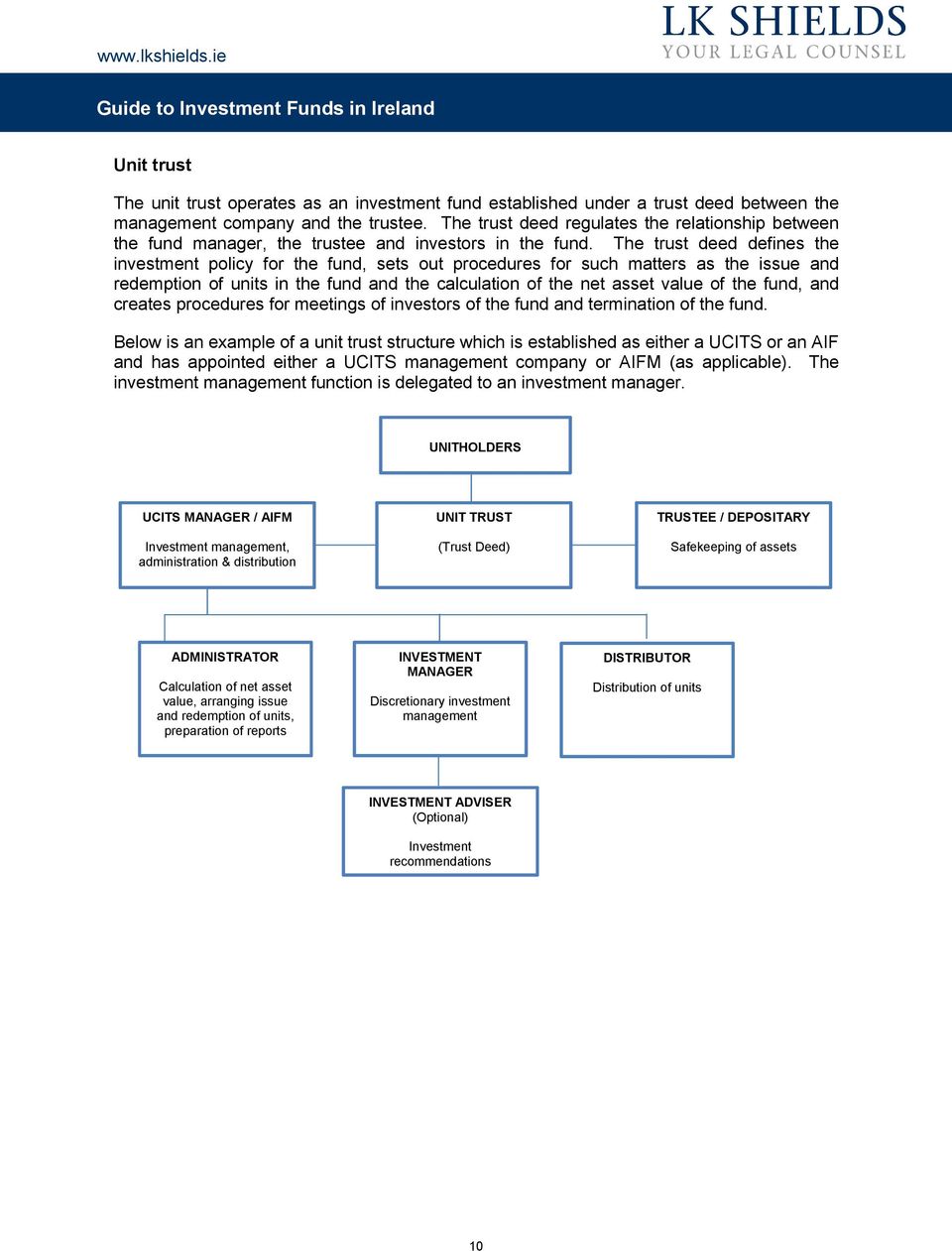
10 Unit trust The unit trust operates as an investment fund established under a trust deed between the management company and the trustee. The trust deed regulates the relationship between the fund manager, the trustee and investors in the fund. The trust deed defines the investment policy for the fund, sets out procedures for such matters as the issue and redemption of units in the fund and the calculation of the net asset value of the fund, and creates procedures for meetings of investors of the fund and termination of the fund. Below is an example of a unit trust structure which is established as either a UCITS or an AIF and has appointed either a UCITS management company or AIFM (as applicable). The investment management function is delegated to an investment manager. UNITHOLDERS UCITS MANAGER / AIFM Investment management, administration & distribution UNIT TRUST (Trust Deed) TRUSTEE / DEPOSITARY Safekeeping of assets ADMINISTRATOR Calculation of net asset value, arranging issue and redemption of units, preparation of reports INVESTMENT MANAGER Discretionary investment management DISTRIBUTOR Distribution of units INVESTMENT ADVISER (Optional) Investment recommendations 10
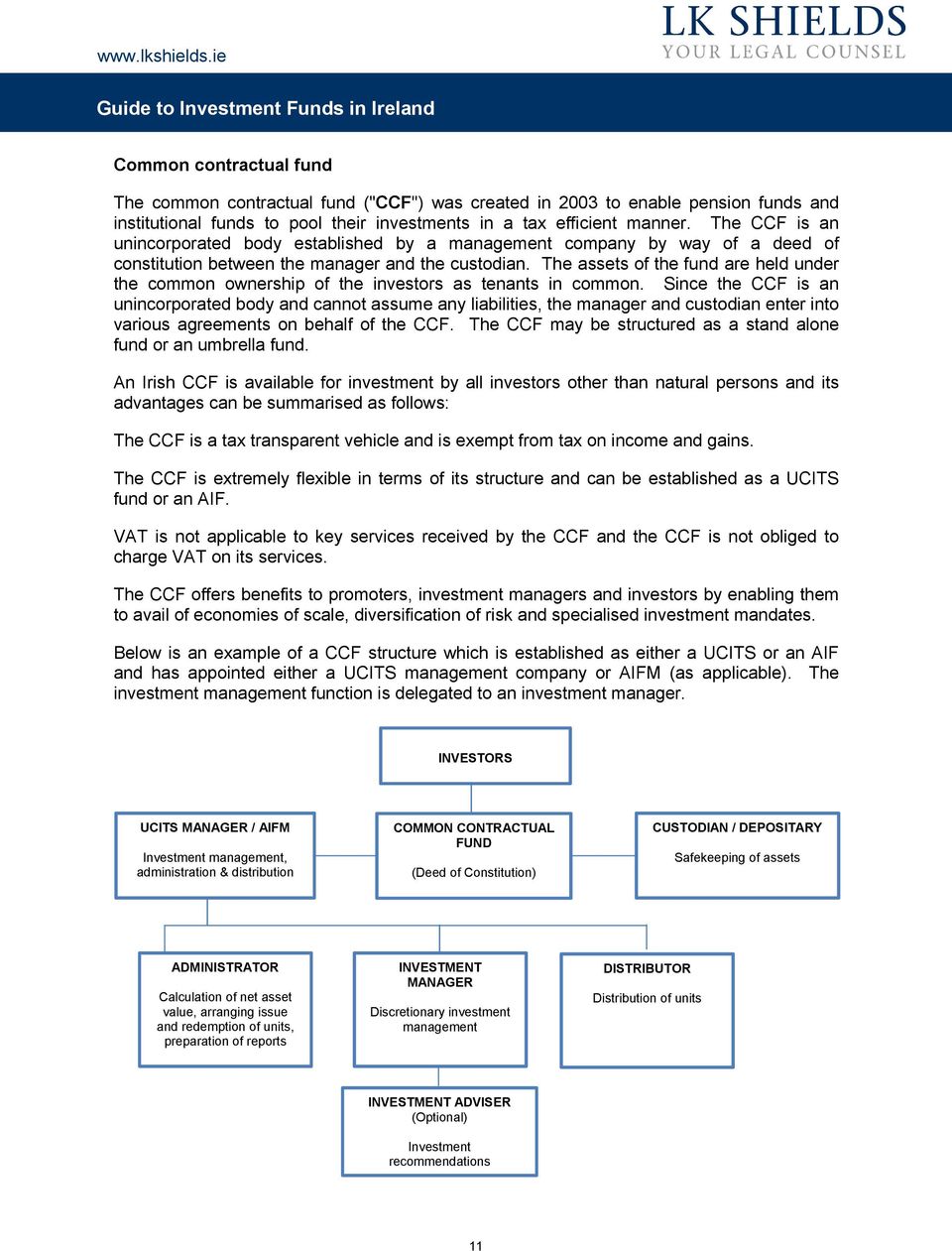
11 Common contractual fund The common contractual fund ("CCF") was created in 2003 to enable pension funds and institutional funds to pool their investments in a tax efficient manner. The CCF is an unincorporated body established by a management company by way of a deed of constitution between the manager and the custodian. The assets of the fund are held under the common ownership of the investors as tenants in common. Since the CCF is an unincorporated body and cannot assume any liabilities, the manager and custodian enter into various agreements on behalf of the CCF. The CCF may be structured as a stand alone fund or an umbrella fund. An Irish CCF is available for investment by all investors other than natural persons and its advantages can be summarised as follows: The CCF is a tax transparent vehicle and is exempt from tax on income and gains. The CCF is extremely flexible in terms of its structure and can be established as a UCITS fund or an AIF. VAT is not applicable to key services received by the CCF and the CCF is not obliged to charge VAT on its services. The CCF offers benefits to promoters, investment managers and investors by enabling them to avail of economies of scale, diversification of risk and specialised investment mandates. Below is an example of a CCF structure which is established as either a UCITS or an AIF and has appointed either a UCITS management company or AIFM (as applicable). The investment management function is delegated to an investment manager. INVESTORS UCITS MANAGER / AIFM Investment management, administration & distribution COMMON CONTRACTUAL FUND (Deed of Constitution) CUSTODIAN / DEPOSITARY Safekeeping of assets ADMINISTRATOR Calculation of net asset value, arranging issue and redemption of units, preparation of reports INVESTMENT MANAGER Discretionary investment management DISTRIBUTOR Distribution of units INVESTMENT ADVISER (Optional) Investment recommendations 11
12 New ICAV Structure The Minister for Finance has announced that he has approved, in principle, the development of legislative proposals for a new corporate structure (the "ICAV") for the Irish funds industry. The main advantage of the ICAV will be a vehicle that will allow US corporate entities to elect a favourable classification under the US "check-the-box" taxation rules. Initial US tax advice received indicates that the ICAV structure should allow US corporate entities to avoid certain adverse tax consequences for US taxable investors which would otherwise arise e.g. with an Irish public limited company ("plc") structure. Furthermore, the ICAV structure will remove certain compliance requirements under Irish company law, which will reduce administrative costs. The introduction of the ICAV in Ireland will increase the range of fund structures available to fund promoters. For existing plc structures, it is expected that there will be an option to convert to the new ICAV structure. The Department of Finance expects the proposed legislation will be enacted in early

13 3 UCITS FUNDS UCITS funds in Ireland are governed by the Central Bank's UCITS Notices and Guidance Notes, which are regularly updated and amended. A UCITS fund can be categorised as either a self managed investment company ("SMIC") or a UCITS which has appointed a UCITS management company. SMICs SMICs must have a minimum initial capital of at least 300,000. The initial capital may be provided by the promoter or investment manager and may be withdrawn upon receipt of subscriptions, provided the SMIC maintains a minimum capital of 300,000. SMICs need to comply with the majority of the provisions in the UCITS IV Regulations and the Central Bank's Guidance Notes in respect of the organisation of management companies. SMICs were required to fully comply with the UCITS IV Regulations from 1 July UCITS Management Companies All UCITS management companies must comply with the UCITS IV Regulations from 1 July UCITS management companies must satisfy the following key criteria: initial capital of at least 125,000 or one quarter of its total expenditure, whichever is higher; shareholders and directors and managers must satisfy tests in relation to fitness and probity; and directors and managers must be sufficiently experienced in relation to the types of fund to be managed. In addition, a detailed business plan must be submitted to the Central Bank which will set out in detail the organisation of the management company as well as detailed information in relation to how the specific management functions as set out in the UCITS IV Regulations will be complied with as well as administrative and accounting policies and procedures. UCITS as a retail fund structure Because of its nature as a retail fund structure, Irish law imposes certain restrictions on the investment and borrowing policies of funds that may be authorised as UCITS funds. These investment and borrowing restrictions are described in detail in the Central Banks UCITS Notices, available on A UCITS may be established under the UCITS IV Regulations in the form of an openended unit trust, an open-ended investment company registered as a public limited company or a common contractual fund. A UCITS must simultaneously satisfy the following requirements: the capital of a UCITS must be funded by means of an open offer to the public; 13

14 the unit/shares of an investor must be redeemed on demand; and investments can only be made in transferable securities and money market instruments and in accordance with detailed investment and borrowing restrictions which are set out in the Central Bank's Guidance Notes. Authorisation of UCITS A UCITS fund is required to be authorised by the Central Bank before it can be marketed to the public. The authorisation process is discussed in Section 5 below. Professional duties of related parties A UCITS fund, whether in the form of an investment company, unit trust or common contractual fund, is in essence a passive entity. The operational aspects of a UCITS fund are outsourced to the various professionals comprising the manager, the investment adviser/manager, the administrator and the trustee/custodian. The contract appointing the relevant service provider will impose minimum standards of professional care on these professionals, which they are required to observe in carrying out their duties. Anti-money laundering All Irish funds (whether established as UCITS or AIFs) are subject to the provisions of the Criminal Justice (Money Laundering and Terrorist Financing) Acts This legislation also applies to the service providers of a fund. A fund is required to appoint a designated anti-money laundering reporting officer and to ensure that appropriate measures are put in place to ensure compliance with these anti-money laundering rules. UCITS Funds An Alternative Investment Fund Platform While originally developed as a retail distribution platform, following the changes introduced by the Product Directive (Directive 2001/108/EC part of UCITS III), UCITS funds now offer fund managers the flexibility to engage in alternative investment strategies. UCITS may be a suitable platform for managers who wish to "upgrade" their product offering and take advantage of the market recognition and consumer confidence that the UCITS brand enjoys. UCITS hedge funds have become increasingly popular in recent years as investors, wary of unregulated offshore products, are attracted to the transparency and the increased liquidity offered by the UCITS product. Alternative Investment Strategies UCITS can replicate the strategies employed by more traditional hedge funds such as long short strategies and relative value strategies through the use of financial derivative instruments ("FDI"). 14
15 UCITS may invest in FDI which reference assets in which they are permitted to invest directly such as: transferable securities and money market instruments; units of other collective investment schemes (both UCITS and AIFs); and deposits with credit institutions. Also permitted are FDI which reference financial indices, interest rates, foreign exchange rates and currencies. Financial indices must satisfy prescribed criteria relating to diversification and composition to qualify as a permitted investment. FDI may not be used to circumvent the asset diversification requirements which apply to UCITS. In general a 5/10/40 rule applies. UCITS may invest up to 10% of their net assets in the securities of one issuer, but aggregate investments of representing more than 5% in a single issuer must not comprise more than 40% of its net assets. UCITS may invest in both exchange traded FDI or over the counter ("OTC") FDI. Counterparties to OTC FDI must be investment firms or credit institutions authorised in the EEA or Consolidated Supervised Entities regulated by the Securities Exchange Commission. Counterparties which are not credit institutions must have a minimum credit rating of A2 or the UCITS must be indemnified against loss by an entity without such a rating. UCITS must adhere to counterparty exposure limits of 10% in the case of certain credit institutions and 5% otherwise. Counterparty exposures can be reduced by appropriate margining arrangements. Shorting Although UCITS are not permitted to engage in physical short selling, they may take short positions through the use of FDI. This is crucial to the ability of the UCITS to engage in alternative strategies, enabling it pursue long short and relative value strategies. Leverage and Investment Diversification UCITS may employ leverage of up to 100% of their net asset value through the use of FDI. The UCITS manager may employ this leverage in taking additional long positions or to pursue a long short strategy. This enables managers to pursue strategies which can range from 200% long or short to 100% long and 100% short. Risk Management UCITS which elect to use FDI as part of their investment process must adopt a risk management process demonstrating the controls which are in place to manage risk. As part of this process UCITS must elect to classify themselves as either sophisticated or non-sophisticated. The correct election is judged on a case by case basis and will depend on the type of strategies which are being pursued and the extent of FDI use. Non-sophisticated UCITS may employ the commitment method to determine their leverage, converting the FDI into a position in the underlying assets. Sophisticated UCITS must use a risk metric such as value at risk to measure the level of volatility in the fund. 15

16 Distribution Opportunities. The UCITS IV Regulations have enhanced the cross border opportunities for marketing UCITS funds. A UCITS can now distribute its product in other Member States without the necessity to approach the individual competent authorities in each Member State. A UCITS need only approach its home competent authority by way of a standard notification procedure which must be reviewed and transferred to the competent authority of the Member State where it is proposed to market the UCITS within 10 working days. This will permit the UCITS to market its product no later than 10 working days after a completed notification. When advertising and conducting marketing in another Member State, the UCITS must adhere to the generally applicable local laws in relation to advertising and marketing. Adequate measures must also be taken by the UCITS to ensure that there are facilities in the host Member States for making payments to investors, redeeming shares/units and making available the information which the UCITS is required to provide locally. UCITS therefore need to consider the appointment of distributors and paying agents in jurisdictions where they wish to have a presence. Registration outside the EU is also facilitated, for example in markets such as Switzerland. UCITS products are also accepted for sale in Asia, the Middle East and Latin America. The main distribution channels for UCITS funds are currently retail and private banks, Independent Financial Advisors (IFAs) and insurance wrappers. Since the introduction of UCITS IV, all UCITS funds must now provide a KIID to investors. The KIID was introduced in order to provide concise and meaningful information for investors in UCITS products globally. The KIID is a key distribution tool for UCITS funds and it must be provided to investors at the pre-contract stage. All KIIDs must include an ongoing charges figure. The aim of this figure is to allow investors to directly compare the costs of various UCITS funds. In addition, all KIIDs must include a Synthetic Risk and Reward Indicator (SRRI), which displays the historic volatility of the UCITS' performance and categorises it accordingly, with the aim of giving investors an overview of the key risks which may be encountered when investing in a given fund. 16

17 4 ALTERNATIVE INVESTMENT FUNDS Regulated AIFs in Ireland are governed by the Central Bank's AIF Rulebook which, similarly to the UCITS Notices, will be regularly updated and amended. The Rulebook lays out separate rules for RIAIFS, QIAIFs, AIF Management Companies, AIF Administrators and AIF Depositaries. All AIFs must appoint an AIFM. There can only be one AIFM of an AIF. The AIF can be externally managed (where the AIF appoints an external AIFM) or internally managed (where the AIF chooses not to appoint an external AIFM and instead will itself become authorised as its own AIFM (this is similar to the self-managed investment company structure which applies to UCITS funds)). AIFs can be established as QIAIFs or RIAIFs. QIAIFs QIAIFs are subject to a minimum subscription requirement of 100,000 or 500,000 where the QIAIF invests more than 50% of its net assets in unregulated funds. Investors must fall into one of the following categories: (a) (b) (c) professional client within the meaning of Annex II of the Markets in Financial Instruments Directive (MiFID); or receive an appraisal from an EU credit institution, MiFID firm or UCITS management company that the investor has appropriate expertise, experience and knowledge to adequately understand the investment, or certifies that they are an informed investor by providing a written confirmation that the investor has such knowledge and experience as to enable the investor properly evaluate the merits and risks of the prospective investment, or a confirmation that the investors business involves the management, acquisition or disposal of property as the same kind of property of the QIAIF; or certifies that they are an informed investor by providing one of the following: confirmation (in writing) that the investor has such knowledge of an and experience in financial and business matters as would enable the investor to properly evaluate the merits and risks of the prospective investment; or confirmation (in writing) that the investor's business involves, whether for its own account or the account of others, the management, acquisition or disposal of property of the same kind as the property of the QIAIF. Investors must certify in writing to the QIAIF that they meet the minimum criteria and are aware of the risks involved in the proposed investment. QIAIFs are subject to very few investment restrictions and are not subject to any borrowing or leverage limits. The Central Bank does not impose any risk diversification requirements on AIFs (with the exception of funds of funds). The QIAIF 17

18 is an ideal structure for various different types of funds e.g. property funds, private equity funds, funds of funds and hedge funds. The fast-track authorisation process that existed for the previous QIF regime applies equally to QIAIFs (provided that all service providers to the QIAIF, including the AIFM, has been approved by the Central Bank and applications for authorisation will be processed in 24 hours (see Section 5 below)). RIAIFs The RIAIF requirements allow for the creation of a fund that is subject to less investment and eligible asset restrictions than apply under the UCITS framework but is more restrictive than the QIAIF regime. A number of strategies can be accommodated within the RIAIF that cannot be carried out by a UCITS structure. For example, a RIAIF may invest in physical gold, unregulated funds and Chinese securities (subject to appropriate disclosure requirements and investment conditions). In addition, a RIAIF may be marketed to retail investors although this would be on a Member State by Member State basis, rather than via a marketing passport. It should also be noted that RIAIFs can be marketed to professional investors under the passport provisions of the AIFMD. The Alternative Investment Fund Managers Directive The AIFMD essentially regulates the management of an AIF. The scope of the AIFMD applies to: (a) (b) (c) any legal person established in a Member State whose regulator business is managing one or more AIFs, whether established within or outside the EU which (i) raises capital from a number of investors, with a view to investing it in accordance with a defined investment policy for the benefit of those investors; and (ii) does not require authorisation pursuant to the UCITS Directive; any non-eu AIFM managing an AIF established in the EU (whether or not the AIF is marketed in the EU); and any non-eu AIFM marketing an AIF within the EU (irrespective of where the AIF is established). MiFID firms and credit institutions cannot be appointed as the AIFM of an AIF. UCITS management companies however are permitted to hold a dual authorisation under the UCITS IV Regulations and the AIFMD. The AIFM is responsible for the portfolio management and risk management functions of the AIF. The AIFM can delegate tasks to third parties, which in turn can sub-delegate such tasks. The AIFM cannot however delegate its functions to the extent that the AIFM becomes a letterbox entity. 18

19 Registered AIFMs AIFMs which fall within the following categories will be subject to a lighter touch regulation and are required to register as an AIFM as opposed to a full authorisation under the AIFMD: (a) (b) AIFMs which either directly or indirectly through a company with which the AIFM is linked by common management or control, or by a substantial direct or indirect holding, manage portfolios of AIFs whose assets under management, including assets acquired through use of leverage, in total do not exceed a threshold of 100m; or AIFMs which either directly or indirectly through a company with which the AIFM is limited by common management, or control, or by a substantive direct or indirect holding, manage portfolios of AIFs whose assets under management, in total do not exceed a threshold of 500m when the portfolio of AIFs consist of AIFs that are unleveraged and have no redemption rights exercisable during a period of 5 years following the date of the initial investment in each AIF. Registered AIFMs do not benefit from the rights granted to authorised AIFMs under the AIFMD, however they do need to comply with certain requirements of the AIFMD such as the requirement to monitor systematic risk. Authorised AIFMs The following are some of the key considerations for AIFMs Capital Requirements AIFMs are required to have initial capital of at least 125,000 (in the case of an external manager) or 300,000 (if it is an internal manager) and to have its own funds equal to 0.02 per cent of the value of any assets of the AIF over 250 million, subject to a maximum requirement of 10 million. Up to half the funds may instead be guaranteed by a credit institution or insurance undertaking. The AIFM will also be required to have sufficient funds to cover potential liability for professional negligence or to have appropriate professional indemnity insurance. Remuneration The AIFMD provides that each AIFM must have remuneration policies and practices for prescribed categories of staff that are: consistent with and promote sound and effective risk management; and do not encourage risk-taking which is inconsistent with the risk profiles, rules or instruments of incorporation of the AIFs they manage. A list of principles which must be taken into account when determining remuneration policies and practices are set out in Annex II to the AIFMD. 19

20 Reporting AIFMs are required to report certain information to the Central Bank in connection with the AIFs which they manage. Guidelines published by ESMA on 1 October 2013 have provided clarification on the reporting requirements under the AIFMD. AIFMs will be required to report on investment strategies, exposure and portfolio concentration. According to the Guidelines, key elements that AIFMs will have to report to national competent authorities include information on portfolio concentration (e.g. breakdown of investment strategies of each AIF, principal markets/instruments in which the AIF trades, turnover of each AIF, total value of assets under management of each AIF) and risk profile of each AIF (including the liquidity profile and leverage of each AIF). Distribution AIFMs can avail of a European passport which permits EU based AIFMs to market AIFs to professional investors (as defined in MiFID) throughout the EU subject to a notification process. Unlike the UCITS passport, the AIFMD passport is granted to the AIFM and not the AIF which it manages. Non-EU based AIFMs cannot become authorised under the AIFMD and avail of the passport until at least By July 2015 at the earliest, the European Securities and Markets authority (ESMA) is required to prepare a report detailing its opinion on the functioning of the passporting regime for EU managers and its advice on the extension of the passport to non-eu managers. Within three months of receiving this advice, the Commission shall specify a date for the introduction of a passport for non- EU managers (the "Extension Date"). Non-EU managers wishing to market an AIF within the EU up until the Extension Date must do so in relevance with relevant national private placement regimes and only where the following conditions are met: they will be required to comply with the requirements of the AIFMD with respect to transparency and asset stripping; there must be co-operation agreements in place between the competent authorities in the EU jurisdiction in which they wish to market and the state in which they established; and the state where the manager is established must not be listed as a non-cooperative country and territory by the Financial Action Task Force. From the Extension Date onwards, non-eu managers who wish to market EU AIFs in the EU will be required to seek authorisation in their Member State of Reference. A Member State of Reference is the EU Member State with which the non-eu manager is most closely established and must be determined in accordance with the rules set out in the AIFMD. Non-EU managers wishing to market Non-EU AIFs in the EU after the Extension Date will have the option of seeking authorisation in their Member State of Reference or continue to rely on the national private placement regimes. It should be noted however that 3 years following the Extension Date, ESMA is required to issue a report to the European Commission detailing its opinion on the function of the passport 20

21 regime for Non-EU managers and advising whether the national private placement regimes should be terminated. In the absence of obstacles being identified by ESMA, national private placement regimes could be abolished, in which case, Non-EU managers will only be permitted to market Non-EU AIF within the EU if they are duly authorised under the AIFMD. 21
22 5 AUTHORISATION PROCEDURE FOR FUNDS Fund Documentation The fund documents fall into three categories: the prospectus the organisational documents the agreements with service providers. The Prospectus An offer to the public to invest in an Irish fund can only be made on the basis of information concerning the fund contained in a written prospectus, approved by the Central Bank. The prospectus is the document which pulls together information on the operation of the fund to enable investors to make an informed judgement of the investment opportunity presented to them. The prospectus (and the key investor information documents in the case of a UCITS) must be offered to investors free of charge together with a copy of the organisational documents of the fund before an investment in the fund may be accepted. Material changes to the information contained in the prospectus must be notified to investors in the periodic reports of the fund. A change to the investment objectives or a material change to the investment policy of a fund may not be effected without the prior written approval of the unitholders or shareholders of the fund. The Organisational Documents The memorandum and articles of association (or deed or constitution or trust deed, as appropriate) set out the rules governing the operation of the fund and the relationship between the fund and its investors. Any proposal to make changes to the organisational documents of a fund must be notified in advance to the Central Bank and may only be made with the prior consent of a majority of the investors in the fund. Changes are usually brought into effect after a specified time period, after notification to investors, to allow investors who do not agree with the changes sufficient time to redeem their holdings in the fund before the changes are implemented. Agreements with Service Providers The duties of each of the parties involved in the operation of the fund are set out in various agreements, such as: the management agreement; the investment management agreement; 22
23 the investment advisory agreement; the custody agreement/depositary agreement; the administration agreement; and the distribution agreement. In the case of UCITS funds, proposed amendments to the custody agreement must be approved in draft in advance by the Central Bank. Amendments to the remaining Agreements must be filed with the Central Bank in final form, although the Central Bank should be notified in advance of the proposal. The relevant section of the Central Bank's application form must be submitted in each case. The terms of these agreements set out in detail the duties, responsibilities and liabilities of the parties, the terms of remuneration and the notice provisions on termination. It is important to ensure consistency between the prospectus, organisational documents and the agreements. Approval of Directors - Central Bank's Fitness and Probity Standards The Central Bank's Fitness and Probity Standards (the "Standards") came into effect on 1 December 2011 and were fully implemented by 1 December The Standards were introduced pursuant to Section 50 of the Central Bank Reform Act 2010 (the "Act"). Directors of investment fund companies, UCITS management companies and AIFMs fall within the category of Pre Approval Controlled Functions (PCFs) and are therefore subject to the Central Bank's Standards. Individuals who intend take up a directorship role in a fund company, UCITS management company or AIFM must complete an online Individual Questionnaire which is submitted online to the Central Bank for assessment. The Standards require that persons engaged in PCF roles such as directorships must be competent and capable to carry out that function, must act honestly, ethically, with integrity and be financially sound. Post authorisation, fund companies, UCITS management companies and AIFMs are required under the Standards to continue to monitor the fitness and probity of the directors by keeping the due diligence information on these individuals up to date. The proposed directors of a new proposed fund company, UCITS management company or AIFM must be approved by the Central Bank before the fund, UCITS management company or AIFM can be authorised by the Central Bank. UCITS Promoter Approval A promoter seeking to establish an Irish domiciled fund is required to obtain approval in its own right as a promoter of funds. This procedure involves submission of the Central Bank's promoter application form addressing issues relating to the competence and integrity of the promoter and the adequacy of the promoter's financial resources. 23
24 A decision on the suitability of a fund promoter is made by the Central Bank based on responses received from the promoter addressing the issues set out in the Central Bank's promoter application form. The application for authorisation of the fund cannot be submitted to the Central Bank until the Central Bank has indicated its approval of the promoter entity. AIFM Approval The AIFM or the internally managed AIF must submit an application for authorisation (or application for registration in the case of registered AIFMs) to the Central Bank. The application should also include a programme of activities document which will set out the organisational structure of the AIFM and how it intends to comply with the provisions of the AIFMD. The application for authorisation should also include information on the remuneration policies and procedures of the AIFM, information on arrangements of the delegation of activities by the AIFM and information on the AIFs the AIFM intends to manage. The Investment Manager The investment manager (in circumstances where in the investment manager is a different entity to (a) the UCITS management company, in the case of a UCITS fund and (b) the AIFM, in the case of an AIF) is also required to submit an application for approval via the Central Bank's investment manager application form. Where the promoter of a UCITS will also act as investment manager, a separate investment manager application form does not have to be completed. Approval of Fund Documents UCITS Funds Once the Central Bank has indicated its approval of the promoter entity, the promoter is required to submit the prospectus and the custody agreement or trust deed (blacklined where a precedent or standard form agreement has been used) in draft form to the Central Bank accompanied by the relevant sections of the Central Bank's application form. The process is conducted on a phased basis. Initial drafts are reviewed by the Central Bank to ensure full compliance with applicable regulations and full consistency across the fund documents to a high level of detail. The length of the process and the extent of Central Bank's comments may depend on the quality of preparation of the initial drafts submitted to the Central Bank. Undoubtedly, the process is expedited in circumstances where the promoter is in a position to prepare documents on the basis of recently approved precedents. The Central Bank will not review the memorandum and articles of association of an investment company, the management agreement, the administrator/transfer agency agreement, the investment management/ advisory agreement or the distribution/paying agency/representative agency agreement. 24
25 The executed and original documents listed on the Central Bank's checklist must be filed no later than 12 noon on the proposed date of authorisation/approval together with the Central Bank's application form. Requests for derogations from certain Central Bank requirements should be clearly set out in the covering letter with the initial filing of the draft documents. All SMICs and management companies are required to submit a business plan in advance of authorisation, which sets out their organizational requirements. The business plan needs to be approved by the Central Bank before the fund is authorised. Where the fund intends to engage in the use of FDI, a detailed risk management process ("RMP") must also be reviewed and approved by the Central Bank as part of the fund's authorisation process. AIFs RIAIFs The process for approval of the fund documents for a RIAIF is similar to the procedure for UCITS funds set out above. Once the Central Bank has approved the AIFM, the AIFM is required to submit the prospectus and the depository agreement to the Central Bank (blacklined where a precedent or standard form agreement has been used). The length of the process and the extent of the Central Bank's comments may depend on the quality of the preparation of the initial drafts submitted to the Central Bank. The Central Bank will not review the memorandum and articles of association of an investment company, the management agreement, the administrator/transfer agency agreement, the investment management/ advisory agreement or the distribution/paying agency/representative agency agreement. The executed and original documents listed on the Central Bank's checklist must be filed no later than 12 noon on the proposed date of authorisation/approval together with the Central Bank's application form. Requests for derogations from certain Central Bank requirements should be clearly set out in the covering letter with the initial filing of the draft documents. 25
26 QIAIFS Fast Track Approval QIAIFS may avail of a 24 hour fast track approval process provided that all service providers to the QIAIF (including the AIFM) has been approved by the Central Bank. The application for authorisation (the fund documentation and relevant Central Bank applications forms) should be submitted before 3pm on the day prior to the proposed date of authorisation. Provided the application is not deemed to be incomplete by the Central Bank, the authorisation can be issued by the Central Bank by close of business the following day. Start Up Regime The Central Bank has confirmed that QIAIFs authorised after 22 July 2013 may avail of a "start up regime". Under this regime the QIAIFs (but not RIAIFs) are permitted to have a registered AIFM during the start up period of two years from the launch of the QIAIF, at the end of which an authorised AIFM must be appointed. AIFMs can avail of the "start up regime" so long as its assets under management does not exceed one of the following limits: (a) (b) 500m provided the AIF is not leveraged and the investors have no redemption rights for the first five years, or 100m including all assets acquired through leverage. QIAIFs established under the "start up regime" will effectively be permitted to operate under the old QIF regime (plus the relevant depository requirements under the AIFMD) for the period of two years from the launch of the QIAIF or until the AIFM's assets under management exceed the limits noted above (whichever is the earliest). Irish Stock Exchange Where shares or units in a fund are being listed on the Official List of the Irish Stock Exchange (the "ISE"), the ISE undertakes a separate approval process (see Section 7 of this Guide). This process is usually conducted through one of the ISE's listing sponsors and the ISE generally requires what it calls '48 hour documents' to be submitted before it will clear the shares or units for listing. This process generally occurs in or around the Central Bank's authorisation date. The shares or units cannot be listed until one business day following first allotment or issue of shares or units and the ISE requires written confirmation of such allotment or issue. 26
27 6 CONTINUING REQUIREMENTS FOR FUNDS Once a fund has been established, the relevant parties will commence their respective functions to activate the fund. The distributor introduces investors into the fund. The manager/ administrator administers the fund, the investment manager trades the assets of the fund in line with the fund's investment objectives and policies and the custodian/depositary settles trades for the fund and safekeeps the fund's assets. The focus of Irish law on funds is to establish measures to safeguard the interests of investors in the fund. This objective is achieved through a process of supervision at various levels and the dissemination of periodic information to investors, and ultimately, by the exercise of control by investors over the direction of a fund through resolutions passed by investors in general meeting. Supervision Supervision of the activities of Irish-domiciled funds occurs at three levels: (a) (b) (c) the fund operates subject to the direction of the board of directors of the fund (the board of directors of the company in the case of an investment company and the board of directors of the management company in the case of a unit trust and CCF); the operations of the fund are supervised by the custodian/depositary; and the Central Bank independently supervises the operation of the fund, for example by way of reports supplied to it by the fund manager/administrator and the fund custodian/depositary. The board of directors The board of directors meets periodically to review the activities of the fund. Directors are subject to the Central Bank's Fitness and Probity Standards (for further information see Section 5 of this Guide) and may only be appointed to the board with the prior approval of the Central Bank. Post authorisation, fund companies, UCITS management companies and AIFMs are required under the Standards to continue to monitor the fitness and probity of the directors by keeping the due diligence information on these individuals up to date. The custodian/depositary The custodian/depositary is required during each annual period to enquire into the conduct of the fund and to report to investors on the results of its annual inspection. If the trustee/custodian uncovers matters of concern (including any breaches of the investment and borrowing restrictions), it is required in its report to the investors to state why this is the case, and to outline the steps which the trustee has taken to rectify the situation. Both the UCITS Notices and AIF Rulebook impose a duty on the trustee/custodian to notify the Central Bank promptly of any material breach of the applicable regulations, conditions imposed by the Central Bank or provisions of the prospectus. 27
28 AIFMD has introduced a higher standard of liability for depositaries by providing that the depositary shall be liable to the AIF and its investors on loss of financial instruments held in custody by it or its delegate. The depositary may be able to discharge its liability where the loss of financial instruments has resulted from an external event beyond the depositary's reasonable control the consequences of which were unavoidable despite all reasonable efforts to the contrary. The Central Bank The Central Bank seeks to ensure compliance by funds with the requirements of Irish law through a combination of meetings, inspections, reports and independent action. Regulated funds are required to send a number of reports throughout the year to the Central Bank, which, depending on the category of fund, include detailed monthly, half yearly and annual reports and half yearly financial and annual audited accounts. Each of the parties which have a presence in Ireland is subject to periodic inspections by the Central Bank, and key management personnel are required to attend review meetings as required by the Central Bank. The Central Bank relies on the home state regulatory authority to supervise the activities of a foreign investment manager/adviser of an Irish fund in its jurisdiction of incorporation and the Central Bank will only approve a foreign investment manager/adviser to act as investment manager/advisor of a regulated fund if it is satisfied with the regulatory regime imposed by the home state regulatory authority. The Central Bank has the power to take action on its own initiative if it becomes concerned that the operations of a fund are not being conducted in accordance with Irish law and the interests of investors. Such independent acts may include suspension of dealings by investors in the fund; removal of any of the manager/administrator, the investment manager/ adviser or the custodian/depositary, and in some cases liquidation of the fund. Information for investors An Irish fund is required to publish certain periodic information to enable investors to make an informed decision to hold or sell their investment in the fund, including publication of: (a) (b) issue and redemption prices of shares; and annual reports and semi-annual reports of the fund detailing the fund's activities during the relevant period. Control by investors Certain changes in the operation of a fund (for example, changes to the fee structure or investment policy of the fund) can only be made with prior approval of a majority of the investors at a duly convened meeting of the investors in the fund, or the investors in the applicable sub-fund in the case of an umbrella fund. 28
29 7 LISTING OF FUNDS ON THE IRISH STOCK EXCHANGE Overview The ISE is recognised worldwide as a leading centre for listing investment funds. The advantages of listing a fund on the ISE are: (a) (b) (c) it allows promoters to significantly increase its potential investor base; it provides investors with immediate access to financial and other information and the opportunity to refer to a publicly quoted price for their investments; and it offers a valuable marketing tool for promoters as the ISE is recognised as a highly regulated stock exchange. Application Procedure Any listing of a fund on the ISE must be carried out in accordance with the Code of Listing Requirements and Procedures for Investment Funds. The Code sets out in detail the procedure and requirements for obtaining a listing together with the continuing obligations with which listed funds must comply. The first step is to appoint an approved sponsor. The ISE sponsor will: (a) (b) (c) advise the fund as to its suitability for listing; assist with the preparation of the listing particulars documents (listing particulars are incorporated into the fund prospectus); and finalise the final application for submission to the ISE. Once the listing particulars have been approved by the ISE, a number of other application forms and letters of comfort and responsibility must be filed with the ISE before the listing becomes effective. The ISE provides a 48 hour turn around period to review these ancillary documents. In addition to the basic requirements for listing noted above in respect of open-ended funds, closed-ended funds must comply with specific rules set out in the Prospectus (Directive 2003/71/6 EC) Regulations 2005 (the "Prospectus Regulations"). The ISE review the prospectus for compliance with the Prospectus Regulations although the Central Bank must issue final approval of the prospectus. Conditions for Listing There are certain listing conditions to be adhered to before admission to the ISE will be granted. Some of the key conditions to be satisfied are as follows: (a) the investment manager/promoter must demonstrate appropriate expertise and experience to manage the fund; 29
30 (b) (c) the custodian/depositary of the fund must be a separate legal entity from the investment manager, administrator or investment adviser to the fund but it may form part of the same group of companies; and The securities of the fund are required to be freely transferable but restrictions on transfer may be accepted on a case by a case basis for tax or regulatory reasons. Ongoing Obligations Listed funds must adhere to the following obligations: annual and interim accounts must be sent to the ISE within six and four months respectively at the end of the periods to which they relate; notify the ISE Companies Announcement Office ('CAO') immediately of any price sensitive information, material new developments or operational changes and any material change in performance or financial position; notify the CAO of any alterations to capital structure, new issues of debt securities, changes of rights attaching to the listed units or issues affecting conversion rights; and priority for equality of treatment for all unit holders and a requirement for prior notification, and in limited circumstances prior approval, of proposed variation to rights. Failure to comply with any applicable continuing obligation may result in the ISE taking disciplinary action including possible suspension of a listing. Closed-ended funds must adhere to more stringent ongoing obligations than openended funds. These more onerous obligations are imposed primarily by the Prospectus Regulations and the Transparency (Directive 2004/129/EC) Regulations. 30
31 8 TAXATION OF FUNDS IN IRELAND Taxation of Funds in Ireland Ireland has a very attractive tax regime for inward investment. The general aim of the Irish tax legislation applicable to Irish regulated investment funds (referred to as investment undertakings ) is that there should be no Irish tax suffered by the investment undertaking in Ireland. The only Irish tax suffered on Irish funds should be limited to the income and gains of certain Irish investors. Ireland offers a range of different legal structures for funds including corporate entities and unit trusts. The general tax implications for Irish funds are outlined in brief below but it is important to note that there are different taxation rules in Ireland in relation to investment undertakings in other legal forms such as Common Contractual Funds ( CCFs ), Investment Limited Partnerships ( ILPs ) and Real Estate Investment Trusts ( REITs ). Taxation of Irish funds Irish investment undertakings are not chargeable to Irish tax on the income or gains arising on their underlying investments. However, some Irish funds may be subject to taxes such as withholding taxes on the income or gains arising in other foreign jurisdictions where their investments are located. In certain circumstances these funds may be eligible to benefit from relief from such taxes under Ireland s Double Taxation Agreements ( DTAs ) with other countries. As at November 2013, Ireland has signed DTAs with 70 countries, of which 64 are currently in effect. Exit tax Irish investment undertakings are subject to an exit tax regime. This regime aims to ensure that certain Irish tax resident investors suffer a charge to tax at fund level without imposing a tax cost on the fund itself. Under the regime Irish funds are obliged to apply an exit tax of 41% on gains arising on the occurrence of certain chargeable events. The exit tax operates in a manner similar to a withholding tax and must be deducted from certain payments due to certain investors and paid over directly to the Irish Revenue. Chargeable events include distributions, redemption of units, repurchase of units, transfer of units and cancellation of units. In addition, each 8 year period that the investment in the investment undertaking is held by an investor (known as a relevant period ) is also considered to be a chargeable event. Chargeable events do not include arm's length exchange of units within an umbrella fund, transactions in relation to units held in a recognised clearing system, transfers between spouses, amalgamations or reconstructions. Furthermore, where the investor is a corporate investor and they have made a relevant declaration to the Irish fund then a rate of 25% should be applied to gains on chargeable events. The fund generally recovers the tax due on a distribution from the investor giving rise to the chargeable event and in the case of tax arising on a transfer of units; the fund 31
32 generally expropriates sufficient units from the investor equivalent in value to the required tax. As a result the exit tax should not normally be a cost for the fund. The exit tax deducted represents a final liability to Irish tax for investors who are nonexempt Irish individuals. In the case of Irish resident corporates who have suffered exit tax on payments from a fund, the amount received by the corporate is treated as a net annual payment, grossed up accordingly and taxed, with credit given for the tax withheld by the fund. Exempt Irish investors Certain Irish resident investors such as pension schemes, charities, life businesses, another investment undertaking, approved retirement funds and unit trusts should not suffer any Irish exit tax on their income or gains from Irish funds. In order to ensure that exit tax is not applied on their gains such entities are required to complete an appropriate declaration form prior to the occurrence of a chargeable event. Although the fund does not have to deduct exit tax in these circumstances, an Irish resident investor may be subject to Irish tax on income and gains arising and must include details of income and gains in their income tax return to be filed with Revenue. Non-resident investors Non-Irish tax resident investors should not suffer any Irish tax on income or gains arising from their investment in Irish funds. In order to ensure that exit tax will not arise on a chargeable event such investors are required to complete an appropriate declaration form which outlines they are non-irish tax resident. However, where a fund has put in place certain checks to ensure that investors in the fund are nonresident, Revenue can issue a notice to the fund which dispenses with the requirement for such declarations to be completed by each non-resident investor in the fund. Returns by Irish funds Irish funds and investment undertakings are required to make a return and pay the appropriate tax due to Revenue by 30 July in respect of chargeable events occurring between 1 January and 30 June and by the following 30 January in respect of chargeable events occurring between 1 July and 31 December. Capital/stamp duty No capital or stamp duty is payable on the issue, transfer, redemption or repurchase of investments in funds in Ireland. VAT Funds in Ireland are not required to charge VAT as financial services are exempt from Irish VAT. Similarly, most services provided to funds should also be exempt from Irish VAT. However, a fund may be required to register and self-account for VAT if it receives certain taxable services from suppliers outside of Ireland such as legal advice, tax advice, advertising services etc. from outside Ireland. 32
33 Capital acquisitions tax There is an exemption from Irish capital acquisitions tax on the inheritance/gift of units in an Irish investment undertaking where both the disponer and the recipient are not domiciled or ordinarily resident in Ireland. FATCA Certain Irish funds may be required to comply with the Foreign Account Tax Compliance Act ( FATCA ) rules. These are a complex set of rules set out by the US Internal Revenue Service designed to improve tax compliance and limit tax evasion by US persons living abroad. Ireland has signed an Intergovernmental Agreement ( IGA ) with the US to comply with these rules which require foreign financial institutions ( FFIs ) in Ireland to report information to the Irish Revenue Commissioners on accounts held by US persons and certain US controlled foreign entities. Failure to comply with these US regulations can result in a 30% withholding tax penalty on certain US source payments beginning 1 July Service providers/investment managers Service providers and investment managers that are incorporated and tax resident in Ireland and provide services to Irish funds should be subject to corporation tax on their trading profits at a rate of 12.5%. Any passive income they may generate is taxable at 25%. There are no specific tax exemptions available to fund managers or advisors in Ireland. However, the Irish tax legislation contains a number of other provisions applicable to Irish tax resident companies in general which may be of potential benefit (e.g. start-up companies relief, research and development tax credits, double taxation relief etc.). 33
34 9 SPECIALIST FUND STRUCTURES 9.1 Fund of Funds Both UCITS funds and AIFs may be established as fund of funds structures. The principal object of a fund of funds is to invest in shares or units of other investment funds, known as underlying funds. A fund of funds structure can be used to gain exposure to various asset classes through its investment in other fund structures. UCITS Fund of Funds Under the UCITS Regulations, UCITS funds are permitted to invest in both UCITS and AIF underlying funds. To ensure proper diversification, not more than 20% of the net assets of the UCITS fund may be invested in any one underlying fund (each subfund of an umbrella fund is deemed to be a separate UCITS fund for the purpose of applying this restriction). To avoid layered structures, a UCITS fund cannot invest in an underlying fund which itself invests more than 10% of its net assets in other funds. A UCITS fund can invest up to 30%, in aggregate, of its net assets in underlying funds which are not UCITS. Such investment is permitted, subject to the following: each underlying fund must be authorised under laws which provide for supervision which the Central Bank considers to be equivalent to those prevailing in the EU and cooperation between the regulatory authorities must be sufficiently ensured; the regulatory environment to which the underlying fund is subject must offer a level of investor protection equivalent to that provided for unitholders or shareholders in a UCITS (in particular in relation to segregation of assets, borrowing, lending and uncovered sales); and half-yearly and annual reports must be produced by each underlying fund. AIF Fund of Funds AIFs may invest in regulated or unregulated underlying funds. A RIAIF shall not invest more than 30% of its net assets in any one open-ended regulated investment fund, however, this 30% limit may be increased in certain circumstances. No more than 20% of net assets of a RIAIF may be invested in any unregulated open-ended investment funds. QIAIFs may invest up to 100% in other investment funds subject to a maximum of 50% of net assets in any one unregulated investment fund. QIAIFS which invests more than 85% of its net assets another investment fund will be regarded as a feeder type investment. Feeder Funds Feeder funds can be set up as UCITS Funds or AIFs. The assets of a feeder fund will comprise almost entirely the units or shares of a single scheme, known as the master fund. Hybrid schemes are those which invest substantially all of their assets into a master fund but may also directly invest certain assets. 34
35 In the case of a feeder fund, the master fund must itself either be (ii) authorised in Ireland by the Central Bank or (ii) in another jurisdiction by a relevant regulatory authority which offers a level of investor protection comparable to that which is offered to the investors of an Irish domiciled scheme. Where a commission is received by the manager of the feeder fund following an investment into the master fund, this commission must be paid into the assets of the feeder fund. Where the master fund is managed by the same manager as the feeder fund (or by an affiliate of that manager), the manager of the master fund must waive any preliminary or initial charge to which it would otherwise be entitled to charge the feeder fund. 35
36 9.2 Real Estate Funds Real Estate Funds may be established as RIAIFs and QIAIFs and may invest directly in real estate assets or be set up as fund of fund structures. Direct Investment Funds holding direct real estate investments can invest in the following: property comprising a freehold or leasehold interest in any land or building; property related assets, including securities, other collective investment schemes and property derivatives; and cash and short term securities required for liquidity purposes. Investment Restrictions The following investment restrictions apply to RAIF real estate funds: assets must be valued prior to acquisition and purchased within six months of the valuation date at a price within 5% of the valuation price; no more than 30% of the net assets may be invested in any single property (no limit applies for a QIAIF); not more than 25% of the net assets may be invested in properties which are vacant or which require development; and granting options over properties held by the fund is not permitted. Borrowings A retail AIF shall not borrow, or at any given time have borrowings exceeding 25% of its net assets. There is no regulatory borrowing limit for a QIAIF, although the fund must disclose in its prospectus the maximum borrowing which may be undertaken. Borrowings may be generally secured on the properties of the fund. Other Requirements Other regulatory requirements to be taken into account include: Real estate schemes must appoint one or more independent valuers. real estate schemes may establish multi-layered special purpose vehicle ("SPV") structures, for the purpose of holding real estate assets in different jurisdictions. The SPVs must be wholly owned by the fund and must comply with certain other conditions specified by the Central Bank; the assets of the fund can be registered in the name of the fund or its wholly owned SPVs, subject to certain conditions specified by the Central Bank to ensure the assets may not be disposed of without the prior consent of the custodian/depositary. 36
37 9.3 Private Equity Funds Private equity funds may be established as RIAIFs and QIAIFs and may invest directly in private equity investments or be set up as fund of fund structures. The QIAIF is by far the most popular structure for private equity funds. Use of Subsidiaries and SPVs Private equity funds often use subsidiaries and SPVs as part of the overall QIAIF structure. There are a variety of legal and fiscal reasons why it may be beneficial for a fund to invest in private equity indirectly via a wholly owned subsidiary / wholly owned SPVs or multi-layers of subsidiaries / SPVs. QIAIFs are permitted to establish multi-layered SPVs, provided they are wholly owned by the QIAIF or by its wholly owned subsidiary(ies) and subject to certain criteria relating to the registration of their shares. The QIAIF's depositary must be appointed to each SPV and be in a position to demonstrate that it has controls in relation to each layer of the SPV structure. The assets of the SPV must be valued as if they were assets of the QIF. The intention to establish SPVs must be clearly disclosed in the prospectus and the periodic reports of the QIAIF must disclose the names and place of establishment of all SPVs. The Directors of the QIAIF must form a majority of the board of directors of the SPV. Key features of Private Equity QIAIFs Broad and flexible investment policies. The Fund may provide for partly paid shares and capital commitment and drawdown provisions. The Fund is not subject to borrowing or leverage limits. The Fund may be established as a closed ended fund, limited liquidity fund or open ended fund. 37
38 9.4 Life Settlement Funds A "Life Settlement" is the transfer of the beneficial interest in an existing life insurance policy to a third party, by a person normally aged around 65 years with a health impairment and a medically evaluated life expectancy of 10 years or less. Typically the life policies are issued in the US market. The policy is sold at a discount to its face value for an immediate cash settlement. The Life Settlement Fund, as a purchaser of such a policy, will receive the net death benefit to which the Fund is entitled from the insurance company upon the death of the insured. US Tax Treatment Ireland is an attractive destination for Life Settlement Fund promoters due to the tax benefits available for investors under the Irish/US Double Taxation Treaty (the "Treaty"). In order for an Irish regulated fund to benefit under the Treaty there are various criteria that need to be satisfied under what is known as the "Limitation of Benefits" Article of the Treaty. This Article narrows the group of possible beneficiaries under the Treaty to specific categories of residents in Ireland. It is important to get expert legal and taxation advice at the outset to ensure a Life Settlements Fund is structured to fall within the category of Irish residents who can avail of the tax benefits under the Treaty. Structure Given the illiquid nature of the assets Life Settlements Funds tend to be set up as limited liquidity schemes to allow investment managers adequate time to sell life policies in the secondary market to service redemption requests. Regulated life Settlements funds are structured as QIAIFs. In some instances a QIAIF will hold investments through a section 110 SPV. This structure can have certain tax advantages for investors. Characteristics Life Settlements Funds are market neutral they are not correlated to the financial markets, interest rates or the political climate. 38
39 9.5 Shariah Compliant Funds Shariah compliant investment funds are simply investment funds which comply with the principles of Islamic law. This compliance influences the investment profile of the fund and most significantly, requires the fund to adhere to the prohibition on the payment and the charging of interest (riba) thereby preventing access to traditional forms of debt financing and debt investments. Transactions must instead be based upon the principle of risk sharing. Prohibitions on gambling and speculation also largely limit the ability of Shariah compliant investment funds from engaging in short selling and using derivatives. Shariah complaint investment funds have grown rapidly in popularity in recent years. Ireland is an ideal domicile for such funds having the advantages of a receptive legal and regulatory environment. An example of this favourable environment is the establishment by the Central Bank of a dedicated team to focus on Shariah investment funds. Structuring Shariah funds are structured in a similar fashion to traditional investment funds and may be established as either UCITS or AIFs and may take the form of investment companies, unit trusts, common contractual funds or limited liability partnerships. The Shariah Board The most distinguishing structural feature of Shariah compliant investment funds is the appointment of a Shariah Board. The Shariah Board acts as an advisory body to the Board of Directors of the fund and is generally comprised of at least three Islamic scholars who are qualified in Islamic law and finance. The role of the Shariah Board begins at the establishment phase and they will be involved in the negotiation of the fund documents to ensure that the structure is Shariah compliant. If satisfied that there is compliance, the Shariah Board will issue a formal ruling, the fatwa, which can be relied upon by prospective investors. The Shariah board also maintains an ongoing advisory role assisting the board of the fund to ensure that investments by the fund are Shariah compliant and overseeing the process of income purification, as described below. Screening All prospective investments must be screened, based on industry and financial ratios, to ensure that they do not offend Shariah principles. Investments in Alcohol, Pork related products, Conventional Financial Services, Entertainment, Tobacco and Weapons and Defence are generally prohibited. While the payment and receipt of interest is prohibited, a pragmatic approach is taken with respect to the eligibility of investments. Recognising that virtually all companies either pay or receive interest to some degree, a de minimis approach is taken whereby certain financial thresholds are applied with respect to acceptable levels of debts and interest income. Typically, none of (i) total debt; (ii) cash and interest bearing securities; and (iii) accounts receivables may exceed 33% of a company's market capitalisation. Purification Shariah complaint investment funds must monitor their investments on an ongoing basis to identify the portion of their investment income which is attributable to tainted 39
40 activities. This income must then be purified by removing the portion which is tainted. This purification may be effected directly by the fund, by means of a charitable donation, or indirectly by providing investors with details of the tainted portion. Investors may then choose individually whether to purify the return by making a donation to charity. Approach of the Central Bank The focus of the Central Bank when considering an application from a Shariah compliant investment fund will be on ensuring that investors are provided with adequate details to make an informed decision as to whether to invest in the fund. Typically the Central Bank will not directly concern itself with whether the fund is Shariah compliant. The sanctions for failure to comply with Shariah principles will turn on the manner in which they are incorporated into the fund documentation. These principles may be loosely incorporated as investment guidelines or given more substance as investment restrictions. Any breach of an investment restriction will require immediate remedial action to be taken by the fund and will carry the possibility of shareholder compensation. The appointment of a Shariah Board will not require the prior approval of the Central Bank provided the Board is not given discretionary authority over the assets of the fund. 40
41 9.6 Exchange Traded Funds An exchange traded fund ("ETF") is an investment fund that is traded on a regulated exchange. The aim of an ETF generally is to replicate the performance of a specific index by holding securities which represent or replicate the index. ETFs are available to both retail and institutional investors and can be structured as a unit trust or an investment company (which is the most popular structure) and can be established as both a UCITS fund and an AIF. The advantages of ETFs include: (a) Accessibility ETF's are available to both institutional and retail investors and can be purchased through any stockbroker in the same way as an equity. ETFs are utilised by both active traders and long-term investors. (b) Cost ETFs are exceptionally cost-effective investment funds and offer a lower cost alternative when compared to certain other types of investment funds. (c) Transparency ETFs are more transparent than traditional investment funds as the price of each transaction is published on a daily basis and the daily net asset value is also published each day. (d) Diversification & Exposure Given the global increase in ETFs, investors now have access to an ever increasing variety of emerging markets, industry sectors, investment styles and asset classes. Also, as ETFs cover most major equity markets together with regional, industry, sector and country specific sectors, investors may gain a broad exposure to a number of markets as a result of purchasing a single security. (e) Liquidity Liquid on-exchange markets with intra-day pricing allows investors to buy and sell their shares instantaneously in contrast to typical investment funds that are generally priced on an end of day basis and only deal once a day or even less frequently. 41
42 9.7 Money Market Funds Money Market Funds ("MMFs") may be established in Ireland as UCITS funds or AIFs. Income in an MMF is accrued daily and can either be paid out to the investor as a dividend or automatically used to purchase more units in the MMF. MMFs pay dividends that generally reflect short term interest rates and are typically utilised by credit institutions and state bodies to access short term financing. Investment Restrictions MMFs must adhere to strict regulatory requirements which restrict the types of assets they can invest in. MMFs typically invest in high quality short term financial instruments such as government bonds. MMFs are not permitted to invest in other collective investment schemes unless those collective investments schemes themselves are MMFs. MMFs are not permitted to have direct or indirect exposure to commodities. MMFs v Short-term MMFs The European Securities and Markets Authority ("ESMA") released Guidelines on a Common Definition of European MMFs in These Guidelines drew a distinction between MMFs and "Short Term MMFs" on the basis of the residual maturity of investments which the MMF invests in. Residual maturities are calculated on the basis of the industry definitions of weighted average maturity ( WAM ) and weighted average life ( WAL ). Short Term MMFs may have either a stable or variable NAV. MMFs on the other hand must have a variable NAV. Short Term MMFs with stable NAVs seek to maintain capital at all times by preserving a constant NAV of typically, $1/ 1 per unit/share. Stable NAV MMFs with a stable NAV must calculate the NAV of the MMF on a daily basis and provide daily dealing facilities. Disclosures A statement should be included in the MMF's prospectus stating whether it is a MMF or a Short Term MMF and appropriate information must be given to investors on the risk and reward profile, together with any specific risk warnings which may be appropriate in the light of the strategy of the MMF. MMFs are also required to highlight the difference between MMFs and bank deposits to investors. 42
43 Future Regulation There has been a push for tighter regulation of MMFs, which are said to form part of the so called "shadow banking" sector. The European Commission have recently published a draft Regulation on MMFs which proposes a much stricter regulatory regime for MMFs than is currently in place. It is expected that the draft Regulation will be finalised during
44 10 THE FINANCIAL SERVICES TEAM David Williams has been a partner in the Financial Services Unit since joining the firm in David advises on all aspects of financial services law and regulation and also company and commercial law. His practice areas of special interest include investment funds (Ireland and other offshore locations) and capital markets. David's clients include investment managers, custodian banks and fund administrators. David has particular expertise in the area of property funds and has also advised many firms who have obtained authorisation from the Financial Regulator under MiFID. David, who is a British national, began his career with a leading London law firm before relocating to Ireland in 1992 where he continued his career as in-house counsel to Chase Manhattan Bank (now JP Morgan), before joining LK Shields Solicitors. [email protected] Phone: Tracy Gilvarry is a partner in the Financial Services Unit and advises on all aspects of banking and financial services law and regulation. Tracy has a particular interest in investment funds and structured finance products. She acts for and advises a number of international fund promoters on the legal and regulatory issues associated with the establishment and operation of investment funds in Ireland. Tracy also acts for and advises international financial institutions with respect to their asset and structured finance programmes in Ireland. Tracy also advises on general company and commercial law. [email protected] Phone Marco Hickey is a partner in the Financial Services Unit. He advises on financial services law and regulation including obtaining regulatory approval for the sale and purchase of regulated entities. He also advises on Company and Commercial law. Marco specialises in insurance law/regulation, regulatory issues related to financial services and securitisation structures. [email protected] Phone:
45 Sarah Lyons is an associate solicitor in the Financial Services Unit. She advises on banking and financial services law and regulation and company and commercial law. In particular, she specialises in advising investment funds and investment business firms. Sarah acts for and advises fund promoters on structuring, establishing and listing investment funds in Ireland. She also advises investment funds, fund administrators, custodians and investment firms and insurance intermediaries in relation to their legal and regulatory obligations under financial services regulation. Phone: Andrew Gill is an associate solicitor in the Financial Services Unit. Andrew advises on banking and financial services law and regulation and general company and commercial law. Andrew specialises in mutual funds and acts for and advises international fund promoters on the legal and regulatory issues associated with the establishment and operation of investment funds in Ireland. Andrew also advises major institutions on Irish law relating to debt structures, EU Financial Directives and secured lending transactions. [email protected] Phone: Damien Barnaville is an associate solicitor in the Financial Services Unit. Damien advises on banking and financial services law and specialises in investment funds and investment intermediary regulation. Damien advises fund promoters on structuring, establishing and listing investment funds in Ireland. He also advises investment companies, fund administrators, custodians and investment managers in relation to their obligations under all aspects of financial services regulation. [email protected] Phone:
MALTA TYPES OF COLLECTIVE INVESTMENT SCHEMES
 MALTA TYPES OF COLLECTIVE INVESTMENT SCHEMES The Investment Services Act (Chapter 370 of the Laws of Malta) ( ISA ) defines the term collective investment scheme as follows: "collective investment scheme"
Nollaig Greene, Elaine Keane, Darragh Noone & Peter Maher A&L Goodbody Solicitors
 Ireland Nollaig Greene, Elaine Keane, Darragh Noone & Peter Maher A&L Goodbody Solicitors 1. MARKET OVERVIEW The Irish investment funds market is founded on Ireland s position as a leading global centre
HOW TO SET UP A GIBRALTAR EXPERIENCED INVESTOR FUND
 HOW TO SET UP A GIBRALTAR EXPERIENCED INVESTOR FUND [2 nd Edition, June 2013] When taking the decision to establish an Experienced Investor Fund ( EIF ) in Gibraltar, various matters require consideration.
STATUTORY INSTRUMENTS. S.I. No. 257 of 2013 EUROPEAN UNION (ALTERNATIVE INVESTMENT FUND MANAGERS) REGULATIONS 2013
 STATUTORY INSTRUMENTS. S.I. No. 257 of 2013 EUROPEAN UNION (ALTERNATIVE INVESTMENT FUND MANAGERS) REGULATIONS 2013 2 [257] S.I. No. 257 of 2013 EUROPEAN UNION (ALTERNATIVE INVESTMENT FUND MANAGERS) REGULATIONS
How to start a Hedge Fund
 How to start a Hedge Fund How to start a Hedge Fund Introduction When setting up a hedge fund, you will need to consider the following matters: Jurisdiction Fund structure Eligible investors Authorisation
Ireland. Country Q&A Ireland. Benedicte O Connor and Brian Dillon Dillon Eustace. Country Q&A. Retail funds. Open-ended retail funds
 Investment Funds 2010 Ireland Ireland Benedicte O Connor and Brian Dillon Dillon Eustace www.practicallaw.com/7-501-5093 Retail funds 1. Please give a brief overview of the retail funds market in your
Investment Funds. In Ireland. Investment Funds. Dublin, London & New York
 Dublin, London & New York Investment Funds In Ireland Investment Funds Investment Funds In Ireland Investment Funds... 5 1. Introduction... 6 2. UCITS... 7 3. Non-UCITS... 12 4. Global Distribution of
Act on the Management of Alternative Investment Funds
 FINANSTILSYNET Norway Translation March 2015 This translation is for information purposes only. Legal authenticity remains with the official Norwegian version as published in Norsk Lovtidend. Act on the
The Alternative Investment Fund Managers Directive ( AIFMD )
 The Alternative Investment Fund Managers Directive ( AIFMD ) The alternative investment funds industry is shortly to be subject to European authorisation and conduct of business requirements for the first
THE CROATIAN PARLIAMENT DECISION PROMULGATING THE ALTERNATIVE INVESTMENT FUNDS ACT
 THE CROATIAN PARLIAMENT Pursuant to Article 89 of the Constitution of the Republic of Croatia, I hereby pass the DECISION PROMULGATING THE ALTERNATIVE INVESTMENT FUNDS ACT I hereby promulgate the Alternative
Navigating the Regulatory Maze. AIFMD Impact on Service Providers
 www.pwc.com Navigating the Regulatory Maze Navigating the Regulatory Maze AIFMD Impact on Service Providers January 2011 AIFMD Impact on Service Providers The Alternative Investment Fund Managers Directive
ICAV - the New Irish Collective Asset-management Vehicle Mark Browne Dechert LLP
 ICAV - the New Irish Collective Asset-management Vehicle Mark Browne Dechert LLP Ireland enacted legislation earlier this year which provides for a new type of corporate fund the Irish Collective Assetmanagement
UCITS. Where we are now
 UCITS Where we are now January 2015 c Section or Brochure name Foreword The Undertakings for Collective Investments in Transferrable Securities (UCITS) product has been a European success story since its
AIFMD means Directive 2011/61/EU of the European Parliament and of the Council of 8 June 2011 on Alternative Investment Fund Managers, as amended.
 Glossary Accounting Period means the annual accounting period for the Company ending on 31 December in each calendar year. The first annual accounting period will end on 31 December 2015. Acts means the
www.davyfundservices.ie UCITS Platform
 www.davyfundservices.ie Contents Section 1 1.1 Ireland as a Fund Domicile 1 1.2 About Davy Fund Services 1 Section 2 2.1 Why UCITS? 3 2.2 What can UCITS invest in? 4 2.3 4 2.4 Structure 5 2.5 Participating
The directive on alternative investment fund managers
 The directive on alternative investment fund managers financial institutions ENERGY infrastructure AND COMMODITIES Transport technology Briefing December 2010 Summary With the approval of the EU Parliament
Corporate Governance Code for Collective Investment Schemes and Management Companies
 Corporate Governance Code for Collective Investment Schemes and Management Companies Corporate Governance Code Page 1 Transitional Arrangements Whilst this Code is voluntary in nature, its adoption is
Preparing to become a Hedge Fund/Open-ended Fund AIFM. May 2013. March2013. Preparing to become an AIFM 1
 Preparing to become a Hedge Fund/Open-ended Fund AIFM May 2013 March2013 Preparing to become an AIFM 1 Complying with AIFMD We are pleased that the text of the implementing measures has been published.
2013 No. 0000 FINANCIAL SERVICES AND MARKETS. The Alternative Investment Fund Managers Regulations 2013
 Draft Regulations laid before Parliament under paragraphs 2 and 2A(3)(a) of Schedule 2 to the European Communities Act 1972, for approval by resolution of each House of Parliament. DRAFT STATUTORY INSTRUMENTS
THE CROATIAN PARLIAMENT DECISION PROMULGATING THE ACT ON INVESTMENT FUNDS WITH A PUBLIC OFFERING
 THE CROATIAN PARLIAMENT Pursuant to Article 89 of the Constitution of the Republic of Croatia, I hereby pass the DECISION PROMULGATING THE ACT ON INVESTMENT FUNDS WITH A PUBLIC OFFERING I hereby promulgate
www.carnegroup.com AIFMD Guide for Asset Managers Knowledge Expertise Experience By Carne - the AIFMD experts
 www.carnegroup.com AIFMD Guide for Asset Managers Knowledge By Carne - the AIFMD experts Expertise Experience 1 2 www.carnegroup.com www.carnegroup.com Contents Page 1 Preface 3 2 Overview of the AIFM
A Guide to the QFC. Collective Investment Schemes Regime
 A Guide to the QFC Collective Investment Schemes Regime Disclaimer The goal of the Qatar Financial Centre Regulatory Authority (Regulatory Authority) in producing this document is to provide a guide to
November 2011. Alternative Investment Fund Managers Directive (AIFMD) Frequently Asked Questions (FAQs)
 November 2011 Alternative Investment Fund Managers Directive (AIFMD) Frequently Asked Questions (FAQs) Contents Scope In a nutshell, what is the AIFMD? 3 Who is subject to the AIFMD? 3 Can an Alternative
A Guide to Qualifying Investor Funds in Ireland
 A Guide to Qualifying Investor Funds in Ireland Contents A Guide to Qualifying Investor Funds in Ireland Introduction Page 3 Regulatory Categorisations Page 7 Investment and Leverage Restrictions: Direct
GUIDE TO INVESTMENT FUNDS IN BERMUDA
 GUIDE TO INVESTMENT FUNDS IN BERMUDA CONTENTS PREFACE 1 1. Introduction 2 2. Principal Regulatory Framework 2 3. Investment Fund Structures and Forms 4 4. Segregated Accounts Companies and the Segregation
Merrion Investment Trust (the Trust ) Merrion Technology Fund Series II SUPPLEMENT TO PROSPECTUS
 Merrion Investment Trust (the Trust ) An umbrella unit trust authorised pursuant to the Unit Trusts Act 1990 Merrion Technology Fund Series II (the Sub-Fund ) SUPPLEMENT TO PROSPECTUS 30 September 2015
Ireland as an International Fund Domicile
 Ireland as an International Fund Domicile Law Firm of the Year: Republic of Ireland, European Awards 2011, The Lawyer One of the most innovative law firms in Europe and the only Irish law firm to be commended
AIFM Directive. Briefing. The impact on non-eu fund managers of non-eu funds. Introduction. Overview of the AIFMD
 AIFM Directive FINANCIAL INSTITUTIONS ENERGY INFRASTRUCTURE, MINING AND COMMODITIES TRANSPORT TECHNOLOGY AND INNOVATION PHARMACEUTICALS AND LIFE SCIENCES Briefing August 2012 The impact on non-eu fund
Fund Management Companies Guidance
 2015 Fund Management Companies - Guidance Fund Management Companies Guidance November 2015 1 Contents Part I. Delegate Oversight 2 Part II. Organisational Effectiveness 24 Part III. Directors Time Commitments
Funds in the Cayman Islands Investment Fund Regulation
 Funds in the Cayman Islands Investment Fund Regulation The law is simple and straightforward. Not all investment funds are regulated under the law. Not required to be registered are close ended funds (i.e.
Collective Investment Undertakings of the Closed-Ended Type
 P a g e 1 Listing Conditions Chapter 14 Collective Investment Undertakings of the Closed-Ended Type 1 P a g e 2 14.1 APPLICATION This chapter applies to securities issued by collective investment undertakings
Investment Management & Funds Practice. AIFMD Client Memorandum
 Investment Management & Funds Practice AIFMD Client Memorandum April 2012 INDEX PARAGRAPH PAGE 1 INTRODUCTION... 1 2 HOW DO YOU IDENTIFY THE AIFM?... 1 3 IS THE AIFMD APPLICABLE TO YOU?... 2 3.1 Scope
A Guide to AIFMD in Ireland
 A Guide to AIFMD in Ireland The European alternative investment funds industry is dealing with what is perhaps the most fundamental change in its history as it now comes to terms with the significant implications
SUPPLEMENT Davy Strategic Global Equity Fund
 Davy Funds p.l.c. An open-ended umbrella investment company with variable capital and segregated liability between sub-funds incorporated with limited liability in Ireland under the Companies Acts 1963
Guidance Note 1/01. Guidance Note 2/03
 2008 Guidance Note 1/01 Guidance Note 2/03 Undertakings for Collective Investment in Transferable Securities (UCITS) Acceptable investments in other collective investment undertakings April 2008 1 Contents
UCITS NOTICES UCITS NOTICES
 2013 UCITS NOTICES UCITS NOTICES Undertakings for Collective Investment in Transferable Securities authorised under European Communities (Undertakings for Collective Investment in Transferable Securities)
STANDARD LIFE INVESTMENTS PROPERTY INCOME TRUST LIMITED
 This document is issued by Standard Life Investments Property Income Trust Limited (the "Company") and is made available by Standard Life Investments (Corporate Funds) Limited (the AIFM ) solely in order
UCITS Guide for Investment Managers. A guide for investment managers, promoters and distributors to establishing UCITS funds
 UCITS Guide for Investment Managers A guide for investment managers, promoters and distributors to establishing UCITS funds By Carne - the UCITS experts 1 Some quick UCITS facts: UCITS funds accounted
Listing on the Irish Stock Exchange
 www.davyfundservices.ie Listing on the Irish Stock Exchange Investment Funds Contents Section 1 Introduction 1 Section 2 Steps to Listing 2 2.1 Assess Suitability of the Fund 2 2.2 Prepare Listing Application
Establishing a Private Equity Fund in Ireland. www.matheson.com
 Establishing a Private Equity Fund in Ireland Irish Tax Firm of the Year 2013, The International Tax Review Client Choice 2013, International Law Office Ireland s most innovative firm in finance law 2012,
Guidance Note 4/07. Undertakings for Collective Investment in Transferable Securities (UCITS) Organisation of Management Companies.
 2013 Guidance Note 4/07 Guidance Note 4/07 Undertakings for Collective Investment in Transferable Securities (UCITS) Organisation of Management Companies February 2013 1 Contents A. Introduction 3 B. Information
master-feeder structures: made in luxembourg UCITS IV
 master-feeder structures: made in luxembourg UCITS IV What is a master-feeder structure? One of the main features of the UCITS IV Directive is the master-feeder structure, which provides for pooling of
Questions and Answers Application of the AIFMD
 Questions and Answers Application of the AIFMD 30 September 2014 ESMA/2014/1194 Date: 30 September 2014 ESMA/2014/1194 Contents Section I: Remuneration 5 Section II: Notifications of AIFs 7 Section III:
The Bermuda Stock Exchange
 The Bermuda Stock Exchange Foreword This Memorandum has been prepared for the assistance of anyone who requires information about the Bermuda Stock Exchange. It deals in broad terms with the Bermuda Stock
Varius Global Equity Fund
 Varius Global Equity Fund Supplement to the Prospectus dated 12 May 2016 for Platform Capital UCITS ICAV An umbrella fund with segregated liability between sub-funds This Supplement contains specific information
MARKETING FUNDS IN EUROPE - A PRACTICAL LOOK AT AIFMD AND OTHER REGULATORY REQUIREMENTS
 MARKETING FUNDS IN EUROPE - A PRACTICAL LOOK AT AIFMD AND OTHER REGULATORY REQUIREMENTS Foreword One of the original aims of AIFMD was to harmonise the management and marketing of AIFs in the so that a
EFAMA s Submission to ESMA on Issues related to Exchange Traded Funds (ETFs)
 EFAMA s Submission to ESMA on Issues related to Exchange Traded Funds (ETFs) EFAMA is the representative association for the European investment management industry. It represents through its 26 member
Briefing. A Guide to Investment Funds in the British Virgin Islands. Client briefing. February 2007. Anti-Money Laundering. Choice of Jurisdiction
 February 2007 Briefing A Guide to Investment Funds in the British Virgin Islands BVI/IF/13776284 The success of the final product is dependant on making many decisions. Whether they are; determining the
SSgA Qualified Trust. SSgA LDI Leveraged UK Real Rate Swap 2030 Fund SUPPLEMENT NO. 22 DATED: 30 APRIL 2015 MANAGER
 The Directors of the Manager of the Trust whose names appear under the section Trust and Management Information - The Manager in the Prospectus are the persons responsible for the information contained
Law on Investment Management Companies
 (Unofficial translation) Published in the newspaper Latvijas Vēstnesis1 No. 342/346 on 30 December 1997, taking effect on 1 July 1998. As amended by: Law of 01.06.2000 (L.V., 20 June, No. 230/232; Ziņotājs,
SUPPLEMENT Davy Cautious Growth Fund
 Davy Funds p.l.c. An open-ended umbrella investment company with variable capital and segregated liability between sub-funds incorporated with limited liability in Ireland under the Companies Acts 1963
PROVISIONAL REQUEST TO CESR FOR TECHNICAL ADVICE
 Ref. Ares(2010)892960-02/12/2010 PROVISIONAL REQUEST TO CESR FOR TECHNICAL ADVICE ON POSSIBLE LEVEL 2 MEASURES CONCERNING THE FUTURE DIRECTIVE ON ALTERNATIVE INVESTMENT FUND MANAGERS Table of Contents
2013 No. 1773 FINANCIAL SERVICES AND MARKETS. The Alternative Investment Fund Managers Regulations 2013
 S T A T U T O R Y I N S T R U M E N T S 2013 No. 1773 FINANCIAL SERVICES AND MARKETS The Alternative Investment Fund Managers Regulations 2013 Made - - - - 16th July 2013 Coming into force - - 22nd July
Frequently asked questions: Open-ended Fund Companies ( OFCs )
 Frequently asked questions: Open-ended Fund Companies ( OFCs ) Q1 What is an open-ended fund company ( OFC)? A1 An OFC is an open-ended collective investment scheme which is structured in corporate form
AMF Instruction Authorisation procedure for investment management companies, disclosure obligations and passporting DOC-2008-03
 AMF Instruction Authorisation procedure for investment management companies, disclosure obligations and passporting DOC-2008-03 References: Articles 311-1 to 311-3, 311-7, 311-7-1, 313-53-1, 316-3 to 316-5,
This is a guide to how funds and managed accounts work, how they are regulated and the pros and cons of each.
 GUIDE TO FUNDS AND MANAGED ACCOUNTS This is a guide to how funds and managed accounts work, how they are regulated and the pros and cons of each. Glossary These are some of the common words used in this
EVLI SWEDEN EQUITY INDEX FUND
 EVLI SWEDEN EQUITY INDEX FUND FUND-SPECIFIC RULES The fund rules consist of fund-specific rules and common rules based on the UCITS IV Directive. 1 The Fund The name of the mutual fund will be Sijoitusrahasto
House of Representatives passes the Alternative Investment Funds (AIF) law of 2014
 July 2014 House of Representatives passes the Alternative Investment Funds (AIF) law of 2014 On Thursday 10 July 2014, the House of Representatives passed a Law ( the Law ) concerning the Alternative Investment
AIMA NOTE. Analysis of divergences between the EU Commission s draft regulation implementing the AIFMD and the ESMA advice
 AIMA NOTE Analysis of divergences between the EU Commission s draft regulation implementing the AIFMD and the ESMA advice April 2012 Analysis of divergences between the EU Commission s draft regulation
CHAPTER 16 INVESTMENT ENTITIES
 CHAPTER 16 INVESTMENT ENTITIES Introduction 16.1 This Chapter sets out the requirements for the listing of the securities of investment entities, which include investment companies, unit trusts, closed-end
COLLECTIVE INVESTMENT LAW DIFC LAW No. 2 of 2010
 ---------------------------------------------------------------------------------------------- COLLECTIVE INVESTMENT LAW DIFC LAW No. 2 of 2010 ----------------------------------------------------------------------------------------------
A Guide to MiFID Investment Services in Ireland
 A Guide to MiFID Investment Services in Ireland Contents A Guide to MiFID Investment Services in Ireland MiFID Background Page 3 Application of MiFID in Ireland Page 5 Does your Business come within the
Consultation on Fund Management Company Effectiveness Delegate Oversight. Consultation Paper CP 86
 2014 Consultation on Fund Management Company Effectiveness Delegate Oversight Consultation Paper CP 86 1 Contents Introduction 2 Fund Management Company Effectiveness - Delegate Oversight 2 Questions for
HUME EUROPEAN OPPORTUNITIES FUND. SUPPLEMENT TO THE PROSPECTUS FOR EUROPEAN WEALTH INVESTMENT FUND plc
 HUME EUROPEAN OPPORTUNITIES FUND SUPPLEMENT TO THE PROSPECTUS FOR EUROPEAN WEALTH INVESTMENT FUND plc This document supplements the current prospectus for European Wealth Investment Fund plc (the Company)
COLLECTIVE INVESTMENT SCHEMES ACT 2008 COLLECTIVE INVESTMENT SCHEMES (REGULATED FUND) REGULATIONS 2010
 Statutory Document No. 161/10 COLLECTIVE INVESTMENT SCHEMES ACT 2008 COLLECTIVE INVESTMENT SCHEMES (REGULATED FUND) REGULATIONS 2010 1 Title 2 Commencement 3 Interpretation INDEX THE GOVERNING BODY 4 Composition
GUIDELINES ON COMPLIANCE FUNCTION FOR FUND MANAGEMENT COMPANIES
 GUIDELINES ON COMPLIANCE FUNCTION FOR FUND MANAGEMENT COMPANIES Issued: 15 March 2005 Revised: 25 April 2014 1 P a g e List of Revision Revision Effective Date 1 st Revision 23 May 2011 2 nd Revision 16
Outsourcing by UK-based Fund Managers: Identifying and Applying the Rules
 Outsourcing by UK-based Fund Managers: Identifying and Applying the Rules Amanda Lewis, Partner and Rosali Pretorius, Partner, Dentons 1 October 2014 UK-based fund managers must comply with increasingly
AIFMD implementation in Germany: Draft Capital Investment Act revised Government draft addresses industry criticism
 December 2012 AIFMD implementation in Germany: Draft Capital Investment Act revised Government draft addresses industry criticism Government draft of Capital Investment Act published On 12 December 2012,
COLLECTIVE INVESTMENT SCHEMES IN IRELAND
 COLLECTIVE INVESTMENT SCHEMES IN IRELAND INDEX Page Introduction 1 Form of Collective Investment Schemes 2 Regulatory Authorities 4 Establishing Fund Management Operations in the IFSC 6 Approval of Promoter
EXCHANGE Traded Funds
 EXCHANGE TRADED FUNDS EXCHANGE Traded Funds Guide to listing on the Cayman Islands Stock Exchange Contents Introduction... 3 What CSX has to offer... 4 The listing process... 6 Conditions for listing...
Briefing Note: The European Venture Capital Fund and European Social Entrepreneurship Fund Regulations
 Briefing Note: The European Venture Capital Fund and European Social Entrepreneurship Fund Introduction The European Venture Capital Fund ( EuVECA ) regulation and the ( EuSEF ) regulation (collectively,
A Guide to the Dubai International Financial Centre s Fund Regime
 A Guide to the Dubai International Financial Centre s Fund Regime Over the last 10 years the Dubai International Financial Centre ( DIFC ) has reviewed and enhanced its Funds regime with the most recent
Public consultation on the possibility for an investment fund to originate loans
 Public consultation on the possibility for an investment fund to originate loans The purpose of this consultation is to gather the opinions of all interested parties about the possibility for French investment
EUROPEAN CENTRAL BANK
 19.2.2013 Official Journal of the European Union C 47/1 III (Preparatory acts) EUROPEAN CENTRAL BANK OPINION OF THE EUROPEAN CENTRAL BANK of 24 May 2012 on a draft Commission delegated regulation supplementing
Cross-border distribution of collective investment schemes
 Cross-border distribution of collective investment schemes www.practicallaw.com/8-525-9194 Christophe Rapin, Alexander Vogel, Christophe Pétermann and Reto Luthiger In February 2012 there were 1,388 Swiss
Exchange Traded Funds and the UCITS Framework
 Exchange Traded Funds and the UCITS Framework 0 EXCHANGE TRADED FUNDS AND THE UCITS FRAMEWORK Introduction An Exchange Traded Fund ( ETF ) is an investment vehicle that, in its typical form, is designed
A Guide to UCITS in Ireland
 A Guide to UCITS in Ireland Contents A Guide to UCITS in Ireland 1. Introduction 2. Legislative Basis for UCITS in Ireland 3. Overview of UCITS Permitted Asset Classes and Investment and Borrowing Restrictions
Alternative Investment Fund Managers Directive ( AIFMD ): An Overview and Analysis
 ViewPoint May 2011 Alternative Investment Fund Managers Directive ( AIFMD ): An Overview and Analysis Introduction The Alternative Investment Fund Managers Directive ( AIFMD or Directive ) is the most
Financial services regulation in Jersey
 www.bedellgroup.com Jersey Guernsey London Dublin Mauritius BVI Singapore Financial services regulation in Jersey Bedell Cristin Jersey briefing briefing Jersey's reputation as a leading international
The ICAV. The Irish Collective Asset Management Vehicle
 The ICAV The Irish Collective Asset Management Vehicle Agenda ICAV v PLC How to set up an ICAV Converting to the ICAV Redomiciliation Your Panel Moderator Ken Owens Panel Ilona McElroy Liam O Mahony Elaine
www.pwc.com/lu/asset-management
 www.pwc.com/lu/asset-management UCITS Quick Reference Guide Applicable legal framework As from 1 July 2011, Luxembourg UCITS funds are subject to the following main laws and regulations: Part I and Part
Exchange traded fund, UCITS, Alternative Investment directive, financial stability, systemic risk.
 The regulatory regime of Exchange traded funds in the European Union Eddy Wymeersch University of Gent Exchange traded funds have become an essential part of our financial landscape: they stand globally
Federal Act on Collective Investment Schemes
 English is not an official language of the Swiss Confederation. This translation is provided for information purposes only and has no legal force. Federal Act on Collective Investment Schemes (Collective
ACT of 27 May 2004 on Investment Funds 1. Part I General Provisions
 The present English text is furnished for information purposes only. The original Polish text published in the Journal of Laws is binding in all respects. ACT of 27 May 2004 on Investment Funds 1 Part
Application Processing Monitoring the processing of the application with the regulator, and liaising with the parties involved
 Investment Funds The use of foreign companies for investment fund activities is a widely spread practice amongst international investors. Abacus offers a comprehensive solution for investment funds and
Selected EU Regulatory Developments. Lugano Fund Forum, 23rd November 2015 Delphine Calonne, Senior Legal Counsel SFAMA
 Selected EU Regulatory Developments Lugano Fund Forum, 23rd November 2015 Delphine Calonne, Senior Legal Counsel SFAMA Table of contents I. EMIR / FMIA II. MiFID II III. AIFMD IV. UCITS V EMIR / FMIA Why
The Scottish Investment Trust PLC
 The Scottish Investment Trust PLC INVESTOR DISCLOSURE DOCUMENT This document is issued by SIT Savings Limited (the Manager ) as alternative investment fund manager for The Scottish Investment Trust PLC
Authorised Persons Regulations
 Authorised Persons Regulations Contents Part 1: General Provisions Article 1: Preliminary... Article 2: Definitions... Article 3: Compliance with the Regulations and Rules... Article 4: Waivers... Part