
Configuring IP Routing and Multicast on Avaya Ethernet Routing Switch 3500 Series
|
|
|
- Phillip Bridges
- 9 years ago
- Views:
Transcription
1 Configuring IP Routing and Multicast on Avaya Ethernet Routing Switch 3500 Series Release 5.2 NN Issue March 2014

2 2014 Avaya Inc. All Rights Reserved. Notice While reasonable efforts have been made to ensure that the information in this document is complete and accurate at the time of printing, Avaya assumes no liability for any errors. Avaya reserves the right to make changes and corrections to the information in this document without the obligation to notify any person or organization of such changes. Documentation disclaimer Documentation means information published by Avaya in varying mediums which may include product information, operating instructions and performance specifications that Avaya may generally make available to users of its products and Hosted Services. Documentation does not include marketing materials. Avaya shall not be responsible for any modifications, additions, or deletions to the original published version of documentation unless such modifications, additions, or deletions were performed by Avaya. End User agrees to indemnify and hold harmless Avaya, Avaya's agents, servants and employees against all claims, lawsuits, demands and judgments arising out of, or in connection with, subsequent modifications, additions or deletions to this documentation, to the extent made by End User. Link disclaimer Avaya is not responsible for the contents or reliability of any linked websites referenced within this site or documentation provided by Avaya. Avaya is not responsible for the accuracy of any information, statement or content provided on these sites and does not necessarily endorse the products, services, or information described or offered within them. Avaya does not guarantee that these links will work all the time and has no control over the availability of the linked pages. Warranty Avaya provides a limited warranty on Avaya hardware and software. Refer to your sales agreement to establish the terms of the limited warranty. In addition, Avaya s standard warranty language, as well as information regarding support for this product while under warranty is available to Avaya customers and other parties through the Avaya Support website: or such successor site as designated by Avaya. Please note that if you acquired the product(s) from an authorized Avaya Channel Partner outside of the United States and Canada, the warranty is provided to you by said Avaya Channel Partner and not by Avaya. Licenses THE SOFTWARE LICENSE TERMS AVAILABLE ON THE AVAYA WEBSITE, OR SUCH SUCCESSOR SITE AS DESIGNATED BY AVAYA, ARE APPLICABLE TO ANYONE WHO DOWNLOADS, USES AND/OR INSTALLS AVAYA SOFTWARE, PURCHASED FROM AVAYA INC., ANY AVAYA AFFILIATE, OR AN AVAYA CHANNEL PARTNER (AS APPLICABLE) UNDER A COMMERCIAL AGREEMENT WITH AVAYA OR AN AVAYA CHANNEL PARTNER. UNLESS OTHERWISE AGREED TO BY AVAYA IN WRITING, AVAYA DOES NOT EXTEND THIS LICENSE IF THE SOFTWARE WAS OBTAINED FROM ANYONE OTHER THAN AVAYA, AN AVAYA AFFILIATE OR AN AVAYA CHANNEL PARTNER; AVAYA RESERVES THE RIGHT TO TAKE LEGAL ACTION AGAINST YOU AND ANYONE ELSE USING OR SELLING THE SOFTWARE WITHOUT A LICENSE. BY INSTALLING, DOWNLOADING OR USING THE SOFTWARE, OR AUTHORIZING OTHERS TO DO SO, YOU, ON BEHALF OF YOURSELF AND THE ENTITY FOR WHOM YOU ARE INSTALLING, DOWNLOADING OR USING THE SOFTWARE (HEREINAFTER REFERRED TO INTERCHANGEABLY AS YOU AND END USER ), AGREE TO THESE TERMS AND CONDITIONS AND CREATE A BINDING CONTRACT BETWEEN YOU AND AVAYA INC. OR THE APPLICABLE AVAYA AFFILIATE ( AVAYA ). Avaya grants you a license within the scope of the license types described below, with the exception of Heritage Nortel Software, for which the scope of the license is detailed below. Where the order documentation does not expressly identify a license type, the applicable license will be a Designated System License. The applicable number of licenses and units of capacity for which the license is granted will be one (1), unless a different number of licenses or units of capacity is specified in the documentation or other materials available to you. Designated Processor means a single stand-alone computing device. Server means a Designated Processor that hosts a software application to be accessed by multiple users. Heritage Nortel Software Heritage Nortel Software means the software that was acquired by Avaya as part of its purchase of the Nortel Enterprise Solutions Business in December The Heritage Nortel Software currently available for license from Avaya is the software contained within the list of Heritage Nortel Products located at LicenseInfo/ under the link Heritage Nortel Products, or such successor site as designated by Avaya. For Heritage Nortel Software, Avaya grants Customer a license to use Heritage Nortel Software provided hereunder solely to the extent of the authorized activation or authorized usage level, solely for the purpose specified in the Documentation, and solely as embedded in, for execution on, or (in the event the applicable Documentation permits installation on non-avaya equipment) for communication with Avaya equipment. Charges for Heritage Nortel Software may be based on extent of activation or use authorized as specified in an order or invoice. Copyright Except where expressly stated otherwise, no use should be made of materials on this site, the Documentation, Software, Hosted Service, or hardware provided by Avaya. All content on this site, the documentation, Hosted Service, and the Product provided by Avaya including the selection, arrangement and design of the content is owned either by Avaya or its licensors and is protected by copyright and other intellectual property laws including the sui generis rights relating to the protection of databases. You may not modify, copy, reproduce, republish, upload, post, transmit or distribute in any way any content, in whole or in part, including any code and software unless expressly authorized by Avaya. Unauthorized reproduction, transmission, dissemination, storage, and or use without the express written consent of Avaya can be a criminal, as well as a civil offense under the applicable law. Third Party Components Third Party Components mean certain software programs or portions thereof included in the Software or Hosted Service may contain software (including open source software) distributed under third party agreements ( Third Party Components ), which contain terms regarding the rights to use certain portions of the Software ( Third Party Terms ). As required, information regarding distributed Linux OS source code (for those Products that have distributed Linux OS source code) and identifying the copyright holders of the Third Party Components and the Third Party Terms that apply is available in the Documentation or on Avaya s website at: Copyright or such successor site as designated by Avaya. You agree to the Third Party Terms for any such Third Party Components Preventing Toll Fraud Toll Fraud is the unauthorized use of your telecommunications system by an unauthorized party (for example, a person who is not a corporate employee, agent, subcontractor, or is not working on your company's behalf). Be aware that there can be a risk of Toll Fraud associated with your system and that, if Toll Fraud occurs, it can result in substantial additional charges for your telecommunications services. Avaya Toll Fraud intervention If you suspect that you are being victimized by Toll Fraud and you need technical assistance or support, call Technical Service Center Toll Fraud Intervention Hotline at for the United States 2 Configuring IP Routing and Multicast on Avaya ERS 3500 Series March 2014 Comments? [email protected]

3 and Canada. For additional support telephone numbers, see the Avaya Support website: or such successor site as designated by Avaya. Suspected security vulnerabilities with Avaya products should be reported to Avaya by sending mail to: Trademarks The trademarks, logos and service marks ( Marks ) displayed in this site, the Documentation, Hosted Service(s), and Product(s) provided by Avaya are the registered or unregistered Marks of Avaya, its affiliates, or other third parties. Users are not permitted to use such Marks without prior written consent from Avaya or such third party which may own the Mark. Nothing contained in this site, the Documentation, Hosted Service(s) and Product(s) should be construed as granting, by implication, estoppel, or otherwise, any license or right in and to the Marks without the express written permission of Avaya or the applicable third party. Avaya is a registered trademark of Avaya Inc. All non-avaya trademarks are the property of their respective owners. Linux is the registered trademark of Linus Torvalds in the U.S. and other countries. Downloading Documentation For the most current versions of Documentation, see the Avaya Support website: or such successor site as designated by Avaya. Contact Avaya Support See the Avaya Support website: for Product or Hosted Service notices and articles, or to report a problem with your Avaya Product or Hosted Service. For a list of support telephone numbers and contact addresses, go to the Avaya Support website: (or such successor site as designated by Avaya), scroll to the bottom of the page, and select Contact Avaya Support. Configuring IP Routing and Multicast on Avaya ERS 3500 Series March
4 4 Configuring IP Routing and Multicast on Avaya ERS 3500 Series March 2014 Comments?

5 Contents Chapter 1: Introduction Purpose of this document Related resources Documentation Training Avaya Mentor videos Support Chapter 2: New in this release Features Other changes Chapter 3: Introduction ACLI command modes Chapter 4: IP routing fundamentals IP addressing overview Subnet addressing IP routing IP routing using VLANs Local routes Static routes Layer 3 Non-Local Static Routes (IP NLSR) Default routes Route scaling Management VLAN DHCP Server DHCP Server usage examples Related routing features BootP DHCP relay DHCP option 82 support UDP broadcast forwarding Directed broadcasts ARP Static ARP Proxy ARP IP blocking for stacks Routing feature capabilities and limitations Chapter 5: IGMP fundamentals Overview of IP multicast Multicast groups Multicast addresses IGMP overview IGMPv1 operation IGMPv2 operation IGMPv3 operation IGMP requests for comment Configuring IP Routing and Multicast on Avaya ERS 3500 Series March
6 IGMP snooping IGMPv3 snooping IGMP proxy IGMPv3 proxy Forwarding of reports Static mrouter port and nonquerier Unknown multicast packet filtering Robustness value IGMP snooping configuration rules Default IGMP values IGMP snooping interworking with Windows clients Chapter 6: IP routing configuration using ACLI IP routing configuration procedures Configuring global IP routing status using ACLI Displaying global IP routing status using ACLI Configuring an IP address for a VLAN using ACLI Configuring IP routing status on a VLAN using ACLI Displaying the IP address configuration and routing status for a VLAN using ACLI Displaying IP routes using ACLI Chapter 7: Static route configuration using ACLI Configuring a static route using ACLI Displaying static routes using ACLI Configuring a management route using ACLI Displaying the management routes using ACLI Chapter 8: DHCP relay configuration using ACLI Prerequisites to DHCP relay configuration using ACLI DHCP relay configuration procedures using ACLI Enabling or disabling global DHCP relay using ACLI Setting global DHCP relay to default using ACLI Displaying the global DHCP relay status using ACLI Displaying IP DHCP client parameters using ACLI Specifying a local DHCP relay agent and remote DHCP server using ACLI Displaying the DHCP relay configuration using ACLI Configuring DHCP relay on a VLAN using ACLI Displaying the DHCP relay configuration for a VLAN using ACLI Displaying DHCP relay counters using ACLI Clearing DHCP relay counters for a VLAN using ACLI Configuring DHCP Relay Option 82 globally using ACLI Configuring DHCP Relay with Option 82 for a VLAN using ACLI Configuring DHCP Forwarding Maximum Frame size using ACLI Assigning a DHCP Relay Option 82 subscriber ID to a port using ACLI Displaying DHCP Relay using ACLI Chapter 9: DHCP Server configuration using ACLI Displaying the DHCP Server status using ACLI Displaying DHCP Server IP address pools Displaying DHCP Server IP address leases Enabling DHCP Server Configuring IP Routing and Multicast on Avaya ERS 3500 Series March 2014

7 Disabling the DHCP Server Restoring the DHCP Server to default Configuring DHCP Server IP address lease duration Resetting DHCP Server lease duration to default Configuring DHCP Server routers Deleting DHCP Server routers Configuring the Domain Name System server Deleting DNS servers Creating a DHCP Server IP address pool Configuring DHCP Server IP address pool options DHCP Server Option 43 vendor specific information DHCP Server Option 241 parameters Deleting Option 241 parameters for DHCP server pool Deleting Option 242 parameters for DHCP server pool Disabling DHCP Server IP address pools Configuring static IP addresses Creating the IP DHCP Server Pool for a Vendor Class Identifier Chapter 10: UDP broadcast forwarding configuration using ACLI Prerequisites to UDP broadcast forwarding using ACLI UDP broadcast forwarding configuration procedures Configuring UDP protocol table entries using ACLI Displaying the UDP protocol table using ACLI Configuring a UDP forwarding list using ACLI Applying a UDP forwarding list to a VLAN using ACLI Displaying the UDP broadcast forwarding configuration using ACLI Clearing UDP broadcast counters on an interface using ACLI Chapter 11: Directed broadcasts configuration using ACLI Configuring directed broadcasts using ACLI Displaying the directed broadcast configuration using ACLI Chapter 12: Static ARP and Proxy ARP configuration using ACLI Configuring a static ARP entry using ACLI Displaying ARP entries using ACLI Configuring a global timeout for ARP entries using ACLI Clearing the ARP cache using ACLI Configuring proxy ARP status using ACLI Displaying proxy ARP status on a VLAN using ACLI Chapter 13: IP blocking configuration using ACLI Configuring IP blocking for a stack Configuring IP blocking mode to default value Displaying IP blocking mode Displaying IP blocking state Clearing the IP blocking mode state Chapter 14: IGMP snooping configuration using ACLI Configuring IGMP snooping on a VLAN using ACLI Enabling or disabling IGMP Multicast no flood using ACLI Displaying IGMP Multicast no flood status using ACLI Configuring IGMP proxy on a VLAN using ACLI Configuring IP Routing and Multicast on Avaya ERS 3500 Series March

8 Configuring static mrouter ports on a VLAN using ACLI Configuring IGMP parameters on a VLAN using ACLI Displaying IGMP interface information using ACLI Displaying IGMP group membership information using ACLI Displaying IGMP cache Information using ACLI Flushing the IGMP router table using ACLI Configuring IGMP router alert on a VLAN using ACLI Chapter 15: IP routing configuration using Enterprise Device Manager Configuring global IP routing status and ARP lifetime using EDM Configuring an IP address and enabling routing for a VLAN Displaying configured IP Addresses using EDM Chapter 16: Static route configuration using Enterprise Device Manager IP route management using EDM Displaying IP routes using EDM Filtering route information using EDM Configuring static routes using EDM Displaying TCP information for the switch using EDM Displaying TCP Connections using EDM Displaying TCP Listeners using EDM Displaying UDP endpoints using EDM Chapter 17: DHCP relay configuration using Enterprise Device Manager DHCP relay configuration procedures Configuring DHCP Forwarding Enabling or disabling DHCP Forwarding Configuring DHCP Forwarding maximum frame size globally Configuring DHCP Relay using EDM Configuring DHCP Relay with Option 82 globally using EDM Configuring DHCP parameters on a VLAN using EDM Configuring DHCP Relay with Option 82 for a VLAN using EDM Displaying and graphing DHCP counters on a VLAN using EDM Assigning a DHCP Relay Option 82 subscriber ID to a port using EDM Chapter 18: DHCP Server configuration using Enterprise Device Manager Enabling DHCP Server Displaying the DHCP Server pool Configuring a DHCP Server pool DHCP Server Option 43 vendor specific information Deleting a DHCP Server pool Configuring DHCP Server pool options Deleting DHCP Server pool options Displaying DHCP Server Client information DHCP Server Clients tab field descriptions Chapter 19: UDP broadcast forwarding configuration using Enterprise Device Manager UDP broadcast forwarding configuration procedures Configuring UDP protocol table entries using EDM Configuring UDP forwarding entries using EDM Configuring a UDP forwarding list using EDM Configuring IP Routing and Multicast on Avaya ERS 3500 Series March 2014
9 Applying a UDP forwarding list to a VLAN using EDM Chapter 20: Static ARP and Proxy ARP configuration using Enterprise Device Manager Configuring static ARP entries using EDM Configuring Proxy ARP using EDM Chapter 21: IGMP snooping configuration using Enterprise Device Manager Managing IGMP snoop using EDM Configuring IGMP snoop, proxy and static mrouter ports on a VLAN using EDM Displaying IGMP groups using EDM Displaying IGMP group information using EDM Displaying IGMP cache information using EDM Managing IP Address multicast filter tables using EDM Specifying an IP address to be allowed to flood a VLAN using EDM Displaying the IP Address Multicast Filter Table using EDM Configuring IGMP interface parameters and flushing IGMP tables using EDM Enabling or disabling IGMP Multicast no flood using EDM Configuring VLAN snooping using EDM Displaying the MAC Multicast Filter Table using EDM Configuring IP Routing and Multicast on Avaya ERS 3500 Series March
10 10 Configuring IP Routing and Multicast on Avaya ERS 3500 Series March 2014

11 Chapter 1: Introduction Purpose of this document This document provides procedures and conceptual information to configure IP routing features on the ERS 3500 Series, including static routes, Proxy ARP, DHCP Relay, and UDP forwarding. It also provides procedures and conceptual information to manage multicast traffic using IGMP snooping. Related resources Documentation For a list of the documentation for this product, see Documentation Roadmap Reference for Avaya Ethernet Routing Switch 3500 Series, NN Training Ongoing product training is available. For more information or to register, you can access the Web site at Avaya Mentor videos Avaya Mentor videos provide technical content on how to install, configure, and troubleshoot Avaya products. About this task Videos are available on the Avaya Support website, listed under the video document type, and on the Avaya-run channel on YouTube. Configuring IP Routing and Multicast on Avaya ERS 3500 Series March

12 Introduction To find videos on the Avaya Support website, go to select the product name, and select the videos checkbox to see a list of available videos. To find the Avaya Mentor videos on YouTube, go to AvayaMentor and perform one of the following actions: - Enter a key word or key words in the Search Channel to search for a specific product or topic. - Scroll down Playlists, and click the name of a topic to see the available list of videos posted on the site. Note: Videos are not available for all products. Support Visit the Avaya Support website at for the most up-to-date documentation, product notices, and knowledge articles. You can also search for release notes, downloads, and resolutions to issues. Use the online service request system to create a service request. Chat with live agents to get answers to questions, or request an agent to connect you to a support team if an issue requires additional expertise. 12 Configuring IP Routing and Multicast on Avaya ERS 3500 Series March 2014 Comments? [email protected]
13 Chapter 2: New in this release The following hardware and software features are new in Avaya Ethernet Routing Switch (ERS) 3500 Series Release 5.2: ERS 3500 hardware The following table lists and describes the new hardware supported in Release 5.2: Hardware Modules Avaya Ethernet Routing Switch 3549GTS Avaya Ethernet Routing Switch 3549GTS-PWR+ Description 48 10/100/1000 non-poe and 2 shared SFP, plus 1 1/10 Gigabit SFP+ port, plus 2 rear dual mode/ stacking ports /100/ at PoE+ and 2 shared SFP, plus 1 1/10 Gigabit SFP+ port, plus 2 rear dual mode/stacking ports. ERS 3500 software features The following software features are new for ERS 3500 Series Release 5.2: Avaya Energy Saver SLAMon enhancements Simple Loop Protection Protocol (SLPP) Guard Unified authentication Flash History Static LACP Key to Trunk ID binding Features There are no feature-related changes in this document for Avaya Ethernet Routing Switch 3500 Series Release 5.2. Configuring IP Routing and Multicast on Avaya ERS 3500 Series March

14 New in this release Other changes See the following sections for information about changes that are not feature-related. Document title change In Release 5.2, the title of this document changed from Avaya Ethernet Routing Switch 3500 Series Configuration IP Routing and Multicast, NN to Configuring IP Routing and Multicast on Avaya Ethernet Routing Switch 3500 Series, NN Configuring IP Routing and Multicast on Avaya ERS 3500 Series March 2014 Comments?

15 Chapter 3: Introduction This document provides procedures and conceptual information to configure IP routing features on the Avaya Ethernet Routing Switch 3500 Series, including static routes, Proxy ARP, DHCP Relay, and UDP forwarding. It also provides procedures and conceptual information to manage multicast traffic using IGMP snooping. ACLI command modes Avaya command line interface (ACLI) provides the following configuration modes: User EXEC Privileged EXEC Global Configuration Interface Configuration Mode Mode access is determined by access permission levels and password protection. If no password is set, you can enter ACLI in User EXEC mode and use the enable command to move to the next level (Privileged EXEC mode). However, if you have read-only access, you cannot progress beyond User EXEC mode, the default mode. If you have read-write access you can progress from the default mode through all of the available modes. With sufficient permission, you can use the rules in the following table to move between the command modes. Command mode and sample prompt User EXEC 3524GT> Privileged EXEC 3524GT# Global Configuration 3524GT(config)# Entrance commands No entrance command, default mode. From User EXEC mode, type: enable From Privileged EXEC mode, type: configure Exit commands Type exitor logout Type exit or logout To return to Privileged EXEC mode, type: end or exit To exit ACLI completely, type: logout Configuring IP Routing and Multicast on Avaya ERS 3500 Series March

16 Introduction Command mode and sample prompt Interface Configuration 3524GT(configif)# Entrance commands From Global Configuration mode: To configure a port, type: interface fastethernet <port number> To configure a VLAN, type: interface vlan <vlan number> Exit commands To return to Global Configuration mode, type: exit To return to Privileged EXEC mode, type: end To exit ACLI completely, type: logout For more information about the ACLI configuration modes, see Avaya Ethernet Routing Switch 3500 Series Fundamentals (NN ). 16 Configuring IP Routing and Multicast on Avaya ERS 3500 Series March 2014 Comments? [email protected]

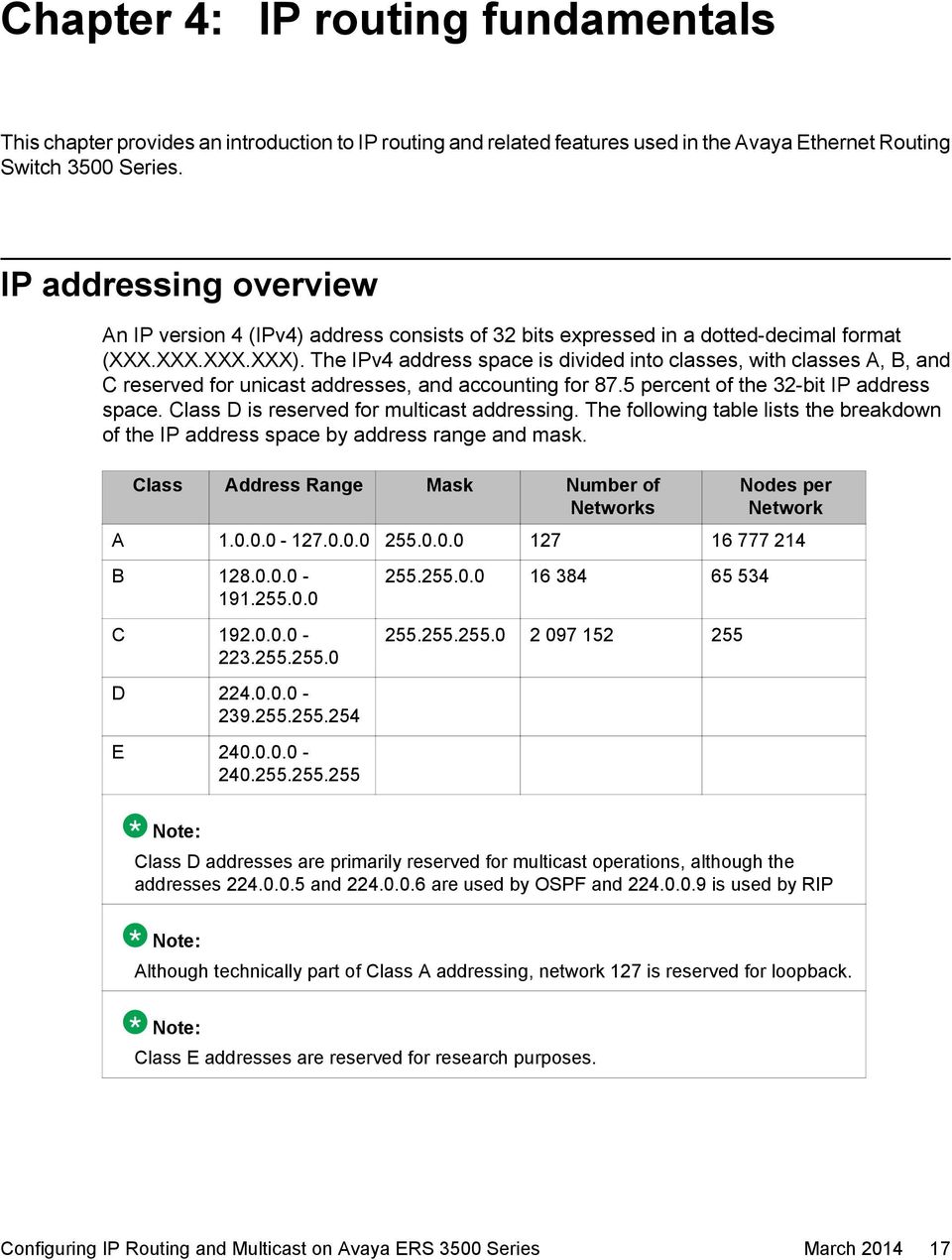
17 Chapter 4: IP routing fundamentals This chapter provides an introduction to IP routing and related features used in the Avaya Ethernet Routing Switch 3500 Series. IP addressing overview An IP version 4 (IPv4) address consists of 32 bits expressed in a dotted-decimal format (XXX.XXX.XXX.XXX). The IPv4 address space is divided into classes, with classes A, B, and C reserved for unicast addresses, and accounting for 87.5 percent of the 32-bit IP address space. Class D is reserved for multicast addressing. The following table lists the breakdown of the IP address space by address range and mask. Class Address Range Mask Number of Networks Nodes per Network A B C D E Note: Class D addresses are primarily reserved for multicast operations, although the addresses and are used by OSPF and is used by RIP Note: Although technically part of Class A addressing, network 127 is reserved for loopback. Note: Class E addresses are reserved for research purposes. Configuring IP Routing and Multicast on Avaya ERS 3500 Series March
18 IP routing fundamentals To express an IP address in dotted-decimal notation, each octet of the IP address is converted to a decimal number and separated by decimal points. For example, the 32-bit IP address is expressed in dotted-decimal notation as Each IP address class, when expressed in binary notation, has a different boundary point between the network and host portions of the address, as shown in the following figure. The network portion is a network number field from 8 through 24 bits. The remaining 8 through 24 bits identify a specific host on the network. Figure 1: Network and host boundaries in IP address classes Subnet addressing Subnetworks (or subnets) are an extension of the IP addressing scheme. With subnets, organizations can use one IP address range for multiple networks. Subnets are two or more physical networks that share a common network-identification field (the network portion of the 32-bit IP address). A subnet address is created by increasing the network portion to include a subnet address, thus decreasing the host portion of the IP address. For example, in the address , the network portion is , while the subnet is found in the first octet of the host portion (10). A subnet mask is applied to the IP address and identifies the network and host portions of the address. 18 Configuring IP Routing and Multicast on Avaya ERS 3500 Series March 2014 Comments? [email protected]

19 IP addressing overview The following table illustrates how subnet masks used with Class B and Class C addresses can create differing numbers of subnets and hosts. This example shows the use of the zero subnet, which is permitted on a Avaya Ethernet Routing Switch 3500 Series. Number of bits Subnet Mask Number of Subnets (Recommended) Class B Number of Hosts per Subnet Class C Variable-length subnet masking (VLSM) is the ability to divide an intranet into pieces that match network requirements. Routing is based on the longest subnet mask or network that matches. Configuring IP Routing and Multicast on Avaya ERS 3500 Series March

20 IP routing fundamentals IP routing To configure IP routing on the Avaya Ethernet Routing Switch 3500 Series, you must create virtual router interfaces by assigning an IP address to a virtual local area network (VLAN). The following sections provide more details about IP routing functionality. For a more detailed description about VLANs and their use, see Avaya Ethernet Routing Switch 3500 Series, Configuration - Layer 2 (NN ). IP routing using VLANs The Avaya Ethernet Routing Switch 3500 Series, supports wire-speed IP routing between VLANs. To create a virtual router interface for a specified VLAN, you must associate an IP address with the VLAN. The virtual router interface is not associated with any specific port. The VLAN IP address can be reached through any of the ports in the VLAN. The assigned IP address also serves as the gateway through which packets are routed out of that VLAN. Routed traffic can be forwarded to another VLAN within the switch or stack. When the Avaya Ethernet Routing Switch 3500 Series is routing IP traffic between different VLANs, the switch is considered to be running in Layer 3 mode; otherwise, the switch runs in Layer 2 mode. When you assign an IP address to a Layer 2 VLAN, the VLAN becomes a routable Layer 3 VLAN. You can assign a single and unique IP address to each VLAN. You can configure the global status of IP routing to be enabled or disabled on the Avaya Ethernet Routing Switch 3500 Series. By default, IP routing is disabled. In this release, the Avaya Ethernet Routing Switch 3500 Series supports local routes and static routes (local and non-local static routes). With local routing, the switch automatically creates routes to each of the local Layer 3 VLAN interfaces. With static routing, you must manually enter the routes to the destination IP addresses. Local routes With routing globally enabled, if you assign an IP address to a VLAN, IP routing is enabled for that VLAN. In addition, for each IP address assigned to a VLAN interface, the Ethernet Routing Switch adds a directly connected or local route to its routing table based on the IP address/ mask assigned. 20 Configuring IP Routing and Multicast on Avaya ERS 3500 Series March 2014 Comments? [email protected]

21 IP routing Local routing example The following figure shows how the Ethernet Routing Switch can route between Layer 3 VLANs. In this example, the Ethernet Routing Switch has two VLANs configured. IP Routing is enabled globally on the switch and on the VLANs, each of which has an assigned IP address. Figure 2: Local routes example IP address /24 is assigned to VLAN 100, and IP address /24 is assigned to VLAN 200. As IP Routing is enabled, two local routes become active on the Avaya Ethernet Routing Switch as described in the following table. Network Net-mask Next-hop Type LOCAL LOCAL At this stage, both hosts A ( ) and B ( ) are reachable from the Ethernet Routing Switch. However, to achieve Layer 3 connectivity between A and B, additional Configuring IP Routing and Multicast on Avaya ERS 3500 Series March
22 IP routing fundamentals configuration is required. Host A must know how to reach network /24, and host B must know how to reach network /24. On host A, you must configure a route to network /24 through , or configure as the default gateway for the host. On host B, you must configure a route to network /24 through , or configure as the default gateway for the host. With these routes configured, the Ethernet Routing Switch can perform inter-vlan routing, and packets can flow between hosts A and B. Static routes After you create routable VLANs though IP address assignment, you can create static routes. With static routes, you can manually create specific routes to a destination IP address. In this release, the Ethernet Routing Switch supports both local and non-local static routes. Static routing example The following figure shows an example of static routing on the Ethernet Routing Switch. 22 Configuring IP Routing and Multicast on Avaya ERS 3500 Series March 2014 Comments? [email protected]
23 IP routing Figure 3: Static routes In this example, two Layer 3 devices are used to create a physical link between hosts A and B. This network contains an Ethernet Routing Switch and another Layer 3 router, R1. In this setup, the local route configuration from Local routing example on page 21 still applies. However, in this case, network /24 stands in between networks /24 and /24. To achieve end-to-end connectivity, router R1 must know how to reach network /24, and the Ethernet Routing Switch must know how to reach network /24. On the Ethernet Routing Switch, you can accomplish this using static routing. With static routing, you can configure a route to network /24 through In this case, the following routes are active on the Ethernet Routing Switch. Network Net-mask Next-hop Type LOCAL LOCAL STATIC To obtain Layer 3 connectivity between the hosts, additional routes are required. Host A requires a route to /24 using as the next hop, or with as the Configuring IP Routing and Multicast on Avaya ERS 3500 Series March
24 IP routing fundamentals default gateway. Host B requires a route to /24 using as the next hop, or with as the default gateway. The configuration for router R1 to reach network /24 is dependent on the type of router used. Layer 3 Non-Local Static Routes (IP NLSR) After you create routable VLANs through IP address assignment, you can create static routes. You can manually create specific routes to destination IP addresses with static routes. Local static routes have a next-hop that is on a directly-connected network. Non-local routes (NLSR) have a next-hop that is not on a directly-connected network. When you implement NLSR on the switch, if the corresponding next-hop IP address can be reached through any active route on the switch, a static route becomes active in the routing table. The switch elects a support route as the most specific route through which the next-hop IP address can be reached. Then the switch links the NLSR route to an active support route. The NLSR becomes inactive if the support route becomes inactive and no alternative support route can be calculated. The support route can be a static route or dynamic route (on switches that support dynamic routing), but it cannot be the default route (network netmask ) because, if NLSR reachability is allowed through the default route, then any route could change to active as NLSR reachable through the default route. Advantages of IP NLSR: Where there are multiple paths to a network you can reduce the number of static routes by using only one route with a remote gateway Where the next-hop IP address cannot be reached directly from the switch, the system can use any host IP address that exists on the path to the destination network to configure an active and functional route, as long as the host can be reached through another active route on the switch You do not need to modify the NLSR route if an administrator changes the next-hop IP address If the support route is an ECMP route, and one of the next-hops becomes unreachable, the NLSR route remains active as long as the support route is active through at least one of the next-hops If the support route is an ECMP route, internally, the NLSR route uses the first of the ECMP route next-hops as the NLSR next-hop 24 Configuring IP Routing and Multicast on Avaya ERS 3500 Series March 2014 Comments? [email protected]
25 IP routing Limitations of IP NLSR: Because static routes are not easily scalable, in a large or growing network this type of route management may not be the best option Because static routes cannot determine path failure, a router can still attempt to use a failed path Default routes Default routes specify a route to all networks for which there are no explicit routes in the Forwarding Information Base or the routing table. This static default route is a route to the network address as defined by the Institute of Electrical and Electronics Engineers (IEEE) Request for Comment (RFC) 1812 standard. The Ethernet Routing Switch uses the default route / for all Layer 3 traffic that does not match a specific route. This traffic is forwarded to the next-hop IP address specified in the default route. Route scaling The Avaya Ethernet Routing Switch 3500 Series supports a maximum of 32 local routes and up to 32 static routes, including the default route (Destination = , Mask = ). Management VLAN With IP routing enabled on the switch or stack, you can use any of the virtual router IP addresses for device management over IP. Any routable Layer 3 VLAN can carry the management traffic for the switch, including Telnet, Simple Network Management Protocol (SNMP), BootP, and Trivial File Transfer Protocol (TFTP). Without routing enabled, the management VLAN is reachable only through the switch or stack IP address, and only through ports that are members of the management VLAN. The management VLAN always exists on the switch and cannot be removed. When routing is enabled on the Avaya Ethernet Routing Switch 3500 Series, switches, the management VLAN behaves similar to other routable VLANs. The IP address is reachable through any virtual router interface, as long as a route is available. Management route On the Ethernet Routing Switch, you can configure a management route from the Management VLAN to a particular subnet. The management route is a static route that allows incoming management connections from the remote network to the management VLAN. Configuring IP Routing and Multicast on Avaya ERS 3500 Series March
26 IP routing fundamentals The management route transports traffic between the specified destination network and the Management VLAN only. It does not carry inter-vlan routed traffic from the other Layer 3 VLANs to the destination network. This provides a management path to the router that is inaccessible from the other Layer 3 VLANs. While you can access the management VLAN from all static routes, other static routes cannot route traffic to the management route. To allow connectivity through a management route, you must enable IP routing globally and on the management VLAN interface. The following figure shows an example of a management route allowing access to the management VLAN interface. Figure 4: Management route As network /24 is not directly connected to the Ethernet Routing Switch, to achieve connectivity from host to the management VLAN, the Ethernet Routing Switch must know how to reach network /24. On the Ethernet Routing Switch, you can configure a management route to network /24 through In this case, the following management route is active on the Ethernet Routing Switch. 26 Configuring IP Routing and Multicast on Avaya ERS 3500 Series March 2014 Comments? [email protected]
27 DHCP Server Network Net-mask Next-hop Type MANAGEMENT With this configured route, host A at can perform management operations on the Ethernet Routing Switch. To do so, Host A also requires a route to /24 using as the next hop, or with as the default gateway. If a Layer 3 VLAN is also configured for network /24, this provides a local route that host B at can use to access the switch. However, host B cannot communicate with host A, as the route to network /24 is a management route only. To provide connectivity between the two hosts, you must configure a static route to /24. DHCP Server If you require local provision of TCP/IP addresses and have no separate DHCP Server or other device available to provide the service to local hosts, DHCP Server is included on the switch. You can use the DHCP Server feature to provide and manage client IPv4 addresses in your network and eliminate manual TCP/IP configuration. DHCP Server is disabled by default. Following is some of the information DHCP clients request from DHCP Server: IPv4 address Note: IPv6 address allocation is not supported Subnet mask Additional configuration parameters, such as: a default gateway address Domain Name System (DNS) server addresses You can define the information in the DHCP Server database available on your switch and the DHCP Server feature then provides it to your DHCP clients. The following diagram illustrates the basic DHCP process. Configuring IP Routing and Multicast on Avaya ERS 3500 Series March
28 IP routing fundamentals Because DHCP Server on the switch is, by default, bound to the switch Management VLAN, the DHCP service uses the switch or stack IP. You must also enable internal IP routing/forwarding globally on the switch and for the respective VLAN(s). Although the switches support the configuration up to 256 VLANs, a maximum of 16 IP address pools with a maximum of 254 hosts per pool/per VLAN is supported. Before you enable the DHCP Server, you must define at least one IP address pool with a network mask and Router (gateway) IP address. Note: The terms pool and scope refer to available IP addresses. While this documentation uses the term pool in most instances, you may also see the term scope used to refer to a pool of IP addresses. For static devices like printers, you can enter MAC addresses and configure reserved IP addresses for the static devices. For example, you can specify a static IP address inside or outside an IP address pool and enter the MAC of the device to force allocation of the same IP address to the device. The switch supports manual configuration and entry of up to eight DNS server IP addresses. If required, the system forwards the DNS server IP address information to the DHCP Client. You can also: create an IP address Pool Name that contains a maximum of 32 alpha-numeric characters create a maximum of 16 separate IP address Pools 28 Configuring IP Routing and Multicast on Avaya ERS 3500 Series March 2014 Comments? [email protected]
29 DHCP Server define a maximum of 8 DNS server IP addresses define a maximum of 8 router/gateway IP addresses enable either DHCP Server or DHCP Snooping, but they cannot operate simultaneously create a maximum of 1 IP address Pool per VLAN define a maximum range of 254 IP hosts per IP address Pool (~1000 per switch/stack) When you enable DHCP Server, the default settings are: IP address pool based on the switch or stack Management IP address and the mask in the Management VLAN example, if the switch or stack management address is / , then pool 1 is comprised of the addresses through in VLAN 1 Global switch or stack basis DHCP Server operation the system assigns devices on all ports in the VLAN to an address pool that can participate in IP address lease assignment. You assign specified IP address lease duration to clients based on the number and type of hosts in your network to limit network congestion caused by too-frequent IP address requests All DHCP Server IP address pool options are set to 0 you must set each required pool option parameter manually on a per pool basis Note: The DHCP Server IP address pool Option 176, Avaya IP Phones, feature supports only Avaya 4600 series IP phones for provisioning a number of parameters. When you create a DHCP Server IP Address Pool, Option 176 is automatically enabled with several default parameters, with the exception of the MCIPADD and TFTP Server IP address information. For configuration procedures, refer to: DHCP server configuration using ACLI on page 87 DHCP Server Configuration using EDM on page 169 DHCP Server usage examples This section contains examples to help you use the DHCP Server feature. Single VLAN, single IP pool The following example illustrates one switch with one VLAN. All switch ports and devices reside in VLAN 1, and the Management VLAN is VLAN 1. Configuring IP Routing and Multicast on Avaya ERS 3500 Series March
30 IP routing fundamentals Assumptions: Switch IP and DHCP Server IP address is /24 (Ethernet Routing Switch) callout item 1. DHCP server pool is to Gateway IP address is /24 (router) callout item 2. DNS servers: and Management VLAN is VLAN 1 Note: IP multi-netting is not supported ACLI commands to create an IP Address pool for one VLAN: 1. Create starting and ending IP address range and mask (config)# ip dhcp-server pool marketing range (config)# ip dhcp-server pool marketing option Create dhcp server options for the pool (config)# ip dhcp-server pool marketing option Configuring IP Routing and Multicast on Avaya ERS 3500 Series March 2014 Comments? [email protected]
31 DHCP Server (config)# ip dhcp-server pool marketing option Add other parameters to pool: (config)# ip dhcp-server pool marketing option (config)# ip dhcp-server pool marketing option View the configuration of the pool: (config)# show ip dhcp-server pool marketing Start IP Address: End IP Address: Lease time: Subnet Mask: DNS Servers: , Routers: Vendor-info: SIP Servers: TFTP Servers: Avaya IP-Phones: MCIPADD: MCPORT: 1719 Tftpsrvr: L2qvlan: 0 Vlantest: 60 L2qaud: 6 L2qsig: 6 ACLI commands to create an IP Address pool for one VLAN: 1. Create starting and ending IP address range and mask (config)# ip dhcp-server pool marketing range (config)# ip dhcp-server pool marketing option Create dhcp server options for the pool config)# ip dhcp-server pool marketing option ) Configuring IP Routing and Multicast on Avaya ERS 3500 Series March
32 IP routing fundamentals (config)# ip dhcp-server pool marketing option Add other parameters to pool: (config)# ip dhcp-server pool marketing option (config)# ip dhcp-server pool marketing option View the configuration of the pool: (config)# show ip dhcp-server pool marketing Start IP Address: End IP Address: Lease time: Subnet Mask: DNS Servers: , Routers: Vendor-info: SIP Servers: TFTP Servers: Avaya IP-Phones: MCIPADD: MCPORT: 1719 Tftpsrvr: L2qvlan: 0 Vlantest: 60 L2qaud: 6 L2qsig: 6 EDM steps to create an IP Address pool for one VLAN: 1. In the navigation tree, click IP. 2. In the IP tree, click DHCP Server. 3. Click the DHCP Server Pool tab. 4. On the toolbar, click Insert. 5. On the Insert DHCP Server Pool pane, enter the values to configure a pool. 32 Configuring IP Routing and Multicast on Avaya ERS 3500 Series March 2014 Comments? [email protected]
33 DHCP Server 6. Click Insert to add the DHCP Server pool and return to the DHCP Server Pool tab. 7. On the DHCP Server Pool toolbar, click Refresh to display the new DHCP Server Pool. Two VLANs, two IP pools In this example, there is one switch with two VLANs: VLAN 1 DATA - PC and printer devices (management VLAN) VLAN 2 VOICE IP Phones Following is a simple IP Office style example of the DHCP server function serving host PCs and IP Phones. Assumptions: Switch IP and DHCP Server IP address is /24 (in management VLAN) on Avaya Ethernet Routing Switch, callout item 1 DHCP server pools: DATA to , callout item 2, VOICE to , callout item 3. Gateway IP: /24 (router), callout item 4. DNS servers: and Management VLAN: VLAN 1 Configuring IP Routing and Multicast on Avaya ERS 3500 Series March
34 IP routing fundamentals Note: IP multi-netting is not supported ACLI commands to create two IP Address pools for two or more VLANs : 1. Create second VLAN and add ports to VLAN-2: (config)# vlan create 2 type port (config)# vlan members 2 <port-list> 2. Add IP gateway for VLAN-2 and globally enable routing (subnet /24): (config)# interface vlan 2 (config-if)# ip address (config)# ip routing 3. Create starting and ending IP address range and mask for 2 IP Pools: (config)# ip dhcp-server pool marketing range (config)# ip dhcp-server pool marketing option (config)# ip dhcp-server pool sales range (config)# ip dhcp-server pool sales option Create DHCP Server options for the pool (config)# ip dhcp-server pool marketing option (config)# ip dhcp-server pool marketing option (config)# ip dhcp-server pool sales option (config)# ip dhcp-server pool sales option Optionally configure any additional DHCP server Pool options: (config)# ip dhcp-server pool marketing option (config)# ip dhcp-server pool marketing option Enable the embedded DHCP Server: (config)# ip dhcp-server enable To support additional IP Pools, repeat these steps to add more VLANs Ports 34 Configuring IP Routing and Multicast on Avaya ERS 3500 Series March 2014 Comments? [email protected]
35 DHCP Server Gateway IP & routing for VLANs DHCP Pools for the corresponding IP subnet in the VLANs EDM steps to create two IP Address pools for two or more VLANs: Create a second DHCP Server Pool : 1. In the navigation tree, click IP. 2. In the IP tree, click DHCP Server. 3. Click thedhcp Server Pool tab. 4. On the toolbar, click Insert. 5. On the Insert DHCP Server Pool pane, enter the values to configure a pool. 6. Click Insert to add the DHCP Server pool and return to the DHCP Server Pool tab. 7. On the DHCP Server Pool toolbar, click Refresh to display the new DHCP Server Pool. Create a second VLAN, add ports, create an IP gateway for VLAN, and enable routing: 1. From the navigation tree, click VLAN. 2. Click VLANs. 3. In the work area, click the Basic tab. 4. On the toolbar, click Insert. 5. Do one of the following: a. In the Id field, type a value. b. Accept the default ID for the VLAN. 6. Do one of the following: a. In the Name field, type a value. b. Accept the default name for the VLAN. 7. In the Type field, select byport. 8. Click Insert. 9. In the VLAN row, double-click the cell in the PortMembers column. 10. Select ports to add to the VLAN. 11. Click Ok. 12. In the VLAN row, double-click the cell in the Routing column. 13. Select true to enable routing for the VLAN. 14. Click Apply. 15. In the work area, select the newly created VLAN. 16. On the toolbar, click IP. Configuring IP Routing and Multicast on Avaya ERS 3500 Series March
36 IP routing fundamentals The IP, VLAN dialog box appears with the IP Address tab selected. 17. On the toolbar, click Insert. The Insert IP Address dialog box appears. 18. Type the IP address, subnet mask, and MAC address offset in the fields provided. 19. Click Insert. Enable Global IP routing/forwarding: 1. From the navigation tree, click IP. 2. In the IP tree, click IP. 3. In the Forwarding box, select the option to enable routing. 4. Click Apply. Note: Because the DHCP Server is embedded in the switch, it is not necessary to configure DHCP relay information when configuring multiple DHCP pools for multiple VLANs. DHCP requests will be received on any directly connected VLAN when a gateway IP address is configured and routing is enabled for that VLAN. How to use DHCP Server Vendor options with Avaya WLAN 8100 Access points If you use the embedded DHCP Server to provide IP address assignment to Avaya 8100 Series Wireless LAN Access Points you can also use the Vendor Class Id Option-60 and Vendor Specific Info Option-43 to provision the WLAN 8100 Security Controller IP address information. For IP address assignment purposes, using DHCP Server, WLAN Access Points can reside in a VLAN with other PC and host devices, or on a separate VLAN. The Option-60 Vendor Class Id option is used by DHCP clients to optionally identify the vendor type and configuration of a DHCP client during the DHCP request process. For example, the identifier may encode the client hardware configuration. When a DHCP Server receives Vendor Class Identifiers, it responds with option-43 to return the vendor-specific information to the client. Option-43 Vendor Specific Information lists the code, string, and information format that is sent to the client when configured in the switch embedded DHCP Server. Note: Refer to individual manufacturer or vendor equipment configuration guides for option-60 Vendor Class Identifier type used by a specific device type, and the supported string information using option-43. The following is an ACLI configuration example that describes a DHCP Server IP pool for WLAN 8100 Access Points. Provisioning of one or more WLAN 8100 Series Controller IP addresses to Access Points is part of the DHCP process when the Vendor Class Identifier option is configured. 36 Configuring IP Routing and Multicast on Avaya ERS 3500 Series March 2014 Comments? [email protected]
37 DHCP Server In this example, when the DHCP Server receives AVAYA AP 8100 as a Vendor Class Identifier, the system sends the information contained in the Vendor Specific Info string to the device, independent of the VLAN and IP Pool in which the device resides. Using DHCP Server Vendor options with Avaya WLAN 8100 Access Points: 1. Create an IP address pool configuration for ap8120 pool (config)# ip dhcp-server pool ap8120-pool range (config)# ip dhcp-server pool ap8120-pool option (config)# ip dhcp-server pool ap8120-pool option Create vendor class pool ap8120 vendorclass and configure WLAN Controller IP address information. The example string shown contains two controller addresses. (config)# ip dhcp-server pool ap8120-vendorclass option-60 "Avaya AP 8100" option-43 "1:ip: :1:ip: :8:str:AVAYA AP" 3. Show dhcp pool configuration output: (config)# show ip dhcp-server pool Pool: ap8120-pool Start IP Address: End IP Address: Lease time: 1d:0h:0m Subnet Mask: DNS Servers: Routers: Vendor-info: SIP Servers: TFTP Servers: Pool: ap8120-vendorclass Vendor identifier: AVAYA AP 8100 Lease time: 1d:0h:0m Subnet Mask: DNS Servers: Routers: Vendor-info: 1:ip: :1:ip: :8:str:AVAYA AP SIP Servers: TFTP Servers: Important: It is critical that the Vendor Class Identifier is entered correctly as Avaya AP 8100 (spaces in between text inside quotations), and the Vendor Specific Info string contains AVAYA AP (capitalized) as shown in the above configuration examples. How to use Option 176 for Avaya 4600 series IP phones Option-176, Avaya-IP-Phones, provides provisioning of basic IP phone features to Avaya 4600 series IP phones. Configuring IP Routing and Multicast on Avaya ERS 3500 Series March
38 IP routing fundamentals When you create an IP address pool, option 176 is automatically enabled with default values for the following parameters: MCPORT (1719) L2qvlan (0) l2qaud (6) l2qsig (6) Vlantest (60) Two other parameters, MCIPADD and TFTP server, are blank by default and, if you require option-176 capabilities, you must configure them. Following is an ACLI configuration example of a DHCP Server IP Pool with provisioning support for Avaya 4600 series IP Phones. Configuring IP address information for option-176 Avaya-ip-phones using ACLI: Assumption: A DHCP Server Pool called Marketing exists. 1. Configure IP address information for option-176 Avaya-ip-phones. (config)# ip dhcp-server pool marketing option-176 mcipadd (config)# ip dhcp-server pool marketing option-176 tftpservers Optional Change mcport number and L2qvlan parameters for option-176 Avayaip-phones (config)# ip dhcp-server pool marketing option-176 mcport 9200 (config)# ip dhcp-server pool marketing option-176 l2qvlan 2 3. Display pool configuration for marketing. 3500(config)# show ip dhcp-server pool Pool: marketing Start IP address: End IP address: Lease time: Subnet Mask: DNS Servers: Routers: Vendor-info: SIP Servers: 38 Configuring IP Routing and Multicast on Avaya ERS 3500 Series March 2014 Comments? [email protected]
39 DHCP Server TFTP Servers: Avaya IP-Phones: MCIPADD: MCPORT: 9200 Tftpsrvr: L2qvlan: 2 Vlantest: 60 L2qaud: 6 L2qsig: 6 To configure Option 176 for Avaya IP phones using EDM, see Configuring DHCP Server Pool Options EDM on page 178. How to use Option 241 for Avaya IP phones You can provide Voice VLAN information to Avaya 1100, 1200 and 2000 series IP Phones using DHCP options assigned to the data VLAN as well as extended options. The IP Phone options are defined as a string and contain parameters and values separated by semicolons. For option 241, only the Nortel specific option of Nortel-i2004 B will be supported. As one or more parameters are defined for this option, they are appended to the Nortel-i2004 B specific option. You can also remove specific parameters from an existing string. When adding or removing parameters, the use of Nortel-i2004 B specific option at the beginning of the string is optional. Although all specified parameters are supported, the maximum option length of the Option 241 string is 255 characters, The input string for option 241 is validated to verify the parameters from the string are valid, however, there is no check for their values, or whether a specific parameter is entered more than once in the same command. A parameter is considered to be the value between the equals sign and semicolon from the input string. You will receive an error message if an invalid parameter is found in the input string. For a list of the supported parameters, see DHCP Server Option 241 parameters on page 102. Following is an ACLI configuration example of a DHCP Server IP Pool with provisioning support for Avaya 1100, 1200 and 2000 series IP Phones. Configuring IP address information for option-241 Avaya-ip-phones using ACLI: Assumption: A DHCP Server Pool called Marketing exists. 1. Configure IP address information for option-241 Avaya-ip-phones. (config)# ip dhcp-server pool marketing option-241 Norteli2004 B,s1ip= ;p1=4100;a1=1;r1=255; Configuring IP Routing and Multicast on Avaya ERS 3500 Series March
40 IP routing fundamentals Note: When adding parameters, the format for the parameter list is: Nortel-i2004 B,param1=value;param2=value2;param3=value3; Optional Remove individual parameters s2ip and p2 for option-241 Avaya-ipphones (config)# no ip dhcp-server pool marketing option-241 s2ip,p2 Note: When removing parameters, the format for the parameter list is: Nortel-i2004 B,param1,param2,param3,... To configure Option 241 for Avaya IP phones using EDM, see Configuring DHCP Server Pool Options EDM on page 178. How to use Option 242 for Avaya IP phones The embedded DHCP Server for this option supports the configuration and provisioning of selected parameters for Avaya 1600 and 9600 series IP Phones. The following parameters are supported: HTTPPORT HTTPSRVR MCIPADD When DHCP Server Option 242 is enabled for a specific IP pool, note the following default values: HTTPPORT (default port = 80) HTTPSRVR (default IP address = blank) up to eight (8) IP addresses are supported in the configuration of this parameter MCIPADD (default IP address = blank) up to eight (8) Call Server IP addresses are supported in the configuration of this parameter. This is used as a backup for the IP phone in case the HTTP Server is unavailable, in which case the IP phone can reach the Call Server. Following is an ACLI configuration example of a DHCP Server IP Pool with provisioning support for Avaya 1600 and 9600 series IP Phones. Configuring IP address information for option-242 Avaya-ip-phones using ACLI: Assumption: A DHCP Server Pool called Marketing exists. Configure IP address information for option-242 Avaya-ip-phones. (config)# ip dhcp-server pool marketing option-242 mcipadd (config)# ip dhcp-server pool marketing option-242 httpsrvr To configure Option 242 for Avaya IP phones using EDM, see Configuring DHCP Server Pool Options EDM on page Configuring IP Routing and Multicast on Avaya ERS 3500 Series March 2014 Comments? [email protected]
41 Related routing features Related routing features The following sections describe features that are related to and dependent on the IP routing functionality. BootP DHCP relay Dynamic Host Configuration Protocol (DHCP) is a mechanism to assign network IP addresses on a dynamic basis to clients who request an address. DHCP is an extension of the Bootstrap protocol (BootP). BootP/DHCP clients (workstations) generally use User Datagram Protocol (UDP) broadcasts to determine their IP addresses and configuration information. If such a host is on a VLAN that does not include a DHCP server, the UDP broadcasts are by default not forwarded to servers located on different VLANs. The Avaya Ethernet Routing Switch 3500 Series, can resolve this issue using DHCP relay, which forwards the DHCP broadcasts to the IP address of the DHCP server. Network managers prefer to configure a small number of DHCP servers in a central location to lower administrative overhead. Routers must support DHCP relay so that hosts can access configuration information from servers several router hops away. With DHCP relay enabled, the switch can relay client requests to DHCP servers on different Layer 3 VLANs or in remote networks. It also relays server replies back to the clients. To relay DHCP messages, you must create two Layer 3 VLANs: one connected to the client and the other providing a path to the DHCP server. You can enable DHCP relay on a per-vlan basis. The following figure shows a DHCP relay example, with an end station connected to subnet 1, corresponding to VLAN 1. The Avaya Ethernet Routing Switch 3500 Series, connects two subnets by means of the virtual routing function. When the end station generates a DHCP request as a limited UDP broadcast to the IP address of all 1s (that is, ), with the DHCP relay function enabled, the Ethernet Routing Switch forwards the DHCP request to the host address of the DHCP server on VLAN 2. Configuring IP Routing and Multicast on Avaya ERS 3500 Series March
42 IP routing fundamentals Figure 5: DHCP relay operation Forwarding DHCP packets In the following figure, the DHCP relay agent address is To configure the Avaya Ethernet Routing Switch 3500 Series,to forward DHCP packets from the end station to the server, use as the server address. Figure 6: Forwarding DHCP packets All BootP and DHCP broadcast packets that appear on the VLAN 1 router interface ( ) are then forwarded to the DHCP server. In this case, the DHCP packets are forwarded as unicast to the DHCP server IP address. 42 Configuring IP Routing and Multicast on Avaya ERS 3500 Series March 2014 Comments? [email protected]
43 Related routing features Differences between DHCP and BootP With DHCP relay, the Avaya Ethernet Routing Switch 3500 Series, supports the relay of DHCP and the Bootstrap protocol (BootP). The following differences between DHCP and BootP are specified in RFC 2131: BootP enables the retrieval of an American Standard Code for Information Interchange (ASCII) configuration file name and configuration server address. A properly configured BootP server enables the switch to automatically learn its assigned IP address, subnet mask, and the IP address of the default router (default gateway). DHCP defines mechanisms through which clients can be assigned a network address for a finite lease (allowing for reuse of IP addresses). DHCP provides the mechanism for clients to acquire all of the IP configuration parameters they need to operate. DHCP uses the BootP message format defined in RFC 951. The remainder of the options field consists of a list of tagged parameters that are called options(rfc 2131). DHCP option 82 support DHCP option 82 support is an extension of Dynamic Host Configuration Protocol (RFC3046 and RFC3993) that enables the switch to send information about DHCP clients to the authenticating DHCP server. When you enable option 82, in either Layer 2 or Layer 3 mode, the switch inserts additional port-based identification information into the DHCP packets traversing the switch enroute to the DHCP server. The DHCP server stores this additional identification information within the IP allocation record to assist in tracking of end device locations; for example, to provide location-based information for emergency services applications. When a VLAN is operating in Layer 2 mode, DHCP Snooping must be enabled for DHCP Option 82 to function, both globally and on each client VLAN. For more information about DHCP Snooping, see Avaya Ethernet Routing Switch 3500 Series Configuration, Security (NN ). When a VLAN is operating in Layer 3 (IP Routing) mode, the DHCP Option 82 function requires that DHCP Relay is appropriately configured. To use DHCP Option 82 with DHCP relay, you must enable DHCP relay globally on the switch and client VLANs. And you must configure at least one forward path. If you configure two DHCP Servers (one in the same VLAN with the DHCP Client and one in another VLAN) and you enable both DHCP Snoooping Option 82 and DHCP Relay Option 82, the system adds the option for both servers. DHCP Relay Packet Size In accordance with RFC3046, you can specify the maximum frame size the DHCP relay agent can forward to the DHCP server. While the switch implementation permits configuration of the Configuring IP Routing and Multicast on Avaya ERS 3500 Series March
44 IP routing fundamentals maximum DHCP packet size up to 1536 bytes, the default maximum size is 576 bytes. If the DHCP frame received is larger that the configured frame size, the switch does not relay the packet. If the DHCP packet exceeds the maximum configured size, the DHCP Option 82 information is not appended to the message. UDP broadcast forwarding By default, User Datagram Protocol (UDP) broadcast frames received on one VLAN are not routed to another VLAN. To allow UDP broadcasts to reach a remote server, the Ethernet Routing Switch supports UDP broadcast forwarding, which forwards the broadcasts to the server through a Layer 3 VLAN interface. UDP broadcast forwarding is a general mechanism for selectively forwarding limited UDP broadcasts received on an IP interface to a configured IP address. The packet is sent as a unicast packet to the server. When a UDP broadcast is received on a router interface, it must meet the following criteria to be considered for forwarding: It must be a MAC-level broadcast. It must be an IP-limited broadcast. It must be for a configured UDP protocol. It must have a time-to-live (TTL) value of at least 2. For each ingress interface and protocol, the UDP broadcast packets are forwarded only to a unicast host address (for example, to the unicast IP address of the server). When the UDP forwarding feature is enabled, a filter is installed that compares the UDP destination port of all packets against all the configured UDP forwarding entries. If a match occurs, the destination IP of the incoming packet is checked for consistency with the userconfigured broadcast mask value for this source VLAN. If these conditions are met, the TTL field from the incoming packet is overwritten with the user-configured TTL value, the destination IP of the packet is overwritten with the configured destination IP, and the packet is routed to the destination as a unicast frame. UDP forwarding example The following figure shows an example of UDP broadcast forwarding. In this case, if host A ( ) needs a certain service (for example, a custom application that listens on UDP port 12345), it transmits a UDP broadcast frame. By default, the Ethernet Routing Switch does not forward this frame to VLAN 100, and because server B ( ) is not on VLAN 200, the host cannot access that service. With UDP broadcast forwarding enabled, the host can access the service. In this case, you must list port as a valid forwarding port, and specify VLAN 200 as the source VLAN. 44 Configuring IP Routing and Multicast on Avaya ERS 3500 Series March 2014 Comments? [email protected]
45 Related routing features Figure 7: UDP forwarding example When the switch receives an incoming packet on VLAN 200 that matches the configured UDP destination port (12345), and the destination IP is consistent with the broadcast mask value for the VLAN, then the switch applies the new destination IP (here, ) to the packet and routes it to the destination as a unicast frame. Directed broadcasts With the directed broadcasts feature enabled, the Ethernet Routing Switch can determine if an incoming unicast frame is a directed broadcast for one of its interfaces. If so, the switch forwards the datagram onto the appropriate network using a link-layer broadcast. Configuring IP Routing and Multicast on Avaya ERS 3500 Series March
46 IP routing fundamentals With IP directed broadcasting enabled on a VLAN, the Ethernet Routing Switch forwards direct broadcast packets in the following two ways: through a connected VLAN subnet to another connected VLAN subnet through a remote VLAN subnet to the connected VLAN subnet This feature is disabled by default. ARP The Address Resolution Protocol (ARP) allows the Ethernet Routing Switch to dynamically learn Layer 2 Media Access Control (MAC) addresses, and to build a table with corresponding Layer 3 IP addresses. Network stations using the IP protocol need both a physical (MAC) address and an IP address to transmit a packet. If a network station knows only the IP address of a network host, ARP enables the network station to determine the physical address of the network host and bind the 32-bit IP address to a 48-bit MAC address. A network station can use ARP across a single network only, and the network hardware must support physical broadcasts. If a network station wants to send a packet to a host but knows only the host IP address, the network station uses ARP to determine the physical address of the host as follows: 1. The network station broadcasts a special packet, called an ARP request, that asks the host at the specified IP address to respond with its physical address. 2. All network hosts receive the broadcast message. 3. Only the specified host responds with its hardware address. 4. The network station then maps the host IP address to its physical address and saves the results in an address resolution table for future use. 5. The network station ARP table displays the association of the known MAC addresses to IP addresses. The lifetime for the learned MAC addresses is a configurable parameter. The switch executes ARP lookups after this timer expires. The default timeout value for ARP entries is 6 hours. Static ARP In addition to the dynamic ARP mechanism, the Ethernet Routing Switch supports a static mechanism that allows for static ARP entries to be added. With Static ARP, you can manually associate a device MAC address to an IP address. You can add and delete individual static ARP entries on the switch. 46 Configuring IP Routing and Multicast on Avaya ERS 3500 Series March 2014 Comments? [email protected]
47 Related routing features Proxy ARP Proxy ARP allows the Ethernet Routing Switch to respond to an ARP request from a locally attached host that is intended for a remote destination. It does so by sending an ARP response back to the local host with the MAC address of the switch interface that is connected to the host subnet. The reply is generated only if the switch has an active route to the destination network. With Proxy ARP enabled, the connected host can reach remote subnets without the need to configure default gateways. The following figure is an example of proxy ARP operation. In this example, host B wants to send traffic to host C, so host B sends an ARP request for host C. However, the Avaya Ethernet Routing Switch 3500 Series, is between the two hosts, so the ARP message does not reach host C. To enable communication between the two hosts, the Avaya Ethernet Routing Switch 3500 Series, intercepts the message and responds to the ARP request with the IP address of host C but with the MAC address of the switch itself. Host B then updates its ARP table with the received information. Figure 8: Proxy ARP Operation Avaya recommends Proxy ARP as a temporary fix only, for example, if you are gradually moving hosts from one addressing scheme to another and you still want to maintain connectivity between the disparately-addressed devices. You do not want Proxy ARP running as a general rule because it causes hosts to generate ARP messages for every address that they want to reach on the Internet. IP blocking for stacks IP blocking is a Layer 3 feature of the Avaya Ethernet Routing Switch 3500 Series, that provides safeguards for a stack where Layer 3 VLANs have port members across multiple stack units. Configuring IP Routing and Multicast on Avaya ERS 3500 Series March
48 IP routing fundamentals IP blocking is used whenever a unit leaves a stack or is rebooting inside the context of a stack. Depending on the setting in use, Layer 3 functionality is either continued or blocked by this feature. You can set the IP Blocking mode on the base unit to either none or full. When IP blocking is set to full, if any units leave the stack, those units run in Layer 2 mode. No Layer 3 settings remain active on the units. When IP blocking is set to none, if any units leave the stack, the Layer 3 configurations applied to the stack are still applied on the individual units. In a stack environment of 2 units, Avaya recommends that you use IP blocking mode none. In this case, you can expect the following functional characteristics: If either the stack base unit or non-base unit becomes non-operational, Layer 3 functionality continues to run on the remaining unit. A disadvantage of this configuration is that if the non-operational unit does not rejoin the stack, address duplication occurs. In stack environments of more than 2 units, Avaya recommends that you use IP blocking mode full. In this case, you can expect the following functional characteristics: If the stack base unit becomes non-operational, the following occurs: - The temporary base unit takes over base unit duties. - The temporary base unit takes over responsibility to manage Layer 3 functionality in the stack. When this occurs, the system updates the MAC addresses associated with each routing interface to be offset from the temporary base unit MAC address (rather than the base unit MAC address). During this period, some minor disruption may occur to routing traffic until end stations update their ARP cache with the new router MAC addresses. The Avaya Ethernet Routing Switch 3500 Series, sends out gratuitous ARP messages on each routed VLAN for 5 minutes at 15 second intervals to facilitate quick failover in this instance. - If the non-operational base unit does not rejoin the stack, no Layer 3 functionality runs on the unit. If a stack non-base unit becomes non-operational, the following occurs: - The stack continues to run normally with the base unit controlling Layer 3 functionality. - If the non-operational non-base unit does not rejoin the stack, no Layer 3 functionality runs on the unit. By default, the IP blocking mode is none (disabled). To configure IP blocking, see Configuring IP blocking for a stack on page Configuring IP Routing and Multicast on Avaya ERS 3500 Series March 2014 Comments? [email protected]
49 Routing feature capabilities and limitations Routing feature capabilities and limitations The following list describes the routing feature capabilities and limitations on the Ethernet Routing Switch: A maximum of 32 local routes, and up to 32 static routes including the default route (Destination = Mask = ) are supported. The maximum number of management routes is 4. The maximum number of dynamic ARP entries is 480. The maximum number of static ARP entries is 256. When adding a static ARP entry for a VLAN subnet, the IP address associated with the MAC address must be in the subnet for the VLAN. Otherwise the following error message is returned: % Cannot modify settings IP address does not match with VLAN subnet The following capabilities and limitations exist for UDP broadcast forwarding: - You can configure a maximum of 128 UDP port/protocol entries. - You can configure a maximum of 128 UDP forwarding lists. - You can configure a maximum of 16 ports (with their IP addresses) in one forwarding list. - You can bind a maximum of 16 VLANs to the same UDP forwarding list. - You cannot configure DHCP server or DHCP client ports for UDP broadcast forwarding. Configuring IP Routing and Multicast on Avaya ERS 3500 Series March
50 IP routing fundamentals 50 Configuring IP Routing and Multicast on Avaya ERS 3500 Series March 2014 Comments?
51 Chapter 5: IGMP fundamentals This chapter provides an overview of IP multicast and Internet Group Management Protocol (IGMP). To support multicast traffic, the Avaya Ethernet Routing Switch 3500 Series, provides support for IGMP snooping. Overview of IP multicast Most traditional network applications such as Web browsers and employ unicast connections in which each client sets up a separate connection to a server to access specific data. However, with certain applications such as audio and video streaming, more than one client accesses the same data at the same time. With these applications, if the server sends the same data to each individual client using unicast connections, the multiple connections waste both server and network capacity. For example, if a server offers a 1 Mbit/sec live video stream for each client, a 100 Mbit/sec network interface card (NIC) on the server could be completely saturated after 90 client connections. The following figure shows an example of this waste of resources. Figure 9: Wasteful propagation of multiple copies of the same unicast stream Multicasting provides the ability to transmit only one stream of data to all the interested clients at the same time. The following figure shows a simple example of how multicasting works. The source of the multicast data forwards only one stream to the nearest downstream router, and Configuring IP Routing and Multicast on Avaya ERS 3500 Series March
52 IGMP fundamentals each subsequent downstream router forwards a copy of the same data stream to the recipients who are registered to receive it. Figure 10: One stream replicated using multicasting This one-to-many delivery mechanism is similar to broadcasting except that, while broadcasting transmits to all hosts in a network, multicasting transmits only to registered host groups. Because multicast applications transmit only one stream of data, which is then replicated to many receivers, multicasting saves a considerable amount of bandwidth. Clients that want to receive the stream must register with the nearest multicast router to become a part of the receiving multicast group. One downside to multicasting is that the multicast streams transmit data using User Datagram Protocol (UDP) packets, which are not as reliable as Transmission Control Protocol (TCP) packets. Applications that use multicasting to transmit data include the following: multimedia conferencing real-time data multicasts (such as stock tickers) gaming and simulations Multicast groups To receive a multicast stream from a particular source, hosts must register with the nearest multicast router. The router adds all interested hosts to a multicast group, which is identified by a multicast IP address. Multicast routers use Internet Group Membership Protocol (IGMP) to learn the existence of host group members on their directly attached subnets. To identify the hosts that want to be 52 Configuring IP Routing and Multicast on Avaya ERS 3500 Series March 2014 Comments? [email protected]
53 IGMP overview IGMP fundamentals added to a group, a querier router sends out IGMP queries to each local network. A host that wants to belong to the group sends a response in the form of an IGMP membership report. Each multicast router maintains a multicast routing table that lists each source, group (S,G) pair, which identifies the IP address of the source and the multicast address of the receiving group. For each (S,G) pair, the router maintains a list of downstream forwarding ports to which the multicast traffic is forwarded, and the upstream port where the multicast traffic is received. Multicast addresses Each multicast host group is assigned a unique multicast address. To reach all members of the group, a sender uses the multicast address as the destination address of the datagram. An IP version 4 multicast address is a Class D address (the high-order bits are set to 1110) from to These addresses are assigned statically for use by permanent groups and dynamically for use by transient groups. On the Ethernet Routing Switch 3500 Series, you cannot use 24-bit subnets like /24 and /24 for multicast data traffic. This restriction applies to the entire multicast address range from /8 to /8. IGMP overview IGMP is the Layer 3 protocol used by IP multicast routers to learn the existence of multicast group members on their directly attached subnets (see RFC 2236). With IGMP, hosts can register their desired group memberships to their local querier router. A multicast querier router communicates with hosts on a local network by sending IGMP queries. The router periodically sends a general query message to each local network of the router. A host that wants to join a multicast group sends a response in the form of a membership report requesting registration with a group. After the querier router registers hosts to a group, it forwards all incoming multicast group packets to the registered host networks. As long as any host on a subnet continues to participate in the group, all hosts, including nonparticipating end stations on that subnet, receive the IP Multicast stream. IGMP versions are backward compatible and can all exist together on a multicast network. The following sections provide more details about the differences between the different IGMP versions. Configuring IP Routing and Multicast on Avaya ERS 3500 Series March
54 IGMP fundamentals IGMPv1 operation IGMP version 1 is the simplest of the IGMP versions and is widely deployed. IGMPv1 supports the following two message types: 0x11 Membership Query message. Packets are sent to the all-systems multicast group ( ). 0x12 Membership Report message. Packets are sent to the group that the host intends to join. The IGMPv1 router periodically sends host membership queries (also known as general queries) to its attached local subnets to inquire if any hosts are interested in joining any multicast groups. The interval between queries is a configurable value on the router. A host that wants to join a multicast group sends a membership report message to the nearest router, one report for each joined multicast group. After receiving the report, the router adds the Multicast IP address and the host port to its forwarding table. The router then forwards any multicast traffic for that multicast IP address to all member ports. The router keeps a list of multicast group memberships for each attached network, and a Group Membership Interval timer for each membership. Repeated IGMP membership reports refresh the timer. If no reports are received before the timer expires, the router sends a query message. In some cases, the host does not wait for a query before it sends report messages to the router. Upon initialization, the host can immediately issue a report for each of the multicast groups that it supports. The router accepts and processes these asynchronous reports the same way it accepts requested reports. IGMPv1 leave process After hosts and routers are in a steady state, they communicate in a way that minimizes the exchange of queries and reports. The designated routers set up a path between the IP Multicast stream source and the end stations, and periodically query the end stations to determine whether they want to continue to participate. As long as any host on the subnet continues to participate, all hosts, including nonparticipating end stations on the subnet, receive the IP Multicast stream. If all hosts on the subnet leave the group, the router continues to send general queries to the subnet. If no hosts send reports after three consecutive queries, the router determines that no group members are present on the subnet. IGMPv2 operation IGMPv2 extends the IGMPv1 features by implementing a host leave message to quickly report group membership termination to the routing protocol. Instead of routers sending multiple 54 Configuring IP Routing and Multicast on Avaya ERS 3500 Series March 2014 Comments? [email protected]
55 IGMP overview queries before determining that hosts have left a group, the hosts can send a leave message. This feature is important for multicast groups with highly volatile group membership. The IGMPv2 join process is similar to the IGMPv1 join process. IGMPv2 also implements a querier election process. IGMPv2 adds support for the following three new message types: 0x11 General Query and Group Specific Query message. 0x16 Version 2 Membership Report (sent to the destination IP address of the group being reported) 0x17 Version 2 Membership Leave message (sent to all-router [ ] multicast address) IGMPv2 also supports IGMPv1 messages. Host leave process With IGMPv2, if the host that issued the most recent report leaves a group, the host issues a leave message. The multicast router on the network then issues a group-specific query to determine whether other group members are present on the network. In the group-specific query message, the Group Address field is the group being queried (the Group Address field is 0 for the General Query message). If no host responds to the query, the router determines that no members belonging to that group exist on that interface. The following figure shows an example of how IGMPv2 works. Figure 11: IGMPv2 In this example, the following occurs: The host sends a leave message (to ). The router sends a group-specific query to group Configuring IP Routing and Multicast on Avaya ERS 3500 Series March
56 IGMP fundamentals No IGMP report is received. Group times out. Querier election process Normally only one querier exists for each subnet. When multiple IGMPv2 routers are present on a network, the router with the lowest IP address is elected to send queries. All multicast routers start up as a querier on each attached network. If a multicast router receives a query message from a router with a lower IP address, the router with the higher IP address becomes a nonquerier on that network. IGMPv3 operation IGMPv3 adds support for source filtering. The IGMPv3 host can report its interest in receiving multicast packets from only specific source addresses, or the host can report its interest in receiving multicast packets from all but specific source addresses. IGMPv3 is mostly used in voice and video conferences where multiple people can be part of the same conference. The IGMPv3 packet format adds a v3 Report message type (0x22) and includes Source-and-Group-specific Query messages. The message type for Source-and-Group-specific Query message is 0x11, the same as IGMPv1 and IGMPv2. The different Query message versions are identified as follows: If the size of the IGMP message type is 8, then it is a v1 or v2 Query message. If the Group Address field is 0, then it is a General Query. If the Group Address field is a valid multicast IP address, then it is a Group-specific Query. If the Group Address field is a valid address and the Number of Sources field is nonzero, then it is a Group-and-Source specific Query message. Each IGMPv3 Report contains a list of group records. The Group Record contains the multicast group address and the list of source addresses. The record type field specifies whether to INCLUDE or EXCLUDE the list of source addresses that are provided in the Source Address field. For example, to include packets from source , the report contains an INCLUDE( ) record. The list of source addresses can be empty, which is represented by braces ({}), which means either to INCLUDE or EXCLUDE none. For example, the host that wants to receive packets from all group members can send a report with an EXCLUDE({}) record and a host that wants to leave a group can send a report with an INCLUDE({}) record, which is similar to a leave message. In the following figure, hosts A, B, C, D, E, and F are part of a conference group G1. All hosts except F send a report for group G1 with the mode as INCLUDE(A, B, C, D, E, F) containing 56 Configuring IP Routing and Multicast on Avaya ERS 3500 Series March 2014 Comments? [email protected]
57 IGMP snooping all the source addresses. Host F, which is not interested in listening to C and D, sends a report to group G1 with the mode as EXCLUDE(C, D). Figure 12: IGMPv3 The router adds the multicast IP address and the list of sources in the forwarding table. The router forwards the packets from A, B, E, and F to all ports. If the packets are received from C and D, it is forwarded to all ports except port 11. IGMP requests for comment For additional information about IGMP, see the following requests for comment (RFC): For IGMPv1, see RFC For IGMPv2, see RFC For IGMPv3, see RFC 3376 For IGMP snooping, see RFC For IGMP management information bases (MIB), see RFC IGMP snooping If at least one host on a VLAN specifies that it is a member of a group, by default, the Avaya Ethernet Routing Switch 3500 Series, forwards to that VLAN all datagrams bearing the multicast address of that group. All ports on the VLAN receive the traffic for that group. The following figure shows an example of this scenario. Here, the IGMP source provides an IP Multicast stream to a designated router. Because the local network contains receivers, the designated router forwards the IP Multicast stream to the network. Switches without IGMP snoop enabled flood the IP Multicast traffic to all segments on the local subnet. The receivers Configuring IP Routing and Multicast on Avaya ERS 3500 Series March
58 IGMP fundamentals requesting the traffic receive the desired stream, but so do all other hosts on the network. Although the nonparticipating end stations can filter the IP Multicast traffic, the IP Multicast traffic still exists on the subnet and consumes bandwidth. Figure 13: IP multicast propagation on a LAN without IGMP snooping To prune ports that are not group members from receiving the group data, the Avaya Ethernet Routing Switch 3500 Series supports IGMP snoop for IGMPv1, IGMPv2, and IGMPv3. With IGMP snoop enabled on a VLAN, the switch forwards the multicast group data to only those ports that are members of the group. When using IGMP snoop, VLANs can provide the same benefit as IP Multicast routers, but in the local area. The Avaya Ethernet Routing Switch 3500 Series, identifies multicast group members by listening to IGMP packets (IGMP reports, leaves, and queries) from each port. The switch suppresses the reports by not forwarding them out to other VLAN ports, forcing the members to continuously send their own reports. The switch uses the information gathered from the reports to build a list of group members. After the group members are identified, the switch blocks the IP Multicast stream from exiting any port that does not connect to a group member, thus conserving bandwidth. As shown in the following figure, after the switches learn which ports are requesting access to the IP Multicast stream, all other ports not responding to the queries are blocked from receiving the IP Multicast data. 58 Configuring IP Routing and Multicast on Avaya ERS 3500 Series March 2014 Comments? [email protected]
59 IGMP snooping Figure 14: Ethernet Routing Switch running IGMP snooping The switch continues to forward the IGMP membership reports from the hosts to the multicast routers, and forwards queries from multicast routers to all port members of the VLAN. IGMPv3 snooping In IGMPv3 snooping mode, the switch recognizes IGMPv3 reports and queries and can: recognize whether a source list is populated or blank identify the specific sources to filter understand and process all IGMPv3 record type The following are supported: source filtering (INCLUDE, EXCLUDE, ALLOW, BLOCK of multicast sources) SSM (Source Specific Multicast) IGMP proxy With IGMP snoop enabled, the switch can receive multiple reports for the same multicast group. Rather than forward each report upstream, the Ethernet Routing Switch 3500 Series can consolidate these multiple reports by using the IGMP proxy feature. With IGMP proxy Configuring IP Routing and Multicast on Avaya ERS 3500 Series March
60 IGMP fundamentals enabled, if the switch receives multiple reports for the same multicast group, it does not transmit each report to the upstream multicast router. Instead, the switch forwards the first report to the querier and suppresses the rest. If new information emerges that another multicast group is added or that a query is received because the last report is transmitted upstream, the report is then forwarded to the multicast router ports. To enable IGMP Proxy, you must first activate IGMP snooping. In the figure that follows, switches S1 to S4 represent a local area network (LAN) connected to an IP Multicast router. The router periodically sends Host Membership Queries to the LAN and listens for a response from end stations. All of the clients connected to switches S1 to S4 are aware of the queries from the router. One client, connected to S2, responds with a host membership report. Switch S2 intercepts the report from that port, and generates a proxy report to its upstream neighbor, S1. Also, two clients connected to S4 respond with host membership reports, causing S4 to intercept the reports and to generate a consolidated proxy report to its upstream neighbor, S1. Figure 15: Ethernet Routing Switch running IGMP proxy Switch S1 treats the consolidated proxy reports from S2 and S4 as if they were reports from any client connected to its ports, and generates a consolidated proxy report to the designated router. In this scenario, the router receives a single consolidated report from that entire subnet. The consolidated proxy report generated by the switch remains transparent to Layer 3 of the International Standardization Organization, Open Systems Interconnection (ISO/OSI) model. (The VLAN IP address and the switch Media Access Control [MAC] address are used for the 60 Configuring IP Routing and Multicast on Avaya ERS 3500 Series March 2014 Comments? [email protected]
61 IGMP snooping proxy report generation.) The last reporting IGMP group member in each VLAN represents all of the hosts in that VLAN and IGMP group. IGMPv3 proxy With IGMPv3 proxy enabled, if the switch receives multiple reports for the same multicast group, it does not transmit each report to the upstream multicast router. Instead, the switch forwards the first report to the querier and suppresses the rest. If new information emerges, for example if the switch adds another multicast group or receives a query since the last report was transmitted upstream, then the switch forwards a new report to the multicast router ports. Forwarding of reports When forwarding IGMP membership reports from group members, the Ethernet Routing Switch 3500 Series forwards the reports only to those ports where multicast routers are attached. To do this, the switch maintains a list of multicast querier routers and the multicast router (mrouter) ports on which they are attached. The switch learns of the multicast querier routers by listening to the queries sent by the routers where source address is not Static mrouter port and nonquerier If two IGMP routers are active on a VLAN, the router with the lower IP address is the querier, and the router with the higher IP address operates as a nonquerier. Only querier routers forward IGMP queries on the VLAN; nonqueriers do not forward IGMP queries. IGMP snoop considers the port on which the IGMP query is received as the active IGMP multicast router (mrouter) port. IGMP snoop is not aware of nonquerier IGMP routers. By default, IGMP snoop forwards reports to the IGMP querier router only. To allow the switch to forward reports to the nonquerier router as well, you can configure the port connected to the nonquerier as a static mrouter port. The following figure shows how static mrouter ports operate. In this case, the Ethernet Routing Switch 3500 Series has port members 5/1 and 6/1 connected to IGMP routers in VLAN 10. Router 1 is the IGMP querier because it has a lower IP address than router 2. Router 2 is then considered the nonquerier. By default, the switch learns of the multicast querier routers by listening to the IGMP queries. In this case, port 6/1 connected to querier router 1 is identified as an mrouter port. To forward reports to IGMP router 2 as well, you can configure port 5/1 on the switch as a static mrouter port. In this case, the IGMP reports are forwarded to both routers. Configuring IP Routing and Multicast on Avaya ERS 3500 Series March
62 IGMP fundamentals Figure 16: Static mrouter port and nonquerier Unknown multicast packet filtering With IGMP snoop enabled, if the switch receives multicast packets with destination addresses that it has not already registered using IGMP reports, the switch floods all such packets to all ports on the VLAN. All unknown multicast streams of a group are flooded on the VLAN until at least one port in the VLAN becomes a member of that group. On the switch, you can enable the unknown multicast filtering feature so that the unknown multicast packets are not flooded on the VLAN. To enable unknown multicast filtering, you can use the vlan igmp unknown-mcast-no-flood ACLI command. With this feature enabled, the switch forwards all unknown multicast traffic to IGMP static mrouter ports only. The traffic is not forwarded to dynamically discovered mrouter ports. If you require unknown multicast traffic to be forwarded to certain ports (for example, to forward Layer 3 multicast routing traffic), set the ports as static mrouter ports. Avaya recommends that you enable this feature after IGMP snooping is enabled. User settings for the unknown multicast filtering feature are stored in NVRAM. Allowing a multicast MAC address to flood all VLANs The unknown multicast filtering feature introduces a potential problem after a Layer 2 VLAN is placed between two Layer 3 switches that are exchanging protocol packets such as OSPF. Since the protocols do not join a multicast group, the associated MAC addresses cannot be identified by the IGMP snooping process. These packets are dropped by the Layer 2 switch because the unknown multicast filtering feature is enabled. The two Layer 3 switches can never establish adjacencies and the OSPF protocol fails. Using the vlan igmp unknown-mcast-allow-flood ACLI command, you can specify MAC addresses or multicast IP addresses that need to be flooded on the switch even when the unknown multicast filtering feature is enabled. The specified multicast MAC or IP addresses are added to the allow-flood table for the specified VLAN. Any matching packets are flooded on all ports of that VLAN. 62 Configuring IP Routing and Multicast on Avaya ERS 3500 Series March 2014 Comments? [email protected]
63 IGMP snooping Note: Multicast MAC addresses used with the allow-flood cannot be from the 01:00:5E:XX:XX:XX family you must use a corresponding multicast IP address. Robustness value As part of the IGMP snooping configuration, use the robustness value to configure the switch to offset expected packet loss on a subnet. If you expect a network to lose query packets, increase the robustness value. This value is equal to the number of expected query packet losses for each query interval, plus 1. The range is from 2 to 255, and the default is 2. The default value of 2 means that one query for each query interval can be dropped without the querier aging out. IGMP snooping configuration rules The IGMP snooping feature operates according to specific configuration rules. When configuring your switch for IGMP snooping, consider the following rules that determine how the configuration reacts in any network topology: The switch supports up to 59 multicast groups. If the multicast group table reaches its limit, a new entry cannot be added with a JOIN message or a new sender identifying a new group. The multicast stream from the new sender is discarded by the hardware. New entries can be added again when the table is not full. You cannot configure port mirroring on a static mrouter port. IGMP v1 and v2 reports use up one entry in the table. IGMP v3 reports use up an entry for each group address, as well as an entry for each source specified in the group record, whether it be Exclude or Include. Exclude reports for the same group with specified source(s) will make Include reports from other sources redundant and as such these are eliminated. If you configure a Multi-Link Trunk member as a static mrouter port, all the Multi-Link Trunk members become static mrouter ports. Also, if you remove a static mrouter port that is a Multi-Link Trunk member, all Multi-Link Trunk members are automatically removed as static mrouter port members. All IGMP and unknown multicast allow flood settings are configured per VLAN. Unknown multicast no-flood is enabled globally for all VLANs. When you specify MAC or IP addresses to be flooded on the switch, the specified addresses are flooded only on the VLAN specified within the ACLI command. This way, you can flood MAC or IP addresses for specific VLANs only. Configuring IP Routing and Multicast on Avaya ERS 3500 Series March
64 IGMP fundamentals When Spanning Tree is enabled, the switch learns IGMP groups only on ports that are not in Listening or Blocking Spanning Tree states (or, when in RSTP/MSTP mode, only on ports that are in the Designated state). The switch also learns the groups if STP is disabled on a port. The IGMP snooping feature is not Rate Limiting-dependent. You must enable the IGMP snooping feature before you can enable the IGMP proxy feature. Important: Because IGMP snooping is set up per VLAN, all IGMP changes are implemented according to the VLAN configuration for the specified ports. Default IGMP values The following table lists the default IGMP values on the Ethernet Routing Switch. Parameters Range Default Value Snooping Enable/Disable Disable Version Proxy Enable/Disable Disable Query Interval Robustness Value IGMP snooping interworking with Windows clients This section describes an interworking issue between Windows clients and the Ethernet Routing Switches when IGMP snoop is enabled for multicast traffic. Under normal IGMP snoop operation, as soon as a client joins a specific multicast group, the group is no longer unknown to the switch, and the switch sends the multicast stream only to the ports which request it. To force a Windows client to only use IGMPv1 or IGMPv2 reports, change the TCP/IP settings in the Windows Registry located under the following registry key: Note: ERS3500 Release 5.0 now supports IGMPv3, and therefore, these settings are only required if you are using IGMPv1, or IGMPv2. HKEY_LOCAL_MACHINE \SYSTEM \CurrentControlSet 64 Configuring IP Routing and Multicast on Avaya ERS 3500 Series March 2014 Comments? [email protected]
65 IGMP snooping \Services \Tcpip \Parameters The specific parameter which controls the IGMP Version is: IGMPVersion Key: Tcpip\Parameters Value Type: REG_DWORD Number Valid Range: 2, 3, 4 Default: 4 To set the Windows Client to only utilize IGMPv2, change the IGMPVersion parameter to 3 (2 specifies IGMPv1, 3 specifies IGMPv2, and 4 specifies IGMPv3). The IGMPVersion parameter may not be present in the list of the TCP/IP parameters. By default, the system assumes the IGMPv3 value (4). To configure the system for IGMPv2, create the parameter as a DWORD key in the registry and specify Decimal 3. Important: If you edit the Windows registry incorrectly, you can severely damage your system. As a minimal safeguard, back up your system data before undertaking changes to the registry. Configuring IP Routing and Multicast on Avaya ERS 3500 Series March
66 IGMP fundamentals 66 Configuring IP Routing and Multicast on Avaya ERS 3500 Series March 2014 Comments?
67 Chapter 6: IP routing configuration using ACLI This chapter describes the procedures you can use to configure routable VLANs using the ACLI. The Avaya Ethernet Routing Switch 3500 Series, are Layer 3 switches. This means that a regular Layer 2 VLAN becomes a routable Layer 3 VLAN if an IP address is attached to the VLAN. When routing is enabled in Layer 3 mode, every Layer 3 VLAN is capable of routing and carrying the management traffic. You can use any Layer 3 VLAN instead of the Management VLAN to manage the switch. For more information about creating and configuring VLANs, see Configuration VLANs, Spanning Tree, and Link Aggregation (NN ). IP routing configuration procedures To configure inter-vlan routing on the switch, perform the following steps: 1. Enable IP routing globally. 2. Assign IP addresses to multiple VLANs. Routing is automatically enabled on the VLAN after you assign an IP address to it. In the preceding procedure, you are not required to enable IP routing as the first step. You can configure all IP routing parameters on the Avaya Ethernet Routing Switch 3500 Series, before you enable routing on the switch. Configuring global IP routing status using ACLI Use this procedure to enable and disable global routing at the switch level. By default, routing is disabled. 1. Log on to ACLI in Global Configuration command mode. Configuring IP Routing and Multicast on Avaya ERS 3500 Series March
68 IP routing configuration using ACLI 2. At the command prompt, enter the following command: [no] ip routing Variable definitions The following table describes the parameters for the ip routingcommand. no Variable Value Disables IP routing on the switch. Displaying global IP routing status using ACLI Use this procedure to display the status of IP routing on the switch. 1. Log on to ACLI in User EXEC command mode. 2. At the command prompt, enter the following command: show ip routing Configuring an IP address for a VLAN using ACLI To enable routing on a VLAN, you must first configure an IP address on the VLAN. 1. Log on to ACLI in VLAN Interface Configuration command mode. 2. At the command prompt, enter the following command: [no] ip address <ipaddr> <mask> [<MAC-offset>] 68 Configuring IP Routing and Multicast on Avaya ERS 3500 Series March 2014 Comments? [email protected]
69 Configuring IP routing status on a VLAN using ACLI Variable definitions The following table describes the parameters for the ip address command. [no] <ipaddr> <mask> [<MAC-offset>] Variable Value Removes the configured IP address and disables routing on the VLAN. Specifies the IP address to attach to the VLAN. Specifies the subnet mask to attach to the VLAN. Specifies the value used to calculate the VLAN MAC address, which is offset from the switch MAC address. RANGE: The valid range is Specify the value 1 for the Management VLAN only. If no MAC offset is specified, the switch applies one automatically. Configuring IP routing status on a VLAN using ACLI Use this procedure to enable and disable routing for a particular VLAN. 1. Log on to ACLI in VLAN Interface Configuration command mode. 2. At the command prompt, enter the following command: [default] [no] ip routing Variable definitions The following table describes the parameters for the ip routing command. default Variable Value Disables IP routing on the VLAN. Configuring IP Routing and Multicast on Avaya ERS 3500 Series March
70 IP routing configuration using ACLI no Variable Value Disables IP routing on the VLAN. Displaying the IP address configuration and routing status for a VLAN using ACLI Use this procedure to display the IP address configuration and the status of routing on a VLAN. 1. Log on to ACLI in Privileged Exec command mode. 2. At the command prompt, enter the following command: show vlan ip [vid <vid>] The following information is displayed: Vid Specifies the VLAN ID ifindex Specifies an index entry for the interface Address Specifies the IP address associated with the VLAN Mask Specifies the mask MacAddress Specifies the MAC address associated with the VLAN Offset Specifies the value used to calculate the VLAN MAC address, which is offset from the switch MAC address Routing Specifies the status of routing on the VLAN: enabled or disabled Variable definitions The following table describes the parameters for the show vlan ip command. [vid<vid>] Variable Value Specifies the VLAN ID of the VLAN to be displayed. RANGE: Configuring IP Routing and Multicast on Avaya ERS 3500 Series March 2014 Comments? [email protected]
71 Displaying IP routes using ACLI Displaying IP routes using ACLI Use this procedure to display all active routes on the switch. 1. Log on to ACLI in User EXEC command mode. 2. At the command prompt, enter the following command: show ip route [<dest-ip>] [-s <subnet> <mask>] The following information is displayed: DST Identifies the route destination MASK Identifies the route mask NEXT Identifies the next hop in the route COST Identifies the route cost VLAN Identifies the VLAN ID on the route PORT Specifies the ports PROT Specifies the routing protocols. Options are LOC (local route) or STAT (static route) TYPE Indicates the type of route as described by the Type Legend PRF Specifies the route preference Variable definitions The following table describes the parameters for the show ip route command. <dest-ip> [-s<subnet><mask>] Variable Value Specifies the destination IP address of the routes to display. Specifies the destination subnet of the routes to display. Configuring IP Routing and Multicast on Avaya ERS 3500 Series March
72 IP routing configuration using ACLI 72 Configuring IP Routing and Multicast on Avaya ERS 3500 Series March 2014 Comments?
73 Chapter 7: Static route configuration using ACLI This chapter describes the procedures you can use to configure static routes using the ACLI. Configuring a static route using ACLI Create static routes to manually configure a path to destination IP address prefixes. Before you begin Enable IP routing globally. Enable IP routing and configure an IP address on the VLANs to be routed. 1. Log on to ACLI in Global Configuration command mode. 2. At the command prompt, enter the following command: [no] ip route <dest-ip> <mask> <next-hop> [<cost>] [disable] [enable] [weight <cost>] Variable definitions The following table describes the parameters for the ip route command. [no] <dest-ip> <mask> Variable Value Removes the specified static route. Specifies the destination IP address for the route being added. DEFAULT: is considered the default route. Specifies the destination subnet mask for the route being added. Configuring IP Routing and Multicast on Avaya ERS 3500 Series March
74 Static route configuration using ACLI <next-hop> [<cost>] [enable] [disable] [weight<cost>] Variable Value Specifies the next hop IP address for the route being added. Specifies the weight, or cost, of the route being added. RANGE: Enables the specified static route. Disables the specified static route. Changes the weight, or cost, of an existing static route. RANGE: Displaying static routes using ACLI Use this procedure to display all static routes, whether these routes are active or inactive. 1. Log on to ACLI in User EXEC command mode. 2. At the command prompt, enter the following command: show ip route static [<dest-ip>] [-s <subnet> <mask>] The following information is displayed: DEST Identifies the route destination MASK Identifies the route mask. NEXT Identifies the next hop in the route. COST Identifies the route cost. PREF Specifies the route preference. LCNHOP Specifies the local next hop status. STATUS Specifies the static route status. Options are ACTIVE (in use and present in routing table) or INACTV (not in use and not present in routing table). ENABLE Specifies the administrative state of the static route. Options are TRUE (administratively enabled) or FALSE (administratively disabled). 74 Configuring IP Routing and Multicast on Avaya ERS 3500 Series March 2014 Comments? [email protected]
75 Configuring a management route using ACLI Variable definitions The following table describes the parameters for the show ip route static command. <dest-ip> [-s <subnet> <mask>] Variable Value Specifies the destination IP address of the static routes to display. Specifies the destination subnet of the routes to display. Configuring a management route using ACLI Use this procedure to create a management route to the far end network, with a next-hop IP address from the management VLAN s subnet. You can configure a maximum of four management routes on the switch. Before you begin Enable IP routing globally. Enable IP routing and configure an IP address on the management VLAN interface. 1. Log on to ACLI in Global Configuration command mode. 2. At the command prompt, enter the following command: [no] ip mgmt route <dest-ip> <mask> <next-hop> Variable definitions The following table describes the parameters for the ip mgmt route command. [no] <dest-ip> <mask> Variable Value Removes the specified management route. Specifies the destination IP address for the route being added. Specifies the destination subnet mask for the route being added. Configuring IP Routing and Multicast on Avaya ERS 3500 Series March
76 Static route configuration using ACLI <next-hop> Variable Value Specifies the next hop IP address for the route being added. Displaying the management routes using ACLI Use this procedure to display the static routes configured for the management VLAN. 1. Log on to ACLI in User EXEC command mode. 2. At the command prompt, enter the following command: show ip mgmt route The following information is displayed: Destination IP Identifies the route destination. Subnet Mask Identifies the route mask. Gateway IP Identifies the next hop in the route. Status Displays - ACTIVE if: the management IP address is configured the management route next-hop resides in the same network as the management IP address the management VLAN is active at least one member port is up - INACTIVE under all other circumstances 76 Configuring IP Routing and Multicast on Avaya ERS 3500 Series March 2014 Comments? [email protected]
77 Chapter 8: DHCP relay configuration using ACLI This chapter describes the procedures you can use to configure Dynamic Host Configuration Protocol (DHCP) relay using the ACLI. Important: DHCP relay uses a hardware resource that is shared by switch Quality of Service applications. When DHCP relay is enabled globally, the Quality of Service filter manager will not be able to use precedence 3 for configurations. For the filter manager to be able to use this resource, DHCP relay must be disabled for the entire unit. Prerequisites to DHCP relay configuration using ACLI Enable IP routing globally. Enable IP routing and configure an IP address on the VLAN to be set as the DHCP relay agent. Ensure that a route (local or static) to the destination DHCP server is available on the switch. DHCP relay configuration procedures using ACLI Use the following procedure to configure DHCP relay. 1. Ensure that DHCP relay is enabled globally. (DHCP relay is enabled by default). 2. Configure the DHCP relay forwarding path by specifying a local VLAN as the DHCP relay agent and the remote DHCP server as the destination. 3. Enable DHCP relay for the specific VLAN. Configuring IP Routing and Multicast on Avaya ERS 3500 Series March
78 DHCP relay configuration using ACLI Enabling or disabling global DHCP relay using ACLI Use the following procedure to enable or disable global DHCP relay. DHCP relay is enabled by default. 1. Log on to ACLI in Global configuration command mode. 2. At the command prompt, enter the following command: ip dhcp-relay to enable OR no ip dhcp-relay to disable Setting global DHCP relay to default using ACLI Use the following procedure to set DHCP relay to default settings for the switch. DHCP relay is enabled by default. 1. Log on to ACLI in Global configuration command mode. 2. At the command prompt, enter the following command: default ip dhcp-relay Displaying the global DHCP relay status using ACLI Use this procedure to display the current DHCP relay status for the switch. 1. Log on to ACLI in User EXEC command mode. 2. At the command prompt, enter the following command: 78 Configuring IP Routing and Multicast on Avaya ERS 3500 Series March 2014 Comments?
79 Displaying IP DHCP client parameters using ACLI show ip dhcp-relay Variable definitions The following table describes the parameters for the ip dhcp-relay command. default no show Variable Value Sets DHCP relay to default settings. Disables DHCP relay. Shows the status of the DHCP relay. Displaying IP DHCP client parameters using ACLI Use the following procedure to display IP DCHP client parameters for the switch. 1. Log on to ACLI in Global configuration command mode. 2. At the command prompt, enter the following command: show ip dhcp client lease Specifying a local DHCP relay agent and remote DHCP server using ACLI Use this procedure to specify a local VLAN as a DHCP relay agent on the forwarding path to a remote DHCP server. The DHCP relay agent can forward DHCP client requests from the local network to the DHCP server in the remote network. The DHCP relay feature is enabled by default, and the default mode is BootP-DHCP. 1. Log on to ACLI in Global configuration command mode. 2. At the command prompt, enter the following command: Configuring IP Routing and Multicast on Avaya ERS 3500 Series March
80 DHCP relay configuration using ACLI [no] ip dhcp-relay fwd-path <relay-agent-ip> <DHCP-server> [enable] [disable] [mode {bootp bootp-dhcp dhcp}] Variable definitions The following table describes the parameters for the ip dhcp-relay fwd-path command. Variable [no] <relay-agent-ip> <DHCP-server> [enable] [disable] [mode {bootp bootp-dhcp dhcp}] Value Removes the specified DHCP forwarding path. Specifies the IP address of the VLAN that serves as the local DHCP relay agent. Specifies the address of the remote DHCP server to which DHCP packets are to be relayed. Enables the specified DHCP relay forwarding path. Disables the specified DHCP relay forwarding path. Specifies the DHCP relay mode: BootP only BootP and DHCP DHCP only If you do not specify a mode, the default DHCP and BootP is used. Displaying the DHCP relay configuration using ACLI Use this procedure to display the current DHCP relay agent configuration. 1. Log on to ACLI in User EXEC command mode. 2. At the command prompt, enter the following command: 80 Configuring IP Routing and Multicast on Avaya ERS 3500 Series March 2014 Comments? [email protected]
81 Configuring DHCP relay on a VLAN using ACLI show ip dhcp-relay fwd-path Configuring DHCP relay on a VLAN using ACLI Use this procedure to configure the DHCP relay parameters on a VLAN. To enable DHCP relay on the VLAN, enter the command with no optional parameters. 1. Log on to ACLI in VLAN Interface Configuration command mode. 2. At the command prompt, enter the following command: [no] ip dhcp-relay [broadcast][clear counters][min-sec <minsec>] [mode {bootp dhcp bootp_dhcp}][option-82] Variable definitions The following table describes the parameters for the ip dhcp-relay command. Variable [no] [broadcast] [Clear Counters] min-sec<min-sec> Value Disables DHCP relay on the specified VLAN. Enables the broadcast of DHCP reply packets to the DHCP clients on this VLAN interface. Clear the existing number of counters and restart the counters. Indicates the min-sec value. The switch immediately forwards a BootP/DHCP packet if the secs field in the BootP/DHCP packet header is greater than the configured minsec value; otherwise, the packet is dropped. RANGE: DEFAULT: The default is 0. Configuring IP Routing and Multicast on Avaya ERS 3500 Series March
82 DHCP relay configuration using ACLI Variable mode {bootp dhcp bootp_dhcp} [Option-82] Value Specifies the type of DHCP packets this VLAN supports: bootp - Supports BootP only dhcp - Supports DHCP only bootp_dhcp - Supports both BootP and DHCP Specifies the DHCP Option 82 subscriber ID for the port. Displaying the DHCP relay configuration for a VLAN using ACLI Use this procedure to display the current DHCP relay parameters configured for a VLAN. 1. Log on to ACLI in Privileged EXEC command mode. 2. At the command prompt, enter the following command: show vlan dhcp-relay [<vid>] The following information is displayed: IfIndex Indicates the VLAN interface index. MIN_SEC Indicates the min-sec value. The switch immediately forwards a bootp/dhcp packet if the secs field in the BootP/DHCP packet header is greater than the configured min-sec value; otherwise, the packet is dropped. ENABLED Indicates whether DHCP relay is enabled on the VLAN. MODE Indicates the type of DHCP packets this interface supports. Options include none, BootP, DHCP, and both. ALWAYS_BROADCAST Indicates whether DHCP reply packets are broadcast to the DHCP client on this VLAN interface. 82 Configuring IP Routing and Multicast on Avaya ERS 3500 Series March 2014 Comments? [email protected]
83 Displaying DHCP relay counters using ACLI Variable definitions The following table describes the parameters for the show vlan dhcp-relay command. [<vid>] Variable Value Specifies the VLAN ID of the VLAN to be displayed. RANGE: Displaying DHCP relay counters using ACLI Use this procedure to display the current DHCP relay counters. This includes the number of requests and the number of replies. 1. Log on to ACLI in User EXEC command mode. 2. At the command prompt, enter the following command: show ip dhcp-relay counters The following information is displayed: INTERFACE Indicates the interface IP address of the DHCP relay agent. REQUESTS Indicates the number of DHCP requests. REPLIES Indicates the number of DHCP replies. Clearing DHCP relay counters for a VLAN using ACLI Use this procedure to clear the DHCP relay counters for a VLAN. 1. Log on to ACLI in VLAN Interface Configuration command mode. 2. At the command prompt, enter the following command: Configuring IP Routing and Multicast on Avaya ERS 3500 Series March
84 DHCP relay configuration using ACLI ip dhcp-relay clear-counters Configuring DHCP Relay Option 82 globally using ACLI To enable or disable the DHCP Relay Option 82 at the switch level, you can configure Option 82 for DHCP relay globally. 1. Log on to ACLI in Global Configuration command mode. 2. At the command prompt, enter the following command: [no default] ip dhcp-relay option82 Variable definitions The following table describes the parameters for the ip dhcp-relay option82 command. default no Variable Value Resets DHCP Relay Option 82 to default values. DEFAULT: Default value is disabled. Disables DHCP Relay Option 82 for the switch. Configuring DHCP Relay with Option 82 for a VLAN using ACLI Perform the following procedure to configure DHCP Relay with Option 82 for a VLAN. 1. Log on to ACLI in Interface VLAN configuration command mode. 2. At the command prompt, enter the following command: 84 Configuring IP Routing and Multicast on Avaya ERS 3500 Series March 2014 Comments? [email protected]
85 Configuring DHCP Forwarding Maximum Frame size using ACLI ip dhcp-relay option82 Configuring DHCP Forwarding Maximum Frame size using ACLI You can specify the maximum frame size the DHCP relay agent can forward to the DHCP server. While the switch implementation permits configuration of the maximum DHCP packet size up to 1536 bytes, the default maximum size is 576 bytes. Use the following procedure to configure DHCP Forwarding maximum frame size. 1. Log on to ACLI in Global Configuration command mode. 2. At the command prompt, enter the following command: ip dhcp-relay max-frame < > Assigning a DHCP Relay Option 82 subscriber ID to a port using ACLI To associate an alphanumeric character string with the Option 82 function for a port, you can assign a DHCP Relay Option 82 subscriber ID to the port. 1. Log on to ACLI in FastEthernet Interface command mode. 2. At the command prompt, enter the following command: [no default] ip dhcp-relay option82-subscriber-id <Word 1 255> Configuring IP Routing and Multicast on Avaya ERS 3500 Series March
86 DHCP relay configuration using ACLI Variable definitions The following table describes the parameters for the ip dhcp-relay option 82- subscriber-id command. default no Variable Value Resets DHCP Relay Option 82 subscriber ID to the default value. DEFAULT: The default is disabled. Removes DHDP Relay Option 82 subscriber ID from a port. Word Specifies the DHCP Relay Option 82 subscriber ID for the port. The value is a character string between 1 and 255 characters. Displaying DHCP Relay using ACLI Use the following procedure to display the state of the DHCP Relay, DHCP Relay Option 82, and DHCP Relay maximum frame size. 1. Log on to ACLI in Global Configuration command mode. 2. At the command prompt, enter the following command: show ip dhcp-relay Example 3524GT-PWR+>enable 3524GT-PWR+#configure Configuring from terminal or network [terminal]? terminal Enter configuration commands, one per line. End with CNTL/Z. 3524GT-PWR+(config)#show ip dhcp-relay =============================== DHCP Relay Global =============================== DHCP relay is enabled DHCP relay option82 is disabled DHCP relay max-frame is GT-PWR+(config)# 86 Configuring IP Routing and Multicast on Avaya ERS 3500 Series March 2014 Comments? [email protected]
87 Chapter 9: DHCP Server configuration using ACLI If you have no separate DHCP server or other device available to provide the service to local hosts, you can use the procedures in this chapter to configure the DHCP Server feature to provide and manage IPv4 addresses in your network and eliminate manual TCP/IP configuration. Displaying the DHCP Server status using ACLI Use this procedure to display the DHCP server status. 1. Log on to the Privileged Executive ACLI mode. 2. At the prompt, enter the following command: show ip dhcp-server Example The following figure displays a sample output for the show ip dhcp-server command. 3526GT-PWR+(config)#show ip dhcp-server DHCP Server: Enabled Lease time: 1 day 12 hours 30 minutes DNS servers: Routers: GT-PWR+(config)# Displaying DHCP Server IP address pools Use this procedure to display all DHCP Server IP address pools, or a specific pool. 1. Log on to the Privileged Executive ACLI mode. 2. At the prompt, enter the following command: Configuring IP Routing and Multicast on Avaya ERS 3500 Series March
88 DHCP Server configuration using ACLI show ip dhcp-server pool <WORD> Example The following displays a sample output for the show ip dhcp-server pool command. 3510GT-PWR+<config>#show ip dhcp-server pool Pool: mypool Start IP Address: End IP Address: Lease time: 1d:0h:0m Subnet Mask: DNS Servers: Routers: Vendor-info: SIP Servers: TFTP Servers: Avaya IP-Phone(176): MCIPADD: MCPORT: 1719 Tftpsrvr: L2qvlan: 0 Vlantest: 60 L2quad: 6 L2qsig: 6 Avaya IP-Phone(241): Vendor type: Nortel-i2004-B String: Avaya IP-Phone(242): MCIPADD: HTTP Server: HTTP Port: GT-PWR+<config># Variable definitions The following table describes the parameters for the show ip dhcp-server pool command. WORD Variable Value Specifies a specific IP address pool to display. IP address pool names can be up to 32 alphanumeric characters long. You can define up to 32 separate pools. Displaying DHCP Server IP address leases Use this procedure to display IP address lease duration. 88 Configuring IP Routing and Multicast on Avaya ERS 3500 Series March 2014 Comments? [email protected]
89 Enabling DHCP Server 1. Log on to the Privileged Executive ACLI mode. 2. At the prompt, enter the following command: show ip dhcp-server leases Example The following figure displays a sample output for the show ip dhcp-server leases command. 3526GT-PWR+#show ip dhcp-server Pool: Marketing Name IP Address MAC Address Lease Exp Subnet Mask HP-Laptop :1e:68:40:af:09 0:22: LA091693A :27:13:6a:0f:4b 0:23: D600-Laptop :0b:db_a6:b4:ea 0:23: Green-Toshiba :26:6c:52:e0:2e 0:23: Pool: Sales Name IP Address MAC Address Lease Exp Subnet Mask Green-Toshiba :26:6c:52:e0:2e 0:20: Enabling DHCP Server Use this procedure to enable DHCP Server on your switch or stack Before you begin For a single VLAN configuration: Configure or change the IPv4 address configuration according to your setup on the switch or stack (Management VLAN) so the DHCP server can offer an address to the client in that VLAN Define at least one IP address pool range or host with a valid network mask Enable DHCP Note: When IP routing is disabled, the DHCP Server IP is bound to the Management VLAN IP. When IP routing is enabled, the DHCP Server is bound on all the VLAN IPs from the switch or stack.. Configuring IP Routing and Multicast on Avaya ERS 3500 Series March
90 DHCP Server configuration using ACLI When adding a second or subsequent VLAN to which you want to assign DHCP Server pools: Enable IP routing/forwarding on the switch or stack In order for the DCHP Server to function on a VLAN IP or Management VLAN, the configured subnet mask must be identical to the subnet class of the VLAN IP (Management or other VLAN subnet mask configured) and the subnet mask from the DHCP Server IP pool (range or host). Note: When you enable the DHCP Server, DHCP Snooping functionality is disabled, even if the configuration indicates that DHCP Snooping is enabled. 1. Log on to the Global Configuration ACLI mode. 2. At the prompt, enter the following command: ip dhcp-server enable Disabling the DHCP Server Use this procedure to disable the DHCP Server and erase the global parameters. 1. Log on to the Global Configuration ACLI mode. 2. At the prompt, enter the following command: no ip dhcp-server Restoring the DHCP Server to default Use this procedure to disable the DHCP Server and set all global parameters for the DHCP Server to default (while the IP pools remain the same). 1. Log on to the Global Configuration ACLI mode. 2. At the prompt, enter the following command: 90 Configuring IP Routing and Multicast on Avaya ERS 3500 Series March 2014 Comments? [email protected]
91 Configuring DHCP Server IP address lease duration default ip dhcp-server Configuring DHCP Server IP address lease duration Use this procedure to set DHCP Server IP address lease duration. About this task You assign specified IP address lease duration to clients, based on the number and type of hosts in your network, to limit network congestion caused by too-frequent IP address requests. 1. Log on to the Gobal Configuration ACLI mode. 2. At the prompt, enter the following command: ip dhcp-server lease {[days < >] [hours <0-23>] [minutes <0-59>] infinite } Example The following displays an example of the ip dhcp-server lease command. ip dhcp-server lease days 1 hours 5 minutes 3 Note: You can specify the lease time for IP range type pools only. For the host pools, the lease time is infinite. Variable definitions The following table describes the parameters for the ip dhcp-server lease command. days< > hours<0 23> Variable Value Enter a value from 1 to days. Default: 1 day. Enter a value from 0 to 23. Default: 0 hours. minutes<0 59> Enter a value from 0 to 59. Default: 0 minutes. Configuring IP Routing and Multicast on Avaya ERS 3500 Series March
92 DHCP Server configuration using ACLI infinite Variable Value Specifies that the lease does not expire. Resetting DHCP Server lease duration to default Use this procedure to set DHCP Server IP address lease duration to the default value of 1 day 0 hours 0 minutes. 1. Log on to the Global Configuration ACLI mode. 2. At the prompt, enter the following command: default ip dhcp-server lease Configuring DHCP Server routers Use this procedure to configure the IP address of a host default gateway for DHCP Server. You can specify up to 8 routers for DHCP Server. 1. Log on to the Global Configuration ACLI mode. 2. At the prompt, enter the following command: ip dhcp-server option-3 <IPv4AddrList> Example The following displays an example of the ip dhcp-server option-3 command GT-PWR+<config>#ip dhcp-server option Configuring IP Routing and Multicast on Avaya ERS 3500 Series March 2014 Comments? [email protected]
93 Deleting DHCP Server routers Variable Definitions The following table describes the parameters for the ip dhcp-server option-3 command. IPv4AddrList Variable Value Enter the IPv4 address of a host default gateway. If entering multiple routers, separate the entries with a space. Deleting DHCP Server routers Use this procedure to remove a router from the DHCP server router list, or to clear the DHCP server router list. 1. Log on to the Global Configuration ACLI mode. 2. At the prompt, enter the following command: no ip dhcp-server option-3 <IPv4AddrList> OR default ip dhcp-server option-3 Example The following displays an example of the no ip dhcp-server option-3 command. 3510GT-PWR+<config>#no ip dhcp-server option Variable definitions The following table describes the parameters for the ip dhcp-server option-3 command. no Variable Value Deletes routers from the DHCP Server router list. Configuring IP Routing and Multicast on Avaya ERS 3500 Series March
94 DHCP Server configuration using ACLI default <IPv4AddrList Variable Value Returns the router list to the default condition, which is empty. Specifies an IPv4 address or list of addresses to remove from the DHCP Server router list. If entering multiple routers, separate the entries with a space. If this parameter is not specified, the system clears the router list. Configuring the Domain Name System server Use this procedure to configure up to eight DNS servers. 1. Log on to the Global Configuration ACLI mode. 2. At the prompt, enter the following command: ip dhcp-server option-6 <IPv4AddrList> Variable Definitions The following table describes the parameters for the ip dhcp-server option-6 command. IPv4AddrList Variable Value Enter the DNS server IP address or list of addresses. If entering multiple servers, separate the entries with a space. Deleting DNS servers Use this procedure to remove DNS servers from the server list, or to clear the DNS server list. 94 Configuring IP Routing and Multicast on Avaya ERS 3500 Series March 2014 Comments? [email protected]
95 Creating a DHCP Server IP address pool 1. Log on to the Global Configuration ACLI mode. 2. At the prompt, enter the following command: no ip dhcp-server option-6 <IPv4AddrList> OR default ip dhcp-server option-6 Example Configure five DNS servers: ip dhcp-server option Delete two of the DNS servers: no ip dhcp-server option Variable definitions The following table describes the parameters for the ip dhcp-server option-3 command. no default <IPv4AddrList> Variable Value Deletes servers from the DNS Server list. Returns the server list to the default condition, which is empty. Specifies an IPv4 address or list of addresses to remove from the DNS Server list. If entering multiple servers, separate the entries with a space. If this parameter is not specified, the system clears the DNS server list. Creating a DHCP Server IP address pool Use this procedure to create a DHCP Server IP address pool. 1. Log on to the Global Configuration ACLI mode. Configuring IP Routing and Multicast on Avaya ERS 3500 Series March
96 DHCP Server configuration using ACLI 2. At the prompt, enter the following command: ip dhcp-server pool <poolname> { range { <start_addr> <end_addr>} host <A.B.C.D> <xx:xx:xx:xx:xx:xx> } Example The following command creates a range type pool: ip dhcp-server pool myrangepool range The following command creates a host type pool: ip dhcp-server pool myhostpool host :22:33:44:55:66 Variable definitions The following table describes the parameters for the ip dhcp-server pool command. poolname Variable Value Specifies the name of the pool to be created, from 1 to 32 characters. range <start_addr> <end_addr> host <A.B.C.D> <xx:xx:xx:xx:xx:xx> Specifies the start and end of the IP address allocation list. Specifies the static IP allocation, the host IP address. Configuring DHCP Server IP address pool options Use this procedure to configure optional settings for DHCP Server IP address pools. About this task You must create or add pool options on a per pool basis. This is not a global function. Note: The DHCP Server IP address pool Option 176, Avaya IP Phones, feature supports only Avaya 4600 series IP phones for provisioning a number of parameters. When you create a DHCP Server IP Address Pool, Option 176 is automatically enabled with several default parameters, with the exception of the MCIPADD and TFTP Server IP address information. 1. Log on to the Global Configuration ACLI mode. 96 Configuring IP Routing and Multicast on Avaya ERS 3500 Series March 2014 Comments? [email protected]
97 Configuring DHCP Server IP address pool options 2. At the prompt, enter the following command (include only the options that you need): ip dhcp-server pool <poolname> [host <A.B.C.D> <xx:xx:xx:xx:xx:xx> range <A.B.C.D> <A.B.C.D>] [option-60 <WORD>] [lease { {[days < >] [hours <0-23>] [minutes <0-59>]} infinite }] [option-1 {<0-32> <A.B.C.D> }] [option-43 <WORD>] [option-3 <ipv4addrlist>] [option-6 <ipv4addrlist>] [option-120 <ipv4addrlist> <DNSName>] [option-150 <ipv4addrlist>] [option-176 {[mcipadd <ipv4addrlist>] [mcport < >] [tftp-servers <ipv4addrlist>][[l2qvlan <0-4096>] [vlantest <0-180>] [l2qaud <0-7> [l2qsig <0-7>]]}] [option-241 <parameterslist>] [option-242 {[mcipadd <ipv4addrlist>] [httpsrvr <ipv4addrlist>] [httpport < >]} Example 3510GT-PWR+<config>#ip dhcp-server pool mypool range lease days 3 option option option option option-242 httpport 8080 Variable definitions The following table describes the options for the ip dhcp-server pool command. Variable host <A.B.C.D> <xx:xx:xx:xx:xx:xx> lease option-1 <0 32> <A.B.C.D> option-3 <ipv4addrlist> option-6 <ipv4addrlist> Value Specifies the static IP allocation, the host IP address. Specifies the pool lease duration in: days the number of days the lease is active from 1 to The default is 1. hours the number of hours the lease is active from 0 to 23. The default is 0. infinite no lease expiry minutes the number of minutes the lease is active from 0 to 59. The default is 0. Specifies the subnet mask associated with this address pool as a value from 0 to 32, or using dot-decimal notation. Specifies the list of routers as a list of IPv4 addresses, separated by spaces. Specifies the list of DNS servers as a list of IPv4 addresses, separated by spaces. Configuring IP Routing and Multicast on Avaya ERS 3500 Series March
98 DHCP Server configuration using ACLI Variable option-43 <WORD> option-60 <WORD> option-120 <ipv4addrlist> <DNSName> option-150 <ipv4addrlist> option-176 Value Specifies vendor specific information to be exchanged between clients and servers. For the list of supported code types, see DHCP Server Option 43 vendor specific information on page 99. Specifies the vendor class identifier. Specifies the list of SIP servers as a list of IPv4 addresses, or the DNS name. Specifies the list of TFTP servers as a list of IPv4 addresses. Configures Avaya 4600 series IP phone parameters: mcipadd enter an IP Phone IPv4 address or list of addresses mcport enter a value from 1 to to specify the UDP port the IP Phone uses for registration. The default is tftp-servers enter one IPv4 address, or multiple IPv4 addresses, of TFTP servers where IP Phones can collect configuration information l2qvlan enter a value from 0 to 4096 to specify the 802.1Q VLAN ID. The default is 0. vlantest enter a value from 0 to 180 to specify the number of seconds a phone will attempt to return to the previously known voice VLAN. l2qaud enter a value from 0 to 7 to specify the layer 2 audio priority value l2qsig enter a value from 0 to 7 to specify the layer 2 signaling priority value option-241 Configures parameters for Avaya 1100, 1200 and 2000 series IP Phones. For the list of supported parameters, see DHCP Server Option 241 parameters on page 102. If the parameter is not included, the parameter will retain its default value, or the value that was previously provisioned for the specific parameter. Parameter value is between the equals sign and semicolon. Format and example of the parameter list: Nortel-i Configuring IP Routing and Multicast on Avaya ERS 3500 Series March 2014 Comments? [email protected]
99 DHCP Server Option 43 vendor specific information option-242 Variable Value B, s1ip= ;p1=4100;a1=1;r1=255;s2i p= ;p2=4100;a2=1;r2=2; Configures parameters for Avaya 1600 and 9600 series IP Phones. The following parameters are supported: httpport enter a value from 0 to to specify the HTTP port. The default is 80. httpsrvr enter an IP Phone IPv4 address or list of addresses. You can enter up to eight (8) IP addresses. mcipadd enter an IP Phone IPv4 address or list of addresses. You can enter up to eight (8) Call Server IP Addresses. This parameter is used as a backup for the IP phone in case the HTTP Server is unavailable, in which case the IP phone can reach the Call Server. range <A.B.C.D> <A.B.C.D> Specifies the start and end of the IP address allocation list. DHCP Server Option 43 vendor specific information The following table lists the code types supported with the DHCP Server Option-43 vendor specific info command. Name Code Type Description snmk 1 ip Subnet mask of the IP address to be allocated. Default: natural mask corresponding to the IP address. The server does not issue IP addresses to clients on different subnets. tmof 2 long Time offset from UTC, in seconds. rout 3 iplist List of routers on the same subnet as the client. tmsv 4 iplist A list of time servers (RFC 868). nmsv 5 iplist A list of name servers (IEN 116). dnsv 6 iplist A list of DNS servers (RFC 1035). Configuring IP Routing and Multicast on Avaya ERS 3500 Series March
100 DHCP Server configuration using ACLI Name Code Type Description lgsv 7 iplist A list of MIT-LCS UDP log servers. chsv 8 iplist A list of Cookie servers (RFC 865). lpsv 9 iplist A list of LPR servers (RFC 1179). imsv 10 iplist A list of Imagen Impress servers. rlsv 11 iplist A list of Resource Location servers (RFC 887). hstn 12 str Host name of the client. btsz 13 short Size of the boot image. mdmp 14 str Path name to which client dumps core. dnsd 15 str Domain name for DNS. swsv 16 ip IP address of swap server. rpth 17 str Path name of root disk of the client. epth 18 str Extensions Path (RFC 1533). plcy 21 ippairs Policy filter for non-local source routing. A list of pairs of: Destination IP, Subnet mask. mdgs 22 short Maximum size of IP datagram that the client should be able to reassemble. ditl 23 octet Default IP TTL. mtat 24 long Aging timeout, in seconds, to be used with Path MTU discovery (RFC 1191). mtpt 25 mtpt A table of MTU sizes to be used with Path MTU Discovery. ifmt 26 short MTU to be used on an interface. brda 28 ip Broadcast address in use on the client subnet. The system calculates the default from the subnet mask and the IP address. rtsl 32 ip Destination IP address to which the client sends router solicitation request. strt 33 ippairs A table of static routes for the client consisting of pairs (Destination, Router). You cannot specify the default route as a destination. arpt 35 long Timeout, in seconds, for ARP cache. dttl 37 octet Default TTL of TCP. kain 38 long Client TCP keepalive interval, in seconds. nisd 40 str Domain name for NIS. nisv 41 iplist A list of NIS servers 100 Configuring IP Routing and Multicast on Avaya ERS 3500 Series March 2014 Comments? [email protected]
101 DHCP Server Option 43 vendor specific information Name Code Type Description ntsv 42 iplist A list of NTP servers. vend 43 str Vendor Specific Options must be specified in the following format: vend=<code>:<type>:<date>:<code >:<type>:<date> <code> is an int 1 < <code> <255 Do not use 0 and 255, they are reserved. <type> can be str, octet, short, long, ip, ip list, ippairs, mtpt, or raw. All types have the same format described above, except raw, which is a list of type values separated by white space. Example for raw: 0x4 0xAC 0x11 ox41 <data> is the actual data. Data cannot contain single quotes. Syntax: You can specify more than one code, type, or data triplets, but you must separate each by a colon (:). You must enclose the entire vendor options within single quotes ('). nnsv 44 iplist A list of NetBIOS name servers (RFC 1001, 1002). ndsv 45 iplist A list of NetBIOS datagram distribution servers (RFC 1001, 1002). nbnt 46 octet NetBIOS node type (RFC 1001, 1002). nbsc 47 str NetBIOS scopt (RFC 1001, 1002). xsfv 48 iplist A list of font servers of X Window system. xdmn 49 iplist A list of display managers of X Window system. dht1 58 short Specifies when the client should start RENEWING. DEFAULT: 500 The default indicates that the client starts RENEWING after 50% of the lease duration passes. dht2 59 short Specifies when the client should start REBINDING. DEFAULT: 875 The default indicates that the client starts REBINDING after 87.5% of the lease duration passes. Configuring IP Routing and Multicast on Avaya ERS 3500 Series March
102 DHCP Server configuration using ACLI Name Code Type Description nspd 64 str The name of the client NIS+ domain. nsps 65 iplist A list of NIS+ servers. miph 68 iplist A list of mobile IP home agents. smtp 69 iplist A list of SMTP servesrs pops 70 iplist A list of POP3 servers. nntp 71 iplist A list of NNTP servers. wwws 72 iplist A list of WWW servers. fngs 73 iplist A list of Finger servers. ircs 74 iplist A list of IRC servers. stsv 75 iplist A list of StreetTalk servers. stda 76 iplist A list of STDA servers. Note: For any code number not in this list you must use a default of str (string). For example: 200:str:information. Option numbers 0 and 255 are reserved. DHCP Server Option 241 parameters To configure the DHCP Server Option 241 parameters, see Configuring DHCP Server IP address pool options ACLI on page 96. The following table lists the parameters supported with the DHCP Server Option 241 command. s1ip Parameter Value Description Value from to Primary server IP address p1 Value from 1 to Primary server port number a1 Value from 0 to 255 Primary server action code r1 Value from 0 to 255 Primary server retry count s2ip Value from to Secondary server IP address p2 Value from 1 to Secondary server port number 102 Configuring IP Routing and Multicast on Avaya ERS 3500 Series March 2014 Comments? [email protected]
103 DHCP Server Option 241 parameters Parameter Value Description a2 Value from 0 to 255 Secondary server action code r2 Value from 0 to 255 Secondary server retry count dhcp xip y yes n no Value from to Enable DHCP XAS server IP address xp Value from 0 to XAS server port number xa Character string made up of the following character g graphical XAS mode f full screen XAS mode s secure XAS mode h hidden Phone mode r reduced Phone mode unid Character string up to 32 characters menulock vq f full lock p partial lock u unlock y yes n no XAS server action code (XAS Mode and Phone Mode) Note that there is no explicit character to select text-mode. Instead, the lack of specifying graphical g implies the XAS mode is text. Also note that there is no explicit character to select Full phone mode. Instead, the lack of specifying either hidden h or reduced r implies the phone is to be provisioned for Full phone mode. Please be careful not to confuse Full Screen XAS mode f with Full phone mode. Note that hidden Phone mode and reduced Phone mode are supported on the IP Phone 2007 only. Unique network identification Menu lock mode Enable 802.1Q for voice [1] vcp Value from 0 to Q control p bit for voice stream. Provisioning this value to 8 tells the phone to use the value it receives from the LLDP Network Policy TLV or from the call server vmp Value from 0 to Q media p bit for voice stream. Provisioning this value to 8 tells the phone to use the value it receives from the LLDP Network Policy TLV or from the call server vlanf y yes n no Enable VLAN filter on voice stream Configuring IP Routing and Multicast on Avaya ERS 3500 Series March
104 DHCP Server configuration using ACLI nis nid pc pcs pcd dq dv Parameter Value Description a auto negotiation Mbps Mbps a auto negotiation f full duplex h half duplex y yes n no a auto negotiation Mbps Mbps a auto negotiation f full duplex h half duplex y yes n no y yes n no Network port speed [1] Network port duplex [1] Enable PC port PC port speed PC port duplex Enable 802.1Q for PC port Enable VLAN for data dvid Value from 1 to 4094 VLAN ID for data VLAN dp Value from 0 to Q p bit for data stream. Provisioning this value to 8 tells the phone to use the value it receives from the LLDP Network Policy TLV or from the call server pcuntag lldp y yes n no y yes n no pk1 Character string of 16 characters representing 16 hexadecimal digits pk2 Character string of 16 characters representing 16 hexadecimal digits stickiness cachedip igarp y yes n no y yes n no y yes n no Enable stripping of tags on packets forwarded to PC port Enable 802.1ab LLDP [1] S1 PK [2] S2 PK [2] Enable stickiness (provisioning is persistent in the event a new info block is not received) Enable cached IP Ignore GARP 104 Configuring IP Routing and Multicast on Avaya ERS 3500 Series March 2014 Comments? [email protected]
105 DHCP Server Option 241 parameters srtp eap Parameter Value Description y yes n no dis disable md5 EAP-MD5 peap PEAP/MD5 tls EAP-TLS eapid1 Character string up to 32 characters eapid2 Character string up to 32 characters eappwd Character string up to 32 characters ca Character string up to 80 characters cahost Character string up to 32 characters cadomain Character string up to 50 characters Enable SRTP-PSK Disable or choose an EAP authentication method [1] [2] 802.1x (EAP) device ID1 [1] [2] 802.1x (EAP) device ID2 [1] [2] 802.1x (EAP) password [1] [2] Certificate Authority (CA) server Certificate Authority (CA) host name Certificate Authority (CA) domain name cdiff Value from 0 to 255 Diffserv code points for control messages mdiff Value from 0 to 255 Diffserv code points for media messages prov Character string up to 50 characters dns Character string up to 50 characters dns2 Character string up to 50 characters ct Value from 0 to 15 for IP Phone 1100 series Value from 7 to 39 for IP Phone 2007 Provisioning server address or URL (if the string is prefixed with the phone will connect to a HTTP server, otherwise the phone will connect to a TFTP server) Primary DNS server URL Secondary DNS server URL Contrast value br Value from 0 to 15 Brightness value blt 0 5 seconds 1 1 minute 2 5 minutes 3 10 minutes 4 15 minutes Backlight timer Configuring IP Routing and Multicast on Avaya ERS 3500 Series March
106 DHCP Server configuration using ACLI dim Parameter Value Description dimt bt 5 30 minutes 6 1 hour 7 2 hours 8 always on y yes n no 0 Off 1 5 seconds 2 1 minute 3 5 minutes 4 15 minutes 5 30 minutes 6 1 hour 7 2 hours y yes n no zone Character string up to 8 characters file hd ar arl ll Character string up of the following character z read zone file t read type file 'd' read device file Character string up of the following character w wired b Bluetooth n none y yes n no cr critical ma major mi minor cr critical ma major mi minor As of UNIStim software release 3.4, the previously supported dim parameter is no longer supported since its functionality is superseded by the dimt parameter. The phone will still accept the dim parameter to prevent errors when reading existing provisioning files but the parameter will be ignored in favor of the new dimt parameter. Phone inactivity timer to dim the screen (IP Phone 2007 only) Enable Bluetooth (IP Phone 1140E and 1150E only) Zone ID For system specific provisioning file specifies what other provisioning files to read Headset type Enable Auto-recovery Auto-recovery level Log level ssh y yes Enable SSH 106 Configuring IP Routing and Multicast on Avaya ERS 3500 Series March 2014 Comments? [email protected]
107 DHCP Server Option 241 parameters Parameter Value Description sshid sshpwd bold n no Character string between 4 and 12 characters Character string between 4 and 12 characters y yes n no menupwd String between and 21 characters containing only numeric digits, asterisk (*) and hash (#) i.e. only the dialpad symbols vvsource srtpid ntqos dscpovr vpn n no VLAN a auto VLAN via DHCP lv auto VLAN via VLAN Name TLV lm auto VLAN via Network Policy TLV y yes n no y yes n no y yes n no SSH user ID [2] SSH password [2] Enable bold on font display Administrator password [2] Source of VLAN information Payload type ID Enable Nortel Automatic QoS DSCP Precedence Override Enable the UNIStim VPN Client (UVC) within the phone vpntype 1 Nortel VPN Only Nortel VPN devices are supported at this time vpnmode vpnauth vpnxauth aggressive main psk preshared key certificate X.509 certificate 0 none 1 password vpnpskuser Character string up to 64 characters Authentication mode Authentication credential When certificate is provisioned, both a CA root certificate and a device certificates must be installed in the phone. X Authentication type PreShared Key (PSK) User ID Configuring IP Routing and Multicast on Avaya ERS 3500 Series March
108 DHCP Server configuration using ACLI Parameter Value Description vpnpskpwd Character string up to 64 characters vpnxauthuser Character string up to 64 characters vpnxauthpwd Character string up to 64 characters vpns1 Character string up to 64 characters vpns2 Character string up to 64 characters vpndiffcpy y copy DSCP from inner packet n use vpndiff value PreShared Key (PSK) password X Authentication User ID X Authentication password IP address or FQDN of the primary VPN server If a FQDN is entered, the remote user s local network must have access to DNS to resolve the entered name. Typically in a home environment, this would be the service provider s DNS. IP address or FQDN of the secondary VPN server Source of DSCP value for the tunnel traffic. Determines if DSCP value is copied from inner packet to outer packet or if vpndiff is used. vpndiff If vpndiffcpy=n, then this value is used for the DSCP value for the tunnel traffic vpnmotd Message of the Day (MOTD) timer dcpsource1 dcpactive1 dcppurpose1 dcprenew1 dcpdelete1 scep pkcs12 n Inactive y Active Character string made up of the following character a All applications v VPN d DTLS s SCR g GXAS e EAP-TLS l Licensing Integer value, but also supports the following special values -1 Never 0 Immediately n No action y Delete Method used to install device certificates Profile is active or not Specifies which phone applications can use this device certificate Multiple values can be cascaded (e.g. dsg ) but a can only be used by itself Number of days prior to certificate expiry that a certificate renewal is requested If set to y forces the device certificate to be deleted 108 Configuring IP Routing and Multicast on Avaya ERS 3500 Series March 2014 Comments? [email protected]
109 Deleting Option 241 parameters for DHCP server pool Parameter Value Description dcpautocn1 0 Manual 1 Automatic dcpcaname1 Character string of 128 characters dcphostnameov erride1 Character string of 128 characters dcpattrcn1 Character string of 128 characters dcpattrextkeyus age1 Character string made up of one of the following characters a anyextendedkeyusage c clientauth i ipsecike (RFC 4945) m ikeintermediate no Extended Key Usage Automatically construct the Certificate Name using cadomain and cahost CA name included in the SCEP request to identify requested CA (note that not all CA require the CA name) Override hostname (cahost) for this DCP only If Auto CN is disabled, this value is used instead of combining cadomain and cahost Define the Extended Key Usage attributes to be requested for the device certificate. The default is clientauth. Note: [1]: Warning - changing this parameter could impact the network connectivity and may require manual correction [2]: Warning provisioning this parameter via TFTP, HTTP, or DHCP means that secure information is transferred in clear text Deleting Option 241 parameters for DHCP server pool Use this procedure to remove parameters or reset parameters to default values for DHCP Server Option 241 for Avaya 1100, 1200 and 2000 IP Phones. 1. Log on to the Global Configuration ACLI mode. 2. To set parameters to default, enter the following command: {no default } ip dhcp-server pool <poolname> option-241 <parameterlist> Configuring IP Routing and Multicast on Avaya ERS 3500 Series March
110 DHCP Server configuration using ACLI Variable definitions The following table describes the parameters for the { no default } ip dhcp-server pool command. <poolname> <parameter list> Variable Value Specifies the name of the pool. Specifies the individual parameters to be removed. The format for <parameterlist> is: Norteli2004 B,param1, param2, param3,... Note: The use of Nortel-i2004 B specific option at the beginning of the string is optional. See DHCP Server Option 241 parameters on page 102 for the list of supported parameters. Deleting Option 242 parameters for DHCP server pool To configure Option 242 parameters, see Configuring DHCP Server IP address pool options ACLI on page 96. Use this procedure to remove parameters or reset parameters to default values for DHCP Server Option 242 for Avaya 1600 and 9600 Series IP Phones. 1. Log on to the Global Configuration ACLI mode. 2. To set parameters to default, enter the following command: {no default} ip dhcp-server pool <poolname> option-242 [httpport][httpsrvr][mcipadd <ipv4addrlist>] 110 Configuring IP Routing and Multicast on Avaya ERS 3500 Series March 2014 Comments? [email protected]
111 Disabling DHCP Server IP address pools Variable definitions The following table describes the parameters for the { no default } ip dhcp-server pool command. <poolname> Variable mcipadd <ipv4addrlist> Value Specifies the name of the pool. Specifies an IP Phone IPv4 address or list of addresses to be removed. Disabling DHCP Server IP address pools Use this procedure to disable DHCP Server IP address pools. 1. Log on to the Global Configuration ACLI mode. 2. At the prompt, enter the following command: [no default] ip dhcp-server pool <poolname> Variable definitions The following table describes the parameters for the { no default } ip dhcp-server pool command. <poolname> no default Variable Value Specifies the name of the pool. Clears the specified DHCP Server IP address pool. Returns the list to DHCP Server IP address pool to default, which is disabled. Configuring IP Routing and Multicast on Avaya ERS 3500 Series March
112 DHCP Server configuration using ACLI Configuring static IP addresses Use this procedure to configure the entry of reserved IP addresses for static devices (such as printers). 1. Log on to the Global Configuration ACLI mode. 2. At the prompt, enter the following command: ip dhcp-server pool <poolname> host <A.B.C.D> <MACAddr> Variable definitions The following table describes the parameters for the ip dhcp-server pool <poolname> host command. <poolname> Variable host <A.B.C.D> <MACAddr> Value Specifies the name of the pool. Specifies the static IP allocation, the host IP address. The format for <MACAddr> is H.H.H or xx:xx:xx:xx:xx:xx or xx.xx.xx.xx.xx.xx or xx-xx-xx-xx-xx-xx. Creating the IP DHCP Server Pool for a Vendor Class Identifier Use this procedure to create the IP DHCP Server Pool for a Vendor Class Identifier. 1. Log on to the Global Configuration ACLI mode. 2. At the prompt, enter the following command: ip dhcp-server pool <poolname> option-60 <WORD> option-43 <WORD> 112 Configuring IP Routing and Multicast on Avaya ERS 3500 Series March 2014 Comments? [email protected]
113 Creating the IP DHCP Server Pool for a Vendor Class Identifier Variable definitions The following table describes the parameters for the ip dhcp-server pool <poolname> option-60 command. option-60 <WORD> option-43 <WORD> Variable Value Specifies the vendor class identifier. Specifies the vendor specific information to be exchanged between clients and servers. Format is <option number>:<type (IP/ASCII string/hex)>:<value>. Configuring IP Routing and Multicast on Avaya ERS 3500 Series March
114 DHCP Server configuration using ACLI 114 Configuring IP Routing and Multicast on Avaya ERS 3500 Series March 2014 Comments?
115 Chapter 10: UDP broadcast forwarding configuration using ACLI This chapter describes the procedures you can use to configure UDP broadcast forwarding using ACLI. UDP broadcast forwarding is a general mechanism for selectively forwarding limited UDP broadcasts received on an IP interface to a configured IP address. You cannot enable or disable the UDP broadcast forwarding feature on a global level. When you attach the first UDP forwarding list to a VLAN interface, the feature is enabled. When you remove the last UDP forwarding list from a VLAN, the feature is disabled. Prerequisites to UDP broadcast forwarding using ACLI Enable IP routing globally. Enable IP routing and configure an IP address on the VLAN to be configured as a UDP forwarding interface. Ensure that a route (local or static) to the destination address is available on the switch. Important: If you configure EAPOL on the switch, enable EAPOL prior to enabling UDP Forwarding, otherwise the UDP broadcast traffic matching UDP forward lists is forwarded regardless of the EAPOL port state (authorized, force unauthorized, or auto). UDP broadcast forwarding configuration procedures To configure UDP broadcast forwarding, perform the following steps: 1. Create UDP protocol entries that specify the protocol associated with each UDP port that you want to forward. 2. Create a UDP forwarding list that specifies the destination IP addresses for each forwarding UDP port. (You can create up to 128 UDP forwarding lists.) 3. Apply UDP forwarding lists to local VLAN interfaces. Configuring IP Routing and Multicast on Avaya ERS 3500 Series March
116 UDP broadcast forwarding configuration using ACLI Configuring UDP protocol table entries using ACLI Use the following procedure to create UDP protocol table entries that identify the protocols associated with specific UDP ports to forward. 1. Log on to ACLI in Global Configuration command mode. 2. At the command prompt, enter the following command: ip forward-protocol udp [<forwarding_port> <protocol_name>] Variable definitions The following table describes the parameters for the ip forward-protocol udp command. <forwarding_port> <protocol_name> Variable Value Specifies the UDP port number. RANGE: Specifies the UDP protocol name. Displaying the UDP protocol table using ACLI Use the following procedure to display the configured UDP protocol table entries. 1. Log on to ACLI in User Exec command mode. 2. At the command prompt, enter the following command: show ip forward-protocol udp The following information is displayed: UDP_Port Indicates the UDP ports. 116 Configuring IP Routing and Multicast on Avaya ERS 3500 Series March 2014 Comments? [email protected]
117 Configuring a UDP forwarding list using ACLI PROTOCOL_NAME Indicates the name of the associated protocol. Configuring a UDP forwarding list using ACLI Use the following procedure to configure a UDP forwarding list, which associates UDP forwarding ports with destination IP addresses. Each forwarding list can contain multiple port/ destination entries. A maximum of 16 port/destination entries per forwarding list and up to 128 forwarding lists can be configured. 1. Log on to ACLI in Global Configuration command mode. 2. At the command prompt, enter the following command: ip forward-protocol udp portfwdlist <forward_list> <udp_port> <dest_ip> [name <list_name>] Variable definitions The following table describes the parameters for the ip forward-protocol udp portfwdlist command. <forward_list> <udp_port> <dest_ip> <list_name> Variable Value Specifies the ID of the UDP forwarding list. RANGE: Specifies the port on which the UDP forwarding originates. Specifies the destination IP address for the UDP port. Specifies the name of the UDP forwarding list being created (maximum 15 characters). Configuring IP Routing and Multicast on Avaya ERS 3500 Series March
118 UDP broadcast forwarding configuration using ACLI Applying a UDP forwarding list to a VLAN using ACLI Use the following procedure to associate a UDP forwarding list with a VLAN interface. One list can be associated at a time. The same UDP forwarding list can be associated to a maximum of 16 different VLANs. Note: Due to hardware limitations, a forwarding list cannot be applied unless a QoS filter is free. To obtain a free QoS filter, you can disable DHCP Relay (if not used) or use the following ACLI commands: 3510GT-PWR+(config)#qos if-group name <name of the interface group> class unrestricted 3510GT-PWR+(config)#qos if-assign port all name <name of the interface group> 1. Log on to ACLI in VLAN Interface Configuration command mode. 2. At the command prompt, enter the following command: ip forward-protocol udp [vlan <vid>] [portfwdlist <forward_list>] [broadcastmask <bcast_mask>] [maxttl <max_ttl>] Variable definitions The following table describes the parameters for the ip forward-protocol udp command. <vid> <forward_list> <bcast_mask> Variable Value Specifies the VLAN ID on which to attach the UDP forwarding list. This parameter is optional, and if not specified, the UDP forwarding list is applied to the interface specified in the interface vlan command. Specifies the ID of the UDP forwarding list to attach to the selected VLAN interface. Specifies the 32-bit mask used by the selected VLAN interface to make forwarding 118 Configuring IP Routing and Multicast on Avaya ERS 3500 Series March 2014 Comments? [email protected]
119 Displaying the UDP broadcast forwarding configuration using ACLI Variable Value decisions based on the destination IP address of the incoming UDP broadcast traffic. If you do not specify a broadcast mask value, the switch uses the mask of the interface to which the forwarding list is attached <max_ttl> Specifies the time-to-live (TTL) value inserted in the IP headers of the forwarded UDP packets coming out of the selected VLAN interface. DEFAULT: 4 Note: If you specify maxttl and/or broadcastmask values with no portfwdlist specified, the switch saves the settings for this interface. If you subsequently attach portfwdlist to this interface without defining the maxttl and/or broadcastmask values, the saved parameters are automatically attached to the list. But, if when specifying the portfwdlist, you also specify the maxttl and/or broadcastmask, your specified properties are used, regardless of any previous configurations. Displaying the UDP broadcast forwarding configuration using ACLI Use the following procedure to display the UDP broadcast forwarding configuration. 1. Log on to ACLI in User Exec command mode. 2. At the command prompt, enter the following command: show ip forward-protocol udp [interface [vlan <1 4094>]] [portfwdlist [<portlist>] The following information is displayed: UDP_PORT Indicates the UDP ports. PROTOCOL_NAME Indicates the name of the protocol. The following information is displayed for the UDP interfaces command: INTF_ADDR Indicates the IP address of the interface. FWD LISTID Identifies the UDP forwarding policy. Configuring IP Routing and Multicast on Avaya ERS 3500 Series March
120 UDP broadcast forwarding configuration using ACLI MAXTTL Indicates the maximum TTL. RXPKTS Indicates the number of received packets. FWDOKTS Indicates the number of forwarded packets. DRPDEST UNREACH Indicates the number of dropped packets that cannot reach the destination. DRP_UNKNOWN PROTOCOL Indicates the number of packets dropped with an unknown protocol. BDCASTMASK Indicates the value of the broadcast mask. The following information is displayed for the UDP portfwdlist command: LIST_ID Specifies the UDP forwarding policy number. NAME Specifies the name of the UDP forwarding policy. Variable definitions The following table describes the parameters for the show ip forward-protocol udp command. Variable [interface [vlan <1 4094>]] [portfwdlist [<forward_list>]] Value Displays the configuration and statistics for a VLAN interface. If no VLAN is specified, the configuration for all UDP forwardingenabled VLANs is displayed. Displays the specified UDP forwarding list. If no list is specified, a summary of all forwarding lists is displayed. Clearing UDP broadcast counters on an interface using ACLI Use the following procedure to clear the UDP broadcast counters on an interface. 1. Log on to ACLI in Privileged Exec command mode. 2. At the command prompt, enter the following command: 120 Configuring IP Routing and Multicast on Avaya ERS 3500 Series March 2014 Comments? [email protected]
121 Clearing UDP broadcast counters on an interface using ACLI clear ip forward-protocol udp counters <1 4094> Variable definitions The following table describes the parameters for the clear ip forward-protocol udp counterscommand. Variable Value <1 4094> Specifies the VLAN ID. Configuring IP Routing and Multicast on Avaya ERS 3500 Series March
122 UDP broadcast forwarding configuration using ACLI 122 Configuring IP Routing and Multicast on Avaya ERS 3500 Series March 2014 Comments?
123 Chapter 11: Directed broadcasts configuration using ACLI This chapter describes the procedures you can use to configure and display the status of directed broadcasts using ACLI. Configuring directed broadcasts using ACLI Use the following procedure to enable directed broadcasts on the switch. Note: By default, directed broadcasts are disabled. Before you begin Enable IP routing globally. Enable IP routing and configure an IP address on the VLAN to be configured as a broadcast interface. Ensure that a route (local or static) to the destination address is available on the switch. 1. Log on to ACLI in Global Configuration command mode. 2. At the command prompt, enter the following command: ip directed-broadcast enable Displaying the directed broadcast configuration using ACLI Use the following procedure to display the status of directed broadcasts on the switch. Note: By default, directed broadcasts are disabled. Configuring IP Routing and Multicast on Avaya ERS 3500 Series March
124 Directed broadcasts configuration using ACLI 1. Log on to ACLI in User EXEC command mode. 2. At the command prompt, enter the following command: show ip directed-broadcast 124 Configuring IP Routing and Multicast on Avaya ERS 3500 Series March 2014 Comments?
125 Chapter 12: Static ARP and Proxy ARP configuration using ACLI This chapter describes the procedures you can use to configure Static ARP, Proxy ARP, and display ARP entries using the ACLI. Configuring a static ARP entry using ACLI Use this procedure to configure a static ARP entry. Before you begin Enable IP routing globally. Enable IP routing and configure an IP address on the target VLAN. 1. Log on to ACLI in Global Configuration command mode. 2. At the command prompt, enter the following command: [no] arp <A.B.C.D> <aa:bb:cc:dd:ee:ff> <unit/port> [vid <1 4094>] Variable definitions The following table describes the parameters for the arp command. Variable [no] <A.B.C.D> <aa:bb:cc:dd:ee:ff> <unit/port> Value Removes the specified ARP entry. Specifies the IP address of the device being set as a static ARP entry. Specifies the MAC address of the device being set as a static ARP entry. Specifies the unit and port number to which the static ARP entry is being added. Configuring IP Routing and Multicast on Avaya ERS 3500 Series March
126 Static ARP and Proxy ARP configuration using ACLI vid <1 4094> Variable Value Specifies the VLAN ID to which the static ARP entry is being added. Displaying ARP entries using ACLI Use the following procedure to display ARP entries. 1. Log on to ACLI in User Exec command mode. 2. At the command prompt, enter the following command: show arp-table OR show arp [<ip-addr>] [-s <subnet> <mask>] [static <ip-addr> [-s <subnet> <mask>]] [<mac-addr>] [dynamic <ip-addr> [-s <subnet> <mask>]] [<mac-addr>] {<mac_addr>] {summary] [vlan <1 4096>] Note: The show arp command is invalid if the switch is not in Layer 3 mode. The following information is displayed: IP Address Specifies the IP address of the ARP entry. Age (min) Displays the ARP age time. MAC Address Specifies the MAC address of the ARP entry. VLAN-Unit/Port/Trunk Specifies the VLAN/port of the ARP entry. Flags Specifies the type of ARP entry: S=Static, D=Dynamic, L=Local, B=Broadcast. 126 Configuring IP Routing and Multicast on Avaya ERS 3500 Series March 2014 Comments? [email protected]
127 Configuring a global timeout for ARP entries using ACLI Variable definitions The following table describes the parameters for the show arp command. Variable dynamic <ip-addr> [-s <subnet> <mask>] <ip-addr> <mac-addr> Value Displays dynamic entries for the specified subnet. If you do not specify a subnet, all dynamic entries are displayed. Specifies the IP address of the ARP entry to be displayed. Specifies the MAC address of the ARP entry to be displayed. The format can be H.H.H, xx:xx:xx:xx:xx:xx, xx.xx.xx.xx.xx.xx, or xx-xxxx-xx-xx-xx-. s <subnet> <mask> Displays ARP entries for the specified subnet only. static <ip-addr> [-s <subnet> <mask>] summary vlan <1 4096> Displays static entries for the specified subnet. If you do not specify a subnet, all configured static entries are displayed, including those without a valid route. Displays a summary of ARP entries. Displays ARP entries for a specific VLAN. Configuring a global timeout for ARP entries using ACLI Use the following procedure to configure an aging time for the ARP entries. 1. Log on to ACLI in Global Configuration command mode. 2. At the command prompt, enter the following command: arp timeout <timeout> Configuring IP Routing and Multicast on Avaya ERS 3500 Series March
128 Static ARP and Proxy ARP configuration using ACLI Variable definitions The following table describes the parameters for the ip arp timeout command. timeout Variable Value Specifies the amount of time in minutes before an ARP entry ages out. DEFAULT: 360 minutes. RANGE: Clearing the ARP cache using ACLI Use the following procedure to clear the cache of ARP entries. 1. Log on to ACLI in Global Configuration command mode. 2. At the command prompt, enter the following command: clear arp-cache Configuring proxy ARP status using ACLI Use this procedure to enable proxy ARP functionality on a VLAN. Note: By default, proxy ARP is disabled. Before you begin Enable IP routing globally. Enable IP routing and configure an IP address on the VLAN to be configured as a Proxy ARP interface. 1. Log on to ACLI in VLAN Interface Configuration command mode. 128 Configuring IP Routing and Multicast on Avaya ERS 3500 Series March 2014 Comments? [email protected]
129 Displaying proxy ARP status on a VLAN using ACLI 2. At the command prompt, enter the following command: [default] [no] ip arp-proxy enable Variable definitions The following table describes the parameters for the ip arp-proxy enable command. [default] [no] Variable Value Disables proxy ARP functionality on the VLAN. Disables proxy ARP functionality on the VLAN. Displaying proxy ARP status on a VLAN using ACLI Use the following procedure to display the status of proxy ARP on a VLAN. 1. Log on to ACLI in User EXEC command mode. 2. At the command prompt, enter the following command: show ip arp-proxy interface [vlan <vid>] The following information is displayed: Vlan Identifies a VLAN. Proxy ARP status Specifies the status of Proxy ARP on the VLAN. Variable definitions The following table describes the parameters for the show ip arp-proxy interface command. <vid> Variable Value Specifies the ID of the VLAN to display. RANGE: Configuring IP Routing and Multicast on Avaya ERS 3500 Series March
130 Static ARP and Proxy ARP configuration using ACLI Variable Value 130 Configuring IP Routing and Multicast on Avaya ERS 3500 Series March 2014 Comments? [email protected]
131 Chapter 13: IP blocking configuration using ACLI This chapter describes the procedures you can use to configure and display the status of IP blocking in a stack using ACLI. Configuring IP blocking for a stack Use this procedure to set the IP blocking mode in a stack. 1. Log on to ACLI in Global Configuration mode. 2. At the command prompt, enter the following command: ip blocking-mode {full none} Example Variable Definitions The following table describes the parameters for the ip blocking-mode command. full none Variable Value Select this parameter to set IP blocking to full, which never allows a duplicate IP address in a stack. Select this parameter to set IP blocking to none, which allows duplicate IP addresses unconditionally. Configuring IP Routing and Multicast on Avaya ERS 3500 Series March
132 IP blocking configuration using ACLI Configuring IP blocking mode to default value Use this procedure to set the IP blocking mode to its default value of none. 1. Log on to ACLI in Global Configuration mode. 2. At the command prompt, enter the following command: default ip blocking-mode Example Displaying IP blocking mode Use this procedure to display the IP blocking mode on the switch. 1. Log on to ACLI in Global Configuration mode. 2. At the command prompt, enter the following command: show ip blocking-mode Example Displaying IP blocking state Use this procedure to display the IP blocking state on the switch. 1. Log on to ACLI in Global Configuration mode. 2. At the command prompt, enter the following command: 132 Configuring IP Routing and Multicast on Avaya ERS 3500 Series March 2014 Comments?
133 Clearing the IP blocking mode state show ip blocking Example Clearing the IP blocking mode state Use this procedure to clear the current IP blocking-mode state. 1. Log on to ACLI in Global Configuration mode. 2. At the command prompt, enter the following command: clear ip-blocking Example Configuring IP Routing and Multicast on Avaya ERS 3500 Series March
134 IP blocking configuration using ACLI 134 Configuring IP Routing and Multicast on Avaya ERS 3500 Series March 2014 Comments?
135 Chapter 14: IGMP snooping configuration using ACLI This chapter describes the procedures you can use to configure and display IGMP snooping parameters using ACLI. Configuring IGMP snooping on a VLAN using ACLI Enable IGMP snooping on a VLAN to forward the multicast data to only those ports that are members of the multicast group. Note: IGMP snooping is disabled by default. 1. Log on to ACLI in VLAN Interface Configuration command mode. 2. At the command prompt, enter the following command: [default] [no] ip igmp snooping OR In Global Configuration command mode, enter the following at the command prompt: vlan igmp {1 4094} snooping {enable disable} Variable definitions The following table describes the parameters for the ip igmp snooping command. default Variable Value Restores IGMP snooping for the VLAN to default. DEFAULT: Disabled Configuring IP Routing and Multicast on Avaya ERS 3500 Series March
136 IGMP snooping configuration using ACLI no Variable Value Disables IGMP snooping for the selected VLAN. Enabling or disabling IGMP Multicast no flood using ACLI Use the following procedure to enable or disable IGMP Multicast no flood. 1. Log on to ACLI in Global Configuration command mode. 2. At the command prompt, enter the following command: vlan igmp unknown-mcast-no-flood {enable disable} Displaying IGMP Multicast no flood status using ACLI Use the following procedure to display IGMP Multicast no flood status. 1. Log on to ACLI in Global Configuration command mode. 2. At the command prompt, enter the following command: show vlan igmp unknown-mcast-no-flood Example 3524GT-PWR+>enable 3524GT-PWR+#show vlan igmp unknown-mcast-no-flood Unknown Multicast No-Flood: Disabled 3524GT-PWR+# Configuring IGMP proxy on a VLAN using ACLI Use the following procedure to enable IGMP proxy on a snoop-enabled VLAN. With IGMP proxy enabled, the switch consolidates incoming report messages into one proxy report for that group. 136 Configuring IP Routing and Multicast on Avaya ERS 3500 Series March 2014 Comments? [email protected]
137 Configuring static mrouter ports on a VLAN using ACLI Note: IGMP proxy is disabled by default. Before you begin Enable snoop on the VLAN. 1. Log on to ACLI in VLAN Interface Configuration command mode. 2. At the command prompt, enter the following command: [default] [no] ip igmp proxy OR In Global Configuration command mode, enter the following at the command prompt: vlan igmp {1 4094} proxy {enable disable} Variable definitions The following table describes the parameters for the ip igmp proxy command. default no Variable Value Restores IGMP proxy on the selected VLAN to default. DEFAULT: Disabled Disables IGMP proxy on the selected VLAN. Configuring static mrouter ports on a VLAN using ACLI IGMP snoop considers the port on which the IGMP query is received as the active IGMP multicast router (mrouter) port. To forward the IGMP reports to additional ports, you can configure the additional ports as static mrouter ports. Note: By default, the switch forwards incoming IGMP Membership Reports only to the active mrouter port. Configuring IP Routing and Multicast on Avaya ERS 3500 Series March
138 IGMP snooping configuration using ACLI 1. To configure static mrouter ports on a VLAN (IGMPv1, IGMPv2, and IGMPv3 according to the supported version). Log on to ACLI in VLAN Interface Configuration command mode. 2. At the command prompt, enter the following command: [default] [no] ip igmp mrouter <portlist> OR To configure IGMPv1 or IGMPv2 static mrouter ports, in Global Configuration command mode, enter the following at the command prompt: vlan igmp {1 4094} [v1 members v2 members] {add remove} <portlist> Variable definitions The following table describes the parameters for the [default] [no] ip igmp mrouter command. default no Variable Value Removes all static mrouter ports. Removes the specified static mrouter ports. If no ports are specified, all static mrouter ports are removed. Configuring IGMP parameters on a VLAN using ACLI Use the following procedure to configure the IGMP parameters on a VLAN. Important: The query interval and robustness values must be the same as those configured on the interface (VLAN) of the IGMP querier router. 1. Log on to ACLI in VLAN Interface Configuration command mode. 2. At the command prompt, enter the following command: [default] ip igmp [last-member-query-interval <last-mbrquery-int>] [query-interval <query-int>] [query-max-response 138 Configuring IP Routing and Multicast on Avaya ERS 3500 Series March 2014 Comments? [email protected]
139 Configuring IGMP parameters on a VLAN using ACLI <query-max-resp>] {robust-value <robust-val>] [version <1 3>] OR In Global Configuration command mode, enter the following at the command prompt: vlan igmp {1 4094} [query-interval <query-int>] [robust-value <robust-val>] Variable definitions The following table describes the parameters for the ip igmp [query-interval] [robust-value] command. default Variable Value Sets the selected parameter to the default value. If no parameters are specified, snoop is disabled and all IGMP parameters are set to their defaults. <last-mbr-query-int> Sets the maximum response time (in 1/10 seconds) that is inserted into group-specific queries sent in response to leave group messages. This parameter is also the time between group-specific query messages. This value is not configurable for IGMPv1. Decreasing the value reduces the time to detect the loss of the last member of a group. RANGE: DEFAULT: 10 (1 second) <query-int> Note: It is recommended to configure this parameter to values higher than 3. If a fast leave process is not required, it is recommended to have a value above 10. (The value 3 is equal to 0.3 of a second, and 10 is equal to 1.0 second.) Sets the frequency (in seconds) at which host query packets are transmitted on the VLAN. RANGE: Configuring IP Routing and Multicast on Avaya ERS 3500 Series March
140 IGMP snooping configuration using ACLI Variable DEFAULT: 125 seconds Value <query-max-resp> <robust-val> Specifies the maximum response time (in 1/10 seconds) advertised in IGMPv2 general queries on this interface. RANGE: DEFAULT: 100 (10 seconds) Specifies tuning for the expected packet loss of a network. This value is equal to the number of expected query packet losses for each serial query interval, plus 1. Note: If a network is expected to lose query packets, increase the robustness value and ensure that the robustness value is equal to the configured value on the multicast router (IGMP querier). RANGE: DEFAULT: 2 (meaning that one query for each query interval can be dropped without aging out). Displaying IGMP interface information using ACLI Use the following procedure to display IGMP interface information. 1. Log on to ACLI in Privileged Exec command mode. 2. At the command prompt, enter the following command: show ip igmp interface [vlan <vid>] OR show vlan igmp <vid> The following information is displayed with the show ip igmp interface command: VLAN Indicates the VLAN on which IGMP is configured. Query Intvl Specifies the frequency (in seconds) at which host query packets are transmitted on the interface. 140 Configuring IP Routing and Multicast on Avaya ERS 3500 Series March 2014 Comments? [email protected]
141 Displaying IGMP interface information using ACLI Vers Specifies the version of IGMP configured on the interface. Oper Vers Specifies the version of IGMP running on this interface. Querier Specifies the address of the IGMP querier on the IP subnet. Query MaxRspT Indicates the maximum query response time (in tenths of a second) advertised in IGMPv2 queries on this interface. Wrong Query Indicates the number of queries received whose IGMP version does not match the interface version. You must configure all routers on a LAN to run the same version of IGMP. Thus, if queries are received with the wrong version, a configuration error occurs. Joins Indicates the number of times a group membership was added on this interface. Robust Specifies the robust value configured for expected packet loss on the interface. LastMbrQuery Indicates the maximum response time (in tenths of a second) inserted into group-specific queries sent in response to leave group messages, and is also the amount of time between group-specific query messages. Use this value to modify the leave latency of the network. A reduced value results in reduced time to detect the loss of the last member of a group. This does not apply if the interface is configured for IGMPv1. Send Query Indicates whether the ip igmp send-query feature is enabled or disabled. Values are YES or NO. Default is disabled. The following information is displayed with the show vlan igmp command. Snooping Indicates whether snooping is enabled or disabled. Proxy Indicates whether proxy snoop is enabled or disabled. Robust Value Indicates the robustness value configured for expected packet loss on the interface. Query Time Indicates the frequency (in seconds) at which host query packets are transmitted on the interface. IGMPv1 Static Router Ports Indicates the IGMPv1 static mrouter ports. IGMPv2 Static Router Ports Indicates the IGMPv2 static mrouter ports. Send Query Indicates whether the ip igmp send-query feature is enabled or disabled. Values are YES or NO. Default is disabled. Configuring IP Routing and Multicast on Avaya ERS 3500 Series March
142 IGMP snooping configuration using ACLI Variable definitions The following table describes the parameters for the show ip igmp command. [vlan <vid>] Variable Value Specifies the VLAN ID for which to display IGMP information. RANGE: Displaying IGMP group membership information using ACLI Use the following procedure to display IGMP group membership information and to show the learned multicast groups and attached ports. 1. Log on to ACLI in Privileged Exec command mode. 2. At the command prompt, enter the following command: show ip igmp group [count] [group <A.B.C.D>] [member-subnet <A.B.C.D>/<0 32>] show vlan multicast membership <vid> The following information is displayed after the show ip igmp group command: Group Address Indicates the multicast group address. VLAN Indicates the VLAN interface on which the group exists. Member Address Indicates the IP address of the IGMP receiver (host or IGMP reporter). The IP address is if the type is static. Expiration Indicates the time left before the group report expires. This variable Is updated upon receiving a group report. Type Specifies the type of membership : static or dynamic In Port Identifies the member port for the group. This is the port on which group traffic is forwarded, and in those cases where the type is dynamic, it is the port on which the IGMP join was received. The following information is displayed after the show vlan multicast membership command: 142 Configuring IP Routing and Multicast on Avaya ERS 3500 Series March 2014 Comments? [email protected]
143 Displaying IGMP cache Information using ACLI Multicast Group Address Indicates the multicast group address In Port Indicates the physical interface or the logical interface (VLAN) that received group reports from various sources. Variable definitions The following table describes the parameters for the show ip igmp group command. Variable Group Address VLAN Member Address Expiration Type In Port Value Indicates the multicast group address. Indicates the VLAN interface on which the group exists. Indicates the IP address of the IGMP receiver (host or IGMP reporter). The IP address is if the type is static. Indicates the time left before the group report expires. This variable is updated upon receiving a group report. Specifies the type of membership: static or dynamic Identifies the member port for the group. This is the port on which group traffic is forwarded, and in those cases where the type is dynamic, it is the port on which the IGMP join was received Displaying IGMP cache Information using ACLI Use the following procedure to show the learned multicast groups in the cache and the IGMPv1 version timers. Note: Using the show ip igmp cache command may not display the expected results in some configurations. If the expected results are not displayed, use the show ip igmp group command to view the information. Configuring IP Routing and Multicast on Avaya ERS 3500 Series March
144 IGMP snooping configuration using ACLI 1. Log on to ACLI in Privileged Exec command mode. 2. At the command prompt, enter the following command: show ip igmp cache Teh following information is displayed: Group Address Indicates the multicast group address. VLAN ID Indicates the VLAN interface on which the group exists. Last Reporter Indicates the last IGMP host to join the group. Expiration Indicates the group expiration time (in seconds). V1 Host Timer Indicates the time remaining until the local router assumes that no IGMP version 1 members exist on the IP subnet attached to the interface. Upon hearing an IGMPv1 membership report, this value is reset to the group membership timer. When the time remaining is nonzero, the local interface ignores any IGMPv2 Leave messages that it receives for this group. Type Indicates whether the entry is learned dynamically or is added statically. Flushing the IGMP router table using ACLI Use the following procedure to flush the IGMP router table. 1. Log on to ACLI in Global Configuration command mode. 2. At the command prompt, enter the following command: ip igmp flush vlan <vid> {grp-member mrouter} Variable definitions The following table describes the parameters for the ip igmp flush vlan command. Variable {grp-member mrouter} Value Flushes the table specified by type. 144 Configuring IP Routing and Multicast on Avaya ERS 3500 Series March 2014 Comments? [email protected]
145 Configuring IGMP router alert on a VLAN using ACLI Configuring IGMP router alert on a VLAN using ACLI Use the following procedure to enable the router alert feature. This feature instructs the router to drop control packets that do not have the router-alert flag in the IP header. Note: To maximize your network performance, it is recommended that you set the router alert option according to the version of IGMP currently in use: IGMPv1 Disable IGMPv2 Enable IGMPv3 Enable 1. Log on to ACLI in VLAN Interface Configuration command mode. 2. At the command prompt, enter the following command: [default] [no] ip igmp router-alert Variable definitions The following table describes the parameters for the ip igmp router-alert command. default no Variable Value Disables the router alert option. Disables the router alert option. Configuring IP Routing and Multicast on Avaya ERS 3500 Series March
146 IGMP snooping configuration using ACLI 146 Configuring IP Routing and Multicast on Avaya ERS 3500 Series March 2014 Comments?
147 Chapter 15: IP routing configuration using Enterprise Device Manager This chapter describes the procedures you can use to configure routable VLANs using Enterprise Device Manager. The Avaya Ethernet Routing Switch 3500 Series, are Layer 3 switches. This means that a regular Layer 2 VLAN becomes a routable Layer 3 VLAN if an IP address is attached to the VLAN. When routing is enabled in Layer 3 mode, every Layer 3 VLAN is capable of routing as well as carrying the management traffic. You can use any Layer 3 VLAN instead of the Management VLAN to manage the switch. Configuring global IP routing status and ARP lifetime using EDM Use this procedure to enable and disable global routing at the switch level and to configure the ARP lifetime. By default, routing is disabled. 1. From the navigation tree, double-click IP. 2. In the IP tree, click IP. 3. In the IP work area, click the Globals tab. 4. In the Globals section, configure Forwarding and ARPLife Time as required. 5. On the toolbar, click Apply. 6. On the toolbar, you can click Refresh verify the configuration. Configuring IP Routing and Multicast on Avaya ERS 3500 Series March
148 IP routing configuration using Enterprise Device Manager Variable definitions The following table describes the variables associated with configuring global routing and ARP lifetime. Variable Forwarding DefaultTTL ReasmTimeout ARPLifeTime DirectedBroadcast Value Indicates whether routing is enabled (forwarding) or disabled (nonforwarding) on the switch. Indicates the default time-to-live (TTL) value for a routed packet. TTL is the maximum number of seconds elapsed before a packet is discarded. The value is inserted in the TTL field of the IP header of datagrams when one is not supplied by the transport layer protocol. The TTL field is also reduced by one each time the packet passes through a router. RANGE: DEFAULT: 64 seconds Indicates the maximum number of seconds that received fragments are held while they await reassembly at this entity. DEFAULT: 60 seconds Specifies the lifetime in minutes of an ARP entry within the system. RANGE: DEFAULT: 360 minutes Enables and disables IP directed broadcast. Configuring an IP address and enabling routing for a VLAN Use the following procedure to configure an IP address and enable routing for a VLAN. 148 Configuring IP Routing and Multicast on Avaya ERS 3500 Series March 2014 Comments? [email protected]
149 Displaying configured IP Addresses using EDM 1. From the navigation tree, double-click VLAN. 2. In the VLAN tree, click VLANs. 3. In the VLAN work area, select a VLAN by clicking the applicable row. 4. On the toolbar, click IP 5. On the toolbar, click Insert. 6. In the Insert IP Address section, configure as required. 7. Click Insert. Variable definitions The following table describes the variables associated with the Insert IP Address field. Variable IpAddress NetMask MacOffset Value Specifies the IP address to associate with the selected VLAN. Specifies the subnet mask. Specifies the value used to calculate the VLAN MAC address, which is offset from the switch MAC address. RANGE: Specify the value 1 for the Management VLAN only. If no MAC offset is specified, the switch applies one automatically. Displaying configured IP Addresses using EDM Use the following procedure to display configured IP addresses on the switch. 1. From the navigation tree, double-click IP. 2. In the IP tree, click IP. Configuring IP Routing and Multicast on Avaya ERS 3500 Series March
150 IP routing configuration using Enterprise Device Manager 3. In the IP work area, click the Addresses tab. Variable definitions The following table describes the variables associated with displaying IP addresses. Variable IfIndex IpAddress NetMask BcastAddrFormat ReasmMaxSize Value Specifies the VLAN ID. Specifies the associated IP address. Specifies the subnet mask. Specifies the format of the IP broadcast address. Specifies the size of the largest IP datagram that this entity can reassemble from fragmented datagrams received on this interface. VlanId Specifies the VLAN ID number. A value of -1 indicates that the VLAN ID is ignored. MacOffset Specifies the value used to calculate the VLAN MAC address, which is offset from the switch MAC address. 150 Configuring IP Routing and Multicast on Avaya ERS 3500 Series March 2014 Comments? [email protected]
151 Chapter 16: Static route configuration using Enterprise Device Manager This chapter describes the procedures you can use to configure static routes using Enterprise Device Manager. IP route management using EDM Use the following procedures to display and filter IP route information. Displaying IP routes using EDM Use the following procedure to display the different routes known to the switch. Routes are not be displayed until at least one port in the VLAN has link. 1. From the navigation tree, double-click IP. 2. In the IP tree, click IP. 3. In the IP work area, click the Routes tab. Variable definitions The following table describes the variables associated with displaying IP route information. Variable Dest Mask NextHop Value Specifies the destination address of the route. Specifies the subnet mask for the route. Specifies the next hop for the route. Configuring IP Routing and Multicast on Avaya ERS 3500 Series March
152 Static route configuration using Enterprise Device Manager Variable HopOrMetric Interface Proto PathType Pref Value Specifies the metric associated with the route. Specifies the interface associated with the route. Specifies the protocol associated with the route. For this release, options are local or static. Specifies the route path type: i indirect d direct B best U unresolved Specifies the preference value associated with the route. Filtering route information using EDM Use the following procedure to filter the routes displayed in the Routes tab to display only the desired switch routes. 1. From the navigation tree, double-click IP. 2. In the IP tree, click IP. 3. In the IP work area, click the Routes tab. 4. On the toolbar, click Filter. 5. In the Filter route section, configure as required. 6. Click Filter. 152 Configuring IP Routing and Multicast on Avaya ERS 3500 Series March 2014 Comments? [email protected]
153 IP route management using EDM Variable definitions The following table describes the variables associated with filtering route information. Variable Condition Ignore Case Column All Records Dest Mask NextHop HopOrMetric Interface Proto PathType Pref Value When using multiple filter expressions on the tab, this is the condition that is used to join them together. Indicates whether filters are case sensitive or insensitive. Indicates the type of criteria to apply to values used for filtering. Select this check box to clear any filters and display all rows. Select this check box and enter a value to filter on the route destination value. Select this check box and enter a value to filter on the route destination subnet mask value. Select this check box and enter a value to filter on the route next hop value. Select this check box and enter a value to filter on the hop count or metric of the route. Select this check box and enter a value to filter on the interface associated with the route. Select this check box and enter a value to filter on the route protocol. Select this check box and enter a value to filter on the route path type. Select this check box and enter a value to filter on the route preference value. Configuring IP Routing and Multicast on Avaya ERS 3500 Series March
154 Static route configuration using Enterprise Device Manager Configuring static routes using EDM Use the following procedure to configure static routes for the switch. Before you begin Enable IP routing globally. Enable IP routing and configure an IP address on the VLANs to be routed. 1. From the navigation tree, double-click IP. 2. In the IP tree, click IP. 3. In the IP work area, click the Static Routes tab. 4. On the toolbar, click Insert. 5. In the Insert Static routes section, configure as required. 6. Click Insert. Variable definitions The following table describes the variables associated with configuring static routes. Variable Dest Mask NextHop Metric Value Specifies the destination IP address of the route. DEFAULT: Specifies the destination mask of the route. Specifies the IP address of the next hop of this route. Represents the cost of the static route. It is used to choose the best route (the one with the smallest cost) to a certain destination. If this metric is not used, the value is set to -1. RANGE: Configuring IP Routing and Multicast on Avaya ERS 3500 Series March 2014 Comments? [email protected]
155 Displaying TCP information for the switch using EDM Variable IfIndex Enable Status Value Specifies the interface on which the static route is configured. Specifies whether the route is administratively enabled (true) or disabled (false). Specifies the operational status of the route. Displaying TCP information for the switch using EDM Use the following procedure to display Transmission Control Protocol (TCP) information for the switch. 1. From the navigation tree, double-click IP. 2. In the IP tree, click TCP/UDP. 3. In the TCP/UDP work area, click the TCP Globals tab. Variable definitions The following table describes the variables associated with displaying TCP information for the switch. Variable RtoAlgorithm RtoMin RtoMax MaxConn Value Specifies the algorithm used to determine the timeout value used for retransmitting unacknowledged octets. Specifies the minimum value permitted by a TCP implementation for the retransmission timeout, measured in milliseconds. Specifies the maximum value permitted by a TCP implementation for the retransmission timeout, measured in milliseconds. Specifies the limit on the total number of TCP connections that the entity can support. In entities where the maximum number of Configuring IP Routing and Multicast on Avaya ERS 3500 Series March
156 Static route configuration using Enterprise Device Manager Variable Value connections is dynamic, this object contains the value -1. Displaying TCP Connections using EDM Use the following procedure to display information about the current TCP connections. 1. From the navigation tree, double-click IP. 2. In the IP tree, click TCP/UDP. 3. In the TCP/UDP work area, click the TCP Connections tab. Variable definitions The following table describes the variables associated with TCP connections. Variable LocalAddressType LocalAddress LocalPort RemAddressType RemAddress RemPort State Value Specifies the local IP address type for this TCP connection. Specifies the local IP address for this TCP connection. In the case of a connection in the listen state, which is willing to accept connections for any IP interface associated with the node, the value is used. Specifies the local port number for this TCP connection. Specifies the remote IP address type for this TCP connection. Specifies the remote IP address for this TCP connection. Specifies the remote port number for this TCP connection. Specifies the state of this TCP connection. 156 Configuring IP Routing and Multicast on Avaya ERS 3500 Series March 2014 Comments? [email protected]
157 Displaying TCP Listeners using EDM Displaying TCP Listeners using EDM Use the following procedure to display information about the current TCP listeners on the switch. 1. From the navigation tree, double-click IP. 2. In the IP tree, click TCP/UDP. 3. In the TCP/UDP work area, click the TCP Listeners tab. Variable definitions The following table describes the variables associated with TCP listeners. Variable LocalAddressType LocalAddress Value Specifies the IP address type of the local TCP listener. Specifies the local IP address of the TCP listener. The value of this field can be represented in three possible ways, depending on the characteristics of the listening application: For an application willing to accept both IPv4 and IPv6 datagrams, the value of this object is a zero-length octet string, and the value of the corresponding LocalAddressType field is unknown. For an application willing to accept either IPv4 or IPv6 datagrams, the value of this object must be or ::, with the LocalAddressType identifying the supported address type. For an application that is listening for data destined only to a specific IP address, the value of this object is the specific local address, with LocalAddressType identifying the supported address type. Configuring IP Routing and Multicast on Avaya ERS 3500 Series March
158 Static route configuration using Enterprise Device Manager Variable LocalPort Value Specifies the local port number for this TCP connection. Displaying UDP endpoints using EDM Use the following procedure to display information about the UDP endpoints. 1. From the navigation tree, double-click IP. 2. In the IP tree, click TCP/UDP. 3. In the TCP/UDP work area, click the UDP Endpoints tab. 4. On the toolbar, you can click Refresh to refresh the information displayed. Variable definitions The following table describes the variables associated with UDP endpoints. Variable LocalAddressType LocalAddress Value Specifies the local address type (IPv6 or IPv4). Specifies the local IP address for this UDP listener. In the case of a UDP listener that accepts datagrams for any IP interface associated with the node, the value is used. The value of this field can be represented in three possible ways: For an application willing to accept both IPv4 and IPv6 datagrams, the value of this object is a zero-length octet string, and the value of the corresponding LocalAddressType field is unknown. For an application willing to accept either IPv4 or IPv6 datagrams, the value of this object must be or ::, with the LocalAddressType identifying the supported address type. For an application that is listening for data destined only to a specific IP address, the 158 Configuring IP Routing and Multicast on Avaya ERS 3500 Series March 2014 Comments? [email protected]
159 Displaying UDP endpoints using EDM Variable Value value of this object is the address for which this node is receiving packets, with LocalAddressType identifying the supported address type. LocalPort RemoteAddressType RemoteAddress RemotePort Instance Process Specifies the local port number for this UDP listener. Displays the remote address type (IPv6 or IPv4). Displays the remote IP address for this UDP endpoint. If datagrams from all remote systems are to be accepted, this value is a zero-length octet string. Otherwise, the address of the remote system from which datagrams are to be accepted (or to which all datagrams are to be sent) is displayed with the RemoteAddressType identifying the supported address type. Displays the remote port number. If datagrams from all remote systems are to be accepted, this value is zero. Distinguishes between multiple processes connected to the same UDP endpoint. Displays the ID for the UDP process. Configuring IP Routing and Multicast on Avaya ERS 3500 Series March
160 Static route configuration using Enterprise Device Manager 160 Configuring IP Routing and Multicast on Avaya ERS 3500 Series March 2014 Comments?
161 Chapter 17: DHCP relay configuration using Enterprise Device Manager This chapter describes the procedures you can use to configure DHCP relay using Enterprise Device Manager. DHCP relay configuration procedures To configure DHCP using Enterprise Device Manager, perform the following steps: 1. Specify DHCP relay configuration. 2. Specify the remote DHCP server as the destination. 3. Enable DHCP relay on the VLAN. Configuring DHCP Forwarding Use these procedures to configure DHCP forwarding. Enabling or disabling DHCP Forwarding Use the following procedure to enable or disable DHCP forwarding. 1. From the navigation tree, double-click IP. 2. In the IP tree, click DHCP Relay. 3. In the DHCP Relay work area, click the DHCP Globals tab. 4. In the DhcpForwardingEnabled section, check box to enable or uncheck box to disable. Configuring IP Routing and Multicast on Avaya ERS 3500 Series March
162 DHCP relay configuration using Enterprise Device Manager 5. On the toolbar, click Apply. Configuring DHCP Forwarding maximum frame size globally Use the following procedure to specify the maximum frame size the DHCP relay agent can forward to the DHCP server. 1. From the navigation tree, double-click IP. 2. In the IP tree, click DHCP Relay. 3. In the DHCP Relay work area, click the DHCP Globals tab. 4. In the DhcpForwardingMaxFrameLength section, enter the frame length between 576 and 1536 bytes. Note: The default value is 576 bytes. 5. On the toolbar, click Apply. Configuring DHCP Relay using EDM Use this procedure to configure DHCP Relay. 1. From the navigation tree, double-click IP. 2. In the IP tree, click DHCP Relay. 3. In the DHCP Relay work area, click the DHCP Relay tab. 4. Click Insert. 5. In the Insert section, configure as required. 6. Click Insert. 7. On the toolbar, you can click Refresh to verify the configuration. 162 Configuring IP Routing and Multicast on Avaya ERS 3500 Series March 2014 Comments?
163 Configuring DHCP Relay with Option 82 globally using EDM Variable definitions The following table describes the variables associated with configuring the DHCP relay. Variable AgentAddr ServerAddr Enable Mode Value The IP address of the local VLAN serving as the DHCP relay agent. The IP address of the remote DHCP server. Enables (selected) or disables (cleared) DHCP relay. Indicates whether the relay instance applies for BOOTP packets, DHCP packets, or both. Configuring DHCP Relay with Option 82 globally using EDM Use this procedure to enable DHCP Relay Option 82 globally. 1. From the navigation tree, double-click IP. 2. In the IP tree, click DHCP Relay. 3. In the DHCP Relay work area, click the DHCP Globals tab. 4. In the DhcpForwardingOption82Enabled section, check the box to enable. 5. On the toolbar, click Apply. Configuring IP Routing and Multicast on Avaya ERS 3500 Series March
164 DHCP relay configuration using Enterprise Device Manager Configuring DHCP Relay with Option 82 for a VLAN using EDM Use this procedure to configure DHCP Relay with Option 82 for a VLAN. Before you begin Enable IP routing globally. On the VLAN: enable IP Routing and configure an IP address to be set as the DHCP Relay agent. Ensure that a route, either local or static, is available on the switch to the destination DHCP server. 1. From the navigation tree, double-click IP. 2. In the IP tree, click DHCP Relay. 3. In the DHCP Relay work area, click the DHCP Relay-VLAN tab. 4. In the table, double click the Option82Enabled cell to edit. true enables DHCP Relay with Option 82 for the VLAN false disables DHCP Relay with Option 82 for the VLAN 5. On the toolbar, click Apply. Configuring DHCP parameters on a VLAN using EDM Use the following procedure to configure the DHCP relay parameters on a VLAN. 1. From the navigation tree, double-click VLAN. 2. In the VLAN tree, click VLANs. 3. In the VLANs work area, click the Basic tab. 4. In the Basic section, select the VLAN for which the DHCP relay is to be configured. 5. On the toolbar, click IP. 164 Configuring IP Routing and Multicast on Avaya ERS 3500 Series March 2014 Comments? [email protected]
165 Configuring DHCP parameters on a VLAN using EDM 6. Select the DHCP tab. 7. In the DHCP section, configure as required. 8. Click Apply. Variable definitions The following table describes the variables associated with DHCP parameters on VLANs. Variable Enable MinSec Mode AlwaysBroadcast ClearCounters CounterClearTime Value Specifies whether DHCP relay is enabled or disabled. Indicates the min-sec value. The switch immediately forwards a BootP/DHCP packet if the secs field in the BootP/DHCP packet header is greater than the configured minsec value; otherwise, the packet is dropped. Specifies the type of packets this VLAN interface forwards: BootP, DHCP, or both. Specifies whether DHCP Reply packets are broadcast to the DHCP clients on this VLAN interface. Specifies to clear the DHCP relay counters for the VLAN. Specifies the last time the counter values in this entry were reset to 0. Configuring IP Routing and Multicast on Avaya ERS 3500 Series March
166 DHCP relay configuration using Enterprise Device Manager Configuring DHCP Relay with Option 82 for a VLAN using EDM Use this procedure to configure DHCP Relay with Option 82 for a VLAN. Before you begin Enable IP routing globally. On the VLAN: enable IP Routing and configure an IP address to be set as the DHCP Relay agent. Ensure that a route, either local or static, is available on the switch to the destination DHCP server. 1. From the navigation tree, double-click IP. 2. In the IP tree, click DHCP Relay. 3. In the DHCP Relay work area, click the DHCP Relay-VLAN tab. 4. In the table, double click the Option82Enabled cell to edit. true enables DHCP Relay with Option 82 for the VLAN false disables DHCP Relay with Option 82 for the VLAN 5. On the toolbar, click Apply. Displaying and graphing DHCP counters on a VLAN using EDM Use the following procedure to display and graph the current DHCP counters on a VLAN. 1. From the navigation tree, double-click VLAN. 2. In the VLAN tree, click VLANs. 3. In the VLANs work area, click the Basic tab. 4. In the Basic section, select a VLAN. 5. On the toolbar, click IP. 166 Configuring IP Routing and Multicast on Avaya ERS 3500 Series March 2014 Comments? [email protected]
167 Assigning a DHCP Relay Option 82 subscriber ID to a port using EDM 6. In the IP work area, click the DHCP tab. 7. Click Graph. 8. On the toolbar, select a Poll interval from the drop down menu. 9. Select Line, Area, Bar or Pie chart. The following information is displayed: NumRequests indicates the number of DHCP requests. NumReplies indicates the number of DHCP replies. Assigning a DHCP Relay Option 82 subscriber ID to a port using EDM Use the following procedure to assign a DHCP Relay Option 82 subscriber ID to a port. Before you begin Enable IP Routing globally. On the VLAN: enable IP Routing and configure an IP address to be set as the DHCP Relay agent. Ensure the a route, either local or static, is available on the switch to the destination DHCP server. 1. From the navigation tree, double-click IP. 2. In the IP tree, click DHCP Relay. 3. In the DHCP Relay work area, click the DHCP Relay-port tab. 4. In the Multiple Port Configuration section, click the ellipsis and highlight required port(s), click OK. 5. In the PortDhcpOption82SubscriberId section, double click cell and enter subscriber ID for the port. 6. On the toolbar, click Apply. Configuring IP Routing and Multicast on Avaya ERS 3500 Series March
168 DHCP relay configuration using Enterprise Device Manager Variable definitions The following table describes the variables associated with Option 82 subscriber ID. Variable rcportindex PortDhcpOption82SubscriberId Value Indicates the slot and port number. Specifies the DHCP Option 82 subscriber ID for the port. The value is a character string between 1 and Configuring IP Routing and Multicast on Avaya ERS 3500 Series March 2014 Comments? [email protected]
169 Chapter 18: DHCP Server configuration using Enterprise Device Manager If you have no separate DHCP server or other device available to provide the service to local hosts, you can use the procedures in this chapter to configure the DHCP Server feature to provide and manage client IPv4 addresses in your network and eliminate manual TCP/IP configuration. Please note that the procedures in this chapter assume a single VLAN configuration. For configurations in which there is only one VLAN (VLAN 1) on the switch, and where the Switch IP Address is in the same VLAN as the new IP Address Pool that is being configured, routing (IP Forwarding) does not need to be enabled. Enabling DHCP Server Use the following procedure to enable DHCP Server and specify the global DHCP Server lease expiry time. Before you begin For a single VLAN configuration: Configure or change the IPv4 address configuration according to your setup on the switch or stack (Management VLAN) so the DHCP server can offer an address to the client in that VLAN Define at least one IP address pool range or host with a valid network mask Enable DHCP Note: When IP routing is disabled, the DHCP Server IP is bound to the Management VLAN IP. When IP routing is enabled, the DHCP Server is bound on all the VLAN IPs from the switch or stack.. When adding a second or subsequent VLAN to which you want to assign DHCP Server pools: Enable IP routing/forwarding on the switch or stack In order for the DCHP Server to function on a VLAN IP or Management VLAN, the configured subnet mask must be identical to the subnet class of the VLAN IP (Management or other VLAN Configuring IP Routing and Multicast on Avaya ERS 3500 Series March
170 DHCP Server configuration using Enterprise Device Manager subnet mask configured) and the subnet mask from the DHCP Server IP pool (range or host). Note: When you enable the DHCP Server, DHCP Snooping functionality is disabled, even if the configuration indicates that DHCP Snooping is enabled. 1. From the navigation tree, double-click IP. 2. In the IP tree, click DHCP Server. 3. In the DHCP Server work area, click the DHCP Server Globals tab. 4. Select the ServerEnable checkbox. 5. If selecting a lease time, enter a value for the DHCP Server lease expiry time, or accept the default of 1 day. 6. On the toolbar, click Apply. Variable definitions The following table describes the variables associated with configuring the DHCP server. Variable ServerEnable Server Lease Value Enable or disable DHCP Server. The DHCP Server default is disabled. Specify either Days/Hours/Minutes or Infinite. The system uses this lease time for addresses assigned from a pool that does not have a lease time setting. Specify a global lease expiry time: Days: 0 to Hours: 0 to 23. Minutes: 0 to 59. The infinite lease expiry time is seconds. 170 Configuring IP Routing and Multicast on Avaya ERS 3500 Series March 2014 Comments? [email protected]
171 Displaying the DHCP Server pool Displaying the DHCP Server pool Use the following procedure to view DHCP Server Pool information. 1. From the navigation tree, double-click IP. 2. In the IP tree, click DHCP Server. 3. In the DHCP Server work area, click the DHCP Server Pool tab. Variable definitions The following table describes the variables associated with configuring the DHCP server pool settings. Variable Name Lease StartAddress EndAddress MACAddress SubnetMask Routers Value Indicates the unique DHCP Server Pool name. Displays the lease expiry time in: Days: 0 to Hours: 0 to 23 Minutes: 0 to 59 Displays the first IPv4 IP address for the pool ramge. Displays the last IPv4 IP address for the pool range. Displays the MAC Address associated with a device for a statically-assigned DHCP Server host. Indicates the subnet mask associated for this pool range. Specifies the router(s) associated for this address pool range. If entering multiple routers, separate the entries with commas. Configuring IP Routing and Multicast on Avaya ERS 3500 Series March
172 DHCP Server configuration using Enterprise Device Manager Variable DNS Servers VendorClassId VendorSpecificInfo Value Specifies the list of DNS servers. If entering multiple servers, separate the entries with commas. Indicates the vendor-specific identifier that allows your DHCP Server to receive vendorspecific configuration or identification information for clients. Indicates the vendor class identifier allows DHCP clients and DHCP servers in your network to exchange vendor-specific information. Configuring a DHCP Server pool Use this procedure to configure a DHCP Server address pool. About this task If you require more than one IP address pool, you must first create additional VLANs a VLAN to associate with each additional IP address pool. 1. From the navigation tree, double-click IP. 2. In the IP tree, click DHCP Server. 3. In the DHCP Server work area, click the DHCP Server Pool tab. 4. On the toolbar, click Insert. 5. On the Insert DHCP Server Pool pane, enter the values to configure a pool. 6. Click Insert. 7. On the DHCP Server Pool toolbar, click Refresh to display the new DHCP Server Pool. 172 Configuring IP Routing and Multicast on Avaya ERS 3500 Series March 2014 Comments? [email protected]
173 Configuring a DHCP Server pool Variable definitions The following table describes the variables associated with configuring the DHCP server pool settings. Name Name Lease StartAddress EndAddress MACAddress SubnetMask Router(s) Description Enter a unique DHCP Server Pool name up to 32 alpha-numeric characters long. If the value is greater than 0, it is an explicit setting for a specific address pool. Zero is a global value used for all pools that do not have addresses of the specified type configured. Global entry types must be either may DNS or router. Specify either Days/Hours/Minutes or Infinite. Specify a value for lease expiry time in: Days: 0 to Hours: 0 to 23 Minutes: 0 to 59 Enter the first IPv4 IP address for the pool range. This address must be in the same class as the DHCP Server address and must be less than or equal to the value of EndAddress. Enter the last IPv4 IP address for the pool range. This address must be in the same classs as the DHCP Server address and must be greater than or equal to the value of StartAddress. If the value is equal to StartAddress, it describes a static IP DHCP Server host. Enter the MAC Address associated with a device for a statically-assigned DHCP Server host. If address pools contain start and end addresses that are not equal, this value is not used and has no effect. Specifies the subnet mask associated for this address pool range. Specifies the router(s) associated for this address pool range. Configuring IP Routing and Multicast on Avaya ERS 3500 Series March
174 DHCP Server configuration using Enterprise Device Manager Name DNS Server(s) TFTP Server(s) SIP Server(s) VendorClassId VendorSpecificInfo Description If entering multiple routers, separate the entries with commas. Specifies the list of DNS servers. If entering multiple servers, separate the entries with commas. Specifies the list of TFTP servers If entering multiple servers, separate the entries with commas. Specifies the list of SIP servers If entering multiple servers, separate the entries with commas. Enter the vendor class identifier so your DHCP server can receive vendor-specific configuration or identification information for clients. If you are using this parameter and VendorSpecificInfo(43), a specific IP pool must be created using only these parameters, as well as the default values. Separate IP pools should be created with additional variables as required. The minimum length for a vendor class identifier is 1 character. Entries are casesensitive Enter the vendor class identifier if DHCP clients and DHCP servers in your network need to exchange vendor-specific information. If you are using this parameter and VendorClassID(60), a specific IP pool must be created using only these parameters, as well as the default values. Separate IP pools should be created with additional variables as required. The minimum length for a vendor class identifier is 1 character Vendor specific options must be specified in the following format: <code>:<type>:<data>:<code>:<type>:<dat a> <code>: 255, 0 and 255 are reserved and cannot be used. <type>: available types are str, octet, short, long, ip, iplist, ippairs, mtpt or raw. All the types have the same format as described above, except raw which is a list of byte values separated by white space. For example: 0x4 0xAC 0x11 0X Configuring IP Routing and Multicast on Avaya ERS 3500 Series March 2014 Comments? [email protected]
175 DHCP Server Option 43 vendor specific information Name Description <data>: the actual data to be included. Cannot contain single quotes. More than one code, type, data triplet can be specified, but must be separated by ":". The entire vendor options must be enclosed within single quotes. Entries are case sensitive. Note: The DHCP Server IP address pool Option 176, Avaya IP Phones, feature supports only Avaya 4600 series IP phones for provisioning a number of parameters. When you create a DHCP Server IP Address Pool, Option 176 is automatically enabled with several default parameters, with the exception of the MCIPADD and TFTP Server IP address information. Note: When you create a DHCP Server IP vendorclass pool, configure only Option 43. The StartAddress and EndAddress should be and the remaining parameters must remain blank. DHCP Server Option 43 vendor specific information The following table lists the code types supported with the DHCP Server Option-43 vendor specific info command. Name Code Type Description snmk 1 ip Subnet mask of the IP address to be allocated. Default: natural mask corresponding to the IP address. The server does not issue IP addresses to clients on different subnets. tmof 2 long Time offset from UTC, in seconds. rout 3 iplist List of routers on the same subnet as the client. tmsv 4 iplist A list of time servers (RFC 868). nmsv 5 iplist A list of name servers (IEN 116). dnsv 6 iplist A list of DNS servers (RFC 1035). lgsv 7 iplist A list of MIT-LCS UDP log servers. chsv 8 iplist A list of Cookie servers (RFC 865). Configuring IP Routing and Multicast on Avaya ERS 3500 Series March
176 DHCP Server configuration using Enterprise Device Manager Name Code Type Description lpsv 9 iplist A list of LPR servers (RFC 1179). imsv 10 iplist A list of Imagen Impress servers. rlsv 11 iplist A list of Resource Location servers (RFC 887). hstn 12 str Host name of the client. btsz 13 short Size of the boot image. mdmp 14 str Path name to which client dumps core. dnsd 15 str Domain name for DNS. swsv 16 ip IP address of swap server. rpth 17 str Path name of root disk of the client. epth 18 str Extensions Path (RFC 1533). plcy 21 ippairs Policy filter for non-local source routing. A list of pairs of: Destination IP, Subnet mask. mdgs 22 short Maximum size of IP datagram that the client should be able to reassemble. ditl 23 octet Default IP TTL. mtat 24 long Aging timeout, in seconds, to be used with Path MTU discovery (RFC 1191). mtpt 25 mtpt A table of MTU sizes to be used with Path MTU Discovery. ifmt 26 short MTU to be used on an interface. brda 28 ip Broadcast address in use on the client subnet. The system calculates the default from the subnet mask and the IP address. rtsl 32 ip Destination IP address to which the client sends router solicitation request. strt 33 ippairs A table of static routes for the client consisting of pairs (Destination, Router). You cannot specify the default route as a destination. arpt 35 long Timeout, in seconds, for ARP cache. dttl 37 octet Default TTL of TCP. kain 38 long Client TCP keepalive interval, in seconds. nisd 40 str Domain name for NIS. nisv 41 iplist A list of NIS servers ntsv 42 iplist A list of NTP servers. 176 Configuring IP Routing and Multicast on Avaya ERS 3500 Series March 2014 Comments? [email protected]
177 DHCP Server Option 43 vendor specific information Name Code Type Description vend 43 str Vendor Specific Options must be specified in the following format: vend=<code>:<type>:<date>:<code >:<type>:<date> <code> is an int 1 < <code> <255 Do not use 0 and 255, they are reserved. <type> can be str, octet, short, long, ip, ip list, ippairs, mtpt, or raw. All types have the same format described above, except raw, which is a list of type values separated by white space. Example for raw: 0x4 0xAC 0x11 ox41 <data> is the actual data. Data cannot contain single quotes. Syntax: You can specify more than one code, type, or data triplets, but you must separate each by a colon (:). You must enclose the entire vendor options within single quotes ('). nnsv 44 iplist A list of NetBIOS name servers (RFC 1001, 1002). ndsv 45 iplist A list of NetBIOS datagram distribution servers (RFC 1001, 1002). nbnt 46 octet NetBIOS node type (RFC 1001, 1002). nbsc 47 str NetBIOS scopt (RFC 1001, 1002). xsfv 48 iplist A list of font servers of X Window system. xdmn 49 iplist A list of display managers of X Window system. dht1 58 short Specifies when the client should start RENEWING. DEFAULT: 500 The default indicates that the client starts RENEWING after 50% of the lease duration passes. dht2 59 short Specifies when the client should start REBINDING. DEFAULT: 875 The default indicates that the client starts REBINDING after 87.5% of the lease duration passes. nspd 64 str The name of the client NIS+ domain. Configuring IP Routing and Multicast on Avaya ERS 3500 Series March
178 DHCP Server configuration using Enterprise Device Manager Name Code Type Description nsps 65 iplist A list of NIS+ servers. miph 68 iplist A list of mobile IP home agents. smtp 69 iplist A list of SMTP servesrs pops 70 iplist A list of POP3 servers. nntp 71 iplist A list of NNTP servers. wwws 72 iplist A list of WWW servers. fngs 73 iplist A list of Finger servers. ircs 74 iplist A list of IRC servers. stsv 75 iplist A list of StreetTalk servers. stda 76 iplist A list of STDA servers. Note: For any code number not in this list you must use a default of str (string). For example: 200:str:information. Option numbers 0 and 255 are reserved. Deleting a DHCP Server pool Use the following procedure to delete any DHCP Server pool 1. From the navigation tree, double-click IP. 2. In the IP tree, click DHCP Server. 3. In the DHCP Server work area, click the DHCP Server Pool tab. 4. In the Name column, click a DHCP Server Pool to delete. 5. On the toolbar, click Delete. Configuring DHCP Server pool options Use the following procedure to configure DHCP Server pool options. 178 Configuring IP Routing and Multicast on Avaya ERS 3500 Series March 2014 Comments? [email protected]
179 Configuring DHCP Server pool options 1. From the navigation tree, double-click IP. 2. In the IP tree, click DHCP Server. 3. In the DHCP Server work area, click the DHCP Server Pool tab. 4. On the toolbar, click Options. 5. Use the fields and buttons on the DHCP Server Pool Options pane to configure the DHCP Server Pool Options. 6. On the toolbar, click Apply to save your changes. Variable definitions The following table describes the variables associated with configuring the DHCP server pool options. Variable Options Routers(3) DNS Servers(6) SIP Servers(120) TFTP Servers(150) Option 176 (Avaya 1600 IP Phones) Value Specifies up to a maximum of 8 global routers. Specifies up to a maximum of 8 DNS servers. Specifies up to a maximum of 8 SIP servers. Specifies up to a maximum of 8 TFTP servers. MC IP Addr Specifies up to a maximum of 8 ipphonemcipaddr servers. TFTP Servers Specifies up to a maximum of 8 ipphonetftpsrvr servers Mcport L2qvlan Indicates a value from 1 to that specifies the UDP port that the IP Phone uses for registration. Default value: Specifies a value from 0 to 4096 that specifies the 802.1Q VLAN ID. Default value: 0. Configuring IP Routing and Multicast on Avaya ERS 3500 Series March
180 DHCP Server configuration using Enterprise Device Manager Vlantest L2qaud L2qsig Option 241 (Nortel 200x, 1100, 1200 IP Phones) Specifies a value from 0 to 180 that specifies the number of seconds a phone will attempt to return to the previously known voice VLAN. Default value: 60. Specifies a value from 0 to 7 that specifies the Layer 2 audio priority value. Default value: 6. Specifies a value from 0 to 7 that specifies the Layer 2 signaling priority value. Default value: 6. Parameter String Specifies the parameters for Avaya 1100, 1200 and 2000 series IP Phones. For the list of supported parameters, see DHCP Server Option 241 parameters on page 102. If the parameter is not included, the parameter retains its default value, or the value that was previously provisioned for the specific parameter. Parameter value is between the equals sign and semicolon. Format and example of the parameter list: Nortel-i2004 B,s1ip= ;p1=4100;a1=;r1=255;s 2ip= ;p2=4100;a2=1;r2=2 Option 242 (Avaya 4600, 960x IP Phones) HTTP Port HTTP Servers MC IP Addr Specifies the HTTP port, a value from 0 to Default value: 80. Specifies an IP Phone IPv4 address or list of addresses. You can enter up to eight (8) IP addresses. Specifies an IP Phone IPv4 address or list of addresses. You can enter up to eight (8) Call Server IP Addresses. This parameter is used as a backup for the IP phone in case the HTTP Server is unavailable, in which case the IP phone can reach the Call Server. Deleting DHCP Server pool options Use this procedure to delete DHCP Server pool options. 180 Configuring IP Routing and Multicast on Avaya ERS 3500 Series March 2014 Comments? [email protected]
181 Displaying DHCP Server Client information 1. From the navigation tree, double-click IP. 2. In the IP tree, click DHCP Server. 3. In the DHCP Server work area, click the DHCP Server Pool tab. 4. On the toolbar, click Options. 5. In the Name column, select the pool for which you wish to delete the options. 6. On the toolbar, click Options, 7. Within the DHCP Server Pool, select an option row to delete. 8. On the toolbar, click Delete. Displaying DHCP Server Client information Use the following procedure to display DHCP Server Client information. 1. From the navigation tree, double-click IP. 2. In the IP tree, click DHCP Server. 3. In the DHCP Server work area, click the DHCP Server Clients tab. DHCP Server Clients tab field descriptions The following table describes the variables associated with the DHCP Server clients. Name Client ClientHostName ClientPhysicalAddress ClientTimeRemaining Description Specifies the IP address assigned to the client. Specifies the hostname sent from the client in the discover and request packet Specifies the MAC address of the client. Specifies the time remaining until the IP address assigned to the client expires. Configuring IP Routing and Multicast on Avaya ERS 3500 Series March
182 DHCP Server configuration using Enterprise Device Manager Name ClientSubnetMask ClientLeaseType Description Specifies the subnet mask of the IP address of the client. Indicates dynamic (if from a range IP pool) or static. 182 Configuring IP Routing and Multicast on Avaya ERS 3500 Series March 2014 Comments? [email protected]
183 Chapter 19: UDP broadcast forwarding configuration using Enterprise Device Manager This chapter describes the procedures you can use to configure and manage UDP broadcast forwarding using Enterprise Device Manager. UDP broadcast forwarding is a general mechanism for selectively forwarding limited UDP broadcasts received on an IP interface to a configured IP address. UDP broadcast forwarding configuration procedures To configure UDP broadcast forwarding using Enterprise Device Manager, perform the following steps: 1. Create UDP protocol entries that specify each UDP port and associated protocol that you want to forward. 2. Create UDP forwarding entries that specify the destination address for each UDP port that you want to forward. 3. Add UDP forwarding entries to a UDP forwarding list (you can create up to 128 UDP forwarding lists.) 4. Apply UDP forwarding lists to local VLAN interfaces. Configuring UDP protocol table entries using EDM Use the following procedure to create UDP table entries that identify the protocols associated with specific UDP ports to forward. 1. From the navigation tree, double-click IP. 2. In the IP tree, click UDP Forwarding. 3. In the UDP Forwarding area, click the Protocols tab. Configuring IP Routing and Multicast on Avaya ERS 3500 Series March
184 UDP broadcast forwarding configuration using Enterprise Device Manager 4. In the Protocols section, click Insert. 5. In the Insert Protocols section, configure as required. 6. Click Insert. Variable definitions The following table describes the variables associated with configuring UDP protocol table entries. Variable PortNumber Name Value Specifies the UDP port number. Specifies the protocol name associated with the UDP port. Configuring UDP forwarding entries using EDM Use the following procedure to configure individual UDP forwarding entries, which associate UDP forwarding ports with destination IP addresses. 1. From the navigation tree, double-click IP. 2. In the IP tree, click UDP Forwarding. 3. In the UDP Forwarding work area, click the Forwardings tab. 4. On the toolbar, click Insert. 5. In the Insert Forwardings section, specify a destination address. 6. Click Insert. 184 Configuring IP Routing and Multicast on Avaya ERS 3500 Series March 2014 Comments? [email protected]
185 Configuring a UDP forwarding list using EDM Variable definitions The following table describes the variables associated with UDP forward entries. Name DestPort DestAddress Description Specifies the port on which the UDP forwarding originates (configured using the Protocols tab). Specifies the destination IP address. Configuring a UDP forwarding list using EDM Use the following procedure to add the UDP port/destination forwarding entries (configured in the Forwardings tab) to UDP forwarding lists. Each UDP forwarding list can contain multiple port/destination entries. 1. From the navigation tree, double-click IP. 2. In the IP tree, click UDP Forwarding. 3. In the UDP Forwarding work area, click the Forwarding Lists tab. 4. On the toolbar, click Insert. 5. In the Insert Fowarding Lists section, configure as required. 6. In the FwdIdList section, click the ellipsis and select the desired port/destination pairs. 7. Click Ok. 8. Click Insert. Configuring IP Routing and Multicast on Avaya ERS 3500 Series March
186 UDP broadcast forwarding configuration using Enterprise Device Manager Variable definitions The following table describes the variables associated with UDP forwarding lists. Variable Id Name FwdIdList Value The unique identifier assigned to the forwarding list. The name assigned to the forwarding list. The forwarding entry IDs associated with the port/server IP pairs created using the Forwardings tab. Applying a UDP forwarding list to a VLAN using EDM Use the following procedure to assign a UDP forwarding list to a VLAN and to configure the related UDP forwarding parameters for the VLAN. 1. From the navigation tree, double-click IP. 2. In the IP tree, click UDP Forwarding. 3. In the UDP Forwarding work area, click the Broadcast Interfaces tab. 4. Click Insert. 5. In the Insert Broadcast Interface section, configure as required. 6. Click Insert. Variable definitions The following table describes the variables associated with applying a UDP forwarding list to a VLAN. Variable LocalIfAddr Value Specifies the IP address of the local VLAN interface. 186 Configuring IP Routing and Multicast on Avaya ERS 3500 Series March 2014 Comments? [email protected]
187 Applying a UDP forwarding list to a VLAN using EDM Variable UdpPortFwdListId MaxTtl NumRxPkts NumFwdPkts NumDropPktsDestUnreach NumDropPktsUnknownPort BroadCastMask Value Specifies the port forwarding lists associated with the interface. This ID is defined in the Forwarding Lists tab. Indicates the maximum number of hops an IP broadcast packet can take from the source device to the destination device. This is an integer value between 1 and 16. Specifies the total number of UDP broadcast packets received by this local interface. Specifies the total number of UDP broadcast packets forwarded. Specifies the total number of UDP broadcast packets dropped because the destination is unreachable. Specifies the total number of UDP broadcast packets dropped because the destination port or protocol specified has no matching forwarding policy. Specifies the 32-bit mask used by the selected VLAN interface to take forwarding decisions based on the destination IP address of the incoming UDP broadcast traffic. If you do not specify a broadcast mask value, the switch uses the mask of the interface to which the forwarding list is attached. Configuring IP Routing and Multicast on Avaya ERS 3500 Series March
188 UDP broadcast forwarding configuration using Enterprise Device Manager 188 Configuring IP Routing and Multicast on Avaya ERS 3500 Series March 2014 Comments?
189 Chapter 20: Static ARP and Proxy ARP configuration using Enterprise Device Manager This chapter describes the procedures you can use to configure Static ARP, display ARP entries, and configure Proxy ARP using Enterprise Device Manager. Configuring static ARP entries using EDM Use this procedure to configure static ARP entries for the switch. Before you begin Enable IP routing globally. Enable IP routing and configure an IP address on the target VLAN interface. 1. From the navigation tree, double-click IP. 2. In the IP tree, click IP. 3. In the IP work area, click the ARP tab. 4. Click Insert. 5. Click Port in Vlan and select the VLAN to add the static ARP entry. 6. Configure entries as required. 7. Click Insert. Configuring IP Routing and Multicast on Avaya ERS 3500 Series March
190 Static ARP and Proxy ARP configuration using Enterprise Device Manager Variable definitions The following table describes the variables associated with configuring static ARP entries. Variable Interface MacAddress IpAddress Type Value Specifies the VLAN and port to which the static ARP entry is being added. Specifies the MAC address of the device being set as a static ARP entry. Specifies the IP address of the device being set as a static ARP entry. Specifies the type of ARP entry: static, dynamic, or local. Configuring Proxy ARP using EDM Use the following procedure to configure proxy ARP on the switch. Proxy ARP allows the switch to respond to an ARP request from a locally attached host (or end station) for a remote destination. 1. From the navigation tree, double-click IP. 2. In the IP tree, click IP. 3. In the IP work area, click the ARP Interfaces tab. Important: Device Manager does not display the ARP Interfaces tab if you have not enabled routing on the switch. 4. In the ARP Interfaces section, click the DoProxy column on a VLAN. 5. Click Enable. 6. Click Apply. 190 Configuring IP Routing and Multicast on Avaya ERS 3500 Series March 2014 Comments? [email protected]
191 Configuring Proxy ARP using EDM Variable definitions The following table describes the variables associated with the ARP interface tab. Variable IfIndex DoProxy DoResp Value Specifies a configured switch interface. Enables or disables proxy ARP on the interface. Specifies whether the sending of ARP responses on the specified interface is enabled or disabled. Configuring IP Routing and Multicast on Avaya ERS 3500 Series March
192 Static ARP and Proxy ARP configuration using Enterprise Device Manager 192 Configuring IP Routing and Multicast on Avaya ERS 3500 Series March 2014 Comments?
193 Chapter 21: IGMP snooping configuration using Enterprise Device Manager This chapter describes the procedures used to configure IGMP snooping using Enterprise Device Manager. Managing IGMP snoop using EDM Use the following procedures to configure IGMP snooping and proxy and static mrouter ports. Configuring IGMP snoop, proxy and static mrouter ports on a VLAN using EDM Use the following procedure to configure IGMP snooping, proxy, and static mrouter ports on a VLAN. By default, IGMP snoop and proxy are disabled, and no static mrouter ports are configured. 1. From the navigation tree, double-click IP. 2. In the IP tree, click IGMP. 3. In the IGMP work area, click the Snoop tab. 4. In the Snoop section, configure cells as required. 5. On the toolbar, click Apply. 6. On the toolbar, you can click Refresh verify the configuration. Configuring IP Routing and Multicast on Avaya ERS 3500 Series March
194 IGMP snooping configuration using Enterprise Device Manager Variable definitions The following table describes the fields on the IGMP snoop tab. Variable IfIndex SnoopEnable ProxySnoopEnable SnoopMRouterPorts SnoopActiveMRouterPorts SnoopMRouterExpiration Value Specifies the VLAN ID. Specifies the IGMP snoop status: enabled (true) disabled (false) Specifies the IGMP proxy status: enabled (true) disabled (false) Specifies the static mrouter ports. Such ports are directly attached to a multicast router so the multicast data and group reports are forwarded to the router. Displays all dynamic (querier port) and static mrouter ports that are active on the interface. Specifies the time remaining before the multicast router is aged out on this interface. If the switch does not receive queries before this time expires, it flushes out all group memberships known to the VLAN. The Query Max Response Interval (obtained from the queries received) is used as the timer resolution. Displaying IGMP groups using EDM Use this procedure to display the IGMP group information. 1. From the navigation tree, double-click IP. 2. In the IP tree, click IGMP. 3. In the IGMP work area, click the Groups tab. 194 Configuring IP Routing and Multicast on Avaya ERS 3500 Series March 2014 Comments? [email protected]
195 Displaying IGMP group information using EDM Variable definitions The following table describes the variables associated with IGMP group information. Variable IpAddress IfIndex Members Expiration InPort Value Indicates the multicast group IP address. An address can be the same for many incoming ports. Indicates VLAN interface associated with the multicast group address. Indicates the IP address of the IGMP receiver (host or IGMP reporter). Indicates the time left before the group report expires. This variable is updated when a group report is received. Indicates the member port for the group. This is the port on which group traffic is forwarded. Displaying IGMP group information using EDM Use the following procedure to display IGMP group information. 1. From the navigation tree, double-click IP. 2. In the IP tree, click IGMP. 3. In the IGMP work area, click the Groups-Ext tab. Variable definitions The following table describes the variables associated with IGMP group information. Variable IpAddress SourceAddress Value Indicates the multicast group address. Indicates the source address. Configuring IP Routing and Multicast on Avaya ERS 3500 Series March
196 IGMP snooping configuration using Enterprise Device Manager Variable Members Mode IfIndex Expiration InPort Value Indicates the IP address of the IGMP receiver (host or IGMP reporter). Indicates the mode. Indicates the VLAN interface from which the multicast group address is heard. Indicates the time left before the group report expires on this port. This variable is updated upon receiving a group report. Indicates the member port for the group. This is the port on which group traffic is forwarded. Displaying IGMP cache information using EDM Use the following procedure to display IGMP cache information. 1. From the navigation tree, double-click IP. 2. In the IP tree, click IGMP. 3. In the IGMP work area, click the Cache tab. Variable definitions The following table describes the variables associated with IGMP cache information. Name Address IfIndex LastReporter ExpiryTime Description Indicates the IP multicast group address. Indicates the VLAN interface from which the group address is heard. Indicates the last IGMP host to join the group. Indicates the amount of time (in seconds) remaining before this entry is aged out. 196 Configuring IP Routing and Multicast on Avaya ERS 3500 Series March 2014 Comments? [email protected]
197 Managing IP Address multicast filter tables using EDM Name Version1Host Timer Type Description Indicates the time remaining until the local router assumes that no IGMP version 1 members exist on the IP subnet attached to the interface. Upon hearing an IGMPv1 membership report, this value is reset to the group membership timer. When the time remaining is nonzero, the local interface ignores IGMPv2 Leave messages that it receives for this group. Indicates whether the entry is learned dynamically or is added statically. Managing IP Address multicast filter tables using EDM Use the following procedures to display IP address multicast filter tables and specify IP address flooding. Specifying an IP address to be allowed to flood a VLAN using EDM Use the following procedure to configure the IP address multicast filter table. This table specifies multicast IP addresses that are allowed to be flooded to all ports on a per-vlan basis. 1. From the navigation tree, double-click VLAN. 2. In the VLAN tree, click VLANs. 3. In the VLANs work area, click the IP address Multicast Filter Table tab. 4. Click Insert. 5. In the Insert section, configure as required. 6. Click Insert. Configuring IP Routing and Multicast on Avaya ERS 3500 Series March
198 IGMP snooping configuration using Enterprise Device Manager Variable definitions The following table describes the variables of the IP Address Multicast Filter Table tab. Variable VlanAllowedInetAddressVlanId VlanAllowedInetAddressType VlanAllowedInetAddress Value Specifies the ID of the VLAN to configure. Specifies the address type: ipv4. Specifies a multicast IP address that is allowed to flood all ports. Unicast and broadcast addresses are not allowed. Displaying the IP Address Multicast Filter Table using EDM Use the following procedure to display the IP Multicast Filter Table. 1. From the navigation tree, double-click VLAN. 2. In the VLAN tree, click VLANs. 3. In the VLANs work area, click the IP Address Multicast Filter Table tab. Variable definitions The following table describes the variables associated with the IP Address Multicast Filter Table. Variable VlanAllowedInetAddressVlanId VlanAllowedInetAddressVlanType VlanAllowedInetAddress Value The ID of the VLAN in which the specified multicast IP address is allowed to flood traffic. The address type. The only supported value is ipv4. Multicast IP address. Traffic destined to this address will be flooded inside the VLAN. 198 Configuring IP Routing and Multicast on Avaya ERS 3500 Series March 2014 Comments? [email protected]
199 Configuring IGMP interface parameters and flushing IGMP tables using EDM Configuring IGMP interface parameters and flushing IGMP tables using EDM Use the following procedure to make interface specific IGMP settings and/or flush the IGMP tables on a VLAN. 1. From the navigation tree, double-click IP. 2. In the IP tree, click IGMP. 3. In the IGMP work area, click the Interface tab. 4. Double click the cell under the FlushAction column and select the desired flush option. 5. On the toolbar, click Apply. Variable definitions The following table describes the fields on the IGMP Interface tab. Name IfIndex QueryInterval Status Description Indicated the interface on which the IGMP is enabled. Indicates the frequency (in seconds) at which IGMP host query packets are transmitted on the interface. Ensure that the robustness value is the same as the configured value on the multicast router (IGMP querier). RANGE: DEFAULT: 125 Indicates whether or not the interface is active. The interface becomes active if any IGMP forwarding ports exist on the interface. If the VLAN has no port members or if all of the port members are disabled, the status is notinservice. Version Indicates the version of IGMP (1, 2, or 3) configured on this interface. For IGMP to Configuring IP Routing and Multicast on Avaya ERS 3500 Series March
200 IGMP snooping configuration using Enterprise Device Manager Name OperVersion Querier QueryMaxResponseTime WrongVersionQueries Joins Robustness LastMembQueryIntvl Description function correctly, all routers on a LAN must use the same version. DEFAULT: 2 Indicates the version of IGMP currently running on this interface. Indicates the address of the IGMP querier on the IP subnet to which this interface is attached. Indicates the maximum response time (in 1/10 seconds) advertised in IGMPv2 general queries on this interface. Indicates the number of queries received with an IGMP version that does not match the interface. IGMP requires that all routers on a LAN be configured to run the same version of IGMP. If queries are received with the wrong version, it indicates a version mismatch. Indicates the number of times a group membership is added on this interface; that is, the number of times an entry for this interface is added to the cache table. This number gives an indication of the amount of IGMP activity over time. Specifies tuning for the expected packet loss of a network. This value is equal to the number of expected query packet losses for each serial query interval, plus 1. If you expect a network to lose query packets, you must increase the robustness value. Ensure that the robustness value is the same as the configured value on the multicast router (IGMP querier). RANGE: DEFAULT: 2 The default value of 2 means that one query for each query interval can be dropped without the querier aging out. Sets the maximum response time (in tenths of a second) that is inserted into groupspecific queries sent in response to leave group messages. This parameter is also the time between groupspecific query messages. This value is not configurable for IGMPv1. Decreasing the value reduces the 200 Configuring IP Routing and Multicast on Avaya ERS 3500 Series March 2014 Comments? [email protected]
201 Enabling or disabling IGMP Multicast no flood using EDM Name RouterAlertEnable SendQuery FlushAction Description time to detect the loss of the last member of a group. RANGE: Avaya recommends configuring this parameter to values higher than 3. If a fast leave process is not required, Avaya recommends values above 10. (The value 3 is equal to 0.3 of a second, and 10 is equal to 1.0 second.) When enabled, this parameter instructs the router to ignore IGMP packets that do not contain the router alert IP option. When disabled (default setting), the router processes IGMP packets regardless of whether the router alert IP option is set or not. To maximize your network performance, Avaya recommends thatyou set this parameter according to the version of IGMP currently in use: IGMPv1 Disable IGMPv2 Enable IGMPv3 Enable Indicates whether to enable the SendQuery feature on this vlan or not. With SendQuery enabled, a multicast snooping capable switch will send out general queries at every query interval, overcoming the absence of an actual mrouter in the LAN. Flushes the specified table type: none flushgrpmem group member table flushmrouter mrouter table Enabling or disabling IGMP Multicast no flood using EDM Use the following procedure to enable or disable IGMP Multicast no flood. Configuring IP Routing and Multicast on Avaya ERS 3500 Series March
202 IGMP snooping configuration using Enterprise Device Manager 1. From the navigation tree, double-click VLAN. 2. In the VLAN tree, click VLANs. 3. In the VLANs work area, click the Unknown Multicast Filtering tab. 4. Select the UnknownMulticastNoFlood check box to enable or clear the check box to disable. 5. Click Apply. Enabling or disabling IGMP Multicast no flood using ACLI Use the following procedure to enable or disable IGMP Multicast no flood. 1. Log on to ACLI in Global Configuration command mode. 2. At the command prompt, enter the following command: vlan igmp unknown-mcast-no-flood {enable disable} Configuring VLAN snooping using EDM Use this procedure to configure VLAN snooping. 1. From the navigation tree, double-click VLAN. 2. In the VLAN tree, click VLANs. 3. In the VLANs work area, click the Snoop tab. 4. In the Snoop section, configure as required. 5. On the toolbar, click Apply. 202 Configuring IP Routing and Multicast on Avaya ERS 3500 Series March 2014 Comments?
203 Configuring VLAN snooping using EDM Variable definitions The following table describes the fields on the VLAN snoop tab. Name Id Name Enable ReportProxyEnable Robustness QueryInterval MRouterPorts Ver1MRouterPorts Ver2MRouterPorts ActiveMRouterPorts ActiveQuerier Description Specifies the VLAN ID. Specifies the VLAN name. Specifies whether snooping is enabled or disabled. Specifies whether the proxy is enabled or disabled. Specifies tuning for the expected packet loss of a network. This value is equal to the number of expected query packet losses for each serial query interval, plus 1. If you expect a network to lose query packets, you must increase the robustness value. Ensure that the robustness value is the same as the configured value on the multicast router. RANGE: DEFAULT: 2 The default value of 2 means that one query for each query interval can be dropped without the querier aging out. Sets the frequency (in seconds) at which host query packets are transmitted on the VLAN. Specifies ports in the VLAN that provide connectivity to an IP Multicast router. Specifies ports in this VLAN that provide connectivity to an IP Multicast router using IGMP version 1. Specifies ports in this VLAN that provide connectivity to an IP Multicast router using IGMP version 2. Specifies the active mrouter ports (dynamic and static) in this VLAN that provide connectivity to an IP Multicast router. Specifies the IP address of the multicast querier router. Configuring IP Routing and Multicast on Avaya ERS 3500 Series March
204 IGMP snooping configuration using Enterprise Device Manager Name QuerierPort MRouterExpiration Description Specifies the port on which the multicast querier router is heard. Specifies the multicast querier router aging timeout. Displaying the MAC Multicast Filter Table using EDM Use the following procedure to display the MAC Multicast Filter Table. 1. From the navigation tree, double-click VLAN. 2. In the VLAN tree, click VLANs. 3. In the VLANs work area, click the MAC Multicast Filter Table tab. Variable definitions The following table describes the variables associated with the Multicast Filter Table. Name AllowedAddressMacAddr AllowedAddressVlanId Description Indicates the MAC addresses for which flooding is allowed. Indicates the VLAN interface for which the multicast MAC address is allowed. 204 Configuring IP Routing and Multicast on Avaya ERS 3500 Series March 2014 Comments?
Configuration IP Routing and Multicast Avaya Ethernet Routing Switch 4500 Series
 Configuration IP Routing and Multicast Avaya Ethernet Routing Switch 4500 Series 5.4 NN47205-506, 02.02 November 2010 2010 Avaya Inc. All Rights Reserved. Notice While reasonable efforts have been made
IP Office Embedded Voicemail Mailbox User Guide
 Embedded Voicemail Mailbox User Guide 15-604067 Issue 07b - (15 May 2010) 2010 AVAYA All Rights Reserved. Notices While reasonable efforts have been made to ensure that the information in this document
Avaya Engagement Assistant Web Portal Administration
 Avaya Engagement Assistant Web Portal Administration Release 3.0 April 2015 2014-2015, Avaya, Inc. All Rights Reserved. Notice While reasonable efforts have been made to ensure that the information in
IP Office Avaya Radvision Interoperation Notes
 Avaya Radvision Interoperation Notes Issue 1d (02 October 2012) 2012 AVAYA All Rights Reserved. Notices While reasonable efforts have been made to ensure that the information in this document is complete
Avaya Microsoft Lync Integration User Guide for IP Office
 Avaya Microsoft Lync Integration User Guide for IP Office Release 8.1 02-604138, 01.01 December 2012 2012 Avaya Inc. All Rights Reserved. Notice While reasonable efforts have been made to ensure that the
IP Office Platform. Avaya IP Office Platform Embedded Voicemail User Guide (IP Office Mode) 15-604067 Issue 15b - (22 January 2015)
 Avaya Embedded Voicemail User Guide (IP Office Mode) 15-604067 Issue 15b - (22 January 2015) 2015 AVAYA All Rights Reserved. Notice While reasonable efforts have been made to ensure that the information
IP Office. 1403 Phone User Guide. 15-601013 Issue 04a - (16 January 2015)
 1403 Phone User Guide 15-601013 Issue 04a - (16 January 2015) 2015 AVAYA All Rights Reserved. Notice While reasonable efforts have been made to ensure that the information in this document is complete
Avaya Visualization Performance and Fault Manager VPFM SCOM Connector Fundamentals
 Avaya Visualization Performance and Fault Manager VPFM SCOM Connector Fundamentals Release 3.0.2 NN48014-101 Issue 04.01 March 2013 2013 Avaya Inc. All Rights Reserved. Notice While reasonable efforts
Configuration VLANs, Spanning Tree, and Link Aggregation Avaya Ethernet Routing Switch 5000 Series
 Configuration VLANs, Spanning Tree, and Link Aggregation Avaya Ethernet Routing Switch 5000 Series Release 6.2 NN47200-502 Issue 06.03 September 2013 2013 Avaya Inc. All Rights Reserved. Notice While reasonable
IP Office Release 7.0 IP Office Embedded Voicemail User Guide
 IP Office Embedded Voicemail User Guide 15-604067 Issue 09a - (21 February 2011) 2011 AVAYA All Rights Reserved. Notices While reasonable efforts have been made to ensure that the information in this document
Wake On LAN Technical Configuration Guide. Ethernet Edge Switch NN48500-598 Engineering
 Ethernet Edge Switch NN48500-598 Engineering Wake On LAN Technical Configuration Guide Avaya Data Solutions Document Date: November 2010 Document Number: NN48500-598 Document Version: 1.1 2010 Avaya Inc.
IP Office 8.1 Using Voicemail Pro in Intuity Mode
 Using Voicemail Pro in Intuity Mode 15-601066 Issue 13a - (12 June 2012) 2012 AVAYA All Rights Reserved. Notices While reasonable efforts have been made to ensure that the information in this document
IP Office Contact Center Contact Recorder Configuration Task Based Guide
 IP Office Contact Center Contact Recorder Configuration Task Based Guide Release 9.0.3 Issue 1.01 10 2014 Legal 2014 Avaya Inc. All Rights Reserved. Notice While reasonable efforts have been made to ensure
IP Office IP Office Softphone Installation
 Softphone Installation - Issue 1a - (15 March 2010) 2010 AVAYA All Rights Reserved. Notices While reasonable efforts have been made to ensure that the information in this document is complete and accurate
Using Avaya Aura Messaging
 Using Avaya Aura Messaging 6.0 November 2011 2010 Avaya Inc. All Rights Reserved. Notice While reasonable efforts have been made to ensure that the information in this document is complete and accurate
Using Avaya B189 Conference IP Phone
 Using Avaya B189 Conference IP Phone Release 1.0 16-604295 Issue 1 January 2014 2013 Avaya Inc. All Rights Reserved. Notice While reasonable efforts have been made to ensure that the information in this
Avaya Identity Engines Ignition Server Getting Started. Avaya Identity Engines Ignition Server Release 7.0
 Getting Started Release 7.0 Document Status: Standard Document Number: NN47280-300 (325633-A) Document Version: 02.03 Date: 2010 Avaya Inc. All Rights Reserved. Notices While reasonable efforts have been
Avaya Identity Engines Ignition Server Release: 8.0 2013 Avaya Inc. All Rights Reserved.
 / 8.0.1 Ignition Server Release: 8.0 2013 Avaya Inc. All Rights Reserved. Notices While reasonable efforts have been made to ensure that the information in this document is complete and accurate at the
Router - Network Address Translation (NAT)
 BCM50 Rls 6.0 Router - Network Address Translation (NAT) Task Based Guide Copyright 2010 Avaya Inc. All Rights Reserved. Notices While reasonable efforts have been made to ensure that the information in
Avaya Visualization Performance and Fault Manager Discovery Best Practices
 Avaya Visualization Performance and Fault Manager Discovery Best Practices 2.3 NN48014-105 01.02 June 2011 2011 Avaya Inc. All Rights Reserved. Notice While reasonable efforts have been made to ensure
Using Avaya Communicator for Microsoft Lync 2010 on IP Office Platform
 Using Avaya Communicator for Microsoft Lync 2010 on IP Office Platform Release 9.1 02-604138 Issue 3 May 2015 2015 Avaya Inc. All Rights Reserved. Notice While reasonable efforts have been made to ensure
IP Office 9.1. IP Office Video Collaboration Solution - Installation Notes. Issue 07a - (02 July 2015)
 IP Office Video Collaboration Solution - Installation Notes Issue 07a - (02 July 2015) 2015 AVAYA All Rights Reserved. Notice While reasonable efforts have been made to ensure that the information in this
ACD Setup & Operation
 SCS 4.0 ACD Setup & Operation Task Based Guide Copyright 2010 Avaya Inc. All Rights Reserved. Notices While reasonable efforts have been made to ensure that the information in this document is complete
Using Avaya Aura Messaging
 Using Avaya Aura Messaging Release 6.2 Issue 2.1 February 2013 2013 Avaya Inc. All Rights Reserved. Notice While reasonable efforts have been made to ensure that the information in this document is complete
BCM Rls 6.0. Remote Access. Task Based Guide
 BCM Rls 6.0 Remote Access Task Based Guide Copyright 2010 Avaya Inc. All Rights Reserved. Notices While reasonable efforts have been made to ensure that the information in this document is complete and
IP Office Essential Edition IP Office Essential Edition - Quick Version Phone Based Administration
 - Quick Version Phone Based Administration - Issue 3d - (31 May 2011) 2011 AVAYA All Rights Reserved. Notices While reasonable efforts have been made to ensure that the information in this document is
Overview of Avaya Aura System Platform
 Overview of Avaya Aura System Platform Release 6.3 Issue 5 June 2015 2015 Avaya Inc. All Rights Reserved. Notices While reasonable efforts have been made to ensure that the information in this document
Avaya 2033 IP Conference Phone User Guide. Avaya Business Communications Manager
 Avaya 2033 IP Conference Phone User Guide Avaya Business Communications Manager Document Status: Standard Document Number: NN40050-102 Document Version: 04.01 Date: May 2010 2010 Avaya Inc. All Rights
Deploying Avaya Contact Center Select Software Appliance
 Deploying Avaya Contact Center Select Software Appliance Release 6.4 Issue 01.02 December 2014 2014 Avaya Inc. All Rights Reserved. Notice While reasonable efforts have been made to ensure that the information
Accessing and Managing Avaya Aura Utility Services
 Accessing and Managing Avaya Aura Utility Services Release 6.3 03-603628 Issue 3 May 2013 2013 Avaya Inc. All Rights Reserved. Notice While reasonable efforts have been made to ensure that the information
Configuring the Avaya Session Border Controller for IP Office Remote Workers
 Configuring the Avaya Session Border Controller for IP Office Remote Workers September 2013 2013 Avaya Inc. All Rights Reserved. Notice While reasonable efforts have been made to ensure that the information
Avaya Extension to Cellular User Guide Avaya Aura TM Communication Manager Release 6.0
 Avaya Extension to Cellular User Guide Avaya Aura TM Communication Manager Release 6.0 210-100-700 Issue 14 June 2010 2010 Avaya Inc. All Rights Reserved. Notice While reasonable efforts have been made
Configuration IP Routing Avaya Virtual Services Platform 9000
 Configuration IP Routing Avaya Virtual Services Platform 9000 3.1 NN46250-505, 02.02 August 2011 2011 Avaya Inc. All Rights Reserved. Notice While reasonable efforts have been made to ensure that the information
Accessing and Managing Utility Server
 Accessing and Managing Utility Server Release 6.0 03-603628 Issue 1.0 June 2010 2010 Avaya Inc. All Rights Reserved. Notice While reasonable efforts have been made to ensure that the information in this
Auto Attendant Setup & Operation
 SCS 4.0 Auto Attendant Setup & Operation Task Based Guide Copyright 2010 Avaya Inc. All Rights Reserved. Notices While reasonable efforts have been made to ensure that the information in this document
IP Office. T7000 Telephone User Guide. - Issue 02d - (25 June 2014)
 T7000 Telephone User Guide - Issue 02d - (25 June 2014) 2014 AVAYA All Rights Reserved. Notice While reasonable efforts have been made to ensure that the information in this document is complete and accurate
Avaya Microsoft Lync Integration User Guide for Avaya CS 1000 and Cisco Unified Communication Manager
 Avaya Microsoft Lync Integration User Guide for Avaya CS 1000 and Cisco Unified Communication Manager Release 6.2.1 NN10850-042 Issue 01.02 March 2013 2013 Avaya Inc. All Rights Reserved. Notice While
Course Overview: Learn the essential skills needed to set up, configure, support, and troubleshoot your TCP/IP-based network.
 Course Name: TCP/IP Networking Course Overview: Learn the essential skills needed to set up, configure, support, and troubleshoot your TCP/IP-based network. TCP/IP is the globally accepted group of protocols
100-101: Interconnecting Cisco Networking Devices Part 1 v2.0 (ICND1)
 100-101: Interconnecting Cisco Networking Devices Part 1 v2.0 (ICND1) Course Overview This course provides students with the knowledge and skills to implement and support a small switched and routed network.
IP Office 9.1. Avaya Radvision Installation Notes. Issue 07a - (02 July 2015)
 Avaya Radvision Installation Notes Issue 07a - (02 July 2015) 2015 AVAYA All Rights Reserved. Notice While reasonable efforts have been made to ensure that the information in this document is complete
Management Software. Web Browser User s Guide AT-S106. For the AT-GS950/48 Gigabit Ethernet Smart Switch. Version 1.0.0. 613-001339 Rev.
 Management Software AT-S106 Web Browser User s Guide For the AT-GS950/48 Gigabit Ethernet Smart Switch Version 1.0.0 613-001339 Rev. A Copyright 2010 Allied Telesis, Inc. All rights reserved. No part of
Avaya one-x Mobile Preferred for IP Office Administration Guide
 Avaya one-x Mobile Preferred for IP Office Administration Guide 01.00 October 2011 2011 Avaya Inc. All Rights Reserved. Notice While reasonable efforts have been made to ensure that the information in
Administering Avaya Video Conferencing Solution Advanced Topics
 Administering Avaya Video Conferencing Solution Advanced Topics 04-603308 Issue 1 Release 6.1 April 2012 Contents Chapter 1: Overview of Avaya Video Conferencing Solution....... 9 Components......................................
IP Office 9.0. SIP Extension Installation. - Issue 3c - (21 August 2013)
 - Issue 3c - (21 August 2013) 2013 AVAYA All Rights Reserved. Notice While reasonable efforts have been made to ensure that the information in this document is complete and accurate at the time of printing,
Avaya Aura Contact Center Integration with salesforce.com for Access to Knowledge Management
 Avaya Aura Contact Center Integration with salesforce.com for Access to Knowledge Management August 2010 2010 Avaya Inc. All Rights Reserved. Notice While reasonable efforts were made to ensure that the
How To Use An Ip Office Over An Libresearcher Over An Safv Service On An Iphone Or Ip Office On A Pc Or Ipo On A Network On A Server On A Microsoft Ip Office Vpn On A P
 Avaya IP Office SSL VPN Solutions Guide Release 9.0 Issue 02.01 September 2013 2013 Avaya Inc. All Rights Reserved. Notice While reasonable efforts have been made to ensure that the information in this
Avaya Contact Center Select Business Continuity
 Avaya Contact Center Select Business Continuity Release 6.4 Issue 01.01 December 2014 2014 Avaya Inc. All Rights Reserved. Notice While reasonable efforts have been made to ensure that the information
Avaya Configuration and Orchestration Manager Administration
 Avaya Configuration and Orchestration Manager Administration Release 3.0.1 NN47226-600 Issue 07.01 January 2013 2013 Avaya Inc. All Rights Reserved. Notice While reasonable efforts have been made to ensure
NN44400-710. Avaya Aura Contact Center Performance Management
 Avaya Aura Contact Center Performance Management NN44400-710 Document status: Standard Document issue: 02.03 Document date: 12 November 2010 Product release: Release 6.0/6.1 Job function: Administration
CCT vs. CCENT Skill Set Comparison
 Operation of IP Data Networks Recognize the purpose and functions of various network devices such as Routers, Switches, Bridges and Hubs Select the components required to meet a given network specification
Initial Installation Single SCS Server
 SCS 4.0 Initial Installation Single SCS Server Task Based Guide Copyright 2010 Avaya Inc. All Rights Reserved. Notices While reasonable efforts have been made to ensure that the information in this document
> Technical Configuration Guide for Microsoft Network Load Balancing. Ethernet Switch and Ethernet Routing Switch Engineering
 Ethernet Switch and Ethernet Routing Switch Engineering > Technical Configuration Guide for Microsoft Network Load Balancing Enterprise Solutions Engineering Document Date: March 9, 2006 Document Version:
IP Office SIP Extension Support
 SIP Extension Support - Issue 1b - (05 August 2009) 2009 AVAYA All Rights Reserved. Notice While reasonable efforts were made to ensure that the information in this document was complete and accurate at
Administering Avaya Communicator for Microsoft Lync on IP Office Platform
 Administering Avaya Communicator for Microsoft Lync on IP Office Platform Release 9.1 02-604119 Issue 3 May 2015 2015 Avaya Inc. All Rights Reserved. Notice While reasonable efforts have been made to ensure
Upgrading to Avaya Aura Experience Portal 7.0.1
 Upgrading to Avaya Aura Experience Portal 7.0.1 Release 7.0.1 April 2015 2014 Avaya Inc. All Rights Reserved. Notice While reasonable efforts have been made to ensure that the information in this document
Using Avaya IP Office Contact Center for Windows
 Using Avaya IP Office Contact Center for Windows Release 9.1.2 Issue 2 April 2015 2015 Avaya Inc. All Rights Reserved. Notice While reasonable efforts have been made to ensure that the information in this
BCM Rls 6.0. Feature Codes. Task Based Guide
 BCM Rls 6.0 Feature Codes Task Based Guide Copyright 2010 Avaya Inc. All Rights Reserved. Notices While reasonable efforts have been made to ensure that the information in this document is complete and
What is VLAN Routing?
 Application Note #38 February 2004 What is VLAN Routing? This Application Notes relates to the following Dell product(s): 6024 and 6024F 33xx Abstract Virtual LANs (VLANs) offer a method of dividing one
IP Addressing A Simplified Tutorial
 Application Note IP Addressing A Simplified Tutorial July 2002 COMPAS ID 92962 Avaya Labs 1 All information in this document is subject to change without notice. Although the information is believed to
Interconnecting Cisco Network Devices 1 Course, Class Outline
 www.etidaho.com (208) 327-0768 Interconnecting Cisco Network Devices 1 Course, Class Outline 5 Days Interconnecting Cisco Networking Devices, Part 1 (ICND1) v2.0 is a five-day, instructorled training course
Layer 3 Routing User s Manual
 User s Manual Second Edition, July 2011 www.moxa.com/product 2011 Moxa Inc. All rights reserved. User s Manual The software described in this manual is furnished under a license agreement and may be used
IP Office. T7100 Telephone User Guide. - Issue 02d - (25 June 2014)
 T7100 Telephone User Guide - Issue 02d - (25 June 2014) 2014 AVAYA All Rights Reserved. Notice While reasonable efforts have been made to ensure that the information in this document is complete and accurate
IP Office Basic Edition IP Office Basic Edition - Quick Mode Phone Based Administration
 - Quick Mode Phone Based Administration - Issue 4c - (28 November 2011) 2011 AVAYA All Rights Reserved. Notices While reasonable efforts have been made to ensure that the information in this document is
IP Routing Features. Contents
 7 IP Routing Features Contents Overview of IP Routing.......................................... 7-3 IP Interfaces................................................ 7-3 IP Tables and Caches........................................
Configuring and Managing Avaya Identity Engines Single-Sign-On
 Configuring and Managing Avaya Identity Engines Single-Sign-On Release 9.0 NN47280-502 Issue 1.04 December 2014 2014 Avaya Inc. All Rights Reserved. Notice While reasonable efforts have been made to ensure
Using Avaya Communicator for Windows on IP Office
 Using Avaya Communicator for Windows on IP Office Release 9.1.2 April 2015 2014-2015 All Rights Reserved. Notice While reasonable efforts have been made to ensure that the information in this document
Administering Communication Manager for Avaya one-x Agent
 Administering Communication Manager for Avaya one-x Agent Release 2.0 November 2009 2009 Avaya Inc. All Rights Reserved. Notice While reasonable efforts were made to ensure that the information in this
IP Office Platform 9.1
 Installing IP Office Video Softphone - Issue 05e - (05 February 2016) 2016 AVAYA All Rights Reserved. Notice While reasonable efforts have been made to ensure that the information in this document is complete
Configuring H.323 over Port Network Address Translation (PNAT) for Avaya IP Endpoints using the Avaya SG200 Security Gateway - Issue 1.
 Configuring H.323 over Port Network Address Translation (PNAT) for Avaya IP Endpoints using the Avaya SG200 Security Gateway - Issue 1.0 Abstract These Application Notes describe how to configure the Avaya
IP Addressing and Subnetting. 2002, Cisco Systems, Inc. All rights reserved.
 IP Addressing and Subnetting 2002, Cisco Systems, Inc. All rights reserved. 1 Objectives Upon completion, you will be able to: Discuss the Types of Network Addressing Explain the Form of an IP Address
"Charting the Course...
 Description "Charting the Course... Course Summary Interconnecting Cisco Networking Devices: Accelerated (CCNAX), is a course consisting of ICND1 and ICND2 content in its entirety, but with the content
Cisco - Configure the 1721 Router for VLANs Using a Switch Module (WIC-4ESW)
 Page 1 of 20 Configure the 1721 Router for VLANs Using a Switch Module (WIC-4ESW) Document ID: 50036 Contents Introduction Prerequisites Requirements Components Used Network Diagram The Role of Switched
ProSAFE 8-Port and 16-Port Gigabit Click Switch
 ProSAFE 8-Port and 16-Port Gigabit Click Switch Model GSS108E and GSS116E User Manual March 2015 202-11520-01 350 East Plumeria Drive San Jose, CA 95134 USA Support Thank you for selecting NETGEAR products.
Configuration Backup Restore
 Configuration Backup Restore June 2010 2010 Avaya Inc. All Rights Reserved. States and other countries. Adobe and Flash are either trademarks or registered trademarks in the United States and/or other
Configuring Switch Ports and VLAN Interfaces for the Cisco ASA 5505 Adaptive Security Appliance
 CHAPTER 5 Configuring Switch Ports and VLAN Interfaces for the Cisco ASA 5505 Adaptive Security Appliance This chapter describes how to configure the switch ports and VLAN interfaces of the ASA 5505 adaptive
Avaya Interaction Center Database Designer Application Reference Guide
 Avaya Interaction Center Database Designer Application Reference Guide Release 7.3.x May 2015 2015 Avaya Inc. All Rights Reserved. Notice While reasonable efforts have been made to ensure that the information
1 Data information is sent onto the network cable using which of the following? A Communication protocol B Data packet
 Review questions 1 Data information is sent onto the network cable using which of the following? A Communication protocol B Data packet C Media access method D Packages 2 To which TCP/IP architecture layer
Can PowerConnect Switches Be Used in IP Multicast Networks?
 PowerConnect Application Note #6 January 2004 Can PowerConnect Switches Be Used in IP Multicast Networks? This Application Note relates to the following Dell PowerConnect products: PowerConnect 33xx PowerConnect
Administering Avaya Collaboration Services
 Administering Avaya Collaboration Services Release 6.4 NN10850-031 Issue 9 June 2014 2014 Avaya Inc. All Rights Reserved. Notice While reasonable efforts have been made to ensure that the information in
M7208 Telephone User Guide
 M7208 Telephone User Guide - Issue 02a - (03 October 2011) 2011 AVAYA All Rights Reserved. Notices While reasonable efforts have been made to ensure that the information in this document is complete and
Avaya 9400 Series Digital Deskphone User Guide for Avaya Aura Communication Manager
 Avaya 9400 Series Digital Deskphone User Guide for Avaya Aura Communication Manager 16-603535 Issue 1 August 2011 2011 Avaya Inc. All Rights Reserved. Notice While reasonable efforts have been made to
Efficient Video Distribution Networks with.multicast: IGMP Querier and PIM-DM
 Efficient Video Distribution Networks with.multicast: IGMP Querier and PIM-DM A Dell technical white paper Version 1.1 Victor Teeter Network Solutions Engineer This document is for informational purposes
Network Protocol Configuration
 Table of Contents Table of Contents Chapter 1 Configuring IP Addressing... 1 1.1 IP Introduction... 1 1.1.1 IP... 1 1.1.2 IP Routing Protocol... 1 1.2 Configuring IP Address Task List... 2 1.3 Configuring
How To Learn Cisco Cisco Ios And Cisco Vlan
 Interconnecting Cisco Networking Devices: Accelerated Course CCNAX v2.0; 5 Days, Instructor-led Course Description Interconnecting Cisco Networking Devices: Accelerated (CCNAX) v2.0 is a 60-hour instructor-led
Guide to TCP/IP, Third Edition. Chapter 3: Data Link and Network Layer TCP/IP Protocols
 Guide to TCP/IP, Third Edition Chapter 3: Data Link and Network Layer TCP/IP Protocols Objectives Understand the role that data link protocols, such as SLIP and PPP, play for TCP/IP Distinguish among various
IP Office. T7208 Telephone User Guide. - Issue 02d - (25 June 2014)
 T7208 Telephone User Guide - Issue 02d - (25 June 2014) 2014 AVAYA All Rights Reserved. Notice While reasonable efforts have been made to ensure that the information in this document is complete and accurate
Chapter 3 Using Access Control Lists (ACLs)
 Chapter 3 Using Access Control Lists (ACLs) Access control lists (ACLs) enable you to permit or deny packets based on source and destination IP address, IP protocol information, or TCP or UDP protocol
INTERCONNECTING CISCO NETWORK DEVICES PART 1 V2.0 (ICND 1)
 INTERCONNECTING CISCO NETWORK DEVICES PART 1 V2.0 (ICND 1) COURSE OVERVIEW: Interconnecting Cisco Networking Devices, Part 1 (ICND1) v2.0 is a five-day, instructor-led training course that teaches learners
Procedure: You can find the problem sheet on Drive D: of the lab PCs. 1. IP address for this host computer 2. Subnet mask 3. Default gateway address
 Objectives University of Jordan Faculty of Engineering & Technology Computer Engineering Department Computer Networks Laboratory 907528 Lab.4 Basic Network Operation and Troubleshooting 1. To become familiar
Administering Avaya IP Office Contact Center Dialer
 Administering Avaya IP Office Contact Center Dialer Release 9.1.6 Issue 2 February 2016 2014-2016, Avaya, Inc. All Rights Reserved. Notice While reasonable efforts have been made to ensure that the information
Intel Active Management Technology with System Defense Feature Quick Start Guide
 Intel Active Management Technology with System Defense Feature Quick Start Guide Introduction...3 Basic Functions... 3 System Requirements... 3 Configuring the Client System...4 Intel Management Engine
Installing Avaya Control Manager
 Installing Avaya Control Manager Release 7.1 Issue 1.4 February 2016 2015-2016 Avaya Inc. All Rights Reserved. Notice While reasonable efforts have been made to ensure that the information in this document
Transport and Network Layer
 Transport and Network Layer 1 Introduction Responsible for moving messages from end-to-end in a network Closely tied together TCP/IP: most commonly used protocol o Used in Internet o Compatible with a
IP Office 9.0 Deploying IP Office Server Edition Solution
 IP Office 9.0 Deploying IP Office Server Edition Solution Release 9.0.3 15-604134 November 2015 2013-2015, Avaya Inc. All Rights Reserved. Notice While reasonable efforts have been made to ensure that
Avaya Wireless AP Device Manager User Guide
 Avaya Wireless AP Device Manager User Guide February 2003 Avaya Wireless AP Device Manager User Guide Copyright Avaya Inc. 2003 ALL RIGHTS RESERVED The products, specifications, and other technical information
Avaya Ethernet Routing Switch 3500 Series Security
 Avaya Ethernet Routing Switch 3500 Series Security 5.0 NN47203-504 Issue 01.02 March 2013 2013 Avaya Inc. All Rights Reserved. Notice While reasonable efforts have been made to ensure that the information
A Dell Technical White Paper Dell Storage Engineering
 Networking Best Practices for Dell DX Object Storage A Dell Technical White Paper Dell Storage Engineering THIS WHITE PAPER IS FOR INFORMATIONAL PURPOSES ONLY, AND MAY CONTAIN TYPOGRAPHICAL ERRORS AND
Administering Avaya one-x Agent with Central Management
 Administering Avaya one-x Agent with Central Management Release 2.0 November 2009 2009 Avaya Inc. All Rights Reserved. Notice While reasonable efforts were made to ensure that the information in this document
Module 2: Assigning IP Addresses in a Multiple Subnet Network
 Module 2: Assigning IP Addresses in a Multiple Subnet Network Contents Overview 1 Lesson: Assigning IP Addresses 2 Lesson: Creating a Subnet 19 Lesson: Using IP Routing Tables 29 Lesson: Overcoming Limitations
IP Office Embedded Voicemail Mailbox User Guide
 Embedded Voicemail Mailbox User Guide 15-604067 Issue 07a - (06 July 2009) 2009 AVAYA All Rights Reserved. Notice While reasonable efforts were made to ensure that the information in this document was