
Treatment and Therapy
|
|
|
- Noel Peters
- 9 years ago
- Views:
Transcription
1 Treatment and Therapy Myers 1.) In an effort to help a child overcome a fear of dogs, a therapist might pair a trigger stimulus (something associated with dogs) with a new stimulus that causes a response that is incompatible with fear (for example, an appealing snack or toy). a. Psychodynamic b. Behavior c. Biomedical d. Client-centered e. Humanistic 2.) Which of the following is a similarity between humanistic and psychoanalytic therapies? a. Both approaches focus on the present more than the past b. Both approaches are more concerned with conscious than unconscious feelings c. Both approaches focus on taking immediate responsibility for one s feelings d. Both approaches focus on growth instead of curing illness 3.) A psychotherapist professing to use a blend of therapies is practicing what kind of approach? a. Eclectic b. Psychodynamic c. Cognitive d. Cognitive-behavioral e. Humanistic 4.) Some patients whose depression has resisted drugs have benefited from an experimental treatment called a. Transference b. Meta-analysis c. Antipsychotic drugs d. Deep-brain stimulation e. Resistance 5.) Which kind of drug is most closely associated with increasing the availability of norepinephrine or serotonin? a. Antidepressant b. Antipsychotic c. Antianxiety d. Mood-stabilizing e. Muscle relaxant

2 6.) Which of the following is seen as an effective treatment for severe depression? a. Lobotomy b. Token economy c. ECT d. Crisis debriefing e. EMDR therapy 7.) Echoing, restating, and seeking clarification of what a person expresses (verbally or nonverbally) in a therapy session is called a. Active listening b. Virtual reality exposure therapy c. Systematic desensitization d. Family therapy e. Classical conditioning 8.) Most psychodynamic therapists would contend that experiencing strong positive or negative feelings for your analyst is a sign of a. Counterconditioning b. Meta-analysis c. Transference d. Tardive dyskinesia e. Aversive conditioning 9.) Which kind of therapist would be most likely to note the following during a session: Blocks in the flow of free association indicate resistance.? a. Cognitive b. Psychodynamic c. Rogerian d. Behavioral e. Client-centered 10.) Which kind of therapy is most closely associated with the goal of altering actions and thoughts? a. Rational-emotive b. Psychodynamic c. Client-centered d. Family e. Cognitive-behavioral 11.) Allowing people to discover, in a social context, that others have problems similar to their own is a unique benefit of what type of therapy? a. Psychodynamic b. Psychopharmalogical c. Group d. Cognitive e. Humanistic

3 12.) Which of the following therapeutic approaches is scientifically supported? a. Recovered-memory therapies b. Rebirthing therapies c. Cognitive therapy d. Energy therapies e. Crisis debriefing 13.) Most conventional antipsychotic drugs are similar enough to molecules of the neurotransmitter to occupy its receptor sites and block its activity. a. Adrenaline b. Epinephrine c. Serotonin d. Dopamine e. Acetylcholine 14.) Which of the following is not recommended by therapists as a way to help prevent or get over depression? a. Sleeping fewer than 7 hours per night b. Aerobic exercise c. Light exposure d. Social connecting e. Anti-rumination strategies 15.) A psychotherapist states, Getting people to change what they say to themselves is an effective way to change their thinking. This statement vest exemplifies which kind of therapeutic approach? a. Behavioral b. Psychodynamic c. Biomedical d. Cognitive e. Active listening Fast Track to a 5 16.) What type of therapist has a medical degree and therefore is able to prescribe medications? a. Clinical psychologist b. Social worker c. Counselor d. Psychiatrist e. Psychiatric nurse

4 17.) Psychoanalysis is a method of a. Treatment that helps patients gain an understanding and possible resolution of conflicts hidden in the unconscious that may be responsible for psychological disorders b. Reversing learned behaviors that are now associated with psychological disorders c. Developing and promoting a healthy self-concept d. Examining thoughts and actions connected with psychological disorders e. Group interaction and social skill development 18.) The process in psychoanalysis in which a patient reports on whatever thoughts, memories, or concerns come to mind is called a. Resistance b. Empathy c. Transference d. Latent content e. Free association 19.) In a psychoanalytical session, the following dialogue demonstrates which term? Psychoanalyst: Why don t you tell me more about your mother? Patient: You were never there for me why did you do the things that you did? a. Resistance b. Transference c. Empathy d. Unconditional positive regard e. Manifest content 20.) Who developed client-centered therapy? a. Sigmund Freud b. Fritz Perls c. Carl Rogers d. B.F. Skinner e. Albert Ellis 21.) Suzy doesn t like to make speeches. Every time she gets up in front of people she starts to shake and becomes increasingly nervous. Which therapeutic perspective would explain Suzy s response as a result pf negative associations? a. Humanistic b. Psychodynamic c. Cognitive d. Gestalt e. Behavior

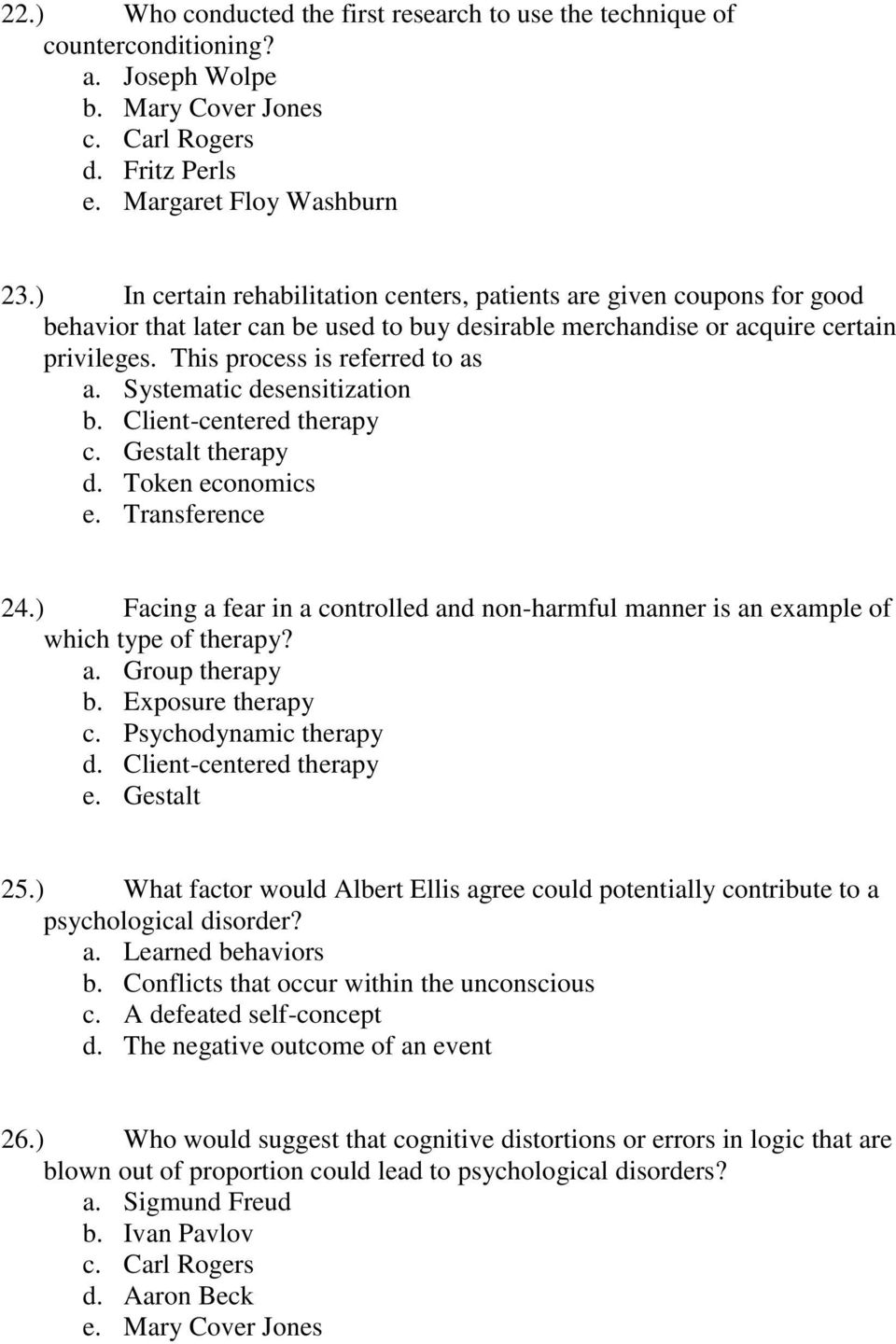
5 22.) Who conducted the first research to use the technique of counterconditioning? a. Joseph Wolpe b. Mary Cover Jones c. Carl Rogers d. Fritz Perls e. Margaret Floy Washburn 23.) In certain rehabilitation centers, patients are given coupons for good behavior that later can be used to buy desirable merchandise or acquire certain privileges. This process is referred to as a. Systematic desensitization b. Client-centered therapy c. Gestalt therapy d. Token economics e. Transference 24.) Facing a fear in a controlled and non-harmful manner is an example of which type of therapy? a. Group therapy b. Exposure therapy c. Psychodynamic therapy d. Client-centered therapy e. Gestalt 25.) What factor would Albert Ellis agree could potentially contribute to a psychological disorder? a. Learned behaviors b. Conflicts that occur within the unconscious c. A defeated self-concept d. The negative outcome of an event 26.) Who would suggest that cognitive distortions or errors in logic that are blown out of proportion could lead to psychological disorders? a. Sigmund Freud b. Ivan Pavlov c. Carl Rogers d. Aaron Beck e. Mary Cover Jones
6 27.) A form of therapy that tends to be cost effective and involves interaction among several people is a. Systematic desensitization b. Psychodynamic therapy c. Client-centered therapy d. Gestalt therapy e. Group therapy 28.) Prefrontal lobotomies are an example of which type of therapy? a. Psychosurgery b. Electroconvulsive therapy c. Psychodynamic therapy d. Client-centered therapy e. Behavior therapy 29.) Which drug has been used as an alternative to lithium for treating bipolar disorder? a. Thorazine b. Prozac c. Paxil d. Depakote e. Valium 30.) Tardive dyskinesia was associated with which type of psychoactive drug? a. Antidepressant medications b. Neuroleptics (antipsychotic medications) c. Antianxiety medications d. Lithium e. Tranquilizers Kaplan 31.) The concept most associated with Rogerian or client-centered therapy is a. Flooding b. Free association c. Unconditional positive regard d. Positive reinforcement e. Punishment 32.) The concept most associated with a form of behavioral therapy is a. Dream analysis b. Free association c. Unconditional positive regard d. Positive reinforcement e. Hypnosis

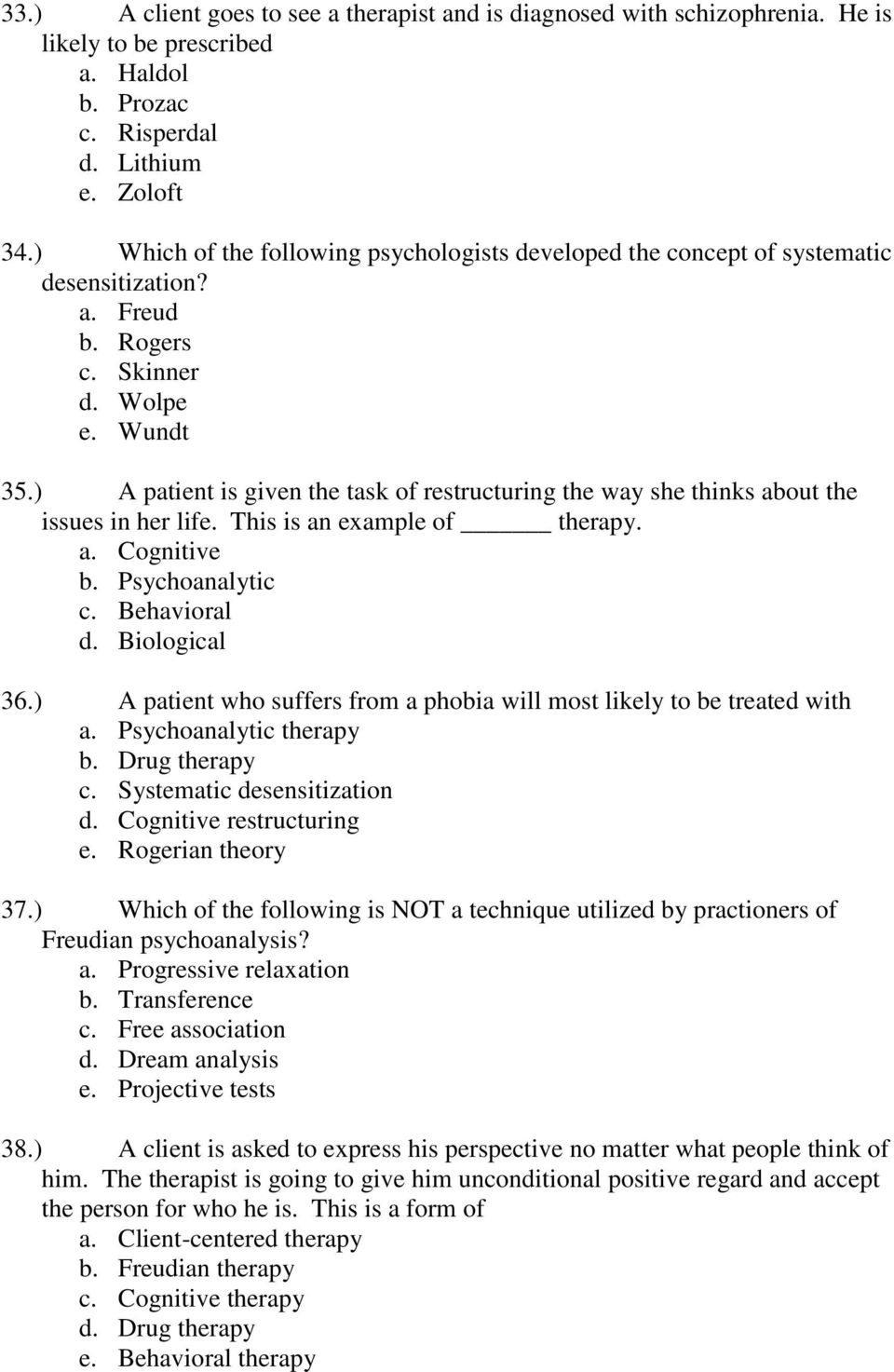
7 33.) A client goes to see a therapist and is diagnosed with schizophrenia. He is likely to be prescribed a. Haldol b. Prozac c. Risperdal d. Lithium e. Zoloft 34.) Which of the following psychologists developed the concept of systematic desensitization? a. Freud b. Rogers c. Skinner d. Wolpe e. Wundt 35.) A patient is given the task of restructuring the way she thinks about the issues in her life. This is an example of therapy. a. Cognitive b. Psychoanalytic c. Behavioral d. Biological 36.) A patient who suffers from a phobia will most likely to be treated with a. Psychoanalytic therapy b. Drug therapy c. Systematic desensitization d. Cognitive restructuring e. Rogerian theory 37.) Which of the following is NOT a technique utilized by practioners of Freudian psychoanalysis? a. Progressive relaxation b. Transference c. Free association d. Dream analysis e. Projective tests 38.) A client is asked to express his perspective no matter what people think of him. The therapist is going to give him unconditional positive regard and accept the person for who he is. This is a form of a. Client-centered therapy b. Freudian therapy c. Cognitive therapy d. Drug therapy e. Behavioral therapy
8 39.) Which of the following forms of therapy has been found to have the most experimental evidence supporting its effectiveness? a. Client-centered therapy b. Freudian therapy c. Cognitive therapy d. Talk therapy e. Behavioral therapy 40.) A client feels as though he is beginning to develop feelings for the therapist. He previously had the same feelings for someone else. According to Freudian theory, this is a process called a. Projection b. Repression c. Regression d. Denial e. Transference 41.) The goal of cognitive therapy is to a. Understand the theories of behavior b. Treat the symptoms of the client c. Help the client see inconsistencies in thoughts and behaviors d. Understand the reasons behind behavior e. Treat the disorder medically 42.) You have a dream that you go to class but you have forgotten an important assignment. You are embarrassed as the teacher points out to everyone that you did not follow instructions. According to Freud, this description of the dream is a. True meaning b. Deep structure c. Latent content d. Manifest content e. Surface structure 43.) With that same dream, if Freud said that it was really a response to a threat and you were feeling scared of dealing with that threat, that would be called the of the dream. a. True meaning b. Deep structure c. Latent content d. Manifest content e. Surface structure 44.) A person who is suffering from depression might take a. Thorazine b. Prozac

9 c. Risperdal d. Xanax e. Paxil 45.) Therapy is a difficult process. One reason stated in the text is that a. It is expensive b. It is time consuming c. It is not effective d. We treat the symptoms, not the disease e. We don t have enough therapists 46.) According to cognitive therapists, clients who think that their problems are much bigger than they actually are said to be a. Confabulating b. Exaggerating c. Catastrophizing d. Projecting e. Sublimianting 47.) Which of the following techniques was NOT used by Sigmund Freud? a. Dream analysis b. Hypnosis c. Free association d. Drug therapy e. Cognitive restructuring 48.) A person suffers from depression because she has been reinforced for acting depressed in the past. Which of the following perspectives might provide this explanation for depression? a. Behavioral b. Cognitive c. Rogerian d. Psychoanalytic e. Medical 49.) Client-centered therapy was originally developed by a. Wpole b. Rogers c. Freud d. Wundt e. Skinner 50.) Someone with anxiety might take a. Paxil b. Risperdal c. Lithium

10 McGraw Hill d. Ritalin e. Thorazine 51.) Jenna is telling her therapist about the dream she has last night and her therapist begins to interpret it for her. Which approach to psychotherapy does Jenna s therapist probably represent? a. Group b. Behavioral c. Gestalt d. Cognitive e. Biomedical 52.) In contrast to a clinical psychologist, a psychiatrist is more likely to a. Schizophrenia b. Obsessive-compulsive disorder c. Dissociative identity disorder d. Major repression e. Antisocial personality disorder 53.) Which of the following disorders is most likely to be treated with electroconvulsive therapy as a last resort? a. Schizophrenia b. Obsessive-compulsive disorder c. Dissociative identity disorder d. Major depression e. Antisocial personality disorder 54.) Tommy came to Dr. Chambers seeking help with his fear of heights. First, Dr. Chambers asked Tommy to list all of the situations concerning heights that led to his hear response. After they had ordered them from least fear-provoking to most fear-provoking, Dr. Chambers had Tommy listen to soothing music and slowly relaxed him as he imagined each step. Which of the following best describes Dr. Chambers s treatment? a. The exposure technique of flooding b. Systematic desensitization c. Rational emotion therapy d. Aversive conditioning e. The social cognitive technique of modeling 55.) The goal of psychoanalytic therapy is a. To change maladaptive behavior to more socially acceptable behavior b. To change negative thinking into more positive attributions c. To attain self-actualization d. To unite the mind and body elements into a whole

11 e. To being unconscious conflicts to conscious awareness and gain insight 56.) Proactive preventive services available from many community mental health centers include all of the following EXCEPT a. 24-hour hotline services b. Mental health screening for depression c. Prenatal care for mothers in low-income families d. Psychoanalytic therapy e. Outreach programs for at-risk children 57.) An unplanned social change that occurred as a result of deinstitutionalization was a. The rise of multitude of group homes to provide fare for these former patients b. A rise in the number of better psychotropic drugs to treat schizophrenia and bipolar illness c. An increase in the number of schizophrenias among the homeless population is urban centers d. An increase in the use of the insanity plea to avoid long-term incarceration e. An increase in the number of mental hospitals across the nation 58.) Vic is encouraged to take charge of the therapy session and his therapist uses and active listening approach to mirror back the feelings he hears from him. Which therapy is most likely being described? a. Client-centered therapy b. Cognitive therapy c. Psychodynamic therapy d. Existential therapy e. Rational-emotive therapy 59.) The antidepressants Prozac, Paxel, and Zoloft work to a. Black dopamine receptors b. Decrease the level of acetylcholine in the blood steam c. Break down the level of acetylcholine in the bloodstream d. Decrease the amount of GABA at the postsynaptic neuron e. Block the reuptake of serotonin 60.) All of the flowing are potential benefits of group therapy EXCEPT a. Is often more economical therapy that 1:1 treatment b. It does not require the services of a mental health professional c. Clients with similar problems can provide helpful insight and feedback to peers d. Group members can see how their problems might impact others e. It man reduce the resistance of patients who have experienced difficulties in 1:1 settings

12 61.) Drew s depression seems an outgrowth of his belief that everyone should like him. If his therapist were to utilize REBT, how might he proceed in treating Drew s depression? a. He would suggest a mild antidepressant drug like Prozac to elevate his mood state b. He would give him unconditional positive regard and encourage him to open up about his feelings c. He would challenge Drew s belief so that in defending it Drew will recognize just how absurd it sounds d. Using the cognitive triad of Self, World, and Future, he would determine Drew s assumptions in all three areas e. He would search Drew s early childhood for the roof cause of his distortion of reality. 62.) Antabuse is a drug that, when paired with alcohol in the bloodstream, brings about nausea. For many motivated alcoholics, this has proven to be an effective treatment. Under which umbrella pf psychotherapy would it most likely be used? a. Insight therapy b. Aversive conditioning c. Gestalt therapy d. Self-help therapy e. Flooding exposure therapy 63.) Andre suffers from mood swings, alternating from wild episodes of euphoria and spending sprees to motionless starting and hopelessness. A drug to treat his condition is a. Lithium carbonate b. Haladol c. Zanax d. Thorazine e. Ritalin 64.) The belief that Greeks such as Hippocrates and Galen about the cause of abnormal behavior was closest to which of the following modern approaches of psychology? a. Psychoanalytic b. Behavioral c. Humanistic d. Cognitive e. Biomedical 65.) After concluding a met-analysis of over 475 out-come studies on the effectiveness of psychotherapies, psychologists concluded that a. Evidence is no more effective than talking to a friend b. Psychotherapy is no more effective than talking to a friend

13 Princeton Review c. The potential to do further harm to the patent with psychotropic drugs outweighs its effectiveness d. Psychotherapy proves no more beneficial than no treatment at all e. Of all treatments, psychoanalysis proved the most beneficial over all other types of therapy 66.) The concept of accurate emphatic understanding is most closely associated with which of the following therapeutic approaches? a. Psychoanalytic therapy b. Inductive therapy c. Client-centered therapy d. Implosion therapy e. Reductionist therapy 67.) Behavioral therapeutic approaches, such as systematic desensitization, have been most often used with those experiencing or diagnosed with a. Fugue b. Dementia c. Dissociative disorder d. Schizophrenia e. Phobia 68.) A psychoanalytically orientated therapist would most likely be in accord with which of the following criticism regarding behaviorally orientated therapies? a. Behaviorally orientated therapies often take years to complete and create an onerous financial burden for the patient. b. Behaviorally oriented therapies are concerned solely with the modification of troubling behavioral symptoms and do not address the underlying problems which many have produced those symptoms. c. Behaviorally oriented therapies can be performed only by therapists who have had the longest and most rigorous training, and as a result, can never impact as many people as can other treatment approaches. d. Behaviorally orientated therapies are relatively uninterested in the development of an egalitarian client-therapist relationship and miss opportunities to promote emotional growth and empowerment. e. Behaviorally orientated therapies avoid the technique of role-playing and may not be suitable for group or family therapy situations. 69.) The cognitively orientated therapeutic approach known as rationalemotive behavior therapy is most closely associated with a. Julian Rotter b. Albert Ellis c. Abraham Maslow d. Raymond Cattell

14 e. Rollo May 70.) Which of the following is not a major class of drugs used for psychotherapeutic effect? a. Anticoagulants b. Anxiolytics c. Monoamine oxidase inhibitors d. Lithium salts e. Selective reuptake inhibitors

15 Key 1.) B 2.) E 3.) A 4.) D 5.) A 6.) C 7.) A 8.) C 9.) B 10.) E 11.) C 12.) C 13.) D 14.) A 15.) D 16.) D 17.) A 18.) E 19.) B 20.) C 21.) E 22.) B 23.) D 24.) B 25.) D 26.) D 27.) E 28.) A 29.) D 30.) B 31.) C 32.) D 33.) C 34.) D 35.) A 36.) C 37.) A 38.) A 39.) E 40.) E 41.) C 42.) D 43.) C 44.) B 45.) A 46.) C 47.) E 48.) A 49.) B 50.) A 51.) C 52.) B 53.) D 54.) B 55.) E 56.) D 57.) C 58.) A 59.) E 60.) B 61.) C 62.) B 63.) A 64.) E 65.) A 66.) C 67.) E 68.) B 69.) B 70.) A

Treatment: Healing Actions, Healing Words
 Treatment: Healing Actions, Healing Words 15 : Insight-Oriented Therapy Psychoanalysis (p.687) First use of a talking cure Developed by Sigmund Freud Identify unconscious motivations Free association Dream
Chapter 13 433-end Name Period Date. MULTIPLE CHOICE. Choose the one alternative that best completes the statement or answers the question.
 Chapter 13 433-end Name Period Date MULTIPLE CHOICE. Choose the one alternative that best completes the statement or answers the question. 1) Stress-inoculation therapy is one type of therapy. A) cognitive
Chapter 13. What is Therapy? PowerPoint Presentations for. Therapies for Psychological Disorders
 PowerPoint Presentations for Seventh Edition Philip G. Zimbardo Robert L. Johnson Vivian McCann Prepared by Beth M. Schwartz Randolph College This multimedia product and its contents are protected under
PSYCHOTHERAPY. MODULE -V Social and Applied Psychology OBJECTIVES 24.1 MEDICAL MODEL. Psychotherapy. Notes
 MODULE -V Psychotherapy 24 PSYCHOTHERAPY In the previous lesson, you were told about psychological disorders. Psychologists have tried to understand the causes of abnormal behaviour, and the best way to
Unit 4: Personality, Psychological Disorders, and Treatment
 Unit 4: Personality, Psychological Disorders, and Treatment Learning Objective 1 (pp. 131-132): Personality, The Trait Approach 1. How do psychologists generally view personality? 2. What is the focus
Chapter 13 online insight and behavior therapies pgs 424-433 Name Period Date
 Chapter 13 online insight and behavior therapies pgs 424-433 Name Period Date MULTIPLE CHOICE. Choose the one alternative that best completes the statement or answers the question. 1) The major goal of
I. Introduction: Psychotherapy and Biomedical Therapy Two broad forms of therapy are used by mental health professionals to help people with
 I. Introduction: Psychotherapy and Biomedical Therapy Two broad forms of therapy are used by mental health professionals to help people with psychological disorders. 1. Psychotherapy is the treatment of
Chapter 13 & 14 Quiz. Name: Date:
 Name: Date: Chapter 13 & 14 Quiz 1. Regarding the difference between normal and abnormal behavior, which of the following statements is TRUE? A) Abnormal behavior is unusual, whereas normal behavior is
Types of Therapists and Associated Therapies
 Types of Therapists and Associated Therapies Types Of Therapists Psychologists This is a profession that is granted to a person by law and degree and for their study on the behaviors of people and how
Topic: Psychological Treatment
 Topic: Psychological Treatment Treatment of Psychological Disorders: True/false quiz True or false? 1. "Psychoanalysis" is another word for "psychotherapy". 2. All therapists agree that their most important
Criteria to Identify Abnormal Behavior
 Criteria to Identify Abnormal Behavior Unusualness Social deviance Emotional distress Maladaptive behavior Dangerousness Faulty perceptions or interpretations of reality Hallucinations Delusions Copyright
Cognitive Therapies. Albert Ellis and Rational-Emotive Therapy Aaron Beck and Cognitive Therapy Cognitive-Behavior Therapy
 Psyc 100 Ch 15C therapies 1 Cognitive Therapies Albert Ellis and Rational-Emotive Therapy Aaron Beck and Cognitive Therapy Cognitive-Behavior Therapy Psyc 100 Ch 15C therapies 2 Cognitive Therapies Unlike
Models of Abnormality
 Models of Abnormality Chapter 3 Slides & Handouts by Karen Clay Rhines, Ph.D. Northampton Community College Comer, Abnormal Psychology, 8e Models of Abnormality In science, the perspectives used to explain
Chapter 1. Abnormal Behavior in Historical Context
 Chapter 1 Abnormal Behavior in Historical Context Myths and Misconceptions About Abnormal Behavior No Single Definition of Psychological Normality No Single Definition of Psychological Abnormality Differences
Therapy. Chapter Preview
 CHAPTER15 Therapy Chapter Preview Mental health therapies include psychological therapies and biomedical therapies. Therapists using an eclectic approach draw from a variety of techniques. In fact, half
17: Therapy CHAPTER PREVIEW
 17: Therapy CHAPTER PREVIEW Mental health therapies include psychological therapies and biomedical therapies. Therapists using an eclectic approach draw from a variety of techniques. In fact, half of all
STRUCTURALISM: Wilhelm Wundt and Edward Titchener
 STRUCTURALISM: Wilhelm Wundt and Edward Titchener Wilhelm Wundt (1832-1920) Wilhelm Wundt (1832-1920): Established first first Psychology Lab Lab in in Germany. Defined psychology as as the the science
4.Insight = change of self- image acceptance of theoretical interpretation 5.Obtaining relevant information
 Psychotherapy Treatment by psychological stimuli Intrapsychological process therapeutic relationship Methods: 1.Abreaction release of repressed emotions and feelings 2.Catharsis clearing, cognitive rebirth
psychology the science of psychology CHAPTER third edition Psychology, Third Edition Saundra K. Ciccarelli J. Noland White
 psychology third edition CHAPTER 1 the science of psychology Learning Objectives LO 1.1 Definition and Goals of Psychology LO 1.2 Structuralism and Functionalism LO 1.3 Early Gestalt, Psychoanalysis, and
ANTISOCIAL PERSONALITY DISORDER
 ANTISOCIAL PERSONALITY DISORDER Antisocial personality disorder is a type of chronic mental illness in which your ways of thinking, perceiving situations and relating to others are dysfunctional. When
INDIAN SCHOOL MUSCAT DEPARTMENT OF COMMERCE AND HUMANITIES CLASS: XII PSYCHOLOGY
 [ INDIAN SCHOOL MUSCAT Worksheet: 1 Chapter Name: Intelligence and Aptitude Name of Student : Class : 1. Explain the concept is Assessment? 2. What is Intelligence is according to Oxford dictionary? 3.
History/Approaches. 1. A cognitive psychologist would likely be most interested in
 History/Approaches 1. A cognitive psychologist would likely be most interested in (A). concentration of neutral transmitters in the spinal cord (B). unconditional positive regard in the therapeutic setting
Psychodynamic Psychotherapy Deborah L. Cabaniss, M.D.
 Psychodynamic Psychotherapy Deborah L. Cabaniss, M.D. I. Definitions A. Psychotherapy Psychotherapy is the umbrella term for a number of therapies that aim at treating problems that affect the mind (psyche).
Anxiety, Panic and Other Disorders
 Methodist Assistance Program Anxiety, Panic and Other Disorders Anxiety, panic and other disorders such as agoraphobia, social phobia, compulsive disorder and posttraumatic stress disorder are all very
Cognitive triad: negative view of future, world, and self. Cognitive distortions-faulty information processing Core irrational beliefs which create a
 Cognitive triad: negative view of future, world, and self. Cognitive distortions-faulty information processing Core irrational beliefs which create a psychological vulnerability to depression. Typically
Major Depression. What is major depression?
 Major Depression What is major depression? Major depression is a serious medical illness affecting 9.9 million American adults, or approximately 5 percent of the adult population in a given year. Unlike
Definitions of abnormality
 1 Psychopathology (psychological abnormality) Definitions of abnormality Deviation from social norms: Social norms are the implicit and explicit rules that a society has concerning the acceptable behaviours,
What is Psychology? A set of questions about mental functioning trace back to philosophy Aristotle asked about memory, personality, emotions, etc.
 What is? The science of behavior and the mind behavior - observable actions of a person or animal mind - thoughts, feelings, sensations, perceptions, memories, dreams, motives and other subjective experiences
Chapter 10 Personality Name Period Date. MULTIPLE CHOICE. Choose the one alternative that best completes the statement or answers the question.
 Chapter 10 Personality Name Period Date MULTIPLE CHOICE. Choose the one alternative that best completes the statement or answers the question. 1) The BEST kind of personality test is one that is. A) both
A short piece on my perspectives on psychotherapeutic theory and practice, Aaron Balick, PhD
 A short piece on my perspectives on psychotherapeutic theory and practice, Aaron Balick, PhD Without the appropriate theory, one cannot develop the practice that is necessary to treat people seeking psychotherapeutic
HEALTH AND SOCIAL CARE
 2016 Suite Cambridge TECHNICALS LEVEL 3 HEALTH AND SOCIAL CARE Unit 22 Psychology for health and social care J/507/4443 Guided learning hours: 60 Version 2 Revised content March 2016 ocr.org.uk/healthandsocialcare
North Pacific Epilepsy Research 2311 NW Northrup Street Suite #202 Portland, Oregon 97210 Tel: 503-291-5300 Fax: 503-291-5303
 North Pacific Epilepsy Research 2311 NW Northrup Street Suite #202 Portland, Oregon 97210 Tel: 503-291-5300 Fax: 503-291-5303 Post-Traumatic Stress Disorder (PTSD) Post-traumatic stress disorder (PTSD)
117 118, 123, 125, 130 131, 133)
 Samples_PDPS_pms_540.qxd 4/19/06 10:05 AM Page 122 CH A P T E R O B J E C T I V E S R E V I E W After reading this chapter, you should understand the chapter objectives. The objectives are listed below
SPECIALIST ARTICLE A BRIEF GUIDE TO PSYCHOLOGICAL THERAPIES
 SPECIALIST ARTICLE A BRIEF GUIDE TO PSYCHOLOGICAL THERAPIES Psychological therapies are increasingly viewed as an important part of both mental and physical healthcare, and there is a growing demand for
MAJOR DEPRESSION DURING CONCEPTION AND PREGNANCY: A Guide for Patients and Families
 MAJOR DEPRESSION DURING CONCEPTION AND PREGNANCY: A Guide for Patients and Families David A. Kahn, MD, Margaret L. Moline, PhD, Ruth W. Ross, MA, Lee S. Cohen, MD, and Lori L. Altshuler, MD www.womensmentalhealth.org
AP Psychology 2008-2009 Academic Year
 AP Psychology 2008-2009 Academic Year Course Description: The College Board Advanced Placement Program describes Advanced Placement Psychology as a course that is designed to introduce students to the
Types of Psychology. Alex Thompson. Psychology Class. Professor Phelps
 Running Head: PSYCHOLOGY 1 Types of Psychology Alex Thompson Psychology Class Professor Phelps March 4, 2014 PSYCHOLOGY 2 Types of Psychology Developmental psychology Developmental psychology entails the
What is the Humanist Perspective? What are the key ideas in the Humanistic perspective of personality?
 What is the Humanist Perspective? LP 13C Humanist Perspective 1 What are the key ideas in the Humanistic perspective of personality? Differences with the Psychoanalysts: Humanists focus on the healthy
Depression Overview. Symptoms
 1 of 6 6/3/2014 10:15 AM Return to Web version Depression Overview What is depression? When doctors talk about depression, they mean the medical illness called major depression. Someone who has major depression
Depression is a medical illness that causes a persistent feeling of sadness and loss of interest. Depression can cause physical symptoms, too.
 The Family Library DEPRESSION What is depression? Depression is a medical illness that causes a persistent feeling of sadness and loss of interest. Depression can cause physical symptoms, too. Also called
Psychotic Disorders. 1995-2013, The Patient Education Institute, Inc. www.x-plain.com mhff0101 Last reviewed: 01/10/2013 1
 Psychotic Disorders Introduction Psychotic disorders are severe mental disorders that cause abnormal thinking and perceptions. These disorders cause people to lose touch with reality. As a result, people
PATIENTS LIKE TO BE DEEPLY UNDERSTOOD
 The Compass - Page 29-32 Summer/Fall 2009 Compass interview with Robert M. Gordon, Ph.D.* PATIENTS LIKE TO BE DEEPLY UNDERSTOOD Robert M. Gordon, Ph.D., is a psychologist and psychoanalyst in Allentown,
BIPOLAR DISORDER A GUIDE FOR INDIVIDUALS AND FAMILIES FOR THE TREATMENT OF BIPOLAR DISORDER IN ADULTS
 BIPOLAR DISORDER A GUIDE FOR INDIVIDUALS AND FAMILIES FOR THE TREATMENT OF BIPOLAR DISORDER IN ADULTS A publication of the Massachusetts Department of Mental Health and the Massachusetts Division of Medical
Delusions are false beliefs that are not part of their real-life. The person keeps on believing his delusions even when other people prove that the be
 Schizophrenia Schizophrenia is a chronic, severe, and disabling brain disorder which affects the whole person s day-to-day actions, for example, thinking, feeling and behavior. It usually starts between
Recent History of Clinical Psychology. Influence of WWII 9/11/2009. As in WWI, psychologists were called upon to evaluate soldiers
 Recent History of Clinical Psychology Influence of WWII As in WWI, psychologists were called upon to evaluate soldiers Intellectual, psychiatric, and personality assessments were given to over 20 million
Jeff, what are the essential aspects that make Schema Therapy (ST) different from other forms of psychotherapy?
 An Interview with Jeffrey Young This is a revised transcription of an interview via internet on Dec. 30 th 2008. The interviewer was Eckhard Roediger, the current secretary of the ISST. Jeff, what are
Chapter 7 Conditioning and Learning
 Chapter 7 Conditioning and Learning Chapter Summary Definitions Learning is defined as a relatively permanent change in behavior due to experience. A stimulus is anything that comes in through your senses.
Thinking About Psychology: The Science of Mind and. Charles T. Blair-Broeker Randal M. Ernst
 Thinking About Psychology: The Science of Mind and Behavior 2e Charles T. Blair-Broeker Randal M. Ernst Methods Domain Introductory Chapter Module 02 History and Perspectives Module 2: History and Perspectives
Mental Health Ombudsman Training Manual. Advocacy and the Adult Home Resident. Module V: Substance Abuse and Common Mental Health Disorders
 Mental Health Ombudsman Training Manual Advocacy and the Adult Home Resident Module V: Substance Abuse and Common Mental Health Disorders S WEHRY 2004 Goals Increase personal comfort and confidence Increase
AP Psychology 2001 Scoring Guidelines
 AP Psychology 2001 Scoring Guidelines The materials included in these files are intended for non-commercial use by AP teachers for course and exam preparation; permission for any other use must be sought
Step 2: Recognised depression in adults persistent subthreshold depressive symptoms or mild to moderate depression
 Step 2: Recognised depression in adults persistent subthreshold depressive symptoms or mild to moderate depression A NICE pathway brings together all NICE guidance, quality standards and materials to support
Understanding. Depression. The Road to Feeling Better Helping Yourself. Your Treatment Options A Note for Family Members
 TM Understanding Depression The Road to Feeling Better Helping Yourself Your Treatment Options A Note for Family Members Understanding Depression Depression is a biological illness. It affects more than
Treating Mental Disorders. Types of Biological Treatment. Drug Treatments for Psychological Disorders
 Treating Mental Disorders Biological Treatments for Psychological Disorders Aims: Describe and Assess Biological Treatments Objectives By the end of this session you should be able to: Describe the use
Hoover City Schools Secondary Curriculum Social Studies, 2005-06
 Course Information: HCS Curriculum: Social Studies 6 12 Hoover City Schools Secondary Curriculum Social Studies, 2005-06 Course Title: Psychology, IB Grade Level: 11-12 Course Description: This course
Step 4: Complex and severe depression in adults
 Step 4: Complex and severe depression in adults A NICE pathway brings together all NICE guidance, quality standards and materials to support implementation on a specific topic area. The pathways are interactive
Abnormal Psychology PSYCH 40111
 Abnormal Psychology PSYCH 40111 Models of Psychopathology Scientific Paradigms Paradigms are conceptual frameworks that scientists use to study the world Paradigms include assumptions about science and
Schizoaffective Disorder
 FACT SHEET 10 What Is? Schizoaffective disorder is a psychiatric disorder that affects about 0.5 percent of the population (one person in every two hundred). Similar to schizophrenia, this disorder is
What is abnormal psychology? Abnormal psychology is the field devoted to the study disordered behavior. What is a clinical scientist?
 What is abnormal psychology? Abnormal psychology is the field devoted to the study disordered behavior. What is a clinical scientist? A clinical scientist is psychologist responsible for gathering data
Personality Disorders (PD) Summary (print version)
 Personality Disorders (PD) Summary (print version) 1/ Definition A Personality Disorder is an abnormal, extreme and persistent variation from the normal (statistical) range of one or more personality attributes
Medications for bipolar disorder
 Medications for bipolar disorder Findings from Australian National Survey of Mental Health and Wellbeing (Mitchell et al, 2004) In 12 months, only one-third saw a mental health professional 40% received
Schizophrenia. This factsheet provides a basic description of schizophrenia, its symptoms and the treatments and support options available.
 This factsheet provides a basic description of schizophrenia, its symptoms and the treatments and support options available. What is schizophrenia? Schizophrenia is a commonly misunderstood condition,
Visualizing Psychology
 Visualizing Psychology by Siri Carpenter & Karen Huffman PowerPoint Lecture Notes Presentation Chapter 12: Personality Siri Carpenter, Yale University Karen Huffman, Palomar College Lecture Overview Trait
Abnormal Psychology PSY-350-TE
 Abnormal Psychology PSY-350-TE This TECEP tests the material usually taught in a one-semester course in abnormal psychology. It focuses on the causes of abnormality, the different forms of abnormal behavior,
Explaining Anxiety in the Brain:
 Explaining Anxiety in the Brain: Explanations for Children and Adults that Enhance Treatment Compliance in A Whole Brain Approach Catherine M. Pittman, Ph.D Saint Mary s College Notre Dame, IN & Jamie
There are four groups of medications most likely to be used for depression: Antidepressants Antipsychotics Mood stabilisers Augmenting agents.
 What this fact sheet covers: Physical treatments (medication, ECT and TMS) Psychological treatments Self-help & alternative therapies Key points to remember Where to get more information. Introduction
BEHAVIORAL THERAPY. Behavior Therapy (Chapter 9) Exposure Therapies. Blurring the Line. Four Aspects of Behavior Therapy
 BEHAVIORAL THERAPY Psychology 460 Counseling and Interviewing Sheila K. Grant, Ph.D. 1 Behavior (Chapter 9) A set of clinical procedures relying on experimental findings of psychological research Based
Substance Abuse Treatment: Group Therapy
 Substance Abuse Treatment: Group Therapy Multiple Choice Identify the choice that best completes the statement or answers the question. 1. Chapter 1 This natural propensity in humans makes group therapy
INTRODUCTION. The Seven Rules of. Highly Worried People
 INTRODUCTION The Seven Rules of Highly Worried People WORRYING IS SECOND NATURE to you, but imagine that someone who has been raised in the jungle and knows nothing about conventional modern life approached
Coffeyville Community College #PSYC-101 COURSE SYLLABUS FOR GENERAL PSYCHOLOGY. Mike Arpin Instructor
 Coffeyville Community College #PSYC-101 COURSE SYLLABUS FOR GENERAL PSYCHOLOGY Mike Arpin Instructor COURSE NUMBER: PSYC-101 COURSE TITLE: General Psychology CREDIT HOURS: 3 INSTRUCTOR: OFFICE LOCATION:
Personality & Its Assessment
 Personality & Its Assessment Dr Elena Gregoria Chai Chin Fern Faculty of Social Sciences Universiti Malaysia Sarawak This OpenCourseWare@UNIMAS and its related course materials are licensed under a Creative
Chapter 1 Assignment Part 1
 Chapter 1 Assignment Part 1 Careers in Psychology 1. Which of the following psychological professionals must always have a medical degree? a. psychologist b. psychiatric social worker c. psychiatrist d.
11 Psychology MI-SG-FLD011-02
 11 Psychology MI-SG-FLD011-02 TABLE OF CONTENTS PART 1: General Information About the MTTC Program and Test Preparation OVERVIEW OF THE TESTING PROGRAM... 1-1 Contact Information Test Development Process
Grade: 11 th & 12 th grade, Psychology TEKS Guiding Questions Content Vocabulary Resources/Lesson Ideas
 Psychology 1 st six weeks Approaches to Psychology (2 weeks) 1a-c understands development of the field of psychology 2a-d differentiates the processes of theory development and validation Identify various
EVIDENCE-BASED TREATMENT FOR ANXIETY AND DEPRESSION IN CHILDREN AND TEENS. Stacie B. Isenberg, Psy.D.
 EVIDENCE-BASED TREATMENT FOR ANXIETY AND DEPRESSION IN CHILDREN AND TEENS Stacie B. Isenberg, Psy.D. Director, Child & Adolescent Services The Ross Center for Anxiety & Related Disorders ADAA Conference
NICE Pathways bring together all NICE guidance, quality standards and other NICE information on a specific topic.
 bring together all NICE guidance, quality standards and other NICE information on a specific topic. are interactive and designed to be used online. They are updated regularly as new NICE guidance is published.
PhD. IN (Psychological and Educational Counseling)
 PhD. IN (Psychological and Educational Counseling) I. GENERAL RULES CONDITIONS: Plan Number 2012 1. This plan conforms to the regulations of the general frame of the programs of graduate studies. 2. Areas
Depression is a common biological brain disorder and occurs in 7-12% of all individuals over
 Depression is a common biological brain disorder and occurs in 7-12% of all individuals over the age of 65. Specific groups have a much higher rate of depression including the seriously medically ill (20-40%),
[KQ 804] FEBRUARY 2007 Sub. Code: 9105
![[KQ 804] FEBRUARY 2007 Sub. Code: 9105](/thumbs/26/8053833.jpg "[KQ 804] FEBRUARY 2007 Sub. Code: 9105") [KQ 804] FEBRUARY 2007 Sub. Code: 9105 (Revised Regulations) Theory : Two hours and forty minutes Q.P. Code: 419105 Maximum : 100 marks Theory : 80 marks M.C.Q. : Twenty minutes M.C.Q. : 20 marks 1. A
[KQ 804] FEBRUARY 2007 Sub. Code: 9105 (Revised Regulations) Theory : Two hours and forty minutes Q.P. Code: 419105 Maximum : 100 marks Theory : 80 marks M.C.Q. : Twenty minutes M.C.Q. : 20 marks 1. A
Depression. Introduction Depression is a common condition that affects millions of people every year.
 Depression Introduction Depression is a common condition that affects millions of people every year. Depression has an impact on most aspects of everyday life. It affects eating and sleeping routines,
DEPRESSION DURING THE TRANSITION TO MENOPAUSE: A Guide for Patients and Families
 DEPRESSION DURING THE TRANSITION TO MENOPAUSE: A Guide for Patients and Families David A. Kahn, MD, Margaret L. Moline, PhD, Ruth W. Ross, MA, Lori L. Altshuler, MD, and Lee S. Cohen, MD www.womensmentalhealth.org
Social Studies Scope and Sequence
 Social Studies Scope and Sequence Unit: Introduction to the Study of Psychology Unit: Personality Theories Interpret, evaluate, and compare the basic personality theories of psychoanalysis, behaviorism,
Presently, there are no means of preventing bipolar disorder. However, there are ways of preventing future episodes: 1
 What is bipolar disorder? There are two main types of bipolar illness: bipolar I and bipolar II. In bipolar I, the symptoms include at least one lifetime episode of mania a period of unusually elevated
Caring for depression
 Caring for depression Aetna Health Connections SM Disease Management Program Get information. Get help. Get better. 21.05.300.1 B (6/08) Get back to being you How this guide can help you Having an ongoing
The Psychotherapeutic Professions in Poland. Jerzy Aleksandrowicz. Psychotherapy Department, Jagiellonian University Medical College, Cracow
 The Psychotherapeutic Professions in Poland Jerzy Aleksandrowicz Psychotherapy Department, Jagiellonian University Medical College, Cracow I. Current Situation of the Psychotherapeutic Professions 1. Identity
BASICS OF PSYCHOLOGY. A Brief History of Psychology. B. The Emergence of Psychology. A. Before Psychology
 BASICS OF PSYCHOLOGY A brief history of psychology A. before psychology B. the emergence of psychology C. early schools of psychology Theoretical approaches (Disciplines/Schools) Behaviourist Psychodynamic
HEALTHY MINDS A WEEKLY COLUMN ALL ABOUT MENTAL WELLNESS Elliott B. Sewell, MAE, LPCC, NCC
 HEALTHY MINDS A WEEKLY COLUMN ALL ABOUT MENTAL WELLNESS Elliott B. Sewell, MAE, LPCC, NCC Schools or Approaches of Psychotherapy Part I Throughout history, some form of psychotherapy has been practiced
A Behavioral Perspective of Childhood Trauma and Attachment Issues: Toward Alternative Treatment Approaches for Children with a History of Abuse
 A Behavioral Perspective of Childhood Trauma and Attachment Issues: Toward Alternative Treatment Approaches for Children with a History of Abuse By: Walter Prather and Jeannie A. Golden ABSTRACT This article
Bipolar Disorder. Some people with these symptoms have bipolar disorder, a serious mental illness. Read this brochure to find out more.
 Bipolar Disorder Do you go through intense moods? Do you feel very happy and energized some days, and very sad and depressed on other days? Do these moods last for a week or more? Do your mood changes
IMR ISSUES, DECISIONS AND RATIONALES The Final Determination was based on decisions for the disputed items/services set forth below:
 Case Number: CM13-0018009 Date Assigned: 10/11/2013 Date of Injury: 06/11/2004 Decision Date: 01/13/2014 UR Denial Date: 08/16/2013 Priority: Standard Application Received: 08/29/2013 HOW THE IMR FINAL
Case Study: Multiple Personalities [URL: MultiplePersonalities]
![Case Study: Multiple Personalities [URL: MultiplePersonalities]](/thumbs/40/21249619.jpg "Case Study: Multiple Personalities [URL: MultiplePersonalities]") January 20, 2002 [Chapter 1] Case Study: Multiple Personalities [URL: MultiplePersonalities] LEVEL: 9 SECTIONS (& perhaps subsections): I The Concept of MPD/DID II Controversies A Name B Existence III
January 20, 2002 [Chapter 1] Case Study: Multiple Personalities [URL: MultiplePersonalities] LEVEL: 9 SECTIONS (& perhaps subsections): I The Concept of MPD/DID II Controversies A Name B Existence III
Opiate Addiction, Pharmacological Treatment Approaches CO-OCCURRING MENTAL HEALTH DISORDERS JOSEPH A. BEBO MA, CAGS, LADC1
 Opiate Addiction, Pharmacological Treatment Approaches CO-OCCURRING MENTAL HEALTH DISORDERS JOSEPH A. BEBO MA, CAGS, LADC1 Disclosure Statement Prevalence of Opioid Addiction 100 Individuals Die Every
Specific Phobias. Anxiety Disorders Association of America
 Specific Phobias Everyone thinks that once I ve driven on the highway, I ve conquered it. They just don t understand... I don t understand. It s a day-in and day-out struggle. What is a phobia? We all
Cures for Everything. a discovery to cure borderline personality disorder. As the years have progressed scientists have
 Student 4M 1 Student 4M ENGL 1007.001 Mr. McCarty February 12, 2014 Cures for Everything With all the new technology that we have come across in these past years has there been a discovery to cure borderline
Psychology 305A: Lecture 5. Freud Part 2
 Psychology 305A: Lecture 5 Freud Part 2 1 Freudian Theory of Personality 2 Psychoanalytic Theory: Basic Assumptions 1. Psychological Determinism Life/sex instinct Death/aggression instinct 2. Importance
How To Treat An Addiction With Cognitive Behavioral Therapy
 Cognitive Behavioral Therapy Part 1 An Overview Cognitive Behavioral Therapy (CBT) is a general classification of psycho therapy, based on social learning theory, which emphasizes how our thinking interacts