
Procurement And Grants for European Union external actions - A Practical Guide. Applicable as of 15 July 2015
|
|
|
- Andrea Bradford
- 9 years ago
- Views:
Transcription
1 Procurement And Grants for European Union external actions - A Practical Guide Applicable as of 15 July 2015 Version July 2015

2 Table of Contents 1. Introduction Introduction 9 2. Basic rules Overview Management modes Participation in award procedures, exclusion criteria and other essentials The rules on nationality and origin Derogations from the rules on nationality and origin Exclusion criteria Regulatory penalties: administrative and financial penalties Visibility Other essential points Procurement procedures Which procurement procedure to apply? Open procedure Restricted procedure Competitive negotiated procedure Framework contracts Dynamic purchasing system Competitive dialogue Negotiated procedure/single tender procedure Fair and transparent competition Preferences (EDF only) Selection and award criteria Selection criteria General principles Verifying the financial and economic capacity of candidates or tenderers Verifying the technical and professional capacity of candidates or tenderers Award criteria Procedure with a 'suspension clause' Cancellation of procurement procedures Ethics clauses Legal remedies Complaints to the contracting authority Complaints to the European Ombudsman Ordinary Actions Contract value Terms of reference and technical specifications Conciliation and arbitration procedures 56 DEVCO Prag to financial and contractual procedures (Version July 2015) 2
3 2.8. The Evaluation Committee Appointment and Composition Impartiality and confidentiality Responsibilities of Evaluation Committee members Timetable Period of validity of tenders Award of the contract (except for service contracts, see chapter 3) Notifying the successful tenderer Contract preparation and signature Publicising the award of the contract Procurements Grants Modifying contracts General principles Preparing an addendum Service contracts Introduction Type of service contract Procurement procedures Contracts with a value of EUR or more Restricted procedure Contracts with a value of less than EUR Contracts with a value of less than EUR Procedures applicable without ceilings Negotiated procedure Competitive dialogue Restricted tenders (for contracts of EUR or more) Publicity Publication of prior information notices Publication of contract notices Drawing up shortlists Drafting and content of the tender dossier Award criteria Additional information during the procedure Deadline for submission of tenders Period of validity Submission of tenders The Evaluation Committee Stages in the evaluation process Receipt and registration of tenders Tender opening session Evaluation of offers 84 DEVCO Prag to financial and contractual procedures (Version July 2015) 3

4 Evaluation of financial offers The evaluation committee's conclusions Cancelling the tender procedure Award of the contract Notifying the award decision Approval of key experts Contract preparation and signature Publicising the award of the contract Provision and replacement of experts Procedures for the award of contracts under EUR Framework contracts Conditions of use Procedure Competitive negotiated procedure Modifying service contracts Supply contracts Introduction Procurement procedures Contracts with a value of EUR or more International open procedure Contracts of more than EUR and less than Local open procedure Contracts with a value of less than EUR Competitive negotiated procedure Contracts with a value of less than or equal to EUR Procedures applicable without ceilings Negotiated procedure Dynamic purchasing system Competitive dialogue International open tender for contracts of EUR or more Publicity Publication of prior information notices Publication of contract notices Drafting and content of the tender dossier Selection and award criteria Supply contracts not including ancillary services Supply contracts including ancillary services Supply contracts including particularly significant ancillary services Additional information during the procedure Deadline for the submission of tenders Period of validity Submission of tenders 117 DEVCO Prag to financial and contractual procedures (Version July 2015) 4
5 The Evaluation Committee Stages in the evaluation process Receipt and registration of tenders Preparatory meeting Tender opening session Evaluation of technical offers Evaluation of financial offers Choice of contractor The evaluation committee's conclusions Cancelling the tender procedure Award of the contract Notifying the successful tenderer Contract preparation and signature Publicising the award of the contract Local open tender for contracts between EUR and EUR Competitive negotiated procedure for contracts under EUR Modifying supply contracts Works contracts Introduction Procurement procedures Contracts with a value of EUR or more Open procedure Restricted procedure Contracts with a value of EUR of more but less than EUR Local open procedure Contracts with a value of less than EUR Competitive negotiated procedure Contracts with a value of less than EUR Procedures applicable without ceilings Negotiated procedure Competitive dialogue International open tender (for contracts of EUR or more) Publicity Publication of prior information notices Publication of contract notices Drafting and content of the tender dossier Selection and award criteria Additional information during the procedure Deadline for the submission of tenders Period of validity Submission of tenders The Evaluation Committee 137 DEVCO Prag to financial and contractual procedures (Version July 2015) 5

6 Stages in the evaluation process Receipt and registration of tenders Preparatory meeting Tender opening session Evaluation of tenders Evaluation of financial offers Choice of contractor The evaluation committee's conclusions Cancelling the tender procedure Award of the contract Notifying the successful tenderer Contract signature Publicising the award of the contract Restricted tender for contracts of EUR or more Publicity Publication of prior information notice Publication of contract notices Drawing up shortlists Local open tender (for contracts of at least EUR and under EUR ) Competitive negotiated procedure Modifying works contracts Grants Basic rules for grant contracts Definition Actors involved Forms of grants Simplified cost options Overview Management modes Management Tools Eligibility criteria Nationality rule Exceptions to the nationality rule Grounds for exclusion Programming Transparency Equal treatment Non-cumulation Non-retroactivity Co-financing No-profit rule Other essential points 166 DEVCO Prag to financial and contractual procedures (Version July 2015) 6

7 6.4. Award procedures Call for proposals Publication Open or restricted call for proposals Partnerships Grants awarded without calls for proposals ('Direct award') Call for proposals Publicity Drafting and contents of the guidelines for applicants Eligibility and evaluation (selection and award) criteria Eligibility criteria Evaluation criteria: selection and award Additional information before the deadline for submission of proposals Deadline for submission of proposals Submission of proposals The Evaluation Committee Composition Use of assessors Delegations as internal assessors for headquarters' calls for proposals Impartiality and confidentiality Responsibilities of the evaluation committee Stages in the evaluation process Receipt and registration of proposals Opening session and administrative checks Evaluation of the concept note Evaluation of the full applications Eligibility checks The evaluation committee's conclusions Cancelling the call for proposals procedure Awarding grants Notification of applicants Contract preparation and signature Characteristics of the standard grant contract Publicising the award of grants Low value grants Restricted call for proposals Modifying grant contracts General principles Preparing an addendum Award of contracts & financial support to third parties by grant beneficiaries Award of contracts Financial support to third parties by grant beneficiaries 191 DEVCO Prag to financial and contractual procedures (Version July 2015) 7

8 6.10. Grants to organisations whose pillars have been positively assessed, (other) international organisations and national bodies Grants to organisations whose pillars have been positively assessed by the European Commission and (other) international organisations Grants awarded to (other) national public bodies from Member States or third donor countries Grants to national public bodies from a partner country Legal Texts Legal framework for procurement procedures Programmes funded by the EU budget: Programmes funded by the EDF: Legal framework for grant procedures Programmes funded by the EU budget: Programmes funded by the EDF List of Annexes 200 DEVCO Prag to financial and contractual procedures (Version July 2015) 8

9 1. Introduction 1.1. Introduction This Practical Guide explains the contracting procedures applying to all EU external actions financed from the EU general budget (the EU budget) and the European Development Fund (EDF). The financing of external actions is governed by the applicable EU and EDF Financial Regulation, the common rules and procedures for the implementation of the Union's instruments for financing external action (CIR) and by the relevant basic acts, for example, the programme regulation, such as the DCI, ENI, IPA II, or EIDHR for actions financed from the EU budget, and the Cotonou Agreement for actions financed from the EDF. This Practical Guide is used by the Directorates General and Commission Services in charge of the instruments financing and implementing external actions, mainly DG DEVCO (aid development through geographic, thematic or mixed instruments, such as DCI, ENI, EDF, EIDHR, NSCI), DG NEAR (Instrument for Pre-accession assistance, IPA II) or the FPI (in the implementation of the Instrument contributing to stability and peace, ICSP, and Partnership Instrument, PI) 1. In March 2014, a regulation establishing the Common Rules and Procedures for the Implementation of the Union's instruments for External Action (CIR) was adopted. The CIR provides a set of common rules for the DCI, EIDHR, ENI, ISP, IPA II, PI and NSCI 2 consistent with the Financial Regulation of the Union's budget. For what this guide is concerned, the main impact of the CIR are the new rules on nationality and origin for public procurement and grant award procedures. As from the adoption of the revision of Annex IV to the Cotonou Agreement in 2008, procurement contracts and grants financed under 10th and successive EDF have been awarded and implemented in accordance with EU rules and (except in cases provided for in those rules) in accordance with the procedures and standard documents laid down and published by the European Commission for the implementation of cooperation operations with third countries, in force at the time of the launch of the procedure in question. The eligibility rules applicable to the EDF have been aligned as much as possible with those of the EU budget since the entry into force of the amended Cotonou Agreement in November They are also included in Annex IV to the Cotonou Agreement which was lately amended on 20 June For contracts financed under the 9th EDF, please refer to the 2007 version of this Practical Guide (which explains the Decision No 2/2002 of the ACP-Ec Council Ministers of 7 October 2002 governing the preparation and awarding of contracts financed from the EDF from 2002 to 2008) except where the relevant Financing Agreements have been amended to apply the revised version of Annex IV of the Cotonou Agreement. 1 Furthermore, DG REGIO is in charge of IPA and of the instrument of financial support for encouraging the economic development of the Turkish Cypriot community (Council Regulation No 389/2006). 2 According to NSCI recital 18, implementation of the regulation will follow the CIR where required. DEVCO Prag to financial and contractual procedures (Version July 2015) 9

10 This Practical Guide provides users with the comprehensive information necessary to undertake procurement or grant procedures from the very first steps to the award, signature and implementation of contracts. The annexes cover both the award phase and the execution of contracts. This Practical Guide outlines the contracting procedures to be used in direct management and indirect management with ex-ante approval or with ex-post controls by the European Commission. Although the procurement and grant award procedures applicable to the EU budget, to the 10th and the 11th EDF are quite similar, some remaining differences are featured in this Practical Guide and its annexes. Chapter 7 lists the relevant legal texts and Chapter 8 lists the annexes to this Practical Guide. Annex A1 includes a glossary of the terms used in this Practical Guide. Direct labour operations are programmes executed by public or public-private agencies or services of the partner country, if that country's administration possesses qualified managers. They use a programme estimate: a document laying down the human and material resources required, the budget and the detailed technical and administrative implementing arrangements for execution of a project over a specified period by direct labour and possibly also by means of public procurement and the award of specific grants. Specific procedures for direct labour contracts and programme estimates are set out in a separate guide (Practical guide to procedures for programme estimates - project approach) although most of the procurement procedures described in this Practical Guide also apply. What does the Practical Guide not cover? It does not apply to contracts for which the European Commission acts as contracting authority on its own account and in its sole interest, as well as when the Commission does not act as contracting authority exclusively on behalf and for the account, of the partner countries. These situations usually come under Title V, Chapters 1 and 2, of the EU Financial Regulation, and European Commission staff must use in-house public procurement procedures and models (the Vade-mecum on Public Procurement) to deal with them. However, specific contracts might fall within the scope of PRAG depending, for instance, on their source of funding. Furthermore, in case of service contracts in the Commission s sole interest or shared interest with partner countries, and irrespective of the procedure used, the authorising officer may decide to use the DEVCO standard service contract which is more suitable for actions located outside of the EU. It is therefore recommended to check case by case. This Practical Guide does not apply to humanitarian aid operations or emergency operations carried out by ECHO. Nor does it apply to contracting authorities such as partner countries, international organisations and national bodies which the European Commission has authorised to use their own procurement/grant award procedures, or procurement/grant award procedures agreed among donors according to the relevant regulation, nor to grant beneficiaries which must follow the procurement provisions of Annex IV of the standard grant contract. Twinning is a dedicated institution building tool providing expertise from Member States DEVCO Prag to financial and contractual procedures (Version July 2015) 10
11 administrations to the public institutions of candidate, pre-candidate and Neighbourhood countries. Twinning is made of grant contracts signed with Member States public institutions. Twinning operations obey specific rules that are described in the "Common Twinning Manual" 3. Furthermore, the application of this Practical Guide to cross border cooperation programmes is subject to their relevant basic acts. All references to days in this Practical Guide are to calendar days, unless otherwise specified. 3 DEVCO twinning English: DEVCO Prag to financial and contractual procedures (Version July 2015) 11

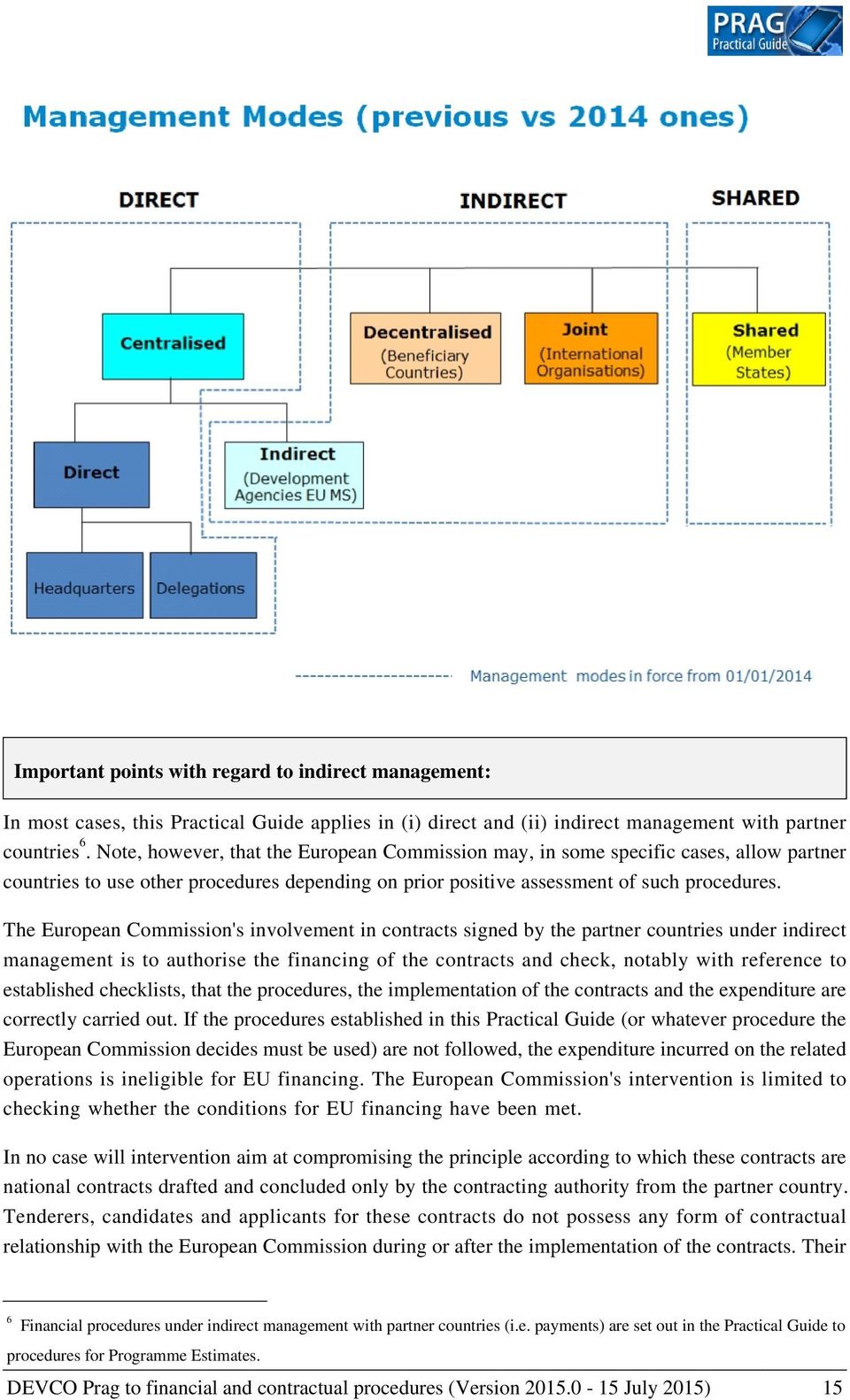
12 2. Basic rules 2.1. Overview Procurements and grants are awarded according to strict rules. These help ensuring that suitably qualified contractors and grant beneficiaries are chosen without bias and that the best value for money or the best price is obtained, with the full transparency appropriate to the use of public funds. Procedures established by the European Commission for procurement and award of grants under the relevant EU external aid programmes are consolidated in this Practical Guide. Any deviation from this Practical Guide and its annexes requires either a derogation or an exception from the relevant European Commission services in accordance with internal rules. Before starting any tender or grant procedure, it must have been approved under a Financing Decision and, where appropriate, under a subsequent Financing Agreement. The funds must be available, except in the case of procedures with a 'suspension clause' (see section ) Management modes Procurement or grant award procedures for projects financed under EU external aid programmes vary according to the different arrangements for managing the project (referred to as 'management modes'). The EU Financial Regulation 1 and its Rules of Application 2 in force since 01/01/2013 introduced important changes in the existing management modes. The changes entered into force on 01/01/2014. They also apply to the EDF. The notion of management modes remains the same. They are different ways to implement the EU budget or the EDF funds, depending on the variable level of implication of the European Commission in its implementation. This is attained through the delegation of a number of budget implementation tasks (such as conclusion of contracts, their operational and financial management, audit, evaluation, etc.). The former management modes (centralised 3, decentralised, joint and shared) have been streamlined to just three: Direct management: The European Commission is in charge of all EU budget implementation tasks, which are performed 1 Regulation (EU, Euratom) No 966/2012 of the European Parliament and of the Council of 25/10/ Commission Delegated Regulation (EU) No 1268/2012 of 29/10/ Centralised management had two variants, direct centralised (where the European Commission was the contracting authority and took decisions for the partner country and EU delegations) and indirect centralised (where some budget implementation tasks were delegated to a national body, usually development agencies, which thus became the contracting authority). DEVCO Prag to financial and contractual procedures (Version July 2015) 12

13 directly by its departments either at headquarters or in the EU delegations or through European executive agencies. Therefore, the European Commission or the European executive agency is the contracting authority and takes decisions on behalf and for the account of the partner countries. In such cases, references in this Practical Guide to the 'contracting authority' refer actually to the European Commission (or where the case may be to an EU executive agency), acting on behalf and for the account of the partner countries. Deviations from standard procedures (exceptions/derogations) and prior approvals/events to be reported laid down in the Practical Guide are allowed in compliance with internal procedures. Indirect management: Under indirect management, the European Commission entrusts budget implementation tasks to: partner countries (or to bodies designated by them) international organisations development agencies of EU Member States other bodies 4. This Practical Guide focuses on the first case, when the European Commission entrusts the budget implementation tasks to partner countries 5. It applies mutatis mutandis in those rare cases where international organisations, development agencies or other bodies must use EU contracting procedures. Two modalities are possible under indirect management with partner countries: Indirect management with ex-ante controls: Decisions on the procurement and award of contracts are taken by the partner country, which acts as the contracting authority, following prior authorisation of the European Commission. This prior authorisation can encompass in some cases and only for specific commitments, a deviation from standard procedures (exception/derogation) or prior approval/event to be reported. Deviations, prior approvals and events to be reported are processed internally by the European Commission. Indirect management with ex-post controls: decisions provided for in the financing agreement are taken by the partner country, which acts as the contracting authority without prior authorisation by the European Commission. However, deviations from the standard procedures laid down in the PRAG require an authorisation by the European Commission. The 4 Please refer to Article 58.1.(c) of the FR for a detailed list of cases. 5 Please note that the European Commission usually undertakes directly activities such as evaluation and audits even under indirect management with partner countries. DEVCO Prag to financial and contractual procedures (Version July 2015) 13

14 different ex-ante and ex-post control procedures are explained throughout this Practical Guide. Shared management : The European Commission delegates implementation tasks to the EU Member States. This mode is rarely used in the implementation of external actions, but there are a few cases such as joint operational programmes on cross-border cooperation implemented by a joint managing authority (for instance under the European Neighbourhood Instrument, ENI, or the Pre-accession Assistance, IPA II). The choice of management mode is an essential element of the financing decision and it is reflected in the corresponding documents (e.g. the 'action document' for the relevant financing decision and (annual) action programme). Important: For some time there will be an overlap between the new management modes and the former ones (as it will be the case for Financing Agreements signed before 2014 making reference to the former management modes). For the sake of clarity, in this Practical Guide reference is made solely to the management modes in force as from 01/01/2014 described above in this chapter. However, in the case of on-going actions under the former management modes, the explanations in this Practical Guide remain valid using the following equivalences (just for the management modes described in this Practical Guide): FORMER MANAGEMENT MODES NEW MANAGEMENT MODES (in force as from 01/01/2014) DIRECT CENTRALISED MANAGEMENT DIRECT MANAGEMENT DECENTRALISED MANAGEMENT with EX-ANTE CONTROLS INDIRECT MANAGEMENT with EX-ANTE CONTROL DECENTRALISED MANAGEMENT WITH EX-POST CONTROLS INDIRECT MANAGEMENT with EX-POST CONTROL DEVCO Prag to financial and contractual procedures (Version July 2015) 14

15 Important points with regard to indirect management: In most cases, this Practical Guide applies in (i) direct and (ii) indirect management with partner countries 6. Note, however, that the European Commission may, in some specific cases, allow partner countries to use other procedures depending on prior positive assessment of such procedures. The European Commission's involvement in contracts signed by the partner countries under indirect management is to authorise the financing of the contracts and check, notably with reference to established checklists, that the procedures, the implementation of the contracts and the expenditure are correctly carried out. If the procedures established in this Practical Guide (or whatever procedure the European Commission decides must be used) are not followed, the expenditure incurred on the related operations is ineligible for EU financing. The European Commission's intervention is limited to checking whether the conditions for EU financing have been met. In no case will intervention aim at compromising the principle according to which these contracts are national contracts drafted and concluded only by the contracting authority from the partner country. Tenderers, candidates and applicants for these contracts do not possess any form of contractual relationship with the European Commission during or after the implementation of the contracts. Their 6 Financial procedures under indirect management with partner countries (i.e. payments) are set out in the Practical Guide to procedures for Programme Estimates. DEVCO Prag to financial and contractual procedures (Version July 2015) 15
16 only contractual relationship is with the contracting authority. A contracting authority's decision may not be replaced by a decision taken by the EU. The contracting authority assumes full responsibility for its actions and will be accountable for those actions in any subsequent audit or other investigation. The box below summarises the control procedures that the European Commission must follow for each management mode. DIRECT MANAGEMENT: The contracts are concluded directly by the European Commission, acting on behalf of the partner country. It draws up shortlists (restricted procedures) and is responsible for issuing calls for tenders and calls for proposals, publishing them, receiving applications, tenders and proposals, chairing evaluation committees, deciding on the results of the procedures, managing complaints and signing the contracts. INDIRECT MANAGEMENT WITH EX-ANTE CONTROLS: The contracts are concluded by the contracting authority designated in a financing agreement, i.e. the government or an entity of the partner country with legal personality with which the European Commission concludes the financing agreement. Before the procedure is launched, the contracting authority must submit the documents (tender dossier or call for proposal file) to the European Commission for approval. The European Commission verifies that they have been drafted in accordance with the procedures and templates laid down in this Practical Guide (or whatever procedure the European Commission decides must be used). The contracting authority is then responsible for drawing up shortlists (restricted procedures), issuing the calls for tenders and calls for proposals, receiving applications, tenders and proposals, chairing evaluation committees and deciding on the results of the procedure. Before signing contracts, the contracting authority submits the result of the evaluations to the European Commission for approval. The European Commission verifies conformity with the applicable procedures. The contracting authority also sends the contracts to the European Commission for endorsement before signing them 7. The European Commission must always be invited when applications and tenders are opened and evaluated and a European Commission representative should, as a rule, attend as an observer in all or part of the evaluation committee meetings. The European Commission pays a particular attention to potential conflicts of interests. The contracting authority must submit all relevant notices in electronic form to the European Commission for publication (See annex A11e), with the exception of the cases referred to in the Practical Guide for Programme Estimates. 7 The European Commission's endorsement of the contracts is not necessary in certain cases, which are specified in this Practical Guide or in the Practical Guide to procedures for Programme Estimates. DEVCO Prag to financial and contractual procedures (Version July 2015) 16

17 Under the Instrument for Pre-accession Assistance (IPA II), a phased waiver of different types of ex-ante controls may apply. INDIRECT MANAGEMENT WITH EX-POST CONTROLS: Contracts are concluded directly by the contracting authority designated in a financing agreement. For instance the government or an entity of the partner country with the same legal personality with which the European Commission concludes the financing agreement. The contracting authority draws up shortlists (restricted procedures) and is responsible for issuing invitations to tender, receiving tenders, chairing the evaluation committees, deciding on the results of the procedures and signing the contracts without the prior authorisation of the European Commission. The contracting authority must submit all relevant notices in electronic form to the European Commission for publication (See annex A11e). SHARED MANAGEMENT AND INDIRECT MANAGEMENT WITH ENTITIES OTHER THAN PARTNER COUNTRIES: In these cases, the delegated entity (e.g. a national agency or international organisation) concludes contracts with third parties. The delegated entity procedures generally apply. That delegated entity is responsible for publishing the relevant notices. Therefore those notices are published neither on the EU Official Journal nor on the EuropeAid Website. The European Commission may verify the procedure ex post, regardless of whether the European Commission has carried out a prior 'pillar assessment' of the delegated entity Participation in award procedures, exclusion criteria and other essentials Participation in procedures awarding grants and contracts financed under EU external assistance (including EDF) is governed by rules on nationality and origin, as well as non-exclusion The rules on nationality and origin For each external financial instrument (including EDF), specific rules on nationality and origin may apply. These rules can be found in the following legal acts: External financial instruments financed from the Budget: As from 15 March 2014, the rules on nationality and origin laid down in the CIR apply to all calls for proposals and tenders launched under these instruments. This includes also award procedures launched after 15 March 2014 under the previous external financial instruments, with the exception of calls for proposals and tenders under IPA I or procedures launched under financing decisions or financing agreements expressly setting out different rules (ie.: other than the standard reference to the basic act). In the latter case, the different rules can be reconstructed by using the previous versions of the PRAG applicable at the time of DEVCO Prag to financial and contractual procedures (Version July 2015) 17

18 adopting the financing decisions or of signing the financing agreement. EDF: As from 20 June 2014, the rules on nationality and origin laid down in Decision No 1/2014 regarding the revision of Annex IV to the Cotonou Agreement apply to all calls for proposals and tenders launched under the EDF. OCTs: Regarding OCTs, from the entering into force of Decision 2013/755/EU of 25 November 2013, specific rules on nationality and origin apply to grant and procurement procedures. For each external financing instrument, the countries corresponding to the rules on nationality and origin are listed in Annex A2a to this Practical Guide. Rule on nationality BUDGET-FUNDED PROGRAMMES Subject to other specific rules set out in the applicable financing decisions or financing agreements, for all EU budget-funded programmes, except IPA I, the CIR applies. This regulation aligned nationality rules to a very large extent for DCI, ENI and PI. The same eligibility rules apply to INSC via reference made by the latter regulation, while IPA II remains more restrictive and EIDHR and ISP are fully untied. Common core rules and particularities introduced in the CIR are presented in detail below: Participation in procedures for the awarding of contracts or grants is open to international organisations and to all natural persons who are nationals of, and legal persons which are effectively established in: a Member State of the European Union; a Member State of the European Economic Area; a beneficiary of the Instrument for Pre-Accession Assistance II, overseas countries and territories covered by Council Decision 2001/822/EC, as amended Developing countries and territories as included in the OECD-DAC list of ODA recipients, which are not members of the G-20 group; Developing countries, as included in the OECD-DAC list of ODA recipients, which are members of the G20 group, and any other countries and territories, when they are beneficiaries of the action financed by the Union under the Instruments concerned; another third country, based on a European Commission decision establishing reciprocal access to external aid. OECD members in case of activities implemented in the Least Developed Countries (LDC) and in Heavily Indebted Poor Countries (HIPC). This applies for the entirety of regional or DEVCO Prag to financial and contractual procedures (Version July 2015) 18

19 global programmes which include at least one LDC or HIPC. For each external financing instrument, Annex A2a to this Practical Guide contains the list of countries which correspond to rules on nationality and origin. The CIR also includes provisions which further extend the rules on nationality in certain cases. Therefore, in addition to entities eligible according to the rules above: In the context of actions jointly co-financed: whether implemented through direct or indirect management, 8 where actions are co-financed jointly with a partner or other donor, all persons that are eligible under the rules of that partner or other donor are also eligible. (NB: Where actions are co-financed in parallel with a partner or other donor, the respective rules on nationality apply, ie. EU rules apply to the part of the action financed by EU instruments (without extension) and the rules of the partner or other donor apply to the part financed by it.) In the context of actions implemented under shared management with a Member State, all persons that are eligible under the rules of that Member State are also eligible. In the context of actions implemented through indirect management, all persons that are eligible under the rules of the entrusted body are also eligible, except when the management is entrusted to partner countries (as per article 58 c (i) of the FR). In the latter case, only the rules of the EU instrument apply. In the case of actions implemented through a Union Trust Fund established by the Commission, all persons that are eligible under the rules determined in the trust fund's constitutive act are also eligible. In the case of actions financed by more than one instrument for external action, including the EDF, the natural persons who are nationals of, and legal persons which are effectively established in countries identified under any of these Instruments are eligible for the purpose of those actions. In the case of actions of a global, regional or cross-border nature financed by one of the EU Instruments for external action, eligibility can be extended to natural persons who are nationals of, and legal persons which are effectively established in the countries, territories and regions covered by the actions. 8 In indirect management, this can result in using the eligibility rules of the EU, the entrusted body and the other donor, if the joint co-financing comes from an entity other than the one entrusted with the implementation. DEVCO Prag to financial and contractual procedures (Version July 2015) 19

20 EDF-FUNDED PROGRAMMES The revised Annex IV to the Cotonou Agreement harmonised to the extent possible the rules on nationality and origin with those of the CIR. Participation is open to international organisations and to all natural persons who are nationals of, or legal persons who are established in : an ACP State. an EU Member State, Member States of the European Economic Area Beneficiaries of the EU Instrument for pre-accession assistance (IPA II), Overseas countries and territories covered by Council Decision 2013/755/EU of 25 November 2013; developing countries and territories, as included in the OECD-DAC list of ODA recipients, which are not members of the G-20 group, without prejudice to the status of the Republic of South Africa, as governed by Protocol 3 to the Cotonou Agreement; another third country, based on a European Commission decision establishing reciprocal access to external aid in agreement with ACP countries; OECD members in case of activities implemented in the Least Developed Countries (LDC) and in Heavily Indebted Poor Countries (HIPC). This applies for the entirety of regional or global programmes as well which include at least one LDC or HIPC. For the complete list of eligible countries please refer to Annex A2a to this Practical Guide. Annex IV to the Cotonou Agreement includes provisions which further extend the rules on nationality in certain cases. Therefore, in addition to entities eligible according to the rules above: When an operation is implemented as part of a regional initiative, natural and legal persons from a country participating in the relevant initiative are also eligible; In the context of actions implemented through direct management and where actions are co-financed jointly with a partner or other donor, all persons that are eligible under the rules of that partner or other donor are also eligible. (NB: Where actions are co-financed in parallel with a partner or other donor, the respective rules on nationality apply, ie. EU rules apply to the part of the action financed by EU instruments (without extension) and the rules of the partner or other donor apply to the part financed by it.) When an operation is implemented through a Trust Fund established by the Commission, participation is also open to all persons eligible under the rules determined in the Trust Fund constitutive act; DEVCO Prag to financial and contractual procedures (Version July 2015) 20
21 In the case of actions implemented in indirect management through entrusted bodies, which are Member States or their agencies, the European Investment Bank and international organisations or their agencies, natural and legal persons who are eligible under the rules of that entrusted body as identified in the agreements concluded with the co-financing or implementing body are also eligible; In addition, where actions are co-financed jointly with a partner or other donor, all persons that are eligible under the rules of that partner or other donor are also eligible. In the case of projects financed under another EU financial Instrument, participation is also open to all persons eligible under that EU financial Instrument. Programmes for OCTs Rules on nationality and origin for public procurement, grants and other award procedures for OCTs are established by Article 89 of Decision 2013/755/EU of 25 November Participation in the award of procurement contracts, grants and other award procedures for actions financed under this Decision for the benefit of third parties shall be open to all natural persons who are nationals of, and legal persons which are effectively established in: - Member States, - candidate countries and potential candidates as recognised by the Union, and - members of the European Economic Area; - OCTs; - developing countries and territories, as included in the OECD-DAC list of ODA Recipients, which are not members of the G-20 group; - countries for which reciprocal access to external assistance is established by the Commission; - Member States of the OECD, in the case of contracts implemented in a Least Developed Country; For the complete list of eligible countries please refer to Annex A2a to this Practical Guide. The Decisions includes provisions which further extend the rules on nationality in certain cases. Therefore, in addition to entities eligible according to the rules above, the following ones are also eligible: In the case of actions jointly co-financed with a partner or other donor countries entities which are eligible under the rules of that partner, other donor In the case of actions implemented through a Member State in shared management, entities DEVCO Prag to financial and contractual procedures (Version July 2015) 21
22 which are eligible under the rules of that Member State In the case of actions implemented through a Trust Fund established by the Commission, entities which are eligible under the constitutive act of the trust fund, shall also be eligible. In the case of actions implemented through entrusted bodies, which are Member States or their agencies, the European Investment Bank or through International Organisations or their agencies, entities that are eligible under the rules of that entrusted body, as identified in the agreements concluded with the co-financing or implementing body, shall also be eligible. In the case of actions financed under this Decision and, in addition, under another Instrument for external action, including the Partnership Agreement between the members of the African, Caribbean and Pacific Group of States, of the one part, and the European Community and its Member States, of the other part, signed in Cotonou on 23 June 2000 (1), as last amended in Ouagadougou on 22 June 2010 (2), entities identified under any of these Instruments as eligible, shall be so as well for the purpose of that action. In the case of actions of a global, regional or cross-border nature financed under this Decision, natural and legal persons from countries, territories and regions covered by the action may participate in the procedures implementing such actions. Rules for experts: Both for the EDF (including OCTs) and BUDGET-funded programmes, the nationality of experts and other natural persons employed or legally contracted does not have to follow the nationality rules. Therefore, unless otherwise provided for in the applicable financing decision/agreement, experts recruited or otherwise legally contracted by an eligible contractor/sub-contractor, may be of any nationality. How to verify compliance with the nationality rules? For the purpose of verifying compliance with the nationality rules, the tender dossier and the guidelines for applicants require the following from tenderers and applicants: natural persons must state the country of which they are nationals; legal persons must state the country in which they are established and provide evidence of such establishment by presenting the documents required under that country's law. If the contracting authority (or evaluation committee) suspects that a candidate, tenderer or applicant does not comply with the nationality rules, it must ask the candidate/tenderer/applicant to provide evidence demonstrating actual compliance with the applicable rules. To demonstrate their actual compliance with the "establishment" criterion, legal persons have to demonstrate that: DEVCO Prag to financial and contractual procedures (Version July 2015) 22
23 the legal person is formed under the law of an eligible State, and its real seat is within an eligible State. "Real seat" must be understood as the place where its managing board and central administration are located or its principal place of business. This is to avoid awarding contracts to firms which have formed letter box companies in an eligible country to circumvent the nationality rules. The decision on whether or not candidates/tenderers/applicants are eligible is taken by the contracting authority (usually on the basis of the information and evidence provided during the evaluation). Sanctions: When verifying compliance with the nationality rules, careful attention has to be made regarding entities which are nationals of or effectively established in countries against which the EU has adopted restrictive measures 9. Notably, a case-by-case analysis of the scope of the restrictive measures is necessary in order to establish their exact impact on eligibility rules in a specific procedure. Origin of goods Rules of origin: In principle, products 10 supplied under a procurement contract, or in accordance with a grant contract, financed under the EU budget or the EDF (including OCTs) must originate from an eligible country as designated by the relevant Instrument(s). (See above, 'Rule on nationality', and below, ' Derogations from the rule on nationality and origin'). However, these products can originate from any origin (full untying) if their value is below the threshold of the competitive negotiated procedure - EUR The amount of any ancillary works and services is not taken into account. This provision for full untying below the threshold of the competitive negotiated procedure must be stated in the contract notice. Where the contract is divided into lots, the rule applies per lot (only applicable to lots of less than EUR ). The division into lots must be legitimate. This rule must not lead to sub-dividing artificially contracts into smaller lots to circumvent the threshold of euros. This rule applies also to procurement done by grant beneficiaries and procurement of works involving the supply of products In case of works contracts which involve multiple purchases, the EUR threshold applies by type of supply. Where the contract has a fixed price, the threshold has to be applied to the unit price of the supply. Rules of origin do not apply to supplies purchased in order to carry out a works contract, where the Contractor keeps the purchased items at 10 Supplies and materials under Cotonou, Annex IV. 9 The updated list of sanctions is available at DEVCO Prag to financial and contractual procedures (Version July 2015) 23
24 the end of the project. The above rules have to be clearly stated in the instructions for tenderers and applicants. The scope of the rule: Subject to derogation (granted on a case by case basis), all goods to be delivered under a supply contract fall under the rules of origin, as do materials, goods and components to be incorporated or to form part of the permanent works under a works contract. Considering that the rule of origin applies to all items tendered and supplied, it is not enough if only a certain percentage of the goods tendered and supplied or a certain percentage of the total tender and contract value comply with this requirement. Goods purchased by the contractor for use during the execution of the contract (such as machinery used by a supply contractor for testing and installing the goods supplied, equipment used by a works contractor for building a road 11, computer(s) used by a service contractor to draft a study) are not subject to the rule of origin. It is only if the contract explicitly states that at the end of the contract the ownership of the goods is transferred from the contractor to the contracting authority (in the case of procurement contracts) or transferred by the contractor to the grant beneficiary or another entity/person (in the case of grant contracts), that these goods are subject to the rule of origin. Definition of "origin": The term 'origin' is defined in the relevant EU legislation on rules of origin for customs purposes: the Customs Code (Council Regulation (EEC) No 2913/92), and in particular its Articles 22 to 24, and the Code's implementing provisions (Commission Regulation (EEC) No 2454/93). The country of origin is not necessarily the country from which the goods were shipped and supplied. Two basic concepts are used to determine the origin of goods, namely the concept of wholly obtained products and the concept of products having undergone a "last substantial transformation". If only one country is involved in the production, the "wholly obtained" concept will be applied. In practice, these goods wholly obtained in a single country shall be regarded as having their origin in that country. This will be restricted to mostly products obtained in their natural state and products derived from wholly obtained products. If two or more countries are involved in the production of goods, it is necessary to determine which of those countries confers origin on the finished goods. For this purpose the concept of "last, substantial transformation" is applied. In general the criterion of last substantial transformation is expressed in three ways: 11 In a works contract, the option of having equipment vested in the contracting authority, given under Article 43.3 of the General Conditions, only applies while the works are being carried out and therefore does not constitute full transfer of the property. DEVCO Prag to financial and contractual procedures (Version July 2015) 24
25 by a rule requiring a change of tariff (sub) heading in the HS nomenclature (ie. the Nomenclature governed by the Convention on the Harmonized Commodity Description and Coding System); by a list of manufacturing or processing operations that do or do not confer on the goods the origin of the country in which these operations were carried out; by a value added rule, where the increase of value due to assembly operations and incorporation of originating materials represents a specified level of the ex-works price of the product. How to verify compliance with the origin rules? When submitting its tender, if the rules of origin apply, the tenderer must state expressly that all the goods meet the requirements concerning origin and must state the country(ies) of origin. When tendering for systems comprising more than one item, the origin of each item in the system must be specified. The tenderer may be requested to provide documents supporting the stated origin. In this case, the tenderer must provide a certificate of origin or additional information considering that the issuing authority may refuse to issue at tendering stage a certificate of origin without presentation of commercial invoices. The certificates of origin must be submitted at the latest during implementation of the contract when the certificate of provisional acceptance is requested. Failing this, the contracting authority will not make any further payment to the contractor. Exceptionally, other substantiating documents can be accepted by the contracting authority instead of the aforementioned certificates if the contractor justifies that it is impossible to provide certificates of origin. Certificates of origin must be issued by the competent authorities of the goods' or supplier's country of origin (usually the Chamber of Commerce) and comply with the international agreements to which that country is a signatory. It is up to the contracting authority to verify compliance with the rules of origin. Where there are serious doubts about the authenticity of a certificate of origin or the information it contains (e.g. because of discrepancies in the document, spelling errors, etc.), the contracting authority should contact the issuing authority to have the authenticity of the documents submitted and/or the information it contains confirmed. For EDF procurement, supplies originating in the Overseas Countries and Territories are regarded as originating in the EU. Sanctions: When verifying compliance with the nationality rules, careful attention has to be made regarding entities which are nationals of or effectively established in countries against which the EU has adopted restrictive measures. Notably, a case-by-case analysis of the scope of the restrictive measures is necessary in order to establish their exact impact on eligibility rules in a specific procedure The updated list of measures in force can be found at DEVCO Prag to financial and contractual procedures (Version July 2015) 25
26 Derogations from the rules on nationality and origin Basic acts provide for the possibility of adopting derogations from the general rules on a case-by-case basis. The derogation can further extend or limit the eligibility of certain entities on grounds foreseen in the basic acts. The decision on derogations is taken by the European Commission before the procedure is launched. In principle, it is not possible to derogate from the rules on nationality and origin to allow only one or a group of countries to become eligible unless it is duly motivated in the request for derogation. Where actions are implemented in shared management, the relevant Member State to which the Commission has delegated implementation tasks is entitled can also take such decisions. If a contract notice is published, the derogation must be mentioned. a. Extension In duly substantiated cases, the European Commission may extend eligibility to natural and legal persons from an ineligible country and allow the purchase of goods and materials originating in an ineligible country. Derogations may be granted on the grounds of economic, traditional, trade or geographical links with neighbouring countries, unavailability of products and services in the markets of the related countries concerned; extreme urgency; or extreme difficulties to carry out a project, programme or other action with the general rules on eligibility. The argument that a product of ineligible origin is cheaper than the EU or local product would not alone constitute grounds for awarding a derogation. 13 Where the EU is a party to an agreement on widening the market for the procurement of supplies, works or services, eligibility can be extended, as required by that agreement. b. Limitation In the context of grants, the basic acts also allow to limit eligibility on certain grounds, notably where this is required by the nature and the objectives of the action and as necessary for its effective implementation. 14. The limitation can be made with respect to the nationality, localisation or nature of applicants. 13 CIR Article 9 (2) ; Annex IV Article 22 (1) ; Decision 2013/755/EU of 25 November 2013 Article 89 (2) f.) 14 CIR Article 8 (7) ; Annex IV Article 20 (9) ; Decision 2013/755/EU of 25 November 2013 Article 89 (1) f.) DEVCO Prag to financial and contractual procedures (Version July 2015) 26
27 Exclusion criteria I- Exclusion criteria applicable for participation in procurement and grant procedures: Candidates, tenderers or applicants will be excluded from participation in procurement and grant procedures if: - they are bankrupt or being wound up, are having their affairs administered by the courts, have entered into an arrangement with creditors, have suspended business activities, are the subject of proceedings concerning those matters, or are in any analogous situation arising from a similar procedure provided for in national legislation or regulations; - they, or persons having powers of representation, decision making or control over them, have been convicted of an offence concerning their professional conduct by a judgment of a competent authority of a Member State which has the force of res judicata; (i.e. against which no appeal is possible); - they have been guilty of grave professional misconduct proven by any means which the contracting authority can justify, including by decisions of the European Investment Bank and international organisations; - they are not in compliance with their obligations relating to the payment of social security contributions or the payment of taxes in accordance with the legal provisions of the country in which they are established or with those of the country of the contracting authority or those of the country where the contract is to be performed; - they, or persons having powers of representation, decision making or control over them, have been the subject of a judgment which has the force of res judicata for fraud, corruption, involvement in a criminal organisation, money laundering or any other illegal activity, where such an illegal activity is detrimental to the EU's financial interests; - they are currently subject to an administrative penalty referred to in Article 109(1) of the EU Financial Regulation (for programmes funded by the EU budget and the 11th EDF) and in Article 99 of the 10th EDF Financial Regulation (for programmes funded by the 10th EDF). Points (a) to (d) do not apply to the purchase of supplies on particularly advantageous terms from either a supplier which is definitively winding up its business activities or from the receivers or liquidators of a bankruptcy, through an arrangement with creditors, or through a similar procedure under national law. Points (b) and (e) do not apply when the candidates, tenderers or applicants can demonstrate that adequate measures have been adopted against the persons having powers of representation, decision making or control over them who are subject to the judgement referred to in points (b) or (e). Points (a), (c) and (d) do not apply if duly justified by the contracting authority in negotiated procedures where it is indispensable to award the contract to a particular entity for technical or artistic DEVCO Prag to financial and contractual procedures (Version July 2015) 27
28 reasons or for reasons connected with the protection of exclusive rights. The cases referred to in point (e) are the following: 1. cases of fraud as referred to in Article 1 of the Convention on the protection of the European Communities' financial interests drawn up by the Council Act of 26 July 1995; cases of corruption as referred to in Article 3 of the Convention on the fight against corruption involving officials of the European Communities or officials of Member States of the European Union, drawn up by the Council Act of 26 May 1997; cases of involvement in a criminal organisation, as defined in Article 2 of Council Framework Decision 2008/841/JHA 17 ; 4. cases of money laundering as defined in Article 1 of Directive 2005/60/EC of the European Parliament and the Council 18 ; 5. cases of terrorist offences, offences linked to terrorist activities, and inciting, aiding, abetting or attempting to commit such offences, as defined in Articles 1, 3 and 4 of Council Framework Decision 2002/475/JHA 19. II- Exclusion criteria applicable during the procurement and grant procedures Contracts may not be awarded to candidates, applicants or tenderers who, during the procurement or grant award procedures: 1. are subject to a conflict of interest; 2. are guilty of misrepresentation in supplying the information required by the contracting authority as a condition of participation in the contract procedure or fail to supply this information; 3. find themselves in one of the exclusion situations for this procurement or grant award procedure. Candidates, tenderers or applicants other than those in a restricted procedure, negotiated procedure or competitive dialogue, must sign a declaration together with their applications, certifying that the entity does not fall into any of the exclusion situations cited under points I and II. Information on the ownership/management, control and power of representation of the entity and a certification that they do not fall into the relevant exclusion situations must be provided where 15 OJ C 316, , p OJ C 195, , p OJ L 300, , p OJ L 309, , p OJ L 164, , p. 3. DEVCO Prag to financial and contractual procedures (Version July 2015) 28
29 specifically requested by the contracting authority. This may be the case where there are doubts about the personal situation and in consideration of the national legislation of the country in which the tenderer, candidate or applicant is established. However, for procurement contracts with a value of EUR or less, the contracting authority may refrain from requiring a declaration depending on its risk assessment. For grants, no declaration shall be required for contributions of EUR or less. Following the notification of award, tenderer(s) to which the contract is to be awarded (including consortium members), must supply evidence that they do not fall into the exclusion situations, unless such evidence has already been submitted earlier in the procedure. In restricted procedures for services and for the competitive dialogue, these supporting documents must be sent together with the tender and verified by the contracting authority before signature of the contract with the successful tenderer(s). In restricted procedures for works, these supporting documents must be sent together with the application. Evidence of non-exclusion must be provided by all candidates invited to tender. In addition, the tenderers and candidates must certify that the situation has not altered since the date of issue of the evidence. As regards subcontractors and experts, where specifically requested by the contracting authority, the successful tenderers must submit a declaration from the intended subcontractor/expert, and/or documentary evidence that the subcontractor/expert is not in one of the exclusion situations. For procurement contracts with a value of less than the international thresholds (services <EUR , supply <EUR , works <EUR ) the contracting authority may waive the obligation to submit documentary evidence, depending on its risk assessment. Furthermore, a waiver may be granted where documentary evidence has been submitted in the past 12 months to the contracting authority for another procedure, provided that this evidence is still valid. In all cases, evidence may still be required in case of doubts. For grants, generally no documentary evidence is required. As satisfactory evidence that the candidate, tenderer or applicant is not in one of the situations described in: - (a), (b) or (e) of point I (Exclusion criteria applicable for participation in procurement procedures), the contracting authority will accept a recent extract from the judicial record or, failing that, a recent equivalent document issued by a judicial or administrative authority in the country of origin or provenance showing that the requirements are satisfied. For (d), the contracting authority will accept a recent certificate issued by the competent authority of the State concerned. Where no such document or certificate is issued in the country concerned 20 and for the other exclusion criteria listed in point I, it 20 Information from the 28 Member States, some Candidate Countries and EEA countries on the different forms of documentary evidence issued/acceptable in each of the countries is available via the ecertis tool, which is managed by the Directorate-General for Internal Market, Industry, Entrepreneurship and SMEs: - publicprocurement/e-procurement/e-certis/index_en.htm. DEVCO Prag to financial and contractual procedures (Version July 2015) 29
30 may be replaced by a sworn/solemn statement made before a judicial or administrative authority, a notary or a qualified professional body in the country of origin or provenance. Whenever one candidate, tenderer or applicant, due to its nature (for instance, national public administrations and international organisations), cannot fall into some of the categories above and/or cannot provide the documents indicated above, a simple declaration explaining their situation will suffice. The documents may be originals or copies; however originals must be made available to the contracting authority upon request. The date of issuing of the documents provided must be no earlier than one year before the date of submission of the tender. If the supporting documents are not written in one of the official languages of the European Union, a translation into the language of the procedure must be attached. Where the documents are in an official language of the European Union other than the one of the procedure, they have to be accepted. It is, however, strongly recommended that a translation into the language of the procedure be provided, in order to facilitate the evaluation of the documents. Delegated contracting authorities can, if necessary, consult the relevant European Commission services in order to judge the situation of the candidates, tenderers or applicants. Note that, before excluding a candidate, tenderer or applicant from a procurement or grant procedure, principles such as the right of defence and proportionality must be considered. To that end, unless the evidence is such that no further investigation is necessary (for example in case of a judgement of a competent authority of a Member State which has the force of res judicata), a contradictory procedure with the candidate, tenderer or applicant should be ensured. Before taking the award decision at the very latest, the contracting authority must check whether any of the parties involved (i.e. applicants and co-applicants, candidates or tenderers, including affiliated entity(ies), indicated subcontractors and individual experts) have been recorded by the Early Warning System (EWS). The contracting authority cannot conclude a contract with entities which are recorded at exclusion level of the EWS 21. If any of the parties involved are recorded in the EWS at other level, measures to strengthen monitoring should be applied during the execution of the contract and payments. Where the contracting authority limits the number of candidates invited to submit a tender or full proposal, e.g. in a restricted procedure, such checks must be conducted before the candidates are selected Regulatory penalties: administrative and financial penalties Candidates, tenderers and applicants, who have made false declarations, made substantial errors, committed irregularities or fraud may be excluded from participation in all procurement and call for proposal procedures financed by the EU for a maximum of five years from the date on which the 21 European Commission Decision of 13 November 2014 on the Early Warning System to be used by authorising officers of the Commission and by executive agencies (2014/792/EU) OJ 2014 L 329 of 14 November, p ( DEVCO Prag to financial and contractual procedures (Version July 2015) 30
31 infringement is established, following an adversarial procedure with the contractor or beneficiary. That period may be extended to 10 years in the event of a repeated offence within five years of that date. The decision is adopted by the relevant Authorising Officer following an adversarial procedure. Tenderers, candidates or applicants who have made false declarations, or who have committed substantial errors, or irregularities, or fraud, may also be subject to financial penalties representing 2 % to 10 % of the total estimated value of the contract being awarded. The percentage is decided in accordance with the principle of proportionality. Where the award procedure proves to have been subject to substantial errors, irregularities or fraud, the contracting authority must suspend the procedure and may take whatever measures are necessary, including cancellation. Where, after the award of the contract, the award procedure or the performance of the contract prove to have been subject to substantial errors, irregularities or fraud, the contracting authority may, depending on the stage reached in the procedure, refrain from concluding the contract or suspend performance of the contract or, where appropriate, terminate the contract. Where such errors, irregularities or fraud are attributable to the contractor or beneficiary, the European Commission may also refuse to make payments, may recover amounts already paid or may terminate all the contracts concluded with this contractor or beneficiary, in proportion to the seriousness of the errors, irregularities or fraud. The purpose of suspending the contract is to check whether the presumed substantial errors and irregularities or fraud have actually occurred. If they are not confirmed, performance of the contract will resume as soon as possible. A substantial error or irregularity is an infringement of the contract or EU Regulations through an act or an omission which causes or might cause a loss to the EU budget or to the EDF Visibility Unless otherwise requested or agreed by the European Commission, all EU partners, whether they may be contractors, grant beneficiaries or entities managing funds on behalf of the European Commission, must ensure the visibility of EU financing. If required, a communication plan must be submitted for approval of the contracting authority, according to the requirements and guidelines provided in the Communication and Visibility Manual for EU External Actions, published at: ec.europa.eu/europeaid/communication-and-visibility-manual-eu-external-actions_en Other essential points Conflicts of interest: A conflict of interest occurs when the impartial and objective exercise of the functions of the contracting authority, or observance of the principles of competition, non-discrimination against or equality of treatment of candidates, tenderers, applicants and contractors, is compromised for reasons involving family, emotional life, political or national affinity, economic interest or any other shared interest with a beneficiary of EU-funded programmes. A conflict of interest may arise where, for instance, a member of the evaluation committee or someone in the contracting authority or others involved in the procedure grant themselves, or others, unjustified direct or indirect advantages by DEVCO Prag to financial and contractual procedures (Version July 2015) 31
32 influencing the outcome, or allow an expert or company to obtain information leading to an unfair advantage in subsequent or related procedures. For instance, any firm or expert involved in preparing a project (e.g. drafting the terms of reference) must, as a rule, be excluded from being awarded a services contract that are based on those preparations, unless they can prove to the contracting authority that their initial involvement does not constitute unfair competition. In the potential case of members of staff of the EU Delegations (local agents) proposed as experts by tenderers, the European Commission shall make sure that the contract with the EU institution is officially terminated before the expert starts to work on an EU financed project under a contract with an external organisation/company. In the case of civil servants or other staff of the public administration of the partner country, or of international/regional organisations based in the country, regardless of their administrative situation, these shall only be approved by the European Commission if well justified. The tenderer shall in its offer include information on the added value the expert will bring, as well as proof that the expert is seconded or on leave on personal ground. Candidates/tenderers/applicants that have a conflict of interest in relation to a particular contract are excluded from this contract award. The grounds for exclusion must be considered case by case. The European Court of Justice has consistently ruled that exclusion must be based on an actual risk of conflict based on the specific circumstances of the case in question. Any automatic exclusion deprives the candidate/tenderer/applicant of the right to present supporting evidence which might remove all suspicion of a conflict of interest. Where a conflict of interest might occur with regard to on-going contracts, measures must be adopted to prevent or to resolve such a conflict, including cancelling the contract if necessary. Awarding principles: All contract awards partially or totally financed by the Budget and EDF must obey the principles of transparency, proportionality, equal treatment and non-discrimination. Non-retroactivity: Contracts take effect from the date of signature of the last signatory. All contracts must show the true dates on which the contracting parties signed them. Exceptionally, they are applicable from an earlier date (in cases of retroactive financing for instance). Use of standard documents: Standard contracts and document formats must be used. Record keeping: Subject to the contracting authority's legislation on access to documents, written records of the entire procurement and grant award procedure must be kept confidential and kept by the contracting authority in accordance with the policy adopted on archiving. If its law conflicts with the confidentiality required, the contracting authority must obtain prior authorisation from the European DEVCO Prag to financial and contractual procedures (Version July 2015) 32
33 Commission before disclosing any information. Unsuccessful proposals have to be kept for three years from the submission deadline of the call, while unsuccessful tenders have to be kept for five years from the submission deadline of the tender. Contractual and financial documents have to be kept for a minimum of seven years from payment of the balance and up to the prescription date of any dispute about the law governing the contract. During and after this period, the contracting authority will treat personal data in conformity with its privacy policy. The documents to be conserved include all the preparatory documents, the corresponding financing agreement, the originals of all applications/tenders/proposals submitted, and any related correspondence. Financial guarantees (originals) must be kept in a safe place where they are protected against the risk of loss or theft up to the end of their validity period. Availability of funds: Before initiating any procedure, the funds must be available. Calls may exceptionally be launched with a suspension clause after prior approval of the relevant services. The call is then launched before the financing decision or before the signature of the financing agreement between the European Commission and the partner country. The call is cancelled if the European Commission decision is not taken or if the financing agreement is not signed. The contract cannot be signed until the funds are available (see point ). Environmental issues: Environmental matters must be duly considered, to the possible extent, subject to the principles governing the award of procurement contracts and grants such as competition and non-discrimination. This might result in more environment-friendly terms of reference/guidelines/specifications, increased use of information technology, and less paper consumption (with double-sided printing, degradable material for folders, presentations, etc.). For instance, when drafting the technical specifications, consideration should be given to the greener products available on the market, provided this does not lead to a reduction of the competition. Accessibility for disabled people: All services, supplies, works and grants that relate to goods, services and infrastructures the subject of which is intended for the use of persons, whether general public or staff of the contracting entity must include in their technical specifications accessibility requirements for persons with disabilities following a "design for all approach" (reference can be made to national/european or international standards on accessibility). Joint procurement with an EU Member State, an EFTA State or an EU candidate country: In case of joint action between a EU institution and a contracting authority from a Member State, from an EFTA State or from an EU candidate country, the procurement procedure may be carried out jointly by the EU institution and that contracting authority. In this case, European Commission DEVCO Prag to financial and contractual procedures (Version July 2015) 33
34 procedures apply 22. Nevertheless, in some specific cases, it may be decided that the procedural rules of that contracting authority apply, provided that they can be considered equivalent to those of the institution. Ex post publication of beneficiaries: In addition to the publicity rules applicable to each type of procedure, the European Commission provides information on the beneficiary of EU funds (both grants beneficiaries and procurement contractors) on an annual basis, regardless of the management mode used. The information is available at the following site: funding-recipients_en Procurement procedures The basic means of awarding contracts is competitive tendering. The purpose is twofold: to ensure that operations comply with the awarding principles; and to obtain the quality of services, supplies or works wanted, at the best possible price. There are several different procurement procedures, each allowing a different degree of competition Which procurement procedure to apply? The applicable standard procedures explained later in this Practical Guide are summarised in the table below. They are divided between those for services (e.g. technical assistance and studies,), supplies (i.e. equipment and materials) and works (i.e. infrastructure and other engineering works). Once the European Commission has approved an activity by adopting a financing decision and, where appropriate, a financing agreement, the contracting authority can proceed with tendering and contracting following these standard procedures. The thresholds given in the table are based on the maximum budget for the contract in question (including any co-financing). Where contracts are subdivided in lots, the value of each lot is taken into account when calculating the overall threshold. All basic principles must be complied with (including the eligibility, exclusion and selection criteria), regardless of which procedure is used. Where possible and appropriate in light of the nature of the action, and in line with the Financing Agreement if any, the use of the simplest procedures shall be favoured. Note that projects must not be split artificially to circumvent the procurement thresholds. Other procedures can be applied regardless of the thresholds, for instance negotiated procedures on the basis of a single tender - as long as the relevant conditions are met (see points 22 See Article 133 of the Rules of Application. DEVCO Prag to financial and contractual procedures (Version July 2015) 34
35 2.4.6., and ) Open procedure In 'open' calls for tender (international or local), all economic operators may submit a tender. The contract is given maximum publicity by publishing a notice in the Official Journal of the European Union (S series) (for international open procedure only), the official journals of all the ACP States (for EDF programmes), on the EuropeAid website, and in any other appropriate media. See guidelines for publication (Annex A11e). Any natural or legal person wishing to tender may ask to receive the tender dossier (which may have to be paid for), in accordance with the procedures specified in the contract notice. The tenders are examined, the eligibility and the financial, economic, technical and professional capacity of the tenderers are checked to arrive at a selection, the tenders are compared and the contract is awarded (see point ). No negotiation is allowed Restricted procedure In 'restricted' calls for tender, all economic operators may ask to submit a tender but only those who satisfy the selection criteria may be invited to do so. The selection criteria and the tasks to be undertaken are described in the published contract notice. A 'long list' of all the candidates replying to the notice is cut down to a shortlist of the best qualified, on DEVCO Prag to financial and contractual procedures (Version July 2015) 35
36 the basis of their replies. At the shortlisting stage, before the list is approved by the evaluation committee, the contracting authority checks that none of the candidates or their partners is in exclusion situation in the Early Warning System. The contract is given maximum publicity by publishing a notice in the Official Journal of the European Union (S series), in the official journals of all the ACP States (for EDF programmes), on the EuropeAid website, and in any other appropriate media. The contracting authority prepares the shortlist notice using the appropriate template and sends it in due time, in electronic form to the European Commission for publication on the EuropeAid website (See guidelines for publication in annex A11e). The contracting authority also sends the tender dossier to the shortlisted candidates. To ensure fair competition, tenders must be submitted by the same service provider or consortium which requested to tender, which was shortlisted and to which the invitation to tender was addressed. No changes to the identity or composition of the tenderer are permitted, unless good reasons have been given and the contracting authority has given its approval in writing. If deemed necessary the evaluation committee may be consulted. Examples of situations where such approval could be given, based on the details of the case and provided that they do not change the conditions of competition, are: where a shortlisted candidate/member of a consortium has merged with another company and where the new company is found to meet the eligibility and exclusion criteria and does not give rise to any conflict of interest; where positions are swapped within the consortium, if it does not lower the score received by the consortium during the technical evaluation; where a partner leaves but the consortium still meets the conditions under which it was shortlisted, i.e. the rest of the consortium meets the selection criteria and would have been shortlisted without that partner. Once the tenders have been analysed, they are compared and the successful tenderer is chosen (see point ). No negotiation is allowed Competitive negotiated procedure Under the competitive negotiated procedure, the contracting authority invites candidates of its choice to submit tenders. From the technically compliant tenders, it selects the one that offers the best value for money in the case of tenders for services, and the cheapest, in the case of tenders for supplies or works. The evaluation (including the use of an evaluation committee) and the award of the contract follow the rules of the restricted procedure. DEVCO Prag to financial and contractual procedures (Version July 2015) 36
37 For further details regarding competitive negotiated procedure in services see point , for supplies see point 4.5. and point 5.6. for works Framework contracts A framework contract is an agreement between one or more contracting authorities and one or more economic operators, the purpose of which is to establish the terms governing specific contracts which may be awarded during a given period, particularly as regards the duration, subject, price, maximum value, implementation rules and the quantities envisaged. Framework contracts with several economic operators are called 'multiple' framework contracts; they take the form of separate contracts but they are all concluded on identical terms. The specifications must state both the minimum and the maximum number of operators with which the contracting authority intends to conclude contracts. The minimum may not be less than three. The duration of such contracts may not exceed four years, save in exceptional cases justified in particular by the subject of the framework contract. Contracting authorities may not make undue use of framework contracts or use them in such a way that the purpose or effect is to prevent, restrict or distort competition. Specific contracts based on framework contracts are awarded under the terms of the framework contract and must obey the principles of transparency, proportionality, equal treatment, nondiscrimination and fair competition Dynamic purchasing system A dynamic purchasing system is a completely electronic process for making commonly used purchases, for a limited period, which is open to any economic operator who meets the selection criteria and has submitted a technically compliant indicative tender. No specific threshold applies. For each individual contract, the contracting authority publishes a contract notice and invites all contractors admitted to the system to bid. The contract is awarded to the most economically advantageous tender (i.e. the sole award criterion is the best value for money). See point for further details. A legal framework for this procedure has been devised for future use, but the IT tools to make it possible (ensuring confidentiality and security) are not yet available in the European Commission Competitive dialogue In the case of particularly complex contracts, where the contracting authority considers that neither direct use of the open procedure nor the arrangements governing the restricted procedure will result in the best value for money, it may use the competitive dialogue referred to in the EU Financial Regulation. A contract is considered to be 'particularly complex' if the contracting authority is objectively unable either to specify the technical means of satisfying its needs or objectives or to DEVCO Prag to financial and contractual procedures (Version July 2015) 37
38 specify the legal or financial makeup of the project. No specific threshold applies. This procedure is, however, exceptional and must be used with caution. Contracting authorities must publish a contract notice setting out or attaching their needs and requirements. They must open a dialogue with the candidates satisfying the selection criteria in the contract notice. The dialogue may cover all aspects of the tender; however, it is conducted separately with each candidate on the basis of their proposed solutions and ideas. The contracting authority must ensure equal treatment of tenderers and keep the tenders confidential. It is therefore not allowed to pick the best solutions from different tenderers (i.e. no cherry-picking is allowed). The minimum number of candidates invited to tender is three. Before selecting the candidates, the contracting authority checks that none of the candidates or their partners is in an exclusion situation in the Early Warning System. If fewer than three candidates meet the selection criteria, the contracting authority may continue the procedure with the one or two who do meet the criteria. The contracting authority may not make up the number with other economic operators who did not take part in the procedure or candidates who do not meet the selection criteria. During the dialogue, the contracting authority must treat all tenderers equally and ensure that the solutions proposed or other information received in the dialogue is kept confidential unless the candidate agrees to disclosure. The contracting authority may reduce the number of solutions for dialogue by applying the award criteria at a pre-dialogue stage, if the contract notice informs candidates of this possibility. The contracting authority must prepare a report explaining the manner in which dialogue was conducted. After informing the participants that the dialogue has been concluded, contracting authorities must ask them to submit their final tenders on the basis of the solutions presented and specified during the dialogue. The tenders must contain all the information required and necessary for the performance of the project. At the request of the contracting authority, these tenders may be clarified, specified and fine-tuned, provided this does not have the effect of changing basic aspects of the tender or of the invitation to tender, variations in which could distort competition or have a discriminatory effect. At the request of the contracting authority, the tenderer offering best value for money may be asked to clarify aspects of the tender or confirm commitments contained in the tender provided this does not have the effect of amending substantial aspects of the tender or of the call for tenders and does not risk distorting competition or causing discrimination. The contracting authorities may specify prices or payments to the participants in the dialogue. The contract is awarded to the technically compliant tender which is the most economically advantageous (i.e. the sole criterion is the best value for money). The standard templates must be adapted as required. DEVCO Prag to financial and contractual procedures (Version July 2015) 38
39 DIRECT MANAGEMENT AND INDIRECT MANAGEMENT WITH EX-ANTE CONTROLS: Prior approval by the European Commission must be sought to use competitive dialogue. INDIRECT MANAGEMENT WITH EX-POST CONTROLS: No prior authorisation of the European Commission is required Negotiated procedure/single tender procedure A contract may be awarded directly in the following circumstances: using the 'single tender procedure' when the contract does not exceed EUR ; using the 'negotiated procedure' whatever the value of the contract in exceptional and duly justified cases, provided the factual or legal circumstances described in points , and are met. No specific threshold applies in such cases. The negotiated procedure may only be used in cases stipulated in this Practical Guide. No prior approval can be granted to apply the negotiated procedure in cases others than the ones stipulated in this Practical Guide. Before selecting the candidates, the contracting authority checks that none of the candidates or their partners is in an exclusion situation in the Early Warning System. In the case of negotiated procedures, an evaluation committee must be nominated in order to proceed with the negotiation. (Not applicable therefore for the single tender procedure). In all cases, a negotiation report (Annex A10a for negotiated procedures and Annex A10b for single tender procedures) must be produced, explaining how participant(s) in the negotiations were chosen, how the price was set and the grounds for the award decision. The negotiation steps shown in the negotiation report template must be followed. Eligibility rules (nationality and non-exclusion) and selection criteria must be duly complied with. The negotiation report must be approved by the contracting authority. DIRECT MANAGEMENT Prior approval/event to be reported as the case may be is required from the European Commission to use the negotiated procedure. INDIRECT MANAGEMENT WITH EX ANTE CONTROLS: Prior authorisation by the European Commission must be sought to use the negotiated procedure. DEVCO Prag to financial and contractual procedures (Version July 2015) 39
40 The negotiation report must be endorsed by the European Commission. INDIRECT MANAGEMENT WITH EX POST CONTROLS: No prior authorisation by the European Commission is required to use the negotiated procedure and the negotiation report does not need to be endorsed by the European Commission. If applicable, for services and supplies, payments for amounts less than or equal to EUR may be made against invoices without prior acceptance of a tender Fair and transparent competition The arrangements for competitive tendering and publicising contracts for works, supplies and services are set out in point They vary depending on the value of the contract. For mixed contracts, covering a combination of works, supplies or services, the contracting authority determines the procurement thresholds and procedure to be used (with the agreement of the European Commission, for indirect management with ex-ante controls). This determination is made on the basis of which is the main component (works, supplies or services) in terms of value and operational significance. No contract may be split in order to evade compliance with the rules. If there are any doubts as to how to estimate the value of the contract, the contracting authority must consult the European Commission on the matter before starting the procurement procedure. Whatever the procedure used, the contracting authority must ensure that the conditions allow fair competition. If there is any obvious and significant disparity between the prices proposed and the services offered by a tenderer, or in the prices proposed by the various tenderers (especially where private companies are competing with publicly owned companies, non-profit associations or nongovernmental organisations for a tender), the contracting authority must carry out checks and request any additional information necessary. It must keep such information confidential Preferences (EDF only) EDF-FUNDED PROGRAMMES See Article 26 of Annex IV to the Cotonou Agreement: Measures must be taken to encourage the widest participation of the natural and legal persons of ACP States in the performance of contracts financed by the EDF in order to permit the optimisation of the physical and human resources of those States. To this end: 1. a) for works contracts of a value of less than EUR , tenderers of the ACP States, provided that at least one quarter of the capital stock and management staff originates from DEVCO Prag to financial and contractual procedures (Version July 2015) 40
41 one or more ACP States, shall be accorded a 10 % price preference during the financial evaluation; b) for supply contracts of a value of less than EUR , tenderers of the ACP States, either individually or in a consortium with European partners, shall be accorded a 15 % price preference during the financial evaluation; c) in respect of service contracts other than the European Commission's Framework contracts, when technical offers are evaluated, a preference shall be given to tenders submitted by legal or natural persons of ACP States, either individually or in a consortium among them; d) where subcontracting is envisaged, preference shall be given by the successful tenderer to natural persons, companies and firms of ACP States capable of performing the contract required on similar terms; and e) the ACP State may, in the invitation to tender, propose to the prospective tenderers the assistance of other ACP States' companies or firms or national experts or consultants selected by mutual agreement. This cooperation may take the form either of a joint venture, or of a subcontract or of on the job training of trainees. 2. Without prejudice to the provisions in paragraph 1, where two tenders for works, supplies or service contracts are acknowledged to be equivalent, preference shall be given: - to the tenderer of an ACP State; or - if no such tender is forthcoming, to the tenderer who: allows for the best possible use of the physical and human resources of the ACP States; offers the greatest subcontracting possibilities for ACP companies, firms or natural persons; or is a consortium of natural persons, companies and firms from ACP States and the EU. NB: South African natural or legal persons cannot benefit from the preference system Selection and award criteria Regardless of the type of procurement procedure used, the capacity of the candidate or tenderer to implement the contract is always assessed on the basis of objective criteria set out below. DEVCO Prag to financial and contractual procedures (Version July 2015) 41
42 Selection criteria General principles The contracting authorities must draw up clear and non-discriminatory selection criteria for the purpose of assessing that the candidate/tenderer has sufficient financial, economic, technical and professional capacity to implement the tasks of the contract. The chosen criteria shall be proportionate and may not go beyond the scope of the contract and must take account of the legitimate interests of the candidate/tenderer, in particular the firm's right to protection of its technical and business secrets. It is of interest to have as recent information as possible to verify the capacity of the entity and the legal basis is clear on the timelines in this respect. For the economic and financial capacity this period may be no more than the last three years for which accounts have been closed. For the professional and technical capacity the timeline depends on the type of contract. For service and supply contracts it shall be what has been carried out/implemented/completed in the past three years and for works contracts it shall be for the last five years. It is important to seek to enhance the quality of shortlisted organisations/consortia rather than merely seeking to shortlist organisations/consortia that have the biggest project references, e.g. reference to the number of projects presented above the value of the contract being procured should be avoided. Rather, the pertinence of experience should be advantaged, e.g. in the technical area and/or in similar environments. If appropriate for the project, subject to the principle of equal treatment, separate criteria for natural and legal persons may be published and applied. For the international restricted procedure the contracting authority shall shortlist a maximum of 8 candidates (6 in case of an international restricted procedure for works). The contracting authority will also publish criteria in addition to the financial, professional and technical ones. These additional criteria will only be used to reduce the shortlist to 8 candidates (6 for works). These criteria shall therefore not be drafted in such a way that they would reduce the shortlist to less than 8 candidates (6 for works) fulfilling that criteria. For example, a criterion such as "experience in the country" could reduce a shortlist to 5 candidates only. This type of criteria should be avoided. The contract notice or the instructions to tenderers templates include examples of criteria to be used in the procedure. Below, examples of criteria not to be used: Requesting disproportionate annual turnover, number of staff, number of previous projects etc. as regards the amount of the contract; Using imprecise terms such as 'sufficient', 'major', 'relevant' as it is not absolutely clear what these words mean in the context, or whether a proposed experience fulfils the criterion; Requesting information which dates further back in time than three years (this is regulated in the Rules of application of the EU Financial Regulation). The only exception is technical DEVCO Prag to financial and contractual procedures (Version July 2015) 42
43 experience for works contracts which may go back five years in time; Requesting a percentage of the staff working in specific fields as this may be discriminatory for large companies; Requesting technical experience relating to EU projects only, as this may in general be regarded as discriminatory; Requesting prior experience in the partner country, unless specific justification is provided, as this could in general be regarded as discriminatory; Requesting technical experience in an overly prescriptive manner which effectively restricts the number of eligible candidates to one or a few firms. When deciding on the appropriate criteria, contracting authorities must consider whether compliance can be proved and should, for instance, consider what type of documentary evidence the tenderer may submit as proof. The selection criteria must be specified in the contract notice/instructions to tenderers and applied by the contracting authority without modification unless a corrigendum has been published. In procurement procedures for service and supply contracts, the selection criteria are applied to the consortium as a whole. This is also the case for works contracts, unless otherwise stipulated. The candidate/tenderer is asked to indicate in the application form or tender submission form their economic, financial, professional and technical capacity in accordance with the selection criteria laid down in the tender documents. Previous experience which would have led to breach of contract and termination by a contracting authority shall not be used as reference. This is also applicable concerning the previous experience of experts required under a fee-based service contract. For service procedures, the documents supporting the information in response to the selection criteria shall be submitted by all the tenderers together with the tender. For supply procedures, only successful tenderers have to supply proof documents to support the information submitted in the tender before the award of the contract. For works procedures however, the mentioned proofs have to be submitted in accordance with the tender dossier. When in doubt about the authenticity of the documents provided, the contracting authority should carry out additional checks and request additional documents. For contracts with a value less than the international thresholds (services < EUR , supplies < EUR and works < EUR ), the contracting authority may, depending on its assessment of the risks, decide not to require proof, but in that case no pre-financing will be granted unless a financial guarantee of an equivalent amount is provided. A candidate/tenderer may, where appropriate and for a particular contract, rely on the capacity of other DEVCO Prag to financial and contractual procedures (Version July 2015) 43
44 entities, regardless of the legal nature of the links which it has with them. Some examples of when it may not be considered appropriate by the contracting authority are when the candidate/tenderer relies mainly on the capacity of other entities or when it relies on them for key criteria. If the candidate/tenderer relies on other entities it must prove to the contracting authority that it will have the necessary resources available to implement the contract, for example by producing an undertaking by those entities to place such resources at its disposal. Such entities, for instance the parent company of the candidate/tenderer, must obey the same eligibility rules as the candidate/tenderer, e.g. the nationality rule. The data for the other entities for the relevant selection criterion should be included in the application/tender in a separate document. Proof of capacity will also have to be furnished at the contracting authority's request Verifying the financial and economic capacity of candidates or tenderers Proof of economic and financial capacity may be furnished by one or more of the following documents, by way of example: appropriate statements from banks; evidence of professional risk indemnity insurance; presentation of balance sheets or extracts from balance sheets for at most the last three years for which accounts have been closed, where publication of the balance sheet is required under the company law of the country in which the economic operator is established; a statement of overall turnover and turnover for works, supplies or services covered by a contract during a period of no more than the last three financial years Verifying the technical and professional capacity of candidates or tenderers Proof of the technical and professional capacity of the candidate/tenderer may be furnished by one or more of the following documents, by way of example: the educational and professional qualifications of the service provider or contractor; a list: of the principal services provided and supplies delivered in the past three years, with the sums, dates and recipients, public or private. In the case of framework contracts, only specific contracts corresponding to assignments implemented under such framework contracts will be considered. Evidence of successful implementation must take the form of certificates issued or countersigned by the contracting authority or entity who ordered or purchased the execution of the service or supply; of the works carried out in the last five years, with the sums, dates and place. The list of the most significant works must be accompanied by certificates of satisfactory execution, issued by the contracting authority or entity who ordered or purchased the works, specifying whether DEVCO Prag to financial and contractual procedures (Version July 2015) 44
45 they have been carried out in a professional manner and have been fully completed; a description of the technical equipment, tools and plant to be employed by the firm for performing a service or works contract; a description of the technical equipment and measures employed to ensure the quality of supplies and services, and a description of the firm's study and research facilities; an indication of the technicians or technical bodies involved, whether or not belonging directly to the firm, especially those responsible for quality control; for supplies: samples, descriptions and/or authentic photographs and/or certificates drawn up by official quality control institutes or agencies of recognised competence attesting the conformity of the products with the specifications or standards in force; a statement of the average annual manpower and the number of managerial staff of the service provider or contractor in the last three years; a copy of, or extract from, the payroll or employment contracts; an indication of the proportion of the contract which the tenderer may intend to subcontract. The contracting authority may also require the candidate or tenderer to submit any information on the financial, economic, technical and professional capacities of the envisaged subcontractor, in particular when subcontracting represents a significant part of the contract. Candidates/tenderers are allowed to refer either to projects completed within the reference period (although started earlier) or to projects not yet completed. In the first case the project will be considered in its whole if proper evidence of performance is provided (statement or certificate from the entity which awarded the contract or proof of final payment for services or final acceptance for supplies and works). In case of projects still on-going only the portion satisfactorily completed during the reference period (although started earlier) will be taken into consideration. This portion will have to be supported by documentary evidence (similarly to projects completed) also detailing its value. If a candidate/tenderer has implemented the project in a consortium, the percentage that the candidate/tenderer has completed must be clear from the documentary evidence, together with a description of the nature of the services, supplies or works provided if the selection criteria relating to the pertinence of the experience have been used. Where the services or products to be supplied are complex or, exceptionally, are required for a special purpose, evidence of technical and professional capacity may be secured by means of a check carried out by the contracting authority or on its behalf by a competent official body of the country in which the service provider or supplier is established, subject to that body's agreement. Such checks will concern the supplier's technical capacity and production capacity and, if necessary, its study and research facilities and quality control measures. Where contracting authorities require the production of certificates drawn up by independent bodies attesting the compliance of the candidate/tenderer with certain quality assurance standards, they must DEVCO Prag to financial and contractual procedures (Version July 2015) 45
46 refer to quality assurance systems based on the relevant European or, where appropriate, international standards certified by bodies conforming to the European or international standards certification. Contracting authorities shall also accept other evidence of equivalent quality assurance measures from economic operators. Where contracting authorities require the production of certificates drawn up by independent bodies attesting the compliance of the candidate/tenderer with certain environmental management standards, they must refer to the Eco-Management and Audit Scheme (EMAS) 23 or to environmental management standards based on the relevant European or international standards certified by bodies conforming to EU law or to the relevant European or international standards regarding certification. Contracting authorities must recognise equivalent certificates from bodies established in other Member States. They must also accept other evidence of equivalent environmental management measures from the candidate/tenderer. The contracting authority may check the authenticity of certificates provided. If the documentary evidence submitted is not written in one of the official languages of the European Union, a translation into the language of the procedure must be attached. Where the documents are in an official language of the European Union other than the one of the procedure, it is however strongly recommended to provide a translation into the language of the procedure, in order to facilitate the evaluation of the documents. If the candidate/tenderer is unable to provide the evidence requested for some exceptional reason which the contracting authority finds to be justified, it may prove its capacity by any other means which the contracting authority considers appropriate (see also point ). If the tenderer submits a self-declaration/statement as documentary proof, the contracting authority reserves the right to ask for further documentary evidence Award criteria Contracts are awarded on the basis of award criteria established for the call for tender in one of the following two ways: under the automatic procurement procedure, in which case the contract is awarded to the tender which, while being in order and satisfying the conditions laid down, quotes the lowest price; under the best-value-for-money procedure (i.e. the most economically advantageous tender). The criteria must be precise, non-discriminatory and not prejudicial to fair competition. Abnormally low tenders: see points for services, for supplies and for works. 23 Regulation (EC) No 761/2001 of the European Parliament and of the Council. DEVCO Prag to financial and contractual procedures (Version July 2015) 46
47 Procedure with a 'suspension clause' In duly justified cases and via a prior approval, tender or grant award procedures may be published with a suspension clause in the two following cases: - before a financing decision is adopted or - before a financing agreement between the European Commission and the partner country is signed. PROGRAMMES FUNDED BY THE EU BUDGET: Suspension clauses are rarely used because the EU financial rules generally require the adoption of a financing decision by the European Commission (or, where relevant, conclusion of a financing agreement) before a call for tenders or proposals is launched. However, exceptional circumstances may arise that give grounds for departing from the usual decision-making process. As a rule, circumstances justifying the use of a suspension clause are outside the European Commission's control. Note that: the use of the suspension clause after the financing decision is adopted but before the financing agreement is signed may be considered in most cases as being outside the European Commission's control, as the entry into force of such agreement depends on the will of a third party (i.e. the partner country); the use of the suspension clause before a financing decision is adopted requires good reasons why there are objective circumstances leading to the use of such clause and it is impossible to wait for the decision to be adopted. These reasons must be duly reflected in the request for prior approval and in the relevant financing decision. There are some cases where a suspension clause is justified in order to make efficient use of procedures, e.g. by having the option of launching a call for proposals covering two budgetary years. PROGRAMMES FUNDED BY THE EDF: Note that the use of this clause before the adoption of the financing decision is expressly authorised for the EDF (see Article 19b of Annex IV of the Cotonou Agreement) in all duly substantiated cases in order to ensure early project start-up. The actual award and signing of contracts following a call launched with a suspension clause depends on the adoption of the financing decision and/or, where applicable, the conclusion of the financing agreement. Because of its implications, the contract notice or the guidelines for grant applicants must explicitly state that there is a suspension clause. The procedure will invariably be cancelled if the European Commission's decision-making procedure is not completed or the financing agreement is not signed. DEVCO Prag to financial and contractual procedures (Version July 2015) 47
48 Cancellation of procurement procedures The contracting authority may, before the contract is signed, cancel the procedure without the candidates or tenderers being entitled to claim any compensation. If the procedure is divided into lots, single lots may be cancelled. Cancellation may occur, for example, if: the tender procedure has been unsuccessful, i.e. no qualitatively or financially worthwhile tender has been received or there is no valid response at all; the economic or technical data of the project have fundamentally changed; exceptional circumstances or a force majeure render normal performance of the contract impossible; all technically compliant tenders exceed the financial resources available; there have been irregularities in the procedure, in particular where these have prevented fair competition; the award is not in compliance with sound financial management i.e. does not obey the principles of economy, efficiency and effectiveness (e.g. the price proposed by the tenderer to whom the contract is to be awarded bears no relation to the market price). If a procurement procedure is cancelled, all tenderers must be notified in writing and as soon as possible of the reasons for the cancellation. A cancellation notice must be published. See the template in Annex A5. After cancelling a tender procedure, the contracting authority may decide: to launch a new tender procedure; to re-launch the tender procedure using the same reference as the original call. In that case, the publication of a new prior information notice is not compulsory; to open negotiations with one or more tenderers who participated in the tender procedure and who meet the selection criteria, 24 provided that the original terms of the contract have not been substantially altered (this option is not available if the procedure was cancelled because of irregularities which might have prevented fair competition); not to award the contract. Whatever the case, the final decision is taken by the contracting authority (with the prior agreement of the European Commission for contracts awarded by the contracting authority under the ex-ante 24 Hence the importance of carefully choosing the selection criteria, which must be clear and non-discriminatory, and may not go beyond the scope of the tasks or budget (see point for further details). DEVCO Prag to financial and contractual procedures (Version July 2015) 48
49 system). In no event will the contracting authority be liable for any damages whatsoever including, without limitation, damages for loss of profits in any way connected with the cancellation of a tender even if the contracting authority has been advised of the possibility of damages. The publication of a contract notice does not commit the contracting authority to implement the programme or project announced. DIRECT MANAGEMENT: The responsibility for cancelling a tender procedure lies with the competent authority of the European Commission in compliance with internal procedures. INDIRECT MANAGEMENT WITH EX-ANTE CONTROLS: The responsibility for cancelling a tender procedure lies with the contracting authority, with the prior authorisation of the European Commission. INDIRECT MANAGEMENT WITH EX-POST CONTROLS: The responsibility for cancelling a tender lies with the contracting authority. No prior authorisation from the European Commission is required Ethics clauses Any attempt by a candidate, applicant or tenderer to obtain confidential information, enter into unlawful agreements with competitors whose aim or effect is to impede, restrain or distort competition in a given market, or influence the evaluation committee or the contracting authority during the process of examining, clarifying, evaluating and comparing tenders and applications will lead to the rejection of its candidacy, proposal or tender. When putting forward an application or a tender, the applicant or the tenderer must declare that it has no potential conflict of interest (see definition and applicable principles in point above) and no equivalent relation in that respect with other tenderers or parties involved in the project. Should such a situation arise during performance of the contract, the contractor must immediately inform the contracting authority. The exclusion of a candidate, tenderer or applicant for the above reasons will be done in accordance with the rules and procedures mentioned in point above. Civil servants or other staff of the public administration of the partner country, or of international/regional organisations based in the country, shall only be proposed as experts by tenderers if they comply with the requirements in section of the Practical Guide. Same applies to local staff from EU Delegations. Without the contracting authority's written authorisation, a contractor and its staff or any other company with which the contractor is associated or linked may not, even on an ancillary or DEVCO Prag to financial and contractual procedures (Version July 2015) 49
50 subcontracting basis, supply other services, carry out works or supply equipment for the project. This prohibition also applies to any other programmes or projects that could, owing to the nature of the contract, give rise to a conflict of interest on the part of the contractor or grant beneficiary. The contractor must at all time act impartially and as a faithful adviser in accordance with the code of conduct of its profession. It must refrain from making public statements about the project or services without the contracting authority's prior authorisation. It may not commit the contracting authority in any way without its prior written consent. The contractor and its staff must comply with human rights and undertake not to offend the political, cultural and religious mores of the country(ies) where the action is implemented. In particular and in accordance with the applicable basic act, tenderers and applicants who have been awarded contracts must comply with core labour standards as applicable and as defined in the relevant International Labour Organisation conventions (such as the Conventions on freedom of association and collective bargaining; Elimination of forced and compulsory labour; Abolition of child labour). The contractor may accept no payment connected with the contract other than that provided for therein. The contractor and its staff must not exercise any activity or receive any advantage inconsistent with their obligations to the contracting authority. The contractor and its staff are bound to maintain professional secrecy for the entire duration of the contract and after its completion. All reports and documents drawn up or received by the contractor during the performance of the contract are confidential. The contract governs the contracting parties' use of all reports and documents drawn up, received or presented by them during the performance of the contract. The contractor must refrain from any relationship likely to compromise its independence or that of its staff. If the contractor ceases to be independent, the contracting authority may, regardless of injury, terminate the contract without further notice and without the contractor having any claim to compensation. The European Commission reserves the right to suspend or cancel project financing if corrupt practices of any kind are discovered at any stage of the award process or implementation of the contract and if the contracting authority fails to take all appropriate measures to remedy the situation. For the purposes of this provision, 'corrupt practices' are the offer of a bribe, gift, gratuity or commission to any person as an inducement or reward for performing or refraining from any act relating to the award of a contract or implementation of a contract already concluded with the contracting authority. More specifically, all tender dossiers and contracts for works, supplies and services must include a clause stipulating that tenders will be rejected or contracts terminated if it emerges that the award or execution of a contract has given rise to unusual commercial expenses. Such unusual commercial expenses are commissions not mentioned in the main contract or not DEVCO Prag to financial and contractual procedures (Version July 2015) 50
51 stemming from a properly concluded contract referring to the main contract, commissions not paid in return for any actual and legitimate service, commissions remitted to a tax haven, commissions paid to a recipient who is not clearly identified or commissions paid to a company which has every appearance of being a front company. The contractor undertakes to supply the European Commission on request with all supporting documents relating to the conditions of the contract's execution. The European Commission may carry out whatever documentary or on-the-spot checks it deems necessary to find evidence in cases of suspected unusual commercial expenses. Contractors found to have paid unusual commercial expenses on projects funded by the EU are liable, depending on the seriousness of the facts noted, to have their contracts terminated or to be permanently excluded from receiving EU funds. Failure to comply with one or more of the ethics clauses may result in the exclusion of the candidate, applicant, tenderer or contractor from other EU contracts and in penalties. The individual or company/entity in question must be informed of the fact in writing. It is the obligation of the contracting authority to ensure that the procurement or the grant award procedure is concluded in a transparent manner, based on objective criteria and disregarding any possible external influences. Fight against fraud The European Commission is utterly committed to fight and mitigate fraud, corruption or other illegal activity affecting the financial interests of the European Union. In this context, the development of an anti-fraud culture among all the stakeholders is of great importance. On 24 June 2011, the Commission adopted its new Anti-Fraud Strategy (CAFS) 25, its overall objective being to improve prevention, detection and the conditions for investigations of fraud and to achieve appropriate reparation and deterrence, especially by introducing anti-fraud strategies at Commission Service level. DEVCO's anti-fraud strategy 26 and a related action plan came into effect in January On the basis of CAFS, the Directorates-General and Services working in the field of external actions have further developed their specific anti-fraud strategies. An important factor in combatting fraud is staff awareness and an effective system of reporting indications of fraud and irregularities devco_anti_fraud_strategy.pdf. DEVCO Prag to financial and contractual procedures (Version July 2015) 51
52 The EU Staff Regulations 27 set out an obligation to report serious irregularities for any official who becomes aware of: facts which give rise to a presumption of possible illegal activity, including fraud or corruption, detrimental to the interests of the EU; conduct relating to the discharge of professional duties which may constitute a serious failure to comply with the obligations of EU officials. A pivotal role in the Commission's anti-fraud approach is foreseen for the European Anti-Fraud Office (OLAF) 28. While fraud prevention and detection is primarily the responsibility of each Head of a Commission Service (as appropriate in each management mode), OLAF plays an important role throughout the process. Where fraud, corruption or other irregularities concerning EU funds is suspected, the anti-fraud office of the European Commission (i.e. OLAF) has to be informed 29. Set up in 1999 with a view to expanding the scope and enhancing the effectiveness of action to combat fraud and other illegal activities detrimental to the EU's interests, OLAF achieves its mission by conducting: external investigations relating to expenditure and revenue under the Budget/EDF; internal administrative investigations concerning staff of the EU institutions. OLAF makes its investigations independently and in compliance with the cooperation agreements in force in third countries. It cooperates actively with its partners in the EU Member States and third countries. Following its investigation, OLAF makes a report indicating its findings and recommendations. The competent responsible authorising officer by sub-delegation shall ensure the financial follow-up, visà-vis the recovery of amounts wrongly paid, in cooperation with OLAF Legal remedies Complaints to the contracting authority Without prejudice to other remedies and, in particular, without altering the time-limits for bringing actions set out in paragraphs , where a candidate, tenderer or applicant believes he has been 27 See article 22(a), p As per Article 8 of Regulation (EU, Euratom) No 883/2013 of the European Parliament and of the Council of 11 September 2013 concerning investigations conducted by the European Anti-Fraud Office (OLAF) and repealing Regulation (EC) No 1073/1999 of the European Parliament and of the Council and Council Regulation (Euratom) No 1074/1999. DEVCO Prag to financial and contractual procedures (Version July 2015) 52
53 adversely affected by an error or irregularity allegedly committed as part of a selection or procurement procedure, or that the procedure was vitiated by any maladministration, he may file a complaint to the contracting authority. Where the European Commission is the contracting authority, the complaint will be sent to the person who took the contested decision, who will endeavour to investigate the complaint and respond within 15 working days. Alternatively, if the candidate, tenderer or applicant is not satisfied with the answer received, he may refer to the relevant geographical director in headquarters. The complaint shall be substantiated and its sole subject shall not be to obtain a second evaluation for no reason other than the complainant disagrees with the final award decision Complaints to the European Ombudsman Without prejudice to other remedies and, in particular, without altering the deadlines laid down for the appeals set out in paragraphs , any citizen of the European Union or any natural or legal person residing or having its registered office in a Member State has the right to complain to the Ombudsman for any instance of maladministration by the European Union institutions (Article 228 of the Treaty on the Functioning of the European Union (TFEU)). More information may be found on the website Ordinary Actions When a candidate, tenderer or applicant believes he has been adversely affected by an error or irregularity allegedly committed as part of a selection procedure or procurement, he may also file ordinary actions, provided the conditions are met. Where the European Commission is the contracting authority, the action shall be launched in accordance with the rules set out by the TFEU 30. Where the European Commission is not the contracting authority, the action shall be launched in accordance with the conditions and deadlines fixed by the national legislation of the contracting authority. No subcontract can create contractual relations between any subcontractor and the contracting authority. The contracting authority shall not be held responsible for any failure by the contractor to 30 The EU General Court has jurisdiction over acts of the European Commission intended to produce legal effects vis-à-vis third parties [pursuant to Articles 256 and 263 of the Treaty on the Functioning of the European Union (TFEU)].The EU General Court has jurisdiction in disputes relating to compensation for damages caused by the European Commission in the case of non-contractual liability [pursuant to Articles 256, 268 and 340 of the TFEU].The deadline to introduce an action for annulment before the EU General Court against the European Commission's decisions runs from the moment of the publication of the measure, or of its notification to the plaintiff, or, in the absence thereof, of the day on which it came to the knowledge of the latter, as the case may be [pursuant to the TFEU]. DEVCO Prag to financial and contractual procedures (Version July 2015) 53
54 honour its contract with the subcontractor. In case of disagreement regarding the implementation of that contract, the subcontractor shall address itself to the contractor and/or to the respective jurisdiction competent to hear such litigations. The same situation is applicable to experts working under service contracts Contract value Care must be taken to design projects to allow for maximum value of the contract. This is to avoid splitting programmes unnecessarily into a series of small contracts while ensuring maximum coordination between related activities and simplifying programme administration Terms of reference and technical specifications Terms of reference (for service contracts) and technical specifications (for supply and works contracts) give instructions and guidance to contractors to submit a tender which responds to all technical and administrative requirements, and later to serve as the contractor's mandate during project implementation. The terms of reference or technical specifications are included in the tender dossier and will become an annex to the resulting contract. Thorough preparation of the terms of reference or technical specifications is extremely important for the ultimate success of the project. It is important to ensure that the project has been properly conceived, that the work is carried out on schedule and that resources will not be wasted. Greater effort during project preparation will save time and money at later stages of the project cycle. The terms of reference and the technical specifications must afford equal access for candidates and tenderers and must not have the effect of creating unjustified obstacles to competitive tendering. They must be clear and non-discriminatory, and proportionate to the objective and/or the budget for the project. They specify what is required of the service, supply or work to be purchased. The specifications include: a. quality levels; b. environmental performance (e.g. care is taken to ensure that specifications take into consideration the latest developments on the matter); c. design for all requirements (accessibility for disabled people, environmental issues, etc. in accordance with the latest developments); d. levels of and procedures for conformity assessment, including environmental aspects; e. fitness for use; f. safety or measurements, including, for supplies, the sales name and user instructions, and, for all contracts, terminology, symbols, testing and test methods, packaging, marking and DEVCO Prag to financial and contractual procedures (Version July 2015) 54
55 labelling (including environmental labelling, e.g. on energy consumption), production procedures and methods. Make the terms of reference and technical specifications clear and concise. Technical specifications may not point to particular brands and types, and they may not limit competition by being too specific. The Terms of reference or technical specifications are drafted by the contracting authority. Where the European Commission is the contracting authority, the standard practice is to consult and obtain the approval of the partner country and, where appropriate, of other parties involved, on the terms of reference or technical specifications, in order to strengthen both ownership and quality. Given the technical complexity of many contracts, preparing the tender dossier - particularly the technical specifications/terms of reference - may require the assistance of one or more external technical specialist(s). Each such specialist must sign a Declaration of Objectivity and Confidentiality (see Annex A3). Once the tender dossiers have been finalised, the tender procedure may be launched as soon as possible. The terms of reference or technical specifications contained in a tender dossier - the basis for the project work-plan - must reflect the situation at the time of project start-up so as to avoid considerable effort being spent on re-designing the project during the inception period. The general structure of terms of reference for services reflects the principles of project cycle management. The aim is to ensure that all issues are covered systematically and that key factors related to clarity of objectives and sustainability are thoroughly examined. Annex B8 contains skeleton Terms of Reference which show the minimum details to be provided within each of these section headings. For fee-based service contracts, the sections in the terms of reference include the allocated budget headings. They consist of the fees, which are the only part of the budget that is subject to competition (except if a component with global price is planned, which is also subject to competition). The services are provided on the basis of a fixed daily fee rate for the days the experts work under the contract. The budget also contains a fixed provision for incidental expenditure which covers all current expenses incurred by the contractor which are not included in the fees. The section on incidental expenditure must specify the type of expenditure which can be included in the expenditure verification of the contract. The terms of reference also make provision for expenditure verification. The budgets for incidental expenditure and expenditure verification are fixed by the contracting authority. They must meet the requirements of the terms of reference and must be carefully estimated. Unless exceptionally specified in the terms of reference, the use of the allocated provision for incidental expenditures does not require a prior authorisation by the contracting authority. The terms of reference and the technical specifications may not be disclosed to any third party and must be kept confidential until they are made available to the tenderers simultaneously as part of the procedure. DEVCO Prag to financial and contractual procedures (Version July 2015) 55
56 2.7. Conciliation and arbitration procedures PROGRAMMES FUNDED BY THE EDF: Disputes relating to an EDF-financed contract may be settled by conciliation or by arbitration under the general conditions and the special conditions governing the contract, The procedure to be used is set out in Annex V to Decision No 3/90 of the ACP-EEC Council of Ministers of 29 March 1990 adopting the general regulations, the general conditions and the rules governing the conciliation and arbitration procedure for works, supply and service contracts financed under the EDF. These rules can be found in Annex A12. PROGRAMMES FUNDED BY THE EU BUDGET: The rules on dispute settlements are to be found in the general conditions for the relevant contract models (Article 40 for service and supply contracts and Article 68 for works contracts) The Evaluation Committee Appointment and Composition Tenders are opened and evaluated by an evaluation committee formally and promptly appointed by the contracting authority comprising a non-voting chairperson, a non-voting secretary and an odd number of voting members (the evaluators). There must be a minimum of three evaluators for all procedures except for calls for tenders for works above EUR , which require a minimum of five of them. Evaluators must be provided with detailed information regarding the planned timetable and the workload that the evaluation implies. The contracting authority shall make sure that evaluators are available during the scheduled evaluation period. The contracting authority will appoint a replacement evaluator for each procedure to prevent delays in case of unavailability. Every member must have reasonable command of the language in which the tenders are submitted. Evaluators must have the technical and administrative ability to give an informed opinion on the tenders. Their identity is confidential. DIRECT MANAGEMENT: Members of the evaluation committee (i.e. the chairperson, the secretary and the evaluators) are appointed on a personal basis by the relevant European Commission services which also approve DEVCO Prag to financial and contractual procedures (Version July 2015) 56
57 any observer. For procurement procedures, a representative of the partner country may participate as appropriate, either as an evaluator or as an observer. In grant procedures, a representative of the partner country may participate as an observer, or in the case of EDF, as an evaluator. INDIRECT MANAGEMENT WITH EX-ANTE CONTROLS: The members of the evaluation committee (i.e. the chairperson, the secretary and the evaluators) are appointed on a personal basis by the contracting authority and the appointments are submitted in due time to the European Commission in order to get its approval. If the European Commission does not object within five working days, the committee is deemed to be approved. The European Commission must be invited to appoint an observer and is encouraged to attend all or part of the meetings. Independent experts recruited under service contracts may only attend as observers. Attendance by other observers requires prior authorisation by the European Commission. INDIRECT MANAGEMENT WITH EX-POST CONTROLS: The members of the evaluation committee (i.e. the chairperson, the secretary and the evaluators) are appointed on a personal basis by the relevant services, which also approve any observers. Independent experts recruited under service contracts may only attend as observers. Evaluation committee members must attend all meetings. Any absence must be recorded and explained in the evaluation report. All evaluators have equal voting rights. An evaluation committee must be established for all procurement procedures, with the exception of the single tender one (less than or equal to EUR ). For grants procedures, see section and section For consultation procedures under a framework contract, the guidelines of that specific framework contract should be followed Impartiality and confidentiality All members of the evaluation committee and any observers must sign a Declaration of Impartiality and Confidentiality (see Annex A4). Any evaluation committee member or observer who has or might have an actual or potential conflict of interest with any tenderer or applicant must declare it and immediately withdraw from the evaluation committee. There is a conflict of interests where the impartial and objective exercise of the functions of a financial actor or other person, as referred in the previous paragraph, is compromised for reasons involving family, emotional life, political or national affinity, economic interest or any other shared interest with the beneficiary. Should the conflict of interests be proven, the member or observer will be excluded from participating further in any capacity in the evaluation meetings. Acts likely to be affected by a conflict of interest may, inter alia, take one of the following forms: DEVCO Prag to financial and contractual procedures (Version July 2015) 57
58 - granting oneself or others unjustified direct or indirect advantages; - refusing to grant a beneficiary the rights or advantages to which that beneficiary is entitled; - committing undue or wrongful acts or failing to carry out acts that are mandatory. A conflict of interest shall be presumed to exist if an applicant, candidate or tenderer is a member of staff covered by the Staff Regulations, unless his participation in the procedure has been authorised in advance by his superior. The chairperson of the evaluation committee decides whether the evaluation process must be restarted. That decision must be recorded and reasons given in the evaluation report. During the grant award procedure or during the procurement procedure, all contacts between the contracting authority and candidates, applicants or tenderers must be transparent and ensure equal treatment. Those contacts must not lead to any amendment to the conditions of the contract or the terms of the original tender or call for proposal. No information about the examination, clarification, or evaluation of tenders, or proposals, or decisions about the award of a contract, may be disclosed before the evaluation report is approved by the contracting authority (and by the European Commission in indirect ex-ante management). Any attempt by a tenderer, candidate or applicant to influence the process in any way (whether by making contact with members of the evaluation committee or otherwise) will result in the immediate exclusion of its tender or proposal from further consideration. For supplies and works tenders, apart from the tender opening session, which is public, the proceedings of the evaluation committee are conducted in camera and are confidential.for service tenders and calls for proposals, the proceedings of the evaluation committee, from the opening of tenders/proposals to the conclusion of the work of the evaluation committee, are conducted in camera and are confidential. In duly justified cases 31, proceedings can be done using videoconference systems. The system to be used must ensure the confidentiality of the communication 32. Any electronic transfer of information needed under this modality must also guarantee its confidentiality 33. If its law conflicts with the confidentiality required, then the contracting authority must obtain prior authorisation from the European Commission before disclosing any information. In order to keep the proceedings confidential, attendance at evaluation committee meetings is strictly limited to the committee members and to any authorised observer (including assessors in the case of call for proposals see ). 31 For instance when the voting members/assessors/observers are in another country. 32 The system to be used has to support encryption and this option has to be enabled. It also has to support protocol H.323 and /or SIP. 33 Encryption must be used (using S/MIME V3 standard or equivalent). DEVCO Prag to financial and contractual procedures (Version July 2015) 58
59 Apart from the copies given to the assessors or EU delegations in call for proposals, the tenders or proposals must not leave the room/building in which the committee meetings take place before the conclusion of the work of the evaluation committee. They must be kept in a safe place when not in use Responsibilities of Evaluation Committee members The chairperson is responsible for coordinating the evaluation process in accordance with the procedures in the Practical Guide and for ensuring its impartiality and transparency. The voting members of the evaluation committee have collective responsibility for decisions taken by the committee. The secretary to the evaluation committee is responsible for carrying out all administrative tasks connected with the evaluation procedure. These include: circulating and collecting the Declarations of Impartiality and Confidentiality; keeping the minutes of all meetings of the evaluation committee and the relevant records and documents; recording attendance at meetings and compiling the evaluation reports and their supporting annexes. Any request for clarification requiring communication with the tenderers or applicants during the evaluation process must be conducted in writing. Copies of any such communication must be annexed to the evaluation report. If a tender or proposal infringes the formal requirements, the evaluation committee may use its discretion to decide whether or not it will still be considered during the rest of the evaluation process, while ensuring equal treatment of tenderers and applicants and upholding the principle of proportionality. Whatever the evaluation committee decides, this must be fully recorded and reasons given in the evaluation report. Tenders or proposals should not be rejected in the following cases: if they are submitted in fewer than the number of copies required; if they are submitted in the correct format and provide the requisite information, but the document is organised incorrectly, e.g. information is provided in section X of the form when it should have been provided in section Y; if they have not been signed or contain a scanned signature (the signature can be requested later - but if it is not obtained or if the original document provided later is not exactly the same as the one received earlier, the tender must be rejected). The possibility to provide copies cannot be accepted for tender guarantees. If candidates, applicants or tenderers can demonstrate that a required document is not available DEVCO Prag to financial and contractual procedures (Version July 2015) 59
60 (e.g. under national law, duplicates of a given lost document cannot be obtained from the issuing administration), provided that an acceptable alternative is obtained (e.g. a declaration by the said administration that the document for the candidate, applicant or tenderer is still valid but no duplicate can be issued); in a service contract procedure, tenderers who have not submitted all the documentary evidence regarding the exclusion or the selection criteria together with the tender. The necessary supporting documentation may be requested from the successful tenderer giving a reasonable time limit. If information is made available to the evaluation committee that a key expert in a service tender procedure is no longer available. Instead the evaluation committee should proceed with the evaluation of the original tender and the awarded tenderer will be given a chance to replace the key expert, see Timetable The evaluation committee must be formed early enough to ensure that the members (and any observer appointed by the European Commission) are available in time to prepare and conduct the evaluation process. The tenders must be evaluated in time to allow the procedure to be completed within the validity period of the tenders. Extending the validity of tenders (see point ) should be avoided. It is very important that all tenderers, whether successful or unsuccessful, receive information without delay. Once the evaluation has been completed, the contracting authority is required to promptly take the award decision by approving the evaluation report. Any failure of the contracting authority to approve the evaluation report or to follow any recommendations and conclusions contained in the report must be subject to a detailed and reasoned written explanation Period of validity of tenders Tenderers are bound by their tenders for the period specified in the letter of invitation to tender or in the tender dossier. This period must be sufficient to allow the contracting authority to examine tenders, approve the contract award proposal, notify the successful and unsuccessful tenderers and conclude the contract. The period of validity of tenders is fixed at 90 days from the deadline for the submission of tenders. In exceptional cases with prior approval by the competent authority of the European Commission, before this period of validity expires, the contracting authority may ask the tenderers for a one-off, specific extension, which may not exceed 40 days. The successful tenderer is bound by the tender for a further 60 days, irrespective of the date of notification (i.e. 90 (+40) + 60 days) of the award of the contract. DEVCO Prag to financial and contractual procedures (Version July 2015) 60
61 2.9. Award of the contract (except for service contracts, see chapter 3) Notifying the successful tenderer DIRECT MANAGEMENT AND INDIRECT MANAGEMENT WITH EX-POST CONTROLS: At the latest before taking the award decision, the contracting authority / delegate body ensures that there is no record of the successful tenderer, including partners, in exclusion situation in the Early Warning System. Before the tenders expire but after the award decision is taken and approved by the European Commission, the contracting authority notifies the successful tenderer in writing that its tender has been accepted (see the model in Annex A8) and draws attention to any obvious arithmetical errors which were corrected as part of the evaluation. INDIRECT MANAGEMENT WITH EX-ANTE CONTROLS: In addition to the above, the European Commission must formally approve the award before the notification letter is sent. Notification of the award to the successful tenderer automatically extends the validity of the successful tender for 60 days. At the same time, the contracting authority asks the successful tenderer to submit the evidence substantiating the statements made in the tender within 15 days of the date of the notification letter. The contracting authority must examine this evidence before sending the contract to the tenderer for signing. If a contract is awarded under a financing agreement which is not concluded before the tender procedure is launched, the contracting authority must not notify the successful tenderer before the financing agreement is concluded. For the restricted procedure and the competitive dialogue, documentary evidence relating to exclusion criteria is submitted as explained in point For contracts with a value of less than the international thresholds (services < EUR , supplies < EUR , works < EUR ) there is no obligation to submit such documentary evidence (see points and ). For grants, see point Contract preparation and signature When preparing the contract for signature, the contracting authority must proceed as follows: Prepare a contract dossier (if possible printed in double-sided copies) with the following structure: DEVCO Prag to financial and contractual procedures (Version July 2015) 61
62 a. Explanatory note, using the format in Annex A6 b. Copy of the financing agreement authorising the project c. Copy of the call (prior information notice and contract notice, tender opening report, evaluation report, work programme, guidelines for applicants, evaluation reports, list of grants to be awarded, and any other relevant information) d. The originals of the proposed contract, which is based on the standard contract e. Special care should be taken to incorporate all minutes of pre-tender meetings, questions and answers during tender period, clarification requests by the evaluation committee and any minutes of negotiation meetings into the contract intended for signature. The standard contract annexes including the general conditions, forms and other relevant documents must be reproduced unchanged in every contract. Only the special conditions (and the budget in the case of grants) need to be completed by the contracting authority. INDIRECT MANAGEMENT WITH EX-ANTE CONTROLS: The contracting authority sends the contract dossier to the Delegation of the European Union for endorsement. The Delegation signs all originals of the contract (and initials all pages of the special conditions and the budget) to endorse the EU financing and sends them back to the contracting authority. No endorsement by the Delegation is required in certain cases referred to in the Practical Guide to procedures for Programme Estimates. Sign and date all originals of the contract and initial all pages of the special conditions. In the case of grants, the contracts must be signed within 3 months from the date of notification of the evaluation results, save in exceptional cases, in particular for complex actions, calls using 2 budgetary years, calls for proposals launched in the context of facilities, multi-beneficiary contracts, or large number of proposals or where there have been delays attributable to the applicants. Send the signed originals of the contract to the successful tenderer/applicant, who must countersign them within 30 days of receipt. The tenderer or grant applicant keeps one original and returns the other(s) to the contracting authority together with any financial guarantee(s) required in the contract. If the successful tenderer/applicant fails to do this within the specified deadline or indicates at any stage that it is not willing or able to sign the contract, the tenderer/applicant cannot be awarded the contract. The contract preparation process must be restarted from step 1 with a new contract dossier prepared using the second-best tender (provided that that tender passed the technical threshold and is within the maximum budget available for the contract). In the case of grants, the contract will be offered to the highest ranking applicant on the reserve list (see point ). DEVCO Prag to financial and contractual procedures (Version July 2015) 62
63 DIRECT MANAGEMENT: On receipt of the signed original(s) from the successful tenderer/applicant, the contracting authority checks that it/they correspond(s) strictly to those sent originally. INDIRECT MANAGEMENT WITH EX-POST CONTROLS AND INDIRECT MANAGEMENT WITH EX-ANTE CONTROLS: On receipt of the signed originals from the successful tenderer/applicant, the contracting authority checks that they correspond strictly to those sent originally. One original is kept and the other is sent to the Delegation of the European Union. The contracting authority checks that the natural person who signs the contract for the successful legal entity has the power to represent that legal entity. The contract takes effect on the date of the last signature. The contract cannot cover earlier services or costs or enter into force before that date, unless in duly substantiated exceptional cases (see point ). Contracting authorities must retain all documentation relating to the award and execution of the contract for a minimum period of seven years after payment of the balance and up to the date of prescription of any dispute under the law governing the contract. During and after this period, the contracting authorities will treat personal data in accordance with their privacy policy. The documentation referred to above must be made available for inspection by the European Commission, OLAF and the Court of Auditors Publicising the award of the contract Publishing award notices is an important legal obligation so as to comply with the principle of transparency Procurements In the case of procurement, after having received the countersigned contract from the successful tenderer, the contracting authority fills in the appropriate award notice template and sends it in electronic form to the European Commission for publication (see Annex A11e). The European Commission publishes the results of the tender procedure in the Official Journal (where applicable), and on the EuropeAid website. If the award notice is also published locally, the contracting authority must arrange local publication directly. An award notice is published if the contract notice was published or if the value of the contract is above international thresholds (services > EUR , supplies > EUR , works > DEVCO Prag to financial and contractual procedures (Version July 2015) 63
64 EUR ), unless the contract was declared secret, or where the performance of the contract must be accompanied by special security measures, or where the protection of the essential interests of the EU or the partner country so requires, and where the publication of the award notice is deemed not to be appropriate. In addition, regardless of the type of procedure, the contracting authority must: Inform in writing the unsuccessful tenderers using the appropriate template (Annexes B13b, B13c, C8B or D8) within not more than 15 days from receipt of the countersigned contract; record all statistical information regarding the procurement procedure including the contract value, the names of the other tenderers and the successful tenderer. The information submitted to the unsuccessful tenderers must follow the template referred to above. If unsuccessful tenderers (i) meet the exclusion and selection criteria, and (ii) request further information in writing, they may be given any information which is not confidential 34, e.g. comments regarding their and the successful tenderer's strengths and weaknesses (within the limits on the rules governing Access to Documents), as this may assist them to be successful in future tenders Grants In the case of grants, all grants awarded in the course of a financial year shall be published the following year on the EuropeAid website and, if relevant, in other appropriate media, using the appropriate template (Annex E11). Unsuccessful applicants should be informed without delay, and in any event no later than 15 calendar days after information has been sent to the successful applicants, in writing using the appropriate template (Annex E9). They may receive, at their request, further information regarding the evaluation of their own proposal (any weakness, poor or insufficient description of the action, budget not matching the proposed activities, overall lack of consistency, etc.) As a rule, all applicants should be notified the outcome of the evaluation of their applications within 6 months following the submission deadline of the full application Modifying contracts For modifications of grant contracts, please refer also to section 6.8. Contracts may need to be modified if the circumstances of project implementation have changed since 34 Information is confidential where its disclosure would e.g. hinder application of the law, would be contrary to the public interest or would harm the legitimate business interests of public or private undertakings or could distort fair competition between those undertakings. See Regulation (EC) No 1049/2001 of the European Parliament and of the Council of 30 May 2001 regarding public access to European Parliament, Council and Commission documents. DEVCO Prag to financial and contractual procedures (Version July 2015) 64
65 the contract was signed. Contracts can only be modified during their execution period. Any changes to the contract must be made officially by means of an administrative order or an addendum in accordance with the General Conditions. Substantial changes to the contract must be made by means of an addendum. Such an addendum must be signed by the contracting parties (and, under an indirect ex-ante management, approved and endorsed by the European Commission). The contractor may simply notify the contracting authority of changes of address, changes of bank account, and changes of auditor (in the case of service contracts); this does not affect the contracting authority's right to oppose the contractor's/beneficiary's choice of bank account or auditor General principles The following general principles must always be complied with: Contracts cannot be amended after the end of the execution period. Note that the execution period of the contract is generally longer than the implementation period. For definition of the execution period of the contract and implementation period, see Annex A1. A contract can be amended through an administrative order or addendum under the conditions provided for in the contract itself. In exceptional circumstances, the amendment may have a retroactive effect provided the execution period has not expired, but the will only receive confirmation that the contracting authority has agreed to its request once the addendum has been duly signed or an administrative order has been issued. The contractor or grant beneficiary bears the financial risk of any costs incurred or goods and services provided before the addendum or administrative order has been issued, because the contracting authority has the right to refuse to sign the addendum or issue the order. Only once the addendum or order enters into force may the contractor or grant beneficiary claim payment for the costs, goods or services. Examples: a. A contractor reports an urgent need to replace a key expert in March, which is accepted in an addendum in April. The amendment enters into force in April, acknowledging the change as from March. The contractor is only entitled to ask for payment for the work carried out in March after the entry into force of the amendment. b. In a grant, the implementation period expired in May and the grant beneficiary requests a 1 month extension in June. If the Contracting Authority accepts the justification, including for the late request, and issues an addendum in July, the implementation period will be extended by 1 month from May to June. Costs incurred from May to June would only become eligible after the entry into force of the addendum in July. DEVCO Prag to financial and contractual procedures (Version July 2015) 65
66 No changes to the contract may alter the award conditions prevailing at the time the contract was awarded. Following this logic, major changes, such as a fundamental change to the terms of reference or to the technical specifications, cannot be made by means of an addendum or an administrative order. A request for changes to the contract must not automatically be accepted by the contracting authority. There must be justified reasons for modifying a contract. The contracting authority must examine the reasons given and reject requests which are not fully substantiated. Modifications to contract amounts may entail changes for the financial guarantees linked to the contract The purpose of the addendum or administrative order must be closely connected with the nature of the project covered by the initial contract. Requests for contract modifications must be made (by one contracting party to the other) in time to allow the addendum to be signed by both parties before the expiry of the execution period of the contract. Where the change to the contract extends activities already under way, it requires a negotiated procedure (see points , , and for contract-specific information about negotiated procedures and sections 3.5., 4.6., and 5.7. for contract-specific information on changes to contracts). If EU or EDF financing is sought, any modification extending the period of implementation must be such that implementation and final payments can be completed before the expiry of the Financing agreement under which the initial contract was financed. DEVCO Prag to financial and contractual procedures (Version July 2015) 66
67 Preparing an addendum The contracting authority drafts an addendum as follows: 1. Use the templates for an addendum provided in Annex B16, Annex C12, Annex D11, and Annex E10. All references in the proposed addendum to article numbers and/or annexes to be amended must correspond to those in the initial contract. Any addendum modifying the budget must include a replacement budget showing how the full budget breakdown of the initial contract has been modified by this (and any previous) addendum (see Annex B17, Annex C13, Annex D12, and Annex E3h7). If the budget is modified by the proposed addendum, the payment schedule must also be modified accordingly, taking into account any payments already made in the course of the contract. The payment schedule must not be modified unless either the budget is being modified or the contract is being extended. 2. Prepare a dossier comprising the following items: a. An explanatory note (see the model in Annex A6) providing the technical and financial reasons for the modifications in the proposed addendum; b. A copy of the request for (or agreement to) the proposed modifications; c. The originals of the proposed addendum, which is based on the standard addendum and includes any revised annexes. DIRECT MANAGEMENT, INDIRECT MANAGEMENT WITH EX-POST CONTROLS: 3. Sign and date all the originals of the addendum and initial all pages of the Special Conditions. INDIRECT MANAGEMENT WITH EX-ANTE CONTROLS: 3. Send the addendum dossier to the Delegation of the European Union for endorsement (initialling all pages of the Special Conditions) to confirm the EU financing. No endorsement by the Delegation is required in certain cases referred to in the Practical Guide to procedures for Programme Estimates 4. Send the signed originals of the addendum to the contractor, who must countersign them within 30 days of receipt and return two originals to the contracting authority together with the possible financial guarantee required in the addendum. DEVCO Prag to financial and contractual procedures (Version July 2015) 67
68 DIRECT MANAGEMENT: 5. On receipt of the signed originals from the contractor, the contracting authority checks that it/they correspond(s) strictly to those sent originally. INDIRECT MANAGEMENT WITH EX-POST CONTROLS AND INDIRECT MANAGEMENT WITH EX-ANTE CONTROLS: 5. On receipt of the signed originals from the contractor, the contracting authority checks that they correspond strictly to those sent originally. One original is kept and the other is sent to the Delegation of the European Union. The addendum takes effect on the date of the last signature. DEVCO Prag to financial and contractual procedures (Version July 2015) 68
69 3. Service contracts 3.1. Introduction Service contracts shall comprise study and technical assistance contracts. Service contracts are sometimes initiated to gain from exterior knowledge. A study contract is a service contract concluded between a service provider and the Contracting Authority, which includes studies for the identification and preparation of projects, feasibility studies, economic and market studies, technical studies and audits. A Technical assistance contract is a service contract where a service provider is called on to play an advisory role, to manage or supervise a project, or to provide the expertise specified in the contract Type of service contract A service contract may be concluded in two different ways: Global price - where specified outputs are set out. The service will be paid on the basis of the delivery of the specified outputs. Payments might be totally or partially withheld if the contractual results have not been reached. Partial payments have to be determined according to the partial implementation of the outputs, and are subject to: several budget lines per output, which may be required but are not compulsory negotiations with the service provider; Fee-based - where the output is unpredictable, or where the workload to achieve the specified output is impossible to quantify in advance. Therefore it is economically more advantageous to pay the services on the basis of time actually worked. Examples of global price activities: Studies, evaluations, audits, organisation of events such as conferences, trainings. Studies include a variety of tasks like identification and preparation of projects, feasibility studies, economic and market studies, technical studies, drafting a legal document, evaluations and audits. Global price always specify the output, i.e. the contractor must provide a given product. The tenderer must announce his intentions in terms of mobilisation of means in its tender. However, during the implementation, the technical and operational means by which the contractor achieves the specified output are not relevant for the method of measurement. Examples of fee-based activities: Project supervision, resident technical assistance, facilitation in a multi-stakeholder process (depending of the complexity of the environment). DEVCO Prag to financial and contractual procedures (Version July 2015) 69
70 Technical assistance contracts often only specify the means. For instance the contractor is responsible for implementing the tasks entrusted to it in the Terms of Reference and ensuring the quality of the services provided. The contractor should, however, contribute to improve the performance of the institution he is seconded to. A service consultant also has a duty of care under the contract: it must warn the Contracting Authority in good time of anything that might affect the proper implementation of the project. Fee-based contracts may also include activities paid on the basis of lump sums. An example could be a fee-based contract for training, where the trainings would be paid on a fee-based basis, and where the development of the training material would be paid on a lump sum basis. In most cases the whole contract is set out in the form of either a global price contract or a fee-based contract. However some contracts may combine global price and fee based. In such cases, each item or each section of the contract should have a clear method of measurement and verification: global price or fee-based. It should be clear in the terms of reference and furthermore stipulated in the financial offer template. Finally, an example of a combined contract is a design and supervision contract which usually would consist of two sections: The design section is a collection of several global prices (geotechnical study, environmental study, economic study, etc.) whereas the supervision section would be fee-based. A road supervision contract does indeed mainly consist of fee-based items, since the supervising engineer is affected by many factors which are beyond his control, like additional works, delays of various stakeholders including the contractor himself, the public authority and the donor. However, before the tender launch it is possible to single out tasks within the supervision duties, which may be treated as a global price: for example, studies on technical alternatives which have to be studied by specialists outside the resident team. Once the number of expert days is agreed for the task the item will be accounted for as a global price. Moreover, technical assistance projects may contain a mix of fee-based and global price for projects which are structured into different phases: A first critical phase may consist of a diagnostic, analysing institutions and stakeholders, assessing capacity, facilitating a joint process for defining precise actions and concrete outcomes. This may be a fee-based activity. A second phase would consist of the realisation of those specific actions. The individual output may be contracted as global price. Useful indications are available in the Technical Cooperation Reform guidelines. See page 99 of the "The Guidelines on Making Technical Cooperation More Effective" DEVCO Prag to financial and contractual procedures (Version July 2015) 70
71 Increasing the use of global price contracts: The use of fee-based service contracts where Statements of Exclusivity and Availability (SoEA) are obligatory is justified where the output of the contract is difficult or impossible to define in advance and/or the main objective of the contract is to give support on a continuous basis to e.g. the administration of a partner country. In other cases the use of global price service contracts is encouraged as more appropriate. The following features are comparative advantages of global price contracts: Global price contracts may include where relevant a price breakdown based on outputs/deliverables against which partial payments can be made (e.g. the deliverables could be related to the progress inception report/interim report/final report or to the different parts of a study/report/event) depending on the project in question. It is possible to have incidental expenditures also under a global price contract in exceptional circumstances, which would make it possible to use a global price contract for the organisation of seminars where the number of participants and its financial implications are difficult to estimate for the tenderers to give an example. The tender dossier may be modified accordingly to plan incidental expenditures. Global price contracts generally do not require key experts. In such cases the Terms of Reference could include profiles which the tenderer will have to demonstrate in their offer that they have access to. An example where key experts are not deemed necessary is a mission which consists in a well-defined technical output, e.g. design documents for an investment project. In that case, provided the contractor has got internal capacities, the professional responsibility should lead the contractor to select the best possible staff in order to deliver the expected results. However, depending on the particularities of the project, the contract may need key experts. Those key experts must sign a SoEA. An example of a project where key experts could be useful is a project which obliges soft skills and a good understanding of the local context, e.g. drafting a piece of legislation or a reform proposal, which demands talking to various stakeholders, building trust and listening to them. In such a case, facilitation and communication skills should be an asset. Tender procedures for global-price contracts could include a "certification" process by which the experts proposed by the successful tenderer will be interviewed to check whether they are able to deliver as announced in the offer. As such a contract may include many experts; this "certification" may also take place during implementation of the contract. The methodologies contained in the offers must include a work plan indicating the envisaged resources to be mobilised, allowing a better comparison of offers, and offering a basis for negotiation in case of amendment to the contract. DEVCO Prag to financial and contractual procedures (Version July 2015) 71
72 Global price contracts generate less micromanagement and verification of time sheets and incidental expenditures and therefore will free more time for working on operational and sector issues Procurement procedures Contracts with a value of EUR or more Restricted procedure All service contracts worth EUR or more must be awarded by restricted tender procedure following international publication of a prior information notice and a contract notice (see point ) Contracts with a value of less than EUR Contracts worth under EUR may be awarded either under the Framework Contract procedure (see point ) or under a competitive negotiated procedure (see point ) involving at least three candidates Contracts with a value of less than EUR The Contracting Authority may award service contracts of a value of EUR or less on the basis of a single tender. The specific annexes for simplified tenders must be used (administrative compliance grid, contract, contract notice, invitation letter, instructions to tenderers, and tender form) for this procedure. They can be adjusted to the procedure, including deleting non relevant sections, without this requiring derogation. For services with a value of less than or equal EUR the contracting authority may simply pay against invoices without prior acceptance of a tender Procedures applicable without ceilings Negotiated procedure DIRECT MANAGEMENT: Prior approval/event to be reported as the case may be is required from the European Commission for the use of the negotiated procedure. DEVCO Prag to financial and contractual procedures (Version July 2015) 72
73 INDIRECT MANAGEMENT WITH EX-ANTE CONTROLS: Prior autorisation by the European Commission is required for the use of the negotiated procedure. INDIRECT MANAGEMENT WITH EX-POST CONTROLS: No prior autorisation by the European Commission is required for the use of the negotiated procedure. See also text box in section For service contracts, contracting authorities may use the negotiated procedure on the basis of one or several tenders in the following cases: a. Where, for reasons of extreme urgency brought about by events which the Contracting Authorities could not have foreseen and which can in no way be attributed to them, the time limits for the procedures referred to in points (a), (b) and (c) of Article 104(1) of the EU Financial Regulation cannot be kept. Operations carried out in crisis situations as referred to in Article 190(2) of the Rules of Application of the EU Financial Regulations satisfy the test of extreme urgency (see Annex A11a) 2. b. Where the services are entrusted to public-sector bodies or to non-profit institutions or associations and relate to activities of an institutional nature or designed to provide assistance to peoples in the social field. c. For services which are an extension of services already started, subject to the following conditions: 1. complementary services not covered by the initial contract but which, as a result of unforeseen circumstances, have become necessary for the performance of the contract, provided that the complementary services cannot be technically and economically separated from the initial contract without serious inconvenience for the Contracting Authority and the aggregate amount of complementary services does not exceed 50 % of the value of the principal contract; 2. additional services consisting of the repetition of similar services entrusted to the contractor providing these services under the initial contract, provided that a contract notice was published for the initial contract and that the possibility of using the negotiated procedure for new services for the project and the estimated cost were clearly indicated in the contract 2 Emergency assistance is another case specific to the EDF and distinct from the extreme urgency referred to here, in which the negotiated procedure may be used for actions which are not governed by Article 19c of Annex IV to the Cotonou Agreement. Emergency assistance is linked to the application of Articles 72 and/or 73 of the Cotonou Agreement (see Annex A11a). See also Article 79(5) of the OCT decision. DEVCO Prag to financial and contractual procedures (Version July 2015) 73
74 notice published for the initial contract 3. The extension of the contract is for a value and duration not exceeding the value and duration of the initial contract. d. Where the tender procedure or the attempt to use a framework contract has been unsuccessful, that is to say, where no qualitatively and/or financially worthwhile tender has been received, in which case, after cancelling the tender procedure, the Contracting Authority may negotiate with one or more tenderers of its choice from among those that took part in the invitation to tender procedure, if they comply with the selection criteria, provided that the original terms of the contract are not substantially altered and that the principle of fair competition is observed. If no offer was received, or if none of the tenderers meets the selection criteria, no negotiation procedure can be allowed on the basis of this Article. e. Where the contract concerned follows a contest and must, under the rules applying, be awarded to the successful candidate or to one of the successful candidates, in which case, all successful candidates shall be invited to participate in the negotiations. f. Where, for technical reasons, or for reasons connected with the protection of exclusive rights, the contract can be awarded only to a particular service provider. g. For contracts declared to be secret, or for contracts whose performance must be accompanied by special security measures or when the protection of the essential interests of the European Union or the partner country so requires. h. Where a new contract has to be concluded after early termination of an existing contract. In all cases, a negotiation report must be prepared (see template in Annex A10) justifying the manner in which the negotiations were conducted and the basis for the resulting contract award decision. The procedures described in sections and section must be followed by analogy. The negotiation report must be included in the contract dossier and the contracting authority must approve it Competitive dialogue See point for further details. 3 This case is therefore only applicable after a restricted call for tender. DEVCO Prag to financial and contractual procedures (Version July 2015) 74
75 3.3. Restricted tenders (for contracts of EUR or more) Publicity In order to ensure the widest possible participation in competitive tendering and the requisite transparency, the contracting authority must publish prior information notices and contract notices for all service contracts of EUR or more, in accordance with the guidelines on publication (see annex A11e) Publication of prior information notices A prior information notice setting out the specific characteristics of the planned tender procedure must be published, at least 30 days before the publication of the contract notice. The prior information notice must briefly state the subject, content and value of the contracts in question. Publishing a prior information notice does not oblige the contracting authority to award the contracts proposed, and service providers are not expected to submit applications at this stage. Regardless of the management mode, the contracting authority drafts the prior information notice using the appropriate template (Annex B1) and sends it in electronic form to the relevant service of the European Commission at least 15 days before the intended date of publication, to allow time for translation (See guidelines for publication in annex A11e). DEVCO Prag to financial and contractual procedures (Version July 2015) 75
76 If necessary, the contracting authority arranges simultaneous local publication and publication in any other appropriate media directly Publication of contract notices A minimum of 30 days after publication of the prior information notice, a contract notice must be published in the Official Journal of the European Union, on the EuropeAid 4 website (see publication guidelines in Annex A11e) and in any other appropriate media. The European Commission (acting on behalf of the contracting authority) is responsible for publication in the Official Journal of the European Union and on the EuropeAid website. If the contract notice is published locally, the contracting authority must arrange local publication directly. DIRECT MANAGEMENT AND INDIRECT MANAGEMENT WITH EX-POST CONTROLS: Contract notices must be submitted for publication to the relevant services of the European Commission in electronic form, using the template in Annex B2, at least 15 days before the intended date of publication, to allow time for translation. INDIRECT MANAGEMENT WITH EX-ANTE CONTROLS: In addition to the above, the finalised terms of reference (see section 2.6.) must be submitted to the European Commission either at the same time or in advance to demonstrate that the proposed contract notice corresponds to the objectives of the contract. The contract notice must provide would-be service providers with the information they need to determine their capacity to fulfil the contract in question. The selection criteria set out in the contract notice must be: Drafted clearly without any ambiguity easy to check on the basis of the information submitted using the standard application form (see Annex B3) devised to allow a clear YES/NO assessment to be made as to whether or not the candidate satisfies a particular selection criterion possible to prove by the tenderer. The criteria given in the annexes to this Practical Guide are given by way of illustration and must be adapted to the nature, cost and complexity of the contract. The time allowed for candidates to submit their applications must be sufficient to permit proper 4 ( DEVCO Prag to financial and contractual procedures (Version July 2015) 76
77 competition. The minimum deadline for submitting applications is 30 days from the date of the notice's publication in the Official Journal of the European Union and on the EuropeAid website. The actual deadline will be determined by the contract's size and complexity. If the contract notice is also published locally by the contracting authority, that notice must be identical to the contract notice published in the European Union Official Journal and on EuropeAid website and must be published at the same time. The contract notice must be clear enough to save candidates from requesting clarification or additional information during the procedure. Candidates may, however, submit questions should they need to. If the contracting authority, either on its own initiative or in response to the request of a tenderer, amends information in the contract notice, it must send a corrigendum using the appropriate template (Annex A5b) and complying with the deadlines set up in the publication guidelines (see Annex A11e) to the relevant services of the European Commission for publication. The corrigendum may extend the deadline to allow candidates to take the changes into account. The corrigendum will be published before the original submission deadline and no later than 10 days after the request for publication was sent to the relevant service of the European Commission. The submission deadline may be extended to allow candidates to take the changes into account. Please note that with a clarification, the contracting authority cannot give an opinion on the assessment of the application. If information in the contract notice needs to be clarified but does not require an amendment of the contract notice, this clarification must be published on the EuropeAid Website, not in the EUOJ Drawing up shortlists Candidates are shortlisted by the evaluation committee. The selection procedure involves: drawing up a long list (see template in Annex B4) summarising all the applications received; eliminating candidates who are ineligible (see point ) or fall into one of the situations described in sections and ; applying the selection criteria exactly as published. For the supply of supporting documents in relation to the exclusion and selection criteria, see points and After examining the responses to the contract notice, the Evaluation Committee shortlists the service DEVCO Prag to financial and contractual procedures (Version July 2015) 77
78 providers offering the best guarantee of satisfactory performance of the contract. The shortlist comprises between four and eight candidates. If the number of eligible candidates meeting the selection criteria is greater than eight, the additional criteria published in the contract notice are applied in order to reduce the number to the eight best candidates. For further details please see section "Selection criteria". If the number of eligible candidates meeting the selection criteria is less than the minimum of four, the contracting authority may invite only those candidates who satisfy the selection criteria to submit a tender. Before accepting a reduced competition of less than four candidates, a prior authorisation is required, save in indirect management with ex post control as stated in the text box below. This prior authorisation may be granted based on a verification showing that the timing of the publication, the selection criteria used and the scope of the services in relation to the budget were satisfactory. This shall be justified in the evaluation report. DIRECT MANAGEMENT: An event to be reported is required. INDIRECT MANAGEMENT WITH EX-ANTE CONTROLS: Prior authorisation by the European Commission is required. INDIRECT MANAGEMENT WITH EX-POST CONTROLS: No prior authorisation by the European Commission is required. The shortlisting process and the final shortlist itself must be fully documented in a shortlist report (see template in Annex B5). Before the shortlist is approved by the evaluation committee, the contracting authority must check that no candidate (including partners) is in an exclusion situation in the Early Warning System. The shortlist report is signed by the chairperson, the secretary and all evaluators. DIRECT MANAGEMENT: The shortlist report must be submitted to the contracting authority, which must decide whether or not to accept its recommendations, before the shortlisted candidates can be invited to submit a tender. INDIRECT MANAGEMENT WITH EX-ANTE CONTROLS: The shortlist report must be submitted to the contracting authority, which must decide whether or not to accept its recommendations. The contracting authority must then submit the shortlist report DEVCO Prag to financial and contractual procedures (Version July 2015) 78
79 together with its recommendation to the European Commission, before the shortlisted candidates can be invited to submit a tender. If the European Commission does not accept the recommendation of the contracting authority, it must write to the contracting authority stating the reasons for its decision. INDIRECT MANAGEMENT WITH EX-POST CONTROLS: No authorisation by the European Commission is required before the contracting authority acts on the recommendations of the evaluation committee. Candidates not selected will be informed in writing by the contracting authority (see Annex B7). Selected candidates will receive a letter of invitation to tender and the tender dossier (see template in Annex B8). At the same time, the final shortlist must be published on the EuropeAid website. The contracting authority prepares the shortlist notice using the appropriate template (Annex B6) and sends it in due time and in electronic form to the European Commission for publication on the EuropeAid website (See guidelines for publication in Annex A11e). If unsuccessful candidates request further information, they may be given any information which is not confidential, e.g. reasons why a reference does not meet the technical selection criterion, as this may help them to be successful in future tenders Drafting and content of the tender dossier Tender documents must be carefully drafted, to ensure that the contract is complete and that the procurement procedure is carried out correctly. These documents must contain all the provisions and information that candidates need to submit a tender: the procedures to follow, the documents to provide, cases of non-compliance, award criteria and their weightings, etc. When the contracting authority is the European Commission, it may be desirable to involve representatives of the final beneficiaries in preparing the tender at an early stage. See section 2.6. for guidelines on drafting terms of reference. Given the technical complexity of many contracts, the preparation of the tender dossier may require the assistance of one or more external technical specialist(s). Each specialist must sign a Declaration of Objectivity and Confidentiality (see Annex A3). The contracting authority is responsible for drawing up these documents. DIRECT MANAGEMENT: The tender dossier must be agreed upon by the European Commission prior to issue. The standard practice is to consult and obtain the agreement of the partner country, and where appropriate of other parties involved, on the tender dossier. DEVCO Prag to financial and contractual procedures (Version July 2015) 79
80 INDIRECT MANAGEMENT WITH EX-ANTE CONTROLS: The contracting authority must submit the tender dossier to the Delegation of the European Union for authorisation prior to issue. INDIRECT MANAGEMENT WITH EX-POST CONTROLS: No prior authorisation on the tender dossier by the European Commission is required. TENDER DOSSIER CONTENT See Annex B8. A. Instructions to tenderers B. Draft Contract Agreement and Special Conditions with annexes C. Other information (shortlist notice, administrative compliance grid, evaluation grid) D. Tender submission form The tender dossier must clearly state whether or not the tender must be made with firm, non-revisable prices. The prices are usually fixed and not subject to revision, but in specific cases a price revision clause might be justified. If that is the case, the tender dossier must lay down the conditions and/or formulae for the revision of prices in the course of the contract. The contracting authority must then take particular account of: a. the nature of the contract and the economic situation in which it is taking place; b. the type of tasks and contract and their duration; c. its financial interests. According to the applicable rules, a pre-financing guarantee could be required or not. If so, this must be mentioned in the tender dossier Award criteria The contract award criteria serve to identify the best value for money. These criteria cover both the technical quality and price of the tender. The technical criteria allow the quality of technical tenders to be assessed. The two main types of technical criteria are the methodology, and for fee-based contracts, the curriculum vitae (CV) of the key experts proposed. The technical criteria may be divided into sub-criteria. The methodology, for example, may be examined in the light of the terms of reference, the optimum use of the technical and professional resources available in the partner country, the work schedule, the appropriateness of the resources to the tasks, the support proposed for experts in the field, etc. CVs may be awarded points for such criteria as qualifications, professional experience, geographical experience, language skills, DEVCO Prag to financial and contractual procedures (Version July 2015) 80
81 etc. The tender evaluation committee is required to ensure that any methodology submitted by the tenderer complies with the requirements of the terms of reference. The methodology may add to the requirements of the terms of reference but must in no way detract from them. Each criterion is allotted a number of points out of 100 distributed between the different sub-criteria. Their respective weightings depend on the nature of the services required and are determined on a case-by-case basis in the tender dossier as indicated in the evaluation grid. The points must be related as closely as possible to the terms of reference describing the services to be provided and refer to parameters that are easy to identify in the tenders and, if possible, quantifiable. The tender dossier must contain full details of the technical evaluation grid, with its criteria and subcriteria and their weightings. There must be no overlap between the selection criteria used to draw up the shortlist and the award criteria used to determine the best tender. Abnormally low tenders Contracting authorities can reject tenders that appear to be abnormally low in relation to services concerned. However rejection on that ground alone is not automatic. The concerned tenderer must be asked, in writing, to provide details of the constituent elements of its tender, notably those relating to compliance with employment protection legislation and working conditions in the location of the contract, such as the service provision process, the technical solutions chosen or any exceptionally favourable condition available to the tenderer, the originality of the tender. In view of the evidence provided by the tenderer, the contracting authority decides on whether to reject the tender or not. Both that decision and its justification must be recorded in the evaluation report Additional information during the procedure The tender dossier must be clear enough to save shortlisted candidates from requesting additional information during the procedure. If the Contracting Authority provides additional information on the tender dossier, either on its own initiative or in response to a request from a shortlisted candidate, it must send such information in writing to all other shortlisted candidates at the same time. Tenderers may submit questions in writing no later than 21 days before the deadline for submission of tenders. The Contracting Authority must reply to all tenderers' questions (sending a copy to the European Commission, in the case of indirect management with ex-ante controls) no later than 11 days before the deadline for receipt of tenders. Please note that the contracting authority cannot give a prior opinion on the assessment of the tender. In the interest of transparency, all questions and answers DEVCO Prag to financial and contractual procedures (Version July 2015) 81
82 should be sent simultaneously to all tenderers. If the technical content of the tender is complex, the contracting authority may hold an information meeting and/or site visit. This meeting must be announced in the tender dossier and must take place no later than 21 days before the expiry of the deadline for submission of tenders. All costs of attending such a meeting must be met by the tenderers. Individual visits by companies during the tender period cannot be organised by the contracting authority taking into account transparency and equal treatment of the tenderers. Although they are not compulsory, these information meetings are encouraged since they have proven to be an efficient way to clarify many questions related to the tender dossier. Any presentation/documentation to be delivered in the information session, as well as the outcome and the minutes, must also be uploaded at least on the EuropeAid website where the call was published Deadline for submission of tenders Tenders must reach the contracting authority at the address and by no later than the date and time shown in the invitation to tender. The deadline for submission must be long enough to guarantee the quality of tenders and so permit truly competitive tendering. Experience shows that too short a deadline prevents candidates from tendering or causes them to submit incomplete or ill-prepared tenders. DIRECT MANAGEMENT, INDIRECT MANAGEMENT WITH EX-ANTE CONTROLS AND INDIRECT MANAGEMENT WITH EX-POST CONTROLS: The minimum period between the dispatch of the letter of invitation to tender by the Contracting Authority and the deadline for receipt of tenders is 50 days. However, in exceptional cases, this period may be shortened in compliance with internal procedures. Under indirect management this is also subject to prior authorisation by the European Commission Period of validity See point Submission of tenders Tenders must be submitted in accordance with the double envelope system, i.e. in an outer parcel or envelope containing two separate, sealed envelopes, one bearing the words 'Envelope A - technical offer" and the other 'Envelope B - financial offer. All parts of the tender other than the financial offer must be submitted in Envelope A. Any infringement of these rules (e.g. unsealed envelopes or references to price in the technical offer) will lead to rejection of the tender. This system enables the technical offer and the financial offer to be evaluated successively and separately: it ensures that the technical quality of a tender is considered independently of the price. DEVCO Prag to financial and contractual procedures (Version July 2015) 82
83 The tender must be submitted in accordance with the instructions to tenderers The Evaluation Committee For the Committee's composition, impartiality and confidentiality, responsibilities and the timetable, see section Stages in the evaluation process Receipt and registration of tenders On receiving tenders, the contracting authority must register them, stating the date and time of reception, and provide a receipt for those delivered by hand. The envelopes containing the tenders must remain sealed and be kept in a safe place until they are opened. The outer envelopes of tenders must be numbered in order of receipt (whether or not they are received before the deadline for submission of tenders) Tender opening session Part 1: Preparatory phase The first meeting of the evaluation committee is held before the actual evaluation starts. The tender dossier should have been circulated in advance to the members of the evaluation committee. The chairperson presents the purpose of the tender and explains the procedures to be followed by the evaluation committee, including the evaluation grid, award criteria and weightings specified in the tender dossier. Part 2: Tender Opening See tender opening checklist in Annex B9. Part 3: Compliance with formal submission requirements See Annex B10. At this stage, the evaluation committee must decide whether or not tenders comply with the formal submission requirements. The summary of tenders received, which is attached to the tender opening report (see Annex B10), must be used to record whether each of the tenders complies with the formal submission requirements. The chairperson must check that no member of the evaluation committee has a potential conflict of interest with any of the tenderers (on the basis of the shortlist, the tenders received, consortium members and any identified subcontractor). See also points and DEVCO Prag to financial and contractual procedures (Version July 2015) 83
84 Part 4: Financial Offers The envelopes containing the financial offers will remain sealed. All financial offers will be deposited in safe deposit until technical assessment of all the tenders has been completed Evaluation of offers If requested by a majority of the evaluation committee voting members, the chairperson may write to tenderers whose submissions require clarification, offering them the chance to reply within a reasonable time limit to be fixed by the evaluation committee. Part 1: Administrative compliance The evaluation committee checks that the tenders comply with the instructions given in the tender dossier and in particular the administrative compliance grid (see Annex B8). Any major formal errors or major restrictions affecting performance of the contract or distorting competition result in the rejection of the related tender. Nationality of subcontractors: the evaluation committee must check at this stage that any subcontractors identified in the technical offers satisfy the nationality rule in point The administrative compliance grid included in the tender dossier must be used to record the administrative compliance of each of the tenders. Please note that the documentary proof for exclusion and selection criteria as well as for the key experts are not verified during this phase of the evaluation. Part 2: Technical acceptance The evaluation committee then examines the technical offers, while the financial offers remaining sealed. When evaluating technical offers, each member awards each offer a score out of a maximum 100 points in accordance with the technical evaluation grid (setting out the technical criteria, subcriteria and weightings) laid down in the tender dossier (see point ). Only offers which achieve a score of 80 or more are declared "technically accepted". Under no circumstances may the evaluation committee or its members change the technical evaluation grid communicated to the tenderers in the tender dossier. In practice, it is recommended that tenders be scored for a given criterion one after another, rather than scoring each tender for all criteria before moving on to the next. Where the content of a tender is incomplete or deviates substantially from one or more of the technical award criteria laid down in the tender dossier (e.g. if an expert does not meet the requirements in the profile), the tender will be automatically rejected, without being given a score, but this must be justified in the evaluation report. For instructions and guidelines how to allocate points in the evaluation, please see the evaluator's grid (Annex B12) Experts must be scored against the requirements in the criteria stated in the terms of reference. The DEVCO Prag to financial and contractual procedures (Version July 2015) 84
85 key experts must fulfil the minimum requirements for all the criteria. If it is not the case, the offer should be rejected. The tenderers must provide documentary proof for the key experts proposed. This includes copies of the diplomas referred to in the CV and employers' certificates or references proving the professional experience stated in the CV. If missing proofs are requested it will only be for the relevant experience and diplomas which are among the requirements in the terms of reference. Only diplomas and experience supported by documentary proof will be taken into account. Civil servants or other staff of the public administration of the partner country, or of international/regional organisations based in the country, regardless of their administrative situation, shall only be accepted by the European Commission if well justified. The tenderer shall in its offer include information on the added value the expert will bring, as well as proof that the expert is seconded or on leave on personal ground. In the potential case of members of staff of the EU Delegations (local agents) proposed as experts by tenderers, the European Commission shall make sure that the contract with the EU institution is officially terminated before the expert starts to work on an EU financed project under a contract with an external organisation/company. For fee-based contracts, the precise time input of the key expert is left to the discretion of the tenderers as it has to be linked with the methodology provided. The methodology should include the time needed for each key expert in order to achieve the required outputs of the project. If the tender dossier expressly permits variants, such variants are scored separately. Where variants are allowed, the Contracting Authority may take them into account if: they are submitted by the tenderer submitting the offer which gives best value for money in the evaluation; and they meet the requirements specified by the tender dossier, attaining at least the minimum quality and performance required. Each evaluator completes an evaluation grid (see Annex B12) to record his/her assessment of each technical offer in order to establish a general appreciation of strengths and weaknesses of the individual technical offers. On completion of the technical evaluation, the points awarded by each member are compared at the evaluation committee's session. Besides giving a numerical score, a member must explain the reasons for his/her choice and defend his/her scores before the evaluation committee. The evaluation committee discusses each technical offer and each member awards it a final score. Evaluators may change their individual evaluation as a result of the general discussion on the merits of each offer. In case of major discrepancies, full justification has to be provided by dissenting members. Once discussed, each evaluator finalises his/her evaluation grid on each of the technical offers and signs it DEVCO Prag to financial and contractual procedures (Version July 2015) 85
86 before handing it over to the secretary of the evaluation committee. The secretary must then compile a summary of the comments of the evaluation committee members as part of the evaluation report. The secretary calculates the aggregate final score, which is the arithmetical average of the individual final scores. Interviews should be standard practice whenever the expert proposed has no relevant experience of EU projects, as evidenced by the CV, and when this experience is a key element for the position and for the project implementation. In other cases (e.g. under direct management) verification/checks within the European Commission may be more appropriate. Interviews should therefore be provided for in the tender dossier and must be well prepared if conducted. The preferred method of conducting interviews is by telephone (or equivalent). Exceptionally and only if duly justified, given the cost both to tenderers and the contracting authority, the expert may be interviewed in person. Before definitively concluding its evaluation of the technical offers, the evaluation committee may decide to interview the key experts proposed in technically accepted tenders (i.e. those which have achieved an average score of 80 points or more in the technical evaluation). It is recommended that tenderers which have scored close to the technical threshold also be invited for interview. Any interviews should be held by the evaluation committee at intervals close enough to allow the experts to be compared. Interviews must follow a standard format agreed beforehand by the Committee with questions drafted and applied to all experts or teams called to interview. The indicative timetable for these interviews must be given in the tender dossier. Tenderers must be given at least 10 days' advance notice of the date and time of the interview. If a tenderer is prevented from attending an interview by force majeure, a mutually convenient alternative date/time is arranged. If the tenderer is unable to attend on this second occasion, its tender may be eliminated. On completion of the interviews, and without modifying either the composition or the weighting of the criteria laid down in the technical evaluation grid, the evaluation committee decides whether it is necessary to adjust the scores of the experts who have been interviewed. Any adjustments must be substantiated. The procedure must be recorded in the evaluation report. Once the evaluation committee has established each technical offer's average score (the mathematical average of the final scores awarded by each voting member), any tender falling short of the 80-points threshold is automatically rejected. If no tender achieves 80 points or more, the tender procedure is cancelled. Out of the tenders reaching the 80-point threshold, the best technical offer is awarded 100 points. The others receive points calculated using the following formula: Technical score = (final score of the technical offer in question/final score of the best technical offer) x 100. DEVCO Prag to financial and contractual procedures (Version July 2015) 86
87 Specimen Tender Evaluation Summary: Part1: Technical Evaluation Maximum possible Tenderer 1 Tenderer 2 Tenderer 3 Evaluator A Evaluator B Evaluator C Total Average score (mathematical average) 174/3 = /3 = /3 = Technical score (actual final score/highest final score) Eliminated* 84.67/85.33 x 100 = * Only tenderers with an average score of at least 80 points qualify for the financial evaluation Evaluation of financial offers Upon completion of the technical evaluation, the envelopes containing the financial offers for tenders that were not eliminated (i.e. those that scored an average score of 80 points or more) are opened and all the originals of these financial offers are initialled by the chairperson and the secretary of the evaluation committee. The evaluation committee has to ensure that the financial offer satisfies all formal requirements. A financial offer not meeting these requirements may be rejected. Any rejection on these grounds must be fully justified in the evaluation report. The evaluation committee checks that the financial offers contain no obvious arithmetical errors. Any obvious arithmetical errors are corrected without penalty to the tenderer. The envelopes containing the financial offers of rejected tenderers following the technical evaluation must remain unopened and be kept. They must be archived by the contracting authority together with DEVCO Prag to financial and contractual procedures (Version July 2015) 87
88 the other tender procedure documents. The total contract value comprises the fees (including employment-related overheads), the incidental expenditure, lump sums (if applicable) and the provision for expenditure verification 5 that are specified in the tender dossier. This total contract value is compared with the maximum budget available for the contract. Tenders exceeding the maximum budget allocated for the contract are eliminated. The Evaluation Committee then proceeds with the financial comparison of the fees and lump sums between the different financial offers. Both the provision for incidental expenditure and the provision for expenditure verification are excluded from the comparison of the financial offers as they are specified in the tender dossier. The tender with the lowest total fees + lump sums receives 100 points. The others are awarded points by means of the following formula: Financial score = (lowest total fees + lump sums / total fees + lump sums of the tender being considered) x 100. When evaluating financial offers, the evaluation committee compares only the total fees and lump sums. Specimen Tender Evaluation Summary: Part 2: Financial Evaluation * Maximum possible score Tenderer 1 Tenderer 2 Tenderer 3 Total fees Financial score (lowest total fees + lump sums/actual total fees + lump sums x 100) Eliminated following technical evaluation EUR EUR / x100 = * Only tenderers with average scores of at least 80 points in the technical evaluation qualify for the financial evaluation. 5 In the exceptional cases where the expenditure is verified by the European Commission, the tender documents, including the proposed contractual template, must be duly amended. A derogation is thus required. DEVCO Prag to financial and contractual procedures (Version July 2015) 88
89 The evaluation committee's conclusions The best value for money is established by weighing technical quality against price on an 80/20 basis. This is done by multiplying: the scores awarded to the technical offers by 0,80 the scores awarded to the financial offers by Specimen Tender Evaluation Summary: Part 3: Composite Evaluation Maximum possible Tenderer 1 Tenderer 2 Tenderer 3 Technical score x 0.80 Financial score x 0.20 Eliminated following technical evaluation x 0.80 = x 0.80 = x 0.20= x 0.20= Overall score = = Final ranking 1 2 The resulting, weighted, technical and financial scores are then added together to find the tender with the highest score, i.e. the best value for money. It is essential to make the calculations strictly according to the above instructions. The Evaluation Committee's recommendation shall be to award the contract to the tender achieving the highest overall score on the condition that the documentary evidence submitted by the tenderer for the exclusion and selection criteria are verified and accepted. EDF-FUNDED PROGRAMMES In respect of service contracts other than the European Commission's Framework contracts, when technical offers are evaluated, a preference shall be given to tenders submitted by legal or natural persons of ACP States, either individually or in a consortium among them. Where two tenders are acknowledged to be equivalent on the basis of the final score, preference is given: a. to the tenderer of an ACP State; or DEVCO Prag to financial and contractual procedures (Version July 2015) 89
90 b. if there is no such tender, to the tenderer who: - offers the best possible use of the physical and human resources of the ACP States; - offers the greatest subcontracting possibilities to ACP companies, firms or natural persons; or - is a consortium of natural persons, companies and firms from ACP States and the European Union. (See also point ) As a result of its deliberations, the evaluation committee may make any of the following recommendations: Award the contract to the tenderer which has submitted a tender: which complies with the formal requirements and the eligibility rules; whose total budget is within the maximum budget available for the project; which meets the minimum technical requirements specified in the tender dossier; and which is the best value for money (satisfying all of the above conditions). Cancel the tender procedure (See point ). The Evaluation Report is drawn up. The Contracting Authority will then take its decision. DIRECT MANAGEMENT: The entire procedure (technical and financial evaluation) is recorded in an evaluation report (see template in Annex B11) to be signed by the chairperson, the secretary and all evaluators This must be submitted to the competent authority of the European Commission, which must decide whether or not to accept its recommendations. INDIRECT MANAGEMENT WITH EX-ANTE CONTROLS: The entire procedure (technical and financial evaluation) is recorded in an evaluation report (see template in Annex B11) to be signed by the chairperson, the secretary and all voting members of the evaluation committee. This must be submitted to the relevant services of the contracting authority, which must decide whether or not to accept its recommendations. The contracting authority must then submit the evaluation report together with its proposed decision to the European Commission. If there is an award proposal and the European Commission has not already received a copy of the tenders, these must be submitted. DEVCO Prag to financial and contractual procedures (Version July 2015) 90
91 If the European Commission does not accept the proposed decision, it must write to the contracting authority stating the reasons for its decision. The European Commission may also suggest how the contracting authority should proceed and give the conditions under which the European Commission might endorse the proposed contract on the basis of the tender procedure. If the European Commission accepts the proposed decision, the contracting authority will either commence with the award of the contract (see point ) or cancel the tender, as decided. INDIRECT MANAGEMENT WITH EX-POST CONTROLS: No prior authorisation by the European Commission is required before the contracting authority acts on the recommendations of the evaluation committee. The tender evaluation shall be concluded step by step to reach a conclusion. The principle behind requesting the technical and financial offer in separate envelopes is to ensure that the evaluators do not know the financial offer and thus cannot be influenced by the price when assessing the technical quality of a tender. Any deviation from the sequence of the evaluation would lead to the cancelation of the tender. For instance, the technical proposals cannot be re-scored once the financial envelopes are open. The entire evaluation procedure, including notification of the successful tenderer, must be completed while the tenders are still valid. It is important to bear in mind that the successful tenderer might be unable to maintain its tender if the evaluation procedure takes too long. Please see section Subject to the contracting authority's legislation on access to documents, the entire tender procedure is confidential during the evaluation process. The evaluation committee's decisions are collective and its deliberations must remain secret. The committee members and any observers are bound to secrecy. If its law conflicts with the confidentiality required, the contracting authority must obtain prior authorisation from the European Commission before disclosing any information. The evaluation report, in particular, is for official use only and may be divulged neither to tenderers nor to any party outside the authorised services of the contracting authority, the European Commission and the supervisory authorities (e.g. the European Court of Auditors). Extracts from the evaluation report may however be disclosed (see point ) Cancelling the tender procedure See point DEVCO Prag to financial and contractual procedures (Version July 2015) 91
92 Award of the contract Notifying the award decision DIRECT MANAGEMENT AND INDIRECT MANAGEMENT WITH EX-POST CONTROL: Before the period of validity of tenders expires, and on the basis of the accepted evaluation report, the contracting authority notifies the successful tenderer in writing that its tender has been retained (see format of letter in Annex B13a ) and draws attention to any obvious arithmetical errors which were corrected during the evaluation process. At the latest before taking the award decision, the contracting authority has ensured that the relevant third party (i.e. tenderer including partners) is not detected in the Early Warning System. The Early Warning System (EWS) is an internal alert tool, containing restricted information concerning third parties likely to represent a threat to the EU financial interests in the form of warnings (often called flags), inserted in the LEF (Legal Entity File). The EWS was created by the European Commission in 1997 and is currently ruled by the European Commission's EWS Decision of (footnote 12). The purpose of these warnings is to inform the various services of the European Commission that those third parties: are suspected of having committed or have committed fraud or serious administrative errors; are subject to an attachment order ("saisie-arrêt" in French) which prevents the European Commission to pay directly the third parties; are subject to significant recovery orders issued by the European Commission on which payment is significantly overdue, i.e. are "very bad debtors"; or are excluded in accordance with the EU Financial Regulation or Council regulations imposing CFSP related financial restrictions; and to encourage them in these various situations to take the appropriate measures provided in the Union legislation to protect the financial interest of the European Union. The information contained in the EWS is confidential and may only be disclosed to the third party in question, upon its request as provided for in Article 8 of the EWS Decision. At the same time the result is notified to the second best tenderer (Annex B13b) and the other unsuccessful tenderers (Annex B13c). DEVCO Prag to financial and contractual procedures (Version July 2015) 92
93 All notification letters may be also sent by or fax. INDIRECT MANAGEMENT WITH EX-ANTE CONTROL: In addition to the above, the European Commission must give its formal endorsement of the award prior to the submission of the notification letters. The notification letter (Annex B13a) to the successful tenderer implies that the validity of the successful tender is automatically extended for a period of 60 days. At the same time the second best tenderer is informed about the result (Annex B13b). The contracting authority reserves the right to send a notification of award to the second best tenderer in case of inability to sign the contract with the first ranked tenderer. The validity of the second best tender will therefore be kept and will only be extended with the 60 days in case of notification of award. The contracting authority will furthermore, at the same time, also inform the remaining tenderers (Annex B13c). The consequence of these letters will be that the validity of their offers must not be retained. In case of request, for further information from the non-successful tenderers, any information which is not confidential may be disclosed to them. An example may be comments regarding their strengths and weaknesses as this may assist them to be successful in future tenders. As soon as the contract is signed by the successful tenderer, the contracting authority must inform the second best tenderer that he will not be awarded the contract. Availability of key experts and proposed replacements In the notification of award the contracting authority requests the successful tenderer to confirm the availability/unavailability of the key experts within 5 days of the date of the notification letter. As declared in the Statement of Exclusivity and Availability, should a key expert receive a confirmed engagement he/she must accept the first engagement which is offered chronologically. Should any of the key experts be unavailable the successful tenderer will be allowed to propose a replacement expert. This may for example happen in case the expert has been successful in another tender procedure. The successful tenderer shall give due justification for the exchange of expert but acceptance by the contracting authority will not be limited to specific cases. The contracting authority will verify that the replacement expert's total score in relation to the evaluation criteria is at minimum the same as the scores given in the evaluation to the expert he/she is proposed to replace. The contracting authority may consult the original evaluation committee and may interview one or more replacement experts by videoconference or telephone. It shall be emphasised that the minimum requirements for each evaluation criteria must be met by the replacement expert. The maximum time limit for proposing a replacement should be within 15 days of the date of the notification letter. Only one time-period to propose replacements will be offered to the successful tenderer, in which they may, if possible, propose several candidates for replacement of the same position. The replacement expert cannot be one presented in a bid from an unsuccessful tenderer participating in the same tender. The contracting authority may choose between these proposed DEVCO Prag to financial and contractual procedures (Version July 2015) 93
94 candidates. If the contracting authority accepts the proposed replacements the contract dossier shall contain the justification for the acceptance. If no replacement expert is proposed or if the proposed replacement expert does not either meet or exceed the total scores of the originally proposed expert, the contracting authority will decide either to award the contract to the second best tenderer (also giving them a chance to replace an expert in case of unavailability) or to cancel the procedure. Summary of scenarios: a. The key experts are available. The awarded tenderer confirms that all their key experts are available. When the contracting authority receives the information they proceed with contract preparation and signature, see point b. One or more of the key experts are not available but replacements are acceptable. The awarded tenderer confirms that one or more of their key experts are not available. They propose replacement experts within the time limit, submitting the necessary documentary evidence (as requested for the original experts in the tender) and justification for unavailability. The contracting authority will verify that the replacement fulfils the minimum requirements in the Terms of Reference and that he/she would have scored minimum the same as the originally proposed expert (total scores). If several experts are proposed for the same position the contracting authority may choose between the experts. Written justification of the choice is made by the authorising officer and will be part of the contract dossier, see point c. One or more of the key experts are not available and replacements are NOT acceptable. The awarded tenderer confirms that one or more of their key experts are not available. They propose replacement experts within the time limit, submitting the necessary documentary evidence (as requested for the original experts in the tender) and justification of unavailability. The contracting authority will verify that the expert fulfils the minimum requirements in the terms of reference and that the expert would have scored minimum the same as the originally proposed expert (total scores). If none of the replacements are accepted, the contract may either be awarded to the second best tenderer or the procedure may be cancelled. If the second best tenderer will be notified of the award they shall also be given the same possibility to confirm availability/unavailability and to propose replacements of their key experts. The same time limit applies to the replies (i.e. 5 and 15 days). DIRECT MANAGEMENT: The justification for non-acceptance of a replacement expert shall be recorded in writing and the decision shall be taken by the authorising officer. At the same time the authorising officer will take the decision to either award the contract to the second best tender or to cancel the procedure. INDIRECT MANAGEMENT WITH EX-ANTE CONTROL: DEVCO Prag to financial and contractual procedures (Version July 2015) 94
95 The decision to accept the replacement experts or not and to award to the second best tenderer, or to cancel the procedure must be submitted to the relevant services of the European Commission, which must decide whether or not to accept the recommendations. If the European Commission does not accept the proposed decision, it must write to the contracting authority stating the reasons for its decision. The European Commission may also suggest how the contracting authority should proceed and give the conditions under which the European Commission might endorse the proposed recommendations. INDIRECT MANAGEMENT WITH EX-POST CONTROL: No prior authorisation from the European Commission is required before the contracting authority takes a decision. Where a contract is awarded under a financing agreement which had not been concluded at the time the tender procedure was launched, the contracting authority must not notify the tenderers before the financing agreement has been concluded. DEVCO Prag to financial and contractual procedures (Version July 2015) 95
96 Approval of key experts Where the European Commission is the Contracting Authority and a representation of the partner country has not been invited to the Evaluation Committee as an evaluator, the relevant Delegation of DEVCO Prag to financial and contractual procedures (Version July 2015) 96
97 the European Union must notify the partner country, if appropriate 6, of the name of the successful tenderer and asked to approve the available key experts proposed before the contract is signed. The representative of the partner country must submit duly substantiated and justified objections to reject an expert (e.g. the expert is persona non grata, there are public order issues, or information unknown to the evaluation committee has been disclosed which could have affected the outcome of the evaluation). If the authorising officer accepts the rejection of the expert, the successful tender is allowed to propose a replacement (see section ). If this procedure fails, the award may go to the second best tender, if any. In this case, the representative of the partner country again has the right to approve the experts. If there is no second best tender or if the experts are rejected again, the tender is cancelled. A request for the approval of key experts is not a request for approval of the European Commission's evaluation. The partner country's approval must also be obtained for any replacement key expert proposed by the contractor. The representative of the partner country may not withhold its approval unless it submits duly substantiated and justified objections to the proposed experts in writing to the Delegation of the European Union. If the representative of the partner country fails to issue or to reject its approval within 15 days of the date of the request, the expert is deemed to be approved. The representative of the partner country may only ask for experts to be replaced if duly substantiated and justified objections are given in writing Contract preparation and signature In preparing the contract for signature, the contracting authority must proceed as follows: Prepare a contract dossier (if possible printed recto/verso) using the following structure: a. Explanatory note using the format in Annex A6 (if applicable including the justification for acceptance of replacement key experts) b. Copy of the financing agreement authorising the project c. Copy of the call announcements (prior information notice, contract notice and shortlist), Shortlist Report, Tender Opening Report, Evaluation Report with award decision, and any other relevant information) d. Three originals in indirect management; two originals in direct management, of the proposed contract, which is based on the standard contract template The standard contract annexes for the General conditions and Forms and other relevant documents must be reproduced without modification in every contract. Only the Special Conditions should need to be completed by the contracting authority. 6 An example where it may not be appropriate is a multi-country project where many beneficiary countries are involved and it would be practically difficult to obtain the approvals. DEVCO Prag to financial and contractual procedures (Version July 2015) 97
98 INDIRECT MANAGEMENT WITH EX-ANTE CONTROLS: The contracting authority sends the contract dossier to the Delegation of the European Union for endorsement. The Delegation signs all originals of the contract for endorsement (and initials all pages of the Special Conditions and the budget) to confirm the EU financing and sends them back to the contracting authority. No endorsement by the Delegation is required in certain cases contemplated in the Practical Guide to procedures for Programme Estimates. Sign and date all originals of the contract and initial all pages of the Special Conditions and the budget. Send the signed originals of the contract to the successful tenderer who must countersign them within 30 days of receipt. The contractor keeps one original, and returns. The remaining original(s) to the contracting authority. If the successful tenderer fails to do this within the specified deadline or indicates at any stage that it is not willing or able to sign the contract, the tenderer cannot be awarded the contract. The contract preparation process must be restarted from step 1 with a new contract dossier prepared using the second best tender (provided that that tender is still valid). DIRECT MANAGEMENT AND INDIRECT MANAGEMENT WITH EX-POST CONTROLS: On receipt of the signed originals from the successful tenderer, check that they correspond strictly to those sent originally, and send one original to the financial service in charge of payments. INDIRECT MANAGEMENT WITH EX-ANTE CONTROLS: On receipt of the two signed originals from the successful tenderer, the contracting authority sends one to the Delegation of the European Union. The contracting authority shall verify the power of representation of the natural person who signs the contract for the legal entity to which the contract has been awarded. The contract takes effect on the date of the later signature. The contract cannot cover earlier services or enter into force before this date. Contracting authorities must retain all documentation relating to the award and execution of contract for a minimum period of seven years after payment of the balance and up to the date of the prescription of any dispute in regard to the law which governed the contract. During and after this period, the contracting authorities will treat the personal data in conformity with their privacy policy. These documents must be made available for inspection by the European Commission, OLAF and the Court of Auditors. The proposed contract must follow Annex B8. DEVCO Prag to financial and contractual procedures (Version July 2015) 98
99 Publicising the award of the contract Regardless of the type of procedure, the Contracting Authority informs candidates and tenderers of decisions reached concerning the award of the contract as soon as possible, including the grounds for any decision not to award a contract. Once the contract has been signed the Contracting Authority is responsible for drafting the award notice without delay using the template in Annex B14 and for submitting it for publication on the EuropeAid website and in the Official Journal to the European Commission in electronic form (see publication guidelines in Annex A11e). If necessary, the contracting authority must arrange simultaneous local publication in any other appropriate media directly. The award notice shall be published for procedures where a publication of the contract notice has taken place or if the value of the contract is above international thresholds (> EUR ), unless the contract was declared secret or where the performance of the contract must be accompanied by special security measures, or when the protection of the essential interests of the European Union, or the partner country so requires, and where the publication of the award notice is deemed not to be appropriate. In addition the contracting authority must record all statistical information concerning the procurement procedure including the contract value, the names of the other tenderers and the successful tenderer. See section Provision and replacement of experts Where the tender procedure involves the provision of experts, the contractor is expected to provide the experts specified in the tender. This specification may take various forms. Whatever the form, the key experts to be provided by the contractor must be identified and named in the contract. The evaluation committee may recommend that a tenderer be excluded from the tender procedure if this company and/or proposed experts deliberately conceal the fact that all or some of the team proposed in their tender are unavailable from the date specified in the tender dossier for the start of the assignment, or if it can be established that this company has proposed names of experts which in fact had not given their consent to participate. Note that in such case, the tenderer may also be subject to administrative and financial penalties imposed by the European Commission (see point ) and this may furthermore lead to their exclusion from other contracts funded by the European Union. DIRECT MANAGEMENT AND INDIRECT MANAGEMENT WITH EX-POST CONTROLS: Should the contracting authority learn that a tenderer has confirmed the availability of a key expert and signed the contract although the tenderer has deliberately concealed the fact that the expert is DEVCO Prag to financial and contractual procedures (Version July 2015) 99
100 unavailable from the date specified in the tender dossier for the start of the assignment, the contracting authority may decide to terminate the contract using article 36.3 (m) of the General Conditions. INDIRECT MANAGEMENT WITH EX-ANTE CONTROLS: In addition to the above, prior authorisation by the European Commission is required before cancelling the contract. However, the contract must not only identify the key staff to be provided but specify the qualifications and experience required of them. This is important if the contractor has to replace staff during the implementation of the tasks. DIRECT MANAGEMENT AND INDIRECT MANAGEMENT WITH EX-POST CONTROLS: The contractor must first obtain the Contracting Authority's written agreement by substantiating its request for replacement. The contracting authority has 30 days from the date of receipt of the request to reply. INDIRECT MANAGEMENT WITH EX-ANTE CONTROLS: In addition to the above, the prior authorisation of the European Commission is required. The contractor must, on its own initiative, propose a replacement where: - a member of staff dies, falls seriously ill or suffers an accident; - it becomes necessary to replace a member of staff for any other reasons beyond the contractor's control (e.g. resignation etc). DIRECT MANAGEMENT, AND INDIRECT MANAGEMENT WITH EX POST CONTROLS: In the course of implementation, the contracting authority may also submit a substantiated written request for a replacement where it considers a member of staff incompetent or unsuitable for the purposes of the contract. The contractor must be asked to provide his own and the staff member's observations to such request. INDIRECT MANAGEMENT WITH EX-ANTE CONTROLS: In addition to the above, the prior authorisation of the European Commission is required before submitting the request for replacement. During the implementation of a service contract, where a member of staff has to be replaced, the DEVCO Prag to financial and contractual procedures (Version July 2015) 100
101 replacement must possess at least equivalent qualifications and experience and the fee/rate may in no circumstances exceed that of the expert replaced. Where the contractor is unable to provide a replacement possessing equivalent qualifications and/or experience, the contracting authority may either terminate the contract, if it considers that its performance is jeopardised, or, if it considers that this is not the case, accept the replacement, in which case the latter's fees are to be negotiated downwards to reflect the proper level of remuneration. Any additional expenses resulting from the replacement of staff are borne by the contractor except in the case of replacement resulting from death or where the contracting authority requests a replacement not provided for by the contract. Where an expert is not replaced immediately and sometime elapses before the new expert takes up his functions, the contracting authority may ask the contractor to assign a temporary expert to the project pending the new expert's arrival or to take other steps to bridge the gap. Whatever the case may be, the contracting authority will make no payment for the period of absence of the expert or his replacement (whether temporary or permanent) Procedures for the award of contracts under EUR Framework contracts Services worth more than EUR and less than EUR may be contracted using the framework contract Beneficiaries 2013 (FWC BENEF 2013). FWC BENEF 2013 entered into force on January 1st 2014 and is valid until December 31th 2015 (and might be renewed until 31th December 2017). It is a multiple framework contract 'with reopening of competition'. Detailed information on how to use FWC BENEF 2013 can be found on the EuropeAid framework contract webpages. The information given in this section applies only to FWC BENEF Conditions of use The framework contract may be used for all operations within its scope where the contracting authority is the European Commission acting on behalf of the partner countries. There are 5 main conditions of use: a. Operations have to be in the exclusive interest of Beneficiary Countries of EU External Aid2; b. Operations have therefore to be financed by external aid funds (Heading IV of the MFF); c. The maximum amount for each Specific Contract, addenda included, must not exceed 300,000; d. the requested input per expert may not exceed 260 working days and the total duration of a Specific Contract may not exceed 730 calendar days, addenda included; DEVCO Prag to financial and contractual procedures (Version July 2015) 101
102 e. The use of the CRIS FWC module for the award of the Specific Contract is compulsory3 for all Commission services (headquarters and Delegations). FWC BENEF 2013 can be used by other entities managing external aid funds, if authorised by EuropeAid, for operations meeting these conditions. Whereas specific contracts based on the framework contract shall be preceded by a budgetary commitment and must always have the funds necessary to cover the services, the framework contract as such is an empty shell and service contracts are formed only when services are procured under the specific contracts. The framework contract itself was therefore not preceded by a budgetary commitment. However, an estimation of use per lot is registered in the accounting system. It provides quick and transparent means of recruiting experts for all activities within the project cycle. It is divided into a number of thematic lots, with several contractors selected for each lot (6, 4 or 3 contractors according to the lot). These contractors are consortia represented by a lead firm that has been designated by the other partners to act on their behalf for the purposes of the contract. The lead firm is the only one authorised to commit the consortium, hence the lead firm is the only contact point between the Contracting Authority and the consortium Procedure As this is a multiple framework contract with re-opening of competition for each request for services, the specific contract award is based on the procedure described below. A specific contract can only be concluded during the validity of the framework contract. All the documents for the different steps of the procedure must follow the forms designed for FWC BENEF a. Consultation A request for services shall be sent to three framework contractors within the same lot. For lots with only three framework contractors, if one or two of them cannot bid (because of a situation of conflict of interest, an exclusion situation or a duly justified reason of unavailability), it is still possible to consult the remaining framework contractor(s) and to evaluate their offer(s). Providing that at least one offer satisfies the selection and award criteria, the project manager can award the contract on this basis. If, however, there is no qualitatively and/or financially satisfactory tender received, the relevant Authorising Officer may simply cancel the consultation, or cancel and either: 1. Re-launch with different Framework Contractors (for lots with more than 3 Framework contractors) under unchanged terms of reference. 2. Re-launch a request for services after analysing/redrafting the specific Terms of Reference. 3. Initiate a negotiated procedure with one or more tenderers of its choice, from among those DEVCO Prag to financial and contractual procedures (Version July 2015) 102
103 that took part in the request for services with a view to obtain improved offers within the terms of the specific request (N.B. the terms of the specific request cannot be substantially altered). 4. Initiate a competitive negotiated procedure outside from the framework contract. The consultation must comply with the principles of transparency, proportionality, equal treatment, non-discrimination and of sound competition and with the terms of the framework contract. Offers should be submitted by to a functional mailbox specified in the request, which is accessible only to those persons authorised by the Authorising Officer. If the offer is sent to another address, the offer may be rejected. The specific ToR (Terms of Reference) for the proposed specific contract is attached to the request in order to give the framework contractors all the information they need to submit an offer. The ToR must be clear on how the outputs obtained will conform to the outputs requested. Their quality, in particular their clarity, is critical for the quality of the offer and the success of the assignment. The contractual deadline for submission of offers is at least 14 days from the sending of the request. It is always possible to extend this period if needed. For lot 5 Conferences, the submission period can be reduced to 7 days for events with 15 participants or less. The framework contractors can ask for clarification. The answers are sent simultaneously to all the framework contractors consulted. If amendments made during the consultation period may have an impact on the selection of experts, the date for submission of offers must be adapted accordingly. b. Evaluation of offers Offers are valid for 14 calendar days after the deadline for submission. The offers received, whatever their number, must be evaluated. There must be at least three evaluators. As appropriate, one of them may be a representative of the partner country. Only offers fulfilling the following criteria of admissibility will be evaluated: the deadline for the submission of offers has been respected the offer complies with the eligibility rules of the EU External Aid Instrument which finances the specific contract; the fee rates, including those in the budget breakdown of a global price specific contract (for lot 5 the proposed Flat Rates /and possible Fees), do not exceed the contractual maxima; not exceeding the maximum budget (if applicable), for lot 5 the minimum required skill specified as such in the specific ToR's are respected. The Contracting Authority chooses the most economically advantageous offer 7 For the evaluation of the technical quality, the specific contract's contracting authority will define the 7 Using 80/20 ratio between technical quality and price, being 50/50 weighting for Lot 5, Conferences. DEVCO Prag to financial and contractual procedures (Version July 2015) 103
104 detailed criteria and their respective weights in the evaluation grid attached to the request for services. Unless clearly stated to the contrary in the request for services, if one of the experts does not comply with any minimum requirement set out in the tender specifications, his/her score will be 0 and the whole offer must be rejected. Therefore, it is recommended to pay careful attention to minimum requirements and to the use of terms that imply a minimum requirement e.g. 'experience in at least 3 developing countries', 'minimum C1 level of English' etc. Unless otherwise indicated in the evaluation grid, any offer falling short of the technical threshold of 80 out of 100 points, is automatically rejected. Out of the offers reaching the 80 point evaluation threshold, the best technical offer is given 100 technical scores (using the automatic formula in the IT system, equivalent to the one explained in point ). For the financial evaluation of a fee-based specific contract, the provision for incidental expenditure and the provision for expenditure verification will not be taken into account in comparison of the financial offers. For lot 5 however, the financial evaluation will be based upon the total price. For the financial evaluation of a global price based specific contract the total price will be taken into account in the comparison of the financial offers. The offer with the lowest total price (taking above into consideration) receives 100 financial scores (using the automatic formula in the IT system, equivalent to the one explained in point ). For the final score of the offer, the best value for money is established by weighing technical quality against price (using the automatic formula in the IT system, equivalent to the one explained in point ). If no offer is selected, the project manager may, after analysing the specific ToRs, change and relaunch the request with the same framework contractors. Within 14 days of the deadline for receipt of offers, all the framework contractors who submitted offers must be notified of the results of the evaluation and the award decision. The notification is also obligatory when a new request for services is sent to the same framework contractors (relaunch). The contracting authority can sign the contract as soon as notification has taken place. There is no standstill period between notification and signature. c. Signature of the specific contract The specific contract comprises the assignment letter, the specific ToRs, any methodology used, and the financial offer. It enters into force upon notification that the Contracting Authority has signed the specific contract. A copy of the signed contract must be sent by fax to the selected framework contractor and then the latter can start to provide the services. Two sets of the specific contract are sent by courier for counter signature. d. Assessment of the framework contractor's performance The performance assessment form for the framework contractor must be filled in after the end of the assignment. This assessment covers the standard to which the framework contractor has executed the DEVCO Prag to financial and contractual procedures (Version July 2015) 104
105 contract and must be sent to the latter for comments Competitive negotiated procedure Depending on the context and the needs (for instance the availability of required services in the different lots of the FWC and or in the partner country, time and budget available, etc.), the contracting authority may use a competitive negotiated procedure as an alternative to the framework contract without publishing the contract notice. Note that the competitive negotiated procedure requires more time than the procedure to start an assignment under the framework contract. The contracting authority draws up a list of at least three service providers and justifies its choice. The candidates are sent a letter of invitation to tender accompanied by a tender dossier. The specific annexes for simplified tenders must be used (administrative compliance grid, contract, contract notice, invitation letter, instructions to tenderers, list of invited tenderers and tender form) for this procedure. For any other document of the tender dossier the regular service annexes shall be used. The contract notice is not published, but it is included in the tender dossier as it contains important information for those service providers which are invited to tender. Tenders must reach the contracting authority at the address and by no later than the date and time shown in the invitation to tender. The chosen candidates must be allowed at least 30 days from the dispatch of the letter of invitation to tender to submit their tenders. Tenders must be opened and evaluated by an evaluation committee with the necessary technical and administrative expertise, appointed by the contracting authority. Tenderers for the competitive negotiated procedure may also be chosen from a list of vendors. The list shall be drawn up following a call for expression of interest and shall be valid for no more than five years from the date of advertisement. A legal framework for this procedure will be developed for future use. If, having consulted the tenderers, the Contracting Authority receives only one tender that is administratively and technically valid, the contract may be awarded provided that the award criteria are met. In the event of a failure of the competitive negotiated procedure the contract may be concluded by negotiated procedure (see point ). The procedure for evaluating the tenders and awarding the contract is the same as under the restricted procedure (see points to ). As an exception the contracting authorities may use the competitive negotiated procedure for legal services according to the Common Procurement Vocabulary (CPV) nomenclature 8, regardless of the estimated value of the contract. 8 DEVCO Prag to financial and contractual procedures (Version July 2015) 105
106 3.5. Modifying service contracts See section for general information on modifying contracts. Any justified modification which involves a change in the total value of the contract must be made by means of an addendum. Additional services and complementary services are regarded as negotiated procedures (see point b), and either an addendum or a new contract may be signed. DEVCO Prag to financial and contractual procedures (Version July 2015) 106
107 4. Supply contracts 4.1. Introduction Supply contracts cover the purchase, leasing, rental or hire purchase (with or without option to buy) of products. For mixed contracts, see section Procurement procedures Contracts with a value of EUR or more International open procedure All supply contracts above this threshold must be the subject of an international open tender procedure following publication of a prior information notice and a contract notice (see section 4.3.). DEVCO Prag to financial and contractual procedures (Version July 2015) 107
108 Contracts of more than EUR and less than These supply contracts may be awarded through a local open procedure Local open procedure In this case, supply contracts are awarded by an open procedure in which the contract notice is published in the partner country and on the EuropeAid website with the address from which firms can obtain further information. For details see section Contracts with a value of less than EUR These supply contracts may be awarded through a competitive negotiated procedure Competitive negotiated procedure Supply contracts under EUR are awarded by competitive negotiated procedure. At least three candidates are sent an invitation to tender. No contract notice needs to be published. For details, see section Contracts with a value of less than or equal to EUR The contracting authority may award supply contracts of a value of EUR or less on the basis of a single tender. See point For supplies with a value of less than or equal to EUR 2 500, the contracting authority may pay on the basis of an invoice without prior acceptance of a tender Procedures applicable without ceilings Negotiated procedure DIRECT MANAGEMENT: Prior approval/event to be reported as the case may be is required from the European Commission. INDIRECT MANAGEMENT WITH EX-ANTE CONTROLS: The contracting authority must seek prior authorisation from the European Commission for the use of the negotiated procedure. INDIRECT MANAGEMENT WITH EX-POST CONTROLS: No prior authorisation by the European Commission is required. DEVCO Prag to financial and contractual procedures (Version July 2015) 108
109 See also text box in section Supply contracts may be awarded by negotiated procedure on the basis of one or several tenders in the following cases: a. Where, for reasons of extreme urgency brought about by events which the contracting authorities could not have foreseen and which can in no way be attributed to them, the timelimit for competitive procedures (referred to in points (a), (b) and (c) of Article 111(1) of the EU Financial Regulation) cannot be met. Operations carried out in crisis situations as referred to in Article 190(2) of the Rules of Application of the EU Financial Regulation satisfy the test of extreme urgency (see Annex A11a). 1 b. Where warranted by the nature or particular characteristics of the supplies, for example, where performance of the contract is exclusively reserved for the holders of patents or licences to use patents. c. For additional deliveries by the original supplier intended either as a partial replacement of normal supplies or installations or as the extension of existing supplies or installations, where a change of supplier would oblige the Contracting Authority to acquire equipment having different technical characteristics which would result in either incompatibility or disproportionate technical difficulties in operation and maintenance. d. Where the tender procedure has been unsuccessful, i.e. where no qualitatively and/or financially worthwhile tender has been received. In such cases, after cancelling the tender procedure, the Contracting Authority may negotiate with one or more tenderers of its choice, from among those that took part in the tender procedure, if they comply with the selection criteria, provided that the initial terms of the contract are not substantially altered and the principle of equal treatment is observed. e. For contracts declared to be secret, or for contracts whose performance must be accompanied by special security measures or where the protection of the essential interests of the European Union or the partner country so requires. f. For contracts in respect of supplies quoted and purchased on a commodity market. g. For contracts in respect of purchases on particularly advantageous terms, either from a supplier which is definitively winding up its business activities, or from the receivers or liquidators of a bankruptcy, an arrangement with creditors, or a similar procedure under national law. 1 Emergency assistance is another case, specific to the EDF, and distinct from the extreme urgency referred to here, in which the negotiated procedure may be used, mainly for actions which are not governed by Article 19c of Annex IV to the Cotonou Agreement. Emergency assistance is linked to the application of Article 72 and/or 73 of the Cotonou Agreement (see Annex A11a). DEVCO Prag to financial and contractual procedures (Version July 2015) 109
110 h. Where a new contract has to be concluded after early termination of an existing contract. The contracting authority must prepare a negotiation report (see template in Annex A10) justifying the manner in which the negotiations were conducted and the basis for the resulting contract award. The procedures set out in point must be followed by analogy, and the negotiation report must be included in the contract dossier Dynamic purchasing system A dynamic purchasing system is a completely electronic process for making commonly used purchases for a period of up to four years. A contract notice invites indicative tenders, which must be evaluated within 15 days. Tenderers that comply with the specifications are admitted to the system. The system is open to any economic operator who meets the selection criteria and submits an indicative tender that is found compliant. For each individual contract, a simplified contract notice is published giving tenderers that have not yet been admitted to the system the possibility of submitting an indicative tender within 15 days. The contracting authority then invites the tenderers admitted to the system to submit a tender within a reasonable time limit. The contract will be awarded to the tender offering the best value for money on the basis of the award criteria specified in the contract notice for the establishment of the dynamic purchasing system. The contracting authority may not resort to this system to prevent, restrict or distort competition. The legal framework of this procedure is defined for future use, but the IT tools (confidentiality, security) to make it possible are not yet available in the European Commission Competitive dialogue See point for further details International open tender for contracts of EUR or more Publicity In order to ensure the widest possible participation in competitive tendering and the requisite transparency, a prior information notice and a contract notice must be published for every open tender procedure according to the Guidelines for publication (Annex A11e) Publication of prior information notices A prior information notice setting out the specific characteristics of the planned tender procedure must DEVCO Prag to financial and contractual procedures (Version July 2015) 110
111 be published, save in exceptional circumstances, at least 30 days before the publication of the contract notice. Prior information notices must briefly state the subject and content of the related tenders. (See template in Annex C1). Publishing a prior information notice does not bind the contracting authority to finance the contracts proposed and prospective suppliers are not expected to submit tenders at this stage. The prior information notices are published in the Official Journal of the European Union, on the EuropeAid website 2 and in any other appropriate media according to the Guidelines for publication (Annex A11e). DIRECT MANAGEMENT, INDIRECT MANAGEMENT WITH EX-ANTE CONTROLS AND INDIRECT MANAGEMENT WITH EX-POST CONTROLS: Prior information notices must be submitted for publication to the European Commission in electronic form using the template in Annex C1 at least 15 days before the intended date of publication, to allow time for translation. They must be published at least 30 days before the corresponding contract notice Publication of contract notices In addition to prior information notices, all supply contracts of EUR or more must also be the subject of a contract notice published in the Official Journal of the European Union, on the EuropeAid website and in any other appropriate media according to the Guidelines for publication (Annex A11e). A minimum of 30 days must be allowed to elapse between the publication of the prior information notice and the contract notice. The Contracting Authority drafts the contract notice using the appropriate template (Annex C2) and sends it in due time in electronic form to the European Commission. If necessary, the contracting authority must arrange simultaneous local publication and publication in any other appropriate media directly. DIRECT MANAGEMENT, INDIRECT MANAGEMENT WITH EX-ANTE CONTROLS AND INDIRECT MANAGEMENT WITH EX-POST CONTROLS: Contract notices and tender dossiers must be submitted for publication to the European Commission in electronic form using the template in Annex C2 at least 15 days before the intended date of publication, to allow time for translation of the contract notice. The contract notice must provide would-be suppliers with the information they need to determine their capacity to fulfil the contract in question. If the contract notice is also published locally, it must be identical to the contract notice published on the EuropeAid website and appear at the same time. 2 See DEVCO Prag to financial and contractual procedures (Version July 2015) 111
112 The tender dossier for the contract in question is published on the EuropeAid website but it must be sent to would-be suppliers upon request. If the contracting authority, either on its own initiative or in response to the request of a tenderer, amends information in the contract notice, it must send a corrigendum using the appropriate template (Annex A5b) and complying with the deadlines set up in the publication guidelines (see Annex A11e) to the relevant services of the European Commission for publication. The corrigendum may extend the deadline to allow candidates to take the changes into account. The corrigendum will be published before the original submission deadline and no later than 10 days after the request for publication was sent to the relevant service of the European Commission Drafting and content of the tender dossier Tender documents must be carefully drafted to ensure that both the contract and the procurement procedure are carried out correctly. Tender documents must contain all the provisions and information that tenderers need to submit their tenders: the procedures to follow, the documents to provide, cases of non-compliance, award criteria, etc. When the contracting authority is the European Commission, it may be desirable to involve representatives of the final beneficiaries in preparing the tender at an early stage. See section 2.6. for guidelines on drafting Technical Specifications. Technical specifications must afford equal access for candidates and tenderers and not have the effect of creating unjustified obstacles to competitive tendering. They specify what is required of a product, service or material or work to achieve the purpose for which they are intended. The specifications include: a. a clear definition of the tasks to be performed; b. minimal quality levels; c. environmental performance; d. wherever possible, accessibility criteria for people with disabilities or design for all users; e. levels of and procedures for conformity assessment; f. fitness for use; g. safety or measurements, including, for supplies, the sales name and user instructions, and, for all contracts, terminology, symbols, testing and test methods, packaging, marking and labelling, production procedures and methods; The contracting authority is responsible for drawing up these documents. DEVCO Prag to financial and contractual procedures (Version July 2015) 112
113 Given the technical complexity of many supply contracts, the preparation of the tender dossier - particularly the technical specifications - may require the assistance of one or more external technical specialist(s). Each such specialist must sign a Declaration of Objectivity and Confidentiality (see Annex A3). As with terms of reference for service contracts, particular attention must be paid to drafting the technical specifications. They are the key to successful procurement, a sound supply contract and a successful project. The technical specifications state - where applicable, lot by lot - the exact nature and performance characteristics of the supplies. Where applicable, they also specify conditions for delivery and installation, training and after-sales service. It is essential that the performance characteristics suit the intended purpose. If there needs to be an information meeting or site visit to clarify technical requirements where the supplies are to be installed, this should be specified in the instructions to tenderers, together with details of the arrangements. The purpose of the technical specifications is to define the required supplies precisely. The minimum quality standards, defined by the technical specifications, will enable the evaluation committee to determine which tenders are technically compliant. Unless warranted by the nature of the contract, technical specifications referring to or describing products of a given brand or origin and thereby favouring or excluding certain products are prohibited. However, where products cannot be described in a sufficiently clear or intelligible manner, they may be named as long as they are followed by the words 'or equivalent'. DIRECT MANAGEMENT: The tender dossier must be agreed upon by the European Commission prior to issue. The standard practice is to also consult and obtain the agreement of the partner country, and where appropriate of other parties involved. INDIRECT MANAGEMENT WITH EX-ANTE CONTROLS: The contracting authority must submit the tender dossier to the Delegation of the European Union for authorisation prior to issue. INDIRECT MANAGEMENT WITH EX-POST CONTROLS: No prior authorization on the tender dossier by the European Commission is required. TENDER DOSSIER CONTENT A. Instruction to Tenderers B. Draft Contract, Special Conditions and Annexes (incl. Technical Specifications) DEVCO Prag to financial and contractual procedures (Version July 2015) 113
114 C. Further Information D. Tender Form for a Supply Contract See the standard format in Annex C4. The tender dossier must clearly state whether a firm, non-revisable price must be quoted. The prices should normally be fixed and not subject to revision, but in specific cases a price revision clause might be justified. If that is the case, the tender dossier must lay down the conditions and/or formulas for revision of prices during the lifetime of the contract (art of the Special Conditions). In such cases the contracting authority must take particular account of: a. the object of the procurement procedure and the economic situation in which it is taking place; b. the type of tasks and contract and their duration; c. its financial interests. A tender guarantee assures the Contracting Authority that submitted tenders will not be withdrawn. If the contracting authority deems a tender guarantee to be appropriate and proportionate, it may request it, representing 1% to 2% of the overall value of the contract. The contracting authority shall return the tender guarantee as foreseen in point at the end and and release it to the unsuccessful tenderer(s) once the tender procedure has been completed, and to the successful tenderer once the contract has been signed. The contracting authority shall call upon the tender guarantee if a tender submitted by the final date for submission is subsequently withdrawn. According to the applicable rules, guarantees (pre-financing and/or performance guarantee) could be required or not. If so, this must be mentioned in the tender dossier Selection and award criteria The criteria should be precise, non-discriminatory and not prejudicial to fair competition. All criteria must be applied as specified in the tender dossier and cannot be changed during the procedure. 1. The selection criteria relate to the tenderer's capacity to execute the contract. The selection procedure involves: 1. eliminating tenderers who are ineligible (see point ) or fall into one of the situations described in sections and ; 2. checking that the tenderers' financial situation (financial and economic capacity) is sound, as backed up, for example, by balance sheets and turnover for the previous three years (see DEVCO Prag to financial and contractual procedures (Version July 2015) 114
115 point ) if specifically required in the Tender Dossier; 3. verifying the tenderers' technical and professional capacity, for example by looking at their average annual staffing levels, the size and professional experience of their management and the main supplies delivered in the field in question in recent years (see point ). The selection criteria specified in the annexes to this Practical Guide are given by way of illustration and need to be adapted to the nature, cost and complexity of the contract. They must be in a YES/NO format to allow a clear assessment of whether or not the offer meets them. 2. Evidence of selection criteria If, for some exceptional reason which the contracting authority considers justified, the tenderer is unable to provide the references required by the contracting authority, it may prove its economic and financial capacity by any other means which the contracting authority considers appropriate. Where the services or products to be supplied are complex or, exceptionally, are required for a special purpose, evidence of technical and professional capacity may be secured by means of a check carried out by the Contracting Authority or on its behalf by a competent official body of the country in which the tenderer is established, subject to that body's agreement. Such checks will cover the tenderer's technical capacity and production capacity and, if necessary, its study and research facilities and quality control measures. Only successful tenderers must supply supporting documents for the selection criteria before the award of the contract (optional for contracts below EUR , see point ). 3. Technical evaluation The technical evaluation will be based on the evaluation grid published in the tender dossier, which must not be changed in any way during the evaluation process. Given the wide variety of supplies and their technical nature, the technical requirements must be tailored to each tender in a YES/NO format to allow a clear assessment of whether or not the offer meets the technical specifications set out in the tender dossier. 4. The award criterion applied to technically compliant tenders is price or, in exceptional cases mentioned in point , the best value for money Supply contracts not including ancillary services Price is the sole award criterion for awarding supply contracts not including ancillary services (such as after-sales services and training). All non-compliant tenders having already been eliminated, the contract is awarded to the tenderer submitting the least expensive, compliant tender. If the selected tender exceeds the maximum budget available for the contract, point (d) applies. DEVCO Prag to financial and contractual procedures (Version July 2015) 115
116 Supply contracts including ancillary services Where a supply contract includes ancillary services (such as after sales services and/or training), the technical evaluation should take into account the quality of such services on a YES/NO basis. All noncompliant tenders having been eliminated, the contract is awarded to the tenderer offering the lowest price for both equipment and ancillary services together. If the selected tender exceeds the maximum budget available for the contract, point (d) applies Supply contracts including particularly significant ancillary services Where a supply contract includes particularly significant ancillary services (such as after sales services and/or training), the evaluation may be carried out either as in or, subject to derogation, according to the best value for money criterion Additional information during the procedure The tender dossier must be clear enough to save tenderers from requesting additional information during the tender procedure. If the contracting authority provides additional information on the tender dossier, either on its own initiative or in response to a tenderer's request, it must send that information in writing to all tenderers at the same time. Tenderers may submit questions in writing no later than 21 days before the deadline for submission of tenders. The contracting authority must reply to all tenderers' questions (sending a copy to the European Commission, in the case of indirect management with ex-ante controls) no later than 11 days before the deadline for receipt of tenders. Questions and answers, clarifications and any minor changes to the tender dossier must be published on the EuropeAid website. Please note that the Contracting Authority cannot give a prior opinion on the assessment of the tender. If the questions result in an amendment to the contract notice, a corrigendum must be published, as explained in point The corrigendum must be published before the submission deadline. The deadline for the submission of tenders may be extended to allow tenderers to take account of the changes. The corrigendum must also be published on the EuropeAid website. If the technical content of the tender is complex, the contracting authority may hold an information meeting and/or site visit. This meeting must be announced in the tender dossier and must take place at least 21 days before the deadline for submission of tenders. The Contracting Authority must state in the tender dossier if attendance at this meeting or site visit is strongly advised or compulsory. All costs of attending the meeting must be met by the tenderers. Individual visits by companies during the tender period cannot be organised by the contracting authority for reasons of transparency and equal treatment of the tenderers. Although they are not compulsory, these information meetings are encouraged since they have proven to be an efficient way to clarify many questions related to the tender dossier. Any presentation/documentation to be delivered in the information session, as well as DEVCO Prag to financial and contractual procedures (Version July 2015) 116
117 the outcome and the minutes, must also be uploaded at least on the EuropeAid website where the call was published Deadline for the submission of tenders Tenders must reach the contracting authority at the address and, at the very latest, the date and time indicated in the tender dossier. The deadline for submission must be long enough to guarantee the quality of tenders and so permit truly competitive tendering. Experience shows that too short a period prevents candidates from tendering or causes them to submit incomplete or ill-prepared tenders. The deadline for submissions must fall on a working day in the country of the Contracting Authority and, if possible, be combined with the tender-opening session. The minimum period between the date of publication of the contract notice and the deadline for receipt of tenders is 60 days. However, in exceptional cases, a shorter deadline may be allowed in compliance with internal procedures. INDIRECT MANAGEMENT WITH EX-ANTE AND EX-POST CONTROLS: Prior authorisation is required from the European Commission for a shorter deadline Period of validity See point Submission of tenders Technical and financial tenders must be placed in a single sealed envelope, itself placed in a package or outer envelope. The tender must be sent in accordance with the instructions to tenderers The Evaluation Committee For the committee's composition, impartiality and confidentiality, responsibilities and timetable, see section Stages in the evaluation process Receipt and registration of tenders On receiving tenders, the contracting authority must register them, stating the date and time of reception. It must provide a receipt for tenders delivered by hand. The envelopes containing the tenders must remain sealed and be kept in a safe place until they are opened. The outer envelopes of tenders must be numbered in order of receipt (whether or not they are received before the deadline for DEVCO Prag to financial and contractual procedures (Version July 2015) 117
118 submission of tenders) Preparatory meeting The first meeting of the evaluation committee should be held before the tender opening session. The tender dossier should have been distributed in advance to the members of the evaluation committee. The chairperson states the purpose of the tender, the procedures to be followed by the evaluation committee including the evaluation grid and selection and award criteria specified in the tender dossier Tender opening session The purpose of the tender opening session is to check that the tenders are complete, that the requisite tender guarantee has been provided and that the tenders are generally in order. The tender opening session is a formal, public process. The evaluation committee opens the tenders in public at the place and time set in the tender dossier. Although it is public, participation in the tender opening session is restricted to representatives of the companies that are tendering for the contract. See the tender opening checklist in Annex C5 for the detailed formalities to be carried out by the Chairperson with the assistance of the Secretary. DIRECT MANAGEMENT: The evaluation committee appointed by the European Commission must carry out the tender opening session. INDIRECT MANAGEMENT WITH EX-ANTE CONTROLS: The European Commission must be informed of the tender opening session. It may be represented as an observer at the tenderopening session and receive a copy of each tender. INDIRECT MANAGEMENT WITH EX-POST CONTROLS: The European Commission need not be informed of the tender opening session and does not attend it. The chairperson must check that no member of the Evaluation Committee has a potential conflict of interest with any of the tenderers (on the basis of the tenders received, consortium members and any identified subcontractor). See point The evaluation committee must decide whether or not tenders comply with the formal requirements. The summary of tenders received, which is attached to the tender opening report (see Annex C6) must be used to record whether each of the tenders complies with the formal submission requirements. The minutes of this meeting are included in the tender opening report and this must be made available to the tenderers on request. DEVCO Prag to financial and contractual procedures (Version July 2015) 118
119 Any tender guarantee must be returned to the tenderers which do not comply with the formal submission requirements. This implies that any tenders which arrive after the submission deadline must also be opened (after the opening session) so that the guarantees can be returned Evaluation of technical offers The evaluation committee must use the administrative compliance grid and the evaluation grid published in the tender dossier. During the technical evaluation, the evaluation committee analyses whether the tenders satisfy the requirements set in the tender dossier. This includes any service components included in the technical specifications. The results are recorded in a YES/NO grid for all the items specified in the tender dossier. No scoring method should be used. If the tender is divided into lots, the evaluation should be carried out lot by lot. With the agreement of the majority of the evaluation committee voting members, the chairperson may write to tenderers whose submissions require clarification, asking them to reply within a reasonable deadline set by the evaluation committee. Part 1: Administrative compliance Before conducting a detailed evaluation of the tenders, the contracting authority checks that they comply with the essential requirements of the tender dossier (i.e. the administrative compliance grid). A tender is deemed to comply if it satisfies all the conditions, procedures and specifications in the tender dossier without substantially departing from or attaching restrictions to them. Substantial departures or restrictions are those which affect the scope, quality or performance of the contract, differ widely from the terms of the tender dossier, limit the rights of the contracting authority or the tenderer's obligations under the contract or distort competition for tenderers whose tenders do comply. Each offer is examined for compliance with the tender dossier, in particular that: the documentation is complete the language required by the tender dossier has been used For consortia: the confirmation of association and designation of a lead company has been signed by all consortium members. For tenderers intending to subcontract tasks (if permitted by the tender dossier): the tenderer has included a statement regarding the content and extent of subcontracting envisaged, which must be within the limit stated in the tender dossier. The administrative compliance of each of the tenders must be recorded in the evaluation report (see Annex C7). DEVCO Prag to financial and contractual procedures (Version July 2015) 119
120 Part 2: Technical compliance The detailed technical evaluation of the tenders takes place after the administrative compliance check. The criteria to be applied are those published in the tender dossier and, accordingly, the evaluation grid included in the tender dossier must be used. Under no circumstances may the evaluation committee or its members change the evaluation grid communicated to the tenderers in the tender dossier. The purpose of this evaluation is to assess whether or not the competing tenders meet the selection criteria and the minimum technical requirements. Rule of origin: All tenders must fulfil the requirements listed in point In case of any doubt as to the origin of goods, additional information must be requested. Should doubts persist, the advice of the European Commission should be sought (if it is not the contracting authority). The tenderer will be required to provide proof of origin in the form of a certificate of origin or other official documentation as prima facie evidence, before the contract is signed if possible. To establish origin, one must determine where the product in question has been obtained or produced. Tenders which clearly fail to satisfy the rule of origin must be rejected. Nationality of subcontractors: The evaluation committee must check at this stage that the nationalities of any subcontractors identified in the technical offers comply with the nationality rule explained in point Having evaluated the tenders, the evaluation committee must then rule on the technical compliance of each tender, classifying it as technically compliant or not technically compliant. Where contracts include after-sales service and/or training, the technical quality of such services is also assessed in accordance with the published criteria Evaluation of financial offers Once the technical evaluation has been completed, the evaluation committee checks that the financial offers contain no obvious arithmetical errors. Any obvious arithmetical errors are corrected without penalty to the tenderer. If the tender procedure contains several lots, financial offers are compared for each lot. The financial evaluation must pick out the best financial offer for each lot, taking into consideration any discounts granted by the tenderers. An example of how to treat discounts: Company A offers a discount of 20 % if awarded Lots 1 and 3, Company B offers a discount of 10 % if awarded all three Lots, Company C offers NO discount. DEVCO Prag to financial and contractual procedures (Version July 2015) 120
121 Company A Company B Company C Ranking without discount LOT Company C LOT 2 Not bidding Company B LOT Company C After applying the discount: Company A(20 % discount) Company B(10 % discount) Company C(no discount) LOT LOT 2 not bidding LOT The 3 combinations possible: Combination 1: = 160 Combination 2: = 171 Combination 3: , but since there is a cheaper price offered for Lot 2, the sum becomes: = 165 The Contracting Authority must choose combination 1, awarding contracts for Lots 1 and 3 to company A and Lot 2 to company B for the initial price offered Choice of contractor The successful tenderer is the one submitting the least expensive tender classified as 'technically compliant' during the technical evaluation. It must be declared the successful tender if it is equal to or lower than the maximum budget available for the contract. If the chosen tender exceeds the maximum budget available for the contract, point (d) applies. Abnormally low tenders Contracting authorities can reject tenders that appear to be abnormally low in relation to the goods, concerned. DEVCO Prag to financial and contractual procedures (Version July 2015) 121
122 However rejection on that ground alone is not automatic. The concerned tenderer must be asked, in writing, to provide details of the constituent elements of its tender, notably those relating to compliance with employment protection legislation and working conditions in the location of the contract, such as the economics of the products, the manufacturing process, the technical solutions chosen or any exceptionally favourable condition available to the tenderer, the originality of the tender. In view of the evidence provided by the tenderer, the contracting authority decides on whether to reject the tender or not. Both that decision and its justification must be recorded in the evaluation report. EDF-FUNDED PROGRAMMES: Where two tenders are acknowledged to be equivalent, preference is given: a. to the tenderer from an ACP State; or b. if no such tender is forthcoming, to the tenderer who: offers the best possible use of the physical and human resources of the ACP States; offers the greatest subcontracting opportunities for ACP companies, firms or natural persons; or - is a consortium of natural persons, companies and firms from ACP States and the European Union. If the tender dossier expressly permits variants, such variants are scored separately. Where variants are allowed, the Contracting Authority may take them into account if: - they are submitted by the successful tenderer; - they meet the requirements specified by the tender dossier, attaining at least the minimum quality and performance required by the technical specifications; and - the price of the variant proposed is not higher than the price of the winning tender. It is up to the evaluation committee to compare the variant and the original offer, and to recommend the best solution to the contracting authority The evaluation committee's conclusions As a result of its deliberations, the evaluation committee may make any of the following recommendations: Award the contract to the tenderer which has submitted a tender: DEVCO Prag to financial and contractual procedures (Version July 2015) 122
123 which complies with the formal requirements and the eligibility rules; whose total budget is within the maximum budget available for the project; which meets the minimum technical requirements specified in the tender dossier; and which is the least expensive tender (satisfying all of the above conditions). Cancel the tender procedure (see point ). DIRECT MANAGEMENT: The entire procedure (technical and financial evaluation) is recorded in an evaluation report (see template in Annex C7) to be signed by the chairperson, the secretary and all evaluators. This evaluation report must be submitted to the European Commission, which must decide whether or not to accept its recommendations. INDIRECT MANAGEMENT WITH EX-ANTE CONTROLS: The entire procedure (technical and financial evaluation) is recorded in an evaluation report (see template in Annex C7) to be signed by the chairperson, the secretary and all evaluators. This evaluation report must be submitted to the contracting authority, which must decide whether or not to accept its recommendations. The contracting authority must then submit the Evaluation Report together with its proposed decision to the European Commission. If there is an award proposal and the European Commission has not already received a copy of the tenders, these must be submitted. If the European Commission does not accept the proposed decision, it must write to the contracting authority stating the reasons for its decision. The European Commission may also suggest how the contracting authority should proceed and give the conditions under which the European Commission may endorse a proposed contract on the basis of the tender procedure. If the European Commission accepts the proposed decision, the contracting authority will either commence awarding the contract (see point ) or cancel the tender, as decided. INDIRECT MANAGEMENT WITH EX-POST CONTROLS: No prior authorisation from the European Commission is required before the contracting authority acts on the recommendations of the evaluation committee. The report is drawn up. The contracting authority will then take its decision. The entire evaluation procedure, including notification of the successful tenderer, must be completed while the tenders are still valid. It is important to bear in mind that the successful tenderer might be unable to maintain its tender if the evaluation procedure takes too long. Subject to the contracting authority's legislation on access to documents, the entire tender procedure is confidential from the end of the tender opening session until both parties have signed the contract. The evaluation committee's decisions are collective and its deliberations must remain secret. The DEVCO Prag to financial and contractual procedures (Version July 2015) 123
124 evaluation committee members and any observers are bound to secrecy. If its law conflicts with the confidentiality required, the contracting authority must obtain prior authorisation from the European Commission before disclosing any information. The evaluation report is for official use only and may be divulged neither to tenderers nor to any party outside the authorised services of the contracting authority, the European Commission and the supervisory authorities (e.g. the Court of Auditors) Cancelling the tender procedure See point A cancellation notice must be published following the guidelines for publication (see Annex A11e). Tenderers are entitled to the immediate release of their tender guarantee. If the tender procedure is cancelled before the opening session, the unopened and sealed envelopes must be returned to the tenderers Award of the contract Notifying the successful tenderer See section 2.9. for the award of contract and point in case of suspension clause Contract preparation and signature See section 2.9. The proposed contract must follow Annex C Publicising the award of the contract See section Local open tender for contracts between EUR and EUR In this case, the publication of a prior information notice is not obligatory and the contract notice is not published in the Official Journal of the European Union but only in the partner country and on the EuropeAid website with the address from which firms can obtain further information. The contract notice for a local tender must as a minimum be published in the Official Journal of the partner country or any equivalent media. Publication is the responsibility of the partner country. As the cost of publishing the full contract notice in the local media may be high, the template in Annex C3 gives the minimum information which must be included in a local advertisement. However, the full contract notice must be available from the address referred to in the advertisement, together DEVCO Prag to financial and contractual procedures (Version July 2015) 124
125 with the tender dossier. Note that a local open tender procedure must provide other eligible contractors with the same opportunities as local firms. No conditions seeking to restrict the participation of other eligible contractors are allowed (e.g. obliging such firms to be registered in the partner country or to have won contracts there in the past). In this procedure, there must be a minimum of 30 days between the date of publication of the contract notice in the local press and the deadline for receipt of tenders. However, in exceptional cases, a shorter deadline may be allowed in compliance with internal procedures. INDIRECT MANAGEMENT WITH EX-ANTE AND EX-POST CONTROLS: Prior authorisation by the European Commission must also be sought for a shorter deadline. The measures applicable to an international open procedure, as described in section 4.3., apply by analogy to the local open procedure. EDF-FUNDED PROGRAMMES: Tenderers from the ACP States, either individually or in a consortium with European partners, shall be accorded a 15 % price preference during the financial evaluation. Moreover, where two tenders are acknowledged to be equivalent, preference is given: a. to the tenderer from an ACP State; or b. if no such tender is forthcoming, to the tenderer who: offers the best possible use of the physical and human resources of the ACP States; offers the greatest subcontracting opportunities for ACP companies, firms or natural persons; or is a consortium of natural persons, companies and firms from ACP States and the European Union. (See also point ) 4.5. Competitive negotiated procedure for contracts under EUR The contracting authority may award contracts under EUR by competitive negotiated procedure, without publishing the contract notice. The contracting authority draws up a list of at least three firms with a justification for its choice. The candidates are sent a letter of invitation to tender accompanied by a tender dossier. The contract notice is not published, but it is included in the tender dossier as it contains important information for those firms which are invited to tender. DEVCO Prag to financial and contractual procedures (Version July 2015) 125
126 Tenders must reach the contracting authority at the address and by no later than the date and time shown. The chosen candidates must be allowed at least 30 days from the dispatch of the letter of invitation to tender in which to submit their tenders. The tenders are opened and evaluated by an evaluation committee with the necessary technical and administrative expertise, appointed by the contracting authority. If, following consultation of the tenderers, the contracting authority receives only one tender that is administratively and technically valid, the contract may be awarded provided that the award criteria are met. In the event of one failure of the competitive negotiated procedure, the contract may be awarded by negotiated procedure (see point d)). The remainder of the procedure (preparing the tender dossier, evaluating the tenders, awarding the contract, etc.) is the same as under the international open procedure (see points to ) Modifying supply contracts See section for general information on modifying contracts. Leaving aside varying the quantities according to Article 22 of the General Conditions (see below) before contracting and/or during the execution of the contract, the contracting authority may under no circumstances increase the budget of the initial supply contract or agree to/arrange for the purchase of equipment that was not covered in the initial tender and subsequent contract. The only exception to this rule is for additional deliveries by the original supplier intended either as a partial replacement of supplies or installations included in the original contract, or as an extension of existing supplies or installations where a change of supplier would oblige the contracting authority to acquire equipment having different technical characteristics which would result in either incompatibility or disproportionate technical difficulties in operation and maintenance. The additional deliveries arrangement is regarded as a negotiated procedure (see point c) and an addendum or a new contract should be signed. Under Article 22 of the General Conditions, the contracting authority has the power to issue an administrative order on variations. The contractor is bound to comply with the variation order. DEVCO Prag to financial and contractual procedures (Version July 2015) 126
127 5. Works contracts 5.1. Introduction Works contracts cover either the execution, or both the execution and design, of works or a work related to one of the activities referred to in Annex I to Directive 2004/18/EC of the European Parliament and the Council (for programmes funded by the EU budget) or the realisation of performance of work corresponding to the requirements specified by the contracting authority. A 'work' means the outcome of building or civil engineering project that on its own is sufficient to fulfil an economic or technical function. Works contracts are usually concluded by the partner country with which the European Commission has a financing agreement (under indirect management) Procurement procedures Contracts with a value of EUR or more Open procedure The standard method of awarding works contracts is by means of an international open tender procedure following publication of all relevant notices as stipulated in the publication guidelines (Annex A11e). For details, see section 5.3. DEVCO Prag to financial and contractual procedures (Version July 2015) 127
128 Restricted procedure In view of the characteristics of certain works, a restricted tender procedure may be used. The competent authority of the European Commission must authorise the use of this approach and may provide technical support on a case-by-case basis. Publication of the relevant notice as stipulated in the publication guidelines (Annex A11e) remains mandatory to ensure the widest possible participation. For details, see section Contracts with a value of EUR of more but less than EUR Local open procedure Contracts are awarded after an open tender procedure published locally, i.e. a procedure in which the contract notice is published in the partner country and on the EuropeAid website with the address from which firms can obtain further information. For details, see section 5.5. DEVCO Prag to financial and contractual procedures (Version July 2015) 128
129 Contracts with a value of less than EUR Competitive negotiated procedure Works contracts under EUR are awarded by competitive negotiated procedure. At least three candidates are sent an invitation to tender. No contract notice needs to be published. For details, see section Contracts with a value of less than EUR The contracting authority may award works contracts of a value of EUR or less on the basis of a single tender. See point Procedures applicable without ceilings Negotiated procedure DIRECT MANAGEMENT: Prior approval/event to be reported as the case may be is required from the European Commission for the use of the negotiated procedure. INDIRECT MANAGEMENT WITH EX-ANTE CONTROLS: The Contracting Authority must seek prior authorisation from the European Commission to use the negotiated procedure. INDIRECT MANAGEMENT WITH EX-POST CONTROLS: No prior authorisation by the European Commission is required. See also text box in section Works contracts may be awarded by negotiated procedure on the basis of one or several tenders in the following cases: a. Where, for reasons of extreme urgency brought about by events which the contracting authorities could not have foreseen and which can in no way be attributed to them, the timelimit for the competitive procedures (referred to in points (a), (b) and (c) of Article 111(1) of DEVCO Prag to financial and contractual procedures (Version July 2015) 129
130 the EU Financial Regulation) cannot be kept. Operations carried out in crisis situations as referred to in Article 190(2) of the Rules of Application for the EU Financial Regulations satisfy the test of extreme urgency (see Annex A11a); 1 b. For additional works not included in the initial contract but which have, through unforeseen circumstances, become necessary for carrying out the works described therein subject to the following conditions: where such works cannot be technically or economically separated from the main contract without serious inconvenience for the contracting authority; where such works, although separable from the performance of the original contract, are strictly necessary to its completion; The aggregate value of contracts awarded for additional works must not exceed 50 % of the value of the principal contract. See section 5.7. c. Where the tender procedure has been unsuccessful, that is where no qualitatively and/or financially worthwhile tender has been received. In such cases, after cancelling the tender procedure, the Contracting Authority may negotiate with one or more tenderers of its choice, from among those that took part in the invitation to tender, and which comply with the selection criteria, 2 provided that the original terms of the contract are not substantially altered and the principle of equal treatment is observed. d. For contracts declared to be secret, or for contracts whose performance must be accompanied by special security measures or when the protection of the essential interests of the European Union or the partner country so requires. e. Where a new contract has to be concluded after early termination of an existing contract. The contracting authority must prepare a negotiation report (see template in Annex A10) justifying the manner in which the negotiations were conducted and the basis for the contract award decision resulting from these negotiations. The procedures set out in section and section must be followed by analogy, and the negotiation report included in the contract dossier Competitive dialogue See point for further details. 1 Emergency assistance is another case, specific to the EDF, and distinct from the extreme urgency referred to here, in which the negotiated procedure may be used mainly for actions which are not governed by Article 19c of Annex IV to the Cotonou Agreement. Emergency assistance is linked to the application of Articles 72 and/or 73 of the Cotonou Agreement (see Annex A11a). 2 Hence the importance of carefully choosing the selection criteria, which must be clear and non-discriminatory, and may not go beyond the scope of the tasks or budget (see point for further details). DEVCO Prag to financial and contractual procedures (Version July 2015) 130
131 5.3. International open tender (for contracts of EUR or more) Publicity To ensure the widest possible participation in competitive tendering and the requisite transparency, a prior information notice and a contract notice must be published for every open tender procedure, according to the guidelines on publication (see Annex A11e) Publication of prior information notices A prior information notice setting out the specific characteristics of the planned tender procedure must be published, save in exceptional circumstances, at least 30 days before the publication of the contract notice. The prior information notices must give a brief indication of the subject and content of the tenders (see template in Annex D1). Prior information notices are sent as soon as possible after the decision approving the programme for works contracts. Publishing a prior information notice does not bind the Contracting Authority to finance the contracts proposed and prospective contractors are not expected to submit tenders at this stage. Prior information notices are published in the Official Journal of the European Union, on the EuropeAid website and in any other appropriate media. DIRECT MANAGEMENT, INDIRECT MANAGEMENT WITH EX-ANTE CONTROLS AND INDIRECT MANAGEMENT WITH EX-POST CONTROLS: Prior information notices must be submitted for publication to the relevant services of the European Commission in electronic form using the template in Annex D1 at least 15 days before the intended date of publication, to allow time for translation Publication of contract notices In addition to prior information notices, all works contracts of EUR or more must also be the subject of a contract notice published in the Official Journal of the European Union, on the EuropeAid website and in any other appropriate media. A minimum of 30 days must be given between the publication of the prior information notice and the contract notice. The European Commission (acting on behalf of the Contracting Authority) is responsible for publication in the Official Journal of the European Union and on the EuropeAid website. The Contracting Authority must arrange local publication and publication in any other appropriate media directly. DIRECT MANAGEMENT AND INDIRECT MANAGEMENT WITH EX-POST CONTROLS: Contract notices must be submitted for publication to the relevant services of the European DEVCO Prag to financial and contractual procedures (Version July 2015) 131
132 Commission in electronic form using the template in Annex D2 at least 15 days before the intended date of publication, to allow time for translation. INDIRECT MANAGEMENT WITH EX-ANTE CONTROLS: In addition, the finalised tender dossier (see point ) must be submitted to the European Commission either at the same time or in advance to demonstrate that the proposed contract notice corresponds to the objectives of the contract. The contract notice must state clearly, precisely and completely the subject of the contract and the contracting authority. If the contract notice is also published locally, it must be identical to the contract notice published on the EuropeAid website and appear at the same time. The contracting authority must send tender dossiers to would-be tenderers upon request. Because of their size and printing costs, tender dossiers for works contracts are usually sent out for a fixed fee. The tender dossier will also be available for inspection at the premises of the contracting authority. If applicable, the complete bank details will be published in the contract notice to transfer the fee for purchase of the tender documents. If the contracting authority, either on its own initiative or in response to the request of a tenderer, amends information in the contract notice, it must send a corrigendum using the appropriate template (Annex A5b) and complying with the deadlines set up in the publication guidelines (see Annex A11e) to the relevant services of the European Commission for publication. The corrigendum may extend the deadline to allow candidates to take the changes into account. The corrigendum will be published before the original submission deadline and no later than 10 days after the request for publication was sent to the relevant service of the European Commission Drafting and content of the tender dossier Tender documents must be carefully drafted to ensure that both the contract and the procurement procedure are carried out correctly. Tender documents must contain all the provisions and information that tenderers need to submit their tenders: the procedures to follow, the documents to provide, cases of non-compliance, award criteria, etc. When the contracting authority is the European Commission, it may be appropriate for representatives of the final beneficiaries to participate in preparing the tender at an early stage. See section 2.6. for guidelines on drafting Technical Specifications. Technical specifications must afford equal access for candidates and tenderers and not have the effect of creating unjustified obstacles to competitive tendering. They specify what is required of a product, service or material or work to achieve the purpose for which they are intended. The specifications include: DEVCO Prag to financial and contractual procedures (Version July 2015) 132
133 a. quality levels; b. environmental performance; c. wherever possible, accessibility criteria for people with disabilities or design for all users; d. the levels and procedures of conformity assessment; e. fitness for use; f. safety and measurements, including, for supplies, the sales name and user instructions, and, for all contracts, terminology, symbols, testing and test methods, packaging, marking and labelling, production procedures and methods; g. the procedures relating to quality assurance and the rules relating to design and costing, the test, inspection and acceptance conditions for works and methods or techniques of construction and all the other technical conditions which the contracting authority may require under general or specific regulations in relation to the finished works and to the constituent materials or parts. The contracting authority is responsible for drawing up these documents. Given the technical complexity of many works contracts, preparation of the tender dossier - particularly the technical specifications - may require the assistance of one or more external technical specialist(s). Each such specialist must sign a Declaration of Objectivity and Confidentiality (see Annex A3). As with the terms of reference for service contracts, particular care must be taken when drafting the technical specifications. They are the key to successful procurement, a sound works contract and a successful project. Technical specifications state - where applicable, lot by lot - the exact nature and performance characteristics of the works. Where applicable, they also specify conditions for delivery and installation, training and after-sales service. It is essential that the performance characteristics suit the intended purpose. If there needs to be an information meeting or a site visit to clarify technical requirements at the site where the works are to be carried out, this should be specified in the instructions to tenderers, together with details of the arrangements. The purpose of the technical specifications is to define the required works precisely. The minimum quality standards, defined by the technical specifications, will enable the evaluation committee to determine which tenders are technically compliant. Unless warranted by the nature of the contract, technical specifications referring to or describing products of a given brand or origin and thereby favouring or excluding certain products are prohibited. However, where products cannot be described in a sufficiently clear or intelligible manner, they may DEVCO Prag to financial and contractual procedures (Version July 2015) 133
134 be named as long as they are followed by the words 'or equivalent'. DIRECT MANAGEMENT: The tender dossier must be agreed upon by the relevant services of the European Commission. The standard practice is to also consult and obtain the agreement of the partner country, and where appropriate of other parties involved, on the tender dossier. INDIRECT MANAGEMENT WITH EX-ANTE CONTROLS: The contracting authority must submit the tender dossier to the Delegation of the European Union for authorisation prior to issue. INDIRECT MANAGEMENT WITH EX-POST CONTROLS: No prior authorisation of the tender dossier by the European Commission is required. The tender dossier must contain the following documents: CONTENT OF THE TENDER DOSSIER Volume 1: Instructions to tenderer and tender forms Volume 2: Draft contract and conditions Volume 3: Technical specifications Volume 4: Model financial offer Volume 5: Design documents and drawings See Annex D4 for template. The tender dossier must clearly state whether a firm, non-revisable price must be quoted. A price revision clause might be justified and works contracts are commonly subject to price revision. If that is the case, it is recommended that a price revision formula, following the models given in art. 48 of the Special Conditions, be included. When taking a decision on price revision, the contracting authority must consider: a. the object of the procurement procedure and the economic situation in which it is taking place; b. the type of tasks and contract and their duration; c. its financial interests. A tender guarantee assures the Contracting Authority that submitted tenders will not be withdrawn. If the contracting authority deems a tender guarantee to be appropriate and proportionate, it may request it, representing 1% to 2% of the overall value of the contract. The contracting authority shall return the DEVCO Prag to financial and contractual procedures (Version July 2015) 134
135 tender guarantee as foreseen in points at the end and and release it (i) to the unsuccessful tenderer(s) once the tender procedure has been completed, and (ii) to the successful tenderer once the contract has been signed. The contracting authority shall call upon the tender guarantee if a tender submitted by the final date for submission is subsequently withdrawn. According to the applicable rules, guarantees (pre-financing, retention and/or performance guarantee) could be required or not. If so, this must be mentioned in the tender dossier Selection and award criteria The criteria should be precise, non-discriminatory and not prejudicial to fair competition. All criteria must be applied as specified in the tender dossier and cannot be changed during the procedure. 1. The selection criteria concern the tenderer's capacity to execute the contract. The selection procedure involves: - eliminating tenderers who are ineligible (see point ) or fall into one of the situations described in sections and ; - checking that the tenderers' financial situation (financial and economic capacity) is sound, as backed up, for example, by balance sheets and turnover for the previous three years (see point ) if specifically required in the tender dossier; - verifying the tenderers' technical and professional capacity, for example, by looking at their average annual staffing levels, the size and professional experience of their management, and the main works carried out in the sector in question in recent years (see point ). The selection criteria specified in the annexes to this Practical Guide are given by way of illustration and need to be adapted to the nature, cost and complexity of the contract. They must be in a YES/NO format to allow a clear assessment of whether or not the offer meets them. 2. Evidence of selection criteria If, for some exceptional reason which the contracting authority considers justified, the tenderer or candidate is unable to provide the references required by the contracting authority, it may prove its economic and financial capacity by any other means which the contracting authority considers appropriate. Where the works to be implemented are complex or, exceptionally, are required for a special purpose, evidence of technical and professional capacity may be secured by means of a check carried out by the contracting authority or on its behalf by a competent official body of the country in which the tenderer is established, subject to that body's agreement. These checks will cover the tenderer's technical capacity and production capacity and, if necessary, its study and research facilities and quality control measures. 3. Technical evaluation The technical evaluation will be based on the evaluation grid published in the tender dossier, which DEVCO Prag to financial and contractual procedures (Version July 2015) 135
136 must not be changed in any way during the evaluation process. Given the wide variety of works and their technical nature, the technical requirements must be tailored to each tender in a YES/NO format to allow a clear assessment of whether or not the offer meets the technical specifications set out in the tender dossier. 4. The award criterion applied to technically compliant tenders is price Additional information during the procedure The tender dossier must be clear enough to save tenderers from requesting additional information during the tender procedure. The contracting authority can provide additional information on the tender dossier, either on its own initiative or in response to a tenderer's request. It must send that information in writing to all tenderers at the same time. Tenderers may submit questions in writing no later than 21 days before the deadline for submission of tenders. The contracting authority must reply to all tenderers' questions (sending a copy to the European Commission, in the case of indirect management with ex-ante controls) no later than 11 days before the deadline for receipt of tenders. The questions and answers will be published on the EuropeAid website. Please note that the contracting authority cannot give a prior opinion on the assessment of the tender. If the questions result in an amendment to the contract notice, a corrigendum must be published as explained in point The corrigendum must be published before the submission deadline. The deadline for the submission of tenders may be extended to allow tenderers to take account of the changes. The corrigendum must also be published on the EuropeAid website. If the technical content of the tender is complex, the contracting authority may hold an information meeting and/or site visit. This meeting must be announced in the tender dossier and must take place at least 21 days before the deadline for submission of tenders. The Contracting Authority must state in the tender dossier if attendance at this meeting or site visit is strongly advised or compulsory. All costs of attending the meeting must be met by the tenderers. Individual visits by companies during the tender period cannot be organised by the contracting authority for reasons of transparency and equal treatment of the tenderers. Although they are not compulsory, these information meetings are encouraged since they have proven to be an efficient way to clarify many questions related to the tender dossier. Any presentation/documentation to be delivered in the information session, as well as the outcome and the minutes, must also be uploaded at least on the EuropeAid website where the call was published Deadline for the submission of tenders Tenders must reach the contracting authority at the address and by the date and time indicated in the tender dossier. The period for submission must be sufficient to guarantee the quality of tenders and so permit truly competitive tendering. Experience shows that too short a period prevents candidates from DEVCO Prag to financial and contractual procedures (Version July 2015) 136
137 tendering or causes them to submit incomplete or ill-prepared tenders. The deadline for submissions must fall on a working day in the country of the Contracting Authority and, if possible, be combined with the tender-opening session. DIRECT MANAGEMENT AND INDIRECT MANAGEMENT WITH EX-ANTE CONTROLS: The minimum period between the date of publication of the contract notice and the deadline for receipt of tenders is 90 days. However, in exceptional cases, this time period may be shortened in compliance with internal procedures. Under indirect management this is also subject to prior authorisation of the relevant services of the European Commission. INDIRECT MANAGEMENT WITH EX-POST CONTROLS: No prior authorisation is required from the European Commission for a shorter deadline Period of validity See point Submission of tenders Each technical and financial offer must be placed in a single sealed envelope, itself placed in a package or outer envelope. The tender must be sent in accordance with the instructions to tenderers The Evaluation Committee For the committee's composition, impartiality and confidentiality and responsibilities, and the timetable, see section Stages in the evaluation process Receipt and registration of tenders On receiving tenders, the contracting authority must register them, stating the date and time of reception. It must provide a receipt for tenders delivered by hand. The envelopes containing the tenders must remain sealed and be kept in a safe place until they are opened. The outer envelopes of tenders must be numbered in order of receipt (whether or not they are received before the deadline for submission of tenders) Preparatory meeting The first meeting of the Evaluation Committee should be held before the tender opening session. The DEVCO Prag to financial and contractual procedures (Version July 2015) 137
138 tender dossier should have been distributed in advance to the members of the evaluation committee. The chairperson states the purpose of the tender and explains the procedures to be followed by the Evaluation Committee, including evaluation grids, and selection and award criteria specified in the tender dossier Tender opening session The purpose of the tender opening session is to check that the tenders are complete, that the requisite tender guarantee has been provided and that the tenders are generally in order. The tender opening session is a formal, public process. The evaluation committee opens the tenders in public at the place and time set in the tender dossier. Although it is public, participation in the tender opening session is restricted to representatives of the companies that are tendering for the contract. See the tender opening checklist in Annex D5 for the detailed formalities to be carried out by the chairperson with the assistance of the secretary. DIRECT MANAGEMENT The evaluation committee appointed by the relevant services of the European Commission must carry out the tender opening session. INDIRECT MANAGEMENT WITH EX-ANTE CONTROLS: The European Commission must be informed of the tender opening session. It may be represented as an observer at the tender opening session and receive a copy of each tender. INDIRECT MANAGEMENT WITH EX-POST CONTROLS: The European Commission need not be informed of the tender opening session and does not participate in it. The chairperson must check that no member of the evaluation committee has a potential conflict of interest with any of the tenderers (on the basis of the shortlist, the tenders received, consortium members and any identified subcontractor). See point The evaluation committee must decide whether or not tenders comply with the formal requirements. The Summary of tenders received, which is attached to the tender opening report (see Annex D6), must be used to record the compliance of each of the tenders with the formal submission requirements. It must be made available to the tenderers upon request. Any tender guarantee must be returned to the tenderers which do not comply with the formal submission requirements. This implies that any tenders which arrive after the submission deadline must also be opened (after the opening session) so that the guarantees can be returned. DEVCO Prag to financial and contractual procedures (Version July 2015) 138
139 Evaluation of tenders The evaluation committee must use the administrative compliance grid and the evaluation grid published in the tender dossier. As part of the technical evaluation, the evaluation committee analyses the commercial aspects, and, where applicable, the service component of the tenders to determine whether they satisfy the requirements set in the tender dossier. The results are recorded in a YES/NO grid for all elements specified in the tender dossier. No scoring method should be used. If the tender is divided into lots, the evaluation should be carried out lot by lot. With the agreement of the majority of the evaluation committee voting members, the chairperson may write to tenderers whose submissions require clarification, asking them to reply within a reasonable deadline set by the evaluation committee. Part 1: Administrative compliance Before conducting a detailed evaluation of the tenders, the evaluation committee checks that they comply with the essential requirements of the tender dossier (i.e. the administrative compliance grid). A tender is deemed to comply if it satisfies all the conditions, procedures and specifications in the tender dossier without substantially departing from or attaching restrictions to them. Substantial departures or restrictions are those which affect the scope, quality or performance of the contract, differ widely from the terms of the tender dossier, limit the rights of the contracting authority or the tenderer's obligations under the contract or distort competition for tenderers whose tenders do comply. Each offer is examined for administrative compliance with the tender dossier in accordance with the published administrative compliance grid. The administrative compliance of each of the tenders must be recorded in the evaluation report (see Annex D7). Part 2: Technical compliance of tenders The detailed technical evaluation of the tenders takes place after the administrative compliance check. The criteria to be applied are those published in the tender dossier and, accordingly, the evaluation grid included in the tender dossier must be used. Under no circumstances may the evaluation committee or its members change the evaluation grid communicated to the tenderers in the tender dossier. The purpose of this evaluation is to assess whether or not the competing tenders meet the minimum technical requirements and selection criteria. Rule of origin: All tenders must comply with the rule that goods purchased and materials to be incorporated in the permanent works fulfil the requirements referred to in point Tenders which fail to satisfy the rule of origin must be rejected. The rule of origin does not apply to the contractor's equipment used during the construction, unless the tender dossier explicitly stipulates that this equipment becomes the full property of the contracting authority at the end of the contract. For more DEVCO Prag to financial and contractual procedures (Version July 2015) 139
140 details, see point Nationality of subcontractors: The evaluation committee must check at this stage that the nationalities of subcontractors identified in the technical offers comply with the nationality rule in point Having evaluated the tenders, the evaluation committee rules on the technical compliance of each tender, classifying it as technically compliant or not technically compliant Evaluation of financial offers Once the technical evaluation has been completed, the evaluation committee checks that the financial offers contain no obvious arithmetical errors. Any obvious arithmetical errors are corrected without penalty to the tenderer. If the tender procedure contains several lots, financial offers are compared for each lot. The financial evaluation must pick out the best financial offer for each lot, taking due account of any discounts offered. For an example of how to treat discounts, see point Choice of contractor The successful tenderer is the one submitting the least expensive tender classified as 'technically compliant' during the technical evaluation. It must be declared the successful tender if it is equal to or lower than the maximum budget available for the contract. If the chosen tender exceeds the maximum budget available for the contract, the provisions set out in point (c) may apply. Abnormally low tenders Contracting authorities can reject tenders that appear to be abnormally low in relation to the works concerned. However rejection on that ground alone is not automatic. The concerned tenderer must be asked, in writing, to provide details of the constituent elements of its tender, notably those relating to compliance with employment protection legislation and working conditions in the location of the contract, such as the construction method, the technical solutions chosen or any exceptionally favourable condition available to the tenderer, the originality of the tender. In view of the evidence provided by the tenderer, the contracting authority decides on whether to reject the tender or not. Both that decision and its justification must be recorded in the evaluation report. DEVCO Prag to financial and contractual procedures (Version July 2015) 140
141 EDF-FUNDED PROGRAMMES: Where two tenders are acknowledged to be equivalent, preference is given: to the tenderer of an ACP State; or if no such tender is forthcoming, to the tenderer who: offers the best possible use of the physical and human resources of the ACP States; offers the greatest subcontracting possibilities to ACP companies, firms or natural persons; or is a consortium of natural persons, companies and firms from ACP States and the European Union. If the tender dossier expressly permits variants, such variants are scored separately. Where variants are allowed, the Contracting Authority may take them into account if: they are submitted by the chosen contractor at the end of the evaluation; and they meet the requirements specified by the tender dossier, attaining at least the minimum quality and performance required by the technical specifications; and the price of the variant proposed is not higher than the price of the winning tender. It is up to the evaluation committee to compare the variant and the original offer, and to recommend the best solution to the Contracting Authority The evaluation committee's conclusions As a result of its deliberations, the evaluation committee may make any of the following recommendations: Award the contract to the tenderer which has submitted a tender: which complies with the formal requirements and the eligibility rules; whose total budget is within the maximum budget available for the project; which meets the minimum technical requirements specified in the tender dossier; and which is the least expensive tender (satisfying all of the above conditions). Cancel the tender procedure, see point DIRECT MANAGEMENT: DEVCO Prag to financial and contractual procedures (Version July 2015) 141
142 The entire procedure (technical and financial evaluation) is recorded in an evaluation report (see template in Annex D7) to be signed by the chairperson, the secretary and all evaluators. This evaluation report must be submitted to the competent authority of the European Commission, which must decide whether or not to accept its recommendations. INDIRECT MANAGEMENT WITH EX-ANTE CONTROLS: The entire procedure (technical and financial evaluation) is recorded in an evaluation report (see template in Annex D7) to be signed by the chairperson, the secretary and all voting members of the evaluation committee. This evaluation report must be submitted to the relevant services of the contracting authority, which must decide whether or not to accept its recommendations. Consequently, the contracting authority must then submit the evaluation report together with its proposed decision to the European Commission. If there is an award proposal and the European Commission has not already received a copy of the tenders, these must be submitted. If the European Commission does not accept the proposed decision, it must write to the contracting authority stating the reasons for its decision. The European Commission may also suggest how the contracting authority should proceed and give the conditions under which the European Commission may endorse a proposed contract on the basis of the tender procedure. If the European Commission accepts the proposed decision, the contracting authority will either commence awarding the contract (see point ) or cancel the tender, as decided. INDIRECT MANAGEMENT WITH EX-POST CONTROLS: No prior authorisation from the European Commission is required before the contracting authority acts on the recommendations of the evaluation committee. The entire evaluation procedure, including notification of the successful tenderer, must be completed while the tenders are still valid. It is important to bear in mind that the successful tenderer might be unable to maintain its tender if the evaluation procedure takes too long. Subject to the contracting authority's legislation on access to documents, the entire tender procedure is confidential from the end of the tender opening session to the signature of the contract by both parties. The evaluation committee's decisions are collective and its deliberations must remain secret. The evaluation committee members and any observers are bound to secrecy. If the law of the country of the the contracting authority conflicts with the confidentiality required, the contracting authority must obtain prior authorisation from the European Commission before disclosing any information. The evaluation report is for official use only and may be divulged neither to tenderers nor to any party outside the authorised services of the contracting authority, the European Commission and the supervisory authorities (e.g. the Court of Auditors) Cancelling the tender procedure See point DEVCO Prag to financial and contractual procedures (Version July 2015) 142
143 Tenderers are entitled to the immediate release of their tender guarantee. If the tender procedure is cancelled before the opening session, the unopened and sealed envelopes must be returned to the tenderers Award of the contract Notifying the successful tenderer See section 2.9. and point (for the suspension clause) Contract signature See section 2.9. The proposed contract must follow Annex D Publicising the award of the contract See section Restricted tender for contracts of EUR or more In view of the characteristics of certain works, a restricted tender procedure may be used in justified cases. The relevant services of the European Commission may provide technical support on a case-bycase basis. DIRECT MANAGEMENT A prior approval is required. INDIRECT MANAGEMENT WITH EX-ANTE CONTROLS: Prior authorisation by the European Commission is required. INDIRECT MANAGEMENT WITH EX-POST CONTROLS: No prior authorisation by the European Commission is required Publicity In order to ensure the widest possible participation in competitive tendering and the requisite transparency, the Contracting Authority must publish prior information notices and contract notices for all work contracts of EUR or more. DEVCO Prag to financial and contractual procedures (Version July 2015) 143
144 Publication of prior information notice A prior information notice setting out the specific characteristics of the planned tender procedure must be published, save in exceptional circumstances, at least 30 days before the publication of the contract notice. The prior information notice is sent as soon as possible after the decision approving the programme for works contracts and must briefly state the subject and content of the contracts concerned (see Annex D1). Publishing a prior information notice does not oblige the contracting authority to finance the contracts mentioned and candidates are not expected to submit applications at this stage. The contracting authority is responsible for drafting the prior information notice using the template in Annex D1 and for submitting it for publication on EuropeAid and in the OJ to the European Commission in electronic form (see publication guidelines Annex A11e). If necessary, the contracting authority arranges simultaneous local publication and publication in any other appropriate media directly. DIRECT MANAGEMENT,INDIRECT MANAGEMENT WITH EX-ANTE CONTROLS AND INDIRECT MANAGEMENT WITH EX-POST CONTROLS: Prior information notices must be submitted for publication to the relevant services of the European Commission in electronic form using the template in Annex D1 at least 15 days before the intended date of publication, to allow time for translation Publication of contract notices Minimum 30 days after publication of the prior information notice, a contract notice must be published in the Official Journal of the European Union, on the EuropeAid website (at webgate.ec.europa.eu/europeaid/online-services/index.cfm?do=publi.welcome) and in any other appropriate media. The European Commission (acting on behalf of the contracting authority) is responsible for publication in the Official Journal of the European Union and on the EuropeAid website. If the contract notice is published locally, the contracting authority must arrange local publication directly. DIRECT MANAGEMENT AND INDIRECT MANAGEMENT WITH EX-POST CONTROLS: Contract notices must be submitted for publication to the relevant services of the European Commission in electronic form, using the template in Annex D2, at least 15 days before the intended date of publication, to allow time for translation. INDIRECT MANAGEMENT WITH EX-ANTE CONTROLS: DEVCO Prag to financial and contractual procedures (Version July 2015) 144
145 In addition to the contract notice required above, the finalised terms of reference must be submitted to the European Commission either at the same time or in advance to demonstrate that the proposed contract notice corresponds to the objectives of the contract. The contract notice must provide potential candidates with the information they need to determine their capacity to fulfil the contract in question. The selection criteria set out in the contract notice must be: clearly formulated, without any ambiguity easy to check on the basis of the information submitted using the standard application form (see Annex D4c) devised to allow a clear YES/NO assessment to be made as to whether or not the candidate satisfies a particular selection criterion possible to prove by the tenderer. The selection criteria given in the annexes to this Practical Guide are given by way of illustration and need to be adapted to the nature, cost and complexity of the contract. The time allowed for candidates to submit their applications must be sufficient to permit proper competition. The minimum deadline for submitting applications is 30 days from the date of the notice's publication in the Official Journal of the European Union and on the EuropeAid website. The actual deadline will be determined by the contract's size and complexity. If the contract notice is also published locally by the Contracting Authority, it must be identical to the contract notice published by the European Commission in the Official Journal and on the EuropeAid website and must appear at the same time. The contract notice must be clear enough to save candidates from requesting clarifications or additional information during the procedure. Candidates may however submit questions should they need to. If the Contracting Authority modifies the contract notice, either in response to a question or on its own initiative, a corrigendum including the changes must be submitted for publication to the relevant service of the European Commission (see Annex A5b). The corrigendum will be published no later than seven days after the request for publication. The corrigendum must be published before the submission deadline and the latter may be extended to allow candidates to take the changes into account. Please note that with a clarification, the contracting authority cannot give an opinion on the assessment of the application. If information in the contract notice needs to be clarified but does not require an amendment of the contract notice, a clarification must be published on the EuropeAid Webpage. DEVCO Prag to financial and contractual procedures (Version July 2015) 145
146 Drawing up shortlists Candidates are shortlisted by an evaluation committee appointed by the contracting authority comprising a non-voting chairperson, a non-voting secretary and an odd number of voting members (the evaluators). There must be at least five evaluators. They must have the technical and administrative capacities necessary to give an informed opinion on the applications. Each member must have a reasonable command of the language in which the applications are submitted. All members of the Evaluation Committee must sign a Declaration of Impartiality and Confidentiality (see Annex A4). For the responsibilities of the Evaluation Committee members, see point DIRECT MANAGEMENT: The evaluation committee (i.e. the chairperson, the secretary and the evaluators) must be appointed on a personal basis by the European Commission. INDIRECT MANAGEMENT WITH EX-ANTE CONTROLS: The evaluation committee (i.e. the chairperson, the secretary and the voting members) must be appointed on a personal basis by the contracting authority and the appointments submitted to the European Commission foragreement. The European Commission should participate as an observer. The membership of the evaluation committee is deemed to be approved if the European Commission does not object within five working days. As a general rule, the European Commission appoints an observer to attend all or part of the evaluation committee meetings. Prior authorization must be sought from the European Commission for other observers to attend. INDIRECT MANAGEMENT WITH EX-POST CONTROLS: The evaluation committee (i.e. the chairperson, the secretary and the evaluators) must be appointed on a personal basis by the contracting authority. The selection procedure involves: - drawing up a long list (see template in Annex D4) summarising all the applications received; - eliminating candidates who are ineligible (see point ) or fall into one of the situations described in sections and ; - applying the selection criteria exactly as published. For the supply of supporting documents in relation to the exclusion and selection criteria, see points and After examining the responses to the contract notice, the evaluation committee shortlists the candidates offering the best guarantee of satisfactory performance of the contract. DEVCO Prag to financial and contractual procedures (Version July 2015) 146
147 The shortlist comprises between four and six candidates. If the number of eligible candidates meeting the selection criteria is greater than six, the additional criteria published in the contract notice are applied in order to reduce the number to the six best candidates. For further details please see section ; "Selection criteria". If the number of eligible candidates meeting the selection criteria is less than the minimum of four, the contracting authority may invite only those candidates who satisfy the selection criteria to submit a tender. Before accepting a reduced competition of less than four candidates, prior authorisation of the European Commission is required. This prior authorisation may be granted based on a verification showing that the timing of the publication, the selection criteria used and the scope of the works in relation with the budget were satisfactory. This shall be justified in the evaluation report. DIRECT MANAGEMENT An event to be reported is required. INDIRECT MANAGEMENT WITH EX-ANTE CONTROLS: Prior authorisation by the European Commission is required. INDIRECT MANAGEMENT WITH EX-POST CONTROLS: No prior authorisation by the European Commission is required. The shortlisting process and the final shortlist itself must be fully documented in a shortlist report (see template in Annex D5). Before the shortlist is approved by the evaluation committee, the contracting authority must check that no candidate (including partners) are in an exclusion situation in the Early Warning System. The shortlist report is signed by the chairperson, the secretary and all the evaluators. DIRECT MANAGEMENT: The shortlist report must be submitted to the European Commission, which must decide whether or not to accept its recommendations, before the shortlisted candidates can be invited to submit a tender. INDIRECT MANAGEMENT WITH EX-ANTE CONTROLS: The shortlist report must be submitted to the contracting authority, which must decide whether or not to accept its recommendations. The contracting authority must then submit the Shortlist Report together with its recommendation to the European Commission before the shortlisted candidates can be invited to submit a tender. DEVCO Prag to financial and contractual procedures (Version July 2015) 147
148 If the European Commission does not accept the recommendation of the contracting authority, it must write to the contracting authority stating the reasons for its decision. INDIRECT MANAGEMENT WITH EX-POST CONTROLS: No prior authorisation by the European Commission is required before the contracting authority acts on the recommendations of the evaluation committee. Candidates not selected will be informed of that fact by the contracting authority by means of a standard letter, the format of which is given in Annex D7. Candidates who are selected will receive a letter of invitation to tender and the tender dossier (see template in Annex Dr8a). At the same time, the final shortlist must be published on the EuropeAid website. The contracting authority is responsible for preparing the shortlist notice using the template in Annex D6 and for submitting it in electronic form to the European Commission for publication on the EuropeAid website at the time of tender launch. If unsuccessful candidates request further information, they may be given any information which is not confidential, e.g. reasons why a reference does not meet the technical selection criterion, as this may help them to be successful in future tenders. Between the date of dispatch of the letters of invitation to tender and the deadline for receipt of tenders there must be a minimum of 60 days. The measures applicable to an open procedure, as described in sections to , apply by analogy to the rest of the restricted procedure for works contracts Local open tender (for contracts of at least EUR and under EUR ) In this case, the publication of a prior information notice is not obligatory and the contract notice is not published in the Official Journal of the European Union, but only in the partner country and on the EuropeAid website with the address from which firms can obtain further information. The contract notice for a local tender must, as a minimum, be published in the Official Journal of the partner country or any equivalent media. Publication is the responsibility of the partner country. As the cost of publishing the full contract notice in the local media may be high, the template in Annex D3 gives the minimum information which must be included in a local advertisement. However, the full contract notice must be available from the address referred to in the advertisement, together with the tender dossier. Note that a local open tender procedure must provide other eligible contractors with the same opportunities as local firms. No conditions seeking to restrict the participation of other eligible contractors are allowed (e.g. obliging such firms to be registered in the partner country or to have won contracts there in the past). In this procedure, there must be a minimum of 60 days between the date of publication of the contract DEVCO Prag to financial and contractual procedures (Version July 2015) 148
149 notice in the local press and the deadline for receipt of tenders. However, in exceptional cases, a shorter deadline may be allowed in compliance with internal procedures, and subject to prior authorisation of the competent authority of the European Commission. If it proves impossible to identify potential tenderers in a local open tender procedure, a clarification/correction notice setting out any changes to the tender dossier must be published. The deadline for the submission of tenders may be extended to allow tenderers to take account of the changes. Any clarification given during the tender procedure must be published locally and on the EuropeAid website and a reference to it must be given in the summary contract notice (Annex D3). The measures applicable to an international open procedure, as described in section 5.3., apply by analogy to the local open procedure. The principal difference is that the minimum number of evaluators in the evaluation committee is three. EDF-FUNDED PROGRAMMES: For works contracts of a value of less than EUR , tenderers from the ACP States, provided that at least one quarter of the capital stock and management staff originates from one or more ACP States, shall be accorded a 10 % price preference during the financial evaluation Competitive negotiated procedure The contracting authority may award contracts under EUR by competitive negotiated procedure, without publishing the contract notice. The contracting authority draws up a list of at least three contractors with a justification for its choice. The candidates are sent a letter of invitation to tender accompanied by a tender dossier. The contract notice is not published, but it is included in the tender dossier as it contains important information for those firms which are invited to tender. Tenders must reach the contracting authority at the address and by no later than the date and time shown in the invitation to tender. The chosen candidates must be allowed at least 30 days from the dispatch of the letter of invitation to tender in which to submit their tenders. The tenders are opened and evaluated by an evaluation committee with the necessary technical and administrative expertise, appointed by the contracting authority. If, following consultation of the tenderers, the contracting authority receives only one tender that is administratively and technically valid, the contract may be awarded provided that the award criteria are met. In the event of one failure of the competitive negotiated procedure, the contract may be awarded by negotiated procedure subject to prior authorisation of the relevant services of the European Commission. The remainder of the procedure (including preparation of the tender dossier, evaluating the tenders and awarding the contract) is the same as under the international open procedure (see points to ). DEVCO Prag to financial and contractual procedures (Version July 2015) 149
150 EDF-FUNDED PROGRAMMES: For works contracts of a value of EUR or less, tenderers from the ACP States are accorded a 10 % price preference where tenders of an equivalent economic and technical quality are compared, provided that at least one quarter of the capital stock and management staff originates from one or more ACP States Modifying works contracts See section for general information on modifying contracts. Where no contract modification is needed In the vast majority of cases, the works contract stipulates that it is paid by measurement: in such contracts, the quantities indicated in the bill of quantities are estimates, as is the initial contract price derived from these estimated quantities. Whenever an application for payment is submitted, the supervisor measures, for each item, the actual quantities of the works executed and calculates the amount due by applying the unit rates. Increases vis-à-vis the initial contract price which are the sole result of the measured actual quantity exceeding the stated bill of quantities or price schedule do not represent a change of the contract and do not require an administrative order to amend the contract or an addendum. Likewise, the application of the price revision clause of the contract will have the same effect. Again, since the price revision formula is already agreed upon by the contracting parties in the initial contract, the contract does not need to be amended to allow increases vis-à-vis the initial contract price to deal with their effect. A contract addendum or administrative order cannot be used to obtain additional works which are not necessary for the completion of the initial contract. Administrative order In a works contract, the supervisor has the power to issue an administrative order to change any part of the works if necessary for the proper completion and/or functioning of the works. These changes may include additions, omissions, substitutions, changes in quality, quantity, form, character, kind, position, dimension, level or line and changes in the specified sequence, method or timing of execution of the works. See Article 37 of the General Conditions. The contractor is bound to make the changes ordered. The contractor cannot delay the works ordered pending a decision on the claim he might have either to extend the period of implementation or for additional payment. DEVCO Prag to financial and contractual procedures (Version July 2015) 150
151 Addendum Changes to the contract not covered by an administrative order must be formalised through an addendum. For additional works not included in the initial contract which, through unforeseen circumstances, become necessary for carrying out the contracted works, an addendum can be concluded under the conditions given in point b). An addendum must be issued when the change entails an increase or reduction of the total value of the works in excess of 15 % of the initial contract price. INDIRECT MANAGEMENT WITH EX-ANTE CONTROLS: If additional EU financing is sought, it must be endorsed by the European Commission before any commitment is made by the contracting authority. The total period of execution of a works contract includes the period of implementation of the works and the defects liability period between provisional and final acceptance. During this time, the period(s) of implementation can be extended by administrative order or by contract addendum, even after the implementation period specified in the contract has expired. A works contractor is committed to completing the works, and the contracting authority is committed to paying for the certified works. These commitments and the contract remain valid even if the contractor fails to complete the works within the period(s) specified in the contract, the consequence being that liquidated damages for delay can be deducted from the amounts due. DEVCO Prag to financial and contractual procedures (Version July 2015) 151
152 6. Grants For the purpose of this section, the term "grant beneficiary" should be understood as (i) the only beneficiary of the grant (in case of mono-beneficiary grants) or as (ii) all beneficiaries of the grant (in case of multi-beneficiaries grants). Where it is not specified otherwise the lead applicant (i.e. the organisation or individual who submits an application for a grant) and the co-applicant(s) are hereinafter jointly referred as the applicant(s) Basic rules for grant contracts Definition A grant is a financial donation/non-commercial payment by the contracting authority from the EU budget or the EDF given to a specific grant beneficiary to finance: either an action intended to help achieve a Union policy objective (action grant); or the operation (i.e. the running costs) of an entity which pursues an aim of general European interest and supports a European Union policy (operating grant 1 ). 2 The body(ies) signing a grant contract is known as the grant beneficiary(ies) and should not be confused with the partner country, the final beneficiary of the operation 3 nor with the target group. 4 Grants should be distinguished from other legal commitments in external actions and the correct rules applied accordingly. A grant contract differs from a procurement contract in a number of ways: 1 The duration of an operating grant may not exceed 12 months. 2 For the 11thEDF and amended 10th EDF Financial Regulation (Bridging Facility) the relevant objective/interest is defined as: (a) an action intended to help achieve an objective of the Cotonou Agreement or the Overseas Association Decision, or of a programme or project adopted in accordance with that Agreement or Decision; or (b) the functioning of a body which pursues an objective referred to in point (a). 3 Final beneficiaries are those who will benefit from the project in the long term at the level of the society or sector at large. 4 Target groups are the groups/entities who will be directly positively affected by the project at the Project Purpose level. DEVCO Prag to financial and contractual procedures (Version July 2015) 152
153 A grant is made for an action proposed to the contracting authority by an applicant which falls within the normal framework of the applicant's activities. This is in contrast to a procurement contract, in which the contracting authority draws up the terms of reference for a project it wants to be carried out. The lead applicant may act individually or with co-applicant(s): however, if awarded the grant contract, both the lead applicant and the co-applicant(s) (if any) become grant beneficiary(ies). The action must be clearly identified. No action may be split for the purpose of evading compliance with the rules laid down in this Practical Guide. A grant beneficiary is responsible for implementing the action and owns the results. By contrast, under a procurement contract, it is the contracting authority which owns the results of the action. A grant beneficiary generally contributes to the financing of the action unless full Union financing is essential for the action to be carried out (see point ). In the case of procurement contracts, the contractor does not contribute financially. The amount of a procurement contract represents a price fixed in accordance with competitive tendering rules. No grant may give rise to profits (i.e. it must only balance income and expenditure for the action, see point ), unless the objective is to reinforce the financial capacity of a beneficiary or generate income. The no-profit rule applies to the action and not necessarily to the grant beneficiary. The fact that a body is no-profit-making does not mean that it can only conclude grant contracts; nonprofit bodies can also tender for procurement contracts. No grant contract can be signed unless the action meets the above requirements. DEVCO Prag to financial and contractual procedures (Version July 2015) 153
154 The following, amongst others, are not grants under the EU Financial Regulation 5 : programme estimates; procurement contracts 6 macro financial assistance, budgetary and debt relief support payments made to bodies to which budget implementation tasks are delegated under Articles 58, 59 and 60 of the EU Financial Regulation 7 (e.g. international organisations, national agencies of the Member States or third countries etc.) financial instruments within the meaning of articles 139 and 140 of the EU Financial Regulation, including interest rate rebates associated to these instruments. NB: Interest rate rebates and guarantee fee subsidies not combined in a single measure with these financial instruments are assimilated to grants, but not subject to the co-financing and no-profit rule In principle, grants paid under direct management and indirect management with partner countries are covered by the rules set out in this chapter Actors involved There are three kinds of actors that may receive funding under a grant contract: the lead applicant If awarded the grant contract, the lead applicant will become the beneficiary identified as the coordinator in the special conditions of the grant contract. The coordinator is the main interlocutor of the contracting authority. It represents and acts on behalf of the co-beneficiary(ies) (if any) and coordinates the design and implementation of the action. co-applicants (if any) - who will become the co-beneficiaries following the award of the grant Co-applicant(s) participate in designing and implementing the action, and the costs they incur are eligible in the same way as those incurred by the lead applicant. and affiliated entities (if any). Only the lead applicant and co-applicants will become parties to the grant contract. 5 see Art.121 (2) EU Financial Regulation for complete list. 6 EU Financial Regulation Art Applicable also to EDF as per Art. 17 (2) of the 11th EDF Financial Regulation and amended 10th EDF Financial Regulation (Bridging Facility). DEVCO Prag to financial and contractual procedures (Version July 2015) 154
155 Their affiliated entities are neither beneficiaries of the action nor parties to the contract. However, they participate in the design and in the implementation of the action and the costs they incur (including those incurred for implementation contracts and financial support to third parties) may be eligible, provided they comply with all the relevant rules already applicable to the beneficiaries under the grant contract. Affiliated entities must satisfy the same eligibility criteria as the lead applicant and the co-applicant(s). Only entities having a structural link with the applicants, in particular a legal or capital link, may be considered as affiliated entities to the lead applicant and/or to co-applicant(s). This structural link encompasses mainly two notions: a. Control, as defined in Directive 2013/34/EU on the annual financial statements, consolidated financial statements and related reports of certain types of undertakings: Entities affiliated to a beneficiary may hence be: Entities directly or indirectly controlled by the beneficiary (daughter companies or first-tier subsidiaries). They may also be entities controlled by an entity controlled by the beneficiary (granddaughter companies or second-tier subsidiaries) and the same applies to further tiers of control; Entities directly or indirectly controlling the beneficiary (parent companies). Likewise, they may be entities controlling an entity controlling the beneficiary; Entities under the same direct or indirect control as the beneficiary (sister companies). b. Membership, i.e. the beneficiary is legally defined as an e.g. network, federation, association in which the proposed affiliated entities also participate or the beneficiary participates in the same entity (e.g. network, federation, association) as the proposed affiliated entities. The structural link shall be neither limited to the action nor established for the sole purpose of its implementation. This means that the link would exist independently of the award of the grant; it should exist before the call for proposals and remain valid after the end of the action. By way of exception, an entity may be considered as affiliated to a beneficiary even if it has a structural link specifically established for the sole purpose of the implementation of the action in the case of so-called sole applicants or sole beneficiaries. A sole applicant or a sole beneficiary is a legal entity formed by several entities (a group of entities) which together comply with the criteria for being awarded the grant. For example, an association is formed by its members. What is not an affiliated entity? The following are not considered entities affiliated to a beneficiary: Entities that have entered into a (procurement) contract or sub-contract with a beneficiary, act as concessionaires or delegatees for public services for a beneficiary, DEVCO Prag to financial and contractual procedures (Version July 2015) 155
156 Entities that receive financial support from the beneficiary, Entities that cooperate on a regular basis with the beneficiary on the basis of a memorandum of understanding or share some assets, Entities that have signed a consortium agreement under the grant contract (unless this agreement implies the creation of a sole applicant as described above). How to verify the existence of the required link with the beneficiary? The affiliation resulting from control may be proved in particular on the basis of the consolidated accounts of the group of entities the beneficiary and its proposed affiliates belong to. The affiliation resulting from membership may in particular be proved on the basis of the statutes or equivalent act establishing the entity (network, federation, association) which the beneficiary constitutes or in which the beneficiary participates. If the analysis of the accounts or of the statutes does not provide for a clear-cut affiliation between the applicant and the entity that it presents as its affiliate, the entity may be treated as separate coapplicant in the same proposal. The change in the treatment of that entity, from an affiliated entity to a co-applicant, is not to be considered substantial and falls within the scope of corrections that may be made during the finalisation phase of the grant contract. Affiliated entities are only relevant for action grants, not for operating grants. The following entities are neither applicants nor affiliated entities: Associates Other organisations may be involved in the action. Such associates play a real role in the action but may not receive funding from the grant, with the exception of per diem or travel costs. Contractors The grant beneficiaries and their affiliated entities are permitted to award contracts. Associates or affiliated entities cannot be also contractors in the project. if financial support is allowed under the relevant grant contract: The grant beneficiaries may award financial support to third parties. These third parties are neither affiliated entities nor associates nor contractors Forms of grants The grant is expressed as a maximum amount and a percentage of the eligible costs. This means that the contracting authority's contribution usually covers only a certain percentage of the costs, according to the rules set out in the call for proposals. The call for proposals also establishes the maximum and minimum amounts of the contribution. DEVCO Prag to financial and contractual procedures (Version July 2015) 156
157 The contribution of the contracting authority is a reimbursement of eligible costs established on the basis of: actual costs incurred by the grant beneficiary(ies) one or more simplified cost options These forms of reimbursement can be combined together to cover different categories of eligible costs, provided the limits and conditions stated in the call for proposals are complied with. Example: A grant for an action may be awarded in the form of a lump sum covering costs for equipment together with unit costs covering personnel costs and reimbursement of actual costs covering other running costs (see section ) Simplified cost options Simplified cost options may take the form of unit costs, lump sums and/or flat-rates. They are fixed during the contracting phase, and are meant to simplify the management of the grant. Please refer to Annex E3a2 Guidelines-Checklist for simplified cost options for more complete information. At proposal stage the applicants may propose this form of reimbursement for some costs, and the contracting authority will decide whether to accept them. Simplified cost options can apply to one or more of the direct cost headings of the budget (i.e. cost headings 1 to 6), or to cost sub-headings or to specific cost items within these cost headings. As a general rule the total amount of financing on the basis of simplified cost options that can be authorised by the contracting authority (excluding the indirect costs) cannot exceed EUR per each grant beneficiary (including simplified cost options proposed by its own affiliated entities) 8. However a European Commission's decision could set different conditions that will be reflected in the call for proposals as appropriate 9. Per each of the corresponding budget item or heading the applicants must: describe the information and methods used to establish the amounts of unit costs, lump sums and/or flat-rates, to which costs they refer, etc., clearly explain the formulas for calculation of the final eligible amount and identify the beneficiary who will use the simplified cost option (in case of an affiliated entity, specify first the beneficiary), in order to verify the maximum amount per each beneficiary (which includes - if applicable - simplified cost options of its affiliated entity(ies)). 8 This means also that the part of the final amount which will be reimbursed on the basis of simplified cost options may not exceed EUR , unless a Commission decision allows otherwise. 9 The applicants may be authorised by the contracting authority to use simplified cost options in the budget for amounts up to EUR per each beneficiary, and by European Commission's decision above EUR DEVCO Prag to financial and contractual procedures (Version July 2015) 157
158 The amounts have to be based on estimates using objective data such as statistical data or any other objective means or with reference to certified or auditable historical data of the applicants. The methods used to determine the amounts of unit costs, lump sums or flat-rates must comply with the criteria established in Annex E3a2 Guidelines-Checklist for simplified cost options, and especially ensure that they correspond fairly to the actual costs incurred by the grant beneficiary (or affiliated entities), are in line with its accounting practices, no profit is made and no costs are covered that are already covered by other sources of funding (no double funding). The Annex E3a2 Guidelines- Checklist for simplified cost options contains directions and a checklist of controls to assess the minimum necessary conditions that provide reasonable assurance for the acceptance of the proposed amounts. Once the amounts have been assessed and approved by the contracting authority (as clearly laid down in the budget of the action 10 ), they will not be challenged by ex post controls. This means that auditors will not check all the supporting documents to establish the actual costs incurred, but they will concentrate on the correct application of the formulas and the related inputs or generating events as established in the contract. Auditors will not check the actual costs to verify the generation of a profit or a loss, even though the auditors and/or the European Commission have the right to access the statutory records of the beneficiary, notably its general accounting statements, for statistical, methodological or anti-fraud purposes (as applicable to all forms of grants) according to article 16 of the General Conditions. This means that the beneficiary has to keep supporting documents establishing that the grant has been effectively implemented. If a verification /audit reveals that the formulas used by the beneficiary to determine unit costs, lump sums or flat-rates are not compliant with the conditions established or the generating events have not occurred and therefore an undue payment has been made to the beneficiary, the contracting authority may recover up to the amount of the simplified cost options Overview There are strict rules governing the way in which grants are awarded. They require programming, transparency and equal treatment. Grants may not be cumulative or awarded retrospectively and they must generally involve co-financing. The amount specified in the grant contract as eligible for financing may not be exceeded. As a general rule with some specific exceptions, the grant may not have the purpose or effect of producing a profit for the beneficiary. Grants are awarded either by a European Commission decision notified to the successful applicant or by a written agreement (standard grant contract) concluded with it. Grants awarded in the framework of external action are awarded through written agreement (standard grant contract). 10 See example in Annex E3a2 Guidelines-Checklist for simplified cost options. DEVCO Prag to financial and contractual procedures (Version July 2015) 158
159 Management modes See section 2.2. for an explanation of the different management modes of European Union external actions. The differences relating to grants are as follows: DIRECT MANAGEMENT: Grants are awarded by the European Commission, which is responsible for publishing work programmes, issuing calls for proposals, receiving proposals, chairing evaluation committees, deciding on the results of calls for proposals and signing the contracts. INDIRECT MANAGEMENT WITH EX-ANTE CONTROLS: Grants are awarded by the contracting authority designated in the financing agreement, i.e. the government or an entity of the partner country with legal personality with which the European Commission concludes the financing agreement. The contracting authority is responsible for issuing calls for proposals, receiving proposals, chairing evaluation committees and deciding on the results of calls for proposals. The contracting authority must submit the evaluation report, details of the proposed grants and, where required, the draft contracts to the European Commission for endorsement. No endorsement of the contracts by the European Commission is, however, needed in certain cases contemplated in the Practical Guide to procedures for programme estimates. Once the grant has been approved, the contracting authority signs the contract and notifies the European Commission accordingly. As a general rule, the European Commission is represented as an observer when proposals are opened and evaluated and must always be invited. The contracting authority must submit the guidelines for applicants and grant award notices to the European Commission for publication, with the exception of the cases referred to in the Practical Guide to procedures for Programme Estimates. INDIRECT MANAGEMENT WITH EX-POST CONTROLS: Grants are awarded by the contracting authority designated in the financing agreement, i.e. the government or an entity of the partner country with legal personality with which the European Commission concludes the financing agreement. It is responsible for issuing calls for proposals, receiving proposals, chairing evaluation committees, deciding on the results of calls for proposals and signing the contracts without the prior approval of the European Commission. The contracting authority must submit the guidelines for applicants and grant award notices to the European Commission for publication. DEVCO Prag to financial and contractual procedures (Version July 2015) 159
160 Management Tools DIRECT MANAGEMENT: Calls for proposals in direct management by DG DEVCO will be processed through the two following online tools: PADOR and PROSPECT. PADOR (Potential Applicant Data Online Registration) is the database where lead applicants, coapplicants and affiliated entities (non-state actors and local authorities (not individuals)), should register, update information about their organisation (i.e. not information relating to a specific call for proposals) and upload their supporting documents (statutes, audit reports, LEF form etc.). The guidelines for each call for proposals specify whether prior registration in PADOR is obligatory or not. a. If registration in PADOR is obligatory, lead applicants, co-applicants and their affiliated entities must register in order to get a unique identifier (EuropeAid ID), which they need to insert in their application form. The organisations are responsible for keeping information in PADOR up to date. In case on-line registration is impossible because of technical difficulties, the lead applicants, coapplicants and affiliated entities must submit, together with their application, the PADOR off-line form (Annex F) following the instructions given in the guidelines for applicants. For further information, see : where you can find the PADOR Help Guides for Applicants and Co-Applicants, the PADOR Help Guide for Affiliated Entities and the Frequently Asked Questions. b. If registration in PADOR is not obligatory, lead applicants, co-applicants and affiliated entities must fill in the Annex Information about Lead Applicant / Co-applicant(s) / Affiliated entity(ies) (Annex F) As PADOR is designed for organisations, natural persons who participate in a call (where the relevant guidelines allow for their participation) do not have to register in PADOR. All information necessary for the evaluation of their applications is included in PROSPECT and the application form. PROSPECT is the single online platform to be used for the management of calls for proposals. As of July 2015 it is used for all calls managed by DG DEVCO (both in headquarters and delegations). PROSPECT consists of four 11 modules: 11 There is a fourth module (PRAG which is used by the Business Administrator only, in order to configure the legal basis in PROSPECT) DEVCO Prag to financial and contractual procedures (Version July 2015) 160
161 Module 1: to be used by the Business Administrator only, in order to configure the templates in PROSPECT Module 2: to be used by the Commission services to create and publish calls for proposals. Module 3: to be used by lead applicants (including individuals) to submit their application online. Module 4: to be used by evaluators and external assessors to conduct the evaluation of proposals. Online submission is in principle mandatory for applicants. However, by default the guidelines for applicants include an option to submit applications exceptionally offline. Only if applicants will not be prevented from submitting via PROSPECT due to technical issues in their country this option will be deleted and applications will only be accepted via PROSPECT. When applicants encode in PROSPECT their Europe Aid ID, PROSPECT retrieves automatically from PADOR all relevant information about the organisation. When applicants encode in PROSPECT a PADOR offline form, colleagues should use this form to create or update their PADOR profile. The functionality of Upload PDF available in PADOR allows colleagues to quickly transfer the data from the PDF offline form into PADOR. For further information, see the below links, where you can find: PROSPECT Manuals for internal users, external assessors and applicants PROSPECT E-learning Eligibility criteria Nationality rule See section Participation in the award of grant contracts is open on equal terms to all natural and legal persons and, after prior approval by the European Commission, to entities which do not have legal personality under the applicable national law, provided that their representatives have the capacity to take on legal obligations on their behalf and that they offer financial and operational guarantees equivalent to those provided by legal persons. Applicants must furthermore be established in an eligible country in accordance with the applicable basic act Exceptions to the nationality rule See section DEVCO Prag to financial and contractual procedures (Version July 2015) 161
162 Derogations to the nationality rule must be stated in the guidelines for applicants and are subject to prior approval by the European Commission before action is taken. Restrictions to the nationality rule are not allowed as such; however, if provided for in the relevant basic act, on the basis of the objectives of the programme, scope and the particular location of the action(s), the eligibility of the applicants may in practice be limited. For example, if the objective of the programme is to establish cooperation between European universities and those from a specific geographical region, by definition only universities from Europe and that specific region may apply Grounds for exclusion Natural or legal persons are not entitled to participate in calls for proposals or be awarded grants if they are covered by any of the situations listed in section A declaration to this fact must be provided with all applications for grants above EUR (i.e. not for "low value grants", see section 6.6.) Programming Grants under direct management are subject to a work programme which needs to be published before a call for proposals is launched or a grant is awarded by way of direct award. The work programme can be either annual or multiannual. It must specify the period it covers, the basic act, if any, the objectives pursued, the expected results, the indicative timetable of calls for proposals with the indicative amount and the maximum rate of co-financing. The work programme is included in the Commission decision adopting the annual action programme and published on the EuropeAid website. A separate publication of the work programme is not necessary. There is no need for a work programme for grants under indirect management Transparency The availability of grants must be publicised widely and in an easily accessible way. The work programme is implemented by publishing calls for proposals save in duly substantiated and exceptional cases where direct award is justified (see section ). All grants awarded in the course of a financial year will be published annually with due observance of the requirements of confidentiality and security Equal treatment The grant award process must be completely impartial. This means that the proposals must be evaluated by an evaluation committee, with the advice of assessors where appropriate, using published criteria (see section ). DEVCO Prag to financial and contractual procedures (Version July 2015) 162
163 Non-cumulation No beneficiary may receive more than one grant from the European Union for the same action, unless otherwise provided in the applicable basic act. Under the direct management mode, however, an action may be financed jointly from separate budget lines by a number of authorising officers. A beneficiary may be awarded only one operating grant financed by the European Union per financial year. The applicants must specify in the application form any applications and awarded grants relating to the same action or to the same work programme Non-retroactivity Grants may, as a rule, only cover costs incurred after the date on which the grant contract is signed. Exceptionally, a grant may be awarded for an action which has already begun only where the applicants can demonstrate and justify the need to start the action before the contract is signed. In this case, expenditure incurred before the submission of grant applications is, as a general rule, not eligible for financing 12. Prior approval by the European Commission must be sought before any decision is made if retroactive financing is provided pursuant to article 19 of Annex IV of the Cotonou Agreement, i.e. pre-financing provided by the partner country performing the activities (EDF only). In all other cases, the decision to allow for retroactive financing after the financing decision has been adopted must be reported (event to be reported) where costs incurred before the signature of the grant contract but after the submission of the grant applications will be reimbursed. The acceptance of costs from an earlier date 13 (i.e. before submission of grant applications) is possible only in duly substantiated exceptional cases: a. as specifically provided for in the basic act concerned; and/or b. in case of extreme urgency for crisis management aid, civil protection operations and for humanitarian aid operations; and/or c. in situations of imminent or immediate danger threatening to escalate into armed conflict or destabilise a country, whereby an early engagement by the European Union would be of major importance in promoting conflict prevention. In cases b) and c), the reasons for such derogation have to be properly substantiated in the financing decision. And both the financing decision and the grant contract must explicitly provide for this by setting an eligibility date earlier than the date for submission of applications. The relevant eligibility date should also be included in the guidelines for applicants. 12 For direct awards the financing may go back to the starting date of negotiations as confirmed by administrative evidence. 13 Which could be an even earlier date than that of the financing decision. DEVCO Prag to financial and contractual procedures (Version July 2015) 163
164 The contract for an operating grant must be awarded within 6 months from the start of the beneficiary's financial year. Costs eligible for financing may not have been incurred before the grant application was lodged nor before the start of the beneficiary's financial year. No grant may be awarded retroactively for actions already completed Co-financing As a general rule, a grant may not finance the entire cost of the action or the entire operating expenditure of a beneficiary, with the following exceptions. Full Financing The contracting authority must be in a position to show that financing in full is essential to carry out the action in question and must substantiate its award decision accordingly. Under indirect management, the contracting authority must inform the European Commission in the evaluation report about the decision to authorise full financing (event to be reported). For instance, the financing of an action in full may be authorised in the following cases, save where prohibited by the basic act: Humanitarian aid, including assistance for refugees, uprooted persons, rehabilitation and mine clearance; Aid in crisis situations; Action to protect health or the fundamental rights of people; Action resulting from the implementation of financing agreements or action with international organisations. Where it is in the interests of the Union to be the sole donor to an action, and in particular to ensure visibility of a Union action. Grounds must be provided for in the European Commission's financing decision. The co-financing may take the form of the beneficiary's own resources (self-financing), income generated by the action and financial or in-kind contributions from third parties. The contracting authority may accept contributions in-kind as co-financing, if considered necessary or appropriate. Co-financing in kind means the provision of goods or services to the grant beneficiary free of charge by a third party. Therefore, contributions in kind do not involve any expenditure for the grant beneficiary 14. For the purpose of the no-profit rule (see section ) in kind contributions are not taken into account. 14 Nevertheless, actual costs generated by the acceptance, distribution, warehousing etc. of in kind contributions may be eligible for funding if complying with article 14 of the General Conditions. DEVCO Prag to financial and contractual procedures (Version July 2015) 164
165 If contributions in kind are accepted as co-financing, the beneficiary(ies) shall ensure they comply with national tax and social security rules. The beneficiary has to declare the co-financing actually provided in the final report. The beneficiary(ies) may at that point replace any planned contribution from its own resources by financial contributions from third parties. For low value grants (i.e. any grant up to EUR ) refusal of co-financing in kind - if proposed but not considered appropriate or necessary - should be clearly justified No-profit rule Grants may not have the purpose or effect of producing a profit within the framework of the action or the work programme, with the exception of some specific cases (see below) as provided for in the Special Conditions of the standard grant contract. Profit is defined as a surplus of the receipts over the eligible costs approved by the contracting authority when the request for payment of the balance is made. The receipts to be taken into account are the consolidated receipts on the date on which the request for payment of the balance is made by the coordinator that fall within one of the two following categories: a. income generated by the action, unless otherwise specified in the Special Conditions of the contract; b. financial contributions specifically assigned by other donors to the financing of the same eligible costs financed by the grant. Any financial contribution that may be used by the beneficiary(ies) to cover costs other than those eligible under a contract or that are not due to the donor where unused at the end of the action are not to be considered as a receipt to be taken into account for the purpose of verifying whether the grant produces a profit for the beneficiary(ies). In case of an operating grant, amounts dedicated to the building up of reserves shall not be considered as a receipt. When grants or parts of grants are based on simplified cost options, these amounts should be established in such a way as to exclude profit a priori. If this is the case, the amounts of unit costs, lump sums and/or flat-rates established in the contract shall not be challenged by ex post controls, i.e. through comparison with the actual costs they cover. (see section ; and Annex E3a2 Guidelines- Checklist for simplified cost options) In case a profit is made, the contracting authority has the right to reduce the final amount of the grant by the percentage of the profit corresponding to the final Union contribution to the eligible costs actually incurred approved by the Contracting Authority (thus excluding other eligible costs declared on a simplified cost option basis). DEVCO Prag to financial and contractual procedures (Version July 2015) 165
166 The no-profit rule does not apply to: a. actions whose objective is to consolidate the financial capacity of a beneficiary. Where applicable, this must be specified in Article 7 of the Special Conditions b. actions which generate an income to ensure their continuity beyond the end of the contract. Where applicable, this must be specified in Article 7 of the Special Conditions c. other direct support paid to natural persons in most need 15, such as unemployed persons and refugees. Where applicable, this must be specified in Article 7 of the Special Conditions d. study, research or training scholarships paid to natural persons e. low value grants (i.e. grants of EUR or less) Other essential points See point Contingency reserve: A reserve for contingencies and/or possible fluctuations in exchange rates not exceeding 5 % of the direct eligible costs may be included by the applicants in the budget for external actions given the specificity and the higher level of unpredictability of external actions Award procedures Call for proposals Grants must be awarded following the publication of a call for proposals, except in the cases listed in section below Publication A call for proposals is always published on the EuropeAid website. A call for proposals must also be published locally where it is not organised by a service of the European Commission headquarters Open or restricted call for proposals Calls for proposals are by default restricted, i.e. a two-step procedure where all applicants may ask to take part but only the applicants who have been shortlisted (on the basis of a concept note in response 15 Note that this direct support refers to the grant provided tot he beneficiary and not to any financial support provided by the beneficiary to a third party. DEVCO Prag to financial and contractual procedures (Version July 2015) 166
167 to a call launched through published guidelines for applicants) are invited to submit a full application. In exceptional cases, and via a prior approval by the relevant services of the European Commission, calls for proposals may be open, i.e. all applicants are free to submit a full grant application. In this case a concept note must still be submitted together with the full application and the evaluation process is carried out in two steps (shortlisting on the basis of the concept note), in response to the published guidelines for applicants (see section ). A decision to launch an open rather than a restricted call must be justified by the particular technical nature of the call, the limited budget available, the limited number of proposals expected or organisational constraints (e.g. calls by regional European Union delegations) Partnerships Grant contracts may form part of framework partnership agreements with a view to establishing a long-term cooperation with the contracting authority 16. Framework partnership agreements specify the common objectives, the nature of actions planned on a one-off basis or as part of an approved work programme, the procedure for awarding specific grants, in compliance with the principles and procedural rules in this Practical Guide, and the general rights and obligations of each party under the specific contracts. The duration of the partnership may not exceed four years, save in exceptional cases, justified in particular by the subject of the framework partnership. Framework partnership agreements are treated as grants for the purposes of programming, ex ante publication and the award procedure. Framework partnership agreements should only be envisaged if their use has a clear extra value. For example, if only one specific grant is foreseen, framework partnership agreements are not the appropriate modality. DIRECT MANAGEMENT AND INDIRECT MANAGEMENT WITH EX-ANTE CONTROLS: Prior approval by the relevant services of the European Commission must be sought for the use of a framework partnership agreement. INDIRECT MANAGEMENT WITH EX-POST CONTROLS: No prior approval by the European Commission is required for the use of a framework partnership agreement. 16 As from 2015, FPA templates for mono-beneficiary grants under direct management including a template for the specific grant contracts based on the standard grant contract for EU external actions are available as annexes to the Practical Guide. DEVCO Prag to financial and contractual procedures (Version July 2015) 167
168 Grants awarded without calls for proposals ('Direct award') DIRECT MANAGEMENT AND INDIRECT MANAGEMENT WITH EX-ANTE CONTROLS: Prior approval of the relevant services of the European Commission must be sought for use of the direct award procedure in the cases a), c), d) and f) below. In the cases b) and e) below the European Commission must be informed about the direct award (event to be reported). The negotiation report (Annex A10a) must be submitted for approval to the relevant services of the European Commission, which must decide whether or not to accept the negotiation result. INDIRECT MANAGEMENT WITH EX-POST CONTROLS: No prior approval by the European Commission is required for the use of the direct award procedure or for the results of negotiation contained in the negotiation report (Annex A10a). In the following circumstances it is not necessary to organise a call for proposals before awarding grants: a. for the purposes of humanitarian aid and civil protection operations or for crisis management aid. Actions carried out in crisis situations must follow the procedures and definition provided for in Annex A11a. This provision is mutatis mutandis applicable to programmes funded by the EDF. b. under emergency assistance provided for in Articles 72 and/or 73 of the Cotonou Agreement (see Annex A11a). c. where the grant is awarded to a body with a de jure or de facto monopoly, duly substantiated in the award decision. 'De facto' or 'de jure' monopoly means that one of the grant beneficiaries, (or it may also be a consortium): has exclusive competence in the field of activity and/or geographical area to which the grant relates pursuant to any applicable law; or is the only organisation (i) operating or (ii) capable of operating in the field of activity and/or geographical area to which the grant relates by virtue of all considerations of fact and law. d. for actions with specific characteristics that require a particular type of body on account of its technical competence, its high degree of specialisation or its DEVCO Prag to financial and contractual procedures (Version July 2015) 168
169 administrative power, on condition that the actions concerned do not fall within the scope of a call for proposals. These cases shall be duly substantiated in the award decision. e. where the grant is to be awarded to a body identified by the relevant basic act 17, as beneficiary of a grant or to bodies designated by the Member States, under their responsibility, where those Member States are identified by a basic act as beneficiaries of a grant. Note that 'basic act' refers to the Regulation governing the programme. It is not sufficient to identify a body for a direct award in financing decisions/annual Action Programmes, as these do not constitute basic acts. f. in case of research and technological development, to bodies identified in the work programme, where the basic act expressly provides for that possibility, and on condition that the action does not fall under the scope of a call for proposals. In all cases, the contracting authority must prepare a report explaining the manner in which the grant beneficiary was identified and the grant amounts established, and the grounds for the award decision (see template negotiation report - Annex A10a). The contracting authority must follow the steps shown in the negotiation report template and ensure that all the basic principles for grants are respected (including eligibility, capacity and exclusion). In the case of grants awarded without a call for proposals, even though an evaluation committee may be useful, it is not compulsory. The procedures described in section must be followed by analogy, with the report referred to in the previous paragraph being included in the contract dossier Call for proposals Publicity In order to ensure the widest possible participation and the requisite transparency, every call for proposals must be accompanied by guidelines for applicants. The guidelines for applicants are published on the EuropeAid website and in any other appropriate media (other websites, specialised press, local publications, etc.). They should also be available in hard copy from the contracting authority. They should be available in the languages appropriate to the call for proposals. 17 For EIDHR (MFF ), Article 6(1) (c) CIR also allows for direct awards in the case of (i) low-value grants to human rights defenders to finance urgent protection actions and (ii) subject to certain limitations, grants to finance actions in the most difficult conditions or situations referred to in Art. 2(4) of the CIR where the publication of a call for proposals would be inappropriate. DEVCO Prag to financial and contractual procedures (Version July 2015) 169
170 The European Commission is responsible for publishing the guidelines for applicants on the EuropeAid website. If the contracting authority is not a service of the European Commission headquarters, it must arrange local publication directly at the same time as they are published on the designated website. Since the cost of publishing the entire guidelines for applicants in the local press might be prohibitive, the template in Annex e2 prescribes the minimum information which is required for local publication. Those guidelines must be available at the address stated in the local publication. It is also very advisable, after the launch of the call for proposals, to hold one or more information sessions which all the potential applicants can attend. Such information sessions shall take place at the latest 21 days before the deadline for submission of the concept notes. Any presentation/documentation to be delivered in the information session must also be uploaded at least on the EuropeAid website where the call was published. In direct management the dates, locations and presentations for information sessions on global calls for proposals must be coordinated with the European Commission headquarters. The information to be disseminated in all targeted regions must be harmonised in a non-discriminatory way. If the contracting authority, either on its own initiative or in response to the request for clarification amends information in the call for proposals, a corrigendum with the changes must be published subject to the same publicity conditions as those for the call for proposals. The corrigendum may extend the deadline to allow candidates to take the changes into account. In order to make more efficient use of calls for proposals the contracting authority may group calls for proposals for different instruments (it may then be advisable to divide the calls into lots 18 ) and/or use the budget of several successive years. In the latter case a suspensive clause should be included for the following years. Calls may also cover several countries of one region and group the related budgetary appropriations Drafting and contents of the guidelines for applicants The guidelines for applicants (which include the application form and other annexes) explain the purpose of the call for proposals, the rules on eligibility of applicants, the types of action and costs which are eligible for financing, and the evaluation (selection and award) criteria (see template guidelines for applicants). They also contain instructions on how to fill in the application form, what to attach to it and what procedures to follow for applying. They give information on the evaluation process that will follow (including an indicative timetable) and the contractual conditions applying to successful applicants. The guidelines for applicants should set out very clearly and in detail the objectives and priorities of the call for proposals, and give particular attention to the eligibility criteria. They must be published and any change to them must be published as well. The published information becomes binding on the evaluation committee after the deadline for submissions. 18 Note that a division of lots into sub-lots is not possible. DEVCO Prag to financial and contractual procedures (Version July 2015) 170
171 It is advisable to clarify and limit the priorities and objectives of calls and to clarify the eligibility criteria for applicants (see section below) to ensure that only adequate applications will be submitted. DIRECT MANAGEMENT AND INDIRECT MANAGEMENT WITH EX-POST CONTROLS: The guidelines for applicants are adopted by the contracting authority. INDIRECT MANAGEMENT WITH EX-ANTE CONTROLS: The contracting authority must submit the guidelines for applicants to the Delegation of the European Union for approval prior to issuance Eligibility and evaluation (selection and award) criteria Eligibility criteria The eligibility criteria determine the conditions for participating in a call for proposals. They must be drafted with due regard for the objectives of the action and be transparent and non-discriminatory. The eligibility criteria apply to two different points: Eligibility of the applicants: this refers to the applicants' legal and administrative status - see in particular sections (rules on nationality) and (grounds for exclusion). If a call for proposals relates to actions that might or need to be implemented by several entities, the minimum, maximum or the recommended number of entities and the eligibility criteria applicable to each entity or to all together may be specified. Eligibility of the action: this refers to the types of activities, sectors or themes and geographical areas covered by the call for proposals Evaluation criteria: selection and award The evaluation criteria consist of selection and award criteria, all of which are defined in the evaluation grid. The selection criteria are used to assess the lead applicant's financial capacity as well as the lead applicant's and the co-applicant(s)'s operational capacity to complete the proposed action: the lead applicant must have stable and sufficient sources of funding to keep operating throughout the action implementation period and to participate, where appropriate, in its funding; DEVCO Prag to financial and contractual procedures (Version July 2015) 171
172 applicants (and their affiliated entity(ies)) must have altogether the necessary experience, professional competencies and qualifications to complete the proposed action. The financial capacity has to be always verified even if the beneficiary is designated in the basic act or it is in a monopoly situation as the financial interests of the European Union have to be protected in any case 19. The only exception is where the beneficiaries are: natural persons in receipt of scholarships, natural persons most in need and receiving direct support, public bodies or international organisations where it either does not really make sense (for natural persons) or the risk is considered non-existent. Assessments are made on the basis of the supporting documents submitted in the context of the call for proposals. These may include an external audit report of the lead applicant, the profit and loss account and the balance sheet for the last financial year for which the accounts have been closed. In case of doubts about the capacity of the applicants, the evaluation committee may ask for additional proof. The award criteria are used to assess proposals against the set objectives and priorities, so that grants are awarded to actions that maximise the overall effectiveness of the call for proposals. They should enable the contracting authority to select proposals which it can be confident will comply with its objectives and priorities and guarantee the visibility of the European Union financing. The award criteria relate, in particular, to the relevance of the action and its compatibility with the objectives of the grant programme under which the call for proposals is being financed; the quality, expected impact and sustainability of the action, and its cost-effectiveness. All eligibility and evaluation criteria specified in the call for proposals must be applied as specified and cannot be changed in the course of the procedure. The criteria should be precise and nondiscriminatory. See the evaluation grid templates Additional information before the deadline for submission of proposals During the time between publication and the deadline for the submission of proposals, in addition to any information session held (see section ), applicants should be able to ask questions to help them fill in the form and put together their applications. The contracting authority should therefore provide a contact point to which questions may be addressed. Lead applicants may submit questions in writing up to 21 days before the deadline for the submission of proposals. The contracting authority must reply to all such questions at least 11 days before the deadline for submission of proposals. Replies will be published on the relevant website(s), i.e. there is no need to provide individual replies. In the interest of equal treatment of applicants, the contracting authority cannot give a prior opinion on the eligibility of an applicant, an affiliated entity, an action or specific activities. 19 For framework partnership agreements, the verification of the financial capacity takes place before entering into the framework agreement DEVCO Prag to financial and contractual procedures (Version July 2015) 172
173 In the interest of transparency and equal opportunities, the answer provided to applicants on points which may be of interest to other applicants shall be made available to all applicants. The way to achieve this is to publish on the Europeaid website (and other websites, where appropriate) a document containing all the questions and answers provided. This document must be updated regularly until 11 days before the deadline for submission of proposals. Under direct management (i.e. where PROSPECT is used) the publication on the Europeaid website is done via PROSPECT Deadline for submission of proposals Under direct management, proposals must be submitted online via PROSPECT by the date and time indicated in the guidelines for applicants. Lead applicants receive a confirmation of the date and time of their submission in PROSPECT. All dates and times in PROSPECT are expressed in Brussels time (GMT+1). Where PROSPECT is not used (i.e. under indirect management) or where PROSPECT is used but it is technically impossible for the applicant to submit the proposal via PROSPECT 20 proposals must be submitted to the contracting authority at the address and, at the very latest, by the date (and time, for hand-delivery) indicated in the guidelines for applicants, as evidenced by the date of dispatch, the postmark or the date of the deposit slip (for hand-delivery, the deadline for receipt is on the date and hour fixed in the guidelines for applicants). However, if accepting concept notes or applications that were submitted on time but arrived late would considerably delay the award procedure or jeopardise decisions already taken and notified, the contracting authority may, for reasons of administrative efficiency, reject any application received after the effective date of approval of the first evaluation step. For an open procedure, this first step is the approval of the concept note evaluation. For a restricted procedure the first step is either the approval of the concept note evaluation (first stage) or the approval of the evaluation of the full application (second stage). The deadline for submission must be long enough to allow for high-quality proposals. Experience shows that too short a deadline may prevent potential applicants from submitting proposals or cause them to submit incomplete or ill-prepared proposals. The minimum period between the date of publication of the guidelines for applicants and the deadline for submission of proposals is 90 days for open calls for proposals. Where the maximum size of each grant to be awarded within the programme is EUR or less, the minimum period is 60 days. For restricted calls for proposals the minimum period for submission is 45 days. In exceptional cases, a shorter deadline may be allowed as a derogation Submission of proposals Proposals must be submitted in accordance with the instructions given in the guidelines for applicants (see template guidelines, Annex e3a). 20 only where the option to exceptionally submit applications offline is foreseen in the guidelines for applicants, DEVCO Prag to financial and contractual procedures (Version July 2015) 173
174 Originals or photocopies of originals of the requested supporting documents must be provided (through PADOR, where relevant). If the supporting documents are not written in one of the official languages of the European Union or (if applicable) of the country of implementation of the action, a translation into the language/one of the languages of the call for proposals of the relevant excerpts of these documents showing proof of the applicants' eligibility may be requested for the purposes of interpreting the proposal. No supporting document will be requested for applications for low value grants. For action grants exceeding EUR and for operating grants above EUR , the lead applicant must provide an audit report produced by an approved external auditor certifying its accounts for the last financial year available. Exceptions: The audit obligation does not apply to international organisations nor to public bodies. Depending on its risk assessment, the contracting authority may waive the audit obligation for secondary and higher education and training establishments. The applicants shall indicate the sources and amounts of European Union funding received or applied for the same action or part of the action or for its functioning during the same financial year as well as any other funding received or applied for the same action. DIRECT MANAGEMENT: The supporting documents required by a specific call for proposals must be uploaded in PADOR by the time limit given by the European Commission The Evaluation Committee Composition Proposals are evaluated by an evaluation committee appointed by the contracting authority comprising a non-voting chairperson, a non-voting secretary and an odd number of voting members (the evaluators) with a minimum of three of them 21. In the case of direct award of grants (see section ), despite its potential usefulness, it is not compulsory to set up an evaluation committee. The evaluators must possess the technical and administrative capacity necessary to give an informed 21 Note that the evaluation committee, the chairperson, the secretary and the voting members are appointed for the call for proposals as a whole, i.e. there may not be different committees, chairpersons, secretaries or voting members for different lots. DEVCO Prag to financial and contractual procedures (Version July 2015) 174
175 opinion on the proposals. They must have a reasonable command of the language in which the proposals are submitted. They must represent at least two organisational entities of the contracting authority with no hierarchical link between them, unless there are no separate entities (e.g. in an EU delegation). If necessary, substitutes for the members can be appointed on the same conditions as the members. DIRECT MANAGEMENT AND INDIRECT MANAGEMENT WITH EX-POST CONTROLS: The evaluation committee (i.e. the chairperson, the secretary and the evaluators) must be appointed by name by the contracting authority. Participation by observers must be authorised in advance by the contracting authority. INDIRECT MANAGEMENT WITH EX-ANTE CONTROLS: The members of the evaluation committee (i.e. the chairperson, the secretary and the evaluators) are appointed by name by the contracting authority, which informs the European Commission at the latest fifteen working days before the start of the evaluation. If the European Commission does not object within five working days, the evaluation committee is deemed to be approved. The European Commission must be invited to appoint an observer and is strongly encouraged to attend all or part of the meetings. Attendance by other observers requires prior authorization by the European Commission. The evaluation committee members should attend all meetings, except the opening meeting. Any absence must be recorded and explained in the evaluation report. A member who withdraws from the evaluation committee for whatever reason must be replaced by a substitute evaluator designated according to the standard procedure for appointing members of the evaluation committee. The chairperson of the evaluation committee determines to what extent the evaluation process must be restarted. This decision and any other decision relating to the replacement of a committee member must be recorded and reasons given in the evaluation report. All evaluators have equal voting rights. The evaluation committee should be formed early enough to ensure that the members (and any observer appointed by the European Commission, in the case of indirect management with partner countries with ex-ante controls) are available in time to prepare and conduct the evaluation process. The allocation of the final scores is a joint decision of the evaluation committee. However, the assessment of proposals may be split among the voting members. In this case, each concept note or full application must be assessed at least by two voting members 22. The committee reserves the right to perform re-evaluations in duly substantiated cases; for example, in the case of substantial discrepancies between the two assessments, the committee must re-evaluate the 22 The foregoing is only relevant where no assessors are used. DEVCO Prag to financial and contractual procedures (Version July 2015) 175
176 application concerned Use of assessors Where the applications received are particularly numerous or highly technical, it may not always be possible for the evaluation committee to examine each one in detail. If necessary, the assessment of all applications, or part thereof, may be carried out by external or internal assessors 23 so that the evaluation committee may conduct its deliberations on the basis of their assessments: Usually, the same assessors will be used for the different steps. Different assessors may be appointed for different lots 24. Assessors work under the supervision of the chairperson of the evaluation committee, who - in case the call is managed at Commission headquarters - may delegate this task to the relevant task manager. Assessors may attend the meetings of the evaluation committee as observers to present the results of their assessments and answer any questions from the evaluation committee members. For the administrative checks (including the eligibility of the action), the assessors check each proposal against the criteria listed in the checklist 25 and the declaration by the lead applicant (see the application form). Each proposal need only be checked by one assessor. It is preferable to delegate this work to the contracting authority's staff. External assessors may be recruited as required. For the evaluation of concept notes and full applications, assessors must use the published evaluation grids (see template evaluation grids) to give scores and provide comments. At least two assessors must assess each concept note and each proposal, working independently of each other. The two assessors should preferably be chosen from among European Commission staff. In case of scarcity of internal resources, external assessors may also be chosen. The external assessors must have an in-depth knowledge of the issues covered by the grant programme concerned. Their expertise should be checked against their CVs. A minimum of five years' experience of a particular issue should be expected Delegations as internal assessors for headquarters' calls for proposals. Where the call for proposals is organised by a service of the European Commission headquarters, one of the two assessors for the evaluation of the full application will be from the EU delegation of the 23 Internal assessors are to be understood as internal to the European Commission (based in EU Delegations or at headquarters). External assessors are external experts. 24 Where different types of expertise are required for the different assessments, different assessors may also be appointed for the different steps of the award procedure. It is however not possible to have different assessors within the same lot. 25 Please note that the concept note / full application should not be rejected only because the lead applicant did not submit the checklist or the information filled in by the applicant in the checklist is not correct (relevant for indirect management only). DEVCO Prag to financial and contractual procedures (Version July 2015) 176
177 country where the action is to take place 26. For regional actions it is the lead delegation - or, as appropriate, headquarters - which will consult the EU delegations in the region concerned. The assessor coming from the delegation will be nominated in accordance with the applicable instructions on the nomination of evaluation committees by the head of delegation. If assessors are not used, the EU delegation should nevertheless be duly consulted. If an EU delegation is not in a position to carry out the evaluation within the deadline, in order to avoid delays, its assessment can be taken over by a voting member from the evaluation committee or other internal or external assessor. DIRECT MANAGEMENT,AND INDIRECT MANAGEMENT WITH EX-POST CONTROLS: The assessors are selected by the contracting authority. External assessors who receive a remuneration for their contribution (i.e. not officials or other staff of the contracting authority or the public administration of the partner country, staff of Member States embassies or of NGOs who participate pro bono) must be selected using the procedure for service contracts, i.e. in accordance with the applicable thresholds. INDIRECT MANAGEMENT WITH EX-ANTE CONTROLS: The assessors are selected by the contracting authority. The list must be submitted for approval to the European Commission. Outside assessors who receive a remuneration for their contribution (i.e. not officials or other staff of the contracting authority or the public administration of the partner country, staff of Member States embassies or of NGOs who participate pro bono) must be selected using the relevant procedure for service contracts Impartiality and confidentiality See section Responsibilities of the evaluation committee See section Stages in the evaluation process The evaluation process starts with the receipt of the concept notes (for restricted calls for proposals) or the full applications and concept notes (for open calls for proposals) by the contracting authority, and ends with the decision to award grants to the selected applicants. 26 In duly justified cases the EU delegation may also be involved in the evaluation of the concept notes. DEVCO Prag to financial and contractual procedures (Version July 2015) 177
178 Receipt and registration of proposals On receiving proposals, the contracting authority must register them and provide a receipt for those delivered by hand (see Annex A7). The envelopes must remain sealed and be kept in a safe place until they are opened.` Under direct management: The service in charge of the call must ensure that all applications received are registered in PROSPECT. Lead applicants who submitted online will receive an automatic acknowledgement of receipt. Applications received by post or hand deliveries (including any overdue applications) must be encoded on behalf of the applicants in the system and the original must be kept in the archives. Once an application is encoded, PROSPECT will generate an automatic acknowledgement of receipt to the address of the organisation and of the contact person. In case of overdue applications, PROSPECT will generate the respective letter Opening session and administrative checks Under indirect management and direct management in cases where some applications are received on paper all proposals received should be opened in an opening session at which the registration details are checked and the proposals numbered. The secretary to the evaluation committee supervises the opening session and requests the assistance of other staff of the contracting authority if need be. The register of concept notes/proposals should contain the following information: - The registration number of the concept note/proposal - The date of submission - The lead applicant's name and address. For each proposal: - The original is kept safely in the archives of the contracting authority; - Copies are distributed to the evaluators and, where applicable, to the assessors. The proposals that met the deadline are then subject to an administrative check to assess whether the criteria mentioned in the checklist are fulfilled. Under no circumstances may assessors or members of the evaluation committee change the checklist. Note that the administrative check also includes an assessment of the eligibility of the action. Administrative checks may be carried out by voting members of the evaluation committee or by one or more assessors. If any of the requested information is missing or is incorrect, the application may be rejected on that sole basis and the application will not be evaluated further. However, if due to a clerical error on the DEVCO Prag to financial and contractual procedures (Version July 2015) 178
179 part of the applicants, the applicants fail to submit evidence or to give a statement, the evaluation committee may, except in duly justified cases, ask the lead applicant to provide, within a set deadline, the missing information or clarify supporting documents. Such information or clarifications may not substantially change the proposal or alter the terms of the call. If a clarification is sent, the evaluation committee may use its discretion in deciding whether it should be evaluated, while ensuring equal treatment of proposals and proportionality. Whatever the evaluation committee decides, this must be fully recorded and reasons given in the evaluation report(s) (see section ). The contracting authority must keep proposals not considered for further evaluation. If the members of the evaluation committee do not carry out the check themselves, the evaluation committee must review the conclusions of the assessor(s) using the completed grids. To facilitate the evaluation committee's review of the assessments, the secretary must ensure that one list is drawn up containing proposals which did not comply with the administrative checks. Reasons must be given for each entry on the list. Following the opening session (where relevant), and the administrative checks, the evaluation committee meets to decide on any contentious case (including the eligibility of actions) and proceeds with the evaluation of the concept notes Evaluation of the concept note Concept notes submitted within the deadline and which duly passed the administrative checks are then evaluated for the relevance and design of the action, using an evaluation grid (see Annex E5a 27 ). The overall assessment is based on the scores obtained under each subheading, added up by heading. If the evaluation committee does not evaluate the concept notes itself, the final score is the arithmetical average of the scores given by the assessors. The completed evaluation grids for each concept note must be sent to the evaluation committee, if assessors are used. Where the call for proposals is organised by a headquarters service of the European Commission and an EU delegation exceptionally participates in the evaluation of concept notes, a copy of each concept note must be sent to the European Union delegation in the country where the proposed action is to take place, for assessment on the basis of the same evaluation grid (see Annex E8). The secretary then draws up a list of all the concept notes, ranked by score. As a first step, only the concept notes which receive a score of at least 30 points in the evaluation are considered for preselection. Concept notes that reach the above threshold will then be ranked by score. The highest scoring applications will be pre-selected until at least twice the available budget for the call for proposals is reached. 27 For direct management, the same grid is generated in PROSPECT. DEVCO Prag to financial and contractual procedures (Version July 2015) 179
180 DIRECT MANAGEMENT AND INDIRECT MANAGEMENT WITH EX-POST CONTROLS: The evaluation report on step 1 (the opening session (where relevant), the administrative checks and the concept notes) is submitted to the contracting authority, which must then decide whether to accept the recommendations of the evaluation committee. INDIRECT MANAGEMENT WITH EX-ANTE CONTROLS: In addition to the above, the contracting authority must then submit the evaluation report to the European Commission for approval. Following the evaluation of the concept notes, the contracting authority informs all lead applicants in writing of the results of the evaluation and whether or not they passed the opening and administrative checks. Under direct management, this letter is generated and sent via PROSPECT. In case of hand deliveries or applications received by post, PROSPECT sends the letter to the addresses encoded. Lead applicants who did not provide an address will be informed by post Evaluation of the full applications For restricted procedures, the opening session (indirect management only) and administrative checks described in section are also undertaken before the full application is evaluated. The quality of the full applications is assessed using the evaluation grid (see Annex E5b 28 ) containing the selection and award criteria. Comments are made for each subheading on the basis of the questions and criteria used for that heading. The overall assessment is based on the scores obtained under each subheading, added up by heading. If the evaluation committee does not evaluate the applications itself, the final score is the arithmetical average of the scores given by the assessors. The completed assessments for each proposal must be sent to the evaluation committee. Where the call for proposals is organised by a headquarters service of the European Commission each full application will be allocated via PROSPECT to the delegation in the country where the proposed action is to take place, for an internal assessment on the basis of the same evaluation grid (see Annex E8). 29 The completed evaluation grids for each full application must be sent to the evaluation committee. Under direct management (members of) the evaluation committee or internal assessors evaluating the full applications may re-evaluate the scores given for the relevance at concept note stage and transferred to the full application. It is up to the evaluation committee to accept this new assessment or not. The secretary then draws up a list of all the proposals, ranked by score. The highest scoring 28 For direct management, the same grid is generated in PROSPECT. 29 This means that one of the assessors will be from the relevant EU Delegation. DEVCO Prag to financial and contractual procedures (Version July 2015) 180
181 applications will be pre-selected until the available budget for this call for proposals is reached. DIRECT MANAGEMENT AND INDIRECT MANAGEMENT WITH EX-POST CONTROLS: The evaluation report on the full applications (Step 2) is submitted to the contracting authority, which must decide whether to accept the recommendations of the evaluation committee. INDIRECT MANAGEMENT WITH EX-ANTE CONTROLS: In addition, the contracting authority must then submit the evaluation report to the European Commission for approval. Following the evaluation of the full applications, the contracting authority informs all lead applicants in writing of the results of the evaluation, whether or not they passed the opening and administrative checks and whether they have been provisionally selected according to their score. Those whose proposals have been provisionally selected will be invited to supply the required supporting documents. Under direct management, this letter is generated and sent via PROSPECT. In case of hand deliveries or applications received by post, PROSPECT sends the letter to the addresses encoded. Lead applicants who did not provide an address will be informed by post Eligibility checks This assessment is carried out using the declaration by the lead applicant, the required supporting documents and the criteria set out in the guidelines for applicants. Under no circumstances may assessors or members of the evaluation committee change the declaration. Is the declaration by the lead applicant in conformity with the supporting documents requested? Any missing supporting document or any inconsistency between the declaration and the supporting documents is sufficient to reject the proposal. However, the evaluation committee may use its discretion in deciding whether the concerned applicants should be allowed to submit missing documents or correct the relevant information, in the interest of equal treatment and proportionality. Whatever the evaluation committee decides, this must be fully recorded and reasons given in the evaluation report (see section ). Eligibility: are the applicants (and any affiliated entity(ies)) eligible? This is assessed according to the criteria set out in the guidelines for applicants. The eligibility checks may be carried out by members of the evaluation committee or by assessors. Each proposal may be examined by one person. While the eligibility checks are usually carried out only for the provisionally selected applicants at the DEVCO Prag to financial and contractual procedures (Version July 2015) 181
182 end of the procedure, the evaluation committee may decide to check eligibility at any previous step in the procedure. In the interest of good administrative practice, the evaluation committee can check and then exclude applicants at any stage of the evaluation if it is obvious that the latter do not meet the eligibility criteria. If the members of the evaluation committee do not carry out the assessment themselves, the evaluation committee must review the conclusions of the assessors using their completed grids. To facilitate the evaluation committee's review of the assessments, the secretary must ensure that one list containing the ineligible proposals is drawn up. Reasons must be given for the ineligibility of each entry on the list The evaluation committee's conclusions The evaluation committee drafts its recommendations after the assessors have examined all the proposals. It must not change the assessors' scores or recommendations and must not alter the evaluation grids completed by the assessors. The evaluation committee may decide to approve the ranking drawn up by the secretary on the basis of the assessors' report. If the evaluation committee does not accept the scores awarded by the assessors to a proposal (being the most justifiable case where there is a significant difference or clear discrepancies between the scores awarded by the assessors), it must give reasons for this decision in the evaluation report. The committee then has to prepare a new evaluation grid (either collective or prepared by one of the voting members of the committee) for the proposal concerned, taking into account the points below. A new list will be produced on the basis of the scores from the new evaluation, which replace those given by the assessors. The new evaluation may also cover only one or more parts of the evaluation (for example, where the evaluation committee decides to re-evaluate only the relevance of the actions). All such decisions must be recorded and fully substantiated in the evaluation report. The evaluation grids completed by the members of the evaluation committee must be kept with those completed by the assessors. The evaluation committee's decisions are taken independently and in an advisory capacity. The evaluation committee must ultimately draw up a list of the proposals selected for financing, indicating the score obtained by each proposal, the requested amount of the proposed grant and the proportion of the eligible costs proposed to be financed. Subject to the following considerations, this list is made up of the proposals obtaining the best scores, ranked by order, within the limits of the funds available under the call for proposals. The evaluation committee may recommend the selection of a proposal under certain conditions that should be met prior to contract signature. Any such conditions, however, should not call into question the grant award decision or be contrary to the equal treatment of applicants (see point ) The evaluation committee may decide not to allocate all the available funds if it finds that DEVCO Prag to financial and contractual procedures (Version July 2015) 182
183 there are too few proposals of the quality required to receive a grant. In other words, the mere availability of funds should not lead to the award of proposals that do not reach the necessary level of quality. The evaluation committee may draw up a list by subject or geographical area according to the guidelines for applicants. The evaluation committee may reject a proposal if it has selected another which is of a similar nature but has been awarded a higher score. Where several proposals submitted by the same lead applicant are selected for financing, but the lead applicant does not have the financial and operational capacity required to implement all the actions together, the committee may reject the proposals which have been awarded a lower score, and select the proposals that the lead applicant has the capacity to implement. The evaluation committee may also draw up, in the same conditions, a ranked reserve list comprising a limited number of proposals that obtained the best scores after those selected for financing. This reserve list is valid for the period stated in the evaluation report. The proposals included in that list are likely to receive a grant if funds become available under the call for proposals (if the eligible costs of the selected proposals decrease, or it is impossible to sign a contract with the selected applicants, etc.). The final evaluation report, covering the eligibility checks, is drawn up following the final meeting of the evaluation committee. It must be signed by all members of the evaluation committee. DIRECT MANAGEMENT AND INDIRECT MANAGEMENT WITH EX-POST CONTROLS: The entire evaluation procedure is recorded in an evaluation report to be signed by the chairperson, the secretary and all evaluators. This must be submitted for approval to the contracting authority, which must decide whether or not to accept its recommendations. INDIRECT MANAGEMENT WITH EX-ANTE CONTROLS: In addition to the above, the contracting authority must then submit the evaluation report and the recommendations of the contracting authority to the Delegation of the European Union for approval. If the contracting authority confirms that no modifications have been made (either in the special conditions or in the proposed contract annexes) from the standard contract conditions annexed to the guidelines for applicants, the European Commission's approval of the evaluation report, including the list of award proposals counts as a global endorsement of the corresponding contracts if such endorsement is required. The list must include all the information necessary to conclude the contracts (including the applicants' details, the maximum grant amount and the duration of the contract). No endorsement by the EU Delegation is required in certain cases referred to in the Practical Guide to procedures for Programme Estimates. DEVCO Prag to financial and contractual procedures (Version July 2015) 183
184 Once the approvals have been given, the contracting authority will begin awarding the grants (see section ). The award decision states the subject and overall amount of the decision, the approved evaluation report and, where appropriate, the grounds for the decision by the contracting authority to depart from the recommendations made by the evaluation committee in the report in respect of a particular proposal. Subject to the contracting authority's legislation on access to documents, the entire procedure, from the drawing-up of the call for proposals to the selection of successful applicants, is confidential. The evaluation committee's decisions are collective and its deliberations must remain secret. The evaluation committee members and assessors are bound to secrecy. If its law conflicts with the confidentiality required, the contracting authority must obtain prior authorisation from the European Commission before disclosing any information Cancelling the call for proposals procedure The contracting authority may decide to cancel the call for proposals procedure at any stage, but particularly in the light of the evaluation report, if: the call for proposals has been unsuccessful, i.e. no worthwhile proposal has been received or there were no replies; the economic or technical data of the programme have been fundamentally altered; exceptional circumstances or force majeure render the normal implementation of the planned actions impossible; there have been irregularities in the procedure, in particular where these have prevented equal treatment. DIRECT MANAGEMENT AND INDIRECT MANAGEMENT WITH EX-POST CONTROLS: The responsibility for cancelling a call for proposals procedure lies with the contracting authority. INDIRECT MANAGEMENT WITH EX-ANTE CONTROLS: In addition to the above, the contracting authority must inform the European Commission (event to be reported). If a call for proposals is cancelled, all lead applicants must be notified of the cancellation by the contracting authority but will not be entitled to compensation. The contracting authority must then send a cancellation notice to the relevant services in the European Commission for publication on the EuropeAid website. DEVCO Prag to financial and contractual procedures (Version July 2015) 184
185 Awarding grants Notification of applicants DIRECT MANAGEMENT and INDIRECT MANAGEMENT WITH EX-POST CONTROLS: Notifications to the successful lead applicants on the outcome of the evaluation of their applications must be provided within 6 months following the submission deadline of the full application. However, for complex actions (such as multi-beneficiaries calls or calls with a large number of proposals) or where there have been delays attributable to the applicants, the 6 months deadline can be extended. After the contracting authority has given its official approval of the final list of grants to be awarded, it notifies all successful lead applicants in writing that their applications have been selected. Under direct management, this letter is generated and sent via PROSPECT. In case of hand deliveries or applications received by post, PROSPECT sends the letter to the addresses encoded. Lead applicants who did not provide an address will be informed by post. INDIRECT MANAGEMENT WITH EX-ANTE CONTROLS: In addition to the above, the approval of the European Commission is required. If the call for proposals was organised by a headquarters service of the European Commission a copy of these notifications, and, where appropriate, all the documentation and information from the evaluation needed to draft and manage the contract, are sent to the European Union delegation in the country where the proposed action is to take place. Letters to successful lead applicants must be sent within 15 days of the award decision: unsuccessful lead applicants must be informed that they have not been selected (including the reasons why they were unsuccessful) within 15 days of the notification to the successful lead applicants. The timeline and the different stages of restricted and open calls for proposals can be summarised as follows: DEVCO Prag to financial and contractual procedures (Version July 2015) 185
186 DEVCO Prag to financial and contractual procedures (Version July 2015) 186
187 Contract preparation and signature In preparing grant contracts for each of the successful applicants on the final list, the contracting authority must follow the steps outlined in section The budget proposed for the action by the successful applicants at the call for proposals stage must be corrected to remove any obvious arithmetical errors or ineligible costs prior to signing the contract. The description of the action is corrected accordingly if need be. The contracting authority may decide that other clarifications or minor corrections may be made to the description of the action or to the budget in so far as they do not call into question the grant award decision, do not conflict with equal treatment of applicants, and: relate to matters clearly identified by the evaluation committee; or aim at taking into consideration changes which have occurred since the date of receipt of the proposal. These amendments cannot lead to an increase in either the amount of the grant or the percentage of the co-financing fixed by the evaluation committee for the European Union contribution. In this respect, records of the contacts with the applicants must be kept on the file. In direct management, the signing of a grant contract with an applicant must take place within 3 DEVCO Prag to financial and contractual procedures (Version July 2015) 187
188 months from the notification of the award decision. However, in exceptional circumstances, in particular in case of complex actions (such as multi-beneficiaries calls or, in case of calls with a large number of proposals) or where there have been delays attributable to the applicants, this rule should not be applied. Any other alteration to the successful applicant's proposal, or negotiation of it, is prohibited. Use of reserve lists: Once the above mentioned procedure has been followed, and all possible contracts have been signed with successful applicants on the final list, it may be the case that some funds remain available under the budget of the call for proposals. It may even be the case that additional funds are added while the reserve list is still valid. In these cases, the procedure for signing additional contracts from the reserve list will be: If the funds still available suffice to finance the requested European Union contribution from the first runner on the reserve list, the provisions above regarding the notification and contract preparation/signature are followed. In order to verify whether the funds are enough, the arithmetical errors and potential ineligible costs must have been taken into consideration as they may lead to a reduction of the budget. If the funds available do not suffice, this same applicant will be offered the possibility to increase its co-financing in order to bridge the gap. If the applicant is able to do so (please note that, as a result of this exercise, the percentage of eligible costs must remain within the authorised co-financing rules set by the guidelines of the concerned call), the contract will be signed in line with the instructions in this chapter. In the case that no additional funds can be secured by the applicant, or in case that the new percentage of co-financing is not compliant with the guidelines for applicants, no contract will be signed and the second runner in the list will be contacted. The same approach is followed (availability of funds to finance the action after correction of potential arithmetical errors or ineligible expenditure, possibility is given to increase their contribution if the remaining funds cannot cover the requested EU financing, etc.). If needed, the same will be done with the subsequent applicants on the reserve list (3rd, 4th, etc.). Under no circumstances will applicants be requested to reduce or amend their actions (apart from the possible corrections and clarifications explained in this chapter) in order to make them fit the available European Union financing, since this would entail a negotiation and an alteration of the proposal. This procedure may lead to situations where lower ranked proposals are finally given a contract instead of higher ranked ones. For the sake of transparency and equal treatment, it is important to keep a record of all communications with the applicants when following the above described process. DEVCO Prag to financial and contractual procedures (Version July 2015) 188
189 Characteristics of the standard grant contract If awarded the grant contract, the applicants will become the grant beneficiary(ies) and party(ies) to the grant contract. In particular, the lead applicant will become the beneficiary identified in annex E3h1 (Special conditions) as the coordinator. The coordinator is the main interlocutor of the contracting authority. It represents and acts on behalf of any other beneficiary (if any) and coordinates the design and implementation of the action. The costs eligible for financing are the costs incurred by the grant beneficiary (or beneficiaries in case of multi-beneficiary grants). Costs incurred by affiliated entities to a beneficiary may also be accepted as eligible costs. The standard grant contract recognises the beneficiary's independence of action and lays down simplified management rules accordingly. In particular, it allows the coordinator to adapt or modify the action without the prior consent of the contracting authority provided that the modifications are not substantial (i.e. they do not put into question the conditions of award of the contract) and do not result in a change of more than 25 % to any budget heading. In awarding any procurement contracts required for the purposes of the action, the beneficiary must comply with the rules set out in Annex IV to the contract. Unless otherwise requested or agreed by the European Commission, the grant beneficiary must take the necessary measures to ensure the visibility of the Union financing or contribution (see section ) Publicising the award of grants Once the contracts have been signed, the contracting authority drafts a notice of award for each call for proposals (see award notice, Annex E11). It immediately sends it in electronic form to the European Commission for publication on the EuropeAid website. In addition, the contracting authority must record all information concerning the procedure (including the number of applicants in the past year; the number and percentage of successful applications per call for proposals; the mean duration of the procedure from the date of closure of the call for proposals to the award of a grant; the grant amounts; the names of the applicants; and details of the beneficiaries). At the end of each year, the contracting authority also prepares and submits to the European Commission for publication a summary table based on the format in the annex to the Practical Guide (Annex E11 including the table 'Grants awarded without a call for proposals'). The contracting authority also publishes this information on its own Internet site and/or in any other appropriate media. DEVCO Prag to financial and contractual procedures (Version July 2015) 189
190 The European Commission may authorise the contracting authority to waive the above obligations if publication of the information might threaten the safety of the beneficiaries or harm their business interests Low value grants Low value grants are those grants which are lower than or equal to EUR In this case specific simplifications apply: The refusal of accepting in kind co-financing must be justified. No need for the applicants to submit the declaration on honour that they are not in one of the exclusion situations. No supporting documents are requested. The pre-financing guarantee may not be asked. Accounting records and supporting documents must be kept for 3 years after the payment of the balance. The no-profit rule does not apply Restricted call for proposals The measures applicable to an open call for proposals, as described in section 6.4., apply by analogy to a restricted call for proposals, with the following exceptions. In a restricted call for proposals, the guidelines for applicants require lead applicants to first submit a concept note. The administrative checks on the concept notes, and then on the full applications, are made using the relevant checklists. The guidelines for applicants state that a specific number of lead applicants, based on the available budget, will be invited to submit a final proposal. A list restricted to the published number is drawn up, consisting of the applicants with the best scores for the concept notes, ranked in order. A report is drafted to document the results of the opening session and administrative checks and the concept note evaluation. The shortlisted lead applicants are then invited in writing to submit a full application. The eligibility checks are only made on the proposals that have been provisionally selected at the end of the evaluation, on the basis of the supporting documents requested by the contracting authority and of the declarations by the lead applicant, according to the rules set out in the guidelines for applicants and within the available budget for the call. The information assessed on the basis of the concept note may not be changed by the applicants in the DEVCO Prag to financial and contractual procedures (Version July 2015) 190
191 full application. The contribution requested from the European Union for the action may not differ from the initial estimate by more than 20 %. Should that requested contribution differ from the initial estimate, the difference between the European Union contribution and the total cost of the action must remain within the limits imposed by the guidelines for applicants. The minimum period from the publication date of the guidelines for applicants to the deadline for submission of concept notes is 45 days. The minimum period from the dispatch of the letter of invitation to submit the full application to the deadline for submission of proposals is 45 days. In exceptional cases, a derogation may be given for a shorter deadline Modifying grant contracts General principles See section Grant contracts may be amended only by written additional agreements, not by administrative orders. Such additional agreements, including those aiming at adding or removing a beneficiary, shall not have the purpose or the effect of making such changes to the contract that would call into question the grant award decision or be contrary to the equal treatment of applicants. When using the standard grant contract, the maximum amount of the grant and the maximum percentage of the European Union co-financing may not be increased Preparing an addendum See section Award of contracts & financial support to third parties by grant beneficiaries Award of contracts Procurement of services, supplies or works for a grant-funded action: if the implementation of an action or work programme requires the procurement of services, supplies or works by the grant beneficiary, the rules specified in Annex IV of the grant contract must be applied for each procurement contract. Should the grant beneficiary fail to comply with Annex IV, the related expenditures will not be eligible for Union/EDF financing. However, these contracts may only cover a limited portion of the action Financial support to third parties by grant beneficiaries If the action requires financial support to be given to third parties, it may be given on condition that: DEVCO Prag to financial and contractual procedures (Version July 2015) 191
192 before awarding the grant, the contracting authority has verified that the grant beneficiary offers appropriate guarantees as regards the recovery of amounts due to the European Commission. This is due to the fact that the grant beneficiaries remain financially responsible vis-à-vis the contracting authority for the correct use of the financial support. the following conditions for giving such support are strictly defined in the grant contract to avoid the exercise of discretion by the grant beneficiary. By default, the applicants will include this information in their applications: a. the objectives and results to be obtained with the financial support b. the different types of activities eligible for financial support, on the basis of a fixed list Where no specific activities are supported (e.g. unconditional cash transfers to refugees to support their living or to human right defenders to support their work in general) this must also be specified. In this case, the grant beneficiary does not have to demonstrate that the financial support has been used by the recipients of financial support for a specific purpose. c. the types of persons or categories of persons which may receive financial support As basic acts usually do not foresee restrictions on nationality and origin regarding the recipients of financial support the contracting authority has to include any such restrictions in the guidelines for applicants. d. the criteria for selecting these entities and giving the financial support Where the contracting authority wants to ensure that the beneficiary complies with certain principles and/or procedures justified by the specifics of a call (e.g. where large amounts will be redistributed through calls for proposals), this should be set forth in the guidelines for applicants. For example, the guidelines could foresee that, when launching calls for proposals for the award of financial support, beneficiaries may use their own procedures provided these procedures comply with the principles of proportionality, sound financial management, equal treatment and non-discrimination, ensure transparency with adequate publication of calls for proposals and prevent conflict of interests throughout the entire award procedure. e. the criteria for determining the exact amount of financial support for each third entity Where the contracting authority wants to ensure that the financial support should be based e.g. on costs actually incurred or comply with the no-profit-principle this needs to be specified in the guidelines for applicants. f. the maximum amount which may be given The maximum amount of financial support that can be paid shall not exceed EUR per third DEVCO Prag to financial and contractual procedures (Version July 2015) 192
193 party, except where the financial support is the primary aim of the action. In that case, no limits apply 30. Where the contracting authority wants to apply a total ceiling for the giving of financial support (i.e. the available envelope for the applicants in this regard), this needs to be specified in the guidelines for applicants. Applicants may also be invited in the guidelines for applicants to propose the necessary documents to be kept to demonstrate that the financial support has been used in accordance with the grant contract. Financial support can also be a useful tool to increase the number of local beneficiaries and partners per action, within the limits described above. For the avoidance of doubt, rules on financial support apply only where a beneficiary provides this support to a third party. The criteria above do not need to be complied with when funds are provided to co-beneficiaries or affiliated entities Grants to organisations whose pillars have been positively assessed, (other) international organisations and national bodies Grants to organisations whose pillars have been positively assessed by the European Commission and (other) international organisations If the beneficiary of a grant (i.e. the coordinator in a multi-beneficiary contract) is an organisation whose pillars have been positively assessed 31 by the European Commission as part of an assessment for the entrustment of budget implementation tasks, this organisation will not sign the standard grant contract but a PA Grant Agreement based on the PAGoDA template 32. This agreement may have to be supplemented by provisions that have been agreed as part of framework agreements with the relevant organisation. 30 Under the initial 10th (and previous) EDF Financial Regulation financial support could not be the primary aim of the action. 31 This refers to the three basic pillars: accounting, internal control and external audit. Exceptionally, if one of those pillars has not been successfully assessed, remedial measures may be put in place to ensure an equivalent level of protection. 32 Available on the EuropeAid website. This does not apply to grant contracts with the World Bank which are based on a different set of templates. DEVCO Prag to financial and contractual procedures (Version July 2015) 193
194 However, the Special and General Conditions of the PA Grant Agreement will be supplemented by standard templates published with the call for proposals, i.e. the budget (Annex B) and the logical framework (Annex C) 33. The description of the action (Annex I to the PA Grant Agreement) will be drawn from the application form submitted by the organisation 34. Where the coordinator is not a pillar assessed organisation but one or more co-beneficiaries are international organisations whose pillars have been positively assessed the standard grant contract will be signed. In this case additional provisions of Annex e3h11 will be incorporated under Article 7 of the Special Conditions. Some provisions of Annex e3h11 (see Annex e3h11 for details) also need to be included in the Special Conditions if the coordinator or a co-beneficiary is an international organisation whose pillars have not been positively assessed. Definition of international organisation As per the Rules of application of the EU Financial Regulation, 'international organisation' means an international public-sector organisation set up by intergovernmental agreement, and specialised agencies set up by such organisations - these organisations may have worldwide or regional scope. Organisations created under national law are not international organisations (e.g. a national NGO with several regional or country offices). Organisations such as the United Nations and its agencies and specialised entities, the World Bank, the Organisation for Economic Cooperation and Development, the Word Trade Organisation, the International Monetary Fund, the Organisation for Security and Cooperation in Europe, the European Bank for Reconstruction and Development and the International Organisation for Migration clearly fall under the definition of 'international organisation'. In cases of doubt, to ascertain whether an organisation is covered by the definition, the nature of the organisation must be determined mainly on the basis of its legal instruments (for instance, its statutes and/or the intergovernmental agreement setting it up). The following organisations are explicitly stated in the Rules of application of the EU Financial Regulation, to be international organisations: the International Committee of the Red Cross (ICRC) and the International Federation of National Red Cross and Red Crescent Societies (note that national organisations of the Red Cross or Red Crescent are not regarded as international organisations). Other non-profit organisations can be assimilated to international organisations by a Commission 33 For direct awards, the organisation and the contracting authority may agree to use other templates (e.g. the templates of the organisation) as long as these templates comply with the provisions of the PA Grant Agreement. 34 Where the PA Grant Agreement results from a call for proposals, the template for financial reports attached to the Practical Guide (Annex e3h7) has to be used. Where the PA Grant Agreement results from a direct award, the organisation and the contracting authority may agree to use different templates as long as these templates comply with the provisions of the PA Grant Agreement. For the narrative reports, the organisation may use its own templates as long as these templates comply with the relevant provisions of the PA Grant Agreement DEVCO Prag to financial and contractual procedures (Version July 2015) 194
195 decision. Method of implementation and procedures The European Commission (College) is responsible for deciding in the financing decision on the specific implementation mode of the action 35. A Delegation Agreement based on the PAGoDA template 36 is signed with international organisations if the financing decision provides for indirect management with an international organisation provided that the organisation has successfully passed a pillar assessment. A Delegation Agreement based on the PAGoDA template is signed with national bodies where the financing decision provides for indirect management with a national body in this sense provided that the body has successfully passed a pillar assessment. This type of contract does not entail a financial contribution to an action proposed by the organisation/body but the delegation of budget implementation tasks to the organisation/body as delegatee. However, the Delegation Agreement may also include activities that are implemented directly by the organisation/body. Delegation Agreements must not be confused with the implementation of an action in the way of a grant as a result of the submission of a successful application to a call for proposals (or exceptionally a direct award of a grant) to an international organisation or (other) pillar assessed organisation Grants awarded to (other) national public bodies from Member States or third donor countries Grants awarded to national public bodies from Member States or third donor countries whose pillars have not been positively assessed by the European Commission must follow the normal grant rules and procedures set out in this chapter and the standard grant contract will be signed. However, national public bodies may benefit from special rules applicable to public-sector bodies (for instance, being allowed to waive the financial guarantee) Grants to national public bodies from a partner country Where a public body from a partner country successfully participates in a call for proposals it will implement the action by way of a grant and the standard grant contract will be signed 37. Where a public body from a partner country implements an action outside the scope of a call for 35 For further information on management modes including cooperation with pillar assessed organisations you may consult chapter 3 of the DEVCO Companion. 36 As of 2015 the PAGoDA template has replaced the Indirect Management Delegation Agreement (IMDA). 37 Note that before the entry into force of this 2015 Practical Guide, public bodies from partner countries that were part of the national government did in general not implement actions by way of a grant but under a financing agreement with the relevant partner country. DEVCO Prag to financial and contractual procedures (Version July 2015) 195
196 proposals the applicable modality depends on the concrete action: 1. If the activities to be implemented by the public body with its own resources/staff are envisaged as a stand-alone project (i.e. not involving budget implementation tasks) the public body will sign the standard grant contract. In these cases, a direct award is always justified due to the monopoly situation of the beneficiary 38. Such activities may also include the award of contracts. 2. Where the financial contribution of the European Union aims at supporting the running costs of the National Authorising Officer (NAO) under the EDF or a ministry, such support will be provided by way of an operating grant. Again, the NAO or ministry may award contracts in line with the relevant provisions of the grant contract. The aforementioned support to the NAO or a ministry must not be confused with support to the implementing structure of a project under a programme estimate. In the latter case, the EU contribution supports the body in managing budget implementation tasks (not the running costs) and will be provided as part of the programme estimate under the financing agreement with the partner country(ies) If the activities to be implemented by the public body are part of a larger project or programme involving also budget implementation tasks the public body will implement the activities under a programme estimate Note that a prior approval must still be requested. 39 Note that the support to the running costs of the NAO/ministry will be included in a programme estimate, if the relevant financing agreement foresees also the implementation of budget implementation tasks. 40 Some of these activities may be performed as direct labour. For further information on programme estimates, please consult the Practical Guide for Programme Estimates. DEVCO Prag to financial and contractual procedures (Version July 2015) 196
197 7. Legal Texts 7.1. Legal framework for procurement procedures Programmes funded by the EU budget: The following legal framework applies to contracts for services, supplies and works financed by the EU budget, concluded in the course of the European Union cooperation with third countries and awarded by a contracting authority of the partner country, or by the European Commission for and on behalf of the beneficiary: Regulation (EU, Euratom) No 966/2012 of 25 October 2012 on the rules applicable to the general budget of the Union (and in particular Chapter III of Title IV of Part Two, which concerns special provisions on procurement in external action), as amended by Commission Regulation (EC, Euratom) No 1995/2006 of 13 December 2006; Commission Delegated Regulation (EU) No 1268/2012 of 29 October 2012 laying down detailed rules for the implementation of the abovementioned Financial Regulation, (and in particular Chapter 2 of Title IV of Part Two, which concerns special provisions on procurement in external action; Regulation (EU) No 236/2014 of the European Parliament and of the Council of 11 March 2014 laying down Common Rules and Procedures for the Implementation of the Union's instruments for External Action (CIR) The Regulations 1 and other specific basic acts relating to the various cooperation programmes. The following are also applicable: The Framework Agreement signed by the European Union and the partner country concerned, if such an agreement exists. This agreement contains the rules for administrative cooperation between the two bodies for the implementation of external aid. The Financing Agreement signed by the European Union and the partner country concerned for each EU-funded programme. This sets out the programme objectives and budget. This Practical Guide together with the standard documents and templates in the annexes to it Programmes funded by the EDF: The following legal framework applies to contracts for services, supplies and works financed by the European Development Fund: 1 Such as Regulation (EC) No 450/2008 of the European Parliament and of the Council 23 April 2008 laying down the Community Customs Code (Modernised Customs Code), which lays down the rules regarding the origin of products. DEVCO Prag to financial and contractual procedures (Version July 2015) 197
198 the ACP-EC Partnership Agreement signed in Cotonou on 23 June 2000, as amended by the Agreement amending the ACP-EC Partnership Agreement signed in Luxembourg on 25 June 2005 and in Ouagadougou on 22 June 2010, and namely Annex IV to it as revised by Decision 1/2014 of the ACP-EU Council of Ministers of 20 June 2014; Council Decision 2013/755/EU of 25 November 2013 on the association of the overseas countries and territories with the European Union (Overseas Association Decision). Annex V to Decision No 3/90 of the ACP-EEC Council of Ministers of 29 March 1990 concerning the procedural rules on conciliation and arbitration; Council Regulation (EC) No 215/2008 of 18 February 2008 on the Financial Regulation applicable to the 10th European Development Fund; Council Regulation (EU) No 2015/323 of 2 March 2015 on the Financial Regulation applicable to the 11th European Development Fund. The following are also applicable: The Financing Agreement signed by the EU and the partner country concerned for each EUfunded programme. This sets out the programme objectives and budget. This Practical Guide together with the standard documents and templates in the annexes to it Legal framework for grant procedures Programmes funded by the EU budget: The following legal framework applies to grant contracts financed by the European Union and concluded in the course of cooperation with third countries: Regulation (EU, Euratom) No 966/2012 of 25 October 2012 on the rules applicable to the general budget of the Union (and in particular Title VI of Part One, on grants, and Chapter 4 of Title IV of Part Two, which concerns special provisions for grants in external action),; Commission Delegated Regulation (EU) No 1268/2012 of 29 October 2012 laying down detailed rules for the implementation of the Financial Regulation (and in particular Title VI of Part One, on grants, and Chapter IV of Title III of Part Two, which concerns special provisions for grants in external action); Regulation (EU) No 236/2014 of the European Parliament and of the Council of 11 March 2014 laying down Common Rules and Procedures for the Implementation of the Union's instruments for External Action (CIR); the regulations or decisions of the Council, referred to as 'basic acts' in the Financial Regulation and this Practical Guide, and other specific instruments relating to the various DEVCO Prag to financial and contractual procedures (Version July 2015) 198
199 cooperation programmes Programmes funded by the EDF The following legal framework applies to grant contracts concluded under the EDF: The ACP-EC Partnership Agreement signed in Cotonou on 23 June 2000, as amended by the Agreement amending the ACP-EC Partnership Agreement signed in Luxembourg on 25 June 2005 and in Ouagadougou on 22 June 2010, and namely Annex IV to it as revised by Decision 1/2014 of the ACP-EU Council of Ministers of 20 June 2014; Council Decision 2013/755/EU of 25 November 2013 on the association of the overseas countries and territories with the European Union (Overseas Association Decision). Council Regulation (EU) No 2015/323 of 2 March 2015 on the Financial Regulation applicable to the 11th European Development Fund. The following are also applicable: The Financing Agreement signed by the EU and the relevant partner country for the programme, where such an agreement exists. This sets out the programme objectives and budget. The Practical Guide together with the standard documents and templates in the annexes, including the standard grant contract for external action (see Annex E3), and standard documents for calls for proposals (see Annex E1, Annex E2 and Annex E3). DEVCO Prag to financial and contractual procedures (Version July 2015) 199
200 8. List of Annexes A Basic rules A1a Glossary of terms a1a_glossary_en.doc A1b Glossary of Terms (multi) a1b_glossarymulti_en.doc A2a Eligibility programmes a2a_ecprogrammes_eligibility2014_ 2020_en.doc A2b1 EU external aid programmes a2b1_ecprogrammes_en.doc A2b2 Eligibility programmes a2b2_eligibilityprogrammes2007_ 2013_en.doc A2c Eligibility programmes before 2007 a2c_eligibilityprogrammesbefore2007_ en.doc A3 Declaration of objectivity and confidentiality a3_decl_ob_conf_en.doc A4 Declaration of impartiality and confidentiality a4_decl_imp_conf_en.doc A5a Cancellation notice a5a_cancnotice_en.doc A5b Corrigendum of contract notice a5b_corrigcontractnotice_en.doc A6 Explanatory note a6_explnote_en.doc A7 Receipt for hand delivered applications/ tenders/ proposals a7_receipt_en.doc A8 Notification Letter for Supply and Works a8_notifletter_supplyworks_en.doc A9 A10a Cover letter for submission of contract/addendum Negotiation report for negotiated procedures (procurement) and direct award (grants) a9_coverletter_en.doc a10a_negotiationreport_en.doc A10b Negotiation report for single tenders a10b_singletenderreport_en.doc A11b A11c Guidelines for the drafting of IT tenders' technical specifications in the field of external actions Guidelines for the drafting of technical specifications for office furniture tenders in the field of external actions a11b_it_guidelines_en.doc a11c_guidelines_furniture_en.doc DEVCO Prag to financial and contractual procedures (Version July 2015) 200
201 A11d Guidelines for the drafting of technical specifications for vehicle tenders in the field of external actions a11d_guidelines_vehicles_en.doc A11e Guidelines publication a11e_publication_guidelines_en.doc A12 Annex V to Decision No 3/90 of the ACP-EEC Council of Ministers of 29 March 1990 adopting the general regulations, the general conditions and the rules governing the conciliation and arbitration procedure for contracts financed under the EDF a12_conciliationandarbitration_en.pdf A13 Privacy statement a13_privacy_statement_en.doc B Service contracts B1 Prior information notice b1_priorinfo_en.doc B2a Contract notice b2a_contractnotice_en.doc B2b Summary Contract notice - Local Publication b2b_summarycn_en.doc B3 Standard application form b3_applform_en.doc B4 Long list b4_longlist_en.doc B5 Shortlist Report b5_shortreport_en.doc B6 Shortlist notice b6_shortnotice_en.doc B7 B8 Letter to candidates who have not been shortlisted Standard tender dossier (including standard contract) b7_letternotshort_en.doc B8a Letter of invitation to tender b8a_invit_en.doc B8b Instructions to tenderers b8b_itt_en.doc B8c Draft contract : Special conditions b8c_contract_en.doc B8d Draft contract : General conditions (Annex I) b8d_annexigc_en.pdf B8e Draft contract: Terms of reference Fee-based (Annex II) b8e_annexiitorfee_en.doc DEVCO Prag to financial and contractual procedures (Version July 2015) 201
202 B8f B8g B8h Draft contract: Terms of reference Global (Annex II) Draft contract: Organisation & methodology (Annex III) Draft contract: List and CVs of key experts (Annex IV) b8f_annexiitorglobal_en.doc b8g_annexiiiom_en.doc b8h_annexivexperts_en.doc B8i1 Budget for a global-price contract b8i1_annexvbudgetglobal_en.doc B8i2 Budget breakdown for a fee-based contract b8i2_annexvbudgetfee_en.xls B8j1 Bank account notification form b8j1_annexvifif_en.pdf B8j2 Financial guarantee template b8j2_annexviguarantee_en.doc B8j3 Legal Entity File (individual) b8j3_annexvilefind_en.pdf B8j4 Legal Entity File (private companies) b8j4_annexvilefcompany_en.pdf B8j5 Legal Entity File (public bodies) b8j5_annexvilefpublic_en.pdf B8k Draft contract: Expenditure verification: Terms of Reference and Report of factual Findings (Annex VII) b8k_annexviiexpverif_en.doc B8l Administrative compliance grid b8l_admingrid_en.doc B8m 1 B8m 2 Evaluation grid (fee- based) Evaluation grid (global price) b8m1_evalgrid_fees_en.doc b8m2_evalgrid_global_en.doc B8n Tender submission form b8n_tenderform_en.doc B8o Simplified tender dossier (for the competitive negotiated procedure and for the single tender procedure) b8o_simplified_en.zip B8p Tax and Custom arrangements b8p_taxcustomsarrangements_en.doc B9 Tender opening checklist b9_openchecklist_en.doc B10 Tender opening report b10_openreport_en.doc B11 Evaluation report b11_evalreport_en.doc DEVCO Prag to financial and contractual procedures (Version July 2015) 202
203 B12a Evaluators grid (fee- based) b12a_evaluatorsgrid_fees_en.doc B12b Evaluators grid (global price) b12b_evaluatorsgrid_global_en.doc B13a Notification Letter to awarded tenderer b13a_notification_letter_en.doc B13b Letter to second best tenderer b13b_lettersecond_best_en.doc B13c Letter to unsuccessful tenderer b13c_letterunsuccessful_en.doc B14a Contract award notice for international calls b14a_awardnotice_internationalcalls_en.doc B14b Contract award notice for other procedures b14b_awardnotice_en.doc B15 Contractor assessment form b15_assessment_en.doc B16 Addendum to contract b16_addendum_en.doc B17 Budget modification to a contract b17_budgetmodif_en.xls C Supply contracts C1 Prior information notice c1_priorinfo_en.doc C2 Contract notice c2_contractnotice_en.doc C3 Summary Contract notice - Local Advertisement c3_summarycn_en.doc C4a Letter of invitation to tender c4a_invit_en.doc C4b Instructions to tenderers c4b_itt_en.doc C4c Draft contract c4c_contract_en.doc C4d Draft contract : Special conditions c4d_specialconditions_en.doc C4e Draft contract : General conditions (Annex I) c4e_annexigc_en.pdf C4f Technical Specifications (Annex II) & Technical Offer (Annex III) c4f_annexiitechspeciiitechoffer_en.doc C4g Financial Offer (Annex IV) c4g_annexivfinoffer_en.doc C4h Performance Guarantee (Annex V) c4h_perfguarantee_en.doc C4i Pre-financing Guarantee (Annex V) c4i_prefinanceguarantee_en.doc DEVCO Prag to financial and contractual procedures (Version July 2015) 203
204 C4j Administrative Compliance Grid c4j_admingrid_en.doc C4k Evaluation Grid c4k_evalgrid_en.doc C4l Tender submission form c4l_tenderform_en.doc C4 m Tax and Custom Arrangements (Annex V) c4m_taxcustomsarrangements_en.doc C4n Tender Guarantee c4n_tenderguarantee_en.doc C4o1 Bank account notification form c4o1_fif_en.pdf C4o2 Legal Entity File (individual) c4o2_lefind_en.pdf C4o3 Legal Entity File (private companies) c4o3_lefcompany_en.pdf C4o4 Legal Entity File (public bodies) c4o4_lefpublic_en.pdf C5 Tender opening checklist c5_openchecklist_en.doc C6 Tender opening report c6_openreport_en.doc C7 Evaluation report c7_evalreport_en.doc C8a Notification Letter to tenders c8a_notifletter_supply_en.doc C8b Letter to unsuccessful tenderers c8b_letterunsuccessful_en.doc C9a Contract award notice for international calls c9a_awardnotice_internationalcalls_en.doc C9b Contract award notice for other procedures c9b_awardnotice_en.doc C10 Contractor assessment form c10_assessment_en.doc C11 Provisional and Final Acceptance c11_provfinalaccept_en.doc C12 Addendum to contract c12_addendum_en.doc C13 Budget modification c13_budgetmodif_en.doc D Works contracts D1 Prior information notice d1_priorinfo_en.doc D2 Contract notice d2_contractnotice_en.doc DEVCO Prag to financial and contractual procedures (Version July 2015) 204
205 D3 Summary Contract notice - Local Advertisement d3_summarycn_en.doc D4a Letter of invitation to tender d4a_invit_en.doc D4b Instructions to tenderers d4b_itt_en.doc D4c Tender Form d4c_tenderform_en.doc D4d Tender Guarantee d4d_tenderguarantee_en.doc D4e Technical Offer Questionnaire d4e_techofferquestion_en.doc D4f Technical Offer Form 4.1 d4f_techofferform_4.1_en.doc D4g Technical Offer Form 4.2 d4g_techofferform_4.2_en.doc D4h Technical Offer Form 4.3 d4h_techofferform_4.3_en.doc D4i Technical Offer Form 4.4 d4i_techofferform_4.4_en.doc D4j1 Bank account notification form d4j1_fif_en.pdf D4j2 Legal Entity File (individual) d4j2_lefind_en.pdf D4j3 Legal Entity File (private companies) d4j3_lefcompany_en.pdf D4j4 Legal Entity File (public bodies) d4j4_lefpublic_en.pdf D4k Technical Offer Form 4.6 d4k_techofferform_4.6_en.doc D4l Administrative Compliance Grid d4l_admingrid_en.doc D4m Evaluation Grid d4m_evalgrid_en.doc D4n Draft contract d4n_contract_en.doc D4o Draft contract: Special Conditions d4o_specialconditions_en.doc D4p Draft contract: General Conditions d4p_annexgc_en.pdf D4q Pre-financing Guarantee d4q_prefinanceguarantee_en.doc D4r Performance Guarantee d4r_perfguarantee_en.doc D4s Retention Guarantee d4s_retentionguarantee_en.doc D4t Tax and Custom Arrangements d4t_taxcustomsarrangements_en.doc DEVCO Prag to financial and contractual procedures (Version July 2015) 205
206 D4u Technical Specifications d4u_techspec_en.doc D4v Financial Interpretative Note d4v_finoffer_4.1_en.doc D4w Financial Offer Lump Sum Contracts d4w_finoffer_4.2_en.doc D4x Financial Offer Unit Price Contracts d4x_finoffer_4.3_en.doc D4y Design Drawings d4y_designdrawing_en.doc D5 Tender opening checklist d5_openchecklist_en.doc D6 Tender opening report d6_openreport_en.doc D7 Evaluation report d7_evalreport_en.doc D8 Letter to unsuccessful tenderers d8_letterunsuccessful_en.doc D8a Notification letter d8a_notifletter_works_en.doc D9a Contract award notice for international calls d9a_awardnotice_internationalcalls_en.doc D9b Contract award notice for other procedures d9b_awardnotice_en.doc D10 Contractor assessment form d10_assessment_en.doc D11 Addendum to contract d11_addendum_en.doc D12 Budget modification d12_budgetmodif_en.xls DR1 Tender dossier for restricted tender procedure dr1_tender_dossier_restr_en.zip E Grants E2 Local publication e2_localpub_en.doc E3a E3a1 Guidelines for Applicants (indirect management) Information on the tax regime applicable to grant contracts e3a_guidelines_en.doc e3a1_guidelines_annexj_en.doc E3a2 Checklist for simplified cost options e3a2_checklistsimplifiedcostoptions_en.doc E3aP Guidelines for Applicants (PROSPECT) e3ap_guidelines_prospect_en.pdf DEVCO Prag to financial and contractual procedures (Version July 2015) 206
207 E3b Application form (indirect management) e3b_applicform_en.doc E3bP 1 E3bP 2 Application form - concept note (PROSPECT) Application form - full application (PROSPECT) e3bp1_applicform_cn_prospect_en.pdf e3bp2_applicform_fa_prospect_en.pdf E3c Budget e3c_budget_en.xls E3d Logical Framework e3d_logframe_en.doc E3e1 Legal Entity File (individual) e3e1_lefind_en.pdf E3e2 Legal Entity File (private companies) e3e2_lefcompany_en.pdf E3e3 Legal Entity File (public bodies) e3e3_lefpublic_en.pdf E3f Financial identification form e3f_fif_en.pdf E3h1 Special conditions e3h1_speccond_en.doc E3h2 General conditions (annex II) e3h2_gencond_en.pdf E3h3 Contract-award rules (annex IV) e3h3_awardproc_en.doc E3h4 Request for payment (annex V) e3h4_requestpay_en.doc E3h5 Interim narrative report (annex VI) e3h5_interreport_en.doc E3h6 Final narrative report (annex VI) e3h6_finalreport_en.doc E3h7 Financial report (annex VI) e3h7_financialreport_en.xls E3h8 Expenditure verification (annex VII) e3h8_expendverif_en.doc E3h9 Financial guarantee (annex VIII) e3h9_finguarantee_en.doc E3h1 0 E3h1 1 Transfer of Ownership of Assets Derogations International Organisations e3h10_transferassetsownership_en.doc e3h11_derogations_ios_en.doc E4a Terms of Reference for Assessors e4a_torassessors_en.doc E4b Guidelines for Assessors e4b_guidelinesassessors_en.doc DEVCO Prag to financial and contractual procedures (Version July 2015) 207
208 E5a Concept note evaluation grid e5a_conceptevalgrid_en.doc E5b Evaluation grid full application form e5b_propevalgrid_en.doc E6a E6b E6c Evaluation Report Step 1 - Opening and & administrative checks and Concept Note Evaluation (indirect management) Evaluation report Step 2 - Full application evaluation (indirect management) Evaluation report Step 3 - Final eligibility checks (indirect management) e6a_opening_conceptevalrep_en.doc e6b_applicevalrep_en.doc e6c_finalevalrep_en.doc E8 Letter to Delegation evaluation e8_note_delegation_evaluation_en.doc E9a Letter Step 1 (indirect management) e9a_letter_step_1_en.doc E9b Letter Step 2 (indirect management) e9b_letter_step_2_en.doc E9c Letter Step 3 (indirect management) e9c_letter_step_3_en.doc E10 Addendum to contract e10_addendum_to_contract_en.doc E11 Publication of award e11_publication_of_award_en.doc E12a Framework Partnership Agreement e12a_fw_partnership_agreement_en.doc E12b Framework Partnership Agreement - Specific Agreement e12b_fw_partnership_agreement_spe_ agr_en.doc DEVCO Prag to financial and contractual procedures (Version July 2015) 208
Practical Guide to contract procedures for European Union external actions
 Practical Guide to contract procedures for European Union external actions Applicable from 14/03/2013 2013.1.rev Table of Contents 1. INTRODUCTION... 6 2. BASIC RULES... 7 2.1. Overview 7 2.2. Management
COMMISSION OF THE EUROPEAN COMMUNITIES. COMMISSION REGULATION (EC) No /..
 EN EN EN COMMISSION OF THE EUROPEAN COMMUNITIES Brussels, XX/XX/2007 COM(2006) XXX COMMISSION REGULATION (EC) No /.. of [ ] implementing Council Regulation (EC) No 1085/2006 establishing an instrument
Official Journal of the European Union
 L 132/32 COMMISSION IMPLEMTING REGULATION (EU) No 447/2014 of 2 May 2014 on the specific rules for implementing Regulation (EU) No 231/2014 of the European Parliament and of the Council establishing an
FINANCIAL AND ADMINISTRATIVE FRAMEWORK AGREEMENT. between. the EUROPEAN UNION represented by the EUROPEAN COMMISSION. and. the UNITED NATIONS
 FINANCIAL AND ADMINISTRATIVE FRAMEWORK AGREEMENT between the EUROPEAN UNION represented by the EUROPEAN COMMISSION and the UNITED NATIONS Ref. Ares(2014)1469014-07/05/2014 Preamble The United Nations 1
FINANCIAL AND ADMINISTRATIVE FRAMEWORK AGREEMENT. between. the EUROPEAN UNION represented by the EUROPEAN COMMISSION. and. the UNITED NATIONS
 FINANCIAL AND ADMINISTRATIVE FRAMEWORK AGREEMENT between the EUROPEAN UNION represented by the EUROPEAN COMMISSION and the UNITED NATIONS Preamble The United Nations 1 (hereinafter referred to collectively
CONTRACT SPECIFICATION
 Public document to be completed by the Contracting Authority SERVICE CONTRACT NOTICE Support to the Regional Authorising Officer (ECOWAS Commission) in the implementation of European Development Fund projects
SUPPLY CONTRACT NOTICE. Software Solution and ICT equipment for the State Aid System of BiH. Bosnia and Herzegovina
 SUPPLY CONTRACT NOTICE Software Solution and ICT equipment for the State Aid System of BiH 1. Publication reference EuropeAid/137621/DH/SUP/BA Tender no. EC/BiH/TEN/15/012 2. Procedure Open 3. Programme
EUROPEAN COMMISSION DIRECTORATE-GENERAL JUSTICE CALL FOR PROPOSALS JUST/2013/DAP/SAG/CAAM FOR CHILD ABDUCTION ALERT MECHANISMS SPECIFIC ACTION GRANTS
 EUROPEAN COMMISSION DIRECTORATE-GENERAL JUSTICE Directorate A: Civil justice Unit A.4: Programme management SPECIFIC PROGRAMME "DAPHNE III (2007 2013) CALL FOR PROPOSALS JUST/2013/DAP/SAG/CAAM FOR CHILD
Regulation on the implementation of the European Economic Area (EEA) Financial Mechanism 2009-2014
 the European Economic Area (EEA) Financial Mechanism 2009-2014 adopted by the EEA Financial Mechanism Committee pursuant to Article 8.8 of Protocol 38b to the EEA Agreement on 13 January 2011 and confirmed
ANNEX IV Procurement by grant Beneficiaries in the context of European Union external actions 1
 ANNEX IV Procurement by grant Beneficiaries in the context of European Union external actions 1 1. GENERAL PRINCIPLES If the implementation of an Action requires procurement by the Beneficiary, the contract
Regulation on the implementation of the Norwegian Financial Mechanism 2009-2014
 Regulation on the implementation of the Norwegian Financial Mechanism 2009-2014 adopted by the Norwegian Ministry of Foreign Affairs pursuant to Article 8.8 of the Agreement between the Kingdom of Norway
BUDGET HEADING 04.03.03.03 INFORMATION, CONSULTATION AND PARTICIPATION OF REPRESENTATIVES OF UNDERTAKINGS CALL FOR PROPOSALS
 EUROPEAN COMMISSION Employment, Social Affairs and Inclusion DG Employment and Social Legislation, Social Dialogue Labour Law BUDGET HEADING 04.03.03.03 INFORMATION, CONSULTATION AND PARTICIPATION OF REPRESENTATIVES
MEMORANDUM OF UNDERSTANDING. between the European Community and the Republic of Turkey
 MEMORANDUM OF UNDERSTANDING between the European Community and the Republic of Turkey on the participation of the Republic of Turkey in the Community programmes Leonardo da Vinci II, Socrates II and Youth
SERVICE CONTRACT NOTICE Travel Agency Services No. 2 Kosovo
 Public document to be completed by the Contracting Authority SERVICE CONTRACT NOTICE Travel Agency Services No. 2 Kosovo Please note that the awarding of the contract is subject to the condition of: This
SERVICE CONTRACT NOTICE. Development of a sustainable information system for MAFWM Location - Serbia
 Ref. Ares(2013)2579227-05/07/2013 Public document to be completed by the Contracting Authority SERVICE CONTRACT NOTICE Development of a sustainable information system for MAFWM Location - Serbia 1. Publication
Third EU Health Programme 2014-2020
 Third EU Health Programme 2014-2020 THE CHALLENGES - increasingly challenging demographic context threating the sustainability of health systems - fragile economic recovery limiting the resources available
HR-Zagreb: IPA digital archival information system software in the Agency for Medicinal Products and Medical Devices 2012/S 157-261208
 1/5 This notice in TED website: http://ted.europa.eu/udl?uri=ted:notice:261208-2012:text:en:html HR-Zagreb: IPA digital archival information system software in the Agency for Medicinal Products and Medical
SERVICE CONTRACT NOTICE Framework Service Contract for Vehicle Insurance Services no.4 Kosovo
 Public document to be completed by the Contracting Authority SERVICE CONTRACT NOTICE Framework Service Contract for Vehicle Insurance Services no.4 Kosovo Please note that the awarding of the contract
Rules on the secondment of national experts to the European Chemicals Agency (ECHA) (Decision by the Executive Director)
 Doc: ED/13/2014 Public 1 (16) Helsinki, 6 March 2014 Rules on the secondment of national experts to the European Chemicals Agency (ECHA) (Decision by the Executive Director) Owner: Shay O Malley Validity:
GUIDE FOR APPLICANTS GRANTS PROGRAMME 2016/2017 TRAINING IN CONFERENCE INTERPRETING
 GUIDE FOR APPLICANTS GRANTS PROGRAMME 2016/2017 TRAINING IN CONFERENCE INTERPRETING The aim of this guide is to give a summary of the main points of the administrative and financial processes governing
Option Table - Directive on Statutory Audits of Annual and Consolidated Accounts
 Option Table - Directive on Statutory Audits of Annual and Consolidated Accounts The purpose of this document is to highlight the changes in the options available to Member States and Competent Authorities
Tender Evaluation and Contract Award
 Brief 9 January 2011 Public Procurement Tender Evaluation and Contract Award C O N T E N T S Key principles governing the process of evaluation of tenders How does an evaluation panel operate? How does
CALL FOR LSP EXPERTS. Hungary-Slovakia-Romania-Ukraine ENPI CBC Programme 2007-2013
 CALL FOR LSP EXPERTS published in the frame of Hungary-Slovakia-Romania-Ukraine ENPI CBC Programme 2007-2013 On behalf of the National Development Agency acting as the Joint Managing Authority, VÁTI Nonprofit
SPECIFIC PROGRAMME "CRIMINAL JUSTICE" (2007-2013) CALL FOR PROPOSALS JUST/2012/JPEN/AG/EJT Action grants
 EUROPEAN COMMISSION DIRECTORATE-GENERAL JUSTICE SPECIFIC PROGRAMME "CRIMINAL JUSTICE" (2007-2013) CALL FOR PROPOSALS JUST/2012/JPEN/AG/EJT Action grants 1. INTRODUCTION On 12 February 2007, the Council
COMMISSION REGULATION (EU)
 L 122/22 Official Journal of the European Union 11.5.2011 COMMISSION REGULATION (EU) No 445/2011 of 10 May 2011 on a system of certification of entities in charge of maintenance for freight wagons and
2016 No. 273 PUBLIC PROCUREMENT, ENGLAND AND WALES PUBLIC PROCUREMENT, NORTHERN IRELAND. The Concession Contracts Regulations 2016
 S T A T U T O R Y I N S T R U M E N T S 2016 No. 273 PUBLIC PROCUREMENT, ENGLAND AND WALES PUBLIC PROCUREMENT, NORTHERN IRELAND The Concession Contracts Regulations 2016 Made - - - - 11th March 2016 Laid
EUROPEAN COMMISSION DIRECTORATE-GENERAL HOME AFFAIRS. Directorate B - Migration, Asylum. Preparatory Action HOME/2013/CFP/PARS
 EUROPEAN COMMISSION DIRECTORATE-GENERAL HOME AFFAIRS Directorate B - Migration, Asylum Preparatory Action Network of contacts and discussion between targeted municipalities and local authorities on experiences
Consolidated TEXT CONSLEG: 1994R1164 01/01/2000. produced by the CONSLEG system. Office for Official Publications of the European Communities
 EN Consolidated TEXT produced by the CONSLEG system of the Office for Official Publications of the European Communities CONSLEG: 1994R1164 01/01/2000 Number of pages: 21 Office for Official Publications
WORKS CONTRACT NOTICE Construction/reconstruction of Banja Luka Basic and District Court, Republika Srpska, Bosnia and Herzegovina
 WORKS CONTRACT NOTICE Construction/reconstruction of Banja Luka Basic and District Court, Republika Srpska, Bosnia and Herzegovina 1. Publication reference EuropeAid/ 137-747/DD/WKS/BA 2. Procedure Local
GUIDANCE NOTE ON THE CONCEPT OF RELIANCE
 Final version of 23/02/2009 COCOF 09/0002/01-EN EUROPEAN COMMISSION DIRECTORATE-GENERAL REGIONAL POLICY GUIDANCE NOTE ON THE CONCEPT OF RELIANCE ON THE WORK OF OTHER AUDITORS DISCLAIMER This is a Working
INTERREG IVA 2 Mers Seas Zeeën. Cross-border Cooperation Programme 2007-2013. Programme Manual. Guidance on Eligibility and Project Management
 INTERREG IVA 2 Mers Seas Zeeën Cross-border Cooperation Programme 2007-2013 Programme Manual Guidance on Eligibility and Project Management Version 06/02/2013 Operational programme of the European Territorial
PROJECT MANAGEMENT PLAN HEKLA
 MANAGEMENT PLAN HEKLA CONTENT 1. Introduction --------------------------------------------------------------------------- 0 2. Project organisation and management --------------------------------------------
COMMUNICATION STRATEGY of the Interreg IPA Cross-border Cooperation programme Croatia Serbia 2014-2020
 COMMUNICATION STRATEGY of the Interreg IPA Cross-border Cooperation programme Croatia Serbia 2014-2020 Contents 1. Introduction... 3 2. objectives and communication objectives... 4 3. communication activities
DIRECTIVE 2014/32/EU OF THE EUROPEAN PARLIAMENT AND OF THE COUNCIL
 29.3.2014 Official Journal of the European Union L 96/149 DIRECTIVE 2014/32/EU OF THE EUROPEAN PARLIAMENT AND OF THE COUNCIL of 26 February 2014 on the harmonisation of the laws of the Member States relating
Annex 2: Rules and Procedures for the Swiss-Polish Cooperation Programme
 Annex 2: Rules and Procedures for the Swiss-Polish Cooperation Programme Annex 2 is an integral part of the Framework Agreement between the Swiss Federal Council and the Government of the Republic of Poland
The EU Clinical Trial Regulation A regulator s perspective
 5 The EU Clinical Trial A regulator s perspective Author Martyn Ward, Group Manager, Licensing, Medicines and Healthcare products Regulatory Agency (MHRA), UK. Keywords Clinical Trial Directive (the Directive);
URBACT III Programme Manual
 URBACT III Programme Manual Fact Sheet 2E Network Management Table of contents Fact Sheet 2E 0. Introduction... 1 1. Roles and responsibilities of Lead and Project Partners... 2 2. The legal framework...
TENDER SPECIFICATIONS
 EUROPEAN COMMISSION DIRECTORATE-GENERAL FOR EDUCATION AND CULTURE Youth and sport; Erasmus+ Traineeships Office INTERINSTITUTIONAL CALL FOR TENDERS OPEN PROCEDURE N EAC/05/2014 COLLECTIVE HEALTH INSURANCE
This document is meant purely as a documentation tool and the institutions do not assume any liability for its contents
 2004R0550 EN 04.12.2009 001.001 1 This document is meant purely as a documentation tool and the institutions do not assume any liability for its contents B REGULATION (EC) No 550/2004 OF THE EUROPEAN PARLIAMENT
Standard operating procedure
 Standard operating procedure Title: How to conduct a procurement procedure Status: PUBLIC Document no.: SOP/EMA/0121 Lead author Approver Effective date: 04.09.14 Name: Caroline Maignen Name: Stefano Marino
Roadmap on the follow-up to the Common Approach on EU decentralised agencies
 Roadmap on the follow-up to the Common Approach on EU decentralised agencies The Common Approach endorsed by the European Parliament, the Council and the Commission in July 2012 represents the first political
DIRECTIVE 2009/38/EC OF THE EUROPEAN PARLIAMENT AND OF THE COUNCIL
 L 122/28 Official Journal of the European Union 16.5.2009 DIRECTIVE 2009/38/EC OF THE EUROPEAN PARLIAMENT AND OF THE COUNCIL of 6 May 2009 on the establishment of a European Works Council or a procedure
Dated 29 February 2016. Flood Re Limited. Payments Dispute Process. Version 1.0
 Dated 29 February 2016 Flood Re Limited Payments Dispute Process Version 1.0 1. General 1.1 The following provisions will apply to all disputes referred to and conducted under this Payments Dispute Resolution
SERVICE CONTRACT NOTICE TRAVEL AGENCY SERVICES Location: Barcelona /Spain UfM Member States
 SERVICE CONTRACT NOTICE TRAVEL AGENCY SERVICES Location: Barcelona /Spain UfM Member States Common procurement vocabulary (CPV) 63510000 - Travel agency and similar services 1) Publication reference UfMS/iRP/0003/2014
DECISIONS ADOPTED JOINTLY BY THE EUROPEAN PARLIAMENT AND THE COUNCIL
 L 218/82 EN Official Journal of the European Union 13.8.2008 DECISIONS ADOPTED JOINTLY BY THE EUROPEAN PARLIAMENT AND THE COUNCIL DECISION No 768/2008/EC OF THE EUROPEAN PARLIAMENT AND OF THE COUNCIL of
Guide for Applicants 2015
 Third EU Health Programme (2014-2020) Project Grants (HP-PJ-2015) Guide for Applicants 2015 11 June 2015 Disclaimer This document is aimed at informing potential applicants for 3 rd EU Health Programme
FRAMEWORK PARTNERSHIP AGREEMENT ON THE EUROPEAN INVESTMENT ADVISORY HUB. between the EUROPEAN UNION. and the EUROPEAN INVESTMENT BANK
 I European investment Bank ^ ^, I i FRAMEWORK PARTNERSHIP AGREEMENT ON THE EUROPEAN INVESTMENT ADVISORY HUB between the EUROPEAN UNION and the EUROPEAN INVESTMENT BANK Brussels, 22 July 2015 This Agreement
COMMISSION REGULATION (EU) / of XXX
 EUROPEAN COMMISSION Brussels, XXX [ ](2015) XXX draft COMMISSION REGULATION (EU) / of XXX establishing common guidelines on deactivation standards and techniques for ensuring that deactivated firearms
Amendments Guide for FP7 Grant Agreements
 Amendments Guide for FP7 Grant Agreements Version 10/09/2013 Disclaimer This guide is aimed at assisting beneficiaries. It is provided for information purposes only and its contents are not intended to
Proposal for a REGULATION OF THE EUROPEAN PARLIAMENT AND OF THE COUNCIL
 EUROPEAN COMMISSION Brussels, 30.11.2011 COM(2011) 810 final 2011/0399 (COD) Proposal for a REGULATION OF THE EUROPEAN PARLIAMENT AND OF THE COUNCIL laying down the rules for the participation and dissemination
CREATIVE EUROPE (2014-2020)
 CREATIVE EUROPE (2014-2020) MEDIA SUB-PROGRAMME CALL FOR PROPOSALS EACEA/15/2015: SUPPORT FOR ACCESS TO MARKETS WARNING: The present call for proposals is subject to: the availability of the funds after
AUDIT CERTIFICATE GUIDANCE NOTES 6 TH FRAMEWORK PROGRAMME
 AUDIT CERTIFICATE GUIDANCE NOTES 6 TH FRAMEWORK PROGRAMME GUIDANCE NOTES FOR CONTRACTORS AND CERTIFYING ENTITIES MATERIALS PREPARED BY INTERDEPARTMENTAL AUDIT CERTIFICATE WORKING GROUP VERSION 1 APPROVED
DRAFT STRATEGY FOR IMPLEMENTATION OF THE DECENTRALISED IMPLEMENTATION SYSTEM (DIS) IN BIH
 DRAFT STRATEGY FOR IMPLEMENTATION OF THE DECENTRALISED IMPLEMENTATION SYSTEM (DIS) IN BIH By Lisa Brønnum Danish School of Public Administration in cooperation with STEs Marge Vahemae and Kai Kristoffersen
Contract Standing Orders and Procedure - A Guide For Council Employees
 Hampshire County Council Constitution Part 3:F Contract Standing Orders 1. Interpretation 2. Status of, and Compliance with, Contract Standing Orders 3. Approval to Commence Procurement 4. Contract Value
BUDGET HEADING 04 03 01 08 CALL FOR PROPOSALS. Improving expertise in the field of industrial relations VP/2016/004
 EUROPEAN COMMISSION Employment, Social Affairs and Inclusion DG Employment and Social Governance Social dialogue BUDGET HEADING 04 03 01 08 Industrial relations and social dialogue CALL FOR PROPOSALS Improving
EUROPEAN COMMISSION INFORMATION SOCIETY AND MEDIA DIRECTORATE-GENERAL. [title of the project] Grant Agreement No ICT PSP GRANT AGREEMENT
![EUROPEAN COMMISSION INFORMATION SOCIETY AND MEDIA DIRECTORATE-GENERAL. [title of the project] Grant Agreement No ICT PSP GRANT AGREEMENT](/thumbs/25/5738369.jpg "EUROPEAN COMMISSION INFORMATION SOCIETY AND MEDIA DIRECTORATE-GENERAL. [title of the project] Grant Agreement No ICT PSP GRANT AGREEMENT") EUROPEAN COMMISSION INFORMATION SOCIETY AND MEDIA DIRECTORATE-GENERAL [title of the project] Grant Agreement No ICT PSP GRANT AGREEMENT Version 3, 20/01/2012 GRANT AGREEMENT NO The European Union ( the
EUROPEAN COMMISSION INFORMATION SOCIETY AND MEDIA DIRECTORATE-GENERAL [title of the project] Grant Agreement No ICT PSP GRANT AGREEMENT Version 3, 20/01/2012 GRANT AGREEMENT NO The European Union ( the
BUDGET HEADING 04.03.01.06 INFORMATION, CONSULTATION AND PARTICIPATION OF REPRESENTATIVES OF UNDERTAKINGS CALL FOR PROPOSALS
 EUROPEAN COMMISSION Employment, Social Affairs and Inclusion DG Employment and Social Legislation, Social Dialogue Labour Law BUDGET HEADING 04.03.01.06 INFORMATION, CONSULTATION AND PARTICIPATION OF REPRESENTATIVES
H2020 Model Grant Agreement for Lump sum grants (H2020 MGA Lump sum Multi)
 H2020 Model Grant Agreement for Lump sum grants (H2020 MGA Lump sum Multi) Version 1.0 9 June 2015 HISTORY OF CHANGES Version Publication date Changes 1.0 09.06.2015 Initial version 1 EUROPEAN COMMISSION
RULES FOR PARTICIPATION IN THE IMI JU COLLABORATIVE PROJECTS
 Innovative Medicines Initiative IMI-GB-DEC-2012-12 RULES FOR PARTICIPATION IN THE IMI JU COLLABORATIVE PROJECTS OUTLINE 1. Definitions 2. Participation in an IMI JU collaborative project 2.1 General provisions
BUDGET HEADING 04.03.01.08 CALL FOR PROPOSALS. Improving expertise in the field of industrial relations VP/2015/004
 EUROPEAN COMMISSION Employment, Social Affairs and Inclusion DG Employment and Social Legislation, Social Dialogue Social dialogue, Industrial Relations BUDGET HEADING 04.03.01.08 Industrial relations
The Role and Function of a Data Protection Officer in the European Commission s Proposed General Data Protection Regulation. Initial Discussion Paper
 The Role and Function of a Data Protection Officer in the European Commission s Proposed General Data Protection Regulation 1. Introduction Initial Discussion Paper The data protection officer ( DPO )
Job profile for project manager in the JTS (Antenna Office) Bulgaria Turkey IPA Cross-border Programme November 2012 version JOB PROFILE
 Job profile for project manager in the JTS (Antenna Office) Bulgaria Turkey IPA Cross-border Programme November 2012 version JOB PROFILE of Project Manager and Project Manager Assistant in the Joint Technical
PUBLIC FINANCE MANAGEMENT ACT NO. 1 OF 1999
 PUBLIC FINANCE MANAGEMENT ACT NO. 1 OF 1999 as amended by Public Finance Management Amendment Act, No. 29 of 1999 ACT To regulate financial management in the national government and provincial governments;
TRANSPORT FOR LONDON (TfL) LOW EMISSIONS CERTIFICATE (LEC) GUIDANCE NOTES FOR THE COMPANY AUDIT PROCESS. LEC (Company Audit) Guidance Notes
 TRANSPORT FOR LONDON (TfL) LOW EMISSIONS CERTIFICATE (LEC) GUIDANCE NOTES FOR THE COMPANY AUDIT PROCESS LEC (Company Audit) Guidance Notes Glossary of Terms Transport for London (TfL) London Low Emission
Guide for Applicants. Call for Proposal:
 Guide for Applicants Call for Proposal: COSME Work Programme 2014 TABLE OF CONTENTS I. Introduction... 3 II. Preparation of the proposal... 3 II.1. Relevant documents... 3 II.2. Participants... 4 II.2.1.
CULTURAL AND CREATIVE SECTORS GUARANTEE FACILITY
 CULTURAL AND CREATIVE SECTORS GUARANTEE FACILITY OPEN CALL FOR EXPRESSION OF INTEREST TO SELECT FINANCIAL INTERMEDIARIES UNDER THE CULTURAL AND CREATIVE SECTORS GUARANTEE FACILITY (Published on 18th July
COMMISSION DECISION. of 12.11.2008
 EUROPEAN COMMISSION Brussels, 12.11.2008 C(2008) 6866 final COMMISSION DECISION of 12.11.2008 laying down rules on the secondment to the Commission of national experts and national experts in professional
UNOFFICIAL CONSOLIDATION AND TRANSLATION OF LAWS 128(I) OF 2009 AND 52(I) OF 2010 THE PAYMENT SERVICES LAWS OF 2009 TO 2010
 UNOFFICIAL CONSOLIDATION AND TRANSLATION OF LAWS 128(I) OF 2009 AND 52(I) OF 2010 THE PAYMENT SERVICES LAWS OF 2009 TO 2010 This translation and consolidation of laws is not official. It has been prepared
Project Completion Report (PCR) User Guide
 Project Completion Report (PCR) User Guide FM0027-GDL-00041-EV17 8 February 2010 Page 2 of 10 1. Introduction The Project Completion Report (PCR) is a structured reporting format provided by the Financial
AND OTHER RELEVANT ANNEXES
 EUROPEAN COMMISSION ANNEX A TWINNING CONTRACT AND OTHER RELEVANT ANNEXES Revision May 2007-1 - Contracting Authority < Name of programme > Twinning Contract TITLE OF THE TWINNING PROJECT Name of Beneficiary:
AND OTHER RELEVANT ANNEXES
 ANNEX A TWINNING CONTRACT AND OTHER RELEVANT ANNEXES Revision 2012-1 - Contracting Authority < Name of programme > Twinning Contract TITLE OF THE TWINNING PROJECT Name of Beneficiary: Dossier No - 2 -
EUROPEAN COMMISSION Employment, Social Affairs and Inclusion DG. Employment and Social Legislation, Social Dialogue Labour Law
 EUROPEAN COMMISSION Employment, Social Affairs and Inclusion DG Employment and Social Legislation, Social Dialogue Labour Law BUDGET HEADING 04.03.01.06 INFORMATION, CONSULTATION AND PARTICIPATION OF REPRESENTATIVES
Guidance on standard scales of unit costs and lump sums adopted under Article 14(1) Reg. (EU) 1304/2013
 EUROPEAN COMMISSION European Social Fund Guidance on standard scales of unit costs and lump sums adopted under Article 14(1) Reg. (EU) 1304/2013 Version of June 2015 Please consult http://ec.europa.eu/esf/sco
The Århus Convention by Jens Hamer, ERA
 The Århus Convention by Jens Hamer, ERA I. Introduction This dossier deals with the so called Århus Convention, an international environmental treaty aiming at involving citizens in the environmental decision
BUDGET HEADING 04.03.01.08 CALL FOR PROPOSALS. Support for social dialogue VP/2015/001
 EUROPEAN COMMISSION Employment, Social Affairs and Inclusion DG Employment and Social Legislation, Social Dialogue Social dialogue, Industrial Relations BUDGET HEADING 04.03.01.08 Industrial relations
COMMISSION DECISION. of XXX
 EUROPEAN COMMISSION Brussels, XXX [ ](2014) XXX draft COMMISSION DECISION of XXX authorising the use of reimbursement on the basis of unit costs for actions requiring the conduct of clinical studies under
Guide for Applicants
 Third EU Health Programme (2014-2020) Project Grants (HP-PJ) Guide for Applicants Version 1.0 06 June 2014 Disclaimer This document is aimed at informing potential applicants for 3 rd EU Health Programme
FINANCIAL MANAGEMENT TOOLKIT FOR RECIPIENTS OF EU FUNDS FOR EXTERNAL ACTIONS. E u r o p e a n Commission Version 15 November 2010
 FINANCIAL MANAGEMENT TOOLKIT FOR RECIPIENTS OF EU FUNDS FOR EXTERNAL ACTIONS E u r o p e a n Commission Version 15 November 2010 FINANCIAL MANAGEMENT TOOLKIT FOR RECIPIENTS OF EU FUNDS FOR EXTERNAL ACTIONS
MEMORANDUM OF UNDERSTANDING THE EUROPEAN COMMISSION, THE EUROPEAN INVESTMENT BANK together with the EUROPEAN INVESTMENT FUND,
 MEMORANDUM OF UNDERSTANDING between THE EUROPEAN COMMISSION, THE EUROPEAN INVESTMENT BANK together with the EUROPEAN INVESTMENT FUND, and THE EUROPEAN BANK FOR RECONSTRUCTION AND DEVELOPMENT in respect
ROYAL COLLEGE OF CHIROPRACTORS (RCC) PHD STUDENTSHIP GRANTS TERMS & CONDITIONS OF AWARD
 ROYAL COLLEGE OF CHIROPRACTORS (RCC) PHD STUDENTSHIP GRANTS TERMS & CONDITIONS OF AWARD Introduction These terms and conditions relate to RCC PhD Studentship Grants (SGs). An SG is a grant paid by the
CERTIFICATES ISSUED BY EXTERNAL AUDITORS GUIDANCE NOTES FOR BENEFICIARIES AND AUDITORS
 CERTIFICATES ISSUED BY EXTERNAL AUDITORS GUIDANCE NOTES FOR BENEFICIARIES AND AUDITORS MATERIALS PREPARED BY THE WORKING GROUP ON CERTIFICATE ON THE METHODOLOGY UNDER FP7: DG RESEARCH AND INNOVATION DG
BANKING UNIT BANKING RULES OUTSOURCING BY CREDIT INSTITUTIONS AUTHORISED UNDER THE BANKING ACT 1994
 BANKING UNIT BANKING RULES OUTSOURCING BY CREDIT INSTITUTIONS AUTHORISED UNDER THE BANKING ACT 1994 Ref: BR/14/2009 OUTSOURCING BY CREDIT INSTITUTIONS AUTHORISED UNDER THE BANKING ACT 1994 INTRODUCTION
ECB-PUBLIC. 2. General observations
 EN ECB-PUBLIC OPINION OF THE EUROPEAN CENTRAL BANK of 1 February 2016 on the recovery and resolution of credit institutions and investment firms (CON/2016/5) Introduction and legal basis On 22 December
31/01/2013 S22 European Investment Bank - Service contract - Contract notice - Restricted procedure
 31/01/2013 S22 European Investment Bank - Service contract - Contract notice - Restricted procedure L-Luxembourg: EIB - Assistance to the Palestinian Water Authority (PWA) for the implementation of the
EIB Guide for Procurement
 Guide for the procurement of services, supplies and works by the EIB for its own account 1 January 2012 page 1 / 15 Introduction The purpose of this Guide is to set out the procedures to be followed by
Council of the European Union Brussels, 12 September 2014 (OR. en)
 Council of the European Union Brussels, 12 September 2014 (OR. en) Interinstitutional File: 2013/0409 (COD) 13132/14 NOTE From: To: Presidency DROIPEN 104 COPEN 218 CODEC 1799 Working Party on Substantive
COMMUNICATION TO THE COMMISSION FROM MR POTOČNIK IN AGREEMENT WITH VICE-PRESIDENT KALLAS
 EUROPEAN COMMISSION Brussels, 15 December 2009 SEC(2009) 1720 final COMMUNICATION TO THE COMMISSION FROM MR POTOČNIK IN AGREEMENT WITH VICE-PRESIDENT KALLAS Simplification of the recovery process in the
LSB Procurement Framework
 LSB Procurement Framework Introduction Procurement covers the typical purchase of services, supplies and works required to enable project delivery and to manage the infrastructure. The Services Board (LSB)
Explanatory notes VAT invoicing rules
 Explanatory notes VAT invoicing rules (Council Directive 2010/45/EU) Why explanatory notes? Explanatory notes aim at providing a better understanding of legislation adopted at EU level and in this case
Concessions and PPPs. Brief 18. Public Procurement. August 2011
 Brief 18 August 2011 Public Procurement Concessions and PPPs C O N T E N T S What are concessions? Different use of the term concession under national laws Does the Directive apply to concessions? What