
INTERREG IVA 2 Mers Seas Zeeën. Cross-border Cooperation Programme Programme Manual. Guidance on Eligibility and Project Management
|
|
|
- Shonda Cross
- 9 years ago
- Views:
Transcription


1 INTERREG IVA 2 Mers Seas Zeeën Cross-border Cooperation Programme Programme Manual Guidance on Eligibility and Project Management Version 06/02/2013 Operational programme of the European Territorial Cooperation part-financed by the European Regional Development Fund

2 Table of content 1. Legal framework Community legal and regulatory framework Structural funds regulatory framework Public procurement rules State aid regulations European Union Horizontal Policies Sustainable development Cross border development Equal opportunities Partnership Additionality Competition National legislation relevant to the Programme Operational Programme document Guidance documents released by the Programme and national Authorities Subsidy contract Partnership agreements Eligibility of beneficiaries Geographical location Legal status Public bodies Bodies governed by public law () Private bodies (micro, small and medium enterprises) Not-for-profit organisations Type of beneficiary according to the priority Partners listed in the application form Active participation of partners Match-funding provided by the partners /114
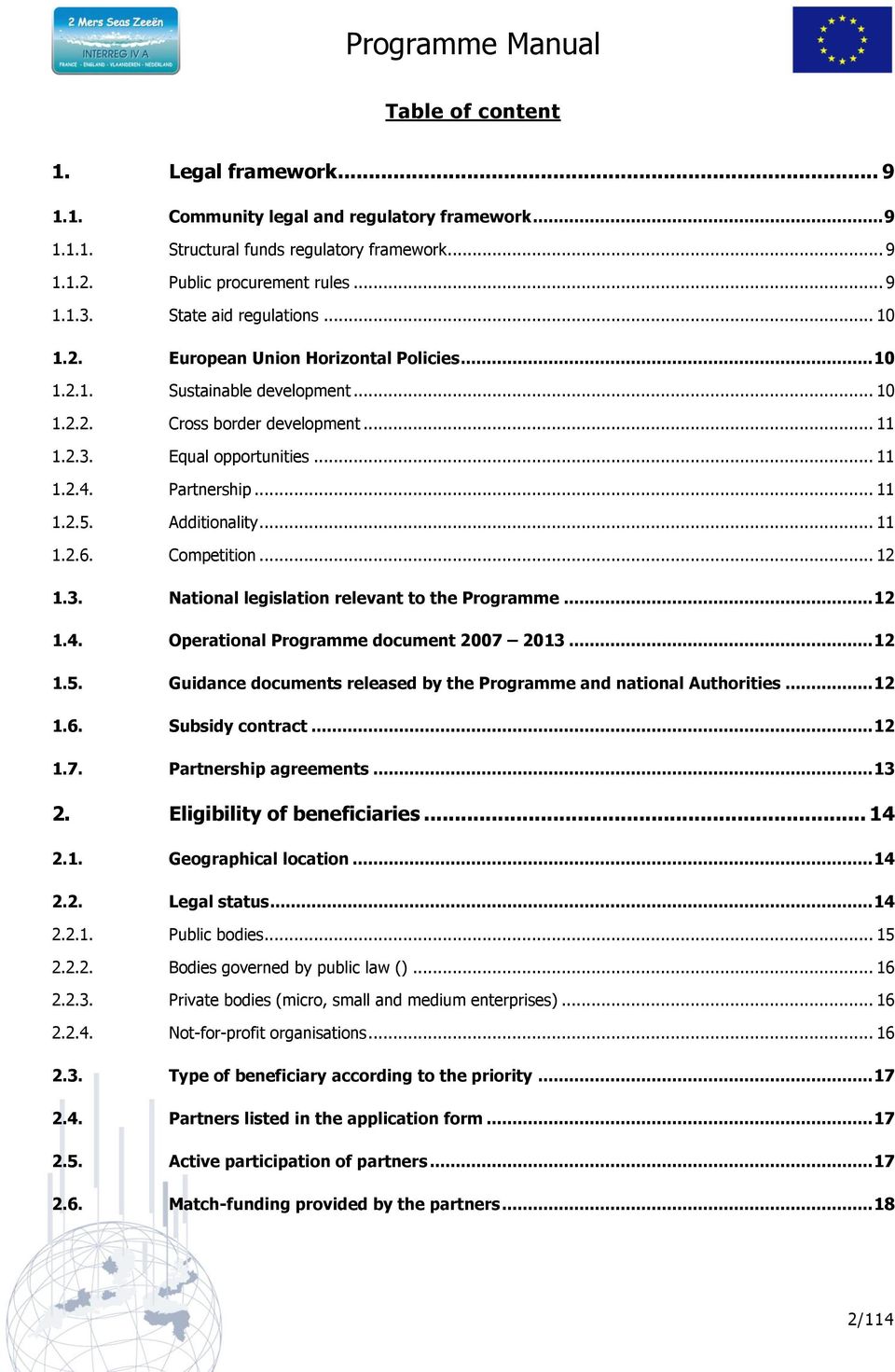
3 2.7. Composition of the partnership Lead Partner principle and main responsibilities of the Lead Partner Main responsibilities of the Lead Partner Responsibilities of the project partners Letters of Support Cluster Letters of Support and Associated Partner Declarations Eligibility of expenditure and accounting procedures Eligibility period ERDF funding rate Budget lines BL1 Staff costs Working time Employee working part-time for the project Which documentation must be provided to the first level controller? Which costs are NOT eligible under this budget line? BL2 Administration costs Direct administration costs Indirect administration costs (overheads) Limits Which documentation must be provided to the first level controller? Which costs are NOT eligible under this budget line? BL3 External consultants and suppliers Which documentation must be provided to the first level controller? Which costs are NOT eligible under this budget line? BL4 Travel and accommodation Which documentation must be provided to the first level controller? Which costs are NOT eligible under this budget line? BL5 Equipment How to identify the cost? Full use or partial use for project purposes Second-hand equipment Resale of the equipment Which documentation must be provided to the first level controller? Which costs are NOT eligible under this budget line? BL6 Investment Limits Which documentation must be provided to the first level controller? Which costs are NOT eligible under this budget line? BL7 Validation of expenditure (first level control) /114
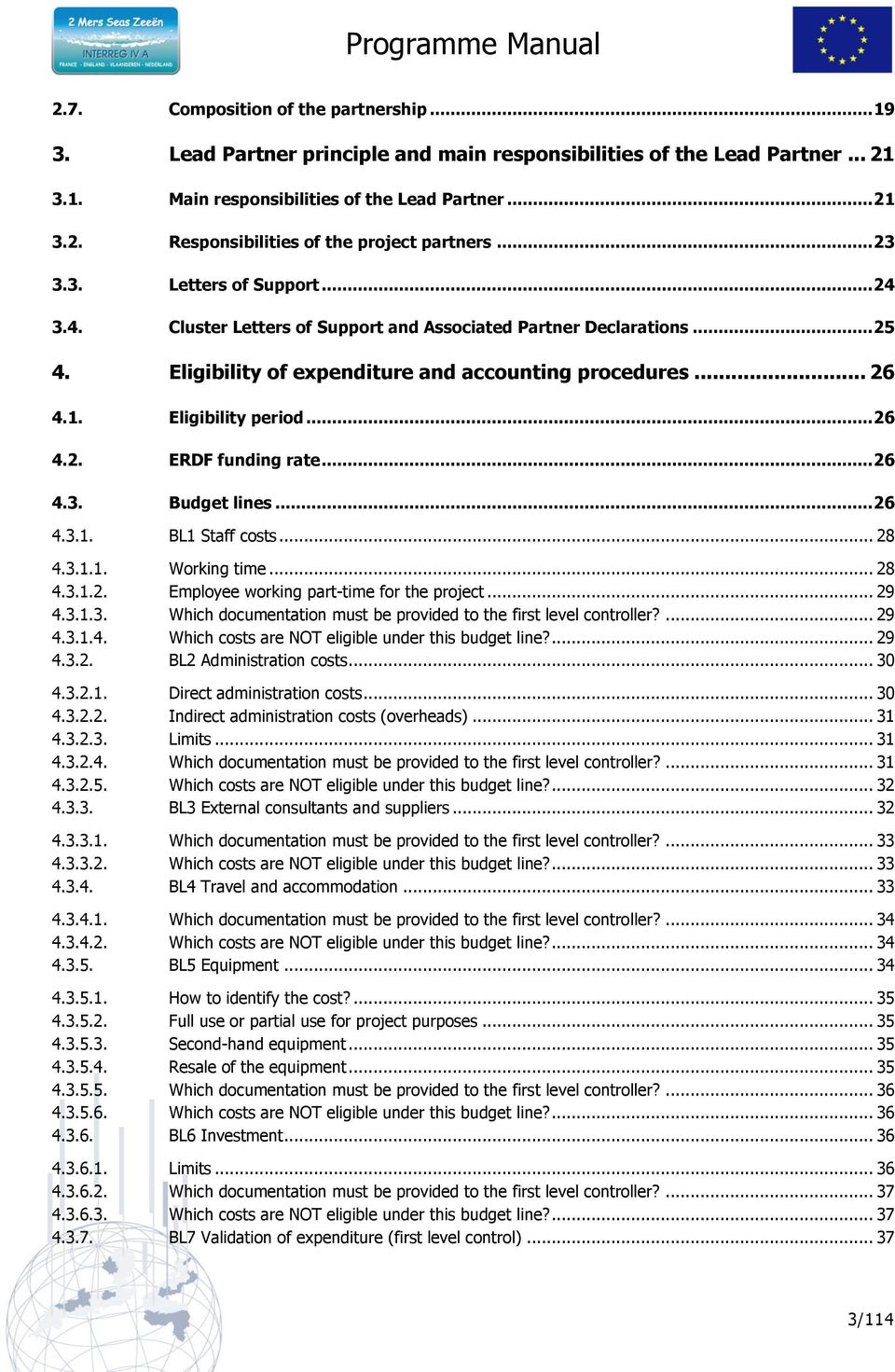
4 Which documentation must be provided to the first level controller? Revenue Which documentation must be provided to the first level controller? Other eligibility considerations In-kind contribution Public Procurement Staff costs Shared costs Expenditure outside the eligible area VAT Financial Charges Expenditure already supported by other EU or other national or regional subsidies Fees for auditing Guarantees Exchange rate: use of the EURO Reporting procedure Progress report Reporting periods Tools for reporting Reporting procedure Additional requirements Eligibility Principles of economy, efficiency and effectiveness Budget limits Payments to the projects Accounting and filing reporting documents Publicity and information requirements Project evaluation Eligibility check Quality Check Strategic assessment The project has been rejected or referred back: what is next? The project has been approved: what is next? /114

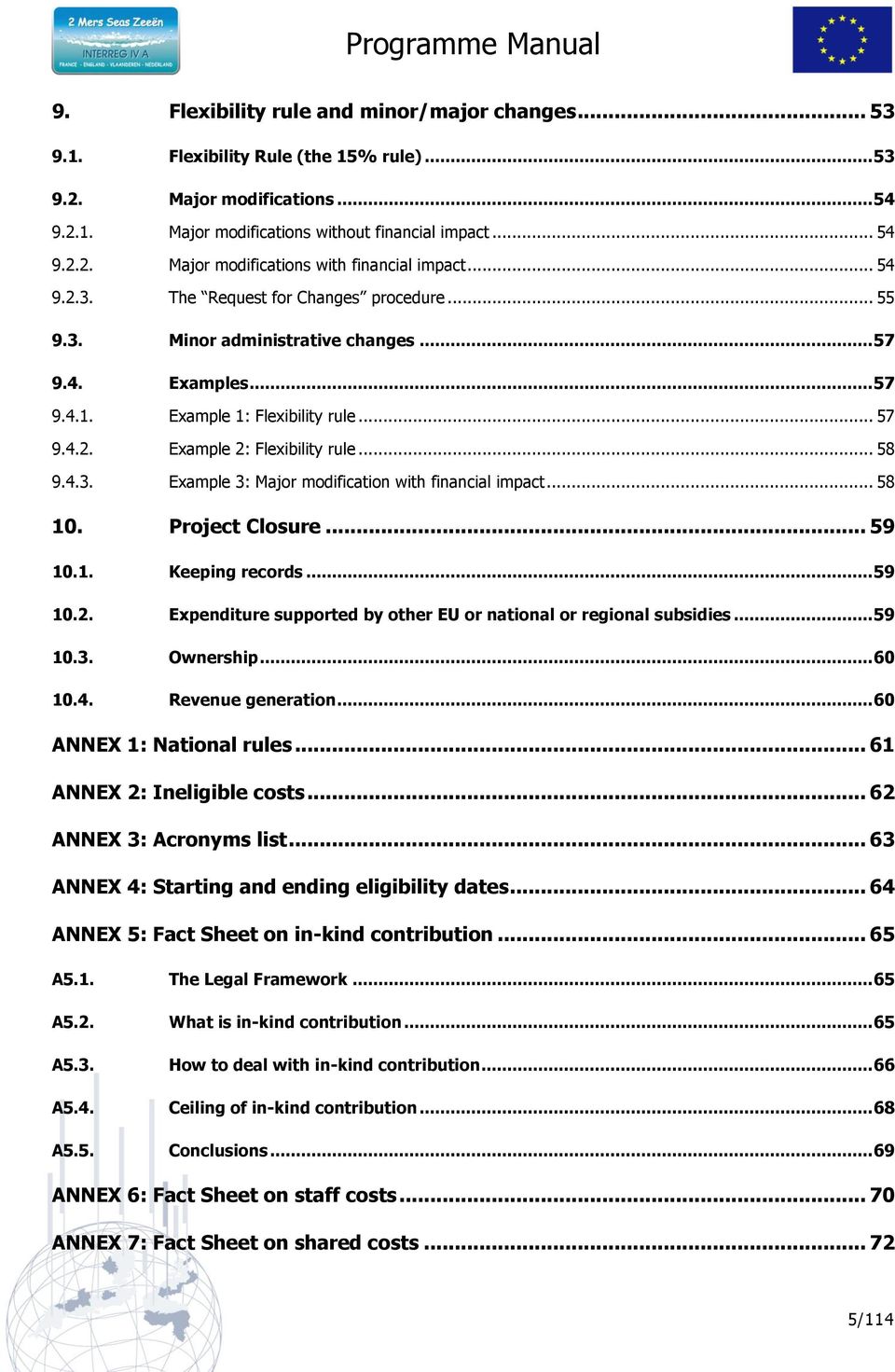
5 9. Flexibility rule and minor/major changes Flexibility Rule (the 15% rule) Major modifications Major modifications without financial impact Major modifications with financial impact The Request for Changes procedure Minor administrative changes Examples Example 1: Flexibility rule Example 2: Flexibility rule Example 3: Major modification with financial impact Project Closure Keeping records Expenditure supported by other EU or national or regional subsidies Ownership Revenue generation ANNEX 1: National rules ANNEX 2: Ineligible costs ANNEX 3: Acronyms list ANNEX 4: Starting and ending eligibility dates ANNEX 5: Fact Sheet on in-kind contribution A5.1. The Legal Framework A5.2. What is in-kind contribution A5.3. How to deal with in-kind contribution A5.4. Ceiling of in-kind contribution A5.5. Conclusions ANNEX 6: Fact Sheet on staff costs ANNEX 7: Fact Sheet on shared costs /114
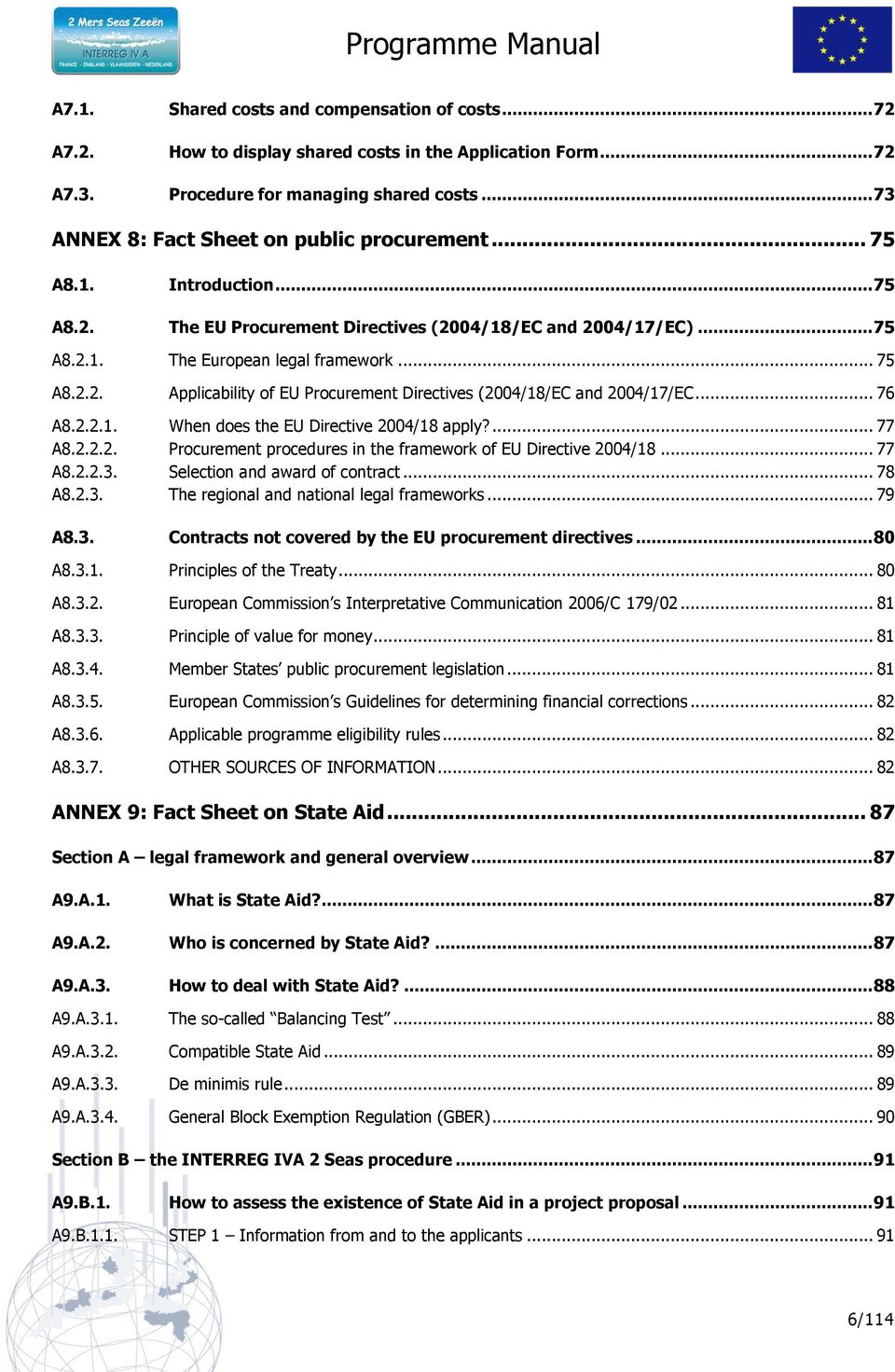
6 A7.1. Shared costs and compensation of costs A7.2. How to display shared costs in the Application Form A7.3. Procedure for managing shared costs ANNEX 8: Fact Sheet on public procurement A8.1. Introduction A8.2. The EU Procurement Directives (2004/18/EC and 2004/17/EC) A The European legal framework A Applicability of EU Procurement Directives (2004/18/EC and 2004/17/EC A When does the EU Directive 2004/18 apply? A Procurement procedures in the framework of EU Directive 2004/ A Selection and award of contract A The regional and national legal frameworks A8.3. Contracts not covered by the EU procurement directives A Principles of the Treaty A European Commission s Interpretative Communication 2006/C 179/ A Principle of value for money A Member States public procurement legislation A European Commission s Guidelines for determining financial corrections A Applicable programme eligibility rules A OTHER SOURCES OF INFORMATION ANNEX 9: Fact Sheet on State Aid Section A legal framework and general overview A9.A.1. What is State Aid? A9.A.2. Who is concerned by State Aid? A9.A.3. How to deal with State Aid? A9.A.3.1. The so-called Balancing Test A9.A.3.2. Compatible State Aid A9.A.3.3. De minimis rule A9.A.3.4. General Block Exemption Regulation (GBER) Section B the INTERREG IVA 2 Seas procedure A9.B.1. How to assess the existence of State Aid in a project proposal A9.B.1.1. STEP 1 Information from and to the applicants /114
7 A9.B.1.2. STEP 2 Assessment by the JTS and Member States A9.B.1.3. STEP 3 Decision by the PSC A9.B.1.4. STEP 4 On-going project monitoring A9.B.2. Responsibilities of the actors involved in the process ANNEX 10: Fact Sheet on strategic projects A10.1. When to apply? A10.2. How to apply? A10.3. ERDF rate ANNEX 11: Fact Sheet on European Territorial Cooperation A11.1. Introduction A11.2. Crossborder cooperation A Crossborder cooperation in general A The INTERREG IV A 2 Seas crossborder cooperation programme A11.3. Transnational cooperation A Transnational cooperation in general A The transnational INTERREG IVB North West Europe programme A11.4. Interregional cooperation A Interregional cooperation INTERREG IV C ANNEX 12: Fact Sheet on Revenues A12.1. Introduction A12.2. Definitions A The Cost of the Activity (CA) A The Running Costs (RC) A The Net Revenue (NR) A12.3. Which projects might be concerned? A12.4. How to deal with net revenues? A The Funding-gap A Net revenue generated during the project s implementation A STEP 1 Calculation of the net revenue A STEP 2 Estimation in the Application Form A STEP 3 Reporting the net revenue /114

8 A Net revenue generated after the project s closure A STEP 1 Calculation of the net revenue A STEP 2 Definition of the Action Plan A STEP 3 Deduction and regularization of the net revenue A Revenue partially generated by the project ANNEX 13: Eligible and adjacent NUTS3 areas ANNEX 14: Fact Sheet on Thematic Clusters A14.1. Introduction A14.2. Definitions and relevant themes A14.3. Conditions A14.4. Life-cycle of the thematic cluster A14.5. Eligibility of beneficiaries A General Principles A Geographical representation A Cluster budget A14.6. Practical modalities of the Call for clusters and cluster evaluation A Cluster Submission A Cluster evaluation A14.7. Monitoring process A Approval of the Cluster A Progress report A Changes in the project /114
9 1. Legal framework The INTERREG IVA 2 Seas Programme is part of the European Territorial Cooperation Objective of the Structural Fund policies for the period Projects funded under the INTERREG IVA 2 Seas Programme are guided by several layers of rules and requirements. For project partners from the EU Member States the following rules must be complied with: 1. Community legal and regulatory framework; 2. Horizontal policies of the EU; 3. National legislation; 4. Operational Programme document ; 5. Guidance documents released by the Programme and national Authorities 6. Application Form; 7. Subsidy contract; 8. Partnership agreements Community legal and regulatory framework Structural funds regulatory framework Council Regulation (EC) No 1083/2006 (and amendments, if existing) of 11 July 2006 laying down general provisions on the European Regional Development Fund, the European Social Fund and the Cohesion Fund and repealing Regulation (EC) No 1260/1999: the General Regulation gives general rules and requirements for all structural fund programmes. Regulation (EC) No 1080/2006 (and amendments, if existing) of the European Parliament and of the Council of 5 July 2006 on the European Regional Development Fund and repealing Regulation (EC) No 1783/1999: the ERDF Regulation lays down specific provisions concerning ERDF co-financed programmes and projects. It defines especially the contents and other provisions for the Objective 3/ European Territorial Cooperation Programmes. Commission Regulation (EC) No 1828/2006 (and amendments, if existing) of 8 December 2006 setting out rules for the implementation of Council Regulation (EC) No 1083/2006 laying down general provisions on the European Regional Development Fund, the European Social Fund and the Cohesion Fund and of Regulation (EC) No 1080/2006 of the European Parliament and of the Council on the European Regional Development Fund: the Implementing Regulation sets framework rules e.g. on information activities as well as audit and controls. It combines information for programme implementation which was scattered across several separate regulations in the previous programme period Reference to the respective articles of the regulations is given in this document where relevant Public procurement rules Directive 2004/18/EC of the European Parliament and of the Council of 31 March 2004 on the coordination of procedures for the award of public works contracts, public supply contracts and public service contracts. 9/114

10 Whatever the legal status of the beneficiary might be, public procurement rules are to be followed strictly: any service contract must comply with public procurement rules in order to make the expenditure eligible for funding. This applies in the case of consultants, suppliers (both of goods and services) and the purchasing of equipment eligible for funding from the Programme. In the EU Member States there is corresponding national legislation concerning public procurement which the project partners from these countries have to apply. A separate Guidance about public procurement is available in annex 8 of this paper State aid regulations Art. 54 (4) of Council Regulation (EC) No 1083/2006 states that for the state aid to enterprises within the meaning of the Art. 87 of the Treaty, the public aid granted under operational Programmes shall observe the ceilings on State Aid. The following regulations concern the use of State Aid: Commission Regulation (EC) No 1998/2006 on the application of Articles 87 and 88 of the Treaty to de minimis aid; Commission Regulation (EC) No 1628/2006 on the application of Articles 87 and 88 of the Treaty to national regional investment aid; Council Regulation (EC) No 994/98 on the application of Articles 92 and 93 of the Treaty establishing the European Community to certain categories of horizontal state aid; Commission Regulation (EC) No 800/2008 declaring certain categories of aid compatible with the common market in application of Articles 87 and 88 of the Treaty (General block exemption Regulation). The latest applicable State Aid provisions are available under: Within the present Operational Programme, the funding directed to the entities (public or private) that exercise an activity of an economic nature and that offer goods and services in competition (actual or potential) with other operators active in the market, if identified as state aid, must fulfil the de minimis rule as defined by Commission Regulation (EC) No 1998/2006 of 15 December 2006 on the application of Articles 87 and 88 of the Treaty to de minimis aid European Union Horizontal Policies In addition to the regulations mentioned above, there are several horizontal policies and principles that are promoted by all European Union financed programmes. These include e.g. sustainable development, integrated territorial development, equal opportunities, partnership, additionality and competition. It is a requirement that projects take account of these principles Sustainable development The concept of sustainable development refers to a form of development that meets present-day needs without compromising the ability of future generations to satisfy their own requirements. It aims to improve individuals' living conditions whilst preserving their environment in the short, medium and -- above all -- long term. The objective of sustainable development is threefold: development that is economically efficient, socially fair and environmentally sustainable. In addition to the environmental aspect, sustainable development also covers economical, social and cultural aspects of sustainability. 10/114

11 Environment nevertheless remains the most important aspect of sustainable development. In case it seems that a planned project might have significant adverse impact on the environment, an environmental impact assessment must be carried out in accordance with the national legislation before the project is implemented, or alternatively, during the project implementation but before the actions subject to the environmental impact assessment are carried out. Negative impacts should be identified, and applicants should show how they will prevent or mitigate negative impacts. When an environmental impact assessment is needed this will be done by the responsible national authorities or other bodies to whom the task has been delegated in accordance with the respective national legislation. In the application form, applicants are asked to indicate how the project contributes to sustainable development Cross border development Actions under the cross-border cooperation programmes support joint local and regional objectives (see Art. 3 (2c) of the Council Regulation (EC) No 1083/2006 and Art. 6 (1) of Regulation (EC) No 1080/2006). See for more information about European Territorial Cooperation Annex 11 of this Manual Equal opportunities The Structural Fund programmes, including the 2 Seas programme, aim at ensuring equal opportunities between men and women. Another objective from the equality point of view is to prevent all kinds of discrimination, e.g. based on sex, racial or ethnic origin, age or disability (see also Art. 16 of Council Regulation (EC) No 1083/2006). Promotion of equal opportunities will be regarded, among other horizontal policies, as a positive factor when the Steering Committee selects projects for funding. All applicants are asked to integrate these issues in their projects, or at least, to consider the project s influence on matters of equal opportunities. Projects that build structures (e.g. men and women equally presented in project planning, decision-making or in the project target groups) or implement activities that aim at promoting equal opportunities will describe these activities in the application form and their results in the progress reports Partnership The principle of partnership is ensured by involving all partners in the project s activities and management. This principle is also linked to the issue of governance. In this case, it is highly recommended that project partnership involves different levels of administration as well as different types of organisations. This could be ensured, for example, by participation of national, regional and local levels or, correspondingly, public authorities, economic and social partners (such as SMEs, associations) and civil society (such as non-governmental organisations, environmental partners) (see also Art. 11 of Council Regulation (EC) No 1083/2006 and Art. 4 of Regulation (EC) No 1638/2006). However, a broad partnership should not take place by involving too many partners in one project. A large amount of partners often leads to a complicated management structure, contradictory targets between project partners and, thus, difficulties to implement the project successfully. The Programme recommends Lead Partners to limit their partnership to 10 partners Additionality The principle of additionality means that EU financing shall not replace public or equivalent financing of similar activities (see also Art. 15 of Council Regulation (EC) No 1083/2006). 11/114

12 Projects selected for funding are expected to bring added value, something that would not have been possible without the programme assistance. In addition, organisations involved in the project activities cannot replace their statutory tasks with the programme funding Competition Free movement of goods, services and people is one of the basic principles of the European Union. In order to not distort free competition and affect trade amongst Member States, it is normally not possible to subsidise undertakings with public financing. The term undertaking is defined as an entity which exercises an activity of economic nature and which offers goods and services in competition (actual or potential) with other operators active in the market. The Lead Partner and the project partners have to ensure that the planned activities are in compliance with the competition legislation of their country. This should be clarified with the responsible national authorities already during the project preparation phase National legislation relevant to the Programme An overview of the national legislation on environment, equal opportunities and state aid in force for each Member State involved in the Programme is available in this paper (Annex 1) Operational Programme document The Operational Programme (OP) document in its final version can be downloaded from the Programme web-site ( The requirements there listed have to be complied with by all projects Guidance documents released by the Programme and national Authorities The structure of the rules set at Programme level is made up of guidance documents, such as the present one. All these documents are available on the Programme web-site and can be subject to revision from one call for proposals to another. Guidance on specific issues provided by national authorities will also be binding for the project and the partnership Subsidy contract Article 20.1 of Regulation (EC) No 1080/2006 sets out that a lead beneficiary shall be appointed for each operation. The lead beneficiary, or Lead Partner, shall be responsible for ensuring the implementation of the entire operation. In turn, Article 15.2 of Regulation (EC) No 1080/2006 of the European Parliament and of the Council mentions that The Managing Authority shall lay down the implementing arrangements for each operation, where appropriate in agreement with the lead beneficiary. 12/114
13 A Subsidy Contract ( 1 ) governing the obligations of the partnership and its relation to the Programme will be signed between the Lead Partner, as representative of the partnership, and the Programme Managing Authority (MA). The contract is concluded in euro. To ensure a sound and efficient implementation of the project, the Subsidy Contract may only be concluded after the MA receives the confirmation that adequate control systems according to Article 16 of Regulation (EC) No 1080/2006 have been set up in the respective Member States, as set out in 1 (3) and 5 (2), and after the ultimate financial liability according to Article 17 of Regulation (EC) No 1080/2006 has been confirmed for the beneficiary by the respective Member State. In the framework of the thematic capitalisation, a Subsidy Contract will cover Phase 1 Valorisation and Dissemination of the Cluster. If the project plans to develop a phase 2, a Second Subsidy Contract will then have to be signed between the Lead Partner and the Programme Managing Authority. For any further information, please go to Annex 14 of this document. A template of the subsidy contract is available for information on the Programme web-site Partnership agreements In order to ensure the high quality and fulfilment of objectives of the project, a partnership agreement between the Lead Partner and project partners has to be concluded [Regulation 1080/2006, Article 20(1)]. The partnership agreement is a mandatory document in which the legal agreements between project partners in order to define their mutual cooperation are established formally. It is important that sound agreements are made between the Lead Partner and other partners, since the Lead Partner is ultimately responsible for the management of the project towards the Managing Authority. Such contracts are a fundamental basis for a successful cooperation between all partners and form a solid foundation for the project implementation and financial management. The partnership agreement formalises the division of mutual responsibilities and rights of partners, and must be concluded among all project partners before the first payment request is submitted to the JTS (copy signed by all the partners and the Lead Partner). The project partners can only report their costs after they have signed the partnership agreement: no cost will be paid if the partnership agreement has not been signed. Within the thematic clusters, the partners receiving ERDF will be described in the partnership agreement as formal partners. The partners that will not get any EU funding but that will be involved in the project implementation will be listed as associated partners. All formal and associated partners will have to sign the partnership agreement in Part B. The Partnership agreement will cover Phase 1. If the project plans to develop a phase 2, a partnership agreement N 2 will then have to be signed by all formal and associated partners once Phase 2 has been approved by the 2 Seas Programme. The template will be provided by the JTS once the cluster has been approved by the 2 Seas Programme. In addition to the partnership agreement, the associated partners must fill in an Associated Partner Declaration in which they will detail their involvement in the project. All detailed information about clusters is provided in Annex 14 of this document. 1 In other INTERREG Programmes the contract is also called Grant offer letter or Grant contract, The term adopted by this Programme is Subsidy Contract since it is a real contract which will be signed by the Lead Partner and the Programme representatives. 13/114

14 A copy of the partnership agreement should also stay at the Project partner premises to allow verification by the first level controllers. The Programme has set up a template that the partnership must use. The template provides mandatory clauses (Section 1) and leaves then space for the partnership to add more details in Section 2. Section 1 is mandatory and cannot be amended nor changed. Section 2 is to be implemented by the partnership, but by no way can limit the clauses in Section Eligibility of beneficiaries An organisation can be eligible for Programme funding if all the following conditions are fulfilled: 1. It is located in the geographical area covered by the Programme; 2. Its legal status matches with the categories listed in 2.2; 3. Its status matches with the target group listed in the Operational Programme; 4. It is listed in the project s Application Form as a partner; 5. It is an active partner in the project and; 6. It contributes financially to the project (with match-funding). These conditions apply both to regular projects as well as to strategic projects (see for more information on strategic projects Annex 10 of this Manual). Specific rules have been put in place for the thematic clusters. A separate Guidance is available in annex 14 (A14.5) of this document Geographical location As a general rule, organisations that receive financing from the Programme must be located in the programme area (eligible area) or in an adjacent area, which is covering different NUTS III of France, England, Belgium Flanders and The Netherlands. This is valid both for the Lead Partner and for the project partners. The list of the NUTS III can be found in the Application Form Overview. If the Lead Partner is located in an adjacent area, at least one project partner must be located in the eligible area. Projects funded in priorities 1, 2 and 3: the partnership must have a minimum of two partners located in two different Member States, one of which must be English. Projects funded in priority 4: the partnership must have minimum three partners of which at least one partner from the UK, one partner from the French area of the France (Channel) England programme and one partner from the mainland area of the 2 Seas programme (either the French, Flemish or Dutch part). Specific rules have been put in place for the thematic clusters. A separate Guidance is available in annex 14 (A14.5) of this document Legal status 14/114
15 As stipulated in of the Operational Programme, all organisations that receive funding from the programme (acting as Lead Partners or project partners) shall represent one of the following legal entities: public body; body governed by public law [ public equivalent body as defined by Directive 2004/18/EC, Article 1(9)]; private body (small and medium enterprises); Not-for-profit organisations. Each partner organisation has to confirm that it matches one of the above categories in the application form. In addition, each partner shall indicate in the Application Form if it is an entity (public or private) that exercises an activity of an economic nature and that offers goods and services in competition (actual or potential) with other operators active in the market. This is a requirement in order to ensure that all potential state aid is assessed by the Programme authorities before the project s approval. Organisations that do not fulfil the requirements of legal status listed above cannot be listed as partners and are not entitled to receive funding from the Programme. This means that their expenditure will not be co-financed by the Programme and, thus, they have to finance 100% of their activities from their own resources (in this case they will participate to the project as observers). Independently from the legal status, all partner organisations shall: make available the results of the project to the general public, apply the principles of public procurement rules. In order to avoid a situation where state aid regulations have to be applied, it is recommended that the project excludes activities that have a commercial character. This means that in all cases the outcome and results of the projects have to be made available to the general public free of charge. Not only public and public equivalent bodies, but also private bodies and bodies governed by private law (including not-for-profit organisations) shall comply with EU and national public procurement rules whenever they use project s money to pay a provision of goods and services Public bodies Under this category, all bodies considered as public authorities can be listed: national (governmental), regional, or local authorities. In the case that the public body is an entity that exercises an activity of an economic nature and that offers goods and services in competition (actual or potential) with other operators active in the market, the body concerned must fill in a specific de minimis aid form during the application phase. This form shall detail all the aids received by or committed to the entity in the last three tax years (including the funds requested in the project proposal that the entity is applying for). If, during the assessment phase by the JTS and the Steering Committee, the funds requested by the entity in the framework of the project application are considered to be state aid, the funding from the Programme shall be classified as de minimis aid (for further information see annex 9 of this Manual) and it shall fulfil the de minimis ceiling. If the funds requested by the entity in the framework of the project application exceed the de minimis threshold (taking into consideration also the de minimis aid already attributed to the entity in the last three tax years and declared by the entity in the de minimis aid form ), the Application Form must be revised in order to comply with the de minimis rule. 15/114
![body; body governed by public law [ public equivalent body as defined by Directive 2004/18/EC, Article 1(9)]; private body (small and medium enterprises); Not-for-profit organisations.](/docs-images/46/21383929/images/page_15.jpg "Each partner organisation has to confirm that it matches one of the above categories in the application form.")
16 Bodies governed by public law ( 2 ) Bodies governed by public law, such as chambers of commerce, trade unions, etc. may receive Programme funding. Please note that it may vary from country to country whether a certain type of organisation falls under public or private law. In the case that the body governed by public law is an entity that exercises an activity of an economic nature and that offers goods and services in competition (actual or potential) with other operators active in the market, the body concerned must fill in a specific de minimis aid form during the application phase. This form shall detail all the aids received by or committed to the entity in the last three tax years (including the funds requested in the project proposal that the entity is applying for). If, during the assessment phase by the JTS and the Steering Committee, the funds requested by the entity in the framework of the project application are considered to be state aid, the funding from the Programme shall be classified as de minimis aid (for further information see annex 9 of this Manual) and it shall fulfil the de minimis ceiling. If the funds requested by the entity in the framework of the project application exceed the de minimis threshold (taking into consideration also the de minimis aid already attributed to the entity in the last three tax years and declared by the entity in the de minimis aid form ), the Application Form must be revised in order to comply with the de minimis rule Private bodies (micro, small and medium enterprises) Micro, small and medium enterprises are defined by the Commission Recommendation of 6 May 2003 concerning the definition of micro, small and medium-sized enterprises (notified under document number C (2003) 1422) Official Journal L 124, , pages Please note that this definition of SMEs applies from If an organisation matches the criteria listed here, it can be considered as an SME and thus is eligible for funding under this Programme. In the case that the private body is an entity that exercises an activity of an economic nature and that offers goods and services in competition (actual or potential) with other operators active in the market, the body concerned must fill in a specific de minimis aid form during the application phase. This form shall detail all the aids received by or committed to the entity in the last three tax years (including the funds requested in the project proposal that the entity is applying for). If, during the assessment phase by the JTS and the Steering Committee, the funds requested by the entity in the framework of the project application are considered to be state aid, the funding from the Programme shall be classified as de minimis aid (for further information see annex 9 of this Manual) and it shall fulfil the de minimis ceiling. If the funds requested by the entity in the framework of the project application exceed the de minimis threshold (taking into consideration also the de minimis aid already attributed to the entity in the last three tax years and declared by the entity in the de minimis aid form ), the Application Form must be revised in order to comply with the de minimis rule. Micro, small and medium enterprises, if acting as a Lead Partner of a project, will have to provide a proof of solvability Not-for-profit organisations These organisations must not be profit making and must be acting in the public interest. Applicant organisation must be legally constituted. 2 Please check the definition given by the Directive on the public equivalent bodies and if your status complies with it: Directive 2004/18/EC Article 1, para /114
17 These organisations, if acting as a Lead Partner of a project, must provide a guarantee ( 3 ). Please note that if a not-for-profit organisation falls into the definition of public equivalent body ( 4 ) and its trustees are public bodies, a guarantee is not needed, even in the case where the organisation is acting as a Lead Partner of a project. In the case that the not-for-profit organisation is an entity that exercises an activity of an economic nature and that offers goods and services in competition (actual or potential) with other operators active in the market, the body concerned must fill in a specific de minimis aid form during the application phase. This form shall detail all the aids received by or committed to the entity in the last three tax years (including the funds requested in the project proposal that the entity is applying for). If, during the assessment phase by the JTS and the Steering Committee, the funds requested by the entity in the framework of the project application are considered to be state aid, the funding from the Programme shall be classified as de minimis aid (for further information see annex 9 of this Manual) and it shall fulfil the de minimis ceiling. If the funds requested by the entity in the framework of the project application exceed the de minimis threshold (taking into consideration also the de minimis aid already attributed to the entity in the last three tax years and declared by the entity in the de minimis aid form ), the Application Form must be revised in order to comply with the de minimis rule Type of beneficiary according to the priority The Operational Programme defines for each priority the beneficiaries (ERDF recipients) that are encouraged to take part in cross-border cooperation projects. Priority Beneficiaries INDICATIVE list 1 Operational Programme para Operational Programme para Operational Programme para Operational Programme para Partners listed in the application form Only organisations acting in the project, contributing financially to it and requesting an ERDF share are considered partners. These three conditions must be fully fulfilled by all partners at all times. Only partners listed in the Application Form as partners are eligible for funding and can report their costs. In order to ensure a proper audit trail at Programme level, the Managing Authority must know which organisations receive programme funding and whether they are eligible according to the programme rules. Therefore, an umbrella type of partnership structure, where one partner collects funding and represents other partners without listing them as such in the application form is not allowed. In case of thematic cluster, specific guidance on the types of partners can be found in annex 14 of this Manual Active participation of partners 3 Please contact the JTS for further information. 4 Please check carefully with the text of the Directive 2004/18/EC Article 1, para. 9. if your not-for-profit organisation can be eventually considered a public equivalent body. 17/114

18 Partners must be actively participating in the activities and contribute to the achievement of project s outputs and results. Evidence of the active involvement of all partners in the project activities must be provided through the sixmonthly progress reports during the project lifetime. In case of a cluster, two progress reports will be submitted to the 2 Seas Programme, one after phase 1 and one after phase 2 (as explained in Annex 14 of this Manual) Match-funding provided by the partners Definition: Match-funding is the financial contribution provided by partners to match the ERDF grant. The amount of matchfunding must correspond to at least 50% of the budget at partner and project levels. Sources of match-funding: Match-funding can be provided by partners in cash and in kind (further information about the use of in-kind contribution is available in annex 5 of this Manual). Match-funding can come from a wide range of sources: own partner s funds, or external sources (public or private), but cannot derive from any other Community financial instrument (art. 54 of Regulation (EC) No 1083/2006). Programme requirements: The source of match-funding is to be detailed in the application form by the partners, since it is important for the Programme to monitor the origin of the match-funding. In the application stage, each partner must state the total amount of its match-funding in writing, by providing an original signed Letter of Support which will have to be annexed to the Application Form. The figures stated in the letters of support and in the application form must be exactly the same (otherwise it could be deemed as a potential eligibility issue during the evaluation of the project proposal). The letters of support will be considered as binding for all partners. The template provided by the Programme must be used. This rule does not apply in the case of thematic cluster since the ERDF rate will be 100%. No match-funding will have to be provided. No in-kind contribution will be eligible. In practice: Two or more organisations that are partners in the same project cannot match-funding each other (unless they are naturally and structurally linked by financial arrangements existing even in the absence of the project see example 1 below or if the funding consists in a specific national, regional or local contribution granted for the participation in a project see example 2 below). Example 1 Partner A is a regional authority and Partner B is a not-for-profit organisation naturally funded by the regional authority. Partner A and Partner B are involved in the same project. The match-funding provided by Partner B is partially accorded by the regional authority that is also Partner A of the project. However, we can consider that the full amount of match-funding provided by Partner B comes from Partner B own budget (internal resources) since the financial arrangement between Partner A and B is pre-existing and independent from the project. For this reason, Partner B shall indicate the full amount of match-funding as own funding in the sources of match-funding table of the application form. All funding accorded by the regional authority to Partner B (that is finally considered 18/114
19 Partner s B own funding ) must be totally distinguished from and additional to the match-funding provided by the regional authority itself for its own participation in the Project. Example 2 Partner A is a regional authority and Partner B is a not-for-profit organisation that is not naturally funded by the regional authority. In order to participate in the project, Partner B will provide of own funds and that are granted by the regional authority in the framework of a regional funding scheme. Partner B shall indicate, among the sources of match-funding table of the application form, both its own funding (for ) and the regional authority (for ). The two sources must be indicated separately. The granted by the regional authority to Partner B must be totally distinguished from and additional to the match-funding provided by the regional authority itself for its own participation in the Project. Shared costs are not to be considered as match-funding: In the case of a common expenditure shared by two or more project partners, the payment of each partner s share to the partner responsible of the initial full expenditure is not to be considered as a source of co-financing. On the contrary, the payment of each partner s share must be considered as partner expenditure and must be managed according with the procedure for shared costs as described in Annex 7 of the Programme Manual. As such, it must be listed in the partner s budget and it must be foreseen in the specific shared costs table of the Application Form (see example 3 below). Example 3 Partner 02 is paying the full costs of the project web-site. This expenditure must be shared with the Lead Partner, Partner 03 and Partner 04. The share must be managed according with the shared costs procedure described in Annex 7 of the Programme Manual. The reimbursements from the Lead Partner, Partner 03 and Partner 04 to Partner 02 CANNOT be considered as source of match-funding of Partner 02! On the contrary, they MUST be considered as expenditure paid by the Lead Partner, Partner 03 and Partner 04 to refund Partner 02 in the framework of the shared costs procedure. As such, they must be listed among all other expenditure in the correspondent budget lines of the concerned Partners in the Application Form. The shared costs table in the Application Form shall be also filled in consistently and in accordance with the amount of the shared costs listed in the budget lines. In a correct and consistent scenario, the 4 Partners involved in the shared costs shall have listed ONLY their part of the share in the budget lines of their own budget and should have filled in the shared costs table accordingly. The amount to be indicated by Partner 02 in its own budget shall be the remaining cost after that all other Partners have paid their own share Composition of the partnership For all the projects, the partnership must be built according to the following minimum requirements. Minimum requirement for the partnership: o Projects applying for Priority 1, 2, 3: the partnership must have a minimum of two partners located in two different Member States, one of which must be English. o Projects applying for Priority 4: the partnership must have minimum three partners of which one from United Kingdom, one from the French area of the France-Channel-England Programme, and one from the 2 Seas Programme eligible area. 19/114
20 For the composition of a cluster partnership, please refer to Annex 14 (A14.5. Eligibility of beneficiaries) Maximum number of partners: the Programme recommends keeping partnership small in order to ease management. A maximum number of 10 partners per project (including the Lead Partner) is strongly recommended. 20/114
21 3. Lead Partner principle and main responsibilities of the Lead Partner The Programme is based on the Lead Partner principle (responsibilities of the Lead Partners and project partners are set in Art. 20 of Regulation (EC) No 1080/2006). This means that each project appoints one organisation to act as Lead Partner to be responsible for the entire project. The Lead Partner bears full financial and legal responsibility towards the Managing Authority for the implementation of the entire project, including for all project partners. Each project partner keeps the final financial and legal responsibilities towards the Lead Partner in case of detected irregularities and in case of non fulfilment of the obligations foreseen by the EU regulations, by the national and Programme rules and by the project s Partnership Agreement. If an irregularity was detected generating a reimbursement of unduly paid funds, the Lead Partner is expected to reimburse the amount to the Managing Authority first, and then to ask to the responsible partner(s) to pay him back as stipulated in the Partnership Agreement. The responsibilities of the Lead Partner resulting from EU regulations are defined in the subsidy contract that is concluded and signed between the Lead Partner and the Managing Authority Main responsibilities of the Lead Partner The Lead Partner bears several duties and responsibilities for ensuring the project s implementation. Particularly, the Lead Partner takes over the responsibility for management, communication, implementation and coordination of activities among the involved partners. As a consequence, the Lead Partner shall be supported by a team specifically in charge of implementing different tasks related to the Lead Partner Principle, mainly the coordination, implementation and communication of the project. The term project management includes both coordination of issues related to activities as well as administrative and financial management of the project and its accounts. The management of a cross border project is a challenging and time-consuming task. Therefore the project staff should have experience in the management of (international) projects, be able to handle the challenges of different languages and cultures, and should enable the partnership to work together as a team. The Lead Partner team shall ensure the implementation of the following activities: - Project coordination: a coordinator shall be responsible for the organisation of the project s work, of the implementation of the work programme, of the achievement of all expected outputs and results as defined in the Application Form. The coordinator should have a sound knowledge of the issues addressed by the project and should be able to act as a driving force in the partnership and to mobilise the partners in order to achieve the objectives laid down in the Application Form within the given time. Tasks and responsibilities of the project coordinator include: co-ordination of activities (division of tasks) among the involved partners and ensuring that these tasks are subsequently fulfilled; monitoring the progress of the project and ensuring the delivery of planned outputs, securing the efficient use of the project s resources; being a contact point for the project; ensuring proper information flow - regular communication between the programme (Joint Technical Secretariat) and the project partnership as well as between the project partners; preparation and submission of the activity report as part of the progress report to the Joint Technical Secretariat every six months. 21/114
22 - Administrative and financial management: a finance manager is responsible for the accounting, financial reporting, internal handling of ERDF funds and national co-financing. The finance manager should work in close contact with the coordinator and the partners in order to enable efficient financial management of the project. The finance manager should be familiar with accounting rules, international transactions, EU and national legislation for the management of ERDF, public procurement and financial control. Tasks and responsibilities of the finance manager include: a sound book-keeping system; proper documentation of payments and payment flows, a well-functioning audit trail; contact with the first level controllers; compliance with EU and national legislation as well as programme rules about financial management, eligibility of costs and public procurement; a clear communication of the aforementioned rules and regulations to the project partners (e.g. through: project partner training, provision of information and regular updates, a close contact to the first level controllers, etc.); observance of the budget allocation; adherence to the project s spending plan, including the set-up of reliable cash flow forecasts and tight control of the incurred cash flows; timely preparation of the six-monthly financial progress reports. It is very important that both project coordinator and financial manager are involved already in the development phase of the project. - Communication and dissemination: Each project also has to comply with the EU requirements on information and communication and visibility of actions. Therefore, each project is recommended to nominate a communication manager responsible for implementation of information and communication measures (it could be e.g. the same person as project coordinator). The communication manager shall be responsible of the relationships with partners, the JTS and other external institutions and organisations when it comes to communication and dissemination objectives; the communication manager should be in charge of the coordination and implementation of communication activities (newsletter, brochures, etc.), the coordination of dissemination actions (participation to conferences and events, production of dissemination tools, etc.), the respect and implementation of the publicity rules. The communication manager shall also be responsible for drafting the project communication strategy that must be submitted to the Joint Technical Secretariat together with the second progress report. In the case of thematic cluster, no communication strategy is required since the communication plan is already included in the cluster application form. The tasks of the project coordinator, finance manager and communication manager are crucial throughout the project duration and their importance should not be underestimated. In general, the main responsibilities of the Lead Partner include: developing and maintaining an efficient and reliable project implementation system (strategic, operational and financial management), e.g.: securing an efficient use of the project s resources; co-ordination of activities (division of budget and tasks) among the involved partners and ensuring that these tasks are subsequently fulfilled; signing and submitting the Application Form to the Joint Technical Secretariat; representing the project the Lead Partner serves as a contact point to the Joint Technical Secretariat and should ensure continuous communication between the programme authorities and the project partnership; 22/114
23 signing the subsidy contract with the Managing Authority and therefore ensuring the implementation of the entire project; laying down the arrangements for its relations with the partners participating in the project in a written Partnership Agreement comprising, inter alia, provisions guaranteeing the sound financial management of the funds allocated to the project, including the arrangements for recovering amounts unduly paid; ensuring the planned progress on the project; in particular the delivery of outputs described in the approved Application Form; informing the public about the ERDF assistance received from the European Union; reporting of activity related progress and financial follow-up to the Joint Technical Secretariat, especially ensuring that the expenditure presented by the project partners has been incurred for the purpose of implementing the project and corresponds to the activities agreed between the project partners and in line with the Application Form; requesting and receiving ERDF from the Certifying Authority, and transferring it to the project partners; monitoring the project expenditure, its eligibility and compliance with EU and national legislation, as well as programme rules. The Lead Partner is responsible for ensuring that the expenditure of all project partners has been checked by the appointed first level controllers. The partners first level controllers shall ensure that 100% of the declared expenditure is supported by invoices or documents of equivalent probative value, that it has actually been paid out by the project partners during the project preparation phase or during the project s implementation, that it was paid for activities described in the approved Application Form and that the products or services have actually been delivered. In its role of overall responsible body at project level, the Lead Partner shall consolidate the project progress report and shall be satisfied by the accuracy and soundness of the documents submitted by its project partners. The first level controller of the Lead Partner shall check 100% of the Lead Partner s expenditure, the work done by the Lead Partner during the consolidation phase of the project progress report and shall be satisfied by the quality of the control done by the First level controllers of the other partners; observing the project spending plan against the total project budget and the budget of each partner; producing all documentary evidence required for first level control and payments Responsibilities of the project partners The Lead Partner shall be administratively, legally and financially responsible for the project towards the Managing Authority. Nevertheless, each partner shall commit to the success of the project and contribute to its implementation and completion. Moreover, each partner remains liable for the sound financial management of its own expenditure. Roles and responsibilities of the project partners are clarified in the Partnership Agreement in which the legal agreements between project partners and Lead Partner are established formally in order to define their mutual cooperation. The Lead Partner is responsible for ensuring that the Partnership Agreement is signed by all partners. Being a project partner implies a strong commitment with regard to a series of role and tasks. These relate to: - Administrative tasks: To provide all requested documents for the completion of the Application Form; To sign the documents related to the creation and implementation of the project such as the Partnership Agreement and the Letter of Support; To provide the Lead Partner with the partner progress report within the fixed deadlines; To regularly account and claim the expenditure incurred by the partner s institution in the framework of the project; To ensure a soundness and efficient first level control on 100% of the partner s own expenditure. 23/114
24 To assume responsibility of any declared irregularity and to repay the Lead Partner any amounts unduly paid in accordance with the Partnership Agreement; - Project development: To contribute to the elaboration of the Application Form, including the work programme, the definition of outputs and the budget. - Project implementation: To contribute to the implementation of the work programme and to the production of expected outputs in compliance with the calendar and methodological framework defined in the Application Form; To carry out information and communication measures for the public about the project activities; To keep available all documents related to the project until end of the year Letters of Support The aim of the letters of support is to ensure that the respective partner is capable of participating in the project from a legal and financial point of view and is able to deliver the planned outputs. The signing of the letters of support is compulsory for all project partners. Among others, the letters of support includes a statement that the respective partner: complies with the programme eligibility requirements regarding the legal status of partner organisations; does not receive any other Community funding for the activities scheduled in the project s Application Form; contributes financially to the project budget through adequate match-funding according to the Application Form; does not receive funding from any other public sources that would exceed the amount of match funding which has to be provided by the partner; has sufficient human, financial and administrative capacity to implement the assigned project activities; carries out activities in line with Community and national legislation and programme rules; is familiar with the content of the Application Form and understands what its role in the project will be; operates within a given budget (the concrete amount must be specified in the letter of support); The letters of support must be completed and signed by a person entitled to undertake financial commitments on behalf of the organisation. The letter of support must be filled in using the standard template provided for in the application package. The wording in the standard letter of support may not be changed in any way. All information in the letter (especially the financial figures) must correspond to that given for each partner in the Application Form. The letters of support have to be attached to the Application Form and sent in one single package to the Joint Technical Secretariat. Photocopies of letters of support are accepted at the stage of submission of project proposals. Nevertheless, the original letters will have to be submitted at the latest before the meeting of the Steering Committee deciding about the approval of the projects. Acquiring the letters of support from the partners can be a lengthy process. This should be taken into account when preparing the project application! Once a project is approved, the Application Form becomes part of the project s contractual basis: for this reason, any unjustified deviation from the project budget might lead the Managing Authority to terminate the subsidy contract. 24/114
25 Therefore it is advisable for the Lead Partners to accept only reliable letters of support and secured promises of financial contributions from the Partners. The letters of support are valid for the given call only. In case of reapplying in the following call, the Lead Applicant must collect new letters of support from all partners once again Cluster Letters of Support and Associated Partner Declarations In the framework of thematic clusters, each (formal or associated) partner has to commit to the cluster via an official document. - Letter of Support (for formal partners) Each formal partner has to submit a letter of support that will ensure its ability to deliver the project outputs in line with the EU, Programme and National rules and with the application form. The signing of the letters of support is compulsory for all formal partners. The letter of support will be attached to the Application Form and sent in one single package to the Joint Technical Secretariat. The letter will provide the confirmation that the partner: 1. complies with the Programme eligibility requirements regarding the legal status of partner organisations; 2. does not receive any other Community funding for the activities scheduled in the action plan; 3. does not receive funding from any other public sources for the activities scheduled in the action plan; 4. pre-finances the project activities for the amount of ERDF contribution that corresponds to the budget foreseen in the application form; 5. has sufficient human, financial and administrative capacity to implement the assigned cluster activities; 6. is familiar with the content of the application form and understands what its role in the cluster will be. As throughout the project approval, the letters of support for the thematic clusters must be completed and signed by a person entitled to undertake financial commitments on behalf of the organisation. The letter of support must be filled in using the standard template provided for in the application package. The wording in the standard letter of support may not be changed in any way. All information in the letter (especially the financial figures) must correspond to that given for each partner in the Application Form. - Associated Partner Declaration (for associated partners) An associated partner declaration must be submitted by all associated partners. The aim is to provide the reason of their involvement in the cluster and their contribution to the cluster activities. The associated partner declaration must be completed and signed by a legal representative of the organisation. It must be filled in using the standard template provided for in the application package. 25/114
26 4. Eligibility of expenditure and accounting procedures 4.1. Eligibility period For each project/ cluster call for proposals, a specific eligibility period has been identified. The starting and ending dates for the eligibility of the expenditure is indicated in the Subsidy Contract signed between the Lead Partner and the Managing Authority. After the end date of projects activities, an additional period of 3 months will be given in order to submit the final progress report. A table with the starting and ending eligibility dates for each call for proposals is provided in Annex 4 of this document ERDF funding rate The maximum ERDF rate of contribution that can be granted at project and partner levels is 50 % of the total eligible expenditure. In principle all the expenses incurred by eligible partners, during the eligibility period, budgeted in the Application Form and in accordance with the European, national and Programme rules are eligible for funding. All expenditure claimed by the project shall be checked by the appointed first level controllers. In the case of thematic clusters, the ERDF rate at formal partners level is 100% of the total eligible expenditure. As for the projects, the expenses incurred during the eligibility period (from January 2013 to the cluster approval) by eligible cluster partners, budgeted in the Application Form and in accordance with the European, national and Programme rules are eligible for funding. For more information regarding formal and associated partners, please refer to Annex 14 of this Manual Budget lines In the Application Form, the Lead Partner and the Project Partners will be asked to break down the project s costs according to seven different budget lines. The main precondition for eligibility of expenditure is compliance with the principles of real cost, efficiency, economy and legality of all actions. The budget lines are the following: 1. Partner staff costs 2. Administration costs (direct and indirect) 3. External consultants and suppliers 4. Travel and accommodation 5. Equipment 6. Investment 7. Validation expenditure 26/114
27 In addition to the above, both when applying for funding (in the Application Form) and when reporting the costs (in the progress reports), all revenues generated by the project shall be specified. Within the thematic cluster, only five budget lines are eligible. Administrative costs (BL2) and investments (BL6) are not eligible. 27/114
28 BL1 Staff costs Under this budget line, the following costs can be claimed: Personnel costs; Personnel provided to the project as in-kind contribution( 5 ). In the framework of the thematic clusters, personnel provided to the project as in-kind contribution is not eligible (cf Annex 14 of this Manual). Only personnel employed by the partner organisation AND working on the project is considered an eligible cost. The cost for staff includes salaries, wages, employment taxes, social security, health insurance and pension contributions of the staff directly engaged in the project AND employed by the project partner institution on the basis of an employment/labour contract according to the law applicable in the country of the project partner location. Additional information on personnel costs is available in a specific Fact Sheet on staff costs annexed to this Guidance (Annex 6). Personnel provided to the project as in-kind contribution can be declared in BL 1 only if the work done is not paid (neither as an external consultant nor as internal employed staff) by any institution partner in the project. The value of the contribution can be accounted in BL 1 if the work done for the project is equivalent to the work done by the partner s internal employed staff for project management, accountancy, communication, etc. If the work done for the project is equivalent to an unpaid and external provision of service (for instance provision of a translation service, research activities, etc.), the value of the in-kind contribution shall be claimed in BL 3 External consultants and suppliers. Additionally, personnel costs in the form of in-kind contribution must match the following conditions in order to be considered eligible: must be essential to the project; must be based on a written agreement; must be proved by timesheets indicating the hours worked for the project; must be objectively evaluated by the first level controller. All supporting documents proving the value of the contribution shall be provided to the first level controller; must be listed in each progress report stating the project partner who has reported personnel costs in the form of in-kind contribution Working time Staff costs for personnel working full time or part time are eligible. Working time must be recorded by the staff working on the project on time sheets. The time sheet must contain the following data: be filled in separately for each employee and worker involved in the project; contain information on a monthly basis about the hours worked for the project; state briefly the activities performed within the project; in the case of part-time employment for the project: the time sheet must indicate the time spent on activities performed outside the project (e.g. work for another EU financed project, statutory tasks etc.); 5 For additional information on in-kind contribution, refer to the specific Fact Sheet annexed to this Guidance (Annex 5) 28/114
29 information about the total hours worked per month for the project and for all other tasks outside the project; be signed by the employee and his/her supervisor. The calculation of the working time must be in line with the national applicable rules. A template for the time sheet is provided by the Programme Employee working part-time for the project The personnel costs for employees working part-time in the project have to be calculated based on an hourly rate and hours worked for the project. The calculation of this hourly rate must comply with the national rules, be based on the real yearly/monthly salary before tax, and be based on the total days and hours worked. Example 1/ STARTING POINT A Total Yearly Cost of an employee B Contractual Working days per year 200 C Contractual Working hours per year (200 * 8) / DAILY RATE AND HOURLY RATE D Daily rate (A / B) 50 E Hourly rate (A / C) 6,25 3/ NUMBER OF HOURS WORKED (Based on Timesheet) F Total number of hours worked on the project 700 G Total number of hours worked on other tasks/projects 700 H Total number of hours worked I Contractual holidays on a year 25 J Holidays/sick leave really used on a year 20 4/ ELIGIBLE COST OF THE WORKED HOURS ON THE PROJECT K Eligible cost (excluding holidays/sick leave) (E * F) / HOLIDAYS/SICK LEAVE L Time spent on the project (F / H) 50% M Eligible costs of holidays/sick leave (J * D * L) 500 6/ TOTAL ELIGIBLE COST : WORKING HOURS + HOLIDAYS/SICK LEAVE M Total Eligible Cost per year (K + M) Which documentation must be provided to the first level controller? The following documentation must be provided to the first level controller: payslips or other accounting documents where the personnel costs are clearly detectable; timesheets; employment/labour contracts; any other document that the first level controller might require for checking compliance with national legislation Which costs are NOT eligible under this budget line? The following costs cannot be reported under this budget line: 29/114
30 additional voluntary contributions to the health and social systems not based on an employment/labour contract or tariff agreement (e.g. additional voluntary contribution to the pension scheme or additional voluntary health insurance); additional unjustified payments or voluntary remuneration (e.g. extra bonuses not based on the employment/labour contract or tariff agreement etc.); unpaid voluntary work consisting of work done on a voluntary basis and for which the person does not receive any remuneration neither from a project partner nor from an external body; direct or indirect (overhead) administration costs. Direct administration costs should be budgeted under the Budget Line BL2 Administration costs Administration costs can be: Direct general costs AND Indirect general costs (overheads). No administration costs (direct costs or overheads) are eligible within the thematic cluster. Administration costs have to fulfil the following criteria: they have to be eligible according to national rules and Structural funds regulations (in particular Regulations (EC) no. 1083/2006 Art. 56; no. 1080/2006 Art. 7; no. 1828/2006 Art. 48 to 53); They must be calculated on the basis of actual costs and capable of verification, i.e. they must be based on factual elements in the accounting system which can be verified by the first level controller; They must show a direct link to the operation s activities (necessary for project implementation); They must not have already been financed from other EU-funds; They must not have already been included in other budget lines or cost items Direct administration costs All direct costs relevant to the project and related to the administration of the project can be included in BL 2. Examples of direct administration costs Costs for consumables (only if based on direct billing to the project); Direct office running costs and service charges (based on direct billing to the project); Financial charges and guarantee costs: charges for international financial transactions, bank charges for opening and administering the bank account(s) of the project; Fees for taking part in events relevant for the project; Promotion costs (articles, inserts in newspapers, press releases etc.); Gas, electricity, water and heating costs (only if based on direct billing to the project); Cleaning of the premises (only if based on direct billing to the project); Maintenance of the premises (only if based on direct billing to the project); Insurance related to building and equipment (only if based on direct billing to the project); Phone and internet costs (only if based on direct billing to the project); Postage (only if based on direct billing to the project); Photocopying (only if based on direct billing to the project). These costs must be directly generated by the project and fulfil the following conditions they are essential to the project s implementation and would not have been incurred if the project had not been carried out; they are supported by invoices or other equivalent accounting documents directly attributable to the project or project staff. 30/114
31 The invoices must be addressed to the project partner and the project partner must mark it with the title and number of the project. Other equivalent accounting documents (e.g. internal cost summary per cost centre) might also refer to the project staff, or carry any other detail that identifies them as directly linked to the project Indirect administration costs (overheads) For some cost categories (i.e. electricity and heating and similar) it might not be possible for an organisation to calculate the direct administration costs, because the direct billing to the project is not feasible. In this case the project partner can calculate the indirect costs on the basis of the actual costs incurred by the whole organisation, by using a pro-rata calculation method to get to a share of indirect general cost attributable to the project. The method for this pro-rata calculation must be duly justified, fair and equitable and documented. The allocation of the organisation s eligible indirect administration costs to the project must be done uniquely on the basis of the following ratio: total number of people employed for the operation (on a full time equivalent basis) / total number of people employed by the organisation (on a full time equivalent basis). This ratio should be properly documented and periodically reviewed. Examples of indirect administration costs Costs for consumables (only if a billing to the project is not possible); Direct office running costs and service charges (only if a billing to the project is not possible); Financial charges and guarantee costs: charges for transnational financial transactions, bank charges for opening and administering the bank account(s) of the project; Fees for taking part in events relevant for the project; Promotion costs (articles, inserts in newspapers, press releases etc.) (only if a billing to the project is not possible); Gas, electricity, water and heating costs (only if a billing to the project is not possible); Cleaning of the premises(only if a billing to the project is not possible); Maintenance of the premises (only if a billing to the project is not possible); Insurance related to building and equipment (only if a billing to the project is not possible); Phone and internet costs (only if a billing to the project is not possible); Postage (only if a billing to the project is not possible). All similar costs when a direct billing to the project is not available Limits Administration costs (the sum of direct and indirect general costs) cannot exceed 25% of the total staff costs reported in budget line 1. This threshold must be taken in consideration both in the application phase (Application Form) and in the reporting phase (Progress Reports). This threshold applies at partner and at project levels Which documentation must be provided to the first level controller? For the direct administration costs: Documents related to the respect of the public procurement rules; Invoices or other equivalent accounting documents directly attributable to the project or project staff; Any other document that the first level controller might require for checking compliance with national legislation. For the indirect administration costs: 31/114
32 Certificate attesting the pro-rata calculation method for the overheads; List of the costs items that have been included in the calculation of the overheads; Any other document that the first level controller might require for checking compliance with national legislation Which costs are NOT eligible under this budget line? Lump sums, overall estimations or unjustified calculations. Administration costs linked to services provided by external experts or to suppliers of goods and services must be included in the budget line External consultants and suppliers BL3 External consultants and suppliers Under this budget line the costs related to: external consultants suppliers of services and goods professional and research work in the form of in-kind contribution( 6 ) can be claimed (except for the thematic clusters). In order to ensure a clear distinction between costs for consultancy and provision of goods and services, the Programme set up two sub-budgetlines as follows: BL3a external consultants BL3b suppliers of services and goods However, BL3 must be considered as one single budgetline. These costs can be declared provided that the following conditions are fulfilled: the work is essential to the project; the costs are reasonable according to the standard rates in the country where the contracting project partner is located; in the case of consultants the daily fee cannot exceed 800 euro (excluding VAT); Community and national public procurement rules are complied with prior to contracting; Costs are budgeted in the Application Form; the basic principles of non-discrimination, transparency and objectivity have been respected; Only costs budgeted in the Application Form can be reported in the Progress Reports. Advance payments to consultants and suppliers of services/goods can be reported in the payment claim only after the (partial or full) delivery of the purchased services/goods. Partial delivery means that a part of the contracted services/goods has been delivered to the contracting project partner, for example a draft of the study or a part of it. ERDF can reimburse costs that have been already paid by the project and which correspond to activities performed. Examples of external consultants costs (BL3a) external expert hired for project co-ordination/ financial management/ communication management; external researchers; external speakers for events; 6 For additional information on in-kind contribution, refer to the specific Fact Sheet annexed to this Guidance (Annex 5) 32/114
33 Examples of suppliers of services and goods (BL3b) external IT and web designer, e.g. creating and maintaining a web page; external translators, interpreters; external company designing, editing, printing, distributing, etc. project brochures /leaflets /publications; event organisers (e.g. catering for events, premises...etc) The provision of professional and research work as in-kind contribution is eligible only if the work done is not paid (neither as an external consultant nor as internal employed staff) by any institution partner in the project. The value of the contribution shall be accounted in BL3 if the work done for the project is equivalent to an unpaid and external provision of service (for instance provision of a translation service, research activities, etc.). However, no in kind contribution is considered eligible in the framework of the thematic clusters. In case of provision of professional and research work as in-kind contribution, the work done for the project shall correspond to the same type of activity the person would undertake within the external organisation providing the in-kind contribution Which documentation must be provided to the first level controller? Evidence of compliance to public procurement rules at EU and national level; Contracts for external services together with the proper documentation attesting that the public procurement rules have been complied with; Invoices of the external consultants, experts, service/goods providers; Any other document that the first level controller might require for checking compliance with national legislation. In case of provision of professional and research work as in-kind contribution, all documents supporting the expenditure incurred by the external organisation shall be provided to the first level controller (such as contract, invoices, proofs of payment, etc.) Which costs are NOT eligible under this budget line? Contracting project partners for supplies of services or goods or expertise of any kind; Contracting another unit (internal) of the same project partner organisation (e.g. translator, IT expert performing any tasks for the project) for any service, supply or expertise (this value should be reported under budget line 1); Advance payments which are not based on an invoice or accounting document of equal value which is provided by the external supplier BL4 Travel and accommodation Under this budget line the following costs are eligible: Travel costs directly related to and essential for the effective delivery of the project and covering economy class travel on public transport. As a general rule the most economic way of transport must be used; Accommodation, provided that the cost respects the national limits; Subsistence allowances for project staff occurring from project work related travel. The subsistence allowances must not exceed the usual subsistence allowances of the public authorities of the project partner country and must comply with the rules applicable in that country. Despite of the project partner s legal status the subsistence allowances rates of the public authorities have to be followed. The 33/114
34 total amount of accommodation and daily allowance costs cannot exceed the per diem rates set by the European Commission on the following web-site: Examples Business trips within the Programme area and foreseen in the Application Form are eligible. Business trips outside the Programme area and within the European Union are eligible if foreseen in the Application Form and approved by the Steering Committee. Business trips outside one of the above mentioned areas and additional to those described in the Application Form approved by the Steering Committee are subject to a prior approval by the Joint Technical Secretariat Which documentation must be provided to the first level controller? The following documentation must be made available to the first level controller in the case of travel: agenda/programme of the meeting/event; travel report or equivalent memo; original tickets and all other original documentary evidence for the travel (i.e. boarding pass, invoices/other equivalent documents for accommodation, in the case of e-tickets without a standard flight ticket an with the booking number serves as a proof etc.); any other document that the first level controller might require for checking compliance with national legislation Which costs are NOT eligible under this budget line? Costs for travels outside the Programme and/or EU area which are not foreseen in the Application Form and have not been approved by the JTS. Allowances exceeding the threshold set by the Commission document BL5 Equipment Under this budget line the following costs are eligible: Depreciation of depreciable equipment (Commission Regulation (EC) No 1828/2006, Art.53); Cost of equipment which is not depreciable (e.g. low-value asset). The equipment can be either new or second-hand. Costs of equipment are eligible provided that the item is: not financed from any other financial instrument (e.g. EU, national, regional or other grants); not already fully depreciated; not already included in another budget line; not purchased from another project partner within the same project; incurred during the eligible project duration; respecting the relevant public procurement rules. Every co-financed piece of equipment and investment must comply with the information and publicity rules set by the Commission Regulation (EC) No 1828/2006 and by the Programme. Costs that can be claimed under this budget line are the following: IT equipment (PC, monitor, printer, incl. common software); special software; scanner; digital projector; 34/114
35 digital / video camera; office furniture; exhibition equipment specialised equipment used for measuring; laboratory equipment; billboards, plaques, signs; minor capital equipment for increasing the positive environmental impact and innovating the existing infrastructure; minor capital equipment which is likely to have a favourable impact on tourism; other specific equipment needed to carry out the project activities which does not fall within Budget line 6 Investment. Provision of raw materials and equipment in the form of in-kind contribution is not eligible in the framework of the INTERREG IVA 2 Seas Programme How to identify the cost? For newly purchased equipment: If the asset sinking plan (depreciation plan) is shorter or equal to the project duration, you can report the full costs of the item. If the asset sinking plan (depreciation plan) is longer than the project duration, you can just report the depreciation allowance corresponding to each progress report. For equipment already in use in the organisation: in the progress report you can just report the depreciation allowance for the six-month period covered by the report Full use or partial use for project purposes If the equipment (either new or old) is not exclusively used for the project purposes, only a share of the depreciation allowance can be attributed to the project. This share has to be calculated according to a justified and equitable method (documentation in support of the calculation method shall be provided to the first level controller) Second-hand equipment The purchase costs of second-hand equipment is eligible provided that the following three conditions are fulfilled: the seller of the equipment must provide a declaration stating its origin, and confirm that at no point during the previous seven years it has been purchased with the aid of other financial instruments (EU, national or other grants); the price of the equipment must not exceed its market value and must be less than the cost of similar new equipment; the equipment must have the technical characteristics necessary for the project and complies with applicable norms and standards. In the case the second- hand equipment can be depreciated according to the national rules, the depreciation and the reporting of the cost within the project will be subject to the conditions set above Resale of the equipment The resale of an asset purchased for project implementation and during the project duration is possible only if approved by the Steering Committee of the Programme. The income will be considered as revenue and projects will be asked to deduct this from the total costs declared to the Programme and transfer back to the Programme the corresponding ERDF. 35/114
36 Which documentation must be provided to the first level controller? Evidence of compliance to public procurement rules at EU and national level in the case of purchase of equipment. Evidence of the sinking plan (depreciation plan) adopted for each item. In the case of equipment only partially used by the project: the calculation method to attribute share of the depreciation allowance to the project. For second hand equipment: the documentation listed above under the paragraph Second-hand equipment. Any other document that the first level controller might require for checking compliance with national legislation Which costs are NOT eligible under this budget line? Rent of equipment: leased equipment supported by regular invoices should be reported under budget line 3 External consultants and suppliers, as a service supplied. Raw materials and equipment in the form of in-kind contribution BL6 Investment Under budget line 6 Investment only the following costs are eligible: purchase of land purchase of real estate infrastructure work (i.e. hard infrastructure work for physical works and utilities in the public interest) provision of land and/or real estate in the form of in-kind contribution( 7 ) Investments are not eligible in the framework of the thematic cluster. Investments will be financed only if crucial for the achievement of the project's objectives and if they represent a benefit to the partnership and the involved territories (the cross-border character and added value of the investment must be evident). All eligible expenditure should be fully described in the approved application form section 2.2., sheet BL 6. A cross border investment should be conceived as an investment which is part of the cooperation project and that impacts all the territories. In these terms, the partnership should describe the overall approach, costs and location of the investment(s) in the application form, sheet BL6. An investment can be made of the three components (purchase of land, purchase of real estate and infrastructure work) or of a combination of them. If a considerable budget for investment is foreseen, the project shall highlight in the Application Form the concrete cross-border character and added value of the investment Limits For the purchase of land only, there is a limit which applies at project level (to the overall project budget): the COST of the land cannot be higher than 10% of the project s total eligible expenditure. This cost can be higher than 10% only in the case where the project is targeting environment conservation. The Steering Committee will judge the request case by case. Investments are eligible if there is a direct link to the purpose of the project and the planned activities. 7 For additional information on in-kind contribution, refer to the specific Fact Sheet annexed to this Guidance (Annex 5) 36/114
37 Every purchased item under this budget line must not have been contributed to by other EU financial instruments in the past. Public procurement rules must be complied with. The price must be in line with the market value. In Budget Line 6, the project can also claim the provision of land and/or real estate in the form of in-kind contribution. Additional information is available in the specific Fact Sheet annexed to this Guidance (Annex 5) Which documentation must be provided to the first level controller? Evidence of compliance with public procurement rules at EU and national level: every document relating to the procurement contract procedure making it possible to judge compliance with the regulations in force and the eligibility of the expenditure with respect to the accepted project document. In the case of provision of land or real estate: certification released by a qualified independent evaluator (individual or body) stating that the price does not exceed the market value. Documents pertaining to the investment may be required such as feasibility studies, Environmental Impact Assessment, planning permission, and further information on the tender procedure. In the case of land and real estate purchase, it may be required to provide either a document explaining the direct link between the purchase and the objectives of the co-financed operation, or a certificate from an independent qualified evaluator or duly authorised official body confirming that the purchase price does not exceed the market value. In the case of building works, documents specifying the ownership of land and/or buildings where the works will be carried out may be required as well as proof of commitment to establish and maintain an inventory of all fixed assets acquired, built or improved under the ERDF grant. In the case of provision of land and/or real estate in the form of in-kind contribution, all documents supporting the value of the contribution as defined in the specific Fact Sheet annexed to this Guidance (Annex 5); Any other document that the first level controller might require for checking compliance with national legislation Which costs are NOT eligible under this budget line? Equipment of any kind. All items that do not match with the description given above. In case of doubt, please turn to the Joint Technical Secretariat for advice BL7 Validation of expenditure (first level control) All costs for project first level controls can be declared in the project budget. Depending on the Member State, the first level control system can either be centralised or decentralised (see Programme Guidance on first level control available on the Programme web-site). Both in centralised and decentralised systems, the cost will be borne by the project partners. In the case of a decentralised first level control system (United Kingdom, The Netherlands and France), controllers may be internal or external. In case of internal controllers, evidence of a clear and transparent separation of functions between the unit the controller works for and the unit involved in the project management must be provided. In case of external control, the controllers shall be hired according to a contract, in compliance with public procurement rules at EU and national level. If at the time of drafting the Application Form the partners are not aware of the possible fees for first level control, they should include an estimation of the possible costs for the entire lifetime of the project. Considering that each 37/114
38 six months projects will have to report the incurred expenditure to the Joint Technical Secretariat and that each partner s financial report has to be validated by the appointed first level controller, projects are recommended to allocate enough money in this budget line Which documentation must be provided to the first level controller? In the case of decentralised first level control system: Evidence of compliance to public procurement rules at EU and national level; service contract; invoice released by the first level controller Any other document that might be considered necessary. In the case of a centralised first level control system: invoice/note or other equivalent probative document provided by the first level controllers; Any other document that might be considered necessary Revenue According to Article 55 of Regulation (EC) No 1083/2006, in the case of a revenue-generating project the current value of the net revenue must be estimated over a specific reference period. Where it is not possible to estimate the revenue in advance, the revenue generated within 5 years following project closure must be reported to the Joint Technical Secretariat. Lead Partner and Project Partners must maintain either a separate accounting system or an adequate accounting code for the project so that all expenditure (costs) and all revenue (receipts) can be posted and audited, and detailed summary reports drawn up. All revenue generated from sales, rentals, subscriptions, fees or other equivalent sources must be reported and must be deducted from the eligible costs. A separate budget line for revenue is included in the templates of the application form and the financial progress report. The INTERREG IV A 2 Seas Programme has developed a specific guidance on the calculation and management of revenues generated by projects. This guidance is available in Annex 12 Fact-sheet on Revenues of the Programme Manual. In case your project generates revenues during or after the project implementation, please refer to the instructions provided in Annex 12. Examples of revenue an investment in an infrastructure, the use of which is subject to charges directly borne by the users; the sale or rental of land or buildings; the provisions of services or goods in return for payment; actions relating to financial engineering Which documentation must be provided to the first level controller? Any accounting document attesting the revenue that has been generated by the project partner (receipts, invoices, other equivalent probative document). In case of unforeseeable revenues: the method and measures undertaken by the project to ensure that all revenues generated within 5 years following the project closure will be declared to the Joint Technical Secretariat and will be deducted from the eligible costs. In case of unforeseeable revenues: with the final progress report, the Lead Partner shall submit to the Joint Technical Secretariat a declaration guaranteeing that all revenues generated within 5 years following the project closure will be declared to the Joint Technical Secretariat and will be deducted from 38/114
39 the eligible costs. These conditions must be fulfilled by the whole partnership in the five years after the project closure Other eligibility considerations When projects prepare their budget, it is important to take into account the eligibility rules for ERDF funded expenditure defined in: Regulation (EC) No 1083/2006, Art. 56, Regulation (EC) No 1080/2006, Art. 7; Regulation (EC) No 1828/2006 Articles 48 to 53 and The rules laid out in the Programme Manual and in other Programme documents In-kind contribution Detailed information and instructions are available in a specific Fact Sheet annexed to this Guidance (Annex 5) Public Procurement Detailed information and instructions are available in a specific Fact Sheet annexed to this Guidance (Annex 8) Staff costs Additional information is available in a specific Fact Sheet annexed to this Guidance (Annex 6) Shared costs Detailed information and instructions are available in a specific Fact Sheet annexed to this Guidance (Annex 7) Expenditure outside the eligible area Projects shall invest in the territories of the eligible area of the Programme. Expenditure incurred by partners located in an adjacent area is eligible up to a maximum of 20% of the total eligible costs reported at Programme level. This percentage shall be monitored at Programme level by the Joint Technical Secretariat. Business trips outside the Programme area shall be foreseen and duly justified in the Application Form or must be subject to a prior approval by the Joint Technical Secretariat VAT VAT does not constitute eligible expenditure unless it is genuinely and definitely borne by the partner. VAT which is recoverable by whatever means cannot be considered as eligible. In the Application Form, partners will be asked to provide a confirmation about their VAT status: partners shall declare if they are VAT payers (and they cannot thus recover VAT by any means) or they are not VAT payers (and thus they can recover VAT) or they are partially VAT payers (and thus they can recover partially the VAT). In the financial report, first level controllers shall check if the controlled partner has declared or deducted VAT in compliance with its VAT status. First level controllers shall also check if the VAT status of the partner has changed during the project life Financial Charges Charges for international financial transactions are eligible, but interest on debt is not eligible. Bank charges for opening and administering the project account are eligible. The above costs can be reported under the budget line Administration costs (BL2). ATTENTION: Fines, financial penalties, foreign exchange losses are not eligible Expenditure already supported by other EU or other national or regional subsidies Expenditure which is already co-financed from another EU-funding source is not considered an eligible cost for this Programme. 39/114
40 If an item of expenditure is already fully supported by another national or regional subsidy, it is not considered eligible, as this would result in double-financing Fees for auditing Legal consultancy fees, notary fees, costs of technical and financial experts, and accountancy and audit costs are eligible, provided that they are directly linked to the project and are necessary for its preparation or implementation, or, in the case of accounting and audit costs, if they relate to requirements imposed by the Programme Authorities. Costs for consultancies can be reported under the budget line External consultants and suppliers. Costs related to first level controls must be reported under budget line Guarantees The costs of guarantees provided by a bank or other financial institution are eligible to the extent to which the guarantees are required by national and Community legislation or by the Programme. These costs can be reported under the budget line Administration costs (BL2) Exchange rate: use of the EURO All expenditure incurred by Lead Partner and Project Partners must be reported in EURO. This rule applies also to those partners that are based in Member States not belonging to the EURO-zone. All financial progress reports submitted by the project to the JTS must be undertaken in EURO. In the case of partners located outside the EURO-zone: the amounts of expenditure incurred in national currency must be converted into EURO; invoices reporting amounts in EURO must be reported in the progress reports as such (conversions into national currency and back into euro is not allowed). Amounts of expenditure incurred in national currency different from EURO must be converted into EURO using the monthly accounting exchange rate of the European Commission in the month during which the expenditure was registered in the accounts of the project partner( 8 ). This rate is published electronically by the European Commission each month under: In order to avoid rounding differences, the JTS recommends that all expenditure in the Application Form be without decimals. 8 in compliance with Council Regulation (EC) No 1083/2006, Art.81 40/114
41 5. Reporting procedure The Lead Partner is responsible for the project management, monitoring and reporting towards the Managing Authority and the Joint Technical Secretariat. In order to ensure effective and efficient management of the project, the Lead Partner should set up a proper system for monitoring the achievements and outputs as well as the expenditure incurred by the project. It is the responsibility of the Lead Partner to follow up and assess the quality of project partners achievements and to have an overview of the overall progress of the project. According to the Subsidy Contract concluded between the Lead Partner and the Managing Authority one of the Lead Partner s obligations is to regularly report on the progress of the project to the Joint Technical Secretariat. The Subsidy Contract and Application Form are the basis for monitoring progress and achievements of the project. The reporting to the Joint Technical Secretariat is done through progress reports to be submitted twice a year in six-month reporting periods (exception of the first and last progress report, see below). As part of the thematic cluster, the monitoring process will include two phases. More information is available in Annex 14 of this Manual Progress report The progress report is a document which consists of an Activity Report that provides information on the achievement of a project s results and outputs, and Financial Report which provides information on a project s expenditure. The information provided in the progress report allows both the Lead Partner and the Joint Technical Secretariat to examine the progress of the project. The progress report should include information on the main challenges and deviations/delays occurred during the reporting period, if any. Both parts of the progress report have to be validated in their contents by the first level controller of the Lead Partner before they can be submitted to the Joint Technical Secretariat. For more details about the validation of the expenditure on the Lead Partner and project partner levels including the first level control requirements please refer to the Programme Guidance on first level control Reporting periods There are two reporting periods per year for each project and consequently two reporting deadlines. The reporting periods and deadlines for submission of the progress reports are set in the Subsidy Contract. The deadline for submitting the progress report to the Joint Technical Secretariat is two months after the end of each reporting period. This deadline can be extended to an additional month only in justified cases. The reporting periods are the following: 1 st Reporting Period: 1 st January year N-30 th June year N Reporting deadline: 1 st September year N 2 nd Reporting period: 1 st July year N-31 st December year N Reporting deadline: 1 st March year N+1 41/114
42 However, the Lead Partner should organise the reporting procedures and control deadlines within the partnership as efficiently as possible aiming at submitting their progress reports to the Joint Technical Secretariat prior to the deadlines. The Joint Technical Secretariat prior will observe the principle first come, first served, so progress reports arriving first will also be given priority in the payment stage. The first and the last progress report might cover a longer reporting period. The Lead Partner submits the progress report to the Joint Technical Secretariat prior every six months (or more the case of the first and last reports) according to the reporting deadlines set in the Subsidy Contract. The progress report will have to be submitted both in paper and in electronic version (CD-ROM). In the case of thematic clusters, only two progress reports will be submitted to the Joint Technical Secretariat: the first progress report will be submitted at the end of Phase 1 and the second progress report will be provided after Phase Tools for reporting Before the end of each reporting period, the Joint Technical Secretariat shall send to the Lead Partner the pre-filled template of the progress report: each pre-filled template shall be valid only for the reporting period concerned. The pre-filled template includes the description of activities and the budget as planned in the approved Application Form. The progress report template can be used by the Lead Partner to collect information from all partners about the activities implemented during the reporting period. This is strongly recommended by the Joint Technical Secretariat. A toolkit for project management will also be available for the use of projects (e.g. templates for event agendas and minutes, time sheets, participants list, travel reports etc.) 5.4. Reporting procedure The reporting procedure can be summarised as follows: 1. Each partner sends a report to the Lead Partner within the deadlines agreed with the Lead Partner and ensures that its part of the reported activities and expenditure has been checked by a first level controller in compliance with the EU regulations, Programme rules and national specific requirements. 2. On the basis of the individual report of each partner, the Lead Partner compiles the joint progress report for the whole partnership. 3. The Lead Partner s first level controller performs the checks on Lead Partner s activities and expenditure. 4. The Lead Partner s first level controller verifies that the information provided by the partners has been controlled and validated by a first level controller in compliance with the EU regulations, Programme rules and national requirements. 5. The Lead Partner s first level controller verifies that the partners information has been accurately reflected in the joint progress report. 6. For the audit trail the Lead Partner retains copies of the inputs to the progress report received from the partners. 7. The Lead Partner submits the progress report to the Joint Technical Secretariat. 42/114
43 8. As a general rule, the incoming progress reports are processed by the Joint Technical Secretariat in the order of their arrival date. The Joint Technical Secretariat monitors all components of the progress report, such as the description of activities, the report on achievement of the planned activities, results and outputs, the declared expenditure, the controllers reports/checklists and certificates supporting the eligibility of the expenditure. The achievement of the planned results and outputs are monitored in relation with the content of the Application Form. If the information delivered in the progress report is insufficient, the Joint Technical Secretariat will ask for further information or clarification from the Lead Partner ( 9 ). 9. Once all points have been clarified, the progress report is approved by the Joint Technical Secretariat and sent to the Managing Authority. 10. The Managing Authority verifies the report. If there is a positive outcome, the report is sent to the Certifying Authority. If not, the report is sent back to the Joint Technical Secretariat with a request for more clarifications. 11. The Certifying Authority receives the progress report: prior to the transfer of payments the Certifying Authority will carry out its own checks to satisfy itself that the claiming beneficiaries are entitled to receive the requested co-financing, that the data of the payment claim and the payment order match, and that the cumulated amounts claimed do not exceed the project partner s budget or the total project budget. If the Certifying Authority does not object to the progress report, it effects the payment to the Lead Partner. 12. The Lead Partner is informed about the payment by means of a payment notification letter ( ed). The payment should be transferred to the Lead Partner bank account in one to two weeks. The Lead Partner is then responsible for internal allocation or further disbursement of grants to the Project Partners. The Lead Partner should ensure that ERDF co-financing is forwarded to Project Partners in time and in full. No amount shall be deducted or withheld and no specific charge or other charge with equivalent effect shall be levied that would reduce these amounts for the Project Partners Additional requirements Eligibility Project expenditure must comply with the principle of real costs. This means that only costs incurred (i.e. paid) by an eligible project partner, accounted for and proved by delivery of works, services or supplies within the eligible period can be considered an eligible project cost. In duly justified cases it is possible to report costs which do not relate to the given reporting period provided that: these costs are eligible; the costs were paid during an eligible project phase; the costs were not reported and reimbursed during the previous progress reports or from any other EU, international, national or regional financial instrument. Costs incurred between the starting date for the eligibility of expenditure and the date of the signature of the Subsidy Contract can be reported and reimbursed only after the Subsidy Contract and the Partnership Agreement have been signed and only if they were budgeted in the Application Form. 9 Please note that as a general rule, the Lead Partner should always keep copy of what has been sent to the Joint Technical Secretariat. 43/114
44 Principles of economy, efficiency and effectiveness The project s budget has to be used in accordance with the principles of economy, efficiency and effectiveness (Council Regulation (EC, Euratom) No 1605/2002, Art. 27). The principle of economy requires that the resources used by the institution for the pursuit of its activities should be made available in due time, in appropriate quantity and quality and at the best price. The principle of efficiency is concerned with the best relationship between resources employed and results achieved. The principle of effectiveness is concerned with attaining the specific objectives set and achieving the intended results Budget limits The reported expenditure must not exceed: the approved total project budget; the approved budget of each project partner; the given flexibility of each total budget line and of each activity. In addition to the flexibility among budget lines and activities budgets (up to 15%), projects may in well justified cases apply for budget reallocation (major project modification). For additional information about flexibility and minor/major modifications refer to chapter 9 of this document Payments to the projects In general, the reimbursement principle is applied. This means that the programme co-financing will be paid only after the project s request for payment has been approved by the Joint Technical Secretariat, the Managing Authority and the Certifying Authority. These three Programme Authorities will ensure checking and payment of the progress report in a reasonable time. However, the Lead Partner and the project partners should be aware that there may be two to three months between the submission of the progress report to the JTS and the arrival of funds on the lead partner s account. This fact should be considered in the project s liquidity planning. 44/114
45 6. Accounting and filing reporting documents The partners must ensure that all accounting documentation related to the project is available and filed separately, even if this leads to a dual treatment of accounts (for example if it is necessary to file accounting documents centrally). It is the Lead Partner s responsibility to ensure an adequate audit trail which implies that the Lead Partner has an overview of: who paid, what was paid, when it was paid, who verified, where the related documents are stored. The Lead Partner must ensure that all partners store the documents related to the project in a safe and orderly manner at least until 2025, if not longer, in the case where there are national rules that require a longer archiving period. The documents are archived either as originals or as certified copies on commonly used data media (in compliance with national regulations). If deemed appropriate, the Lead Partner may ask for copies of accountancy documents from the partners. Accounting documents The following list gives an overview of the documents that should be available for financial control and audit purposes and retained at least until 2025: Approved Application Form; Subsidy Contract; Partnership Agreement; Relevant project correspondence (financial and contractual); Progress Reports; Documents attesting the first level controllers validations on partners expenditure; List of declared expenditure; Bank account statements proving the reception and the transfer of Programme funds; Invoices/receipts; Bank account statements/proof of payment for each invoice; Staff costs: calculation of hourly rates, information on actual annual working hours, labour contracts, payroll documents and time sheets of personnel working for the project; List of subcontracts and copies of all contracts with external experts and/or service providers; Calculation of administrative costs, proof and records of costs included in overheads; Documents relating to public procurement, information and publicity; Public procurement note, terms of reference, offers/quotes, order form, contract; Proof for delivery of services and goods: studies, brochures, newsletters, minutes of meetings, translated letters, participants lists, travel tickets, etc; Records of assets, physical availability of equipment purchased in the context of the project; For travel: boarding cards, travel tickets and all documents reported in the description of the budget line Travel and accommodation; For investments: all technical documentation related to authorisations received and ownership. 45/114
46 It must be possible to clearly identify which expenditure has been allocated and reported in the context of the project and to ensure that expenditure is not reported twice (in two different budget lines, reporting periods, projects/funding schemes). This clear identification must be ensured by complying to the following compulsory requirements: To maintain either a separate accounting system or an adequate accounting code In the case the partner opts for an adequate accounting code, a specific cost-accounting code to identify and record all project costs in the accounting system shall be used; To note project title and project number directly on the receipted invoices/ accounting documents of equivalent probative value. Expenditure can only be reported if the following principles are fulfilled: The calculation is based on actual costs; The costs are definitely borne by the partner and would not have arisen without the project; The expenditure has actually been paid out. Expenditure is considered to be paid when the amount is debited from a partner s bank account. The payment is usually proven by the bank statements. The date when the invoice was issued, recorded or booked in the accounting system does not count as payment date. The expenditure is directly linked to the project. Costs related to activities that are not described in the Application Form are generally ineligible. 46/114
47 7. Publicity and information requirements All projects must comply with the publicity and information requirements laid down in the Commission Regulation (EC) No 1828/2006 (Articles 8, 9 and Annex I) and Commission Regulation (EC) No 846/2009. These Regulations can be downloaded from the Programme s web site. All promotion materials produced within the framework of the project (e.g. articles, reports, seminars and workshop programmes, Power Points, attendance lists, promotional items etc.) must carry the following: 1. Emblem of the EU (the flag) AND 2. Reference to the European Union AND 3. Reference to the contribution of the European Regional Development Fund AND 4. Investing in your future statement, which has been chosen by the Managing Authority to highlight the added value of the intervention of the European funds In addition to the requirements set by the Regulations, projects must implement also the Programme publicity requirements: 5. Programme Logo AND 6. The wording INTERREG IVA 2 Mers Seas Zeeën Cross-border Cooperation Programme AND 7. The disclaimer sentence quoted in the Subsidy Contract, Article 8, para. 3. How to fulfil the requirements? This reference must be reproduced and clearly visible on all media produced by the project, e.g. websites, documents (reports, presentations, invitations etc.), publications, promotion materials (T-shirts, bags, cups, umbrellas etc.), press releases, newsletters, billboards, signs, commemorative plaques, vehicle panels etc. For small promotional items only points 1 and 2 of the previous paragraph apply. For all the others, all the requirements must be met. Project-related websites must contain, in addition to the above mentioned measures, hyperlinks to other related Commission websites and websites of the Programme and related projects. Projects have to display the EU & programme logo at all events (e.g. conferences, seminars, press conferences, briefings, trainings etc.). Every part-financed piece of equipment and/ or investment must comply with the information and publicity rules set in Commission Regulation (EC) No 1828/2006 (in particular in Art. 8 and 9 and in Annex I) and Commission Regulation (EC) No 846/2009 and shall be marked with the label below, which must not be removed even after the finalisation of the project. 47/114
48 Project title and number Inventory number Projects that receive more than ,00 EUR of public contribution for infrastructure or construction activities shall put up a billboard during the project implementation and, not later than six months after completion of the project, a permanent explanatory plaque. Both items should be visible and of significant size and the abovementioned reference to the EU co-financing should cover up at least 25% of the space (Commission Regulation (EC) 1828/2006, Art. 8 (2) and (4)) Where it is not possible to place a permanent explanatory plaque on a physical object as referred above, other appropriate measures shall be taken in order to publicise the Community contribution. Use of the EU logo is also obligatory when using any other emblem. The EU emblem should be at least the same size as the other emblems being used. The EU and the Programme logos are available for download on the Programme s website. A link to the official website of the European Union where different versions of the EU emblem can be downloaded is also provided Should any of the above conditions not be met by any of the project partners, this would imply a recovery of the funds unduly paid. The recovery will be applied in percentage to the aid given, according to the table reported in the Guidelines for determining financial corrections to be made to expenditure co-financed by the Structural Funds or the Cohesion Fund for non-compliance with the rules on public procurement, available on the web site of the Programme. Each project must design a communication plan in order to ensure proper dissemination of information to other potentially interested authorities in Europe and the general public. This will have to be delivered to the Joint Technical Secretariat with the second progress report. However within the thematic clusters, the communication plan is included in the Cluster application form so no additional communication strategy will have to be submitted to the Joint Technical Secretariat. 48/114
49 8. Project evaluation Cluster eligibility and quality criteria are detailed in annex 14 of this Manual. All submitted project proposals undergo an assessment procedure following a standardised process. In order to ensure equal treatment of all projects, evaluation is carried out on the basis of information provided in the application form. Project evaluation is composed of: Checking the formal requirements to ensure the eligibility of the proposal according to the eligibility criteria (JTS eligibility check); Evaluation of the content of the proposal according to the quality assessment criteria (MS and JTS quality check); Strategic assessment (SC). Eligibility check, quality check and strategic assessment compose the selection procedure. The procedures for carrying out the relevant evaluations are presented below Eligibility check Upon submission and registration of project proposals, the Joint Technical Secretariat checks their compliance with the formal eligibility criteria. The criteria consist of minimum technical requirements which are unconditionally applicable to all proposals submitted. The purpose of the eligibility check is to: verify that the proposal fulfils minimum requirements of the programme regarding application of the cross border cooperation; avoid further assessment of ineligible applications; ensure equal treatment of all proposals to be selected for funding. The following formal aspects will be verified: 1. The application is received no later than the specified call deadline. 2. The application contains sections 1, 2 and 3 3. The electronic version of the Application is submitted in all the OFFICIAL languages of the project partners. If the proposal is submitted in French or Dutch, the English version is identical both in content and information. 4. The ORIGINAL signed paper version of the Application is submitted in the official language of the Lead partner. If the official language of the Lead partner is French or Dutch, an ORIGINAL signed paper English version is also submitted. 5. The partnership counts at least 1 English partner 6. The partnership is made up: a. Priority 1, 2 or 3: the partnership must have a minimum of two partners located in two different Member States, one of which must be English; b. Priority 4: the partnership must have minimum three partners of which one from United Kingdom, one from the French area of the France Channel - England Programme, and one from the mainland area of the 2 Seas Programme eligible area; 7. a. The Lead Partner is located in an eligible or adjacent area; b. If the Lead Partner is located in an adjacent area at least 1 partner is located in an eligible area; 49/114
50 8. The Application Form is submitted in the appropriate template of the call 9. All project partners contribute financially and request an ERDF contribution; 10. The template of the Application Form has not been modified without prior consent of the JTS 11. All the binding sections of the Application Form are fully filled-in 12. The Application Form shows no error messages that do not allow a proper qualitative evaluation of the project 13. The legal status of each project partner is compliant with the Programme eligibility rules 14. All project partners comply with State Aid rules as defined by the Programme 15. Electronic and paper versions of the Application are identical 16. The Application Form includes original signed letters of support for each partner contributing to the project and associated partner declarations for the potential associated partners involved in the clusters 17. The original signed letters of support are submitted on the template provided by the Programme and have not been modified without prior consent of the JTS 18. The original signed associated partner declarations are submitted on the template provided by the Programme and have not been modified without prior consent of the JTS 19. The Application Form includes an original and valid statement of solvability for the LP (if applicable). Each eligibility criteria will score with a Yes or a No. After the deadline for project submission, a list of all the partners will be sent to the national authorities. The compliance of the legal status of each partner with the programme eligibility rules (criteria n.13) is checked by the national Authorities (if necessary additional documents are directly requested from the Lead Partner). In case the legal status of the Lead Partner s organisation does not comply with the requirements of the programme, the project proposal is regarded as ineligible and will not be considered for funding. In case the legal status of a project partner organisation or the source of a project partner s contribution does not comply with the formal requirements of the programme, exclusion or replacement of the respective partner may be considered at the time of decision making. Member States should also check and confirm if a given partner is exercising an activity of an economic nature in competition with the market. If this is the case, but the partner concerned did not provide this information in the Application Form, the JTS is entitled to ask the filled in de minimis Aid Form. As part of the eligibility check, partners not complying with the de minimis rule shall reduce the amount of requested ERDF. If the issue is not solved before the PSC meeting, the project will be deemed ineligible. On the 22 nd of April 2010, the Programme Monitoring Committee formally provided the Joint Technical Secretariat with a mandate to inform the project about the non-eligibility of the application. In case evidence of non-compliance with eligibility criteria is clear, the notification will be done before the Programme Steering Committee meeting by the Joint Technical Secretariat after formal validation by and on behalf of the chair of the Programme Steering Committee. In case evidence of non-compliance with eligibility criteria is not clear, the eligibility issues must be discussed at the Programme Steering Committee meetings for formal decisions. The notification will be done by the Joint Technical Secretariat after formal validation of the Programme Steering Committee Quality Check 50/114
51 Quality assessment is carried out by the Member States and Joint Technical Secretariat according to the quality assessment criteria. The purpose of the quality check is to provide the SC with sufficient information on the quality of each proposal to facilitate the decision making process Strategic assessment SC carries out the strategic assessment of eligible project proposals, which is followed by the funding decisions. The strategic assessment is based on the results of the quality assessments. In addition, also the analysis of the existing portfolio of approved projects, the availability of funds under each priority and the fulfilment of result indicators set for the programme are taken into account. The Steering Committee has three options in decision-making: 1. To approve the project application; 2. To refer back the project application to a future call (with recommendations for improvement); 3. To reject the project application. At the time of approval the SC may make certain recommendations which should be addressed by the Lead applicant The project has been rejected or referred back: what is next? The Lead applicant can appeal the decision of the Steering Committee, though the procedure might be long and complex to follow. In the case of rejection/referral back, the Lead Partner can ask for the results of the quality and the strategic assessment and could re-submit an improved application in a future call The project has been approved: what is next? The project receives a letter from the JTS stating the project has been approved by the Steering Committee and with a copy of the Subsidy Contract. What are the next steps? 1. Send back a signed copy of the Subsidy Contract to the JTS as soon as possible. 2. Contact all the partners and ask them to sign the Partnership Agreement: the reimbursement of costs reported in the first progress report will take place only when the JTS receives a copy of the Partnership Agreement, signed by all the partners. 3. Ensure that the first level controller of each partner is approved by the Central Approval Body (further information about this procedure is available in the Programme Guidance on First Level Control) 4. Register for the Lead Partner seminar: projects are invited by the JTS to a Lead Partner seminar. The JTS organises Lead Partner seminars in order to provide with practical information related to the implementation and management the projects. During this seminar, the project coordinators and the financial managers get further information especially on monitoring and reporting procedures, on first level control and on payments. The registration to this seminar is compulsory for all the projects approved! (Seminars are of course free of charge, and all costs incurred can be claimed in the progress reports!). In the framework of the thematic capitalisation, a cluster Seminar might be organised by the Joint Technical Secretariat following the approval of the cluster. 51/114
52 5. Draft a communication plan according to the Guidance on the drafting of a project communication plan (available on the Programme web-site): the communication plan will have to be submitted to the JTS with the second progress report at the latest. As mentioned in Section 7. Publicity and Information requirements, no communication plan has to be submitted within the clusters. Within two weeks following the Steering Committee meeting, the Lead Partner is informed about the decision. The Lead Partner will then receive a copy of the Subsidy Contract. The Lead Partner is responsible for communicating the Steering Committee decision to the project partners. In the case where there are some minor corrections in the project set-up (e.g. correction of arithmetical errors or ineligible costs items detected during the check), the Lead Partner will not receive a copy of the contract, but will be asked to submit a new signed Application Form. Once the Joint Technical Secretariat receives checks and evaluates positively the corrections in this new version, a copy of the Subsidy Contract is sent. 52/114
53 9. Flexibility rule and minor/major changes During their lifetime, projects are allowed to make changes to their original Application Form. Thus, projects may wish to amend the partnership, to change the budget per budgetline and activity, to modify the envisaged project implementation (activities or investments) or the project end date. Projects are free to slightly deviate from the budget of their original Application Form in the framework of the flexibility rule (up to 15% per budget line and/or per activity) as long as the project total budget and the partners total budget do not change. Budget deviations under the flexibility rule are not considered as project changes: the original approved budget does not change. Beyond the flexibility rule, projects can ask for minor or major modifications. Three kinds of modifications can be distinguished: Major modifications without financial impact: changes in the activities, outputs, partnership, end date extension. Major modifications with financial impact: Budget changes. Minor administrative modifications: changes of contact details, bank details, etc. The Major modifications with financial impact are allowed twice in total, no later than 6 months before the end date of the project and only upon formal request and approval by the Programme Steering Committee. No limits apply for Minor administrative modifications and Major modifications without financial impact. A procedure is foreseen to give the possibility to the Lead Partner to ask for project changes. The major modifications (both with and without financial impact) have to be proposed through a request for changes procedure. The minor administrative modifications have to be notified to the Joint Technical Secretariat by official correspondence. As a basic rule, Lead Partners should inform the JTS as soon as they are aware of a possible change in their project. In the case of thematic clusters, no major modification linked to budget readjustments can be submitted during the cluster implementation. Clusters will have the possibility to adapt their budget at the end of Phase 1 if they intend to submit a phase 2 for approval Flexibility Rule (the 15% rule) The flexibility rule allows Lead Partners and Project Partners to spend the available budget with certain flexibility (up to 15% per budget line and/or per activity) towards the approved project budget as contracted in the Subsidy Contract. Please note that within the budget flexibility rule it is not possible to deviate from the budget for Investments (BL6) and that it is not possible to change the total project budget and the total budget of each Partner (including the ERDF subsidies). 53/114
54 The deviations performed under the flexibility rule must be reported to the Joint Technical Secretariat together with the respective progress report and are subject to clarifications that usually take place in the course of the monitoring. As long as no critical deviations from the original action plan are detected and the respective progress report is clarified and paid out, such changes are regarded as approved. Projects exceeding the 15% threshold will be required to submit a request for a major modification with financial impact Major modifications Two main categories of major modifications can be identified: a. Major modifications without financial impact b. Major modifications with financial impact Major modifications without financial impact Partnership: For instance, a project may wish to replace one partner with another one (without any impact on the budget). Activities / Investments / Outputs: Any change in the project work plan (content, investments, and outputs) that has an impact on achievement of the project results. In some cases during the course of the project lifetime, projects may notice that they cannot successfully implement all actions of the approved Application Form and / or that they wish to implement other or additional actions. Reasons for this may be the drop-out of a partner, unexpected results preventing the project from further advancing in the direction originally planned, unforeseen administrative delays, etc. The Lead Partner must officially inform the Secretariat about those changes. End date extension: The Programme does not welcome requests for extension of the project s duration. However, only in exceptional and duly justified cases and upon approval by the Steering Committee, an extension of the project s duration can be requested. The extension can be up to: - 18 months for projects approved in the 1 st Call for Proposals; - 12 months for projects approved in the 2 nd, 3 rd, 4 th and 5 th Calls for Proposals; - 9 months for projects approved in the 6 th Call for Proposals; - 3 months for projects approved in the 7 th Call for Proposals. Projects should not ask for more than one extension. Any request for extension of the project s duration shall be processed as a major modification request. Requests for an extension will be assessed by the JTS and then submitted for approval to the Steering Committee. If the Steering Committee approves the extension, the application form and the related documents will be modified accordingly. In order to ensure a smooth closure of the Programme, all projects shall finish their activities by the 30 th September Major modifications with financial impact Budget / Finances: 54/114
55 That concerns any budget modifications beyond the flexibility rule, e.g. partner s total costs, ERDF request, matchfunding, modification (above 15%) of original budget contracted per budget line or per activity. In some cases it may be necessary to change the breakdown between budget lines and/or activities of the approved budget. Major modifications with financial impact are allowed twice in total, no later than 6 months before the end date of the project and only upon formal request and approval by the Programme Steering Committee. As outlined here above, some financial deviations are already allowed in the framework of the 15% flexibility rule. Nevertheless, some limits to the flexibility rule can be already identified as follows: Change of the total budget and total ERDF per partner (at Partner level) Change of the Project Budget per budget line above 15% (at Project level) Change of the Project budget per activity above 15% (at Project level) Change of the Total Budget and total ERDF (at Project level) In case of any of the four above mentioned changes, the project shall ask for a major modification with financial impact. For all major modifications (with or without financial impact) projects have to ask for a Steering Committee approval through the Request for Changes procedure, as follows The Request for Changes procedure The decision of the Steering Committee on a major modification request is normally taken through written procedure (by ). Only in case of exceptional requests (such as partnership enlargements) the Steering Committee will take a decision during one of its two annual meetings. In order to submit a major modification request to the Steering Committe through written procedure, the following steps must be fulfilled: Four rounds of major modifications requests per year are available. All requested documentation shall be submitted by projects to the Joint Technical Secretariat by the 10 th February, 10 th May, 10 th August and 10 th November each year. In case a project aims to submit a major modification request, the Lead Partner of the project sends an to the Joint Technical Secretariat in order to inform about its will to make changes to the project. The must be sent well before the deadline for the submission of the documents! The Joint Technical Secretariat sends a pre-filled Request for Changes form to the Lead Partner. The Request for Changes form has to be filled in by the Lead Partner and submitted to the Joint Technical Secretariat in Excel by the fixed deadline (the 10 th of the month). In this form, the Lead Partner is asked to briefly describe the requested change and provide a justification. At the same time, the Lead Partner has to submit a proposed modified Application Form in Excel by the fixed deadline (the 10 th of the month). The Joint Technical Secretariat checks and assesses the request for changes, including the Request for Changes form and the proposed modified Application Form. If necessary, the Joint Technical Secretariat can ask the project to improve its modified Application Form proposal. Only after the assessment done by the Joint Technical Secretariat, the Request for Changes document must be signed by the Lead Partner legal representative. The Lead Partner is responsible for submitting a signed paper version of the Request for Changes to the Joint Technical Secretariat. 55/114
56 Following the assessment of the documents and reception of the signed version of the Request for Changes by the Joint Technical Secretariat, the major modification request is submitted to the Steering Committee for approval. Once the Steering Committee decision is taken, the Joint Technical Secretariat sends a notification letter to the Lead Partner. The new Application Form enters into force only when the official notification of approval is sent to the Lead Partner. All previous versions of the Application Form must be archived by the Lead Partner in order to comply with audit trail requirements. If necessary, a new subsidy contract will be signed. TIMEFRAME FROM SUBMISSION TO APPROVAL (WRITTEN PROCEDURE): Only for exceptional types of major modifications (such as partnership enlargements) the Steering Committee will take a decision during one of its two annual meetings. In this case, the timeframe from submission to approval is as follows: TIMEFRAME FROM SUBMISSION TO APPROVAL (PSC MEETING): 56/114
57 9.3. Minor administrative changes In case of minor administrative changes, the Joint Technical Secretariat should be notified as soon as possible by official correspondence from the Lead Partner. This would be, for example: a change of bank account, a new contact person, a change of address, a change of the legal status (if there is a financial impact on project s budget, it becomes a major change), Change of the partner s name, Change of associated partner Etc... These modifications are monitored by the Managing Authority / Joint Technical Secretariat Examples Example 1: Flexibility rule 2 partners, 2 budget lines In the following table, columns A, C and E show the original budget of two partners and the project total budget per budget lines such as approved in the original Application Form. Columns B, D and F shows the total amounts declared in the progress reports (during the lifetime of the project) In the present example, strong deviances are noted between the original budget of the Application Form and the amounts declared in the progress reports for each individual budget lines for every partner. Partner 1 Partner 2 PROJECT A B C D E F Budget lines Original AF Total amounts declared in the Progress Report Original AF Total amounts declared in the Progress Report Original AF Total amounts declared in the Progress Report 1 BL BL Total However, this kind of adjustment is possible. The budget limits are respected: The total amounts declared in the progress report by every partner do not change and do not exceed the original approved budget (cells B3 and D3). The total budget of the project does not change and does not exceed the original total budget approved in the AF (cell F3). The total amounts declared in the progress report for every budget line does not exceed the original budget of the AF (Cells F1 and F2) 57/114
58 Example 2: Flexibility rule 2 partners, 2 budget lines In the following table, columns A, C and E show the original budget of two partners and the project total budget per budget lines such approved in the original Application Form. Columns B, D and F show the total amounts declared in the progress reports (during the lifetime of the project) Situation: The budget line 1 is overspent by the partner 1 and therefore by the total project. Partner 1 Partner 2 PROJECT A B C D E F Budget lines Original AF Total amounts declared in the Progress Report Original AF Total amounts declared in the Progress Report Original AF Total amounts declared in the Progress Report 1 BL % 2 BL Total The present case is allowed. Indeed, the partner 1 overspends on the budget line 1 (cell B1) and under-spends on the budget line 3 (Cell B2). However, the total amount declared by the partner 1 in the progress report does not exceed the original budget of the AF (Cell B3). Moreover, the total amount declared at project level does not exceed the project total budget approved in the Application Form. Finally, the total amount declared per budget lines in the progress report at project level does not exceed the 15% (Therefore the flexibility rule applies) Example 3: Major modification with financial impact Similar situation as example 2. Partner 1 Partner 2 PROJECT A B C D E F Budget lines Original AF Total amounts declared in the Progress Report Original AF Total amounts declared in the Progress Report Original AF Total amounts declared in the Progress Report 1 BL % 2 BL Total The total amount declared by the partner 1 in the progress report does not exceed the original budget of the Application Form (Cell B3). Moreover, the total amount declared at project level does not exceed the project total budget approved in the Application Form. BUT, the total amount declared per budget lines in the progress report at project level exceeds more than 15% => A major financial modification is necessary. NB: A similar logic applies in the case the total amount declared per activity exceeds more than 15% at project level. 58/114
59 10. Project Closure Keeping records All accounting documents (bookkeeping) and supporting documents (e.g. Subsidy Contract, Application Form, service contracts, public procurement documentation, rental agreements/contracts, important communication with Programme Authorities and Joint Technical Secretariat), documents related to the expenditure, controls, audits, and audit trail have to be identified and must be retrievable and accessible. These documents must be grouped together, archived and preserved at the Lead Partner premises until 31 st December 2025 for Programme purposes. The accounting and supporting documents related to the Project Partners must be kept at the Project Partners premises for an equal period of time. The Lead Partner must also preserve copies of all supporting documents which have been submitted by Project Partners so that they can be shown in the case of controls or audits. The documents can be kept either in the form of originals or in versions certified to be in conformity with the original on commonly accepted data carriers ( 10 ).The procedure for the certification of the conformity of these documents held on data carriers with the original documents must be in line with the provisions set by the national authorities and must ensure that the versions held comply with the national legal requirements and can be relied on for audit and control purposes. In the case of retaining the documents electronically, internationally accepted security standards must be met ( 11 ). Representatives of the Managing Authority, Joint Technical Secretariat, Certifying Authority, Audit Authority, Group of Auditors, intermediate bodies, auditing bodies of the Member States, authorised officials of the Community and their authorized representatives, European Commission and the European Court of Auditors ( 12 ) are entitled to examine the project and to access all relevant documentation and accounts of the project Expenditure supported by other EU or national or regional subsidies During the period running from the 1st January 2007 to the 31st December 2015, projects may receive funding under only one Operational Programme at a time and, moreover, projects must not receive any financial assistance from any other Community financial instrument (e.g. Framework Programme for Research and Development, other INTERREG funding, other Structural Funds funding) ( 13 ). In this sense, projects will be asked to declare to the Joint Technical Secretariat: In the Application Form, other sources of funding have applied for (should this apply); In each progress report, other sources of funding that have been received to cover the total expenditure of the project. 10 As defined in Commission Regulation (EC) No 1828/2006 Article 19(4). 11 Commission Regulation (EC) No 1828/2006 Article 19(6). 12 Commission Regulation (EC) No 1828/2006 Article 19(2). 13 Council Regulation (EC) No 1083/2006, Art.54 (3) and (5). 59/114
60 10.3. Ownership Any substantial modification of the project within five years from the project completion must be avoided ( 14 ). Moreover, the project must not undergo any substantial change: affecting its nature or its implementation conditions or giving to a firm or a public body an undue advantage; and resulting either from a change in the nature of ownership of an item of infrastructure or the cessation of a productive activity. The partnership agreement must clearly state the ownership of outputs. Conditions set by these documents must be kept for five years from the project completion. With the final progress report, the Lead Partner will be asked to submit to the Joint Technical Secretariat a declaration where he/she will guarantee the fulfilment of the above conditions by the whole partnership for a period of five years after the project closure. Should any of the above conditions be met by any of the project partners, this would imply a recovery of the funds unduly paid ( 15 ) Revenue generation One of the most important issues to pay attention to during the project closure is the management and reporting of revenues generated by the project. Revenues might be generated from any activity (e.g. sales, rent or any other provision of services against payment). A project can be revenue-generating, though the generated revenues must be deducted from the total expenditure declared in the progress report. Once all generated revenue is filled in the progress report, the calculation of the eligible expenditure without revenue will be done automatically in the template of the progress report. The Programme financing will be thus calculated on the total expenditure cleared from any revenue created during the reporting period ( 16 ). Additionally, projects are requested to give evidence of the revenue that will be generated within five years from the closure of the project. The revenue generated within five years from the completion of the project must be identified and reported to the Joint Technical Secretariat. The revenue generated will have to be deducted from the total eligible expenditure declared by the project and the correspondent amount of funding will have to be timely repaid to the Certifying Authority ( 17 ). With the final progress report, the Lead Partner will be asked to submit to the Joint Technical Secretariat a declaration guaranteeing the fulfilment of the above conditions signed by each project partner generating revenues in the period of five years after the project closure. 14 Council Regulation (EC) No 1083/2006 Article 57 (1) 15 Council Regulation (EC) No 1083/2006, Articles 98 to Council Regulation (EC) No 1083/2006, Art.55 (1) to (2). 17 Council Regulation (EC) No 1083/2006, Art.55 (3). 60/114
61 ANNEX 1: National rules BELGIUM FLANDERS State Aids: EU state aid rules are directly applicable Environment rules: Milieuwetgeving Vlaanderen Milieueffectrapportering Vlaanderen Decreet Ruimtelijke Ordening Equal opportunities: Gelijke Kansen Vlaanderen FRANCE State Aids: circular of Prime Minister n. 5132/SG of 26 January 2006; DIACT vade-mecum on community competition rules in relation to private enterprise aids (updated until 31 December 2004) Environment code: Ordonnance n of 18 September 2000 (for the legislative part) and decree n of 2 August 2005 (for the regulatory aspects) Equal opportunities: law n of 31 March 2006 for equal opportunities. THE NETHERLANDS State Aids: The EU-Treaty works directly in Dutch legislation. Environment rules: Wet milieubeheer; Wet Ruimtelijke Ordening. Equal opportunities: Article 1 Constitutional Law (non-discrimination) and EU-Treaty. ENGLAND State Aids: In state aid the Treaty articles have direct effect. Guidance on state aid can be found on the website of the Department of Business, Enterprise and Regulatory Reform Environment rules: law n. Environmental Impact assessment (EIA): The Town and County Planning (Environmental Impact Assessment) (Amendment) Regulations 2006 (SI 3295) Equal opportunities: law Race Relations Act 1976 (As amended), Sex Discrimination Act 1975 (As Amended), Disability Discrimination Act 1995 (As Amended) Equality Act /114
62 ANNEX 2: Ineligible costs Ineligible costs are: Debtors interests on the current account, Exchange rate loss (or gain), The sites purchase for an amount superior to 10% of the total eligible expenditure of the operation concerned, The demolition of nuclear power stations, Costs for project investments in their final stage or already completed at the time when the application is submitted, Costs for projects completed before the start of the project s eligibility period, The expenditure of housing function (with the exception of energy efficiency and renewable energy investments in housing, according to Regulation (EC) 397/2009), Any lump-sum expenditure without documentary proof, Public procurement: the deduction of non-paid guarantees at the moment of the payments winding-down are not eligible, Contributions in kind different than those listed in this Guidance, Costs incurred before 01/01/2008, Fuel costs ( 18 ). 18 Fuel costs for travels within the project are eligible under BL4. See explanations there. 62/114
63 ANNEX 3: Acronyms list AA AF BL CA ERDF FAQ FLC GoA JTS LP MA SC MC MS OP PP SLA Audit Authority Application Form Budget Line Certifying Authority European Regional Development Fund Frequently asked questions First level controller / first level control Group of auditors Joint Technical Secretariat Lead Partner Managing Authority Steering Committee Monitoring Committee Member States Operational Programme Project Partners Second Level Auditing 63/114
64 ANNEX 4: Starting and ending eligibility dates In the table below projects can find the starting dates of eligibility and the final date of activities that apply to each call for proposals. Please remember that after the end date of projects activities (column E of the table below), an additional period of 3 months will be given in order to pay the last project costs. Thereafter, the final progress report needs to be submitted within 2 months. INTERREG IVA 2 Mers Seas Zeeën Cross-border Cooperation Programme INTERREG IVA 2 Mers Seas Zeeën Programme de coopération transfrontalière INTERREG IVA 2 Mers Seas Zeeën Grensoverschrijdend samenwerkingsprogramma Calendar of the calls- Eligibility period (start and end date) Approved during the Technical Group Bruges 18/9/2008 Calendrier appels à projets-période éligibilité (début-fin) Approuvé par le Groupe Technique de Travail 18/09/2008 Kalender van de projectoproepen - Subsidiabele periode (begin- en einddatum) Goedgekeurd tijdens de Technische werkgroep Brugge, 18/09/08 A B C D E Call n. Appel à projets Oproep nr. Launch of the call Ouverture de l'appel Start projectoproep Closure of the call Cloture de l'appel Einde projectoproep Start date eligibility Date début éligibilité dépenses Begindatum subsidiabele periode voor activiteiten End date activities Date fin activities Einddatum periode voor activiteiten 1 24 April July /01/ /12/ October December /07/ /06/ January March /10/ /06/ April June /01/ /12/ October December /07/ /06/ May July /02/ /12/ November January /08/ /06/ May July /02/ /09/ November January /08/ /09/ March November /01/ /09/ /114
65 ANNEX 5: Fact Sheet on in-kind contribution All information provided in Annex 5 concerns the 2 Seas approved projects. In-kind contribution is however not eligible within thematic capitalisation. A5.1. The Legal Framework Art. 56(2) of Council Regulation (EC) No 1083/2006 of 11 July 2006 amended by Council Regulation (EC) No 284/2009 of 7 April 2009 admits the possibility of considering in-kind contributions as incurred expenditure by the beneficiaries under certain conditions. More particularly, Art. 56 points out that: In-kind contributions, depreciation costs and overheads may be treated as expenditure paid by beneficiaries in implementing operations under the following conditions: a) The eligibility rules laid down under paragraph 4 [of the same article] provide for the eligibility of such expenditure; b) The amount of the expenditure is justified by accounting documents having a probative value equivalent to invoices; c) In the case of in-kind contributions, the co-financing from the Funds does not exceed the total eligible expenditure excluding the value of such contributions. Art 51 of the Commission Regulation (EC) No 1828/2006 states more precisely that: 1. In-kind contributions of a public or private beneficiary shall be eligible expenditure if they fulfil the following conditions: a) They consist of the provision of land or real estate, equipment or raw materials, research or professional work or unpaid voluntary work; b) Their value can be independently assessed and audited 2. In the case of provision of land or real estate, the value shall be certified by an independent qualified valuer or duly authorised official body. 3. In the case of unpaid voluntary work, the value of that work shall be determined taking into account the time spent and the hourly and daily rates of remuneration for equivalent work. Art. 2 of Council Regulation (EC) No 1083/2006 provides the following definition of beneficiary: an operator, body or firm, whether public or private, responsible for initiating or initiating and implementing operations. In the context of aid schemes under Article 87 of the Treaty, beneficiaries are public or private firms carrying out an individual project and receiving public aid Finally, Art. 20 of Regulation (EC) No 1080/2006 defines the responsibilities of project beneficiaries. More particularly, paragraph 2.a of the same article states that: Each beneficiary participating in the operation shall assume responsibility in the event of any irregularity in the expenditure which it has declared A5.2. What is in-kind contribution 65/114
66 In-kind contributions are a break with the principle of real costs actually incurred by the partner and this has led many to question their justification and working. This is the reason why we consider useful to establish some detailed guidelines in the framework of the INTERREG IVA 2 Seas Programme. According to the above mentioned legal framework, in kind contribution is: a) A contribution to the project b) Under the responsibility of a public or private beneficiary c) Fulfilling specific and precise conditions The three above mentioned key points can be developed as follows: 1. Partners contributions to a project can be of two types: in cash and in kind ( 19 ). In-kind contribution of a given partner, if existing, is considered as part of its match-funding and cannot exceed the amount of its match funding. 2. In-kind contribution shall be managed under the responsibility of the official partners participating in the project. If the source of the contribution is from institutions/companies/bodies external to the project partnership, it must be clear that the final responsibility is borne by the official project partners and that no ERDF can be paid to the external organisation providing the in-kind contribution. 3. In-kind contribution shall fulfil some specific and precise conditions. According to Article 51 of Regulation (EC) No 1828/2006, only certain types of contributions can be considered as in-kind. These three key points can be developed more deeply. Particularly: 1. As mentioned above, normally behind the in-kind contribution there is not a specific and defined expenditure. In-kind does break with the real cost principle. The core of in-kind costs is that no expenditure is actually incurred by the beneficiary. On the other hand, the beneficiary shall somehow secure these resources for implementing the project and this can be accepted as a match-funding. Nevertheless, Art. 56(2) of Council Regulation (EC) No 1083/2006 clearly states that the co-financing from the Funds shall not exceed the total eligible expenditure excluding the value of the existing in-kind contributions. This means that, for a given partner, the maximum amount of in-kind contribution allocated to the project cannot exceed the level of match-funding of that partner. 2. One of the direct consequences of point 1 is that the source of in-kind might not come from the beneficiary organisation itself. In-kind costs will always be declared by a beneficiary but their ultimate source could be outside the beneficiary organisation. It does however need to be made clear to the beneficiary that they are responsible for holding the audit trail on e.g. an independent assessment of the value of these contributions. What they are really declaring is the value of a gift to their organisation for implementing the project. This gift can come in several forms and once it is given it is of course owned by the beneficiary but the fact that there was never any transfer of payment for this gift is the key element of in-kind. 3. Article 51 of Regulation (EC) No 1828/2006 provides a detail of the eligible in-kind contributions. However, some specific restrictions have been adopted by the Programme. For instance, unpaid voluntary work is eligible only within certain limits while raw material and equipment are not eligible in the form of in-kind contribution. In the following section we shall try to evaluate the eligibility of specific in-kind contributions in the 2 Seas programme. A5.3. How to deal with in-kind contribution 19 Personnel working on a project and employed directly by a partner shall be considered as a contribution in cash (in fact, there is a real payment by the partner behind the declared cost). Personnel paid by external organizations but provided to the project for free shall be considered as in-kind contribution. 66/114
67 According to Article 51.1 of Regulation (EC) No 1083/2006, in-kind contributions shall be eligible if: a) They consist of the provision of land or real estate, equipment or raw materials, research or professional work or unpaid voluntary work; b) Their value can be independently assessed and audited In addition to this, in-kind contribution is considered eligible only if clearly foreseen (in the correct activity and budget line) in the application form. In the framework of the INTERREG IVA 2 Seas Programme, the eligibility of in-kind contribution is allowed in Budget Lines 1, 3 and 6. In-kind contribution is eligible if it matches the conditions reported under Art. 51 of Regulation (EC) No 1828/2006. The programme has limited the in-kind contribution to provision of land (Budget Line 6), provision of real estate (Budget Line 6), research and professional work (Budget Lines 1 or 3, provided that it is unpaid by the partner). For real estate, land: if the contribution consists in provision for free of a property used for managing and implementing the project, without any intervention by the project to ameliorate or change the nature of the property itself (such as, for instance, provision of a meeting room for a conference; provision of an office for project management; etc.): in this case, the in-kind contribution shall be accounted in Budget Line 3b suppliers. If the contribution consists in provision for free of a property that is fully or partly ameliorated or changed in its nature by the project, the in-kind contribution shall be accounted in Budget Line 6 investment. However, the three following elements must be taken into consideration: i. In case the source of the contribution is a project partner, the value shall be certified by an independent qualified valuer or duly authorised official body. ii. If the in-kind contribution is in Budget Line 6 investment then if the source of the contribution is an external body (not project partner), the object of the contribution (e.g. a building or a land) shall be donated to the project. A valid certificate prooving that the property of the real estate or of the land has been signed over to a project partner must exist and be available for audit trail requirements. The value of the contribution provided for free to the project shall be certified by an independent qualified valuer or duly authorised official body. iii. In-kind contributions consisting in the public realm (i.e. the space between and within buildings that are publicly accessible, including streets, squares, forecourts, parks and open spaces) are not eligible as in the framework of the INTERREG IVA 2 Seas Programme. For unpaid voluntary work: unpaid voluntary work consists of work done on a voluntary basis and for which the person does not receive any remuneration neither from a project partner nor from an external body. In the framework of the INTERREG IVA 2 Seas Programme, the unpaid voluntary work is not eligible. If personnel are paid by an external body (not project partner) and is provided to the project as in-kind contribution, it shall not be considered unpaid voluntary work but professional/research work (refer to the next bullet point). For professional/research work: it is eligible as an in-kind contribution only if the work done is not paid (neither as an external consultant nor as internal employed staff) by any institution partner in the project. The value of the contribution shall be accounted in: i. Budget Line 1 Partner staff costs, if the work done for the project is equivalent to the work done by the partner s internal employed staff for project management, accountancy, communication, etc. ii. Budget Line 3 External consultants and suppliers, if the work done for the project is equivalent to an unpaid and external provision of service (for instance provision of a translation service, research activities, etc.) In case of professional/research work, the work done for the project shall correspond to the same type of activity the person would undertake within the external organization providing the in-kind contribution. 67/114
68 Example professional/research work If a university professor does one week s work for the project but is paid by the university (which is not a project partner in this case), the costs of this work may be claimed by the partner provided that no payment has been made to the university to cover this work. In this kind of situation it is crucial to ensure compliance with public procurement law: the external service-provider (university) is not going to receive any payment for the professor s work it is a gift to the project! In this example, the crucial element is that the partner does not pay for the work done by the professor. Some organization has therefore paid the time but gifted it to the project. The project has never paid for it so there is no real cost incurred by the beneficiary. In this example, the real costs of the gifting organization on which the inkind claim will be based are easy to verify. Verification and documentation of the real / reasonable value of in-kind contribution are always the main problem! For raw materials and equipment: they are not eligible in the form of in-kind contribution in the framework of the INTERREG IVA 2 Seas Programme. They are only eligible if they correspond to real costs. A5.4. Ceiling of in-kind contribution As mentioned above, in-kind contributions of a given partner cannot exceed the amount of its match funding. N.B.: Particular attention must be accorded to the in-kind contribution declared by each partner at the end of the project. According to Article 56.2 c) of Regulation 1083/2006: In the case of in-kind contributions, the cofinancing from the Funds does not exceed the total eligible expenditure excluding the value of such contributions. For this reason, at the end of the project, if a partner has claimed, for instance, 100% of expenditure in the form of in-kind contribution, then the ERDF to be paid to the project will be 0! For the same reason, the Programme strongly recommends committing a considerable amount of cash in the partners match funding, otherwise a serious problem of cash flow and availability of money might be faced by the project. Example ceiling of in-kind contribution One project partner has an initial programmed budget as follows: MATCH-FUNDING TOTAL ERDF CASH IN-KIND % % ERDF At the end of the project, the partner does not spend the whole available budget and declares only the following expenditure: Total declared expenditure In-kind contribution /114
69 In this case, the total declared expenditure is within the programmed budget and the total declared in-kind contribution corresponds to the amount foreseen at the beginning. Nevertheless, the declared in-kind contribution corresponds to 55 % of the total declared expenditure. According to Article 56.2 c) of Regulation 1083/2006, in this case the refundable ERDF will not correspond to 50 % of the declared expenditure while only to 45 % (i.e of ERDF on a total declared expenditure of ). A5.5. Conclusions Projects aiming to declare in-kind contribution shall always refer to the specific Programme, national and European legal frameworks. Some final important elements to keep in mind for claiming in-kind contribution are listed below: 1. Source of in-kind contribution. As previously mentioned, the final source of the in-kind contribution can be external or internal to the project. In-kind contributions are part of the partner s match-funding: as such, it can be provided by external institutions to the partner and needs to be properly secured. If the in-kind contribution comes from an external organisation, it must be considered as a gift provided to one of the official partners for the benefit of the project. 2. Ceiling of in-kind contribution: the maximum amount of in-kind contribution allocated to the partners and to the project cannot exceed the total level of match-funding! 3. Final liability. Only project partners officially listed in the application form can declare in-kind contribution! In-kind contribution shall be considered as partner s expenditure and shall be checked by a designated first level controller. The partner having declared in-kind contribution bears full responsibility towards all detected irregularities (even if the final source of the contribution is external to the project partnership). 69/114
70 ANNEX 6: Fact Sheet on staff costs Budget line 1 Partner staff costs concerns personnel costs for the time that the Project Partner/Lead Partner s organisation s staff spends on carrying out the project activities in accordance with the Application Form (full-time or a certain percentage of total working time). The persons whose staff costs are budgeted and later on reported must be directly employed by the Project Partner/Lead Partner s organisation officially listed in the Application Form (e.g. internal project coordinator, finance manager, etc.; in compliance with country specific control requirements). The cost for staff includes salaries, wages, employment taxes, social security, health insurance and pension contributions of the staff directly engaged in the project AND employed by the Project Partner/Lead Partner s institution on the basis of an employment/labour contract according to the law applicable in the country of the Project Partner/Lead Partner s location. All staff costs must be based on real costs, supported by proper documentation (payslips or other accounting documents where the personnel costs are clearly detectable, and timesheets) and calculated on the following basis: Remuneration costs charged should be taken from payroll accounts and should be the total gross remuneration plus the employer s portion of social charges. Remuneration costs must be calculated individually for each employee and must be based on the monthly payslip. Working time must be recorded on specific timesheets throughout the duration of the project. Timesheets shall be signed by the employee and countersigned by the employer every month. Estimates of hours/days worked are not acceptable. The calculation of the working time must be in line with the national applicable rules. A template for the timesheet is provided by the Programme. The timesheet shall: be filled in separately for each employee and worker involved in the project; contain information on a monthly basis about the total hours worked by the employee AND the hours worked specifically for the project; state briefly the activities performed within the project (in the annexed report template); in the case of part-time employment for the project: the timesheet must indicate the time spent on activities performed outside the project (e.g. work for another EU financed project, statutory tasks etc.); be signed by the employee and his/her supervisor. The reporting of staff costs has to follow the principles outlined below: the calculation has to be based on the actual salary rate (employee s gross salary + employer s charges in accordance with the national legislation) of the individual employee who is actually involved in the project activities. The calculation excludes any administration overheads. if the staff is working less than 100% of its actual working time for the operation, the calculation must be based on the hourly rate resulting from the actual salary rate divided by the total number of hours worked by the staff member for the Partner/Lead Partner s institution (as registered in institution s time recording system). This hourly rate is then multiplied by the number of hours actually worked on project activities. staff costs must be supported by documents that permit the identification of the employment relationship with the Partner/Lead Partner s organization (working contract), the real costs by employee (pay slips or other accounting documents where the personnel costs are clearly detectable, payment proofs, calculation evidence for the determination of the staff time value/hourly rate), the overall working time 70/114
71 (time recordings) and the time spent on carrying out activities in the context of the operation (record of tasks, project specific timesheets). Staff costs are considered as a cash contribution (and not in-kind contribution) as they are actually paid by the partner institution. Paid holidays, sick leaves and maternity leaves, as far as they are paid by the Project Partner/Lead Partner involved in the project and not refunded by the social security system, are eligible. However, if the personnel employed by the Project Partner/Lead Partner s institution works 100% of his/her time on the project, then 100% of holidays, sick leaves and maternity leaves incurred during the project implementation shall be eligible (only for the amount paid by the employer and not refunded by the social security system). If the personnel employed by the Project Partner/Lead Partner s institution works less than 100% on the project, a pro rata calculation must be done. Example Marianne is employed by partner 2. Based on the pay slip, her total monthly cost, including gross remuneration and employer share of social charges amounts to EUR The average number of worked hours per month amount to 140. Her hourly rate corresponds to EUR 21,43 (= EUR / 140 hours). The average number of working days per month is 22. Her daily rate corresponds to EUR 136,36 (= EUR / 22 days). Case A the normal situation Marianne works only 112 hours on the project during the month of January. The cost that partner 2 can claim for the month of January corresponds to EUR 21,43 x 112 hours = EUR Case B - holidays Marianne is employed by partner 2 to work 80% of her time on the project and 20% on other duties. She works on the project only 2 days during the month of August, the rest of the time she is on holiday. Paid holidays are eligible but how to deal with this practical case? The partner is required to build up a pro rata calculation to identify the costs that can be claimed in the project for the month of August. One method would be to claim, for the month of August, only the 2 days worked on the project (in fact, this is the real time spent on the project and supported by the timesheets!). This will amount to: EUR 136,36 x 2 = EUR 272,72. Part of the holidays taken by Marianne during the month of August are also eligible but will be accounted by the partner once per year on an annual basis. For instance, during year N Marianne took 22 days of holiday. In year N+1, the partner will apply a pro rata calculation on the 22 days. The pro rata calculation is based on the contract of Marianne who has to work only 80% of her time on the project. Therefore, 80% of the 22 days of holiday can be claimed in the project, which corresponds to 18 days. Case C Marianne is going on maternity leave for 3 months starting in September. Normally she works 80% of her time on the project and 20% on other duties. Her full salary is guaranteed during her maternity leave: the first month is covered 100% by her employer, the second month the social security system takes over 40% and the third month 100% is paid by the social security system. The partner is allowed to claim: - In September: EUR x 80% = EUR In October: EUR (3.000 (40% x 3.000)) x 80% = EUR In November: EUR 0 71/114
72 ANNEX 7: Fact Sheet on shared costs All information provided in Annex 7 concerns the 2 Seas approved projects. Shared costs are however not eligible within thematic cluster. A7.1. Shared costs and compensation of costs The INTERREG IVA 2 Seas Programme, as cross-border programme, entails the four basic principles of the European cooperation: joint development, implementation, staffing and financing. The possibility for projects to benefit of specific procedures for sharing and compensating their costs is in line with these four principles. Projects of the IVA 2 Seas Programme are thus allowed to compensate their costs if it is still clear from the Application Form and from the progress reports that the four principles of joint development, implementation, staffing and financing are fulfilled. For instance, PP2 can pay the organization of the launching conference and PP3 can pay the organization of the final event: at the end of the project, both partners have contributed in different ways to the project s implementation and they have compensated their costs. Different is the procedure for dealing with shared costs. Before getting into further details, some crucial elements must be taken into consideration when talking about shared costs: They must be justifiable (explicitly mentioned in the Application Form, in the partnership agreement, and controlled by the competent first level controllers); The relationship between partners must not be a supplier-provider relationship; All payments among partners shall be regarded as reimbursements (no invoices, no profit); Requests for reimbursement must be treated as document of equal probative value to an invoice; Reimbursement of shared costs must be based on real costs; Where shared costs pay the use of consultants and suppliers, public procurement rules and procedures must be respected and the selection must be based on a non-discriminatory tendering process; Shared costs and shared match-fundings are two different concepts: the latter is forbidden by the Programme (please refer to 2.6 of this Manual for further explanations). A7.2. How to display shared costs in the Application Form In the case of a common expenditure shared by two or more project partners, the payment of each partner s share to the partner responsible of the full initial cost is not to be considered as a source of match-funding (please refer to 2.6 of this Manual for further information). On the contrary, the payment of each partner s share must be considered as an expenditure and must be managed according with the procedure for shared costs as described in A7.3 here below. As such, the reimbursements between project partners must be listed in the Application Form among all other expenditures in the correspondent budget lines of the project partners involved in the share. The shared costs table in the Application Form shall be also filled in for each project partner concerned consistently and in accordance with the amount of the shared costs listed in the budget lines. In a correct and consistent scenario, all project partners involved in the shared costs shall have listed ONLY their part of the share in the budget lines of their own budget and should have filled in their own shared costs table accordingly. The 72/114
73 amount to be indicated by the initial responsible partner in its own budget shall be the remaining cost after that all other partners have paid their own share. A7.3. Procedure for managing shared costs If projects aim to pay certain expenditures sharing the costs between partners, the following procedure must be applied: 1. Each partner should check beforehand that their first level controllers agree with the foreseen shared costs; 2. One of the partners takes on the responsibility, on behalf of the partnership, for ordering and contracting in compliance with European, national and internal public procurement rules and for paying the expenditure on the basis of invoices or equivalent accounting documents. 3. After payment, the responsible partner asks the own first level controller to check and confirm the eligibility of the total amount of shared costs (100%). The first level controller shall sign a specific confirmation sheet about the control done and supporting the soundness of the shared costs (template to be provided by the Programme); 4. Upon receipt of the first level controller s confirmation, the responsible partner sends a letter to the other partners involved in the costs sharing. The letter shall: list the total amount paid out by the responsible partner, each partner s share of the cost and the calculation method used to obtain the partners shares. be accompanied by: the controller s confirmation for the total amount of the shared costs (100%) paid by the responsible partner; a copy of the relevant documentation proving the eligibility and payment of the expenditure. Example supporting document for shared costs - for external expertise and service costs, copies of the public procurement documentation, the contract/agreement, the experts or service provider s invoice and a proof of payment (bank statement) for the amount paid by the partner to the expert or service provider should be provided to each partner sharing the cost; - for staff costs, copies of the pay slips or other accounting documents where the personnel costs are clearly detectable, information about time recording and copies of timesheets may be requested by each partner s controllers. 5. In order to ensure as much as possible a transparent procedure, shared costs shall be then reported as follows: after payment of 100% of the expenditure by the responsible partner, the other partners pay their shares of the cost to the responsible partner and include the expenditure (the related share) in their financial report, which is then checked by their first level controllers. 6. It is the responsibility of each partner (including the responsible partner) to include their share of the common costs in their own financial report after that all partners have paid their shares of the cost to the responsible partner and to obtain confirmation from their own controllers (who can accept the shared costs by basing their opinion on the responsible partner controller s confirmation). The Joint Technical Secretariat strongly recommends that the partners contact their controllers for further information and agreement on the exact procedures and on the costs that can be shared. 73/114
74 7. Project partners who intend to share costs have to put down in the partnership agreement (or in any other formal written document) the type of costs to be shared, the partner responsible for contracting/ordering and the related payment and reporting procedure. The Joint Technical Secretariat recommends projects to limit the shared costs to the costs falling within the scope of Budget Line 3 (which can be more easily reported in a transparent way). However, if necessary, projects will be still allowed to have shared costs in different budget lines than Budget Line 3. Projects shall comply with public procurement requirements. Projects which cannot provide documentary proof of compliance with European, national and their own internal public procurement rules risk losing ERDF funding. 74/114
75 ANNEX 8: Fact Sheet on public procurement A8.1. Introduction The purchase of goods and services and the ordering of works by a public authority such as a national government, a local authority or their dependent bodies, are public contracts. Opening up these contracts, which account for a large proportion of the GDP of the EU, has allowed an increase in competition between the enterprises of the European Union, reducing prices and guaranteeing better quality of services for citizens. Over the years, the EU has introduced legislative provisions which modernize and facilitate the award of contract process. It has increased transparency, fairness and interoperability. The procurement rules aim at securing transparent and fair conditions for competition in the common market. At the European Union level, a call for tender procedure is compulsory for contracts over a certain amount awarded by a public sector body (public supply, works or service contracts). At the level of each Member State, other rules may exist, and may be more binding, notably with regard to the thresholds for issuing a call for tender. In any event, in the case of a project implemented with financial assistance from ERDF funds, the European regulations must apply. All project partners and lead partners must comply with public tender/procurement regulations whenever they intend to contract an external organization for supplying goods or services (including expertise). Only costs based on public procurement procedures will be considered eligible for funding. These rules must also be applied by all the organizations listed as project partners in the application form, if they intend to claim their costs and ask to receive ERDF funding. A8.2. The EU Procurement Directives (2004/18/EC and 2004/17/EC) A The European legal framework The two major legal instruments on public procurement procedures are: The so-called "traditional" Directive 2004/18/CE for public works contracts, public supply contracts and public service contracts; Directive 2004/17/CE on the "special sectors" of water, energy, transport and postal services. EU Procurement Directives (2004/18/EC and 2004/17/EC) relate to the award of contracts for public works, supplies and services and set up detailed rules for EU-wide competitive tendering procedures. The Directives are designed to: open up the EU's public procurement market to competition, prevent buy national policies and promote the free movement of goods and services; foster quality, transparency and fairness. The Community legislation and guidelines acting as legal framework for public procurement are the following: Rules and principles of the EC Treaty and Value for Money principle; The EU Procurement Directives (2004/18/EC and 2004/17/EC); Relevant case-law; 75/114
76 Legal Acts (e.g., (EC) No 1564/2005 establishing standard forms for the publication of notices in the framework of public procurement procedures) European Commission s Interpretative Communication 2006/C 179/02 on the Community law applicable to contract awards not or not fully subject to the provisions of the Public Procurement Directives European Commission s Guidelines for determining financial corrections The EU procurement directives have been reviewed with a view to simplifying the existing legal framework and encouraging the use of electronic procedures. Particularly, Commission Regulation (EC) No 1422/2007 has amended the two Directives in respect of their thresholds for the procedures for the award of contracts. Following several amendments and modifications, the last updated versions of the two directives are: Consolidated version of Directive 2004/18 (last amendment is the Commission Regulation No 1177/2009) Consolidated version of Directive 2004/17 (last amendment is the Commission Regulation No 1177/2009) A Applicability of EU Procurement Directives (2004/18/EC and 2004/17/EC Article 7 of Directive 2004/18 (as amended by Commission Regulation No 1177/2009) states that: This Directive shall apply to public contracts which are not excluded in accordance with the exceptions provided for in Articles 10 and 11 and Articles 12 to 18 and which have a value exclusive of value-added tax (VAT) estimated to be equal to or greater than the following thresholds: (a) EUR for public supply and service contracts others than those covered by point (b), third indent, awarded by contracting authorities which are listed as central government authorities in Annex IV; in the case of public supply contracts awarded by contracting authorities operating in the field of defence, this shall apply only to contracts involving products covered by Annex V; (b) EUR for public supply and service contracts awarded by contracting authorities other than those listed in Annex IV, for public supply contracts awarded by contracting authorities which are listed in Annex IV and operate in the field of defence, where these contracts involve products not covered by Annex V, for public service contracts awarded by any contracting authority in respect of the services listed in Category 8 of Annex IIA, Category 5 telecommunications services the positions of which in the CPV are equivalent to CPC reference Nos 7524, 7525 and 7526 and/or the services listed in Annex II B; (c) EUR for public works contracts. Article 16 of Directive 2004/17 (as amended by Commission Regulation No 1177/2009) states that: Save where they are ruled out by the exclusions in Articles 19 to 26 or pursuant to Article 30, concerning the pursuit of the activity in question, this Directive shall apply to contracts which have a value excluding value-added tax (VAT) estimated to be no less than the following thresholds: (a) EUR in the case of supply and service contracts; (b) EUR in the case of works contracts. 76/114
77 N.B.: The above mentioned thresholds have been defined through Commission Regulation No 1177/2009. This Regulation entered into force on 1 January A When does the EU Directive 2004/18 apply? Taking into consideration the exceptions defined by Article 7, Directive 2004/18 applies when the procuring body is a contracting authority as defined in the Directive (except for entities operating in the water, energy, transport and postal services sectors for which Directive 2004/17 applies). Contracting authority means the State, regional or local authorities, bodies governed by public law, associations formed by one or several of such authorities or one or several of such bodies governed by public law. A body governed by public law means any body: a. established for the specific purpose of meeting needs in the general interest, not having an industrial or commercial character; b. having legal personality; and c. financed, for the most part, by the State, regional or local authorities, or other bodies governed by public law; or subject to management supervision by those bodies; or having an administrative, managerial or supervisory board, more than half of whose members are appointed by the State, regional or local authorities, or by other bodies governed by public law. In order to be in the field of applicability of Directive 2004/18, the contract shall be a public works, services or supplies contract (services listed in Annex II/2 of the Directive are not fully subject to Directive such as health, social and legal services). The estimated value of the contract (net of VAT) equals or exceeds the relevant financial threshold: 1. For Service and Supply Contracts: a) Central Government: over EUR (excl. VAT) b) Local and Regional Authorities: over EUR (excl. VAT) 2. For Public Works Contracts: over EUR (excl. VAT) Where these pre-conditions are satisfied, a contracting authority shall: Advertise the contract in the EU's Official Journal; Carry out procurement procedures in line with applicable law; Select bidders according to selection criteria (non-discriminatory and transparent); Award contract according to award criteria (non-discriminatory and transparent); Stick to the time frames. A Procurement procedures in the framework of EU Directive 2004/18 According to Article 28 of EU Directive 2004/18, in awarding their public contracts, contracting authorities may apply an open, restricted or negotiated procedure. In certain specific circumstances defined by the Directive, contracting authorities may apply the procedure of competitive dialogue. a) The open procedure The following requirements must be fulfilled: All interested parties can submit a tender in response to the OJEU notice (albeit only those meeting the contracting authority's selection criteria, if there are any, will be entitled to have their tender assessed); No negotiation with the bidders is permitted; There are no restrictions under the Directives as to when the open procedure can be used. 77/114
78 b) The restricted procedure The following requirements must be fulfilled: All interested parties may express an interest in tendering for the contract but only those meeting the contracting authority's selection criteria will actually be invited to submit a tender; No negotiation with the bidders is permitted. There are no restrictions under the Directives as to when the restricted procedure can be used. c) Negotiated procedure WITH prior publication The following requirements must be fulfilled: an OJEU notice must be published; Tenderers are invited to negotiate the terms of the contract with the contracting authority. This procedure can only be used in the limited circumstances described in the Directive (e.g., contract specification cannot sufficiently be established) d) Negotiated procedure WITHOUT prior publication The following requirement must be fulfilled: the contracting authority is not required to issue an OJEU notice and may negotiate directly with the supplier of its choice. This procedure can only be used in the limited circumstances described in the Directive. More particularly: a) In case of extreme urgency due to unforeseeable events (It applies to e.g. natural disasters rather than tight schedules); b) For technical or artistic reasons or reasons connected to the protection of exclusive rights (for instance the contract can only be executed by one particular economic operator). This case is very limited since there is normally more than one potential supplier; c) For additional works or services not included in the original contract, when such work: i. Cannot be technically or economically separated from the original contract OR ii. Is strictly necessary for its completion; iii. The additional amount may not exceed 50% of the amount of the original contract. e) The competitive dialogue This procedure is used for very complex contracts only. For further information please refer to Article 29 of the EU Directive 2004/18. A Selection and award of contract The verification of the suitability of tenderers (in case of open procedure) and the selection of candidates (in case of restricted and negotiated procedures) may lead to the exclusion of one or more bidders, if the following situations exist: in cases where a bidder has been convicted of involvement in organized crime, corruption, fraud or money laundering; in cases where certain grounds concerning the supplier's personal position are met (e.g. bankruptcy, professional misconduct, non-payment of social security or taxes); 78/114
79 Bidders may also be assessed and excluded on the basis of their economic and financial capacity (e.g. annual turnover for past three years) and technical capacity (e.g. experience of similar contracts over the past five years). If the verification of the suitability of tenderers or the selection procedure of candidates would lead to the possible exclusion of one or more bidders (according to the two above mentioned points), contracting authorities can ask bidders and competent authorities (also in other Member States) to provide relevant documents and information The contracting authority must specify non-discriminatory selection criteria in the contract notice as well as any minimum standards (e.g. a minimum turnover requirement). The award of a contract shall be based on one of the two following criteria: a. Lowest price: The lowest priced tender wins. No other element of the tender may be taken into account OR b. The most economically advantageous tender: Factors other than or in addition to price, like quality, technical merit, running costs and delivery period can be taken into account. The contracting authority must specify non-discriminatory award criteria and the relative weighting it gives to each of the criteria (e.g., in the contract notice). On request, the contracting authority must give any unsuccessful bidder: a) The reason why the tender/application was rejected; b) The relative advantages of the tender selected as well as the name of the successful bidder. This information must be provided within 15 days! A The regional and national legal frameworks Member States implemented the EU Procurement Directives into national law. Member States provide further clarification to the EU Directives through instruments such as: national public procurement legislation; National / regional ERDF Public Procurement guides (if existing). In case national/regional rules set stricter requirements (such as for publicity and free competition with lower thresholds than those established by the European Directives, for instance), then the stricter rules must be applied. The levels that trigger the obligation to issue a call for tender procedure are the following: European level Regional/national level In case of doubts about the specific rules applying to the specific case, the Joint Technical Secretariat (JTS) of the INTERREG IVA 2 Seas Programme recommends projects to refer to the following sources: The Internal market web-site: The designated First Level Controller; The National public procurement Authority. 79/114
80 A detailed list of the applicable national rules related to public procurement is reported here below: BELGIUM FLANDERS Law of December 24, 1993 concerning public procurement and some public works contracts, public supply contracts and public service contracts. This law is made operational by a number of Royal Decrees. Not all decrees are listed here as the corpus of legislation is frequently changed or updated. The most up to date version of the regulations concerning public procurement can be consulted on the webpage of the Public Procurement Service of the Flemish government: The Belgian federal website concerning public procurement is also a useful source of information. FRANCE Public procurement code: decree n of 1 August 2006 providing code for public procurements, JORF of 4 August THE NETHERLANDS Dutch public organisations must comply with their own tender rules and, as soon as it becomes effective, the Public Procurement Act. Until then Dutch public organisations must as a minimum comply with the interpretative communication of the EC and the recommendation of the Dutch Secretary of State for Economic Affairs of 21st December 2006, as a response to this communication by the EC. ENGLAND Law n. SI no 5, 2006 The Public Contracts Regulations. Guidance: Social Issues in Purchasing, Office of Government Commerce Feb The Utilities Contracts Regulations Statutory Instrument 2006 No 6. A8.3. Contracts not covered by the EU procurement directives In case the EU Directives are not applicable (because, for instance, the amount of the contract is below the thresholds or the contract is for services listed in Annex II B to Directive 2004/18/EC and in Annex XVII B to Directive 2004/17/EC in respect of issues not dealt with by these Directives), the following still apply: Principles of the Treaty; European Commission s Interpretative Communication 2006/C 179/02; Principle of value for money; Member States public procurement legislation and procurement guidelines (if any); European Commission s Guidelines for determining financial corrections; Applicable programme eligibility rules. A Principles of the Treaty Contracting authorities have to comply with the rules and principles of the EC Treaty whenever they conclude public contracts falling into the scope of that Treaty. These principles include: Non-discrimination on grounds of nationality (Article 18 TFEU [ex Article 12]) and equal treatment; Free movement of goods and prohibition of quantitative restrictions on imports and exports and measures having equivalent effect (Article 34 [ex Article 28]); 80/114
81 Right of establishment (Article 49 et seq. [ex Article 43 et seq.), also including activities as selfemployed persons; Freedom to provide services (Article 56 et seq. [ex Article 49 et seq.]); Transparency, proportionality and mutual recognition. The European Court of Justice has confirmed that the Internal Market rules of the EC Treaty apply also to contracts outside the scope of the Public Procurement Directives. The European Commission s Interpretative Communication 2006/C 179/02 addresses specifically this type of contracts. The fundamental element tackled by the European Court of Justice is to ensure that principles of the EC Treaty apply to all contracts which might potentially be of interest to economic operators located in other Member States (case-by-case based on value, geography, sector concerned, etc.). A European Commission s Interpretative Communication 2006/C 179/02 The respect of the principles of the EC Treaty in case of contracts not covered by the EU Procurement Directives is the scope of the European Commission s Interpretative Communication 2006/C 179/02. The basic standards for the award of contracts relevant to the internal market, as defined by the Interpretative Communication, are developed on the following requirements: a) adequate advertising: On the contracting entity s webpage AND/OR On portal sites for contracting advertisements AND/OR National official journals AND/OR Official Journal of the European Union Candidates located in other Member States must have access to appropriate information and be in a position to express their interest (contacting potential suppliers is not sufficient!). b) obligation to ensure impartiality of the contract award procedures: Non-discriminatory description of the subject matter of the contract; Equal access for economic operators from all Member States; Mutual recognition of diplomas, certificates and other evidence of formal qualifications; Appropriate time-limits; Transparent and objective approach. A Principle of value for money In case of contracts not covered by the EU Procurement Directives, the principles of economy, efficiency and effectiveness still apply: Economy: appropriate timing, quantity and quality and at the best price; Efficiency: best relationship between resources employed and results achieved; Effectiveness: attaining the specific objectives set. A Member States public procurement legislation For contracts below the thresholds or for services listed in Annex II B to Directive 2004/18/EC and in Annex XVII B to Directive 2004/17/EC, the national legislation set by Member States can foresee several possibilities: a) The provisions applying for contracts which are below Directives thresholds are similar to those applying for contracts which are above the thresholds; b) Some additional provisions applying ONLY for contracts which are below Directives thresholds exist; c) No provisions for procurements below Directives threshold exist. In this case, the EC Treaty and value for money principles still apply. 81/114
82 A European Commission s Guidelines for determining financial corrections This document sets out guidelines for the financial corrections to be applied for irregularities in the application of the Community regulations on public procurement to contracts co-financed by the Structural Funds or the Cohesion Fund during the programming periods and A Applicable programme eligibility rules At Programme level, the respect of the principles of publicity and free competition are always strongly recommended, even if the costs for the purchase of goods or services or for ordering a work are lower than the thresholds set at European and national/regional levels. For amounts below the threshold set by the stricter rule, the JTS advises projects to request at least three quotations from three different providers before selecting the supplier. This rule should be followed in order to ensure transparent contracting procedures, equal treatment and cost efficiency. A OTHER SOURCES OF INFORMATION Some additional information about public procurement rules and procedures at national and regional level can be found in the following web-sites: SIMAP - Information system for European public procurement BELGIUM FLANDERS Bulletin der Aanbestedingen FRANCE Assistance Marchés Publics (AMP) L'objectif d'amp est d'assister et d'accompagner collectivités et entreprises dans leur démarche "Marchés Publics", afin de l'optimiser en assurant sa qualité. Association des Acheteurs des Collectivités Territoriales (AACT) L'A.A.C.T a pour but de favoriser les échanges et réflexion entre acheteurs des Collectivités Territoriales, c'est-àdire Communes, Départements, Régions et Etablissements publics territoriaux, d'échanger des expériences concourrant à l'amélioration des missions des acheteurs, de participer au processus de formation au métier d'acheteur en partenariat avec le C.N.F.P.T, d'apporter des conseils et d'organiser les échanges professionnels entre acheteurs de collectivités. Association des Juristes Spécialisés en Contrats Publics (AJSCP) Ce site a pour vocation de présenter aux étudiants intéressés le DESS Droit des Contrats Publics (dossier de préinscription et plaquette de présentation téléchargeables...) et de proposer aux professionnels une documentation spécifique aux contrats publics. 82/114
83 AJSCP: Legislation et documents Bulletin Officiel des Annonces des Marchés Publics (BOAMP) Avis d'appel public à la concurrence de l'etat, des collectivités locales et des établissements publics. DoubleTrade France DoubleTrade propose aux entreprises du monde entier le premier service B to B permettant d'accéder aux appels d'offres privés ou publics des marchés européens et internationaux dans 90 secteurs d'activité. Legifrance Legifrance - le droit français en ligne: législation, jurisprudence, parlement. Legannonces Les annonces de marchés publics parues dans la presse régionale Les Affiches de Grenoble et du Dauphiné: Appels d'offres et marchés publics en Rhône-Alpes Les appels d'offres et marchés publics pour les départements de la région Rhône-Alpes; service par abonnement proposé par le journal d'annonces légales "Les Affiches de Grenoble et du Dauphiné". Les Marchés publics.com Marchés Publics France Marchés Publics.net Le portal des marchés publics. Marchesonline La base Marchés On Line vous permet d'accéder, de manière quasi exhaustive, à l'ensemble des appels d'offres publiés en France, dans tous les secteurs d'activité et pour tout type de marché. Ministère de l'économie, des finances et de l'industrie 83/114
84 Ministrère de la Défense - Place de Marché Ministrère de la Défense - IXARM - The armaments portal Mission interministérielle d'enquête sur les marchés et les conventions de délégation de service public (MIEM) La fonction de la MIEM est de vérifier les conditions de régularité et d'impartialité dans lesquelles sont préparés, passés ou exécutés les marchés et les conventions de délégation de service public de l'etat, des collectivités territoriales, des établissements publics, des sociétés d'économie mixte d'intérêt national chargées d'une mission de service public et des sociétés d'économie mixte locales. Servomap: Office Serveur des Marchés Publics et Privés Servomap assure la veille commerciale concurrentielle et la diffusion sélective électronique des marchés publics et privés. TPBM Semaine Provence Travaux Publics Et Batiment Du Midi - Provence - Alpes - Cote D'azur: Appels d'offres Le premier hebdomadaire d'appels d'offres de la région PACA. THE NETHERLANDS Berenschot EuroManagement, Public procurement consulting Berenschot EuroManagement advises public clients, amongst which municipalities, about the manner in which the European public procurement procedures should be followed. EG-adviescentrum Zuid-Nederland Contact EG-adviescentrum Zuid-Nederland for market research, "Alert service" for new public procurement tenders that are of interest, and assistance on gathering information, preparing bids or solving problems. Institute for Purchasing and Supply Development at the Eindhoven University of Technology Provides information on numerous topics related to purchasing and supply (chain) management. NIC NIC heeft aandacht voor strategisch, tactisch en operationeel inkoop advies en ondersteuning. Naast de rijksoverheid, provincies en gemeenten bedient het NIC ook profit organisaties. 84/114
85 Pianoo Pianoo is a knowledge centre on public procurement launched in 2005 to stimulate and facilitate expertise on public procurement with all contracting authorities so that they themselves can achieve best value for money. Procure-IT Strategic Contracting Consultants Procure-IT Strategic Contracting Consultants offers corporate contract management consultancy for the strategic and tactical set-up of and improvement of contacts and contracts University of Twente Initiative for Purchasing Studies (UTIPS) Information about the research group, the education provided and the research conducted, with a list of publications and a list of useful links. ENGLAND supply2.gov.uk Supply 2.gov.uk is a portal which provides access to lower-value contract opportunities from across the whole of the UK public sector. It offers public sector buyers the opportunity to post their lower-value contract opportunities and access profiles of pre-qualification information created by suppliers registering on the site. Business Information Publications Ltd (BIP) Provides public sector procurement information and offers contract information publications and services. National School of Government The National School of Government works nationally and internationally to help public sector organisations build capacity in good governance and offer more effective, better value services. Chartered Institute of Purchasing & Supply (CIPS) The Chartered Institute of Purchasing & Supply (CIPS) is an international organisation, based in the UK, serving the purchasing and supply profession and dedicated to promoting best practice. Scottish Executive Government Procurement Directorate eprocurementscotl@nd eps The Scottish Executive's eprocurement Scotl@and (eps) service is an eprocurement service for the entire Scottish public sector, including central government, local authorities and the National Health Service. 85/114
86 EU-Supply EU-Supply is an Internet-enabled procurement technology & service provider. Government Opportunities Public Procurement Portal Office of Government Commerce (OGC) This site is designed to help business to find a way in to Government Procurement. The OGC provides a central resource of procurement skills for departments in the UK and will set the strategic framework within which departments operate. OGC Buying Solutions OGCbuying.solutions is an Executive Agency of the Office of Government Commerce in the Treasury, which provides a professional procurement service for the central civil government and the wider public sector. Public Procurement Research Group (PPRG) School of Law, Faculty of Law and Social Sciences, University of Nottingham. SourceUK.net The SourceUK e-procurement database lists providers of products, services and solutions to the UK Government and Public Sector. Tenders Direct Provides searchable access to thousands of tender documents issued by organisations throughout Europe, plus procurement news, and relevant legislation. Users can research specific markets, geographical or sectoral, by searching for current and historic tenders issued by a particular organisation or for particular commodities or services. 86/114
87 ANNEX 9: Fact Sheet on State Aid Section A legal framework and general overview A9.A.1. What is State Aid? According to Article 87 of the Treaty, the European Union defines state aid very broadly as covering any measure involving a transfer of state resources which distorts competition (or threatens to) by favouring certain undertakings (see definition in 2 below) as so far as it affects trade between Member States. Starting from this definition, some key elements can be already highlighted such as: Transfer of state resources, Distortion of competition, Favoring certain undertakings (selective approach), Impact on trade between Member States These key elements represent the main issues to check in order to satisfy oneself about the existence of a potential state aid issue for a project. Starting from these elements, we can conclude that there is state aid only if ALL the following 5 points (cumulative criteria) are fulfilled: 1. The measure must confer a benefit or advantage on the recipient which it would not otherwise have received (in this context, the ERDF grant) 2. It must be granted by the State / through state resources (which is the case in this context) 3. It must selectively favor certain undertakings or the production of certain goods: by undertaking it is meant any entity engaged in economic activity (= offering goods and services on the market), regardless of its legal status, ownership and the way it is financed. Even if an entity provides the goods or services free of charge or is financed entirely by the state, it can be subject of the State Aid rules. State Aid rules apply thus to both public and private partners. Non-economic activities include those that are from exclusive competence of the State (i.e. issuing of a passport), the social nature of the activity (i.e. education) and the terms on which the goods and services are supplied (i.e. health care). 4. It must distort or threaten to distort competition: this criterion is widely seen as redundant with the previous one because if a measure favours an undertaking, it is seen as possibly threatening to distort competition. 5. It must affect trade between Member States: here again, the interpretation is very broad as it is sufficient that the goods or services are subject to trade (without the aid beneficiary being exporting at all) for this criterion to be met. Moreover, there is no minimum threshold and there are therefore very few cases in which trade between Member States is not affected. A9.A.2. Who is concerned by State Aid? An undertaking is an entity engaged in an economic activity, regardless of its legal status and the way in which it is financed. More particularly, within the domain of competition law, an undertaking is identified as any entity which exercises an activity of an economic nature and which offers goods and services in competition (actual or potential) with other operators active in the market, carrying out activities of an economic nature, devoted to the production and marketing of goods and services in the market. This concept of undertaking is very wide and includes private and public firms. Activities carried out within the framework of statutory tasks normally performed by public authorities do not fall within the concept of an 87/114
88 undertaking, in view of their non-business purposes and procedures, but in many cases, however, local public or administrative bodies may be considered to be similar to undertakings. In the evaluation of the existence of a potential state aid issue, the nature of the beneficiary is therefore not relevant since even a not-profit organization can engage in economic activities. The main element to take into account is the nature of the activities that the partner institution and the project intend to implement through the public funding. A9.A.3. How to deal with State Aid? A9.A.3.1. The so-called Balancing Test The Balancing Test can be applied to check whether the aid is considered State Aid or not. In order for a measure to be considered State Aid, the answer must be yes to ALL 5 points mentioned in 1 above. However, for European Territorial Cooperation Programmes, the first 2 points of the list are always satisfied. The Balancing Test shall be then limited to the 3 following questions: 1. Do aid recipients receive an economic advantage? NO NO AID PROCEED YES OR UNCLEAR 2. Is there a potential distorting effect on EU competition? NO NO AID PROCEED YES OR UNCLEAR 3. Is there a potential distorting effect on trade between MS? NO NO AID PROCEED YES OR UNCLEAR If the answers to the 3 questions are all YES, then there might be a problem of State Aid. In this case, several options are proposed by the European Commission: Eliminate the aid Meet the de minimis requirements Ensure schemes / ad hoc awards comply with GBER Informal contact with the European Commission (DG Competition) and official notification Take a risk and proceed anyway If a Member State does decide to grant State Aid, the Commission must be notified through a strict procedure laid out in Council Regulation (EC) 659/1999 (amended by Commission Regulation (EC) No 794/2004 of 21 April 2004). 88/114
89 However, certain aid measures that are either enshrined in the Treaty (= compatible state aid) or in Commission regulations (i.e. de minimis and General Block Exemption Regulation) are exempt from notification. A9.A.3.2. Compatible State Aid Article 87 (2) and (3) of the EU Treaty provide that some cases shall be compatible with the common market (the only case relevant under Structural funds could be aid having a social character, granted to individual consumers without discrimination to the origin of the products) and that some cases may be considered to be compatible with it: (a) aid to promote the economic development of areas where the standard of living is abnormally low or where there is serious underemployment; (b) aid to promote the execution of an important project of common European interest or to remedy a serious disturbance in the economy of a Member State; (c) aid to facilitate the development of certain economic activities or of certain economic areas, where such aid does not adversely affect trading conditions to an extent contrary to the common interest; (d) aid to promote culture and heritage conservation where such aid does not affect trading conditions and competition in the Community to an extent that is contrary to the common interest; (e) such other categories of aid as may be specified by decision of the Council acting by a qualified majority on a proposal from the Commission. Provision (c) is the most relevant exception under Structural funds and is the basis for authorised aid for a number of objectives including regional development, support to SMEs, R&D, innovation and environmental protection. The terms on which such aid can be granted is laid down under the General Block Exemption Regulation (see below). The criteria used for the assessment of regional aid are brought together in the Guidelines on national regional aid for ( 20 )(which is summarized in the Factsheet 4 of the Commission s Community law on State aid Vademecum of 30 September 2008). The vast and evolving interpretation of those derogations have been recast in the State Aid Action Plan (SAAP)( 21 ). Note that on the basis of provision (b) and in response to the economic crisis, the Commission adopted in April 2009 a Temporary Community framework for State aid measures to support access to finance in the current financial and economic crisis ( 22 ). These measures only concern notified aid. A9.A.3.3. De minimis rule The de mimimis rule sets a threshold figure for aid below which Article 87(1) of the Treaty can be said not to apply, so that the measure need no longer be notified in advance to the Commission. The rule is based on the assumption that, in the vast majority of cases, small amounts of aid do not have an effect on trade and competition between Member States. It applies to all sectors except agriculture and fisheries, coal, aid for the acquisition of vehicles by road transport undertakings, aid for export and aid for firms in difficulties. To benefit from the de minimis rule, aid has to satisfy the following criteria: The ceiling for the aid covered by the de minimis rule is EUR (cash grant equivalent) over any three tax year period. The ceiling will apply to the total of all public assistance considered to be de minimis aid. The ceiling applies to aid of all kinds, irrespective of the form it takes or the objective pursued. The regulation only applies to transparent forms of aid which means aid for which it is possible to determine in advance the gross grant equivalent without needing to undertake a risk assessment. 20 Guidelines on National Regional Aid for (Official Journal C 54, , p.13) 21 European Commission (2005) State Aid Action Plan Less and better targeted state aid: a roadmap for state aid reform, COM (2005) 107 final, Brussels, 7 June Temporary Community framework for State aid measures to support access to finance in the current financial and economic crisis, OJEU No C 83/1 of 7 April /114
90 A9.A.3.4. General Block Exemption Regulation (GBER) As part of an administrative simplification, the Commission adopted the General Block Exemption Regulation ( 23 ) (GBER) which came into force in August 2008 and allows any Member State to not notify a number of state aid measures to the Commission. It consolidates and harmonizes the rules previously existing in five separate Regulations (e.g. training aid, aid to SMEs and environmental aid), and enlarges the categories of state aid covered by the exemption. The INTERREG IVA 2Seas Programme does not apply the GBER system. 23 Commission Regulation (EC) No 800/2008 of 6 August /114
91 Section B the INTERREG IVA 2 Seas procedure A9.B.1. How to assess the existence of State Aid in a project proposal A9.B.1.1. STEP 1 Information from and to the applicants During the application phase, every project partner shall indicate in the Application Form its status (public, private, public equivalent body, etc.). In addition, in the case of an undertaking that exercises an activity of an economic nature which offers goods and services in competition (actual or potential) with other operators active in the market, a specific box must be ticked. During the application phase, the Lead Partner shall ensure that all project partners have dedicated particular attention to step 1 of the procedure and that the information provided is correct. In the applicants pack (available to all project applicants during a call for proposals), those project partners exercising an activity of an economic nature in competition with the market, shall fill in a specific de minimis Aid Form. Through this form, the partners concerned shall indicate the total of all public assistance received over the last period of three tax years. The JTS shall ensure that all information concerning the rules and procedures to fulfil the state aid requirements is provided to project applicants. A9.B.1.2. STEP 2 Assessment by the JTS and Member States Once a project proposal is submitted to the JTS, the status of each partner is checked. A formal confirmation of the status of each partner is also provided by the Member States in the framework of the eligibility check. Member States should also check and confirm if a given partner is exercising an activity of an economic nature in competition with the market. If this is the case, but the partner concerned did not provide this information in the Application Form, the JTS is entitled to ask the filled in de minimis Aid Form. As part of the eligibility check, partners not complying with the de minimis rule shall reduce the amount of requested ERDF. If the issue is not solved before the PSC meeting, the project will be deemed ineligible. The de minimis ceiling shall apply only for those partners whose funding is considered to be State Aid. More particularly, in case a given project partner exercises an activity of an economic nature in competition with the market, the JTS shall apply the following procedure: a) Verification of the de minimis Aid Form : if the total of all public assistance received over the last three tax year period by the partner (including the ERDF and (if existing) the public co-financing indicated in the Application Form) does not exceed the ceiling, no further issue should be raised and the partner shall be accepted (no problem of State Aid); b) Further assessment by the JTS: in case the de minimis Aid Form provides evidence that the ceiling has been exceeded, the JTS shall try to define if the ERDF and (if existing) the public co-financing indicated in the Application Form can be considered State Aid. In the situation defined by point b), a further assessment by the JTS shall be conducted through the so-called Balancing Test (see 3.1, above). If the answers to all questions of the Balancing Test are affirmatives, the JTS shall inform Member States about the existence of a potential State Aid issue. A9.B.1.3. STEP 3 Decision by the PSC In case a potential State Aid issue is detected by the JTS, the latter shall highlight it in its quality evaluation that will be sent to all Member States. On the basis of this communication, Member States shall check further and express their opinion in their quality evaluations. 91/114
92 The issue shall be raised also at the PSC meeting discussing the approval of the concerned project proposal. The final decision about the existence or not of a State Aid issue shall be taken by the PSC under its own responsibility and shall be clearly stated in the minutes of the PSC meeting. This is a collective responsibility of all members and delegations within the Steering Committee. Individual member states remain however responsible for doing the necessary work within their country. A9.B.1.4. STEP 4 On-going project monitoring Considering that the de minimis aid is calculated on a three tax year period, the situation of a partner can change and evolve during the project life. Project Partners are therefore responsible to inform the JTS if their de minimis situation changes during the project life. The First Level Controllers are also responsible to verify the ongoing compliance of project partners with the de minimis rule. A9.B.2. Responsibilities of the actors involved in the process During the process described in Section B of this paper, the analysis around the existence of a State Aid issue involves different actors with different responsibilities, as follows: Project Partners (For each project partner) provision of the correct information about eventual involvement in activity of an economic nature in competition with the market; (For undertakings involved in economic activities) provision of the correct filled in de minimis Aid Form ; Lead Partners (For the whole project) ensure that all information stated by the project partners in the Application Form is correct; Joint Technical Secretariat (For all applicants) provide the correct/sufficient information about the de minimis rule and procedure to comply with; (For all project partners) verification of the information provided in the Application Form; (For undertakings involved in economic activities) verification of the de minimis Aid Form ; (In case the de minimis ceiling has been exceeded) further assessment on the existence of State Aid through the Balancing Test ; (If all answers to the Balancing Test are affirmatives) communication to the Member States about the existence of a potential State Aid issue; Member States (For all project partners) verification and confirmation of the correctness of the information provided in the Application Form, particularly about the status of undertaking involved in an economic nature in competition with the market; (In case a potential State Aid issue is detected by the JTS) further check and official opinion about the existence of State Aid; Programme Steering Committee Final decision about the existence or not of a State Aid issue (to be stated in the minutes of the meeting); First Level Controllers (For all project partners) verification of the ongoing compliance with the de minimis rule; Managing Authority Ensure that the overall procedure established by the Programme is fulfilled by all actors involved within the agreed deadlines. 92/114
93 ANNEX 10: Fact Sheet on strategic projects The Interreg IV A 2 Seas Operational Programme mentioned that the Programme bodies should identify strategic cross-border projects. These should be projects that are essential for achieving the programmes objectives and be relevant for the programme area as a whole. Such projects could be developed in different ways. The opportunity is given to the Programme Monitoring Committee to identify themes for such projects and invite partnerships to come forward in open call for proposals. In terms of partnership, for this specific kind of projects, the same requirements as for regular projects apply. A10.1. When to apply? There is no specific call for proposals for strategic projects so far. The calendar of the calls published on the website applies. A10.2. How to apply? There is no specific procedure relating to strategic projects. Project applicants are asked to submit the standard application form together with the letters of support by the closure of the call. Strategic projects can be developed under all 4 priorities of the Programme. The projects will be assessed and scored against the regular Programme eligibility and selection criteria. However, some hallmarks have to be met by strategic projects. These latter have been defined by the Programme Monitoring Committee and are outlined below. During the evaluation phase, special attention will be paid to how the submitted project fulfills these characteristics. In the end, it is the responsibility of the Steering Committee to decide whether a project should be deemed as strategic or not. Selection will not only be based on the fulfillment of the hallmarks but also on the national opinion presented by the PSC members regarding the influence and importance of the submitted project both in their region and for the whole 2 Seas area. There is therefore no specific action requested from project applicants. Hallmarks to be met by strategic projects: To deal with a major thematic issue: the project addresses one or more issues of common concern, the key challenges that Programme priorities aim to tackle. To generate impacts which are manifest in a large area: the geographical area of the project or its area of influence encompasses a large part of the 2 Seas area. To have a long-term perspective and deliver tangible results: the project has a strong focus on implementation taking into account past and present experiences in order to deliver better solutions in the future. To have a clear maritime dimension: the project has clearly explained how the sea is an obstacle or an opportunity for its development. To involve key actors: the project has a strong back-up from the regional level authorities. PMC representatives of the regions in the project s geographical area or area of influence are either partners in the project or support the project as associated organisations. 93/114
94 To ensure excellent communication: the communication activity and potential of the project has already been well thought and emphasized at application stage. The communication on this project will attract attention/audience towards the Programme. Once again, the decision to deem a project as strategic is the full responsibility of the Steering Committee. A10.3. ERDF rate The maximum ERFD rate is 50%. However, Strategic projects will benefit from a wider exposure in the Progamme s activities and events and increased assistance to strategic projects will be provided by the programme bodies. 94/114
95 ANNEX 11: Fact Sheet on European Territorial Cooperation A11.1. Introduction The European territorial cooperation objective aims to reinforce cooperation at cross-border, transnational and interregional levels. It acts as a complement to the two other EU regional policy objectives: convergence and regional competitiveness and employment. It is financed by the European Regional Development Fund (ERDF). It aims to promote common solutions for the partners of different countries in the domain of urban, rural and coastal development, the development of economic relations and the setting up of small and medium-sized enterprises (SMEs). The cooperation is amongst others centred on research, development, the knowledge-based society, risk prevention and integrated water management. The 2 Seas Programma area is also covered by several other European territorial cooperation programmes. These include the crossborder cooperation programmes of France-Walloon-Flanders programme and the Flanders-The Netherlands programme. These programmes also focus on themes like economic development, environment and community development. However, the 2 Seas programme focuses particularly on those projects that aim to overcome the maritime border. The requirement to work with partners on both sides of the Channel/North Sea maritime border clearly distinguishes this programme from the two other crossborder cooperation programmes. This maritime element is also shared by the French-British Channel programme with whom the 2 Seas Programme has an even closer link through a common priority (Priority 4 of the 2 Seas programme). Next to the cross-border cooperation programmes, three transnational programmes, North West Europe and North Sea and Atlantic Area, cover all or part of the area. The transnational programmes also cover similar themes to the 2 Seas Crossborder Programme: issues like accessibility, innovation and sustainable communities are within the core of these programmes; but they consider these issues within a larger geographical scope. In operational terms the requirements for composition and type of partnership also differ (larger, multilateral for the transnational programmes). As regards the inter-regional programme INTERREG IV C, this programme focuses on the cooperation between all regions in Europe, organizing exchanges of knowledge and experience in the field of innovation, knowledge economy, environment and risk prevention. In the context of the 2 Seas Programme, however, an emphasis on exchange of cross-border experience is chosen, whereas the INTERREG IVC programme targets regional policies in general, with a focus on influencing regional competitiveness programmes. The secretariats of IV A 2 Seas, IV B NWE and IV C are all situated in Lille and share the same Managing Authority Région Nord-Pas de Calais. Within the cooperation zone, the closeness of the three secretariats, IV B, IV C" and IV A is a benefit for the development of projects which, despite their differing aims and themes, may sometimes overlap. The programme partners can consider the Managing Authority a guarantor for excellent cooperation links. The Managing Authority will also uphold the individual identity of each programme. 95/114
96 A11.2. Crossborder cooperation A Crossborder cooperation in general Crossborder cooperation is essentially about "filling the gaps". It does so through agreed cross-border 'analysis and response' strategies, formulated in each of the 52 cross-border programmes across the EU. It deals with a wide range of issues, which include: Encouraging entrepreneurship, especially the development of SMEs, tourism, culture and cross-border trade; Improving joint management of natural resources; Supporting links between urban and rural areas; Improving access to transport and communication networks; Developing joint use of infrastructure; Administrative, employment and equal opportunities work. Whether the challenge relates to infrastructure (building bridges), to markets and services (linking universities to business to clients) or to cultural or linguistic barriers, cross-border co-operation is intended to address them. A The INTERREG IV A 2 Seas crossborder cooperation programme Programme area The programme area covers a wide territory from 4 Member States (France, UK, Netherlands and Flanders). In this cross-border cooperation programme, regions along the Southern North Sea and the Channel will work together on joint development and implementation of policies and projects. The programme area consists of parts of South- West, South-East and East-England, the region Nord-Pas de Calais in France, the West of Flanders and the South- West of the Netherlands. Programme funding The programme is co-financed by the European Regional Development Fund (ERDF). It has a total available ERDF budget of 167 million for the period. Programme priorities The programme is structured around three thematic priorities plus one common priority with the Channel France- England Programme : Priority 1 aims at supporting an economically competitive, attractive and accessible area, focusing mainly on the sub-themes common economic activities, including the maritime economy, innovation and research, sustainable tourism, entrepreneurship, employment and human capital and accessibility. Priority 2 aims at promoting and enhancing a safe and healthy environment, focusing mainly on integrated coastal zone management, maritime resource management and the management of estuaries, natural, technological and human risks, energy efficiency and renewable energies, nature and landscape, including natural heritage, water management, waste management and sustainable use of resources. Priority 3 aims at improving quality of life, focusing mainly on social inclusion and well-being of different groups in society, services to the population, including mobility and health care facilities, education, training and lifelong learning, the common heritage and cultural assets, as well as active recreation. Priority 4 aims at promoting joints actions with the actors eligible in the Channel France-England OP, focusing mainly on issues of common interest notably related to the maritime dimension from a cross-border perspective, the exchange of good practice and networking activities between projects implemented under both OPs. 96/114
97 A11.3. Transnational cooperation A Transnational cooperation in general The transnational programmes add an important extra European dimension to regional development, developed from analysis at a European level, leading to agreed priorities and a coordinated strategic response. This allows meaningful work between regions from several EU Member States on matters such as communication corridors, flood management, international business and research linkages, and the development of more viable and sustainable markets. Themes covered include: Innovation, especially networks of universities, research institutions, SMEs; Environment, especially water resources, rivers, lakes, sea; -Accessibility, including telecommunications, and in particular the completion of networks; Sustainable urban development, especially polycentric development. There are currently 13 transnational cooperation programmes across the EU. A The transnational INTERREG IVB North West Europe programme Programme area The North West Europe (NWE) Programme supports organisations of all layers of governance who wish to work together. The NWE area consists of 8 countries: Belgium, France, Germany, Ireland, Luxembourg, Netherlands, UK and Switzerland. The aim is to find innovative options to make the best use of available territorial assets to address common challenges. Programme funding Between 2007 and 2013, the Programme will allocate more than 355 million ERDF to the most innovative and ambitious projects. Programme priorities These themes for cooperation are translated into four Programme Priorities which are explained in detail in the Operational Programme, the reference document for NWE: 1 - Capitalising on innovation 2 - Managing resources and risks 3 - Improving connectivity 4 - Strengthening communities A11.4. Interregional cooperation A Interregional cooperation INTERREG IV C Interregional cooperation works at pan-european level, covering all EU-27 Member States, and more. It builds networks to develop good practice and facilitate the exchange and transfer of experience by successful regions. It showcases what regions do well, to the benefit of those still investing. Programme area The eligible INTERREG IVC cooperation area covers the entire territory of the European Union with its 27 Member States, including insular and outermost areas. In addition, Norway and Switzerland are full members of the programme; therefore, the programme covers as well their territory and organisations from these countries are welcome to participate in it. Partners from other countries can participate at their own costs. 97/114
98 Programme funding The INTERREG IVC programme is financed by the European Regional Development Fund (ERDF). EUR 302 million is being made available to co-finance projects implemented by EU partners. Partners from Norway and Switzerland will be co-financed by national funds from the respective countries. Programme priorities The INTERREG IV C programme enables EU regions to work together and is structured around two priorities, which address: innovation and the knowledge economy, and environment and risk prevention. Priority 1: Innovation and the knowledge economy - innovation, research and technological development; - entrepreneurship and SMEs; - the information society; - employment, human capital and education. Priority 2: Environment and risk prevention - natural and technological risks; climate change; - water management; - waste prevention and management; - biodiversity and preservation of natural heritage; air quality; - energy and sustainable transport; - cultural heritage and landscape. Sources: /114
99 ANNEX 12: Fact Sheet on Revenues A12.1. Introduction Taking into consideration the following official documentation around revenue-generating projects: Regulation (EC) 1083/2006 article 55 Regulations (EC) 1341/2008 and (EC) 539/2010 amending Regulation (EC) 1083/2006 Revised Guidance Note on article 55 of Regulation (EC) 1083/2006 COCOF 07/0074/09 Guide to cost-benefit analysis of investment projects (July 2008) Working document 4 Guidance on the methodology for carrying out cost-benefit analysis COCOF 08/0012/02 concerning projects subject to state aid rules The INTERREG IV A 2 Seas Programme has developed the following guidance on the calculation and management of revenues generated by projects. The position adopted by our Programme aims to fulfill the following three key principles of European cross-border cooperation: 1. Additionality: the use of ERDF must be additional to the national resources available to reach a specific objective. If additional financial means are available to reach the same objective, the use of ERDF funds should be limited to fill in the gap between total eligible costs and match-funding. 2. Durability: projects must ensure a durability of their outputs and results for at least 5 years after their completion (Article 57 of Regulation (EC) 1083/2006). 3. No profit generation: ERDF funding shall not generate financial profit to project s beneficiaries. A12.2. Definitions For the purposes of Article 55 of Regulation (EC) 1083/2006, a revenue-generating project means any project involving an investment in infrastructure the use of which is subject to charges borne directly by users or any project involving the sale or rent of land or buildings or any other provision of services against payment. As a consequence of this statement, we can assume that among the elements to take into consideration for the calculation of the maximum eligible budget there are one or more of the following values: - the current value of the investment and/or - the current value of the sold or rented land/building and/or - the current value of the provided service. A The Cost of the Activity (CA) In order to simplify any further explanation, from now on we will refer to the above mentioned three values as the Costs of the Activity (CA) 24. The activity can consists in one or more of the above mentioned three values and can lead to a project s output of certain durability beyond the project s life time. A The Running Costs (RC) 24 This definition has been formulated by the INTERREG IVA 2 Seas Programme and does not exist in any European Regulation or Guidance concerning Article /114
100 According with Article 57 of Regulation (EC) 1083/2006, projects must ensure a durability of their outputs and results for at least 5 years after their completion. In order to comply with this requirement, certain types of project s results might generate revenues (such as in the form of a fee to be paid by the users) to match the running costs necessary for sustainable results. Therefore, we can define Running Costs (RC) 25 as the costs necessary for the durability of projects results after the project s end. A The Net Revenue (NR) Both Regulation (EC) 1083/2006 and the Revised Guidance Note on Article 55 for ERDF and CF of Council Regulation (EC) No 1083/2006: Revenue-Generating Project require net revenue generated by projects to be deducted from the total eligible costs. For a given project, the value of Net Revenue (NR) 26 corresponds to the difference between the gross revenue and the running costs necessary for the durability of the project s output. A12.3. Which projects might be concerned? As mentioned in Article 55, all projects generating revenues from the use of the project s investment, from the sale or rent of lands and buildings or from the provision of a service might be concerned. However, only revenues defined as cash in-flows directly paid by users have to be taken into account in the determination of net revenue. Consequently, the calculation of net revenue must exclude private and public contributions and/or financial gains that do not stem from tariffs, tolls, fees, rents or any other form of charge directly borne by the users. In addition, a project may generate revenue during the project s implementation (e.g. organization of an event for which participants have to pay an entrance fee) or after the project s closure (e.g. creation of a cross-border helpdesk service that will be operational after the project s end). For each scenario, the INTERREG IVA 2 Seas Programme has developed a specific procedure to calculate and deduct net revenue in compliance with the requirements defined by Regulation (EC) 1083/2006 and the Revised COCOF Guidance note. A12.4. How to deal with net revenues? A The Funding-gap The Revised Guidance Note on Article 55 for ERDF and CF of Council Regulation (EC) No 1083/2006: Revenue- Generating Project is a technical guidance that defines for projects which generate revenue how revenue must be taken into account in the determination of the eligible expenditure. In case a project generates revenues in the form of cash in-flows directly paid by users, the first step consists in the calculation of the Net Revenue (NR). We consider that Net Revenue corresponds to the difference between Gross Revenue (GR) and the Running Costs (RC) necessary for the durability of projects results: NR = GR RC The second step consists in the calculation of the Funding-gap (FG). This is the amount of maximum eligible expenditure that can be co-funded by ERDF after reduction of net revenue. The Funding-gap corresponds to the difference between Costs of the Activity (CA) and Net Revenue (NR): FG = CA NR 25 Ibidem see note 1. In the revised guidance note on article 55 running costs are mentioned as operating costs. 100/114
101 The third and final step consists in applying the project s ERDF rate on the new total eligible budget (after deduction of net revenue) to define the new ERDF funding. In all three steps mentioned above, the Commission requires the application of a discounting rate 27 in the calculation of the cost of the activity, amount of revenue and ERDF funding. This approach is necessary to estimate in advance the value of the project s output (for instance the value of an item of investment) at the date when revenue will be generated. As a consequence, also the values of revenue and ERDF funding need to be discounted. We assume that this requirement will concern a minority of projects, above all those ones that might generate revenues by the use of infrastructure works after the project s end. For these types of projects, a preliminary costbenefit analysis may be necessary. A Net revenue generated during the project s implementation As mentioned above, a project may generate revenue during the project s implementation or after the project closure, or both. In case the revenue is generated during the project s implementation, the following steps must be considered: A STEP 1 Calculation of the net revenue Net revenue must be calculated as explained above. However, according to our understanding, in case of revenue generated during the project s implementation, the Cost of the Activity (CA) corresponds to the costs claimed in the project budget while the Running Costs (RC) are 0 since the durability of the project s output must be ensured only after the project s end. If we apply the formula: NR = GR RC And we assume that RC is 0, the result is that: NR = GR This means that if the revenue is generated during the project s implementation, the gross revenue corresponds to the net revenue since running costs are 0. Therefore, the whole gross revenue must be deducted from the total eligible costs to define the Funding-gap and the new eligible budget. Example 1 A project organizes a fair addressed to SMEs. The costs of the fair are fully claimed in the project budget that is funded at 50% by ERDF. Participants have to pay an entrance fee to attend the fair. The cost of one ticket is 5 and the estimated n of participants to the fair is The estimated amount of gross revenue is then The cost of the fair is In order to calculate the amount of net revenue we should make the difference between gross revenue and running costs. However, if we assume that the Costs of the Activity (CA) correspond to the costs of the fair claimed in the project budget, running costs (RC) corresponds to 0 (in fact there are no additional costs to ensure the durability of the event after the project s end). For this reason, NR = GR = FG = CA NR = = New ERDF = FG*ERDF% = * 50% = Ibidem see note 1 27 In this regard, it is worth noting that Working document n 4 «Guidance on the Methodology for Carrying out Cost-Benefit Analysis» of the European Commission states that a 5% financial discount rate in real terms may be used as indicative benchmark but can be modified in a fair and transparent manner by Member States. 101/114
102 A STEP 2 Estimation in the Application Form If a project foresees to generate revenues during the project s implementation, an estimation of the amount of revenue shall be indicated in the budget of the project partner/s concerned (a specific budget line is available in the Application Form). An automatic formula in the Application Form ensures that the amount of estimated revenue is deducted from the total partner s and project s budgets. A STEP 3 Reporting the net revenue All revenue generated during the project s implementation must be reported in the six-month progress reports. The project partner generating revenue shall ensure that the reported amount corresponds to the reality and it is registered in its internal accounts. The First Level Controller of the partners concerned shall check that the reported revenue is in line with the information stated in the Application Form. Any additional unforeseen revenue must be declared in the Progress Report and deducted from the total eligible budget at disposal of the project. A Net revenue generated after the project s closure If the revenue is generated after the project s end, for instance to ensure a durability of the project s results in a sustainable way, the following steps must be implemented: A STEP 1 Calculation of the net revenue Net revenue must be calculated through the following formula: NR = GR RC In fact, we assume that the durability and sustainability of certain project s results at least in the 5 years following the project s end could require the payment of cash in-flows by the users. If this is the case, the value of RC would correspond to the amount of running costs necessary to ensure the durability of the project s result. A STEP 2 Definition of the Action Plan Considering the difficulty of identifying in advance the amount of future revenues generated after the project s closure, the JTS requires concerned projects to submit an action plan. The action plan shall identify and describe, from the project s start, a realistic value of future revenues and running costs. This estimation shall be based on a cost-benefit analysis targeted on the project and include a calculation according to the Funding-gap method. As mentioned above, in order to define the most correct amount of eligible expenditure in advance, it might be necessary to apply a discounting rate to the Cost of the Activity, to the estimated Gross Revenue and to the estimated Running Costs. A STEP 3 Deduction and regularization of the net revenue The estimated amount of Net Revenue shall be deducted from the total eligible project s budget and shall be reported once in the six-month progress report by the concerned project partner. If the real amount of Net 102/114
103 Revenue generated by the project in the 5 years after the project s closure 28 differs from the original estimation, the Programme could decide to make regularization before the final certification of expenditure is submitted to the European Commission. A Revenue partially generated by the project In case the revenue is generated partially by the project, only a share of the revenue must be reported and deducted from the budget. This procedure concerns the revenues generated both during the project implementation and after the project s closure. Example 2 A project organizes an exhibition of contemporary art. The cost of the exhibition is The estimated revenue, consisting in the tickets paid by the visitors, corresponds to Only 40% of the exhibition s cost is claimed in the project. For this reason only 40% of the revenue shall be deducted from the budget. The project is funded at 50% by ERDF. Therefore, NR = GR = FG = CA NR = (20.000*40%) (2.000*40%) = New ERDF = FG*ERDF% = * 50% = Revenues must be monitored in the 5 years after the project s closure or until the date of the closure of the Operational Programme, whichever is the first. 103/114
104 ANNEX 13: Eligible and adjacent NUTS3 areas Eligible area Adjacent areas FRANCE NUTS 3 CODE NUTS 3 CODE Nord FR301 Somme FR223 Pas-de-Calais FR302 Aisne FR221 ENGLAND FLANDERS Norfolk UKH12 Surrey UKJ23 Suffolk UKH14 Somerset UKK23 Southend-on-Sea UKH31 Wiltshire UKK15 Thurrock UKH32 Cambridgeshire UKH12 Essex CC UKH33 Brighton and Hove UKJ21 East Sussex CC UKJ22 West Sussex UKJ24 Portsmouth UKJ31 Southampton UKJ32 Hampshire CC UKJ33 Isle of Wight UKJ34 Medway Towns UKJ41 Kent CC UKJ42 Bournemouth and Poole UKK21 Dorset CC UKK22 Cornwall and Isles of Scilly UKK30 Plymouth UKK41 Torbay UKK42 Devon CC UKK43 Arr.Antwerpen BE211 Mechelen BE212 Turnhout BE213 Arr.Brugge BE251 Diksmuide BE252 Arr.Oostende BE255 Ieper BE253 Arr.Veurne BE258 Kortrijk BE254 Roeselare BE256 Tielt BE257 Arr.Eeklo BE233 Aalst BE231 Arr.Gent BE234 Dendermonde BE232 Arr.Sint-Niklaas BE236 Oudenaarde BE235 THE NETHERLANDS Delft en Westland NL333 Zuid-Oost Zuid- Holland Groot-Rijnmond NL335 Zeeuwsch-Vlaanderen NL341 Overig Zeeland NL342 West-Nord-Brabant NL441 NL /114
105 ANNEX 14: Fact Sheet on Thematic Clusters A14.1. Introduction In the first semester of 2012, after the closure of the 9th Call for Proposal, the Interreg IVA 2 Seas Programme reached its maturity with 86 approved projects. Most of the approved projects are well under way and the first results are being delivered. This is why the Programme decided to launch its capitalisation actions during the course of The 2 Seas capitalisation consists of 3 axes: 1. Territorial capitalisation 2. Thematic capitalisation 3. The Ongoing evaluation The 2 Seas Cluster initiative is fully part of axis 2, notably the thematic capitalisation, which aims at consolidating, valorising and disseminating the achievements of the projects/networks in the current programming period as well as supporting development activities to prepare for the future. Organisations involved or not in a 2 Seas project and competent on one of the four themes set up by the 2 Seas Programme could be part of a cluster and benefit from ERDF. A14.2. Definitions and relevant themes The cluster initiative aims at creating strategic cooperation between approved projects and between potential competent/relevant organisations not involved in a 2 Seas project. This is to strengthen and enlarge the impact of the Programme for the benefit of the 2 Seas territories. The Programme authorities have decided to particularly focus the thematic clusters on four main themes: Applied research, Innovation, and business support Accessibility of the area Social inclusion Risk management in the framework of Integrated Coastal Zone Management. 105/114
106 Nevertheless, the 2 Seas capitalisation is open to the 16 relevant themes as implemented in the 2 Seas Programme and as shown below: Thematic priority (Sustainable) tourism Accessibility of the area Common heritage Education / Language training Energy efficiency / Renewable energies Entrepreneurship and Business Support Integrated Coastal Zone Management Leisure and Social tourism Low Carbon Economy Nature and Landscape management Promoting Knowledge Transfer Research & Innovation Resources management Risks management Services / Heath care Social inclusion Clusters can be submitted under priority 1, 2 and 3 of the 2 Seas Operational Programme. A14.3. Conditions A condition of a 2 Seas cluster is that 2 or more 2 Seas approved projects come together to work on a given theme in order to capitalise their results. This is the first key difference with a regular project. Therefore a cluster can neither be considered as follow-on of an approved project, since its rationale is based on the pooling together of different experiences realised in the 2 Seas Programme, nor as the preparation phase for a future project. The cluster must first of all consolidate, valorise and disseminate the current programming period achievements. 106/114
107 A cluster can support development activities (notably in its Phase 2) and these activities can inform the emergence of future projects but it cannot include directly in its actions and budget the preparation for future project proposals. A14.4. Life-cycle of the thematic cluster The life-cycle of the thematic cluster encompasses two main phases: Phase 1: consolidation, valorization and dissemination of the results (mandatory); Phase 2: future development together (optional). As for the project development in the 2 Seas Programme, a preparation phase should precede the submission of the application. This period of preparation is necessary to create a cluster around a shared theme of interest; form a common cluster working group; analyse the results achieved and consolidate the shared interest; develop a work plan for delivery of Phases 1 and 2 (principally in the form of an application for the cluster). Phase 1: Valorisation and dissemination of the results obtained to maximize the impact at Programme level Deliverables: It is mandatory to be delivered ad minima at 2 Seas Programme level: a crossborder thematic event a thematic publication (electronic and paper) The proposed deliverables will need to follow the Programme visual and editorial style of which guidance is part of the application pack. Dissemination will be the responsibility of the approved clusters, but assistance will be provided to reach the widest target audience possible. Clear milestones will have to be defined in the cluster proposal. Phase 2: Future development in order to exploit synergies and make a step forward towards the future. Deliverables: Precise deliverables will be defined as a result of the work undertaken in the previous phase. Actions should help inform future development potential within the theme. Examples of deliverables: Case studies, Baseline study and options analysis, Pilot actions. Clear milestones will have to be defined in the cluster proposal. Although this phase should help build the basis for the future by delivering concrete outputs relevant for the chosen theme, the aim of this phase cannot be the preparation of a future project and its deliverables cannot be a project idea or an Application Form. Please note that whereas Phase 1 is mandatory, Phase 2 is optional. Total duration of the cluster The total duration of the clusters cannot exceed 18 months excluding its preparation phase. The implementation of cluster activities cannot go beyond the 30/09/ /114
108 A14.5. Eligibility of beneficiaries A General Principles A thematic cluster is composed of formal partners (mandatory) and can also include associated partners: Cluster formal partners These partners receive ERDF. They are located in the eligible area of the 2 Seas Programme, including Priority 4 area (only if they were already involved in an approved project under priority 4). They actively participate in the activities (crossborder thematic event & thematic publication) and contribute to the achievement of project s outputs and results. They are listed in the application form and subsidy contract. The Programme strongly recommends that formal partners come from all 4 Member States. However, as a minimum requirement, the cluster must include at least 3 formal partners from 3 different Member States and located in the 2 Seas Programme area. The cluster should include at least 2 formal partners coming from 2 previous different approved 2 Seas projects from which at least 1 formal partner is based in the UK Programme area. In case the partnership does not cover all 4 Member States, the results of the cluster should be in any case disseminated in all 4 Member States and the mandatory outputs should be delivered in the 3 official languages of the Programme. Cluster associated partners These can be any relevant organisations competent on the theme willing to be involved, share knowledge/results and undertake communication and dissemination for the cluster. These partners do not receive any ERDF from the 2 Seas Programme but can get their travel costs reimbursed through the formal partners responsible for them. The costs of travel and accommodation incurred by the associated partners will be directly paid or reimbursed by the formal partners who will be entitled to claim them in the progress reports. In order to facilitate the audit trail, it is strongly recommended that the associated partner be from the same country than the formal partner responsible for them. This will help the first level controller to perform a sound control according to the National rules. An active role of the associated partners is expected as defined in the respective associated partner declarations. Clusters are free to build up their partnership. However, the Programme strongly recommends that no more than 10 formal partners are involved in a cluster. This is to avoid complexity and concentrate resources on the deliverables of the cluster. A Geographical representation As a general rule, organisations participating in the thematic clusters as formal partners should be based in the 2 Seas Programme area. Cluster partners can come from the Priority 4 area provided that they are/were project partner(s) in a 2 Seas project approved under Priority 4. In justified circumstances and based on a clear added value to the cluster s aim, organisations based outside the 2 Seas Programme area can take part in the cluster. In this case, these organisations can participate as associated partners. A Cluster budget Indicative amount The budget of the cluster should be coherent, justified and in relation to the size of the partnership, the activities and the results. An indicative maximum budget of should be allocated to Phase 1. An indicative maximum budget of should be allocated to Phase /114
109 The thresholds indicated can be exceeded if justified by the size of the cluster and the types and scope of the actions to be implemented. ERDF Rate The ERDF rate will be 100%. No in-kind contributions or shared costs will therefore be eligible. This funding is given to the formal partners by way of reimbursement from the Programme following the submission and the assessment of Progress reports. Rationale of the breakdown In Phase 1, an appropriate share of the budget should be devoted to the two mandatory deliverables: 1) Organisation of a cross border thematic event; 2) Production of a thematic publication. The 2 deliverables should be representative of the Programme area and respect a dedicated Programme guideline regarding the Programme identity and the minimum audience to be reached. Applicants need to be aware that an important share of the budget of phase 1 could be absorbed by realisation and dissemination of these 2 mandatory deliverables. Considering the mandatory deliverables of Phase 1, the budget distribution per partner should take into account that there will be a small number of partners taking on most of the costs of this phase. Eligibility period of the expenditure The duration of a cluster is 18 months starting from the date of start up of Phase 1 as indicated in the approved cluster Application Form. In any case, clusters activities should end by the 30/09/2015 at the latest. The start of the eligibility of the expenditure is the 01/01/13. The end of the eligibility of the expenditure is 18 months maximum after the starting date of Phase extra months for the administrative closure. The management and coordination costs as well as all costs related to the project implementation incurred within these 3 extra months are eligible. As an exception of the general rule, translation costs linked to the mandatory publication that will be incurred and paid in the three months following the end of Phase 1 will be eligible. Budget lines In the Application Form, the cluster costs will be broken down between five different budget lines. Costs falling under staff costs (BL1), external expertise and services (BL3), travel and accommodation (BL4), equipment (BL5) and validation of expenditures (BL7) are eligible. Administrative costs (BL2) and investments (BL6) are not eligible. Only formal partners dispose of a budget in the thematic cluster and can claim ERDF back to the 2 Seas Programme. As explained in part c. below, associated partners can exclusively obtain a reimbursement for their travel and accommodation (BL4). a. BL1 Staff costs Under this budget line, only personnel costs directly employed by the Project Partner/Lead Partner s organisation and officially listed in the Cluster Application Form (e.g. Communication manager, cluster coordinator, etc.) can be claimed. Personnel provided to the project as in-kind contribution is not eligible within the thematic clusters. 109/114
110 b. BL3 External Consultants and suppliers Costs related to external consultants and suppliers of goods and services can be claimed under BL3. Professional and research work in the form of in-kind contribution are however not eligible under this budget line. c. BL4 Travel and accommodation Travel costs directly related to and essential for the effective delivery of the project and covering most economic way of transport (according to national limits and per diem) are eligible under BL4. During the preparation period, only travel and accommodation costs are eligible. Associated partners cannot receive ERDF. However their travel and accommodation costs can be directly paid by the formal partner responsible for them or reimbursed by the formal partner once they have paid the travel. In case of reimbursement by the formal partner, the associated partner must ensure that it complies with the rules of the European Union, the Programme rules, and the formal partner s National rule. In order to avoid any audit trail issues, it is recommended that the formal partner pays directly the travel and accommodation costs of the associated partner and avoid any forms of reimbursement. d. BL5 Equipments Under this budget line, depreciable and not depreciable equipments costs are eligible. All information is provided in the section related to Equipments of this document section e. BL7 External and Internal First level controller In the framework of the thematic clusters, all formal partners must have a first level controller in place. In the case of a decentralised first level control system (United Kingdom, the Netherlands and France); controllers may be internal or external. In the case of internal controllers, evidence of a clear and transparent separation of functions between the unit the controller works for and the unit involved in the project management must be provided. Organisations being already project partners in a 2 Seas approved project will have to select their First Level Controller (FLC) according to the relevant national system in place and in compliance with the applicable public procurement rules. The first level controllers who were already selected to perform the controls on the approved 2 Seas projects will not be automatically those who will control the clusters. The controller will again have to be proposed by each partner to the Central Approval Body, of on the basis of a questionnaire/checklist with specific selection criteria related to independence, competence and delays (see Annex 4) provided by the Member State. In order to ease the audit trail, it is strongly recommended that the associated partner and the formal partners are located in the same country. A14.6. Practical modalities of the Call for clusters and cluster evaluation A Cluster Submission Call for Clusters An ongoing Call for Clusters will be set up from 15 March to 15 November 2013 through the four following deadlines: 17 May, 12 July, 13 September, and 15 November. This calendar is subject to availability of ERDF 110/114
111 funds. Depending on the degree of success of the call within the first deadlines, the Programme might decide to close the call earlier than foreseen. Deadline An application pack should be submitted by 12 o clock midday of the relevant deadline at the Joint Technical Secretariat in electronic and paper as specified in the application form. Application pack It should be composed of: - A cluster Application form including a full description of the cluster and the actions, deliverables and budget required for Phase 1. For Phase 2, a description of intended actions, deliverables and budget is expected. - The ORIGINAL signed paper version and electronic version of the Application is submitted in English (sheet summaries_fr_nl must be filled in in the languages of the partnership). - A letter of support from each formal partner - An associated partner declaration (for each associated partners) explaining the reason of their involvement in the cluster and their contribution to the cluster activities. - A de minimis declaration (in the case of an entity undertaking an economic activity) Annexes Beside the points listed under the previous bullet point, the only annexes that are allowed are an organisation chart and the financial guarantee for the Lead Partner. The financial guarantee is required only if the Lead Partner is a not for profit organisation (not considered as a 'Public Equivalent Body') or a private company (SME). A Cluster evaluation Assessment of the cluster This will be based only on the cluster Application Form and its annexes. Please note that Phase 2 is optional. If clusters wish to undertake a Phase 2, an initial implementation plan for Phase 2 is expected with the cluster application. Programme feedback will be given to help better meet Programme expectations for this phase as part of the recommendations in the Programme notification letter of approval for phase 1. This initial implementation of Phase 2 plan will have to be further specified at the end of Phase 1. The detailed planning of Phase 2 will be assessed by the Programme before its actual implementation. This assessment will also take into account the achievements of phase 1( 29 ). Eligibility criteria The Application Form must be in line with the Programme eligibility criteria. We advise the applicants to carefully read these eligibility criteria and to take them into account when filling in the cluster Application Form. The following formal aspects will be verified: 111/114
112 1. The ORIGINAL signed paper version and electronic version of the Application is submitted in English (sheet summaries_fr_nl must be filled in in the languages of the partnership). 2. The application is received no later than the call deadline (15/11/2013); 3. The Application Form is submitted in the appropriate template of the call; 4. The application contains sections 1, 2 and 3 and these sections are fully filled-in; 5. The cluster counts at least 1 formal English partner; 6. The partnership is made up of three formal partners, coming from three different Member States, located in the Programme area from at least 2 different approved 2 Seas projects; If a French partner is one of the 3 partners composing the cluster, it is located either in the 2 Seas Programme area; or it is located in the France (Channel) England Programme area in the case this partner took part in an approved 2 Seas project under priority The Lead Partner is located in an eligible or adjacent 2 Seas Programme area; or in the France (Channel) England Programme area in the case this partner took part in an approved 2 Seas project under priority 4; If the Lead Partner is located in an adjacent area at least 1 formal partner is located in an eligible area; 8. All formal partners request an ERDF contribution; 9. The duration of the cluster does not exceed 18 months excluding preparation phase and does not go beyond 30/09/ The Application Form shows no error messages that do not allow a proper qualitative evaluation of the project; 11. Electronic and paper versions of the Application are identical; 12. The template of the Application Form has not been modified without prior consent of the JTS; 13. The Application Form includes original signed letters of support and associated partners declarations for each partner contributing to the cluster; 14. The original signed letters of support are submitted on the template provided by the Programme and have not been modified without prior consent of the JTS; 15. The original signed associated partners declarations are submitted on the template provided by the Programme and have not been modified without prior consent of the JTS; 16. The Application Form includes an original and valid statement of solvability for the LP (if applicable); Quality assessment The quality of the Cluster will be assessed by the Programme according to the 6 key criteria: Relevance of the cluster in the 2 Seas Programme Quality and coherence of the approach Quality of expected results Quality of results and visibility at crossborder level Quality of the management Quality of the partnership Budget and finances A14.7. Monitoring process A Approval of the Cluster 29 Applicants not having submitted a Phase 2 in their initial approved bid may still have the possibility to propose a Phase 2 at the end of Phase /114
113 Once the cluster is approved by the 2 Seas Programme, a Subsidy Contract governing the obligations of the formal partnership and its relation to the Programme will be signed between the Lead Partner, as representative of the partnership, and the Programme Managing Authority (MA). A Subsidy Contract will cover Phase 1 Valorisation and Dissemination of the Cluster. If the project plans to develop a phase 2, a Subsidy Contract N 2 will then have to be signed between the Lead Partner and the Programme Managing Authority once Phase 2 has been approved by the 2 Seas Programme. The Subsidy Contract N 2 will cover Phase 1 and Phase 2. The pre-filled template will be sent to the Lead Partner by the JTS following the approval of the cluster. A Cluster Partnership agreement will also have to be signed by all formal partners receiving ERDF as well as all associated partners. The Partnership agreement will cover Phase 1. If the project plans to develop a phase 2, a partnership agreement N 2 will then have to be signed by all formal and associated partners once Phase 2 has been approved by the 2 Seas Programme. The template will be provided by the JTS once the cluster has been approved by the 2 Seas Programme. No additional Communication strategy will be required by the 2 Seas Programme. The Communication plan is already foreseen in the Cluster Application form. A Progress report The Cluster will have to submit one Progress report at the end of each phase: 1) The first progress report should be provided to the JTS at the end of Phase 1. This progress report should also include a modified cluster Application Form with more detailed information about Phase 2 (if relevant). 2) The second report shall be delivered at the end of Phase 2. An extra financial report can be submitted for the 3 additional months dedicated to the closure of the cluster. The management and coordination costs as well as all costs related to the project implementation incurred within these 3 extra months are eligible. Translation costs linked to the mandatory publication that will be incurred and paid in the three months following the end of Phase 1 will be eligible. Please note that costs will have to be certified following the usual process valid for the regular projects. 113/114
114 A Changes in the project The reported expenditure must not exceed: the approved total project budget; the approved budget of each project partner; the given flexibility of each total budget line and of each activity. In fact the 15% flexibility also applies in the clusters. Projects are free to slightly deviate from the budget of their original Application Form in the framework of the flexibility rule (up to 15% per budget line and/or per activity) as long as the project total budget and the partners total budget do not change. In case of minor administrative changes, the Joint Technical Secretariat should be notified as soon as possible by official correspondence from the Lead Partner. This would be, for example: a change of bank account, a new contact person, a change of address, a change of an associated partner, Etc... These modifications are monitored by the Managing Authority / Joint Technical Secretariat. However no major modification linked to budget readjustments can be submitted during the cluster implementation. Clusters will have the possibility to adapt their budget at the end of Phase 1 if they intend to submit a phase 2 for approval. 114/114
URBACT III Programme Manual
 URBACT III Programme Manual Fact Sheet 2E Network Management Table of contents Fact Sheet 2E 0. Introduction... 1 1. Roles and responsibilities of Lead and Project Partners... 2 2. The legal framework...
1st call for proposals: Administrative and submission procedures Infoday La Valeta, Malta, June 17th 2015
 1st call for proposals: Administrative and submission procedures Infoday La Valeta, Malta, June 17th 2015 SIZE OF THE PARTNERSHIP As a minimum requirement, the partnership must involve: at least 4 financing
Regulation on the implementation of the Norwegian Financial Mechanism 2009-2014
 Regulation on the implementation of the Norwegian Financial Mechanism 2009-2014 adopted by the Norwegian Ministry of Foreign Affairs pursuant to Article 8.8 of the Agreement between the Kingdom of Norway
Official Journal of the European Union
 L 132/32 COMMISSION IMPLEMTING REGULATION (EU) No 447/2014 of 2 May 2014 on the specific rules for implementing Regulation (EU) No 231/2014 of the European Parliament and of the Council establishing an
Rules and Procedures in the new Programme 14-20
 Rules and Procedures in the new Programme 14-20 OBJECTIVES Overview of main rules and procedures to be followed Main novelties compared to the 2007-2013 period Risky points Information to be completed
Regulation on the implementation of the European Economic Area (EEA) Financial Mechanism 2009-2014
 the European Economic Area (EEA) Financial Mechanism 2009-2014 adopted by the EEA Financial Mechanism Committee pursuant to Article 8.8 of Protocol 38b to the EEA Agreement on 13 January 2011 and confirmed
South East Europe (SEE) Implementation Manual
 South East Europe (SEE) Implementation Manual Version 5.0 Date of approval (v1.2): 8 th May 2009 1 st amendment (v2.1): 7th July 2009 2 nd amendment (v3.1): 21 st January 2011 3 rd amendment (v3.2): 27
URBACT III OPERATIONAL PROGRAMME (2014-2020) CALL FOR PROPOSALS FOR THE CREATION OF 20 ACTION-PLANNING NETWORKS
 URBACT III OPERATIONAL PROGRAMME (2014-2020) CALL FOR PROPOSALS FOR THE CREATION OF 20 ACTION-PLANNING NETWORKS Open 30 March 2015 16 June 2015 1 TABLE OF CONTENT INTRODUCTION... 3 SECTION 1 - ABOUT URBACT
Programme Manual. for coordination of macro-regional cooperation (specific-objective 4.2) for the period 2014 to 2020
 Programme Manual for coordination of macro-regional cooperation (specific-objective 4.2) for the period 2014 to 2020 version 1.0, approved by the Monitoring Committee on 26 February 2015 edited by the
APPLICATION INSTRUCTIONS
 Version 1.1 APPLICATION INSTRUCTIONS Instructions for completing the Preparatory project call application form for the Northern Periphery and Arctic Programme 2014-2020 The application instructions are
EUROPEAN COMMISSION DIRECTORATE-GENERAL JUSTICE CALL FOR PROPOSALS JUST/2013/DAP/SAG/CAAM FOR CHILD ABDUCTION ALERT MECHANISMS SPECIFIC ACTION GRANTS
 EUROPEAN COMMISSION DIRECTORATE-GENERAL JUSTICE Directorate A: Civil justice Unit A.4: Programme management SPECIFIC PROGRAMME "DAPHNE III (2007 2013) CALL FOR PROPOSALS JUST/2013/DAP/SAG/CAAM FOR CHILD
Annex 2: Rules and Procedures for the Swiss-Polish Cooperation Programme
 Annex 2: Rules and Procedures for the Swiss-Polish Cooperation Programme Annex 2 is an integral part of the Framework Agreement between the Swiss Federal Council and the Government of the Republic of Poland
RULES FOR PARTICIPATION IN THE IMI JU COLLABORATIVE PROJECTS
 Innovative Medicines Initiative IMI-GB-DEC-2012-12 RULES FOR PARTICIPATION IN THE IMI JU COLLABORATIVE PROJECTS OUTLINE 1. Definitions 2. Participation in an IMI JU collaborative project 2.1 General provisions
GUIDE FOR APPLICANTS GRANTS PROGRAMME 2016/2017 TRAINING IN CONFERENCE INTERPRETING
 GUIDE FOR APPLICANTS GRANTS PROGRAMME 2016/2017 TRAINING IN CONFERENCE INTERPRETING The aim of this guide is to give a summary of the main points of the administrative and financial processes governing
Application form. Interreg Europe Application form 1 / 23. Sharing solutions for better regional policies
 European Union European Regional Development Fund Sharing solutions for better regional policies Application form Disclaimer: This document was endorsed by the programming committee on 10 February 2015.
CALL FOR SUBMISSION OF PROJECTS WITHIN THE OPEI DEVELOPMENT
 Ministry of Industry and Trade of the Czech Republic Structural Funds Division Managing Authority for the OPEI CALL FOR SUBMISSION OF PROJECTS WITHIN THE OPEI DEVELOPMENT Call identification Programme
BUDGET HEADING 04.03.03.03 INFORMATION, CONSULTATION AND PARTICIPATION OF REPRESENTATIVES OF UNDERTAKINGS CALL FOR PROPOSALS
 EUROPEAN COMMISSION Employment, Social Affairs and Inclusion DG Employment and Social Legislation, Social Dialogue Labour Law BUDGET HEADING 04.03.03.03 INFORMATION, CONSULTATION AND PARTICIPATION OF REPRESENTATIVES
Guidance on standard scales of unit costs and lump sums adopted under Article 14(1) Reg. (EU) 1304/2013
 EUROPEAN COMMISSION European Social Fund Guidance on standard scales of unit costs and lump sums adopted under Article 14(1) Reg. (EU) 1304/2013 Version of June 2015 Please consult http://ec.europa.eu/esf/sco
Amendments Guide for FP7 Grant Agreements
 Amendments Guide for FP7 Grant Agreements Version 10/09/2013 Disclaimer This guide is aimed at assisting beneficiaries. It is provided for information purposes only and its contents are not intended to
Official Journal of the European Union
 31.7.2006 L 210/25 COUNCIL REGULATION (EC) No 1083/2006 of 11 July 2006 laying down general provisions on the European Regional Development Fund, the European Social Fund and the Cohesion Fund and repealing
Terms of Reference for Horizontal Projects
 Terms of Reference for Horizontal Projects 7 July 2015 Table of contents Introduction... 1 Why «horizontal» projects?... 2 What is a «horizontal» project?... 3 Who can participate?... 3 Which objectives?
Financial management of the project, tools and reporting
 Financial management of the project, tools and reporting Lead Partner Seminar 4th Call for Proposals Budapest, Hungary 11 December 2012 SEE Joint Technical Secretariat Financial management of the project,
PROJECT MANAGEMENT PLAN HEKLA
 MANAGEMENT PLAN HEKLA CONTENT 1. Introduction --------------------------------------------------------------------------- 0 2. Project organisation and management --------------------------------------------
Explanatory notes VAT invoicing rules
 Explanatory notes VAT invoicing rules (Council Directive 2010/45/EU) Why explanatory notes? Explanatory notes aim at providing a better understanding of legislation adopted at EU level and in this case
Project Completion Report (PCR) User Guide
 Project Completion Report (PCR) User Guide FM0027-GDL-00041-EV17 8 February 2010 Page 2 of 10 1. Introduction The Project Completion Report (PCR) is a structured reporting format provided by the Financial
1. Purpose of the scheme:
 Please note: this is an unofficial translation provided for your information only and does not have any legally binding effects, only the original French version is legally binding. Framework scheme exempt
Communication Plan. for the. ATLANTIC AREA 2007-2013 Transnational Cooperation Programme
 Communication Plan for the ATLANTIC AREA 2007-2013 Transnational Cooperation Programme Prepared by the Managing Authority 18 January 2008 Index 0. Introduction... 2 1. Communication Strategy... 2 1.1
H2020 Model Grant Agreement for Lump sum grants (H2020 MGA Lump sum Multi)
 H2020 Model Grant Agreement for Lump sum grants (H2020 MGA Lump sum Multi) Version 1.0 9 June 2015 HISTORY OF CHANGES Version Publication date Changes 1.0 09.06.2015 Initial version 1 EUROPEAN COMMISSION
COMMISSION OF THE EUROPEAN COMMUNITIES. COMMISSION REGULATION (EC) No /..
 EN EN EN COMMISSION OF THE EUROPEAN COMMUNITIES Brussels, XX/XX/2007 COM(2006) XXX COMMISSION REGULATION (EC) No /.. of [ ] implementing Council Regulation (EC) No 1085/2006 establishing an instrument
SPECIFIC PROGRAMME "CRIMINAL JUSTICE" (2007-2013) CALL FOR PROPOSALS JUST/2012/JPEN/AG/EJT Action grants
 EUROPEAN COMMISSION DIRECTORATE-GENERAL JUSTICE SPECIFIC PROGRAMME "CRIMINAL JUSTICE" (2007-2013) CALL FOR PROPOSALS JUST/2012/JPEN/AG/EJT Action grants 1. INTRODUCTION On 12 February 2007, the Council
URBACT III Programme Manual
 URBACT III Programme Manual Fact Sheet 2A Action Planning Networks Table of contents Fact Sheet 2A 1. Main objectives and expected results... 1 2. Network s development... 2 3. Partnership... 3 4. Activities
In2LifeSciences Implementation Guidelines Insight and Collaboration Incentives 4 th Call
 In2LifeSciences Implementation Guidelines Insight and Collaboration Incentives 4 th Call IN2LifeSciences - Guidelines for insight and collaboration incentive projects 1. Project execution The insight or
Programme Manual. for the period 2014 to 2020. version 3.0, approved by the Monitoring Committee on 18 December 2015
 Programme Manual for the period 2014 to 2020 version 3.0, approved by the Monitoring Committee on 18 December 2015 edited by the Managing Authority/Joint Secretariat Rostock, Germany, 2015 Programme Manual
DRAFT. Guidance for Member States and Programme Authorities Designation Procedure
 23/05/2014 EUROPEAN COMMISSION EGESIF_14-0013 DRAFT European Structural and Investment Funds Guidance for Member States and Programme Authorities Designation Procedure (under Articles 123 and 124 of Regulation
Note of the Commission services on Financial Engineering in the 2007-2013 programming period DOC COCOF/07/0018/01-EN FINAL
 1 Note of the Commission services on Financial Engineering in the 2007-2013 programming period DOC COCOF/07/0018/01-EN FINAL 16 July 2007 Final version Note of the Commission services on Financial Engineering
Aid to make good the damage caused by natural disasters (Article 107(2)(b) TFEU) Checklist for Member States
 EUROPEAN COMMISSION Competition DG Aid to make good the damage caused by natural disasters (Article 107(2)(b) TFEU) Checklist for Member States Document version: October 2013 Article 107(2)(b) of the Treaty
Guide for Applicants. Call for Proposal:
 Guide for Applicants Call for Proposal: COSME Work Programme 2014 TABLE OF CONTENTS I. Introduction... 3 II. Preparation of the proposal... 3 II.1. Relevant documents... 3 II.2. Participants... 4 II.2.1.
FREQUENTLY ASKED QUESTIONS Version November 2011
 FREQUENTLY ASKED QUESTIONS Version November 2011 Composition of a Comenius Regio Partnership Which types of institutions are eligible to participate in Comenius Regio? Comenius Regio partnerships are bilateral
CEI Know-how Exchange Programme (KEP) KEP AUSTRIA APPLICATION FORM
 To be completed by the CEI Executive Secretariat Project Ref. No.: 1206.XXXA-14 CEI Know-how Exchange Programme (KEP) KEP AUSTRIA APPLICATION FORM IMPORTANT The Application Form, other submitted documents,
The Terms of Reference should be completed by the Beneficiary and be agreed with the Auditor
 ANNEX V-A FORM - TERMS OF REFERENCE FOR THE CERTIFICATE OF FINANCIAL STATEMENTS TABLE OF CONTENTS TERMS OF REFERENCE FOR AN INDEPENDENT REPORT OF FACTUAL FINDINGS ON COSTS CLAIMED UNDER A ERC GRANT AGREEMENT
Guide to Financial Issues relating to FP7 Indirect Actions
 Guide to Financial Issues relating to FP7 Indirect Actions Version 3/10/2014 Disclaimer This guide is aimed at assisting beneficiaries. It is provided for information purposes only and its contents are
PROGRAMME MANUAL 3. APPLICATION STAGE
 PROGRAMME MANUAL 3. APPLICATION STAGE 3. APPLICATION STAGE...1 Introduction...3 3.1. Application procedure...6 3.1.1. Application Procedure for modular projects...6 3.1.2. Application Procedure for horizontal
PREANNOUNCES RESEARCH WITHIN PRIORITY SECTORS CALL FOR PROPOSALS
 THE GENERAL SECRETARIAT FOR RESEARCH AND TECHNOLOGY AS PROGRAMME OPERATOR OF THE GREEK-EEA RESEARCH PROGRAMME IMPLEMENTED UNDER THE GREEK FINANCIAL MECHANISM 2009-2014 PREANNOUNCES RESEARCH WITHIN PRIORITY
CALL FOR PROPOSALS. Reinforce learning networks for a more effective implementation of transnational actions under the ESF 2007-2013
 EUROPEAN COMMISSION Employment, Social Affairs and Inclusion DG Social Market Economy in Member States II : ESF Geographical & financial support, Thematic reporting, CELFI CALL FOR PROPOSALS VP/2012/005
PROGRAMME MANUAL 3. APPLICATION STAGE
 PROGRAMME MANUAL 3. APPLICATION STAGE 3. APPLICATION STAGE...1 Introduction...3 3.1. Application procedure...6 3.1.1. Application Procedure for modular projects...6 3.1.2. Application Procedure for horizontal
TENDER SPECIFICATIONS
 EUROPEAN COMMISSION DIRECTORATE-GENERAL FOR EDUCATION AND CULTURE Youth and sport; Erasmus+ Traineeships Office INTERINSTITUTIONAL CALL FOR TENDERS OPEN PROCEDURE N EAC/05/2014 COLLECTIVE HEALTH INSURANCE
Official Journal of the European Union COMMISSION
 L 124/36 20.5.2003 COMMISSION COMMISSION RECOMMDATION of 6 May 2003 concerning the definition of micro, small and medium-sized enterprises (notified under document number C(2003) 1422) (Text with EEA relevance)
CALL FOR EXPRESSION OF INTEREST
 CALL FOR EXPRESSION OF INTEREST for one expert in charge of the screening procedure and, upon request, of the Strategic Environmental Assessment for the ENI CBC MED Programme 2014-2020 Public notice Regione
PART 7: OVERVIEW ON PROJECT IMPLEMENTATION PRINCIPLES
 Applicants Manual for the period 2014 2020 Version 1 PART 7: OVERVIEW ON PROJECT IMPLEMENTATION PRINCIPLES edited by the Managing Authority/Joint Secretariat Budapest, Hungary, 2015 Disclaimer This document
COMMUNICATION STRATEGY of the Interreg IPA Cross-border Cooperation programme Croatia Serbia 2014-2020
 COMMUNICATION STRATEGY of the Interreg IPA Cross-border Cooperation programme Croatia Serbia 2014-2020 Contents 1. Introduction... 3 2. objectives and communication objectives... 4 3. communication activities
4. Government or statutory bodies authorised to implement the Scheme. The implementing body is the Department for Communities and Local Government.
 Subject: State Aid United Kingdom The English Property Development State Aid Scheme 1. Member State United Kingdom 2. Regions East Midlands; Eastern; London; North East; North West; South East; South West;
CULTURAL AND CREATIVE SECTORS GUARANTEE FACILITY
 CULTURAL AND CREATIVE SECTORS GUARANTEE FACILITY OPEN CALL FOR EXPRESSION OF INTEREST TO SELECT FINANCIAL INTERMEDIARIES UNDER THE CULTURAL AND CREATIVE SECTORS GUARANTEE FACILITY (Published on 18th July
Guide for Applicants COSME calls for proposals 2015
 Guide for Applicants COSME calls for proposals 2015 CONTENTS I. Introduction... 3 II. Preparation of the proposal... 3 II.1. Relevant documents... 3 II.2. Participants... 4 Consortium coordinator... 4
INTERACT III 2014-2020 Operational Programme version 2.4 (pre-final draft), June 2014
 INTERACT III 2014-2020 Operational Programme version 2.4 (pre-final draft), June 2014 CCI Title INTERACT III 2014-2020 Version First year Last year Eligible from Eligible until EC decision number EC decision
Programme Manual. for the period 2014 to 2020. version 2.0, approved by the Monitoring Committee on 28 April 2015
 Programme Manual for the period 2014 to 2020 version 2.0, approved by the Monitoring Committee on 28 April 2015 edited by the Managing Authority/Joint Secretariat Rostock, Germany, 2015 Programme Manual
Guide to Financial Issues relating to FP7 Indirect Actions
 Guide to Financial Issues relating to FP7 Indirect Actions Version 28/02/2011 Disclaimer This guide is aimed at assisting beneficiaries. It is provided for information purposes only and its contents are
DRAFT AMENDING BUDGET N 6 TO THE GENERAL BUDGET 2014 GENERAL STATEMENT OF REVENUE
 EUROPEAN COMMISSION Brussels, 17.10.2014 COM(2014) 649 final DRAFT AMENDING BUDGET N 6 TO THE GENERAL BUDGET 2014 GENERAL STATEMENT OF REVENUE STATEMENT OF EXPENDITURE BY SECTION Section III Commission
GUIDE FOR FILLING IN THE APPLICATION FORM. Central Baltic Programme 2014-2020. Version 2.0 (21.8.2015)
 GUIDE FOR FILLING IN THE APPLICATION FORM Central Baltic Programme 2014-2020 Version 2.0 (21.8.2015) Contents INTRODUCTION... 2 Small and regular projects... 2 The emonitoring System... 2 Support when
FINANCIAL AND ADMINISTRATIVE FRAMEWORK AGREEMENT. between. the EUROPEAN UNION represented by the EUROPEAN COMMISSION. and. the UNITED NATIONS
 FINANCIAL AND ADMINISTRATIVE FRAMEWORK AGREEMENT between the EUROPEAN UNION represented by the EUROPEAN COMMISSION and the UNITED NATIONS Ref. Ares(2014)1469014-07/05/2014 Preamble The United Nations 1
Standard conditions of the Electricity Distribution Licence
 Gas and Electricity Markets Authority ELECTRICITY ACT 1989 Standard conditions of the Electricity Distribution Licence Statutory Consultation: 29 April 2008 SECTION A: STANDARD CONDITIONS FOR ALL ELECTRICITY
R&D Fund Reference Document. Supporting market-led innovation in manufacturing and internationally traded services companies.
 R&D Fund Reference Document Supporting market-led innovation in manufacturing and internationally traded services companies. Revision date: 28th April 2016 http://www.enterprise-ireland.com/randd 1 Reference
Business Plan Template for 2014-2020 Operations
 Business Plan Template for 2014-2020 Operations Outline Guidance on Requirements for WEFO Assessment Page 1 of 27 Background Information for Applicants Please note: Key terms that have associated glossary
28 September 2007 LIFELONG LEARNING PROGRAMME GUIDE FOR APPLICANTS: ADMINISTRATIVE AND FINANCIAL RULES
 28 September 2007 LIFELONG LEARNING PROGRAMME GUIDE FOR APPLICANTS: ADMINISTRATIVE AND FINANCIAL RULES 1 Table of Content 2 1. GENERAL PROVISIONS This document contains supplementary information to the
VACANCY NOTICE FOR THE POST Human Resources Manager to the Bio-Based Industries Joint Undertaking (BBI-JU) Reference (to be quoted in all your
 VACANCY NOTICE FOR THE POST Human Resources Manager to the Bio-Based Industries Joint Undertaking (BBI-JU) Reference (to be quoted in all your communication regarding this post): BBI/2014/4/AD-HRM Temporary
Audit authority Audits of Systems, Operations and Accounts
 Audit authority Audits of Systems, Operations and Accounts Trainer:Dermot Byrne Head of Authority ERDF Audit Authority, Ireland Brussels September 2014 This training has been organised by EIPA-Ecorys-PwC
This document is meant purely as a documentation tool and the institutions do not assume any liability for its contents
 2004R0550 EN 04.12.2009 001.001 1 This document is meant purely as a documentation tool and the institutions do not assume any liability for its contents B REGULATION (EC) No 550/2004 OF THE EUROPEAN PARLIAMENT
EUROPEAN COMMISSION. CALL - EAC/A05/2014 Erasmus+ Vocational Education and Training Mobility Charter 2015-2020
 EUROPEAN COMMISSION CALL - EAC/A05/2014 Erasmus+ Vocational Education and Training Mobility Charter 2015-2020 1. Introduction This specific Call is based on Regulation (EU) No 1288/2013 of the European
FICHE NO 6 IMPLEMENTING ACT ON THE RULES CONCERNING ELECTRONIC INFORMATION VERSION 2 4 JUNE 2013. Common Provisions Regulation [COM(2012) 496]
![FICHE NO 6 IMPLEMENTING ACT ON THE RULES CONCERNING ELECTRONIC INFORMATION VERSION 2 4 JUNE 2013. Common Provisions Regulation [COM(2012) 496]](/thumbs/39/19939208.jpg "FICHE NO 6 IMPLEMENTING ACT ON THE RULES CONCERNING ELECTRONIC INFORMATION VERSION 2 4 JUNE 2013. Common Provisions Regulation [COM(2012) 496]") FICHE NO 6 IMPLEMENTING ACT ON THE RULES CONCERNING ELECTRONIC INFORMATION EXCHANGE WITH BENEFICIARIES ("E-COHESION") VERSION 2 4 JUNE 2013 Regulation Common Provisions Regulation [COM(2012) 496] Article
FICHE NO 6 IMPLEMENTING ACT ON THE RULES CONCERNING ELECTRONIC INFORMATION EXCHANGE WITH BENEFICIARIES ("E-COHESION") VERSION 2 4 JUNE 2013 Regulation Common Provisions Regulation [COM(2012) 496] Article
Staff costs Fact sheet on eligibility of staff costs 1
 Version: June 2015 Staff costs Fact sheet on eligibility of staff costs 1 Definition Expenditure on costs of staff members employed by the partner organisation, who are formally engaged to work on the
Guidance for Member States on Article 37(4) CPR Support to enterprises/working capital
 EUROPEAN COMMISSION European Structural and Investment Funds Guidance for Member States on Article 37(4) CPR Support to enterprises/working capital DISCLAIMER This is a working document prepared by the
Interreg Europe Programme Manual
 European Union European Regional Development Fund Sharing solutions for better regional policies Interreg Europe Programme Manual 23 March 2015 This document was endorsed by the programming committee on
Administrative forms (Part A) Project proposal (Part B)
 Ref. Ares(2015)2346168-04/06/2015 Project Grants (HP-PJ) Administrative forms (Part A) Project proposal (Part B) Version 2.0 05 June 2015 Disclaimer This document is aimed at informing potential applicants
Interreg Europe Programme Manual
 European Union European Regional Development Fund Sharing solutions for better regional policies Interreg Europe Programme Manual 22 June 2015 1 TABLE OF CONTENTS INTRODUCTION... 5 A) PROGRAMME... 5 1.
COMMISSION DECISION. of 19.5.2015. establishing the REFIT Platform
 EUROPEAN COMMISSION Strasbourg, 19.5.2015 C(2015) 3261 final COMMISSION DECISION of 19.5.2015 establishing the REFIT Platform EN EN COMMISSION DECISION of 19.5.2015 establishing the REFIT Platform THE
EUROPEAN COMMISSION RESEARCH EXECUTIVE AGENCY (REA) H2020 1 MODEL GRANT AGREEMENT FOR MARIE SKŁODOWSKA-CURIE INDIVIDUAL FELLOWSHIPS 2 (MSC-IF MONO)
 EUROPEAN COMMISSION RESEARCH EXECUTIVE AGENCY (REA) Director H2020 1 MODEL GRANT AGREEMENT FOR MARIE SKŁODOWSKA-CURIE INDIVIDUAL FELLOWSHIPS 2 (MSC-IF MONO) Introductory remark MSC-IF Mono deviates from
STATUTORY INSTRUMENTS. 2015 No. FINANCIAL SERVICES AND MARKETS. The Payment Accounts Regulations 2015 DRAFT. Made - - - - ***
 Draft Order laid before Parliament under paragraph 2(2) of Schedule 2 to the European Communities Act 1972, for approval by resolution of each House of Parliament. STATUTORY INSTRUMENTS 2015 No. FINANCIAL
CERTIFICATES ISSUED BY EXTERNAL AUDITORS GUIDANCE NOTES FOR BENEFICIARIES AND AUDITORS
 CERTIFICATES ISSUED BY EXTERNAL AUDITORS GUIDANCE NOTES FOR BENEFICIARIES AND AUDITORS MATERIALS PREPARED BY THE WORKING GROUP ON CERTIFICATE ON THE METHODOLOGY UNDER FP7: DG RESEARCH AND INNOVATION DG
HK Electric Smart Power Fund. Application Guideline
 HK Electric Smart Power Fund Application Guideline Corporate Development Division 4/F Hongkong Electric Centre, 44 Kennedy Road, Hong Kong Hotline : 2887 3455 Fax : 2810 0506 Email : [email protected]
EU Employment Law Euro Info Centre December 2006
 EU Employment Law Euro Info Centre December 2006 CONTENTS EU Employment Law 2 1. Anti-discrimination 2 2 2 2. Equal treatment of men and women in the workplace 3 3 3 3. Fixed and part time work including
Third EU Health Programme 2014-2020
 Third EU Health Programme 2014-2020 THE CHALLENGES - increasingly challenging demographic context threating the sustainability of health systems - fragile economic recovery limiting the resources available