
31 October 2013 AIR FORCE ENLISTED CLASSIFICATION DIRECTORY (AFECD)
|
|
|
- Ruby Sparks
- 9 years ago
- Views:
Transcription
1 31 October 2013 AIR FORCE ENLISTED CLASSIFICATION DIRECTORY (AFECD) The Official Guide to the Air Force Enlisted Classification Codes A Specialty for Every Air Force Job And The Qualifications Necessary to Perform Each Job OPR: HQ AFPC/DPSIC Supersedes AFECD, 30 April 2013 Certified by: HQ AFPC/DPS i

2 This Guide establishes the occupational structure of the Air Force enlisted force. The occupational structure is flexible to permit enlisted personnel to specialize and develop their skills and abilities while allowing the Air Force to meet changing mission requirements. Individual enlisted personnel have a joint responsibility with commanders and supervisors at all levels to fully develop their abilities consistent with Air Force needs and within the established patterns of specialization. This directory is written primarily for use by personnel officials (officers and senior noncommissioned officers) and agencies engaged in procurement, classification, and training of Air Force members. It implements Air Force Policy Directive (AFPD) 36-21, Utilization and Classification of Air Force Military Personnel. Refer to AFI , Classifying Military Personnel (Officer and Enlisted), for military classification tenets and base level procedures. Maintain and dispose of records created as a result of prescribed processes in accordance with the Records Disposition Schedule (RDS) accessed from the web-based Records Information Management System. SUMMARY OF REVISIONS This is the official directory for all military enlisted classification descriptions, codes, and identifiers. Updates to this directory are according to the Air Force Career Field Managers Guide available at the mypers web site. This update contains all changes that have been approved subsequent to 30 April 2013 and provides a Change Summary and Conversion Instruction Guide (CS&CIG) or Change Summary Guides (CSG), as necessary. Each CS&CIG will include a summary of each change, conversion instructions for all AFSC changes, mergers, additions, realignments, and deletions of classification identifiers, and appropriate page changes to the directory. Subsequent Change Summary Guides along with the description changes will be identified by the effective date and as an appendix to the CS&CIG for that particular conversion cycle. Additionally, minor changes and corrections throughout the publication include correcting spelling or editing errors. When a star ( ) precedes the specialty description or title, it denotes a major or significant revision from the previous edition the reader must read the particular section of the publication in its entirety to determine the extent of the changed material. 1. Using This Directory: 1.1. This directory contains a Change Summary and Conversion Instruction Guide (CS&CIG) for each update to the classification system, the Enlisted Classification Structure Chart to depict career progression through the specialties, Authorized Prefixes, Reporting Identifiers, Special Duty Identifiers, Air Force Specialty (AFS) descriptions, their assigned Air Force Specialty Codes (AFSC), Additional Mandatory Requirements for AFSC Entry, Special Experience Identifiers, and Chief Enlisted Manager (CEM) codes used in the enlisted classification system. Use the specialty descriptions and codes to identify different types of Air Force jobs and the qualifications of enlisted personnel to fill these jobs. Individual specialty descriptions and other attachments to this manual provide the occupational standards required or desired for successful performance in an AFS. Use these standards to procure, classify, and employ enlisted personnel; to develop career programs for initial training, retraining, and skill upgrade; and to structure unit manpower document (UMD) positions Attachment 4, Additional Mandatory Requirements for AFSC Entry, contains a consolidated listing by AFSC of mandatory requirements and restrictions for AFSC entry or retraining. This listing includes AFSCs not open to non-united States citizens, AFSCs authorized for use without shredouts, combat-related AFSCs not open to enlisted women, minimum physical profiles, and strength and mental aptitude scores for AFSC entry or retraining AFI , Classifying Military Personnel (Officer and Enlisted), contains the procedural guidance for awarding and withdrawing classification codes, and tables that show the grade spread to ii

3 skill-level relationship used in authorizing UMD positions. For procedural system guidance, refer to AFCSM , volume 1, Military Personnel Flight (MPF) Management and Military Personnel Data System (MilPDS) User Guidelines, the Active Duty Personnel Services Delivery (PSD) Guide Personnel Employment (Classification), the Active Duty Personnel Services Delivery (PSD) Guide Special Experience Identifier (SEI) Process, and the Personnel Services Delivery (PSD) Guide Air Force Specialty Code (AFSC) Conversion, for personnel; and AFI , Determining Manpower Requirements, for manpower. iii

4 AFECD Table of Contents Section I Section I-A Section 1-B Section II Section III-A Section III-B Attachment 1 Attachment 2 Attachment 3 Attachment 4 Attachment 5 Attachment 6 PART I Cross-Functional AFSC Applicability Foreign Language Skills Authorized Prefixes, Enlisted AFSCs/Identifiers 1XXX Operations AFSCs, Enlisted 2XXX Logistics AFSCs, Enlisted 3XXX Support AFSCs, Enlisted 4XXX Medical AFSCs, Enlisted PART II 5XXX Paralegal and Chaplain Assistant AFSCs, Enlisted 6XXX Contracting and Financial AFSCs, Enlisted 7XXX Special Investigations, Enlisted 8XXX Special Duty Identifiers (SDI), Enlisted 9XXX Reporting Identifiers (RI), Enlisted Special Experience Identifiers, Enlisted--Numeric Special Experience Identifiers, Enlisted--Alpha-Numeric Change Summary and Conversion Instructions, Enlisted Quick Reference Guide, Enlisted Classification Structure Chart, Enlisted Additional Mandatory Requirements for AFSC Entry, Enlisted Chief Enlisted Manager (CEM) Codes AFSC Convertible Skills List, Enlisted iv

5 SECTION I (Changed 31 Jan 12) Cross-Functional AFSC Applicability 1

6 SECTION I-A (Established 31 Jan 12) Foreign Language Skills Skill in languages other than English may be desired in any AFSC. Please refer to the annual USAF/A1P Technical Training PGL Language Targets provided to USAFA/DPM, AFPC/DPSIP, 2 AF Det 1 and AFRS/RSO for AFSCs with specific language requirements. 2

7 SECTION I-B AUTHORIZED PREFIXES (Changed 31 Oct 13) Prefix Title Explanation A Development Craftsman Identifies positions on manpower documents and enlisted personnel serving in or qualified to serve in positions at the 5-skill level or higher (or 3-skill level if no 5-skill level exists) that directly support research and development activities or projects. Affix prefix A to duty and control AFSCs when enlisted personnel are assigned to authorized prefix A positions. Retain the prefix only so long as they are incumbents. Award and affix the prefix to the awarded AFSC (P/2/3/4AFSC) when enlisted personnel demonstrate development craftsman qualifications. Retain the prefix as long as enlisted personnel remain qualified. An enlisted person must meet the following prerequisites for award of this prefix: 1. Possess an AFSC authorized for use with this prefix. 2. Demonstrate qualification in scientific or engineering design, development, testing, or research functions for 6 months. Use prefix A with only the following AFSCs: Career Field AFSC 1C 1C551/71/91/00 and 1C531D/51D/71D 1P 1P051/71/91/00 1W All 2A All 2P All 2M All 2W All 3D 3D000, 3D090, 3D053, 3D100, 3D190, 3D151/71, 3D152/72, 3D153/73, 3D154/74, 3D155/75, 3D156/76, 3D157/77 3E All (except 3E290) 3N 3N052/72 4A 4A251/71/91/00 4B 4B051/71/91/00 4C 4C051/71/91/00 4E 4E051/71/91/00 4H 4H051/71/91/00 4J All 4M 4M051/71/91/00 4N All 4P 4P051/71/91/00 4R All 4T All 4V All 4Y All 3

8 Prefix Title Explanation C Flying Crew Chief Identifies positions on manpower documents and enlisted personnel serving in or qualified to serve in flying crew chief (FCC) positions. FCCs have first level supervisory responsibility for maintenance of the aircraft to which assigned, and ensure all maintenance actions are performed off-station. Affix prefix C to the duty and control AFSCs when enlisted personnel are assigned to authorized prefix C positions. Retain the prefix only so long as they are incumbents. Award and affix the prefix to the awarded AFSC (P/2/3/4AFSC) when enlisted personnel demonstrate FCC qualification. Retain the prefix as long as enlisted personnel remain qualified. An enlisted person must meet the following prerequisites for award of this prefix: 1. Possess an AFSC authorized for use with this prefix. 2. Have a minimum of 12 months of experience on the weapon system to which assigned prefix C duty. 3. Qualify for FCC duty according to AFI , Maintenance Management of Aircraft. Use prefix C with only the following AFSCs: 2A031X/51X/71X 2A375 2A231/51/71 2A231A/51A 2A232/52/72 2A233/53/73 2A233A/53A 2A355A/B/C 2A531/71 2A551A/B/C/D 2A572 2A552B/D 2A533/53/73 2A554A/B/C/D/E/F 2A671G/H 2A651C/F/H 2A631C/D/E/H 2A632/52/72 2A635/55/75 2A636/56/76 2A871E/J 2A832/52A/B/C/D/F/G/H 2A971 2A931/51A/B/C/D/E/F/G 2A972 2A932/52A/B/C/D/E/F/G 2A973 D Enlisted Force Development (Established 31 January 2012) Identifies positions on manpower documents and enlisted personnel serving in or qualified to serve in positions provided by the AFSC functional community during the Enlisted Development Team (EDT) panels. Affix prefix D to duty and control AFSCs when enlisted personnel are assigned to authorized prefix D positions. Retain the prefix only so long as they are incumbents. Use prefix D with only the following AFSCs: 1C371/91/00 1C671/91/00 2M07X/90/00 2W271/91/00 3E871/91/00 3N07X/90/00 3P071/91/00 4Y07X/90/00 4

9 Prefix Title Explanation E Electronic Warfare Prefix E identifies positions on manning documents and enlisted Airmen serving in, or (EW) Support Duty qualified to serve in, positions requiring functional area expertise to include: Enlisted Airmen require knowledge of US and foreign Electronic Warfare (EW) systems, capabilities, vulnerabilities, strategies, tactics, operations and related activities, and support Electronic Combat Coordinators and other EW operations positions. Award and affix the prefix to the awarded AFSC (P/2/3/4 AFSC) when enlisted personnel demonstrate EW qualification. Retain the prefix as long as enlisted personnel remain qualified. Award by headquarters no lower than Numbered Air Force level. Enlisted Airmen must complete one of the following courses plus 6 months EW duty for award of this prefix: 1. EW Coordinator s Course (S-V8E-S) (PDS Code JWK) 2. NATO Joint Service Course for Electronic Warfare Planning and Analysis in Exercises (PDS Code 474) 3. Air Defense Command and Control Warfare Course (PDS Code 474) 4. AWACS Electronic Combat Officer ECO Instructor Upgrade (PDS Code WIM) 5. Fighter Electronic Combat Officer Course (PDS Code XSX) 6. Non-Traditional Electronic Warfare Applications Course (NEWAC) (S-V9E-S) (PDS Code 9O1) 7. Coalition/Joint Electronic Warfare Course (C/JEWC) 8. Tactical Electronic Warfare Operation (TEWO) Course (3B-SI/ASI1K/230-ASI1K (CT) 9. Joint Electronic Warfare Theater Operations Course (JEWTOC) Use prefix E only with the following AFSCs: 1A471 1N071 1N271A 3D173 3D174 3D175 5

10 Prefix Title Explanation G Automated Systems Programming Craftsman Identifies positions on manpower documents and enlisted personnel serving in, qualified to serve in, or receiving formal training to qualify to serve in positions requiring functional area expertise with the ability to program computers associated with automated Air Force functions. Automated systems programming craftsman interpret and refine plans and specifications prepared by systems analysts and prepare system logic flow charts depicting automated problem solutions for which detailed functional area knowledge is essential. Automated systems programming craftsmen use functional area knowledge to expedite converting plans, flow charts, and operational sequence specifications into machine instructions. Automated systems programming craftsmen prepare system charts, administrative processing charts, and data layouts showing information to be processed. In addition, automated systems programming craftsmen use functional area knowledge to develop, maintain, and modify programs. Affix prefix G to duty and control AFSCs when enlisted personnel are assigned to authorized prefix G positions and retained only so long as they are incumbents. Award and affix the prefix to the awarded AFSC (P/2/3/4AFSC) when enlisted personnel demonstrate automated systems programming qualification. Retain the prefix as long as enlisted personnel remain qualified. This prefix is awarded and deleted by headquarters no lower than major command level. An enlisted person must meet the following prerequisites for award of this prefix: 1. Possess an AFSC authorized for use with this prefix. 2. Have at least 12 months of experience in the operational aspects of an Air Force functional area while serving in an authorized AFSC applicable to the area. 3. Have completed a formal training course in computer programming and possess a minimum of 12 months of experience performing the duties described above (6 months of additional experience may be substituted for the 9 weeks' formal training). The unit commander or supervisor of the automated system certifies the proficiency in programming the functional area automated system. Use prefix G with only the following AFSCs: 1C052/72/92/00 1C151/71/91 1W052/72/91/00 2F051/71/91/00 3D000 3D090 3D100 3D190 3D151/71 3D152/72 3D153/73 3D155/75 3D156/76 3S051/71/91/00 6

11 Prefix Title Explanation I Reserved Reserved. Use prefix I with only the following AFSCs: 1A071 1A271/91 1A371 1A900/91/71 1C000 1C300 1C351/71/91 1N000 1N071 1N290 1N271A/C 1N371/91 1N490 1N411/71 1S000 1S051/71/91 2A271 2A272 2A273 2A300 2A390 2A500 2A590 2A571 2A573 2A600/90 2A691 2A671G/H 2A672/92 2A673/4/5/6 2A790 2A771/2/3/5 2A871E/J 2A872E/J 2A971 2A972 2A973 2G071/91 2M090/00 2M071 2M072 2M073 2P000 2P071/91 2R090/00 2R071 2R171 2S000 2S071/91 2T370 2W000 2W071/91 2W100 2W171/91 2W200 2W271/91 3D090 3D071 3D072 3D073 3D074 3D190/00 3D171/2/3/4/5/6/7 3E090/00 3E071 3E171 3E290 3E371 3E490 3E771/91 3E800 3E851/71/91 3E971 3P000 3P051/71/91 3S051/71 4A051/71 4N051/71/91 4N071C 9E000 9G100 9S100 J Parachutist Identifies positions on manpower documents and enlisted personnel serving in or qualified to serve in parachutist positions. (See AFI , Personnel Parachute Operations, for further explanation of this prefix.) Affix prefix J to duty and control AFSCs when enlisted personnel are assigned to authorized prefix J positions and retained only so long as they are incumbents. Award and affix the prefix to the awarded AFSC (P/2/3/4AFSC) when enlisted personnel demonstrate parachutist qualification. Retain the prefix as long as enlisted personnel remain qualified, notwithstanding orders terminating parachutist duties. An enlisted person must meet the following prerequisites for award of this prefix: 1. Successfully complete parachute training. 2. Meet physical standards to perform parachute duty. 3. Hold a parachutist rating. 7

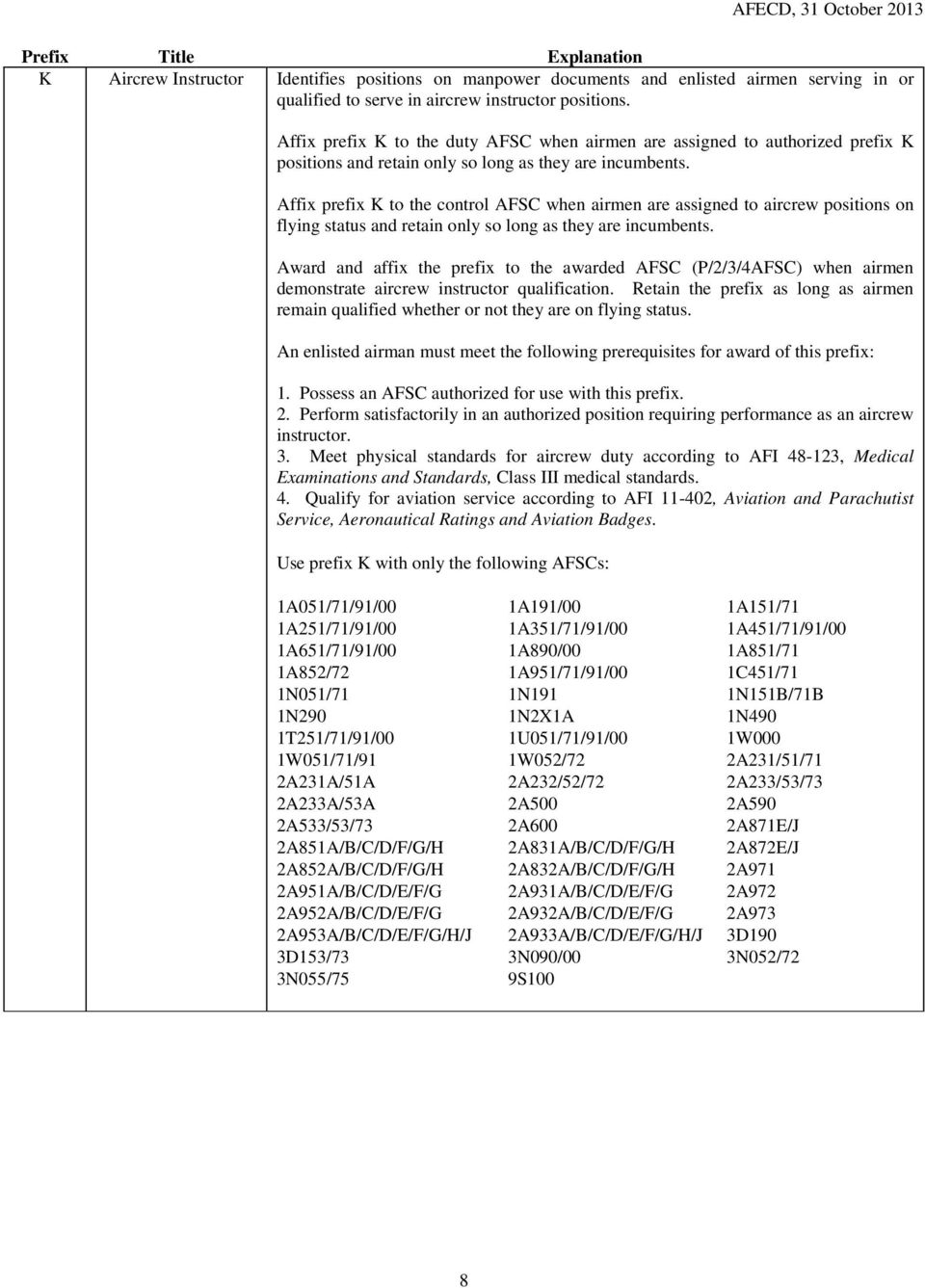
12 Prefix Title Explanation K Aircrew Instructor Identifies positions on manpower documents and enlisted airmen serving in or qualified to serve in aircrew instructor positions. Affix prefix K to the duty AFSC when airmen are assigned to authorized prefix K positions and retain only so long as they are incumbents. Affix prefix K to the control AFSC when airmen are assigned to aircrew positions on flying status and retain only so long as they are incumbents. Award and affix the prefix to the awarded AFSC (P/2/3/4AFSC) when airmen demonstrate aircrew instructor qualification. Retain the prefix as long as airmen remain qualified whether or not they are on flying status. An enlisted airman must meet the following prerequisites for award of this prefix: 1. Possess an AFSC authorized for use with this prefix. 2. Perform satisfactorily in an authorized position requiring performance as an aircrew instructor. 3. Meet physical standards for aircrew duty according to AFI , Medical Examinations and Standards, Class III medical standards. 4. Qualify for aviation service according to AFI , Aviation and Parachutist Service, Aeronautical Ratings and Aviation Badges. Use prefix K with only the following AFSCs: 1A051/71/91/00 1A191/00 1A151/71 1A251/71/91/00 1A351/71/91/00 1A451/71/91/00 1A651/71/91/00 1A890/00 1A851/71 1A852/72 1A951/71/91/00 1C451/71 1N051/71 1N191 1N151B/71B 1N290 1N2X1A 1N490 1T251/71/91/00 1U051/71/91/00 1W000 1W051/71/91 1W052/72 2A231/51/71 2A231A/51A 2A232/52/72 2A233/53/73 2A233A/53A 2A500 2A590 2A533/53/73 2A600 2A871E/J 2A851A/B/C/D/F/G/H 2A831A/B/C/D/F/G/H 2A872E/J 2A852A/B/C/D/F/G/H 2A832A/B/C/D/F/G/H 2A971 2A951A/B/C/D/E/F/G 2A931A/B/C/D/E/F/G 2A972 2A952A/B/C/D/E/F/G 2A932A/B/C/D/E/F/G 2A973 2A953A/B/C/D/E/F/G/H/J 2A933A/B/C/D/E/F/G/H/J 3D190 3D153/73 3N090/00 3N052/72 3N055/75 9S100 8
13 Prefix Title Explanation N Network Systems Identifies positions on manpower documents and enlisted personnel serving in or Administration qualified to serve in network systems administration positions. Affix prefix N to duty and control AFSCs when enlisted personnel are assigned to authorized prefix N positions and retained only so long as they are incumbents. Award and affix the prefix to the awarded AFSC (P/2/3/4AFSC) when enlisted personnel demonstrate qualification. An enlisted person must meet the following prerequisites for award of this prefix: 1. 7-skill level and below. 2. Currently serving as system administrator for a client-server networked system. 3. Six months systems administration experience and completion of technical training in systems administration; or, eighteen consecutive months of experience performing primarily as systems administrator. (NOTE: Systems administration technical training can be through AFSC-specific technical school, supplemental course, or through contract provided training.) 4. Supervisor s recommendation and commander s certification. NOTE: This prefix is authorized for use on manpower documents with any RI, SDI, or AFSC (5- and 7-skill levels only). 9

14 Prefix Title Explanation Q Aircrew Standardization/ Flight Examiner Identifies positions on manpower documents and enlisted airmen serving in or qualified to serve in aircrew standardization/flight examiner position. Affix prefix Q to the duty AFSC when enlisted airmen are assigned to authorized prefix Q positions and retain only so long as they are incumbents. Affix prefix Q to the control AFSC when enlisted airmen are assigned to aircrew positions on flying status and retain only so long as they are incumbents. Award and affix the prefix to awarded AFSC (P/2/3/4AFSC) when enlisted airmen demonstrate aircrew standardization/flight examiner qualification. Retain the prefix as long as enlisted airmen remain qualified whether or not they are on flying status. An enlisted airman must meet the following prerequisites for award of this prefix: 1. Possess an AFSC authorized for use with the prefix. 2. Perform satisfactorily in an authorized position requiring performance as an aircrew standardization/flight examiner. 3. Meet physical standards for aircrew duty according to AFI , Medical Examinations and Standards, Class III medical standards. 4. Qualify for aviation service according to AFI , Aviation and Parachutist Service, Aeronautical Ratings and Aviation Badges. Use prefix Q with only the following AFSCs: 1A051/71/91/00 1A151/71/91/00 1A251/71/91/00 1A351/71/91/00 1A451/71/91/00 1A651/71/91/00 1A890/00 1A851/71 1A852/72 1A951/71/91/00 1C451/71 1N051/71 1N191 1N151B/71B 1N290 1N2X1A 1N490 1T251/71/91/00 1U051/71/91/00 1W000 1W051/71/91 1W052/72 2A251/71 2A251A 2A252/72 2A253/73 2A253A 2A500 2A590 2A553/73 2A871E/J 2A851A/B/C/D/F/G/H 2A872E/J 2A852A/B/C/D/F/G/H 2A971 2A951A/B/C/D/E/F/G 2A972 2A952A/B/C/D/E/F/G 2A973 2A953A/B/C/D/E/F/G/H/J 3N090/00 3N052/72 3N055/75 9S100 10

15 Prefix Title Explanation R Contingency/War Planner Identifies positions on manpower documents and enlisted airmen serving in or qualified to serve in positions requiring functional area expertise, and experience and training in contingency or war planning functions. Prefix R is affixed to duty and control AFSCs when enlisted airmen are assigned to authorized prefix R positions, and retained only so long as they are incumbents. It is awarded and affixed to the awarded AFSC (P/2/3/4 AFSC) when enlisted airmen demonstrate contingency or war planner qualifications. It is retained until changed or revoked by the AFSC career field manager with the concurrence of HQ USAF/A5XW. An enlisted airman must satisfy one of the following sets of criteria for award of this prefix: Successful completion of one or more of the following courses and have 6 months of experience in a prefix R position: 1. MCADRE002 - Contingency/Wartime Planning Course, PDS Code 82U; 2. MCADRE003 - Joint Doctrine Air Campaign Course, PDS Code W1B; 3. E6AZU Worldwide Military Command and Control System Intercomputer Network (H6000-CDT), PDS Code 11J; Joint Operation Planning and Execution System User Course (Basic), PDS Code W5J; 5. J5OZO Joint Medical Planners Course (JMPC) - PDS Code XH6; 6. AMC TPC Tanker Planning Course - PDS Code TPI; 7. Deliberate and Crisis Action Planning and Execution Segments End User Course (Basic); 8. L6AZW2T251 00AA, Transportation Combat Readiness and Resources Distance Learning (Web-Based) Course-PDS Code INV. or 12 months of experience in a prefix R position. NOTE: Changes to this prefix must be approved by HQ USAF/A5XW. 11

16 Prefix Title Explanation T Formal Training Instructor Identifies positions on manpower documents and enlisted airmen serving in, qualified to serve in, or receiving formal instructor training to qualify to serve in formal training instructor positions. Affix prefix T to the duty AFSC when enlisted airmen are assigned to authorized prefix T positions and retained only so long as they are incumbents. Affix prefix T to the control AFSC when enlisted airmen are assigned to these positions, selected for entry into a formal training instructor course leading to such assignment, or selected for instructor duty according to AFI , Assignments and Education and Training Course Announcements (ETCA). Withdraw the prefix from the control AFSC of enlisted airmen who fail to complete training. Retain the prefix only so long as enlisted airmen are incumbents of prefix T positions. Award and affix the prefix to awarded AFSC (P/2/3/4AFSC) in which duty is being performed when enlisted airmen demonstrate formal training instructor qualifications. Retain the prefix as long as enlisted airmen remain qualified. Withdrawal authority for this prefix is major command or higher. For AFSCs 1AXXX, use prefix T to differentiate schoolhouse flying training instructors and requirements from operational unit instructors and requirements identified with prefix K. An airman must meet the following prerequisites for award of this prefix: 1. Possess an AFSC and skill level commensurate with control and duty position assigned. 2. Successful completion of a formal instructor training course. U Information Operations (Created 31 Oct 99) Prefix U identifies positions on manpower documents and enlisted airmen serving in, qualified to serve in, or receiving formal training to qualify to serve in positions requiring Information Operations (IO) expertise and knowledge of: 1. The planning and employment of Military Deception (MILDEC), Psychological Operations (PSYOP), Operational Security (OPSEC), Network Warfare Operations (NW Ops), or Electronic Warfare Operations (EW Ops). 2. Integrating and coordinating these disciplines at the Unified Commands, Headquarters USAF (HAF), Major Commands (MAJCOM), Centers, Agencies, such as National Security Agency or other national agencies, Numbered Air Force (NAF), Combat Numbered Air Forces (C-NAF), Air Operation Centers (AOC), or Information Operations Team (IOT) level positions. 3. They are familiar with IO doctrine, structure, and procedures, including threats, legal issues, ISR assets, and capabilities, as well as national, DoD, and Service organizations and functions. 4. Integrated Control Enablers must understand intelligence, surveillance, and reconnaissance (ISR), precision navigation and positioning, weather, other information dissemination activities, and conducting information operations (offensive and defensive). NOTE: Use of this prefix on manpower documents is restricted solely to authorizations in Unified Commands, HAF, MAJCOM, Center, NAF, C-NAF, AOC, and IOT positions. 12

17 Prefix Title Explanation U Information Operations (Continued) Enlisted personnel performing these duties are involved in processes and functions to gain, exploit, defend, and attack information and information systems. They also manage the distribution of products and services to Air Force Forces (AFFOR) and Joint Forces Air Component Commanders (JFACC). Affix prefix U to the duty and control AFSCs when enlisted airmen are assigned to authorized prefix U positions and retain only so long as they are incumbents. Additionally, affix prefix U to the control AFSC when enlisted airmen enter a formal training course leading to an IO assignment. If an airman fails to complete training, then withdraw the prefix from the control AFSC. Award and affix the prefix to the awarded AFSC (P/2/3/4 AFSC) when enlisted airmen demonstrate Information Operations qualification. Retain the prefix as long as enlisted airmen remain qualified. An enlisted airman must possess the following prerequisites for award of this prefix: 1. Possess an AFSC authorized for use with the prefix. and 2. Successful completion of the IO Integration Course (IOIC) (PDS code FIX) or 3. Prior to 31 Dec 00, with a commander s recommendation, either; (1) 18 months of accumulated IO related experience, or (2) 11 months of in-theater Information Warfare (IW) related experience in positions requiring integration of multiple IO-related tasks to achieve information superiority. NOTE: Paragraph 3 applies to Air Force Computer Emergency Response Team (AFCERT) personnel, former 609 IW Squadron (IWS) personnel, former members of an IW Support Team, former members of the Joint IO Center (JIOC), some members of the AF IW Center, and anyone previously assigned to a position requiring integration of multiple IO-related tasks to achieve a state of information superiority. Use Prefix U with only the following AFSCs: 1A8XX 1B4X1 1NXXX/X 1U051/71/91/00 3DXXX 3N0XX 3N1XX 8D000 9S100 13

18 Prefix Title Explanation V Automated Functional Applications Analyst/Monitor Identifies positions on manpower documents and enlisted personnel serving in, qualified to serve in, or receiving formal training to qualify to serve in positions requiring functional area expertise with the ability to design, analyze, supervise, or monitor the computer applications of automated Air Force functions. Automated functional applications analysts functionally analyze requirements, define objectives, and determine how they can be met more effectively by automated methods; assist in developing complete plans; and conduct general and detailed flow charts and block diagrams to graphically show systems logic and processing flow from initial input to final output. Affix prefix V to duty and control AFSCs when enlisted personnel are assigned to authorized prefix V positions. Retain the prefix only so long as they are incumbents. Award and affix the prefix to awarded AFSC (P/2/3/4AFSC) when enlisted personnel demonstrate automated systems analyst/monitor qualification. Retain the prefix as long as enlisted personnel remain qualified. Withdrawal authority for this prefix is major command or higher. An enlisted person must meet the following prerequisites for the award of this prefix: 1. Possess an AFSC authorized for use with this prefix. 2. Have a minimum of 24 months of experience in an authorized prefix V position. 3. Have a minimum of 24 months of experience in designing, analyzing, supervising, or monitoring functional area automated systems while serving in an AFSC authorized in the particular function. Experience must include performing system feasibility or application studies for that automated system. Full qualification in Prefix G, Automated Systems Programming Craftsman, may satisfy 12 months of experience necessary for award of prefix V. Capability to perform as a system analyst associated with the automated function is certified by the unit commander or supervisor of the automated system. 4. Completion of a formal systems analyst course is desirable. Use Prefix V with only the following AFSCs: 1C052/72/92/00 1C3X1/00 1C551/71/91/00 1C531/51/71D 1C651/71/91/00 1N051/71/00 1N191 1N151A/71A 1N151B/71B 1N490 1W000 1W052/72 1W051/71/91 2A000 2A071K/M/P 2A051K/M/P 2A090 2A390/00 2A373 2A353E/L/M 2A377 2A357A/B 2A378 2A358A/B 2A590 2A500 2A571 2A551A/B/C/D 2A572 2A552B/D 2A574 2A554A/B/C/D/E/F 3D100 3D190 3D151/71 3D152/72 3D153/73 3D154/74 3D155/75 3D156/76 3D157/77 3E000 3E631/51/71/91 3M051/71/91/00 3N090/00 3N052/72 3N055/75 3S000 3S0X1 3S3X3 4A051/71/91/00 4A171/91/00 4B071/91/00 4P071/91/00 4T090/00 4T071 4V091/91S 4Y090/00 4Y071 6F051/71/91/00 7S000 7S0X1 14

19 Prefix Title Explanation X Aircrew Identifies positions on manpower documents and airmen serving in or qualified to serve in aircraft crew positions. Affix prefix X to the duty AFSC when airmen are assigned to aircrew positions on flying status and retained only so long as they are incumbents. Affix prefix X to the control AFSC when airmen are assigned to aircrew positions on flying status and retained only so long as they are incumbents. Award and affix the prefix to the awarded AFSC (P/2/3/4AFSC) when airmen demonstrate aircrew qualification. Retain the prefix as long as airmen remain qualified, whether or not they are on flying status. An enlisted airman must meet the following prerequisites for award of this prefix: 1. Possess an AFSC authorized for use with this prefix. 2. Perform satisfactorily in an authorized aircrew position requiring participation in frequent and regular aerial flights, or be a graduate of a formal training course leading to qualification in aircrew duties. 3. Meet physical standards for aircrew duty according to AFI , Medical Examinations and Standards, Class III medical standards. 4. Qualify for aviation service according to AFI , Aviation and Parachutist Service, Aeronautical Ratings and Aviation Badges. Use prefix X with only the following AFSCs: 1C351/71/91/00 1C451/71 1N031/51/71/00 1N191 1N151A/71A 1N151B/71B 1N290 1N2X1A 1N2X1C 1N490 1N4X1A/B 1T2X1/00 1W000 1W0X1 1W0X2 2A0X1K/M/P 2A090 2A231/51/71 2A231A/51A 2A232/52/72 2A233/53/73 2A233A/53A 2A374 2A590 2A571 2A551A/B/C/D 2A533/53/73 2A574 2A554A/B/C 2A600 2A690/92 2A6X6 2A871E/J 2A851A/B/C/D/F/G/H 2A831A/B/C/D/F/G/H 2A872E/J 2A852A/B/C/D/F/G/H 2A832A/B/C/D/F/G/H 2A971 2A951A/B/C/D/E/F/G 2A931A/B/C/D/E/F/G 2A972 2A952A/B/C/D/E/F/G 2A932A/B/C/D/E/F/G 2A973 2A953A/B/C/D/E/F/G/H/J 2A933A/B/C/D/E/F/G/H/J 3DXXX 3N000 3N090 3N052/72 3N055/75 3S071/91 4N091/00 4N031/51/71 4N031C/51C/71C 8E000 9L000 9S100 15

20 SECTION II AFSCs/ IDENTIFIERS 16

21 AIRCREW OPERATIONS CAREER FIELD (1A) Introduction The Aircrew Operations Career Field encompasses the functions of program formulating, policy planning, inspecting, training and directing, and performing combat and operations pertinent to enlisted primary aircrew activities. Included are supervising and performing primary aircrew duties pertinent to in-flight refueling systems; performing aircraft flight engineer activities; loading, restraining, and off-loading cargo on military aircraft; airdropping cargo and personnel; performing airborne communications systems operations activities; and performing aircrew duties associated with operating airborne command and control systems equipment. These duties include resolving airborne systems equipment technical problems that involve computer systems, radar and radio systems, and surveillance systems operations activities. 17
22 CEM Code 1A000 AFSC 1A091, Superintendent AFSC 1A071, Craftsman AFSC 1A051, Journeyman AFSC 1A031, Apprentice AFSC 1A011, Helper IN-FLIGHT REFUELING (Changed 31 Oct 13, Effective 7 Jan 13) 1. Specialty Summary. Performs in-flight refueling aircrew functions and activities according to flight manuals, checklists, and Unites States Air Force publications. Related DoD Occupational Subgroup: Duties and Responsibilities: 2.1. Performs in-flight refueling aircrew duties. Checks forms for equipment status. Performs visual and operational check of air refueling and associated systems and equipment. Performs preflight, through-flight, and post-flight inspections. Accomplishes preflight and post-flight records and reports. Performs in-flight operational check of air refueling systems. Directs receiver aircraft into air refueling position. Operates in-flight air refueling controls and switches to safely affect contact between tanker and receiver aircraft. Monitors control panel for proper operation of equipment during air refueling, and advises receiver pilot of actions required to safely maintain position within the air-refueling envelope. Keeps tanker pilot informed as to progress of air refueling operations. Performs emergency operations and procedures as required for emergency off-load and on-load of fuel. Computes and completes aircraft weight and balance documentation. Visually monitors aircraft clearances (interior and exterior), identifies proximal threats to the aircraft and initiates corrective actions (aircraft scanning) Receives cargo/passenger load briefing and reviews load plan and cargo documentation. Accomplishes load planning of cargo/passenger loads if required. Supervises cargo/passenger loading and off-loading operations. Directs the placement of material handling equipment to accomplish cargo on/off loading operations. Ensures cargo/passengers are placed according to load plans. Determines cargo restraint requirements according to criteria and directs and checks the application of cargo restraint equipment. Checks cargo/passenger loads against manifests Ensures availability of fleet service equipment and receives and stows in-flight meals. Accomplishes passenger briefings to include the use of emergency equipment, evacuation procedures, and border clearance requirements. Demonstrates the use of passenger emergency oxygen systems and life vests. Supervises passengers in-flight. Performs jumpmaster duties (KC-135 only). 3. Specialty Qualifications: 3.1. Knowledge. Knowledge is mandatory of: electrical and mechanical principles applying to aircraft and related systems; flight theory; aircraft electrical, hydraulic, and pneumatic systems applying to in-flight refueling system; navigation fundamentals, including chart reading; normal and emergency operation of aircraft refueling systems; flying directives; weight and balance factors; cargo tie-down techniques; minor in-flight maintenance; using survival equipment and oxygen; communication and aircraft emergency procedures; border agency clearance; dispensing and preserving food aboard aircraft; and using and interpreting diagrams, loading charts, technical publications, and flight manuals Education. For entry into this specialty, completion of high school with courses in physics and mathematics is desirable Training. For award of AFSC 1A031, completion of the basic boom operator course is mandatory Experience. The following are mandatory for award of the AFSC indicated: A051. Qualification in and possession of AFSC 1A031. Also, experience performing functions such as: inspecting, operating, and troubleshooting in-flight refueling systems; preparing or verifying load plans; loading and unloading aircraft; and instructing passengers in the use of emergency equipment and procedures A071. Qualification in and possession of AFSC 1A051. Also, experience performing or supervising functions such as: inspecting, operating, and troubleshooting in-flight refueling systems; preparing or verifying load plans; loading and unloading cargo on aircraft; and instructing passengers in the use of emergency equipment and procedures A091. Qualification in and possession of AFSC 1A071. Also, experience in directing functions pertaining to inflight refueling operator activities. 18
23 3.5. Other. The following qualifications are mandatory as indicated: See attachment 4 for additional entry requirements For entry, award, and retention of these AFSCs: Physical qualification for in-flight refueling operation duty according to AFI , Medical Examinations and Standards, Class III medical standards Normal depth perception as defined in AFI Qualification for aviation service according to AFI , Aviation and Parachutist Service, Aeronautical Ratings and Aviation Badges Must maintain eligibility to deploy and mobilize worldwide Height must not be less than 64 inches or more than 77 inches as defined in AFI For award and retention of these AFSCs, must maintain an Air Force Network License according to AFI , Vol 2, Licensing Network Users and Certifying Network Professionals Specialty requires routine access to Top Secret material or similar environment. For award and retention of AFSCs 1A0XX, completion of a current Single Scope Background Investigation (SSBI) according to AFI , Personnel Security Program Management. NOTE: Award of the 3-skill level without a completed SSBI is authorized provided an interim Top Secret security clearance has been granted according to AFI
24 CEM Code 1A100 AFSC 1A191, Superintendent AFSC 1A171, Craftsman AFSC 1A151, Journeyman AFSC 1A131, Apprentice AFSC 1A111, Helper FLIGHT ENGINEER (Changed 31 Oct 13, Effective 7 Jan 13) 1. Specialty Summary. Performs aircraft visual inspections and in-flight duties. Operates and monitors engine and aircraft systems controls, panels, indicators and devices. Manages flight engineer functions and activities. Related DoD Occupational Subgroup: Duties and Responsibilities: 2.1. Performs aircraft inspections. Performs aircrew visual inspection; non-scheduled aircraft maintenance; and preflight, through-flight, and post flight inspections of aircraft away from home station. Maintains aircraft forms and records during flight and while aircraft is away from home station Computes and applies aircraft weight, balance, and performance data. Determines and verifies passenger, cargo, fuel, and emergency and special equipment distribution and weight. Computes aircraft weight and balance to ensure specified limits are maintained. Computes takeoff, climb, cruise, and landing data. Determines engine fuel consumption using airspeed, atmospheric data, charts, computer, or electronic calculator. Records actual aircraft performance data in flight engineer's log Operates and monitors engine and aircraft systems controls and indicators. Assists pilot or performs engine starts, and monitors run-up, flight operations, and engine shutdown. Operates engine controls to provide desired efficiency and economy. Monitors engine instruments throughout period of operation. Controls, monitors, and regulates aircraft systems such as electric, communication, navigation, hydraulic, pneudraulic, fuel, air conditioning, and pressurization; ventilation; auxiliary power unit; and lubrication systems. Observes warning indicators and light for fire, overheat, depressurization, and system failure. Reports abnormal conditions to pilot, and recommends corrective action. Visually monitors aircraft clearances (interior and exterior), identifies proximal threats to the aircraft and initiates corrective actions (aircraft scanning) Plans and organizes flight engineer activities. Organizes flight engineering standardization, qualification, and other requirements of flight engineer logs, reports, and records for accuracy, completeness, format, and compliance with current directives. Coordinates with other agencies and organizations to conduct flight engineer activities Directs flight engineer activities. Administers qualification flight to personnel engaged in flight engineer activities within flight test and operations organizations. Directs standardization of flight engineer performance in conjunction with aircraft performance engineering, engine conditioning, and preventive maintenance programs. Ensures conformance with prescribed aircrew procedures Inspects and evaluates flight engineer activities. Evaluates individual and group performance in terms of effectiveness and qualification in using equipment and materials. Interprets and discusses evaluation findings, and recommends action to correct deficiencies Performs technical flight engineer functions. Resolves technical problems encountered by operating units. Renders advice and technical assistance to agencies engaged in functions associated with flight engineer activities. Advises organizational commander or staff agencies on status of flight engineer activities and adequacy of equipment. Maintains qualification in aircraft. 3. Specialty Qualifications: 3.1. Knowledge. Knowledge is mandatory of: electrical, communication, navigation, mechanical, hydraulic, and pneumatic systems applying to aircraft and related systems; flight theory; minor in-flight maintenance; personal equipment and oxygen use; aircraft emergency procedures; and using and interpreting diagrams, schematics, aircraft performance charts, loading charts, technical publications and flight manuals Education. For entry into this specialty, completion of high school with course in mechanics, mathematics, physics, computer principles, typing, speech, and English is desirable Training. Completion of the following training is mandatory for award of the AFSC indicated: A131. Completion of the basic flight engineer course A151. Completion of an appropriate flying training course. 20
25 3.4. Experience. The following experience is mandatory for award of the AFSC indicated: A151. Qualification in and possession of AFSC 1A131. Also, experience is mandatory in functions such as aircraft and performance weight and balance computations, aircraft records maintenance, and aircraft systems maintenance and inspections A171 Qualification in and possession of AFSC 1A151. Also, experience is mandatory in performing or supervising functions such as flight engineer activities A191. Qualification in and possession of AFSC 1A171. Also, experience managing flight engineer functions and activities Other. The following are mandatory as indicated: For entry into this specialty: See attachment 4 for additional entry requirements Prior qualification at the 5- or 7-skill level in the 1A0, 1A2, 1A3, 1A9, 2AXXX, 2M0, 2T3, or 3E0 career field ladder, or possession of a valid Federal Aviation Administration (FAA) Flight Engineer certificate, or valid FAA aircraft and power plant license or Aircraft Maintenance Technician license For entry, award, and retention of these AFSCs: Physical qualification for aircrew duty according to AFI , Medical Examinations and Standards, Class III medical standards Normal depth perception as defined in AFI Qualification for aviation service according to AFI , Aviation and Parachutist Service, Aeronautical Ratings and Aviation Badges Must maintain eligibility to deploy and mobilize worldwide Height must not be less than 64 inches or more than 77 inches as defined in AFI For award and retention of these AFSCs, must maintain an Air Force Network License according to AFI , Vol 2, Licensing Network Users and Certifying Network Professionals Specialty requires routine access to Secret material or similar environment. For award and retention of AFSCs 1A131/51/71/91/00, a current National Agency Check, Local Agency Checks and Credit (NACLC) according to AFI , Personnel Security Program Management. NOTE: Award of the 3-skill level without a completed NACLC is authorized provided an interim Secret security clearance has been granted according to AFI
26 CEM Code 1A200 AFSC 1A291, Superintendent AFSC 1A271, Craftsman AFSC 1A251, Journeyman AFSC 1A231, Apprentice AFSC 1A211, Helper AIRCRAFT LOADMASTER (Changed 31 Oct 13, Effective 7 Jan 13) 1. Specialty Summary. Accomplishes preflight and post-flight of aircraft and aircraft systems. Receives cargo/passenger load briefings, checks placement of cargo/passengers against aircraft limitations/restrictions, determines adequacy of cargo documentation. If required, load plans cargo/passenger loads. Supervises cargo/passenger loading and offloading activities. Determines cargo placement and restraint requirements and directs and checks the placement of restraint equipment. Computes aircraft weight and balance. Demonstrates use of life support equipment. Accomplishes passenger comfort activities during flight. Performs aircrew functions and other mission specific qualification duties to include the airdrop of personnel and equipment/cargo. Related DoD Occupational Subgroup: Duties and Responsibilities: 2.1. Receives cargo/passenger load briefing and reviews load plan and cargo documentation. Accomplishes load planning of cargo/passenger loads if required. Reviews aircraft forms for condition of aircraft. Accomplishes preflight inspection of aerospace ground equipment and applies external power to the aircraft. Operates aircraft radio systems. Accomplishes preflight inspection of the aircraft and cargo/airdrop systems according to flight manual procedures Supervises cargo/passenger loading and off-loading operations. Directs the placement of material handling equipment to accomplish cargo on/off loading operations. Operates the aircraft winch to on/offload cargo. Ensures cargo/passengers are placed according to load plans. Determines cargo restrains requirements according to criteria and directs and checks the application of cargo restraint equipment. Checks cargo/passenger loads against manifests Ensures availability of fleet service equipment and passenger comfort items. Receives and signs receipts for and stows in-flight meals. Accomplishes passenger briefings to include the use of emergency equipment, evacuation procedures, and border clearance requirements. Demonstrates the use of passenger emergency oxygen systems and life vests. Computes and completes aircraft weight and balance documentation either manually or electronically. Visually monitors aircraft clearances (interior and exterior), identifies proximal threats to the aircraft and initiates corrective actions (aircraft scanning) Accomplishes in-flight checks according to flight manual procedures. Monitors cargo and provides for passenger comfort. Prepares and dispenses passenger meals, snacks and refreshments. Completes required aircraft forms documentation and border clearance requirements Airdrop qualified Loadmasters only: Conducts cargo and personnel airdrops according to directives. Attaches extraction parachutes to cargo and platforms. Inspects cargo and platforms, extraction systems and connects static lines. Checks tiedowns, parachutes, containers, suspension systems, and extraction systems to ensure proper cargo extraction or release. Operates aircraft airdrop systems and supervises cargo and paratroopers exiting the aircraft. 3. Specialty Qualifications: 3.1. Knowledge. Knowledge is mandatory of: Types, capacities, and configuration of transport aircraft; arithmetic; emergency equipment and in-flight emergency procedures; personal equipment and oxygen use; communications; current flying directives; interpreting diagrams, loading charts, and technical publications; border agency clearance dispensing and preserving food aboard aircraft; and cargo restraint techniques Education. For entry into this specialty, completion of a high school education with courses in mathematics, computer principles, typing, speech and English is desirable Training. The following training is mandatory for award of the AFSC indicated: Completion of the Aircrew Fundamentals Course is mandatory for pipeline and non-aviation service cross training students and completion of the Aircraft Loadmaster course is mandatory for award of AFSC 1A Experience. The following experience is mandatory for award of the AFSC indicated: A251. Qualification in and possession of AFSC 1A231. Also, knowledge of types, capacities, and configuration of transport aircraft; weight and balance factors, arithmetic; cargo restraint techniques; emergency equipment and in-flight emergency procedures; using personal equipment and oxygen, communications; current flying directives; interpreting diagrams, loading charts, and applicable technical publications; border agency clearance requirements and forms; principles of dispensing and preserving food aboard aircraft; operation of cargo loading equipment; and cargo and personnel airdrop techniques and equipment A271. Qualification in and possession of AFSC 1A251. Also, experience in types, capacities, and configuration of transport aircraft; airdrop techniques; weight and balance factors; arithmetic, emergency equipment and in-flight emergency 22
27 procedures; personal equipment and oxygen use; communications; current flying directives; interpreting diagrams, loading charts, and applicable technical publications; border agency clearance requirements and forms; principles of dispensing and preserving food aboard aircraft; and cargo restraint techniques A291. Qualification in and possession of AFSC 1A271. Also experience in directing functions such as loading military cargo aircraft and establishing procedures for maintaining related records Other: The following are mandatory as indicated: For entry into this specialty, see attachment 4 for entry requirements For entry, award, and retention of these AFSCs: Physical qualification for aircrew duty according to AFI , Medical Examinations and Standards, Class III medical standards Normal depth perception as defined in AFI Qualification for aviation service according to AFI , Aviation And Parachutist Service, Aeronautical Ratings and Aviation Badges Must maintain eligibility to deploy and mobilize worldwide Height must not be less than 64 inches or more than 77 inches as defined in AFI For award and retention of these AFSCs, must maintain an Air Force Network License according to AFI , Vol 2, Licensing Network Users and Certifying Network Professionals Specialty requires routine access to Secret material or similar environment. For award and retention of AFSCs 1A2XX, completion of a current National Agency Check, Local Agency Checks and Credit (NACLC) according to AFI , Personnel Security Program Management. NOTE: Award of the 3-skill level without a completed NACLC is authorized provided an interim Secret security clearance has been granted according to AFI
28 CEM Code 1A300 AFSC 1A391, Superintendent AFSC 1A371, Craftsman AFSC 1A351, Journeyman AFSC 1A331, Apprentice AFSC 1A311, Helper AIRBORNE MISSION SYSTEMS (Changed 31 Oct 13, Effective 7 Jan 13) 1. Specialty Summary. Performs aircrew duties on numerous airborne platforms. Operates, maintains, repairs, and tests airborne communications, sensor, computer, and electronic systems. Performs preflight, in-flight, and postflight duties. Supervises and instructs personnel in operation, maintenance, repair, and test procedures. Establishes, manages and supervises airborne mission system operation and directs aircrew training. Related DoD Occupational Subgroup: Duties and Responsibilities: 2.1. Inspects and operates airborne communications, sensors, computers, and electronic systems. Plans, organizes, and coordinates mission activities and materials. Determines aircraft status and coordinates link establishment and network connectivity information. Performs preflight, in-flight, and postflight inspections. Performs initial power-on and testing of airborne communications, sensors, computers, and electronic systems. Establishes and maintains voice and data communications circuits/links. Repairs and maintains airborne communications, sensors, computers, and electronic systems. Operates aircraft emergency systems and equipment Performs and supervises airborne equipment operations and maintenance. Initializes, operates, monitors, tests, troubleshoots, isolates malfunctions, and repairs radio, audio distribution, switching, data, cryptologic, anti-jam, satellite communications, radar, identification friend or foe, recording and playback, multiplex, electronic warfare (EW), intercept, analysis, recording, broadcasting, imaging, computer, and network equipment (including ancillary equipment). Monitors displays and indicators for equipment status using technical orders and manuals, test equipment, software diagnostics, voltage checks, resistance measurements, waveform observations, or other tests. Installs, operates, and monitors special support systems. Performs aircraft exterior scanner duties. Monitors aircraft engine, propeller, hydraulic, pneumatic and flight controls systems during engine start. Adheres to communication security (COMSEC) procedures 2.3. Establishes, supervises, and directs aircrew training. Develops and directs instruction in equipment operation and troubleshooting. Ensures standardized procedures are used to teach in-flight equipment operation, maintenance, and repair. Determines need for specific instruction, and establishes training programs on airborne systems Evaluates airborne mission systems operation and maintenance activities. Evaluates compliance with technical manuals, regulations, and work standards. Serves on or directs airborne mission systems inspection teams to evaluate in-flight maintenance and operational programs. Interprets inspection reports and prescribes corrective actions Manages operating and maintenance functions. Maintains operational inspection and maintenance records and documents. Reviews unusual and difficult problems in operation and in-flight maintenance of equipment. Recommends methods, techniques, and procedures to enhance maintenance and operational capabilities, and improve mission system options. Advises on mission systems operation and maintenance, and coordinates on research and development projects. 3. Specialty Qualifications: 3.1. Knowledge. Knowledge is mandatory of: electronics, computer, radio, and radar theory including solid-state components, electronic principles, networking, digital techniques, basic software structure, principles of radio frequency (RF) as applied to basic radar, voice and data communication systems, digital data processing; general purpose computers and interface units; interpreting technical orders, schematics, and wiring diagrams, logic diagrams worldwide communications, direction-finding, multiplex, data and voice procedures capabilities, limitations, operations, and functions of electronic test equipment; binary, octal, and hexadecimal numbering systems, mission systems forms and reports software diagnostic routines; and maintaining airborne weapons systems and ancillary systems 3.2. Education. For entry into this specialty, completion of high school with courses in physics, mathematics, and computer principles, mathematics, typing, speech and English is desirable Training. The following training is mandatory for the award of the AFSC indicated: Completion of the Aircrew Fundamentals Course (L3AQR1A311 01AB) is mandatory for pipeline and non-aviation service cross training students. Completion of the Airborne Mission Systems (L3ABR1A331) is mandatory for award of the 3-skill level AFSC Experience. The following experience is mandatory for award of the AFSC indicated: A351. Qualification in and possession of AFSC 1A331. Also, experience in operating and maintaining airborne communications, test, sensor, computer, and electronic systems A371. Qualification in and possession of AFSC 1A351. Also, experience and qualification in advance operations and maintenance of aircraft mission systems. 24
29 A391. Qualification in and possession of AFSC 1A371. Also, experience managing advanced operations and maintenance of aircraft mission systems Other. The following are mandatory as indicated: For entry into this specialty, see attachment 4 for entry requirements For entry, award, and retention of these AFSCs: Qualification for aviation service according to AFI , Aviation and Parachutist Service, Aeronautical Ratings and Aviation Badges Normal depth perception as defined in AFI , Medical Examinations and Standards Physical qualification for aircrew duty according to AFI , Medical Examinations and Standards, Class III medical standards Must maintain eligibility to deploy and mobilize worldwide Height must not be less than 64 inches or more than 77 inches as defined in AFI For entry, award, and retention of AFSCs 1A311/31/51/71, physical qualification for voice communications operations For award and retention of these AFSCs, must maintain an Air Force Network License according to AFI , Vol 2, Licensing Network Users and Certifying Network Professionals For award and retention of AFSCs 1A331/51/71/91/00, eligibility for a Top Secret (TS) security clearance according to AFI , Personnel Security Program Management. NOTE: Award of the 3-skill level without a final Top Secret (TS) clearance is authorized provided an interim TS security clearance has been granted according to AFI
30 CEM Code 1A400 AFSC 1A491, Superintendent AFSC 1A471, Craftsman AFSC 1A451, Journeyman AFSC 1A431, Apprentice AFSC 1A411, Helper AIRBORNE OPERATIONS (Changed 31 Oct 13, Effective 7 Jan 13) 1. Specialty Summary. Operates airborne operations mission equipment, systems, electro-optical sensor systems, and electronic protection (EP) equipment. Gathers, records, displays, and distributes mission information. Interprets computergenerated displays and alarms. Performs and assists in mission planning. Maintains publications and currency items. Maintains communications nets with ground, air, and maritime units. Performs airborne operations functions under training and operational conditions. Manages, supervises, trains, provides expertise, and evaluates activities. Performs staff functions. Promotes and instills situational awareness in all aspects of airborne operations. Related DoD Occupational Subgroup: Duties and Responsibilities: 2.1. Operates airborne operations mission equipment. Performs mission planning, preflight, in-flight, and post flight duties according to aircraft technical orders and applicable Air Force Instructions (AFIs). Identifies and maintains surveillance of air, ground, and maritime objects. Interprets computer-generated displays, data, and alarms, and takes appropriate switch actions. Compares track positions with flight data and database files to determine track identification Gathers, displays, records, and distributes operational mission information. Gathers mission data on ground, air, and maritime objects, and relays data to using agencies. Displays sensor, mission, identification, weather, and other data for battle managers. Updates mission data to tabular displays. Records and reports special interest tracks mission information, weather, emergency signals, and electronic attack (EA) observations. Reviews and reports equipment status and performance. Maintains logs, forms, and database files Performs electronic-protection (EP) functions. Uses EP techniques to degrade effectiveness of electronic warfare activities or other external interference. Recommends procedures and techniques to improve EP effectiveness. Configures equipment to eliminate or reduce the effects of EA. Maintains coordination with exterior agencies Maintains status of air and ground activity. Coordinates with and supports other airborne and ground platforms in distributing and relaying operational target and identification data. Monitors radio communications. Coordinates mission profile requirements with internal and external agencies Reacts to manual and computer-generated console situation and tabular displays to determine optimum airborne equipment settings. Evaluates aircrew academic, simulation, in-flight performances, and systems capabilities, and recommends improvements. Coordinates with airborne, ground, and maritime agencies in distributing and relaying operational threat and identification data. Receives, transmits, and relays encoded and decoded messages from ground command and control agencies. Determines data link requirements. Formats initialization data Supervises and performs Gunship Sensor Operator Duties. Conducts unconventional/conventional warfare and special operations missions to include close air support, interdiction, armed reconnaissance, combat search and rescue, and limited forward air control. Preflights, operates, limited in-flight trouble-shooting and repair, and post flights AC-130H/U gunship sensor detection systems. Monitors radio communications. Determines disposition and locations of hostile and/or friendly forces by studying available intelligence data. Positions the aircraft using sensor systems to detect, acquire, identify, and track enemy and/or friendly forces. Fires gunship weapon systems during combat missions to ensure desired level of target destruction. Performs real-time battle damage assessment and operates all mission video/audio recording equipment Instructs, evaluates, and supervises airborne operations system activities. Conducts training for airborne operations systems personnel. Develops and reviews instructional methods and procedures used in Initial Qualification Training (IQT), Upgrade Training (UGT), and Continuation Training (CT). Reviews training status and recommends remedial training. Evaluates aircrew academic, simulation, and in-flight performances. Reviews trend analysis of flight evaluations to identify training deficiencies. Supervises subordinates during the performance of their duties. Reviews training status and arranges additional, remedial, and continuation training. Conducts periodic inspections of aircrew operations and unit activities Performs staff functions. Performs staff duties at squadron level and above where aircrew command and control, and gunship sensor operator expertise is required Plans and organizes airborne command and control systems apprentice/journeyman/craftsman activities. Develops and improves methods of personnel utilization and aircrew operations economy. Advises commanders and staff officers of important changes and developments in the mission operations area. Identifies problems affecting the capability and 26
31 efficiency of unit operations. Facilitates planning, organizing, and executing operational and training missions. Revises personnel distribution within assigned mission functions. Determines mission requirements and recommends operational procedures to meet worldwide contingency and operational tasking. Reviews trend analysis of flight evaluations to identify training deficiencies. Identifies and corrects faulty operational techniques. 3. Specialty Qualifications: 3.1. Knowledge. Knowledge is mandatory of: active and passive airborne sensor systems fundamentals; electro-optical sensor theory; characteristics and limitation of airborne battle management, surveillance, mission systems and gunship operations; target detection, recognition, identification, and tracking capabilities; computer-generated console situation and tabular displays, electronic generated data, ATO, SPINS, and fire support annex; receiving, recording, and relaying operational threat data; identification procedures and techniques; EA and EP or ESM functions; data link requirements; communications systems; emergency procedures and equipment; maintaining publications; emergency action procedures; and command or theater battle management activities Education. For entry into this specialty, completion of high school or general educational development equivalency is mandatory Training. For award of AFSC 1A431, completion of the Airborne Battle Management Systems course is mandatory Experience. The following experience is mandatory for award of the AFSC indicated: A451. Qualification in and possession of AFSC 1A431. Experience in functions such as target detecting, tracking, reporting target information or receiving, displaying, recording, and relaying threat command, control, and intelligence data from airborne battle management system functions and activities A471. Qualification in and possession of AFSC 1A451. Also, experience performing or supervising, or airborne battle management system functions and activities A491. Qualification in and possession of AFSC 1A471. Experience in managing airborne battle management systems or gunship sensor systems activities Other. The following are mandatory as indicated: See attachment 4 for other entry requirements For entry, award, and retention of AFSCs 1A4X1: Physical qualification for aircrew duty according to AFI , Medical Examinations and Standards, Class III medical standards Qualification for aviation service according to AFI , Aviation and Parachutist Service, Aeronautical Ratings and Aviation Badges Height must not be less than 64 inches or more than 77 inches as defined in AFI For entry, award, and retention of these AFSCs, must maintain eligibility to deploy and mobilize worldwide For award and retention of these AFSCs, must maintain an Air Force Network License according to AFI , Vol 2, Licensing Network Users and Certifying Network Professionals Specialty requires routine access to Secret material or similar environment. For award and retention of AFSCs 1A4XX, completion of a current National Agency Check, Local Agency Checks and Credit (NACLC) according to AFI , Personnel Security Program Management. NOTE: Award of the 3-skill level without a completed NACLC is authorized provided an interim Secret security clearance has been granted according to AFI
32 CEM Code 1A600 AFSC 1A691, Superintendent AFSC 1A671, Craftsman AFSC 1A651, Journeyman AFSC 1A631, Apprentice AFSC 1A611, Helper FLIGHT ATTENDANT (Changed 31 Oct 13, Effective 7 Jan 13) 1. Special Duty Summary. Provides for safety of passengers. Plans, coordinates, and manages cabin duties. Performs aircrew functions. Manages flight attendant activities and related duties. Related DoD Occupational Subgroup: Duties and Responsibilities: 2.1. Provides for passenger safety during aircraft operations. Demonstrates and maintains proficiency in emergency equipment use, emergency procedures, and egress. Briefs passengers. Responsible for orderly expeditious evacuation of passengers and crew. Provides emergency medical assistance Performs preflight, through-flight, and post flight inspections of aircraft emergency, cabin, and galley equipment. Operates aircraft systems and equipment such as electrical, interphone, doors, exits. Responsible for cleanliness of aircraft interior away from home station Provides for passenger comfort during aircraft operations. Plans all menus and coordinates meal requirements. Purchases required foodstuffs and supplies to serve meals and beverages. Stores and preserves food items. Provides cabin service and monitors passengers in-flight Supervises loading and off-loading of aircraft. Validates passenger manifest. Performs passenger and baggage inspections. Supervises loading and unloading of baggage. Applies restraint devices such as straps and nets to prevent shifting during flight. Ensures access to escape exits Prepares and checks forms, records, and documents. Prepares records and documents including cash collection forms. Provides guidance on foreign clearance requirements; such as immunizations, customs, and courtesies, entry and departure procedures, and necessary documentation. Prepares aircraft border clearance forms and assists passengers and crew with individual clearance requirements. Inventories supplies and equipment Manages flight attendant activities. Administers qualification flights for flight attendant duties. Discusses findings and recommends corrective action. Coordinates flight attendant activities. Resolves operational problems. 3. Special Duty Qualifications: 3.1. Knowledge. Knowledge is mandatory of: normal and emergency aircraft procedures, emergency equipment location and use, first aid, galley equipment, food handling, dispensing food and beverages aboard aircraft, customer service and relations, communications, technical publications and flying directives, border agency clearance Education. For entry into this specialty, completion of high school with courses in home economics, customer service, and speech are desirable Training. For award of AFSC 1A631, completion of the Flight Attendant course is mandatory Experience. The following experience is mandatory for award of AFSC indicated: A651. Qualification in and possession of AFSC 1A631. Also, experience in mission planning and management, culinary skills, supervising flight attendant activities A671. Qualification in and possession of AFSC 1A651. Also, experience managing flight attendant activities A691. Qualification in and possession of AFSC 1A671. Also, experience in directing flight attendant activities, analyzing and interpreting directives Other. The following are mandatory as indicated: For entry into this specialty: See attachment 4 for additional entry requirements Prior qualification in any AFSC at the 5-skill level (3 level if no 5 level) Minimum age of For entry, award, and retention of these AFSCs: Physical qualification for aircrew duty according to AFI , Medical Examinations and Standards, Class III medical standards Qualification for aviation service according to AFI , Aviation and Parachutist Service, Aeronautical Ratings and Aviation Badges. 28
33 The ability to speak clearly and distinctly Must possess a valid state driver s license to operate government motor vehicles (GMV) in accordance with AFI , Vehicle Operations Must maintain eligibility to deploy and mobilize worldwide Height must not be less than 64 inches or more than 77 inches as defined in AFI For award and retention of these AFSCs, must maintain an Air Force Network License according to AFI , Vol 2, Licensing Network Users and Certifying Network Professionals Specialty requires routine access to Top Secret material or similar environment. For award and retention of AFSCs 1A6XX, completion of a current Single Scope Background Investigation (SSBI) according to AFI , Personnel Security Program Management. NOTE: Award of the 3-skill level without a completed SSBI is authorized provided an interim Top Secret security clearance has been granted according to AFI
34 CEM Code 1A800 AFSC 1A890, Superintendent AIRBORNE INTELLIGENCE, SURVEILLANCE AND RECONNAISSANCE (ISR) (Changed 30 Apr 11, Effective 1 Sep 10) 1. Specialty Summary. Manages, supervises and performs airborne ISR operations. Flies as primary aircrew onboard a wide variety of aircraft to operate, evaluate and manage airborne ISR information and related ground processing systems. Performs identification, acquisition, recording, analysis and reporting of assigned ISR tasks. Provides ISR threat warning support and interfaces with other units. Performs and assists with mission planning. Maintains assigned publications and currency items. Participates in theater and tactical-level ISR coordination networks. Processes, analyzes and disseminates ISR information obtained from onboard sensors during missions in progress. Related DoD Occupational Subgroups: , , and Duties and Responsibilities: 2.1 Process intelligence information in an airborne environment. Operates assigned intelligence systems and mission equipment. Uses operator workstations, graphical displays, recording devices and related equipment. Fields and operates sophisticated computerized radio receiver suites on various strategic and tactical ISR platforms. Conducts environmental surveys of radio frequency spectrum. Annotates electromagnetic events, measures parameters and compares results to previously catalogued signals to determine likely emitter source. Operates direction finding equipment. Analyzes structure and content of machine-based communications. Digitally archives key events for follow-on processing. Extracts essential elements of information for reportable significance. Disseminates threat warning information to affected entities via established channels. Maintains logs to document mission results. Prepares in-flight and post-mission reports Provide ISR information. Compares sensor data with in-flight ISR data and database files. Participates in mission planning and provides pre-mission inputs to maximize mission success. Uses coordinate reference systems. Coordinates mission profile requirements. Records special interest mission information. Understands status of mission aircraft, assigned target sets and air tasking order information Provides threat warning and actionable intelligence to customers as required. Achieves and maintains situational awareness of impending/ongoing air, ground and maritime combat operations. Employs intelligence information systems to satisfy air, ground, and maritime force intelligence and threat warning requirements. Provides threat warning information to aircrews and other agencies. Coordinates with airborne, ground, and maritime agencies to distribute and relay operational threat and identification data. Transmits identification and other mission information. Knowledgeable of U.S. and allied operations such as interception, interdiction, Close Air Support (CAS), Combat Search and Rescue (CSAR), Combat Air Patrol (CAP), reconnaissance, Offensive or Defensive Counter Air (OCA/DCA), Suppression of Enemy Air Defenses (SEAD), and Special Operations Forces (SOF) Manage mission activities. Manages standardization, qualification, reports, records, and other requirements. Ensures accuracy, completeness, format, and compliance with current directives and mission system performance engineering preventive maintenance programs, and aircrew procedures Perform aircrew duties. Demonstrates and maintains proficiency in emergency equipment use and procedures, and egress. Performs pre-flight, through-flight, and post-flight inspections. Operates aircraft systems and equipment, such as electrical, interphone, door, and exits. Performs preventive maintenance on mission equipment. Ensures equipment and resources are externally clean, functional, and free from safety hazard. Reports malfunctions and observations. Supervises loading and off-loading of classified material and personal aircrew gear. Applies restraint devices, such as straps and nets, to prevent shifting during flight. Ensures access to escape exits Plan and organize mission conduct. Determines mission priorities. Adheres to Communication Security (COMSEC) procedures. Resolves operational and technical problems. Ensures crew complement and qualifications, equipment status, and operating efficiency are adequate to meet mission objectives. 3. Specialty Qualifications: 3.1. Knowledge. Knowledge is mandatory of: aircraft emergency equipment and procedures; ISR operations and related Cryptologic support to national agencies, service Cryptologic elements and theater elements; joint service relationships and operations concepts; radio frequency theory; radio communications networks, operations, and techniques; collection and processing procedures; signals and traffic analysis techniques; tasking strategies; reporting concepts, formats and procedures; mission planning and management; basic computer and electronic equipment operations; and methods for handling, distributing and safeguarding information Education: Not used Training: Not used Experience A890. Qualification in and possession of AFSC 1A871 or 1A
35 A800. Qualification in and possession of AFSC 1A Other. The following are mandatory as indicated: For entry into this specialty: No record or history of temporomandibular joint pain or disorder See attachment 4 for additional requirements For entry, award and retention of these AFSCs: Physical qualification for aircrew duty according to AFI , Medical Examinations and Standards, Class III medical standards Qualification for aviation service according to AFI , Aviation and Parachutist Service, Aeronautical Ratings and Aviation Badges Must maintain eligibility to deploy and mobilize worldwide Must maintain an Air Force Network License according to AFI , Vol 2, Licensing Network Users and Certifying Network Professionals Specialty requires routine access to Top Secret material or similar environment. For award and retention of AFSCs 1A8XX, completion of a current Single Scope Background Investigation (SSBI) according to AFI , Personnel Security Program Management. 31
36 AFSC 1A871, Craftsman AFSC 1A851, Journeyman AFSC 1A831, Apprentice AFSC 1A811, Helper AIRBORNE CRYPTOLOGIC LANGUAGE ANALYST (Changed 31 Oct 13, Effective 7 Jan 13) 1. Specialty Summary. Operates, evaluates, and manages airborne signals intelligence information systems and operations activities and related ground processing activities. Performs identification, acquisition, recording, translating, analyzing, and reporting of assigned voice communications. Provides signals intelligence threat warning support and interfaces with other units. Performs and assists in mission planning. Maintains publications and currency items. Maintains and supervises communication nets. Transcribes, processes, and conducts follow-up analysis of assigned communications. Related DoD Occupational Subgroup: Duties and Responsibilities: 2.1. Processes, exploits, analyzes and disseminates signal intelligence information. Operates airborne signals intelligence systems and mission equipment. Uses radio receivers, recording equipment, operator workstations and related equipment. Tunes receivers to prescribed frequencies. Performs frequency search missions over specified portions of radio spectrums. Monitors, records, compiles, and examines signals intelligence information. Translates, evaluates, and reports on assigned communications. Records and correlates data and performs preliminary analysis. Identifies and analyzes traffic for reportable significance. Improves analytical methods and procedures and maximizes operational effectiveness. Compiles operational data for mission reports Provides signal intelligence information. Compares displays and data with in-flight signal intelligence data and database files. Performs and assists in mission planning and developing air tasking orders. Displays, records, and distributes operational information. Receives, transmits, and relays encoded and decoded messages. Uses coordinate reference systems. Coordinates mission profile requirements. Records special interest mission information. Maintains status of mission aircraft, targets, and air tasking order information. Monitors employment of assigned air assets and operations Provides threat warning and actionable intelligence to customers as required. Achieves and maintains situational awareness of impending/ongoing air, ground and maritime combat operations. Employs intelligence information systems to satisfy air, ground, and maritime force intelligence and threat warning requirements. Provides threat warning information to aircrews and other agencies. Coordinates with airborne, ground, and maritime agencies to distribute and relay operational threat and identification data. Transmits identification and other mission information. Knowledgeable of U.S. and allied operations such as interception, interdiction, Close Air Support (CAS), Combat Search and Rescue (CSAR), Combat Air Patrol (CAP), reconnaissance, Offensive or Defensive Counter Air (OCA/DCA), Suppression of Enemy Air Defenses (SEAD), and Special Operations Forces (SOF) Coordinates and exchanges identification information. Coordinates with aerospace rescue and recovery services and operations. Maintains liaison with reporting agencies required for mission execution Manages mission activities. Manages standardization, qualification, reports, records, and other requirements. Ensures accuracy, completeness, format, and compliance with current directives and mission system performance engineering, preventive maintenance programs, and aircrew procedures Performs aircrew duties. Demonstrates and maintains proficiency in emergency equipment use and procedures, and egress. Performs pre-flight, through-flight, and post-flight inspections. Operates aircraft systems and equipment, such as electrical, interphone, doors, and exits. Performs preventive maintenance on mission equipment. Ensures equipment and resources are externally clean, functional, and free from safety hazard. Reports malfunctions and observations. Supervises loading and off-loading of classified material and personal aircrew gear. Applies restraint devices, such as straps and nets, to prevent shifting during flight. Ensures access to escape exits Maintains technical aids, logs, and records. Compiles and maintains operation records and statistics. Ensures logs, forms, and correspondence are properly completed, annotated, and distributed. Monitors and maintains working aids, and analytical references. 3. Specialty Qualifications: 3.1. Knowledge. Knowledge is mandatory of: a designated language; role and purpose of cryptologic support operations; joint service relationships and operational concepts; organization of national intelligence structure; tasking strategies; radio communications operations theory; communications techniques; operation of acquisition, recording, and processing equipment; communications networks; formats, terminology, and theory of traffic analysis; organization of designated military forces; geography, reporting principles, procedures, and format; procedures for processing and distributing intelligence data; functions and operations of electronic equipment; basic computer operations, and methods for handling, distributing, and safeguarding information. 32
37 3.2. Education. For entry into this specialty, completion of high school or general educational development equivalency is mandatory. Also, completion of courses in foreign languages, mathematics, keyboarding, and computers is desirable Training. For award of AFSC 1A831, completion of a designated airborne cryptologic linguist course is mandatory Experience. The following experience is mandatory for award of the AFSC indicated: A851. Qualification in and possession of AFSC 1A831. Also, experience performing airborne cryptologic linguist functions A871. Qualification in and possession of AFSC 1A851. Also, experience performing or supervising airborne cryptologic linguist activities Other. The following are mandatory as indicated: For entry into this specialty: No record or history of temporomandibular joint disorder or pain A minimum score of 105 on the Defense Language Aptitude Battery; or demonstrated proficiency in a designated language with an L2/R2 or better on the Defense Language Proficiency Test (DLPT) See attachment 4 for additional entry requirements For entry, award, and retention of these AFSCs: Physical qualification for aircrew duty according to AFI , Medical Examinations and Standards, Class III medical standards Qualification for aviation service according to AFI , Aviation and Parachutist Service, Aeronautical Ratings and Aviation Badges Must maintain eligibility to deploy and mobilize worldwide Height must not be less than 64 inches or more than 77 inches as defined in AFI For award and retention of AFSCs 1A831/51/71: Demonstrated proficiency in primary language with an L2/R2 or better on the DLPT Ability to type at a rate of 25 words per minute When required for a current or future assignment, must successfully complete a polygraph test For award and retention of these AFSCs, must maintain an Air Force Network License according to AFI , Vol 2, Licensing Network Users and Certifying Network Professionals Specialty requires routine access to Top Secret material or similar environment. For award and retention of AFSCs 1A8XX, completion of a current Single Scope Background Investigation (SSBI) according to AFI , Personnel Security Program Management. NOTE: Award of the 3-skill level without a completed SSBI is authorized provided an interim Top Secret clearance has been granted according to AFI
38 AFSC 1A872, Craftsman AFSC 1A852, Journeyman AFSC 1A832, Apprentice AFSC 1A812, Helper AIRBORNE INTELLIGENCE, SURVEILLANCE, AND RECONNAISSANCE (ISR) OPERATOR (Changed 31 Oct 13, Effective 7 Jan 13) 1. Specialty Summary. Flies as primary aircrew onboard a wide variety of aircraft to operate, evaluate and manage airborne ISR information and related ground processing systems. Performs identification, acquisition, recording, analysis and reporting of assigned ISR tasks. Provides ISR threat warning support and interfaces with other units. Performs and assists with mission planning. Maintains assigned publications and currency items. Participates in theater and tactical-level ISR coordination networks. Processes, analyzes and disseminates ISR information obtained from onboard sensors during missions in progress. Related DoD Occupational Subgroups: , , and Duties and Responsibilities: 2.1 Process intelligence information in an airborne environment. Operates assigned intelligence systems and mission equipment. Uses operator workstations, graphical displays, recording devices and related equipment. Fields and operates sophisticated computerized radio receiver suites on various strategic and tactical ISR platforms. Conducts environmental surveys of radio frequency spectrum. Annotates electromagnetic events, measures parameters and compares results to previously catalogued signals to determine likely emitter source. Operates direction finding equipment. Analyzes structure and content of machine-based communications. Digitally archives key events for follow-on processing. Extracts essential elements of information for reportable significance. Disseminates threat warning information to affected entities via established channels. Maintains logs to document mission results. Prepares in-flight and post-mission reports Provide ISR information. Compares sensor data with in-flight ISR data and database files. Participates in mission planning and provides pre-mission inputs to maximize mission success. Uses coordinate reference systems. Coordinates mission profile requirements. Records special interest mission information. Understands status of mission aircraft, assigned target sets and air tasking order information Provides threat warning and actionable intelligence to customers as required. Achieves and maintains situational awareness of impending/ongoing air, ground and maritime combat operations. Employs intelligence information systems to satisfy air, ground, and maritime force intelligence and threat warning requirements. Provides threat warning information to aircrews and other agencies. Coordinates with airborne, ground, and maritime agencies to distribute and relay operational threat and identification data. Transmits identification and other mission information. Knowledgeable of U.S. and allied operations such as interception, interdiction, Close Air Support (CAS), Combat Search and Rescue (CSAR), Combat Air Patrol (CAP), reconnaissance, Offensive or Defensive Counter Air (OCA/DCA), Suppression of Enemy Air Defenses (SEAD), and Special Operations Forces (SOF) Manage mission activities. Manages standardization, qualification, reports, records, and other requirements. Ensures accuracy, completeness, format, and compliance with current directives and mission system performance engineering preventive maintenance programs, and aircrew procedures Perform aircrew duties. Demonstrates and maintains proficiency in emergency equipment use and procedures, and egress. Performs pre-flight, through-flight, and post-flight inspections. Operates aircraft systems and equipment, such as electrical, interphone, door, and exits. Performs preventive maintenance on mission equipment. Ensures equipment and resources are externally clean, functional, and free from safety hazard. Reports malfunctions and observations. Supervises loading and off-loading of classified material and personal aircrew gear. Applies restraint devices, such as straps and nets, to prevent shifting during flight. Ensures access to escape exits Plan and organize mission conduct. Determines mission priorities. Adheres to Communication Security (COMSEC) procedures. Resolves operational and technical problems. Ensures crew complement and qualifications, equipment status, and operating efficiency are adequate to meet mission objectives. 3. Specialty Qualifications: 3.1. Knowledge. Knowledge is mandatory of: aircraft emergency equipment and procedures; ISR operations and related Cryptologic support to national agencies, service Cryptologic elements and theater elements; joint service relationships and operations concepts; radio propagation and modulation theory; radio communications networks, operations, and techniques; collection and processing procedures; signals and traffic analysis techniques; tasking strategies; reporting concepts, formats and procedures; mission planning and management; basic computer and electronic equipment operations; and methods for handling, distributing and safeguarding information Education: Completion of high school or general educational development equivalency with courses in advanced mathematics, computers, electronics, and typing is desirable. 34
39 3.3. Training: For award of AFSC 1A832, completion of the Aircrew Fundamentals Course (L3AQR1A812 01AA); Airborne Intelligence, Surveillance, and Reconnaissance Operator Fundamentals Course (X3AQR1A832 00AA); and the Apprentice Airborne Intelligence, Surveillance, and Reconnaissance Operator Course (X3ABR1A832 0A1A) is mandatory Experience A852. Qualification in and possession of AFSC 1A A872. Qualification in and possession of AFSC 1A Other. The following are mandatory as indicated: For entry into this specialty: No record or history of temporomandibular joint pain or disorder See attachment 4 for additional entry requirements For entry, award and retention of these AFSCs: Physical qualification for aircrew duty according to AFI , Medical Examinations and Standards, Class III medical standards Qualification for aviation service according to AFI , Aviation and Parachutist Service, Aeronautical Ratings and Aviation Badges Must maintain eligibility to deploy and mobilize worldwide Height must not be less than 64 inches or more than 77 inches as defined in AFI For award and retention of these AFSCs: Must maintain an Air Force Network License according to AFI , Vol 2, Licensing Network Users and Certifying Network Professionals When required for a current or future assignment, must successfully complete a polygraph test Specialty requires routine access to Top Secret material or similar environment. For award and retention of AFSCs 1A8XX, completion of a current Single Scope Background Investigation (SSBI) according to AFI , Personnel Security Program Management. NOTE: Award of the 3-skill level without a completed SSBI is authorized provided an interim Top Secret clearance has been granted according to AFI
40 CEM Code 1A900 AFSC 1A991, Superintendent AFSC 1A971, Craftsman AFSC 1A951, Journeyman AFSC 1A931, Apprentice AFSC 1A911, Helper SPECIAL MISSIONS AVIATION (Changed 31 Oct 13, Effective 7 Jan 13) 1. Specialty Summary. Performs aircraft visual inspections and in-flight duties. Operates and monitors engine and aircraft systems controls, panels, indicators and devices. Supervises cargo/passenger loading and offloading activities. Determines cargo placement and restraint requirements and directs and checks the placement of restraint equipment. Computes aircraft weight and balance and performs functions including airdrop of personnel and equipment/cargo. Inspects, operates, and secures armament systems and subsystems. Operates airborne weapons systems by employing combat procedures and tactics. Related DoD Occupational Subgroup: Duties and Responsibilities: 2.1. Performs aircraft inspections. Accomplishes pre-flight inspection of the aircraft, guns, defensive systems, cargo/airdrop systems, aerospace ground equipment and related aircraft equipment according to flight manual procedures. Accomplishes load planning of cargo/passenger loads and reviews load plan and cargo documentation. Maintains aircraft forms and records during flight and while aircraft is away from home station. Operates aircraft radio systems, airborne weapons systems and associated equipment. Uses night vision goggles (NVG) to perform scanner duties in relation to particular aircraft type and mission. Operates aircraft systems, auxiliary, and rescue equipment as dictated by mission requirements. Assists and coordinates with other positions to ensure safe employment of weapons, defensive systems, hoist, and related equipment. Maintains munitions account or sub-account and forecasts for ammunition requirements to include flares and all calibers of ammunition. Positions and manages ammunition and weapon systems to ensure maximum economy of force. Performs nonscheduled aircraft maintenance and pre-flight, through-flight, and post-flight inspections of aircraft away from home station. Services aircraft with fuel, oil, and hydraulic fluid, as required Computes and applies aircraft weight, balance, and performance data manually or electronically. Determines and verifies passenger, cargo, fuel, and emergency and special equipment distribution and weight. Computes takeoff, climb, cruise, and landing data. Determines engine fuel consumption using airspeed, atmospheric data, charts, computer, or electronic calculator. Records actual aircraft performance data. Supervises cargo/passenger loading and off-loading operations. Performs in-flight maintenance of airborne weapons systems and associated equipment. Applies quick and decisive actions to restore malfunctioning systems to operational condition. Conducts thorough airborne analysis/evaluation of weapons, defensive systems and associated equipment. Documents all armament malfunctions and discrepancies. Receives and signs receipts for and stows in-flight meals. Ensures availability of fleet service equipment and passenger comfort items Operates and monitors engine and aircraft systems controls and indicators. Assists pilot or performs engine starts, and monitors run-up, flight operations, and engine shutdown. Operates engine controls to provide desired efficiency and economy. Regulates aircraft systems such as electric, communication, navigation, hydraulic, pneumatic, fuel, air conditioning and pressurization, ventilation, auxiliary power unit, and lubrication systems. Observes warning indicators and light for fire, overheat, depressurization, and system failure. Reports abnormal conditions to pilot, and recommends corrective action. Applies quick and decisive actions to restore malfunctioning systems to operational condition. Performs duties as gunner, hoist operator, and cargo sling operator. Performs in-flight maintenance of airborne weapons systems and associated equipment. Conducts thorough airborne analysis/evaluation of weapons, defensive systems and associated equipment. Ensures availability of fleet service equipment and passenger comfort items. Receives and signs receipts for and stows in-flight meals. Computes and completes aircraft weight and balance documentation either manually or electronically. Adheres to flying, weapon, and explosive safety standards and conducts in-flight and ground training in all facets of aircrew duties, airborne guns, defensive systems, and related equipment. Visually monitors aircraft clearances (interior and exterior), identifies proximal threats to the aircraft and initiates corrective actions (aircraft scanning) Plans and organizes Special Missions Aviation activities. Organizes standardization, qualification, and other requirements of in-flight logs and reports, and records for accuracy, completeness, format, and compliance with current directives. Accomplishes in-flight checks according to flight manual procedures. Establishes standards governing safety, work methods, and procedures. Completes required aircraft forms documentation and border clearance requirements. Directs standardization of Special Missions Aviation performance in conjunction with aircraft performance engineering, engine conditioning, and preventive maintenance programs. Ensures conformance with prescribed aircrew procedures. Provides resources, equipment, directives, and technical information appropriate to the mission and assigned aircraft. Evaluates operational efficiency of aircrews and systems. Analyzes trends affecting aircrew performance and takes necessary action. Coordinates with other agencies and organizations to conduct special operations enlisted aviation activities. 36
41 2.5. Directs Special Missions Aviation (SMA) activities. Administers qualification flight to personnel engaged in SMA activities within flight test and operations organizations. Directs standardization of SMA performance in conjunction with aircraft performance engineering, engine conditioning, and preventive maintenance programs. Ensures conformance with prescribed aircrew procedures Inspects and evaluates Special Missions Aviation activities. Evaluates individual and group performance in terms of effectiveness and qualification in using equipment and materials. Interprets and discusses evaluation findings, and recommends action to correct deficiencies Performs technical Special Missions Aviation functions. Resolves technical problems encountered by operating units. Renders advice and technical assistance to agencies engaged in functions associated with SMA activities. Advises organizational commander or staff agencies on status of SMA activities and adequacy of equipment. Maintains qualification in aircraft Airdrop qualified only: conducts cargo and personnel airdrops according to directives. Attaches extraction parachutes to cargo and platforms. Inspects cargo and platforms, extraction systems and connects static lines. Checks tie downs, parachutes, containers, suspension systems, and extraction systems to ensure proper cargo extraction or release. Operates aircraft airdrop systems and supervises cargo and paratroopers exiting the aircraft. 3. Specialty Qualifications: 3.1. Knowledge. Knowledge is mandatory of: electrical, communication, navigation, mechanical, hydraulic, and pneumatic systems applying to aircraft and related systems; flight theory; minor in-flight maintenance; personal equipment and oxygen use; aircraft emergency procedures; using and interpreting diagrams, schematics, aircraft performance charts, loading charts, technical publications and flight manuals; types, capacities, and configuration of transport aircraft; communications; current flying directives; interpreting diagrams, loading charts, and technical publications; cargo restraint techniques; application of electrical, mechanical, and hydraulic principles applying to airborne weapons and allied equipment, components, and systems; employment and care of ammunition and ammunition systems; principles of weapons employment and ballistic factors; weapon malfunction analysis and repair; and explosives safety Education. For entry into this specialty, completion of high school or general educational development equivalency with course(s) in mechanics, mathematics, physics, computer principles, typing, speech, and English is desired Training. Completion of the following training is mandatory for award of the AFSC indicated: A931. Completion of the Aircrew Fundamentals Course or previous equivalent and the 1A931 Special Missions Aviation course is mandatory for pipeline and non-aviation service cross training students A951. Completion of an appropriate flying training course Experience. The following experience is mandatory for award of the AFSC indicated: A951. Qualification in and possession of AFSC 1A931. Experience is mandatory in functions such as aircraft and performance weight and balance computations, aircraft records maintenance, and aircraft systems maintenance and inspections; cargo restraint techniques; communications; current flying directives; interpreting diagrams, loading charts, and applicable technical publications; border agency clearance requirements and forms; operation of cargo loading equipment; and cargo and personnel airdrop techniques and equipment; inspecting, operating, and troubleshooting aircraft and airborne weapons systems; performing scanning duties; using NVGs; emergency equipment and in-flight emergency procedures A971. Qualification in and possession of AFSC 1A951. Also, experience is mandatory in performing or supervising functions such as Special Missions Aviation activities; types, capacities, and configuration of transport aircraft; airdrop techniques; weight and balance factors; arithmetic; emergency equipment and in-flight emergency procedures; personal equipment and oxygen use; communications; current flying directives; interpreting diagrams, loading charts, and applicable technical publications; border agency clearance requirements and forms; cargo restraint techniques; inspecting, operating, and troubleshooting airborne weapons systems; performing scanner duties, NVG applications, ensuring safe and effective weapon employment, aircrew training and evaluation, and the accomplishment of all necessary reports and forms A991. Qualification in and possession of AFSC 1A971 and experience managing and directing Special Missions Aviation functions and activities Other. The following are mandatory as indicated: See attachment 4 for additional entry requirements For entry, award, and retention of these AFSCs: Physical qualification for aircrew duty according to AFI , Medical Examinations and Standard, Class III medical standards Normal depth perception as defined in AFI Qualification for aviation service according to AFI , Aviation and Parachutist Service, Aeronautical Ratings and Badges Must maintain eligibility to deploy and mobilize worldwide Height must not be less than 64 inches or more than 77 inches as defined in AFI Specialty requires routine access to Secret material or similar environment. For award and retention of AFSCs 1A931/51/71/91/00, a current National Agency Check, Local Agency Checks and Credit (NACLC) according to AFI , Personnel Security Program Management. 37
42 NOTE: Award of the 3-skill level without a completed NACLC is authorized provided an interim Secret security clearance has been granted according to AFI For award and retention of these AFSCs, must maintain an Air Force Network License according to AFI , Vol 2, Licensing Network Users and Certifying Network Professionals. 38
43 CYBERSPACE CAREER FIELD (1B) Introduction (Established 31 Oct 10) The Cyberspace Career Field encompasses functions to develop, sustain, and enhance network capabilities to defend national interests from attack and to create effects in the cyberspace domain to achieve national objectives. Enables network-centric command and control system to synchronize cross-domain attack operations and de-conflict friendly use of cyberspace. 39
44 CEM Code 1B000 AFSC 1B491, Superintendent CYBERSPACE DEFENSE OPERATIONS ( Changed 30 Apr 13) ( Changed 30 Apr 13, Effective 24 Aug 12) 1. Specialty Summary. Manages cyberspace defense operations in garrison and at deployed locations. Performs duties to develop, sustain, and enhance network capabilities to defend national interests from attack and to create effects in the cyberspace domain to achieve national objectives. Enables network-centric command and control systems to synchronize cross-domain attack operations and de-conflict friendly use of cyberspace. Related DoD Occupational Subgroup: None. 2. Duties and Responsibilities: 2.1. Manages and directs personnel in support of network attack, defense and exploitation operations. Manages the execution of operations plans to ensure positive control of assigned resources. Evaluates operational readiness of communications, sensors, intrusion detection, and related support equipment Analyzes national defense guidance and objectives to create operational policies. Implements policy through development of tactics, techniques, and procedures (TTP) to execute assigned weapon systems and command and control (C2) capabilities. Plans, programs, and develops budget inputs to ensure resource availability. Plans and conducts exercises and evaluations to ensure unit meets operational readiness goals, adheres to operational procedures, and uses sound management practices Manages C2 of network warfare operations with DoD, interagency and Coalition Forces to establish situational awareness of both friendly and adversary operations. 3. Specialty Qualifications: 3.1. Knowledge. Knowledge is mandatory of: computer operating systems, software applications, protocols, addressing and hardware. In addition, understanding of networking fundamentals, network infrastructure to include telecommunications theory and data communications. Must be proficient on wireless networking and understand cryptography to include utilization and exploitation techniques Education. Not used Training. Not used Experience. For award of AFSC 1B491, qualification in and possession of AFSC 1B471 is mandatory Other. The following are mandatory as indicated: Normal color vision according to AFI , Medical Examinations and Standards Specialty requires routine access to Top Secret material or similar environment. For award and retention, completion of a current Single Scope Background Investigation (SSBI) according to AFI , Personnel Security Program Management, is mandatory. 40
45 AFSC 1B471, Craftsman AFSC 1B451, Journeyman AFSC 1B431, Apprentice AFSC 1B411, Helper CYBERSPACE DEFENSE OPERATIONS (Changed 31 Oct 13, Effective 28 Feb 13) 1. Specialty Summary. Performs duties to develop, sustain, and enhance network capabilities to defend national interests from attack and to create effects in cyberspace to achieve national objectives. They enable net-centric command and control (C2) systems to synchronize cross-domain attack operations and de-conflict friendly use of cyberspace. They conduct network attack, network defense, and network exploitation operations using on-net tools, tactics, techniques and procedures to achieve COCOM and national objectives. They will partner with Joint and coalition services to detect, deny, disrupt, deceive, and mitigate adversarial access to sovereign national networks and systems. The duties performed by Cyberspace Defense Operators include: operating cyberspace warfare systems; performing technical analysis of networks and systems in support of national level objectives. Related DoD Occupational Subgroup: None. 2. Duties and Responsibilities: 2.1. Directs personnel and cyberspace warfare operations. Selects and employs surveillance, combat, reporting and network management systems. Interprets directives into specific guidance and procedures for operator actions. Develops and executes operations plans to ensure positive control of assigned resources. Evaluates operational readiness of communications, sensors, intrusion detection, and related support equipment. Coordinates with other operators performing weapons control, surveillance, and network activities. Advises commander on readiness of capabilities, status reports, training exercises, and evaluation results Develops and executes tactics, techniques, and procedures (TTP) in support of cyberspace full spectrum operations. Analyzes national defense guidance and objectives to create operational policies. Implements policy through development of TTPs to execute assigned weapons and C2 capabilities. Plans, conducts, and evaluates exercises to enhance operational readiness. Ensures interoperability of assigned weapons systems with joint/coalition partners. Establishes procedures and monitors implementation of programs, policies, and plans. Implements operational TTPs with DoD, allied forces, and civil authorities Establishes performance standards, trains and conducts evaluations to ensure personnel are proficient, qualified, and certified. Ensures units meet operational readiness goals and adhere to operational procedures. Coordinates with other agencies to ensure resources are adequate to accomplish missions Participates in research, development and operational testing and evaluation to determine new capabilities and modifications to existing systems. Assesses and reverse engineers network nodes and infrastructure devices; to include operating systems and software applications to determine capabilities, functionalities, limitations and vulnerabilities. Assists in writing technical requirements, analyzing equipment specifications, and developing criteria to ensure operational effectiveness Performs network attack activities to include effects gained from emerging technology such as: disruption, data manipulation, degradation, destruction and denial of C2 while maintaining operational situational awareness. Network warfare operations include activities on an adversary s communication infrastructure and equipment Conducts network defense operations of friendly forces and vital interests from hostile attacks. Defense techniques consist of active and passive cyberspace operations including employment of defensive measures designed to deny attacking adversaries or reduce their effectiveness. Network defense includes measures to preserve, protect, recover, and reconstitute friendly cyberspace capabilities before, during, and after a hostile attack. Network defense encompasses cyberspace attack deterrence, attack mitigation and survivability, attack attribution, vulnerability detection and response, data protection, and infrastructure protection Provides command and control of network warfare operations with DoD, interagency and Coalition Forces to establish situational awareness of both friendly and adversary operations When directed, act with federal, state, and local governments, as well as private sector parties, to identify dependencies and reduce vulnerabilities before they can be exploited. Defends and secures national critical infrastructure and national interests Performs battle damage assessments and analysis on network hardware and software components. Applies forensic and reverse engineering TTPs to determine the extent of the battle damage sustained during cyber attacks. 41
46 3. Specialty Qualifications: 3.1. Knowledge. Knowledge is mandatory of: computer operating systems, software applications, protocols, addressing and hardware. Also mandatory, understanding networking fundamentals, network infrastructure, telecommunications theory and data communications. They must be proficient on wireless networking as well as delivery to personal wireless devices and understand cryptography, to include utilization and exploitation techniques Education. For entry into this specialty, completion of high school is mandatory. Additional courses in physics, computer science and mathematics is desirable. Associate degree or higher in related fields or Information Technology (IT) certification is desirable Training. For award of AFSC 1B431, completion of Cyberspace Defense Operations initial skills course is mandatory Experience. The following experience is mandatory for award of the AFSC indicated: B451. Qualification in and possession of AFSC 1B431. Also, experience performing functions such as network attack, defense, and exploitation B471. Qualification in and possession of AFSC 1B451. Also, experience performing and supervising functions such as network attack, defense, and exploitation Other. The following are mandatory as indicated: For entry into this specialty: See attachment 4 for additional entry requirements Prior qualification at the 5-skill level or higher in any AFSC (desirable AFSCs: 3D0X2, 3D0X3, 3D0X4, 3D1X1, 3D1X2, 1N2X1, or 1N4X1) Normal color vision according to AFI , Medical Examinations and Standards For award and retention of these AFSCs, must maintain an Air Force Network License according to AFI , Vol 2, Licensing Network Users and Certifying Network Professionals Specialty routinely requires work in the networking environment. For award and retention of AFSCs 1B431/1B451/1B471, must attain and maintain a minimum Information Assurance Technical Level II certification according to DoD M, Information Assurance Workforce Improvement Program Specialty requires routine access to Top Secret material or similar environment. For award and retention, completion of a current Single Scope Background Investigation (SSBI) according to AFI , Personnel Security Program Management, is mandatory. NOTE: Award of the 3-skill level without a completed SSBI is authorized provided an interim Top Secret clearance has been granted according to AFI
47 COMMAND AND CONTROL SYSTEMS OPERATIONS CAREER FIELD (1C) Introduction (Changed 31 Jan 12) The Command and Control Systems Operations Career Field encompasses the functions involved in aerospace surveillance and aerospace vehicle detection, including missile warning systems, controlling, and plotting. This field includes control tower and airways operations; ground-controlled approach procedures; operation of all types of ground radar and related communications equipment, except weather equipment; either manual or semiautomatic plotting functions, or both, performed in aircraft filter centers and intercept control centers; establishing and providing air traffic control services in forward operating areas; operation of space surveillance and detecting and tracking equipment; operation of airborne search and height finding type of radar equipment; airfield management functions of inspecting the airfield, coordinating airfield operations support with various base agencies, managing daily airfield operations; coordinating air operations with air traffic control agencies; operations systems management functions of maintaining custodial control and accountability of flight records, preparing and processing aeronautical orders and military pay orders, and compiling, recording, and auditing input data for resource management data systems; performance of command and control functions; operation of electronic warfare countermeasures equipment; functions of operating radio transceivers and associated equipment; performing preventive maintenance on radio communications and related equipment; submitting close air support, tactical air reconnaissance, and airlift mission requests; assisting forward air controllers in tactical air mission planning and operation; and providing terminal strike control as interim substitutes for forward air controllers in emergency conditions. 43
48 CEM Code 1C000 AFSC 1C092, Superintendent AFSC 1C072, Craftsman AFSC 1C052, Journeyman AFSC 1C032, Apprentice AFSC 1C012, Helper AVIATION RESOURCE MANAGEMENT (Changed 31 Jan 12) 1. Specialty Summary. Performs and manages aviation and parachutist Host Aviation Resource Management (HARM) and Squadron Aviation Resource Management (SARM) functions related to scheduling, standardization and evaluation, flying and ground training, aviation flight records, parachutist jump records and squadron operations. Operates and maintains the Aviation Resource Management System (ARMS). Related DoD Occupational Subgroup: Duties and Responsibilities: 2.1. Interprets public law, plans, organizes, and directs aircrew and parachutist resource activities. Reviews aviation mission accomplishment reports for accuracy. Initiates actions to support aviation management policies and procedures, and conducts aircrew and parachutist interviews. Prepares and processes aeronautical and military pay orders and flight authorizations Performs aviation and parachutist resource management functions. Monitors flight physicals, physiological training, aircrew qualifications, and other aircrew and parachutist-related programs. Schedules aircrew training and aircraft sorties, and maintains mission information. Monitors individual flight requirements, unit flying hours, and aviation requirement changes Maintains control and accountability for ARMS data. Controls security access to ARMS data interfaces, and advises on matters pertaining to ARMS requirements and modifications Inspects and evaluates production and maintenance of aviation flight and parachutist jump records, files, and reports. Evaluates completed work and group performance. Ensures functional directives are accurate and complete. Reviews aviation resource management procedures and recommends changes. Reviews trend analysis. 3. Specialty Qualifications: 3.1. Knowledge. Knowledge is mandatory of: rated, career enlisted aviators, nonrated, operational support, and parachutist duty classifications and aviation management policies; aircrew and parachutist continuation and qualification training and upgrade; flying hour and flying incentive pay Education. For entry into this specialty, completion of high school with courses in oral communications and computer operations is desirable Training. For award of AFSC 1C032, completion of the basic aviation resource management course is mandatory Experience. The following experience is mandatory for award of the AFSC indicated: C052. Qualification in and possession of AFSC 1C032. Also, experience in functions such as scheduling aircrew training, and aircraft sorties, host aviation, or squadron aviation functions C072. Qualification in and possession of AFSC 1C052. Also, experience in performing or supervising functions such as aircrew scheduling, aviation flight and parachutist jump records maintenance, or maintaining ARMS C092. Qualification in and possession of AFSC 1C072. Also, experience in preparing and interpreting aviation and parachutist resource management policies and directives Other. The following are mandatory as indicated: See attachment 4 for entry requirements Specialty requires routine access to Secret material or similar environment. For award and retention of AFSCs 1C0X2 and 1C000, completion of a current National Agency Check, Local Agency Checks and Credit (NACLC) according to AFI , Personnel Security Program Management. NOTE: Award of the 3-skill level without a completed NACLC is authorized provided an interim Secret security clearance has been granted according to AFI Ability to speak distinctly is mandatory for entry, award, and retention of these AFSCs For award and retention of these AFSCs, must maintain an Air Force Network License according to AFI , Vol 2, Licensing Network Users and Certifying Network Professionals. 44
49 CEM Code 1C100 AFSC 1C191, Superintendent AFSC 1C171, Craftsman AFSC 1C151, Journeyman AFSC 1C131, Apprentice AFSC 1C111, Helper AIR TRAFFIC CONTROL (Changed 1 Aug 12) 1. Specialty Summary. Controls en route and terminal air traffic by use of visual, radar, and non-radar means. Supervises and manages air traffic control (ATC) facilities. Related DoD Occupational Subgroup: Duties and Responsibilities. Controls and regulates en route and terminal air traffic. Initiates and issues ATC clearances, instructions, and advisories to ensure the safe, orderly, and expeditious flow of air traffic operating under instrument and visual flight rules. Plans, organizes, directs, inspects, and evaluates ATC activities. 3. Specialty Qualifications: 3.1. Knowledge. Knowledge is mandatory of: ATC principles and procedures; flight characteristics of aircraft; International Civil Aviation Organization and United States federal and military air directives; use of aeronautical charts, maps, and publications; interpretation, use, and limitations of ATC radar; use of ATC communications systems and navigational aids; and fundamentals of meteorology. United States Air Force certification as an ATC specialist satisfies these requirements. Not a part of the certification requirements, knowledge is also mandatory of principles of organization, purpose, operation, and management of ATC facilities Education. For entry into this specialty, completion of high school with courses in English is desirable Training. The following training is mandatory for award of the AFSC indicated: C131 Completion of the ATC Apprentice course (E3ABR1C131 00AB; PDS Code WXI) C171 Completion of the ATC Craftsman course (E6ACS1C171 00CB; PDS Code AOC) Experience. The following experience is mandatory for award of the AFSC indicated: C151. Qualification in and possession of AFSC 1C131. Also, experience is mandatory performing functions involving actual control of aircraft C171. Qualification in and possession of AFSC 1C151. Also, experience is mandatory supervising or performing ATC functions C191. Qualification in and possession of AFSC 1C171. Also, experience is mandatory managing ATC functions Other. The following are mandatory as indicated: See attachment 4 for additional entry requirements For entry, award, and retention of these AFSCs: Must maintain Ground Based Aircraft Controller Medical Standards according to AFI , Medical Examinations and Standards For performance of ATC duties, possession of a Federal Aviation Administration ATC Specialist Certificate Must maintain certifications according to AFI v3, Airfield Operations Procedures and Programs Ability to speak English clearly and distinctly as demonstrated by the Reading Aloud Test (RAT) Specialty requires routine access to Secret material or similar environment. For award and retention of AFSCs 1C1X1 and 1C100, completion of a current National Agency Check, Local Agency Checks and Credit (NACLC) according to AFI , Personnel Security Program Management. NOTE: Award of the 3-skill level without a completed NACLC is authorized provided an interim Secret security clearance has been granted according to AFI For award and retention of AFSCs 1C151/71/91/00, must maintain an Air Force Network License according to AFI , Vol 2, Licensing Network Users and Certifying Network Professionals. 45
50 CEM Code 1C200 AFSC 1C291, Superintendent AFSC 1C271, Craftsman AFSC 1C251, Journeyman AFSC 1C231, Apprentice AFSC 1C211, Helper COMBAT CONTROL (Changed 31 Oct 13, Effective 17 May 13) 1. Specialty Summary. Provides command, control, communications, intelligence, surveillance and reconnaissance (C3ISR) to assist, control and enable the application of manned and unmanned, lethal and non-lethal airpower in all geographic and environmental conditions across the full spectrum of military operations. Includes terminal control (air traffic control [ATC]) and targeting, and control of air strikes (including close air support [CAS]) and use of visual and electronic aids to control airheads and enable precision navigation. Provides long-range voice and data command and control and communications. Performs tactical level surveillance and reconnaissance functions, fusing organic and remote controlled technologies and manned platforms to build the common operating picture (COP). Related DoD Occupational Subgroup: Duties and Responsibilities: 2.1. Plans, organizes, supervises, and establishes ATC in the target area. Initiates, coordinates, and issues ATC clearances, holding instructions, and advisories to maintain aircraft separation and promote safe, orderly, and expeditious flow of traffic under visual and conventional approach control flight rules. Operates and monitors portable and mobile communications equipment and terminal and tactical navigational aids required to control and support air traffic in forward areas. Evaluates and relays status of airfields and assault zones to inbound aircraft and higher headquarters. Provides limited weather observations, including surface and altitude wind data, temperature, and cloud heights. Prepares and issues advisories to pilots, ATC and other agencies concerning weather, notice-to-airmen information, air traffic flow control measures, and wake turbulence. Provides flight assistance and emergency service to air traffic. Records weather and ATC data. Controls vehicular traffic on the airport movement area Plans, coordinates, and conducts reconnaissance and surveillance of potential assault zones, targets and areas of interest. Operates advanced technologies, including ground based sensors and unmanned aerial systems (UAS) to support reconnaissance and target identification. Surveys runways, assault zones (drop, landing, forward area refueling points [FARP]) and other areas critical to aviation and records data for inclusion in mission plans. Reports current battlefield information Identifies, assesses, and marks assault zones with visual and electronic navigational aids for day and night air-land and airdrop operations. Coordinates clearances, instructions, advisories, and air traffic movement with forward and rear area commanders. Uses ground-to-air communications equipment in conjunction with visual and electronic systems to control and expedite the movement of en route, arriving, and departing air traffic. Directs actions to handle aircraft emergencies or mishaps. Coordinates casualty and patient evacuation between aviation and medical personnel. Provides airlift operations support that cannot be provided by combat communications groups or other agencies. Operates global positioning systems (GPS) equipment for targeting, navigation, and for the location, assessment and establishment of assault zones. Coordinates airfield ground support (crash/fire/rescue, sweep) Targets and controls fires. Plans, coordinates, and conducts fires to accomplish supported commander objectives. Includes CAS and supporting arms for surface elements and C3ISR in support of combined forces air component commander (CFACC) assets. Employs visual and electronic navigation and marking equipment to direct aviation assets to target. Issues weapons release clearance Deploys into semi- and non-permissive forward areas and forward operating locations by land (mounted, special purpose vehicle or dismounted), sea (surface or subsurface naval vessel, small watercraft, self contained underwater breathing apparatus [SCUBA], or surface swim) or air (parachute, airmobile, air-land) to participate in the full spectrum of military operations to include air expeditionary force (AEF), force projection, direct action (DA), counterterrorism (CT), counter-proliferation (CP), foreign internal defense (FID), humanitarian assistance (HA), special reconnaissance (SR), personnel recovery (PR), noncombatant evacuation operations (NEO), integrated survey program (ISP), counter narcotic (CN), operational preparation of the environment (OPE), advanced force operations (AFO) and fire support operations. Uses demolitions to remove obstacles affecting safe air traffic flow in the target area. Maintains qualification on primary assigned weapons. 46
51 3. Specialty Qualifications: 3.1. Knowledge. Knowledge is mandatory of: ATC, reconnaissance and air power control principles and procedures; aircraft flight characteristics; encompassing tactical airlift and weapons delivery; air and surface firepower systems and effects; International Civil Aviation Organization (ICAO), Federal Aviation Administration (FAA), and military air regulations; map, aeronautical chart, and publication use; characteristics and use of tactical and ATC communications systems and equipment, air navigation aids, night vision equipment; GPS and other operational equipment; meteorology principles; deployment procedures; joint service operation; infiltration techniques; movement and route selection; alternate insertion and extraction (AIE) methods; parachute procedures and equipment; jump master training; small unit tactics; amphibious and SCUBA operations; small arms and crew served weaponry; and destructive demolition applications Education. For entry into this specialty, completion of high school is desirable Training Completion of the following courses is mandatory for award of AFSC 1C231: Combat Control Selection Course Combat Control Operator (ATC) Combat Survival Airborne (Static-line Parachutist) Combat Control School Completion of the following courses is mandatory for award of AFSC 1C251: Military Freefall Parachutist (Parachutist) Combat Diver Qualification Course Experience. The following experience is mandatory for award of the AFSC indicated: C251. Qualification in and possession of AFSC 1C231. Also, experience in reconnaissance, terminal control, and combat enabling tasks C271. Qualification in and possession of AFSC 1C251. Also, experience performing or supervising duties involving reconnaissance, and terminal control and enabling tasks C291. Qualification in and possession of AFSC 1C271. Also, experience managing operations involving reconnaissance, and terminal control and combat control enabling tasks Other. The following are mandatory as indicated: For entry into this specialty: Successful completion of the Combat Control Team (CCT) physical ability and stamina test (PAST) located on the HQ AETC/A3T Portal page See attachment 4 for additional entry requirements The following are mandatory for retraining candidates: Grade of E-5 or below with less than 10 years Total Active Federal Military Service (Total Federal Military Service for Reserve of the Air Force personnel) Current commander s written recommendation Successful completion (within three months of qualification eligibility determination) of the Combat Control Team (CCT) physical ability and stamina test (PAST) located on the HQ AETC/A3T Portal page For entry, award, and retention of AFSCs 1C211/31/51/71, physical qualification for air traffic controller duty, marine diving duty, and parachute duty IAW AFI , Medical Examinations and Standards For entry, award, and retention of AFSCs 1C211/31/51/71/91/00 qualification to bear firearms according to AFIs , Arming and Use of Force By Air Force Personnel; , Combat Arms Training and Maintenance (CATM); and AFI Volume 1, Combat Control and Special Tactics Officer Training For award and retention of AFSCs 1C231/51/71/91/00: Physical qualification and maintenance of personal physical standards as defined in AFI Volume 2, Combat Control and Special Tactics Officer Standardization and Evaluation, and AFSI Volume Specialty requires routine access to Secret material or similar environment. For award and retention of AFSCs 1C2XX, completion of a current National Agency Check, Local Agency Checks and Credit (NACLC) according to AFI , Personnel Security Program Management. NOTE: Award of the 3-skill level without a completed NACLC is authorized provided an interim Secret security clearance has been granted according to AFI Qualification as a static-line parachutist For award and retention of AFSCs 1C251/71/91/00: Qualification as a military freefall parachutist Qualification as a combat diver Must maintain an Air Force Network License according to AFI , Vol 2, Licensing Network Users and Certifying Network Professionals. 47
52 CEM Code 1C300 AFSC 1C391, Superintendent AFSC 1C371, Craftsman AFSC 1C351, Journeyman AFSC 1C331, Apprentice AFSC 1C311, Helper COMMAND POST (Changed 30 Apr 12) 1. Specialty Summary. Manages and performs activities within fixed ground, mobile and airborne command and control (C2) facilities such as installation and expeditionary command posts (CP), operations centers, rescue coordination centers, and Combatant Command and Major Command (COCOM/MAJCOM) command centers. Provides command, control, communications, and information support throughout the full spectrum of operations to include peacetime, emergency and disaster situations, crisis, contingency and war. Receives and relays C2 instructions and records; collects, processes, and submits manual and automated data products. Disseminates time-sensitive critical information to senior leaders and support agencies. Establishes procedures for operational reports, readiness reports, and the Status of Resources and Training System (SORTS) report. Reports international treaty compliance information. Uses communications systems and consoles to affect positive control of assigned forces and weapons systems. Supports chemical, biological, radiological, nuclear, and explosive (CBRNE), and conventional warning and reporting activities. Ensures compliance with operations center and CP policies and procedures. Related DoD Occupational Subgroup: Duties and Responsibilities: 2.1. Performs C2 actions to support Homeland Security, National Defense, and Air Force operations. Provides C2 of worldwide nuclear and conventional forces supporting Emergency Plans, Operations Orders, and Operations Plans. Facilitates C2 in support of the Installation Emergency Management (EM) Program. Coordinates actions to ensure prompt response during EM operations including immediate mobilization of resources and participation of agencies and organizations. Receives, processes, and disseminates emergency action messages via voice and record copy systems. Encodes, decodes, and transmits and relays presidential decisions to execute and terminate nuclear and conventional force operations. Relays C2 instructions for diversion, recall, evacuation, recovery, and reconstitution of forces. Coordinates and executes search and rescue activities. Coordinates with other agencies and organizations during planning, executing, and evaluation phases of CP operations. Initiates, receives, and takes action on alert messages. Flight-follows and manages aerospace resources and monitors mission status to include aircraft, aircrew support, transportation, maintenance support, fleet services, and passenger and cargo support. Monitors aircraft movement and relays information to and from aircrews. Coordinates mission delays with installation and external agencies. Monitors status of launch and space assets. Monitors status and location of key personnel, such as group commanders and above, to facilitate immediate communications with higher headquarters when necessary. Ensures proper use and control of resources and classified material. Develops and evaluates CP processes. Performs self-inspections. Ensures operational readiness and adherence to standards. Recommends actions to correct CP procedural deficiencies. Maintains and disseminates local and worldwide current and forecasted weather to include watches, advisories and warnings to installation populace and aerospace resources. Ensures existing directives for executing and controlling assigned forces are understood and properly applied Prepares and submits operational, readiness, SORTS, international treaty, and aerospace asset reports. Analyzes and disseminates information derived from operational and readiness reports. Establishes procedures for operational, readiness and SORTS reporting to include developing procedures, maintaining databases, training personnel, and conducting staff assistance visits. Ensures reported data is current and accurate Operates and monitors voice, data, and alerting systems. Develops operating instructions directing CP and lateral agency C2 activities. Develops, maintains, and initiates quick reaction checklists supporting situations such as suspected or actual sabotage, nuclear incidents, natural disasters, aircraft accidents or incidents, evacuations, dispersal, and aerospace anomalies. Receives and disseminates time-critical information to and from the commander to internal and external agencies during daily operation, natural disasters and wartime and contingency operations to affect positive control of assigned forces and weapons systems. Coordinates actions to ensure prompt response during disaster operations (pre, trans, and post), including immediate activation and recall of all resources and participating agencies and organizations. Monitors actions to preserve life, minimize damage, and restore operations following natural disasters (trans and post), accidents, wartime attacks, and military operations other than war. Coordinates, directs, and monitors actions to allow continuation or restoration of vital functions and operations. Maintains operational status displays. Maintains proficiency in C2 systems and aircraft flight following and mission management systems such as Theater Battle Management Core Systems (TBMCS) and Global Decision Support System - 2 (GDSS2). Establishes manpower, communications, equipment, and facility requirements. 48
53 2.4. Maintains Communications Security (COMSEC) to include receiving, safeguarding, utilizing, inventorying, issuing and destroying COMSEC material. Maintains CP personnel, information, operations, computer, emission, industrial and physical security programs Performs administrative actions. Compiles and maintains entry authority list. Coordinates and provides input to installation support plans. Maintains directives and daily events log. 3. Specialty Qualifications: 3.1. Knowledge. Knowledge is mandatory of: Air Force organization and administration; EM the National Incident Management System (NIMS) and Air Force Incident Management System (AFIMS); C2 data systems and reporting; automated data processing equipment use, capabilities, and limitations; techniques of presenting data; data collection procedures and summary techniques; purpose of command post for preparing, executing, and controlling assigned forces; emergency actions and directives; command weapon systems movement and transfer procedures; encode, decode; and authorization procedures used by command of assignment Education. For entry into this specialty, completion of high school is mandatory. Courses in oral communications and computer operations is desirable Training. For award of the AFSC 1C331, completion of the CP Apprentice Course is mandatory Experience. The following experience is mandatory for award of the AFSC indicated: C351. Qualification in and possession of AFSC 1C331. Also, experience in functions such as handling automated operational data, controlling input and output data from automated CP systems using data processing devices, and communication operations C371. Qualification in and possession of AFSC 1C351. Also, experience performing or supervising functions of CP operations C391. Qualification in and possession of AFSC 1C371. Also, experience managing and directing CP functions Other. The following are mandatory as indicated: For entry into this specialty: Normal color vision as defined in AFI , Medical Examinations and Standards See attachment 4 for additional entry requirements No record of emotional instability Ability to speak English clearly and distinctly as demonstrated by Reading Aloud Test administered in accordance with AF Pamphlet , Physical Examination Techniques Certification by a Command Post Superintendent that the applicant is recommended and approved for entry and training into 1C3XX by the AFCFM IAW AFI , Command Posts. NOTE: This requirement applies to retraining applicants only For award, and retention of these AFSCs: Continued demonstration of mental and emotional stability Ability to speak English clearly and distinctly as demonstrated by Reading Aloud Test administered in accordance with AF Pamphlet , Physical Examination Techniques Must maintain certification according to AFI For award and retention of these AFSCs, must maintain an Air Force Network License according to AFI , Vol 2, Licensing Network Users and Certifying Network Professionals Specialty requires routine access to Top Secret material or similar environment. For award and retention of AFSCs 1C3XX, completion of a current Single Scope Background Investigation (SSBI) according to AFI , Personnel Security Program Management. NOTE: Award of the 3-skill level without a completed SSBI is authorized provided an interim Top Secret clearance has been granted according to AFI
54 CEM Code 1C400 AFSC 1C491, Superintendent AFSC 1C471, Craftsman AFSC 1C451, Journeyman AFSC 1C431, Apprentice AFSC 1C411, Helper TACTICAL AIR CONTROL PARTY (TACP) (Changed 30 Apr 13, Effective 23 Oct 12, Effective 5 Dec 12) 1. Specialty Summary. Engages enemy forces utilizing advanced technologies and weapon systems to direct airstrikes in close proximity of friendly forces. Controls and executes operational air and space power. Operates in austere combat environments independent of an established airbase or its perimeter defenses. Employed as part of a joint, interagency or coalition force to support Combatant Commander objectives. Primarily assigned to U.S. Army Installations. Member of Battlefield Airman grouping. IAW AFPD 10-35, Battlefield Airmen. Related DoD Occupational Subgroup: Duties and Responsibilities: 2.1. Operates communications, digital networks and precision targeting equipment. Integrates, plans and briefs maneuver commanders and staff on combat capabilities of air and space power. Processes and requests air and space resources to support ground maneuver units Targets and controls surface-to-surface and air-to-surface-fires. Plans, coordinates and executes fire missions to accomplish supported commander s objectives, includes Close Air Support (CAS) and supporting arms for surface elements, command, control, communications, computers, intelligence, surveillance and reconnaissance (C4ISR) in support of Combined Forces Air Component Commander s assets. Employs visual, electronic and marking equipment to direct aviation assets to target. Issues weapons release clearance Conducts infiltration, surface movement, and exfiltration functions with combat maneuver forces. Performs mounted and dismounted navigation. Operates in combat vehicles. Performs site selection. Performs small unit tactics. Engages enemy forces with individual weapons. Administers combat lifesaving assistance. Performs and supervises advanced physical conditioning programs. 3. Specialty Qualifications: 3.1. Knowledge. Knowledge of theater air and space operations to include; weapons systems and munitions characteristics and capabilities; aircraft employment; intelligence, surveillance, and reconnaissance capabilities; targeting systems; close air support tactics, techniques and procedures; Military Decision Making Process; joint fires integration Combat field skills to include: tactical communications and computer procedures and equipment; data links; antenna theory; map, global positioning equipment, navigation techniques, and military symbology; small unit tactics; close quarter combat; signaling and marking; individual and crew-served weapons employment; battlefield lifesaving procedures; chemical warfare defense equipment Applies knowledge of: occupational risk management; Joint, Army and Air Force manuals, instructions, technical orders, and regulations; physical readiness; Theater Air Ground System; Air Support Operations Center (ASOC) and TACP vehicle and support equipment operations, management, and operator maintenance; Army and Air Force supply and mobility procedures; Army command and unit staff functions and taskings Education. For entry into this specialty, completion of high school with courses in advanced mathematics and basic computer skills is desirable Training. The following training is mandatory for award of the AFSC indicated: C431. Completion of the following courses: Tactical Air Control Party Preparatory Course Tactical Air Control Party Apprentice Course S-V80-A Survival, Evasion, Resistance, and Escape (SERE) Course C471. Completion of the following courses: Tactical Air Control Party Craftsman Course USJFCOM-accredited Joint Terminal Attack Controller (JTAC) Qualification course Experience. The following experience is mandatory for award of the AFSC indicated: C451. Qualification in and possession of AFSC 1C431. Also, experience in ASOC or TACP operations C471. Qualification in and possession of AFSC 1C451. Also, experience in supervising ASOC or TACP operations C491. Qualification in and possession of AFSC 1C471. Also, experience in managing ASOC or TACP work centers. Experience in both ASOC and TACP operations is desired. 50
55 3.5. Other. The following are mandatory as indicated: For entry into this specialty: Successful completion of the TACP physical ability and stamina test (PAST) located on the HQ AETC/A3T Portal page See attachment 4 for additional entry requirements Air National Guard (ANG) TACP candidates must complete the ANG TACP ONE LEVEL PROGRAM for selection consideration For entry, award and retention of AFSCs 1C411/31/51/71/91/00: Compliance with the medical standards for Ground Based Controller Duty as defined in AFI , Medical Examinations and Standards Must possess a valid state driver s license to operate government motor vehicles (GMV) in accordance with AFI , Vehicle Operations Must maintain eligibility to deploy and mobilize worldwide. Personnel with an Assignment Limitation Code of C-1 or C-2 may retain AFSC 1C4X1 as long as they are capable of successfully completing all core tasks in the 1C4X1 Career Field Education and Training Plan Qualification to bear firearms according to AFIs , Arming and Use of Force by Air Force Personnel and , Combat Arms Program For award and retention of AFSC 1C471/91/00, certification as a JTAC according to AFI , Volume 1, Joint Terminal Attack Controller (JTAC) Training Program, and Volume 2, Joint Terminal Attack Controller (JTAC) Standardization/Evaluation Program For personnel certified as a JTAC, regardless of skill level, permanent JTAC decertification IAW AFI , Volume 2, will result in removal from the 1C4XX AFSC Certification as a JTAC according to AFI , Volumes 1 and 2 and award of SEI 914, JTAC, is required prior to attendance at the 7-level awarding course For award and retention of these AFSCs, must maintain an Air Force Network License according to AFI , Vol 2, Licensing Network Users and Certifying Network Professionals Specialty requires routine access to Secret material or similar environment. For award and retention of AFSCs 1C4XX, completion of a current National Agency Check, Local Agency Checks and Credit (NACLC) according to AFI , Personnel Security Program Management. NOTE: Award of the 3-skill level without a completed NACLC is authorized provided an interim Secret security clearance has been granted according to AFI
56 CEM Code 1C500 AFSC 1C591, Superintendent AFSC 1C571*, Craftsman AFSC 1C551*, Journeyman AFSC 1C531*, Apprentice AFSC 1C511, Helper COMMAND AND CONTROL BATTLE MANAGEMENT OPERATIONS (Changed 30 Apr 13, Effective 23 Oct 12) 1. Specialty Summary. Manages and operates Command and Control (C2) Battle Management Systems. Performs surveillance, combat identification, weapons control, tactical data link management, communications and computer system management. Counters electronic attack (EA) with electronic protection (EP) actions. Provides radar control and monitoring of air weapons during offensive and defensive air operations. Makes decisions in the conduct of battle management air operations and in system equipment management at the Tactical and Operational level of war. Related DoD Occupational Subgroup: Duties and Responsibilities: 2.1. Operates C2 Battle Management Systems, Air Defense, and Air and Space Operations Center (AOC) equipment. As a participating crewmember of an operational unit, interprets and reacts to radar data presentations and to generated console displays. Compares and reports track positions based on flight data or database files. Performs surveillance, combat identification, weapons control, tactical data link, and data management functions. Conducts mission planning. Builds and executes air tasking orders and airspace control orders. Responsible for Battle Management and safety of flight for air operations being controlled. Tears down, loads, transports, unloads, and erects equipment and components Gathers, displays, records, and distributes operational information. Coordinates with and exchanges air movement and identification information among air defense, air control, range control, and air traffic control agencies on matters pertaining to aircraft operations. Plans data link operations. Operates data link equipment and other automated data exchange devices to gather and relay command and control situational display information to create a single integrated air picture. Reports emergency signals and EA observations. Maintains logs, forms, and database files. Evaluates radar detection and performance. Maintains liaison with air defense artillery, and surface naval fire units to ensure safe passage of friendly air traffic Performs EP functions. Maintains maximum radar sensitivity using EP techniques to eliminate degradation caused by electronic warfare (EW) activities or other influences. Monitors operation of radar inputs and countermeasure consoles, antijamming displays, and radar sensors to enhance radar presentations Performs training, planning, standardization and evaluation, and other staff duty functions. Performs staff assistance visits to subordinate units. Tests and evaluates capabilities of new equipment and propriety of new procedures. 3. Specialty Qualifications: 3.1. Knowledge. Knowledge is mandatory of: characteristics and limitations of aerospace surveillance and reporting systems; aircraft/missile detection and tracking systems and procedures; communication equipment capabilities and limitations; radar console and data link equipment presentations; receiving, recording and relaying system information; radar and radio capabilities and limitations; fixed and mobile command and control system characteristics; aircraft control procedures and techniques; aircraft performance characteristics and armament; meteorology concerning air weapons control operations and effects on radar operations Education. For entry into this specialty, completion of high school or general education development (GED) equivalency is mandatory. Also, completion of high school level courses in algebra and geometry is desirable Training. The following training is mandatory for award of the AFSC indicated: C531. Completion of a basic aerospace control and warning systems course C5X1D. Completion of undergraduate weapons director training Experience. The following experience is mandatory for award of the AFSC indicated: C551. Qualification in and possession of AFSC 1C531. Also, experience performing operational functions or aerospace control and warning systems activities, such as aerospace surveillance, combat identification, AOC operations and data link operations; operations of data display and computer input equipment or radar indicator equipment; interpretation of computer generated displays and printouts or radar console presentations of environmental systems operational procedures and techniques C551D. Qualification in and possession of AFSC 1C551 or 1C531D. Experience in controlling/directing Air Combat Training (ACT) / Dissimilar Air Combat Training (DACT), Offensive and Defensive Counter Air missions (OCA/DCA), Strike/Interdiction missions and Aerial Refueling. 52
57 C571. Qualification in and possession of AFSC 1C551. Also, experience performing or supervising functions, such as aerospace surveillance, AOC operations, combat identification, data link operations, EA and EP activities C571D. Qualification in and possession of AFSC 1C551D. Also, experience performing or supervising controlling/directing ACT/DACT missions, OCA/DCA, Strike/Interdiction missions, Aerial Refueling missions and force marshalling/large Force Employment (LFE) Other. The following are mandatory as indicated: See attachment 4 for additional entry requirements For entry into AFSC 1C531D, individuals must possess AFSC 1C531 or above and have accomplished all requirements for award of AFSC 1C551 prior to departing for undergraduate weapons director training For entry, award, and retention of these AFSCs: Compliance with the medical standards for Ground Based Controller Duty as defined in AFI , 24 Sep 09, Medical Examinations and Standards for 1C5X Qualification to operate government vehicles according to AFI , Vehicle Operations Must possess a valid state driver s license to operate government motor vehicles (GMV) in accordance with AFI , Vehicle Operations Ability to speak English clearly and distinctly as demonstrated by Reading Aloud Test administered in accordance with AF Pamphlet , Physical Examination Techniques Must maintain eligibility to mobilize and deploy worldwide For entry, award, and retention of AFSCs 1C5X1D, physical qualification for Weapons Director duty according to AFI For award and retention of these AFSCs, must maintain an Air Force Network License according to AFI , Vol 2, Licensing Network Users and Certifying Network Professionals Specialty requires routine access to Secret material or similar environment. For award and retention of AFSCs 1C5XXX, completion of a current National Agency Check, Local Agency Checks and Credit (NACLC) according to AFI , Personnel Security Program Management. NOTE: Award of the 3-skill level without a completed NACLC is authorized provided an interim Secret security clearance has been granted according to AFI * Specialty Shredouts: Suffix Portion of AFS to Which Related D... Weapons Director NOTE: Shredout D is applicable to the 3-, 5- and 7- skill level only. 53
58 CEM Code 1C600 AFSC 1C691, Superintendent AFSC 1C671, Craftsman AFSC 1C651, Journeyman AFSC 1C631, Apprentice AFSC 1C611, Helper SPACE SYSTEMS OPERATIONS (Changed 31 Oct 13, Effective 21 May 13) 1. Specialty Summary. Manages or performs duties in space control, space force enhancement, and space force support. Related DoD Occupational Subgroup: Duties and Responsibilities: 2.1. Detects, identifies, and maintains orbital parameters on earth satellite vehicles using optical and radar sensors Protects friendly satellite communications and disrupts adversary satellite communications by operating defensive and offensive space control systems Detects and tracks missile launches using a variety of ground and space-based sensors. Forwards information to appropriate command and control agencies Plans and executes satellite contacts, resolves emergencies, and performs satellite commanding during launch, early orbit, daily operations, and end-of-life testing. Performs launch and on-orbit operations for military satellites Performs range operations in support of ballistic missile and space launches and aeronautical tests to fulfill war fighting and national requirements for DoD, NASA, and commercial users Performs command and control functions at numerous C2 agencies such as the Joint Space Operations Center, regional Joint and Combined Air and Space Operations Centers, National Reconnaissance Operations Center, Missile Warning Center, and NORAD/USNORTHCOM Command Center Ensures operational effectiveness and suitability of space capabilities through operational testing and evaluation Replicates adversary space capabilities to improve combat training and increase awareness of threats from space. 3. Specialty Qualifications: 3.1. Knowledge. Knowledge is mandatory of the following: Satellite C2 and principles of space and ground segments; space warning and control systems; range operations; orbital mechanics; data analysis procedures; sensor theory; data transmission, receiving, recording, and relaying theory; and administrative practices Education. For entry into this specialty, completion of high school with coursework in algebra is required Training. For award of AFSC 1C631, completion of an AFSC-awarding initial skills training (IST) course in space systems operations is mandatory. Airmen assigned to units/systems for which there is no AFSC-awarding IST course must complete an alternative 1C6X1 IST course as determined by the MAJCOM Functional Manager and AFCFM Experience. The following experience is mandatory for award of the AFSC indicated: C651. Qualification in and possession of AFSC 1C631, completion of 1C651 Career Development Course, 1 year of experience in a 1C6X1 position, and positional certification per applicable MAJCOM policy C671. Qualification in and possession of AFSC 1C651. Also, experience performing or supervising space systems operations functions and activities C691. Qualification in and possession of AFSC 1C671. Also, experience managing space systems operations activities Other. The following are mandatory as indicated: See attachment 4 for entry requirements For entry, award, and retention of AFSCs 1C611/31/51/71, normal color vision as defined in AFI , Medical Examinations and Standards For award and retention of these AFSCs, must maintain an Air Force Network License according to AFI , Vol 2, Licensing Network Users and Certifying Network Professionals Specialty requires routine access to Secret material or similar environment. For award and retention of AFSCs 1C631/51, completion of a current National Agency Check, Local Agency Checks and Credit (NACLC) according to AFI , Personnel Security Program Management, is mandatory. Upon award of AFSCs 1C671/91/00, specialty requires routine access to Top Secret material or similar environment. For award and retention of AFSCs 1C671/91/00, successful completion of a Single Scope Background Investigation (SSBI) according to AFI is mandatory. NOTE: Award of the 3-skill level without a completed NACLC is authorized provided an interim Secret clearance has been granted according to AFI
59 CEM Code 1C700 AFSC 1C791, Superintendent AFSC 1C771, Craftsman AFSC 1C751, Journeyman AFSC 1C731, Apprentice AFSC 1C711, Helper AIRFIELD MANAGEMENT (Changed 30 Apr 13, Effective 23 Oct 12) 1. Specialty Summary. Manages airfield operations, coordinates with aircrews, air traffic control and various other base agencies to ensure safe aircraft operations within the airfield environment and through the national and international airspace systems. Related DoD Occupational Subgroup: Duties and Responsibilities: 2.1. Performs airfield inspections and checks to include runways, taxiways, aprons, pavements, arresting systems, signs, lighting and airfield clearance areas. Responds to wildlife, foreign object debris and other flight safety hazards affecting the airfield environment. Coordinates with base agencies for support of airfield facilities Provides aircrews pre-flight briefings. Briefs pilots current airfield status; arresting system configuration, runway surface conditions, correct taxi routes and any hazards to operations in person and via air-to-ground radios. Advises aircrews of flight planning procedures applicable to the local area preferred departure routes. Coordinates transient aircrew support with applicable base agencies for billeting, messing, refueling, transportation, and transient aircraft maintenance Procures, maintains, and produces information regarding the safe operation of aircraft on the airfield and through the national and international airspace systems. Information includes aircraft prior permission, Flight Information Publications, Notice to Airmen (NOTAM), local airfield and navigational aid status, and aircraft parking plan utilization Reviews, interprets and enforces policies, instructions and directives pertaining to airfield operations. Prepares operating directives and memorandums for airfield management activities. Establishes and manages base airfield driving program to include operational procedures, training and certification requirements, and violation remedial actions Performs expeditionary airfield management functions in support of USAF Agile Combat Support Concept of Operations for worldwide deployment of DoD aircraft. 3. Specialty Qualifications: 3.1. Knowledge. Knowledge is mandatory of: International Civil Aviation Organization (ICAO); North Atlantic Treaty Organization (NATO); United States federal and military airfield regulations; aeronautical charts, maps, and publications; flight data and NOTAM systems; familiarity of navigational aids; basic aircraft design characteristics; and principles of organization, purpose, operation, and management of airfield operational areas Education. For entry into this specialty, completion of high school with a course in typing is desirable Training. The following training is mandatory as indicated: C731. Completion of the Airfield Management Apprentice course for award of the AFSC indicated C771. Completion of training requirements outlined in AFI , Vol 1, Airfield Operations Procedures and Programs, for award of the AFSC indicated Experience. The following experience is mandatory for award of the AFSC indicated: C751. Qualification in and possession of AFSC 1C731. Also, experience in Airfield Management Operations functions such as: airfield checks, NOTAM processing, emergency response actions, and maintaining flight information data and supportive displays C771. Qualification in and possession of AFSC 1C751. Also, experience performing and supervising Airfield Management functions such as; airfield checks and inspections, overseeing airfield construction or repairs, processing airfield waivers, or conducting airfield surveys C791. Qualification in and possession of AFSC 1C771. Also, experience managing functions such as airfield management activities, preparing or reviewing policies and directives for airfield management or ensuring coordination with agencies to improve airfield management functions Other. The following items are mandatory as indicated: For entry into this specialty: Normal color vision as defined in AFI , Medical Examinations and Standards See attachment 4 for additional entry requirements For entry, award, and retention of these AFSCs: Ability to speak distinctly in person and over air-to-ground radios Must possess a valid state driver s license to operate government motor vehicles (GMV) in accordance with AFI , Vehicle Operations. 55
60 Specialty requires routine access to Secret material or similar environment. For award and retention of AFSCs 1C7X1 and 1C700, completion of a current National Agency Check, Local Agency Checks and Credit (NACLC) according to AFI , Personnel Security Program Management. NOTE: Award of the 3-skill level without a completed NACLC is authorized provided an interim Secret security clearance has been granted according to AFI For award and retention of these AFSCs, must maintain an Air Force Network License according to AFI , Vol 2, Licensing Network Users and Certifying Network Professionals. 56
61 INTELLIGENCE CAREER FIELD (1N) Introduction The Intelligence Career Field encompasses functions involved in collecting, producing, and distributing data that have strategic, tactical, or technical value from an intelligence viewpoint. This field includes functions necessary to maintain information security and language translation and interpretation. Excluded from this career field are functions of collecting, collating, interpreting, and distributing general information of primary concern to other career fields. These functions are contained in the specific career field concerned. 57
62 CEM Code 1N000 INTELLIGENCE (Changed 31 Oct 10) 1. Specialty Summary. Leads and supervises functions and activities associated with the collection, processing, exploitation, analysis, dissemination and production of all-source intelligence. Related DoD Occupational Subgroups: , , , , and Duties and Responsibilities. 2.1 Leads personnel that perform and manage intelligence activities and functions including development, exploitation, evaluation, production of intelligence information and the dissemination of multisensor products to support warfighting operations and other activities Oversees activities associated with the acquisition, processing, identification, analysis, and reporting on electromagnetic emissions and supervises the analysis of intelligence information to determine adversarial actions and intentions. 2.3 Manages exploitation of network intelligence information to develop communications structures for targeting exploitation and situational awareness. Supervises personnel that assess the vulnerability of US aerospace forces communications and information to collection and exploitation by adversaries and recommends viable Operations Security measures to both protect and exploit vulnerabilities to a friendly advantage. 2.4 Directs, plans and organizes cryptologic language analyst activities. 3. Specialty Qualifications Knowledge. Knowledge is mandatory of principles, policies, and procedures in any of the intelligence Air Force Specialties: GEOINT, SIGINT, All-Source, Language, and Communications Education. Not used Training. Not used Experience. For award of CEM 1N000, qualification in and possession of AFSC 1N191, 1N290, 1N391, or 1N490 is mandatory. Also, experience managing intelligence, surveillance, and reconnaissance personnel, activities and programs as required. 58
63 AFSC 1N071, Craftsman AFSC 1N051, Journeyman AFSC 1N031, Apprentice AFSC 1N011, Helper OPERATIONS INTELLIGENCE (Changed 30 Apr 13, Effective 18 Oct 12) 1. Specialty Summary. Analyzes multiple sources of information in developing, evaluating, and disseminating intelligence on potential threats to U.S. and allied forces. Related DoD Occupational Subgroup: Duties and Responsibilities: 2.1. Operates in a diverse and complex operational environment, supporting all aspects of Air Force operations to ensure U.S. dominance in air, space, and cyberspace. Supports Joint Force, Department of Defense, and National Intelligence Agency operations Advises commanders on threats to U.S. and allied forces and missions as well as Intelligence, Surveillance and Reconnaissance (ISR) capabilities and employment. Provides analysis of adversary threat systems and intelligence expertise necessary to develop detailed execution plans for air, space, and cyberspace operations. Uses state-of-the-art technology to produce all-source intelligence, situation estimates, order-of-battle studies, and other intelligence reports and studies. Assembles maps, charts, and performs threat analysis in support of mission planning. Prepares and presents intelligence reports and briefings. Conducts intelligence debriefings of U.S. and allied military personnel involved in combat operations. Prepares mission reports. Participates in the installation-level Threat Working Group (TWG) 2.3. Conducts external intelligence training. Instructs aircrews, security forces, explosive ordinance disposal and others on collecting and reporting requirements and procedures, recognition techniques, and assessing offensive and defensive weapon system capabilities. Assists Survival Evasion Resistance and Escape (SERE) and Life Support personnel in training evasion, recovery and code of conduct Assesses vulnerabilities of U.S. forces telecommunications networks and information which could be collected and exploited by adversaries. Systematically assesses data using analytical procedures to document threats, isolate existing and potential vulnerabilities, identify procedures for minimizing and eliminating vulnerabilities, and recommend Information Operations (IO) techniques to exploit vulnerabilities to a friendly advantage. 3. Specialty Qualifications: 3.1. Knowledge. Knowledge is mandatory of: intelligence organizations and systems; collection and reporting systems, procedures, and methods; intelligence sources; techniques of identifying, collating, evaluating, and analyzing information; geographical and cultural aspects of foreign countries; current military capabilities and employment tactics of potential enemy offensive and defensive weapon systems; special operations; procedures for acquiring, updating, and maintaining intelligence documents, maps, and charts; map and chart use techniques; graphic, oral, and written presentation; support to targeting; capabilities and application of automated data handling and management systems; security classification marking and control; US sensor systems; regional physical characteristics relative to radar significance; basic electromagnetic theory; computerized systems supporting mission planning digital terrain and feature databases Education. For entry into this specialty, completion of high school or General Education Development equivalency, with courses in public speaking, journalism, geography, modern world history, statistics, algebra, geometry, and trigonometry is desirable Training. For award of AFSC 1N031, completion of a basic operations intelligence course is mandatory Experience. The following experience is mandatory for award of AFSC indicated: N051. Qualification in and possession of AFSC 1N N071. Qualification in and possession of AFSC 1N Other. The following are mandatory as indicated: For entry into this specialty: No speech disorders or noticeable communications deficiencies as defined by AFI , Medical Examinations and Standards See attachment 4 for additional entry requirements For award and retention of AFSC 1N0X1, when required for a current or future assignment, must successfully complete a polygraph test For award and retention of these AFSCs, must maintain an Air Force Network License according to AFI , Vol 2, Licensing Network Users and Certifying Network Professionals. 59
64 Specialty requires routine access to Top Secret material or similar environment. For award and retention of AFSCs 1N031, 1N051, and 1N071, completion of a current Single Scope Background Investigation (SSBI) according to AFI , Personnel Security Program Management, is mandatory. NOTE: Award of the 3-skill level without a completed SSBI is authorized provided an interim Top Secret clearance has been granted according to AFI
65 CEM Code 1N000 AFSC 1N191, Superintendent AFSC 1N171*, Craftsman AFSC 1N151*, Journeyman AFSC 1N131*, Apprentice AFSC 1N111*, Helper GEOSPATIAL INTELLIGENCE (GEOINT) (Changed 31 Oct 13; Effective 16 Jul 13) 1. Specialty Summary. Manages, supervises, and performs intelligence activities and functions including exploitation, development, and dissemination of multi-sensor geospatial and target intelligence products to support war fighting operations and other activities. Related DoD Occupational Subgroup: Duties and Responsibilities: 2.1. Exploits and analyzes multi-sensor imagery and geospatial data and products in conjunction with all-source intelligence information. Determines type, function, status, location, significance of military facilities and activities, industrial installations, and surface transportation networks. Determines type, function, and location of military equipment including ground, air, naval, missile, and electronic orders of battle. Uses multi-sensor imagery to conduct comparative analysis. Analyzes terrain to determine traffic ability, and identify landing zones and defensive fortifications. Analyzes structures of military and industrial installations to determine construction type and functionality. Determines present and future imagery collection requirements. Prepares damage assessment reports detailing structural damage and weapons effects. Uses multispectral imagery to analyze the likelihood of military and non-military activities and monitors counterinsurgency operations, through the use of full motion video, in direct support of special operations. Works closely with system collectors and collection managers to optimize capabilities to satisfy customer requirements and works closely with customers to assist in the strategy and submission of intelligence production requirements Operates imagery exploitation equipment including computer-assisted exploitation, geospatial analysis manipulation and automated database systems. Constructs queries and retrieves historical files to conduct comparative analysis. Uses automated exploitation equipment to prepare, review, and transmit intelligence reports. Uses softcopy imagery and geospatial data systems to exploit, perform mensuration, annotate, and disseminate GEOINT and target intelligence products Performs targeting functions to include target development, weaponeering, force application, execution planning and combat assessment. Maintains and uses geospatial databases, target materials, imagery and other intelligence products. Performs precise mensuration of multisensor imagery and geospatial data to determine geographic location, and vertical and horizontal measurements of objects and surrounding terrain. Uses maps, charts, geodetic products, and multisensor imagery to determine distance, azimuth, and location of targets Compiles imagery derived data and geospatial information into detailed target assessments. Uses information from other intelligence disciplines to analyze imagery and geospatial data. Prepares and conducts multisensor imagery and geospatial information derived intelligence briefings. Compiles and maintains target folders Coordinates, Unmanned Aerial System s (UAS) tasking, processing, exploitation and dissemination. Works with UAS mission team to plan missions, maintain collection lists, identify collection sequence and provide specific targets requirements. Assists in the identification of key features and determining optimal sensor selection and exploitation parameters and the assessment of weapons impact and effects Provides imagery exploitation support to Air Operations Center (AOC) processes, including Collection Management, Predictive Battle space Awareness (PBA), Target Development, Time Sensitive Target Prosecution and Situational Awareness for the AOC. 3. Specialty Qualifications: 3.1. Knowledge. Knowledge is mandatory of: basic and advanced imagery interpretation principles, techniques, and procedures for imagery exploitation, reports, and presentations; Air Force, DoD, and national imagery intelligence collection systems and procedures; techniques of collating, analyzing, and evaluating imagery intelligence; use of national geospatial data, information and intelligence data systems and the maps, charts, grid systems, and interpreting equipment to solve geospatial intelligence problems; mosaic construction; intelligence reference materials; fundamental mensuration techniques; distribution of geospatial intelligence; requirements for, and sources and uses of target and geospatial intelligence data; production of geospatial related target materials; and security controls, classifications, markings, and handling restrictions Education. Completion of high school with courses in mathematics, advanced English, and computer applications is desirable for entry into this specialty Training. For award of AFSC 1N131X, completion of a basic Geospatial Intelligence Apprentice and applicable suffix course is mandatory Experience. The following experience is mandatory for award of the AFSC indicated: 61
66 N151X. Qualification in and possession of AFSC 1N131X N171X. Qualification in and possession of AFSC 1N151X. Also, experience training or supervising exploitation team activities in support of geospatial intelligence production N191. Qualification in and possession of AFSC 1N171X. Also, managing, leading and supervising exploitation team or unit activities in support of geospatial intelligence production Other. The following are mandatory as indicated: For entry into this specialty: Normal color vision as defined in AFI , Medical Examinations and Standards Stereopsis (depth perception) acuity equivalent to depth perception standards for flying Class I or Class IA with or without correction according to AFI For award and retention of AFSC 1N1X1, when required for a current or future assignment, must successfully complete a polygraph test For award and retention of these AFSCs, must maintain an Air Force Network License according to AFI , Vol 2, Licensing Network Users and Certifying Network Professionals Specialty requires routine access to Top Secret material or similar environment. Award and retention of AFSCs 1N1X1X and 1N000 require completion of a current Single Scope Background Investigation (SSBI) according to AFI , Personnel Security Program Management. NOTE: Award of the 3-skill level without a completed SSBI is authorized provided an interim Top Secret security clearance has been granted according to AFI *Specialty Shredouts: Suffix Portion of AFS to Which Related A... Analyst B... Targeteer NOTE: Shredouts A and B are applicable to the 1-, 3-, 5-, and 7-skill levels only. 62
67 CEM 1N000 AFSC 1N290, Superintendent SIGNALS INTELLIGENCE ( Changed 30 Apr 11, Effective 1 Sep 10) ( Changed 31 Oct 10) 1. Specialty Summary. Superintends Signals Intelligence (SIGINT) activities. Related DoD Occupational Subgroup: and Duties and Responsibilities: 2.1. Manages electronic signals intelligence exploitation activities and functions. Oversees electronic monitoring, analysis, and related equipment Manages communications signals exploitation activities and functions. Oversees electronic equipment, computer systems and analysis equipment to exploit communications signals intelligence production efforts Plans and organizes SIGINT activities. Designs and develops organizational charts to show lines of authority and placement of responsibilities for performance of functions. Develops production controls and standards. Improves procedures and work methods to ensure maximum personnel use and operation economy. Estimates requirements for space, equipment, supplies, and facilities Directs SIGINT activities. Controls workflow, assigns projects to subordinates, and establishes work priorities. Ensures compliance with directives and policies. Supervises records and files maintenance. Realigns priorities to meet changing mission requirements. Plans and conducts briefings, conferences, and instruction relating to SIGINT, FISINT, PROFORMA, and Information Operations. Manages SIGINT analysis and exploitation activities aboard aircraft Inspects and evaluates SIGINT activities. Inspects operations to eliminate duplication of effort, ensure full coordination of related activities, and obtain maximum use of all available information. Interprets inspection findings and recommends corrective action. Recommends new processing methods and procedures Develops, manages, reviews, and evaluates intelligence production processes. Ensures signal exploitation activities are conducted in support of warfighter requirements and satisfies national and tactical tasked objectives. Supports intelligence agencies including the National Security Agency, Defense Intelligence Agency, Homeland Security, and the Central Intelligence Agency 3. Specialty Qualifications: 3.1. Knowledge. Knowledge is mandatory of: SIGINT activities; service cryptologic elements, national agencies and joint service relationships; data processing; reporting; principles applicable to signals collection and analysis; and missions and functions of COMINT, ELINT, FISINT, PROFORMA, IO and EW operations Education. Not used Training. Not used Experience. For award and retention of AFSC 1N290, qualification in and possession of AFSC 1N271X is mandatory. Also, experience managing SIGINT personnel, activities and programs Other. The following are mandatory as indicated: For award and retention of these AFSC s, must maintain an Air Force Network License according to AFI , Vol 2, Licensing Network Users and Certifying Network Professionals Specialty requires routine access to Top Secret material or similar environment. For award and retention of AFSC 1N290, completion of a current Single Scope Background Investigation (SSBI) according to AFI , Personnel Security Program Management, is mandatory. 63
68 AFSC 1N271*, Craftsman AFSC 1N251*, Journeyman AFSC 1N231*, Apprentice AFSC 1N211*, Helper SIGNALS INTELLIGENCE ANALYST (Changed 31 Jan 12) 1. Specialty Summary. Acquires, processes, identifies, analyzes, and reports on electromagnetic emissions. Operates electronic equipment and computer systems to exploit signals intelligence production efforts. Related DOD Occupational Subgroup: and Duties and Responsibilities: 2.1. Performs signals intelligence (SIGINT) activities and operations. Performs operator and analyst duties to exploit nonand communication intelligence production activities. Performs signals exploitation to support electronic warfare (EW) and Information Operations Technologies operations. Utilizes a wide range of complex analysis hardware and software to process signals, including receivers, demodulators, spectrum analyzers, and other associated computer equipment. Uses advanced computer software programs to manipulate and extract intelligence data from electromagnetic emissions. Operates computer terminals for data entry, query, data restructuring, and signals development. Interprets and renders preliminary analysis. Uses analytical aids and related reference material to help identify signals and detect abnormalities. Generates reports, incorporating analytical finds with intelligence information. Develops, manages, reviews, and evaluates intelligence production processes. Ensures signal exploitation activities are conducted in support of warfighter requirements and satisfies national and tactical tasked objectives. Supports intelligence agencies including the National Security Agency, Defense Intelligence Agency, Homeland Security, and the Central Intelligence Agency. Maintains databases of various signal types and activities using computer and hard copy products. Satisfies tasking managing resources for SIGINT activities. Notifies appropriate personnel and work centers of unusual activities or critical situations. May perform these duties aboard aircraft Collection and Processing. Collects, analyzes, and indentifies communications/non-communication (COMINT) networks to indentify various external signal parametrics and perform application of target identification for reporting vehicles updating national databases. Operates electronic search and related equipment. Search, monitor and exploit signal activity throughout the electromagnetic spectrum. Uses graphic and electronic analysis reproductions to determine internal characteristics of signals and to discern communications structures to extract intelligence and determine usage. Extracts electromagnetic emissions from real-time and recorded media, and performs technical and data analysis. Prepares and forwards media of selected transmissions. Plans, organizes, and directs signals exploitation activities Communication Signals Intelligence. Performs graphic and electronic analysis as related to various communications networks. Display, analyze, demodulate, demultiplex, identify, and report communication signals and their users found in the radio frequency spectrum Operational Electronic Intelligence. Assembles operational information on Electronic Intelligence (ELINT), Foreign Instrumentation Intelligence (FISINT), PROFORMA and EW networks. Collects, processes, analyzes and identifies operational data of electronic signals through collection and processing of non-communication signals; as related to radar, weapons, or platforms. Disseminates highly perishable information supporting COCOM/Theater/National Requirements. Uses advanced computer software programs to manipulate and extract intelligence data from electromagnetic emissions updating national databases. Annotates and forwards operational characteristics of selected transmissions or reportable information Technical Electronic Intelligence. Assembles technical information on ELINT, FISINT, PROFORMA and EW networks. Collects, processes, analyzes, and identifies technical measurable and descriptive characteristics of electronic signals through collection and processing of non-communication networks; as related to radar, weapons, or platforms. Evaluates records, operator logs, formats technical reports, and data from other activities and correlates the activity with other intelligence sources. Plans, organizes, and directs electromagnetic signals exploitation activities. 3. Specialty Qualifications: 3.1. Knowledge. Knowledge is mandatory of: intelligence and cryptologic support operations provided to commanders, service cryptologic elements, and national agencies; joint service relationships and operational concepts; tasking strategies; communications networks, radio wave propagation; modulation theory and techniques; radio communications procedures; operation of electronic equipment; functions and operations of electronic equipment; reporting formats and procedures; basic computer operations; directives for handling, distributing, and protecting defense information; and electronic principles applicable to signals collection and analysis; missions and functions of COMINT, ELINT, FISINT, PROFORMA, IO, and EW related to SIGINT operations Education. For entry into this specialty, completion of high school with courses in electronics, physics, algebra, trigonometry, and computers is desirable. 64
69 3.3. Training For award of AFSC 1N2X1A, completion of the Electronic Signals Intelligence course, XAAQR1N231A-0A1A is mandatory For award of AFSC 1N2X1C, completion of the Communication Signals Intelligence Course, XAAQR1N231C-0A1A is mandatory Experience. The following experience is mandatory for award of the AFSC indicated: N251A. Qualification in and possession of AFSC 1N231A N251C. Qualification in and possession of AFSC 1N231C N271A. Qualification in and possession of AFSC 1N251A N271C. Qualification in and possession of AFSC 1N251C Other. The following are mandatory as indicated: For entry into this specialty: No record or history of temporomandibular joint pain or disorder See attachment 4 for additional requirements For award and retention of AFSC 1N2X1, when required for a current or future assignment, must successfully complete a polygraph test For award and retention of these AFSCs, must maintain an Air Force Network License according to AFI , Vol 2, Licensing Network Users and Certifying Network Professionals Specialty requires routine access to Top Secret material or similar environment. For award and retention of AFSCs 1N2XX, completion of a current Single Scope Background Investigation (SSBI) according to AFI , Personnel Security Program Management. NOTE: Award of the 3-skill level without a completed SSBI is authorized provided an interim Top Secret clearance has been granted according to AFI *Specialty Shredouts: Suffix Portion of AFSC to Which Related A...Electronic C......Communications 65
70 AFSC 1N391, Superintendent AFSC 1N371, Craftsman AFSC 1N351, Journeyman AFSC 1N331, Apprentice AFSC 1N311, Helper CRYPTOLOGIC LANGUAGE ANALYST (Changed 31 Oct 12) 1. Specialty Summary. Performs and supervises acquisition, recording, transcribing, translating, analyzing, and reporting of assigned voice communications. Related DoD Occupational Subgroup: Duties and Responsibilities: 2.1. Operates and manages operation of communications equipment. Operates radio receivers, recording equipment, keyboards, computer consoles, and related equipment. Tunes receivers to prescribed frequencies and performs frequency search missions, over specified portions of radio spectrums to locate and monitor stations and frequency use. Monitors and records communications adding appropriate comments to assist in transcription and analysis. Performs preventive maintenance on mission equipment Processes communications. Uses applicable working aids and references, transcribes, performs preliminary analysis on, and summarizes communications in accordance with established formats and priorities. Translates spoken or written material. Recognizes essential elements of information, analyzes communications, and reports items of interest Maintains technical aids, logs, and records. Compiles and maintains operation records and statistics. Completes, annotates, and distributes logs, forms, and correspondence. Develops and maintains handbooks, working aids, and analytical references to ensure applicability and currency. Reviews, updates, and compiles data for operational use and trend reporting. 3. Specialty Qualifications: 3.1. Knowledge. Knowledge is mandatory of: a designated language; communications techniques; operation of acquisition, recording, and processing equipment; communications networks; formats, terminology, and theory of traffic analysis; organization of designated adversary forces; procedures for processing and distributing intelligence data; and methods for handling, distributing, and safeguarding military information Education. For entry into this specialty, prior foreign language education, training or experience is desirable Training. For award of AFSC 1N331, documented foreign language proficiency and completion of a designated basic cryptologic language analyst course is mandatory Experience. The following experience is mandatory for award of the AFSC indicated: N351. Qualification in and possession of AFSC 1N331 and experience performing cryptologic activities N371. Qualification in and possession of AFSC 1N351 and experience performing or supervising cryptologic activities N391. Qualification in and possession of AFSC 1N371. Also, experience in directing cryptologic activities Other. The following are mandatory as indicated: For entry into this specialty: No record or history of temporomandibular joint disorder or pain A minimum score of 105 on the Defense Language Aptitude Battery; or demonstrated proficiency in a designated language with an L2/R2 or better on the Defense Language Proficiency Test (DLPT) See attachment 4 for additional entry requirements For award and retention of AFSC 1N3X1: Demonstrated proficiency in primary language with an L2/R2 or better on the DLPT Ability to keyboard at a rate of 25 words per minute When required for a current or future assignment, must successfully complete a polygraph test For award and retention of these AFSCs, must maintain an Air Force Network License according to AFI , Vol 2, Licensing Network Users and Certifying Network Professionals Specialty requires routine access to Top Secret material or similar environment. For award and retention of 1N3X1 AFSC, completion of a current Single Scope Background Investigation (SSBI) according to AFI , Personnel Security Program Management is required. NOTE: Award of the 3-skill level without a completed SSBI is authorized provided an interim Top Secret clearance has been granted according to AFI
71 CEM 1N000 AFSC 1N490, Superintendent FUSION ANALYSIS SUPERINTENDENT (Changed 30 Apr 12) 1. Specialty Summary. Supervises intelligence activities associated with the collection, analysis, production, and dissemination of intelligence. Related DoD Occupational Subgroups: and Duties and Responsibilities: 2.1. Manages intelligence analysis functions and activities in all domains. Oversees efforts to collect, exploit, develop, and produce intelligence information for dissemination to key leadership and consumers worldwide Directs analytical activities in support of Computer Network Operations. Plans and organizes Air Force and joint intelligence, surveillance, and reconnaissance (ISR) operations to support strategic, operational, and tactical requirements. Realigns mission priorities to support changing requirements. Recommends new processes and procedures to enhance mission effectiveness Manages analysis and production activities. Assigns projects to subordinates and establishes work priorities. Develops and evaluates analytical processes and techniques to facilitate target development. Oversees intelligence reporting efforts to ensure compliance with established guidelines and procedures Administers intelligence training programs for aircrew, security forces, explosive ordnance disposal and others. Provides support to mission planning and execution. Manages personnel to ensure tailored collection planning, threat analysis, and intelligence expertise is readily available to develop detailed execution plans for aerospace operations Supervises ISR Operations. Oversees the production and dissemination of intelligence materials. Establishes intelligence collection requirements. Provides current situational awareness and intelligence, surveillance, and reconnaissance management for the execution of the Air Tasking Order (ATO), Integrated Tasking Order (ITO), or Space Tasking Order (STO). 3. Specialty Qualifications: 3.1. Knowledge. Knowledge is mandatory of analytical techniques; directive for handling, disseminating, and safeguarding classified defense information; effective writing principles; intelligence organizations and systems; collection and reporting systems, procedures, and methods; intelligence information sources; geographical and cultural aspects of foreign countries; military capabilities/employment tactics of potential enemy offensive/defensive weapon systems; special operations; and Information Operations Education. Not used Training. Not used Experience. For award and retention of AFSC 1N490, qualification in and possession of AFSC 1N071, 1N471A or 1N471B is mandatory Other. The following are mandatory as indicated: For award and retention of these AFSC s, must maintain an Air Force Network License according to AFI , Vol 2, Licensing Network Users and Certifying Network Professionals Specialty requires routine access to Top Secret material or similar environment. For award and retention of AFSC 1N490, completion of a current Single Scope Background Investigation (SSBI) according to AFI , Personnel Security Program Management, is mandatory. 67
72 AFSC 1N471*, Craftsman AFSC 1N451*, Journeyman AFSC 1N431*, Apprentice AFSC 1N411*, Helper FUSION ANALYST (Changed 30 Apr 12) 1. Specialty Summary: Performs and manages intelligence analysis activities/functions in all domains. Analyzes and exploits intelligence information, develops targets, and provides situational awareness for operations personnel and key leadership. Conducts research and develops assessments of adversarial actions and intentions. Drafts and disseminates longterm and time-sensitive intelligence reports to consumers worldwide. Related DoD Occupational Subgroups: and Duties and Responsibilities: 2.1. General overlapping duties: Supports analytical aspects of various Air Force and Joint Intelligence, Surveillance, and Reconnaissance operations by collating, analyzing, evaluating and disseminating intelligence information. Analyzes, studies, researches, fuses, and correlates intelligence for strategic, operational, and tactical customers. Produces all-source intelligence, situation estimates, order-of-battle studies, and other intelligence reports and studies. Advises commanders on force protection and intelligence information for US and allied forces Digital Network Analyst: Exploits global communications to support Computer Network Operations (CNO). Employs techniques to collect, identify, and exploit appropriate communications to ensure accurate targeting. Isolates essential elements of information. Produces technical products and intelligence reports as required. Provides studies used to shape the global network environment enabling all aspects of U.S. network operations. Prepares target assessments, adversary studies, situation reports, and other intelligence reports as required. Provides tailored intelligence to enable Information Operations (IO) targeting and execution in support of Combatant Commander (COCOM) Objectives. Researches, analyzes, and provides time-critical Network Warfare operations intelligence to support theater COCOMs. Contributes to reports supporting CNO planning and Indications and Warnings. Provides analysis of IO activities and support to Operations Centers and supported commanders. Uses all-source intelligence information to produce and present topical high-interest technical and operational intelligence briefings to all levels of command. Creates and maintains technical and operational databases using diverse computer hardware and software applications Analysis and Production: Analyzes and reports intelligence information. Performs detailed analysis on target network communications for additional exploitation. Recovers, correlates, and fuses technical, geographical, and operational intelligence information. Recognizes and exploits information. Authors time-sensitive intelligence reports in accordance with established guidelines to support decisions makers. Produces, analyzes, studies, researches, fuses, and correlates intelligence for strategic, operational, and tactical customers. Provides target geopolitical and operational intelligence to national agencies and military command authorities. Identifies and disseminates real-time threat warning information. Develops and employs techniques to collect, identify, and exploit target networks and operating characteristics. Conducts indepth analysis of communications characteristics and target tactics, techniques, and procedures. Creates and maintains technical and operational databases using diverse computer hardware and software applications. Operates mission-essential communications mediums. Provides detailed support to contingency and deliberate planning processes. Uses all-source intelligence information to produce and present topical high-interest technical and operational intelligence briefings to all levels of command. Prepares target communication assessments, adversary order of battle studies, situation reports, and other intelligence reports as required. Provides analysis of IO activities and support to Air and Space Operations Centers and supported commanders. 3. Specialty Qualifications: 3.1. Knowledge. Must gain and maintain knowledge of global communications procedures; analytical techniques; organization of the national intelligence structure; intelligence organizations and systems; Information Operations; organization of designated military forces; geography; collection and reporting, systems, principles, methods, and procedures; effective writing principles; oral and written intelligence information presentation; and directives for handling, disseminating, and safeguarding classified information Education. For entry into this specialty, completion of high school with courses in composition, speech, geography, world history, statistics, algebra, geometry, trigonometry, computer applications, and digital communications is desirable Training. The following training is mandatory for award of the AFSC indicated: N431A. Completion of the XAAQR1N431AXXXX Network Intelligence Analysis Fundamentals and XAABR1N431AXXXX Digital Network Intelligence Analysis Apprentice courses N431B. Completion of the XAAQR1N431BXXXX Analysis and Production Fundamentals and XAABR1N431BXXXX Analysis and Production Apprentice courses. 68
73 3.4. Experience. The following experience is mandatory for award of the AFSC indicated: N451A. Qualification in and possession of AFSC 1N431A N451B. Qualification in and possession of AFSC 1N431B N471A. Qualification in and possession of AFSC 1N451A N471B. Qualification in and possession of AFSC 1N451B N490. Qualification in and possession of AFSC 1N471X Other. The following are mandatory as indicated: No speech disorders or noticeable communications deficiencies as defined by AFI , Medical Examinations and Standards See attachment 4 for additional entry requirements For award and retention of AFSC 1N4X1X, must successfully complete a polygraph test For award and retention of these AFSCs, must maintain an Air Force Network License according to AFI , Vol 2, Licensing Network Users and Certifying Network Professionals Specialty requires routine access to Top Secret material or similar environment. For award and retention of AFSCs 1N4X1X, completion of a current Single Scope Background Investigation (SSBI) and Top Secret clearance is mandatory according to mission requirements. NOTE: Initial attendance in 1N4X1A/B AFSC awarding course without a completed SSBI is authorized provided an interim Top Secret eligibility has been granted according to AFI , Personnel Security Program Management, however, 1N4X1A/B AFSC awarding courses require adjudicated Top Secret clearance and finalized polygraph test by training day 45 or when access to course content requires it, whichever comes first in either course. 4. Specialty Shredouts: Suffix Portion of AFS to Which Related A.Digital Network Analyst B.Analysis and Production 69
74 AIRCREW FLIGHT EQUIPMENT CAREER FIELD (1P) Introduction (Established 31 Jan 08) The Aircrew Flight Equipment (AFE) field encompasses functions that enhance aircrew performance through the proper equipment integration of the human and the aircraft. Aircrew Flight Equipment personnel issue, fit, repair, and maintain human-side flight equipment such as parachutes, helmets, oxygen equipment, anti-gravity garments, anti-exposure suits, aircrew ocular devices, survival kits, life preservers, rafts, electronic communications, helmet mounted weapons integration devices, and aircrew Chemical, Biological, Radiological, Nuclear (CBRN) equipment. Personnel also instruct aircrew on the proper use and care of aircrew flight equipment under normal, contingency, and CBRN operations. Additionally, this career field maintains, and sets up aircrew contamination control areas (ACCA), and processes aircrew through the ACCA. 70
75 CEM Code 1P000 AFSC 1P091, Superintendent AFSC 1P071, Craftsman AFSC 1P051, Journeyman AFSC 1P031, Apprentice AFSC 1P011, Helper AIRCREW FLIGHT EQUIPMENT (Changed 30 Apr 13, Effective 23 Oct 12, Effective 5 Dec 12) 1. Specialty Summary. Manages, performs, and schedules inspections, maintenance, and adjustments of assigned aircrew flight equipment (AFE), aircrew chemical defense equipment (ACDE), and associated supplies, and inventories assets. Prepares, maintains, and monitors AFE operations. Disassembles, assembles, inspects, fabricates, cleans, repairs, and packs aerospace weapon system components such as protective clothing, flotation equipment, emergency evacuation systems, and parachutes. Schedules, supervises, and conducts aircrew chemical defense and aircrew continuation training. Prepares for response to use of chemical, biological, radiological, and nuclear weapons contamination and supervises and conducts contamination control area processing. Related DoD Occupational Subgroup: Duties and Responsibilities: 2.1. Inspects, maintains, packs and adjusts aircrew flight equipment such as flight helmets, oxygen masks, parachutes, flotation devices, survival kits, helmet mounted devices, aircrew night vision and other ocular systems, anti-g garments, aircrew eye and respiratory protective equipment, chemical biological protective oxygen masks and coveralls, and other types of AFE and aircrew chemical defense systems. Repairs fabric and rubber components, including protective clothing, thermal radiation barriers, flotation equipment, and various parachutes. Evaluates problems and determines feasibility of repair or replacement related to inspecting and repairing fabric, rubber equipment, and parachutes. Evaluates work orders for fabrication of authorized items Installs and removes aircraft-installed AFE. Uses various types of test equipment such as altimeters, oxygen testers, leakage testers, radio testers, and other types of testers to conduct reliability testing on AFE and ACDE. Maintains inspection and accountability documentation on AFE issued to aircrews or prepositioned on aircraft Operates, maintains, and inspects AFE machinery, test equipment, and tools. Performs operator maintenance and service inspections on shop equipment. Stores, handles, uses, and disposes of hazardous waste and materials based on environmental standards Controls, issues, and safeguards aircrew side arms, and ammunition. Maintains applicable weapons qualification. Operates aircrew armories and inspects aircrew side arms as required. Ensures proper safety procedures are followed Requisitions, stores, forecasts, handles, and transports ammunition, aircrew survival pyrotechnic devices, and other explosives such as releases, cutters, and signaling devices Conducts aircrew continuation training; instructs aircrews on equipment use, operation, and capabilities. Conducts aircrew chemical defense equipment training; instructs aircrew on ACDE donning, doffing, and decontaminating procedures. Provides or assists in training aircrew techniques such as evasion procedures, emergency egress, post ejection/bailout descent procedures, combat survival procedures, environmental hazards, and other survival actions Plans, directs, organizes, and evaluates AFE operational aspects such as equipment accountability, personnel reliability, mobility readiness, and other activities necessary to meet operational readiness. Maintains associated databases to ensure equipment accountability. Establishes performance standards, improves work methods, and advises on inspection, repair, and repack of aircrew flight equipment. Ensures serviceability based on required specifications and technical publications. Evaluates problems and determines feasibility of repair or replacement related to inspecting and repairing fabric, rubber equipment, and parachutes Prepares checklists and operating instructions for AFE activities. Develops lesson plan for aircrew training, safety, and other required programs. Assigns, trains, and prepares AFE personnel for deployment. Procures, maintains, stores, and prepares equipment for deployment. Inputs, maintains, and reviews data for status of resources and training system (SORTS). Determines facilities, funding, and mobility of AFE assets to support unit taskings. Develops and submits budget requirements. Requisitions AFE and supplies. Maintains custodial files for accounts such as supply and equipment, munitions, and test, measurement and diagnostic equipment. Obtains assistance from other agencies to support AFE Manages unit and staff agency AFE programs. Provides unit and staff agency assistance to subordinate units to ensure AFE planning and training have been accomplished, and AFE directives are being followed. Analyzes training and deficiencies preventing accomplishment of wartime tasks. Conducts quality assurance inspections to ensure compliance with policies and directives. Identifies and documents equipment and personnel training discrepancies and recommends corrective action. Evaluates and critiques AFE instructors' effectiveness, and ensures presentations are accurate and current. Advises and assists agencies whose functions affect AFE activities. Evaluates data involving equipment development and sustainment and resolves AFE problems. Conducts aircraft mishap safety investigations and analysis where AFE involved. 71
76 2.10. Establishes, coordinates, and distributes exposure and contamination control procedures. Monitors associated requirements and procedures. Ensures assigned personnel take safety precautions. Prepares wartime and contingency response plans. Coordinates actions to ensure prompt response to enable and sustain operations in a chemical, biological, radiological, nuclear environment with minimal degradation of combat capability. Coordinates actions to continue or restore vital functions and operations. Prepares AFE annexes, appendices, supplements, and other supporting documents to support operations plans. Serves in survival recovery center; advises leadership on mission impact and recovery activities following an attack; coordinates aircrew contamination control area requirements. Supervises contamination control operations teams. 3. Specialty Qualifications: 3.1. Knowledge. Knowledge is mandatory of: AFE inspection and maintenance procedures; parachute construction; temperature and humidity effects on parachutes and other fabrics; characteristics of rubberized items; solvent, heat, and pressure effects on rubber; proper handling, use, and disposal of hazardous waste, materials, and pyrotechnics; aircrew flight and chemical defense equipment inspections, fitting, and maintenance procedures; supply procedures; principles of contamination control; related technical information, policies, procedures, techniques, and equipment; contingency planning, training, operations, equipment supply procedures, directives and policy; and conducting aircrew continuation and aircrew chemical defense training Education. For entry into this specialty, completion of high school with courses in speech, general science, shop mechanics, and basic computer applications is desirable Training. Completion of a basic AFE apprentice course is mandatory for award of AFSC 1P Experience. The following experience is mandatory for award of the AFSC indicated: P051. Qualification in and possession of AFSC 1P031 as well as experience in equipment inspections, and instructing aircrews in continuation training and aircrew chemical defense procedures P071. Qualification in and possession of AFSC 1P051. Also, experience supervising and performing functions such as inspections, quality assurance, specialist training programs, and aircrew instruction P091. Qualification in and possession of AFSC 1P071. Also, experience managing and directing AFE operations and training functions as well as evaluating, planning, and organizing AFE readiness activities Other. The following qualifications are mandatory as indicated For entry into this specialty: Must possess a valid state driver s license to operate government motor vehicles (GMV) in accordance with AFI , Vehicle Operations See Attachment 4 for additional entry requirements Normal color vision as defined in AFI , Medical Examinations and Standards For entry, award, and retention of this specialty: Ability to speak clearly and distinctly Visual acuity correctable to 20/ No record of claustrophobia or claustrophobic tendencies For award and retention of these AFSCs, must maintain an Air Force Network License according to AFI , Vol 2, Licensing Network Users and Certifying Network Professionals Specialty requires routine access to Secret material or similar environment. For award and retention of AFSCs 1P0XX, completion of a current National Agency Check, Local Agency Checks and Credit (NACLC) according to AFI , Personnel Security Program Management. NOTE: Award of the 3-skill level without a completed NACLC is authorized provided an interim Secret security clearance has been granted according to AFI For retention of AFSCs 1P0XX, qualification to bear firearms according to AFI , Arming and Use of Force by Air Force Personnel. 72
77 SAFETY CAREER FIELD (1S) Introduction The Safety Career Field encompasses functions relating to safety education and engineering; contractor and construction safety; mishap investigation, and analysis and trends computations; operations and facilities evaluation, inspection, and survey; risk assessment; consultation with commanders, functional managers, supervisors, and employees; and safety education and awareness promotion at all levels. 73
78 CEM Code 1S000 AFSC 1S091, Superintendent AFSC 1S071, Craftsman AFSC 1S051, Journeyman AFSC 1S031, Apprentice AFSC 1S011, Helper SAFETY (Changed 31 Oct 13, Effective 12 Apr 13) 1. Specialty Summary. Manages and conducts safety programs. Plans, organizes, directs, and controls safety activities. Analyzes mishap causes and trends, and assesses risk. Evaluates, inspects, and surveys areas and activities to eliminate mishap potentials. Conducts mishap investigations. Provides risk management consultation. Conducts safety education. Related DoD Occupational Subgroup: Duties and Responsibilities: 2.1. Plans, organizes, and directs safety activities. Develops policies and procedures for implementing and evaluating safety programs. Coordinates with staff activities and operational sections to ensure safety requirements are integrated into the organization program. Maintains close liaison with federal, state, municipal, and private agencies sharing common safety concerns. Establishes work priorities and maintains systems to effect accomplishment of program processes. Arranges for group meetings or individual instruction through coordination with commanders and supervisors Conducts and assists in managing safety programs. Evaluates safety program effectiveness. Coordinates with agencies and staff activities on safety related matters. Prepares and conducts briefings, meetings, training classes, and associated functions. Determines safety education requirements for groups or individuals. Develops training plans to ensure worker qualification and training. Prepares and conducts training programs for collateral duty safety personnel Performs inspections, surveys, and program evaluations of areas and operations to identify mishap potentials and assess integration of risk management approach, safety equipment, and procedures. Performs periodic and special inspections of facilities, flightlines, maintenance, and industrial areas; missile launch complexes and support functions; munitions facilities and operations; and non-industrial and recreational areas. Reports findings, assigns risk assessment codes, recommends corrective actions, and conducts follow-up inspections. Participates in Hazardous Communication, Environmental Compliance Assessment Management Program, and other environmental programs. Reviews explosives quantity distance waivers and deviations, and processes hazardous air traffic reports Reviews purchase, service, and construction contracts. Prepares safety criteria. Reviews contract proposals, statements of work, local purchase orders, and work requests for inclusion of safety criteria. Participates in workload planning and preconstruction conferences, pre and post award meetings, and pre and final inspections Reviews engineering plans and drawings. Reviews base master plans and site plans affecting construction, airfield, and explosive safety criteria. Recommends revision in drawing or rearranging materials Performs and assists in mishap investigations, prepares reports, and maintains records. Gathers factual mishap data, identifies causes, and recommends corrective actions to prevent recurrence of a similar mishap. Maintains a follow-up system Analyzes mishap data. Performs trend analysis and recommends measures to correct unfavorable conditions or procedures Provides safety consultation to commanders, supervisors, and functional managers on technical directives, safety criteria, and operational techniques Conducts safety education. Performs or assists in planning and scheduling safety education programs. Prepares or assists in preparing and distributing safety promotional and informative materials. 3. Specialty Qualifications: 3.1. Knowledge. Knowledge is mandatory of fundamentals of safety education, public speaking, mishap prevention, human factors, industrial hygiene principles, industrial safety criteria, risk management, blueprint interpretation, mishap investigation techniques, methods of obtaining and distributing safety education materials, missile maintenance and servicing techniques, and the application of data automation to the safety function Education. For entry into this specialty, completion of high school or general educational development equivalency is mandatory Training. For award of AFSC 1S031, completion of a basic safety course is mandatory Experience. The following experience is mandatory for award of the AFSC indicated: S051. Qualification in and possession of AFSC 1S031. Also, experience in functions such as conducting safety programs, assisting in performing inspections and investigations, training principles, or risk assessment techniques. 74
79 S071. Qualification in and possession of AFSC 1S051. Also, experience performing or supervising functions related to safety activities S091. Qualification in and possession of AFSC 1S071. Also, experience managing safety activities and functions Other. The following are mandatory as indicated: For entry into this specialty: Prior qualification at the 5-skill level (3-skill level if no 5 level exists) in any AFSC Must possess a valid state driver s license to operate government motor vehicles (GMV) in accordance with AFI , Vehicle Operations Ability to speak English clearly and distinctly IAW the Read Aloud Test (RAT) referenced in AFJI , Medical Examination of Applicants for United States Service Academies, Reserve Officer Training Corps (ROTC) Scholarship Programs, Including Two and Three-Year College Scholarship Programs (CSP), and the Uniformed Services University of Health Sciences (USUHS) Must complete A 10 duty-day assessment period with the local Safety Office, on condition that travel to the local safety office does not require TDY funding, and have a memorandum/recommendation letter from the Ground Safety Manager, or designated representative, summarizing assessment activities. (Note: Non Mandatory requirement for AFRC and ANG Installation Safety Offices) Ability to communicate effectively in writing Recommendation by unit commander See attachment 4 for additional entry requirements For entry, award, and retention of these AFSCs: Normal color vision as defined in AFI , Medical Examinations and Standards Never been convicted by a general, special, or summary courts-martial Freedom from fear of heights (Acrophobia) No history of emotional instability, personality disorder, or other unresolved mental health problems No record of claustrophobia or claustrophobic tendencies No medical conditions preventing prolonged standing, repetitive movements, walking up to one mile, or walking up and down stairs Must maintain an Air Force Network License according to AFI , Vol 2, Licensing Network Users and Certifying Network Professionals. 75
80 AIRCREW PROTECTION CAREER FIELD (1T) Introduction The Aircrew Protection Career Field encompasses the functions involved in instructing aircrew and other designated personnel on the principles, procedures, and techniques of global survival; and locating and penetrating incident areas to provide emergency medical treatment, survival, and evacuation of survivors. Included is the impact of survival and recovery related life support equipment; recovery, evasion, captivity, resistance to exploitation, and escape; instructing aircrew on environmental physiology and use and care of aircrew life support equipment; and issuing, fitting, inspecting, and minor repairing of aircrew life support equipment. 76
81 CEM Code 1T000 AFSC 1T091, Superintendent AFSC 1T071, Craftsman AFSC 1T051, Journeyman AFSC 1T031, Apprentice AFSC 1T011, Helper SURVIVAL, EVASION, RESISTANCE, AND ESCAPE (SERE) (Changed 1 Aug 12, Effective 24 Apr 12) 1. Specialty Summary: Develops, conducts, and manages Air Force Survival, Evasion, Resistance, and Escape (SERE) programs. Develops, conducts, manages, and evaluates Formal SERE training and refresher SERE training. Provides direct support to Combatant Commanders in Personnel Recovery (PR) preparation, planning, execution, and adaptation. Operates in eight geographic disciplines of Temperate, Arctic, Desert, Tropic, Coastal, Open Sea, Urban and Captivity, day or night, to include friendly, denied, hostile, or sensitive areas in support of operational preparation of the environment (OPE). Conducts foreign internal defense (FID). Conducts developmental and operational testing on and instructs the use of SERE related equipment. Performs and instructs basic, advanced, and emergency military parachuting. Coordinates SERE activities and conducts observer and controller duties during Personnel Recovery exercises. Related DoD Occupational Subgroup: Duties and Responsibilities: 2.1. Plans, organizes, directs, and conducts SERE training activities. Designs and develops curriculum, functional structure, and procedures for Refresher SERE courses and programs. Determines training schedules according to course control documents, directives, policies, and instructional principles. Ensures student safety. Conducts classroom, laboratory, and operational training. Uses lecture, demonstration and performance, guided discussion, case study, and time and circumstance instructional methodology. Conducts training under conditions closely approximating actual SERE episodes. Training environments and scenarios include, but are not limited to, global environmental conditions, combat situations, and the full spectrum of captivity environments Develops and implements SERE joint tactics, techniques, and procedures (JTTP). Supports operational tasking for theater and Joint Forces Commanders. Functions as in-theater SERE and PR subject matter expert (SME) to include Nonconventional Assisted Recovery (NAR). Manages development and coordination of SERE and PR operations. Manages SERE programs including isolated personnel reports (ISOPREP), evasion plans of action (EPA), blood chits, evasion charts EVC), and PR aids. Augments Joint Personnel Recovery Center (JPRC), Unconventional Assisted Recovery Coordination Center (UARCC) and Personnel Recovery Coordination Cell (PRCC) as SERE and PR SME. Assists in developing theater PR infrastructure, CONOPS and recommends changes. Conducts FID and OPE in support of PR Instructs and performs static line, military free fall, and emergency parachuting techniques in support of formal SERE training and Refresher SERE programs. Performs parachutist duty during exercise support. Conducts developmental and operational testing for parachuting operations including SERE related survival and aircrew flight equipment, personnel parachutes, and aircraft jump platform certification. Experienced SERE Specialists perform personnel Parachute Program Manager (PPM) duties for MAJCOMs, Groups, and unit level. SERE Specialist are also assigned to Air Force Material Command s (AFMC) Test Parachutist Program (TPP) to conduct intentional MFF (military free fall) aircrew emergency B-22 qualification training and testing. SERE Specialists fill instructor positions at the Military Free Fall School teaching basic Military Free Fall Course, MFF Jumpmaster Course and the Advanced Military Free Fall Course Conducts Developmental Testing and Evaluation (D&TE) and Operational Testing and Evaluation (O&TE) on SERE equipment Coordinates SERE activities to support PR related exercises. Performs observer and controller duties for high-risk-ofisolation personnel to ensure safety of exercise participants, ensures appropriate learning outcomes for PR forces and exercise participants, and document lessons learned from exercise events Inspects and evaluates SERE training and PR operational support programs. Determines readiness and efficacy of equipment, supplies, and training aids. Ensures standardization and compliance with policies, directives, course control documents, ORM procedures, operational guidance, and instructional methodology. 3. Specialty Qualifications: 3.1. Knowledge. Knowledge is mandatory of: The Code of Conduct; DoDI , and U.S. Government policy for IP; global SERE and PR principles and JTTP; procedures for MAJCOM refresher requirements; procedures for PR program management; JPRC, UARCC and PRCC roles and missions; OPE in support of PR; cultural and sociopolitical considerations that affect PR; intentional and emergency parachuting procedures; providing for personal protection and sustenance; communication and signaling techniques; methods of vectoring recovery assets; escape and evasion TTP (rural & urban; apprehension avoidance (A2) and escape enhancements (E2); CBRNE (Chemical, Biological, Radiological/Nuclear, Explosive) survival skills; dive physiology; physiology and psychology of survival; avoidance of hazardous terrain, rough 77
82 land travel and emergency evacuation procedures for injured personnel; survival medicine; wilderness advanced first aid certification; land and water navigation and travel; special operations recovery teams and non conventional assisted recovery mechanisms; caring for and using post-egress, recovery, and aircrew flight equipment; improvising and manufacturing clothing and equipment needed by an isolated person; courseware development; lecture, demonstration and performance, guided discussion, time and circumstance, and role-play instructional methods and techniques; impact of international law on IP; conduct after capture concepts for war, governmental detention, and hostage environments including, but not limited to, resistance to exploitation, organization and communication, maintenance of psychological and physical health Education. Completion of high school with eleventh-grade reading level required Training. The following training is mandatory for award of the AFSC indicated: T031. Completion of the following courses: S-V70-A; SERE Specialist Selection (SSS) S-V89-A; SERE Specialist Indoctrination S-V80-A; Survival, Evasion, Resistance & Escape (SERE) Training S-V90-A; Water Survival, Nonparachuting S-V80-B; Emergency Parachute Training S-V84-A; Underwater Egress S-V81-A; SERE Specialist Training L9AQA1XXXX0A1A; US Army Basic Airborne Course Modern Army Combatives Program (MACP) Level 1 (or HAF/JPRA approved equivalent) T051. Completion of the following courses: S-V86-A; Water Survival, Parachuting S-V87-B; SERE Specialist Journeyman Arctic Survival Training SERE 250F, Specialized Survival for Select Personnel (or HAF/JPRA approved equivalent) Modern Army Combatives Program (MACP) Level 2 (or HAF/JPRA approved equivalent) T071. Completion of the following courses: SERE Specialist 5-Level Mission Ready Course PR-102; Fundamentals of Personal Recovery (or HAF/JPRA approved equivalent) PR-296/297; Reintegration team Responsibilities/PR Debriefing (or HAF/JPRA approved equivalent) PR 300, Personnel Recovery Execution (or HAF/JPRA approved equivalent) J5ACP1T071 0S7A; Survival, Evasion, Resistance, and Escape (SERE) Craftsman Course SERE 260; Joint Resistance Training Instructor Course (JRTC) (or HAF/JPRA approved equivalent) Experience. The following experience is mandatory for award of the AFSC indicated: T051. Qualification in and possession of AFSC 1T031. Also, experience teaching and applying global SERE principles, procedures, techniques, and equipment; emergency parachuting procedures; survival medicine; rough land travel and evacuation procedures; land and water navigation and travel; use of post-egress survival and aircrew flight equipment; PR JTTP; escape and evasion techniques; combat communication, signaling, and recovery procedures; PR operations; survival in CBRNE contamination conditions; and conduct after capture during wartime, peacetime governmental detention, and hostage detention guidance including survival adaptations, communication, organization, resistance to exploitation, and escape TTPs T071. Qualification in and possession of AFSC 1T051. Also, experience in performing or supervising SERE functions and training activities T091. Qualification in and possession of AFSC 1T071. Also, experience in managing and directing SERE operations and training programs Other. The following are mandatory as indicated: For entry into this specialty: Successful completion of the SERE physical ability and stamina test (PAST) located on the HQ AETC/A3T Portal page Prior to attendance of SERE Specialist Selection Course (S-V70-A), applicants must meet psychological requirements as outlined in AFI , Medical Examinations and Standards. Prior to entrance into course S-V81-A, applicants must meet all physical and psychological qualifications for SERE Specialist and parachutist duty IAW AFI Absence of any speech impediment and ability to read aloud and speak distinctly See attachment 4 for additional entry requirements For award and retention of AFSC 1T031/51/71/ Specialty requires routine access to Secret material or similar environment. For award and retention of AFSCs 1T0XX, completion of a current National Agency Check, Local Agency Checks and Credit (NACLC) according to AFI , Personnel Security Program Management. NOTE: Award of the 3-skill level without a completed NACLC is authorized provided an interim Secret security clearance has been granted according to AFI For award and retention of these AFSCs must meet physical and psychological qualifications for SERE Specialist and parachutist duty according to AFI
83 CEM Code 1T200 AFSC 1T291, Superintendent AFSC 1T271, Craftsman AFSC 1T251, Journeyman AFSC 1T231, Apprentice AFSC 1T211, Helper PARARESCUE (Changed 31 Jan 12) 1. Specialty Summary. Performs, plans, leads, supervises, instructs, and evaluates pararescue activities. Performs as the essential surface, air link in Personnel Recovery (PR) and materiel recovery by functioning as the rescue and recovery specialist on flying status as mission crew or as surface elements. Provides rapid response capability and operates in the six geographic disciplines: mountain, desert, arctic, urban, jungle and water, day or night, to include friendly, denied, hostile, or sensitive areas. Provides assistance in and performs survival, evasion, resistance, and escape (SERE). Provides emergency trauma and field medical care, and security. Moves recovered personnel and materiel to safety or friendly control when recovery by aircraft is not possible. Related DoD Occupational Subgroup: Duties and Responsibilities: 2.1. Performs mission planning and preparation. Studies operation mission requirements. Studies terrain and situation. Organizes and selects personnel, equipment, and weapons. Rehearses mission plan, makes reconnaissance, conducts back brief, safeguards information, and loads and configures aircraft. Issues warning order and provides mission plan objective brief Supervises and performs insertion, infiltration, exfiltration, and extraction functions. Conducts flight following, and confirms waypoint passage. Provides enroute emergency trauma and medical care. Provides and performs SERE. Provides recovery zone security and aircraft reception. Performs aerial and surface deployment methods to reach objective area. Uses aerial and surface methods to load and assist in loading objectives. Off-loads and transfers personnel and materiel. Prepares and dons mission and personal equipment. Performs inflight duties (if on flying status) to avoid and suppress air and surface threats through scanning, navigation assistance, and aerial gunnery operations. Performs nuclear, biological, and chemical (NBC) warfare defense. Provides guidance and input to aircraft commander for on-scene operations and confirms insertion and extraction points and infiltration and exfiltration methods Performs, supervises, and evaluates surface movement. Navigates on land or water. Performs overt, low visibility, or clandestine movement in friendly, hostile, denied, or sensitive land and water areas. Conducts surface search, contact, and on-scene authentication. Designates rally points. Selects bivouac sites. Conducts discrete surface-to-air and surface electronic and visual communications and signaling activities. Uses firearms and munitions to provide movement security and perform immediate action drills. Directs emergency close air support (ECAS). Provides reception for resupply operations. Conducts scuba, adverse terrain, and mountain rescue and recovery operations. Provides on-scene triage and survivor handling. Provides survival and evasion assistance. Provides photographic documentation. Recovers priority aerospace personnel and material Provides intelligence and operations information in debriefings and mission reports Supports the National Aeronautics and Space Administration (NASA) in recovery of aerospace personnel and materiel. Guides recovery of priority NASA space materiel. 3. Specialty Qualifications: 3.1. Knowledge. Knowledge is mandatory of: mission planning and preparation; aircraft and load characteristics; infiltration and exfiltration; insertion and extraction; surface movement; objective area actions; debriefing and reporting; team leader actions; emergency trauma and field medical care; basic and advance parachuting; adverse terrain and mountain operations; scuba and water operations; NBC warfare defense; SERE; night vision devices; firearms and munitions; communications and signaling; photographic documentation; legal responsibilities and ethics; vehicle operations; security, occupational safety and health, administration, and publications; individual fitness; and equipment qualification, inspection, maintenance, and accountability Education. For entry into this specialty, completion of high school is desirable. Also, completion of a certified emergency medical technician or paramedic course is desirable Training. For award of AFSC 1T231, completion of the following courses is mandatory: Pararescue Indoctrination Airborne (Parachutist) Special Forces Combat Diver Qualification Combat Survival Training United States Navy Underwater Egress Training. 79
84 Military Freefall Parachutist Special Operations Combat Medic Course Pararescue and Recovery Apprentice Experience. The following experience is mandatory for award of the AFSC indicated: T251. Qualification in and possession of AFSC 1T231. Also, experience performing pararescue duties T271. Qualification in and possession of AFSC 1T251. Also, experience performing or supervising pararescue duties T291. Qualification in and possession of AFSC 1T271. Also, experience performing or managing pararescue functions as a pararescue team leader Other. The following are mandatory as indicated: For entry into this specialty: Successful completion of the Pararescue physical ability and stamina test (PAST) located on the HQ AETC/A3T Portal page See attachment 4 for additional entry requirements For entry, award, and retention of these AFSCs, physical qualification for aircrew, parachute, and marine diving duty according to AFI , Medical Examinations and Standards For award and retention of AFSCs 1T231/51/71/91: Qualification, currency, and proficiency as a static line and military freefall parachutist, and as a military scuba diver Certification from the National Registry (or State) for Emergency Medical Technicians as an emergency medical technician. After initial certification, continued certification is mandatory Physical certification and maintenance of personal physical standards as defined in AFI , Volume1, Pararescue and Combat Rescue Officer Training For award and retention of these AFSCs, must maintain an Air Force Network License according to AFI , Vol 2, Licensing Network Users and Certifying Network Professionals Specialty requires routine access to Secret material or similar environment. For award and retention of AFSCs 1T2XX, completion of a current National Agency Check, Local Agency Checks and Credit (NACLC) according to AFI , Personnel Security Program Management. NOTE: Award of the 3-skill level without a completed NACLC is authorized provided an interim Secret clearance has been granted according to AFI
85 REMOTELY PILOTED AIRCRAFT (RPA) SENSOR OPERATOR CAREER FIELD (1U) Introduction (Changed 31 Jan 11, Effective 3 Sep 10) The Career Remotely Piloted Aircraft (RPA) Sensor Operator (SO) Career Field encompasses functions involved in program formulating, policy planning, inspecting, training and directing, and performing combat and operations related to crew position activities, sensor suite operations and unit functionality. Employs manual and computer-assisted active and passive airborne-based sensor systems to acquire, track and monitor airborne, maritime and ground objects. Qualified operator performs operational procedures in accordance with all Special Instructions and the unified combatant Air Tasking Order. As a crewmember, provides assistance to aircraft pilot with all aspects of aircraft employment. Provides continuous monitoring of aircraft flight status, weapons during offensive air operations, and terminal weapons guidance. 81
86 CEM Code, 1U000 AFSC 1U091, Superintendent AFSC 1U071, Craftsman AFSC 1U051, Journeyman AFSC 1U031, Apprentice AFSC 1U011, Helper REMOTELY PILOTED AIRCRAFT (RPA) SENSOR OPERATOR (Changed 30 Apr 12) 1. Specialty Summary. Performs duties as a mission crew member on unmanned aerospace systems. Employs airborne sensors in manual or computer-assisted modes to actively and/or passively acquire, track, and monitor airborne, maritime and ground objects. Qualified personnel conduct operations and procedures IAW Special Instructions (SPINS), Air Tasking Orders (ATO) and Rules of Engagement (ROE). Crewmembers assist UAS pilots through all phases of employment to include mission planning, flight operations, and debriefings. Continually monitors aircraft and weapons systems status to ensure lethal and non-lethal application of airpower. Related DoD Occupational Subgroup: Duties and Responsibilities: 2.1. Conducts reconnaissance and surveillance of potential targets and areas of interest. Detects, analyzes and discriminates between valid and invalid targets using synthetic aperture radar, electro-optical, low-light, and infrared full-motion video imagery, and other active or passive acquisition and tracking systems Assists in air navigation, Air Order of Battle (AOB) integration, fire control planning, and determining effective weapons control and delivery tactics to achieve overall mission objectives. Receives target briefs (9-liners) for weapons delivery. Conducts immediate first phase Battle Damage Assessments (BDA) for up-channel coordination and potential reattach. Operator utilizes laser target marking systems to provide target identification and illumination for onboard weapons delivery, and in support of other combat assets. Individual is also responsible for terminal weapons guidance Performs pre-flight and in-flight mission planning activities in accordance with unified combatant command and theater rules of engagement. Qualified operator must understand tactics, techniques, and procedures (TTPs) for friendly and enemy AOB assets. They also operate mission planning ancillary equipment to initialize information for download to airborne mission systems. Receives, interprets, extracts, and disseminates relevant ATO, Airspace Control Order (ACO) and SPINs information. Participates in post-flight debriefing to establish mission accomplishments and potential procedural development Researches and studies target imagery, friendly and enemy orders of battle, and offensive and defensive capabilities from various sources. Assembles target information, locates forces, and determines hostile intentions and possible tactics Conducts initial, qualification, upgrade and continuation training for mission crew members. Individuals perform training, planning, standardization and evaluation, and other staff duty functions. Performs staff assistance visits to subordinate units. Tests and evaluates capabilities of new equipment and propriety of new procedures. 3. Specialty Qualifications: 3.1. Knowledge: Knowledge is mandatory of active and passive airborne sensor systems fundamentals; air weapons control and delivery operations; electro-optical, infrared, and synthetic aperture radar sensor theory; basic imagery interpretation principles; TTPs for detection, recognition, identification and target tracking; TTPs for friendly and enemy AOB assets; RPA control procedures; basic aircraft performance characteristics; Federal Aviation Regulations and Air Force General Flight Rules, airborne sensors and armaments; maintaining publications; emergency action procedures; and ATO, ACO, SPINs, and fire support annexes Education. For entry into this specialty completion of high school is desirable Training. For award of AFSC 1U031, completion of a basic Sensor Operator course is mandatory Experience. The following experience is mandatory for award of the AFSC indicated: U051. Qualification in and possession of AFSC 1U U071. Qualification in and possession of AFSC 1U U091. Qualification in and possession of 1U071, and experience in managing RPA Sensor Operations Flight experience is considered beneficial and desired, but not required for qualification in this AFSC Other. The following are mandatory as indicated: See attachment 4 for entry requirements Normal color vision and Ground Based Aircraft Controller Physical according to AFI , Medical Examinations and Standards, Section 6I For entry, award, and retention of AFSC 1U031/51/71/91/00, qualification for aviation service according to AFI , Aviation and Parachutist Service, Aeronautical Ratings and Aviation Badges. 82
87 For award and retention of these AFSCs, must maintain an Air Force Network License according to AFI , Vol 2, Licensing Network Users and Certifying Network Professionals This AFSC requires routine access to Top Secret material or similar environment. For award and retention of AFSCs 1U0X1, completion of a current Single Scope Background Investigation (SSBI) according to AFI , Personnel Security Program Management. NOTE: Award of the 3-skill level without a completed SSBI is authorized provided an interim Top Secret security clearance has been granted according to AFI
88 WEATHER CAREER FIELD (1W) Introduction Individuals in the Weather career field collect, analyze, predict, tailor, and integrate weather and space environmental information, including forecasts of conditions, to provide decision-quality information on environmental impacts to Air Force, Army, Joint and Coalition operations. They operate meteorological equipment and employ computer workstations to interrogate current and forecast atmospheric and space weather conditions based on observations, terrestrial and space sensing instruments, weather radars, data and imagery from geostationary and polar orbiting satellites, and forecast data provided by military, national, and international weather centers. Air Force weather personnel are attached or assigned to Air Force, Army, Joint, or coalition conventional and special operations at garrison and expeditionary locations worldwide. Qualified volunteers may perform airborne and special operations duty in this career field. Weather is a Battlefield Airman (BA) career field according to AFPD 10-35, Battlefield Airmen. 84
89 CEM Code 1W000 WEATHER (Changed 31 Oct 08) 1. Specialty Summary. Manage weather operations to enable decision superiority and application of land, air, space and cyberspace power across the full spectrum of military operations. Activities include the collection, analysis, and forecast of atmospheric weather and space environmental conditions. Helps develop weather related plans and policy. Ensures personnel are trained, equipped, and available to perform the assigned mission. Related DoD Occupational Subgroup: Duties and Responsibilities Manage the collection, analysis and integration of atmospheric and space environmental information into military decision-making processes Understand war fighter tactics, techniques and procedures to maximize air, space, cyberspace combat power. Ensure utilization of weather tactics, techniques, and procedures to integrate weather information into the decision-making process at all levels to mitigate and exploit weather impact on operations Manage weather operations, ensure quality, and adapt resources to meet mission requirements. 3. Specialty Qualifications Knowledge. Knowledge is mandatory of principles, policies, and procedures in any of the weather personnel, military equal opportunity, education and training, or manpower Education. Not used Training. Not used Experience. For award of AFSC 1W000, qualification in and possession of AFSC 1W091 or 1W092 is mandatory. Also, experience in scheduling personnel, providing technical leadership and training, tailoring unit capabilities, and managing weather resources to meet mission requirements Other Requires routine access to Secret material or similar environment. Award and retention of AFSCs requires completion of a current National Agency Check, Local Agency Checks and Credit (NACLC) according to AFI , Personnel Program Management Must maintain an Air Force Network License according to AFI , Vol 2, Licensing Network Users and Certifying Network Professionals. 85
90 AFSC 1W091, Superintendent AFSC 1W071, Craftsman AFSC 1W051, Journeyman AFSC 1W031, Apprentice AFSC 1W011, Helper WEATHER (Changed 31 Jan 12) 1. Specialty Summary. Performs and manages the collection, analysis, and forecast of atmospheric weather and space environmental conditions to enable decision superiority and application of land, air, space and cyberspace power across the full spectrum of military operations. Related DoD Occupational Subgroup: Duties and Responsibilities: 2.1. Collect, analyze and integrate atmospheric and space environmental information into military decision-making processes Observe, record, and transmit surface, upper air and space environment observations Operate atmospheric and space-sensing instruments and computer workstations to interrogate data from weather radars, meteorological satellites, and products provided by military, national, and international weather agencies Use a detailed understanding of the atmosphere and space environment to translate raw data into decision-quality environmental information Issue advisories, watches and warnings to alert users of dangerous, inclement, or operationally significant terrestrial and space weather events Understand war fighter tactics, techniques and procedures to maximize air, space, cyberspace combat power. Utilizes weather tactics, techniques, and procedures to integrate weather information into the decision-making process at all levels to mitigate and exploit weather impact on operations Manage weather operations, ensure quality, and adapt resources to meet mission requirements. 3. Specialty Qualifications Knowledge. Knowledge of the following is mandatory: characteristics and principles of atmospheric weather and space environment; observation, analysis, prediction, and integration of weather and space environment information; operation and operator maintenance of fixed and deployable meteorological and space weather instruments and systems; operation and operator maintenance of communications and computer systems; use of weather products from operational and strategic centers; military weapons systems and decision-making processes; and combat field skills (ability to survive and operate on the battlefield and use of tactical equipment) Education. For entry into this specialty, a high school diploma or equivalent is required. Courses in physics, chemistry, earth sciences, geography, computer sciences, and mathematics are desirable Training. For award of AFSC 1W031, completion of the weather initial skills course is mandatory Experience. The following experience is mandatory for award of the AFSC indicated: W051. Qualification in and possession of AFSC 1W031. Also, experience in collecting and analyzing atmospheric data, performing meteorological watch, preparing forecast products, and issuing weather watches, warnings, and advisories W071. Qualification in and possession of AFSC 1W051. Also, experience in forecasting local area and mesoscale weather features, determining weather effects on weapons systems, and preparing and delivering weather briefings and mission execution forecasts W091. Qualification in and possession of AFSC 1W071. Also, experience in scheduling personnel, providing technical leadership and training, tailoring unit capabilities, and managing weather resources to meet mission requirements Other. The following are mandatory as indicated: For entry into 1W0X1: Ability to speak distinctly Visual acuity correctible to 20/ See attachment 4 for additional mandatory requirements for AFSC entry For award and retention of these AFSCs: Requires routine access to Secret material or similar environment. Award and retention of AFSCs requires completion of a current National Agency Check, Local Agency Checks and Credit (NACLC) according to AFI , Personnel Program Management. 86
91 For award and retention of these AFSCs, must maintain an Air Force Network License according to AFI , Vol 2, Licensing Network Users and Certifying Network Professionals. NOTE 1: Award of the 3-skill level without a completed NACLC is authorized provided an interim Secret security clearance has been granted according to AFI NOTE 2: Army Combat Skills training is mandatory for weather operations in support of Army missions. 87
92 AFSC 1W092, Superintendent AFSC 1W072, Craftsman AFSC 1W052, Journeyman AFSC 1W032, Apprentice AFSC 1W012, Helper SPECIAL OPERATIONS WEATHER (Changed 30 Apr 13, Effective 23 Oct 12, Effective 5 Dec 12) 1. Specialty Summary. Performs, plans, leads, supervises, instructs, and evaluates Special Operations Weather Teams. May be employed alone or as part of an Air Force, joint, interagency or coalition force, to support Combatant Commander s objectives and may operate under austere conditions for extended periods. Capable of operating in the six geographic disciplines: mountain, desert, arctic, urban, jungle and water, day or night, to include friendly, denied, hostile, or sensitive areas. Provides tactical-level intelligence, surveillance and reconnaissance to enable decision superiority and application of airpower across the full spectrum of military operations. Performs and manages the collection, analysis, and forecast of meteorological, oceanographic and space environmental conditions. Tailors forecast information for integration into military decision-making and intelligence preparation of the battlespace activities. Related DoD Occupational Subgroup: Duties and Responsibilities: 2.1. Collect, analyze, tailor and integrate meteorological, oceanographic and space environmental information from data sparse, non-permissive, hostile and data denied areas into military decision-making processes Observes current environmental conditions. Evaluates, records and transmits surface weather, oceanographic, geographic, riverine and space environment observations Operates atmospheric and space-sensing instruments and computer workstations to interrogate data from weather radars, meteorological satellites, and products provided by military, national, and international weather agencies Uses detailed understanding of the atmosphere and space environment to translate raw data into actionable, decisionquality environmental information Observes and forecasts meteorological and oceanographic conditions from data sparse, non-permissive, hostile and data denied locations. Issues advisories, watches and warnings to alert combatant commanders of dangerous or inclement terrestrial and space environmental events Understands war fighter tactics, techniques and procedures. Integrates weather information into the decision-making process at all levels to mitigate and exploit environmental information on operations to maximize combat power Manages environmental collection operations, ensures quality, and adapts and manages resources to meet mission requirements Recognizes and exploits environmental analysis and data to enhance training and combat operations Performs tactical mission planning and preparation. Participates in Military Decision Making Process. Briefs joint force commanders and staff on environmental predictions affecting operations. Prepares personnel and equipment for military operations Conducts reconnaissance and surveillance of routes, areas, zones and objectives of interest. Operates, emplaces and services ground based sensors and utilizes unmanned aerial systems to support reconnaissance. Reports current battlefield information Deploys into semi- and non-permissive forward areas and forward operating locations by land (mounted, special purpose vehicle or dismounted), sea (surface or subsurface naval vessel, small watercraft, or surface swim) or air (parachute, airmobile, air-land) to participate in the full spectrum of military operations to include air expeditionary force, force projection, direct action, counterterrorism, counter-proliferation, foreign internal defense, humanitarian assistance, special reconnaissance, personnel recovery, noncombatant evacuation operations, counter narcotic, operational preparation of the environment, and advanced force operations. Uses demolitions to create or remove obstacles to maneuver and to prepare tactical sites. Maintains qualification on primary assigned weapons. 3. Specialty Qualifications Knowledge. This specialty requires knowledge of: mission planning and preparation; reconnaissance principles and procedures; aircraft flight characteristics; map, aeronautical chart, and publication use; survival techniques; night vision equipment, GPS and other operational equipment; joint service operations; navigation techniques; movement and route selection; alternate insertion and extraction methods; parachute procedures and equipment; small unit tactics; amphibious operations; small arms and crew served weaponry; destructive demolition applications; communications and signaling; antenna theory; photographic documentation; legal responsibilities and ethics; vehicle operations; individual fitness; characteristics and principles of the terrestrial and space environments; observation, analysis, prediction, and integration of terrestrial and space environment information with and without detailed data; operation and operator maintenance of fixed and deployable meteorological and space weather instruments and systems; operation and operator maintenance of 88
93 communications and computer systems; use of weather products from operational and strategic centers; and military weapons systems and decision-making processes Education. For entry into this specialty, a high school diploma or equivalent is required. Courses in physics, chemistry, earth sciences, geography, computer sciences, and mathematics are desirable Training. For award of AFSC 1W032, completion of the following formal courses is mandatory: Special Operations Weather Selection Course Special Operations Weather Course Airborne (Static-line Parachutist) Level C Survival, Evasion, Resistance and Escape training Water Survival Course Underwater Egress Training Course Special Operations Weather Apprentice Course Experience. The following experience is mandatory for award of the 1W0X2 AFSC indicated: W052. Qualification in and possession of AFSC 1W032. Also, experience in reconnaissance surveillance, combat enabling tasks, experience in collecting and analyzing environmental data, performing meteorological watch, preparing forecast products and briefings, and issuing weather watches, warnings, and advisories W072. Qualification in and possession of AFSC 1W052. Also, experience performing and supervising duties involving reconnaissance, surveillance and combat enabling tasks. Experience in forecasting local area and mesoscale weather features, determining weather effects on weapons systems, and preparing and delivering weather briefings and mission execution forecasts W092. Qualification in and possession of AFSC 1W072. Also, experience managing operations involving reconnaissance, surveillance, combat enabling tasks, managing personnel, providing reconnaissance leadership and training, tailoring unit capabilities, and managing reconnaissance resources to meet mission requirements Other. The following are mandatory as indicated: For entry into this specialty: Ability to speak English distinctly Successful completion of the Special Operations Weather physical ability and stamina test (PAST) located at HQ AETC/A3T Portal page See attachment 4 for additional entry requirements For entry, award, and retention of AFSCs 1W012/32/52/72/92: Physical qualification for parachute duty IAW AFI , Medical Examinations and Standards Visual acuity correctable to 20/20 IAW AFI Demonstrate normal color vision and depth perception as defined in AFI For color vision, PIP I (minimum passing score 12/14, tested monocularly), PIP II (minimum passing score 9/10, tested monocularly). Must be performed monocularly under an approved and standardized illuminant (i.e., MacBeth easel lamp with a 100 watt light bulb or a True Daylight AE lamp from Richmond Products). For depth perception, failure of either the Vision Test Apparatus (VTA-DP), or its newer replacement, the OVT is considered disqualifying if the failure occurs with best corrected visual acuity regardless of level of uncorrected visual acuity For entry, award and retention of AFSCs 1W032/52/72/92: Must possess a valid state driver s license to operate government motor vehicles (GMV) in accordance with AFI , Vehicle Operations Qualification, currency, and proficiency as a static line parachutist Qualification to bear firearms according to AFIs , Arming and Use of Force By Air Force Personnel; , Combat Arms Program; and AFI , Volume I, Special Operations Weather Training Physical qualification and maintenance of personal physical standards as defined in AFI Vol 2, Special Operations Weather Standardization and Evaluation For award and retention of these AFSCs, must maintain an Air Force Network License according to AFI , Vol 2, Licensing Network Users and Certifying Network Professionals Specialty requires routine access to Secret material or similar environment. Award and retention of AFSCs requires completion of a current National Agency Check, Local Agency Checks and Credit (NACLC) according to AFI , Personnel Program Management. NOTE: Award of the 3-skill level without a completed NACLC is authorized provided an interim Secret security clearance has been granted according to AFI
94 The Aerospace Maintenance Career Field includes: AEROSPACE MAINTENANCE CAREER FIELD (2A) Introduction Installing, maintaining, calibrating, and repairing avionics photographic and sensor equipment, integrated avionics equipment, and selected conventional avionics equipment; avionics guidance and control systems; communication and navigation systems; airborne communications, early warning radar, and electronic warfare equipment; and avionics support equipment. Installing, removing, maintaining, and repairing aircrew egress, fuel, and pneudraulic systems including in-flight refueling systems; and maintaining aerospace ground equipment used in direct support of aircraft weapon systems. Maintaining, repairing, and fabricating fabric and rubber equipment, protective covers, sound proofing, aircraft thermal radiation barriers, upholstery, fabric and rubberized protective clothing, life rafts, life preservers, and other fabric and rubber articles. Inspecting, maintaining, repairing, and packing personnel, deceleration, and cargo and aerial delivery parachutes; and nondestructive inspection of aerospace material parts, components, and pressurized systems. Maintaining, repairing, and modifying helicopters, turboprop aircraft, propeller aircraft, and jet aircraft. Maintaining aircraft propellers and jet engines that includes installing, removing, maintaining, and repairing turbojet and ramjet engines when installed on missile systems, and maintaining small, fuel, air turbine auxiliary engines installed on aircraft weapon systems. Installing, removing, maintaining, and repairing aircraft electrical systems, environmental systems, and other accessory systems installed in aircraft weapon systems. Accessory systems include oxygen, heating, cooling, fire extinguishing, pressurizing, and air turbine auxiliary test systems. Fabricating, molding, shaping, cutting, and joining metals; repairing metal parts; aircraft structural repairs, metal heat treating, welding, plating, forging, and machining; installing, modifying, and forming plastic articles; and maintaining and repairing fiber-glass-covered aircraft control surfaces; inspecting and preserving aircraft parts and materials. It also includes corrosion control for missile, aircraft, and support systems. Excluded from this career field are the corrosion control and sheet metal functions associated with civil engineering areas of responsibility. Also, excluded from this career field are those functions associated with maintaining skid-mounted cryogenic storage containers. 90
95 CEM Code 2A600 AFSC 2A090, Superintendent AVIONICS (Changed 30 Apr 13) 1. Specialty Summary. Manages and directs maintenance functions and activities. Included are areas of avionics sensors, communications and navigation, guidance and control,, inertial and radar navigation,, avionics test stations, electronic warfare (EW) systems, and avionics support equipment. Related DoD Occupational Subgroup: Duties and Responsibilities: 2.1. Plans, organizes, and directs avionics activities. Establishes production controls and work standards. Analyzes reports on the installation, removal, overhaul, repair, calibration, and modification of avionics systems and associated support equipment Directs avionics activities. Directs, controls, and plans inspection, removal, replacement, calibration, and repair of avionics systems and associated support equipment. Determines extent and economy of repair or replacement of components. Coordinates with supply, operations, and other maintenance activities to improve procedures and ensure mission support Inspects and evaluates avionics activities. Establishes and checks inspection procedures. Inspects activities to solve maintenance, supply, manpower, and personnel problems. Interprets findings, and recommends corrective action. Ensures compliance with directive governing handling, use, and disposal of hazardous waste and material Performs avionics functions. Solves problems and interprets publications for inspection, repair, modification, overhaul, removal, installation, and calibration of avionics systems and associated support equipment. Plans and implements budgets, modifications, and acquisition processes. Plans and executes mobility programs and equipment deployments. Plans physical layout of facilities, and ensures support equipment and spare parts availability. 3. Specialty Qualifications: 3.1. Knowledge. Knowledge is mandatory of: avionics and electronic computers, EW systems, data processing systems, radar and inertial electronic principles; electronic and mechanical principles applying to guidance and control and power and motion transmission; infrared; lasers; cryogenics; optical systems; altitude stabilization theory, data flow analysis, torquing amplifiers, accelerometers, and servo mechanisms; testing, measuring, and reference standard devices; digital processes, computer logic, and microelectronics of integrated circuits; supply procedures, personnel management, and administrative techniques; concepts and application of maintenance directives; interpreting schematic, logic, and wiring diagrams, blueprints, and technical orders; and budgeting, modification, and acquisition processes Education. Not used Training. Not used Experience. For award of AFSC 2A090, qualification in and possession of AFSC 2A071X is mandatory. Also, experience is mandatory managing or directing functions such as communication systems, guidance and control, avionics test stations, avionics sensors, radar, EW, or navigation Other. Not used. 91
96 AFSC 2A071*, Craftsman AFSC 2A051*, Journeyman AFSC 2A031*, Apprentice AFSC 2A011*, Helper AVIONICS TEST STATION AND COMPONENTS (Changed 30 Apr 13) ( Effective 30 Apr 13, Effective 13 Nov 12) 1. Specialty Summary. Performs and manages avionics test station functions and activities. Operates, inspects, maintains, programs, and calibrates computer and manually operated avionics test equipment, support equipment (SE), and aircraft avionics systems components. Related DoD Occupational Subgroup: Duties and Responsibilities: 2.1. Analyzes performance and isolates malfunctions of avionics test equipment, SE, and aircraft components. Performs operational tests on test equipment, SE, and aircraft components to determine condition, analyze performance, and isolate malfunctions in the radar, sensors, communications, weapons control, electronic warfare (EW), and flight control and engine control systems. Traces logic, schematic, test flow, and wiring diagrams. Uses self-test and software functions, computer and manually operated avionics test equipment, SE, and test measurement and diagnostic equipment to determine the scope of repair and adjustment required Inspects, maintains, programs, and calibrates avionics equipment, SE, and aircraft components. Removes and replaces assembly components using hand tools, soldering devices, and electronic instruments. Repairs EW systems and pods, sensor systems and components, wiring harnesses and interconnecting cables. Services, replaces, and cleans filtration and cooling components, and performs maintenance on test stations and avionics SE. Repairs amplifier and logic circuits; microwave equipment; servomechanisms; radio frequency circuits; video displays; and power supply circuits. Loads computer programs. Aligns, calibrates, and modifies avionics test equipment, SE, and aircraft components Manages integrated avionics activities and complies with directives, policies, and procedures. Complies with maintenance standards. Initiates deficiency reports, maintenance analysis documents, technical data changes, and equipment records. Interprets, establishes, and complies with training, security, and safety standards. Ensures compliance with directives governing handling, use, and disposal of hazardous waste and material. Records information on data collection forms and automated systems. Directs and controls maintenance, calibration, and inspection of integrated avionics test stations and aircraft components Plans and organizes integrated avionics activities. Plans and organizes integrated avionics equipment assembly, calibration, repair, modification, and maintenance activities. Plans physical layout of facilities, and ensures SE and spare parts availability. 3. Specialty Qualifications: 3.1. Knowledge. Knowledge is mandatory of: electrical theory and electronic fundamentals, including solid-state, binary, digital, octal, and hexadecimal numbering systems; metrology principles; Boolean algebra; computer logic, and programming principles and language; printed circuitry; microwave, radar, and electronic warfare principles; microminiature solid state devices; operating principles of avionics components supported by test stations; electrically actuated mechanical device theory; operating principles of basic measuring and testing devices; interpreting schematic, logic, data flow, and wiring diagrams; interpreting programming tables and technical publications; using, caring for, and applying special, standard, and common hand tools; interpreting testing, measuring, and referencing devices; concepts and application of applicable maintenance directives; Air Force supply procedures; and use and disposal of hazardous waste and material Education. Completion of high school is desirable with courses in physics, algebra, trigonometry, and computer principles Training. The following are mandatory as indicated: For award of AFSC 2A031X, completion of the applicable suffix basic avionics test station and components course For award of AFSC 2A051X, completion of Advanced Wiring Maintenance Course J4AMP3000 A48A (PDS ZIZ) per the MAJCOM Mandatory Course List (MMCL) (ANG/AFRC exempt). Not applicable to personnel assigned to locations where the course is not yet available at the local Field Training Detachment (FTD) For award of AFSC 2A071M, completion of Advanced ATLAS CBT (N/A for ARC) Experience. The following experience is mandatory for award of the AFSC indicated: A051X. Qualification in and possession of AFSC 2A031X. Also, experience in functions such as identifying performance and isolating malfunctions encountered with avionic components; using and repairing avionic electrical, electronic, and mechanical equipment; or aligning and calibrating avionic test stations and SE A071X. Qualification in and possession of AFSC 2A051X. Also, experience performing or supervising functions such as installing, inspecting, repairing, or overhauling avionic test stations and SE. 92
97 3.5. Other. The following are mandatory as indicated: For entry into this specialty: Normal color vision as defined in AFI , Medical Examinations and Standards See attachment 4 for additional entry requirements For award and retention of these AFSCs: Must maintain an Air Force Network License according to AFI , Vol 2, Licensing Network Users and Certifying Network Professionals Specialty requires routine access to Secret material or similar environment. For award and retention of AFSCs 2A0X1X, completion of a current National Agency Check, Local Agency Checks and Credit (NACLC) according to AFI , Personnel Security Program Management. NOTE: Award of the 3-skill level without a completed NACLC is authorized provided an interim Secret security clearance has been granted according to AFI Specialty Shredouts Suffix Portion of AFS to Which Related K... A-10/B-2/C-17/CV-22/F-16/AFSOC Avionics Systems M... B-1/E-8/F-15 Avionics Systems P... Avionics Sensor Systems and Electronic Warfare Systems 93
98 AFSC 2A271, Craftsman AFSC 2A251*, Journeyman AFSC 2A231*, Apprentice AFSC 2A211*, Helper SPECIAL OPERATIONS FORCES/PERSONNEL RECOVERY (SOF/PR) INTEGRATED COMMUNICATION/NAVIGATION/MISSION SYSTEMS (Changed 30 Apr 13, Effective 13 Nov 12) 1. Specialty Summary. Analyzes malfunctions, inspects, removes, maintains, and installs integrated avionics systems. Performs and supervises avionics maintenance and general aircraft servicing and handling. Related DoD Occupational Subgroup: Duties and Responsibilities: 2.1. Operates and maintains communication/navigation/mission systems on SOF/PR C-130 variants, HH-60s, EC-130 Commando Solo, EC-130 Compass Call, WC-130s and CV-22s. Additionally, operates and maintains instrument and flight control systems on CV-22s. Analyzes equipment operating characteristics to isolate malfunctions in avionics systems, radar, integrated test systems built-in-test (BIT), multiplexed data bus systems, personnel locator systems, recording systems, fire control systems, video display systems, flight instruments, mission computer systems, electro-optical viewing systems (EVS), inertial navigation systems (INS), global positioning system, primary and secondary flight controls (CV-22), automatic flight control (CV-22), engine instrumentation (CV-22), fuel management systems (CV-22), central air data systems (CV-22), sensors, communication, and navigation systems, transponders, aircraft indicating systems, meteorological systems, situational awareness systems, laser designators, and interrogator systems Removes, installs, checks, and repairs avionics systems and line replaceable units (LRU). Diagnoses malfunctions using technical orders, schematics, wiring diagrams, integrated test systems and other test equipment. Removes, replaces, and repairs faulty system wiring, electrical connectors, antennas, transmission lines, and multiconductor cables. Modifies avionics systems according to technical publications. Updates operational logs, inspection records, aircraft forms, and automated maintenance systems. Performs and supervises alignment, calibration, and boresight of avionics systems. Uploads ground maintenance and operational software. Performs off-equipment maintenance on selected avionics LRUs and maintains peculiar support equipment (SE) Inspects and evaluates aircraft maintenance activities. Inspects and verifies operational status and configuration of avionics systems and software. Records and ensures validity of entries into maintenance data collection and inspection systems. Resolves and assists units in solving maintenance and supply problems. Interprets and recommends corrective action to inspection findings. Prepares aircraft for low altitude attack profiles, precision bombing, covert operations, and reconnaissance Plans, organizes and directs aircraft maintenance activities. Establishes methods and performance standards. Analyzes reports and maintenance plans. Directs operation and modification of standard operating procedures. Establishes priorities. Evaluates activities for compliance with directives. Supervises and assists in aircraft ground servicing, and launch/recovery operations. Reviews maintenance data collection summaries to determine trends and production effectiveness. 3. Specialty Qualifications: 3.1. Knowledge. Knowledge of the following is mandatory: interpreting and applying mechanical, wiring, and electronic circuit diagrams; electronic, micro-processor, data bus, and mechanical principles theory and application; theory of flight; gyros, synchros, indicators, memory storage devices, antennas, servomechanisms, electromechanical, electro-hydraulic, and electro-optical devices; radar, radio frequency communication, surveillance radar and interrogator systems, pulse Doppler radar theory, dependent navigation aids, inertial and radar navigation, lasers, infrared/ultraviolet receivers; optics, instruments, multiplexing, fire control, video display, and digital computer systems working principles; subsystem tie-in between integrated avionics systems; using and interpreting testing and measuring devices; principles of motion and power transmission by fluid, mechanical and electrical means; and concepts and application of maintenance directives Education. For entry into this specialty, completion of high school with courses in physics, computers, and mathematics is desirable Training For award of AFSC 2A231/31A, completion of the applicable basic avionics systems course is mandatory For award of AFSC 2A271: Completion of the craftsman course is mandatory Completion of Advanced Wiring Maintenance Course J4AMP3000 A48A PDS ZIZ per the MAJCOM Mandatory Course List (MMCL) (ANG/AFRC exempt). Not applicable to personnel assigned to locations where the course is not yet available at the local Field Training Detachment (FTD) Experience. The following experience is mandatory for award of the AFSC indicated: A251/51A. Qualification in and possession of AFSC 2A231/31A. Also, experience isolating malfunctions, 94
99 removing and installing LRUs, and use of test and ground SE A271. Qualification in and possession of AFSC 2A251/51A. Also, experience performing or supervising functions such as analyzing and isolating integrated avionics systems malfunctions and using test equipment Other. The following are mandatory as indicated: For entry into this specialty: Normal color vision as defined in AFI , Medical Examinations and Standards See attachment 4 for additional entry requirements For award and retention of these AFSCs: Must maintain an Air Force Network License according to AFI , Vol 2, Licensing Network Users and Certifying Network Professionals Specialty requires routine access to Secret material or similar environment. For award and retention of AFSCs 2A2X1/X, completion of a current National Agency Check, Local Agency Checks and Credit (NACLC) according to AFI , Personnel Security Program Management. NOTE: Award of the 3-skill level without a completed NACLC is authorized provided an interim Secret security clearance has been granted according to AFI *Specialty Shredouts: Suffix Portion of AFS to Which Related A...CV-22 NOTE: Suffix A applicable to the 1-, 3-, and 5-skill levels only. 95
100 AFSC 2A272, Craftsman AFSC 2A252, Journeyman AFSC 2A232, Apprentice AFSC 2A212, Helper SPECIAL OPERATIONS FORCES/PERSONNEL RECOVERY (SOF/PR) INTEGRATED INSTRUMENT AND FLIGHT CONTROL SYSTEMS (Changed 30 Apr 13, Effective 13 Nov 12) 1. Specialty Summary. Analyzes malfunctions, inspects, removes, maintains, and installs integrated avionics systems. Performs and supervises avionics maintenance and general aircraft servicing and handling. Related DoD Occupational Subgroup: Duties and Responsibilities: 2.1. Operates and maintains instrument and flight controls systems on SOF/PR C-130 variants, HH-60s, EC-130 Commando Solo, EC-130 Compass Call and WC-130s. Analyzes equipment operating characteristics to isolate malfunctions in avionics systems, integrated test systems built-in-test (BIT), multiplexed data bus systems, recording systems, video display systems, flight instruments, mission computer systems, inertial navigation systems (INS), global positioning system, primary and secondary flight controls, automatic flight control, engine instrumentation, fuel management systems, central air data systems and situational awareness systems Removes, installs, checks, and repairs avionics systems and line replaceable units (LRU). Diagnoses malfunctions using technical orders, schematics, wiring diagrams, integrated test systems and other test equipment. Removes, replaces, and repairs faulty system wiring, electrical connectors and multiconductor cables. Modifies avionics systems according to technical publications. Updates operational logs, inspection records, aircraft forms, and automated maintenance systems. Performs and supervises alignment, calibration, and boresight of avionics systems. Uploads ground maintenance and operational software. Performs off-equipment maintenance on selected avionics LRUs and maintains peculiar support equipment (SE) Inspects and evaluates aircraft maintenance activities. Inspects and verifies operational status and configuration of avionics systems and software. Records and ensures validity of entries into maintenance data collection and inspection systems. Resolves and assists units in solving maintenance and supply problems. Interprets and recommends corrective action to inspection findings. Prepares aircraft for low altitude attack profiles, precision bombing, covert operations, and reconnaissance Plans, organizes and directs aircraft maintenance activities. Establishes methods and performance standards. Analyzes reports and maintenance plans. Directs operation and modification of standard operating procedures. Establishes priorities. Evaluates activities for compliance with directives. Supervises and assists in aircraft ground servicing, and launch/recovery operations. Reviews maintenance data collection summaries to determine trends and production effectiveness. 3. Specialty Qualifications: 3.1. Knowledge. Knowledge of the following is mandatory: interpreting and applying mechanical, wiring, and electronic circuit diagrams; electronic, micro-processor, data bus, and mechanical principles theory and application; theory of flight; gyros, synchros, indicators, memory storage devices, servomechanisms, electromechanical, dependent navigation aids, inertial navigation, automatic flight controls, instruments, multiplexing, video display, and digital computer systems working principles; subsystem tie-in between integrated avionics systems; using and interpreting testing and measuring devices; principles of motion, mechanical and electrical means; and concepts and application of maintenance directives Education. For entry into this specialty, completion of high school with courses in physics, computers, and mathematics is desirable Training For award of AFSC 2A232, completion of the applicable basic avionics systems course is mandatory For award of AFSC 2A272: Completion of the craftsman course is mandatory Completion of Advanced Wiring Maintenance Course J4AMP3000 A48A PDS ZIZ per the MAJCOM Mandatory Course List (MMCL) (ANG/AFRC exempt). Not applicable to personnel assigned to locations where the course is not yet available at the local Field Training Detachment (FTD) Experience. The following experience is mandatory for award of the AFSC indicated: A252. Qualification in and possession of AFSC 2A232. Also, experience isolating malfunctions, removing and installing LRUs, and use of test and ground SE A272. Qualification in and possession of AFSC 2A252. Also, experience performing or supervising functions such as analyzing and isolating integrated avionics systems malfunctions and using test equipment Other. The following are mandatory as indicated: For entry into this specialty: 96
101 Normal color vision as defined in AFI , Medical Examinations and Standards See attachment 4 for additional entry requirements For award and retention of these AFSCs: Must maintain an Air Force Network License according to AFI , Vol 2, Licensing Network Users and Certifying Network Professionals Specialty requires routine access to Secret material or similar environment. For award and retention of AFSCs 2A2X2, completion of a current National Agency Check, Local Agency Checks and Credit (NACLC) according to AFI , Personnel Security Program Management. NOTE: Award of the 3-skill level without a completed NACLC is authorized provided an interim Secret security clearance has been granted according to AFI
102 AFSC 2A273, Craftsman AFSC 2A253*, Journeyman AFSC 2A233*, Apprentice AFSC 2A213*, Helper SPECIAL OPERATIONS FORCES/PERSONNEL RECOVERY (SOF/PR) INTEGRATED ELECTRONIC WARFARE SYSTEMS (Changed 30 Apr 13, Effective 13 Nov 12) 1. Specialty Summary. Analyzes malfunctions, inspects, removes, maintains, and installs integrated avionics systems. Performs and supervises avionics maintenance and general aircraft servicing and handling. Related DoD Occupational Subgroup: Duties and Responsibilities: 2.1. Operates and maintains electronic warfare systems on SOF/PR C-130 variants, HH-60s, EC-130 Commando Solo, WC-130s and CV-22s. Analyzes equipment operating characteristics to isolate malfunctions in avionics systems, integrated test systems built-in-test (BIT), multiplexed data bus systems, recording systems, video display systems, mission computer systems, electronic warfare (EW) systems, sensors, meteorological systems, situational awareness systems and interrogator systems Removes, installs, checks, and repairs avionics systems and line replaceable units (LRU). Diagnoses malfunctions using technical orders, schematics, wiring diagrams, integrated test systems and other test equipment. Removes, replaces, and repairs faulty system wiring, electrical connectors, antennas, transmission lines, and multiconductor cables. Modifies avionics systems according to technical publications. Updates operational logs, inspection records, aircraft forms, and automated maintenance systems. Performs and supervises alignment, calibration, and boresight of avionics systems. Uploads ground maintenance and operational software. Performs off-equipment maintenance on selected avionics LRUs and maintains peculiar support equipment (SE) Inspects and evaluates aircraft maintenance activities. Inspects and verifies operational status and configuration of avionics systems and software. Records and ensures validity of entries into maintenance data collection and inspection systems. Resolves and assists units in solving maintenance and supply problems. Interprets and recommends corrective action to inspection findings. Prepares aircraft for low altitude attack profiles, precision bombing, covert operations, and reconnaissance Plans, organizes and directs aircraft maintenance activities. Establishes methods and performance standards. Analyzes reports and maintenance plans. Directs operation and modification of standard operating procedures. Establishes priorities. Evaluates activities for compliance with directives. Supervises and assists in aircraft ground servicing, and launch/recovery operations. Reviews maintenance data collection summaries to determine trends and production effectiveness. 3. Specialty Qualifications: 3.1. Knowledge. Knowledge of the following is mandatory: interpreting and applying mechanical, wiring, and electronic circuit diagrams; electronic, micro-processor, data bus, and mechanical principles theory and application; theory of flight; gyros, synchros, indicators, memory storage devices, antennas, servomechanisms, electromechanical, electro-hydraulic, and electro-optical devices; radar, radio frequency communication, electronic countermeasure transmitters and receivers; multiplexing, video display, and digital computer systems working principles; subsystem tie-in between integrated avionics systems; using and interpreting testing and measuring devices; principles of motion and power transmission by fluid, mechanical and electrical means; and concepts and application of maintenance directives Education. For entry into this specialty, completion of high school with courses in physics, computers, and mathematics is desirable Training For award of AFSC 2A233/3A, completion of the applicable basic avionics systems course is mandatory For award of AFSC 2A273: Completion of the craftsman course is mandatory Completion of Advanced Wiring Maintenance Course J4AMP3000 A48A PDS ZIZ per the MAJCOM Mandatory Course List (MMCL) (ANG/AFRC exempt). Not applicable to personnel assigned to locations where the course is not yet available at the local Field Training Detachment (FTD) Experience. The following experience is mandatory for award of the AFSC indicated: A253/53A. Qualification in and possession of AFSC 2A233/33A. Also, experience isolating malfunctions, removing and installing LRUs, and use of test and ground SE A273. Qualification in and possession of AFSC 2A253/53A. Also, experience performing or supervising functions such as analyzing and isolating integrated avionics systems malfunctions and using test equipment Other. The following are mandatory as indicated: For entry into this specialty: 98
103 Normal color vision as defined in AFI , Medical Examinations and Standards See attachment 4 for additional entry requirements For award and retention of these AFSCs: Must maintain an Air Force Network License according to AFI , Vol 2, Licensing Network Users and Certifying Network Professionals Specialty requires routine access to Secret material or similar environment. For award and retention of AFSCs 2A2X3/X, completion of a current National Agency Check, Local Agency Checks and Credit (NACLC) according to AFI , Personnel Security Program Management. NOTE: Award of the 3-skill level without a completed NACLC is authorized provided an interim Secret security clearance has been granted according to AFI *Specialty Shredouts: Suffix Portion of AFS to Which Related A...CV-22 NOTE: Suffix A applicable to the 1-, 3-, and 5-skill levels only. 99
104 CEM Code 2A300 AFSC 2A390, Superintendent FIGHTER/REMOTELY PILOTED AIRCRAFT (Changed 30 Apr 13, Effective 13 Nov 12) 1. Specialty Summary. Manages maintenance activities engaged in planning, inspecting, repairing, and servicing fighter/remotely piloted aircraft (RPA) and support equipment (SE). Related DoD Occupational Subgroup: Duties and Responsibilities: 2.1. Plans and organizes fighter/rpa aircraft maintenance activities. Plans, organizes, and manages maintenance activities for repair of aircraft and associated SE. Responsible for maintenance planning and inspecting. Coordinates with supply, operations, and other support activities to improve procedures and resolve problems Directs fighter/rpa aircraft maintenance activities. Evaluates and directs processes used in inspecting, maintaining, and servicing aircraft, components, and SE. Prioritizes maintenance and repair functions. Supervises preparation of maintenance forms for aircraft repair, inspection, and parts replacement. Directs aircraft battle damage repair and crash recovery operations Inspects and evaluates aircraft maintenance activities. Inspects maintenance performed on fighter/rpa aircraft, systems, and components. Evaluates maintenance units to determine operational status and to provide assistance in solving maintenance, supply, and personnel problems. Interprets and discusses inspection findings, and recommends action to correct deficiencies Performs aircraft maintenance management functions. Resolves problems and interprets technical publications for inspecting, maintaining, and modifying aircraft and SE. Ensures submission of deficiency reports. Ensures funds and resources are projected to support maintenance effort, and are managed to optimize mission accomplishment. Ensures unit meets mobility requirements. 3. Specialty Qualifications: 3.1. Knowledge. Knowledge is mandatory of: electrical and mechanical principles applying to aircraft and SE; concepts and application of maintenance directives; maintenance data reporting; interpreting and use of maintenance data reports and technical orders; Air Force supply procedures; resource management; and proper handling, use, and disposal of hazardous waste and materials Education. Not used Training. Not used Experience. For award of AFSC 2A390, qualification in and possession of AFSC 2A373, 2A374, 2A375, 2A3X7, or 2A3X8 is mandatory. Also, experience is mandatory managing or directing functions such as inspecting and maintaining aircraft and SE Other For award and retention of these AFSCs: Must maintain an Air Force Network License according to AFI , Vol 2, Licensing Network Users and Certifying Network Professionals Specialty requires routine access to Secret material or similar environment. For award and retention of AFSCs 2A300/2A390, completion of a current National Agency Check, Local Agency Checks and Credit (NACLC) according to AFI , Personnel Security Program Management. 100
105 AFSC 2A373, Craftsman AFSC 2A353*, Journeyman AFSC 2A333*, Apprentice AFSC 2A313*, Helper TACTICAL AIRCRAFT MAINTENANCE (Changed 30 Apr 13, Effective 13 Nov 12) 1. Specialty Summary. Maintains tactical aircraft, support equipment, and forms and records. Performs and supervises flight chief, expediter, crew chief, repair and reclamation, quality assurance, and maintenance support functions. Related DoD Occupational Subgroup: Duties and Responsibilities: 2.1. Services aircraft. Performs end-of-runway, ground handling postflight, preflight, thru-flight, special inspections and phase inspections. Performs sortie generation operations and hot pit refuels. Advises on problems maintaining, servicing, and inspecting aircraft and related aerospace equipment. Uses conventional or automated technical data to diagnose and solve maintenance problems on aircraft systems. Interprets and advises on maintenance procedures and policies to repair aircraft and related equipment Troubleshoots and maintains aircraft engines, hydraulic, and other related systems, structures, components, and related equipment. Removes and installs aircraft and engine components. Conducts functional tests of repaired engines, components, and systems. Adjusts, aligns, and rigs aircraft systems. Supervises and performs aircraft jacking, lifting, and towing operations Inspects aircraft structures, engines, systems, components, and related systems. Supervises and performs aircraft, engine and component inspections. Interprets inspection findings and determines adequacy of corrective actions. Inspects and checks components for clearances, tolerances, proper installation, and operation. Inspects and operates powered and nonpowered aerospace ground equipment. Inspects and identifies aircraft corrosion for prevention and repair. Reviews maintenance forms, aircraft records, automated maintenance data systems, and historical reports to ensure complete documentation. Inventories and maintains aircraft equipment Performs flight chief, production superintendent, expediter, crew chief, repair and reclamation, and maintenance support functions. Coordinates maintenance plans and schedules to meet operational commitments. Supervises and assists in launching and recovering aircraft. Reviews maintenance data collection summaries to determine trends and production effectiveness. Performs crash recovery duties. Performs staff and supervisory management functions. 3. Specialty Qualifications: 3.1. Knowledge. Knowledge is mandatory of: principles applying to aircraft systems; flight theory; hydraulic principles; electrical theory; principles, concepts, and application of maintenance directives and data reporting; using technical data; technical order use; Air Force supply and deficiency reporting procedures; and proper handling, use, and disposal of hazardous waste and materials Education. For entry into this specialty, completion of high school with courses in physics, pneudraulics, and electronics is desirable Training For award of AFSC 2A333X, completion of a suffix specific basic aircraft maintenance course is mandatory For award of AFSC 2A373, completion of a craftsman aircraft maintenance course is mandatory Experience. The following experience is mandatory for award of the AFSC indicated: A353X. Qualification in and possession of AFSC 2A333X. Also, experience in functions such as repairing and maintaining aircraft or related installed equipment A373. Qualification in and possession of AFSC 2A353X. Also, experience performing or supervising functions such as installing, inspecting, repairing, or overhauling aircraft structures, systems, and components Other. The following are mandatory as indicated: For entry into this specialty: Normal color vision as defined in AFI , Medical Examinations and Standards See attachment 4 for additional entry requirements For award and retention of these AFSCs: Must maintain an Air Force Network License according to AFI , Vol 2, Licensing Network Users and Certifying Network Professionals For award and retention of AFSCs 2A3X3/X, completed and current National Agency Check, Local Agency Checks and Credit (NACLC) according to AFI , Personnel Security Program Management. NOTE: Award of the 3-skill level without a completed NACLC is authorized provided an interim NACLC has been granted according to AFI
106 4. *Specialty Shredouts: Suffix Portion of AFS to Which Related E...A-10/U-2 L...F-15 M...F-16 NOTE: Suffixes are applicable to the 1-, 3-, and 5- skill levels only. 102
107 AFSC 2A374, Craftsman AFSC 2A354*, Journeyman AFSC 2A334*, Apprentice AFSC 2A314*, Helper FIGHTER AIRCRAFT INTEGRATED AVIONICS (Changed 30 Apr 13, Effective 13 Nov 12) 1. Specialty Summary. Isolates malfunctions and repairs and inspects A-10/U-2, F-15, and F-16/CV-22 integrated avionics systems at organizational levels. Inspects, services, and performs general aircraft handling procedures. Related DoD Occupational Subgroup: Duties and Responsibilities: 2.1. Identifies and isolates A-10/U-2, F-15, and F-16/CV-22 integrated avionics systems malfunctions, and analyzes performance. Operates integrated avionics systems to determine operational condition. Interprets equipment operation to isolate malfunctions in systems such as attack control, instrument, flight control, communications, navigation, and penetration aids. Traces data flow and wiring diagrams. Inspects, troubleshoots, and maintains aircraft wiring systems. Uses built-in test functions, electronic measuring equipment, support aerospace ground equipment (AGE), and hand tools. Monitors equipment performance and detects and analyzes malfunctions Removes, installs, aligns, and checks integrated avionics systems. Removes and installs line replaceable units and aligns systems. Operationally checks externally mounted avionics equipment. Boresights systems. Performs intermediate or organizational maintenance level modifications Inspects integrated avionics systems, posts entries, and maintains inspection and maintenance records. Inspects avionics systems and determines operational status. Interprets inspection findings and determines corrective action adequacy. Reviews maintenance management publications and procedures to obtain avionics systems information. Recommends methods to improve equipment performance and maintenance procedures. Uses automated maintenance systems. Inputs, validates, and analyzes data processed to automated systems. Clears and closes out completed maintenance discrepancies in automated maintenance systems. 3. Specialty Qualifications: 3.1. Knowledge. Knowledge is mandatory of: electronic, microelectronic, gyro, synchro, mechanical, and indicator principles, theory, and application; factors involved in transmitting and receiving within the radio frequency ranges; digital computer logic; using and interpreting testing and measuring devices; principles of aerodynamics and motion and power transmission by mechanical and electronic means; electronic combat principles; and concepts and application of maintenance directives Education. For entry into this specialty, completion of high school with courses in physics and mathematics is desirable Training. The following training is mandatory for award of the AFSC indicated: A334X. Completion of the applicable suffix basic avionics systems course A354X. Completion of applicable Field Training Detachment (FTD) course(s) listed on the MAJCOM Mandatory Course List IAW AFI , Maintenance Training A374. Completion of the Advanced Aircraft Wiring Maintenance Course J4AMP3000 A48A PDS ZIZ per the MAJCOM Mandatory Course List (MMCL) (ANG/AFRC exempt). Not applicable to personnel assigned to locations where the course is not yet available at the local Field Training Detachment (FTD) Experience. The following experience is mandatory for award of the AFSC indicated: A354X. Qualification in and possession of AFSC 2A334X. Also, experience in functions such as isolating malfunctions, installing line replaceable units, and using AGE necessary to maintain avionics systems A374. Qualification in and possession of AFSC 2A354X. Also, experience performing or supervising functions such as installing, maintaining, or inspecting A-10/U-2, F-15, or F-16/CV22 avionics systems Other. The following are mandatory as indicated For entry into this specialty: Normal color vision as defined in AFI , Medical Examinations and Standards See attachment 4 for additional entry requirements For award and retention of these AFSCs: Must maintain an Air Force Network License according to AFI , Vol 2, Licensing Network Users and Certifying Network Professionals. 103
108 Specialty requires routine access to Secret material or similar environment. For award and retention of AFSCs 2A3X4/X, completion of a current National Agency Check, Local Agency Checks and Credit (NACLC) according to AFI , Personnel Security Program Management. NOTE: Award of the 3-skill level without a completed NACLC is authorized provided an interim Secret security clearance has been granted according to AFI *Specialty Shredouts: Suffix Portion of AFS to Which Related A...A-10/U-2 Avionics B...F-15 Avionics C...F-16 Avionics NOTE: Suffixes A, B, and C are applicable to the 1-, 3-,and 5-skill levels only. 104
109 AFSC 2A375, Craftsman AFSC 2A355*, Journeyman AFSC 2A335*, Apprentice AFSC 2A315*, Helper ADVANCED FIGHTER AIRCRAFT INTEGRATED AVIONICS (Changed 30 Apr 13, Effective 13 Nov 12) 1. Specialty Summary. Maintains F-22, F-35, and MQ-1/MQ-9/RQ-4 avionics and electrical & environmental (A&E) systems at the organizational level. Troubleshoots, inspects, removes, installs, repairs, modifies, and operates aircraft A&E systems, components, and associated support equipment. Performs and supervises general aircraft servicing and handling procedures. Related DoD Occupational Subgroup: /119800/ Duties and Responsibilities Inspects, troubleshoots, operates, and maintains aircraft A&E systems, subsystems, components, and test equipment using aircraft controls, displays, and portable maintenance aid (PMA) to determine operational condition. Interprets equipment operating characteristics to isolate malfunctions in systems such as: attack control, core processing, radar, infrared, laser, controls and displays, electro optical and video imaging system, satellite communication systems, flight controls, vehicle management, communication, navigation, identification, satellite communications, electronic warfare (EW), electrical power and distribution, gas turbine compressor, auxiliary power, landing gear, anti-skid, nose wheel steering, lighting, fire and overheat warning, fire extinguishing, fuel indicating, liquid cooling, air conditioning, bleed air, cabin pressure, auxiliary pressurization, oxygen, and aircraft utility systems. Uses technical data to trace wiring diagrams and signal data flow. Uses integrated diagnostics, built-in test functions, electronic measuring equipment, aerospace ground equipment (AGE), support equipment (SE), and hand tools Removes and installs systems components. Performs and supervises alignment, calibration, modifications, and boresight of A&E systems. Uploads operational software into systems components. Removes and installs line replaceable modules (LRMs), line replaceable units (LRUs), and other systems components. Enters maintenance data into automated systems Inspects, analyzes, and evaluates A&E systems to determine operational status. Interprets inspection findings and determines adequacy of corrective actions. Reviews maintenance management publications and procedures. Recommends methods of improved equipment performance and maintenance procedures. Ensures compliance with technical publications and directives. 3. Specialty Qualifications Knowledge. Knowledge is mandatory of electronics, microprocessors, and mechanics relating to A&E systems. This includes knowledge of the following principles: gyro, synchro and servo, motion and power transmission by mechanical and electrical means, electromechanical and electro-optical, and theory of flight. Further knowledge is mandatory of subsystem integration between avionics and A&E systems, digital computer logic, aircraft electrical and hydraulic systems, use, care, and interpretation of test and measurement devices, concepts and application of maintenance directives, meaning of symbols utilized in wiring diagrams, blueprints and schematics, and proper handling, use, and disposal of hazardous waste and material Education. For entry into this specialty, completion of high school courses in physics, mathematics, and computers is desirable Training For award of AFSC 2A335X, completion of the applicable suffix apprentice course is mandatory For award of AFSC 2A375, completion of the MAJCOM-identified, aircraft-specific field training course is mandatory For award of AFSC 2A375, completion of Advanced Wiring Maintenance Course J4AMP3000 A48A PDS ZIZ per the MAJCOM Mandatory Course List (MMCL) (ANG/AFRC exempt). Not applicable to personnel assigned to locations where the course is not yet available at the local Field Training Detachment (FTD) Experience. The following experience is mandatory for award of the AFSC indicated: A355X. Qualification in and possession of AFSC 2A335X. Also, experience in installing line replaceable modules/units, practical use of system theory, experience in maintaining avionics or A&E systems, and utilizing AGE necessary to maintain avionics or A&E systems A375. Qualification in and possession of AFSC 2A355X. Also, experience in isolating malfunctions, and performing or supervising functions such as malfunction analysis or installation of A&E systems Other. The following are mandatory as indicated: For entry into this specialty: Normal color vision as defined in AFI , Medical Examinations and Standards. 105
110 See Attachment 4 for additional entry requirements For award and retention of these AFSCs: Must maintain an Air Force Network License according to AFI , Vol 2, Licensing Network Users and Certifying Network Professionals Specialty requires routine access to Secret material or similar environment. For award and retention of AFSCs 2A3X5/X, completion of a current National Agency Check, Local Agency Checks and Credit (NACLC) according to AFI , Personnel Security Program Management. NOTE: Award of the 3-skill level without a completed NACLC is authorized provided an interim Secret security clearance has been granted according to AFI *Specialty Shredouts: Suffix Portion of AFS to Which Related A...F-22 B...F-35 C...MQ-1, MQ-9, RQ-4 NOTE: Suffixes A, B, and C are applicable to the 1-, 3-, and 5- skill levels only. 106
111 AFSC 2A377, Craftsman AFSC 2A357*, Journeyman AFSC 2A337*, Apprentice AFSC 2A317*, Helper TACTICAL AIRCRAFT MAINTENANCE (5 TH GENERATION) (Changed 30 Apr 13, Effective 13 Nov 12) 1. Specialty Summary. Maintains aircraft, support equipment, forms and records. Performs and supervises flight chief, expediter, crew chief, repair and reclamation, quality assurance, and maintenance support functions. Related DoD Occupational Subgroup: Duties and Responsibilities: 2.1. Performs sortie generation, ground handling, and servicing to include hot pit refuels. Performs preflight, thru-flight, end-of-runway, postflight, special inspections and phase inspections. Advises on problems, maintenance, servicing, and inspection of aircraft and related aerospace equipment. Uses technical data to diagnose and solve maintenance problems on aircraft systems. Interprets and advises on maintenance procedures and policies to repair aircraft and related equipment Inspects, troubleshoots, and maintains aircraft structures, engines, hydraulic, and other related systems, components, and related equipment. Removes and installs aircraft and engine components. Conducts operational checks and repairs components and systems. Performs ground engine operation. Adjusts, aligns, and rigs aircraft systems. Accomplishes weight and balance functions. Supervises and performs aircraft jacking, lifting, and towing operations Supervises and performs aircraft, engine and component inspections. Interprets inspection findings and determines adequacy of corrective actions. Inspects and checks components for clearances, tolerances, proper installation, and operation. Performs pre-use inspections and operates powered and non-powered aerospace ground equipment. Inspects and identifies aircraft corrosion for prevention and repair. Reviews maintenance forms, aircraft records, automated maintenance data systems, and historical reports to ensure complete documentation. Inventories and maintains aircraft equipment Coordinates maintenance plans and schedules to meet operational requirements. Supervises and assists in launching and recovering aircraft. Reviews maintenance data collection summaries to determine trends and production effectiveness. Performs crash recovery duties. Performs staff and supervisory management functions. 3. Specialty Qualifications: 3.1. Knowledge. Knowledge is mandatory of: principles applying to aircraft systems; flight theory; hydraulic principles; electrical theory; principles, concepts, and application of maintenance directives and data reporting; using technical data; technical order use; Air Force supply and deficiency reporting procedures; and proper handling, use, and disposal of hazardous waste and materials Education. For entry into this specialty completion of high school is mandatory. Completion of related vocational courses is highly desirable Training For award of AFSC 2A337X, completion of a suffix specific basic aircraft maintenance course is mandatory For award of AFSC 2A377, completion of a craftsman aircraft maintenance course is mandatory Experience. The following experience is mandatory for award of the AFSC indicated: A357X. Qualification in and possession of AFSC 2A337X A377. Qualification in and possession of AFSC 2A357X Other. The following are mandatory as indicated: For entry into this specialty: Normal color vision as defined in AFI , Medical Examinations and Standards See attachment 4 for additional entry requirements For award and retention of these AFSCs: Must maintain an Air Force Network License according to AFI , Vol 2, Licensing Network Users and Certifying Network Professionals Specialty requires routine access to Secret material or similar environment. For award and retention of AFSC 2A3X7/X, completion of a current National Agency Check, Local Agency Checks and Credit (NACLC) according to AFI , Personnel Security Program Management. NOTE: Award of the 3-skill level without a completed NACLC is authorized provided an interim Secret security clearance has been granted according to AFI
112 4. *Specialty Shredouts: Suffix Portion of AFS to Which Related A...F-22 B...F-35 NOTE: Suffixes are applicable to the 1-, 3-, and 5- skill levels only. 108
113 AFSC 2A378, Craftsman AFSC 2A358*, Journeyman AFSC 2A338*, Apprentice AFSC 2A318*, Helper REMOTELY PILOTED AIRCRAFT MAINTENANCE (Changed 30 Apr 13, Effective 13 Nov 12) 1. Specialty Summary. Maintains aircraft, support equipment, forms and records. Performs and supervises flight chief, expediter, crew chief, repair and reclamation, quality assurance, and maintenance support functions. Related DoD Occupational Subgroup: Duties and Responsibilities: 2.1. Performs sortie generation operations, ground handling, and servicing operations. Performs preflight, thru-flight, postflight, special inspections, and phase inspections. Advises on problems, maintenance, servicing, and inspection of aircraft and related aerospace equipment. Uses technical data to diagnose and solve maintenance problems on aircraft systems. Interprets and advises on maintenance procedures and policies to repair aircraft and related equipment Inspects, troubleshoots, and maintains aircraft structures, engines, hydraulic, and other related systems, components, and related equipment. Removes and installs aircraft and engine components. Conducts operational checks and repairs components and systems. Performs ground engine operation. Adjusts, aligns, and rigs aircraft systems. Accomplishes weight and balance functions. Supervises and performs aircraft jacking, lifting, and towing operations Supervises and performs aircraft, engine and component inspections. Interprets inspection findings and determines adequacy of corrective actions. Inspects and checks components for clearances, tolerances, proper installation, and operation. Performs pre-use inspections and operates powered and non-powered aerospace ground equipment. Inspects and identifies aircraft corrosion for prevention and repair. Reviews maintenance forms, aircraft records, automated maintenance data systems, and historical reports to ensure complete documentation. Inventories and maintains aircraft equipment Coordinates maintenance plans and schedules to meet operational requirements. Supervises and assists in launching and recovering aircraft. Reviews maintenance data collection summaries to determine trends and production effectiveness. Performs crash recovery duties. Performs staff and supervisory management functions. 3. Specialty Qualifications: 3.1. Knowledge. Knowledge is mandatory of: principles applying to aircraft systems; flight theory; hydraulic principles; electrical theory; principles, concepts, and application of maintenance directives and data reporting; using technical data; technical order use; Air Force supply and deficiency reporting procedures; and proper handling, use, and disposal of hazardous waste and materials Education. For entry into this specialty completion of high school is mandatory. Completion of related vocational courses is highly desirable Training For award of AFSC 2A338X, completion of a suffix specific basic aircraft maintenance course is mandatory For award of AFSC 2A378, completion of a craftsman aircraft maintenance course is mandatory Experience. The following experience is mandatory for award of the AFSC indicated: A358X. Qualification in and possession of AFSC 2A338X A378. Qualification in and possession of AFSC 2A358X Other. The following are mandatory as indicated: For entry into this specialty: Normal color vision as defined in AFI , Medical Examinations and Standards See attachment 4 for additional entry requirements For award and retention of these AFSCs: Must maintain an Air Force Network License according to AFI , Vol 2, Licensing Network Users and Certifying Network Professionals Specialty requires routine access to Secret material or similar environment. For award and retention of AFSC 2A3X8/X, completion of a current National Agency Check, Local Agency Checks and Credit (NACLC) according to AFI , Personnel Security Program Management. NOTE: Award of the 3-skill level without a completed NACLC is authorized provided an interim Secret security clearance has been granted according to AFI
114 4. *Specialty Shredouts: Suffix Portion of AFS to Which Related A...MQ-1/MQ-9 B...RQ-4 NOTE: Suffixes are applicable to the 1-, 3-, and 5- skill levels only. 110
115 CEM Code 2A500 AFSC 2A590, Superintendent AIRLIFT/SPECIAL MISSION AIRCRAFT MAINTENANCE (Changed 30 Apr 13, Effective 13 Nov 12) 1. Specialty Summary. Manages maintenance and staff activities engaged in planning, inspecting, repairing, and servicing airlift/special mission aircraft and support equipment (SE), and helicopters. Related DoD Occupational Subgroup: Duties and Responsibilities: 2.1. Plans and organizes airlift/special mission aircraft maintenance activities. Plans, organizes, and manages maintenance activities for repair of aircraft, helicopters, and associated SE. Responsible for maintenance planning and inspecting. Coordinates with supply, operations, and other support activities to improve procedures and resolve problems Directs airlift/special mission aircraft maintenance activities. Evaluates and directs processes used in inspecting, maintaining, repair, and servicing aircraft, components, helicopters, and SE. Prioritizes maintenance and repair functions. Supervises preparation of maintenance forms for aircraft repair, inspection, and parts replacement and helicopter maintenance. Directs aircraft battle damage repair and crash recovery operations Inspects and evaluates aircraft maintenance activities. Inspects maintenance performed on airlift/special mission aircraft, systems, and components. Evaluates maintenance units to determine operational status and to provide assistance in solving maintenance, supply, and personnel problems. Interprets and discusses inspection findings, and recommends action to correct deficiencies Performs aircraft maintenance management functions. Resolves problems and interprets technical publications for inspecting, maintaining, and modifying aircraft, helicopters, and SE. Ensures submission of deficiency reports. Ensures funds and resources are projected to support the maintenance effort, and are managed to optimize mission accomplishment. Ensures unit meets mobility requirements. 3. Specialty Qualifications: 3.1. Knowledge. Knowledge is mandatory of: principles applying to aircraft systems; flight theory; hydraulic principles; electrical theory; principles, concepts, and application of maintenance directives and data reporting; interpreting and using maintenance data reports and technical orders; Air Force supply and deficiency reporting procedures; resource management; and proper handling, use, and disposal of hazardous waste and materials Education. Not used Training. Not used Experience. For award of AFSC 2A590, qualification in and possession of AFSC 2A27X, 2A57X, 2A87X or 2A97X is mandatory. Also, experience is mandatory managing or directing functions such as inspecting and maintaining aircraft, helicopters, and SE Other For award and retention of these AFSCs: Must maintain an Air Force Network License according to AFI , Vol 2, Licensing Network Users and Certifying Network Professionals Specialty requires routine access to Secret material or similar environment. For award and retention of AFSCs 2A500/2A590, completion of a current National Agency Check, Local Agency Checks and Credit (NACLC) according to AFI , Personnel Security Program Management. 111
116 AFSC 2A571, Craftsman AFSC 2A551*, Journeyman AFSC 2A531*, Apprentice AFSC 2A511*, Helper AIRLIFT/SPECIAL MISSION AIRCRAFT MAINTENANCE (Changed 30 Apr 13, Effective 13 Nov 12) 1. Specialty Summary. Maintains aircraft, support equipment, forms and records. Performs and supervises flight chief, expediter, crew chief, repair and reclamation, quality assurance and maintenance support functions. Related DoD Occupational Subgroup: Duties and Responsibilities: 2.1. Performs sortie generation, ground handling, and servicing operations. Performs aircraft inspections such as preflight, thru-flight, postflight, hourly postflight, special inspections, and isochronal inspections. Advises on problems, maintenance, servicing, and inspection of aircraft and related aerospace equipment. Uses technical data to diagnose and solve maintenance problems on aircraft systems. Interprets and advises on maintenance procedures and policies to repair aircraft and related equipment Inspects, troubleshoots, and maintains aircraft structures, engines, hydraulic, and other related systems, components, and equipment. Removes and installs aircraft and engine components. Conducts operational checks and repairs components and systems. Performs ground engine operation. Adjusts, aligns, and rigs aircraft systems. Accomplishes weight and balance functions. Supervises and performs aircraft jacking, lifting, and towing operations Supervises and performs aircraft, engine, and component inspections. Interprets inspection findings and determines adequacy of corrective actions. Inspects and checks components for clearances, tolerances, proper installation, and operation. Performs pre-use inspections and operates powered and non-powered aerospace ground equipment. Inspects and identifies aircraft corrosion for prevention and repair. Reviews maintenance forms, aircraft records, automated maintenance data systems, and historical reports to ensure complete documentation. Inventories and maintains alternate mission equipment. Inventories and maintains aircraft equipment Coordinates maintenance plans and schedules to meet operational requirements. Supervises and assists in launching and recovering aircraft. Reviews maintenance data collection summaries to determine trends and production effectiveness. Performs crash recovery duties. Performs staff and supervisory management functions. 3. Specialty Qualifications: 3.1. Knowledge. Knowledge is mandatory of: principles applying to aircraft systems; flight theory; hydraulic principles; electrical theory; principles, concepts, and application of maintenance directives and data reporting; using technical data; Air Force supply and deficiency reporting procedures; and proper handling, use, and disposal of hazardous waste and materials Education. For entry into this specialty, completion of high school is mandatory. Completion of related vocational courses is highly desirable Training For award of AFSC 2A531X, completion of a suffix specific basic aircraft maintenance course is mandatory For award of AFSC 2A571, completion of a craftsman aircraft maintenance course is mandatory Experience. The following experience is mandatory for award of AFSC indicated: A551X. Qualification in and possession of AFSC 2A531X A571. Qualification in and possession of AFSC 2A551X Other. The following are mandatory as indicated: For entry into this specialty: Normal color vision as defined in AFI , Medical Examinations and Standards See attachment 4 for additional entry requirements For award and retention of these AFSCs: Must maintain an Air Force Network License according to AFI , Vol 2, Licensing Network Users and Certifying Network Professionals Specialty requires routine access to Secret material or similar environment. For award and retention of AFSCs 2A5X1/X, completion of a current National Agency Check, Local Agency Checks and Credit (NACLC) according to AFI , Personnel Security Program Management. NOTE: Award of the 3-skill level without a completed NACLC is authorized provided an interim Secret security clearance has been granted according to AFI
117 4. *Specialty Shredouts: Suffix Portion of AFS to Which Related A...C-20/C-21/C-22/C-37/C-40/E-4/VC-25 B...C-130/C-27J C...C-5 D...C-17 NOTE: Suffixes are applicable to the 1-, 3-, and 5-skill levels only. 113
118 AFSC 2A572, Craftsman AFSC 2A552*, Journeyman AFSC 2A532*, Apprentice AFSC 2A512*, Helper HELICOPTER/TILTROTOR AIRCRAFT MAINTENANCE (Changed 30 Apr 13, Effective 13 Nov 12) 1. Specialty Summary. Maintains helicopter/tiltrotor aircraft, support equipment, forms and records. Performs and supervises flight chief, expediter, crew chief, quality assurance and maintenance support functions. Related DoD Occupational Subgroup: Duties and Responsibilities: 2.1. Performs sortie generation, ground handling, and servicing operations. Performs aircraft inspections such as preflight, thru-flight, postflight, hourly postflight, special inspections, and phase inspections. Advises on problems, maintenance, servicing, and inspection of aircraft and related aerospace equipment. Uses technical data to diagnose and solve maintenance problems on aircraft systems. Interprets and advises on maintenance procedures and policies to repair aircraft and related equipment Inspects, troubleshoots, repairs, and services aircraft, systems, and related equipment. Inspects and functionally checks structures and systems. Checks installed components for proper operation. Adjusts, aligns, and calibrates aircraft systems. Rigs, tracks, and balances rotor systems to include in-flight balancing. Removes and installs aircraft and engine components. Prepares and maintains inspection and maintenance records. Inventories and inspects alternate mission equipment. Prepares, disassembles, and reassembles aircraft before and after shipment. Performs aircraft weight and balance Supervises and performs aircraft, engine and component inspections. Interprets inspection findings and determines adequacy of corrective actions. Inspects and checks components for clearances, tolerances, proper installation, and operation. Performs pre-use inspections and operates powered and non-powered aerospace ground equipment. Inspects and identifies aircraft corrosion for prevention and repair. Reviews maintenance forms, aircraft records, automated maintenance data systems, and historical reports to ensure complete documentation Coordinates maintenance plans and schedules to meet operational requirements. Supervises and assists in launching and recovering aircraft. Reviews maintenance data collection summaries to determine trends and production effectiveness. Performs crash recovery duties. Performs staff and supervisory management functions. 3. Specialty Qualifications: 3.1. Knowledge. Knowledge is mandatory of: principles applying to aircraft systems; flight theory; hydraulic principles; electrical theory; principles, concepts, and application of maintenance directives and data reporting; using technical data; technical order use; Air Force supply and deficiency reporting procedures; and proper handling, use, and disposal of hazardous waste and materials Education. For entry into this specialty, completion of high school is mandatory. Completion of related vocational courses is highly desirable Training For award of AFSC 2A532X, completion of a suffix specific basic aircraft maintenance course is mandatory For award of AFSC 2A572, completion of a craftsman aircraft maintenance course is mandatory Experience. The following experience is mandatory for award of the AFSC indicated: A552X. Qualification in and possession of AFSC 2A532X A572. Qualification in and possession of AFSC 2A552X Other. The following are mandatory as indicated: For entry into this specialty, the following are mandatory: Normal color vision as defined in AFI , Medical Examinations and Standards See attachment 4 for additional entry requirements For award and retention of these AFSCs: Must maintain an Air Force Network License according to AFI , Vol 2, Licensing Network Users and Certifying Network Professionals Specialty requires routine access to Secret material or similar environment. For award and retention of AFSC 2A5X2/X, completion of a current National Agency Check, Local Agency Checks and Credit (NACLC) according to AFI , Personnel Security Program Management. NOTE: Award of the 3-skill level without a completed NACLC is authorized provided an interim Secret security clearance has been granted according to AFI
119 4. *Specialty Shredouts: Suffix Portion of AFS to Which Related B... H-60 D... CV-22 NOTE: Suffixes B and D are applicable to the 1-, 3-, and 5-skill levels only. 115
120 AFSC 2A573, Craftsman AFSC 2A553, Journeyman AFSC 2A533, Apprentice AFSC 2A513, Helper MOBILITY AIR FORCES ELECTRONIC WARFARE SYSTEMS (Changed 30 Apr 13, Effective 13 Nov 12) 1. Specialty Summary. Analyzes malfunctions, inspects, removes, maintains, and installs integrated avionics systems. Performs and supervises avionics maintenance and general aircraft servicing and handling. Related DoD Occupational Subgroup: Duties and Responsibilities: 2.1. Operates and maintains electronic warfare systems on C-5, C-17, C-130 and C-12 aircraft. Analyzes equipment operating characteristics to isolate malfunctions in avionics systems, integrated test systems built-in-test (BIT), multiplexed data bus systems, recording systems, video display systems, mission computer systems, electronic warfare (EW) systems, and sensors Removes, installs, checks, and repairs avionics systems and line replaceable units (LRU). Diagnoses malfunctions using technical orders, schematics, wiring diagrams, integrated test systems and other test equipment. Removes, replaces, and repairs faulty system wiring, electrical connectors, antennas, transmission lines, and multiconductor cables. Modifies avionics systems according to technical publications. Updates operational logs, inspection records, aircraft forms, and automated maintenance systems. Performs and supervises alignment, calibration, and boresight of avionics systems. Uploads ground maintenance and operational software. Performs off-equipment maintenance on selected avionics LRUs and maintains peculiar support equipment (SE) Inspects and evaluates aircraft maintenance activities. Inspects and verifies operational status and configuration of avionics systems and software. Records and ensures validity of entries into maintenance data collection and inspection systems. Resolves and assists units in solving maintenance and supply problems. Interprets and recommends corrective action to inspection findings. Prepares aircraft for low altitude attack profiles, precision airdrop Plans, organizes and directs aircraft maintenance activities. Establishes methods and performance standards. Analyzes reports and maintenance plans. Directs operation and modification of standard operating procedures. Establishes priorities. Evaluates activities for compliance with directives. Supervises and assists in aircraft ground servicing, and launch/recovery operations. Reviews maintenance data collection summaries to determine trends and production effectiveness. 3. Specialty Qualifications: 3.1. Knowledge. Knowledge is mandatory of: interpreting and applying mechanical, wiring, and electronic circuit diagrams; electronic, micro-processor, data bus, and mechanical principles theory and application; theory of flight; gyros, synchros, indicators, memory storage devices, antennas, servomechanisms, electromechanical, optics, instruments, multiplexing, video display, and digital computer systems working principles; subsystem tie-in between integrated avionics systems; using and interpreting testing and measuring devices; mechanical and electrical means; and concepts and application of maintenance directives Education. For entry into this specialty, completion of high school with courses in physics, computers, and mathematics is desirable Training For award of AFSC 2A533, completion of the applicable basic avionics systems course is mandatory For award of AFSC 2A573: Completion of the craftsman course is mandatory Completion of Advanced Wiring Maintenance Course J4AMP3000 A48A PDS ZIZ per the MAJCOM Mandatory Course List (MMCL) (ANG/AFRC exempt). Not applicable to personnel assigned to locations where the course is not yet available at the local Field Training Detachment (FTD) Experience. The following experience is mandatory for award of the AFSC indicated: A553. Qualification in and possession of AFSC 2A533. Also, experience isolating malfunctions, removing and installing LRUs, and use of test and ground SE A573. Qualification in and possession of AFSC 2A553. Also, experience performing or supervising functions such as analyzing and isolating integrated avionics systems malfunctions and using test equipment Other. The following are mandatory as indicated: For entry into this specialty: Normal color vision as defined in AFI , Medical Examinations and Standards See attachment 4 for additional entry requirements For award and retention of these AFSCs: 116
121 Must maintain an Air Force Network License according to AFI , Vol 2, Licensing Network Users and Certifying Network Professionals Specialty requires routine access to Secret material or similar environment. For award and retention of AFSCs 2A5X3X, completion of a current National Agency Check, Local Agency Checks and Credit (NACLC) according to AFI , Personnel Security Program Management. NOTE: Award of the 3-skill level without a completed NACLC is authorized provided an interim Secret security clearance has been granted according to AFI
122 AFSC 2A574, Craftsman AFSC 2A554*, Journeyman AFSC 2A534*, Apprentice AFSC 2A514*, Helper REFUEL/BOMBER AIRCRAFT MAINTENANCE (Changed 30 Apr 13, Effective 13 Nov 12) 1. Specialty Summary. Maintains aircraft, support equipment, and forms and records. Performs and supervises flight chief, expediter, crew chief, repair and reclamation, quality assurance, and maintenance support functions. Related DoD Occupational Subgroup: Duties and Responsibilities: 2.1. Performs sortie generation, ground handling, and servicing operations. Performs aircraft inspections such as preflight, thru-flight, postflight, hourly postflight, special inspections, and phase or isochronal inspections. Advises on problems, maintenance, servicing, and inspection of aircraft and related aerospace equipment. Uses technical data to diagnose and solve maintenance problems on aircraft systems. Interprets and advises on maintenance procedures and policies to repair aircraft and related equipment Inspects, troubleshoots, and maintains aircraft structures, engines, hydraulic, and other related systems, components, and related equipment. Removes and installs aircraft and engine components. Conducts operational checks and repairs components and systems. Performs ground engine operation. Adjusts, aligns, and rigs aircraft systems. Accomplishes weight and balance functions. Supervises and performs aircraft jacking, lifting, and towing operations Supervises and performs aircraft, engine and component inspections. Interprets inspection findings and determines adequacy of corrective actions. Inspects and checks components for clearances, tolerances, proper installation, and operation. Performs pre-use inspections and operates powered and non-powered aerospace ground equipment. Inspects and identifies aircraft corrosion for prevention and repair. Reviews maintenance forms, aircraft records, automated maintenance data systems, and historical reports to ensure complete documentation. Inventories and maintains aircraft equipment Coordinates maintenance plans and schedules to meet operational requirements. Supervises and assists in launching and recovering aircraft. Reviews maintenance data collection summaries to determine trends and production effectiveness. Performs crash recovery duties. Performs staff and supervisory management functions. 3. Specialty Qualifications: 3.1. Knowledge. Knowledge is mandatory of: principles applying to aircraft systems; flight theory; hydraulic principles; electrical theory; principles, concepts, and application of maintenance directives and data reporting; using technical data; technical order use; Air Force supply and deficiency reporting procedures; and proper handling, use, and disposal of hazardous waste and materials Education: For entry into this specialty completion of high school is mandatory. Completion of related vocational courses is highly desirable Training For award of AFSC 2A534X, completion of a suffix specific basic aircraft maintenance course is mandatory For award of AFSC 2A574, completion of a craftsman aircraft maintenance course is mandatory Experience. The following experience is mandatory for award of the AFSC indicated: A554X. Qualification in and possession of AFSC 2A534X A574. Qualification in and possession of AFSC 2A554X Other. The following are mandatory as indicated: For entry into this specialty, the following are mandatory: Normal color vision as defined in AFI , Medical Examinations and Standards See attachment 4 for additional entry requirements For award and retention of these AFSCs: Must maintain an Air Force Network License according to AFI , Vol 2, Licensing Network Users and Certifying Network Professionals Specialty requires routine access to Secret material or similar environment. For award and retention of AFSC 2A5X4/X, completion of a current National Agency Check, Local Agency Checks and Credit (NACLC) according to AFI , Personnel Security Program Management. NOTE: Award of the 3-skill level without a completed NACLC is authorized provided an interim Secret security clearance has been granted according to AFI
123 4. *Specialty Shredouts: Suffix Portion of AFS to Which Related A...Any C-135/E-3/E-8 B...KC-10 C...KC-46 D...B-52 E...B-1 F...B-2 NOTE: Suffixes are applicable to the 1-, 3-, and 5- skill levels only. 119
124 CEM Code 2A600 AFSC 2A691, Superintendent AFSC 2A671*, Craftsman AFSC 2A651*, Journeyman AFSC 2A631*, Apprentice AFSC 2A611*, Helper AEROSPACE PROPULSION (Changed 31 Oct 12) 1. Specialty Summary. Inspects, maintains, modifies, tests, and repairs propellers, turboprop and turboshaft engines, jet engines, small gas turbine engines, and engine ground support equipment (SE). Manages aerospace propulsion functions and activities. Related DOD Occupational Subgroup: Duties and Responsibilities: 2.1. Plans, organizes, and directs aerospace propulsion maintenance activities. Interprets and implements directives and publications pertaining to maintenance functions, including environmentally safe maintenance practices. Determines resource requirements, including facilities, equipment, and supplies. Inspects and evaluates maintenance activities Advises, performs troubleshooting, performs engine health management, and determines repair procedures on aircraft engines. Diagnoses and repairs malfunctions using technical publications and Interactive Electronics Technical Manuals (IETMS). Solves maintenance problems by studying drawings, wiring and schematic diagrams, technical instructions, and analyzing operating characteristics of aircraft engines and propellers. Inspects, certifies, and approves completed maintenance actions Removes, installs, inspects, repairs, and modifies engines, engine modules and components, and propellers and propeller components. Disassembles and assembles engines and propellers adhering to prescribed procedures. Prepares engines and propellers for installation, storage, or transportation. Tests components using bench mockups and test equipment. Installs and removes engines on test stands, and operates, evaluates, and performs test stand functions on engines. Accomplishes operator maintenance on test stands. Inspects and maintains engine ground SE. Operates and performs operator inspections on related SE. Selects, uses, and cares for special tools, hand tools, and test equipment. Uses and disposes of hazardous waste and materials Analyzes, interprets, and recommends maintenance actions based on unscheduled engine removals and engine monitoring system data. Coordinates with the base engine manager to analyze scheduled engine removals; recommends forecast actions to the weekly or monthly maintenance schedules. 3. Specialty Qualifications: 3.1. Knowledge. Knowledge is mandatory of: mechanical, hydro mechanical, electrical, and hydraulics principles applying to jet and turboprop engines, and propellers; oil analysis principles; wear metal criteria and guidelines; concepts and application of maintenance directives; using and interpreting diagrams and technical publications; and the proper handling, use, and disposal of hazardous waste and materials Education. For entry into this specialty, completion of high school with courses in general science, mechanics, or mathematics is desirable Training. For award of AFSC 2A631C/D/E or H, completion of a basic, suffix specific, aerospace propulsion maintenance course is mandatory Experience. The following experience is mandatory for award of the AFSC indicated: A651C. Qualification in and possession of AFSC 2A631C. Also, experience in functions such as installing, maintaining, or repairing aircraft turbine engines A651F. Qualification in and possession of AFSC 2A631D or 2A631E. Also, experience in functions such as installing, maintaining, or repairing aircraft turbine engines or propellers A651H. Qualification in and possession of AFSC 2A631H. Also, experience in functions such as installing, maintaining, or repairing aircraft turbine engines or propellers A671G. Qualification in and possession of AFSC 2A651C or 2A651F. Also, experience performing or supervising functions involving installation, repair, testing, or modification of engines or propellers A671H. Qualification in and possession of AFSC 2A651H. Also, experience performing or supervising functions involving installation, repair, testing, or modification of engines or propellers A691. Qualification in and possession of AFSC 2A671G or 2A671H. Also, experience managing or directing repair activities for aerospace aircraft engines, propellers, and associated maintenance functions Other. The following are mandatory as indicated: For entry into this specialty: Normal color vision as defined in AFI , Medical Examinations and Standards. 120
125 See attachment 4 for additional entry requirements For award and retention of these AFSCs, must maintain an Air Force Network License according to AFI , Vol 2, Licensing Network Users and Certifying Network Professionals Specialty requires routine access to Secret material or similar environment. For award and retention of AFSCs 2A6X1, completion of a current National Agency Check, Local Agency Checks and Credit (NACLC) according to AFI , Personnel Security Program Management. NOTE: Award of the 3-skill level without a completed NACLC is authorized provided an interim Secret security clearance has been granted according to AFI *Specialty Shredouts: Suffix C...TF33, CF6, F103, F108, F117, TFE-731, TF34, TF39, PW 2040, F138 Jet Engines D...F100, F119, F135 Jet Engines E...F101, F110, F118 Jet Engines F...F100, F101, F110, F118, F119, F135 Jet Engines G...Turbofan and Turbojet Propulsion H...Turboprop and Turboshaft Propulsion NOTE : Shredout C is applicable at the 1-, 3-, and 5-skill levels only. Shredout D is applicable at the 1- and 3-skill levels only. Shredout E is applicable at the 1- and 3-skill levels only. Shredout F is applicable at the 5-skill level only. Shredout G is applicable at the 7-skill level only. Shredout H is applicable at the 1-3-, 5-, and 7-skill levels only. 121
126 CEM Code 2A600 AFSC 2A692, Superintendent AFSC 2A672, Craftsman AFSC 2A652, Journeyman AFSC 2A632, Apprentice AFSC 2A612, Helper AEROSPACE GROUND EQUIPMENT (Changed 31 Jan 12) 1. Specialty Summary. Maintains aerospace ground equipment (AGE) to support aircraft systems or subsystems. Manages AGE functions and activities. Related DoD Occupational Subgroup: Duties and Responsibilities: 2.1. Performs scheduled and unscheduled maintenance on AGE. Inspects, tests, and operates AGE to determine equipment serviceability and proper operation. Diagnoses mechanical and electronic circuitry malfunctions using visual and auditory senses, test equipment, and technical publications. Removes, disassembles, repairs, cleans, treats for corrosion, assembles, and reinstalls AGE accessories and components. Stencils and marks AGE. Services equipment with fuel, oil, coolant, water, hydraulic fluid, and air. Operates, cleans, inspects, and services AGE towing vehicles. Maintains vehicle forms. Provides dispatch service for AGE, including positioning equipment to support aircraft maintenance and flying operations Diagnoses malfunctions and repairs AGE. Evaluates and performs troubleshooting on AGE before assigning repair action. Inspects and approves completed maintenance actions. Prepares AGE for storage, shipment, and mobility deployment. Solves repair problems by studying drawings, wiring diagrams and schematics, and technical publications. Uses automated maintenance system to monitor maintenance trends, analyze equipment requirements, maintain equipment records, and document maintenance actions. Analyzes and repairs ground support equipment using conventional and digital multimeters, voltmeters, ohmmeters, oscilloscopes, circuit card testers and hand tools. Maintains AGE external fuel and grounding systems. Performs battery serviceability checks. Stores, handles, uses, and disposes of hazardous material and waste according to environmental standards Plans and organizes AGE maintenance activities. Establishes production controls and standards. Interprets and implements policy directives and instructions pertaining to maintenance, including environmentally safe maintenance practices. Determines resource requirements, including facilities, training, equipment, and supplies. Inspects maintenance activities, evaluates resource use, and recommends corrective actions. Determines equipment serviceability criteria when it does not exist. 3. Specialty Qualifications: 3.1. Knowledge. Knowledge is mandatory of: principles of electricity, electronics, general mechanics, heating, refrigeration, pneumatics, hydraulics, and reciprocating and turbine engines; troubleshooting, inspecting, repairing, and modifying equipment; use of automated maintenance systems; application of maintenance management techniques; interpretation of maintenance directives, technical publications, drawings, wiring diagrams and schematics; and proper identification, handling, use, and disposal of hazardous waste materials Education. For entry into this specialty, completion of high school with courses in general science and industrial arts is desirable Training. For award of AFSC 2A632, completion of the AGE initial skills course is mandatory Experience. The following experience is mandatory for award of the AFSC indicated: A652. Qualification in and possession of AFSC 2A632. Also, experience in functions such as inspecting, modifying, or repairing AGE A672. Qualification in and possession of AFSC 2A652. Also, experience performing or supervising functions such as inspecting, modifying, repairing, or troubleshooting AGE A692. Qualification in and possession of AFSC 2A672. Also, experience managing AGE functions and activities Other. The following are mandatory as indicated: For entry into this specialty: Normal color vision as defined in AFI , Medical Examinations and Standards See attachment 4 for additional entry requirements For award and retention of these AFSCs, must maintain an Air Force Network License according to AFI , Vol 2, Licensing Network Users and Certifying Network Professionals. 122
127 CEM Code 2A600 AFSC 2A690, Superintendent AIRCRAFT SYSTEMS (Changed 30 Apr 11, Effective 1 Sep 10) 1. Specialty Summary. Manages maintenance functions in aircrew egress systems and aircraft fuel, in-flight refueling, hydraulic, electrical and environmental systems. Related DoD Occupational Subgroup: Duties and Responsibilities: 2.1. Plans and organizes aircraft systems maintenance activities. Interprets and implements maintenance directives and publications, including environmentally safe maintenance practices. Establishes production controls and standards. Analyzes maintenance reports of egress, fuel, inflight refueling, hydraulic, and electrical and environmental aircraft systems. Determines resource requirements. Coordinates with supply, operations, and other activities to improve procedures and resolve problems Directs, controls, and performs aircraft systems maintenance activities. Directs maintenance personnel employed in removing, disassembling, inspecting, repairing, reassembling, installing, testing, and modifying egress, fuel, hydraulic, inflight refueling, and electrical and environmental aircraft systems and components. Solves maintenance problems with aircraft systems and related equipment Inspects and evaluates aircraft systems maintenance work and activities. Evaluates work for compliance with directives, policies, and standards. Inspects maintenance activities and evaluates resource use. Interprets inspection findings and recommends corrective action. 3. Specialty Qualifications: 3.1. Knowledge. Knowledge is mandatory of: mechanical principles; electrical, fuel, hydraulics, egress, and pressure systems; concepts and application of maintenance directives; interpreting wiring and schematic diagrams, blueprints, and technical publications; and proper handling, use, and disposal of hazardous waste and materials Education. Not used Training. Not used Experience. For award of AFSC 2A690, qualification in and possession of AFSC 2A673, 2A674, 2A675, or 2A676 is mandatory. Also, experience is mandatory directing functions such as installing, maintaining, repairing, overhauling, or modifying aircrew egress systems; aircraft fuel and in-flight refueling systems; aircraft and equipment hydraulic systems; or aircraft and equipment electrical and environmental systems Other. For award and retention of these AFSC s, must maintain an Air Force Network License according to AFI , Vol 2, Licensing Network Users and Certifying Network Professionals. 123
128 AFSC 2A673, Craftsman AFSC 2A653, Journeyman AFSC 2A633, Apprentice AFSC 2A613, Helper AIRCREW EGRESS SYSTEMS (Changed 31 Jan 12) 1. Specialty Summary. Maintains aircraft egress systems with ejection seats, canopies, and hatches; explosive components; electro-explosive devices (EED); subsystems; and related support equipment (SE). Related DoD Occupational Subgroup: Duties and Responsibilities: 2.1. Advises on and solves installation, maintenance, and repair problems by studying schematic and technical publications. Diagnoses malfunctions and recommends corrective action. Implements maintenance and safety policies for egress systems and integral egress system components to include personnel parachute assemblies and survival kits Performs scheduled and unscheduled maintenance on egress systems. Removes, installs, and modifies egress systems. Ensures egress explosive cartridge activated devices (CAD), pressure activated devices (PAD), and EEDS are safe or dearmed prior to performing maintenance. Performs operational and functional tests of egress systems, subsystems, and components using test equipment and test kits. Applies corrosion control procedures to escape systems and related components. Operates and maintains related SE. Uses maintenance information systems (MIS) to monitor maintenance trends, analyze equipment requirements, maintain equipment records, document maintenance actions, and time change database Performs integrity inspections of the escape system. Inspects egress systems, subsystems, and components for safety, security, and serviceability. Inspects and determines serviceability of CAD, PAD and EED devices based on shelf and service life limits. Handles, labels, and disposes of hazardous waste and materials according to federal and local environmental standards. 3. Specialty Qualifications: 3.1. Knowledge. Knowledge is mandatory of mechanical, pneumatic, and electrical principles applying to aircrew egress systems; concepts and application of applicable maintenance directives; and using and interpreting schematic drawings, and technical publications Education. For entry into this specialty, completion of high school with courses in general science or mathematics is desirable Training. For award of AFSC 2A633, completion of a basic aircrew egress system maintenance course is mandatory Experience. The following experience is mandatory for award of the AFSC indicated: A653. Qualification in and possession of AFSC 2A633. Also, experience in functions such as removing, inspecting, installing, repairing, and modifying aircrew egress systems and components A673. Qualification in and possession of AFSC 2A653. Also, experience performing or supervising functions involved in maintaining and inspecting egress systems and subsystems Other. The following are mandatory as indicated: For entry into this specialty: Normal color vision as defined in AFI , Medical Examinations and Standards See attachment 4 for additional entry requirements For award and retention of these AFSCs, must maintain an Air Force Network License according to AFI , Vol 2, Licensing Network Users and Certifying Network Professionals. 124
129 AFSC 2A674, Craftsman AFSC 2A654, Journeyman AFSC 2A634, Apprentice AFSC 2A614, Helper AIRCRAFT FUEL SYSTEMS (Changed 31 Jan 12) 1. Specialty Summary. Removes, repairs, inspects, installs, and modifies aircraft fuel systems including integral fuel tanks, bladder cells, and external tanks. Maintains associated hardware and equipment. Related DoD Occupational Subgroup: Duties and Responsibilities: 2.1. Advises on aircraft fuel systems removal, repair, and installation maintenance procedures and policies. Diagnoses fuel system and component malfunctions. Recommends corrective actions and resolves problems using technical publications and analytic techniques Performs maintenance on aircraft fuel tanks and cells. Removes access panels, and depuddles, purges, repairs, and tests fuel tanks and cells. Performs entry and maintenance in confined spaces. Removes, repairs, and replaces malfunctioning components. Prepares aircraft surfaces, and applies sealants, adhesives, and associated chemicals Supervises, inspects, and evaluates aircraft fuel systems maintenance activities. Cleans fuel cells and tanks, and inspects for foreign objects, corrosion, cell deterioration, and fungus. Stores, handles, uses, and disposes of hazardous material and waste. Initiates deficiency reports, maintenance analysis documents, technical data changes, and equipment records. Records information on data collection forms and automated systems. 3. Specialty Qualifications: 3.1. Knowledge. Knowledge is mandatory of: internal hardware such as valves, interconnects, lines, gauges, controls, pumps, and other attachments; sealing materials; sheet metal parts; rubber properties and organic sealing compound applications; layout drawing use; technical publications; concepts and applications of maintenance directives; work policies and procedures; and proper handling, use, and disposal of hazardous waste and material Education. For entry into this specialty, completion of high school with courses in general science or physics is desirable Training. The following training is mandatory for award of the AFSC indicated: A634. Completion of a basic aircraft fuel systems maintenance course A674. Completion of the advanced aircraft fuel systems course Experience. The following experience is mandatory for award of the AFSC indicated: A654. Qualification in and possession of AFSC 2A634. Also, experience in functions such as installing, repairing, or modifying aircraft fuel systems and related components A674. Qualification in and possession of AFSC 2A654. Also, experience supervising functions such as installing, repairing, or modifying aircraft fuel systems Other. The following are mandatory as indicated: For entry into this specialty: Normal color vision as defined in AFI , Medical Examinations and Standards See attachment 4 for additional entry requirements For award and retention of these AFSCs, must maintain an Air Force Network License according to AFI , Vol 2, Licensing Network Users and Certifying Network Professionals. 125
130 AFSC 2A675, Craftsman AFSC 2A655, Journeyman AFSC 2A635, Apprentice AFSC 2A615, Helper AIRCRAFT HYDRAULIC SYSTEMS (Changed 31 Jan 12) 1. Specialty Summary. Troubleshoots, removes, repairs, overhauls, inspects, adjusts, installs, and tests aircraft hydraulic and In-flight Refueling (IFR) systems and components, including support equipment (SE). Related DoD Occupational Subgroup: Duties and Responsibilities: 2.1. Advises on problems maintaining aircraft hydraulic systems. Determines maintenance procedures and performance characteristics using technical publications. Inspects, operates, troubleshoots, removes, repairs, overhauls, and installs aircraft hydraulic and pneumatic systems and components, including SE. Identifies and isolates malfunctions, services, bleeds, bench checks, rigs, and performs adjustments to aircraft hydraulic components, associated electrical components, power systems, landing gear, nose wheel steering, brakes, flight controls, weapons and cargo door systems, air refueling receiving systems, IFR systems, hoist and winch systems, engine start systems, recovery systems, arresting gear, air induction systems, and canopy systems Inspects and pressure tests hydraulic hose and tube assemblies. Drains and flushes hydraulic systems. Overhauls, repairs, adjusts, aligns, and tests hydraulic system and sub-system components. Fabricates and bench checks hose assemblies. Operates and maintains shop equipment Uses hydraulic, pneumatic, electrical/electronic principles and fundamentals, technical orders, and schematic diagrams to isolate malfunctions. Records pertinent data on equipment maintenance data collection forms and enters data into Maintenance Information Systems. Maintains inspection and maintenance records. Recommends methods to improve equipment, performance, and maintenance procedures. Handles, labels, and disposes of hazardous materials and waste according to federal, state and local environmental standards. 3. Specialty Qualifications: 3.1. Knowledge. Knowledge is mandatory of: electrical/electronic, and mechanical principles applying to aircraft hydraulic systems; concepts and application of maintenance directives; use and interpretation of schematic/wiring diagrams, blueprints, and technical orders; and proper handling, use, and disposal of hazardous waste and materials Education. For entry into this specialty, completion of high school with courses in basic electronics, mathematics, general science and mechanics is desirable Training. Completion of a basic aircraft hydraulic systems apprentice course is mandatory for award of AFSC 2A Experience. The following experience is mandatory for award of the AFSC indicated: A655. Qualification in and possession of AFSC 2A635. Also, experience in functions such as removing and installing system components, performing operational checks, troubleshooting simple malfunctions using system schematics, and repairing hydraulic, mechanical, and electrical/electronic systems, components, and SE A675. Qualification in and possession of AFSC 2A655. Also, experience performing or supervising maintenance functions in repair of aircraft hydraulic, mechanical, and electrical/electronic systems, components, and SE Other. The following are mandatory as indicated: For entry into this specialty: Normal color vision as defined in AFI , Medical Examinations and Standards See attachment 4 for additional entry requirements For award and retention of these AFSCs, must maintain an Air Force Network License according to AFI , Vol 2, Licensing Network Users and Certifying Network Professionals. 126
131 AFSC 2A676, Craftsman AFSC 2A656, Journeyman AFSC 2A636, Apprentice AFSC 2A616, Helper AIRCRAFT ELECTRICAL AND ENVIRONMENTAL SYSTEMS (Changed 31 Jan 12) 1. Specialty Summary. Performs and supervises aircraft electrical and environmental (E & E) functions and activities. Troubleshoots, inspects, removes, installs, repairs, modifies, overhauls, and operates integrated E & E systems, components, and associated support equipment. Related DoD Occupational Subgroup: Duties and Responsibilities: 2.1. Inspects, troubleshoots, and maintains aircraft E & E systems, subsystems, components, and associated test equipment. E & E on-equipment systems include direct and alternating current; gas turbine compressors and auxiliary power units; landing gear, anti-skid, and nose wheel steering; electronic engine control, ignition, and starting; lighting; master caution and warning; take-off warning; flight control; cargo door and cargo delivery equipment; non-electro static application (NESA) windows; anti-icing; fire and overheat warning; fire extinguishing and suppression; fuel control; liquid cooling; air conditioning, bleed air, cabin pressurization, and auxiliary pressurization; oxygen; and aircraft utility systems Performs off-equipment maintenance on E & E system components and associated test equipment. Included are control, protection, caution, and warning panels; lighting equipment; frequency and load controls; anti-icing controllers; inverters; voltage regulators; nose wheel steering and anti-skid amplifiers; generators and integrated drive generators; actuators, relays, motors, and valves; lighting equipment; fire and overheat panels; fire extinguishing equipment; aircraft batteries; aircraft oxygen system components and special equipment testers. Performs cryogenic maintenance on mobile aircraft servicing units. Maintains, repairs, and fabricates electrical wiring, harnesses, and connectors. Uses electrical, electronic, pneumatic, and other test and support equipment. Maintains compressed gas equipment Inspects and evaluates aircraft E & E maintenance activities. Determines operational status of assigned assets. Interprets inspection findings and determines corrective actions. Ensures compliance with technical publications and directives. 3. Specialty Qualifications: 3.1. Knowledge. Knowledge is mandatory of: electrical, electronic, and mechanical principles relating to E & E systems; concepts and application of maintenance directives; meaning of symbols used in wiring diagrams, blueprints, and schematics; and proper handling, use, and disposal of hazardous waste and materials Education. For entry into this specialty, completion of high school with courses in basic electronics, mathematics, general science, and mechanics is desirable Training. For award of AFSC 2A636, completion of a basic aircraft E & E systems maintenance course is mandatory Experience. The following experience is mandatory for award of the AFSC indicated: A656. Qualification in and possession of AFSC 2A636. Also, experience maintaining electrical, electronic, and environmental systems A676. Qualification in and possession of AFSC 2A656. Also, experience performing or supervising E & E maintenance Other. The following are mandatory as indicated: For entry into this specialty: Normal color vision as defined in AFI , Medical Examinations and Standards, is mandatory See attachment 4 for additional entry requirements For award and retention of these AFSCs, must maintain an Air Force Network License according to AFI , Vol 2, Licensing Network Users and Certifying Network Professionals. 127
132 CEM Code 2A600 AFSC 2A790, Superintendent AIRCRAFT FABRICATION (Changed 30 Apr 11, Effective 1 Sep 10) 1. Specialty Summary. Manages activities to accomplish aircraft structural maintenance, metals technology, survival equipment maintenance, and nondestructive inspection. Related DoD Occupational Subgroup: Duties and Responsibilities: 2.1. Plans, organizes, and directs aircraft fabrication maintenance activities. Interprets and implements directives and publications pertaining to fabrication and airframe maintenance, including environmentally safe practices. Establishes production controls and standards. Analyzes maintenance management reports. Determines resource requirements, including personnel, equipment, facilities, and supplies. Coordinates with other activities to improve procedures and resolve problems Directs maintenance personnel employed in removing, disassembling, inspecting, repairing, treating corrosion, reassembling, installing, testing, and modifying aircraft structural components, survival equipment, and local manufacture activities. Solves fabrication, airframe, maintenance, local manufacture, and support equipment repair problems Inspects and evaluates fabrication maintenance activities. Evaluates completed work to determine operational status and compliance with directives, policies, and work standards. Manages resources, interprets inspection findings, and recommends corrective action. Manages the oil analysis program. 3. Specialty Qualifications: 3.1. Knowledge. Knowledge is mandatory of: aircraft structural maintenance, metals technology, survival equipment, and nondestructive inspection methods; characteristics and identification of aerospace and non-aerospace materials; concepts and application of maintenance directives; maintenance data reporting; and proper handling, storage, use, and disposal of hazardous waste and materials Education. Not used Training. Not used Experience. For award of AFSC 2A790, qualification in and possession of AFSC 2A771/72/73 or 75 is mandatory. Also, experience is mandatory managing structural maintenance, metals technology, survival equipment, or nondestructive inspection specialties and functions Other. For award and retention of these AFSC s, must maintain an Air Force Network License according to AFI , Vol 2, Licensing Network Users and Certifying Network Professionals. 128
133 AFSC 2A771, Craftsman AFSC 2A751, Journeyman AFSC 2A731, Apprentice AFSC 2A711, Helper AIRCRAFT METALS TECHNOLOGY (Changed 31 Jan 12) 1. Specialty Summary. Designs, welds, heat treats, fabricates, and machines precision tools, components, and assemblies for aerospace weapon systems and related support equipment (SE). Related DoD Occupational Subgroup: Duties and Responsibilities: 2.1. Advises on metals machining, welding, designing, and production problems. Designs, manufactures, or modifies special precision tools, gauges, dies, and fixtures to facilitate metal working operations. Performs metals technology shop calculations such as determining cutting speeds and settings, welding processes, and preheat and postheat requirements. Welds, brazes, solders, and heat treats metals. Uses manual and computer numerical controlled (CNC) metal working machines, mills, and lathes to manufacture and repair cams, gears, slots, and keyways for aircraft components and SE. Writes programs for CNC machines using manual and Computer Aided Design-Computer Aided Manufacturing (CAD- CAM) methods. Checks completed components and determines serviceability in accordance with drawings and specifications Disassembles, assembles, and fits component parts using machine screws, bolts, rivets, press fits, and welding techniques. Uses metal working equipment, tools, and supplies to produce surface finishing specifications for components. Extracts broken or damaged hardware. Checks components for wear tolerances using precision measuring devices Maintains and inspects hand tools and metal working machinery. Performs operator maintenance and service inspections on shop equipment and tools. Ensures lock out and tag out procedures are accomplished prior to maintenance on all equipment. Uses and disposes of hazardous waste and materials according to environmental standards. 3. Specialty Qualifications: 3.1. Knowledge. Knowledge is mandatory of: metal repair and fabrication processes; composition of metals and machinable materials; weld specifications; metal tempering; forging; mechanical drawings; use of precision measuring devices and tools; metal fabricating by oxyacetylene, metallic arc, and inert gas shielded arc; operation and capacity of metal working and welding equipment; use and fabrication of layout and fixture devices; safety codes and practices regarding equipment and supplies; hazards of explosive gasses, hazardous rays, and fumes; and proper handling, use, and disposal of hazardous waste and materials Education. For entry into this specialty, completion of high school with courses in shop mathematics, metal working, or mechanical drawing is desirable Training For award of AFSC 2A731, completion of a basic aircraft metals technology course is mandatory For award of AFSC 2A771, completion of the craftsman aircraft metals technology course is mandatory Experience. The following experience is mandatory for award of the AFSC indicated: A751. Qualification in and possession of AFSC 2A731. Also, experience in functions such as gas and electric welding, boring, milling, shaping, grinding metal, or using precision measuring devices A771. Qualification in and possession of AFSC 2A751. Also, experience performing or supervising functions dealing with welding, using precision measuring devices, and machining Other. The following are mandatory as indicated: See attachment 4 for entry requirements For entry, award, and retention of AFSCs 2A711/31/51/71, normal depth perception as defined in AFI , Medical Examinations and Standards For award and retention of these AFSCs, must maintain an Air Force Network License according to AFI , Vol 2, Licensing Network Users and Certifying Network Professionals. 129
134 AFSC 2A772, Craftsman AFSC 2A752, Journeyman AFSC 2A732, Apprentice AFSC 2A712, Helper NONDESTRUCTIVE INSPECTION (Changed 31 Jan 12) 1. Specialty Summary. Inspects aerospace weapon systems components and support equipment for structural integrity using nondestructive inspection methods and performs fluid analysis. Related DoD Occupational Subgroup: Duties and Responsibilities: 2.1. Determines test method, and prepares fluids and parts for nondestructive inspection. Interprets nondestructive inspection test results, and provides information about defects to repair center. Analyzes wear metal content on engine lubricating oil and other fluids, and recommends corrective action. Establishes radiation areas for radiographic operations. Computes and monitors personal exposure areas for radiographic operations, and monitors personnel exposure data Performs nondestructive inspection on structures, components, and systems. Detects flaws such as cracks, delaminations, voids, processing defects, and heat damage using penetrant, eddy current, magnetic particle, radiographic, optical, and ultrasonic test equipment. Determines metallurgical information of components according to alloy, temper, conductivity, and associated factors Operates, maintains, and inspects nondestructive equipment. Performs operator maintenance and service inspections on shop equipment and tools. Ensures lock out and tag out procedures are accomplished prior to maintenance on equipment. Performs silver recovery functions. Handles and disposes of hazardous waste and materials. 3. Specialty Qualifications: 3.1. Knowledge. Knowledge is mandatory of: characteristics of metals identification; wear metals identification and content; metal discontinuity and flaw detection; operation and maintenance of nondestructive test and oil analysis equipment; safety codes and practices; radiological safety and radiation monitoring procedures; technical orders and directives; and proper handling, use, and disposal of hazardous waste and materials Education. For entry into this specialty, completion of high school with courses in mathematics, chemistry, industrial technology, physics, and shop is desirable. Also, completion of computer knowledge courses is desirable Training. For award of AFSC 2A732, completion of a basic nondestructive inspection course is mandatory Experience. The following experience is mandatory for award of the AFSC indicated: A752. Qualification in and possession of AFSC 2A732. Also, experience flaw detection process controls, equipment calibration and maintenance, safety directives, and hazardous waste programs A772. Qualification in and possession of AFSC 2A752. Also, experience supervising functions such as those involved in a nondestructive inspection laboratory Other. The following are mandatory as indicated: For entry into this specialty, the following are mandatory: Normal color vision as defined in AFI , Medical Examinations and Standards See attachment 4 for additional entry requirements For duty in and award of this AFSC, minimum age is 18 years prior to entry into technical training For award and retention of these AFSCs, must maintain an Air Force Network License according to AFI , Vol 2, Licensing Network Users and Certifying Network Professionals. 130
135 AFSC 2A773, Craftsman AFSC 2A753, Journeyman AFSC 2A733 Apprentice AFSC 2A713 Helper AIRCRAFT STRUCTURAL MAINTENANCE (Changed 31 Jan 12) 1. Specialty Summary. Designs, repairs, modifies and fabricates aircraft, metal, plastic, composite, advanced composite, low observables, and bonded structural parts and components. Applies preservative treatments to aircraft, missiles, and support equipment (SE). Related DoD Occupational Subgroup: Duties and Responsibilities: 2.1. Assembles structural parts and components to meet requirements for preserving structural integrity and low observable qualities. Assesses damage to aircraft structural components and low observable coatings. Advises on structural and low observable repair, modification, and corrosion protection treatment with respect to original strength, weight, and contour to maintain structural and low observable integrity. Ensures aircraft component balance is maintained. Assembles repairs using special fasteners and adhesives. Checks repairs for serviceability according to specifications and technical publications. Manufactures jigs, fixtures, forms, and molds Paints aircraft, missiles, and support equipment (SE). Identifies, removes, and treats corrosion using mechanical and chemical procedures. Applies corrosion protective and low observable coatings. Applies aircraft paint schemes and markings Uses metalworking equipment and tools to form, cut, bend, and fasten replacement or repair parts to damaged structures and components. Fabricates, repairs, and assembles tubing and cable assemblies for aerospace weapon systems and SE. Maintains and inspects tools and equipment. Performs operator maintenance and service inspections on shop equipment and tools. Ensures lockout and tagout procedures are accomplished prior to performing shop equipment maintenance. Stores, handles, and disposes of hazardous waste and materials according to environmental standards Inspects structures and components and determines operational status. Interprets inspection findings, and determines corrective action adequacy. Posts entries and maintains maintenance and inspection records. Recommends methods to improve equipment performance and maintenance procedures. Uses automated maintenance systems. Inputs, validates, and analyzes data processed to automated systems. Clears and closes out completed maintenance discrepancies in automated maintenance systems. 3. Specialty Qualifications: 3.1. Knowledge. Knowledge is mandatory of: aircraft construction features; identification and characteristics of aerospace materials; repair of metal, tubing, cable, plastic, fiberglass, bonded honeycomb, and composite structural components; shop drawing and sheetmetal layout techniques; shop mathematics; corrosion identification, removal, repair, and prevention; cleaning of metals; application of protective coatings, low observable materials, and markings; proper use, mixing, and storage of acids, solvents, alcohol, caustics, primers, and paints; and proper handling and disposal of hazardous waste and materials Education. For entry into this specialty, completion of high school with courses in mathematics, algebra, chemistry, physics, mechanical drawing, and metal working is desirable Training For award of AFSC 2A733, completion of a basic aircraft structural maintenance course is mandatory For award of AFSC 2A773, completion of a craftsman aircraft structural maintenance course is mandatory Experience. The following experience is mandatory for award of the AFSC indicated: A753. Qualification in and possession of AFSC 2A733. Also, experience in functions such as fabricating, repairing, assembling, or installing aircraft metals, plastics, fiberglass, composites, or honeycomb parts; or corrosion identification, removal, and applying coatings and markings A773. Qualification in and possession of AFSC 2A753. Also, experience supervising functions dealing with corrosion identification, prevention, and repair; applying protective coatings and markings; or fabricating, assembling, and repairing metal, fiberglass, composites, honeycomb, and plastics Other. The following are mandatory as indicated: See attachment 4 for entry requirements For award and retention of these AFSCs, must maintain an Air Force Network License according to AFI , Vol 2, Licensing Network Users and Certifying Network Professionals. 131
136 AFSC 2A775, Craftsman AFSC 2A755, Journeyman AFSC 2A735, Apprentice AFSC 2A715, Helper LOW OBSERVABLE AIRCRAFT STRUCTURAL MAINTENANCE ( Changed 31 Jan 12, Effective 18 Nov 11) ( Changed 31 Jan 12) 1. Specialty Summary. Evaluates, installs, removes and repairs low observable coatings. Designs, repairs, modifies and fabricates aircraft, metal, plastic, composite, advanced composite, LO, and bonded structural parts and components. Applies preservative treatments to aircraft, aerospace ground equipment (AGE), and support equipment (SE). Related DoD Occupational Subgroup: Duties and Responsibilities: 2.1. Applies low observable materials and coatings to aircraft. Repairs low observable and metallic structural parts and components to meet requirements for preserving structural integrity. Assesses damage impacts to aircraft signatures. Advises on structural and low observable repair, modification, and corrosion protection treatment with respect to original strength, weight, and contour to maintain structural and low observable integrity. Assembles and repairs using special fasteners and adhesives. Checks repairs for serviceability according to specifications and technical publications. Manufactures layouts, jigs, fixtures, forms, and molds Removes Radar Absorbent Material (RAM) by sanding, scraping or pulling using manual and powered methods. Fabricates repair parts from RAM, using standard and peculiar cutting tools and adheres them to aircraft surfaces and fasteners using vacuum bags, fixtures, and other pressure inducing processes. Applies scrim material to RAM and aircraft surfaces in preparation for RAM cover strip installation. Installs RAM cover strips to panel and skin gaps. Applies RAM pastes to aircraft surface gaps, voids, and gouges. Sands and skives RAM and RAM pastes to required contours. Repairs low observable treatments on polycarbonate transparencies using edge sealing compounds, adhesives, primers, and conductive films. Performs repair actions to ceramic RAM coatings associated with engine hot areas and adjacent fairings using grit blasters and approved high temperature curing equipment. Identifies, removes, and treats corrosion using mechanical and chemical procedures. Applies aircraft paint schemes and markings Removes low observable finishes and treatments by sanding, scraping, cutting, gouging, and pulling, using manual and powered methods. Sands surface finishes to specified depths and widths to prepare them for proper reapplication of finishes using manual and powered methods. Determines extent of damage and/or scope of task and performs finish and treatment removal tasks accordingly. Removes panel, door, and skin fasteners to gain access to aircraft interior and replaces fasteners following maintenance. Cleans aircraft interior and exterior surfaces and gaps to prepare them for filler treatments, fairing materials, and other follow-on maintenance. Mixes multi-part adhesives, sealants, fillers, fairing materials, and organic topcoats. Applies, sands, and skives fillers and fairing materials to Technical Order Data (TOD) specifications for waviness, step condition, and aerodynamic smoothness. Applies organic low observable topcoats and rain erosion materials using spray equipment, brushes and rollers. Uses ambient and accelerated cure processes to cure adhesives, sealants, fillers, fairing materials, and organic topcoats. Uses planform alignment procedures to determine proper repair angles and dimensions for low observable finishes and treatments. Uses metalworking equipment and tools to form, cut, bend, and fasten replacement or repair parts to damaged structures and components. Fabricates, repairs, and assembles tubing and cable assemblies for aerospace weapon systems and AGE/SE. Maintains and inspects tools and equipment. Performs operator maintenance and service inspections on shop equipment and tools. Ensures lockout and tagout procedures are accomplished prior to performing shop equipment maintenance. Stores, handles, and disposes of hazardous waste and materials according to environmental standards and classifications Inspects coatings, structures, and components to determine operational status. Interprets inspection findings, and determines corrective actions. Posts entries and maintains maintenance and inspection records. Recommends methods to improve equipment performance and maintenance procedures. Uses automated maintenance systems. Inputs, validates, and analyzes data processed to automated systems. Clears and closes out completed maintenance discrepancies in automated maintenance systems. Evaluates structural damage to aircraft structures or items and applies appropriate repair procedures to include application of adhesive films, prepregs, foam, and tape; and scarfing, layup, vacuum bagging, and accelerated curing techniques. Performs inspection and repair procedures for graphite Bismaleimide resin (BMI), graphite epoxy woven fabric, and uni-directional assemblies to include use of adhesive film, foam, tape, scarfing, lay-up and bagging techniques associated with hot bonders. Selects core materials to complete repairs, makes templates to use as patterns, and assures proper ply orientation and de-bulking. Selects bond form and prepares tools; lays-up; mixes and applies two part adhesives and sealants; installs temperature monitoring devices; cures adhesives; and otherwise completes repairs. Specifies curing process/specification to autoclave/curing oven operator for the part to be cured. Removes completed items from bond forms after the cure cycle. Inspects final assembly for visual damage or flaws. 132
137 3. Specialty Qualifications: 3.1. Knowledge. The following knowledge is mandatory: low observable aircraft construction features; identification and characteristics of materials; repair of coatings, low observable materials, metal tubing, cable, plastic, fiberglass, bonded honeycomb, and advanced composite structural components; shop drawing and layout techniques; shop mathematics; corrosion identification, removal, repair, and prevention; cleaning of coatings, low observable materials and metals; application of protective coatings, low observable materials, and markings; proper use, mixing, and storage of acids, solvents, alcohol, caustics, primers, and paints; and proper handling and disposal of hazardous waste and materials Education. For entry into this specialty, completion of high school with courses in mathematics, algebra, chemistry, physics, mechanical drawing, and metal working is desirable Training. Completion of a basic low observable aircraft structural maintenance course is mandatory for award of AFSC 2A Experience. The following experience is mandatory for award of the AFSC indicated: A755. Qualification in and possession of AFSC 2A735. Also, experience in functions such as fabricating, repairing, assembling, or installing aircraft low observable materials, metals, plastics, fiberglass, advanced composites, or honeycomb parts; or corrosion identification, removal, and applying coatings and markings A775. Qualification in and possession of AFSC 2A755. Also, experience supervising functions dealing with corrosion identification, prevention, and repair; applying protective coatings and markings; or fabricating, assembling, and repairing aircraft low observable materials, metal, fiberglass, advanced composites, honeycomb, and plastics Other. The following are mandatory as indicated: See attachment 4 for mandatory entry requirements For award and retention of these AFSCs, must maintain an Air Force Network License according to AFI , Vol 2, Licensing Network Users and Certifying Network Professionals Specialty requires routine access to Secret material or similar environment. For award and retention of AFSC 2A7X5, completed and current National Agency Check, Local Agency Checks and Credit (NACLC) according to AFI , Personnel Security Program Management To retain AFSC 2A7X5 (not 2A715), current special access for the specific weapon system program (F-22, B-2) is required. 133
138 AFSC 2A871*, Craftsman AFSC 2A851*, Journeyman AFSC 2A831*, Apprentice AFSC 2A811*, Helper MOBILITY AIR FORCES INTEGRATED COMMUNICATION/NAVIGATION/MISSION SYSTEMS (Changed 30 Apr 13, Effective 13 Nov 12) 1. Specialty Summary. Analyzes malfunctions, inspects, removes, maintains, and installs integrated avionics systems. Performs and supervises avionics maintenance and general aircraft servicing and handling. Related DoD Occupational Subgroup: Duties and Responsibilities: 2.1. Operates and maintains communication/navigation/mission systems on C-5, C-17, C-130, C-12/21/27/32/37/38/39/40, KC-10, KC-135 and KC-46 aircraft. Analyzes equipment operating characteristics to isolate malfunctions in avionics systems, radar, integrated test systems built-in-test (BIT), multiplexed data bus systems, recording systems, video display systems, flight instruments, mission computer systems, inertial navigation systems (INS), global positioning system, traffic collision avoidance system, electronic warfare (EW) systems, sensors, communication, and navigation systems, transponders, aircraft indicating systems, flight formation systems, 2.2. Removes, installs, checks, and repairs avionics systems and line replaceable units (LRU). Diagnoses malfunctions using technical orders, schematics, wiring diagrams, integrated test systems and other test equipment. Removes, replaces, and repairs faulty system wiring, electrical connectors, antennas, transmission lines, and multiconductor cables. Modifies avionics systems according to technical publications. Updates operational logs, inspection records, aircraft forms, and automated maintenance systems. Performs and supervises alignment, calibration, and boresight of avionics systems. Uploads ground maintenance and operational software. Performs off-equipment maintenance on selected avionics LRUs and maintains peculiar support equipment (SE) Inspects and evaluates aircraft maintenance activities. Inspects and verifies operational status and configuration of avionics systems and software. Records and ensures validity of entries into maintenance data collection and inspection systems. Resolves and assists units in solving maintenance and supply problems. Interprets and recommends corrective action to inspection findings. Prepares aircraft for low altitude profiles, precision air drop Plans, organizes and directs aircraft maintenance activities. Establishes methods and performance standards. Analyzes reports and maintenance plans. Directs operation and modification of standard operating procedures. Establishes priorities. Evaluates activities for compliance with directives. Supervises and assists in aircraft ground servicing, and launch/recovery operations. Reviews maintenance data collection summaries to determine trends and production effectiveness. 3. Specialty Qualifications: 3.1. Knowledge. Knowledge is mandatory of: interpreting and applying mechanical, wiring, and electronic circuit diagrams; electronic, micro-processor, data bus, and mechanical principles theory and application; theory of flight; gyros, synchros, indicators, memory storage devices, antennas, servomechanisms, electromechanical, and electro-optical devices; radar, radio frequency communication, surveillance radar systems, pulse Doppler radar theory, dependent navigation aids, inertial and radar navigation, electronic countermeasure transmitters and receivers; lasers, infrared/ultraviolet receivers; optics, instruments, multiplexing, video display, and digital computer systems working principles; subsystem tie-in between integrated avionics systems; using and interpreting testing and measuring devices; mechanical and electrical means; and concepts and application of maintenance directives Education. For entry into this specialty, completion of high school with courses in physics, computers, and mathematics is desirable Training For award of AFSC 2A831X, completion of the applicable basic avionics systems course is mandatory For award of AFSC 2A871X: Completion of the craftsman course is mandatory Completion of Advanced Wiring Maintenance Course J4AMP3000 A48A PDS ZIZ per the MAJCOM Mandatory Course List (MMCL) (ANG/AFRC exempt). Not applicable to personnel assigned to locations where the course is not yet available at the local Field Training Detachment (FTD) Experience. The following experience is mandatory for award of the AFSC indicated: A851X. Qualification in and possession of AFSC 2A831X. Also, experience isolating malfunctions, removing and installing LRUs, and use of test and ground SE A871X. Qualification in and possession of AFSC 2A851X. Also, experience performing or supervising functions such as analyzing and isolating integrated avionics systems malfunctions and using test equipment Other. The following are mandatory as indicated: 134
139 For entry into this specialty: Normal color vision as defined in AFI , Medical Examinations and Standards See attachment 4 for additional entry requirements For award and retention of these AFSCs: Must maintain an Air Force Network License according to AFI , Vol 2, Licensing Network Users and Certifying Network Professionals Specialty requires routine access to Secret material or similar environment. For award and retention of AFSCs 2A8X1/X, completion of a current National Agency Check, Local Agency Checks and Credit (NACLC) according to AFI , Personnel Security Program Management. NOTE: Award of the 3-skill level without a completed NACLC is authorized provided an interim Secret security clearance has been granted according to AFI *Specialty Shredouts: Suffix Portion of AFS to Which Related A... C-5 B... C-17 C... C-130 (except SOF/PR & EC-130) D... C-12/21/27/32/37/38/39/40 E... Cargo Comm/Counter/Nav Systems F... KC-10 G... KC-135 H... KC-46 J... Tanker Comm/Counter/Nav Systems NOTE: Suffixes A/B/C/D/F/G/H are applicable to the 1-, 3-, and 5-skill levels only. Suffixes E/J are applicable to the 7- skill level only. 135
140 AFSC 2A872*, Craftsman AFSC 2A852*, Journeyman AFSC 2A832*, Apprentice AFSC 2A812*, Helper MOBILITY AIR FORCES INTEGRATED INSTRUMENT AND FLIGHT CONTROL SYSTEMS (Changed 30 Apr 13, Effective 13 Nov 12) 1. Specialty Summary. Analyzes malfunctions, inspects, removes, maintains, and installs integrated avionics systems. Performs and supervises avionics maintenance and general aircraft servicing and handling. Related DoD Occupational Subgroup: Duties and Responsibilities: 2.1. Operates and maintains instrument and flight control systems on C-5, C-17, C-130, C-12/21/27/32/37/38/39/40, KC-10, KC-135 and KC-46 aircraft. Analyzes equipment operating characteristics to isolate malfunctions in avionics systems, integrated test systems built-in-test (BIT), multiplexed data bus systems, recording systems, video display systems, flight instruments, mission computer systems, inertial navigation systems (INS), global positioning system, traffic collision avoidance system navigation systems, aircraft indicating systems, and flight formation systems Removes, installs, checks, and repairs avionics systems and line replaceable units (LRU). Diagnoses malfunctions using technical orders, schematics, wiring diagrams, integrated test systems and other test equipment. Removes, replaces, and repairs faulty system wiring, electrical connectors, multiconductor cables. Modifies avionics systems according to technical publications. Updates operational logs, inspection records, aircraft forms, and automated maintenance systems. Performs and supervises alignment, calibration, and boresight of avionics systems. Uploads ground maintenance and operational software. Performs off-equipment maintenance on selected avionics LRUs and maintains peculiar support equipment (SE) Inspects and evaluates aircraft maintenance activities. Inspects and verifies operational status and configuration of avionics systems and software. Records and ensures validity of entries into maintenance data collection and inspection systems. Resolves and assists units in solving maintenance and supply problems. Interprets and recommends corrective action to inspection findings. Prepares aircraft for low altitude profiles, precision air drop Plans, organizes and directs aircraft maintenance activities. Establishes methods and performance standards. Analyzes reports and maintenance plans. Directs operation and modification of standard operating procedures. Establishes priorities. Evaluates activities for compliance with directives. Supervises and assists in aircraft ground servicing, and launch/recovery operations. Reviews maintenance data collection summaries to determine trends and production effectiveness. 3. Specialty Qualifications: 3.1. Knowledge. Knowledge is mandatory of: interpreting and applying mechanical, wiring, and electronic circuit diagrams; electronic, micro-processor, data bus, and mechanical principles theory and application; theory of flight; gyros, synchros, indicators, memory storage devices, servomechanisms, electromechanical, dependent navigation aids, inertial navigation, optics, instruments, multiplexing, video display, and digital computer systems working principles; subsystem tie-in between integrated avionics systems; using and interpreting testing and measuring devices; mechanical and electrical means; and concepts and application of maintenance directives Education. For entry into this specialty, completion of high school with courses in physics, computers, and mathematics is desirable Training For award of AFSC 2A832X, completion of the applicable basic avionics systems course is mandatory For award of AFSC 2A872X: Completion of the craftsman course is mandatory Completion of Advanced Wiring Maintenance Course J4AMP3000 A48A PDS ZIZ per the MAJCOM Mandatory Course List (MMCL) (ANG/AFRC exempt). Not applicable to personnel assigned to locations where the course is not yet available at the local Field Training Detachment (FTD) Experience. The following experience is mandatory for award of the AFSC indicated: A852X. Qualification in and possession of AFSC 2A832X. Also, experience isolating malfunctions, removing and installing LRUs, and use of test and ground SE A872X. Qualification in and possession of AFSC 2A852X. Also, experience performing or supervising functions such as analyzing and isolating integrated avionics systems malfunctions and using test equipment Other. The following are mandatory as indicated: For entry into this specialty: Normal color vision as defined in AFI , Medical Examinations and Standards See attachment 4 for additional entry requirements. 136
141 For award and retention of these AFSCs: Must maintain an Air Force Network License according to AFI , Vol 2, Licensing Network Users and Certifying Network Professionals Specialty requires routine access to Secret material or similar environment. For award and retention of AFSCs 2A8X2/X, completion of a current National Agency Check, Local Agency Checks and Credit (NACLC) according to AFI , Personnel Security Program Management. NOTE: Award of the 3-skill level without a completed NACLC is authorized provided an interim Secret security clearance has been granted according to AFI *Specialty Shredouts: Suffix Portion of AFS to Which Related A... C-5 B... C-17 C... C-130 (except SOF/PR & EC-130) D... C-12/21/27/32/37/38/39/40 E... Cargo IFCS F... KC-10 G... KC-135 H... KC-46 J... Tanker IFCS NOTE: Suffixes A/B/C/D/F/G/H are applicable to the 1-, 3-, and 5-skill levels only. Suffixes E/J are applicable to the 7-skill level only. 137
142 AFSC 2A971, Craftsman AFSC 2A951*, Journeyman AFSC 2A931*, Apprentice AFSC 2A911*, Helper BOMBER/SPECIAL INTEGRATED COMMUNICATION/NAVIGATION/MISSION SYSTEMS (Changed 30 Apr 13, Effective 13 Nov 12) 1. Specialty Summary. Analyzes malfunctions, inspects, removes, maintains, and installs integrated avionics systems. Performs and supervises avionics maintenance and general aircraft servicing and handling. Related DoD Occupational Subgroup: Duties and Responsibilities: 2.1. Operates and maintains communication/navigation/mission systems on E-3, E-4, VC-25, E-8, RC-135, B-1, B-2 and B-52 aircraft. Analyzes equipment operating characteristics to isolate malfunctions in avionics systems, radar, integrated test systems built-in-test (BIT), multiplexed data bus systems, recording systems, transponders, situational awareness, video display systems, flight instruments, mission computer systems, electro-optical viewing systems (EVS), inertial navigation systems (INS), global positioning system, sensors, communication, and navigation systems, aircraft indicating systems Removes, installs, checks, and repairs avionics systems and line replaceable units (LRU). Diagnoses malfunctions using technical orders, schematics, wiring diagrams, integrated test systems and other test equipment. Removes, replaces, and repairs faulty system wiring, electrical connectors, antennas, transmission lines, and multiconductor cables. Modifies avionics systems according to technical publications. Updates operational logs, inspection records, aircraft forms, and automated maintenance systems. Performs and supervises alignment, calibration, and boresight of avionics systems. Uploads ground maintenance and operational software. Performs off-equipment maintenance on selected avionics LRUs and maintains peculiar support equipment (SE) Inspects and evaluates aircraft maintenance activities. Inspects and verifies operational status and configuration of avionics systems and software. Records and ensures validity of entries into maintenance data collection and inspection systems. Resolves and assists units in solving maintenance and supply problems. Interprets and recommends corrective action to inspection findings Plans, organizes and directs aircraft maintenance activities. Establishes methods and performance standards. Analyzes reports and maintenance plans. Directs operation and modification of standard operating procedures. Establishes priorities. Evaluates activities for compliance with directives. Supervises and assists in aircraft ground servicing, and launch/recovery operations. Reviews maintenance data collection summaries to determine trends and production effectiveness. 3. Specialty Qualifications: 3.1. Knowledge. Knowledge is mandatory of: interpreting and applying mechanical, wiring, and electronic circuit diagrams; electronic, micro-processor, data bus, and mechanical principles theory and application; theory of flight; gyros, synchros, indicators, memory storage devices, antennas, servomechanisms, electromechanical, electro-hydraulic, and electro-optical devices; radar, radio frequency communication, surveillance radar and interrogator systems, pulse Doppler radar theory, dependent navigation aids, inertial and radar navigation; lasers, infrared/ultraviolet receivers; optics, multiplexing, video display, and digital computer systems working principles; subsystem tie-in between integrated avionics systems; using and interpreting testing and measuring devices; principles of motion and power transmission by mechanical and electrical means; and concepts and application of maintenance directives Education. For entry into this specialty, completion of high school with courses in physics, computers, and mathematics is desirable Training For award of AFSC 2A931X, completion of the applicable basic avionics systems course is mandatory For award of AFSC 2A971: Completion of Advanced Wiring Maintenance Course J4AMP3000 A48A PDS ZIZ per the MAJCOM Mandatory Course List (MMCL) (ANG/AFRC exempt). Not applicable to personnel assigned to locations where the course is not yet available at the local Field Training Detachment (FTD) Completion of Advanced Wiring Maintenance Course J4AMP3000 A48A PDS ZIZ Experience. The following experience is mandatory for award of the AFSC indicated: A951X. Qualification in and possession of AFSC 2A931X. Also, experience isolating malfunctions, removing and installing LRUs, and use of test and ground SE A971. Qualification in and possession of AFSC 2A951X. Also, experience performing or supervising functions such as analyzing and isolating integrated avionics systems malfunctions and using test equipment Other. The following are mandatory as indicated: For entry into this specialty: 138
143 Normal color vision as defined in AFI , Medical Examinations and Standards See attachment 4 for additional entry requirements For award and retention of these AFSCs: Must maintain an Air Force Network License according to AFI , Vol 2, Licensing Network Users and Certifying Network Professionals Specialty requires routine access to Secret material or similar environment. For award and retention of AFSCs 2A9X1/X, completion of a current National Agency Check, Local Agency Checks and Credit (NACLC) according to AFI , Personnel Security Program Management. NOTE: Award of the 3-skill level without a completed NACLC is authorized provided an interim Secret security clearance has been granted according to AFI *Specialty Shredouts: Suffix Portion of AFS to Which Related A...E-3 B....E-4/VC-25 C....E-8 D....RC-135 E....B-1 F....B-2 G....B-52 NOTE: Suffixes A/B/C/D/E/F/G are applicable to the 1-, 3-, and 5-skill levels only. 139
144 AFSC 2A972, Craftsman AFSC 2A952*, Journeyman AFSC 2A932*, Apprentice AFSC 2A912*, Helper BOMBER/SPECIAL INTEGRATED INSTRUMENT AND FLIGHT CONTROL SYSTEMS (Changed 30 Apr 13, Effective 13 Nov 12) 1. Specialty Summary. Analyzes malfunctions, inspects, removes, maintains, and installs integrated avionics systems. Performs and supervises avionics maintenance and general aircraft servicing and handling. Related DoD Occupational Subgroup: Duties and Responsibilities: 2.1. Operates and maintains instrument and flight control systems on E-3, E-4, VC-25, E-8, RC-135, B-1, B-2 and B-52 aircraft. Analyzes equipment operating characteristics to isolate malfunctions in avionics systems, integrated test systems built-in-test (BIT), multiplexed data bus systems, recording systems, video display systems, flight instruments, mission computer systems, inertial navigation systems (INS), global positioning system, primary and secondary flight controls, automatic flight control, engine instrumentation, fuel management systems, central air data systems, warning systems, navigation systems, aircraft indicating systems Removes, installs, checks, and repairs avionics systems and line replaceable units (LRU). Diagnoses malfunctions using technical orders, schematics, wiring diagrams, integrated test systems and other test equipment. Removes, replaces, and repairs faulty system wiring, electrical connectors, and multiconductor cables. Modifies avionics systems according to technical publications. Updates operational logs, inspection records, aircraft forms, and automated maintenance systems. Performs and supervises alignment, calibration, and boresight of avionics systems. Uploads ground maintenance and operational software. Performs off-equipment maintenance on selected avionics LRUs and maintains peculiar support equipment (SE) Inspects and evaluates aircraft maintenance activities. Inspects and verifies operational status and configuration of avionics systems and software. Records and ensures validity of entries into maintenance data collection and inspection systems. Resolves and assists units in solving maintenance and supply problems. Interprets and recommends corrective action to inspection findings Plans, organizes and directs aircraft maintenance activities. Establishes methods and performance standards. Analyzes reports and maintenance plans. Directs operation and modification of standard operating procedures. Establishes priorities. Evaluates activities for compliance with directives. Supervises and assists in aircraft ground servicing, and launch/recovery operations. Reviews maintenance data collection summaries to determine trends and production effectiveness. 3. Specialty Qualifications: 3.1. Knowledge. Knowledge is mandatory of: interpreting and applying mechanical, wiring, and electronic circuit diagrams; electronic, micro-processor, data bus, and mechanical principles theory and application; theory of flight; gyros, synchros, indicators, memory storage devices, servomechanisms, electromechanical, electro-optical devices; dependent navigation aids, inertial navigation, automatic flight controls, instruments, multiplexing, video display, and digital computer systems working principles; subsystem tie-in between integrated avionics systems; using and interpreting testing and measuring devices; principles of motion and power transmission by mechanical and electrical means; and concepts and application of maintenance directives Education. For entry into this specialty, completion of high school with courses in physics, computers, and mathematics is desirable Training For award of AFSC 2A932X, completion of the applicable basic avionics systems course is mandatory For award of AFSC 2A972: Completion of the craftsman course is mandatory Completion of Advanced Wiring Maintenance Course J4AMP3000 A48A PDS ZIZ per the MAJCOM Mandatory Course List (MMCL) (ANG/AFRC exempt). Not applicable to personnel assigned to locations where the course is not yet available at the local Field Training Detachment (FTD) Experience. The following experience is mandatory for award of the AFSC indicated: A952X. Qualification in and possession of AFSC 2A932X. Also, experience isolating malfunctions, removing and installing LRUs, and use of test and ground SE A972. Qualification in and possession of AFSC 2A952X. Also, experience performing or supervising functions such as analyzing and isolating integrated avionics systems malfunctions and using test equipment Other. The following are mandatory as indicated: For entry into this specialty: 140
145 Normal color vision as defined in AFI , Medical Examinations and Standards See attachment 4 for additional entry requirements For award and retention of these AFSCs: Must maintain an Air Force Network License according to AFI , Vol 2, Licensing Network Users and Certifying Network Professionals Specialty requires routine access to Secret material or similar environment. For award and retention of AFSCs 2A9X2/X, completion of a current National Agency Check, Local Agency Checks and Credit (NACLC) according to AFI , Personnel Security Program Management. NOTE: Award of the 3-skill level without a completed NACLC is authorized provided an interim Secret security clearance has been granted according to AFI *Specialty Shredouts: Suffix Portion of AFS to Which Related A....E-3 B....E-4/VC-25 C....E-8 D....RC-135 E....B-1 F.....B-2 G....B-52 NOTE: Suffixes A/B/C/D/E/F/G are applicable to the 1-, 3-, and 5-skill levels only. 141
146 AFSC 2A973, Craftsman AFSC 2A953*, Journeyman AFSC 2A933*, Apprentice AFSC 2A913*, Helper BOMBER/SPECIAL ELECTRONIC WARFARE AND RADAR SURVEILLANCE INTEGRATED AVIONICS (Changed 30 Apr 13, Effective 13 Nov 12) 1. Specialty Summary. Analyzes malfunctions, inspects, removes, maintains, and installs integrated avionics systems. Performs and supervises avionics maintenance and general aircraft servicing and handling. Related DoD Occupational Subgroup: Duties and Responsibilities: 2.1. Operates and maintains electronic warfare, radar surveillance and computer systems on E-3, E-8, VC-25, RC-135, B-1, B-2 and B-52, EC-130 Compass Call aircraft and operates and maintains Air Force Intelligence, Surveillance and Reconnaissance Agency systems as well as carry-on electronic warfare systems. Analyzes equipment operating characteristics to isolate malfunctions in avionics systems, radar, integrated test systems built-in-test (BIT), multiplexed data bus systems, recording systems, video display systems, mission computer systems, electronic warfare (EW) systems, sensors, communication, airborne warning and control systems (AWACS), networking systems, surveillance radar, joint surveillance target attack radar systems (JSTARS), and interrogator systems Removes, installs, checks, and repairs avionics/computer systems and line replaceable units (LRU). Diagnoses malfunctions using technical orders, schematics, wiring diagrams, integrated test systems and other test equipment. Removes, replaces, and repairs faulty system wiring, electrical connectors, antennas, transmission lines, and multiconductor cables. Modifies avionics systems according to technical publications. Updates operational logs, inspection records, aircraft forms, and automated maintenance systems. Performs and supervises alignment, calibration, and boresight of avionics systems. Uploads ground maintenance and operational software. Performs off-equipment maintenance on selected avionics LRUs and maintains peculiar support equipment (SE) Inspects and evaluates aircraft maintenance activities. Inspects and verifies operational status and configuration of avionics systems and software. Records and ensures validity of entries into maintenance data collection and inspection systems. Resolves and assists units in solving maintenance and supply problems. Interprets and recommends corrective action to inspection findings Plans, organizes and directs aircraft maintenance activities. Establishes methods and performance standards. Analyzes reports and maintenance plans. Directs operation and modification of standard operating procedures. Establishes priorities. Evaluates activities for compliance with directives. Supervises and assists in aircraft ground servicing, and launch/recovery operations. Reviews maintenance data collection summaries to determine trends and production effectiveness. 3. Specialty Qualifications: 3.1. Knowledge. Knowledge is mandatory of: interpreting and applying mechanical, wiring, and electronic circuit diagrams; electronic, micro-processor, data bus, and mechanical principles theory and application; theory of flight; gyros, synchros, indicators, memory storage devices, antennas, servomechanisms, electromechanical, and electro-optical devices; radar, radio frequency communication, surveillance radar and interrogator systems, pulse Doppler radar theory, dependent navigation aids, inertial and radar navigation, electronic countermeasure transmitters and receivers; lasers, infrared/ultraviolet receivers; optics, multiplexing, video display, and digital computer systems working principles; subsystem tie-in between integrated avionics systems; using and interpreting testing and measuring devices; principles of motion and power transmission by mechanical and electrical means; and concepts and application of maintenance directives Education. For entry into this specialty, completion of high school with courses in physics, computers, and mathematics is desirable Training For award of AFSC 2A933X completion of the applicable basic avionics systems course is mandatory For award of AFSC 2A973: Completion of the craftsman course is mandatory Completion of Advanced Wiring Maintenance Course J4AMP3000 A48A PDS ZIZ per the MAJCOM Mandatory Course List (MMCL) (ANG/AFRC exempt). Not applicable to personnel assigned to locations where the course is not yet available at the local Field Training Detachment (FTD) Experience. The following experience is mandatory for award of the AFSC indicated: A953X. Qualification in and possession of AFSC 2A933X. Also, experience isolating malfunctions, removing and installing LRUs, and use of test and ground SE A973. Qualification in and possession of AFSC 2A953X. Also, experience performing or supervising functions such as analyzing and isolating integrated avionics systems malfunctions and using test equipment. 142
147 3.5. Other. The following are mandatory as indicated: For entry into this specialty: Normal color vision as defined in AFI , Medical Examinations and Standards See attachment 4 for additional entry requirements For award and retention of these AFSCs: Must maintain an Air Force Network License according to AFI , Vol 2, Licensing Network Users and Certifying Network Professionals Specialty requires routine access to Secret material or similar environment. For award and retention of AFSCs 2A9X3/X, completion of a current National Agency Check, Local Agency Checks and Credit (NACLC) according to AFI , Personnel Security Program Management. NOTE: Award of the 3-skill level without a completed NACLC is authorized provided an interim Secret security clearance has been granted according to AFI *Specialty Shredouts: Suffix Portion of AFS to Which Related A E-3 Radar Surveillance B...E-3 Computer/Electronic Warfare Systems C E-8 D RC-135/AFISRA Systems/Carry-on EW E.....B-1 F...B-2 G.....B-52 H EC-130 Compass Call J...VC-25 NOTE: Suffixes A/B/C/D/E/F/G/H/J are applicable to the 1-, 3-, and 5-skill levels only. 143
148 FUELS CAREER FIELD (2F) Introduction (Changed 31 Oct 10) The Fuels Career Field encompasses operating, maintaining and managing petroleum fuel systems and activities including the entire spectrum of requisitioning, accounting, receiving, storing, dispensing, and testing of aviation and ground fuels, cryogenics, missile propellants and alternative fuels. Mobile refueling vehicles or equipment along with installed mechanical fuel systems are used to receive or distribute aviation and ground fuels. All operations encompass environmental protection and energy conservation practices. Computer systems are used throughout the fuels career field. 144
149 CEM Code 2F000 AFSC 2F091, Superintendent AFSC 2F071, Craftsman AFSC 2F051, Journeyman AFSC 2F031, Apprentice AFSC 2F011, Helper FUELS (Changed 31 Oct 13, Effective 27 Mar 13) 1. Specialty Summary. Maintains and operates fuels and cryogenic facilities and equipment. Receives, stores, and issues petroleum, cryogenics, and alternative fuel products. Performs quality analysis on petroleum and cryogenics products. Performs preventative and operator maintenance on fuel dispensing vehicles and handling equipment, fuel dispensing systems, and conducts operator inspection and maintenance on facilities. Prepares receipt, inventory, and issue documents to support fuel and cryogenic product accountability. Operates specialized fuels vehicles and support equipment. Related DoD Occupational Subgroup: Duties and Responsibilities: 2.1. Directs receipt, storage, and issue operations for petroleum, cryogenic, and alternative fuel products. Forecasts product requirements, places orders for products, and performs product receipt operations. Ensures proper handling and segregation of products received and verifies quantity and quality. Documents discrepancies in product receipt quantities and quality. Isolates off-specification products and takes appropriate actions to correct quality problems. Ensures compliance with all safety and environmental regulations Manages, operates, and maintains storage and dispensing facilities. Rotates stock to prevent product quality degradation. Ensures an effective operator maintenance program is carried out. Maintains inspection and maintenance records for facilities. Reports facility deficiencies to appropriate maintenance activity. Initiates facility upgrades and construction projects. Inspects and maintains cryogenic storage tanks and support equipment. Operates and maintains cryogenic production plants. Manages, maintains, and operates Fuels Support Equipment (FSE) and Fuels Operational Readiness Capability Equipment (FORCE) used for bare-base operations Performs technical fuels functions. Operates Fuels Service Center (FSC) to monitor all product movements and ensure timely response to mission requirements. Coordinates refueling requirements with supported agencies and ensures appropriate prioritization of support requirements. Ensures vehicle preventive maintenance program is effective and reliable. Operates mobile and hydrant refueling equipment to dispense products to aircraft and ground support equipment and facilities. Operates cryogenic storage tanks to receive and dispense products Maintains fuels and cryogenic records. Ensures accuracy of receipt, inventory, and issue documents. Processes computer transactions to ensure proper billing and payment for all product receipt and issue transactions. Monitors product temperature and handling gains and losses to ensure they are within tolerance. Coordinates gain/loss investigation when acceptable tolerances are exceeded. Compiles data and generates ad hoc and recurring reports. Monitors inventory levels to ensure adequate stocks are on-hand to support peacetime and prepositioned wartime stock requirements. Inputs data into the Business Systems Modernization-Energy (BSM-E) to ensure accurate accountability. Reconciles information systems to ensure all transactions have processed correctly Maintains quality control of fuel and cryogenic products. Operates and maintains laboratory test equipment. Collects and analyzes product samples from receipt sources, bulk storage tanks, and dispensing equipment. Documents test results in BSM-E and conducts trend analysis on product quality. Establishes a sample correlation program with the Aerospace Fuels Laboratory to validate the integrity of the base-level analysis procedures. Collects fuel samples from crashed aircraft and submits them to the Aerospace Fuels Laboratory for analysis. Ensures an effective product segregation and recovery program is implemented. Establishes and manages a lock out/tag out program Oversees unit personnel readiness. Monitors unit manning document and allocates personnel to authorized positions. Participates in mobility planning, submits resources and training system data, and evaluates and approves unit type code changes. Reviews and monitors status of unit type codes (UTCs) and provides updates to the Air Expeditionary Force (AEF) Reporting Tool (ART) Conducts preventive maintenance inspections on the fuels vehicle fleet. Determines the overall mechanical condition of equipment. Corrects deficiencies as required. Analyzes malfunctions, documents deficiencies, and coordinates repairs with the Refueling Maintenance shop. Tests repaired refueling units for proper operation. Adjusts fueling equipment components and verifies installed safety devices for proper operation. Carries out hydrostatic hose testing. Performs scheduled inspections, preventive maintenance, and on-the-spot repairs. Uses technical publications to maintain refueling equipment. Prepares refueling equipment for shipment. 145
150 3. Specialty Qualifications: 3.1. Knowledge. Knowledge is mandatory regarding the composition, properties, and characteristics of petroleum products and cryogenic fluids, including toxic, explosive, and fire hazards; environmental protection procedures; conservation; methods of receiving, storing, testing, and evaluating fuel and cryogenic fluids under normal, or operating within remote locations or in support of deployment and contingency operations Education. For entry into this specialty, completion of high school with courses in general science, computer science, mathematics, and chemistry is desirable Training. For award of AFSC 2F031, completion of the Fuels Apprentice Course is mandatory Experience. The following experience is mandatory for award of the AFSC indicated: F051. Qualification in and possession of AFSC 2F031. Also, experience is mandatory in functions such as receipt, issue, and transfer operations from the military service station, fuels hydrant system, and cryogenic storage; operating available mobile refueling vehicles and equipment; documenting fuels transactions for computer processing; and performing fuels quality control analysis on petroleum products F071. Qualification in and possession of AFSC 2F051. Also, experience is mandatory in functions such as Fuels Service Center operations, training, material control, fuels vehicle and equipment maintenance, and fuels laboratory F091. Qualification in and possession of AFSC 2F071. Also, experience in Fuels Operations such as mobile refueling, fuels hydrants; understand the role and responsibilities of Bulk Storage Contracting Officer Representative; possess a working knowledgeable of Fuels Service Center operations with a keen understanding of fuels accounting; be familiar with fuels laboratory and training requirements Other. The following are mandatory as indicated: For entry into this specialty: Normal color vision as defined in AFI , Medical Examinations and Standards Must possess a valid state driver s license to operate government motor vehicles (GMV) in accordance with AFI , Vehicle Operations See attachment 4 for additional entry requirements For award and retention: Specialty requires routine access to Secret material or similar environment. For award and retention of AFSCs 2F0XX, completion of a current National Agency Check, Local Agency Checks and Credit (NACLC) according to AFI , Personnel Security Program Management. NOTE: Award of the 3-skill level without a completed NACLC is authorized provided an interim Secret security clearance has been granted according to AFI For award and retention of these AFSCs, must maintain an Air Force Network License according to AFI , Vol 2, Licensing Network Users and Certifying Network Professionals. 146
151 LOGISTICS PLANS CAREER FIELD (2G) Introduction (Changed 30 Apr 13) The Logistics Plans Career Field encompasses managing, administering, and operating logistics planning systems and activities supporting the expeditionary combat support principles of preparing the battle space, readying, positioning, employing, sustaining, and recovering the force. Included in this field are formulating, developing, evaluating, and monitoring logistics plans systems for planning, policies, and programs pertaining to executing partial or total Air Force or joint service mission. Use guidance and procedures for interpreting and implementing current, intermediate, and long range plans, policies, and programs. 147
152 CEM Code 2G000 AFSC 2G091, Superintendent AFSC 2G071, Craftsman AFSC 2G051, Journeyman AFSC 2G031, Apprentice AFSC 2G011, Helper LOGISTICS PLANS (Changed 30 Apr 13) 1. Specialty Summary. Develops, evaluates, monitors, and supervises logistics plans and programs including war readiness materiel (WRM), deployments, employment, and support planning and agreements. Related DoD Occupational Subgroup: Duties and Responsibilities: 2.1. Performs logistics adaptive planning processes. Develops and supervises preparation of logistics annexes for operations plans and orders, programming, general support, contingency, and exercise plans. Prepares, evaluates, and supervises all aspects of deployment planning, dispersal, sustainment, recovery, reconstitution, exercises, and logistics support procedures. Conducts installation surveys to determine support capability, manages limiting factors, and provides planning support for associated units Performs base support planning processes. Prepares and directs the compiling, coordinating, publishing, distributing, maintaining, and implementing of base support plans. Analyzes and identifies plan supportability. Identifies limiting factors, shortfalls, and alternate support methods to enhance supportability of transiting and beddown forces Performs deployment, employment, and logistics command and control processes. Prepares, compiles, coordinates, publishes, distributes, maintains, and implements deployment guidance. Prepares for and supervises deployments and redeployments. Establishes and operates a logistics command and control center. Monitors deploying personnel and equipment products. Reviews planning documents to determine deployment taskings. Inputs, extracts, and interprets data in automated information systems. Assists in beddown of combat forces, analyzes emergency action messages, and recommends solutions. Develops crisis action procedures in conjunction with other employed organizations. Maintains a close relationship between operations, logistics, and support organizations to enhance support of the combat mission. Analyzes and recommends requirements for forward movement of forces to support theater commanders. Integrates redeployment planning actions with functional area representatives Performs WRM functions. Develops guidance and supervises administration, surveillance, and management of WRM. Analyzes WRM reports to validate constraints and develop planning factors. Validates and monitors WRM deficiencies, participates in WRM review board, and assists in WRM requirements determination process Performs support agreement processes. Serves as installation support agreement manager and provides Functional Area Agreement Coordinator training. Performs coordination, and maintenance functions; guides preparation and negotiations of support agreements. 3. Specialty Qualifications: 3.1. Knowledge. Knowledge is mandatory of: logistics planning techniques in functional areas of materiel management, maintenance, transportation, contracting, civil engineering, services, force protection, operations, personnel, comptroller, medical and legal as impacted by, and as they impact installation logistics planning; Air Force operations and organization; processes of deployment, beddown, employment, redeployment, and reconstitution; command and control techniques; techniques of conducting readiness assessments; data processing and electronic data processing equipment; basic budgeting techniques Education. For entry into this specialty, completion of high school is desirable Training. For award of AFSC 2G031, completion of a basic logistics plans course is mandatory Experience. The following experience is mandatory for award of the AFSC indicated: G051. Qualification in and possession of AFSC 2G031. Also, experience in functions such as developing, evaluating, monitoring, or inspecting logistics activities, or preparing logistics plans and documents G071. Qualification in and possession of AFSC 2G051. Also, experience performing or supervising functions such as developing, evaluating, monitoring, or inspecting logistics activities, or preparing logistics plans and documents G091. Qualification in and possession of AFSC 2G071. Also, experience in managing functions such as developing, evaluating, monitoring, or inspecting logistics activities, or preparing logistics plans and documents. 148
153 3.5. Other. The following are mandatory as indicated: See attachment 4 for mandatory entry requirements For entry, award, and retention of AFSCs 2G031/51/71/91/00: Ability to speak distinctly and communicate well with others Ability to communicate effectively in writing For award and retention: Specialty requires routine access to Secret material or similar environment. For award and retention of AFSCs 2G0XX, completion of a current National Agency Check, Local Agency Checks and Credit (NACLC) according to AFI , Personnel Security Program Management. NOTE: Award of the 3-skill level without a completed NACLC is authorized provided an interim Secret security clearance has been granted according to AFI For award and retention of these AFSCs, must maintain an Air Force Network License according to AFI , Vol 2, Licensing Network Users and Certifying Network Professionals. 149
154 MISSILE AND SPACE SYSTEMS MAINTENANCE CAREER FIELD (2M) Introduction (Changed 31 Oct 11) The Missile and Space Systems Maintenance Career Field encompasses the skills, functions, and techniques used to acquire, activate, assemble, transport, install, and maintain missiles and subsystems; acquire, activate, and supervise assembly, transportation, maintenance, inspection, modification, and launch processing of space lift boosters, satellites, and subsystems; assemble, operate, fabricate, install, test, and troubleshoot specialized research and development (R&D) systems and subsystems; acquire, activate, inspect, maintain, repair, calibrate, modify, and manage these actions on related missile, space lift booster, satellite, and R&D facilities, support systems, test equipment, and subsystems. 150
155 CEM Code 2M000 AFSC 2M090, Superintendent MISSILE AND SPACE SYSTEMS MAINTENANCE (Changed 30 Apr 08) 1. Specialty Summary. Manages maintenance, processing, acquisition, and operation of ground and air launched missiles, aircraft missile rotary launchers and pylons, spacelift boosters, payloads, related subsystems, test, calibration, support and handling equipment, and facilities. Manages activities associated with research and development (R&D) systems. Related DoD Occupational Subgroup: Duties and Responsibilities: 2.1. Plans and organizes missile, spacelift booster, payload, and R&D maintenance and processing activities. Develops and manages organizational structure and responsibilities. Determines resource requirements. Coordinates missile, spacelift booster, and payload maintenance and launch processing activities. Requisitions and accounts for equipment, facilities, and supplies. Manages ICBM coding, acquisition, and activation activities Evaluates and directs missile maintenance, spacelift booster and payload processing, and R&D activities. Evaluates and directs missile, spacelift booster, payload, and R&D maintenance and processing activities. Interprets efficiency and equipment reliability findings and recommends improvement. Evaluates unit compliance with prescribed efficiency, quality, and training standards. Analyzes missile, spacelift booster, and payload systems, subsystems, components, and related equipment. Recommends improvements Supervises and coordinates maintenance, operations, and R&D functions Coordinates inspection findings Ensures compliance with international treaties relating to nuclear weapons and associated equipment. 3. Specialty Qualifications: 3.1. Knowledge. Knowledge is mandatory of electronic theory or mechanical principles of missiles, spacelift vehicles, and payloads Education. Not used Training. Not used Experience. For award of AFSC 2M090, qualification in and possession of AFSC 2M071, 2M072, or 2M073 is mandatory. Also, experience is mandatory managing R&D systems, operations or maintenance of missiles and, or operation of launch facilities Other. Specialty requires routine access to Top Secret material or similar environment. For award and retention of AFSCs 2M090, completion of a current Single Scope Background Investigation (SSBI) according to AFI , Personnel Security Program Management, is mandatory. 151
156 AFSC 2M071, Craftsman AFSC 2M051, Journeyman AFSC 2M031*, Apprentice AFSC 2M011*, Helper MISSILE AND SPACE SYSTEMS ELECTRONIC MAINTENANCE (Changed 31 Oct 12, Effective 20 Jul 12) 1. Specialty Summary. Maintains, operates, and supervises maintenance on ground and air missiles, spacelift boosters, payloads, guidance and control systems, and subsystems. Monitors, analyzes, and compiles system performance data. Performs and supervises maintenance on automated and manual electronic test, launch control, checkout, and support equipment (SE). Designs and supervises assembly, calibration, operation, troubleshooting, and testing of research and development (R&D) systems and SE. Related DoD Occupational Subgroup: Duties and Responsibilities: 2.1. Monitors, operates, and supervises operation of consoles, fault display panels, and checkout equipment. Monitors status of air-launched cruise missiles, intercontinental ballistic missile (ICBM), space lift boosters, payloads, subsystems, and SE. Operates or oversees checkout and test equipment operation Supervises and performs missile, space lift booster, and payload systems maintenance and launch processing. Coordinates and oversees activities of contractor personnel during space launch activities. Operates, calibrates, inspects, maintains, or oversees these actions on missiles, missile and aircraft integration systems, aerospace vehicle equipment, operational ground equipment, automated and manual test equipment, space lift boosters, and payloads. Diagnoses flight data gathered during operational and test launches. Performs ICBM coding activities Performs or assists malfunction analysis and repair of missile, space lift booster, and payload systems and subsystems. Determines system status. Operates or supervises operation of automated and manual test and checkout equipment to include performing calibrations. Disassembles, inspects, services, and replaces components and wiring. Modifies and repairs airframe and surfaces. Reassembles and verifies repairs, or supervises these actions on electronic components of cruise missiles, ICBMs, space lift boosters, and payloads. Maintains technical orders and publication files. Records findings Performs or supervises maintenance on electronic equipment, and coordinates launch processing and maintenance activities. Performs or supervises electronic equipment maintenance. Uses or monitors use of manual and automatic checkout and test equipment to check integrated missile, space lift booster, payload systems, subsystems, and related electronic equipment Performs laboratory R&D activities. Assembles, maintains, and operates specialized R&D systems such as energetic materials, propulsion, composites, optical, satellite, space structures and power. Collects and analyzes R&D test data. Designs, maintains, modifies and operates support equipment such as data acquisition devices, fiber optic, instrumentation, vacuum systems and environmental control systems. 3. Specialty Qualifications: 3.1. Knowledge. Knowledge is mandatory of electronic theory, circuitry, and schematic diagrams; and electronic principles of missiles, space lift boosters, and payloads Education. For entry into this specialty, completion of high school with courses in mathematics and physics is desirable Training. For award of AFSC 2M031/31A/31B, completion of a specific basic 3 level missile and space systems electronic maintenance course is mandatory Experience. The following experience is mandatory for award of the AFSC indicated: M051. Qualification in and possession of AFSC 2M031/31A/31B. Also, experience in functions such as maintaining or operating missiles, space lift boosters M071. Qualification in and possession of AFSC 2M051. Also, experience performing or supervising missile maintenance, space lift, or R&D activities Other. The following are mandatory as indicated: For entry into this specialty, the following are mandatory: For entry into 2M011/2M031A, or 2M031B, accessions must be screened for eligibility and meet requirements of the Personnel Reliability Program (PRP) as outlined in HQ AETC PRP Prescreening guidance. Entry for retraining, applicants must be Administratively Qualified IAW PRP standards outlined in the DoD R, Nuclear Weapons Personnel Reliability Program (PRP) Regulation, and AFMAN , Nuclear Weapons Personnel Reliability Program (PRP) Normal color vision as defined in AFI , Medical Examination and Standards No record of emotional instability See attachment 4 for additional entry requirements For award and retention, the following is mandatory: 152
157 For AFSCs 2M031/51/71, 2M031A, or 2M031B, no record of emotional instability Must maintain an Air Force Network License according to AFI , Vol 2, Licensing Network Users and Certifying Network Professionals Specialty requires routine access to Top Secret material or similar environment. For award and retention of AFSCs 2M031/51/71, 2M031A, or 2M031B, completion of a Single Scope Background Investigation (SSBI) according to AFI , Personnel Security Program Management, is mandatory. NOTE: Award of the 3-skill level without a completed SSBI is authorized provided an interim Top Secret security clearance has been granted according to AFI *Specialty Shredouts: Suffix Portion of AFSC to Which Related A... ICBM B... ALCM NOTE: Suffix A and B is applicable to the 1- and 3-skill levels only. 153
158 AFSC 2M072, Craftsman AFSC 2M052, Journeyman AFSC 2M032, Apprentice AFSC 2M012, Helper MISSILE AND SPACE SYSTEMS MAINTENANCE (Changed 31 Oct 12, Effective 20 Jul 12) 1. Specialty Summary. Services and maintains, or supervises these actions, on missiles, space lift boosters, payloads, research and development (R&D) systems, environmental blast doors and valves, associated subsystems, components, and support equipment (SE). Operates and maintains related equipment. Designs R&D systems. Performs acquisition and activation activities. Related DoD Occupational Subgroup: Duties and Responsibilities: 2.1. Performs missile maintenance actions at flightline, railhead, support base, and launch, launch control, and storage facilities, and ensures compliance with international treaties. Inspects, repairs, adjusts, and replaces, or supervises these actions, on components and subcomponents. Mechanically and electrically connects or disconnects reentry systems, guidance and control sections, missile stages, propulsion systems, and secondary ordnance devices at the launch facility. Prepares missile and launch facility for simulated launch and follow-on test and evaluation. Performs preventive maintenance inspections and electrical tests on missiles; missile components; launch and launch control facilities; support vehicles; hydraulic, pneudraulic, and pneumatic systems; and SE. Initiates unsatisfactory reports, failure reports, or proposed modifications. Performs intercontinental ballistic missile (ICBM) coding activities Supervises transportation, assembly, and inspection of space lift booster and payload functions, their subsystems, and SE. Coordinates and oversees activities of contractor personnel during space launch activities. Supervises loading, transportation, unloading, inspection, assembly, and hoisting of space lift boosters, payloads, component parts, and satellites at space launch facilities; preparation of space launch complexes; and erection and mating of space lift booster sections, payloads, and SE. Supervises or performs preventive maintenance inspections. Practices and supervises safety procedures when handling nitrogen, liquid fuels, oxidizers, and ordnance devices. Evaluates malfunctions and recommends corrective action Performs and evaluates laboratory R&D activities. Assembles, installs, and tests R & D systems such as energetic materials, propulsion, high-powered microwave, and satellite. Designs, maintains, modifies, and operates support equipment, such as data acquisition devices, fiber optic, instrumentation. vacuum systems, test stands, high/low pressure gas, propellant mixing/molding, and exotic fuels storage systems. Supports and advises scientists and engineers during experiment design, setup, and execution. Troubleshoots and resolves anomalies associated with laboratory systems and experiments. 3. Specialty Qualifications: 3.1. Knowledge. Knowledge is mandatory of oxidizers and fuels properties and characteristics; basic hydraulics, pneudraulics, pneumatics, mechanics, and electricity; missile propulsion principles; and use of diagrams and schematics Education. For entry into this specialty, completion of high school with courses in mathematics and physics is desirable Training. For award of AFSC 2M032 completion of the basic 3 level missile and space systems maintenance course is mandatory Experience. The following experience is mandatory for award of the AFSC indicated: M052. Qualification in and possession of AFSC 2M032. Also, experience in functions such as missile, space launch, and R&D, launch control, or preparation of launch facilities M072. Qualification in and possession of AFSC 2M052. Also, experience performing or supervising missile maintenance, space lift, or laboratory R & D activities Other. The following are mandatory as indicated: For entry into this specialty: Normal color vision as defined in AFI , Medical Examinations and Standards For entry into AFSCs 2M012/32, accessions must be screened for eligibility and meet requirements of the Personnel Reliability Program (PRP) as outlined in HQ AETC PRP Prescreening guidance. Entry for retraining, applicants must be Administratively Qualified IAW PRP standards outlined in the DoD R, Nuclear Weapons Personnel Reliability Program (PRP) Regulation, and AFMAN , Nuclear Weapons Personnel Reliability Program (PRP) No record of emotional instability See attachment 4 for additional entry requirements For award and retention, the following is mandatory: For AFSCs 2M032/52/72, no record of emotional instability Must maintain an Air Force Network License according to AFI , Vol 2, Licensing Network Users and Certifying Network Professionals. 154
159 Specialty requires routine access to Top Secret material or similar environment. For award and retention of AFSCs 2M0X2, completion of a Single Scope Background Investigation (SSBI) according to AFI , Personnel Security Program Management. NOTE: Award of the 3-skill level without a completed SSBI is authorized provided an interim Top Secret security clearance has been granted according to AFI
160 AFSC 2M073, Craftsman AFSC 2M053, Journeyman AFSC 2M033, Apprentice AFSC 2M013, Helper MISSILE AND SPACE FACILITIES (Changed 31 Oct 12, Effective 20 Jul 12) 1. Specialty Summary. Maintains, operates, services, and repairs power generation and distribution systems, and environmental control and associated support systems and equipment for missile, space lift, and research and development (R&D) facilities. Related DoD Occupational Subgroup: Duties and Responsibilities: 2.1. Performs or supervises preventative and operator maintenance on missile, space lift, and R&D facilities. Troubleshoots, repairs, and services missile weapon systems, space lift and R&D equipment, facilities, and support equipment (SE). Included are power generation and distribution systems such as diesel generators, automatic switching units, manual switching gear, distribution and control panels, battery systems, and associated controls; environmental control systems; air conditioning, heating, ventilation, and refrigerant systems; and space lift support systems and associated equipment. Services SE dealing with fuel, lubricants, hydraulic fluids, and air. Analyzes support facility and equipment malfunctions, and determines operational readiness. Solves interface problems between electrical and electronic equipment. Repairs or supervises maintenance of accessories and components of direct support and real-property installed equipment. Supervises space lift booster, and payload systems maintenance and launch processing. Coordinates and oversees activities of contractor personnel during space launch activities. Performs acquisition and activation activities Performs priority maintenance on systems/subsystems to assure launch capability. Performs facility and support equipment tests, adjustments, and maintenance. Diagnoses malfunctions and repairs mechanical, electrical and electronic circuitry, and heating, ventilation, and air conditioning equipment using visual and auditory senses, test equipment, systems knowledge and technical publications Monitors, repairs, and operates missile, space lift, and R & D SE. Monitors or operates fault display, checkout panels, and test stands to detect system and component malfunctions. Tests electrical circuits and security, gas detection and fire warning systems, and auxiliary power equipment for readiness. Performs inspections and operates special vehicles. 3. Specialty Qualifications: 3.1. Knowledge. Knowledge is mandatory of: electrical, mechanical, and pneumatic principles; and interpreting technical orders, workflow diagrams, blueprints, and schematics Education. For entry into this specialty, completion of high school with courses in mathematics and physics is desirable Training. For the award of AFSC 2M033, completion of the basic 3 level missile and space facilities course is mandatory Experience. The following experience is mandatory for award of the AFSC indicated: M053. Qualification in and possession of AFSC 2M033. Also, experience in functions such as maintaining and operating missile and space facilities, R&D facilities, or related support equipment M073. Qualification in and possession of AFSC 2M053. Also, experience performing or supervising power generation, missile, space lift, or R&D facilities Other. The following are mandatory as indicated: For entry into this specialty: Normal color vision as defined in AFI , Medical Examinations and Standards For entry into AFSCs 2M013/33, accessions must be screened for eligibility and meet requirements of the Personnel Reliability Program (PRP) as outlined in HQ AETC PRP Prescreening guidance. Entry for retraining, applicants must be Administratively Qualified IAW PRP standards outlined in the DoD R, Nuclear Weapons Personnel Reliability Program (PRP) Regulation, and AFMAN , Nuclear Weapons Personnel Reliability Program (PRP) No record of emotional instability See attachment 4 for additional entry requirements For award, and retention, the following is mandatory: For AFSCs 2M033/53/73, no record of emotional instability Must maintain an Air Force Network License according to AFI , Vol 2, Licensing Network Users and Certifying Network Professionals Specialty requires routine access to Secret material or similar environment. For award and retention of AFSCs 2M033/53/73, completion of a current National Agency Check, Local Agency Checks and Credit (NACLC) according to AFI , Personnel Security Program Management, is mandatory. 156
161 PRECISION MEASUREMENT EQUIPMENT LABORATORY CAREER FIELD (2P) Introduction The Precision Measurement Equipment Laboratory Career Field provides maintenance, modification, repair, calibration, and certification for test, measurement, and diagnostic equipment. It also implements methods and procedures for managing the US Air Force Metrology and Calibration (AFMETCAL) Program as established and directed by AFI , Air Force Metrology & Calibration (AFMETCAL) Program. The AFMETCAL Program is a composite of measurement standards and equipment, users, calibration data, and integrated planning to provide a disciplined US Air Force program to ensure reliability, accuracy, and traceability of systems, subsystems, and equipment. 157
162 CEM Code 2P000 AFSC 2P091, Superintendent AFSC 2P071, Craftsman AFSC 2P051, Journeyman AFSC 2P031, Apprentice AFSC 2P011, Helper PRECISION MEASUREMENT EQUIPMENT LABORATORY (Changed 31 Jan 12) 1. Specialty Summary. Performs and manages repair, calibration, and modification of test, measurement, and diagnostic equipment (TMDE), including precision measurement equipment laboratory (PMEL) standards and automatic test equipment. Supervises the process and use of TMDE to perform voltage, current, power, impedance, frequency, microwave, temperature, physical-dimensional, and optical measurements. Related DoD Occupational Subgroup: Duties and Responsibilities: 2.1. Inspects, aligns, troubleshoots, and repairs PMEL standards, common and weapon system peculiar TMDE. Inspects TMDE for preventive maintenance, cleanliness, and safety requirements. Performs equipment maintenance using theories of operation, block diagrams, schematics, logic trees, and software diagnostics. Isolates malfunctions to component level. Calibrates and certifies TMDE to technical data specifications ensuring traceability to Air Force Reference Standards. Records and reports maintenance data; prepares technical order improvement reports, special training requests, training quality reports, and modification proposals. Tracks equipment warranties. Provides training and manages technical order distributions. Handles, labels, and disposes of hazardous materials and waste according to environmental standards Plans, organizes, and coordinates mission support requirements. Collects and analyzes maintenance data and performs trend analysis. Identifies mission essential TMDE and its impact on workload. Coordinates lateral support, command certification, or contract services. Evaluates procedures for storage, inventory, and inspection of property. Provides training and assistance to TMDE users. Maintains PMEL automated management systems (PAMS) Develops and evaluates workload plans, budget, and support agreements. Manages PMEL quality program (QP). Submits reports to higher headquarters, maintains a safe working environment, and ensures laboratory certification. 3. Specialty Qualifications: 3.1. Knowledge. Knowledge is mandatory of: electrical, mechanical, physics, optics, and thermal principles; mathematics, and number systems; operating principles, use, care, and repair of TMDE and laboratory standards; analysis and interpretation of technical data, including block, schematic, wiring, and logic diagrams; troubleshooting techniques; metrology program, calibration traceability, metrology techniques, laboratory practices, software, and computer operations principles; use of hand tools; procedures for training, supply, maintenance data collection, QP, command certification, equipment scheduling, production, and materiel control; facility requirements; and support equipment management Education. For entry into this specialty, completion of high school or General Education Development equivalency is mandatory. Courses in electronics, physics, trigonometry, algebra, and technical or vocational training in electronics and instrumentation are desirable Training. For award of AFSC 2P031, completion of a basic PMEL course is mandatory Experience. The following experience is mandatory for award of the AFSC indicated: P051. Qualification in and possession of AFSC 2P031. Also, experience in functions such as troubleshooting, repairing, modifying, aligning, calibrating, and or certifying TMDE P071. Qualification in and possession of AFSC 2P051. Also, experience in laboratory supervision and planning; advanced troubleshooting, repairing, modifying, and certifying complex TMDE P091. Qualification in and possession of AFSC 2P071. Also, experience in establishing training programs and requirements; planning supply, facility, and budget requirements; managing the QP; establishing support agreements; and reimbursement procedures Other. The following are mandatory as indicated: For entry into this specialty: Normal color vision as defined in AFI , Medical Examinations and Standards See attachment 4 for additional entry requirements For award and retention of these AFSCs, must maintain an Air Force Network License according to AFI , Vol 2, Licensing Network Users and Certifying Network Professionals. 158
163 MAINTENANCE MANAGEMENT CAREER FIELD (2R) Introduction The Maintenance Management Systems Career Field includes planning and scheduling aircraft, missiles, and associated equipment; operating and maintaining the management information system; and collecting, analyzing, and presenting maintenance data in maintenance organizations. Such organizations include aircraft, missile, avionics, communicationselectronics, and munitions maintenance. 159
164 CEM Code 2R000 AFSC 2R090, Superintendent MAINTENANCE MANAGEMENT 1. Specialty Summary. Monitors, collects, assembles, and audits data for reports and briefings. Initiates special studies and investigations, and performs statistical analysis. Informs managers of significant factors affecting the mission. Manages and operates maintenance management information systems (MIS). Plans, schedules and organizes use and maintenance of aircraft, engines, munitions, and associated aerospace ground equipment (AGE). Supervises documentation and maintenance of aircraft, engine, missiles, munitions, and associated AGE records. Maintains generation flow plans for units required meeting emergency war order and wartime taskings. Monitors maintenance scheduling effectiveness. Related DoD Occupational Subgroup: Duties and Responsibilities: 2.1. Performs maintenance management functions. Supervises, directs, and controls collection, auditing, evaluation, and analysis of MIS data to include auditing source data for accuracy, timeliness, and compliance with directives. Supervises analysis of deficiencies in areas such as equipment performance, materiel consumption, scheduling, management, and resources; their impact on the maintenance mission; and results of corrective actions. Reviews and approves written reports and special studies for presentation to senior leaders. Coordinates with appropriate information management/processing centers to ensure automated systems capability and compatibility with customer requirements are met. Forwards requirements and enhancements to higher headquarters for approval Plans, organizes, directs and controls scheduling of aerospace vehicle maintenance and utilization requirements. Develops plans and establishes production schedules to meet mission requirements. Determines maintenance capabilities to aid in developing operational schedules. Prepares weekly, monthly, and quarterly utilization schedules for known maintenance and operational mission and training requirements. Coordinates with base activities to ensure support is available to meet schedules. Supervises development of generation flow plans for unit emergency war order and wartime taskings within unit Designated Operational Capability (DOC) statement. Supervises review, evaluation, and filing of documented information for planning and scheduling maintenance actions. Manages the aircraft configuration, TCTO, special inspection, and time change program and their related automated subsystems Manages Maintenance Operations Center (MOC). Monitors and coordinates sortie production, maintenance production, and execution of the flying and maintenance schedules. Maintains visibility of fleet health indicators. Establishes priorities for competing, limited maintenance resources, based on daily flying schedule and maintenance priorities. Ensures aircraft status is properly reported and maintained Determines long-range fleet health maintenance priorities. Provides supply liaison and engine management support for flight line and back shop maintenance requirements. Schedules and monitors workload requirements. Resolves problems and interprets technical publications for inspecting, maintaining, and modifying aircraft and support equipment. Ensures unit meets mobility requirements. Ensures the appropriate maintenance and operations commanders are advised of maintenance capabilities, limiting production factors, and adherence to maintenance schedules. 3. Specialty Qualifications: 3.1. Knowledge. Knowledge is mandatory of: maintenance analysis, plans, scheduling, documentation, engine management, supply liaison, and MOC functions; maintenance concepts, directives, and organizational structure; Air Force supply procedures and resource management Education. Not used Training. Not used Experience. For award of AFSC 2R090, qualification in and possession of AFSC 2R071 or 2R171 is mandatory. Also, experience is mandatory managing or directing functions such as maintenance analysis, plans, scheduling, documentation, engine management, supply liaison, or MOC Other. Specialty requires routine access to Secret material or similar environment. For award and retention of AFSC 2R090, completion of a current National Agency Check, Local Agency Checks and Credit (NACLC) according to AFI , Personnel Security Program Management, is mandatory. 160
165 AFSC 2R071, Craftsman AFSC 2R051, Journeyman AFSC 2R031, Apprentice AFSC 2R011, Helper MAINTENANCE MANAGEMENT ANALYSIS (Changed 31 Jan 12) 1. Specialty Summary. Monitors, collects, assembles, and audits data for reports and briefings. Initiates special studies and investigations, and performs statistical analysis. Reports findings to managers with recommendations. Informs managers of significant factors affecting the mission. Manages and operates maintenance management information systems (MIS), and performs functional system administrator (FSA) duties. Related DoD Occupational Subgroup: Duties and Responsibilities: 2.1. Collects, monitors, audits, evaluates, and analyzes MIS data. Periodically audits source data for accuracy, timeliness, and compliance with directives. Collects and maintains data for use in analysis reports, studies, and problem identification. Using statistical techniques, interprets findings from data, identifies trends and significant deviations, and recommends corrective action. Analyzes deficiencies in areas such as equipment performance, materiel consumption, scheduling, management, and resources; their impact on the maintenance mission; and results of corrective actions. Prepares visual media for analysis studies. Prepares written reports and special studies; and presents recommendations and briefings to senior managers Controls, manages, and maintains MISs. Performs FSA duties. Coordinates, effects development, and schedules MIS products, retrievals, and other programs. Identifies problems and recommends and applies corrective actions related to MIS operation and maintenance. Identifies and reports database problems and issues. Coordinates with appropriate information management and processing centers to ensure automated systems capability and compatibility with customer requirements are met. Focal point for MIS requirements and enhancements. Forwards requirements/enhancements to higher headquarters for approval. 3. Specialty Qualifications: 3.1. Knowledge. Knowledge is mandatory of maintenance and operations organization management and procedures applying to aircraft, missiles, communications-electronics, space systems, or related equipment; applied statistical, analytical data systems design procedures; MIS and desktop computer operation and use; and concepts and application of directives Education. For entry into this specialty, computer literacy and completion of high school with courses in algebra, English composition, effective writing, and typing are desirable Training. The following training is mandatory for award of the AFSC indicated: R031. Completion of a basic maintenance data systems analysis course R071. Completion of an advanced maintenance data systems analysis course Experience. The following experience is mandatory for award of the AFSC indicated: R051. Qualification in and possession of AFSC 2R031. Also, experience in analysis activities R071. Qualification in and possession of AFSC 2R051. Also, experience performing or supervising analysis functions and activities Other. The following are mandatory as indicated: See attachment 4 for entry requirements For award and retention of these AFSCs, must maintain an Air Force Network License according to AFI , Vol 2, Licensing Network Users and Certifying Network Professionals Specialty requires routine access to Secret material or similar environment. For award and retention of AFSC 2R031/51/71, completion of a current National Agency Check, Local Agency Checks and Credit (NACLC) according to AFI , Personnel Security Program Management. 161
166 AFSC 2R171, Craftsman AFSC 2R151, Journeyman AFSC 2R131, Apprentice AFSC 2R111, Helper MAINTENANCE MANAGEMENT PRODUCTION (Changed 31 Jan 12) 1. Specialty Summary. Plans, schedules and organizes use and maintenance of aircraft, engines, munitions, missiles, space systems, aerospace ground equipment (AGE), and associated support systems. Documents and maintains aircraft, engines, missiles, munitions, AGE, and associated support systems records. Maintains generation flow plans for units required to meet emergency war order and wartime tasking. Analyzes maintenance information and requirements and develops visual presentations. Monitors aircraft maintenance scheduling effectiveness. Related DoD Occupational Subgroup: Duties and Responsibilities: 2.1. Plans and schedules aerospace vehicle maintenance and utilization requirements. Develops plans and establishes production schedules to meet mission requirements. Schedules aerospace vehicles, AGE, munitions, missiles, space systems, and associated support systems through maintenance phases. Determines maintenance capabilities to aid in developing operational schedules. Prepares weekly, monthly, quarterly, and annual utilization schedules for known maintenance and operational mission and training requirements. Coordinates with base activities to ensure support is available to meet schedules. Manages aerospace vehicles, engine munitions, missiles, space systems, AGE, and selected equipment inventory data. Reconciles flying hour data with Operations Schedules and monitors workload requirements. Ensures the maintenance operation center (MOC) supervisor and appropriate Maintenance and Operation Group commanders are advised of maintenance capabilities, limiting production factors, and adherence to maintenance schedules. Uses automated system to schedule and monitor maintenance activities' workload. Schedules maintenance jobs, helps establish work priorities, and monitors completion times Operates maintenance information systems (MIS) and maintains equipment records to support applicable weapons systems. Coordinates with maintenance data systems analysis to establish automated support requirements Maintains and audits weapon systems records. Collects, reviews, and files documented information for planning and scheduling maintenance actions. Maintains historical records for weapons and support systems. Manages the weapons system configuration, Time Compliance Technical Order (TCTO), special inspection, and time change program and their related MIS. Ensures accurate documentation of aircraft engines, munitions, missiles, space systems, AGE configurations, TCTO, time change items, and special inspections. 3. Specialty Qualifications: 3.1. Knowledge. Knowledge is mandatory of: operations and logistics management of aircraft, engines, space systems, and associated equipment; automated and manual procedures applying to planning, scheduling, and documenting; maintenance; management information systems and small computer use; concepts and application of maintenance directives; aircraft configuration, operational, inspection and time change management; delayed discrepancy; TCTO; and engine subsystems Education. For entry into this specialty, completion of high school with courses in computers and basic mathematics is desirable Training. For award of AFSC 2R131, completion of a basic maintenance production management course is mandatory Experience. The following experience is mandatory for award of the AFSC indicated: R151. Qualification in and possession of AFSC 2R131. Also, experience in maintenance scheduling and documenting R171. Qualification in and possession of AFSC 2R151. Also, experience performing or supervising maintenance scheduling and documenting functions Other. The following are mandatory as indicated: See attachment 4 for entry requirements For award and retention of these AFSCs, must maintain an Air Force Network License according to AFI , Vol 2, Licensing Network Users and Certifying Network Professionals Specialty requires routine access to Secret material or similar environment. For award and retention of AFSC 2R131/51/71, completion of a current National Agency Check, Local Agency Checks and Credit (NACLC) according to AFI , Personnel Security Program Management. 162
167 MATERIEL MANAGEMENT CAREER FIELD (2S) Introduction The Materiel Management Field encompasses managing, controlling, and operating materiel management systems associated with specified Classes of Supply. This field includes functions of designing, developing, analyzing, and operating materiel management systems; requirements determination and computation; operating and managing materiel storage warehouses; equipment review and validation; records maintenance; inventory and distribution control; inspection and identification of property; and assisting commanders in maintaining accountability of assigned readiness spares and equipment. Excluded from this field are managing Defense Reutilization and Marketing Offices, and operation and maintenance of organizational, tool cribs, equipment custodial responsibilities, and other duties not related solely to providing materiel management capability. 163
168 CEM Code 2S000 AFSC 2S091, Superintendent AFSC 2S071, Craftsman AFSC 2S051, Journeyman AFSC 2S031, Apprentice AFSC 2S011, Helper MATERIEL MANAGEMENT (Changed 31 Jan 12) 1. Specialty Summary. Directs materiel management activities involved in developing, operating, implementing and analyzing manual and automated integrated logistics systems. Manages item and monetary accounting, inventory control, financial planning and warehousing functions. Monitors and operates the Standard Base Supply System (SBSS) and associated logistics systems interfaces. When assigned to combat support or enabler organizations, provides materiel management expertise as related to SBSS processes, accountable officer, responsible officer, and responsible person obligations. Related DoD Occupational Subgroup: Duties and Responsibilities: 2.1. Manages materiel management activities and systems involved in requirements determination, inventory control, and receipt, storage and issues of supplies and equipment Computes requirement, determines allowance, and researches and identifies materiel requirements. Performs operations involved in storage inspection, identification and receipt of property Performs inventories and ensures timely correction of discrepancies. Inspects and evaluates inventory management activities Inspects and identifies property. Determines condition of property received. Performs shelf-life inspections of stock Develops methods and improves procedures for storing property. Plans use of storage facilities. Receipts, stores, issues, ships and transfers property. Controls issue of classified, sensitive, pilferable and controlled items Coordinates with maintenance activities on repairable component actions. Controls and issues bench stock property. Obtains material required for equipment modification, periodic component exchange and bills of material in support of maintenance. Accounts for all items contained in mobility readiness spares packages Provides materiel management expertise to combat support, enabler organizations and responsible officers for the proper accounting and control of specified classes of supply. Reviews and validates requirements. When required, initiates followup actions on materiel requirements. Coordinates equipment transfer and deployment actions with the accountable officer Plans and schedules materiel storage and distribution activities Processes information retrievals using supply system databases. Manages materiel management related systems and hardware. Performs operator maintenance on materiel management related systems and hardware. Applies system security policy and procedures to prevent unauthorized changes to information. Distributes supply computer products Acts as a subject matter expert to the commander on the operation of materiel management systems and operations. Monitors Defense Data Network traffic through use of the Supply Interface System. Ensures database integrity and makes necessary corrections Controls and operates the Remote Processing Station (RPS) and remote terminal hardware under the Standard Base Supply System (SBSS) Monitors systems processing and corrects processing errors. Monitors supply Defense Data Network traffic through use of the Supply Interface System and takes corrective action. Maintains liaison with the Standard Systems Group, MAJCOMs and the servicing Defense Megacenters, to identify and correct problems Develops database retrieval scripts for materiel management support analyses Operates motor vehicles and assorted materiel handling equipment. 3. Specialty Qualifications: 3.1. Knowledge. Knowledge is mandatory of basic mathematics, supply policies and procedures, Air Force property accounting, stock and inventory control, accountability and responsibility, principles of property accounting through manual or automated data processing (ADP), storage methods, warehouse control (receipt, issue, and disposal), materiel handling techniques, methods of preparing and maintaining supply records, manual and automated supply accounting systems, logistics principles and interactions(supply, maintenance, transportation, and procurement), hazardous material and waste procedures, and deployment or contingency operations Education. For entry into this AFSC, completion of high school with a course in mathematics is desirable Training. For award of AFSC 2S031, completion of a basic materiel management course is mandatory Experience. The following experience is mandatory for award of the AFSC indicated: 164
169 S051. Qualification in and possession of AFSC 2S031. Also, experience is mandatory in preparing and maintaining documentation and records associated with materiel management S071. Qualification in and possession of AFSC 2S051. Also, experience is mandatory supervising storage facilities, analyzing trends in stockage policy and customer support, and operating contingency processing functions S091. Qualification in and possession of AFSC 2S071. Also, experience is mandatory managing functions such as computing stock control levels; receiving, storing, and issuing property. 3.5 Other. The following are mandatory as indicated: See attachment 4 for entry requirements For award and retention of these AFSCs, must maintain an Air Force Network License according to AFI , Vol 2, Licensing Network Users and Certifying Network Professionals. 165
170 TRANSPORTATION AND VEHICLE MANAGEMENT CAREER FIELD (2T) Introduction The Transportation and Vehicle Management Career Field encompasses transportation functions involving traffic management, air transportation, vehicle management, and vehicle operations. Traffic management and air transportation functions take part in moving personnel, materiel, and household goods by military and commercial transportation activities. Included are packaging; handling and loading freight and baggage on military aircraft; scheduling military air transportation of personnel and materiel; briefing and caring for passengers on military aircraft; and arranging for commercial air, rail, motor, and water transportation of personnel, materiel, and household goods. Vehicle management functions entail cradle to grave management of assigned vehicle fleets, including inspecting, repairing, and maintaining vehicles and vehicular equipment; vehicle body maintenance, repair, and refinishing; vehicle maintenance and fleet management analysis; and related functions. Vehicle operations functions of this career field include pre- and post-operation vehicle servicing and inspections; vehicle operations in support of distinguished visitors, personal security details, and mass transportation movements; planning and coordinating for special events and protocol transportation support; administering installation driver qualification and licensing program; reviewing contingency, mobility, and natural disaster plans to determine support requirements; and dispatching and operating various classes of commercial and tactical vehicles, including yard locomotives. Excluded from this career field are maintaining aerospace ground equipment used in direct support of aircraft and missiles, and maintaining fixed power production equipment. Also excluded are functions of scheduling, clearing, and dispatching aircraft. 166
171 CEM Code 2T000 AFSC 2T091, Superintendent AFSC 2T071, Craftsman AFSC 2T051, Journeyman AFSC 2T031, Apprentice AFSC 2T011, Helper TRAFFIC MANAGEMENT (Changed 30 Apr 13, Effective 23 Oct 12) 1. Specialty Summary. Performs and manages traffic management activities. Uses military and commercial transportation to move personnel, eligible dependents, material, and property. Packages, classifies, and arranges personal property and cargo for shipment or storage. Related DoD Occupational Subgroup: Duties and Responsibilities: 2.1. Plans and organizes traffic management activities. Receives and packages items for shipment or storage. Prepares budget estimates for materials and equipment. Inspects items for identity, quantity, and condition. Segregates items requiring special handling. Considers cost and special handling requirements when selecting preservation and packing material. Certifies hazardous cargo to be moved by surface and air. Advises on procurement and distribution actions. Ensures convoy, hazardous, or oversized permits are required before movement Directs traffic management activities. Identifies, marks, and labels cargo and personal property for shipment or storage. Inspects shipments to determine condition. Verifies carrier service. Initiates discrepancy reports. Determines work priority. Monitors preservation, packaging and handling of cargo and personal property being shipped or stored. Selects and arranges travel routes for individuals and groups. Verifies commercial travel office routing and fares. Resolves administrative and operational problems and authorizes deviation from procedures Counsels personnel and eligible dependents on passenger and personal property movements. Reviews official travel orders and determines transportation entitlements Uses carrier tariffs and rates to determine mode and cost of commercial transportation to move personal property. Arranges shipment and storage of personal property. Makes cost comparisons between various modes of transportation, and between government and commercial storage facilities. Validates need for and use of temporary storage. Monitors equipment availability, service to required destinations under current operating rights, shipping status, condition of household goods packing, and local drayage contracts Classifies and arranges cargo for movement. Determines and schedules proper carrier equipment for loading and unloading. Converts military nomenclature to commercial freight classification. Determines weight of commodities to be shipped. Consolidates and routes shipments. Develops and maintains data reference files. Determines cargo priority, and schedules movement accordingly. Coordinates pickup and delivery of cargo shipments. Coordinates with base activities to control flow of inbound and outbound cargo. Provides transportation data and support to contracting Maintains and issues transportation documents. Prepares passenger related travel documents. Processes pay adjustment vouchers for cost charge travel, and issues service and purchase orders. Computes and documents excess transportation costs. Prepares re-weighs and loss and damage reports. Compiles data for comparison with other shipment modes. Prepares personal property shipment applications. Establishes and maintains personal property case files, rate printouts, basic agreements, carrier tenders of service, accountable document registers, and military or carrier tariffs for household goods movements. Processes contractor invoices and verifies services performed. Prepares shipment discrepancy reports. Converts commercial documents to government bills of lading. Issues diversion and reconsignment certificates Operates and maintains material handling equipment, such as forklifts and pallet and hand-trucks. Operates equipment including machines that weigh, band, staple, tape, and seal. Operates woodworking equipment. Operates automated data processing equipment to prepare, transmit, and receive transportation transaction data. 3. Specialty Qualifications: 3.1. Knowledge. Knowledge is mandatory of: federal and military transportation regulations, instructions, and directives; passenger and personal property entitlements; quality assurance evaluation procedures, United States and foreign customs regulations, and warehousing procedures; military passenger, freight, and personal property rate computations; packaging methods, specifications, and orders; hazardous cargo requirements; blocking, bracing, and tiedown principles; and carrier capabilities and procedures for movement of passengers, cargo, and personal property in military and commercial air, rail, truck, and water systems Education. For entry into this specialty, completion of high school with a basic computer course and a course in typing is desirable. 167
172 3.3. Training. The following training is mandatory for award of the AFSC indicated: T031. Completion of a basic traffic management course T071. Completion of the advanced traffic management course Experience. The following experience is mandatory for award of the AFSC indicated: T051. Qualification in and possession of AFSC 2T031. Also, experience in functions such as selecting passenger routes, advising on passenger travel, and obtaining travel reservations; maintaining records and reports; or selecting mode and carrier for movement of personal property and cargo T071. Qualification in and possession of AFSC 2T051. Also, experience supervising functions such as preserving, packaging, packing, and quality control of personal or government property, or arranging transportation for DoD personnel T091. Qualification in and possession of AFSC 2T071. Also, experience managing moving personal property, cargo, and passengers, including classification and freight routing and carrier selection Other. The following are mandatory as indicated: See attachment 4 for entry requirements For entry, award, and retention of AFSCs 2T011/31/51, must possess a valid state driver s license to operate government motor vehicles (GMV) in accordance with AFI , Vehicle Operations For award and retention of these AFSCs, must maintain an Air Force Network License according to AFI , Vol 2, Licensing Network Users and Certifying Network Professionals. 168
173 CEM Code 2T100 AFSC 2T191, Superintendent AFSC 2T171, Craftsman AFSC 2T151, Journeyman AFSC 2T131, Apprentice AFSC 2T111, Helper VEHICLE OPERATIONS (Changed 30 Apr 13, Effective 23 Oct 12) 1. Specialty Summary. Performs the Air Force organic ground transportation capability for passengers and cargo using a multitude of vehicles in direct support of mission requirements. This includes operating light and heavy-duty vehicles such as buses, truck and semi-trailer combinations, forklifts, and wrecker/recovery vehicles. Supports personal security details. Performs motor vehicle preventative maintenance checks and services. Plans organizes, and directs vehicle transportation to support operational missions. Related DoD Occupational Subgroup: Duties and Responsibilities: 2.1. Operates, cleans, services and performs preventative maintenance on government motor vehicles. Prepares, reviews, and maintains vehicle operator forms, records, and reports. Conducts pre- and post-operation vehicle inspections and documents results Conducts dispatch operations through planning and scheduling of vehicle operations resources to meet transportation support requirements. Designates and coordinates shuttle bus and mass transportation requirements. Manages school bus transportation. Develops taxi zones or stands. Maintains records and logs. Controls and safeguards trip kit and packet supplies and equipment such as national credit cards, tickets, and fuel coupons. Serves as unit control center and initiates quick reaction checklists, operations plans, and personnel recalls Coordinates and schedules documented cargo movement. Uses automated and non-automated tracking processes for cargo accountability and maintains applicable forms. Reviews records and logs to ensure proper turn in of accountable documents Provides transportation services for distinguished visitors and special events. Plans and coordinates special arrangements with protocol functions. Displays appropriate customs and courtesies Administers installation driver qualification and licensing program. Serves as liaison with state, local and host nation authority on licensing matters; ensures compliance by base agencies. Initiates vehicle trainer background checks. Coordinates and maintains vehicle plans and instruction. Documents and tracks reported cases of vehicle misuse Reviews contingency, mobility, and natural disaster plans to determine support requirements. Establishes sub motor pool procedures and implements deployment and redeployment actions. Prepares and conducts convoy operations. Operates vehicles while in mission oriented protective postures. Reviews mission capability statement to determine training and equipment requirements for deployments. Conducts night operations to include operating vehicles in blackout conditions with night vision goggles and global positioning systems. Determines and implements personal and collective security measures for convoy and in-garrison operations. Develops and implements tactics, techniques and procedures commensurate with combat operational requirements. Identifies and establishes required bare-base vehicle operations activities. Conducts operations under communications blackout conditions. Supports personal details Manages work centers. Establishes work methods and performance standards. Develops operating and administrative procedures. Develops cost center resource requirement estimates. Complies operating costs and maintain expense records. Prepares and defends budget. Allocates and inspects facilities and equipment. Conducts self-inspections. Investigates accidents or incidents within functional areas. Coordinates manning requirements with manpower personnel. Evaluates services provided by vehicle operations. Negotiates support agreements. Advises commander, staff, and operating agencies of availability, limitations, and requirements for motor vehicles and personnel. Monitors and coordinates on military construction projects. Establishes a local permissible operating distance. Makes official use of government vehicle determinations. Evaluates and approves special requests. Reviews, interprets, and validates records, directives, and documents. Performs as quality assurance evaluator and functional area chief. Develops and monitors contract transportation services. Coordinates with base contracting. 169
174 3. Specialty Qualifications: 3.1. Knowledge. Knowledge is mandatory of: vehicle operation, official use of government vehicles and equipment; dispatch operations, driver qualification and licensing functions; evaluating, staffing, and negotiating transportation support agreements; evaluating requirements and developing operating procedures to support contingency and mobility operations; custodial responsibilities; budget preparation; and developing and monitoring contracted services Education. For entry into this specialty, completion of high school is desirable Training. For award of AFSC 2T131, completion of the Vehicle Operators Apprentice course is mandatory Experience. The following experience is mandatory for award of the AFSC indicated: T151. Qualification in and possession of AFSC 2T131. Also, experience performing vehicle operations functions such as inspecting, servicing, operating, scheduling, and dispatching vehicles; controlling equipment and performing custodial duties; or preparing, reviewing, and maintaining vehicle forms and records T171. Qualification in and possession of AFSC 2T151. Also, experience performing or supervising functions such as vehicle dispatch, planning and scheduling transportation support, administering driver qualification and licensing program, developing cost center resource estimates, or investigating accidents or incidents T191. Qualification in and possession of AFSC 2T171. Also, experience managing vehicle operations functions such as vehicle dispatch, operator records, and licensing Other. The following are mandatory as indicated: See attachment 4 for entry requirements For entry, award, and retention of these AFSCs: Must possess a valid state driver s license to operate government motor vehicles (GMV) in accordance with AFI , Vehicle Operations Must maintain eligibility to deploy and mobilize worldwide. Of the three assignment limitation codes, C-1, C-2, and C-3, those coded C-1 or C-2 with approved waivers for PCS/Deployment are acceptable provided they are capable of performing the core tasks of AFSC 2T1XX Normal color vision as defined in AFI , Medical Examinations and Standards For award and retention of these AFSCs must maintain an Air Force Network License according to AFI , Vol 2, Licensing Network Users and Certifying Network Professionals. 170
175 CEM Code 2T200 AFSC 2T291, Superintendent AFSC 2T271, Craftsman AFSC 2T251, Journeyman AFSC 2T231, Apprentice AFSC 2T211, Helper AIR TRANSPORTATION (Changed 30 Apr 13, Effective 23 Oct 12) 1. Specialty Summary. Performs and manages air transportation activities. Plans, schedules and processes eligible passengers and cargo for air movement. Loads and unloads passengers, cargo, and baggage moved on military and commercial-contract aircraft. Prepares and maintains air movement records and reports. Performs aircraft cleaning services and delivers meals and comfort item supplies to aircraft. Operates forklifts and aircraft loading equipment. Uses computer systems to provide in-transit visibility over passenger and cargo movement operations. Related DoD Occupational Subgroup: Duties and Responsibilities: 2.1. Plans, organizes, directs, coordinates, and controls air transportation activities. Determines and justifies personnel, equipment, and facilities required to accomplish air transportation functions. Supplements policies, directs personnel, and establishes procedures to process, load, document, and report passengers and cargo transported by air, including paratroops and cargo moved using aerial delivery methods. Develops procedures for handling special category passengers. Enforces safety and security measures Determines and implements necessary safety and security precautions for handling and storing dangerous materials, special cargoes, mail, and baggage. Plans and manages fleet service activities to provide cleaning, lavatory servicing, and meal delivery on aircraft. Supervises forklift and aircraft loading equipment use for passenger and cargo loading and unloading operations. Inspects airlift activities for compliance and recommends corrective action. Conducts personnel and equipment management surveys, and provides technical assistance as required Provides the Department of Defense a capability to move air passengers worldwide. Offers customers information on flight schedules, routes, air movement requirements, baggage limitations, and specifics on local facilities. Performs procedures to check in, process, schedule, transport, and escort passengers to and from aircraft. Ensures all passenger border clearance requirements have been met. Operates terminal security equipment and conducts passenger and baggage security inspections. Reviews passenger travel authorizations for validity and accuracy. Applies common user and international tariff rates, collects fares, and accounts for documents and monies. Uses computer systems to provide in-transit visibility and to document passenger movement operations Provides the Department of Defense a capability to move air cargo worldwide. Verifies eligibility of cargo offered for airlift. Ensures all cargo documentation, packaging, labeling and marking requirements, and border clearance requirements have been met. Determines quantity and type of cargo to be loaded according to allowable aircraft cabin load. Selects, assembles, palletizes, and transports cargo loads to and from aircraft and storage areas. Checks cargo against manifests and annotates shipment overages, shortages, or damages. Secures cargo with appropriate restraint equipment. Exercises necessary safety and security precautions in handling and storing hazardous or special cargoes and mail. Packs cargo parachutes, rigs airdrop platforms, and loads aircraft performing aerial delivery tactics. Uses computer systems to provide intransit visibility and to document cargo movement operations Performs command and control and fleet service functions. Prepares, completes, and maintains air movements records, documents, and reports. Prepares and maintains travel forms and weight and balance records. Preplans and computes aircraft load distribution. Ensures aircraft cleanliness and maintains records on fleet service equipment, supplies, and activities. Completes actions to requisition, store, and issue expendable and nonexpendable items for use on aircraft. Delivers supplies and meals to aircraft. 3. Specialty Qualifications: 3.1. Knowledge. Mandatory knowledge comprises a thorough understanding of passenger and cargo movement functions to include transport aircraft types, capabilities, and configuration; weight and balance factors; airlift transportation directives and documentation; cargo restraint techniques; border clearance requirements; operation of materials handling and other types of loading equipment or devices, fleet service functions; automated data processing equipment and its application in airlift activities; passenger service functions, and customer relations principles; and aerial delivery techniques and equipment use Education. For entry into this specialty, completion of high school or a general educational development equivalency is desirable. 171
176 3.3. Training. The following training is mandatory for award of the AFSC indicated: T231. Completion of a basic air transportation course T271. Completion of the advanced air transportation course Experience. The following experience is mandatory for award of the AFSC indicated: T251. Qualification in and possession of AFSC 2T231. Also, experience in functions such as processing cargo and loading and unloading aircraft; operating automated or manual materials handling and other loading equipment; processing and loading and unloading passengers; performing aircraft fleet service functions; rigging aerial delivery cargo; or processing, scheduling, and maintaining records relating to passenger and cargo movement T271. Qualification in and possession of AFSC 2T251. Also, experience supervising functions such as preparing aircraft load plans; processing cargo and loading and unloading aircraft; operating automated or manual materials handling and other loading equipment; processing and loading and unloading passengers; performing aircraft fleet service functions; rigging aerial delivery cargo; or processing, scheduling, and maintaining records on passenger and cargo movement T291. Qualification in and possession of AFSC 2T271. Also, experience managing passenger and cargo, movement activities Other. The following are mandatory as indicated: See attachment 4 for entry requirements For entry, award, and retention of AFSCs 2T211/31/51, must possess a valid state driver s license to operate government motor vehicles (GMV) in accordance with AFI , Vehicle Operations For award and retention of these AFSCs, must maintain an Air Force Network License according to AFI , Vol 2, Licensing Network Users and Certifying Network Professionals. 172
177 CEM Code 2T300 AFSC 2T390, Superintendent VEHICLE MANAGEMENT (Changed 30 Apr 13, Effective 23 Oct 12) 1. Specialty Summary. Manages the vehicle fleet. Activities include the management of vehicle authorization listings, vehicle buy and vehicle control programs and associated maintenance requirements such as inspection, diagnostics, repair, modification, refinishing, and data collection for the vehicle and equipment fleet. Programs include maintenance and fleet management analysis, quality assurance, training and material control. Related DoD Occupational Subgroup: Duties and Responsibilities: 2.1. Plans, organizes and directs vehicle management activities. Ensures adequate manpower authorizations, personnel, tools, equipment, spare parts, and work space are available. Establishes production goals, quality controls, operating instructions, annual budgets and self-inspection programs. Maintains liaison with users and supply organizations regarding spare parts requirements. Promotes customer satisfaction. Initiates action for interservice and intraservice vehicle maintenance support requests from other Department of Defense agencies. Oversees fleet management and analysis, as well as maintenance activities responsible for vehicle repair, analysis, training, parts procurement and contingency planning to ensure effective use of maintenance resources. Coordinates on and assists using organizations with processing procedures for vehicle authorization changes. Reviews and coordinates on vehicle abuse, accident, and incident cases. Provides input to and reviews the Aerospace Expeditionary Force (AEF) Reporting Tool Ensures accountability for vehicle fleet, tools, equipment, space, supplies and facilities. Monitors and validates vehicle authorizations, new vehicle requests, annual vehicle buy program, limited technical inspections, vehicle depot-level repair requirements, vehicle add-on equipment request, reimbursement and refundable actions, vehicle utilization, vehicle minimum essential levels, vehicle priority recall list, vehicle and part warranties, manpower changes, requirements, and facility upgrades. Monitors parts procurement programs to ensure compliance with all applicable guidance. Monitors related contracts and identifies problems to the contract administrator. Supervises programs affecting depot level repairs, shipment of vehicles, maintenance priorities, record keeping, material deficiency reporting, preventative maintenance and inspections, special inspections, fleet management, registered equipment management and analysis to ensure regulatory compliance. Oversees the collection, control and disposition of hazardous and toxic waste material accumulations, vehicle lease program and vehicle control program. Ensures compliance with developed safety practices, policies and standards. Reviews and approves vehicle lesson plans for compliance with technical data and safety standards. Reviews vehicle/equipment modification request for safety and compliance with technical data, forwards request to approval authority if valid Periodically inspects maintenance, repair sections, fleet management, analysis and material control. Determines operational status and solves complex maintenance, fleet management, supply and personnel problems. Analyzes maintenance reports, past and current performance, and inspection reports to ensure cost effective operations, timely preventive maintenance, repairs and rebuilding of vehicular equipment. Identifies unfavorable trends as they occur. Initiates corrective actions and revises procedures to improve effectiveness and eliminate deficiencies. Monitors and coordinates on military construction projects affecting vehicle management areas. 3. Specialty Qualifications: 3.1. Knowledge. Knowledge is mandatory of: maintenance and fleet management policies and procedures; maintenance analysis activities; contract administration and evaluation; supply and inventory management; publications; technical order and material deficiency reporting systems; On-Line Vehicle Interactive Management System and Logistics Installation and Mission Support Enterprise View Vehicle View; base supply procedures and allowances standards; training requirements and programs; Air Force manpower standards and their application; facility requirements; and Air Force Occupational Safety and Health standards Education. Not used Training. Not used Experience. Qualification in and possession of AFSC 2T370/77. Also, experience is mandatory managing functions such as vehicle maintenance and fleet management activities Other: The following are mandatory for award and retention in this specialty Must possess a valid state driver s license to operate government motor vehicles (GMV) in accordance with AFI , Vehicle Operations Must possess a valid state driver s license to operate GMVs and vehicular equipment for Maintenance Purposes Only in accordance with AFI For award and retention of these AFSCs, must maintain an Air Force Network License according to AFI , Vol 2, Licensing Network Users and Certifying Network Professionals. 173
178 AFSC 2T370, Craftsman VEHICLE AND VEHICULAR EQUIPMENT MAINTENANCE (Changed 30 Apr 13, Effective 23 Oct 12) 1. Specialty Summary. Supervises and performs vehicle and vehicular equipment maintenance activities and functions, including diagnostics, repairs, rebuilding components and assemblies and fabrication of parts. Ensures compliance with vehicle maintenance policies, directives, and procedures. Related DoD Occupational Subgroup: Duties and Responsibilities: 2.1. Plans and schedules vehicle and equipment maintenance activities. Plans and controls work methods, production schedules, operating procedures, and performance standards. Monitors established maintenance priorities, tire and battery shop operations, and determines mission requirements. Ensures vehicles, equipment, tools, parts, and manpower are available to support mission requirements. Ensures maintenance and supply documentation is complete and accurate. Provides input to and reviews the Aerospace Expeditionary Force (AEF) Reporting Tool Inspects and evaluates vehicles, equipment and body maintenance functions. Diagnoses malfunctions of major assemblies and subassemblies to determine the extent of repair or replacement, or recommend disposition of vehicles and equipment. Diagnoses, isolates malfunctions, and repairs vehicle electrical, emissions, gasoline, diesel, and alternative fuel systems. Inspects repaired or rebuilt parts and equipment to ensure work conforms to standards. Inspects equipment for required modification and installation of safety devices. Ensures shop equipment is inspected and serviced at required intervals and that unserviceable tools and equipment are removed from service and their condition tagged. Identifies and initiates materiel deficiency reports at work center level Performs vehicle, equipment, and vehicle body maintenance functions. Solves complex maintenance problems by interpreting layout drawings, specifications, schematics, diagrams, and operating characteristics of vehicles and components. Uses technical orders, commercial manuals or automated systems to determine maintenance procedures and research parts. Troubleshoots, adjusts, repairs, and tests vehicles: alternate fuel, diesel and gasoline engines; fuel, exhaust and electrical systems; clutches; torque converters; transmissions; transfer cases; power takeoffs; drive lines; axles; frames; steering, suspension, dispensing, brake, air, and hydraulic systems; tracks; winches; emission control, heating and air-conditioning systems, active/passive restraint systems and other mounted or special equipment. Cuts, grinds, repairs, and installs vehicle glass and Plexiglas. Welds vehicle parts and accessories Practices and ensures compliance with all established safety policies and standards. Implements hazardous waste management policies and procedures ensuring collection, control, and disposition of hazardous and toxic waste material accumulations. 3. Specialty Qualifications: 3.1. Knowledge. Knowledge is mandatory of: vehicle maintenance and management, maintenance data interpretation, quality assurance, and preparing deficiency reports; Air Force Occupational Safety and Health Standards; supervision and training programs and procedures; simple mathematical computations; maintenance of vehicle, special purpose vehicle, and vehicular equipment major assemblies, sub-assemblies, components and systems; use of welding equipment and metal working methods; body and cab repair, painting and marking; glass replacement; towing devices; supply discipline and procedures for obtaining parts, supplies, and equipment Education. Not used Training: For award of AFSC 2T370, completion of Vehicle Management 7-level web-based training is mandatory Experience. Qualification in and possession of AFSC 2T351, 2T352A or 2T352C is mandatory. Also, supervisory experience in functions such as inspecting, repairing, modifying, or troubleshooting vehicular and equipment systems, automotive body repair and surface refinishing, welding operations and glass work Other: The following are mandatory as indicated For entry into this specialty, normal color vision as defined in AFI , Medical Examinations and Standards For award and retention in this specialty: Must possess a valid state driver s license to operate government motor vehicles (GMV) in accordance with AFI , Vehicle Operations Must possess a valid state driver s license to operate GMVs for Maintenance Purposes Only in accordance with AFI
179 AFSC 2T351, Journeyman AFSC 2T331, Apprentice AFSC 2T311, Helper VEHICLE AND VEHICULAR EQUIPMENT MAINTENANCE (Changed 30 Apr 13, Effective 23 Oct 12) 1. Specialty Summary. Performs vehicle maintenance activities on military and commercial design general and special purpose, base maintenance, aircraft and equipment towing vehicles, and vehicular equipment. Activities include inspection, diagnostics, repair, rebuild of components and assemblies, weld metals and repair vehicle glass. Related DoD Occupational Subgroup: Duties and Responsibilities: 2.1. Determines the overall mechanical condition of vehicles and equipment, diagnoses component malfunction and initiates repair actions. Systematically analyzes malfunctions by visual and auditory examination or through the use of test equipment. Repairs, adjusts, overhauls, or replaces major assemblies or sub assemblies such as power and drive trains, electrical, air conditioning, active and passive restraint systems, fuel, emission, steering assemblies, tracks, brake, hydraulic system components and vehicular equipment attachments. Removes, disassembles, and repairs gasoline or diesel engines and components. Diagnoses, isolates malfunctions and repairs vehicle electrical, emissions, gasoline, diesel and alternative fuel systems. Removes and installs electrical components to facilitate repairs. Repairs components by replacing worn or damaged parts with new or reconditioned parts, grinding, fitting, balancing, or arranging for welding or machining. Reassembles, adjusts and tests repaired units for proper operation. Repair, adjust and replaces locks, latches, remote controls, window regulators and other associated body components. Designs and manufactures mounted equipment such as seats, pintle hook mounts and towing connections. Cuts, grinds, bevels and smoothes the edges of laminated automotive glass and installs. Replaces curved glass with factory replacements. Cleans, tests, and repairs vehicle radiators and associated parts. Tests for leaks and blockage using tanks and flow testers. Selects the proper equipment for set up and prepares metal for welding. Welds, cuts, and repairs metals using oxyacetylene, gas-shielded and arc welding Aligns bearing loads, gear tooth contact, and backlash to manufacturer specifications. Adjusts valve mechanisms, governors, oil systems, control linkages, clutches, traction units and other systems unique to this type of equipment. Times injection pumps and accessory shaft gear trains. Accomplishes tire and battery shop operations in a safe and efficient manner Performs preventive maintenance and special inspections. Uses technical publications or automated systems in maintaining vehicles to prescribed manufacturers maintenance schedules and for researching parts. Ensures special inspections and maintenance on vehicles are performed correctly such as: corrosion control, winterization, storage and shipment. Properly annotates all maintenance performed on prescribed forms for data collection Adheres to all established safety policies and standards to include identification, use, and proper procedures for handling or disposal of hazardous wastes. 3. Specialty Qualifications: 3.1. Knowledge. Knowledge is mandatory of: vehicle and equipment theory, principles and repair relating to internal combustion engines, electrical, mechanical, and hydraulic systems applying to the repair of vehicles and vehicular equipment; methods of hoisting and handling heavy mechanisms; using lubricants, tools, and publications; supply procedures and computers; metal composition and metal working methods; using oxyacetylene, gas shielded, and electric welding equipment Education. For entry into this specialty, completion of high school or general education development equivalency is mandatory Training. For award of AFSC 2T331, completion of the vehicle and equipment maintenance apprentice course is mandatory Experience. For award of AFSC 2T351, qualification in and possession of AFSC 2T331 is mandatory. Also, experience is mandatory in functions such as inspecting, repairing or maintaining vehicles and vehicular equipment Other The following is mandatory for entry into this specialty: Normal color vision according to AFI , Medical Examinations and Standards See attachment 4 for additional entry requirements The following are mandatory for award and retention in this specialty: Must possess a valid state driver s license to operate government motor vehicles (GMV) in accordance with AFI , Vehicle Operations Must possess a valid state driver s license to operate GMVs for Maintenance Purposes Only in accordance with AFI
180 AFSC 2T352*, Journeyman AFSC 2T332*, Apprentice AFSC 2T312*, Helper SPECIAL VEHICLE MAINTENANCE (Changed 30 Apr 13, Effective 23 Oct 12) 1. Specialty Summary. Performs vehicle maintenance activities on military and commercially designed fire fighting vehicles or Material Handling Equipment (MHE). Activities include inspection, diagnostics, repair and rebuild of components and assemblies and weld metals. Related DoD Occupational Subgroup: Duties and Responsibilities: 2.1. Determines the overall mechanical condition of vehicles and equipment, diagnoses component malfunction and initiates repair actions. Systematically analyzes malfunctions by visual and auditory examination or through the use of test equipment. Repairs, adjusts, overhauls, or replaces major assemblies or sub assemblies such as power and drive trains, electrical, air-conditioning, active and passive restraint systems, fuel, emission, steering assemblies, tracks, brake, and hydraulic system components. Removes, disassembles, and repairs gasoline or diesel engines and components. Diagnoses, isolates malfunctions, and repairs vehicle electrical, emissions, gasoline, diesel and alternative fuel systems. Removes and installs electrical components to facilitate repairs. Repairs components by replacing worn or damaged parts with new or reconditioned parts, grinding, fitting, balancing or arranging for welding or machining. Reassembles, adjusts, and tests repaired units for proper operation. Repairs, adjusts, and replaces locks, latches, remote controls, window regulators and other associated body components. Designs and manufactures mounted equipment such as seats, pintle hook mounts and towing connections. Cleans, tests, and repairs vehicle radiators and associated parts. Tests for leaks and blockage using tanks and flow testers. Selects the proper equipment for set up and prepares metal for welding. Welds, cuts, and repairs metals using oxyacetylene, gas-shielded, and arc welding Calibrates and adjusts pumps, meters, safety unit proportioning devices, and limiting devices to ensure proper operation. Synchronizes remote or manual electrical and hydraulic controls. Adjusts power boosters, clutches, drive chains, and tension devices Performs preventive maintenance and inspections and special inspections. Uses technical publications in maintaining vehicles to prescribed manufacturers maintenance schedules. Ensures special inspections and maintenance on vehicles are performed correctly, such as corrosion control, winterization, storage and shipment. Properly annotates all maintenance performed on prescribed forms for data collection purposes Adheres to all established safety policies and standards to include identification, use, and proper procedures for handling or disposal of hazardous waste. 3. Specialty Qualifications: 3.1. Knowledge. Knowledge is mandatory of: special purpose vehicle theory, principles and repair relating to internal combustion engines, electrical, mechanical and hydraulic systems applying to the repair of special purpose vehicles and equipment; methods of hoisting and handling heavy mechanisms; using lubricants, tools, and publications; supply procedures and computers; metal composition and metal working methods; using oxyacetylene, gas shielded, and electric welding equipment Education. For entry into this specialty, completion of high school or general education development equivalency is mandatory Training: Completion of the following training is mandatory for award of the AFSC indicated: T332A. Specialized vehicle maintenance (fire fighting vehicle) apprentice course T332C. Specialized vehicle maintenance MHE apprentice course Experience. For award of AFSC 2T352A/C, qualification in and possession of AFSC 2T332A/C. Also, experience is mandatory in the functions of inspecting, maintaining, or repairing specialized vehicles Other The following are mandatory for entry into this specialty: Normal color vision according to AFI , Medical Examinations and Standards, is mandatory See attachment 4 for additional entry requirements The following are mandatory for award and retention in this specialty: Must possess a valid state driver s license to operate government motor vehicles (GMV) in accordance with AFI , Vehicle Operations Must possess a valid state driver s license to operate GMVs for Maintenance Purposes Only in accordance with AFI
181 4. *Specialty Shredouts Suffix Portion of AFS to Which Related A... Fire Fighting Vehicles C L Material Handling Equipment (MHE) 177
182 AFSC 2T377, Craftsman AFSC 2T357, Journeyman AFSC 2T337, Apprentice AFSC 2T317, Helper VEHICLE MANAGEMENT AND ANALYSIS (Changed 31 Jan 12) 1. Specialty Summary. Supervises and performs the scheduling and analysis of maintenance performed on vehicles and equipment. Oversees fleet management and accounts for vehicle fleet. Uses a computer to manage the vehicle data collection system and develops local retrievals to obtain specific data. Performs materiel control functions. Files historical data and maintains vehicle records. Related DoD Occupational Subgroup: Duties and Responsibilities: 2.1. Supervises and performs On-Line Vehicle Interactive Management System (OLVIMS) and fleet management functions. Manages vehicle leasing program. Inputs data to the OLVIMS and Standard Base Supply System (SBSS) computer systems and verifies data accuracy. Prepares, reviews and corrects OLVIMS system products. Develops base vehicle priority buy program, vehicle minimum essential levels, vehicle priority recall listing and vehicle rotation plan. Performs fleet maintenance, operations analysis and vehicle control program. Develops local retrievals to obtain specific data and analyzes this data for specific trends. Coordinates with work center supervisors and using organizations to ensure a timely repair of assigned vehicles. Monitors contract and warranty repairs, status, and funding. Develops and administers long and short range plans and programs for completion of preventative maintenance and inspections, special inspections and projects. Programs vehicles for depot maintenance on a five-year maintenance plan. Controls and administers the delayed maintenance and accident and abuse programs. Operates computers and calculators. Maintains and files vehicle historical data and records jackets. Analyzes data for deviations from specific performance indicators and helps to develop corrective actions. 2.2 Performs vehicle management data reporting/transfer as required. Uses Logistics Installation and Mission Support Enterprise View Vehicle View (LIMS EV-VV). Collects data for mandated reporting requirements such as Resource Conservation and Recovery Act (RCRA), Status of Resources and Training Systems (SORTS), etc Assembles specific vehicular information by extracting and tabulating maintenance data in a logical presentation sequence using automated and manual methods. Prepares data for presentation in tabular, chart, graphic and summary form. Gives written and narrative summaries to meet management needs Manages Air Force equipment management system program for vehicle fleet. Develops alternative sources of support for operational vehicle shortfalls. Manages vehicle custodial account and vehicle authorization and utilization program, prepares and defends base level submission for central appropriated funds procurement of motor vehicles and other budgetary accounts. Reviews and coordinates on statements of work and performance requirements documents requiring government vehicles. Monitors and coordinates on military construction projects Inputs routine and Mission Capable (MICAP) requisitions in SBSS, monitors Due-In From Maintenance (DIFM) Program and processes SBSS inquiries. 3. Specialty Qualifications: 3.1. Knowledge. Knowledge is mandatory of: vehicle fleet management and analysis; maintenance responsibilities; maintenance data collection and reporting procedures; LIMS EV-VV; and small computer operation Education. For entry into this specialty, completion of high school with courses in algebra or equivalent mathematics, small computer operations, and auto mechanics is desirable Training. The following training is mandatory for award of the AFSC indicated: T337. Completion of a vehicle management and analysis apprentice course T377. Completion of the Vehicle Management 7-skill level web-based training Experience. The following experience is mandatory for award of AFSC indicated: T357. Qualification in and possession of AFSC 2T337. Also, experience in functions such as vehicle fleet management & analysis, quality control, customer service center or maintenance shop work center, obtaining parts and materials for use in vehicle maintenance, and management of leased/rental vehicles and DoD FLEET Fuel Card Program T377. Qualification in and possession of AFSC 2T357. Also, experience performing or supervising functions such as vehicle fleet management and analysis, quality control, customer service center or maintenance shop work centers, and in obtaining parts and materials for use in vehicle maintenance Other See attachment 4 for additional entry requirements For award and retention of these AFSCs, must maintain an Air Force Network License according to AFI , Vol 2, Licensing Network Users and Certifying Network Professionals. 178
183 MUNITIONS AND WEAPONS CAREER FIELD (2W) Introduction The Munitions and Weapons Career Field includes assembling, maintaining, storing, delivering, inventory management, and loading nonnuclear munitions and solid propellants; and handling and aircraft loading nuclear munitions and guided aircraft missiles and rockets. It includes installing, maintaining, and repairing aircraft munitions release and monitor systems, bomb racks, shackles, aircraft machine guns, and cannons; and assembling mechanical components of guided aircraft missiles and rockets. It also includes inspecting, assembling, maintaining, inventory managing, and modernizing mechanical, electrical, electronic, and high explosive components of nuclear weapons and warheads, air launched missiles, reentry vehicles, associated test equipment, and radiological survey instruments. Included in this field are functions of testing mechanical, electrical, and electronic components for acceptance; installing, operational checking, and repairing weapons, warheads, air launched missiles, missile turbojet engines, and reentry vehicle components; surveying and plotting radiation hazards; using and maintaining specialized radiac instruments; munitions disposal activities; ensure compliance with environmental directives; and technical escort functions associated with chemical munitions. 179
184 CEM Code 2W000 AFSC 2W091, Superintendent AFSC 2W071, Craftsman AFSC 2W051, Journeyman AFSC 2W031, Apprentice AFSC 2W011, Helper MUNITIONS SYSTEMS (Changed 30 Apr 13, Effective 23 Oct 12, Effective 2 Jan 13) 1. Specialty Summary. Responsible for safety, security, and accountability of all nonnuclear munitions and related components. Performs and manages munitions production and materiel tasks and activities. Identifies munitions and equipment requirements. Operates and maintains automated data processing equipment (ADPE) to perform inspection, testing, and stockpile management activities. Stores, maintains, assembles, issues, and delivers assembled nonnuclear munitions. Routinely demilitarizes nonhazardous munitions. Operates and maintains munitions materiel handling equipment (MMHE). Develops and implements munitions materiel management concepts and procedures. Complies with explosive, missile, and ground safety, security, and environmental directives and practices. Identifies munitions by filler, color code, marking, or physical characteristics. Receives, stores, handles, and transports nuclear weapons. Related DoD Occupational Subgroup: Duties and Responsibilities: 2.1. Tests, assembles, and processes nonnuclear munitions. Prepares munitions for loading on aircraft. Checks safe and arm mechanisms. Installs warheads, guidance units, fuses, arming wires, squibs, strakes, wings, fins, control surfaces, and tracking flares. Processes aircraft gun ammunition. Maintains and reconditions munitions and MMHE. Reconditions, repairs, and replaces defective or missing parts. Maintains operational or bench stock materiel and secures replenishment. Modifies munitions and MMHE when directed. Inspects munitions for serviceability and applies munitions product assurance procedures. Installs spotting charges in bombs. Processes ammunition. Inspects ammunition, components, and containers for defects. Prepares documentation indicating identification and quantity of assets. Performs routine demilitarization of nonexplosive munitions items. Repackages munitions and applies container markings Receives, stores, handles, and transports nonnuclear munitions via multiple modes (air, sea, land). Unloads and unpacks munitions. Checks shipping documents for accuracy. Delivers munitions to assembly, storage, or maintenance areas. Prepares munitions for shipment. Determines and maintains storage facilities, reports, safety, and security requirements. Performs inspections and maintains inspection and storage records. Issues nonnuclear munitions. Performs operator maintenance on munitions vehicles and equipment. Performs munitions materiel management and materiel accounting functions. Performs and oversees management and procedural application of manual and automated positive inventory control. Determines inventory control actions. Conducts inventories and corrects discrepancies. Accomplishes requisitioning actions and maintains due-in, due-out, and status files. Maintains source document control and ensures validity and completeness. Recommends system and program changes to data processing methods. Develops and maintains stock level data. Monitors excess munitions programs. Prepares reports. Operates and maintains ADPE for munitions accounting, reporting, and status configuration. Coordinates with maintenance activities on repairable munitions components. Obtains material for equipment modifications, periodic component exchange, and maintenance. Receives, stores, handles and transports nuclear weapons Establishes and evaluates performance standards, maintenance controls, and work procedures. Computes data to support financial planning and programming. Analyzes and validates munitions host-tenant and interservice munitions support agreements and plans. Develops methods and techniques to maintain and recondition munitions and handling equipment. Evaluates munitions account condition, identifies deficiencies, and initiates corrective actions. Ensures compliance with policies, directives, and procedures. Evaluates munitions equipment maintenance. Evaluates procedures for assembling, renovating, and storing munitions; and procedures for demilitarization of nonexplosive munitions. Provides status information and expected completion dates. Analyzes mission effectiveness, program requirements, and stock control levels, and validates requirements. Analyzes stockpile requirements to determine type and quantity of munitions facilities needed to safely store, inspect, maintain, and secure munitions assets. 180
185 3. Specialty Qualifications: 3.1. Knowledge. Knowledge is mandatory of: composition and characteristics of munitions, storage, safety, and security and environmental requirements and procedures; fusing and arming systems; technical drawings; precision measuring tools and equipment; wiring diagrams; handling, use, and disposition for nonhazardous materials; munitions materiel accounting systems; basic mathematics; policies and procedures for accountability and pecuniary liability; techniques of munitions materiel management and procurement; Air Force property accounting; munitions policies and procedures; inventory and stock control; preparing and maintaining munitions records and documents; procedures for hazardous and nonhazardous materials; and procedures for assets turn in Education. For entry into this specialty, completion of high school or General Education Development equivalency is mandatory Training. The following training is mandatory for award of the AFSC indicated: W031. Completion of a basic munitions systems course W071. Completion of the Air Force Combat Ammunition Planning and Production course (PDS code 8RM) and the 7-level craftsman course Experience. The following experience is mandatory for award of the AFSC indicated: W051. Qualification in and possession of AFSC 2W031. Also, experience is mandatory in performing functions such as warehousing, accounting, mechanical assembly, electronics, transportation of munitions, use of hand tools, and preparing and maintaining documentation and records for inventory management actions involving manual or automated systems or both W071. Qualification in and possession of AFSC 2W051. Also, experience is mandatory in supervising or performing functions such as receipting, identifying, inspecting, storing, reconditioning, issuing, delivering, maintaining, testing, and assembling guided and unguided munitions; or preparing and maintaining documentation and records for inventory management actions W091. Qualification in and possession of AFSC 2W071. Also, experience is mandatory in managing functions such as accountable munitions material operations; munitions storage, maintenance, and assembly functions; munitions inspection; equipment maintenance; line delivery and handling functions; computing levels; automated data processing; or maintaining munitions material management accounts Other. The following are mandatory as indicated: For entry into the specialty,: Normal color vision as defined in AFI , Medical Examinations and Standards See attachment 4 for additional entry requirements For entry, award, and retention of these AFSCs: No record of emotional instability Normal depth perception as defined in AFI Must possess a valid state driver s license to operate government motor vehicles (GMV) in accordance with AFI , Vehicle Operations Never been convicted of domestic violence IAW the Lautenberg amendment to the Gun Control Act of 1968 and AFI , Arming and Use of Force by Air Force Personnel For award and retention of these AFSCs: Specialty requires routine access to Secret material or similar environment. For award and retention of AFSCs 2W0XX, completion of a current National Agency Check, Local Agency Checks and Credit (NACLC) according to AFI , Personnel Security Program Management. NOTE: Award of the 3-skill level without a completed NACLC is authorized provided an interim Secret security clearance has been granted according to AFI For award and retention of these AFSCs, must maintain an Air Force Network License according to AFI , Vol 2, Licensing Network Users and Certifying Network Professionals. 181
186 CEM Code 2W100 AFSC 2W191, Superintendent AFSC 2W171, Craftsman AFSC 2W151, Journeyman AFSC 2W131*, Apprentice AFSC 2W111*, Helper AIRCRAFT ARMAMENT SYSTEMS (Changed 31 Oct 13) 1. Specialty Summary. Loads and unloads nuclear and nonnuclear munitions, explosives, and propellant devices on aircraft. Manages, controls, maintains, and installs aircraft bomb, rocket, and missile release, launch, suspension, and monitor systems; guns and gun mounts; and related munitions handling, loading, and test equipment. Related DoD Occupational Subgroup: Duties and Responsibilities: 2.1. Loads, unloads, and positions munitions on aircraft. Loads, positions, performs safing operations, and unloads munitions. Uses handling, loading, and checkout procedures and equipment. Tests suspension, launch, and release systems for retentive locking, and manual or electrical release. Analyzes malfunctions. Performs functional checks of launch and suspension systems. Prepares munitions and inspects post loading weapons. Operates handling and loading equipment, and mates munitions with aircraft release, launch, and suspension systems. Loads and services aircraft gun systems. Tests electrical and electronic circuitry for continuity, voltage, and proper operation. Tests for unwanted electrical signal or power before connecting electrically actuated explosives and propellants. Installs ground safety devices on munition and gun system components to prevent inadvertent detonation, launching, or firing. Inserts and removes impulse cartridges associated with fuel tanks and pylons. Adjusts and installs fuses, boosters, and delay elements in conventional munitions Inspects, repairs, and maintains aircraft release, launch, suspension, and monitor systems; aircraft guns; and related equipment. Operates, inspects, and performs operator maintenance on related munitions handling, loading, and test equipment. Examines for visual defects and proper installation of systems components such as munitions ejector racks, loading and suspension devices, shackles, rocket pods, pylons, aircraft ammunition, boosters, and feed chutes. Boresights and performs after-firing inspection of aircraft guns. Examines aircraft guns for defects. Analyzes malfunctions of munitions launch, release, suspension, and monitor systems, and associated handling and loading equipment. Disassembles, repairs, or replaces mechanical, electrical, electronic, and pneudraulic mechanisms of launch and release systems, and aircraft gun systems. Removes, disassembles, and inspects parts and subassemblies for damage, rust, corrosion, or acceptable clearances and tolerances. Makes adjustments and applies lubricants and preservatives. Performs serviceability tests on aircraft guns, gun systems, and munitions associated suspension equipment Performs armament systems maintenance functions. Modifies munitions launch, release, suspension, and monitor systems to improve efficiency. Determines probable effect of modifications on future maintenance and operational problems Plans, organizes, and directs aircraft armament systems maintenance activities. Establishes and evaluates performance and training standards, maintenance controls, and procedures. Checks methods and techniques used to load and unload munitions on aircraft, to repair and maintain aircraft release and gun systems, and to maintain, repair, and modify associated equipment. Ensures compliance with policies, directives, and safety procedures. Analyzes productivity and work quality. Evaluates operational efficiency of aircraft guns and munitions systems, and recommends modification. 3. Specialty Qualifications: 3.1. Knowledge. Knowledge is mandatory of: electricity; principles of physics, mechanics, electronics, and ballistics applying to munitions launch, release, suspension, fusing, and arming systems, and aircraft gun systems; use of precision measuring tools and equipment; interpreting schematics and wiring diagrams; concepts and application of maintenance directives; nuclear and nonnuclear munitions loading and safety procedures; and proper handling, use, and disposal of hazardous waste and materials Education. For entry into this specialty, completion of high school or General Education Development equivalency is mandatory. Also, completion of courses in mechanics or basic electronics is desirable Training. The following training is mandatory for award of the AFSC indicated: AFSC 2W131X. Completion of a suffix specific basic aircraft armament systems course AFSC 2W171. Completion of the aircraft armament systems craftsman course AFSC 2W191. Completion of the Advanced Aircraft Armament Systems course J3AZR2W191 0A1A, PDS Code 08E (effective 31 March 2013) Experience. The following experience is mandatory for award of the AFSC indicated: W151. Qualification in and possession of AFSC 2W131C/E/F/J/K/L/N/Q or Z. Also, experience loading and unloading munitions, or maintaining, repairing, and modifying munitions launch, release, suspension, or aircraft gun systems. 182
187 W171. Qualification in and possession of AFSC 2W151. Also, experience performing or supervising functions such as loading and unloading munitions, or maintaining, repairing, and modifying munitions launch, release, suspension, or aircraft gun systems W191. Qualification in and possession of AFSC 2W171. Also, experience managing and controlling functions such as loading and unloading munitions, or maintaining, repairing, and modifying munitions launch, release, suspension, or aircraft gun systems Other. The following are mandatory as indicated: See attachment 4 for additional entry requirements For entry, award, and retention of these AFSCs: No record of emotional instability Normal depth perception as defined in AFI , Medical Examinations and Standards Normal color vision as defined in AFI For award and retention of these AFSCs, must maintain an Air Force Network License according to AFI , Vol 2, Licensing Network Users and Certifying Network Professionals Specialty requires routine access to Secret material or similar environment. For award and retention of AFSCs 2W1XX, completion of a current National Agency Check, Local Agency Checks and Credit (NACLC) according to AFI , Personnel Security Program Management, is mandatory. NOTE: Award of the 3-skill level without a completed NACLC is authorized provided an interim Secret security clearance has been granted according to AFI *Specialty Shredouts: Suffix Portion of AFS to Which Related C... A10 E... F-15 F... F-16 J... F-35 K... B-52/B-2 L... B-1 N... F-22 Q... RPA (MQ-1/MQ-9) Z... All Other NOTE: Suffixes are authorized only at the 1- and 3-skill levels. 183
188 CEM Code 2W200 AFSC 2W291, Superintendent AFSC 2W271, Craftsman AFSC 2W251, Journeyman AFSC 2W231, Apprentice AFSC 2W211, Helper NUCLEAR WEAPONS (Changed 31 Oct 13, Effective 19 Feb 13) 1. Specialty Summary. Performs and manages maintenance, inspection, storage, handling, modification, accountability, custody, and repair of nuclear weapons, weapon components, associated equipment, and general or specialized test and handling equipment. Related DoD Occupational Subgroup: Duties and Responsibilities: 2.1. Inspects, assembles, disassembles, maintains, and modifies nuclear weapons, bombs, missiles, reentry vehicles and systems, launchers, pylons, penetration aids, and associated test and handling equipment. Maintains and operates associated permissive action link equipment. Troubleshoots and maintains test sets. Resolves maintenance problems, interprets publications, and submits deficiency reports on faulty components. Writes, reviews, and recommends improvements to technical data and equipment Stores, handles, and transports nuclear warheads, bombs, missiles, reentry vehicles and systems, penetration aids, and associated equipment. Inspects, maintains, and operates vehicles and munitions material handling equipment used to transport and handle nuclear weapons and components Complies with nuclear, missile, explosive, and general safety measures; weapons systems safety rules; and technical orders. Observes, complies with, and enforces two-person concept and no-lone zone requirements. Performs emergency disablement or evacuation of nuclear weapons and components. Inspects, maintains, and develops rotation schedules for high security locks and keys. Assists in performing operational checks on alarm systems. Stores, inspects, maintains, and uses small arms and ammunition. Performs escort duties. Performs limited conventional munitions functions associated with North Atlantic Treaty Organization custodial detachments Plans, organizes, directs, inspects, and evaluates nuclear weapon activities, and performs nuclear weapon functions. Plans, schedules, inspects, and evaluates nuclear weapon maintenance actions, including related components (to include Nuclear Weapons Related Material) and specialized test and handling equipment. Performs maintenance reporting, weapons inventory, accountability, and verification procedures using the Defense Integration and Management of Nuclear Data Services computer system. Establishes production control, performance standards, and maintenance priorities. Coordinates maintenance actions with other maintenance and munitions organizations. Ensures conformance to prescribed standards of quality, safety, and security. Conducts periodic inspections to provide assistance in solving maintenance and supply problems. Performs production and visual inspections. 3. Specialty Qualifications: 3.1. Knowledge. Knowledge is mandatory of: electrical and mechanical principles; safety and security requirements for nuclear weapons; interpreting block diagrams and technical orders; and proper handling, use, and disposal of hazardous waste and materials Education. For entry into this specialty, completion of high school or General Educational Development equivalency is mandatory. Courses in mechanics, physics, or basic electricity are desirable Training. The following in-residence training is mandatory for award of the AFSC indicated: W231. Completion of the Nuclear Weapons Apprentice Course, J3ABR2W231-0A0X W271. Completion of the Nuclear Weapons Craftsman Course, J3ABR2W271-0C0X Experience. The following experience is mandatory for award of the AFSC indicated: W251. Qualification in and possession of AFSC 2W231. Also, experience in functions such as inspecting, maintaining, storing, handling, and repairing nuclear weapons, weapon components, and using related test and handling equipment W271. Qualification in and possession of AFSC 2W251. Also, experience in performing or supervising functions such as inspecting, maintaining, storing, handling, and repairing nuclear weapons, weapon components, and related test and handling equipment W291. Qualification in and possession of AFSC 2W271. Also, experience managing nuclear weapons and associated resources to include directing functions such as inspecting, maintaining, storing, handling, repairing nuclear weapons, weapon components, and related test and handling equipment Other. The following are mandatory as indicated: For entry into this specialty: 184
189 Normal color vision and depth perception as defined in AFI , Medical Examinations and Standards Must possess a valid state driver s license to operate government motor vehicles (GMV) in accordance with AFI , Vehicle Operations Never been convicted of domestic violence IAW the Lautenberg amendment to the Gun Control Act of 1968 and AFI , Arming and Use of Force by Air Force Personnel See attachment 4 for additional entry requirements Accessions must be screened for eligibility and meet requirements of the Personnel Reliability Program (PRP) as outlined in HQ AETC PRP Prescreening guidance. Entry for retraining, applicants must be Administratively Qualified IAW PRP standards outlined in the DoD R, Nuclear Weapons Personnel Reliability Program (PRP) Regulation, and AFMAN , Nuclear Weapons Personnel Reliability Program (PRP) For award and retention, the following is mandatory: No record of emotional instability as specialty requires continued access to nuclear weapons and components Individuals must meet eligibility requirements to fill critical PRP positions IAW DoD R and AFMAN For award and retention of these AFSCs, must maintain an Air Force Network License according to AFI , Vol 2, Licensing Network Users and Certifying Network Professionals Specialty requires routine access to Top Secret material or similar environment. For award and retention of AFSCs 2W231/51/71/91/00, completion of a current Single Scope Background Investigation (SSBI) according to AFI , Personnel Security Program Management. NOTE: Award of the 3-skill level without a completed SSBI is authorized provided an interim Top Secret security clearance has been granted according to AFI
190 CYBERSPACE SUPPORT CAREER FIELD (3D) (Established 1 Aug 09) Introduction The Cyberspace Operations specialty (3D0) encompasses: Knowledge Operations Management, Cyber Systems Operations, Cyber Surety and Computer Systems Programming. Included are activities to: plan, coordinate, share, and control an organization s data and information assets and manage technologies to capture, organize, and store tacit and explicit knowledge; administering server-based networked systems, distributed applications, network storage, messaging, and application monitoring required to provision, sustain, operate and integrate cyber networked systems and applications; identifying and managing Information Technology (IT) and Telecommunications resources to monitor, evaluate and maintain systems, policy and procedures to protect clients, networks, data/voice systems and databases from unauthorized activity; and analyzing, coding, testing and managing the design, development, maintenance, testing, configuration management, and documentation of application software systems, client-server, and web-enabled software and relational database systems critical to warfighting capabilities. The Cyberspace Systems specialty (3D1) encompasses: Client Systems, Cyber Transport, Radio Frequency (RF) Transmission Systems, Spectrum Operations, Ground Radar Systems, Airfield Systems and Cable and Antenna Systems. Included are activities to: deploy, sustain, troubleshoot and repair standard voice, data, video network and cryptographic client devices; perform, coordinate, integrate and supervise network design, configuration, operation, defense, restoration, and improvements; sustain, troubleshoot and repair standard radio frequency wireless, line-of-sight, beyond line-of-sight, and encryption transmission devices; analyze electromagnetic spectrum requirements and request frequencies to support terrestrial, aircraft, and space systems and coordinate radio, radar, land, and other electromagnetic radiating or receiving requirements; install, maintain, and repair fixed or mobile air traffic control, weather, ground aircraft control and warning radar systems, related radar operator training devices, aircraft identification equipment, remoting systems, video mappers, computerized processors, and communications subsystems; install, maintain, and modify fixed and mobile meteorological and navigational aids systems, ground and space based satellite, wideband communications, telemetry, and instrumentation systems, ground-to-air transmitters, receivers and transceivers; and, provide command and control (C2) capabilities through installation, maintenance, fault isolation, and reconstitution of fixed cable and wireless distribution systems, local area networks (LAN), and wide area networks (WAN) in support of tactical and strategic operations. 186
191 CEM Code 3D000 AFSC 3D090, Superintendent CYBER OPERATIONS (Changed 31 Oct 2013, Effective 28 Feb 13) 1. Specialty Summary. Manages system analysis and design, programming, systems operation and maintenance, resource management and security management. Directs activities for installing, maintaining, repairing, overhauling, deploying, and modifying cyberspace systems and equipment platforms. In addition, manages and directs network warfare operations in garrison and at deployed locations by performing duties to develop, sustain, and enhance network and electromagnetic capabilities to defend national interests from attack and to create effects in the cyberspace domain to achieve national objectives. Ensures personnel are trained, equipped, and available to perform the assigned mission. Related DoD Occupational Subgroup: Duties and Responsibilities: 2.1. Plans and organizes operations and software activities. Plans and supervises system installation, and evaluates facilities layout. Evaluates performance standards. Designs and develops organizational structures, and determines equipment, training, and supplies required for systems implementation and support. Interacts with customers to promote customer satisfaction. Establishes tactics, techniques and procedures. Executes operations plans to ensure positive control of assigned forces. Evaluates operational readiness of communications, sensors, intrusion detection, and related support equipment Directs activities responsible for system analysis and design, programming, operations and maintenance, security, systems management, technical support, plans, implementation, and resource management. Implements and interprets policies, directives, and procedures Establishes training requirements. Establishes training programs to meet local knowledge and certification requirements and to enhance professional awareness of technology Inspects and evaluates compliance with directives. Evaluates, rates, and prepares reports. Recommends and implements corrective action for improved methods and procedures. Evaluates effectiveness of equipment usage, systems performance, customer service, supplies, and system scheduling, processing, and maintenance Plans, programs, and develops budget inputs to ensure resource availability for operational requirements Manages development functions. Helps functional users define requirements. Recommends automated methods to enhance resource use. Supervises functional user requirements translation into automated systems capabilities. Organizes software development teams that use software methodologies. Oversees database design to optimize collecting and retrieving information. Supervises test and evaluation efforts to determine errors in logic, information flow, and system performance. Organizes and participates in implementation and conversion. Ensures continued interface between functional users, and programming and operations personnel for implemented systems. Ensures compliance with standards for systems software and documentation. 3. Specialty Qualifications: 3.1. Knowledge. Knowledge is mandatory of: techniques and procedures of systems analysis and design; software methodology; communications-computer processing; system operation and maintenance; system and equipment capability, capacity, and logic; and performance measurement, security, and resource management Education. Not used Training. Not used Experience. For award of AFSC 3D090, qualification in and possession of AFSC 3D071/72/73/74 is mandatory. Also, experience is mandatory in directing functions such as systems analysis, design, software development, teleprocessing systems operations and maintenance, cyber security, or resource management Other. Specialty requires routine access to Secret material or similar environment. For award and retention of AFSC 3D090/3D000, completion of a current National Agency Check, Local Agency Checks and Credit (NACLC) according to AFI , Personnel Security Program Management, is mandatory. 187
192 AFSC 3D071, Craftsman AFSC 3D051, Journeyman AFSC 3D031, Apprentice AFSC 3D011, Helper KNOWLEDGE OPERATIONS MANAGEMENT (Changed 31 Jan 12) 1. Specialty Summary. Performs, supervises, or manages data, information, and knowledge-sharing services in a fixed and expeditionary environment. Includes planning, coordinating, sharing, and controlling an organization s data and information assets. Manages technologies to capture, organize, and store tacit and explicit knowledge. Related DoD Occupational Subgroup: Duties and Responsibilities: 2.1. Performs data management. Manages process of planning, coordinating, managing, sharing, and controlling organization s data assets. Updates or uses data vocabularies and metadata catalog, enabling data to be accessed, tagged, and searched regardless of physical location, media, source, owner, or other defining characteristics. Categorizes and specifies how to represent objects, concepts, and other entities based on relevance and application to support specific organizational objectives. Structures data and information for a specific purpose in a specific context for collaborative groups of users who must exchange information in pursuit of their shared goals, interests, missions or business processes. Manages databases for the storage, modification, and retrieval of information to produce reports, answer queries, and record transactions. Uses or assists users with using authoritative data sources, data services, and presentation layer to deliver information to support processes Performs information management functions. Conducts information analyses to determine proper flow and life-cycle management of information, regardless of medium. Operates information systems to create, collect, process, disseminate, use, store, protect, and dispose of information. Develops, provides, and educates users on workflow capabilities and tools to comply with structured electronic processes and flexibility to create/develop ad hoc courses of actions. Manages timeliness, accuracy, and maintenance of published content. Approves and publishes content through automated publishing tools. Oversees organizations compliance and management of AF Portal and collaboration tools. Manages publications and forms development, design, control, storage, acquisition and dissemination. Provides guidance to ensure publications and forms meet prescribed style, format, and legal and statutory requirements. Focal point for Internet and management and use policies. Creates manual and electronic file plans. Applies file cutoff procedures and disposes of and retrieves records. Operates and manages records information management system and records staging areas. Complies with Privacy Act (PA) and Freedom of Information Act (FOIA) procedures and provides assistance to ensure others comply. Provides guidance and assistance on common, standard electronic communications applications and establishes policy, processes, and procedures for document management, collaboration, and workflow. Operates Official Mail Center Manages knowledge services. Serves as consultant/liaison for overall data, information, and knowledge planning and integration; identifies and analyzes data, information, and knowledge requirements to facilitate delivery of decision-quality information to commanders. Uses and manages technologies to capture, organize, and store activities/experiences, leveraging collaborative knowledge across disparate organizations. Promotes interaction among two or more individuals encompassing a variety of behaviors, including communication, information sharing, coordination, cooperation, problemsolving, and negotiation. Assesses, develops and manages desktop common-operating pictures/dashboards Manages, supervises, and performs planning and implementation activities. Manages implementation and project installation and ensures architecture, configuration, and integration conformity. Develops, plans, and integrates base communications systems. Serves as advisor at meetings for facility design, military construction programs and minor construction planning. Evaluates base comprehensive plan and civil engineering projects. Monitors status of base civil engineer work requests. Performs mission review with customers. Controls, manages, and monitors project milestones and funding from inception to completion. Determines adequacy and correctness of project packages and amendments. Monitors project status and completion actions. Manages and maintains system installation records, files, and indexes. Evaluates contracts, wartime, support, contingency and exercise plans to determine impact on manpower, equipment, and systems. 3. Specialty Qualifications: 3.1. Knowledge. Knowledge is mandatory of: relationship of data, information, and knowledge; policies and procedures relating to life cycle of information, including electronic communications, management, content management, records management, publications, forms, and information systems; Freedom of Information Act, Privacy Act, and document security (FOUO, unclassified, classified); standard software applications and collaboration tools; expeditionary concepts and afteraction reporting; and information technology fundamentals. 188
193 3.2. Education. For entry into this specialty, completion of high school is mandatory. Additional courses in business, English composition, computer science or information systems, mathematics, web technologies, computer applications, and keyboarding is desirable Training. For award of AFSC 3D031, completion of Knowledge Operations Management initial skills course is mandatory Experience. The following experience is mandatory for award of the AFSC indicated: D051. Qualification in and possession of AFSC 3D031. Also, experience or knowledge of collaboration/web service applications and tools; architectures; records staging operations; and knowledge management capabilities D071. Qualification in and possession of AFSC 3D051. Also, experience performing or supervising functions such as knowledge management planning; liaison/outreach between units and customers and information integration/presentation Other. The following are mandatory as indicated: See attachment 4 for additional entry requirements For award and retention of these AFSCs, must maintain an Air Force Network License according to AFI , Vol 2, Licensing Network Users and Certifying Network Professionals. 189
194 AFSC 3D072, Craftsman AFSC 3D052, Journeyman AFSC 3D032, Apprentice AFSC 3D012, Helper CYBER SYSTEMS OPERATIONS (Changed 31 Oct 13, Effective 28 Feb 13) 1. Specialty Summary. Installs, supports and maintains servers or other computer systems and plans for responding to service outages and interruptions to network operations. Administers server-based networked systems, distributed applications, network storage, messaging, and application monitoring required to provision, sustain, operate and integrate cyber networked systems and applications in garrison and at deployed locations. Core competencies include: server operating systems, database administration, web technologies, systems-related project management and supervising computer operators as well as consultant for computer-based problems beyond the knowledge of Client Systems technicians. Supports identification, reconnaissance and exploitation of vulnerabilities while enhancing capabilities within cyber environments to achieve desired affects. Related DoD Occupational Subgroup: Duties and Responsibilities: 2.2. Provides core services by designing, configuring, installing, and managing data services at the operating system and server application level. Provides directory services utilizing dynamically-assigned IP addresses, domain name server, storage area network, and electronic messaging resources. Manages secure authentication methods utilizing public key infrastructure (PKI) technologies and procedures. Standardizes user privileges and system settings using automated deployment tools such as group policy objects (GPO) system management server. Implements security fixes, operating system patches, and antivirus software. Develops, tests, and implements local restoral and contingency operations plans. Processes and reviews C4 systems requirement documentation, telecommunication service requests, status of acquisition messages, and telecommunication service orders. Performs strategic and budget planning for networks Performs system resource management, manages system accounts, performs system-wide backups and data recovery, and load and capacity planning and management. Administers: classified and unclassified message traffic via electronic mail systems, database operations, implements conversions, and investigates problems in database environment. Ensures continuing systems operability by providing ongoing optimization and problem solving support. Applies computer security policies to safeguard systems and information. Categorizes, isolates, and resolves system problems. Performs fault isolation by validating, isolating, correcting faults, and verifying service restoral with customers. Processes, documents and coordinates resolution of trouble calls from lower support echelons. Processes scheduled and authorized outages. Submits outage reports in response to unscheduled outages Implements security updates and patches to include: Information Assurance Vulnerability Assessments (IAVA), C4 Notice to Airman (C4 NOTAM), Time Compliance Network Orders (TCNO), Combat Information Transport System (CITS), Time Compliance Technical Order (TCTO), operating system patches, and antivirus software. Implements and enforces national, DoD, and Air Force security policies and directives. Performs proactive security functions to deter, detect, isolate, contain, and recover from information system and network security intrusions. Performs system sanitation resulting from Classified Message Incidents (CMIs) Performs and supports information warfare operations within strictly controlled parameters and provides real-time intrusion detection and firewall protection for all IT resources. Researches latest system threats to develop and test tactics, techniques and procedures (TTPs) for both defensive and offensive information operations. Employs developed TTPs on Air Force and DoD computer networks to exploit enemy information systems and defend against hostile information operations. Identifies, analyzes, targets, and exploits adversary s network operations and systems within specifically defined guidelines and rules of engagement. Analyzes risks and/or vulnerabilities and takes corrective action to mitigate or remove them Reviews and implements C4 systems requirements. Performs strategic and budget planning for systems hardware and software. Coordinates and implements system service level agreements and memorandum of understanding with user agencies Manages, supervises, and performs planning and implementation activities. Manages implementation and project installation and ensures architecture, configuration, and integration conformity. Develops, plans, and integrates base communications systems. Serves as advisor at meetings for facility design, military construction programs and minor construction planning. Evaluates base comprehensive plan and civil engineering projects. Monitors status of base civil engineer work requests. Performs mission review with customers. Controls, manages, and monitors project milestones and funding from inception to completion. Determines adequacy and correctness of project packages and amendments. Monitors project status and completion actions. Manages and maintains system installation records, files, and indexes. Evaluates contracts, wartime, support, contingency and exercise plans to determine impact on manpower, equipment, and systems. 190
195 3. Specialty Qualifications: 3.1. Knowledge. Knowledge is mandatory of: Cyber systems elements; capabilities, functions, and technical methods for system operations Education. For entry into this specialty, completion of high school is mandatory. Additional courses in computer and information systems technology is desirable. Network+ certification or equivalent is desirable Training. For award of AFSC, completion of Cyber Systems Operations initial skills course is mandatory Experience. The following experience is mandatory for award of the AFSC indicated: D052. Qualification in and possession of AFSC 3D032. Experience in functions such as system operations, microand multi-user technical support, system restoral, resource counting, or security D072. Qualification in and possession of AFSC 3D052. Experience supervising one of the following functions: analysis of system failure and restoral, C-CS operations, command and control systems support, system administration, and resource management Other. The following are mandatory as indicated: See attachment 4 for additional entry requirements For award and retention of these AFSCs, must maintain an Air Force Network License according to AFI , Vol 2, Licensing Network Users and Certifying Network Professionals Specialty routinely requires work in the networking environment. For award and retention of AFSCs 3D032/3D052/3D072, must attain and maintain a minimum Information Assurance Technical Level II certification according to DoD M, Information Assurance Workforce Improvement Program Specialty requires routine access to Top Secret material or similar environment. For award and retention of AFSCs 3D032/52/72, completion of a current Single Scope Background Investigation (SSBI) according to AFI , Personnel Security Program Management, is mandatory. NOTE: Award of the 3-skill level without a completed SSBI is authorized provided an interim Top Secret clearance has been granted according to AFI
196 AFSC 3D073, Craftsman AFSC 3D053, Journeyman AFSC 3D033, Apprentice AFSC 3D013, Helper CYBER SURETY (Changed 31 Oct 13, Effective 28 Feb 13) 1. Specialty Summary. Supervises or operates fixed and deployed information technology (IT) and telecommunications resources to monitor, evaluate and maintain systems, policy and procedures to protect clients, networks, data/voice systems and databases from unauthorized activity. Identifies potential threats and manages resolution of security violations. Enforces national, DoD and Air Force security policies and directives; employs hardware and software tools to enhance the security by installing, monitoring and directing proactive and reactive information protection and defensive measures to ensure Confidentiality, Integrity and Availability (CIA) of IT resources. Administers and manages the overall Information Assurance (IA) program to include Communications Security (COMSEC), Emissions Security (EMSEC) and Computer Security (COMPUSEC) programs. Related DoD Occupational Subgroup: Duties and Responsibilities: 2.1. Conducts IA risk and vulnerability assessments; ensures enterprise IA policies fully support all legal and regulatory requirements and ensures IA policies are applied in new and existing IT resources. Identifies IA weaknesses and provides recommendations for improvement. Monitors enterprise IA policy compliance and provides recommendations for effective implementation of IT security controls Evaluates and assists IT activities. Makes periodic evaluation and assistance visits, notes discrepancies, and recommends corrective actions. Audits and enforces the compliance of IA procedures and investigates security-related incidents. Assists in conducting IT forensic investigations. Manages the IA program and monitors emerging security technologies and industry best practices Performs or supervises detection and protection activities using IA and IA-enabled tools. Responsible for IA oversight or management of national security systems during all phases of the IT life cycles. Ensures CIA of IT resources Operates and manages IA tools and IA-enabled tools. Integrates tools with other IT functions to protect and defend IT resources. Provides CIA by verifying IA controls are implemented in accordance with DoD and Air Force IA standards. Ensures appropriate administrative, physical, and technical safeguards are incorporated into all new IT resources through certification and accreditation and protects IT resources from malicious activity Installs, upgrades, configures and maintains IA tools and IA-enabled tools; develops scripts and macros to automate tedious tasks and ensure data survivability through IA controls Performs COMSEC management duties in accordance with national and DoD directives. Maintains primary site account for all required physical and electronic COMSEC material. Issues all material to subordinate units and provides guidance and training to unit level COMSEC Responsible Officers. Conducts inspections to ensure COMSEC material is properly maintained and investigates and reports all COMSEC related incidents Performs EMSEC or TEMPEST as it is otherwise known, duties in accordance with national and DoD TEMPEST standards. Denies unauthorized access to classified, and in some instances, unclassified information via compromising emanations within an inspectable space through effective countermeasure application. Ensures all systems and devices comply with national and DoD TEMPEST standards. Inspects classified work areas, provides guidelines and training, maintains area certifications, determines countermeasures; advises commanders on vulnerabilities, threats, and risks; and recommends practical courses of action Combat Crew Communications (CCC) technicians train and equip airlift, bomber, early warning, reconnaissance, and tanker aircrews. CCC's areas of responsibility include but are not limited to Communications Security, Flight Information Publications, Identification, Friend or Foe/Selective Identification Feature, Combat Mission Folders, High Frequency, Milstar, Very Low Frequency/Low Frequency, aircrew training, and programming communications equipment. Support prepares aircrews to execute global conventional and strategic (nuclear) taskings from combatant commanders, Joint Chiefs of Staff (JCS), and the US Strategic Command (USSTRATCOM) Manages, supervises, and performs planning and implementation activities. Manages implementation and project installation and ensures architecture, configuration, and integration conformity. Develops, plans, and integrates base communications systems. Serves as advisor at meetings for facility design, military construction programs and minor construction planning. Evaluates base comprehensive plan and civil engineering projects. Monitors status of base civil engineer work requests. Performs mission review with customers. Controls, manages, and monitors project milestones and funding from inception to completion. Determines adequacy and correctness of project packages and amendments. Monitors project status and completion actions. Manages and maintains system installation records, files, and indexes. Evaluates contracts, wartime, support, contingency and exercise plans to determine impact on manpower, equipment, and systems. 192
197 3. Specialty Qualifications: 3.1. Knowledge. Knowledge is mandatory of: IT resources; capabilities, functions and technical methods for IT operations; organization and functions of networked IT resources; communications-computer flows, operations and logic of electromechanical and electronics IT and their components, techniques for solving IT operations problems; and IT resources security procedures and programs including Internet Protocol and basic software scripting Education. For entry into this specialty, completion of high school is mandatory. Additional courses in advanced mathematics, computer science and networking is desirable. Experience in systems administration in an UNIX, Linux/MacOS, or Windows environment and/or software development, testing, and quality assurance is desired. Network+ certification or equivalent is desirable Training. For award of AFSC 3D033, completion of Cyber Surety initial skills course is mandatory Experience. The following experience is mandatory for award of the AFSC indicated: D053. Qualification in and possession of AFSC 3D033. Experience performing IA functions and/or activities D073. Qualification and possession of AFSC 3D053. Experience supervising IA functions and/or activities Other. The following are mandatory as indicated: See attachment 4 for additional entry requirements For award and retention of these AFSCs, must maintain an Air Force Network License according to AFI , Vol 2, Licensing Network Users and Certifying Network Professionals Specialty routinely requires work in the networking environment. For award and retention of AFSCs 3D033/3D053/3D073, must attain and maintain a minimum Information Assurance Management Level I certification according to DoD M, Information Assurance Workforce Improvement Program Specialty requires routine access to Top Secret material or similar environment. For award and retention of AFSCs 3D033/53/73, completion of a current Single Scope Background Investigation (SSBI) according to AFI , Personnel Security Program Management, is mandatory. NOTE: Award of the 3-skill level without a completed SSBI is authorized provided an interim Top Secret security clearance has been granted according to AFI
198 AFSC 3D074, Craftsman AFSC 3D054, Journeyman AFSC 3D034, Apprentice AFSC 3D014, Helper COMPUTER SYSTEMS PROGRAMMING (Changed 31 Jan 12) 1. Specialty Summary. Supervises and performs as computer analyst, coder, tester and manager in the design, development, maintenance, testing, configuration management, and documentation of application software systems, clientserver, and web-enabled software and relational database systems critical to warfighting capabilities. Related DoD Occupational Subgroup: Duties and Responsibilities: 2.1. Develops standardized tools and interfaces in accordance with Air Force Network Operations (AFNETOPS) guidance to transform raw data into actionable C2 information. Develops and implements policy to enable effective information discovery, indexing, storage, life-cycle management, retrieval, and sharing in a collaborative enterprise information environment. Harnesses capabilities of systems designed to collect, store, retrieve, process and display data to ensure information dominance Ensures compliance with DoD directives and standards for security and interoperability. Protects operating systems, application software, files, and databases from unauthorized access to sensitive information, or misuse of communicationcomputer resources Determines, analyzes, and develops requirements for software systems through interpreting standards, specifications, and user needs as a system analyst. Determines, designs, and develops data requirements, database structure, process flow, systematic procedures, algorithms, and file structures to implement and maintain software systems using software engineering techniques. Works with systems using software methodologies such as distributed processing, systems networking, advanced information storage and retrieval, and management techniques. Determines and recommends the most reasonable approach in designing new systems or modifying existing systems. Develops and maintains system specifications. Conducts and participates in system reviews and technical interchanges. Selects appropriate software development tools. Explores commercial off-the-shelf options to satisfy user requirements Translates system specifications and requirements into program code and database structures, implements designed functionality as software coders. Analyzes output products and debugs source code to isolate and correct errors in program logic, syntax, and data entry, and to ensure accuracy and efficiency. Conducts code reviews and unit-level testing. Develops and maintains unit-level test plans. Arranges test data and routines. Modifies existing programs to correct program errors or modifies existing functionality or interface. Prepares system graphical descriptions, standard language statements, workload data, and presents and proposes cost. Develops and maintains documentation such as program maintenance manuals and operational guides Designs, develops, maintains, and executes test plans for formal qualification testing, system integration testing, regression testing and verification, validation and acceptance testing as software testers. Conducts test events. Analyzes software system requirement documents. Develops and maintains test data. Performs analysis of test data, determines test results and develops test reports. Makes recommendations to release authorities concerning verifiability, validity, conformance, and interoperability of software systems Designs, develops, maintains, and executes processes to manage software or database components, specifications, test plans, procedures and results, and revision history applicable to a software system to ensure systems in use meet user requirements as software configuration managers. Controls software components at all times to ensure availability and stability of documented baselines. Prepares and manages processes for reporting deficiencies and requesting changes to software components or systems. Manages change packages through analysis and development efforts ensuring testing is performed and documentation is created or updated as required. Conducts reviews of proposed change packages by the user community and control authorities. Prioritizes deficiency reports and change requests using guidance from the user community and control authorities. Prepares and maintains software system baseline documentation and procedures. Prepares, packages, and documents deliverable products As software project manager, interacts with and provides oversight for software system developers and maintainers. Develops and prepares system requirements and proposals. Analyzes requests for information. Prepares documentation of proposal specifications and programs. Organizes system study teams and conducts briefings. Conducts and participates in design reviews and technical interchanges between developers and user representatives. Plans, conducts and reports on the results of system acceptance tests. Manages or participates in the contract management, software quality assurance, or quality assurance evaluation process. 194
199 2.8. Manages, supervises, and performs planning and implementation activities. Manages implementation and project installation and ensures architecture, configuration, and integration conformity. Develops, plans, and integrates base communications systems. Serves as advisor at meetings for facility design, military construction programs and minor construction planning. Evaluates base comprehensive plan and civil engineering projects. Monitors status of base civil engineer work requests. Performs mission review with customers. Controls, manages, and monitors project milestones and funding from inception to completion. Determines adequacy and correctness of project packages and amendments. Monitors project status and completion actions. Manages and maintains system installation records, files, and indexes. Evaluates contracts, wartime, support, contingency and exercise plans to determine impact on manpower, equipment, and systems. 3. Specialty Qualifications: 3.1. Knowledge. Knowledge is mandatory of system capabilities, limitations, and programming logic; techniques and procedures of systems analysis and design; related information processing devices and systems; C-CS; software methodologies; methods of editing input and output data; configuration management techniques; security practices; customer relations; application of mathematical and analytical concepts to process problems within a C-CS; and computer program editing and testing techniques Education. For entry into this specialty, completion of high school is mandatory. Additional courses in algebra, geometry, computer science and computer programming is desirable Training. For award of AFSC 3D034, completion of a Computer Systems Programming initial skills course is mandatory Experience. The following experience is mandatory for award of the AFSC indicated: D054. Qualification in and possession of AFSC 3D034. Experience performing programming functions such as designing, coding, testing, or documenting software D074. Qualification in and possession of AFSC 3D054. Experience performing or supervising one of the functions of programming, such as preparing system requirements, developing high-level or detailed designs, translating designs into code, testing, configuration management, or project management Other. The following are mandatory as indicated: A minimum score of 71 on the Air Force Electronic Data Processing Test See attachment 4 for additional entry requirements For award and retention of these AFSCs, must maintain an Air Force Network License according to AFI , Vol 2, Licensing Network Users and Certifying Network Professionals Specialty requires routine access to Top Secret material or similar environment. For award and retention of AFSCs 3D034/54/74, completion of a current Single Scope Background Investigation (SSBI) according to AFI , Personnel Security Program Management, is mandatory. NOTE: Award of the 3-skill level without a completed SSBI is authorized provided an interim Top Secret security clearance has been granted according to AFI
200 CEM Code 3D100 AFSC 3D190, Superintendent CYBER SYSTEMS (Changed 31 Oct 13, Effective 28 Feb 13) 1. Specialty Summary. Manages system analysis and design, programming, systems operation and maintenance, resource management and security management. Directs activities for installing, maintaining, repairing, overhauling, deploying, and modifying cyberspace systems and equipment platforms to include: voice, data, video client devices and network infrastructure systems, ground radar, radio, meteorological, navigation, satellite, intrusion detection, space systems, telemetry, microwave, and cryptographic. In addition, manages and directs network and electronic warfare operations in garrison and at deployed locations by performing duties to develop, sustain, and enhance network and electromagnetic capabilities to defend national interests from attack and to create effects in the cyberspace domain to achieve national objectives. Related DoD Occupational Subgroup: Duties and Responsibilities: 2.1. Plans and organizes maintenance activities. Plans and supervises system installation and evaluates facilities layout and performance standards. Designs and develops organizational structures and determines equipment, training and supplies required for systems implementation and support. Executes operational plans to ensure positive control of assigned forces. Evaluates operational readiness of communications equipment, network devices, sensors, intrusion detection, and related support equipment Directs activities responsible for system analysis and design, programming, operations and maintenance, security, systems management, technical support, and resource management. Implements and interprets policies, directives, and procedures Directs maintenance activities. Directs personnel employed in siting, deploying, inspecting, adjusting, removing, replacing, and repairing communications systems and related equipment. Prepares and analyzes reports encompassing siting, deploying, maintaining, installing, repairing, and removing communications systems and related equipment. Coordinates activities and resolves common problems. Directs overhaul and repair of communications systems and related equipment. Ensures work standards are maintained. Determines extent and economy of repair, including disposition of malfunctioning equipment Inspects and evaluates maintenance activities for compliance with directives. Evaluates, rates, and prepares reports on activity effectiveness. Recommends and implements corrective action for improved methods and procedures. Evaluates effectiveness of equipment usage, systems performance, customer service, supplies, and system scheduling, processing, and maintenance Supervises maintenance functions. Resolves problems with installing, maintaining, repairing, and overhauling systems and equipment. Checks systems and equipment for proper siting, installation, and serviceability. Establishes local maintenance procedures and policies. Performs research and development of new systems and equipment Establishes training requirements. Establishes training programs to meet local knowledge and certification requirements Plans, programs, and develops budget inputs to ensure resource availability for operational requirements Manages plans, implementation, and development functions. Helps functional users define requirements. Supervises functional user requirements translation into automated systems capabilities. Organizes teams that use methodologies to meet mission requirements. Supervises test and evaluation efforts to determine performance. Organizes and participates in mission implementation and conversion. Ensures continued interface between functional users, and programming and operations personnel. Ensures compliance with standards for systems documentation. 3. Specialty Qualifications: 3.1. Knowledge. Knowledge is mandatory of: electronics principles theory and its application to voice, data, video client devices and network infrastructure systems, ground radar, radio, meteorological, navigation, satellite, intrusion detection, space systems, telemetry, microwave, and cryptographic communications facilities, systems, and equipment; their interoperability; the communications and computer elements of a typical air base; and interpretation of wiring and logic diagrams, blueprints, and technical orders Education. Not used Training. Not used Experience. For award of AFSC 3D190, qualification in and possession of AFSC 3D171/72/73/74/75/76/77 is mandatory. Also, experience is mandatory managing or directing functions such as installing, maintaining, repairing, or modifying the various systems and related equipment of the feeder specialties. 196
201 3.5. Other. Specialty requires routine access to Secret material or similar environment. For award and retention of AFSC 3D190/3D100, completion of a current National Agency Check, Local Agency Checks and Credit (NACLC) according to AFI , Personnel Security Program Management, is mandatory. 197
202 AFSC 3D171, Craftsman AFSC 3D151, Journeyman AFSC 3D131, Apprentice AFSC 3D111, Helper CLIENT SYSTEMS (Changed 31 Oct 13, Effective 28 Feb 13) 1. Specialty Summary. Deploys, sustains, troubleshoots and repairs standard voice, data, video network and cryptographic client devices in fixed and deployed environments. Sustains and operates systems through effective troubleshooting, repair, and system performance analysis. Manages client user accounts and organizational client device accounts. Related DoD Occupational Subgroup: and Duties and Responsibilities: 2.1. Performs client-level information technology support functions. Manages hardware and software. Performs configuration, management, and troubleshooting. Removes and replaces components and peripherals to restore system operation. Installs and configures software operating systems and applications. Provides service to end-users for operation, restoration, and configuration of information systems. Reports security incidents and executes corrective security procedures Performs client-level voice network functions. Manages hardware and software. Performs configuration, management to include adds, moves, changes and troubleshooting. Plans, schedules, and implements installation and maintenance functions associated with voice systems. Removes and replaces telephone instruments. Reports security incidents and executes corrective security procedures Performs client-level Personal Wireless Communication Systems (PWCS) functions. Manages hardware, software and Controlled Cryptographic Items (CCI). Performs configuration, management, and troubleshooting. Plans, schedules, and implements installation and maintenance functions associated with PWCS. Removes and replaces components and peripherals to restore system operation. Reports security incidents and executes corrective security procedures. Reports spectrum interference incidents Plans, organizes and directs sustainment activities. Establishes work standards, methods and controls for preventative, scheduled, and unscheduled maintenance actions. Determines extent and economy of repair of malfunctioning equipment. Ensures compliance with technical data, instructions, and work standards. Develops and enforces safety standards. Interprets malfunctions and prescribes corrective action. Serves on, or directs inspection teams organized to evaluate base or command sustainment programs. Manages, or performs research and development projects for assigned systems. Coordinates and documents repairs. Manages, administers, controls, and evaluates contracts. 2.5 Manages, supervises, and performs planning and implementation activities. Manages implementation and project installation and ensures architecture, configuration, and integration conformity. Develops, plans, and integrates base communications systems. Serves as advisor at meetings for facility design, military construction programs and minor construction planning. Evaluates base comprehensive plan and civil engineering projects. Monitors status of base civil engineer work requests. Performs mission review with customers. Controls, manages, and monitors project milestones and funding from inception to completion. Determines adequacy and correctness of project packages and amendments. Monitors project status and completion actions. Manages and maintains system installation records, files, and indexes. Evaluates contracts, wartime, support, contingency and exercise plans to determine impact on manpower, equipment, and systems. 3. Specialty Qualifications: 3.1. Knowledge. Knowledge of: IT fundamentals, test equipment, special tools, maintenance, management, and security practices is mandatory Education. For entry into this specialty, completion of high school is mandatory. Additional courses in business, mathematics, computer science, or information technology is desirable Training. For award of AFSC 3D131, completion of Client Systems initial skills course is mandatory Experience. The following experience is mandatory for award of the AFSC indicated: D151. Qualification in and possession of AFSC 3D131. Also, experience performing functions such as client systems support D171. Qualification in and possession of AFSC 3D151. Also, experience performing or supervising functions such as client systems support and management of information systems Other. The following are mandatory as indicated: See attachment 4 for additional entry requirements. 198
203 For entry, award, and retention of this specialty: Must possess a valid state driver s license to operate government motor vehicles (GMV) in accordance with AFI , Vehicle Operations Normal color vision as defined in AFI , Medical Examinations and Standards. NOTE: Color vision requirement does not apply to personnel awarded AFSC 3D1X1 as of 30 Apr 2012 which includes those in the recruiting pipeline and scheduled for or attending the 3-skill level technical training course as of that date For award and retention of these AFSCs, must maintain an Air Force Network License according to AFI , Vol 2, Licensing Network Users and Certifying Network Professionals Specialty routinely requires work in the computing environment. For award and retention of AFSCs 3D131/3D151/3D171, must attain and maintain a minimum Information Assurance Technical Level I certification according to DoD M, Information Assurance Workforce Improvement Program Specialty requires routine access to Secret material or similar environment. For award and retention of AFSCs 3D151/71, completion of a current National Agency Check, Local Agency Checks and Credit (NACLC) according to AFI , Personnel Security Program Management. NOTE: Award of the 3-skill level without a completed NACLC is authorized provided an interim Secret security clearance has been granted according to AFI
204 AFSC 3D172, Craftsman AFSC 3D152, Journeyman AFSC 3D132, Apprentice AFSC 3D112, Helper CYBER TRANSPORT SYSTEMS (Changed 31 Oct 13, Effective 28 Feb 13) 1. Specialty Summary. Deploys, sustains, troubleshoots and repairs standard voice, data and video network infrastructure systems, IP detection systems and cryptographic equipment. Performs, coordinates, integrates and supervises network design, configuration, operation, defense, restoration, and improvements. Analyzes capabilities and performance, identifies problems, and takes corrective action. Fabricates, terminates, and interconnects wiring and associated network infrastructure devices. Related DoD Occupational Subgroups: and Duties and Responsibilities: 2.1. Provides mission critical voice, data and video services. Installs, upgrades, replaces, configures and maintains systems/circuits/ip-based intrusion detection systems that access military, Federal and commercial networks. Manages infrastructure devices and systems using the latest approved software tools Deploys and operates expeditionary communications systems. Uses agile logistics support channels to sustain continuous network operations. Removes, repairs and replaces assemblies and subassemblies to optimally sustain voice, data and video networks Establishes priorities, maintains, tests, troubleshoots, and repairs network systems equipment and circuits utilizing tools and test equipment. Isolates malfunctions using diagnostic software, technical data, block diagrams, voltage and waveform measurements, and other tests requiring specialized test equipment Monitors performance of systems and circuits. Coordinates with coalition forces, DoD agencies and other service providers to analyze and isolate performance faults and implement corrective actions. Checks equipment for serviceability and performs preventive maintenance. Isolates faults by coordinating with commercial service providers and depots to test system components and assemblies Maintains and administers network and circuit databases, records and forms. Interprets sketches and layout drawings for placement of distribution systems. Coordinates request for service orders. Reviews, recommends, and implements changes to communications-computer systems installations records (CSIR), technical data, engineering drawings, and equipment wiring diagrams. Updates and verifies entries on system, facility, maintenance, and inspection records. Initiates, tracks, and maintains shipping, receiving, supply, and equipment documents Conducts periodic inspections of systems installations and repair activities. Interprets inspection reports and implements corrective actions, documents inspection and maintenance actions Reviews and maintains operational measurement reports and analyzes network utilization. Ensures equipment and components meet installation practice technical order and accepted commercial installation specifications Applies communications security programs to include physical, cryptographic, transmission, and emission security. Develops and ensures compliance with safety standards and instructions Manages, supervises, and performs planning and implementation activities. Manages implementation and project installation and ensures architecture, configuration, and integration conformity. Develops, plans, and integrates base communications systems. Serves as advisor at meetings for facility design, military construction programs and minor construction planning. Evaluates base comprehensive plan and civil engineering projects. Monitors status of base civil engineer work requests. Performs mission review with customers. Controls, manages, and monitors project milestones and funding from inception to completion. Determines adequacy and correctness of project packages and amendments. Monitors project status and completion actions. Manages and maintains system installation records, files, and indexes. Evaluates contracts, wartime, support, contingency and exercise plans to determine impact on manpower, equipment, and systems. 3. Specialty Qualifications: 3.1. Knowledge. Knowledge of electronic and network principles, information assurance, telephony, copper and fiber-optic transmission principles, cryptographic techniques, network system installation practices, project and circuit diagram interpretation, test equipment, special tools, and management practices is mandatory Education. For entry into this specialty, completion of high school is mandatory. Additional courses in mathematics, computer science or information technologies is desirable. Network+ certification is desirable Training. For award of AFSC 3D132, completion of Cyber Transport initial skills course is mandatory Experience. The following experience is mandatory for award of the AFSC indicated: D152. Qualification in and possession of AFSC 3D132. Also, experience in installation, maintenance, and repair of voice, data and video network infrastructure and cryptographic equipment. 200
205 D172. Qualification in and possession of AFSC 3D152. Also, experience in supervising installation, maintenance, and repair of voice, data and video network infrastructure and cryptographic equipment Other: The following are mandatory as indicated: For entry into this specialty: Normal color vision as defined in AFI , Medical Examinations and Standards Must possess a valid state driver s license to operate government motor vehicles (GMV) in accordance with AFI , Vehicle Operations See Attachment 4 for additional entry requirements For award and retention of these AFSCs, must maintain an Air Force Network License according to AFI , Vol 2, Licensing Network Users and Certifying Network Professionals Specialty routinely requires work in the networking environment. For award and retention of AFSCs 3D132/3D152/3D172, must attain and maintain a minimum Information Assurance Technical Level II certification according to DoD M, Information Assurance Workforce Improvement Program Specialty requires routine access to Top Secret material or similar environment. For award and retention of AFSCs 3D152/72, completion of a current Single Scope Background Investigation (SSBI) according to AFI , Personnel Security Program Management is mandatory. NOTE: Award of the 3-skill level without a completed SSBI is authorized provided an interim Top Secret security clearance has been granted according to AFI
206 AFSC 3D173, Craftsman AFSC 3D153, Journeyman AFSC 3D133, Apprentice AFSC 3D113, Helper RF TRANSMISSION SYSTEMS (Changed 31 Jan 12) 1. Specialty Summary. Deploys, sustains, troubleshoots and repairs standard radio frequency wireless, line-of-sight, beyond line-of-sight, wideband, and ground-based satellite and encryption transmission devices in a fixed and deployed environment. Included are multiple waveform systems operating across the spectrum, keying and signal devices; telemetry, and instrumentation systems. Establishes and maintains circuits, configures and manages system and network connectivity. Related DoD Occupational Subgroup: Duties and Responsibilities: 2.1. Performs/supervises wireless radio and satellite systems and equipment maintenance activities. Oversees work in progress and reviews completed repairs for sound maintenance practices. Establishes requirements for maintenance equipment, support equipment, tools, and spare parts. Requisitions, accounts for, and turns in supplies and material. Interprets inspection findings and determines adequacy of corrective action. Reviews and ensures compliance with maintenance management publications and procedures. Identifies maintenance problem areas and recommends corrective action. Recommends methods to improve equipment performance and maintenance procedures. Evaluates justification and practicability of proposed modifications. Develops and enforces safety standards for ground RF system maintenance activities Inspects wireless radio/satellite communications activities. Determines equipment operational status. Serves on teams to evaluate transmission systems activities. Interprets inspection findings submitted by other inspecting activities, and initiates corrective action. Determines adequacy of corrective action. Checks installed and repaired components for compliance with technical publications Resolves installation, repair, overhaul, and modification problems associated with communications equipment. Employs orbiting communication satellite, line-of-sight, and tropospheric scatter techniques. Conducts tests to restore and maintain systems. Uses anti-jam equipment and techniques to neutralize effects of communication jamming. Uses layout drawings, schematics, and pictorial diagrams to solve maintenance problems. Analyzes construction and operating characteristics of equipment to determine source of malfunction. Performs intricate alignment and calibration procedures to ensure maximum operating efficiency. Determines repair procedures necessary to correct defective equipment Installs ground radio, satellite, and telemetry communications equipment. Consults layout drawings to ensure equipment is properly positioned. Checks equipment for serviceability prior to installation. Assembles, connects, secures, and interconnects components such as transmitters, power supplies, and antenna assemblies. Tests installed equipment for proper assembly of components and compliance with technical orders. Places in operation and tunes, adjusts, and aligns components to obtain maximum operating efficiency. Identifies and locates Radio Frequency interference sources Deploys and activates mobile and transportable transmission equipment. Refers to plans and equipment specifications to conduct site and equipment surveys, and establishes equipment systems interface. Unpacks, inspects, and positions communications equipment; erects antennas; and interconnects communications facilities Performs preventive maintenance on communications systems and related equipment. Inspects equipment at specified intervals to determine operational status. Replaces defective components. Performs operational checks. Updates maintenance data collection records and systems to document actions completed Repairs, overhauls, and modifies communications and related equipment. Isolates malfunctions using system checking procedures, required test equipment, analyzing voltage and waveform measurements, schematic diagrams, and equipment operating characteristics. Repairs equipment, including transmitters, receivers, transceivers, and related equipment. Tunes and adjusts components. Adjusts, aligns, and calibrates equipment for maximum operating efficiency. Fabricates and connects various types of antenna systems and transmission lines. Tests repaired components using bench mockups and related test equipment Maintains inspection and maintenance records. Posts entries on maintenance and inspection records. Records meter readings and other pertinent data in equipment logs. Completes maintenance data collection forms Manages, supervises, and performs planning and implementation activities. Manages implementation and project installation and ensures architecture, configuration, and integration conformity. Develops, plans, and integrates base communications systems. Serves as advisor at meetings for facility design, military construction programs and minor construction planning. Evaluates base comprehensive plan and civil engineering projects. Monitors status of base civil engineer work requests. Performs mission review with customers. Controls, manages, and monitors project milestones and funding from inception to completion. Determines adequacy and correctness of project packages and amendments. Monitors 202
207 project status and completion actions. Manages and maintains system installation records, files, and indexes. Evaluates contracts, wartime, support, contingency and exercise plans to determine impact on manpower, equipment, and systems. 3. Specialty Qualifications: 3.1. Knowledge. Knowledge is mandatory of: electricity and radio theory, including transistors, solid-state components, and digital techniques applying to ground RF communications and related equipment maintenance; and interpretation of management information data, technical orders, blueprints, wiring diagrams, and schematic drawings Education. For entry into this specialty, completion of high school is mandatory. Additional courses in physics and mathematics is desirable Training. For award of AFSC 3D133, completion of RF Transmissions Systems initial skills course is mandatory Experience. The following experience is mandatory for award of the AFSC indicated: D153. Qualification in and possession of AFSC 3D133. Also, experience in functions such as; testing, tuning, adjusting, maintaining, or repairing ground RF communications and related equipment, and using specialized test equipment D173. Qualification in and possession of AFSC 3D153. Also, experience supervising functions such as siting, installing, repairing, overhauling, or modifying ground RF equipment, and using test equipment Other. The following are mandatory as indicated: For entry into this specialty: Normal color vision as defined in AFI , Medical Examinations and Standards See attachment 4 for additional entry requirements For award and retention of these AFSCs, must maintain an Air Force Network License according to AFI , Vol 2, Licensing Network Users and Certifying Network Professionals Specialty requires routine access to Secret material or similar environment. For award and retention of AFSCs 3D153/73, completion of a current National Agency Check, Local Agency Checks and Credit (NACLC) according to AFI , Personnel Security Program Management. NOTE: Award of the 3-skill level without a completed NACLC is authorized provided an interim Secret security clearance has been granted according to AFI
208 AFSC 3D174, Craftsman AFSC 3D154, Journeyman AFSC 3D134, Apprentice AFSC 3D114, Helper SPECTRUM OPERATIONS (Changed 30 Apr 13, Effective 21 Aug 12) 1. Specialty Summary. The Spectrum Operations technician analyzes requirements and requests frequencies to support terrestrial, aircraft, and space systems and coordinate radio, radar, land, and other electromagnetic radiating or receiving requirements. They possess a solid understanding of wireless communications systems technologies and configurations and provide guidance to program offices, developers, and potential users of radiating and receiving equipment planned for introduction into the Air Force inventory and for modification to existing equipment. Related DoD Occupational Subgroup: Duties and Responsibilities: 2.1. Engineers, nominates, and assigns frequencies to support communications and operational requirements. Coordinates frequency needs with Federal, military, and civil spectrum management agencies. Secures operating authority, and ensures the least possible interference is caused or received by Air Force electromagnetic systems. Reviews spectrum interference reports and helps resolve electromagnetic interference problems Analyzes radio frequency spectrum requirements and determines compatibility with other users considering transmitter and receiver specifications, antenna data, emission characteristics, and modes of radio wave propagation. Examines radio link deficiencies and recommends corrective action to improve system performance. Recommends solutions to electromagnetic compatibility problems Maintains frequency records and associated databases. Provides guidance on the spectrum certification process for electromagnetic radiating and receiving equipment planned for introduction into the Air Force inventory, and for modifications to existing equipment. Reviews plans and programming documents spectrum management actions. Prepares frequency annexes for contingency and operations plans. Examines spectrum allocation data and frequency assignment records to ascertain suitability of specific equipment planned for deployment Performs as joint task force spectrum manager. Provides spectrum management guidance to units deploying radio frequency equipment to support contingency, exercise, or wartime requirements. Analyzes and de-conflicts frequency assignments and databases to develop joint communications and electronics operating instructions Evaluates and assists electromagnetic spectrum management activities. Determines if spectrum support is adequate and recommends changes. Educates customers on optimal and proper use of the electromagnetic spectrum. Plans for current and future electromagnetic spectrum needs. Identifies and locates Radio Frequency interference sources. 3. Specialty Qualifications: 3.1. Knowledge. Knowledge is mandatory of: radio propagation factors, including effects of antenna design, power, type of emission, frequency, and effects of terrain; national, international, and military regulations governing use of the electromagnetic spectrum Education. For entry into this specialty, completion of high school is mandatory. Additional courses in algebra, geometry, and physics is desirable Training. For award of AFSC 3D134, completion of Spectrum Operations initial skills course is mandatory. 3.4 Experience. The following experience is mandatory for award of the AFSC indicated: D154. Qualification in and possession of AFSC 3D134. Also, experience performing spectrum management engineering, selection, negotiation, and interference problems D174. Qualification in and possession of AFSC 3D154. Also, experience performing or supervising problem solving electromagnetic spectrum engineering, selection, negotiation, and interference. 204
209 3.5. Other. The following are mandatory as indicated For entry into this specialty: See attachment 4 for additional entry requirements Prior qualification in any AFSC 3D0XX, 3D1XX, 1A3X1, 1C4X1, 1C5X1, 1C6X1, 1N2X1A, 1N6X1 at the 5-skill level or higher (3-skill level if no 5-skill level exists) For award and retention of these AFSCs, must maintain an Air Force Network License according to AFI , Vol 2, Licensing Network Users and Certifying Network Professionals Specialty requires routine access to Secret material or similar environment. For award and retention of AFSCs 3D154/74, completion of a current National Agency Check, Local Agency Checks and Credit (NACLC) according to AFI , Personnel Security Program Management. NOTE: Award of the 3-skill level without a completed NACLC is authorized provided an interim Secret security clearance has been granted according to AFI
210 AFSC 3D175, Craftsman AFSC 3D155, Journeyman AFSC 3D135, Apprentice AFSC 3D115, Helper GROUND RADAR SYSTEMS (Changed 30 Apr 13, Effective 23 Oct 12) 1. Specialty Summary. Installs, maintains, and repairs fixed or mobile air traffic control, weather, ground aircraft control and warning radar systems, related radar operator training devices, aircraft identification equipment, remoting systems, video mappers, computerized processors, and communications subsystems. Operates and relocates related support and communications equipment. Uses electronic test equipment. Related DoD Occupational Subgroup: Duties and Responsibilities: 2.1. Performs ground radar functions. Plans, organizes, and schedules work assignments, workloads, and maintenance procedures for ground radar activities. Establishes production controls and standards. Prepares reports on maintaining, installing, repairing, removing, and siting all types of ground radar systems. Ensures operations and maintenance economies by improving work methods and procedures. Designs and develops organizational structures, including manning, duty assignments, and workloads. Inspects and evaluates ground radar activities. Serves on or directs ground radar maintenance inspection teams organized to evaluate base or command maintenance programs. Performs ground radar research and development projects Evaluates and resolves problems encountered during siting, installing, repairing, and overhauling ground radar systems. Uses layout drawings, schematics, and pictorial diagrams to solve maintenance problems, and analyzes construction and operating characteristics of equipment to determine source of malfunction. Plans, schedules, and implements installation of ground radar systems. Interprets maintenance and installation policy and procedures. Installs ground radar systems. Assembles, connects, modifies, and adjusts ground radar subassemblies such as antennas, transmitters, receivers, processors, indicator groups, and ancillary systems such as beacon equipment and video mappers. Conducts tests of installed equipment for proper component assembly and compliance with technical orders. Places in operation, calibrates, tunes, and aligns subassemblies according to approved technical data to maximize performance. Disassembles, relocates, assembles, and connects ground radar systems. Inspects and tests equipment for serviceability before and after relocation. Performs maintenance inspections on ground radar systems Repairs, overhauls, and modifies ground radar systems. Isolates malfunctions by prescribed systems checking procedures, visual inspections, voltage checks, and other tests using electronic test equipment. Repairs ground radar subassemblies, including antennas, transmitters, receivers, operator training devices, radar beacon systems, remoting systems, video mappers, display systems, and associated communications systems and related equipment. Conducts performance tests of repaired subassemblies, using bench mockups and applicable test equipment. Accomplishes organizational and intermediate level equipment modifications according to time compliance technical orders, or field directives. Assembles, installs, and repairs antenna systems, transmission lines, and waveguides. Performs corrosion control Establishes requirements for tools, support equipment, personnel, supplies, and technical documents. Establishes work standards, methods, and controls for functions such as periodic inspections, operational testing, and equipment repair. Identifies maintenance problem areas and initiates corrective action. Develops methods for improving maintenance effectiveness and efficiency. Interprets inspection findings, and determines adequacy of corrective actions. Ensures maintenance data collection forms and inspection and maintenance records are accurately completed. Recommends changes to improve equipment performance or maintenance practices. Evaluates justification and practicality of recommended improvements to equipment performance and maintenance procedures. Develop enforces safety standards and practices for ground radar maintenance activities. Coordinates with appropriate agencies to ensure systems support requirements Manages, supervises, and performs planning and implementation activities. Manages implementation and project installation and ensures architecture, configuration, and integration conformity. Develops, plans, and integrates base communications systems. Serves as advisor at meetings for facility design, military construction programs and minor construction planning. Evaluates base comprehensive plan and civil engineering projects. Monitors status of base civil engineer work requests. Performs mission review with customers. Controls, manages, and monitors project milestones and funding from inception to completion. Determines adequacy and correctness of project packages and amendments. Monitors project status and completion actions. Manages and maintains system installation records, files, and indexes. Evaluates contracts, wartime, support, contingency and exercise plans to determine impact on manpower, equipment, and systems. 206
211 3. Specialty Qualifications: 3.1. Knowledge. Knowledge is mandatory of: electronic principles and digital techniques, including transistors and solidstate component theory that applies to ground radar systems; maintenance data processing systems; wiring diagrams, circuit diagrams, schematic diagrams and technical orders; and Air Force maintenance and supply procedures Education. For entry into this specialty, completion of high school is mandatory. Additional courses in physics and mathematics is desirable Training. For award of AFSC 3D135, completion of Ground Radar Systems initial skills course is mandatory Experience. The following experience is mandatory for award of the AFSC indicated: D155. Qualification in and possession of AFSC 3D135. Also, experience is mandatory in functions such as testing, calibrating, or repairing ground radar systems, associated communications and identification equipment, operating automatic tracking radar or electronic combat systems. Use of test equipment and interpretation of test results is mandatory D175. Qualification in and possession of AFSC 3D155. Also, experience is mandatory in performing or supervising functions such as siting, installing, repairing, overhauling, or modifying ground radar systems, and associated communications and identification equipment Other. The following are mandatory as indicated: For entry into this specialty: Normal color vision as defined in AFI , Medical Examinations and Standards Must possess a valid state driver s license to operate government motor vehicles (GMV) in accordance with AFI , Vehicle Operations See attachment 4 for additional entry requirements For award and retention of these AFSCs, must maintain an Air Force Network License according to AFI , Vol 2, Licensing Network Users and Certifying Network Professionals Specialty requires routine access to Secret material or similar environment. For award and retention of AFSCs 3D155/75, completion of a current National Agency Check, Local Agency Checks and Credit (NACLC) according to AFI , Personnel Security Program Management. NOTE: Award of the 3-skill level without a completed NACLC is authorized provided an interim Secret security clearance has been granted according to AFI
212 AFSC 3D176, Craftsman AFSC 3D156, Journeyman AFSC 3D136, Apprentice AFSC 3D116, Helper AIRFIELD SYSTEMS (Changed 30 Apr 13, Effective 23 Oct 12) 1. Specialty Summary. Installs, removes, relocates, modifies, deploys, and maintains fixed and mobile meteorological, navigation and air traffic control ground-to-air radio systems. Accomplishes flight inspection duties for navigational aids. Analyzes equipment performance trends. Supervises Airfield Systems maintenance activities. Related DoD Occupational Subgroup: Duties and Responsibilities: 2.1. Supervises meteorological and navigation systems maintenance activities. Oversees work in progress and reviews completed repairs for sound maintenance practices. Establishes requirements for maintenance and support equipment, tools and spare parts. Requisitions, accounts for, and turns in supplies and material. Diagnoses and recommends equipment repair, replacement or depot overhaul. Certifies navigation facilities after repair actions or flight inspections. Interprets inspection findings and determines adequacy of corrective action. Reviews and ensures compliance with maintenance management publications and procedures. Develops and enforces safety standards for Airfield Systems activities Resolves technical problems and improves maintenance methods and techniques. Interprets technical specifications and provides guidance. Solves technical problems requiring interpretation of schematic, logic and wiring diagrams Installs, removes and relocates Airfield Systems equipment. Studies system characteristics, local terrain, and planned base facilities and requirements. Determines equipment position based on plans, diagrams and specifications. Checks and inventories equipment and project materials for serviceability. Assembles, connects and wires components, assemblies and antenna systems. Performs operational tests, and adjusts and aligns equipment. Completes commissioning flight inspections for navigational aids. Places Airfield Systems equipment in operation Prepares equipment for deployment. Deploys, sets up, and activates transportable Airfield Systems equipment. Completes navigation systems flight inspections. Places systems in operation Maintains Airfield Systems equipment. Uses specialized test equipment and software controlled diagnostics to isolate malfunctions. Repairs mechanical and electrical assemblies and subassemblies. Tunes, aligns, and adjusts equipment. Completes flight inspections on navigational aids. Cleans and lubricates equipment. Performs corrosion control. Modifies equipment in accordance with technical directives. Completes performance tests and evaluates results to ensure proper system operation. Initiates action to correct unsatisfactory equipment performance trends Maintains inspection and maintenance records. Posts entries on maintenance and inspection records. Records and reviews meter readings, test results, and historical data in equipment records. Completes and reviews maintenance data collection and equipment status reporting forms. Evaluates and recommends methods to improve technical data, system performance, and maintenance procedures Manages, supervises, and performs planning and implementation activities. Manages implementation and project installation and ensures architecture, configuration, and integration conformity. Develops, plans, and integrates base communications systems. Serves as advisor at meetings for facility design, military construction programs and minor construction planning. Evaluates base comprehensive plan and civil engineering projects. Monitors status of base civil engineer work requests. Performs mission review with customers. Controls, manages, and monitors project milestones and funding from inception to completion. Determines adequacy and correctness of project packages and amendments. Monitors project status and completion actions. Manages and maintains system installation records, files, and indexes. Evaluates contracts, wartime, support, contingency and exercise plans to determine impact on manpower, equipment, and systems. 3. Specialty Qualifications: 3.1. Knowledge. Knowledge is mandatory of: discrete and integrated electronic components and schematic diagram and logic symbols; electronic principles; microprocessors; data processing; mathematics principles required to solve electronic formulas; Boolean algebra theory and number systems; analog and digital electronic circuits; advanced troubleshooting techniques; principles of meteorological and navigation systems maintenance; use of technical data and blueprints; system block, data flow, schematic, logic, and interconnecting wiring diagrams; principles and use of test equipment and diagnostic systems; and advanced soldering techniques Education. For entry into this specialty, completion of high school is mandatory. Additional courses in physics, mathematics and a basic knowledge of computers is desirable Training. For award of AFSC indicated 3D136, completion of Airfield Systems initial skills course is mandatory Experience. The following experience is mandatory for award of the AFSC indicated: 208
213 D156. Qualification in and possession of AFSC 3D136. Also, experience in functions such as installing, testing, aligning, repairing, flight inspecting, and removing Airfield Systems equipment D176. Qualification in and possession of AFSC 3D156. Also, experience performing or supervising functions such as installing, testing, aligning, repairing, flight inspecting, and removing Airfield Systems equipment Other. The following are mandatory as indicated: For entry into this specialty: Normal color vision as defined in AFI , Medical Examinations and Standards Must possess a valid state driver s license to operate government motor vehicles (GMV) in accordance with AFI , Vehicle Operations See attachment 4 for additional entry requirements For entry, award, and retention of these AFSCs, freedom from fear of heights For award and retention of these AFSCs, must maintain an Air Force Network License according to AFI , Vol 2, Licensing Network Users and Certifying Network Professionals Specialty requires routine access to Secret material or similar environment. For award and retention of AFSCs 3D156/76, completion of a current National Agency Check, Local Agency Checks and Credit (NACLC) according to AFI , Personnel Security Program Management is mandatory. NOTE: Award of the 3-skill level without a completed NACLC is authorized provided an interim Secret security clearance has been granted according to AFI
214 AFSC 3D177, Craftsman AFSC 3D157, Journeyman AFSC 3D137, Apprentice AFSC 3D117, Helper CABLE AND ANTENNA SYSTEMS (Changed 30 Apr 13, Effective 23 Oct 12) 1. Specialty Summary. Provides command and control (C2) capabilities through installation, maintenance, fault isolation, and reconstitution of fixed cable and wireless distribution systems, local area networks (LAN), and wide area networks (WAN) in support of tactical and strategic operations. Monitors and analyzes performance of underground, buried, and aerial cable and antenna networks. Related DoD Occupational Subgroup: Duties and Responsibilities: 2.1. Installs, maintains, reconstitutes, removes, and modifies copper core, coaxial, waveguide, and fiber optic cable and antenna systems. Climbs antenna support structures and wooden poles to various heights for maintenance and installation actions on cable and antenna systems. Installs and maintains dedicated local area network (LAN) and wide area network (WAN) media distribution systems, including distribution system interior wiring. Uses drawings, task lists, instructions, and technical data to work on copper core, coaxial, waveguide, fiber optic cable and antenna systems. Installs distribution equipment. Terminates copper core and fiber optic cables on main distribution frames and interface equipment. Operates and performs maintenance on tools, test equipment, auxiliary equipment, and vehicles such as backhoes, trenchers, cable trailers, cable reel trucks, and antenna construction vehicles Locates, repairs, and replaces faulty closures in copper core, waveguide, coaxial, and fiber optic cable systems. Performs pneumatic troubleshooting to locate faulty splice closures and demivalve assemblies. Excavates and backfills splice pits. Seals cables, repairs demivalves, and adjusts pressure transmitters and contactors. Installs and maintains aerial cable support structures such as pole line and suspension strands. Installs underground cable, uses duct rods, cleans cable duct systems, prepares pulling apparatus, and pulls in and temporarily bonds cable. Installs, maintains, and marks path of buried cable systems Monitors, analyzes, and troubleshoots copper core, waveguide, coaxial, and fiber optic cable systems. Determines cause of signal deterioration in cable carrying audio, video, digital, and data transmission. Troubleshoots, repairs, and replaces T- carrier equipment, fiber optic modems, and components. Interprets compressor meter readings and adjusts controls. Installs, maintains, and repairs or replaces damaged pneumatic and electrical components in cable air dryers. Uses test equipment to identify copper conductors and optic fibers in cables. Locates and traces buried cable. Locates and traces leaks in pressurized cable system. Performs operational checks and preventive maintenance inspections Maintains communications and computer systems installation records (CSIRs), maintenance and inspection cable records, and technical orders Supervises, plans, organizes, and directs cable and antenna installation and maintenance activities. Develops and improves work methods and procedures related to installation and maintenance of all cable and antenna systems Manages, supervises, and performs planning and implementation activities. Manages implementation and project installation and ensures architecture, configuration, and integration conformity. Develops, plans, and integrates base communications systems. Serves as advisor at meetings for facility design, military construction programs and minor construction planning. Evaluates base comprehensive plan and civil engineering projects. Monitors status of base civil engineer work requests. Performs mission review with customers. Controls, manages, and monitors project milestones and funding from inception to completion. Determines adequacy and correctness of project packages and amendments. Monitors project status and completion actions. Manages and maintains system installation records, files, and indexes. Evaluates contracts, wartime, support, contingency and exercise plans to determine impact on manpower, equipment, and systems. 3. Specialty Qualifications: 3.1. Knowledge. Knowledge is mandatory of: installation and maintenance management functions; wire transmission principles; electrical and light wave communications on aerial, buried and underground cable systems; cable pressure and alarm systems; antenna and obstruction systems; antenna fundamentals, including antenna theory and principles of rotators, amplifiers and control cables; antenna installation procedures, including radio frequency cable, waveguide splicing, and repair and maintenance techniques of radomes; operation and theory of cable pressurization, alarm systems, locating cable faults, identifying causes of deterioration in cable systems, cable testing procedures and methods of sealing cables; safety precautions related to oxygen deficiency, oxygen enrichment, toxic and explosive gases, working aloft, rescue procedures for aerial and underground environments, basic first aid and cardiopulmonary resuscitation; use and limitations of test set operations; corrosion prevention and control procedures; and capabilities, limitations, operations and functional use of basic cable and antenna systems and associated hardware Education. For entry into this specialty, completion of high school is mandatory. Additional courses in mathematics, computer science or information technologies are desirable. 210
215 3.3. Training. For award of AFSC 3D137, completion of Cable and Antenna Systems initial skills course is mandatory Experience. The following experience is mandatory for the award of the AFSC indicated: D157. Qualification in and possession of AFSC 3D137. Also, experience in functions such as installing, maintaining and repairing communications cable and antenna systems, including electrical equipment and transmission lines D177. Qualification in and possession of AFSC 3D157. Also, experience performing or supervising functions in areas such as project installation and maintenance actions, communications cables and antennas, and related electrical hardware Other. The following are mandatory as indicated: For entry into this specialty: Normal color vision as defined in AFI , Medical Examinations and Standards Must possess a valid state driver s license to operate government motor vehicles (GMV) in accordance with AFI , Vehicle Operations See attachment 4 for additional entry requirements For entry, award and retention of these AFSCs: Normal depth perception and normal gait and balance as defined in AFI Physical ability to perform climbing duties and freedom from fear of heights and claustrophobia For award and retention of these AFSCs, must maintain an Air Force Network License according to AFI , Vol 2, Licensing Network Users and Certifying Network Professionals. 211
216 The Civil Engineering Career Field encompasses: CIVIL ENGINEERING CAREER FIELD (3E) Introduction (Changed 31 Oct 13, Effective 9 Apr 13) Mechanical and electrical activities to install, operate, maintain, and repair base direct support systems and equipment; electrical facilities; electrical power generation and distribution; and heating, ventilation, air conditioning and refrigeration systems and equipment, and their controls. Structural and pavement activities, including construction and maintenance of structural facilities and pavement areas; maintaining pavements, railroads, and soil bases; performing erosion control; operating heavy equipment; structural and metal fabricating, construction, and maintenance; engineering specialists; and operations functions. Utilities systems functions such as operation, maintenance, repair, and construction of plumbing, water, and wastewater systems and their components; fuel system maintenance; and pest management. Fire protection, including preventing, controlling, and extinguishing all types of fire occurring on the ground, and performing related rescue, first aid, and property preservation; potential of fires involving facilities, operational processes, wildlands, aerospace vehicles, weapons, and hazardous or other materials; operation and operator maintenance of all types of crash fire rescue and support vehicles; tools and equipment; and services in support of base emergency disaster operations. Explosive ordnance disposal (EOD) activities, including detecting, identifying, rendering safe, recovering, and destroying United States and foreign explosive ordnance, improvised explosive devices and weapons of mass destruction which may include; incendiary, chemical, biological, radiological, and nuclear hazards; supervising EOD functions and resolving technical problems; performing as specialized members of the initial response force, disaster response force, tactical response force and response task force. Readiness activities, including personnel training to accomplish the primary mission under the handicaps imposed by enemy attack and by acts of man and nature; training in detecting, measuring, and decontaminating nuclear, biological, and chemical contaminants; providing and using proper protective equipment; and day-to-day operations requiring establishing, training, and equipping a disaster response force to handle all types of peacetime accidents and requests for assistance from the civilian community. The Civil Engineering Career Field is a contingency related career field. Personnel serving in this career field may participate in recovery operation as a result of natural and manmade disasters, or be subject to deployment and employment in hostile environments created by terrorism, sabotage, or chemical, biological, or conventional warfare. Individuals should have knowledge of contingency skills such as first aid procedures, field sanitation and hygiene, work party security, repair and construction methods, beddown procedures, personal weapons, chemical warfare defense, and explosive ordnance reconnaissance. Excluded from this career field are functions of maintenance and repair of ground support equipment that are included in the Aerospace Maintenance Career Field (2A) and medical care of injured personnel (other than emergency first aid) which is included in the Medical Career Field (4X). 212
217 CEM Code 3E000 AFSC 3E090, Superintendent FACILITY SYSTEMS (Changed 31 Oct 10) 1. Specialty Summary. Manages resources and directs activities devoted to installation removal, operation, maintenance, and repair of all electrical power distribution systems, electrical power generating and control systems, fire alarms, lightning protection, cathodic protection systems, airfield lighting systems, and aircraft arresting systems. Related DoD Occupational Subgroup: Duties and Responsibilities: 2.1. Plans and organizes installation, maintenance, and repair for all electrical activities. Programs and coordinates electrical power outages, maintenance, and repair requirements with users. Investigates proposed work sites to determine resource requirements. Prepares cost estimates for in-service work requirements. Applies engineered performance standards in planning and estimating jobs. Coordinates measured and direct schedule work order requirements during approval, processing, and completion stages. Recommends method of accomplishment based on existing capabilities. Develops, monitors, and maintains work order priority program. Monitors work costs to ensure compliance with legal limits or support agreements and recapitalization process. Coordinates Work Order Review Board processes and provides agenda as required Manages functions in electrical systems and power production activities. Directs installation and removal, operation, maintenance, and repair of electrical power distribution systems and electrical power generating and control systems activities, including overhead and underground distribution systems, power plant operations, fire alarms, lightning protection, cathodic protection systems, airfield lighting systems, and aircraft arresting systems. Identifies and controls requisitions. Ensures productivity and work compliance. Interprets electrical generating unit records and analyzes for organizational, intermediate, or depot level maintenance and preparation of maintenance forms, reports, and records. Issues and logs safe clearance procedures for all crafts engaged in maintenance of electrical systems and power production equipment. Ensures compliance with environmental and safety regulation and practices to include confined space programs Performs planning activities and conducts facility surveys. Surveys proposed work to determine resource requirements. Obtains certifications, special tools, and equipment for assigned personnel. Ensures compliance with all safety and environmental regulations Coordinates, monitors, and executes contingency and Prime BEEF training requirements and associated deployment preparation programs and duties. Ensures personnel are in a constant ready state to meet deployment commitments Coordinates, monitors, and executes contract quality assurance functions as required. 3. Specialty Qualifications: 3.1. Knowledge. Principles of electricity and electronics, electrical circuitry and distribution systems above and below 600 volts, internal combustion engines and other prime movers for electrical generating systems and mechanically driven devices, fire alarms, lightning protection systems, cathodic protection systems, airfield lighting systems, aircraft arresting systems, wiring diagrams, and schematics, technical publications and Air Force directives, unified facilities criteria, and environmental and safety regulations and practices Education. Completion of AFIT 570 course is highly recommended Training. Not used Experience. For award of AFSC 3E090, qualification in and possession of AFSC 3E071 or 3E072 is mandatory. Management of Civil Engineer functions such as inspecting, operating, maintaining, and repairing interior and exterior electrical systems, electrical power generating equipment and systems, fire alarms, lightning protection, cathodic protection systems, airfield lighting systems, or aircraft arresting systems Other. Not used. 213
218 AFSC 3E071, Craftsman AFSC 3E051, Journeyman AFSC 3E031, Apprentice AFSC 3E011, Helper ELECTRICAL SYSTEMS (Changed 31 Oct 13, Effective 8 Apr 13) 1. Specialty Summary. Installs, inspects, maintains, troubleshoots, repairs, and modifies electrical distribution systems and components above and below 600 volts; airfield lighting systems; and fire alarms, and complies with environmental and safety regulations and practices. Related DoD Occupational Subgroup: Duties and Responsibilities: 2.1. Installs, maintains, and repairs energized and de-energized electrical distribution systems and components. Installs, maintains, and repairs interior, exterior, overhead, underground electrical power distribution systems and components such as capacitor banks, vacuum and air break switches, breakers, transformers, fuses, lighting fixtures, receptacles, and motors. Climbs utility poles and operates special purpose vehicles and equipment, including line maintenance and high reach trucks to inspect, maintain, and repair overhead distribution systems. Inspects powerline poles for pest damage, deterioration, and loose hardware. Inspects, tests, and services overhead line conductors and direct buried cables, and those in underground ducts and conduits. Troubleshoots malfunctions using technical orders, manufacturers' handbooks, local procedures, codes, and directives. Tests air samples in manholes for dangerous concentrations of combustible or toxic gases and oxygen deficiency Maintains, inspects, and repairs special purpose electrical systems. Inspects, maintains, and repairs fixed and portable airfield lighting systems including runway, threshold, approach, taxiway, visual glide slope, obstruction, and distance marker lights. Installs, maintains, and repairs cathodic protection and grounding systems, and voltage and current regulators. Installs, maintains, and repairs fire alarms and traffic system controls. Installs, maintains, and repairs electrical appliances Maintains proficiency in cardiopulmonary resuscitation, first aid, pole top, aerial lift, and manhole rescue. Complies with safety and environmental regulations and practices Advises on problems installing and repairing electrical power distribution and special purpose electrical systems. Solves maintenance problems by studying layout drawings, wiring and schematic diagrams, and analyzing construction and operating characteristics. Uses meters, testing devices, indicators, and recorders to locate equipment, distribution, and motor controller malfunctions and faults. Diagnoses malfunctions, and recommends repair procedures necessary to correct defective equipment. Develops and establishes maintenance and operating procedures to ensure maximum efficiency Performs planning activities. Performs facility surveys. Surveys proposed work to determine resource requirements. Prepares cost estimates for in-service work. Applies engineered performance standards to plan and estimate jobs. Coordinates plans and other activities. 3. Specialty Qualifications: 3.1. Knowledge. Knowledge is mandatory of: principles of electricity and electronics, including computation and measurement of common properties (resistance, inductance, capacitance, voltage, and current); transformers and regulator operations and connection; grounding and lightning protection systems; working on high and low voltage energized lines; applications of safety requirements related to installation and maintenance of electrical distribution systems; principles of fire; cathodic protection systems; airfield lighting systems; reading electrical schematics and one-line diagrams; rescue and resuscitation of electrical shock victims; and environmental regulations Education. For entry into this specialty, completion of high school with courses in science, mathematics, and shop mechanics is desirable Training. For award of AFSC 3E031, completion of a basic electrical systems course is mandatory Experience. The following experience is mandatory for award of the AFSC indicated: E051. Qualification in and possession of AFSC 3E031. Also, experience in functions such as climbing poles; installing, maintaining, and repairing electrical systems and components; and airfield lighting systems and components E071. Qualification in and possession of AFSC 3E051. Also, experience performing or supervising functions such as climbing poles; installing, maintaining, and repairing electrical systems; and airfield lighting systems and components Other. The following are mandatory as indicated: For entry into this specialty: Must possess a valid state driver s license to operate government motor vehicles (GMV) in accordance with AFI , Vehicle Operations Freedom from fear of heights See attachment 4 for additional entry requirements For entry, award, and retention, normal color vision as defined in AFI , Medical Examinations and Standards. 214
219 For award and retention of these AFSCs, must maintain an Air Force Network License according to AFI , Vol 2, Licensing Network Users and Certifying Network Professionals. 215
220 AFSC 3E072, Craftsman AFSC 3E052, Journeyman AFSC 3E032, Apprentice AFSC 3E012, Helper ELECTRICAL POWER PRODUCTION (Changed 30 Apr 13, Effective 23 Oct 12) 1. Specialty Summary. Installs, removes, operates, maintains, and repairs electrical power generating and control systems, aircraft arresting systems, and associated equipment. Related DoD Occupational Subgroup: Duties and Responsibilities: 2.1. Installs, removes, and operates electrical power generating and control systems, automatic transfer switches, aircraft arresting systems, and associated equipment. Checks equipment for serviceability. Positions equipment such as gasoline and diesel engines, generators, switchgears, air compressors, and other power generating auxiliary equipment. Installs, positions, rewinds, and pretensions aircraft arresting systems. Certifies aircraft arresting systems as required. Checks installed equipment to ensure compliance with publications, policies, and directives. Inspects, tests, and services component systems such as safety, fuel, lubrication, cooling, air pressure, pumps, regulators, governors, and accessory equipment. Observes and interprets instruments such as ammeters, voltmeters, frequency meters, synchroscopes, automatic temperature and pressure recorders, and engine oil, fuel, and coolant gauges. Adjusts engine generator systems to maintain proper voltage, current frequency, and synchronization. Synchronizes multigenerators. Operates high and low voltage switches, circuit breakers, rheostats, and other controls on switchgear and distribution panels. Performs electrical power control and distribution functions Maintains, modifies, and repairs electrical power generating and control systems, automatic transfer switches, aircraft arresting systems, and associated equipment. Performs inspections and interprets findings to determine corrective action. Identifies and records engine and generator malfunctions. Uses precision test equipment, troubleshoots malfunctions, and inspects parts for excessive wear and other conditions. Removes, repairs, and replaces defective power generating equipment components. Performs corrosion control. Inspects and replaces gauges and meters. Maintains aircraft arresting systems, including electrical, hydraulic, rewind, and pneumatic systems, and other electronic components. Bench checks components and subassemblies. Tests and calibrates repaired items. Reviews performance data and maintenance records to determine adequacy of maintenance. Interprets data related to electrical power generating and aircraft arresting systems to ensure overall mission success Reviews and advises on projects associated with electrical power generating and control systems, automatic transfer switches, aircraft arresting systems, and associated equipment. Reviews layout drawings and wiring diagrams. Ensures new construction meets proper operating characteristics of equipment. Establishes maintenance and operating procedures to ensure maximum efficiency Maintains records. Posts entries on operation, inspection, and maintenance records. Records meter readings, wear and alignment measurements, fuel consumption, and other data in performance logs. Furnishes information for reports and recommends changes to correct defective equipment or improve operating procedures. Complies with environmental policies. 3. Specialty Qualifications: 3.1. Knowledge. Knowledge is mandatory of: principles of electronics and electricity, including generation, conversion, transformation, distribution, and utilization; types, capacity, and purpose of high and low voltage circuits, circuit breakers, switches, fuses, regulators, relays, instruments, and meters associated with electric generation and distribution; interpreting instrument and meter readings; wiring diagrams, schematics, drawings, and technical publications; techniques of operating and maintaining internal combustion engines, generators, generating plants, distribution panels, and accessory equipment; repair and maintenance of aircraft arresting systems; use and purpose of test equipment; safety rules and practices; environmental policies; principles of management; and operation and repair of electrical power production systems Education. For entry into this specialty, completion of high school with courses in algebra and physics is desirable Training. For award of AFSC 3E032, completion of a basic electrical power production course is mandatory Experience. The following experience is mandatory for award of the AFSC indicated: E052. Qualification in and possession of AFSC 3E032. Also, experience in functions such as operation and maintenance of engines, generators, and distribution components of electric power production equipment and aircraft arresting systems E072. Qualification in and possession of AFSC 3E052. Also, experience performing or supervising function such as operation and repair of electrical power production and aircraft arresting systems. 216
221 3.5. Other. The following are mandatory as indicated: For entry into this specialty: Must possess a valid state driver s license to operate government motor vehicles (GMV) in accordance with AFI , Vehicle Operations See attachment 4 for additional entry requirements For entry, award, and retention, normal color vision as defined in AFI , Medical Examinations and Standards For award and retention of these AFSCs must maintain an Air Force Network License according to AFI , Vol 2, Licensing Network Users and Certifying Network Professionals. 217
222 AFSC 3E171, Craftsman AFSC 3E151, Journeyman AFSC 3E131, Apprentice AFSC 3E111, Helper HEATING, VENTILATION, AIR CONDITIONING, AND REFRIGERATION (Changed 30 Apr 13, Effective 23 Oct 12) 1. Specialty Summary. Installs, operates, maintains, and repairs heating, ventilation, air conditioning and refrigeration (HVAC/R) systems, combustion equipment, and industrial air compressors. Maintains and repairs non-electric kitchen equipment. Manages HVAC and R functions and activities. Related DoD Occupational Subgroup: Duties and Responsibilities: 2.1. Installs and operates HVAC and R systems and equipment. Interprets drawings and schematics, and installs HVAC and R components. Installs, repairs, fabricates, and tests piping and tubing systems. Installs, connects, troubleshoots, and maintains HVAC and R controls. Tests HVAC and R equipment for proper operation. Balances air and water in HVAC systems. Monitors systems operation to ensure efficiency and compliance technical orders, manufacturer handbooks, local procedures, codes, and directives. Evaluates water treatment for heating and cooling systems. Ensures compliance with safety and environmental regulations for fuels, refrigerants, and hazardous materials Maintains, and repairs HVAC and R equipment and systems. Performs recurring maintenance and seasonal overhaul on systems and components. Uses drawings and schematics to analyze and isolate system malfunctions. Troubleshoots malfunctions. Repairs or replaces components. Modifies equipment for specific missions or to increase efficiency Maintains tools and equipment. Maintains shop tools and equipment Advises on problems installing and repairing HVAC and R equipment and systems. Solves maintenance problems by studying layout drawings, wiring and schematic drawings, and analyzing construction and operating characteristics. Develops and establishes operation and maintenance procedures to ensure maximum efficiency Performs planning activities. Performs facility surveys. Surveys proposed work to determine resource requirements. Prepares cost estimates for in-service work. Applies engineered performance standards to plan and estimate jobs. Coordinates plans and other activities. 3. Specialty Qualifications: 3.1. Knowledge. Knowledge is mandatory of: principles of HVAC and R systems, controls, and components; combustion systems; air and water balancing; non-electric kitchen equipment; industrial air compressors; interpreting drawings and schematics; fundamentals of HVAC and R equipment and troubleshooting techniques; industrial water treatment; environmental regulations for fuels, refrigerants, and hazardous materials; and military and commercial publications and environmental regulations Education. For entry into this specialty, completion of high school with courses in mathematics, general science, physics, shop mechanics, electricity, and computer fundamentals is desirable Training. For award of AFSC 3E131, completion of a basic HVAC and R course is mandatory Experience. The following experience is mandatory for award of the AFSC indicated: E151. Qualification in and possession of AFSC 3E131. Also, experience in functions such as operation, maintenance, and repair of HVAC and R equipment and control systems E171. Qualification in and possession of AFSC 3E151. Also, experience performing or supervising functions such as operation, maintenance, and repair of HVAC and R equipment and control systems Other. The following are mandatory as indicated: For entry into this specialty, the following are mandatory: Normal color vision as defined in AFI , Medical Examinations and Standards See attachment 4 for additional entry requirements For entry, award, and retention of these AFSCs, must possess a valid state driver s license to operate government motor vehicles (GMV) in accordance with AFI , Vehicle Operations For award and retention of these AFSCs, must maintain an Air Force Network License according to AFI , Vol 2, Licensing Network Users and Certifying Network Professionals. 218
223 CEM Code 3E000 AFSC 3E290, Superintendent HEAVY REPAIR (Established 31 Oct 10) 1. Specialty Summary. Manages and directs daily activities devoted to construction and maintenance of concrete and asphalt runways, structural systems and wooden, masonry, metal, concrete buildings, aircraft parking aprons, and roads. Supervises operation and maintenance of heavy construction equipment and all aspects of horizontal and vertical construction. Related DoD Occupational Subgroup: Duties and Responsibilities: 2.1. Supervises and plans construction and repair of airfield pavements, building and structural repairs, roads, streets, curbs, footings, floors, slabs, foundations, walls, roofs, steps, doors, and windows for prefabricated and permanent structures, surface mats, membranes, improved and unimproved land areas using appropriate structural, paving and surfacing procedures and equipment to include both in-garrison and specialized training requirements. Interprets construction drawings and surveys using information such as sub-grade contours and grade alignment. Inspects pavements for surface, base, and subbase damage or defects. Identifies damaged or defective areas needing joint removal and replacement, crack sealant, surface overlays, and seal coats. Investigates proposed work sites to determine resource requirements. Prepares cost estimates for in-service work requirements. Applies engineered performance standards in planning and estimating jobs. Coordinates measured and direct schedule work order requirements during approval, processing, and completion stages. Recommends method of accomplishment based on existing capabilities. Develops, monitors, and maintains work order priority program. Monitors work costs to ensure compliance with legal limits or support agreements and recapitalization process. Coordinates Work Order Review Board processes and provides agenda as required Determines type and application of equipment to use in various construction, maintenance, and repair operations. Manages construction equipment operation to complete a finish grade, level, slope, and compaction of construction materials. Supervises snow and ice removal operations to include chemical application and other ice control products. Prepares and interprets working drawings and schematics for maintaining, altering, and repairing buildings and structures Inspects and manages operator maintenance on horizontal construction and snow removal equipment. Schedules and coordinates equipment repair and servicing with the vehicle maintenance activity and other servicing facilities Performs planning activities and conducts facility surveys. Surveys proposed work to determine resource requirements. Obtains certifications, special tools, and equipment for assigned personnel. Ensures compliance with all safety and environmental regulations to include confined space programs Manages and coordinates demolition projects, placement and detonation of explosives to include quarry demolition, clearing, and base denial operations as required. Supervises construction materials selection, water well drilling, rock crushing, and fixed and mobile concrete and asphalt batch plants operations Coordinates, monitors, and executes contingency and Prime BEEF training requirements and associated deployment preparation programs and duties. Ensures personnel are in a constant ready state to meet deployment commitments Coordinates, monitors, and executes contract quality assurance functions as required. 3. Specialty Qualifications: 3.1. Knowledge. Characteristics, capabilities, operation and maintenance of equipment used in construction and paving, soil types, properties, limitations, compaction methods, soil stabilization, drainage, erosion control, construction and maintenance of asphalt and concrete surfaces, roadbeds, structure erection, landscaping, safety and environmental concerns, and pavement and building maintenance plans Education. Completion of AFIT 570 course is highly recommended Training. Not used Experience. For award of AFSC 3E290, qualification in and possession of AFSC 3E271 or 3E371 is mandatory. Experience in directing and managing functions such as snow and ice removal, erecting structures, building maintenance, construction equipment operations and pavements for execution of horizontal and vertical construction programs Other. Not used. 219
224 AFSC 3E271, Craftsman AFSC 3E251, Journeyman AFSC 3E231, Apprentice AFSC 3E211, Helper PAVEMENTS AND CONSTRUCTION EQUIPMENT (Changed 30 Apr 13, Effective 23 Oct 12) 1. Specialty Summary: Constructs and maintains concrete and asphalt runways, aircraft parking aprons, and roads. Operates and maintains heavy construction equipment, such as loaders, graders, dozers, backhoes, and dump trucks. Operates tractor-trailer combinations, transporting construction equipment, and materials. Ensures compliance with all safety and environmental regulations. Related DoD Occupational Subgroup: Duties and Responsibilities: 2.1. Plans, constructs, and repairs airfield pavements, roads, streets, curbs, surface mats, membranes, and other improved areas using paving and surfacing procedures. Takes soil, aggregate, asphalt, and concrete samples for laboratory tests. Interprets construction drawings and surveys using information such as subgrade contours and grade alignment. Inspects pavements for surface, base, and sub-base damage or defects. Repairs damaged or defective areas by removing and replacing joint and crack sealant, surface overlays, and seal coats. Determines material and equipment requirements and prepares cost estimates for construction activities. Provides erosion control Determines type and application of equipment to use in various construction, maintenance, and repair operations. Operates construction equipment to finish grade, level, slope, and compact construction materials. Operates snow and ice removal equipment. Applies chemicals and other ice control products Inspects, lubricates, and performs operator maintenance on construction and snow removal equipment. Adjusts and changes attachments on equipment. Connects and repairs wire rope rigging to cable-operated equipment. Schedules and coordinates equipment repair and servicing with the vehicle maintenance activity and other servicing facilities Investigates proposed work sites to determine resource requirements. Applies engineered performance standards to plan and estimate jobs. Coordinates and plans work requirements with other civil engineering and base agencies. Inspects work to ensure quality and compliance with policies, regulations, and other publications Designs demolition projects, places and detonates explosives. Performs quarry demolition, clearing and base denial operations as required. Operates water well drilling, rock crushing equipment, and fixed and mobile concrete and asphalt batch plants. 3. Specialty Qualifications: 3.1. Knowledge. Knowledge is mandatory of characteristics, capabilities, operation, and maintenance of equipment used in construction and paving; soil types, properties, limitations, and compaction methods; soil stabilization, drainage, and erosion control; construction and maintenance of asphalt and concrete surfaces; roadbeds; structure erection; landscaping; safety and environmental concerns; and pavement maintenance plans Education. For entry into this specialty, completion of high school with courses in general science, shop mechanics, and use of drawings is desirable Training. For award of AFSC 3E231, completion of a basic pavements and equipment operator course is mandatory Experience. The following experience is mandatory for award of the AFSC indicated: E251. Qualification in and possession of AFSC 3E231. Also, experience in functions such as operating tools and equipment to prepare areas for construction and to maintain roads, runways, and grounds; and mixing and placing concrete and bituminous materials E271. Qualification in and possession of AFSC 3E251. Also, experience performing or supervising functions such as construction equipment operation; special techniques in using construction equipment to prepare areas for constructing and maintaining roads, grounds, and airfield surfaces; or concrete work, soil stabilization, and rigid and flexible pavement construction and maintenance Other. The following are mandatory as indicated: For entry into this specialty: Normal color vision as defined in AFI , Medical Examinations and Standards See attachment 4 for additional entry requirements For entry, award, and retention of these AFSCs, must possess a valid state driver s license to operate government motor vehicles (GMV) in accordance with AFI , Vehicle Operations For award and retention of these AFSCs, must maintain an Air Force Network License according to AFI , Vol 2, Licensing Network Users and Certifying Network Professionals. 220
225 AFSC 3E371, Craftsman AFSC 3E351, Journeyman AFSC 3E331, Apprentice AFSC 3E311, Helper STRUCTURAL (Changed 30 Apr 13, Effective 23 Oct 12) 1. Specialty Summary. Manages, constructs, repairs, and modifies structural systems and wooden, masonry, metal, and concrete buildings. Fabricates and repairs components of buildings, utility systems, and real property equipment. Ensures compliance with environmental regulations. Related DOD Occupational Subgroup: Duties and Responsibilities: 2.1. Prepares and interprets working drawings and schematics for maintaining, altering, and repairing buildings and structures. Surveys proposed work sites to determine material and labor requirements. Prepares cost estimates. Reviews structural work progress and coordinates changes in schedules. Constructs and repairs footings, floors, slabs, foundations, walls, roofs, steps, doors, and windows for prefabricated and permanent structures. Constructs and modifies buildings. Prepares, applies, and finishes mortar, concrete, plaster, and stucco. Fabricates repairs, and installs metal parts and assemblies for utility systems and buildings Erects steel and lays out trusses and structures to specific dimensions. Welds, cuts, brazes, and solders ferrous and nonferrous metals using various welding processes. Welds butt, lap, tee, and edge joints in all working positions. Inspects, maintains, repairs, and installs overhead and rollup doors, and mechanical gates. Installs forms and reinforcing material. Applies protective coatings such as primers, stains, and sealants Troubleshoots, repairs, and installs commercially manufactured locking devices such as keyed, combination, cipher, panic hardware/exit device, and pad locks Erects scaffolding and works from ladders and mobile platforms Identifies and selects construction materials considering strength, moisture content, grade, mix, application procedures, and curing Manages, inspects, and evaluates work center activities. Ensures compliance with commercial and military publications. Submits and reviews supply and equipment requisitions. Discusses inspection findings and recommends corrective action. 3. Specialty Qualifications: 3.1. Knowledge. Knowledge is mandatory of: building maintenance, repair, and construction, including roofing; nomenclature of woodworking materials and methods of material storage; theory of squaring by equivalent measurements; application of shop mathematics; theory of wood treatment; type and specification requirements of masonry products: masonry batching formulas; methods of curing masonry products; types of coating preservatives and applications; compatible products to be combined in composite systems; methods of preparing various surfaces for finishing; locking devices; composition, characteristics, and identification of common commercial grade metals; construction grade metal requirements; types and uses of metal hardware; methods of forming and cutting metals; metal layout fabrication and repair; welding processes; shop drawings; metal measurement and layout devices; cutting equipment; gas and arc welding equipment; safety procedures and practices; and environmental concerns and safety precautions required in using, storing, and disposing of hazardous materials Education. For entry into this specialty, completion of high school with courses in mathematics mechanical drawing, and use of metal, masonry and wood working tools is desirable Training. For award of AFSC 3E331, completion of a basic structural course is mandatory Experience. The following experience is mandatory for award of the AFSC indicated: E351. Qualification in and possession of AFSC 3E331. Also, experience in functions such as constructing and repairing buildings and heavy structures; erecting prefabricated structures; laying masonry units; mixing, applying, and finishing masonry products; erecting steel; use of protective equipment; and fabricating, installing, and repairing metal components using gas or arc welding equipment E371. Qualification in and possession of AFSC 3E351. Also, experience performing or supervising functions such as laying masonry units; carpentry; constructing, erecting, maintenance, and repair of buildings and heavy structures; and planning, installing, repairing, welding, or forging metal components Other. The following are mandatory as indicated: For entry into this specialty: Normal color vision as defined in AFI , Medical Examinations and Standards Must possess a valid state driver s license to operate government motor vehicles (GMV) in accordance with AFI , Vehicle Operations Freedom from fear of heights. 221
226 See attachment 4 for additional entry requirements For award and retention of these AFSCs, must maintain an Air Force Network License according to AFI , Vol 2, Licensing Network Users and Certifying Network Professionals. 222
227 CEM Code 3E000 AFSC 3E490, Superintendent INFRASTRUCTURE SYSTEMS (Changed 31 Oct 10) 1. Specialty Summary. Manages and directs facility and infrastructure systems, daily activities devoted to water, wastewater, fuel, heating, cooling, ventilation, combustion equipment, industrial air compressors, natural gas, refrigeration, liquid fuels distribution, interior plumbing, fire suppression, sprinkler, irrigation systems, pest management, chemical application processes, and associated operations and non-electric kitchen equipment such as grease traps and other miscellaneous collection systems. Related DoD Occupational Subgroup: Duties and Responsibilities: 2.1. Plans and organizes installation, maintenance, and repair of all career field systems and components to include both ingarrison and specialized training requirements. Investigates proposed work sites to determine resource requirements. Prepares cost estimates for in-service work requirements. Applies engineered performance standards in planning and estimating jobs. Coordinates measured and direct schedule work order requirements during approval, processing, and completion stages. Recommends method of accomplishment based on existing capabilities. Develops, monitors, and maintains work order priority program. Monitors work costs to ensure compliance with legal limits or support agreements and recapitalization process. Coordinates Work Order Review Board processes and provides agenda as required Directs all daily activities and supervisory functions in utilities, liquid fuels maintenance, pest management, and heating, ventilation, air-conditioning, and refrigeration (HVAC/R) elements. Directs installation, maintenance and repair activities to include distribution, collection, plumbing, natural gas, liquid fuel, heating and cooling, and pest management activities and applications. Identifies and controls supply requisitioning of infrastructure systems, parts, fuels systems components, lubricants, refrigerants, bench stock, and technical publications. Analyzes productivity and work quality. Ensures compliance with environmental and safety regulations and practices Advises on problems installing and repairing utilities and HVAC/R equipment and systems. Solves maintenance problems by studying layout drawings, wiring and schematic drawings, and analyzing construction and operating characteristics. Develops and establishes operation and maintenance procedures to ensure maximum efficiency Performs planning activities and conducts facility surveys. Surveys proposed work to determine resource requirements. Obtains certifications, special tools, and equipment for assigned personnel. Ensures compliance with all safety and environmental regulations to include confined space programs Coordinates, monitors, and executes contingency and Prime BEEF training requirements and associated deployment preparation programs and duties. Ensures personnel are in a constant ready state to meet deployment commitments Coordinates, monitors, and executes contract quality assurance functions as required. 3. Specialty Qualifications: 3.1. Knowledge: Highly skilled and educated in principles of water distribution and wastewater collection systems, water and wastewater treatment systems, plumbing systems, natural gas distribution systems, liquid fuels distribution systems, and pest management activities, controls, and components, combustion systems, air and water balancing, non-electric kitchen equipment, industrial air compressors, and backflow prevention devices. Interprets drawings and schematics, industrial wastewater treatment, and usage of maintenance materials such as pipes, valves, fittings, packing and gaskets, electrical and electronic controls that apply to these systems, wiring schematics and diagrams, military, commercial, and technical publications, environmental regulations for fuels, pesticides, environmental regulations for fuels, refrigerants, and military and commercial publications and hazardous materials Education. Completion of AFIT 570 course is highly recommended Training. Not used Experience. For award of AFSC 3E490, qualification in and possession of AFSC 3E171 or 3E471/73 is mandatory. Also, experience managing functions such as operations, facilities system maintenance, and repair of distribution, and collection systems, natural gas distribution systems, cooling towers, chillers, boilers, liquid fuels distribution systems, pest management activities, and HVAC/R systems Other. Not used. 223
228 AFSC 3E471, Craftsman AFSC 3E451, Journeyman AFSC 3E431, Apprentice AFSC 3E411, Helper WATER AND FUEL SYSTEMS MAINTENANCE (Changed 30 Apr 13, Effective 23 Oct 12) 1. Specialty Summary. Installs, inspects, maintains, troubleshoots, modifies, repairs, and manages plumbing, water distribution, wastewater collection systems, water and wastewater treatment systems, fire suppression, backflow prevention systems, natural gas distribution systems, liquid fuel storage, distribution, and dispensing systems. Complies with environmental and safety regulations. Related DoD Occupational Subgroups: Duties and Responsibilities: 2.1. Installs, and operates natural gas, plumbing, water and wastewater treatment systems, fire suppression, backflow prevention systems, aircraft hydrant refueling, bulk storage, and ground product dispensing systems. Monitors systems operation to ensure efficiency and compliance with local state, federal and DoD regulations for safety and environmental regulations for hazardous materials. Installs and operates field potable water treatment equipment Maintains, inspects, and repairs natural gas, swimming pools, plumbing, water and wastewater treatment systems, fire suppression, and backflow prevention assembly and program. Performs inspection, recurring maintenance, winterize, and overhaul systems. Operationally inspects and diagnoses malfunctions in mechanical and electrical system controls and components using technical orders, manufactures handbooks, local procedures, code and directives. Inspects condition and operation of electrical components such as motors, disconnect switches, contacts, solenoids, relays, alarms, cathodic protection systems and programmable logic controls. Conducts fuel system components, and performs pressure testing and maintenance on fuel system piping. Performs confined space entries to accomplish system maintenance. Solves complex maintenance problems by studying layout drawings, wiring diagrams, and schematics to analyze, isolate and troubleshoot system malfunctions. Removes, repairs, and replaces defective components. Installs, modifies, repairs, and maintains a variety of new and existing utility, supply, and disposal systems and equipment such as sewage, water, oil, and gas distribution systems, and water closets, tubs, backflow prevention devices/assemblies, fire sprinkler systems, and showers. Locates and taps main lines, sets up system routes, places and cuts route openings, places hangers for proper level and slope, and determines and installs valves, traps, and unions as needed for proper operation of a variety of systems and equipment. Develops and establishes operation and maintenance procedures to ensure maximum efficiency Locates and determines quality and quantity of water sources. Coordinates locations of field latrines and pits with engineering and medical staff. Analyzes water for chemical and physical characteristics to determine water purification treatment methods. Installs and operates field potable water treatment equipment. Assists with installation, maintenance and repair of Fuels Mobility Support Equipment (FMSE), Fuels Operational Readiness Capability Equipment (FORCE), and other contingency fueling assets Performs planning activities, quality assurance to include service contracts, and facility surveys. Surveys proposed work to determine resource requirements. Initiates fuel facility Sustainment, Restoration, and Modernization and Military Construction Projects to include project review, monitoring, and acceptance through DESC. Prepares cost estimates and supply procurement for in-service work. Applies engineered performance standards to plan and estimate jobs. Ensures all planning activities comply with environmental and safety regulations to include hazardous materials. 3. Specialty Qualifications: 3.1. Knowledge: Must have mandatory knowledge of contingency/peacetime operations in hydraulic, electrical, mechanical theories, and principles that apply to all utility and liquid fuel systems. Has knowledge in, characteristics, physiological effects, and hazards of liquid fuel products. To include types, sizes, and uses of plumbing materials and components; mathematics; reading and interpreting drawings and specifications, military and commercial publications, and environmental regulations; maintenance of water distribution, wastewater collection, and natural gas distribution systems and corrosion prevention. Additionally, has knowledge of Prime BEEF program its role in supporting world wide contingency operations Education. For entry into this specialty, completion of high school with courses in mathematics, chemistry, biology, physics, earth sciences, drawing and specification use, and shop mechanics is desirable Training. For award of AFSC 3E431, completion of a basic Water and Fuels Systems Maintenance Apprentice course and 3-level common core CBT are mandatory Experience. The following experience is mandatory for award of the AFSC indicated: E451. Qualification in and possession of AFSC 3E431, completion of Core Tasks and Career Development Courses is mandatory. Also, experience in functions such as installation, operation, maintenance, and repair of liquid fuel systems, natural gas distribution systems, plumbing, water distribution and wastewater collection systems. 224
229 E471. Qualification in and possession of AFSC 3E451, completion of core tasks, and 7 level web based course. Also, experience performing or supervision functions such as operation, maintenance, and repair of liquid fuel systems, natural gas distribution systems, plumbing, water distribution and wastewater collection systems Other. The following are mandatory as indicated: For entry into this specialty: Must possess a valid state driver s license to operate government motor vehicles (GMV) in accordance with AFI , Vehicle Operations Freedom from fear of confined spaces (Claustrophobia) Freedom from fear of heights (Acrophobia) See Attachment 4 for additional entry requirements For entry, award, and retention, normal color vision as defined in AFI , Medical Examinations and Standards For award and retention of these AFSCs, must maintain an Air Force Network License according to AFI , Vol 2, Licensing Network Users and Certifying Network Professionals. 225
230 AFSC 3E473, Craftsman AFSC 3E453, Journeyman AFSC 3E433, Apprentice AFSC 3E413, Helper PEST MANAGEMENT (Changed 30 Apr 13, Effective 23 Oct 12) 1. Specialty Summary. Manages, evaluates, and executes pest management techniques and associated pest management environmental compliance. Related DoD Occupational Subgroup: Duties and Responsibilities: 2.1. Performs integrated pest management functions. Conducts pest management surveys. Determines pest management actions needed to control and prevent infestations of plant and animal pests. Interacts and coordinates with medical activities to control health hazards. Selects chemicals and operates pesticide dispersal equipment. Provides maximum benefits consistent with environmental protection parameters. Ensures compliance with applicable laws and directives Maintains tools, equipment, facilities, and storage areas. Ensures correct use and maintenance of personal protective equipment and tools Plans and coordinates activities. Evaluates proposed work, determines resource requirements, and prepares cost estimates. Identifies, budgets for, and acquires specialized equipment. Inspects facilities and provides assistance to building managers on pest preventative and control practices. Maintains historical databases and tracking systems Performs quality assurance and evaluation of contracted pest management functions. 3. Specialty Qualifications: 3.1. Knowledge. Knowledge is mandatory of: biological principles relating to plant and animal classification and control Education. For entry into this specialty, completion of high school with courses in biology and mathematics is mandatory; chemistry and earth science courses are desirable Training. The following training is mandatory for award of the AFSC indicated: E433. Completion of the basic pest management apprentice course E473. Completion of the Operational Entomology course Experience. The following experience is mandatory for award of the AFSC indicated: E453. Qualification in and possession of AFSC 3E433. Also, experience in functions such as pest surveys, pesticide application, operation and maintenance of pesticide equipment, and pesticide storage E473. Qualification in and possession of AFSC 3E453. Also, experience performing or supervising functions such as planning, coordinating integrated pest management activities, and pesticide storage Other. The following are mandatory as indicated: For entry into the specialty, the following are mandatory: Must possess a valid state driver s license to operate government motor vehicles (GMV) in accordance with AFI , Vehicle Operations See attachment 4 for additional entry requirements For entry, award, and retention of these AFSCs: No record of entomophobia (fear of insects, spiders, etc.), ophiciophobia (fear of snakes), zoophobia (fear of animals) and claustrophobia (fear of confined spaces), or hypersensitivity to chemicals or arthropod (insect, spider, scorpion, etc.) and snake venoms Freedom from fear of heights (acrophobia) Normal color vision as defined in AFI , Medical Examinations and Standards For retention of AFSCs 3E453 and 3E473, certification and recertification according to DoD s EPA approved certification program For award and retention of these AFSCs, must maintain an Air Force Network License according to AFI , Vol 2, Licensing Network Users and Certifying Network Professionals. 226
231 CEM Code 3E000, Manager AFSC 3E591, Superintendent AFSC 3E571, Craftsman AFSC 3E551, Journeyman AFSC 3E531, Apprentice AFSC 3E511, Helper ENGINEERING (Changed 30 Apr 13, Effective 23 Oct 12) 1. Specialty Summary. Directs and performs civil engineering design, drafting, surveying, and contract surveillance to support Air Force facility construction and maintenance programs. Prepares Computer Aided Design (CAD) drawings, specifications, and cost estimates. Operates, and maintains Geographic Information Systems (GIS). Utilizes surveying technology to include Global Positioning System (GPS). Evaluates potential construction sites and performs field tests on soils, asphalt, and concrete. Related DoD Occupational Subgroup: Duties and Responsibilities: 2.1. Perform drafting duties. Interpret rough engineering sketches to produce working drawings using CAD techniques. Produce architectural, structural, civil, mechanical, and electrical drawings. Update Base Comprehensive Plans (BCP) and maintain record drawings. Plot and reproduce drawings Perform surveying duties. Conduct reconnaissance, site location, construction, and mapping surveys. Utilize autolevels, electronic total stations, resource and survey grade GPS equipment and related instruments to complete surveys. Collect, convert, and present field survey data for civil engineering projects. 2.3 Perform GIS duties. Produce installation maps using a GIS interface. Create and maintain spatial, tabular and metadata to national standards. Combine disparate datasets from various organizations, with various projections and precisions. Develop query routines for end-user applications Perform contract management duties. Manage and inspect construction and maintenance contracts. Interpret plans, specifications, and other contract documents. Coordinate, evaluate, monitor, and document contract activities and progress. Prepare recommendations for contract modifications. Review material submittals and evaluate procedures for compliance with contract specifications. Conduct pre-final, acceptance, and post acceptance inspections Develop preliminary engineering designs. Prepare cost estimates, performance work statements and specifications for existing and proposed facilities. Perform simple load calculations for horizontal and vertical construction. Act as liaison between design, review, construction and using agencies Perform standardized and expedient tests on soils, asphalt, and concrete. Collect, record, and interpret test data. Prepare reports for engineering evaluation Support contingency operations. Develop plans to bed-down personnel, aircraft, and associated support functions during contingency operations. Evaluate existing airfield pavements, lighting, navigational aids, markings, and arresting systems. Perform recovery operations to include explosive ordinance reconnaissance, airfield damage assessment, minimum operating strip selection, repair calculations, and airfield marking procedures. 3. Specialty Qualifications: 3.1. Knowledge. Knowledge is mandatory of computer operations; software applications; and mathematics, including algebra, geometry and trigonometry Education. For entry into this specialty, completion of high school or general educational development equivalency is mandatory. Courses in algebra, geometry, trigonometry, computer operations, and software application is mandatory. Completion of combinations of high school or general education development in mathematics course material covering algebra, geometry, and trigonometry satisfies the mandatory requirement for algebra, geometry and trigonometry. Completion of high school courses in drafting, physics, and chemistry is desirable Training. The following training is mandatory for award of the AFSC indicated: E531. Completion of the Engineering Apprentice course E571. Completion of the Engineering Craftsman course Experience. The following experience is mandatory for award of the AFSC indicated: E551. Qualification in and possession of AFSC 3E531. Also, experience in CAD, GIS and surveying E571. Qualification in and possession of AFSC 3E551. Also, experience in supervising CAD, GIS, surveying, material testing, and contract inspection E591. Qualification in and possession of AFSC 3E571. Also, experience in directing functions such as CAD, GIS, surveying, materials testing, drafting, and contract management. 227
232 3.5. Other. The following are mandatory as indicated: For entry into this specialty: Must possess a valid state driver s license operate government motor vehicles (GMV) in accordance with AFI , Vehicle Operations See attachment 4 for additional entry requirements For entry, award, and retention of these AFSCs, normal color vision as defined in AFI , Medical Examinations and Standards For award and retention of these AFSCs, must maintain an Air Force Network License according to AFI , Vol 2, Licensing Network Users and Certifying Network Professionals. 228
233 CEM Code 3E000 AFSC 3E691, Superintendent AFSC 3E671, Craftsman AFSC 3E651, Journeyman AFSC 3E631, Apprentice AFSC 3E611, Helper OPERATIONS MANAGEMENT (Changed 30 Apr 13, Effective 23 Oct 12) 1. Specialty Summary. Responsible for activating and managing Civil Engineer (CE) command and control centers during peacetime, wartime, and contingency operations. Processes and controls work requirements and manages CE Material Acquisitions in contingency, wartime, and peacetime situations for work performed by CE work forces. Maintains accountability of resources, such as equipment, personnel, Class IV materials and facilities. Related DOD Occupational Subgroup: Duties and Responsibilities: 2.1. Establishes and manages the operation of the command and control centers and customer focal point. Implements and manages the customer satisfaction program. Responds to customer inquiries. Prepares and manages work requirements during approval, processing, and completion stages. Recommends method of accomplishment based on existing capabilities. Develops, monitors, and manages work order priority program. Monitors work costs to ensure compliance with legal limits or support agreements. Operates computer and communications equipment to support work force management activities. Manages preparation and maintenance of work force records and reports. Performs quantitative study of management data to assess CE cost and reimbursement, work performance, progress, trends, standards, and policies. Manages and ensures a continuous workflow. Manages priorities and work plans, and monitors work status. Manages recurring work program and provides non-technical automated assistance as needed Ensures identification of environmental concerns. Develops and administers facility manager program. Analyzes work activities to ensure quality and compliance with policies, current directions, and other publications. Evaluates inspection findings and recommends corrective action. Collaborates with engineer and environmental planning functions to prepare and execute CE programs and plans. Ensures coordination and/or collaboration with all appropriate agencies Performs Quality Assessment Evaluation and develops Statement of Work on non-technical contracts, interfaces with host nations on maintenance requirements, purchase agreements, and service contracts. Manages and advises on issues related to the operation career field. Resolves complex issues related to CE cost and reimbursement, work performance, progress trends, standards and policies Manages Civil Engineer Material Acquisition processes and systems. Performs Civil Engineer Class IV construction material, storage management, receiving, processing and requisitioning. 3. Specialty Qualifications: 3.1. Knowledge. Knowledge is mandatory of CE policies, operations practices, and procedures for constructing, maintaining, and operating real estate, facilities, systems, and equipment; supply procedures, directives, and policies; information management systems use; and work force management requirements, interpretation, and application of technical guidance, directives, operational plans, and command policies Education. For entry into this specialty, completion of high school with courses in mathematics, and English composition is mandatory. Accounting, typing, and computer operations are desirable Training For award of AFSC 3E631, completion of the basic operations course and CE 3-Level Common Core distance learning course is mandatory For award of AFSC 3E671, completion of the CE 7-Level Common Core distance learning course is mandatory Completion of the AFIT 570 MGT Superintendent Course for SMSgt s is desirable Experience. The following experience is mandatory for award of the AFSC indicated E651. Qualification in and possession of AFSC 3E E671. Qualification in and possession of AFSC 3E E691. Qualification in and possession of AFSC 3E Other. The following are mandatory as indicated: For entry into this specialty: Must possess a valid state driver s license to operate government motor vehicles (GMV) in accordance with AFI , Vehicle Operations Ability to speak clearly, concisely, and distinctly See attachment 4 for additional entry requirements. 229
234 For award and retention of these AFSCs, must maintain an Air Force Network License according to AFI , Vol 2, Licensing Network Users and Certifying Network Professionals. 230
235 CEM Code 3E700 AFSC 3E791, Superintendent AFSC 3E771, Craftsman AFSC 3E751, Journeyman AFSC 3E731, Apprentice AFSC 3E711, Helper FIRE PROTECTION (Changed 30 Apr 13, Effective 23 Oct 12) 1. Specialty Summary. Protects people, property, and the environment from fires and disasters. Provides fire prevention, fire fighting, rescue, and hazardous material responses. Related DoD Occupational Subgroup: Duties and Responsibilities: 2.1. Plans, organizes, and directs all fire protection activities. Analyzes fire protection operations, determines trends and problems, and formulates corrective measures. Provides fire protection guidance. Coordinates fire protection support agreements and pre-incident plans. Executes and enforces the Fire Department Occupational Safety and Health Program. Conducts and evaluates training on specialized fire protection equipment and procedures. Performs inspections and organizational maintenance on fire protection vehicles, equipment, and protective clothing. Manages and operates fire alarm communications centers. Supports the electrical power production function with resetting aircraft arresting systems Provides fire prevention guidance. Performs project reviews to ensure fire safety feature adequacy. Inspects facilities, and identifies fire hazards and deficiencies. Determines fire extinguisher distribution requirements and performs inspections and maintenance. Establishes public relations and conducts fire prevention awareness and educational training Controls and extinguishes aircraft, structure, wild land, and miscellaneous fires. Establishes an emergency operations incident command system. Drives and operates fire apparatuses, specialized tools, and equipment. Conducts hose evolutions and pump operations, and protects exposures. Preserves and protects emergency scene evidence. Investigates fires to determine origin and cause Effects entry into aircraft, structures, and other enclosures. Shuts down engines, safeties ejection systems, and isolates utilities. Conducts search and rescue operations. Administers emergency first aid Protects people and the environment from hazardous material releases. 3. Specialty Qualifications: 3.1. Knowledge. Knowledge is mandatory of: fire department mission and organization; safety requirements and objectives; fire alarm and communications; fire behavior; portable fire extinguishers; personal protective clothing and equipment; forcible entry, ventilation, ropes, ladders, fire hose appliances, and streams; foam fire streams; fire control, salvage, overhaul, emergency medical care, and cardiopulmonary resuscitation (CPR); rescue; water supplies and sprinklers; hazardous materials; fire prevention and public fire education; and fire cause determination Education. For entry into this specialty, completion of high school with courses in chemistry, general science, and mathematics is desirable Training. For award of AFSC 3E731, completion of a basic fire protection specialist course is mandatory Experience. The following experience is mandatory for award of the AFSC indicated: E751. Qualification in and possession of AFSC 3E731. Also, experience operating fire fighting tools and equipment, extinguishing fires, rescuing personnel, and performing emergency medical care and CPR E771. Qualification in and possession of AFSC 3E751. Also, experience performing or supervising fire protection functions E791. Qualification in and possession of AFSC 3E771. Also, experience managing fire protection functions Other. The following are mandatory as indicated: See attachment 4 for entry requirements For entry, award, and retention of this specialty and these AFSCs: No record of pyrophobia, acrophobia, or claustrophobia Ability to speak distinctly Must possess a valid state driver s license to operate government motor vehicles (GMV) in accordance with AFI , Vehicle Operations Normal color vision as defined in AFI , Medical Examinations and Standards AFSCs 3E711/31/51/71, must meet physical standards according to AFI and National Fire Protection Association (NFPA) 1582, Standard on Comprehensive Occupational Medical Program for Fire Departments. 231
236 For award and retention of these AFSCs: Specialty requires routine access to Secret material or similar environment. For award and retention of AFSCs 3E7XX, completion of a current National Agency Check, Local Agency Checks and Credit (NACLC) according to AFI , Personnel Security Program Management. NOTE: Award of the 3-skill level without a completed NACLC is authorized provided an interim Secret security clearance has been granted according to AFI For award and retention of these AFSCs, must maintain an Air Force Network License according to AFI , Vol 2, Licensing Network Users and Certifying Network Professionals. 232
237 CEM Code 3E800 AFSC 3E891, Superintendent AFSC 3E871, Craftsman AFSC 3E851, Journeyman AFSC 3E831, Apprentice AFSC 3E811, Helper EXPLOSIVE ORDNANCE DISPOSAL (Changed 31 Oct 13, Effective 9 Apr 13) 1. Specialty Summary. Performs explosive ordnance disposal (EOD) operations to protect personnel, resources, and the environment from the effects of hazardous explosive ordnance (EO), improvised explosive devices (IED) and weapons of mass destruction (WMD) which may include; incendiary, chemical, biological, radiological, and nuclear (CBRN) hazards. Employs specialized tools, techniques and personal protective equipment to detect/identify EOD objectives and to accomplish diagnostics, monitoring, evaluation, interrogation, mitigation, render safe, recovery, and disposal operations on ordnance/devices delivered, placed, or made dangerous by accident/incident or other circumstance. Utilizes and maintains advanced equipment, such as, robotics, x-ray, landmine and CBRN detection equipment. Transports demolition explosives and equipment to authorized disposal areas, fabricates explosive demolition charges, and disposes of hazardous devices, ordnance and explosives. EOD may be employed alone or as part of an AF, Joint, Interagency, or Coalition force, to support Combatant Commander and/or Air Force objectives. Provides rapid response capability and operates in five geographic disciplines: mountain, desert, arctic, urban and jungle, day or night, to include austere combat environments independent of an established airbase or its perimeter defenses in mounted, dismounted and limited airborne/aerial insertion operations. EOD at the five, seven, and nine level plan, organize, and direct EOD operations. Related DoD Occupational Subgroup: and Duties and Responsibilities: 2.1. Plans, organizes, and directs EOD operations. Develops operational orders/plans, instructions, concepts of operation, and safety plans (ORM Assessments) concerning EOD employment. Translates commander s objectives/mission taskings into effective employment of EOD capability. Uses advanced technological and manual methods to perform long range/close-in reconnaissance, identification, assessment of ordnance/hazardous device conditions and filler materials, then advises commanders on recommended EOD actions and safe withdrawal distances. Prepares personnel and equipment for military operations Supports U.S. and foreign aerospace systems/vehicles and conventional munitions operations; sortie generation and space launch operations by responding to airfield/launch complex explosive related ground/in-flight emergencies or crash situations; and research and development testing of weapons, aircraft, and space systems Executes counter-ied (CIED) operations. Eliminates or mitigates explosive hazards and terrorist/criminal devices, to include missions outside the base boundary or Base Security Zone to enable freedom of maneuver for air or surface operations. Performs IED defeat actions to include (but not limited to) the following: recover/destroy weapon caches; perform immediate actions to defeat emplaced IEDs; conduct post-blast analysis of IED events; provides military authorities with technical intelligence, analysis and exploitation; and provide key insights to enable development of CIED tactics, techniques and procedures to mitigate IED effectiveness Executes counter-wmd operations. Peacetime EOD force WMD response efforts are limited in scope to provide initial threat confirmation, risk mitigation, situational awareness and site stabilization; however EOD forces may also provide additional technical support as required. During contingencies, EOD forces provide full-spectrum response capability to incidents involving CBRN, incendiary and explosive devices Conducts Nuclear Weapon Response. Provides immediate initial support to nuclear weapon accidents or incidents in order to evaluate nuclear weapon/delivery status, mitigate risk, provide site stabilization and situational awareness. Custodial units certified on specific weapon systems and aerospace platforms form the core of weapons recovery teams and must respond in conjunction with the Tactical Response Force to explosively overcome obstacles, conduct passive diagnostics and provide technical assessments through secure communications with National Render Safe assets while supporting the National Military Command Center and Response Task Force (RTF) incident/accident or recapture/recovery efforts Performs unexploded explosive ordnance (UXO) recovery operations. Provides emergency response (on or off installation) to neutralize hazards posed by EO related incidents presenting a threat to operations, installations, personnel or materiel, including but not limited to, excavation and renders safe, evaluation of individual ordnance items, exploitation for technical intelligence value, support of developmental and operational ordnance/weapons system testing, and large-scale recovery of airbases, forward operating locations, landing zones, and drop zones denied by ordnance operations. Maintains capability to identify, stabilize and contain chemical/biological ordnance and provide disposition support to follow-on organizations. Transports demolition explosives and equipment to authorized disposal areas, fabricates explosive demolition charges, and disposes of hazardous devices, ordnance and explosives. 233
238 2.7. Engaged in explosive range activities and operational range clearances. Establishes, operates, and maintains EOD explosive proficiency, training and disposal ranges. Evaluates extent of explosive contamination on AF property, and on bombing and gunnery, research and development, and munitions test ranges. Prepares clearance/logistical plans and cost estimates for operational range clearance operations. Performs surface-removal, or disposal, of unexploded ordnance, classified ordnance, inert ordnance debris, training projectile debris, and any other range material fired on, or upon a military range from the targets and surrounding areas Combat enabler for Irregular Warfare. Provide EOD support for General Purpose and Special Operations Forces in the execution of various IW missions to include security force assistance, counterinsurgency (COIN), stability operations, and building partnership capacity. Supports specialized Joint Service task force operations Understands war fighter tactics, techniques and procedures (TTPs). Integrates EO, IED and WMD threat information into the decision-making process at all levels to mitigate and exploit the enemy s TTPs to maximize combat power. Performs tactical mission planning and preparation. Participates in Military Decision Making Process. Briefs joint force commanders and staff on EO threats affecting operations Supports Defense Support to Civil Authorities activities. Provides emergency or lifesaving EOD operational capability to the Federal, state, and local civil authorities requesting support to mitigate or eliminate hazards associated with explosives (IEDs, military munitions, etc.). Provides hazardous materials (HAZMAT) response capability for incidents involving explosive ordnance Conducts Very Important Person/special protective activities. Supports U.S. Secret Service (USSS), Department of Homeland Security (DHS) and the Department of State (DoS) by providing counter explosive search teams in support of National Security Special Events, White House Complex and the protection of the President, Vice President, and other dignitaries. 3. Specialty Qualifications: 3.1. Knowledge. Knowledge in: EOD flight organization; applied principles of electronics, physics, chemistry and mechanics; peacetime-wartime accident/incident response procedures; operational principles for specialized EOD tools, equipment and personal protective equipment; explosive and demolition procedures; access and recovery operations; explosive ordnance reconnaissance and assessment; weapons technical intelligence; post blast analysis; protection of personnel and property; render safe techniques; dynamic charges and explosive entry tools; range clearance operations; proficiency, training and demolition range management; treatment of explosives and related hazardous materials; identification, safety precautions, render safe, and disposal fundamentals for U.S. and foreign munitions/aerospace systems; identification, response planning, tactical considerations, render safe and disposal fundamentals for improvised explosive devices and homemade explosives; procedural fundamentals for weapons of mass destruction response; equipment and procedures for chemical/biological warfare and nuclear weapons; airbase recovery operations; deployment procedures; movement by aircraft; small arms and crew served weaponry; joint service and special force support requirements; combat operations Education. For entry into this specialty, completion of high school or general educational development equivalency is mandatory. Courses in physics, mechanics, and basic electronic theory are desirable Training. The following training is mandatory for award of the AFSC indicated: E831. Completion of the Explosive Ordnance Disposal apprentice course E871. Completion of the Explosive Ordnance Disposal craftsman course Experience. The following experience is mandatory for award of the AFSC indicated: E851. Qualification in and possession of AFSC 3E831. Also, experience operating EOD tools/equipment, executing aerospace system response, rendering safe munitions, removing and treating hazardous unexploded ordnance or decontaminating activities E871. Qualification in and possession of AFSC 3E851. Also, experience performing or supervising EOD functions and operations, such as, preparing operational orders/plans, training/organizing/equipping personnel, and conducting response activities E891. Qualification in and possession of AFSC 3E871. Also, experience managing EOD functions or operations, such as, evaluating, planning, organizing and leading EOD activities in the fulfillment of the broad scope of EOD duties and responsibilities Other. The following are mandatory as indicated: For entry into this specialty: Minimum height of 5 2. Maximum height No record of Claustrophobia (fear of confined spaces) Successful completion of the EOD physical ability and stamina test (PAST) located on the AF Portal under AETC A2/3/10 Divisions, AETC/A3T Must meet eligibility requirements IAW AFI , Explosive Ordnance Disposal (EOD) Program For retraining and prior service Regular Air Force candidates, recommendation for AFSC entrance by the nearest EOD Flight Commander, Flight Commander, Flight Chief or ranking NCO IAW AFI Final EOD training entry approval by the EOD Career Field Manager. 234
239 See attachment 4 for additional entry requirements For entry, award, and retention of these AFSCs: No record of emotional instability Normal depth perception as defined in AFI , Medical Examinations and Standards Normal color vision as defined in AFI Must maintain an Air Force Network License according to AFI , Vol 2, Licensing Network Users and Certifying Network Professionals Specialty requires a Secret clearance, with a Single Scope Background Investigation (SSBI) due to training, assignments involving nuclear weapons and Presidential support. For award and retention of AFSCs 3E8X1, completion of a current SSBI is required. Refer to AFI , Personnel Security Program Management for further details.. NOTE: Award of the 3-skill level without a completed SSBI is authorized provided an interim Secret security clearance has been granted and SSBI is initiated according to AFI For award and retention of these AFSCs, must maintain qualification for EOD duty IAW AFI
240 CEM Code 3E900 AFSC 3E991, Superintendent AFSC 3E971, Craftsman AFSC 3E951, Journeyman AFSC 3E931, Apprentice AFSC 3E911, Helper EMERGENCY MANAGEMENT (Changed 30 Apr 13, Effective 23 Oct 12) 1. Specialty Summary. Administers MAJCOM and Installation Emergency Management Programs. Prepares, plans, trains, educates, and equips personnel and installation leaders on ways to prepare for, prevent, respond to, maintain mission capability and recover from threat events including major accidents, natural disasters, weapons of mass destruction and wartime chemical, biological, radiological, nuclear and high-yield explosive (CBRNE) attacks. Performs detection, monitoring, sampling, warning and reporting of chemical, biological, radiological, nuclear (CBRN) events. Provides expert advice for commanders to make risk-based decisions during all phases of emergency response operations. Related DoD Occupational Subgroup: Duties and Responsibilities: 2.1. Manages and executes the Installation Emergency Management (EM) Program. Implements DoD, AF, and national consensus standards and guidance into installation level instructions, plans, guides and checklists Provides hazardous materials (HAZMAT) response capability for unknown or suspect CBRN incidents Coordinates actions to ensure prompt response during EM operations including immediate mobilization of resources and participation of agencies and organizations. Provides technical advice to the Emergency Operations Center (EOC) Director. May operate a mobile communications center to provide a command and control platform for the Incident Commander Establishes, monitors and maintains an integrated CBRN detection, warning, and reporting system Prepares manual and automated plume models for CBRN events and interprets data for installation leadership Determines contamination levels, identifies contaminated areas and coordinates with Bio-Environmental Engineers to establish proper protective measures. Collects and prepares samples and ensures proper transport of samples from suspected CBRN events. Advises, directs and supervises EM specialized teams Organizes, schedules, and coordinates all aspects of the Emergency Management Working Group meetings including recording and distributing meeting minutes and tracking action items. Participates as an Installation Emergency Management Working Group (EMWG) member Conducts unit and staff agency EM Staff Assistance Visits (SAV) ensuring EM organizing, equipping and training requirements are accomplished and related directives are followed. Develops installation SAV checklists to execute the SAV Program. Develops installation SAV schedule and conducts an EM SAV on all units annually. Provides a written report to unit commanders and briefs the Installation EMWG on findings and trends. Follows up on identified discrepancies to ensure corrective actions meet standards Manages all aspects of the EM Training and Education Program. Determines requirements for training, facilities, space, equipment, visual aids and supplies to support training requirements, and monitors the training and education program to ensure effective use of support items. Develops and distributes multimedia presentations, lesson plans, educational pamphlets and handouts to support training efforts. Coordinates requirements with unit and staff agency training schedulers. Instructs indoor and outdoor training using lecture and demonstration-performance methods. Prepares and maintains training documentation. Performs trend analysis on unit scheduling, attendance and classroom utilization rates. Provides statistical data to senior leadership during the EMWG Equips, maintains and manages the installation Emergency Operations Center (EOC) and serves as the EOC Manager and OPR for Emergency Support Function -5, Emergency Management Determines requirements, develops EM budget, executes and monitors expenditures for EM materials and equipment. Ensures authorized and required CBRNE protective equipment and clothing, detection devices and monitoring instruments are available, calibrated and in serviceable, operating condition Responsible for obtaining and maintaining communication equipment, global positioning system receivers, weather monitoring systems, computer modeling systems and other response-related equipment Requisitions supplies and equipment for the Readiness and Emergency Management Flight and EM Support Team members Maintains CBRN equipment and training munitions accounts Provides equipment availability and condition status to senior leadership during the EMWG Develops and coordinates EM plans and supporting checklists ensuring planning and response elements are incorporated into a single, integrated program. Provides input to or develops EM annexes, appendices, supplements, local support agreements and other documents supporting homeland defense and expeditionary operations. 236
241 2.17. Coordinates unit and staff agency support of the Installation EM Program with Unit EM Representatives Performs Quality Assessment Evaluation; reviews Performance Work Statements on non-technical contracts for compliance Acts as the installation liaison to the local emergency planning committee (LEPC). Establishes a working relationship with the LEPC to foster mutual support during disasters, responses and contingencies. Develops and coordinates EM mutual support agreements through the LEPC Conducts individual protection determination, decontamination, warning and reporting activities. 3. Specialty Qualifications: 3.1. Knowledge. Knowledge is mandatory of the characteristics and effects of peacetime WMD and wartime conventional and CBRN weapons; detection and identification of CBRN contamination; threat analysis; passive defense measures; principles of contamination control; related technical information, policies, procedures, techniques, and equipment; and EM and contingency planning, training, operations, equipment supply procedures, directives, and policies Education. For entry into this specialty, completion of high school with courses in algebra, biology, physics, chemistry, typing, computer operations, and speech are desirable Training. The following training is mandatory for award of the AFSC indicated: E931. Completion of the basic EM Apprentice course and the CBRN Responders Course E971. Completion of the Craftsman (7-skill level) EM course Experience. The following experience is mandatory for award of the AFSC indicated: E951. Qualification in and possession of AFSC 3E931. Also, experience performing functions such as helping prepare emergency management plans E971. Qualification in and possession of AFSC 3E951. Also, experience performing or supervising functions such as preparing plans and conducting EM activities E991. Qualification in and possession of AFSC 3E971. Also, experience directing functions such as EM programs, or evaluating, planning, and organizing EM activities Other. The following are mandatory as indicated: See attachment 4 for additional entry requirements For entry, award, and retention of these AFSCs: Ability to speak distinctly Normal color vision as defined in AFI , Medical Examinations and Standards For AFSCs 3E911/31/51, must possess a valid state driver s license to operate government motor vehicles (GMV) in accordance with AFI , Vehicle Operations For AFSCs 3E911/31/51, qualification to operate government motor vehicles and vehicular equipment for Maintenance Purposes Only according to AFI AFSCs 3E911/31/51/71, no record of claustrophobia or claustrophobic tendencies For award and retention of these AFSCs, must maintain an Air Force Network License according to AFI , Vol 2, Licensing Network Users and Certifying Network Professionals Specialty requires routine access to Secret material or similar environment. For award and retention of AFSCs 3E9XX, completion of a current National Agency Check, Local Agency Checks and Credit (NACLC) according to AFI , Personnel Security Program Management. NOTE: Award of the 3-skill level without a completed NACLC is authorized provided an interim Secret security clearance has been granted according to AFI
242 HISTORIAN CAREER FIELD (3H) Introduction The Historian Career Field encompasses activities to document Air Forces historical activities. Historian personnel are involved in researching, writing, editing, and organizing historical data; maintaining historical files and repositories; conducting interviews; historical studies; documenting important deliberations and decisions; and deploying to meet operational contingency and wartime requirements to document significant events and submit historical reports. 238
243 CEM Code, 3H000 AFSC 3H091, Superintendent AFSC 3H071, Craftsman AFSC 3H051, Journeyman AFSC 3H031, Apprentice AFSC 3H011, Helper HISTORIAN (Changed 31 Jan 12) 1. Specialty Summary. Performs and manages historical activities, programs, and functions. Provides historical research and reference services. Performs research, interviews personnel, and prepares analytical historical publications. Assembles and maintains historical document repositories for reference and research. Related DoD Occupational Subgroup: Duties and Responsibilities: 2.1. Provides historical research and reference services. Receives and assigns priority to historical information queries. Uses reference materials, unit knowledge, and research experience to answer queries. Provides historical information Plans, organizes, and manages history activities. Drafts revisions, supplements, and annexes for directives. Coordinates involvement in contingency and wartime operations, and readiness exercises. Develops and implements procedures for preparing historical publications Manages subordinate unit history programs. Conducts periodic visits to assess compliance with policies and directives. Discusses findings and recommends corrective action. Conducts quality assessments of historical products, and rates content, supporting documents, and compliance with security and administrative directives Performs historical research. Reviews unit files. Systematically collects and organizes historical data from correspondence, messages, staff studies, reports, plans, meeting minutes, and other source documents. Attends meetings and briefings to document important deliberations and decisions. Interviews key unit personnel for unique knowledge and insights Prepares historical publications, including periodic histories, studies, papers, and monographs. Determines topics of special interest or importance. Evaluates data for accuracy, objectivity, and pertinence. Writes well organized, fully documented, analytical narratives. Prepares charts, tables, graphs, and statistical summaries of significant information. Uses selected photographs to support narrative. Selects, reproduces, and assembles supporting documents. Places proper security markings, downgrading instructions, and administrative caveats on products Deploys to support operational historical requirements. Assembles and maintains deployment equipment and kit. Participates in unit readiness exercises. Deploys to meet operational requirements, conduct research, secure significant documentation, and prepare historical reports Maintains historical document repository. Collects, organizes, and indexes historical reference and research publications and documents Manages historian functions and activities. Advises on historical and museum program matters. Identifies, plans, and maintains facility, equipment, security, and supply requirements. Maintains publications, and administrative and historical files. 3. Specialty Qualifications: 3.1. Knowledge. Knowledge is mandatory of: Air Force history, organization, functions, and terminology; English composition and grammar; interviewing techniques; contingency and wartime operational planning; historiography methods and procedures; USAF history and museum program directives; computer systems and word processing, spreadsheet, and database applications; and historical repositories and reference services Education. For entry into this specialty, completion of high school or general educational development equivalency is mandatory. Completion of college-level courses in history, English, speech, technical writing, and political science is desirable Training. For award of AFSC 3H031, completion of a unit historian basic skills course is mandatory Experience. The following experience is mandatory for award of AFSC indicated: H051. Qualification in and possession of AFSC 3H031. Also, experience performing historical research and writing H071. Qualification in and possession of AFSC 3H051. Also, experience performing or supervising functions such as research and preparation of historical documents, or writing historical monographs and special studies H091. Qualification in and possession of AFSC 3H071. Also, experience developing, directing, and managing historical programs. 239
244 3.5. Other. The following are mandatory as indicated: For entry into this specialty: Prior qualification in any AFSC at the 5-skill level or higher (3-skill level if no 5-skill level exists) Overall rating of 4 or 5 on last five enlisted performance reports Outstanding military bearing and conduct No record of an Article 15 or conviction by court-martial No record of conviction by a civilian court, except for minor traffic violations or similar infractions Ability to type 20 words per minute See attachment 4 for additional entry requirements Specialty requires routine access to Top Secret material or similar environment. For award and retention of AFSCs 3H0XX, completion of a current Single Scope Background Investigation (SSBI) according to AFI , Personnel Security Program Management Ability to speak English clearly and distinctly as demonstrated by Reading Aloud Test administered in accordance with AF Pamphlet , Physical Examination Techniques For award and retention of these AFSCs, must maintain an Air Force Network License according to AFI , Vol 2, Licensing Network Users and Certifying Network Professionals. NOTE: Award of the 3-skill level without a completed SSBI is authorized provided an interim Top Secret security clearance has been granted according to AFI
245 SERVICES CAREER FIELD (3M) Introduction (Changed 30 Apr 13, Effective 31 Aug 12) The Airman Services Career Field includes managing, supervising, and administering or operating appropriated and nonappropriated fund food facilities; transient and temporary lodging facilities; fitness and recreation programs and facilities; mortuary affairs administration; operational support; training and supervising search and recovery teams; training, scheduling, and overseeing installation honor guard team; providing protocol support; training and advising unit fitness managers in fitness evaluation procedures and conducting fitness improvement training programs; selecting, procuring, and controlling equipment and supplies; providing lodging, feeding, and recreation services in fixed and bare base facilities; providing liaison support to the Defense Commissary Agency and the Army and Air Force Exchange Service; performing quality assurance functions when areas of responsibility are performed by contract; operating and administering information management systems used to support functional responsibilities; and providing direction for other essential community services by planning and conducting surveys to determine interests and attitudes of the military population and their dependents. Also included are commissary resale; operation of troop support and subsistence activities; and automated systems operation to support authorized personnel. Personnel must have knowledge of and proficiency in the use of specialized equipment and procedures required to provide subsistence and exchange support to deployed forces. Support may be provided in either fixed or tactical facilities. The Airman Services Career Field is a contingency-related field. Personnel serving in this career field may participate in recovery operations as a result of natural and manmade disasters. Also, they may be subject to deployment and employment in hostile environments created by terrorism, sabotage, or chemical, biological, or conventional warfare. Personnel should have knowledge of and proficiency using specialized equipment and procedures required to provide food, shelter, laundry, first aid, field sanitation and hygiene, mortuary service, recreation, protocol support, and physical fitness to deployed forces. 241
246 CEM Code 3M000 AFSC 3M091, Superintendent AFSC 3M071, Craftsman AFSC 3M051, Journeyman AFSC 3M031, Apprentice AFSC 3M011, Helper SERVICES (Changed 30 Apr 13, Effective 31 Aug 12) 1. Specialty Summary. Manages and directs Force Support programs, operations, and retail operations. Supervises and works in appropriated fund (APF) food service activities; lodging activities; recreation, fitness and sports programs; laundry operations; mortuary affairs programs; honor guard teams; protocol operations, missile alert facilities, and Force Support readiness programs. Operates and supervises automated information management systems. Related DoD Occupational Subgroups: Duties and Responsibilities: 2.1. Manages Force Support operations. Improves work methods and procedures to ensure economic operation and customer satisfaction. Resolves customer complaints. Applies accounting principles to control resources. Determines appropriated and nonappropriated fund (NAF) budget requirements. Requisitions and accounts for subsistence, supplies, and equipment needed to support Services specific and Force Support programs. Identifies facility requirements and conducts surveys to determine facility renovation, construction, and modernization needs. Develops capital expenditures programs for NAF and APF facilities. Establishes equipment layout, and operation and maintenance procedures. Manages resource management for NAF and APF accounts. Maintains close liaison with commanders and unit fitness managers on the Air Force Fitness Program. Operates and supervises automated accounting, requisitioning, and reporting systems. Performs recreation programming. Maintains unit readiness program. Establishes and supervises bare base facilities that provide food, fitness, lodging, sports management, recreation, laundry, mortuary services, field resale operations, and protocol support to deployed personnel Inspects and evaluates Force Support activities. Determines effectiveness of service and retail operation programs by analyzing accomplishments with planned program standards and goals. Ensures storage facilities and procedures are in place to adequately safeguard subsistence, equipment, and supplies. Performs quality assurance evaluation duties for contract services. Analyzes inspection findings and takes corrective action Performs Services functions. Operates fixed, bare base, missile alert and portable food service facilities and equipment. Plans, prepares, and adjusts menus. Determines resource availability, pricing, and merchandise trends. Establishes resale merchandise prices, inventory levels, and safeguarding procedures. Maintains liaison with civilian industry to keep abreast of current trends, product development, and improved customer service techniques. Ascertains occupancy status, and determines and certifies nonavailability of transient quarters. Explains concepts of fitness requirements. Explains and demonstrates proper conditioning procedures, weight training, and aerobic equipment techniques. Promotes physical fitness participation. Works technical mortuary functions such as supervising teams for the search and recovery of human remains. Arranges for transporting and disposition of remains. Ensures mortuary entitlements, escorts, and military honors are arranged. Establishes and maintains mortuary case files. Serves as the installation and MAJCOM level protocol NCO. Works with general officers, escorts, distinguished visitors, advises, setup and precedence during official ceremonies. 3. Specialty Qualifications: 3.1. Knowledge. Knowledge is mandatory of: accounting procedures; management principles; merchandising; marketing; customer service; automated information systems; use of business machines; food service facility operations; subsistence management; requisition and issue procedures; menu planning; lodging operations; fitness, sports, and recreation program development; personnel management; APF and NAF budgetary sources and processes; facility and equipment maintenance procedures; basic business administration concepts; NAF procedures; retail operations; responsibilities for mortuary affairs, and search and recovery procedures; responsibilities for lost, damaged, stolen, or destroyed property; and operation of readiness units Education. For entry into this specialty, completion of high school with courses in business arithmetic, accounting, computers, home economics, physical education, and typing is desirable Training. For award of AFSC 3M031, completion of the basic services course is mandatory. 242
247 3.4. Experience. The following experience is mandatory for award of AFSC indicated: M051. Qualification in and possession of AFSC 3M031. Also, experience in functions such as preparing, cooking, baking, presenting, and serving food; instructing, coaching, officiating, or directing athletic activities; planning, organizing, and conducting recreation programs; securing supplies, facilities, and performers; proper use and maintenance of recreation supplies and equipment; retail operations; or subsistence functions M071. Qualification in and possession of AFSC 3M051. Also, experience performing or supervising food service functions or food preparation, lodging operations, managing fitness and sports programs and activities, and recreation operations and programs M091. Qualification in and possession of AFSC 3M071. Also, experience managing and operating services programs such as food service, fitness and sports, readiness mortuary, protocol, and lodging Other. The following are mandatory as indicated: For entry into this specialty: No record of disciplinary action for financial irresponsibility, shoplifting, larceny, petty larceny, or theft See attachment 4 for additional entry requirements The following are mandatory for entry, award, and retention of these AFSCs: Ability to speak distinctly Never been convicted by courts-martial Never been convicted and sentenced to confinement by a civilian court For award and retention of these AFSCs, must maintain an Air Force Network License according to AFI , Vol 2, Licensing Network Users and Certifying Network Professionals. 243
248 PUBLIC AFFAIRS CAREER FIELD (3N) (Changed 31 Oct 12) Introduction The Public Affairs Career Field serves the United States Air Force by providing professional, trained communication practitioners to leaders and managers for planning, training, executing, and reporting internal and public interest policy, plans, and programs. It encompasses the total spectrum of the Air Forces human communication activities, including the (3N0) Photojournalist, Broadcaster and (3N1) Band career fields. Public Affairs personnel are involved in writing, editing and publishing; visual documentation and information; arranging and conducting special events; military community relations; orientation programs; news media relations; and research, interviewing, reporting, administrative, and management tasks. All print and electronic communication media are used along with interpersonal communication techniques. The functions involve photo, print, radio, television, video, music, civic engagement and media relations. They are designed to facilitate communication flow between the Air Force and the general public, as well as active duty Air Force members, Reserve components, civilian employees, and dependents. 244
249 CEM Code 3N000 AFSC 3N090, Superintendent PUBLIC AFFAIRS (Changed 30 Apr 13, Effective 23 Oct 12) 1. Specialty Summary. Manages public affairs programs. Related DoD Occupational Subgroup: Duties and Responsibilities: 2.1. Coordinates public affairs and broadcasting functions with other base, command, Air Force, DoD and non-dod agencies. Advises commanders and their staffs on the Public Affairs implications of plans, policies, and programs. Provides Public Affairs inputs to operational plans Inspects and evaluates public affairs activities. Oversees procedures used in collecting, evaluating and disseminating news and information. Evaluates effectiveness of public affairs programs. Monitors and ensures compliance with applicable DoD, Air Force, MAJCOM and local public affairs policy Directs photographic, graphic arts, video, broadcasting, and quality assurance activities. Assigns projects, controls performance, and ensures compliance with federal law, established policies, directives and practices. 3. Specialty Qualifications: 3.1. Knowledge. Knowledge is mandatory of PA management functions; communication theory and planning; mission and structure of DoD and Air Force PA, multimedia and broadcast agencies and policy directives and instructions concerning the management and release of information and digital images to various audiences; and deliberate and contingency planning functions Education. Not used Training. Not used Experience. For award of AFSC 3N090, qualification in and possession of AFSC 3N072 or 3N075 is mandatory. Experience is mandatory in directing PA, multimedia or broadcasting functions Other. The following are mandatory as indicated For entry, award and retention AFSCs 3N090/00: The absence of any speech impediment and; the ability to read aloud and speak clearly and distinctly Normal color vision is required for this AFSC as defined by AFI , Medical Examinations and Standards A Secret security clearance according to AFI , Personnel Security Program Management, is mandatory Must possess a valid state driver s license to operate government motor vehicles (GMV) in accordance with AFI , Vehicle Operations For award and retention of AFSCs 3N090/00, must maintain an Air Force Network License according to AFI , Vol 2, Licensing Network Users and Certifying Network Professionals. 245
250 AFSC 3N072, Craftsman AFSC 3N052, Journeyman AFSC 3N032, Apprentice AFSC 3N012, Helper BROADCAST JOURNALIST (Changed 30 Apr 13, Effective 23 Oct 12) 1. Specialty Summary. Plans, organizes, coordinates, and conducts command information, civic engagement, and media operations communications activities. Provides operational war fighting documentation; supports strategic communication by preparing informational material for use by internal and external audiences, and conducts broadcast and production operations. Supports base-level, technical, contingency, reconnaissance, special mission production and Air Force educational, training, operational and combat requirements. Transmits video via satellite, computer networks, telephone, or secure transmission systems. Related DoD Occupational Subgroups: and Duties and Responsibilities: 2.1. Supervises or directs documentation, broadcast, and production functions. Manages resources to support Air Force public affairs plans and programs. Coordinates Public Affairs messages and themes for use by internal and external audiences, and quality assurance activities Performs operational, investigative and historical documentation. Develops and uses scripts, graphics, special effects, and audio/video material to support programming/productions requirements. Prepares and schedules program elements and products for distribution Programs and directs radio and television broadcasts. Reviews program materials for sensibilities before airing. Coordinates receipt and disposition of program materials. Operates radio and television broadcast equipment. Arranges remote broadcast coverage of special events. Evaluates audience feedback. Monitors programs for effectiveness, professional quality, and support of mission objectives Operates camera, lighting, microphones and related equipment. Determines equipment requirements, researches subject matter, and establishes shooting outlines. Performs operational equipment check and preventative maintenance. Acquires data for captions, background material, cover stories, and logs. Determines camera angles, lighting, and special effects. Assists in selecting shooting locations. Ensures proper slating and identification Performs combat documentation, studio, and field production-related functions. Acts as director, technical director, floor manager, camera operator, prompter operator and editor. Performs as radio, TV and production talent Coordinates aerial imagery requirements with aircraft commander to ensure proper aircraft positioning and maneuvering. Determines techniques to be used in aerial documentation. Performs optical instrumentation. Supports scientific analysis, test documentation, and aerial documentation requirements. 2.7 Maintains archive library and ensures appropriate accessioning of media Maintains liaison with civilian media. Receives queries for news media, obtains information, coordinates answers, and gives response to news media. Establishes personal contact with local and regional news media. Receives visiting news media, makes arrangements for interviews, provides briefings, and escorts media representatives. Assists with news conferences, and sets up and operates media center for contingency operations. Writes and maintains accident and other contingency plans. Responds to accidents and incidents in a public affairs capacity. Supports Army and Air Force Home Town News Center program Conducts community relations activities. Maintains liaison with local and regional civic leaders, local and regional government agencies, veterans and civic organizations, retirees, Reserve components, Air Force recruiters, and Air Force Reserve Officer Training Corps and Civil Air Patrol units. Develops promotional material on military events of interest to surrounding civilian communities. Prepares material for presentation before civic groups, and arranges for and assists military speakers. Plans base tours, orientations and open houses for local community members. 3. Specialty Qualifications: 3.1. Knowledge. Knowledge is mandatory of: radio and television writing and broadcasting; regulations and policies governing AFRTS and other public affairs activities; broadcast equipment capabilities; methods of researching public attitudes; video camera operations, video editing systems, audio, lighting; studio equipment; principles of video framing, compositions, visualization, storytelling, and audio and video editing (linear and non-linear); video production and documentation of military events and features; release of information; basic communication theory; military-community relations techniques and practices Education. For entry into this specialty, completion of high school or general educational development equivalency is mandatory. Courses in physics, electronics, photography, drawing, painting, silk screen, or mass media are desirable Training. For award of AFSC 3N032, completion of the Basic Combat Correspondent Course (E5ABD3N ) is mandatory. 246
251 3.4. Experience. The following experience is mandatory for award of the AFSC indicated: N052. Prior qualification in the 3N032 AFSC. Experience is mandatory in broadcast writing, basic skills of announcing, and editing audio and video. Also experience in functions such as motion media, production, television, or technical videography or editorial and sound activities N072. Prior qualification in the 3N052 AFSC is mandatory. Experience is mandatory in supervising broadcast and visual information/multimedia center functions such as producing radio shows, television news stories, newscasts, and visual information productions; developing and executing strategic communication campaigns; interpreting broadcast and production standards during PQA sessions with subordinates; and managing, supervising, developing education or training programs Other. The following are mandatory as indicated: For entry into this specialty: A favorable evaluation of a voice audition See attachment 4 for additional entry requirements For entry, award, and retention of these AFSCs: Absence of any speech impediment, and ability to read aloud and speak distinctly Must possess a valid state driver s license to operate government motor vehicles (GMV) in accordance with AFI , Vehicle Operations Normal color vision as defined by AFI , Medical Examinations and Standards Specialty requires routine access to Secret material or similar environment. For award and retention of AFSCs 3N0X2, completion of a current National Agency Check, Local Agency Checks and Credit (NACLC) according to AFI , Personnel Security Program Management. NOTE: Award of the 3-skill level without a completed NACLC is authorized provided an interim security clearance has been granted according to AFI For award and retention of these AFSCs, must maintain an Air Force Network License according to AFI , Vol 2, Licensing Network Users and Certifying Network Professionals. 247
252 AFSC 3N075, Craftsman AFSC 3N055, Journeyman AFSC 3N035*, Apprentice AFSC 3N015*, Helper PHOTOJOURNALIST (Changed 30 Apr 13, Effective 23 Oct 12) 1. Specialty Summary. Plans, organizes, coordinates, and conducts command information, civic outreach, and media relations communications activities. Engages in web-based, print and broadcast journalism, to include writing, editing and managing content for base websites and other social media platforms, periodicals, guides, pamphlets, fact sheets, and radio and television scripts. Prepares and releases news for internal audiences and civilian media, arranges and conducts tours, and conducts other civic outreach activities. Researches and writes speeches. Accomplishes, digitally processes, or supervises still photography. Supports base-level, technical, contingency, reconnaissance, special mission production, or combat requirements. Captures, stores, enhances, crops, captions, prints, or transmits images via satellite, computer networks, telephone, or secure transmission systems. Related DoD Occupational Subgroups: and Duties and Responsibilities: 2.1. Prepares, edits, and distributes public affairs program material. Determines best medium and message content to reach key audiences. Designs coordinated visual information programs on topics of timely concern to management. Advises commanders at all levels and their staffs on the internal, media relations, and community relations implications of plans, policies, and programs. Applies communication theory and techniques to public affairs activities for more effective resource use. Provides means for two-way communication flow within the total communication environment. Establishes, promotes, and maintains the unit public affairs program to provide the widest coverage of unit-level policies, programs, and missions Prepares and releases news for internal and public audiences. Establishes procedures for collecting, evaluating and distributing news and feature material. Conducts research and interviews subject matter experts, writes and edits news, features, editorials, and other types of articles, and rewrites copy. Reviews material for compliance with local and Air Force policy and operational security Maintains liaison with civilian media. Receives queries from news media, researches and obtains information, coordinates answers, and provides coordinated responses to news media. Establishes personal contact with local and regional news media. Receives visiting news media, makes arrangements for interviews, provides briefings, and escorts media representatives. Assists with news conferences, and sets up and operates media center for contingency operations. Writes and maintains accident and other contingency plans. Responds to accidents and incidents in a public affairs capacity. Supports Army and Air Force Home Town News Center program Conducts civic outreach activities. Maintains liaison with local and regional civic leaders, local and regional elected officials, civic organizations, schools, veterans, Reserve components, Air Force recruiters, and Air Force Reserve Officer Training Corps and Civil Air Patrol units. Develops promotional material on military events of interest to surrounding civilian communities. Prepares material for presentation before civic groups, and arranges for and assists military speakers. Plans base tours, orientations and open houses for local community members Prepares photographic assignments. Acquires imagery in controlled, uncontrolled and combat environments. Applies principles of photographic composition. Conceives, visualizes, and produces images. Accomplishes combat documentation, investigative, record, informational, editorial and other photography. Obtains data and writes captions and cover stories. Selects and crops pictures for layouts and picture stories. Coordinates with pilots and aircrew on mission requirements for proper aircraft positioning. Sets up and operates stabilized camera mounts and ancillary lighting systems on aircraft Accomplishes photography. Coordinates with customers. Performs digital photographic acquisition processing and printing. Selects, inspects, and tests camera, and digital photographic processing systems. Determines and uses appropriate camera and complementary lens selection, filters, lighting and accessory equipment Operates or supervises operation of image acquisition equipment. Obtains optimum exposures using various meters, electronic flash, and exposure control methods. Uses light intensifier tubes (night vision). Operates laptop computers, and communications equipment to transmit, receive or store images Performs copy and duplication functions. Copies flat art, prints and computer-generated products. Uses specialized lighting and filters to control color balance. Complies with copyright and reproduction restrictions Performs medical image recording functions. Coordinates with medical staff to perform clinical and surgical micro and macro photography using specialized photographic cameras and lighting equipment Supervises or performs still photography. Provides still photographic image management. Supervises or performs preventive maintenance, and periodic photographic imagery calibration. Conducts progressive customer relations programs to make sure visual information products meet mission needs. Manages or executes the visual information safety program. 248
253 3. Specialty Qualifications: 3.1. Knowledge. Knowledge is mandatory of: English composition, grammar and spelling; research methods; interview techniques; regulations and directives concerning release of information; news writing; news editing; newspaper production; basic communication theory; military-community relations techniques and practices: photographic esthetics, theory, technology, camera operation and imagery production systems; characteristics of digital light sensors; color correction; exposure and processing effects; imagery evaluation; digital image noise, and resolution Education. For entry into this specialty, completion of high school or general educational development equivalency is mandatory. Courses in photography, computer science, physics, visual information production and mathematics is desirable Training. For award of AFSC 3N035, completion of the basic public affairs course or the basic still photography course is mandatory Experience. The following experience is mandatory for award of the AFSC indicated: N055. Qualification in and possession of AFSC 3N035. Also, experience in news, radio and television writing, editing, and production; reporting; and research: alert photography; combat documentation and accessioning N075. Qualification in and possession of AFSC 3N055. Also, experience performing or supervising functions such as writing and editing periodicals, writing news and feature stories for release to civilian media, or military-community relations. Experience performing and supervising functions involved in coordinating and accomplishing still photography, image management, accessioning and still photographic printing Other. The following is mandatory as indicated: For entry into this specialty: Ability to type 20 words per minute (wpm) Normal color vision as defined in AFI , Medical Examinations and Standards See attachment 4 for additional entry requirements For entry, award, and retention of these AFSCs: Absence of any speech impediment, and ability to read aloud and speak distinctly Specialty requires routine access to Secret material or similar environment. For award and retention of AFSCs 3N0X5, completion of a current National Agency Check, Local Agency Checks and Credit (NACLC) according to AFI , Personnel Security Program Management. NOTE: Award of the 3-skill level without a completed NACLC is authorized provided an interim Secret clearance has been granted according to AFI Must possess a valid state driver s license to operate government motor vehicles (GMV) in accordance with AFI , Vehicle Operations For award and retention of these AFSCs, must maintain an Air Force Network License according to AFI , Vol 2, Licensing Network Users and Certifying Network Professionals. 4. *Specialty Shredouts: Suffix Portion of AFS to Which Related A...Journalist B...Photographer NOTE: Shredouts A and B are applicable to the 1- and 3-skill levels only. There are no shredouts at the 5- and 7-skill level. 249
254 CEM Code 3N100 AFSC 3N191, Superintendent AFSC 3N171*, Craftsman AFSC 3N151*, Journeyman AFSC 3N131*, Apprentice AFSC 3N111*, Helper REGIONAL BAND (Changed 31 Jan 12) 1. Specialty Summary. Manages, supervises, and performs as an instrumentalist, music arranger, vocalist, military band support technician, or audio and lighting engineer in military band activities. Related DoD Occupational Subgroup: Duties and Responsibilities: 2.1. Plans, organizes, directs, and inspects military band activities. Analyzes local musical requirements and provides appropriate services. Plans and schedules such activities as rehearsals, drills, training classes, and performances. Provides and accounts for equipment, space, supplies, and other facilities required by band. Advises higher authority on band status, equipment maintenance and adequacy, personnel training, and operational efficiency. Coordinates activities such as concerts, parades, and rehearsals with interested agencies and higher authority. Directs full band, sectional, and other group rehearsals. Directs the operation of bands in military and civilian performances, including parades, ceremonies, and concerts. Manages band administrative and support functions. Auditions personnel such as newly assigned members, civilians interested in enlistment for military band, and assigned personnel for promotional and training purposes Supervises and performs band functions. Performs on one or more musical instruments in concert and marching bands, stage band, and other musical groups. Performs under conductor's direction. Performs in small musical ensembles such as brass or woodwind quartets, quintets, or other combinations. Drills with marching band and executes formations on drum major's or leader's verbal or baton signal, while playing or carrying a musical instrument. Plays from music or memory while standing or marching. Performs as marching band drum major during drills, parades, and ceremonies. Arranges and adapts music for various musical combinations. Reads and sings vocal musical parts, and memorizes vocal parts for public performance. Operates and maintains audio reinforcement, recording, lighting, video, and multimedia equipment used during band rehearsals, training, and performances Performs band support functions such as operations, logistics, publicity, and administration Performs minor maintenance on musical equipment. Arranges facilities for rehearsals and performances. Copies and maintains musical parts and performs band support functions. 3. Specialty Qualifications: 3.1. Knowledge. The following knowledge is mandatory as indicated: For all, knowledge is mandatory of: musical conducting and rehearsal techniques; music theory (written and aural); ranges, transpositions, and capabilities of instruments authorized for Air Force bands; band music repertoire; publications and regulations on training, administration, and operation of Air Force bands; and minor maintenance and repair of musical equipment For shredout T, knowledge is mandatory of band support functions such as operations, logistics, publicity, or administration For shredout V, knowledge is mandatory of: audio reinforcement, recording, lighting, video, and multimedia techniques, and their applications within the entertainment industry; reading musical scores; executing conductor cues; musical ensemble balance; and equipment calibration, maintenance, and repair Education. For entry into this specialty, completion of courses in the following is desirable: music theory, harmony, ear training, ranges, transposition, and operating and applying latest audio reinforcement recording, lighting, video, and multimedia equipment and techniques Training. Not used Experience. The following experience is mandatory for award of the AFSC indicated N151X. Qualification in and possession of AFSC 3N131X. Also, experience performing as an instrumentalist, music arranger, vocalist, military band support technician, or audio and lighting engineer N171X. Qualification in and possession of AFSC 3N151X. Also, qualification as an instrumentalist, music arranger, vocalist, military band support technician, or audio and lighting engineer. Also, experience performing with, bands, choruses, or similar groups (except shredout T) N191. Qualification in and possession of AFSC 3N171X. Also, experience directing and planning functions such as providing musical services, training musical groups, performing administrative functions; and experience performing with bands, choruses, or similar groups. 250
255 3.5. Other. The following are mandatory as indicated: See attachment 4 for entry requirements For award of suffix Z, qualification in and possession of one suffix (qualification with one of the musical instruments listed in paragraph 4 of the specialty description) is mandatory For award and retention of these AFSCs, must maintain an Air Force Network License according to AFI , Vol 2, Licensing Network Users and Certifying Network Professionals. 4. *Specialty Shredouts: Suffix Portion of AFS to Which Related A... Clarinet B... Saxophone C... Bassoon D... Oboe E... Flute or Piccolo F... French Horn G... Cornet or Trumpet H... Baritone or Euphonium J... Trombone K... Tuba L... Percussion M... Piano N... Guitar P... Music Arranger Q... Bagpipe R... Vocalist S... Electric Bass/String Bass T... Military Band Support (USAF Band) U... Steel Guitar V... Audio and Lighting Engineer Z... Instrumentalist, General (Air National Guard Bands) 251
256 CEM Code 3N200 AFSC 3N291, Superintendent AFSC 3N271, Craftsman AFSC 3N231, Journeyman AFSC 3N211, Helper PREMIER BAND (Changed 31 Jan 12) 1. Specialty Summary. Manages, supervises, and performs as an instrumentalist, music arranger or copyist, vocalist, or audio and lighting engineer in the USAF Band or the USAF Band of the Rockies. Related DoD Occupational Subgroup: Duties and Responsibilities: 2.1. Plans, organizes, directs, and inspects military band activities. Analyzes local musical requirements and provides appropriate services. Plans and schedules such activities as rehearsals, drills, training classes, and performances. Provides and accounts for equipment, space, supplies, and other facilities required by band. Advises higher authority on band status, equipment maintenance and adequacy, personnel training, and operational efficiency. Coordinates activities such as concerts, parades, and rehearsals with interested agencies and higher authority. Directs full band, sectional, and other group rehearsals. Directs the operation of bands in military and civilian performances, including parades, ceremonies, and concerts. Manages band administrative and support functions. Auditions personnel such as newly assigned members, civilians interested in enlistment for military band, and assigned personnel for promotional and training purposes Supervises and performs band functions. Performs on one or more musical instruments in concert band, string ensemble, dance band, marching band, or other musical groups. Performs under conductor's direction. Performs in small musical ensembles such as brass, string, or woodwind quartets, quintets, and other combinations. Drills with marching band and executes formations on drum major's or leader's verbal or baton signal, while playing or carrying a musical instrument. Plays from music or memory while standing or marching. Performs as marching band drum major during drills, parades, and ceremonies. Arranges and adapts music for various musical combinations. Inscribes music for use by musicians in various ensembles. Reads and sings vocal musical parts, and memorizes vocal parts for public performance. Performs in chorus and other vocal ensembles. Performs as vocal soloist with various accompanying ensembles. Operates and maintains audio reinforcement, recording, lighting, video, and multimedia equipment used during band rehearsals, training, and performances Performs minor maintenance on musical equipment. Arranges facilities for rehearsals and performances. Copies and maintains musical parts and performs band support functions. 3. Specialty Qualifications: 3.1. Knowledge. Knowledge is mandatory of: musical conducting and rehearsal techniques; music theory ranges, transpositions, and capabilities of instruments authorized for Air Force bands; band music repertoire; publications and regulations on training, administration, and operation of Air Force bands; and minor maintenance and repair of musical equipment Education. For entry into this specialty, completion is desirable of courses in music theory, harmony, ear training, ranges, and transpositions; and operation and application of the latest audio reinforcement, recording, lighting, video, and multimedia equipment and techniques Training. Not used Experience. The following experience is mandatory for award of AFSC indicated: N271. Qualification in and possession of AFSC 3N231. Also, experience performing with bands, orchestras, choruses, or similar groups N291. Qualification in and possession of AFSC 3N271. Also, experience directing and planning functions such as providing musical services, training musical groups, and performing administrative functions Other. The following are mandatory as indicated: For entry into this specialty: Prior qualification in and possession of AFSC 3N151X, or prior qualification as a musician See attachment 4 for additional entry requirements For award and retention of these AFSCs, must maintain an Air Force Network License according to AFI , Vol 2, Licensing Network Users and Certifying Network Professionals Specialty requires routine access to Secret material or similar environment. For award and retention of AFSCs 3N2XX, completion of a current National Agency Check, Local Agency Checks and Credit (NACLC) according to AFI , Personnel Security Program Management. NOTE: Award of the 3-skill level without a completed NACLC is authorized provided an interim Secret security clearance has been granted according to AFI
257 SECURITY FORCES CAREER FIELD (3P) Introduction The Security Forces (SF) Career Field performs force protection duties. SF duties require the use of force, up to and including the use of deadly force. SF duties ensure combat capability through the functions of installation security, nuclear and conventional weapon systems and resources security, air base defense, law enforcement, information security, military working dog activities, and combat arms training and maintenance. Security Forces participate in contingency operations. Personnel in this career field will be deployed and employed in sensitive or hostile environments created by terrorism, sabotage, nuclear, chemical, biological, or conventional warfare. Security Force members perform the military police function within the Air Force. 253
258 CEM Code 3P000 AFSC 3P091, Superintendent AFSC 3P071, Craftsman AFSC 3P051* Journeyman AFSC 3P031* Apprentice AFSC 3P011* Helper SECURITY FORCES (Changed 31 Oct 13, Effective 10 May 13) 1. Specialty Summary. Leads, manages, supervises, and performs security force (SF) activities in direct support of twothirds of the United States Nuclear Enterprise; weapon system and physical security; law and order; military working dog; combat arms and area security operations. Related DoD Occupational Subgroup: Duties and Responsibilities: 2.1. Leads, manages, supervises, and performs force protection duties employing up to the use of deadly force to protect personnel and resources. Protects nuclear and conventional weapons systems and other critical resources. Performs air base defense functions contributing to the force protection mission. Defends personnel, equipment, and resources from hostile forces throughout the base security zone of military installations. Operates in various field environments, performs mounted and dismounted individual and team patrol movements, tactical drills, battle procedures, convoys, military operations other than war, antiterrorism duties, and other special duties. Operates communications equipment, vehicles, intrusion detection equipment, individual and crew-served weapons, and other special purpose equipment. Applies self-aid buddy care and life saving procedures as first responders to accident and disaster scenes Provides armed response and controls entry to installations and protection level resources. Detects and reports presence of unauthorized personnel and activities and implements security reporting and alerting system. Enforces standards of conduct, discipline, and adherence to laws and directives. Directs vehicle and pedestrian traffic; investigates motor vehicle accidents, minor crimes, and incidents; and operates speed measuring, drug and alcohol, and breath test devices. Secures crime and incident scenes; apprehends and detains suspects; searches persons and property; and collects, seizes, and preserves evidence. Conducts interviews of witnesses and suspects and obtains statements and testifies in official judicial proceedings. Responds to disaster and relief operations and participates in contingencies Develops plans, policies, procedures, and detailed instructions to implement SF programs. Plans, organizes, and schedules SF activities and provides oversight, guidance, and assistance to commanders with the application of physical security and force protections in support of priority resources. Operates pass and registration activities and supervises and trains SF augmentees. Employs and utilizes the Incident Command System construct during emergency planning, response recovery operations. Inspects and evaluates effectiveness of SF personnel and activities Provides guidance on employment and utilization of military working dog teams. Ensures proficiency training and certification standards are maintained. Employs military working dogs to support worldwide security force operations and executive agency requirements to include nuclear, Presidential support, federal law enforcement and national strategic programs. Ensures health and welfare of military working dogs. Trains handlers and military working dogs on all aspects of military working dog training. Maintains dog training and usage records and is responsible for storage, handling, and security of drug and explosive training aids Leads, manages, supervises, and implements ground weapons training programs. Controls and safeguards arms, ammunition, and equipment and instructs ground weapons qualification training. Provides guidance on weapons placement to security forces and ground defense force commanders. Inspects ground weapons and replaces unserviceable parts and analyzes malfunctions by inspection and serviceability testing. Uses precision gauges, testing instruments, and special tools to adjust parts and operating mechanisms. Function-fires weapons for accuracy and serviceability. Controls and operates firing ranges and associated facilities to include supervising construction and rehabilitation. 3. Specialty Qualifications: 3.1. Knowledge. Knowledge is mandatory of: Weaponry, laws, directives, programs, policies, and procedures governing SF activities; installation security; weapon system and resource security; anti-terrorism; law enforcement and investigations; military working dogs; air base defense; training; pass and registration; civilian work force; and combat arms Education. For entry into this specialty, completion of high school or General Equivalency Diploma Training. The following training is mandatory for award of the AFSC indicated in addition to successful completion of applicable Career Development Course requirements listed in the Career Field Education and Training Plan: P031. Completion of the security forces (SF) apprentice course P0X1A. Completion of the military working dog handler course P0X1B. Completion of the combat arms apprentice course P071. Completion of the Security Forces course and the in residence Security Forces Craftsman course. 254
259 3.4. Experience. The following experience (if listed) is mandatory for award of the AFSC indicated in addition to successful completion of applicable task requirements listed in the Career Field Education and Training Plan: P051. Qualification in and possession of AFSC 3P P051A. Qualification in and possession of AFSC 3P031A P051B. Qualification in and possession of AFSC 3P031B P071. Qualification in and possession of AFSC 3P051/A/B. Also, experience supervising or performing functions such as weapon systems and resource security, air base defense, law enforcement, military working dog functions, or combat arms functions P091. Qualification in and possession of AFSC 3P071. Also, experience in leading and directing SF activities Other. The following are mandatory as indicated: For entry into this specialty: Normal color vision as defined in AFI , Medical Examinations and Standards Pre-service cannabis/synthetic drug use cannot exceed nine times or used within one year of entrance into the 3P Career Field No history of excessive alcohol use or been arrested in the past two years for two or more alcohol related incidents regardless of disposition, except when proven not guilty Have not sniffed or used a substance to obtain an altered consciousness state from aerosol spray, lighter fluid, petro chemical, adhesives, Freon, or any other chemical for a purpose not intended for use No more than one active wage garnishment for delinquency No more than two delinquent charge off/collection (>= 30 days) payments within last two years Within three years prior to entry into military service, not have been terminated from civilian employment more than twice for reasons of misconduct, theft, or alcohol use Must not have used/distributed/manufactured illicit narcotics as defined in schedule I/II or been arrested for any narcotics in schedules I through V No record of sleep disorders to include, but not limited to, sleep apneas, insomnias, hypersomnias, narcolepsy, or restless leg syndrome No current diagnosis of Attention Deficit Disorder/Attention Deficit Hyperactivity Disorder or Perceptual /Learning Disorder(s), with no use of medication(s) to treat same in the last 12 months No history of mood disorders including bipolar disorder, major depression, dysthymia, or depression not otherwise specified See attachment 4 for additional entry requirements For entry into 3P0X1A/B, qualification in and must possess a minimum 3P031 AFSC and two years of total active federal military service For entry, award, and retention of these AFSCs: No recorded evidence of personality disorder, sustained or untreatable emotional instability to include depression, or suicidal behavior to include attempts, gestures, ideations, threats or history of self-mutilation Distance visual acuity correctable to 20/20 in one eye and 20/30 in the other Qualification to bear firearms according to AFI , Arming and Use of Force by Air Force Personnel Never been convicted by a general, special, or summary courts-martial Never received nonjudicial punishment under the Uniform Code of Military Justice (UCMJ) which resulted in either reduction or suspended reduction in grade, or correctional custody for offenses involving substantiated drug abuse as defined in AFI , Alcohol and Drug Abuse Prevention and Treatment (ADAPT) Program, acts of larceny, wrongful appropriation, robbery, burglary, housebreaking, misconduct in combat defined in UCMJ articles , or any act that harms or has the potential to harm the physical safety or well-being of animals to include Military Working Dogs Never been convicted by a civilian court of a Category 1, 2, or 3 offense, nor exceeded the accepted number of Category 4 offenses. Category 3 and 4 traffic offenses alone are not disqualifying. NOTE: Categories of offenses are described and listed in AFI , Regular Air Force and Special Category Accessions, Uniform Guide List of Typical Offenses No speech disorder or noticeable communication deficiency as defined in AFI Individuals who have had their spleen removed are not eligible for assignment to the military working dog program or any canine functions Must possess a valid state driver s license to operate government motor vehicles (GMV) in accordance with AFI , Vehicle Operations No diagnosed fear of acrophobia (fear of heights) or confined spaces No documented record of gang affiliation No fear of working around nuclear weapons or nuclear components For award and retention of these AFSCs, must maintain an Air Force Network License according to AFI , Vol 2, Licensing Network Users and Certifying Network Professionals. 255
260 Specialty requires routine access to Secret material or similar environment. For award and retention of AFSCs 3P0XX, completion of a current National Agency Check, Local Agency Checks and Credit (NACLC) according to AFI , Personnel Security Program Management. NOTE: Award of the 3-skill level without a completed NACLC is authorized provided an interim Secret security clearance has been granted according to AFI *Specialty Shredouts Suffix Portion of AFS to Which Related A... Military Working Dog Handler B... Combat Arms 256
261 MISSION SUPPORT CAREER FIELD (3S) Introduction The Mission Support Career Field includes functions and activities of personnel, military equal opportunity, education and training, and manpower. Personnel functions encompass classifying, assigning, promoting, base reenlisting and separating military personnel; MilPDS management; controlling, administering, and interpreting personnel tests used to measure general learning ability, specific aptitudes, job proficiency, interests, and other pertinent human variables; processing officer performance reports and enlisted performance reports; monitoring quality control programs; advising military personnel and their family members on benefit programs; preparing and maintaining qualification records and other personnel records and reports; developing and maintaining manual and mechanized personnel records and reports; occupational surveys; and collecting elementary psychological data for human resources research. Military Equal Opportunity (MEO) functions include counseling, educational, and administrative functions to support social actions program. Education and training activities include training systems development and management, and education services. Training systems involves developing and managing training programs; supervising training activities; providing advice and guidance on enlisted specialty training (EST); and EST advisory services and duties associated with other training functions. Education services involve administering off-duty education programs; advisement on education programs; and maintaining educational services facilities including office libraries containing educational materials and bulletin boards. Manpower and Organization (MO) functions encompass manpower and organization activities, with core competencies in organization, requirements determination, program allocation and control, and performance management. These include developing and maintaining various organizational structures, manpower standards; analysis of methods, procedures, manpower authorizations, manpower usage, military-civilian mix, manpower force elements, peacetime and wartime requirements; contingency management; operational planning and execution, contractual services, process improvement, productivity enhancement, benchmarking, reengineering, consulting services, and using various data systems. 257
262 CEM Code 3S000 FORCE SUPPORT (Changed 31 Oct 08) 1. Specialty Summary. Manages functions and activities associated with personnel, education and training (E&T), and manpower and organization (MO). Related DoD Occupational Subgroups: , , and Duties and Responsibilities Manages and supervises personnel activities and programs to include customer service, casualty assistance, records, assignments, separations, retirements, promotions, performance reports, employments, classification, formal training, retraining, quality actions, testing, and personnel systems. Oversees activities associated with Commander Support Staff functions. Manages and supervises personnel teams at the AF Contact Center. Plans, develops, and manages training associated with personnel programs. Conduct and perform briefings, counseling, and interviews. Performs Personnel Support for Contingency Operations functions Manages activities associated with education and training programs. Organizes E&T programs to achieve educational goals and mission requirements. Forecasts E&T requirements, determines validity, and assesses cost. Participates in utilization and training workshops, training planning teams, and training planning groups Manages and supervises manpower and organizational activities associated with Air Force organization structure; organizational and manpower standards; manpower resources, military grades, manpower data systems, and peacetime and wartime manpower requirements and utilization; A-76 commercial activities and competitive sourcing and privatization studies. Manages process reengineering, continuous improvement initiatives, and management consulting services. 3. Specialty Qualifications Knowledge. Knowledge is mandatory of principles, policies, and procedures in any of the mission support career fields: personnel, military equal opportunity, education and training, or manpower Education. Not used Training. Not used Experience. For award of CEM 3S000, qualification in and possession of AFSC 3S091, 3S291, or 3S391 is mandatory. Also, experience managing Personnel, E&T, or MO activities and programs. 258
263 AFSC 3S091, Superintendent AFSC 3S071, Craftsman AFSC 3S051, Journeyman AFSC 3S031, Apprentice AFSC 3S011, Helper PERSONNEL (Changed 31 Jan 12) 1. Specialty Summary. Supervises and performs personnel activities and functions, including personnel action requests; source documents; unit, field, and master personnel records; and Commander s Support Staff (CSS) tasks. Interviews and classifies airmen and officers. Advises on career progression. Updates military personnel data system (PDS) records. Manages Air Force retention programs, assists military personnel in making career decisions, and advises on benefit programs. Ensures compliance with personnel policies, directives, and procedures. Related DoD Occupational Subgroup: Duties and Responsibilities: 2.1. Advises officers and airmen on military personnel issues and programs. Conducts interviews to determine individual interests, qualifications, and personnel data. Briefs provisions of personnel programs such as assignments, promotions, separations, retirements, benefit programs, retention, bonus, classification, training and retraining, and personnel reliability program, personnel readiness and career progression. Helps commanders develop career information and motivation programs. Manages selective reenlistment and career airman reenlistment reservation programs. Counsels airmen on reenlistment opportunities and benefits. Monitors retention programs and provides reports and statistics. Helps users determine training requirements, methods, and procedures Creates, maintains, and audits personnel records. Records information in unit, field, and PDS records. Prepares and maintains personnel records, aeronautical orders, and personnel action requests. Prepares and processes documentation for administration of quality control programs. Reviews personnel records, and interviews individuals to ensure accuracy of information. Compares basic records with source documents, transaction registers, and management products. Inspects records, master personnel, and command and field personnel records. Reviews and processes evaluation reports Performs personnel actions. Updates computerized personnel data. Conducts in and out processing. Manages the Virtual Out Processing vop in the Military Personnel Flight. Monitors personnel readiness programs. Schedules individuals for processing personnel actions such as reenlistment, promotion, separation, retirement, or reassignment. Administers standard tests, acts as test monitor, scores tests, and records results. Prepares and processes correspondence, forms, and PDS transactions. Advises members on official and personal obligations incident to relocation, training, and promotion. Prepares and processes relocation actions. Processes documents required to support service awards and decorations. Guides customers in completing the vred (automated DD Form 93) in vmpf (virtual MPF). Maintains files of correspondence, directives, instructions, and other publications Provides casualty assistance. Administers casualty program. Prepares related reports and documents. Assists next of kin of deceased and missing personnel to apply for death gratuity pay, arrears of pay, veterans affairs, social security, government and commercial life insurance, and other benefits Oversees personnel activities and functions. Inspects personnel activities for compliance with policies and directives. Reports discrepancies and recommends corrective action. Monitors personnel actions for timeliness, propriety, and accuracy. Ensures proper counseling of individuals on personnel programs, procedures, and benefits. Organizes and compiles management data and submits reports Performs CSS personnel functions. Prepares and processes administrative support actions relating to unit programs such as FIT Program, vop, inprocessing, squadron information, and enlisted and officer professional military education. Manages leave web program. Maintains suspense system for personnel actions and correspondence. Maintains and monitors duty status changes. Provides customers with guidance on how to use the web applications for the personnel actions. Requisitions and maintains current study reference material for the airman promotion system. Assigns members to an AEF. Prepares and processes Articles 15, letters of reprimand, investigation reports, unfavorable information files, and separation actions Performs Personnel Support for Contingency Operations (PERSCO) functions. 259
264 3. Specialty Qualifications: 3.1. Knowledge. Knowledge is mandatory of: officer and airman classification systems and procedures; preparing and maintaining personnel records; assignment, promotion, testing, customer service, quality force, personnel readiness, PERSCO and deployment/mobilization procedures; interviewing and counseling techniques; policies and procedures relating to administrative communications, correspondence, messages, and general office management; overall organizational structure and its interrelationship with the mission; terminology and procedures employed within functional areas assigned; policies, programs, and procedures of agencies administering and providing benefits to military personnel, retirees, and family members; PDS capabilities and applications; occupational survey procedures; benefit programs; and principles, policies, and concepts of personnel management Education. For entry into this specialty, completion of high school with courses in English composition and speech is desirable Training. For award of AFSC 3S031, completion of a basic personnel course is mandatory Experience. The following experience is mandatory for award of the AFSC indicated: S051. Qualification in and possession of AFSC 3S031. Also, experience in functions such as maintaining personnel records, counseling, or classification and assignments S071. Qualification in and possession of AFSC 3S051. Also, experience performing or supervising one or more of the functions associated with preparing and maintaining PDS and manual records, personnel classification or usage, quality force management, auditing personnel records and reports, or career progression counseling Other. The following are mandatory as indicated: For entry into this specialty: Ability to speak distinctly See attachment 4 for additional entry requirements For award of AFSC 3S031, ability to operate a keyboard at a minimum rate of 25 words per minute (wpm) For award and retention of these AFSCs, must maintain an Air Force Network License according to AFI , Vol 2, Licensing Network Users and Certifying Network Professionals. 260
265 CEM Code 3S100 AFSC 3S191, Superintendent AFSC 3S171, Craftsman AFSC 3S131, Journeyman AFSC 3S111, Helper EQUAL OPPORTUNITY (Changed 31 Oct 13, Effective 28 May 13) 1. Specialty Summary. Performs, supervises, and manages equal opportunity (EO) and human relations education (HRE) programs. Conducts administrative functions to support EO programs. Related DoD Occupational Subgroup: Duties and Responsibilities: 2.1. Plans, organizes, and directs EO and HRE activities. Develops EO and other related HRE programs. Enhances the Air Force (AF) mission by promoting an environment of equity, dignity and respect through positive human relations and teamwork. Provides advice, consultation, education, alternative dispute resolution (ADR), and referral services to commanders and supervisors to help enhance mission effectiveness. Coordinates with staff agencies to support EO programs and policies Advises military and civilian personnel on EO responsibilities, policies, and programs. Provides information to those seeking EO assistance. Serves as an authoritative program data source for the installation commander/center commander (director). Uses personal interviews, focus groups, surveys, and other techniques to provide information and guidance on preventing or eliminating conditions which have the potential to negatively impact mission effectiveness Performs administrative functions including but not restricted to preparing reports, analyzing statistics, and initiating and maintaining EO case files. Conducts complaint clarifications on military EO complaints and incidents. Conducts civilian equal employment opportunity (EEO) pre-complaint counseling. Identifies existing and potential equal opportunity and other human relations issues. Advises and assists commanders, directors, supervisors, and personnel with possible solutions in resolving EO concerns. Prepares news media articles and maintains historical data files. Prepares lesson plans and support material for HRE. Conducts briefings, lectures, group discussions, focus groups, and seminars to improve an organization's human relations climate. Evaluates EO education program activities, and coordinates scheduling of installation HRE. Directs the assessment of the installation human relations climate on a semi-annual basis (annual basis for ANG). Conducts unit climate assessments (UCA) every two years (four years for ANG) or upon a commander s request. Identifies and obtains support from installation and civilian referral resources. Provides oversight on special interest items as dictated by higher headquarters, e.g., sexual harassment reporting, human relations incidents, dissident and protest activities. Determines EO office resource requirements and manages annual EO budgets Assists commanders and directors to resolve conditions that impact operations and mission effectiveness. Emphasizes areas that potentially undermine the installation s readiness posture and human relations environment, i.e., demonstrations, dissident and protest activities. Focuses on identifying and preventing actual and potential complaints and incidents. 3. Specialty Qualifications: 3.1. Knowledge. Knowledge is mandatory of: laws, principles, policies, and procedures for administering Air Force EO programs; regulations and procedures of other government and civilian agencies administering and providing services to prevent and eliminate equal opportunity/human relations issues; EO education and instruction programs; interviewing and counseling techniques; alternate dispute resolution techniques, and preparing and maintaining military and civilian personnel case files and records Education. Completion of college courses in English, social science, psychology, sociology, human resources and behavior, organizational development, and speech are desirable Training. For award of AFSC 3S131, completion of the Defense Equal Opportunity Management Institute (DEOMI), Equal Opportunity Advisor Program (EOAP) is mandatory Experience. The following experience is mandatory for award of the AFSC indicated: S171. Qualification in and possession of AFSC 3S131. Also, experience performing or supervising functions such as organizing and administering EO programs and instructing on EO and human relations issues S191. Qualification in and possession of AFSC 3S171. Also, experience managing equal opportunity programs Other. The following are mandatory as indicated: For entry into this specialty: Must complete 20 duty-day observation period with the local EO office (AFRC personnel, 4 UTA s/ang interview for the position), and have a memorandum/recommendation summarizing observance activities IAW AFI , Equal Opportunity Program, Military and Civilian Written recommendation from the unit commander AF Career Field Manager approval for retraining (not applicable to ANG). 261
266 Minimum grade E-5 and must be qualified in primary Air Force Specialty Code and possess the appropriate skill level commensurate with grade/rank Ability to speak distinctly and communicate, both written and verbal, with others Outstanding appearance, high moral standards, and exceptional military bearing and conduct See attachment 4 for additional entry requirements For entry, award, and retention of AFSCs 3S131/71/91/00: No record of Equal Opportunity issues or violations, substandard performance, emotional instability, personality disorder, or other unresolved mental health problems No record of disciplinary action (Letter of Reprimand [LOR] or Article 15) for committing acts of misconduct or engaging in an unprofessional or inappropriate relationship as defined in AFI , Professional and Unprofessional Relationships or documented failures (LOR or Article 15) to exercise sound leadership principles with respect to morale or welfare of subordinates and peers, leadership or customers Never been convicted by a civilian court of Category 1, 2, or 3 offenses, nor exceeded the accepted number of Category 4 offenses. Category 3 and 4 minor traffic violations and similar infractions are not disqualifying. NOTE: Categories of offenses are described and listed in AFI , Regular Air Force and Special Category Accession, Uniform Guide List of Typical Offenses No record of substance abuse, financial irresponsibility, domestic violence, or child abuse Never been convicted by a general, special, or summary courts-martial Never received nonjudicial punishment under the Uniform Code of Military Justice (UCMJ) which resulted in either reduction or suspended reduction in grade, or correctional custody No record of previous failure to graduate from a formal EO training course If AFSC 3S1X1 was previously withdrawn for any reason, submit complete details to the EO Career Field Manager for review and approval Must maintain minimum grade of E Must maintain an Air Force Network License according to AFI , Vol 2, Licensing Network Users and Certifying Network Professionals. 262
267 AFSC 3S291, Superintendent AFSC 3S271, Craftsman AFSC 3S251, Journeyman AFSC 3S231, Apprentice AFSC 3S211, Helper EDUCATION AND TRAINING (Changed 31 Oct 13, Effective 7 Jan 13) 1. Specialty Summary. Conducts education and training (E&T) tasks for maintenance, operations, and support training; education services; curriculum development; and instructor activities. Develops, delivers, and evaluates E&T programs and oversees E&T activities. Related DoD Occupational Subgroup: Duties and Responsibilities: 2.1. Develops, delivers, and evaluates E&T programs. Applies instructional system development (ISD) process. Collects and analyzes job performance data, and conducts occupational analysis surveys. Compares individual knowledge and skills with job standards, and identifies E&T requirements. Develops and validates standards. Determines adequacy of existing courses and programs. Screens and validates formal E&T requirements. Develops objectives to meet Air Force academic, vocational, and technical standards. Determines most cost effective method to deliver E&T. Sequences objectives; selects instructional design, method, and media; and identifies resource needs. Creates materials to support objectives. Develops tests and standards to measure individual abilities. Evaluates E&T programs, recommends actions to correct deficiencies, and oversees evaluations and surveys. Conducts, validates, and revises programs and instruction. Coordinates user feedback with career field managers and E&T providers, and monitors corrective actions Administers E&T programs. Serves as E&T program manager. Consults on ISD process and career field E&T plans (CFETP). Advises on E&T materials and services. Conducts work center visits, and organizes programs to develop and conduct job site training. Advises on unit and individual E&T progress. Identifies E&T providers, capabilities, and resources, and ensures availability of materials. Recommends revisions to E&T programs and CFETPs. Helps obtain and analyze history of E&T achievements, establish goals, and enroll in classes, courses, and programs. Prepares and maintains records, files, and materials. Maintains liaison with activities conducting, scheduling, or supporting E&T requirements. Coordinates and schedules events and facility use. Requests course quotas; monitors formal E&T process; and maintains records of course attendance, withdrawals, completions, and costs. Manages automated systems and products, measurement tools, multimedia and maintenance qualification training programs, and the extension course program. Coordinates contingency task training Oversees E&T activities. Organizes E&T programs to achieve educational goals and mission requirements. Prepares directives to manage and control E&T programs. Implements policies and coordinates changes. Develops and manages reporting procedures. Maintains E&T data, and provides statistical reports on programs and operations. Monitors progress, identifies problem areas, determines causes, recommends corrective action, and provides counsel. Organizes and controls facilities, supplies, and equipment to support E&T needs. Forecasts E&T requirements, determines validity, and assesses cost. Participates in utilization and training workshops, training planning teams, and training planning groups. 3. Specialty Qualifications: 3.1. Knowledge. Knowledge is mandatory of: principles, policies, and procedures of Air Force E&T programs; interviewing and counseling techniques; training techniques and instruction methods; task analysis procedures, learning process, curriculum development, training evaluations, and E&T systems and products; effective writing skills; editing practices; instructional media application, training reporting, program and curriculum validation, and implementation procedures; training program management; scheduling training events and facilities; conducting assistance visits and training meetings; work center and individual job qualification standard development; education institution registration requirements; military personnel classification system and policies; application of communicative interpersonal skills; and distance learning concepts Education. For entry into this specialty, completion of high school or higher education level is mandatory. Academic courses in English grammar and composition, speech, psychology, guidance, and sociology are desirable Training. For award of AFSC 3S231, completion of the basic E&T course is mandatory Experience. The following experience is mandatory for award of the AFSC indicated: S251. Qualification in and possession of AFSC 3S231. Also, experience conducting or developing education or training programs S271. Qualification in and possession of AFSC 3S251. Also, experience conducting, supervising, or developing education or training programs. 263
268 S291. Qualification in and possession of AFSC 3S271. Also, experience managing education or training activities Other. The following are mandatory as indicated: For entry into this specialty: Prior qualification in any AFSC at the 5-skill level or higher (or 3-skill level if no 5-skill level exists) Minimum grade E See attachment 4 for additional entry requirements For entry, award, and retention of these AFSCs, ability to speak distinctly For award and retention of these AFSCs, must maintain an Air Force Network License according to AFI , Vol 2, Licensing Network Users and Certifying Network Professionals. 264
269 AFSC 3S393, Superintendent AFSC 3S373, Craftsman AFSC 3S353, Journeyman AFSC 3S333, Apprentice AFSC 3S313, Helper MANPOWER (Changed 31 Oct 12) 1. Specialty Summary. Performs the following manpower core competencies: Organization Structure, Requirements Determination, Program Allocation and Control, and Improve Performance. Manages manpower and organization (MO) functions including: Air Force organization structure, organizational and manpower standards, manpower resources, military grades, manpower data systems, peacetime and wartime manpower requirements and utilization, and commercial services to include strategic sourcing. Manages process reengineering, continuous improvement initiatives, and management consulting services. Supports operational planning and execution. Related DoD Occupational Subgroup: Duties and Responsibilities: 2.1. Evaluates Air Force organization structures for effectiveness and efficiency. Studies organization s mission, structure, and workload. Performs organizational analysis and develops organization change requests. Prepares organization charts. Prepares organizational G-series orders Develops and maintains standardized Air Force organizational structures and manpower standards. Coordinates with staff agencies and assists management with study implementation. Applies organization and manpower standards, analyzes impact, and revises manpower documents. Conducts reengineering studies to define defendable manpower requirements, building statistical equations to meet future programming needs. Manages and conducts commercial services studies including development of statements of work, most efficient organizations, and cost comparisons. Establishes and maintains manpower readiness and force management to include maintaining and operating the DCAPES system. Performs manpower wartime support for operational, contingency and exercise planning and execution. Participates in mobility planning with the manpower and personnel readiness team. Participates in total force assessments to define in-place and deployment capabilities. Correlates status of resources and training system data to unit manpower data. Evaluates and approves unit type code changes. Conducts operational theater and overseas manpower requirements reviews. Provides analysis and recommendations on resource augmentation duty requirements. Reviews and develops manpower annexes for support agreements Allocates and controls position mix among military, civilian, and contract personnel to ensure mission accomplishment with the most efficient and effective use of resources. Allocates military grades according to directives. Develops and applies programming factors and functional estimating equations. Maintains manpower allocations with troop strength ceilings or floors and mandates. Prepares, tracks, and manages manpower allocations. Designs, operates, and maintains manpower data systems at base, major command (MAJCOM), or Headquarters USAF. Develops and prepares manpower change documents. Prepares and maintains manpower reports and data extracts Improves performance through planning, designing, advising, and facilitating organizational and functional process improvement through integrated process teams, benchmarking, process mapping, work measurement, modern business practices, metric development for manpower requirements, performance measurement, and organizational design. Plans and organizes manpower activities for conducting management consulting services, to include operations research, systems and procedures analysis, workload essentiality, work distribution and work flow, skill mix, work methods and simplification, layout analysis, benchmarking, and work measurement and analysis. Designs methods and tailors consultation to improve organizational performance. Uses industrial engineering and computer techniques to facilitate work measurement and process improvement. Measures and analyzes organizational systems performance including data collection and analysis, metric development, system effectiveness surveys, and forecasting system performance. Facilitates in developing short and long-term goals and strategies relating to performance management. Designs systems with focus on effectiveness and efficiency. Assists organizations participating and benefiting from, Air Force productivity enhancement programs, to include Innovative Development Through Employee Awareness (IDEA) and Productivity Enhancing Capital Investment (PECI) programs. 3. Specialty Qualifications: 3.1. Knowledge. Knowledge is mandatory of: Air Force MO policies, methods, and procedures for organizational development; consultation, facilitation and, benchmarking; productivity enhancement; survey techniques, process improvement, performance measures development, and costing analysis; principles of industrial engineering techniques and; procedures, officer and airman classification procedures, manpower allocation processes, manpower readiness and force 265
270 management; automated data processing system operations and utilization; and organization analysis, structures, and missions Education. For entry into this specialty, completion of high school or General Education Development equivalency, with courses in mathematics including algebra or demonstrated algebra proficiency (proficiency in algebra must be current) is mandatory. Proficiency with computer desktop applications (word processing, spreadsheet, presentation) is required. Database management is desirable Training. For award of AFSC 3S333, completion of the basic Manpower Apprentice Course is mandatory Experience. The following experience is mandatory for award of the AFSC indicated: S353. Qualification in and possession of AFSC 3S333. Also, experience performing functions such as evaluating operational methods and procedures; workload measurement; process improvement studies; analyzing and reengineering process improvement and system performance; costing analysis; assisting in developing organizational and process standards; determining manpower requirements; accomplishing contingency force management; or analyzing organizational structures S373. Qualification in and possession of AFSC 3S353. Also, experience performing or supervising functions such as evaluating operational methods and procedures; workload measurement; facilitating and consulting organizational development and process improvement studies; analyzing and reengineering process improvement and system performance; costing analysis; developing organizational and process standards; determining manpower requirements; accomplishing contingency force management; or analyzing organizational structures S393. Qualification in and possession of AFSC 3S373. Also, experience managing functions such as management engineering, productivity, and organizational development studies; development and implementation of performance measures; determining manpower requirements; or organizing and implementing force management structures during contingencies Other. The following are mandatory as indicated: For entry into this specialty: Prior qualification in any AFSC at the 5-skill level or higher (3-skill level if no 5-skill level exists) Certification by the Installation Manpower Office Chief that the individual has been interviewed and is acceptable for entry into the AFSC. The Installation Manpower Office Chief will complete their portion of the mandatory Manpower Retraining Certification Memo. The MAJCOM Manpower Functional Manager must coordinate on each Retraining Memo. For SrA: The Air Force Career Field Manager must also coordinate on each Retraining Memo Never received nonjudicial punishment under the Uniform Code of Military Justice (UCMJ) which resulted in either reduction or suspended reduction in grade, or correctional custody No record of disciplinary action for financial irresponsibility See attachment 4 for additional entry requirements For award and retention of AFSCs 3S333/53/73/93: Never been convicted by a courts-martial or convicted by a civilian court of Category 1, 2, or 3 offenses, nor exceeded the accepted number of Category 4 offenses. Category 3 and 4 minor traffic violations and similar infractions are not disqualifying. NOTE: Categories of offenses are described and listed in AFI , Regular Air Force and Special Category Accessions, Uniform Guide List of Typical Offenses For award and retention of these AFSCs, must maintain an Air Force Network License according to AFI , Vol 2, Licensing Network Users and Certifying Network Professionals. 266
271 MEDICAL CAREER FIELD (4X except 4Y) Introduction The Medical Career Field encompasses functions involved in operating both fixed and tactical medical facilities and subprofessionally caring for and treating authorized personnel. This career field includes aeromedical activities, aerospace physiology, specialized medical services including ophthalmology, otorhinolaryngology, orthopedics, urology, allergy and immunology, optometry, nuclear medicine and cardiopulmonary techniques, electroencephalographic studies, physical therapy, occupational therapy, orthotics, operating room, mental health services, radiology, medical laboratory, histopathology, cytotechnology, pharmacy, diet therapy, medical administration, medical materiel, bioenvironmental engineering, and environmental medicine, including laboratory animal techniques and medical equipment. Excluded from this career field are dental and rescue and survival functions. These functions are included in the Dental Career Field and Protection Career Field. All personnel of the USAF Medical Service must have knowledge of and be proficient in military sanitation and first aid procedures, to include shock management; effective respiration maintenance (mouth-to-mouth resuscitation with or without adjunct); hemorrhage control; emergency wound treatment; management of fractures, burns, and injuries from chemical agents; hand and litter carrier methods; and loading and unloading vehicles used for patient transportation. All personnel of the USAF Medical Service must have knowledge of and be proficient in the operation and first echelon maintenance of all equipment used by the respective Air Force specialty, and must be familiar with improvisation and conversion methods of fixed types of medical equipment for tactical use. 267
272 CEM Code 4A000 AFSC 4A091, Superintendent AFSC 4A071, Craftsman AFSC 4A051, Journeyman AFSC 4A031, Apprentice AFSC 4A011, Helper HEALTH SERVICES MANAGEMENT (Changed 31 Oct 12) 1. Specialty Summary. Manages health services activities. Plans, develops, manages, and performs health services activities. Related DoD Occupational Subgroup: Duties and Responsibilities: 2.1. Performs and directs patient management functions. Interprets communications, directives, and publications. Coordinates release of information functions. Prepares health record copies and abstracts. Prepares, files, safeguards, transfers, and retires health records. Maintains patient locator and suspense files. Prepares, codes, and transmits clinical record cover sheets. Transcribes daily information onto charts. Transcribes physicians' orders, and prepares requests for diagnostic tests, consultations, and referrals. Performs functions to admit, discharge, and transfer patients. Compiles information and prepares reports, graphs, and charts on bed occupancy, staffing, dental health, medical care from civilian sources, and professional activities Prepares patient related correspondence and special orders for patient assignment, reassignment, and aeromedical evacuation. Coordinates and prepares forms. Identifies and processes Line of Duty (LOD) determinations. Monitors Special Needs Identification and Assignment Coordination (SNIAC) program. Identifies, coordinates, and processes medical conditions requiring Medical Evaluation Board/Integrated Disability Evaluation System (MEB/IDES) proceedings. Verifies patient eligibility. Performs procedures for network referrals. Provides claims assistance and counseling to beneficiaries. Oversees Patient Squadron and Casualty Reporting programs. Manages TRICARE Marketing, birth registration, medical in/outprocessing, TRICARE contract management, TRICARE enrollment and death processing Performs and manages resource management functions. Prepares financial statements and subsistence stock records. Compiles information, subsistence accounting, and prepares statistical reports. Performs market analysis and business-case analysis. Oversees Uniform Business Office programs to include third party collection (TPC) activities, Medical Affirmative Claims (MAC) and Medical Service Account (MSA) program management. Assists in manpower surveys and in developing manpower standards. Identifies manpower standard exceptions and deviations. Screens medical records to gather data for medical audits. Analyzes workload and cost data to validate manpower requirements, and develops adjustments and projections to support clinical or mission changes. Monitors the Unit Manpower Document (UMD) to ensure requirements and funding are accurately reflected. Monitors the Unit Personnel Management Roster (UPMR) to ensure correct assignment of personnel resources. Identifies personnel staffing shortages and coordinates permanent or temporary assignment actions. Collects, maintains, prepares, and analyzes Medical Expense and Performance Reporting Systems (MEPRS) data or comparable workload accounting system. Prepares budget estimates and financial plans. Monitors expenditures and obligations; analyzes financial reports and accounting and workload reporting procedures; conducts studies and internal audits Performs and manages medical information technology functions and activities. Requests and documents technical assistance. Manages hardware and software activities. Monitors information technology security programs. Performs customer support activities. Manages user-training programs Performs and manages unit-level medical readiness functions. Ensures understanding of DoD organizational structure and command relationships. Performs duties as the unit deployment manager, managing UTCs and ensuring assigned personnel are appropriately trained and equipped. Assesses the medical unit s capabilities to support wartime, humanitarian assistance and installation response requirements. Ensures publication and currency of unit plans and provides input to wing plans (Medical Contingency Response Plan [MCRP], Comprehensive Emergency Management Plan, Disease Containment Plan, Installation Deployment Plan, etc.). Establishes/maintains memorandums of agreement and understanding. Conducts, coordinates and manages medical deployment activities. Serves as the Medical Readiness Decision Support System Unit Level Tracking and Reporting Application unit system administrator and monitors unit reports. Coordinates, schedules, tracks, and documents medical readiness training. Liaisons with the Medical Logistics Office on war reserve materials with regards to deployability. Conducts medical readiness in- and out-processing for assigned personnel. Establishes and augments the medical and unit control center and provides training on the management of classified material, utilization of communication devices, log of events, and after-action reports. Supports MCRP and UTC team chiefs. Plans, organizes and conducts medical readiness training and activities. Assists exercise evaluation team with development of exercise scenarios Analyzes, evaluates, advises, and ensures the validity, completeness and accuracy of healthcare data collected by automated systems used by the military health system. Additionally, serves as the primary clinic interface for data quality 268
273 initiatives, clinic audits (records, coding, insurance, etc.) and other administrative processes as related to data integrity, quality and collection. Performs review and research of DoD, Air Force Medical Service and web-based guidance for data quality and business rule compliance. Assists with quantitative and qualitative analysis, trending, projections, and forecasting on patient demographics, clinical data and patient/provider utilization data from multiple automated information sources. Assists in analysis/trending, and data validation of business clinical healthcare data for process improvements and DoD workload compliance Manages or performs duties with the Individualized Newcomer Treatment and Orientation (INTRO) program and in/out-processing of unit members. Monitors the OPR/EPR/LOE (Officer Performance Report/Enlisted Performance Report/Letter of Evaluation) program. Tracks and updates duty status. Performs personnel action changes and duty information updates. Manages the awards and decorations program. Assist members with leave, subsistence-in-kind, and controlled spend account issues. Manages the report of survey and inventory management programs Identify Potentially Disqualifying Information (PDI) for personnel assigned to the Personnel Reliability Program (PRP). Manages the suspension and decertification recommendations process as well as the process of returning a member to PRP status. 3. Specialty Qualifications: 3.1. Knowledge. Knowledge is mandatory of: general clerical procedures; medical terminology, regulations, and directives; medical ethics; health records administration; principles of coding; and anatomy and physiology Education. For entry into this specialty, completion of high school or General Education Development equivalency is mandatory Training. For award of AFSC 4A031, completion of a health services management apprentice course is mandatory Experience. The following experience is mandatory for award of the AFSC indicated: A051. Qualification in and possession of AFSC 4A A071. Qualification in and possession of AFSC 4A051. Also, experience supervising a health services management function and maintenance/management of healthcare-related systems A091. Qualification in and possession of AFSC 4A071. Also, experience managing a health services management function, associated healthcare-related systems and personnel Other. The following are mandatory as indicated: See attachment 4 for additional entry requirements For award and retention of these AFSCs, must maintain an Air Force Network License according to AFI , Vol 2, Licensing Network Users and Certifying Network Professionals. 269
274 CEM Code 4A100 AFSC 4A191, Superintendent AFSC 4A171, Craftsman AFSC 4A151, Journeyman AFSC 4A131, Apprentice AFSC 4A111, Helper MEDICAL MATERIEL (Changed 30 Apr 13, Effective 23 Oct 12) 1. Specialty Summary. Performs and manages preparation and maintenance of manual and mechanized accountable medical materiel records, and requisitioning, receiving, storing, issuing, safeguarding and accounting for supplies and equipment. Processes and monitors requests for contracts. Implements and directs medical materiel activities for inventory control, accounting, financial planning, and management of supplies and equipment. Performs and monitors computer operations. Related DoD Occupational Subgroup: Duties and Responsibilities: 2.1. Performs and manages administrative functions. Requisitions, receives and maintains medical materiel publication files. Provides information to using activities on issues, schedules, and related matters Performs, organizes, and monitors medical materiel management functions. Prepares and validates computer input data to establish, revise, and maintain master records. Determines requirements for and maintains records on war reserve materiel and other special programs. Initiates and manages the requisitioning, receipt, storage, issue and turn in of medical materiel. Ensures proper supply flow under various issue methods. Establishes and monitors a quality control program. Ensures effective internal controls for processing property documents and maintaining accountable records. Determines and evaluates action taken to establish stock control levels and inventory control. Conducts inventories. Processes, maintains and monitors requests for services and rentals. Coordinates internal operations with the medical equipment maintenance activity. Monitors coordination of support by base activities Inspects, reviews and evaluates medical materiel support. Conducts periodic internal inspections of medical materiel for compliance with policies, procedures and directives. Analyzes reports and records and takes necessary corrective action. Ensures effective support is provided for all customers. Visits supported activities Performs medical materiel functions. Establishes and ensures timely and efficient management of excess materiel and equipment. Receives and inspects incoming supplies and equipment. Applies special handling procedures for controlled medical items, gases, precious metals, dangerous and hazardous materials and refrigerated or frozen materials. Provides and maintains medical kits and sets. Delivers supplies and equipment to supported activities Operates and supervises the base medical equipment management office and non-medical materiel support. Validates and coordinates equipment requests. Monitors expense and investment equipment fund programs. Ensures in-use equipment asset inventories are accomplished and necessary corrective actions and documentation is taken. Provides and monitors nonmedical supply and equipment support Operates and supervises the operation of automated data processing equipment. Ensures system operations are according to standard system center documents. Performs and supervises periodic maintenance on computer systems. Ensures proper scheduling of all computer processing, and processes required programs. 3. Specialty Qualifications: 3.1. Knowledge. Knowledge is mandatory of Air Force property and financial accounting base on automated data processing, logistics and related publications, medical materiel procedures, identity and general characteristics of medical materiel, and organization of medical materiel accounts Education. For entry into this specialty, completion of high school courses in management, basic electronic data processing, bookkeeping, accounting, and business administration is desirable Training. For award of AFSC 4A131, completion of a basic medical materiel course is mandatory Experience. The following experience is mandatory for award of the AFSC indicated: A151. Qualification in and possession of AFSC 4A A171. Qualification in and possession of AFSC 4A A191. Qualification in and possession of AFSC 4A171. Also, experience managing all medical materiel functions. 270
275 3.5. Other. The following is mandatory as indicated: For entry into this specialty: Must possess a valid state driver s license to operate government motor vehicles (GMV) in accordance with AFI , Vehicle Operations See attachment 4 for additional entry requirements For award and retention of these AFSCs, must maintain an Air Force Network License according to AFI , Vol 2, Licensing Network Users and Certifying Network Professionals. 271
276 CEM Code 4A200 AFSC 4A291, Superintendent AFSC 4A271, Craftsman AFSC 4A251, Journeyman AFSC 4A231, Apprentice AFSC 4A211, Helper BIOMEDICAL EQUIPMENT (Changed 31 Jan 12) 1. Specialty Summary. Installs, inspects, repairs, and modifies biomedical equipment and support systems. Performs prepurchase evaluations of medical devices and advises on operational theory, underlying physiological principles, and safe clinical applications of biomedical equipment. Implements organizational maintenance support for all medical devices used within the medical treatment facility (MTF), medical research laboratories, air transportable hospitals and clinics, and contingency hospitals. Provides technical guidance and intermediate maintenance support on medical equipment systems when assigned to a regional Medical Equipment Repair Center (MERC). Directs the facility management program when assigned. Related DoD Occupational Subgroup: Duties and Responsibilities: 2.1. Assembles, installs, and inspects new biomedical equipment. Assembles equipment and conducts pre-operational tests to verify compliance with medical and technical standards, specifications, contracts, and regulatory guidance. Installs or coordinates the installation of medical equipment that requires interface with other devices or with the facility. Resolves installation and associated maintenance support problems. Performs formal acceptance testing of complex medical equipment and installations such as diagnostic radiology systems and physiological monitoring systems. Performs preprocurement surveys, and provides technical advice regarding the purchase of new biomedical equipment systems and the required facility interface requirements Inspects, services, and modifies biomedical equipment and support systems. Inspects biomedical equipment systems to determine operational status and compliance with technical standards and specifications. Performs or supervises preventive maintenance tasks such as lubrication; mechanical adjustment; and replacement of filters, tubing, and other parts subject to deterioration. Evaluates user maintenance procedures and ensures safe medical equipment practices are exercised. Instructs and advises personnel in the care and safe, effective use of medical equipment. Calibrates medical equipment according to manufacturers' technical literature, pertinent federal regulations, national standards, state and local laws, and Air Force guidance. Applies electrical, electronic, optical, mechanical, pneumatic, hydraulic, and physiological principles to diagnose and locate system malfunctions. Uses test equipment, technical data, engineering drawings, schematics, and reference materials for troubleshooting and repair of medical equipment. Performs authorized modifications to biomedical equipment Performs safety inspections. Inspects and tests medical and patient-related non-medical equipment for compliance with current safety standards. Inspects and tests supporting utility systems and specialized environment control systems of the medical facility for compliance with electrical and patient safety codes and standards. Identifies deficient equipment, initiates corrective action, and informs personnel of possible safety hazards Performs maintenance management and administrative functions. Develops and directs methods and procedures to be used in the maintenance activity. Determines the type, extent, and feasibility of repairs; and implements repair or condemnation procedures. Performs tasks relating to collecting and recording historical maintenance data. Quality controls reports to ensure accuracy of bench stock balance records and historical maintenance records (HMRs). Revises preventive maintenance and calibration cycles based on Air Force regulations, manufacturers' literature, and local conditions. Administers the medical equipment warranty and guarantee program. Develops statements of work (SOWs) and manages the medical equipment contract maintenance program. Ensures availability and control of spare parts, test equipment, and tools Manages facility management programs. Senior technicians and superintendents may be assigned as facility managers. Manages safety, resource protection, security, energy conservation, fire protection, communications, housekeeping, and facility maintenance programs. Maintains liaison with base agencies such as civil engineering (CE), communications, and contracting to acquire services for operation and maintenance of the facility, the installed equipment, and utility systems. Coordinates construction, maintenance, and facility alteration projects. Performs quality assurance evaluations of work completed by base agencies and contractors. Supervises maintenance of hospital environment and housekeeping. Conducts periodic inspections of the MTF and evaluates issues relating to maintenance, safety, fire protection, and disaster planning to ensure compliance with National Fire Protection Association (NFPA) codes and Joint Commission on Accreditation of Healthcare Organizations (JCAHO) standards. Verifies reimbursements to CE and contractors, and accumulates cost data to support facility budget requests. 272
277 3. Specialty Qualification: 3.1. Knowledge. Knowledge is mandatory of: physiology; electrical, electronic, mechanical, optical, hydraulic, pneumatic, and radiation principles that apply to biomedical equipment systems; using and interpreting national safety and accrediting standards, blueprints, and Air Force publications; equipment systems application in medicine; and medical safety procedures Education. For entry into this specialty, completion of high school or general educational development equivalency with courses in algebra, trigonometry, mechanics, mechanical theory, general sciences, anatomy, or biology is desirable Training. For award of AFSC 4A231, completion of the basic biomedical equipment maintenance course is mandatory Experience. The following experience is mandatory for award of the AFSC indicated: A251. Qualification in and possession of AFSC 4A231. Also, experience in functions such as installing, inspecting, calibrating, modifying, and repairing biomedical equipment support systems A271. Qualification in and possession of AFSC 4A251. Also, experience supervising functions such as installing, calibrating, repairing, or modifying biomedical equipment systems A291. Qualification in and possession of AFSC 4A271. Also, experience managing functions such as installing, calibrating, repairing, or modifying biomedical equipment systems Other. The following are mandatory as indicated: For entry into this specialty: Normal color vision as defined in AFI , Medical Examinations and Standards A minimum age of 18 years prior to entry into technical training See attachment 4 for additional entry requirements For award and retention of these AFSCs, must maintain an Air Force Network License according to AFI , Vol 2, Licensing Network Users and Certifying Network Professionals. 273
278 CEM Code 4B000 AFSC 4B091, Superintendent AFSC 4B071, Craftsman AFSC 4B051, Journeyman AFSC 4B031, Apprentice AFSC 4B011, Helper BIOENVIRONMENTAL ENGINEERING (BE) (Changed 30 Apr 13, Effective 23 Oct 12) 1. Specialty Summary. Performs and manages occupational and environmental health site assessments to support peacetime and wartime contingency operations. Includes anticipating, recognizing, evaluating, and controlling exposures to chemical, biological, radiological and nuclear hazards while performing industrial hygiene, radiological safety, environmental health and medical readiness assessments. Related DoD Occupational Subgroup: Duties and Responsibilities: 2.1. Conduct preventative medicine studies in support of base vulnerability assessments. Coordinate with other base agencies to identify critical infrastructure and components, use existing sources of intelligence to identify potential threats. Assess overall vulnerability. Provide recommendations to commanders to reduce health risk to personnel and mission Identify and approve potable and non-potable water sources. Analyze surface, ground and local sources to determine drinking water quality and address health risks associated with non-potable water. Communicate effective solutions to address health concerns Execute Occupational & Environmental Health Site Assessment. Collects site-specific data to identify exposure pathways to chemical, physical or radiological contaminants at home station or deployed. This information is provided to commanders for use in site selection for deployed environments Respond to terrorist attacks, natural disasters or accidents which may result in exposure to health threats. Perform onsite health risk assessments within potential exposure zone. Document information regarding exposure from incidents Identify health hazards. Anticipate and recognize actual or potential chemical, biological, radiological, nuclear and physical health threats. Work with Emergency Management personnel, Explosive Ordnance Disposal, Fire and Emergency Services and other base personnel to identify hazards. Analyze and evaluate actual or potential health threats using state of the art equipment Collect, preserve, package, and ship samples associated with crisis responses at home station or deployed locations Conduct post exposure investigations. Use analytical exposure data to reduce risks in future operations and other similar and concurrent operations through recommendations to commanders. Document known operational impacts Control health hazards. Provide control recommendations to eliminate or mitigate actual or potential chemical, biological, radiological, nuclear and physical health threat. Apply the hazard control hierarchy, using engineering, administrative and personal protective equipment Determine protective measures in chemical, biological, radiological, and nuclear operating environments. Provide relevant threat control recommendations to the commander with respect to real-time and future operations. Assist with shelter management by determining adequacy of collective protection for controlling health threats and performing health risk assessment to determine when to release personnel from collectively protected facilities Associate exposure with affected personnel. Evaluate potential health threats. Recommend appropriate hazard controls. Document actual exposures of affected individuals using appropriate occupational health management information system Participate in risk management/communication. Advise senior leadership and affected communities on health risks associated with operations and missions. Effectively communicate on health effects, outcomes, and control measures. 3. Specialty Qualifications: 3.1. Knowledge. Knowledge is mandatory of basic and applied mathematics, basic chemistry, physics and computer usage, industrial hygiene, community drinking water surveillance, occupational health, radiological health, environmental protection, medical administration, and bioenvironmental engineering aspects of medical readiness Education. For entry into this specialty, completion of an Algebra I, chemistry, biology, and English composition in high school is mandatory. Completion of high school courses in Algebra II and physics are desirable Training. For award of AFSC 4B031, completion of the basic bioenvironmental engineering apprentice course (B3ABY4B031 0A1A; PDS Code GO4) is mandatory Experience. The following experience is mandatory for award of the AFSC indicated: AFSC 4B051. Qualification in and possession of AFSC 4B031. Also, experience in conducting bioenvironmental engineering evaluations and surveys. 274
279 AFSC 4B071. Qualification in and possession of AFSC 4B051. Also, experience performing and supervising industrial hygiene, occupational and environmental health, medical readiness and radiological health surveys to include the preparation of all related correspondence, reports, and charts AFSC 4B091. Qualification in and possession of AFSC 4B071. Also, experience managing industrial hygiene, community environmental surveillance, and radiological health programs Other. The following are mandatory as indicated: For entry into this specialty: Normal color vision as defined in AFI , Medical Examinations and Standards Ability to wear a 40-pound air pack while carrying 40 pounds of equipment in a totally encapsulating chemical protective suit without exhibiting signs of claustrophobia Must possess a valid state driver s license to operate government motor vehicles (GMV) in accordance with AFI , Vehicle Operations A minimum age of 18 years prior to entry into technical training See attachment 4 for additional entry requirements For award and retention of these AFSCs, must maintain an Air Force Network License according to AFI , Vol 2, Licensing Network Users and Certifying Network Professionals. 275
280 CEM Code 4C000 AFSC 4C091, Superintendent AFSC 4C071, Craftsman AFSC 4C051, Journeyman AFSC 4C031, Apprentice AFSC 4C011, Helper MENTAL HEALTH SERVICE (Changed 31 Jan 12) 1. Specialty Summary. Supports mental health services in psychiatry, psychology, social work, family advocacy, substance abuse prevention and rehabilitation, and mental health programs. Manages mental health service resources and activities. Assists mental health professional staff with developing and implementing treatment plans. Performs specified mental health treatment. Reports and documents patient care. Related DoD Occupational Subgroup: Duties and Responsibilities: 2.1. Conducts or assists in treatment and rehabilitation of mental health patients. Performs initial basic assessment procedures including standardized psychological testing, clinical interviewing, mental status examinations, substance abuse evaluations, and psychological and nursing assessment. Assists in identifying mental health and nursing diagnoses, treatments, patient education, and disposition planning. Participates in patient care conferences and substance abuse intervention. Observes, monitors, records, and reports patient s progress. Conducts or assists in conducting group and individual counseling, therapeutic community, and other related milieu activities. Institutes precautionary measures to prevent patient injury, suicide. Provides mental health and substance abuse prevention education. Performs general and special clinical procedures. Assists patients with nutritional, hygiene, and comfort measures. Obtains and records vital signs. Performs chaperone and escort duties. Maintains therapeutic relationships. Performs aeromedical evacuation procedures. Supports the Air Force drug testing program Plans and supervises mental health service activities. Coordinates with other agencies regarding specified care, treatment, prevention, rehabilitation, and administrative functions. Contacts military and community agencies to obtain collateral information. Explains and interprets mental health services to patients or others. Assists in, or arranges patient referral to public, private, and military community agencies Manages enlisted resources. Establishes priorities based on knowledge of interchangeable skills among assigned enlisted personnel. Manages preparation and maintenance of records and reports pertaining to specialty services. Reviews procedures and requirements within specialty services to preclude duplication and to free personnel for more direct service work with patients. Establishes, maintains, and evaluates specific mental health, family advocacy, and substance abuse training programs. Conducts in-service training. Schedules recurring training and conducts task evaluations Performs combat and disaster casualty care procedures. Supervises and assists with care of individuals experiencing acute and post-traumatic stress reactions Supervises and performs administrative duties. Prepares, maintains, and disposes of mental health, family advocacy, and substance abuse treatment records. Receives patients and schedules appointment. Evaluates mental health service activities. Collects and updates administrative and statistical data. Conducts unit self-assessments. Compiles and prepares medical and administrative reports. Briefs patients on safety and evacuation procedures. 3. Specialty Qualifications: 3.1. Knowledge. Knowledge is mandatory of: psychiatry, psychology, social work, family advocacy, and nursing principles, procedures and theories; confidentiality and legal aspects of patient care; understanding of medical, nursing, and mental health terminology; psychopathology; adjustment mechanisms; substance abuse pathology; 12 core functions for substance abuse counselor certification; combat and disaster casualty care management; communication processes; critical incident stress management debriefings, specialized mental health and nursing treatment techniques; anatomy and physiology; deviant and unacceptable behavior; principles of interpersonal relationships; counseling and interviewing techniques; diagnostic nomenclature; psychopharmacology; administration and scoring of psychological tests; medical and mental health ethics; medical and clinical records administration; principles of milieu therapy; personnel, unit and clinic management; and budgeting and acquisition of supplies and equipment Education. For entry into this specialty, completion of high school is mandatory. Completion of college courses in psychology, social or behavioral sciences such as psychology, counseling, substance abuse treatment, sociology, and marriage and family is desirable Training. For award of AFSC 4C031, completion of the mental health service apprentice course is mandatory Experience. The following experience is mandatory for award of the AFSC indicated. 276
281 C051. Qualification in and possession of AFSC 4C031. Also, experience administering, scoring, and reporting psychological test results; interviewing patients to obtain biopsychosocial history, personal information; and assisting professional staff to carry out prescribed treatment plan C071. Qualification in and possession of AFSC 4C051. Also, experience conducting briefings, performing or supervising psychological test administration; and interviewing, and assisting in patient treatment, or substance abuse prevention and counseling C091. Qualification in and possession of AFSC 4C071. Also, experience managing mental health service activities Other. The following are mandatory as indicated: See attachment 4 for entry requirements For entry, award, and retention of these AFSCs: Absence of any speech impediment, and ability to read aloud and speak distinctly No record of emotional instability, personality disorder, or unresolved mental health problems For award and retention of these AFSCs, must maintain an Air Force Network License according to AFI , Vol 2, Licensing Network Users and Certifying Network Professional. 277
282 CEM Code 4D000 AFSC 4D091, Superintendent AFSC 4D071, Craftsman AFSC 4D051, Journeyman AFSC 4D031, Apprentice AFSC 4D011, Helper DIET THERAPY (Changed 31 Jan 12) 1. Specialty Summary. Performs duties in Nutritional Medicine Service to include procuring, storing, preparing, cooking, baking and serving regular and therapeutic diets and nourishment. Performs clinical dietetics tasks and procures equipment. Maintains established sanitation, safety, and security standards. Accomplishes supply and subsistence management control and other duties as assigned. When no dietitian is assigned, consults command dietitian. Related DoD Occupational Subgroup: Duties and Responsibilities: 2.1. Practices timely, quality fundamentals of food preparation for regular and therapeutic diets, tube feedings, therapeuticin-flight and box lunches. Prepares and cooks food items included in regular and therapeutic diets to conform with menus, recipes and food production worksheets. Portions and selects nourishment for regular and therapeutic diets. Arranges and garnishes foods using available products and equipment. Assembles and disassembles patient trays on food carts in patient tray assembly area. Delivers and returns food carts from nursing units. Cleans and sanitizes food carts, work area, dining area and equipment. Disassembles and cleans patient tray assembly areas and dining hall serving lines. Standardizes recipes and tests new products. Establishes production controls and standards for quantity and quality of foods. Plans menus according to established patterns. Analyzes reports on baking and cooking activities. Provides field feeding, accountability, sanitation, and layout during disasters or contingencies Performs clinical dietetic tasks. Receives and processes diet orders, menus and other directives related to patient care. Assists in writing individual therapeutic diet menus according to established patterns and guidelines. Conducts dietary rounds to interview patients on regular and therapeutic diets to determine satisfaction and food preferences. Completes nutrition screenings and basic level assessments. Weighs patients on initial and follow-up visits, recording the information in the patient s medical record. Obtains, evaluates and uses dietary history to plan nutritional care. Calculates simple, routine therapeutic diets. Supports community nutrition requirements Accomplishes supply and subsistence management control, and other administrative duties. Collects and turns in subsistence and surcharge monies. Completes menu tallies, patient tray service records and workload data. Assists in determining requirements, preparing requisitions and local purchase orders. Receives, verifies, stores and issues foods and supplies from the prime vendor, commissary and medical logistics. Draws supplies and subsistence. Establishes stock controls, periodic inventories and thawing procedures. Assists in implementing cost control procedures. Inspects and evaluates facility and equipment for proper maintenance, operation and use. Monitors quality, quantity, sanitation, safety and security standards. Practices Quality Management ensuring continuous improvements using metrics. Makes recommendations for corrective actions in effectiveness of the Nutritional Medicine Service operation. Directs, inspects and evaluates completed work of personnel. Establishes work schedules, work assignments, job descriptions and resolves technical difficulties. Formulates and follows standard operating instructions. Advises dietitian on equipment status, maintenance and adequacy; personnel training; and operational efficiency and economy. Provides input to the MTF budget. Coordinates nutritional medicine service activities with interrelated or using organizations. 3. Specialty Qualifications: 3.1. Knowledge. Knowledge is mandatory of: food preparation methods; standardized recipes; the metric system of weights and measures; food chemistry; medical and dietetic abbreviations and terminology relating to food preparation and clinical dietetics; operating special preparation feeding and service equipment; sanitation and aseptic techniques and standards; use of Materiel Safety Data Sheets; medical ethics; professional and patient relationships; psychology of serving patients; the digestive tract anatomy and physiology; feeding in wartime or disaster contingencies; patient feeding in aeromedical evacuation; measures necessary to protect foodstuffs from contamination from radiological, chemical and biological agents; food purchasing, storage, preparing, service, merchandising; and managing Nutritional Medicine Service activities, menu planning, diet therapy, patient tray service and dining hall operations, baking, and cooking Education. For entry into this specialty, completion of high school is desirable with courses in mathematics, chemistry, biology, and food preparation Training: For award of AFSC 4D031, completion of a basic food service course is desirable For award of AFSC 4D031, completion of a diet therapy course is mandatory. 278
283 3.4. Experience. The following experience is mandatory for award of AFSC indicated: D051. Qualification in and possession of AFSC 4D031. Also, experience in menu, diet planning, preparing, cooking, and serving regular and therapeutic diets D071. Qualification in and possession of AFSC 4D051. Also, experience supervising nutritional medicine service 3activities, such as scheduling and food service accounting D091. Qualification in and possession of AFSC 4D071. Also, experience managing functions such as food production, clinical nutrition, and financial accounting Other. The following are mandatory as indicated: See attachment 4 for mandatory entry requirements For award and retention of these AFSCs, must maintain an Air Force Network License according to AFI , Vol 2, Licensing Network Users and Certifying Network Professionals. 279
284 CEM Code 4E000 AFSC 4E091, Superintendent AFSC 4E071, Craftsman AFSC 4E051, Journeyman AFSC 4E031, Apprentice AFSC 4E011, Helper PUBLIC HEALTH (Changed 31 Oct 13, Effective 18 Dec 12) 1. Specialty Summary. Manages and performs public health activities and programs. Included are food safety and defense inspection; sanitation; medical entomology programs; vector borne, communicable, and occupational disease prevention and control; public health medical readiness activities; and promoting and providing health education and training. Applies medical standards for initial and continued qualification of all Air Force members. Provides administrative oversight to the Preventive Health Assessment and Individual Medical Readiness (PIMR) Program and the related Occupational Health Physical Examinations Program (including audiograms). Provides medical intelligence through preventive medicine briefings and pre- and post-deployment surveillance activities and assists with medical processing for all deploying personnel. Related DoD Occupational Subgroup: Duties and Responsibilities: 2.1. Conducts food safety and defense programs. Inspects sanitary condition of containers and vehicles. Ensures food origin and distribution are from approved sources. Inspects foods for wholesomeness and contract compliance. Makes recommendations for disposition of deteriorated or distressed foods. Assesses risks associated with production, transportation, storage, preparation and serving of food. Recommends measures to prevent contamination (unintentional as well as intentional) and deterioration. Inspects operational rations. Collects and ships food for laboratory analysis. Investigates customer complaints and food recalls. Evaluates and completes inspection records Plans and conducts sanitation programs. Conducts sanitary evaluations of food, public facilities, and military and civilian contract aircraft. Determines compliance with sanitary standards and reports discrepancies. Provides food handler, disease outbreak, and community health education and training Organizes and assists in communicable disease prevention and control programs. Controls disease transmission through patient interviews, epidemiological investigations, patient education and community outreach programs. Advises professionals on control measures. Updates and completes associated records and forms. Investigates disease outbreaks. Collects and compiles epidemiological data. Identifies, evaluates and reports trends Provides administrative oversight to the ASIMS web program. Gathers data, produces rosters and reports for Primary Care Management Teams, Unit personnel and both medical and line leadership. Provides immunizations policy input to the Population Health Function Assists in Occupational Health Programs. Ensures personnel receive appropriate pre-employment, periodic and termination occupational examinations. Conducts occupational audiometric evaluations. Provides consultation to supervisors and workers in personal hygiene, occupational hazards, hazard communications and personal protective equipment. Monitors results of occupational health examinations to detect adverse trends. Investigates occupational illnesses. Advises healthcare providers on workplace hazards. Manages and provides quality control of occupational health examinations Plans and conducts medical entomology program. Evaluates risk of vector borne disease. Conducts disease and pest and vector surveillance. Monitors compliance and effectiveness of vector and pest management control programs. Recommends prevention and control measures. Provides education and training on prevention and control of vector borne diseases Plans, organizes, and conducts public health medical readiness programs. Prepares and conducts medical intelligence preventive medicine briefings. Conducts programs to reduce health risk from communicable diseases, food, improper field hygiene and sanitation, and environmental exposures Assists healthcare provider teams with interpretation and application of medical standards to determine medical qualifications for occupational duty, worldwide duty, mobility status, flying status, and special duty. Provides administrative management of duty limiting condition. 280
285 3. Specialty Qualifications: 3.1. Knowledge. Knowledge is mandatory of: basic biological and physical sciences; preventive medicine; fundamentals of microbiology, chemistry, anatomy, physiology, and pathology of the human body; terminology, physical examinations, aircrew medical waivers, limited paraprofessional examinations, medical standards, duty limiting conditions, medical entomology programs; food science and technology; food handler training; food and water safety and defense principles; food inspection; laboratory procedures; sanitary evaluations; public facility sanitation; prevention and control of food borne, waterborne, and vector borne diseases; communicable disease prevention and control; epidemiology; occupational health (including hearing conservation); medical readiness (including medical intelligence, deployment processing, and deployment surveillance); personnel management and administration; medical service organization and function; basic medical information management (including database management) and written and oral communication Education. For entry into this specialty, completion of high school courses in biology, chemistry, and general science is desirable Training. For award of AFSC 4E031, completion of public health apprentice course is mandatory Experience. The following experience is mandatory for award of the AFSC indicated: E051. Qualification in and possession of AFSC 4E031. Also, experience in functions such as routine food safety and defense inspection; sanitary evaluations; communicable disease control and disease intervention; occupational health; force health management activities, medical entomology programs and public health medical readiness programs E071. Qualification in and possession of AFSC 4E051. Also, experience performing public health programs E091. Qualification in and possession of AFSC 4E071. Also, experience managing public health activities Other. The following are mandatory as indicated: For entry into this specialty: Normal color vision as defined in AFI , Medical Examinations and Standards Must possess a valid state driver s license to operate government motor vehicles (GMV) according to AFI , Vehicle Operations Must pass Reading Aloud Test as defined in AFI See attachment 4 for additional entry requirements For award and retention of these AFSCs, must maintain an Air Force Network License according to AFI , Vol 2, Licensing Network Users and Certifying Network Professionals. 281
286 CEM Code 4H000 AFSC 4H091, Superintendent AFSC 4H071, Craftsman AFSC 4H051, Journeyman AFSC 4H031, Apprentice AFSC 4H011, Helper CARDIOPULMONARY LABORATORY (Changed 31 Oct 13, Effective 5 Mar 13) 1. Specialty Summary. Performs and manages cardiopulmonary laboratory functions and activities for noninvasive diagnostic cardiac procedures, invasive diagnostic and interventional cardiac procedures, pulmonary function testing, diagnostic and therapeutic bronchoscopies, and respiratory therapy. Related DoD Occupational Subgroup: Duties and Responsibilities: 2.1. Performs and supervises cardiopulmonary functions such as electrocardiograms, exercise stress testing, and ambulatory electrocardiographic monitoring. Assesses heart structures and flows via 2-D and m-mode echocardiography, Doppler, and contrast colors. Assists physician with transesophageal and stress echocardiography, and radionuclide and thallium studies. Interprets arrhythmias. Serves on cardiac catheterization (invasive) procedures teams. Assists in placing specialized equipment and instruments into cardiovascular system for diagnosis and therapy, including cardiac pacemaker and balloon pump insertion. Operates and maintains specialized equipment to evaluate respiratory or pulmonary functions, and respiratory physiology. Performs spirometry, flow volume loops, lung volumes, diffusion capacities, and closing volumes. Draws and analyzes arterial blood gas samples. Maintains quality control of arterial blood gas machines and CO oximeters, including proficiency testing. Performs broncho-provovation and exercise testing. Assists physician with fiberoptic bronchoscopy for diagnosis and therapy. Under orders of a physician, administers respiratory care such as oxygen and aerosol therapy, mechanical ventilator management, and preparation and administration of respiratory medications. Assists physician with intubation and extubation procedures. Performs endotracheal tube care. Maintains patient airway. Ensures bronchial hygiene through incentive spirometry and specialized breathing instructions. Prepares and instructs patient to use equipment or perform procedure. Checks patient and equipment, and changes equipment. Monitors data display on physiological equipment, and obtains and records vital signs. Performs cardiopulmonary resuscitation (CPR). Assesses and documents patient status. Performs user maintenance on equipment. Adheres to infection control and universal precautions procedures, including disposition of contaminated materials. Practices safety and security measures Performs cardiopulmonary laboratory administrative, maintenance, and support functions. Ensures equipment is calibrated to manufacturer's specifications. Cleans, disinfects, and sterilizes (or prepares for sterilization) cardiopulmonary equipment. Operationally checks and inspects equipment. Determines inventory level of disposable supplies; stocks accordingly; and returns excess stock. Prepares equipment requisitions. Maintains CPR cart. Ensures emergency equipment is available and functional. Schedules patients for evaluations, procedures, and treatments. Obtains medical records. Greets patients and answers telephone. Practices patient and coworker sensitivity. Assists with transportation of patients to and from hospitals, and those in the air evacuation system requiring mechanical ventilation. Maintains general correspondence, files, records, and reports. Provides biometric data Manages cardiopulmonary laboratory functions and activities. Develops staffing requirements. Determines work priorities, methods, and procedures. Develops operating instructions and determines policies. Prepares budget requirements. Evaluates, budgets, and justifies new equipment purchases. Establishes and maintains publications library. Ensures compliance with credentialing agencies' standards. Participates in and manages quality assurance and improvement (QA&I) efforts. Directs on-going continuing education and in-services, developed in part from QA&I findings. Ensures implementation of disaster and emergency plans, as well as safety and security. Collects, analyzes, and reports biometric data. Processes collected data for physician interpretation. 3. Specialty Qualifications: 3.1. Knowledge. Knowledge is mandatory of: general anatomy and physiology; cardiopulmonary system structures and functions; basic pharmacology; patient care theory, procedures, and techniques; medical terminology; aseptic techniques; medical ethics; resuscitation techniques; maintaining and operating cardiopulmonary laboratory diagnostic and therapeutic equipment; medications; and medical computer systems, readiness, and resources management Education. For entry into this specialty, The following college courses are also required: oral communication (speech, 3 semester hours), written communication (English composition, 3 semester hours), mathematics (intermediate algebra or a college-level mathematics course satisfying delivering institution's mathematics graduation requirement; if an acceptable mathematics course applies as technical or program elective, you may substitute a natural science course for mathematics, 3 semester hours), social science (anthropology, archaeology, economics, geography, government, history, political science, psychology, sociology, 3 semester hours), humanities (fine arts (criticism, appreciation, historical 282
287 significance), foreign language, literature, philosophy, religion, 3 semester hours), and leadership, management, and military studies (6 semester hours) Training. Completion of the following training is mandatory for award of the AFSC indicated: H031. The apprentice cardiopulmonary laboratory specialist course H051. The cardiopulmonary laboratory specialist (phase II) course Experience. The following experience is mandatory for award of the AFSC indicated: H051. Qualification in and possession of AFSC 4H031. Also, experience performing diagnostic and therapeutic procedures to care for and treat cardiopulmonary laboratory patients H071. Qualification in and possession of AFSC 4H051. Also, award of Certified Respiratory Therapist Certification by the National Board for Respiratory Care (within 6 months from award of 5 skill level) and experience performing or supervising diagnostic and therapeutic procedures to care for and treat cardiopulmonary laboratory patients or operation of cardiopulmonary and respiratory equipment H091. Qualification in and possession of AFSC 4H071. Also, experience managing diagnostic and therapeutic activities involving patient care and treatment Other. The following are mandatory as indicated: See attachment 4 for mandatory entry requirements For award and retention of AFSCs 4H051/71/91/00, must maintain an Air Force Network License according to AFI , Vol 2, Licensing Network Users and Certifying Network Professionals. 283
288 CEM Code 4J000 AFSC 4J090, Superintendent AFSC 4J072*, Craftsman AFSC 4J052*, Journeyman AFSC 4J032*, Apprentice AFSC 4J012*, Helper PHYSICAL MEDICINE (Changed 31 Jan 12) 1. Specialty Summary: Manages and directs physical medicine and orthotic personnel, materiel, equipment, administration, and activities. Administers physical medicine and orthotic patient care. Implements treatment plans and coordinates activities to ensure effective and efficient delivery of patient care programs. Fits, fabricates, assembles, repairs and adjusts orthopedic orthoses. Related DoD Occupational Subgroup: Duties and Responsibilities: 2.1. Plans, implements and manages the delivery of physical medicine and orthotic services in coordination with the chief physical medicine element or flight. Maintains standards of care and ethical conduct. Participates in planning, providing and evaluating patient care. Trains in exercise and activities of daily living. Conducts treatments utilizing special equipment, modalities and other treatment procedures. Fabricates splints and aid devices to protect or assist patient in achieving optimal independent physical function. Constructs orthoses for spinal, lower and upper limbs, casts and corrects shoes as prescribed by a privileged provider. Gathers and documents performance data. Observes, records, and reports patient responses to treatment. Assists therapist with evaluations, tests, measurements, procedures and wound and burn care Performs, assists with, or manages physical medicine and orthotic administration of services and all related activities to assure effective and efficient delivery of patient care and programs. Supervises and conducts continuing education, inservice and upgrade training Manages material and equipment. Recommends need for resource requirements. Submits annual budget. Ensures compliance with inspection and maintenance procedures, and safeguards equipment. Provides quality patient care in an ethical, legal, safe, sanitary, caring and efficient environment. 3. Specialty Qualifications: 3.1. Knowledge. Knowledge is mandatory of: sciences including physical, physiological, anatomical, social, and behavioral; basic and clinical sciences, including laboratory or other practical experience; testing and treatment procedures constituting scope of physical medicine and orthotic scope of practice; therapeutic modalities; orthotic laboratory equipment; medical terminology; communication skills and instruction methods; basic medical logistics procedures; administrative procedures; and medical ethics Education. For entry into this specialty, completion of high school courses in biology and physical science is desirable Training For award of AFSC 4J032, completion of physical medicine course is mandatory For award of 4J032A, completion of an orthotic apprentice course is mandatory Experience. The following experience is mandatory for award of the AFSC indicated: J032A. Qualification in and possession of AFSC 4J052 or higher J052. Qualification in and possession of AFSC 4J032. Also, experience in functions such as administering patient care J052A. Qualification in and possession of AFSC 4J032A. Also, experience in functions such as fabricating, adjusting, and repairing orthopedic orthoses J072. Qualification in and possession of AFSC 4J052. Also, experience performing or supervising functions within the physical medicine element J072A. Qualification in and possession of AFSC 4J052A. Also, experience performing or supervising functions such as fabricating and repairing orthoses J090. Qualification in and possession of AFSC 4J072 or 4J072A. Also, experience managing functions within the physical medicine element. 284
289 3.5. Other. The following are mandatory as indicated: For entry into this AFSC as indicated: See attachment 4 for additional entry requirements For entry into AFSC 4J0X2A, prior qualification at the 5-skill level in AFSC 4J0X For award and retention of these AFSCs, must maintain an Air Force Network License according to AFI , Vol 2, Licensing Network Users and Certifying Network Professionals. 4. * Specialty Shredouts: Suffix Portion of AFS to Which Related A...Orthotic 285
290 CEM Code 4M000 AFSC 4M091, Superintendent AFSC 4M071, Craftsman AFSC 4M051, Journeyman AFSC 4M031, Apprentice AFSC 4M011, Helper AEROSPACE AND OPERATIONAL PHYSIOLOGY (Changed 31 Jan 12) 1. Specialty Summary. Operates and maintains aerospace physiology training devices including altitude chambers and related training equipment. Instructs and observes on simulated flights to altitude, instructs in a classroom, and manages aerospace and operational physiology facility/facilities. Trains flying/non-flying personnel in subjects such as aircraft pressurization, night vision, emergency first aid, oxygen equipment, physiological effects of altitude, human performance, spatial disorientation, sensory phenomena, noise/vibration, cockpit/crew/maintenance resource management, situational awareness, acceleration, and emergency escape from aircraft. Other areas of responsibility include high altitude airdrop mission support (HAAMS), personal parachute program participation when assigned to the J prefix manning position; parachute familiarization training, Aerospace and Operational Physiology team training, high altitude reconnaissance mission support (HARMS), fighter aircrew acceleration training, and limited hyperbaric chamber operations. Manages associated aerospace and operational physiology programs. Related DoD Occupational Subgroup: Duties and Responsibilities: 2.1. Assists the aerospace physiologist in the planning and implementation of aerospace and operational physiology program activities. Schedules and operates low-pressure chambers to simulated changes in barometric pressure experienced in flying. Controls pressure inside chamber, monitors air and oxygen pressure, altimeters, vertical velocity indicators, humidity, temperature and other instruments indicating chamber environmental conditions. Operates full-pressure suit controls and associated equipment to adjust pressure inside full-pressure suits and helmets. Operates hypobaric/hyperbaric chambers and centrifuge for aircrew training and physiological research. In clinical settings, assists medical officers and performs hyperbaric observer duties. Performs operational support flying duties in support of HAAMS operations. Participates in parachuting activities when assigned to the J prefix manning position. Operates weapon system procedural and swing/descent landing trainers. Operates and logistically supports the Reduced Oxygen Breathing Device. Establishes routine storage, inspection, and maintenance procedures for aircrew flight equipment and replacement parts used by physiology training program. Develops and implements programs designed to enhance safety, mission effectiveness, and provide just-in-time training to aircrew and support personnel on human performance/human factors issues. Serves/assists as human factors consultant for flight, ground, weapon, and space mishap boards. Interacts with flight medicine, wing safety and other base agencies as performance enhancement expert Conducts training and testing with aerospace and operational physiology devices. Briefs trainees before hypobaric chamber flights and other types of physiological training. Questions trainees for disqualifying defects requiring referral to aerospace physiologist or flight surgeon. Acts as inside and outside observer/crewmember during chamber flights, training sessions, altitude chamber research and centrifuge operations. Observes students for signs of hypoxia, decompression sickness, and other physiological injury or illness. Administers tests on physiological data and equipment covered in lectures and trainer indoctrination. Records information on chamber flights, trainer use, student reactions and symptoms, and operator performance. Briefs students on proper parachute landing fall techniques. Fits, inspects and maintains full pressure suits, survival kits and associated equipment. Supports associated flight operations Instructs in the aerospace and operational physiology program. Conducts lectures, discussions, and demonstrations to indoctrinate flying, parachuting and non-flying warfighters on physical and physiological stresses and human performance implications of military aviation, space operations, and worldwide deployment environments. Discusses physiological factors involved in acceleration, exposure to thermal burden, pressurized cabins and rapid decompression, high altitude escape, vision, theory of operation for night vision devices, sensory illusions and various in-flight oxygen emergency situations. Instructs students in use of oxygen masks, full-pressure suits, anti-gravity suits, flight clothing, emergency and portable oxygen systems, night-vision goggles, anti-buffeting helmets and other high altitude protection equipment. Instructs and supervises trainees in fitting, adjusting, and maintaining oxygen masks and other personal equipment, and use of oxygen regulators, ejection seats, and crew worn equipment. Instructs proper landing procedures and swing landing trainer procedures. Advises and consults with aerospace and operational physiologists on matters regarding course curriculum and preparing training materials. Reviews mishap investigation and safety reports to develop training designed to prepare combat forces for mission effectiveness. 286
291 2.4. Prepares and maintains records. Records information on types and duration of hypobaric chambers, trainer use, and participation of students and operator personnel. Records occurrence and severity of symptoms of decompression sickness, adverse reactions, and other physiological or psychological disturbances caused by chamber flights. Maintains individual records of training completion. Prepare reports and collects data on special tests Maintains and modifies training equipment. Performs simple maintenance on low-pressure training chambers, centrifuge, pumps, intercommunication equipment, procedural trainers, pressure suits, oxygen equipment, and other physiological training devices. Prepares training devices and aids for indoctrination training. Conducts preflight equipment checks. Installs replacement parts in defective equipment. Prepares recording instruments to follow course of operations and special tests. Modifies standard equipment and apparatus to perform special tests. Constructs special training aids, mockups, and testing devices Inspects and evaluates aerospace and operational physiology equipment and procedural activities. Reviews policies and procedures to determine compliance with directives. Interprets findings and recommends corrective action. Coordinates and consults with aerospace and operational physiologist to improve administrative and technical methods. Evaluates missionspecific human performance issues as an operational support flyer Performs technical aerospace and operational physiology functions. Resolves technical problems pertaining to aerospace and operational physiology activities. Obtains and compiles data for aerospace and operational physiology activity reports. 3. Specialty Qualifications: 3.1. Knowledge. Knowledge is mandatory of anatomy and physiology, physiological effects of flight, emergency medical care, techniques of operating and maintaining aerospace and operational physiology devices, using and fitting flying equipment, instructional methods, and examination procedures Education. For entry into this specialty, completion of high school courses in biology and chemistry are desirable Training. The following training is mandatory for award of the AFSC indicated: AFSC 4M031: Completion of the Aerospace and Operational Physiology Apprentice Course An appropriate course in academic instruction AFSC 4M071: Completion of the Aerospace and Operational Physiology Craftsman Course Completion of the Enlisted Human Performance Enhancement Course Experience. The following experience is mandatory for award of the AFSC indicated: M051. Qualification in and possession of AFSC 4M031. Experience in functions such as operating and maintaining physiological training devices, fitting, maintaining, and inspecting oxygen and personal flying equipment. Instructing in aerospace and operational physiology subject matter M071. Qualification in and possession of AFSC 4M051. Experience in supervising functions such as operating and maintaining aerospace and operational physiology devices, instructing in aerospace and operational physiology subject matter. Supervisory experience over an element or function is highly recommended. Ability to perform Aerospace and Operational Physiology duties as a team/stand-alone is expected M091. Qualification in and possession of AFSC 4M071. Experience in managing functions such as operating and maintaining aerospace and operational physiology devices. Instructing in aerospace and operational physiology subject matter Other. The following is mandatory as indicated: See attachment 4 for entry requirements For entry, award, and retention of these AFSCs, the following are mandatory: Clear voice without speech impediments Physical qualification for aerospace and operational physiology duty according to AFI , Medical Examinations and Standards For award and retention of these AFSCs, must maintain an Air Force Network License according to AFI , Vol 2, Licensing Network Users and Certifying Network Professionals. 287
292 CEM Code 4N000 AFSC 4N091, Superintendent AFSC 4N071*, Craftsman AFSC 4N051*, Journeyman AFSC 4N031*, Apprentice AFSC 4N011*, Helper AEROSPACE MEDICAL SERVICE (Changed 31 Oct 13) 1. Specialty Summary. Plans, provides, and evaluates routine patient care and treatment of beneficiaries to include flying and special operational duty personnel. Organizes the medical environment, performs and directs support activities for patient care situations, including contingency operations and disasters. Performs duty as Independent Duty Medical Technician (IDMT), Aeromedical Evacuation Technician (AET), Hyperbaric Medical Technician (HBMT); Allergy and/or Immunization Technician (AIT), Special Operations Command (SOC) Medic, Dialysis Medical Technician (DMT), Critical Care Technician (CCT), Neurodiagnostic Technologist (NT), or Flight and Operational Medicine Technician (FOMT). Related DoD Occupational Subgroup: Duties and Responsibilities Provides, supervises and manages patient care of beneficiaries to include flying and special operational duty personnel. Performs nursing tasks. Acts as Patient Centered Medical Home member or team leader. Front-line preventionist who identifies potential health risks and provides preventative counseling. Performs paraprofessional portions of preventative health assessments and physical examinations. Monitors and records physiological measurements. Orients patients to the hospital environment. Admits, discharges, and transfers patients as directed. Observes, reports, and records observations in patient progress notes and team conferences. Performs portions of medical treatment, diagnostic, and therapeutic procedures. Cares for, observes, and reports on pre/post-operative, seriously or critically ill, and injured patients. Records treatments and procedures rendered and observes effects. Performs postmortem care. Identifies patient problems and assists in developing and evaluating patient care plan(s). Assembles, operates, and maintains therapeutic equipment. Provides field medical care in contingency operations and disasters. Performs basic life support and triage in emergency situations. Serves as member of primary emergency medical response to in-flight emergencies and potential mass casualty scenarios for on- and off-base incidents. Operates emergency medical and other vehicles. Loads and unloads litter patients. Participates in contingency or disaster field training, exercises, and deployments. Augments search and rescue flying squadrons. Obtains and maintains linen and supplies/areas. Disposes of medical waste. Maintains inpatient and outpatient medical records. Screens medical records for deployability and other medical administrative requirements. Prepares and submits administrative reports. Manages supplies and equipment, submits and executes budgets. Coordinates medical service activities with execution and clinical management teams. Utilizes the nursing process for promoting and maintaining patient health. Provides disease and disability education, care, and evaluation of nursing care. Participates in and leads the planning, implementation, and evaluation of nursing care. Performs assessment and analysis of patient health status, identifies health goals, recognizes subtle changes in conditions, interprets these changes, and immediately determines appropriate course of action Supervises personnel, conducts training, and creates duty schedules. Schedules and/or conducts in-service training on procedures, techniques, and equipment. Schedules and/or conducts periodic disaster training, fire drills, and evacuation procedures. Provides training to medical and non-medical personnel; training may include areas such as emergency medical technician and required basic life support training Performs duty as an IDMT at home station and deployed locations, remote sites and alternate care locations. Renders medical, dental, and emergency treatment; recommends and coordinates evacuations for definitive medical treatment. Performs pharmacy, laboratory, bioenvironmental, immunizations, public health, medical logistics and medical administration duties. Establishes preceptorship and provides forward area health care IAW applicable guidelines in an austere or bare-base environment Special Operations Command (SOC) Medics perform special operations medical support providing initial combat trauma stabilization, on-going field trauma care, and CASEVAC to definitive care SOC medics are ideally suited to Special Operations Forces (SOF) and Combat Search and Rescue (CSAR) mission support for establishing bare-base encampments Performs aeromedical evacuation (AE) ground and/or flight duties. Performs pre-flight/inflight patient care and documentation. Provides emergency care for patients in event of medical and/or aircraft emergencies. Functions as an aeromedical evacuation crewmember (AECM). Prepares patients, equipment and aircraft for flight. Enplanes and deplanes patients. Loads and unloads baggage. Operates specialized aircraft flight equipment, medical devices and aircraft systems related to patient care. 288
293 2.5. Performs allergy and immunization (AI) duties Allergy: Manages immunotherapy care and performs diagnostic tests as ordered by physician. Prepares allergenic extracts and/or specific allergy treatment extracts. Performs allergy skin and anergy testing Immunization: Manages computer based patient information. Performs tuberculosis testing. Administers vaccines IAW current guidelines. Provides emergency care for treatment of anaphylaxis. Provides patient education regarding expected reactions and proper post-vaccination care. Provides oversight of immunization processes and programs. Manages the Immunization Backup Technician (IBT) program Performs neurodiagnostic duties. Assists physician with and prepares patients for examination, treatment, and diagnostic procedures. Assembles, operates, maintains and performs routine user maintenance of electroencephalographic and electromyographic equipment. Assists in performing special electroencephalographic and electromyographic procedures. Ensures appropriate care and storage of tracings and reports Performs critical care duties. Prepares patient with special equipment for transfers. Performs and assists with examinations and special procedures including mechanical ventilation, cardiovascular and neurovascular procedures and dialysis Performs hyperbaric medical duties. Prepares patients and equipment for hyperbaric dive. Provides wound care debridement. Prepares hyperbaric chamber and properly positions patients. Functions as hyperbaric dive crewmember. Assists hyperbaric nurse or provider with patient care during dive. Provides emergency care for patients in event of medical or hyperbaric chamber emergencies Performs Dialysis Medical Technician duties. Prepares patient and performs procedures using specialized renal dialysis equipment Performs flight and operational medicine duties. Assists flight surgeon with aircraft mishap and physiological incident response, investigation, and reporting. Supports flight surgeon to develop flying safety and deployment briefings. Assists healthcare provider teams with interpretation and application of medical standards to determine medical qualifications for occupational duty, worldwide duty, mobility status, flying status, special duty, security clearance, professional military education (PME), retraining, commissioning, and transition to Air Force Reserves or Air National Guard. Provides administrative management of duty limiting conditions reports. Assists with oversight of waiver management utilizing the Aircrew Information Management Waiver Tracking System (AIMWTS). Maintains grounding management on all aircrew assigned utilizing the Aeromedical Services Information Management Systems (ASIMS). Performs the paraprofessional portion of initial flying class/special operational duty (SOD) physicals. Conducts clinical entries for data into the Physical Examination Processing Program (PEPP) and manages physical until completion. Provides first point of contact for nonempanelled patients requiring physical examinations (i.e. Department of Defense Medical Examination Review Board (DoDMERB), Reserve Officer Training Corps (ROTC), and others that are an extension of the occupational exam). Performs preventive health assessment (PHA) physicals for flying status and non-flying status personnel and updates results of required tests and examinations into ASIMS. 3. Specialty Qualifications: 3.1. Knowledge. The following knowledge is mandatory for award of AFSC indicated: N0X1/X. Medical terminology, anatomy and physiology; nursing theory, techniques and procedures; nursing assessment; team nursing; patient needs; emergency medical treatment to include cardiopulmonary resuscitation; aseptic technique; medical ethics and legal aspects; prescribed drugs/immunizations and their administration; population health concepts; operating and maintaining therapeutic equipment; transportation of sick and wounded; risk management; military hygiene and sanitation; fundamentals of primary care management (PCM); preventive medicine and counseling techniques; physical examinations and standards, contingency operations, disaster preparedness and chemical warfare; flight physiology fundamentals; maintenance of the human weapon system; and operational readiness of the war fighter N0X1B. Neurological patient examination, treatment, and diagnostic procedures; -operation and user maintenance of electroencephalographic, electromyographic, and other neurodiagnostic equipment N0X1C. Medical, dental, and emergency treatment; disorders; advanced cardiac and disease management; epidemiology; and entomology. Pharmacy, laboratory, bioenvironmental, immunizations, public health, medical logistics, and medical administration N0X1F. Physical examinations procedures, aircrew medical waivers, medical standards, and duty limiting conditions Education. For entry into this specialty, completion of high school is required with courses in general science, biology, psychology, and chemistry is desirable Training. The following training is mandatory for the award of the AFSC indicated: N031. Completion of Basic Medical Technician Corpsman Program (BMTCP) N031B. Completion of a basic neurology technician course N051C Completion of IDMT Program and certification at the host medical treatment facility is mandatory N051F. Completion of flight and operational medicine technician course Experience. The following experience is mandatory for the award of AFSC indicated: 289
294 N051/51X. Qualification in and possession of AFSC 4N031/31X. Experience performing functions such as care and treatment of patients, operating and maintaining therapeutic equipment N071/71X. Qualification in and possession of AFSC 4N051/51X. Also experience performing or supervising functions such as nursing activities; care and treatment of patients; operating and maintaining therapeutic equipment; and conducting paraprofessional portions of physical examinations N091. Qualification in and possession of AFSC 4N071/71X. Experience managing functions such as medical and related patient care and administrative activities Other. The following are mandatory as indicated: For entry into this specialty: Must possess a valid state driver s license to operate government motor vehicles (GMV) in accordance with AFI , Vehicle Operations See attachment 4 of the (AFECD) for additional other entry requirements For entry into the B shredout, prior qualification in and possession of PAFSC 4N051/ For entry into 4N0X1C the following are mandatory: Prior qualification in and possession of PAFSC 4N051/71 and 3 years experience practicing as a 4N0XX with 2 years of direct patient care Normal color vision as defined in AFI , Medical Examinations and Standards For entry, award, and retention of AFSCs 4N0X1/X1X, no record of emotional instability according to the provisions of AFI For entry, award, and retention of the C shredout, the following are mandatory: Immunization Back-up Technician (IBT) qualification Qualification to perform duties at an isolated location according to the provisions of AFI For award and retention of AFSCs 4N031/4N051/51X/71X, certification from the National Registry of Emergency Medical Technicians (NREMT) as an emergency medical technician is mandatory. After initial certification, continued certification is mandatory. NOTE: Individuals who possess a NREMT-Paramedic certification exceed the NREMT requirement and are not required to also maintain a NREMT certification For award and retention of these AFSCs, must maintain an Air Force Network License according to AFI , Vol 2, Licensing Network Users and Certifying Network Professionals. 4. *Specialty Shredouts Suffix Portion of AFS to Which Related B Neurodiagnostic Medical Technician C Independent Duty Medical Technician F Flight and Operational Medicine Technician NOTE: Suffix B applies to 1-, 3-, 5- and 7-skill levels; Suffixes C and F applies to 5- and 7-skill levels only. 290
295 CEM Code 4N000 AFSC 4N191, Superintendent AFSC 4N171*, Craftsman AFSC 4N151*, Journeyman AFSC 4N131*, Apprentice AFSC 4N111*, Helper SURGICAL SERVICE (Changed 31 Oct 13) 1. Specialty Summary. Participates in, and manages planning, providing, and evaluating surgical patient care activities and related training programs. Organizes the medical environment, performs and directs support activities in patient care situations, including contingency operations and disasters. Assists professional staff in providing patient care for the surgical patient before, during, and after surgery. Performs scrub and circulating duties in the operating room (OR). Assists with post-anesthesia recovery of patients. Processes, stores, and distributes sterile supplies. Participates in planning, implementing, and evaluating management activities related to the OR and Sterile Processing and Distribution (SPD). Performs duties in and supervises the urology, orthopedic, and otorhinolaryngology surgical specialties. Related DoD Occupations Subgroup: Duties and Responsibilities: 2.1. Directs, performs, and coordinates administrative functions. In coordination with executive management team, establishes administrative policies for surgical functions and provides input into strategic resource planning. Manages the preparation of correspondence, records, and their maintenance. Determines methods and sources of obtaining data for routine or special reports. Directs, coordinates, and validates budget requirements. Serves as a consultant to MAJCOM Medical Service Manager. Participates or assists in developing and implementing command programs. Conducts staff assistance and consultant visits. Assists the executive management team with developing, interpreting, and evaluating instructions, regulations, policies, and procedures. Oversees development, implementation and evaluation of medical readiness plans and programs. Oversees and participates in implementation of continual quality improvement plans and programs Provides, supervises and manages surgical patient care activities. Performs surgical tasks. Acts as team leader and member. Transports patients, and related records to and from the OR and recovery room. Assists nursing staff with preoperative patient preparation activities. Helps with routing medical materiel management activities. Accomplishes routine safety checks and operator preventive maintenance on fixed and moveable medical equipment and fixtures. Performs routine and specialized housekeeping activities. Prepares OR for surgery by setting up and opening sterile supplies and instruments. Assists anesthesia personnel with patient positioning and anesthesia administration. Applies principles of asepsis, infection control, and medical ethics. Assists with terminal cleanup of OR and prepares for follow-up procedures. Receives, decontaminates, and cleans soiled patient care items. Assembles, wraps, and sterilizes instrument sets, supplies, and linen packs. Stores, maintains, and distributes sterile patient care items. Assists the circulating nurse with preparing records, reports, and requests. Prepares specimens for transport to the laboratory. Performs scrub duties in OR. Scrubs hands and arms and dons sterile gown and gloves. Prepares and maintains sterile instruments, supplies, and equipment of draped tables and stands. Counts sponges, needles, instruments, and related items with circulating nurse before, during, and after surgical procedures. Assists the operative team with applying sterile drapes to the surgical field. Passes instruments, sutures, and other supplies to the sterile operative team. Anticipates surgeon s needs, and provides additional assistance as directed. Cares for surgical specimens on the sterile field. Cleans and prepares instruments and reusable supplies for terminal sterilization and decontamination. Participates in contingency or disaster field training, exercises, and deployments Performs recovery room or basic nursing duties. Assists surgeon and nursing staff with monitoring and recording vital signs. Administers oxygen, helps arouse patient, and carries out surgeon s post-operative orders. Assists with identifying and managing of postoperative complications Performs general clinic functions. Schedules and prepares patients and sets up instruments, supplies, and equipment for specialized procedures in the OR and specialty clinics. Assists specialty surgeon during surgical and diagnostic procedures. Assembles, operates, and maintains diagnostic and therapeutic equipment. Orders diagnostic laboratory and radiographic procedures as directed. Performs administrative activities unique to specific surgical clinics Provides medical training to agencies and personnel other than medical. Training includes areas such as aseptic technique and self-aid buddy care. Schedules in-service training in new procedures, techniques, and equipment. Provides required basic life support training. Conducts or schedules periodic disaster training, fire drills, and evacuation procedures Performs urology functions. Operates special urological radiography equipment. Administers injections, catheterizes patients, performs laboratory tests and procedures, and administers intravesical medications under supervision of the physician. 291
296 2.7. Performs orthopedic functions. Applies and removes casts and splints as directed by health care providers. Assembles and applies orthopedic traction devices. Administers topical anesthetics under supervision of the physician. Instructs patients in using crutches, canes, and other orthopedic appliances Performs otolaryngology functions. Performs minor diagnostic and therapeutic ear, nose, and throat (ENT) procedures. Administers topical anesthetics under supervision of the physician. Performs diagnostic hearing evaluations and vestibular function tests. Makes ear mold impressions for hearing aids Performs management and training functions within surgical services. Plans and schedules workloads and duty assignments. Establishes work methods and standards. Evaluates work capability and proficiency of subordinates. Plans and conducts training. Interprets policies and instructions. Inspects and evaluates activities and procedures to ensure maintenance of asepsis and proper environmental, equipment, and facility safety conditions. Analyzes requirements and supervises requisition, storage, maintenance, and issue of equipment and supplies. Supervises, prepares, and maintains reports and records. 3. Specialty Qualifications: 3.1. Knowledge. The following knowledge is mandatory for award of AFSC indicated: N1X1/X1X. Fundamentals of anatomy and physiology; principles of asepsis and sterile techniques; preparing and storing surgical sets and packs, surgical instrumentation, and equipment; OR and anesthesia procedures; pathology as it applies to specimen care and handling; basic microbiology and infection control principles; basic surgical pharmacology; sterilizing and disinfecting procedures; surgical and anesthesia complications and their treatment; Medical Treatment Facility (MTF); and OR environmental hazards and safety procedures; handling and storage of compressed gases; basic medical material procedures; basic medical administrations procedures; legal aspects of preoperative care and medical ethics; roles and qualifications of surgical team members; and basic clinical functions N1X1B. Anatomy and physiology of the genitourinary system and its disorders, genitourinary system terminology, and radiology techniques in urological procedures N1X1C. Anatomy and physiology of the musculoskeletal system and its disorders; musculoskeletal system terminology; common practices, techniques, and principles of fracture immobilization including plaster and other casting materials; methods and principles of traction application; and common orthopedic complications and their management N1X1D. Anatomy and physiology of the head and neck; disorders of ENT; medical terminology related to the ENT specialty; and special audiometry testing Education. For entry into this specialty, completion of high school is required with courses in general science, biology, chemistry, hygiene, and psychology desirable Training. The following training is mandatory for award of the AFSC indicated: N131. Completion of the surgical service resident and clinical course N131B. Completion of the basic urology course N131C. Completion of the basic orthopedic course N131D. Completion of the basic otolaryngology course Experience. The following experience is mandatory for award of the AFSC indicated: N151/51X. Qualification in and possession of AFSC 4N131/31X. Also, experience in functions such as general care and treatment of patients; assisting the operative team and nursing staff in surgery; preparing patients for surgery; and performing sterile, unsterile, and related surgical activities N171/71X. Qualification in and possession of AFSC 4N151/51X. Also, experience supervising and performing functions such as assisting surgeon and supervisor N191. Qualification in and possession of AFSC 4N171/71X. Also, experience managing functions such as medical, surgical, and related patient care and administrative activities Other. The following are mandatory as indicated: See attachment 4 for additional entry requirements For entry into shredouts B, C, and D, prior qualification and possession of AFSC 4N For entry, award, and retention of AFSCs 4N1X1/X, the following are mandatory as indicated: No record of emotional instability according to the provisions of AFI , Medical Examinations and Standards No limitations for continuous standing according to the provisions of AFI For award and retention of these AFSCs, must maintain an Air Force Network License according to AFI , Vol 2, Licensing Network Users and Certifying Network Professionals. 292
297 4. *Specialty Shredouts Suffix Portion of AFS to Which Related B... Urology C... Orthopedics D... Otolaryngology NOTE: Suffix B, C, and D applies to 1-, 3-, 5- and 7-skill levels only. 293
298 CEM Code 4P000 AFSC 4P091, Superintendent AFSC 4P071, Craftsman AFSC 4P051, Journeyman AFSC 4P031, Apprentice AFSC 4P011, Helper PHARMACY (Changed 31 Jan 12) 1. Specialty Summary. Manages administrative and technical pharmacy activities. Requisitions, stocks, compounds, and dispenses pharmaceuticals. Safeguards controlled drugs. Maintains and operates pharmacy information systems. Related DoD Occupational Subgroup: Duties and Responsibilities: 2.1. Compounds and dispenses pharmaceuticals. Interprets prescriptions and formulas for appropriateness and conformity with established guidelines. Confers with prescribers or patients on questions to assure desired therapeutic outcome. Performs and verifies pharmaceutical calculations. Selects and prepares drug orders according to accepted standards. Manufactures, labels, and stores preparations according to accepted compendia and reference literature Performs inventory control functions. Establishes requirements, requisitions, and stores drugs and equipment. Prepares orders needed for emergency, controlled drug, or other special items. Initiates defective drug product complaints. Processes adverse drug reaction reports Plans and organizes pharmacy activities. Develops economical, efficient work methods and operating procedures. Coordinates pharmacy activities with other functional areas. Develops and directs pharmacy quality assurance programs Inspects and evaluates pharmacy activities. Conducts periodic inspections of all drug storage and usage areas. Corrects discrepancies and maintains inspection reports Develops formulations. Assists in the development of new or modified drug formulations. Maintains current drug information literature for pharmacy and medical staff. Participates in Pharmacy and Therapeutics Committee functions Performs pharmacy administrative functions. Provides proper maintenance and disposal for all pertinent Air Force and drug records. Prepares and revises Medical Facility Drug Formulary Operates and maintains data automation equipment. Performs routine cleaning and maintenance of computer software and hardware. Revises data automation needs in accordance with current technology and availability. 3. Specialty Qualifications: 3.1. Knowledge. Knowledge is mandatory of: pharmaceutical chemistry; pharmaceutical calculations; pharmacology and medical ethics; pharmacy management; medical administrative procedures; quality assurance; medical supply and local procedures; documentation management Education. For entry into this specialty, successful completion of one year of high school or one unit of college algebra in mandatory. Completion of high school or college courses in anatomy, physiology, biology, chemistry, automated data processing, and typing is desirable Training. For award of AFSC 4P031, completion of a basic pharmacy course is mandatory Experience. The following experience is mandatory for award of AFSC indicated: P051. Qualification in and possession of AFSC 4P031. Also, experience in preparing, storing, or dispensing medications P071. Qualification in and possession of AFSC 4P051. Also, experience performing or supervising function such as compounding, storing, or dispensing medicinal preparations P091. Qualification in and possession of AFSC 4P071. Also, experience managing functions such as those involved in administrative and technical pharmacy operations Other. The following are mandatory as indicated: For entry into this specialty: Normal color vision as defined in AFI , Medical Examinations and Standards See attachment 4 for additional entry requirements For entry, award, and retention of these AFSCs, ability to speak distinctly without speech impediment For award and retention of AFSCs 4P031/51, ability to keystroke at a rate of 25 words per minute For award and retention of AFSCs 4P091/00, ability to communicate clearly, both orally and in writing For award and retention of these AFSCs, must maintain an Air Force Network License according to AFI , Vol 2, Licensing Network Users and Certifying Network Professionals. 294
299 CEM Code 4R000 AFSC 4R090, Superintendent AFSC 4R071*, Craftsman AFSC 4R051*, Journeyman AFSC 4R031*, Apprentice AFSC 4R011*, Helper DIAGNOSTIC IMAGING (Changed 31 Jan 12) 1. Specialty Summary. Operates equipment to produce diagnostic images and assists radiologist or physician with special procedures. Prepares equipment and patients for diagnostic studies and therapeutic procedures. Performs technical and administrative radiology activities. Ensures health protective measures such as universal precautions and radiation protection measures are established and employed. Assists the radiation oncologist. Manages diagnostic imaging functions and activities. Related DOD Occupational Subgroup: Duties and Responsibilities: 2.1. Operates fixed and portable radiographic equipment to produce routine diagnostic medical images. Computes techniques and adjusts control panel settings such as kilovoltage, milliamperage, exposure time, and focal spot size. Positions patient to image desired anatomic structures. Selects image recording media, adjusts table or cassette holder, aligns x-ray tube for correct distance and angle, and restricts radiation beam for maximum patient protection. Exposes and processes images Uses specialized equipment to perform nuclear medicine, mammography, ultrasound, computerized tomography, and magnetic resonance imaging. Selects imaging protocols and required accessories, and makes adjustments based on the specific examination requirements. Records and processes the image. Manipulates the recorded image using computer applications Assists physicians with fluoroscopic, interventional, and special examinations. Instructs patients preparing for procedures. Prepares and assists with contrast media administration. Maintains emergency response cart. Assists physician in treating reactions to contrast material. Prepares sterile supplies and equipment. Operates accessory equipment such as automatic pressure injectors, serial film changers and digital imagers, stereotactic biopsy devices, and vital signs monitoring equipment. Performs image subtraction and manipulation techniques Assists radiation oncologist in radiation treatment of disease. Operates treatment simulator. Constructs custom blocks and compensating filters. Uses electromagnetic and radioactive-source radiations in treating disease. Prepares and positions patients and equipment for, and delivers therapeutic and palliative radiation treatments. Sets and verifies dosage settings on equipment. Monitors patients during treatment activities. Documents patient treatment record Performs and supervises general diagnostic imaging activities. Mixes film processing solutions, loads and unloads film holders, and reproduces images. Cleans and inspects equipment and performs preventive maintenance. Receives patients, schedules appointments, prepares and processes examination requests and related records, and files images and reports. Enters and maintains data in radiology information systems. Assists with phase II didactic and performance training, evaluation and counseling of students, and maintenance of student academic records. Participates in formal research projects Establishes and maintains standards, guidelines, and practices. Composes protocols. Prepares routine positioning guides and technique charts. Reviews images to ensure quality standards are met. Performs equipment quality control checks such as processor sensitometry, film-screen contact tests, collimation and light field alignment tests, and safelight fog tests. Monitors personnel to ensure protective procedures such as those in the As Low As Reasonably Achievable (ALARA) radiation safety, hazardous material communications, and Air Force occupational safety and health programs are followed. Performs tests on radiation protection equipment. Assesses staff competence, and monitors appropriateness of care and completeness of examination requests Plans, organizes, and supervises diagnostic imaging activities. Analyzes workload and establishes production controls and performance standards for administrative and technical activities. Coordinates on interdepartmental issues that interface with diagnostic imaging. Prepares and implements financial plan, and monitors and analyzes annual expenditures. Prepares equipment purchase requests and justifications. Monitors equipment performance and preventive maintenance activities. Recommends new equipment procurement. Performs as the diagnostic imaging facility manger. 295
300 3. Specialty Qualifications: 3.1. Knowledge. The following knowledge is mandatory for award of the AFSC indicated: R0X1/X1X. Human anatomy and physiology; medical terminology and ethics; legal aspects of medicine; healthcare accreditation standards; radiation physics, biology, and protection; basic electronics theory; techniques of operating x-ray and specialized diagnostic imaging equipment; radiographic positioning; patient care and monitoring techniques; image recording media and processing techniques; sensitometric and quality control procedures; aseptic and sterile techniques; reactions to contrast media; cardiopulmonary resuscitation; methods of recording the fluoroscopic image; budget preparation and execution; and medical records administration R0X1A. Algebra, nuclear physics, clinical chemistry, nuclear pharmacology, and Nuclear Regulatory Commission regulations concerning use of radionuclides R0X1B. Ultrasound physics; techniques of operating specialized ultrasound components and equipment; advanced knowledge of vascular and abdominal anatomy (topical and cross-sectional), including normal variant anatomy, abnormal anatomy, and obstetric and fetal anatomy; and transducer characteristics, differences, and use R0X1C. Magnetism, magnetic safety, radio frequency, and magnetic physics; techniques of operating MRI equipment; and advanced knowledge of cross sectional anatomy applicable to MRI Education. For entry into this specialty, completion of high school or general education development equivalency with successful completion of courses in algebra, and biology or general science are mandatory. Successful completion of high school or collegiate courses in chemistry and physics is desirable Training. The following training is mandatory for award of the AFSC indicated: R031. Completion of a radiologic phase II course R031A. Completion of the nuclear medicine journeyman phase II course R031B. Completion of a diagnostic ultrasound course R031C. Completion of locally determined training in MRI technology, including formal lectures by radiologists or physicists, or civilian courses or seminars Experience. The following experience is mandatory for award of the AFSC indicated: R051. Qualification in and possession of AFSC 4R031. Also, experience operating x-ray equipment, and producing and processing radiographs R051A/B/C. Prior qualification in and possession of AFSC 4R031A/B/C respectively. Also, experience performing nuclear medicine, ultrasound, or MRI functions and activities R071. Prior qualification in and possession of AFSC 4R051. Also, experience performing or supervising functions such as producing radiographs, assisting with fluoroscopy and special radiographic procedures, or treating disease by radiotherapy R071A/B/C. Prior qualification in and possession of AFSC 4R051A/B/C respectively. Also, experience performing or supervising nuclear medicine, ultrasound, or MRI functions and activities R090. Prior qualification in and possession of AFSC 4R071, 4R071A, 4R071B, or 4R071C. Also, experience managing radiologic, nuclear medicine, ultrasound, or MRI functions and activities Other. The following are mandatory as indicated: For entry into this specialty: A minimum age of 18 years prior to entry into technical training See attachment 4 for additional entry requirements For entry into 4R0X1A/B or C, prior qualification in and possession of AFSC 4R051/ For award and retention of these AFSCs, must maintain an Air Force Network License according to AFI , Vol 2, Licensing Network Users and Certifying Network Professionals. 4. *Specialty Shredouts: Suffix Portion of AFS to Which Related A... Nuclear Medicine B... Ultrasound C... Magnetic Resonance Imaging 296
301 CEM Code 4T000 AFSC 4T090, Superintendent MEDICAL LABORATORY 1. Specialty Summary. Manages all medical laboratory activities in support of patient care, medical research, and military public health. Related DoD Occupational Subgroup: Duties and Responsibilities: 2.1. Plans and organizes medical laboratory activities. Composes local medical laboratory regulations. Advises superiors regarding status and adequacy of equipment, supplies, personnel training, and operating efficiency. Coordinates with other activities, agencies, and organizations Directs medical laboratory activities. Resolves problems about operating medical laboratory activities. Ensures supply and equipment availability. Applies continuous and effective internal quality control of all medical laboratory departments Inspects and evaluates medical laboratory activities. Inspects of medical laboratory activities. Furnishes deficiency reports and outstanding accomplishments to superiors. Interprets inspection findings, and recommends corrective action. Supervises laboratory work area maintenance according to good laboratory technique, taking precautions to maintain safe conditions for both hospital and laboratory personnel. Evaluates laboratory quality control programs effectiveness Performs medical laboratory functions. Assists medical officers and allied scientists in research assignment in broad pathology field. Prepares tissue for electron microscopy. Directs toxicology procedures performance incident to aerospace pathology and forensic medicine programs. Assists biological warfare officer in developing procedures for detecting bacteriological agents incident to biological warfare. 3. Specialty Qualifications: 3.1. Knowledge. Knowledge is mandatory of: pathology and histopathology fundamental, clinical chemistry, urinalyses, hematology, microbiology, blood banking, immunology, medical terminology, medical ethics applicable to performing medical laboratory procedures, and medical laboratory management and medical administration principles Education. Not used Training. Not used Experience. For award of AFSC 4T090, qualification in and possession of AFSC 4T071/72 or 4T073 is mandatory. Also, experience is mandatory managing functions such as preparing body tissues for microscopic study, chemical analyses, or bacteriology Other. Not used. 297
302 AFSC 4T071, Craftsman AFSC 4T051, Journeyman AFSC 4T031, Apprentice AFSC 4T011, Helper MEDICAL LABORATORY (Changed 31 Jan 12) 1. Specialty Summary. Tests and analyzes specimens of human origin and other substances by established scientific laboratory techniques to aid in diagnosing, treating, and preventing diseases or to support medical research; and supervises medical laboratory activities. Related DoD Occupational Subgroup: Duties and Responsibilities: 2.1. Performs hematological tests and urinalyses. Accomplishes standardized quantitative and qualitative evaluation of erythrocytes, leukocytes, and thrombocytes. Examines stained blood smears microscopically and refers any abnormal cells to superiors. Performs coagulation studies on human blood and plasma. Performs chemical, macroscopic, and microscopic urine specimen examinations Performs chemical analysis. Analyses human material or other products submitted to the laboratory, using photometric, calorimetric, titrimetric, radioisotope, or any other chemical or physical procedures applicable to clinical chemistry. Calibrates and maintains all instruments. Makes necessary calculations and reports data to superiors. Reviews all chemistry procedures to ensure current procedures are used Performs blood bank duties. Draws and processes blood aseptically by standardized techniques. Completely types donors' and recipients' blood; assists in cross matching blood to establish donor-recipient compatibility, reporting any abnormal reactions to immediate supervisor. Prepares blood derivatives. Accomplishes all techniques required for blood transfusion service Performs microbiological and serological tests. Conducts procedures to isolate and identify bacteria by gross and microscopic examination, staining, biochemical and immunological procedures, or any other determination of growth characteristics. Performs sensitivity test on pathogenic bacteria. Assists in identifying viruses and fungi. Applies parasitological techniques to recover and identify parasites. Applies standard serological tests for identifying antibodies specific to diseases Accomplishes general medical laboratory duties. Conducts bacteriological and chemical examination of food products, water, dairy products, and sewage incidental to preventive and veterinary medicine programs. Takes all necessary precautions to maintain safe conditions in laboratory for both laboratory and hospital personnel. Performs preventative maintenance procedures on laboratory equipment. Performs and evaluates laboratory quality control procedures. Prepares reagents for use in test performance Plans, organizes, directs, coordinates, and evaluates medical laboratory activity. Composes local medical laboratory regulations. Applies continuous effective internal quality control of all medical laboratory departments. Advises superiors regarding status and adequacy of equipment, supplies, personnel training, and operating efficiency. Coordinates with other activities, agencies, and organizations. Resolves problems about operating medical laboratory activities. Inspects medical laboratory activities. Furnishes deficiency reports and outstanding accomplishments to superiors. Interprets inspection findings and recommends corrective actions Performs medical laboratory functions. Assists medical officers and allied scientist in research assignments in broad pathology field. Prepares tissue for electron microscopy. Directs toxicology procedures performance incident to aerospace pathology and forensic medicine programs. Assists in epidemiological investigations. Assists biological warfare officer in developing procedures for detecting bacteriological agents incident to biological warfare. 3. Specialty Qualifications: 3.1. Knowledge. Knowledge is mandatory of hematology, urinalyses, clinical chemistry, microbiology, blood banking, immunology, medical terminology, medical ethics applicable to performing medical laboratory procedures, medical laboratory management and medical administrative principles, pathology and histopathology fundamentals, and routine equipment maintenance Education. For entry into this specialty, completion of high school courses in algebra and chemistry is mandatory. Completion of high school courses in biology, zoology, and other basic science is desirable Training. For award of AFSC 4T031, completion of the basic medical laboratory course is mandatory. 298
303 3.4. Experience. The following experience is mandatory for award of the AFSC indicated: T051. Qualification in and possession of AFSC 4T031. Also, experience in performing functions in urinalyses, hematology, bacteriology, serology, and chemistry T071. Qualification in and possession of AFSC 4T051. Also, experience performing or supervising functions such as work normally performed in a routine clinical laboratory (class A dispensary or hospital); specialty performance of tests or technical supervisory experience in clinical chemistry, bacteriology, toxicology, or virology at class A, class B, or analogous laboratory; or combination of foregoing types of experience Other. The following are mandatory as indicated: For entry into this specialty: Normal color vision as defined in AFI , Medical Examinations and Standards See attachment 4 for additional entry requirements For award and retention of these AFSCs, must maintain an Air Force Network License according to AFI , Vol 2, Licensing Network Users and Certifying Network Professionals. 299
304 AFSC 4T072, Craftsman AFSC 4T052, Journeyman AFSC 4T032, Apprentice AFSC 4T012, Helper HISTOPATHOLOGY (Changed 31 Jan 12) 1. Specialty Summary. Performs subprofessional duties at autopsies, prepares autopsy and surgical specimens, and supervises histopathology activities. Related DoD Occupational Subgroup: Duties and Responsibilities: 2.1. Prepares surgical, cytological, and autopsy specimens. Receives and prepares specimens for fixation, dehydration, and impregnation processes by either manually or automatically sending specimens through a series of formalins, alcohols, clearing agents, and paraffin. Embeds tissues and prepares paraffin blocks for cutting on rotary microtome. Attaches cut tissues on specially prepared microslides and clears paraffin from tissue. Obtains tissue slides by surgical, cytological, or autopsy number. Submits finished tissue slides to the pathologist along with pertinent clinical data received from originating agency and gross examination by the pathologist. Performs special stains and procedures Performs duties at autopsies. Serves as technical assistant at autopsies. Assists pathologist in opening abdominal, pleural, and cranial cavities; examining various organs; and procuring and handling specimens from these organs. Prepares remains for transfer to mortuary, to include cleaning and closing all incisions. Labels and stores autopsy specimens until pathologist makes final examination prior to fixing, embedding, and staining Maintains histopathology records and instruments. Maintains complete records of all surgical, cytological, and autopsy specimens, to include filing and storing of paraffin blocks and stained tissue slides by accession number. Prepares and ships blocks, slides and diagnostic reports to various military and civilian medical facilities. Maintains all surgical and autopsy instruments, to include sharpening and cleaning microtome blades, knives, scissors, and chisels Performs quality assurance. Evaluates current and new procedures for implementation and effectiveness. Monitors specimen handling, cutting, and staining quality; and equipment and controlled substances inventory. Assists in maintaining accreditation standards. 3. Specialty Qualifications: 3.1. Knowledge. Knowledge is mandatory of: methods of fixing, staining, embedding, and cutting all types of tissue; properties of various biological stains and reagents; autopsy procedures; equipment maintenance; and medical terminology, ethics, and basic administration Education. For entry into this specialty, completion of high school or college courses in algebra and chemistry is mandatory. Completion of courses in biology, zoology, and other basic sciences is desirable Training. For award of 4T032, completion of a histopathology course is mandatory Experience. The following experience is mandatory for award of the AFSC indicated: T052. Qualification in and in possession of AFSC 4T T072. Qualification in and in possession of AFSC 4T Other. The following are mandatory as indicated: For entry into this specialty Normal color vision as defined in AFI , Medical Examinations and Standards See attachment 4 for additional entry requirements For award and retention of these AFSCs, must maintain an Air Force Network License according to AFI , Vol 2, Licensing Network Users and Certifying Network Professionals. 300
305 CEM Code 4V000 AFSC 4V091, Superintendent AFSC 4V071*, Craftsman AFSC 4V051*, Journeyman AFSC 4V031*, Apprentice AFSC 4V011*, Helper OPTOMETRY (Changed 31 Oct 13) 1. Specialty Summary. Performs and manages visual screening tests and assists in patient treatment. Processes prescriptions for military eyewear. Performs and manages optometry and ophthalmology clinic activities. Manages and directs ophthalmic service personnel, materiel, equipment and programs. Supervises technical and administrative activities of ophthalmic services. Related DoD Occupational Subgroup: Duties and Responsibilities: 2.1. Performs ophthalmic services. Assists the health care provider in the examination and treatment of patients by performing visual tests or procedures. Records patient case history, conducts visual screening tests such as visual acuity, cover test, pupillary testing, color vision, depth perception, visual field charting, corneal topography, and tonometry for analysis and interpretation. Takes ophthalmic photographs. Administers ophthalmic drops and ointments and applies ocular dressings V0X1 specific: Orders, fits, and dispenses military eyewear. Instructs patients on contact lens procedures. Assists air crew members in aviator contact lens and night vision goggle program. Assist personnel in occupational vision programs V0X1S specific: Performs as an ophthalmic surgical assistant and prepares preoperative and postoperative patients. Prepares injectable ophthalmic anesthetics and antibiotics. Performs suture removal and obtains eye cultures. Performs ancillary testing such as ocular ultrasonography, retinal imaging, slitlamp photography, and flourescein angiography Manages ophthalmic resources. Determines requirements for supplies, equipment, and personnel. Develops and maintains a working environment to provide timely, economical, and operational support. Directs budget and manages ophthalmic activities. Ensures periodic maintenance and calibration checks on clinic diagnostic equipment are completed Manages ophthalmic administrative services. Directs safety, infection control, training, and other clinic specfic programs. Coordinates technical and administrative activities of ophthalmic services to ensure effective and efficient use of ophthalmic personnel. Executes self-inspections, reviews reports and records for accuracy and compliance. Reports findings and service s activities. Establishes or recommends ophthalmic standards, regulations, policies, or procedures to ensure quality patient care in a safe, efficient, and effective ophthalmic environment. 3. Specialty Qualifications: 3.1. Knowledge. Knowledge is mandatory of: Ocular anatomy; ophthalmic medications; visual physiology, optics; use and maintenance of ophthalmic instruments and testing equipment; ophthalmic and medical instructions; medical terminology; ophthalmic technology; asepsis; ocular referrals and emergency medical treatment; patient transportation; medical ethics; medical administration; and medical service organization and function. Surgical instruments and equipment, ophthalmic injectable medications, anesthetic solutions, and ocular disorders V0X1S. Surgical instruments and equipment, gowning and gloving, maintaining sterile field, common ocular surgical procedures, ophthalmic injectable medications, flourescein angiography, and ocular disorders Education. For entry into this specialty, completion of high school courses in algebra, geometry, trigonometry, physics, biology, anatomy, or physiology is desirable Training. The following is mandatory for award of the AFSC indicated: V031. Completion of basic ophthalmic course and the Medical Education Training Campus (METC) Ophthalmic Technician program V031S. Graduation from the ophthalmology apprentice course Experience. The following experience is mandatory for award of the AFSC indicated: V051. Qualification in and possession of AFSC 4V031. Also, experience in caring for and treating ophthalmic patients and in operating and maintaining ophthalmic equipment such as lensometers, vision screening instruments, visual field measuring instruments, tonometers, and fitting optical and ophthalmic devices V051S. Proficiency through on-the-job training of all applicable ophthalmology tasks listed in 4V0X1 CFETP, tasks V071. Qualification in and possession of AFSC 4V051/51S. Also, experience performing or supervising ophthalmic functions such as caring for and treating patients, operating ophthalmic testing equipment, and fitting optical and ophthalmic devices. 301
306 V071S. Proficiency through on-the-job training of all applicable ophthalmology tasks listed in 4V0X1 CFETP, tasks V091. Qualification in and in possession of AFSC 4V071/71S. Also, experience managing optometry or ophthalmology activities Other. The following are mandatory as indicated: For entry into AFSCs 4V0X1: Vision correctable to at least 20/30 in either eye No detectable central scotoma in either eye with best acuity See attachment 4 for additional entry requirements For award and retention of AFSC 4V071/71S, National certification and recertification from one of the following: American Optometric Association (AOA), or Joint Commission on Allied Health Personnel in Ophthalmology (JCAHPO), or American Board of Opticianry (ABO) For award and retention of these AFSCs, must maintain an Air Force Network License according to AFI , Vol 2, Licensing Network Users and Certifying Network Professionals. 4. *Specialty Shredouts: Suffix Portion of AFS to Which Related S Ophthalmology 302
307 DENTAL CAREER FIELD (4Y) (Changed 30 Apr 07) Introduction The Dental Career Field provides paraprofessional support in the delivery of dental health care to authorized beneficiaries both in-garrison and in a deployed environment. This includes assisting in general dentistry, oral and maxillofacial surgery, prosthodontics, endodontics, periodontics, orthodontics, and pediatric dentistry. In addition, services are provided in dental radiology, preventative dentistry, dental laboratory, and office administration/practice management. Excluded from this career field are functions of operating medical facilities and paraprofessional medical care of authorized personnel. These functions are included in the Medical Career Field (4X). 303
308 CEM Code 4Y000 AFSC 4Y090, Superintendant DENTAL (Changed 30 Apr 13, Effective 30 Jul 12) 1. Specialty Summary. Assists the Chief of Dental Services (CDS) in the overall management and operation of dental services. Related DoD Occupational Subgroup: Duties and Responsibilities: 2.1. Manages dental clinic and laboratory activities. Participates in medical and dental service strategic planning. Reviews correspondence, reports, and records for accuracy. Maintains administrative and clinical record systems. Develops and analyzes statistical controls; implements improved clinical procedures and work methodology. Manages the annual operating budget and conducts profit analysis. Develops, coordinates, and implements administrative and ancillary training programs Administers unit self-assessment program. Inspects and evaluates dental practices and procedures ensuring compliance with Air Force and civilian oversight agency guidelines. Interprets inspection findings; reports deficiencies, recommended corrective actions, and outstanding accomplishments to the CDS. 3. Specialty Qualifications: 3.1. Knowledge. Knowledge is mandatory of oral and dental anatomy; fundamentals of physiology; dental therapeutics; systemic diseases; medicines; dental materials and instruments; sterile/infection control techniques; dental treatment room or laboratory procedures; preventative dentistry; dental radiology, dental practice management, budgeting, and dental administrative duties Education. Completion of high school or college level courses in biology, chemistry, dental practice management, and business administration is desirable Experience. For award of AFSC 4Y090, qualification in and possession of AFSC 4Y071, 4Y071H, or 4Y072 is mandatory. Also, experience is mandatory in functions such as general clinic and/or laboratory procedures, dental practice management, budgeting, and dental administration. 304
309 AFSC 4Y071*, Craftsman AFSC 4Y051*, Journeyman AFSC 4Y031, Apprentice AFSC 4Y011, Helper DENTAL ASSISTANT (Changed 30 Apr 13, Effective 30 Jul 12) 1. Specialty Summary. Performs paraprofessional tasks and oral hygiene duties. Supervises dental assistant functions. Related DoD Occupational Subgroup: Duties and Responsibilities: 2.1. Assists the dentist in the delivery of dental care. Receives patient, examines dental health record, and prepares patient for treatment. Adjusts the dental chair and selects and arranges instruments, materials and medicaments for use. Measures and records blood pressure. Prepares syringe for injection of anesthetics. Retracts tissues and maintains clear operating field. Prepares materials for making impressions and restoring defective teeth. Performs expanded function dental assisting duties as required in support of dental treatment. Records entries in individual health dental records indicating condition of the oral cavity and treatment accomplished Performs dental health duties. Performs oral prophylaxis and periodontal scaling procedures utilizing hand instruments and/or ultrasonic scalers. Applies anticariogenic agents and places sealants. Polishes restorations and instructs patients in dental health maintenance. Assists in planning, developing, and conducting comprehensive dental health programs Exposes and processes dental radiographs/images. Adjusts radiographic equipment settings. Exposes intraoral/extraoral radiographs/images utilizing conventional and/or digital radiographic equipment. Processes, labels, and mounts film as applicable. Selects templates to identify appropriate film position and orientation. Practices and enforces accepted radiation safety standards Engages in general dental duties. Follows infection control procedures and guidelines. Cleans, sterilizes, and sharpens dental instruments. Conducts sterilization equipment monitoring. Performs daily inspection and user maintenance of dental equipment. Practices and enforces accepted safety standards Performs dental administrative duties. Engages in dental practice management. Coordinates patient appointments utilizing an automated appointment scheduling system. Maintains dental health records, filing systems, and publications. Reviews correspondence, reports, and records for accuracy. Develops, manages, and conducts unit hazard communication and dental training programs. Performs dental materiel functions related to budgeting procurement, custodial responsibilities, and maintenance and disposition of dental supplies and equipment Administers unit self-inspection program. Inspects and evaluates administrative and paraprofessional practices employed in the dental service. Interprets inspections findings and reports deficiencies and outstanding accomplishments to Chief of Dental Services (CDS). Consults with the CDS to enhance administrative and paraprofessional functions. 3. Specialty Qualifications: 3.1. Knowledge. Knowledge is mandatory of oral and dental anatomy; fundamentals of physiology; dental therapeutics; systemic diseases; medicines; dental materials and instruments; sterile/infection control techniques; dental treatment room and laboratory procedures; preventive dentistry; dental administration; budgeting; and user level equipment maintenance Education. For entry into this specialty, completion of high school or college level courses in biology and chemistry is desirable Training. The following training is mandatory for award of the AFSC indicated: Y031. Completion of a basic dental assistant course Y0X1H. Completion of a minimum 2-year American Dental Association accredited degree awarding Dental Hygiene program Experience. The following experience is mandatory for award of the AFSC indicated: Y051. Qualification in and possession of AFSC 4Y031. Also, experience in functions such as assisting the dentist in the delivery of patient treatment, exposing dental radiographs, performing oral prophylaxis procedures, and maintaining dental equipment Y071. Qualification in and possession of AFSC 4Y051. Also, experience performing and supervising functions such as assisting the dentist in the delivery of patient treatment, exposing dental radiographs, and performing oral prophylaxis procedures and dental administrative duties Other. The following are mandatory as indicated: For entry into this specialty: Normal color vision as defined in AFI , Medical Examinations and Standards A minimum age of 18 years prior to entry into technical training See attachment 4 for additional entry requirements. 305
310 For entry into H shred, prior qualification in and possession of PAFSC 4Y051/ For award and retention of AFSCs 4Y051H/71H, must maintain current State Licensure as a Dental Hygienist For award and retention of these AFSCs, must maintain an Air Force Network License according to AFI , Vol 2, Licensing Network Users and Certifying Network Professionals. 4. *Specialty Shredouts. Suffix Portion of AFS to Which Related H... Dental Hygienist Note: Suffix H applies to the 5- and 7-skill levels only. 306
311 AFSC 4Y072, Craftsman AFSC 4Y052, Journeyman AFSC 4Y032, Apprentice AFSC 4Y012, Helper DENTAL LABORATORY (Changed 31 Jan 12) 1. Specialty Summary. Fabricates and repairs dental and maxillofacial prostheses and appliances. Inspects dental laboratory equipment and supervises dental laboratory activities. Related DoD Occupational Subgroup: Duties and Responsibilities: 2.1. Performs procedures to fabricate and repair complete dental prostheses; fixed and removable partial dental prostheses; and individual crowns, inlays, pontics, splints, stabilizers, and space maintainers. Uses precious and non-precious metals, acrylic resins, and porcelain as basic materials Manages dental laboratory administrative tasks and equipment. Maintains dental laboratory records. Prepares reports on laboratory activities. Requisitions, stores, and issues supplies. Inspects equipment and performs minor maintenance. Reports defective equipment or utilities for corrective action. Accounts for precious metals expended. Inspects and evaluates administrative and technical procedures. Furnishes deficiency reports and outstanding accomplishments to Chief of Dental Services (CDS). Interprets inspection findings and recommends corrective action. Consults and coordinates with CDS for improving procedures. Institutes corrective measures and maintains follow-up action to ensure adequacy and compliance. 3. Specialty Qualifications: 3.1. Knowledge. Knowledge is mandatory of: oral anatomy and physiology; inorganic chemistry; metallurgy fundamentals; dental laboratory technology; dental material physical and chemical properties; dental materials; instruments; infection control procedures; dental laboratory technology; dental administration; budgeting; dental laboratory equipment and maintenance requirements Education. For entry into this specialty, completion of high school or college level courses in biology and chemistry is desirable Training. The following training is mandatory for award of the AFSC indicated: Y032. Completion of a basic dental laboratory course Y072. Completion of the advanced dental laboratory course Experience. The following experience is mandatory for award of the AFSC indicated: Y052. Qualification in and possession of AFSC 4Y032. Also, experience fabricating prosthodontic restorations, including fixed, removable, and orthodontic appliances Y072. Qualification in and possession of AFSC 4Y052. Also, experience performing and supervising functions such as fabricating and repairing dental prostheses and appliances Other. The following is mandatory as indicated: For entry into this specialty: Normal color vision as defined in AFI , Medical Examinations and Standards See attachment 4 for additional entry requirements For award and retention of these AFSCs, must maintain an Air Force Network License according to AFI , Vol 2, Licensing Network Users and Certifying Network Professionals. 307
L-3 Army Fleet Support is an Equal Opportunity Employer We encourage minorities, women, protected veterans, and disabled individuals to apply.
 L-3 Army Fleet Support is an Equal Opportunity Employer We encourage minorities, women, protected veterans, and disabled individuals to apply. L-3 Army Fleet Support Fort Rucker, Alabama JOB ANNOUNCEMENT
AFSC 1A9X1 SPECIAL MISSIONS AVIATION
 DEPARTMENT OF THE AIR FORCE CFETP 1A9X1 Headquarters, United States Air Force Parts I-II Washington, DC 20330-1480 AFSC 1A9X1 SPECIAL MISSIONS AVIATION CAREER FIELD EDUCATION AND TRAINING PLAN (CFETP)
STATE OF HAWAII DEPARTMENT OF DEFENSE OFFICE OF THE ADJUTANT GENERAL 3949 DIAMOND HEAD ROAD, HONOLULU, HAWAII 96816-4495
 STATE OF HAWAII DEPARTMENT OF DEFENSE OFFICE OF THE ADJUTANT GENERAL 3949 DIAMOND HEAD ROAD, HONOLULU, HAWAII 96816-4495 JOB VACANCY ANNOUNCEMENT FY15-045 AGR-AIR 28 May 2015 Dual announcement (No) POSITION:
Position Descriptions. Aerospace
 Position Descriptions Aerospace Aerospace Engineering? Aeromechanics / Flight Control / Flight Qualities Engineer Predict, analyze, and verify air vehicle flight dynamics including aircraft aerodynamics,
United States Department of the Interior Office of Aviation Services 300 E. Mallard Dr., Ste 200 Boise, Idaho 83706-6448
 United States Department of the Interior Office of Aviation Services 300 E. Mallard Dr., Ste 200 Boise, Idaho 83706-6448 DOI OPERATIONAL PROCEDURES MEMORANDUM (OPM) - 04 Subject: Aviation User Training
DEPARTMENT OF DEFENSE COMMERCIAL AIR TRANSPORTATION QUALITY AND SAFETY REQUIREMENTS INTRODUCTION
 DEPARTMENT OF DEFENSE COMMERCIAL AIR TRANSPORTATION QUALITY AND SAFETY REQUIREMENTS INTRODUCTION The Department of Defense (DOD), as a customer of airlift services, expects an air carrier or operator soliciting
CHAPTER 2 AIR TRAFFIC CONTROLLER (AC) NAVPERS 18068-2F CH-64
 CHAPTER 2 AIR TRAFFIC CONTROLLER (AC) NAVPERS 18068-2F CH-64 Updated: October 2015 TABLE OF CONTENTS AIR TRAFFIC CONTROLLER (AC) SCOPE OF RATING GENERAL INFORMATION AIR TRAFFIC CONTROLLER CONTROL TOWER
Position Classification Standard for Management and Program Clerical and Assistance Series, GS-0344
 Position Classification Standard for Management and Program Clerical and Assistance Series, GS-0344 Table of Contents SERIES DEFINITION... 2 EXCLUSIONS... 2 OCCUPATIONAL INFORMATION... 3 TITLES... 6 EVALUATING
COMPLIANCE WITH THIS PUBLICATION IS MANDATORY
 BY ORDER OF THE SECRETARY OF THE AIR FORCE AIR FORCE INSTRUCTION 11-290 15 OCTOBER 2012 Flying Operations COCKPIT/CREW RESOURCE MANAGEMENT PROGRAM COMPLIANCE WITH THIS PUBLICATION IS MANDATORY ACCESSIBILITY:
CURRICULUM-VITAE. Daniel Ray Phillips 5746 Richmond Avenue Dallas, Texas 75206 (214) 320-8686
 CURRICULUM-VITAE Daniel Ray Phillips 5746 Richmond Avenue Dallas, Texas 75206 (214) 320-8686 EDUCATION Texas A&M University, College Station, Texas Master of Science, Mathematics, December 2008 University
Standardization/Evaluation Officer Specialty Track Study Guide
 Standardization/Evaluation Officer Specialty Track Study Guide NATIONAL HEADQUARTERS CIVIL AIR PATROL Maxwell Air Force Base, Alabama CAPP 212 9 MAY 2014 Table of Contents Preface... 3 Prerequisites for
This publication is available digitally on the AFDPO WWW site at: http://afpubs.hq.af.mil.
 BY ORDER OF THE SECRETARY OF THE AIR FORCE AIR FORCE INSTRUCTION 11-290 11 APRIL 2001 Flying Operations COCKPIT/CREW RESOURCE MANAGEMENT TRAINING PROGRAM COMPLIANCE WITH THIS PUBLICATION IS MANDATORY NOTICE:
COMPLIANCE WITH THIS PUBLICATION IS MANDATORY
 BY ORDER OF THE SECRETARY OF THE AIR FORCE AIR FORCE INSTRUCTION 36-2101 25 JUNE 2013 Incorporating Change 1, 18 NOVEMBER 2013 Personnel CLASSIFYING MILITARY PERSONNEL (OFFICER AND ENLISTED) COMPLIANCE
Position Classification Standard for Aviation Safety Series, GS-1825. Table of Contents
 Position Classification Standard for Aviation Safety Series, GS-1825 Table of Contents SERIES DEFINITION... 2 OCCUPATIONAL INFORMATION... 2 EXCLUSIONS... 3 TITLES AND SPECIALIZATIONS... 4 CLASSIFICATION
This revision replaces AF Form 40A with AF Form 1289 in Attachment 3. A bar ( ) indicates a revision from the previous version.
 BY ORDER OF THE SECRETARY OF THE AIR FORCE AIR FORCE INSTRUCTION 36-8002 1 JULY 1998 Personnel TELECOMMUTING GUIDELINES FOR AIR FORCE RESERVISTS AND THEIR SUPERVISORS COMPLIANCE WITH THIS PUBLICATION IS
COMPLIANCE WITH THIS PUBLICATION IS MANDATORY. Section A Camouflage, Concealment, and Deception (CCD) Program
 Template modified: 27 May 1997 14:30 BY ORDER OF THE SECRETARY OF THE AIR FORCE AIR FORCE INSTRUCTION 32-4007 7 MARCH 1994 Civil Engineering CAMOUFLAGE, CONCEALMENT, AND DECEPTION COMPLIANCE WITH THIS
Position Classification Standard for Traffic Management Series, GS-2130. Table of Contents
 Position Classification Standard for Traffic Management Series, GS-2130 Table of Contents SERIES DEFINITION... 2 EXCLUSIONS... 2 OCCUPATIONAL INFORMATION... 2 TITLES... 5 EVALUATING POSITIONS... 5 GRADE
Aeronautics. Airframe Maintenance Technician
 Airframe Maintenance Technician Program Description Practical and theoretical knowledge in basic maintenance techniques, plus the special requirements of either airframe or powerplant work. Upon satisfactory
AFSC 2T2X1 AIR TRANSPORTATION SPECIALTY
 DEPARTMENT OF THE AIR FORCE CFETP 2T2X1 Headquarters US Air Force Parts I and II Washington, DC 20330-1030 1 March 2012 AFSC 2T2X1 AIR TRANSPORTATION SPECIALTY CAREER FIELD EDUCATION AND TRAINING PLAN
COMPLIANCE WITH THIS PUBLICATION IS MANDATORY
 BY ORDER OF THE SECRETARY OF THE AIR FORCE AIR FORCE POLICY DIRECTIVE 24-3 9 OCTOBER 2013 Transportation MANAGEMENT, OPERATION AND USE OF TRANSPORTATION VEHICLES COMPLIANCE WITH THIS PUBLICATION IS MANDATORY
qualify for this license, applicants must be at least 18 years old and have at least 250 hours of flight experience.
 Commercial Pilots SOC Code 53 2012 Projected Growth (2020) 0 % Description What Commercial Pilots Do Airline and commercial pilots fly and navigate airplanes or helicopters. Airline pilots fly for airlines
COMPLIANCE WITH THIS PUBLICATION IS MANDATORY
 Template modified: 27 May 1997 14:30 BY ORDER OF THE SECRETARY OF THE AIR FORCE AIR FORCE INSTRUCTION 46-101 25 JULY 1994 Nursing NURSING OPERATIONS COMPLIANCE WITH THIS PUBLICATION IS MANDATORY NOTICE:
1 December 2015 TECHNICIAN POSITION VACANCY ANNOUNCEMENT #15-138. POSITION: Aircraft Engine Mechanic (D1635000) (WG-8602-08/10) EXCEPTED POSITION
 DEPARTMENT OF DEFENSE, VETERANS AND EMERGENCY MANAGEMENT Military Bureau Joint Force Headquarters, Maine National Guard Camp Keyes, Augusta, Maine 04333-0033 1 December 2015 TECHNICIAN POSITION VACANCY
The National Security Act of 1947 July 26, 1947
 The National Security Act of 1947 July 26, 1947 Public Law 253, 80th Congress; Chapter 343, 1st Session; S. 758. AN ACT To promote the national security by providing for a Secretary of Defense; for a National
ARMY COURSE CATALOG INTRODUCTION (SI)
 ARMY COURSE CATALOG INTRODUCTION (SI) DA PAM 351-4 INTRODUCTION 1-1. Purpose: The Army Formal Schools Catalog is the official source of information on formal courses of instruction offered at active U.S.
Statewide Announcement is made of the following Active Guard Reserve (AGR) Position in the Nevada Air National Guard AMENDED 4
 Statewide Announcement is made of the following Active Guard Reserve (AGR) Position in the Nevada Air National Guard AMENDED 4 Announcement Number: 16-036 Amendment 4 Date of announcement: 20 April 2016
Position Classification Standard for Industrial Property Management Series, GS-1103. Table of Contents
 Position Classification Standard for Industrial Property Management Series, GS-1103 Table of Contents SERIES DEFINITION... 2 EXCLUSIONS... 2 OCCUPATIONAL INFORMATION... 3 TITLES... 4 PART I - INDUSTRIAL
Exhibit F. VA-130620-CAI - Staff Aug Job Titles and Descriptions Effective 2015
 Applications... 3 1. Programmer Analyst... 3 2. Programmer... 5 3. Software Test Analyst... 6 4. Technical Writer... 9 5. Business Analyst... 10 6. System Analyst... 12 7. Software Solutions Architect...
Operations Officer Specialty Track Study Guide
 Operations Officer Specialty Track Study Guide NATIONAL HEADQUARTERS CIVIL AIR PATROL Maxwell Air Force Base, Alabama CAPP 211 5 DECEMBER 2013 Table of Contents Preface... 3 Prerequisites for Entry into
COMPLIANCE WITH THIS PUBLICATION IS MANDATORY
 BY ORDER OF THE SECRETARY OF THE AIR FORCE AIR FORCE INSTRUCTION 33-217 27 MAY 2014 Communications and Information VOICE CALL SIGN PROGRAM COMPLIANCE WITH THIS PUBLICATION IS MANDATORY ACCESSIBILITY: Publications
STATE OF HAWAII DEPARTMENT OF DEFENSE OFFICE OF THE ADJUTANT GENERAL 3949 DIAMOND HEAD ROAD, HONOLULU, HAWAII 96816-4495
 STATE OF HAWAII DEPARTMENT OF DEFENSE OFFICE OF THE ADJUTANT GENERAL 3949 DIAMOND HEAD ROAD, HONOLULU, HAWAII 96816-4495 JOB VACANCY ANNOUNCEMENT AGR-AIR FY15-024 27 January 2015 Dual announcement (Yes)
AFSC 2T2X1 AIR TRANSPORTATION SPECIALTY CAREER FIELD EDUCATION AND TRAINING PLAN
 DEPARTMENT OF THE AIR FORCE CFETP 2T2X1 Headquarters US Air Force Parts I and II Washington, DC 20330-1030 01 Dec 2001 AFSC 2T2X1 AIR TRANSPORTATION SPECIALTY CAREER FIELD EDUCATION AND TRAINING PLAN CAREER
Exemption No. 10513A Regulatory Docket No. FAA-2011-1070
 January 30, 2013 Exemption No. 10513A Regulatory Docket No. FAA-2011-1070 Mr. Alan M. Hoffberg Board Secretary/Director Angel Flight Southeast, Inc., and Mercy Flight Southeast 8864 Airport Boulevard Leesburg,
AEROSPACE ENGINEERING SERIES, GS-0861
 TS-124 May 1993 General Schedule Position Classification Flysheet AEROSPACE ENGINEERING SERIES, GS-0861 Theodore Roosevelt Building 1900 E Street, NW Washington, DC 20415-8330 Classification Programs Division
Information Technology Specialists, #39110 Occupational Family: Engineering and Technology Pay Band Range: 4-8. Concept of Work
 Information Technology Specialists #39110 Page 1 of 16 Information Technology Specialists, #39110 Occupational Family: Engineering and Technology Pay Band Range: 4-8 Concept of Work This Career Group provides
COMPLIANCE WITH THIS PUBLICATION IS MANDATORY. NOTICE: This publication is available digitally on the AFDPO WWW site at: http://afpubs.hq.af.mil.
 BY ORDER OF THE SECRETARY OF THE AIR FORCE AIR FORCE INSTRUCTION 33-204 21 September 2001 Communications and Information INFORMATION ASSURANCE (IA) AWARENESS PROGRAM COMPLIANCE WITH THIS PUBLICATION IS
Position Classification Standard for Aircraft Operation Series, GS-2181. Table of Contents
 Position Classification Standard for Aircraft Operation Series, GS-2181 Table of Contents SERIES DEFINITION... 2 SERIES COVERAGE... 2 EXCLUSIONS... 2 TITLES... 3 GLOSSARY OF TERMS...5 OCCUPATIONAL INFORMATION...
COMPLIANCE WITH THIS PUBLICATION IS MANDATORY
 BY ORDER OF THE CHIEF, NATIONAL GUARD BUREAU AIR NATIONAL GUARD INSTRUCTION 36-2109 2 JUNE 2010 Incorporating Change 1, 11 JUNE 2012 Personnel THE ANG COMMAND CHIEF MASTER SERGEANT PROGRAM COMPLIANCE WITH
SUMMARY OF CHANGES This revision aligns the instruction with AFPD 36-1, General Civilian Personnel Provisions and Authorities.
 Template modified: 27 May 1997 14:30 BY ORDER OF THE SECRETARY OF THE AIR FORCE AIR FORCE PAMPHLET 36-106 20 DECEMBER 1993 Personnel SUPERVISOR S RECORDS NOTICE: This publication is available digitally
COMPLIANCE WITH THIS PUBLICATION IS MANDATORY
 BY ORDER OF THE SECRETARY OF THE AIR FORCE AIR FORCE INSTRUCTION 90-901 1 APRIL 2000 Command Policy OPERATIONAL RISK MANAGEMENT COMPLIANCE WITH THIS PUBLICATION IS MANDATORY NOTICE: This publication is
How To Code For The Navy Navy
 CHAPTER I INTRODUCTION TO THE NAVY ENLISTED CLASSIFICATION SYSTEM A. PURPOSE 1. The Navy Enlisted Classification (NEC) system, of which the NEC coding system is a part, supplements the enlisted rating
Position Classification Flysheet for Logistics Management Series, GS-0346
 Position Classification Flysheet for Logistics Management Series, GS-0346 Table of Contents SERIES DEFINITION... 2 SERIES COVERAGE... 2 EXCLUSIONS... 4 DISTINGUISHING BETWEEN LOGISTICS MANAGEMENT AND OTHER
AFSC 1A6X1 FLIGHT ATTENDANT
 DEPARTMENT OF THE AIR FORCE CFETP 1A6X1 Headquarters, United States Air Force Parts I-II Washington, DC 20330-1480 AFSC 1A6X1 FLIGHT ATTENDANT CAREER FIELD EDUCATION AND TRAINING PLAN (CFETP) ACCESSIBILITY:
SUPERVISORY LOGISTICS MANAGEMENT SPECIALIST, GS-0346-13
 INTRODUCTION SUPERVISORY LOGISTICS MANAGEMENT SPECIALIST, GS-0346-13 This position is located in the Logistics Support Cell Branch of the Aviation Logistics Division, U. S. Coast Guard Aircraft Repair
Duty Descriptions AS OF: 5/27/2006
 Duty Descriptions AS OF: 5/27/2006 Introduction Duty Description Pamphlet by ArmyToolbag.com The purpose of this pamphlet is to compile various duty descriptions for NCOERs and OERs. This is a work in
COMPLIANCE WITH THIS PUBLICATION IS MANDATORY. There are no releasability restrictions on this publication.
 BY ORDER OF THE SECRETARY OF THE AIR FORCE AIR FORCE INSTRUCTION 36-2618 27 FEBRUARY 2009 Personnel THE ENLISTED FORCE STRUCTURE COMPLIANCE WITH THIS PUBLICATION IS MANDATORY ACCESSIBILITY: RELEASABILITY:
Aeronautics AERO, FLTEC, ATCAD
 Aeronautics AERO, FLTEC, ATCAD Degrees: A.S. Air Traffic Control A.S. Aircraft Dispatcher A.S. Airframe A.S. Combined Airframe and Powerplant A.S. Flight Technology A.S. Powerplant Certificates of Achievement:
DEPARTMENT OF THE NAVY HEADQUARTERS UNITED STATES MARINE CORPS 3000 MARINE CORPS PENTAGON WASHINGTON, DC 20350-3000
 DEPARTMENT OF THE NAVY HEADQUARTERS UNITED STATES MARINE CORPS 3000 MARINE CORPS PENTAGON WASHINGTON, DC 20350-3000 MCO 1560.21E MMEA-85 MARINE CORPS ORDER 1560.21E From: To: Subj: Commandant of the Marine
The Basis for Our Decision
 October 31, 2014 Exemption No. 10009C Regulatory Docket No. FAA-2009-0702 Mr. Stephen Craven Angel Flight Mid-Atlantic Airlift Hope of America Mercy Medical Airlift 4620 Haygood Road, Suite 1 Virginia
COMPLIANCE WITH THIS PUBLICATION IS MANDATORY
 BY ORDER OF THE COMMANDER AIR EDUCATION AND TRAINING COMMAND AIR EDUCATION AND TRAINING COMMAND INSTRUCTION 36-2802 17 SEPTEMBER 2014 Personnel AETC FLYING AND TECHNICAL TRAINING, TRAINING SUPPORT, BASIC
PUBLIC HEALTH QUARANTINE INSPECTION SERIES, GS-1864
 TS-57 July 1965 General Schedule Position Classification Standards POSITION CLASSIFICATION STANDARD FOR PUBLIC HEALTH QUARANTINE INSPECTION SERIES, GS-1864 Theodore Roosevelt Building 1900 E Street, NW
Mechanic Questions and Answers
 Mechanic Questions and Answers 1. Q. What aviation mechanic certificates and ratings are issued by FAA? A. FAA issues a single mechanic certificate with an Airframe (A) rating, or a Powerplant (P) rating
DEPARTMENT OF THE AIR FORCE. Washington, DC 20330-1030 1 June 2001 CAREER FIELD EDUCATION AND TRAINING PLAN
 DEPARTMENT OF THE AIR FORCE CFETP 2G0X1 Headquarters US Air Force Parts I and II Washington, DC 20330-1030 1 June 2001 CAREER FIELD EDUCATION AND TRAINING PLAN LOGISTICS PLANS BADGE Combines the Eagle,
AFSC 1A6X1 FLIGHT ATTENDANT
 DEPARTMENT OF THE AIR FORCE CFETP 1A6X1 Headquarters, United States Air Force Parts I-II Washington, DC 20330-1480 October 2000 AFSC 1A6X1 FLIGHT ATTENDANT CAREER FIELD EDUCATION AND TRAINING PLAN (CFETP)
Information Technology Officer
 Information Technology Officer Specialty Track Study Guide CIVIL AIR PATROL CAPP 227 14 February 2013 CAPP 227 14 February 2013 INFORMATION TECHNOLOGIES OFFICER Specialty Track Study Guide PREFACE Officers
Administrative Changes to ANGI 36-2101, ASSIGNMENTS WITHIN THE AIR NATIONAL GUARD (ANG)
 Administrative Changes to ANGI 36-2101, ASSIGNMENTS WITHIN THE AIR NATIONAL GUARD (ANG) OPR: NGB/A1P References throughout to A1POP are hereby changed to A1PO. References in Paragraphs 4.2.9.1. and 4.2.9.2.
COMPLIANCE WITH THIS PUBLICATION IS MANDATORY
 BY ORDER OF THE COMMANDER, AVIANO (USAFE) AVIANO AIR BASE INSTRUCTION 11-204 20 OCTOBER 2006 FLYING OPERATIONS SPECIAL ASSIGNMENT AIRLIFT MISSION OPERATIONAL PROCEDURES FOR AIRCRAFT CARRYING HAZARDOUS
DEFENCE FORCE REMUNERATION TRIBUNAL
 DEFENCE FORCE REMUNERATION TRIBUNAL DETERMINATION NO. 6 OF 2007 REMUNERATION REFORM PROJECT SALARY RATES FOR OTHER RANKS AMENDMENT The Defence Force Remuneration Tribunal makes the following Determination
ITEM FOR FINANCE COMMITTEE
 For discussion on 12 June 2009 FCR(2009-10)24 ITEM FOR FINANCE COMMITTEE HEAD 166 - GOVERNMENT FLYING SERVICE Subhead 603 Plant, vehicles and equipment New Item Replacement of two fixed-wing aircraft and
CHAPTER 20 CRYPTOLOGIC TECHNICIAN (CT) NAVPERS 18068-20K CH-63
 CHAPTER 20 CRYPTOLOGIC TECHNICIAN (CT) NAVPERS 18068-20K CH-63 Updated: July 2015 TABLE OF CONTENTS CRYPTOLOGIC TECHNICIAN (NETWORKS) (CTN) SCOPE OF RATING GENERAL INFORMATION CRYPTOLOGIC CYBERSPACE ANALYST
Classification Appeal Decision Under section 5112 of title 5, United States Code
 Classification Appeal Decision Under section 5112 of title 5, United States Code Appellant: Agency classification: Organization: OPM decision: OPM decision number: [name] Program Support Assistant GS-303-7
Wildland Fire Position Descriptions
 Wildland Fire Position Descriptions This document gives brief position descriptions. The career tracks and career timelines are color coded to the Fire Management Career Ladders graphic. Operations Early
COMPLIANCE WITH THIS PUBLICATION IS MANDATORY. OPR: SAF/IG Certified by: AF/CV (General Larry O. Spencer) Pages: 6
 BY ORDER OF THE SECRETARY OF THE AIR FORCE AIR FORCE INSTRUCTION 1-2 8 MAY 2014 Air Force Culture COMMANDER S RESPONSIBILITIES COMPLIANCE WITH THIS PUBLICATION IS MANDATORY ACCESSIBILITY: This publication
ADMINISTRATIVE OFFICER
 ADMINISTRATIVE OFFICER Specialty Track Study Guide CAP Pamphlet 205 NATIONAL HEADQUARTERS CIVIL AIR PATROL Maxwell Air Force Base, Alabama NOVEMBER 2015 Table of Contents Page Preface... 3 Training Objectives...
5. GUIDELINES FOR PREPARING JOB DESCRIPTIONS
 5. GUIDELINES FOR PREPARING JOB DESCRIPTIONS 5-1 5. GUIDELINES FOR PREPARING JOB DESCRIPTIONS Introduction 1. This section provides information related to the preparation of job descriptions. It includes
and Implementing Rules for Air Operations of Community Operators F. Cross Reference Tables
 European Aviation Safety Agency 30 Jan 2009 NOTICE OF PROPOSED AMENDMENT (NPA) NO 2009 02F DRAFT OPINIONS OF THE EUROPEAN AVIATION SAFETY AGENCY, FOR A COMMISSION REGULATION establishing the implementing
Fire and Emergency Services (FES) Courses
 Fire and Emergency Services (FES) Courses (3E) Civil Engineering Fire Protection ALL (3E) Fire Protection Certification Courses require completion a knowledge-based course and a performance-based practical
Position Classification Standard for Supply Clerical and Technician Series, GS-2005. Table of Contents
 Position Classification Standard for Supply Clerical and Technician Series, GS-2005 Table of Contents SERIES DEFINITION... 2 EXCLUSIONS... 2 OCCUPATIONAL INFORMATION... 2 DISTINGUISHING BETWEEN SUPPLY
COMPLIANCE WITH THIS PUBLICATION IS MANDATORY
 BY ORDER OF THE SECRETARY OF THE AIR FORCE AIR FORCE POLICY DIRECTIVE 51-13 21 NOVEMBER 2013 Law JUDGE ADVOCATE SPECIAL AND INCENTIVE PAY PROGRAMS COMPLIANCE WITH THIS PUBLICATION IS MANDATORY ACCESSIBILITY:
AIRCRAFT MAINTENANCE ENGINEER 1
 AIRCRAFT MAINTENANCE ENGINEER 1 GENERAL This is mechanical work at the skilled craftsman level involving the repair, rebuilding or overhaul, maintenance and servicing of aircraft used by the Government
Department of Defense DIRECTIVE
 Department of Defense DIRECTIVE NUMBER 5105.77 October 30, 2015 DCMO SUBJECT: National Guard Bureau (NGB) References: See Enclosure 1 1. PURPOSE. Pursuant to the authority vested in the Secretary of Defense
AFSC 1A1X1 FLIGHT ENGINEER
 DEPARTMENT OF THE AIR FORCE CFETP 1A1X1 Headquarters, United States Air Force Parts I-II Washington, DC 20330-1480 AFSC 1A1X1 FLIGHT ENGINEER CAREER FIELD EDUCATION AND TRAINING PLAN (CFETP) ACCESSIBILITY:
Study of Civilian Licensure and Certification for Veterans. Executive Summary
 Study of Civilian Licensure and Certification for Veterans Executive Summary The education, training and experience that are obtained during an individual's military service provide tangible benefits for
Position Classification Flysheet for Grants Management Series, 1109
 Position Classification Flysheet for Grants Management Series, 1109 TABLE OF CONTENTS INTRODUCTION...2 COVERAGE...2 ESTABLISHING THE OCCUPATIONAL SERIES AND STANDARD...2 GENERAL SERIES DETERMINATION GUIDELINES...3
Marine industry careers
 Marine industry careers Québec s marine transport industry: an economic driving force The St. Lawrence River permits large volumes of raw materials and manufactured products (imports and exports) to be
Date: 07/20/07 Initiated by: AFS-800
 Advisory Circular Subject: Use of Class 1 or Class 2 Electronic Flight Bag (EFB) Date: 07/20/07 Initiated by: AFS-800 AC No: 91-78 1. PURPOSE. This advisory circular (AC) provides aircraft owners, operators,
Full Time - Temporary NTE - 13 months. Many vacancies in the following location: FAA - Air Traffic Locations, United States U.S.
 Job Title:Air Traffic Control Specialist - Trainee Department:Department Of Transportation Agency:Federal Aviation Administration Job Announcement Number:FAA-AMC-14-ALLSRCE-33537 SALARY RANGE: OPEN PERIOD:
Jeffrey C. Johnson EDUCATION
 Jeffrey C. Johnson EDUCATION The Union Institute and University 1999-2007 Cincinnati, OH Accreditation: North Central Association of Colleges and Schools Degree: PhD, Arts and Sciences Specialization:
Understanding Specialty Training Tracks
 Understanding Specialty Training Tracks The purpose of this lesson is for students to comprehend the use of CAP's specialty training tracks. Desired Learning Outcomes 1. Describe the organizational structure
DEPARTMENT OF DEFENSE, VETERANS AND EMERGENCY MANAGEMENT Military Bureau Headquarters, Maine National Guard Camp Keyes, Augusta, Maine 04333-0033
 DEPARTMENT OF DEFENSE, VETERANS AND EMERGENCY MANAGEMENT Military Bureau Headquarters, Maine National Guard Camp Keyes, Augusta, Maine 04333-0033 2 May 2016 TECHNICIAN POSITION VACANCY ANNOUNCEMENT #16-051
Classification Appeal Decision Under Section 5112 of Title 5, United States Code
 U.S. Office of Personnel Management Office of Merit Systems Oversight and Effectiveness Classification Appeals and FLSA Programs Washington Oversight Division 1900 E Street, NW Washington, DC 20415 Classification
Department of Defense MANUAL
 Department of Defense MANUAL NUMBER 3305.09 May 27, 2014 USD(I) SUBJECT: Cryptologic Accreditation and Certification References: See Enclosure 1 1. PURPOSE. This manual: a. Provides accreditation guidance
CAREER FIELD EDUCATION AND TRAINING PLAN
 DEPARTMENT OF THE AIR FORCE CFETP 2F0X1 Headquarters United States Air Force Parts I and II Washington, DC 20330-1030 1 January 2014 Fuels AFSC 2F0X1 CAREER FIELD EDUCATION AND TRAINING PLAN ACCESSIBILITY:
TASK SHEET FOR THE POSITION OF RESOURCE HELICOPTER MANAGER
 TASK SHEET FOR THE OSITION OF RESOURCE HELICOTER MANAGER February 2011 TASK SHEET ASSIGNED TO: INDIVIDUAL S NAME, DUTY STATION, AND HONE NUMBER TASK SHEET INITIATED BY: OFFICIAL S NAME, DUTY STATION, AND
Date: 9/30/15 AC No: 119-1 Initiated by: AFS-300 Change: 0
 U.S. Department of Transportation Federal Aviation Administration Subject: Airworthiness and Operational Authorization of Aircraft Network Security Program (ANSP) Advisory Circular Date: 9/30/15 AC No:
Joint Oil Analysis Program
 Army Regulation 700 132 OPNAVINST 4731.2 AFI 21 131 Logistics Joint Oil Analysis Program Headquarters Departments of the Army, the Navy, and the Air Force Washington, DC 26 March 2014 UNCLASSIFIED SUMMARY
Department of Defense MANUAL
 Department of Defense MANUAL NUMBER 3305.13-M March 14, 2011 USD(I) SUBJECT: DoD Security Accreditation and Certification References: See Enclosure 1 1. PURPOSE. This Manual: a. Provides accreditation
AFSC 2A6X1A/C/D/E AEROSPACE PROPULSION JET ENGINE
 DEPARTMENT OF THE AIR FORCE CFETP 2A6X1A/C/D/E Headquarters US Air Force Parts I and II Washington, DC 20330-1030 February 1997 AFSC 2A6X1A/C/D/E AEROSPACE PROPULSION JET ENGINE CAREER FIELD EDUCATION
Security and Emergency Services Community of Interest 0089 Emergency Management Career Road Map
 Security and Emergency Services Community of Interest 0089 Emergency Management Career Road Map Prepared by: Booz Allen Hamilton Career Progression within the 0089 Occupational Series is Marked by Support
AFSC 4C0X1 MENTAL HEALTH SERVICE SPECIALTY
 DEPARTMENT OF THE AIR FORCE CFETP 4C0X1 Headquarters US Air Force Parts I and II Washington, DC 20330-1030 15 February 2015 AFSC 4C0X1 MENTAL HEALTH SERVICE SPECIALTY CAREER FIELD EDUCATION AND TRAINING
MILITARY PILOT TRAINING PROGRAMS
 MILITARY PILOT TRAINING PROGRAMS Military Pilots o Aviation Health and Wellness o Military Aviation Physiology Training o Egress and Ejection Training o High G Training o Situational Awareness Training
Notice: CAP publications and forms are available digitally on the National CAP website at: http://www.capmembers.com/forms_publications regulations/
 NATIONAL HEADQUARTERS CIVIL AIR PATROL CAP REGULATION 5-4 13 JANUARY 2015 INCLUDES CHANGE 1, 1 APRIL 2015 Publications Management PUBLICATIONS AND FORMS MANAGEMENT This regulation prescribes policies that
2.3. Performs inventories and ensures timely correction of discrepancies. Inspects and evaluates inventory management activities.
 VERIFICATION OF MILITARY EXPERIENCE AND TRAINING 1. LAST NAME - FIRST NAME - MIDDLE NAME 2. PAY GRADE 3. YEAR(S) IN SERVICE PEELE KEVIN W E-7 19 4. MILITARY SERVICE AND COMPONENT 5. DATE OF INFORMATION
COMPLIANCE WITH THIS PUBLICATION IS MANDATORY
 BY ORDER OF THE SUPERINTENDENT HQ UNITED STATES AIR FORCE ACADEMY INSTRUCTION 47-101 28 JANUARY 2016 Dental Services BASE DENTAL SERVICES COMPLIANCE WITH THIS PUBLICATION IS MANDATORY ACCESSIBILITY: Publications
CRITERIA FOR EVALUATION OF NUCLEAR FACILITY TRAINING PROGRAMS. (Formerly Titled: Guidelines for Evaluation of Nuclear Facility Training Programs)
 TS DOE STANDARD NOT MEASUREMENT SENSITIVE DOE-STD-1070-94 Reaffirmed July 2014 CRITERIA FOR EVALUATION OF NUCLEAR FACILITY TRAINING PROGRAMS (Formerly Titled: Guidelines for Evaluation of Nuclear Facility
ADVANCED MANUFACTURING: AIR TRANSPORTATION CAREER PATHWAY
 ADVANCED MANUFACTURING: AIR TRANSPORTATION CAREER PATHWAY The work of the Talent Pipeline Task Force was inspired by our community s existing assets in the areas of education and workforce. Members consist
AP1000 European 18. Human Factors Engineering Design Control Document
 18.2 Human Factors Engineering Program Management The purpose of this section is to describe the goals of the AP1000 human factors engineering program, the technical program to accomplish these goals,