
DETERMINING APPLICABLE LARGE EMPLOYER STATUS Employer Shared Responsibility Under The Affordable Care Act (ACA)
|
|
|
- Shona Flowers
- 9 years ago
- Views:
Transcription
1 DETERMINING APPLICABLE LARGE EMPLOYER STATUS Employer Shared Responsibility Under The Affordable Care Act (ACA) What employers need to know to make informed decisions about ACA compliance Employer Shared Responsibility Under the Employer shared responsibility provisions of the ACA, employers with 50 (100, in 2015) or more full-time and full-time equivalent employees may pay penalties if any full-time employee receives a premium tax credit or cost-sharing reduction when purchasing health coverage on the Marketplace. Wellmark is your expert resource for health care reform Wellmark appreciates that as an employer, not only do you want to understand each of the provisions of the ACA, but you are also asking yourself, What does this mean to my business and what do I do next about employees health benefits? That s why we are here to provide: Information about each of the ACA requirements Tools that will assist with your decision making Health plans that meet the ACA mandates Guidance to develop the health plan(s) best suited for your organization To avoid potential penalties, employers will need to: Offer health coverage to full-time employees and their dependents (children up to age 26). Offer health coverage that meets the minimum value requirement of 60 percent. Offer health coverage that is affordable relative to an employee s household income. APPLICABILITY An employer must have employed during the previous calendar year at least 50 (100, in 2015) full-time and full-time equivalent employees. Employers will determine each year, based on their current number of employees, whether they will be considered an applicable large employer for the next year. Employers average their number of employees across the months in the year to see whether they will be an applicable large employer for the next year. This averaging can take account of fluctuations that many employers may experience in their work force across the year. (For information about the effective date for employer shared responsibility and related transition relief, see Wellmark information brief Penalties.)

2 How do I determine if I had 50 or more full-time and full-time equivalent employees during the prior calendar year? The ACA provides a formula for calculating full-time and full-time equivalent employees for purposes of determining applicable large employer status. Full-time Employees Full-time Equivalent Employees (Non-full-time hours/120) Employer Size IMPORTANT NOTE: This calculation is only used to find out the average number of employees from the prior calendar year to determine if you are an applicable large employer for the current year. It is not used to determine the number of full-time employees for purposes of penalty calculation. Definition of Employee Definition of Full-time Employee Definition of Full-time Equivalent Employee An individual is considered an employee under the common law standard. An employee is subject to the will and control of the employer for the work being performed and how it will be done. An employee is someone for whom the employer is required to report and pay employment taxes. There is no specific exclusion for temporary employees (hired directly by an employer), H-2A (seasonal farm workers) and H-2B (temporary non-agricultural workers) visa holders, student employees, seasonal employees or paid interns who have historically been excluded from plan participation because they do not have a permanent or long-term relationship with the employer. NOT considered an employee: Leased employees, temporary employees invoiced through an agency, independent contractors, sole proprietors, partners in a partnership, 2% S corporation shareholders, real estate agents and direct sellers. An employee with an average of at least 30 hours of service per week or 130 hours of service in a calendar month. For purposes other than employer shared responsibility, your human resources department may define full-time employees differently. Reflects the number of full-time employees an employer would have based on the hours for all employees who are not full-time employees. The number of full-time equivalent employees for a calendar month is determined by aggregating the hours of service (including fractional hours rounded to the nearest hundredth, but not including more than 120 hours for any one employee) for all employees who are not full-time employees for that month, and then dividing by 120. Full-time equivalent employees are used in the calculation to determine applicable large employer status and not for any other purpose under employer shared responsibility. Hours of service includes any hour for which an employee is paid or is entitled to payment including vacation, holiday, illness, incapacity, layoff, jury duty, military duty or a leave of absence. Hours are not counted for unpaid volunteers, volunteers for a government or tax-exempt entity (such as volunteer firefighters and emergency responders), students in positions subsidized through the federal work study program or a substantially similar program of a state or local political subdivision, for some one subject to a vow of poverty when the work performed is usually required of an active member of the order; or for which compensation constitutes income from sources outside the U.S. 2 1 The final regulations only permit the exclusion of these hours when determining full-time employee status and not for determining applicable large employer status. 2 United States is defined to include only the 50 states and the District of Columbia. United States for this purpose does not include possessions or territories of the United States, such as Guam or Puerto Rico. 2

3 EMPLOYEES WHOSE HOURS ARE DIFFICULT TO IDENTIFY OR TRACK Generally, for employees whose hours of service are particularly challenging to identify or track or for whom the general rules (as noted in step 1a on the next page) may present special difficulties, such as commissioned salespeople, employers are required to use a reasonable method of crediting hours of service that is consistent with employer shared responsibility. A method of crediting hours is not reasonable if it takes into account only a portion of an employee s hours of service with the effect of re-characterizing an otherwise full-time employee. For example, it is not reasonable to fail to take into account travel time for a traveling salesperson compensated on a commission basis. The final rule provides specific guidance on determining hours of service for the following: Adjunct Faculty To provide a bright line approach suggested in a number of the comments, the final regulations expressly allow crediting adjunct faculty (a) 2¼ hours (representing class time, prep, and grading) per week for each hour of teaching or classroom time; and separately (b) an hour of service per week for each additional hour outside the classroom (such at office hours or faculty meetings). Layover Hours With respect to layover hours, it is considered reasonable to credit a layover hour if the employee receives compensation for the layover hour beyond what the employee would have received, or if the layover hour is counted towards the required hours of service for earning regular compensation. For layover hours for which an employee does not receive additional compensation and that are not counted by the employer towards required hours of service credit eight hours for overnight stays (i.e., eight hours each day, or 16 hours total, for the two days encompassing the overnight stay). An employer must use actual hours if crediting eight hours substantially understates the employee s actual hours of service (including compensated layover hours or those counted by the employer towards the required hours of service. On-call Hours Until further guidance is issued, it is not reasonable for an employer to fail to credit an employee with an hour of service for any on-call hour for which payment is made or due, for which the employee is required to remain on-call on the employer s premises or for which the employee s activities while on-call are subject to substantial restrictions that prevent the employee from using the time effectively for the employee s own purposes. These examples of reasonable methods are not intended to constitute the only reasonable methods of crediting hours of service. Whether another method of crediting hours of service in these situations is reasonable is based on the relevant facts and circumstances. Shorter period to determine applicable large employer status for 2015 For 2015, an employer may determine its applicable large employer status using at least six consecutive months during the 2014 calendar year (rather than the entire 2014 calendar year). Related to this transition relief, schools are also permitted to select any six consecutive month period in 2014 to determine their applicable large employer status for 2015 (even though they may record no hours of service during the summer months). Note: The seasonal worker exception (described on page 4) is based on the entire calendar year, so whether this shorter period or the seasonal worker exception is more advantageous when determining its applicable large employer status. Even though employers with employees may be exempt from shared responsibility in 2015, these employers still need to calculate their applicable large employer status in 2014 to verify they are actually of a size for which the exemption applies. These employers are also permitted to use this shorter period transition relief in 2014 to determine their status for 2015, but not in any subsequent year. (For more details, see Wellmark information brief Penalties.) 3

4 Full-time Employees Full-time Equivalent Employees (Non-full-time hours/120) Employer Size Steps to follow to determine applicable large employer status 1. Determine the number of full-time employees, those who average 30 hours of service per week or 130 hours of service per month, in the prior calendar year. a. For employees not paid hourly, an employer can use one of three methods to determine hours of service: i. Actual hours of service (as is used for employees paid on an hourly basis) ii. Each day worked equals eight hours of service iii. Each week worked equals 40 hours of service b. An employer can use a different method per classification of nonhourly employees, provided the classification is reasonable and consistently applied. Employers are allowed to change the method each calendar year. c. An employer cannot use the equivalency methods if the result would substantially understate an employee s hours and prevent either full-time employee or applicable large employer status determination. 2. Calculate the number of full-time equivalent employees by adding the number of hours of service for each non-full-time employee during the month, up to a maximum of 120 hours per employee, and divide the total number by 120, then round to the nearest hundredth (e.g., becomes 30.54). 3. Add the number of full-time employees from step 1 to the number of full-time equivalent employees from step 2 to determine employer size for that month. Fractions are maintained in this monthly calculation. 4. Add each month s full-time and full-time equivalent employees for the year and divide by Round this number down to get the average number of full-time and full-time equivalent employees for the previous year. This is your employer size. 6. If the result is 50 or more, the employer is considered an applicable large employer for the current calendar year, unless the seasonal worker exception applies. WHAT IS THE SEASONAL WORKER EXCEPTION? For purposes of determining applicable large employer status, the term seasonal worker is defined as one who performs labor or services on a seasonal basis as defined by the Secretary of Labor, including but not limited to workers covered by 29 CFR (s)(1) and retail workers employed exclusively during holiday seasons. Employers may apply a reasonable, good faith interpretation of the term seasonal worker. NOTE: For purposes of the look-back measurement method, a seasonal employee is defined in the final regulations as an employee in a position for which the customary annual employment is six months or less and is defined differently than a seasonal worker for the purposes of determining applicable large employer status. Seasonal worker exception: Seasonal workers generally are included in the count of full-time and full-time equivalent employees. However, an employer would not be considered an applicable large employer if the employer exceeds 50 employees for four calendar months (not necessarily consecutive) or 120 days (not necessarily consecutive) and the excess over 50 for those four months or 120 days are solely because of seasonal employees. Example: In the prior calendar year, an employer has 40 full-time employees working year round. To help out during the busy holiday season, the employer hired an additional 20 retail workers for the months of November and December. This employer is not an applicable large employer because the workforce only exceeds 50 employees due to seasonal workers who were employed for fewer than 120 days. 4

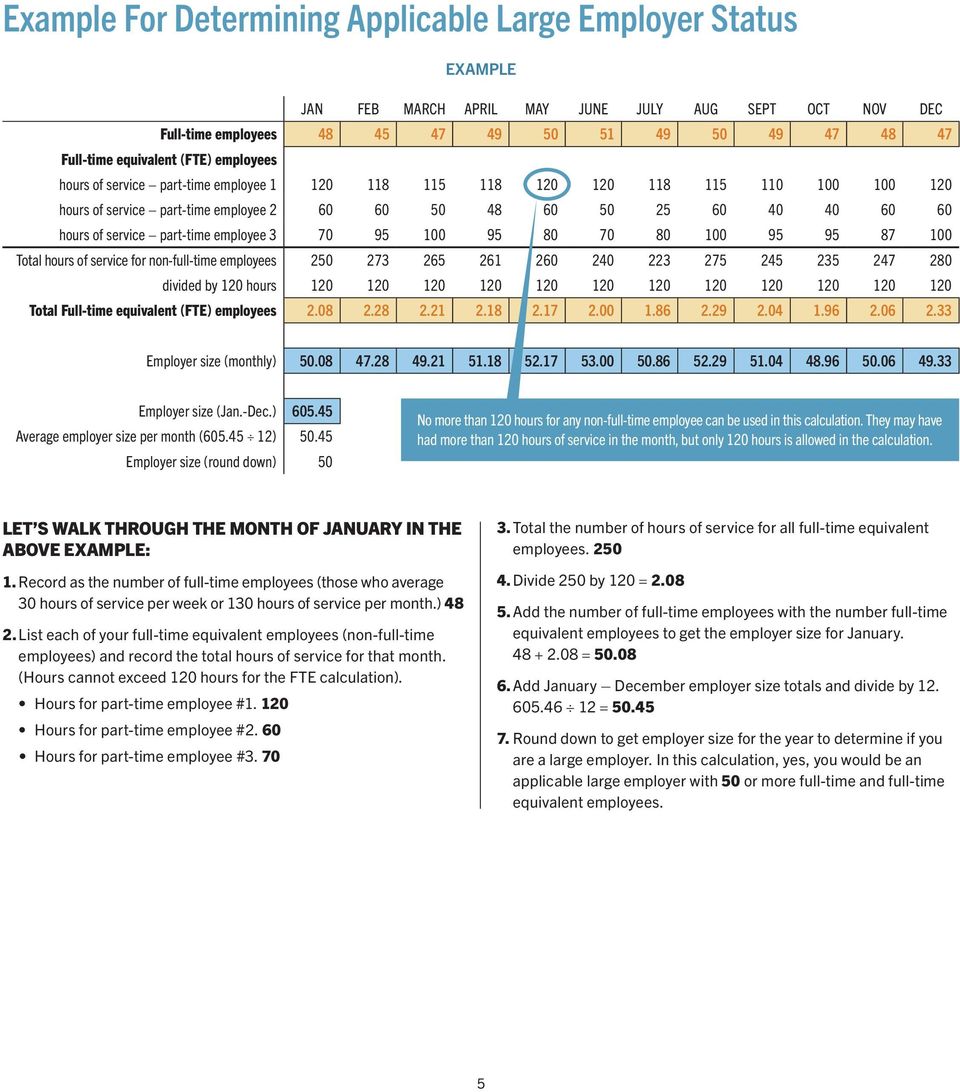
5 Example For Determining Applicable Large Employer Status EXAMPLE JAN FEB MARCH APRIL MAY JUNE JULY AUG SEPT OCT NOV DEC Full-time employees Full-time equivalent (FTE) employees hours of service part-time employee hours of service part-time employee hours of service part-time employee Total hours of service for non-full-time employees divided by 120 hours Total Full-time equivalent (FTE) employees Employer size (monthly) Employer size (Jan.-Dec.) Average employer size per month ( ) Employer size (round down) 50 No more than 120 hours for any non-full-time employee can be used in this calculation. They may have had more than 120 hours of service in the month, but only 120 hours is allowed in the calculation. LET S WALK THROUGH THE MONTH OF JANUARY IN THE ABOVE EXAMPLE: 1. Record as the number of full-time employees (those who average 30 hours of service per week or 130 hours of service per month.) List each of your full-time equivalent employees (non-full-time employees) and record the total hours of service for that month. (Hours cannot exceed 120 hours for the FTE calculation). Hours for part-time employee # Hours for part-time employee #2. 60 Hours for part-time employee # Total the number of hours of service for all full-time equivalent employees Divide 250 by 120 = Add the number of full-time employees with the number full-time equivalent employees to get the employer size for January = Add January December employer size totals and divide by = Round down to get employer size for the year to determine if you are a large employer. In this calculation, yes, you would be an applicable large employer with 50 or more full-time and full-time equivalent employees. 5
6 EMPLOYER AGGREGATION RULES Employers that are part of a controlled group or an affiliated service group are treated as a single employer for purposes of determining large employer status, however, penalties related to employer shared responsibility are determined separately for each employer. Entities treated as a single employer: Parent-subsidiary groups (80 percent ownership threshold) Brother-sister groups (five or fewer persons owning at least 50 percent of each entity) Groups consisting of corporations that are a combination of parent-subsidiary and brothersister groups Trades or businesses (whether or not incorporated) that are under common control Affiliated service groups consisting of a service organization and another related organization that provides services to or with the first organization Until further guidance, government entities, churches, conventions or associations of churches should rely on reasonable, good faith interpretation in determining their status as an applicable large employer under these aggregation rules. If an employer is a part of a controlled or affiliated service group, all employees of the these member organizations must be taken into account in determining whether the employer in question is subject to the shared responsibility provisions. Please consult your tax and legal advisor. Parent Company X EXAMPLE: Company A (45 full-time employees) Company B (45 full-time employees) Company C (45 full-time employees) Assumes each company has no full-time equivalent employees. Aggregate Total (135 full-time employees) Each company would then be considered an applicable large employer and subject to potential penalties COMPANIES NOT IN EXISTENCE THE PRIOR CALENDAR YEAR For employers not in existence on any business day in the prior calendar year, applicable large employer status is based on the average number of employees that it is reasonably expected to employ on business days in the current calendar year (even if subsequent events cause the actual number to exceed that expectation). The seasonal worker exception applies to employers not in existence on any business day during the preceding calendar year. See seasonal worker exception on page 4. BUYING AND SELLING A BUSINESS Predecessor (and successor) employers should rely on employment tax context rules for purposes of determining applicable large employer status until further guidance is issued. It is expected that for employees staying with the business, the buyer will need to credit the hours of service for these employees for purposes of determining applicable large employer status. With this in mind, employers will want to obtain service hour records when working through the long list of other acquisition details.* *Consult the advice of your legal and tax advisors 6

7 NEXT STEPS: Develop a system to determine the number of full-time and full-time equivalent employees for each month of the preceding calendar year. Work with your legal and tax advisor to determine if you averaged 50 or more employees in the preceding calendar year and are considered an applicable large employer. Remember to include all variable hour, part-time, and seasonal employees into the calculation for determining your applicable large employer status. Reach out to your Wellmark representative with your results. Together, discuss the best health plans for your organization based upon your results. Always consult your legal and/or tax professional when considering your options in meeting the requirements set forth by the ACA. The ACA: An Online Employer Guide Wellmark is here to assist and support you through all the ACA changes. For more detailed information on this topic, please go to WeKnowReform.com or contact your Wellmark representative. Wellmark Blue Cross and Blue Shield is an Independent Licensee of the Blue Cross and Blue Shield Association Wellmark,Inc. Wellmark is not providing any legal advice with regard to compliance with the requirements of the Affordable Care Act (ACA), including 26 U.S. Code 4980H, or the Mental Health Parity Addiction Equity Act (MHPAEA). Regulations and guidance on specific provisions of the ACA and MHPAEA have been and will continue to be provided by the U.S. Department of Health and Human Services (HHS) and/or other agencies. The information provided reflects Wellmark s understanding of the most current information and is subject to change without further notice. Please note that plan benefits, rates, renewal rate adjustments, and rating impact calculations are subject to change and may be revised during a plan s rating period based on guidance and regulations issued by HHS or other agencies. Wellmark makes no representation as to the impact of plan changes on a plan s grandfathered status or interpretation or implementation of any other provisions of ACA. Wellmark will not be held liable for any penalties or other losses resulting from application of ACA section Any questions about Wellmark s approach to the ACA or MHPAEA may be referred to your Wellmark account representative. Wellmark will not determine whether coverage is discriminatory or otherwise in violation of Internal Revenue Code Section 105(h). Wellmark also will not provide any testing for compliance with Internal Revenue Code Section 105(h). Wellmark will not be held liable for any penalties or other losses resulting from any employer offering coverage in violation of section 105(h). Wellmark will not determine whether any change in an Employer Administered Funding Arrangement affects a health plan s grandfathered health plan status under ACA or otherwise complies with ACA. Wellmark will not be held liable for any penalties or other losses resulting from any Employer Administered Funding Arrangement. For purposes of this paragraph, an Employer Administered Funding Arrangement is an arrangement administered by an employer in which the employer contributes toward the member s share of benefit costs (such as the member s deductible, coinsurance, or copayments) in the absence of which the member would be financially responsible. An Employer Administered Funding Arrangement does not include the employer s contribution to health insurance premiums or rates. M /14

PENALTIES Employer Shared Responsibility under the Affordable Care Act (ACA)
 PENALTIES Employer Shared Responsibility under the Affordable Care Act (ACA) What employers need to know to make informed decisions about ACA compliance. Employer Shared Responsibility Under the employer
Sample Employee FAQs Explaining Benefits Eligibility
 Sample Employee FAQs Explaining Benefits Eligibility To assist employers in providing an explanation to their employees of how measurement, administrative, and stability periods will be used to determine
Key Considerations in Avoiding and Calculating Penalties Pursuant to the Employer Shared Responsibility Mandate
 and Calculating Penalties Pursuant to the Employer Shared Compliance Practice of Arthur J. Gallagher & Co. As a preliminary step, employers must determine if their organization is subject to the mandate.
IRS Eases Employers Into Employer Mandate
 IRS Eases Employers Into Employer Mandate February 2014 The Treasury and Internal Revenue Service (IRS) released final regulations on the employer mandate under the Patient Protection and Affordable Care
Guidance issued on employer shared responsibility requirements
 Guidance issued on employer shared responsibility requirements The shared responsibility requirements are one of the most significant provisions that employers need to address under the Affordable Care
Calculating Hours of Service Under the Affordable Care Act
 Calculating Hours of Service Under the Affordable Care Act Compliance with the federal Patient Protection and Affordable Care Act (ACA) will necessitate accounting for work and leave time for all employees.
IRS Guidance on Employer Shared Responsibility Penalty
 Brought to you by Hammitt Benefits Group IRS Guidance on Employer Shared Responsibility Penalty Beginning in 2014, the Affordable Care Act (ACA) imposes pay or play requirements on large employers to help
Employer Shared Responsibility (ESR) Questions and Answers.
 Employer Shared Responsibility (ESR) Questions and s. Recent ESR Questions asked by members of the accounting community, answered by senior members of Paychex Compliance Department. Question 1. When using
Health Care Reform Employer Shared Responsibility Provisions
 Health Care Reform Employer Shared Responsibility Provisions Safe Harbor Qualification This document provides an overview of the employer shared responsibility (ESR) provisions of the Affordable Care Act
Documenting Method for Identifying Full-time Employees
 Brought to you by Higginbotham Documenting Method for Identifying Full-time Employees Beginning in 2015, the Affordable Care Act (ACA) imposes a penalty on applicable large employers (ALEs) that do not
Department of the Treasury
 Vol. 79 Wednesday, No. 29 February 12, 2014 Part II Department of the Treasury Internal Revenue Service 26 CFR Parts 1, 54, and 301 Shared Responsibility for Employers Regarding Health Coverage; Final
Applying Pay or Play to Special Employees
 Applying Pay or Play to Special Employees American Benefits Council P4P Preparing for PPACA Webinar Ashley Gillihan, Esq. [email protected] 2014, Alston & Bird, LLP Fundamentals General Rule of
EMPLOYER MANDATE FACT SHEET
 EMPLOYER MNDTE FCT SHEET INFORMED ON REFORM Overview Employers must offer health insurance that is affordable and provides minimum value to their full-time employees and their children up to age 26 or
School District Obligations Under the New Federal Health Care Law: Is Your District Going to Play or Pay the Penalty?
 TM MISSOURI SCHOOL BOARDS ASSOCIATION HELPING SCHOOL BOARDS SUCCEED School District Obligations Under the New Federal Health Care Law: Is Your District Going to Play or Pay the Penalty? Click to jump to
Patient Protection and Affordable Care Act Compliance Checklist for Employers
 October, 2014 Patient Protection and Affordable Care Act Compliance Checklist for Employers Under the Employer Mandate in the Affordable Care Act, effective January 1, 2015, employers with 50 or more full-time
The Affordable Care Act: Summary of Employer Requirements
 The Affordable Care Act: Summary of Employer Requirements February 2013 Disclaimer Any US tax advice contained herein was not intended or written to be used, and cannot be used, for the purpose of avoiding
School District Obligations Under the New Federal Health Care Law:
 A special thanks to the following who provided technical assistance in drafting this guidance: Leza Conliffe National School Boards Association Ken Mason Spencer Fane Britt & Browne LLP Don Tatman Tatman
Affordable Care Act Compliance and IRS 1094/95 Filings: Are YOU Ready??
 Affordable Care Act Compliance and IRS 1094/95 Filings: Are YOU Ready?? REQUIREMENTS UNDER IRC SECTIONS 6055 AND 6056 Presented by: This Presentation Is Not Legal or tax advice The final word on ACA A
2015 Small group new business application
 2015 Small group new business application PLEASE COMPLETE AND RETURN ALL PAGES IN THIS APPLICATION OR PROCESSING COULD BE DELAYED. 1-50 eligible employees New group checklist Use this checklist to expedite
Nevada Employer s Guide to the Affordable Care Act. Nevada Division of Insurance
 Nevada Employer s Guide to the Affordable Care Act Nevada Division of Insurance Nevada Employer s Guide to the Affordable Care Act State of Nevada Department of Business and Industry Division of Insurance
Healthcare Reform Provisions Unique to Small Employers/Financial and Other Benefits Concerns for All Employers (updated May 2, 2014)
 /Financial and Other Benefits Concerns for All Employers (updated May 2, 2014) Lisa L. Carlson, J.D., Area Senior Vice President, Compliance Counsel Gallagher Benefit Services, Inc. While most healthcare
Fast Forward. 2015 Employer Mandate: Pay or Play?
 Fast Forward 2015 Employer Mandate: Pay or Play? Employer Mandate Beginning Jan. 1, 2015, the Affordable Care Act (ACA) will impose an employer mandate that states that grandfathered and non-grandfathered
Employer s Guide To Health Care Reform
 Employer s Guide To Health Care Reform A nonprofit independent licensee of the Blue Cross Blue Shield Association National strength. Local focus. Individual care. SM As part of our commitment to being
ACA: Temporary and Variable Hour Employees Presented by: Larry Grudzien
 ACA: Temporary and Variable Hour Employees Presented by: Larry Grudzien We re proud to offer a full-circle solution to your HR needs. BASIC offers collaboration, flexibility, stability, security, quality
AFFORDABLE CARE ACT REPORTING
 AFFORDABLE CARE ACT REPORTING Introduction The Affordable Care Act (ACA) requires the State of Missouri to offer health insurance to full time equivalent employees. The ACA also generally requires individual
AFFORDABLE CARE ACT (ACA) REPORTING CONSIDERATIONS
 AFFORDABLE CARE ACT (ACA) REPORTING CONSIDERATIONS PRESENTED BY: FELICIA BARNES-HODGE, FISCAL ANALYST ESD 113 My Partner For Learning Solutions ACA - The Goal & Disclaimer The Goal The goal is to provide
A f f o r d a b l e C a r e A c t. S u s a n L. G r a s s l i, J D M a y 2 0 1 4
 Health Care Reform T h e B i g T h r e e P r o v i s i o n s o f t h e A f f o r d a b l e C a r e A c t S u s a n L. G r a s s l i, J D M a y 2 0 1 4 Agenda Background The Big Three o Individual Mandate
New Group Application East Region New business effective Jan. 1, 2011
 New Group Application East Region New business effective Jan. 1, 2011 2-50 Eligible employees PriorityHMO SM PriorityPOS SM PriorityPPO SM Revised 10/10 Life just got a little easier. This comprehensive
How To Report Health Insurance To The Irs
 ACA REPORTING WEBINAR QUESTIONS AND ANSWERS The following questions on ACA reporting requirements to the IRS were collected at a series of webinars offered by ThinkHR. Introduction The Affordable Care
Employer Reporting of Health Coverage Code Sections 6055 & 6056
 Brought to you by Hickok & Boardman HR Intelligence Employer Reporting of Health Coverage Code Sections 6055 & 6056 The Affordable Care Act (ACA) created new reporting requirements under Internal Revenue
Legislative Brief: PAY OR PLAY PENALTIES LOOK BACK MEASUREMENT METHOD EXAMPLES. EmPowerHR
 EmPowerHR Legislative Brief: PAY OR PLAY PENALTIES LOOK BACK MEASUREMENT METHOD EXAMPLES The Affordable Care Act (ACA) imposes a penalty on applicable large employers (ALEs) that do not offer health insurance
HEALTH CARE REFORM: FREQUENTLY ASKED QUESTIONS (Group, Individual, Seasonal)
 Group Health Insurance Q & A HEALTH CARE REFORM: FREQUENTLY ASKED QUESTIONS (Group, Individual, Seasonal) 1. Will small employers continue to have 12 month rates as they exist today? a. Yes. Employer groups
Heffernan Benefit Advisors Presents Health Care Reform: What Non-Profits Need to Know. The session will begin shortly
 Heffernan Benefit Advisors Presents Health Care Reform: What Non-Profits Need to Know The session will begin shortly Sound should come through your speakers when the session begins Verify that the volume
What s Ahead for 2015: Preparing Your Group Health Plan for the Employer Mandate
 What s Ahead for 2015: Preparing Your Group Health Plan for the Employer Mandate May 14, 2014 1 Speakers Moderator: Lisa A. Tavares, Partner Speakers: Thora A. Johnson, Partner Harry I. Atlas, Partner
MEMORANDUM. March 5, 2014. IRS Final Rule on the Affordable Care Act s Employer Mandate
 2120 L Street, NW, Suite 700 T 202.822.8282 HOBBSSTRAUS.COM Washington, DC 20037 F 202.296.8834 MEMORANDUM To: From: Re: Tribal Health Clients Hobbs, Straus, Dean & Walker LLP IRS Final Rule on the Affordable
Small Business Health Care Tax Credit: Presented by Maureen O Gara-Adford, CPA & David Fox, Senior Accountant
 Small Business Health Care Tax Credit: Presented by Maureen O Gara-Adford, CPA & David Fox, Senior Accountant Today s Speakers Maureen O Gara-Adford, CPA Practicing CPA since 1989 Managing partner since
The Insurance Mandates of the Affordable Care Act
 1 A. Affordable Care Act Individual Mandate The Insurance Mandates of the Affordable Care Act 1. All citizens of the United States are subject to the individual mandate as are all permanent residents and
Legislative Brief: 2015 COMPLIANCE CHECKLIST. Laurus Strategies
 Laurus Strategies Legislative Brief: 2015 COMPLIANCE CHECKLIST The Affordable Care Act (ACA) has made a number of significant changes to group health plans since the law was enacted over four years ago.
Determining Full-Time Employees under the Affordable Care Act
 December 2013 Determining Full-Time Employees under the Affordable Care Act Information for Businesses Employing 50 Employees or More Harrisonburg, VA 22801 Phone: (800) 366-3846 Fax: (540) 434-9670 www.ldbinsurance.com
Small Employer Health Care Tax Credit: Questions & Answers (Q&A)
 Brought to you by Seubert & Associates Small Employer Health Care Tax Credit: Questions & Answers (Q&A) The Patient Protection and Affordable Care Act (ACA) provides a tax credit to certain small employers
ACA Employer Reporting Guide. A practical guide to understanding the ACA 6055 and 6056 employer reporting requirements
 ACA Employer Reporting Guide A practical guide to understanding the ACA 6055 and 6056 employer reporting requirements Table of Contents INTRODUCTION TO ACA EMPLOYER REPORTING... 3 HOW TO USE THIS GUIDE...
Navigating the Employer Mandate
 Navigating the Employer Mandate The Employer Mandate is the Health Care Reform provision that requires all employers with 50 or more full time equivalent employees to offer a certain level of health insurance
Summary of Provisions Affecting Employer-Sponsored Insurance
 JULY 2014 AFFORDABLE CARE ACT Summary of Provisions Affecting Employer-Sponsored Insurance Much of the public discussion about the Affordable Care Act (ACA) has focused on the expansion of coverage to
Agencies Issue Final Regulations Implementing Employer Shared Responsibility and Waiting Period Rules
 February 25, 2014 Authors: Kathryn Bjornstad Amin, Jon W. Breyfogle, Lisa Christensen, Christine L. Keller, Tamara S. Killion, Emily C. Lechner and Brigen L. Winters If you have questions, please contact
Employer-Shared Responsibility
 Affordable Care Act Planning to Deal with the Pay-or-Play Penalties Effective January 1, 2015 Anne Hydorn Hanson Bridgett LLP Telephone: (415) 995-5893 Email: [email protected] Judy Boyette Hanson
Health care reform: A guide for employers
 Health care reform: A guide for employers Updated October 2014 Health care reform: A guide for employers This guide was developed by Priority Health to help answer employers questions regarding health
AFFORDABLE CARE ACT SMALL EMPLOYER HEALTH REFORM CHECKLIST
 AFFORDABLE CARE ACT SMALL EMPLOYER Employers that offer health care coverage to employees are responsible for complying with many of the provisions of the Affordable Care Act (ACA). Most health reform
ACA Cloud Compliance Solution
 ACA Cloud Compliance Solution User Guide Last Update 6/8/2016 125 N. Kickapoo Lincoln, Illinois 62656 integrity-data.com 888.786.6162 **Updated Documentation** visit our website to check for updated user
The Dependent Care Flexible Spending Account may be used to pay dependent care expenses that are necessary for you and your spouse to work.
 DEPENDENT CARE FLEXIBLE SPENDING ACCOUNT The Dependent Care Flexible Spending Account may be used to pay dependent care expenses that are necessary for you and your spouse to work. Eligibility Employee
REGULATORY UPDATE Vol. 1 No. 18
 REGULATORY UPDATE Vol. 1 No. 18 FAQs on Exchanges August 7, 2013 IN THIS ISSUE FAQs on Exchanges Employer Mandate Delay Transitional Guidance Issued Individual Mandate Final Rules Issued Possible Exchange