
Binary Search Tree Intro to Algorithms Recitation 03 February 9, 2011
|
|
|
- Damian McKinney
- 9 years ago
- Views:
Transcription
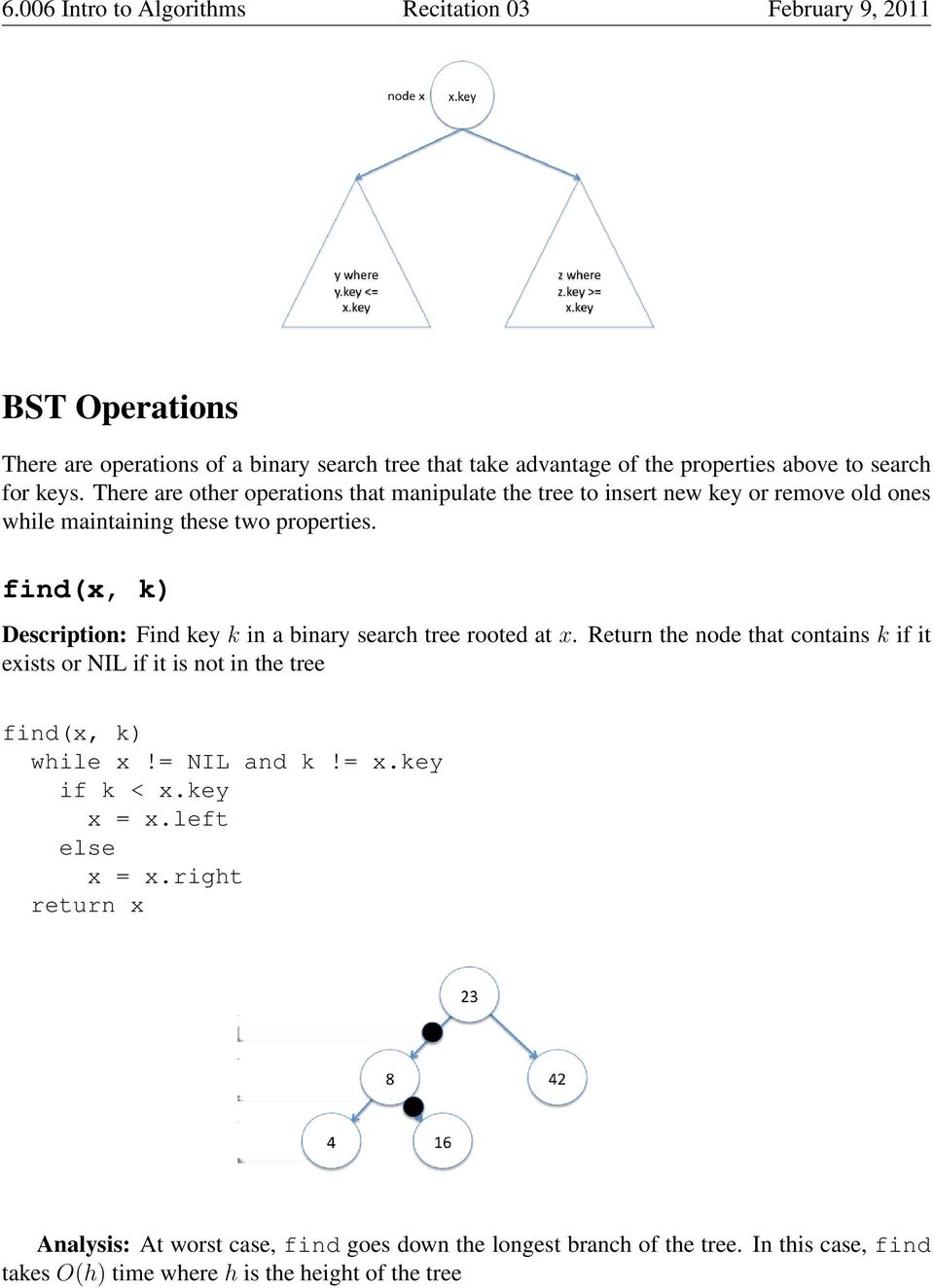
1 Binary Search Tree A binary search tree is a data structure that allows for key lookup, insertion, and deletion. It is a binary tree, meaning every node of the tree has at most two child nodes, a left child and a right child. Each node of the tree holds the following information: x.key - Value stored in node x x.left- Pointer to the left child of node x. NIL if x has no left child x.right - Pointer to the right child of node x. NIL if x has no right child x.parent - Pointer to the parent node of node x. NIL if x has no parent, i.e. x is the root of the tree Later on this week, we will learn about binary search trees that holds data in addition to the four listed above but for now we will focus on the vanilla binary search tree. A binary search tree has two simple properties: For each node x, every value found in the left subtree of x is less than or equal to the value found in x For each node x, every value found in the right subtree of x is greater than or equal to the value found in x

2 BST Operations There are operations of a binary search tree that take advantage of the properties above to search for keys. There are other operations that manipulate the tree to insert new key or remove old ones while maintaining these two properties. find(x, k) Description: Find key k in a binary search tree rooted at x. Return the node that contains k if it exists or NIL if it is not in the tree find(x, k) while x!= NIL and k!= x.key if k < x.key x = x.left x = x.right return x Analysis: At worst case, find goes down the longest branch of the tree. In this case, find takes O(h) time where h is the height of the tree
3 insert(x, k) Description: Insert key k into the binary search tree T insert(t, k) z.key = k //z is the node to be inserted z.parent = NIL x = root(t) while x!= NIL //find where to insert z z.parent = x if z.key < x.key x = x.left x = x.right if z.parent = NIL //in the case that T was an empty tree root(t) = z //set z to be the root if z.key < z.parent.key //otherwise insert z z.parent.left = z z.parent.right = z Analysis: At worst case, insert goes down the longest branch of the tree to find where to insert and then makes constant time operations to actually make the insertion. In this case, insert takes O(h) time where h is the height of the tree find-min(x) and find-max(x) Description: Return the node with the minimum or maximum key of the binary search tree rooted at node x find-min(x) while x.left!= NIL


4 x = x.left return x Analysis: At worst case, find-min goes down the longest branch of the tree before finding the minimum element. In this case, find-min takes O(h) time where h is the height of the tree next-larger(x) and next-smaller(x) Description: Return the node that contains the next larger (the successor) or next smaller (the predecessor) key in the binary search tree in relation to the key at node x Case 1: x has a right sub-tree where all keys are larger than x.key. The next larger key will be the minimum key of x s right sub-tree Case 2: x has no right sub-tree. We can find the next larger key by traversing up x s ancestry until we reach a node that s a left child. That node s parent will contain the next larger key next-larger(x) if x.right!= NIL //case 1 return find-min(x.right) y = x.parent while y!= NIL and x = y.right //case 2 x = y y = y.parent return y

5 Analysis: At worst case, next-larger goes through the longest branch of the tree if x is the root. Since find-min can take O(h) time, next-larger could also take O(h) time where h is the height of the tree delete(x) Description: Remove the node x from the binary search tree, making the necessary adjustments to the binary search tree to maintain its properties. (Note that this operation removes a specified node from the tree. If you wanted to delete a key k from the tree, you would have to first call find(k) to find the node with key k and then call delete to remove that node) Case 1: x has no children. Just delete it (i.e. change parent node so that it doesn t point to x) Case 2: x has one child. Splice out x by linking x s parent to x s child Case 3: x has two children. Splice out x s successor and replace x with x s successor delete(x) if x.left = NIL and x.right = NIL //case 1 if x.parent.left = x x.parent.left = NIL x.parent.right = NIL if x.left = NIL //case 2a connect x.parent to x.right if x.right = NIL //case 2b connect x.parent to x.left //case 3 y = next-larger(x) connect y.parent to y.right replace x with y


6 Analysis: In case 3, delete calls next-larger, which takes O(h) time. At worst case, delete takes O(h) time where h is the height of the tree inorder-tree-walk(x) Description: Print out the keys in the binary search tree rooted at node x in sorted order inorder-tree-walk(x) if x!= NIL inorder-tree-walk(x.left) print x.key inorder-tree-walk(x.right) Analysis: inorder-tree-walk goes through every node and traverses to each node s left and right children. Overall, inorder-tree-walk prints n keys and traverses 2n times, resulting in O(n) runtime

Operations: search;; min;; max;; predecessor;; successor. Time O(h) with h height of the tree (more on later).
 Binary search tree Operations: search;; min;; max;; predecessor;; successor. Time O(h) with h height of the tree (more on later). Data strutcure fields usually include for a given node x, the following
Algorithms Chapter 12 Binary Search Trees
 Algorithms Chapter 1 Binary Search Trees Outline Assistant Professor: Ching Chi Lin 林 清 池 助 理 教 授 [email protected] Department of Computer Science and Engineering National Taiwan Ocean University
A binary search tree is a binary tree with a special property called the BST-property, which is given as follows:
 Chapter 12: Binary Search Trees A binary search tree is a binary tree with a special property called the BST-property, which is given as follows: For all nodes x and y, if y belongs to the left subtree
Analysis of Algorithms I: Binary Search Trees
 Analysis of Algorithms I: Binary Search Trees Xi Chen Columbia University Hash table: A data structure that maintains a subset of keys from a universe set U = {0, 1,..., p 1} and supports all three dictionary
Introduction to Data Structures and Algorithms
 Introduction to Data Structures and Algorithms Chapter: Binary Search Trees Lehrstuhl Informatik 7 (Prof. Dr.-Ing. Reinhard German) Martensstraße 3, 91058 Erlangen Search Trees Search trees can be used
Binary Search Trees. A Generic Tree. Binary Trees. Nodes in a binary search tree ( B-S-T) are of the form. P parent. Key. Satellite data L R
 Binary Search Trees A Generic Tree Nodes in a binary search tree ( B-S-T) are of the form P parent Key A Satellite data L R B C D E F G H I J The B-S-T has a root node which is the only node whose parent
Binary Search Trees CMPSC 122
 Binary Search Trees CMPSC 122 Note: This notes packet has significant overlap with the first set of trees notes I do in CMPSC 360, but goes into much greater depth on turning BSTs into pseudocode than
Ordered Lists and Binary Trees
 Data Structures and Algorithms Ordered Lists and Binary Trees Chris Brooks Department of Computer Science University of San Francisco Department of Computer Science University of San Francisco p.1/62 6-0:
Binary Search Trees. Data in each node. Larger than the data in its left child Smaller than the data in its right child
 Binary Search Trees Data in each node Larger than the data in its left child Smaller than the data in its right child FIGURE 11-6 Arbitrary binary tree FIGURE 11-7 Binary search tree Data Structures Using
Binary Heaps. CSE 373 Data Structures
 Binary Heaps CSE Data Structures Readings Chapter Section. Binary Heaps BST implementation of a Priority Queue Worst case (degenerate tree) FindMin, DeleteMin and Insert (k) are all O(n) Best case (completely
CSE 326: Data Structures B-Trees and B+ Trees
 Announcements (4//08) CSE 26: Data Structures B-Trees and B+ Trees Brian Curless Spring 2008 Midterm on Friday Special office hour: 4:-5: Thursday in Jaech Gallery (6 th floor of CSE building) This is
Data Structures and Algorithms
 Data Structures and Algorithms CS245-2016S-06 Binary Search Trees David Galles Department of Computer Science University of San Francisco 06-0: Ordered List ADT Operations: Insert an element in the list
Binary Search Trees. Each child can be identied as either a left or right. parent. right. A binary tree can be implemented where each node
 Binary Search Trees \I think that I shall never see a poem as lovely as a tree Poem's are wrote by fools like me but only G-d can make atree \ {Joyce Kilmer Binary search trees provide a data structure
Binary Search Trees (BST)
 Binary Search Trees (BST) 1. Hierarchical data structure with a single reference to node 2. Each node has at most two child nodes (a left and a right child) 3. Nodes are organized by the Binary Search
Binary Search Trees. basic implementations randomized BSTs deletion in BSTs
 Binary Search Trees basic implementations randomized BSTs deletion in BSTs eferences: Algorithms in Java, Chapter 12 Intro to Programming, Section 4.4 http://www.cs.princeton.edu/introalgsds/43bst 1 Elementary
Lecture 6: Binary Search Trees CSCI 700 - Algorithms I. Andrew Rosenberg
 Lecture 6: Binary Search Trees CSCI 700 - Algorithms I Andrew Rosenberg Last Time Linear Time Sorting Counting Sort Radix Sort Bucket Sort Today Binary Search Trees Data Structures Data structure is a
A binary search tree or BST is a binary tree that is either empty or in which the data element of each node has a key, and:
 Binary Search Trees 1 The general binary tree shown in the previous chapter is not terribly useful in practice. The chief use of binary trees is for providing rapid access to data (indexing, if you will)
Outline BST Operations Worst case Average case Balancing AVL Red-black B-trees. Binary Search Trees. Lecturer: Georgy Gimel farb
 Binary Search Trees Lecturer: Georgy Gimel farb COMPSCI 220 Algorithms and Data Structures 1 / 27 1 Properties of Binary Search Trees 2 Basic BST operations The worst-case time complexity of BST operations
Rotation Operation for Binary Search Trees Idea:
 Rotation Operation for Binary Search Trees Idea: Change a few pointers at a particular place in the tree so that one subtree becomes less deep in exchange for another one becoming deeper. A sequence of
12 Binary Search Trees
 12 Binary Search Trees The search tree data structure supports many dynamic-set operations, including SEARCH, MINIMUM, MAXIMUM, PREDECESSOR, SUCCESSOR, INSERT, and DELETE. Thus, we can use a search tree
Symbol Tables. Introduction
 Symbol Tables Introduction A compiler needs to collect and use information about the names appearing in the source program. This information is entered into a data structure called a symbol table. The
Data Structures and Algorithm Analysis (CSC317) Intro/Review of Data Structures Focus on dynamic sets
 Data Structures and Algorithm Analysis (CSC317) Intro/Review of Data Structures Focus on dynamic sets We ve been talking a lot about efficiency in computing and run time. But thus far mostly ignoring data
Binary Heaps * * * * * * * / / \ / \ / \ / \ / \ * * * * * * * * * * * / / \ / \ / / \ / \ * * * * * * * * * *
 Binary Heaps A binary heap is another data structure. It implements a priority queue. Priority Queue has the following operations: isempty add (with priority) remove (highest priority) peek (at highest
schema binary search tree schema binary search trees data structures and algorithms 2015 09 21 lecture 7 AVL-trees material
 scema binary searc trees data structures and algoritms 05 0 lecture 7 VL-trees material scema binary searc tree binary tree: linked data structure wit nodes containing binary searc trees VL-trees material
Binary Search Trees 3/20/14
 Binary Search Trees 3/0/4 Presentation for use ith the textbook Data Structures and Algorithms in Java, th edition, by M. T. Goodrich, R. Tamassia, and M. H. Goldasser, Wiley, 04 Binary Search Trees 4
Converting a Number from Decimal to Binary
 Converting a Number from Decimal to Binary Convert nonnegative integer in decimal format (base 10) into equivalent binary number (base 2) Rightmost bit of x Remainder of x after division by two Recursive
B-Trees. Algorithms and data structures for external memory as opposed to the main memory B-Trees. B -trees
 B-Trees Algorithms and data structures for external memory as opposed to the main memory B-Trees Previous Lectures Height balanced binary search trees: AVL trees, red-black trees. Multiway search trees:
root node level: internal node edge leaf node CS@VT Data Structures & Algorithms 2000-2009 McQuain
 inary Trees 1 A binary tree is either empty, or it consists of a node called the root together with two binary trees called the left subtree and the right subtree of the root, which are disjoint from each
B+ Tree Properties B+ Tree Searching B+ Tree Insertion B+ Tree Deletion Static Hashing Extendable Hashing Questions in pass papers
 B+ Tree and Hashing B+ Tree Properties B+ Tree Searching B+ Tree Insertion B+ Tree Deletion Static Hashing Extendable Hashing Questions in pass papers B+ Tree Properties Balanced Tree Same height for paths
Chapter 14 The Binary Search Tree
 Chapter 14 The Binary Search Tree In Chapter 5 we discussed the binary search algorithm, which depends on a sorted vector. Although the binary search, being in O(lg(n)), is very efficient, inserting a
Data Structures. Jaehyun Park. CS 97SI Stanford University. June 29, 2015
 Data Structures Jaehyun Park CS 97SI Stanford University June 29, 2015 Typical Quarter at Stanford void quarter() { while(true) { // no break :( task x = GetNextTask(tasks); process(x); // new tasks may
A binary heap is a complete binary tree, where each node has a higher priority than its children. This is called heap-order property
 CmSc 250 Intro to Algorithms Chapter 6. Transform and Conquer Binary Heaps 1. Definition A binary heap is a complete binary tree, where each node has a higher priority than its children. This is called
Introduction to Data Structures and Algorithms
 Introduction to Data Structures and Algorithms Chapter: Elementary Data Structures(1) Lehrstuhl Informatik 7 (Prof. Dr.-Ing. Reinhard German) Martensstraße 3, 91058 Erlangen Overview on simple data structures
Big Data and Scripting. Part 4: Memory Hierarchies
 1, Big Data and Scripting Part 4: Memory Hierarchies 2, Model and Definitions memory size: M machine words total storage (on disk) of N elements (N is very large) disk size unlimited (for our considerations)
Cpt S 223. School of EECS, WSU
 Priority Queues (Heaps) 1 Motivation Queues are a standard mechanism for ordering tasks on a first-come, first-served basis However, some tasks may be more important or timely than others (higher priority)
A Comparison of Dictionary Implementations
 A Comparison of Dictionary Implementations Mark P Neyer April 10, 2009 1 Introduction A common problem in computer science is the representation of a mapping between two sets. A mapping f : A B is a function
How To Create A Tree From A Tree In Runtime (For A Tree)
 Binary Search Trees < 6 2 > = 1 4 8 9 Binary Search Trees 1 Binary Search Trees A binary search tree is a binary tree storing keyvalue entries at its internal nodes and satisfying the following property:
Introduction Advantages and Disadvantages Algorithm TIME COMPLEXITY. Splay Tree. Cheruku Ravi Teja. November 14, 2011
 November 14, 2011 1 Real Time Applications 2 3 Results of 4 Real Time Applications Splay trees are self branching binary search tree which has the property of reaccessing the elements quickly that which
Learning Outcomes. COMP202 Complexity of Algorithms. Binary Search Trees and Other Search Trees
 Learning Outcomes COMP202 Complexity of Algorithms Binary Search Trees and Other Search Trees [See relevant sections in chapters 2 and 3 in Goodrich and Tamassia.] At the conclusion of this set of lecture
Previous Lectures. B-Trees. External storage. Two types of memory. B-trees. Main principles
 B-Trees Algorithms and data structures for external memory as opposed to the main memory B-Trees Previous Lectures Height balanced binary search trees: AVL trees, red-black trees. Multiway search trees:
Binary Heap Algorithms
 CS Data Structures and Algorithms Lecture Slides Wednesday, April 5, 2009 Glenn G. Chappell Department of Computer Science University of Alaska Fairbanks [email protected] 2005 2009 Glenn G. Chappell
DNS LOOKUP SYSTEM DATA STRUCTURES AND ALGORITHMS PROJECT REPORT
 DNS LOOKUP SYSTEM DATA STRUCTURES AND ALGORITHMS PROJECT REPORT By GROUP Avadhut Gurjar Mohsin Patel Shraddha Pandhe Page 1 Contents 1. Introduction... 3 2. DNS Recursive Query Mechanism:...5 2.1. Client
Lecture 2 February 12, 2003
 6.897: Advanced Data Structures Spring 003 Prof. Erik Demaine Lecture February, 003 Scribe: Jeff Lindy Overview In the last lecture we considered the successor problem for a bounded universe of size u.
6 March 2007 1. Array Implementation of Binary Trees
 Heaps CSE 0 Winter 00 March 00 1 Array Implementation of Binary Trees Each node v is stored at index i defined as follows: If v is the root, i = 1 The left child of v is in position i The right child of
CS711008Z Algorithm Design and Analysis
 CS711008Z Algorithm Design and Analysis Lecture 7 Binary heap, binomial heap, and Fibonacci heap 1 Dongbo Bu Institute of Computing Technology Chinese Academy of Sciences, Beijing, China 1 The slides were
Fundamental Algorithms
 Fundamental Algorithms Chapter 6: AVL Trees Michael Bader Winter 2011/12 Chapter 6: AVL Trees, Winter 2011/12 1 Part I AVL Trees Chapter 6: AVL Trees, Winter 2011/12 2 Binary Search Trees Summary Complexity
Full and Complete Binary Trees
 Full and Complete Binary Trees Binary Tree Theorems 1 Here are two important types of binary trees. Note that the definitions, while similar, are logically independent. Definition: a binary tree T is full
Persistent Data Structures and Planar Point Location
 Persistent Data Structures and Planar Point Location Inge Li Gørtz Persistent Data Structures Ephemeral Partial persistence Full persistence Confluent persistence V1 V1 V1 V1 V2 q ue V2 V2 V5 V2 V4 V4
Binary Search Trees. Ric Glassey [email protected]
 Binary Search Trees Ric Glassey [email protected] Outline Binary Search Trees Aim: Demonstrate how a BST can maintain order and fast performance relative to its height Properties Operations Min/Max Search
Output: 12 18 30 72 90 87. struct treenode{ int data; struct treenode *left, *right; } struct treenode *tree_ptr;
 50 20 70 10 30 69 90 14 35 68 85 98 16 22 60 34 (c) Execute the algorithm shown below using the tree shown above. Show the exact output produced by the algorithm. Assume that the initial call is: prob3(root)
From Last Time: Remove (Delete) Operation
 CSE 32 Lecture : More on Search Trees Today s Topics: Lazy Operations Run Time Analysis of Binary Search Tree Operations Balanced Search Trees AVL Trees and Rotations Covered in Chapter of the text From
Why Use Binary Trees?
 Binary Search Trees Why Use Binary Trees? Searches are an important application. What other searches have we considered? brute force search (with array or linked list) O(N) binarysearch with a pre-sorted
Motivation Suppose we have a database of people We want to gure out who is related to whom Initially, we only have a list of people, and information a
 CSE 220: Handout 29 Disjoint Sets 1 Motivation Suppose we have a database of people We want to gure out who is related to whom Initially, we only have a list of people, and information about relations
Binary Search Trees. Adnan Aziz. Heaps can perform extract-max, insert efficiently O(log n) worst case
 Binary Searc Trees Adnan Aziz 1 BST basics Based on CLRS, C 12. Motivation: Heaps can perform extract-max, insert efficiently O(log n) worst case Has tables can perform insert, delete, lookup efficiently
Analysis of Algorithms I: Optimal Binary Search Trees
 Analysis of Algorithms I: Optimal Binary Search Trees Xi Chen Columbia University Given a set of n keys K = {k 1,..., k n } in sorted order: k 1 < k 2 < < k n we wish to build an optimal binary search
Data Structure [Question Bank]
![Data Structure [Question Bank]](/thumbs/40/21355705.jpg "Data Structure [Question Bank]") Unit I (Analysis of Algorithms) 1. What are algorithms and how they are useful? 2. Describe the factor on best algorithms depends on? 3. Differentiate: Correct & Incorrect Algorithms? 4. Write short note:
Unit I (Analysis of Algorithms) 1. What are algorithms and how they are useful? 2. Describe the factor on best algorithms depends on? 3. Differentiate: Correct & Incorrect Algorithms? 4. Write short note:
TREE BASIC TERMINOLOGIES
 TREE Trees are very flexible, versatile and powerful non-liner data structure that can be used to represent data items possessing hierarchical relationship between the grand father and his children and
- Easy to insert & delete in O(1) time - Don t need to estimate total memory needed. - Hard to search in less than O(n) time
 Skip Lists CMSC 420 Linked Lists Benefits & Drawbacks Benefits: - Easy to insert & delete in O(1) time - Don t need to estimate total memory needed Drawbacks: - Hard to search in less than O(n) time (binary
Data Structures Fibonacci Heaps, Amortized Analysis
 Chapter 4 Data Structures Fibonacci Heaps, Amortized Analysis Algorithm Theory WS 2012/13 Fabian Kuhn Fibonacci Heaps Lacy merge variant of binomial heaps: Do not merge trees as long as possible Structure:
UNIVERSITY OF LONDON (University College London) M.Sc. DEGREE 1998 COMPUTER SCIENCE D16: FUNCTIONAL PROGRAMMING. Answer THREE Questions.
 UNIVERSITY OF LONDON (University College London) M.Sc. DEGREE 1998 COMPUTER SCIENCE D16: FUNCTIONAL PROGRAMMING Answer THREE Questions. The Use of Electronic Calculators: is NOT Permitted. -1- Answer Question
Data Structures and Data Manipulation
 Data Structures and Data Manipulation What the Specification Says: Explain how static data structures may be used to implement dynamic data structures; Describe algorithms for the insertion, retrieval
Persistent Binary Search Trees
 Persistent Binary Search Trees Datastructures, UvA. May 30, 2008 0440949, Andreas van Cranenburgh Abstract A persistent binary tree allows access to all previous versions of the tree. This paper presents
Questions 1 through 25 are worth 2 points each. Choose one best answer for each.
 Questions 1 through 25 are worth 2 points each. Choose one best answer for each. 1. For the singly linked list implementation of the queue, where are the enqueues and dequeues performed? c a. Enqueue in
5. A full binary tree with n leaves contains [A] n nodes. [B] log n 2 nodes. [C] 2n 1 nodes. [D] n 2 nodes.
![5. A full binary tree with n leaves contains [A] n nodes. [B] log n 2 nodes. [C] 2n 1 nodes. [D] n 2 nodes.](/thumbs/40/21353779.jpg "5. A full binary tree with n leaves contains [A] n nodes. [B] log n 2 nodes. [C] 2n 1 nodes. [D] n 2 nodes.") 1. The advantage of.. is that they solve the problem if sequential storage representation. But disadvantage in that is they are sequential lists. [A] Lists [B] Linked Lists [A] Trees [A] Queues 2. The
1. The advantage of.. is that they solve the problem if sequential storage representation. But disadvantage in that is they are sequential lists. [A] Lists [B] Linked Lists [A] Trees [A] Queues 2. The
Sorting revisited. Build the binary search tree: O(n^2) Traverse the binary tree: O(n) Total: O(n^2) + O(n) = O(n^2)
 Sorting revisited How did we use a binary search tree to sort an array of elements? Tree Sort Algorithm Given: An array of elements to sort 1. Build a binary search tree out of the elements 2. Traverse
Data Structures, Practice Homework 3, with Solutions (not to be handed in)
 Data Structures, Practice Homework 3, with Solutions (not to be handed in) 1. Carrano, 4th edition, Chapter 9, Exercise 1: What is the order of each of the following tasks in the worst case? (a) Computing
1) The postfix expression for the infix expression A+B*(C+D)/F+D*E is ABCD+*F/DE*++
 Answer the following 1) The postfix expression for the infix expression A+B*(C+D)/F+D*E is ABCD+*F/DE*++ 2) Which data structure is needed to convert infix notations to postfix notations? Stack 3) The
The ADT Binary Search Tree
 The ADT Binary Search Tree The Binary Search Tree is a particular type of binary tree that enables easy searching for specific items. Definition The ADT Binary Search Tree is a binary tree which has an
Tables so far. set() get() delete() BST Average O(lg n) O(lg n) O(lg n) Worst O(n) O(n) O(n) RB Tree Average O(lg n) O(lg n) O(lg n)
 Hash Tables Tables so far set() get() delete() BST Average O(lg n) O(lg n) O(lg n) Worst O(n) O(n) O(n) RB Tree Average O(lg n) O(lg n) O(lg n) Worst O(lg n) O(lg n) O(lg n) Table naïve array implementation
Lecture Notes on Binary Search Trees
 Lecture Notes on Binary Search Trees 15-122: Principles of Imperative Computation Frank Pfenning André Platzer Lecture 17 October 23, 2014 1 Introduction In this lecture, we will continue considering associative
Algorithms and Data Structures Written Exam Proposed SOLUTION
 Algorithms and Data Structures Written Exam Proposed SOLUTION 2005-01-07 from 09:00 to 13:00 Allowed tools: A standard calculator. Grading criteria: You can get at most 30 points. For an E, 15 points are
EE602 Algorithms GEOMETRIC INTERSECTION CHAPTER 27
 EE602 Algorithms GEOMETRIC INTERSECTION CHAPTER 27 The Problem Given a set of N objects, do any two intersect? Objects could be lines, rectangles, circles, polygons, or other geometric objects Simple to
DATA STRUCTURES USING C
 DATA STRUCTURES USING C QUESTION BANK UNIT I 1. Define data. 2. Define Entity. 3. Define information. 4. Define Array. 5. Define data structure. 6. Give any two applications of data structures. 7. Give
Binary Trees. Wellesley College CS230 Lecture 17 Thursday, April 5 Handout #28. PS4 due 1:30pm Tuesday, April 10 17-1
 inary Trees Wellesley ollege S230 Lecture 17 Thursday, pril 5 Handout #28 PS4 due 1:30pm Tuesday, pril 10 17-1 Motivation: Inefficiency of Linear Structures Up to this point our focus has been linear structures:
Algorithms. Algorithms GEOMETRIC APPLICATIONS OF BSTS. 1d range search line segment intersection kd trees interval search trees rectangle intersection
 Algorithms ROBERT SEDGEWICK KEVIN WAYNE GEOMETRIC APPLICATIONS OF BSTS Algorithms F O U R T H E D I T I O N ROBERT SEDGEWICK KEVIN WAYNE 1d range search line segment intersection kd trees interval search
Home Page. Data Structures. Title Page. Page 1 of 24. Go Back. Full Screen. Close. Quit
 Data Structures Page 1 of 24 A.1. Arrays (Vectors) n-element vector start address + ielementsize 0 +1 +2 +3 +4... +n-1 start address continuous memory block static, if size is known at compile time dynamic,
ECE 250 Data Structures and Algorithms MIDTERM EXAMINATION 2008-10-23/5:15-6:45 REC-200, EVI-350, RCH-106, HH-139
 ECE 250 Data Structures and Algorithms MIDTERM EXAMINATION 2008-10-23/5:15-6:45 REC-200, EVI-350, RCH-106, HH-139 Instructions: No aides. Turn off all electronic media and store them under your desk. If
Binary Trees and Huffman Encoding Binary Search Trees
 Binary Trees and Huffman Encoding Binary Search Trees Computer Science E119 Harvard Extension School Fall 2012 David G. Sullivan, Ph.D. Motivation: Maintaining a Sorted Collection of Data A data dictionary
Keys and records. Binary Search Trees. Data structures for storing data. Example. Motivation. Binary Search Trees
 Binary Search Trees Last lecture: Tree terminology Kinds of binary trees Size and depth of trees This time: binary search tree ADT Java implementation Keys and records So far most examples assumed that
Exam study sheet for CS2711. List of topics
 Exam study sheet for CS2711 Here is the list of topics you need to know for the final exam. For each data structure listed below, make sure you can do the following: 1. Give an example of this data structure
Lecture 4: Balanced Binary Search Trees
 Lecture 4 alanced inar Search Trees 6.006 Fall 009 Lecture 4: alanced inar Search Trees Lecture Overview The importance of being balanced VL trees Definition alance Insert Other balanced trees Data structures
S. Muthusundari. Research Scholar, Dept of CSE, Sathyabama University Chennai, India e-mail: [email protected]. Dr. R. M.
 A Sorting based Algorithm for the Construction of Balanced Search Tree Automatically for smaller elements and with minimum of one Rotation for Greater Elements from BST S. Muthusundari Research Scholar,
Data Warehousing und Data Mining
 Data Warehousing und Data Mining Multidimensionale Indexstrukturen Ulf Leser Wissensmanagement in der Bioinformatik Content of this Lecture Multidimensional Indexing Grid-Files Kd-trees Ulf Leser: Data
Data Structures. Level 6 C30151. www.fetac.ie. Module Descriptor
 The Further Education and Training Awards Council (FETAC) was set up as a statutory body on 11 June 2001 by the Minister for Education and Science. Under the Qualifications (Education & Training) Act,
Sample Questions Csci 1112 A. Bellaachia
 Sample Questions Csci 1112 A. Bellaachia Important Series : o S( N) 1 2 N N i N(1 N) / 2 i 1 o Sum of squares: N 2 N( N 1)(2N 1) N i for large N i 1 6 o Sum of exponents: N k 1 k N i for large N and k
Data Structure with C
 Subject: Data Structure with C Topic : Tree Tree A tree is a set of nodes that either:is empty or has a designated node, called the root, from which hierarchically descend zero or more subtrees, which
10CS35: Data Structures Using C
 CS35: Data Structures Using C QUESTION BANK REVIEW OF STRUCTURES AND POINTERS, INTRODUCTION TO SPECIAL FEATURES OF C OBJECTIVE: Learn : Usage of structures, unions - a conventional tool for handling a
An Evaluation of Self-adjusting Binary Search Tree Techniques
 SOFTWARE PRACTICE AND EXPERIENCE, VOL. 23(4), 369 382 (APRIL 1993) An Evaluation of Self-adjusting Binary Search Tree Techniques jim bell and gopal gupta Department of Computer Science, James Cook University,
Lecture Notes on Binary Search Trees
 Lecture Notes on Binary Search Trees 15-122: Principles of Imperative Computation Frank Pfenning Lecture 17 March 17, 2010 1 Introduction In the previous two lectures we have seen how to exploit the structure
Any two nodes which are connected by an edge in a graph are called adjacent node.
 . iscuss following. Graph graph G consist of a non empty set V called the set of nodes (points, vertices) of the graph, a set which is the set of edges and a mapping from the set of edges to a set of pairs
DATABASE DESIGN - 1DL400
 DATABASE DESIGN - 1DL400 Spring 2015 A course on modern database systems!! http://www.it.uu.se/research/group/udbl/kurser/dbii_vt15/ Kjell Orsborn! Uppsala Database Laboratory! Department of Information
Laboratory Module 6 Red-Black Trees
 Laboratory Module 6 Red-Black Trees Purpose: understand the notion of red-black trees to build, in C, a red-black tree 1 Red-Black Trees 1.1 General Presentation A red-black tree is a binary search tree
Review of Hashing: Integer Keys
 CSE 326 Lecture 13: Much ado about Hashing Today s munchies to munch on: Review of Hashing Collision Resolution by: Separate Chaining Open Addressing $ Linear/Quadratic Probing $ Double Hashing Rehashing
Algorithms and Data Structures
 Algorithms and Data Structures Part 2: Data Structures PD Dr. rer. nat. habil. Ralf-Peter Mundani Computation in Engineering (CiE) Summer Term 2016 Overview general linked lists stacks queues trees 2 2
Exercises Software Development I. 11 Recursion, Binary (Search) Trees. Towers of Hanoi // Tree Traversal. January 16, 2013
 Exercises Software Development I 11 Recursion, Binary (Search) Trees Towers of Hanoi // Tree Traversal January 16, 2013 Software Development I Winter term 2012/2013 Institute for Pervasive Computing Johannes
Lecture 1: Data Storage & Index
 Lecture 1: Data Storage & Index R&G Chapter 8-11 Concurrency control Query Execution and Optimization Relational Operators File & Access Methods Buffer Management Disk Space Management Recovery Manager
Atmiya Infotech Pvt. Ltd. Data Structure. By Ajay Raiyani. Yogidham, Kalawad Road, Rajkot. Ph : 572365, 576681 1
 Data Structure By Ajay Raiyani Yogidham, Kalawad Road, Rajkot. Ph : 572365, 576681 1 Linked List 4 Singly Linked List...4 Doubly Linked List...7 Explain Doubly Linked list: -...7 Circular Singly Linked